US7718406B2 - Substrates for TAFI (A) - Google Patents
Substrates for TAFI (A) Download PDFInfo
- Publication number
- US7718406B2 US7718406B2 US10/530,165 US53016505A US7718406B2 US 7718406 B2 US7718406 B2 US 7718406B2 US 53016505 A US53016505 A US 53016505A US 7718406 B2 US7718406 B2 US 7718406B2
- Authority
- US
- United States
- Prior art keywords
- lys
- boc
- tafia
- compounds
- substituted
- Prior art date
- Legal status (The legal status is an assumption and is not a legal conclusion. Google has not performed a legal analysis and makes no representation as to the accuracy of the status listed.)
- Expired - Lifetime, expires
Links
- 0 [1*]CCSC(NCC[2*])C(=O)O Chemical compound [1*]CCSC(NCC[2*])C(=O)O 0.000 description 3
- DIOGAXMHVHEIHS-UHFFFAOYSA-M BCP.CC(SCCNC(=N)N)C(=O)O.N=C(N)NCCS.N=C(N)NCCSC(N)C(=O)O.N=C(N)NCCSSC1=CC(C(=O)O)=C([N+](=O)[O-])C=C1.O.O=C(O)C1=C([N+](=O)[O-])C=CC(S)=C1.O=C(O)C1=C([N+](=O)[O-])C=CC(SSC2=CC(C(=O)O)C([N+](=O)[O-])C=C2)=C1.O=CC(=O)[O-].[H][N+]([H])([H])[H] Chemical compound BCP.CC(SCCNC(=N)N)C(=O)O.N=C(N)NCCS.N=C(N)NCCSC(N)C(=O)O.N=C(N)NCCSSC1=CC(C(=O)O)=C([N+](=O)[O-])C=C1.O.O=C(O)C1=C([N+](=O)[O-])C=CC(S)=C1.O=C(O)C1=C([N+](=O)[O-])C=CC(SSC2=CC(C(=O)O)C([N+](=O)[O-])C=C2)=C1.O=CC(=O)[O-].[H][N+]([H])([H])[H] DIOGAXMHVHEIHS-UHFFFAOYSA-M 0.000 description 1
- PEMZMYRNGDUGOO-UHFFFAOYSA-N CC(SCCCNC(=N)N)C(=O)O.CC(SCCCNC(=N)N)C(=O)O Chemical compound CC(SCCCNC(=N)N)C(=O)O.CC(SCCCNC(=N)N)C(=O)O PEMZMYRNGDUGOO-UHFFFAOYSA-N 0.000 description 1
Classifications
-
- C—CHEMISTRY; METALLURGY
- C07—ORGANIC CHEMISTRY
- C07K—PEPTIDES
- C07K5/00—Peptides containing up to four amino acids in a fully defined sequence; Derivatives thereof
- C07K5/04—Peptides containing up to four amino acids in a fully defined sequence; Derivatives thereof containing only normal peptide links
- C07K5/06—Dipeptides
- C07K5/06086—Dipeptides with the first amino acid being basic
- C07K5/06095—Arg-amino acid
-
- C—CHEMISTRY; METALLURGY
- C07—ORGANIC CHEMISTRY
- C07K—PEPTIDES
- C07K5/00—Peptides containing up to four amino acids in a fully defined sequence; Derivatives thereof
- C07K5/04—Peptides containing up to four amino acids in a fully defined sequence; Derivatives thereof containing only normal peptide links
- C07K5/06—Dipeptides
- C07K5/06086—Dipeptides with the first amino acid being basic
-
- C—CHEMISTRY; METALLURGY
- C07—ORGANIC CHEMISTRY
- C07K—PEPTIDES
- C07K5/00—Peptides containing up to four amino acids in a fully defined sequence; Derivatives thereof
- C07K5/04—Peptides containing up to four amino acids in a fully defined sequence; Derivatives thereof containing only normal peptide links
- C07K5/06—Dipeptides
- C07K5/06139—Dipeptides with the first amino acid being heterocyclic
- C07K5/06147—Dipeptides with the first amino acid being heterocyclic and His-amino acid; Derivatives thereof
-
- C—CHEMISTRY; METALLURGY
- C07—ORGANIC CHEMISTRY
- C07K—PEPTIDES
- C07K5/00—Peptides containing up to four amino acids in a fully defined sequence; Derivatives thereof
- C07K5/04—Peptides containing up to four amino acids in a fully defined sequence; Derivatives thereof containing only normal peptide links
- C07K5/08—Tripeptides
-
- C—CHEMISTRY; METALLURGY
- C07—ORGANIC CHEMISTRY
- C07K—PEPTIDES
- C07K5/00—Peptides containing up to four amino acids in a fully defined sequence; Derivatives thereof
- C07K5/04—Peptides containing up to four amino acids in a fully defined sequence; Derivatives thereof containing only normal peptide links
- C07K5/08—Tripeptides
- C07K5/0802—Tripeptides with the first amino acid being neutral
-
- C—CHEMISTRY; METALLURGY
- C12—BIOCHEMISTRY; BEER; SPIRITS; WINE; VINEGAR; MICROBIOLOGY; ENZYMOLOGY; MUTATION OR GENETIC ENGINEERING
- C12Q—MEASURING OR TESTING PROCESSES INVOLVING ENZYMES, NUCLEIC ACIDS OR MICROORGANISMS; COMPOSITIONS OR TEST PAPERS THEREFOR; PROCESSES OF PREPARING SUCH COMPOSITIONS; CONDITION-RESPONSIVE CONTROL IN MICROBIOLOGICAL OR ENZYMOLOGICAL PROCESSES
- C12Q1/00—Measuring or testing processes involving enzymes, nucleic acids or microorganisms; Compositions therefor; Processes of preparing such compositions
- C12Q1/56—Measuring or testing processes involving enzymes, nucleic acids or microorganisms; Compositions therefor; Processes of preparing such compositions involving blood clotting factors, e.g. involving thrombin, thromboplastin, fibrinogen
Definitions
- TAFI thrombin-activatable fibrinolysis inhibitor
- carboxypeptidase B-like proenzyme of 55 kDa that is activated into the enzyme TAFIa (35 kDa) by proteolysis at Arg-92.
- TAFIa is a liver enzyme that is efficient in blood.
- TAFIa is formed from TAFI by thrombin and probably also plasmin, and constitutes an important inhibitor of fibrinolysis. Binding of thrombin to thrombomodulin strengthens the activation of TAFI by approx. 1250.
- the inhibiting effect of TAFIa bases on the capacity to split off carboxy-terminal arginines and lysines, the specificity towards arginine being higher.
- TAFIa itself is very sensitive to proteolyses and instable already at 37° C.
- Fibrinolysis begins with the conversion of plasminogen into plasmin by tPA. Afterwards, plasmin decomposes the fibrin clot into soluble fibrin products which themselves contribute to further stimulate plasmin formation. TAFIa splits off the carboxy-terminal lysines of these fibrin products, which prevents the formation of the tPA/plasminogen/fibrin complex, thereby inhibiting the fibrinolysis.
- Measuring the TAFIa concentration in plasma is very useful to evaluate the bleeding and thrombosis risk of patients.
- TAFIa acts on synthetic substrates of the R-Arg-COOH or R-Lys-COOH type, thereby releasing ‘R’ (e.g. hippuryl) that can be measured by HPLC or spectrophotometry in the near UV range.
- R e.g. hippuryl
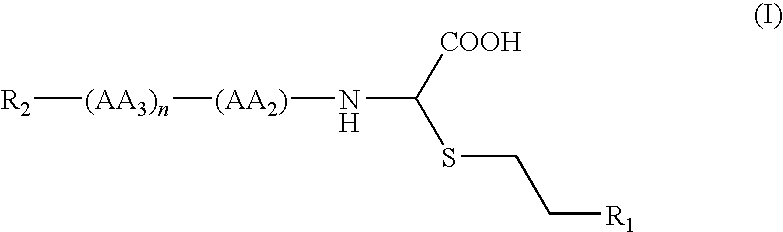
- the present invention relates to new TAFIa substrates of the general formula I
- R 1 preferably means NHC(NH)NH 2 .
- AA 2 may be e.g. Lys( ⁇ -Z), Lys( ⁇ -Boc), Lys( ⁇ -Ac), Lys( ⁇ -Bz), Lys( ⁇ -Bzl), Lys( ⁇ -Tos), Orn( ⁇ -Z), Orn( ⁇ -Boc), Orn( ⁇ -2-chlor-Z), Orn( ⁇ -Dnp), Orn( ⁇ -Z), Orn( ⁇ -Aloc), Arg( ⁇ -Pbf), Arg( ⁇ , ⁇ )-Boc) 2 , Arg( ⁇ , ⁇ -Z) 2 , Arg( ⁇ -Tos), His(N im -Boc), His(N im -Ac), His(N im -Bz), His(N im -Bzl) or His(N im -Tos), Lys( ⁇ -Z) being particularly preferred.
- E.g. tBu, Bzl or Ac can be taken into account as protective groups in the amino acid AA 3 , wherein phenylalanine, alanine, serine and valine are preferred amino acids.
- R 2 preferably means Bz or Boc.
- hydrobromides, hydrochlorides, trifluoracetates or acetates can be taken into account as salts, wherein acetate, trifluoracetate and hydrochloride salts are preferred.
- the compounds of general formula I which—relating to the asymmetrical carbon with the sulfur-containing substituent—can be present as racemates or in one of their enantiomer-pure configurations D and L, can be manufactured according to the known methods described hereinafter.
- Protected amino acids or protected oligopeptide derivatives are converted into the corresponding acid amides, and these are condensed under reflux with an alkyl ester of glyoxylic acid, preferably a C 1-6 alkyl ester such as ethyl glyoxylate, according to the method described by Hong, N. J. et al., Bull. Korean Chem. Soc. 1998, 19(2), 189-193.
- the thereby resulting hydroxyglycine derivatives are O-acetylated and substituted with a corresponding mercaptoalkyl compound, such as cystamine, 3-mercaptopropylamine or S-2-aminoethylisothiouronium bromide.
- the obtained alkylesters of the compounds of formula I are saponified into the corresponding free acids.
- the enantiomer-pure acids can be obtained through enantioselective hydrolysis of the esters by means of appropriate enzymes.
- the compounds of formula I and their acid addition salts are appropriate substrates for the determination of TAFIa.
- the determination can be performed by reacting TAFIa in the presence of 5,5′-dithiobis-(2-nitrobenzoic acid), the so-called “Ellman's Reagent”, on a compound according to one of claims 1 to 7 and measuring the absorption between 400 and 412 nm resulting from the formation of 3-carboxy-4-nitrothiophenol as a function of time using a spectrophotometer.
- the mentioned reaction preferably takes place between approx. 10° C. and 37° C., preferably at room temperature, and the reaction period may last approx. 5 to 15 minutes, preferably about 10 minutes.
- TAFI present in blood plasma can be used as the source of TAFIa.
- reaction solution from 1A was mixed with 127 mg (1 mmol) of DMAP, 24.7 ml (0.31 mol) of pyridine and 40 g (0.39 mol) of acetic acid anhydride and stirred for 90 min. at RT.
- the reaction solution was filtered over silica gel, the solvent was evaporated and the obtained raw product was dried in a vacuum desiccator.
- TAFIa is determined as shown in Scheme 1.
- the substrate is hydrolyzed by TAFIa in such a way that a thioamino acid (thiaarginine or thialysine) is released.
- a thioamino acid thiaarginine or thialysine
- These instable intermediates are rapidly decomposed into 2-mercaptoethylguanidine or 3-mercaptopropylamine, respectively.
- These mercapto compounds react with Ellman's reagent (5,5′-dithio-bis-(2-nitrobenzoic acid)), thereby releasing the strongly yellow 3-carboxy-4-nitrothiophenol that can be measured using a spectrophotometer at 405-412 nm.
- the free thiol content measured is directly proportional to the quantity of substrate hydrolyzed by TAFIa and thereby allows a quantitative analysis of the enzyme activity.
- Enzyme assay The enzyme activity is measured at room temperature by using a 10 mM substrate stock solution in DMSO.
- TAFI of human origin can be obtained in a stock solution of 360 ⁇ g/ml from Enzyme Research Laboratory or over blood plasma.
- Activation of TAFI to TAFIa occurred with thrombin (2.7 U/ml), the activation of which was produced with 30 ⁇ g of thrombomodulin.
- Excessive thrombin activity was eliminated by adding the synthetic inhibitor NAPAP. The measurement was performed on microtiter plates.
- Buffer (20 mM HEPES, 5 mM CaCl 2 , 0.01% Tween 80; 120 ⁇ l pH 7.4) NAPAP (100 ⁇ M) 20 ⁇ l DTNB (5 mM) 10 ⁇ l Substrate (10 mM) 20 ⁇ l
Landscapes
- Chemical & Material Sciences (AREA)
- Organic Chemistry (AREA)
- Life Sciences & Earth Sciences (AREA)
- Health & Medical Sciences (AREA)
- Proteomics, Peptides & Aminoacids (AREA)
- Biochemistry (AREA)
- Genetics & Genomics (AREA)
- Molecular Biology (AREA)
- General Health & Medical Sciences (AREA)
- Biophysics (AREA)
- Medicinal Chemistry (AREA)
- Zoology (AREA)
- Engineering & Computer Science (AREA)
- Wood Science & Technology (AREA)
- Neurosurgery (AREA)
- Analytical Chemistry (AREA)
- Biotechnology (AREA)
- Immunology (AREA)
- Microbiology (AREA)
- Physics & Mathematics (AREA)
- Hematology (AREA)
- Bioinformatics & Cheminformatics (AREA)
- General Engineering & Computer Science (AREA)
- Peptides Or Proteins (AREA)
- Measuring Or Testing Involving Enzymes Or Micro-Organisms (AREA)
- Medicines That Contain Protein Lipid Enzymes And Other Medicines (AREA)
- Manufacturing Of Printed Wiring (AREA)
Abstract
Description

have been described as substrates for carboxypeptidase B (Bull. Korean. Chem. Soc. 1998, 19(2), 189-193). These compounds are remarkably split off by carboxypeptidase B (CPB), but hardly by TAFIa. Detection of CPB by means of compound A is carried out according to the following Scheme 1.


wherein
- R1 means a CH2NH2 or NHC(NH)NH2 group,
- AA2 means non-substituted or substituted lysine, ornithine, arginine or histidine, wherein the substituents are common protective groups,
- AA3 means a natural amino acid in which a present, protectable group may be substituted with a usual protective group in the side chain,
- n represents 0 or 1, and
- R2 means a Bz, Bzl, Ac, Boc, Z, Suc, MeoSuc or Tos group,
provided that the following cases do not occur simultaneously: n=0, R1=NHC(NH)NH2, R2=Z and (AA2)=non-substituted or Boc-substituted lysine,
as racemates or enantiomeric pure isomers,
and the salts thereof with mineral or organic acids.
| Abbreviations |
| Ac | Acetyl |
| ACN | Acetonitrile |
| Aloc | Allyloxycarbonyl |
| BME | t-Butyl methyl ether |
| Boc | t-Butyloxycarbonyl |
| Bz | Benzoyl |
| Bzl | Benzyl |
| DMAP | 4-(Dimethylamino)-pyridine |
| DMF | N,N-Dimethylformamide |
| Dnp | 2,4-Dinitrophenyl |
| DTNB | 5,5′-Dithiobis-(2-nitrobenzoic acid) |
| EtOAc | Ethylacetate |
| GUS | 2-Guanidino-ethyithio |
| HEPES | 4-(2-Hydroxyethyl)-piperazin-1-ethane sulfonic acid |
| LH20 | Sephadex |
| MeoSuc | Methoxysuccinyl |
| NAPAP | Nα-(2-naphthylsulfonyl-glycyl)-4-amidinophenylalanine |
| piperidide | |
| Pbf | 2,2,4,6,7-Pentamethyl-dibenzohydrofuran-5-sulfonyl |
| SprA | 3-Aminopropylthio |
| RT | Room temperature |
| Suc | Succinyl |
| tBu | tert.-Butyl |
| TEA | Triethylamine |
| TFA | Trifluoracetic acid |
| THF | Tetrahydrofuran |
| Tos | Tosyl |
| Z | Benzyloxycarbonyl |
| TAFI | 20 μl | ||
| Thrombin (2.7 U/ml) | 20 μl | ||
| Thrombomodulin (30 μg/ml) | 20 μl | ||
in buffer (20 mM HEPES, 5 mM CaCl2, 0.01% Tween 80; pH 7.4)
-
- incubate for 5 min at 25° C.
Measurement:
- incubate for 5 min at 25° C.
| Buffer (20 mM HEPES, 5 mM CaCl2, 0.01% Tween 80; | 120 μl | ||
| pH 7.4) | |||
| NAPAP (100 μM) | 20 μl | ||
| DTNB (5 mM) | 10 μl | ||
| Substrate (10 mM) | 20 μl | ||
-
- measure for 10 min at RT
Results: - Splitting of thiaarginine and thialysine substrates (final concentration 174 μM) by TAFIa (final concentration 17 μg/ml)
- in brackets the value for carboxypeptidase B
- Substances of comparison A and B from Bull. Korean. Chem. Soc. 1998, 19(2), 189-193
- ΔE=Extinction variation at 405 nm
- measure for 10 min at RT
| TABLE 1 | ||
| No. | Substrate | ΔE/min |
| 4269 | Bz-K(Z)-G(GUS)-OH × HCl | 0.108 | (0.018) |
| 4273 | Boc-K(Tos)-G(GUS)-OH × HCl | 0.014 | (0.048) |
| 4275 | Boc-K(Z)-G(GUS)-OH × TFA | 0.041 | (0.028) |
| 4298 | Boc-F-K(Boc)-G(GUS)-OH × HCl | 0.043 | (0.034) |
| 4300 | Bz-P-K(Boc)-G(GUS)-OH × TFA | 0.012 | (0.072) |
| 4302 | Z-A-K(Boc)-G(GUS)-OH × HCl | 0.042 | (0.059) |
| 4334 | Bz-V-G(GUS)-OH × TFA | 0.034 | |
| 4336 | Bz-V-G(α-SPrA)-OH × TFA | 0.053 | |
| 4339 | Bz-K(Z)-G(α-SPrA)-OH × TFA | 0.055 | |
| 4341 | Boc-K(Z)-G(α-SPrA)-OH × TFA | 0.054 | |
| Substance of comparison A × HCl | 0.002 | (0.062) | |
| Substance of comparison B × HCl | 0.016 | (0.077) | |
Claims (6)

Applications Claiming Priority (3)
| Application Number | Priority Date | Filing Date | Title |
|---|---|---|---|
| WOPCT/CH02/00553 | 2002-10-04 | ||
| CH0200553 | 2002-10-04 | ||
| PCT/CH2002/000670 WO2004031216A1 (en) | 2002-10-04 | 2002-12-06 | Substrate for tafi (a) |
Publications (2)
| Publication Number | Publication Date |
|---|---|
| US20060068457A1 US20060068457A1 (en) | 2006-03-30 |
| US7718406B2 true US7718406B2 (en) | 2010-05-18 |
Family
ID=32046615
Family Applications (1)
| Application Number | Title | Priority Date | Filing Date |
|---|---|---|---|
| US10/530,165 Expired - Lifetime US7718406B2 (en) | 2002-10-04 | 2002-12-06 | Substrates for TAFI (A) |
Country Status (6)
| Country | Link |
|---|---|
| US (1) | US7718406B2 (en) |
| EP (1) | EP1551864B1 (en) |
| AT (1) | ATE532876T1 (en) |
| AU (1) | AU2002349247A1 (en) |
| ES (1) | ES2374973T3 (en) |
| WO (1) | WO2004031216A1 (en) |
Families Citing this family (7)
| Publication number | Priority date | Publication date | Assignee | Title |
|---|---|---|---|---|
| US7838560B2 (en) * | 2002-03-11 | 2010-11-23 | The Medicines Company (Leipzig) Gmbh | Urokinase inhibitors, production and use thereof |
| DE10301300B4 (en) * | 2003-01-15 | 2009-07-16 | Curacyte Chemistry Gmbh | Use of acylated 4-amidino- and 4-guanidinobenzylamines for the inhibition of plasma kallikrein |
| DE10342108A1 (en) * | 2003-09-11 | 2005-04-14 | Curacyte Chemistry Gmbh | Basic substituted benzylamine analogs as coagulation factor Xa inhibitors, their preparation and use |
| US20100021940A1 (en) * | 2006-04-12 | 2010-01-28 | Astrazeneca Ab | Method for Determining the Activity of a Protease in a Sample |
| DE102006050672A1 (en) * | 2006-10-24 | 2008-04-30 | Curacyte Discovery Gmbh | New glycylglycine derivatives with a benzylsulfonylamido group and an amidino-organylamido group at the opposite chain ends, used in drugs for reducing loss of blood, e.g. in operations |
| FR2947266B1 (en) * | 2009-06-26 | 2011-06-17 | Servier Lab | NOVEL 2-MERCAPTOCYCLOPENTANECARBOXYLIC ACID DERIVATIVES, PROCESS FOR PREPARING THEM AND PHARMACEUTICAL COMPOSITIONS CONTAINING SAME |
| CN107677834B (en) * | 2017-09-25 | 2019-07-09 | 辽宁迈迪生物科技股份有限公司 | The application of the detection method of TAFIa content, the kit for detecting TAFIa content and the two |
Citations (1)
| Publication number | Priority date | Publication date | Assignee | Title |
|---|---|---|---|---|
| US7119068B2 (en) * | 2002-08-29 | 2006-10-10 | American Diagnostica, Inc. | Methods of screening for compounds that modulate TAFIa activity, compounds, and methods of using the compounds |
-
2002
- 2002-12-06 WO PCT/CH2002/000670 patent/WO2004031216A1/en not_active Ceased
- 2002-12-06 AT AT02781041T patent/ATE532876T1/en active
- 2002-12-06 EP EP02781041A patent/EP1551864B1/en not_active Expired - Lifetime
- 2002-12-06 ES ES02781041T patent/ES2374973T3/en not_active Expired - Lifetime
- 2002-12-06 AU AU2002349247A patent/AU2002349247A1/en not_active Abandoned
- 2002-12-06 US US10/530,165 patent/US7718406B2/en not_active Expired - Lifetime
Patent Citations (1)
| Publication number | Priority date | Publication date | Assignee | Title |
|---|---|---|---|---|
| US7119068B2 (en) * | 2002-08-29 | 2006-10-10 | American Diagnostica, Inc. | Methods of screening for compounds that modulate TAFIa activity, compounds, and methods of using the compounds |
Non-Patent Citations (5)
| Title |
|---|
| Boffa et al., Plasma and Recombinant Thrombin-activable Fibrinolysis Inhibitor (TAFI) and Activated TAFI Compared with Respect to Glycosylation, Thrombin/Thrombomodulin-dependent Activation, Thermal Stability, and Enzymatic Properties; The Journal of Biological Chemistry, vol. 273, No. 4, Jan. 23, 1998, pp. 2127-2135. |
| Boffa et al: "Plasma and recombinant thrombin-activable fibrinolysis inhibitor (TAFI) and activated TAFI compared with respect to glycosylation, thrombin/thrombomodulin-dependent activation, thermal stability, and enzymatic properties" Journal of Biological Chemistry, Bd. 273, Nr. 4, Jan. 23, 1998, Seiten 2127-2135. * |
| Bull. Korean. Chem. Soc. 1998, 19(2), 189-193 (cited on specification p. 1, backdrop). * |
| Hong et al., Development of Substrate for Carboxypeptidase-B by Employing Thiaarginine Peptides; Bull. Korean Chem. Soc, 1998, vol. 19, No. 2, pp. 189-193. |
| Tong et al: "Development of substrate forcarboxypeptidase-B by employing thiaarginine peptides" Bulletin of the Korean Chemical Society, Bd. 19, Nr. 2, 1998, Seiten 189-193, XP008018429in der Anmeldung erwAhnt Siehe Seite 189 ("Scheme 1") and Seite192 ("Discussion") {Cited in PCT, Supplied by Applicant;as is Boffa ref. below:]. * |
Also Published As
| Publication number | Publication date |
|---|---|
| US20060068457A1 (en) | 2006-03-30 |
| AU2002349247A1 (en) | 2004-04-23 |
| EP1551864A1 (en) | 2005-07-13 |
| ES2374973T3 (en) | 2012-02-23 |
| WO2004031216A1 (en) | 2004-04-15 |
| ATE532876T1 (en) | 2011-11-15 |
| EP1551864B1 (en) | 2011-11-09 |
Similar Documents
| Publication | Publication Date | Title |
|---|---|---|
| FI94254C (en) | Process for the preparation of therapeutically active peptide compounds | |
| US4508644A (en) | Chromogenic compounds, a process for their preparation and their use | |
| US4918105A (en) | Novel compounds with collagenase-inhibiting activity, a process for their preparation and pharmaceutical compositions in which these compounds are present | |
| US4457866A (en) | Chromogenic compounds and their use as enzyme substrates | |
| HU204847B (en) | Process for producing new peptidase inhibitors | |
| HUT68563A (en) | Peptide analogs as irreversible interleukin-1-beta protease enzim inhibitors, pharmaceutical compositions containing the said peptidanalogs and process to prepare them | |
| JPH0437070B2 (en) | ||
| AU611850B2 (en) | Oligopeptidyl nitrile derivatives, agents containing them, a process for their preparation, and their use | |
| Gour-Salin et al. | Epoxysuccinyl dipeptides as selective inhibitors of cathepsin B | |
| AU650526B2 (en) | Amidinophenylalanine derivatives, process for their preparation, their use and compositions containing them | |
| US20060189689A1 (en) | Arginine mimetics as factor Xa inhibitors | |
| AU626361B2 (en) | Retroviral protease inhibitors | |
| EP0313969B1 (en) | Tripeptide derivatives and antiplasmin agents containing the same | |
| US20060068457A1 (en) | Substrates for tafi (a) | |
| EP0817795B1 (en) | Novel 4-substituted-3-peptidyl-azetidin-2-one derivatives useful as cysteine proteinase inhibitor | |
| Melo et al. | Synthesis and hydrolysis by cathepsin B of fluorogenic substrates with the general structure benzoyl-X-ARG-MCA containing non-natural basic amino acids at position X | |
| JP3593590B2 (en) | Peptide-substituted coumarin derivatives | |
| US5306824A (en) | Biotinylated isocoumarins | |
| US4569907A (en) | Thiopeptolide substrates for vertebrate collagenase | |
| EP1046650A1 (en) | PEPTIDES, METHOD FOR ASSAYING HUMAN PEPSINOGEN II or HUMAN PEPSIN II, AND ASSAYING KIT | |
| WO1990005141A1 (en) | Amino acid and peptide inhibitors of human leukocytic elastase and collagenase | |
| JPH0813835B2 (en) | Tripeptide derivative having a pyroglutamic acid residue | |
| US4350628A (en) | Preparation of dehydropeptides | |
| US4261884A (en) | Preparation of dehydropeptides | |
| JP2004083427A (en) | Cyclic hexapeptide and proteasome inhibitor |
Legal Events
| Date | Code | Title | Description |
|---|---|---|---|
| AS | Assignment |
Owner name: PENTAPHARM AG,SWITZERLAND Free format text: ASSIGNMENT OF ASSIGNORS INTEREST;ASSIGNORS:ZIEGLER, HUGO;PRASA, DAGMAR;STURZEBECHER, JORG;AND OTHERS;SIGNING DATES FROM 20050321 TO 20050330;REEL/FRAME:017380/0777 Owner name: PENTAPHARM AG, SWITZERLAND Free format text: ASSIGNMENT OF ASSIGNORS INTEREST;ASSIGNORS:ZIEGLER, HUGO;PRASA, DAGMAR;STURZEBECHER, JORG;AND OTHERS;REEL/FRAME:017380/0777;SIGNING DATES FROM 20050321 TO 20050330 |
|
| AS | Assignment |
Owner name: DSM IP ASSETS B.V., NETHERLANDS Free format text: ASSIGNMENT OF ASSIGNORS INTEREST;ASSIGNOR:PENTAPHARM AG;REEL/FRAME:023042/0251 Effective date: 20071215 Owner name: DSM IP ASSETS B.V.,NETHERLANDS Free format text: ASSIGNMENT OF ASSIGNORS INTEREST;ASSIGNOR:PENTAPHARM AG;REEL/FRAME:023042/0251 Effective date: 20071215 |
|
| STCF | Information on status: patent grant |
Free format text: PATENTED CASE |
|
| FPAY | Fee payment |
Year of fee payment: 4 |
|
| MAFP | Maintenance fee payment |
Free format text: PAYMENT OF MAINTENANCE FEE, 8TH YEAR, LARGE ENTITY (ORIGINAL EVENT CODE: M1552) Year of fee payment: 8 |
|
| MAFP | Maintenance fee payment |
Free format text: PAYMENT OF MAINTENANCE FEE, 12TH YEAR, LARGE ENTITY (ORIGINAL EVENT CODE: M1553); ENTITY STATUS OF PATENT OWNER: LARGE ENTITY Year of fee payment: 12 |
|
| AS | Assignment |
Owner name: PENTAPHARM AG, SWITZERLAND Free format text: ASSIGNMENT OF ASSIGNORS INTEREST;ASSIGNOR:DSM IP ASSETS B.V.;REEL/FRAME:062454/0157 Effective date: 20221116 |