US7714009B2 - Nitrogen-containing fused heterocyclic compounds - Google Patents
Nitrogen-containing fused heterocyclic compounds Download PDFInfo
- Publication number
- US7714009B2 US7714009B2 US10/577,334 US57733404A US7714009B2 US 7714009 B2 US7714009 B2 US 7714009B2 US 57733404 A US57733404 A US 57733404A US 7714009 B2 US7714009 B2 US 7714009B2
- Authority
- US
- United States
- Prior art keywords
- optionally substituted
- compound
- mmol
- calcd
- methyl
- Prior art date
- Legal status (The legal status is an assumption and is not a legal conclusion. Google has not performed a legal analysis and makes no representation as to the accuracy of the status listed.)
- Expired - Fee Related, expires
Links
- 0 [1*][W]C1=CC=CC2CC(C[2*])CC12 Chemical compound [1*][W]C1=CC=CC2CC(C[2*])CC12 0.000 description 33
- YLTKSVFQPYSYAD-UHFFFAOYSA-N CC(C)C1=NC(C(C)C)=C(C(C)C)C1 Chemical compound CC(C)C1=NC(C(C)C)=C(C(C)C)C1 YLTKSVFQPYSYAD-UHFFFAOYSA-N 0.000 description 8
- POHCJVXIECHRNS-UHFFFAOYSA-N CC1=CC(C)=C(NC2=NC3=CC=CC(N(CC4=CC=C(F)C=C4)CC4CC4)=C3N2C)C(C)=C1 Chemical compound CC1=CC(C)=C(NC2=NC3=CC=CC(N(CC4=CC=C(F)C=C4)CC4CC4)=C3N2C)C(C)=C1 POHCJVXIECHRNS-UHFFFAOYSA-N 0.000 description 2
- LWGDDLXCRXHUTC-UHFFFAOYSA-N CCCC1CCCCN1C1=C2C(=CC=C1)N=C(NC1=C(C)C=C(Br)C=C1OC)N2C Chemical compound CCCC1CCCCN1C1=C2C(=CC=C1)N=C(NC1=C(C)C=C(Br)C=C1OC)N2C LWGDDLXCRXHUTC-UHFFFAOYSA-N 0.000 description 2
- BYRSCPMDCOZPFY-UHFFFAOYSA-N CCCCN(CCCC)C1=C2C(=CC(F)=C1)N=C(NC1=C(C)C=C(C)C=C1C)N2C Chemical compound CCCCN(CCCC)C1=C2C(=CC(F)=C1)N=C(NC1=C(C)C=C(C)C=C1C)N2C BYRSCPMDCOZPFY-UHFFFAOYSA-N 0.000 description 2
- SMRACZHYTUBXCE-UHFFFAOYSA-N CCCCN(CCCC)C1=C2C(=CC=C1)N=C(NC1=C(OC)C=C(OC)C=C1C)N2C Chemical compound CCCCN(CCCC)C1=C2C(=CC=C1)N=C(NC1=C(OC)C=C(OC)C=C1C)N2C SMRACZHYTUBXCE-UHFFFAOYSA-N 0.000 description 2
- TXTXXBIWLBLWHO-UHFFFAOYSA-N CCCCN(CCCC)C1=C2SC(NC3=C(C)C=C(C)C=C3C)=NC2=CC=C1 Chemical compound CCCCN(CCCC)C1=C2SC(NC3=C(C)C=C(C)C=C3C)=NC2=CC=C1 TXTXXBIWLBLWHO-UHFFFAOYSA-N 0.000 description 2
- NEQLIMKBYCOIFE-UHFFFAOYSA-N CCCN(C1=C2SC(NC3=C(C)C=C(C)C=C3C)=NC2=CC=C1)C(C)C Chemical compound CCCN(C1=C2SC(NC3=C(C)C=C(C)C=C3C)=NC2=CC=C1)C(C)C NEQLIMKBYCOIFE-UHFFFAOYSA-N 0.000 description 2
- AROLCVGOMJTDQA-UHFFFAOYSA-N CCCN(CCC)C1=C2C(=CC=C1)N=C(NC1=C(C)C=C(C)C=C1C)N2C Chemical compound CCCN(CCC)C1=C2C(=CC=C1)N=C(NC1=C(C)C=C(C)C=C1C)N2C AROLCVGOMJTDQA-UHFFFAOYSA-N 0.000 description 2
- TYDJHBSHGGJSLX-UHFFFAOYSA-N CCCN(CCC)C1=C2C(=CC=C1)N=C(NC1=C(C)C=C(C)C=C1C)N2CCO Chemical compound CCCN(CCC)C1=C2C(=CC=C1)N=C(NC1=C(C)C=C(C)C=C1C)N2CCO TYDJHBSHGGJSLX-UHFFFAOYSA-N 0.000 description 2
- RPKAXJDXTHSYII-UHFFFAOYSA-N CCCN(CCC)C1=C2C(=CC=C1)N=C(NC1=C(Cl)C=C(Cl)C=C1)N2C Chemical compound CCCN(CCC)C1=C2C(=CC=C1)N=C(NC1=C(Cl)C=C(Cl)C=C1)N2C RPKAXJDXTHSYII-UHFFFAOYSA-N 0.000 description 2
- UZXCZSHZEJLRKS-UHFFFAOYSA-N CCCN(CCC)C1=C2C(=CC=C1)N=C(NC1=C(OC)C=C(OC)C=C1)N2C Chemical compound CCCN(CCC)C1=C2C(=CC=C1)N=C(NC1=C(OC)C=C(OC)C=C1)N2C UZXCZSHZEJLRKS-UHFFFAOYSA-N 0.000 description 2
- ZZDBNFJJRRGLHM-UHFFFAOYSA-N CCCN(CCC)C1=C2C(=CC=C1)N=C(NC1=CC=C(Cl)C=C1OCCCBr)N2C Chemical compound CCCN(CCC)C1=C2C(=CC=C1)N=C(NC1=CC=C(Cl)C=C1OCCCBr)N2C ZZDBNFJJRRGLHM-UHFFFAOYSA-N 0.000 description 2
- QLLCHESAAIOTFX-UHFFFAOYSA-N CCCN(CCC)C1=C2C(=CC=C1)N=C(NC1=CC=C(Cl)C=C1OCCCC(=O)N(C)C)N2C Chemical compound CCCN(CCC)C1=C2C(=CC=C1)N=C(NC1=CC=C(Cl)C=C1OCCCC(=O)N(C)C)N2C QLLCHESAAIOTFX-UHFFFAOYSA-N 0.000 description 2
- PWNGSDYKWGJNNE-UHFFFAOYSA-N CCCN(CCC)C1=CC=CC2=C1OC(NC1=C(C)C=C(C)C=C1C)=N2 Chemical compound CCCN(CCC)C1=CC=CC2=C1OC(NC1=C(C)C=C(C)C=C1C)=N2 PWNGSDYKWGJNNE-UHFFFAOYSA-N 0.000 description 2
- XMKOBMNZCCKXLE-UHFFFAOYSA-N CCCN(CCC)C1=CC=CC2=C1SC(OC1=C(C)C=C(C)C=C1)=N2 Chemical compound CCCN(CCC)C1=CC=CC2=C1SC(OC1=C(C)C=C(C)C=C1)=N2 XMKOBMNZCCKXLE-UHFFFAOYSA-N 0.000 description 2
- JMDRBLORKONVTR-UHFFFAOYSA-N CCCN(CCC)C1=CC=CC2=NC(OC3=CC=C(C)C=C3C)=CN12 Chemical compound CCCN(CCC)C1=CC=CC2=NC(OC3=CC=C(C)C=C3C)=CN12 JMDRBLORKONVTR-UHFFFAOYSA-N 0.000 description 2
- RMAPNSCDXUCDPQ-UHFFFAOYSA-N CCN(C1=C2C(=CC=C1)N=C(NC1=C(C)C=C(Br)C=C1OC)N2C)C(C)C Chemical compound CCN(C1=C2C(=CC=C1)N=C(NC1=C(C)C=C(Br)C=C1OC)N2C)C(C)C RMAPNSCDXUCDPQ-UHFFFAOYSA-N 0.000 description 2
- ICQXNQYEIQAJGK-UHFFFAOYSA-N CCN(C1=C2C(=CC=C1)N=C(NC1=C(C)C=C(Cl)C=C1OC)N2C)C(C)C Chemical compound CCN(C1=C2C(=CC=C1)N=C(NC1=C(C)C=C(Cl)C=C1OC)N2C)C(C)C ICQXNQYEIQAJGK-UHFFFAOYSA-N 0.000 description 2
- QDOFKCOLKLYPJK-UHFFFAOYSA-N CCN(C1=C2C(=CC=C1)N=C(NC1=C(OC)C=C(OC)C=C1OC)N2C)C(C)C Chemical compound CCN(C1=C2C(=CC=C1)N=C(NC1=C(OC)C=C(OC)C=C1OC)N2C)C(C)C QDOFKCOLKLYPJK-UHFFFAOYSA-N 0.000 description 2
- JLSHHJZFSCADGP-UHFFFAOYSA-N CCN(C1=C2C(=CC=C1)N=C(NC1=CC(C(C)(C)C)=NN1C)N2C)C(C)C Chemical compound CCN(C1=C2C(=CC=C1)N=C(NC1=CC(C(C)(C)C)=NN1C)N2C)C(C)C JLSHHJZFSCADGP-UHFFFAOYSA-N 0.000 description 2
- DVKMFNKGNQRAGL-UHFFFAOYSA-N CCN(CC)C1=C2C(=CC=C1)N=C(NC1=C(OC)C=C(Br)C=C1C)N2C Chemical compound CCN(CC)C1=C2C(=CC=C1)N=C(NC1=C(OC)C=C(Br)C=C1C)N2C DVKMFNKGNQRAGL-UHFFFAOYSA-N 0.000 description 2
- GWKZCMJZSOSQDD-UHFFFAOYSA-N COC(=O)CCCN(CC1CC1)C1=C2C(=CC=C1)N=C(NC1=C(C)C=C(C)C=C1C)N2C Chemical compound COC(=O)CCCN(CC1CC1)C1=C2C(=CC=C1)N=C(NC1=C(C)C=C(C)C=C1C)N2C GWKZCMJZSOSQDD-UHFFFAOYSA-N 0.000 description 2
- HALHLOZTLMKPFV-UHFFFAOYSA-N COC1=C(NC2=NC3=CC=CC(N(CCCC(=O)N4CCCC4)C(C)C)=C3N2C)C(C)=CC(Br)=C1 Chemical compound COC1=C(NC2=NC3=CC=CC(N(CCCC(=O)N4CCCC4)C(C)C)=C3N2C)C(C)=CC(Br)=C1 HALHLOZTLMKPFV-UHFFFAOYSA-N 0.000 description 2
- VJGZSKNETCKDOZ-UHFFFAOYSA-N COC1=C(NC2=NC3=CC=CC(N(CCCC(=O)N4CCOCC4)C(C)C)=C3N2C)C(C)=CC(Br)=C1 Chemical compound COC1=C(NC2=NC3=CC=CC(N(CCCC(=O)N4CCOCC4)C(C)C)=C3N2C)C(C)=CC(Br)=C1 VJGZSKNETCKDOZ-UHFFFAOYSA-N 0.000 description 2
- SGRBWTRZWAZGRJ-UHFFFAOYSA-N COC1=CC(Cl)=CC(C)=C1NC1=NC2=CC=CC(N(CC(C)(C)C)C3=CC=C(Cl)C=C3)=C2N1C Chemical compound COC1=CC(Cl)=CC(C)=C1NC1=NC2=CC=CC(N(CC(C)(C)C)C3=CC=C(Cl)C=C3)=C2N1C SGRBWTRZWAZGRJ-UHFFFAOYSA-N 0.000 description 2
- WVVFBDWSVWOGLE-UHFFFAOYSA-L C.CC1=CC=CC2=C1CC(C#N)=N2.CC1=CC=CC2=C1CC(C(=O)O)=N2.CC1=CC=CC2=C1CC(N)=N2.I[V]I.[V] Chemical compound C.CC1=CC=CC2=C1CC(C#N)=N2.CC1=CC=CC2=C1CC(C(=O)O)=N2.CC1=CC=CC2=C1CC(N)=N2.I[V]I.[V] WVVFBDWSVWOGLE-UHFFFAOYSA-L 0.000 description 1
- WGJYECUNVMHYKM-UHFFFAOYSA-N CC(=O)N(CC1CC1)C1=C2C(=CC=C1)N=C(NC1=C(C)C=C(C)C=C1C)N2C Chemical compound CC(=O)N(CC1CC1)C1=C2C(=CC=C1)N=C(NC1=C(C)C=C(C)C=C1C)N2C WGJYECUNVMHYKM-UHFFFAOYSA-N 0.000 description 1
- GPMKSICUWQBMRC-UHFFFAOYSA-N CC(C)N(c(cc1)cc(OC)c1C#N)c1c2[n](C)c(Nc(c(OC)c3)c(C)cc3Br)nc2ccc1 Chemical compound CC(C)N(c(cc1)cc(OC)c1C#N)c1c2[n](C)c(Nc(c(OC)c3)c(C)cc3Br)nc2ccc1 GPMKSICUWQBMRC-UHFFFAOYSA-N 0.000 description 1
- FZVDOJQLQQIXSM-UHFFFAOYSA-N CC1=CC(Br)=CC(C)=C1NC1=NC2=CC=CC(N(CCN)C(C)C)=C2N1C Chemical compound CC1=CC(Br)=CC(C)=C1NC1=NC2=CC=CC(N(CCN)C(C)C)=C2N1C FZVDOJQLQQIXSM-UHFFFAOYSA-N 0.000 description 1
- VMLJFIVZLWRYLI-UHFFFAOYSA-N CC1=CC(C)=C(CN(CC2CC2)C2=C3C(=CC=C2)N=C(NC2=C(C)C=C(C)C=C2C)N3C)C=C1 Chemical compound CC1=CC(C)=C(CN(CC2CC2)C2=C3C(=CC=C2)N=C(NC2=C(C)C=C(C)C=C2C)N3C)C=C1 VMLJFIVZLWRYLI-UHFFFAOYSA-N 0.000 description 1
- LKZRDQQOZVJPNM-UHFFFAOYSA-N CC1=CC(C)=C(NC2=NC3=C(C(N(CCOCC4=CC=CC=C4)CCOCC4=CC=CC=C4)=CC=C3)N2C)C(C)=N1 Chemical compound CC1=CC(C)=C(NC2=NC3=C(C(N(CCOCC4=CC=CC=C4)CCOCC4=CC=CC=C4)=CC=C3)N2C)C(C)=N1 LKZRDQQOZVJPNM-UHFFFAOYSA-N 0.000 description 1
- VBYYXKMRUNFTHV-UHFFFAOYSA-N CC1=CC(C)=C(NC2=NC3=CC(F)=CC(N(CC4CC4)CC4CC4)=C3N2C)C(C)=C1 Chemical compound CC1=CC(C)=C(NC2=NC3=CC(F)=CC(N(CC4CC4)CC4CC4)=C3N2C)C(C)=C1 VBYYXKMRUNFTHV-UHFFFAOYSA-N 0.000 description 1
- YRSOYKHUOZCGSR-UHFFFAOYSA-N CC1=CC(C)=C(NC2=NC3=CC=CC(N(C)C)=C3S2)C(C)=C1 Chemical compound CC1=CC(C)=C(NC2=NC3=CC=CC(N(C)C)=C3S2)C(C)=C1 YRSOYKHUOZCGSR-UHFFFAOYSA-N 0.000 description 1
- SJQJBFKEYDNEMF-UHFFFAOYSA-N CC1=CC(C)=C(NC2=NC3=CC=CC(N(CC(C)C)CC(C)C)=C3S2)C(C)=C1 Chemical compound CC1=CC(C)=C(NC2=NC3=CC=CC(N(CC(C)C)CC(C)C)=C3S2)C(C)=C1 SJQJBFKEYDNEMF-UHFFFAOYSA-N 0.000 description 1
- AQMPYDKFTFELNA-UHFFFAOYSA-N CC1=CC(C)=C(NC2=NC3=CC=CC(N(CC4=CC=C(C#N)C=C4)CC4CC4)=C3N2C)C(C)=C1 Chemical compound CC1=CC(C)=C(NC2=NC3=CC=CC(N(CC4=CC=C(C#N)C=C4)CC4CC4)=C3N2C)C(C)=C1 AQMPYDKFTFELNA-UHFFFAOYSA-N 0.000 description 1
- OLCRTKDQUBYWJT-UHFFFAOYSA-N CC1=CC(C)=C(NC2=NC3=CC=CC(N(CC4=CC=C(C(C)(C)C)C=C4)CC4CC4)=C3N2C)C(C)=C1 Chemical compound CC1=CC(C)=C(NC2=NC3=CC=CC(N(CC4=CC=C(C(C)(C)C)C=C4)CC4CC4)=C3N2C)C(C)=C1 OLCRTKDQUBYWJT-UHFFFAOYSA-N 0.000 description 1
- IBVGRVCMHUXWRP-UHFFFAOYSA-N CC1=CC(C)=C(NC2=NC3=CC=CC(N(CC4=CC=C(C(F)(F)F)C=C4)CC4CC4)=C3N2C)C(C)=C1 Chemical compound CC1=CC(C)=C(NC2=NC3=CC=CC(N(CC4=CC=C(C(F)(F)F)C=C4)CC4CC4)=C3N2C)C(C)=C1 IBVGRVCMHUXWRP-UHFFFAOYSA-N 0.000 description 1
- SSVBKJLJYJKGSU-UHFFFAOYSA-N CC1=CC(C)=C(NC2=NC3=CC=CC(N(CC4=CC=C(Cl)C=C4)CC4CC4)=C3N2C)C(C)=C1 Chemical compound CC1=CC(C)=C(NC2=NC3=CC=CC(N(CC4=CC=C(Cl)C=C4)CC4CC4)=C3N2C)C(C)=C1 SSVBKJLJYJKGSU-UHFFFAOYSA-N 0.000 description 1
- LMXPOVIKBVLZND-UHFFFAOYSA-N CC1=CC(C)=C(NC2=NC3=CC=CC(N(CC4=CC=CC=C4)CC4CC4)=C3N2C)C(C)=C1 Chemical compound CC1=CC(C)=C(NC2=NC3=CC=CC(N(CC4=CC=CC=C4)CC4CC4)=C3N2C)C(C)=C1 LMXPOVIKBVLZND-UHFFFAOYSA-N 0.000 description 1
- KACWBNNNKSJCGZ-UHFFFAOYSA-N CC1=CC(C)=C(NC2=NC3=CC=CC(N(CC4=CC=CN=C4)CC4CC4)=C3N2C)C(C)=C1 Chemical compound CC1=CC(C)=C(NC2=NC3=CC=CC(N(CC4=CC=CN=C4)CC4CC4)=C3N2C)C(C)=C1 KACWBNNNKSJCGZ-UHFFFAOYSA-N 0.000 description 1
- FVDSZASBKAQVIT-UHFFFAOYSA-N CC1=CC(C)=C(NC2=NC3=CC=CC(N(CC4=CC=NC=C4)CC4CC4)=C3N2C)C(C)=C1 Chemical compound CC1=CC(C)=C(NC2=NC3=CC=CC(N(CC4=CC=NC=C4)CC4CC4)=C3N2C)C(C)=C1 FVDSZASBKAQVIT-UHFFFAOYSA-N 0.000 description 1
- SEMRHIOCGUEDGJ-UHFFFAOYSA-N CC1=CC(C)=C(NC2=NC3=CC=CC(N(CC4=NC=CC=C4)CC4CC4)=C3N2C)C(C)=C1 Chemical compound CC1=CC(C)=C(NC2=NC3=CC=CC(N(CC4=NC=CC=C4)CC4CC4)=C3N2C)C(C)=C1 SEMRHIOCGUEDGJ-UHFFFAOYSA-N 0.000 description 1
- DGHZKZYYNFTSHN-UHFFFAOYSA-N CC1=CC(C)=C(NC2=NC3=CC=CC(N(CC4CC4)CC4CC4)=C3N2C)C(C)=C1 Chemical compound CC1=CC(C)=C(NC2=NC3=CC=CC(N(CC4CC4)CC4CC4)=C3N2C)C(C)=C1 DGHZKZYYNFTSHN-UHFFFAOYSA-N 0.000 description 1
- VYROQCHDBGZKKF-UHFFFAOYSA-N CC1=CC(C)=C(NC2=NC3=CC=CC(N(CC4CC4)CC4CC4)=C3N2C)C(C)=N1 Chemical compound CC1=CC(C)=C(NC2=NC3=CC=CC(N(CC4CC4)CC4CC4)=C3N2C)C(C)=N1 VYROQCHDBGZKKF-UHFFFAOYSA-N 0.000 description 1
- ZWRDMWYIGKJXKO-UHFFFAOYSA-N CC1=CC(C)=C(NC2=NC3=CC=CC(N(CC4CC4)CC4CC4)=C3N2CC(F)(F)F)C(C)=C1 Chemical compound CC1=CC(C)=C(NC2=NC3=CC=CC(N(CC4CC4)CC4CC4)=C3N2CC(F)(F)F)C(C)=C1 ZWRDMWYIGKJXKO-UHFFFAOYSA-N 0.000 description 1
- QJMKTRLOVKRGFO-UHFFFAOYSA-N CC1=CC(C)=C(NC2=NC3=CC=CC(N(CCO)CC4CC4)=C3N2C)C(C)=C1 Chemical compound CC1=CC(C)=C(NC2=NC3=CC=CC(N(CCO)CC4CC4)=C3N2C)C(C)=C1 QJMKTRLOVKRGFO-UHFFFAOYSA-N 0.000 description 1
- KUXRRTXNCOIEPU-UHFFFAOYSA-N CC1=CC(C)=C(NC2=NC3=CC=CC(N(CCOCC4=CC=CC=C4)CC4CC4)=C3N2C)C(C)=C1 Chemical compound CC1=CC(C)=C(NC2=NC3=CC=CC(N(CCOCC4=CC=CC=C4)CC4CC4)=C3N2C)C(C)=C1 KUXRRTXNCOIEPU-UHFFFAOYSA-N 0.000 description 1
- MSSVKHLDWSQQRM-UHFFFAOYSA-N CC1=CC(C)=C(NC2=NC3=CC=CC(N4CCCCC4)=C3N2C)C(C)=C1 Chemical compound CC1=CC(C)=C(NC2=NC3=CC=CC(N4CCCCC4)=C3N2C)C(C)=C1 MSSVKHLDWSQQRM-UHFFFAOYSA-N 0.000 description 1
- MHJUJUDIFWHYGR-UHFFFAOYSA-N CC1=CC(C)=C(NC2=NC3=CC=CC(N4CCCCC4)=C3S2)C(C)=C1 Chemical compound CC1=CC(C)=C(NC2=NC3=CC=CC(N4CCCCC4)=C3S2)C(C)=C1 MHJUJUDIFWHYGR-UHFFFAOYSA-N 0.000 description 1
- FQAMMHZQOZZGHT-UHFFFAOYSA-N CC1=CC(C)=NC(C)=C1NC1=NC2=CC=CC(N(CC(C)C)CC(C)C)=C2S1 Chemical compound CC1=CC(C)=NC(C)=C1NC1=NC2=CC=CC(N(CC(C)C)CC(C)C)=C2S1 FQAMMHZQOZZGHT-UHFFFAOYSA-N 0.000 description 1
- VNFZGLTZFXOBSN-UHFFFAOYSA-N CC1=CC=C(CN(CC2CC2)C2=C3C(=CC=C2)N=C(NC2=C(C)C=C(C)C=C2C)N3C)C=C1 Chemical compound CC1=CC=C(CN(CC2CC2)C2=C3C(=CC=C2)N=C(NC2=C(C)C=C(C)C=C2C)N3C)C=C1 VNFZGLTZFXOBSN-UHFFFAOYSA-N 0.000 description 1
- IBSZQDAAKGWDFX-UHFFFAOYSA-M CC1=CC=CC(N)=C1C.CC1=CC=CC2=C1CC(=O)N2.CC1=CC=CC2=C1CC(C)=N2.[V]I Chemical compound CC1=CC=CC(N)=C1C.CC1=CC=CC2=C1CC(=O)N2.CC1=CC=CC2=C1CC(C)=N2.[V]I IBSZQDAAKGWDFX-UHFFFAOYSA-M 0.000 description 1
- SROOWBCLYHLOLJ-UHFFFAOYSA-N CC1=CC=CC(N=C=S)=C1C.CC1=CC=CC(NC(N)=S)=C1C.CC1=CC=CC2=C1CC(C)=N2.NC1=NC2=C(C1)C([W][W])=CC=C2.[V] Chemical compound CC1=CC=CC(N=C=S)=C1C.CC1=CC=CC(NC(N)=S)=C1C.CC1=CC=CC2=C1CC(C)=N2.NC1=NC2=C(C1)C([W][W])=CC=C2.[V] SROOWBCLYHLOLJ-UHFFFAOYSA-N 0.000 description 1
- SAGNSNIEMNMIGB-UHFFFAOYSA-N CCC1=CC(Cl)=CC(CC)=C1NC1=NC2=CC=CC(N(CC)C(C)C)=C2N1C Chemical compound CCC1=CC(Cl)=CC(CC)=C1NC1=NC2=CC=CC(N(CC)C(C)C)=C2N1C SAGNSNIEMNMIGB-UHFFFAOYSA-N 0.000 description 1
- YGIFZIPAAHLBJJ-UHFFFAOYSA-N CCC1=CC(Cl)=CC(CC)=C1NC1=NC2=CC=CC(N(CC)CC)=C2N1C Chemical compound CCC1=CC(Cl)=CC(CC)=C1NC1=NC2=CC=CC(N(CC)CC)=C2N1C YGIFZIPAAHLBJJ-UHFFFAOYSA-N 0.000 description 1
- WHCRNFHAGPBRJA-UHFFFAOYSA-N CCC1=CC=CC(N)=C1C.CCC1=CC=CC2=C1CC(=O)N2 Chemical compound CCC1=CC=CC(N)=C1C.CCC1=CC=CC2=C1CC(=O)N2 WHCRNFHAGPBRJA-UHFFFAOYSA-N 0.000 description 1
- LNTDPXVXPUKOQZ-UHFFFAOYSA-N CCC1CCCCN1C1=C2C(=CC=C1)N=C(NC1=C(OC)C=C(Br)C=C1C)N2C Chemical compound CCC1CCCCN1C1=C2C(=CC=C1)N=C(NC1=C(OC)C=C(Br)C=C1C)N2C LNTDPXVXPUKOQZ-UHFFFAOYSA-N 0.000 description 1
- VYDMSDPMXGLDPK-UHFFFAOYSA-N CCC1CCCCN1C1=C2C(=CC=C1)N=C(NC1=CN=C(N(C)C)C=C1C)N2C Chemical compound CCC1CCCCN1C1=C2C(=CC=C1)N=C(NC1=CN=C(N(C)C)C=C1C)N2C VYDMSDPMXGLDPK-UHFFFAOYSA-N 0.000 description 1
- FNUMVVYXZRHCQX-UHFFFAOYSA-N CCC1COCCN1C1=C2C(=CC=C1)N=C(NC1=C(C)C=C(Br)C=C1OC)N2C Chemical compound CCC1COCCN1C1=C2C(=CC=C1)N=C(NC1=C(C)C=C(Br)C=C1OC)N2C FNUMVVYXZRHCQX-UHFFFAOYSA-N 0.000 description 1
- PFAQIJRSJWWXQL-UHFFFAOYSA-N CCCC(CCC)NC1=C2C(=CC=C1)N=C(NC1=C(C)C=C(C)C=C1C)N2C Chemical compound CCCC(CCC)NC1=C2C(=CC=C1)N=C(NC1=C(C)C=C(C)C=C1C)N2C PFAQIJRSJWWXQL-UHFFFAOYSA-N 0.000 description 1
- OLQSQQDUVJQGLP-UHFFFAOYSA-N CCCCN(C1=CC=C(OC)C=C1)C1=C2C(=CC=C1)N=C(NC1=C(C)C=C(C)C=C1C)N2C Chemical compound CCCCN(C1=CC=C(OC)C=C1)C1=C2C(=CC=C1)N=C(NC1=C(C)C=C(C)C=C1C)N2C OLQSQQDUVJQGLP-UHFFFAOYSA-N 0.000 description 1
- AFSBBRNWKCIUNZ-UHFFFAOYSA-N CCCCN(CCC)C1=C2C(=CC=C1)N=C(NC1=C(C)C=C(C)C=C1C)N2C Chemical compound CCCCN(CCC)C1=C2C(=CC=C1)N=C(NC1=C(C)C=C(C)C=C1C)N2C AFSBBRNWKCIUNZ-UHFFFAOYSA-N 0.000 description 1
- BFAUNDQDWFWIGY-UHFFFAOYSA-N CCCCN(CCCC)C1=C2C(=CC=C1)N=C(NC1=C(Br)C=C(OC)C=C1C)N2C Chemical compound CCCCN(CCCC)C1=C2C(=CC=C1)N=C(NC1=C(Br)C=C(OC)C=C1C)N2C BFAUNDQDWFWIGY-UHFFFAOYSA-N 0.000 description 1
- GPERZRYITUNLHA-UHFFFAOYSA-N CCCCN(CCCC)C1=C2C(=CC=C1)N=C(NC1=C(C)C=C(Br)C=C1OC)N2C Chemical compound CCCCN(CCCC)C1=C2C(=CC=C1)N=C(NC1=C(C)C=C(Br)C=C1OC)N2C GPERZRYITUNLHA-UHFFFAOYSA-N 0.000 description 1
- FWGRVLPHRMNOHT-UHFFFAOYSA-N CCCCN(CCCC)C1=C2C(=CC=C1)N=C(NC1=C(C)C=C(C)C=C1C)N2C Chemical compound CCCCN(CCCC)C1=C2C(=CC=C1)N=C(NC1=C(C)C=C(C)C=C1C)N2C FWGRVLPHRMNOHT-UHFFFAOYSA-N 0.000 description 1
- OTCACZYMCVVQRZ-UHFFFAOYSA-N CCCCN(CCCC)C1=C2C(=CC=C1)N=C(NC1=C(C)C=C(C)C=C1C)N2CC(F)(F)F Chemical compound CCCCN(CCCC)C1=C2C(=CC=C1)N=C(NC1=C(C)C=C(C)C=C1C)N2CC(F)(F)F OTCACZYMCVVQRZ-UHFFFAOYSA-N 0.000 description 1
- DRCKLVBDHPLZPY-UHFFFAOYSA-N CCCCN(CCCC)C1=C2C(=CC=C1)N=C(NC1=CC=C(Br)C=C1CC)N2C Chemical compound CCCCN(CCCC)C1=C2C(=CC=C1)N=C(NC1=CC=C(Br)C=C1CC)N2C DRCKLVBDHPLZPY-UHFFFAOYSA-N 0.000 description 1
- PEWMYUIMRHBWBB-UHFFFAOYSA-N CCCCN(CCCC)C1=C2SC(NC3=C(C)N=C(C)C=C3C)=NC2=CC=C1 Chemical compound CCCCN(CCCC)C1=C2SC(NC3=C(C)N=C(C)C=C3C)=NC2=CC=C1 PEWMYUIMRHBWBB-UHFFFAOYSA-N 0.000 description 1
- PZDFADXRKWYYLN-UHFFFAOYSA-N CCCN(C)C1=C2C(=CC=C1)N=C(NC1=C(C)C=C(C)C=C1C)N2C Chemical compound CCCN(C)C1=C2C(=CC=C1)N=C(NC1=C(C)C=C(C)C=C1C)N2C PZDFADXRKWYYLN-UHFFFAOYSA-N 0.000 description 1
- PWVVQHAPLOYEJV-UHFFFAOYSA-N CCCN(C1=C2C(=CC=C1)N=C(NC1=C(C)C=C(Br)C=C1OC)N2C)C1=C(S(C)(=O)=O)C=CC=C1 Chemical compound CCCN(C1=C2C(=CC=C1)N=C(NC1=C(C)C=C(Br)C=C1OC)N2C)C1=C(S(C)(=O)=O)C=CC=C1 PWVVQHAPLOYEJV-UHFFFAOYSA-N 0.000 description 1
- HGMNVXAGSAAGMW-UHFFFAOYSA-N CCCN(C1=C2C(=CC=C1)N=C(NC1=C(C)C=C(C)C=C1C)N2C)C(C)C Chemical compound CCCN(C1=C2C(=CC=C1)N=C(NC1=C(C)C=C(C)C=C1C)N2C)C(C)C HGMNVXAGSAAGMW-UHFFFAOYSA-N 0.000 description 1
- SFRKXVPJVBFBSJ-UHFFFAOYSA-N CCCN(CC(C)C)C1=C2C(=CC=C1)N=C(NC1=C(C)C=C(C)C=C1C)N2C Chemical compound CCCN(CC(C)C)C1=C2C(=CC=C1)N=C(NC1=C(C)C=C(C)C=C1C)N2C SFRKXVPJVBFBSJ-UHFFFAOYSA-N 0.000 description 1
- CUIKUVNEWBNGIK-UHFFFAOYSA-N CCCN(CC1=CC=CC=C1)C1=C2C(=CC=C1)N=C(NC1=C(C)C=C(C)C=C1C)N2C Chemical compound CCCN(CC1=CC=CC=C1)C1=C2C(=CC=C1)N=C(NC1=C(C)C=C(C)C=C1C)N2C CUIKUVNEWBNGIK-UHFFFAOYSA-N 0.000 description 1
- ULWSCKDLKIZRQQ-UHFFFAOYSA-N CCCN(CC1CC1)C1=C2C(=CC=C1)N=C(NC1=C(C)C=C(C)C=C1C)N2C Chemical compound CCCN(CC1CC1)C1=C2C(=CC=C1)N=C(NC1=C(C)C=C(C)C=C1C)N2C ULWSCKDLKIZRQQ-UHFFFAOYSA-N 0.000 description 1
- PZNGXPRPTMFBEW-UHFFFAOYSA-N CCCN(CCC)C(=O)C1=C2C(=CC=C1)N=C(NC1=C(C)C=C(Br)C=C1OC)N2C Chemical compound CCCN(CCC)C(=O)C1=C2C(=CC=C1)N=C(NC1=C(C)C=C(Br)C=C1OC)N2C PZNGXPRPTMFBEW-UHFFFAOYSA-N 0.000 description 1
- YVJAURLEQWTSJB-UHFFFAOYSA-N CCCN(CCC)C(=O)C1=CC(N)=CC2=C1SC(NC1=C(C)C=C(C)C=C1C)=N2 Chemical compound CCCN(CCC)C(=O)C1=CC(N)=CC2=C1SC(NC1=C(C)C=C(C)C=C1C)=N2 YVJAURLEQWTSJB-UHFFFAOYSA-N 0.000 description 1
- INSKPTJIMCVFDJ-UHFFFAOYSA-N CCCN(CCC)C(=O)C1=CC(NC(C)=O)=CC2=C1SC(N(C(C)=O)C1=C(C)C=C(C)C=C1C)=N2.CCCN(CCC)C(=O)C1=CC(NC(C)=O)=CC2=C1SC(NC1=C(C)C=C(C)C=C1C)=N2 Chemical compound CCCN(CCC)C(=O)C1=CC(NC(C)=O)=CC2=C1SC(N(C(C)=O)C1=C(C)C=C(C)C=C1C)=N2.CCCN(CCC)C(=O)C1=CC(NC(C)=O)=CC2=C1SC(NC1=C(C)C=C(C)C=C1C)=N2 INSKPTJIMCVFDJ-UHFFFAOYSA-N 0.000 description 1
- XAYAJDPTGRJHGG-UHFFFAOYSA-N CCCN(CCC)C(=O)C1=CC([N+](=O)[O-])=CC2=C1SC(NC1=C(C)C=C(C)C=C1C)=N2 Chemical compound CCCN(CCC)C(=O)C1=CC([N+](=O)[O-])=CC2=C1SC(NC1=C(C)C=C(C)C=C1C)=N2 XAYAJDPTGRJHGG-UHFFFAOYSA-N 0.000 description 1
- LRYSWYHFKWJGSQ-UHFFFAOYSA-N CCCN(CCC)C1=C(C)C=C(OCC)C2=C1SC(NC1=C(C)C=C(C)C=C1C)=N2.CCCN(CCC)C1=C(C)C=CC2=C1SC(NC1=C(C)C=C(C)C=C1C)=N2 Chemical compound CCCN(CCC)C1=C(C)C=C(OCC)C2=C1SC(NC1=C(C)C=C(C)C=C1C)=N2.CCCN(CCC)C1=C(C)C=CC2=C1SC(NC1=C(C)C=C(C)C=C1C)=N2 LRYSWYHFKWJGSQ-UHFFFAOYSA-N 0.000 description 1
- QJRIYKUMRXSAQZ-UHFFFAOYSA-N CCCN(CCC)C1=C2C(=CC(F)=C1)N=C(NC1=C(C)C=C(C)C=C1C)N2C Chemical compound CCCN(CCC)C1=C2C(=CC(F)=C1)N=C(NC1=C(C)C=C(C)C=C1C)N2C QJRIYKUMRXSAQZ-UHFFFAOYSA-N 0.000 description 1
- VOWBADFDPHXMHM-UHFFFAOYSA-N CCCN(CCC)C1=C2C(=CC=C1)/N=C(/NC1=C(C)C=C(C(=O)OC)C=C1)N2C Chemical compound CCCN(CCC)C1=C2C(=CC=C1)/N=C(/NC1=C(C)C=C(C(=O)OC)C=C1)N2C VOWBADFDPHXMHM-UHFFFAOYSA-N 0.000 description 1
- PEKXDZBGUNPJFO-UHFFFAOYSA-N CCCN(CCC)C1=C2C(=CC=C1)N=C(N1CCOCC1)N2C Chemical compound CCCN(CCC)C1=C2C(=CC=C1)N=C(N1CCOCC1)N2C PEKXDZBGUNPJFO-UHFFFAOYSA-N 0.000 description 1
- GOZZYHLOONLKDL-UHFFFAOYSA-N CCCN(CCC)C1=C2C(=CC=C1)N=C(NC1=C(Br)C=C(C(C)C)C=C1)N2C Chemical compound CCCN(CCC)C1=C2C(=CC=C1)N=C(NC1=C(Br)C=C(C(C)C)C=C1)N2C GOZZYHLOONLKDL-UHFFFAOYSA-N 0.000 description 1
- XIABVVDVEVBXNA-UHFFFAOYSA-N CCCN(CCC)C1=C2C(=CC=C1)N=C(NC1=C(Br)C=C(C)C=N1)N2C Chemical compound CCCN(CCC)C1=C2C(=CC=C1)N=C(NC1=C(Br)C=C(C)C=N1)N2C XIABVVDVEVBXNA-UHFFFAOYSA-N 0.000 description 1
- NMMOPJXACNWITE-UHFFFAOYSA-N CCCN(CCC)C1=C2C(=CC=C1)N=C(NC1=C(Br)C=C(OC)C=C1C)N2C Chemical compound CCCN(CCC)C1=C2C(=CC=C1)N=C(NC1=C(Br)C=C(OC)C=C1C)N2C NMMOPJXACNWITE-UHFFFAOYSA-N 0.000 description 1
- IBWPLKNZUORYGG-UHFFFAOYSA-N CCCN(CCC)C1=C2C(=CC=C1)N=C(NC1=C(C)C(C)=C(C)C(C)=C1C)N2C Chemical compound CCCN(CCC)C1=C2C(=CC=C1)N=C(NC1=C(C)C(C)=C(C)C(C)=C1C)N2C IBWPLKNZUORYGG-UHFFFAOYSA-N 0.000 description 1
- VNOBULXXQSCCLD-UHFFFAOYSA-N CCCN(CCC)C1=C2C(=CC=C1)N=C(NC1=C(C)C=C(Br)C=C1C)N2C Chemical compound CCCN(CCC)C1=C2C(=CC=C1)N=C(NC1=C(C)C=C(Br)C=C1C)N2C VNOBULXXQSCCLD-UHFFFAOYSA-N 0.000 description 1
- KITXOOMTXWTKQG-UHFFFAOYSA-N CCCN(CCC)C1=C2C(=CC=C1)N=C(NC1=C(C)C=C(C(C)(C)C)C=C1C)N2C Chemical compound CCCN(CCC)C1=C2C(=CC=C1)N=C(NC1=C(C)C=C(C(C)(C)C)C=C1C)N2C KITXOOMTXWTKQG-UHFFFAOYSA-N 0.000 description 1
- AOLNQKFWRQHQDM-UHFFFAOYSA-N CCCN(CCC)C1=C2C(=CC=C1)N=C(NC1=C(C)C=C(C)C=C1)N2C Chemical compound CCCN(CCC)C1=C2C(=CC=C1)N=C(NC1=C(C)C=C(C)C=C1)N2C AOLNQKFWRQHQDM-UHFFFAOYSA-N 0.000 description 1
- WAEPBAFGPINUSO-UHFFFAOYSA-N CCCN(CCC)C1=C2C(=CC=C1)N=C(NC1=C(C)C=C(C)C=C1C)N2C(C)C Chemical compound CCCN(CCC)C1=C2C(=CC=C1)N=C(NC1=C(C)C=C(C)C=C1C)N2C(C)C WAEPBAFGPINUSO-UHFFFAOYSA-N 0.000 description 1
- LHOIUMBEJVPVAD-UHFFFAOYSA-N CCCN(CCC)C1=C2C(=CC=C1)N=C(NC1=C(C)C=C(C)C=C1C)N2C1=CC=CC=C1 Chemical compound CCCN(CCC)C1=C2C(=CC=C1)N=C(NC1=C(C)C=C(C)C=C1C)N2C1=CC=CC=C1 LHOIUMBEJVPVAD-UHFFFAOYSA-N 0.000 description 1
- GVHDSFWUWPZLFZ-UHFFFAOYSA-N CCCN(CCC)C1=C2C(=CC=C1)N=C(NC1=C(C)C=C(C)C=C1C)N2CC Chemical compound CCCN(CCC)C1=C2C(=CC=C1)N=C(NC1=C(C)C=C(C)C=C1C)N2CC GVHDSFWUWPZLFZ-UHFFFAOYSA-N 0.000 description 1
- SAOQURSWJXHRSQ-UHFFFAOYSA-N CCCN(CCC)C1=C2C(=CC=C1)N=C(NC1=C(C)C=C(C)C=C1C)N2CC(F)(F)F Chemical compound CCCN(CCC)C1=C2C(=CC=C1)N=C(NC1=C(C)C=C(C)C=C1C)N2CC(F)(F)F SAOQURSWJXHRSQ-UHFFFAOYSA-N 0.000 description 1
- RPMHKJIXFVIDOR-UHFFFAOYSA-N CCCN(CCC)C1=C2C(=CC=C1)N=C(NC1=C(C)C=C(C)C=C1C)N2CCOC Chemical compound CCCN(CCC)C1=C2C(=CC=C1)N=C(NC1=C(C)C=C(C)C=C1C)N2CCOC RPMHKJIXFVIDOR-UHFFFAOYSA-N 0.000 description 1
- QRYVQYBCNYCBEL-UHFFFAOYSA-N CCCN(CCC)C1=C2C(=CC=C1)N=C(NC1=C(C)C=C(Cl)C=C1C(C)C)N2C Chemical compound CCCN(CCC)C1=C2C(=CC=C1)N=C(NC1=C(C)C=C(Cl)C=C1C(C)C)N2C QRYVQYBCNYCBEL-UHFFFAOYSA-N 0.000 description 1
- VVXBTTKWOIYGMO-UHFFFAOYSA-N CCCN(CCC)C1=C2C(=CC=C1)N=C(NC1=C(C)C=C(N(CC)CC)C=C1)N2C Chemical compound CCCN(CCC)C1=C2C(=CC=C1)N=C(NC1=C(C)C=C(N(CC)CC)C=C1)N2C VVXBTTKWOIYGMO-UHFFFAOYSA-N 0.000 description 1
- CDTHLIOELOWLFU-UHFFFAOYSA-N CCCN(CCC)C1=C2C(=CC=C1)N=C(NC1=C(C)C=CC=C1C)N2C Chemical compound CCCN(CCC)C1=C2C(=CC=C1)N=C(NC1=C(C)C=CC=C1C)N2C CDTHLIOELOWLFU-UHFFFAOYSA-N 0.000 description 1
- LXZKNNWTIOVRFK-UHFFFAOYSA-N CCCN(CCC)C1=C2C(=CC=C1)N=C(NC1=C(CC)C=C(Br)C=C1)N2C Chemical compound CCCN(CCC)C1=C2C(=CC=C1)N=C(NC1=C(CC)C=C(Br)C=C1)N2C LXZKNNWTIOVRFK-UHFFFAOYSA-N 0.000 description 1
- WTSGXXKHTHPSFC-UHFFFAOYSA-N CCCN(CCC)C1=C2C(=CC=C1)N=C(NC1=C(CC)C=C(Br)C=C1CC)N2C Chemical compound CCCN(CCC)C1=C2C(=CC=C1)N=C(NC1=C(CC)C=C(Br)C=C1CC)N2C WTSGXXKHTHPSFC-UHFFFAOYSA-N 0.000 description 1
- YBNCRVPPANUWPN-UHFFFAOYSA-N CCCN(CCC)C1=C2C(=CC=C1)N=C(NC1=C(CC)C=C(Cl)C=C1CC)N2C Chemical compound CCCN(CCC)C1=C2C(=CC=C1)N=C(NC1=C(CC)C=C(Cl)C=C1CC)N2C YBNCRVPPANUWPN-UHFFFAOYSA-N 0.000 description 1
- AHXSMOGMYPTMCN-UHFFFAOYSA-N CCCN(CCC)C1=C2C(=CC=C1)N=C(NC1=C(Cl)C=C(C(F)(F)F)C=C1)N2C Chemical compound CCCN(CCC)C1=C2C(=CC=C1)N=C(NC1=C(Cl)C=C(C(F)(F)F)C=C1)N2C AHXSMOGMYPTMCN-UHFFFAOYSA-N 0.000 description 1
- IKAJJBXUMGWJOO-UHFFFAOYSA-N CCCN(CCC)C1=C2C(=CC=C1)N=C(NC1=C(Cl)C=C(C)C=C1C)N2C Chemical compound CCCN(CCC)C1=C2C(=CC=C1)N=C(NC1=C(Cl)C=C(C)C=C1C)N2C IKAJJBXUMGWJOO-UHFFFAOYSA-N 0.000 description 1
- LQUVXPYOOJJHMF-UHFFFAOYSA-N CCCN(CCC)C1=C2C(=CC=C1)N=C(NC1=C(Cl)C=C(Cl)C=C1C)N2C Chemical compound CCCN(CCC)C1=C2C(=CC=C1)N=C(NC1=C(Cl)C=C(Cl)C=C1C)N2C LQUVXPYOOJJHMF-UHFFFAOYSA-N 0.000 description 1
- CRXNPJPGANLODG-UHFFFAOYSA-N CCCN(CCC)C1=C2C(=CC=C1)N=C(NC1=C(Cl)C=C(Cl)C=C1Cl)N2C Chemical compound CCCN(CCC)C1=C2C(=CC=C1)N=C(NC1=C(Cl)C=C(Cl)C=C1Cl)N2C CRXNPJPGANLODG-UHFFFAOYSA-N 0.000 description 1
- LGOWWNZRZYPXDA-UHFFFAOYSA-N CCCN(CCC)C1=C2C(=CC=C1)N=C(NC1=C(Cl)C=NC=C1Cl)N2C Chemical compound CCCN(CCC)C1=C2C(=CC=C1)N=C(NC1=C(Cl)C=NC=C1Cl)N2C LGOWWNZRZYPXDA-UHFFFAOYSA-N 0.000 description 1
- XFAGQDDGKSUHAA-UHFFFAOYSA-N CCCN(CCC)C1=C2C(=CC=C1)N=C(NC1=C(Cl)N=C(C(F)(F)F)C=C1)N2C Chemical compound CCCN(CCC)C1=C2C(=CC=C1)N=C(NC1=C(Cl)N=C(C(F)(F)F)C=C1)N2C XFAGQDDGKSUHAA-UHFFFAOYSA-N 0.000 description 1
- PSWRRICCBPGYMF-UHFFFAOYSA-N CCCN(CCC)C1=C2C(=CC=C1)N=C(NC1=C(OC)C(Cl)=C(Cl)C=C1C)N2C Chemical compound CCCN(CCC)C1=C2C(=CC=C1)N=C(NC1=C(OC)C(Cl)=C(Cl)C=C1C)N2C PSWRRICCBPGYMF-UHFFFAOYSA-N 0.000 description 1
- IHPFUBIFHABQLQ-UHFFFAOYSA-N CCCN(CCC)C1=C2C(=CC=C1)N=C(NC1=C(OC)C=C(Br)C=C1C)N2C Chemical compound CCCN(CCC)C1=C2C(=CC=C1)N=C(NC1=C(OC)C=C(Br)C=C1C)N2C IHPFUBIFHABQLQ-UHFFFAOYSA-N 0.000 description 1
- FMKJARUMCIDPPM-UHFFFAOYSA-N CCCN(CCC)C1=C2C(=CC=C1)N=C(NC1=C(OC)C=C(C)C=C1OC)N2C Chemical compound CCCN(CCC)C1=C2C(=CC=C1)N=C(NC1=C(OC)C=C(C)C=C1OC)N2C FMKJARUMCIDPPM-UHFFFAOYSA-N 0.000 description 1
- SXXGXVLCUOSRGP-UHFFFAOYSA-N CCCN(CCC)C1=C2C(=CC=C1)N=C(NC1=C(OC)C=C(Cl)C(C)=C1)N2C Chemical compound CCCN(CCC)C1=C2C(=CC=C1)N=C(NC1=C(OC)C=C(Cl)C(C)=C1)N2C SXXGXVLCUOSRGP-UHFFFAOYSA-N 0.000 description 1
- WMCIPGLJMYHCRT-UHFFFAOYSA-N CCCN(CCC)C1=C2C(=CC=C1)N=C(NC1=C(OC)C=C(Cl)C=C1C)N2C Chemical compound CCCN(CCC)C1=C2C(=CC=C1)N=C(NC1=C(OC)C=C(Cl)C=C1C)N2C WMCIPGLJMYHCRT-UHFFFAOYSA-N 0.000 description 1
- CWNIARIDZQHNRK-UHFFFAOYSA-N CCCN(CCC)C1=C2C(=CC=C1)N=C(NC1=C(OC)C=C(OC)C=C1C)N2C Chemical compound CCCN(CCC)C1=C2C(=CC=C1)N=C(NC1=C(OC)C=C(OC)C=C1C)N2C CWNIARIDZQHNRK-UHFFFAOYSA-N 0.000 description 1
- FLEDINLONGCFPK-UHFFFAOYSA-N CCCN(CCC)C1=C2C(=CC=C1)N=C(NC1=C(OC)N=C(OC)C=C1)N2C Chemical compound CCCN(CCC)C1=C2C(=CC=C1)N=C(NC1=C(OC)N=C(OC)C=C1)N2C FLEDINLONGCFPK-UHFFFAOYSA-N 0.000 description 1
- FMPORXVOMSXFAR-UHFFFAOYSA-N CCCN(CCC)C1=C2C(=CC=C1)N=C(NC1=CC(Cl)=C(C)C(Cl)=C1O)N2C Chemical compound CCCN(CCC)C1=C2C(=CC=C1)N=C(NC1=CC(Cl)=C(C)C(Cl)=C1O)N2C FMPORXVOMSXFAR-UHFFFAOYSA-N 0.000 description 1
- LPWJHCSQRSULQT-UHFFFAOYSA-N CCCN(CCC)C1=C2C(=CC=C1)N=C(NC1=CC(OC)=C(OC)C=C1C)N2C Chemical compound CCCN(CCC)C1=C2C(=CC=C1)N=C(NC1=CC(OC)=C(OC)C=C1C)N2C LPWJHCSQRSULQT-UHFFFAOYSA-N 0.000 description 1
- GMRFDJWFXOJGDE-UHFFFAOYSA-N CCCN(CCC)C1=C2C(=CC=C1)N=C(NC1=CC(OC)=CC(OC)=C1)N2C Chemical compound CCCN(CCC)C1=C2C(=CC=C1)N=C(NC1=CC(OC)=CC(OC)=C1)N2C GMRFDJWFXOJGDE-UHFFFAOYSA-N 0.000 description 1
- NGUPHUWSFSJOGI-UHFFFAOYSA-N CCCN(CCC)C1=C2C(=CC=C1)N=C(NC1=CC=C(Br)C=C1C)N2C Chemical compound CCCN(CCC)C1=C2C(=CC=C1)N=C(NC1=CC=C(Br)C=C1C)N2C NGUPHUWSFSJOGI-UHFFFAOYSA-N 0.000 description 1
- JSDVOVPBGGFONJ-UHFFFAOYSA-N CCCN(CCC)C1=C2C(=CC=C1)N=C(NC1=CC=C(C#N)C=C1CC)N2C Chemical compound CCCN(CCC)C1=C2C(=CC=C1)N=C(NC1=CC=C(C#N)C=C1CC)N2C JSDVOVPBGGFONJ-UHFFFAOYSA-N 0.000 description 1
- KXGYGNNYFZVPGC-UHFFFAOYSA-N CCCN(CCC)C1=C2C(=CC=C1)N=C(NC1=CC=C(Cl)C=C1Br)N2C Chemical compound CCCN(CCC)C1=C2C(=CC=C1)N=C(NC1=CC=C(Cl)C=C1Br)N2C KXGYGNNYFZVPGC-UHFFFAOYSA-N 0.000 description 1
- ALWAXOBQDHGOGV-UHFFFAOYSA-N CCCN(CCC)C1=C2C(=CC=C1)N=C(NC1=CC=C(Cl)C=C1C#N)N2C Chemical compound CCCN(CCC)C1=C2C(=CC=C1)N=C(NC1=CC=C(Cl)C=C1C#N)N2C ALWAXOBQDHGOGV-UHFFFAOYSA-N 0.000 description 1
- LXFWXPHTORPVQV-UHFFFAOYSA-N CCCN(CCC)C1=C2C(=CC=C1)N=C(NC1=CC=C(Cl)C=C1CO)N2C Chemical compound CCCN(CCC)C1=C2C(=CC=C1)N=C(NC1=CC=C(Cl)C=C1CO)N2C LXFWXPHTORPVQV-UHFFFAOYSA-N 0.000 description 1
- ZRDMYCWAJJJYRZ-UHFFFAOYSA-N CCCN(CCC)C1=C2C(=CC=C1)N=C(NC1=CC=C(Cl)C=C1COC)N2C Chemical compound CCCN(CCC)C1=C2C(=CC=C1)N=C(NC1=CC=C(Cl)C=C1COC)N2C ZRDMYCWAJJJYRZ-UHFFFAOYSA-N 0.000 description 1
- NRLVXUBYFNBCHJ-UHFFFAOYSA-N CCCN(CCC)C1=C2C(=CC=C1)N=C(NC1=CC=C(Cl)C=C1O)N2C Chemical compound CCCN(CCC)C1=C2C(=CC=C1)N=C(NC1=CC=C(Cl)C=C1O)N2C NRLVXUBYFNBCHJ-UHFFFAOYSA-N 0.000 description 1
- HISOJRHLIYEKSY-UHFFFAOYSA-N CCCN(CCC)C1=C2C(=CC=C1)N=C(NC1=CC=C(Cl)C=C1OC)N2C Chemical compound CCCN(CCC)C1=C2C(=CC=C1)N=C(NC1=CC=C(Cl)C=C1OC)N2C HISOJRHLIYEKSY-UHFFFAOYSA-N 0.000 description 1
- AIFYKODYXPNZRT-UHFFFAOYSA-N CCCN(CCC)C1=C2C(=CC=C1)N=C(NC1=CC=C(Cl)C=C1OCC)N2C Chemical compound CCCN(CCC)C1=C2C(=CC=C1)N=C(NC1=CC=C(Cl)C=C1OCC)N2C AIFYKODYXPNZRT-UHFFFAOYSA-N 0.000 description 1
- AREKHARXDGOYNW-UHFFFAOYSA-N CCCN(CCC)C1=C2C(=CC=C1)N=C(NC1=CC=C(Cl)C=C1OCCBr)N2C Chemical compound CCCN(CCC)C1=C2C(=CC=C1)N=C(NC1=CC=C(Cl)C=C1OCCBr)N2C AREKHARXDGOYNW-UHFFFAOYSA-N 0.000 description 1
- JHCRVHZCKBTQQA-UHFFFAOYSA-N CCCN(CCC)C1=C2C(=CC=C1)N=C(NC1=CC=C(Cl)C=C1OCCCC#N)N2C Chemical compound CCCN(CCC)C1=C2C(=CC=C1)N=C(NC1=CC=C(Cl)C=C1OCCCC#N)N2C JHCRVHZCKBTQQA-UHFFFAOYSA-N 0.000 description 1
- CDSVTNZOHBYSAC-UHFFFAOYSA-N CCCN(CCC)C1=C2C(=CC=C1)N=C(NC1=CC=C(Cl)C=C1OCCCC(=O)NC)N2C Chemical compound CCCN(CCC)C1=C2C(=CC=C1)N=C(NC1=CC=C(Cl)C=C1OCCCC(=O)NC)N2C CDSVTNZOHBYSAC-UHFFFAOYSA-N 0.000 description 1
- GQEMEAKUXPONTN-UHFFFAOYSA-N CCCN(CCC)C1=C2C(=CC=C1)N=C(NC1=CC=C(Cl)C=C1OCCCC(=O)O)N2C Chemical compound CCCN(CCC)C1=C2C(=CC=C1)N=C(NC1=CC=C(Cl)C=C1OCCCC(=O)O)N2C GQEMEAKUXPONTN-UHFFFAOYSA-N 0.000 description 1
- DVHBONGUBHLBSN-UHFFFAOYSA-N CCCN(CCC)C1=C2C(=CC=C1)N=C(NC1=CC=C(Cl)C=C1OCCCCBr)N2C Chemical compound CCCN(CCC)C1=C2C(=CC=C1)N=C(NC1=CC=C(Cl)C=C1OCCCCBr)N2C DVHBONGUBHLBSN-UHFFFAOYSA-N 0.000 description 1
- ZUUFBGIAIMNGMR-UHFFFAOYSA-N CCCN(CCC)C1=C2C(=CC=C1)N=C(NC1=CC=C(Cl)C=C1OCCCCC#N)N2C Chemical compound CCCN(CCC)C1=C2C(=CC=C1)N=C(NC1=CC=C(Cl)C=C1OCCCCC#N)N2C ZUUFBGIAIMNGMR-UHFFFAOYSA-N 0.000 description 1
- COEVRUWWGLCNAN-UHFFFAOYSA-N CCCN(CCC)C1=C2C(=CC=C1)N=C(NC1=CC=C(Cl)N=C1Cl)N2C Chemical compound CCCN(CCC)C1=C2C(=CC=C1)N=C(NC1=CC=C(Cl)N=C1Cl)N2C COEVRUWWGLCNAN-UHFFFAOYSA-N 0.000 description 1
- AEENDLOOZIDWQH-UHFFFAOYSA-N CCCN(CCC)C1=C2C(=CC=C1)N=C(NC1=CC=C(OC(F)(F)F)C=C1C)N2C Chemical compound CCCN(CCC)C1=C2C(=CC=C1)N=C(NC1=CC=C(OC(F)(F)F)C=C1C)N2C AEENDLOOZIDWQH-UHFFFAOYSA-N 0.000 description 1
- YKSMTOHKWDBJJZ-UHFFFAOYSA-N CCCN(CCC)C1=C2C(=CC=C1)N=C(NC1=CC=C(OC)C=C1C)N2C Chemical compound CCCN(CCC)C1=C2C(=CC=C1)N=C(NC1=CC=C(OC)C=C1C)N2C YKSMTOHKWDBJJZ-UHFFFAOYSA-N 0.000 description 1
- QTYPOMSRXQCMIN-UHFFFAOYSA-N CCCN(CCC)C1=C2C(=CC=C1)N=C(NC1=CC=CC=C1)N2C Chemical compound CCCN(CCC)C1=C2C(=CC=C1)N=C(NC1=CC=CC=C1)N2C QTYPOMSRXQCMIN-UHFFFAOYSA-N 0.000 description 1
- URRCVCSOYAFPEQ-UHFFFAOYSA-N CCCN(CCC)C1=C2C(=CC=C1)N=C(NC1=NC=C([N+](=O)[O-])C(C)=C1)N2C Chemical compound CCCN(CCC)C1=C2C(=CC=C1)N=C(NC1=NC=C([N+](=O)[O-])C(C)=C1)N2C URRCVCSOYAFPEQ-UHFFFAOYSA-N 0.000 description 1
- TWGXDKFKSRCOQT-UHFFFAOYSA-N CCCN(CCC)C1=C2C(=CC=C1)N=C(NC1CCCCC1)N2C Chemical compound CCCN(CCC)C1=C2C(=CC=C1)N=C(NC1CCCCC1)N2C TWGXDKFKSRCOQT-UHFFFAOYSA-N 0.000 description 1
- BMUPTJJHMZFZQA-UHFFFAOYSA-N CCCN(CCC)C1=C2NC(NC3=C(C)C=C(C)C=C3C)=NC2=CC=C1 Chemical compound CCCN(CCC)C1=C2NC(NC3=C(C)C=C(C)C=C3C)=NC2=CC=C1 BMUPTJJHMZFZQA-UHFFFAOYSA-N 0.000 description 1
- PUQHNHJWJNQWBC-UHFFFAOYSA-N CCCN(CCC)C1=C2SC(N(C)C3=C(C)C=C(C)C=C3C)=NC2=CC=C1 Chemical compound CCCN(CCC)C1=C2SC(N(C)C3=C(C)C=C(C)C=C3C)=NC2=CC=C1 PUQHNHJWJNQWBC-UHFFFAOYSA-N 0.000 description 1
- YERVRLQXZBEKDL-UHFFFAOYSA-N CCCN(CCC)C1=C2SC(N3CCOCC3)=NC2=CC=C1 Chemical compound CCCN(CCC)C1=C2SC(N3CCOCC3)=NC2=CC=C1 YERVRLQXZBEKDL-UHFFFAOYSA-N 0.000 description 1
- OZQGGFOWOQBLCC-UHFFFAOYSA-N CCCN(CCC)C1=C2SC(NC(=O)C3=C(C)C=C(C)C=C3C)=NC2=CC=C1 Chemical compound CCCN(CCC)C1=C2SC(NC(=O)C3=C(C)C=C(C)C=C3C)=NC2=CC=C1 OZQGGFOWOQBLCC-UHFFFAOYSA-N 0.000 description 1
- ODBLPAUXEAWEOB-UHFFFAOYSA-N CCCN(CCC)C1=C2SC(NC(C)C3=CC=CC=C3)=NC2=CC=C1 Chemical compound CCCN(CCC)C1=C2SC(NC(C)C3=CC=CC=C3)=NC2=CC=C1 ODBLPAUXEAWEOB-UHFFFAOYSA-N 0.000 description 1
- NZLAOXKEMLYLIA-UHFFFAOYSA-N CCCN(CCC)C1=C2SC(NC3=C(C)C=C(C)C=C3C)=NC2=CC=C1 Chemical compound CCCN(CCC)C1=C2SC(NC3=C(C)C=C(C)C=C3C)=NC2=CC=C1 NZLAOXKEMLYLIA-UHFFFAOYSA-N 0.000 description 1
- SMGFFVNMFGDKHD-UHFFFAOYSA-N CCCN(CCC)C1=C2SC(NC3=C(C)C=C(C)C=C3C)=NC2=NC=C1 Chemical compound CCCN(CCC)C1=C2SC(NC3=C(C)C=C(C)C=C3C)=NC2=NC=C1 SMGFFVNMFGDKHD-UHFFFAOYSA-N 0.000 description 1
- BBIAXGOXRLWLOD-UHFFFAOYSA-N CCCN(CCC)C1=C2SC(NC3=C(C)C=C(C)N=C3C)=NC2=CC=C1 Chemical compound CCCN(CCC)C1=C2SC(NC3=C(C)C=C(C)N=C3C)=NC2=CC=C1 BBIAXGOXRLWLOD-UHFFFAOYSA-N 0.000 description 1
- JIRYIBYJBSVXAF-UHFFFAOYSA-N CCCN(CCC)C1=C2SC(NC3=C(C)N=C(C)C=C3OC)=NC2=CC=C1 Chemical compound CCCN(CCC)C1=C2SC(NC3=C(C)N=C(C)C=C3OC)=NC2=CC=C1 JIRYIBYJBSVXAF-UHFFFAOYSA-N 0.000 description 1
- ZNLZPFGKPQYRTF-UHFFFAOYSA-N CCCN(CCC)C1=C2SC(NC3=CN=C(N(C)C)C=C3C)=NC2=CC=C1 Chemical compound CCCN(CCC)C1=C2SC(NC3=CN=C(N(C)C)C=C3C)=NC2=CC=C1 ZNLZPFGKPQYRTF-UHFFFAOYSA-N 0.000 description 1
- PVASMFLTQXXKKR-UHFFFAOYSA-N CCCN(CCC)C1=CC(C)=CC2=C1SC(NC1=C(C)C=C(C)C=C1C)=N2 Chemical compound CCCN(CCC)C1=CC(C)=CC2=C1SC(NC1=C(C)C=C(C)C=C1C)=N2 PVASMFLTQXXKKR-UHFFFAOYSA-N 0.000 description 1
- RIUANMZLJUUTPW-UHFFFAOYSA-N CCCN(CCC)C1=CC=C(C)C2=C1SC(NC1=C(C)C=C(C)C=C1)=N2 Chemical compound CCCN(CCC)C1=CC=C(C)C2=C1SC(NC1=C(C)C=C(C)C=C1)=N2 RIUANMZLJUUTPW-UHFFFAOYSA-N 0.000 description 1
- QLFQDTNMFZRQBN-UHFFFAOYSA-N CCCN(CCC)C1=CC=C(C)C2=C1SC(NC1=C(C)C=C(C)C=C1C)=N2 Chemical compound CCCN(CCC)C1=CC=C(C)C2=C1SC(NC1=C(C)C=C(C)C=C1C)=N2 QLFQDTNMFZRQBN-UHFFFAOYSA-N 0.000 description 1
- WAFPOVQBRKKSRD-UHFFFAOYSA-N CCCN(CCC)C1=CC=C(N2/N=N\C3=CC=CC=C32)C2=C1N(C)C(NC1=C(C)C=C(C)C=C1C)=N2 Chemical compound CCCN(CCC)C1=CC=C(N2/N=N\C3=CC=CC=C32)C2=C1N(C)C(NC1=C(C)C=C(C)C=C1C)=N2 WAFPOVQBRKKSRD-UHFFFAOYSA-N 0.000 description 1
- MFDVNDHZZOHMGF-UHFFFAOYSA-N CCCN(CCC)C1=CC=C/C2=N/C(C(=O)C3=CC=C(C)C=C3C)=C\N12 Chemical compound CCCN(CCC)C1=CC=C/C2=N/C(C(=O)C3=CC=C(C)C=C3C)=C\N12 MFDVNDHZZOHMGF-UHFFFAOYSA-N 0.000 description 1
- IRKXULIHDKPDAR-UHFFFAOYSA-N CCCN(CCC)C1=CC=CC2=C1N(C(C)=O)C(NC1=C(C)C=C(C)C=C1C)=N2 Chemical compound CCCN(CCC)C1=CC=CC2=C1N(C(C)=O)C(NC1=C(C)C=C(C)C=C1C)=N2 IRKXULIHDKPDAR-UHFFFAOYSA-N 0.000 description 1
- KHGDHHOGWIPROR-UHFFFAOYSA-N CCCN(CCC)C1=CC=CC2=C1SC(S(=O)(=O)C1=C(C)C=C(C)C=C1)=N2.CCCN(CCC)C1=CC=CC2=C1SC(S(=O)C1=C(C)C=C(C)C=C1)=N2.CCCN(CCC)C1=CC=CC2=C1SC(SC1=C(C)C=C(C)C=C1)=N2 Chemical compound CCCN(CCC)C1=CC=CC2=C1SC(S(=O)(=O)C1=C(C)C=C(C)C=C1)=N2.CCCN(CCC)C1=CC=CC2=C1SC(S(=O)C1=C(C)C=C(C)C=C1)=N2.CCCN(CCC)C1=CC=CC2=C1SC(SC1=C(C)C=C(C)C=C1)=N2 KHGDHHOGWIPROR-UHFFFAOYSA-N 0.000 description 1
- MYBPZZHBKUDJTQ-UHFFFAOYSA-N CCCN(CCC)C1=CC=CC2=NC(C3=CC=C(C)C=C3C)=CN12 Chemical compound CCCN(CCC)C1=CC=CC2=NC(C3=CC=C(C)C=C3C)=CN12 MYBPZZHBKUDJTQ-UHFFFAOYSA-N 0.000 description 1
- DWRVFNNVSNPBIO-UHFFFAOYSA-N CCCN(CCC)C1=CC=CC2=NC(NC3=CC=C(C)C=C3C)=CN12 Chemical compound CCCN(CCC)C1=CC=CC2=NC(NC3=CC=C(C)C=C3C)=CN12 DWRVFNNVSNPBIO-UHFFFAOYSA-N 0.000 description 1
- GIBHXZDHBNHCEO-UHFFFAOYSA-N CCCN(CCC)C1=CC=CC2=NC(SC3=CC=C(C)C=C3C)=CN12 Chemical compound CCCN(CCC)C1=CC=CC2=NC(SC3=CC=C(C)C=C3C)=CN12 GIBHXZDHBNHCEO-UHFFFAOYSA-N 0.000 description 1
- CUFITXPVJTVJKR-UHFFFAOYSA-N CCCN(CCC)C1=NC=CC2=C1N(C)C(NC1=C(C)C=C(Br)C=C1OC)=N2 Chemical compound CCCN(CCC)C1=NC=CC2=C1N(C)C(NC1=C(C)C=C(Br)C=C1OC)=N2 CUFITXPVJTVJKR-UHFFFAOYSA-N 0.000 description 1
- XRALEOCPURMVJK-UHFFFAOYSA-N CCCN(CCC)CC1=C2SC(NC3=C(C)C=C(C)C=C3C)=NC2=CC=C1 Chemical compound CCCN(CCC)CC1=C2SC(NC3=C(C)C=C(C)C=C3C)=NC2=CC=C1 XRALEOCPURMVJK-UHFFFAOYSA-N 0.000 description 1
- KDRDRIXOKBKFET-UHFFFAOYSA-N CCCN(CCOC)C1=C2C(=CC=C1)N=C(NC1=C(C)C=C(C)C=C1C)N2C Chemical compound CCCN(CCOC)C1=C2C(=CC=C1)N=C(NC1=C(C)C=C(C)C=C1C)N2C KDRDRIXOKBKFET-UHFFFAOYSA-N 0.000 description 1
- SGBJGHBPDZGUON-UHFFFAOYSA-N CCN(CC)C(=O)C1=C2C(=CC=C1)N=C(NC1=C(C)C=C(Br)C=C1OC)N2C Chemical compound CCN(CC)C(=O)C1=C2C(=CC=C1)N=C(NC1=C(C)C=C(Br)C=C1OC)N2C SGBJGHBPDZGUON-UHFFFAOYSA-N 0.000 description 1
- ICMBTDUQYMBOOJ-UHFFFAOYSA-N CCN(CC)C(=O)CCCN(C1=C2C(=CC=C1)N=C(NC1=C(OC)C=C(Br)C=C1C)N2C)C(C)C Chemical compound CCN(CC)C(=O)CCCN(C1=C2C(=CC=C1)N=C(NC1=C(OC)C=C(Br)C=C1C)N2C)C(C)C ICMBTDUQYMBOOJ-UHFFFAOYSA-N 0.000 description 1
- QNSKMNGYMBYWQX-UHFFFAOYSA-N CCN(CC)C(=O)CN(C1=CC=C(OC)C=C1)C1=C2C(=CC=C1)N=C(NC1=C(C)C=C(Cl)C=C1OC)N2C Chemical compound CCN(CC)C(=O)CN(C1=CC=C(OC)C=C1)C1=C2C(=CC=C1)N=C(NC1=C(C)C=C(Cl)C=C1OC)N2C QNSKMNGYMBYWQX-UHFFFAOYSA-N 0.000 description 1
- ATBSSKQVCNSVCA-UHFFFAOYSA-N CCN(CC)C1=C2C(=CC=C1)N=C(NC1=C(C)C=C(Cl)C=C1OC)N2C Chemical compound CCN(CC)C1=C2C(=CC=C1)N=C(NC1=C(C)C=C(Cl)C=C1OC)N2C ATBSSKQVCNSVCA-UHFFFAOYSA-N 0.000 description 1
- SWAHZMZMPHXTLZ-UHFFFAOYSA-N CCN(CC)C1=C2SC(NC3=C(C)C=C(C)C=C3C)=NC2=CC=C1 Chemical compound CCN(CC)C1=C2SC(NC3=C(C)C=C(C)C=C3C)=NC2=CC=C1 SWAHZMZMPHXTLZ-UHFFFAOYSA-N 0.000 description 1
- KJEJKOVNBMVYQQ-UHFFFAOYSA-N CCOC(=O)CN(C1=CC=C(Cl)C=C1)C1=C2C(=CC=C1)N=C(NC1=C(C)C=C(Cl)C=C1OC)N2C Chemical compound CCOC(=O)CN(C1=CC=C(Cl)C=C1)C1=C2C(=CC=C1)N=C(NC1=C(C)C=C(Cl)C=C1OC)N2C KJEJKOVNBMVYQQ-UHFFFAOYSA-N 0.000 description 1
- DANXFQJGISGJSH-UHFFFAOYSA-N CCOC(=O)CN(C1=CC=C(OC)C=C1)C1=C2C(=CC=C1)N=C(NC1=C(C)C=C(Cl)C=C1OC)N2C Chemical compound CCOC(=O)CN(C1=CC=C(OC)C=C1)C1=C2C(=CC=C1)N=C(NC1=C(C)C=C(Cl)C=C1OC)N2C DANXFQJGISGJSH-UHFFFAOYSA-N 0.000 description 1
- SMFJTZNQGLWHKC-UHFFFAOYSA-N CNC(=O)CCCN(C1=C2C(=CC=C1)N=C(NC1=C(OC)C=C(Br)C=C1C)N2C)C(C)C Chemical compound CNC(=O)CCCN(C1=C2C(=CC=C1)N=C(NC1=C(OC)C=C(Br)C=C1C)N2C)C(C)C SMFJTZNQGLWHKC-UHFFFAOYSA-N 0.000 description 1
- JGAPRLKXLMZFDQ-UHFFFAOYSA-N COC(=O)C1CCCCN1C1=C2C(=CC=C1)N=C(NC1=C(OC)C=C(Br)C=C1C)N2C Chemical compound COC(=O)C1CCCCN1C1=C2C(=CC=C1)N=C(NC1=C(OC)C=C(Br)C=C1C)N2C JGAPRLKXLMZFDQ-UHFFFAOYSA-N 0.000 description 1
- YDFSXULQDXAIOQ-UHFFFAOYSA-N COC(=O)CCCN(C1=C2C(=CC=C1)N=C(NC1=C(C)C=C(Br)C=C1OC)N2C)C(C)C Chemical compound COC(=O)CCCN(C1=C2C(=CC=C1)N=C(NC1=C(C)C=C(Br)C=C1OC)N2C)C(C)C YDFSXULQDXAIOQ-UHFFFAOYSA-N 0.000 description 1
- JOAOLGRRYJYLLC-UHFFFAOYSA-N COC1=C(NC2=NC3=CC=CC(N(C)C(C)C)=C3N2C)C(C)=CC(Br)=C1 Chemical compound COC1=C(NC2=NC3=CC=CC(N(C)C(C)C)=C3N2C)C(C)=CC(Br)=C1 JOAOLGRRYJYLLC-UHFFFAOYSA-N 0.000 description 1
- SFKMVOKSDGXOFX-UHFFFAOYSA-N COC1=C(NC2=NC3=CC=CC(N(CCCC(=O)N(C)C)C(C)C)=C3N2C)C(C)=CC(Br)=C1 Chemical compound COC1=C(NC2=NC3=CC=CC(N(CCCC(=O)N(C)C)C(C)C)=C3N2C)C(C)=CC(Br)=C1 SFKMVOKSDGXOFX-UHFFFAOYSA-N 0.000 description 1
- PYYJNYWGRBTPED-UHFFFAOYSA-N COC1=C(NC2=NC3=CC=CC(N(CCCC(=O)N4CCCCC4)C(C)C)=C3N2C)C(C)=CC(Br)=C1 Chemical compound COC1=C(NC2=NC3=CC=CC(N(CCCC(=O)N4CCCCC4)C(C)C)=C3N2C)C(C)=CC(Br)=C1 PYYJNYWGRBTPED-UHFFFAOYSA-N 0.000 description 1
- QTPVUIHVCFYPFW-UHFFFAOYSA-N COC1=C(NC2=NC3=CC=CC(N(CCCC(=O)N4CCN(C)CC4)C(C)C)=C3N2C)C(C)=CC(Br)=C1 Chemical compound COC1=C(NC2=NC3=CC=CC(N(CCCC(=O)N4CCN(C)CC4)C(C)C)=C3N2C)C(C)=CC(Br)=C1 QTPVUIHVCFYPFW-UHFFFAOYSA-N 0.000 description 1
- ZMWQPAWGXPSYHF-UHFFFAOYSA-N COC1=C(NC2=NC3=CC=CC(N(CCCC(=O)N4CCSCC4)C(C)C)=C3N2C)C(C)=CC(Br)=C1 Chemical compound COC1=C(NC2=NC3=CC=CC(N(CCCC(=O)N4CCSCC4)C(C)C)=C3N2C)C(C)=CC(Br)=C1 ZMWQPAWGXPSYHF-UHFFFAOYSA-N 0.000 description 1
- UMQOBIQYRIFNPL-UHFFFAOYSA-N COC1=C(NC2=NC3=CC=CC(N(CCCC(=O)O)C(C)C)=C3N2C)C(C)=CC(Br)=C1 Chemical compound COC1=C(NC2=NC3=CC=CC(N(CCCC(=O)O)C(C)C)=C3N2C)C(C)=CC(Br)=C1 UMQOBIQYRIFNPL-UHFFFAOYSA-N 0.000 description 1
- SYOBDWYMNZYSHS-UHFFFAOYSA-N COC1=CC(Br)=CC(C)=C1NC1=NC2=CC=CC(C(=O)N3CCCC3)=C2N1C Chemical compound COC1=CC(Br)=CC(C)=C1NC1=NC2=CC=CC(C(=O)N3CCCC3)=C2N1C SYOBDWYMNZYSHS-UHFFFAOYSA-N 0.000 description 1
- XDIBDDPGVRIXDM-UHFFFAOYSA-N COC1=CC(Br)=CC(C)=C1NC1=NC2=CC=CC(C(=O)N3CCOCC3)=C2N1C Chemical compound COC1=CC(Br)=CC(C)=C1NC1=NC2=CC=CC(C(=O)N3CCOCC3)=C2N1C XDIBDDPGVRIXDM-UHFFFAOYSA-N 0.000 description 1
- QHUMDRRTKMXWSN-UHFFFAOYSA-N COC1=CC(Br)=CC(C)=C1NC1=NC2=CC=CC(N(C3=CC(S(C)(=O)=O)=CC=C3)C(C)C)=C2N1C Chemical compound COC1=CC(Br)=CC(C)=C1NC1=NC2=CC=CC(N(C3=CC(S(C)(=O)=O)=CC=C3)C(C)C)=C2N1C QHUMDRRTKMXWSN-UHFFFAOYSA-N 0.000 description 1
- MQAJMZMYCZKTJT-UHFFFAOYSA-N COC1=CC(Br)=CC(C)=C1NC1=NC2=CC=CC(N(CC(N)=O)C(C)C)=C2N1C Chemical compound COC1=CC(Br)=CC(C)=C1NC1=NC2=CC=CC(N(CC(N)=O)C(C)C)=C2N1C MQAJMZMYCZKTJT-UHFFFAOYSA-N 0.000 description 1
- YYQVCLNOJJXPQH-UHFFFAOYSA-N COC1=CC(Br)=CC(C)=C1NC1=NC2=CC=CC(N(CCN(C)C)C(C)C)=C2N1C Chemical compound COC1=CC(Br)=CC(C)=C1NC1=NC2=CC=CC(N(CCN(C)C)C(C)C)=C2N1C YYQVCLNOJJXPQH-UHFFFAOYSA-N 0.000 description 1
- OEPPJOWHDXWORW-UHFFFAOYSA-N COC1=CC(Br)=CC(C)=C1NC1=NC2=CC=CC(N3CCCC3C)=C2N1C Chemical compound COC1=CC(Br)=CC(C)=C1NC1=NC2=CC=CC(N3CCCC3C)=C2N1C OEPPJOWHDXWORW-UHFFFAOYSA-N 0.000 description 1
- XFDKUWKQWBIZTH-UHFFFAOYSA-N COC1=CC(Br)=CC(C)=C1NC1=NC2=CC=CC(N3CCCCC3C)=C2N1C Chemical compound COC1=CC(Br)=CC(C)=C1NC1=NC2=CC=CC(N3CCCCC3C)=C2N1C XFDKUWKQWBIZTH-UHFFFAOYSA-N 0.000 description 1
- VQRBWKDIWQMPIX-UHFFFAOYSA-N COC1=CC(Cl)=CC(C)=C1NC1=NC2=CC=CC(N(C(C)=O)C3=CC=C(Cl)C=C3)=C2N1C Chemical compound COC1=CC(Cl)=CC(C)=C1NC1=NC2=CC=CC(N(C(C)=O)C3=CC=C(Cl)C=C3)=C2N1C VQRBWKDIWQMPIX-UHFFFAOYSA-N 0.000 description 1
- KOQAHKBKLUSEJG-UHFFFAOYSA-N COC1=CC(Cl)=CC(C)=C1NC1=NC2=CC=CC(N(C3=CC=C(Cl)C=C3)C(C)C)=C2N1C Chemical compound COC1=CC(Cl)=CC(C)=C1NC1=NC2=CC=CC(N(C3=CC=C(Cl)C=C3)C(C)C)=C2N1C KOQAHKBKLUSEJG-UHFFFAOYSA-N 0.000 description 1
- AGBNBNMMFYLKHO-UHFFFAOYSA-N COC1=CC(Cl)=CC(C)=C1NC1=NC2=CC=CC(N(C3=NC=C(C)C=C3)C(C)C)=C2N1C Chemical compound COC1=CC(Cl)=CC(C)=C1NC1=NC2=CC=CC(N(C3=NC=C(C)C=C3)C(C)C)=C2N1C AGBNBNMMFYLKHO-UHFFFAOYSA-N 0.000 description 1
- NGKOKRIMMLYDFK-UHFFFAOYSA-N COC1=CC(Cl)=CC(C)=C1NC1=NC2=CC=CC(N(CC(=O)N(C)C)C3=CC=C(Cl)C=C3)=C2N1C Chemical compound COC1=CC(Cl)=CC(C)=C1NC1=NC2=CC=CC(N(CC(=O)N(C)C)C3=CC=C(Cl)C=C3)=C2N1C NGKOKRIMMLYDFK-UHFFFAOYSA-N 0.000 description 1
- NQXFHIZRUYVNNI-UHFFFAOYSA-N COC1=CC(Cl)=CC(C)=C1NC1=NC2=CC=CC(N(CC3CCOC3)C3=CC=C(Cl)C=C3)=C2N1C Chemical compound COC1=CC(Cl)=CC(C)=C1NC1=NC2=CC=CC(N(CC3CCOC3)C3=CC=C(Cl)C=C3)=C2N1C NQXFHIZRUYVNNI-UHFFFAOYSA-N 0.000 description 1
- DFWQVPIZYBGDPP-UHFFFAOYSA-N COC1=CC(Cl)=CC(C)=C1NC1=NC2=CC=CC(N(CCN(C)C)C3=CC=C(Cl)C=C3)=C2N1C Chemical compound COC1=CC(Cl)=CC(C)=C1NC1=NC2=CC=CC(N(CCN(C)C)C3=CC=C(Cl)C=C3)=C2N1C DFWQVPIZYBGDPP-UHFFFAOYSA-N 0.000 description 1
- RSQKCCXPGAZUBF-UHFFFAOYSA-N COC1=CC=C(CN(CC2CC2)C2=C3C(=CC=C2)N=C(NC2=C(C)C=C(C)C=C2C)N3C)C=C1 Chemical compound COC1=CC=C(CN(CC2CC2)C2=C3C(=CC=C2)N=C(NC2=C(C)C=C(C)C=C2C)N3C)C=C1 RSQKCCXPGAZUBF-UHFFFAOYSA-N 0.000 description 1
- WJPCWTYUUSSCLI-UHFFFAOYSA-N COC1=CC=C(N(C(C)=O)C2=C3C(=CC=C2)N=C(NC2=C(C)C=C(Cl)C=C2OC)N3C)C=C1 Chemical compound COC1=CC=C(N(C(C)=O)C2=C3C(=CC=C2)N=C(NC2=C(C)C=C(Cl)C=C2OC)N3C)C=C1 WJPCWTYUUSSCLI-UHFFFAOYSA-N 0.000 description 1
- WMCIXFXVIWSRFJ-UHFFFAOYSA-N COC1=CC=C(N(C2=C3C(=CC=C2)N=C(NC2=C(C)C=C(Cl)C=C2OC)N3C)C(C)C)C=C1 Chemical compound COC1=CC=C(N(C2=C3C(=CC=C2)N=C(NC2=C(C)C=C(Cl)C=C2OC)N3C)C(C)C)C=C1 WMCIXFXVIWSRFJ-UHFFFAOYSA-N 0.000 description 1
- GTCODHUFAKUYEA-UHFFFAOYSA-N COC1=CC=C(N(CC2CCOCC2)C2=C3C(=CC=C2)N=C(NC2=C(C)C=C(Cl)C=C2OC)N3C)C=C1 Chemical compound COC1=CC=C(N(CC2CCOCC2)C2=C3C(=CC=C2)N=C(NC2=C(C)C=C(Cl)C=C2OC)N3C)C=C1 GTCODHUFAKUYEA-UHFFFAOYSA-N 0.000 description 1
- CYCJMMLKTYAMJN-UHFFFAOYSA-N COCC1CCCCN1C1=C2C(=CC=C1)N=C(NC1=C(OC)C=C(Br)C=C1OC)N2C Chemical compound COCC1CCCCN1C1=C2C(=CC=C1)N=C(NC1=C(OC)C=C(Br)C=C1OC)N2C CYCJMMLKTYAMJN-UHFFFAOYSA-N 0.000 description 1
- UKXMUCMYFDNWGF-UHFFFAOYSA-N COCCN(C)C1=C2C(=CC=C1)N=C(NC1=C(C)C=C(Br)C=C1OC)N2C Chemical compound COCCN(C)C1=C2C(=CC=C1)N=C(NC1=C(C)C=C(Br)C=C1OC)N2C UKXMUCMYFDNWGF-UHFFFAOYSA-N 0.000 description 1
- GOAPCJOFHHCDSJ-UHFFFAOYSA-N COCCN(C1=C2C(=CC=C1)N=C(NC1=C(C)C=C(Br)C=C1OC)N2C)C(C)C Chemical compound COCCN(C1=C2C(=CC=C1)N=C(NC1=C(C)C=C(Br)C=C1OC)N2C)C(C)C GOAPCJOFHHCDSJ-UHFFFAOYSA-N 0.000 description 1
- JRJLEPWHJPKMQV-UHFFFAOYSA-N COCCN(C1=CC=C(Cl)C=C1)C1=C2C(=CC=C1)N=C(NC1=C(C)C=C(Cl)C=C1OC)N2C Chemical compound COCCN(C1=CC=C(Cl)C=C1)C1=C2C(=CC=C1)N=C(NC1=C(C)C=C(Cl)C=C1OC)N2C JRJLEPWHJPKMQV-UHFFFAOYSA-N 0.000 description 1
- VGOKKTSCRBHGKU-UHFFFAOYSA-N COCCN(C1=CC=C(OC)C=C1)C1=C2C(=CC=C1)N=C(NC1=C(C)C=C(Cl)C=C1OC)N2C Chemical compound COCCN(C1=CC=C(OC)C=C1)C1=C2C(=CC=C1)N=C(NC1=C(C)C=C(Cl)C=C1OC)N2C VGOKKTSCRBHGKU-UHFFFAOYSA-N 0.000 description 1
- YGKOOJAAYUISPP-UHFFFAOYSA-N COCCN(C1=NC=C(C)C=C1)C1=C2C(=CC=C1)N=C(NC1=C(C)C=C(Cl)C=C1OC)N2C Chemical compound COCCN(C1=NC=C(C)C=C1)C1=C2C(=CC=C1)N=C(NC1=C(C)C=C(Cl)C=C1OC)N2C YGKOOJAAYUISPP-UHFFFAOYSA-N 0.000 description 1
- SXPNZITXNZYGBV-UHFFFAOYSA-N COCCN(CCOC)C1=C2C(=CC=C1)N=C(NC1=C(C)C=C(Br)C=C1C)N2C Chemical compound COCCN(CCOC)C1=C2C(=CC=C1)N=C(NC1=C(C)C=C(Br)C=C1C)N2C SXPNZITXNZYGBV-UHFFFAOYSA-N 0.000 description 1
- CLLBBRQYZZQZJW-UHFFFAOYSA-N COCCN(CCOC)C1=C2C(=CC=C1)N=C(NC1=C(C)C=C(C)N=C1C)N2C Chemical compound COCCN(CCOC)C1=C2C(=CC=C1)N=C(NC1=C(C)C=C(C)N=C1C)N2C CLLBBRQYZZQZJW-UHFFFAOYSA-N 0.000 description 1
- YFFRRKBWMVIYSH-UHFFFAOYSA-N COCCN(CCOC)C1=C2SC(NC3=C(C)N=C(C)C=C3C)=NC2=CC=C1 Chemical compound COCCN(CCOC)C1=C2SC(NC3=C(C)N=C(C)C=C3C)=NC2=CC=C1 YFFRRKBWMVIYSH-UHFFFAOYSA-N 0.000 description 1
- NBECQTQQPFRLPB-UHFFFAOYSA-N COOSC1=CC=C(N(C2=C3C(=CC=C2)N=C(NC2=C(C)C=C(Br)C=C2OC)N3C)C(C)C)C=C1 Chemical compound COOSC1=CC=C(N(C2=C3C(=CC=C2)N=C(NC2=C(C)C=C(Br)C=C2OC)N3C)C(C)C)C=C1 NBECQTQQPFRLPB-UHFFFAOYSA-N 0.000 description 1
- PSXQPYNQUBDQKH-UHFFFAOYSA-N [C-]#[N+]C1=C(OC)C=C(N(C2=C3C(=CC=C2)N=C(NC2=C(C)C=C(Br)C=C2OC)N3C)C(C)C)C=C1 Chemical compound [C-]#[N+]C1=C(OC)C=C(N(C2=C3C(=CC=C2)N=C(NC2=C(C)C=C(Br)C=C2OC)N3C)C(C)C)C=C1 PSXQPYNQUBDQKH-UHFFFAOYSA-N 0.000 description 1
- NAJJQOZGCKHNMB-UHFFFAOYSA-N [C-]#[N+]C1=CC=C(N(C2=C3C(=CC=C2)N=C(NC2=C(C)C=C(Br)C=C2OC)N3C)C(C)C)C=C1 Chemical compound [C-]#[N+]C1=CC=C(N(C2=C3C(=CC=C2)N=C(NC2=C(C)C=C(Br)C=C2OC)N3C)C(C)C)C=C1 NAJJQOZGCKHNMB-UHFFFAOYSA-N 0.000 description 1
Classifications
-
- C—CHEMISTRY; METALLURGY
- C07—ORGANIC CHEMISTRY
- C07D—HETEROCYCLIC COMPOUNDS
- C07D235/00—Heterocyclic compounds containing 1,3-diazole or hydrogenated 1,3-diazole rings, condensed with other rings
- C07D235/02—Heterocyclic compounds containing 1,3-diazole or hydrogenated 1,3-diazole rings, condensed with other rings condensed with carbocyclic rings or ring systems
- C07D235/04—Benzimidazoles; Hydrogenated benzimidazoles
- C07D235/24—Benzimidazoles; Hydrogenated benzimidazoles with hetero atoms or with carbon atoms having three bonds to hetero atoms with at the most one bond to halogen, e.g. ester or nitrile radicals, directly attached in position 2
- C07D235/30—Nitrogen atoms not forming part of a nitro radical
-
- A—HUMAN NECESSITIES
- A61—MEDICAL OR VETERINARY SCIENCE; HYGIENE
- A61P—SPECIFIC THERAPEUTIC ACTIVITY OF CHEMICAL COMPOUNDS OR MEDICINAL PREPARATIONS
- A61P25/00—Drugs for disorders of the nervous system
-
- A—HUMAN NECESSITIES
- A61—MEDICAL OR VETERINARY SCIENCE; HYGIENE
- A61P—SPECIFIC THERAPEUTIC ACTIVITY OF CHEMICAL COMPOUNDS OR MEDICINAL PREPARATIONS
- A61P25/00—Drugs for disorders of the nervous system
- A61P25/22—Anxiolytics
-
- A—HUMAN NECESSITIES
- A61—MEDICAL OR VETERINARY SCIENCE; HYGIENE
- A61P—SPECIFIC THERAPEUTIC ACTIVITY OF CHEMICAL COMPOUNDS OR MEDICINAL PREPARATIONS
- A61P25/00—Drugs for disorders of the nervous system
- A61P25/24—Antidepressants
-
- A—HUMAN NECESSITIES
- A61—MEDICAL OR VETERINARY SCIENCE; HYGIENE
- A61P—SPECIFIC THERAPEUTIC ACTIVITY OF CHEMICAL COMPOUNDS OR MEDICINAL PREPARATIONS
- A61P43/00—Drugs for specific purposes, not provided for in groups A61P1/00-A61P41/00
-
- C—CHEMISTRY; METALLURGY
- C07—ORGANIC CHEMISTRY
- C07D—HETEROCYCLIC COMPOUNDS
- C07D471/00—Heterocyclic compounds containing nitrogen atoms as the only ring hetero atoms in the condensed system, at least one ring being a six-membered ring with one nitrogen atom, not provided for by groups C07D451/00 - C07D463/00
- C07D471/02—Heterocyclic compounds containing nitrogen atoms as the only ring hetero atoms in the condensed system, at least one ring being a six-membered ring with one nitrogen atom, not provided for by groups C07D451/00 - C07D463/00 in which the condensed system contains two hetero rings
- C07D471/04—Ortho-condensed systems
Definitions
- the present invention relates to novel nitrogen-containing fused heterocyclic compounds having CRF (corticotropin releasing factor) antagonistic activity and pharmaceutical compositions containing them.
- CRF corticotropin releasing factor
- Corticotropin-releasing factor (hereinafter, abbreviated as “CRF”) is a neuropeptide composed of 41 amino acids, and was isolated and purified as a peptide promoting release of adrenocorticotropic hormone (ACTH) from pituitary gland.
- ACTH adrenocorticotropic hormone
- the structure thereof was determined from sheep hypothalamus and, thereafter, the presence thereof was confirmed also in a rat or a human, and the structure thereof was determined [Science, 213, 1394 (1981); Proc. Natl. Acad. Sci. USA, 80, 4851 (1983); EMBO J. 5, 775 (1983)].
- An amino acid sequence is the same in a human and a rat, but differed in 7 amino acids in ovine.
- CRF is synthesized as a carboxy-terminal of prepro CRF, cut and secreted.
- the CRF peptide and a mRNA thereof are present at the largest amount in hypothalamus and pituitary gland, and are widely distributed in a brain such as cerebral cortex, cerebellum, hippocampus and corpus amygdaloideum.
- a brain such as cerebral cortex, cerebellum, hippocampus and corpus amygdaloideum.
- peripheral tissues the existence has been confirmed in placenta, adrenal gland, lung, liver, pancreas, skin and digestive tract [J. Clin. Endocrinol. Metab., 65, 176 (1987); J. Clin. Endocrinol. Metab., 67, 768 (1988); Regul.
- a CRF receptor is a 7-transmembrane G protein-coupled receptor, and two subtypes of CRF1 and CRF2 are present. It is reported that CRF1 is present mainly in cerebral cortex, cerebellum, olfactory bulb, pituitary gland and tonsil nucleus. On the other hand, the CRF2 receptor has two subtypes of CRF2 ⁇ and CRF2 ⁇ .
- the CRF2 ⁇ receptor is distributed much in hypothalamus, septal area and choroids plexus, and the CRF2 ⁇ receptor is present mainly in peripheral tissues such as skeletal muscle and is distributed in a blood vessel in a brain [J. Neurosci. 15, 6340 (1995); Endocrinology, 137, 72 (1996); Biochim. Biophys. Acta, 1352, 129 (1997)]. Since each receptor differs in distribution in a living body, it is suggested that a role thereof is also different [Trends. Pharmacol. Sci. 23, 71 (2002)].
- CRF As a physiological action of CRF, the action on the endocrine system is known in which CRF is produced and secreted in response to stress in hypothalamus and acts on pituitary gland to promote the release of ACTH [Recent Prog. Horm. Res., 39, 245 (1983)].
- CRF acts as a neurotransmitter or a neuroregulating factor in a brain, and integrates electrophysiology, autonomic nerve and conducts to stress [Brain Res. Rev., 15, 71 (1990); Pharmacol. Rev., 43, 425 (1991)].
- CRF When CRF is administered in a cerebral ventricle of experimental animal such as a rat, anxiety conduct is observed, and much more anxiety conduct is observed in a CRF-overexpressing mouse as compared with a normal animal [Brain Res., 574, 70 (1992); J. Neurosci., 10, 176 (1992); J. Neurosci., 14, 2579 (1994)].
- ⁇ -helical CRF(9-41) of a peptidergic CRF receptor antagonist exerts an anti-anxiety action in an animal model [Brain Res., 509, 80 (1990); J. Neurosci., 14, 2579 (1994)].
- a blood pressure, a heart rate and a body temperature of a rat are increased by stress or CRF administration, but the ⁇ -helical CRF(9-41) of a peptidergic CRF antagonist inhibits the increase in a blood pressure, a heart rate and a body temperature due to stress [J. Physiol., 460, 221 (1993)].
- the ⁇ -helical CRF(9-41) of a peptidergic CRF receptor antagonist inhibits abnormal conducts due to withdrawal of a dependent drug such as an alcohol and a cocaine [Psychopharmacology, 103, 227 (1991); Pharmacol. Rev. 53, 209 (2001)].
- CRF is associated with stress response in a living body
- the CRF concentration in a cerebrospinal fluid of a depression patient is higher as compared with that of a normal person [Am. J. Psychiatry, 144, 873 (1987)]
- the mRNA level of CRF in hypothalamus of a depression patient is increased as compared with that of a normal person [Am. J. Psychiatry, 152, 1372 (1995)].
- a CRF binding site of cerebral cortex of a patient who suicided by depression is decreased [Arch. Gen. Psychiatry, 45, 577 (1988)].
- the increase in the plasma ACTH concentration due to CRF administration is small in a depression patient [N. Engl.
- the CRF concentration in a cerebrospinal fluid of schizophrenics is higher as compared with that of a normal person [Brain Res., 437, 355 (1987); Neurology, 37, 905 (1987)]. Thus, it has been reported that there is abnormality in the living body response system via CRF in stress-associated mental disease.
- CRF CRF-overexpressing mouse
- excessive secretions of ACTH and adrenal cortex steroid occur, and abnormalities analogous to Cushing's syndrome such as atrophy of muscle, alopecia, infertility and the like are observed [Endorcrinology, 130, 3378 (1992)].
- CRF inhibits ingestion in an experimental animal such as a rat [Life Sci., 31, 363 (1982); Neurophamacology, 22, 337 (1983)].
- ⁇ -helical CRF(9-41) of a peptidergic CRF antagonist inhibited decrease of ingestion due to stress loading in an experimental model [Brain Res.
- CRF is centrally or peripherally associated with the digestive tract movement involved in stress or inflammation [Am. J. Physiol. Gastrointest. Liver Physiol. 280, G315 (2001)]. CRF acts centrally or peripherally, weakens the shrinkablity of stomach, and decreases the gastric excreting ability [Regulatory Peptides, 21, 173 (1988); Am. J. Physiol., 253, G241 (1987)].
- ⁇ -helical CRF (9-41) of a peptidergic CRF antagonist has a restoring action for hypofunction of stomach by abdominal operation [Am. J. Physiol., 258, G152 (1990)].
- CRF inhibits secretion of a bicarbonate ion in stomach, decreases gastric acid secretion and inhibits ulcer due to cold restriction stress [Am. J. Physiol., 258, G152 (1990)]. Furthermore, ⁇ -helical CRF (9-41) of a peptidergic CRF antagonist shows the inhibitory action on gastric acid secretion decrease, gastric excretion decrease, small intestinal transport decrease and large intestinal transport enhancement due to restriction stress [Gastroenterology, 95, 1510 (1988)]. In a healthy person, mental stress increases a gas and abdominal pain due to anxiety and intestine dilation, and CRF decreases a threshold of discomfort [Gastroenterology, 109, 1772 (1995); Neurogastroenterol. Mot., 8, 9 [1996]. In a irritable bowel syndrome patient, large intestinal movement is excessively enhanced by CRF administration as compared with a healthy person [Gut, 42, 845 (1998)].
- CRF Crohn's disease
- the CRF receptor antagonistic compound would exert an excellent effect for treating or preventing various diseases in which CRF is involved.
- peptide CRF receptor antagonists are reported in which a part of an amino acid sequence of CRF or associated peptides of a human or other mammals is altered or deleted, and they are reported to show a pharmacological action such as ACTH release-inhibiting action and anti-anxiety action [Science, 224, 889 (1984); J. Pharmacol. Exp. Ther., 269, 564 (1994); Brain Res. Rev., 15, 71 (1990)].
- peptide derivatives have a low utility value as a medicine.
- ring A is a 5-membered ring represented by the formula (A′):
- X is a carbon and X 1 is an oxygen, a sulfur or —NR 5 — (wherein R 5 is a hydrogen, an optionally substituted hydrocarbyl or an acyl), or formula (A′′):
- R 1 is (1) an amino substituted by two substituents selected from an optionally substituted hydrocarbyl group and an optionally substituted heterocyclic group, or (2) an optionally substituted cyclic amino, provided that the amino nitrogen of said cyclic amino has no carbonyl adjacent to the nitrogen;
- R 2 is an optionally substituted alkyl, an optionally substituted cycloalkyl, an optionally substituted cycloalkenyl, an optionally substituted aryl or an optionally substituted heterocyclic;
- Y 1 , Y 2 and Y 3 are each an optionally substituted methyne or a nitrogen, provided that one or less of Y 1 , Y 2 and Y 3 is nitrogen;
- W is a bond, —(CH 2 ) n — or —(CH 2 ) m —CO— (wherein n is an integer of 1 to 4 and m is an integer of
- R 5a is a hydrogen, an optionally substituted C 1-4 alkyl or an acyl containing up to 4 carbon atoms;
- Y 1 is CR 3a
- Y 2 is CR 3b
- Y 3 is CR 3c
- R 3a , R 3b and R 3c is independently a hydrogen, a halogen or an optionally substituted hydrocarbyl
- W is a bond
- R 2 is an optionally substituted phenyl or an optionally substituted 5- or 6-membered heterocyclic
- Z is —NR 4 — (wherein R 4 is a hydrogen or an optionally substituted hydrocarbyl);
- Y 1 is CR 3a
- Y 2 is CR 3b
- Y 3 is CR 3c
- R 3a , R 3b and R 3c are independently a hydrogen, a halogen, a nitro
- R 5a is a hydrogen, an optionally substituted C 1-4 alkyl, or an acyl containing up to 4 carbon atoms;
- ring A is a 5-membered ring represented by the formula (A′):
- X is a carbon and X 1 is an oxygen, a sulfur or —NR 5 — (wherein R 5 is a hydrogen, an optionally substituted hydrocarbyl or an acyl), or formula (A′′):
- R 1a is (1) an amino substituted by two substituents selected from an optionally substituted hydrocarbyl group and an optionally substituted heterocyclic group, or (2) an optionally substituted cyclic amino
- R 2 is an optionally substituted alkyl, an optionally substituted cycloalkyl, an optionally substituted cycloalkenyl, an optionally substituted aryl or an optionally substituted heterocyclic
- Y 1 , Y 2 and Y 3 are each an optionally substituted methyne or a nitrogen, provided that one or less of Y 1 , Y 2 and Y 3 is nitrogen;
- W is a bond, —(CH 2 ) n — or —(CH 2 ) m —CO—, wherein n is an integer of 1 to 4 and m is an integer of 0 to 4;
- Z is a bond, —CO—, an oxygen,
- hydrocarbyl means a univalent group containing only carbon and hydrogen.
- ring A of the formulas (I) and (Ia) is a 5-membered ring represented by the following formula A′ or A′′:
- X represents a carbon and X 1 represents an oxygen, a sulfur or —NR 5 — (wherein R 5 is a hydrogen or an optionally substituted hydrocarbyl or an acyl). That is, examples of the 5-membered ring of the formula (A′) include an oxazole ring, a thiazole ring and an imidazole ring.
- Examples of the “hydrocarbyl” of “an optionally substituted hydrocarbyl” represented by R 5 of the formula: —NR 5 — include an optionally substituted aliphatic hydrocarbon group, an optionally substituted alicyclic hydrocarbon group, an optionally substituted alicyclic-aliphatic hydrocarbon group, an optionally substituted aromatic hydrocarbon group, an optionally substituted aromatic-aliphatic hydrocarbon group (an aralkyl group), and the like.
- aliphatic hydrocarbon group examples include a saturated aliphatic hydrocarbon group having 1-8 carbon atoms (e.g., alkyl group) such as methyl, ethyl, propyl, isopropyl, butyl, isobutyl, sec-butyl, tert-butyl, pentyl, isopentyl, neopentyl, tert-pentyl, hexyl, isohexyl, heptyl, octyl, etc.; and an unsaturated aliphatic hydrocarbon group having 2-8 carbon atoms (e.g., alkenyl group, alkynyl group, alkadienyl group, alkadiynyl group, etc.) such as vinyl, allyl, 1-propenyl, 2-methyl-1-propenyl, 1-butenyl, 2-butenyl, 3-butenyl, 3-methyl-2-butenyl, 1-pentenyl,
- alicyclic hydrocarbon group examples include a saturated alicyclic hydrocarbon group having 3-7 carbon atoms (e.g., cycloalkyl group, etc.) such as cyclopropyl, cyclobutyl, cyclopentyl, cyclohexyl, cycloheptyl, and the like; an unsaturated alicyclic hydrocarbon group having 3-7 carbon atoms (e.g., cycloalkenyl group, cycloalkadienyl group, etc.) such as 1-cyclopentenyl, 2-cyclopentenyl, 3-cyclopentenyl, 1-cyclohexenyl, 2-cyclohexenyl, 3-cyclohexenyl, 1-cycloheptenyl, 2-cycloheptenyl, 3-cycloheptenyl, 2,4-cycloheptadienyl, etc.; a partly saturated and fused bicyclic hydrocarbon group [preferably, C 9-10 partly saturated and fused bicyclic hydro
- alicyclic hydrocarbon group (including those where the benzene ring is combined to 5- or 6-membered non-aromatic cyclic hydrocarbon group)] such as 1-indenyl, 2-indenyl, 1-indanyl, 2-indanyl, 1,2,3,4-tetrahydro-1-naphthyl, 1,2,3,4-tetrahydro-2-naphthyl, 1,2-dihydro-1-naphthyl, 1,2-dihydro-2-naphthyl, 1,4-dihydro-1-naphthyl, 1,4-dihydro-2-naphthyl, 3,4-dihydro-1-naphthyl, 3,4-dihydro-2-naphthyl, etc.; and the like.
- Said alicyclic hydrocarbon group may be cross-linked.
- alicyclic-aliphatic hydrocarbon group examples include those where the above-mentioned alicyclic hydrocarbon group and the above-mentioned aliphatic hydrocarbon group are combined, for example, those having 4-14 carbon atoms such as cyclopropylmethyl, cyclopropylethyl, cyclobutylmethyl, cyclobutylethyl, cyclopentylmethyl, 2-cyclopentenylmethyl, 3-cyclopentenylmethyl, cyclopentylethyl, cyclohexylmethyl, 2-cyclohexenylmethyl, 3-cyclohexenylmethyl, cyclohexylethyl, cycloheptylmethyl, cycloheptylethyl, 2-(3,4-dihydro-2-naphtyl)ethyl, 2-(1,2,3,4-tetrahydro-2-naphtyl)ethyl, 2-(3,4-dihydro-2-n
- C 3-7 cycloalkyl-C 1-4 alkyl group e.g., C 3-7 cycloalkenyl-C 1-4 alkyl group, C 3-7 cycloalkyl-C 2-4 alkenyl group, C 3-7 cycloalkenyl-C 2-4 alkenyl group, C 9-10 partly saturated and fused bicyclic hydrocarbon-C 1-4 alkyl group, C 9-10 partly saturated and fused bicyclic hydrocarbon-C 2-4 alkenyl groups, etc.
- aromatic hydrocarbon group examples include an aryl group having 6-10 carbon atoms (including that where a 5- to 6-membered non-aromatic hydrocarbon ring is fused with phenyl group) such as phenyl, ⁇ -naphthyl, ⁇ -naphthyl, 4-indenyl, 5-indenyl, 4-indanyl, 5-indanyl, 5,6,7,8-tetrahydro-1-naphthyl, 5,6,7,8-tetrahydro-2-naphthyl, 5,6-dihydro-1-naphthyl, 5,6-dihydro-2-naphthyl, 5,6-dihydro-3-naphthyl, 5,6-dihydro-4-naphthyl, etc.; and the like.
- aromatic-aliphatic hydrocarbon group examples include an aralkyl group having 7-14 carbon atoms (C 6-10 aryl-C 1-4 alkyl group) such as phenyl-C 1-4 alkyl group, e.g., benzyl, phenethyl, 1-phenylethyl, 1-phenylpropyl, 2-phenylpropyl, 3-phenylpropyl, etc.; naphthyl-C 1-4 alkyl group such as ⁇ -naphthylmethyl, ⁇ -naphthylethyl, ⁇ -naphthylmethyl, ⁇ -naphthylethyl, etc.; C 6-10 aryl-C 2-4 alkenyl group such as phenyl-C 2-4 alkenyl group, e.g., styryl, cinnamyl, etc.; and the like.
- C 6-10 aryl-C 1-4 alkyl group such as
- hydrocarbyl group may have a substituent at a substitutable position.
- substituents include a halogen, nitro, cyano, oxo, (1) an optionally substituted heterocyclic group, (2) an optionally substituted sulfinyl group, (3) an optionally substituted sulfonyl group, (4) optionally substituted hydroxyl group, (5) optionally substituted thiol group, (6) an optionally substituted amino group, (7) an acyl group, (8) an optionally esterified or amidated carboxyl group, (9) an optionally substituted phosphoryl group, or the like.
- Examples of the substituent of above-mentioned (2) an optionally substituted sulfinyl group, (3) an optionally substituted sulfonyl group, (4) optionally substituted hydroxyl group, (5) optionally substituted thiol group and (6) an optionally substituted amino group include an optionally substituted hydrocarbyl.
- Examples of “hydrocarbyl” of such optionally substituted hydrocarbyl include those exemplified above. Such hydrocarbyl may be substituted by one or more substituents at a substitutable position.
- Examples of the substituent group of the optionally substituted hydrocarbyl as a substituent group include halogen, nitro, cyano, hydroxyl, thiol, amino and carboxyl.
- C 1-6 alkylsulfinyl e.g., methylsulfinyl, ethylsulfinyl, propylsulfinyl, butylsulfinyl etc.
- C 6-10 arylsulfinyl e.g., phenylsulfinyl, naphthylsulfinyl etc.
- C 1-6 methylsulfonyl, alkylsulfonyl (e.g., ethylsulfonyl, propylsulfonyl, butylsulfonyl etc.) and C 6-10 arylsulfonyl (e.g., phenylsulfonyl, naphthylsulfonyl etc.) are exemplified.
- hydroxyl, C 1-6 alkoxy e.g., methoxy, ethoxy, n-propoxy, isopropoxy, n-butoxy, isobutoxy, sec-butoxy, tert-butoxy, n-pentyloxy, isopentyloxy, neopentyloxy, etc.
- C 6-10 aryloxy e.g., phenoxy, naphthoxy, etc.
- thiol As the optionally substituted thiol group of above-mentioned (5), specifically, thiol, C 1-6 alkylthio (e.g., methylthio, ethylthio, propylthio, etc.) and C 6-10 arylthio (e.g., phenylthio, naphthylthio etc.) are exemplified.
- C 1-6 alkylthio e.g., methylthio, ethylthio, propylthio, etc.
- C 6-10 arylthio e.g., phenylthio, naphthylthio etc.
- amino, mono-C 1-6 alkylamino e.g., methylamino, ethylamino, propylamino, isopropylamino, butylamino etc.
- di-C 1-6 alkylamino e.g., dimethylamino, diethylamino, ethylmethylamino, dipropylamino, diisopropylamino, dibutylamino etc.
- Examples of the acyl group of above-mentioned (7) include the same group as the acyl for R 5 .
- ester group or amide group of the optionally esterified or amidated carboxyl group of above-mentioned (8) include ester group with the same optionally substituted hydrocarbyl as the substituent of optionally substituted hydroxyl group of above-mentioned (4) or amide group with optionally substituted amino group of above-mentioned (6).
- carboxyl specifically, carboxyl, C 1-6 alkoxy-carbonyl (e.g., methoxycarbonyl, ethoxycarbonyl, propoxycarbonyl, tert-butoxycarbonyl etc.), C 6-10 aryloxy-carbonyl (e.g., phenoxycarbonyl etc.), C 7-16 aralkyloxy-carbonyl (e.g., benzyloxycarbonyl, phenetyloxycarbonyl etc.), and the like are exemplified.
- C 1-6 alkoxy-carbonyl e.g., methoxycarbonyl, ethoxycarbonyl, propoxycarbonyl, tert-butoxycarbonyl etc.
- C 6-10 aryloxy-carbonyl e.g., phenoxycarbonyl etc.
- C 7-16 aralkyloxy-carbonyl e.g., benzyloxycarbonyl, phenetyloxycarbonyl etc.
- carbamoyl As the optionally amidated carboxyl group, specifically, carbamoyl, mono-C 1-6 alkyl-carbamoyl (e.g., methylcarbamoyl, ethylcarbamoyl etc.), di-C 1-6 alkyl-carbamoyl (e.g., dimethylcarbamoyl, diethylcarbamoyl, ethylmethylcarbamoyl etc.), C 6-10 aryl-carbamoyl (e.g., phenylcarbamoyl, 1-naphthylcarbamoyl, 2-naphthylcarbamoyl etc.), 5- to 6-membered heterocyclic carbamoyl (e.g., 2-pyridylcarbamoyl, 3-pyridylcarbamoyl, 4-pyridylcarbamoyl, 2-thienylcarbamo
- Examples of the “acyl” represented by R 5 of the formula: —NR 5 — include a formyl and a group where the carbonyl group is combined with a C 1-10 alkyl group, a C 2-10 alkenyl group, a C 2-10 alkynyl group, a C 3-7 cycloalkyl group, a C 5-7 cycloalkenyl group or an aromatic group (e.g., phenyl group, pyridyl group, etc.) (e.g., acetyl, propionyl, butyryl, isobytyryl, valeryl, isovaleryl, pivaloyl, hexanoyl, heptanoyl, octanoyl, cyclobutanecarbonyl, cyclopentanecarbonyl, cyclohexanecarbonyl, cycloheptanecarbonyl, crotonyl, 2-cyclohexenecarbonyl,
- R 5 is preferably hydrogen, C 1-10 alkyl, C 2-10 alkenyl, alkynyl, and more preferably hydrogen, C 1-10 alkyl.
- X represents a nitrogen and R 6 represents a hydrogen, an optionally substituted hydrocarbyl or an acyl.
- Examples of the “optionally substituted hydrocarbyl” and “acyl” represented by R 6 include the same groups as those exemplified with respect to the optionally substituted hydrocarbyl and acyl in R 5 .
- R 6 is preferably hydrogen, C 1-10 alkyl, C 2-10 alkenyl, C 2-10 alkynyl, and more preferably hydrogen, C 1-10 alkyl.
- R 1 and R 1a in the formula (I) and (Ia) are (1) an amino substituted by two substituents selected from an optionally substituted hydrocarbyl group and an optionally substituted heterocyclic group, or (2) an optionally substituted cyclic amino, provided that the cyclic amino has no carbonyl adjacent to the nitrogen in the formula (I).
- Examples of the “optionally substituted hydrocarbyl group” in the “amino substituted by two substituents selected from an optionally substituted hydrocarbyl group and an optionally substituted heterocyclic group” include the same groups as those exemplified with respect to the optionally substituted hydrocarbyl group of R 5 .
- Examples of the “optionally substituted heterocyclic group” in the “amino substituted by two substituents selected from an optionally substituted hydrocarbyl group and an optionally substituted heterocyclic group” include the same groups as those exemplified below with respect to the optionally substituted heterocyclic group of R 2 .
- cyclic amino in the “optionally substituted cyclic amino” include, for example, a 3- to 7-membered cyclic amino group such as aziridino, pyrrolidino, imidazolidino, oxazolidino, thiazolidino, piperidino, 1,2-dihydropyridyl, 1,2,3,6-tetrahydropyridyl, piperazino, morpholino, thiomorpholino and the like.
- the cyclic amino group may be substituted with 1 to 3 substituents selected from the group consisting of halogen, C 1-6 alkyl, C 2-6 alkenyl, C 1-6 alkoxy-C 1-6 alkyl, C 5-7 cycloalkyl, C 6-10 aryl (said aryl may have 1 or 2 substituents selected from halogen, C 1-6 alkyl, halogeno C 1-6 alkyl and C 1-6 alkoxy), C 7-14 aralkyl (said aralkyl may have 1 or 2 substituents selected from halogen, C 1-6 alkyl, halogeno C 1-6 alkyl and C 1-6 alkoxy), hydroxy, hydroxy-C 1-6 alkyl, C 6-10 aryloxy (said aryloxy may have 1 or 2 substituents selected from halogen, C 1-6 alkyl, halogeno C 1-6 alkyl and C 1-6 alkoxy), C 7-14 aralkyloxy, C 6-10 ary
- R 1 and R 1a in the formula (I) and (Ia) are preferably an amino substituted by two substituents selected from optionally substituted C 1-4 alkyl and optionally substituted phenyl, more preferably amino substituted by two optionally substituted C 1-4 alkyl groups.
- Preferred examples of the optionally substituted C 1-4 alkyl and optionally substituted phenyl are those unsubstituted or those substituted with a group selected from the group consisting of hydroxy, C 1-4 alkoxy; amino, mono- or di-C 1-4 alkyl amino; halogen; and pyridyl.
- R 2 in the formula (I) and (Ia) are alkyl, an optionally substituted cycloalkyl, an optionally substituted cycloalkenyl, an optionally substituted aryl or an optionally substituted heterocyclic.
- alkyl examples include a C 1-8 alkyl group such as methyl, ethyl, propyl, isopropyl, butyl, isobutyl, sec-butyl, tert-butyl, pentyl, isopentyl, neopentyl, tert-pentyl, hexyl, isohexyl, heptyl, octyl, etc.
- cycloalkyl for “optionally substituted cycloalkyl” of R 2 include a C 3-7 cycloalkyl group such as cyclopropyl, cyclobutyl, cyclopentyl, cyclohexyl, cycloheptyl, and the like.
- Examples of the “cycloalkenyl” for the “optionally substituted cycloalkenyl” of R 2 include a C 3-7 cycloalkenyl group such as 1-cyclopentenyl, 2-cyclopentenyl, 3-cyclopentenyl, 1-cyclohexenyl, 2-cyclohexenyl, 3-cyclohexenyl, 1-cycloheptenyl, 2-cycloheptenyl, 3-cycloheptenyl, etc.
- each of the heterocyclic groups exemplified in (i) to (iii) may be a saturated or unsaturated heterocyclic group and the unsaturated heterocyclic group may be either aromatic or non-aromatic.
- heterocyclic for an optionally substituted heterocyclic of R 2 include an aromatic monocyclic heterocyclic group and a non-aromatic heterocyclic group.
- heterocyclic for an optionally substituted heterocyclic include (i) an aromatic monocyclic heterocyclic group (e.g., furyl, thienyl, pyrrolyl, oxazolyl, isoxazolyl, thiazolyl, isothiazolyl, imidazolyl, pyrazolyl, 1,2,3-oxadiazolyl, 1,2,4-oxadiazolyl, 1,3,4-oxadiazolyl, furazanyl, 1,2,3-thiadiazolyl, 1,2,4-thiadiazolyl, 1,3,4-thiadiazolyl, 1,2,3-triazolyl, 1,2,4-triazolyl, tetrazolyl, pyridyl, pyrimidinyl, pyridazinyl, pyrazinyl, triazinyl, etc.) and (ii) a non-aromatic, heterocyclic group (e.g., oxiranyl, aze
- cycloalkyl may have the same substituent as those exemplified with respect to the optionally substituted hydrocarbyl group of R 5 and further may have the same group as optionally substituted hydrocarbyl group of R 5 as their substituent.
- two of the substituents of R 2 may be combined each other to form a ring.
- the ring include, for example, an aromatic fused heterocyclic group such as 8- to 12-membered aromatic fused heterocyclic group (preferably, heterocyclic group consisting of the above-mentioned 5- or 6-membered aromatic monocyclic heterocyclic group fused with a benzene ring or heterocyclic group consisting of the above-mentioned 5- or 6-membered aromatic monocyclic heterocyclic group fused with the same or different above-mentioned 5- or 6-membered aromatic monocyclic heterocyclic group), etc. (e.g., 8- to 12-membered aromatic fused heterocyclic group (preferably, heterocyclic group consisting of the above-mentioned 5- or 6-membered aromatic monocyclic heterocyclic group fused with a benzene ring or heterocyclic group consisting of the above-mentioned 5- or 6-membered aromatic monocyclic heterocyclic group fused with the same or different
- R 2 is preferably an optionally substituted phenyl or an optionally substituted 5- to 6-membered heterocyclic group.
- Y 1 is CR 3a or a nitrogen
- Y 2 is CR 3b or a nitrogen
- Y 3 is CR 3a or a nitrogen
- R 3a , R 3b and R 3c are independently a hydrogen, a halogen, a nitro, an optionally substituted hydrocarbyl, an optionally substituted hydrocarbyloxy, an optionally substituted hydrocarbylthio, an optionally substituted amino or an acyl
- the 6-membered ring with Y 1 , Y 2 and Y 3 of the formula (I) and (Ia) is a ring containing one or less nitrogen atom such as benzene ring and pyridine ring.
- halogen examples include fluorine, chlorine, bromine, iodine, and the like, preferably, fluorine and chlorine.
- R 3a , R 3b and R 3c examples include the same groups as those exemplified with respect to the optionally substituted hydrocarbyl group of R 5 .
- hydrocarbyl for said “optionally substituted hydrocarbyloxy” and “optionally substituted hydrocarbylthio” of R 3a , R 3b and R 3c include the same groups as those exemplified with respect to the optionally substituted hydrocarbyl group of R 5 .
- Examples of the “optionally substituted amino” for R 3a , R 3b and R 3c include amino group, an N-mono-substituted amino group, and an N,N-di-substituted amino group.
- Examples of said substituted amino groups include that having one or two substituents of an optionally substituted hydrocarbyl group (e.g., a C 1-8 alkyl group, a C 3-7 cycloalkyl group, a C 2-8 alkenyl group, a C 2-8 alkynyl group, a C 3-7 cycloalkenyl group, a C 6-10 aryl group that may have a C 1-4 alkyl group, etc.), an optionally substituted heterocyclic group (e.g., the same group as an optionally substituted heterocyclic group of R 2 ), or the formula: —COR 3d (wherein R 3d represents hydrogen atom or an optionally substituted hydrocarbyl group or an optionally substituted heterocyclic group.
- the hydrocarbyl group” or “the heterocyclic group” in “an optionally substituted hydrocarbyl group” or “an optionally substituted heterocyclic group” of R 3d may have the same substituent as that of “the hydrocarbyl group” or “the heterocyclic group” in “an optionally substituted hydrocarbyl” of R 5 or “an optionally substituted heterocyclic” of R 2 ), preferably a C 1-10 acyl group (e.g., a C 2-7 alkanoyl, benzoyl, nicotinoyl, etc.).
- a C 1-10 acyl group e.g., a C 2-7 alkanoyl, benzoyl, nicotinoyl, etc.
- Specific examples thereof include methylamino, dimethylamino, ethylamino, diethylamino, dipropylamino, dibutylamino, diallylamino, cyclohexylamino, phenylamino, N-methyl-N-phenylamino, acetylamino, propionylamino, benzoylamino, nicotinoylamino, and the like.
- the two groups in said substituted amino groups may be combined to form a nitrogen-containing 5- to 7-membered ring (e.g., piperidino, piperazino, morpholino, thiomorpholino, etc.).
- a nitrogen-containing 5- to 7-membered ring e.g., piperidino, piperazino, morpholino, thiomorpholino, etc.
- Examples of the acyl for R 3a , R 3b and R 3c include the same groups as those exemplified with respect to the acyl for R 5 .
- Y 1 , Y 2 and Y 3 are preferably CR 3a , CR 3b and CR 3c respectively.
- R 3a , R 3b and R 3c are preferably hydrogen, C 1-4 alkyl and C 1-4 alkoxy.
- W is a bond, —(CH 2 )n- or —(CH 2 )m-CO—, and n is 1-4 and m is 0-4.
- W is a bond.
- Z is a bond, —CO—, an oxygen, a sulfur, —SO—, —SO 2 —, —NR 4 —, —NR 4 -alk-, —CONR 4 — or —NR 4 CO—.
- Said alk is an optionally substituted C 1-4 alkylene such as methylene, ethylene, propylene, butylene and the like.
- R 4 is a hydrogen, an optionally substituted hydrocarbyl or an acyl.
- the “optionally substituted hydrocarbyl” and “acyl” for R 4 include the same groups as those exemplified with respect to the optionally substituted hydrocarbyl group and acyl for R 5 .
- Z is —NR 4 — (wherein R 4 is as defined above).
- R 4 is hydrogen and C 1-4 alkyl.
- the fused ring of the formula (I) is preferably an imidazopyridine ring.
- ring A is the 5-membered ring of the formula A′ (wherein X is a carbon and X 1 is a sulfur), W is a bond, Z is —NHCO— or —CONH— and Y 1 is CR 3a (wherein R 3a is a hydrogen, a halogen or an alkoxy) are excluded from the compounds of the formula (I) and (Ia), and further the compounds wherein ring A is the 5-membered ring of the formula A′ (wherein X is a carbon and X 1 is an oxygen, a sulfur or —NH—), R 1 is an optionally substituted 1-piperazinyl, W is a bond, Z is a bond, R 2 is an optionally substituted aryl) are excluded from the compounds of the formula (I).
- Compound (I) or (Ia) may be in the form of a prodrug thereof.
- the prodrug of Compound (I) or (Ia) refers to a compound that is converted into Compound (I) or (Ia) by a reaction with an enzyme, gastric acid, or the like under a physiological condition in the living body, namely, (i) a compound that is converted into Compound (I) or (Ia) by an enzymatic oxidation, reduction, hydrolysis, or the like, and (ii) a compound that is converted into Compound (I) or (Ia) by hydrolysis with gastric acid or the like.
- Examples of a prodrug of Compound (I) or (Ia) to be used include a compound or its salt wherein hydroxyl group in Compound (I) or (Ia) is acylated, alkylated, phosphorylated, or converted into borate (e.g., a compound or its salt wherein hydroxyl group in Compound (1) or (Ia) is converted into acetyloxy, palmitoyloxy, propanoyloxy, pivaloyloxy, succinyloxy, fumaryloxy, alanyloxy, dimethylaminomethylcarbonyloxy, etc.), a compound or its salt wherein carboxyl group in Compound (I) or (Ia) is esterified or amidated (e.g., a compound or its salt wherein carboxyl group in Compound (I) or (Ia) is subjected to ethyl esterification, phenyl esterification, carboxyoxymethyl esterification, dimethylaminomethyl esterification, pi
- a prodrug of Compound (I) or (Ia) may be a compound or its salt that is converted into Compound (1) or (Ia) under physiological conditions as described in “Development of Drugs”, Volume 7, Molecular Design, Hirokawa Shoten, 1990; pages 163-198.
- R 1a , R 1b are independently optionally substituted hydrocarbyl groups, or R 1a and R 1b may be optionally substituted cyclic form
- R 1aa , R 1bb , R 1cc and R 1dd are independently hydrogen or optionally substituted hydrocarbyl groups, or R 1aa and R 1bb or R 1cc and R 1dd may be optionally substituted cyclic form
- L 1 is a leaving group (e.g.
- halogen atom such as chlorine, bromine and iodine, etc
- sulfonyloxy group such as p-toluenesulfonyloxy group, methanesulfonyloxy group and trifluoromethanesulfonyloxy group
- acyloxy group such as acetyloxy group and benzoyloxy group
- step A compound (III) or a salt thereof can be prepared by hydrogenation of compound (II) or a salt thereof in the presence of a hydrogenation catalyst, or prepared by a reduction reaction for compound (II) or a salt thereof.
- a palladium catalyst such as palladium black, palladium oxide, palladium barium sulfate, palladium on carbon, palladium hydroxide, a platinum catalyst such as platinum black, platinum oxide and platinum on carbon, or nickel catalyst such as reduced nickel, oxidized nickel, Raney nickel are used.
- any solvents can be used as long as they do not inhibit the reaction.
- alcohols e.g. C 1-3 alcohol such as methanol, ethanol, propanol and the like
- ethers diethyl ether, diisopropyl ether, ethylene glycol dimethyl ether, tetrahydrofuran, dioxane, etc.
- esters ethyl acetate, etc.
- solvents may be used by mixing at an appropriate ratio.
- the reaction temperature is 0° C. to 200° C., preferably 20° C. to 100° C.
- the reaction time is usually 0.5 to 48 hours, preferably 1 to 16 hours. While a reaction is usually performed at atmospheric pressure, it can be performed under pressure (3 to 10 atom) if necessary.
- a catalyst employed may vary depending on the type of the catalyst employed, it is usually 0.1 to 20% by weight based on an active intermediate or a salt thereof.
- Compound (III) or a salt thereof can be also prepared by reduction of compound (II) or a salt thereof.
- a reducing agent is preferably Fe, Zn, Sn or SnCl 2 .
- This reaction may be performed under acidic conditions.
- An acid employed in this reduction may for example be an inorganic acid such as hydrochloric acid, sulfuric acid and nitric acid, etc., and an ordinary organic acid such as formic acid, acetic acid, trifluoroacetic acid and methanesulfonic acid, etc. as well as a Lewis acid.
- a reaction solvent may for example be alcohols such as methanol and ethanol, etc., ethers such as dioxane and tetrahydrofuran, etc., aromatic hydrocarbons such as benzene, toluene and xylene, etc., esters such as ethyl acetate, etc., halogenated hydrocarbons such as chloroform and dichloromethane, etc., nitriles such as acetonitrile, etc., amides such as N,N-dimethylformamide and N,N-dimethylacetamide, etc. and sulfoxides such as dimethylsulfoxide, etc. These solvents may be used by mixing at an appropriate ratio.
- reaction temperature may vary depending on the substrate employed as well as other conditions, it is ⁇ 20 to 200° C., preferably 0 to 100° C.
- the reaction time is usually 5 minutes to 24 hours, preferably 5 minutes to 10 hours.
- the thus obtained compound (II) or (III) can be isolated and purified by the known isolating and purifying methods, for example, concentration, concentration under reduced pressure, extraction with solvent, crystallization, recrystallization, transfer dissolution and chromatography.
- step B-1 compound (Ia) or a salt thereof, which is encompassed within compound (I) of the invention, can be prepared from compound (III) or a salt thereof and a carbonyl compound R 1aa R 1bb C ⁇ O or R 1cc R 1dd C ⁇ O by in situ production of an imine which is then reduced by an appropriate reducing agent or hydrogenation in the presence of a hydrogenation catalyst.
- R 1a is equal to R 1b in compound (Ia)
- R 1aa R 1bb C ⁇ O may be used in step B-1.
- the alkylation reactions may be performed stepwise by R 1aa R 1bb C ⁇ O and R 1cc R 1dd C ⁇ O in step B-1.
- a reducing agent is preferably sodium borohydride, lithium borohydride, sodium cyanoborohydride and sodium triacetoxyborohydride.
- a hydrogenation catalyst is preferably a palladium catalyst such as palladium black, palladium oxide, palladium barium sulfate, palladium on carbon, palladium hydroxide, a platinum catalyst such as platinum black, platinum oxide and platinum on carbon, or nickel catalyst such as reduced nickel, oxidized nickel or Raney nickel.
- a palladium catalyst such as palladium black, palladium oxide, palladium barium sulfate, palladium on carbon, palladium hydroxide
- a platinum catalyst such as platinum black, platinum oxide and platinum on carbon
- nickel catalyst such as reduced nickel, oxidized nickel or Raney nickel.
- the reaction solvent may for example be alcohols such as methanol and ethanol, ethers such as dioxane and tetrahydrofuran, aromatic hydrocarbons such as benzene, toluene and xylene, esters such as ethyl acetate, halogenated hydrocarbons such as chloroform and dichloromethane, nitriles such as acetonitrile, amides such as N,N-dimethylformamide and N,N-dimethylacetamide, and sulfoxides such as dimethylsulfoxide. These solvents may be used by mixing at an appropriate ratio.
- alcohols such as methanol and ethanol
- ethers such as dioxane and tetrahydrofuran
- aromatic hydrocarbons such as benzene, toluene and xylene
- esters such as ethyl acetate
- halogenated hydrocarbons such as chloroform and dichloromethane
- an imine When producing an imine, use of molecular sieves or addition of an acid serves to promote the reaction.
- An acid employed here is preferably acetic acid and trifluoroacetic acid, etc.
- the reaction temperature in this imine production may vary depending on compound (III) or a salt thereof as well as other conditions, it is 0 to 200° C., preferably 0 to 150° C.
- the reaction time is 30 minutes to hours, preferably 1 hour to 24 hours.
- the reaction temperature in the reducing reaction is ⁇ 20 to 200° C., preferably 0 to 100° C.
- the reaction time is 30 minutes to 24 hours, preferably 30 minutes to 12 hours.
- Compound (Ia) or a salt thereof can be also prepared by reacting compound (III) with R 1a L 1 or R 1b L 1 .
- R 1a L 1 may be used in step B-2.
- R 1a is not equal to R 1b in compound (Ia)
- the alkylation reactions may be performed stepwise by R 1a L 1 and R 1b L 1 in step B-2.
- step B-2 1 to 10 moles, preferably 1 to 5 moles of a compound represented by R 1a L 1 or a salt thereof and 1 to 10 moles, preferably 1 to 3 moles of a base are employed per 1 mole of compound (III) or a salt thereof.
- a base may for example be an alkaline metal hydroxide such as sodium hydroxide and potassium hydroxide, etc., an alkaline metal hydrogen carbonate such as sodium hydrogen carbonate and potassium hydrogen carbonate, etc., an alkaline metal carbonate such as sodium carbonate and potassium carbonate, etc., a cesium salt such as cesium carbonate, etc., an alkaline metal hydride such as sodium hydride and potassium hydride, etc., sodium amide, an alkoxide such as sodium methoxide and sodium ethoxide, etc., an amine such as trimethylamine, triethylamine and diisopropylethylamine, etc., a cyclic amine such as pyridine, etc.
- solvent having no adverse effect on the reaction examples include alcohols such as methanol and ethanol, ethers such as dioxane and tetrahydrofuran, aromatic hydrocarbons such as benzene, toluene and xylene, esters such as ethyl acetate, halogenated hydrocarbons such as chloroform and dichloromethane, nitriles such as acetonitrile, amides such as N,N-dimethylformamide and N,N-dimethylacetamide, and sulfoxides such as dimethylsulfoxide. These solvents may be used by mixing at an appropriate ratio.
- reaction temperature may vary depending on compound (III) or a salt thereof employed as well as other reaction conditions, it is ⁇ 20 to 200° C., preferably 0 to 150° C.
- the reaction time is 5 minutes to 48 hours, preferably 5 minutes to 24 hours.
- Alkylation of compound (III) to prepare compound (Ia) may be performed by combined reactions of steps B-1 and B-2.
- the thus obtained compound (Ia) can be isolated and purified by the known isolating and purifying methods, for example, concentration, concentration under reduced pressure, extraction with solvent, crystallization, recrystallization, transfer dissolution and chromatography.
- Z 1 is oxygen, sulfur, —NR 4 —, or —NR 4 -alk-
- Z 1a is —SO— or —SO 2 —
- W 2 is NO 2 or NH 2
- L 1 is a leaving groups (e.g. halogen atom such as chlorine, bromine and iodine, etc, sulfonyloxy group such as p-toluenesulfonyloxy group, methanesulfonyloxy group and trifluoromethanesulfonyloxy group, and acyloxy group such as acetyloxy group and benzoyloxy group) and each of other symbols has a meaning defined above.
- halogen atom such as chlorine, bromine and iodine, etc
- sulfonyloxy group such as p-toluenesulfonyloxy group, methanesulfonyloxy group and trifluoromethanesulfonyloxy group
- Compound (IIa) which is encompassed within compound (II) or (III), or a salt thereof can be prepared by reacting compound (IV) with R 2 Z 1 H.
- Compound (IV) or a salt thereof can be prepared by Schemes 10 or 11 described below.
- step C-1 1 to 5 moles, preferably 1 to 3 moles of a compound represented by R 2 Z 1 H or a salt thereof and 1 to 5 moles, preferably 1 to 3 moles of a base are employed per 1 mole of compound (1V) or a salt thereof.
- a base may for example be an alkaline metal hydroxide such as sodium hydroxide and potassium hydroxide, etc., an alkaline metal hydrogen carbonate such as sodium hydrogen carbonate and potassium hydrogen carbonate, etc., an alkaline metal carbonate such as sodium carbonate and potassium carbonate, etc., a cesium salt such as cesium carbonate, etc., an alkaline metal hydride such as sodium hydride and potassium hydride, etc., sodium amide, an alkoxide such as sodium methoxide and sodium ethoxide, etc., an amine such as trimethylamine, triethylamine and diisopropylethylamine, etc., a cyclic amine such as pyridine, etc.
- solvent having no adverse effect on the reaction examples include alcohols such as methanol and ethanol, ethers such as dioxane and tetrahydrofuran, aromatic hydrocarbons such as benzene, toluene and xylene, esters such as ethyl acetate, halogenated hydrocarbons such as chloroform and dichloromethane, nitriles such as acetonitrile, amides such as N,N-dimethylformamide and N,N-dimethylacetamide, and sulfoxides such as dimethylsulfoxide. These solvents may be used by mixing at an appropriate ratio.
- reaction temperature may vary depending on compound (IV) or a salt thereof employed as well as other reaction conditions, it is ⁇ 20 to 200° C., preferably 0 to 150° C.
- the reaction time is 5 minutes to 48 hours, preferably 5 minutes to 24 hours.
- compound (IIa) which is encompassed within compound (II) or (III), or a salt thereof can be also prepared by reacting compound (IV) with R 2 Z 1 H or a salt thereof in the presence of a palladium catalyst, preferably palladium (II) acetate and a catalytic amount of a phosphine ligand, preferably 2-(dicyclohexylphosphino)biphenyl, according to the procedure of Buchwald et al. (J. Am. Chem. Soc. 1998, 120, 9722) and the modified methods.
- a palladium catalyst preferably palladium (II) acetate and a catalytic amount of a phosphine ligand, preferably 2-(dicyclohexylphosphino)biphenyl
- compound (IIaa) which is encompassed within compound (II) or (III), or a salt thereof can be prepared by oxidation of compound (IIa) or a salt thereof.
- An oxidation agent is preferably hydrogen peroxide, organic peroxides (e.g. 3-chloroperoxybenzoic acid, peroxyacetic acid, etc.), manganese(IV) oxide, sodium metaperiodate.
- step C-2 1 to 10 moles, preferably 1 to 5 moles of oxidation agent are employed per 1 mole of compound (IIa) or a salt thereof.
- This reaction may be performed under acidic conditions.
- An acid employed in this oxidation may for example be an inorganic acid such as hydrochloric acid, sulfuric acid and nitric acid, etc., and an ordinary organic acid such as formic acid, acetic acid, trifluoroacetic acid and methanesulfonic acid, etc. as well as a Lewis acid.
- a reaction solvent may for example be water, alcohols such as methanol and ethanol, etc., ethers such as dioxane and tetrahydrofuran, etc., aromatic hydrocarbons such as benzene, toluene and xylene, etc., esters such as ethyl acetate, etc., halogenated hydrocarbons such as chloroform and dichloromethane, etc., nitriles such as acetonitrile, etc., amides such as N,N-dimethylformamide and N,N-dimethylacetamide, etc. and sulfoxides such as dimethylsulfoxide, etc. These solvents may be used by mixing at an appropriate ratio.
- reaction temperature may vary depending on the substrate employed as well as other conditions, it is ⁇ 20 to 200° C., preferably 0 to 100° C.
- the reaction time is usually 5 minutes to 24 hours, preferably 5 minutes to 10 hours.
- the thus obtained compound (IIa) and (IIaa) can be isolated and purified by the known isolating and purifying methods, for example, concentration, concentration under reduced pressure, extraction with solvent, crystallization, recrystallization, transfer dissolution and chromatography.
- Compound (IIb) which is encompassed within compound (II) or (III), or a salt thereof can be prepared by reacting compound (IV) with a boronic acid R 2 B(OH) 2 or boronic acid esters or a salt thereof in the presence of a palladium catalyst, preferably tetrakis(triphenylphosphine)palladium (0) and a base according to the procedure of Suzuki coupling (Organic Synthesis via Boranes, vol. 3: Suzuki coupling, A. Suzuki and H. C. Brown, Aldrich, 2002).
- a palladium catalyst preferably tetrakis(triphenylphosphine)palladium (0)
- Compound (IV) or a salt thereof can be prepared by Schemes 10 or 11 described below.
- a base may for example be an alkaline metal hydroxide such as sodium hydroxide and potassium hydroxide, etc., an alkaline metal hydrogen carbonate such as sodium hydrogen carbonate and potassium hydrogen carbonate, etc., an alkaline metal carbonate such as sodium carbonate and potassium carbonate, etc., a cesium salt such as cesium carbonate, etc., an alkaline metal hydride such as sodium hydride and potassium hydride, etc., sodium amide, an alkoxide such as sodium methoxide and sodium ethoxide, etc., an amine such as trimethylamine, triethylamine and diisopropylethylamine, etc., a cyclic amine such as pyridine, etc.
- solvent having no adverse effect on the reaction examples include water, alcohols such as methanol and ethanol, ethers such as dioxane and tetrahydrofuran, aromatic hydrocarbons such as benzene, toluene and xylene, esters such as ethyl acetate, halogenated hydrocarbons such as chloroform and dichloromethane, nitriles such as acetonitrile, amides such as N,N-dimethylformamide and N,N-dimethylacetamide, and sulfoxides such as dimethylsulfoxide. These solvents may be used by mixing at an appropriate ratio.
- reaction temperature may vary depending on compound (IV) or a salt thereof employed as well as other reaction conditions, it is ⁇ 20 to 200° C., preferably 40 to 150° C.
- the reaction time is 5 minutes to 48 hours, preferably 1 h to 24 hours.
- the thus obtained compound (IIb) can be isolated and purified by the known isolating and purifying methods, for example, concentration, concentration under reduced pressure, extraction with solvent, crystallization, recrystallization, transfer dissolution and chromatography.
- Z 3 is C ⁇ O and each of other symbols has a meaning defined above.
- Compound (IIc) which is encompassed within compound (II) or (III), or a salt thereof can be prepared by reacting compound (IV) with an acid chloride R 2 COCl or a salt thereof after treating by an organic metal reagent.
- Compound (IV) or a salt thereof can be prepared by Schemes 10 or 11 described below.
- an organic metal reagent is employed in an amount of 1 to 5 moles, preferably 1 to 3 moles per 1 mole of compound (IV) or a salt thereof.
- An organic metal reagent may preferably be organic lithium such as n-BuLi, sec-BuLi, tert-BuLi, etc.
- solvent having no adverse effect on the reaction examples include ethers such as dioxane and tetrahydrofuran, aromatic hydrocarbons such as benzene, toluene and xylene, amides such as N,N-dimethylformamide and N,N-dimethylacetamide, and sulfoxides such as dimethylsulfoxide. These solvents may be used by mixing at an appropriate ratio.
- reaction temperature may vary depending on the reagent employed as well as other conditions, it is ⁇ 100 to 200° C., preferably ⁇ 78 to 100° C.
- the reaction time is 5 minutes to 24 hours, preferably 5 minutes to 10 hours.
- the thus obtained compound (IIc) can be isolated and purified by the known isolating and purifying methods, for example, concentration, concentration under reduced pressure, extraction with solvent, crystallization, recrystallization, transfer dissolution and chromatography.
- R 4a and R 4b are independently optionally substituted hydrocarbyl, L 2 is leaving groups and each of symbols has a meaning defined above.
- step F-1 compound (VI) or a salt thereof can be prepared from compound (V) or a salt thereof and an aldehyde compound R 4 CHO by an in situ production of an imine, which is then reduced by an appropriate reducing agent.
- the reaction can be carried out similar to step B in Scheme 1 to prepare compound (VI).
- Compound (V) or a salt thereof can be prepared by Scheme 10 described below.
- step F-2 compound (VI) or a salt thereof can be also prepared by reacting (V) with R 4 L 2 or a salt thereof.
- This reaction is carried out in the presence of a base in a solvent having no adverse effect on the reaction according to the conventional method.
- leaving groups L 2 include halogen atom such as chlorine, bromine and iodine, sulfonyloxy group such as p-toluenesulfonyloxy group, methanesulfonyloxy group and trifluoromethanesulfonyloxy group, and acyloxy group such as acetyloxy group and benzoyloxy group.
- Example of the base include alkali metal salts such as potassium hydroxide, sodium hydroxide, sodium bicarbonate and potassium carbonate; amines such as pyridine, triethylamine, N,N-dimethylaniline and 1,8-diazabicyclo[5.4.0]undec-7-ene; metal hydrides such as potassium hydride and sodium hydride; and alkali metal alkoxides such as sodium methoxide, sodium ethoxide and potassium t-butoxide.
- alkali metal salts such as potassium hydroxide, sodium hydroxide, sodium bicarbonate and potassium carbonate
- amines such as pyridine, triethylamine, N,N-dimethylaniline and 1,8-diazabicyclo[5.4.0]undec-7-ene
- metal hydrides such as potassium hydride and sodium hydride
- alkali metal alkoxides such as sodium methoxide, sodium ethoxide and potassium t-butoxide
- An amount of these bases to be used is preferably about 1 to about 5 equivalents relative to compound (V).
- solvent having no adverse effect on the reaction examples include alcohols such as methanol and ethanol, aromatic hydrocarbon such as benzene, toluene and xylene; ethers such as tetrahydrofuran, dioxane and diethyl ether; amides such as N,N-dimethylformamide; and sulfoxides such as dimethyl sulfoxide. These solvents may be used by mixing at an appropriate ratio.
- a reaction temperature is usually about ⁇ 50 to about 150° C., preferably ⁇ 10° C. to 120° C.
- a reaction time is usually 0.5 to 20 hours.
- the thus obtained compound (VI) can be isolated and purified by the known isolating and purifying methods, for example, concentration, concentration under reduced pressure, extraction with solvent, crystallization, recrystallization, transfer dissolution and chromatography.
- step G compound (IId) is prepared by reacting a carboxylic acid R 2 COOH or a reactive derivative at a carboxyl group thereof and compound (VI) or a salt thereof.
- the suitable reactive derivative at a carboxyl group of R 2 COOH include acid halide, acid anhydride, activated amide, activated ester and the like.
- the suitable reactive derivative include: acid chloride; acid azide; mixed acid anhydride with an acid such as substituted phosphoric acid such as dialkylphosphoric acid, phenylphosphoric acid, diphenylphosphoric acid, dibenzylphosphoric acid, halogenated phosphoric acid and the like, dialkylphosphorous acid, sulfurous acid, thiosulfuric acid, sulfuric acid, sulfonic acid such as methanesulfonic acid and the like, aliphatic carboxylic acid such as acetic acid, propionic acid, butyric acid, isobutyric acid, pivalic acid, pentanoic acid, isopentanoic acid, trichloroacetic acid and the like or aromatic carboxylic acid such as benzoic acid and the like; symmetric acid anhydride; activated amide with
- R 2 COOH is used as the form of a free acid or a salt thereof in this reaction
- the reaction is carried out in the presence of the normally used condensing agent such as so-called Vilsmeier regent and the like prepared by a reaction of N,N′-dicyclohexylcarbodiimide; N-cyclohexyl-N′-morpholinoethylcarbodiimide; N-cyclohexyl-N′-(4-diethylaminocyclohexyl)carbodiimide; N,N′-diethylcarbodiimide, N,N′-diisopropylcarbodiimide, N-ethyl-N′-(3-dimethylaminopropyl)carbodiimide; N,N′-carbonylbis(2-methylimidazole); pentamethyleneketene-N-cyclohexylimine; diphenylketene-N-cyclohexylimine; di
- reaction may be carried out in the presence of an inorganic base or an organic base such as alkali metal bicarbonate salt, tri(lower)alkylamine, pyridine, N-(lower)alkylmorpholine, N,N-di(lower)alkylbenzylamine and the like.
- a reaction temperature is not particularly limited, but the reaction is carried out under cooling or under warming.
- R 2 COOH an amount of R 2 COOH to be used is 1 to 10 mole equivalent, preferably 1 to 3 equivalent relative compound (VI).
- a reaction temperature is usually ⁇ 30° C. to 100° C.
- a reaction time is usually 0.5 to 20 hours.
- R 2 COOH and chlorocarbonic ester e.g. methyl chlorocarbonate, ethyl chlorocarbonate, isobutyl chlorocarbonate etc.
- a base e.g. triethylamine, N-methylmorpholine, N,N-dimethylaniline, sodium bicarbonate, sodium carbonate, potassium carbonate etc.
- R 2 COOH an amount of R 2 COOH to be used is usually 1 to 10 mole equivalent, preferably 1 to 3 mole equivalent relative to compound (VI).
- a reaction temperature is usually ⁇ 30° C. to 100° C.
- a reaction time is usually 0.5 to 20 hours.
- the thus obtained compound (IId) can be isolated and purified by the known isolating and purifying methods, for example, concentration, concentration under reduced pressure, extraction with solvent, crystallization, recrystallization, transfer dissolution and chromatography.
- Step H can be carried out similar to step G in Scheme 5 to prepare compound (IIe) which is encompassed within compound (II) or (III), or a salt thereof.
- Compound (VII) or a salt thereof can be prepared by Scheme 12 described below.
- Compound (IIf) which is encompassed within compound (II) or (III), or a salt thereof can be prepared by treatment of compound (VIIIa) with a halogenation agent.
- Compound (VIIIa) or a salt thereof can be prepared by Schemes 13 or 14 described below.
- halogenation agent examples include chlorine, bromine, iodine, thionyl chloride, thionyl bromide, sulfuryl chloride, oxalyl chloride, phosphorus trichloride, phosphorous pentachloride, and phosphorous oxychloride, etc.
- the halogenation agent is employed in an amount of 1 to 10 moles, preferably 1 to 3 moles per 1 mole of compound (VIIIa) or a salt thereof.
- Examples of the solvent having no adverse effect on the reaction include alcohols such as methanol and ethanol, ethers such as dioxane and tetrahydrofuran, aromatic hydrocarbons such as benzene, toluene and xylene, esters such as ethyl acetate, halogenated hydrocarbons such as chloroform and dichloromethane, nitriles such as acetonitrile, amides such as N,N-dimethylformamide and N,N-dimethylacetamide, and sulfoxides such as dimethylsulfoxide. These solvents may be used by mixing at an appropriate ratio.
- alcohols such as methanol and ethanol
- ethers such as dioxane and tetrahydrofuran
- aromatic hydrocarbons such as benzene, toluene and xylene
- esters such as ethyl acetate
- halogenated hydrocarbons such as chloroform and dichloromethan
- reaction temperature may vary depending on the reagent employed as well as other conditions, it is ⁇ 20 to 200° C., preferably 20 to 100° C.
- the reaction time is 5 minutes to 48 hours, preferably 30 minutes to 24 hours.
- the thus obtained compound (IIf) can be isolated and purified by the known isolating and purifying methods, for example, concentration, concentration under reduced pressure, extraction with solvent, crystallization, recrystallization, transfer dissolution and chromatography.
- Compound (IIg) which is encompassed within compound (II) or (III), or a salt thereof can be prepared by treatment of compound (VIIIb) with a dehydrothiolation agent.
- Compound (VIIIb) or a salt thereof can be prepared by Schemes 13 or 14 described below.
- Examples of the dehydrothiolation agent include N,N′-dicyclohexylcarbodiimide, N-cyclohexyl-N′-morpholinoethylcarbodiimide, N-cyclohexyl-N′-(4-diethylaminocyclohexyl)carbodiimide, N,N′-diethylcarbodiimide, N,N′-diisopropylcarbodiimide, N-ethyl-N′-(3-dimethylaminopropyl)carbodiimide, mercury(II) chloride, mercury(II) oxide, copper(II) bromide, copper(II) chloride, silver oxide, silver(I) oxide and silver carbonate, etc.
- step J the dehydrothiolation agent is employed in an amount of 1 to 10 moles, preferably 1 to 3 moles per 1 mole of compound (VIIIb) or a salt thereof.
- solvent having no adverse effect on the reaction examples include alcohols such as methanol and ethanol, ethers such as dioxane and tetrahydrofuran, aromatic hydrocarbons such as benzene, toluene and xylene, esters such as ethyl acetate, halogenated hydrocarbons such as chloroform and dichloromethane, nitriles such as acetonitrile, amides such as N,N-dimethylformamide and N,N-dimethylacetamide, and sulfoxides such as dimethylsulfoxide. These solvents may be used by mixing at an appropriate ratio.
- the reaction may be carried out in the presence of an inorganic base or an organic base such as alkali metal salts such as potassium hydroxide, sodium hydroxide, sodium bicarbonate and potassium carbonate; amines such as pyridine, triethylamine, N,N-dimethylaniline and 1,8-diazabicyclo[5.4.0]undec-7-ene; metal hydrides such as potassium hydride and sodium hydride; and alkali metal alkoxides such as sodium methoxide, sodium ethoxide and potassium t-butoxide.
- alkali metal salts such as potassium hydroxide, sodium hydroxide, sodium bicarbonate and potassium carbonate
- amines such as pyridine, triethylamine, N,N-dimethylaniline and 1,8-diazabicyclo[5.4.0]undec-7-ene
- metal hydrides such as potassium hydride and sodium hydride
- alkali metal alkoxides such as sodium methoxid
- reaction temperature may vary depending on the reagent employed as well as other conditions, it is ⁇ 20 to 150° C., preferably 20 to 100° C.
- the reaction time is 5 minutes to 10 hours, preferably 5 minutes to 2 hours.
- the thus obtained compound (IIg) can be isolated and purified by the known isolating and purifying methods, for example, concentration, concentration under reduced pressure, extraction with solvent, crystallization, recrystallization, transfer dissolution and chromatography.
- Compound (IIh) which is encompassed within compound (II) or (III), or a salt thereof can be prepared by treatment of compound (VIIIc) with a dehydrothiolation agent.
- Compound (VIIIc) or a salt thereof can be prepared by Schemes 13 or 14 described below.
- Step K can be carried out similar to step J in Scheme 8 to prepare compound (IIh).
- X 2 is H, OH or NHR 5
- L 3 is a halogen atom such as chlorine, bromine, and iodine, and each of other symbols has a meaning defined above.
- step L compound (X) or a salt thereof can be prepared by treatment of compound (IX) with ammonia.
- Compound (IX) or a salt thereof is mainly commercially available, or can be prepared by reacting thiophosgene with the amino derivatives (XIV) described below (Scheme 13).
- the solvent examples include water, ethers such as dioxane and tetrahydrofuran, aromatic hydrocarbons such as benzene, toluene and xylene, esters such as ethyl acetate, halogenated hydrocarbons such as chloroform and dichloromethane, nitriles such as acetonitrile, amides such as N,N-dimethylformamide and N,N-dimethylacetamide, and sulfoxidse such as dimethylsulfoxide. These solvent may be used by mixing at an appropriate ratio.
- ethers such as dioxane and tetrahydrofuran
- aromatic hydrocarbons such as benzene, toluene and xylene
- esters such as ethyl acetate
- halogenated hydrocarbons such as chloroform and dichloromethane
- nitriles such as acetonitrile
- amides such as N,N-d
- reaction temperature may vary depending on the reagent employed as well as other conditions, it is ⁇ 20 to 200° C., preferably 20 to 100° C.
- the reaction time is 5 minutes to 48 hours, preferably 30 minutes to 24 hours.
- the thus obtained compound (X) can be isolated and purified by the known isolating and purifying methods, for example, concentration, concentration under reduced pressure, extraction with solvent, crystallization, recrystallization, transfer dissolution and chromatography.
- Step M can be carried out according to steps I, J or K in the Schemes 7 to 9 to prepare compound (V).
- step N an amino group of compound (V) is converted into a diazonium salt, and halogenation agent is reacted thereon, according to the procedure of Sandmeyer reaction, to prepare compound (IVa), which is encompassed within compound (IV).
- Diazonization in the present method is carried out in the presence of an acid in a solvent having no adverse effect on the reaction according to the conventional method.
- the acid for example, acetic acid and hydrochloric acid are used.
- a diazotizing agent sodium nitrite, alkyl nitrite or sulfated nitrosyl is used.
- the thus obtained diazonium salt of compound (V) is reacted with halogenation agent to prepare compound (IV).
- halogenation agent include chlorine, bromine, iodine, copper(I) bromide, copper (II) bromide, copper (I) chloride and copper (II) chloride, etc.
- the solvent examples include water, ethers such as dioxane and tetrahydrofuran, aromatic hydrocarbons such as benzene, toluene and xylene, esters such as ethyl acetate, halogenated hydrocarbons such as chloroform and dichloromethane, nitriles such as acetonitrile, amides such as N,N-dimethylformamide and N,N-dimethylacetamide, and sulfoxidse such as dimethylsulfoxide. These solvents may be used by mixing at an appropriate ratio.
- ethers such as dioxane and tetrahydrofuran
- aromatic hydrocarbons such as benzene, toluene and xylene
- esters such as ethyl acetate
- halogenated hydrocarbons such as chloroform and dichloromethane
- nitriles such as acetonitrile
- amides such as N,N-
- a reaction temperature is usually about ⁇ 50° C. to about 150° C., preferably about ⁇ 10° C. to about 100° C.
- a reaction time is usually about 0.5 to about 20 hours.
- the thus obtained compound (IVa) can be isolated and purified by the known isolating and purifying methods, for example, concentration, concentration under reduced pressure, extraction with solvent, crystallization, recrystallization, transfer dissolution and chromatography.
- X 3 is SH, OH or NHR 5 and each of symbols has a meaning defined above.
- step O compound (XII) or a salt thereof can be prepared by treatment of compound (XI) with 1,1′-carbonyl diimidazole, phosgene, alkyl haloformate such as ethyl chloroformate, phenyl haloformate such as phenyl chloroformate or urea, etc.
- Compound (XI) or a salt thereof is mainly commercially available or can be prepared from the nitro derivatives corresponded to compound (XI).
- the solvent examples include ethers such as dioxane and tetrahydrofuran, aromatic hydrocarbons such as benzene, toluene and xylene, esters such as ethyl acetate, halogenated hydrocarbons such as chloroform and dichloromethane, nitriles such as acetonitrile, amides such as N,N-dimethylformamide and N,N-dimethylacetamide, and sulfoxidse such as dimethylsulfoxide. These solvents may be used by mixing at an appropriate ratio.
- ethers such as dioxane and tetrahydrofuran
- aromatic hydrocarbons such as benzene, toluene and xylene
- esters such as ethyl acetate
- halogenated hydrocarbons such as chloroform and dichloromethane
- nitriles such as acetonitrile
- amides such as N,N-di
- reaction temperature may vary depending on the reagent employed as well as other conditions, it is ⁇ 20 to 200° C., preferably 20 to 100° C.
- the reaction time is 5 minutes to 48 hours, preferably 30 minutes to 24 hours.
- the thus obtained compound (XII) can be isolated and purified by the known isolating and purifying methods, for example, concentration, concentration under reduced pressure, extraction with solvent, crystallization, recrystallization, transfer dissolution and chromatography.
- step P after base treatment of compound (XII), the resulting moiety may be converted to a leaving group to prepare compound (IV).
- Such leaving group may for example be a substituted sulfonyloxy (for example, methanesulfonyloxy and p-toluenesulfonyloxy, etc.), an acyloxy (for example, acetoxy and benzoyloxy, etc.) and an oxy group which is substituted with a heterocyclic or aryl group (such as succinimide, benzotriazole, quinoline and 4-nitrophenyl, etc.), etc.
- a substituted sulfonyloxy for example, methanesulfonyloxy and p-toluenesulfonyloxy, etc.
- an acyloxy for example, acetoxy and benzoyloxy, etc.
- an oxy group which is substituted with a heterocyclic or aryl group such as succinimide, benzotriazole, quinoline and 4-nitrophenyl, etc.
- a base may for example be an alkaline metal hydroxide such as sodium hydroxide and potassium hydroxide, etc., an alkaline metal hydrogen carbonate such as sodium hydrogen carbonate and potassium hydrogen carbonate, etc., an alkaline metal carbonate such as sodium carbonate and potassium carbonate, etc., a cesium salt such as cesium carbonate, etc., an alkaline metal hydride such as sodium hydride and potassium hydride, etc., sodium amide, an alkoxide such as sodium methoxide and sodium ethoxide, etc., an amine such as trimethylamine, triethylamine and diisopropylethylamine, etc., a cyclic amine such as pyridine, etc.
- step P compound (IV) or a salt thereof can be also prepared by treatment of compound (XII) with a halogenation agent.
- halogenation agent examples include chlorine, bromine, iodine, thionyl chloride, thionyl bromide, sulfuryl chloride, oxalyl chloride, phosphorus trichloride, phosphorous pentachloride, and phosphorous oxychloride, etc.
- the halogenation agent is employed in an amount of 1 to 10 moles, preferably 1 to 3 moles per 1 mole of compound (XII) or a salt thereof.
- Examples of the solvent having no adverse effect on the reaction include alcohols such as methanol and ethanol, ethers such as dioxane and tetrahydrofuran, aromatic hydrocarbons such as benzene, toluene and xylene, esters such as ethyl acetate, halogenated hydrocarbons such as chloroform and dichloromethane, nitriles such as acetonitrile, amides such as N,N-dimethylformamide and N,N-dimethylacetamide, and sulfoxides such as dimethylsulfoxide. These solvents may be used by mixing at an appropriate ratio.
- alcohols such as methanol and ethanol
- ethers such as dioxane and tetrahydrofuran
- aromatic hydrocarbons such as benzene, toluene and xylene
- esters such as ethyl acetate
- halogenated hydrocarbons such as chloroform and dichloromethan
- reaction temperature may vary depending on the reagent employed as well as other conditions, it is ⁇ 20 to 200° C., preferably 20 to 100° C.
- the reaction time is 5 minutes to 48 hours, preferably 30 minutes to 24 hours.
- the thus obtained compound (IV) can be isolated and purified by the known isolating and purifying methods, for example, concentration, concentration under reduced pressure, extraction with solvent, crystallization, recrystallization, transfer dissolution and chromatography.
- step Q an amino group of compound (V) is converted into a diazonium salt, and cyanation agent is reacted thereon to prepare compound (XIII), according to the procedure of Sandmeyer reaction.
- Diazotization in the present method is carried out in the presence of an acid in a solvent having no adverse effect on the reaction according to the conventional method.
- the acid for example, acetic acid, sulfuric acid and hydrochloric acid are used.
- a diazotizing agent sodium nitrite, alkyl nitrite or sulfated nitrosyl is used.
- diazonium salt of compound (V) is reacted with cyanation agent to prepare compound (XIII).
- cyanation agent examples include copper cyanide, potassium cyanide, sodium cyanide and nickel cyanide, etc.
- the solvent examples include water, ethers such as dioxane and tetrahydrofuran, aromatic hydrocarbons such as benzene, toluene and xylene, esters such as ethyl acetate, halogenated hydrocarbons such as chloroform and dichloromethane, nitriles such as acetonitrile, amides such as N,N-dimethylformamide and N,N-dimethylacetamide, and sulfoxides such as dimethylsulfoxide. These solvents may be used by mixing at an appropriate ratio.
- ethers such as dioxane and tetrahydrofuran
- aromatic hydrocarbons such as benzene, toluene and xylene
- esters such as ethyl acetate
- halogenated hydrocarbons such as chloroform and dichloromethane
- nitriles such as acetonitrile
- amides such as N,N-di
- a reaction temperature is usually about ⁇ 50° C. to about 150° C., preferably about ⁇ 10° C. to about 100° C.
- a reaction time is usually about 0.5 to about 20 hours.
- the thus obtained compound (XIII) can be isolated and purified by the known isolating and purifying methods, for example, concentration, concentration under reduced pressure, extraction with solvent, crystallization, recrystallization, transfer dissolution and chromatography.
- step R compound (VII) or a salt thereof can be prepared by hydrolysis of compound (XIII) or a salt thereof.
- hydrolysis is carried out in the presence of a base or an acid.
- An acid which may be employed may for example be an inorganic acid such as hydrochloric acid, sulfuric acid and nitric acid
- a base may for example be an inorganic base (alkaline metal hydroxide such as sodium hydroxide and potassium hydroxide, etc., alkaline metal hydrogen carbonate such as sodium hydrogen carbonate and potassium hydrogen carbonate, etc., alkaline metal carbonate such as sodium carbonate and potassium carbonate, etc.).
- This reaction is conducted in a 20 to 50 volumes of an aqueous solution of an inorganic acid described above (usually at 10 to 30%) per 1 g of the nitrile compound (XIII), or in an aqueous solution containing 3 to 10 moles of a base described above per 1 mole of the nitrile compound (XIII).
- the reaction may be performed in an aqueous solution described above which is supplemented with an organic solvent.
- An organic solvent which may be employed is alcohols such as methanol and ethanol, organic acids such as acetic acid, etc., ethers such as dioxane and tetrahydrofuran, a nitrile such as acetonitrile, amides such as N,N-dimethylformamide and N,N-dimethylacetamide and sulfoxides such as dimethylsulfoxide.
- alcohols such as methanol and ethanol
- organic acids such as acetic acid, etc.
- ethers such as dioxane and tetrahydrofuran
- a nitrile such as acetonitrile
- amides such as N,N-dimethylformamide and N,N-dimethylacetamide
- sulfoxides such as dimethylsulfoxide.
- reaction temperature may vary depending on the nitrile employed as well as other conditions, it is 0 to 200° C., preferably 20 to 150° C.
- the reaction time is 30 minutes to 48 hours, preferably 1 to 24 hours.
- the thus obtained compound (VII) can be isolated and purified by the known isolating and purifying methods, for example, concentration, concentration under reduced pressure, extraction with solvent, crystallization, recrystallization, transfer dissolution and chromatography.
- Compound (VIII) or a salt thereof can be prepared by reacting (XIV) with R 2 NCS or a salt thereof.
- step S an isothiocyanate R 2 NCS is employed in an amount of 1 to 10 moles, preferably 1 to 3 moles per 1 mole of compound (XIV) or a salt thereof.
- solvent having no adverse effect on the reaction examples include alcohols such as methanol and ethanol, ethers such as dioxane and tetrahydrofuran, aromatic hydrocarbons such as benzene, toluene and xylene, esters such as ethyl acetate, halogenated hydrocarbons such as chloroform and dichloromethane, nitriles such as acetonitrile, amides such as N,N-dimethylformamide and N,N-dimethylacetamide, and sulfoxides such as dimethylsulfoxide. These solvents may be used by mixing at an appropriate ratio.
- reaction temperature may vary depending on compound (XIV) employed as well as other conditions, it is 0 to 200° C., preferably 20 to 150° C.
- the reaction time is 30 minutes to 48 hours, preferably 1 to 24 hours.
- the thus obtained compound (VIII) can be isolated and purified by the known isolating and purifying methods, for example, concentration, concentration under reduced pressure, extraction with solvent, crystallization, recrystallization, transfer dissolution and chromatography.
- Compound (VIII) or a salt thereof can be also prepared by reacting (IX) with R 2 NH 2 or a salt thereof.
- step T compound R 2 NH 2 is employed in an amount of 1 to 10 moles, preferably 1 to 3 moles per 1 mole of compound (IX) or a salt thereof.
- Examples of the solvent having no adverse effect on the reaction include alcohols such as methanol and ethanol, ethers such as dioxane and tetrahydrofuran, aromatic hydrocarbons such as benzene, toluene and xylene, esters such as ethyl acetate, halogenated hydrocarbons such as chloroform and dichloromethane, nitriles such as acetonitrile, amides such as N,N-dimethylformamide and N,N-dimethylacetamide, and sulfoxides such as dimethylsulfoxide. These solvents may be used by mixing at an appropriate ratio.
- alcohols such as methanol and ethanol
- ethers such as dioxane and tetrahydrofuran
- aromatic hydrocarbons such as benzene, toluene and xylene
- esters such as ethyl acetate
- halogenated hydrocarbons such as chloroform and dichloromethan
- reaction temperature may vary depending on compound (IX) employed as well as other conditions, it is 0 to 200° C., preferably 20 to 150° C.
- the reaction time is 30 minutes to 48 hours, preferably 1 to 24 hours.
- the thus obtained compound (VIII) can be isolated and purified by the known isolating and purifying methods, for example, concentration, concentration under reduced pressure, extraction with solvent, crystallization, recrystallization, transfer dissolution and chromatography.
- Step U can be carried out similar to step C, D, and E in the Schemes 2 to 4 to prepare compound (Ib) which is encompassed within compound (I).
- Compound (XV) or a salt thereof can be prepared by Scheme 16 described below.
- Compound (XVIII) or a salt thereof can be prepared by reacting compound (XVI) with compound (XVII).
- step V 1 to 5 moles, preferably 1 to 3 moles of compound (XVII) or a salt thereof are employed per 1 mole of compound (XVI) or a salt thereof.
- Examples of the solvent having no adverse effect on the reaction include alcohols such as methanol and ethanol, ethers such as dioxane and tetrahydrofuran, aromatic hydrocarbons such as benzene, toluene and xylene, esters such as ethyl acetate, halogenated hydrocarbons such as chloroform and dichloromethane, nitriles such as acetonitrile, amides such as N,N-dimethylformamide and N,N-dimethylacetamide, and sulfoxides such as dimethylsulfoxide. These solvents may be used by mixing at an appropriate ratio.
- alcohols such as methanol and ethanol
- ethers such as dioxane and tetrahydrofuran
- aromatic hydrocarbons such as benzene, toluene and xylene
- esters such as ethyl acetate
- halogenated hydrocarbons such as chloroform and dichloromethan
- a base may for example be an alkaline metal hydroxide such as sodium hydroxide and potassium hydroxide, etc., an alkaline metal hydrogen carbonate such as sodium hydrogen carbonate and potassium hydrogen carbonate, etc., an alkaline metal carbonate such as sodium carbonate and potassium carbonate, etc., a cesium salt such as cesium carbonate, etc., an alkaline metal hydride such as sodium hydride and potassium hydride, etc., sodium amide, an alkoxide such as sodium methoxide and sodium ethoxide, etc., an amine such as trimethylamine, triethylamine and diisopropylethylamine, etc., a cyclic amine such as pyridine, etc.
- reaction temperature may vary depending on compound (XVII) or a salt thereof employed as well as other reaction conditions, it is ⁇ 20 to 200° C., preferably 0 to 150° C.
- the reaction time is 5 minutes to 48 hours, preferably 5 minutes to 24 hours.
- the thus obtained compound (XVIII) can be isolated and purified by the known isolating and purifying methods, for example, concentration, concentration under reduced pressure, extraction with solvent, crystallization, recrystallization, transfer dissolution and chromatography.
- Step W can be carried out similar to step B-1 and B-2 in Scheme 1 to prepare compound (XIX).
- step X compound (XV) or a salt thereof can be prepared by treatment of compound (XIX) with a halogenation agent.
- halogenation agent examples include N-chlorosuccinimide, N-bromosuccinimide, chlorine, bromine, iodine, thionyl chloride, thionyl bromide, sulfuryl chloride, oxalyl chloride, phosphorus trichloride, phosphorous pentachloride, and phosphorous oxychloride, etc.
- the halogenation agent is employed in an amount of 1 to 10 moles, preferably 1 to 3 moles per 1 mole of compound (XIX) or a salt thereof.
- Examples of the solvent having no adverse effect on the reaction include alcohols such as methanol and ethanol, ethers such as dioxane and tetrahydrofuran, aromatic hydrocarbons such as benzene, toluene and xylene, esters such as ethyl acetate, halogenated hydrocarbons such as carbon tetrachloride, chloroform and dichloromethane, nitriles such as acetonitrile, amides such as N,N-dimethylformamide and N,N-dimethylacetamide, and sulfoxides such as dimethylsulfoxide. These solvents may be used by mixing at an appropriate ratio.
- alcohols such as methanol and ethanol
- ethers such as dioxane and tetrahydrofuran
- aromatic hydrocarbons such as benzene, toluene and xylene
- esters such as ethyl acetate
- halogenated hydrocarbons such
- reaction temperature may vary depending on the reagent employed as well as other conditions, it is ⁇ 50 to 200° C., preferably 0 to 100° C.
- the reaction time is 5 minutes to 48 hours, preferably 30 minutes to 24 hours.
- the thus obtained compound (XV) can be isolated and purified by the known isolating and purifying methods, for example, concentration, concentration under reduced pressure, extraction with solvent, crystallization, recrystallization, transfer dissolution and chromatography.
- Compound (Ic) which is encompassed within compound (1), or a salt thereof can be prepared by reacting compound (XX) with an amino compound R 1a R 1b NH.
- Compound (XX) or a salt thereof can be prepared by the procedures described in Methods A and B.
- step Y 1 to 5 moles, preferably 1 to 3 moles of a compound represented by R 1a R 1b NH or a salt thereof and 1 to 5 moles, preferably 1 to 3 moles of a base are employed per 1 mole of compound (XX) or a salt thereof.
- a base may for example be an alkaline metal hydroxide such as sodium hydroxide and potassium hydroxide, etc., an alkaline metal hydrogen carbonate such as sodium hydrogen carbonate and potassium hydrogen carbonate, etc., an alkaline metal carbonate such as sodium carbonate and potassium carbonate, etc., a cesium salt such as cesium carbonate, etc., an alkaline metal hydride such as sodium hydride and potassium hydride, etc., sodium amide, an alkoxide such as sodium methoxide and sodium ethoxide, etc., an amine such as trimethylamine, triethylamine and diisopropylethylamine, etc., a cyclic amine such as pyridine, etc.
- solvent having no adverse effect on the reaction examples include alcohols such as methanol and ethanol, ethers such as dioxane and tetrahydrofuran, aromatic hydrocarbons such as benzene, toluene and xylene, esters such as ethyl acetate, halogenated hydrocarbons such as chloroform and dichloromethane, nitriles such as acetonitrile, amides such as N,N-dimethylformamide and N,N-dimethylacetamide, and sulfoxides such as dimethylsulfoxide. These solvents may be used by mixing at an appropriate ratio.
- reaction temperature may vary depending on compound (XX) or a salt thereof employed as well as other reaction conditions, it is ⁇ 20 to 200° C., preferably 0 to 150° C.
- the reaction time is 5 minutes to 48 hours, preferably 5 minutes to 24 hours.
- compound (1c) can be also prepared by reacting compound (XX) with R 1a R 1b NH or a salt thereof in the presence of a palladium catalyst, preferably palladium (II) acetate and a catalytic amount of a phosphine ligand, preferably 2-(dicyclohexylphosphino)biphenyl, according to the procedure of Buchwald et al. (J. Am. Chem. Soc. 1998, 120, 9722) and the modified methods.
- a palladium catalyst preferably palladium (II) acetate and a catalytic amount of a phosphine ligand, preferably 2-(dicyclohexylphosphino)biphenyl
- the thus obtained compound (Ic) can be isolated and purified by the known isolating and purifying methods, for example, concentration, concentration under reduced pressure, extraction with solvent, crystallization, recrystallization, transfer dissolution and chromatography.
- R 3 is an optionally substituted carbon atom, and each of symbols has a meaning defined above.
- step Z compound (XXII) is prepared by removing a carboxyl-protecting group.
- Compound (XXI) or a salt thereof can be prepared by the procedures described in Methods A, B, E and Scheme 19.
- hydrolysis is carried out in the presence of a base or an acid.
- suitable base include inorganic bases such as alkali metal hydroxide (e.g. sodium hydroxide and potassium hydroxide), alkaline earth metal hydroxide (e.g. magnesium hydroxide and calcium hydroxide), alkali metal carbonate (e.g. sodium carbonate and potassium carbonate), alkaline earth metal carbonate (e.g. magnesium carbonate and calcium carbonate), alkali metal bicarbonate (e.g.
- alkali metal acetate e.g. sodium acetate and potassium acetate
- alkaline earth metal phosphate e.g. magnesium phosphate and calcium phosphate
- alkali metal hydrogen phosphate e.g. disodium hydrogen phosphate and dipotassium hydrogen phosphate
- organic bases such as trialkylamine (e.g. trimethylamine and triethylamine) picoline, N-methylpyrrolidine, N-methylmorpholine, 1,5-diazabicyclo[4.3.2]non-5-ene, 1,4-diazabicyclo[2.2.2]non-5-ene and 1,8-diazabicyclo[4.3.0]-7-undecene.
- Hydrolysis using a base is carried out in water or a hydrophilic organic solvent or a mixed solvent in many cases.
- suitable acid include formic acid, hydrochloric acid, hydrobromic acid and sulfuric acid.
- the present hydrolysis reaction is usually carried out in an organic solvent, water or a mixed solvent thereof.
- a reaction temperature is not particularly limited, but is appropriately selected depending on a kind of a carboxyl-protecting group and an elimination method.
- Elimination using a Lewis acid is carried out by reacting compound (XXI) or a salt thereof with a Lewis acid, for example, trihalogenated boron (e.g. boron trichloride and boron trifluoride), tetrahalogenated titanium (e.g. titanium tetrachloride and titanium tetrabromide), and halogenated aluminium (e.g. aluminium chloride and aluminium bromide), or an organic acid (e.g.
- This elimination reaction is preferably carried out in the presence of a cation scavenger (e.g. anisole and phenol) and is usually carried out in a solvent such as nitroalkane (e.g. nitromethane and nitroethane), alkylene halide (e.g. methylene chloride and ethylene chloride), diethyl ether, carbon disulfide, and a solvent having no adverse effect on the reaction. These solvents may be used as a mixture thereof.
- a cation scavenger e.g. anisole and phenol
- a solvent such as nitroalkane (e.g. nitromethane and nitroethane), alkylene halide (e.g. methylene chloride and ethylene chloride), diethyl ether, carbon disulfide, and a solvent having no adverse effect on the reaction.
- solvents may be used as a mixture thereof.
- a reduction method using in the present elimination reaction include the conventional catalytic reduction in the presence of a combination of a metal (e.g. zinc and zinc amalgam) or a salt of a chromium compound (e.g. chromate chloride and chromate acetate) and an organic or inorganic acid (e.g. acetic acid, propionic acid and hydrochloric acid); or the conventional metal catalyst (e.g. palladium carbon and Raney nickel).
- a reaction temperature is not particularly limited, but a reaction is carried out under cooling, at room temperature of under warming.
- the thus obtained compound (XXII) can be isolated and purified by the known isolating and purifying methods, for example, concentration, concentration under reduced pressure, extraction with solvent, crystallization, recrystallization, transfer dissolution and chromatography.
- step AA compound (Id) which is encompassed within compound (I), or a salt thereof is prepared by reacting compound (XXII) or a reactive derivative at a carboxyl group thereof and a salt thereof with the amino compound R 1a R 1b NH or a reactive derivative at an amino group thereof or a salt thereof.
- Step AA can be carried out similar to step G in Scheme to prepare compound (Id) which is encompassed within compound (I).
- Step AB can be carried out similar to step T in Scheme 14 to prepare compound (XXIV) or a salt thereof.
- Compound (XXIII) or a salt thereof can be prepared from amino derivatives corresponded to compound (XXIII).
- Step AC can be carried out similar to step I in the Scheme 7 to prepare compound (XXIa), which is encompassed within compound (XXI), or a salt thereof.
- Step AD can be carried out similar to step C, D, and E in the Schemes 2 to 4 to prepare compound (1e) which is encompassed within compound (I).
- Compound (XXV) or a salt thereof can be prepared by the procedures described in Methods A, B and Scheme 21.
- Step AE can be carried out similar to step P in Scheme 11 to prepare compound (XXVa), which is encompassed within compound (XXV).
- Compound (XXVI) or a salt thereof can be prepared by the procedures in Schemes 22-25 described below.
- Step AF can be carried out similar to step A in Scheme 1 to prepare compound (XXVIII) or a salt thereof.
- Compound (XXVII) or a salt thereof can be prepared by the procedures described in step O in Scheme 11.
- Step AG can be carried out similar to step B in Scheme 1 to prepare compound (XXVIa), which is encompassed within compound (XXVI), or a salt thereof.
- R 1e is an optionally substituted aryl or an optionally substituted heteroaryl, and each of the other symbols has a meaning defined above.
- Compound (XXVIb), which is encompassed within compound (XXVI), or a salt thereof can be prepared by reacting compound (XXVIII) with R 1aa R 1bb ⁇ O, R 1a L 1 or a salt thereof in the similar manner described in step B-1 and B-2 in Scheme 1 and with R 1e L 1 or a salt thereof in the presence of a palladium catalyst, a phosphine ligand, and a base according to the procedure of Buchwald coupling (Topics in Current Chemistry, 219, 131-209 (2002)) to prepare compound (XXVIb). The order of these two steps, AH-1 and AH-2, may be changed.
- Compound (XXVIII) or a salt thereof can be prepared by Scheme 22 described above.
- a palladium catalyst may for example be bis(triphenylphosphine) palladium(II) dichloride, tris(dibenzylidineacetone)dipalladium(0), trans-dichlorobis(tri-o-tolylphosphine)palladium, palladium(II) trifluoroacetate and palladium(II) acetate, preferably tris(dibenzylidineacetone)dipalladium(0).
- a phosphine ligand may for example be 2,2′-bis(diphenylphosphino)-1,1′-binaphtyl, 2-(di-tert-butylphosphino)biphenyl, 2-(dicyclohexylphosphino)biphenyl, 2-(dicyclohexylphosphino)-2′,6′-dimethoxy-1,1′-biphenyl, 2-(dicyclohexylphosphino)-2′-(N,N-dimethylamino)biphenyl, 1,1′-bis(diphenylphosphino)ferrocene, tri-tert-butylphosphine and tricyclohexylphosphine, preferably 2-(dicyclohexylphosphino)biphenyl and 2-(dicyclohexylphosphino)-2′,6′-dimethoxy-1,1′-biphenyl
- a base may for example be an alkaline metal hydroxide such as sodium hydroxide and potassium hydroxide, etc., an alkaline metal hydrogen carbonate such as sodium hydrogen carbonate and potassium hydrogen carbonate, etc., an alkaline metal carbonate such as sodium carbonate and potassium carbonate, etc., a cesium salt such as cesium carbonate, etc., an alkaline metal hydride such as sodium hydride and potassium hydride, etc., sodium amide, an alkoxide such as sodium methoxide, sodium ethoxide, sodium tert-butoxide and potassium tert-butoxide, etc., an amine such as trimethylamine, triethylamine and diisopropylethylamine, etc., a cyclic amine such as pyridine, etc.
- an alkaline metal hydroxide such as sodium hydroxide and potassium hydroxide, etc.
- an alkaline metal hydrogen carbonate such as sodium hydrogen carbonate and potassium hydrogen carbonate, etc.
- step AH-2 1.0 to 5 moles, preferably 1.1 to 2.0 moles of R 1e L 1 , 0.01 to 0.5 moles, preferably 0.05 to 0.2 moles of a palladium catalyst, 0.01 to 0.5 moles, preferably 0.02 to 0.2 moles of a phosphine ligand and 1.0 to 5.0 moles, preferably 1.2 to 3 moles of a base are employed per 1 mole of an amino compound or a salt thereof.
- solvent having no adverse effect on the reaction examples include ethers such as dioxane, tetrahydrofuran and 1,2-dimethoxyethane, aromatic hydrocarbons such as benzene, toluene and xylene, halogenated hydrocarbons such as chloroform and dichloromethane, nitriles such as acetonitrile, amides such as N,N-dimethylformamide and N,N-dimethylacetamide, and sulfoxides such as dimethylsulfoxide. These solvents may be used by mixing at an appropriate ratio.
- ethers such as dioxane, tetrahydrofuran and 1,2-dimethoxyethane
- aromatic hydrocarbons such as benzene, toluene and xylene
- halogenated hydrocarbons such as chloroform and dichloromethane
- nitriles such as acetonitrile
- amides such as N,N-dimethylformamide
- reaction temperature may vary depending on compound (XIIa) or a salt thereof employed as well as other reaction conditions, it is 0 to 250° C., preferably 50 to 150° C.
- the reaction time is 5 minutes to 120 hours, preferably 1 hour to 48 hours.
- compound (XXVIb) or a salt thereof can be prepared via compound (XXIX).
- step AI compound (XXIX) can be prepared by the similar procedure described in step N in Scheme 10 or reacting compound (XXVIII) with an alkyl nitrite and a metal halide, etc.
- step AI 1.0 to 5 moles, preferably 1.0 to 2.0 moles of an alkyl nitrite, 0.5 to 3 moles, preferably 0.5 to 2 moles of a metal halide.
- solvent having no adverse effect on the reaction examples include ethers such as dioxane, tetrahydrofuran and 1,2-dimethoxyethane, aromatic hydrocarbons such as benzene, toluene and xylene, halogenated hydrocarbons such as chloroform and dichloromethane, nitriles such as acetonitrile, amides such as N,N-dimethylformamide and N,N-dimethylacetamide, and sulfoxides such as dimethylsulfoxide. These solvents may be used by mixing at an appropriate ratio.
- ethers such as dioxane, tetrahydrofuran and 1,2-dimethoxyethane
- aromatic hydrocarbons such as benzene, toluene and xylene
- halogenated hydrocarbons such as chloroform and dichloromethane
- nitriles such as acetonitrile
- amides such as N,N-dimethylformamide
- reaction temperature may vary depending on compound (XXVIII) or a salt thereof employed as well as other reaction conditions, it is ⁇ 10 to 200° C., preferably 0 to 100° C.
- the reaction time is 5 minutes to 120 hours, preferably 30 minutes to 24 hours.
- the thus obtained compound (XXIX) can be isolated and purified by the known isolating and purifying methods, for example, concentration, concentration under reduced pressure, extraction with solvent, crystallization, recrystallization, transfer dissolution and chromatography.
- Step AJ can be carried out similar to step AH-2 to prepare compound (XXX) by reacting with R 1e NH 2 or a salt thereof.
- Step AK can be carried out similar to step B in Scheme 1 to prepare compound (XXVIb).
- the thus obtained compound (XXVIb) can be isolated and purified by the known isolating and purifying methods, for example, concentration, concentration under reduced pressure, extraction with solvent, crystallization, recrystallization, transfer dissolution and chromatography.
- R 1f is an optionally substituted alkyl, an optionally substituted carboxyl or an optionally substituted carboxamide, and each of the other symbols has a meaning defined above.
- Compound (XXVIc), which is encompassed within compound (XXVI), or a salt thereof can be prepared by oxidation of cycloalkene and next reductive alkylation of compound (XXVIII).
- Compound (XXVIII) or a salt thereof can be prepared by Scheme 22 described above.
- an oxidation agent is used and a base or an acid may be used.
- An oxidation agent may for example be potassium permanganate, potassium periodate, sodium periodate, sodium dichromate, potassium dichromate, osmium tetroxide, ruthenium tetroxide, oxygen, ozone, hydrogen peroxide, organic peroxide such as 3-chloroperoxybenzoic acid and peroxyacetic acid, etc., preferably ozone. These reagents may be used by mixing at an appropriate ratio.
- a base may for example be an alkaline metal hydroxide such as sodium hydroxide and potassium hydroxide, etc., an alkaline metal hydrogen carbonate such as sodium hydrogen carbonate and potassium hydrogen carbonate, etc., an alkaline metal carbonate such as sodium carbonate and potassium carbonate, etc., a cesium salt such as cesium carbonate, etc., an alkaline metal hydride such as sodium hydride and potassium hydride, etc., sodium amide, an alkoxide such as sodium methoxide and sodium ethoxide, etc., an amine such as trimethylamine, triethylamine and diisopropylethylamine, etc., a cyclic amine such as pyridine, etc.
- An acid may for example be an inorganic acid such as hydrochloric acid, sulfuric acid and nitric acid, etc., and an ordinary organic acid such as formic acid, acetic acid, trifluoroacetic acid and methanesulfonic acid, etc. as well as a Lewis acid.
- an inorganic acid such as hydrochloric acid, sulfuric acid and nitric acid, etc.
- an ordinary organic acid such as formic acid, acetic acid, trifluoroacetic acid and methanesulfonic acid, etc. as well as a Lewis acid.
- solvent having no adverse effect on the reaction examples include alcohols such as methanol and ethanol, ethers such as diethyl ether, dioxane and tetrahydrofuran, aromatic hydrocarbons such as benzene, toluene and xylene, esters such as ethyl acetate, halogenated hydrocarbons such as chloroform and dichloromethane, nitriles such as acetonitrile, amides such as N,N-dimethylformamide and N,N-dimethylacetamide, and sulfoxides such as dimethylsulfoxide. These solvents may be used by mixing at an appropriate ratio.
- reaction temperature may vary depending on compound (XXVIII) or a salt thereof employed as well as other reaction conditions, it is ⁇ 100 to 200° C., preferably ⁇ 100 to 100° C.
- the reaction time is 1 minute to 48 hours, preferably 1 minute to 24 hours.
- the thus obtained oxidant may be isolated and purified by the known isolating and purifying methods, for example, concentration, concentration under reduced pressure, extraction with solvent, crystallization, recrystallization, transfer dissolution and chromatography.
- step B-1 in Scheme 1 the similar manner described in step B-1 in Scheme 1 is used.
- the thus obtained compound (XXVIc) can be isolated and purified by the known isolating and purifying methods, for example, concentration, concentration under reduced pressure, extraction with solvent, crystallization, recrystallization, transfer dissolution and chromatography.
- Step AM can be carried out similar to step O in Scheme 11 to prepare compound (XXVId) or a salt thereof.
- Compound (XXXI) or a salt thereof can be prepared from the nitro derivatives corresponded to compound (XXXI).
- Compound (I) obtained by any method described above as a free form may be converted in accordance with a standard procedure for example into a salt with an inorganic acid (for example, hydrochloric acid, sulfuric acid and hydrobromic acid, etc.), an organic acid (for example, methanesulfonic acid, benzenesulfonic acid, toluenesulfonic acid, oxalic acid, fumaric acid, maleic acid and tartaric acid, etc.), an inorganic base (for example, alkaline metal such as sodium and potassium, etc., alkaline earth metal such as calcium and magnesium, etc., aluminum and ammonium, etc.) or an organic base (for example, trimethylamine, triethylamine, pyridine, picoline, ethanolamine, diethanolamine, triethanolamine, dicyclohexylamine and N,N′-dibenzylethylenediamine, etc.), while compound (I) obtained as a salt may be converted into a free form or other salt
- Compound (I) or a salt thereof thus obtained can be purified and recovered using a separation/purification method known per se (for example, condensation, solvent extraction, column chromatography and recrystallization, etc.).
- a starting compound for compound (I) according to the invention may be in a form of a salt, including a salt with an inorganic acid (for example, hydrochloric acid, phosphoric acid, hydrobromic acid and sulfuric acid, etc.) and a salt with an organic acid (for example, acetic acid, formic acid, propionic acid, fumaric acid, maleic acid, succinic acid, tartaric acid, citric acid, malic acid, oxalic acid, benzoic acid, methanesulfonic acid and benzenesulfonic acid, etc.).
- an inorganic acid for example, hydrochloric acid, phosphoric acid, hydrobromic acid and sulfuric acid, etc.
- an organic acid for example, acetic acid, formic acid, propionic acid, fumaric acid, maleic acid, succinic acid, tartaric acid, citric acid, malic acid, oxalic acid, benzoic acid, methanesulfonic acid and benzenes
- a salt with an inorganic base for example, an alkaline metal or an alkaline earth metal such as sodium, potassium, calcium and magnesium, ammonia, etc.
- an organic base for example, tri-C 1-3 alkylamine such as triethylamine, etc.
- a starting compound when carries as a substituent an amino group, an amide group, a urea group, a carboxyl group or a hydroxyl group, then such group may be derivatized with a protective group employed ordinarily in peptide chemistry, which is cleaved after a reaction if desired to yield an intended compound.
- a protective group for an amino group, an amide group and a urea group may for example be an optionally substituted C 1-6 alkylcarbonyl (for example, formyl, methylcarbonyl and ethylcarbonyl, etc.), phenylcarbonyl, a C 1-6 alkyloxycarbonyl (for example, methoxycarbonyl, ethoxycarbonyl and tert-butylcarbonyl, etc.), phenyloxycarbonyl (for example, benzoxycarbonyl), C 7-10 aralkylcarbonyl (for example, benzyloxycarbonyl), C 7-10 aralkyl (for example, benzyl and 4-methoxybenzyl, etc.), trityl, phthaloyl, etc.
- C 1-6 alkylcarbonyl for example, formyl, methylcarbonyl and ethylcarbonyl, etc.
- phenylcarbonyl a C 1-6 alkyloxy
- a substituent on each of the groups listed above may be a halogen atom (for example, fluorine, chlorine, bromine and iodine, etc.), a C 1-6 alkylcarbonyl (for example, methylcarbonyl, ethylcarbonyl and butylcarbonyl, etc.) and a nitro group, which may occur 1 to about 3 times.
- a halogen atom for example, fluorine, chlorine, bromine and iodine, etc.
- a C 1-6 alkylcarbonyl for example, methylcarbonyl, ethylcarbonyl and butylcarbonyl, etc.
- a nitro group which may occur 1 to about 3 times.
- a protective group for a carboxyl group may for example be an optionally substituted C 1-6 alkyl (for example, methyl, ethyl, n-propyl, i-propyl, n-butyl and t-butyl, etc.), phenyl, trityl and silyl, etc.
- a substituent on each of the groups listed above may be a halogen atom (for example, fluorine, chlorine, bromine and iodine, etc.), a C 1-6 alkylcarbonyl (for example, formyl, methylcarbonyl, ethylcarbonyl and butylcarbonyl, etc.) and a nitro group, which may occur 1 to about 3 times.
- a protective group for a hydroxyl group may for example be an optionally substituted C 1-6 alkyl (for example, methyl, ethyl, n-propyl, i-propyl, n-butyl and tert-butyl, etc.), phenyl, a C 7-10 aralkyl (for example, benzyl, etc.), a C 1-6 alkylcarbonyl (for example, formyl, methylcarbonyl and ethylcarbonyl, etc.), phenyloxycarbonyl (for example, benzoxycarbonyl, etc.), C 7-10 aralkylcarbonyl (for example, benzyloxycarbonyl, etc.), pyranyl, furanyl, silyl, etc.
- C 1-6 alkyl for example, methyl, ethyl, n-propyl, i-propyl, n-butyl and tert-butyl, etc.
- a substituent on each of the groups listed above may be a halogen atom (for example, fluorine, chlorine, bromine and iodine, etc.), a C 1-6 alkyl, phenyl, a C 7-10 aralkyl, nitro, etc., which may occur 1 to about 4 times.
- a halogen atom for example, fluorine, chlorine, bromine and iodine, etc.
- C 1-6 alkyl for example, phenyl, a C 7-10 aralkyl, nitro, etc.
- a method for cleaving a protective group is a method known per se or an analogous method, such as a treatment for example with an acid, a base, a reduction, UV light, hydrazine, phenylhydrazine, sodium N-methyldithiocarbamate, tetrabutylammonium fluoride, palladium acetate, etc.
- the pharmaceutical composition containing compound (I) or (Ia) of the present invention is expected to be useful in the treatment and prevention of diseases, in which CRF is involved, such as great depression, postpartum depression, suppression symptom, mania, anxiety, generalized anxiety disorder, panic disorder, phobia, obsessive-compulsive disorder, post psychic trauma stress disorder, Tourette's syndrome, autism, passion disorder, adjustment disorder, dysthymic disorder, sleep disorder, insomnia, bipolar disorder, circulatory disease, neurosis, schizophrenia, digestive ulcer, irritable bowl syndrome, ulcerative colitis, Crohn's disease, diarrhea, constipation, postoperative ileus, gastrointestine dysfunction and nervous vomiting associated with stress, Alzheimer's disease, Alzheimer's type senile dementia, nervous degenerated disease such as Parkinson's disease and Huntington's disease, multi-infarct dementia, senile dementia, nervous orexia inactivity, hyperphagia and other ingestion disorder, obesity, diabetes, alcohol dependency, pharmacophinia, drug withdrawal, migraine, stress headache, tension
- Compound (I) or (Ia) of the present invention can be formulated with a pharmaceutically acceptable carrier and can be orally or parenterally administered as solid formulations such as tablets, capsules, granules, powders, or the like; or liquid formulations such as syrups, injections, or the like. Also, there can be prepared formulations for transdermal administration such as patchings, cataplasms, ointments (including creams), plasters, tapes, lotions, liquids and solutions, suspensions, emulsions, sprays, and the like.
- a variety of organic or inorganic carrier substances which have been conventionally employed as formulation materials, is used and compounded as a bulking agent, a lubricant, a binding agent, and a disintegrator in solid formulations; a vehicle, a solubilizing agent, a suspending agent, an isotonicity agent, a buffering agent, and an analgesic in liquid formulations.
- formulation excipients such as a preservative, an antioxidant, a stabilizer, a coloring agent, a sweetening agent, and the like can be used.
- Preferred examples of the bulking agent include lactose, sucrose, D-mannitol, starch, crystalline cellulose, light anhydrous silicic acid, and the like.
- Preferred examples of the lubricant include magnesium stearate, potassium stearate, talc, colloidal silica, and the like.
- Preferred examples of the binding agent include crystalline cellulose, ⁇ -starch, sucrose, D-mannitol, dextrin, hydroxypropyl cellulose, hydroxypropylmethyl cellulose, polyvinyl pyrrolidone, and the like.
- Preferred examples of the disintegrator include starch, carboxymethyl cellulose, calcium carboxymethyl cellulose, croscarmellose sodium, sodium carboxymethyl starch, low-substituted hydroxypropyl cellulose, and the like.
- Preferred examples of the vehicle include water for injection, alcohol, propylene glycol, macrogol, sesame oil, corn oil, and the like.
- oral formulations can be prepared by coating by a per se known method.
- this coating agent include hydroxypropylmethyl cellulose, ethyl cellulose, hydroxymethyl cellulose, hydroxypropyl cellulose, polyoxyethylene glycol, Tween 80, Pluronic F68 [polyoxyethylene (160) polyoxypropylene (30) glycol], cellulose acetate phthalate, hydroxypropylmethyl cellulose phthalate, hydroxymethyl cellulose acetate phthalate, Eudragit (manufactured by Rohm Company, methacrylic acid-acrylic acid copolymer), and the like.
- Preferred examples of the solubilizing agent include polyethylene glycol, propylene glycol, benzyl benzoate, ethanol, trisamiomethane, cholesterol, triethanolamine, sodium carbonate, sodium citrate, and the like.
- Preferred examples of the suspending agent include surface active agents such as stearyltriethanolamine, sodium lauryl sulfate, laurylaminopropionic acid, lecithin, benzalkonium chloride, benzethonium chloride, glycerin monostearate, and the like; hydrophilic, high molecular substances such as polyvinyl alcohol, polyvinyl pyrrolidone, sodium carboxymethyl cellulose, methyl cellulose, hydroxymethyl cellulose, hydroxyethyl cellulose, hydroxypropyl cellulose, and the like; and so on.
- Preferred examples of the isotonicity agent include sodium chloride, glycerin, D-mannitol, and the like.
- Preferred examples of the buffering agent include buffer solutions of a phosphate, an acetate, a carbonate, a citrate, or the like.
- Preferable examples of the analgesic include benzyl alcohol and the like.
- Preferred examples of the preservative include paraoxybenzoic acid esters, chlorobutanol, benzyl alcohol, phenethyl alcohol, dehydroacetic acid, sorbic acid, and the like.
- Preferred examples of the antioxidant include sulfites, ascorbic acid, and the like.
- the reaction was heated to 80° C. for 1 h and cooled to room temperature.
- the mixture was diluted with dichloromethane and was washed successively with water and brine before being dried over sodium sulfate.
- the solution was filtered, concentrated in vacuo and the resulting crude oil was purified by flash chromatography eluting with a 80% hexanes/ethyl acetate mixture to give 0.41 g (38%) of the title compound as a colorless oil.
- the crude reaction mixture was diluted with ethyl acetate, filtered through a pad of celite and purified by flash chromatography eluting with a 33% hexanes/ethyl acetate mixture to give 0.65 g (75%) of the title compound as a golden oil.
- the compound of example 16 was prepared in a manner similar to that described in example 15.
- Acetyl chloride (0.0029 ml, 0.0402 mmol) was added to a mixture of 5-amino-2-(mesitylamino)-N,N-dipropyl-1,3-benzothiazole-7-carboxamide (15 mg, 0.0365 mmol) and triethylamine (0.0056 ml, 0.0402 mmol) in THF (1 ml). The mixture was stirred at room temperature for 3 h and diluted with H 2 O. The aqueous solution was extracted with ether. The extract was washed with brine, dried over magnesium sulfate and concentrated under vacuum. The residue was purified by chromatography eluting with 20% AcOEt in n-hexane to afford 5.8 mg of compound (A) and 5.1 mg of compound (B).
- 2,6-diaminopyridine 5.0 g, 46 mmol
- chloroacetaldehyde 50% wt. soln in water, 6.4 mL, 50 mmol
- absolute EtOH 120 mL
- the solution was heated at 75° C. for 1 hour.
- the mixture was cooled and concentrated via rotavap.
- the residue was taken up in saturated NaHCO 3 and EtOAc.
- the solution was extracted with EtOAc (3 times), dried over magnesium sulfate, and concentrated to give a brown solid. 4.85 g isolated (80% yield).
- N,N-Dipropylimidazo[1,2-a]pyridin-5-amine (1.0 g, 4.6 mmol) was diluted in DMF (25 mL). The solution was cooled to 0° C. N-bromosuccinamide (0.83 g, 4.7 mmol) was added. After 5 minutes, the reaction was quenched with water. The solution was extracted with ether, dried, and concentrated. Flash chromatography (40% EtOAc/hexanes) gave the title compound as a yellow oil which solidified upon overnight freezing at ⁇ 20° C. 0.67 g obtained (49% yield).
- the crude product thus obtained was slurried in 50 mL of methanol and treated with 1.6 mL (22 mmol) of propionaldehyde, 3 mL of glacial acetic acid and 1.1 g (17 mmol) of sodium cyanoborohydride. The mixture was stirred at 50° C. for 24 h. The reaction mixture was cooled to room temperature and the volatiles were removed in vacuo. The crude solid was mixed with water and made basic with saturated potassium carbonate. The mixture was partioned with ethyl acetate and separated.
- the slurry was filtered, concentrated in vacuo to about 5 mL and added to a slurry of 200 mg (0.55 mmol) of N 2 -(4-bromo-2-methoxy-6-methylphenyl)-1-methyl-1H-benzimidazole-2,7-diamine, 1 mL of acetic acid and 2.5 g (5.08 mmol) of MP-CNBH 3 in 10 mL of methanol and was stirred overnight.
- the above aldehyde preparation was repeated each day for 7 days and added to the reaction.
- the reaction was filtered and concentrated in vacuo to a residue.
- the residue was purified by flash chromatography eluting with a solution of 40% ethyl acetate/hexanes containing 2% ammonium hydroxide to give 47 mg (18%) of the title compound.
- the residue was flash chromatographed eluting with a 20% acetone/hexanes) to give the crude product.
- the crude product was purified by reverse phase HPLC (acetonitrile containing 0.1 trifluoroacetic acid/water containing 0.1% trifluoroacetic acid).
- the eluent was concentrated in vacuo and the residue was dissolved in methanol (2 ml) before 2M hydrogen chloride in diethylether (2 ml) was added. The mixture was concentrated in vacuo to give 9.6 mg (46%) of the title as a powder.
- the catalyst was removed by filtration through GFF paper and the filtrate was concentrated in vacuo. The residue thus obtained (1.54 g, 81%) was used in the next reaction without further purification.
- Example 197 A compound of Example 197, shown in the Table 17, was prepared in a manner similar to that described in Example 193.
Landscapes
- Chemical & Material Sciences (AREA)
- Organic Chemistry (AREA)
- Health & Medical Sciences (AREA)
- General Health & Medical Sciences (AREA)
- Veterinary Medicine (AREA)
- General Chemical & Material Sciences (AREA)
- Medicinal Chemistry (AREA)
- Nuclear Medicine, Radiotherapy & Molecular Imaging (AREA)
- Bioinformatics & Cheminformatics (AREA)
- Pharmacology & Pharmacy (AREA)
- Life Sciences & Earth Sciences (AREA)
- Animal Behavior & Ethology (AREA)
- Engineering & Computer Science (AREA)
- Public Health (AREA)
- Chemical Kinetics & Catalysis (AREA)
- Biomedical Technology (AREA)
- Neurology (AREA)
- Neurosurgery (AREA)
- Pain & Pain Management (AREA)
- Psychiatry (AREA)
- Pharmaceuticals Containing Other Organic And Inorganic Compounds (AREA)
- Thiazole And Isothizaole Compounds (AREA)
- Heterocyclic Carbon Compounds Containing A Hetero Ring Having Nitrogen And Oxygen As The Only Ring Hetero Atoms (AREA)
- Plural Heterocyclic Compounds (AREA)
- Nitrogen Condensed Heterocyclic Rings (AREA)
- Nitrogen And Oxygen Or Sulfur-Condensed Heterocyclic Ring Systems (AREA)
Abstract

wherein, ring A is a 5-membered ring represented by the formula (A′):
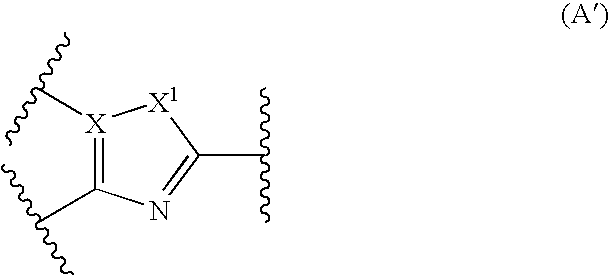
wherein X is a carbon and X1 is an oxygen, a sulfur or —NR5—, or formula (A″):

wherein X is a nitrogen and R6 is an optionally substituted hydrocarbyl, R1 is an amino substituted by two optionally substituted hydrocarbyl groups, R2 is an phenyl, Y1 is CR3a or a nitrogen, Y2 is CR3b or a nitrogen and Y3 is CR3c or a nitrogen, provided that one or less of Y1, Y2, and Y3 is nitrogen, W is a bond, —(CH2)n-, and Z is a bond, —NR4—, etc.; or a salt thereof or a prodrug thereof.
Description

wherein, ring A is a 5-membered ring represented by the formula (A′):

wherein X is a carbon and X1 is an oxygen, a sulfur or —NR5— (wherein R5 is a hydrogen, an optionally substituted hydrocarbyl or an acyl), or formula (A″):

wherein X is a nitrogen and R6 is a hydrogen, an optionally substituted hydrocarbyl or an acyl;
R1 is (1) an amino substituted by two substituents selected from an optionally substituted hydrocarbyl group and an optionally substituted heterocyclic group, or (2) an optionally substituted cyclic amino, provided that the amino nitrogen of said cyclic amino has no carbonyl adjacent to the nitrogen;
R2 is an optionally substituted alkyl, an optionally substituted cycloalkyl, an optionally substituted cycloalkenyl, an optionally substituted aryl or an optionally substituted heterocyclic;
Y1, Y2 and Y3 are each an optionally substituted methyne or a nitrogen, provided that one or less of Y1, Y2 and Y3 is nitrogen;
W is a bond, —(CH2)n— or —(CH2)m—CO— (wherein n is an integer of 1 to 4 and m is an integer of 0 to 4);
Z is a bond, —CO—, an oxygen, a sulfur, —SO—, —SO2—, —NR4—, —NR4-alk-, —CONR4— or —NR4CO— (wherein alk is an optionally substituted C1-4 alkylene and R4 is a hydrogen, an optionally substituted hydrocarbyl or an acyl);
provided that (i) the compound wherein ring A is the 5-membered ring of the formula A′ (wherein X is a carbon and X1 is a sulfur), W is a bond, Z is —NHCO— or —CONH—, and Y1 is CR3a (wherein R3a is a hydrogen, a halogen, or an alkoxy) and
(ii) the compound wherein ring A is the 5-membered ring of the formula A′ (wherein X is a carbon and X1 is an oxygen, a sulfur, or —NH—), R1 is an optionally substituted 1-piperazinyl, W is a bond, Z is a bond and R2 is an optionally substituted aryl, are excluded;
or a salt thereof;
(2) A prodrug of the compound according to the above-mentioned (1);
(3) The compound according to the above-mentioned (1) wherein R1 is an amino substituted by two optionally substituted C1-4 alkyl groups;
(4) The compound according to the above-mentioned (1) wherein R1 is an amino substituted by an optionally substituted C1-4 alkyl and an optionally substituted phenyl or optionally substituted heterocyclic;
(5) The compound according to the above-mentioned (1) wherein R1 is a 5- or 6-membered cyclic amino which may be substituted with one or more substituents;
(6) The compound according to claim 1 wherein Y1 is CR3a, Y2 is CR3b, and Y3 is CR3c (wherein R3a, R3b and R3c are independently a hydrogen, a halogen, a nitro, an optionally substituted C1-4 hydrocarbyl, an optionally substituted C1-4 hydrocarbyloxy, an optionally substituted C1-4 hydrocarbylthio, an optionally substituted amino or an acyl containing up to 4 carbon atoms);
(7) The compound according to above-mentioned (1) wherein one of Y1, Y2 and Y3 is nitrogen;
(8) The compound according to the above-mentioned (1) wherein W is a bond;
(9) The compound according to the above-mentioned (1) wherein R2 is an optionally substituted C6-10 aryl or an optionally substituted 5- or 10-membered heterocyclic;
(10) The compound according to the above-mentioned (1) wherein R2 is an optionally substituted phenyl or an optionally substituted 5- or 6-membered heterocyclic;
(11) The compound according to the above-mentioned (1) wherein Z is —NR4— (wherein R4 is as defined in the above-mentioned (1));
(12) The compound according to the above-mentioned (1) wherein ring A is a thiazole ring or an imidazole ring represented by the formula (Aa):

wherein R5a is a hydrogen, an optionally substituted C1-4 alkyl or an acyl containing up to 4 carbon atoms;
(13) The compound according to the above-mentioned (1) wherein Y1 is CR3a, Y2 is CR3b, and Y3 is CR3c (wherein R3a, R3b and R3c is independently a hydrogen, a halogen or an optionally substituted hydrocarbyl); W is a bond; R2 is an optionally substituted phenyl or an optionally substituted 5- or 6-membered heterocyclic; and Z is —NR4— (wherein R4 is a hydrogen or an optionally substituted hydrocarbyl);
(14) The compound according to the above-mentioned (1) wherein Y1 is CR3a, Y2 is CR3b and Y3 is CR3c (wherein R3a, R3b and R3c are independently a hydrogen, a halogen, a nitro, an optionally substituted C1-4 hydrocarbyl, an optionally substituted C1-4 hydrocarbyloxy, an optionally substituted C1-4 hydrocarbylthio, an optionally substituted amino or an acyl containing up to 4 carbon atoms); W is a bond; R2 is an optionally substituted C6-10 aryl or an optionally substituted 5- or 10-membered heterocyclic; and Z is —NR4— (wherein R4 is a hydrogen or an optionally substituted hydrocarbyl); and ring A is a thiazole ring or an imidazole ring represented by the formula (Aa):

wherein R5a is a hydrogen, an optionally substituted C1-4 alkyl, or an acyl containing up to 4 carbon atoms;
(15) A method for treating or preventing a disease wherein a CRF receptor is implicated, which comprises administering to a subject in need thereof an effective amount of a compound represented by the formula (Ia):

wherein ring A is a 5-membered ring represented by the formula (A′):

wherein X is a carbon and X1 is an oxygen, a sulfur or —NR5— (wherein R5 is a hydrogen, an optionally substituted hydrocarbyl or an acyl), or formula (A″):

wherein X is a nitrogen and R6 is a hydrogen, an optionally substituted hydrocarbyl or an acyl;
R1a is (1) an amino substituted by two substituents selected from an optionally substituted hydrocarbyl group and an optionally substituted heterocyclic group, or (2) an optionally substituted cyclic amino;
R2 is an optionally substituted alkyl, an optionally substituted cycloalkyl, an optionally substituted cycloalkenyl, an optionally substituted aryl or an optionally substituted heterocyclic;
Y1, Y2 and Y3 are each an optionally substituted methyne or a nitrogen, provided that one or less of Y1, Y2 and Y3 is nitrogen;
W is a bond, —(CH2)n— or —(CH2)m—CO—, wherein n is an integer of 1 to 4 and m is an integer of 0 to 4;
Z is a bond, —CO—, an oxygen, a sulfur, —SO—, —SO2—, —NR4—, —NR4-alk-, —CONR4— or —NR4CO— (wherein alk is an optionally substituted C1-4 alkylene and R4 is a hydrogen, an optionally substituted hydrocarbyl or an acyl);
provided that the compound wherein ring A is the 5-membered ring of the formula A′ (wherein X is a carbon and X1 is a sulfur), W is a bond, Z is —NHCO— or —CONH—, and Y1 is CR3a (wherein R3a is a halogen, or an alkoxy) is excluded;
or a salt thereof;
(16) The method according to the above-mentioned (15) wherein the disease being treated or prevented is selected from affective disorder, depression or anxiety;
(17) Use of the compound (Ia) according to the above-mentioned (15), or a salt thereof for manufacturing a medicament for preventing or treating a disease wherein a CRF receptor is implicated;
(18) Use of the compound (Ia) according to the above-mentioned (15), or a salt thereof for manufacturing a medicament for preventing or treating affective disorder, depression or anxiety;
(19) An agent for preventing or treating a disease wherein a CRF receptor is implicated, which comprises the compound (Ia) according to the above-mentioned (15) or a salt thereof; and
(20) An agent for preventing or treating affective disorder, depression or anxiety which comprises the compound (Ia) according to the above-mentioned (15) or a salt thereof.


wherein R1a, R1b are independently optionally substituted hydrocarbyl groups, or R1a and R1b may be optionally substituted cyclic form, R1aa, R1bb, R1cc and R1dd are independently hydrogen or optionally substituted hydrocarbyl groups, or R1aa and R1bb or R1cc and R1dd may be optionally substituted cyclic form, L1 is a leaving group (e.g. halogen atom such as chlorine, bromine and iodine, etc, sulfonyloxy group such as p-toluenesulfonyloxy group, methanesulfonyloxy group and trifluoromethanesulfonyloxy group, and acyloxy group such as acetyloxy group and benzoyloxy group) and each of other symbols has a meaning defined above.

wherein Z1 is oxygen, sulfur, —NR4—, or —NR4-alk-, Z1a is —SO— or —SO2— and W2 is NO2 or NH2, L1 is a leaving groups (e.g. halogen atom such as chlorine, bromine and iodine, etc, sulfonyloxy group such as p-toluenesulfonyloxy group, methanesulfonyloxy group and trifluoromethanesulfonyloxy group, and acyloxy group such as acetyloxy group and benzoyloxy group) and each of other symbols has a meaning defined above.

wherein Z2 is bond and each of other symbols has a meaning defined above.

wherein Z3 is C═O and each of other symbols has a meaning defined above.

wherein R4a and R4b are independently optionally substituted hydrocarbyl, L2 is leaving groups and each of symbols has a meaning defined above.

wherein each of symbols has a meaning defined above.

wherein each of symbols has a meaning defined above.

wherein each of symbols has a meaning defined above.

wherein each of symbols has a meaning defined above.

wherein X2 is H, OH or NHR5, L3 is a halogen atom such as chlorine, bromine, and iodine, and each of other symbols has a meaning defined above.

wherein X3 is SH, OH or NHR5 and each of symbols has a meaning defined above.

wherein each of symbols has a meaning defined above.

wherein each of symbols has a meaning defined above.

wherein each of symbols has a meaning defined above.

wherein each of symbols has a meaning defined above.

wherein each of symbols has a meaning defined above.

wherein each of symbols has a meaning defined above.

wherein R3 is an optionally substituted carbon atom, and each of symbols has a meaning defined above.
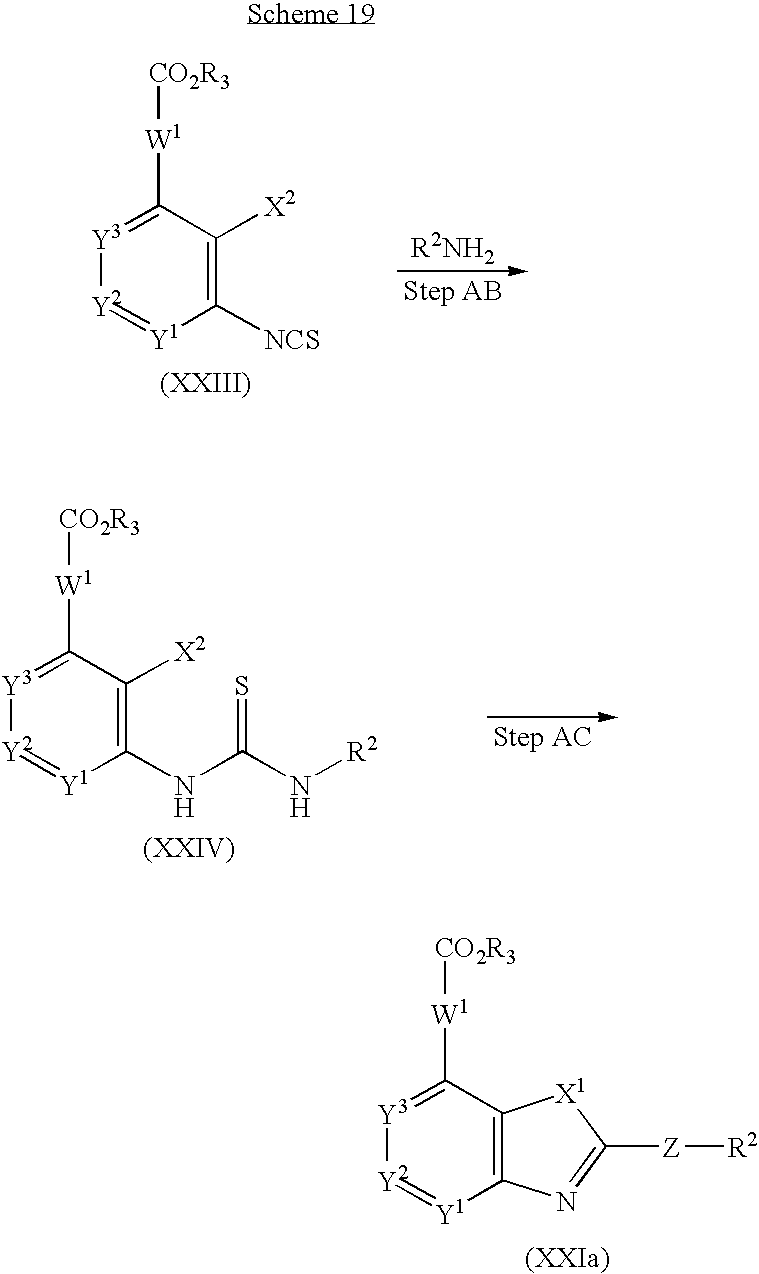
wherein each of symbols has a meaning defined above.

wherein each of symbols has a meaning defined above.

wherein each of symbols has a meaning defined above.

wherein each of symbols has a meaning defined above.

wherein R1e is an optionally substituted aryl or an optionally substituted heteroaryl, and each of the other symbols has a meaning defined above.

wherein R1f is an optionally substituted alkyl, an optionally substituted carboxyl or an optionally substituted carboxamide, and each of the other symbols has a meaning defined above.


| TABLE 1 | |||
| Example | Structure | Name | Physical Data |
| 2 |
 |
N7,N7-dimethyl- N2-mesityl-1,3- benzothiazole- 2,7-diamine | MS Calcd.: 311; Found: 312 (M + H) |
| 3 |
 |
N7,N7- diisobutyl-N2- mesityl-1,3- benzothiazole- 2,7-diamine | MS Calcd.: 395; Found: 396 (M + H) |
| 4 |
 |
N7,N7-diethyl- N2 -mesityl-1,3- benzothiazole- 2,7-diamine | MS Calcd.: 339 Found: 340 (M + H) |
| 5 |
 |
N2-mesityl-N2- methyl-N7,N7- dipropyl-1,3- benzothiazole- 2,7-diamine | MS Calcd.: 381 Found: 382 (M + H) |
| 6 |
 |
N2-mesityl- N7,N7-dibutyl- 1,3- benzothiazole- 2,7-diamine | MS Calcd.: 395 Found: 396 (M + H) |

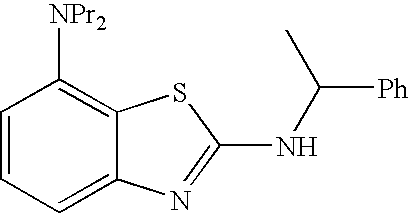


| TABLE 2 | |||
| Example | Structure | Name | Physical Data |
| 27 |
 |
N2-Mesityl-N7, N4-dipropyl-1H- benzimidazole- 2,7-diamine | MS Calcd.: 350; Found: 351 (M + H). |
| 28 |
 |
1-Isopropyl-N2- mesityl-N7, N7- dipropyl-1H- benzimidazole- 2,7-diamine | 1H NMR (CDCl3) δ 0.86 (t, 6H, J = 7.4 Hz), 1.45-1.55 (m, 4H), 1.64 (d, 6H, J = 7.0 Hz), 2.24 (s, 6H), 2.28 (s, 3H), 2.90- 3.05 (m, 4H), 6.57- 6.65 (m, 1H), 6.89 (d, 1H, J = 7.8 Hz), 6.93 (s, 2H), 6.98 (t, 1H, J= 7.8 Hz), 7.23 (d, 1H, J = 7.8 Hz); MS Calcd.: 392; Found: 393 (M + H). |
| 29 |
 |
N2-Mesityl-1- phenyl-N7, N7- dipropyl-1H- benzimidazole- 2,7-diamine | MS Calcd.: 426; Found: 427 (M + H). |
| 30 |
 |
1-Ethyl-N2- mesityl-N7, N7- dipropyl-1H- benzimidazole- 2,7-diamine | 1H NMR (CDCl3) δ 0.86 (t, 6H, J = 7.2 Hz), 1.36 (t, 3H, J = 7.0 Hz), 1.48-1.54 (m, 4H), 2.23 (s, 6H), 2.28 (s, 3H), 2.93-3.00 (m, 4H), 4.53- 4.60 (m, 2H), 6.89 (d, 1H, J = 7.8 Hz), 6.93 (s, 2H), 7.00 (t, 1H, J = 7.8 Hz), 7.23 (d, 1H, J = 7.5 Hz); MS Calcd.: 378; Found: 379 (M + H). |

| TABLE 3 | |||
| Example | Structure | Name | Physical Data |
| 32 |
 |
1-methyl-N2- phenyl-N7,N7- dipropyl-1H- benzimidazole- 2,7-diamine | MS Calcd.: 322 MS Found: 323 (M + H) |
| 33 |
 |
1-methyl-2- morpholin-4-yl- N,N-dipropyl- 1H- benzimidazol-7- amine | MS Calcd.: 316 MS Found: 317 (M + H) |
| 34 |
 |
methyl 4-{[7- (dipropylamino)- 1-methyl-1H- benzimidazol-2- yl]amino}-3- methylbenzoate | MS Calcd.: 394 MS Found: 395 (M + H) |
| 35 |
 |
N2-(2,6- dimethoxypyridin- 3-yl)-1- methyl-N7,N7- dipropyl-1H- benzimidazole- 2,7-diamine | MS Calcd.: 383 MS Found: 384 (M + H) |
| 36 |
 |
N2-(4-tert- butyl-2,6- dimethylphenyl)- 1-methyl-N7,N7- dipropyl-1H- benzimidazole- 2,7-diamine | MS Calcd.: 406 MS Found: 407 (M + H) |
| 37 |
 |
N2-(2,4- dimethylphenyl)- 1-methyl-N7,N7- dipropyl-1H- benzimidazole- 2,7-diamine | MS Calcd.: 350 MS Found: 351 (M + H) |
| 38 |
 |
N2-(4-bromo-2- ethylphenyl)-1- methyl-N7,N7- dipropyl-1H- benzimidazole- 2,7-diamine | MS Calcd.: 428 MS Found: 429 (M + H) |
| 39 |
 |
N2-[4- (diethylamino)- 2- methylphenyl]- 1-methyl-N7,N7- dipropyl-1H- benzimidazole- 2,7-diamine | MS Calcd.: 407 MS Found: 408 (M + H) |
| 40 |
 |
1-methyl-N2-(4- methyl-5- nitropyridin-2- yl)-N7,N7- dipropyl-1H- benzimidazole- 2,7-diamine | MS Calcd.: 382 MS Found: 383 (M + H) |
| 41 |
 |
N2-(2,4- dichlorophenyl)- 1-methyl-N7,N7- dipropyl-1H- benzimidazole- 2,7-diamine | MS Calcd.: 390 MS Found: 391 (M + H) |
| 42 |
 |
N2-(2-chloro- 4,6- dimethylphenyl)- 1-methyl-N7,N7- dipropyl-1H- benzimidazole- 2,7-diamine | MS Calcd.: 384 MS Found: 385 (M + H) |
| 43 |
 |
N2-(2-bromo-4- isopropylphenyl)- 1-methyl- N7,N7-dipropyl- 1H- benzimidazole- 2,7-diamine | MS Calcd.: 442 MS Found: 443 (M + H) |
| 44 |
 |
1-methyl-N7,N7- dipropyl-N2- (2,4,6- trichlorophenyl)- 1H-benzimidazole- 2,7-diamine | MS Calcd.: 424 MS Found: 425 (M + H) |
| 45 |
 |
N2-cyclohexyl-1- methyl-N7,N7- dipropyl-1H- benzimidazole- 2,7-diamine | MS Calcd.: 328 MS Found: 329 (M + H) |
| 46 |
 |
N2-(4,5- dimethoxy-2- methylphenyl)- 1-methyl-N7,N7- dipropyl-1H- benzimidazole- 2,7-diamine | MS Calcd.: 396 MS Found: 397 (M + H) |
| 47 |
 |
N2-(2,6- dimethylphenyl)- 1-methyl-N7,N7- dipropyl-1H- 2,7-diamine | MS Calcd.: 350 MS Found: 351 (M + H) |
| 48 |
 |
2,4-dichloro-6- {[7- (dipropylamino)- 1-methyl-1H- benzimidazol-2- yl]amino}-3- methylphenol | MS Calcd.: 420 MS Found: 421 (M + H) |
| 49 |
 |
N2-(3,5- dichloropyridin- 4-yl)-1- methyl-N7,N7- dipropyl-1H- benzimidazole- 2,7-diamine | MS Calcd.: 391 MS Found: 391 (M + H) |
| 50 |
 |
N2-(3-bromo-5- methylpyridin- 2-yl)-1-methyl- N7,N7-dipropyl- 1H- benzimidazole- 2,7-diamine | MS Calcd.: 415 MS Found: 416 (M + H) |
| 51 |
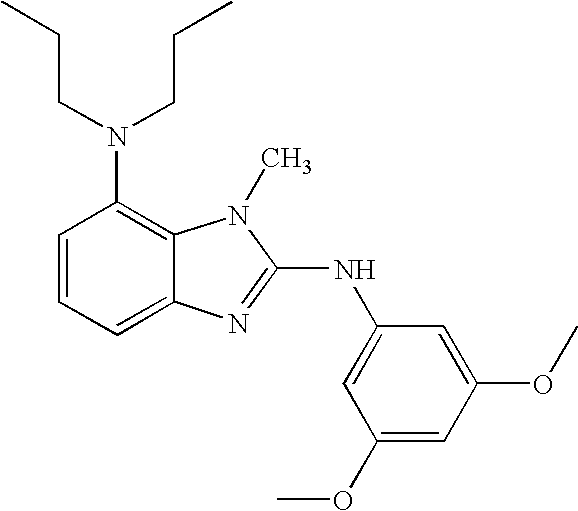 |
N2-(3,5- dimethoxyphenyl)- 1-methyl- N7,N7-dipropyl- 1H- benzimidazole- 2,7-diamine | MS Calcd.: 382 MS Found: 383 (M + H) |
| 52 |
 |
1-methyl-N2-[2- methyl-4- (trifluoromethoxy) phenyl]- N7,N7-dipropyl- 1H- benzimidazole- 2,7-diamine | MS Calcd.: 420 MS Found: 421 (M + H) |
| 53 |
 |
N2-(2,4- dimethoxyphenyl)- 1-methyl- N7,N7-dipropyl- 1H- benzimidazole- 2,7-diamine | MS Calcd.: 382 MS Found: 383 (M + H) |
| 54 |
 |
N7, N7-dibutyl- N2-mesityl-1- methyl-1H- benzimidazole- 2,7-diamine | MS Calcd.: 392 MS Found: 393 (M + H) |
| 55 |
 |
N7-benzyl-N2- mesityl-1- methyl-N7- propyl-1H- benzimidazole- 2,7-diamine | MS Calcd.: 412 MS Found: 413 (M + H) |
| 56 |
 |
N7,N7- bis(cyclopropyl methyl)-N2- mesityl-1- methyl-1H- benzimidazole- 2,7-diamine | MS Calcd.: 388 MS Found: 389 (M + H) |
| 57 |
 |
N-mesityl-1- methyl-7- piperidin-1-yl- 1H- benzimidazol-2- amine | MS Calcd.: 348 MS Found: 349 (M + H) |
| 58 |
 |
N7-butyl-N2- mesityl-1- methyl-N7- propyl-1H- benzimidazole- 2,7-diamine | MS Calcd.: 378 MS Found: 379 (M + H) |
| 59 |
 |
N2-mesityl-1- methyl-N7-(2- methoxyethyl)- N7-propyl-1H- benzimidazole- 2,7-diamine | MS Calcd.: 380 MS Found: 381 (M + H) |
| 60 |
 |
N7-isobutyl-N2- mesityl-1- methyl-N7- propyl-1H- benzimidazole- 2,7-diamine | MS Calcd.: 378 MS Found: 379 (M + H) |

| TABLE 4 | |||
| Physical | |||
| Example | Structure | Name | Data |
| 62 |
 |
2-((2,4- dimethylpheny) thio)-N,N- dipropylimidazo [1,2-a]pyridin- 5-amine | MS Calcd.: 353; Found: 354 (M + H). |
| 63 |
 |
2-(2,4- dimethylphenoxy)- N,N- dipropylimidazo [1,2-a]pyridin- 5-amine | MS Calcd.: 337; Found: 338 (M + H). |


| TABLE 5 | |||
| Example | Structure | Name | Physical Data |
| 67 |
 |
N7,N7-dibutyl-5- fluoro-N2- mesityl-1- methyl-1H- benzimidazole- 2,7-diamine | 1H NMR (DMSO- d6) δ (HCl salt) 0.86 (t, 6H, J = 7.3 Hz), 1.24-1.31 (m, 4H), 1.39- 1.43 (m, 4H), 2.20 (s, 6H), 2.32 (s, 3H), 3.05 (br s, 4H), 4.06 (s, 3H), 6.80 (d, 1H, J = 7.6 Hz), 7.04 d 1H, J = 11.9 Hz), 7.10 (s, 2H), 10.46 (s, 1H); 19F NMR (DMSO-d6) δ 117.7 (s, 1F); MS Calcd.: 410; MS Found: 411 (M + H). |
| 68 |
 |
N7,N7- bis(cyclopropyl methyl)-5- fluoro-N2- mesityl-1- methyl-1H- benzimidazole- 2,7-diamine | 1H NMR (DMSO- d6) δ (HCl salt) 0.08 (d, 4H, J = 4.3 Hz), 0.40 (d, 4H, J = 7.8 Hz), 0.84- 0.92 (m, 2H), 2.20 (s, 6H), 2.32 (s, 3H), 2.99 (br s, 4H), 4.16 (s, 3H), 6.84 (d, 1H, J = 7.8 Hz), 7.10-7.15 (m, 2H), 10.49 (s, 1H); 19F NMR (DMSO-d6) δ −117.7 (s, 1F); MS Calcd.: 406; MS Found: 407 (M + H). |

| TABLE 6 | |||
| Example | Structure | Name | Physical Data |
| 70 |
 |
N2-mesityl-N7, 1- dimethyl-N- propyl-1H- benzimidazole- 2,7-diamine | MS Calcd.: 336; MS Found: 337 (M + H) |
| 71 |
 |
N7-isopropyl-N2- mesityl-1- propyl-1H- benzimidazole- 2,7-diamine | MS Calcd.: 364; MS Found: 365 (M + H) |
| 72 |
 |
N2-mesityl-1- methyl-N7-(1- propylbutyl)- 1H- benzimidazole- 2,7-diamine | 1H NMR (DMSO- d6) δ 0.91 (t, J = 7.2 Hz, 6H), 1.37-1.56 (m, 8H), 2.19 (s, 6H), 2.33 (s, 3H), 4.06 (s, 3H), 4.88 (br s, 1H), 6.59 (dd, J = 4.7, 7.8 Hz, 2H), 7.05 (t, J = 8.0 Hz, 1H), 7.10 (s, 1H), 12.25 (s, 1H); MS Calcd.: 378; MS Found: 379 (M + H). |
| 73 |
 |
N7-benzyl-N7- (cyclopropylmethyl)- N2-mesityl- 1-methyl-1H- benzimidazole- 2,7-diamine | 1H NMR (DMSO- d6) δ 0.02 (s, 2H), 0.37 (d, J = 7.6 Hz, 2H), 0.86 (t, J = 7.0 Hz, 2H), 2.11 (s, 6H), 2.26 (s, 3H), 2.85 (d, J = 5.7 Hz, 2H), 4.02 (s, 3H), 4.32 (s, 2H), 6.80-6.87 (m, 3H), 6.91 (s, 2H), 7.19 (t, J = 7.3 Hz, 1H), 7.28 (t, J = 7.6 Hz, 2H), 7.33 (d, J = 7.0 Hz, 2H), 7.88 (s, 1H); MS Calcd.: 424; MS Found: 425 (M + H). |
| 74 |
 |
N7-(4- chlorobenzyl)- N7- (cyclopropylmethyl)- N2-mesityl- 1-methyl-1H- benzimidazole- 2,7-diamine | 1H NMR (DMSO- d6) δ −0.01 (s, 2H), 0.38 (d, J = 7.6 Hz, 2H), 0.84- 0.90 (m, 1H), 2.11 (s, 6H), 2.26 (s, 3H), 2.85 (br s, 2H), 4.90 (s, 3H), 4.30 (s, 2H), 6.81-6.84 (m, 3H), 6.91 (s, 2H), 7.32 (s, 4H), 7.88 (s, 1H); MS Calcd.: 458; MS Found: 459 (M + H). |
| 75 |
 |
N7- (cyclopropylmethyl)- N2-mesityl- N7-(4- methoxybenzyl)- 1-methyl-1H- benzimidazole- 2,7-diamine | 1H NMR (DMSO- d6) δ 0.00 (s, 2H), 0.38 (d, J = 6.6 Hz, 2H), 0.87 (br s, 1H), 2.12 (s, 6H), 2.27 (s, 3H), 2.84 (br s, 2H), 3.72 (s, 3H), 4.02 (s, 3H), 4.25 (br s, 2H), 6.84 (br s, 5H), 6.93 (s, 2H), 7.23 (d, J = 8.2 Hz, 2H), 7.88 (s, 1H); MS Calcd.: 454; MS Found: 455 (M + H). |
| 76 |
 |
N7- (cyclopropylmethyl)- N2-mesityl- 1-methyl-N7- (pyridin-3- ylmethyl)-1H- benzimidazole- 2,7-diamine | 1H NMR (DMSO- d6) δ 0.00 (s, 2H), 0.40 (d, J = 7.4 Hz, 2H), 0.90 (br s, 1H), 2.12 (s, 6H), 2.27 (s, 3H), 2.90 (br s, 2H), 4.04 (s, 3H), 4.36 (s, 2H), 6.87 (br s, 2H), 6.96 (br s, 3H), 7.29 (t, J = 5.1 Hz, 1H), 7.68 (d, J = 7.8 Hz, 1H); 8.39 (s, 1H), 8.50 (s, 1H); MS Calcd.: 425; MS Found: 426 (M + H). |
| 77 |
 |
N7- (cyclopropylmethyl)- N2-[2- (mesitylamino)- 1-methyl-1H- benzimidazol-7- yl]acetamide | 1H NMR (DMSO- d6) δ 0.08-0.14 (m, 2H), 0.37- 0.44 (m, 2H), 0.97-1.00 (m, 1H), 1.77 (s, 3H), 2.12 (s, 6H), 2.26 (s, 3H), 3.17 (dd, J = 7.7, 13.7 Hz, 1H), 3.66 (s, 3H), 3.87 (dd, J = 6.9, 13.6 Hz, 1H), 6.83 (d, J = 7.6 Hz, 1H), 6.92 (s, 2H), 6.98 (t, J = 7.8 Hz, 1H), 7.11 (d, J = 7.8 Hz, 1H); 8.09 (s, 1H); MS Calcd.: 376; MS Found: 377 (M + H). |
| 78 |
 |
N7-(4-tert- butylbenzyl)-N7- (cyclopropylmethyl)- N2-mesityl- 1-methyl-1H- benzimidazole- 2,7-diamine | 1H NMR (DMSO- d6) δ 0.03 (br s, 2H), 0.36 (d, J = 7.4 Hz, 2H), 0.85 (br s, 1H), 1.24 (s, 9H), 2.11 (s, 6H), 2.26 (s, 3H), 2.84 (d, J = 6.4 Hz, 2H), 4.01 (s, 3H), 4.28 (br s, 2H), 6.81-6.85 (m, 3H), 6.91 (s, 2H), 7.25- 7.32 (m, 4H), 7.88 (s, 1H); MS Calcd.: 480; MS Found: 481 (M + H). |
| 79 |
 |
N7- (cyclopropylmethyl)- N2-mesityl- 1-methyl-N7-(4- methylbenzyl)- 1H- benzimidazole- 2,7-diamine | 1H NMR (DMSO- d6) δ −0.01 (br s, 2H), 0.36 (d, J = 7.8 Hz, 2H), 0.84- 0.87 (m, 1H), 2.11 (s, 6H), 2.24 (s, 3H), 2.26 (s, 3H), 2.83 (d, J = 5.4 Hz, 2H), 4.01 (s, 3H), 4.26 (br s, 2H), 6.80-6.84 (m, 3H), 6.91 (s, 2H), 7.07 (d, J = 7.8 Hz, 2H), 7.19 (d, J = 7.8 Hz, 2H), 7.86 (s, 1H); MS Calcd.: 438; MS Found: 439 (M + H). |
| 80 |
 |
N7- (cyclopropylmethyl)- N2-mesityl- 1-methyl-N7- (pyridin-4- ylmethyl)-1H- benzimidazole- 2,7-diamine | 1H NMR (DMSO- d6) δ 0.00 (br s, 2H), 0.39 (d, J = 7.6 Hz, 2H), 0.86- 0.88 (m, 1H), 2.12 (s, 6H), 2.26 (s, 3H), 2.88 (br s, 2H), 4.04 (s, 3H), 4.38 (br s, 2H), 6.82 (s, 3H), 6.92 (s, 2H), 7.36 (d, J = 4.5 Hz, 2H), 7.91 (s, 1H), 8.45 (d, J = 4.3 Hz, 2H); MS Calcd.: 425; MS Found: 426 (M + H). |
| 81 |
 |
N7- (cyclopropylmethyl)- N2-mesityl- 1-methyl-N7-[4- (trifluoromethyl) benzyl]-1H- benzimidazole- 2,7-diamine | 1H NMR (DMSO- d6) δ 0.00 (br s, 2H), 0.39 (d, J = 6.1 Hz, 2H), 0.88 (br s, 1H), 2.10 (s, 6H), 2.25 (s, 3H), 2.88 (br s, 2H), 4.01 (s, 3H), 4.42 (br s, 2H), 6.82- 6.86 (m, 3H), 6.91 (s, 2H(, 7.54 (d, J = 7.2 Hz, 2H), 1H); 19F NMR (DMSO-d6)- 61.23 (s, 3F); MS Calcd.: 492; MS Found: 493 (M + H). |
| 82 |
 |
N7- (cyclopropylmethyl)- N7-(4- fluorobenzyl)- N2-mesityl-1- methyl-1H- benzimidazole- 2,7-diamine | 1H NMR (DMSO- d6) δ 0.00 (br s, 2H), 0.38 (d, J = 7.2 Hz, 2H), 0.87 (br s, 1H), 2.11 (s, 6H), 2.26 (s, 3H), 2.85 (br s, 2H), 4.01 (s, 3H), 4.29 (br s, 2H), 6.83 (br s, 3H), 6.92 (s, 2H), 7.07-7.11 (m, 2H), 7.32-7.36 (m, 2H), 7.88 (br s, 1H); 19F NMR (DMSO- d6) δ −116.51 (s, 1F); MS Calcd.: 442; MS Found: 443 (M + H). |
| 83 |
 |
4- ({(cyclopropyl- methyl) [2- (mesitylamino)- 1-methyl-1H- benzimidazol-7- yl]amino}methyl) benzonitrile | 1H NMR (DMSO- d6) δ 0.00 (br s, 2H), 0.39 (d, J = 6.9 Hz, 2H), 0.88 (br s, 1H), 2.11 (s, 6H), 2.26 (s, 3H), 2.88 (br s, 2H), 4.01 (s, 3H), 4.42 (s, 2H), 6.83 (br s, 3H), 6.92 (s, 2H), 7.52 (d, J = 8.0 Hz, 2H), 7.74 (d, J = 8.2 Hz, 2H), 7.89 (s, 1H); MS Calcd.: 449; MS Found: 450 (M + H). |
| 84 |
 |
N7- (cyclopropylmethyl)- N2-mesityl- 1-methyl-N7- (pyridin-2- ylmethyl)-1H- benzimidazole- 2,7-diamine | 1H NMR (DMSO- d6) δ 0.00 (s, 2H), 0.37 (d, J = 7.6 Hz, 2H), 0.86 (br s, 1H), 2.12 (s, 6H), 2.26 (s, 3H), 2.90 (d, J = 5.8 Hz, 2H), 4.05 (s, 3H), 4.44 (s, 2H), 6.81 (s, 3H), 6.91 (s, 2H), 7.21 (t, J = 6.2 Hz, 1H), 7.34 (d, J = 6.8 Hz, 1H); 7.69 (t, J = 7.6 Hz, 1H), 7.89 (s, 1H), 8.48 (d, J = 4.7 Hz, 1H); MS Calcd.: 425; MS Found: 426 (M + H). |
| 85 |
 |
N7-[2- (benzyloxy)ethyl]- N7- (cyclopropylmethyl)- N2-mesityl- 1-methyl-1H- benzimidazole- 2,7-diamine | 1H NMR (DMSO- d6) δ 0.03 (d, J = 4.3 Hz, 2H), 0.36 (d, J = 7.8 Hz, 2H), 0.85 (br s, 1H), 2.11 (s, 6H), 2.26 (s, 3H), 2.88 (br s, 2H), 3.32 (d, J = 6.6 Hz, 2H), 3.49 (br s, 2H), 3.98 (s, 3H), 4.41 (s, 2H), 6.80-6.86 (m, 3H), 6.91 (s, 2H), 7.23- 7.32 (m, 5H), 7.86 (s, 1H); MS Calcd.: 468; MS Found: 469 (M + H). |
| 86 |
 |
2- {(cyclopropylmethyl) [2- (mesitylamino)- 1-methyl-1H- benzimidazol-7- yl]amino}ethanol | 1H NMR (DMSO- d6) δ 0.04 (d, J = 4.7 Hz, 2H), 0.36 (d, J = 8.0 Hz, 2H), 0.84 (br s, 1H), 2.12 (s, 6H), 2.26 (s, 3H), 2.88 (br s, 2H), 3.19 (t, J = 6.5 Hz, 2H), 3.31 (d, J = 1.6 Hz, 2H), 3.46 (q, J = 6.1 Hz, 2H), 4.01 (s, 3H), 4.45 (t, J = 5.1. Hz, 1H), 6.85 (br s, 3H), 6.92 (s, 2H), 7.87 (s, 1H); MS Calcd.: 378; MS Found: 379 (M + H). |
| 87 |
 |
N2-(4-bromo-2,6- dimethylphenyl)- 1-methyl-N7,N7- dipropyl-1H- benzimidazole- 2,7-diamine | MS Calcd.: 428; MS Found: 429 (M + H) |
| 88 |
 |
N2-(4-methoxy-2- methylphenyl)- 1-methyl-N7,N7- dipropyl-1H- benzimidazole- 2,7-diamine | MS Calcd.: 366; MS Found: 367 (M + H) |
| 89 |
 |
N2-(2,6- dimethoxy-4- methylphenyl)- 1-methyl-N7,N7- dipropyl-1H- benzimidazole- 2,7-diamine | MS Calcd.: 396; MS Found: 397 (M + H) |
| 90 |
 |
N2-(4-bromo-2- methoxy-6- methylphenyl)- 1-methyl-N7,N7- dipropyl-1H- benzimidazole- 2,7-diamine | MS Calcd.: 444; MS Found: 445 (M + H) |
| 91 |
 |
N2-(2,6- dichloropyridin- 3-yl)-1- methyl-N7,N7- dipropyl-1H- benzimidazole- 2,7-diamine | MS Calcd.: 391; MS Found: 392 (M + H) |
| 92 |
 |
4-{[7- (dipropylamino)- 1-methyl-1H- benzimidazol-2- yl]amino}-3- ethylbenzonitrile | MS Calcd.: 375; MS Found: 376 (M + H) |
| 93 |
 |
N2-(2,4- dimethoxy-6- methylphenyl)- 1-methyl-N7,N7- dipropyl-1H- benzimidazole- 2,7-diamine | 1H NMR (CD3OD) δ (HCl salt) 0.91 (br s, 6H), 1.53 (br s, 4H), 2.32 (s, 3H), 3.12 (br s, 4H), 3.82 (s, 3H), 3.86 (s, 3H), 4.21 (s, 3H), 6.60 (br s, 2H), 7.07 (br s, 1H), 7.24 (br s, 2H); MS Calcd.: 396; MS Found: 397 (M + H). |
| 94 |
 |
N2-(2,4- dichloro-6- methylphenyl)- 1-methyl-N7,N7- dipropyl-1H- benzimidazole- 2,7-diamine | 1H NMR (CD3OD) δ (HCl salt) 0.91 (br s, 6H), 1.53 (br s, 4H), 2.42 (s, 3H), 3.10 (br s, 4H), 4.28 (s, 3H), 7.09 (d, 1H, J = 5.5 Hz), 7.27 (br s, 2H), 7.52 (br s, 1H), 7.63 (br s, 1H); MS Calcd.: 404; MS Found: 405 (M + H). |
| 95 |
 |
N2-[2-chloro-6- (trifluoromethyl) pyridin-3- yl]-1-methyl- N7,N7-dipropyl- 1H- benzimidazole- 2,7-diamine | 1H NMR (CD3OD) δ (HCl salt) 0.91 (br s, 6H), 1.54 (br s, 4H), 3.12 (br s, 4H), 4.31 (s, 3H), 7.17 (br s, 1H), 7.32 (br s, 2H), 8.03 (br s, 1H), 8.33 (br s, 1H); MS Calcd.: 425; MS Found: 426 (M + H). |
| 96 |
 |
N2-[2-chloro-4- (trifluoromethyl) phenyl]-1- methyl-N7,N7- dipropyl-1H- benzimidazole- 2,7-diamine | 1H NMR (CD3OD) δ (HCl salt) 0.92 (br s, 6H), 1.54 (br s, 4H), 3.14 (br s, 4H), 4.29 (s, 3H), 7.17 (d, 1H, 4.7 Hz), 7.32 (br s, 2H), 7.87 (br s, 2H), 8.06 (s, 1H); MS Calcd.: 424; MS Found: 425 (M + H). |
| 97 |
 |
N2-(2-bromo-4- methoxy-6- methylphenyl)- 1-methyl-N7,N7- dipropyl-1H- benzimidazole- 2,7-diamine | 1H NMR (CD3OD) δ (HCl salt) 0.90 (br s, 6H), 1.53 (br s, 4H), 2.39 (s, 3H), 3.10 (br s, 4H), 3.87 (s, 3H), 4.26 (s, 3H), 7.04 (s, 1H), 7.08 (d, 1H, J = 5.2 Hz), 7.25 (br s, 3H); MS Calcd.: 444; MS Found: 445 (M + H); |
| 98 |
 |
N2-(4-chloro-2- methoxy-5- methylphenyl)- 1-methyl-N7,N7- dipropyl-1H- benzimidazole- 2,7-diamine | 1H NMR (CD3OD) δ (HCl salt) 0.91 (br s, 6H), 1.53 (br s, 4H), 2.37 (s, 3H), 3.22 (br s, 4H), 3.87 (s, 3H), 4.21 (s, 3H), 7.19 (br s, 1H), 7.28 (s, 1H), 7.33 (br s, 2H), 7.41 (br s, 1H); MS Calcd.: 400; MS. Found: 401 (M + H). |
| 99 |
 |
N2-(4-bromo-2- methylphenyl)- 1-methyl-N7,N7- dipropyl-1H- benzimidazole- 2,7-diamine | 1H NMR (CDCl3) δ (HCl salt) 0.83 (br s, 6H), 1.44-1.50 (m, 4H), 2.32 (s, 3H), 2.98 (br s, 4H), 4.00 (br s, 3H), 5.89 (s, 1H), 6.95 (d, 1H, J = 7.8 Hz), 7.08 (br s, 1H), 7.33 (br s, 3H), 7.73 (br s, 1H); MS Calcd.: 414; MS Found: 415 (M + H). |
| 100 |
 |
N7- (cyclopropylmethyl)- N7-(2,4- dimethylbenzyl)- N2-mesityl-1- methyl-1H- benzimidazole- 2,7-diamine | 1H NMR (DMSO- d6) δ (HCl salt) 0.04 (s, 2H), 0.43 (d, 2H, J = 7.4 Hz), 0.97 (br s, 1H), 2.16 (s, 6H), 2.20 (s, 3H), 2.31 (s, 3H), 2.32 (s, 3H), 2.97 (br s, 2H), 4.02 (br s, 3H), 4.27 (br s, 2H), 6.84 (d, 1H, J = 7.8 Hz), 6.97-7.02 (m, 3H), 7.10 (s, 2H), 7.21 (t, 1H, J = 7.9 Hz), 7.38 (d, 1H, J = 8.0 Hz), 10.23 (s, 1H); MS Calcd.: 452; MS Found: 453 (M + H). |
| 101 |
 |
N2-(4-bromo-2- ethylphenyl)- N7,N7-dibutyl-1- methyl-1H- benzimidazole- 2,7-diamine | 1H NMR (CDCl3) δ (HCl salt) 0.85-0.88 (m, 6H), 1.22-1.34 (m, 7H), 1.40- 1.47 (m, 4H), 2.68 (q, 2H, J = 7.5 Hz), 3.01 (br s, 4H), 3.96 (s, 3H), 6.01 (s, 1H), 6.81 (d, 1H, J = 7.8 Hz), 7.09 (t, 1H, J = 7.0 Hz), 7.32-7.34 (m, 3H), 7.66 (s, 1H); MS Calcd.: 456; MS Found: 457 (M + H). |
| 102 |
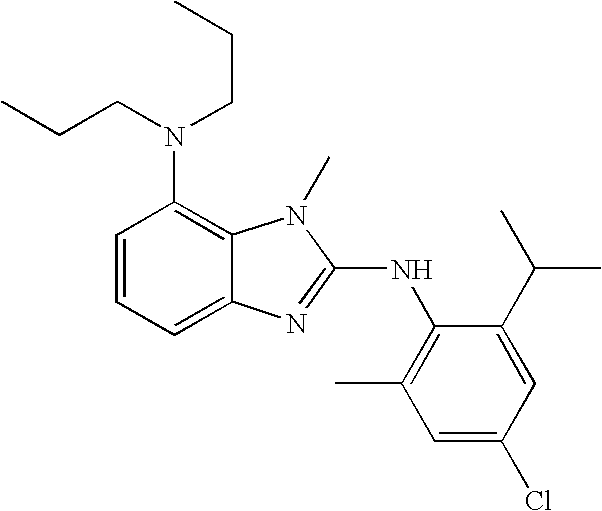 |
N2-(4-chloro-2- isopropyl-6- methylphenyl)- 1-methyl-N7,N7- dipropyl-1H- benzimidazole- 2,7-diamine | 1H NMR (DMSO- d6) δ (HCl salt) 0.85 (t, 6H, J = 7.3 Hz), 1.07-1.14 (m, 4H), 1.19 (d, 3H, J = 6.6 Hz), 1.40- 1.50 (m, 4H), 2.23 (s, 3H), 3.02 (br s, 4H), 4.15 (s, 3H), 7.01 (d, 1H, J = 7.2 Hz), 7.15-7.19 (m, 2H), 7.42 (s, 2H), 10.49 (s, 1H); MS Calcd.: 412; MS Found: 413 (M + H). |
| 103 |
 |
N7,N7-dibutyl- N2-(2,4- dimethoxy-6- methylphenyl)- 1-methyl-1H- benzimidazole- 2,7-diamine | 1H NMR (DMSO- d6) δ (HCl salt) 0.80- 0.87 (m, 6H), 1.21-1.30 (m, 4H), 1.34-1.41 (m, 4H), 2.25 (s, 3H), 3.04 (s, 4H), 3.76 (s, 3H), 3.83 (s, 3H), 4.07 (s, 3H), 6.62 (s, 1H), 6.65 (s, 1H), 7.01 (d, 1H, J = 7.4 Hz), 7.14- 7.21 (m, 2H), 9.99 (s, 1H); MS Calcd.: 424; MS Found: 425 (M + H). |
| 104 |
 |
N2-(2-bromo-4- methoxy-6- methylphenyl)- N7,N7-dibutyl-1- methyl-1H- benzimidazole- 2,7-diamine | 1H NMR (DMSO- d6) δ (HCl salt) 0.85 (t, 6H, J =7.3 Hz), 1.21-1.30 (m, 4H), 1.41 (br s, 4H), 2.34 (s, 3H), 3.05 (br s, 4H), 3.84 (s, 3H), 4.13 (s, 3H), 7.05 (d, 1H, J = 7.4 Hz), 7.09 (s, 1H), 7.16-7.24 (m, 2H), 7.29 (s, 1H), 10.76 (s, 1H); MS Calcd.: 472; MS Found: 473 (M + H). |
| 105 |
 |
N7,N7-dipropyl- N2-(2,4,6- trimethylpyridin- 3-yl)-1,3- benzothiazole- 2,7-diamine | 1H NMR (CDCl3) δ 0.81 (t, 6H, J = 7.5 Hz), 1.36-1.47 (m, 4H), 2.34 (s, 3H), 2.56 (s, 3H), 2.58 (s, 3H), 3.01 3.05 (m, 4H), 6.74 (d, 1H, J = 7.2 Hz), 6.98 (d, 1H, J = 7.2 Hz), 7.02 (s, 1H), 7.17 (t, 1H, J = 8.0 Hz); MS Calcd.: 368; Found: 369 (M + H). |
| 106 |
 |
N2-mesityl-1-(2- methoxyethyl)- N7,N7-dipropyl- 1H- benzimidazole- 2,7-diamine | 1H NMR (CDCl3) δ 0.85 (t, 6H, J = 7.5 Hz), 1.43-1.55 (m, 4H), 2.19 (s, 6H), 2.27 (s, 3H), 2.90- 2.96 (m, 4H), 3.43 (s, 3H), 3.83 (t, 2H, J =4.3 Hz), 4.83 (t, 2H, J = 4.3 Hz), 6.89- 6.92 (m, 3H), 6.99 (t, 1H, J = 7.8 Hz), 7.28 (d, 1H, J = 8.0 Hz); MS Calcd.: 408; Found: 409 (M + H). |
| 107 |
 |
N2-mesityl- N7,N7-dipropyl- 1-(2,2,2- trifluoroethyl)- 1H- benzimidazole- 2,7-diamine | 1H NMR (CDCl3) δ 0.85 (t, 6H, J = 7.2 Hz), 1.42-1.55 (m, 4H), 2.18 (s, 6H), 2.28 (s, 3H), 2.85- 2.98 (m, 4H), 5.36-5.45 (m, 2H), 6.92 (s, 2H), 6.99 (d, 1H, J = 7.8 Hz), 7.07 (t, 1H, J = 7.8 Hz), 7.29 (d, 1H, J = 7.5 Hz); MS Calcd.: 432; Found: 433 (M + H). |
| 108 |
 |
2-[7- (dipropylamino)- 2- (mesitylamino)- 1H- benzimidazol-1- yl]ethanol | 1H NMR (CDCl3) δ 0.85 (t, 6H, J = 7.5 Hz), 1.42-1.54 (m, 4H), 2.18 (s, 6H), 2.25 (s, 3H), 2.88- 2.96 (m, 4H), 4.03 (t, 2H, J = 4.0 Hz), 4.73 (br. s, 2H), 6.86- 6.92 (m, 3H), 6.94-7.00 (m, 1H), 7.22- 7.32 (m, 1H),; MS Calcd.: 394; Found: 395 (M + H). |
| 109 |
 |
N7,N7- bis(cyclopropyl methyl)-1- methyl-N2- (2,4,6- trimethylpyridin- 3-yl)-1H- benzimidazole- 2,7-diamine | 1H NMR (CDCl3) δ 0.04-0.07 (m, 4H), 0.38- 0.42 (m, 4H), 0.84- 0.88 (m, 2H), 2.27 (s, 3H), 2.39 (s, 3H), 2.43 (s, 3H), 2.82-3.08 (m, 4H), 3.99 (s, 3H), 6.92 (s, 1H), 6.98- 7.09 (m, 3H),; MS Calcd.: 389; Found: 390 (M + H). |
| 110 |
 |
1-acetyl-N2- mesityl-N7,N7- dipropyl-1H- benzimidazole- 2,7-diamine | 1H NMR (CDCl3) δ[ 0.63 (t, J = 7.5 Hz), 0.97 (t, J = 7.5 Hz), 6H, rotamer], [1.44-1.53 (m), 1.58- 1.64 (m), 4H, rotamer], 1.95 (s, 3H), [2.09 (s), 2.14(s), 6H, rotamer], [2.35 (s), 2.33 (s), 3H, rotamer], [3.13-3.18 (m), 3.28- 3.34 (m), 4H, rotamer], [6.26 (d, J = 8.0 Hz), 6.76 (d, J = 8.0 Hz), 1H, rotamer], 6.97-7.09 (m, 3H), [6.72 (d, J = 7.8 Hz), 7.22 (d, J = 7.8 Hz), 1H, rotamer]; MS Calcd.: 392; Found: 393 (M + H). |
| 111 |
 |
N7,N7-dibutyl- N2-mesityl-1- (2,2,2- trifluoroethyl)- 1H- benzimidazole- 2,7-diamine | 1H NMR (CDCl3) δ 0.89 (t, 6H, J = 7.2 Hz), 1.21-1.30 (m, 4H), 1.37- 1.50 (m, 4H), 2.19 (s, 6H), 2.28 (s, 3H), 2.88- 2.99 (m, 4H), 5.35-5.43 (m, 2H), 6.93 (s, 2H), 6.99 (d, 1H, J = 7.5 Hz), 7.07 (t, 1H, J = 7.8 Hz), 7.29 (d, 1H, J = 7.2 Hz); MS Calcd.: 460; Found: 461 (M + H). |
| 112 |
 |
N7,N7- bis(cyclopropyl methyl)-N2- mesityl-1- (2,2,2- trifluoroethyl)- 1H- benzimidazole- 2,7-diamine | 1H NMR (CDCl3) δ 0.02-0.14 (m, 4H), 0.33- 0.48 (m, 4H), 0.80- 0.85 (m, 2H), 2.17 (s, 6H), 2.27 (s, 3H), 2.74-2.82 (m, 2H), 3.00- 3.05 (m, 2H), 5.52- 5.62 (m, 2H), 6.91 (s, 2H), 7.01-7.06 (m, 2H), 7.29 (br, s, 1H); MS Calcd.: 456; Found: 457 (M + H). |

| TABLE 7 | |||
| Example | Structure | Name | Physical Data |
| 114 |
 |
N7,N7-dibutyl- N2-mesityl-1,3- benzothiazole- 2,7-diamine | MS Calcd.: 395; MS Found: 396 (M + H) |
| 115 |
 |
N7-isopropyl-N2- mesityl-N7- propyl-1,3- benzothiazole- 2,7-diamine | MS Calcd.: 367; MS Found: 368 (M + H) |
| 116 |
 |
N-mesityl-7-(1- piperidinyl)- 1,3- benzothiazol-2- amine | MS Calcd.: 351; MS Found: 352 (M + H). |
| 117 |
 |
N2-(2,4,6- trimethylpyridin- 3-yl)-1- methyl-N7, N7- di(2- methoxyethyl)- 1H- benzimidazole- 2,7-diamine hydrochloride | 1H NMR (CDCl3) δ 2.27 (s, 4H), 2.61 (s, 4H), 3.13 (br s, 3H), 3.17 (br s, 3H), 3.28 (br d, J = 31 Hz, 9H), 3.60 (br s, 3H), 7.17 (br s, 3H), 7.55 (br s, 1H); MS Calcd.: 397; Found: 398 (M + H) |
| TABLE 8 | |||
| Example | Structure | Name | Physical Data |
| 118 |
 |
N7,N7-dibutyl- N2-(2,4,6- trimethylpyridin- 3-yl)-1,3- benzothiazole- 2,7-diamine | 1H-NMR (CDCl3)δ 0.82 (6H, t, J=7.24 Hz), 1.20-1.27 (4H, m), 1.34- 1.42 (4H, m), 2.33 (3H, s), 2.55 (3H, s), 2.57 (3H, s), 3.04-3.08 (4H, m), 6.73 (1H, d, J=7.78 Hz), 7.00-7.03 (2H, m), 7.18 (1H, t, J=8.05 Hz); S Calcd.: 396; Found: 397 (M + H). |
| 119 |
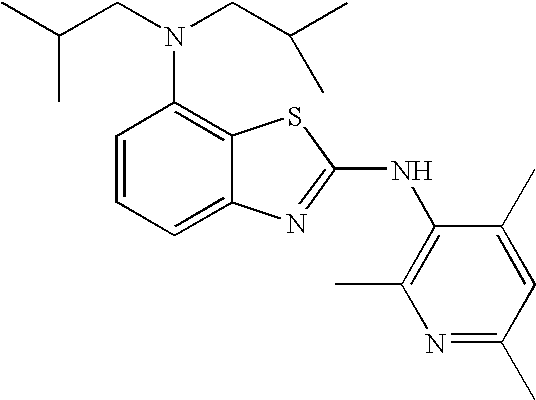 |
N7,N7- diisobutyl-N2- (2,4,6- trimethylpyridin- 3-yl)-1,3- benzothiazole- 2,7-diamine | 1H-NMR (CDCl3)δ 0.81 (12H, t, J=6.76 Hz), 1.69-1.77 (2H, m), 2.33 (3H, s), 2.56 (3H, s), 2.58 (3H, s), 2.88 (4H, d, J=7.24 Hz), 6.76 (1H, d, J=7.78 Hz), 6.92-7.01 (2H, m), 7.6 (1H, t, J=7.78 Hz); MS Calcd.:396; Found: 397 (M + H). |
| 120 |
 |
N2-[6- (dimethylamino)- 4- methylpyridin- 3-yl]-N7,N7- dipropyl-1,3- benzothiazole- 2,7-diamine | 1H-NMR (CDCl3)δ 0.88 (6H, t, J=7.24 Hz), 1.37-1.46 (4H, m), 2.29 (3H, s), 3.01- 3.05 (4H, m), 3.13 (6H, s), 6.44 (1H, s), 6.73 (18, d, J=8.05 Hz), 7.06 (1H, d, J=8.05 Hz), 7.17, (1H, t, J=7.78 Hz) 8.22 (1H, s); MS Calcd.: 383; Found: 384 (M + H). |
| 121 |
 |
N7,N7-bis(2- methoxyethyl)- N2-(2,4,6- trimethylpyridin- 3-yl)-1,3- benzothiazole- 2,7-diamine | 1H-NMR (CDCl3)δ 2.31 (3H, s), 2.54 (6H, s), 3.24 (6H, s), 3.38 (8H, s), 6.85 (1H, d, J=7.78 Hz), 6.99 (1H, s), 7.14 (1H, d, J=8.05 Hz), 7.23 (1H, t, J=7.78 Hz); MS Calcd.: 400; Found: 401 (M + H). |
| 122 |
 |
N7-(4-methoxy- 2,6- dimethylpyridin- 3-yl)-N7,N7- dipropyl-1,3- benzothiazole- 2,7-diamine | 1H-NMR (CDCl3)δ 0.82 (6H, t, J=7.24 Hz), 1.38-1.48 (4H, m), 2.55 (3H, s), 2.56 (3H, s), 3.03 (4H, t, J=7.24 Hz), 3.81 (3H, s), 6.65 (1H, s), 6.74 (1H, d, J=7.78 Hz), 7.13 (1H, d, J=8.05 Hz), 7.19 (1H, t, J=7.78 Hz); MS Calcd.: 384; Found: 385 (M + H). |

| TABLE 9 | |||
| Example | Structure | Name | Physical Data |
| 124 |
 |
N2-(4-bromo-2- methoxy-6- methylphenyl)- N7-(2- methoxyethyl)- N7,1-dimethyl- 1H- benzimidazole- 2,7-diamine | 1H NMR (CDCl3) δ 2.18 (s, 3H), 2.80 (s, 3H), 3.23 (br s, 2H), 3.33 (s, 3H), 3.51 (t, J = 5.8 Hz, 2H), 3.82 (s, 3H), 4.05 (s, 3H), 5.88 (s, 1H), 6.90- 6.92 (m, 2H), 7.01-7.04 (m, 2H), 7.26 (br s, 1H); MS Calcd.: 432; MS Found: 433 (M + H). |
| 125 |
 |
N2-(4-bromo-2- methoxy-6- methylphenyl)- N7-isopropyl-N7- (2- methoxyethyl)- 1-methyl-1H- benzimidazole- 2,7-diamine | MS Calcd.: 460; MS Found: 461 (M + H). |


| TABLE 10 | |||
| Example | Structure | Name | Physical Data |
| 128 |
 |
4-[[2-[(4- bromo-2- methoxy-6- methylphenyl) amino]-1-methyl- 1H- benzimidazol-7- yl](isopropyl) amino]-N,N- dimethylbutanamide | MS Calcd.: 515; MS Found: 516 (M + H). |
| 129 |
 |
N2-(4-bromo-2- methoxy-6- methylphenyl)- N7-isopropyl-1- methyl-N7-(4- oxo-4- pyrrolidin-1- ylbutyl)-1H- benzimidazole- 2,7-diamine | 1H NMR (CDCl3) δ 1.06 (d, J = 5.8 Hz, 3H), 1.17 (d, J = 6.3 Hz, 3H), 1.76-1.89 (m, 6H), 2.19 (br s, 5H), 3.06- 3.10 (m, 1H), 3.18-3.21 (m, 3H), 3.31-3.37 (m, 1H), 3.41 (t, J = 6.7 Hz, 2H), 3.82 (s, 3H), 4.08 (s, 3H), 5.86 (s, 1H), 6.92- 6.95 (m, 2H), 6.99-7.04 (m, 2H), 7.26 (b s, 1H); MS Calcd.: 541; MS Found: 542 (M + H). |
| 130 |
 |
4-[[2-[(4- bromo-2- methoxy-6- methylphenyl) amino]-1-methyl- 1H- benzimidazol-7- yl](isopropyl) amino]-N,N- diethylbutanamide | 1H NMR (CDCl3) δ 1.01-1.08 (m, 9H), 1.18 (d, J = 5.8 Hz, 3H), 1.76- 1.80 (m, 2H), 2.19 (s, 3H), 2.21-2.25 (m, 2H), 3.02-3.24 (m, 4H), 3.29- 3.82 (s, 3H), 4.08 (s, 3H), 5.83 (br s, 1H), 6.92 6.94 (m, 2H), 6.99- 7.04 (m, 2H), 7.26 (br s, 1H); MS Calcd.: 543; MS Found: 544 (M + H). |
| 131 |
 |
N2-(4-bromo-2- methoxy-6- methylphenyl)- N7-isopropyl-1- methyl-N7-(4- morpholin-4-yl- 4-oxobutyl)-1H- benzimidazole- 2,7-diamine | 1H NMR (CDCl3) δ 1.07 (d, J = 5.8 Hz, 3H), 1.18 (d, J = 5.8 Hz, 3H), 1.58 (s, 3H), 1.73-1.79 (m, 2H), 2.20 (s, 3H), 2.23-2.33 (m, 2H), 3.01- 3.08 (m, 1H), 3.14-3.21 (m, 3H), 3.31-3.38 (m, 1H), 3.46- 3.53 (m, 3H), 3.83 (s, 3H), 4.08 (s, 3H), 5.84 (br s, 1H),6.91-6.93 (m, 2H), 7.01 (t, J = 5.8 Hz, 1H), 7.05 (s, 1H), 7.26 (br s, 1H); MS Calcd.: 557; MS Found: 558 (M + H). |
| 132 |
 |
N2-(4-bromo-2- methoxy-6- methylphenyl)- N7-isopropyl-1- methyl-N7-(4- oxo-4- piperidin-1- ylbutyl)-1H- benzimidazole- 2,7-diamine | MS Calcd.: 555; MS Found: 556 (M + H). |
| 133 |
 |
N2-(4-bromo-2- methoxy-6- methylphenyl)- N7-isopropyl-1- methyl-N7-(4- oxo-4- thiomorpholin- 4-ylbutyl)-1H- benzimidazole- 2,7-diamine | MS Calcd.: 573; MS Found: 574 (M + H) |
| 134 |
 |
N2-(4-bromo-2- methoxy-6- methylphenyl)- N7-isopropyl-1- methyl-N7-[4-(4- methylpiperazin- 1-yl)-4- oxobutyl]-1H- benzimidazole- 2,7-diamine | MS Calcd.: 570 MS Found: 571 (M + H). |
| 135 |
 |
N2-[2-[(4-Bromo- 2-methoxy-6- methylphenyl) amino]-1-methyl- 1H- benzimidazol-7- yl]-N2- isopropylglycinamide | MS Calcd.: 459; MS Found: 460 (M + H). |


| TABLE 11 | |||
| Example | Structure | Name | Physical Data |
| 139 |
 |
N2-(4-chloro- 2-methoxy-6- methylphenyl)- N7-(4- chlorophenyl)- 1-methyl-N7- neopentyl-1H- benzimidazole- 2,7-diamine | MS Calcd: 496; Found: 497 (M + H). 1H NMR (CDCl3)δ (HCl salt) 0.93 (9H, s), 2.38 (3H, s), 3.10 (3H, s), 3.42 (1H, d, J = 14.8 Hz), 3.62 (3H, s), 3.90 (1H, d, J = 14.8 Hz), 6.51 (2H, d, J = 8.0 Hz), 6.73 (1H, s), 6.87 (1H, 7.10 (2H, d, J = 8.0 Hz), 7.20 7.40 (1H, m), 7.42 (1H, s), 10.47 (1H, s), 13.35 (1H, s). |
| 140 |
 |
N2-(4-chloro- 2-methoxy-6- methylphenyl)- N7-(2- chlorophenyl)- N7-(2- methoxyethyl)- 1-methyl-1H- benzimidazole- 2,7-diamine | MS Calcd: 484; Found: 485 (M + H). 1H NMR (CDCl3)δ (HCl salt) 2.38 (3H, s), 3.07 (3H, s), 3.25 (3H, s), 3.56 (2H, m), 3.61 (3H, s), 3.80-4.00 (2H, m), 6.49 (2H, d, J = 8.0 Hz), 6.71 (1H, s), 6.86 (1H, s), 7.12 (2H, d, J = 8.0 Hz), 7.14 (1H, d, J = 8.0 Hz), 7.35 7.50 (2H, m), 10.59 (1H, s). |
| 141 |
 |
ethyl N-{2- [(4-chloro-2- methoxy-6- methylphenyl) amino]-1- methyl-1H- benzimidazol- 7-yl}-N-(4- chlorophenyl) glycinate | MS Calcd: 513; Found: 514 (M + H). 1H NMR (CDCl3)δ (HCl salt) 1.23 (3H, t, J = 6.8 Hz), 2.36 (3H, s), 3.20 (3H, s), 3.66 (3H, s), 4.23 (2H, q, J = 6.8 Hz), 4.30 4.50 (1H, m), 4.50-4.70 (1H, m), 6.39 (2H, d, J = 8.0 Hz), 6.73 (1H, s), 6.87 (1H, s), 7.14 (2H, d, J = 8.0 Hz), 7.20-7.30 (1H, m), 7.30- 7.60 (2H, m), 10.36 (1H, s). |
| 142 |
 |
N2-[2-[(4- chloro-2- methoxy-6- methylphenyl) amino]-1- methyl-1H- benzimidazol- 7-yl]-N2-(4- chlorophenyl)- N1,N1- dimethylglycinamide | MS Calcd:.511; Found: 512 (M + H). 1H NMR (CDCl3)δ (HCl salt) 2.35 (3H, s), 2.97 (3H, s), 3.06 (3H, s), 3.29 (3H, s), 3.63 (3H, s), 4.40-4.60 (1H, m), 4.65- 4.90 (1H, m), 6.37 (2H, d, J = 8.8 Hz), 6.69 (1H, s), 6.85 (1H, s), 7.11 (2H, d, J = 8.8 Hz), 7.21 (1H, d, J = 8.0 Hz), 7.35-7.50 (2H, m), 10.45 (1H, s). |
| 143 |
 |
N2-(4-chloro- 2-methoxy-6- methylphenyl)- N7-(4- chlorophenyl)- N7-(2- (dimethylamino) ethyl)-1- benzimidazole- 2,7-diamine | MS Calcd: 497; Found: 498 (M + H). 1H NMR (CD3OD)δ (2HCl salt) 2.34 (3H, s), 2.97 (6H, s), 3.55-3.65 (3H, s), 3.84 (3H, s), 4.00- 4.20 (1H, m), 4.30-4.50 (1H, m), 6.74 (2H, d, J = 8.8 Hz), 7.10 (1H, s), 7.25 (1H, s), 7.25-7.35 (4H, m), 7.35 (1H, d, J = 8.0 Hz), 7.45 (1H, t, J = 8.0 Hz). |
| 144 |
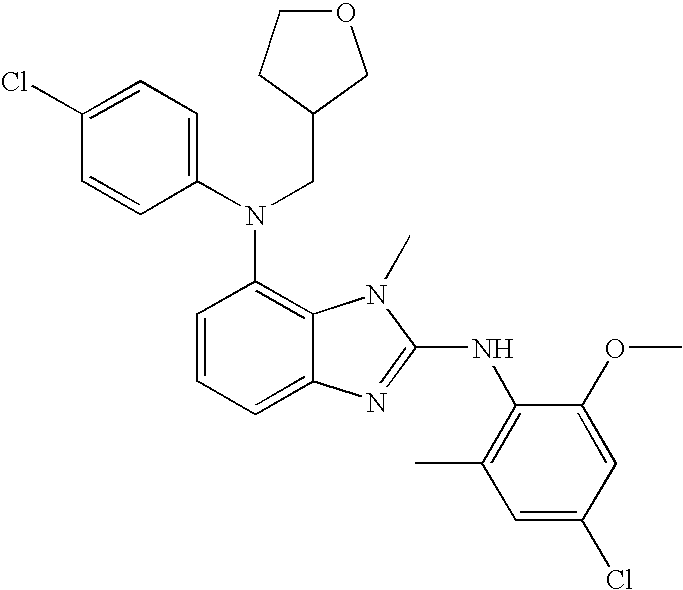 |
N2-(4-chloro- 2-methoxy-6- methylphenyl)- N7-(4- chlorophenyl)- 1-methyl-N7- (tetrahydrofuran- 3- ylmethyl)-1H- benzimidazole- 2,7-diamine | MS Calcd: 510; Found: 511 (M + H). 1H NMR (CDCl3)δ 1.50-1.70 (1H, m), 2.00- 2.15 (1H, m), 2.18 (3H, s), 2.65-2.80 (1H, m), 3.51 (3H, s), 3.50- 3.70 (2H, m), 3.81 (3H, s), 3.65-4.00 (4H, m), 5.81 (1H, s), 6.56 (2H, d, J = 8.0 Hz), 6.79 (1H, s), 6.85-7.00 (2H, m), 7.13 (2H, d, J = 8.0 Hz), 7.10- 7.20 (1H, m), 7.47 (1H d, J = 6.8 Hz). |
| 145 |
 |
N2-(4-chloro- 2-methoxy-6- methylphenyl)- N7-isopropyl- N7-(4- methoxyphenyl)- 1-methyl-1H- benzimidazole- 2,7-diamine | MS Calcd: 464; Found: 465 (M + H). 1H NMR (CDCl3)δ 1.00- 1.45 (6H, m), 2.24 (3H, s), 3.48 (3H, s), 3.74 (6H, s), 4.25-4.40 (1H, m), 6.50 (2H, d, J = 8.8 Hz), 6.75 (1H, s), 6.76 (2H, d, J = 8.8 Hz), 6.88 (1H, s), 6.91 (1H, d, J = 8.0 Hz), 7.18 (1H, d, J = 8.0 Hz), 7.45 (1H, d, J = 8.0 Hz). |
| 146 |
 |
N2-(4-chloro- 2-methoxy-6- methylphenyl)- N7-(2- methoxyethyl)- N7-(4- methoxyphenyl)- 2-methyl-1H- benzimidazole- 2,7-diamine | MS Calcd: 480; Found: 481 (M + H). 1H NMR (CDCl3)δ 2.18 (3H, s), 3.31 (3H, s), 3.70 (2H, m), 3.75 (3H, s), 3.80 (3H, s), 3.85-4.00 (2H, m), 5.80 (1H, s), 6.61 (2H, d, J = 8.0 Hz), 6.77 (2H, d, J = 8.0 Hz), 6.78 (1H, s), 6.89 (1H, s), 6.91 (1H, d, J = 8.0 Hz), 7.12 (1H, t, J = 8.0 Hz), 7.42 (1H, d, J = 8.0 Hz). |
| 147 |
 |
ethyl N-{2- [(4-chloro-2- methoxy-6- methylphenyl) amino]-1- methyl-1H- benzimidazol- 7-yl}-N-(4- methoxyphenyl) glycinate | MS Calcd: 508; Found: 509 (M + H). 1H NMR (CDCl3)δ 1.28 (3H, t, J = 7.2 Hz), 2.19 (3H, s), 3.69 (3H, s), 3.75 (3H, s), 3.81 (3H, s), 4.23 (2H, q, J = 7.2 Hz), 4.4H (2H, s), 5.80 (1H, s), 6.50 (2H, d, J = 8.8 Hz), 6.77 (2H, d, J = 8.8 Hz), 6.78 (1H, s), 6.89 (1H, s), 7.01 (1H, d, J = 8.0 Hz), 7.12 (1H, t, J = 8.0 Hz), 7.43 (1H, d, J = 8.0 Hz). |
| 148 |
 |
N2-(4-chloro- 2-methoxy-6- methylphenyl)- N7-(4- methoxyphenyl)- 1-methyl-N7- (tetrahydro- 2H-pyran-4- ylmethyl)-1H- benzimidazole- 2,7-diamine | MS Calcd: 520; Found: 521 (M + H). 1H NMR (CDCl3)δ 1.30-1.50 (2H, m), 1.70- 1.80 (2H, m), 2.00-2.20 (1H, m), 2.16 (3H, s), 3.35 (2H, t, J = 7.6 Hz), 3.49 (3H, s), 3.75 (3H, s), 3.80 (3H, s), 3.70-3.90 (2H, m), 3.97 (2H, d, J = 8.8 Hz), 5.77 (1H, s), 6.57 (2H, d, J = 8.8 Hz), 6.76 (2H, d, J = 8.8 Hz), 6.78 (1H, s), 6.88 (1H, s), 6.97 (1H, d, J = 8.0 Hz), 7.13 (1H, t, J = 8.0 Hz), 7.42 (1H, d, J = 8.0 Hz). |
| 149 |
 |
N2-(4-chloro- 2-methoxy-6- methylphenyl)- N7-isopropyl- 1-methyl-N7- (5- methylpyridin- 2-yl)-1H- benzimidazole- 2,7-diamine | MS Calcd: 449; Found: 450 (M + H). 1H NMR (CDCl3)δ 1.00 (3H, d, J = 6.8 Hz), 1.39 (3H, d, J = 6.8 Hz), 2.18 (6H, s), 3.53 (3H, s), 3.80 (3H, s), 5.10-5.20 (1H, m), 5.91 (1H, d, J = 8.8 Hz), 5.80 6.00 (1H, br), 6.78 (1H, s), 6.87 (1H, d, J = 8.0 Hz), 6.89 (1H, s), 7.11 (1H, d, J = 8.0 Hz), 7.16 (1H, t, J = 8.0 Hz), 7.51 (1H, d, J = 8.0 Hz), 8.07 (1H, s). |
| 150 |
 |
N2-(4-chloro- 2-methoxy-6- methylphenyl)- N7-(2- methoxyethyl)- 1-methyl-N7- (5- methylpyridin- 2-yl)-1H- benzimidazole- 2,7-diamine | MS Calcd: 465; Found: 466 (M + H). 1H NMR (CDCl3)δ 2.19 (6H, s), 3.29 (3H, s), 3.61 (3H, s), 3.60-3.70 (1H, m), 3.70- 3.80 (1H, m), 3.81 (3H, s), 4.00-4.15 (1H, m), 4.30- 4.40 (1H, m), 5.83 (1H, s), 6.06 (1H, d, J = 8.0 Hz), 6.78 (1H, s), 6.89 (1H, s), 6.93 (1H, d, J = 8.0 Hz), 7.05- 7.20 (2H, m), 7.40-7.50 (1H, m), 8.06 (1H, s). |


| TABLE 12 | |||
| Example | Structure | Name | Physical Data |
| 153 |
 |
N-{2-[(4- chloro-2- methoxy-6- methylphenyl) amino]-1- methyl-1H- benzimidazol- 7-yl}-N-(4- methoxyphenyl) acetamide | MS Calcd: 464; Found: 465 (M + H). 1H NMR (CDCl3)δ 2.06 (3Hx2/3, s), 2.20 (3H, s), 2.20 (3Hx1/3, s), 3.71 (3Hx2/3, s), 3.79 (3Hx1/3, s), 3.80 (6H, s), 5.90-6.10 (1H, brs), 6.79 (1H, s), 6.90 (1H, s), 6.80- 7.00 (3H, m), 7.05-7.20 (1H, m), 7.20- 7.40 (2H, m), 7.40-7.60 (1H, m). |

| TABLE 13 | |||
| Example | Structure | Name | Physical Data |
| 155 |  | N2-(4-bromo-2- methoxy-6- methylphenyl)- N7-isopropyl-1- methyl-N7-[3- (methylsulfonyl) phenyl]-1H- benzimidazole- 2,7-diamine | MS Calcd: 556, 558; Found: 557, 559 (M + H). 1H NMR (CDCl3)δ 1.03 (3H, d, J = 6.2 Hz), 1.42 (3H, d, J = 6.2 Hz), 2.18 (3H, s), 3.05 (3H, s), 3.53 (3H, s), 3.81 (3H, s), 4.39-4.45 (1H, m), 5.83 (1H, s), 6.58 (1H, d, J = 7.8 Hz), 6.80 (1H, d, J = 7.8 Hz), 6.81 (1H, d, J = 7.8 Hz), 6.92 (1H, s), 7.05 (1H, s), 7.16 (1H, t, J = 7.8 Hz), 7.22-7.29 (3H, m), 7.53 (1H, d, J = 7.8 Hz). |
Compounds of Examples 156-182, shown in the Table 14, were prepared in a manner similar to that described in Example 31.
| TABLE 14 | |||
| Example | Structure | Name | Physical Data |
| 156 |
 |
N2-(4-bromo-2- methoxy-6- methylphenyl)- N7-ethyl-N7- isopropyl-1- methyl-1H- benzimidazole- 2,7-diamine | 1H NMR (DMSO- d6) δ (HCl salt) 0.92 (t, 3H, J = 7.0 Hz), 1.03 (br s, 3H); 1.13 (br s, 3H); 2.29 (s, 3H); 3.10-3.14 (m, 2H); 3.32-3.39 (m, 1H); 3.80 (s, 3H); 4.12 (s, 3H); 7.06 1H, J = 7.2. Hz); 7.18- 7.25 (m, 2H); 7.29 (s, 1H); 7.33 (s, 1H); 10.21 (s, 1H); 12.61 (s, 1H); MS Calcd.: 430; MS Found: 431 (M + H). |
| 157 |
 |
N2-(4-bromo-2,6- diethylphenyl)- 1-methyl-N71N7- dipropyl-1H- benzimidazole- 2,7-diamine | MS Calcd.: 457; MS Found: 458 (M + H). |
| 158 |
 |
N2-(4-bromo-2- methoxy-6- methylphenyl)- N7,N7-dibutyl-1- methyl-1H- benzimidazole- 2,7-diamine | 1H NMR (CDCl3) δ 0.88 (t, J = 7.2 Hz, 6H), 1.27 (q, J = 7.4 Hz, 4H), 1.45 (t, J = 7.2 Hz, 4H), 2.19 (3H, s), 3.01 (br s, 4H), 3.83 (s, 3H), 4.04 (s, 3H), 6.89-6.92 (m, 2H), 7.00 7.05 (m, 2H), 7.26 (br, s, 1H); MS Calcd.: 472; MS Found: 473 (M + H). |
| 159 |
 |
N2-(4-chloro- 2,6- diethylphenyl)- 1-methyl-N7,N7- dipropyl-1H- benzimidazole- 2,7-diamine | 1H NMR (CDCl3) δ 0.86 (t, J = 7.2 Hz, 6H), 1.18 (t, J = 7.2 Hz, 6H), 1.50 (q, J = 7.2 Hz, 4H), 2.61 (d, J = 7.1 Hz, 4H), 2.98 (br s, 4H), 4.01 (s, 3H), 6.88 (d, J = 7.3 Hz, 1H), 7.01 (br s, 1H), 7.15 (s, 2H), 7.22 (d, J = 6.7 Hz, 1H); MS Calcd.: 413; MS Found: 414 (M + H). |
| 160 |
 |
N2-(4-bromo-2- methoxy-6- methylphenyl)- N7-ethyl-N7- isopropyl-1- methyl-1H- benzimidazole- 2,7-diamine | MS Calcd.: 430; MS Found: 431 (M + H). |
| 161 |
 |
methyl 4- [(cyclopropylmethyl) [2- (mesitylamino)- 1-methyl-1H- benzimidazol-7- yl]amino]butanoate | MS Calcd.: 434; MS Found: 435 (M + H). |
| 162 |
 |
N2-(4-bromo-2- methoxy-6- methylphenyl)- N7,N7-diethyl-1- methyl-1H- benzimidazole- 2,7-diamine | MS Calcd.: 416; MS Found: 417 (M + H). |
| 163 |
 |
N2-(4-chloro-2- methoxy-6- methylphenyl)- 1-methyl-N7,N7- dipropyl-1H- benzimidazole- 2,7-diamine | MS Calcd.: 400; MS Found: 401 (M + H). |
| 164 |
 |
methyl 4-[[2- [(4-bromo-2- methoxy-6- methylphenyl) amino]-1-methyl- 1H- benzimidazol-7- yl](isopropyl) amino]butanoate | 1H NMR (CDCl3) δ 1.02 (d, J = 5.9 Hz, 3H), 1.19 (d, J = 5.9 Hz, 3H), 1.73-1.79 (m, 2H), 2.19 (s, 3H), 2.28-2.32 (m, 2H), 2.97- 3.02 (m, 1H), 3.18-3.22 (m, 1H), 3.29-3.35 (m, 1H), 3.64 (s, 3H), 3.82 (s, 3H), 4.05 (s, 3H), 6.90- 6.92 (m, 2H), 6.96-7.06 (m, 2H), 7.25-7.28 (m, 1H); MS Calcd.: 502; MS Found: 503 (M + H). |
| 165 |
 |
N2-(4-bromo-2- methoxy-6- methylphenyl)- N7,N7-diethyl-1- methyl-1H- benzimidazole- 2,7-diamine | 1H NMR (DMSO- d6) δ0.95 (t, J = 7.0 Hz, 6H), 2.09 (s, 3H), 3.00-3.08 (m, 4H), 3.74 (s, 3H), 3.95 (s, 3H), 6.77- 6.80 (m, 1H), 6.86-6.89 (m, 2H), 7.09 (d, J = 8.6 Hz, 2H), 7.84 (s, 1H); MS Calcd.: 416; MS Found: 417 (M + H). |
| 166 |
 |
N2-(3,4- dichloro-2- methoxy-6- methylphenyl)- 1-methyl-N7,N7- dipropyl-1H- 2,7-diamine | MS Calcd.: 434; MS Found: 435 (M + H). |
| 167 |
 |
N2-(4-bromo-2- methoxy-6- methylphenyl)- N7-isopropyl- N7,1-dimethyl- 1H- benzimidazole- 2,7-diamine | 1H NMR (CDCl3) δ 1.11 (d, J = 5.5 Hz, 6H), 2.17 (s, 3H), 2.71 (s, 3H), 3.33-3.41 (m, 1H), 3.81 (s, 3H), 4.03 (s, 3H), 6.87-6.93 (m, 2H), 6.99 7.04 (m, 2H), 7.23-7.24 (m, 1H); MS Calcd.: 416; MS Found: 417 (M + H). |
| 168 |
 |
N7-ethyl-N7- isopropyl-1- ethyl-N2- (2,4,6- trimethoxyphenyl)- 1H- benzimidazole- 2,7-diamine | 1H NMR (CDCl3) δ 0.95 (t, J = 7.0 Hz, 3H), 1.09 (d, J = 5.5 Hz, 6H), 3.07-3.12 (m, 2H), 3.28-3.33 (m, 1H), 3.78 (s, 6H), 3.82 (s, 3H), 4.02 (s, 3H), 6.21 (s, 2H), 6.88 (d, J = 7.8 Hz, 1H), 6.98 (t, J = 7.8 Hz, 1H), 7.26- 7.27 (m, 1H); MS Calcd.: 398; MS Found: 399 (M + H). |
| 169 |
 |
N2-(4-chloro-2- methoxy-6- methylphenyl)- N7-ethyl-N7- isopropyl-1- methyl-1H- benzimidazole- 2,7-diamine | 1H NMR (CDCl3) δ 0.97 (t, J = 7.0 Hz, 3H), 1.10 (br s, 6H), 2.20 (s, 3H), 3.02-3.16 (m, 2H), 3.31- 3.36 (m, 1H), 3.82 (s, 3H), 4.07 (s, 3H), 6.78 (s, 1H), 6.89-6.94 (m, 2H), 7.01 (t, J = 7.8 Hz, 1H), 7.26-7.29 (m, 1H); MS Calcd.: 386; MS Found: 387 (M + H). |
| 170 |
 |
N2-(4-chloro-2- methoxy-6- methylphenyl)- N7,N7-diethyl-1- methyl-1H- benzimidazole- 2,7-diamine | 1H NMR (CDCl3) δ 1.02 (t, J = 7.0 Hz, 6H), 2.19 (s, 3H), 3.06-3.11 (m, 4H), 3.81 (s, 3H), 4.06 (s, 3H), 6.78 (s, 1H), 6.87-6.90 (m, 2H), 7.02 (t, J = 7.8 Hz, 1H), 7.23- 7.26 (m, 1H); MS Calcd.: 372; MS Found: 373 (M + H). |
| 171 |
 |
N2-(4-chloro- 2,6- diethylphenyl)- N7,N7-diethyl-1- methyl-1H- benzimidazole- 2,7-diamine | MS Calcd.: 484; MS Found: 485 (M + H). |
| 172 |
 |
N2-(4-chloro- 2,6- diethylphenyl)- N7-ethyl-N7- isopropyl-1- methyl-1H- benzimidazole- 2,7-diamine | MS Calcd.: 398; MS Found: 399 (M + H). |
| 173 |
 |
5-chloro-2-[[7- (dipropylamino)- 1-methyl-1H- benzimidazol-2- yl]amino]phenol | 1H NMR (CDCl3) δ 0.84 (t, J = 7.4 Hz, 6H) 1.41-1.48 (m, 4H), 2.97 (br s, 4H), 4.10 (s, 3H), 6.81- 6.84 (m, 1H), 6.90 (d, J = 8.6 Hz, 1H), 6.96 (d, J = 7.8 Hz, 1H), 7.06-7.09 (m, 2H), 7.21 (d, J = 7.8 Hz, 1H); MS Calcd.: 372; MS Found: 373 (M + H). |
| 174 |
 |
[5-chloro-2- [[7- (dipropylamino)- 1-methyl-1H- benzimidazol-2- yl]amino]phenyl] methanol | MS Calcd.: 386; MS Found: 387 (M + H). |
| 175 |
 |
N2-(4-chloro-2- methoxyphenyl)- 1-methy1-N7,N7- benzimidazole- 2,7-diamine | MS Calcd.: 386; MS Found: 387 (M + H). |
| 176 |
 |
N2-(2-bromo-4- chlorophenyl)- dipropyl-1H- 1-methyl-N7,N7- benzimidazole- 2,7-diamine | 1H NMR (CDCl3) δ 0.84 (t, J = 7.2 Hz, 6H), 1.47 (q, J = 7.5 Hz, 4H), 2.99 (br s, 4H), 4.12 (s, 3H), 6.87 (br s, 1H), 6.98 Hz, 1H), 7.10 (d, J = 7.8 (t, J = 7.8 Hz, 1H), 7.33- 7.37 (m, 2H), 7.5 (d, J = 2.4 Hz, 1H), 8.58 (d, J = 8.2 Hz, 1H); MS Calcd.: 434; MS Found: 435 (M + H). |
| 177 |
 |
N2-(3-tert- butyl-1-methyl- 1H-pyrazol-5- yl)-N7-ethyl-N7- isopropyl-1- methyl-1H- benzimidazole- 2,7-diamine | 1H NMR (CDCl3) δ 0.95 (t, J = 7.1 Hz, 3H), 1.09 (d, J = 6.5 Hz, 6H), 1.33 (s, 9H), 3.80 (q, J = 7.0 Hz, 2H), 3.25-3.30 (m, 1H), 3.48 (s, 1H), 3.74 (s, 3H), 3.86 (s, 3H), 4.71 (s, 1H), 6.83 (s, 1H), 6.95 (s, 2H); MS Calcd.: 368; MS Found: 369 (M + H). |
| 178 |
 |
5-chloro-2-[[7- (dipropylamino)- 1-methyl-1H- benzimidazol-2- yl]amino]benzonitrile | MS Calcd.: 382; MS Found: 383 (M + H). |
| 179 |
 |
N2-[4-chloro-2- (methoxymethyl)- phenyl]-1- methyl-N71N7- dipropyl-1H- benzimidazole- 2,7-diamine | MS Calcd.: 400; MS Found: 401 (M + H). |
| 180 |
 |
N7,N7-bis[2- (benzyloxy)ethyl]- 1-methyl-N2- (2,4,6- trimethylpyridin- 3-yl)-1H- benzimidazole- 2,7-diamine | 1H NMR (DMSO- d6) δ 2.20 (s, 3H); 2.45 (s, 6H); 3.39 (s, 4H); 3.55-3.62 (m, 4H); 3.93 (s, 3H); 4.43 (s, 4H); 6.91 (s, 2H); 7.00 (br s, 1H); 7.24-7.35 (m, 12H); MS Calcd.: 549; MS Found: 550 (M + H). |
| 181 |
 |
N2-(4-chloro-2- methoxyphenyl)- 3-methyl-N7,N7- dipropyl-1H- benzimidazole- 2,7-diamine | MS Calcd.: 400; MS Found: 401 (M + H). |
| 182 |
 |
1-methyl-N2- (pentamethylphenyl)- N7,N7- dipropyl-1H- benzimidazole- 2,7-diamine | 1H NMR (CDCl3) δ 0.84 (t, 6H, J = 7.5 Hz), 1.38-1.48 (m, 4H), 2.03 (s, 6H), 2.18 (s, 6H), 2.19 (s, 3H), 2.90-2.95 (t, 4H, J = 7.5 Hz), 3.90 (s, 3H), 6.89 (d, 1H, J = 7.8 Hz), 6.92 (s, 1H), 6.98 (t, 1H, J = 7.8 Hz) 7.23 (d, 1H, J = 7.8 Hz) MS Calcd.: 392 MS Found: 393 (M + H) |

| TABLE 15 | |||
| Example | Structure | Name | Physical Data |
| 184 |
 |
N-(4-bromo-2- methoxy-6- methylphenyl)- 1-methyl-7-(2- methylpiperidin- 1-yl)-1H- benzimidazol-2- amine | 1H-NMR (CDCl3) δ 0.90 (3H, d, J=6.17 Hz), 1.38-1.48 (2H, m), 1.67- 1.73(2H, m), 1.81-1.82(2H, m), 2.18(3H, s), 2.69-2.76 (1H, m), 2.96- 3.08(1H, m), 3.02-3.15(1H, m), 3.81(3H, s), 4.11(3H, s), 6.91(1H, s), 6.95-7.04 (3H, m), 7.26- 7.29(1H, m); MS Calcd.: 442; Found: 443(M+H), 445. |
| 185 |
 |
N-(4-bromo-2- methoxy-6- methylphenyl)- 7-(2-ethyl-1- pyrolidinyl)- 1-methyl-1H- benzimidazol-2- amine | 1H-NMR (CDCl3) δ 0.85 (3H, t, J=7.25 Hz), 1.29- 1.38(1H, m), 1.56-1.67(2H, m), 1.81-1.97 (2H, m), 2.10- 2.16(1H, m), 2.19(3H, s), 2.78-2.85(1H, m), 3.32-3.41 (2H, m), 3.81 (3H, s), 4.01 (3H, s), 6.91- 6.98(2H, m), 7.01-7.05(2H, m), 7.25(1H, m); MS Calcd.: 442; Found: 443(M+H), 445. |
| 186 |
 |
N-(4-bromo-2- methoxy-6- methylphenyl)- 1-methyl-7-(2- methyl-1- pyrolidin-1- yl)-1H- benzimidazol-2- amine | 1H-NMR (CDCl3) δ 1.07 (3H, d, J=5.9 Hz), 1.54-1.63 (2H, m), 1.83- 1.99(2H, m), 2.19(3H, s), 2.77-2.85(1H, m), 3.39-3.49 (2H, m), 3.81 (3H, s), 4.02 (3H, s), 6.88- 6.92(2H, m), 7.00-7.05 (2H, m), 7.25(1H, m); MS Calcd.: 428; Found: 429(M+H), 431. |
| 187 |
 |
N-(4-bromo-2- methoxy-6- methylphenyl)- 7-(3-ethyl-4- morpholinyl)-1- methyl-1H- benzimidazol-2- amine | 1H-NMR (CDCl3) δ 0.77 (3H, t, J=7.5 Hz), 1.13-1.20 (1H, m), 1.33- 1.49(1H, m), 1.54-1.63(1H, m), 2.18(3H, s), 2.92-3.16 (3H, m), 3.40- 3.46(1H, m), 3.77-3.81(1H, m), 3.82(3H, s), 3.91-3.94 (1H, m), 4.09 (3H, s), 6.92 (1H, s), 6.98- 7.08(3H, m), 7.31-7.34(1H, m); MS Calcd.: 458; Found: 459(M + H), 461. |
| 188 |
 |
N-(4-bromo-2- mthoxy-6- methylphenyl)- 1-methyl-7-(2- propyl-1- piperidinyl)- 1H- benzimidazol-2- amine | 1H-NMR (CDCl3) δ 0.73 (3H, t, J=6.9 Hz), 1.10-1.68 (8H, m), 1.83- 1.88(1H, m), 1.95-1.98(1H, m), 2.19(3H, s), 2.66∫2.72 (1H, m), 2.88- 2.92(1H, m), 23.08-3.12(1H, m), 3.81(3H, s), 4.08(3H, s), 6.92-7.04 (4H, m), 7.28- 7.30(1H, m); MS Calcd.: 470; Found: 471(M+H), 473. |
| 189 |
 |
N-(4-bromo-2- methoxy-6- methylphenyl)- 1-methyl-7-(2- methoxymethyl- 1-piperidinyl)- 1H- benzimidazol-2- amine | 1H-NMR (CDCl3) δ 1.24- 1.28(1H, m), 1.46-1.57(3H, m), 1.67-1.71 (2H, m), 1.84- 1.91(1H, m), 22.02-2.05(1H, m), 2.21(3H, s), 2.73-2.80 (1H, m), 3.09 (3H, s), 3.23- 3.25(1H, m), 3.65-3.73(1H, m), 3.80(3H, s), 4.03(3H, s), 6.92(1H, s), 6.98-7.12 (3H, m),7.25- 7.31(1H, m); MS Calcd.: 472; Found: 473(M+H), 475. |
| 190 |
 |
N5-(7-(2-ethyl- 1-piperidinyl)- 1-methyl-1H- benzimidazol-2- yl)-N2,N2,4- trimethyl-2,5- pyridiamine | 1H NMR (CDCl3) δ. 0.74(t, J= 7.4 Hz, 3H), 1.18-1.23(m, 1H), 1.32-1.45 (m, 4H), 1.68 (br s, 1H), 1.91(m, 2H), 2.23(s, 3H), 2.70-2.73(m, 1H), 2.82-2.86 (m, 1H), 3.07 (br s, 6H), 4.03(s, 3H), 4.69(s, 2H), 6.42(s, 1H), 6.93-6.94(m, 1H), 7.02(t, J=7.7 Hz, 1H), 7.24-7.26 (m, 1H(), 8.10 (s, 1H); MS Calcd.: 392; MS Found: 393 (M+H). |
| 191 |
 |
methyl 1-[2- [(4-bromo-2- methoxy-6- methylphenyl)amino]- -1-methyl- 1H- benzimidazole- 7- yl]piperidine- 2-carboxylate | 1H-NMR (CDCl3) δ 1.56-1.85(4H, m), 1.94-1.98 (1H, m), 2.05- 22.08(1H, m), 2.18(3H, s), 2.65-2.71(1H, m), 3.17- 3.20(1H, m), 3.45(3H, s), 3.81(3H, s), 3.86-3.89(1H, m), 4.15(3H, s), 6.88- 6.91(2H, m), 6.98(1H, t, J=8.05 Hz), |
| 7.03(1H, s), 7.25-7.31(1H, m); MS Calcd.: 486; Found: 487(M+H); 489. | |||


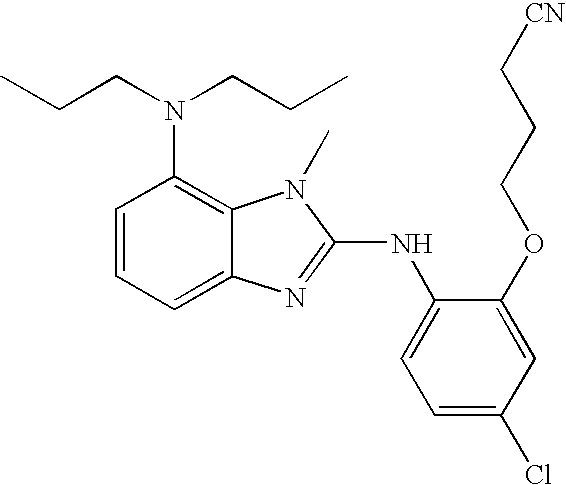
| TABLE 16 | |||
| Example | Structure | Name | Physical Data |
| 195 |
 |
N2-[2-(2- bromoethoxy)-4- chlorophenyl]- 1-methyl-N7,N7- dipropyl-1H- benzimidazole- 2,7-diamine | MS Calcd.: 478; MS Found: 479 (M+H). |

| TABLE 17 | |||
| Example | Structure | Name | Physical Data |
| 197 |  | N2-[2-(4- bromobutoxy)-4- chlorophenyl]- 1-methyl-N7,N7- dipropyl-1H- benzimidazole- 2,7-diamine | MS Calcd.: 506; MS Found: 507 (M+H). |
A compound of Example 198, shown in the Table 18, was prepared in a manner similar to that described in Example 194.
| TABLE 18 | |||
| Example | Structure | Name | Physical Data |
| 198 |
 |
5-(5-cchloro- 2-[[7- (dipropylamino)- 1-methyl- 1H- benzimidazol- 2- yl]amino]phenoxxy)- pentanenitrile | 1H NMR (CDCl3) δ 0.84(t, J= 7.2 Hz, 6H), 1.42- 1.51(m, 4H), 1.88-1.95(m, 2H), 2.06- 2.13(m, 2H), 2.49(t, J= 6.8 Hz, 2H), 2.98(br s, 4H), 4.08(s, 3H), 4.15(t, J=6.0 Hz, 2H), 4.72(s, 1H), 6.87(s, 1H), 6.95(d, J=7.8 Hz, 1H), 7.03(d, J=9.6 Hz, 1H), 7.08(t, J=8.0 Hz, 1H), 7.35(d, J=7.8 Hz, 1H), 8.44(d, J=8.8 Hz, 1H). MS Calcd.: 453; MS Found: 454 (M+H). |


| TABLE 19 | |||
| Example | Structure | Name | Physical Data |
| 201 |
 |
4-[5-chloro-2- [[7- (dipropylamino)- 1-methyl-1H- benzimidazol-2- yl]amino]phenoxy]- N,N- dimthylbutan- amide | 1H NMR (CDCl3) δ 0.84(t, J= 7.2 Hz, 6H), 1.42-1.51(m, 4H), 2.24- 2.30(m, 2H), 2.52(t, J= 6.6 Hz, 2H), 2.89(s, 3H), 2.97(br s, 7H), 4.12- 4.15(m, 5H), 6.86(s, 1H), 6.93(d, J= 7.8 Hz, 1H), 6.98-7.00(m, 1H), 7.05-7.09(m, 2H), 7.34(d, J= 7.8 Hz,1H), 8.41(d, J= 8.8 Hz, 1H). MS Calcd.: 485; MS Found: 486 (M+H). |

| TABLE 20 | |||
| Example | Structure | Name | Physical Data |
| 203 |
 |
2-[[4-bromo-2- methoxy-6- methylphenyl)- amino]-N,N- dipropyl-1- methyl-1H- benzimidazole- 7-carboxamide | MS Calcd.: 472; MS Found: 473 (M+H). |
| 204 |
 |
N-(4-bromo-2- methoxy-6- methylphenyl)- 1-methyl-7- (pyrolidin-1- ylcarbonyl)-1H- benzimidazol-2- amine | 1H NMR (CDCl3) δ 1.90-1.95 (m, 2H), 1.99-2.04(m, 2H), 2.18(s, 3H), 3.35(t, J=6.7 Hz, 2H), 3.68(s, 3H), 3.73(t, J=6.7 Hz, 2H), 3.82(s, 3H), 4.72(s, 1H), 6.93(s, 1H), 7.01- 7.05(m, 2H), 7.10(t, J= 7.6 Hz, 1H), 7.51(d, J= 8.0 Hz, 1H). MS Calcd.: 442; MS Found:443 (M+H). |
| 205 |
 |
N-(4-bromo-2- methoxy-6- methylphenyl)- 1-methyl-7- (morpholin-4- ylcarbonyl)-1H- benzimidazol-2- amine | 1H NMR (CDCl3) δ 2.19(s, 3H), 3.44- 3.49(m, 2H), 3.61(br s, 1H), 3.70(br s, 4H), 3.82 (br s, 5H), 3.91(br s, 2H), 4.72(s, 1H), 6.94(br s, 2H), 7.06 (s, 1H), 7.11 (t, J=7.7 Hz, 1H), 7.52 (d, J=8.0 Hz, 1H). MS Calcd.: 458; MS Found: 459 (M+H). |


| TABLE 21 | |||
| 208 |  | 4-[[2-[(4- bromo-2- methoxy-6- methylphenyl)- amino]-1-methyl- 1H- benzimidazol-7- yl](isopropyl)- amino]-2- methoxybenzo- nitrile | 1H NMR (CDCl3) δ 1.03(3H, d, J= 4.8 Hz), 1.37 (3H, d, J=4.8 Hz), 2.20(3H, s), 3.57(3H, s), 3.82(3H, s), 3.84(3H, s), 4.22-4.29 (1H, m), 5.84 (1H, s), 6.66- 6.68(1H, m), 6.78-6.80(3H, m), 6.93(1H, s), 7.06(1H, s), 7.14(1H, d, J=7.8Hz), 7.51(1H, d, J= 7.8 Hz). MS Calcd.: 533, 535; Found: 534, 536(M+H). |
Experiment 1
| TABLE 22 | |||
| Example No. | Binding inhibitory rate (%) 1000 nM | ||
| 26 | >80 | ||
| 42 | >80 | ||
| 46 | >80 | ||
| 145 | >80 | ||
| 183 | >80 | ||
Experiment 2
Claims (7)


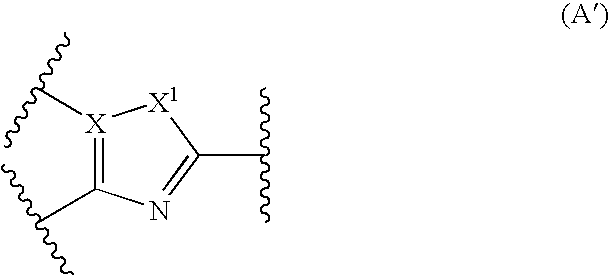
Applications Claiming Priority (3)
| Application Number | Priority Date | Filing Date | Title |
|---|---|---|---|
| US51616403P | 2003-10-31 | 2003-10-31 | |
| US56051804P | 2004-04-08 | 2004-04-08 | |
| PCT/US2004/035648 WO2005044793A2 (en) | 2003-10-31 | 2004-10-27 | Nitrogen-containing fused heterocyclic compounds |
Publications (2)
| Publication Number | Publication Date |
|---|---|
| US20070135452A1 US20070135452A1 (en) | 2007-06-14 |
| US7714009B2 true US7714009B2 (en) | 2010-05-11 |
Family
ID=34576771
Family Applications (1)
| Application Number | Title | Priority Date | Filing Date |
|---|---|---|---|
| US10/577,334 Expired - Fee Related US7714009B2 (en) | 2003-10-31 | 2004-10-27 | Nitrogen-containing fused heterocyclic compounds |
Country Status (5)
| Country | Link |
|---|---|
| US (1) | US7714009B2 (en) |
| EP (1) | EP1677791A4 (en) |
| JP (1) | JP4842829B2 (en) |
| CA (1) | CA2543707A1 (en) |
| WO (1) | WO2005044793A2 (en) |
Cited By (2)
| Publication number | Priority date | Publication date | Assignee | Title |
|---|---|---|---|---|
| US20090312383A1 (en) * | 2005-04-27 | 2009-12-17 | Takeda Pharmaceutical Company Limited | Fused Heterocyclic Compounds |
| US8697708B2 (en) | 2010-09-15 | 2014-04-15 | F. Hoffmann-La Roche Ag | Azabenzothiazole compounds, compositions and methods of use |
Families Citing this family (59)
| Publication number | Priority date | Publication date | Assignee | Title |
|---|---|---|---|---|
| MXPA05005983A (en) | 2002-12-04 | 2005-08-18 | Eisai Co Ltd | 1,3-dihydroimidazole fused-ring compound. |
| WO2006078907A1 (en) * | 2005-01-20 | 2006-07-27 | Amgen Inc. | 2-substituted benzimidazole derivatives as vanilloid receptor ligands and their use in treatments |
| WO2006136580A2 (en) | 2005-06-21 | 2006-12-28 | Neurosearch A/S | 2-(phenylamino)benzimidazole derivatives and their use as modulators of small-conductance calcium-activated potassium channels |
| GB0515025D0 (en) * | 2005-07-21 | 2005-08-31 | Novartis Ag | Organic compounds |
| US7547782B2 (en) | 2005-09-30 | 2009-06-16 | Bristol-Myers Squibb Company | Met kinase inhibitors |
| GB0525068D0 (en) | 2005-12-08 | 2006-01-18 | Novartis Ag | Organic compounds |
| WO2007069565A1 (en) | 2005-12-12 | 2007-06-21 | Ono Pharmaceutical Co., Ltd. | Bicyclic heterocyclic compound |
| CN101384568B (en) | 2006-02-15 | 2012-12-12 | 雅培制药有限公司 | Acetyl-CoA carboxylase (ACC) inhibitors and their use in diabetes, obesity and metabolic syndrome |
| CN103554095A (en) | 2006-02-15 | 2014-02-05 | Abbvie公司 | Novel acetyl-coa carboxylase (acc) inhibitors and their use in diabetes, obesity and metabolic syndrome |
| EP1996567B1 (en) | 2006-02-15 | 2013-09-18 | AbbVie Inc. | Novel acetyl-coa carboxylase (acc) inhibitors and their use in diabetes, obesity and metabolic syndrome |
| FR2903105A1 (en) | 2006-07-03 | 2008-01-04 | Sanofi Aventis Sa | 2-BENZOYL-IMIDAZOPYRIDINE DERIVATIVES, THEIR PREPARATION AND THEIR THERAPEUTIC USE |
| FR2903107B1 (en) | 2006-07-03 | 2008-08-22 | Sanofi Aventis Sa | IMIDAZOPYRIDINE-2-CARBOXAMIDE DERIVATIVES, THEIR PREPARATION AND THEIR THERAPEUTIC USE |
| US20100056515A1 (en) * | 2006-10-25 | 2010-03-04 | Kazuyoshi Aso | Benzimidazole compounds |
| US8039500B2 (en) | 2006-12-29 | 2011-10-18 | Takeda Pharmaceutical Company Limited | Fused heterocyclic compounds |
| DE102008023801A1 (en) | 2008-05-15 | 2009-11-19 | Bayer Schering Pharma Aktiengesellschaft | Substituted imidazo and triazolopyrimidines, imidazo and pyrazolopyrazines and imidazotriazines |
| WO2010032461A1 (en) * | 2008-09-17 | 2010-03-25 | 武田薬品工業株式会社 | Nitrogen-containing fused ring compound |
| UY32138A (en) | 2008-09-25 | 2010-04-30 | Boehringer Ingelheim Int | SUBSTITUTED AMIDES 2- (2,6-DICLORO-PHENYLAMINE) -6-FLUORO-1-METHYL-1H-BENCIMIDAZOL-5-CARBOXYL AND ITS PHARMACEUTICALLY ACCEPTABLE SALTS |
| CN102361857B (en) | 2008-09-26 | 2015-09-16 | 默沙东公司 | Can be used as the ring-type benzimidizole derivatives of antidiabetic |
| EP2348857B1 (en) | 2008-10-22 | 2016-02-24 | Merck Sharp & Dohme Corp. | Novel cyclic benzimidazole derivatives useful anti-diabetic agents |
| CN102271511A (en) | 2008-10-29 | 2011-12-07 | 默沙东公司 | Novel cyclic benzimidazole derivatives useful anti-diabetic agents |
| JP5557845B2 (en) | 2008-10-31 | 2014-07-23 | メルク・シャープ・アンド・ドーム・コーポレーション | Novel cyclic benzimidazole derivatives useful as antidiabetic agents |
| US8349852B2 (en) | 2009-01-13 | 2013-01-08 | Novartis Ag | Quinazolinone derivatives useful as vanilloid antagonists |
| UY32470A (en) | 2009-03-05 | 2010-10-29 | Boehringer Ingelheim Int | DERIVATIVES OF 2- {2-CHLORINE-5 - [(REPLACED) METHYL] PHENYLAMINE} -1-METHYL] PHENYLAMINE} -1-METHYLBENCIMIDAZOL-5-CARBOXAMIDES-N- (SUBSTITUTED) AND ITS PHYSIOLOGICALLY ACCEPTABLE SALTS, COMPOSITIONS AND APPLIANCE |
| AR080055A1 (en) | 2010-02-01 | 2012-03-07 | Novartis Ag | DERIVATIVES OF PIRAZOLO- [5,1-B] -OXAZOL AS ANTAGONISTS OF THE RECEIVERS OF CRF -1 |
| WO2011092293A2 (en) | 2010-02-01 | 2011-08-04 | Novartis Ag | Cyclohexyl amide derivatives as crf receptor antagonists |
| ES2527849T3 (en) | 2010-02-02 | 2015-01-30 | Novartis Ag | Cyclohexylamide derivatives as CRF receptor antagonists |
| CN102153538B (en) * | 2010-02-11 | 2013-12-11 | 山东轩竹医药科技有限公司 | Benzocyclodirivative |
| AU2011218830B2 (en) | 2010-02-25 | 2014-07-24 | Merck Sharp & Dohme Corp. | Novel cyclic benzimidazole derivatives useful anti-diabetic agents |
| US8759537B2 (en) | 2010-08-20 | 2014-06-24 | Boehringer Ingelheim International Gmbh | 3H-imidazo [4, 5-C] pyridine-6-carboxamides as anti-inflammatory agents |
| US8586604B2 (en) | 2010-08-20 | 2013-11-19 | Boehringer Ingelheim International Gmbh | Inhibitors of the microsomal prostaglandin E2 synthase-1 |
| HUE037860T2 (en) | 2010-11-19 | 2018-09-28 | Ligand Pharm Inc | Heterocycle amines and uses thereof |
| US8486968B2 (en) | 2010-12-10 | 2013-07-16 | Boehringer Ingelheim International Gmbh | Compounds |
| US8466186B2 (en) | 2010-12-10 | 2013-06-18 | Boehringer Ingelheim International Gmbh | Compounds |
| UY33779A (en) | 2010-12-10 | 2012-07-31 | Boehringer Ingelheim Int | ? 2- (Phenylamino) -1H-benzimidazol-5-carboxamides novel? |
| AR086554A1 (en) | 2011-05-27 | 2014-01-08 | Novartis Ag | DERIVATIVES OF PIPERIDINE 3-ESPIROCICLICA AS AGRONISTS OF GHRELINE RECEPTORS |
| JP2015525202A (en) | 2012-05-03 | 2015-09-03 | ノバルティス アーゲー | L-malate salt of 2,7-diaza-spiro [4,5] dec-7-yl derivative as ghrelin receptor agonist and its crystalline form |
| BR112016018604A2 (en) | 2014-02-11 | 2017-08-08 | Bayer Pharma AG | BENZIMIDAZOL-2-AMINE AS MIDH1 INHIBITORS |
| CA2939021C (en) | 2014-02-11 | 2022-07-12 | Bayer Pharma Aktiengesellschaft | Benzimidazol-2-amines as midh1 inhibitors |
| EP3392244A1 (en) | 2014-02-13 | 2018-10-24 | Incyte Corporation | Cyclopropylamines as lsd1 inhibitors |
| KR102421235B1 (en) | 2014-02-13 | 2022-07-15 | 인사이트 코포레이션 | Cyclopropylamines as lsd1 inhibitors |
| US9527835B2 (en) | 2014-02-13 | 2016-12-27 | Incyte Corporation | Cyclopropylamines as LSD1 inhibitors |
| NZ723203A (en) | 2014-02-13 | 2020-08-28 | Incyte Corp | Cyclopropylamines as lsd1 inhibitors |
| WO2015162518A1 (en) | 2014-04-25 | 2015-10-29 | Pfizer Inc. | Heteroaromatic compounds and their use as dopamine d1 ligands |
| US9695180B2 (en) | 2014-07-10 | 2017-07-04 | Incyte Corporation | Substituted imidazo[1,2-a]pyrazines as LSD1 inhibitors |
| WO2016007731A1 (en) | 2014-07-10 | 2016-01-14 | Incyte Corporation | Imidazopyridines and imidazopyrazines as lsd1 inhibitors |
| WO2016007722A1 (en) | 2014-07-10 | 2016-01-14 | Incyte Corporation | Triazolopyridines and triazolopyrazines as lsd1 inhibitors |
| US9758523B2 (en) | 2014-07-10 | 2017-09-12 | Incyte Corporation | Triazolopyridines and triazolopyrazines as LSD1 inhibitors |
| EP3209660B1 (en) | 2014-10-23 | 2020-06-17 | Deutsches Krebsforschungszentrum Stiftung des öffentlichen Rechts | 1-cyclohexyl-2-phenylaminobenzimidazoles as midh1 inhibitors for the treatment of tumors |
| WO2016062677A1 (en) | 2014-10-23 | 2016-04-28 | Bayer Pharma Aktiengesellschaft | Benzimidazol-2-amines as midh1 inhibitors |
| UA122688C2 (en) | 2015-04-03 | 2020-12-28 | Інсайт Корпорейшн | HETEROCYCLIC COMPOUNDS AS LSD1 INHIBITORS |
| EP3303302B1 (en) | 2015-06-08 | 2019-03-20 | Bayer Pharma Aktiengesellschaft | N-menthylbenzimidazoles as midh1 inhibitors |
| US10414734B2 (en) | 2015-07-16 | 2019-09-17 | Bayer Pharma Aktiengesellschaft | 5-hydroxyalkylbenzimidazoles as mIDH1 inhibitors |
| JP7427363B2 (en) | 2015-08-12 | 2024-02-05 | インサイト・ホールディングス・コーポレイション | LSD1 inhibitor salt |
| US10166221B2 (en) | 2016-04-22 | 2019-01-01 | Incyte Corporation | Formulations of an LSD1 inhibitor |
| CN108970632A (en) * | 2018-08-14 | 2018-12-11 | 浙江辰阳化工有限公司 | A kind of load type bimetal catalyst and preparation method thereof efficiently synthesizing DBE |
| WO2020047198A1 (en) | 2018-08-31 | 2020-03-05 | Incyte Corporation | Salts of an lsd1 inhibitor and processes for preparing the same |
| CN110156712A (en) * | 2019-04-25 | 2019-08-23 | 邵玉田 | It is a kind of to utilize aromatic nitration by-product synthesis benzoxazoles class compound and application |
| CN121986099A (en) | 2023-04-05 | 2026-05-05 | 摩玛治疗公司 | Semi-saturated bicyclic derivatives and related applications |
| WO2025070690A1 (en) | 2023-09-29 | 2025-04-03 | 第一三共株式会社 | 3-phenylpropylamine derivative |
Citations (18)
| Publication number | Priority date | Publication date | Assignee | Title |
|---|---|---|---|---|
| US4459296A (en) | 1981-04-24 | 1984-07-10 | Delalande S.A. | Piperazines and homopiperazines, N-substituted by an aromatic heterocyclic group, and their use in therapeutics |
| US4833142A (en) | 1983-10-17 | 1989-05-23 | Duphar International Research B.V. | Blood-pressure lowering 4-bicyclic-1-piperazinyl-alkyl amides |
| DE4241658A1 (en) | 1992-12-04 | 1994-06-09 | Schering Ag | Substd. 2-thiobenzthiazole derivs. - selective herbicides esp. suitable for use in beet, cotton, soya and cereal crops |
| WO1998038188A1 (en) | 1997-02-26 | 1998-09-03 | Fmc Corporation | Cycloimido-substituted benzofused heterocyclic herbicides |
| US6107301A (en) * | 1993-10-12 | 2000-08-22 | Dupont Pharmaceuticals Company | 1N-alkyl-N-arylpyrimidinamines and derivatives thereof |
| WO2001083472A1 (en) | 2000-04-28 | 2001-11-08 | Acadia Pharmaceuticals, Inc. | Muscarinic agonists |
| WO2002006233A1 (en) | 2000-07-18 | 2002-01-24 | Basf Aktiengesellschaft | 1-aryl-4-alkyl halide-2(1h)-pyridones and their use as herbicides |
| WO2002062800A1 (en) | 2001-02-08 | 2002-08-15 | Eisai Co., Ltd. | Bicyclic nitrogenous fused-ring compound |
| WO2003043636A1 (en) | 2001-11-19 | 2003-05-30 | F. Hoffmann-La Roche Ag | Nicotin-or isonicotin benzothiazole derivatives |
| WO2003043634A1 (en) | 2001-11-19 | 2003-05-30 | F. Hoffmann-La Roche Ag | Benzothiazole derivatives as adenosine receptor ligands |
| WO2003045386A1 (en) | 2001-11-29 | 2003-06-05 | F.Hoffmann-La Roche Ag | Benzothiazole derivatives |
| WO2003045385A1 (en) | 2001-11-27 | 2003-06-05 | F. Hoffmann-La Roche Ag | Benzothiazole derivatives |
| WO2003049741A1 (en) | 2001-12-10 | 2003-06-19 | F. Hoffmann-La Roche Ag | Ureas of 2-aminobenzothiazoles as adenosine modulators |
| WO2003053946A1 (en) | 2001-12-12 | 2003-07-03 | F. Hoffmann-La Roche Ag | 7-amino-benzothiazole derivatives as adenosine receptor ligands |
| US6706720B2 (en) | 1999-12-06 | 2004-03-16 | Bristol-Myers Squibb Company | Heterocyclic dihydropyrimidine compounds |
| WO2004060879A2 (en) | 2003-01-07 | 2004-07-22 | F. Hoffmann-La Roche Ag | Cyclization process for substituted benzothiazole derivatives |
| FR2851563A1 (en) | 2003-02-26 | 2004-08-27 | Sod Conseils Rech Applic | Benzimidazole and imidazo-pyridine derivatives, useful in treatment of obesity, cachexia, anorexia, anxiety, depression, pain, and erectile dysfunction, have affinity for melanocortin receptors |
| US7531553B2 (en) * | 2003-03-21 | 2009-05-12 | Amgen Inc. | Heterocyclic compounds and methods of use |
Family Cites Families (2)
| Publication number | Priority date | Publication date | Assignee | Title |
|---|---|---|---|---|
| EP1165517A1 (en) * | 1999-04-02 | 2002-01-02 | Neurogen Corporation | N-benzimidazolylmethyl- and n-indolylmethyl-benzamides and their use as crf modulators |
| US6281237B1 (en) * | 1999-04-02 | 2001-08-28 | Neurogen Corporation | N-phenyl benzimidazolecarboxamide and N-phenyl indolecarboxamide derivatives |
-
2004
- 2004-10-27 CA CA002543707A patent/CA2543707A1/en not_active Abandoned
- 2004-10-27 US US10/577,334 patent/US7714009B2/en not_active Expired - Fee Related
- 2004-10-27 WO PCT/US2004/035648 patent/WO2005044793A2/en not_active Ceased
- 2004-10-27 JP JP2006538217A patent/JP4842829B2/en not_active Expired - Fee Related
- 2004-10-27 EP EP04810065A patent/EP1677791A4/en not_active Withdrawn
Patent Citations (20)
| Publication number | Priority date | Publication date | Assignee | Title |
|---|---|---|---|---|
| US4459296A (en) | 1981-04-24 | 1984-07-10 | Delalande S.A. | Piperazines and homopiperazines, N-substituted by an aromatic heterocyclic group, and their use in therapeutics |
| US4833142A (en) | 1983-10-17 | 1989-05-23 | Duphar International Research B.V. | Blood-pressure lowering 4-bicyclic-1-piperazinyl-alkyl amides |
| DE4241658A1 (en) | 1992-12-04 | 1994-06-09 | Schering Ag | Substd. 2-thiobenzthiazole derivs. - selective herbicides esp. suitable for use in beet, cotton, soya and cereal crops |
| US6107301A (en) * | 1993-10-12 | 2000-08-22 | Dupont Pharmaceuticals Company | 1N-alkyl-N-arylpyrimidinamines and derivatives thereof |
| WO1998038188A1 (en) | 1997-02-26 | 1998-09-03 | Fmc Corporation | Cycloimido-substituted benzofused heterocyclic herbicides |
| US6706720B2 (en) | 1999-12-06 | 2004-03-16 | Bristol-Myers Squibb Company | Heterocyclic dihydropyrimidine compounds |
| WO2001083472A1 (en) | 2000-04-28 | 2001-11-08 | Acadia Pharmaceuticals, Inc. | Muscarinic agonists |
| US20030216257A1 (en) | 2000-07-18 | 2003-11-20 | Ingo Sagasser | 1-aryl-4-alkyl halide-2(1h)-pyridones and their use as herbicides |
| WO2002006233A1 (en) | 2000-07-18 | 2002-01-24 | Basf Aktiengesellschaft | 1-aryl-4-alkyl halide-2(1h)-pyridones and their use as herbicides |
| WO2002062800A1 (en) | 2001-02-08 | 2002-08-15 | Eisai Co., Ltd. | Bicyclic nitrogenous fused-ring compound |
| US20040082781A1 (en) | 2001-02-08 | 2004-04-29 | Shigeki Hibi | Bicyclic nitrogenous fused-ring compound |
| WO2003043636A1 (en) | 2001-11-19 | 2003-05-30 | F. Hoffmann-La Roche Ag | Nicotin-or isonicotin benzothiazole derivatives |
| WO2003043634A1 (en) | 2001-11-19 | 2003-05-30 | F. Hoffmann-La Roche Ag | Benzothiazole derivatives as adenosine receptor ligands |
| WO2003045385A1 (en) | 2001-11-27 | 2003-06-05 | F. Hoffmann-La Roche Ag | Benzothiazole derivatives |
| WO2003045386A1 (en) | 2001-11-29 | 2003-06-05 | F.Hoffmann-La Roche Ag | Benzothiazole derivatives |
| WO2003049741A1 (en) | 2001-12-10 | 2003-06-19 | F. Hoffmann-La Roche Ag | Ureas of 2-aminobenzothiazoles as adenosine modulators |
| WO2003053946A1 (en) | 2001-12-12 | 2003-07-03 | F. Hoffmann-La Roche Ag | 7-amino-benzothiazole derivatives as adenosine receptor ligands |
| WO2004060879A2 (en) | 2003-01-07 | 2004-07-22 | F. Hoffmann-La Roche Ag | Cyclization process for substituted benzothiazole derivatives |
| FR2851563A1 (en) | 2003-02-26 | 2004-08-27 | Sod Conseils Rech Applic | Benzimidazole and imidazo-pyridine derivatives, useful in treatment of obesity, cachexia, anorexia, anxiety, depression, pain, and erectile dysfunction, have affinity for melanocortin receptors |
| US7531553B2 (en) * | 2003-03-21 | 2009-05-12 | Amgen Inc. | Heterocyclic compounds and methods of use |
Non-Patent Citations (9)
| Title |
|---|
| "Corticotropin-releasing factor receptors: Introduction." International Union of Basic and Clinical Pharmacology, Jun. 27, 2006. <http://www.iuphar-db.org/GPCR/IntroductionDisplayForward?chapterID=1321> Accessed Mar. 4, 2009. * |
| "Corticotropin-releasing factor receptors: Introduction." International Union of Basic and Clinical Pharmacology, Jun. 27, 2006. Accessed Mar. 4, 2009. * |
| "Depression (major depression): Prevention." MayoClinic.com, Feb. 14, 2008. <http://www.mayoclinic.com/health/depression/DS00175/DSECTION=prevention> Accessed Mar. 4, 2009. * |
| "Depression (major depression): Prevention." MayoClinic.com, Feb. 14, 2008. Accessed Mar. 4, 2009. * |
| Ettmayer et al. "Lessons Learned from Marketed and Investigational Prodrugs." J. Med. Chem., (2004), 47(10): 2393-2404. * |
| Patani et al. "Bioisosterism: A Rational Approach in Drug Design." Chem Rev. 1996 (96) p. 3147-3176. * |
| Stella, Valentino. "Prodrugs as therapeutics." Expert Opin. Ther. Patents (2004), 14(3): 277-280. * |
| Testa, Bernard. "Prodrug research: futile or fertile?" Biochemical Pharmacology, 68 (2004): 2097-2106. * |
| Wolff et al. Burgers Medicinal Chemistry and Drug Discovery. 5th ed. vol. 1: Principles and Practice. pp. 975-977. * |
Cited By (3)
| Publication number | Priority date | Publication date | Assignee | Title |
|---|---|---|---|---|
| US20090312383A1 (en) * | 2005-04-27 | 2009-12-17 | Takeda Pharmaceutical Company Limited | Fused Heterocyclic Compounds |
| US8163935B2 (en) * | 2005-04-27 | 2012-04-24 | Takeda Pharmaceutical Company Limited | Fused heterocyclic compounds |
| US8697708B2 (en) | 2010-09-15 | 2014-04-15 | F. Hoffmann-La Roche Ag | Azabenzothiazole compounds, compositions and methods of use |
Also Published As
| Publication number | Publication date |
|---|---|
| EP1677791A2 (en) | 2006-07-12 |
| JP2007510646A (en) | 2007-04-26 |
| JP4842829B2 (en) | 2011-12-21 |
| WO2005044793A2 (en) | 2005-05-19 |
| CA2543707A1 (en) | 2005-05-19 |
| US20070135452A1 (en) | 2007-06-14 |
| WO2005044793A3 (en) | 2006-03-30 |
| EP1677791A4 (en) | 2007-08-15 |
Similar Documents
| Publication | Publication Date | Title |
|---|---|---|
| US20070135452A1 (en) | Nitrogen-containing fused heterocyclic compounds | |
| US6414008B1 (en) | Disubstituted bicyclic heterocycles, the preparation thereof, and their use as pharmaceutical compositions | |
| US6710055B2 (en) | Disubstituted bicyclic heterocycles, the preparation thereof, and their use as pharmaceutical compositions | |
| AU742593B2 (en) | Disubstituted bicyclic heterocycles, their production and use as medicaments | |
| US7897607B2 (en) | Cyclic compounds | |
| US8703794B2 (en) | Indazole inhibitors of the Wnt signal pathway and therapeutic uses thereof | |
| DE69021502T2 (en) | Benzimidazole derivatives, process for their preparation and use. | |
| US8163935B2 (en) | Fused heterocyclic compounds | |
| US20040072881A1 (en) | Heterocyclic aromatic compounds useful as growth hormone secreagogues | |
| EP0275888B1 (en) | Tricyclic benzimidazoles, process for their preparation and use as medicaments | |
| HUP0103406A2 (en) | 1h-imidazopyridine derivatives and pharmaceutical compositions thereof | |
| HUT61984A (en) | Process for producing condensed imidazole derivatives and pharmaceutical compositions comprising same | |
| CA2821999A1 (en) | Benzimidazole respiratory syncytial virus inhibitors | |
| US4782055A (en) | Imidazopyridine compounds useful in the treatment of ulcers | |
| CA2144374A1 (en) | Benzimidazoles, pharmaceutical compositions containing these compounds and processes for preparing them | |
| US6130333A (en) | Bicyclic imidazolyl derivatives as phosphodiesterase inhibitors, pharmaceutical compositions and method of use | |
| EP0404797B1 (en) | 1H/3H-[4-(N,N-CYCLOALKYL AND/OR BRANCHED-ALKYLCARBOXAMIDO) -BENZYL]IMIDAZO[4,5-c]PYRIDINES AS PAF ANTAGONISTS | |
| EP1529041B1 (en) | Novel prodrugs of 1-methyl-2-(4-amidinophenylaminomethyl)-benzimidazol-5-yl-carboxylic acid-(n-2-pyridil-n-2-hydroxycarbonylethyl)-amide, production and use thereof as medicaments | |
| JP2003519129A (en) | Benzimidazoles, their preparation and use as pharmaceutical compositions | |
| BG100209A (en) | Pyrroloquinlinon derivatives having inotropic and lusitropic activity | |
| JPH07242666A (en) | Heterocyclic compound | |
| EP0315112B1 (en) | Novel amide compounds | |
| JPS60202884A (en) | 2-arylimidazo(4,5-c)pyridines | |
| HU194234B (en) | Process for preparing substituted pyrido/1,2-c/imidazo /1,2-a/benzimidazoles and pharmaceuticals comprising the compounds | |
| US5336679A (en) | Tetrahydroimidazopyridine derivatives and salts thereof |
Legal Events
| Date | Code | Title | Description |
|---|---|---|---|
| AS | Assignment |
Owner name: TAKEDA PHARMACEUTICAL COMPANY LIMITED, JAPAN Free format text: ASSIGNMENT OF ASSIGNORS INTEREST;ASSIGNORS:GYORKOS, ALBERT CHARLES;CORRETTE, CHRISTOPHER PETER;CHO, SUK YOUNG;AND OTHERS;REEL/FRAME:018135/0770;SIGNING DATES FROM 20060307 TO 20060327 Owner name: TAKEDA PHARMACEUTICAL COMPANY LIMITED,JAPAN Free format text: ASSIGNMENT OF ASSIGNORS INTEREST;ASSIGNORS:GYORKOS, ALBERT CHARLES;CORRETTE, CHRISTOPHER PETER;CHO, SUK YOUNG;AND OTHERS;SIGNING DATES FROM 20060307 TO 20060327;REEL/FRAME:018135/0770 |
|
| FEPP | Fee payment procedure |
Free format text: PAYOR NUMBER ASSIGNED (ORIGINAL EVENT CODE: ASPN); ENTITY STATUS OF PATENT OWNER: LARGE ENTITY |
|
| REMI | Maintenance fee reminder mailed | ||
| LAPS | Lapse for failure to pay maintenance fees | ||
| STCH | Information on status: patent discontinuation |
Free format text: PATENT EXPIRED DUE TO NONPAYMENT OF MAINTENANCE FEES UNDER 37 CFR 1.362 |
|
| STCH | Information on status: patent discontinuation |
Free format text: PATENT EXPIRED DUE TO NONPAYMENT OF MAINTENANCE FEES UNDER 37 CFR 1.362 |
|
| FP | Lapsed due to failure to pay maintenance fee |
Effective date: 20140511 |