US7687652B2 - Sphingomyelin, intermediates thereof and methods for preparation of same - Google Patents
Sphingomyelin, intermediates thereof and methods for preparation of same Download PDFInfo
- Publication number
- US7687652B2 US7687652B2 US10/586,056 US58605605A US7687652B2 US 7687652 B2 US7687652 B2 US 7687652B2 US 58605605 A US58605605 A US 58605605A US 7687652 B2 US7687652 B2 US 7687652B2
- Authority
- US
- United States
- Prior art keywords
- group
- aliphatic
- compound
- oxazaphospholane
- aliphatic chain
- Prior art date
- Legal status (The legal status is an assumption and is not a legal conclusion. Google has not performed a legal analysis and makes no representation as to the accuracy of the status listed.)
- Expired - Fee Related
Links
- 0 [1*]C(C)C1COP(C)(=O)C1 Chemical compound [1*]C(C)C1COP(C)(=O)C1 0.000 description 28
- PLYAKZFBXFKOIU-JQSQJJIVSA-N C=C[C@@H](C)[C@@H]1COP(=O)(Cl)N1 Chemical compound C=C[C@@H](C)[C@@H]1COP(=O)(Cl)N1 PLYAKZFBXFKOIU-JQSQJJIVSA-N 0.000 description 2
- YGYGZYYDHJNAOL-MEPOBLCVSA-N CCCCCCCCCCCCC/C=C\[C@@H](C)[C@@H]1COP(=O)(Cl)N1 Chemical compound CCCCCCCCCCCCC/C=C\[C@@H](C)[C@@H]1COP(=O)(Cl)N1 YGYGZYYDHJNAOL-MEPOBLCVSA-N 0.000 description 1
Classifications
-
- C—CHEMISTRY; METALLURGY
- C07—ORGANIC CHEMISTRY
- C07F—ACYCLIC, CARBOCYCLIC OR HETEROCYCLIC COMPOUNDS CONTAINING ELEMENTS OTHER THAN CARBON, HYDROGEN, HALOGEN, OXYGEN, NITROGEN, SULFUR, SELENIUM OR TELLURIUM
- C07F9/00—Compounds containing elements of Groups 5 or 15 of the Periodic Table
- C07F9/02—Phosphorus compounds
- C07F9/547—Heterocyclic compounds, e.g. containing phosphorus as a ring hetero atom
- C07F9/6564—Heterocyclic compounds, e.g. containing phosphorus as a ring hetero atom having phosphorus atoms, with or without nitrogen, oxygen, sulfur, selenium or tellurium atoms, as ring hetero atoms
- C07F9/6581—Heterocyclic compounds, e.g. containing phosphorus as a ring hetero atom having phosphorus atoms, with or without nitrogen, oxygen, sulfur, selenium or tellurium atoms, as ring hetero atoms having phosphorus and nitrogen atoms with or without oxygen or sulfur atoms, as ring hetero atoms
- C07F9/6584—Heterocyclic compounds, e.g. containing phosphorus as a ring hetero atom having phosphorus atoms, with or without nitrogen, oxygen, sulfur, selenium or tellurium atoms, as ring hetero atoms having phosphorus and nitrogen atoms with or without oxygen or sulfur atoms, as ring hetero atoms having one phosphorus atom as ring hetero atom
- C07F9/65842—Cyclic amide derivatives of acids of phosphorus, in which one nitrogen atom belongs to the ring
- C07F9/65844—Cyclic amide derivatives of acids of phosphorus, in which one nitrogen atom belongs to the ring the phosphorus atom being part of a five-membered ring which may be condensed with another ring system
-
- C—CHEMISTRY; METALLURGY
- C07—ORGANIC CHEMISTRY
- C07F—ACYCLIC, CARBOCYCLIC OR HETEROCYCLIC COMPOUNDS CONTAINING ELEMENTS OTHER THAN CARBON, HYDROGEN, HALOGEN, OXYGEN, NITROGEN, SULFUR, SELENIUM OR TELLURIUM
- C07F9/00—Compounds containing elements of Groups 5 or 15 of the Periodic Table
- C07F9/02—Phosphorus compounds
- C07F9/06—Phosphorus compounds without P—C bonds
- C07F9/08—Esters of oxyacids of phosphorus
- C07F9/09—Esters of phosphoric acids
- C07F9/113—Esters of phosphoric acids with unsaturated acyclic alcohols
Definitions
- the invention relates to novel phospholipids, in particular to oxazaphospholanes which are intermediates, inter alia, in the process for preparing sphingomyelin and sphingomyelin analogous.
- phosphosphingolipids such as sphingomyelins (SPMs) are gaining interest for pharmaceutical and therapeutic applications.
- Sphingolipids and especially SPMs are unique in their chemical stability. Lacking ester bonds and polyunsaturated acyl chains they resist hydrolysis and oxidation during storage and formulation processing. Therefore, SPMs are excellent candidates for drug delivery formulations based on liposomes and other lipid assemblies. Having full control over the composition one can design SPMS which, when present in a lipid bilayer under physiological conditions (e.g. at body temperature) may be in a fluid (i.e., N-oleoyl sphingomyelin), or solid (i.e., N-stearoyl sphingomyelin) state, or design SPMs which enable the generation of thermo-sensitive liposomes.
- a fluid i.e., N-oleoyl sphingomyelin
- solid i.e., N-stearoyl sphingomyelin
- SPMs Another unique feature of SPMs is their high affinity for cholesterol thereby serving as potential drug to induce reverse cholesterol transport in cardiovascular diseases.
- a sphingomyelin When synthesized correctly, a sphingomyelin is a single molecular species composed of only one sphingoid base of a D-erythro configuration and one acyl chain (e.g. D-erythro N-palmitoyl sphingomyelin).
- SPMs are mainly obtained from milk or egg yolk and are present therein at very low concentrations.
- the extract is typically contaminated with other lipids, such as 1-alkyl-sn-glycerophoshoethanol amine and 1 alkyl-sn-glycerol phosphocholine [Do, U. H. and Ramochardarn, S. (1980) J. Lipid Res. 21, 888-894].
- the extract may contain lipid contaminants which are resistant to known purification procedures.
- milk derived lipids include a mixture of SPMs such as neutral glycosphingolipids and gangliosides [Martin, M. J., et al. (2001) J. Dairy Sci. 84, 995-1000; Martin, M. J., et al. (2001) Lipids 36, 291-298], being resistant to alkaline hydrolysis and thus glycosphingolipids may contaminate milk-derived sphingomyelin.
- SPMs such as neutral glycosphingolipids and gangliosides
- lipids derived of milk may be contaminated with bacterial products such as from Streptococcus agalacial [Bendle, P. and Vuyletelova, M. (1997) Vet. Med. 42, 71-80].
- milk-derived SPM and egg-derived SPM are known to include mixtures of SPMs which vary in their acyl chains [see for example Avanti Polar Lipids Inc. Products Catalog Edition VI, p. 58].
- milk-derived SPMs are enriched with C24:0>C18:1>C16:0>>C18:0 and contain many other acyl chains.
- the very high percentage of these long acyl chains and therefore large mismatch between the two hydrocarbon chains makes this SPM very different from the egg-derived SPMs.
- the level of chain mismatch is a very important parameter in determining the physicochemical properties of SPMs [rev. in Barenholz, Y. and Thompson, T. E. (1999) Chem. Phys.
- the present invention is based on the novel development of a single pot procedure for the manufacture of sphingomyelin derivatives and intermediates thereof from a sphingoid. It has been surprisingly found that one intermediate in the process is a cyclic oxazaphospholane compound of the following formula (1), as defined hereinafter. This cyclic oxazaphospholane compound was isolated and found to be stable.
- the present invention provides an oxazaphospholane compound of the following formula (1):
- R 1 and R 2 represent a hydrophobic group
- R 2 also represents a hydrogen atom
- Z represents a protecting group
- X represents a leaving group, all of which are as further defined hereinafter.
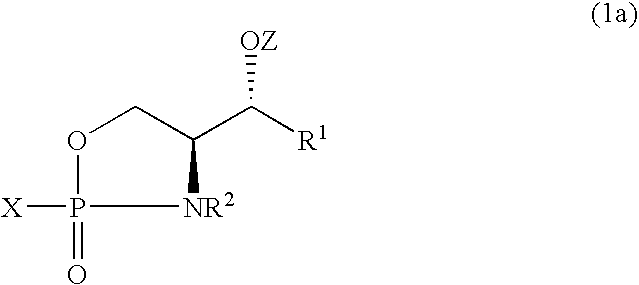
- the invention also provides a process for the manufacture of an oxazaphospholane compound of formula (1) or its 2S, 3R stereoisomer (1a), the process comprises reacting a phosphorylating reagent with a 3-O-protected sphingoid compound of the following formula (2):
- R 1 , Z and X are as defined and Y is an amine or amino group (i.e. any amine or amino containing group).
- any oxazaphospholane compound of formula (1) or (1a) obtainable by the above process forms part of the invention.
- the invention also concerns the use of the oxazaphospholane compound of formula (1) or (1a) either as an isolated starting material, or as crude material obtained from the sphingoid compound of formula (2), for the preparation of several significant sphingomyelin intermediates.
- R 1 , R 2 and Z are as defined, and R 3 represent a hydrogen atom.
- an aliphatic moiety selected from aliphatic chain, amino aliphatic chain, heteroatom comprising aliphatic chain, aliphatic chain comprising a cyclic ring which ring may be saturated, partially saturated ring or an aryl group, said aliphatic chain may be branched or straight, saturated or unsaturated chain; or ether, polyether or sugar moiety; the process comprises the step of reacting said oxazaphospholane of formula (1) with an alcohol of the formula R 3 OH where R 3 is as defined, in the presence of an aqueous base or an aqueous acid.
- R 3 represent a hydrogen atom; an aliphatic moiety selected from aliphatic chain, amino aliphatic chain, heteroatom comprising aliphatic chain, aliphatic chain comprising a cyclic ring which ring may be saturated, partially saturated or aromatic ring, said aliphatic chain may be branched or straight, saturated or unsaturated chain; or ether, polyether or sugar moiety; and R 4 represents a hydrophobic group;
- the process comprises preparing an oxazaphospholane of formula (3) and reacting the oxazaphospholane of formula (3) with an acyl compound of formula R 4 C(O)Q, wherein Q is a leaving group, which may be the same or different from X.
- the process comprises preparing an oxazaphospholane of formula (4) as defined and reacting said oxazaphospholane of formula (4) with protecting group removing agent to obtain a said sphingomyelin.
- the invention provides any sphingomyelin analogue (5) or intermediate thereof having the general formulae (3) and (4) obtainable by the sequence processes of the invention, preferably, those obtained by the sequence of processes of the present invention.
- the process comprises reacting said oxazaphospholane of formula (1) with an aqueous base or an aqueous acid.
- the acyclic oxazaphospholane having the following formula (6) also forms part of the invention.
- the invention concerns the use of sphingomyelin and sphingomyelin analogous obtainable by the above disclosed sequence of synthetic reaction in the preparation of pharmaceutical compositions and such therapeutic compositions per se.
- sphingomyelin (5) denotes a sphingomyelin of the general formula (5) as defined hereinbelow.
- R 1 , R 4 representing a hydrophobic group (which may be the same or different), and R 3 representing any one of a hydrogen atom; an aliphatic moiety selected from aliphatic chain, amino aliphatic chain, heteroatom comprising aliphatic chain, aliphatic chain comprising a cyclic ring which ring may be saturated, partially saturated ring or an aryl group, said aliphatic chain may be branched or straight, saturated or unsaturated chain; or ether, polyether or sugar moiety.
- SPMs may be obtained from natural sources or synthetically in small scale production.
- the synthetic approaches exerted by different groups vary mainly by the strategy of introducing the phosphate moiety into the ceramide backbone.
- Most of the procedures are multistep procedures, which require isolation and purification of the intermediates (typically by column chromatography).
- the procedures described in the art use appropriately substituted phosphoryl chlorides or phosphoramidites as phosphorylation reagents.
- the present invention is based on the surprising finding that an inexpensive and widely available reagent POCl 3 , which is extensively utilized for several decades in phospholipids synthesis, is suitable for the production of different Sphingolipids in a single pot process.
- This single pot process may be easily utilized for large scale production of any of the Sphingolipids detailed herein.
- the term “single pot process” denotes that in a sequence of synthesis reactions there is no need for the isolation and purification (even partial purification) of intermediates obtained by each chemical reaction step, until the synthesis of the product at the end of the sequence. Nonetheless, it should be understood that if desired, each intermediate product in the sequence of synthesis reactions may as well be isolated and purified and thus used for other purposes.
- oxazaphospholane (1), sphingomyelin (5), sphingosine-1-phosphate (7) lysosphingomyelin (8) and their 2S, 3R stereoisomer as well as their chemical analogs and precursors may be prepared by an economically feasible procedure, making use of widely available phosphorylation reagents.
- R 1 represents a hydrophobic group and R 2 represent a hydrogen atom or a hydrophobic group, Z represents a protecting group and X represents a leaving group.
- R 1 represents a C 1 -C 24 aliphatic moiety which may be saturated or unsaturated, branched or linear chain, optionally containing an aliphatic ring; and R 2 represents a hydrogen atom or a C 1 -C 24 aliphatic moiety selected from saturated or unsaturated, branched or linear aliphatic chain, said aliphatic chain optionally containing an aliphatic ring; the aliphatic chain or ring optionally substituted with one or more substituents containing a heteroatom selected from oxygen, halogen, nitrogen and sulfur.
- the invention concerns an oxazaphospholane compound wherein said R 1 represents a C 8 -C 24 aliphatic moiety.
- the invention concerns an oxazaphospholane wherein said R 2 represents a hydrogen atom or a saturated or unsaturated C 8 -C 24 aliphatic moiety, however, preferably a hydrogen atom.
- X is a leaving group.
- the term “leaving group” as used herein in connection with the substituent X or Q denotes any chemical moiety which in the presence of a nucleophilic reagent is replaced by the nucleophile. Under these conditions it is to be understood that X also denotes the nucleophilic moiety after substituting the leaving group (as a result of the nucleophilic attack).
- Non-limiting examples of a leaving group include a halogen atom, borate, ethylene chlorophosphite, methyl phosphodichloridite, chloro-N,N-diisopropylaminomethyxophosphite or [(isopropyl) 2 N] 2 POCH 2 CH 2 CN.
- X represents a halogen, preferably Cl.
- X is substituted (preferably as a result of a substitution reaction) with a group selected from an alcohol containing an aliphatic moiety selected from aliphatic chain, amino aliphatic chain, heteroatom comprising aliphatic chain, aliphatic chain comprising a cyclic ring which ring may be saturated, partially saturated ring or an aryl group, said aliphatic chain may be branched or straight, saturated or unsaturated chain; or ether, polyether, or sugar moiety.
- X is —O—CH 2 —CH 2 —N + (CH 3 ) 3 .
- preferred Z protecting groups are, without being limited thereto, methoxymethyl (MOM), tetrahydropyranyl (THP), diphenylmethyl, triethylsilyl (TES), t-butyldimethylsilyl (TBDMS), mesitoate, 9-fluorenylmethyl carbonate (f-moc), t-butyl carbamate (t-boc).
- MOM methoxymethyl
- THP tetrahydropyranyl
- TES triethylsilyl
- TDMS t-butyldimethylsilyl
- mesitoate 9-fluorenylmethyl carbonate
- f-moc 9-fluorenylmethyl carbonate
- t-boc t-butyl carbamate
- Z represents a compound Si(R 5 ) 3 wherein R 5 may be the same or different in the same moiety and represent a C 1 -C 6 branched or straight alkyl group or an aryl group. It should be understood that aryl includes a substituted as well as non-substituted aromatic ring.
- a preferred Z group is Si(Ph) 2 (t-Bu).
- R 1 , R 2 , X and Z being as defined above.
- oxazaphospholane (1) is that in which R 1 is (E)-CH ⁇ CHC 13 H 27 , R 2 is hydrogen, X is Cl and Z is Si(Ph) 2 (t-Bu), having the formula (1b).
- oxazaphospholane (1) is that in which R 1 is (E)-CH ⁇ CHC 13 H 27 , R 2 is hydrogen, X is substituted with the group —O—CH 2 —CH 2 —N + (CH 3 ) 3 .
- oxazaphospholane (1) or (1a) may be isolated and is substantially stable.
- the invention also concerns a process for the manufacture of the oxazaphospholane (1), (1a) or (1b).
- the process comprises reacting with a phosphorylating reagent with a 3-O-protected sphingoid compound of the following formula (2):
- R 1 , Z and X are as defined and Y is an amine or an amino group.
- amino group denotes any amine containing moiety known in the art, including alkylamine (saturated as well as unsaturated, branched or straight), amino alcohols, arylamines, aminothiols, amino sugars etc.
- Y represents NH 2 .
- the starting material in the above process is the sphingoid compound of the following formula (2a):
- phosphorylating reagent denotes any reagent having a reactive P ⁇ O moiety which may be reacted with the hydroxyl and Y group of compound (2) so as to form a cyclic oxazaphospholane (1).
- a phosphorylating reagent include a compound having the general formula POW 3 , in which W represents a halogen atom, borate, ethylene chlorophosphite, methyl phosphodichloridite, chloro-N,N-diisopropylaminomethyxophosphite or [(isopropyl) 2 N] 2 POCH 2 CH 2 CN.
- a preferred phosphorylating reagent is POCl 3 .
- the invention concerns any oxazaphospholane (1) as well as its stereoisomers, whenever prepared by the process of the invention, as well as by any other process.
- oxazaphospholane (1) may be utilized in various applications and processes, including as a starting (or intermediate) material in the preparation of oxazaphospholane derivatives, sphingomyelin and sphingomyelin derivatives. While the following processes are described with reference to oxazaphospholane (1) as the starting material, it should be understood that the following products may be obtained from the source of oxazaphospholane (1) being the corresponding sphingoid (2), thereby not necessitating the isolation of oxazaphospholane (1) during the processes.
- oxazaphospholane (1) or (1a) is used for the manufacture of an acyclic oxazaphospholane derivative having the following formula (3):
- the process comprises the step of reacting oxazaphospholane (1) with an alcohol of the formula R 3 OH where R 3 is as defined (although not a hydrogen atom), followed by treatment with an aqueous base or aqueous acid.
- the alcohol of preference is selected from choline, N-protected ethanolamines, oligoethyleneglycol monoethers, polyethyleneglycol monoehthers, polyethers, or sugar moiety. Nonetheless, choline is one preferred embodiment.
- aqueous base should be understood by those versed in the art as any organic or inorganic aqueous reagent known in the art of organic synthesis and capable of opening the cyclic phosphorous moiety, by cleaving the P—N bond therein, resulting in the acyclic oxazaphospholane derivate (3).
- reagents are known in the art and the following should be construed as a non-limiting list of such reagents: trialkylamine, alkali metal- or alkali earth metal-hydroxide, carbonate or bicarbonate.
- Specific aqueous bases include triethylamine, sodium carbonate, sodium bicarbonate, sodium hydroxide, potassium hydroxide.
- the aqueous acid according to the invention may be any organic or inorganic acid known in the art of organic synthesis.
- Preferred acids are strong mineral acids and Lewis acids as known in the art.
- One particular example is HCl.
- Oxazaphospholane (3) may be obtained in an unprotected from by reacting the compound with a suitable protecting group removing agent as known in the art [T. W Greene, P. G. M Wuts, Protective Groups in Organic Synthesis, Second Edition, (1980), John Wiley & Sons, Inc.].
- a suitable protecting group removing agent as known in the art [T. W Greene, P. G. M Wuts, Protective Groups in Organic Synthesis, Second Edition, (1980), John Wiley & Sons, Inc.].
- the unprotected form of the 2S, 3R stereoisomer compound (3a) is shown the Scheme 1 hereinbelow as compound of formula (8a).
- Oxazaphospholane (1) or (1a) wherein R 1 , and Z are as defined and R 2 is a hydrogen atom may also be used for the manufacture of an acyclic oxazaphospholane derivative having the following formula (4):
- the process comprises reacting oxazaphospholane (3) with an acyl compound of formula R 4 C(O)Q, wherein Q is a leaving group, as defined herein with respect to X, and may be the same or different from X.
- R 4 represents a C 1 -C 24 aliphatic moiety selected from saturated or unsaturated, branched or linear aliphatic chain, said aliphatic chain optionally containing an aliphatic ring; the aliphatic chain or ring optionally substituted with one or more substituents containing a heteroatom selected from oxygen, halogen, nitrogen and sulfur.
- R 4 represents a saturated or unsaturated C 8 -C 24 aliphatic chain.
- Oxazaphospholane (1) may also be used for the preparation of sphingomyelin and sphingomyelin analogues of formula (5) or its corresponding 2S, 3R stereoisomer (5a).
- the invention concerns any synthetic sphingomyelin of formula (5) or (5a) as defined herein, excluding those previously described by Bruzik et al. [Bruzik, K. S. J. Chem. Soc., Perkin Trans. 1: 423-431, 1988] or in U.S. Pat. No. 5,220,043.
- specific sphingomyelin excluded by the present invention are those in which when R 2 represents a palmitoyl or stearoyl group, R 1 cannot represent trans-CH ⁇ CHC 13 H 27 and R 3 cannot represent CH 2 CH 2 N + (CH 3 ) 3 .
- the synthetic sphingomyelin and analogues thereof obtainable by the synthetic process according to the invention may have numerous applications.
- sphingomyelin and sphingomyelin analogues are excellent candidates for drug delivery formulations based on liposomes and other lipid assemblies as well as inducing reverse cholesterol transport in cardiovascular diseases.
- the person skilled in the art will recognize the pharmacological and biochemical potential of the sphingomyelin and sphingomyelin analogues according to the invention and how they can be used in the medicinal and pharmaceutical industry.
- One specific example for the use of sphingomyelins according to the invention and the intermediates thereof is in the preparation of liposomes.
- a sphingomyelin of formula (5) is prepared from Oxazaphospholane (1) in which R 2 is a hydrogen atom and R 1 , R 3 and R 4 are as defined above.
- the process comprises reacting oxazaphospholane (4) with a protecting group removing agent to obtain a said sphingomyelin or sphingomyelin derivative.
- protecting group removing agent should be understood in the art of organic synthesis as any agent capable of cleaving out the specific protecting group [T. W Greene, P. G. M Wuts, Protective Groups in Organic
- Some such agents include Tetrabutylammonium fluoride, Hydrogen fluoride, Borontrifluride etherate, strong acids as sulfuric acid, tosylic acid etc.
- the invention also concerns the use of oxazaphospholane (1) or (1a) for the manufacture of an acyclic oxazaphospholane having the following formula (6):
- the process comprises reacting oxazaphospholane (1) with an aqueous base or an aqueous acid as defined.
- Oxazaphospholane (6) may be obtained in its unprotected form by reacting the compound with a suitable removing reagent [T. W Greene, P. G. M Wuts, Protective Groups in Organic Synthesis, Second Edition, (1980), John Wiley & Sons, Inc.]
- the invention concerns any oxazaphospholane, oxazaphospholane intermediates and sphingomyelin compounds and derivatives described herein, whenever obtained by the processes of the invention, either in the protected (i.e. including the Z substituent) or unprotected form.
- derivatives which is used interchangeably with the term analogous denotes any compound within the scope of the general formulae provided herein which may be provided also by the synthetic procedures of the present invention.
- the different processes of the invention may include one or more purification steps of the compounds thus obtained, or used in their crude form for further synthetic procedures, either those disclosed herein or other any other synthetic procedure which may make use of the compounds of the invention.
- the purification may include filtration followed, if desired, by column chromatography on Silica gel using a proper eluent as known in the art.
- sphingolipid (2) or its corresponding (2a) may be obtained by the process described in the following Scheme 2, using N-protected diolamine compound.
- the N-protected diolamine (Z′ being the protecting group) is reacted with a selective primary alcohol protecting group Z′′ (step (i)) followed by protecting a secondary alcohol in the 3 position with a second protecting group Z (step (ii)), where Z, Z′, and Z′′ being different protecting groups.
- step (i) selective primary alcohol protecting group
- step (ii) selective primary alcohol protecting group
- step (ii) selective primary alcohol protecting group
- Z Z′, and Z′′ being different protecting groups.
- Z, Z′, and Z′′ being different protecting groups.
- selectively removing the primary protecting group Z′′ on the alcohol in position 1 (step iii) and the protecting group Z′ on the amine in position 2 (step (iv) The removal of Z′′ and Z′ may be performed sequentially (steps (iii) and (iv)) or simultaneously (step (v)).
- N-tert-Butoxycarbamoyl-D-erythro-sphingosine (670 g, 1.67 mol) was dissolved in dry dichloromethane (12 L) and imidazole (284 g, 4.18 mol) and tert-Butyldimethylchlorosilane (277 g, 1.84 mol) were subsequently added. After stirring for 2.5 h at room temperature (RT) the reaction was completed and additional amounts of imidazole (114 g, 0.75 mol) and tert-Butyldiphenylchlorosilane (686 ml, 2.2 mol) were added. The reaction mixture was stirred for an additional period of 12 h followed by washing with water, evaporated and redissolved in EtOH (18 L).
- reaction mixture was dried over magnesium sulfate, filtered, and the pH was basified with triethylamine. The precipitation was filtered, the filtrate was evaporated to dryness and then redissolved in a solvent mixture consisting of chloroform, methanol and water (8:4:3). The lower phase was separated and washed 4 times with the same upper phase and evaporated.
- the crude product was dissolved in 45 ml. of 1M tetrabutylammonium fluoride in THF and the reaction mixture was stirred at 45° C. for 2 hours. The resulting solution was evaporated and the crude product was purified by silicagel chromatographic column. (Eluent: gradual mounting concentration of methanol in chloroform).
- a solution of compound 1a prepared from 8 gr. of compound 2a was dissolved in 400 ml. THF and 18 ml. of concentrated HCl was added. Reaction mixture was cooled to ⁇ 20° C. and filtered. Ammonia solution (13 ml) was added in order to neutralize the reaction mixture and the substance obtained was evaporated. The residue obtained was evaporated to dryness, and the residue was dissolved in 400 ml. of a solvent mixture consisting of chloroform, methanol and water (8:4:3) and the lower phase was separated.
- the product obtained was suspended in 30 ml. THF, 4.4 ml of 1M THF solution of tetrabutylammonium fluoride was added thereto and the reaction was stirred at 45° C. for 2 hours. The reaction mixture was evaporated and the residue was purified on a silicagel chromatographic column using methanol chloroform mixture 1:1 as eluent.
Landscapes
- Chemical & Material Sciences (AREA)
- Organic Chemistry (AREA)
- Health & Medical Sciences (AREA)
- Life Sciences & Earth Sciences (AREA)
- Biochemistry (AREA)
- General Health & Medical Sciences (AREA)
- Molecular Biology (AREA)
- Pharmaceuticals Containing Other Organic And Inorganic Compounds (AREA)
- Medicinal Preparation (AREA)
Abstract
Description




Claims (24)


Priority Applications (1)
| Application Number | Priority Date | Filing Date | Title |
|---|---|---|---|
| US10/586,056 US7687652B2 (en) | 2004-01-15 | 2005-01-13 | Sphingomyelin, intermediates thereof and methods for preparation of same |
Applications Claiming Priority (3)
| Application Number | Priority Date | Filing Date | Title |
|---|---|---|---|
| US53650704P | 2004-01-15 | 2004-01-15 | |
| PCT/IL2005/000043 WO2005068480A1 (en) | 2004-01-15 | 2005-01-13 | Sphingomyelin, intermediates thereof and methods for preparation of same |
| US10/586,056 US7687652B2 (en) | 2004-01-15 | 2005-01-13 | Sphingomyelin, intermediates thereof and methods for preparation of same |
Publications (2)
| Publication Number | Publication Date |
|---|---|
| US20070282120A1 US20070282120A1 (en) | 2007-12-06 |
| US7687652B2 true US7687652B2 (en) | 2010-03-30 |
Family
ID=34794414
Family Applications (1)
| Application Number | Title | Priority Date | Filing Date |
|---|---|---|---|
| US10/586,056 Expired - Fee Related US7687652B2 (en) | 2004-01-15 | 2005-01-13 | Sphingomyelin, intermediates thereof and methods for preparation of same |
Country Status (6)
| Country | Link |
|---|---|
| US (1) | US7687652B2 (en) |
| EP (1) | EP1704155A1 (en) |
| JP (1) | JP2007517860A (en) |
| AU (1) | AU2005205245A1 (en) |
| CA (1) | CA2552797A1 (en) |
| WO (1) | WO2005068480A1 (en) |
Cited By (3)
| Publication number | Priority date | Publication date | Assignee | Title |
|---|---|---|---|---|
| WO2016195888A1 (en) | 2015-06-03 | 2016-12-08 | Mjn U.S. Holdings Llc | Nutritional compositions containing an elevated level of inositol and uses thereof |
| US9643915B2 (en) | 2013-03-15 | 2017-05-09 | Cerenis Therapeutics Holding Sa | Methods for the synthesis of sphingomyelins and dihydrosphingomyelins |
| US9708354B2 (en) | 2013-03-15 | 2017-07-18 | Cerenis Therapeutics Holding Sa | Methods for the synthesis of sphingomyelins and dihydrosphingomyelins |
Families Citing this family (1)
| Publication number | Priority date | Publication date | Assignee | Title |
|---|---|---|---|---|
| CN112930615B (en) * | 2019-11-27 | 2022-06-03 | 宁德时代新能源科技股份有限公司 | Electrolyte for lithium ion battery, battery module, battery pack and device |
Citations (6)
| Publication number | Priority date | Publication date | Assignee | Title |
|---|---|---|---|---|
| US5220043A (en) | 1991-03-21 | 1993-06-15 | Ohio University | Synthesis of D-erythro-sphingomyelins |
| WO1993019760A1 (en) | 1992-04-03 | 1993-10-14 | The Biomembrane Institute | Method for inhibition of cell motility by sphingosine-1-phosphate, its derivatives and mimetics and method of synthesizing sphingosine-1-phosphate and its derivatives |
| WO1995021848A1 (en) | 1994-02-14 | 1995-08-17 | The United States Of America, Represented By The | Sphingoid bases and methods for their preparation and use |
| WO1999041266A1 (en) | 1998-02-12 | 1999-08-19 | Emory University | Sphingolipid derivatives and their methods of use |
| JP2003137894A (en) | 2001-11-06 | 2003-05-14 | National Institute Of Advanced Industrial & Technology | Amino alcohol phosphate compound, production method, and method of using the same |
| JP2004002215A (en) | 2002-05-23 | 2004-01-08 | National Institute Of Advanced Industrial & Technology | Method for producing sphingolipid derivatives |
-
2005
- 2005-01-13 AU AU2005205245A patent/AU2005205245A1/en not_active Abandoned
- 2005-01-13 CA CA002552797A patent/CA2552797A1/en not_active Abandoned
- 2005-01-13 EP EP05703086A patent/EP1704155A1/en not_active Withdrawn
- 2005-01-13 US US10/586,056 patent/US7687652B2/en not_active Expired - Fee Related
- 2005-01-13 JP JP2006548580A patent/JP2007517860A/en active Pending
- 2005-01-13 WO PCT/IL2005/000043 patent/WO2005068480A1/en not_active Ceased
Patent Citations (6)
| Publication number | Priority date | Publication date | Assignee | Title |
|---|---|---|---|---|
| US5220043A (en) | 1991-03-21 | 1993-06-15 | Ohio University | Synthesis of D-erythro-sphingomyelins |
| WO1993019760A1 (en) | 1992-04-03 | 1993-10-14 | The Biomembrane Institute | Method for inhibition of cell motility by sphingosine-1-phosphate, its derivatives and mimetics and method of synthesizing sphingosine-1-phosphate and its derivatives |
| WO1995021848A1 (en) | 1994-02-14 | 1995-08-17 | The United States Of America, Represented By The | Sphingoid bases and methods for their preparation and use |
| WO1999041266A1 (en) | 1998-02-12 | 1999-08-19 | Emory University | Sphingolipid derivatives and their methods of use |
| JP2003137894A (en) | 2001-11-06 | 2003-05-14 | National Institute Of Advanced Industrial & Technology | Amino alcohol phosphate compound, production method, and method of using the same |
| JP2004002215A (en) | 2002-05-23 | 2004-01-08 | National Institute Of Advanced Industrial & Technology | Method for producing sphingolipid derivatives |
Non-Patent Citations (28)
| Title |
|---|
| Barenholz, Y. et al., "A Calorimetric Study of the Thermotropic Behavior of Aqueous Dispersions of Natural and Synthetic Sphingomyelins," Biochemistry, 1976, pp. 2441-2447, vol. 15 (11). |
| Barenholz, Y. et al., "Sphingomyelins in Bilayers and Biological Membranes," Biochimica et Biophysica Acta, 1980, pp. 129-158, vol. 604, Elsevier/North-Holland Biomedical Press. |
| Barenholz, Yechezkel et al., "Sphingomyelin: Biophysical Aspects," Chemistry and Physics of Lipids, 1999, pp. 29-34, vol. 102. |
| Benda, P. et al., "Testing of TKT Medium for Streptococcus agalactiae Screening in Bulk Milk Samples," Vet. Med.-Czech., 1997, pp. 71-80, vol. 42 (3). |
| Bruzik, Karol S., "Synthesis and Spectral Properties of Chemically and Stereochemically Homogenous Sphingomyelin and its Analogues," Journal of the Chemical Society Perkin Transactions 1, 1988, pp. 423-431. |
| Deigner et al., (2) {Rapid synthesis of 2-desoxy-2-amino-3-phosphocholine-glycerinic-acid-alkylester, 1-alkyl-I-desoxy- and 1-o-alkyl-2-desoxy-2-amino-sn-glycero-3-phosphocholines,-3-phospho-N,N′-dimethylethanolamine and-3-phospho-Fmoc-serine-methylester, Chemistry and Physics of Lipids, vol. 61, 1992, pp. 199-208}. * |
| Deigner et al., (2) {Rapid synthesis of 2-desoxy-2-amino-3-phosphocholine-glycerinic-acid-alkylester, 1-alkyl-I-desoxy- and 1-o-alkyl-2-desoxy-2-amino-sn-glycero-3-phosphocholines,-3-phospho-N,N'-dimethylethanolamine and-3-phospho-Fmoc-serine-methylester, Chemistry and Physics of Lipids, vol. 61, 1992, pp. 199-208}. * |
| Deigner et al., {Rapid synthesis of 2-desoxy-2-amino-3-phosphocholine-glycerinic-acid-alkylester, 1-alkyl-I-desoxy- and 1-o-alkyl-2-desoxy-2-amino-sn-glycero-3-phosphocholines,-3-phospho-N,N′-dimethylethanolamine and-3-phospho-Fmoc-serine-methylester, Chemistry and Physics of Lipids, vol. 61, 1992, pp. 199-208. * |
| Deigner et al., {Rapid synthesis of 2-desoxy-2-amino-3-phosphocholine-glycerinic-acid-alkylester, 1-alkyl-I-desoxy- and 1-o-alkyl-2-desoxy-2-amino-sn-glycero-3-phosphocholines,-3-phospho-N,N'-dimethylethanolamine and-3-phospho-Fmoc-serine-methylester, Chemistry and Physics of Lipids, vol. 61, 1992, pp. 199-208. * |
| Deigner et al., {Synthesis of [32P] labelled 1-O-alkyl-2-desoxy-2-amino-SN-glycero-3-phosphocholines, Journal of Labelled Compounds and Radiopharmceuticals, vol. 34, No. 2, 1994, pp. 185-190}. * |
| Deigner et al., Rapid synthesis of 2-desoxy-2-amino-3-phosphocholine-glycerinic-acid-alkylester, 1-alkyl-I-desoxy- and 1-o-alkyl-2-desoxy-2-amino-sn-glycero-3-phosphocholines,-3-phospho-N,N′-dimethylethanolamine and-3-phospho-Fmoc-serine-methylester, Chemistry and Physics of Lipids, vol. 61, 1992, pp. 199-208. * |
| Deigner et al., Rapid synthesis of 2-desoxy-2-amino-3-phosphocholine-glycerinic-acid-alkylester, 1-alkyl-I-desoxy- and 1-o-alkyl-2-desoxy-2-amino-sn-glycero-3-phosphocholines,-3-phospho-N,N'-dimethylethanolamine and-3-phospho-Fmoc-serine-methylester, Chemistry and Physics of Lipids, vol. 61, 1992, pp. 199-208. * |
| Deigner et al., Synthesis of [32P] labelled 1-O-alkyl-2-desoxy-2-amino-sn-glycero-3-phosphocholines, Journal of Labelled Compounds and Radiopharmceuticals, vol. 34, No. 2, 1994, pp. 185-190. * |
| Do, Un Hoi et al., "Mild Alkali-stable Phospholipids in Chicken Egg Yolks: Characterization of 1-Alkenyl and 1-Alkyl-SN-Glycero-3-Phosphoethanolamine, Sphingomyelin, and 1-Alkyl-SN-Glycero-3-Phosphocholine," Journal of Lipid Research, 1980, pp. 888-894, vol. 21. |
| Eckhardt, Erik R.M. et al., "Dietary Sphingomyelin Suppresses Intestinal Cholesterol Absorption by Decreasing Thermodynamic Activity of Cholesterol Monomers," Gastroenterology, 2002, pp. 948-956, vol. 122, American Gastroenterological Association. |
| Greene, T.W. et al., Protective Groups in Organic Synthesis, Second Edition, 1980, John Wiley & Sons, Inc. |
| He, Zheng-Jie et al., "Synthesis of Novel Optically Active Cyclic Phospholipid Conjugates of Tegafur and Uridine starting from L-serine," Phosphorous, Sulfur and Silicon, 2000, pp. 223-232, vol. 160, Overseas Publishers Association Amsterdam N.V., Malaysia. |
| Kratzer, Bernd et al., "Efficient Synthesis of Sphingosine-1-phosphate, Ceramide-1-phosphate, Lysosphingomyelin, and Sphingomyelin," Liebigs Annalen, 1995, pp. 957-963, VCH Verlagsgesellschaft mbH, Weinheim, Germany. |
| Lorene et al., {Synthesis of N-Lost derivatives. II. Reaction of N,N-bis(2-chloroethyl) phosphoramidic dichloride with 1-aminopropane-2,3-diol, Archiv Der Pharmazie (Weinheim, Germany) , 319(11), 1023-7, 1986}. * |
| Lorene et al., Synthesis of N-Lost derivatives. II. Reaction of N,N-bis(2-chloroethyl) phosphoramidic dichloride with 1-aminopropane-2,3-diol, Archiv Der Pharmazie (Weinheim, Germany) , 319(11), 1023-7, 1986. * |
| Lorene et al., Synthesis of N-Lost derivatives. II. Reaction of N,N-bis(2-chloroethyl)phosphoramidic dichloride with 1-aminopropane-2,3-diol, Archiv Der Pharmazie (Weinheim, Germany) , 319(11), 1023-7, 1986. * |
| Lorenz, Peter et al., "Synthesis of N-Lost derivatives. II. Reaction of N-bis(2-chloroethyl)phosphoramidic dichloride with 1-Aminopropane-2,3-diol," Archiv der Pharmazie, 1986, pp. 1023-1027, vol. 319 (11), VCH Verlagsgesellschaft mbH, Weinheim, Germany. |
| Martin, M.-J. et al., "Distribution of Bovine Milk Sialoglycoconjugates During Lactation," Journal of Dairy Science, 2001, pp. 995-1000, vol. 84, American Dairy Science Association. |
| Martin, María-Jesús. et al., "Bovine Milk Gangliosides: Changes in Ceramide Moiety with Stage of Lactation," Lipids, 2001, pp. 291-298, vol. 36 (3), AOCS Press. |
| Morrison, W.R. et al., "Polar Lipids in Bovine Milk: II. Long-chain Bases, Normal and 2-Hydroxy Fatty Acids, and Isomeric CIS and TRANS Monoenoic Fatty Acids in the Sphingolipids," Biochimica et Biophysica Acta, 1970, pp. 460-467, vol. 202. |
| Ramstedt, Bodil et al., "Comparison of the Biophysical Properties of Racemic and d-Erythro-N-Acyl Sphingomyelins," Biophysical Journal, Sep. 1999, pp. 1498-1506, vol. 77 (3), Biophysical Society. |
| Thompson, Charles M. et al., "Synthesis, Configuration, and Chemical Shift Correlations of Chiral 1,3,2-oxazaphospholidin-2-ones derived from I-Serine," Journal of Organic Chemistry, 1990, pp. 111-116, vol. 55, American Chemical Society. |
| Zanglis, Anthony et al., "The Biological Activity of Acetylated Sphingosylphosphorylcholine Derivatives," International Jounal of Biochemistry & Cell Biology, 1996, pp. 63-74, vol. 28 (1), Elsevier Science Ltd., Great Britain. |
Cited By (4)
| Publication number | Priority date | Publication date | Assignee | Title |
|---|---|---|---|---|
| US9643915B2 (en) | 2013-03-15 | 2017-05-09 | Cerenis Therapeutics Holding Sa | Methods for the synthesis of sphingomyelins and dihydrosphingomyelins |
| US9708354B2 (en) | 2013-03-15 | 2017-07-18 | Cerenis Therapeutics Holding Sa | Methods for the synthesis of sphingomyelins and dihydrosphingomyelins |
| WO2016195888A1 (en) | 2015-06-03 | 2016-12-08 | Mjn U.S. Holdings Llc | Nutritional compositions containing an elevated level of inositol and uses thereof |
| US10525016B2 (en) | 2015-06-03 | 2020-01-07 | Mead Johnson Nutrition Company | Nutritional compositions containing an elevated level of inositol and uses thereof |
Also Published As
| Publication number | Publication date |
|---|---|
| US20070282120A1 (en) | 2007-12-06 |
| AU2005205245A1 (en) | 2005-07-28 |
| CA2552797A1 (en) | 2005-07-28 |
| JP2007517860A (en) | 2007-07-05 |
| WO2005068480A1 (en) | 2005-07-28 |
| EP1704155A1 (en) | 2006-09-27 |
Similar Documents
| Publication | Publication Date | Title |
|---|---|---|
| US8519170B2 (en) | Compounds for preparing immunological adjuvant | |
| CA2395197C (en) | Acyl pseudodipeptides which carry a functionalised auxiliary arm | |
| US9708354B2 (en) | Methods for the synthesis of sphingomyelins and dihydrosphingomyelins | |
| US20140316154A1 (en) | Methods for the synthesis of sphingomyelins and dihydrosphingomyelins | |
| CA2812178C (en) | Methods for the synthesis of plasmalogens and plasmalogen derivatives, and therapeutic uses thereof | |
| JP3844866B2 (en) | Ceramide-like compound, method for producing the same, and cosmetic composition containing the same | |
| US20070282120A1 (en) | Sphingomyelin, Intermediates Thereof and Methods For Preparation Of Same | |
| JPH041759B2 (en) | ||
| DK168385B1 (en) | Use of oxazaphospholanes, oxazaphosphorinans or oxazaphosphepans as intermediates for the preparation of phosphatidyl compounds | |
| IL176717A (en) | Sphingomyelin, intermediates thereof and methods for preparation of same | |
| US7501533B2 (en) | Process for preparing lysophosphatidylcholine | |
| JP2511706B2 (en) | Phosphate ester | |
| CA2643260A1 (en) | Method and process for preparing cardiolipin | |
| JP2001181289A (en) | Phosphorylcholine derivatives and cosmetics | |
| JP2649343B2 (en) | Method for producing phosphate ester | |
| EP1562609B1 (en) | Inositolized phospholipids | |
| CN114213458A (en) | Distearoylphosphatidylcholine with cyclobutylamine end group and preparation method thereof | |
| HK1154864A (en) | Compounds for preparing immunological adjuvant |
Legal Events
| Date | Code | Title | Description |
|---|---|---|---|
| AS | Assignment |
Owner name: BIOLAB LTD, ISRAEL Free format text: ASSIGNMENT OF ASSIGNORS INTEREST;ASSIGNORS:ROCHLIN, ELIMELECH;HILDESHEIM, JEAN;BERLIN, ALISA;REEL/FRAME:019484/0376 Effective date: 20070603 Owner name: BIOLAB LTD,ISRAEL Free format text: ASSIGNMENT OF ASSIGNORS INTEREST;ASSIGNORS:ROCHLIN, ELIMELECH;HILDESHEIM, JEAN;BERLIN, ALISA;REEL/FRAME:019484/0376 Effective date: 20070603 |
|
| STCF | Information on status: patent grant |
Free format text: PATENTED CASE |
|
| FPAY | Fee payment |
Year of fee payment: 4 |
|
| MAFP | Maintenance fee payment |
Free format text: PAYMENT OF MAINTENANCE FEE, 8TH YR, SMALL ENTITY (ORIGINAL EVENT CODE: M2552) Year of fee payment: 8 |
|
| FEPP | Fee payment procedure |
Free format text: MAINTENANCE FEE REMINDER MAILED (ORIGINAL EVENT CODE: REM.); ENTITY STATUS OF PATENT OWNER: SMALL ENTITY |
|
| LAPS | Lapse for failure to pay maintenance fees |
Free format text: PATENT EXPIRED FOR FAILURE TO PAY MAINTENANCE FEES (ORIGINAL EVENT CODE: EXP.); ENTITY STATUS OF PATENT OWNER: SMALL ENTITY |
|
| STCH | Information on status: patent discontinuation |
Free format text: PATENT EXPIRED DUE TO NONPAYMENT OF MAINTENANCE FEES UNDER 37 CFR 1.362 |
|
| FP | Lapsed due to failure to pay maintenance fee |
Effective date: 20220330 |