US7657028B2 - Method for classifying private information securely - Google Patents
Method for classifying private information securely Download PDFInfo
- Publication number
- US7657028B2 US7657028B2 US11/246,764 US24676405A US7657028B2 US 7657028 B2 US7657028 B2 US 7657028B2 US 24676405 A US24676405 A US 24676405A US 7657028 B2 US7657028 B2 US 7657028B2
- Authority
- US
- United States
- Prior art keywords
- party
- applying
- bob
- secure
- steps
- Prior art date
- Legal status (The legal status is an assumption and is not a legal conclusion. Google has not performed a legal analysis and makes no representation as to the accuracy of the status listed.)
- Expired - Fee Related, expires
Links
- 238000000034 method Methods 0.000 title claims abstract description 19
- 239000013598 vector Substances 0.000 claims abstract description 30
- 238000011156 evaluation Methods 0.000 claims description 12
- 238000009825 accumulation Methods 0.000 claims description 4
- JDFUJAMTCCQARF-UHFFFAOYSA-N tatb Chemical compound NC1=C([N+]([O-])=O)C(N)=C([N+]([O-])=O)C(N)=C1[N+]([O-])=O JDFUJAMTCCQARF-UHFFFAOYSA-N 0.000 claims description 2
- 230000006870 function Effects 0.000 description 16
- 238000003066 decision tree Methods 0.000 description 6
- 238000012706 support-vector machine Methods 0.000 description 6
- 238000012549 training Methods 0.000 description 6
- 238000012546 transfer Methods 0.000 description 5
- 238000010586 diagram Methods 0.000 description 4
- 238000013528 artificial neural network Methods 0.000 description 3
- 241000153282 Theope Species 0.000 description 2
- 238000004891 communication Methods 0.000 description 2
- 230000007423 decrease Effects 0.000 description 2
- 238000012986 modification Methods 0.000 description 2
- 230000004048 modification Effects 0.000 description 2
- 230000001537 neural effect Effects 0.000 description 2
- 230000006978 adaptation Effects 0.000 description 1
- 239000000654 additive Substances 0.000 description 1
- 230000000996 additive effect Effects 0.000 description 1
- 238000013473 artificial intelligence Methods 0.000 description 1
- 230000004888 barrier function Effects 0.000 description 1
- 238000007418 data mining Methods 0.000 description 1
- 230000000694 effects Effects 0.000 description 1
- 238000010801 machine learning Methods 0.000 description 1
- 230000007246 mechanism Effects 0.000 description 1
- 238000010339 medical test Methods 0.000 description 1
- 230000003340 mental effect Effects 0.000 description 1
- 238000005192 partition Methods 0.000 description 1
- 238000003908 quality control method Methods 0.000 description 1
- 230000010076 replication Effects 0.000 description 1
- 230000005236 sound signal Effects 0.000 description 1
Images


Classifications
-
- H—ELECTRICITY
- H04—ELECTRIC COMMUNICATION TECHNIQUE
- H04L—TRANSMISSION OF DIGITAL INFORMATION, e.g. TELEGRAPHIC COMMUNICATION
- H04L9/00—Cryptographic mechanisms or cryptographic arrangements for secret or secure communications; Network security protocols
- H04L9/30—Public key, i.e. encryption algorithm being computationally infeasible to invert or user's encryption keys not requiring secrecy
- H04L9/3093—Public key, i.e. encryption algorithm being computationally infeasible to invert or user's encryption keys not requiring secrecy involving Lattices or polynomial equations, e.g. NTRU scheme
Definitions
- This invention relates generally to cooperative computing, and more particularly to performing cooperative computing in a secure manner using encryption techniques to classify private information.
- the Internet provides opportunities for cooperative computing. With cooperative computing, users and providers can exchange goods, services, and information.
- the Internet can also provide access to a classifier that can be used to classify data or signals.
- binary classification is the task of classifying objects into two groups on the basis of whether they have some predetermined property or not.
- Typical binary classification tasks include face recognition in images, medical testing of clinical data, and quality control of products.
- computer implemented classifiers automatically ‘learn’ a classification system.
- Well known methods suitable for learning binary classifiers include decision trees, Bayesian networks, support vector machines (SVM), and neural networks.
- Private information classification enables two parties, for example, Alice and Bob, to engage in a protocol that allows Alice to classify data using Bob's classifier without revealing anything to Bob (not even the classification result) and without learning anything about Bob's classifier, other than an answer to a classification request.
- PIC brings together the fields of machine learning and cooperative, multi-party computing, which is a sub-field of cryptography.
- Goldriech et al. extended the solution to n>2 parties, some of whom might be cheating, O. Goldreich, S. Micali and A. Wigderson, “How to play any mental game—a completeness theorem for protocols with honest majority,” 19th ACM Symposium on the Theory of Computing, pp. 218-229, 1987.
- Alice and Bob respectively determine a dot-product of their private data vectors without revealing anything other than the result to each other.
- Alice obtains the sum of the dot-product and some random number that is known only to Bob, while Bob learns nothing. This serves as a building block for more complex protocols.
- the OPE has also been used for learning a decision tree where the training data are held by two parties.
- the parties want to jointly learn a decision tree without revealing their private data to each other.
- each party learns the decision tree that was trained using the combined data, but the private data of one party is not revealed to the other party.
- PIC is an extension of private information retrieval (PIR).
- PIR private information retrieval
- Alice is interested in retrieving a data item from Bob's database without letting Bob know which element Alice selected. For example, Bob has a database of stock quotes and Alice would like to obtain the quote of a particular stock without letting Bob know which stock Alice selected. Bob is willing to let her do so. However, Bob wants to ensure that Alice can access one, and only one, stock quote.
- the invention provides a method for securely classifying private data x of a first party using a classifier H(x) of a second party.
- the classifier is
- h n ⁇ ( x ) ⁇ ⁇ n x T ⁇ y n > ⁇ n ⁇ n otherwise ; ⁇ n , ⁇ n , and ⁇ n are scalar values; and y n is a vector storing parameters of the classifier.
- the second party generates a set of N random numbers: s 1 , . . . , s N , such that
- N the following substeps are performed: applying a secure dot product to x T y n to obtain a n for the first party and b n for the second party; applying a secure millionaire protocol to determine whether a n is larger than ⁇ n ⁇ b n , returning a result of a n +s n or ⁇ n +s n , and accumulating, by the first party, the result in c n .
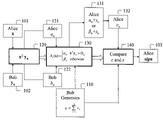
- FIG. 1 is a flow diagram for classifying private data using a secure threshold classifier according to an embodiment of the invention
- FIG. 2 is a flow diagram for classifying private data using a secure polynomial classifier according to an embodiment of the invention
- FIG. 3 is a flow diagram for classifying private data using a secure Gaussian function classifier according to an embodiment of the invention
- FIG. 4 is a flow diagram for classifying private data using a secure sigmoid classifier according to an embodiment of the invention.
- FIG. 5 is a chart of the pseudo-code for classifying private data using a secure k-nn kernel classifier according to an embodiment of the invention.
- a first party e.g., Alice
- a second party e.g., Bob
- a trained ‘strong’ classifier in the form of a function H(x).
- the strong classifier is a linear combination of weak classifiers h n (x), see Y. Freund and R. E. Schapire, “ A short introduction to boosting ,” Journal of Japanese Society for Artificial Intelligence, 14(5), pp. 771-780, September 1999, incorporated herein by reference.
- the notation x T y n is a dot product, as known in the art.
- the vector y n stores parameters of the classification function.
- Bob ‘learns’ the parameters y n using conventional mechanisms for training a classifier for a particular classification task, such as data recognition and, in particular, face recognition in images or sound recognition in an audio signal. It is well known how to classify data and how to train classifiers for various tasks.
- Alice has the private data x
- Bob has the parameters (N, h n ( ) and y n ).
- Alice learns sign(H(x)) and nothing else, and Bob learns nothing about the Alice's private data vector x.
- h n ⁇ ( x ) ⁇ ⁇ n x T ⁇ y n > ⁇ n ⁇ n otherwise , where a and ⁇ and ⁇ are scalar values, e.g., 1 and 0, that are learned by Bob during training.
- a polynomial classification function, h(x T y) (x T y+c) d , where c and d are scalar values known only to Bob.
- a Gaussian classification function, h(x T y) exp( ⁇ x ⁇ y ⁇ 2 2 ), where ⁇ is a scalar value known only to Bob.
- Gaussian function and sigmoid function can be approximated with a polynomial function.
- OPE oblivious polynomial evaluation
- An oblivious transfer enables Alice to select one element from a database of elements that Bob holds without revealing to Bob which element was selected, and without learning anything about the other elements in the database.
- the oblivious transfer protocol was described by Even et al. as a generalization of Rabin's ‘oblivious transfer’, S. Even, O. Goldreich and A. Lempel, “ A Randomized Protocol for Signing Contracts ,” Communications of the ACM 28, pp. 637-647, 1985, incorporated herein by reference, and M. O. Rabin, “ How to exchange secrets by oblivious transfer ,” Tech. Memo TR-81, Aiken Computation Laboratory, 1981, incorporated herein by reference.
- Bob has private elements M 0 and M 1 , and Alice wants to select one of the elements without letting Bob know which element Alice selected. Bob is willing to let her do so provided that Alice does not learn anything about the other elements.
- the following protocol based on RSA encryptions, can be used to solve the problem.
- the protocol is described below.
- Input Alice has the vector x and Bob has the vector y.
- the millionaire protocol uses the OT protocol. The idea is to have Alice and Bob represent their numbers in a binary format, scan the binary numbers, one bit at a time, from the most significant bit to the least significant bit, and then obtain the result.
- Bob For each bit, Bob prepares a lookup table that is based on his current bit value and two possible bit values of Alice. Alice uses OT 1 2 to obtain some intermediate result, and both Alice and Bob continue to the next bit.
- Bob constructs a six-way lookup table that includes the three states of s and the two possible values of the next bit of Alice's number.
- An output is a next state after evaluating the current bit.
- Input Alice and Bob have non-negative numbers x and y, respectively.
- Output Alice and Bob learn if x>y without revealing the numbers x or y.
- FIG. 1 shows the steps of one embodiment of the invention.
- Input Alice has input data vector x, and Bob has a strong classifier
- h n ⁇ ( x ) ⁇ ⁇ n x T ⁇ y n > ⁇ n ⁇ n otherwise is a weak classifier, a n , ⁇ n and ⁇ n are scalar values, e.g., 1 and 0, that are learned during training.
- the vector y n stores the parameters of Bob's classifier which Bob ‘learns’ using conventional training methods, such as decision trees, Bayesian networks, support vector machines (SVM), and neural networks.
- conventional training methods such as decision trees, Bayesian networks, support vector machines (SVM), and neural networks.
- FIG. 2 shows the steps of one embodiment of the invention.
- FIG. 3 shows the steps of one embodiment of the invention.
- Input Alice has input data x, and Bob has the classifier
- This protocol is a secure realization of a k-nn classifier.
- Alice has data x.
- the object is to find the label of the majority of the k vectors y i that are nearest to the data x.
- Alice and Bob have additive shares of a radial distance r, such that within the distance r, there are exactly k points y i 1 , . . . ,y i k .
- Alice and Bob can use a radius protocol, described below, to privately count the number of values and use their labels to privately determine correct label for the data x.
- the k-nn classifier is defined in terms of k and not the radius r, so we provide a protocol that can determine the radius r, given k.
- r k be the radius of the k th furthest point from the data x, and describe how to find r k , given k. After the radius r k is obtained, we can determine the label of x. We assume that Alice and Bob can determine private shares of a squared Euclidean distance d(x, y i ) between the point x and any of the points y i using the secure dot-product protocol discussed earlier.
- Input Alice has input data x and a private share r A of a radius r, and Bob has points y i and a private share, r B of the radius r.
- Output Alice learns a classification label of x, and nothing else, and Bob learns nothing.
- Input Alice has input data x, and Bob has a list of points y i and a value k.
- the invention provides a method for classifying private information using various dot product based classifiers, such as support vector machines (SVM), neural-networks, AdaBoost, and k-nn classifiers.
- SVM support vector machines
- AdaBoost AdaBoost
- k-nn classifiers k-nn classifiers
Landscapes
- Engineering & Computer Science (AREA)
- Pure & Applied Mathematics (AREA)
- General Physics & Mathematics (AREA)
- Mathematical Analysis (AREA)
- Mathematical Optimization (AREA)
- Mathematical Physics (AREA)
- Physics & Mathematics (AREA)
- Algebra (AREA)
- Computing Systems (AREA)
- Theoretical Computer Science (AREA)
- Computer Security & Cryptography (AREA)
- Computer Networks & Wireless Communication (AREA)
- Signal Processing (AREA)
- Information Retrieval, Db Structures And Fs Structures Therefor (AREA)
Abstract
where
and Θn are scalar values and yn is a vector storing parameters of the classifier. Bob generates a set of N random numbers, S1, . . . , SN, such that
for each n=1, . . . , N, the following substeps are performed: applying a secure dot product to xTyn to obtain an for Alice and bn for Bob; applying a secure millionaire protocol to determine whether an is larger than Θn−bn, and returning a result of an+Sn, or βn+Sn; accumulating, by Alice, the result in cn. Then, apply the secure millionaire protocol to determine whether
is larger than
and returning a positive sign if true, and a negative sign if false to classify the private data x.
Description
where
and Θn are scalar values; and yn is a vector storing parameters of the classifier.
For each n=1, . . . , N, the following substeps are performed: applying a secure dot product to xTyn to obtain an for the first party and bn for the second party; applying a secure millionaire protocol to determine whether an is larger than Θn−bn, returning a result of an+sn or βn+sn, and accumulating, by the first party, the result in cn.
is larger than
which returns a positive sign if true and a negative sign if false to classify the private data x.
using cryptographic tools, where the vector x ∈ FL and vectors {yn}n=1 N, where yn ∈ FL are L-dimensional vectors over a finite field F. The notation xTyn is a dot product, as known in the art.
where a and β and Θ are scalar values, e.g., 1 and 0, that are learned by Bob during training.
-
- 1. Bob sends Alice two different public encryption keys K0 and K1.
- 2. Alice generates a private key K, and encrypts her private key K with either of Bob's public encryption keys K0 or K1. For this example, Alice uses Bob's public key K0. Alice sends Bob E(K, K0), where E(K, K0) denotes the encryption of Alice's private key by Bob's public key.
- 3. Bob does not know which public key was used by Alice to encrypt her private key. Therefore, Bob decrypts E(K, K0) with both of his private keys. Thus, he obtains both the real key K and an erroneous key K′.
- 4. Bob sends Alice encryptions E(M0, K) and E(M1, K′). Alice decrypts the first of these messages with her private key K and obtains M0.
-
- 1. Bob generates a random vector b ∈ FL.
- 2. For each i=1, . . . , L, Alice and Bob perform the following sub-steps:
- (a) Bob constructs a |F|-dimensional vector a, for all possible values of element xi such that ai=xi*yi−bi
- (b) Alice uses the OT1 |F| with xi as an index to select an element from the vector a. Alice stores the result in ai.
- 3. Alice and Bob sum their private vectors a and b, respectively, to obtain the shares a and b of the dot-product xTy.
-
- 1. Bob defines three states {A, B, U} that correspond respectively to: Alice has a larger number, Bob has a larger number, and undecided. For each bit, Bob encodes {A, B, U} using a different permutation of the numbers {1, 2, 3}.
- 2. For the left most bit, Bob constructs a two-entry lookup table z(n), such that
| yn = 0 | yn = 1 | ||
| xn = 0 | U | B |
| xn = 1 | A | U |
-
- where yn is the most significant bit of the number y. If yn=0, then Bob should choose the left column, otherwise he should use the right column.
- 3. Alice uses OT1 2 with xn as an index to obtain s(n)=z(n)(xn).
- 4. For each i=n−1, . . . , 1, Alice and Bob conduct the following sub-steps:
- (a) Bob constructs a 6-entry lookup table z(i) that is indexed by s(i) and xi, such that
| yi = 0 | yi = 1 | ||
s(i+1) = A  |
A | A | ||
| s(i+1) = B |
B | B | ||
| s(i+1) = U |
U | B | ||
| s(i+1) = A |
A | A | ||
| s(i+1) = B |
B | B | ||
| s(i+1) = U |
A | U | ||
-
-
- If yi=0, then Bob should choose the left column, otherwise he should use the right column.
- (b) Alice uses OT1 6 with s(i+1) and xi as indices to obtain s(i)=z(i)(s(i+1), xi).
- 5. Bob sends Alice the meaning of the three states of s(1) of the least significant bit. Alice now knows which number is larger.
-
where
is a weak classifier, an, βn and Θn are scalar values, e.g., 1 and 0, that are learned during training.
-
- 1. Alice provides data x 101, and Bob provides N threshold classifiers hn(X), each with
hyperplane y n 102. Bob also generates 110 a set of N random numbers: s1, . . . , sN, such that
- 1. Alice provides data x 101, and Bob provides N threshold classifiers hn(X), each with
-
- 2. For each n=1, . . . , N, Alice and Bob perform the following sub-steps:
- (a) Alice and Bob obtain private shares an 121 and
b n 122, respectively, of the dot product xTyn 120 using the secure dot-product protocol. - (b) Alice and Bob use the secure millionaire protocol to determine 130 which number is larger: an or Θn−b. Instead of returning an or βn, the protocol returns as a
result 131 either an+sn, or βn+sn - (c) Alice stores the result in
c n 132.
- (a) Alice and Bob obtain private shares an 121 and
- 3. Alice and Bob use the secure millionaire protocol to determine 140 which of the numbers
- 2. For each n=1, . . . , N, Alice and Bob perform the following sub-steps:
-
- is larger. The result is a
sign 103. If Alice has a larger number, then x is classified positively, otherwise x is classified negatively.
- is larger. The result is a
where h(xTy)=(xTy+c)d, where c and d are parameters known only to Bob.
-
- 1. Alice provides data x 101, and Bob provides N polynomial classifiers hn(X), each with
hyperplane y n 102. Bob generates 110 a set of N random numbers: s1, . . . , sN, such that
- 1. Alice provides data x 101, and Bob provides N polynomial classifiers hn(X), each with
-
- 2. For each n=1, . . . , N, Alice and Bob perform the following sub-steps:
- (a) Alice and Bob obtain private shares an 121 and
b n 122, respectively, of the dot product xTyn 120, using the secure dot-product protocol. - (b) Bob constructs 230 a polynomial ƒn(a)=(an+bn+c)d+sn=(xTyn+c)d+sn.
- (c) Alice and Bob use the OPE protocol to evaluate and determine 235 ƒn(a) and
- (a) Alice and Bob obtain private shares an 121 and
- 2. For each n=1, . . . , N, Alice and Bob perform the following sub-steps:
-
- 3. Alice and Bob use the secure millionaire protocol to determine 240 which number is larger: r or s. If Alice has a larger number, then x is classified positively, otherwise x is classified negatively.
where hn(xTy)=exp(γ∥x−y∥2 2), a norm 2 or Euclidian distance, and γ is a scalar learned by Bob during training.
-
- 1. Alice provides data x 101, Bob provides N polynomial classifiers hn(x), each with
hyperplane y n 102. - 2. For each n=1, . . . , N, Alice and Bob conduct the following sub-steps:
- (a) Bob selects a random number sB and constructs 310 a function ƒ(z)=γz−sB, where z is a scalar.
- (b) Alice and Bob use OPE to obtain 320 a share sA 321 for Alice, where sA=ƒ(xTx), a secure dot product.
- (c) Alice and Bob obtain 330 shares rA 331 and
r B 332, respectively, of the dot product xT(−2γyn), using the secure dot-product protocol. - (d) Alice constructs tA=exp(sA)exp(rA) 333.
- (e) Bob constructs tB=exp(sB)exp(rB)exp(γyn Tyn) 334.
- (f) Alice and Bob obtain 340 private shares an 341 and
b n 342 of the dot product tAtB=exp(sA+rA+sB+rB+γyn Tyn)=exp(γ∥x−yn∥2 2), using the secure dot-product protocol.
- 3. Alice determines an accumulation
- 1. Alice provides data x 101, Bob provides N polynomial classifiers hn(x), each with
-
- and Bob determines an accumulation
-
- 4. Alice and Bob use the secure millionaire protocol to determine 350 the
sign 103 that indicates which number is larger: a or b. If Alice has a larger number then x is classified positively, otherwise x is classified negatively.
- 4. Alice and Bob use the secure millionaire protocol to determine 350 the
where h(xTy)=1/(1+exp(xTy)).
-
- 1. For each n=1, . . . , N, Alice and Bob perform the sub-steps:
- (a) Alice and Bob obtain 120 shares an 121 and
b n 122, respectively, of the dot product xTyn using the secure dot-product protocol, wherey n 102 is a vector supplied by Bob, as before. - (b) Alice and Bob determine 430 private shares sA 431 and
s B 432 such that sA+sB=exp(a)exp(b) using the secure dot-product protocol. - (c) Bob selects rB at random, and defines 440 ƒ(sA)=rB+rB(sA+sB)=rB(1+exp(xTyn)).
- (d) Alice and Bob use OPE to determine 450 rA=ƒ(sA).
- (e) Alice and Bob determine 460 shares tA, n and tB, n of the dot-product
- (a) Alice and Bob obtain 120 shares an 121 and
- 1. For each n=1, . . . , N, Alice and Bob perform the sub-steps:
-
-
- using the dot-product protocol.
- 2. Alice determines
-
-
- 3. Bob determines
-
- 4. Alice and Bob use the secure millionaire protocol to determine 480 the
sign 103 that indicates which number is larger: tA or −tB. If Alice has a larger number, then x is classified positively, otherwise x is classified negatively.
- 4. Alice and Bob use the secure millionaire protocol to determine 480 the
-
- 1. For each point yi, Alice and Bob perform the following sub steps:
- (a) Alice and Bob obtain private shares a and b of the dot product (−2x)Ty.
- (b) Bob defines sB=b+yTy and a function ƒ(z)=z+sB.
- (c) Alice and Bob use OPE to evaluate sA=ƒ(xTx+a), where sA is a private share of Alice.
- (d) Bob selects ui at random.
- (e) Alice and Bob compare sA−rA to rB−sB using the millionaire protocol. This is equivalent to comparing the squared Euclidean distance d(x, yi) to the radius r. If sA−rA<rB−sB AND c(yi)=1, then Bob returns ui+1, otherwise Bob returns ui. Alice stores the result in vi.
- 2. Alice and Bob determine
- 1. For each point yi, Alice and Bob perform the following sub steps:
-
- and
-
- respectively.
- 3. Alice and Bob compare v and u+k/2 using the millionaire protocol. If v>u+k/2, then x is labeled 1, otherwise the label is 0.
-
- 1. Alice and Bob select randomly rA and rB, respectively.
- 2. Do, until termination:
- (a) For each point yi, Alice and Bob perform the following sub-steps:
- i. Alice and Bob obtain shares a and b of the dot product (−2x)Tyi.
- ii. Bob defines sB=b+yi Tyi and a function ƒ(z)=z+sB.
- iii. Alice and Bob use OPE to evaluate sA=ƒ(xTx+a), where sA is a private share of Alice.
- iv. Bob selects ui at random.
- v. Alice and Bob use the millionaire protocol to compare sA−rA to rB−sB. This is equivalent to comparing the squared Euclidean distance d(x, yi) to r. If sA−rA<rB−sB, then Bob return ui+1, otherwise Bob returns ui. Alice stores the result in vi.
- (b) Alice and Bob determine
- (a) For each point yi, Alice and Bob perform the following sub-steps:
-
-
- and
-
-
-
- respectively.
- (c) Alice and Bob use the millionaire protocol to compare v to u+k and do the following:
- i. If v>u+k, then r is too large, and either Alice decreases rA by 1 or Bob decreases rB by 1, and repeat.
- ii. If v<u+k, then r is too small, and either Alice increases rA by 1, or Bob increases rB by 1, and repeat.
- iii. If v=u+k, terminate.
-
Claims (6)
Priority Applications (5)
| Application Number | Priority Date | Filing Date | Title |
|---|---|---|---|
| US11/246,764 US7657028B2 (en) | 2005-10-07 | 2005-10-07 | Method for classifying private information securely |
| JP2007516707A JP4937908B2 (en) | 2005-10-07 | 2006-10-03 | How to securely classify private data |
| DE602006006586T DE602006006586D1 (en) | 2005-10-07 | 2006-10-03 | Method for securely classifying private data |
| PCT/JP2006/320150 WO2007043490A1 (en) | 2005-10-07 | 2006-10-03 | Method for securely classifying private data |
| EP06798500A EP1932277B1 (en) | 2005-10-07 | 2006-10-03 | Method for securely classifying private data |
Applications Claiming Priority (1)
| Application Number | Priority Date | Filing Date | Title |
|---|---|---|---|
| US11/246,764 US7657028B2 (en) | 2005-10-07 | 2005-10-07 | Method for classifying private information securely |
Publications (2)
| Publication Number | Publication Date |
|---|---|
| US20070081664A1 US20070081664A1 (en) | 2007-04-12 |
| US7657028B2 true US7657028B2 (en) | 2010-02-02 |
Family
ID=37441779
Family Applications (1)
| Application Number | Title | Priority Date | Filing Date |
|---|---|---|---|
| US11/246,764 Expired - Fee Related US7657028B2 (en) | 2005-10-07 | 2005-10-07 | Method for classifying private information securely |
Country Status (5)
| Country | Link |
|---|---|
| US (1) | US7657028B2 (en) |
| EP (1) | EP1932277B1 (en) |
| JP (1) | JP4937908B2 (en) |
| DE (1) | DE602006006586D1 (en) |
| WO (1) | WO2007043490A1 (en) |
Cited By (2)
| Publication number | Priority date | Publication date | Assignee | Title |
|---|---|---|---|---|
| US9002007B2 (en) | 2011-02-03 | 2015-04-07 | Ricoh Co., Ltd. | Efficient, remote, private tree-based classification using cryptographic techniques |
| US11334547B2 (en) * | 2018-08-20 | 2022-05-17 | Koninklijke Philips N.V. | Data-oblivious copying from a first array to a second array |
Families Citing this family (11)
| Publication number | Priority date | Publication date | Assignee | Title |
|---|---|---|---|---|
| US7937270B2 (en) * | 2007-01-16 | 2011-05-03 | Mitsubishi Electric Research Laboratories, Inc. | System and method for recognizing speech securely using a secure multi-party computation protocol |
| US8055662B2 (en) * | 2007-08-27 | 2011-11-08 | Mitsubishi Electric Research Laboratories, Inc. | Method and system for matching audio recording |
| US8630409B2 (en) | 2011-04-05 | 2014-01-14 | International Business Machines Corporation | Two-party private estimation of dataset similarity |
| JP5737788B2 (en) * | 2011-12-16 | 2015-06-17 | インターナショナル・ビジネス・マシーンズ・コーポレーションInternational Business Machines Corporation | A system for sending messages via lost communication |
| US9390271B2 (en) * | 2012-08-06 | 2016-07-12 | Samsung Electronics Co., Ltd. | Vectorial private equality testing |
| US9141824B2 (en) * | 2013-04-30 | 2015-09-22 | Pitney Bowes Inc. | Dynamic database update in multi-server private information retrieval scheme |
| US9286549B1 (en) * | 2013-07-15 | 2016-03-15 | Google Inc. | Sublinear time classification via feature padding and hashing |
| US9672760B1 (en) * | 2016-01-06 | 2017-06-06 | International Business Machines Corporation | Personalized EEG-based encryptor |
| FR3047327B1 (en) * | 2016-01-28 | 2018-07-27 | Morpho | CRYPTOGRAPHIC CALCULATION EXECUTION METHOD AND APPLICATION TO CLASSIFICATION BY MEDIA VECTOR MACHINES |
| US20220108220A1 (en) * | 2020-10-02 | 2022-04-07 | Google Llc | Systems And Methods For Performing Automatic Label Smoothing Of Augmented Training Data |
| IL277760B2 (en) | 2020-10-02 | 2024-12-01 | Google Llc | Privacy preserving centroid models using secure multi-party computation |
Citations (1)
| Publication number | Priority date | Publication date | Assignee | Title |
|---|---|---|---|---|
| US20070053507A1 (en) * | 2005-09-02 | 2007-03-08 | Paris Smaragdis | Secure classifying of data with Gaussian distributions |
Family Cites Families (2)
| Publication number | Priority date | Publication date | Assignee | Title |
|---|---|---|---|---|
| JP2003067252A (en) * | 2001-08-22 | 2003-03-07 | Toshiba Corp | Information storage display system and information storage display method |
| US7305132B2 (en) * | 2003-11-19 | 2007-12-04 | Mitsubishi Electric Research Laboratories, Inc. | Classification in likelihood spaces |
-
2005
- 2005-10-07 US US11/246,764 patent/US7657028B2/en not_active Expired - Fee Related
-
2006
- 2006-10-03 WO PCT/JP2006/320150 patent/WO2007043490A1/en not_active Ceased
- 2006-10-03 EP EP06798500A patent/EP1932277B1/en not_active Not-in-force
- 2006-10-03 JP JP2007516707A patent/JP4937908B2/en not_active Expired - Fee Related
- 2006-10-03 DE DE602006006586T patent/DE602006006586D1/en active Active
Patent Citations (1)
| Publication number | Priority date | Publication date | Assignee | Title |
|---|---|---|---|---|
| US20070053507A1 (en) * | 2005-09-02 | 2007-03-08 | Paris Smaragdis | Secure classifying of data with Gaussian distributions |
Non-Patent Citations (17)
| Title |
|---|
| *Yoav Freund, Robert E. Schapire; "A Short Introduction to Boosting", Sep. 1999; Journal of Japanese Society for Artificial Intelligence. * |
| Andrew C. Yao, "Protocols for Secure Computations", 1982, IEEE. * |
| Avidan S et al.; "Blind Vision"; Computer Vision- ECCV 2006, 9th European Conference on Computer Vision. Proceedings, Part III. Lecture Notes in Computer Science, Springer-Verlag, vol. 3953, May 13, 2006 pp. 1-13. |
| B. Chor, O. Goldreich, E. Kushilevitz and M. Sudan. Private Information Retrieval. FOCS, 1995. |
| E. Kushilevitz and R. Ostrovsky. Replication Is Not Needed: Single Database, Computationally-Private Information Retrieval. FOCS 1997. |
| M. Naor and B. Pinkas, Efficient Oblivious Transfer Protocols. In Proc. of the twelfth annual ACM-SIAM symposium on Discrete algorithms , Washington, D.C., USA pp. 448-457, 2001. |
| M. Naor and B. Pinkas, Oblivious Polynomial Evaluation. In Proc. of the 31st Symp. on Theory of Computer Science (STOC), Atlanta, GA, pp. 245-254, May 1-4, 1999. |
| N.N. Aizanberg, Yu. L. Ivaskiv, D.A. Pospelov, G.F. Khudyakov; "Multi-Valued Threshold Functions", Jul.-Aug. 1971;Kibernetika. * |
| S. Even, O. Goldreich and A. Lempel, A Randomized Protocol for Signing Contracts, Communications of the ACM 28, pp. 637-647, 1985. |
| Wikipedia (hrrp://en.wikipedia.org/wiki/K-nearest-neighbor-algorithm)-K-nearest neighbor (k-nn) algorithm, cited as known concept, updated in wikipedia , Dec. 2005. * |
| Wikipedia (hrrp://en.wikipedia.org/wiki/K-nearest-neighbor-algorithm)-K-nearest neighbor (k-nn) algorithm. * |
| Wikipedia (http://en.wikipedia.org/wiki/Sigmoid-function)-Sigmoid Function, Cited as known concept, updated in wikipedia, Jan. 24, 2004 (Wayback machine). * |
| Wikipedia (http://en.wikipedia.org/wiki/Sigmoid-function)-Sigmoid Function. * |
| Y. Lindell and B. Pinkas, Privacy preserving data mining. In Advances in Cryptology-Crypto2000, LNCS 1880, 2000. |
| Y.C. Chang and C.J. Lu. Oblivious polynomial evaluation and oblivious neural learning. In AsiaCrypt: Advances in Cryptology. LNCS, Springer-Verlag, 2001. |
| Y.C. Chang; C.J. Lu "Oblivious polynomial evaluation and oblivious neural learning"; Springer-Verlag, 2001; AsiaCrypt:Advances in Cryptology. * |
| Yoav Freund, Robert E. Schapire; "A Short Introduction to Boosting", Sep. 1999; Journal of Japanese Society for Artificial Intelligence. * |
Cited By (2)
| Publication number | Priority date | Publication date | Assignee | Title |
|---|---|---|---|---|
| US9002007B2 (en) | 2011-02-03 | 2015-04-07 | Ricoh Co., Ltd. | Efficient, remote, private tree-based classification using cryptographic techniques |
| US11334547B2 (en) * | 2018-08-20 | 2022-05-17 | Koninklijke Philips N.V. | Data-oblivious copying from a first array to a second array |
Also Published As
| Publication number | Publication date |
|---|---|
| JP2009511937A (en) | 2009-03-19 |
| DE602006006586D1 (en) | 2009-06-10 |
| EP1932277A1 (en) | 2008-06-18 |
| WO2007043490A1 (en) | 2007-04-19 |
| JP4937908B2 (en) | 2012-05-23 |
| US20070081664A1 (en) | 2007-04-12 |
| EP1932277B1 (en) | 2009-04-29 |
Similar Documents
| Publication | Publication Date | Title |
|---|---|---|
| Gilad-Bachrach et al. | Cryptonets: Applying neural networks to encrypted data with high throughput and accuracy | |
| Iezzi | Practical privacy-preserving data science with homomorphic encryption: an overview | |
| Ryffel et al. | Partially encrypted machine learning using functional encryption | |
| US12106227B2 (en) | Non-interactive private decision tree evaluation | |
| US7657028B2 (en) | Method for classifying private information securely | |
| Baryalai et al. | Towards privacy-preserving classification in neural networks | |
| Gupta et al. | Pretzel: Email encryption and provider-supplied functions are compatible | |
| Minelli | Fully homomorphic encryption for machine learning | |
| US20230050628A1 (en) | Encryption method and system for xenomorphic cryptography | |
| Bao et al. | Secure multiparty computation protocol based on homomorphic encryption and its application in blockchain | |
| Pathak | Privacy-preserving machine learning for speech processing | |
| Mundra et al. | Optimized deep neural network for cryptanalysis of DES | |
| Carpov et al. | Illuminating the Dark or how to recover what should not be seen in FE-based classifiers | |
| Pulido-Gaytan et al. | Self-learning activation functions to increase accuracy of privacy-preserving convolutional neural networks with homomorphic encryption | |
| Rao et al. | Secure two-party feature selection | |
| US8594329B2 (en) | Non-interactive verifiable, delegated computation | |
| Banegas et al. | On recovering block cipher secret keys in the cold boot attack setting | |
| Zhao et al. | ePMLF: Efficient and Privacy‐Preserving Machine Learning Framework Based on Fog Computing | |
| Hrzich et al. | Experimental evaluation of homomorphic encryption in cloud and edge machine learning | |
| Chai et al. | Improvement on a privacy-preserving outsourced classification protocol over encrypted data | |
| Xiao | Automated and Provable Privatization for Black-Box Processing | |
| Garge et al. | Neural networks for encrypted data using homomorphic encryption | |
| Madi | Secure machine learning by means of homomorphic encryption and verifiable computing | |
| Sen et al. | Training set camouflage | |
| Kajino | Privacy-preserving crowdsourcing |
Legal Events
| Date | Code | Title | Description |
|---|---|---|---|
| AS | Assignment |
Owner name: MITSUBISHI ELECTRIC RESEARCH LABORATORIES, INC.,MA Free format text: ASSIGNMENT OF ASSIGNORS INTEREST;ASSIGNOR:AVIDAN, SHMUEL;REEL/FRAME:017086/0686 Effective date: 20050929 Owner name: MITSUBISHI ELECTRIC RESEARCH LABORATORIES, INC., M Free format text: ASSIGNMENT OF ASSIGNORS INTEREST;ASSIGNOR:AVIDAN, SHMUEL;REEL/FRAME:017086/0686 Effective date: 20050929 |
|
| AS | Assignment |
Owner name: MITSUBISHI ELECTRIC RESEARCH LABORATORIES, INC.,MA Free format text: ASSIGNMENT OF ASSIGNORS INTEREST;ASSIGNOR:ELBAZ, ARIEL;REEL/FRAME:017158/0821 Effective date: 20051014 Owner name: MITSUBISHI ELECTRIC RESEARCH LABORATORIES, INC., M Free format text: ASSIGNMENT OF ASSIGNORS INTEREST;ASSIGNOR:ELBAZ, ARIEL;REEL/FRAME:017158/0821 Effective date: 20051014 |
|
| STCF | Information on status: patent grant |
Free format text: PATENTED CASE |
|
| FPAY | Fee payment |
Year of fee payment: 4 |
|
| FPAY | Fee payment |
Year of fee payment: 8 |
|
| FEPP | Fee payment procedure |
Free format text: MAINTENANCE FEE REMINDER MAILED (ORIGINAL EVENT CODE: REM.); ENTITY STATUS OF PATENT OWNER: LARGE ENTITY |
|
| LAPS | Lapse for failure to pay maintenance fees |
Free format text: PATENT EXPIRED FOR FAILURE TO PAY MAINTENANCE FEES (ORIGINAL EVENT CODE: EXP.); ENTITY STATUS OF PATENT OWNER: LARGE ENTITY |
|
| STCH | Information on status: patent discontinuation |
Free format text: PATENT EXPIRED DUE TO NONPAYMENT OF MAINTENANCE FEES UNDER 37 CFR 1.362 |
|
| FP | Lapsed due to failure to pay maintenance fee |
Effective date: 20220202 |