US7639406B1 - Movable document cradle for facilitating imaging of bound documents - Google Patents
Movable document cradle for facilitating imaging of bound documents Download PDFInfo
- Publication number
- US7639406B1 US7639406B1 US10/611,408 US61140803A US7639406B1 US 7639406 B1 US7639406 B1 US 7639406B1 US 61140803 A US61140803 A US 61140803A US 7639406 B1 US7639406 B1 US 7639406B1
- Authority
- US
- United States
- Prior art keywords
- cradle
- document
- camera
- relative
- gutter
- Prior art date
- Legal status (The legal status is an assumption and is not a legal conclusion. Google has not performed a legal analysis and makes no representation as to the accuracy of the status listed.)
- Active, expires
Links
Images




Classifications
-
- H—ELECTRICITY
- H04—ELECTRIC COMMUNICATION TECHNIQUE
- H04N—PICTORIAL COMMUNICATION, e.g. TELEVISION
- H04N1/00—Scanning, transmission or reproduction of documents or the like, e.g. facsimile transmission; Details thereof
- H04N1/04—Scanning arrangements, i.e. arrangements for the displacement of active reading or reproducing elements relative to the original or reproducing medium, or vice versa
- H04N1/19—Scanning arrangements, i.e. arrangements for the displacement of active reading or reproducing elements relative to the original or reproducing medium, or vice versa using multi-element arrays
- H04N1/195—Scanning arrangements, i.e. arrangements for the displacement of active reading or reproducing elements relative to the original or reproducing medium, or vice versa using multi-element arrays the array comprising a two-dimensional [2D] array
-
- H—ELECTRICITY
- H04—ELECTRIC COMMUNICATION TECHNIQUE
- H04N—PICTORIAL COMMUNICATION, e.g. TELEVISION
- H04N1/00—Scanning, transmission or reproduction of documents or the like, e.g. facsimile transmission; Details thereof
- H04N1/04—Scanning arrangements, i.e. arrangements for the displacement of active reading or reproducing elements relative to the original or reproducing medium, or vice versa
- H04N1/19—Scanning arrangements, i.e. arrangements for the displacement of active reading or reproducing elements relative to the original or reproducing medium, or vice versa using multi-element arrays
- H04N1/195—Scanning arrangements, i.e. arrangements for the displacement of active reading or reproducing elements relative to the original or reproducing medium, or vice versa using multi-element arrays the array comprising a two-dimensional [2D] array
- H04N1/19594—Scanning arrangements, i.e. arrangements for the displacement of active reading or reproducing elements relative to the original or reproducing medium, or vice versa using multi-element arrays the array comprising a two-dimensional [2D] array using a television camera or a still video camera
-
- H—ELECTRICITY
- H04—ELECTRIC COMMUNICATION TECHNIQUE
- H04N—PICTORIAL COMMUNICATION, e.g. TELEVISION
- H04N2201/00—Indexing scheme relating to scanning, transmission or reproduction of documents or the like, and to details thereof
- H04N2201/04—Scanning arrangements
- H04N2201/0402—Arrangements not specific to a particular one of the scanning methods covered by groups H04N1/04 - H04N1/207
- H04N2201/0434—Arrangements not specific to a particular one of the scanning methods covered by groups H04N1/04 - H04N1/207 specially adapted for scanning pages of a book
Definitions
- the present invention relates generally to the scanning of printed material. More specifically, systems and methods for moving a document cradle to facilitate imaging of a bound document are disclosed.
- Bound documents include not only books, but also periodicals, manuscripts, pamphlets, brochures, newspapers, manuals, and any other document having a bound edge.
- Many institutions, such as the Library of Congress, universities, bookstores, and private enterprises have vast collections of bound documents. By converting these documents into electronic form, such institutions can reduce the cost of storage, facilitate remote access, enable simultaneous access by multiple users, facilitate search and retrieval of information, and/or protect information in rare or out-of-print works from loss or destruction.
- the recorded image can be manipulated or otherwise processed.
- Digitally recorded bound documents can be reformatted, supplemented with additional information, compressed, and/or processed with OCR (optical character recognition) software, and indexed to facilitate electronic search.
- OCR optical character recognition
- a traditional flat-bed platen scanner scans bound documents in a face-down position.
- a flat-bed scanner typically requires the application of force to the spine or binding region of the bound documents to insure that they come within the scanner's depth of focus. Such force can damage the spine region of the document.
- using the flat-bed platen can be tedious and time-consuming, as the bound documents typically must be lifted and repositioned after each page is scanned. Further, image quality is often poor due to loss of focus, uneven illumination, and distortion caused by page curvature in the vicinity of the binding.
- An alternative to the traditional flat-bed platen scanner is a platen-less scanner that captures image data from a bound document in a face-up position.
- Such scanners typically do not require application of additional stress to the binding region of a bound document, since the document is scanned in its natural, face-up position.
- Some such scanners make use of automatic page turning apparatuses.
- optics and software have been developed for compensating for the image-distortion resulting from the inherently curved surfaces typical of open, edge-bound books that are not subjected to potentially damaging flattening pressure.
- the curvature of a document's pages may be detected using a curvature detector, with a linear light source for defining a brightness distribution. The detected curves of the page can then be used to approximately rectify image signals received from the document scanner.
- the pages of the bound document may become out of focus and/or out of alignment during the course of the scanning.
- the system includes a cradle supporting a document (e.g., a book), a cradle-positioning mechanism, and a controller for controlling the cradle-positioning mechanism to automatically and selectively position the cradle based on the location of the page being imaged relative to the camera.
- the cradle may be positioned such that either a spine of the book or a surface plane of each page being imaged remains in approximately the same position relative to the camera throughout the entire book.
- the cradle positioning mechanism may include a servo motor controlling a shaft to position the cradle supported and guided by a bearing.
- a sensor e.g., 3D camera, range finder, laser, and edge detector, may be provided to facilitate the controller in controlling the cradle positioning mechanism based on the location of the page being imaged relative to the camera.
- the controller may control the positioning mechanism based on, for example, current page count tracked by the controller, total number of pages, thickness of the book, width of the gutter of the cradle, and/or weight of the book exerted on one or both sides of the cradle.
- the cradle may be a flat platform or may be angled.
- the angled cradle may provide a gutter that is adjustable in width by adjusting the relative positions of two angled sides supporting the sides of the open book.
- the cradle preferably supports the book such that the opening angle of the book is between approximately 100° and 135° and may be tilted up and angled toward the operator approximately 10°.
- the cradle may have a pattern on a surface of the cradle facing the camera to facilitate discerning areas over-scanned by the camera.
- the imaging system may also include a document securing mechanism for securing the document to the cradle.
- a document securing mechanism for securing the document to the cradle.
- a clip, clamp, magnetic plate for insertion inside a front and/or back cover of the document may be provided.
- the cradle is such that the magnetic plate is attracted to the cradle to facilitate securing the document to the cradle.
- a method for imaging a bound document having multiple pages generally includes supporting the bound document in a cradle, capturing images of the pages of the bound document with a camera, automatically and selectively positioning the cradle relative to the camera using a cradle positioning mechanism controlled by a controller based on the location of the page being imaged relative to the camera.
- FIG. 1A is a schematic diagram of an exemplary image capturing system having a movable cradle to selectively position a book relative to a camera.
- FIG. 1B is a schematic diagram illustrating an operator at the image capturing system of FIG. 1A .
- FIG. 2A is a schematic diagram illustrating the depth of field of the cameras.
- FIGS. 2B and 2C are schematic diagrams illustrating a first and a last left facing page within an image area of the camera, respectively, when the cradle is positioned to maintain the gutter of the book at an approximately constant position relative to the camera.
- FIGS. 2D and 2E are schematic diagrams illustrating the first and last set of facing pages of a book, respectively, when the cradle is positioned so as to maintain the gutter of the book at an approximately constant position relative to the camera.
- FIGS. 2F and 2G are schematic diagrams illustrating the first and last set of facing pages of a book, respectively, when the cradle is positioned to maintain the pages being imaged within the depth of field of the cameras.
- FIGS. 2H and 2I are schematic diagrams illustrating the first and last set of facing pages of a book, respectively, when the cradle is positioned to maintain the pages being imaged within the depth of field of the cameras.
- FIGS. 3A-3E are schematic diagrams illustrating various cradle width adjustment mechanisms that may be used in the image capturing system of FIG. 1A .
- FIG. 4 is a schematic diagram illustrating pages of a book positioned in a cradle with a pattern thereon.
- FIG. 5 is a block diagram of illustrating the interfaces among some of the components of the image capturing system of FIG. 1A .
- FIG. 6 is a flowchart illustrating a process for imaging pages of bound documents.
- FIG. 1A is a schematic diagram of one exemplary embodiment of an image capturing system 20 and FIG. 1B is a schematic diagram illustrating an operator 32 at the image capturing system 20 .
- the image capturing system 20 generally includes one or more cameras 22 , such as two high resolution cameras each for imaging or photographing a corresponding facing page 24 A, 24 B of an open bound document, such as a book 24 , resting in a support such as an angled cradle 26 .
- the cradle 26 may provide a generally flat gutter 28 on which the binding of the book 24 rests.
- the system and process may be utilized to and/or adapted to image any other suitable type of bound documents such as periodicals, manuscripts, pamphlets, brochures, newspapers, manuals and/or any other types of documents having a bound edge, typically with a hard or soft cover.
- the cameras 22 are shown as an exemplary image capturing mechanism for the image capturing system 20 , any other image capturing mechanism such as a camera in combination with moving mirrors may be employed.
- the system 20 may include a housing 30 or other structure to house or otherwise support the cameras 22 , lighting mechanism, and/or other components of the image capturing system 20 .
- a foot pedal 36 may be provided so that the operator 32 may depress the foot pedal 36 to trigger the cameras 22 .
- the image capturing system 20 preferably also includes a cradle positioning mechanism 40 that can selectively position the cradle 26 along the left-right direction as indicated by arrow 38 relative to the stationary cameras 22 .
- the surface plane of each page being imaged is shifted slightly in position relative to the surface plane of the previous page. This shift in the page surface plane position occurs because the pages from the right side of the book 24 are turned and positioned onto the left side of the book 24 . With each page turning, the right side of the book 24 becomes thinner and the left side of the book 24 becomes thicker as a result of the cumulative thickness of the pages being turned from right to left.
- the gutter of the book between the two facing pages also shifts in position relative to the cameras.
- the shift in the surface plane of the pages being imaged and/or the gutter position typically does not cause a significant problem.
- the shift in the surface plane of the pages being imaged can be relatively large, causing the pages to become out of focus (as cameras have a finite depth of field), non-uniformly lit, and/or misaligned relative to the boundaries of the camera's image frame.
- the cameras must also provide for a sufficient large overscan area so as to ensure that the entire page of the first page as well as the shifted last page of the book are properly scanned.
- the cradle positioning mechanism 40 provides a relatively simple method by which to move the cradle and the book and thus maintain the pages being imaged within the depth of field of the camera or to maintain the gutter at a relatively constant position relative to the cameras (or a compromise between the two).
- the cradle positioning mechanism 40 achieves very good results in approximating the pages within the depth of field of the camera. It is noted that although the cradle positioning mechanism 40 is shown and described herein as positioning a cradle with angled sides, the cradle positioning mechanism 40 may be used with any suitable cradle, such as a cradle without angled sides, i.e., a cradle that merely provides a flat surface or platform for supporting the book. With a flat cradle, the cradle positioning mechanism 40 is preferably employed to maintain the gutter of the book in approximately the same position relative to the cameras rather than adjusting for the shift in the image planes of the pages.
- the image capturing system 20 may attempt to maintain the gutter of the open book 24 at a constant position relative to the cameras 22 . As is evident, any desired compromise between the maintaining the image within the depth of field and maintaining the gutter at a constant position relative to the cameras may be determined and employed.
- the focus and/or alignment issues and/or the minimum overscan areas resulting from the shift in the surface plane of the pages being imaged as well as the shift in the gutter of the book may be at least partially resolved by providing a cradle with a variable gutter width to better match and accommodate books of differing thickness and/or by providing a cradle with a variable position along a left-right horizontal axis 38 .
- Moving the cradle along the left-right axis 38 helps to keep the gutter 28 to an approximately constant position relative to the cameras or helps to keep the page surface planes approximately aligned to an approximately constant position relative to the image plane of the cameras 22 as the pages of the book 24 are turned (or a compromise between the two).
- the concepts of alignment, depth of focus, and minimum overscan area are described in more detail with reference to FIGS. 2A-2I .
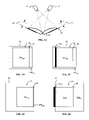
- FIG. 2A is a schematic diagram illustrating the depth of field 62 of the cameras 22 .
- the exact position and size of the depth of field 62 may depend on the sensor, lens and aperture of the cameras 22 as well as the distance from the camera to the image object and the acceptable “circle of confusion” allowed on the sensor (or film).
- the depth of field 62 ranges from 1′′ to 5′′.
- each page being imaged is maintained at the center of the allowable depth of field for the best image sharpness.
- FIGS. 2B and 2C are schematic diagrams illustrating a first left facing page 24 A first and a last left facing page 24 A last of a book within an image area 64 of the camera 22 , respectively, when the cradle 26 is positioned so as to maintain the gutter 68 of the book at an approximately constant position relative to the camera 22 and thus at an approximately constant position relative to the image area 64 of the camera 22 .
- all the prior pages 24 A′ are now under the current and last left facing page 24 A last .
- the first 24 A first and the last left facing pages 24 A first , 24 A last as shown in FIGS. 2B and 2C are at approximately the same position within the image area 64 .
- FIGS. 2D and 2E are schematic diagrams illustrating the first set of facing pages 24 A first , 24 B first and a last set of facing pages 24 A last , 24 B last of a book, respectively, when the cradle 26 is positioned so as to maintain the gutter 68 of the book at an approximately constant position relative to the camera 22 .
- the cradle in FIG. 2E is shifted by a distance d where d is the thickness of the book, relative to the cradle shown in FIG. 2D .
- both sets of facing pages are generally centered relative to the image are of the cameras 22 .
- the distance from the first left facing page 24 A first to the camera 22 is greater than the distance from the last left facing page 24 A last to the camera 22 by an amount approximately equal to d*(1 ⁇ sin ⁇ ) where ⁇ is the angle between the cradle and a horizontal, i.e., a table, which can be, for example, 25°.
- the distance from the first right facing page 24 B first to the camera 22 is less than the distance from the last left facing page 24 B last to the camera 22 by an amount approximately equal to d*(1 ⁇ sin ⁇ ). Where ⁇ is 25°, d*(1 ⁇ sin ⁇ ) is approximately 0.58*d.
- FIGS. 2F and 2G are schematic diagrams illustrating the first set of facing pages and the last set of facing pages of a book, respectively, when the cradle 26 is positioned so as to maintain the surface planes of the pages being imaged at an approximately constant position relative to the camera 22 , i.e., maintaining the pages being imaged at approximately the center of the depth of field of the camera 22 .
- the first 24 A first and the last left facing pages 24 A first , 24 A last as shown in FIGS. 2F and 2G are shifted in position relative to each other within the image area 64 .
- the required overscan area 66 is relatively large. In other words, because of the shift associated with maintaining the pages being imaged within the depth of field of the camera 22 , the image areas 64 of the cameras 22 need to be relatively large as compared to the image sizes of the pages themselves.
- FIGS. 2H and 2I are schematic diagrams illustrating the first set of facing pages 24 A first , 24 B first and a last set of facing pages 24 A last , 24 B last of a book, respectively, when the cradle 26 is positioned so as to maintain the surface planes of the pages being imaged at an approximately constant position relative to the cameras 22 , i.e., maintaining the pages being imaged within the depth of field of the cameras 22 .
- the cradle 26 in FIG. 2I positioned for imaging the last pages of the book is shifted relative to the cradle 26 in FIG. 2H positioned for imaging the first pages of the book by a distance equal to d/sin ⁇ .
- a compromise may be made between the two cases discussed above, i.e., maintaining the gutter of the book or the page surfaces at a constant position relative to the cameras.
- the cradle shifts d and d/sin ⁇ (or 2.37*d when ⁇ is 25°) as the book is turned from the first to the last page in order to maintain the gutter or the page surfaces at a constant position relative to the cameras, respectively.
- the cradle may shift anywhere between 1 and 2.37 times d.
- the focus and/or alignment issues caused by the shift in the surface plane of the pages being imaged can be at least partially resolved by providing a cradle with a variable position along a left-right direction 38 .
- Moving the cradle along the left-right axis 38 helps keep the gutter 28 or the page surface planes approximately aligned to a constant position relative to the image planes of the cameras 22 as the pages of the book 24 are turned (or a combination of the gutter alignment and the image plane alignment).
- providing for positioning of the cradle along a horizontal direction allows the pages to be better maintained within a depth of field of the camera (image plane alignment) and/or the requires less overscan area (gutter alignment).
- the cradle positioning mechanism 40 may be employed to position the book 24 such that the gutter of the book (between the two facing pages) or the page surface planes are approximately aligned to a constant position as the pages of the book are turned. It is noted that although the cradle positioning mechanism 40 is shown and described herein as positioning a cradle with angled sides, the cradle positioning mechanism 40 may be used with any suitable cradle, such as a cradle without angled sides, i.e., a cradle that merely provides a flat surface or platform for supporting the book.
- FIGS. 3A-3E are schematic diagrams illustrating various cradle width adjustment mechanisms that may be used in an image capturing system such as that shown in FIG. 1A .
- Each of the cradles 26 shown in FIGS. 3A-3E has two cradle portions, e.g., a cradle left portion and a cradle right portion. The two cradle portions are selectively positioned relative to each other so as to provide the desired gutter width.
- the cradle 26 is composed of two non-overlapping portions, preferably one stationary and one adjustable toward and away from the stationary portion as indicated by the arrows shown.
- the adjustable portion may be held stationary relative to the stationary portion by any suitable fastener such as a clamp or a clip.
- the cradle 26 need not provide a gutter on which the book 24 rests. Rather, the two portions of the cradle 26 form an opening therebetween into which the book can be positioned.
- the front and back covers of the book are preferably secured to the respective left and right portions of the cradle 26 such as with various clamps or other devices.
- the thicker the book 24 the more the two portions of the cradle 26 are separated in distance and the lower the book 24 or the spine of the book 24 rests below the portions of the cradle 26 .
- the gap between the two cradle portions is adjusted to book thickness/sin ⁇ where ⁇ is the angle between each portion of the cradle and a horizontal, i.e., the table, which can be, for example, 25°.
- Such a configuration allows the pages of the open book to remain in approximately the same distance from the cameras regardless of the thickness of the book when the adjustable width cradle is also used in conjunction with a cradle positioning mechanism, as will be described in more detail below.
- the open pages remain approximately in focus without further focusing adjustments to the cameras.
- the gutter of one of the cradle portions defines an opening into which the gutter of the other of the cradle portions fits.
- the width of the gutter 28 depends on how far the gutter of the right cradle portion is inserted into the opening of the gutter of the left cradle portion.
- the gutter of the two cradle portions define mating teeth or any other mating geometric shape. The positions of the two cradle portions relative to each other determines the width of the gutter 28 .
- the gutter is provided by only one cradle portion while the other cradle portion is selectively positioned with respect to the gutter.
- the gutter may define recesses while the other cradle portion may define mating protrusions that can be inserted into one of the recesses.
- the gutters may be self-locking, such as by relying on forces exerted on the opposing angled supports of the cradle.
- the two cradle portions may also be secured to each other and/or to another structure using any suitable fastening mechanism such as clips and/or clamps.
- the cradle positioning mechanism 40 includes a servo motor 42 , a shaft 44 extending from or otherwise in communication with the servo motor 42 , and a bearing or track 46 for supporting and guiding the positioning or movement of the cradle 26 relative to a stationary object such as a table.
- the servo motor 42 extends and retracts the shaft 44 to push and pull the cradle 26 and the book 24 placed in the cradle 26 in the horizontal direction 38 , supported and guided by the bearing 46 .
- the servo motor 42 may drive the shaft 44 in any appropriate manner.
- the servo motor 42 and the shaft 44 may form a worm drive in which the servo motor 42 rotates a wheel with teeth to drive a threaded shaft in which the threads mesh with the teeth of the servo motor wheel.
- the worm drive thus translates the rotational motion of the servo motor 42 to a translational motion of the shaft 44 and thus the cradle 26 .
- the servo motor 42 may be an alternating-current (AC) servo motor although any other suitable drive motors may be utilized to move and position the cradle 26 , including, for example, a stepper motor, direct-current (DC) servo motor, and hydraulic servo motor.
- a stepper motor moves incrementally, i.e., it moves the cradle 26 a predetermined distance each time the stepper motor receives an electric pulse. The incremental distance may be, for example, 1 ⁇ 8′′.
- the bearing 46 may be, for example, a ball bearing track, a roller bearing, or a rack and pinion mechanism, and preferably reduces friction between the movable cradle 26 and the table to facilitate movement therebetween. In one preferred embodiment, a ball screw preferably with 2 to 10 mm/revolution or pitch, may be used.
- the stepper motor may operate at 400 steps per revolution or 0.005 mm per step of cradle travel.
- a controller or processor may be utilized to control the cradle positioning mechanism 40 and to determine the displacement, rate, timing, and/or frequency of the positioning of the cradle 26 .
- the controller is configured so as to shift the cradle and the book positioned thereon such that the pages being imaged are generally maintained within the depth of field and within the image frame of the camera.
- the controller/processor can track and use the current page count as well as the width of the book binding (or the gutter width setting of the cradle) and the total number of pages of the book to determine the rate at which the cradle 26 is to be shifted horizontally.
- the operator may input the total number of pages of the book and optionally the width of the book binding (or the gutter width setting of the cradle 26 ).
- image capturing system 20 may automatically detect the gutter width setting of the cradle 26 such as with the use of sensors.
- one or both sides of the cradle 26 may be equipped with a scale so as to weigh the corresponding side of the book to determine the relative portions of the book on the two sides of the cradle.
- the cradle positioning mechanism 40 may position the cradle accordingly using the measured weight or weights.
- the frequency at which the cradle positioning mechanism 40 repositions the cradle 26 as well as the amount of displacement each time the cradle 26 is repositioned may depend on, for example, the minimum or other desired distance that the cradle positioning mechanism 40 can displace the cradle 26 each time the mechanism 40 is actuated with the minimum input.
- a typical book page thickness is 0.05 to 0.20 mm.
- the cradle on the average may be moved to the left by (page thickness/sin ⁇ ) where ⁇ is the angle between each side of the cradle and the horizontal, i.e., the table, which can be, for example, 25°.
- the cradle is moved to the left by 2.37 times the page thickness for each page turn.
- the cradle is preferably moved each time the cradle needs to be displaced by a minimum distance, for example, 2 mm.
- the stepper motor would make one revolution every 7 page turns, i.e., 2 mm/(0.12 mm page thickness*2.37).
- the camera preferably has an image frame size that results in some overscan.
- the overscan allows room for error when there is sloppy book positioning, for example.
- the image capturing system 20 may additionally or alternatively use various sensors such as range sensors, e.g., 3D cameras, range finder, lasers, edge detectors, etc., to detect the position of the surfaces of the pages being imaged.
- range sensors e.g., 3D cameras, range finder, lasers, edge detectors, etc.
- sensors e.g., 3D cameras, range finder, lasers, edge detectors, etc.
- Using such sensors enables the cradle positioning mechanism 40 to compensate not only for the inherent displacement resulting from the pages being turned but also for variations in manual clamping displacements, for example.
- the controller/processor preferably controls the cradle positioning mechanism 40 so as to provide a compromise among image framing, focal distance to surface of the page being imaged, focal distance to the gutter, and compensation for variations in manual clamping displacements.
- the image capturing system 20 may also provide various other features.
- the cradle is preferably tilted toward the operator for comfort, e.g., from 7° to 13° or more preferably approximately 10°, with the angles being ergonomically matched to the operator's wrists and arms.
- the table and chair heights are preferably adjustable.
- the cradle preferably supports a book at a book opening angle of approximately 100°-135° as a compromise between ergonomics and page flatness.
- the surface of the cradle on which the book is placed preferably contains a pattern, as shown in the schematic of FIG. 4 .
- a pattern on the surface of the cradle, areas that are over-scanned by the camera can be readily discernable from the book during image processing.
- the pattern may also facilitate the centering of each page by the image capturing system software.
- the pattern is preferably specific, non-repeatable and with large features that are easy to recognize so as to facilitate detection and recognition.
- lights provided for illuminating the pages of the book are preferably arranged to cast a large amount of light on the pages while not generating glare into the cameras.
- FIG. 5 is a block diagram illustrating the interfaces among some of the components of the image capturing system of FIG. 1A .
- the image capturing system 20 includes the controller/processor 34 that communicates with and/or controls the cameras 22 , the cradle positioning mechanism 40 , optional operator input interface 50 , and/or lights 48 for lighting the pages of the book.
- the operator input interface 50 allows the operator to input certain parameters, such as the total number of pages in the book, to facilitate the determination of the position of the cradle.
- the image capturing system 20 may also include various sensors 52 (e.g., scales, range sensors such as 3D cameras, range finder, lasers, and/or edge detectors) in communication with the controller/processor 34 to, for example, help the controller/processor 34 determine the displacement, speed, timing, and/or frequency of the 40 cradle positioning mechanism in positioning the cradle 26 .
- sensors 52 e.g., scales, range sensors such as 3D cameras, range finder, lasers, and/or edge detectors
- FIG. 6 is a flowchart illustrating a process for imaging pages of bound documents 70 .
- a bound document such as a book is placed in the cradle and the gutter width of the cradle is adjusted to better match the thickness of the book.
- the operator may also secure the book to the cradle using, for example, clips, clamps, and/or magnetic plate inserts inserted inside the front and/or back book covers.
- the cradle is preferably configured such that the N/S poles are alternated to close the magnetic flux path to better secure the book to the cradle.
- the system captures or receives initial information to facilitate the cradle positioning mechanism in repositioning the cradle during the imaging process.
- the operator may enter the total number of pages as input and/or sensors may obtain information relating to the book, e.g., edge locations, distribution of weight of the book on each side of the cradle, etc.
- the distance from the camera to the page is calibrated.
- the imaging process begins with the turning of a page at step 76 and with the capture of the image(s) of the facing pages at step 78 .
- Steps 76 and 78 may be performed automatically with the use of an automatic page turner and cameras that are automatically triggered. As another example, the operator may manually turn the page at step 76 and then trigger the cameras at step 78 such as by depressing a foot pedal.
- the controller/processor determines whether any adjustment is to be made to the position of the cradle. Preferably, the controller/processor also determines the amount of any adjustment. If no adjustment to the position of the cradle is to be made, the process 70 proceeds to decision block 84 to determine if the last page of the document has been reached.
- the process repositions the cradle at step 82 and continues the process 70 at decision block 84 . If the last page of the document has not been reached, then the process 70 returns to step 76 to turn to the next page of the document. If the last page of the document has been reached, then the process 70 returns to step 72 and repeats for the next document.
Landscapes
- Engineering & Computer Science (AREA)
- Multimedia (AREA)
- Signal Processing (AREA)
- Facsimile Scanning Arrangements (AREA)
- Studio Devices (AREA)
Abstract
Description
Claims (38)
Priority Applications (1)
| Application Number | Priority Date | Filing Date | Title |
|---|---|---|---|
| US10/611,408 US7639406B1 (en) | 2003-06-30 | 2003-06-30 | Movable document cradle for facilitating imaging of bound documents |
Applications Claiming Priority (1)
| Application Number | Priority Date | Filing Date | Title |
|---|---|---|---|
| US10/611,408 US7639406B1 (en) | 2003-06-30 | 2003-06-30 | Movable document cradle for facilitating imaging of bound documents |
Publications (1)
| Publication Number | Publication Date |
|---|---|
| US7639406B1 true US7639406B1 (en) | 2009-12-29 |
Family
ID=41433027
Family Applications (1)
| Application Number | Title | Priority Date | Filing Date |
|---|---|---|---|
| US10/611,408 Active 2027-11-28 US7639406B1 (en) | 2003-06-30 | 2003-06-30 | Movable document cradle for facilitating imaging of bound documents |
Country Status (1)
| Country | Link |
|---|---|
| US (1) | US7639406B1 (en) |
Cited By (17)
| Publication number | Priority date | Publication date | Assignee | Title |
|---|---|---|---|---|
| US20080316551A1 (en) * | 2002-09-10 | 2008-12-25 | Kirtas Technologies, Inc. | Automated page turning apparatus to assist in viewing pages of a document |
| US20090180085A1 (en) * | 2008-01-15 | 2009-07-16 | Kirtas Technologies, Inc. | System and method for large format imaging |
| US20090296168A1 (en) * | 2004-10-04 | 2009-12-03 | Google Inc. | Systems and Methods for Glare Removal Using Polarized Filtering in Document Scanning |
| US20100296138A1 (en) * | 2007-09-17 | 2010-11-25 | Quidenus Gmbh | Apparatus for detecting the content of a book |
| US8072650B1 (en) * | 2008-01-11 | 2011-12-06 | Google Inc. | Automated focus adjustment using a varying light pattern |
| US8203940B1 (en) | 2011-02-23 | 2012-06-19 | Google Inc. | Rate adaptation in a communication system |
| US20120248280A1 (en) * | 2011-03-30 | 2012-10-04 | Ancestry.Com Operations Inc. | Multi-angle and multi-position reprographic copy stand |
| US20130168954A1 (en) * | 2010-07-06 | 2013-07-04 | Sparkup Ltd. | Method and system for book reading enhancement |
| US8531740B1 (en) | 2012-02-23 | 2013-09-10 | Tomasz Wardega | Universal scanning stand for devices equipped with a digital camera |
| US8675717B1 (en) | 2012-04-16 | 2014-03-18 | Google Inc. | Rate selection in a communication system |
| US8711448B1 (en) * | 2011-10-06 | 2014-04-29 | Google Inc. | Linear book scanner |
| US20140177011A1 (en) * | 2012-12-21 | 2014-06-26 | Casio Electronics Manufacturing Co., Ltd. | Image-reading device, image-reading method and computer readable storage medium |
| WO2015039297A1 (en) * | 2013-09-18 | 2015-03-26 | 庄新宏 | Book copying device |
| US20160080606A1 (en) * | 2014-09-12 | 2016-03-17 | Casio Computer Co., Ltd. | Page image correction device, and recording medium |
| US20160360060A1 (en) * | 2014-04-14 | 2016-12-08 | Pfu Limited | Image reading apparatus for bound media |
| US20180176515A1 (en) * | 2010-04-30 | 2018-06-21 | Becton, Dickinson And Company | System and Method for Acquiring Images of Medication Preparations |
| CN112866502A (en) * | 2020-12-29 | 2021-05-28 | 河南红飒科技发展有限公司 | Book scanner's bearing mechanism and book scanner |
Citations (16)
| Publication number | Priority date | Publication date | Assignee | Title |
|---|---|---|---|---|
| US2406152A (en) | 1945-07-13 | 1946-08-20 | Levine William | Recording camera |
| US4356390A (en) | 1981-03-11 | 1982-10-26 | Westinghouse Electric Corp. | Optical path monitoring circuit for a document scanner |
| US5185821A (en) | 1990-08-31 | 1993-02-09 | Kabushiki Kaisha Toshiba | Image filing apparatus for serially storing input information |
| US5636006A (en) | 1996-04-17 | 1997-06-03 | Xerox Corporation | Apparatus and method for scanning a bound document using a wedge shaped platen with a moving mirror |
| US5640252A (en) * | 1995-12-12 | 1997-06-17 | Xerox Corporation | Bound document imager with page turner |
| US5777660A (en) | 1996-02-26 | 1998-07-07 | Ricoh Company, Ltd. | Scanner assembly |
| US5835241A (en) | 1996-05-30 | 1998-11-10 | Xerox Corporation | Method for determining the profile of a bound document with structured light |
| US5886342A (en) * | 1996-04-12 | 1999-03-23 | Matsushita Electric Industrial Co., Ltd. | Image reader and document curvature measurement using visible and infrared light |
| US6124950A (en) * | 1997-04-15 | 2000-09-26 | Minolta Co., Ltd. | Apparatus and method for detecting book document along the longitudinal edge |
| US6491278B1 (en) | 2000-09-05 | 2002-12-10 | International Business Machines Corporation | Platform for notebook computer |
| US6493469B1 (en) | 1999-06-28 | 2002-12-10 | Xerox Corporation | Dual video camera system for scanning hardcopy documents |
| US20030086721A1 (en) | 2001-11-07 | 2003-05-08 | Guillemin Gustavo M. | Methods and apparatus to determine page orientation for post imaging finishing |
| US20040047009A1 (en) * | 2002-09-10 | 2004-03-11 | Taylor Thomas N. | Automated page turning apparatus to assist in viewing pages of a document |
| US6762862B2 (en) | 1998-08-20 | 2004-07-13 | Microtek International, Inc. | High resolution scanner |
| US7113619B1 (en) | 1999-09-07 | 2006-09-26 | Fuji Photo Film Co., Ltd. | Image reading method, image reading apparatus and method of discriminating defect of image data |
| US7224472B2 (en) | 2002-03-01 | 2007-05-29 | Brainlab Ag | Operation lamp with camera system for 3D referencing |
-
2003
- 2003-06-30 US US10/611,408 patent/US7639406B1/en active Active
Patent Citations (16)
| Publication number | Priority date | Publication date | Assignee | Title |
|---|---|---|---|---|
| US2406152A (en) | 1945-07-13 | 1946-08-20 | Levine William | Recording camera |
| US4356390A (en) | 1981-03-11 | 1982-10-26 | Westinghouse Electric Corp. | Optical path monitoring circuit for a document scanner |
| US5185821A (en) | 1990-08-31 | 1993-02-09 | Kabushiki Kaisha Toshiba | Image filing apparatus for serially storing input information |
| US5640252A (en) * | 1995-12-12 | 1997-06-17 | Xerox Corporation | Bound document imager with page turner |
| US5777660A (en) | 1996-02-26 | 1998-07-07 | Ricoh Company, Ltd. | Scanner assembly |
| US5886342A (en) * | 1996-04-12 | 1999-03-23 | Matsushita Electric Industrial Co., Ltd. | Image reader and document curvature measurement using visible and infrared light |
| US5636006A (en) | 1996-04-17 | 1997-06-03 | Xerox Corporation | Apparatus and method for scanning a bound document using a wedge shaped platen with a moving mirror |
| US5835241A (en) | 1996-05-30 | 1998-11-10 | Xerox Corporation | Method for determining the profile of a bound document with structured light |
| US6124950A (en) * | 1997-04-15 | 2000-09-26 | Minolta Co., Ltd. | Apparatus and method for detecting book document along the longitudinal edge |
| US6762862B2 (en) | 1998-08-20 | 2004-07-13 | Microtek International, Inc. | High resolution scanner |
| US6493469B1 (en) | 1999-06-28 | 2002-12-10 | Xerox Corporation | Dual video camera system for scanning hardcopy documents |
| US7113619B1 (en) | 1999-09-07 | 2006-09-26 | Fuji Photo Film Co., Ltd. | Image reading method, image reading apparatus and method of discriminating defect of image data |
| US6491278B1 (en) | 2000-09-05 | 2002-12-10 | International Business Machines Corporation | Platform for notebook computer |
| US20030086721A1 (en) | 2001-11-07 | 2003-05-08 | Guillemin Gustavo M. | Methods and apparatus to determine page orientation for post imaging finishing |
| US7224472B2 (en) | 2002-03-01 | 2007-05-29 | Brainlab Ag | Operation lamp with camera system for 3D referencing |
| US20040047009A1 (en) * | 2002-09-10 | 2004-03-11 | Taylor Thomas N. | Automated page turning apparatus to assist in viewing pages of a document |
Non-Patent Citations (3)
| Title |
|---|
| Transaction History from Pair printed Mar. 26, 2009, for U.S. Appl. No. 10/611,666. |
| Transaction History from Pair printed Mar. 26, 2009, for U.S. Appl. No. 10/611,681. |
| Transaction History from Pair printed Mar. 26, 2009, for U.S. Appl. No. 10/713,662. |
Cited By (33)
| Publication number | Priority date | Publication date | Assignee | Title |
|---|---|---|---|---|
| US20080316551A1 (en) * | 2002-09-10 | 2008-12-25 | Kirtas Technologies, Inc. | Automated page turning apparatus to assist in viewing pages of a document |
| US20090296168A1 (en) * | 2004-10-04 | 2009-12-03 | Google Inc. | Systems and Methods for Glare Removal Using Polarized Filtering in Document Scanning |
| US8174739B2 (en) * | 2004-10-04 | 2012-05-08 | Google Inc. | Systems and methods for glare removal using polarized filtering in document scanning |
| US20100296138A1 (en) * | 2007-09-17 | 2010-11-25 | Quidenus Gmbh | Apparatus for detecting the content of a book |
| US8896748B1 (en) * | 2008-01-11 | 2014-11-25 | Google Inc. | Automated focus adjustment using a varying light pattern |
| US8072650B1 (en) * | 2008-01-11 | 2011-12-06 | Google Inc. | Automated focus adjustment using a varying light pattern |
| US20090180085A1 (en) * | 2008-01-15 | 2009-07-16 | Kirtas Technologies, Inc. | System and method for large format imaging |
| US20200137359A1 (en) * | 2010-04-30 | 2020-04-30 | Becton, Dickinson And Company | System and Method for Acquiring Images of Medication Preparations |
| US11516443B2 (en) | 2010-04-30 | 2022-11-29 | Becton, Dickinson And Company | System and method for acquiring images of medication preparations |
| US11064164B2 (en) * | 2010-04-30 | 2021-07-13 | Becton, Dickinson And Company | System and method for acquiring images of medication preparations |
| US10412347B2 (en) * | 2010-04-30 | 2019-09-10 | Becton, Dickinson And Company | System and method for acquiring images of medication preparation |
| US11838690B2 (en) | 2010-04-30 | 2023-12-05 | Becton, Dickinson And Company | System and method for acquiring images of medication preparations |
| US20180176515A1 (en) * | 2010-04-30 | 2018-06-21 | Becton, Dickinson And Company | System and Method for Acquiring Images of Medication Preparations |
| US20130168954A1 (en) * | 2010-07-06 | 2013-07-04 | Sparkup Ltd. | Method and system for book reading enhancement |
| US10220646B2 (en) * | 2010-07-06 | 2019-03-05 | Sparkup Ltd. | Method and system for book reading enhancement |
| US8565081B1 (en) | 2011-02-23 | 2013-10-22 | Google Inc. | Rate adaptation in a communication system |
| US9077486B1 (en) | 2011-02-23 | 2015-07-07 | Google Inc. | Rate adaptation in a communication system |
| US8203940B1 (en) | 2011-02-23 | 2012-06-19 | Google Inc. | Rate adaptation in a communication system |
| US9629170B1 (en) | 2011-02-23 | 2017-04-18 | Google Inc. | Rate adaptation in a communication system |
| US8894027B2 (en) * | 2011-03-30 | 2014-11-25 | Ancestry.Com Operations Inc. | Multi-angle and multi-position reprographic copy stand |
| US20120248280A1 (en) * | 2011-03-30 | 2012-10-04 | Ancestry.Com Operations Inc. | Multi-angle and multi-position reprographic copy stand |
| US8711448B1 (en) * | 2011-10-06 | 2014-04-29 | Google Inc. | Linear book scanner |
| US8531740B1 (en) | 2012-02-23 | 2013-09-10 | Tomasz Wardega | Universal scanning stand for devices equipped with a digital camera |
| US8831075B1 (en) | 2012-04-16 | 2014-09-09 | Google Inc. | Rate selection in a communication system |
| US8675717B1 (en) | 2012-04-16 | 2014-03-18 | Google Inc. | Rate selection in a communication system |
| US9019572B2 (en) * | 2012-12-21 | 2015-04-28 | Casio Computer Co., Ltd. | Image-reading device, image-reading method and computer readable storage medium |
| US20140177011A1 (en) * | 2012-12-21 | 2014-06-26 | Casio Electronics Manufacturing Co., Ltd. | Image-reading device, image-reading method and computer readable storage medium |
| WO2015039297A1 (en) * | 2013-09-18 | 2015-03-26 | 庄新宏 | Book copying device |
| US9648193B2 (en) * | 2014-04-14 | 2017-05-09 | Pfu Limited | Image reading apparatus for bound media |
| US20160360060A1 (en) * | 2014-04-14 | 2016-12-08 | Pfu Limited | Image reading apparatus for bound media |
| US20160080606A1 (en) * | 2014-09-12 | 2016-03-17 | Casio Computer Co., Ltd. | Page image correction device, and recording medium |
| US9485389B2 (en) * | 2014-09-12 | 2016-11-01 | Casio Computer Co., Ltd. | Page image correction device, and recording medium |
| CN112866502A (en) * | 2020-12-29 | 2021-05-28 | 河南红飒科技发展有限公司 | Book scanner's bearing mechanism and book scanner |
Similar Documents
| Publication | Publication Date | Title |
|---|---|---|
| US7639406B1 (en) | Movable document cradle for facilitating imaging of bound documents | |
| US8896748B1 (en) | Automated focus adjustment using a varying light pattern | |
| US7561312B1 (en) | Systems and methods for glare removal using polarized filtering in document scanning | |
| US5764383A (en) | Platenless book scanner with line buffering to compensate for image skew | |
| US6567126B1 (en) | Planar focus correction | |
| US7660458B1 (en) | Three-dimensional model construction using unstructured pattern | |
| US20100296138A1 (en) | Apparatus for detecting the content of a book | |
| US5362958A (en) | Reading apparatus with position calculation and focus adjustment and curved surface adjustment | |
| US5995245A (en) | Image reader | |
| US5726775A (en) | Method and apparatus for determining a profile of an image displaced a distance from a platen | |
| JP5723687B2 (en) | Image reading apparatus, image processing method, and program | |
| WO1995028052A1 (en) | Method and apparatus for digitally archiving analog images | |
| US5978102A (en) | Image reading apparatus | |
| JPH1093777A (en) | Image reader | |
| US6056258A (en) | Bound document imager | |
| EP0235201B1 (en) | Document scanning system with multi camera mounting and alignment arrangement | |
| US7605844B1 (en) | Imaging opposing bound pages at high speed using multiple cameras | |
| US7619784B1 (en) | Pacing and error monitoring of manual page turning operator | |
| JPH1013608A (en) | Image reader | |
| EP3519893B1 (en) | A scanner, specifically for scanning antique books, and a method of scanning | |
| US6459505B1 (en) | Bound document imager | |
| US20070216963A1 (en) | Method And Arrangement For Imaging A Primarily Two-Dimensional Target | |
| US7556196B2 (en) | Optical reading head of scanning apparatus | |
| GB2426071A (en) | Positioning books for imaging and correcting distortion | |
| JPH1093776A (en) | Image reader |
Legal Events
| Date | Code | Title | Description |
|---|---|---|---|
| AS | Assignment |
Owner name: GOOGLE TECHNOLOGY, INC., CALIFORNIA Free format text: ASSIGNMENT OF ASSIGNORS INTEREST;ASSIGNORS:PROUDFOOT, R. ALEXANDER;UHLIK, CHRISTOPHER R.;O'SULLIVAN, JOSEPH K.;REEL/FRAME:016171/0588 Effective date: 20030819 |
|
| AS | Assignment |
Owner name: GOOGLE INC., CALIFORNIA Free format text: ASSIGNMENT OF ASSIGNORS INTEREST;ASSIGNORS:PROUDFOOT, R. ALEXANDER;UHLIK, CHRISTOHER R.;O'SULLIVAN, JOSEPH K.;REEL/FRAME:016586/0064 Effective date: 20030819 |
|
| STCF | Information on status: patent grant |
Free format text: PATENTED CASE |
|
| CC | Certificate of correction | ||
| CC | Certificate of correction | ||
| FPAY | Fee payment |
Year of fee payment: 4 |
|
| FPAY | Fee payment |
Year of fee payment: 8 |
|
| AS | Assignment |
Owner name: GOOGLE LLC, CALIFORNIA Free format text: CHANGE OF NAME;ASSIGNOR:GOOGLE INC.;REEL/FRAME:044101/0610 Effective date: 20170929 |
|
| FEPP | Fee payment procedure |
Free format text: MAINTENANCE FEE REMINDER MAILED (ORIGINAL EVENT CODE: REM.); ENTITY STATUS OF PATENT OWNER: LARGE ENTITY |
|
| FEPP | Fee payment procedure |
Free format text: 11.5 YR SURCHARGE- LATE PMT W/IN 6 MO, LARGE ENTITY (ORIGINAL EVENT CODE: M1556); ENTITY STATUS OF PATENT OWNER: LARGE ENTITY |
|
| MAFP | Maintenance fee payment |
Free format text: PAYMENT OF MAINTENANCE FEE, 12TH YEAR, LARGE ENTITY (ORIGINAL EVENT CODE: M1553); ENTITY STATUS OF PATENT OWNER: LARGE ENTITY Year of fee payment: 12 |