US7629469B2 - Intermediate for the preparation of paliperidone - Google Patents
Intermediate for the preparation of paliperidone Download PDFInfo
- Publication number
- US7629469B2 US7629469B2 US12/355,141 US35514109A US7629469B2 US 7629469 B2 US7629469 B2 US 7629469B2 US 35514109 A US35514109 A US 35514109A US 7629469 B2 US7629469 B2 US 7629469B2
- Authority
- US
- United States
- Prior art keywords
- compound
- formula
- solvent
- group
- paliperidone
- Prior art date
- Legal status (The legal status is an assumption and is not a legal conclusion. Google has not performed a legal analysis and makes no representation as to the accuracy of the status listed.)
- Expired - Fee Related
Links
- PMXMIIMHBWHSKN-UHFFFAOYSA-N 3-{2-[4-(6-fluoro-1,2-benzoxazol-3-yl)piperidin-1-yl]ethyl}-9-hydroxy-2-methyl-6,7,8,9-tetrahydropyrido[1,2-a]pyrimidin-4-one Chemical compound FC1=CC=C2C(C3CCN(CC3)CCC=3C(=O)N4CCCC(O)C4=NC=3C)=NOC2=C1 PMXMIIMHBWHSKN-UHFFFAOYSA-N 0.000 title claims abstract description 20
- 229960001057 paliperidone Drugs 0.000 title claims abstract description 20
- 150000001875 compounds Chemical class 0.000 claims abstract description 76
- 238000005984 hydrogenation reaction Methods 0.000 claims abstract description 20
- 125000006239 protecting group Chemical group 0.000 claims abstract description 14
- 238000000034 method Methods 0.000 claims description 37
- OKKJLVBELUTLKV-UHFFFAOYSA-N Methanol Chemical compound OC OKKJLVBELUTLKV-UHFFFAOYSA-N 0.000 claims description 33
- YXFVVABEGXRONW-UHFFFAOYSA-N Toluene Chemical compound CC1=CC=CC=C1 YXFVVABEGXRONW-UHFFFAOYSA-N 0.000 claims description 33
- VEXZGXHMUGYJMC-UHFFFAOYSA-N Hydrochloric acid Chemical compound Cl VEXZGXHMUGYJMC-UHFFFAOYSA-N 0.000 claims description 24
- XHXFXVLFKHQFAL-UHFFFAOYSA-N phosphoryl trichloride Chemical compound ClP(Cl)(Cl)=O XHXFXVLFKHQFAL-UHFFFAOYSA-N 0.000 claims description 22
- 239000002904 solvent Substances 0.000 claims description 21
- 239000003054 catalyst Substances 0.000 claims description 17
- JOXIMZWYDAKGHI-UHFFFAOYSA-N toluene-4-sulfonic acid Chemical compound CC1=CC=C(S(O)(=O)=O)C=C1 JOXIMZWYDAKGHI-UHFFFAOYSA-N 0.000 claims description 17
- XLYOFNOQVPJJNP-UHFFFAOYSA-N water Substances O XLYOFNOQVPJJNP-UHFFFAOYSA-N 0.000 claims description 17
- KDLHZDBZIXYQEI-UHFFFAOYSA-N Palladium Chemical group [Pd] KDLHZDBZIXYQEI-UHFFFAOYSA-N 0.000 claims description 16
- 238000006243 chemical reaction Methods 0.000 claims description 13
- OMQHDIHZSDEIFH-UHFFFAOYSA-N 3-Acetyldihydro-2(3H)-furanone Chemical compound CC(=O)C1CCOC1=O OMQHDIHZSDEIFH-UHFFFAOYSA-N 0.000 claims description 12
- 239000011541 reaction mixture Substances 0.000 claims description 10
- 239000007787 solid Substances 0.000 claims description 10
- QAOWNCQODCNURD-UHFFFAOYSA-N Sulfuric acid Chemical compound OS(O)(=O)=O QAOWNCQODCNURD-UHFFFAOYSA-N 0.000 claims description 8
- MVPPADPHJFYWMZ-UHFFFAOYSA-N chlorobenzene Chemical compound ClC1=CC=CC=C1 MVPPADPHJFYWMZ-UHFFFAOYSA-N 0.000 claims description 8
- -1 2,6-dimethylbenzyl Chemical group 0.000 claims description 6
- 125000001797 benzyl group Chemical group [H]C1=C([H])C([H])=C(C([H])=C1[H])C([H])([H])* 0.000 claims description 6
- 238000004440 column chromatography Methods 0.000 claims description 6
- 238000004519 manufacturing process Methods 0.000 claims description 5
- CTQNGGLPUBDAKN-UHFFFAOYSA-N O-Xylene Chemical compound CC1=CC=CC=C1C CTQNGGLPUBDAKN-UHFFFAOYSA-N 0.000 claims description 4
- 239000008096 xylene Substances 0.000 claims description 4
- 125000003903 2-propenyl group Chemical group [H]C([*])([H])C([H])=C([H])[H] 0.000 claims description 3
- 125000006512 3,4-dichlorobenzyl group Chemical group [H]C1=C(Cl)C(Cl)=C([H])C(=C1[H])C([H])([H])* 0.000 claims description 3
- 125000004217 4-methoxybenzyl group Chemical group [H]C1=C([H])C(=C([H])C([H])=C1OC([H])([H])[H])C([H])([H])* 0.000 claims description 3
- 125000005489 p-toluenesulfonic acid group Chemical group 0.000 claims description 3
- 125000003944 tolyl group Chemical group 0.000 claims description 3
- 229910052751 metal Inorganic materials 0.000 claims description 2
- 239000002184 metal Substances 0.000 claims description 2
- 229910052763 palladium Inorganic materials 0.000 claims description 2
- 229910052697 platinum Inorganic materials 0.000 claims description 2
- 229910052703 rhodium Inorganic materials 0.000 claims description 2
- SRSXLGNVWSONIS-UHFFFAOYSA-N benzenesulfonic acid Chemical compound OS(=O)(=O)C1=CC=CC=C1 SRSXLGNVWSONIS-UHFFFAOYSA-N 0.000 claims 2
- 229940092714 benzenesulfonic acid Drugs 0.000 claims 2
- XEKOWRVHYACXOJ-UHFFFAOYSA-N Ethyl acetate Chemical compound CCOC(C)=O XEKOWRVHYACXOJ-UHFFFAOYSA-N 0.000 description 13
- 239000000543 intermediate Substances 0.000 description 13
- YMWUJEATGCHHMB-UHFFFAOYSA-N Dichloromethane Chemical compound ClCCl YMWUJEATGCHHMB-UHFFFAOYSA-N 0.000 description 12
- CSCPPACGZOOCGX-UHFFFAOYSA-N Acetone Chemical compound CC(C)=O CSCPPACGZOOCGX-UHFFFAOYSA-N 0.000 description 10
- 239000002002 slurry Substances 0.000 description 8
- NMCBWICNRJLKKM-UHFFFAOYSA-N 3-(benzyloxy)pyridin-2-amine Chemical compound NC1=NC=CC=C1OCC1=CC=CC=C1 NMCBWICNRJLKKM-UHFFFAOYSA-N 0.000 description 6
- KFZMGEQAYNKOFK-UHFFFAOYSA-N Isopropanol Chemical compound CC(C)O KFZMGEQAYNKOFK-UHFFFAOYSA-N 0.000 description 6
- IMNFDUFMRHMDMM-UHFFFAOYSA-N N-Heptane Chemical compound CCCCCCC IMNFDUFMRHMDMM-UHFFFAOYSA-N 0.000 description 6
- RCZHWSHXQYNTEY-MDZDMXLPSA-N CC1=C(N/C(C)=C2\CCOC2=O)N=CC=C1 Chemical compound CC1=C(N/C(C)=C2\CCOC2=O)N=CC=C1 RCZHWSHXQYNTEY-MDZDMXLPSA-N 0.000 description 5
- 235000019439 ethyl acetate Nutrition 0.000 description 5
- 239000007789 gas Substances 0.000 description 5
- 238000010992 reflux Methods 0.000 description 5
- LFQSCWFLJHTTHZ-UHFFFAOYSA-N Ethanol Chemical compound CCO LFQSCWFLJHTTHZ-UHFFFAOYSA-N 0.000 description 4
- 229910019213 POCl3 Inorganic materials 0.000 description 4
- HEDRZPFGACZZDS-MICDWDOJSA-N Trichloro(2H)methane Chemical compound [2H]C(Cl)(Cl)Cl HEDRZPFGACZZDS-MICDWDOJSA-N 0.000 description 4
- 239000007864 aqueous solution Substances 0.000 description 4
- 239000000203 mixture Substances 0.000 description 4
- 239000000047 product Substances 0.000 description 4
- WEVYAHXRMPXWCK-UHFFFAOYSA-N Acetonitrile Chemical compound CC#N WEVYAHXRMPXWCK-UHFFFAOYSA-N 0.000 description 3
- RGDQRXPEZUNWHX-UHFFFAOYSA-N CC1=C(N)N=CC=C1 Chemical compound CC1=C(N)N=CC=C1 RGDQRXPEZUNWHX-UHFFFAOYSA-N 0.000 description 3
- OMHNAUKDQVTSSB-UHFFFAOYSA-N CCCC1=C(C)N=C2C(O)=CC=CN2C1=O.Cl Chemical compound CCCC1=C(C)N=C2C(O)=CC=CN2C1=O.Cl OMHNAUKDQVTSSB-UHFFFAOYSA-N 0.000 description 3
- HEMHJVSKTPXQMS-UHFFFAOYSA-M Sodium hydroxide Chemical compound [OH-].[Na+] HEMHJVSKTPXQMS-UHFFFAOYSA-M 0.000 description 3
- 238000010533 azeotropic distillation Methods 0.000 description 3
- 230000015572 biosynthetic process Effects 0.000 description 3
- 238000009835 boiling Methods 0.000 description 3
- 229940093499 ethyl acetate Drugs 0.000 description 3
- 239000000706 filtrate Substances 0.000 description 3
- 150000002596 lactones Chemical class 0.000 description 3
- 239000010410 layer Substances 0.000 description 3
- 239000012044 organic layer Substances 0.000 description 3
- NLKNQRATVPKPDG-UHFFFAOYSA-M potassium iodide Chemical compound [K+].[I-] NLKNQRATVPKPDG-UHFFFAOYSA-M 0.000 description 3
- 239000000376 reactant Substances 0.000 description 3
- 239000000243 solution Substances 0.000 description 3
- AJXJTXBHZFSBMC-UHFFFAOYSA-N CC1=CC=CN2C(=O)C(CCCl)=C(C)N=C12 Chemical compound CC1=CC=CN2C(=O)C(CCCl)=C(C)N=C12 AJXJTXBHZFSBMC-UHFFFAOYSA-N 0.000 description 2
- HEDRZPFGACZZDS-UHFFFAOYSA-N Chloroform Chemical compound ClC(Cl)Cl HEDRZPFGACZZDS-UHFFFAOYSA-N 0.000 description 2
- RTZKZFJDLAIYFH-UHFFFAOYSA-N Diethyl ether Chemical compound CCOCC RTZKZFJDLAIYFH-UHFFFAOYSA-N 0.000 description 2
- BZLVMXJERCGZMT-UHFFFAOYSA-N Methyl tert-butyl ether Chemical compound COC(C)(C)C BZLVMXJERCGZMT-UHFFFAOYSA-N 0.000 description 2
- 238000007126 N-alkylation reaction Methods 0.000 description 2
- UIIMBOGNXHQVGW-UHFFFAOYSA-M Sodium bicarbonate Chemical compound [Na+].OC([O-])=O UIIMBOGNXHQVGW-UHFFFAOYSA-M 0.000 description 2
- 239000002253 acid Substances 0.000 description 2
- 229960001701 chloroform Drugs 0.000 description 2
- 239000003480 eluent Substances 0.000 description 2
- 239000012535 impurity Substances 0.000 description 2
- 238000005191 phase separation Methods 0.000 description 2
- 238000007363 ring formation reaction Methods 0.000 description 2
- 238000001644 13C nuclear magnetic resonance spectroscopy Methods 0.000 description 1
- 238000005160 1H NMR spectroscopy Methods 0.000 description 1
- DFZLZGAIWJGCIJ-UHFFFAOYSA-N 3-(2-chloroethyl)-2-methyl-9-phenylmethoxypyrido[1,2-a]pyrimidin-4-one Chemical compound C=1C=CN2C(=O)C(CCCl)=C(C)N=C2C=1OCC1=CC=CC=C1 DFZLZGAIWJGCIJ-UHFFFAOYSA-N 0.000 description 1
- VHUUQVKOLVNVRT-UHFFFAOYSA-N Ammonium hydroxide Chemical compound [NH4+].[OH-] VHUUQVKOLVNVRT-UHFFFAOYSA-N 0.000 description 1
- IIBSRIYHVJJPNN-CGIPMYTOSA-N C.C/C(NC1=C(OCC2=CC=CC=C2)C=CC=N1)=C1/CCOC1=O.CC(=O)C1CCOC1=O.CC1=C(CCCl)C(=O)N2C=CC=C(O)C2=N1.CC1=C(CCCl)C(=O)N2CCCC(O)C2=N1.CC1=C(CCN2CCC(C3=NOC4=C3C=CC(F)=C4)CC2)C(=O)N2CCCC(O)C2=N1.CO.Cl.Cl.I[IH]I.N=C(C1=CC=C(F)C=C1O)C1CCNCC1.NC1=C(OCC2=CC=CC=C2)C=CC=N1.[V] Chemical compound C.C/C(NC1=C(OCC2=CC=CC=C2)C=CC=N1)=C1/CCOC1=O.CC(=O)C1CCOC1=O.CC1=C(CCCl)C(=O)N2C=CC=C(O)C2=N1.CC1=C(CCCl)C(=O)N2CCCC(O)C2=N1.CC1=C(CCN2CCC(C3=NOC4=C3C=CC(F)=C4)CC2)C(=O)N2CCCC(O)C2=N1.CO.Cl.Cl.I[IH]I.N=C(C1=CC=C(F)C=C1O)C1CCNCC1.NC1=C(OCC2=CC=CC=C2)C=CC=N1.[V] IIBSRIYHVJJPNN-CGIPMYTOSA-N 0.000 description 1
- RUBKSGCWNKHSEI-UHFFFAOYSA-N CC(=O)C1CCOC1=O.CC1=C(CCCl)C(=O)N2C=CC=C(OCC3=CC=CC=C3)C2=N1.II.NC1=C(OCC2=CC=CC=C2)C=CC=N1.O=P(Cl)(Cl)Cl Chemical compound CC(=O)C1CCOC1=O.CC1=C(CCCl)C(=O)N2C=CC=C(OCC3=CC=CC=C3)C2=N1.II.NC1=C(OCC2=CC=CC=C2)C=CC=N1.O=P(Cl)(Cl)Cl RUBKSGCWNKHSEI-UHFFFAOYSA-N 0.000 description 1
- JKVUGXRJSYRXFN-UHFFFAOYSA-N CC1=C(CCCl)C(=O)N2CCCC(O)C2=N1 Chemical compound CC1=C(CCCl)C(=O)N2CCCC(O)C2=N1 JKVUGXRJSYRXFN-UHFFFAOYSA-N 0.000 description 1
- VYPSYNLAJGMNEJ-UHFFFAOYSA-N Silicium dioxide Chemical compound O=[Si]=O VYPSYNLAJGMNEJ-UHFFFAOYSA-N 0.000 description 1
- CDBYLPFSWZWCQE-UHFFFAOYSA-L Sodium Carbonate Chemical class [Na+].[Na+].[O-]C([O-])=O CDBYLPFSWZWCQE-UHFFFAOYSA-L 0.000 description 1
- 239000000908 ammonium hydroxide Substances 0.000 description 1
- 239000006227 byproduct Substances 0.000 description 1
- 238000001460 carbon-13 nuclear magnetic resonance spectrum Methods 0.000 description 1
- 230000003197 catalytic effect Effects 0.000 description 1
- 238000006482 condensation reaction Methods 0.000 description 1
- 230000008878 coupling Effects 0.000 description 1
- 238000010168 coupling process Methods 0.000 description 1
- 238000005859 coupling reaction Methods 0.000 description 1
- 238000000354 decomposition reaction Methods 0.000 description 1
- 239000002274 desiccant Substances 0.000 description 1
- 238000001035 drying Methods 0.000 description 1
- 150000002081 enamines Chemical class 0.000 description 1
- 238000001914 filtration Methods 0.000 description 1
- 230000000505 pernicious effect Effects 0.000 description 1
- 238000000425 proton nuclear magnetic resonance spectrum Methods 0.000 description 1
- 150000003839 salts Chemical class 0.000 description 1
- 239000000741 silica gel Substances 0.000 description 1
- 229910002027 silica gel Inorganic materials 0.000 description 1
- 229910000030 sodium bicarbonate Inorganic materials 0.000 description 1
- 235000017557 sodium bicarbonate Nutrition 0.000 description 1
- 239000007858 starting material Substances 0.000 description 1
- 238000003756 stirring Methods 0.000 description 1
- 239000000126 substance Substances 0.000 description 1
- CMQCNTNASCDNGR-UHFFFAOYSA-N toluene;hydrate Chemical compound O.CC1=CC=CC=C1 CMQCNTNASCDNGR-UHFFFAOYSA-N 0.000 description 1
- 238000005406 washing Methods 0.000 description 1
Images


Classifications
-
- C—CHEMISTRY; METALLURGY
- C07—ORGANIC CHEMISTRY
- C07D—HETEROCYCLIC COMPOUNDS
- C07D405/00—Heterocyclic compounds containing both one or more hetero rings having oxygen atoms as the only ring hetero atoms, and one or more rings having nitrogen as the only ring hetero atom
- C07D405/02—Heterocyclic compounds containing both one or more hetero rings having oxygen atoms as the only ring hetero atoms, and one or more rings having nitrogen as the only ring hetero atom containing two hetero rings
- C07D405/12—Heterocyclic compounds containing both one or more hetero rings having oxygen atoms as the only ring hetero atoms, and one or more rings having nitrogen as the only ring hetero atom containing two hetero rings linked by a chain containing hetero atoms as chain links
-
- Y—GENERAL TAGGING OF NEW TECHNOLOGICAL DEVELOPMENTS; GENERAL TAGGING OF CROSS-SECTIONAL TECHNOLOGIES SPANNING OVER SEVERAL SECTIONS OF THE IPC; TECHNICAL SUBJECTS COVERED BY FORMER USPC CROSS-REFERENCE ART COLLECTIONS [XRACs] AND DIGESTS
- Y02—TECHNOLOGIES OR APPLICATIONS FOR MITIGATION OR ADAPTATION AGAINST CLIMATE CHANGE
- Y02P—CLIMATE CHANGE MITIGATION TECHNOLOGIES IN THE PRODUCTION OR PROCESSING OF GOODS
- Y02P20/00—Technologies relating to chemical industry
- Y02P20/50—Improvements relating to the production of bulk chemicals
- Y02P20/55—Design of synthesis routes, e.g. reducing the use of auxiliary or protecting groups
Definitions
- the present application relates to a class of new intermediates for producing paliperidone, process of making these new intermediates, and process of making paliperidone.
- R represents a protecting group which is removable by hydrogenation, such as benzyl, allyl, 4-methoxybenzyl, 2,6-dimethylbenzyl, 3,4-dichlorobenzyl, and 4-(dimethylamino)-carbonylbenzyl.
- the protecting group R is benzyl (Bn).
- R is Bn
- the chemical name of the above compound of formula IV is 1-(3-benzyloxy-pyridine-2-ylamino)-eth-(E)-ylidene-dihydro-furano-2-one. It can be used as an intermediate for making paliperdione.
- a process of making the above compound of formula IV comprises: 1) reacting a compound of formula (I):
- R in formula (I) represents a protecting group which is removable by hydrogenation, such as benzyl, allyl, 4-methoxybenzyl, 2,6-dimethylbenzyl, 3,4-dichlorobenzyl, and 4-(dimethylamino)-carbonylbenzyl.
- the solvent can be selected from the group consisting of toluene, xylene, chlorobenzene, and combinations thereof.
- the solvent is toluene.
- the catalyst can be selected from the group consisting of p-toluenesulfonic acid, HCl, H 2 SO 4 , benensulfonic acid, and combinations thereof.
- the catalyst is p-toluenesulfonic acid.
- the water formed in the above reaction is removed.
- the process in accordance with the present invention comprises a step of azeotropic removal of water at reflux temperature after the step of reacting the compound of formula (I) with 2-acetyl-4-butyrolactone.
- the amount of 2-acetyl-4-butyrolactone is preferable no less than 2.0 mole equivalents, in particular no greater than 3 mole equivalents (relative to the other reactant, i.e., the compound of formula (I)).
- the removal of water may facilitate the subsequent reaction of the compound of formula (IV) with other reactants.
- the water is removed under reduced pressure and a temperature of 50-110° C.
- Azeotropic distillation refers to the specific technique of adding another component to generate a new lower-boiling azeotrope. So, the water formed in the reaction can combine with toluene (solvent) to generate the water-toluene azeotrope, the lower boiling point of the azeotrope may assure the complete removal of water. The boiling point of the azeotrope may vary with the proportion of components. The removal of water is preferably conducted under reflux temperature.
- an inert drying agent may be used to remove the water.
- a new process of making paliperidone comprises a step of converting a compound of formula IV, as shown above, to paliperidone.
- the process may comprise: 1) reacting the compound of formula (I) with 2-acetyl-4-butyrolactone in the presence of an effective amount of catalyst and preferably, a first solvent, to synthesize the compound of formula (IV); 2) converting the compound of formula (IV) to a compound of formula V:
- the compound of formula (IV) synthesized in step 1) can be optionally isolated in a solid form from the reaction mixture.
- the compound of formula (IV) of step 1) without being isolated from the reaction mixture to a solid form can be used directly in step 2).
- the water contained in the reaction mixture of step 1) is removed, and the resulting slurry containing the compound of formula (IV) is used in step 2) to prepare the compound of formula (V).
- the first solvent may be selected from the group consisting of toluene, xylene chlorobenzene, and combinations thereof.
- the first solvent is toluene.
- the catalyst can be selected from the group consisting of p-toluenesulfonic acid, HCl, H 2 SO 4 , benensulfonic acid, and combinations thereof.
- the catalyst is p-toluenesulfonic acid.
- the above second step of converting the compound of formula (IV) to the compound of formula (V) may comprise the following steps: 2a) reacting the compound of formula (IV) with phosphoryl chloride to obtain a compound of formula V′:
- R is the protecting group, as defined above (the protecting group R may be removed by POCl 3 from some amount of the product of formula V′, i.e., in that case R can be H on the formula V′); and 2b) hydrogenating the compound of formula V′ in the presence of hydrochloric acid and a hydrogenation catalyst in a second solvent to provide the compound of formula V.
- the second solvent may be selected from the group consisting of methanol (MeOH) and water.
- the second solvent is MeOH.
- the hydrogenation catalyst contains a metal element selecting from the group consisting of Rh, Pt and Pd.
- the hydrogenation catalyst is Pd/C.
- the temperature is preferably controlled at 20-30° C. during the hydrogenation reaction of step 2).
- the amount used for phosphoryl chloride is preferable no less than 2 mole equivalents, more particular within the range of 2 to 4 mole equivalents (relative to the reactant 2-amino-3-benzyloxypyridine).
- milder condition for the above step 2b) of hydrogenating is used such as, 5% Pd/C (5 wt. %) and at temperature of 20-30° C. (lower concentration and lower temperature).
- the hydrogenation of the above step 2b) is to remove the protecting group “R”.
- the compound of formula V) synthesized in the above step 2) can be isolated and briefly purified by agitating, filtering and washing the resulting solids in a suitable solvent, such as acetone, MeOH, EtOH, IPA, ACN, EtOAc/heptane, EtOAc/MTBE, dichloromethane/heptane, and dichloromethane/MTBE, to remove the impurities.
- a suitable solvent such as acetone, MeOH, EtOH, IPA, ACN, EtOAc/heptane, EtOAc/MTBE, dichloromethane/heptane, and dichloromethane/MTBE, to remove the impurities.
- the solvent is acetone
- the process of the present invention is free of a step of purifying the compound of formula V) by column chromatography. Therefore, the purified compound of formula V can be obtained without conducting column chromatography, which provides a better process for industrial-scale production.
- the step of converting the compound of formula V to paliperidone can be carried out in any suitable manner, which, for example, can be a method described in the art.
- the compound of formula V can be hydrogenated in the presence of Pd/C in alcohol at 45-55° C. to provide a compound of formula III.
- the hydrogenating here may be conducted in the presence of 10% Pd/C and H 2 gas at about 0.15 Kg/m 2 and about 50° C.
- the compound of formula III can be coupled with 6F-3-4-piperidinyl-1,2-benzisoxazole HCl by N-alkylation reaction to provide paliperidone.
- the advantages of the present invention include:
- novel compound of formula IV without being isolated from the slurry reaction mixture to a solid state can be directly applied to the subsequent cyclization and hydrogenation reactions to obtain the intermediate V.
- the compound of formula V can be briefly purified by agitating in a solvent, such as acetone, to remove the impurities. Therefore, the purified intermediate V can be obtained without conducting column chromatography, which provides a better process for industrial-scale production.
- FIG. 1 depicts the 1 H NMR spectrum of the compound of formula IV′ (i.e., the compound of formula IV wherein R is benzyl).
- FIG. 2 depicts the 13 C NMR spectrum of the compound of formula IV′.
- the isolated intermediate IV′ or the reaction mixture contained intermediate IV′ is reacted with phosphoryl chloride in toluene, and then is hydrogenated in the presence of hydrochloric acid and Pd/C at 20-30° C. to provide the intermediate V.
- the intermediate V is hydrogenated in the presence of Pd/C in alcohol at 45-55° C. to provide the intermediate III.
- the intermediate III is coupled with 6F-3-4-piperidinyl-1,2-benzisoxazole HCl by N-alkylation reaction to provide paliperidone.
- the 13 C NMR (CDCl 3 ) data obtained from the compound of formula IV′ is: d 173.3 (C), 151.6 (C), 145.0 (C), 143.2 (C), 138.5 (CH), 135.9 (C), 128.6 (2CH), 128.1 (CH), 127.1 (2CH), 118.0 (CH), 116.7 (CH), 94.6 (C), 70.4 (CH 2 ), 65.3 (CH 2 ), 26.4 (CH 2 ), 19.7 (CH 3 ).
- phosphoryl chloride (245 g, 2 eq) and agitated for several hours.
- the reaction mixture is worked up with water (1.6 L, 10 vols) and allowed to agitate for a while, followed by phase separation.
- To the organic layer is washed with HCl aqueous solution (800 mL, 5 vols).
- dichloromethane 800 mL 5 vols
- the collected aqueous layer is extracted with dichloromethane.
- the combined organic layer is swapped by methanol (1.28 L, 8 vols).
- the slurry is agitated for a while and then filtered and washed with ethylacetate (300 mL 5 vols). The filtrate is settled for phase separation. To the aq. layer is washed with ethylacetate. The combined organic layer is distilled and then filtered. The filtrate is distilled and then N-heptanes (600 mL, 10 vols) is added. The slurry is cooled down and then the solid is filtered and washed with heptanes. The wet cake is dried under reduced pressure to afford the compound of formula III (38.8 g).
Landscapes
- Chemical & Material Sciences (AREA)
- Organic Chemistry (AREA)
- Low-Molecular Organic Synthesis Reactions Using Catalysts (AREA)
- Plural Heterocyclic Compounds (AREA)
- Nitrogen Condensed Heterocyclic Rings (AREA)
Abstract
A new compound of formula (IV)

R represents a protecting group which is removable by hydrogenation, and use thereof as an intermediate for preparing paliperidone.
Description
This application claims priority from U.S. Provisional Patent Application Ser. No. 61/011,309 which was filed on Jan. 16, 2008. The content of U.S. Provisional Patent Application Ser. No. 61/011,309 is incorporated herein in its entirety.
1. Field of the Invention
The present application relates to a class of new intermediates for producing paliperidone, process of making these new intermediates, and process of making paliperidone.
2. Description of the Related Art
Previously known processes for producing paliperidone have low yields and produce large amounts of HCl gas as a by-product. In U.S. Pat. No. 5,158,952 (its European counterpart is EP0368388), a process is disclosed wherein 2-amino-3-benzyloxypyridine (I′) was reacted with 1.7 mole equivalents 2-acetyl-4-butyrolactone in the presence of 5.5 mole equivalents phosphoryl chloride in toluene. The reaction mixture was stirred for 5 hours at 90° C. Another 1.7 mole equivalents of 2-acetyl-4-butyrolactone were then added and the stirring was continued for 30 minutes at 90° C. The solution was allowed to stand overnight at 90° C. The whole was poured into crushed ice and treated with an ammonium hydroxide solution 25%. The product was extracted with trichloromethane. The extract was dried, filtered and evaporated. The residue was purified by column chromatography over silica gel using a mixture of trichloromethane and methanol (98:2 by volume) as eluent. The pure fractions were collected and the eluent was evaporated. The residue was stirred in 2-propanol. The product was filtered off, washed with a mixture of 2-propanol and 1,1′-oxybisethane and dried at 50° C., yielding 20.5 mole equivalents (Yield: 62.3%) of 3-(2-chloroethyl)-2-methyl-9-(phenylmethoxy)-4H-pyrido[1,2-a]pyrimidin-4-one; mp. 141.1° C. See the scheme shown below.

The yield of this condensation reaction is low, and the higher amounts of lactone (about 3.4 mole equivalents) and POCl3 (about 5.5 mole equivalents) are needed to facilitate this reaction. In addition, POCl3 releases lots of HCl gas during decomposition. Furthermore, the reaction mixture containing the intermediate II needs to be purified by column chromatography to remove the unreacted 2-amino-3-benzyloxypyridine (I′) before further conversion to paliperidone.
Therefore, there is still need for a process of making paliperidone that is easy to operate, incurs low cost, and/or produces a high yield of product.
In accordance with the first embodiment of the present invention, a new compound of formula IV as shown below is provided:

wherein R represents a protecting group which is removable by hydrogenation, such as benzyl, allyl, 4-methoxybenzyl, 2,6-dimethylbenzyl, 3,4-dichlorobenzyl, and 4-(dimethylamino)-carbonylbenzyl.
Preferably, the protecting group R is benzyl (Bn). When R is Bn, the chemical name of the above compound of formula IV is 1-(3-benzyloxy-pyridine-2-ylamino)-eth-(E)-ylidene-dihydro-furano-2-one. It can be used as an intermediate for making paliperdione.
In accordance with the second embodiment of the present invention, a process of making the above compound of formula IV is provided. The process comprises: 1) reacting a compound of formula (I):

with 2-acetyl-4-butyrolactone in the presence an effective amount of catalyst to synthesize the compound of formula (IV); and 2) isolating the compound of formula (IV) from the reaction mixture of step 1). Preferably, the reaction is conducted in the presence of a solvent. R in formula (I) represents a protecting group which is removable by hydrogenation, such as benzyl, allyl, 4-methoxybenzyl, 2,6-dimethylbenzyl, 3,4-dichlorobenzyl, and 4-(dimethylamino)-carbonylbenzyl.
The solvent can be selected from the group consisting of toluene, xylene, chlorobenzene, and combinations thereof. Preferably, the solvent is toluene. The catalyst can be selected from the group consisting of p-toluenesulfonic acid, HCl, H2SO4, benensulfonic acid, and combinations thereof. Preferably, the catalyst is p-toluenesulfonic acid.
Preferably, the water formed in the above reaction is removed. As a preferred embodiment, the process in accordance with the present invention comprises a step of azeotropic removal of water at reflux temperature after the step of reacting the compound of formula (I) with 2-acetyl-4-butyrolactone. The amount of 2-acetyl-4-butyrolactone is preferable no less than 2.0 mole equivalents, in particular no greater than 3 mole equivalents (relative to the other reactant, i.e., the compound of formula (I)). The removal of water may facilitate the subsequent reaction of the compound of formula (IV) with other reactants. Typically, the water is removed under reduced pressure and a temperature of 50-110° C.
Azeotropic distillation refers to the specific technique of adding another component to generate a new lower-boiling azeotrope. So, the water formed in the reaction can combine with toluene (solvent) to generate the water-toluene azeotrope, the lower boiling point of the azeotrope may assure the complete removal of water. The boiling point of the azeotrope may vary with the proportion of components. The removal of water is preferably conducted under reflux temperature.
Alternatively, other methods may be used to remove the water formed from the above reaction. For example, an inert drying agent may be used to remove the water.
In accordance with the third embodiment of the present invention, a new process of making paliperidone is provided. The process comprises a step of converting a compound of formula IV, as shown above, to paliperidone. Specifically, the process may comprise: 1) reacting the compound of formula (I) with 2-acetyl-4-butyrolactone in the presence of an effective amount of catalyst and preferably, a first solvent, to synthesize the compound of formula (IV); 2) converting the compound of formula (IV) to a compound of formula V:
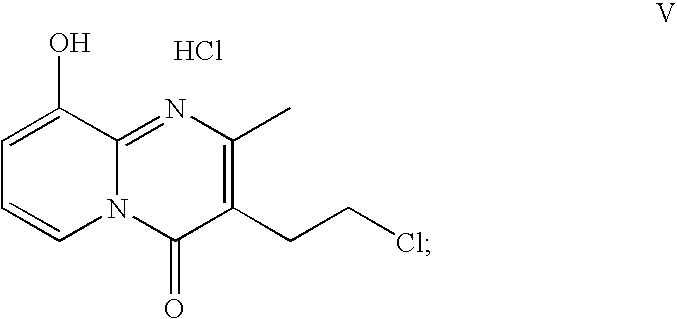
and 3) converting the compound of formula V to paliperidone.
The compound of formula (IV) synthesized in step 1) can be optionally isolated in a solid form from the reaction mixture. Alternatively, the compound of formula (IV) of step 1) without being isolated from the reaction mixture to a solid form can be used directly in step 2). Preferably, as noted above, the water contained in the reaction mixture of step 1) is removed, and the resulting slurry containing the compound of formula (IV) is used in step 2) to prepare the compound of formula (V).
The first solvent may be selected from the group consisting of toluene, xylene chlorobenzene, and combinations thereof. Preferably, the first solvent is toluene. The catalyst can be selected from the group consisting of p-toluenesulfonic acid, HCl, H2SO4, benensulfonic acid, and combinations thereof. Preferably, the catalyst is p-toluenesulfonic acid.
The above second step of converting the compound of formula (IV) to the compound of formula (V) may comprise the following steps: 2a) reacting the compound of formula (IV) with phosphoryl chloride to obtain a compound of formula V′:

wherein R is the protecting group, as defined above (the protecting group R may be removed by POCl3 from some amount of the product of formula V′, i.e., in that case R can be H on the formula V′); and 2b) hydrogenating the compound of formula V′ in the presence of hydrochloric acid and a hydrogenation catalyst in a second solvent to provide the compound of formula V.
The second solvent may be selected from the group consisting of methanol (MeOH) and water. Preferably, the second solvent is MeOH. The hydrogenation catalyst contains a metal element selecting from the group consisting of Rh, Pt and Pd. As a preferable embodiment, the hydrogenation catalyst is Pd/C. The temperature is preferably controlled at 20-30° C. during the hydrogenation reaction of step 2). The amount used for phosphoryl chloride is preferable no less than 2 mole equivalents, more particular within the range of 2 to 4 mole equivalents (relative to the reactant 2-amino-3-benzyloxypyridine).
Preferably, compared to the hydrogenation discussed infra for converting a compound of formula (V) to a compound of formula (III), milder condition for the above step 2b) of hydrogenating is used such as, 5% Pd/C (5 wt. %) and at temperature of 20-30° C. (lower concentration and lower temperature). The hydrogenation of the above step 2b) is to remove the protecting group “R”.
The compound of formula V) synthesized in the above step 2) can be isolated and briefly purified by agitating, filtering and washing the resulting solids in a suitable solvent, such as acetone, MeOH, EtOH, IPA, ACN, EtOAc/heptane, EtOAc/MTBE, dichloromethane/heptane, and dichloromethane/MTBE, to remove the impurities. Preferably, the solvent is acetone
Preferably, the process of the present invention is free of a step of purifying the compound of formula V) by column chromatography. Therefore, the purified compound of formula V can be obtained without conducting column chromatography, which provides a better process for industrial-scale production.
The step of converting the compound of formula V to paliperidone can be carried out in any suitable manner, which, for example, can be a method described in the art. For example, the compound of formula V can be hydrogenated in the presence of Pd/C in alcohol at 45-55° C. to provide a compound of formula III.

Preferably, compared to the hydrogenating step to remove the protecting group of formula V′, supra, stronger conditions are preferred for the hydrogenating of compound of formula V to prepare the compound of formula (III). For example, the hydrogenation here may be conducted in the presence of 10% Pd/C and H2 gas at about 0.15 Kg/m2 and about 50° C.
The compound of formula III can be coupled with 6F-3-4-piperidinyl-1,2-benzisoxazole HCl by N-alkylation reaction to provide paliperidone.
Compared to the prior art, the advantages of the present invention include:
(1) The charged amounts of lactone and POCl3 are reduced (See the previous comments at paragraph 0010 regarding the amount of lactone), which can economize the use of starting materials and lower the formation of pernicious gases (HCl).
(2) The novel compound of formula IV without being isolated from the slurry reaction mixture to a solid state can be directly applied to the subsequent cyclization and hydrogenation reactions to obtain the intermediate V. And the compound of formula V can be briefly purified by agitating in a solvent, such as acetone, to remove the impurities. Therefore, the purified intermediate V can be obtained without conducting column chromatography, which provides a better process for industrial-scale production.
Other objects and features of the present invention will become apparent from the following detailed description considered in conjunction with the accompanying drawings.
In the drawings:
The following embodiments and examples are provided for illustrating, but not for limiting, the present invention.
As shown in the synthetic scheme below, 2-amino-3-benzyloxypyridine (I′) is reacted with 2-acetyl-4-butyrolactone in toluene, allowing azeotropic removal of water in the presence of a catalytic amount of p-toluenesulfonic acid at reflux temperature. And then the novel intermediate IV′, 1-(3-benzyloxy-pyridine-2-ylamino)-eth-(E)-ylidene-dihydro-furano-2-one, can be obtained. The isolated intermediate IV′ or the reaction mixture contained intermediate IV′ is reacted with phosphoryl chloride in toluene, and then is hydrogenated in the presence of hydrochloric acid and Pd/C at 20-30° C. to provide the intermediate V. The intermediate V is hydrogenated in the presence of Pd/C in alcohol at 45-55° C. to provide the intermediate III. The intermediate III is coupled with 6F-3-4-piperidinyl-1,2-benzisoxazole HCl by N-alkylation reaction to provide paliperidone.

As shown in FIG. 1 , the 1H NMR (CDCl3) data obtained from the compound of formula IV′ is: d 10.92 (s, 1H), 7.81 (d, J=4.0 Hz, 1H), 7.55 (m, 2H), 7.40 (m, 2H), 7.32 (m, 1H), 7.08 (dd, J=8.0, 4.0 Hz, 1H), 6.77 (dd, J=8.0, 4.0 Hz, 1H), 5.09 (s, 2H), 4.35 (t, J=8.0 Hz, 2H), 2.93 (t, J=8.0 Hz, 2H), 2.56 (s, 3H).
As shown in FIG. 2 , the 13C NMR (CDCl3) data obtained from the compound of formula IV′ is: d 173.3 (C), 151.6 (C), 145.0 (C), 143.2 (C), 138.5 (CH), 135.9 (C), 128.6 (2CH), 128.1 (CH), 127.1 (2CH), 118.0 (CH), 116.7 (CH), 94.6 (C), 70.4 (CH2), 65.3 (CH2), 26.4 (CH2), 19.7 (CH3).
To a suitable reactor is charged with 2-amino-3-benzyloxypyridine (the compound of formula I′ (160 g, 1 eq.), 2-acetyl-4-butyrolactone (205 g, 2 equivalents), p-toluenesulfonic acid (76.2 g, 0.5 mole equivalent) and toluene (1.6 L, 10 vols). The slurry is allowed to azeotropically dry under reflux temperature.
To the resulting mixture of example 1 is added phosphoryl chloride (245 g, 2 eq) and agitated for several hours. After the reaction is completed, the reaction mixture is worked up with water (1.6 L, 10 vols) and allowed to agitate for a while, followed by phase separation. To the organic layer is washed with HCl aqueous solution (800 mL, 5 vols). To the combined aq. layer is added dichloromethane (800 mL 5 vols) and neutralized with NaOH aqueous solution. The collected aqueous layer is extracted with dichloromethane. The combined organic layer is swapped by methanol (1.28 L, 8 vols).
To the resulting solution of example 2 is added 5% Pd/C (8 g, 5 wt. %) and concentrated HCl aqueous solution (92 g, 1 mole equivalent), the slurry is hydrogenated at 20-30° C. After the reaction is completed, the solid is filtered and rinsed with methanol (160 mL, 1 vol). To the filtrate is swapped with acetone (800 mL, 5 vols) and agitated for a while. The resulting solid is filtrated and washed with acetone, followed by drying under reduced pressure to provide the compound of formula (V) (147.8 g).
To a suitable reactor is charged with the compound of formula (V, 60 g, 1 eq), 10% Pd/C (6-13g) and methanol (480 mL, 8 vols). The slurry is heated to 45-55° C. and agitated under H2 gas at about 0.15 Kg/m2 for not less than 5 hours. After the reaction is completed, the solid is filtered and rinsed with methanol (120 mL, 2 vols). The filtrated is swapped with water (120 mL, 2 vols) and ethylacetate (180 mL, 3 vols). The resulting mixture is neutralized with saturated sodium carbonate aqueous solution. The slurry is agitated for a while and then filtered and washed with ethylacetate (300 mL 5 vols). The filtrate is settled for phase separation. To the aq. layer is washed with ethylacetate. The combined organic layer is distilled and then filtered. The filtrate is distilled and then N-heptanes (600 mL, 10 vols) is added. The slurry is cooled down and then the solid is filtered and washed with heptanes. The wet cake is dried under reduced pressure to afford the compound of formula III (38.8 g).
To a suitable reactor is charged the compound of formula III (60 g, 1 eq), 6F-3-4-Piperidinyl-1,2-Benzisoxazole HCl (63.4 g, 1.05 eq), sodium bicarbonate (51.4 g, 2.5 eq), potassium iodide (4.8 g, 0.12 eq), water (60 mL, 1 vol) and acetonitrile (540 mL, 9 vol). The slurry is heated to reflux and agitated for several hours. After the reaction is completed, the resulting solids are filtered and washed with water. The wet cake is dried under reduced pressure to provide paliperidone (90.4 g).
The invention is not limited by the embodiments described above which are presented as examples only but can be modified in various ways within the scope of protection defined by the appended patent claims.
Claims (24)
1. A compound of formula (IV)

wherein R represents a protecting group which is removable by hydrogenation.
2. The compound of claim 1 wherein the protecting group is selected from the group consisting of benzyl, allyl, 4-methoxybenzyl, 2,6-dimethylbenzyl, 3,4-dichlorobenzyl, and 4-(dimethylamino)-carbonylbenzyl.
3. The compound of claim 1 wherein the protecting group is benzyl.
4. A process for preparing paliperidone, comprising converting a compound of formula (IV):

to the paliperidone, wherein R represents a protecting group which is removable by hydrogenation.
5. The process of claim 4 wherein the compound of formula (IV) is synthesized by reacting a compound of formula (I):

with 2-acetyl-4-butyrolactone in the presence an effective amount of catalyst.
6. The process of claim 5 wherein the reaction between the compound of formula (I) and 2-acetyl-4-butyrolactone is conducted in the presence of a first solvent.
7. The process of claim 6 wherein the first solvent is selected from the group consisting of toluene, xylene, chlorobenzene, and combinations thereof.
8. The process of claim 6 wherein the first solvent is toluene.
9. The process of claim 5 wherein the catalyst is selected from the group consisting of hydrochloric acid (HCl), sulfuric acid (H2SO4), benzenesulfonic acid, p-toluenesulfonic acid, and combinations thereof.
10. The process of claim 5 wherein the catalyst is p-toluenesulfonic acid.
11. The process of claim 5 wherein process is free of a step to isolate the synthesized compound of formula (IV) from the reaction mixture to a solid form.
12. The process of claim 4 where the step of converting the compound of formula (IV) to the paliperidone comprises: 1) converting the compound of formula (IV) to a compound of formula (V):

and 2) converting the compound of formula (V) to paliperidone.
13. The process of claim 12 wherein the step of converting the compound of formula (IV) to the compound of formula (V) comprises: a) reacting the compound of formula (IV) with phosphoryl chloride to obtain a compound of formula (V′):

wherein R represents a protecting group which is removable by hydrogenation; and b) hydrogenating the compound of formula (V′) in the presence of hydrochloric acid and a hydrogenation catalyst in a second solvent to provide the compound of formula (V).
14. The process of claim 13 wherein the second solvent is selected from the group consisting of methanol and water.
15. The process of claim 13 wherein the second solvent is methanol.
16. The process of claim 13 wherein the hydrogenation catalyst contains a metal element selected from the group consisting of Rh, Pt, Pd, and combinations thereof.
17. The process of claim 13 wherein the hydrogenation catalyst is Pd/C.
18. The process of claim 13 wherein the amount of phosphoryl chloride is in the range of 2 to 4 mole equivalents relative to the amount of the compound of formula (IV).
19. The process of claim 13 wherein the process is free of a step of purifying the compound of formula (V) by column chromatography.
20. A process for preparing a compound of formula (IV):

comprising a step of reacting a compound of formula (I):

with 2-acetyl-4-butyrolactone in the presence an effective amount of catalyst; wherein R represents a protecting group which is removable by hydrogenation
21. The process of claim 20 wherein the reaction is conducted in the presence of a solvent.
22. The process of claim 21 wherein the solvent is selected from the group consisting of toluene, xylene, chlorobenzene, and combinations thereof.
23. The process of claim 21 the catalyst is selected from the group consisting of hydrochloric acid (HCl), sulfuric acid (H2SO4), benzenesulfonic acid, p-toluenesulfonic acid, and combinations thereof.
24. A process for preparing paliperidone, comprising 1) reacting a compound of formula (I′):

with 2-acetyl-4-butyrolactone in the presence an effective amount of p-toluenesulfonic acid to provide a compound of formula (IV′):

2) converting the compound of formula (IV′) to a compound of formula (V):

and 3) converting the compound of formula (V) to paliperidone.
Priority Applications (1)
| Application Number | Priority Date | Filing Date | Title |
|---|---|---|---|
| US12/355,141 US7629469B2 (en) | 2008-01-16 | 2009-01-16 | Intermediate for the preparation of paliperidone |
Applications Claiming Priority (2)
| Application Number | Priority Date | Filing Date | Title |
|---|---|---|---|
| US1130908P | 2008-01-16 | 2008-01-16 | |
| US12/355,141 US7629469B2 (en) | 2008-01-16 | 2009-01-16 | Intermediate for the preparation of paliperidone |
Publications (2)
| Publication Number | Publication Date |
|---|---|
| US20090182150A1 US20090182150A1 (en) | 2009-07-16 |
| US7629469B2 true US7629469B2 (en) | 2009-12-08 |
Family
ID=40851241
Family Applications (1)
| Application Number | Title | Priority Date | Filing Date |
|---|---|---|---|
| US12/355,141 Expired - Fee Related US7629469B2 (en) | 2008-01-16 | 2009-01-16 | Intermediate for the preparation of paliperidone |
Country Status (3)
| Country | Link |
|---|---|
| US (1) | US7629469B2 (en) |
| TW (1) | TWI385157B (en) |
| WO (1) | WO2009091962A1 (en) |
Families Citing this family (2)
| Publication number | Priority date | Publication date | Assignee | Title |
|---|---|---|---|---|
| CN108003154B (en) * | 2017-12-13 | 2021-03-30 | 黑龙江鑫创生物科技开发有限公司 | Method for synthesizing paliperidone intermediate by using microchannel reactor |
| CN117700410B (en) * | 2023-05-20 | 2025-07-04 | 山东康诺生物工程有限公司 | Preparation method of 3- (2-chloroethyl) -2-methyl-9-hydroxy-4H-pyrido [1,2-a ] pyrimidine-4-ketone |
Citations (2)
| Publication number | Priority date | Publication date | Assignee | Title |
|---|---|---|---|---|
| US5158952A (en) | 1988-11-07 | 1992-10-27 | Janssen Pharmaceutica N.V. | 3-[2-[4-(6-fluoro-1,2-benzisoxozol-3-yl)-1-piperidinyl]ethyl]-6,7,8,9 tetrahydro-9-hydroxy-2-methyl-4H-pyrido [1,2-a]pyrimidin-4-one, compositions and method of use |
| US20070260061A1 (en) | 2004-09-09 | 2007-11-08 | Janssen Pharmaceutica N.V. | Preparation Of 9-Hydroxy -(2-Hydroxyethyl)-2-Methyl-4H-Pyrido[1,2-A]Pryimidin-4-One |
Family Cites Families (1)
| Publication number | Priority date | Publication date | Assignee | Title |
|---|---|---|---|---|
| DE69420579T2 (en) * | 1993-11-23 | 2000-04-27 | Janssen Pharmaceutica N.V., Beerse | 9-HYDROXY-PYRIDO [1,2-a] PYRIMIDINE-4-ON-ETHER DERIVATIVES |
-
2009
- 2009-01-15 TW TW098101433A patent/TWI385157B/en not_active IP Right Cessation
- 2009-01-16 WO PCT/US2009/031227 patent/WO2009091962A1/en not_active Ceased
- 2009-01-16 US US12/355,141 patent/US7629469B2/en not_active Expired - Fee Related
Patent Citations (2)
| Publication number | Priority date | Publication date | Assignee | Title |
|---|---|---|---|---|
| US5158952A (en) | 1988-11-07 | 1992-10-27 | Janssen Pharmaceutica N.V. | 3-[2-[4-(6-fluoro-1,2-benzisoxozol-3-yl)-1-piperidinyl]ethyl]-6,7,8,9 tetrahydro-9-hydroxy-2-methyl-4H-pyrido [1,2-a]pyrimidin-4-one, compositions and method of use |
| US20070260061A1 (en) | 2004-09-09 | 2007-11-08 | Janssen Pharmaceutica N.V. | Preparation Of 9-Hydroxy -(2-Hydroxyethyl)-2-Methyl-4H-Pyrido[1,2-A]Pryimidin-4-One |
Also Published As
| Publication number | Publication date |
|---|---|
| WO2009091962A1 (en) | 2009-07-23 |
| TW200934773A (en) | 2009-08-16 |
| TWI385157B (en) | 2013-02-11 |
| US20090182150A1 (en) | 2009-07-16 |
Similar Documents
| Publication | Publication Date | Title |
|---|---|---|
| JPH09316072A (en) | Method for producing paroxetine | |
| WO2005044805A1 (en) | A novel process for preparing donepezil and its derivatives | |
| US20090182150A1 (en) | Novel Intermediate for the Preparation of Paliperidone | |
| CN113412255B (en) | Process for preparing 4-amino-5-methylpyridinone | |
| US6960680B2 (en) | Manufacture of water-soluble β-hydroxynitriles | |
| JP2020525443A (en) | Method for preparing substituted 4-aminoindan derivative | |
| CN111763198B (en) | Preparation method of 5-substituted cyclopropyl formylaminoindole derivative | |
| CA2391013C (en) | Process and intermediates to a tetrahydro-[1,8]-naphthyridine | |
| KR100856133B1 (en) | Improved process for preparing atorvastatin | |
| KR100440461B1 (en) | Process for the preparation of L-ribose using 1,4-lactone | |
| JP7619730B2 (en) | Method for producing alkylsilyloxy-substituted benzylamine compounds | |
| KR101628946B1 (en) | Improved Process of Silodosin | |
| JP6660393B2 (en) | Method for preparing 4-cyanopiperidine hydrochloride | |
| JP3155909B2 (en) | Method for producing 1,3-dialkyl-2-imidazolidinones | |
| JP2012520291A (en) | Preparation of ramelteon | |
| WO2019008595A1 (en) | Process for the preparation of 1-(4-fluorobenzyl)-3-(4-isobutoxybenzyl)-1-(1- methylpiperidin-4-yl)urea and salts thereof | |
| JP5187534B2 (en) | Process for producing N-tert-butoxycarbonyl-4-formylpiperidine | |
| EP2462144B1 (en) | PROCESS FOR PREPARING A 2-ALKYNYL SUBSTITUTED 5-AMINO-PYRAZOLO-[4,3-e]-1,2,4-TRIAZOLO[1,5-c]PYRIMIDINE | |
| JPH07316137A (en) | Method for producing (hexahydro-1-methyl-1H-azepin-4-yl) -hydrazine or a salt thereof | |
| KR100343551B1 (en) | Process for preparing 4-alkoxycarbonyl-5-chloropyrazole derivatives | |
| WO2002004417A1 (en) | Process for the preparation of derivatives of 4-amino-3-hydroxypyrrole-2-carboxylic acid | |
| TW202610622A (en) | Process for the preparation of 2-(3,5-dichloro-1-methyl-indazol-4-yl)-1-[(1s,3r)-3-(hydroxymethyl)-5-(1-hydroxy-1-methyl-ethyl)-1-methyl-3,4-dihydro-1h-isoquinolin-2-yl]ethanone monohydrate | |
| CN115884958A (en) | The preparation method of α-alkyl-2-(trifluoromethyl)-benzyl alcohol | |
| JP2005145825A (en) | Process for producing 1,3-dimethyl-2-imidazolidinone | |
| JP2004010601A (en) | Process for producing indole derivative and useful intermediate therefor |
Legal Events
| Date | Code | Title | Description |
|---|---|---|---|
| AS | Assignment |
Owner name: SCINOPHARM TAIWAN LTD., TAIWAN Free format text: ASSIGNMENT OF ASSIGNORS INTEREST;ASSIGNORS:HU, TSUNG-CHENG;FANG, HSIAO-PING;HUANG, HONG-TSUNG;REEL/FRAME:022120/0786 Effective date: 20081231 |
|
| REMI | Maintenance fee reminder mailed | ||
| FPAY | Fee payment |
Year of fee payment: 4 |
|
| SULP | Surcharge for late payment | ||
| REMI | Maintenance fee reminder mailed | ||
| LAPS | Lapse for failure to pay maintenance fees |
Free format text: PATENT EXPIRED FOR FAILURE TO PAY MAINTENANCE FEES (ORIGINAL EVENT CODE: EXP.) |
|
| STCH | Information on status: patent discontinuation |
Free format text: PATENT EXPIRED DUE TO NONPAYMENT OF MAINTENANCE FEES UNDER 37 CFR 1.362 |
|
| FP | Expired due to failure to pay maintenance fee |
Effective date: 20171208 |