US7627016B2 - Laser pumped tunable lasers - Google Patents
Laser pumped tunable lasers Download PDFInfo
- Publication number
- US7627016B2 US7627016B2 US10/983,275 US98327504A US7627016B2 US 7627016 B2 US7627016 B2 US 7627016B2 US 98327504 A US98327504 A US 98327504A US 7627016 B2 US7627016 B2 US 7627016B2
- Authority
- US
- United States
- Prior art keywords
- laser
- pump
- tunable
- alexandrite
- laser system
- Prior art date
- Legal status (The legal status is an assumption and is not a legal conclusion. Google has not performed a legal analysis and makes no representation as to the accuracy of the status listed.)
- Expired - Fee Related
Links
Images


Classifications
-
- H—ELECTRICITY
- H01—ELECTRIC ELEMENTS
- H01S—DEVICES USING THE PROCESS OF LIGHT AMPLIFICATION BY STIMULATED EMISSION OF RADIATION [LASER] TO AMPLIFY OR GENERATE LIGHT; DEVICES USING STIMULATED EMISSION OF ELECTROMAGNETIC RADIATION IN WAVE RANGES OTHER THAN OPTICAL
- H01S3/00—Lasers, i.e. devices using stimulated emission of electromagnetic radiation in the infrared, visible or ultraviolet wave range
- H01S3/10—Controlling the intensity, frequency, phase, polarisation or direction of the emitted radiation, e.g. switching, gating, modulating or demodulating
-
- H—ELECTRICITY
- H01—ELECTRIC ELEMENTS
- H01S—DEVICES USING THE PROCESS OF LIGHT AMPLIFICATION BY STIMULATED EMISSION OF RADIATION [LASER] TO AMPLIFY OR GENERATE LIGHT; DEVICES USING STIMULATED EMISSION OF ELECTROMAGNETIC RADIATION IN WAVE RANGES OTHER THAN OPTICAL
- H01S3/00—Lasers, i.e. devices using stimulated emission of electromagnetic radiation in the infrared, visible or ultraviolet wave range
- H01S3/09—Processes or apparatus for excitation, e.g. pumping
- H01S3/091—Processes or apparatus for excitation, e.g. pumping using optical pumping
- H01S3/094—Processes or apparatus for excitation, e.g. pumping using optical pumping by coherent light
-
- H—ELECTRICITY
- H01—ELECTRIC ELEMENTS
- H01S—DEVICES USING THE PROCESS OF LIGHT AMPLIFICATION BY STIMULATED EMISSION OF RADIATION [LASER] TO AMPLIFY OR GENERATE LIGHT; DEVICES USING STIMULATED EMISSION OF ELECTROMAGNETIC RADIATION IN WAVE RANGES OTHER THAN OPTICAL
- H01S3/00—Lasers, i.e. devices using stimulated emission of electromagnetic radiation in the infrared, visible or ultraviolet wave range
- H01S3/09—Processes or apparatus for excitation, e.g. pumping
- H01S3/091—Processes or apparatus for excitation, e.g. pumping using optical pumping
- H01S3/094—Processes or apparatus for excitation, e.g. pumping using optical pumping by coherent light
- H01S3/094038—End pumping
-
- H—ELECTRICITY
- H01—ELECTRIC ELEMENTS
- H01S—DEVICES USING THE PROCESS OF LIGHT AMPLIFICATION BY STIMULATED EMISSION OF RADIATION [LASER] TO AMPLIFY OR GENERATE LIGHT; DEVICES USING STIMULATED EMISSION OF ELECTROMAGNETIC RADIATION IN WAVE RANGES OTHER THAN OPTICAL
- H01S3/00—Lasers, i.e. devices using stimulated emission of electromagnetic radiation in the infrared, visible or ultraviolet wave range
- H01S3/14—Lasers, i.e. devices using stimulated emission of electromagnetic radiation in the infrared, visible or ultraviolet wave range characterised by the material used as the active medium
- H01S3/16—Solid materials
- H01S3/1601—Solid materials characterised by an active (lasing) ion
- H01S3/162—Solid materials characterised by an active (lasing) ion transition metal
- H01S3/1623—Solid materials characterised by an active (lasing) ion transition metal chromium, e.g. Alexandrite
-
- H—ELECTRICITY
- H01—ELECTRIC ELEMENTS
- H01S—DEVICES USING THE PROCESS OF LIGHT AMPLIFICATION BY STIMULATED EMISSION OF RADIATION [LASER] TO AMPLIFY OR GENERATE LIGHT; DEVICES USING STIMULATED EMISSION OF ELECTROMAGNETIC RADIATION IN WAVE RANGES OTHER THAN OPTICAL
- H01S3/00—Lasers, i.e. devices using stimulated emission of electromagnetic radiation in the infrared, visible or ultraviolet wave range
- H01S3/14—Lasers, i.e. devices using stimulated emission of electromagnetic radiation in the infrared, visible or ultraviolet wave range characterised by the material used as the active medium
- H01S3/16—Solid materials
- H01S3/163—Solid materials characterised by a crystal matrix
- H01S3/1631—Solid materials characterised by a crystal matrix aluminate
- H01S3/1638—YAlO3 (YALO or YAP, Yttrium Aluminium Perovskite)
-
- H—ELECTRICITY
- H01—ELECTRIC ELEMENTS
- H01S—DEVICES USING THE PROCESS OF LIGHT AMPLIFICATION BY STIMULATED EMISSION OF RADIATION [LASER] TO AMPLIFY OR GENERATE LIGHT; DEVICES USING STIMULATED EMISSION OF ELECTROMAGNETIC RADIATION IN WAVE RANGES OTHER THAN OPTICAL
- H01S3/00—Lasers, i.e. devices using stimulated emission of electromagnetic radiation in the infrared, visible or ultraviolet wave range
- H01S3/14—Lasers, i.e. devices using stimulated emission of electromagnetic radiation in the infrared, visible or ultraviolet wave range characterised by the material used as the active medium
- H01S3/16—Solid materials
- H01S3/163—Solid materials characterised by a crystal matrix
- H01S3/1645—Solid materials characterised by a crystal matrix halide
Definitions
- the present invention relates generally to laser systems and more specifically to tunable solid-state lasers and techniques for practical realizations of high efficiency, power scalable lasers.
- Tunable lasers in the near infrared region between 700 and 950 nm are highly desirable for medical applications and for short pulse generation.
- frequency conversion to higher harmonics of the fundamental harmonic allows accessing the a wide spectral region ranging from the deep ultraviolet to the blue.
- Cr doped (Cr 3+ ) materials such as chrysoberyl (Cr 3+ :BeAl 2 O 4 or Alexandrite), fluorides such as LiSAF and LiCAF and Ti-doped sapphire are commercially available.
- Ti:sapphire has the broadest spectral output and high gain but suffers from short lifetime (a few microseconds) which makes it unsuitable for diode pumping.
- the Cr-doped fluorides have lifetime near 100 ms and have been successfully pumped by diodes but still require improvements in material quality and growth techniques.
- Alexandrite is a well-known developed laser material with peak output near 752 nm and demonstrated broad tunability from about 725 to just over 800 nm as was already shown by Walling et al (see IEEE J> Quant. Electron. QE-16, 1302, 1980). With frequency doubling and tripling of laser radiation it can produce useful tunable output from about 240 to 400 nm, a region of great current interest for potentially high volume applications including micromachining, biophotonics and biological detection.
- Alexandrite lasers have demonstrated power scalibility in both CW and Q-switched operational mode, and are particularly useful in applications requiring higher pulse energies than is available, for example from Ti-doped sapphire lasers.
- Alexandrite in a Q-switched mode, offers the possibility of replacing bulky and inefficient excimer lasers, while offering tenability in the UV-to-blue spectral regimes.
- Alexandrite is an orthorhombic crystal that is optically biaxial, it has an absorption spectrum that is different for light polarized parallel to the a, b, and c crystalline axes, with the absorption strongest for pump light electric field parallel to the b axis, peaking at around 600 nm.
- diode lasers suitable for pumping Alexandrite It is, however, very difficult to obtain the requisite high intensities from diode lasers suitable for pumping Alexandrite.
- the main difficulty involves the small pump spot diameters required for pumping Alexandrite.
- higher power bars or diode arrays do not possess the requisite beam quality to enable sufficiently high incident pump intensities.
- Most diode lasers have very good beam-quality only in the direction perpendicular to the diode stripe, while in the direction parallel to the stripe, the divergence is much higher, resulting in an overall poor beam-quality which prevents focusing to a sufficiently small spot diameter in at least the one dimension.
- focussing the pump to a small waist at one end of the gain rod means that the spot size increases progressively as it propagates through the rod, making it difficult to maintain the desired pump intensity throughout the length of the gain medium.
- the present invention preferably relies on diode pumped lasers that are readily available commercially as the high brightness pump source.
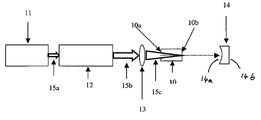
- FIG. 1 is a schematic of a laser pumped alexandrite laser system
- FIG. 2 shows an embodiment of a frequency doubled laser pumped alexandrite laser system
- FIG. 3 describes one embodiment of an Alexandrite Laser Medium Design suitable for high power
- the diode-pumped laser pump source in effect acts as a diode laser “beam clean up system”, effectively converting the output of low beam-quality diode arrays into a higher brightness output radiation which can be used to pump the tunable laser materials of the invention at high intensity.
- the pump source can provide near diffraction-limited output beam that can be matched to the absorption spectrum of the tunable material. Alexandrite and other similar materials. This approach is particularly well suited to tunable materials producing radiation in the near-IR part of the spectrum (ranging from about 690 to just over 1000 nm) because they typically possess absorption bands in the visible range where highly efficient diode-pumped lasers are already well-developed and commercially available.
- diode-pumped lasers based on frequency doubled Nd-doped gain media, capable of producing near-diffraction-limited beams in the visible at power levels ranging from 1 W to over 100 W in a variety of operational modes, including CW, Quasi-CW, Q-Switched and mode-locked.
- High beam quality beams can, in turn, be focused to very small spot diameters, as required for efficient pumping of tunable materials with relatively low gain such as Alexandrite and Cr:LiSAF, Cr:LiCAF and similar media.
- the technique disclosed herein provides a straight forward and practical path to power scaling of the tunable lasers.
- FIG. 1 shows one preferred embodiment of the laser pumped laser design.
- the pump beam 15 a comprising the output of a high brightness laser 11 has a wavelength that matches the absorption spectrum of tunable laser gain medium 10 .
- the beam 15 a is preferably near diffraction limited with an M 2 approaching unity.
- the pump beam may be multi-mode with M 2 as high as 5-6 while still falling within the scope of the principles of the invention.
- the beam 15 a may be further optically conditioned, for example by expanding and collimating through an optical system 12 , to thereby form an expanded beam 15 b which has selectable divergence properties.
- the expanded pump beam 15 b is focused along path 15 c by a lens or lens system 13 into the tunable lasing medium 10 so that the minimum pump beam focal spot size is contained within the medium 10 .
- the tunable laser resonator may be formed by the rear surface of the laser medium 10 a and the curved first surface 14 a of the output coupler 14 .
- the reflectivity of laser medium surface 10 a is designed to be highly transmitting to the pump beam radiation and highly reflective across the tunable laser wavelength range.
- the reflectivity of the distal laser medium surface 10 b is generally selected to minimize optical losses that would otherwise be experienced by the tunable laser emission.
- a separate pump input mirror may be utilized which is similarly coated to maximize pump transmission and tunable laser reflection.
- Either the back surface 10 a or the separate pump input mirror may have a curved surface, with the curvature selected, along with that of the first surface 14 a of the output coupled 14 , to optimize the overlap between the pump beam excitation volume and the resonator mode volume.
- mode matching is known to those skilled in the art to be an essential design feature for efficiently producing low order transverse mode beams, and especially TEM 00 radiation.
- the reflectivity of the first surface 14 a of the output is generally chosen to maximize the laser output for a given excitation level of the pump laser and the corresponding thermal lens properties of the resonator.
- Such resonator design aspects, including techniques to compensate for thermal lens are well known in the art of solid state laser resonator design.
- the HR and AR coatings may also be designed to be HR and AR over the full tuning range of the tunable material.
- the tunable laser of FIG. 1 may comprise additional elements inside the resonator functionally adapted for example, to tune or narrow the bandwidth of the laser output produced or to convert the wavelength of the laser using various nonlinear processes such as second-harmonic-generation (SHG), third-harmonic-generation (THG), fourth-harmonic-generation (FHG) or Raman shifting or optical parametric amplification (OPA).
- FIG. 2 In a variation on the basic laser pumped laser of FIG. 1 an embodiment of a frequency-doubled tunable laser system is shown in FIG. 2 .
- the output beam from a diffraction limited pump laser 11 passes through beam collimation and focusing optics 28 and is absorbed in the laser medium 20 .
- the laser resonator cavity is formed by the rear surface of the laser medium 20 a and the first surface of the output coupler 24 a .
- the first surface of the laser medium 20 a is designed to provide high transmission of the pump laser wavelength and high reflectivity of the tunable laser wavelength.
- the reflectivity of the output coupler first surface 24 a is chosen to reflect all of the fundamental radiation, but transmit the frequency-doubled radiation from the laser resonator cavity. Additional elements may be contained in this cavity such as the frequency doubling crystal 26 and a wavelength selection device 27 .
- the surfaces of the frequency doubling crystal 26 a and 26 b are designed to provide low loss at the fundamental and harmonic wavelengths of the alexandrite laser.
- the output surface 14 b of the output coupler mirror is designed to provide low loss for the frequency-doubled radiation.
- the wavelength selection device 27 is typically chosen to reduce the normally broad alexandrite laser emission bandwidth to match the acceptance bandwidth of the frequency doubling crystal 26 , as is customary in the art of designing intra-cavity doubled, tunable solid state lasers. Note that it is important to keep optical losses associated with device 17 to a minimum within the desired laser emission band, especially when the laser medium is relatively low gain.
- Alexandrite as the tunable medium is that it offers tunability around the peak wavelength near 750 nm and can be operated as free-running with a broad bandwidth, or dispersive elements can be placed inside the resonator to allow tuning. Because of the low gain of Alexandrite, such dispersive elements must have a very low loss, a fact that is well known from the art of designing alexandrite lasers. Of particular interest in this invention is the ability to generate ultraviolet light through frequency-doubling or tripling as was shown in FIG. 2 . The corresponding wavelengths would then be near 375 nm and 250 nm respectively, with some additional tuning limited only by the phase matching properties and spectral bandwidth of the nonlinear crystal.
- the nonlinear crystal was placed inside the resonator.
- a Q-switch may be placed inside the laser pumped laser resonator resulting in short pulse output, typically in the 10's of nanosecond range.
- the high peak powers make it practical to use extracavity conversion as another option for providing harmonic wavelengths.
- dispersive elements may need to be inserted in the alexandrite cavity to narrow the fundamental light sufficiently to allow efficient frequency-conversion. It is notable that the doubling efficiency can be significantly increased for a pulsed laser and conversion efficiencies of 40% or greater are projected in extracavity conversion and possibly even more with an intracavity arrangement. It should be realized that a similar laser-pumped-laser architecture can provide mode-locked operation with sub-picosecond pulses.
- the laser depicted in FIG. 2 can be used to provide fixed-frequency or tunable operation in the ultraviolet spectral region, and that the use of a visible diode-pumped laser to pump the Alexandrite can lead to efficient ultraviolet laser systems in either mode.
- alexandrite has a number of other advantages for practical power scaled operation.
- the gain material is known to be thermally robust with a thermal conductivity that is about twice that of Nd:YAG. It has a large thermal rupture modulus and can therefore be used with success in high-average-power lasers.
- Alexandrite lasers can thus be developed using the techniques outlined in this invention with average powers of tens of watts or more.
- the high brightness laser source may comprise the frequency doubled green radiation of commonly used diode-pumped laser materials such as Nd:YVO 4 , Nd:YAG, Nd:YLF, Nd:YALO (YAP) and Yb:YAG lasers, all of which can produce output in the green visible region.
- the Nd doped media lasers can also produce useful output in the red and spectral regions by frequency doubling alternative Nd laser transitions.
- the high brightness green laser pump source may comprise, a frequency doubled diode pumped CW Nd:YVO 4 laser such as the Millenia commercially available from Spectra-Physics or the Verdi from Coherent. Both lasers are available at power levels of 5 W and 10 W, and, in the case of the VERDI, also 15 W with near-perfect TEM00 mode and very low noise characterstics.
- Other manufacturers of low cost CW green lasers include the disc lasers from ESL and Jenoptik, which provide near-diffraction-limited as well as multi-mode beams.
- pulsed green lasers may be utilized operating at high repetition rates such as the AVIA available from Coherent Inc.
- frequency doubled fiber lasers with energy outputs in excess of 1-2 mJ and M 2 between 1 and 3 have become commercially available, for example from IPG. These are generally available at very low cost and can provide highly efficient, cost effective and practical high brightness pump sources for alexandrite as well as other tunable Cr-doped materials.
- One advantage of the fiber lasers is that their fundamental radiation may be tuned to near 1100 nm, yielding a frequency doubled source at or near 550 nm which is an excellent match to the alexandrite absorption bands, as will be discussed further below.
- a side pumped green laser offering in excess of 30 W at 1-5 kHz repetition rate may be used to pump alexandrite lasers.
- Pulsed Nd:YLF green lasers are available from numerous vendors, including Spectra-Physics, Coherent and Quantronics.
- any of these commercial diode-pumped lasers are known to be highly efficient.
- commonly available frequency-doubled Nd:YVO 4 lasers are know to have optical-to-optical efficiencies greater than 15% and wall plug efficiencies (electrical-to-output) of over 10%.
- laser pumped alexandrite was demonstrated previously (see for example, Lai et al in J. Appl. Phys. 54, 5642, 1983) this was done using an Argon CW laser operating at 647.1 nm, which is known to have notoriously low efficiency, generally less than 0.3%.
- Such a pump source although possessing high beam quality, is not suitable for use in the efficient laser pumped systems of the present invention, for which high overall efficiency is a key criterion. Similar deficiencies limit any potential use of a dye laser as a pump source for alexandrite, as such lasers are also known to be inefficient and possess poor reliability features.
- the overall electrical-to-output efficiency (at the peak of the tuning curve) of the laser-pumped tunable laser constructed according to principles of the invention exceed 2% and preferably approach or even exceed 10%.
- this is readily achievable using the laser pumped approach of the invention, based on projections from the early experiments utilizing the ion laser or dye laser pumping experiments and recent preliminary experiments conducted by the authors of the present invention.
- the efficiency of a diode pumped green laser pumped Alexandrite laser can be estimated as follows.
- the slope efficiencies can be scaled from the dye pumping experiments of Scheps et al by roughly the ratio of the quantum defects, i.e., the ratio of the pump wavelengths, or 532/645, yielding maximum slope efficiencies on the order of 40-45%.
- the performance of green visible lasers is also improving with time, especially in terms of further power scaling, and the advent of frequency doubled fiber lasers, with more than 25% overall efficiency offers still better prospects for the laser pumped laser of the invention.
- alexandrite the possibility of average power scaling to well over 10 W, in either CW or pulsed mode with near-diffraction-limited output opens up performance levels not attainable to this date with any other tunable laser, including commercially available lamp-pumped alexandrite and green laser pumped Ti:sapphire lasers.
- the laser pumped architecture of the invention has a number of other attractive features.
- the use of a laser pumped laser configuration accomplishes the twin goals of producing small excitation spot diameters allowing operation with the large pump intensities required for achieving lower thresholds and higher slope efficiencies.
- the pump spot diameter produced can be very small, typically of the order of a micron, assuming circularly symmetric pump beams as is typical in most diode pumped lasers.
- the far-field beam diameters d 0 can be calculated from the following relationship:
- d 0 4 ⁇ M 2 ⁇ ⁇ ⁇ ⁇ f ⁇ ⁇ ⁇ D 0 , ( 1 )
- ⁇ is the diode wavelength
- f the lens focal length
- D 0 the beam diameter at the focusing lens
- M 2 1 representing a perfect TEM 00 diffraction-limited beam.
- the far-field beam diameter was 18 ⁇ m
- the focal length of the lens 5 cm was the wavelength about 645 nm.
- the actual spot diameter achieved in the tunable laser crystal of FIG. 1 crystal is dependent upon the crystal length. If a beam has a diameter d 0 at a waist at the entrance face of the crystal, then following propagation through the length L of the crystal, the spot diameter d exit is given by
- d exit d 0 [ 1 + ( 4 ⁇ M 2 ⁇ ⁇ ⁇ ⁇ L n ⁇ ⁇ ⁇ ⁇ ⁇ d 0 2 ) 2 ⁇ ] 1 / 2 ( 2 )
- n is the index of refraction of the laser crystal.
- the exit beam diameter is thus seen to be larger than the entrance diameter.
- the exit diameter can be calculated to be as large as about 2 mm. Equation (2) thus has to be integrated over the crystal length to obtain the average spot diameter in the crystal, with the result that the average diameter d can be calculated from
- ⁇ d _ 2 ⁇ LM 2 ⁇ ⁇ ⁇ ⁇ ⁇ d 0 ⁇ n ( 3 )
- M 2 8.6 (corresponding to the estimated divergence in the transverse direction of the diode laser pump of Scheps et al)
- d 0 10 ⁇ m
- ⁇ 645 nm
- n 1.74
- d 1014 ⁇ m
- an average spot size of about 1 mm If the pump beam is focused into the center of the crystal, the average beam diameter is about 0.5 mm.
- the fundamental mode diameter estimated to be about 1.5 mm, the overlap between the pump beam in the Alexandrite and the fundamental mode was reasonably good, and this is one reason why the slope efficiency obtained in these experiments was relatively so high.
- an alexandrite crystal was used as the tunable laser medium and a Snake Creek Laser SCL-CW-532-200 provided as the pump source.
- This laser provides a CW near diffraction-limited output (M 2 ⁇ 1.1) of up to 215 mW of power at 532 nm.
- the laser output was collimated to a 5 mm beam diameter and focused into the center of the alexandrite laser crystal using a 15 cm AR coated fused silica lens.
- the laser medium was a 3 mm diameter by 7 mm long alexandrite laser crystal with a Cr+3 doping of approximately 0.3%.
- the single pass absorption of the alexandrite crystal at this wavelength was estimated to be approximately 75%.
- a simple resonator was constructed comprising an output coupler with a 150 mm radius of curvature placed approximately 10 cm from the output face of the laser crystal.
- the output mirror transmission of 0.5% produced a 50 mW absorbed power threshold and maximum output of 4 mW at 753 nm was achieved with an absorbed power of 160 mW.
- a pulsed pump laser source from Spectra-Physics was used. Operating at about 20 Hz. And producing just over 25 mJ/pulse with a pulsewidth of approximately 30 ns FWHM.
- a pulse waist placed at the output surface of the laser medium, a 15 cm radius of curvature output coupler mirror placed 14 cm from the output face of the laser medium, a maximum output power of 60 ⁇ joules/pulse was achieved with 10 mJ/pulse input, corresponding to a threshold power of approximately 5 mJ/pulse.
- the laser medium 30 has a piece of undoped sapphire 35 bonded to the input face 30 a of the laser medium. This bond is created by optically contacting the output face 35 b of the sapphire piece to the laser medium input face 30 a .
- Onyx Optics in Dublin, Calif. has shown that this type of technique is a commercially viable approach.
- This design can provide a low loss interface, which has a significantly higher damage threshold than an adhesive joint and that of a coating applied at an air interface.
- the reflective coating is then placed on the sapphire input surface 35 a .
- the focused pump beam size on this coated surface is substantially larger than the standard designs using a tunable laser medium alone, thereby allowing for higher power pumping of the alexandrite laser medium without damage.
- the sapphire medium can be substituted by other suitable materials, such as rutile or fused silica to achieve the same purpose.
- Nd:YAG for example, or Nd:YVO 4 , both of which have a major laser transition at 1064 nm
- the doubled wavelength of 532 nm is at a wavelength that is strongly absorbed by Alexandrite for the electric field E parallel to b.
- the absorption cross-section is almost identical to that of a pump wavelength of 645 nm used in the prior art experiments.
- the longer wavelength transition at 1318.7 nm in Nd:YAG could also be used since doubled it produces 659.35 nm.
- the absorption cross-section is about 50% of that at 645 nm, the wavelength used in the original prior art dye laser pumping experiments of Scheps et al.
- the absorption efficiency then drops off rapidly and at 670 nm, corresponding to the frequency doubled 1340 nm transitions of Nd:YVO 4 and Nd:YALO the absorption it falls in the wings of the Alexandrite absorption spectrum and is therefore of marginal interest for this material, but is of special interest for other Cr-doped media such as Cr:LiSAF.
- the 540 nm frequency doubled fundamental transition in Nd:YALO is of interest because the Alexandrite absorption at that wavelength is almost double that at 532 nm or 645 nm.
- laser pumps which may be useful for pumping Alexandrite and other tunable materials include a frequency-doubled Yb fiber laser operating around 1020-1100 nm. Frequency-tripled erbium doped lasers operating near the common wavelength of 1500 nm may also be used.
- Cr:LiSAF and Cr:LiCAF are tunable materials in the near infra red and offer gains that are somewhat larger than alexandrite.
- Cr:Al 2 O 3 may also be pumped by green lasers. Direct pumping of Cr:LiSAF has been successfully demonstrated but the efficiencies are limited by considerations similar to those for alexandrite as well as by the fact that the optimal diode wavelengths from the viewpoint of absorption are not readily available. Unfortunately Cr:LiSAF does not absorb well in the green.
- Another class of lasers that can be pumped by the frequency converted radiation of diode pumped green lasers are solid state dyes. These media, while highly versatile as tunable materials, suffer from short upper state lifetimes and longevity issues that have so far limited their utility in high power applications. Direct diode pumping in particular, presents major challenges due to the short lifetimes.
- use of high power pulsed green lasers to pump these materials resulted in very high slope efficiencies but placed serious operational constraints on the laser material due to degradation issues.
- Using the small near diffraction limited spots available from green diode pumped lasers can be used to advantage, for example, by allowing periodic translation of the dye gain material to continually expose fresh spots to the pump beam, thereby substantially extending the useable lifetime of the gain material.
Landscapes
- Physics & Mathematics (AREA)
- Electromagnetism (AREA)
- Engineering & Computer Science (AREA)
- Plasma & Fusion (AREA)
- Optics & Photonics (AREA)
- Lasers (AREA)
Abstract
Description
where λ is the diode wavelength, f the lens focal length, and D0 the beam diameter at the focusing lens and M2 characterizing the beam quality, with M2=1 representing a perfect TEM00 diffraction-limited beam. In the example of the diode pumping experiments of Scheps et al, the far-field beam diameter was 18 μm, the focal length of the lens 5 cm, and the wavelength about 645 nm. With D0 estimated at ˜2 cm and M2=1.0 for the perpendicular direction, we find that the actual far-field spot at the location of the Alexandrite was highly elliptical due to the disparity in beam-quality between the perpendicular and parallel directions, and is estimated as 2 μm×18 μm. By contrast, for the dye laser also used in the same said reference the real spot diameter at the location of the Alexandrite crystal was circular with a diameter estimated to be about 2 μm, after making adjustments for the wavelength disparity. The beam-quality of the diode laser thus has a dramatic effect on the intensity achieved in the far-field where the Alexandrite was located, with the diode laser producing about ˜9 times less intensity in the far-field than the dye laser pump under similar conditions.
where n is the index of refraction of the laser crystal. The exit beam diameter is thus seen to be larger than the entrance diameter. In the prior art example of Scheps et al, the exit diameter can be calculated to be as large as about 2 mm. Equation (2) thus has to be integrated over the crystal length to obtain the average spot diameter in the crystal, with the result that the average diameter
For M2=8.6 (corresponding to the estimated divergence in the transverse direction of the diode laser pump of Scheps et al), d0=10 μm, λ=645 nm, and n=1.74,
Claims (12)
Priority Applications (2)
| Application Number | Priority Date | Filing Date | Title |
|---|---|---|---|
| US10/983,275 US7627016B2 (en) | 2004-11-08 | 2004-11-08 | Laser pumped tunable lasers |
| US11/565,286 US7639721B2 (en) | 2003-09-22 | 2006-11-30 | Laser pumped tunable lasers |
Applications Claiming Priority (1)
| Application Number | Priority Date | Filing Date | Title |
|---|---|---|---|
| US10/983,275 US7627016B2 (en) | 2004-11-08 | 2004-11-08 | Laser pumped tunable lasers |
Related Child Applications (3)
| Application Number | Title | Priority Date | Filing Date |
|---|---|---|---|
| US11330909 Continuation-In-Part | 2004-09-22 | ||
| PCT/US2004/031150 Continuation-In-Part WO2005031926A2 (en) | 2003-09-22 | 2004-09-22 | Diode-pumped microlasers including resonator microchips and methods for producing same |
| US11/565,286 Continuation-In-Part US7639721B2 (en) | 2003-09-22 | 2006-11-30 | Laser pumped tunable lasers |
Publications (2)
| Publication Number | Publication Date |
|---|---|
| US20060098696A1 US20060098696A1 (en) | 2006-05-11 |
| US7627016B2 true US7627016B2 (en) | 2009-12-01 |
Family
ID=36316275
Family Applications (1)
| Application Number | Title | Priority Date | Filing Date |
|---|---|---|---|
| US10/983,275 Expired - Fee Related US7627016B2 (en) | 2003-09-22 | 2004-11-08 | Laser pumped tunable lasers |
Country Status (1)
| Country | Link |
|---|---|
| US (1) | US7627016B2 (en) |
Cited By (2)
| Publication number | Priority date | Publication date | Assignee | Title |
|---|---|---|---|---|
| CN106229806A (en) * | 2016-09-27 | 2016-12-14 | 天津大学 | The tunable alaxadrite laser of Raman gold-tinted pumping |
| WO2021114792A1 (en) * | 2019-12-13 | 2021-06-17 | 华为技术有限公司 | Gain adjuster, gain adjustment method and optical line terminal |
Families Citing this family (3)
| Publication number | Priority date | Publication date | Assignee | Title |
|---|---|---|---|---|
| US20090285248A1 (en) * | 2008-05-13 | 2009-11-19 | Klashtech-Karpushko Laser Technologies Gmbh | Uv light generation by frequency conversion of radiation of a ruby laser pumped with a second harmonic of a solid-state laser |
| US8079849B2 (en) * | 2010-05-11 | 2011-12-20 | Tyco Electronics Corporation | Socket connector assembly with compressive contacts |
| CN112886377A (en) * | 2019-11-29 | 2021-06-01 | 山东大学 | Emerald gemstone continuous tunable laser pumped by 590nm waveband Raman frequency doubling light source |
Citations (10)
| Publication number | Priority date | Publication date | Assignee | Title |
|---|---|---|---|---|
| US5134622A (en) * | 1990-12-20 | 1992-07-28 | Deacon Research | Diode-pumped optical parametric oscillator |
| US5136596A (en) * | 1989-09-26 | 1992-08-04 | Excel Technology, Inc. | Broadly tunable, high repetition rate solid state and dye lasers and uses thereof |
| US5142542A (en) * | 1991-01-07 | 1992-08-25 | Amoco Corporation | Signal-resonant intracavity optical frequency mixing |
| US5170406A (en) * | 1991-03-13 | 1992-12-08 | Amoco Corporation | High-power, end-pumped solid state laser |
| US5249189A (en) * | 1992-05-28 | 1993-09-28 | The United States Of America As Represented By The Secretary Of The Navy | Tunable lasers pumped by visible laser diodes |
| US5638397A (en) * | 1994-02-04 | 1997-06-10 | Spectra-Physics Lasers, Inc. | Confocal-to-concentric diode pumped laser |
| US6222869B1 (en) * | 1998-06-03 | 2001-04-24 | Iridex Corporation | Aspheric lensing control for high power butt-coupled end-pumped laser |
| US20020039377A1 (en) * | 2000-03-16 | 2002-04-04 | The Regents Of The University Of California | Method for optical pumping of thin laser media at high average power |
| US6370168B1 (en) * | 1999-10-20 | 2002-04-09 | Coherent, Inc. | Intracavity frequency-converted optically-pumped semiconductor laser |
| US6683894B1 (en) * | 2000-04-19 | 2004-01-27 | Science & Engineering Services, Inc. | Tunable IR laser source for MALDI |
-
2004
- 2004-11-08 US US10/983,275 patent/US7627016B2/en not_active Expired - Fee Related
Patent Citations (10)
| Publication number | Priority date | Publication date | Assignee | Title |
|---|---|---|---|---|
| US5136596A (en) * | 1989-09-26 | 1992-08-04 | Excel Technology, Inc. | Broadly tunable, high repetition rate solid state and dye lasers and uses thereof |
| US5134622A (en) * | 1990-12-20 | 1992-07-28 | Deacon Research | Diode-pumped optical parametric oscillator |
| US5142542A (en) * | 1991-01-07 | 1992-08-25 | Amoco Corporation | Signal-resonant intracavity optical frequency mixing |
| US5170406A (en) * | 1991-03-13 | 1992-12-08 | Amoco Corporation | High-power, end-pumped solid state laser |
| US5249189A (en) * | 1992-05-28 | 1993-09-28 | The United States Of America As Represented By The Secretary Of The Navy | Tunable lasers pumped by visible laser diodes |
| US5638397A (en) * | 1994-02-04 | 1997-06-10 | Spectra-Physics Lasers, Inc. | Confocal-to-concentric diode pumped laser |
| US6222869B1 (en) * | 1998-06-03 | 2001-04-24 | Iridex Corporation | Aspheric lensing control for high power butt-coupled end-pumped laser |
| US6370168B1 (en) * | 1999-10-20 | 2002-04-09 | Coherent, Inc. | Intracavity frequency-converted optically-pumped semiconductor laser |
| US20020039377A1 (en) * | 2000-03-16 | 2002-04-04 | The Regents Of The University Of California | Method for optical pumping of thin laser media at high average power |
| US6683894B1 (en) * | 2000-04-19 | 2004-01-27 | Science & Engineering Services, Inc. | Tunable IR laser source for MALDI |
Non-Patent Citations (1)
| Title |
|---|
| Torizuka, K., Yamashita, M., Yabiku, T. "Continuous-wave alexandrite laser pumped by a direct-current mercury arc lamp," Applied Optics. vol. 32, No. 36, Dec. 20, 1993 pp. 7394-7398. * |
Cited By (4)
| Publication number | Priority date | Publication date | Assignee | Title |
|---|---|---|---|---|
| CN106229806A (en) * | 2016-09-27 | 2016-12-14 | 天津大学 | The tunable alaxadrite laser of Raman gold-tinted pumping |
| CN106229806B (en) * | 2016-09-27 | 2019-02-22 | 天津大学 | Raman Yellow Pumped Tunable Chrysoberyl Laser |
| WO2021114792A1 (en) * | 2019-12-13 | 2021-06-17 | 华为技术有限公司 | Gain adjuster, gain adjustment method and optical line terminal |
| US12573805B2 (en) | 2019-12-13 | 2026-03-10 | Huawei Technologies Co., Ltd. | Gain adjuster, gain adjustment method, and optical line terminal |
Also Published As
| Publication number | Publication date |
|---|---|
| US20060098696A1 (en) | 2006-05-11 |
Similar Documents
| Publication | Publication Date | Title |
|---|---|---|
| US6031854A (en) | Diode-pumped cascade laser for deep UV generation | |
| US5317447A (en) | High-power, compact, diode-pumped, tunable laser | |
| US4701929A (en) | Laser diode pumped solid state laser | |
| US4656635A (en) | Laser diode pumped solid state laser | |
| US4756003A (en) | Laser diode pumped solid state laser | |
| US4872177A (en) | Laser diode pumped solid state laser | |
| US6901084B2 (en) | Stable solid state raman laser and a method of operating same | |
| EP1618634B1 (en) | Eye-safe solid-state laser system | |
| US7991028B1 (en) | Tunable solid state laser system | |
| EP2950403B1 (en) | High power, end pumped laser with off-peak pumping | |
| US20030039274A1 (en) | Method and apparatus for tissue treatment and modification | |
| WO2008067535A2 (en) | Laser pumped tunable lasers | |
| Agnesi et al. | High-peak-power diode-pumped passively Q-switched Nd: YVO4 laser | |
| Ostroumov et al. | Intracavity frequency-doubled diode-pumped Nd: LaSc3 (BO3) 4 lasers | |
| WO2018053590A1 (en) | Cascaded, long pulse and continuous wave raman lasers | |
| US20060098696A1 (en) | Laser pumped tunable lasers | |
| US8315283B2 (en) | Wavelength selectable laser systems and related methods | |
| Hemmati et al. | High repetition-rate Q-switched and intracavity doubled diode-pumped Nd: YAG laser | |
| Zayhowski et al. | Miniature gain-switched lasers | |
| US20060153261A1 (en) | Optically-pumped -620 nm europium doped solid state laser | |
| Kuper et al. | Green pumped alexandrite lasers | |
| Baer et al. | High-efficiency diode pumping of Nd: YLF and Nd: YAG using a laser-diode bar | |
| Berrou et al. | Crystalline fiber Ho3+: YAG laser resonantly pumped by high-spectral-brightness laser diodes | |
| Hammons et al. | Scaling of high power diode-pumped self-frequency doubled Nd/sup 3+: YCOB lasers | |
| Dabu et al. | Design and characterization of an end-pumped Nd: YAG microlaser |
Legal Events
| Date | Code | Title | Description |
|---|---|---|---|
| REMI | Maintenance fee reminder mailed | ||
| LAPS | Lapse for failure to pay maintenance fees | ||
| STCH | Information on status: patent discontinuation |
Free format text: PATENT EXPIRED DUE TO NONPAYMENT OF MAINTENANCE FEES UNDER 37 CFR 1.362 |
|
| STCH | Information on status: patent discontinuation |
Free format text: PATENT EXPIRED DUE TO NONPAYMENT OF MAINTENANCE FEES UNDER 37 CFR 1.362 |
|
| FP | Lapsed due to failure to pay maintenance fee |
Effective date: 20131201 |
|
| AS | Assignment |
Owner name: NEVYAS, HERBERT, MD, PENNSYLVANIA Free format text: LIEN;ASSIGNORS:LASER ENERGETICS, INC.;BATTIS, ROBERT D.;LIVECCHI, JOHN T.;REEL/FRAME:036777/0730 Effective date: 20150904 Owner name: NEVYAS EYE ASSOCIATES, P.C., PENNSYLVANIA Free format text: LIEN;ASSIGNORS:LASER ENERGETICS, INC.;BATTIS, ROBERT D.;LIVECCHI, JOHN T.;REEL/FRAME:036777/0730 Effective date: 20150904 |
|
| AS | Assignment |
Owner name: DOBIN, ANDREA, NEW JERSEY Free format text: ORDER AUTHORIZING AND APPROVING TRUSTEE'S SALE;ASSIGNOR:NEVYAS, HERBERT J, DR.;REEL/FRAME:041809/0675 Effective date: 20170104 |