US7626149B2 - Non-invasive sensor and method of use - Google Patents
Non-invasive sensor and method of use Download PDFInfo
- Publication number
- US7626149B2 US7626149B2 US11/673,928 US67392807A US7626149B2 US 7626149 B2 US7626149 B2 US 7626149B2 US 67392807 A US67392807 A US 67392807A US 7626149 B2 US7626149 B2 US 7626149B2
- Authority
- US
- United States
- Prior art keywords
- target
- signal
- frequency
- attenuation
- temperature
- Prior art date
- Legal status (The legal status is an assumption and is not a legal conclusion. Google has not performed a legal analysis and makes no representation as to the accuracy of the status listed.)
- Expired - Fee Related
Links
Images




Classifications
-
- G—PHYSICS
- G01—MEASURING; TESTING
- G01N—INVESTIGATING OR ANALYSING MATERIALS BY DETERMINING THEIR CHEMICAL OR PHYSICAL PROPERTIES
- G01N33/00—Investigating or analysing materials by specific methods not covered by groups G01N1/00 - G01N31/00
- G01N33/02—Food
- G01N33/12—Meat; Fish
-
- G—PHYSICS
- G01—MEASURING; TESTING
- G01K—MEASURING TEMPERATURE; MEASURING QUANTITY OF HEAT; THERMALLY-SENSITIVE ELEMENTS NOT OTHERWISE PROVIDED FOR
- G01K11/00—Measuring temperature based upon physical or chemical changes not covered by groups G01K3/00, G01K5/00, G01K7/00 or G01K9/00
- G01K11/006—Measuring temperature based upon physical or chemical changes not covered by groups G01K3/00, G01K5/00, G01K7/00 or G01K9/00 using measurement of the effect of a material on microwaves or longer electromagnetic waves, e.g. measuring temperature via microwaves emitted by the object
-
- G—PHYSICS
- G01—MEASURING; TESTING
- G01K—MEASURING TEMPERATURE; MEASURING QUANTITY OF HEAT; THERMALLY-SENSITIVE ELEMENTS NOT OTHERWISE PROVIDED FOR
- G01K13/00—Thermometers specially adapted for specific purposes
- G01K13/10—Thermometers specially adapted for specific purposes for measuring temperature within piled or stacked materials
-
- G—PHYSICS
- G01—MEASURING; TESTING
- G01N—INVESTIGATING OR ANALYSING MATERIALS BY DETERMINING THEIR CHEMICAL OR PHYSICAL PROPERTIES
- G01N22/00—Investigating or analysing materials by the use of microwaves or radio waves, i.e. electromagnetic waves with a wavelength of one millimetre or more
- G01N22/04—Investigating moisture content
Definitions
- the present invention relates to a non-invasive sensor and method of use primarily for temperature measurement, though also applicable to composition sensing, including fat percentage.
- Non-invasive temperature measurement of frozen/near frozen organic matter using single-frequency microwave radiation is well documented. Such techniques are particularly useful in the transport and storage chain between producer and consumer to monitor the temperature of frozen produce. Standard operating practices and regulatory/legislative requirements in the food industry require frozen produce, such as meat, to be frozen below a prescribed temperature before and during shipment along the length of the cold chain. Arrival of insufficiently cooled produce at the recipient destination casts doubt on temperature maintenance (and measurement procedures) of each stage in the chain. To limit such liability, the various parties in the cold chain traditionally undertake random monitoring tests, typically via an invasive process of drilling the produce and manually inserting a temperature probe.
- Microwave temperature measurement permits a rapid, non-invasive, potentially automated method of testing all the frozen produce supplied, as described in the applicant's earlier patent applications including PCT/NZ03/00279 incorporated herein by reference. Nevertheless, known microwave temperature measurement techniques still suffer from disadvantages, primarily related to the intrinsic physical characteristics of microwave interactions with ice and water.
- the passage of microwave radiation through a given material is attenuated according to a function dependent on both material temperature and the microwave frequency. Moreover, the microwave attenuation diminishes significantly at sub-freezing point temperatures resulting in the frozen material effectively becoming transparent to microwave radiation.
- Such systems are capable of measuring the temperature of a single frozen meat carton, for example, by measuring the unabsorbed energy of a single microwave frequency passed through the meat carton and correlating with remaining unfrozen water to calculate the temperature.
- the present invention provides a non-invasive temperature measurement and (optionally) composition sensing system and method of use.
- the present invention is particularly applicable for use with chilled or frozen organic produce stored and transported within typical cold chain temperatures.
- the present invention provides a system for temperature and/or composition measurement of an at least partially aqueous target including:
- microwave/UHF spectrum and radio frequency (RF) spectrum are defined as 100 MHz-500 GHz and 0.1 KHz-100 MHz respectively.
- Equation (1) From Equation (1) it can be seen that reducing a allows a larger z to be penetrated for the same P z and P o .
- the relationship between power, frequency and penetration can be optimised by carefully selecting the optimum frequency from a suitable frequency band.
- said first signal has a frequency between 200 MHz to 3.5 GHz and said second signal has a frequency between 0.1-10 KHz for meat thicknesses of 50 to 1200 mm thick.
- microwave and RF frequencies may differ from the above definitions.
- the present invention utilises the different physical attenuation by ice and water exhibited by the separate electromagnetic radiation signals to determine the target temperature and consequently, it is the frequencies that cover the absorption effects which are pertinent, and not a historical or academic definition of microwave or RF frequencies.
- microwave is used to denote both microwave signals and frequencies classified as ultra high frequency (UHF) signals.
- the present invention provides a system for temperature measurement of an at least partially aqueous target including:
- the present invention is described herein particularly with reference to the temperature measurement of chilled or frozen meat or the like. It should be understood that this is for exemplary purposes only and the invention is not so restricted.
- the present invention may also be used to determine the temperature of other substances and/or at least partially determine the composition of certain targets such as the fat percentage.
- the present invention provides a system and method for measurement of non-frozen or frozen temperatures of a target material determined by selection of one or more said irradiating frequencies such that the corresponding attenuation for at least one corresponding target constituent(s) is substantially zero and/or constant, enabling temperature of a remaining constituent to be measured directly from the attenuation of the total transmitted signal received by the receiving antenna.
- target includes, but is not limited to chilled, frozen, or near frozen meat (including poultry, lamb, beef, and pork), fish, cheese, butter, oils and vegetables.
- the terms ‘partially aqueous target’ includes any target with between 5 and 100% aqueous content.
- the degree of microwave energy absorbed is dependent on the equivalent depth of water z present in the target (according to the equation (1)), the microwave frequency and power may be varied to accommodate targets of different aqueous content.
- the term ‘signal processing means’ includes, but is not limited to any device or system with data input/output and processing capacity, capable of calculating the signal attenuation, phase angle change, attenuation and/or polarisation from a comparison of the signal from the receiving antenna and the signal transmitted from the transmitter antenna.
- the signal processing means is also capable of performing calculations according to one or more relationships defined herein, optionally with calibration input from known data sets. It will be appreciated that while convenient to automatically perform all the temperature calculations within the signal processing means, it is also possible to utilise further external processing/computing means and or even perform said calculations manually with reference to known data sets.
- the present invention uses microwaves to predict the amount of water in the target and RF waves to predict the amount of ice. These results are combined with established data on the ice/water ratio correlation with temperature to predict the target temperature according to the equations:
- T f is the Freezing Temperature
- Equation (5) The proportional relationship in equation (5) may be replaced by an equivalence relationship through the addition of a calibration factor which may be target material, frequency, and/or geometry dependent. Further, a third frequency may be correlated to attenuation of EM energy by fat in the 0.1 to 110 MHz range (depending on the equivalent depth of meat target).
- Fat mass Target Mass ⁇ [1 ⁇ [W+I+S]] (6) and thus provides a means of checking the integrity of the fat determination performed by measuring the attenuation of three or more frequencies as described above.
- the present invention may be used as a supplementary check to other conventional CL measurement processes employed, such as dual energy x-ray analysis (DXA) systems, or manual testing procedures.
- DXA dual energy x-ray analysis
- the present invention may be relied upon as the primary CL measurement technique, in addition to ensuring safe freezing temperatures are maintained for produce shipped from the plant.
- the characteristics of the microwave and RF technologies involved in the present invention provide a significant reduction in cost and environmental hazards over DXA analysis equipment, whilst offering speed, automation and accuracy advantages over manual CL testing methods.
- first and second signals are transmitted from separate antennae along reciprocal beam axes from opposing sides of the target.
- position and orientation of the first signal transmitting antenna and the second signal receiving antenna should be substantially identical. This requirement may be addressed by combination transmitter/receiver assemblies. Positioning the transmitting and receiving antenna pairs in an orthogonal orientation such that the signal beams sweep the same volume of the target provides another viable configuration to minimise measurement errors.
- the target could placed between a first antennae set, scanned at the first frequency, then moved to a new position between a second antennae set and scanned at the second frequency, where antennae sets incorporate any one of the embodiments discussed herein.
- At least one transmitting and receiving antennae pair are orientated in a non-confronting, preferably co-axial arrangement, whereby the receiver receives a reflected signal from the target, not a transmitted signal. This provides the potential to measure individual units within a target such as individual meat cartons on a pallet.
- the present invention thus provides a temperature measurement and composition analysis system enabling increased automation at meat processing plants and at subsequent stages in the cold chain, through automated temperature measuring of whole pallets of produce without damage by invasive tests or the need to unpack and test individual cartons.
- FIG. 1 Shows a schematic representation of a first preferred embodiment of the present invention
- FIG. 2 shows a schematic representation of a second preferred embodiment of the present invention
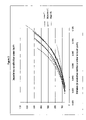
- FIG. 3 shows a graph of impedance V effective water depth penetration for low, medium and high CL values
- FIG. 4 shows a graph of impedance V effective ice depth penetration for low, medium and high CL values
- FIG. 5 shows a graph of impedance V fat depth in frozen meat at ⁇ 10, ⁇ 13, and 18° C.
- FIG. 6 shows a graph of phase angle V target temperature for fat and meat through the chilled region at 1 MHz and 5 MHz
- FIG. 7 shows a graph of phase angle V target temperature for fat and meat at 200 MHz through the chilled region.
- FIGS. 1-2 show exemplary embodiments of the present invention in the form of a non-invasive temperature and/or composition measurement system ( 1 ) including a transmitter and receiver mechanism ( 2 ) comprised of one or more transmitting antenna(e) ( 3 ) and receiving antenna(e) ( 4 ) and a signal processing means ( 5 ).
- the system ( 1 ) is used to measure the temperature of a target ( 6 ) in the form of pallet ( 7 ) stacked with a plurality of processed meat cartons ( 8 ). The meat and placed in plastic bags inside a toughened cardboard meat carton.
- FIG. 1 shows a twin stack of cartons ( 8 ) on a pallet ( 7 ) positioned between the transmitter/receiver mechanism ( 2 ) for monitoring on an automated process line moving along an axis orthogonal to the plane of the paper.
- FIG. 2 shows a second embodiment, with an alternative embodiment target ( 6 ) arrangement of a single vertical stack of cartons ( 8 ), with a corresponding vertically aligned transmitter/receiver mechanism ( 2 ).
- the transmitter/receiver mechanism ( 2 ) is capable of irradiating said target ( 6 ) with at least a first and a second electromagnetic radiation signal of differing frequencies and receiving an attenuated signal transmitted though the target ( 6 ).
- the first signal (not shown) has a frequency in the microwave spectrum
- said second signal (not shown) has a frequency in the radio frequency (RF) spectrum.
- the respective Microwave and RF transmissions may be emitted from a separate transmitters ( 3 ) or alternatively, by a single combination transmitter ( 3 ) capable of generating signals of both frequencies.
- the term microwave spectrum or signal includes frequencies between 100 MHz-500 GHz and thus also encompasses signals with UHF frequencies, while the term radio frequency (RF) spectrum is defined as 01. KHz-100 MHz.
- FIGS. 1 and 2 both show a single set of transmitter/receiver antennae ( 3 , 4 ) associated with either of microwave or RF signal.
- a second set associated with the other of the two frequencies may be physically located:
- the transmitter and receiving antennae of at least one set ( 3 , 4 ) are orientated and aligned such that the receiver ( 4 ) receives a reflect signal from the target ( 6 ) and not a transmitted signal.
- the attenuation of the transmitted signal will be effected by spaces between, and within, cartons (which will be “seen” by the receiver as 100% transmittance) and non-homogeneity in the target which distorts the total water content (ice and water) as “seen” by the receiver.
- a typical target ( 7 ) of palletised meat cartons ( 8 ) is positioned between a set of transmitting and receiving antennae ( 3 , 4 ) and irradiated with microwave radiation or RF radiation and the attenuated signal passing though the target is measured and inputted to the signal processor ( 5 ). The process is repeated for the other signal.
- the attenuated microwave signal measurement gives an indication of the water present in the signal beam path by comparison with established data for attenuation of liquid water of the measurement, given that the beam path is known by simply measuring the target width.
- the attenuated RF signal is compared to established data on ice attenuation to predict how much of the beam path is ice. The ratio of the two results gives an indication of the target temperature according to the relationship.
- a third electromagnetic frequency may be correlated to attenuation of electromagnetic energy by fat, preferably in the 100-110 MHz range.
- the third frequency may be emitted from a further antennae set (not shown) distinct from the or each antennae set(s) associated with the first and second frequencies.
- the third frequency may be emitted from a variable frequency antennae set also responsible for the first and/or second frequencies.
- This application utilises meat as the biological sample and the ice fraction as the characteristic to be measured, where the temperature of the meat is inferred mathematically from the ice fraction.
- the frequency range from 1 kHz through to 300 MHz was scanned and the optimal frequencies selected for determining the ice component, water component and fat component of the meat based on the relative attenuation of each component at each frequency.
- the difference between the value of the real and imaginary components of the two signals is due to the attenuation and phase angle loss of the signal as it passes through a material.
- the attenuation curves for ice and water in meat were selected as the calibration parameter.
- the optimal second frequency for ice was determined as lying in the range 0.1-10 kHz, from which a frequency of 10 kHz was selected.
- Z ice [ 1 - 2 ⁇ ⁇ ice ] ⁇ ln ⁇ ⁇ X ice X 0 ice ⁇ ( 8 ⁇ a )
- T ( T f + W + I ) 1 - [ I 0.9375 ⁇ ( W + I ) ] ( 10 )
- T is the temperature of the meat
- the Chemical Lean [ratio] of meat may be defined as the ratio of lean meat in a sample of meat. Primarily determined chemically (giving rise to the name) by solvent extraction of the fat and calculating the weight difference of the residue over the original sample weight. However this is a labour intensive, slow and potentially hazardous test that is performed in a laboratory where inter-operator errors are evident.
- the CL can be determined according to as follows:
- CL (1+S) ⁇ (I+W) (1b)
- Fat is known to contain small quantities of water which are bound into the fat structure and are therefore not free to rotate as does“free water”.
- This“bound water” is known to have a rotational harmonic occurring between 1 and 100 MHz.
- the present invention may also be used to infer temperature of product in the chilled range.
- FIGS. 6 and 7 show the temperature of fat and meat constituents through the chilled temperature range for different irradiating frequencies.
- phase loss angle of signals passing through materials is related to the temperature of the sample (Brengsston et al, J. Sci. Fd Agric 1963 Vol14 August). Further, Brengsston et al also demonstrated that each material causes a different loss angle at a given temperature, and therefore in non-homogeneous materials, such as meat, the loss angles of each material are convolved. Thus for the chilled temperature to be inferred effectively, the loss angle of each material needs to be determined for all components before the temperature can be derived.
- FIGS. 6 and 7 show data tracking the temperature of meat and fat though the chilled temperature range at 1 & 5 MHZ and at 200 MHz respectively, obtained using a concentric Radio Frequency test chamber.
- the phase loss angle or attenuation for meat is negligible, and may effectively be ignored. Consequently, the measured phase loss angle provides a direct measure of the Fat constituent temperature.
- the response at an irradiating frequency of 1 MHz, for meat is non-zero, however is still substantially linear above zero degrees and may thus be offset as a constant.
- a frequency of 1-5 MHz, (preferably 5 MHz) provides an effective means of determining the chilled temperature of fat for the small sample target of approximately 50 mm.
- the optimum frequency would need to be altered for thicker samples, as given by equation 1.
- FIG. 7 shows the results of irradiating at a frequency of 200 MHz, which gives a negligible response for fat at chilled temperatures, thus enabling the meat temperature to be measured directly from the resultant attenuation measured.
- these frequencies relate to the 500 mm small sample used and differing frequencies would be selected for differing target thicknesses.
Landscapes
- Physics & Mathematics (AREA)
- General Physics & Mathematics (AREA)
- Health & Medical Sciences (AREA)
- Chemical & Material Sciences (AREA)
- Life Sciences & Earth Sciences (AREA)
- Immunology (AREA)
- Food Science & Technology (AREA)
- Engineering & Computer Science (AREA)
- Analytical Chemistry (AREA)
- Biochemistry (AREA)
- General Health & Medical Sciences (AREA)
- Electromagnetism (AREA)
- Pathology (AREA)
- Medicinal Chemistry (AREA)
- Meat, Egg Or Seafood Products (AREA)
- Freezing, Cooling And Drying Of Foods (AREA)
- Measuring And Recording Apparatus For Diagnosis (AREA)
- Arrangements For Transmission Of Measured Signals (AREA)
Abstract
Description
-
- Time-consuming and labour intensive,
- Potentially inaccurate unless performed carefully,
- Unable to check every item and thus problem produce may escape detection,
- Non-automated, and
- Wasteful; the tested produce typically requires re-sealing, re-packing, down grading or disposal.
Pz=Poe−2αz (1)
where P is the residual power
-
- α is the attenuation factor (frequency and material dependent)
- o indicates the initial condition, and
- z indicates the equivalent depth of material (i.e. excluding any voids and non-material spaces)
Thus, it can be seen that simply increasing the power transmitted does not permit thicker layers of water/ice to be measured, although it does impact directly on the noise level and signal resolution.
-
- a transmitter and receiver mechanism including one or more transmitting and receiving antenna(e), said mechanism capable of irradiating said target with a plurality of electromagnetic radiation signals including a first and a second electromagnetic radiation signal of differing frequencies and receiving an attenuated signal transmitted though the target;
- signal processing means, capable of calculating the attenuation of the transmitted signal;
characterised in that,
said first signal has a frequency in the microwave/UHF spectrum, and said second signal has a frequency in the radio frequency (RF) spectrum.
-
- a transmitter and receiver mechanism including one or more transmitting and receiving antenna(e), said mechanism capable of irradiating said target with a plurality of electromagnetic radiation signals including a first and a second electromagnetic radiation signal of differing frequencies and receiving an attenuated signal transmitted though the target;
- signal processing means, capable of calculating the attenuation of the transmitted signal;
characterised in that at said differing frequencies of the first and second signals; - absorption of said first signal by water is disproportionately higher than absorption by ice and
- absorption of said second signal by ice is disproportionately higher than absorption by water.
Pz=Poe−2αz (1)
where P is the residual power
-
- α is the attenuation factor (frequency and material dependent)
- o indicates the initial condition, and
- z indicates the equivalent depth of material (i.e. excluding any voids and non-material spaces)
W=(mass of water)/(mass of water+ice+fat+protein+salts+ash)
and
I =(mass of ice)/(mass of ice+water+fat+protein+salts+ash),
although the non-water/ice constituent fractions are often omitted from references to the ice and water fractions regarding their inter-relationship in temperature behaviour.
where
As discussed above,
S∝(W+I)
Therefore
Consequently, it can be seen that the ratio of Radio Frequency attenuation ΔRF to Microwave Frequency attenuation ΔMW can be correlated to the temperature T of the target material, independently of the fat, oil, or solids content.
The proportional relationship in equation (5) may be replaced by an equivalence relationship through the addition of a calibration factor which may be target material, frequency, and/or geometry dependent. Further, a third frequency may be correlated to attenuation of EM energy by fat in the 0.1 to 110 MHz range (depending on the equivalent depth of meat target).
Fat mass=Target Mass×[1−[W+I+S]] (6)
and thus provides a means of checking the integrity of the fat determination performed by measuring the attenuation of three or more frequencies as described above.
F+W+I=1−S (7)
And since
S=β×(W+I)
-
- and where β is a proportionality constant≈protein+salts+ash (typically 0.2−0.25 for bovine meat)
Then
F+(1+β)×[W+I]=1
Thus composition predictions may be made which are independent of temperature and mass of the target. It will also be appreciated that for material above zero degrees Celsius then the Ice Fraction is zero and the composition of non-frozen materials such as cheese, butter or oils maybe deduced.
- and where β is a proportionality constant≈protein+salts+ash (typically 0.2−0.25 for bovine meat)
-
- immediately adjacent the first antennae set (3, 4), with a signal beam path emitted in parallel to the first antennae set (3,4);
- orthogonal to the first antennae set (3, 4), with a signal beam path intersecting orthogonally to that of the first antennae set (3,4), or
- with an opposing orientation to the first antennae set (3, 4), with the transmitted beam path of the second signal travelling along a reciprocal path to the first signal.
where:
- Tfis the Freezing Temperature,
- T is the Actual Temperature
- ΔRF Radio Frequency attenuation (∝ to I, the ice fraction)
- ΔMw is the Microwave attenuation (∝ to the Water fraction W)
Calibration factors related to the target material, frequency, and/or system geometry are incorporated in the temperature determination to remove the proportional relationship.
Fat mass=Target Mass×[1−[W+I+S]]
Fat Fraction+W+I=1−S
And since
S=β(W+I)
Fat Fraction=1−(1.2×[W+I])
-
- sample thicknesses of meat between 10 cm (equivalent to commercial cartons) up to 100 cm (equivalent to commercial pallets of meat) were chosen;
- samples were frozen to between −10° C. and −18° C. to replicate the commercial temperature range for export frozen meat, and
- samples between 60 and 97% chemical lean (CL), spanning the typical range of CL commercially exported meat, were measured.
-
- Xice=4.2
- Xwater=400
Rearranging the calibration equation 1 (without CL correction) of the curves inFIGS. 3 and 4 gives:
where θ is the phase loss angle for a given material at a given temperature.
Zice=[1/4.20] ln(Xice/0.317) (8c)
Zwater=[1/24.01] ln(Xwater/38.9) (8d)
where Z is the equivalent thickness (in cm) of pure substance (water or ice) penetrated by the beam.
Therefore substituting X:
Zice=53.5 cm
Zwater=9.7 cm
Thus in the sample irradiated, the beam travelled through the equivalent of 53.5 cm of pure ice and 9.7 cm of pure water.
I=Zice/100=0.539 (9a)
W=Zwater/100=0.097 (9b)
where I=Ice Fraction in the substance (meat)
Where T is the temperature of the meat
-
- Tf is the temperature at which the meat begins to freeze
- I is the Ice Fraction
- W is the water fraction
Assuming a representative valve for Tf=−1.8° C., and substituting I and W from equation 9a and 9b then:
Given an estimated error of prediction of ±3° C. without CL correction (for 95% confidence level) the inferred temperature correlated well with the actual temperature of the meat measured as approximately −13±0.5.
2. Application of Present Invention to the Inference of the Chemical Lean (CL) Ratio of Frozen Meat.
F+W+I=1−S
For lean meat, the Fat Fraction is also:
CL=1−F (11a)
since, by definition, the “lean” is the residue after the fat is removed.
Thus,
CL=(1+S)×(I+W) (1b)
Thus, taking a typical Solids Fraction value of S=0.25 and using the data from equations 9a and 9b, then
The assumed value of S introduces an error of approximately ±2%.
F=Zfat/sample thickness (9c)
to determine fat fraction F.
Substituting in equation (5):
CL=1−Zfat/sample thickness (11a)
enables the CL to be calculated for a known sample thickness.
-
- determine the temperature and the CL of the frozen sample
- the CL of non-frozen meat, or oils, butter etc.
2. Application of Present Invention to the Inference of the Temperature of Chilled Product.
Claims (6)
Fat Mass=Target Mass×[1−[W+I+S]].
F+(1+β)×[W+I]=1 where β is a proportionality constant.
CL=(1+S)×(I+W).
CL=1−Zfat/t.
Applications Claiming Priority (3)
| Application Number | Priority Date | Filing Date | Title |
|---|---|---|---|
| NZ534,673 | 2004-08-12 | ||
| NZ534673A NZ534673A (en) | 2004-08-12 | 2004-08-12 | Non-invasive sensor and method of use for measuring the temperature and composition of frozen food products |
| PCT/NZ2005/000205 WO2006016824A1 (en) | 2004-08-12 | 2005-08-12 | Non-invasive temperature and composition sensor for partially aqueous targets |
Related Parent Applications (1)
| Application Number | Title | Priority Date | Filing Date |
|---|---|---|---|
| PCT/NZ2005/000205 Continuation WO2006016824A1 (en) | 2004-08-12 | 2005-08-12 | Non-invasive temperature and composition sensor for partially aqueous targets |
Publications (2)
| Publication Number | Publication Date |
|---|---|
| US20070188372A1 US20070188372A1 (en) | 2007-08-16 |
| US7626149B2 true US7626149B2 (en) | 2009-12-01 |
Family
ID=35839517
Family Applications (1)
| Application Number | Title | Priority Date | Filing Date |
|---|---|---|---|
| US11/673,928 Expired - Fee Related US7626149B2 (en) | 2004-08-12 | 2007-02-12 | Non-invasive sensor and method of use |
Country Status (7)
| Country | Link |
|---|---|
| US (1) | US7626149B2 (en) |
| EP (1) | EP1776580A1 (en) |
| AU (1) | AU2005272237B2 (en) |
| BR (1) | BRPI0514290A (en) |
| CA (1) | CA2576996A1 (en) |
| NZ (1) | NZ534673A (en) |
| WO (1) | WO2006016824A1 (en) |
Cited By (2)
| Publication number | Priority date | Publication date | Assignee | Title |
|---|---|---|---|---|
| US10041842B2 (en) * | 2014-11-06 | 2018-08-07 | Applied Materials, Inc. | Method for measuring temperature by refraction and change in velocity of waves with magnetic susceptibility |
| CN110133727A (en) * | 2019-06-10 | 2019-08-16 | 周丹 | Ultra-deep oil and gas reservoir high-precision electromagnetism spectrum detection method |
Families Citing this family (13)
| Publication number | Priority date | Publication date | Assignee | Title |
|---|---|---|---|---|
| CA2644200C (en) | 2007-11-19 | 2017-04-04 | Timothy A. Burke | Seafood physical characteristic estimation system and method |
| US8283930B2 (en) * | 2009-09-29 | 2012-10-09 | General Electric Company | Method and system for compensating for variation in attenuation measurements caused by changes in ambient temperature |
| US20130258904A1 (en) * | 2012-03-28 | 2013-10-03 | Cartasense Ltd. | Configurable wireless networks, systems and methods |
| CA2890124C (en) * | 2012-11-01 | 2021-06-15 | Sp Sveriges Tekniska Forskningsinstitut Ab | Method and system for automatic determination of timber quality in frozen or unfrozen condition |
| ES2477840B1 (en) * | 2014-01-20 | 2015-02-27 | Lenz Instruments S.L. | Procedure to determine quality parameters in meat products and corresponding installation |
| US10161809B2 (en) * | 2014-03-28 | 2018-12-25 | Mayekawa Mfg. Co., Ltd. | Method for measuring internal temperature of freezing target object and internal temperature measurement device for freezing target object |
| EP3244194A4 (en) * | 2015-03-18 | 2018-04-18 | Mayekawa Mfg. Co., Ltd. | Device for detecting phase transition changes and method for detecting phase transition changes in moisture-containing food sample |
| US20160313259A1 (en) * | 2015-04-20 | 2016-10-27 | Vayyar Imaging Ltd. | Temperature compensated dielectric characterization of substances |
| US9916528B2 (en) * | 2015-06-26 | 2018-03-13 | Wal-Mart Stores, Inc. | Apparatus and method to determine a frozen state of an object as a function of an RFID tag receptionparameter |
| GB201608765D0 (en) | 2016-05-18 | 2016-06-29 | Adrok Ltd | Methods for determining material and/or subsurface temperatures |
| US10919665B2 (en) * | 2016-10-06 | 2021-02-16 | Viking Cold Solutions, Inc. | Pallet with thermal energy storage |
| CN114222903B (en) * | 2019-08-16 | 2026-04-07 | 普莱克斯技术有限公司 | Temperature control using applied electromagnetic field |
| CN116242418B (en) * | 2021-12-07 | 2025-12-30 | 锦州电子技术研究所 | A multifunctional passive sensor device for intelligent oil tank robots |
Citations (8)
| Publication number | Priority date | Publication date | Assignee | Title |
|---|---|---|---|---|
| US4716360A (en) * | 1985-08-16 | 1987-12-29 | Advanced Moisture Technology, Inc. | Moisture detector apparatus and method |
| US4727311A (en) * | 1986-03-06 | 1988-02-23 | Walker Charles W E | Microwave moisture measurement using two microwave signals of different frequency and phase shift determination |
| US5028929A (en) | 1990-04-30 | 1991-07-02 | University Corporation For Atmospheric Research | Icing hazard detection for aircraft |
| US5055849A (en) * | 1989-10-26 | 1991-10-08 | Vaisala Oy | Method and device for measuring velocity of target by utilizing doppler shift of electromagnetic radiation |
| WO1998001747A1 (en) | 1996-07-04 | 1998-01-15 | Nicholas Adrian Reed | Apparatus for measuring the water content with microwaves |
| US6218842B1 (en) * | 1999-08-04 | 2001-04-17 | Halliburton Energy Services, Inc. | Multi-frequency electromagnetic wave resistivity tool with improved calibration measurement |
| US20020014966A1 (en) * | 2000-07-14 | 2002-02-07 | Strassner Bernd H. | System and method for communicating information associated with a drilling component |
| WO2004055504A1 (en) | 2002-12-17 | 2004-07-01 | Agresearch Limited | Measurement apparatus and method |
-
2004
- 2004-08-12 NZ NZ534673A patent/NZ534673A/en not_active IP Right Cessation
-
2005
- 2005-08-12 EP EP05776611A patent/EP1776580A1/en not_active Withdrawn
- 2005-08-12 CA CA002576996A patent/CA2576996A1/en not_active Abandoned
- 2005-08-12 BR BRPI0514290-3A patent/BRPI0514290A/en not_active Application Discontinuation
- 2005-08-12 WO PCT/NZ2005/000205 patent/WO2006016824A1/en not_active Ceased
- 2005-08-12 AU AU2005272237A patent/AU2005272237B2/en not_active Ceased
-
2007
- 2007-02-12 US US11/673,928 patent/US7626149B2/en not_active Expired - Fee Related
Patent Citations (8)
| Publication number | Priority date | Publication date | Assignee | Title |
|---|---|---|---|---|
| US4716360A (en) * | 1985-08-16 | 1987-12-29 | Advanced Moisture Technology, Inc. | Moisture detector apparatus and method |
| US4727311A (en) * | 1986-03-06 | 1988-02-23 | Walker Charles W E | Microwave moisture measurement using two microwave signals of different frequency and phase shift determination |
| US5055849A (en) * | 1989-10-26 | 1991-10-08 | Vaisala Oy | Method and device for measuring velocity of target by utilizing doppler shift of electromagnetic radiation |
| US5028929A (en) | 1990-04-30 | 1991-07-02 | University Corporation For Atmospheric Research | Icing hazard detection for aircraft |
| WO1998001747A1 (en) | 1996-07-04 | 1998-01-15 | Nicholas Adrian Reed | Apparatus for measuring the water content with microwaves |
| US6218842B1 (en) * | 1999-08-04 | 2001-04-17 | Halliburton Energy Services, Inc. | Multi-frequency electromagnetic wave resistivity tool with improved calibration measurement |
| US20020014966A1 (en) * | 2000-07-14 | 2002-02-07 | Strassner Bernd H. | System and method for communicating information associated with a drilling component |
| WO2004055504A1 (en) | 2002-12-17 | 2004-07-01 | Agresearch Limited | Measurement apparatus and method |
Cited By (2)
| Publication number | Priority date | Publication date | Assignee | Title |
|---|---|---|---|---|
| US10041842B2 (en) * | 2014-11-06 | 2018-08-07 | Applied Materials, Inc. | Method for measuring temperature by refraction and change in velocity of waves with magnetic susceptibility |
| CN110133727A (en) * | 2019-06-10 | 2019-08-16 | 周丹 | Ultra-deep oil and gas reservoir high-precision electromagnetism spectrum detection method |
Also Published As
| Publication number | Publication date |
|---|---|
| US20070188372A1 (en) | 2007-08-16 |
| WO2006016824A1 (en) | 2006-02-16 |
| AU2005272237B2 (en) | 2010-08-05 |
| EP1776580A1 (en) | 2007-04-25 |
| CA2576996A1 (en) | 2006-02-16 |
| AU2005272237A1 (en) | 2006-02-16 |
| BRPI0514290A (en) | 2008-06-10 |
| NZ534673A (en) | 2006-03-31 |
Similar Documents
| Publication | Publication Date | Title |
|---|---|---|
| US7626149B2 (en) | Non-invasive sensor and method of use | |
| Trabelsi et al. | Microwave moisture meter for in-shell peanut kernels | |
| Trabelsi et al. | Nondestructive microwave characterization for determining the bulk density and moisture content of shelled corn | |
| Tang et al. | Intelligent detection for fresh‐cut fruit and vegetable processing: Imaging technology | |
| JP6253096B2 (en) | Electromagnetic wave characteristic evaluation equipment | |
| US8629681B1 (en) | Microwave sensor and algorithm for moisture and density determination | |
| Kraszewski et al. | Comparison of density-independent expressions for moisture content determination in wheat at microwave frequencies | |
| AU2015235436B2 (en) | Method for measuring internal temperature of object to be frozen and device for measuring internal temperature of object to be frozen | |
| Julrat et al. | Measuring dielectric properties for sensing foreign material in peanuts | |
| Trabelsi et al. | Microwave moisture sensor for grain and seed | |
| Julrat et al. | Influence of peanut orientation on microwave sensing of moisture content in cleaned unshelled peanuts | |
| Kuang et al. | Non-destructive detection of wheat moisture content with frequency modulated continuous wave system under L and S bands | |
| McFarlane et al. | Detection of bone fragments in chicken meat using X-ray backscatter | |
| EP3244194A1 (en) | Device for detecting phase transition changes and method for detecting phase transition changes in moisture-containing food sample | |
| JPH08105845A (en) | Method for concurrently measuring moisture and salinity | |
| Trabelsi et al. | Microwave meter for rapid, nondestructive determination of in-shell peanut kernel moisture content from dielectric measurements on cleaned and uncleaned pod samples | |
| Lundgren | Modelling microwave measurements in wood | |
| US7338204B2 (en) | Measurement apparatus and method | |
| Trabelsi et al. | Microwave moisture meter for rapid and nondestructive grading of peanuts | |
| Trabelsi et al. | Microwave moisture sensor for rapid and nondestructive grading of peanuts | |
| Trabelsi et al. | Attenuation-only method for moisture sensing in granular materials | |
| Trabelsi et al. | Effect of foreign material in peanuts on in-shell nondestructive moisture sensing with a microwave moisture meter | |
| Steele et al. | Estimating lumber strength with radio frequency scanning | |
| KROPF | New rapid methods for moisture and fat analysis: A review | |
| JP2010256349A (en) | Method for detecting and / or quantifying bone mixed in a solid sample and apparatus therefor |
Legal Events
| Date | Code | Title | Description |
|---|---|---|---|
| AS | Assignment |
Owner name: AGRESEARCH LIMITED, NEW ZEALAND Free format text: ASSIGNMENT OF ASSIGNORS INTEREST;ASSIGNOR:LEATH, SHANE RICHARD;REEL/FRAME:023305/0183 Effective date: 20090916 |
|
| STCF | Information on status: patent grant |
Free format text: PATENTED CASE |
|
| FPAY | Fee payment |
Year of fee payment: 4 |
|
| FPAY | Fee payment |
Year of fee payment: 8 |
|
| FEPP | Fee payment procedure |
Free format text: MAINTENANCE FEE REMINDER MAILED (ORIGINAL EVENT CODE: REM.); ENTITY STATUS OF PATENT OWNER: LARGE ENTITY |
|
| LAPS | Lapse for failure to pay maintenance fees |
Free format text: PATENT EXPIRED FOR FAILURE TO PAY MAINTENANCE FEES (ORIGINAL EVENT CODE: EXP.); ENTITY STATUS OF PATENT OWNER: LARGE ENTITY |
|
| STCH | Information on status: patent discontinuation |
Free format text: PATENT EXPIRED DUE TO NONPAYMENT OF MAINTENANCE FEES UNDER 37 CFR 1.362 |
|
| FP | Lapsed due to failure to pay maintenance fee |
Effective date: 20211201 |