US7582779B2 - Processes and intermediates for the preparations of prostaglandins - Google Patents
Processes and intermediates for the preparations of prostaglandins Download PDFInfo
- Publication number
- US7582779B2 US7582779B2 US11/973,450 US97345007A US7582779B2 US 7582779 B2 US7582779 B2 US 7582779B2 US 97345007 A US97345007 A US 97345007A US 7582779 B2 US7582779 B2 US 7582779B2
- Authority
- US
- United States
- Prior art keywords
- formula
- compound
- optical purity
- formula iia
- iia
- Prior art date
- Legal status (The legal status is an assumption and is not a legal conclusion. Google has not performed a legal analysis and makes no representation as to the accuracy of the status listed.)
- Expired - Lifetime
Links
- 0 I.[3*][2*]C(C)cc[C@H]1[C@H](C)CC(=O)[C@@H]1CC(C)=O.[3*][2*]C(C)cc[C@H]1[C@H](C)C[C@@H]2OC(=O)C[C@@H]21 Chemical compound I.[3*][2*]C(C)cc[C@H]1[C@H](C)CC(=O)[C@@H]1CC(C)=O.[3*][2*]C(C)cc[C@H]1[C@H](C)C[C@@H]2OC(=O)C[C@@H]21 0.000 description 24
- QOCGMTIRQVVJPT-ZETCQYMHSA-N CC(=O)CC1=C[C@H](OP)CC1=O Chemical compound CC(=O)CC1=C[C@H](OP)CC1=O QOCGMTIRQVVJPT-ZETCQYMHSA-N 0.000 description 7
- GCKBSYDOSZTUAY-QKVUIMENSA-N C#C[C@H](CCC1=CC=CC=C1)OPP.C/C=C/[C@H](CCC1=CC=CC=C1)OPP.PPO[C@H](/C=C/[Y])CCC1=CC=CC=C1 Chemical compound C#C[C@H](CCC1=CC=CC=C1)OPP.C/C=C/[C@H](CCC1=CC=CC=C1)OPP.PPO[C@H](/C=C/[Y])CCC1=CC=CC=C1 GCKBSYDOSZTUAY-QKVUIMENSA-N 0.000 description 3
- PFIFPUGALHSEKD-RKCGEVCRSA-N O=C1C[C@H]2[C@H](C[C@@H](O)[C@@H]2/C=C/[C@@H](O)CCC2=CC=CC=C2)O1 Chemical compound O=C1C[C@H]2[C@H](C[C@@H](O)[C@@H]2/C=C/[C@@H](O)CCC2=CC=CC=C2)O1 PFIFPUGALHSEKD-RKCGEVCRSA-N 0.000 description 3
- PLIXVVKOPCWZAN-VKRZFBJBSA-N CC(=O)C[C@H]1C(=O)C[C@@H](O)[C@@H]1/C=C/[C@@H](O)CCC1=CC=CC=C1 Chemical compound CC(=O)C[C@H]1C(=O)C[C@@H](O)[C@@H]1/C=C/[C@@H](O)CCC1=CC=CC=C1 PLIXVVKOPCWZAN-VKRZFBJBSA-N 0.000 description 2
- HADFGLCBOWMBNJ-DXUFHESNSA-N CC(=O)C[C@H]1C(=O)C[C@@H](OP)[C@@H]1/C=C/[C@H](CCC1=CC=CC=C1)OPP Chemical compound CC(=O)C[C@H]1C(=O)C[C@@H](OP)[C@@H]1/C=C/[C@H](CCC1=CC=CC=C1)OPP HADFGLCBOWMBNJ-DXUFHESNSA-N 0.000 description 2
- BXHANKRFUJCMSW-WEDCADLRSA-N CCCCC[C@@H](/C=C/[C@H]1[C@H](O[Si](C)(C)C(C)(C)C)C[C@@H]2OC(=O)C[C@@H]21)O[Si](C)(C)C(C)(C)C Chemical compound CCCCC[C@@H](/C=C/[C@H]1[C@H](O[Si](C)(C)C(C)(C)C)C[C@@H]2OC(=O)C[C@@H]21)O[Si](C)(C)C(C)(C)C BXHANKRFUJCMSW-WEDCADLRSA-N 0.000 description 2
- UMDQPEMZJHAFNL-FNLFQXNBSA-N CCCCC[C@H](O)/C=C/[C@H]1[C@H](O)C[C@@H]2OC(=O)C[C@@H]21 Chemical compound CCCCC[C@H](O)/C=C/[C@H]1[C@H](O)C[C@@H]2OC(=O)C[C@@H]21 UMDQPEMZJHAFNL-FNLFQXNBSA-N 0.000 description 2
- XYSPYIAAWRUEML-AVMWIMHJSA-N O=C1C[C@H]2[C@H](C[C@@H](O)[C@@H]2/C=C/[C@@H](O)COC2=CC=CC(C(F)(F)F)=C2)O1 Chemical compound O=C1C[C@H]2[C@H](C[C@@H](O)[C@@H]2/C=C/[C@@H](O)COC2=CC=CC(C(F)(F)F)=C2)O1 XYSPYIAAWRUEML-AVMWIMHJSA-N 0.000 description 2
- CQVHXVLSHMRWEC-UTSKFRMZSA-N O=C1C[C@H]2[C@H](C[C@@H](O)[C@@H]2CC[C@@H](O)CCC2=CC=CC=C2)O1 Chemical compound O=C1C[C@H]2[C@H](C[C@@H](O)[C@@H]2CC[C@@H](O)CCC2=CC=CC=C2)O1 CQVHXVLSHMRWEC-UTSKFRMZSA-N 0.000 description 2
- RJXBOJYUPRLXOV-LLVKDONJSA-N C#C[C@@H](C)CCC1=CC=CC=C1 Chemical compound C#C[C@@H](C)CCC1=CC=CC=C1 RJXBOJYUPRLXOV-LLVKDONJSA-N 0.000 description 1
- KLYYIIUTZRLMQU-SECBINFHSA-N C#C[C@@H](C)CCCCC Chemical compound C#C[C@@H](C)CCCCC KLYYIIUTZRLMQU-SECBINFHSA-N 0.000 description 1
- IGJWDLBRBRAFTI-SECBINFHSA-N C#C[C@@H](C)COC1=CC=CC(C(F)(F)F)=C1 Chemical compound C#C[C@@H](C)COC1=CC=CC(C(F)(F)F)=C1 IGJWDLBRBRAFTI-SECBINFHSA-N 0.000 description 1
- GIYYIFXPSSPBLK-SYKSOJSTSA-N C#C[C@H](CCCCC)OPP.C/C=C/[C@H](CCCCC)OPP.CCCCC[C@@H](/C=C/[Y])OPP Chemical compound C#C[C@H](CCCCC)OPP.C/C=C/[C@H](CCCCC)OPP.CCCCC[C@@H](/C=C/[Y])OPP GIYYIFXPSSPBLK-SYKSOJSTSA-N 0.000 description 1
- LRGVWNWFCNJUEX-LMBCZEBHSA-N C#C[C@H](COC1=CC=CC(C)=C1)OPP.C/C=C/[C@H](COC1=CC=CC(C)=C1)OPP.CC1=CC(OC[C@@H](/C=C/[Y])OPP)=CC=C1 Chemical compound C#C[C@H](COC1=CC=CC(C)=C1)OPP.C/C=C/[C@H](COC1=CC=CC(C)=C1)OPP.CC1=CC(OC[C@@H](/C=C/[Y])OPP)=CC=C1 LRGVWNWFCNJUEX-LMBCZEBHSA-N 0.000 description 1
- DBLOUWICQHXHQT-VEDBVJSNSA-N C/C=C/[C@H](CCC1=CC=CC=C1)OP(P)PP.C/C=C/[C@H](COC1=CC=CC(C(F)(F)F)=C1)OP(P)PP Chemical compound C/C=C/[C@H](CCC1=CC=CC=C1)OP(P)PP.C/C=C/[C@H](COC1=CC=CC(C(F)(F)F)=C1)OP(P)PP DBLOUWICQHXHQT-VEDBVJSNSA-N 0.000 description 1
- ZBBJSUVNCXORCL-IJKUSDFLSA-N CC(=O)C[C@H]1C(=O)C[C@@H](O)[C@@H]1/C=C/[C@@H](O)COC1=CC=CC(C)=C1 Chemical compound CC(=O)C[C@H]1C(=O)C[C@@H](O)[C@@H]1/C=C/[C@@H](O)COC1=CC=CC(C)=C1 ZBBJSUVNCXORCL-IJKUSDFLSA-N 0.000 description 1
- YLTWPKWBPLFNSF-GUJJDSHXSA-N CC(=O)C[C@H]1C(=O)C[C@@H](OP)[C@@H]1/C=C/[C@H](COC1=CC=CC(C)=C1)OPP Chemical compound CC(=O)C[C@H]1C(=O)C[C@@H](OP)[C@@H]1/C=C/[C@H](COC1=CC=CC(C)=C1)OPP YLTWPKWBPLFNSF-GUJJDSHXSA-N 0.000 description 1
- BOJNECZYNUIPDO-MDUCIPHQSA-N CC(C)[C@@H]1CC[C@@H](C)CC1OC(=O)C[C@H]1C(=O)C[C@@H](O)[C@@H]1/C=C/[C@@H](O)CCC1=CC=CC=C1 Chemical compound CC(C)[C@@H]1CC[C@@H](C)CC1OC(=O)C[C@H]1C(=O)C[C@@H](O)[C@@H]1/C=C/[C@@H](O)CCC1=CC=CC=C1 BOJNECZYNUIPDO-MDUCIPHQSA-N 0.000 description 1
- FYGFYHHBLXIEEJ-NNGDCCISSA-N CC1=CC(OC[C@H](O)/C=C/[C@H]2[C@H](O)C[C@@H]3OC(=O)C[C@@H]32)=CC=C1 Chemical compound CC1=CC(OC[C@H](O)/C=C/[C@H]2[C@H](O)C[C@@H]3OC(=O)C[C@@H]32)=CC=C1 FYGFYHHBLXIEEJ-NNGDCCISSA-N 0.000 description 1
- AGDZUUDWROEBGE-LLABEPJWSA-N CCCCC[C@@H](/C=C/[C@H]1[C@H](OP)CC(=O)[C@@H]1CC(C)=O)OPP Chemical compound CCCCC[C@@H](/C=C/[C@H]1[C@H](OP)CC(=O)[C@@H]1CC(C)=O)OPP AGDZUUDWROEBGE-LLABEPJWSA-N 0.000 description 1
- GZGWSBNBEUTIJI-FLOXNTQESA-N CCCCC[C@H](C)/C=C/I Chemical compound CCCCC[C@H](C)/C=C/I GZGWSBNBEUTIJI-FLOXNTQESA-N 0.000 description 1
- JLLQUXCIBXPUDV-JAHOQHDXSA-N CCCCC[C@H](C)/C=C/[C@H]1[C@H](C)CC(=O)[C@@H]1CC(=O)OCC Chemical compound CCCCC[C@H](C)/C=C/[C@H]1[C@H](C)CC(=O)[C@@H]1CC(=O)OCC JLLQUXCIBXPUDV-JAHOQHDXSA-N 0.000 description 1
- PMRMRMAXCMWCBX-PPHRGTQJSA-N CCCCC[C@H](C)/C=C/[C@H]1[C@H](C)C[C@@H]2OC(=O)C[C@@H]21 Chemical compound CCCCC[C@H](C)/C=C/[C@H]1[C@H](C)C[C@@H]2OC(=O)C[C@@H]21 PMRMRMAXCMWCBX-PPHRGTQJSA-N 0.000 description 1
- LAZFIFOVKUTLRC-RASHCQHBSA-N CCCCC[C@H](C)/C=C\[Sn](CCCC)(CCCC)CCCC Chemical compound CCCCC[C@H](C)/C=C\[Sn](CCCC)(CCCC)CCCC LAZFIFOVKUTLRC-RASHCQHBSA-N 0.000 description 1
- KQFMKOPHRPSXCN-KEWQKDHRSA-N CCCCC[C@H](O)/C=C/[C@H]1[C@H](O)CC(=O)[C@@H]1CC(=O)OC1=CC=C2C=CC=CC2=C1 Chemical compound CCCCC[C@H](O)/C=C/[C@H]1[C@H](O)CC(=O)[C@@H]1CC(=O)OC1=CC=C2C=CC=CC2=C1 KQFMKOPHRPSXCN-KEWQKDHRSA-N 0.000 description 1
- QMUTZHVJGMKXNW-YWYSMFCDSA-N CCCCC[C@H](O)/C=C/[C@H]1[C@H](O)CC(=O)[C@@H]1CC(=O)OC1=CC=CC(C(=O)OCC)=C1 Chemical compound CCCCC[C@H](O)/C=C/[C@H]1[C@H](O)CC(=O)[C@@H]1CC(=O)OC1=CC=CC(C(=O)OCC)=C1 QMUTZHVJGMKXNW-YWYSMFCDSA-N 0.000 description 1
- JGSZWESXEXEMOB-JRZWIUODSA-N CCCCC[C@H](O)/C=C/[C@H]1[C@H](O)CC(=O)[C@@H]1CC(=O)OC1C[C@H](C)CC[C@H]1C(C)C Chemical compound CCCCC[C@H](O)/C=C/[C@H]1[C@H](O)CC(=O)[C@@H]1CC(=O)OC1C[C@H](C)CC[C@H]1C(C)C JGSZWESXEXEMOB-JRZWIUODSA-N 0.000 description 1
- HPBUBGQTCPAZPE-HLQVTTOPSA-N CCCCC[C@H](O)/C=C/[C@H]1[C@H](O)CC(=O)[C@@H]1CC(=O)OCC Chemical compound CCCCC[C@H](O)/C=C/[C@H]1[C@H](O)CC(=O)[C@@H]1CC(=O)OCC HPBUBGQTCPAZPE-HLQVTTOPSA-N 0.000 description 1
- BLQUUNFZYYCMBS-AZXIPFKHSA-N CCCCC[C@H](O)/C=C/[C@H]1[C@H](O)CC(=O)[C@@H]1CC(=O)OCC1=CC=CC=C1 Chemical compound CCCCC[C@H](O)/C=C/[C@H]1[C@H](O)CC(=O)[C@@H]1CC(=O)OCC1=CC=CC=C1 BLQUUNFZYYCMBS-AZXIPFKHSA-N 0.000 description 1
- KRCUIVGHPLKOAS-BBZYAFFHSA-N CCCCC[C@H](O)/C=C/[C@H]1[C@H](O)CC(=O)[C@@H]1CC(=O)OCCC#N Chemical compound CCCCC[C@H](O)/C=C/[C@H]1[C@H](O)CC(=O)[C@@H]1CC(=O)OCCC#N KRCUIVGHPLKOAS-BBZYAFFHSA-N 0.000 description 1
- WCPJYTNYPQCEGC-WFPOREQPSA-N CCCCC[C@H](O)/C=C/[C@H]1[C@H](O)CC(=O)[C@@H]1CC(=O)OCCN1CCOCC1 Chemical compound CCCCC[C@H](O)/C=C/[C@H]1[C@H](O)CC(=O)[C@@H]1CC(=O)OCCN1CCOCC1 WCPJYTNYPQCEGC-WFPOREQPSA-N 0.000 description 1
- IEOCRNWNCNZWTB-FFRCVMNGSA-N CCCCC[C@H](O)/C=C/[C@H]1[C@H](O)CC(=O)[C@@H]1CC(C)=O Chemical compound CCCCC[C@H](O)/C=C/[C@H]1[C@H](O)CC(=O)[C@@H]1CC(C)=O IEOCRNWNCNZWTB-FFRCVMNGSA-N 0.000 description 1
- AJOPWVIAGWPSSF-LOSFGHDGSA-N CCCC[Sn](/C=C\[C@@H](C)CCC1=CC=CC=C1)(CCCC)CCCC Chemical compound CCCC[Sn](/C=C\[C@@H](C)CCC1=CC=CC=C1)(CCCC)CCCC AJOPWVIAGWPSSF-LOSFGHDGSA-N 0.000 description 1
- YLACONLNYWMOBL-RASHCQHBSA-N CCCC[Sn](/C=C\[C@@H](C)COC1=CC=CC(C(F)(F)F)=C1)(CCCC)CCCC Chemical compound CCCC[Sn](/C=C\[C@@H](C)COC1=CC=CC(C(F)(F)F)=C1)(CCCC)CCCC YLACONLNYWMOBL-RASHCQHBSA-N 0.000 description 1
- UAKQNTGTEQDSRS-DVEYLOHXSA-N CCOC(=O)C[C@H]1C(=O)C[C@@H](O)[C@@H]1/C=C/[C@@H](O)CCC1=CC=CC=C1 Chemical compound CCOC(=O)C[C@H]1C(=O)C[C@@H](O)[C@@H]1/C=C/[C@@H](O)CCC1=CC=CC=C1 UAKQNTGTEQDSRS-DVEYLOHXSA-N 0.000 description 1
- JQOBQWUZQLAFIG-BSDSXHPESA-N CCOC(=O)C[C@H]1C(=O)C[C@@H](O)[C@@H]1CC[C@@H](O)CCC1=CC=CC=C1 Chemical compound CCOC(=O)C[C@H]1C(=O)C[C@@H](O)[C@@H]1CC[C@@H](O)CCC1=CC=CC=C1 JQOBQWUZQLAFIG-BSDSXHPESA-N 0.000 description 1
- LDHJHMUMGHEUSD-VKXBRMIASA-N CC[C@H]1C(=O)C[C@@H](OP)[C@@H]1/C=C/[C@H](CCC1=CC=CC=C1)OPP Chemical compound CC[C@H]1C(=O)C[C@@H](OP)[C@@H]1/C=C/[C@H](CCC1=CC=CC=C1)OPP LDHJHMUMGHEUSD-VKXBRMIASA-N 0.000 description 1
- SRKFIHHGPHGKQU-BVRUVYRISA-N C[C@@H](CCC1=CC=CC=C1)CC[C@H]1[C@H](C)C[C@@H]2OC(=O)C[C@@H]21 Chemical compound C[C@@H](CCC1=CC=CC=C1)CC[C@H]1[C@H](C)C[C@@H]2OC(=O)C[C@@H]21 SRKFIHHGPHGKQU-BVRUVYRISA-N 0.000 description 1
- KWIOIENGGGJPCI-GYHKCSLMSA-N O=C(C[C@H]1C(=O)C[C@@H](O)[C@@H]1/C=C/[C@@H](O)CCC1=CC=CC=C1)OC1=CC=C2C=CC=CC2=C1 Chemical compound O=C(C[C@H]1C(=O)C[C@@H](O)[C@@H]1/C=C/[C@@H](O)CCC1=CC=CC=C1)OC1=CC=C2C=CC=CC2=C1 KWIOIENGGGJPCI-GYHKCSLMSA-N 0.000 description 1
- AEIBGPZQSOQDTL-GLRDFGAASA-N O=C(C[C@H]1C(=O)C[C@@H](O)[C@@H]1/C=C/[C@@H](O)CCC1=CC=CC=C1)OCC1=CC=CC=C1 Chemical compound O=C(C[C@H]1C(=O)C[C@@H](O)[C@@H]1/C=C/[C@@H](O)CCC1=CC=CC=C1)OCC1=CC=CC=C1 AEIBGPZQSOQDTL-GLRDFGAASA-N 0.000 description 1
Classifications
-
- C—CHEMISTRY; METALLURGY
- C07—ORGANIC CHEMISTRY
- C07C—ACYCLIC OR CARBOCYCLIC COMPOUNDS
- C07C405/00—Compounds containing a five-membered ring having two side-chains in ortho position to each other, and having oxygen atoms directly attached to the ring in ortho position to one of the side-chains, one side-chain containing, not directly attached to the ring, a carbon atom having three bonds to hetero atoms with at the most one bond to halogen, and the other side-chain having oxygen atoms attached in gamma-position to the ring, e.g. prostaglandins ; Analogues or derivatives thereof
-
- C—CHEMISTRY; METALLURGY
- C07—ORGANIC CHEMISTRY
- C07D—HETEROCYCLIC COMPOUNDS
- C07D307/00—Heterocyclic compounds containing five-membered rings having one oxygen atom as the only ring hetero atom
- C07D307/77—Heterocyclic compounds containing five-membered rings having one oxygen atom as the only ring hetero atom ortho- or peri-condensed with carbocyclic rings or ring systems
- C07D307/78—Benzo [b] furans; Hydrogenated benzo [b] furans
- C07D307/82—Benzo [b] furans; Hydrogenated benzo [b] furans with hetero atoms or with carbon atoms having three bonds to hetero atoms with at the most one bond to halogen, e.g. ester or nitrile radicals, directly attached to carbon atoms of the hetero ring
- C07D307/83—Oxygen atoms
-
- C—CHEMISTRY; METALLURGY
- C07—ORGANIC CHEMISTRY
- C07F—ACYCLIC, CARBOCYCLIC OR HETEROCYCLIC COMPOUNDS CONTAINING ELEMENTS OTHER THAN CARBON, HYDROGEN, HALOGEN, OXYGEN, NITROGEN, SULFUR, SELENIUM OR TELLURIUM
- C07F7/00—Compounds containing elements of Groups 4 or 14 of the Periodic Table
- C07F7/02—Silicon compounds
- C07F7/08—Compounds having one or more C—Si linkages
- C07F7/18—Compounds having one or more C—Si linkages as well as one or more C—O—Si linkages
- C07F7/1804—Compounds having Si-O-C linkages
- C07F7/1872—Preparation; Treatments not provided for in C07F7/20
- C07F7/1892—Preparation; Treatments not provided for in C07F7/20 by reactions not provided for in C07F7/1876 - C07F7/1888
-
- C—CHEMISTRY; METALLURGY
- C07—ORGANIC CHEMISTRY
- C07B—GENERAL METHODS OF ORGANIC CHEMISTRY; APPARATUS THEREFOR
- C07B2200/00—Indexing scheme relating to specific properties of organic compounds
- C07B2200/07—Optical isomers
Definitions
- the present invention relates to novel processes and intermediates for the preparations of Prostaglandins and the derivatives thereof.
- Prostaglandins and the derivatives thereof have various biological actions, such as a vasodilating action, a prophlogistic action, an inhibitory action of blood platelet aggregation, a uterine muscle contraction action, an intestine contraction action and a lowering action of intraocular pressure, and can be used in the preparation of medicaments for treatment or prevention of myocardial infarction, angina pectoris, arteriosclerosis, hypertension, or duodenal ulcer, which are valuable for human as well as veterinary applications.
- lactones of Formula I are very important late-stage intermediates for synthesis of Prostaglandin 2 ⁇ compounds.
- Lactones of Formula I-1 or I-2 wherein R 2 is methylene and R 3 is n-butyl, are key intermediates for the synthesis of nature Prostaglandin F 2 ⁇ , E 2 and I 2 , as reported in E. J. Corey, et al, J. Am. Chem. Soc. 1970, 92, 397; and J. Am. Chem. Soc. 1977, 99, 2006.
- Lactones of Formula I-1 or I-2, wherein R 2 is methylene and R 3 is benzyl, are advanced intermediates for the synthesis of Bimatoprost, as disclosed in USP 2005/0209337.
- Lactones of Formula I-1 or I-2 wherein R 2 is —CH 2 O— and R 3 is a substituted phenyl, are intermediates for the synthesis of (+)-Cloprostenol, Travoprost and (+)-Fluprostenol, as disclosed in EP 0362686 and USP 2005/0209337.
- Lactones of Formula I-3 wherein R 2 is methylene and R 3 is benzyl, are intermediates for the synthesis of Latanoprost, as disclosed in U.S. Pat. No. 5,359,095.
- the objective of the invention is to provide a simpler as well as a cost-effective synthesis route for Lactones of Formula I to eliminate the problems associated with the conventional processes, either in the aspect of a number of synthetic steps or in the necessity of removing unwanted isomers.
- the present invention provides novel processes for the preparation of the key intermediates of Formula I, which are useful in the production of prostaglandins:
- R 2 is a single bond or a C 1-4 -alkylene or a group of formula —CH 2 O—;
- R 3 is a C 1-7 -alkyl or an aryl or an aralkyl, each of which is unsubstituted or substituted by a C 1-4 alkyl, a halogen and a trihalomethyl;
- X 1 and X 2 are protecting groups for the hydroxy group or H, and is a single or double bond.
- the invention provides novel enantiomerically enriched Cyclopentanones of Formula II,
- Z is an arbitrary group that does not participate in a coupling and deprotection reactions but acts as a leaving group in a reduction/lactonization reaction; R 2 , R 3 , X 1 , X 2 and are defined as above, and processes for preparing the same.
- the invention provides a novel enantiomerically enriched lactone and novel enantiomerically enriched compounds useful for the production of the compounds of Formula I.
- alkyl refers to a straight or branched hydrocarbon group containing 1 to 30 carbon atoms, such as methyl, ethyl, isopropyl, tert-butyl, and the like; or a cyclic saturated hydrocarbon group having 3 to 10 carbon atoms, such as cyclopropyl, cyclopentyl, cyclohexyl, menthyl, and the like.
- lower alkyl refers to an alkyl containing 1 to 6 carbon atoms such as methyl, ethyl, propyl, and the like.
- alkenyl used herein refers to a straight or branched hydrocarbon group containing 3 to 20 carbon atoms and one or more carbon-to-carbon double bonds, such as pentenyl, propenyl, and the like; or a cyclic unsaturated hydrocarbon group having 5 to 20 carbon atoms and one or more carbon-to-carbon double bonds, such as cyclopentenyl, cyclohexenyl, and the like.
- alkynyl used herein refers to a straight or branched hydrocarbon group containing 3 to 20 carbon atoms and one or more carbon-to-carbon triple bonds such as pentynyl, propynyl, and the like; or a cyclic unsaturated hydrocarbon group having 6 to 20 carbon atoms and one or more carbon-to-carbon triple bonds.
- aryl refers to a monocyclic or polycyclic aromatic hydrocarbon radical, such as phenyl, naphthyl, anthryl, phenanthryl and the like.
- the aryl may optionally be substituted with one or more substituents, including but not limited to, a halogen, an alkoxyl, a thioalkoxyl, an alkyl, and an aryl.
- aralkyl refers a straight or branched hydrocarbon containing 1 to 20 carbon atoms and one or more aryl group as described above, such as benzyl, benzhydryl, fluorenylmethyl, and the like.
- Each of the above mentioned alkyl, alkenyl, alkynyl, aryl, and aralkyl may optionally be substituted with one or more substituents selected from the group consisting of halogen, alkyl, aryl, alkoxyl, aryloxy, thioalkoxyl, thioaryloxy, alkylamino, arylamino, cyano, alkoxycarbonyl, arylcarbonyl, arylaminocarbonyl, alkylaminocarbonyl, and carbonyl or a heterocyclic group selected from the group consisting of pyridinyl, thiophenyl, furanyl, imidazolyl, morpholinyl, oxazolinyl, piperidinyl, piperazinyl, tetrahydropyranyl, pyrrolidinyl, pyrrolidinonyl, and the like.
- protective group has the meaning conventionally defined in organic synthetic chemistry, i.e., a group capable of protecting a functional group or moiety of a compound against the attacks of a chemical reaction.
- the protective group include, but are not limited to, methoxymethyl, methoxythiomethyl, 2-methoxyethoxymethyl, bis(2-chloroethoxy)methyl, tetrahydropyranyl, tetrahydrothiopyranyl, 4-methoxytetrahydropyranyl, 4-methoxytetrahydrothiopyranyl, tetrahydrofuranyl, tetrahydrothiofuranyl, 1-ethoxyethyl, 1-methyl-1-methoxyethyl, triphenylmethyl, allyl, benzyl, substituted benzyl, and SiR a R b R c wherein R a , R b and R c are each independently a C 1-4 alkyl, phenyl,
- a thickened taper line indicates a substituent which is in the beta-orientation (above the plane of the molecule or page)
- a broken flare line indicates a substituent which is in the alpha-orientation (below the plane of the molecule or page)
- a wavy line indicates a substituent which is either in the alpha- or beta-orientation or in a combination of these orientations.
- a Cyclopentanone of Formula II-1 wherein Z is an arbitrary group that does not participate in coupling and deprotection reactions but acts as a leaving group in a reduction/lactonization reaction;
- R 2 is a single bond or a C 1-4 -alkylene or a group of formula —CH 2 O—;
- R 3 is a C 1-7 -alkyl or an aryl or an aralkyl group, each of which is unsubstituted or substituted by a C 1-4 -alkyl, a halogen, or a trihalomethyl; and
- P 1 and P 2 are the same or different protecting groups for the hydroxy group, are prepared by a coupling reaction, which is preferably performed at a temperature ranging from ⁇ 100° C.
- Y is a halogen
- R 6 is a lower alkyl
- R 2 , R 3 , and P 2 are as defined above, as described in Chen, et. al., 1978, J. Org. Chem., 43, 3450, U.S. Pat. No. 4,233,231, U.S. Pat. No. 4,415,501 and U.S. Pat. No. 6,294,679; with an optically active Cyclopentenone of Formula IV, the preparation of which has been disclosed in the co-pending patent application filed on the even date and entitled “PROCESSES FOR THE PREPARATIONS OF OPTICALLY ACTIVE CYCLOPENTENONES AND CYCLOPENTENONES PREPARED THEREFROM.”
- reaction is quenched with a base, e.g., ammonium hydroxide or the like, and subjected to a work-up procedure conducted in a conventional manner.
- a base e.g., ammonium hydroxide or the like
- the resultant crude product can be purified by a conventional method, such as column chromatography, or the unpurified product can be directly used in the next reaction.
- the substituent Z in the above-mentioned Formulae is —OR 1 , —N(R 1 ) 2 , or —SR 1 , where R 1 at each occurrence is independently an alkyl, an alkenyl, an alkynyl, an aryl or an aralkyl group each of which is unsubstituted or substituted with one or more substituents selected from the group consisting of halogen, alkyl, aryl, alkoxyl, aryloxy, thioalkoxyl, thioaryloxy, alkylamino, arylamino, cyano, alkoxycarbonyl, arylcarbonyl, arylaminocarbonyl, alkylaminocarbonyl, and carbonyl or a heterocyclic group selected from the group consisting of pyridinyl, thiophenyl, furanyl, imidazolyl, morpholinyl, oxazolinyl
- a Cyclopentanone of Formula II-1 or II-2 is reduced/lactonized to form a Lactone of Formula I-1 or I-2 with a reducing agent of Formula Y: M 1 M 2 (R 5 ) n H Y wherein M 1 is Li, K, or Na or absent; M 2 is Al or B; n is 2 or 3; and R 5 is hydrogen, an alkyl or an alkoxyl, in a suitable solvent.
- the reducing agent is selected from sodium bis(2-methoxyethoxy)aluminum hydride, diisobutylaluminum hydride, lithium tri-tert-butoxyaluminohydride, a lithium tri-alkyl borohydride, a potassium tri-alkyl borohydride or a sodium tri-alkyl borohydride or a mixture thereof.
- the reducing agent is lithium tri-sec-butylborohydride, lithium tri-amylborohydride, sodium tri-sec-butylborohydride, potassium tri-sec-butylborohydride, or potassium tri-amylborohydride or a mixture thereof.
- the reducing agent is lithium tri-sec-butylborohydride.
- the non-limiting, suitable solvent used in the above reaction can be selected from tetrahydrofuran, ether, toluene, hexane, or a mixture thereof.
- the reaction is carried out at a temperature ranging from ⁇ 120° C. to the room temperature, preferably from ⁇ 100° C. to ⁇ 40° C.
- the reducing agent is used in an amount such that the substrates or the reactants are completely reacted as monitored by Thin Layer Chromatography (TLC).
- the Lactone of Formula I-1 or I-2 can be isolated from the reaction mixture by a work-up procedure such as removing the excessive reducing agent, extraction, dehydration, concentration, and the like.
- the product may be further purified by column chromatography or by crystallization.
- Step (b) of Scheme 2 the Cyclopentanone of Formula II-2 and the Lactone of Formula I-2 are prepared by deprotecting a Cyclopentanone of Formula II-1 and a Lactone of Formula I-1, respectively.
- the conditions for carrying out such deprotection reactions are obvious to persons skilled in the art.
- the Cyclopentanones of Formula II-1 wherein each of P 1 and P 2 is a triethylsilyl protecting group are dissolved in a suitable solvent, such as a solvent mixture of acetone and water in a volumetric ratio of 5 to 1, treated with a deprotecting agent such as hydrogen chloride, p-toluenesulfonic acid, or pyridium p-toluenesulfonate, and stirred at room temperature for 10 minutes to 10 hours to obtain the deprotected product of formula II-2.
- a suitable solvent such as a solvent mixture of acetone and water in a volumetric ratio of 5 to 1
- a deprotecting agent such as hydrogen chloride, p-toluenesulfonic acid, or pyridium p-toluenesulfonate
- the crude Cyclopentanone product of II-2 contains a small amount of stereoisomers generated from the conjugate addition reaction (coupling reaction), which can be further removed by column chromatography eluted with single solvent or a mixture of two or more of hexane, heptane, ethyl acetate, toluene, ether, and isopropyl alcohol.
- the stereoisomers present in the crude product II-2 can be removed by the crystallization of the crude product.
- the crystallization is preferably carried out in a suitable organic solvent selected from ethyl ether, petroleum ether, isopropyl ethyl ether, butyl methyl ether, ethyl acetate, toluene, isopropyl ethyl ketone, methyl isobutyl ketone, hexane, heptane, isopropyl alcohol, methanol, ethanol, or acetic acid, or a mixture thereof.
- Both the protected Lactone I-1 or non-protected Lactone I-2, as shown in Scheme 2, can be further subjected to a reduction reaction with diisobutylaluminum hydride (DIBAL) as well as a Wittig reaction to obtain the final target Prostaglandin.
- DIBAL diisobutylaluminum hydride
- step (c) is performed to protect the Cyclopentanone of Formula II-2 or Lactone of Formula I-2.
- Suitable protective groups used are trialkylsilyl, tetrahydropyranyl (THP), and the like.
- THP tetrahydropyranyl
- Suitable reaction conditions are obvious to persons skilled in the art.
- the Lactone of Formula I-2 that is dissolved in an appropriate solvent selected from tetrahydrofuran, ethyl acetate, toluene, or dimethylformamide, or a mixture thereof, can be reacted with more than 2 mol. eq. of a base such as a triakylamine or imidazole as well as about 2 mol. eq.
- a Lactone of the Formula I-1a having a high purity in its crystalline form was unexpectedly and surprisingly obtained:
- Lactones of Formula I-3 as shown in Scheme 3 below, which are useful for the synthesis of 13,14-dihydro-Prostaglandin F 2 alpha, especially for the synthesis of Latanoprost, may be prepared via one of the routes as described below and illustrated in Scheme 3:
- the hydrogenation reaction of step (e) in Scheme 3 is performed under hydrogen in the presence of a hydrogenation catalyst and a suitable base/electrophile reagent in a suitable solvent.
- Suitable hydrogenation catalyst contains a metal selected from the group consisting of palladium, platinum, rhodium, and nickel and a mixture thereof. Examples of the catalyst include Pd—C, Pt—C, and Ni.
- Suitable solvent can be selected from tetrahydrofuran, ethyl acetate, ethanol, or toluene, or a mixture thereof.
- the Lactone of Formula I is then subjected to a semi-reductive reaction with diisobutyl aluminium hydride (DIBAL) as illustrated in Step (e) followed by Wittig reaction to produce a Prostaglandin, particularly PGE 2 and PGF 2 ⁇ series.
- DIBAL diisobutyl aluminium hydride
- Wittig reaction to produce a Prostaglandin, particularly PGE 2 and PGF 2 ⁇ series.
- the present invention not only provides a simple and easy approach for the synthesis of Prostaglandins but solves the problems regarding the generation of excessive 15 ⁇ -isomer, which results in the difficulty in the final purification as encountered in Corey's process. More importantly, the Cyclopentanone of Formula II prepared according to Scheme 3 can be further purified by crystallization or simple column chromatography to eliminate the 15 ⁇ -isomer completely. In summary, the present invention provides a shortcut for the synthesis of Prostaglandins free of 15 ⁇ -isomer.
- the invention further provides novel enantiomerically enriched compounds of Formula II
- R 7 is an arbitrary substituent
- AA is hydrogen or an amino acid residue
- X 1 , X 2 , , R 2 and R 3 are as defined above.
- X 1 and X 2 in Formula II are both hydrogen atoms; and R 1 is an alkyl, an alkenyl, or an alkynyl each of which is unsubstituted or substituted with one or more substituents selected from the group consisting of halogen, thioalkoxyl, thioaryloxy, alkylamino, and cyano, or a heterocyclic group selected from the group consisting of morpholinyl, oxazolinyl, piperidinyl, piperazinyl, tetrahydropyranyl, pyrrolidinyl and pyrrolidinonyl; or R 1 is an aryl which is unsubstituted or substituted with one or more substituents selected from the group consisting of halogen, alkyl, aryl, alkoxyl, aryloxy, thioalkoxyl, thioaryloxy, alkylamino, arylamino,
- R 1 is C 1 -C 10 alkyl, benzyl, naphthyl, or phenyl, each of which is unsubstituted or substituted with one or more substituents selected from the group consisting of halogen, alkyl, aryl, alkoxyl, aryloxy, thioalkoxyl, thioaryloxy, alkylamino, cyano, alkoxycarbonyl, alkylaminocarbonyl, and morpholinyl.
- the compound of Formula II is selected from the group consisting of:
- the invention further provides novel enantiomerically enriched compounds of Formulae V-2a and V-2b:
- R 6 is a lower alkyl
- P 4 is trimethylsilyl, triethylsilyl, tert-butyldimethylsilyl, tetrahydrofuranyl, tetrahydropyranyl, or 1-ethoxyethyl.
- the titled compound was obtained from 5-phenyl-(3S)-hydroxy-1-pentyne as an oil in 88% yield according to the same procedure as described in Example 1.
- the titled compound was obtained from (3S)-hydroxy-1-Octyne as an oil in 95% yield according to the same procedure as described in Example 1.
- the titled compound was obtained from 4-[3-(trifluoromethyl)phenoxy]-(3R)-triethylsilyloxy-1-butyne as an oil in 74% yield according to the same procedure as described in Example 4.
- reaction mixture was brought to ⁇ 70° C.
- a solution of ethyl (3R)-triethylsilyoxy-5-oxo-1-cyclopenten-1-acetate (6.3 g, 21 mmol) in 20 ml anhydrous tetrahydrofuran was added to the reaction mixture.
- the reaction was stirred at ⁇ 70° C. for 30 minutes and quenched with 500 ml saturated aqueous ammonium chloride containing 50 ml ammonium hydroxide.
- the reaction mixture was phase separated and the aqueous layer was extracted with ethyl acetate.
- the organic layers were combined and dried over anhydrous magnesium sulfate.
- the solid was filtered off. The solvent was evaporated off under vacuum.
- a 100 ml flask equipped with a stirrer bar was charged with zirconocene chloride hydride (1.29 g, 5 mmol) and sealed with a septum.
- the flask was evacuated with a vacuum pump and purged with argon, which was repeated for 3 times.
- THF (15 ml) was subsequently added to the flask and the mixture was stirred to generate a white slurry to which 5-phenyl-(3S)-triethylsilyloxy-1-pentyne (1.37 g, 5 mmol) was added.
- the mixture was stirred for 30 minutes and cooled to ⁇ 70° C.
- Example 19 1.25 g of (3S)-3-(tert-butyldimethylsilyloxy)-5-bromo-1-phenylpentane was dissolved in ether (20 ml) and cooled to ⁇ 70° C. T-BuLi (1.7M in pentane, 4.3 ml) was added dropwise and the mixture was stirred for 30 minutes. (2-Thienyl)Cu(CN)Li (0.25M, 30 ml) was added dropwise thereto. The reaction solution was stirred for 1 hour and ethyl (3R)-triethylsilyloxy-5-oxo-1-cyclopenten-1-acetate (0.74 g, 2.5 mmol) in ether (5 ml) was added.
- reaction mixture was washed with 30 ml saturated sodium bicarbonate aqueous solution twice, further washed with brine, dried over anhydrous magnesium sulfate, filtered, and concentrated to obtain the crude product (20.2 g).
- Example 22 Benzyl (1R,2R,3R)-3-hydroxy-2-[(3S)-hydroxy-1-octenyl]-5-oxo-Cyclopentane acetate (20 g, 49 mmol) in 200 ml THF was cooled by dry ice methanol bath to about ⁇ 70° C. Then 1.0M lithium tri-(sec-butyl)-borohydride (49 ml) was added dropwise into the solution. The reaction was stirred for 2 hours and quenched by 100 ml saturated ammonium chloride aqueous solution. After phase separation, the aqueous layer was extracted twice with ethyl acetate. The organic layers were combined, washed with brine, dried over anhydrous magnesium sulfate, and evaporated under reduced pressure. The concentrate was purified by column chromatography on silica gel. The titled compound was obtained in 82% yield.
- Example 23 According to the same procedure as described in Example 22 except that the equimolar of the substrate used in the reaction was ethyl (1R,2R,3R) 3-hydroxy-2-[(3S)-hydroxy-1-octenyl]-5-oxo-cyclopentaneacetate instead of benzyl (1R,2R,3R)-3-hydroxy-2-[(3S)-hydroxy-1-octenyl]-5-oxo-cyclopentaneacetate.
- the titled compound can be prepared and obtained in 75% Yield.
- Example 25 According to the same procedure as described in Example 22 except that the equimolar of the substrate used in the reaction was menthyl (1R,2R,3R)-3-hydroxy-2-[(3S)-hydroxy-1-octenyl]-5-oxo-cyclopentaneacetate instead of benzyl (1R,2R,3R) 3-hydroxy-2-[(3S)-hydroxy-1-octenyl]-5-oxo-cyclopentaneacetate.
- the titled compound can be prepared and obtained in 69% Yield.
- Example 26 According to the same procedure as described in Example 22 except that the equimolar of the substrate used in the reaction was 4-morpholineethyl (1R,2R,3R)-3-hydroxy-2-[(3S)-hydroxy-1-octenyl]-5-oxo-cyclopentaneacetate instead of benzyl (1R,2R,3R)-3-hydroxy-2-[(3S)-hydroxy-1-octenyl]-5-oxo-Cyclopentane acetate.
- the titled compound can be prepared and obtained in 67% Yield.
- Example 27 According to the same procedure as described in Example 22 except that the equimolar of the substrate used in the reaction was 3-ethoxycarbonylphenyl (1R,2R,3R)-3-hydroxy-2-[(3S)-hydroxy-1-octenyl]-5-oxo-cyclopentaneacetate instead of benzyl (1R,2R,3R)-3-hydroxy-2-[(3S)-hydroxy-1-octenyl]-5-oxo-cyclopentaneacetate, the titled compound can be prepared and obtained in 69% Yield.
- Example 28 According to the same procedure as described in Example 22 except that the equimolar of the substrate used in the reaction was 2-cyanoethyl (1R,2R,3R)-3-hydroxy-2-[(3S)-hydroxy-1-octenyl]-5-oxo-cyclopentaneacetate instead of Benzyl (1R,2R,3R)-3-hydroxy-2-[(3S)-hydroxy-1-octenyl]-5-oxo-cyclopentane acetate.
- the titled compound can be prepared and obtained in 76% Yield.
- Example 29 According to the same procedure as described in Example 22 except that the equimolar of the reducing agent used in the reaction was sodium tri-sec-butylborohydride instead of lithium tri-sec-butylborohydride.
- the titled compound can be prepared and obtained in 69% Yield.
- Example 30 According to the same procedure as described in Example 22 except that the equimolar of the reducing agent used in the reaction was diisobutylaluminum hydride instead of lithium tri-sec-butylborohydride. The titled compound can be prepared and obtained in 42% Yield.
- Example 31 According to the same procedure as described in Example 22 except that the equimolar of the reducing agent used in the reaction was lithium tri-tert-butoxyaluminum hydride instead of lithium tri-sec-butylborohydride.
- the titled compound can be prepared and obtained in 57% Yield.
- Example 33 According to the same procedure as described in Example 22 except that the equimolar of the substrate used in the reaction was ethyl (1R,2R,3R)-3-hydroxy-2-[5-phenyl-(3S)-hydroxy-1-pentenyl]-5-oxo-cyclopentane acetate instead of benzyl (1R,2R,3R)-3-hydroxy-2-[(3S)-hydroxy-1-octenyl]-5-oxo-cyclopentaneacetate.
- the titled compound can be prepared and obtained in 75% Yield.
- Example 34 According to the same procedure as described in Example 22 except that the equimolar of the substrate used in the reaction was 2-naphathyl (1R,2R,3R)-3-hydroxy-2-[5-phenyl-(3S)-hydroxy-1-pentenyl]-5-oxo-cyclopentane acetate instead of benzyl (1R,2R,3R)-3-hydroxy-2-[(3S)-hydroxy-1-octenyl]-5-oxo-cyclopentaneacetate.
- the titled compound can be prepared and obtained in 68% Yield.
- Example 35 According to the same procedure as described in Example 22 except that the equimolar of the substrate used in the reaction was (1′R,2′S,5′R)-menthyl (1R,2R,3R)-3-hydroxy-2-[5-phenyl-(3S)-hydroxy-1-pentenyl]-5-oxo-cyclopentane acetate instead of benzyl (1R,2R,3R)-3-hydroxy-2-[(3S)-hydroxy-1-octenyl]-5-oxo-cyclopentaneacetate.
- the titled compound can be prepared and obtained in 77% Yield.
- Example 36 According to the same procedure as described in Example 22 except that the equimolar of the substrate used in the reaction was benzyl (1R,2R,3R)-3-hydroxy-2-[5-phenyl-(3S)-hydroxy-1-pentenyl]-5-oxo-cyclopentane acetate instead of benzyl (1R,2R,3R)-3-hydroxy-2-[(3S)-hydroxy-1-octenyl]-5-oxo-cyclopentaneacetate.
- the titled compound can be prepared and obtained in 78% Yield.
- Ethyl (1R,2R,3R)-3-hydroxy-2-[(3R)-hydroxy-4-(3-trifluoromethyl)phenoxy-1-butenyl]-5-oxo-cyclopenane acetate was prepared according to a similar procedure as described in Example 11 except that the equimolar of the substrates used in the reaction were ethyl (3R)-triethylsilyloxy-5-oxo-1-cyclopenten-1-acetate and 4-[3-(trifluoromethyl)phenoxy]-(3R)-triethylsilyloxy-1-butyne instead of benzyl (3R)-triethylsilyoxy-5-oxo-1-cyclopenten-1-acetate and 5-phenyl-(3S)-triethylsilyloxy-1-pentyne.
- the crude product thus obtained was subjected to reduction/lactonization directly according to the same procedure as described in Example 22.
- the titled compound can be
- reaction mixture was washed with 50 ml saturated aqueous sodium bicarbonate solution twice, further washed with brine, dried over anhydrous magnesium sulfate, filtered, and concentrated to obtain the crude product.
- the crude product was crystallized from hexane at ⁇ 70° C. (cold dry ice bath temperatures), filtered, and washed with cold hexane. The solid was dried to give the titled compound as a white solid. MP: 74° C. (14.3 g).
- the reaction mixture was filtered to obtain a filtrate, which was then washed twice with 50 ml saturated aqueous sodium bicarbonate solution, and washed with 50 ml brine, dried over anhydrous magnesium sulfate, filtered, and concentrated to obtain the crude product (21 g).
- the organic as well as the aqueous layers were separately collected.
- the pH of the aqueous phase was adjusted to 6 with 2M sodium hydrogen sulfate solution and then the aqueous layer was extracted with 500 ml ethyl acetate twice.
- the combined organic layers were dried over anhydrous magnesium sulfate, filtered, and evaporated under vacuum.
- the liquid residue was further dissolved in 120 ml DMF and added with 15 g 2-iodopropane, followed by addition of 10 g K 2 CO 3 .
- the reaction solution was stirred at room temperature for 12 hours, then diluted with 500 ml ethyl acetate, and washed with water (2 ⁇ 100 ml).
- the organic layer was dried over anhydrous magnesium sulfate, filtered, concentrated, and purified by column chromatography to obtain the protected Latanoprost.
- the protected Latanoprost was dissolved in 100 ml of THF and 10 ml of water, added with 1 ml of conc. HCl, stirred at room temperatures for 30 minutes. 50 ml saturated aqueous sodium bicarbonate solution was then added. The aqueous layer was extracted twice with ethyl acetate (100 ml). The combined organic layers were washed with brine, dried over anhydrous magnesium sulfate, and evaporated to dryness.
- the titled compound was obtained as a colorless oil (5.4 g).
- the product was further analyzed by HPLC and about 2 ⁇ 3% 5-trans Latanoprost without 15- ⁇ isomer was found in the final product.
- the aqueous layer was collected separately from the organic layer and extracted twice with toluene (100 ml). The combined organic layers was washed with brine, dried over anhydrous magnesium sulfate, and evaporated to dryness.
- the crude Lactol was obtained as a colorless oil.
- Potassium tert-butoxide (27 g, 240 mmol) was added to a suspension of 4-carboxybutyl-triphenylphosphonium bromide (53 g, 120 mmol) in 500 ml THF. The mixture was cooled to less than ⁇ 10° C. and the crude Lactol was added. The mixture was further stirred at less than ⁇ 10° C.
Landscapes
- Chemical & Material Sciences (AREA)
- Organic Chemistry (AREA)
- Chemical Kinetics & Catalysis (AREA)
- Organic Low-Molecular-Weight Compounds And Preparation Thereof (AREA)
Abstract

wherein Z, R2, R3, X1, X2, and

Description

-
- I-1: being a double bond, X1 and X2 being protecting group
- I-2: being double bond, X1 and X2 being H
- I-3: being single bond, X1 and X2 being protecting group or H
- I-1:

wherein P is a protecting group; and R2 and R3 are as defined above.

wherein R2 is a single bond or a C1-4-alkylene or a group of formula —CH2O—; R3 is a C1-7-alkyl or an aryl or an aralkyl, each of which is unsubstituted or substituted by a C1-4alkyl, a halogen and a trihalomethyl; X1 and X2 are protecting groups for the hydroxy group or H, and

wherein Z is an arbitrary group that does not participate in a coupling and deprotection reactions but acts as a leaving group in a reduction/lactonization reaction; R2, R3, X1, X2 and


A. Preparation of Novel Cyclopentanones of Formula II-1

wherein Y is a halogen; R6 is a lower alkyl; R2, R3, and P2 are as defined above, as described in Chen, et. al., 1978, J. Org. Chem., 43, 3450, U.S. Pat. No. 4,233,231, U.S. Pat. No. 4,415,501 and U.S. Pat. No. 6,294,679; with an optically active Cyclopentenone of Formula IV, the preparation of which has been disclosed in the co-pending patent application filed on the even date and entitled “PROCESSES FOR THE PREPARATIONS OF OPTICALLY ACTIVE CYCLOPENTENONES AND CYCLOPENTENONES PREPARED THEREFROM.”
M1M2(R5)nH Y
wherein M1 is Li, K, or Na or absent; M2 is Al or B; n is 2 or 3; and R5 is hydrogen, an alkyl or an alkoxyl, in a suitable solvent. According to the present invention, the reducing agent is selected from sodium bis(2-methoxyethoxy)aluminum hydride, diisobutylaluminum hydride, lithium tri-tert-butoxyaluminohydride, a lithium tri-alkyl borohydride, a potassium tri-alkyl borohydride or a sodium tri-alkyl borohydride or a mixture thereof. Preferably, the reducing agent is lithium tri-sec-butylborohydride, lithium tri-amylborohydride, sodium tri-sec-butylborohydride, potassium tri-sec-butylborohydride, or potassium tri-amylborohydride or a mixture thereof. Most preferably, the reducing agent is lithium tri-sec-butylborohydride. The non-limiting, suitable solvent used in the above reaction can be selected from tetrahydrofuran, ether, toluene, hexane, or a mixture thereof. The reaction is carried out at a temperature ranging from −120° C. to the room temperature, preferably from −100° C. to −40° C. The reducing agent is used in an amount such that the substrates or the reactants are completely reacted as monitored by Thin Layer Chromatography (TLC). Upon completion of the reaction, the Lactone of Formula I-1 or I-2 can be isolated from the reaction mixture by a work-up procedure such as removing the excessive reducing agent, extraction, dehydration, concentration, and the like. The product may be further purified by column chromatography or by crystallization.
C. Deprotection of Cyclopentanones of Formula II-1 or Lactones of Formula I-1

E. Synthesis of 13,14-dihydrolactones of Formula I-3
- (i) Conducting a coupling reaction of the ω-side chain unit of a cuprate of Formula VI, which may be prepared according to the method disclosed in U.S. Pat. No. 6,852,880, with a Cyclopentenone of Formula IV to obtain a protected Cyclopentanone of Formula II-3, which is further subjected to deprotection and reduction/lactonization reaction to obtain an unprotected Lactone of Formula I-3;
- (ii) Reacting a Cyclopentenone of Formula IV with a cuprate of Formula V to obtain a Cyclopentanone of Formula II, which is further subjected to deprotection, hydrogenation, and reduction/lactonization reactions as depicted in steps (e) and (d) to obtain an unprotected Lactone of Formula I-3; or
- (iii) Converting the Cyclopentanone of Formula II obtained according to the route recited in Item (ii) to a protected Lactone of Formula I, which is further deprotected and hydrogenated or hydrogenated without being deprotected to obtain an unprotected or a protected Lactone of Formula I-3.

wherein Z, R4, R5, M1, M2, n, P1, P2, X1 and X2 are as defined above.
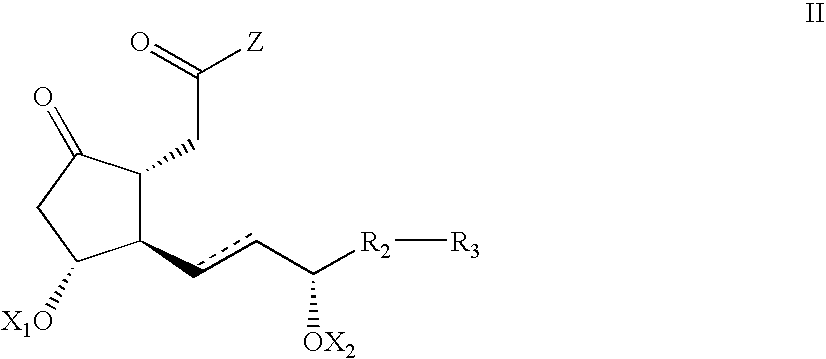
having an optical purity of more than 95% enantiomeric excess; wherein Z is OR1, and R1, X1, X2,

wherein R7 is an arbitrary substituent; AA is hydrogen or an amino acid residue; and X1, X2,
- Ethyl (1R,2R,3R)-3-hydroxy-2-[(3S)-hydroxy-1-octenyl]-5-oxo-cyclopentane acetate;
- Benzyl (1R,2R,3R)-3-hydroxy-2-[(3S)-hydroxy-1-octenyl]-5-oxo-cyclopentane acetate;
- 2-Naphthyl (1R,2R,3R)-3-hydroxy-2-[(3S)-hydroxy-1-octenyl]-5-oxo-cyclopentane acetate;
- (1′R,2′S,5′R)-Menthyl (1R,2R,3R)-3-hydroxy-2-[(3S)-hydroxy-1-octenyl]-5-oxo-cyclopentane acetate;
- 2-Cyanoethyl (1R,2R,3R) 3-hydroxy-2-[(3S)-hydroxy-1-octenyl]-5-oxo-cyclopentane acetate;
- 3-Ethoxycarbonylphenyl (1R,2R,3R)-3-hydroxy-2-[(3S)-hydroxy-1-octenyl]-5-oxo-cyclopentane acetate;
- 4-Morpholineethyl (1R,2R,3R)-3-hydroxy-2-[(3S)-hydroxy-1-octenyl]-5-oxo-cyclopentane acetate;
- Benzyl (1R,2R,3R)-3-hydroxy-2-[5-phenyl-(3S)-hydroxy-1-pentenyl]-5-oxo-cyclopentane acetate;
- 2-Naphthyl (1R,2R,3R)-3-hydroxy-2-[5-phenyl-(3S)-hydroxy-1-pentenyl]-5-oxo-cyclopentane acetate;
- (1′R,2′S,5′R)-Menthyl (1R,2R,3R)-3-hydroxy-2-[5-phenyl-(3S)-hydroxy-1-pentenyl]-5-oxo-cyclopentane acetate;
- Ethyl (1R,2R,3R)-3-hydroxy-2-[5-phenyl-(3S)-hydroxy-1-pentenyl]-5-oxo-cyclopentane acetate;
- Ethyl (1R,2R,3R)-3-hydroxy-2-[(3R)-hydroxy-4-(3-trifluoromethyl)phenoxy-1-butenyl]-5-oxo-cyclopentane acetate; and
- Ethyl (1R,2R,3R)-3-hydroxy-2-[5-phenyl-(3R)-hydroxy-pentanyl]-5-oxo-cyclopentane acetate.
G. Novel Enantiomerically Enriched Compounds of Formulae V-2a and V-2b

wherein R6 is a lower alkyl, and P4 is trimethylsilyl, triethylsilyl, tert-butyldimethylsilyl, tetrahydrofuranyl, tetrahydropyranyl, or 1-ethoxyethyl.


Claims (16)


Priority Applications (1)
| Application Number | Priority Date | Filing Date | Title |
|---|---|---|---|
| US11/973,450 US7582779B2 (en) | 2006-01-18 | 2007-10-09 | Processes and intermediates for the preparations of prostaglandins |
Applications Claiming Priority (2)
| Application Number | Priority Date | Filing Date | Title |
|---|---|---|---|
| US11/334,337 US7511168B2 (en) | 2006-01-18 | 2006-01-18 | Processes and intermediates for the preparations of prostaglandins |
| US11/973,450 US7582779B2 (en) | 2006-01-18 | 2007-10-09 | Processes and intermediates for the preparations of prostaglandins |
Related Parent Applications (1)
| Application Number | Title | Priority Date | Filing Date |
|---|---|---|---|
| US11/334,337 Division US7511168B2 (en) | 2006-01-18 | 2006-01-18 | Processes and intermediates for the preparations of prostaglandins |
Publications (2)
| Publication Number | Publication Date |
|---|---|
| US20080039637A1 US20080039637A1 (en) | 2008-02-14 |
| US7582779B2 true US7582779B2 (en) | 2009-09-01 |
Family
ID=38264067
Family Applications (4)
| Application Number | Title | Priority Date | Filing Date |
|---|---|---|---|
| US11/334,337 Expired - Lifetime US7511168B2 (en) | 2006-01-18 | 2006-01-18 | Processes and intermediates for the preparations of prostaglandins |
| US11/973,450 Expired - Lifetime US7582779B2 (en) | 2006-01-18 | 2007-10-09 | Processes and intermediates for the preparations of prostaglandins |
| US11/973,494 Expired - Lifetime US7626024B2 (en) | 2006-01-18 | 2007-10-09 | Processes and intermediates for the preparations of prostaglandins |
| US12/538,924 Expired - Lifetime US8030514B2 (en) | 2006-01-18 | 2009-08-11 | Processes and intermediates for the preparations of prostaglandins |
Family Applications Before (1)
| Application Number | Title | Priority Date | Filing Date |
|---|---|---|---|
| US11/334,337 Expired - Lifetime US7511168B2 (en) | 2006-01-18 | 2006-01-18 | Processes and intermediates for the preparations of prostaglandins |
Family Applications After (2)
| Application Number | Title | Priority Date | Filing Date |
|---|---|---|---|
| US11/973,494 Expired - Lifetime US7626024B2 (en) | 2006-01-18 | 2007-10-09 | Processes and intermediates for the preparations of prostaglandins |
| US12/538,924 Expired - Lifetime US8030514B2 (en) | 2006-01-18 | 2009-08-11 | Processes and intermediates for the preparations of prostaglandins |
Country Status (2)
| Country | Link |
|---|---|
| US (4) | US7511168B2 (en) |
| CN (1) | CN101003504B (en) |
Cited By (1)
| Publication number | Priority date | Publication date | Assignee | Title |
|---|---|---|---|---|
| EP2837621A1 (en) | 2013-08-15 | 2015-02-18 | Chirogate International Inc. | Processes for the preparation of isomer free prostaglandins |
Families Citing this family (13)
| Publication number | Priority date | Publication date | Assignee | Title |
|---|---|---|---|---|
| US7511168B2 (en) * | 2006-01-18 | 2009-03-31 | Shih-Yi Wei | Processes and intermediates for the preparations of prostaglandins |
| CN101555221B (en) * | 2008-04-09 | 2013-01-23 | 明德国际仓储贸易(上海)有限公司 | Producing method of prostaglandin F-type derivant |
| EP2135860A1 (en) | 2008-06-20 | 2009-12-23 | Sandoz AG | Improved process for the production of bimatoprost |
| EP2143712A1 (en) | 2008-07-10 | 2010-01-13 | Sandoz AG | Improved Process for the Production of Prostaglandins and Prostaglandin Analogs |
| CN101525322B (en) * | 2009-01-20 | 2014-04-16 | 中国药科大学 | New technology for synthesizing Corey lactonic acid by one-pan boiling method |
| KR101561171B1 (en) | 2009-10-16 | 2015-10-19 | 카이맨 케미칼 컴파니 인코포레이티드 | Process for the preparation of f-series prostaglandins |
| US8524939B2 (en) * | 2011-08-24 | 2013-09-03 | Chirogate International Inc. | Intermediates for the synthesis of benzindene prostaglandins and preparations thereof |
| US8350090B1 (en) * | 2011-08-24 | 2013-01-08 | Chirogate International Inc. | Processes for preparing cyclopentenones and cyclopentenones for the synthesis of benzindene prostaglandins |
| CN103288698A (en) * | 2013-05-07 | 2013-09-11 | 北京洛斯顿精细化工有限公司 | Novel method for synthetizing prostaglandin analogue |
| US10457623B1 (en) * | 2018-07-13 | 2019-10-29 | Chirogate International Inc. | Process for the preparation of Lubiprostone and intermediates thereof |
| CA3132572A1 (en) | 2019-03-27 | 2020-10-01 | Kyowa Pharma Chemical Co., Ltd. | Method for producing pkrostaglandin |
| JP7609438B2 (en) * | 2019-10-11 | 2025-01-07 | 国立大学法人東北大学 | Method for producing a cyclopentane compound, a method for producing a lactone compound, a method for producing a diol compound, and a compound |
| CN116583500B (en) * | 2020-12-23 | 2025-11-18 | 协和医药化工股份有限公司 | Methods for separating geometric isomers |
Citations (8)
| Publication number | Priority date | Publication date | Assignee | Title |
|---|---|---|---|---|
| US4013695A (en) | 1975-10-02 | 1977-03-22 | The Upjohn Company | 4,4,5,5-Tetradehydro-PGE1 analogs |
| US4233231A (en) | 1977-11-22 | 1980-11-11 | American Cyanamid Company | Novel vinyl-stannyl derivatives |
| US4272629A (en) | 1977-01-11 | 1981-06-09 | Allen & Hanburys Limited | Novel prostaglandin intermediates |
| EP0267605A2 (en) | 1986-11-14 | 1988-05-18 | G.D. Searle & Co. | Novel intermediate compounds in a process for producing 16-phenoxy- and 16-substituted phenoxy-9-keto-prostatrienoic acid derivatives |
| US5252763A (en) * | 1990-04-17 | 1993-10-12 | G. D. Searle & Co. | Process for preparing prostaglandin analogs |
| US5359095A (en) | 1990-08-08 | 1994-10-25 | Pharmacia Ab | Method for synthesis of prostaglandin derivatives |
| US5405981A (en) * | 1993-03-26 | 1995-04-11 | The Regents Of The University Of California | Copper catalyzed coupling reactions |
| US5661178A (en) | 1995-09-01 | 1997-08-26 | Allergan | Method for effecting vasodilation with (1,5-inter)aryl prostaglandin derivatives |
Family Cites Families (17)
| Publication number | Priority date | Publication date | Assignee | Title |
|---|---|---|---|---|
| CH566294A5 (en) * | 1972-03-28 | 1975-09-15 | Ciba Geigy Ag | |
| US4232166A (en) | 1979-06-07 | 1980-11-04 | American Cyanamid Company | 15-Deoxy-16-hydroxy-17-methylene prostaglandins of the E and F series |
| US4983753A (en) * | 1981-05-21 | 1991-01-08 | Floyd Jr Middleton B | Precursors and synthesis of di-(methyl)-16,16-(dimethyl)-11-alpha,15-alpha beta-dihydroxy-9-oxo-2,13-trans,trans-prostadienoates |
| US4536592A (en) | 1984-02-16 | 1985-08-20 | G. D. Searle & Co. | 2-Substituted prostaglandins |
| RU2033791C1 (en) * | 1990-03-20 | 1995-04-30 | Гематологический научный центр РАМН | Agent showing antiaggregation activity |
| HU212570B (en) | 1991-06-24 | 1996-08-29 | Chinoin Gyogyszer Es Vegyeszet | Process for producing 13,14-dihydro-15(r)-17-phenyl-18,19,20-trinor-pgf2alfa-isopropylester |
| TWI249520B (en) * | 1998-07-15 | 2006-02-21 | Ono Pharmaceutical Co | 5-Thia-omega-substituted phenyl prostaglandin E derivatives, method for producing the same and medicines containing the same as the active ingredient |
| WO2001024800A1 (en) * | 1999-10-07 | 2001-04-12 | Ono Pharmaceutical Co., Ltd. | Erection insufficiency remedies |
| WO2001049661A1 (en) * | 2000-01-05 | 2001-07-12 | Ono Pharmaceutical Co., Ltd. | 5-THIA-φ-(SUBSTITUTED PHENYL)-PROSTAGLANDIN E ALCOHOLS, PROCESS FOR PREPARING THE ALCOHOLS AND PHARMACEUTICAL PREPARATIONS CONTAINING THE SAME AS THE ACTIVE INGREDIENT |
| US7166730B2 (en) | 2000-01-27 | 2007-01-23 | Fine Tech Laboratories, Ltd | Process for the preparation of prostaglandin derivatives |
| US6586462B2 (en) * | 2000-10-20 | 2003-07-01 | Allergan, Inc. | ω-Cycloalkyl 17-heteroaryl prostaglandin E2 analogs as EP2-receptor agonists |
| KR100437873B1 (en) | 2001-05-08 | 2004-06-26 | 연성정밀화학(주) | Process for preparing prostaglandin derivatives and stereospecific starting material thereof |
| GB0112699D0 (en) | 2001-05-24 | 2001-07-18 | Resolution Chemicals Ltd | Process for the preparation of prostglandins and analogues thereof |
| US7109371B2 (en) | 2004-01-05 | 2006-09-19 | Johnson Matthey Public Limited Company | Prostaglandin synthesis |
| CN1757636A (en) | 2004-10-10 | 2006-04-12 | 明德国际仓储贸易(上海)有限公司 | Method for preparing prostaglandin F derivative, and novel intermediate thereof |
| US7511168B2 (en) * | 2006-01-18 | 2009-03-31 | Shih-Yi Wei | Processes and intermediates for the preparations of prostaglandins |
| US8546114B2 (en) * | 2006-01-18 | 2013-10-01 | Chirogate International Inc. | Processes for the preparation of optically active cyclopentenones and cyclopentenones prepared therefrom |
-
2006
- 2006-01-18 US US11/334,337 patent/US7511168B2/en not_active Expired - Lifetime
-
2007
- 2007-01-18 CN CN2007100036130A patent/CN101003504B/en active Active
- 2007-10-09 US US11/973,450 patent/US7582779B2/en not_active Expired - Lifetime
- 2007-10-09 US US11/973,494 patent/US7626024B2/en not_active Expired - Lifetime
-
2009
- 2009-08-11 US US12/538,924 patent/US8030514B2/en not_active Expired - Lifetime
Patent Citations (8)
| Publication number | Priority date | Publication date | Assignee | Title |
|---|---|---|---|---|
| US4013695A (en) | 1975-10-02 | 1977-03-22 | The Upjohn Company | 4,4,5,5-Tetradehydro-PGE1 analogs |
| US4272629A (en) | 1977-01-11 | 1981-06-09 | Allen & Hanburys Limited | Novel prostaglandin intermediates |
| US4233231A (en) | 1977-11-22 | 1980-11-11 | American Cyanamid Company | Novel vinyl-stannyl derivatives |
| EP0267605A2 (en) | 1986-11-14 | 1988-05-18 | G.D. Searle & Co. | Novel intermediate compounds in a process for producing 16-phenoxy- and 16-substituted phenoxy-9-keto-prostatrienoic acid derivatives |
| US5252763A (en) * | 1990-04-17 | 1993-10-12 | G. D. Searle & Co. | Process for preparing prostaglandin analogs |
| US5359095A (en) | 1990-08-08 | 1994-10-25 | Pharmacia Ab | Method for synthesis of prostaglandin derivatives |
| US5405981A (en) * | 1993-03-26 | 1995-04-11 | The Regents Of The University Of California | Copper catalyzed coupling reactions |
| US5661178A (en) | 1995-09-01 | 1997-08-26 | Allergan | Method for effecting vasodilation with (1,5-inter)aryl prostaglandin derivatives |
Non-Patent Citations (18)
| Title |
|---|
| Chen, S.L. et al. "Prostaglandins and Congeners. 19. Vinylstannanes: Useful Organometallic Reagents for the Synthesis of Prostaglandins and Prostaglandin Intermediates" J. Org. Chem. (1978) vol. 43, No. 18, pp. 3450-3454 XP-002386528. |
| Corey, E.J. et al. "Total Synthesis of Prostaglandins F2a and E2 the Naturally Occurring Forms" Journal of the American Chemical Society (1970) vol. 92, No. 2, pp. 397-398 XP-002386523. |
| Database CA [Online] Chemical Abstract. Howard, C. et al. "Total Synthesis of (.+-.)-Prostaglandin E2 Methyl Ester . . . " Journal of the Chemical Society, Perkin Transactions : Organic and Bio-Organic Chemistry (1981) vol. 7, pp. 2049-2054 XP-002386565 retrieved from STN. |
| Database CA [Online] Chemical Abstract. Kalnins, A et al. "Total Synthesis and Properties of Prostaglandins XXVI. Alkylation of Bicyclic Dihydropyridazinones" Latvijas PSR Zinatnu Akademijas Vestis. Kimijas Serija (1990) vol. 1, pp. 78-87 XP-002386567 retrieved from STN. |
| Database CA [Online] Chemical Abstract. Kalnins, A. et al. "Total Synthesis and Properties of Prostaglandins. X . synthesis of .gamma.-oxy . . . " Zhurnal Organicheskoi Khimii (1988( vol. 24, No. 4, pp. 742-755 XP-002386568 retrieved from STN. |
| Database CA [Online] Chemical Abstract. Kudryashova, V.V. et al. "Synthesis of Methyl 3.alpha . . . " Bioorganicheskaya Khimiya (1986) vol. 12, No. 4, pp. 848-854 XP-002386569 retrieved from STN. |
| Database CA [Online] Chemical Abstract. Marino, J.P. et al. "Stereocontrolleed Synthesis of Prostaglandins from Cyclopentadiene Monoepoxide" Journal of Organic Chemistry (1984) vol. 49, No. 26, pp. 5279-5280 XP-002386571 retrieved from STN. |
| Database CA [Online] Chemical Abstract. Sakhartova, O.V. et al. "Chromatogrpahy of Prostaglandins, Their Analogs and Intermediates . . . " Latvijas PSR Zinatnu . . . (1983) vol. 5, pp. 556-563 XP-002386572 retrieved from STN. |
| Database CA [Online] Chemical Abstract. Sakhartova, O.V. et al. "Comparative Calculation of Retention Values in Chromatogrpahy of Cyclopentane Derivatives on Silica Gel" Zhurnal Analiticheskoi Khimii (1985) vol. 40, No. 5, pp. 872-880 XP-002386570 retrieved from STN. |
| Database Crossfire Beilstein. Tolstikov, G.A. et al. "Beilstein Institut zur Forderung der Chemischen Wissenschaften" Chem. Nat. Compd. (1985) vol. 21, No. 5, pp. 570-578 XP-002386566. |
| Gooding, O.W. et al. "Triply Convergent Synthesis of15-(Phenoxymethyl) and 4,5-Allenyl Prostaglandins. Preparation of an Individual Isomer of Enprostil" J. Org. Chem. (1993) vol. 58, pp. 3681-3686 XP-002386527. |
| Itoh, T. et al. "Simple Preparation of the Optically Active gamma-Hydroxy Vinylstannanes Using Lipase-Catalyzed Hydrolysis" Chemistry Letters (1991) vol. 2, pp. 217-218 XP-002386525. |
| Kalnins et al. Zhrnal Organicheskoi Khimii, (1988), 24(4), 742-55. * |
| Lai, S. et al. Enantioselective Synthesis of 12-epi-PGF2a and 12,15-diepi-PGF2a J. Org. Chem. (1999) vol. 64, pp. 7213-7217 XP-002386524. |
| Loza et al. Zhurnal Organicheskoi Khimii, (1990), 26(5), 1024-34. * |
| March's Organic Chemistry. Reactions, Mechanisms, and Structures. 5th Ed., N.Y. Wiley & Sons, Inc. (2001) p. 869. |
| Patent Abstracts of Japan of 09020788 dated Jan. 21, 1997. |
| Tolstikov, G.A. et al. "Regio- and Stereoselective Hydrostannylation of 3-Hydroxy-4-phenoxy-1 . . . " Synthesis (1986) vol. 6, pp. 496-499 XP-002386526. |
Cited By (6)
| Publication number | Priority date | Publication date | Assignee | Title |
|---|---|---|---|---|
| EP2837621A1 (en) | 2013-08-15 | 2015-02-18 | Chirogate International Inc. | Processes for the preparation of isomer free prostaglandins |
| US9464028B2 (en) | 2013-08-15 | 2016-10-11 | Chirogate International Inc. | Processes and intermediates for the preparations of isomer free prostaglandins |
| US9540311B2 (en) | 2013-08-15 | 2017-01-10 | Chirogate International Inc. | Processes and intermediates for the preparations of isomer free prostaglandins |
| US9828356B2 (en) | 2013-08-15 | 2017-11-28 | Chirogate International Inc. | Processes and intermediates for the preparations of isomer free prostaglandis |
| US9890135B1 (en) | 2013-08-15 | 2018-02-13 | Chirogate International Inc. | Processes and intermediates for the preparations of isomer free prostaglandins |
| US9994543B2 (en) | 2013-08-15 | 2018-06-12 | Chirogate International Inc. | Processes and intermediates for the preparations of isomer free prostaglandins |
Also Published As
| Publication number | Publication date |
|---|---|
| US7511168B2 (en) | 2009-03-31 |
| CN101003504A (en) | 2007-07-25 |
| US20080039637A1 (en) | 2008-02-14 |
| US7626024B2 (en) | 2009-12-01 |
| US20070167641A1 (en) | 2007-07-19 |
| CN101003504B (en) | 2011-12-14 |
| US20090299088A1 (en) | 2009-12-03 |
| US20080039627A1 (en) | 2008-02-14 |
| US8030514B2 (en) | 2011-10-04 |
Similar Documents
| Publication | Publication Date | Title |
|---|---|---|
| US7582779B2 (en) | Processes and intermediates for the preparations of prostaglandins | |
| KR102417861B1 (en) | Processes and intermediates for the preparations of isomer free prostaglandins | |
| EP2581361B1 (en) | Intermediates for the synthesis of benzindene prostaglandins and preparations thereof | |
| US20160244422A1 (en) | Method of producing beraprost | |
| KR101986966B1 (en) | How to make Vera Frost | |
| KR101522218B1 (en) | Processes and intermediates for the preparations of prostaglandins | |
| JP6872583B2 (en) | Lubiprostone preparation method and its intermediates | |
| EP1810967B1 (en) | Processes and intermediates for the preparations of prostaglandins | |
| EP4098651B1 (en) | Process for the preparation of beraprost or similar benzoprostacyclin analogues starting from 2-(3-bromo-2-fluorophenyl)-4-hydroxycyclopent-2-enone or similar reactants | |
| EP2406242B1 (en) | Process for the preparation of ramelteon |
Legal Events
| Date | Code | Title | Description |
|---|---|---|---|
| AS | Assignment |
Owner name: YEH, YU-CHIH, CHINA Free format text: ASSIGNMENT OF ASSIGNORS INTEREST;ASSIGNOR:CHIROGATE INTERNATIONAL INC.;REEL/FRAME:023088/0731 Effective date: 20090810 Owner name: WEI, SHIH-YI, CHINA Free format text: ASSIGNMENT OF ASSIGNORS INTEREST;ASSIGNOR:CHIROGATE INTERNATIONAL INC.;REEL/FRAME:023088/0731 Effective date: 20090810 |
|
| STCF | Information on status: patent grant |
Free format text: PATENTED CASE |
|
| CC | Certificate of correction | ||
| REMI | Maintenance fee reminder mailed | ||
| FPAY | Fee payment |
Year of fee payment: 4 |
|
| SULP | Surcharge for late payment | ||
| FPAY | Fee payment |
Year of fee payment: 8 |
|
| MAFP | Maintenance fee payment |
Free format text: PAYMENT OF MAINTENANCE FEE, 12TH YR, SMALL ENTITY (ORIGINAL EVENT CODE: M2553); ENTITY STATUS OF PATENT OWNER: SMALL ENTITY Year of fee payment: 12 |