US7561043B2 - Marker for mechanically resonant article surveillance system - Google Patents
Marker for mechanically resonant article surveillance system Download PDFInfo
- Publication number
- US7561043B2 US7561043B2 US11/607,997 US60799706A US7561043B2 US 7561043 B2 US7561043 B2 US 7561043B2 US 60799706 A US60799706 A US 60799706A US 7561043 B2 US7561043 B2 US 7561043B2
- Authority
- US
- United States
- Prior art keywords
- marker
- strip
- resonance
- strips
- ribbon
- Prior art date
- Legal status (The legal status is an assumption and is not a legal conclusion. Google has not performed a legal analysis and makes no representation as to the accuracy of the status listed.)
- Expired - Fee Related, expires
Links
Images




Classifications
-
- C—CHEMISTRY; METALLURGY
- C21—METALLURGY OF IRON
- C21D—MODIFYING THE PHYSICAL STRUCTURE OF FERROUS METALS; GENERAL DEVICES FOR HEAT TREATMENT OF FERROUS OR NON-FERROUS METALS OR ALLOYS; MAKING METAL MALLEABLE, e.g. BY DECARBURISATION OR TEMPERING
- C21D1/00—General methods or devices for heat treatment, e.g. annealing, hardening, quenching or tempering
- C21D1/04—General methods or devices for heat treatment, e.g. annealing, hardening, quenching or tempering with simultaneous application of supersonic waves, magnetic or electric fields
-
- G—PHYSICS
- G08—SIGNALLING
- G08B—SIGNALLING SYSTEMS, e.g. PERSONAL CALLING SYSTEMS; ORDER TELEGRAPHS; ALARM SYSTEMS
- G08B13/00—Burglar, theft or intruder alarms
- G08B13/22—Electrical actuation
- G08B13/24—Electrical actuation by interference with electromagnetic field distribution
- G08B13/2402—Electronic Article Surveillance [EAS], i.e. systems using tags for detecting removal of a tagged item from a secure area, e.g. tags for detecting shoplifting
- G08B13/2428—Tag details
- G08B13/2434—Tag housing and attachment details
-
- G—PHYSICS
- G08—SIGNALLING
- G08B—SIGNALLING SYSTEMS, e.g. PERSONAL CALLING SYSTEMS; ORDER TELEGRAPHS; ALARM SYSTEMS
- G08B13/00—Burglar, theft or intruder alarms
- G08B13/02—Mechanical actuation
- G08B13/12—Mechanical actuation by the breaking or disturbance of stretched cords or wires
-
- G—PHYSICS
- G08—SIGNALLING
- G08B—SIGNALLING SYSTEMS, e.g. PERSONAL CALLING SYSTEMS; ORDER TELEGRAPHS; ALARM SYSTEMS
- G08B13/00—Burglar, theft or intruder alarms
- G08B13/22—Electrical actuation
- G08B13/24—Electrical actuation by interference with electromagnetic field distribution
- G08B13/2402—Electronic Article Surveillance [EAS], i.e. systems using tags for detecting removal of a tagged item from a secure area, e.g. tags for detecting shoplifting
- G08B13/2405—Electronic Article Surveillance [EAS], i.e. systems using tags for detecting removal of a tagged item from a secure area, e.g. tags for detecting shoplifting characterised by the tag technology used
- G08B13/2408—Electronic Article Surveillance [EAS], i.e. systems using tags for detecting removal of a tagged item from a secure area, e.g. tags for detecting shoplifting characterised by the tag technology used using ferromagnetic tags
-
- G—PHYSICS
- G08—SIGNALLING
- G08B—SIGNALLING SYSTEMS, e.g. PERSONAL CALLING SYSTEMS; ORDER TELEGRAPHS; ALARM SYSTEMS
- G08B13/00—Burglar, theft or intruder alarms
- G08B13/22—Electrical actuation
- G08B13/24—Electrical actuation by interference with electromagnetic field distribution
- G08B13/2402—Electronic Article Surveillance [EAS], i.e. systems using tags for detecting removal of a tagged item from a secure area, e.g. tags for detecting shoplifting
- G08B13/2428—Tag details
- G08B13/2437—Tag layered structure, processes for making layered tags
- G08B13/2442—Tag materials and material properties thereof, e.g. magnetic material details
-
- H—ELECTRICITY
- H01—ELECTRIC ELEMENTS
- H01F—MAGNETS; INDUCTANCES; TRANSFORMERS; SELECTION OF MATERIALS FOR THEIR MAGNETIC PROPERTIES
- H01F1/00—Magnets or magnetic bodies characterised by the magnetic materials therefor; Selection of materials for their magnetic properties
- H01F1/01—Magnets or magnetic bodies characterised by the magnetic materials therefor; Selection of materials for their magnetic properties of inorganic materials
- H01F1/03—Magnets or magnetic bodies characterised by the magnetic materials therefor; Selection of materials for their magnetic properties of inorganic materials characterised by their coercivity
- H01F1/032—Magnets or magnetic bodies characterised by the magnetic materials therefor; Selection of materials for their magnetic properties of inorganic materials characterised by their coercivity of hard-magnetic materials
- H01F1/04—Magnets or magnetic bodies characterised by the magnetic materials therefor; Selection of materials for their magnetic properties of inorganic materials characterised by their coercivity of hard-magnetic materials metals or alloys
-
- H—ELECTRICITY
- H01—ELECTRIC ELEMENTS
- H01F—MAGNETS; INDUCTANCES; TRANSFORMERS; SELECTION OF MATERIALS FOR THEIR MAGNETIC PROPERTIES
- H01F1/00—Magnets or magnetic bodies characterised by the magnetic materials therefor; Selection of materials for their magnetic properties
- H01F1/01—Magnets or magnetic bodies characterised by the magnetic materials therefor; Selection of materials for their magnetic properties of inorganic materials
- H01F1/03—Magnets or magnetic bodies characterised by the magnetic materials therefor; Selection of materials for their magnetic properties of inorganic materials characterised by their coercivity
- H01F1/12—Magnets or magnetic bodies characterised by the magnetic materials therefor; Selection of materials for their magnetic properties of inorganic materials characterised by their coercivity of soft-magnetic materials
- H01F1/14—Magnets or magnetic bodies characterised by the magnetic materials therefor; Selection of materials for their magnetic properties of inorganic materials characterised by their coercivity of soft-magnetic materials metals or alloys
- H01F1/147—Alloys characterised by their composition
- H01F1/153—Amorphous metallic alloys, e.g. glassy metals
- H01F1/15308—Amorphous metallic alloys, e.g. glassy metals based on Fe/Ni
-
- H—ELECTRICITY
- H01—ELECTRIC ELEMENTS
- H01F—MAGNETS; INDUCTANCES; TRANSFORMERS; SELECTION OF MATERIALS FOR THEIR MAGNETIC PROPERTIES
- H01F1/00—Magnets or magnetic bodies characterised by the magnetic materials therefor; Selection of materials for their magnetic properties
- H01F1/01—Magnets or magnetic bodies characterised by the magnetic materials therefor; Selection of materials for their magnetic properties of inorganic materials
- H01F1/03—Magnets or magnetic bodies characterised by the magnetic materials therefor; Selection of materials for their magnetic properties of inorganic materials characterised by their coercivity
- H01F1/12—Magnets or magnetic bodies characterised by the magnetic materials therefor; Selection of materials for their magnetic properties of inorganic materials characterised by their coercivity of soft-magnetic materials
- H01F1/14—Magnets or magnetic bodies characterised by the magnetic materials therefor; Selection of materials for their magnetic properties of inorganic materials characterised by their coercivity of soft-magnetic materials metals or alloys
- H01F1/147—Alloys characterised by their composition
- H01F1/153—Amorphous metallic alloys, e.g. glassy metals
- H01F1/15391—Elongated structures, e.g. wires
-
- H—ELECTRICITY
- H01—ELECTRIC ELEMENTS
- H01F—MAGNETS; INDUCTANCES; TRANSFORMERS; SELECTION OF MATERIALS FOR THEIR MAGNETIC PROPERTIES
- H01F41/00—Apparatus or processes specially adapted for manufacturing or assembling magnets, inductances or transformers; Apparatus or processes specially adapted for manufacturing materials characterised by their magnetic properties
- H01F41/02—Apparatus or processes specially adapted for manufacturing or assembling magnets, inductances or transformers; Apparatus or processes specially adapted for manufacturing materials characterised by their magnetic properties for manufacturing cores, coils, or magnets
- H01F41/0206—Manufacturing of magnetic cores by mechanical means
- H01F41/0213—Manufacturing of magnetic circuits made from strip(s) or ribbon(s)
- H01F41/0226—Manufacturing of magnetic circuits made from strip(s) or ribbon(s) from amorphous ribbons
Definitions
- the present invention relates to ferromagnetic amorphous alloy ribbon and to a marker for use in an electronic article surveillance system, the marker consisting of one or a plurality of rectangular strips based on an amorphous magnetostrictive material that vibrates in an alternating magnetic field mechanically at a resonant frequency varying with an applied static magnetic field, whereby the magnetomechanical effect of the marker is effectively utilized.
- the present invention is also directed to an electronic article surveillance system utilizing such a marker.
- Magnetostriction of a magnetic material is a phenomenon in which a dimensional change takes place upon application of an external magnetic field on the magnetic material.
- the material is termed “positive-magnetostrictive”.
- a material is “negative-magnetostrictive”, the material shrinks upon its magnetization.
- a magnetic material vibrates when it is in an alternating magnetic field.
- ⁇ E effect is commonly known as ⁇ E effect, which is described, for example, in “Physics of Magnetism” by S.
- E(H) stands for Young's modulus, which is a function of applied magnetic field H
- f r (1 ⁇ 2 l )[ E ( H )/ ⁇ ] 1/2 , (1)
- l is the length of the material
- ⁇ is the mass density of the material.
- a marker in such systems is a strip, or a plurality of strips, of known length of a ferromagnetic material, packaged with a magnetically harder ferromagnet (material with a higher coercivity) that provides a static field termed as bias field to establish peak magneto-mechanical coupling.
- ferromagnetic marker material is an amorphous alloy ribbon, since the efficiency of magneto-mechanical coupling in the alloys is very high.
- the mechanical resonance frequency, f r is determined essentially by the length of the alloy ribbon and the bias field strength, as Equation (1) above indicates.
- the marker material When an interrogating signal tuned to the resonance frequency is encountered in a surveillance system, the marker material responds with a large signal field which is detected by a receiver in the system.
- amorphous ferromagnetic materials were considered for electronic article surveillance systems based on magnetomechanical resonance described above in the original '489 and '490 patents and included amorphous Fe—Ni—Mo—B, Fe—Co—B—Si, Fe—B—Si—C and Fe—B—Si alloys.
- a commercially available amorphous Fe—Ni—Mo—B based METGLAS®2826MB alloy was used extensively until accidental triggering, by a magnetomechanical resonance marker, of other systems based on magnetic harmonic generation/detection. This occurs because a magnetomechanical resonance marker used at that time sometimes exhibited non-linear BH characteristics, resulting in generation of higher harmonics of the exciting field frequency.
- a marker strip in accordance with the '702 patent is widely used for a marker with two strips, as is disclosed in U.S. Pat. No. 6,359,563. Due to the fact that the two strips have the same radius of curvature along the strip width direction since each of them was processed in exactly the same way, in accordance with the '702 patent, the two strips touch each other at many points on the strip surfaces, damping the magnetomechanical vibration on the strips, and hence reducing the effectiveness of the marker. This drawback needs to be ameliorated. Furthermore, there is a need for an effective electronic article surveillance system which utilizes such a marker.
- a soft magnetic material is utilized for a marker of an electronic article surveillance system based on magnetomechanical resonance.
- a marker material with enhanced overall magnetomechanical resonance properties is fabricated from an amorphous alloy ribbon.
- the magnetic marker material in a ribbon form having magnetomechanical resonance capability is cast on a rotating substrate as taught in the U.S. Pat. No. 4,142,571.
- the as-cast ribbon width is wider than the predetermined width for a marker material, said ribbon is slit to said predetermined width.
- the ribbon thus prepared is cut into ductile, rectangular amorphous metal marker strips having a predetermined length to fabricate a magnetomechanical resonance marker using one or a plurality of said marker strips with at least one semi-hard magnet strip which provides a bias static magnetic field.
- Said magnetomechanical resonance marker does not trigger other systems based on the principle of magnetic higher harmonics generation/detection.
- An electronic article surveillance system utilizes a marker of the present invention.
- the system has an article interrogation zone in which a magnetomechanical marker of the present invention is subject to an interrogating magnetic field at the resonance frequency of a marker strip, the signal response to the interrogating magnetic field excitation being detected by a receiver having a pair of antenna coils situated in the article interrogation zone.
- the received magnetomechanical resonance signal is then processed by a signal detection circuit which identifies the marker.
- a marker of a magnetomechanical resonant electronic article surveillance system comprises: at least one ductile magnetostrictive strip cut from an amorphous ferromagnetic alloy ribbon that has a curvature along a ribbon length direction and exhibits magnetomechanical resonance under alternating magnetic field excitation with a static bias field, the at least one marker strip having a magnetic anisotropy direction along a direction perpendicular to a ribbon axis.
- a radius of curvature of the at least one ductile magnetostrictive marker strip is less than 120 cm.
- the amorphous ferromagnetic alloy ribbon has a saturation induction ranging from 0.6 tesla to 1.1 tesla.
- the amorphous ferromagnetic alloy ribbon has a saturation magnetostriction ranging from 6 ppm to 18 ppm.
- the amorphous ferromagnetic alloy ribbon is an alloy having a composition of one of Fe 41.7 Ni 39.4 Mo 3.1 B 15.8 , Fe 41.5 Ni 38.9 Mo 4.1 B 15.5 , Fe 39.8 Ni 39.2 Mo 3.1 B 17.6 C 0.3 , Fe 40.2 Ni 39.0 Mo 3.6 B 16.6 Si 0.6 , Fe 36.5 Ni 42.9 Mo 42.2 B 16.5 , Fe 40.6 Ni 40.1 Mo 3.7 B 15.1 Si 0.5 , Fe 39.6 Ni 38.3 Mo 4.1 B 18.0 , Fe 38.0 Ni 38.8 Mo 3.9 B 19.3 , Fe 36.9 Ni 41.3 Mo 4.1 B 17.8 , Fe 36.7 Ni 41.9 Mo 4.0 B 16.6 Si 0.8 , Fe 35.6 Ni 42.6 Mo 4.0 B 17.9 , Fe 34.7 Ni 43.5 Mo 4.0 B 17.8 , Fe 33.3 Ni 43.8 Mo 3.9 Co 0.2 Cr 0.1 B 17.7 Si 1.0 , or Fe 32.5 Ni 44.7 Mo 3.7 Co
- the at least one marker strip has a discrete length and exhibits magnetomechanical resonance at a length-related frequency.
- the at least one marker strip has a length ranging from about 15 to about 65 mm.
- the at least one marker strip has a marker strip width ranging from about 3 mm to about 15 mm.
- the at least one marker strip has a length-to-width ratio exceeding 3.
- the at least one marker strip has a characteristic time constant for magnetomechanical resonance signal decay ranging from about 0.7 msec to about 3.9 msec.
- the at least one marker strip has a characteristic BH loop with a near-zero remanent magnetic induction at zero-applied magnetic field.
- the at least one marker strip has a slope of resonance frequency versus bias field ranging from about 4 Hz/(A/m) to about 14 Hz/(A/m).
- the marker comprises a plurality of marker strips with different radius of curvatures along the marker strips' length direction.
- the plurality of marker strips are stacked or placed side-by-side.
- the marker comprises two marker strips and has a slope of resonance frequency versus bias field ranging from about 3.5 Hz/(A/m) to about 10 Hz/(A/m).
- the marker comprises three marker strips and has a slope of resonance frequency versus bias field ranging from about 4 Hz/(A/m) to about 9 Hz/(A/m).
- the marker comprises four or five marker strips and has a slope of resonance frequency versus bias field ranging from about 2 Hz/(A/m) to about 4 Hz/(A/m).
- At least one bias magnet strip is placed along the at least one marker strip's direction.
- the at least one marker strip is housed in a cavity separated from the bias magnet strip.
- electronic article surveillance system has a capability of detecting resonance of a marker, and comprises a surveillance system tuned to predetermined surveillance magnetic field frequencies, wherein the surveillance system detects a marker that is adapted to mechanically resonate at a preselected frequency, and has at least one ductile magnetostrictive marker strip cut from an amorphous ferromagnetic alloy ribbon that has a curvature along a ribbon length direction and exhibits magnetomechanical resonance under alternating magnetic field excitation with a static bias field, the at least one marker strip having a magnetic anisotropy direction along a direction perpendicular to a ribbon axis.
- a radius of curvature of the at least one ductile magnetostrictive marker strip is between about 20 cm and about 100 cm in accordance with embodiments of the invention.
- FIG. 1A illustrates a side view of a marker strip cut from an amorphous alloy ribbon in accordance with an embodiment of the present invention and having a bias magnet
- FIG. 1B illustrates a view of a conventional marker strip with a bias magnet
- FIG. 2 illustrates magnetomechanical resonance characteristics of a single strip marker of the present invention and magnetomechanical resonance characteristics of a conventional single strip marker, showing resonance frequency as a function of bias field;
- FIG. 3 illustrates resonance signals of a single strip marker in accordance with an embodiment of the present invention and resonance signals of a conventional strip marker, showing resonance signal amplitudes as a function of bias field;
- FIG. 4 illustrates signal voltage plotted against radius of curvature of a marker strip of an embodiment of the present invention
- FIG. 5 illustrates a characteristic time constant for magnetomechanical resonance signal decay as a function of the length of a marker strip of an embodiment of the present invention
- FIG. 6 illustrates a BH loop taken at 60 Hz on a marker strip of an embodiment of the present invention having a length of approximately 38 mm, a width of approximately 6 mm and a thickness of about 28 ⁇ m;
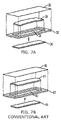
- FIG. 7A illustrates a magnetomechanical resonant marker of an embodiment of the present invention with one marker strip of FIG. 1A
- FIG. 7B illustrates a conventional marker with the strip of FIG. 1B ;
- FIGS. 8A-1 and 8 A- 2 illustrate a comparison of a physical profile of an embodiment of a magnetomechanical resonant marker of the present invention with two marker-strips whose side view is shown in element 122
- FIGS. 8B-1 and 8 B- 2 illustrate a comparison of a conventional marker with two conventional art strips whose angled view is shown in element 222 ;
- FIG. 9 illustrates magnetomechanical resonance characteristics of a two-strip marker of an embodiment of the present invention and a two-strip conventional marker, showing resonance signals as a function of bias field;
- FIG. 10 illustrates magnetomechanical resonance signal decay of a two-strip marker of an embodiment of the present invention and a two-strip conventional marker, showing resonance response signal as a function of time after termination of excitation;
- FIG. 11 illustrates magnetomechanical resonance characteristics of a three-strip marker of an embodiment of the present invention, showing resonance frequency and response signals as a function of bias field;
- FIG. 12 illustrates resonance signal amplitudes, V 0max and V 1max , as a function of the number of marker strips;
- FIG. 13 is a schematic illustration of an electronic article surveillance system of an embodiment of the present invention.
- a marker material with enhanced overall magnetomechanical resonance properties is fabricated from an amorphous alloy ribbon.
- the magnetic marker material in a ribbon form having magnetomechanical resonance capability is cast on a rotating substrate as taught in the U.S. Pat. No. 4,142,571.
- the ribbon width is wider than the predetermined width for a marker material, the ribbon is slit to the predetermined width.
- the ribbon thus prepared is cut into ductile, rectangular amorphous metal strips having a predetermined length to fabricate a magnetomechanical resonance marker using one or a plurality of the strips with at least one semi-hard magnet strip which provides a bias static magnetic field.
- the magnetomechanical resonance marker does not trigger other systems based on the principle of magnetic higher harmonics generation/detection.
- the amorphous ferromagnetic alloy utilized to form a ribbon for the marker strip has a composition of one of Fe 41.7 Ni 39.4 Mo 3.1 B 15.8 , Fe 41.5 Ni 38.9 Mo 4.1 B 15.5 , Fe 39.8 Ni 39.2 Mo 3.1 B 17.6 C 0.3 , Fe 40.2 Ni 39.0 Mo 3.6 B 16.6 Si 0.6 , Fe 36.5 Ni 42.9 Mo 4.2 B 16.5 , Fe 40.6 Ni 40.1 Mo 3.7 B 15.1 Si 0.5 , Fe 39.6 Ni 38.3 Mo 4.1 B 18.0 , Fe 38.0 Ni 38.8 Mo 3.9 B 19.3 , Fe 36.9 Ni 41.3 Mo 4.1 B 17.8 , Fe 36.7 Ni 41.9 Mo 4.0 B 16.6 Si 0.8 , Fe 35.6 Ni 42.6 Mo 4.0 B 17.9 , Fe 34.7 Ni 43.5 Mo 4.0 B 17.8 , Fe 33.3 Ni 43.8 Mo 3.9 Co 0.2 Cr 0.1 B 17.7 Si 1.0 , or Fe 32.5 Ni 4
- an amorphous magnetostrictive alloy having a chemical composition similar to a chemical composition of a commercially available amorphous METGLAS®2826MB ribbon was cast in accordance with the invention described in the U.S. Pat. No. 4,142,571.
- the amorphous alloy had a saturation induction ranging from 0.6 Tesla to 1.1 Tesla and a saturation magnetostriction ranging from 6 ppm to 18 ppm.
- the cast ribbon had widths of about 100 mm and about 25 mm, and its thickness was about 28 ⁇ m.
- the ribbon was then slit into narrower ribbons with different widths. The slit ribbon then was cut into ductile, rectangular strips having a length ranging from about 15 mm to about 65 mm.
- FIG. 1A illustrates the physical appearance of a marker strip 10 of an embodiment of the present invention having a bias magnet 12
- FIG. 1B illustrates the physical appearance of a conventional strip 20 produced in accordance with a complex heat-treatment method disclosed in the U.S. Pat. No. 6,299,702.
- magnetic flux lines 11 are more closed in a resonance marker-bias strip configuration of an embodiment of the present invention than the magnetic flux lines 21 of a conventional strip as is illustrated in FIG. 1B .
- a curved marker strip of an embodiment of the present invention enables the strip to vibrate freely without any physical constraints. This aspect is very important in electronic article surveillance systems as any physical constraint of a marker strip dampens its mechanical vibration. If a rigid support is introduced at any portion of a marker strip, for example, when the center of a marker strip, whether it is curved or not, is attached to some other material, such as the bias magnet 12 in FIG.
- the resonance frequency of the marker strip nearly doubles according to Eq. (1), and the resonance signal level which is proportional to the strip's physical volume is reduced considerably. This is detrimental for effective operation of an electronic article surveillance system.
- Each resonance marker strip of the embodiment of the present invention and the conventional strip was examined in light of magnetomechanical resonance performance using a characterization method of Example 2.
- FIG. 2 compares the resonance frequency as a function of bias field for a single strip marker 330 of an embodiment of the present invention and the resonance frequency of a conventional strip 331 , both of which had a width of about 6 mm and a length of about 38 mm.
- FIG. 2 indicates that the resonance frequency change as a function of bias field is about the same for both cases.
- the resonance characteristics depicted in FIG. 2 are important in designing a resonance marker with deactivation capability because deactivation is accomplished by a change in the resonance frequency by changing bias field strength.
- the slope of the resonance frequency f r with respect to bias field H b i.e., df r /dH b , determines the effectiveness of deactivation, and therefore is an important factor for an effective resonance marker strip.
- FIG. 3 Comparison of the resonance response between the two cases is illustrated in FIG. 3 , in which V 0 is the response signal amplitude when the exciting field is turned off, and V 1 is the signal amplitude at 1 msec after the termination of the exciting field. Clearly, a higher V 1 /V 0 ratio is selected for a better performance of a resonance marker. Both of the signal amplitudes are therefore used in industry as part of the figure of merit for a magnetomechanical resonance marker.
- FIG. 3 indicates that the ratio of V 1 /V 0 at these maximum points is higher for a resonance marker strip of an embodiment of the present invention than for a conventional marker strip, illustrating that signal retention in a marker strip of an embodiment of the present invention is better than in a conventional marker.
- Table I summarizes a comparison of parameters critical for the performance of a marker strip as a magnetomechanically resonating element between representative conventional marker strips and examples from the marker strips of an embodiment of the present invention. It is noted that the performance of the marker strips of the embodiment of the present invention is close to, or superior to, the performance of conventional marker strips. As far as the performance of a marker strip is concerned, the signal voltage, V 1 , is a critical factor that determines the marker performance in an electronic article surveillance system. In view of this, all of the marker strips of embodiment of the present invention in Table I are acceptable for use in markers of the embodiment of the present invention with each of the strip's height h, as defined in FIG. 1A , between 0.15 mm and 0.64 mm, which corresponds to the strip's length direction radius of curvature between 28 cm and 119 cm as given in Table I.
- the length, l of the strips were all about 38 mm, and their widths were about 6 mm.
- a radius of curvature for each marker strip was calculated from h and l.
- the resonance frequency of each strip was about 58 kHz.
- Table I contains data for a marker strip width of about 6 mm, which is presently widely used. It is one aspect of the present invention to provide marker strips with widths different than about 6 mm. Marker strips with different widths were slit from the same ribbon used in Table I, and their magnetomechanical resonance characteristics were determined. The results are summarized in Table II.
- the resonance signal voltages, V 0 max and V 1max decreased with decreasing width, as expected.
- the decrease in the characteristic field values, H b0 and H b1 with decreasing width is due to demagnetizing effects. Thus, a bias field magnet must be selected accordingly.
- a marker with a smaller width is suited for a smaller article surveillance area, whereas a marker with a larger width is suited for a larger article surveillance area because resonance signals are larger from larger marker strips, as Table II indicates. Since the resonance frequency depends primarily on the strip length, as Equation (1) indicates, the strip width change does not affect the resonance frequency of the article surveillance system used.
- Table II shows the magnetomechanical resonance characteristics of marker strips of an embodiment of the present invention with strip height h, as defined in FIG. 1A , and with different strip widths.
- the definitions for V 0 max , H b0 , V 1 max , H b1 , and df r /dH b were the same as in Table I.
- the length l of the strips were all about 38 mm.
- a radius of curvature for each marker strip was calculated from h and l.
- the resonance frequency of each strip was about 58 kHz.
- Another aspect of the present invention is to provide a variety of available markers operated under different conditions.
- magnetomechanical resonance characteristics were varied by changing the chemical composition of the amorphous magnetic alloy ribbon from which marker strips were produced.
- the chemical compositions of the alloys examined are listed in Table III, in which values of the saturation induction and magnetostrictions for the alloys are given.
- the results of the magnetomechanical resonance properties of these alloys are given in Table IV below.
- Table III shows examples of magnetostrictive amorphous alloys with their compositions, saturation inductions, B s , and saturation magnetostrictions, ⁇ s , for magnetomechanical resonance markers of an embodiment of the present invention.
- B s saturation inductions
- ⁇ s saturation magnetostrictions
- Table IV shows the magnetomechanical resonance characteristics of marker strips having different chemical compositions listed in Table III of an embodiment of the present invention with strip height h as defined in FIG. 1A .
- the definitions for V 0 max , H b0 , V 1 max and df r dH b were the same as in Table I.
- the length l of the strips were all about 38 mm.
- a radius of curvature for each marker strip was calculated from h and l.
- the resonance frequency of each strip was about 58 kHz.
- signal voltage V 0 max is plotted in FIG. 4 against marker strip's radius of curvature using the data given in Tables I and IV.
- a signal voltage V 0 max exceeding 100 mV is acceptable for a reliable marker performance and therefore any marker strip with a radius of curvature less than 120 cm is suited for a marker strip of the present invention.
- a higher V 0 max value is selected in accordance with embodiments of the invention.
- high V 0 max values exceeding 140 mV were achieved in the radius-of-curvature range below about 100 cm.
- a marker strip with a radius of curvature less than about 100 cm is selected in accordance with embodiments of the invention.
- Another limiting factor for the strip's curvature arises from industry's accepted marker tag height which is about 1.6 mm.
- This marker height must accommodate the marker strip height h indicated in FIG. 1A and the thickness of a bias magnet 12 in addition to the thickness of tag's outer casing, resulting in a maximum marker strip height h to about 0.9 mm which corresponds to a radius-of-curvature of about 20 cm for the marker strip.
- the overall selected radius-of-curvature for a marker strip of the present invention is between 20 cm and 100 cm for embodiments of the invention.
- FIG. 5 indicates that the characteristic time constant ⁇ increases from about 0.7 msec for a marker length l of about 15 mm to about 3.9 msec for l of about 65 mm. A larger value of ⁇ is selected when a longer signal retention is desired in embodiments of the invention.
- marker strips of the present invention listed in Table V provides opportunities for a wide variety of electronic article surveillance systems utilizing different resonance frequencies.
- magnetomechanical resonance characteristics of marker strips of an embodiment of the present invention with different lengths, l were measured by using Alloy K in Table III.
- the width and thickness of each strip were about 6 mm and about 28 ⁇ m, respectively.
- the definitions of V 0 max , H b0 , V 1max , H b1 and df r /dH b were the same as in Table I.
- the time constant was defined in Equation (2).
- Marker height h was defined in FIG. 1A , and the radius of curvature of each strip was calculated using h and l.
- the direction of magnetic anisotropy which is the direction of easy magnetization in a marker strip, must be essentially perpendicular to the strip's length direction.
- FIG. 6 which depicts a BH loop taken at 60 Hz using a measurement method of Example 3 on an approximately 38 mm long strip from Table V above.
- the shape of the BH loop shown in FIG. 6 is typical or characteristic of the BH behavior of a magnetic strip in which the average direction of the magnetic anisotropy is perpendicular to strip's length direction.
- a consequence of the magnetization behavior of a marker strip of an embodiment of the present invention shown in FIG. 6 is the absence of higher harmonics generation in the strip when the strip is placed in an AC magnetic field.
- the system “pollution problem” as mentioned in the “Background of the Invention” section is minimized.
- a higher harmonic signal from the marker strip of FIG. 6 was compared with that of a marker strip of an electronic article surveillance system based on magnetic harmonic generation/detection. The results of this comparison are given in Table VI below.
- a magnetic higher harmonics signal comparison was made between a marker strip of an embodiment of the present invention and a marker strip based on Co-based METGLAS®2714A alloy, which is widely used in an electronic article surveillance system based on a magnetic harmonic generation/detection system.
- the strip size was the same for both cases and was approximately 38 mm long and approximately 6 mm wide.
- the fundamental excitation frequency was 2.4 kHz and the 25 th harmonic signals were compared by using a harmonic signal detection method of Example 4.
- a negligibly small harmonic signal from a marker of an embodiment of the present invention does not trigger an electronic article surveillance system based on magnetic harmonic generation/detection.
- FIG. 7A illustrates a physical configuration of a magnetomechanical resonance marker of the present invention where a single marker strip in accordance with an embodiment of the present invention is utilized.
- the marker strip is any one of the strips listed in Table I, II, IV and V.
- a marker strip 31 of the present invention is placed in a hollow area 33 in which the marker 31 is free to vibrate without physical constraints with non-magnetic casing materials 30 and 32 enclosing the marker strip 31 .
- a bias magnet 34 is attached on the outside surface of casing 32 as an arrow indicates.
- FIG. 7B a conventional marker configuration is shown in FIG. 7B , in which a prior art marker strip 41 is encased a cavity area 43 between item 40 and 42 , with a bias magnet 44 attached on the outside surface of casing 42 .
- Two marker-strips for embodiments of the present invention were selected randomly from a number of strips characterized in Table I, II, and V with the same dimension, but with slightly different curvatures or two strips having the same chemical composition with the same dimension and with slightly different curvatures are mounted on top of each other, and a marker was made as in FIG. 8A-1 , wherein strips 110 and 111 were marker strips of an embodiment of the present invention being housed in a cavity region 102 created between outside casing material 100 and 101 , and a bias magnet 120 was attached on the outside surface of a casing material 101 as indicated by an arrow in the figure.
- FIG. 8A-1 wherein strips 110 and 111 were marker strips of an embodiment of the present invention being housed in a cavity region 102 created between outside casing material 100 and 101 , and a bias magnet 120 was attached on the outside surface of a casing material 101 as indicated by an arrow in the figure.
- FIG. 8A-1 wherein strips 110 and 111 were marker strips of an embodiment of the present invention being housed
- FIG. 8A-2 illustrates a side view of the two maker-strips of an embodiment of the present invention, showing the two strips with slightly different curvatures touching along one line across the strip's width direction.
- a marker configuration for two conventional marker-strips is shown in FIG. 8B-1 , wherein conventional marker strips 210 and 211 are placed in a cavity region 202 between outer casings 200 and 201 , and a bias magnet 220 is attached to the outside surface of casing 201 , as indicated by an arrow in the figure.
- FIG. 8B-1 illustrates a side view of the two maker-strips of an embodiment of the present invention, showing the two strips with slightly different curvatures touching along one line across the strip's width direction.
- FIG. 8B-1 a marker configuration for two conventional marker-strips is shown in FIG. 8B-1 , wherein conventional marker strips 210 and 211 are placed in a cavity region 202 between outer casings 200 and 201 , and a bias magnet 220 is attached to the
- 8B-2 illustrates a view of the two conventional strips from an angle, showing the two strips touching face-to-face because the strip's curvature along their width direction is the same due to the specific annealing method used in preparing the conventional marker-strips, as described in the '702 patent.
- the magnetomechanical resonance behavior, using V 0 771 and V 1 772 , of this two-strip marker of an embodiment of the present invention is compared in FIG. 9 with the magnetomechanical resonance behavior, using V 0 773 and V 1 774 , of a conventional two-strip marker.
- Table VII A further comparison of the resonance characteristics between two-strip markers of an embodiment of the present invention and representative conventional two-strip markers is summarized in Table VII, in which strips Nos. 12-19 were made from an amorphous alloy ribbon of an embodiment of the present invention.
- the peak signal amplitude V 1 max at H b1 and the resonance frequency slope of the marker of an embodiment of the present invention are about the same as, or slightly greater than, that of a conventional two-strip marker.
- Table VII also indicates that the frequency-bias slope, df r /dH b , may be adjusted to a selected magnitude for embodiments of the invention depending on the requirement of a surveillance system.
- Table VIII The advantage of two-strip marker configuration of an embodiment of the present invention over that of a conventional two-strip marker is further demonstrated in Table VIII, in which an average signal amplitude ⁇ V 0 max > of each individual marker and that of a two strip marker, V 0 max , using the two marker-strips are compared.
- each of the two marker strips of an embodiment of the present invention has a curvature along the strip length direction and touch on one line in the center generally as indicated in numeral 122 , whereas the two resonator strips of prior art touch at many points in the strip's surfaces between the two strips as indicated in numeral 222 in FIG. 8B-2 , introducing more damping in mechanical vibration in the latter than the former.
- FIG. 10 The aspect of reduced mechanical damping in a two-strip marker of an embodiment of the present invention was examined and is demonstrated in FIG. 10 , where resonance signal amplitude is plotted against time after the termination of an alternating field which initiates the magnetomechanical resonance for a two-strip marker 801 of an embodiment of the present invention and for a conventional two-strip marker 802 . It is clear that the resonance phenomenon persists much longer in a two-strip marker of an embodiment of the present invention than a conventional two-strip marker because the two marker-strips of the embodiment of the present invention touch only on one line across the strip's width direction, whereas the two conventional marker-strips touch face-to-face with each other.
- Table IX compares values of ⁇ thus obtained for two-strip markers of an embodiment of the present invention and conventional markers.
- time constants ⁇ are listed for resonance signal decay for two-strip markers, samples No. 25 through No. 30, of an embodiment of the present invention and for conventional samples A through E, which are the same as those found in Table VIII.
- the signal decay data were fitted to Equation (2) above with the parameters V 0 max and ⁇ given below.
- the resonance frequency of each marker was about 58 kHz.
- the longer time constants for the two-marker strips of the present invention indicate that signal decay over time is considerably smaller than that of a conventional two-strip marker.
- a marker based on two strips from an embodiment of the present invention is superior to that from a prior art material.
- the magnetomechanical performance was further improved in a three-strip marker with a higher signal amplitude, V 0 901 and V 1 902 , than that shown in FIG. 9 , obtained for a two-strip marker.
- V 0 901 and V 1 902 the magnetomechanical performance from marker to marker.
- Table X the ratio of the ratio V 0max / ⁇ V 0max >. This performance consistency arises from reduced mechanical damping of the constituent strips in a marker of an embodiment of the present invention as observed consistently in a marker having two strips of an embodiment of the present invention; see Table VIII.
- the performance consistency is further provided by small variations of V 0max , H b0 , V 1max , H b1 and bias slope, df r /dH b [Hz/(A/m)] among different markers, as seen in Table X.
- a further aspect of the present invention is to provide an electronic article surveillance marker with enhanced detection capability.
- markers with four and five marker strips were examined, and the results are summarized in Table XI.
- magnetomechanical resonance characteristics of markers with four and five marker strips of embodiments of the present invention were determined.
- the definitions of V 0max , H b0 , V 1max , H b1 and df r /dH b were the same as in Table I.
- the resonance frequency of each marker was about 58 kHz.
- V 0 max 1001 and V 1 max 1002 from Tables I, IV, VII, X and XI are plotted against a number of marker strips in FIG. 12 .
- a rapid increase of the magnetomechanical resonance signals is observed for up to three marker strips, beyond which the rate of signal increase with the strip number is gradual, but still showing the advantageous effect of increased number of marker strips for enhanced resonance signal detection.
- a marker with one rectangular amorphous magnetostrictive alloy strip or a plurality of rectangular amorphous magnetostrictive alloy strips prepared in accordance with the present invention, such as the one exemplified in FIG. 7A and FIG. 8A-1 , respectively is utilized in an electronic article surveillance system illustrated in FIG. 13 .
- an article 502 having a marker 501 of an embodiment of the present invention is placed in an interrogation zone 510 equipped with a pair of AC field excitation coils 511 , which is driven by an electronic device 512 consisting of a signal generator 513 and an AC amplifier 514 .
- the electronic device 512 is programmed to excite marker strips of the embodiment of the present invention up to a predetermined time period, at which time the excitation is terminated.
- a signal detected in the signal receiving coils 516 is fed to a signal detection circuit box 517 , which is tuned to a resonance frequency of the marker in the interrogation zone 510 .
- the excitation field termination and the onset of signal detection are controlled by a circuit box 515 .
- the signal detector 517 is connected to an identifier 518 , which conveys a result of the interrogation to an interrogator.
- a slit ribbon was cut into ductile and rectangular strips with a conventional metal ribbon cutter.
- the curvature of each strip was determined optically by measuring the height, h, of the curved surface over the strip length, l, as defined in FIG. 1A .
- the magnetomechanical performance was determined in a set-up in which a pair of coils supplying a static bias field and the voltage appearing in a signal detecting coil compensated by a bucking coil was measured by an oscilloscope and a voltmeter. The measured voltage therefore is detecting-coil dependent and indicates a relative signal amplitude.
- the exciting AC field was supplied by a commercially available function generator. The function generator was programmed to excite a marker strip or strips of the present invention for 3 msec, after which period the excitation was terminated, and the signal decay was measured with time. The data thus taken were processed and analyzed with a commercially available computer software.
- a commercially available DC BH loop measurement equipment was utilized to measure magnetic induction B as a function of applied field H.
- an exciting coil-detecting coil assembly similar to that of Example 4 was used, and output signal from the detecting coil was fed into an electronic integrator. The integrated signal was then calibrated to give the value of the magnetic induction B of a sample.
- the resultant B was plotted against applied field H, resulting in an AC BH loop. In both AC and DC cases, the direction of the applied field and the measurement was along marker strips' length direction.
- a marker strip prepared in accordance with Example 1 was placed in an exciting AC field at a predetermined fundamental frequency, and its higher harmonics response was detected by a coil containing the strip.
- the exciting coil and signal detecting coil were wound on a bobbin with a diameter of about 50 mm.
- the number of the windings in the exciting coil and the signal detecting coil was about 180 and about 250, respectively.
- the fundamental frequency was chosen at 2.4 kHz and its voltage at the exciting coil was about 80 mV.
- the 25 th harmonic voltages from the signal detecting coil were measured.
- a marker of a magnetomechanical resonant electronic article surveillance system comprises: at least one ductile magnetostrictive marker strip cut from an amorphous ferromagnetic alloy ribbon that has a curvature along a ribbon length direction and exhibits magnetomechanical resonance under alternating magnetic field excitation with a static bias field, the said at least one marker strip having a magnetic anisotropy direction along a direction perpendicular to a ribbon axis.
- a radius of curvature of the at least one ductile magnetostrictive marker strip is less than 120 cm.
- a selected range for the radius of curvature of a marker strip is between about 20 cm and about 100 cm for embodiments of the invention.
- the amorphous ferromagnetic alloy ribbon has a saturation induction ranging from about 0.6 tesla to about 1.1 tesla.
- the amorphous ferromagnetic alloy ribbon has a saturation magnetostriction ranging from about 6 ppm to about 18 ppm.
- the amorphous ferromagnetic alloy ribbon is an alloy having a composition of one of Fe 41.7 Ni 39.4 Mo 3.1 B 15.8 , Fe 41.5 Ni 38.9 Mo 4.1 B 15.5 , Fe 39.8 Ni 39.2 Mo 3.1 B 17.6 C 0.3 , Fe 40.2 Ni 39.0 Mo 3.6 B 16.6 Si 0.6 , Fe 36.5 Ni 42.9 Mo 4.2 B 16.5 , Fe 40.6 Ni 41.9 Mo 3.7 B 15.1 Si 0.5 , Fe 39.6 Ni 38.3 Mo 4.1 B 18.0 , Fe 38.0 Ni 38.8 Mo 3.9 B 19.3 , Fe 36.9 Ni 41.3 Mo 4.1 B 17.8 , Fe 36.7 Ni 41.9 Mo 4.0 B 16.6 Si 0.8 , Fe 35.6 Ni 42.6 Mo 4.0 B 17.9 , Fe 34.7 Ni 43.5 Mo 4.0 B 17.8 , Fe 33.3 Ni 43.8 Mo 3.9 Co 0.2 Cr 0.1 B 17.7 Si 1.0 , or Fe 32.5 Ni 44.7 Mo 3.7 Co
- the at least one marker strip has a length ranging from about 15 to about 65 mm.
- the at least one marker strip has a marker strip width ranging from about 3 mm to about 15 mm.
- the at least one marker strip has a length-to-width ratio exceeding 3.
- the at least one marker strip has a characteristic time constant for magnetomechanical resonance signal decay ranging from about 0.7 msec to about 3.9 msec.
- the at least one marker strip has a characteristic BH loop with a near-zero remanent magnetic induction at zero-applied magnetic field.
- the at least one marker strip has a slope of resonance frequency versus bias field ranging from about 4 Hz/(A/m) to about 14 Hz/(A/m).
- the marker comprises a plurality of marker strips with different radius of curvatures along the marker strips' length direction and with the same length.
- the plurality of marker strips are stacked or placed side-by-side.
- the marker comprises two marker strips and has a slope of resonance frequency versus bias field ranging from about 3.5 Hz/(A/m) to about 10 Hz/(A/m).
- the marker comprises three marker strips and has a slope of resonance frequency versus bias field ranging from about 4 Hz/(A/m) to about 9 Hz/(A/m).
- the marker comprises four or five marker strips and has a slope of resonance frequency versus bias field ranging from about 2 Hz/(A/m) to about 4 Hz/(A/m).
- At least one bias magnet strip is placed along the at least one marker strip's direction.
- the at least one marker strip is housed in a cavity separated from the bias magnet strip.
- electronic article surveillance system has a capability of detecting resonance of a marker, and comprises a surveillance system tuned to predetermined surveillance magnetic field frequencies, wherein the surveillance system detects a marker that is adapted to mechanically resonate at a preselected frequency, and has at least one ductile magnetostrictive marker strip cut from an amorphous ferromagnetic alloy ribbon that has a curvature along a ribbon length direction and exhibits magnetomechanical resonance under alternating magnetic field excitation with a static bias field, the at least one marker strip having a magnetic anisotropy direction along a direction perpendicular to a ribbon axis.
- a radius of curvature of the at least one ductile magnetostrictive marker strip is between about 20 cm and about 100 cm for embodiments of the invention.
Landscapes
- Physics & Mathematics (AREA)
- Engineering & Computer Science (AREA)
- Electromagnetism (AREA)
- Power Engineering (AREA)
- General Physics & Mathematics (AREA)
- Chemical & Material Sciences (AREA)
- Automation & Control Theory (AREA)
- Computer Security & Cryptography (AREA)
- Dispersion Chemistry (AREA)
- Manufacturing & Machinery (AREA)
- Crystallography & Structural Chemistry (AREA)
- Thermal Sciences (AREA)
- Mechanical Engineering (AREA)
- Materials Engineering (AREA)
- Metallurgy (AREA)
- Organic Chemistry (AREA)
- Burglar Alarm Systems (AREA)
- Machine Tool Sensing Apparatuses (AREA)
- Radar Systems Or Details Thereof (AREA)
Abstract
A magnetomechanical resonance element or marker strip with facilitated performance based on an amorphous magnetostrictive alloy ribbon is utilized in an electronic article surveillance marker. A curvature along the element's length direction is introduced during ribbon fabrication with a different radius of curvature, which increases the resonance performance with minimal loss in the magneto-mechanical circuit, and more particularly, in a marker utilizing a plurality of resonating elements or marker strips. A marker is fabricated utilizing the resonance element or elements and is utilized in an electronic article surveillance system.
Description
This application is a continuation-in-part of U.S. Ser. No. 11/095,611, filed Apr. 1, 2005 now U.S. Pat. No. 7,205,893, the disclosure of which is incorporated herein by reference.
1. Field of the Invention
The present invention relates to ferromagnetic amorphous alloy ribbon and to a marker for use in an electronic article surveillance system, the marker consisting of one or a plurality of rectangular strips based on an amorphous magnetostrictive material that vibrates in an alternating magnetic field mechanically at a resonant frequency varying with an applied static magnetic field, whereby the magnetomechanical effect of the marker is effectively utilized. The present invention is also directed to an electronic article surveillance system utilizing such a marker.
2. Background of the Invention
Magnetostriction of a magnetic material is a phenomenon in which a dimensional change takes place upon application of an external magnetic field on the magnetic material. When the dimensional change is such that the material elongates upon its being magnetized, the material is termed “positive-magnetostrictive”. When a material is “negative-magnetostrictive”, the material shrinks upon its magnetization. Thus in either case, a magnetic material vibrates when it is in an alternating magnetic field. When a static magnetic field is applied along with the alternating field, the frequency of the mechanical vibration of the magnetic material varies with the applied static field through magneto-elastic coupling. This is commonly known as ΔE effect, which is described, for example, in “Physics of Magnetism” by S. Chikazumi (John Wiley & Sons, New York, 1964, page 435). Here E(H) stands for Young's modulus, which is a function of applied magnetic field H, and the material's vibrational or resonance frequency fr is related to E(H) through
f r=(½l)[E(H)/ρ]1/2, (1)
where l is the length of the material and ρ is the mass density of the material.
f r=(½l)[E(H)/ρ]1/2, (1)
where l is the length of the material and ρ is the mass density of the material.
The magneto-elastic or magneto-mechanical effect described above is utilized in electronic article surveillance systems which were first taught in the U.S. Pat. Nos. 4,510,489 and 4,510,490 (hereinafter the '489 and '490 patents). Such surveillance systems are advantageous systems, in that they offer a combination of high detection sensitivity, high operating reliability and low operating costs.
A marker in such systems is a strip, or a plurality of strips, of known length of a ferromagnetic material, packaged with a magnetically harder ferromagnet (material with a higher coercivity) that provides a static field termed as bias field to establish peak magneto-mechanical coupling. In accordance with embodiments of the invention, ferromagnetic marker material is an amorphous alloy ribbon, since the efficiency of magneto-mechanical coupling in the alloys is very high. The mechanical resonance frequency, fr is determined essentially by the length of the alloy ribbon and the bias field strength, as Equation (1) above indicates.
When an interrogating signal tuned to the resonance frequency is encountered in a surveillance system, the marker material responds with a large signal field which is detected by a receiver in the system.
Several amorphous ferromagnetic materials were considered for electronic article surveillance systems based on magnetomechanical resonance described above in the original '489 and '490 patents and included amorphous Fe—Ni—Mo—B, Fe—Co—B—Si, Fe—B—Si—C and Fe—B—Si alloys. Of the alloys, a commercially available amorphous Fe—Ni—Mo—B based METGLAS®2826MB alloy was used extensively until accidental triggering, by a magnetomechanical resonance marker, of other systems based on magnetic harmonic generation/detection. This occurs because a magnetomechanical resonance marker used at that time sometimes exhibited non-linear BH characteristics, resulting in generation of higher harmonics of the exciting field frequency. To avoid this problem, sometimes called a system “pollution problem,” a series of new marker materials were invented, examples of which were disclosed in U.S. Pat. Nos. 5,495,231, 5,539,380, 5,628,840, 5,650,023, 6,093,261 and 6,187,112. Although the new marker materials perform, on average, better than the materials utilized in the surveillance systems of the original '489 and '490 patents, somewhat better magnetomechanical performance was found in the marker materials disclosed, for example, in U.S. Pat. No. 6,299,702 (hereinafter, the '702 patent). The new marker materials require complicated heat-treatment processes to achieve desired magnetomechanical properties as disclosed, for example, in the '702 patent. Clearly, a new magnetomechanical marker material is needed which does not require such complicated post-ribbon fabrication processes, and the present invention provides such a marker material with high magnetomechanical performance without causing the “pollution problem” that is mentioned above. A marker strip in accordance with the '702 patent is widely used for a marker with two strips, as is disclosed in U.S. Pat. No. 6,359,563. Due to the fact that the two strips have the same radius of curvature along the strip width direction since each of them was processed in exactly the same way, in accordance with the '702 patent, the two strips touch each other at many points on the strip surfaces, damping the magnetomechanical vibration on the strips, and hence reducing the effectiveness of the marker. This drawback needs to be ameliorated. Furthermore, there is a need for an effective electronic article surveillance system which utilizes such a marker.
In accordance with an embodiment of the invention, a soft magnetic material is utilized for a marker of an electronic article surveillance system based on magnetomechanical resonance.
A marker material with enhanced overall magnetomechanical resonance properties is fabricated from an amorphous alloy ribbon. The magnetic marker material in a ribbon form having magnetomechanical resonance capability is cast on a rotating substrate as taught in the U.S. Pat. No. 4,142,571. When the as-cast ribbon width is wider than the predetermined width for a marker material, said ribbon is slit to said predetermined width. The ribbon thus prepared is cut into ductile, rectangular amorphous metal marker strips having a predetermined length to fabricate a magnetomechanical resonance marker using one or a plurality of said marker strips with at least one semi-hard magnet strip which provides a bias static magnetic field. Said magnetomechanical resonance marker does not trigger other systems based on the principle of magnetic higher harmonics generation/detection.
An electronic article surveillance system utilizes a marker of the present invention. The system has an article interrogation zone in which a magnetomechanical marker of the present invention is subject to an interrogating magnetic field at the resonance frequency of a marker strip, the signal response to the interrogating magnetic field excitation being detected by a receiver having a pair of antenna coils situated in the article interrogation zone. The received magnetomechanical resonance signal is then processed by a signal detection circuit which identifies the marker.
In accordance with an embodiment of the invention, a marker of a magnetomechanical resonant electronic article surveillance system, comprises: at least one ductile magnetostrictive strip cut from an amorphous ferromagnetic alloy ribbon that has a curvature along a ribbon length direction and exhibits magnetomechanical resonance under alternating magnetic field excitation with a static bias field, the at least one marker strip having a magnetic anisotropy direction along a direction perpendicular to a ribbon axis.
Where selected, a radius of curvature of the at least one ductile magnetostrictive marker strip is less than 120 cm.
In accordance with an embodiment of the invention, the amorphous ferromagnetic alloy ribbon has a saturation induction ranging from 0.6 tesla to 1.1 tesla.
In accordance with an embodiment of the invention, the amorphous ferromagnetic alloy ribbon has a saturation magnetostriction ranging from 6 ppm to 18 ppm.
In accordance with an embodiment of the invention, the amorphous ferromagnetic alloy ribbon has a composition based on Fea—Nib—Moc—Bd with 30≦a≦43, 35≦b≦48, 0≦c ≦5, 14≦d≦20 and a+b+c+d=100, up to 3 atom % of Mo being optionally replaced by Co, Cr, Mn and/or Nb and up to 1.5 atom % of B being optionally replaced by Si and/or C.
In accordance with an embodiment of the invention, the amorphous ferromagnetic alloy ribbon is an alloy having a composition of one of Fe41.7Ni39.4Mo3.1B15.8, Fe41.5Ni38.9Mo4.1B15.5, Fe39.8Ni39.2Mo3.1B17.6C0.3, Fe40.2Ni39.0Mo3.6B16.6Si0.6, Fe36.5Ni42.9Mo42.2B16.5, Fe40.6Ni40.1Mo3.7B15.1Si0.5, Fe39.6Ni38.3Mo4.1B18.0, Fe38.0Ni38.8Mo3.9B19.3, Fe36.9Ni41.3Mo4.1B17.8, Fe36.7Ni41.9Mo4.0B16.6Si0.8, Fe35.6Ni42.6Mo4.0B17.9, Fe34.7Ni43.5Mo4.0B17.8, Fe33.3Ni43.8Mo3.9Co0.2Cr0.1B17.7Si1.0, or Fe32.5Ni44.7Mo3.7Co0.1Cr0.2B18.0Si0.8.
In accordance with an embodiment of the invention, the at least one marker strip has a discrete length and exhibits magnetomechanical resonance at a length-related frequency.
Where selected, the at least one marker strip has a length ranging from about 15 to about 65 mm.
Where selected, the at least one marker strip has a marker strip width ranging from about 3 mm to about 15 mm.
In accordance with an embodiment of the invention, the at least one marker strip has a length-to-width ratio exceeding 3.
In accordance with an embodiment of the invention, the at least one marker strip has a characteristic time constant for magnetomechanical resonance signal decay ranging from about 0.7 msec to about 3.9 msec.
In accordance with an embodiment of the invention, the at least one marker strip has a characteristic BH loop with a near-zero remanent magnetic induction at zero-applied magnetic field.
In accordance with an embodiment of the invention, the at least one marker strip has a slope of resonance frequency versus bias field ranging from about 4 Hz/(A/m) to about 14 Hz/(A/m).
In accordance with an embodiment of the invention, the marker comprises a plurality of marker strips with different radius of curvatures along the marker strips' length direction.
Where selected, the plurality of marker strips are stacked or placed side-by-side.
In accordance with an embodiment of the invention, the marker comprises two marker strips and has a slope of resonance frequency versus bias field ranging from about 3.5 Hz/(A/m) to about 10 Hz/(A/m).
In accordance with an embodiment of the invention, the marker comprises three marker strips and has a slope of resonance frequency versus bias field ranging from about 4 Hz/(A/m) to about 9 Hz/(A/m).
In accordance with an embodiment of the invention, the marker comprises four or five marker strips and has a slope of resonance frequency versus bias field ranging from about 2 Hz/(A/m) to about 4 Hz/(A/m).
Where selected, at least one bias magnet strip is placed along the at least one marker strip's direction.
In accordance with an embodiment of the invention, the at least one marker strip is housed in a cavity separated from the bias magnet strip.
In accordance with an embodiment of the invention, electronic article surveillance system has a capability of detecting resonance of a marker, and comprises a surveillance system tuned to predetermined surveillance magnetic field frequencies, wherein the surveillance system detects a marker that is adapted to mechanically resonate at a preselected frequency, and has at least one ductile magnetostrictive marker strip cut from an amorphous ferromagnetic alloy ribbon that has a curvature along a ribbon length direction and exhibits magnetomechanical resonance under alternating magnetic field excitation with a static bias field, the at least one marker strip having a magnetic anisotropy direction along a direction perpendicular to a ribbon axis.
Where selected, a radius of curvature of the at least one ductile magnetostrictive marker strip is between about 20 cm and about 100 cm in accordance with embodiments of the invention.
The invention will be more fully understood and further advantages will become apparent when reference is made to the following detailed description of the embodiments and the accompanying drawings in which:
A marker material with enhanced overall magnetomechanical resonance properties is fabricated from an amorphous alloy ribbon. The magnetic marker material in a ribbon form having magnetomechanical resonance capability is cast on a rotating substrate as taught in the U.S. Pat. No. 4,142,571. When the as-cast ribbon width is wider than the predetermined width for a marker material, the ribbon is slit to the predetermined width. The ribbon thus prepared is cut into ductile, rectangular amorphous metal strips having a predetermined length to fabricate a magnetomechanical resonance marker using one or a plurality of the strips with at least one semi-hard magnet strip which provides a bias static magnetic field. The magnetomechanical resonance marker does not trigger other systems based on the principle of magnetic higher harmonics generation/detection.
In one embodiment of the present invention, the amorphous ferromagnetic alloy utilized to form a ribbon for the marker strip has a composition based on Fea—Nib—Moc—Bd with 30≦a≦43, 35≦b≦48, 0≦c≦5, 14≦d≦20 and a+b+c+d=100, up to 3 atom % of Mo being optionally replaced by Co, Cr, Mn and/or Nb and up to 1.5 atom % of B being optionally replaced by Si and/or C.
In certain embodiments of the present invention, the amorphous ferromagnetic alloy utilized to form a ribbon for the marker strip has a composition of one of Fe41.7Ni39.4Mo3.1B15.8, Fe41.5Ni38.9Mo4.1B15.5, Fe39.8Ni39.2Mo3.1B17.6C0.3, Fe40.2Ni39.0Mo3.6B16.6Si0.6, Fe36.5Ni42.9Mo4.2B16.5, Fe40.6Ni40.1Mo3.7B15.1Si0.5, Fe39.6Ni38.3Mo4.1B18.0, Fe38.0Ni38.8Mo3.9B19.3, Fe36.9 Ni41.3Mo4.1B17.8, Fe36.7Ni41.9Mo4.0B16.6Si0.8, Fe35.6Ni42.6Mo4.0B17.9, Fe34.7Ni43.5Mo4.0B17.8, Fe33.3Ni43.8Mo3.9Co0.2Cr0.1B17.7Si1.0, or Fe32.5Ni44.7Mo3.7Co0.1Cr0.2B18.0Si0.8
Thus, an amorphous magnetostrictive alloy having a chemical composition similar to a chemical composition of a commercially available amorphous METGLAS®2826MB ribbon was cast in accordance with the invention described in the U.S. Pat. No. 4,142,571. The amorphous alloy had a saturation induction ranging from 0.6 Tesla to 1.1 Tesla and a saturation magnetostriction ranging from 6 ppm to 18 ppm. The cast ribbon had widths of about 100 mm and about 25 mm, and its thickness was about 28 μm. The ribbon was then slit into narrower ribbons with different widths. The slit ribbon then was cut into ductile, rectangular strips having a length ranging from about 15 mm to about 65 mm. Each strip had a slight curvature reflecting ribbon casting wheel surface curvature. During slitting, the original curvature was modified. The curvature of a slit and cut strip was determined as described in Example 1. FIG. 1A illustrates the physical appearance of a marker strip 10 of an embodiment of the present invention having a bias magnet 12, and FIG. 1B illustrates the physical appearance of a conventional strip 20 produced in accordance with a complex heat-treatment method disclosed in the U.S. Pat. No. 6,299,702. As indicated in FIG. 1A , magnetic flux lines 11 are more closed in a resonance marker-bias strip configuration of an embodiment of the present invention than the magnetic flux lines 21 of a conventional strip as is illustrated in FIG. 1B . This enables better coupling between a marker strip 10 of an embodiment of the present invention and a bias magnet strip 12 than is achieved by a conventional strip 20 and a bias magnet 22, which results in less flux leakage at the two ends of a resonance marker strip of the embodiment of the present invention. The shape of a curved marker strip of an embodiment of the present invention as exemplified in FIG. 1A enables the strip to vibrate freely without any physical constraints. This aspect is very important in electronic article surveillance systems as any physical constraint of a marker strip dampens its mechanical vibration. If a rigid support is introduced at any portion of a marker strip, for example, when the center of a marker strip, whether it is curved or not, is attached to some other material, such as the bias magnet 12 in FIG. 1A or marker tag case 30 in FIG. 7A , the resonance frequency of the marker strip nearly doubles according to Eq. (1), and the resonance signal level which is proportional to the strip's physical volume is reduced considerably. This is detrimental for effective operation of an electronic article surveillance system. Each resonance marker strip of the embodiment of the present invention and the conventional strip was examined in light of magnetomechanical resonance performance using a characterization method of Example 2.
Comparison of the resonance response between the two cases is illustrated in FIG. 3 , in which V0 is the response signal amplitude when the exciting field is turned off, and V1 is the signal amplitude at 1 msec after the termination of the exciting field. Clearly, a higher V1/V0 ratio is selected for a better performance of a resonance marker. Both of the signal amplitudes are therefore used in industry as part of the figure of merit for a magnetomechanical resonance marker. FIG. 3 indicates that the signal amplitude V 0 441 and V 1 442 become maximum at a bias field of Hb0=500 A/m and Hb1=400 A/m, respectively, for a resonance marker strip of an embodiment of the present invention, and V 0 443 and V1 444 become maximum at bias fields of Hb0=460 A/m and Hb1=400 A/m, respectively, for a conventional resonance marker strip. In addition, FIG. 3 indicates that the ratio of V1/V0 at these maximum points is higher for a resonance marker strip of an embodiment of the present invention than for a conventional marker strip, illustrating that signal retention in a marker strip of an embodiment of the present invention is better than in a conventional marker.
Table I summarizes a comparison of parameters critical for the performance of a marker strip as a magnetomechanically resonating element between representative conventional marker strips and examples from the marker strips of an embodiment of the present invention. It is noted that the performance of the marker strips of the embodiment of the present invention is close to, or superior to, the performance of conventional marker strips. As far as the performance of a marker strip is concerned, the signal voltage, V1, is a critical factor that determines the marker performance in an electronic article surveillance system. In view of this, all of the marker strips of embodiment of the present invention in Table I are acceptable for use in markers of the embodiment of the present invention with each of the strip's height h, as defined in FIG. 1A , between 0.15 mm and 0.64 mm, which corresponds to the strip's length direction radius of curvature between 28 cm and 119 cm as given in Table I.
In Table I, maximum signal voltage for V0 and V1 measured at bias field strength, Hb0 and Hb1, respectively, and the resonance frequency slope, dfr/dHb, measured at Hb1 for marker strips of the embodiment of the present invention with strip curvature h, as defined in FIG. 1A , were compared with corresponding characteristics for ten conventional marker strips, randomly selected.
The length, l of the strips were all about 38 mm, and their widths were about 6 mm. A radius of curvature for each marker strip was calculated from h and l. The resonance frequency of each strip was about 58 kHz.
| TABLE I |
| Magnetomechanical Resonance Characteristics |
| Radius of | |||||||
| V0max | Hb0 | V1max | Hb1 | dfr/dHb | h | Curvature | |
| Marker | (mV) | (A/m) | (mV) | (A/m) | [Hz/(A/m)] | (mm) | (cm) |
| |
140~180 | 440~500 | 60~102 | 360~420 | 5.60~11.5 | — | — |
| Present | 108 | 432 | 76 | 350 | 4.79 | 0.15 | 119 |
| Invention | |||||||
| No. 1 | |||||||
| No. 2 | 167 | 490 | 97 | 400 | 12.0 | 0.18 | 100 |
| No. 2 | 156 | 470 | 86 | 410 | 9.50 | 0.18 | 100 |
| No. 4 | 159 | 490 | 84 | 410 | 12.5 | 0.20 | 90 |
| No. 5 | 167 | 490 | 94 | 400 | 11.8 | 0.20 | 90 |
| No. 6 | 183 | 458 | 110 | 390 | 11.8 | 0.23 | 78 |
| No. 7 | 165 | 488 | 94 | 370 | 12.5 | 0.23 | 78 |
| No. 8 | 178 | 471 | 106 | 391 | 12.3 | 0.28 | 65 |
| No. 9 | 160 | 460 | 92 | 379 | 10.8 | 0.28 | 65 |
| No. 10 | 157 | 461 | 87 | 351 | 9.10 | 0.36 | 50 |
| No. 11 | 147 | 420 | 76 | 391 | 10.3 | 0.64 | 28 |
Table I contains data for a marker strip width of about 6 mm, which is presently widely used. It is one aspect of the present invention to provide marker strips with widths different than about 6 mm. Marker strips with different widths were slit from the same ribbon used in Table I, and their magnetomechanical resonance characteristics were determined. The results are summarized in Table II. The resonance signal voltages, V0 max and V1max decreased with decreasing width, as expected. The decrease in the characteristic field values, Hb0 and Hb1, with decreasing width is due to demagnetizing effects. Thus, a bias field magnet must be selected accordingly. A marker with a smaller width is suited for a smaller article surveillance area, whereas a marker with a larger width is suited for a larger article surveillance area because resonance signals are larger from larger marker strips, as Table II indicates. Since the resonance frequency depends primarily on the strip length, as Equation (1) indicates, the strip width change does not affect the resonance frequency of the article surveillance system used.
Table II shows the magnetomechanical resonance characteristics of marker strips of an embodiment of the present invention with strip height h, as defined in FIG. 1A , and with different strip widths. The definitions for V0 max, Hb0, V1 max, Hb1, and dfr/dHb were the same as in Table I. The length l of the strips were all about 38 mm. A radius of curvature for each marker strip was calculated from h and l. The resonance frequency of each strip was about 58 kHz.
| TABLE II |
| Magnetomechanical Resonance Characteristics |
| Radius of | |||||||
| Marker Width | V0max | Hb0 | V1max | Hb1 | dfr/dHb | h | Curvature |
| (mm) | (mV) | (A/m) | (mV) | (A/m) | [Hz/(A/m)] | (mm) | (cm) |
| 4 | 107 | 310 | 56 | 330 | 4.69 | 0.61 | 30 |
| 5 | 153 | 300 | 76 | 300 | 6.05 | 0.41 | 44 |
| 9 | 194 | 500 | 101 | 440 | 4.84 | 0.81 | 22 |
| 14 | 321 | 590 | 174 | 511 | 4.86 | 0.84 | 21 |
Another aspect of the present invention is to provide a variety of available markers operated under different conditions. For this purpose, magnetomechanical resonance characteristics were varied by changing the chemical composition of the amorphous magnetic alloy ribbon from which marker strips were produced. The chemical compositions of the alloys examined are listed in Table III, in which values of the saturation induction and magnetostrictions for the alloys are given. The results of the magnetomechanical resonance properties of these alloys are given in Table IV below.
Table III shows examples of magnetostrictive amorphous alloys with their compositions, saturation inductions, Bs, and saturation magnetostrictions, λs, for magnetomechanical resonance markers of an embodiment of the present invention. The values of Bs were determined from DC BH loop measurements of Example 3, and the values of λs were calculated by using an empirical formula λs=k Bs 2, with k=15.5 ppm/tesla2, following S. Ito et al., Applied Physics Letters, vol. 37, p. 665 (1980).
| TABLE III |
| Magnetostrictive Amorphous Alloy |
| Saturation | |||
| Saturation | Magneto- | ||
| Alloy | Marker Chemical Composition | Induction | striction |
| No. | (numbers in atom %) | Bs (tesla) | λs (ppm) |
| A | Fe41.7Ni39.4Mo3.1B15.8 | 1.03 | 16 |
| B | Fe41.5Ni38.9Mo4.1B15.5 | 0.98 | 15 |
| C | Fe39.8Ni39.2Mo3.1B17.6C0.3 | 0.94 | 14 |
| D | Fe40.2Ni39.0Mo3.6B16.6Si0.6 | 0.93 | 13.5 |
| E | Fe36.5Ni42.9Mo4.2B16.5 | 0.90 | 12.6 |
| F | Fe40.6Ni40.1Mo3.7B15.1Si0.5 | 0.88 | 12 |
| G | Fe39.6Ni38.3Mo4.1B18.0 | 0.88 | 12 |
| H | Fe38.0Ni38.8Mo3.9B19.3 | 0.84 | 11 |
| I | Fe36.9Ni41.3Mo4.1B17.8 | 0.83 | 10.5 |
| J | Fe36.7Ni41.9Mo4.0B16.6Si0.8 | 0.82 | 10.4 |
| K | Fe35.6Ni42.6Mo4.0B17.9 | 0.81 | 10 |
| L | Fe34.7Ni43.5Mo4.0B17.8 | 0.75 | 8.7 |
| M | Fe33.3Ni43.8Mo3.9Co0.2Cr0.1B17.7Si1.0 | 0.71 | 7.8 |
| N | Fe32.5Ni44.7Mo3.7Co0.1Cr0.2B18.0Si0.8 | 0.67 | 7.0 |
Table IV shows the magnetomechanical resonance characteristics of marker strips having different chemical compositions listed in Table III of an embodiment of the present invention with strip height h as defined in FIG. 1A . The definitions for V0 max, Hb0, V1 max and dfrdHb were the same as in Table I. The length l of the strips were all about 38 mm. A radius of curvature for each marker strip was calculated from h and l. The resonance frequency of each strip was about 58 kHz.
| TABLE IV |
| Magnetomechanical Resonance Characteristics of the Alloys in Table III |
| Radius of | ||||||
| Alloy | V0max | Hb0 | V1max | Hb1 | dfr/dHb | Curvature |
| No. | (mV) | (A/m) | (mV) | (A/m) | [Hz/(A/m)] | (cm) |
| A | 188 | 471 | 70 | 368 | 13.0 | 33 |
| B | 174 | 490 | 89 | 348 | 10.4 | 36 |
| |
160 | 320 | 72 | 300 | 8.80 | 25 |
| D | 158 | 580 | 83 | 580 | 4.85 | 33 |
| E | 180 | 441 | 106 | 370 | 9.29 | 50 |
| F | 184 | 370 | 94 | 330 | 8.10 | 71 |
| G | 171 | 472 | 85 | 351 | 9.73 | 27 |
| H | 146 | 352 | 60 | 250 | 13.4 | 30 |
| I | 160 | 341 | 84 | 329 | 7.06 | 34 |
| |
160 | 410 | 85 | 340 | 8.92 | 51 |
| K | 154 | 420 | 94 | 389 | 8.51 | 36 |
| L | 166 | 369 | 97 | 309 | 8.77 | 28 |
| M | 182 | 331 | 106 | 280 | 10.1 | 38 |
| N | 128 | 269 | 79 | 250 | 5.58 | 116 |
All of the chemistries examined yielded magnetomechanical resonance signal such as V1 close to, or greater than, corresponding values for conventional marker strips listed in Table 1. Thus, depending on the requirement of an electronic article surveillance system, a most appropriate chemical composition may be selected from the above list.
To obtain a selected range for the radius of curvature of a marker strip in accordance with embodiments of the invention, signal voltage V0 max is plotted in FIG. 4 against marker strip's radius of curvature using the data given in Tables I and IV. A signal voltage V0 max exceeding 100 mV is acceptable for a reliable marker performance and therefore any marker strip with a radius of curvature less than 120 cm is suited for a marker strip of the present invention. However, a higher V0 max value is selected in accordance with embodiments of the invention. As FIG. 4 indicates, high V0 max values exceeding 140 mV were achieved in the radius-of-curvature range below about 100 cm. Thus, a marker strip with a radius of curvature less than about 100 cm is selected in accordance with embodiments of the invention. Another limiting factor for the strip's curvature arises from industry's accepted marker tag height which is about 1.6 mm. This marker height must accommodate the marker strip height h indicated in FIG. 1A and the thickness of a bias magnet 12 in addition to the thickness of tag's outer casing, resulting in a maximum marker strip height h to about 0.9 mm which corresponds to a radius-of-curvature of about 20 cm for the marker strip. Thus, the overall selected radius-of-curvature for a marker strip of the present invention is between 20 cm and 100 cm for embodiments of the invention.
Furthermore, ribbons slit to about a 6 mm wide width, in accordance with Example 1, were cut into strips with different lengths, and their magnetomechanical resonance properties were examined. In addition to the properties covered in Tables I, II and IV above, a complementary test to determine the effectiveness of a magnetomechanical resonance strip was performed using the following formula:
V(t)=Vo exp(−t/τ), (2)
wherein t is the time measured after termination of an AC field excitation and τ is a characteristic time constant for the resonance signal decay. The values of V1 max in Tables I, II and IV were determined from the data for t=1 msec. The results are given in Table V, in which other parameters characterizing the resonance properties of differing strip lengths are summarized. It is noted that fr follows the relationship of Equation (1) quite well, giving a relationship of fr=2.1906×10⁶/l Hz, where l is the length of a marker strip in mm. Also noted is the increase of τ with increasing strip length, as shown inFIG. 5 . FIG. 5 indicates that the characteristic time constant τ increases from about 0.7 msec for a marker length l of about 15 mm to about 3.9 msec for l of about 65 mm. A larger value of τ is selected when a longer signal retention is desired in embodiments of the invention. Thus, marker strips of the present invention listed in Table V provides opportunities for a wide variety of electronic article surveillance systems utilizing different resonance frequencies.
V(t)=Vo exp(−t/τ), (2)
wherein t is the time measured after termination of an AC field excitation and τ is a characteristic time constant for the resonance signal decay. The values of V1 max in Tables I, II and IV were determined from the data for t=1 msec. The results are given in Table V, in which other parameters characterizing the resonance properties of differing strip lengths are summarized. It is noted that fr follows the relationship of Equation (1) quite well, giving a relationship of fr=2.1906×10⁶/l Hz, where l is the length of a marker strip in mm. Also noted is the increase of τ with increasing strip length, as shown in
As shown in Table V, magnetomechanical resonance characteristics of marker strips of an embodiment of the present invention with different lengths, l, were measured by using Alloy K in Table III. The width and thickness of each strip were about 6 mm and about 28 μm, respectively. The definitions of V0 max, Hb0, V1max, Hb1 and dfr/dHb were the same as in Table I. The time constant was defined in Equation (2). Marker height h was defined in FIG. 1A , and the radius of curvature of each strip was calculated using h and l.
| TABLE V | ||||||||
| Strip | Resonance | Time | Radius of | |||||
| Length | Frequency | V0max | Hb0 | Constant τ | V1max | Hb1 | dfr/dHb | Curvature |
| (mm) | (Hz) | (mV) | (A/m) | (msec) | (mV) | (A/m) | [Hz/(A/m)] | (cm) |
| 18.01 | 120772 | 73 | 610 | 0.85 | 23 | 520 | 6.65 | 26 |
| 20.16 | 108536 | 68 | 550 | 0.92 | 25 | 370 | 8.07 | 22 |
| 24.99 | 87406 | 94 | 460 | 1.16 | 42 | 338 | 6.55 | 22 |
| 30.02 | 72284 | 135 | 461 | 1.35 | 69 | 342 | 9.44 | 36 |
| 35.03 | 61818 | 143 | 387 | 1.74 | 79 | 322 | 8.73 | 29 |
| 37.95 | 56782 | 160 | 389 | 1.86 | 91 | 337 | 7.89 | 31 |
| 41.90 | 51336 | 184 | 389 | 2.03 | 109 | 350 | 6.67 | 43 |
| 46.95 | 45992 | 178 | 330 | 2.49 | 116 | 320 | 5.21 | 45 |
| 52.12 | 41438 | 197 | 331 | 2.69 | 132 | 312 | 5.28 | 35 |
| 56.99 | 37900 | 187 | 292 | 3.30 | 135 | 291 | 5.93 | 37 |
| 62.07 | 34864 | 197 | 293 | 3.56 | 148 | 279 | 4.94 | 34 |
In addition to the basic magnetic properties, such as saturation magnetic induction and magnetostriction, listed in Table III, that are required to generate magnetomechanical resonance in a marker strip of an embodiment of the present invention, the direction of magnetic anisotropy, which is the direction of easy magnetization in a marker strip, must be essentially perpendicular to the strip's length direction. This is indeed the case, as indicated in FIG. 6 , which depicts a BH loop taken at 60 Hz using a measurement method of Example 3 on an approximately 38 mm long strip from Table V above. The BH loop of FIG. 6 indicates that the remanent magnetic induction at H=0, i.e., B(H=0), is close to zero and the permeability defined by B/H near H=0 is linear. The shape of the BH loop shown in FIG. 6 is typical or characteristic of the BH behavior of a magnetic strip in which the average direction of the magnetic anisotropy is perpendicular to strip's length direction. A consequence of the magnetization behavior of a marker strip of an embodiment of the present invention shown in FIG. 6 is the absence of higher harmonics generation in the strip when the strip is placed in an AC magnetic field. Thus, the system “pollution problem” as mentioned in the “Background of the Invention” section, is minimized. To further check this point, a higher harmonic signal from the marker strip of FIG. 6 was compared with that of a marker strip of an electronic article surveillance system based on magnetic harmonic generation/detection. The results of this comparison are given in Table VI below.
As shown in Table VI, a magnetic higher harmonics signal comparison was made between a marker strip of an embodiment of the present invention and a marker strip based on Co-based METGLAS®2714A alloy, which is widely used in an electronic article surveillance system based on a magnetic harmonic generation/detection system. The strip size was the same for both cases and was approximately 38 mm long and approximately 6 mm wide. The fundamental excitation frequency was 2.4 kHz and the 25th harmonic signals were compared by using a harmonic signal detection method of Example 4.
| TABLE VI | |||
| Marker Type | 25th Harmonic Signal (mV) | ||
| |
4 | ||
| |
40 | ||
As Table VI indicates, a negligibly small harmonic signal from a marker of an embodiment of the present invention does not trigger an electronic article surveillance system based on magnetic harmonic generation/detection.
Two marker-strips for embodiments of the present invention were selected randomly from a number of strips characterized in Table I, II, and V with the same dimension, but with slightly different curvatures or two strips having the same chemical composition with the same dimension and with slightly different curvatures are mounted on top of each other, and a marker was made as in FIG. 8A-1 , wherein strips 110 and 111 were marker strips of an embodiment of the present invention being housed in a cavity region 102 created between outside casing material 100 and 101, and a bias magnet 120 was attached on the outside surface of a casing material 101 as indicated by an arrow in the figure. FIG. 8A-2 illustrates a side view of the two maker-strips of an embodiment of the present invention, showing the two strips with slightly different curvatures touching along one line across the strip's width direction. For comparison, a marker configuration for two conventional marker-strips is shown in FIG. 8B-1 , wherein conventional marker strips 210 and 211 are placed in a cavity region 202 between outer casings 200 and 201, and a bias magnet 220 is attached to the outside surface of casing 201, as indicated by an arrow in the figure. FIG. 8B-2 illustrates a view of the two conventional strips from an angle, showing the two strips touching face-to-face because the strip's curvature along their width direction is the same due to the specific annealing method used in preparing the conventional marker-strips, as described in the '702 patent.
The magnetomechanical resonance behavior, using V 0 771 and V1 772, of this two-strip marker of an embodiment of the present invention is compared in FIG. 9 with the magnetomechanical resonance behavior, using V 0 773 and V 1 774, of a conventional two-strip marker. A further comparison of the resonance characteristics between two-strip markers of an embodiment of the present invention and representative conventional two-strip markers is summarized in Table VII, in which strips Nos. 12-19 were made from an amorphous alloy ribbon of an embodiment of the present invention. The peak signal amplitude V1 max at Hb1 and the resonance frequency slope of the marker of an embodiment of the present invention are about the same as, or slightly greater than, that of a conventional two-strip marker. Table VII also indicates that the frequency-bias slope, dfr/dHb, may be adjusted to a selected magnitude for embodiments of the invention depending on the requirement of a surveillance system. The advantage of two-strip marker configuration of an embodiment of the present invention over that of a conventional two-strip marker is further demonstrated in Table VIII, in which an average signal amplitude <V0 max> of each individual marker and that of a two strip marker, V0 max, using the two marker-strips are compared. It is noted that the ratio V0 max/<V0 max> for two-strip markers of an embodiment of the present invention is centered around 1.65 with a very small variation from marker to marker, whereas the same ratio varies widely from 1.4 to 1.9 for conventional two-strip markers. The reason for the improved performance of a two-strip marker of an embodiment of the present invention is given as follows: As depicted in FIG. 8A-2 , each of the two marker strips of an embodiment of the present invention has a curvature along the strip length direction and touch on one line in the center generally as indicated in numeral 122, whereas the two resonator strips of prior art touch at many points in the strip's surfaces between the two strips as indicated in numeral 222 in FIG. 8B-2 , introducing more damping in mechanical vibration in the latter than the former.
As shown in Table VII, resonance characteristics were measured of two-strip markers of an embodiment of the present invention with a length of about 38 mm, a width of about 6 mm and a thickness of about 28 μm. The values for conventional markers with five samples had ranges as shown. The resonance frequency of each marker was about 58 kHz. The definitions of V0 max, Hb0, V1 max, Hb1 and dfr/dHb were the same as in Table 1.
| TABLE VII | |||||
| dfr/ | |||||
| Marker | V0max (mV) | Hb0 (A/m) | V1max (mV) | Hb1 (A/m) | dHb [Hz/(A/m)] |
| Conventional | 266~306 | 590~620 | 157~190 | 499~569 | 7.16~8.24 |
| Present | 257 | 680 | 153 | 500 | 6.84 |
| Invention No. 12 | |||||
| No. 13 | 269 | 692 | 153 | 529 | 8.96 |
| No. 14 | 279 | 645 | 173 | 535 | 9.78 |
| No. 15 | 280 | 689 | 152 | 559 | 9.93 |
| No. 16 | 250 | 558 | 174 | 538 | 4.44 |
| No. 17 | 238 | 541 | 150 | 521 | 4.44 |
| No. 18 | 251 | 540 | 160 | 520 | 4.53 |
| No. 19 | 241 | 560 | 161 | 540 | 3.66 |
As shown in Table VIII, effects of marker strip shape on the magnetomechanical performance of a two-strip marker in accordance with an embodiment of the present invention and that of conventional two-strip marker were examined. The resonance frequency of each marker was about 58 kHz.
| TABLE VIII |
| Characteristics of two-strip markers of the present invention. |
| Average V0max of | Ratio | |||
| V0max | individual marker strip | V0max/ | ||
| (mV) | <V0max> (mV) | <V0max> | ||
| Double Strip Marker | |||
| of an Embodiment of | |||
| Present Invention | |||
| No. 20 | 257 | 152 | 1.65 |
| No. 21 | 249 | 151 | 1.65 |
| No. 22 | 269 | 162 | 1.67 |
| No. 23 | 279 | 167 | 1.68 |
| No. 24 | 280 | 170 | 1.65 |
| Conventional | |||
| A | 266 | 167 | 1.61 |
| B | 275 | 195 | 1.41 |
| C | 293 | 187 | 1.57 |
| D | 306 | 158 | 1.94 |
| E | 293 | 183 | 1.61 |
The aspect of reduced mechanical damping in a two-strip marker of an embodiment of the present invention was examined and is demonstrated in FIG. 10 , where resonance signal amplitude is plotted against time after the termination of an alternating field which initiates the magnetomechanical resonance for a two-strip marker 801 of an embodiment of the present invention and for a conventional two-strip marker 802. It is clear that the resonance phenomenon persists much longer in a two-strip marker of an embodiment of the present invention than a conventional two-strip marker because the two marker-strips of the embodiment of the present invention touch only on one line across the strip's width direction, whereas the two conventional marker-strips touch face-to-face with each other. The data given in FIG. 10 was further analyzed by using Equation (2) given above. Table IX compares values of τ thus obtained for two-strip markers of an embodiment of the present invention and conventional markers.
As shown in Table IX, time constants τ are listed for resonance signal decay for two-strip markers, samples No. 25 through No. 30, of an embodiment of the present invention and for conventional samples A through E, which are the same as those found in Table VIII. The signal decay data were fitted to Equation (2) above with the parameters V0 max and τ given below. The resonance frequency of each marker was about 58 kHz. The longer time constants for the two-marker strips of the present invention indicate that signal decay over time is considerably smaller than that of a conventional two-strip marker. Thus, a marker based on two strips from an embodiment of the present invention is superior to that from a prior art material.
| TABLE IX | |||
| V0max (mV) | τ (msec) | ||
| Two-Strip Marker of an | ||||
| Embodiment of the Present | ||||
| Invention | ||||
| No. 25 | 204 | 2.58 | ||
| No. 26 | 201 | 2.62 | ||
| No. 27 | 251 | 2.80 | ||
| No. 28 | 238 | 2.12 | ||
| No. 29 | 251 | 2.10 | ||
| No. 30 | 248 | 2.43 | ||
| Conventional | ||||
| A | 266 | 1.69 | ||
| B | 275 | 1.75 | ||
| C | 293 | 1.95 | ||
| D | 306 | 1.38 | ||
| E | 293 | 2.23 | ||
The advantages of having multiple marker-strips are further provided by an example of a three-strip marker. For this purpose, three randomly selected strips with the same length and width of an embodiment of the present invention were mounted on top of each other, and a three-strip marker was formed and tested.
As shown in FIG. 11 , the magnetomechanical performance was further improved in a three-strip marker with a higher signal amplitude, V 0 901 and V 1 902, than that shown in FIG. 9 , obtained for a two-strip marker. Again consistency of the magnetomechanical performance from marker to marker is demonstrated in Table X in terms of small variability of the ratio V0max/<V0max>. This performance consistency arises from reduced mechanical damping of the constituent strips in a marker of an embodiment of the present invention as observed consistently in a marker having two strips of an embodiment of the present invention; see Table VIII. The performance consistency is further provided by small variations of V0max, Hb0, V1max, Hb1 and bias slope, dfr/dHb [Hz/(A/m)] among different markers, as seen in Table X.
As shown in Table X, resonance characteristics of a three-strip marker of an embodiment of the present invention were examined. The definitions of the basic quantities are the same as in Table I. The resonance frequency of each three-strip maker was about 58 kHz.
| TABLE X | |||||||
| Average | |||||||
| V0max of | |||||||
| Three Strips | Ratio of | ||||||
| Three- | V0max | Hb0 | V1max | Hb1 | dfr/dHb | <V0max> | V0max/ |
| Strip Marker | (mV) | (A/m) | (mV) | (A/m) | [Hz/(A/m)] | (mV) | <V0max> |
| No. 31 | 351 | 842 | 152 | 600 | 5.07 | 152 | 2.31 |
| No. 32 | 361 | 818 | 143 | 689 | 8.03 | 165 | 2.19 |
| No. 33 | 359 | 839 | 152 | 641 | 6.44 | 171 | 2.10 |
| No. 34 | 390 | 833 | 160 | 627 | 7.02 | 177 | 2.20 |
| No. 35 | 332 | 800 | 203 | 691 | 6.08 | 158 | 2.10 |
A further aspect of the present invention is to provide an electronic article surveillance marker with enhanced detection capability. Thus markers with four and five marker strips were examined, and the results are summarized in Table XI.
As shown in Table XI, magnetomechanical resonance characteristics of markers with four and five marker strips of embodiments of the present invention were determined. The definitions of V0max, Hb0, V1max, Hb1 and dfr/dHb were the same as in Table I. The resonance frequency of each marker was about 58 kHz.
| TABLE XI | |||||
| dfr/dHb | |||||
| Number of Marker Strip | V0max (mV) | Hb0 (A/m) | V1max (mV) | Hb1 (A/m) | [Hz/(A/m)] |
| 4 | 341 | 800 | 257 | 800 | 2.37 |
| 5 | 368 | 887 | 280 | 887 | 3.14 |
The values of V0 max 1001 and V 1 max 1002 from Tables I, IV, VII, X and XI are plotted against a number of marker strips in FIG. 12 . A rapid increase of the magnetomechanical resonance signals is observed for up to three marker strips, beyond which the rate of signal increase with the strip number is gradual, but still showing the advantageous effect of increased number of marker strips for enhanced resonance signal detection.
A marker with one rectangular amorphous magnetostrictive alloy strip or a plurality of rectangular amorphous magnetostrictive alloy strips prepared in accordance with the present invention, such as the one exemplified in FIG. 7A and FIG. 8A-1 , respectively is utilized in an electronic article surveillance system illustrated in FIG. 13 . As shown, an article 502 having a marker 501 of an embodiment of the present invention is placed in an interrogation zone 510 equipped with a pair of AC field excitation coils 511, which is driven by an electronic device 512 consisting of a signal generator 513 and an AC amplifier 514. The electronic device 512 is programmed to excite marker strips of the embodiment of the present invention up to a predetermined time period, at which time the excitation is terminated. After the termination of the excitation in coils 511, a signal detected in the signal receiving coils 516 is fed to a signal detection circuit box 517, which is tuned to a resonance frequency of the marker in the interrogation zone 510. The excitation field termination and the onset of signal detection are controlled by a circuit box 515. The signal detector 517 is connected to an identifier 518, which conveys a result of the interrogation to an interrogator. When article 502 with an electronic surveillance marker of an embodiment of the present invention 501 exits the interrogation zone 510, the marker is deactivated by a demagnetizing field, if desired.
A slit ribbon was cut into ductile and rectangular strips with a conventional metal ribbon cutter. The curvature of each strip was determined optically by measuring the height, h, of the curved surface over the strip length, l, as defined in FIG. 1A .
The magnetomechanical performance was determined in a set-up in which a pair of coils supplying a static bias field and the voltage appearing in a signal detecting coil compensated by a bucking coil was measured by an oscilloscope and a voltmeter. The measured voltage therefore is detecting-coil dependent and indicates a relative signal amplitude. The exciting AC field was supplied by a commercially available function generator. The function generator was programmed to excite a marker strip or strips of the present invention for 3 msec, after which period the excitation was terminated, and the signal decay was measured with time. The data thus taken were processed and analyzed with a commercially available computer software.
A commercially available DC BH loop measurement equipment was utilized to measure magnetic induction B as a function of applied field H. For an AC BH loop measurement, an exciting coil-detecting coil assembly similar to that of Example 4 was used, and output signal from the detecting coil was fed into an electronic integrator. The integrated signal was then calibrated to give the value of the magnetic induction B of a sample. The resultant B was plotted against applied field H, resulting in an AC BH loop. In both AC and DC cases, the direction of the applied field and the measurement was along marker strips' length direction.
A marker strip prepared in accordance with Example 1 was placed in an exciting AC field at a predetermined fundamental frequency, and its higher harmonics response was detected by a coil containing the strip. The exciting coil and signal detecting coil were wound on a bobbin with a diameter of about 50 mm. The number of the windings in the exciting coil and the signal detecting coil was about 180 and about 250, respectively. The fundamental frequency was chosen at 2.4 kHz and its voltage at the exciting coil was about 80 mV. The 25th harmonic voltages from the signal detecting coil were measured.
In accordance with an embodiment of the invention, a marker of a magnetomechanical resonant electronic article surveillance system, comprises: at least one ductile magnetostrictive marker strip cut from an amorphous ferromagnetic alloy ribbon that has a curvature along a ribbon length direction and exhibits magnetomechanical resonance under alternating magnetic field excitation with a static bias field, the said at least one marker strip having a magnetic anisotropy direction along a direction perpendicular to a ribbon axis.
Where selected, a radius of curvature of the at least one ductile magnetostrictive marker strip is less than 120 cm. A selected range for the radius of curvature of a marker strip is between about 20 cm and about 100 cm for embodiments of the invention.
In accordance with an embodiment of the invention, the amorphous ferromagnetic alloy ribbon has a saturation induction ranging from about 0.6 tesla to about 1.1 tesla.
In accordance with an embodiment of the invention, the amorphous ferromagnetic alloy ribbon has a saturation magnetostriction ranging from about 6 ppm to about 18 ppm.
In accordance with an embodiment of the invention, the amorphous ferromagnetic alloy ribbon has a composition based on Fea—Nib—Moc—Bd with 30≦a≦43, 35≦b≦48, 0≦c≦5, 14≦d≦20 and a+b+c+d=100, up to 3 atom % of Mo being optionally replaced by Co, Cr, Mn and/or Nb and up to 1.5 atom % of B being optionally replaced by Si and/or C.
In accordance with an embodiment of the invention, the amorphous ferromagnetic alloy ribbon is an alloy having a composition of one of Fe41.7Ni39.4Mo3.1B15.8, Fe41.5Ni38.9Mo4.1B15.5, Fe39.8Ni39.2Mo3.1B17.6C0.3, Fe40.2Ni39.0Mo3.6B16.6Si0.6, Fe36.5Ni42.9Mo4.2B16.5, Fe40.6Ni41.9Mo3.7B15.1Si0.5, Fe39.6Ni38.3Mo4.1B18.0, Fe38.0Ni38.8Mo3.9B19.3, Fe36.9Ni41.3Mo4.1B17.8, Fe36.7Ni41.9Mo4.0B16.6Si0.8, Fe35.6Ni42.6Mo4.0B17.9, Fe34.7Ni43.5Mo4.0B17.8, Fe33.3Ni43.8Mo3.9Co0.2Cr0.1B17.7Si1.0, or Fe32.5Ni44.7Mo3.7Co0.1Cr0.2B18.0Si0.8 In accordance with an embodiment of the invention, the at least one marker strip has a discrete length and exhibits magnetomechanical resonance at a length-related frequency.
Where selected, the at least one marker strip has a length ranging from about 15 to about 65 mm.
Where selected, the at least one marker strip has a marker strip width ranging from about 3 mm to about 15 mm.
In accordance with an embodiment of the invention, the at least one marker strip has a length-to-width ratio exceeding 3.
In accordance with an embodiment of the invention, the at least one marker strip has a characteristic time constant for magnetomechanical resonance signal decay ranging from about 0.7 msec to about 3.9 msec.
In accordance with an embodiment of the invention, the at least one marker strip has a characteristic BH loop with a near-zero remanent magnetic induction at zero-applied magnetic field.
In accordance with an embodiment of the invention, the at least one marker strip has a slope of resonance frequency versus bias field ranging from about 4 Hz/(A/m) to about 14 Hz/(A/m).
In accordance with an embodiment of the invention, the marker comprises a plurality of marker strips with different radius of curvatures along the marker strips' length direction and with the same length.
Where selected, the plurality of marker strips are stacked or placed side-by-side.
In accordance with an embodiment of the invention, the marker comprises two marker strips and has a slope of resonance frequency versus bias field ranging from about 3.5 Hz/(A/m) to about 10 Hz/(A/m).
In accordance with an embodiment of the invention, the marker comprises three marker strips and has a slope of resonance frequency versus bias field ranging from about 4 Hz/(A/m) to about 9 Hz/(A/m).
In accordance with an embodiment of the invention, the marker comprises four or five marker strips and has a slope of resonance frequency versus bias field ranging from about 2 Hz/(A/m) to about 4 Hz/(A/m).
Where selected, at least one bias magnet strip is placed along the at least one marker strip's direction.
In accordance with an embodiment of the invention, the at least one marker strip is housed in a cavity separated from the bias magnet strip.
In accordance with an embodiment of the invention, electronic article surveillance system has a capability of detecting resonance of a marker, and comprises a surveillance system tuned to predetermined surveillance magnetic field frequencies, wherein the surveillance system detects a marker that is adapted to mechanically resonate at a preselected frequency, and has at least one ductile magnetostrictive marker strip cut from an amorphous ferromagnetic alloy ribbon that has a curvature along a ribbon length direction and exhibits magnetomechanical resonance under alternating magnetic field excitation with a static bias field, the at least one marker strip having a magnetic anisotropy direction along a direction perpendicular to a ribbon axis.
Where selected, a radius of curvature of the at least one ductile magnetostrictive marker strip is between about 20 cm and about 100 cm for embodiments of the invention.
In accordance with an embodiment of the invention, the amorphous ferromagnetic alloy has a composition based on Fea—Nib—Moc—Bd with 30≦a≦43, 35≦b≦48, 0≦c≦5, 14≦d≦20 and a+b+c+d=100, up to 3 atom % of Mo being optionally replaced by Co, Cr, Mn and/or Nb and up to 1.5 atom % of B being optionally replaced by Si and/or C.
Although a few embodiments of the present invention have been shown and described, it would be appreciated by those skilled in the art that changes may be made in these embodiments without departing from the principles and spirit of the invention, the scope of which is defined in the claims and their equivalents.
Claims (21)
1. A marker of a magnetomechanical resonant electronic article surveillance system, comprising at least one ductile magnetostrictive marker strip cut from an amorphous ferromagnetic alloy ribbon that has a curvature along a ribbon length direction and exhibits magnetomechanical resonance under alternating magnetic field excitation with a static bias field, the at least one marker strip having a magnetic anisotropy direction along a direction perpendicular to a ribbon axis, wherein a radius of curvature of the at least one ductile magnetostrictive marker strip is less than 120 cm.
2. The marker of claim 1 , wherein a radius of curvature of the at least one ductile magnetostrictive marker strip has a range between 20 cm and 100 cm.
3. The marker of claim 1 , wherein the at least one marker strip has a discrete length and exhibits magnetomechanical resonance at a length-related frequency.
4. The marker of claim 3 , wherein the at least one marker strip has a length ranging from about 15 to about 65 mm.
5. The marker of claim 4 , wherein the at least one marker strip has a marker strip width ranging from about 3 mm to about 15 mm.
6. The marker of claim 5 , wherein the at least one marker strip has a length-to-width ratio exceeding 3.
7. The marker of claim 6 , wherein the at least one marker strip has a characteristic time constant for magnetomechanical resonance signal decay ranging from about 0.7 msec to about 3.9 msec.
8. The marker of claim 1 , wherein the at least one marker strip has a slope of resonance frequency versus bias field ranging from about 4 Hz/(A/m) to about 14 Hz/(A/m).
9. The marker of claim 1 , wherein the marker comprises a plurality of marker strips with different radius of curvatures along the marker strips' length direction and with the same length.
10. The marker of claim 9 , wherein at least two of the plurality of marker strips are stacked or placed side-by-side.
11. The marker of claim 10 , wherein the marker comprises two marker strips and has a slope of resonance frequency versus bias field ranging from about 3.5 Hz/(A/m) to about 10 Hz/(A/m).
12. The marker of claim 9 , wherein the marker comprises three marker strips and has a slope of resonance frequency versus bias field ranging from about 4 Hz/(A/m) to about 9 Hz/(A/m).
13. The marker of claim 9 , wherein the marker comprises four or five marker strips and has a slope of resonance frequency versus bias field ranging from about 2 Hz/(A/m) to about 4 Hz/(A/m).
14. The marker of claim 1 , further including at least one bias magnet strip placed along the at least one marker strip's direction.
15. The marker of claim 14 , wherein the at least one marker strip is housed in in a cavity separated from the bias magnet strip.
16. A marker of a magnetomechanical resonant eletronic article surveillance system, comprising at least one ductile magnetostrictive marker strip cut from an amorphous ferromagnetic alloy ribbon that has a curvature along a ribbon length direction and exhibits magnetomechanical resonance under alternating magnetic field excitation with a static bias field, the at least one marker strip having a magnetic anisotropy direction along a direction perpendicular to a ribbon axis, wherein the amorphous ferromagnetic alloy ribbon has a saturation induction ranging from 0.6 tesla to 1.1 tesla.
17. The marker of claim 16 , wherein the amorphous ferromagnetic alloy ribbon has a saturation magnetostriction ranging from 6 ppm to 18 ppm.
18. The marker of claim 16 , wherein the amorphous ferromagnetic alloy ribbon has a composition based on Fea—Nib—Moc—Bd with 30≦a≦43, 35≦b≦48, 0≦c≦5, 14≦d≦20 and a+b+c+d=100, up to 3 atom % of Mo being optionally replaced by Co, Cr, Mn and/or Nb and up to 1.5 atom % of B being optionally replaced by Si and/or C.
19. The marker of claim 18 , wherein the amorphous ferromagnetic alloy ribbon is an alloy having a composition of one of Fe41.7Ni39.4Mo3.1B15.8, Fe41.5Ni38.9Mo4.1B15.5, Fe39.8Ni39.2Mo3.1B17.6C0.3, Fe40.2Ni39.0Mo3.6B16.6Si0.6, Fe36.5Ni42.9 Mo4.2B16.5, Fe40.6Ni40.1Mo3.7B15.1Si0.5, Fe39.6Ni38.3Mo4.1B18.0, Fe38.0Ni38.8Mo3.9B19.3, Fe36.9Ni41.3Mo4.1B17.8, Fe36.7Ni41.9Mo4.0B16.6Si0.8, Fe35.6Ni42.6Mo4.0B17.9, Fe34.7Ni43.5Mo4.0B17.8, Fe33.3Ni43.8Mo3.9Co0.2Cr0.1B17.7Si1.0, or Fe32.5Ni44.7Mo3.7Co0.1Cr0.2B18.0Si0.8.
20. A marker of a magnetomechanical resonant electronic article surveillance system, comprising at least one ductile magnetostrictive marker strip cut from an amorphous ferromagnetic alloy ribbon that has a curvature along a ribbon length direction and exhibits magnetomechanical resonance under alternating magnetic field excitation with a static bias field, the at least one marker strip having a magnetic anisotropy direction along a direction perpendicular to a ribbon axis, wherein the amorphous ferromagnetic alloy ribbon has a characteristic BH loop with a near-zero remanent magnetic induction at zero-applied magnetic field.
21. An electronic article surveillance system having a capability of detecting resonance of a marker, comprising:
a surveillance system tuned to predetermined surveillance magnetic field frequencies,
wherein the surveillance system detects a marker that is adapted to mechanically resonate at a preselected frequency, and has at least one ductile magnetostrictive marker strip cut from an amorphous ferromagnetic alloy ribbon that has a curvature along a ribbon length direction and exhibits magnetomechanical resonance under alternating magnetic field excitation with a static bias field, the at least one marker strip having a magnetic anisotropy direction along a direction perpendicular to a ribbon axis, and
wherein a radius of curvature of the at least one ductile magnetostrictive marker strip is less than 120 cm.
Priority Applications (1)
| Application Number | Priority Date | Filing Date | Title |
|---|---|---|---|
| US11/607,997 US7561043B2 (en) | 2005-04-01 | 2006-12-04 | Marker for mechanically resonant article surveillance system |
Applications Claiming Priority (2)
| Application Number | Priority Date | Filing Date | Title |
|---|---|---|---|
| US11/095,611 US7205893B2 (en) | 2005-04-01 | 2005-04-01 | Marker for mechanically resonant article surveillance system |
| US11/607,997 US7561043B2 (en) | 2005-04-01 | 2006-12-04 | Marker for mechanically resonant article surveillance system |
Related Parent Applications (1)
| Application Number | Title | Priority Date | Filing Date |
|---|---|---|---|
| US11/095,611 Continuation-In-Part US7205893B2 (en) | 2005-04-01 | 2005-04-01 | Marker for mechanically resonant article surveillance system |
Publications (2)
| Publication Number | Publication Date |
|---|---|
| US20070080808A1 US20070080808A1 (en) | 2007-04-12 |
| US7561043B2 true US7561043B2 (en) | 2009-07-14 |
Family
ID=37069703
Family Applications (2)
| Application Number | Title | Priority Date | Filing Date |
|---|---|---|---|
| US11/095,611 Expired - Fee Related US7205893B2 (en) | 2005-04-01 | 2005-04-01 | Marker for mechanically resonant article surveillance system |
| US11/607,997 Expired - Fee Related US7561043B2 (en) | 2005-04-01 | 2006-12-04 | Marker for mechanically resonant article surveillance system |
Family Applications Before (1)
| Application Number | Title | Priority Date | Filing Date |
|---|---|---|---|
| US11/095,611 Expired - Fee Related US7205893B2 (en) | 2005-04-01 | 2005-04-01 | Marker for mechanically resonant article surveillance system |
Country Status (10)
| Country | Link |
|---|---|
| US (2) | US7205893B2 (en) |
| EP (1) | EP1872343B1 (en) |
| JP (1) | JP5231209B2 (en) |
| KR (1) | KR20080004544A (en) |
| CN (2) | CN101300608B (en) |
| AT (1) | ATE545100T1 (en) |
| ES (1) | ES2381399T3 (en) |
| MX (1) | MX2007012053A (en) |
| TW (1) | TWI394104B (en) |
| WO (1) | WO2006107738A1 (en) |
Cited By (3)
| Publication number | Priority date | Publication date | Assignee | Title |
|---|---|---|---|---|
| US20090195391A1 (en) * | 2006-07-26 | 2009-08-06 | Next Corporation | Magnetic Marker and Device For Producing The Same |
| WO2013003431A1 (en) * | 2011-06-29 | 2013-01-03 | Metglas, Inc. | Magnetomechanical sensor element and application thereof in electronic article surveillance and detection system |
| US10339776B2 (en) * | 2017-11-14 | 2019-07-02 | Sensormatic Electronics Llc | Security marker |
Families Citing this family (13)
| Publication number | Priority date | Publication date | Assignee | Title |
|---|---|---|---|---|
| US7779533B2 (en) * | 2006-02-15 | 2010-08-24 | Phenix Label Company, Inc. | Electronic article surveillance marker |
| US20080131545A1 (en) * | 2006-02-15 | 2008-06-05 | Johannes Maxmillian Peter | Electronic article surveillance marker |
| US20070194927A1 (en) * | 2006-02-15 | 2007-08-23 | Johannes Maximilian Peter | Electronic article surveillance marker |
| ES2317769B1 (en) * | 2006-12-15 | 2010-02-03 | Micromag 2000, S.L. | MAGNETOACUSTIC LABEL BASED ON MAGNETIC MICRO-THREAD, AND METHOD OF OBTAINING THE SAME. |
| AU2008306441B2 (en) * | 2007-10-04 | 2015-07-16 | Bell-Oak Investment (Proprietary) Limited | Surveillance device |
| US20100097219A1 (en) * | 2008-10-16 | 2010-04-22 | Sidnei Dal Gallo | Article with theft-deterring feature |
| US10666749B2 (en) * | 2008-11-17 | 2020-05-26 | International Business Machines Corporation | System and method of leveraging SIP to integrate RFID tag information into presence documents |
| WO2010082195A1 (en) | 2009-01-13 | 2010-07-22 | Vladimir Manov | Magnetomechanical markers and magnetostrictive amorphous element for use therein |
| CN101882492B (en) * | 2010-06-21 | 2011-10-19 | 北京四海诚明科技有限公司 | Semi-hard magnetic material as well as preparation method and application thereof |
| WO2013015835A1 (en) | 2011-07-22 | 2013-01-31 | Seven Networks, Inc. | Mobile application traffic optimization |
| ES2535584B2 (en) * | 2013-11-11 | 2016-05-12 | Universidad Politécnica de Madrid | Anti-fraud system to detect the application of unwanted magnetic fields to sensitive devices |
| CN107964638A (en) * | 2017-11-28 | 2018-04-27 | 徐州龙安电子科技有限公司 | A kind of audio magnetic label amorphous soft magnet resonance piece preparation method and its soft label of sound magnetic |
| CN114202872B (en) * | 2021-11-10 | 2024-06-25 | 宁波讯强电子科技有限公司 | Narrow arched resonance piece and its manufacturing method and narrow acoustic magnetic anti-theft label |
Citations (19)
| Publication number | Priority date | Publication date | Assignee | Title |
|---|---|---|---|---|
| US4142571A (en) | 1976-10-22 | 1979-03-06 | Allied Chemical Corporation | Continuous casting method for metallic strips |
| US4510490A (en) | 1982-04-29 | 1985-04-09 | Allied Corporation | Coded surveillance system having magnetomechanical marker |
| US4510489A (en) | 1982-04-29 | 1985-04-09 | Allied Corporation | Surveillance system having magnetomechanical marker |
| US4647917A (en) * | 1984-03-26 | 1987-03-03 | Allied Corporation | Article control system having coded magnetomechanical marker |
| US4658263A (en) * | 1985-02-11 | 1987-04-14 | Allied Corporation | Dual antenna for magnetic markers |
| US5495231A (en) | 1995-04-13 | 1996-02-27 | Alliedsignal Inc. | Metallic glass alloys for mechanically resonant marker surveillance systems |
| US5539380A (en) | 1995-04-13 | 1996-07-23 | Alliedsignal Inc. | Metallic glass alloys for mechanically resonant marker surveillance systems |
| US5628840A (en) | 1995-04-13 | 1997-05-13 | Alliedsignal Inc. | Metallic glass alloys for mechanically resonant marker surveillance systems |
| US5969612A (en) | 1998-07-06 | 1999-10-19 | Sensormatic Electronics Corporation | Stabilizing the position of an active element in a magnetomechanical EAS marker |
| US6067015A (en) * | 1998-07-09 | 2000-05-23 | Senormatic Electronics Corporation | Magnetomechanical EAS marker with reduced-size bias magnet |
| US6093261A (en) | 1995-04-13 | 2000-07-25 | Alliedsignals Inc. | Metallic glass alloys for mechanically resonant marker surveillance systems |
| US6187112B1 (en) | 1995-04-13 | 2001-02-13 | Ryusuke Hasegawa | Metallic glass alloys for mechanically resonant marker surveillance systems |
| US6299702B1 (en) | 1997-11-12 | 2001-10-09 | Vacuumschmelze Gmbh | Method of annealing amorphous ribbons and marker for electronic article surveillance |
| US6359563B1 (en) | 1999-02-10 | 2002-03-19 | Vacuumschmelze Gmbh | ‘Magneto-acoustic marker for electronic article surveillance having reduced size and high signal amplitude’ |
| US20020140558A1 (en) * | 2001-03-29 | 2002-10-03 | Ming-Ren Lian | Manufacturing methods for magnetomechanical electronic article surveillance markers |
| US6471789B1 (en) * | 1981-02-17 | 2002-10-29 | Ati Properties | Amorphous metal alloy strip |
| US7005989B2 (en) * | 2000-06-29 | 2006-02-28 | Avery Dennison Corporation | EAS marker |
| US7065440B2 (en) | 2004-01-22 | 2006-06-20 | Trimble Navigation, Ltd | Method and apparatus for steering movable object by using control algorithm that takes into account the difference between the nominal and optimum positions of navigation antenna |
| US7075440B2 (en) * | 2003-02-27 | 2006-07-11 | Fabian Carl E | Miniature magnetomechanical marker for electronic article surveillance system |
Family Cites Families (5)
| Publication number | Priority date | Publication date | Assignee | Title |
|---|---|---|---|---|
| JPS58219677A (en) * | 1982-06-03 | 1983-12-21 | アイデンテイテツク コ−ポレ−シヨン | Coded monitor system with magnetomechanical marker |
| EP0616302B1 (en) * | 1993-02-19 | 1999-06-23 | Mitsubishi Jukogyo Kabushiki Kaisha | Electronic traffic tariff reception system |
| US5684459A (en) * | 1995-10-02 | 1997-11-04 | Sensormatic Electronics Corporation | Curvature-reduction annealing of amorphous metal alloy ribbon |
| TWI222627B (en) * | 1998-10-27 | 2004-10-21 | Hitachi Maxell | Information recording method and system, image compression/decompression system, system control method and monitoring system including a part or all of the method |
| AR038509A1 (en) * | 2002-02-13 | 2005-01-19 | Interdigital Tech Corp | A SYSTEM AND A METHOD FOR EFFICIENTLY DETECTING THE IDENTIFICATION OF A RECEIVED SIGNAL |
-
2005
- 2005-04-01 US US11/095,611 patent/US7205893B2/en not_active Expired - Fee Related
-
2006
- 2006-03-29 TW TW095110949A patent/TWI394104B/en not_active IP Right Cessation
- 2006-03-31 JP JP2008504409A patent/JP5231209B2/en not_active Expired - Fee Related
- 2006-03-31 CN CN200680019383.0A patent/CN101300608B/en not_active Expired - Fee Related
- 2006-03-31 AT AT06748999T patent/ATE545100T1/en active
- 2006-03-31 MX MX2007012053A patent/MX2007012053A/en active IP Right Grant
- 2006-03-31 CN CN201310011029.5A patent/CN103258399B/en not_active Expired - Fee Related
- 2006-03-31 KR KR1020077025038A patent/KR20080004544A/en not_active Ceased
- 2006-03-31 ES ES06748999T patent/ES2381399T3/en not_active Expired - Lifetime
- 2006-03-31 EP EP06748999A patent/EP1872343B1/en not_active Expired - Lifetime
- 2006-03-31 WO PCT/US2006/011838 patent/WO2006107738A1/en not_active Ceased
- 2006-12-04 US US11/607,997 patent/US7561043B2/en not_active Expired - Fee Related
Patent Citations (22)
| Publication number | Priority date | Publication date | Assignee | Title |
|---|---|---|---|---|
| US4142571A (en) | 1976-10-22 | 1979-03-06 | Allied Chemical Corporation | Continuous casting method for metallic strips |
| US6471789B1 (en) * | 1981-02-17 | 2002-10-29 | Ati Properties | Amorphous metal alloy strip |
| US4510490A (en) | 1982-04-29 | 1985-04-09 | Allied Corporation | Coded surveillance system having magnetomechanical marker |
| US4510489A (en) | 1982-04-29 | 1985-04-09 | Allied Corporation | Surveillance system having magnetomechanical marker |
| US4647917A (en) * | 1984-03-26 | 1987-03-03 | Allied Corporation | Article control system having coded magnetomechanical marker |
| US4658263A (en) * | 1985-02-11 | 1987-04-14 | Allied Corporation | Dual antenna for magnetic markers |
| US5650023A (en) | 1995-04-13 | 1997-07-22 | Allied Signal Inc | Metallic glass alloys for mechanically resonant marker surveillance systems |
| US5628840A (en) | 1995-04-13 | 1997-05-13 | Alliedsignal Inc. | Metallic glass alloys for mechanically resonant marker surveillance systems |
| US5539380A (en) | 1995-04-13 | 1996-07-23 | Alliedsignal Inc. | Metallic glass alloys for mechanically resonant marker surveillance systems |
| US5495231A (en) | 1995-04-13 | 1996-02-27 | Alliedsignal Inc. | Metallic glass alloys for mechanically resonant marker surveillance systems |
| US6093261A (en) | 1995-04-13 | 2000-07-25 | Alliedsignals Inc. | Metallic glass alloys for mechanically resonant marker surveillance systems |
| US6187112B1 (en) | 1995-04-13 | 2001-02-13 | Ryusuke Hasegawa | Metallic glass alloys for mechanically resonant marker surveillance systems |
| US6299702B1 (en) | 1997-11-12 | 2001-10-09 | Vacuumschmelze Gmbh | Method of annealing amorphous ribbons and marker for electronic article surveillance |
| US7026938B2 (en) | 1997-11-12 | 2006-04-11 | Vacuumschmelze Gmbh | Ferromagnetic element for use in a marker in a magnetomechanical electronic article surveillance system |
| US6551416B1 (en) * | 1997-11-12 | 2003-04-22 | Vacuumschmelze Gmbh | Method of annealing amorphous ribbons and marker for electronic article surveillance |
| US5969612A (en) | 1998-07-06 | 1999-10-19 | Sensormatic Electronics Corporation | Stabilizing the position of an active element in a magnetomechanical EAS marker |
| US6067015A (en) * | 1998-07-09 | 2000-05-23 | Senormatic Electronics Corporation | Magnetomechanical EAS marker with reduced-size bias magnet |
| US6359563B1 (en) | 1999-02-10 | 2002-03-19 | Vacuumschmelze Gmbh | ‘Magneto-acoustic marker for electronic article surveillance having reduced size and high signal amplitude’ |
| US7005989B2 (en) * | 2000-06-29 | 2006-02-28 | Avery Dennison Corporation | EAS marker |
| US20020140558A1 (en) * | 2001-03-29 | 2002-10-03 | Ming-Ren Lian | Manufacturing methods for magnetomechanical electronic article surveillance markers |
| US7075440B2 (en) * | 2003-02-27 | 2006-07-11 | Fabian Carl E | Miniature magnetomechanical marker for electronic article surveillance system |
| US7065440B2 (en) | 2004-01-22 | 2006-06-20 | Trimble Navigation, Ltd | Method and apparatus for steering movable object by using control algorithm that takes into account the difference between the nominal and optimum positions of navigation antenna |
Non-Patent Citations (13)
| Title |
|---|
| Chikazumi, Soshin, "Physics of Magnetism", pp. 431-437 (1964). |
| Ito, Shigeyasu et al., "Magnetostriction and magnetization of iron-based amorphous alloys", Applied Physics. Letter, vol. 37, No. 7, pp. 665-666, (Oct. 1980). |
| J.D. Livingston, "Magnetomechanical Properties of Amorphous Metals", phys. stat. Sol. (a) 70, 591 (1982), pp. 591-596. |
| PCT International Preliminary Report on Patentability dated Aug. 1, 2008 (20 pgs.). |
| PCT International Preliminary Report on Patentability dated Oct. 3, 2007 (in English). |
| PCT International Search Report, Form PCT/ISA/210, 2 pages, dated Sep. 7, 2006. |
| PCT Notification Concerning Transmittal of Copy of International Preliminary Report on Patentability dated Oct. 11, 2007 (in English). |
| PCT Notification Concerning Transmittal of International Preliminary Report on Patentability dated Sep. 9, 2008 (1 pg.). |
| PCT Notification of transmittal of the international search report and the written opinion of the international searching authority, or the declaration, Form PCT/ISA/220, 2 pages dated Sep. 7, 2006. |
| PCT Written opinion of the international Searching Authority, Form PCT/ISA/237, 7 pages, dated Sep. 7, 2006. |
| U.S. Appl. No. 11/095,559, filed Apr. 1, 2005, Hasegawa, Metglas, Inc. |
| U.S. Appl. No. 11/095,559, filed Dec. 4, 2006, Hasegawa, Metglas, Inc. |
| U.S. Appl. No. 11/095,611, filed Apr. 1, 2005, Hasegawa, et al., Metglas, Inc. |
Cited By (5)
| Publication number | Priority date | Publication date | Assignee | Title |
|---|---|---|---|---|
| US20090195391A1 (en) * | 2006-07-26 | 2009-08-06 | Next Corporation | Magnetic Marker and Device For Producing The Same |
| WO2013003431A1 (en) * | 2011-06-29 | 2013-01-03 | Metglas, Inc. | Magnetomechanical sensor element and application thereof in electronic article surveillance and detection system |
| US8366010B2 (en) | 2011-06-29 | 2013-02-05 | Metglas, Inc. | Magnetomechanical sensor element and application thereof in electronic article surveillance and detection system |
| EP2727050A4 (en) * | 2011-06-29 | 2015-05-06 | Metglas Inc | Magnetomechanical sensor element and application thereof in electronic article surveillance and detection system |
| US10339776B2 (en) * | 2017-11-14 | 2019-07-02 | Sensormatic Electronics Llc | Security marker |
Also Published As
| Publication number | Publication date |
|---|---|
| JP5231209B2 (en) | 2013-07-10 |
| MX2007012053A (en) | 2008-03-10 |
| US20060220849A1 (en) | 2006-10-05 |
| CN101300608A (en) | 2008-11-05 |
| ES2381399T3 (en) | 2012-05-25 |
| KR20080004544A (en) | 2008-01-09 |
| WO2006107738A1 (en) | 2006-10-12 |
| TW200703152A (en) | 2007-01-16 |
| ATE545100T1 (en) | 2012-02-15 |
| US20070080808A1 (en) | 2007-04-12 |
| EP1872343B1 (en) | 2012-02-08 |
| TWI394104B (en) | 2013-04-21 |
| US7205893B2 (en) | 2007-04-17 |
| EP1872343A4 (en) | 2010-09-08 |
| CN103258399B (en) | 2016-08-03 |
| EP1872343A1 (en) | 2008-01-02 |
| JP2008545175A (en) | 2008-12-11 |
| CN101300608B (en) | 2015-03-25 |
| CN103258399A (en) | 2013-08-21 |
Similar Documents
| Publication | Publication Date | Title |
|---|---|---|
| US7205893B2 (en) | Marker for mechanically resonant article surveillance system | |
| US6551416B1 (en) | Method of annealing amorphous ribbons and marker for electronic article surveillance | |
| US8366010B2 (en) | Magnetomechanical sensor element and application thereof in electronic article surveillance and detection system | |
| JP2008545175A5 (en) | ||
| JP3955623B2 (en) | Metallic glass alloys for monitoring devices with mechanically resonating markers | |
| US7320433B2 (en) | Marker for coded electronic article identification system | |
| O’Handley | Magnetic materials for EAS sensors | |
| HK1189087B (en) | Marker for coded electronic article identification system | |
| HK1193209A (en) | Magnetomechanical sensor element and application thereof in electronic article surveillance and detection system | |
| HK1189087A (en) | Marker for coded electronic article identification system | |
| HK1117618B (en) | Marker for coded electronic article identification system | |
| HK1125215A (en) | Marker for coded electronic article identification system |
Legal Events
| Date | Code | Title | Description |
|---|---|---|---|
| STCF | Information on status: patent grant |
Free format text: PATENTED CASE |
|
| CC | Certificate of correction | ||
| FPAY | Fee payment |
Year of fee payment: 4 |
|
| FPAY | Fee payment |
Year of fee payment: 8 |
|
| FEPP | Fee payment procedure |
Free format text: MAINTENANCE FEE REMINDER MAILED (ORIGINAL EVENT CODE: REM.); ENTITY STATUS OF PATENT OWNER: LARGE ENTITY |
|
| LAPS | Lapse for failure to pay maintenance fees |
Free format text: PATENT EXPIRED FOR FAILURE TO PAY MAINTENANCE FEES (ORIGINAL EVENT CODE: EXP.); ENTITY STATUS OF PATENT OWNER: LARGE ENTITY |
|
| STCH | Information on status: patent discontinuation |
Free format text: PATENT EXPIRED DUE TO NONPAYMENT OF MAINTENANCE FEES UNDER 37 CFR 1.362 |
|
| FP | Lapsed due to failure to pay maintenance fee |
Effective date: 20210714 |