US7555413B2 - Method and computer storage medium for determining a wall-damping function used in the subgrid-scale modeling for large eddy simulation - Google Patents
Method and computer storage medium for determining a wall-damping function used in the subgrid-scale modeling for large eddy simulation Download PDFInfo
- Publication number
- US7555413B2 US7555413B2 US10/986,388 US98638804A US7555413B2 US 7555413 B2 US7555413 B2 US 7555413B2 US 98638804 A US98638804 A US 98638804A US 7555413 B2 US7555413 B2 US 7555413B2
- Authority
- US
- United States
- Prior art keywords
- sgs
- wall
- damping function
- dissipation rate
- turbulent
- Prior art date
- Legal status (The legal status is an assumption and is not a legal conclusion. Google has not performed a legal analysis and makes no representation as to the accuracy of the status listed.)
- Expired - Fee Related, expires
Links
Images




Classifications
-
- G—PHYSICS
- G06—COMPUTING OR CALCULATING; COUNTING
- G06F—ELECTRIC DIGITAL DATA PROCESSING
- G06F30/00—Computer-aided design [CAD]
- G06F30/20—Design optimisation, verification or simulation
- G06F30/23—Design optimisation, verification or simulation using finite element methods [FEM] or finite difference methods [FDM]
-
- G—PHYSICS
- G06—COMPUTING OR CALCULATING; COUNTING
- G06F—ELECTRIC DIGITAL DATA PROCESSING
- G06F2111/00—Details relating to CAD techniques
- G06F2111/10—Numerical modelling
Definitions
- the present invention relates to a physical quantity computation program and a storage medium for storing the physical quantity computation.
- LES Large Eddy Simulation
- SGS sub-grid scale
- a method of using a k- ⁇ model is well known as a method of analyzing a turbulent flow. Even the k- ⁇ model needs the above-described wall-damping function. It is reported that as for a wall-damping function of the K- ⁇ model, when a Kolmogorov's velocity scale is used as a parameter, an appropriate wall-damping function can be constructed.
- turbulent variation has the property of being dissipated at a certain wave number by the molecular viscosity of fluid and the Kolmogorov's velocity scale is a velocity scale closely related to this wave number and is expressed by the use of the dissipation rate ⁇ of turbulent energy.
- the dissipation rate of SGS turbulent energy for the components of wave numbers smaller in scale than the grid filter size is smaller in scale than the dissipation rate ⁇ for the components of all wave numbers of the turbulent energy and depends on the grid size.
- the above-described wall-damping function is specified by the use of the dissipation rate of SGS turbulent energy for the components of wave numbers smaller in scale than the grid filter size, an appropriate damping effect can not be produced and the wall-damping function becomes one heavily depending on the grid size used for computation, which results in reducing the accuracy of computation.
- the present invention has been made in view of the above facts and the object of the invention is to provide a physical quantity computation program and a storage medium for storing the physical quantity computation program capable of computing a physical quantity of specifying a wall-damping function with high accuracy.
- a storage medium for storing a physical quantity computation program or the physical quantity computation program that makes a computer compute a physical quantity of specifying a wall-damping function, which is used when turbulent components larger than a predetermined wave number within a wave number range of specifying a plurality of different kinds of turbulent flows are modeled and analyzed, by the use of a parameter of specifying the physical quantity, or a storage medium for storing the physical quantity computation program, wherein the physical quantity computation program computes the physical quantity by using a value predicted for the value of the parameter determined over the whole wave number range on the basis of the value of the parameter determined within the modeled range as the value of the parameter.
- this physical quantity computation program makes a computer compute a physical quantity of specifying a wall-damping function, which is used when turbulent components larger than a predetermined wave number within a wave number range of specifying a plurality of different kinds of turbulent flows are modeled and analyzed, by the use of a parameter of specifying the physical quantity.
- the wall-damping function is used when turbulent components larger than a predetermined wave number within a wave number range of specifying a plurality of different kinds of turbulent flows are modeled and analyzed and, to be more detailed, defines the wall effect of the surface of a wall on fluid flowing near the surface of the wall of a body.
- the invention makes a computer compute a physical quantity of specifying this wall-damping function by the use of a parameter of specifying the physical quantity.
- a parameter of specifying the physical quantity it is also thought that the value of the parameter determined within a modeled range as described above, but the value of this parameter is determined within the modeled range and hence the physical quantity of specifying the physical quantity of the wall-damping function can not be computed with high accuracy.
- the physical quantity of specifying the wall-damping function is computed by using a value predicted for the value of the parameter determined over the whole wave number range on the basis of the value of the parameter determined within the modeled range as the value of the parameter.
- the physical quantity of specifying the wall-damping function is computed by using a value predicted for the value of the parameter determined over the whole wave number range on the basis of the value of the parameter determined within the modeled range, so that the physical quantity of specifying the wall-damping function can be computed with high accuracy.
- the predicted value may be used a value obtained by converting the value of the parameter determined within the modeled range to a value of the parameter determined over the whole wave number range by the use of the predetermined wave number and a distance from the surface of a wall.
- the physical quantity of specifying the wall-damping function is a physical quantity closely related to a wave number at which turbulent variation dissipates, that is, a physical quantity determined by the molecular viscosity of the fluid and closely related to a wave number at which turbulent variation dissipates.
- the physical quantity of specifying the wall-damping function may be, for example, a Kolmogorov's velocity scale or the square root of turbulent energy.
- a physical quantity computation program capable of computing the physical quantity of specifying the wall-damping function with high accuracy, so that there is provided a program of computing the other physical quantity by the use of the physical quantity computed by this physical quantity computation program.
- a wall-damping function computation program or a storage medium for storing the wall-damping function computation program wherein the wall-damping function computation program makes a computer compute a wall-damping function on the basis of the physical quantity computed by the physical quantity computation program described above.
- a turbulent viscosity computation program or a storage medium for storing the turbulent viscosity computation program, wherein the turbulent viscosity computation program makes a computer compute a turbulent viscosity on the basis of the physical quantity computed by the physical quantity computation program described above.
- the turbulent viscosity computation program may be a program that makes a computer compute a turbulent viscosity on the basis of a wall-damping function computed by the wall-damping function computation program according to the second aspect.
- a fluid analysis program or a storage medium for storing the fluid analysis program wherein the fluid analysis program makes a computer analyze fluid on the basis of the physical quantity computed by the physical quantity computation program described above.
- the fluid analysis program may be a program that makes a computer analyze the fluid on the basis of the wall-damping function computed by the wall-damping function computation program according to the second aspect.
- the fluid analysis program may be a program that makes a computer analyze the fluid on the basis of a turbulent viscosity computed by the turbulent viscosity computation program.
- a physical quantity computation device for computing a physical quantity of specifying a wall-damping function, which is used when turbulent components larger than a predetermined wave number within a wave number range of specifying a plurality of different kinds of turbulent flows are modeled and analyzed, by the use of a parameter of specifying the physical quantity, and the device is characterized in that the physical quantity is computed by using a value predicted for the value of the parameter determined over the whole wave number range on the basis of the value of the parameter determined within the modeled range as the value of the parameter.
- the predicted value may be a value obtained by converting the value of the parameter determined within the modeled range to the value of the parameter determined over the whole wave number range by the use of the predetermined wave number and a distance from the surface of a wall.
- the physical quantity may be a physical quantity closely related to a wave number at which turbulent variation dissipates or may be a Kolmogorov's velocity scale.
- the physical quantity may be the square root of turbulent energy.
- a wall-damping function computation device that computes a wall-damping function on the basis of the above-described physical quantity
- a turbulent viscosity computation program that computes a turbulent viscosity on the basis of the physical quantity
- a fluid analysis device that analyzes the fluid on the basis of the physical quantity
- FIG. 1 is a general view of a fluid analysis device.
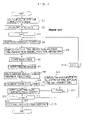
- FIG. 2 is a flow chart to show a fluid analysis program.
- FIG. 3 is a flow chart to show a turbulent flow viscosity computation program at step S 4 in the fluid analysis program.
- FIG. 4 is an illustration to show a completely developing channel turbulent flow.
- FIG. 5 is a conceptual view to show a computational domain.
- FIGS. 6A to 6D are computational results of a wall-damping function and FIGS. 6A and 6B are computational results of a wall-damping function in the related art and 6 C and 6 D are computational results of a wall-damping function in this embodiment.
- FIGS. 7A and 7B are graphs to show the relationship between wave number of specifying a turbulent flow and energy spectrum of turbulent variations and FIG. 7A shows the case of a k- ⁇ model and FIG. 7B shows the case of an LES, respectively.
- FIG. 8 is a Table of the computational grid resolution.
- a wall-damping function in this embodiment is defined as follows.
- y* in the equation (2) is a physical quantity of specifying a wall-damping function and u ⁇ in the equation (3) is a parameter of specifying the physical quantity and is a Kolmogorov's velocity scale.
- y is the shortest distance from the surface of a wall
- ⁇ is a coefficient of kinetic viscosity
- A, B, C and D are model constants and ⁇ SGS is a dissipation rate of turbulent energy k SGS of SGS.
- ⁇ SGS The way the ⁇ SGS is given includes a method of solving a transport equation of ⁇ SGS and a method of predicting ⁇ SGS from k SGS .
- ⁇ SGS is given as follows.
- k SGS needs to be estimated.
- a method of estimating k SGS includes some methods. A typical method will be described below.
- the wall-damping function using the Kolmogorov's velocity scale is used not in the k- ⁇ model but in the LES.
- the Kolmogorov's velocity scale used in the k- ⁇ model as shown in FIG. 7A , a dissipation rate for components of all wave numbers of turbulent energy is used, so that as shown in FIG. 7B , in the LES in which turbulent components smaller in scale than a grid filter size are modeled, a dissipation rate for components of all wave numbers of turbulent energy can not be used.
- the dissipation rate of SGS turbulent energy for components of wave numbers smaller in scale than the grid filter size is smaller in scale than the dissipation rate for components of all wave numbers of turbulent energy and depends on a grid size.
- the above-described wall-damping function is specified by the use of the dissipation rate of the SGS turbulent energy for components of wave numbers smaller in scale than the grid filter size, an appropriate damping effect can not be produced and the wall-damping function becomes one that heavily depends on the grid size used for the computation, which results in reducing the accuracy of computation.
- the dissipation rate ⁇ SGS of SGS turbulent energy for components of wave numbers smaller in scale than the grid filter size is not used as it is, but the dissipation rate ⁇ SGS of SGS turbulent energy for components of wave numbers smaller in scale than the grid filter size is converted to the dissipation rate for components of all wave numbers of turbulent energy by a predetermined wave number (grid filter size) when the turbulent flow is modeled and a distance from the surface of a wall.
- a scale conversion using a length ratio (y/ ⁇ ) 2 is conducted and then converted dissipation rate is utilized.
- y typifies a length scale of turbulent flow (including components of all wave numbers) near the surface of the wall
- ⁇ typifies a length scale of the SGS component of the turbulent flow.
- this conversion expresses that the dissipation rate for components of all wave numbers of the turbulent energy is predicted from the dissipation rate ⁇ SGS of SGS turbulent energy for components of wave numbers smaller then the grid filter size.
- the wall-damping function used for the computation does not depend on the grid size and hence a suitable damping effect can be produced.
- the fluid analysis device 10 in accordance with this embodiment follows a physical quantity computation program, a wall-damping function computation program, a turbulent viscosity computation program, and a fluid analysis program and has a personal computer 12 and a printer 14 .
- the personal computer 14 is constructed of a CPU, a ROM, a RAM (memory), a hard disk, and like.
- the physical quantity computation program, the wall-damping function computation program, the turbulent viscosity computation program, and the fluid analysis program are stored in the hard disk in a hard disk unit.
- FIG. 2 is shown a flow chart to show the fluid analysis program.
- a computation procedure of an incompressible flow analysis is used.
- Fluid analysis in the fluid analysis program is a well-known matter except for the following step S 4 , so that the fluid analysis will be described in brief.
- a computation grid, boundary conditions, and computation conditions are inputted via a keyboard or the like and at step S 2 , initial values of basic physical variables are set.
- initial values of basic physical variables are set.
- data be read from a data file in which values of the basic physical variables on the respective previously prepared computation grid points are described and be made the initial values.
- step S 3 computation is started with analysis time t set at 0.
- step S 4 SGS turbulent viscosity ⁇ t is computed and stored in the memory.
- computation contents of the SGS turbulent viscosity ⁇ t will be described later.
- the convection term, the viscosity term, the SGS stress term, the pressure term, the time term, and the external force term of a momentum equation are computed and stored in the memory.
- the SGS stress term is computed, the SGS turbulent viscosity ⁇ t acquired by the computation at step S 4 is used.
- step S 6 the predicted value of a time change in a fluid velocity is computed on the basis of the values of the respective terms computed at step S 5 and a velocity field is updated.
- step S 7 the respective terms of a pressure equation are computed on the basis of the value of velocity computed at step S 6 in such a way that the velocity field satisfies a continuity equation and are stored in the memory.
- step S 8 the linear equation system is solved by a solution method such as a SOR method and a conjugate gradient method and a pressure field is updated and the velocity field is corrected on the basis of the updated value of pressure.
- step S 9 it is determined whether or not a solution of an additional equation such as a transport equation of k SGS in the modeling of the SGS stress term is used.
- step S 10 the respective terms of the additional equation such as the transport equation of k SGS are computed and stored in the memory and at step S 11 , a time change in an additional physical quantity such as k SGS on the basis of the values of the respective terms computed at step S 10 is computed and the additional physical quantity is updated on the computed time change.
- middle computation result is outputted (stored in the hard disk, printed out, or displayed on a display unit), if necessary, and a turbulent statistical quantity is computed.
- step S 13 it is determined whether or not an analysis time exceeds an analysis end time t max .
- the analysis time is updated at step S 14 and the routine returns to step S 4 and processings from step S 4 to step S 13 are repeated.
- the analysis time exceeds the analysis end time t max final computation result is outputted (stored in the hard disk, printed out, or displayed on a display unit) at step S 15 and the routine is ended.
- a continuity equation subjected to the following spatial filter (grid filter) and a Navier-Stokes equation (in the case of incompressible fluid analysis) are used.
- SGS stress ⁇ ij that can not be directly computed is modeled on the basis of the following eddy viscosity approximation.
- the SGS stress ⁇ ij is modeled by giving the turbulent viscosity ⁇ t (step S 4 ).
- FIG. 3 is shown a flow chart to show the turbulent viscosity computation program including the physical quantity computation program.
- step A 1 it is determined whether or not an SGS model to be used is one using the transport equation of SGS turbulent energy k SGS .
- SGS turbulent energy k SGS is given as a solution of a solved equation.
- a velocity field subjected to a spatial filter (test filter), which width is larger than that of the grid filter is computed.
- ⁇ i F ( ⁇ i )
- F filtering operator
- the SGS turbulent energy K SGS is estimated as follows from the square mean value of the components in the respective spatial directions.
- k SGS C k ( ⁇ i ⁇ ⁇ i ) 2
- C k model constant [Mathematical formula 10]
- step A 5 by the use of the value of SGS turbulent energy k SGS found at step A 2 or step A 4 , the dissipation rate ⁇ SGS of SGS turbulent energy is estimated as follows.
- a Kolmogorov's velocity scale based on the equation (3) is computed and at step A 7 , a wall-damping function based on the equation (1) is computed by the use of the Kolmogorov's velocity scale computed at step A 6 .
- SGS turbulent viscosity ⁇ t is computed in the following manner by the use of the value of SGS turbulent energy k SGS already found at step A 2 or step A 4 .
- v t C v f ⁇ ⁇ square root over ( k SGS ) ⁇ [Mathematical formula 12]
- the GS component of strain rate tensor is found in the following manner at step A 9 .
- SGS turbulent viscosity ⁇ t is computed in the following manner at step A 12 by the use of the magnitude of GS component of strain rate tensor found at step A 10 .
- v t C s ( ⁇ f ) 2
- SGS turbulent viscosity ⁇ t is computed in the following manner by the use of the time scale T s computed at step A 11 and the magnitude of strain rate tensor velocity of the GS component found at step A 10 .
- ⁇ t C MTS fk SGS Ts, C MTS : model constant [Mathematical formula 16]
- the Abe 1 model depends on the grid resolution very much.
- the wall-damping function shown by a solid line in the drawing is one of optimum wall-damping functions in a channel turbulent flow and is different from the distribution of wall-damping functions in the Abe 1 model, as can be seen.
- the wall-damping function f is nearly equal to 0 over the whole region and the effective region of the wall-damping function extends extremely to a portion away from the surface of the wall.
- the coefficient of model is changed so that the effect of the wall-damping function does not extend to a portion away from the surface of the wall to provide improvement, but the property of substantially depending on the grid resolution is not changed.
- the wall-damping functions are nearly equal to the distribution of the optimum wall-damping function, which reveals that, by multiplying the above-described (Dy/ ⁇ ) 1/2 in the computing of the Kolmogorov's velocity scale, the dependence on the grid resolution is solved to produce an appropriate damping effect.
- the Method B as can be seen in FIG. 6D , there is produced nearly the same result, that is, the present wall-damping function does not especially depend on the way the turbulent energy ksgs is given but produces excellent result.
- the wall-damping function is defined by the equation (1)-(3).
- the invention is not limited to this but may be defined in the following.
- the mathematical formula 22 is different from the mathematical formula 23 only in coefficient and power.
- the mathematical formula 21 can be made to agree with the equations (1) to (3) by the way the parameters A′, B′, and D′ in the mathematical formulas 21 and 22 are given.
- the near-wall asymptotic behavior means that turbulent viscosity ⁇ t rises up along the 3rd power of y at a portion extremely close to the surface of the wall.
- the behavior depends on the SGS model to be used.
- the wall-damping function f becomes the second power of y
- the wall-damping function f becomes the 1.5th power of y
- the wall-damping function f becomes the 1st power of y.
- the various examples described above are such that analyze fluid, and gas and liquid can be used as the fluid.
- gasoline and oil may be used as the liquid.
- the invention can be applied to the case of analyzing a state where liquid such as gasoline or oil flows through a pipe. In this case, the inner surface of the pipe becomes the surface of the wall. Further, air may be also used as gas.
- the invention can be applied to the case of analyzing the state of air where a vehicle is arranged and where air is sent to the vehicle by a blower. In this case, the outer surface of the vehicle becomes the surface of the wall.
- the descriptions have been just provided by taking the vehicle as an example, the invention is not limited to the vehicle but can be applied to various other examples of analyzing fluid.
Landscapes
- Engineering & Computer Science (AREA)
- Physics & Mathematics (AREA)
- Theoretical Computer Science (AREA)
- Computer Hardware Design (AREA)
- Evolutionary Computation (AREA)
- Geometry (AREA)
- General Engineering & Computer Science (AREA)
- General Physics & Mathematics (AREA)
- Management, Administration, Business Operations System, And Electronic Commerce (AREA)
- Complex Calculations (AREA)
Abstract
Description
-
- ūj: velocity component acquired by computation
- (
- Ckk: model constant
k SGS =C k(ū j −
Ck=model constant
τij=
- t=time, ui=velocity vector, xi=position vector,
- ρ=density, p=pressure, ν=kinetic viscosity,
- τij=sub-grid scale (SGS) scale
k SGS =C k(ũ i −
v t =C v fΔ√{square root over (k SGS)} [Mathematical formula 12]
|
v t =C s(Δf)2|
νt =C MTS fk SGS Ts, C MTS: model constant [Mathematical formula 16]
C v=0.054, A=20, C ε=0.835, C kk=0.1, D=4 [Mathematical formula 17]
C v=0.042, A=20, C ε=0.835, C k=1, D=4 [Mathematical formula 18]
C v=0.054, A=26, B=2, C ε=0.835, C kk=0.1 [Mathematical formula 19]
is an
C v=0.12, A=20, B=2, C ε=0.835, C kk=0.1 [Mathematical formula 20]
is an
A′/D′=104/3 /C ε 1/3 , B′=1 [Mathematical formula 24]
in the mathematical formulas 21 and 22.
Claims (6)
Applications Claiming Priority (4)
| Application Number | Priority Date | Filing Date | Title |
|---|---|---|---|
| JP2003385878 | 2003-11-14 | ||
| JP2003-385878 | 2003-11-14 | ||
| JP2004-271304 | 2004-09-17 | ||
| JP2004271304A JP4214975B2 (en) | 2003-11-14 | 2004-09-17 | Physical quantity calculation program, damping function calculation program, turbulent viscosity calculation program, fluid analysis program, and prediction program |
Publications (2)
| Publication Number | Publication Date |
|---|---|
| US20050107995A1 US20050107995A1 (en) | 2005-05-19 |
| US7555413B2 true US7555413B2 (en) | 2009-06-30 |
Family
ID=34575971
Family Applications (1)
| Application Number | Title | Priority Date | Filing Date |
|---|---|---|---|
| US10/986,388 Expired - Fee Related US7555413B2 (en) | 2003-11-14 | 2004-11-12 | Method and computer storage medium for determining a wall-damping function used in the subgrid-scale modeling for large eddy simulation |
Country Status (2)
| Country | Link |
|---|---|
| US (1) | US7555413B2 (en) |
| JP (1) | JP4214975B2 (en) |
Cited By (4)
| Publication number | Priority date | Publication date | Assignee | Title |
|---|---|---|---|---|
| US20080015830A1 (en) * | 2006-07-14 | 2008-01-17 | Exa Corporation | Cascaded Eddy Simulation |
| US20130052935A1 (en) * | 2011-08-23 | 2013-02-28 | DDI, Inc. | Livestock building design |
| US20130218536A1 (en) * | 2012-02-16 | 2013-08-22 | Jiun-Der Yu | Time and Space Scaled S-Model for Turbulent Fluid Flow Simulations |
| US10595502B2 (en) * | 2011-08-23 | 2020-03-24 | DDI, Inc. | Livestock building design and control |
Families Citing this family (3)
| Publication number | Priority date | Publication date | Assignee | Title |
|---|---|---|---|---|
| US20070244680A1 (en) * | 2006-04-12 | 2007-10-18 | Mingde Su | Turbulence modeling using unstructured mesh system |
| US7668705B2 (en) * | 2006-07-11 | 2010-02-23 | Georgi Kalitzin | Method for computing turbulent flow using a near-wall eddy-viscosity formulation |
| CN112182995B (en) * | 2020-10-27 | 2021-06-04 | 中国海洋大学 | A Theoretical Analysis Method of Viscous Potential Flow |
Citations (2)
| Publication number | Priority date | Publication date | Assignee | Title |
|---|---|---|---|---|
| US20040181377A1 (en) * | 2003-03-12 | 2004-09-16 | Nissan Motor Co., Ltd. | Flame propagation modeling method |
| US7209873B1 (en) * | 1999-09-03 | 2007-04-24 | Kliegel James R | Method of analyzing and computing anisotropic turbulent flows |
-
2004
- 2004-09-17 JP JP2004271304A patent/JP4214975B2/en not_active Expired - Fee Related
- 2004-11-12 US US10/986,388 patent/US7555413B2/en not_active Expired - Fee Related
Patent Citations (2)
| Publication number | Priority date | Publication date | Assignee | Title |
|---|---|---|---|---|
| US7209873B1 (en) * | 1999-09-03 | 2007-04-24 | Kliegel James R | Method of analyzing and computing anisotropic turbulent flows |
| US20040181377A1 (en) * | 2003-03-12 | 2004-09-16 | Nissan Motor Co., Ltd. | Flame propagation modeling method |
Non-Patent Citations (12)
Cited By (9)
| Publication number | Priority date | Publication date | Assignee | Title |
|---|---|---|---|---|
| US20080015830A1 (en) * | 2006-07-14 | 2008-01-17 | Exa Corporation | Cascaded Eddy Simulation |
| US20130317794A1 (en) * | 2006-07-14 | 2013-11-28 | Exa Corporation | Cascaded Eddy Simulation |
| US9031819B2 (en) * | 2006-07-14 | 2015-05-12 | Exa Corporation | Cascaded eddy simulation |
| US9223909B2 (en) * | 2006-07-14 | 2015-12-29 | Exa Corporation | Cascaded eddy simulation |
| US20130052935A1 (en) * | 2011-08-23 | 2013-02-28 | DDI, Inc. | Livestock building design |
| US9347451B2 (en) * | 2011-08-23 | 2016-05-24 | DDI, Inc. | Livestock building design |
| US10595502B2 (en) * | 2011-08-23 | 2020-03-24 | DDI, Inc. | Livestock building design and control |
| US20130218536A1 (en) * | 2012-02-16 | 2013-08-22 | Jiun-Der Yu | Time and Space Scaled S-Model for Turbulent Fluid Flow Simulations |
| US8775140B2 (en) * | 2012-02-16 | 2014-07-08 | Seiko Epson Corporation | Time and space scaled S-model for turbulent fluid flow simulations |
Also Published As
| Publication number | Publication date |
|---|---|
| JP4214975B2 (en) | 2009-01-28 |
| US20050107995A1 (en) | 2005-05-19 |
| JP2005166015A (en) | 2005-06-23 |
Similar Documents
| Publication | Publication Date | Title |
|---|---|---|
| Fukagata et al. | Highly energy-conservative finite difference method for the cylindrical coordinate system | |
| Peng et al. | Large eddy simulation for turbulent buoyant flow in a confined cavity | |
| Vola et al. | Laminar unsteady flows of Bingham fluids: a numerical strategy and some benchmark results | |
| Christensen | The influence of peak-locking errors on turbulence statistics computed from PIV ensembles | |
| Li et al. | The impact and treatment of the Gibbs phenomenon in immersed boundary method simulations of momentum and scalar transport | |
| US11645433B2 (en) | Computer simulation of physical fluids on irregular spatial grids stabilized for explicit numerical diffusion problems | |
| Hoffmann et al. | Approximate wall boundary conditions for large eddy simulations | |
| Hodges et al. | Numerical error assessment and a temporal horizon for internal waves in a hydrostatic model | |
| US7555413B2 (en) | Method and computer storage medium for determining a wall-damping function used in the subgrid-scale modeling for large eddy simulation | |
| Duan et al. | Calibrating sub-grid scale models for high-order wall-modeled large eddy simulation | |
| Laval et al. | Direct numerical simulations of converging–diverging channel flow | |
| Majander et al. | Evaluation of Smagorinsky‐based subgrid‐scale models in a finite‐volume computation | |
| Krajnović et al. | A mixed one-equation subgrid model for large-eddy simulation | |
| Wouters et al. | On the existence of a Generalized Langevin model representation for second‐moment closures | |
| Smith et al. | Extreme two-dimensional water waves: an assessment of potential design solutions | |
| Hoffman | On duality-based a posteriori error estimation in various norms and linear functionals for large eddy simulation | |
| Inagaki et al. | Transport and modeling of subgrid-scale turbulent kinetic energy in channel flows | |
| Vafa et al. | Effect of numerical schemes on advection terms for large eddy simulation of inclined dense jets | |
| Chasnov | The viscous-convective subrange in nonstationary turbulence | |
| Lodato et al. | Evaluation of the spectral element dynamic model for large-eddy simulation on unstructured, deformed meshes | |
| Varghese et al. | Representation of surface roughness in hybrid turbulence simulations | |
| Beaubert et al. | Large eddy simulation of a plane impinging jet | |
| Yun | Development and analysis of advanced explicit algebraic turbulence and scalar flux models for complex engineering configurations | |
| Basara et al. | Performance analysis of immersed boundary method for predicting external car aerodynamics | |
| Hodges | Accuracy order of Crank–Nicolson discretization for hydrostatic free-surface flow |
Legal Events
| Date | Code | Title | Description |
|---|---|---|---|
| AS | Assignment |
Owner name: KABUSHIKI KAISHA TOYOTA CHUO KENKYUSHO, JAPAN Free format text: ASSIGNMENT OF ASSIGNORS INTEREST;ASSIGNOR:INAGAKI, MASAHIDE;REEL/FRAME:015985/0843 Effective date: 20041105 |
|
| FEPP | Fee payment procedure |
Free format text: PAYOR NUMBER ASSIGNED (ORIGINAL EVENT CODE: ASPN); ENTITY STATUS OF PATENT OWNER: LARGE ENTITY |
|
| STCF | Information on status: patent grant |
Free format text: PATENTED CASE |
|
| CC | Certificate of correction | ||
| FPAY | Fee payment |
Year of fee payment: 4 |
|
| FPAY | Fee payment |
Year of fee payment: 8 |
|
| FEPP | Fee payment procedure |
Free format text: MAINTENANCE FEE REMINDER MAILED (ORIGINAL EVENT CODE: REM.); ENTITY STATUS OF PATENT OWNER: LARGE ENTITY |
|
| LAPS | Lapse for failure to pay maintenance fees |
Free format text: PATENT EXPIRED FOR FAILURE TO PAY MAINTENANCE FEES (ORIGINAL EVENT CODE: EXP.); ENTITY STATUS OF PATENT OWNER: LARGE ENTITY |
|
| STCH | Information on status: patent discontinuation |
Free format text: PATENT EXPIRED DUE TO NONPAYMENT OF MAINTENANCE FEES UNDER 37 CFR 1.362 |
|
| FP | Lapsed due to failure to pay maintenance fee |
Effective date: 20210630 |