US7524847B2 - Fused 1,3-dihydro-imidazole ring compounds - Google Patents
Fused 1,3-dihydro-imidazole ring compounds Download PDFInfo
- Publication number
- US7524847B2 US7524847B2 US10/537,227 US53722705A US7524847B2 US 7524847 B2 US7524847 B2 US 7524847B2 US 53722705 A US53722705 A US 53722705A US 7524847 B2 US7524847 B2 US 7524847B2
- Authority
- US
- United States
- Prior art keywords
- group
- compound
- methyl
- formula
- denotes
- Prior art date
- Legal status (The legal status is an assumption and is not a legal conclusion. Google has not performed a legal analysis and makes no representation as to the accuracy of the status listed.)
- Expired - Fee Related, expires
Links
- 0 Cc(C)c(C)C Chemical compound Cc(C)c(C)C 0.000 description 16
- VNWXTAMIGJCFLP-UHFFFAOYSA-N C.C=C1N(C)C2=C(C(N(C)C)=Ccc2)N1C Chemical compound C.C=C1N(C)C2=C(C(N(C)C)=Ccc2)N1C VNWXTAMIGJCFLP-UHFFFAOYSA-N 0.000 description 3
- DTQVDTLACAAQTR-UHFFFAOYSA-N OC(C(F)(F)F)=O Chemical compound OC(C(F)(F)F)=O DTQVDTLACAAQTR-UHFFFAOYSA-N 0.000 description 3
- PMTCPGLDKUXKGW-UHFFFAOYSA-N CC#CCN1C(=O)N(C2=CC=CC=C2)C2=NC=NC(N3CCNCC3)=C21.O=C(O)C(F)(F)F Chemical compound CC#CCN1C(=O)N(C2=CC=CC=C2)C2=NC=NC(N3CCNCC3)=C21.O=C(O)C(F)(F)F PMTCPGLDKUXKGW-UHFFFAOYSA-N 0.000 description 2
- MGPCQGIYWMNTQD-UHFFFAOYSA-N CC#CCN1C(=O)N(C2=CSC=C2)C2=NC(OC)=NC(N3CCNCC3)=C21.O=C(O)C(F)(F)F Chemical compound CC#CCN1C(=O)N(C2=CSC=C2)C2=NC(OC)=NC(N3CCNCC3)=C21.O=C(O)C(F)(F)F MGPCQGIYWMNTQD-UHFFFAOYSA-N 0.000 description 2
- JOBJYTTZMLJMMM-UHFFFAOYSA-N CC#CCN1C(=O)N(CCCC#N)C2=C1C(N1CCNCC1)=NC(Cl)=N2.O=C(O)C(F)(F)F Chemical compound CC#CCN1C(=O)N(CCCC#N)C2=C1C(N1CCNCC1)=NC(Cl)=N2.O=C(O)C(F)(F)F JOBJYTTZMLJMMM-UHFFFAOYSA-N 0.000 description 2
- KZYWGTNVKZYQFR-UHFFFAOYSA-N CC(C)(C)OC(=O)N1CCN(C2=C3C(=C(Br)C=N2)N(CC2=C(C#N)C=CC=C2)C(=O)N3CC2=CC=CC=C2)CC1 Chemical compound CC(C)(C)OC(=O)N1CCN(C2=C3C(=C(Br)C=N2)N(CC2=C(C#N)C=CC=C2)C(=O)N3CC2=CC=CC=C2)CC1 KZYWGTNVKZYQFR-UHFFFAOYSA-N 0.000 description 2
- VORKUPQIFWGDOF-UHFFFAOYSA-N CC(C)(C)OC(=O)N1CCN(C2=C3NC(=O)N(CCC#N)C3=NC=N2)CC1 Chemical compound CC(C)(C)OC(=O)N1CCN(C2=C3NC(=O)N(CCC#N)C3=NC=N2)CC1 VORKUPQIFWGDOF-UHFFFAOYSA-N 0.000 description 2
- XDLFIHOGHPGTQO-UHFFFAOYSA-N CC(C)(C)OC(=O)N1CCN(C2=NC(Cl)=NC3=C2N=CN3)CC1 Chemical compound CC(C)(C)OC(=O)N1CCN(C2=NC(Cl)=NC3=C2N=CN3)CC1 XDLFIHOGHPGTQO-UHFFFAOYSA-N 0.000 description 2
- MSWVGLIYBUFGSP-UHFFFAOYSA-N CN1C(Cl)=NC2=C1N=C(Cl)N=C2N1CCN(C(=O)OC(C)(C)C)CC1 Chemical compound CN1C(Cl)=NC2=C1N=C(Cl)N=C2N1CCN(C(=O)OC(C)(C)C)CC1 MSWVGLIYBUFGSP-UHFFFAOYSA-N 0.000 description 2
- BSRCLGAGDFWFEP-UHFFFAOYSA-N C#CCN1C(=O)N(CC#CC)C2=C(N3CCNCC3)N=CN=C21.O=C(O)C(F)(F)F Chemical compound C#CCN1C(=O)N(CC#CC)C2=C(N3CCNCC3)N=CN=C21.O=C(O)C(F)(F)F BSRCLGAGDFWFEP-UHFFFAOYSA-N 0.000 description 1
- DOERYTSQVLFZCB-UHFFFAOYSA-N C.C.CC(C)C1=CC(=O)NC=C1.CC(C)C1=CC=CC(=O)N1.CC(C)C1=CC=CNC1=O.CC(C)C1=CNC(=O)C=C1.CC(C)N1C=CC=CC1=O Chemical compound C.C.CC(C)C1=CC(=O)NC=C1.CC(C)C1=CC=CC(=O)N1.CC(C)C1=CC=CNC1=O.CC(C)C1=CNC(=O)C=C1.CC(C)N1C=CC=CC1=O DOERYTSQVLFZCB-UHFFFAOYSA-N 0.000 description 1
- HSRCDIDNGLKSRY-UHFFFAOYSA-N C.CC(C)C1=CC(=O)N(C)C=C1.CC(C)C1=CC=CC(=O)N1C.CC(C)C1=CC=CN(C)C1=O.CC(C)C1=CN(C)C(=O)C=C1 Chemical compound C.CC(C)C1=CC(=O)N(C)C=C1.CC(C)C1=CC=CC(=O)N1C.CC(C)C1=CC=CN(C)C1=O.CC(C)C1=CN(C)C(=O)C=C1 HSRCDIDNGLKSRY-UHFFFAOYSA-N 0.000 description 1
- ROCBYDIYMPYBDK-UHFFFAOYSA-N C=C1N(C)C2=C(C(N(C)C)=NC=N2)N1C.C=C1N(C)C2=C(C(N(C)C)=NC=N2)N1C.C=C1NC2=C(C(N(C)C)=NC=N2)N1C.C=C1NC2=C(N=CN=C2N(C)C)N1C.CC.CC.CN.CN(C)C1=NC=NC(Cl)=C1[N+](=O)[O-].CNC.CNC1=C(N)C(N(C)C)=NC=N1.CNC1=C([N+](=O)[O-])C(N(C)C)=NC=N1.O=[N+]([O-])C1=C(Cl)N=CN=C1Cl Chemical compound C=C1N(C)C2=C(C(N(C)C)=NC=N2)N1C.C=C1N(C)C2=C(C(N(C)C)=NC=N2)N1C.C=C1NC2=C(C(N(C)C)=NC=N2)N1C.C=C1NC2=C(N=CN=C2N(C)C)N1C.CC.CC.CN.CN(C)C1=NC=NC(Cl)=C1[N+](=O)[O-].CNC.CNC1=C(N)C(N(C)C)=NC=N1.CNC1=C([N+](=O)[O-])C(N(C)C)=NC=N1.O=[N+]([O-])C1=C(Cl)N=CN=C1Cl ROCBYDIYMPYBDK-UHFFFAOYSA-N 0.000 description 1
- DXODVCMQASFOPP-UHFFFAOYSA-N C=CC1=CC=C(N2C(=O)N(CC#CC)C3=C(N4CCNCC4)N=C(OC)N=C32)C=C1.O=C(O)C(F)(F)F Chemical compound C=CC1=CC=C(N2C(=O)N(CC#CC)C3=C(N4CCNCC4)N=C(OC)N=C32)C=C1.O=C(O)C(F)(F)F DXODVCMQASFOPP-UHFFFAOYSA-N 0.000 description 1
- DMUIQRVCIOLBFS-UHFFFAOYSA-N C=CCN1C(=O)N(C)C2=C(Cl)N=CC=C21.C=CCN1C(=O)NC2=C(Cl)N=CC=C21.C=CCNC1=CC=NC(Cl)=C1N.C=CCNC1=CC=NC=C1[N+](=O)[O-].CC.CC.CCOC1=CC=NC=C1[N+](=O)[O-].CN(C)C1=NC=CC2=C1N(C)C(=O)N2C.CN1C(=O)N(C)C2=C(Cl)N=CC=C21.CNC.[H]N1C(=O)N(C)C2=C(Cl)N=CC=C21 Chemical compound C=CCN1C(=O)N(C)C2=C(Cl)N=CC=C21.C=CCN1C(=O)NC2=C(Cl)N=CC=C21.C=CCNC1=CC=NC(Cl)=C1N.C=CCNC1=CC=NC=C1[N+](=O)[O-].CC.CC.CCOC1=CC=NC=C1[N+](=O)[O-].CN(C)C1=NC=CC2=C1N(C)C(=O)N2C.CN1C(=O)N(C)C2=C(Cl)N=CC=C21.CNC.[H]N1C(=O)N(C)C2=C(Cl)N=CC=C21 DMUIQRVCIOLBFS-UHFFFAOYSA-N 0.000 description 1
- DBXYDDDPSIVZPD-UHFFFAOYSA-N C=CCN1C(=O)N(CC#CC)C2=C(N3CCNCC3)N=C(OC)N=C21.O=C(O)C(F)(F)F Chemical compound C=CCN1C(=O)N(CC#CC)C2=C(N3CCNCC3)N=C(OC)N=C21.O=C(O)C(F)(F)F DBXYDDDPSIVZPD-UHFFFAOYSA-N 0.000 description 1
- CBXXWOCODAPBOX-UHFFFAOYSA-N C=CCN1C(=O)N(CC#CC)C2=C(N3CCNCC3)N=CN=C21.O=C(O)C(F)(F)F Chemical compound C=CCN1C(=O)N(CC#CC)C2=C(N3CCNCC3)N=CN=C21.O=C(O)C(F)(F)F CBXXWOCODAPBOX-UHFFFAOYSA-N 0.000 description 1
- DEBDTTQSCDOLSZ-UHFFFAOYSA-N C=CCN1C(=O)N(CC#CC)C2=C1N=C(OC1=CC=CC=C1C(N)=O)N=C2N1CCNCC1.O=C(O)C(F)(F)F Chemical compound C=CCN1C(=O)N(CC#CC)C2=C1N=C(OC1=CC=CC=C1C(N)=O)N=C2N1CCNCC1.O=C(O)C(F)(F)F DEBDTTQSCDOLSZ-UHFFFAOYSA-N 0.000 description 1
- ZVUGGFSRLREGAT-UHFFFAOYSA-N C=CCN1C(=O)N(CC#CC)C2=C1N=C(OCC)N=C2N1CCNCC1.O=C(O)C(F)(F)F Chemical compound C=CCN1C(=O)N(CC#CC)C2=C1N=C(OCC)N=C2N1CCNCC1.O=C(O)C(F)(F)F ZVUGGFSRLREGAT-UHFFFAOYSA-N 0.000 description 1
- PTBCPIFRRQSXQL-UHFFFAOYSA-N C=CCN1C(=O)N(CC2=CC=CC=C2)C2=C(Cl)N=CC=C21 Chemical compound C=CCN1C(=O)N(CC2=CC=CC=C2)C2=C(Cl)N=CC=C21 PTBCPIFRRQSXQL-UHFFFAOYSA-N 0.000 description 1
- XILNCAQXCFWOHS-UHFFFAOYSA-N C=CCN1C(=O)NC2=C(Cl)N=CC=C21 Chemical compound C=CCN1C(=O)NC2=C(Cl)N=CC=C21 XILNCAQXCFWOHS-UHFFFAOYSA-N 0.000 description 1
- SGXJIRANAFHZED-UHFFFAOYSA-N C=CCNC1=CC=NC(Cl)=C1N Chemical compound C=CCNC1=CC=NC(Cl)=C1N SGXJIRANAFHZED-UHFFFAOYSA-N 0.000 description 1
- OWOTYICBSOOOGZ-UHFFFAOYSA-N C=CCNC1=CC=NC=C1[N+](=O)[O-] Chemical compound C=CCNC1=CC=NC=C1[N+](=O)[O-] OWOTYICBSOOOGZ-UHFFFAOYSA-N 0.000 description 1
- LMGLKLSSHJNHMC-UHFFFAOYSA-N C=CCOC1=NC2=C(C(N3CCNCC3)=N1)N(CC#CC)C(=O)N2C.O=C(O)C(F)(F)F Chemical compound C=CCOC1=NC2=C(C(N3CCNCC3)=N1)N(CC#CC)C(=O)N2C.O=C(O)C(F)(F)F LMGLKLSSHJNHMC-UHFFFAOYSA-N 0.000 description 1
- CMQCHZWJFKVKPG-UHFFFAOYSA-N CC#CCN(c1c(N2CCNCC2)ncnc1N1Cc2ccccc2C#N)/C1=[O]\[F]C(C(O)=O)(F)F Chemical compound CC#CCN(c1c(N2CCNCC2)ncnc1N1Cc2ccccc2C#N)/C1=[O]\[F]C(C(O)=O)(F)F CMQCHZWJFKVKPG-UHFFFAOYSA-N 0.000 description 1
- DUPHPRXZPYDOLG-UHFFFAOYSA-N CC#CCN1C(=O)N(C)C2=C(Br)C=NC(N3CCN(C(=O)OC(C)(C)C)CC3)=C21 Chemical compound CC#CCN1C(=O)N(C)C2=C(Br)C=NC(N3CCN(C(=O)OC(C)(C)C)CC3)=C21 DUPHPRXZPYDOLG-UHFFFAOYSA-N 0.000 description 1
- IKLQRKGXCQNTST-UHFFFAOYSA-N CC#CCN1C(=O)N(C)C2=C(OC3=CC=CC=C3C(N)=O)C=NC(N3CCNCC3)=C21.O=C(O)C(F)(F)F Chemical compound CC#CCN1C(=O)N(C)C2=C(OC3=CC=CC=C3C(N)=O)C=NC(N3CCNCC3)=C21.O=C(O)C(F)(F)F IKLQRKGXCQNTST-UHFFFAOYSA-N 0.000 description 1
- XTNGAQCNPSLSQA-UHFFFAOYSA-N CC#CCN1C(=O)N(C)C2=C1C(Cl)=NC(Cl)=N2 Chemical compound CC#CCN1C(=O)N(C)C2=C1C(Cl)=NC(Cl)=N2 XTNGAQCNPSLSQA-UHFFFAOYSA-N 0.000 description 1
- OUGRSLRIHRIWEI-UHFFFAOYSA-N CC#CCN1C(=O)N(C)C2=C1C(N1CCCC(N)C1)=NC(Cl)=N2.O=C(O)C(F)(F)F Chemical compound CC#CCN1C(=O)N(C)C2=C1C(N1CCCC(N)C1)=NC(Cl)=N2.O=C(O)C(F)(F)F OUGRSLRIHRIWEI-UHFFFAOYSA-N 0.000 description 1
- ZZVVZWOEUNEMMF-UHFFFAOYSA-N CC#CCN1C(=O)N(C)C2=C1C(N1CCCC(NC(=O)OC(C)(C)C)C1)=NC(Cl)=N2 Chemical compound CC#CCN1C(=O)N(C)C2=C1C(N1CCCC(NC(=O)OC(C)(C)C)C1)=NC(Cl)=N2 ZZVVZWOEUNEMMF-UHFFFAOYSA-N 0.000 description 1
- LPDDYOANOWEMRU-UHFFFAOYSA-N CC#CCN1C(=O)N(C)C2=C1C(N1CCCC(NC)C1)=NC(Cl)=N2.O=C(O)C(F)(F)F Chemical compound CC#CCN1C(=O)N(C)C2=C1C(N1CCCC(NC)C1)=NC(Cl)=N2.O=C(O)C(F)(F)F LPDDYOANOWEMRU-UHFFFAOYSA-N 0.000 description 1
- BOAWICJNZYRVKR-UHFFFAOYSA-N CC#CCN1C(=O)N(C)C2=C1C(N1CCN(C(=O)OC(C)(C)C)CC1)=NC(Cl)=N2 Chemical compound CC#CCN1C(=O)N(C)C2=C1C(N1CCN(C(=O)OC(C)(C)C)CC1)=NC(Cl)=N2 BOAWICJNZYRVKR-UHFFFAOYSA-N 0.000 description 1
- GSUPBLGEEYSKJS-UHFFFAOYSA-N CC#CCN1C(=O)N(C)C2=C1C(N1CCNCC1)=NC(Cl)=N2.O=C(O)C(F)(F)F Chemical compound CC#CCN1C(=O)N(C)C2=C1C(N1CCNCC1)=NC(Cl)=N2.O=C(O)C(F)(F)F GSUPBLGEEYSKJS-UHFFFAOYSA-N 0.000 description 1
- FWLPWFFLSXEZKT-UHFFFAOYSA-N CC#CCN1C(=O)N(C)C2=C1C(N1CCNCC1)=NC(N(C)C)=N2.O=C(O)C(F)(F)F Chemical compound CC#CCN1C(=O)N(C)C2=C1C(N1CCNCC1)=NC(N(C)C)=N2.O=C(O)C(F)(F)F FWLPWFFLSXEZKT-UHFFFAOYSA-N 0.000 description 1
- JVQSZYBSYAAONE-UHFFFAOYSA-N CC#CCN1C(=O)N(C)C2=C1C(N1CCNCC1)=NC(N(CC)CC)=N2.O=C(O)C(F)(F)F Chemical compound CC#CCN1C(=O)N(C)C2=C1C(N1CCNCC1)=NC(N(CC)CC)=N2.O=C(O)C(F)(F)F JVQSZYBSYAAONE-UHFFFAOYSA-N 0.000 description 1
- LXMLOEMPRWEMFS-UHFFFAOYSA-N CC#CCN1C(=O)N(C)C2=C1C(N1CCNCC1)=NC(N)=N2.O=C(O)C(F)(F)F Chemical compound CC#CCN1C(=O)N(C)C2=C1C(N1CCNCC1)=NC(N)=N2.O=C(O)C(F)(F)F LXMLOEMPRWEMFS-UHFFFAOYSA-N 0.000 description 1
- GDLVWIVOZOKSQZ-UHFFFAOYSA-N CC#CCN1C(=O)N(C)C2=C1C(N1CCNCC1)=NC(NC)=N2.O=C(O)C(F)(F)F Chemical compound CC#CCN1C(=O)N(C)C2=C1C(N1CCNCC1)=NC(NC)=N2.O=C(O)C(F)(F)F GDLVWIVOZOKSQZ-UHFFFAOYSA-N 0.000 description 1
- BZBINOQRQIEMPG-UHFFFAOYSA-N CC#CCN1C(=O)N(C)C2=C1C(N1CCNCC1)=NC(NCC1=CC=CC=C1)=N2.O=C(O)C(F)(F)F Chemical compound CC#CCN1C(=O)N(C)C2=C1C(N1CCNCC1)=NC(NCC1=CC=CC=C1)=N2.O=C(O)C(F)(F)F BZBINOQRQIEMPG-UHFFFAOYSA-N 0.000 description 1
- VYKJUZUKKBWZSF-UHFFFAOYSA-N CC#CCN1C(=O)N(C)C2=C1C(N1CCNCC1)=NC(O)=N2.O=C(O)C(F)(F)F Chemical compound CC#CCN1C(=O)N(C)C2=C1C(N1CCNCC1)=NC(O)=N2.O=C(O)C(F)(F)F VYKJUZUKKBWZSF-UHFFFAOYSA-N 0.000 description 1
- JTCREEPORBZEEG-UHFFFAOYSA-N CC#CCN1C(=O)N(C)C2=C1C(N1CCNCC1)=NC(OC(C)C)=N2.O=C(O)C(F)(F)F Chemical compound CC#CCN1C(=O)N(C)C2=C1C(N1CCNCC1)=NC(OC(C)C)=N2.O=C(O)C(F)(F)F JTCREEPORBZEEG-UHFFFAOYSA-N 0.000 description 1
- CCIMWUQSNARWIP-UHFFFAOYSA-N CC#CCN1C(=O)N(C)C2=C1C(N1CCNCC1)=NC(OC)=N2.O=C(O)C(F)(F)F Chemical compound CC#CCN1C(=O)N(C)C2=C1C(N1CCNCC1)=NC(OC)=N2.O=C(O)C(F)(F)F CCIMWUQSNARWIP-UHFFFAOYSA-N 0.000 description 1
- WMNGZGWYBFABHH-UHFFFAOYSA-N CC#CCN1C(=O)N(C)C2=C1C(N1CCNCC1)=NC(OC1=CC=CC=C1)=N2.O=C(O)C(F)(F)F Chemical compound CC#CCN1C(=O)N(C)C2=C1C(N1CCNCC1)=NC(OC1=CC=CC=C1)=N2.O=C(O)C(F)(F)F WMNGZGWYBFABHH-UHFFFAOYSA-N 0.000 description 1
- VSSNYISIIUMXEX-UHFFFAOYSA-N CC#CCN1C(=O)N(C)C2=C1C(N1CCNCC1)=NC(OC1=CC=CC=C1C#N)=N2.O=C(O)C(F)(F)F Chemical compound CC#CCN1C(=O)N(C)C2=C1C(N1CCNCC1)=NC(OC1=CC=CC=C1C#N)=N2.O=C(O)C(F)(F)F VSSNYISIIUMXEX-UHFFFAOYSA-N 0.000 description 1
- SDVYVNBTAIFQRO-UHFFFAOYSA-N CC#CCN1C(=O)N(C)C2=C1C(N1CCNCC1)=NC(OC1=CC=CC=C1C(N)=O)=N2.O=C(O)C(F)(F)F Chemical compound CC#CCN1C(=O)N(C)C2=C1C(N1CCNCC1)=NC(OC1=CC=CC=C1C(N)=O)=N2.O=C(O)C(F)(F)F SDVYVNBTAIFQRO-UHFFFAOYSA-N 0.000 description 1
- ZHIDVRPIVCSNAO-UHFFFAOYSA-N CC#CCN1C(=O)N(C)C2=C1C(N1CCNCC1)=NC(OCC)=N2.O=C(O)C(F)(F)F Chemical compound CC#CCN1C(=O)N(C)C2=C1C(N1CCNCC1)=NC(OCC)=N2.O=C(O)C(F)(F)F ZHIDVRPIVCSNAO-UHFFFAOYSA-N 0.000 description 1
- ZMVONVDKDVBDDK-UHFFFAOYSA-N CC#CCN1C(=O)N(C)C2=C1C(N1CCNCC1)=NC(OCC1=CC=CC=C1)=N2.O=C(O)C(F)(F)F Chemical compound CC#CCN1C(=O)N(C)C2=C1C(N1CCNCC1)=NC(OCC1=CC=CC=C1)=N2.O=C(O)C(F)(F)F ZMVONVDKDVBDDK-UHFFFAOYSA-N 0.000 description 1
- UEQNACSHUTYECR-UHFFFAOYSA-N CC#CCN1C(=O)N(C)C2=C1C(N1CCNCC1)=NC(SC)=N2.O=C(O)C(F)(F)F Chemical compound CC#CCN1C(=O)N(C)C2=C1C(N1CCNCC1)=NC(SC)=N2.O=C(O)C(F)(F)F UEQNACSHUTYECR-UHFFFAOYSA-N 0.000 description 1
- OWUMMBYOJWUGFX-UHFFFAOYSA-N CC#CCN1C(=O)N(C)C2=CC=NC(Cl)=C21 Chemical compound CC#CCN1C(=O)N(C)C2=CC=NC(Cl)=C21 OWUMMBYOJWUGFX-UHFFFAOYSA-N 0.000 description 1
- WLZIPRSCPWJYBD-UHFFFAOYSA-N CC#CCN1C(=O)N(C)C2=CC=NC(N3CCN(C(=O)OC(C)(C)C)CC3)=C21 Chemical compound CC#CCN1C(=O)N(C)C2=CC=NC(N3CCN(C(=O)OC(C)(C)C)CC3)=C21 WLZIPRSCPWJYBD-UHFFFAOYSA-N 0.000 description 1
- IIQSZIXRIDCMGA-UHFFFAOYSA-N CC#CCN1C(=O)N(C)C2=CC=NC(N3CCNCC3)=C21.O=C(O)C(F)(F)F Chemical compound CC#CCN1C(=O)N(C)C2=CC=NC(N3CCNCC3)=C21.O=C(O)C(F)(F)F IIQSZIXRIDCMGA-UHFFFAOYSA-N 0.000 description 1
- TWDHPJYMPHXAOL-UHFFFAOYSA-N CC#CCN1C(=O)N(C)C2=NC=NC(N3CCNCC3)=C21.O=C(O)C(F)(F)F Chemical compound CC#CCN1C(=O)N(C)C2=NC=NC(N3CCNCC3)=C21.O=C(O)C(F)(F)F TWDHPJYMPHXAOL-UHFFFAOYSA-N 0.000 description 1
- LGNCJCGQLDCRKO-UHFFFAOYSA-N CC#CCN1C(=O)N(C2=CC=C(C#N)C=C2)C2=C1C(N1CCNCC1)=NC(Cl)=N2.O=C(O)C(F)(F)F Chemical compound CC#CCN1C(=O)N(C2=CC=C(C#N)C=C2)C2=C1C(N1CCNCC1)=NC(Cl)=N2.O=C(O)C(F)(F)F LGNCJCGQLDCRKO-UHFFFAOYSA-N 0.000 description 1
- OBOVMOMETSVPJM-UHFFFAOYSA-N CC#CCN1C(=O)N(C2=CC=C(OC)C=C2)C2=C1C(N1CCNCC1)=NC(Cl)=N2.O=C(O)C(F)(F)F Chemical compound CC#CCN1C(=O)N(C2=CC=C(OC)C=C2)C2=C1C(N1CCNCC1)=NC(Cl)=N2.O=C(O)C(F)(F)F OBOVMOMETSVPJM-UHFFFAOYSA-N 0.000 description 1
- HPQVUSSXQOLDIH-UHFFFAOYSA-N CC#CCN1C(=O)N(C2=CC=C(OC)N=C2)C2=NC=NC(N3CCN(C(=O)OC(C)(C)C)CC3)=C21 Chemical compound CC#CCN1C(=O)N(C2=CC=C(OC)N=C2)C2=NC=NC(N3CCN(C(=O)OC(C)(C)C)CC3)=C21 HPQVUSSXQOLDIH-UHFFFAOYSA-N 0.000 description 1
- DKHHDEIZLVCHEA-UHFFFAOYSA-N CC#CCN1C(=O)N(C2=CC=C(OC)N=C2)C2=NC=NC(N3CCNCC3)=C21.O=C(O)C(F)(F)F Chemical compound CC#CCN1C(=O)N(C2=CC=C(OC)N=C2)C2=NC=NC(N3CCNCC3)=C21.O=C(O)C(F)(F)F DKHHDEIZLVCHEA-UHFFFAOYSA-N 0.000 description 1
- RJZUHRZDWLNDSR-UHFFFAOYSA-N CC#CCN1C(=O)N(C2=CC=CC=C2)C2=C1C(N1CCNCC1)=NC(Cl)=N2.O=C(O)C(F)(F)F Chemical compound CC#CCN1C(=O)N(C2=CC=CC=C2)C2=C1C(N1CCNCC1)=NC(Cl)=N2.O=C(O)C(F)(F)F RJZUHRZDWLNDSR-UHFFFAOYSA-N 0.000 description 1
- TVGDJEWDFLQQAX-UHFFFAOYSA-N CC#CCN1C(=O)N(C2=CC=CC=C2)C2=NC(OC)=NC(N3CCNCC3)=C21.O=C(O)C(F)(F)F Chemical compound CC#CCN1C(=O)N(C2=CC=CC=C2)C2=NC(OC)=NC(N3CCNCC3)=C21.O=C(O)C(F)(F)F TVGDJEWDFLQQAX-UHFFFAOYSA-N 0.000 description 1
- XHXVKHBROCQSNE-UHFFFAOYSA-N CC#CCN1C(=O)N(C2=CC=CN=C2)C2=NC(OC)=NC(N3CCNCC3)=C21.O=C(O)C(F)(F)F Chemical compound CC#CCN1C(=O)N(C2=CC=CN=C2)C2=NC(OC)=NC(N3CCNCC3)=C21.O=C(O)C(F)(F)F XHXVKHBROCQSNE-UHFFFAOYSA-N 0.000 description 1
- WPUKAWYCBFOGCC-UHFFFAOYSA-N CC#CCN1C(=O)N(C2=CC=CN=C2)C2=NC=NC(N3CCNCC3)=C21.O=C(O)C(F)(F)F Chemical compound CC#CCN1C(=O)N(C2=CC=CN=C2)C2=NC=NC(N3CCNCC3)=C21.O=C(O)C(F)(F)F WPUKAWYCBFOGCC-UHFFFAOYSA-N 0.000 description 1
- NWVWSTIMYJHFPX-UHFFFAOYSA-N CC#CCN1C(=O)N(C2=CC=NC(Cl)=C2)C2=NC=NC(N3CCNCC3)=C21.O=C(O)C(F)(F)F Chemical compound CC#CCN1C(=O)N(C2=CC=NC(Cl)=C2)C2=NC=NC(N3CCNCC3)=C21.O=C(O)C(F)(F)F NWVWSTIMYJHFPX-UHFFFAOYSA-N 0.000 description 1
- KNCUDBZKHOBFEY-UHFFFAOYSA-N CC#CCN1C(=O)N(C2=CN(C)C(=O)C=C2)C2=NC=NC(N3CCN(C(=O)OC(C)(C)C)CC3)=C21 Chemical compound CC#CCN1C(=O)N(C2=CN(C)C(=O)C=C2)C2=NC=NC(N3CCN(C(=O)OC(C)(C)C)CC3)=C21 KNCUDBZKHOBFEY-UHFFFAOYSA-N 0.000 description 1
- OLZYGIXODRCSFZ-UHFFFAOYSA-N CC#CCN1C(=O)N(C2=CN(C)C(=O)C=C2)C2=NC=NC(N3CCNCC3)=C21.O=C(O)C(F)(F)F Chemical compound CC#CCN1C(=O)N(C2=CN(C)C(=O)C=C2)C2=NC=NC(N3CCNCC3)=C21.O=C(O)C(F)(F)F OLZYGIXODRCSFZ-UHFFFAOYSA-N 0.000 description 1
- IRZLSZAJBJGWCW-UHFFFAOYSA-N CC#CCN1C(=O)N(C2=CN=C(OC)N=C2)C2=NC=NC(N3CCNCC3)=C21.O=C(O)C(F)(F)F Chemical compound CC#CCN1C(=O)N(C2=CN=C(OC)N=C2)C2=NC=NC(N3CCNCC3)=C21.O=C(O)C(F)(F)F IRZLSZAJBJGWCW-UHFFFAOYSA-N 0.000 description 1
- HUNNEAXQIXBVKU-UHFFFAOYSA-N CC#CCN1C(=O)N(C2=CN=CC=C2)C2=C1C(N1CCNCC1)=NC(Cl)=N2.O=C(O)C(F)(F)F Chemical compound CC#CCN1C(=O)N(C2=CN=CC=C2)C2=C1C(N1CCNCC1)=NC(Cl)=N2.O=C(O)C(F)(F)F HUNNEAXQIXBVKU-UHFFFAOYSA-N 0.000 description 1
- BLYJWHOEQUPOKU-UHFFFAOYSA-N CC#CCN1C(=O)N(C2=CNC(=O)C=C2)C2=NC=NC(N3CCNCC3)=C21.O=C(O)C(F)(F)F Chemical compound CC#CCN1C(=O)N(C2=CNC(=O)C=C2)C2=NC=NC(N3CCNCC3)=C21.O=C(O)C(F)(F)F BLYJWHOEQUPOKU-UHFFFAOYSA-N 0.000 description 1
- IYDATRBOSZCUJS-UHFFFAOYSA-N CC#CCN1C(=O)N(C2=COC=C2)C2=C1C(N1CCNCC1)=NC(Cl)=N2.O=C(O)C(F)(F)F Chemical compound CC#CCN1C(=O)N(C2=COC=C2)C2=C1C(N1CCNCC1)=NC(Cl)=N2.O=C(O)C(F)(F)F IYDATRBOSZCUJS-UHFFFAOYSA-N 0.000 description 1
- HVZNMXVWPDGMLQ-UHFFFAOYSA-N CC#CCN1C(=O)N(C2=COC=C2)C2=NC(OC)=NC(N3CCNCC3)=C21.O=C(O)C(F)(F)F Chemical compound CC#CCN1C(=O)N(C2=COC=C2)C2=NC(OC)=NC(N3CCNCC3)=C21.O=C(O)C(F)(F)F HVZNMXVWPDGMLQ-UHFFFAOYSA-N 0.000 description 1
- YBLNJCLFMYUPTP-UHFFFAOYSA-N CC#CCN1C(=O)N(C2=COC=C2)C2=NC=NC(N3CCNCC3)=C21.O=C(O)C(F)(F)F Chemical compound CC#CCN1C(=O)N(C2=COC=C2)C2=NC=NC(N3CCNCC3)=C21.O=C(O)C(F)(F)F YBLNJCLFMYUPTP-UHFFFAOYSA-N 0.000 description 1
- UZOCAVKTEBRXLZ-UHFFFAOYSA-N CC#CCN1C(=O)N(C2=CSC=C2)C2=C1C(N1CCNCC1)=NC(Cl)=N2.O=C(O)C(F)(F)F Chemical compound CC#CCN1C(=O)N(C2=CSC=C2)C2=C1C(N1CCNCC1)=NC(Cl)=N2.O=C(O)C(F)(F)F UZOCAVKTEBRXLZ-UHFFFAOYSA-N 0.000 description 1
- VYBBKAMWHUDMJF-UHFFFAOYSA-N CC#CCN1C(=O)N(CC#CC)C2=C(N3CCNCC3)N=C(OC)N=C21.O=C(O)C(F)(F)F Chemical compound CC#CCN1C(=O)N(CC#CC)C2=C(N3CCNCC3)N=C(OC)N=C21.O=C(O)C(F)(F)F VYBBKAMWHUDMJF-UHFFFAOYSA-N 0.000 description 1
- SIDVPHPDPBHLPZ-UHFFFAOYSA-N CC#CCN1C(=O)N(CC#N)C2=C1C(N1CCNCC1)=NC(Cl)=N2.O=C(O)C(F)(F)F Chemical compound CC#CCN1C(=O)N(CC#N)C2=C1C(N1CCNCC1)=NC(Cl)=N2.O=C(O)C(F)(F)F SIDVPHPDPBHLPZ-UHFFFAOYSA-N 0.000 description 1
- SFFOVWDTMNTINL-UHFFFAOYSA-N CC#CCN1C(=O)N(CC(=O)O)C2=C1C(N1CCNCC1)=NC(Cl)=N2.O=C(O)C(F)(F)F Chemical compound CC#CCN1C(=O)N(CC(=O)O)C2=C1C(N1CCNCC1)=NC(Cl)=N2.O=C(O)C(F)(F)F SFFOVWDTMNTINL-UHFFFAOYSA-N 0.000 description 1
- SHYDIACZZRMSIP-UHFFFAOYSA-N CC#CCN1C(=O)N(CC(=O)OC)C2=C1C(N1CCNCC1)=NC(Cl)=N2.O=C(O)C(F)(F)F Chemical compound CC#CCN1C(=O)N(CC(=O)OC)C2=C1C(N1CCNCC1)=NC(Cl)=N2.O=C(O)C(F)(F)F SHYDIACZZRMSIP-UHFFFAOYSA-N 0.000 description 1
- YJAHAVSQXHDBHD-UHFFFAOYSA-N CC#CCN1C(=O)N(CC(N)=O)C2=C1C(N1CCNCC1)=NC(Cl)=N2.O=C(O)C(F)(F)F Chemical compound CC#CCN1C(=O)N(CC(N)=O)C2=C1C(N1CCNCC1)=NC(Cl)=N2.O=C(O)C(F)(F)F YJAHAVSQXHDBHD-UHFFFAOYSA-N 0.000 description 1
- DACLPRLUQHUIQS-UHFFFAOYSA-N CC#CCN1C(=O)N(CC(N)=O)C2=NC=NC(N3CCNCC3)=C21.O=C(O)C(F)(F)F Chemical compound CC#CCN1C(=O)N(CC(N)=O)C2=NC=NC(N3CCNCC3)=C21.O=C(O)C(F)(F)F DACLPRLUQHUIQS-UHFFFAOYSA-N 0.000 description 1
- CRFKIRPQCSBNKH-UHFFFAOYSA-N CC#CCN1C(=O)N(CC2=C(C#N)C=CC=C2)C2=C1C(N1CCNCC1)=NC(OC)=N2.O=C(O)C(F)(F)F Chemical compound CC#CCN1C(=O)N(CC2=C(C#N)C=CC=C2)C2=C1C(N1CCNCC1)=NC(OC)=N2.O=C(O)C(F)(F)F CRFKIRPQCSBNKH-UHFFFAOYSA-N 0.000 description 1
- FSDNYXIYTKCUFO-UHFFFAOYSA-N CC#CCN1C(=O)N(CC2=C(C(N)=O)C=CC=C2)C2=C1C(N1CCNCC1)=NC(Cl)=N2.O=C(O)C(F)(F)F Chemical compound CC#CCN1C(=O)N(CC2=C(C(N)=O)C=CC=C2)C2=C1C(N1CCNCC1)=NC(Cl)=N2.O=C(O)C(F)(F)F FSDNYXIYTKCUFO-UHFFFAOYSA-N 0.000 description 1
- JLFRIHHUHGBCBF-UHFFFAOYSA-N CC#CCN1C(=O)N(CC2=CC=C(C#N)C=C2)C2=C1C(N1CCNCC1)=NC(OC)=N2.O=C(O)C(F)(F)F Chemical compound CC#CCN1C(=O)N(CC2=CC=C(C#N)C=C2)C2=C1C(N1CCNCC1)=NC(OC)=N2.O=C(O)C(F)(F)F JLFRIHHUHGBCBF-UHFFFAOYSA-N 0.000 description 1
- BEGKOCKLAKZQFE-UHFFFAOYSA-N CC#CCN1C(=O)N(CC2=CC=C(C#N)C=C2)C2=NC=NC(N3CCNCC3)=C21.O=C(O)C(F)(F)F Chemical compound CC#CCN1C(=O)N(CC2=CC=C(C#N)C=C2)C2=NC=NC(N3CCNCC3)=C21.O=C(O)C(F)(F)F BEGKOCKLAKZQFE-UHFFFAOYSA-N 0.000 description 1
- MOBGYQGTSDZELD-UHFFFAOYSA-N CC#CCN1C(=O)N(CC2=CC=CC=C2)C2=C1C(N1CCNCC1)=NC(Cl)=N2.O=C(O)C(F)(F)F Chemical compound CC#CCN1C(=O)N(CC2=CC=CC=C2)C2=C1C(N1CCNCC1)=NC(Cl)=N2.O=C(O)C(F)(F)F MOBGYQGTSDZELD-UHFFFAOYSA-N 0.000 description 1
- GQUIMRHAXOTISC-UHFFFAOYSA-N CC#CCN1C(=O)N(CC2=CC=CC=C2C#N)C2=NC=NC(N3CCNCC3)=C21.O=C(O)C(F)(F)F Chemical compound CC#CCN1C(=O)N(CC2=CC=CC=C2C#N)C2=NC=NC(N3CCNCC3)=C21.O=C(O)C(F)(F)F GQUIMRHAXOTISC-UHFFFAOYSA-N 0.000 description 1
- BNHZRDQHGJBDOY-UHFFFAOYSA-N CC#CCN1C(=O)N(CC2CC2)C2=C1C(N1CCNCC1)=NC(Cl)=N2.O=C(O)C(F)(F)F Chemical compound CC#CCN1C(=O)N(CC2CC2)C2=C1C(N1CCNCC1)=NC(Cl)=N2.O=C(O)C(F)(F)F BNHZRDQHGJBDOY-UHFFFAOYSA-N 0.000 description 1
- LBRQYHQSJLHZOU-UHFFFAOYSA-N CC#CCN1C(=O)N(CC2CC2)C2=NC(OC)=NC(N3CCNCC3)=C21.O=C(O)C(F)(F)F Chemical compound CC#CCN1C(=O)N(CC2CC2)C2=NC(OC)=NC(N3CCNCC3)=C21.O=C(O)C(F)(F)F LBRQYHQSJLHZOU-UHFFFAOYSA-N 0.000 description 1
- HRGNRPGFKPUFFG-UHFFFAOYSA-N CC#CCN1C(=O)N(CC2CC2)C2=NC=NC(N3CCNCC3)=C21.O=C(O)C(F)(F)F Chemical compound CC#CCN1C(=O)N(CC2CC2)C2=NC=NC(N3CCNCC3)=C21.O=C(O)C(F)(F)F HRGNRPGFKPUFFG-UHFFFAOYSA-N 0.000 description 1
- YBHITPYWHKVNTF-UHFFFAOYSA-N CC#CCN1C(=O)N(CCC#N)C2=NC=NC(N3CCN(C(=O)OC(C)(C)C)CC3)=C21 Chemical compound CC#CCN1C(=O)N(CCC#N)C2=NC=NC(N3CCN(C(=O)OC(C)(C)C)CC3)=C21 YBHITPYWHKVNTF-UHFFFAOYSA-N 0.000 description 1
- AMQWENAFICVOCF-UHFFFAOYSA-N CC#CCN1C(=O)N(CCC)C2=C1C(N1CCNCC1)=NC(Cl)=N2.O=C(O)C(F)(F)F Chemical compound CC#CCN1C(=O)N(CCC)C2=C1C(N1CCNCC1)=NC(Cl)=N2.O=C(O)C(F)(F)F AMQWENAFICVOCF-UHFFFAOYSA-N 0.000 description 1
- MDNXZMJOFLNQBG-UHFFFAOYSA-N CC#CCN1C(=O)N(CCC)C2=NC(OC)=NC(N3CCNCC3)=C21.O=C(O)C(F)(F)F Chemical compound CC#CCN1C(=O)N(CCC)C2=NC(OC)=NC(N3CCNCC3)=C21.O=C(O)C(F)(F)F MDNXZMJOFLNQBG-UHFFFAOYSA-N 0.000 description 1
- XWELTIAMTMVRMW-UHFFFAOYSA-N CC#CCN1C(=O)N(CCC2=CC=C(Br)C=C2)C2=C1C(N1CCNCC1)=NC(Cl)=N2.O=C(O)C(F)(F)F Chemical compound CC#CCN1C(=O)N(CCC2=CC=C(Br)C=C2)C2=C1C(N1CCNCC1)=NC(Cl)=N2.O=C(O)C(F)(F)F XWELTIAMTMVRMW-UHFFFAOYSA-N 0.000 description 1
- ZVCMFFRVKSKCQF-UHFFFAOYSA-N CC#CCN1C(=O)N(CCC2=CC=CC=C2)C2=C1C(N1CCNCC1)=NC(Cl)=N2.O=C(O)C(F)(F)F Chemical compound CC#CCN1C(=O)N(CCC2=CC=CC=C2)C2=C1C(N1CCNCC1)=NC(Cl)=N2.O=C(O)C(F)(F)F ZVCMFFRVKSKCQF-UHFFFAOYSA-N 0.000 description 1
- JXJUDTSQASWILR-UHFFFAOYSA-N CC#CCN1C(=O)N(CCC2=CC=CC=C2)C2=NC=NC(N3CCNCC3)=C21.O=C(O)C(F)(F)F Chemical compound CC#CCN1C(=O)N(CCC2=CC=CC=C2)C2=NC=NC(N3CCNCC3)=C21.O=C(O)C(F)(F)F JXJUDTSQASWILR-UHFFFAOYSA-N 0.000 description 1
- ASYPJAXKGXCPEL-UHFFFAOYSA-N CC#CCN1C(=O)N(COC(=O)C(C)(C)C)C2=C1C(Cl)=NC(Cl)=N2 Chemical compound CC#CCN1C(=O)N(COC(=O)C(C)(C)C)C2=C1C(Cl)=NC(Cl)=N2 ASYPJAXKGXCPEL-UHFFFAOYSA-N 0.000 description 1
- MACCMKOXBQZQIP-UHFFFAOYSA-N CC#CCN1C(=O)N(COC(=O)C(C)(C)C)C2=C1C(N1CCN(C(=O)OC(C)(C)C)CC1)=NC(Cl)=N2 Chemical compound CC#CCN1C(=O)N(COC(=O)C(C)(C)C)C2=C1C(N1CCN(C(=O)OC(C)(C)C)CC1)=NC(Cl)=N2 MACCMKOXBQZQIP-UHFFFAOYSA-N 0.000 description 1
- WVGPXKJPUICDJF-UHFFFAOYSA-N CC#CCN1C(=O)NC2=C1C(Cl)=NC(Cl)=N2 Chemical compound CC#CCN1C(=O)NC2=C1C(Cl)=NC(Cl)=N2 WVGPXKJPUICDJF-UHFFFAOYSA-N 0.000 description 1
- VSDLISARVPHPAO-UHFFFAOYSA-N CC#CCN1C(=O)NC2=C1C(N1CCN(C(=O)OC(C)(C)C)CC1)=NC(Cl)=N2 Chemical compound CC#CCN1C(=O)NC2=C1C(N1CCN(C(=O)OC(C)(C)C)CC1)=NC(Cl)=N2 VSDLISARVPHPAO-UHFFFAOYSA-N 0.000 description 1
- VTNOHVIJDCOJFU-UHFFFAOYSA-N CC#CCN1C(=O)NC2=NC(OC)=NC(N3CCNCC3)=C21.O=C(O)C(F)(F)F Chemical compound CC#CCN1C(=O)NC2=NC(OC)=NC(N3CCNCC3)=C21.O=C(O)C(F)(F)F VTNOHVIJDCOJFU-UHFFFAOYSA-N 0.000 description 1
- WANNBJZNABBUQM-UHFFFAOYSA-N CC#CCN1C(=O)NC2=NC=NC(N3CCN(C(=O)OC(C)(C)C)CC3)=C21 Chemical compound CC#CCN1C(=O)NC2=NC=NC(N3CCN(C(=O)OC(C)(C)C)CC3)=C21 WANNBJZNABBUQM-UHFFFAOYSA-N 0.000 description 1
- LGRIGOGZZKKBSK-UHFFFAOYSA-N CC#CCN1C(=O)NC2=NC=NC(N3CCNCC3)=C21.O=C(O)C(F)(F)F Chemical compound CC#CCN1C(=O)NC2=NC=NC(N3CCNCC3)=C21.O=C(O)C(F)(F)F LGRIGOGZZKKBSK-UHFFFAOYSA-N 0.000 description 1
- ODMFLLRGMMIYDN-UHFFFAOYSA-N CC#CCN1C(=S)N(C)C2=NC=NC(N3CCNCC3)=C21.O=C(O)C(F)(F)F Chemical compound CC#CCN1C(=S)N(C)C2=NC=NC(N3CCNCC3)=C21.O=C(O)C(F)(F)F ODMFLLRGMMIYDN-UHFFFAOYSA-N 0.000 description 1
- SJEXZCRZWVWXPY-UHFFFAOYSA-N CC#CCN1C(Cl)=NC2=C1C(=O)NC(=O)N2C Chemical compound CC#CCN1C(Cl)=NC2=C1C(=O)NC(=O)N2C SJEXZCRZWVWXPY-UHFFFAOYSA-N 0.000 description 1
- GEJWNLQRMVMTIX-UHFFFAOYSA-N CC#CCN1C(Cl)=NC2=C1C(Cl)=NC(Cl)=N2 Chemical compound CC#CCN1C(Cl)=NC2=C1C(Cl)=NC(Cl)=N2 GEJWNLQRMVMTIX-UHFFFAOYSA-N 0.000 description 1
- CPLWLMDNRLTZHK-UHFFFAOYSA-N CC#CCN1C=NC2=C1C(=O)NC(=O)N2C Chemical compound CC#CCN1C=NC2=C1C(=O)NC(=O)N2C CPLWLMDNRLTZHK-UHFFFAOYSA-N 0.000 description 1
- XWDXKIDMQSRGRF-UHFFFAOYSA-N CC#CCNC1=C(N2CCN(C(=O)OC(C)(C)C)CC2)N=CN=C1NC Chemical compound CC#CCNC1=C(N2CCN(C(=O)OC(C)(C)C)CC2)N=CN=C1NC XWDXKIDMQSRGRF-UHFFFAOYSA-N 0.000 description 1
- PJNKIPDGMIZFQQ-UHFFFAOYSA-N CC#CCOC1=NC2=C(C(N3CCNCC3)=N1)N(CC#CC)C(=O)N2C.O=C(O)C(F)(F)F Chemical compound CC#CCOC1=NC2=C(C(N3CCNCC3)=N1)N(CC#CC)C(=O)N2C.O=C(O)C(F)(F)F PJNKIPDGMIZFQQ-UHFFFAOYSA-N 0.000 description 1
- SIEVKGIBOLXNCK-UHFFFAOYSA-N CC(C)(C)OC(=O)N1CCN(C2=C([N+](=O)[O-])C(Cl)=NC=N2)CC1 Chemical compound CC(C)(C)OC(=O)N1CCN(C2=C([N+](=O)[O-])C(Cl)=NC=N2)CC1 SIEVKGIBOLXNCK-UHFFFAOYSA-N 0.000 description 1
- OINAWIZZICHZIV-UHFFFAOYSA-N CC(C)(C)OC(=O)N1CCN(C2=C([N+](=O)[O-])C(NCCC#N)=NC=N2)CC1 Chemical compound CC(C)(C)OC(=O)N1CCN(C2=C([N+](=O)[O-])C(NCCC#N)=NC=N2)CC1 OINAWIZZICHZIV-UHFFFAOYSA-N 0.000 description 1
- VDQZNPDYPUAPMH-UHFFFAOYSA-N CC(C)(C)OC(=O)N1CCN(C2=C3C(=C(OC4=CC=CC=C4C(N)=O)C=N2)N(CC2=C(C#N)C=CC=C2)C(=O)N3CC2=CC=CC=C2)CC1 Chemical compound CC(C)(C)OC(=O)N1CCN(C2=C3C(=C(OC4=CC=CC=C4C(N)=O)C=N2)N(CC2=C(C#N)C=CC=C2)C(=O)N3CC2=CC=CC=C2)CC1 VDQZNPDYPUAPMH-UHFFFAOYSA-N 0.000 description 1
- SGNIGBHTZASPGF-UHFFFAOYSA-N CC(C)(C)OC(=O)N1CCN(C2=C3C(=CC=N2)N(CC2=C(C#N)C=CC=C2)C(=O)N3CC2=CC=CC=C2)CC1 Chemical compound CC(C)(C)OC(=O)N1CCN(C2=C3C(=CC=N2)N(CC2=C(C#N)C=CC=C2)C(=O)N3CC2=CC=CC=C2)CC1 SGNIGBHTZASPGF-UHFFFAOYSA-N 0.000 description 1
- CQGJBWTWGQEPLM-UHFFFAOYSA-N CC(C)(C)OC(=O)N1CCN(C2=C3N=C(Cl)N(CC4=C(C#N)C=CC=C4)C3=NC=N2)CC1 Chemical compound CC(C)(C)OC(=O)N1CCN(C2=C3N=C(Cl)N(CC4=C(C#N)C=CC=C4)C3=NC=N2)CC1 CQGJBWTWGQEPLM-UHFFFAOYSA-N 0.000 description 1
- OBCBQAKRJYINFQ-UHFFFAOYSA-N CC(C)(C)OC(=O)N1CCN(C2=C3N=CN(CC4=CC=CC=C4C#N)C3=NC=N2)CC1 Chemical compound CC(C)(C)OC(=O)N1CCN(C2=C3N=CN(CC4=CC=CC=C4C#N)C3=NC=N2)CC1 OBCBQAKRJYINFQ-UHFFFAOYSA-N 0.000 description 1
- NEQXSLDABLSNMV-UHFFFAOYSA-N CC(C)(C)OC(=O)N1CCN(C2=C3N=CNC3=NC=N2)CC1 Chemical compound CC(C)(C)OC(=O)N1CCN(C2=C3N=CNC3=NC=N2)CC1 NEQXSLDABLSNMV-UHFFFAOYSA-N 0.000 description 1
- DWFXDOLEIBEXRW-UHFFFAOYSA-N CC(C)(C)OC(=O)N1CCN(C2=C3NC(=O)N(CC4=C(C#N)C=CC=C4)C3=NC=N2)CC1 Chemical compound CC(C)(C)OC(=O)N1CCN(C2=C3NC(=O)N(CC4=C(C#N)C=CC=C4)C3=NC=N2)CC1 DWFXDOLEIBEXRW-UHFFFAOYSA-N 0.000 description 1
- SIONIIVXRCVHFL-UHFFFAOYSA-N CC(C)(C)OC(=O)NC1CCCN(C(=O)OCC2=CC=CC=C2)C1 Chemical compound CC(C)(C)OC(=O)NC1CCCN(C(=O)OCC2=CC=CC=C2)C1 SIONIIVXRCVHFL-UHFFFAOYSA-N 0.000 description 1
- WUOQXNWMYLFAHT-UHFFFAOYSA-N CC(C)(C)OC(=O)NC1CCCNC1 Chemical compound CC(C)(C)OC(=O)NC1CCCNC1 WUOQXNWMYLFAHT-UHFFFAOYSA-N 0.000 description 1
- JROZDSSKVZTIPU-UHFFFAOYSA-N CC(C)=CCN1C(=O)N(C)C2=C1C(N1CCNCC1)=NC(Cl)=N2.O=C(O)C(F)(F)F Chemical compound CC(C)=CCN1C(=O)N(C)C2=C1C(N1CCNCC1)=NC(Cl)=N2.O=C(O)C(F)(F)F JROZDSSKVZTIPU-UHFFFAOYSA-N 0.000 description 1
- NOSRCHRWPVTLAQ-UHFFFAOYSA-N CC(C)=CCN1C(=O)N(C)C2=NC=NC(N3CCNCC3)=C21.O=C(O)C(F)(F)F Chemical compound CC(C)=CCN1C(=O)N(C)C2=NC=NC(N3CCNCC3)=C21.O=C(O)C(F)(F)F NOSRCHRWPVTLAQ-UHFFFAOYSA-N 0.000 description 1
- HXNYMHXIEXMQKP-UHFFFAOYSA-N CC.CN.CN(C)C1=NC=NC(Cl)=C1[N+](=O)[O-].CN(C)C1=NC=NC2=C1N(C)C(=O)N2C.CN(C)C1=NC=NC2=C1NC(=O)N2C.CNC1=C(N)C(N(C)C)=NC=N1.CNC1=C([N+](=O)[O-])C(N(C)C)=NC=N1 Chemical compound CC.CN.CN(C)C1=NC=NC(Cl)=C1[N+](=O)[O-].CN(C)C1=NC=NC2=C1N(C)C(=O)N2C.CN(C)C1=NC=NC2=C1NC(=O)N2C.CNC1=C(N)C(N(C)C)=NC=N1.CNC1=C([N+](=O)[O-])C(N(C)C)=NC=N1 HXNYMHXIEXMQKP-UHFFFAOYSA-N 0.000 description 1
- DBZACSRIKRHWHX-UHFFFAOYSA-N CC=CCN1C(=O)N(C)C2=C1C(N1CCNCC1)=NC(Cl)=N2.O=C(O)C(F)(F)F Chemical compound CC=CCN1C(=O)N(C)C2=C1C(N1CCNCC1)=NC(Cl)=N2.O=C(O)C(F)(F)F DBZACSRIKRHWHX-UHFFFAOYSA-N 0.000 description 1
- AJKDDBUPYBWZGK-UHFFFAOYSA-N CCC#CCN1C(=O)N(C)C2=C1C(N1CCNCC1)=NC(Cl)=N2.O=C(O)C(F)(F)F Chemical compound CCC#CCN1C(=O)N(C)C2=C1C(N1CCNCC1)=NC(Cl)=N2.O=C(O)C(F)(F)F AJKDDBUPYBWZGK-UHFFFAOYSA-N 0.000 description 1
- RTXNDTNDOHQMTI-UHFFFAOYSA-N CN(C(=O)OC(C)(C)C)C1CCCNC1 Chemical compound CN(C(=O)OC(C)(C)C)C1CCCNC1 RTXNDTNDOHQMTI-UHFFFAOYSA-N 0.000 description 1
- ALQWWASCZPTWAJ-UHFFFAOYSA-N CN1C(=O)N(C)C2=C1N=C(C#N)N=C2N1CCNCC1.O=C(O)C(F)(F)F Chemical compound CN1C(=O)N(C)C2=C1N=C(C#N)N=C2N1CCNCC1.O=C(O)C(F)(F)F ALQWWASCZPTWAJ-UHFFFAOYSA-N 0.000 description 1
- WEDSLQFHARXRBQ-UHFFFAOYSA-N CN1C(=O)N(C)C2=C1N=C(Cl)N=C2N1CCNCC1.O=C(O)C(F)(F)F Chemical compound CN1C(=O)N(C)C2=C1N=C(Cl)N=C2N1CCNCC1.O=C(O)C(F)(F)F WEDSLQFHARXRBQ-UHFFFAOYSA-N 0.000 description 1
- GOHQCTDYOCURHJ-UHFFFAOYSA-N CN1C(=O)N(CC2=CC=CC=C2)C2=C(N3CCNCC3)N=CN=C21.O=C(O)C(F)(F)F Chemical compound CN1C(=O)N(CC2=CC=CC=C2)C2=C(N3CCNCC3)N=CN=C21.O=C(O)C(F)(F)F GOHQCTDYOCURHJ-UHFFFAOYSA-N 0.000 description 1
- XCZKWOSEIMTOTP-UHFFFAOYSA-N CN1C(=O)N(CC2=CC=CC=C2)C2=C1N=C(Cl)N=C2N1CCNCC1.O=C(O)C(F)(F)F Chemical compound CN1C(=O)N(CC2=CC=CC=C2)C2=C1N=C(Cl)N=C2N1CCNCC1.O=C(O)C(F)(F)F XCZKWOSEIMTOTP-UHFFFAOYSA-N 0.000 description 1
- PMVJQHSOKQZPNN-UHFFFAOYSA-N CN1C(=O)NC2=C(N3CCN(C(=O)OC(C)(C)C)CC3)N=CN=C21 Chemical compound CN1C(=O)NC2=C(N3CCN(C(=O)OC(C)(C)C)CC3)N=CN=C21 PMVJQHSOKQZPNN-UHFFFAOYSA-N 0.000 description 1
- FBJAQLWKQZADDB-UHFFFAOYSA-N CN1C(=O)NC2=C(N3CCNCC3)N=C(Cl)N=C21.O=C(O)C(F)(F)F Chemical compound CN1C(=O)NC2=C(N3CCNCC3)N=C(Cl)N=C21.O=C(O)C(F)(F)F FBJAQLWKQZADDB-UHFFFAOYSA-N 0.000 description 1
- YGDNPTVXVNUBAX-UHFFFAOYSA-N CN1C(=O)NC2=C1N=C(Cl)N=C2N1CCN(C(=O)OC(C)(C)C)CC1 Chemical compound CN1C(=O)NC2=C1N=C(Cl)N=C2N1CCN(C(=O)OC(C)(C)C)CC1 YGDNPTVXVNUBAX-UHFFFAOYSA-N 0.000 description 1
- IUQSWKQLRSNIHH-UHFFFAOYSA-N CN1C(Cl)=NC2=C(N3CCN(C(=O)OC(C)(C)C)CC3)N=CN=C21 Chemical compound CN1C(Cl)=NC2=C(N3CCN(C(=O)OC(C)(C)C)CC3)N=CN=C21 IUQSWKQLRSNIHH-UHFFFAOYSA-N 0.000 description 1
- MAACSBPHKYKNNV-UHFFFAOYSA-N CN1C=NC2=C(N3CCN(C(=O)OC(C)(C)C)CC3)N=CN=C21 Chemical compound CN1C=NC2=C(N3CCN(C(=O)OC(C)(C)C)CC3)N=CN=C21 MAACSBPHKYKNNV-UHFFFAOYSA-N 0.000 description 1
- XLRAGNVVQNYJSZ-UHFFFAOYSA-N CN1C=NC2=C1N=C(Cl)N=C2N1CCN(C(=O)OC(C)(C)C)CC1 Chemical compound CN1C=NC2=C1N=C(Cl)N=C2N1CCN(C(=O)OC(C)(C)C)CC1 XLRAGNVVQNYJSZ-UHFFFAOYSA-N 0.000 description 1
- GPASKFIFXOCRNP-UHFFFAOYSA-N CN=C(C)C Chemical compound CN=C(C)C GPASKFIFXOCRNP-UHFFFAOYSA-N 0.000 description 1
- QECUYCGGSAZTMJ-UHFFFAOYSA-N CNC1=NC=NC(N2CCN(C(=O)OC(C)(C)C)CC2)=C1N Chemical compound CNC1=NC=NC(N2CCN(C(=O)OC(C)(C)C)CC2)=C1N QECUYCGGSAZTMJ-UHFFFAOYSA-N 0.000 description 1
- HCIJFONDKAVXOU-UHFFFAOYSA-N N#CC1=C(CN2C(=O)N(CC3=CC=CC=C3)C3=C(N4CCNCC4)N=CC(OC4=CC=CC=C4C(N)=O)=C32)C=CC=C1.O=C(O)C(F)(F)F Chemical compound N#CC1=C(CN2C(=O)N(CC3=CC=CC=C3)C3=C(N4CCNCC4)N=CC(OC4=CC=CC=C4C(N)=O)=C32)C=CC=C1.O=C(O)C(F)(F)F HCIJFONDKAVXOU-UHFFFAOYSA-N 0.000 description 1
- WZCHKILZRXOIIP-UHFFFAOYSA-N N#CC1=CC=CC=C1CN1C(=O)N(CC2=CC=CC=C2)C2=C(Cl)N=CC=C21 Chemical compound N#CC1=CC=CC=C1CN1C(=O)N(CC2=CC=CC=C2)C2=C(Cl)N=CC=C21 WZCHKILZRXOIIP-UHFFFAOYSA-N 0.000 description 1
- VUSWRWANPGBDEX-UHFFFAOYSA-N N#CC1=CC=CC=C1CN1C(=O)N(CC2=CC=CC=C2)C2=C(N3CCNCC3)N=CC=C21 Chemical compound N#CC1=CC=CC=C1CN1C(=O)N(CC2=CC=CC=C2)C2=C(N3CCNCC3)N=CC=C21 VUSWRWANPGBDEX-UHFFFAOYSA-N 0.000 description 1
- VFFZWMWTUSXDCB-UHFFFAOYSA-N N#CC1=CN=C(NCCNCC(=O)N2CCCC2C#N)C=C1 Chemical compound N#CC1=CN=C(NCCNCC(=O)N2CCCC2C#N)C=C1 VFFZWMWTUSXDCB-UHFFFAOYSA-N 0.000 description 1
- YREMHFJWFKNVOL-UHFFFAOYSA-N O=C(O)C(F)(F)F.[C-]#[N+]C1=C(CN2C(=O)N(CC#CC)C3=C2N=C(Cl)N=C3N2CCNCC2)C=CC=C1 Chemical compound O=C(O)C(F)(F)F.[C-]#[N+]C1=C(CN2C(=O)N(CC#CC)C3=C2N=C(Cl)N=C3N2CCNCC2)C=CC=C1 YREMHFJWFKNVOL-UHFFFAOYSA-N 0.000 description 1
- GHZWUMMLWJBAAX-UHFFFAOYSA-N O=C1C=CC=CN1.O=C1CCCC1.O=C1CCCCC1 Chemical compound O=C1C=CC=CN1.O=C1CCCC1.O=C1CCCCC1 GHZWUMMLWJBAAX-UHFFFAOYSA-N 0.000 description 1
- IHLOUIXORUUEGY-UHFFFAOYSA-N O=C1NC2=CC=NC(Cl)=C2N1CC1=CC=CC=C1 Chemical compound O=C1NC2=CC=NC(Cl)=C2N1CC1=CC=CC=C1 IHLOUIXORUUEGY-UHFFFAOYSA-N 0.000 description 1
- PLOHMGUEAHHTKK-UHFFFAOYSA-N [H]N(C)C1=CC=NC(Cl)=C1N Chemical compound [H]N(C)C1=CC=NC(Cl)=C1N PLOHMGUEAHHTKK-UHFFFAOYSA-N 0.000 description 1
- JFOMNWVBOHVZGU-UHFFFAOYSA-N [H]N(C)C1=CC=NC=C1[N+](=O)[O-] Chemical compound [H]N(C)C1=CC=NC=C1[N+](=O)[O-] JFOMNWVBOHVZGU-UHFFFAOYSA-N 0.000 description 1
- DFVLZIVAHCEZHP-UHFFFAOYSA-N [H]N1C(=O)N(C)C2=CC=NC(Cl)=C21 Chemical compound [H]N1C(=O)N(C)C2=CC=NC(Cl)=C21 DFVLZIVAHCEZHP-UHFFFAOYSA-N 0.000 description 1
Classifications
-
- C—CHEMISTRY; METALLURGY
- C07—ORGANIC CHEMISTRY
- C07D—HETEROCYCLIC COMPOUNDS
- C07D473/00—Heterocyclic compounds containing purine ring systems
- C07D473/02—Heterocyclic compounds containing purine ring systems with oxygen, sulphur, or nitrogen atoms directly attached in positions 2 and 6
- C07D473/18—Heterocyclic compounds containing purine ring systems with oxygen, sulphur, or nitrogen atoms directly attached in positions 2 and 6 one oxygen and one nitrogen atom, e.g. guanine
-
- C—CHEMISTRY; METALLURGY
- C07—ORGANIC CHEMISTRY
- C07D—HETEROCYCLIC COMPOUNDS
- C07D473/00—Heterocyclic compounds containing purine ring systems
- C07D473/26—Heterocyclic compounds containing purine ring systems with an oxygen, sulphur, or nitrogen atom directly attached in position 2 or 6, but not in both
- C07D473/32—Nitrogen atom
- C07D473/34—Nitrogen atom attached in position 6, e.g. adenine
-
- A—HUMAN NECESSITIES
- A61—MEDICAL OR VETERINARY SCIENCE; HYGIENE
- A61P—SPECIFIC THERAPEUTIC ACTIVITY OF CHEMICAL COMPOUNDS OR MEDICINAL PREPARATIONS
- A61P1/00—Drugs for disorders of the alimentary tract or the digestive system
-
- A—HUMAN NECESSITIES
- A61—MEDICAL OR VETERINARY SCIENCE; HYGIENE
- A61P—SPECIFIC THERAPEUTIC ACTIVITY OF CHEMICAL COMPOUNDS OR MEDICINAL PREPARATIONS
- A61P15/00—Drugs for genital or sexual disorders; Contraceptives
- A61P15/08—Drugs for genital or sexual disorders; Contraceptives for gonadal disorders or for enhancing fertility, e.g. inducers of ovulation or of spermatogenesis
-
- A—HUMAN NECESSITIES
- A61—MEDICAL OR VETERINARY SCIENCE; HYGIENE
- A61P—SPECIFIC THERAPEUTIC ACTIVITY OF CHEMICAL COMPOUNDS OR MEDICINAL PREPARATIONS
- A61P19/00—Drugs for skeletal disorders
- A61P19/08—Drugs for skeletal disorders for bone diseases, e.g. rachitism, Paget's disease
- A61P19/10—Drugs for skeletal disorders for bone diseases, e.g. rachitism, Paget's disease for osteoporosis
-
- A—HUMAN NECESSITIES
- A61—MEDICAL OR VETERINARY SCIENCE; HYGIENE
- A61P—SPECIFIC THERAPEUTIC ACTIVITY OF CHEMICAL COMPOUNDS OR MEDICINAL PREPARATIONS
- A61P25/00—Drugs for disorders of the nervous system
-
- A—HUMAN NECESSITIES
- A61—MEDICAL OR VETERINARY SCIENCE; HYGIENE
- A61P—SPECIFIC THERAPEUTIC ACTIVITY OF CHEMICAL COMPOUNDS OR MEDICINAL PREPARATIONS
- A61P29/00—Non-central analgesic, antipyretic or antiinflammatory agents, e.g. antirheumatic agents; Non-steroidal antiinflammatory drugs [NSAID]
-
- A—HUMAN NECESSITIES
- A61—MEDICAL OR VETERINARY SCIENCE; HYGIENE
- A61P—SPECIFIC THERAPEUTIC ACTIVITY OF CHEMICAL COMPOUNDS OR MEDICINAL PREPARATIONS
- A61P3/00—Drugs for disorders of the metabolism
-
- A—HUMAN NECESSITIES
- A61—MEDICAL OR VETERINARY SCIENCE; HYGIENE
- A61P—SPECIFIC THERAPEUTIC ACTIVITY OF CHEMICAL COMPOUNDS OR MEDICINAL PREPARATIONS
- A61P3/00—Drugs for disorders of the metabolism
- A61P3/04—Anorexiants; Antiobesity agents
-
- A—HUMAN NECESSITIES
- A61—MEDICAL OR VETERINARY SCIENCE; HYGIENE
- A61P—SPECIFIC THERAPEUTIC ACTIVITY OF CHEMICAL COMPOUNDS OR MEDICINAL PREPARATIONS
- A61P3/00—Drugs for disorders of the metabolism
- A61P3/06—Antihyperlipidemics
-
- A—HUMAN NECESSITIES
- A61—MEDICAL OR VETERINARY SCIENCE; HYGIENE
- A61P—SPECIFIC THERAPEUTIC ACTIVITY OF CHEMICAL COMPOUNDS OR MEDICINAL PREPARATIONS
- A61P3/00—Drugs for disorders of the metabolism
- A61P3/08—Drugs for disorders of the metabolism for glucose homeostasis
- A61P3/10—Drugs for disorders of the metabolism for glucose homeostasis for hyperglycaemia, e.g. antidiabetics
-
- A—HUMAN NECESSITIES
- A61—MEDICAL OR VETERINARY SCIENCE; HYGIENE
- A61P—SPECIFIC THERAPEUTIC ACTIVITY OF CHEMICAL COMPOUNDS OR MEDICINAL PREPARATIONS
- A61P31/00—Antiinfectives, i.e. antibiotics, antiseptics, chemotherapeutics
- A61P31/12—Antivirals
- A61P31/14—Antivirals for RNA viruses
- A61P31/18—Antivirals for RNA viruses for HIV
-
- A—HUMAN NECESSITIES
- A61—MEDICAL OR VETERINARY SCIENCE; HYGIENE
- A61P—SPECIFIC THERAPEUTIC ACTIVITY OF CHEMICAL COMPOUNDS OR MEDICINAL PREPARATIONS
- A61P35/00—Antineoplastic agents
-
- A—HUMAN NECESSITIES
- A61—MEDICAL OR VETERINARY SCIENCE; HYGIENE
- A61P—SPECIFIC THERAPEUTIC ACTIVITY OF CHEMICAL COMPOUNDS OR MEDICINAL PREPARATIONS
- A61P37/00—Drugs for immunological or allergic disorders
- A61P37/02—Immunomodulators
-
- A—HUMAN NECESSITIES
- A61—MEDICAL OR VETERINARY SCIENCE; HYGIENE
- A61P—SPECIFIC THERAPEUTIC ACTIVITY OF CHEMICAL COMPOUNDS OR MEDICINAL PREPARATIONS
- A61P37/00—Drugs for immunological or allergic disorders
- A61P37/08—Antiallergic agents
-
- A—HUMAN NECESSITIES
- A61—MEDICAL OR VETERINARY SCIENCE; HYGIENE
- A61P—SPECIFIC THERAPEUTIC ACTIVITY OF CHEMICAL COMPOUNDS OR MEDICINAL PREPARATIONS
- A61P43/00—Drugs for specific purposes, not provided for in groups A61P1/00-A61P41/00
-
- A—HUMAN NECESSITIES
- A61—MEDICAL OR VETERINARY SCIENCE; HYGIENE
- A61P—SPECIFIC THERAPEUTIC ACTIVITY OF CHEMICAL COMPOUNDS OR MEDICINAL PREPARATIONS
- A61P5/00—Drugs for disorders of the endocrine system
-
- A—HUMAN NECESSITIES
- A61—MEDICAL OR VETERINARY SCIENCE; HYGIENE
- A61P—SPECIFIC THERAPEUTIC ACTIVITY OF CHEMICAL COMPOUNDS OR MEDICINAL PREPARATIONS
- A61P9/00—Drugs for disorders of the cardiovascular system
-
- C—CHEMISTRY; METALLURGY
- C07—ORGANIC CHEMISTRY
- C07D—HETEROCYCLIC COMPOUNDS
- C07D471/00—Heterocyclic compounds containing nitrogen atoms as the only ring hetero atoms in the condensed system, at least one ring being a six-membered ring with one nitrogen atom, not provided for by groups C07D451/00 - C07D463/00
- C07D471/02—Heterocyclic compounds containing nitrogen atoms as the only ring hetero atoms in the condensed system, at least one ring being a six-membered ring with one nitrogen atom, not provided for by groups C07D451/00 - C07D463/00 in which the condensed system contains two hetero rings
- C07D471/04—Ortho-condensed systems
-
- C—CHEMISTRY; METALLURGY
- C07—ORGANIC CHEMISTRY
- C07D—HETEROCYCLIC COMPOUNDS
- C07D473/00—Heterocyclic compounds containing purine ring systems
- C07D473/02—Heterocyclic compounds containing purine ring systems with oxygen, sulphur, or nitrogen atoms directly attached in positions 2 and 6
- C07D473/16—Heterocyclic compounds containing purine ring systems with oxygen, sulphur, or nitrogen atoms directly attached in positions 2 and 6 two nitrogen atoms
-
- C—CHEMISTRY; METALLURGY
- C07—ORGANIC CHEMISTRY
- C07D—HETEROCYCLIC COMPOUNDS
- C07D473/00—Heterocyclic compounds containing purine ring systems
- C07D473/02—Heterocyclic compounds containing purine ring systems with oxygen, sulphur, or nitrogen atoms directly attached in positions 2 and 6
- C07D473/24—Heterocyclic compounds containing purine ring systems with oxygen, sulphur, or nitrogen atoms directly attached in positions 2 and 6 one nitrogen and one sulfur atom
-
- C—CHEMISTRY; METALLURGY
- C07—ORGANIC CHEMISTRY
- C07D—HETEROCYCLIC COMPOUNDS
- C07D473/00—Heterocyclic compounds containing purine ring systems
- C07D473/26—Heterocyclic compounds containing purine ring systems with an oxygen, sulphur, or nitrogen atom directly attached in position 2 or 6, but not in both
- C07D473/32—Nitrogen atom
-
- C—CHEMISTRY; METALLURGY
- C07—ORGANIC CHEMISTRY
- C07D—HETEROCYCLIC COMPOUNDS
- C07D473/00—Heterocyclic compounds containing purine ring systems
- C07D473/40—Heterocyclic compounds containing purine ring systems with halogen atoms or perhalogeno-alkyl radicals directly attached in position 2 or 6
Definitions
- the present invention relates to novel compounds having DPPIV-inhibiting activities, and particularly relates to fused 1,3-dihydro-imidazole ring compounds that are useful as DPPIV inhibitors.
- Dipeptidyl peptidase-IV is a kind of serine protease that specifically hydrolyzes the dipeptide-X-Pro (X may be any amino acid) from the free N terminus of a polypeptide chain.
- Glucose-dependent insulinotropic hormone incretin; GLP-1, Glucagon-Like Peptide-1 and GIP; Glucose-dependent Insulinotropic Polypeptide
- cretin secreted postprandially from the intestinal tract
- DPPIV Glucose-dependent Insulinotropic Polypeptide
- DPPIV inhibitors can be expected to serve as useful therapeutic and preventive agents against diseases involving GLP-1 and GIP, such as obesity and diabetes.
- DPPIV DPPIV inhibitors can therefore be expected to become therapeutic agents for such diseases.
- DPPIV inhibitors Although a number of DPPIV inhibitors are known (see Patent documents 2-11), DPPIV inhibitors comprising a fused 1,3-dihydroimidazole ring are not known.
- an objective of the present invention is to search for and find compounds with DPPIV-inhibiting activity that can be used as preventive or therapeutic agents for the above-mentioned diseases (particularly diabetes and such).
- the present inventors succeeded in synthesizing novel fused 1,3-dihydro-imidazole ring compounds, discovering that these compounds have excellent DPPIV-inhibiting activities, and thus accomplishing this invention.
- the present invention comprises:
- T 1 stands for a monocyclic or bicyclic 4 to 12-membered heterocycle containing 1 or 2 nitrogen atoms in the ring, which may have substituents;
- X 3 denotes an oxygen atom, sulfur atom, or a group of the formula
- Z 2 and Z 3 each independently denote a nitrogen atom or a group of the formula —CR 1 ⁇ ;
- R 1 , R 2 , R 3 , and X 2 each independently denote a hydrogen atom, a 4 to 8-membered heterocyclic group which may have substitutents, or a group represented by the formula —A 0 —A 1 —A 2 ;
- Z 3a denotes a nitrogen atom or a group of the formula —CR 2a ⁇ ;
- X 3a denotes an oxygen atom or a sulfur atom;
- T 1 a stands for a monocyclic 4 to 8-membered heterocycle containing 1 or 2 nitrogen atoms in the ring, which may have an amino group or a C 1-6 alkylamino group;
- X 1a denotes a hydrogen atom, a C 2-6 alkenyl group, a C 2-6 alkynyl group, or a benzyl group;
- T 1b stands for a piperazin-1-yl group, a 3-amino-piperidin-1-yl group, or a 3-methylamino-piperidin-1-yl group
- X 1b denotes a 2-pentynyl group, a 2-butynyl group, a 3-methyl-2-butenyl group, a 2-butenyl group, or a benzyl group
- R 1a and X 2a have the same meaning as R 1a and X 2a of (2) defined above];
- R 1a is a hydrogen atom, a chlorine atom, a cyano group, a methoxy group, an ethoxy group, an i-propyloxy group, a methylthio group, an allyloxy group, a 2-butynyloxy group, a phenyloxy group, a cyanophenyloxy group, a carbamoylphenyloxy group, a phenylmethyloxy group, a (phenylmethyl)amino group, a pyridylmethyloxy group, a pyridyloxy group, an amino group, a methylamino group, a dimethylamino group, or a diethylamino group;
- R 1a is a hydrogen atom, a methoxy group, an ethoxy group, an i-propyloxy group, a 2-cyanophenyloxy group, or a 2-carbamoylphenyloxy group;
- X 2a is a hydrogen atom, a methyl group, an ethyl group, an n-propyl group, a 2-methylpropyl group, a group represented by the formula —CH 2 —R 10 (where R 10 denotes a carbamoyl group, a carboxyl group, a methoxycarbonyl group, a cyano group, a cyclopropyl group, or a methoxy group), a 3-cyanopropyl group, an allyl group, a 2-propionyl group, a 2-butynyl group, a 2-methyl-2-propenyl group, a 2-cyclohexynyl group, a chloropyridyl group, a methoxypyridyl group, a methoxypyrimidyl group, a pyridyl group, a furyl group, a
- X 2A is a methyl group, n-propyl group, allyl group, 2-propynyl group, 2-butynyl group, cyclopropylmethyl group, phenyl group, 3-pyridyl group, 3-furyl group, 3-thienyl group, 2-methoxy-5-pyrimidinyl group, 2-methoxy-5-pyridyl group, 2-chloro-4-pyridyl group, or 1H-pyridin-2-on-5-yl group;
- a pharmaceutical comprising the compound of (1), a salt thereof, or a hydrate thereof;
- a preventive or therapeutic agent for diabetes obesity, hyperlipidemia, AIDS, osteoporosis, gastrointestinal disorder, angiogenesis, infertility, inflammatory disease, multiple sclerosis, allergic disease, or cancer, or an immunoregulatory agent, hormone regulatory agent, or antirheumatic agent, which comprises the compound of (1), a salt thereof, or a hydrate thereof;
- a preventive or therapeutic agent for diabetes comprising the compound of (1), a salt thereof, or a hydrate thereof;
- (13) a method for treatment or prevention of a disease for which dipeptidyl peptidase IV inhibition is effective, wherein the method comprises the step of administering a patient with a pharmaceutically effective dose of the compound of (1), a salt thereof, or a hydrate thereof;
- the structural formula of the compounds represents a certain isomer for convenience, however, the present invention includes all isomers, such as geometric isomers, optical isomers based on asymmetric carbon, stereoisomers, and tautomers that structurally arise from compounds, as well as mixtures of isomers, and is not to be limited to the formula represented for convenience, and may be any one or a mixture of isomers. Therefore, optically active substances and racemic substances with asymmetric carbon atoms in the molecule may exist, but the present invention has no particular limitations, and any of them are included. Furthermore, crystal polymorphism may exist, but similarly, there are no limitations, and the crystal form may be any one form or may be a mixture, and may be an anhydride or a hydrate.
- the compounds of this invention may also be solvates that have absorbed some other type of solvent.
- the compounds of the present invention include compounds exhibiting a desired activity even after being metabolized, such as after being oxidized, reduced, hydrolyzed, or conjugated in vivo.
- the present invention also includes compounds that produce the compounds of this invention after being metabolized, such as after being oxidized, reduced, and hydrolyzed in vivo.
- C 1-6 alkyl group means a linear or branched alkyl group containing 1 to 6 carbon atoms, which is a monovalent group derived by removal of any one of the hydrogen atoms from an aliphatic hydrocarbon containing 1 to 6 carbons, and specific examples include a methyl group, an ethyl group, a 1-propyl group, a 2-propyl group, a 2-methyl-1-propyl group, a 2-methyl-2-propyl group, a 1-butyl group, a 2-butyl group, a 1-pentyl group, a 2-pentyl group, a 3-pentyl group, a 2-methyl-1-butyl group, a 3-methyl-1-butyl group, a 2-methyl-2-butyl group, a 3-methyl-2-butyl group, a 2,2-dimethyl-1-propyl group, a 1-hexyl group, a 2-hexyl group, a 3-hexyl group, a
- C 2-6 alkenyl group means a linear or branched alkenyl group containing 2 to 6 carbons, and specific examples include a vinyl group, an allyl group, a 1-propenyl group, a 1-methylvinyl group, a 1-butenyl group, a 2-butenyl group, a 3-butenyl group, a pentenyl group, and a hexenyl group.
- C 2-6 alkynyl group means a linear or branched alkynyl group containing 2 to 6 carbons, and specific examples include an ethynyl group, a 1-propynyl group, a 2-propynyl group, a butynyl group, a pentynyl group, and a hexynyl group.
- C 3-8 cycloalkyl group means a cyclic aliphatic hydrocarbon group containing 3 to 8 carbon atoms, and specific examples include a cyclopropyl group, a cyclobutyl group, a cyclopentyl group, a cyclohexyl group, a cycloheptyl group, and a cyclooctynyl group.
- C 1-6 alkylene group means a divalent group derived by removal of another arbitrary hydrogen atom from an above-defined “C 1-6 alkyl group”, and specific examples include a methylene group, a 1,2-ethylene group, a 1,1-ethylene group, a 1,3-propylene group, a tetramethylene group, a pentamethylene group, and a hexamethylene group.
- C 1-6 alkoxy group means an oxygen atom to which an above-defined “C 1-6 alkyl group” is bound, and specific examples include a methoxy group, an ethoxy group, a 1-propyloxy group, a 2-propyloxy group, a 2-methyl-1-propyloxy group, a 2-methyl-2-propyloxy group, a 1-butyloxy group, a 2-butyloxy group, a 1-pentyloxy group, a 2-pentyloxy group, a 3-pentyloxy group, a 2-methyl-1-butyloxy group, a 3-methyl-1-butyloxy group, a 2-methyl-2-butyloxy group, a 3-methyl-2-butyloxy group, a 2,2-dimethyl-1-propyloxy group, a 1-hexyloxy group, a 2-hexyloxy group, a 3-hexyloxy group, a 2-methyl-1-pentyloxy group, a 3-methyl-1-pentyl
- C 1-6 alkoxycarbonyl group means a carbonyl group to which an above-defined “C 1-6 alkoxy group” is bound, and specific examples include a methoxycarbonyl group, an ethoxycarbonyl group, a 1-propyloxycarbonyl group, a 2-propyloxycarbonyl group, a 2-methyl-1-propyloxycarbonyl group, and a 2-methyl-2-propyloxycarbonyl group.
- C 1-6 alkylthio group means a sulfur atom to which an above-defined “C 1-6 alkyl group” is bound, and specific examples include a methylthio group, an ethylthio group, a 1-propylthio group, a 2-propylthio group, a 2-methyl-1-propylthio group, a 2-methyl-2-propylthio group, a 1-butylthio group, a 2-butylthio group, a 1-pentylthio group, a 2-pentylthio group, a 3-pentylthio group, a 2-methyl-1-butylthio group, a 3-methyl-1-butylthio group, a 2-methyl-2-butylthio group, a 3-methyl-2-butylthio group, a 2,2-dimethyl-1-propylthio group, a 1-hexylthio group, a 2-hexylthio group, a 3-hexyl
- halogen atom means a fluorine atom, a chlorine atom, a bromine atom, or an iodine atom.
- heteroatom means a sulfur atom, an oxygen atom, or a nitrogen atom.
- the number of double bonds in the ring is in the range of 0 to 2;
- the number of carbonyl groups in the ring is in the range of 0 to 3;
- the “4 to 8-membered heterocycle” include a pyrrolidine ring, a piperidine ring, an azepane ring, a tetrahydrofuran ring, a tetrahydropyran ring, a morpholine ring, a thiomorpholine ring, a piperazine ring, a thiazolidine ring, a dioxane ring, an imidazoline ring, a thiazoline ring, an azetidine ring, and a ring represented by one of the formulae:
- T 4 denotes a methylene group, an oxygen atom, or a group represented by the formula —NT 5 -(where T 5 denotes a hydrogen atom, or a C 1-6 alkyl group)).
- 4 to 8-membered heterocyclic group means a monovalent group derived by removal of one hydrogen atom at a random position from an above-described “4 to 8-membered heterocycle”.
- C 6-10 aryl group means an aromatic hydrocarbon ring group containing 6 to 10 carbon atoms, and specific examples include a phenyl group, a 1-naphthyl group, and a 2-naphthyl group.
- the phrase “5 to 10-membered heteroaryl ring” means an aromatic ring group containing 5 to 10 atoms which constitute the ring of a cyclic group among which heteroatoms are included, and specific examples include a pyridine ring, a thiophene ring, a furan ring, a pyrrole ring, an oxazole ring, an isoxazole ring, a thiazole ring, an isothiazole ring, an imidazole ring, a triazole ring, a pyrazole ring, a furazan ring, a thiadiazole ring, an oxadiazole ring, a pyridazine ring, a pyrimidine ring, a pyrazine ring, an indole ring, an isoindole ring, an indazole ring, a chromene ring, a quinoline ring, an isoquinoline
- 5 to 10-membered heteroaryl group means a monovalent group derived by removal of one hydrogen atom at a random position from an above-described “5 to 10-membered heteroaryl ring”.
- C 6-10 aryl C 1-6 alkyl group means a group in which a random hydrogen atom in an above-described “C 1-6 alkyl group” is substituted with an above-described “C 6-10 aryl group”, and specific examples include a benzyl group, a phenethyl group, and a 3-phenyl-1-propyl group.
- the phrase “5 to 10-membered heteroaryl C 1-6 alkyl group” means a group in which a random hydrogen atom in an above-described “C 1-6 alkyl group” is substituted with an above-described “5 to 10-membered heteroaryl group”, and specific examples include a 2-pyridylmethyl group, and a 2-thienylmethyl group.
- the phrase “5 or 6-membered heteroaryl ring” means an aromatic ring group containing 5 to 6 atoms which constitute the ring of a cyclic group among which one or more heteroatoms are included, and specific examples include a pyridine ring, a thiophene ring, a furan ring, a pyrrole ring, an oxazole ring, an isoxazole ring, a thiazole ring, an isothiazole ring, an imidazole ring, a triazole ring, a pyrazole ring, a thiadiazole ring, an oxadiazole ring, a pyridazine ring, a pyrimidine ring, and a pyrazine ring.
- 5 or 6-membered heteroaryl group means a monovalent group derived by removal of one hydrogen atom at a random position from this “5 or 6-membered aromatic heteroaryl ring”.
- pyridyl group means a 2-pyridyl group, a 3-pyridyl group, or a 4-pyridyl group.
- furyl group means a 2-furyl group, or a 3-furyl group.
- thienyl group means a 2-thienyl group or a 3-thienyl group.
- cyclohexenyl group means a 1-cyclohexenyl group, a 2-cyclohexenyl group, or a 3-cyclohexenyl group.
- 1H-pyridin-2-on-yl group means a monovalent group derived by removal of one random hydrogen atom from a “1H-pyridin-2-one”, and specific examples include groups represented by the formulae:
- 1-methyl-1H-pyridin-2-on-yl group means a monovalent group derived by removal of one random hydrogen atom from a “1-methyl-1H-pyridin-2-one”, and specific examples include groups represented by the formulae:
- phenyl C 1-6 alkyl group means a group wherein a random hydrogen atom of an above-described “C 1-6 alkyl group” is substituted with a phenyl group, and specific examples include a benzyl group, a phenethyl group, and a 3-phenyl-1-propyl group.
- pyridyl C 1-6 alkyl group means a group wherein a random hydrogen atom of an above-described “C 1-6 alkyl group” is substituted with an above-described “pyridyl group”, and specific examples include a 2-pyridylmethyl group, a 3-pyridylmethyl group, and a 4-pyridylmethyl group.
- pyridylmethyl group means a 2-pyridylmethyl group, a 3-pyridylmethyl group, or a 4-pyridylmethyl group.
- pyridyloxy group means a 2-pyridyloxy group, a 3-pyridyloxy group, or a 4-pyridyloxy group.
- pyridylmethyloxy group means a 2-pyridylmethyloxy group, a 3-pyridylmethyloxy group, or a 4-pyridylmethyloxy group.
- cyanophenyl group means a 2-cyanophenyl group, a 3-cyanophenyl group, or a 4-cyanophenyl group.
- carrier means a 2-carbaomylphenyl group, a 3-carbamoylphenyl group, or a 4-carbamoylphenyl group.
- cyanophenyloxy group means a 2-cyanophenyloxy group, a 3-cyanophenyloxy group, or a 4-cyanophenyloxy group.
- carrier means a 2-carbamoylphenyloxy group, a 3-carbamoylphenyloxy group, or a 4-carbamoylphenyloxy group.
- chloropyridyl group means a group wherein a random hydrogen atom in an above-described “pyridyl group” is substituted with a chlorine atom, and specific examples include a 2-chloropyridine-3-yl group, a 2-chloropyridin-4-yl group, and a 6-chloropyridin-3-yl group.
- methoxypyridyl group means a group wherein a random hydrogen atom in an above-described “pyridyl group” is substituted with a methoxy group, and specific examples include a 2-methoxypyridine-3-yl group, a 2-methoxypyridine-4-yl group, and a 6-methoxypyridin-3-yl group.
- methoxypyrimidyl group means a group wherein a random hydrogen atom in an above-described “pyrimidyl group” is substituted with a methoxy group, and specific examples include a 2-methoxypyrimidin-5-yl group, and a 2-methoxypyrimidin-4-yl group.
- the number of atoms constituting the ring of the cyclic group ranges from 4 to 12;
- the ring is monocyclic or bicyclic.
- T 1a denotes a “monocyclic 4 to 8-membered heterocyclic group containing 1 or 2 nitrogen atoms in the ring, that may have an amino group or a C 1-6 alkylamino group”, wherein
- the ring may have an amino group or a C 1-6 alkylamino group as a substituent
- the ring is a monocyclic non-aromatic ring group.
- C 1-6 alkylamino group means a nitrogen atom to which 1 or 2 of an above-described “C 1-6 alkyl groups” are bound, and specific examples include a methylamino group, an ethylamino group, a propylamino group, a dimethylamino group, a diethylamino group, and a dipropylamino group.
- T 1a is
- R 50 denotes an amino group or a methylamino group
- R 51 or R 52 denote either an amino group or a methylamino group, and the other denotes a hydrogen atom
- R 53 or R 54 denotes either an amino group or a methylamino group, and the other denotes a hydrogen atom
- any one of R 55 to R 57 denotes an amino group or a methylamino group, and the remaining two denote hydrogen atoms.
- (4) most preferably a piperazin-1-yl group.
- T 1b denotes a piperazin-1-yl group, a 3-amino-piperidin-1-yl group, or a 3-methylamino-piperidin-1-yl group, and especially preferably a piperazin-1-yl group.
- X 3a denotes an oxygen atom or a sulfur atom, and especially preferably an oxygen atom.
- X 1a denotes a hydrogen atom, a C 2-6 alkenyl group, a C 2-6 alkynyl group, or a benzyl group, especially
- (1) preferably a hydrogen atom, a 2-pentynyl group, a 2-butynyl group, a 3-methyl-2-butenyl group, a benzyl group, or a 2-butenyl group;
- X 1b denotes a hydrogen atom, a 2-pentynyl group, a 2-butynyl group, a 3-methyl-2-butenyl group, a benzyl group, or a 2-butenyl group, especially
- R 1a denotes “a hydrogen atom, a halogen atom, a C 1-6 alkyl group, a cyano group, or a group represented by the formula A 0a —A 1a (where A 0a denotes an oxygen atom, a sulfur atom, or a group represented by —NA 2a —; A 1a denotes a hydrogen atom, a C 1-6 alkyl group, a C 2-6 alkenyl group, a C 2-6 alkynyl group, a phenyl group, a cyanophenyl group, a carbamoylphenyl group, a benzyl group, a pyridylmethyl group, or a pyridyl group; and A 2a denotes a hydrogen atom, or a C 1-6 alkyl group)”, especially
- X 2a denotes a hydrogen atom, a C 2-6 alkenyl group, a C 1-6 alkynyl group, a cyclohexenyl group, a 1H-pyridin-2-on-yl group, a 1-methyl-1H-pyridin-2-on-yl group, a C 1-6 alkyl group that may have groups selected from substituent group B mentioned below, a phenyl group that may have groups selected from substituent group B mentioned below, a 5 or 6-membered heteroaryl group that may have groups selected from substituent group B mentioned below, a phenyl C 1-6 alkyl group that may have groups selected from substituent group B mentioned below, or a pyridyl C 1-6 alkyl group that may have groups selected from substituent group B mentioned below:
- substituted group B refers to a group consisting of: a chlorine atom, a bromine atom, a cyano group, a C 1-6 alkyl group, a C 2-6 alkenyl group, a C 2-6 alkynyl group, a C 3-8 cycloalkyl group, a C 1-6 alkoxy group, a carbamoyl group, carboxyl group, and a C 1-6 alkoxycarbonyl group), especially (1) preferably a hydrogen atom, a methyl group, an ethyl group, an n-propyl group, a 2-methylpropyl group, a group represented by the formula —CH 2 —R 11 (where R 10 denotes a carbamoyl group, a carboxyl group, a methoxycarbonyl group, a cyano group, a cyclopropyl group, or a methoxy group), a 3-cyanopropyl group, an aryl group, a
- Preferred groups were indicated in the definitions of T 1a or T 1b , X 3a , X 1a or X 1b , R 1a , and X 2a , and specific examples of compounds include compounds in which the preferred groups are selected from a group consisting of T 1a or T 1b , X 3a , X 1a or X 1b , R 1a , and X 2a , and the selected groups are combined randomly.
- T 2 denotes a single bond, a C 1-6 alkylene group, an oxygen atom, a sulfur atom, a sulfinyl group, a sulfonyl group, a carbonyl group, a groups represented by the formula —O—CO—, a groups represented by the formula —CO—O—, a groups represented by the formula —NR T —, a groups represented by the formula —CO—NR T —, a groups represented by the formula —NR T —CO—, a groups represented by the formula —SO 2 —NR T —, or a groups represented by the formula —NR T —SO 2 —;
- T 3 and R T each independently denote a hydrogen atom, a C 1-6 alkyl group, a C 1-6 alkoxy group, a C 3-8 cycloalkyl group, a C 2-6 alkenyl group, a C 2-6 al
- salts of this invention include salts with inorganic acids, salts with organic acids, salts with inorganic bases, salts with organic bases, and salts with acidic or basic amino acids, and pharmaceutically acceptable salts are particularly favorable.
- salts with inorganic acids include salts with hydrochloric acid, hydrobromic acid, sulfuric acid, nitric acid, and phosphoric acid.
- salts with organic acids include salts with acetic acid, succinic acid, fumaric acid, maleic acid, tartaric acid, citric acid, lactic acid, stearic acid, benzoic acid, methanesulfonic acid, and p-toluenesulfonic acid.
- salts with inorganic bases include alkali metal salts such as sodium salts, and potassium salts; alkaline earth metal salts such as calcium salts, and magnesium salts; aluminum salts; and ammonium salts.
- salts with organic bases include salts with diethylamine, diethanolamine, meglumine, and N,N′-dibenzylethylenediamine.
- salts with an acidic amino acid include salts with aspartic acid and glutamic acid
- salts with a basic amino acid include salts with arginine, lysine, and ornithine.
- R 1 , R 2a , X 1 , X 2 , X 3a , and T 1 have the same meaning as defined above.
- U 1 and U 2 denote leaving groups (for example, chlorine atoms, bromine atoms, iodine atoms, methanesulfonyloxy groups, p-toluenesulfonyloxy groups, —B(OH) 2 , 4,4,5,5-tetramethyl-1,3,2-dioxaborolan-2-yl groups, or groups represented by the formula —Sn(R Z ) 3 (where R Z denotes a C 1-6 alkyl group)).
- Hal denotes a halogen atom, such as a chlorine atom, a bromine atom, or an iodine atom.
- M 1 denotes a hydrogen atom, a sodium atom, a potassium atom, a lithium atom, —MgCl, —MgBr, —Sn(R Z ) 3 (where R Z has the same meaning as defined above), and so on.
- Y denotes a halogen atom such as a chlorine atom, a bromine atom, or an iodine atom, or a hydrogen atom.
- P 1 and P 2 each independently denote an amino protecting group, such as a benzyl group, a pivalyloxymethyl group, a t-butoxycarbonyl group, or a cyanoethyl group.
- T 2b has the same meaning as T 1 , or denotes T 1 that has a protecting group (t-butoxycarbonyl group and such)-bound amino group.
- compound (1a-2) is an electrophilic reagent represented by the formula X 1 —U 1 (where X 1 and U 1 have the same meaning as defined above), or more specifically an alkyl halide such as iodomethane, iodoethane, iodopropane, or benzyl bromide; alkenyl halide such as allyl bromide, or 1-bromo-3-methyl-2-butene; alkynyl halide such as propargyl bromide, or 1-bromo-2-butyne, or such, the reaction can be performed under the conditions below. In such cases, the use of 1 to 2 times the amount of compound (1a-2) relative to compound (1a) is preferred.
- alkyl halide such as iodomethane, iodoethane, iodopropane, or benzyl bromide
- alkenyl halide such as allyl bromide, or 1-brom
- Reaction conditions for the substitution reaction are not particularly limited, and for example, the reaction can be performed in a solvent such as dimethylsulfoxide, N,N-dimethylformamide, N-methylpyrrolidone, dioxane, tetrahydrofuran, or toluene, in the presence of a base such as lithium hydroxide, sodium hydroxide, potassium hydroxide, lithium carbonate, sodium carbonate, potassium carbonate, cesium carbonate, lithium hydride, sodium hydride, potassium hydride, butyllithium, methyllithium, lithium bistrimethylsilylamide, sodium bistrimethylsilylamide, or potassium bistrimethylsilylamide, at a temperature in the range of 0° C. to 150° C. In this case, the use of 1 to 2 times the amount of base relative to compound (1a) is preferred.
- a solvent such as dimethylsulfoxide, N,N-dimethylformamide, N-methylpyrrolidone, dioxane, te
- the reaction can be performed using aryl boronic acid, heteroaryl boronic acid, or such for compound (1a-2).
- aryl boronic acid e.g., 1,3-butanediol
- heteroaryl boronic acid e.g., 1,3-butanediol
- the use of 1 to 10 times the amount of compound (1a-2) relative to compound (1a) is preferred.
- the reaction can be carried out in solvents such as dichloromethane, chloroform, 1,4-dioxane, tetrahydrofuran, toluene, pyridine, N,N-dimethylformamide, or N-methylpyrolidone, in the presence of a base such as triethylamine, diisopropylethylamine, pyridine, N,N-dimethylamino pyridine, and a copper catalyst such as copper (II) acetate, copper (II) trifluoroacetate, copper (II) chloride, or copper (II) iodide, at a temperature in the range of 0° C. to 150° C. In this case, the use of 0.1 to 2 times the amount of copper catalyst relative to compound (1a) is preferred.
- solvents such as dichloromethane, chloroform, 1,4-dioxane, tetrahydrofuran, toluene, pyridine, N,N
- halogenation reagent examples include N-chlorosuccinimide, N-bromosuccinimide, and N-iodosuccinimide.
- the use of 1 to 4 times the amount of such halogenation reagent relative to compound (2a) is preferred.
- Reaction conditions for the halogenation are not particularly limited, and the reaction may be performed in a solvent such as acetonitrile, N,N-dimethylformamide, N-methylpyrrolidone, 1,4-dioxane, tetrahydrofuran, and dimethoxyethane, at a temperature in the range of 0° C. to 150° C.
- a solvent such as acetonitrile, N,N-dimethylformamide, N-methylpyrrolidone, 1,4-dioxane, tetrahydrofuran, and dimethoxyethane
- Reaction conditions are not particularly limited, and the reaction can be performed on compound (3a) with phosphorus oxychloride, phosphorus pentachloride, or a mixture thereof, in a solvent or without solvent, at a temperature in the range of 0° C. to 150° C. Toluene, acetonitrile, dichloroethane, and such may be used as the solvent.
- the reaction can be carried out using a base such as sodium acetate, potassium carbonate, or sodium hydroxide, in a solvent such as dimethylsulfoxide (wet), N-methylpyrrolidone (wet), tetrahydrofuran (wet), or water, or a mixture of such solvents, at a temperature in the range of 0° C. to 150° C.
- a base such as sodium acetate, potassium carbonate, or sodium hydroxide
- a solvent such as dimethylsulfoxide (wet), N-methylpyrrolidone (wet), tetrahydrofuran (wet), or water, or a mixture of such solvents.
- a base such as sodium acetate, potassium carbonate, or sodium hydroxide
- a solvent such as dimethylsulfoxide (wet), N-methylpyrrolidone (wet), tetrahydrofuran (wet), or water, or a mixture of such solvents
- X 2 is a hydrogen atom, this step can be omitted.
- compound (5a-2) is an electrophilic reagent represented by the formula X 2 —U 2 (where X 2 and U 2 have the same meaning as defined above), or more specifically an alkyl halide such as iodomethane, iodoethane, iodopropane, or benzyl bromide; an alkenyl halide such as allyl bromide, or 1-bromo-3-methyl-2-butene; an alkynyl halide such as propargyl bromide, or 1-bromo-2-butyne, or such, the reaction can be performed under the conditions below. In such cases, the use of 1 to 2 times the amount of compound (5a-2) relative to compound (5a) is preferred.
- Reaction conditions for the substitution reaction are not particularly limited, and for example, the reaction can be performed in a solvent such as dimethylsulfoxide, N,N-dimethylformamide, N-methylpyrrolidone, dioxane, tetrahydrofuran, or toluene, in the presence of a base such as lithium hydroxide, sodium hydroxide, potassium hydroxide, lithium carbonate, sodium carbonate, potassium carbonate, cesium carbonate, lithium hydride, sodium hydride, potassium hydride, butyllithium, methyllithium, lithium bistrimethylsilylamide, sodium bistrimethylsilylamide, or potassium bistrimethylsilylamide, at a temperature in the range of 0° C. to 150° C. In this case, the use of 1 to 2 times the amount of base relative to compound (5a) is preferred.
- a solvent such as dimethylsulfoxide, N,N-dimethylformamide, N-methylpyrrolidone, dioxane, te
- the reaction can be performed using aryl boronic acid, heteroaryl boronic acid, or such for compound (5a-2). In such a case, 1 to 10 times the amount of compound (5a-2) relative to compound (5a) is preferably used.
- the reaction can be carried out in solvents such as dichloromethane, chloroform, 1,4-dioxane, tetrahydrofuran, toluene, pyridine, N,N-dimethylformamide, or N-methylpyrrolidone, in the presence of a base such as triethylamine, diisopropylethylamine, pyridine, or N,N-dimethylaminopyridine, and a copper catalyst such as copper (II) acetate, copper (III) trifluoroacetate, copper (II) chloride, or copper (II) iodide, at a temperature in the range of 0° C. to 15° C. In this case, the use of 0.1 to 2 times the amount of copper catalyst relative to compound (5a) is preferred.
- solvents such as dichloromethane, chloroform, 1,4-dioxane, tetrahydrofuran, toluene, pyridine, N,N
- compound (6a) In this case, the use of 1 to 4 times the amount of compound (7a) relative to compound (6a) is preferred.
- reaction conditions are not particularly limited.
- the reaction can be performed by mixing compound (6a) and compound (7a) in the presence or absence of a solvent such as N,N-dimethylformamide, N-methylpyrrolidone, methanol, ethanol, 1,4-dioxane, acetonitrile, toluene, or xylene, in the presence or absence of a base such as triethylamine, sodium bicarbonate, or potassium carbonate, at a temperature in the range of 0° C. to 200° C.
- a solvent such as N,N-dimethylformamide, N-methylpyrrolidone, methanol, ethanol, 1,4-dioxane, acetonitrile, toluene, or xylene
- a base such as triethylamine, sodium bicarbonate, or potassium carbonate
- reaction solvents that may be used include acetonitrile, N,N-dimethylformamide, N-methylpyrrolidone, 1,4-dioxane, tetrahydrofuran, dimethoxyethane, methanol, and ethanol.
- the reaction can be carried out in the presence or absence of a base, and when performing the reaction in the presence of a base, lithium hydroxide, sodium hydroxide, potassium hydroxide, lithium carbonate, sodium carbonate, potassium carbonate, cesium carbonate, lithium hydride, sodium hydride, potassium hydride, butyllithium, methyllithium, lithium bistrimethylsilylamide, sodium bistrimethylsilylamide, potassium bistrimethylsilylamide, triethylamine, and such may be used as the base. In this case, the use of 1 to 10 times the amount of base relative to compound (8a) is preferred.
- the reaction can be performed at a temperature in the range of 0° C. to 150° C.
- Compound (9a) can be obtained by reacting compound (8a), in the presence of a transition metal catalyst such as a palladium catalyst, with compound (8a-2) in which M 1 denotes MgCl, MgBr, Sn(R Z ) 3 (where, R Z has the same meaning as defined above), or such.
- a transition metal catalyst such as a palladium catalyst
- acetonitrile N,N-dimethylformamide, N-methylpyrrolidone, 1,4-dioxane, tetrahydrofuran, dimethoxyethane, or such may be used as the reaction solvent.
- the metal catalyst examples include palladium catalysts or copper catalysts. Tetrakistriphenylphosphine palladium, palladium acetate, dibenzylideneacetone palladium, or such may be used as the palladium catalyst, and copper iodide or such may be used as the copper catalyst. The use of 0.01 to 2 times the amount of metal catalyst relative to compound (8a) is preferred.
- the reaction can be carried out in the presence of an organophosphorus ligand, and ortho-tolylphosphine, diphenylphosphinoferrocene, or such may be used as the organophosphorus ligand when performing a reaction in the presence of an organophosphorus ligand.
- an organophosphorus ligand and ortho-tolylphosphine, diphenylphosphinoferrocene, or such may be used as the organophosphorus ligand when performing a reaction in the presence of an organophosphorus ligand.
- the use of 1 to 5 times the amount of organic ligand relative to the metal catalyst is preferred.
- the reaction can be performed in the presence or absence of a base, and when performing the reaction in the presence of a base, lithium hydroxide, sodium hydroxide, potassium hydroxide, lithium carbonate, sodium carbonate, potassium carbonate, cesium carbonate, lithium hydride, sodium hydride, potassium hydride, calcium phosphate, lithium bistrimethylsilylamide, sodium bistrimethylsilylamide, potassium bistrimethylsilylamide, triethylamine, or such may be used as the base.
- the reaction can be performed at a reaction temperature in the range of 0° C. to 150° C.
- Step A7 is followed by deprotection.
- the conditions for the deprotection reaction there are different methods depending on the protecting group that is used, and conditions generally used for cleavage of the leaving group can be used.
- the protecting group is a t-butoxycarbonyl group
- deprotection can be carried out using an anhydrous methanol solution of hydrogen chloride, an anhydrous ethanol solution of hydrogen chloride, an anhydrous dioxane solution of hydrogen chloride, trifluoroacetic acid, or formic acid.
- the introduction reaction of a protecting group can be performed under generally used conditions, depending on the reagent type used.
- a reagent generally used to introduce an amino protecting group can be used, and specifically, chloromethylpivalate and such may be used.
- the use of 1 to 2 times the amount of the protecting reagent relative to compound (1b) is preferred.
- the reaction can be performed using acetonitrile, N,N-dimethylformamide, N-methylpyrrolidone, 1,4-dioxane, tetrahydrofuran, dimethoxyethane, or such as the reaction solvent, and the use of N,N-dimethylformamide is preferred.
- the reaction can be performed in the presence of a base.
- a base examples include cesium carbonate, lithium carbonate, sodium carbonate, potassium carbonate, and sodium hydride, and the use of sodium hydride is preferred.
- the use of 1 to 5 times the amount of the base relative to compound (1b) is preferred.
- the reaction may be performed at a temperature in the range of 0° C. to 150° C., or preferably at room temperature.
- the reaction conditions differ depending on the protecting group used, and for example, when the protecting group is a pivalyloxymethyl group, the reaction can be carried out in methanol, or a mixed solution of methanol and tetrahydrofuran, in the presence of a base such as sodium methoxide, sodium hydride, or 1,8-diazabicyclo[5.4.0]-7-undecene, at a temperature in the range of 0° C. to 150° C. In this case, the use of 0.1 to 2 times the amount of the base relative to compound (3b) is preferred.
- a base such as sodium methoxide, sodium hydride, or 1,8-diazabicyclo[5.4.0]-7-undecene
- amine (2c-2) that has a P 2 -protected amino group.
- the use of 1 to 10 times the amount of amine (2c-2) is desirable.
- reaction conditions are not particularly limited, and the reaction can be performed by mixing compound (2c) and compound (2c-2) with or without a solvent such as N,N-dimethylformamide, N-methylpyrrolidone, methanol, ethanol, 1,4-dioxane, acetonitrile, toluene, or xylene, and in the presence or absence of a base such as triethylamine, sodium bicarbonate, or potassium carbonate, at a temperature in the range of 0° C. to 150° C.
- a solvent such as N,N-dimethylformamide, N-methylpyrrolidone, methanol, ethanol, 1,4-dioxane, acetonitrile, toluene, or xylene
- a base such as triethylamine, sodium bicarbonate, or potassium carbonate
- the reaction conditions are not particularly limited, and for example catalytic reduction can be performed using a metal catalyst under hydrogen atmosphere or in the presence of 2 to 3 times the amount of hydrazine.
- Methanol, ethanol, N,N-dimethylformamide, tetrahydrofuran, 1,2-dimethoxyethane, 1,4-dioxane, water, and mixed solvents thereof may be used as the solvent.
- Palladium carbon, platinum oxide, Raney nickel, or such may be used as the metal catalyst.
- Use of the metal catalyst at a mass ratio of 0.5 to 20% relative to compound (3c) is preferred.
- the reaction can be performed at a temperature in the range of 0° C. to 150° C.
- the reaction conditions are not particularly limited, and the reaction can be performed in a solvent such as acetonitrile, tetrahydrofuran, ethanol, methanol, 1,4-dioxane, toluene, or xylene, in the presence or absence of a base such as triethylamine, sodium bicarbonate, or potassium carbonate, with N,N′-disuccinimidyl carbonate, carbonyldiimidazole, triphosgene, thiocarbonyldiimidazole, and such, at a temperature in the range of 0° C. to 150° C.
- a solvent such as acetonitrile, tetrahydrofuran, ethanol, methanol, 1,4-dioxane, toluene, or xylene
- a base such as triethylamine, sodium bicarbonate, or potassium carbonate
- the reaction conditions used differ depending on the protecting group used, and for example, when the protecting group is a cyanoethyl group, the compound can be obtained in methanol, or a mixed solution of methanol and tetrahydrofuran, by the action of a base such as sodium methoxide or sodium hydride, at a temperature in the range of 0° C. to 150° C. In this case, the use of 1 to 10 times the amount of the base relative to compound (6c) is preferred.
- a base such as sodium methoxide or sodium hydride
- Reaction conditions similar to those of Production method A [Step A5] can be used.
- the use of 1 to 10 times the amount of amine (9c) is desirable.
- the reaction conditions are not particularly limited, and conditions similar to those of Production method C-1 [Step C2] may be used.
- Reaction conditions similar to those of Production method A [Step A1] may be used.
- T 2b contains an amino group protected by a protecting group such as a t-butoxycarbonyl group
- a protecting group such as a t-butoxycarbonyl group
- Reaction conditions similar to those of Production method A [Step A5] may be used.
- Y is a halogen group such as a chlorine atom
- a substituent can be introduced at position 2 of compound (6d).
- This is a step for obtaining compound (7d) by performing a substitution reaction between compound (6d) and compound (6d-2) to introduce a substituent at position 2 of compound (6d).
- Reaction conditions similar to those of Production method A [Step A7] may be used.
- Y is a hydrogen atom, this step is omitted.
- Step D1 when compound (1d-2) containing an amino group protected by a protecting group such as a t-butoxycarbonyl group is introduced, [Step D6] is followed by deprotection. Deprotection reaction conditions similar to those of Production method A [Step A7] may be used.
- 4-ethoxy-3-nitropyridine hydrochloride (1e) [CAS No. 94602-04-7]
- allylamine CAS No. 94602-04-7
- the use of 1 to 20 times the amount of allylamine relative to compound (1 e) is preferred.
- the reaction can be performed at a temperature in the range of 20° C. to 150° C. Methanol, ethanol, water, or a mixed solvent thereof may be used as the reaction solvent.
- Tin salts such as tin chloride may be used as the reducing agent.
- the use of 4 to 20 times the amount of reducing agent relative to compound (2e) is preferred.
- Concentrated hydrochloric acid can be used as the solvent. The reaction can be performed at a temperature in the range of 20° C. to 150° C.
- reaction conditions are not particularly limited, and compound (6e) can be obtained by the action of osmic acid and sodium periodate in a solvent such as tetrahydrofuran, 1,4-dioxane, 1,2-dimethoxyethane, or water at 20° C. to 100° C.
- a solvent such as tetrahydrofuran, 1,4-dioxane, 1,2-dimethoxyethane, or water at 20° C. to 100° C.
- Reaction conditions similar to those of Production method A [Step A5] may be used.
- Step E7 when compound (7e-2) containing an amino group protected by a protecting group such as a t-butoxycarbonyl group, is introduced, [Step E7] is followed by deprotection. Deprotection reaction conditions similar to those of Production method A [Step A7] may be used.
- the reaction can be performed at a temperature in the range of 20° C. to 150° C. Methanol, ethanol, water, a mixed solvent thereof, or such may be used as the reaction solvent. In this case, the use of 5 to 100 times the amount of compound (1f-2) relative to compound (1f) is preferred.
- Derivatives of phenol or aniline or such can be used as the nucleophilic agent, and the use of 1 to 3 times the amount of nucleophilic agent relative to compound (7f) is preferred.
- Cesium carbonate and such may be used as the base, and the use of 1 to 3 times the amount of base relative to compound (7f) is preferred.
- a copper catalyst such as copper (I) chloride, and 2,2,6,6-tetramethyl-3,5-heptadione may be used as the catalyst, and the use of 0.001 to 0.2 times the amount of each is preferred.
- 1-methyl-2-pyrrolidone, N,N-dimethylformamide, and such may be used as the reaction solvent. The reaction can be performed in the range of 20° C. to 150° C.
- Step F5 when compound (5f-2) that contains an amino group protected by a protecting group such as a t-butoxycarbonyl group, is introduced, [Step F7] is followed by deprotection. Deprotection reaction conditions similar to those of Production method A [Step A7] may be used.
- the methods indicated above are representative methods for producing compound (1) of the present invention.
- the starting compounds and various reagents to be used in the methods for producing compounds of the present invention may be salts or hydrates, or solvates depending on the types of starting materials, solvents to be used, or such, and are not limited as long as they do not inhibit the reactions.
- the types of solvents to be used depend on the types of starting compounds, reagents to be used, or such, and are not limited as long as they do not inhibit the reactions and dissolve starting materials to some extent.
- compound (I) of the present invention When compound (I) of the present invention is obtained as a salt or hydrate, such a product can be converted by a conventional method to a free form of the above-described compound (I).
- various isomers of compound (I) of the present invention can be purified and isolated by typical means for isolation, examples of which include recrystallization, diastereomer salt methods, enzyme-based separation, and various chromatographic methods (for example, thin layer chromatography, column chromatography, and gas chromatography).
- Compounds of the present invention, salts thereof, or hydrates thereof can be formulated by conventional methods into tablets, powders, particles, granules, coated tablets, capsules, syrups, troches, inhalants, suppositories, injections, ointments, eye ointments, eye drops, nasal drops, ear drops, epithem, lotions, etc.
- Such formulations can be achieved using typical diluting agents, binders, lubricants, colorants, flavoring agents, and if required, stabilizers, emulsifiers, absorbefacients, surfactants, pH modulators, preservatives, antioxidants, etc., and materials commonly used as ingredients of pharmaceutical preparations according to conventional methods.
- an oral preparation can be produced by combining a compound of the present invention, or a pharmaceutically acceptable salt thereof, with a diluting agent, and if required, a binder, disintegrating agent, lubricant, colorant, flavoring agent, or such, and formulating the mixture into powders, particles, granules, tablets, coated tablets, capsules, or the like, according to conventional methods.
- the materials include, for example, animal and vegetable oils such as soya bean oil, beef tallow, and synthetic glyceride; hydrocarbons such as liquid paraffin, squalane, and solid paraffin; ester oils such as octyldodecyl myristate and isopropyl myristate; higher alcohols such as cetostearyl alcohol and behenyl alcohol; silicon resins; silicone oils; surfactants such as polyoxyethylene fatty acid ester, sorbitan fatty acid ester, glycerol fatty acid ester, polyoxyethylene sorbitan fatty acid ester, polyoxyethylene hydrogenated castor oil, and polyoxyethylene polyoxypropylene block co-polymer; water-soluble polymers such as hydroxyethyl cellulose, poly-acrylic acid, carboxyvinyl polymer, polyethylene glycol, polyvinylpyrrolidone, and methyl cellulose; lower alcohols such as ethanol and isopropanol; polyhydric alcohols such as
- Diluting agents include, for example, lactose, corn starch, white sugar, glucose, mannitol, sorbitol, crystal cellulose, and silicon dioxide.
- Binders include, for example, polyvinyl alcohol, polyvinyl ether, methyl cellulose, ethyl cellulose, gum arabic, tragacanth, gelatin, shellac, hydroxypropyl methyl cellulose, hydroxypropyl cellulose, polyvinylpyrrolidone, polypropylene glycol-polyoxyethylene block co-polymer, and meglumine.
- Disintegrating agents include, for example, starch, agar, gelatin powder, crystalline cellulose, calcium carbonate, sodium bicarbonate, calcium citrate, dextrin, pectin, and calcium carboxymethyl cellulose.
- Lubricants include, for example, magnesium stearate, talc, polyethylene glycol, silica, and hydrogenated vegetable oil.
- Colorants include pharmaceutically acceptable colorants.
- Flavoring agents include cocoa powder, peppermint camphor, aromatic powders, peppermint oil, Borneo camphor, and cinnamon powder. Tablets and granules may be coated with sugar, or other appropriate coatings can be made as required.
- Solutions such as syrups or injectable preparations can be formulated by combining a compound of the present invention, or a pharmaceutically acceptable salt thereof, with a pH modulator, a solubilizing agent, an isotonizing agent, or such, and if required, with an auxiliary solubilizing agent, a stabilizer, or the like, according to conventional methods.
- Methods for producing an external preparation are not limited, and such preparations can be produced by conventional methods. Specifically, various materials typically used for producing pharmaceuticals, quasi drugs, cosmetics, and such can be used as base materials for external formulations.
- base materials to be used include, for example, animal and vegetable oils, mineral oils, ester oils, waxes, higher alcohols, fatty acids, silicone oils, surfactants, phospholipids, alcohols, polyhydric alcohols, water-soluble polymers, clay minerals, and pure water.
- external preparations of the present invention can contain, as required, pH modulators, antioxidants, chelating agents, antibacterial/antifungal agents, coloring agents, odoriferous substances, etc. But this does not limit the type of base materials that are to be used in external preparations of the present invention.
- the preparations may contain differentiation inducers, blood flow improving agents, antimicrobial agents, antiphlogistics, cell activators, vitamins, amino acids, humectants, keratolytic agents, etc.
- the amount of base materials listed above is adjusted within a concentration range used for producing typical external preparations.
- a compound of the present invention or a salt thereof, or a hydrate thereof is administered
- the forms of a compound are not limited and a compound can be given orally or parenterally by a conventional method.
- a compound can be administered as a dosage form such as a tablet, powder, granule, capsule, syrup, troche, inhalant, suppository, injection, ointment, eye ointment, eye drop, nasal drop, ear drop, epithem, and lotion.
- the dose of a pharmaceutical of the present invention can be selected appropriately based on symptom severity, age, sex, weight, compound form, salt type, specific type of disease, etc.
- a pharmaceutical agent of this invention is administered once or several times at a dose of approximately 0.03 to approximately 1000 mg/adult/day, preferably 0.1 to 500 mg/adult/day, more preferably 0.1 to 100 mg/adult/day.
- An injection can be given at a dose of approximately 1 to approximately 3000 ⁇ g/kg, preferably approximately 3 to approximately 1000 ⁇ g/kg.
- the compounds of this invention can be produced, for example, by methods described in the following Examples. However, these Examples are only provided to illustrate the compounds, and the compounds of this invention are not to be construed as being limited thereto under any circumstance.
- the phrase “purification by reverse phase high performance liquid chromatography” that appears in this description means reverse phase high performance liquid chromatographic purification that uses an acetonitrile-water mobile phase (containing 0.1% trifluoroacetic acid), unless there is a specific description.
- the number in front of the name of the compound indicates the Example number and also the compound number.
- Example 4 Using methylamine (40% methanol solution) (50 ⁇ L) instead of the diethylamine in Example 4, the title compound (4.35 mg) was obtained by treatment similar to that of Example 4.
- Example 4 Using aqueous ammonia (28%-30%) (30 ⁇ L) instead of the diethylamine in Example 4, the title compound (0.84 mg) was obtained by treatment similar to that of Example 4.
- Example 10 Using benzylalcohol (30 ⁇ L) instead of the ethanol in Example 10, the title compound (11.28 mg) was obtained by treatment similar to that of Example 10.
- Example 10 Using phenol (20 mg) instead of ethanol in Example 10, the title compound (11.83 mg) was obtained by the treatment similar to that of Example 10.
- Example 14 Using allylalcohol (30 ⁇ L) instead of the salicylamide in Example 14, the title compound (1.20 mg) was obtained by treatment similar to that of Example 14.
- 2,6-Dichloropurine [CAS No. 5451-40-1] (5.0 g) was dissolved in acetonitrile (70 mL), and then piperazine-1-carboxylic acid t-butyl ester (4.93 g) and triethylamine (4.1 mL) were added to this solution, and the reaction solution was stirred at room temperature for 22 hours. Water (200 mL) was added to the reaction solution, and this was stirred at room temperature for one hour, and then the white precipitate was collected by filtration. The white solid obtained was washed with water and hexane to give the title compound (8.5 g).
- Example 18e Using 1-bromo-3-methyl-2-butene (15 ⁇ L) instead of the 1-bromo-2-pentyne in Example 18e), the title compound (1.25 mg) was obtained by treatment similar to that of Example 18e).
- Example 18e Using 1-bromo-2-butene (15 ⁇ L) instead of the 1-bromo-2-pentyne in Example 18e), the title compound (1.84 mg) was obtained by treatment similar to that of Example 18e).
- Example 18e Using benzyl bromide (15 ⁇ L) instead of the 1-bromo-2-pentyne in Example 18e), the title compound (2.91 mg) was obtained by treatment similar to that of Example 18e).
- Benzyl chloroformate (30% solution in toluene) (88 g) was added dropwise over 30 minutes an ice-cooled a mixture of piperidin-3-carboxylic acid ethyl ester (24.3 g), triethylamine (26 mL), and ethyl acetate (300 mL).
- the reaction solution was filtered to remove insoluble substances, and the filtrate was filtered through a small amount of silica gel, and then concentrated.
- Example 27a Using methyl(piperidin-3-yl)carbamic acid t-butyl ester (compound 26) instead of the (piperidin-3-yl)carbamic acid t-butyl ester in Example 27a, the title compound (4.16 mg) was obtained by treatment similar to that of Example 27.
- Example 29d Using 3-iodopropane (20 ⁇ L) instead of the 2-(bromomethyl)benzonitrile in Example 29d, the title compound (3.71 mg) was obtained by treatment similar to that of Example 29d.
- Example 29d Using bromoacetic acid t-butyl ester (20 ⁇ L) instead of the 2-(bromomethyl)benzonitrile in Example 29d, the title compound (3.55 mg) was obtained by treatment similar to that of Example 29d.
- Example 29d Using bromoacetonitrile (20 ⁇ L) instead of the 2-(bromomethyl)benzonitrile in Example 29d, the title compound (4.74 mg) was obtained by treatment similar to that of Example 29d.
- Example 29d Using 2-bromoacetamide (5 mg) instead of the 2-(bromomethyl)benzonitrile in Example 29d, the title compound (4.71 mg) was obtained by treatment similar to that of Example 29d.
- Example 29d Using (2-bromoethyl)benzene (20 ⁇ L) instead of the 2-(bromomethyl)benzonitrile in Example 29d, the title compound (5.12 mg) was obtained by treatment similar to that of Example 29d.
- Example 29d Using methanesulfonic acid 2-(4-bromophenyl)ethylester (10 mg) instead of the 2-(bromomethyl)benzonitrile in Example 29d, the title compound (1.56 mg) was obtained by treatment similar to that of Example 29d.
- Example 29d Using benzyl bromide (20 ⁇ L) instead of the 2-(bromomethyl)benzonitrile in Example 29d, the title compound (1.23 mg) was obtained by treatment similar to that of Example 29d.
- Example 29d Using 4-chlorobutyronitrile (20 ⁇ L) instead of the 2-(bromomethyl)benzonitrile in Example 29d, the title compound (5.80 mg) was obtained by treatment similar to that of Example 29d.
- Example 29d Using bromomethylcyclopropane (20 ⁇ L) instead of the 2-(bromomethyl)benzonitrile in Example 29d, the title compound (0.83 mg) was obtained by treatment similar to that of Example 29d.
- Example 41 Using 4-cyanophenylboronic acid (10 mg) instead of the phenylboronic acid in Example 41, the title compound (1.57 mg) was obtained by treatment similar to that of Example 41.
- Example 41 Using 4-methoxyphenylboronic acid (10 mg) instead of the phenylboronic acid in Example 41, the title compound (3.00 mg) was obtained by treatment similar to that of Example 41.
- Example 41 Using 3-furanboronic acid (10 mg) instead of the phenylboronic acid in Example 41, the title compound (1.23 mg) was obtained by treatment similar to that of Example 41.
- Example 41 Using pyridine-3-boronic acid (10 mg) instead of the phenylboronic acid in Example 41, the title compound (3.44 mg) was obtained by treatment similar to that of Example 41
- Example 47 Using 1-bromo-2-butyne (20 ⁇ L) instead of the allyl bromide in Example 47, the title compound (1.99 mg) was obtained by treatment similar to that of Example 47.
- Example 47 Using 4-cyano-benzylbromide (15 mg) instead of the allyl bromide in Example 47, the title compound (5.36 mg) was obtained by treatment similar to that of Example 47.
- Example 47 Using bromomethylcyclopropane (25 ⁇ L) instead of the allyl bromide in Example 47, the title compound (2.46 mg) was obtained by treatment similar to that of Example 47.
- Example 47 Using 1-iodopropane (25 ⁇ L) instead of the allyl bromide in Example 47, the title compound (3.90 mg) was obtained by treatment similar to that of Example 47.
- Example 47 Using propargyl bromide (25 ⁇ L) instead of the allyl bromide in Example 47, the title compound (2.63 mg) was obtained by treatment similar to that of Example 47.
- Example 54 Using pyridine-3-boronic acid (10 mg) instead of the phenylboronic acid in Example 54, the title compound (2.29 mg) was obtained by treatment similar to that of Example 54.
- Example 54 Using thiophene-3-boronic acid (10 mg) instead of the phenylboronic acid in Example 54, the title compound (3.18 mg) was obtained by treatment similar to that of Example 54.
- Example 54 Using 4-vinylphenylboronic acid (10 mg) instead of the phenylboronic acid in Example 54, the title compound (3.12 mg) was obtained by treatment similar to that of Example 54.
- reaction solution was stirred at room temperature for five hours, then 40 mL of water was added. This reaction solution was then concentrated under reduced pressure to 40 mL. The precipitate was collected by filtration. The obtained solid was washed with water and hexane to give the title compound (623 mg). A portion of the obtained compound was purified by silica gel column chromatography for use in NMR analysis.
- Example 61f Using phenylboronic acid (10 mg) instead of the pyridine-3-boronic acid in Example 61f, the title compound (6.94 mg) was obtained by treatment similar to that of Example 61f.
- Example 61f Using furan-3-boronic acid (10 mg) instead of the pyridine-3-boronic acid in Example 61f, the title compound (1.28 mg) was obtained by treatment similar to that of Example 61f, but at a reaction temperature of 50° C.
- Example 61f Using 2-methoxy-5-pyrimidineboronic acid (10 mg) instead of the pyridine-3-boronic acid in Example 61f, the title compound (2.52 mg) was obtained by treatment similar to that of Example 61f, but at a reaction temperature of 50° C. and over a reaction time of 48 hours.
- Example 61f Using 2-chloropyridine-4-boronic acid (10 mg) instead of the pyridine-3-boronic acid in Example 61f, the title compound (4.48 mg) was obtained by treatment similar to that of Example 61f, but at a reaction temperature of 90° C. and over a reaction time of 48 hours.
- Example 61b Using 5-methoxy-2-aminopyridine instead of the 3-aminopropionitrile in Example 61b, the title compound was obtained by treatment similar to that of Examples 61b-d.
- Example 61b Using 5-amino-1-methyl-1H-pyridin-2-one instead of the 3-aminopropionitrile in Example 61b, the title compound was obtained by treatment similar to that of Examples 61b-d.
- Example 69 Using propargyl bromide (25 ⁇ L) instead of the allyl bromide in Example 69, the title compound (3.71 mg) was obtained by treatment similar to that of Example 69.
- Example 69 Using 2-bromoacetamide (20 mg) instead of the allyl bromide in Example 69, the title compound (7.55 mg) was obtained by treatment similar to that of Example 69.
- Example 69 Using bromomethylcyclopropane (25 ⁇ L) instead of the allyl bromide in Example 69, the title compound (7.28 mg) was obtained by treatment similar to that of Example 69.
- Example 69 Using 4-cyano-benzylbromide (20 mg) instead of the allyl bromide in Example 69, the title compound (9.56 mg) was obtained by treatment similar to that of Example 69.
- Example 69 Using phenethylbromide (25 ⁇ L) instead of the allyl bromide in Example 69, the title compound (7.14 mg) was obtained by treatment similar to that of Example 69
- N-chlorosuccinimide (1.25 g) was added to a solution of 4-(9-methyl-9H-purin-6-yl)-piperazine-1-carboxylic acid t-butyl ester (2.70 g) in N,N-dimethylformamide (30 mL), and this was stirred at room temperature for 20 hours.
- Ethyl acetate (200 mL) and water (50 mL) were added, the organic layer was washed twice with 50 mL of water and then once with 50 mL of saturated aqueous solution of sodium chloride, and dried over anhydrous magnesium sulfate. The organic layer was filtered and then concentrated under reduced pressure. The residue was purified by silica gel chromatography, and the ethyl acetate:hexane 4:1 fraction gave the title compound (1.97 g).
- Example 76e Using 1-bromo-3-methyl-2-butene (5 ⁇ L) instead of the 1-bromo-2-butyne in Example 76e, the title compound (4.3 mg) was obtained by treatment similar to that of Example 76e.
- Example 76e Using benzyl bromide (5 ⁇ L) instead of the 1-bromo-2-butyne in Example 76e, the title compound (4.8 mg) was obtained by treatment similar to that of Example 76e.
Landscapes
- Organic Chemistry (AREA)
- Chemical & Material Sciences (AREA)
- Health & Medical Sciences (AREA)
- Life Sciences & Earth Sciences (AREA)
- Chemical Kinetics & Catalysis (AREA)
- General Chemical & Material Sciences (AREA)
- Medicinal Chemistry (AREA)
- Nuclear Medicine, Radiotherapy & Molecular Imaging (AREA)
- Pharmacology & Pharmacy (AREA)
- Veterinary Medicine (AREA)
- Animal Behavior & Ethology (AREA)
- General Health & Medical Sciences (AREA)
- Public Health (AREA)
- Bioinformatics & Cheminformatics (AREA)
- Engineering & Computer Science (AREA)
- Diabetes (AREA)
- Hematology (AREA)
- Obesity (AREA)
- Endocrinology (AREA)
- Immunology (AREA)
- Physical Education & Sports Medicine (AREA)
- Rheumatology (AREA)
- Reproductive Health (AREA)
- Virology (AREA)
- Orthopedic Medicine & Surgery (AREA)
- Neurology (AREA)
- Neurosurgery (AREA)
- Tropical Medicine & Parasitology (AREA)
- Communicable Diseases (AREA)
- Oncology (AREA)
- Pain & Pain Management (AREA)
- Heart & Thoracic Surgery (AREA)
- Biomedical Technology (AREA)
- Child & Adolescent Psychology (AREA)
- Molecular Biology (AREA)
- Emergency Medicine (AREA)
- Gynecology & Obstetrics (AREA)
- Pregnancy & Childbirth (AREA)
- Pulmonology (AREA)
- AIDS & HIV (AREA)
Abstract

[wherein,
- T1 stands for a monocyclic or bicyclic 4 to 12-membered heterocycle having 1 or 2 nitrogen atoms in the ring, which may have substituents; in formula (I), the following formula

represents a double bond or a single bond; X3 denotes an oxygen atom or a sulfur atom; X1 denotes a C2-6 alkyl group which may have substituents; Z1 denotes a nitrogen atom or the formula —CR3=; Z2 and Z3 each independently denote a nitrogen atom, the formula —CR1=, a carbonyl group, or the formula —NR2—; R1, R2, R3, and X2 each independently denote a C1-6 alkyl group which may have substituents, and such].
Description

[wherein,
T1 stands for a monocyclic or bicyclic 4 to 12-membered heterocycle containing 1 or 2 nitrogen atoms in the ring, which may have substituents;
X3 denotes an oxygen atom, sulfur atom, or a group of the formula

-
- X4 denotes a hydrogen atom, a C1-6 alkyl group which may have substitutents, a C3-8 cycloalkyl group which may have substitutents, or a C6-10 aryl C1-6 alkyl group which may have substitutents;
X1 denotes a C1-6 alkyl group which may have substitutents, a C2-6 alkenyl group which may have substitutents, a C2-6 alkynyl group which may have substitutents, a C6-10 aryl group which may have substitutents, a 5 to 10-membered heteroaryl group which may have substitutents, a C6-10 aryl C1-6 alkyl group which may have substitutents, or a 5 to 10-membered heteroaryl C1-6 alkyl group which may have substitutents;
Z1 denotes a nitrogen atom, or a group of the formula —CR3═;
Z2 and Z3 each independently denote a nitrogen atom, a group of the formula —CR1═, a carbonyl group, or a group of the formula —NR2—;
in formula (I), the following formula
- X4 denotes a hydrogen atom, a C1-6 alkyl group which may have substitutents, a C3-8 cycloalkyl group which may have substitutents, or a C6-10 aryl C1-6 alkyl group which may have substitutents;

denotes a double bond or a single bond;
in formula (I), when the following formula

denotes a double bond, Z2 and Z3 each independently denote a nitrogen atom or a group of the formula —CR1═;
R1, R2, R3, and X2 each independently denote a hydrogen atom, a 4 to 8-membered heterocyclic group which may have substitutents, or a group represented by the formula —A0—A1—A2;
-
- A0 denotes a single bond, or a C1-6 alkylene group that may have 1 to 3 substituents selected from the following substituent group A;
- A1 denotes a single bond, oxygen atom, sulfur atom, a sulfinyl group, a sulfonyl group, a carbonyl group, a group of the formula —O—CO, a group of the formula —CO—O—, a group of the formula —NRA—, a group of the formula —CO—NRA—, a group of the formula NRA—CO—, a group of the formula —SO2—NRA—, or a group of the formula —NRA—SO2—;
- A2 and RA each independently denote a hydrogen atom, a cyano group, a C1-6 alkyl group, a C3-8 cycloalkyl group, a C2-6 alkenyl group, a C2-6 alkynyl group, a C6-10 aryl group, a 5 to 10-membered heteroaryl group, a 4 to 8-membered heterocyclic group, or a C6-10 aryl C1-6 alkyl group;
- however, A2 and RA each independently may have 1 to 3 substituents selected from the substituent group A described below:
-
- substituent group A refers to a group consisting of: a hydroxyl group, a mercapto group, a cyano group, a halogen atom, a C1-6 alkyl group, a C3-8 cycloalkyl group, a C2-6 alkenyl group, a C2-6 alkynyl group, a C6-10 aryl group, a 5 to 10-membered heteroaryl group, a 4 to 8-membered heterocyclic group, a C1-6 alkoxy group, a C1-6 alkylthio group, a group of the formula —NRB4—RB5 (where RB4 and RB5 denote hydrogen atoms or C1-6 alkyl groups), a group of the formula —CO—RB6 (where RB6 denotes a 1-pyrrolidinyl group, a 1-morpholinyl group, a 1-piperazinyl group, or a 1-piperidyl group), and a group of the formula —CO—RB—RB2 (where RB denotes a single bond, an oxygen atom, or a group represented by the formula —NRB3—; RB2 and RB3 each independently denote a hydrogen atom, a C1-6 alkyl group, a C3-8 cycloalkyl group, a C2-6 alkenyl group, a C2-6 alkynyl group, a C6-10 aryl group, a 5 to 10-membered heteroaryl group, a C6-10 aryl C1-6 alkyl group, or a 5 to 10-membered heteroaryl C1-6 alkyl group)];

[wherein,
Z3a denotes a nitrogen atom or a group of the formula —CR2a═;
X3a denotes an oxygen atom or a sulfur atom;
T1a stands for a monocyclic 4 to 8-membered heterocycle containing 1 or 2 nitrogen atoms in the ring, which may have an amino group or a C1-6 alkylamino group;
X1a denotes a hydrogen atom, a C2-6 alkenyl group, a C2-6 alkynyl group, or a benzyl group;
-
- R1a and R2a each independently denote a hydrogen atom, a halogen atom, a C1-6 alkyl group, a cyano group, or a group represented by the formula —A0a—A1a;
- A0a denotes an oxygen atom, a sulfur atom, or a group represented by the formula —NA2a—;
- A1a denotes a hydrogen atom, a C1-6 alkyl group, a C2-6 alkenyl group, a C2-6 alkynyl group, a phenyl group, a cyanophenyl group, a carbamoylphenyl group, a benzyl group, a pyridylmethyl group, or a pyridyl group;
- A2a denotes a hydrogen atom, or a C1-6 alkyl group;
X2a denotes a hydrogen atom, a C2-6 alkenyl group, a C2-6 alkynyl group, a cyclohexenyl group, a 1H-pyridin-2-on-yl group, a 1-methyl-1H-pyridin-2-on-yl group, a C1-6 alkyl group that may have a group selected from substituent group B described below, a phenyl group that may have a group selected from substituent group B described below, a 5 or 6-membered heteroaryl group that may have a group selected from substituent group B described below, a phenyl C1-6 alkyl group that may have a group selected from substituent group B described below, or a pyridyl C1-6 alkyl group that may have a group selected from substituent group B described below:
<Substituent Group B>
substituent group B refers to a group consisting of a chlorine atom, a bromine atom, a cyano group, a C1-6 alkyl group, a C2-6 alkenyl group, a C2-6 alkynyl group, a C3-8 cycloalkyl group, a C1-6 alkoxy group, a carbamoyl group, a carboxyl group, and a C1-6 alkoxycarbonyl group];

[wherein,
T1b stands for a piperazin-1-yl group, a 3-amino-piperidin-1-yl group, or a 3-methylamino-piperidin-1-yl group;
X1b denotes a 2-pentynyl group, a 2-butynyl group, a 3-methyl-2-butenyl group, a 2-butenyl group, or a benzyl group; and
R1a and X2a have the same meaning as R1a and X2a of (2) defined above];

(where s stands for an integer of 1 to 3; and T4 denotes a methylene group, an oxygen atom, or a group represented by the formula —NT5-(where T5 denotes a hydrogen atom, or a C1-6 alkyl group)).


(where m and n each independently denote 0 or 1; any two from among R31 to R44 may together form a C1-6 alkylene group.)
[Definition of T1a]
(2) more preferably a group represented by one of the formulae:

(where R50 denotes an amino group or a methylamino group; R51 or R52 denote either an amino group or a methylamino group, and the other denotes a hydrogen atom; R53 or R54 denotes either an amino group or a methylamino group, and the other denotes a hydrogen atom; and any one of R55 to R57 denotes an amino group or a methylamino group, and the remaining two denote hydrogen atoms.);
(3) even more preferably a piperazin-1-yl group, a 3-amino-piperidin-1-yl group, or a 3-methylamino-piperidin-1-yl group; and
(4) most preferably a piperazin-1-yl group.
[Definition of T1b]
(2) more preferably a hydrogen atom, a methoxy group, an ethoxy group, an i-propyloxy group, a 2-cyanophenyloxy group, or a 2-carbamoylphenyloxy group; and
(3) even more preferably a hydrogen atom, a methoxy group, an ethoxy group, or an i-propyloxy group.
[Definition of X2a]
(1) preferably a hydrogen atom, a methyl group, an ethyl group, an n-propyl group, a 2-methylpropyl group, a group represented by the formula —CH2—R11 (where R10 denotes a carbamoyl group, a carboxyl group, a methoxycarbonyl group, a cyano group, a cyclopropyl group, or a methoxy group), a 3-cyanopropyl group, an aryl group, a 2-propynyl group, a 2-butynyl group, a 2-methyl-2-propenyl group, a 2-cyclohexynyl group, a chloropyridyl group, methoxypyridyl group, a methoxypyrimidyl group, a pyridyl group, a furyl group, an thienyl group, a pyridylmethyl group, a 1H-pyridin-2-on-5-yl group, a 1-methyl-1 H-pyridin-2-on-5-yl group, a phenyl group that may have groups selected from substituent group Y mentioned below, a benzyl group that may have groups selected from substituent group Y mentioned below, or a phenethyl group that may have groups selected from substituent group Y mentioned below (substituent group Y is a group consisting of a chlorine atom, a bromine atom, a methoxy group, a cyano group, a vinyl group, and a methyl group);
(2) more preferably a methyl group, an n-propyl group, an aryl group, a 2-propynyl group, a 2-butynyl group, a cyclopropylmethyl group, a phenyl group, a 3-pyridyl group, a 3-furyl group, a 3-thienyl group, a 2-methoxy-5-pyrimidinyl group, a 2-methoxy-5-pyridyl group, a 2-chloro-4-pyridyl group, or a 1H-pyridin-2-on-5-yl group; and
(3) even more preferably a methyl group, an allyl group, a cyclopropylmethyl group, a 3-pyridyl group, a 3-furyl group, a 2-methoxy-5-pyrimidinyl group, a 2-methoxy-5-pyridyl group, a 2-chloro-4-pyridyl group, or a 1H-pyridin-2-on-5-yl group.
-
- substituent group T is a group consisting of a hydroxyl group, a cyano group, a halogen atom, and groups represented by a C1-6 alkyl group, a C3-8 cycloalkyl group, a C2-6 alkenyl group, a C2-6 alkynyl group, a C6-10 aryl group, a 5 to 10-membered heteroaryl group, a 4 to 8-membered heterocyclic group, a C1-6 alkoxy group, and a C1-6 alkylthio group).

[Step A1]

[Step B1]

[Step C1]

[Step C8]

[Step D1]

[Step E1]

[Step F1]


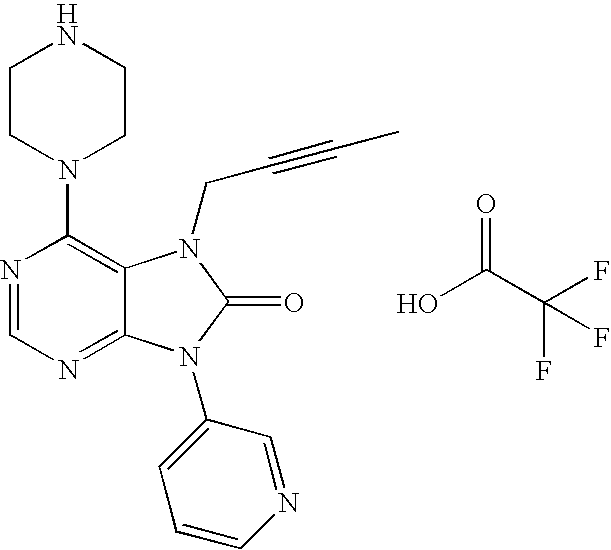


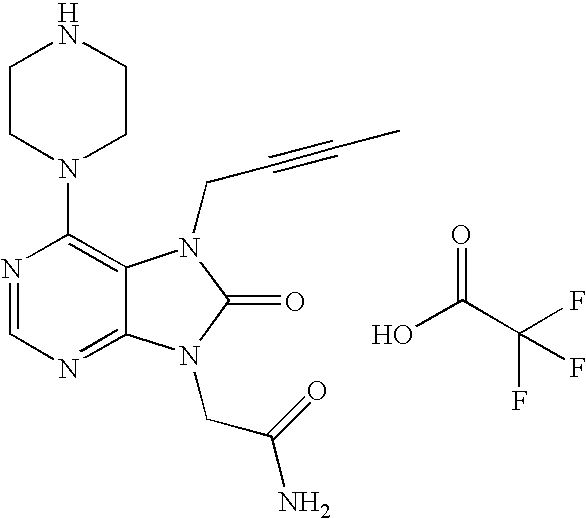


Measurement of DPPIV-Inhibiting Activity (In Vitro Experiment)
| TABLE 1 | |||
| Example No. | IC50 (μM) | ||
| 1 | 0.240 | ||
| 2 | 0.0864 | ||
| 3 | 0.325 | ||
| 4 | 0.334 | ||
| 5 | 0.172 | ||
| 6 | 0.450 | ||
| 7 | 0.199 | ||
| 8 | 1.16 | ||
| 9 | 0.214 | ||
| 10 | 0.251 | ||
| 11 | 0.179 | ||
| 12 | 0.0474 | ||
| 13 | 0.0247 | ||
| 14 | 0.124 | ||
| 15 | 0.319 | ||
| 16 | 0.364 | ||
| 17 | 0.263 | ||
| 18 | 0.972 | ||
| 19 | 5.41 | ||
| 20 | 0.642 | ||
| 21 | 2.45 | ||
| 27 | 3.14 | ||
| 28 | 89.5 | ||
| 29 | 0.00292 | ||
| 30 | 0.132 | ||
| 31 | 0.259 | ||
| 32 | 0.212 | ||
| 33 | 0.163 | ||
| 34 | 0.0148 | ||
| 35 | 0.0266 | ||
| 36 | 0.0807 | ||
| 37 | 0.149 | ||
| 38 | 0.150 | ||
| 39 | 0.0323 | ||
| 40 | 0.0896 | ||
| 41 | 0.0917 | ||
| 42 | 0.0425 | ||
| 43 | 0.0678 | ||
| 44 | 0.132 | ||
| 45 | 0.130 | ||
| 46 | 0.0426 | ||
| 47 | 0.167 | ||
| 48 | 0.0716 | ||
| 49 | 0.0400 | ||
| 50 | 0.00365 | ||
| 51 | 0.130 | ||
| 52 | 0.175 | ||
| 53 | 1.37 | ||
| 54 | 0.0888 | ||
| 55 | 0.0372 | ||
| 56 | 0.0964 | ||
| 57 | 0.0775 | ||
| 58 | 0.0156 | ||
| 59 | 0.119 | ||
| 60 | 0.119 | ||
| 61 | 0.0619 | ||
| 62 | 0.139 | ||
| 63 | 0.146 | ||
| 64 | 0.0325 | ||
| 65 | 0.0167 | ||
| 66 | 0.0593 | ||
| 67 | 0.0498 | ||
| 68 | 0.187 | ||
| 69 | 0.224 | ||
| 70 | 0.0948 | ||
| 71 | 0.260 | ||
| 72 | 0.141 | ||
| 73 | 0.0484 | ||
| 74 | 0.0140 | ||
| 75 | 0.921 | ||
| 76 | 1.06 | ||
| 77 | 8.13 | ||
| 78 | 3.80 | ||
| 79 | 0.0042 | ||
| 80 | 3.01 | ||
| 81 | 0.409 | ||
| 82 | 5.23 | ||
| 83 | 1.13 | ||
| 84 | 13.6 | ||
| Control compound | 226 | ||
Degree of improvement in glucose tolerance (%)=(AUC 0-120 of the test compound−AUC 0-120 of the NVP DPP728 (10 mg/kg)-administered group)/(AUC 0-120 of the 0.5% MC solution-administered group−AUC 0-120 of the NVP DPP728 (10 mg/kg)-administered group)×100
| TABLE 2 | |||
| Degree of | |||
| improvement in | |||
| Specimen | glucose tolerance | ||
| (mg/kg) | (%) | ||
| Example 1(1) | 19.8 | ||
| Example 7(1) | 19.8 | ||
| Example 10(1) | 17.3 | ||
| Example 13(1) | 33.5 | ||
| Example 15(1) | 46 | ||
| Example 46(1) | 37 | ||
| Example 47(1) | 11.6 | ||
| Example 48(1) | 37.4 | ||
| Example 51(1) | 59.3 | ||
| Example 52(1) | 29.7 | ||
| Example 54(1) | 24.4 | ||
| Example 56(1) | 11.3 | ||
| Example 61(1) | 9.4 | ||
| Example 64(1) | −11.4 | ||
| Example 65(1) | 9.5 | ||
| Example 69(1) | 44.1 | ||
Claims (8)


Applications Claiming Priority (3)
| Application Number | Priority Date | Filing Date | Title |
|---|---|---|---|
| JP2002-352186 | 2002-12-04 | ||
| JP2002352186 | 2002-12-04 | ||
| PCT/JP2003/015402 WO2004050656A1 (en) | 2002-12-04 | 2003-12-02 | 1,3-dihydroimidazole fused-ring compound |
Publications (2)
| Publication Number | Publication Date |
|---|---|
| US20060111362A1 US20060111362A1 (en) | 2006-05-25 |
| US7524847B2 true US7524847B2 (en) | 2009-04-28 |
Family
ID=32463216
Family Applications (1)
| Application Number | Title | Priority Date | Filing Date |
|---|---|---|---|
| US10/537,227 Expired - Fee Related US7524847B2 (en) | 2002-12-04 | 2003-12-02 | Fused 1,3-dihydro-imidazole ring compounds |
Country Status (16)
| Country | Link |
|---|---|
| US (1) | US7524847B2 (en) |
| EP (1) | EP1568699A4 (en) |
| JP (1) | JP4279784B2 (en) |
| KR (1) | KR100867484B1 (en) |
| CN (1) | CN100376573C (en) |
| AU (1) | AU2003302657B8 (en) |
| BR (1) | BR0316991A (en) |
| CA (1) | CA2507763A1 (en) |
| IL (1) | IL168784A (en) |
| MX (1) | MXPA05005983A (en) |
| NO (1) | NO20053246L (en) |
| NZ (1) | NZ540495A (en) |
| PL (1) | PL377187A1 (en) |
| RU (1) | RU2328498C9 (en) |
| WO (1) | WO2004050656A1 (en) |
| ZA (1) | ZA200504973B (en) |
Cited By (1)
| Publication number | Priority date | Publication date | Assignee | Title |
|---|---|---|---|---|
| US8680089B2 (en) | 2010-01-15 | 2014-03-25 | Xuanzhu Pharma Co., Ltd. | Fused pyridine derivatives |
Families Citing this family (35)
| Publication number | Priority date | Publication date | Assignee | Title |
|---|---|---|---|---|
| EP1338595B1 (en) | 2002-02-25 | 2006-05-03 | Eisai Co., Ltd. | Xanthine derivatives as DPP-IV inhibitors |
| AU2003241960B2 (en) | 2002-06-06 | 2009-07-30 | Eisai R&D Management Co., Ltd. | Novel fused imidazole derivative |
| CA2518465A1 (en) | 2003-03-25 | 2004-10-14 | Takeda San Diego, Inc. | Dipeptidyl peptidase inhibitors |
| JP2007511467A (en) | 2003-05-14 | 2007-05-10 | タケダ サン ディエゴ インコーポレイテッド | Dipeptidyl peptidase inhibitor |
| KR20060041309A (en) | 2003-08-13 | 2006-05-11 | 다케다 야쿠힌 고교 가부시키가이샤 | 4-pyrimidone derivatives and their use as peptidyl peptidase inhibitors |
| US7687638B2 (en) * | 2004-06-04 | 2010-03-30 | Takeda San Diego, Inc. | Dipeptidyl peptidase inhibitors |
| MY179032A (en) * | 2004-10-25 | 2020-10-26 | Cancer Research Tech Ltd | Ortho-condensed pyridine and pyrimidine derivatives (e.g.purines) as protein kinase inhibitors |
| UY29177A1 (en) | 2004-10-25 | 2006-05-31 | Astex Therapeutics Ltd | SUBSTITUTED DERIVATIVES OF PURINA, PURINONA AND DEAZAPURINA, COMPOSITIONS THAT CONTAIN METHODS FOR THEIR PREPARATION AND ITS USES |
| MY147393A (en) | 2005-09-14 | 2012-11-30 | Takeda Pharmaceutical | Administration of dipeptidyl peptidase inhibitors |
| CA2622642C (en) | 2005-09-16 | 2013-12-31 | Takeda Pharmaceutical Company Limited | Dipeptidyl peptidase inhibitors |
| WO2007112347A1 (en) | 2006-03-28 | 2007-10-04 | Takeda Pharmaceutical Company Limited | Dipeptidyl peptidase inhibitors |
| JP2009534454A (en) * | 2006-04-25 | 2009-09-24 | アステックス、セラピューティックス、リミテッド | Pharmaceutical compounds |
| DK3421471T3 (en) | 2006-04-25 | 2021-06-14 | Astex Therapeutics Ltd | PURIN AND DEAZAPURIN DERIVATIVES AS PHARMACEUTICAL COMPOUNDS |
| TW200838536A (en) | 2006-11-29 | 2008-10-01 | Takeda Pharmaceutical | Polymorphs of succinate salt of 2-[6-(3-amino-piperidin-1-yl)-3-methyl-2,4-dioxo-3,4-dihydro-2H-pyrimidin-1-ylmethy]-4-fluor-benzonitrile and methods of use therefor |
| PL2201012T3 (en) | 2007-10-11 | 2014-11-28 | Astrazeneca Ab | Pyrrolo[2,3-d]pyrimidin derivatives as protein kinase b inhibitors |
| BRPI0917540A2 (en) * | 2008-08-05 | 2015-11-17 | Daiichi Sankyo Co Ltd | compound, pharmaceutically acceptable salt, pharmaceutical composition, and use of a pharmacologically acceptable compound or salt |
| WO2010103130A2 (en) * | 2009-03-13 | 2010-09-16 | Katholieke Universiteit Leuven, K.U.Leuven R&D | Novel bicyclic heterocycles |
| CN102153538B (en) * | 2010-02-11 | 2013-12-11 | 山东轩竹医药科技有限公司 | Benzocyclodirivative |
| CN102276627B (en) * | 2010-04-29 | 2013-07-31 | 山东轩竹医药科技有限公司 | Pyridino-heterocycle derivative |
| CN102234281B (en) * | 2010-04-29 | 2013-03-27 | 山东轩竹医药科技有限公司 | Pyrimido ring derivatives |
| EA027506B1 (en) | 2011-04-01 | 2017-08-31 | Астразенека Аб | Method of treating breast cancer |
| ES2547687T3 (en) * | 2011-07-09 | 2015-10-08 | Xuanzhu Pharma Co., Ltd. | Crystalline form I of salt of a dipeptidyl peptidase IV inhibitor and method of preparation and use thereof |
| HRP20191982T4 (en) | 2011-11-30 | 2023-01-06 | Astrazeneca Ab | Combination treatment of cancer |
| US8501724B1 (en) * | 2012-01-31 | 2013-08-06 | Pharmacyclics, Inc. | Purinone compounds as kinase inhibitors |
| AU2013204533B2 (en) | 2012-04-17 | 2017-02-02 | Astrazeneca Ab | Crystalline forms |
| WO2015078799A1 (en) * | 2013-11-27 | 2015-06-04 | Bayer Pharma Aktiengesellschaft | Glucose transport inhibitors |
| CN110872297B (en) * | 2018-09-04 | 2023-02-14 | 上海再极医药科技有限公司 | Aminopyrimidine five-membered heterocyclic compound, intermediate thereof, preparation method, pharmaceutical composition and application |
| EP3877371A4 (en) | 2018-11-07 | 2022-07-27 | Dana-Farber Cancer Institute, Inc. | IMIDAZOPYRIDINE DERIVATIVES AND AZA-IMIDAZOPYRIDINE DERIVATIVES USED AS JANUS KINASE 2 INHIBITORS AND ASSOCIATED USES |
| US12522583B2 (en) | 2018-11-07 | 2026-01-13 | Dana-Farber Cancer Institute, Inc. | Benzimidazole derivatives and aza-benzimidazole derivatives as Janus kinase 2 inhibitors and uses thereof |
| EP3876939A4 (en) | 2018-11-07 | 2022-08-10 | Dana-Farber Cancer Institute, Inc. | BENZOTHIAZOLE DERIVATIVES AND 7-AZA-BENZOTHIAZOLE DERIVATIVES AS JANUS KINASE-2 INHIBITORS AND USES THEREOF |
| CN109608462B (en) * | 2018-12-15 | 2021-11-23 | 华南理工大学 | 7-alkyl-9-alkoxy/thiopurine-8-ketone compound, and synthesis method and application thereof in medicines |
| US11691963B2 (en) | 2020-05-06 | 2023-07-04 | Ajax Therapeutics, Inc. | 6-heteroaryloxy benzimidazoles and azabenzimidazoles as JAK2 inhibitors |
| US12043632B2 (en) | 2020-12-23 | 2024-07-23 | Ajax Therapeutics, Inc. | 6-heteroaryloxy benzimidazoles and azabenzimidazoles as JAK2 inhibitors |
| US12162881B2 (en) | 2021-11-09 | 2024-12-10 | Ajax Therapeutics, Inc. | Forms and compositions of inhibitors of JAK2 |
| WO2023086319A1 (en) | 2021-11-09 | 2023-05-19 | Ajax Therapeutics, Inc. | 6-he tero aryloxy benzimidazoles and azabenzimidazoles as jak2 inhibitors |
Citations (11)
| Publication number | Priority date | Publication date | Assignee | Title |
|---|---|---|---|---|
| EP0300726A1 (en) | 1987-07-20 | 1989-01-25 | Merck & Co. Inc. | Piperazinyl derivates of purines and isosteres thereof as hypoglycemic agents |
| US5057517A (en) * | 1987-07-20 | 1991-10-15 | Merck & Co., Inc. | Piperazinyl derivatives of purines and isosteres thereof as hypoglycemic agents |
| JP2000086663A (en) | 1998-09-09 | 2000-03-28 | Taisho Pharmaceut Co Ltd | Aryltetrahydropyridine derivative |
| AU2941400A (en) | 1999-03-11 | 2000-09-28 | Taisho Pharmaceutical Co., Ltd. | Carbamoyl tetrahydropyridine derivatives |
| JP2001151777A (en) | 1999-03-11 | 2001-06-05 | Taisho Pharmaceut Co Ltd | Carbamoyltetrahydropyridine derivative |
| EP1338595A2 (en) | 2002-02-25 | 2003-08-27 | Eisai Co., Ltd. | Xanthine derivatives as DPP-IV inhibitors |
| WO2003104229A1 (en) | 2002-06-06 | 2003-12-18 | エーザイ株式会社 | Novel fused imidazole derivative |
| WO2004028524A1 (en) | 2002-09-26 | 2004-04-08 | Eisai Co., Ltd. | Combination drug |
| WO2005044793A2 (en) | 2003-10-31 | 2005-05-19 | Takeda Pharmaceutical Company Limited | Nitrogen-containing fused heterocyclic compounds |
| US20050215573A1 (en) * | 2004-02-05 | 2005-09-29 | Probiodrug Ag | Novel inhibitors of glutaminyl cyclase |
| US7122665B2 (en) * | 2002-10-15 | 2006-10-17 | Synta Pharmaceuticals Corp. | Heterocyclic compounds |
Family Cites Families (1)
| Publication number | Priority date | Publication date | Assignee | Title |
|---|---|---|---|---|
| GB8515934D0 (en) * | 1985-06-24 | 1985-07-24 | Janssen Pharmaceutica Nv | (4-piperidinomethyl and-hetero)purines |
-
2003
- 2003-12-02 CN CNB2003801095193A patent/CN100376573C/en not_active Expired - Fee Related
- 2003-12-02 MX MXPA05005983A patent/MXPA05005983A/en unknown
- 2003-12-02 PL PL377187A patent/PL377187A1/en not_active Application Discontinuation
- 2003-12-02 BR BR0316991-0A patent/BR0316991A/en not_active IP Right Cessation
- 2003-12-02 KR KR1020057010179A patent/KR100867484B1/en not_active Expired - Fee Related
- 2003-12-02 US US10/537,227 patent/US7524847B2/en not_active Expired - Fee Related
- 2003-12-02 RU RU2005120780/04A patent/RU2328498C9/en not_active IP Right Cessation
- 2003-12-02 JP JP2004556886A patent/JP4279784B2/en not_active Expired - Fee Related
- 2003-12-02 AU AU2003302657A patent/AU2003302657B8/en not_active Ceased
- 2003-12-02 WO PCT/JP2003/015402 patent/WO2004050656A1/en not_active Ceased
- 2003-12-02 NZ NZ540495A patent/NZ540495A/en not_active IP Right Cessation
- 2003-12-02 EP EP03812368A patent/EP1568699A4/en not_active Withdrawn
- 2003-12-02 CA CA002507763A patent/CA2507763A1/en not_active Abandoned
-
2005
- 2005-05-25 IL IL168784A patent/IL168784A/en not_active IP Right Cessation
- 2005-06-20 ZA ZA200504973A patent/ZA200504973B/en unknown
- 2005-07-01 NO NO20053246A patent/NO20053246L/en not_active Application Discontinuation
Patent Citations (13)
| Publication number | Priority date | Publication date | Assignee | Title |
|---|---|---|---|---|
| US5057517A (en) * | 1987-07-20 | 1991-10-15 | Merck & Co., Inc. | Piperazinyl derivatives of purines and isosteres thereof as hypoglycemic agents |
| EP0300726A1 (en) | 1987-07-20 | 1989-01-25 | Merck & Co. Inc. | Piperazinyl derivates of purines and isosteres thereof as hypoglycemic agents |
| JP2000086663A (en) | 1998-09-09 | 2000-03-28 | Taisho Pharmaceut Co Ltd | Aryltetrahydropyridine derivative |
| AU2941400A (en) | 1999-03-11 | 2000-09-28 | Taisho Pharmaceutical Co., Ltd. | Carbamoyl tetrahydropyridine derivatives |
| JP2001151777A (en) | 1999-03-11 | 2001-06-05 | Taisho Pharmaceut Co Ltd | Carbamoyltetrahydropyridine derivative |
| US20040082570A1 (en) | 2002-02-25 | 2004-04-29 | Eisai Co., Ltd. | Xanthine derivative and DPPIV inhibitor |
| EP1338595A2 (en) | 2002-02-25 | 2003-08-27 | Eisai Co., Ltd. | Xanthine derivatives as DPP-IV inhibitors |
| WO2003104229A1 (en) | 2002-06-06 | 2003-12-18 | エーザイ株式会社 | Novel fused imidazole derivative |
| US20040116328A1 (en) | 2002-06-06 | 2004-06-17 | Eisai Co., Ltd. | Condensed imidazole derivatives |
| WO2004028524A1 (en) | 2002-09-26 | 2004-04-08 | Eisai Co., Ltd. | Combination drug |
| US7122665B2 (en) * | 2002-10-15 | 2006-10-17 | Synta Pharmaceuticals Corp. | Heterocyclic compounds |
| WO2005044793A2 (en) | 2003-10-31 | 2005-05-19 | Takeda Pharmaceutical Company Limited | Nitrogen-containing fused heterocyclic compounds |
| US20050215573A1 (en) * | 2004-02-05 | 2005-09-29 | Probiodrug Ag | Novel inhibitors of glutaminyl cyclase |
Non-Patent Citations (4)
| Title |
|---|
| CAPLUS Database accession No. 1972:488447; abstract of: Korsunskii, V., et al., "Syntheses of purines XXIX. 8- and 2- [bis(aziridino)-phosphinamido]purines," 1992, Khimiko-Farmatsevticheskii Zhurnal, vol. 6(6), pp. 28-31. |
| Kira, Kazunobu et al.; "Development of a novel inhibitor of DPP-IV using a byproduct as the lead compound"; National Meeting & Exposition Program: 228th National Meeting; Aug. 22-26, 2004; Abstract 262; American Chemical Society; Philadelphia, PA. |
| Kira, Kazunobu et al.; "Development of a novel inhibitor of DPP-IV using a byproduct as the lead compound"; Yakku Zasshi: Journal of the Pharmaceutical Society of Japan: The 23rd Medicinal Chemistry Symposium; The 12th Annual Meeting of Division of Medicinal Chemistry (Tsukuba): Nov. 24-26, 2004; poster 2P-10; pp. 1-13; The Pharmaceutical Society of Japan, Division of Medicinal Chemistry. |
| Patient Information JANUVIA(TM) <http://www.merck.com/product/usa/pi-circulars/j/januvia/januvia-ppi.pdf> downloaded from the internet Apr. 30, 2008. * |
Cited By (1)
| Publication number | Priority date | Publication date | Assignee | Title |
|---|---|---|---|---|
| US8680089B2 (en) | 2010-01-15 | 2014-03-25 | Xuanzhu Pharma Co., Ltd. | Fused pyridine derivatives |
Also Published As
| Publication number | Publication date |
|---|---|
| WO2004050656A1 (en) | 2004-06-17 |
| NZ540495A (en) | 2007-09-28 |
| KR20050087825A (en) | 2005-08-31 |
| RU2328498C9 (en) | 2008-12-10 |
| AU2003302657A2 (en) | 2004-06-23 |
| PL377187A1 (en) | 2006-01-23 |
| CA2507763A1 (en) | 2004-06-17 |
| AU2003302657A1 (en) | 2004-06-23 |
| HK1086556A1 (en) | 2006-09-22 |
| EP1568699A1 (en) | 2005-08-31 |
| NO20053246L (en) | 2005-08-30 |
| CN100376573C (en) | 2008-03-26 |
| CN1745080A (en) | 2006-03-08 |
| KR100867484B1 (en) | 2008-11-06 |
| AU2003302657B2 (en) | 2009-09-24 |
| AU2003302657B8 (en) | 2009-12-03 |
| JPWO2004050656A1 (en) | 2006-03-30 |
| EP1568699A4 (en) | 2007-08-15 |
| IL168784A (en) | 2010-12-30 |
| US20060111362A1 (en) | 2006-05-25 |
| RU2005120780A (en) | 2006-01-20 |
| MXPA05005983A (en) | 2005-08-18 |
| JP4279784B2 (en) | 2009-06-17 |
| RU2328498C2 (en) | 2008-07-10 |
| ZA200504973B (en) | 2006-04-26 |
| BR0316991A (en) | 2005-10-25 |
| NO20053246D0 (en) | 2005-07-01 |
Similar Documents
| Publication | Publication Date | Title |
|---|---|---|
| US7524847B2 (en) | Fused 1,3-dihydro-imidazole ring compounds | |
| US10131664B2 (en) | Inhibitors of lysine specific demethylase-1 | |
| US7074798B2 (en) | Xanthine derivative and DPPIV inhibitor | |
| US8569296B2 (en) | PI3K (delta) selective inhibitors | |
| US8513221B2 (en) | PI3K isoform selective inhibitors | |
| US8586582B2 (en) | PI3K/mTOR kinase inhibitors | |
| US9822119B2 (en) | Inhibitors of lysine specific demethylase-1 | |
| US7772226B2 (en) | Condensed imidazole derivatives | |
| US8912178B2 (en) | mTOR selective kinase inhibitors | |
| US20070219178A1 (en) | Preventive or therapeutic agents for multiple sclerosis | |
| US10633382B2 (en) | Imidazopyrazinones, pyrazolopyrimidinones and pyrazolopyridinones as PDE1 inhibitors | |
| TW200526196A (en) | Substituted nitrogen-containing six-membered amino-heterocycles as vanilloid-1 receptor antagonists for treating pain | |
| HK1086556B (en) | Fused 1,3-dihydro-imidazole ring compounds | |
| TW472057B (en) | Pyrrolopyrimidines and processes for the preparation thereof |
Legal Events
| Date | Code | Title | Description |
|---|---|---|---|
| AS | Assignment |
Owner name: EISAI CO., LTD., JAPAN Free format text: ASSIGNMENT OF ASSIGNORS INTEREST;ASSIGNORS:KIRA, KAZUNOBU;CLARK, RICHARD;YOSHIKAWA, SEIJI;AND OTHERS;REEL/FRAME:016942/0528;SIGNING DATES FROM 20050620 TO 20050704 |
|
| AS | Assignment |
Owner name: EISAI R&D MANAGEMENT CO., LTD., JAPAN Free format text: ASSIGNMENT OF ASSIGNORS INTEREST;ASSIGNOR:EISAI CO., LTD.;REEL/FRAME:019265/0447 Effective date: 20070419 |
|
| FEPP | Fee payment procedure |
Free format text: PAYOR NUMBER ASSIGNED (ORIGINAL EVENT CODE: ASPN); ENTITY STATUS OF PATENT OWNER: LARGE ENTITY |
|
| REMI | Maintenance fee reminder mailed | ||
| LAPS | Lapse for failure to pay maintenance fees | ||
| STCH | Information on status: patent discontinuation |
Free format text: PATENT EXPIRED DUE TO NONPAYMENT OF MAINTENANCE FEES UNDER 37 CFR 1.362 |
|
| STCH | Information on status: patent discontinuation |
Free format text: PATENT EXPIRED DUE TO NONPAYMENT OF MAINTENANCE FEES UNDER 37 CFR 1.362 |
|
| FP | Lapsed due to failure to pay maintenance fee |
Effective date: 20130428 |