US7517998B2 - Non nucleoside reverse transcriptase inhibitors - Google Patents
Non nucleoside reverse transcriptase inhibitors Download PDFInfo
- Publication number
- US7517998B2 US7517998B2 US11/137,831 US13783105A US7517998B2 US 7517998 B2 US7517998 B2 US 7517998B2 US 13783105 A US13783105 A US 13783105A US 7517998 B2 US7517998 B2 US 7517998B2
- Authority
- US
- United States
- Prior art keywords
- alkyl
- optionally substituted
- het
- cooh
- cycloalkyl
- Prior art date
- Legal status (The legal status is an assumption and is not a legal conclusion. Google has not performed a legal analysis and makes no representation as to the accuracy of the status listed.)
- Expired - Lifetime, expires
Links
- HWWIRNIAPWDIHO-UHFFFAOYSA-N [CH2-][C+]1=C(Cl)C=C(C)C=C1 Chemical compound [CH2-][C+]1=C(Cl)C=C(C)C=C1 HWWIRNIAPWDIHO-UHFFFAOYSA-N 0.000 description 184
- XOHLONMJVTVUEH-UHFFFAOYSA-N [CH2-][C+]1=C(Cl)C=C(C2CC2)C=C1 Chemical compound [CH2-][C+]1=C(Cl)C=C(C2CC2)C=C1 XOHLONMJVTVUEH-UHFFFAOYSA-N 0.000 description 147
- 0 [1*][Ar]CCC(=O)NC1=CC=C([4*])C([3*])=C1[2*] Chemical compound [1*][Ar]CCC(=O)NC1=CC=C([4*])C([3*])=C1[2*] 0.000 description 37
- QGEQRVNZPCNMQL-UHFFFAOYSA-N [CH2-][C+]1=C(Cl)C=CC(C)=C1 Chemical compound [CH2-][C+]1=C(Cl)C=CC(C)=C1 QGEQRVNZPCNMQL-UHFFFAOYSA-N 0.000 description 21
- GPHQXTFRTJKHPI-UHFFFAOYSA-N CC(C)(C)c1ccc(C)c(Cl)c1 Chemical compound CC(C)(C)c1ccc(C)c(Cl)c1 GPHQXTFRTJKHPI-UHFFFAOYSA-N 0.000 description 13
- AXZODXNVTGSQRI-UHFFFAOYSA-N [CH2-][C+](C)(C)NC(=O)C1=CC=[N+]([O-])C=C1 Chemical compound [CH2-][C+](C)(C)NC(=O)C1=CC=[N+]([O-])C=C1 AXZODXNVTGSQRI-UHFFFAOYSA-N 0.000 description 13
- QRVXHLRRHYQULA-UHFFFAOYSA-N [CH2-][C+](C)(C)N Chemical compound [CH2-][C+](C)(C)N QRVXHLRRHYQULA-UHFFFAOYSA-N 0.000 description 9
- VIJJOHUZGORIRL-UHFFFAOYSA-N [CH2-][C+]1=CC=C(CC(=O)O)C=C1 Chemical compound [CH2-][C+]1=CC=C(CC(=O)O)C=C1 VIJJOHUZGORIRL-UHFFFAOYSA-N 0.000 description 9
- NNPPMTNAJDCUHE-UHFFFAOYSA-N CC(C)C Chemical compound CC(C)C NNPPMTNAJDCUHE-UHFFFAOYSA-N 0.000 description 8
- XTWYARJGACRMGR-UHFFFAOYSA-N CC(C)OCCN1CCCC1 Chemical compound CC(C)OCCN1CCCC1 XTWYARJGACRMGR-UHFFFAOYSA-N 0.000 description 7
- DQTFXWXEDYSIRO-UHFFFAOYSA-N CC(C)OCCN1CCCCC1 Chemical compound CC(C)OCCN1CCCCC1 DQTFXWXEDYSIRO-UHFFFAOYSA-N 0.000 description 7
- IRUTVDMVLXBFLG-UHFFFAOYSA-N [CH2-][C+](C)(C)NC(=O)CN1CCNCC1 Chemical compound [CH2-][C+](C)(C)NC(=O)CN1CCNCC1 IRUTVDMVLXBFLG-UHFFFAOYSA-N 0.000 description 7
- QAHPPZQLPBKBQO-UHFFFAOYSA-N [CH2-][C+]1=C(Cl)C=CC(C(C)(C)C)=C1 Chemical compound [CH2-][C+]1=C(Cl)C=CC(C(C)(C)C)=C1 QAHPPZQLPBKBQO-UHFFFAOYSA-N 0.000 description 7
- ZRGPBMRETAMFGK-UHFFFAOYSA-N [CH2-][C+]1=C(Cl)C(Br)=CC(C(C)(C)C)=C1 Chemical compound [CH2-][C+]1=C(Cl)C(Br)=CC(C(C)(C)C)=C1 ZRGPBMRETAMFGK-UHFFFAOYSA-N 0.000 description 6
- OWBFKQHQFIMXFS-UHFFFAOYSA-N [CH2-][C+]1=NN=C(C)N1C1=C(Cl)C=C(C2CC2)C=C1 Chemical compound [CH2-][C+]1=NN=C(C)N1C1=C(Cl)C=C(C2CC2)C=C1 OWBFKQHQFIMXFS-UHFFFAOYSA-N 0.000 description 6
- SPLAFYNOJRWSAV-UHFFFAOYSA-N [CH2-][C+]1=C(Cl)C(C2CC2)=CC(C)=C1 Chemical compound [CH2-][C+]1=C(Cl)C(C2CC2)=CC(C)=C1 SPLAFYNOJRWSAV-UHFFFAOYSA-N 0.000 description 5
- LKGIJRQXYKMCNS-UHFFFAOYSA-N [CH2-][C+]1=C(Cl)C=C(CC2CC2)C=C1 Chemical compound [CH2-][C+]1=C(Cl)C=C(CC2CC2)C=C1 LKGIJRQXYKMCNS-UHFFFAOYSA-N 0.000 description 5
- HHWUIULEXQBBBV-UHFFFAOYSA-N [CH2-][C+]1=C(Cl)C=CC(C2CC2)=C1 Chemical compound [CH2-][C+]1=C(Cl)C=CC(C2CC2)=C1 HHWUIULEXQBBBV-UHFFFAOYSA-N 0.000 description 5
- HGDBITPNCPWADE-UHFFFAOYSA-N CC(C)C(C)(C)OCCN1CCNCC1 Chemical compound CC(C)C(C)(C)OCCN1CCNCC1 HGDBITPNCPWADE-UHFFFAOYSA-N 0.000 description 4
- HHLYHGBOHLBLFL-UHFFFAOYSA-N CC(C)C(C)(C)OCCOC1=CC=NC=C1 Chemical compound CC(C)C(C)(C)OCCOC1=CC=NC=C1 HHLYHGBOHLBLFL-UHFFFAOYSA-N 0.000 description 4
- KZNRNQGTVRTDPN-UHFFFAOYSA-N Cc1ccc(C)c(Cl)c1 Chemical compound Cc1ccc(C)c(Cl)c1 KZNRNQGTVRTDPN-UHFFFAOYSA-N 0.000 description 4
- VGGSQFUCUMXWEO-UHFFFAOYSA-N [CH2+][CH2-] Chemical compound [CH2+][CH2-] VGGSQFUCUMXWEO-UHFFFAOYSA-N 0.000 description 4
- QZGKOIRKFBJRAX-UHFFFAOYSA-N [CH2-][C+](C)(C)NC(=O)CCCN(C)C Chemical compound [CH2-][C+](C)(C)NC(=O)CCCN(C)C QZGKOIRKFBJRAX-UHFFFAOYSA-N 0.000 description 4
- HJRCSXZISVBVOT-UHFFFAOYSA-N [CH2-][C+](C)(C)NC(=O)CN(C)C Chemical compound [CH2-][C+](C)(C)NC(=O)CN(C)C HJRCSXZISVBVOT-UHFFFAOYSA-N 0.000 description 4
- HNZAEYFIJXQTSN-UHFFFAOYSA-N CC(C)C(C)(C)OCCN1CCC(F)(F)C1 Chemical compound CC(C)C(C)(C)OCCN1CCC(F)(F)C1 HNZAEYFIJXQTSN-UHFFFAOYSA-N 0.000 description 3
- SVYVQKARJCIIDA-UHFFFAOYSA-N CC(C)C(C)(C)OCCN1CCCC1 Chemical compound CC(C)C(C)(C)OCCN1CCCC1 SVYVQKARJCIIDA-UHFFFAOYSA-N 0.000 description 3
- AFOPCURQYRRFRQ-UHFFFAOYSA-N CC(C)C1=CC=CO1 Chemical compound CC(C)C1=CC=CO1 AFOPCURQYRRFRQ-UHFFFAOYSA-N 0.000 description 3
- VPXUTZPMWJIVMW-UHFFFAOYSA-N CC(C)CCN1CCCC1 Chemical compound CC(C)CCN1CCCC1 VPXUTZPMWJIVMW-UHFFFAOYSA-N 0.000 description 3
- KNDUGOWIKQAXHL-UHFFFAOYSA-N CC(C)N1C=CC=C1 Chemical compound CC(C)N1C=CC=C1 KNDUGOWIKQAXHL-UHFFFAOYSA-N 0.000 description 3
- IPIORGCOGQZEHO-UHFFFAOYSA-N CC(C)N1C=CN=C1 Chemical compound CC(C)N1C=CN=C1 IPIORGCOGQZEHO-UHFFFAOYSA-N 0.000 description 3
- QDOQCOOUTPQMKW-UHFFFAOYSA-N CC(C)N1CCC(C(=O)O)CC1 Chemical compound CC(C)N1CCC(C(=O)O)CC1 QDOQCOOUTPQMKW-UHFFFAOYSA-N 0.000 description 3
- HCLYSTWZIVDIMV-UHFFFAOYSA-N CC(C)NC1=CN(C)C(C(=O)O)=C1 Chemical compound CC(C)NC1=CN(C)C(C(=O)O)=C1 HCLYSTWZIVDIMV-UHFFFAOYSA-N 0.000 description 3
- CRYXHQBSIQUCFG-UHFFFAOYSA-N CC(C)NCC1=CC=CN=C1 Chemical compound CC(C)NCC1=CC=CN=C1 CRYXHQBSIQUCFG-UHFFFAOYSA-N 0.000 description 3
- TYQJCPFOIMPJLQ-UHFFFAOYSA-N CC(C)NCCC1=CC=NC=C1 Chemical compound CC(C)NCCC1=CC=NC=C1 TYQJCPFOIMPJLQ-UHFFFAOYSA-N 0.000 description 3
- ZIWHJZAPIYYSPN-UHFFFAOYSA-N Cc(cc(C(F)(F)F)cc1)c1Cl Chemical compound Cc(cc(C(F)(F)F)cc1)c1Cl ZIWHJZAPIYYSPN-UHFFFAOYSA-N 0.000 description 3
- GLWRGNSXWYKFGW-UHFFFAOYSA-N [CH2-][C+]#CC(C)(C)C(=O)O Chemical compound [CH2-][C+]#CC(C)(C)C(=O)O GLWRGNSXWYKFGW-UHFFFAOYSA-N 0.000 description 3
- YCSQGXMJMQCKGF-UHFFFAOYSA-N [CH2-][C+](C)(C)NC(=O)C1=C[N+]([O-])=CC=C1 Chemical compound [CH2-][C+](C)(C)NC(=O)C1=C[N+]([O-])=CC=C1 YCSQGXMJMQCKGF-UHFFFAOYSA-N 0.000 description 3
- ALPYOMMRLOOIPK-UHFFFAOYSA-N [CH2-][C+](C)(C)NC(=O)CN1CCC(C(=O)O)CC1 Chemical compound [CH2-][C+](C)(C)NC(=O)CN1CCC(C(=O)O)CC1 ALPYOMMRLOOIPK-UHFFFAOYSA-N 0.000 description 3
- UOUXJVWDHBDSDT-UHFFFAOYSA-N [CH2-][C+](C)(C)NC(=O)CNC1=CC=[N+]([O-])C=C1 Chemical compound [CH2-][C+](C)(C)NC(=O)CNC1=CC=[N+]([O-])C=C1 UOUXJVWDHBDSDT-UHFFFAOYSA-N 0.000 description 3
- BZMNEMDZVOOMAI-UHFFFAOYSA-N [CH2-][C+]1=C(C(C)C)C(C)=NN1.[CH2-][C+]1=C(C(C)C)N(C)N=C1.[CH2-][C+]1=C(C(C)C)N=NS1.[CH2-][C+]1=NC=C(C)N1C(C)C Chemical compound [CH2-][C+]1=C(C(C)C)C(C)=NN1.[CH2-][C+]1=C(C(C)C)N(C)N=C1.[CH2-][C+]1=C(C(C)C)N=NS1.[CH2-][C+]1=NC=C(C)N1C(C)C BZMNEMDZVOOMAI-UHFFFAOYSA-N 0.000 description 3
- RENRVAPBDWCQRH-UHFFFAOYSA-N [CH2-][C+]1=C(Cl)C(C(F)(F)F)=CC(C2CC2)=C1 Chemical compound [CH2-][C+]1=C(Cl)C(C(F)(F)F)=CC(C2CC2)=C1 RENRVAPBDWCQRH-UHFFFAOYSA-N 0.000 description 3
- YAGCGHORDVJSCT-UHFFFAOYSA-N [CH2-][C+]1=C(Cl)C(C)=CC(C)=C1 Chemical compound [CH2-][C+]1=C(Cl)C(C)=CC(C)=C1 YAGCGHORDVJSCT-UHFFFAOYSA-N 0.000 description 3
- DHOZYMXUJYEEKB-UHFFFAOYSA-N [CH2-][C+]1=C(Cl)C=C(C(C)C)C=C1 Chemical compound [CH2-][C+]1=C(Cl)C=C(C(C)C)C=C1 DHOZYMXUJYEEKB-UHFFFAOYSA-N 0.000 description 3
- QEQDTAVMNIXWNK-UHFFFAOYSA-N [CH2-][C+]1=C(Cl)C=C(C)C=C1C Chemical compound [CH2-][C+]1=C(Cl)C=C(C)C=C1C QEQDTAVMNIXWNK-UHFFFAOYSA-N 0.000 description 3
- OOAJMGQIQJIEBE-UHFFFAOYSA-N [CH2-][C+]1=C(Cl)C=CC(Br)=C1 Chemical compound [CH2-][C+]1=C(Cl)C=CC(Br)=C1 OOAJMGQIQJIEBE-UHFFFAOYSA-N 0.000 description 3
- NDIKFPFJSGGUCO-UHFFFAOYSA-N [CH2-][C+]1=C(Cl)C=CC(Cl)=C1 Chemical compound [CH2-][C+]1=C(Cl)C=CC(Cl)=C1 NDIKFPFJSGGUCO-UHFFFAOYSA-N 0.000 description 3
- JQQWBDIKYJNVOJ-UHFFFAOYSA-N [CH2-][C+]1=CC=NN1C(C)C.[CH2-][C+]1=CN=NN1C(C)C.[CH2-][C+]1=NN=C(C)N1C(C)C.[CH2-][C+]1=NN=NN1C(C)C.[CH2-][C+]1=[SH]C=NC1C(C)C Chemical compound [CH2-][C+]1=CC=NN1C(C)C.[CH2-][C+]1=CN=NN1C(C)C.[CH2-][C+]1=NN=C(C)N1C(C)C.[CH2-][C+]1=NN=NN1C(C)C.[CH2-][C+]1=[SH]C=NC1C(C)C JQQWBDIKYJNVOJ-UHFFFAOYSA-N 0.000 description 3
- BTIGLCRONLHWAZ-UHFFFAOYSA-N [CH2-][C+]1=CC=NN1C1=C(Cl)C=C(C)C=C1 Chemical compound [CH2-][C+]1=CC=NN1C1=C(Cl)C=C(C)C=C1 BTIGLCRONLHWAZ-UHFFFAOYSA-N 0.000 description 3
- QAOXMQCWUWZZNC-ONEGZZNKSA-N CC(C)/C=C/C(=O)O Chemical compound CC(C)/C=C/C(=O)O QAOXMQCWUWZZNC-ONEGZZNKSA-N 0.000 description 2
- XPVARRYRKJVEGJ-UHFFFAOYSA-N CC(C)C(=O)CC1=CC=CC2=C1C=CO2 Chemical compound CC(C)C(=O)CC1=CC=CC2=C1C=CO2 XPVARRYRKJVEGJ-UHFFFAOYSA-N 0.000 description 2
- SFMWTVYCYVIKBN-UHFFFAOYSA-N CC(C)C(=O)CC1=CC=CC=C1[N+](=O)[O-] Chemical compound CC(C)C(=O)CC1=CC=CC=C1[N+](=O)[O-] SFMWTVYCYVIKBN-UHFFFAOYSA-N 0.000 description 2
- WDRCPKDLZOQCFU-UHFFFAOYSA-N CC(C)C(=O)NC1=CC=CC=C1 Chemical compound CC(C)C(=O)NC1=CC=CC=C1 WDRCPKDLZOQCFU-UHFFFAOYSA-N 0.000 description 2
- MWQKURVBJZAOSC-UHFFFAOYSA-N CC(C)C1=CC=CC1 Chemical compound CC(C)C1=CC=CC1 MWQKURVBJZAOSC-UHFFFAOYSA-N 0.000 description 2
- AUDWUDQEDBHTHT-UHFFFAOYSA-N CC(C)N1CCCC1.CC(C)N1CCCCC1.CC(C)N1CCCCC1.CC(C)N1CCOCC1 Chemical compound CC(C)N1CCCC1.CC(C)N1CCCCC1.CC(C)N1CCCCC1.CC(C)N1CCOCC1 AUDWUDQEDBHTHT-UHFFFAOYSA-N 0.000 description 2
- ODIQTOYGORNLPE-UHFFFAOYSA-N CC(C)N1CCN(C)CC1 Chemical compound CC(C)N1CCN(C)CC1 ODIQTOYGORNLPE-UHFFFAOYSA-N 0.000 description 2
- XLZMWNWNBXSZKF-UHFFFAOYSA-N CC(C)N1CCOCC1 Chemical compound CC(C)N1CCOCC1 XLZMWNWNBXSZKF-UHFFFAOYSA-N 0.000 description 2
- MYCXVCIWQRXWFS-UHFFFAOYSA-N CC(C)NC(C)CC(=O)O Chemical compound CC(C)NC(C)CC(=O)O MYCXVCIWQRXWFS-UHFFFAOYSA-N 0.000 description 2
- JCCXFYFHSDUDJN-UHFFFAOYSA-N CC(C)NC(CO)C(=O)O Chemical compound CC(C)NC(CO)C(=O)O JCCXFYFHSDUDJN-UHFFFAOYSA-N 0.000 description 2
- AZRUDRPGFDSRHI-UHFFFAOYSA-N CC(C)NC1=CC=C(CC(=O)O)C=C1 Chemical compound CC(C)NC1=CC=C(CC(=O)O)C=C1 AZRUDRPGFDSRHI-UHFFFAOYSA-N 0.000 description 2
- PPROYGWEUQGZFL-UHFFFAOYSA-N CC(C)NC1=CC=C(N(C)C)C=C1 Chemical compound CC(C)NC1=CC=C(N(C)C)C=C1 PPROYGWEUQGZFL-UHFFFAOYSA-N 0.000 description 2
- WYZBSJRPNJGDJW-UHFFFAOYSA-N CC(C)NC1=CC=C(N2CCOCC2)C=C1 Chemical compound CC(C)NC1=CC=C(N2CCOCC2)C=C1 WYZBSJRPNJGDJW-UHFFFAOYSA-N 0.000 description 2
- STVPBVIJXUKAMI-UHFFFAOYSA-N CC(C)NC1=CC=C(O)C=C1 Chemical compound CC(C)NC1=CC=C(O)C=C1 STVPBVIJXUKAMI-UHFFFAOYSA-N 0.000 description 2
- WIOMEZXHQDYHJJ-UHFFFAOYSA-N CC(C)NC1=CC=CC(C(=O)O)=C1 Chemical compound CC(C)NC1=CC=CC(C(=O)O)=C1 WIOMEZXHQDYHJJ-UHFFFAOYSA-N 0.000 description 2
- BLCSQUZTWKPKSR-UHFFFAOYSA-N CC(C)NC1=CC=CC=C1O Chemical compound CC(C)NC1=CC=CC=C1O BLCSQUZTWKPKSR-UHFFFAOYSA-N 0.000 description 2
- ZHROKCZDDDWWNG-UHFFFAOYSA-N CC(C)NC1CCN(CC2=CC=CC=C2)CC1 Chemical compound CC(C)NC1CCN(CC2=CC=CC=C2)CC1 ZHROKCZDDDWWNG-UHFFFAOYSA-N 0.000 description 2
- HZYGCVOWKHTAAF-UHFFFAOYSA-N CC(C)NCC1=CC(O)=C(O)C=C1 Chemical compound CC(C)NCC1=CC(O)=C(O)C=C1 HZYGCVOWKHTAAF-UHFFFAOYSA-N 0.000 description 2
- JFKOYUSYMNIQQA-UHFFFAOYSA-N CC(C)NCC1=CC=C(N)C=C1 Chemical compound CC(C)NCC1=CC=C(N)C=C1 JFKOYUSYMNIQQA-UHFFFAOYSA-N 0.000 description 2
- GAGIUQGGHJZYTE-UHFFFAOYSA-N CC(C)NCC1=CC=CO1 Chemical compound CC(C)NCC1=CC=CO1 GAGIUQGGHJZYTE-UHFFFAOYSA-N 0.000 description 2
- BZRDLWPJCCLNCX-UHFFFAOYSA-N CC(C)NCCC1=CC=C(O)C(O)=C1 Chemical compound CC(C)NCCC1=CC=C(O)C(O)=C1 BZRDLWPJCCLNCX-UHFFFAOYSA-N 0.000 description 2
- LUVHMKBYLSDWQF-UHFFFAOYSA-N CC(C)NCCC1=CC=C(O)C=C1 Chemical compound CC(C)NCCC1=CC=C(O)C=C1 LUVHMKBYLSDWQF-UHFFFAOYSA-N 0.000 description 2
- NJQADQHPHWSZAD-UHFFFAOYSA-N CC(C)NCCC1=CC=[N+]([O-])C=C1 Chemical compound CC(C)NCCC1=CC=[N+]([O-])C=C1 NJQADQHPHWSZAD-UHFFFAOYSA-N 0.000 description 2
- NVFSQXGPNCPGOR-UHFFFAOYSA-N CC(C)NCCN1CCOCC1 Chemical compound CC(C)NCCN1CCOCC1 NVFSQXGPNCPGOR-UHFFFAOYSA-N 0.000 description 2
- IGEHYYSPQFMIOU-UHFFFAOYSA-N CC(C)NN1CCOCC1 Chemical compound CC(C)NN1CCOCC1 IGEHYYSPQFMIOU-UHFFFAOYSA-N 0.000 description 2
- PWKRTLTVNWDNIK-UHFFFAOYSA-N CC(C)OC1=CC=C[N+]([O-])=C1.CC(C)OC1=CC=NC=C1.CC(C)O[N+]1=CC=CC([O-])=C1 Chemical compound CC(C)OC1=CC=C[N+]([O-])=C1.CC(C)OC1=CC=NC=C1.CC(C)O[N+]1=CC=CC([O-])=C1 PWKRTLTVNWDNIK-UHFFFAOYSA-N 0.000 description 2
- SPULWELCUHBCOU-UHFFFAOYSA-N CC(C)OCCN1CCOCC1 Chemical compound CC(C)OCCN1CCOCC1 SPULWELCUHBCOU-UHFFFAOYSA-N 0.000 description 2
- ZSLANQWJSFJXDV-UHFFFAOYSA-N CC(C)Oc1cccs(O)c1 Chemical compound CC(C)Oc1cccs(O)c1 ZSLANQWJSFJXDV-UHFFFAOYSA-N 0.000 description 2
- RWGFKTVRMDUZSP-UHFFFAOYSA-N CC(C)c1ccccc1 Chemical compound CC(C)c1ccccc1 RWGFKTVRMDUZSP-UHFFFAOYSA-N 0.000 description 2
- GXXXUZIRGXYDFP-UHFFFAOYSA-N Cc1ccc(CC(O)=O)cc1 Chemical compound Cc1ccc(CC(O)=O)cc1 GXXXUZIRGXYDFP-UHFFFAOYSA-N 0.000 description 2
- COVLRYVNXPSISN-UHFFFAOYSA-N [CH2-][C+](C)(C)C(=O)NCCCN(C)C Chemical compound [CH2-][C+](C)(C)C(=O)NCCCN(C)C COVLRYVNXPSISN-UHFFFAOYSA-N 0.000 description 2
- LFOHZQXFWLLIHB-UHFFFAOYSA-N [CH2-][C+](C)(C)C(=O)NCCCN1CCCC1=O Chemical compound [CH2-][C+](C)(C)C(=O)NCCCN1CCCC1=O LFOHZQXFWLLIHB-UHFFFAOYSA-N 0.000 description 2
- GNFAQJDCGZVPDE-UHFFFAOYSA-N [CH2-][C+](C)(C)C(=O)NCCN1CCCC1 Chemical compound [CH2-][C+](C)(C)C(=O)NCCN1CCCC1 GNFAQJDCGZVPDE-UHFFFAOYSA-N 0.000 description 2
- TXCQZUQRIZQUNF-UHFFFAOYSA-N [CH2-][C+](C)(C)COC(N)=O Chemical compound [CH2-][C+](C)(C)COC(N)=O TXCQZUQRIZQUNF-UHFFFAOYSA-N 0.000 description 2
- OZOUZRZWUYOSOI-UHFFFAOYSA-N [CH2-][C+](C)(C)NC(=O)C1CC1 Chemical compound [CH2-][C+](C)(C)NC(=O)C1CC1 OZOUZRZWUYOSOI-UHFFFAOYSA-N 0.000 description 2
- MTCDMPLOUVAVRJ-UHFFFAOYSA-N [CH2-][C+](C)(C)NC(=O)CN Chemical compound [CH2-][C+](C)(C)NC(=O)CN MTCDMPLOUVAVRJ-UHFFFAOYSA-N 0.000 description 2
- KFYXENYPNGDKCN-UHFFFAOYSA-N [CH2-][C+](C)(C)NC(C)=O Chemical compound [CH2-][C+](C)(C)NC(C)=O KFYXENYPNGDKCN-UHFFFAOYSA-N 0.000 description 2
- VAYZJOJVKSMLIY-UHFFFAOYSA-N [CH2-][C+](C)(C)OCC(=O)O Chemical compound [CH2-][C+](C)(C)OCC(=O)O VAYZJOJVKSMLIY-UHFFFAOYSA-N 0.000 description 2
- XBMGLNOZFWMIBD-UHFFFAOYSA-N [CH2-][C+]1=C(Br)C=C(C(C)C)C=C1 Chemical compound [CH2-][C+]1=C(Br)C=C(C(C)C)C=C1 XBMGLNOZFWMIBD-UHFFFAOYSA-N 0.000 description 2
- VTPUHSFXBYBXPH-UHFFFAOYSA-N [CH2-][C+]1=C(C(C)C)N=CS1.[CH2-][C+]1=CN=NN1C(C)C.[CH2-][C+]1=N(C(C)C)N=CC1.[CH2-][C+]1=NN=C(C)N1C(C)C.[CH2-][C+]1=NN=NN1C(C)C Chemical compound [CH2-][C+]1=C(C(C)C)N=CS1.[CH2-][C+]1=CN=NN1C(C)C.[CH2-][C+]1=N(C(C)C)N=CC1.[CH2-][C+]1=NN=C(C)N1C(C)C.[CH2-][C+]1=NN=NN1C(C)C VTPUHSFXBYBXPH-UHFFFAOYSA-N 0.000 description 2
- YNVDITRYHHFUBD-UHFFFAOYSA-N [CH2-][C+]1=C(Cl)C(C(F)(F)F)=CC=C1F Chemical compound [CH2-][C+]1=C(Cl)C(C(F)(F)F)=CC=C1F YNVDITRYHHFUBD-UHFFFAOYSA-N 0.000 description 2
- NTTAWTDNKPYNJA-UHFFFAOYSA-N [CH2-][C+]1=C(Cl)C=C(C(F)(F)F)C=C1 Chemical compound [CH2-][C+]1=C(Cl)C=C(C(F)(F)F)C=C1 NTTAWTDNKPYNJA-UHFFFAOYSA-N 0.000 description 2
- JBHIVKBADMXGMT-UHFFFAOYSA-N [CH2-][C+]1=C(Cl)C=C(C)C(C)=C1 Chemical compound [CH2-][C+]1=C(Cl)C=C(C)C(C)=C1 JBHIVKBADMXGMT-UHFFFAOYSA-N 0.000 description 2
- FLMIDRRBUIZBDT-UHFFFAOYSA-N [CH2-][C+]1=C(Cl)C=C(C)C=C1Cl Chemical compound [CH2-][C+]1=C(Cl)C=C(C)C=C1Cl FLMIDRRBUIZBDT-UHFFFAOYSA-N 0.000 description 2
- HKHJHCQGVVZBRT-UHFFFAOYSA-N [CH2-][C+]1=C(Cl)C=C(C2CC2)C(Cl)=C1 Chemical compound [CH2-][C+]1=C(Cl)C=C(C2CC2)C(Cl)=C1 HKHJHCQGVVZBRT-UHFFFAOYSA-N 0.000 description 2
- LPAQNEYAAACKRO-UHFFFAOYSA-N [CH2-][C+]1=C(Cl)C=C2CCCC2=C1 Chemical compound [CH2-][C+]1=C(Cl)C=C2CCCC2=C1 LPAQNEYAAACKRO-UHFFFAOYSA-N 0.000 description 2
- ZKVRBCKQXVZJAK-UHFFFAOYSA-N [CH2-][C+]1=C(Cl)C=CC(OC)=C1 Chemical compound [CH2-][C+]1=C(Cl)C=CC(OC)=C1 ZKVRBCKQXVZJAK-UHFFFAOYSA-N 0.000 description 2
- NTIFDIUELPWERX-UHFFFAOYSA-N [CH2-][C+]1=CC=CC(C(=O)O)=C1 Chemical compound [CH2-][C+]1=CC=CC(C(=O)O)=C1 NTIFDIUELPWERX-UHFFFAOYSA-N 0.000 description 2
- BOPLOBXGYIDAMX-UHFFFAOYSA-N [CH2-][C+]1=NN=NN1C(C)C Chemical compound [CH2-][C+]1=NN=NN1C(C)C BOPLOBXGYIDAMX-UHFFFAOYSA-N 0.000 description 2
- FKMLTTQKWALYDM-UHFFFAOYSA-N [CH2-][C+]1=NNC(C)=C1C1=C(Cl)C=C(C)C=C1 Chemical compound [CH2-][C+]1=NNC(C)=C1C1=C(Cl)C=C(C)C=C1 FKMLTTQKWALYDM-UHFFFAOYSA-N 0.000 description 2
- IUPBLFMJPSLKET-UHFFFAOYSA-N C#CC(C)(C)C(=O)OC.CC(C)(C#CC1=CC=C(N)C(Cl)=C1)CO.CC(C)(C#CC1=CC=C(NC(=O)CSC2=NN=NN2C2=C(Cl)C=C(C3CC3)C=C2)C(Cl)=C1)CO.COC(=O)C(C)(C)C#CC1=CC=C(N)C(Cl)=C1.NC1=CC=C(I)C=C1Cl.O=C(O)CSC1=NN=NN1C1=C(Cl)C=C(C2CC2)C=C1 Chemical compound C#CC(C)(C)C(=O)OC.CC(C)(C#CC1=CC=C(N)C(Cl)=C1)CO.CC(C)(C#CC1=CC=C(NC(=O)CSC2=NN=NN2C2=C(Cl)C=C(C3CC3)C=C2)C(Cl)=C1)CO.COC(=O)C(C)(C)C#CC1=CC=C(N)C(Cl)=C1.NC1=CC=C(I)C=C1Cl.O=C(O)CSC1=NN=NN1C1=C(Cl)C=C(C2CC2)C=C1 IUPBLFMJPSLKET-UHFFFAOYSA-N 0.000 description 1
- JVSITKKUDLMMCO-UHFFFAOYSA-N C#CC(C)(C)OCC(=O)OCC.C#CC(C)(C)OCCO.CC(C)(C#CC1=CC=C(N)C(Cl)=C1)OCCO.CC(C)(C#CC1=CC=C(NC(=O)CSC2=NN=NN2C2=CC=C(C3CC3)C=C2Cl)C(Cl)=C1)OCCN1CCCC1.CC(C)(C#CC1=CC=C(NC(=O)CSC2=NN=NN2C2=CC=C(C3CC3)C=C2Cl)C(Cl)=C1)OCCO Chemical compound C#CC(C)(C)OCC(=O)OCC.C#CC(C)(C)OCCO.CC(C)(C#CC1=CC=C(N)C(Cl)=C1)OCCO.CC(C)(C#CC1=CC=C(NC(=O)CSC2=NN=NN2C2=CC=C(C3CC3)C=C2Cl)C(Cl)=C1)OCCN1CCCC1.CC(C)(C#CC1=CC=C(NC(=O)CSC2=NN=NN2C2=CC=C(C3CC3)C=C2Cl)C(Cl)=C1)OCCO JVSITKKUDLMMCO-UHFFFAOYSA-N 0.000 description 1
- PATMIQGDNQVDHR-UHFFFAOYSA-N C#CC(C)(C)OCCO.C#CC(C)(C)OCCOC1=CC=NC=C1.CC(C)(C#CC1=CC(Cl)=C(N)C=C1)OCCOC1=CC=NC=C1.CC(C)(C#CC1=CC=C(NC(=O)CSC2=NN=NN2C2=CC=C(C3CC3)C=C2Cl)C(Cl)=C1)OCCOC1=CC=NC=C1 Chemical compound C#CC(C)(C)OCCO.C#CC(C)(C)OCCOC1=CC=NC=C1.CC(C)(C#CC1=CC(Cl)=C(N)C=C1)OCCOC1=CC=NC=C1.CC(C)(C#CC1=CC=C(NC(=O)CSC2=NN=NN2C2=CC=C(C3CC3)C=C2Cl)C(Cl)=C1)OCCOC1=CC=NC=C1 PATMIQGDNQVDHR-UHFFFAOYSA-N 0.000 description 1
- RDDHABBHBKUVFK-UHFFFAOYSA-N C#CC1(CO)CC1.CC(C)(C)[Si](OCC1(CO)CC1)(C1=CC=CC=C1)C1=CC=CC=C1.CCOC(=O)C1(C(=O)OCC)CC1.NC1=CC=C(C#CC2(CO)CC2)C=C1Cl.O=C(CSC1=NN=NN1C1=CC=C(C2CC2)C=C1Cl)NC1=CC=C(C#CC2(C(=O)O)CC2)C=C1Cl.O=C(CSC1=NN=NN1C1=CC=C(C2CC2)C=C1Cl)NC1=CC=C(C#CC2(CO)CC2)C=C1Cl Chemical compound C#CC1(CO)CC1.CC(C)(C)[Si](OCC1(CO)CC1)(C1=CC=CC=C1)C1=CC=CC=C1.CCOC(=O)C1(C(=O)OCC)CC1.NC1=CC=C(C#CC2(CO)CC2)C=C1Cl.O=C(CSC1=NN=NN1C1=CC=C(C2CC2)C=C1Cl)NC1=CC=C(C#CC2(C(=O)O)CC2)C=C1Cl.O=C(CSC1=NN=NN1C1=CC=C(C2CC2)C=C1Cl)NC1=CC=C(C#CC2(CO)CC2)C=C1Cl RDDHABBHBKUVFK-UHFFFAOYSA-N 0.000 description 1
- DKONGVAUVBCXLF-UHFFFAOYSA-N C#CCCC(=O)C(C)C Chemical compound C#CCCC(=O)C(C)C DKONGVAUVBCXLF-UHFFFAOYSA-N 0.000 description 1
- BOCJMSRXEMXLPW-UHFFFAOYSA-N C#CCCC(C)C.CC(C)C1CCCC1.CC(C)C1CCCCC1.CC(C)CC1CCCC1.CC(C)NCC1=CC=C(C(=O)O)C=C1 Chemical compound C#CCCC(C)C.CC(C)C1CCCC1.CC(C)C1CCCCC1.CC(C)CC1CCCC1.CC(C)NCC1=CC=C(C(=O)O)C=C1 BOCJMSRXEMXLPW-UHFFFAOYSA-N 0.000 description 1
- PGHBDDSYQAPAPJ-ITDJAWRYSA-N C.CC(C)/C=C/C(=O)O.CC(C)N1CCCCC1 Chemical compound C.CC(C)/C=C/C(=O)O.CC(C)N1CCCCC1 PGHBDDSYQAPAPJ-ITDJAWRYSA-N 0.000 description 1
- DMHLGGQHOSTMJG-GQCTYLIASA-N C/C(=C\C(C)C)C(=O)O Chemical compound C/C(=C\C(C)C)C(=O)O DMHLGGQHOSTMJG-GQCTYLIASA-N 0.000 description 1
- JOCJXDJTJJQSDY-UHFFFAOYSA-N C1=CC2=C(C=C1)OCO2.C1=CC=C2SC=CC2=C1.C1=CC=C2SC=NC2=C1.C1=CN=C2C=COC2=C1.O=C1C=CNC2=CC=CC=C12 Chemical compound C1=CC2=C(C=C1)OCO2.C1=CC=C2SC=CC2=C1.C1=CC=C2SC=NC2=C1.C1=CN=C2C=COC2=C1.O=C1C=CNC2=CC=CC=C12 JOCJXDJTJJQSDY-UHFFFAOYSA-N 0.000 description 1
- VWCCQRGXEJCWHQ-UHFFFAOYSA-N C1=CNN=C1.C1=CNN=N1.C1=CSN=N1.C1=NN=CN1.C1CCNCC1.C1CCSC1 Chemical compound C1=CNN=C1.C1=CNN=N1.C1=CSN=N1.C1=NN=CN1.C1CCNCC1.C1CCSC1 VWCCQRGXEJCWHQ-UHFFFAOYSA-N 0.000 description 1
- OWWIWYDDISJUMY-UHFFFAOYSA-N C=C(C)C(C)C Chemical compound C=C(C)C(C)C OWWIWYDDISJUMY-UHFFFAOYSA-N 0.000 description 1
- YHQXBTXEYZIYOV-UHFFFAOYSA-N C=CC(C)C Chemical compound C=CC(C)C YHQXBTXEYZIYOV-UHFFFAOYSA-N 0.000 description 1
- JYRALBIJSKSOHI-UHFFFAOYSA-N CB(O)NC(C)(C)C#CC1=CC=C(N)C(Cl)=C1.CB(O)NC(C)(C)C#CC1=CC=C(NC(=O)CSC2=NN=NN2C2=CC=C(C3CC3)C=C2Cl)C(Cl)=C1.CC(C)(C#CC1=CC=C(NC(=O)CSC2=NN=NN2C2=CC=C(C3CC3)C=C2Cl)C(Cl)=C1)NCC1=C(O)C=CC=C1.CC(C)(N)C#CC1=CC=C(N)C(Cl)=C1.CC(C)(N)C#CC1=CC=C(NC(=O)CSC2=NN=NN2C2=CC=C(C3CC3)C=C2Cl)C(Cl)=C1.NC1=CC=C(I)C=C1Cl Chemical compound CB(O)NC(C)(C)C#CC1=CC=C(N)C(Cl)=C1.CB(O)NC(C)(C)C#CC1=CC=C(NC(=O)CSC2=NN=NN2C2=CC=C(C3CC3)C=C2Cl)C(Cl)=C1.CC(C)(C#CC1=CC=C(NC(=O)CSC2=NN=NN2C2=CC=C(C3CC3)C=C2Cl)C(Cl)=C1)NCC1=C(O)C=CC=C1.CC(C)(N)C#CC1=CC=C(N)C(Cl)=C1.CC(C)(N)C#CC1=CC=C(NC(=O)CSC2=NN=NN2C2=CC=C(C3CC3)C=C2Cl)C(Cl)=C1.NC1=CC=C(I)C=C1Cl JYRALBIJSKSOHI-UHFFFAOYSA-N 0.000 description 1
- SYBYTAAJFKOIEJ-UHFFFAOYSA-N CC(=O)C(C)C Chemical compound CC(=O)C(C)C SYBYTAAJFKOIEJ-UHFFFAOYSA-N 0.000 description 1
- WRLZRSSZYDSABT-UHFFFAOYSA-N CC(=O)C1=CC=C(C)C=C1Cl.CC1=CC=C(C(=O)CBr)C(Cl)=C1.CC1=CC=C(C2=C(SCC(=O)NC3=CC=C(C4=CC=C(CC(=O)O)C=C4)C=C3Cl)SC=N2)C(Cl)=C1.CC1=CC=C(C2=C(SCC(=O)O)SC=N2)C(Cl)=C1.COC(=O)CSC(Br)C(=O)C1=CC=C(C)C=C1Cl.COC(=O)CSC1=C(C2=CC=C(C)C=C2Cl)N=CS1.COC(=O)CSCC(=O)C1=CC=C(C)C=C1Cl Chemical compound CC(=O)C1=CC=C(C)C=C1Cl.CC1=CC=C(C(=O)CBr)C(Cl)=C1.CC1=CC=C(C2=C(SCC(=O)NC3=CC=C(C4=CC=C(CC(=O)O)C=C4)C=C3Cl)SC=N2)C(Cl)=C1.CC1=CC=C(C2=C(SCC(=O)O)SC=N2)C(Cl)=C1.COC(=O)CSC(Br)C(=O)C1=CC=C(C)C=C1Cl.COC(=O)CSC1=C(C2=CC=C(C)C=C2Cl)N=CS1.COC(=O)CSCC(=O)C1=CC=C(C)C=C1Cl WRLZRSSZYDSABT-UHFFFAOYSA-N 0.000 description 1
- QSIOSRVFUYRXQB-UHFFFAOYSA-N CC(=O)NC(C(=O)C(C)C)C1=CC=CC=C1 Chemical compound CC(=O)NC(C(=O)C(C)C)C1=CC=CC=C1 QSIOSRVFUYRXQB-UHFFFAOYSA-N 0.000 description 1
- QKMYMHLKLUHCQM-UHFFFAOYSA-N CC(=O)NC(C1=CC=CC=C1)C(C)C.CC(C)C(C)(C)C1=CC=CC=C1.CC(C)C(C)C.CC(C)C(C)C1=CC=CC=C1.CC(C)CC1=CC=CC=N1.CC(C)CC1=CC=CN=C1.CC(C)CC1=CC=NC=C1.CC(C)CC1=CC=[N+]([O-])C=C1.CC(C)CC1=CSC=C1.CC(C)CCC(=O)O.CC(C)CCC(C)C.CC(C)CCC1=CC=CC=C1.CC(C)CN1C=NN=N1.COC(C1=CC=CC=C1)C(C)C Chemical compound CC(=O)NC(C1=CC=CC=C1)C(C)C.CC(C)C(C)(C)C1=CC=CC=C1.CC(C)C(C)C.CC(C)C(C)C1=CC=CC=C1.CC(C)CC1=CC=CC=N1.CC(C)CC1=CC=CN=C1.CC(C)CC1=CC=NC=C1.CC(C)CC1=CC=[N+]([O-])C=C1.CC(C)CC1=CSC=C1.CC(C)CCC(=O)O.CC(C)CCC(C)C.CC(C)CCC1=CC=CC=C1.CC(C)CN1C=NN=N1.COC(C1=CC=CC=C1)C(C)C QKMYMHLKLUHCQM-UHFFFAOYSA-N 0.000 description 1
- SIPOQBLJSXAPDE-UHFFFAOYSA-N CC(=O)NC1=C(Cl)C=C(C(C)(C)C)C=C1.CC(=O)NC1=CC=C(C(C)(C)C)C=C1.CC(C)(C)C1=CC(Cl)=C(N)C=C1.CC(C)(C)C1=CC(Cl)=C(N2N=NN=C2SCC(=O)CC2=CC=C(C3=CC=C(CC(=O)O)C=C3)C=C2Cl)C=C1.CC(C)(C)C1=CC(Cl)=C(N=C=S)C=C1.CC(C)(C)C1=CC=C(N2N=NN=C2S)C(Cl)=C1.CC(C)(C)C1=CC=C(N2N=NN=C2SCC(=O)O)C(Cl)=C1.CC1(C)OB(C2=CC(Cl)=C(N)C=C2)OC1(C)C.COC(=O)CC1=CC=C(Br)C=C1.COC(=O)CC1=CC=C(C2=CC=C(N)C(Cl)=C2)C=C1.NC1=C(Cl)C=C(Br)C=C1 Chemical compound CC(=O)NC1=C(Cl)C=C(C(C)(C)C)C=C1.CC(=O)NC1=CC=C(C(C)(C)C)C=C1.CC(C)(C)C1=CC(Cl)=C(N)C=C1.CC(C)(C)C1=CC(Cl)=C(N2N=NN=C2SCC(=O)CC2=CC=C(C3=CC=C(CC(=O)O)C=C3)C=C2Cl)C=C1.CC(C)(C)C1=CC(Cl)=C(N=C=S)C=C1.CC(C)(C)C1=CC=C(N2N=NN=C2S)C(Cl)=C1.CC(C)(C)C1=CC=C(N2N=NN=C2SCC(=O)O)C(Cl)=C1.CC1(C)OB(C2=CC(Cl)=C(N)C=C2)OC1(C)C.COC(=O)CC1=CC=C(Br)C=C1.COC(=O)CC1=CC=C(C2=CC=C(N)C(Cl)=C2)C=C1.NC1=C(Cl)C=C(Br)C=C1 SIPOQBLJSXAPDE-UHFFFAOYSA-N 0.000 description 1
- GBDVOODFDIBJNQ-HPAIREQNSA-N CC(C)(C#CC1=CC=C(NC(=O)CSC2=NN=NN2C2=C(Cl)C=C(C3CC3)C=C2)C(Cl)=C1)CC(=O)O.CC(C)(C#CC1=CC=C(NC(=O)CSC2=NN=NN2C2=C(Cl)C=C(C3CC3)C=C2)C(Cl)=C1)CO.CO/C=C/C(C)(C)C#CC1=CC=C(NC(=O)CSC2=NN=NN2C2=C(Cl)C=C(C3CC3)C=C2)C(Cl)=C1 Chemical compound CC(C)(C#CC1=CC=C(NC(=O)CSC2=NN=NN2C2=C(Cl)C=C(C3CC3)C=C2)C(Cl)=C1)CC(=O)O.CC(C)(C#CC1=CC=C(NC(=O)CSC2=NN=NN2C2=C(Cl)C=C(C3CC3)C=C2)C(Cl)=C1)CO.CO/C=C/C(C)(C)C#CC1=CC=C(NC(=O)CSC2=NN=NN2C2=C(Cl)C=C(C3CC3)C=C2)C(Cl)=C1 GBDVOODFDIBJNQ-HPAIREQNSA-N 0.000 description 1
- OMZAZFZEQIVVDK-UHFFFAOYSA-N CC(C)(C#CC1=CC=C(NC(=O)CSC2=NN=NN2C2=C(Cl)C=C(C3CC3)C=C2)C(Cl)=C1)CNCC(=O)O.CC(C)(C#CC1=CC=C(NC(=O)CSC2=NN=NN2C2=C(Cl)C=C(C3CC3)C=C2)C(Cl)=C1)CO Chemical compound CC(C)(C#CC1=CC=C(NC(=O)CSC2=NN=NN2C2=C(Cl)C=C(C3CC3)C=C2)C(Cl)=C1)CNCC(=O)O.CC(C)(C#CC1=CC=C(NC(=O)CSC2=NN=NN2C2=C(Cl)C=C(C3CC3)C=C2)C(Cl)=C1)CO OMZAZFZEQIVVDK-UHFFFAOYSA-N 0.000 description 1
- OJGOZGJMUKMEJQ-UHFFFAOYSA-N CC(C)(C)C(NC(C)(C)C(O)=O)=O Chemical compound CC(C)(C)C(NC(C)(C)C(O)=O)=O OJGOZGJMUKMEJQ-UHFFFAOYSA-N 0.000 description 1
- UCBIOXNLWIEQSZ-UHFFFAOYSA-N CC(C)(C)C1=CC(Cl)=C(N2N=NN=C2SCC(=O)NC2=CC=C(N[W])C=C2Cl)C=C1 Chemical compound CC(C)(C)C1=CC(Cl)=C(N2N=NN=C2SCC(=O)NC2=CC=C(N[W])C=C2Cl)C=C1 UCBIOXNLWIEQSZ-UHFFFAOYSA-N 0.000 description 1
- NWDDVHYGBPWNSP-UHFFFAOYSA-N CC(C)(C)C1=CC=C(N2N=NN=C2SCC(=O)NC2=CC=C(C#CC3(O)CCC3)C=C2Cl)C(Cl)=C1.NC1=CC=C(C#CC2(O)CCC2)C=C1Cl.O=C1CCC1 Chemical compound CC(C)(C)C1=CC=C(N2N=NN=C2SCC(=O)NC2=CC=C(C#CC3(O)CCC3)C=C2Cl)C(Cl)=C1.NC1=CC=C(C#CC2(O)CCC2)C=C1Cl.O=C1CCC1 NWDDVHYGBPWNSP-UHFFFAOYSA-N 0.000 description 1
- DUQUPYPYGFYSQL-UHFFFAOYSA-N CC(C)(C)C1=CC=C(N2N=NN=C2SCC(=O)NC2=CC=C(C#CCN3CCCC3)C=C2Cl)C(Cl)=C1.NC1=CC=C(C#CCN2CCCC2)C=C1Cl.NC1=CC=C(I)C=C1Cl Chemical compound CC(C)(C)C1=CC=C(N2N=NN=C2SCC(=O)NC2=CC=C(C#CCN3CCCC3)C=C2Cl)C(Cl)=C1.NC1=CC=C(C#CCN2CCCC2)C=C1Cl.NC1=CC=C(I)C=C1Cl DUQUPYPYGFYSQL-UHFFFAOYSA-N 0.000 description 1
- PDGXYMRZBNNOTC-UHFFFAOYSA-N CC(C)(C)NC(CCC(O)=O)=O Chemical compound CC(C)(C)NC(CCC(O)=O)=O PDGXYMRZBNNOTC-UHFFFAOYSA-N 0.000 description 1
- OUEMCNMNSOAFPR-UHFFFAOYSA-N CC(C)(C)NC(CCCN(C)C)=O Chemical compound CC(C)(C)NC(CCCN(C)C)=O OUEMCNMNSOAFPR-UHFFFAOYSA-N 0.000 description 1
- RTBQBCITGHZRMT-UHFFFAOYSA-N CC(C)(C)NC(CN(C)C)=O Chemical compound CC(C)(C)NC(CN(C)C)=O RTBQBCITGHZRMT-UHFFFAOYSA-N 0.000 description 1
- SPOOQIKPXSPROX-UHFFFAOYSA-N CC(C)(C)NC(CN(CC1)CCC1O)=O Chemical compound CC(C)(C)NC(CN(CC1)CCC1O)=O SPOOQIKPXSPROX-UHFFFAOYSA-N 0.000 description 1
- ZMEAITXOZDERTM-UHFFFAOYSA-N CC(C)(C)NC(CN1CCNCC1)=O Chemical compound CC(C)(C)NC(CN1CCNCC1)=O ZMEAITXOZDERTM-UHFFFAOYSA-N 0.000 description 1
- KLZJJGMJLXVUMX-UHFFFAOYSA-N CC(C)(C)NC(c1c[nH]cn1)=O Chemical compound CC(C)(C)NC(c1c[nH]cn1)=O KLZJJGMJLXVUMX-UHFFFAOYSA-N 0.000 description 1
- TXHAHOVNFDVCCC-UHFFFAOYSA-N CC(C)(C)NCC(O)=O Chemical compound CC(C)(C)NCC(O)=O TXHAHOVNFDVCCC-UHFFFAOYSA-N 0.000 description 1
- QREUVFUHSLREHM-UHFFFAOYSA-N CC(C)(C)NS(C)(=O)=O Chemical compound CC(C)(C)NS(C)(=O)=O QREUVFUHSLREHM-UHFFFAOYSA-N 0.000 description 1
- VUBJPAVADSGIPK-UHFFFAOYSA-N CC(C)(C)OC(=O)NC1=CC=C(C2CC2)C=C1Cl.CC(C)(C)OC(=O)NC1=CC=C(I)C=C1Cl.CCOC(=O)CC1=CC=C(C2=CC=C(N)C(Cl)=C2)C=C1.CCOC(=O)CC1=CC=C(C2=CC=C(NC(=O)CBr)C(Cl)=C2)C=C1.NC1=CC=C(C2CC2)C=C1Cl.NC1=CC=C(I)C=C1Cl.O=C(O)CC1=CC=C(C2=CC=C(NC(=O)CSC3=NN=NN3C3=C(Cl)C=C(C4CC4)C=C3)C(Cl)=C2)C=C1.SC1=NN=NN1C1=CC=C(C2CC2)C=C1Cl Chemical compound CC(C)(C)OC(=O)NC1=CC=C(C2CC2)C=C1Cl.CC(C)(C)OC(=O)NC1=CC=C(I)C=C1Cl.CCOC(=O)CC1=CC=C(C2=CC=C(N)C(Cl)=C2)C=C1.CCOC(=O)CC1=CC=C(C2=CC=C(NC(=O)CBr)C(Cl)=C2)C=C1.NC1=CC=C(C2CC2)C=C1Cl.NC1=CC=C(I)C=C1Cl.O=C(O)CC1=CC=C(C2=CC=C(NC(=O)CSC3=NN=NN3C3=C(Cl)C=C(C4CC4)C=C3)C(Cl)=C2)C=C1.SC1=NN=NN1C1=CC=C(C2CC2)C=C1Cl VUBJPAVADSGIPK-UHFFFAOYSA-N 0.000 description 1
- GLDTZOBRASLVCA-UHFFFAOYSA-N CC(C)(C)OCC(N(C)O)=O Chemical compound CC(C)(C)OCC(N(C)O)=O GLDTZOBRASLVCA-UHFFFAOYSA-N 0.000 description 1
- LELBIAYREFYKFW-UHFFFAOYSA-N CC(C)(C)OCC(NCCO)=O Chemical compound CC(C)(C)OCC(NCCO)=O LELBIAYREFYKFW-UHFFFAOYSA-N 0.000 description 1
- SVAUSDNQHPAPKT-UHFFFAOYSA-N CC(C)(C)c(cc1)cc(Cl)c1-[n]1nnnc1SCC(Nc(c(Cl)c1)ccc1NN=C)=O Chemical compound CC(C)(C)c(cc1)cc(Cl)c1-[n]1nnnc1SCC(Nc(c(Cl)c1)ccc1NN=C)=O SVAUSDNQHPAPKT-UHFFFAOYSA-N 0.000 description 1
- XRDHTFRFUPLXRO-UHFFFAOYSA-N CC(C)(C)c(cc1Cl)ccc1-[n]1c(C)nnc1C Chemical compound CC(C)(C)c(cc1Cl)ccc1-[n]1c(C)nnc1C XRDHTFRFUPLXRO-UHFFFAOYSA-N 0.000 description 1
- WBSPOYPPDCWLGG-SCBDLNNBSA-N CC(C)/C=C/C(=O)O.CC(C)N1CCCCC1 Chemical compound CC(C)/C=C/C(=O)O.CC(C)N1CCCCC1 WBSPOYPPDCWLGG-SCBDLNNBSA-N 0.000 description 1
- BDOIJUWUSITWHY-UHFFFAOYSA-N CC(C)C(=O)C(C)(C)C1=CC=CC=C1 Chemical compound CC(C)C(=O)C(C)(C)C1=CC=CC=C1 BDOIJUWUSITWHY-UHFFFAOYSA-N 0.000 description 1
- HXVNBWAKAOHACI-UHFFFAOYSA-N CC(C)C(=O)C(C)C Chemical compound CC(C)C(=O)C(C)C HXVNBWAKAOHACI-UHFFFAOYSA-N 0.000 description 1
- PIHILDSKUZXCLF-UHFFFAOYSA-N CC(C)C(=O)C(C)C1=CC=CC=C1 Chemical compound CC(C)C(=O)C(C)C1=CC=CC=C1 PIHILDSKUZXCLF-UHFFFAOYSA-N 0.000 description 1
- FLICZDVBYUMMAS-UHFFFAOYSA-N CC(C)C(=O)C1=CC=C(C(=O)O)C=C1 Chemical compound CC(C)C(=O)C1=CC=C(C(=O)O)C=C1 FLICZDVBYUMMAS-UHFFFAOYSA-N 0.000 description 1
- HUXBPJVVEDIIEO-UHFFFAOYSA-N CC(C)C(=O)C1=CC=C(O)C=C1 Chemical compound CC(C)C(=O)C1=CC=C(O)C=C1 HUXBPJVVEDIIEO-UHFFFAOYSA-N 0.000 description 1
- KALSTROFDNVDQH-UHFFFAOYSA-N CC(C)C(=O)C1=CC=CC(C(=O)O)=C1 Chemical compound CC(C)C(=O)C1=CC=CC(C(=O)O)=C1 KALSTROFDNVDQH-UHFFFAOYSA-N 0.000 description 1
- DWLAGFAYZCBIMG-UHFFFAOYSA-N CC(C)C(=O)C1=CC=CC(O)=C1 Chemical compound CC(C)C(=O)C1=CC=CC(O)=C1 DWLAGFAYZCBIMG-UHFFFAOYSA-N 0.000 description 1
- BSMGLVDZZMBWQB-UHFFFAOYSA-N CC(C)C(=O)C1=CC=CC=C1 Chemical compound CC(C)C(=O)C1=CC=CC=C1 BSMGLVDZZMBWQB-UHFFFAOYSA-N 0.000 description 1
- AXYIWJBJJYFEDJ-UHFFFAOYSA-N CC(C)C(=O)C1=CC=CC=C1Cl Chemical compound CC(C)C(=O)C1=CC=CC=C1Cl AXYIWJBJJYFEDJ-UHFFFAOYSA-N 0.000 description 1
- HWXWRZYNNFRZGY-UHFFFAOYSA-N CC(C)C(=O)C1=CC=CC=C1O Chemical compound CC(C)C(=O)C1=CC=CC=C1O HWXWRZYNNFRZGY-UHFFFAOYSA-N 0.000 description 1
- CPMFTFZWDCIXLE-UHFFFAOYSA-N CC(C)C(=O)C1CCCC1 Chemical compound CC(C)C(=O)C1CCCC1 CPMFTFZWDCIXLE-UHFFFAOYSA-N 0.000 description 1
- XRLQPWQYUOVNTR-UHFFFAOYSA-N CC(C)C(=O)C1CCCCC1 Chemical compound CC(C)C(=O)C1CCCCC1 XRLQPWQYUOVNTR-UHFFFAOYSA-N 0.000 description 1
- YDMFPZMJIZXBGI-UHFFFAOYSA-N CC(C)C(=O)CC1=C(Cl)C=CC=C1Cl Chemical compound CC(C)C(=O)CC1=C(Cl)C=CC=C1Cl YDMFPZMJIZXBGI-UHFFFAOYSA-N 0.000 description 1
- DMRZOLNOCDLRIH-UHFFFAOYSA-N CC(C)C(=O)CC1=CC=C(N(C)C)C=C1 Chemical compound CC(C)C(=O)CC1=CC=C(N(C)C)C=C1 DMRZOLNOCDLRIH-UHFFFAOYSA-N 0.000 description 1
- HVEJOVAHRHHWET-UHFFFAOYSA-N CC(C)C(=O)CC1=CC=C([N+](=O)[O-])C=C1 Chemical compound CC(C)C(=O)CC1=CC=C([N+](=O)[O-])C=C1 HVEJOVAHRHHWET-UHFFFAOYSA-N 0.000 description 1
- DHPHRWMVHCTTCX-UHFFFAOYSA-N CC(C)C(=O)CC1=CC=CC([N+](=O)[O-])=C1 Chemical compound CC(C)C(=O)CC1=CC=CC([N+](=O)[O-])=C1 DHPHRWMVHCTTCX-UHFFFAOYSA-N 0.000 description 1
- ZATIMOAGKJEVGN-UHFFFAOYSA-N CC(C)C(=O)CC1=CC=CC=C1 Chemical compound CC(C)C(=O)CC1=CC=CC=C1 ZATIMOAGKJEVGN-UHFFFAOYSA-N 0.000 description 1
- RWAZFJCJCDGOPT-UHFFFAOYSA-N CC(C)C(=O)CC1=CC=CC=C1C(F)(F)F Chemical compound CC(C)C(=O)CC1=CC=CC=C1C(F)(F)F RWAZFJCJCDGOPT-UHFFFAOYSA-N 0.000 description 1
- PSEQMIRPOVQCMP-UHFFFAOYSA-N CC(C)C(=O)CC1=CC=CC=C1Cl Chemical compound CC(C)C(=O)CC1=CC=CC=C1Cl PSEQMIRPOVQCMP-UHFFFAOYSA-N 0.000 description 1
- BBRNYRRDHCWQTF-UHFFFAOYSA-N CC(C)C(=O)CC1=CC=CC=C1O Chemical compound CC(C)C(=O)CC1=CC=CC=C1O BBRNYRRDHCWQTF-UHFFFAOYSA-N 0.000 description 1
- GYMDLNBTFGPEBW-UHFFFAOYSA-N CC(C)C(=O)CC1=CC=CC=N1 Chemical compound CC(C)C(=O)CC1=CC=CC=N1 GYMDLNBTFGPEBW-UHFFFAOYSA-N 0.000 description 1
- GCRRNVUUAXYCQX-UHFFFAOYSA-N CC(C)C(=O)CC1=CC=CC=[N+]1[O-] Chemical compound CC(C)C(=O)CC1=CC=CC=[N+]1[O-] GCRRNVUUAXYCQX-UHFFFAOYSA-N 0.000 description 1
- CFWGQBCVKJHGSF-UHFFFAOYSA-N CC(C)C(=O)CC1=CC=CN=C1 Chemical compound CC(C)C(=O)CC1=CC=CN=C1 CFWGQBCVKJHGSF-UHFFFAOYSA-N 0.000 description 1
- RKFQYQQUYZVZCF-UHFFFAOYSA-N CC(C)C(=O)CC1=CC=C[N+]([O-])=C1 Chemical compound CC(C)C(=O)CC1=CC=C[N+]([O-])=C1 RKFQYQQUYZVZCF-UHFFFAOYSA-N 0.000 description 1
- VLJOQJQERRBJGD-UHFFFAOYSA-N CC(C)C(=O)CC1=CC=NC=C1 Chemical compound CC(C)C(=O)CC1=CC=NC=C1 VLJOQJQERRBJGD-UHFFFAOYSA-N 0.000 description 1
- IWLJHTKFJITBFZ-UHFFFAOYSA-N CC(C)C(=O)CC1=CC=[N+]([O-])C=C1 Chemical compound CC(C)C(=O)CC1=CC=[N+]([O-])C=C1 IWLJHTKFJITBFZ-UHFFFAOYSA-N 0.000 description 1
- JGCUNSPZSLANIA-UHFFFAOYSA-N CC(C)C(=O)CC1=CNC2=C1C=CC=C2 Chemical compound CC(C)C(=O)CC1=CNC2=C1C=CC=C2 JGCUNSPZSLANIA-UHFFFAOYSA-N 0.000 description 1
- UTFXCMISUBSAJL-UHFFFAOYSA-N CC(C)C(=O)CC1=CSC=C1 Chemical compound CC(C)C(=O)CC1=CSC=C1 UTFXCMISUBSAJL-UHFFFAOYSA-N 0.000 description 1
- GFTSTFPOZFGGMP-UHFFFAOYSA-N CC(C)C(=O)CC1CCCC1 Chemical compound CC(C)C(=O)CC1CCCC1 GFTSTFPOZFGGMP-UHFFFAOYSA-N 0.000 description 1
- GQWLYLDUDAANSJ-UHFFFAOYSA-N CC(C)C(=O)CCC(=O)O Chemical compound CC(C)C(=O)CCC(=O)O GQWLYLDUDAANSJ-UHFFFAOYSA-N 0.000 description 1
- QATHVLKLWVUSRC-UHFFFAOYSA-N CC(C)C(=O)CCC1=CC=CC=C1 Chemical compound CC(C)C(=O)CCC1=CC=CC=C1 QATHVLKLWVUSRC-UHFFFAOYSA-N 0.000 description 1
- SAZIMFWDOAEUMX-UHFFFAOYSA-N CC(C)C(=O)CN1C=NN=N1 Chemical compound CC(C)C(=O)CN1C=NN=N1 SAZIMFWDOAEUMX-UHFFFAOYSA-N 0.000 description 1
- OMWFUEUNNVEJQA-UHFFFAOYSA-N CC(C)C(=O)NC1=CC=C(C(=O)O)C=C1 Chemical compound CC(C)C(=O)NC1=CC=C(C(=O)O)C=C1 OMWFUEUNNVEJQA-UHFFFAOYSA-N 0.000 description 1
- QHQKYJAIOSKSFL-UHFFFAOYSA-N CC(C)C(=O)NCC1=CC=CC=C1 Chemical compound CC(C)C(=O)NCC1=CC=CC=C1 QHQKYJAIOSKSFL-UHFFFAOYSA-N 0.000 description 1
- GKRALSVDIIAHTE-UHFFFAOYSA-N CC(C)C(C)(C)OCCN Chemical compound CC(C)C(C)(C)OCCN GKRALSVDIIAHTE-UHFFFAOYSA-N 0.000 description 1
- AAVRASMJFHWLEX-UHFFFAOYSA-N CC(C)C(C)(C)OCCN1C=NC(C)(C)C1 Chemical compound CC(C)C(C)(C)OCCN1C=NC(C)(C)C1 AAVRASMJFHWLEX-UHFFFAOYSA-N 0.000 description 1
- IYZMQNSBAGDFPE-UHFFFAOYSA-N CC(C)C(C)(C)OCCN1CCC(O)CC1 Chemical compound CC(C)C(C)(C)OCCN1CCC(O)CC1 IYZMQNSBAGDFPE-UHFFFAOYSA-N 0.000 description 1
- YGGDWBLVSGRNOW-UHFFFAOYSA-N CC(C)C(C)(C)OCCN1CCC1 Chemical compound CC(C)C(C)(C)OCCN1CCC1 YGGDWBLVSGRNOW-UHFFFAOYSA-N 0.000 description 1
- JYWHJJLUEPSMHN-UHFFFAOYSA-N CC(C)C(C)(C)OCCN1CCCC1=O Chemical compound CC(C)C(C)(C)OCCN1CCCC1=O JYWHJJLUEPSMHN-UHFFFAOYSA-N 0.000 description 1
- CTTSXYILAYVQRQ-UHFFFAOYSA-N CC(C)C(C)(C)OCCN1CCCCC1 Chemical compound CC(C)C(C)(C)OCCN1CCCCC1 CTTSXYILAYVQRQ-UHFFFAOYSA-N 0.000 description 1
- LJYOUPYOOPYYDW-UHFFFAOYSA-N CC(C)C(C)(C)OCCN1CCN(C)CC1 Chemical compound CC(C)C(C)(C)OCCN1CCN(C)CC1 LJYOUPYOOPYYDW-UHFFFAOYSA-N 0.000 description 1
- WLJDFCWTFYXGPV-UHFFFAOYSA-N CC(C)C(C)(C)OCCN1CCS(=O)(=O)CC1 Chemical compound CC(C)C(C)(C)OCCN1CCS(=O)(=O)CC1 WLJDFCWTFYXGPV-UHFFFAOYSA-N 0.000 description 1
- WKFWQWMXQLHCGU-UHFFFAOYSA-N CC(C)C(C)(C)OCCNC1CC1 Chemical compound CC(C)C(C)(C)OCCNC1CC1 WKFWQWMXQLHCGU-UHFFFAOYSA-N 0.000 description 1
- IMSGHJYLPFOMNK-UHFFFAOYSA-N CC(C)C(C)(C)OCCNC1CCC1 Chemical compound CC(C)C(C)(C)OCCNC1CCC1 IMSGHJYLPFOMNK-UHFFFAOYSA-N 0.000 description 1
- NNFUWXIYDDPABL-UHFFFAOYSA-N CC(C)C(C)(C)OCCO Chemical compound CC(C)C(C)(C)OCCO NNFUWXIYDDPABL-UHFFFAOYSA-N 0.000 description 1
- CSCSEVCJCANROX-UHFFFAOYSA-N CC(C)C(C)(C)OCCOC1=C[N+]([O-])=CC=C1 Chemical compound CC(C)C(C)(C)OCCOC1=C[N+]([O-])=CC=C1 CSCSEVCJCANROX-UHFFFAOYSA-N 0.000 description 1
- YDIHLDBHNOVABJ-UHFFFAOYSA-N CC(C)C(C)(C)OCCO[N+]1=CC=CC([O-])=C1 Chemical compound CC(C)C(C)(C)OCCO[N+]1=CC=CC([O-])=C1 YDIHLDBHNOVABJ-UHFFFAOYSA-N 0.000 description 1
- GTFVTXNIBZNZFY-UHFFFAOYSA-N CC(C)C(O)(F)C(F)(F)F.CFF Chemical compound CC(C)C(O)(F)C(F)(F)F.CFF GTFVTXNIBZNZFY-UHFFFAOYSA-N 0.000 description 1
- QDFFBICTRKTQLI-UHFFFAOYSA-N CC(C)C1=CC=CC2=C1C=CO2.CC(C)C1=CC=CC=N1.CC(C)C1=CC=CC=[N+]1[O-].CC(C)C1=CC=CN=C1.CC(C)C1=CC=C[N+]([O-])=C1.CC(C)C1=CC=NC=C1.CC(C)C1=CC=[N+]([O-])C=C1.CC(C)C1=CNC2=C1C=CC=C2.CC(C)C1=CSC=C1.CC(C)N1C=NN=N1 Chemical compound CC(C)C1=CC=CC2=C1C=CO2.CC(C)C1=CC=CC=N1.CC(C)C1=CC=CC=[N+]1[O-].CC(C)C1=CC=CN=C1.CC(C)C1=CC=C[N+]([O-])=C1.CC(C)C1=CC=NC=C1.CC(C)C1=CC=[N+]([O-])C=C1.CC(C)C1=CNC2=C1C=CC=C2.CC(C)C1=CSC=C1.CC(C)N1C=NN=N1 QDFFBICTRKTQLI-UHFFFAOYSA-N 0.000 description 1
- NSTUNLKKYPBPIJ-UHFFFAOYSA-N CC(C)C1=CC=CC=C1.CC(C)N1CCNCC1 Chemical compound CC(C)C1=CC=CC=C1.CC(C)N1CCNCC1 NSTUNLKKYPBPIJ-UHFFFAOYSA-N 0.000 description 1
- LYLYMJKLLGLXRQ-UHFFFAOYSA-N CC(C)C1=CC=C[N+]([O-])=C1.CC(C)C1=CC=[N+]([O-])C=C1 Chemical compound CC(C)C1=CC=C[N+]([O-])=C1.CC(C)C1=CC=[N+]([O-])C=C1 LYLYMJKLLGLXRQ-UHFFFAOYSA-N 0.000 description 1
- ALNIHCPKEDUOTC-UHFFFAOYSA-N CC(C)C1=CC=NC=C1.CC(C)C1=NC=CN=C1.CC(C)C1C=CON1 Chemical compound CC(C)C1=CC=NC=C1.CC(C)C1=NC=CN=C1.CC(C)C1C=CON1 ALNIHCPKEDUOTC-UHFFFAOYSA-N 0.000 description 1
- RDXLCFJOUIRUGX-UHFFFAOYSA-N CC(C)C1=CC=[N+]([O-])C=C1.CC(C)C1CCCO1.CC(C)N1CCCC1.CC(C)N1CCOCC1 Chemical compound CC(C)C1=CC=[N+]([O-])C=C1.CC(C)C1CCCO1.CC(C)N1CCCC1.CC(C)N1CCOCC1 RDXLCFJOUIRUGX-UHFFFAOYSA-N 0.000 description 1
- GJNZYQSNTUDVMJ-UHFFFAOYSA-N CC(C)C1=NCC=C1 Chemical compound CC(C)C1=NCC=C1 GJNZYQSNTUDVMJ-UHFFFAOYSA-N 0.000 description 1
- HFNWDYQEGABWQS-UHFFFAOYSA-N CC(C)CCC(=O)C(C)C Chemical compound CC(C)CCC(=O)C(C)C HFNWDYQEGABWQS-UHFFFAOYSA-N 0.000 description 1
- KHLCRWAOMYUAAB-UHFFFAOYSA-N CC(C)N(C)CCC1=CC=NC=C1 Chemical compound CC(C)N(C)CCC1=CC=NC=C1 KHLCRWAOMYUAAB-UHFFFAOYSA-N 0.000 description 1
- ZQUZUWVIMOMOAZ-UHFFFAOYSA-N CC(C)N(C)CCC1=CC=[N+]([O-])C=C1 Chemical compound CC(C)N(C)CCC1=CC=[N+]([O-])C=C1 ZQUZUWVIMOMOAZ-UHFFFAOYSA-N 0.000 description 1
- MEKUVRNDIMTFAC-UHFFFAOYSA-N CC(C)N1C=CN=C1.CC(C)N1CCCC1.CC(C)N1CCCCC1.CC(C)N1CCOCC1.CC(C)N1CCS(=O)(=O)CC1 Chemical compound CC(C)N1C=CN=C1.CC(C)N1CCCC1.CC(C)N1CCCCC1.CC(C)N1CCOCC1.CC(C)N1CCS(=O)(=O)CC1 MEKUVRNDIMTFAC-UHFFFAOYSA-N 0.000 description 1
- DVTNYYUVTFISTQ-UHFFFAOYSA-N CC(C)N1CCC1.CC(C)N1CCCC1.CC(C)N1CCCCC1 Chemical compound CC(C)N1CCC1.CC(C)N1CCCC1.CC(C)N1CCCCC1 DVTNYYUVTFISTQ-UHFFFAOYSA-N 0.000 description 1
- VMWHNZQFHQVSNE-UHFFFAOYSA-N CC(C)N1CCCCC1.CC(C)N1CCCCC1 Chemical compound CC(C)N1CCCCC1.CC(C)N1CCCCC1 VMWHNZQFHQVSNE-UHFFFAOYSA-N 0.000 description 1
- OECVRUMUWKSYNK-UHFFFAOYSA-N CC(C)NC1=C2N=CC=CC2=CC=C1 Chemical compound CC(C)NC1=C2N=CC=CC2=CC=C1 OECVRUMUWKSYNK-UHFFFAOYSA-N 0.000 description 1
- CNJZNLCXXJHARC-VMPITWQZSA-N CC(C)NC1=CC=C(/C=C/C(=O)O)C=C1 Chemical compound CC(C)NC1=CC=C(/C=C/C(=O)O)C=C1 CNJZNLCXXJHARC-VMPITWQZSA-N 0.000 description 1
- WGURDCUILNHQJP-UHFFFAOYSA-N CC(C)NC1=CC=C(C(=O)O)C=C1 Chemical compound CC(C)NC1=CC=C(C(=O)O)C=C1 WGURDCUILNHQJP-UHFFFAOYSA-N 0.000 description 1
- NNRHDLUGENOBJP-UHFFFAOYSA-N CC(C)NC1=CC=C(CCC(=O)O)C=C1 Chemical compound CC(C)NC1=CC=C(CCC(=O)O)C=C1 NNRHDLUGENOBJP-UHFFFAOYSA-N 0.000 description 1
- VDJZDFBTZXYTNX-UHFFFAOYSA-N CC(C)NC1=CC=CC(O)=C1 Chemical compound CC(C)NC1=CC=CC(O)=C1 VDJZDFBTZXYTNX-UHFFFAOYSA-N 0.000 description 1
- OURMOWNIJUVJSE-UHFFFAOYSA-N CC(C)NC1=CC=CC=C1C(=O)O Chemical compound CC(C)NC1=CC=CC=C1C(=O)O OURMOWNIJUVJSE-UHFFFAOYSA-N 0.000 description 1
- BIPRNRDNBVGHNV-UHFFFAOYSA-N CC(C)NC1=CC=NC=C1 Chemical compound CC(C)NC1=CC=NC=C1 BIPRNRDNBVGHNV-UHFFFAOYSA-N 0.000 description 1
- HULGNRJQYKBQCC-UHFFFAOYSA-N CC(C)NC1=NC(C(=O)O)=CS1 Chemical compound CC(C)NC1=NC(C(=O)O)=CS1 HULGNRJQYKBQCC-UHFFFAOYSA-N 0.000 description 1
- XWGXFOVSOYMSGT-UHFFFAOYSA-N CC(C)NC1CC1 Chemical compound CC(C)NC1CC1 XWGXFOVSOYMSGT-UHFFFAOYSA-N 0.000 description 1
- ABKJVDAMVQXXSZ-UHFFFAOYSA-N CC(C)NC1CCOCC1 Chemical compound CC(C)NC1CCOCC1 ABKJVDAMVQXXSZ-UHFFFAOYSA-N 0.000 description 1
- HEPOIJKOXBKKNJ-UHFFFAOYSA-N CC(C)NCC(=O)O Chemical compound CC(C)NCC(=O)O HEPOIJKOXBKKNJ-UHFFFAOYSA-N 0.000 description 1
- VTPDRIAWGUXLMR-UHFFFAOYSA-N CC(C)NCC1=CC=C(C(=O)O)C=C1 Chemical compound CC(C)NCC1=CC=C(C(=O)O)C=C1 VTPDRIAWGUXLMR-UHFFFAOYSA-N 0.000 description 1
- XIFUEKIDZMUNNE-UHFFFAOYSA-N CC(C)NCC1=CC=[N+]([O-])C=C1 Chemical compound CC(C)NCC1=CC=[N+]([O-])C=C1 XIFUEKIDZMUNNE-UHFFFAOYSA-N 0.000 description 1
- RTYUKTIDUWRFFZ-UHFFFAOYSA-N CC(C)NCC1=C[N+]([O-])=CC=C1 Chemical compound CC(C)NCC1=C[N+]([O-])=CC=C1 RTYUKTIDUWRFFZ-UHFFFAOYSA-N 0.000 description 1
- HRLMATGKOFVTIC-UHFFFAOYSA-N CC(C)NCC1=[N+]([O-])C=CC=C1 Chemical compound CC(C)NCC1=[N+]([O-])C=CC=C1 HRLMATGKOFVTIC-UHFFFAOYSA-N 0.000 description 1
- AKSSCYRRVNHNDF-UHFFFAOYSA-N CC(C)NCCC(=O)O Chemical compound CC(C)NCCC(=O)O AKSSCYRRVNHNDF-UHFFFAOYSA-N 0.000 description 1
- OUYHOSBITBAACX-UHFFFAOYSA-N CC(C)NCCC1=CC=CC=N1 Chemical compound CC(C)NCCC1=CC=CC=N1 OUYHOSBITBAACX-UHFFFAOYSA-N 0.000 description 1
- ZIVXATHAICZSDF-UHFFFAOYSA-N CC(C)NCCC1=CC=CC=[N+]1[O-] Chemical compound CC(C)NCCC1=CC=CC=[N+]1[O-] ZIVXATHAICZSDF-UHFFFAOYSA-N 0.000 description 1
- AHRWZWDTIPQTMC-UHFFFAOYSA-N CC(C)NCCC1=CC=CN=C1 Chemical compound CC(C)NCCC1=CC=CN=C1 AHRWZWDTIPQTMC-UHFFFAOYSA-N 0.000 description 1
- FFQKWUNBYOAQNH-UHFFFAOYSA-N CC(C)NCCC1=CC=C[N+]([O-])=C1 Chemical compound CC(C)NCCC1=CC=C[N+]([O-])=C1 FFQKWUNBYOAQNH-UHFFFAOYSA-N 0.000 description 1
- RILLZYSZSDGYGV-UHFFFAOYSA-N CC(C)NCCO Chemical compound CC(C)NCCO RILLZYSZSDGYGV-UHFFFAOYSA-N 0.000 description 1
- RWNLDAKDBIRNDC-MGCOHNPYSA-N CC(C)NC[C@H]1CC[C@H](C(=O)O)CC1 Chemical compound CC(C)NC[C@H]1CC[C@H](C(=O)O)CC1 RWNLDAKDBIRNDC-MGCOHNPYSA-N 0.000 description 1
- QKIWHADSHFVRFN-UHFFFAOYSA-N CC(C)NS(=O)(=O)C1=CC=CC=C1 Chemical compound CC(C)NS(=O)(=O)C1=CC=CC=C1 QKIWHADSHFVRFN-UHFFFAOYSA-N 0.000 description 1
- NISVGUJSASNOFG-UHFFFAOYSA-N CC(C)O(O)SN1CCC(C(=O)O)CC1 Chemical compound CC(C)O(O)SN1CCC(C(=O)O)CC1 NISVGUJSASNOFG-UHFFFAOYSA-N 0.000 description 1
- BRPOAVUFNJYLLO-UHFFFAOYSA-N CC(C)O(O)SN1CCN(C)CC1 Chemical compound CC(C)O(O)SN1CCN(C)CC1 BRPOAVUFNJYLLO-UHFFFAOYSA-N 0.000 description 1
- AWMOMCLXHWTQFD-UHFFFAOYSA-N CC(C)O(O)SNC1=CC=CC=C1 Chemical compound CC(C)O(O)SNC1=CC=CC=C1 AWMOMCLXHWTQFD-UHFFFAOYSA-N 0.000 description 1
- MQWFHTHQLBSDIA-UHFFFAOYSA-N CC(C)O(O)SNC1=CC=NC=C1 Chemical compound CC(C)O(O)SNC1=CC=NC=C1 MQWFHTHQLBSDIA-UHFFFAOYSA-N 0.000 description 1
- QOGPCQACUFPSEK-UHFFFAOYSA-N CC(C)O(O)SNCC1=CC=CC=C1 Chemical compound CC(C)O(O)SNCC1=CC=CC=C1 QOGPCQACUFPSEK-UHFFFAOYSA-N 0.000 description 1
- PWVCLFFGVHTSJD-UHFFFAOYSA-N CC(C)O(O)SNCCC1=CC=CC=C1 Chemical compound CC(C)O(O)SNCCC1=CC=CC=C1 PWVCLFFGVHTSJD-UHFFFAOYSA-N 0.000 description 1
- PQVQIOQDVLVRTH-UHFFFAOYSA-N CC(C)O(O)SNN1CCN(C)CC1 Chemical compound CC(C)O(O)SNN1CCN(C)CC1 PQVQIOQDVLVRTH-UHFFFAOYSA-N 0.000 description 1
- SCCFIIJWZWAXFL-UHFFFAOYSA-N CC(C)OC(C)(C)CO Chemical compound CC(C)OC(C)(C)CO SCCFIIJWZWAXFL-UHFFFAOYSA-N 0.000 description 1
- LXHRXSRPVZITRN-UHFFFAOYSA-N CC(C)OC1=CC=C[N+]([O-])=C1 Chemical compound CC(C)OC1=CC=C[N+]([O-])=C1 LXHRXSRPVZITRN-UHFFFAOYSA-N 0.000 description 1
- IJAQGPHZYQMHGN-UHFFFAOYSA-N CC(C)OC1=CC=NC=C1.CC(C)O[N+]1=CC=CC([O-])=C1 Chemical compound CC(C)OC1=CC=NC=C1.CC(C)O[N+]1=CC=CC([O-])=C1 IJAQGPHZYQMHGN-UHFFFAOYSA-N 0.000 description 1
- BNDQVPGYFACWBG-UHFFFAOYSA-N CC(C)OCC(=O)N1CCC(C(=O)O)CC1 Chemical compound CC(C)OCC(=O)N1CCC(C(=O)O)CC1 BNDQVPGYFACWBG-UHFFFAOYSA-N 0.000 description 1
- VSHOTYZJXRJBOA-UHFFFAOYSA-N CC(C)OCC(C)(C)C(=O)O Chemical compound CC(C)OCC(C)(C)C(=O)O VSHOTYZJXRJBOA-UHFFFAOYSA-N 0.000 description 1
- AYOQRHYWWXYNHS-UHFFFAOYSA-N CC(C)OCCN1C=CN=C1 Chemical compound CC(C)OCCN1C=CN=C1 AYOQRHYWWXYNHS-UHFFFAOYSA-N 0.000 description 1
- GKTWIIRXAFTDMU-UHFFFAOYSA-N CC(C)OCCN1CCC(C(=O)O)CC1 Chemical compound CC(C)OCCN1CCC(C(=O)O)CC1 GKTWIIRXAFTDMU-UHFFFAOYSA-N 0.000 description 1
- ZXOJWVUCNGXOLV-UHFFFAOYSA-N CC(C)OCCN1CCC(O)CC1 Chemical compound CC(C)OCCN1CCC(O)CC1 ZXOJWVUCNGXOLV-UHFFFAOYSA-N 0.000 description 1
- WKVKVKQYFXCAAJ-UHFFFAOYSA-N CC(C)OCCN1CCCC1.CC(C)OCCN1CCCCC1 Chemical compound CC(C)OCCN1CCCC1.CC(C)OCCN1CCCCC1 WKVKVKQYFXCAAJ-UHFFFAOYSA-N 0.000 description 1
- KIFXAYYUTVJYRY-UHFFFAOYSA-N CC(C)OCCN1CCS(=O)(=O)CC1 Chemical compound CC(C)OCCN1CCS(=O)(=O)CC1 KIFXAYYUTVJYRY-UHFFFAOYSA-N 0.000 description 1
- BDBFAVSOSWKFRX-SECBINFHSA-N CC(C)OCCN1CC[C@@H](O)C1 Chemical compound CC(C)OCCN1CC[C@@H](O)C1 BDBFAVSOSWKFRX-SECBINFHSA-N 0.000 description 1
- BDBFAVSOSWKFRX-VIFPVBQESA-N CC(C)OCCN1CC[C@H](O)C1 Chemical compound CC(C)OCCN1CC[C@H](O)C1 BDBFAVSOSWKFRX-VIFPVBQESA-N 0.000 description 1
- ONPUHVCNAXYRNE-UHFFFAOYSA-N CC(C)Os1cccc(O)c1 Chemical compound CC(C)Os1cccc(O)c1 ONPUHVCNAXYRNE-UHFFFAOYSA-N 0.000 description 1
- IJTSQCOXRMHSCS-UHFFFAOYSA-N CC(C)S(=O)(=O)C1=CC=CC=C1 Chemical compound CC(C)S(=O)(=O)C1=CC=CC=C1 IJTSQCOXRMHSCS-UHFFFAOYSA-N 0.000 description 1
- PYXIPGDSPUUNIF-UHFFFAOYSA-N CC(C)S(=O)(=O)C1=CC=CS1 Chemical compound CC(C)S(=O)(=O)C1=CC=CS1 PYXIPGDSPUUNIF-UHFFFAOYSA-N 0.000 description 1
- MKQGTJLOHXQRMF-UHFFFAOYSA-N CC(C)S(=O)(=O)CC1=CC=CC=C1 Chemical compound CC(C)S(=O)(=O)CC1=CC=CC=C1 MKQGTJLOHXQRMF-UHFFFAOYSA-N 0.000 description 1
- SJEJZPAZFOKNRI-UHFFFAOYSA-N CC(C)S(NCc1ccccc1)(=O)=O Chemical compound CC(C)S(NCc1ccccc1)(=O)=O SJEJZPAZFOKNRI-UHFFFAOYSA-N 0.000 description 1
- YSWTUGQSJBJWSS-UHFFFAOYSA-N CC(C)S(Nc1ccccc1)(=O)=O Chemical compound CC(C)S(Nc1ccccc1)(=O)=O YSWTUGQSJBJWSS-UHFFFAOYSA-N 0.000 description 1
- YACBJISVHFEIJI-UHFFFAOYSA-N CC(C)c1cc(C(F)(F)F)c(C)c(Cl)c1 Chemical compound CC(C)c1cc(C(F)(F)F)c(C)c(Cl)c1 YACBJISVHFEIJI-UHFFFAOYSA-N 0.000 description 1
- GJJKLUWAQZZIOO-UHFFFAOYSA-N CC1(CN)OCCO1.CC1=CC(Cl)=C(N2C(C)=CN=C2S)C=C1.CC1=CC(Cl)=C(N2C(C)=CN=C2SCC(=O)NC2=CC=C(C3=CC=C(CC(=O)O)C=C3)C=C2Cl)C=C1.CC1=CC=C(N=CC=S)C(Cl)=C1.COC(=O)CC1=CC=C(C2=CC=C(NC(=O)CSC3=NC=C(C)N3C3=C(Cl)C=C(C)C=C3)C(Cl)=C2)C=C1 Chemical compound CC1(CN)OCCO1.CC1=CC(Cl)=C(N2C(C)=CN=C2S)C=C1.CC1=CC(Cl)=C(N2C(C)=CN=C2SCC(=O)NC2=CC=C(C3=CC=C(CC(=O)O)C=C3)C=C2Cl)C=C1.CC1=CC=C(N=CC=S)C(Cl)=C1.COC(=O)CC1=CC=C(C2=CC=C(NC(=O)CSC3=NC=C(C)N3C3=C(Cl)C=C(C)C=C3)C(Cl)=C2)C=C1 GJJKLUWAQZZIOO-UHFFFAOYSA-N 0.000 description 1
- KEKXJYLZFZFFTC-UHFFFAOYSA-N CC1=C(Cl)C(N)=CC(C(F)(F)F)=C1.CC1=CC(N)=C(Cl)C(C(F)(F)F)=C1.CC1=CC(N)=CC(C(F)(F)F)=C1 Chemical compound CC1=C(Cl)C(N)=CC(C(F)(F)F)=C1.CC1=CC(N)=C(Cl)C(C(F)(F)F)=C1.CC1=CC(N)=CC(C(F)(F)F)=C1 KEKXJYLZFZFFTC-UHFFFAOYSA-N 0.000 description 1
- CJSFUGSIXSMNLT-PULNAXEOSA-N CC1=CC(Cl)=C(C(=O)CBr)C=C1.CC1=CC(Cl)=C(C(=O)CN2N=NC3=C2C=CC=C3)C=C1.CC1=CC(Cl)=C(C2=C(N3N=NC4=C3C=CC=C4)SN=N2)C=C1.CC1=CC(Cl)=C(C2=C(SCC(=O)NC3=CC=C(C4=CC=C(CC(=O)O)C=C4)C=C3)SN=N2)C=C1.CC1=CC(Cl)=C(C2=C(SCC(=O)O)SN=N2)C=C1.CC1=CC=C(S(=O)(=O)N/N=C(\CN2N=NC3=C2C=CC=C3)C2=C(Cl)C=C(C)C=C2)C=C1.COC(=O)CSC1=C(C2=C(Cl)C=C(C)C=C2)N=NS1 Chemical compound CC1=CC(Cl)=C(C(=O)CBr)C=C1.CC1=CC(Cl)=C(C(=O)CN2N=NC3=C2C=CC=C3)C=C1.CC1=CC(Cl)=C(C2=C(N3N=NC4=C3C=CC=C4)SN=N2)C=C1.CC1=CC(Cl)=C(C2=C(SCC(=O)NC3=CC=C(C4=CC=C(CC(=O)O)C=C4)C=C3)SN=N2)C=C1.CC1=CC(Cl)=C(C2=C(SCC(=O)O)SN=N2)C=C1.CC1=CC=C(S(=O)(=O)N/N=C(\CN2N=NC3=C2C=CC=C3)C2=C(Cl)C=C(C)C=C2)C=C1.COC(=O)CSC1=C(C2=C(Cl)C=C(C)C=C2)N=NS1 CJSFUGSIXSMNLT-PULNAXEOSA-N 0.000 description 1
- DJUVWWQDABMZGE-UHFFFAOYSA-N CC1=CC(Cl)=C(C2=C(C)NN=C2O)C=C1.CC1=CC(Cl)=C(C2=C(C)NN=C2OCC(=O)NC2=CC=C(C#CC(C)(C)C(=O)O)C=C2Cl)C=C1.CCOC(=O)C(C(C)=O)C1=CC=C(C)C=C1Cl.CCOC(=O)CC1=CC=C(C)C=C1Cl Chemical compound CC1=CC(Cl)=C(C2=C(C)NN=C2O)C=C1.CC1=CC(Cl)=C(C2=C(C)NN=C2OCC(=O)NC2=CC=C(C#CC(C)(C)C(=O)O)C=C2Cl)C=C1.CCOC(=O)C(C(C)=O)C1=CC=C(C)C=C1Cl.CCOC(=O)CC1=CC=C(C)C=C1Cl DJUVWWQDABMZGE-UHFFFAOYSA-N 0.000 description 1
- VODFAZZKUNIRFS-HDVUGEPTSA-N CC1=CC(Cl)=C(C2=C(O)NN=C2)C=C1.CC1=CC(Cl)=C(C2=C(OCC(=O)NC3=CC=C(C4=CC=C(CC(=O)O)C=C4)C=C3Cl)NN=C2)C=C1.CC1=CC=C(C(=O)O)C(Cl)=C1.COC(=O)/C(=C\N(C)C)C1=CC=C(C)C=C1Cl.COC(=O)CC1=CC=C(C)C=C1Cl.COC1=C(C2=C(Cl)C=C(C)C=C2)C=NN1 Chemical compound CC1=CC(Cl)=C(C2=C(O)NN=C2)C=C1.CC1=CC(Cl)=C(C2=C(OCC(=O)NC3=CC=C(C4=CC=C(CC(=O)O)C=C4)C=C3Cl)NN=C2)C=C1.CC1=CC=C(C(=O)O)C(Cl)=C1.COC(=O)/C(=C\N(C)C)C1=CC=C(C)C=C1Cl.COC(=O)CC1=CC=C(C)C=C1Cl.COC1=C(C2=C(Cl)C=C(C)C=C2)C=NN1 VODFAZZKUNIRFS-HDVUGEPTSA-N 0.000 description 1
- MFPZURJVGCNAQH-UHFFFAOYSA-N CC1=CC(Cl)=C(N2N=CC=C2O)C=C1.CC1=CC(Cl)=C(N2N=CC=C2OCC(=O)NC2=CC=C(C3=CC=C(CC(=O)O)C=C3)C=C2Cl)C=C1.CC1=CC(Cl)=C(N2N=CC=C2OCC(=O)OC(C)(C)C)C=C1.CC1=CC=C(NN)C(Cl)=C1.Cl Chemical compound CC1=CC(Cl)=C(N2N=CC=C2O)C=C1.CC1=CC(Cl)=C(N2N=CC=C2OCC(=O)NC2=CC=C(C3=CC=C(CC(=O)O)C=C3)C=C2Cl)C=C1.CC1=CC(Cl)=C(N2N=CC=C2OCC(=O)OC(C)(C)C)C=C1.CC1=CC=C(NN)C(Cl)=C1.Cl MFPZURJVGCNAQH-UHFFFAOYSA-N 0.000 description 1
- BYZVMASRZXPDOQ-UHFFFAOYSA-N CC1=CC(Cl)=C(N2N=CC=C2O)C=C1.CC1=CC(Cl)=C(N2N=CC=C2S)C=C1.CC1=CC(Cl)=C(N2N=CC=C2SCC(=O)NC2=CC=C(C3=CC=C(CC(=O)O)C=C3)C=C2Cl)C=C1.CC1=CC(Cl)=C(N2N=CC=C2SCC(=O)O)C=C1.CC1=CC(Cl)=C(N2N=CC=C2SCC(=O)OC(C)(C)C)C=C1 Chemical compound CC1=CC(Cl)=C(N2N=CC=C2O)C=C1.CC1=CC(Cl)=C(N2N=CC=C2S)C=C1.CC1=CC(Cl)=C(N2N=CC=C2SCC(=O)NC2=CC=C(C3=CC=C(CC(=O)O)C=C3)C=C2Cl)C=C1.CC1=CC(Cl)=C(N2N=CC=C2SCC(=O)O)C=C1.CC1=CC(Cl)=C(N2N=CC=C2SCC(=O)OC(C)(C)C)C=C1 BYZVMASRZXPDOQ-UHFFFAOYSA-N 0.000 description 1
- VQBDPXHFBVFJOM-UHFFFAOYSA-N CC1=CC(Cl)=C(N2N=NC([Si](C)(C)C)=C2SCC(=O)OC(C)(C)C)C=C1.CC1=CC(Cl)=C(N2N=NC=C2SCC(=O)NC2=CC=C(C3=CC=C(CC(=O)O)C=C3)C=C2Cl)C=C1.CC1=CC(Cl)=C(N2N=NC=C2SCC(=O)O)C=C1.CC1=CC=C(N=C=S)C(Cl)=C1 Chemical compound CC1=CC(Cl)=C(N2N=NC([Si](C)(C)C)=C2SCC(=O)OC(C)(C)C)C=C1.CC1=CC(Cl)=C(N2N=NC=C2SCC(=O)NC2=CC=C(C3=CC=C(CC(=O)O)C=C3)C=C2Cl)C=C1.CC1=CC(Cl)=C(N2N=NC=C2SCC(=O)O)C=C1.CC1=CC=C(N=C=S)C(Cl)=C1 VQBDPXHFBVFJOM-UHFFFAOYSA-N 0.000 description 1
- HSGFDDCFZGEDPI-FNORWQNLSA-N CC1=CC(NC(C)C)=CC=C1/C=C/C(=O)O Chemical compound CC1=CC(NC(C)C)=CC=C1/C=C/C(=O)O HSGFDDCFZGEDPI-FNORWQNLSA-N 0.000 description 1
- DMKNIKJDHSNKAJ-UHFFFAOYSA-N CC1=CC(NC(C)C)=NO1 Chemical compound CC1=CC(NC(C)C)=NO1 DMKNIKJDHSNKAJ-UHFFFAOYSA-N 0.000 description 1
- MQWSWAGDJIAVOY-UHFFFAOYSA-N CC1=NN=C(S)N1C1=C(Cl)C=C(C2CC2)C=C1.CC1=NN=C(SCC(=O)NC2=CC=C(C#CC(C)(C)C(=O)O)C=C2Cl)N1C1=C(Cl)C=C(C2CC2)C=C1.NC1=C(Cl)C=C(C2CC2)C=C1.S=C=NC1=C(Cl)C=C(C2CC2)C=C1 Chemical compound CC1=NN=C(S)N1C1=C(Cl)C=C(C2CC2)C=C1.CC1=NN=C(SCC(=O)NC2=CC=C(C#CC(C)(C)C(=O)O)C=C2Cl)N1C1=C(Cl)C=C(C2CC2)C=C1.NC1=C(Cl)C=C(C2CC2)C=C1.S=C=NC1=C(Cl)C=C(C2CC2)C=C1 MQWSWAGDJIAVOY-UHFFFAOYSA-N 0.000 description 1
- JUMIOQHFXGXTEV-UHFFFAOYSA-N CCC(C)(CC)NC(OC(C)(C)C)=O Chemical compound CCC(C)(CC)NC(OC(C)(C)C)=O JUMIOQHFXGXTEV-UHFFFAOYSA-N 0.000 description 1
- FGGUOSGGXBUWRK-UHFFFAOYSA-N CCN(CC)CCOC(C)C Chemical compound CCN(CC)CCOC(C)C FGGUOSGGXBUWRK-UHFFFAOYSA-N 0.000 description 1
- HVCNXQOWACZAFN-UHFFFAOYSA-N CCN1CCOCC1 Chemical compound CCN1CCOCC1 HVCNXQOWACZAFN-UHFFFAOYSA-N 0.000 description 1
- HBSXAZOKTSWTPA-UHFFFAOYSA-N CCOC(=O)C1=CC=C(NC(=O)C(C)C)C=C1 Chemical compound CCOC(=O)C1=CC=C(NC(=O)C(C)C)C=C1 HBSXAZOKTSWTPA-UHFFFAOYSA-N 0.000 description 1
- DVPBVUSURPTTQN-UHFFFAOYSA-N CN1CCN(CC2(C#CC3=CC=C(NC(=O)CSC4=NN=NN4C4=CC=C(C5CC5)C=C4Cl)C(Cl)=C3)CC2)CC1.O=C(CSC1=NN=NN1C1=CC=C(C2CC2)C=C1Cl)NC1=CC=C(C#CC2(CO)CC2)C=C1Cl Chemical compound CN1CCN(CC2(C#CC3=CC=C(NC(=O)CSC4=NN=NN4C4=CC=C(C5CC5)C=C4Cl)C(Cl)=C3)CC2)CC1.O=C(CSC1=NN=NN1C1=CC=C(C2CC2)C=C1Cl)NC1=CC=C(C#CC2(CO)CC2)C=C1Cl DVPBVUSURPTTQN-UHFFFAOYSA-N 0.000 description 1
- SVGWHEAREYAIFQ-UHFFFAOYSA-N CNC(=O)NSO(O)C(C)C Chemical compound CNC(=O)NSO(O)C(C)C SVGWHEAREYAIFQ-UHFFFAOYSA-N 0.000 description 1
- YDASEMNTSWHURH-ALCCZGGFSA-N COC(=O)/C=C(/C)C(C)C Chemical compound COC(=O)/C=C(/C)C(C)C YDASEMNTSWHURH-ALCCZGGFSA-N 0.000 description 1
- YVOAQDZUARKSRL-SNAWJCMRSA-N COC(=O)/C=C/C(C)C Chemical compound COC(=O)/C=C/C(C)C YVOAQDZUARKSRL-SNAWJCMRSA-N 0.000 description 1
- MEIIPOCWZWAUPN-UHFFFAOYSA-N COC(=O)C1CCN(CCOC(C)C)CC1 Chemical compound COC(=O)C1CCN(CCOC(C)C)CC1 MEIIPOCWZWAUPN-UHFFFAOYSA-N 0.000 description 1
- JUXUPAZMFXIAMM-UHFFFAOYSA-N COC(=O)CN(C)CCOC(C)C Chemical compound COC(=O)CN(C)CCOC(C)C JUXUPAZMFXIAMM-UHFFFAOYSA-N 0.000 description 1
- QUSAEPOEQJHRCC-UHFFFAOYSA-N COC(=O)NSO(O)C(C)C Chemical compound COC(=O)NSO(O)C(C)C QUSAEPOEQJHRCC-UHFFFAOYSA-N 0.000 description 1
- QKLFFWWDAOTGDO-UHFFFAOYSA-N COC(C(=O)C(C)C)C1=CC=CC=C1 Chemical compound COC(C(=O)C(C)C)C1=CC=CC=C1 QKLFFWWDAOTGDO-UHFFFAOYSA-N 0.000 description 1
- WRBVRFYGZNOIKG-UHFFFAOYSA-N COC1=CC(CC(=O)C(C)C)=CC=C1 Chemical compound COC1=CC(CC(=O)C(C)C)=CC=C1 WRBVRFYGZNOIKG-UHFFFAOYSA-N 0.000 description 1
- KPGZXYRRKXSCQK-UHFFFAOYSA-N COC1=CC=C(CC(=O)C(C)C)C=C1 Chemical compound COC1=CC=C(CC(=O)C(C)C)C=C1 KPGZXYRRKXSCQK-UHFFFAOYSA-N 0.000 description 1
- XHWFYOOTFGORBO-UHFFFAOYSA-N COC1=CC=CC=C1CC(=O)C(C)C Chemical compound COC1=CC=CC=C1CC(=O)C(C)C XHWFYOOTFGORBO-UHFFFAOYSA-N 0.000 description 1
- SRMCAKWGHOOMDV-UHFFFAOYSA-N CSCCC(NC(C)C)C(=O)O Chemical compound CSCCC(NC(C)C)C(=O)O SRMCAKWGHOOMDV-UHFFFAOYSA-N 0.000 description 1
- DOJUZCVECUIHPV-SYPWQXSBSA-N C[C@H]1OCC(C(O)=O)N1 Chemical compound C[C@H]1OCC(C(O)=O)N1 DOJUZCVECUIHPV-SYPWQXSBSA-N 0.000 description 1
- NRYZEBUJAYUZST-UHFFFAOYSA-N Cc(c(F)ccc1C(F)(F)F)c1Cl Chemical compound Cc(c(F)ccc1C(F)(F)F)c1Cl NRYZEBUJAYUZST-UHFFFAOYSA-N 0.000 description 1
- NBHVIYQMYHDSFZ-UHFFFAOYSA-N Cc(cc(C(C1)C1C(C1)C1c1cc(C(F)(F)F)cc(C)c1Cl)cc1C(F)(F)F)c1Cl Chemical compound Cc(cc(C(C1)C1C(C1)C1c1cc(C(F)(F)F)cc(C)c1Cl)cc1C(F)(F)F)c1Cl NBHVIYQMYHDSFZ-UHFFFAOYSA-N 0.000 description 1
- QZIURUVUZHUOJH-UHFFFAOYSA-N Cc(cc(C(F)(F)F)cc1)c1[ClH+] Chemical compound Cc(cc(C(F)(F)F)cc1)c1[ClH+] QZIURUVUZHUOJH-UHFFFAOYSA-N 0.000 description 1
- KFAKZJUYBOYVKA-UHFFFAOYSA-N Cc(cc(cc1)Cl)c1Cl Chemical compound Cc(cc(cc1)Cl)c1Cl KFAKZJUYBOYVKA-UHFFFAOYSA-N 0.000 description 1
- MHOAQQYXASUJOT-SNAWJCMRSA-N Cc1ccc(/C=C/C(O)=O)[s]1 Chemical compound Cc1ccc(/C=C/C(O)=O)[s]1 MHOAQQYXASUJOT-SNAWJCMRSA-N 0.000 description 1
- DPBMOEZTWZVXLL-UHFFFAOYSA-N Cc1ccc(C(F)(F)F)cc1Cl Chemical compound Cc1ccc(C(F)(F)F)cc1Cl DPBMOEZTWZVXLL-UHFFFAOYSA-N 0.000 description 1
- MBUSZNGQCLKYNJ-UHFFFAOYSA-N [C-]#[N+]C1=C[C+]([CH2-])=C(Cl)C=C1 Chemical compound [C-]#[N+]C1=C[C+]([CH2-])=C(Cl)C=C1 MBUSZNGQCLKYNJ-UHFFFAOYSA-N 0.000 description 1
- RQFDDJMZVGKVNV-UHFFFAOYSA-N [CH2-][C+]#CC(C)(C)COC(N)=O Chemical compound [CH2-][C+]#CC(C)(C)COC(N)=O RQFDDJMZVGKVNV-UHFFFAOYSA-N 0.000 description 1
- OTIXSDFLYBSDCQ-UHFFFAOYSA-N [CH2-][C+]#CC(C)(C)NC(=O)C1=CC=[N+]([O-])C=C1 Chemical compound [CH2-][C+]#CC(C)(C)NC(=O)C1=CC=[N+]([O-])C=C1 OTIXSDFLYBSDCQ-UHFFFAOYSA-N 0.000 description 1
- ILRUKQDOMOJEDH-UHFFFAOYSA-N [CH2-][C+]#CC(C)(C)O Chemical compound [CH2-][C+]#CC(C)(C)O ILRUKQDOMOJEDH-UHFFFAOYSA-N 0.000 description 1
- PZCUKXWNRZEFJW-UHFFFAOYSA-N [CH2-][C+](C)(C)C(=O)CC1CC1 Chemical compound [CH2-][C+](C)(C)C(=O)CC1CC1 PZCUKXWNRZEFJW-UHFFFAOYSA-N 0.000 description 1
- PCOBISRYFPMYAR-UHFFFAOYSA-N [CH2-][C+](C)(C)C(=O)N1CCC(C(=O)O)CC1 Chemical compound [CH2-][C+](C)(C)C(=O)N1CCC(C(=O)O)CC1 PCOBISRYFPMYAR-UHFFFAOYSA-N 0.000 description 1
- CMVTZGZUIXVTMB-UHFFFAOYSA-N [CH2-][C+](C)(C)C(=O)NC(C)(C)C(=O)O Chemical compound [CH2-][C+](C)(C)C(=O)NC(C)(C)C(=O)O CMVTZGZUIXVTMB-UHFFFAOYSA-N 0.000 description 1
- BBYZNDGIFJZKKR-UHFFFAOYSA-N [CH2-][C+](C)(C)C(=O)NCC1=CC=C(N(C)C)C=C1 Chemical compound [CH2-][C+](C)(C)C(=O)NCC1=CC=C(N(C)C)C=C1 BBYZNDGIFJZKKR-UHFFFAOYSA-N 0.000 description 1
- VVZVTHPZXJJKKZ-UHFFFAOYSA-N [CH2-][C+](C)(C)C(=O)NCC1=CC=[N+]([O-])C=C1 Chemical compound [CH2-][C+](C)(C)C(=O)NCC1=CC=[N+]([O-])C=C1 VVZVTHPZXJJKKZ-UHFFFAOYSA-N 0.000 description 1
- RGBFBHWLEAAHGK-UHFFFAOYSA-N [CH2-][C+](C)(C)C(=O)NCC1CCCO1 Chemical compound [CH2-][C+](C)(C)C(=O)NCC1CCCO1 RGBFBHWLEAAHGK-UHFFFAOYSA-N 0.000 description 1
- PYPKZBXTGNPLFQ-UHFFFAOYSA-N [CH2-][C+](C)(C)C(=O)NCCN1CCOCC1 Chemical compound [CH2-][C+](C)(C)C(=O)NCCN1CCOCC1 PYPKZBXTGNPLFQ-UHFFFAOYSA-N 0.000 description 1
- ITKCYDOGUKOJGF-UHFFFAOYSA-N [CH2-][C+](C)(C)C(=O)NS(=O)(=O)C1=CC=CC=C1 Chemical compound [CH2-][C+](C)(C)C(=O)NS(=O)(=O)C1=CC=CC=C1 ITKCYDOGUKOJGF-UHFFFAOYSA-N 0.000 description 1
- MZKGUOQRFDAETQ-UHFFFAOYSA-N [CH2-][C+](C)(C)C(=O)NS(=O)(=O)C1CC1 Chemical compound [CH2-][C+](C)(C)C(=O)NS(=O)(=O)C1CC1 MZKGUOQRFDAETQ-UHFFFAOYSA-N 0.000 description 1
- LYTJMYRMXBTTJM-UHFFFAOYSA-N [CH2-][C+](C)(C)C(=O)NS(=O)(=O)CC Chemical compound [CH2-][C+](C)(C)C(=O)NS(=O)(=O)CC LYTJMYRMXBTTJM-UHFFFAOYSA-N 0.000 description 1
- CURHRQPQSMBQQT-UHFFFAOYSA-N [CH2-][C+](C)(C)C(=O)NS(=O)(=O)N(C)C Chemical compound [CH2-][C+](C)(C)C(=O)NS(=O)(=O)N(C)C CURHRQPQSMBQQT-UHFFFAOYSA-N 0.000 description 1
- RJVUBERNNRISHT-UHFFFAOYSA-N [CH2-][C+](C)(C)C(=O)NS(C)(=O)=O Chemical compound [CH2-][C+](C)(C)C(=O)NS(C)(=O)=O RJVUBERNNRISHT-UHFFFAOYSA-N 0.000 description 1
- AVDHRBNOUBBWFJ-UHFFFAOYSA-N [CH2-][C+](C)(C)CNCC(=O)O Chemical compound [CH2-][C+](C)(C)CNCC(=O)O AVDHRBNOUBBWFJ-UHFFFAOYSA-N 0.000 description 1
- JQVGGUGANCHJLX-UHFFFAOYSA-N [CH2-][C+](C)(C)CO Chemical compound [CH2-][C+](C)(C)CO JQVGGUGANCHJLX-UHFFFAOYSA-N 0.000 description 1
- LQEFKWUSACUUIG-UHFFFAOYSA-N [CH2-][C+](C)(C)COC(=O)NC Chemical compound [CH2-][C+](C)(C)COC(=O)NC LQEFKWUSACUUIG-UHFFFAOYSA-N 0.000 description 1
- WXXDGPDNKHLSHA-UHFFFAOYSA-N [CH2-][C+](C)(C)NC(=O)C(C)C(=O)O Chemical compound [CH2-][C+](C)(C)NC(=O)C(C)C(=O)O WXXDGPDNKHLSHA-UHFFFAOYSA-N 0.000 description 1
- JFIMAYQWAGCUHA-UHFFFAOYSA-N [CH2-][C+](C)(C)NC(=O)C1(C(=O)O)CC1 Chemical compound [CH2-][C+](C)(C)NC(=O)C1(C(=O)O)CC1 JFIMAYQWAGCUHA-UHFFFAOYSA-N 0.000 description 1
- VHGJOQAHCCRVAK-UHFFFAOYSA-N [CH2-][C+](C)(C)NC(=O)C1=CC=CC=C1 Chemical compound [CH2-][C+](C)(C)NC(=O)C1=CC=CC=C1 VHGJOQAHCCRVAK-UHFFFAOYSA-N 0.000 description 1
- NWXIPDQGDAHAAH-UHFFFAOYSA-N [CH2-][C+](C)(C)NC(=O)C1=CC=NC=C1 Chemical compound [CH2-][C+](C)(C)NC(=O)C1=CC=NC=C1 NWXIPDQGDAHAAH-UHFFFAOYSA-N 0.000 description 1
- KMKSLIWWQFRSAG-UHFFFAOYSA-N [CH2-][C+](C)(C)NC(=O)C1=CN=CC=N1 Chemical compound [CH2-][C+](C)(C)NC(=O)C1=CN=CC=N1 KMKSLIWWQFRSAG-UHFFFAOYSA-N 0.000 description 1
- MYTJOSKNPICTSQ-UHFFFAOYSA-N [CH2-][C+](C)(C)NC(=O)C1=CNC=N1 Chemical compound [CH2-][C+](C)(C)NC(=O)C1=CNC=N1 MYTJOSKNPICTSQ-UHFFFAOYSA-N 0.000 description 1
- GGQUDFWBRJUFIM-UHFFFAOYSA-N [CH2-][C+](C)(C)NC(=O)C1=CSN=N1 Chemical compound [CH2-][C+](C)(C)NC(=O)C1=CSN=N1 GGQUDFWBRJUFIM-UHFFFAOYSA-N 0.000 description 1
- WYSMKBFMWJZXAG-UHFFFAOYSA-N [CH2-][C+](C)(C)NC(=O)C1=NC=CC=N1 Chemical compound [CH2-][C+](C)(C)NC(=O)C1=NC=CC=N1 WYSMKBFMWJZXAG-UHFFFAOYSA-N 0.000 description 1
- XIGXELWQLFFROC-UHFFFAOYSA-N [CH2-][C+](C)(C)NC(=O)C1CCCN1C Chemical compound [CH2-][C+](C)(C)NC(=O)C1CCCN1C XIGXELWQLFFROC-UHFFFAOYSA-N 0.000 description 1
- MMSFQWHXMKPNMX-UHFFFAOYSA-N [CH2-][C+](C)(C)NC(=O)CC(=O)O Chemical compound [CH2-][C+](C)(C)NC(=O)CC(=O)O MMSFQWHXMKPNMX-UHFFFAOYSA-N 0.000 description 1
- KXVVHWXGYGBHSR-UHFFFAOYSA-N [CH2-][C+](C)(C)NC(=O)CCC(=O)O Chemical compound [CH2-][C+](C)(C)NC(=O)CCC(=O)O KXVVHWXGYGBHSR-UHFFFAOYSA-N 0.000 description 1
- NBTQGPUEBARICU-UHFFFAOYSA-N [CH2-][C+](C)(C)NC(=O)CN1C=NC=N1 Chemical compound [CH2-][C+](C)(C)NC(=O)CN1C=NC=N1 NBTQGPUEBARICU-UHFFFAOYSA-N 0.000 description 1
- XZTPGHBMMUNSFF-UHFFFAOYSA-N [CH2-][C+](C)(C)NC(=O)CN1CCC(O)CC1 Chemical compound [CH2-][C+](C)(C)NC(=O)CN1CCC(O)CC1 XZTPGHBMMUNSFF-UHFFFAOYSA-N 0.000 description 1
- FFJMAUBRXCAIMI-UHFFFAOYSA-N [CH2-][C+](C)(C)NC(=O)CN1CCCC1 Chemical compound [CH2-][C+](C)(C)NC(=O)CN1CCCC1 FFJMAUBRXCAIMI-UHFFFAOYSA-N 0.000 description 1
- BAEMUIWNUQJXTN-UHFFFAOYSA-N [CH2-][C+](C)(C)NC(=O)CN1CCN(CCN2C=CC=C2)CC1 Chemical compound [CH2-][C+](C)(C)NC(=O)CN1CCN(CCN2C=CC=C2)CC1 BAEMUIWNUQJXTN-UHFFFAOYSA-N 0.000 description 1
- BEYPNTWQWYPITH-UHFFFAOYSA-N [CH2-][C+](C)(C)NC(=O)CNC1=CC=NC=C1 Chemical compound [CH2-][C+](C)(C)NC(=O)CNC1=CC=NC=C1 BEYPNTWQWYPITH-UHFFFAOYSA-N 0.000 description 1
- ABKGVVFUPPQFSN-UHFFFAOYSA-N [CH2-][C+](C)(C)NC(=O)CNCCCN1C=CN=C1 Chemical compound [CH2-][C+](C)(C)NC(=O)CNCCCN1C=CN=C1 ABKGVVFUPPQFSN-UHFFFAOYSA-N 0.000 description 1
- FIQLZXKDYBNEHR-UHFFFAOYSA-N [CH2-][C+](C)(C)NC(=O)N1CCN(C)CC1 Chemical compound [CH2-][C+](C)(C)NC(=O)N1CCN(C)CC1 FIQLZXKDYBNEHR-UHFFFAOYSA-N 0.000 description 1
- RTGWLKURYDPSGS-UHFFFAOYSA-N [CH2-][C+](C)(C)NC(=O)N1CCNCC1 Chemical compound [CH2-][C+](C)(C)NC(=O)N1CCNCC1 RTGWLKURYDPSGS-UHFFFAOYSA-N 0.000 description 1
- SBIOEQOSIGBYHT-UHFFFAOYSA-N [CH2-][C+](C)(C)NC(=O)NC Chemical compound [CH2-][C+](C)(C)NC(=O)NC SBIOEQOSIGBYHT-UHFFFAOYSA-N 0.000 description 1
- RDAWYDMORLYWAG-UHFFFAOYSA-N [CH2-][C+](C)(C)NC(=O)NCC Chemical compound [CH2-][C+](C)(C)NC(=O)NCC RDAWYDMORLYWAG-UHFFFAOYSA-N 0.000 description 1
- NUZVTSFISOQOEN-UHFFFAOYSA-N [CH2-][C+](C)(C)NC(=O)OC(C)(C)C Chemical compound [CH2-][C+](C)(C)NC(=O)OC(C)(C)C NUZVTSFISOQOEN-UHFFFAOYSA-N 0.000 description 1
- ZECZQAMFPSQDBB-UHFFFAOYSA-N [CH2-][C+](C)(C)NC(=O)OCC Chemical compound [CH2-][C+](C)(C)NC(=O)OCC ZECZQAMFPSQDBB-UHFFFAOYSA-N 0.000 description 1
- YIQHGBMHODONLN-ZCFIWIBFSA-N [CH2-][C+](C)(C)NC(=O)[C@H](C)CC(=O)O Chemical compound [CH2-][C+](C)(C)NC(=O)[C@H](C)CC(=O)O YIQHGBMHODONLN-ZCFIWIBFSA-N 0.000 description 1
- CGCKJGQSLXZBJN-UHFFFAOYSA-N [CH2-][C+](C)(C)NCC(=O)O Chemical compound [CH2-][C+](C)(C)NCC(=O)O CGCKJGQSLXZBJN-UHFFFAOYSA-N 0.000 description 1
- FHTLJPCICOKQGT-UHFFFAOYSA-N [CH2-][C+](C)(C)NCC(N)=O Chemical compound [CH2-][C+](C)(C)NCC(N)=O FHTLJPCICOKQGT-UHFFFAOYSA-N 0.000 description 1
- MXADSGXJBMBAQX-UHFFFAOYSA-N [CH2-][C+](C)(C)NCC1=CC=CC=C1O Chemical compound [CH2-][C+](C)(C)NCC1=CC=CC=C1O MXADSGXJBMBAQX-UHFFFAOYSA-N 0.000 description 1
- BCPDXMLOAPWUGY-UHFFFAOYSA-N [CH2-][C+](C)(C)NCC1=CC=[N+]([O-])C=C1 Chemical compound [CH2-][C+](C)(C)NCC1=CC=[N+]([O-])C=C1 BCPDXMLOAPWUGY-UHFFFAOYSA-N 0.000 description 1
- DESRYCZLOMTAAB-UHFFFAOYSA-N [CH2-][C+](C)(C)NCC1=NC=CS1 Chemical compound [CH2-][C+](C)(C)NCC1=NC=CS1 DESRYCZLOMTAAB-UHFFFAOYSA-N 0.000 description 1
- WSDDOUYADVZOPH-UHFFFAOYSA-N [CH2-][C+](C)(C)NCC1CC1 Chemical compound [CH2-][C+](C)(C)NCC1CC1 WSDDOUYADVZOPH-UHFFFAOYSA-N 0.000 description 1
- SYVVDBAZDXUZJP-UHFFFAOYSA-N [CH2-][C+](C)(C)NS(C)(=O)=O Chemical compound [CH2-][C+](C)(C)NS(C)(=O)=O SYVVDBAZDXUZJP-UHFFFAOYSA-N 0.000 description 1
- VWMBCYROBWWCAC-UHFFFAOYSA-N [CH2-][C+](C)(C)OCC(=O)N(C)C Chemical compound [CH2-][C+](C)(C)OCC(=O)N(C)C VWMBCYROBWWCAC-UHFFFAOYSA-N 0.000 description 1
- FEQKEXIWSISLFT-UHFFFAOYSA-N [CH2-][C+](C)(C)OCC(=O)N(C)O Chemical compound [CH2-][C+](C)(C)OCC(=O)N(C)O FEQKEXIWSISLFT-UHFFFAOYSA-N 0.000 description 1
- ASPNQQGGYUMKIB-UHFFFAOYSA-N [CH2-][C+](C)(C)OCC(=O)N1CCCC1 Chemical compound [CH2-][C+](C)(C)OCC(=O)N1CCCC1 ASPNQQGGYUMKIB-UHFFFAOYSA-N 0.000 description 1
- KAWAWEGERJPUTC-UHFFFAOYSA-N [CH2-][C+](C)(C)OCC(=O)N1CCN(C)CC1 Chemical compound [CH2-][C+](C)(C)OCC(=O)N1CCN(C)CC1 KAWAWEGERJPUTC-UHFFFAOYSA-N 0.000 description 1
- KXYHUOVMGUOSBD-UHFFFAOYSA-N [CH2-][C+](C)(C)OCC(=O)N1CCOCC1 Chemical compound [CH2-][C+](C)(C)OCC(=O)N1CCOCC1 KXYHUOVMGUOSBD-UHFFFAOYSA-N 0.000 description 1
- NRCPKCDZCSMKQA-UHFFFAOYSA-N [CH2-][C+](C)(C)OCC(=O)NC Chemical compound [CH2-][C+](C)(C)OCC(=O)NC NRCPKCDZCSMKQA-UHFFFAOYSA-N 0.000 description 1
- WPTGKHHNSNUXAL-UHFFFAOYSA-N [CH2-][C+](C)(C)OCC(=O)NC(C)C(=O)O Chemical compound [CH2-][C+](C)(C)OCC(=O)NC(C)C(=O)O WPTGKHHNSNUXAL-UHFFFAOYSA-N 0.000 description 1
- PWAPSYPOLHCIBM-UHFFFAOYSA-N [CH2-][C+](C)(C)OCC(=O)NC(C)CC(=O)O Chemical compound [CH2-][C+](C)(C)OCC(=O)NC(C)CC(=O)O PWAPSYPOLHCIBM-UHFFFAOYSA-N 0.000 description 1
- SZUPLBADITYESQ-UHFFFAOYSA-N [CH2-][C+](C)(C)OCC(=O)NC1(C(=O)O)CC1 Chemical compound [CH2-][C+](C)(C)OCC(=O)NC1(C(=O)O)CC1 SZUPLBADITYESQ-UHFFFAOYSA-N 0.000 description 1
- GXHPBWIFEQLQKR-UHFFFAOYSA-N [CH2-][C+](C)(C)OCC(=O)NC1=CC(C(=O)O)=CC=C1 Chemical compound [CH2-][C+](C)(C)OCC(=O)NC1=CC(C(=O)O)=CC=C1 GXHPBWIFEQLQKR-UHFFFAOYSA-N 0.000 description 1
- NXHZTLJJXRQIGT-RMKNXTFCSA-N [CH2-][C+](C)(C)OCC(=O)NC1=CC=C(/C=C/C(=O)O)C=C1 Chemical compound [CH2-][C+](C)(C)OCC(=O)NC1=CC=C(/C=C/C(=O)O)C=C1 NXHZTLJJXRQIGT-RMKNXTFCSA-N 0.000 description 1
- AYLUNAJTZRERML-UHFFFAOYSA-N [CH2-][C+](C)(C)OCC(=O)NC1=CC=C(C(=O)O)C=C1 Chemical compound [CH2-][C+](C)(C)OCC(=O)NC1=CC=C(C(=O)O)C=C1 AYLUNAJTZRERML-UHFFFAOYSA-N 0.000 description 1
- XXIRFCVFPYHVTJ-UHFFFAOYSA-N [CH2-][C+](C)(C)OCC(=O)NC1=CC=C(O)C=C1 Chemical compound [CH2-][C+](C)(C)OCC(=O)NC1=CC=C(O)C=C1 XXIRFCVFPYHVTJ-UHFFFAOYSA-N 0.000 description 1
- ZTACNOYCCRHKEA-UHFFFAOYSA-N [CH2-][C+](C)(C)OCC(=O)NC1=CC=CC=C1 Chemical compound [CH2-][C+](C)(C)OCC(=O)NC1=CC=CC=C1 ZTACNOYCCRHKEA-UHFFFAOYSA-N 0.000 description 1
- OQWJNWGNLWQUNK-UHFFFAOYSA-N [CH2-][C+](C)(C)OCC(=O)NC1=CC=NC=C1 Chemical compound [CH2-][C+](C)(C)OCC(=O)NC1=CC=NC=C1 OQWJNWGNLWQUNK-UHFFFAOYSA-N 0.000 description 1
- BYYGCIQWHFZBSQ-UHFFFAOYSA-N [CH2-][C+](C)(C)OCC(=O)NC1=NC=CN=C1 Chemical compound [CH2-][C+](C)(C)OCC(=O)NC1=NC=CN=C1 BYYGCIQWHFZBSQ-UHFFFAOYSA-N 0.000 description 1
- JFPBPKSMZFPUAD-UHFFFAOYSA-N [CH2-][C+](C)(C)OCC(=O)NC1=NOC=C1 Chemical compound [CH2-][C+](C)(C)OCC(=O)NC1=NOC=C1 JFPBPKSMZFPUAD-UHFFFAOYSA-N 0.000 description 1
- YUXHMXSQROWRLH-UHFFFAOYSA-N [CH2-][C+](C)(C)OCC(=O)NC1CC(C(=O)O)CCN1 Chemical compound [CH2-][C+](C)(C)OCC(=O)NC1CC(C(=O)O)CCN1 YUXHMXSQROWRLH-UHFFFAOYSA-N 0.000 description 1
- RFLQGRHVNNHIMH-UHFFFAOYSA-N [CH2-][C+](C)(C)OCC(=O)NCC(=O)O Chemical compound [CH2-][C+](C)(C)OCC(=O)NCC(=O)O RFLQGRHVNNHIMH-UHFFFAOYSA-N 0.000 description 1
- CISALWJVYSWPFW-UHFFFAOYSA-N [CH2-][C+](C)(C)OCC(=O)NCC1=CC=CO1 Chemical compound [CH2-][C+](C)(C)OCC(=O)NCC1=CC=CO1 CISALWJVYSWPFW-UHFFFAOYSA-N 0.000 description 1
- HVZGBPQMSCFTPD-UHFFFAOYSA-N [CH2-][C+](C)(C)OCC(=O)NCCC(=O)O Chemical compound [CH2-][C+](C)(C)OCC(=O)NCCC(=O)O HVZGBPQMSCFTPD-UHFFFAOYSA-N 0.000 description 1
- ITHACSMWRRSVKW-UHFFFAOYSA-N [CH2-][C+](C)(C)OCC(=O)NCCN(C)C Chemical compound [CH2-][C+](C)(C)OCC(=O)NCCN(C)C ITHACSMWRRSVKW-UHFFFAOYSA-N 0.000 description 1
- ZQZVRTWNQOVXAW-UHFFFAOYSA-N [CH2-][C+](C)(C)OCC(=O)NCCO Chemical compound [CH2-][C+](C)(C)OCC(=O)NCCO ZQZVRTWNQOVXAW-UHFFFAOYSA-N 0.000 description 1
- OPVMFXZUXOZULG-UHFFFAOYSA-N [CH2-][C+](C)(C)OCC(=O)NNC(C)=O Chemical compound [CH2-][C+](C)(C)OCC(=O)NNC(C)=O OPVMFXZUXOZULG-UHFFFAOYSA-N 0.000 description 1
- XMWZIRAMTYIVJB-UHFFFAOYSA-N [CH2-][C+](C)(C)OCC(=O)NNC(N)=O Chemical compound [CH2-][C+](C)(C)OCC(=O)NNC(N)=O XMWZIRAMTYIVJB-UHFFFAOYSA-N 0.000 description 1
- XZUHDRBTHKTNRN-UHFFFAOYSA-N [CH2-][C+](C)(C)OCC(=O)OCCNC Chemical compound [CH2-][C+](C)(C)OCC(=O)OCCNC XZUHDRBTHKTNRN-UHFFFAOYSA-N 0.000 description 1
- NDHIBKFIMLYRGT-UHFFFAOYSA-N [CH2-][C+](C)(C)OCC(N)=O Chemical compound [CH2-][C+](C)(C)OCC(N)=O NDHIBKFIMLYRGT-UHFFFAOYSA-N 0.000 description 1
- KOGVPHODSBOXTL-UHFFFAOYSA-N [CH2-][C+](C)(C)OCCN1CCCC1 Chemical compound [CH2-][C+](C)(C)OCCN1CCCC1 KOGVPHODSBOXTL-UHFFFAOYSA-N 0.000 description 1
- ZZBBYFDTEUCOBR-UHFFFAOYSA-N [CH2-][C+](C)(C)OCCO Chemical compound [CH2-][C+](C)(C)OCCO ZZBBYFDTEUCOBR-UHFFFAOYSA-N 0.000 description 1
- GMUHZBOFXYOIBZ-UHFFFAOYSA-N [CH2-][C+](CC)(CC)NC(=O)OC(C)(C)C Chemical compound [CH2-][C+](CC)(CC)NC(=O)OC(C)(C)C GMUHZBOFXYOIBZ-UHFFFAOYSA-N 0.000 description 1
- IVZBLJPLZIWPFU-UHFFFAOYSA-N [CH2-][C+](N)(CC)CC Chemical compound [CH2-][C+](N)(CC)CC IVZBLJPLZIWPFU-UHFFFAOYSA-N 0.000 description 1
- SOEDSTICMROFIV-UHFFFAOYSA-N [CH2-][C+]1(C(=O)O)CC1 Chemical compound [CH2-][C+]1(C(=O)O)CC1 SOEDSTICMROFIV-UHFFFAOYSA-N 0.000 description 1
- HPBWKPMABUMOQH-UHFFFAOYSA-N [CH2-][C+]1(CN2CCC(O)CC2)CC1 Chemical compound [CH2-][C+]1(CN2CCC(O)CC2)CC1 HPBWKPMABUMOQH-UHFFFAOYSA-N 0.000 description 1
- DAGNXFBLCFRIAQ-UHFFFAOYSA-N [CH2-][C+]1(CN2CCCC2)CC1 Chemical compound [CH2-][C+]1(CN2CCCC2)CC1 DAGNXFBLCFRIAQ-UHFFFAOYSA-N 0.000 description 1
- UDMZJOQTUYVUBW-UHFFFAOYSA-N [CH2-][C+]1(CN2CCN(C)CC2)CC1 Chemical compound [CH2-][C+]1(CN2CCN(C)CC2)CC1 UDMZJOQTUYVUBW-UHFFFAOYSA-N 0.000 description 1
- POEFMNAEGASLHR-UHFFFAOYSA-N [CH2-][C+]1(CNCCN2CCCC2)CC1 Chemical compound [CH2-][C+]1(CNCCN2CCCC2)CC1 POEFMNAEGASLHR-UHFFFAOYSA-N 0.000 description 1
- WSWBGILFOWHRAA-UHFFFAOYSA-N [CH2-][C+]1(CO)CC1 Chemical compound [CH2-][C+]1(CO)CC1 WSWBGILFOWHRAA-UHFFFAOYSA-N 0.000 description 1
- FXGLESXPFNUZER-UHFFFAOYSA-N [CH2-][C+]1(O)CCC1 Chemical compound [CH2-][C+]1(O)CCC1 FXGLESXPFNUZER-UHFFFAOYSA-N 0.000 description 1
- WUHDKWGRTODWJI-UHFFFAOYSA-N [CH2-][C+]1=C(C(C)C)C(C)=NN1.[CH2-][C+]1=C(C(C)C)N(C)N=C1.[CH2-][C+]1=C(C(C)C)N=CS1.[CH2-][C+]1=C(C(C)C)N=NS1.[CH2-][C+]1=CC=NN1C(C)C.[CH2-][C+]1=CN=NN1C(C)C.[CH2-][C+]1=NC=C(C)N1C(C)C.[CH2-][C+]1=NN=C(C)N1C(C)C.[CH2-][C+]1=NN=NN1C(C)C Chemical compound [CH2-][C+]1=C(C(C)C)C(C)=NN1.[CH2-][C+]1=C(C(C)C)N(C)N=C1.[CH2-][C+]1=C(C(C)C)N=CS1.[CH2-][C+]1=C(C(C)C)N=NS1.[CH2-][C+]1=CC=NN1C(C)C.[CH2-][C+]1=CN=NN1C(C)C.[CH2-][C+]1=NC=C(C)N1C(C)C.[CH2-][C+]1=NN=C(C)N1C(C)C.[CH2-][C+]1=NN=NN1C(C)C WUHDKWGRTODWJI-UHFFFAOYSA-N 0.000 description 1
- AAPALGWBNZVFAW-UHFFFAOYSA-N [CH2-][C+]1=C(C(C)C)C(C)=NN1.[CH2-][C+]1=NC=N(C)N1(C)C(C)C.[CH2-][C+]1=NN=N(C)N1C(C)C.[CH2-][C+]1=NN=NN1C(C)C Chemical compound [CH2-][C+]1=C(C(C)C)C(C)=NN1.[CH2-][C+]1=NC=N(C)N1(C)C(C)C.[CH2-][C+]1=NN=N(C)N1C(C)C.[CH2-][C+]1=NN=NN1C(C)C AAPALGWBNZVFAW-UHFFFAOYSA-N 0.000 description 1
- SLFMPZJUTSECCZ-UHFFFAOYSA-N [CH2-][C+]1=C(C)C=C(OCC(=O)O)C=C1 Chemical compound [CH2-][C+]1=C(C)C=C(OCC(=O)O)C=C1 SLFMPZJUTSECCZ-UHFFFAOYSA-N 0.000 description 1
- KXUAAHZFXIJZJG-UHFFFAOYSA-N [CH2-][C+]1=C(C2=C(Cl)C=C(C)C=C2)C=NN1 Chemical compound [CH2-][C+]1=C(C2=C(Cl)C=C(C)C=C2)C=NN1 KXUAAHZFXIJZJG-UHFFFAOYSA-N 0.000 description 1
- ZUVLHRYYVHKGHM-UHFFFAOYSA-N [CH2-][C+]1=C(C2=C(Cl)C=C(C)C=C2)N(C)N=C1 Chemical compound [CH2-][C+]1=C(C2=C(Cl)C=C(C)C=C2)N(C)N=C1 ZUVLHRYYVHKGHM-UHFFFAOYSA-N 0.000 description 1
- ZRFGDVSHQSSTRK-UHFFFAOYSA-N [CH2-][C+]1=C(C2=C(Cl)C=C(C)C=C2)N=CS1 Chemical compound [CH2-][C+]1=C(C2=C(Cl)C=C(C)C=C2)N=CS1 ZRFGDVSHQSSTRK-UHFFFAOYSA-N 0.000 description 1
- IUBSSYYQKLCYJE-UHFFFAOYSA-N [CH2-][C+]1=C(C2=C(Cl)C=C(C)C=C2)N=NS1 Chemical compound [CH2-][C+]1=C(C2=C(Cl)C=C(C)C=C2)N=NS1 IUBSSYYQKLCYJE-UHFFFAOYSA-N 0.000 description 1
- FFKZEEUEYPNVOV-UHFFFAOYSA-N [CH2-][C+]1=C(Cl)C(C(F)(F)F)=C(C)C=C1 Chemical compound [CH2-][C+]1=C(Cl)C(C(F)(F)F)=C(C)C=C1 FFKZEEUEYPNVOV-UHFFFAOYSA-N 0.000 description 1
- JNTRCMMOMFNMPL-UHFFFAOYSA-N [CH2-][C+]1=C(Cl)C(C(F)(F)F)=CC(C)=C1 Chemical compound [CH2-][C+]1=C(Cl)C(C(F)(F)F)=CC(C)=C1 JNTRCMMOMFNMPL-UHFFFAOYSA-N 0.000 description 1
- PWMSNYRTGGSWRB-UHFFFAOYSA-N [CH2-][C+]1=C(Cl)C(C(F)(F)F)=CC(C2CC2)=C1.[CH2-][C+]1=C(Cl)C(C2CC2)=CC(C)=C1.[CH2-][C+]1=C(Cl)C=C(C)C=C1.[CH2-][C+]1=C(Cl)C=C(C)C=C1.[CH2-][C+]1=C(Cl)C=C(C2CC2)C=C1.[CH2-][C+]1=C(Cl)C=CC(C)=C1 Chemical compound [CH2-][C+]1=C(Cl)C(C(F)(F)F)=CC(C2CC2)=C1.[CH2-][C+]1=C(Cl)C(C2CC2)=CC(C)=C1.[CH2-][C+]1=C(Cl)C=C(C)C=C1.[CH2-][C+]1=C(Cl)C=C(C)C=C1.[CH2-][C+]1=C(Cl)C=C(C2CC2)C=C1.[CH2-][C+]1=C(Cl)C=CC(C)=C1 PWMSNYRTGGSWRB-UHFFFAOYSA-N 0.000 description 1
- QTJGUOQEWZAMQU-UHFFFAOYSA-N [CH2-][C+]1=C(Cl)C(C(F)(F)F)=CC(F)=C1 Chemical compound [CH2-][C+]1=C(Cl)C(C(F)(F)F)=CC(F)=C1 QTJGUOQEWZAMQU-UHFFFAOYSA-N 0.000 description 1
- SWUSWNKWTCTGAP-UHFFFAOYSA-N [CH2-][C+]1=C(Cl)C(C2CC2)=CC=C1 Chemical compound [CH2-][C+]1=C(Cl)C(C2CC2)=CC=C1 SWUSWNKWTCTGAP-UHFFFAOYSA-N 0.000 description 1
- PIMHXFHEPNULOA-UHFFFAOYSA-N [CH2-][C+]1=C(Cl)C(Cl)=CC(C)=C1 Chemical compound [CH2-][C+]1=C(Cl)C(Cl)=CC(C)=C1 PIMHXFHEPNULOA-UHFFFAOYSA-N 0.000 description 1
- MMLMETXKZYMIEC-UHFFFAOYSA-N [CH2-][C+]1=C(Cl)C(Cl)=CC=C1 Chemical compound [CH2-][C+]1=C(Cl)C(Cl)=CC=C1 MMLMETXKZYMIEC-UHFFFAOYSA-N 0.000 description 1
- RMECHCGPERLQME-UHFFFAOYSA-N [CH2-][C+]1=C(Cl)C2=C(C=C1)N=CS2 Chemical compound [CH2-][C+]1=C(Cl)C2=C(C=C1)N=CS2 RMECHCGPERLQME-UHFFFAOYSA-N 0.000 description 1
- ZHKPKOIJZRCBMK-UHFFFAOYSA-N [CH2-][C+]1=C(Cl)C2=CC=CN=C2C=C1 Chemical compound [CH2-][C+]1=C(Cl)C2=CC=CN=C2C=C1 ZHKPKOIJZRCBMK-UHFFFAOYSA-N 0.000 description 1
- ROAIRYFOZKORJF-UHFFFAOYSA-N [CH2-][C+]1=C(Cl)C=C(C(C)C)C=C1C Chemical compound [CH2-][C+]1=C(Cl)C=C(C(C)C)C=C1C ROAIRYFOZKORJF-UHFFFAOYSA-N 0.000 description 1
- UTNPODSAPVQSIL-UHFFFAOYSA-N [CH2-][C+]1=C(Cl)C=C(C)C=C1.[CH2-][C+]1=C(Cl)C=C(C2CC2)C=C1.[CH2-][C+]1=C(Cl)C=CC(C)=C1 Chemical compound [CH2-][C+]1=C(Cl)C=C(C)C=C1.[CH2-][C+]1=C(Cl)C=C(C2CC2)C=C1.[CH2-][C+]1=C(Cl)C=CC(C)=C1 UTNPODSAPVQSIL-UHFFFAOYSA-N 0.000 description 1
- LPCVBURVCJDHQJ-UHFFFAOYSA-N [CH2-][C+]1=C(Cl)C=C(C)C=C1F Chemical compound [CH2-][C+]1=C(Cl)C=C(C)C=C1F LPCVBURVCJDHQJ-UHFFFAOYSA-N 0.000 description 1
- YSLUJZFXXGXHSK-UHFFFAOYSA-N [CH2-][C+]1=C(Cl)C=C(C2CC2)C(C)=C1 Chemical compound [CH2-][C+]1=C(Cl)C=C(C2CC2)C(C)=C1 YSLUJZFXXGXHSK-UHFFFAOYSA-N 0.000 description 1
- MGGMZLIMFCKQKZ-UHFFFAOYSA-N [CH2-][C+]1=C(Cl)C=C(OC(F)(F)F)C=C1 Chemical compound [CH2-][C+]1=C(Cl)C=C(OC(F)(F)F)C=C1 MGGMZLIMFCKQKZ-UHFFFAOYSA-N 0.000 description 1
- RXVBSIBKNZFHKM-UHFFFAOYSA-N [CH2-][C+]1=C(Cl)C=C(OCC(=O)O)C=C1 Chemical compound [CH2-][C+]1=C(Cl)C=C(OCC(=O)O)C=C1 RXVBSIBKNZFHKM-UHFFFAOYSA-N 0.000 description 1
- OBRSRMHALOULTR-UHFFFAOYSA-N [CH2-][C+]1=C(Cl)C=C2C=CC=CC2=C1 Chemical compound [CH2-][C+]1=C(Cl)C=C2C=CC=CC2=C1 OBRSRMHALOULTR-UHFFFAOYSA-N 0.000 description 1
- JXWOZBOPXOYWDH-UHFFFAOYSA-N [CH2-][C+]1=C(Cl)C=CC(CC2CC2)=C1 Chemical compound [CH2-][C+]1=C(Cl)C=CC(CC2CC2)=C1 JXWOZBOPXOYWDH-UHFFFAOYSA-N 0.000 description 1
- PRAXHYXXIMFYMB-UHFFFAOYSA-N [CH2-][C+]1=C(Cl)C=CC(F)=C1 Chemical compound [CH2-][C+]1=C(Cl)C=CC(F)=C1 PRAXHYXXIMFYMB-UHFFFAOYSA-N 0.000 description 1
- HYFJJUJSGAXEAL-UHFFFAOYSA-N [CH2-][C+]1=C(Cl)C=CC(N(C)C)=C1 Chemical compound [CH2-][C+]1=C(Cl)C=CC(N(C)C)=C1 HYFJJUJSGAXEAL-UHFFFAOYSA-N 0.000 description 1
- DRKDADLBVXVDHP-UHFFFAOYSA-N [CH2-][C+]1=C(Cl)C=CC(OC(C)C)=C1 Chemical compound [CH2-][C+]1=C(Cl)C=CC(OC(C)C)=C1 DRKDADLBVXVDHP-UHFFFAOYSA-N 0.000 description 1
- JLBLSKMNSDMNLG-UHFFFAOYSA-N [CH2-][C+]1=C(Cl)C=CC=C1 Chemical compound [CH2-][C+]1=C(Cl)C=CC=C1 JLBLSKMNSDMNLG-UHFFFAOYSA-N 0.000 description 1
- ZEONPOVXEWLIHZ-UHFFFAOYSA-N [CH2-][C+]1=C(Cl)CC(C2(C)CC2)C=C1 Chemical compound [CH2-][C+]1=C(Cl)CC(C2(C)CC2)C=C1 ZEONPOVXEWLIHZ-UHFFFAOYSA-N 0.000 description 1
- GGMNNDJDRQGAAG-UHFFFAOYSA-N [CH2-][C+]1=C(F)C=C(OCC(=O)O)C=C1 Chemical compound [CH2-][C+]1=C(F)C=C(OCC(=O)O)C=C1 GGMNNDJDRQGAAG-UHFFFAOYSA-N 0.000 description 1
- BUIJAZDIHOXURU-UHFFFAOYSA-N [CH2-][C+]1=C(\Cl)C2=CC=CC=C2/C=C\1 Chemical compound [CH2-][C+]1=C(\Cl)C2=CC=CC=C2/C=C\1 BUIJAZDIHOXURU-UHFFFAOYSA-N 0.000 description 1
- VRVJGDCFNBHMHX-UHFFFAOYSA-N [CH2-][C+]1=CC(C)=C(OCC(=O)O)C=C1 Chemical compound [CH2-][C+]1=CC(C)=C(OCC(=O)O)C=C1 VRVJGDCFNBHMHX-UHFFFAOYSA-N 0.000 description 1
- IHKWHMLPBKEOCG-UHFFFAOYSA-N [CH2-][C+]1=CC(Cl)=C(OCC(=O)O)C=C1 Chemical compound [CH2-][C+]1=CC(Cl)=C(OCC(=O)O)C=C1 IHKWHMLPBKEOCG-UHFFFAOYSA-N 0.000 description 1
- DYKDFJCPLODCEB-UHFFFAOYSA-N [CH2-][C+]1=CC(Cl)=C(OCCN2CCCCC2)C=C1 Chemical compound [CH2-][C+]1=CC(Cl)=C(OCCN2CCCCC2)C=C1 DYKDFJCPLODCEB-UHFFFAOYSA-N 0.000 description 1
- WSBGTPDTFPCBHJ-UHFFFAOYSA-N [CH2-][C+]1=CC(F)=C(OCC(=O)O)C=C1 Chemical compound [CH2-][C+]1=CC(F)=C(OCC(=O)O)C=C1 WSBGTPDTFPCBHJ-UHFFFAOYSA-N 0.000 description 1
- SZOHNXOFPMHMES-SNAWJCMRSA-N [CH2-][C+]1=CC=C(/C=C/C(=O)O)S1 Chemical compound [CH2-][C+]1=CC=C(/C=C/C(=O)O)S1 SZOHNXOFPMHMES-SNAWJCMRSA-N 0.000 description 1
- UBLCESUZKNQGJQ-UHFFFAOYSA-N [CH2-][C+]1=CC=C(C(=O)O)S1 Chemical compound [CH2-][C+]1=CC=C(C(=O)O)S1 UBLCESUZKNQGJQ-UHFFFAOYSA-N 0.000 description 1
- NSRPTJIANXXUTI-UHFFFAOYSA-N [CH2-][C+]1=CC=C(OCC(=O)O)C=C1 Chemical compound [CH2-][C+]1=CC=C(OCC(=O)O)C=C1 NSRPTJIANXXUTI-UHFFFAOYSA-N 0.000 description 1
- SVWODIFZZXPWGB-UHFFFAOYSA-N [CH2-][C+]1=CC=C(OCCN2CCCC2)C=C1 Chemical compound [CH2-][C+]1=CC=C(OCCN2CCCC2)C=C1 SVWODIFZZXPWGB-UHFFFAOYSA-N 0.000 description 1
- HOXWLFVFJLNQCZ-UHFFFAOYSA-N [CH2-][C+]1=CC=C(OCCN2CCCCC2)C=C1 Chemical compound [CH2-][C+]1=CC=C(OCCN2CCCCC2)C=C1 HOXWLFVFJLNQCZ-UHFFFAOYSA-N 0.000 description 1
- BSFFGXFDWPZAHW-UHFFFAOYSA-N [CH2-][C+]1=CC=CC(C(=O)OC)=C1 Chemical compound [CH2-][C+]1=CC=CC(C(=O)OC)=C1 BSFFGXFDWPZAHW-UHFFFAOYSA-N 0.000 description 1
- VIQCNNGWPXRQID-UHFFFAOYSA-N [CH2-][C+]1=CC=CC(CC(=O)O)=C1 Chemical compound [CH2-][C+]1=CC=CC(CC(=O)O)=C1 VIQCNNGWPXRQID-UHFFFAOYSA-N 0.000 description 1
- DWSSXOOERDNALF-UHFFFAOYSA-N [CH2-][C+]1=CC=CC(CC(=O)OC)=C1 Chemical compound [CH2-][C+]1=CC=CC(CC(=O)OC)=C1 DWSSXOOERDNALF-UHFFFAOYSA-N 0.000 description 1
- SLRMQYXOBQWXCR-UHFFFAOYSA-N [CH2-][C+]1=CC=CC=C1 Chemical compound [CH2-][C+]1=CC=CC=C1 SLRMQYXOBQWXCR-UHFFFAOYSA-N 0.000 description 1
- IFJXCHRXHYPTPX-UHFFFAOYSA-N [CH2-][C+]1=CC=CS1.[CH2-][C+]1=CNC=N1.[CH2-][C+]1=COC=N1.[CH2-][C+]1=CSC=N1.[CH2-][C+]1=NC=CN1.[CH2-][C+]1=NN=NN1 Chemical compound [CH2-][C+]1=CC=CS1.[CH2-][C+]1=CNC=N1.[CH2-][C+]1=COC=N1.[CH2-][C+]1=CSC=N1.[CH2-][C+]1=NC=CN1.[CH2-][C+]1=NN=NN1 IFJXCHRXHYPTPX-UHFFFAOYSA-N 0.000 description 1
- UPGLMLFXBQYWRN-UHFFFAOYSA-N [CH2-][C+]1=CN=N(C)C1C(C)C.[CH2-][C+]1=NC=C(C)N1C(C)C.[CH2-][C+]1=NN=C(C)C1C(C)C.[CH2-][C+]1=[SH]N=NC1C(C)C Chemical compound [CH2-][C+]1=CN=N(C)C1C(C)C.[CH2-][C+]1=NC=C(C)N1C(C)C.[CH2-][C+]1=NN=C(C)C1C(C)C.[CH2-][C+]1=[SH]N=NC1C(C)C UPGLMLFXBQYWRN-UHFFFAOYSA-N 0.000 description 1
- OADLOFFQNOYGMU-UHFFFAOYSA-N [CH2-][C+]1=CN=NN1C1=C(Cl)C=C(C)C=C1 Chemical compound [CH2-][C+]1=CN=NN1C1=C(Cl)C=C(C)C=C1 OADLOFFQNOYGMU-UHFFFAOYSA-N 0.000 description 1
- WGRNDEOKMYGCSG-UHFFFAOYSA-N [CH2-][C+]1=CNC=N1 Chemical compound [CH2-][C+]1=CNC=N1 WGRNDEOKMYGCSG-UHFFFAOYSA-N 0.000 description 1
- XFNKVANZECKIEB-UHFFFAOYSA-N [CH2-][C+]1=COC(C)=N1 Chemical compound [CH2-][C+]1=COC(C)=N1 XFNKVANZECKIEB-UHFFFAOYSA-N 0.000 description 1
- KWHUMYFMNGWUIB-UHFFFAOYSA-N [CH2-][C+]1=COC=N1 Chemical compound [CH2-][C+]1=COC=N1 KWHUMYFMNGWUIB-UHFFFAOYSA-N 0.000 description 1
- MFNQUFGJQAOLJU-UHFFFAOYSA-N [CH2-][C+]1=CSC(N)=N1 Chemical compound [CH2-][C+]1=CSC(N)=N1 MFNQUFGJQAOLJU-UHFFFAOYSA-N 0.000 description 1
- YRIFKGMFZURQJI-UHFFFAOYSA-N [CH2-][C+]1=CSC=N1 Chemical compound [CH2-][C+]1=CSC=N1 YRIFKGMFZURQJI-UHFFFAOYSA-N 0.000 description 1
- SXTPVLGLTCLXGO-UHFFFAOYSA-N [CH2-][C+]1=NC=C(C)N1C1=C(Cl)C=C(C)C=C1 Chemical compound [CH2-][C+]1=NC=C(C)N1C1=C(Cl)C=C(C)C=C1 SXTPVLGLTCLXGO-UHFFFAOYSA-N 0.000 description 1
- MWDAIDOCBWTAEW-UHFFFAOYSA-N [CH2-][C+]1=NC=CN1 Chemical compound [CH2-][C+]1=NC=CN1 MWDAIDOCBWTAEW-UHFFFAOYSA-N 0.000 description 1
- PIYPSAPGVFDCBT-UHFFFAOYSA-N [CH2-][C+]1=NN=C(C)N1C(C)C.[CH2-][C+]1=NN=NN1C(C)C Chemical compound [CH2-][C+]1=NN=C(C)N1C(C)C.[CH2-][C+]1=NN=NN1C(C)C PIYPSAPGVFDCBT-UHFFFAOYSA-N 0.000 description 1
- XQDVYKZHTPWWRP-UHFFFAOYSA-N [CH2-][C+]1=NN=C(C)N1C1=C(Cl)C=C(C)C=C1 Chemical compound [CH2-][C+]1=NN=C(C)N1C1=C(Cl)C=C(C)C=C1 XQDVYKZHTPWWRP-UHFFFAOYSA-N 0.000 description 1
- PPOMXQZMGJWYNY-UHFFFAOYSA-N [CH2-][C+]1=NN=C(C2CC2)N1C1=C(Cl)C=C(C2CC2)C=C1 Chemical compound [CH2-][C+]1=NN=C(C2CC2)N1C1=C(Cl)C=C(C2CC2)C=C1 PPOMXQZMGJWYNY-UHFFFAOYSA-N 0.000 description 1
- RBJRYRGXBDDWAA-UHFFFAOYSA-N [CH2-][C+]1=NN=NN1 Chemical compound [CH2-][C+]1=NN=NN1 RBJRYRGXBDDWAA-UHFFFAOYSA-N 0.000 description 1
- XSGHLZBESSREDT-UHFFFAOYSA-N [CH2-][C+]1CC1 Chemical compound [CH2-][C+]1CC1 XSGHLZBESSREDT-UHFFFAOYSA-N 0.000 description 1
- GKRZXCZNLFSUDI-UHFFFAOYSA-N [CH2-][CH+]CN1CCC(O)CC1 Chemical compound [CH2-][CH+]CN1CCC(O)CC1 GKRZXCZNLFSUDI-UHFFFAOYSA-N 0.000 description 1
- YZBVIYJNUQVTTQ-UHFFFAOYSA-N [CH2-][CH+]CN1CCCC1 Chemical compound [CH2-][CH+]CN1CCCC1 YZBVIYJNUQVTTQ-UHFFFAOYSA-N 0.000 description 1
- ZWAQJGHGPPDZSF-UHFFFAOYSA-N [CH2-][CH+]CN1CCNCC1 Chemical compound [CH2-][CH+]CN1CCNCC1 ZWAQJGHGPPDZSF-UHFFFAOYSA-N 0.000 description 1
- UDJZTGMLYITLIQ-UHFFFAOYSA-N [CH2-][CH+]N1CCCC1 Chemical compound [CH2-][CH+]N1CCCC1 UDJZTGMLYITLIQ-UHFFFAOYSA-N 0.000 description 1
- LEWNYOKWUAYXPI-UHFFFAOYSA-N [CH2-][CH+]N1CCCCC1 Chemical compound [CH2-][CH+]N1CCCCC1 LEWNYOKWUAYXPI-UHFFFAOYSA-N 0.000 description 1
- GYXLGDUOPAIMNZ-UHFFFAOYSA-N [CH2-][CH+]N1CCN(C)CC1 Chemical compound [CH2-][CH+]N1CCN(C)CC1 GYXLGDUOPAIMNZ-UHFFFAOYSA-N 0.000 description 1
- CFZDMXAOSDDDRT-UHFFFAOYSA-N [CH2-][CH+]N1CCOCC1 Chemical compound [CH2-][CH+]N1CCOCC1 CFZDMXAOSDDDRT-UHFFFAOYSA-N 0.000 description 1
Classifications
-
- C—CHEMISTRY; METALLURGY
- C07—ORGANIC CHEMISTRY
- C07D—HETEROCYCLIC COMPOUNDS
- C07D257/00—Heterocyclic compounds containing rings having four nitrogen atoms as the only ring hetero atoms
- C07D257/02—Heterocyclic compounds containing rings having four nitrogen atoms as the only ring hetero atoms not condensed with other rings
- C07D257/04—Five-membered rings
-
- A—HUMAN NECESSITIES
- A61—MEDICAL OR VETERINARY SCIENCE; HYGIENE
- A61K—PREPARATIONS FOR MEDICAL, DENTAL OR TOILETRY PURPOSES
- A61K31/00—Medicinal preparations containing organic active ingredients
- A61K31/33—Heterocyclic compounds
- A61K31/395—Heterocyclic compounds having nitrogen as a ring hetero atom, e.g. guanethidine or rifamycins
- A61K31/41—Heterocyclic compounds having nitrogen as a ring hetero atom, e.g. guanethidine or rifamycins having five-membered rings with two or more ring hetero atoms, at least one of which being nitrogen, e.g. tetrazole
-
- A—HUMAN NECESSITIES
- A61—MEDICAL OR VETERINARY SCIENCE; HYGIENE
- A61K—PREPARATIONS FOR MEDICAL, DENTAL OR TOILETRY PURPOSES
- A61K31/00—Medicinal preparations containing organic active ingredients
- A61K31/33—Heterocyclic compounds
- A61K31/395—Heterocyclic compounds having nitrogen as a ring hetero atom, e.g. guanethidine or rifamycins
- A61K31/435—Heterocyclic compounds having nitrogen as a ring hetero atom, e.g. guanethidine or rifamycins having six-membered rings with one nitrogen as the only ring hetero atom
- A61K31/44—Non condensed pyridines; Hydrogenated derivatives thereof
- A61K31/4427—Non condensed pyridines; Hydrogenated derivatives thereof containing further heterocyclic ring systems
- A61K31/4439—Non condensed pyridines; Hydrogenated derivatives thereof containing further heterocyclic ring systems containing a five-membered ring with nitrogen as a ring hetero atom, e.g. omeprazole
-
- A—HUMAN NECESSITIES
- A61—MEDICAL OR VETERINARY SCIENCE; HYGIENE
- A61K—PREPARATIONS FOR MEDICAL, DENTAL OR TOILETRY PURPOSES
- A61K31/00—Medicinal preparations containing organic active ingredients
- A61K31/33—Heterocyclic compounds
- A61K31/395—Heterocyclic compounds having nitrogen as a ring hetero atom, e.g. guanethidine or rifamycins
- A61K31/435—Heterocyclic compounds having nitrogen as a ring hetero atom, e.g. guanethidine or rifamycins having six-membered rings with one nitrogen as the only ring hetero atom
- A61K31/44—Non condensed pyridines; Hydrogenated derivatives thereof
- A61K31/445—Non condensed piperidines, e.g. piperocaine
- A61K31/4523—Non condensed piperidines, e.g. piperocaine containing further heterocyclic ring systems
- A61K31/454—Non condensed piperidines, e.g. piperocaine containing further heterocyclic ring systems containing a five-membered ring with nitrogen as a ring hetero atom, e.g. pimozide, domperidone
-
- A—HUMAN NECESSITIES
- A61—MEDICAL OR VETERINARY SCIENCE; HYGIENE
- A61K—PREPARATIONS FOR MEDICAL, DENTAL OR TOILETRY PURPOSES
- A61K31/00—Medicinal preparations containing organic active ingredients
- A61K31/33—Heterocyclic compounds
- A61K31/395—Heterocyclic compounds having nitrogen as a ring hetero atom, e.g. guanethidine or rifamycins
- A61K31/435—Heterocyclic compounds having nitrogen as a ring hetero atom, e.g. guanethidine or rifamycins having six-membered rings with one nitrogen as the only ring hetero atom
- A61K31/47—Quinolines; Isoquinolines
- A61K31/4709—Non-condensed quinolines and containing further heterocyclic rings
-
- A—HUMAN NECESSITIES
- A61—MEDICAL OR VETERINARY SCIENCE; HYGIENE
- A61K—PREPARATIONS FOR MEDICAL, DENTAL OR TOILETRY PURPOSES
- A61K31/00—Medicinal preparations containing organic active ingredients
- A61K31/33—Heterocyclic compounds
- A61K31/395—Heterocyclic compounds having nitrogen as a ring hetero atom, e.g. guanethidine or rifamycins
- A61K31/495—Heterocyclic compounds having nitrogen as a ring hetero atom, e.g. guanethidine or rifamycins having six-membered rings with two or more nitrogen atoms as the only ring heteroatoms, e.g. piperazine or tetrazines
-
- A—HUMAN NECESSITIES
- A61—MEDICAL OR VETERINARY SCIENCE; HYGIENE
- A61K—PREPARATIONS FOR MEDICAL, DENTAL OR TOILETRY PURPOSES
- A61K31/00—Medicinal preparations containing organic active ingredients
- A61K31/33—Heterocyclic compounds
- A61K31/395—Heterocyclic compounds having nitrogen as a ring hetero atom, e.g. guanethidine or rifamycins
- A61K31/535—Heterocyclic compounds having nitrogen as a ring hetero atom, e.g. guanethidine or rifamycins having six-membered rings with at least one nitrogen and one oxygen as the ring hetero atoms, e.g. 1,2-oxazines
- A61K31/5375—1,4-Oxazines, e.g. morpholine
- A61K31/5377—1,4-Oxazines, e.g. morpholine not condensed and containing further heterocyclic rings, e.g. timolol
-
- A—HUMAN NECESSITIES
- A61—MEDICAL OR VETERINARY SCIENCE; HYGIENE
- A61K—PREPARATIONS FOR MEDICAL, DENTAL OR TOILETRY PURPOSES
- A61K31/00—Medicinal preparations containing organic active ingredients
- A61K31/33—Heterocyclic compounds
- A61K31/395—Heterocyclic compounds having nitrogen as a ring hetero atom, e.g. guanethidine or rifamycins
- A61K31/54—Heterocyclic compounds having nitrogen as a ring hetero atom, e.g. guanethidine or rifamycins having six-membered rings with at least one nitrogen and one sulfur as the ring hetero atoms, e.g. sulthiame
- A61K31/541—Non-condensed thiazines containing further heterocyclic rings
-
- A—HUMAN NECESSITIES
- A61—MEDICAL OR VETERINARY SCIENCE; HYGIENE
- A61P—SPECIFIC THERAPEUTIC ACTIVITY OF CHEMICAL COMPOUNDS OR MEDICINAL PREPARATIONS
- A61P31/00—Antiinfectives, i.e. antibiotics, antiseptics, chemotherapeutics
- A61P31/12—Antivirals
- A61P31/14—Antivirals for RNA viruses
- A61P31/18—Antivirals for RNA viruses for HIV
-
- A—HUMAN NECESSITIES
- A61—MEDICAL OR VETERINARY SCIENCE; HYGIENE
- A61P—SPECIFIC THERAPEUTIC ACTIVITY OF CHEMICAL COMPOUNDS OR MEDICINAL PREPARATIONS
- A61P43/00—Drugs for specific purposes, not provided for in groups A61P1/00-A61P41/00
-
- C—CHEMISTRY; METALLURGY
- C07—ORGANIC CHEMISTRY
- C07D—HETEROCYCLIC COMPOUNDS
- C07D231/00—Heterocyclic compounds containing 1,2-diazole or hydrogenated 1,2-diazole rings
- C07D231/02—Heterocyclic compounds containing 1,2-diazole or hydrogenated 1,2-diazole rings not condensed with other rings
- C07D231/10—Heterocyclic compounds containing 1,2-diazole or hydrogenated 1,2-diazole rings not condensed with other rings having two or three double bonds between ring members or between ring members and non-ring members
- C07D231/14—Heterocyclic compounds containing 1,2-diazole or hydrogenated 1,2-diazole rings not condensed with other rings having two or three double bonds between ring members or between ring members and non-ring members with hetero atoms or with carbon atoms having three bonds to hetero atoms with at the most one bond to halogen, e.g. ester or nitrile radicals, directly attached to ring carbon atoms
- C07D231/18—One oxygen or sulfur atom
-
- C—CHEMISTRY; METALLURGY
- C07—ORGANIC CHEMISTRY
- C07D—HETEROCYCLIC COMPOUNDS
- C07D233/00—Heterocyclic compounds containing 1,3-diazole or hydrogenated 1,3-diazole rings, not condensed with other rings
- C07D233/54—Heterocyclic compounds containing 1,3-diazole or hydrogenated 1,3-diazole rings, not condensed with other rings having two double bonds between ring members or between ring members and non-ring members
- C07D233/66—Heterocyclic compounds containing 1,3-diazole or hydrogenated 1,3-diazole rings, not condensed with other rings having two double bonds between ring members or between ring members and non-ring members with hetero atoms or with carbon atoms having three bonds to hetero atoms with at the most one bond to halogen, e.g. ester or nitrile radicals, directly attached to ring carbon atoms
- C07D233/84—Sulfur atoms
-
- C—CHEMISTRY; METALLURGY
- C07—ORGANIC CHEMISTRY
- C07D—HETEROCYCLIC COMPOUNDS
- C07D249/00—Heterocyclic compounds containing five-membered rings having three nitrogen atoms as the only ring hetero atoms
- C07D249/02—Heterocyclic compounds containing five-membered rings having three nitrogen atoms as the only ring hetero atoms not condensed with other rings
- C07D249/08—1,2,4-Triazoles; Hydrogenated 1,2,4-triazoles
-
- C—CHEMISTRY; METALLURGY
- C07—ORGANIC CHEMISTRY
- C07D—HETEROCYCLIC COMPOUNDS
- C07D249/00—Heterocyclic compounds containing five-membered rings having three nitrogen atoms as the only ring hetero atoms
- C07D249/02—Heterocyclic compounds containing five-membered rings having three nitrogen atoms as the only ring hetero atoms not condensed with other rings
- C07D249/08—1,2,4-Triazoles; Hydrogenated 1,2,4-triazoles
- C07D249/10—1,2,4-Triazoles; Hydrogenated 1,2,4-triazoles with hetero atoms or with carbon atoms having three bonds to hetero atoms with at the most one bond to halogen, e.g. ester or nitrile radicals, directly attached to ring carbon atoms
- C07D249/12—Oxygen or sulfur atoms
-
- C—CHEMISTRY; METALLURGY
- C07—ORGANIC CHEMISTRY
- C07D—HETEROCYCLIC COMPOUNDS
- C07D277/00—Heterocyclic compounds containing 1,3-thiazole or hydrogenated 1,3-thiazole rings
- C07D277/02—Heterocyclic compounds containing 1,3-thiazole or hydrogenated 1,3-thiazole rings not condensed with other rings
- C07D277/20—Heterocyclic compounds containing 1,3-thiazole or hydrogenated 1,3-thiazole rings not condensed with other rings having two or three double bonds between ring members or between ring members and non-ring members
- C07D277/32—Heterocyclic compounds containing 1,3-thiazole or hydrogenated 1,3-thiazole rings not condensed with other rings having two or three double bonds between ring members or between ring members and non-ring members with hetero atoms or with carbon atoms having three bonds to hetero atoms with at the most one bond to halogen, e.g. ester or nitrile radicals, directly attached to ring carbon atoms
- C07D277/36—Sulfur atoms
-
- C—CHEMISTRY; METALLURGY
- C07—ORGANIC CHEMISTRY
- C07D—HETEROCYCLIC COMPOUNDS
- C07D285/00—Heterocyclic compounds containing rings having nitrogen and sulfur atoms as the only ring hetero atoms, not provided for by groups C07D275/00 - C07D283/00
- C07D285/01—Five-membered rings
- C07D285/02—Thiadiazoles; Hydrogenated thiadiazoles
- C07D285/04—Thiadiazoles; Hydrogenated thiadiazoles not condensed with other rings
- C07D285/06—1,2,3-Thiadiazoles; Hydrogenated 1,2,3-thiadiazoles
-
- C—CHEMISTRY; METALLURGY
- C07—ORGANIC CHEMISTRY
- C07D—HETEROCYCLIC COMPOUNDS
- C07D285/00—Heterocyclic compounds containing rings having nitrogen and sulfur atoms as the only ring hetero atoms, not provided for by groups C07D275/00 - C07D283/00
- C07D285/01—Five-membered rings
- C07D285/02—Thiadiazoles; Hydrogenated thiadiazoles
- C07D285/04—Thiadiazoles; Hydrogenated thiadiazoles not condensed with other rings
- C07D285/12—1,3,4-Thiadiazoles; Hydrogenated 1,3,4-thiadiazoles
- C07D285/125—1,3,4-Thiadiazoles; Hydrogenated 1,3,4-thiadiazoles with oxygen, sulfur or nitrogen atoms, directly attached to ring carbon atoms, the nitrogen atoms not forming part of a nitro radical
-
- C—CHEMISTRY; METALLURGY
- C07—ORGANIC CHEMISTRY
- C07D—HETEROCYCLIC COMPOUNDS
- C07D401/00—Heterocyclic compounds containing two or more hetero rings, having nitrogen atoms as the only ring hetero atoms, at least one ring being a six-membered ring with only one nitrogen atom
- C07D401/02—Heterocyclic compounds containing two or more hetero rings, having nitrogen atoms as the only ring hetero atoms, at least one ring being a six-membered ring with only one nitrogen atom containing two hetero rings
- C07D401/12—Heterocyclic compounds containing two or more hetero rings, having nitrogen atoms as the only ring hetero atoms, at least one ring being a six-membered ring with only one nitrogen atom containing two hetero rings linked by a chain containing hetero atoms as chain links
-
- C—CHEMISTRY; METALLURGY
- C07—ORGANIC CHEMISTRY
- C07D—HETEROCYCLIC COMPOUNDS
- C07D403/00—Heterocyclic compounds containing two or more hetero rings, having nitrogen atoms as the only ring hetero atoms, not provided for by group C07D401/00
- C07D403/02—Heterocyclic compounds containing two or more hetero rings, having nitrogen atoms as the only ring hetero atoms, not provided for by group C07D401/00 containing two hetero rings
- C07D403/12—Heterocyclic compounds containing two or more hetero rings, having nitrogen atoms as the only ring hetero atoms, not provided for by group C07D401/00 containing two hetero rings linked by a chain containing hetero atoms as chain links
-
- C—CHEMISTRY; METALLURGY
- C07—ORGANIC CHEMISTRY
- C07D—HETEROCYCLIC COMPOUNDS
- C07D405/00—Heterocyclic compounds containing both one or more hetero rings having oxygen atoms as the only ring hetero atoms, and one or more rings having nitrogen as the only ring hetero atom
- C07D405/02—Heterocyclic compounds containing both one or more hetero rings having oxygen atoms as the only ring hetero atoms, and one or more rings having nitrogen as the only ring hetero atom containing two hetero rings
- C07D405/12—Heterocyclic compounds containing both one or more hetero rings having oxygen atoms as the only ring hetero atoms, and one or more rings having nitrogen as the only ring hetero atom containing two hetero rings linked by a chain containing hetero atoms as chain links
-
- C—CHEMISTRY; METALLURGY
- C07—ORGANIC CHEMISTRY
- C07D—HETEROCYCLIC COMPOUNDS
- C07D409/00—Heterocyclic compounds containing two or more hetero rings, at least one ring having sulfur atoms as the only ring hetero atoms
- C07D409/02—Heterocyclic compounds containing two or more hetero rings, at least one ring having sulfur atoms as the only ring hetero atoms containing two hetero rings
- C07D409/12—Heterocyclic compounds containing two or more hetero rings, at least one ring having sulfur atoms as the only ring hetero atoms containing two hetero rings linked by a chain containing hetero atoms as chain links
-
- C—CHEMISTRY; METALLURGY
- C07—ORGANIC CHEMISTRY
- C07D—HETEROCYCLIC COMPOUNDS
- C07D413/00—Heterocyclic compounds containing two or more hetero rings, at least one ring having nitrogen and oxygen atoms as the only ring hetero atoms
- C07D413/02—Heterocyclic compounds containing two or more hetero rings, at least one ring having nitrogen and oxygen atoms as the only ring hetero atoms containing two hetero rings
- C07D413/12—Heterocyclic compounds containing two or more hetero rings, at least one ring having nitrogen and oxygen atoms as the only ring hetero atoms containing two hetero rings linked by a chain containing hetero atoms as chain links
Definitions
- the invention relates to novel compounds which inhibit HIV reverse transcriptase, a method for the treatment of HIV infection using such compounds, and to pharmaceutical compositions comprising such compounds.
- HIV acquired immune deficiency syndrome
- HIV-1 human immunodeficiency virus
- RNA viral genome
- RT reverse transcriptase
- Reverse transcriptase has three known enzymatic functions; it acts as an RNA-dependent DNA polymerase, as a ribonuclease, and as a DNA-dependent DNA polymerase. Acting as an RNA-dependent DNA polymerase, RT transcribes a single-stranded DNA copy of the viral RNA. Acting as a ribonuclease, RT destroys the original viral RNA, and frees the DNA just produced from the original RNA. Finally, acting as a DNA-dependent DNA polymerase, RT makes a second, complementary DNA strand, using the first DNA strand as a template. The two strands form double-stranded DNA, which is integrated into the host cell's genome by another enzyme called integrase.
- HIV-1 reverse transcriptase Compounds that inhibit the enzymatic functions of HIV-1 reverse transcriptase will inhibit replication of HIV-1 in infected cells. Such compounds are useful in the prevention or treatment of HIV-1 infection in human subjects, as demonstrated by known RT inhibitors such as zidovudine, didanosine, zalcitabine, stavudine, lamivudine, emtricitabine, abacavir, tenofovir, nevirapine, delavirdine and efavirenz, the main reverse transcriptase inhibitors thus far approved for use in the treatment of AIDS.
- RT inhibitors such as zidovudine, didanosine, zalcitabine, stavudine, lamivudine, emtricitabine, abacavir, tenofovir, nevirapine, delavirdine and efavirenz
- RT inhibitors As with any antiviral therapy, use of RT inhibitors in the treatment of AIDS eventually leads to a virus that is less sensitive to the given drug. Resistance (reduced sensitivity) to these drugs is the result of mutations that occur in the reverse transcriptase segment of the pol gene.
- Several mutant strains of HIV have been characterized, and resistance to known therapeutic agents is believed to be due to mutations in the RT gene.
- One of the more commonly observed mutants clinically for the non-nucleoside reverse transcriptase inhibitors is the K103N mutant, in which a lysine (K), at codon 103, has been mutated to a asparagine (N) residue.
- mutants which emerge with varying frequency during treatment using known antivirals, include single mutants Y181C, G190A, Y188C, and P236L, and double mutants K103NNY181C, K103N/P225H, K103NN1081 and K103N/L1001.
- Antivirals active against HIV containing a thiadiazolyloxyacetamide or thiadiazolylthioacetamide moiety have been described in JP 07-188017 (Soyaku Gijutsu Kenkyusho) and non-nucleoside inhibitors of wild-type HIV reverse transcriptase containing triazolyl and imidazolyl moieties have been described in WO 2004/030611 (Ribapharm).
- the present invention provides novel compounds which show potent activity against wild type HIV reverse transcriptase as well as against single mutant and double mutant strains.
- the invention provides compounds of formula (I) which are useful for treating HIV infection in a human infected by HIV.
- the compounds are potent inhibitors of wild-type (WT) and double mutant strains of HIV-1 RT, particularly the double mutation K103N/Y181C.
- R 42 is bonded to position 2 or position 3 of the phenyl ring and is selected from H, halo and (C 1-4 )alkyl; and R 41 is bonded to position 3 or position 4 of the phenyl ring and is selected from:
- a pharmaceutical composition comprising a compound of formula (I) as defined hereinbefore and hereinafter, or a pharmaceutically acceptable salt or ester thereof, and optionally one or more pharmaceutically acceptable carriers.
- a pharmaceutical composition comprising a compound of formula (I) as defined hereinbefore and hereinafter, or a pharmaceutically acceptable salt or ester thereof, in combination with one or more other antiretroviral drugs.
- a pharmaceutical composition for the treatment or prevention of HIV infection comprising a compound of formula (I) as defined hereinbefore and hereinafter, or a pharmaceutically acceptable salt or ester thereof, and optionally one or more pharmaceutically acceptable carriers.
- a further aspect of the invention provides a pharmaceutical composition for the treatment or prevention of HIV infection, comprising a compound of formula (I) as defined hereinbefore and hereinafter, or a pharmaceutically acceptable salt or ester thereof, and optionally one or more pharmaceutically acceptable carriers, in combination with one or more other antiretroviral drugs.
- Another important aspect of the invention involves a method of treating or preventing an HIV infection in a mammal by administering to the mammal an anti-HIV effective amount of a compound of formula (I) as defined hereinbefore and hereinafter, a pharmaceutically acceptable salt or ester thereof, or a composition as described above, alone or in combination with at least one other antiretroviral agent, administered together or separately.
- a compound of formula (I) as defined hereinbefore and hereinafter, a pharmaceutically acceptable salt or ester thereof, or a composition as described above, alone or in combination with at least one other antiretroviral agent, administered together or separately.
- Still another aspect of the invention provides the use of a compound of formula (I) as defined hereinbefore and hereinafter, or a pharmaceutically acceptable salt or ester thereof, for the treatment or prevention of HIV infection in a mammal.
- a method of inhibiting HIV-1 replication by exposing the virus to an inhibitory amount of a compound of formula (I) as defined hereinbefore and hereinafter, or a pharmaceutically acceptable salt or ester thereof.
- Yet another aspect of the invention provides the use of a compound of formula (I) as defined hereinbefore and hereinafter, or a pharmaceutically acceptable salt or ester thereof, to inhibit HIV-1 replication.
- Another aspect of the invention provides an article of manufacture comprising a composition effective to treat an HIV infection or to inhibit the reverse transcriptase of HIV; and packaging material comprising a label which indicates that the composition can be used to treat infection by the human immunodeficiency virus; wherein the composition comprises a compound of formula (I) as defined hereinbefore and hereinafter, or a pharmaceutically acceptable salt or ester thereof.
- (C 1-n )alkyl is intended to mean acyclic straight or branched chain alkyl radicals containing from one to n carbon atoms respectively.
- examples of such radicals include, but are not limited to, methyl (Me), ethyl (Et), propyl (Pr), 1-methylethyl (iPr), butyl (Bu), 1-methylpropyl, 2-methylpropyl (iBu), and 1,1-dimethylethyl (tBu), wherein the abbreviations commonly used herein are given in brackets.
- —O—(C 1-n )alkyl refers to alkoxy radicals containing for one to n carbon atoms and includes, but is not limited to, methoxy (—OMe), ethoxy (—OEt), propoxy (—OPr), 1-methylethoxy (-OiPr), butoxy (—OBu) and 1,1-dimethylethoxy (-OtBu), wherein the abbreviations commonly used herein are given in brackets.
- —O—(C 1-n )alkyl group is substituted, it is understood to be substituted on the (C 1-n )alkyl portion thereof.
- —S—(C 1-n )alkyl refers to alkylthio radicals containing one to n carbon atoms and includes methylthio (-SMe), ethylthio (-SEt), propylthio (-SPr), 1-methylethylthio (-S-iPr), butylthio (-SBu) and 1,1-dimethylethylthio (-StBu), wherein the abbreviations commonly used herein are given in brackets.
- —S—(C 1-n )alkyl group is substituted, it is understood to be substituted on the (C 1-n )alkyl portion thereof.
- oxo as used herein means an oxygen atom attached to a carbon atom as a substituent by a double bond ( ⁇ O).
- thioxo as used herein means an sulfur atom attached to a carbon atom as a substituent by a double bond ( ⁇ S).
- halo means a halo radical selected from bromo, chloro, fluoro or iodo.
- (C 2 -n)alkenyl means an unsaturated, acyclic radical containing two to n carbon atoms, at least two of which are bonded to each other by a double bond and includes, but is not limited to, —CH ⁇ CH 2 , —CH 2 CH ⁇ CH 2 , —CH 2 CH ⁇ CHCH 3 and —CH(Me)CH ⁇ CH 2 .
- the cis and trans isomers, and mixtures thereof, of the (C 2 -n)alkenyl radical can be encompassed by the term.
- a (C 2 -n)alkenyl radical may be substituted on any of the carbon atoms thereof which would otherwise bear a hydrogen atom.
- (C 2 -n)alkynyl wherein n is an integer, either alone or in combination with another radical, is intended to mean an unsaturated, acyclic straight chain radical containing two to n carbon atoms, at least two of which are bonded to each other by a triple bond.
- examples of such radicals include, but are not limited to, ethynyl, 1-propynyl, 2-propynyl, and 1-butynyl.
- (C 3 -m)cycloalkyl as used herein, wherein m is an integer, either alone or in combination with another substituent, means a cycloalkyl substituent containing from 3 to m carbon atoms and includes, but is not limited to, cyclopropyl, cyclobutyl, cyclopentyl, cyclohexyl and cycloheptyl.
- (C 3 -m)cycloalkyl-(C 1-n )alkyl- as used herein, wherein n and m are both integers, means an alkyl radical containing from 1 to n carbon atoms to which a cycloalkyl radical containing from 3 to m carbon atoms is directly linked; including, but not limited to, cyclopropylmethyl, cyclobutylmethyl, cyclopentylmethyl, 1-cyclopentylethyl, 2-cyclopentylethyl, cyclohexylmethyl, 1-cyclohexylethyl and 2-cyclohexylethyl.
- phenyl-(C 1-n )alkyl- as used herein, wherein n is an integer, means an alkyl radical containing from 1 to n carbon atoms to which a phenyl radical is directly linked; including, but not limited to, phenylmethyl (also known as benzyl), 1-phenylethyl, 2-phenylethyl, 2-phenyl-1-methylethyl, 1-phenyl-1-methylethyl, 1-phenylpropyl, 2-phenylpropyl, and 3-phenylpropyl.
- phenyl-(C 1-n )alkyl-group is substituted, it is understood, unless otherwise specified, that the substituent may be attached to either the phenyl or the alkyl portion thereof.
- Het is defined as a 4,5- or 6-membered heterocycle or a 9- or 10-membered heterobicycle, each of which may be saturated, unsaturated or aromatic and each of which containing from one to four heteroatoms each independently selected from N, O and S, wherein each said N heteroatom may, independently and where possible, exist in an oxidized state such that it is further bonded to an O atom to form an N-oxide group and wherein each said S heteroatom may, independently and where possible, exist in an oxidized state such that it is further bonded to one or two oxygen atoms to form the groups SO or SO 2 , unless otherwise specified.
- heterocycle either alone or in combination with another radical, is intended to mean a monovalent radical derived by removal of a hydrogen from a 5- or 6-membered saturated or unsaturated (including aromatic) heterocycle containing 1 to 4 heteroatoms selected from N, O and S.
- heterocycles include, but are not limited to, azetidine, pyrrolidine, tetrahydrofuran, thiazolidine, pyrrole, furan, thiophene, 1H-imidazole, isoxazole, oxazole, thiazole, tetrazole, piperidine, piperazine, 1,4-dioxane, 4-morpholine, 4-thiomorpholine, pyridine, pyridine-N-oxide, pyridazine, pyrazine or pyrimidine, or the following heterocycles:
- heterocycle either alone or in combination with another radical, means a heterocycle as defined above fused to another cycle, be it a heterocycle, a phenyl or any other cycle.
- heterobicycles include, but are not limited to, indole, benzimidazole, benzofuran, thiazolo[4,5-b]-pyridine, quinoline, isoquinoline, or coumarin, or the following:
- inhibitor of HIV replication refers to an agent capable of substantially reducing or essentially eliminating the ability of HIV-1 reverse transcriptase to replicate a DNA copy from an RNA template.
- single or double mutant strains means that either one or two amino acid residues that are present in WT HIV-1 strain have been replaced by residues not found in the WT strain.
- the tyrosine at residue 181 has been replaced by a cysteine residue.
- an asparagine residue has replaced the lysine at residue 103 and a cysteine residue has replaced the tyrosine at residue 181.
- salt thereof means any acid and/or base addition salt of a compound according to the invention; preferably a pharmaceutically acceptable salt thereof.
- the term “pharmaceutically acceptable salt” means a salt of a compound which is, within the scope of sound medical judgment, suitable for use in contact with the tissues of humans and lower animals without undue toxicity, irritation, allergic response, and the like, commensurate with a reasonable benefit/risk ratio, generally water or oil-soluble or dispersible, and effective for their intended use.
- the term includes pharmaceutically-acceptable acid addition salts and pharmaceutically-acceptable base addition salts. Lists of suitable salts are found in, e.g., S. M. Birge et al., J. Pharm. Sci., 1977, 66, pp. 1-19.
- pharmaceutically-acceptable acid addition salt means those salts which retain the biological effectiveness and properties of the free bases and which are not biologically or otherwise undesirable, formed with inorganic acids such as hydrochloric acid, hydrobromic acid, hydroiodic acid, sulfuric acid, sulfamic acid, nitric acid, phosphoric acid, and the like, and organic acids such as acetic acid, trichloroacetic acid, trifluoroacetic acid, adipic acid, alginic acid, ascorbic acid, aspartic acid, benzenesulfonic acid, benzoic acid, 2-acetoxybenzoic acid, butyric acid, camphoric acid, camphorsulfonic acid, cinnamic acid, citric acid, digluconic acid, ethanesulfonic acid, glutamic acid, glycolic acid, glycerophosphoric acid, hemisulfic acid, heptanoic acid, hexanoic acid, formic acid, fum
- pharmaceutically-acceptable base addition salt means those salts which retain the biological effectiveness and properties of the free acids and which are not biologically or otherwise undesirable, formed with inorganic bases such as ammonia or hydroxide, carbonate, or bicarbonate of ammonium or a metal cation such as sodium, potassium, lithium, calcium, magnesium, iron, zinc, copper, manganese, aluminum, and the like. Particularly preferred are the ammonium, potassium, sodium, calcium, and magnesium salts.
- Salts derived from pharmaceutically-acceptable organic nontoxic bases include salts of primary, secondary, and tertiary amines, quaternary amine compounds, substituted amines including naturally occurring substituted amines, cyclic amines and basic ion-exchange resins, such as methylamine, dimethylamine, trimethylamine, ethylamine, diethylamine, triethylamine, isopropylamine, tripropylamine, tributylamine, ethanolamine, diethanolamine, 2-dimethylaminoethanol, 2-diethylaminoethanol, dicyclohexylamine, lysine, arginine, histidine, caffeine, hydrabamine, choline, betaine, ethylenediamine, glucosamine, methylglucamine, theobromine, purines, piperazine, piperidine, N-ethylpiperidine, tetramethylammonium compounds, tetraethylammonium
- esters thereof means any ester of a compound in which any of the carboxyl functions of the molecule is replaced by an alkoxycarbonyl function, including but not limited to pharmaceutically acceptable esters thereof.
- the R moiety of the ester is selected from alkyl (e.g. methyl, ethyl, n-propyl, tert-butyl, n-butyl); alkoxyalkyl (e.g. methoxymethyl); alkoxyacyl (e.g. acetoxymethyl); aralkyl (e.g. benzyl); aryloxyalkyl (e.g. phenoxymethyl); aryl (e.g. phenyl), optionally substituted with halogen, (C 1-4 )alkyl or (C 1-4 )alkoxy.
- alkyl e.g. methyl, ethyl, n-propyl, tert-butyl, n-butyl
- alkoxyalkyl e.g. methoxymethyl
- alkoxyacyl e.g. acetoxymethyl
- aralkyl e.g. benzyl
- esters are usually hydrolyzed in vivo when administered to a mammal and transformed into the acid form of the compound of formula (I).
- any alkyl moiety present advantageously contains 1 to 16 carbon atoms, particularly 1 to 6 carbon atoms.
- Any aryl moiety present in such esters advantageously comprises a phenyl group.
- the esters may be a (C 1-16 )alkyl ester, an unsubstituted benzyl ester or a benzyl ester substituted with at least one halogen, (C 1-6 )alkyl, (C 1-6 )alkoxy, nitro or trifluoromethyl.
- bonds may be attached to any free position on the ring that would otherwise be substituted by a hydrogen atom, unless specified otherwise. Such bonds may be linked to substituents of the ring or may indicate the linkage of the ring as a substituent on another structure.
- treatment means the administration of a compound or composition according to the present invention to alleviate or eliminate symptoms of the HIV disease and/or to reduce viral load in a patient.
- prevention and prophylaxis mean the administration of a compound or composition according to the present invention post-exposure of the individual to the virus but before the appearance of symptoms of the disease, and/or prior to the detection of the virus in the blood, to prevent the appearance of symptoms of the disease and/or to prevent the virus from reaching detectible levels in the blood and the administration of a compound or composition according to the present invention to prevent perinatal transmission of HIV-1 from mother to baby, by administration to the mother before giving birth and to the child within the first days of life.
- R Ar is as defined herein and wherein the designation
- Ar is selected from
- the present invention preferably provides compounds of formulas (Ia) to (Ii):
- R Ar is preferably selected from H. CH 3 , CF 3 and cyclopropyl.
- R 1 , R 2 , R 3 and R 4 are as defined hereinbefore and hereinafter, preferably, X is S.
- R 1 is a group of formula:
- R 11 is preferably chloro or bromo.
- R 11 is chloro
- R 12 is selected from H, (C 1-4 )alkyl, CF 3 , (C 3-7 )cycloalkyl and halo or R 12 and R 13 are linked, together with the carbon atoms to which they are attached, to form a five- or six-membered saturated, unsaturated or aromatic ring which optionally contains from one to three heteroatoms each independently selected from O, S and N.
- R 12 is selected from H, methyl, CF 3 , chloro, bromo and cyclopropyl; or R 12 and R 13 are linked, together with the carbon atoms to which they are attached, so that R 1 is a fused ring system selected from naphthyl, benzothiazolyl and quinolyl.
- R 12 is H, CF 3 or cyclopropyl.
- R 12 is H.
- R 13 is selected from H, (C 1-4 )alkyl, CF 3 , (C 3-7 )cycloalkyl, (C 3-7 )cycloalkyl-(C 1-4 )alkyl-, —O—(C 1-4 )alkyl, —N((C 1-4 )alkyl) 2 and —OCF 3 ; wherein the (C 3-7 )cycloalkyl is optionally substituted with (C 1-4 )alkyl; or R 12 and R 13 or R 13 and R 14 are linked, together with the carbon atoms to which they are attached, to form a five- or six-membered saturated, unsaturated or aromatic ring which optionally contains from one to three heteroatoms each independently selected from O, S and N.
- R 13 is selected from H, methyl, CF 3 , 1-methylethyl, 1,1-dimethylethyl, cyclopropyl, cyclopropylmethyl, 1-methylcyclopropyl, and —OCF 3 ; or R 12 and R 13 or R 13 and R 14 are linked, together with the carbon atoms to which they are attached, so that R 1 is a fused ring system selected from naphthyl, benzothiazolyl, indanyl and quinolyl.
- R 13 is H, methyl, 1,1-dimethylethyl or cyclopropyl.
- R 14 is selected from H, halo, cyano, (C 1-4 )alkyl, CF 3 , (C 3-7 )cycloalkyl, (C 3-7 )cycloalkyl-(C 1-4 )alkyl-, —O—(C 1-4 )alkyl, and —N((C 1-4 )alkyl) 2 or R 13 and R 14 are linked, together with the carbon atoms to which they are attached, to form a five- or six-membered saturated, unsaturated or aromatic ring which optionally contains from one to three heteroatoms each independently selected from O, S and N.
- R 14 is selected from H, fluoro, chloro, bromo, cyano, methyl, CF 3 , 1,1-dimethylethyl, cyclopropyl, cyclopropylmethyl, methoxy, 1-methylethoxy, and dimethylamino, or R 13 and R 14 are linked, together with the carbon atoms to which they are attached, so that R 1 is a fused ring system selected from naphthyl and indanyl.
- R 14 is H, cyclopropyl or CF 3 .
- R 14 is H.
- R 15 is selected from H, halo, (C 1-4 )alkyl and CF 3 .
- R 15 is H, fluoro, chloro, methyl or CF 3 .
- R 15 is H.
- R 1 substituents are selected from:
- R 1 is selected from:
- R 1 is selected from:
- R 1 any and each individual definition of R 1 as set out herein may be combined with any and each individual definition of Ar, X, R 2 , R 3 and R 4 as set out herein.
- R 2 is selected from halo, nitro and methyl.
- R 2 is halo or nitro.
- R 2 is halo
- R 2 is chloro or bromo.
- R 2 is chloro
- R 2 Any and each individual definition of R 2 as set out herein may be combined with any and each individual definition of Ar, X, R 1 , R 3 and R 4 as set out herein.
- R 3 is H or fluoro.
- R 3 any and each individual definition of R 3 as set out herein may be combined with any and each individual definition of Ar, X, R 1 , R 2 and R 4 as set out herein.
- R 4 is preferably defined as follows.
- R 4 is
- R 42 is bonded to position 2 or position 3 of the phenyl ring and is selected from H, halo and (C 1-4 )alkyl; and R 41 is bonded to position 3 or position 4 of the phenyl ring and is selected from:
- R 42 is selected from H, Cl, F and CH 3 . Most preferably, R 42 is H.
- R 41 is selected from:
- Het is optionally substituted with —OH or —COOH and wherein either or both of the (C 1-4 )alkyl groups in said —N((C 1-4 )alkyl) 2 are optionally substituted with —COOH, —COOCH 3 or —COOCH 2 CH 3 ;
- R 41 is selected from —OH, —OCH 3 , —COOH, —COOCH 3 , —SO 2 CH 3 , —SO 2 NH 2 , —CH 2 COOH, —CH 2 COOCH 3 , —CH 2 CONH 2 , —CH 2 CH 2 OH, —CH 2 CH 2 COOH, —CH 2 CONHSO 2 CH 3 , —C(CH 3 ) 2 —COOH, —OCH 2 COOH,
- R 41 is selected from —CH 2 COOH, —C(CH 3 ) 2 —COOH, —OCH 2 COOH,
- R 41 is bonded to position 4 of the phenyl ring.
- R 4 is selected from:
- R 4 is selected from:
- Het is optionally substituted with —COOH, —COOCH 3 or —COOCH 2 CH 3 ;
- R 4 is selected from:
- R 8 is selected from phenyl, phenylmethyl and
- R 4 is —C( ⁇ O)N(R 5 )R 6 or —O—CH 2 —C( ⁇ O)N(R 5 )R 6 wherein R 5 is H or (C 1-6 )alkyl and R 6 is selected from:
- R 4 is —C( ⁇ O)N(R 5 )R 6 wherein R 5 and R 6 are as defined herein.
- R 5 is H or CH 3 and R 6 is selected from
- the group —N(R 5 )R 6 is selected from —NHCH 3 , —NHCH 2 CH 3 ,
- the group —N(R 5 )R 6 is selected from
- R 4 is —NHC( ⁇ O)—R 7 wherein R 7 is selected from:
- R 7 is selected from:
- phenyl is optionally substituted with one or two substituents each independently selected from halo, —OH, —O—CH 3 , —NO 2 , —COOH, —NH 2 , —NHCH 3 , —N(CH 3 ) 2 , and CF 3 ;
- R 7 is selected from:
- R 7 is selected from:
- R 4 is —C ⁇ C—R 9 wherein R 9 is selected from:
- R 9 is selected from:
- R 91 and R 92 together with the N to which they are attached, are linked together to form a 5- or 6-membered heterocycle which may be saturated, unsaturated or aromatic and which may optionally contain one or two further heteroatoms each independently selected from N and O; said heterocycle being optionally substituted with one or two substituents each independently selected from CH 3 and —OH;
- Het is optionally substituted with one or two substituents each independently selected from —OH, —COOH and (C 1-4 )alkyl optionally substituted with
- Het is optionally substituted with one or two substituents each independently selected from halo, oxo, CH 3 and —OH; and
- R 972 is (C 1-4 )alkyl, the carbon atom of (C 0-4 )alkyl which is directly bonded to N is not also directly bonded to —OH;
- R 9 is selected from H, —COOH,
- R 9 is selected from —COOH
- R 9 is selected from
- R 4 Any and each individual definition of R 4 as set out herein may be combined with any and each individual definition of Ar, X, R 1 , R 2 and R 3 as set out herein.
- R 42 is bonded to position 2 or position 3 of the phenyl ring and is selected from H, halo and (C 1-4 )alkyl; and R 41 is bonded to position 3 or position 4 of the phenyl ring and is selected from:
- a preferred embodiment provides a compound of formula (I) wherein:
- R 42 is bonded to position 2 or position 3 of the phenyl ring and is selected from H, halo and (C 1-4 )alkyl; and R 41 is bonded to position 3 or position 4 of the phenyl ring and is selected from:
- Another alternative preferred embodiment provides a compound of formula (I) wherein:
- Still another alternative preferred embodiment provides a compound of formula (I) wherein:
- R Ar is selected from H, CH 3 , CF 3 and cyclopropyl and wherein the designation
- a more preferred embodiment provides a compound of formula (Ia)
- R 42 is bonded to position 2 or position 3 of the phenyl ring and is selected from H, Cl, F and CH 3 ; and R 41 is bonded to position 4 of the phenyl ring and is selected from:
- Het is optionally substituted with —OH or —COOH and wherein either or both of the (C 1-4 )alkyl groups in said —N((C 1-4 )alkyl) 2 are optionally substituted with —COOH, —COOCH 3 or —COOCH 2 CH 3 ;
- Another alternative more preferred embodiment provides a compound of formula (Ia)
- phenyl is optionally substituted with one or two substituents each independently selected from halo, —OH, —O—CH 3 , —NO 2 , —COOH, —NH 2 , —NHCH 3 , —N(CH 3 ) 2 , and CF 3 ;
- Still another alternative more preferred embodiment provides a compound of formula (Ia)
- R 91 and R 92 together with the N to which they are attached, are linked together to form a 5- or 6-membered heterocycle which may be saturated, unsaturated or aromatic and which may optionally contain one or two further heteroatoms each independently selected from N and O; said heterocycle being optionally substituted with one or two substituents each independently selected from CH 3 and —OH;
- Het is optionally substituted with one or two substituents each independently selected from —OH, —COOH and (C 1-4 )alkyl optionally substituted with
- phenyl is optionally substituted with —N(CH 3 ) 2 and said Het is optionally substituted with oxo; or R 95 and R 96 , together with the N to which they are attached, are linked together to form a 6-membered heterocycle which may be saturated or unsaturated and which may optionally contain one or two further heteroatoms each independently selected from N and O; said heterocycle being optionally substituted with —COOH; and
- Het is optionally substituted with one or two substituents each independently selected from halo, oxo, CH 3 and —OH; and
- R 972 is (C 1-4 )alkyl, the carbon atom of (C 1-4 )alkyl which is directly bonded to N is not also directly bonded to —OH;
- the compounds of formula (I) are effective inhibitors of wild type HIV as well as of the double mutation enzyme K103NNY181C.
- the compounds of the invention may also inhibit the single mutation enzymes V106A, Y188L, K103N, Y181C, P236L and G190A (among others).
- the compounds may also inhibit other double mutation enzymes including K103N/P225H, K103NN1081 and K103N/L1001.
- the compounds of formula (I) possess inhibitory activity against HIV-1 replication. When administered in suitable dosage forms, they are useful in the treatment of AIDS, ARC and related disorders associated with HIV-1 infection.
- Another aspect of the invention is a method for treating HIV-1 infection which comprises administering to a human being, infected by HIV-1, a therapeutically effective amount of a compound of formula (I), as described above. Whether it is termed treatment or prophylaxis, the compounds may also be used to prevent perinatal transmission of HIV-1 from mother to baby, by administration to the mother before giving birth and to the child within the first days of life.
- the compounds of formula (I) may be administered in single or divided doses by the oral, parenteral or topical routes.
- a suitable oral dosage for a compound of formula (I) would be in the range of about 0.5 mg to 3 g per day.
- a preferred oral dosage for a compound of formula (I) would be in the range of about 100 mg to 800 mg per day for a patient weighing 70 kg.
- a suitable dosage unit may contain from 0.1 to 250 mg of said compounds, preferably 1 mg to 200 mg, whereas for topical administration, formulations containing 0.01 to 1% active ingredient are preferred. It should be understood, however, that the dosage administration from patient to patient would vary. The dosage for any particular patient will depend upon the clinician's judgment, who will use as criteria for fixing a proper dosage the size and condition of the patient as well as the patient's response to the drug.
- the compounds of the present invention When the compounds of the present invention are to be administered by the oral route, they may be administered as medicaments in the form of pharmaceutical preparations that contain them in association with a compatible pharmaceutical carrier material.
- a compatible pharmaceutical carrier material can be an inert organic or inorganic carrier material suitable for oral administration. Examples of such carrier materials are water, gelatin, talc, starch, magnesium stearate, gum arabic, vegetable oils, polyalkylene-glycols, petroleum jelly and the like.
- the compounds of formula (I) can be used in combination with one or more other antiretroviral drug known to one skilled in the art, as a combined preparation useful for simultaneous, separate or sequential administration for treating or preventing HIV infection in an individual.
- antiretroviral drugs including approved and investigational drugs, that may be used in combination therapy with compounds of formula (I) include but are not limited to:
- the pharmaceutical preparations can be prepared in a conventional manner and finished dosage forms can be solid dosage forms, for example, tablets, dragees, capsules, and the like, or liquid dosage forms, for example solutions, suspensions, emulsions and the like.
- the pharmaceutical preparations may be subjected to conventional pharmaceutical operations such as sterilization. Further, the pharmaceutical preparations may contain conventional adjuvants such as preservatives, stabilizers, emulsifiers, flavor-improvers, wetting agents, buffers, salts for varying the osmotic pressure and the like.
- Solid carrier material which can be used include, for example, starch, lactose, mannitol, methyl cellulose, microcrystalline cellulose, talc, silica, dibasic calcium phosphate, and high molecular weight polymers (such as polyethylene glycol).
- a compound of formula (I) can be administered in an aqueous or non-aqueous solution, suspension or emulsion in a pharmaceutically acceptable oil or a mixture of liquids, which may contain bacteriostatic agents, antioxidants, preservatives, buffers or other solutes to render the solution isotonic with the blood, thickening agents, suspending agents or other pharmaceutically acceptable additives.
- Additives of this type include but are not limited to, for example, tartrate, citrate and acetate buffers, ethanol, propylene glycol, polyethylene glycol, complex formers (such as EDTA), antioxidants (such as sodium bisulfite, sodium metabisulfite, and ascorbic acid), high molecular weight polymers (such as liquid polyethylene oxides) for viscosity regulation and polyethylene derivatives of sorbitol anhydrides.
- Preservatives may also be added if necessary, such as benzoic acid, methyl or propyl paraben, benzalkonium chloride and other quaternary ammonium compounds.
- the compounds of this invention may also be administered as solutions for nasal application and may contain in addition to the compounds of this invention suitable buffers, tonicity adjusters, microbial preservatives, antioxidants and viscosity-increasing agents in an aqueous vehicle.
- suitable buffers tonicity adjusters
- microbial preservatives antioxidants
- viscosity-increasing agents in an aqueous vehicle.
- agents used to increase viscosity are polyvinyl alcohol, cellulose derivatives, polyvinylpyrrolidone, polysorbates or glycerin.
- Microbial preservatives added may include benzalkonium chloride, thimerosal, chloro-butanol or phenylethyl alcohol.
- the compounds provided by the invention may be administerable by suppository.
- the compounds of formula (I) are prepared by known methods from readily available starting materials, using reaction conditions known to be suitable for the reactants.
- Schemes 1-7 illustrate the general methods used to prepare the compounds of formula (I).
- thiol or alcohol 1(i) can be alkylated with an ⁇ -haloacetic acid ester in the presence of a base to give 1(ii), which can be transformed to acid 1(iii) after hydrolysis of the ester protecting group.
- 1(iii) can be obtained directly by alkylation with ⁇ -haloacetic acid.
- the reaction of acid 1(iii) with aniline 1(iv) can provide the amide 1(v) using the standard methods for preparing amides.
- amide 1(v) can also be obtained by the alkylation of 1(i) with 1(vi), which is readily available from aniline 1(iv) and ⁇ -haloacetyl chloride or bromide.
- amide 1(v) can be readily transformed to a compound of formula (I), if R 4a is different from R 4 , using methods known to the skilled in the art.
- R 4a when R 4a is —OH, or a protected form thereof, the group R 4a may be transformed to an —OCH 2 COOH group by alkylation with an ⁇ -haloacetic ester fragment, followed by deprotection of the ester, to give compound 1(vi).
- Coupling of the acid with amines of the formula HN(R 5 )R 6 using methods well known in the art, provide compounds of general formula 1 (vii).
- R 4a when R 4a is —COOH or a protected form thereof, the group R 4a may be transformed to a group of formula —CON(R 5 )R 6 by coupling with amines of the formula HN(R 5 )R 6 , using methods well known in the art, to provide compounds of general formula 1(viii).
- R 4a when R 4a is —NH 2 , or a protected form thereof, the group R 4a may be transformed to a group of formula —NH(C ⁇ O)R 7 by well known acylation procedures, to give compounds of general formula 1(ix).
- protecting group removal, alkylation, coupling, amide formation or functional group modifications are contemplated, to carry out other transformations of compound 1(v) to other compounds of formula (I).
- Anilines such as 1(iv) are either commercially available or can be prepared by known methods.
- General methods for preparing substituted anilines 2(ii) and 2(iii), wherein Y is halo (e.g. Br or I), R 2 , R 3 , R 9 , R 41 and R 42 are as defined herein and R 9a and R 41a are precursors of (or identical to) R 9 and R 41 , respectively, are described in Scheme 2.
- 4-bromo or 4-iodoaniline 2(i) can be readily transformed to anilines 2(ii) or 2(iii) using the typical conditions of the Sonogashira reaction or the Suzuki coupling.
- the key isocyanates 3(ii) are commercially available or can be easily prepared by known methods from aniline 3(i).
- Tetrazole 3(iii) can be prepared by reacting isocyanate 3(ii) with sodium azide.
- Triazole 3(iv) can be obtained from the condensation of isocyanate 3(ii) with acylhydrazide followed by treatment with base or acid.
- Imidazole 3(v) can be obtained from 3(ii) by treatment with 1-amino-2,2-ethylenedioxypropane.
- Triazole 3(vi) can be prepared by reacting the lithium salt of trimethylsilyldiazomethane with 3(ii) followed by the alkylation with tert-butyl bromoacetate and potassium hydroxide treatment. Finally, the compounds of formula (I) can be obtained from 3(iii), 3(iv), 3(v) and 3(vi) using the additional steps described in Scheme 1.
- Pyrazole 5(ii) can be easily obtained by reacting hydrazine 5(i) with methyl 3,3-dimethoxypropionate. Hydroxypyrazole 5(ii) can be transformed to the corresponding thiol derivative 5(iii) with the Lawesson reagent. Finally, pyrazole derivatives 5(ii) and 5(iii) can be converted to compounds of formula (I) by using the sequence described in Scheme 1.
- the pyrazole derivatives 6(iv) and 6(vi) can be obtained starting with phenylacetate 6(i).
- the reaction of 6(i) with the appropriate electrophile, tert-butoxybis(dimethylamino)methane or acetic anhydride, can give intermediates 6(ii) and 6(v), which can be easily transformed to pyrazoles 6(iii) and 6(vi) respectively upon treatment with hydrazine.
- the methyl ether derivative 6(iii) can be transformed to the corresponding hydroxypyrazole 6(iv).
- 6(iv) and 6(vi) can be converted to compounds of formula (I).
- Pyrazole 7(iii) can be obtained from the Claisen condensation of acetophenone 7(i) with ethyl formate in the presence of a base such as sodium methoxide to give 7(ii) followed by condensation with hydrazine. Pyrazole 7(iii) can be converted to the bromo derivative 7(iv) upon treatment with bromine.
- Pyrazole 7(iv) can be transformed to a mixture of isomers (7(v) and isomer), which upon treatment with n-butyllitium in the presence of (i-Pr 3 Si—S) 2 , followed by the reaction with tetrabutylammonium fluoride in the presence of x-haloacetic acid ester can be converted to 7(vi). Finally, using the sequence of steps described in Scheme 1, 7(vi) can be transformed to compounds of formula (I).
- reaction mixture was then heated at reflux for 1 h, cooled in an ice bath and quenched with a mixture of aqueous 1 N HCl solution and aqueous 5% Na 2 S 2 O 3 solution.
- the resulting mixture was extracted with Et 2 O several times and the combined organic layers were successively washed with aqueous 1 N HCl solution, water and brine, dried (MgSO 4 ), filtered and concentrated under reduced pressure.
- the crude product was dissolved in hexane (100 mL) and filtered through a silica gel pad. The filtrate was concentrated to yield compound 2.2 (6.74 g, 87% yield) as a clear oil.
- aniline 2.5 was obtained as an orange solid in 35% yield.
- Oxalyl chloride (40 ⁇ L, 45 ⁇ mol) and DMF (one drop) were successively added to an ice-cold solution of acid 4.5 (prepared from compound 2.4 using a procedure analogous to that described in Example 1 step e) (135 mg, 0.41 mmol) in CH 2 Cl 2 (4 mL).
- the reaction mixture was stirred at room temperature for 1 h then was concentrated under reduced pressure.
- the residue was dissolved in THF (5 mL) and cooled to 0° C.
- a solution of amine 4.4 (77.0 mg, 0.34 mmol) in THF (1 mL) and pyridine (70 ⁇ L, 0.86 mmol) were successively added to the solution.
- Dess-Martin periodinane (196 mg, 0.46 mmol) was added to an ice-cold solution of compound 4067 (217 mg, 0.42 mmol) in CH 2 Cl 2 (4 mL). The resulting mixture was stirred at room temperature for 1 h, diluted with saturated aqueous Na 2 S 2 O 3 solution and extracted with Et 2 O (3 ⁇ 30 mL). The combined organic phases were washed with brine, dried (Na 2 SO 4 ), filtered and concentrated under reduced pressure.
- Boc 2 O (7.29 g, 33.4 mmol) was added to a solution of the propargylamine 8.1 (6.97 g, 33.4 mmol) in MeOH (100 mL) at room temperature. The resulting mixture was stirred at room temperature for 2 h, diluted with saturated aqueous NaHCO 3 solution (100 mL) and extracted with EtOAc (3 ⁇ 50 mL). The combined organic phases were washed with saturated aqueous NaHCO 3 solution and brine, dried (Na 2 SO 4 ), filtered and concentrated under reduced pressure. The crude residue was purified by flash chromatography (hexane/EtOAc, 7/3) to afford the aniline 8.2 (5.64 g, 55% yield) as a colorless oil.
- Dess-Martin periodinane (2.99 g, 7.05 mmol) was added to an ice-cold solution of compound 12.2 (2.40 g, 7.05 mmol) in CH 2 Cl 2 (50 mL). The reaction mixture was stirred at room temperature for 1 h, diluted with saturated aqueous Na 2 S 2 O 3 solution (20 mL) and saturated aqueous NaHCO 3 solution (20 mL) then extracted with Et 2 O (3 ⁇ 20 mL). The combined organic phases were washed with brine, dried (Na 2 SO 4 ), filtered and concentrated under reduced pressure.
- the crude aldehyde was dissolved in CH 2 Cl 2 (5 mL) and transferred into an ice-cold solution of PPh 3 (7.39 g, 7.05 mmol) and CBr 4 (4.67 g, 14.1 mmol) in CH 2 Cl 2 (20 mL) that was previously stirred for 1 h at room temperature The resulting reaction mixture was stirred for 10 min at 0° C. and silica gel was added. The volatiles were removed under reduced pressure to afford a dry powder.
- the crude compound was purified by flash chromatography (hexane to hexane/EtOAc, 98:2) to afford the geminal dibromoalkene.
- Aqueous 1.0 N NaOH solution 800 ⁇ L, 800 ⁇ mol was added to a solution of compound 18.4 (162 mg, 514 ⁇ mol) in DMF (5.0 mL). The reaction mixture was stirred at room temperature for 30 min. The mixture was then neutralized with aqueous 1.0 N HCl solution (800.0 ⁇ L) and diluted with EtOAc (60 mL). The solution was successively washed with water and brine, dried (MgSO 4 ), filtered and concentrated under reduced pressure to give compound 18.5 (149 mg, 97% yield) as a yellow oil.
- the intermediate ester was diluted in DMSO (6 mL) and treated with aqueous 1.0N NaOH solution (1.0 mL, 1.0 mmol). The reaction mixture was stirred for 3 h and then neutralized with TFA. The solution was purified by RP-HPLC and the pure fractions were concentrated to give compound 1007 (32.4 mg, 24% yield) as a white solid.
- tert-Butoxybis(dimethylamino)methane (685 ⁇ L, 3.32 mmol) was added to a solution of compound 21.1 (589 mg, 2.96 mmol) in THF (7 mL) at room temperature. The reaction mixture was stirred at room temperature for 2 h then was concentrated under reduced pressure. The residue was purified by flash chromatography (hexane:EtOAc, 1:1) to afford compound 21.2 (38.3 mg, 72% yield) as an orange oil.
- Step g compound 22.3 (24.8 mg, 111 ⁇ mol) and benzyl 4-[4-(2-bromoacetamido)-3-chlorophenyl]-2,2-dimethylbut-3-ynoate (50.0 mg, 111 ⁇ mol) (prepared from the benzyl ester analog of compound 4.3 and bromoacetyl bromide using a method similar to the one described in Example 2, Step f) gave compound 1015 (19.1 mg, 34% yield) as a white solid.
- the enzymatic assay employed is described as follows:
- the reverse transcriptase (RT) enzyme assay has been adapted to a 96-well microtiter plate format and uses PicoGreenTM as a fluorescent intercalator. More explicitly, the HIV-1 RT enzyme was thawed and appropriately diluted into Tris/HCl 50 mM pH 7.8 containing NaCl 60 mM, MgCl 2 .6H 2 O 2 mM, DTT 6 mM, GSH 2 mM and 0.02% w/v Chaps to give ⁇ 10 nM enzyme.
- inhibitor solution 40 ⁇ M to 2.032 nM inhibitor in the same assay buffer as above containing 4% v/v DMSO.
- the plate was pre-incubated for 15 minutes at room temperature before proceeding to the next step.
- the highest and lowest inhibitor concentrations were 20 ⁇ M and 1.016 nM respectively and the concentration of DMSO was 2% v/v.
- the enzymatic reaction was initiated by addition of 20 ⁇ L of substrate solution.
- the final reaction mixture contained Tris/HCl 50 mM pH 7.8, NaCl 60 mM, MgCl 2 .6H 2 O 2 mM, DTT 6 mM, GSH 2 mM, CHAPS 0.02% w/v, DMSO 1% v/v, poly rC 45 nM, dG 15 4.5 nM, dGTP 3.6 ⁇ M, and 2.5 nM enzyme.
- the highest and lowest inhibitor concentrations were 10 ⁇ M and 0.508 nM respectively.
- the plate was covered with a plastic seal and incubated for 50 minutes at 37° C. in a dry incubator.
- the reaction was then quenched by addition of 5 ⁇ L of EDTA 0.5 M.
- the plate was shaken for 30 seconds at medium speed and incubated for 5 minutes at room temperature.
- 160 ⁇ L of PicoGreenTM 1:400 dilution from commercial stock diluted in Tris 20 mM pH 7.5 with EDTA 1 mM
- the plate was then analyzed using a POLARstar Galaxy fluorometer (BMG Labtechnologies) with ⁇ ex and ⁇ em of 485 nm and 520 nm respectively. Each well was read for 1.25 second.
- Each row contained at its extremities a blank and a control well.
- the p24 assay is as described in WO 01/96338.
- Plasmid pGL3 Basic LTR/TAR #12
- Plasmid is the pGL3 Basic Vector (a promoterless luciferase expression vector from Promega catalogue #E1751) with the addition of HIV-1 HxB2 LTR sequence from nucleotide ⁇ 138 to +80 (Sca1-HindIII) upstream of the luciferase gene and the gene for blasticidine resistance cloned in.
- C8166 cells are a human T-lymphotrophic virus type 1 immortalized but nonexpressing line of cord blood lymphocytes and are highly permissive to HIV-1 infection.
- the reporter cells were made by electroporating C8166 cells with pGL3 Basic LTR/TAR and then selecting positive clones with blasticidine.
- the clone C8166-LTRluc #A8-F5-G7 was selected by 3 consecutive rounds of limiting dilution under blasticidine selection.
- Serial dilutions of HIV-1 inhibitor compounds are prepared in complete media from 10 mM DMSO stock solutions. Eleven serial dilutions of 2.5 ⁇ are made at 8 ⁇ desired final concentration in a 1 mL deep well titer plate (96 wells). The 12 th well contains complete media with no inhibitor and serves as the positive control. All samples contain the same concentration of DMSO ( ⁇ 0.1% DMSO). A 25 ⁇ L aliquot of inhibitor is added, to triplicate wells, of a 96 well tissue culture treated clear view black microtiter plate (Corning Costar catalogue # 3904). The last row is reserved for uninfected C8166 LTRIuc cells to serve as the background blank control and the first row is media alone.
- Count C8166 LTRluc cells place in a minimal volume of complete RPMI 1640 in a tissue culture flask (ex. 30 ⁇ 10 6 cells in 10 ml media/25 cm 2 flask). Infect cells with HIV-1 at a moi of 0.005. Incubate cells for 1.5 h at 37° C. on a rotating rack in a 5% CO 2 incubator. Resuspend cells in complete RPMI to give a final concentration of 25,000-cells/175 ⁇ L. Add 175 ⁇ L of cell mix to wells of 96 well microtiter plate containing 25 ⁇ L 8 ⁇ inhibitors. Add 25,000 uninfected C8166-LTRluc cells/well in 200 ⁇ L complete RPMI to last row for background control. Incubate cells at 37° C. in 5% CO 2 incubator for 3 days.
- Tables 1 to 7 illustrate further compounds of the present invention, which can be synthesized in analogy to the methods as described hereinbefore, optionally modified by procedures known to the one skilled in the art. All compounds shown in the tables show IC 50 values in the enzymatic assay described in Example 24 of less than 1 ⁇ M against the K103NNY181C mutant reverse transcriptase. As well, most compounds shown in Tables 1 to 7 below show IC 50 values in the enzymatic assay described in Example 24 of less than 1 ⁇ M against the wild type HIV reverse transcriptase. All compounds shown in Tables 1 to 7 below are also active in at least one of the cellular assays described in Example 24.
- Retention times (t R ) for each compound were measured using the standard analytical HPLC conditions described in the Examples.
- retention time values are sensitive to the specific measurement conditions. Therefore, even if identical conditions of solvent, flow rate, linear gradient, and the like are used, the retention time values may vary when measured, for example, on different HPLC instruments. Even when measured on the same instrument, the values may vary when measured, for example, using different individual HPLC columns, or, when measured on the same instrument and the same individual column, the values may vary, for example, between individual measurements taken on different occasions.
- R 1 , R 5 and R 6 are given in the table below: t R MS IC 50 BI21 Cpd R 1 —N(R 5 )R 6 (min) (MH + ) mut (nM) 1628 5001 7.0 590.1592.1594.0 71 1629 5002 7.0 589.1591.1593.0 137 1630 5003 5.2 592.2594.2593.0 48 1631 5004 6.7 579.1581.1583.1 41 1632 5005 6.5 670.2672.2674.0 216 1633 5006 5.4 594.1596.1598.0 374 1634 5007 5.3 622.2624.2626.2 244 1635 5008 6.8 682.2684.2686.2 861 1637 5009 7.1 601.1603.1605.1 131 1638 5010 7.1 629.1631.1633.0 402 1639 5011 6.9 601.1603.1605.1 69 1640 5012 5.7 628.2630.2632.0 466 1641 5013 6.8 601.1603.1605.0 150
- R 1 , R 5 and R 6 are given in the table below: t R MS IC 50 BI21 Cpd R 1 —N(R 5 )R 6 (min) (MH + ) mut (nM) 1400 6001 7.2 613.1615.1617.0 69 1593 6002 6.9 519.2521.2523.0 31 1594 6003 7.1 559.2561.2563.2 13 1595 6004 5.1 562.2564.2566.0 398 1596 6005 6.9 549.2551.2553.0 564 1597 6006 6.7 640.3642.3644.0 46 1598 6007 6.2 564.2566.2568.0 30 1599 6008 5.3 570.2572.2574.0 26 1600 6009 5.9 652.3654.3656.0 73 1601 6010 7.5 570.2572.2574.0 168 1602 6011 7.2 571.2573.2575.0 26 1603 6012 5.8 598.3600.3602.0 47 1604 6013 6.9 571.2573.2575.0 34 1605 6014 7.0 599
Landscapes
- Chemical & Material Sciences (AREA)
- Organic Chemistry (AREA)
- Health & Medical Sciences (AREA)
- Life Sciences & Earth Sciences (AREA)
- Medicinal Chemistry (AREA)
- Pharmacology & Pharmacy (AREA)
- Animal Behavior & Ethology (AREA)
- General Health & Medical Sciences (AREA)
- Public Health (AREA)
- Veterinary Medicine (AREA)
- Epidemiology (AREA)
- General Chemical & Material Sciences (AREA)
- Chemical Kinetics & Catalysis (AREA)
- Nuclear Medicine, Radiotherapy & Molecular Imaging (AREA)
- Virology (AREA)
- AIDS & HIV (AREA)
- Oncology (AREA)
- Communicable Diseases (AREA)
- Tropical Medicine & Parasitology (AREA)
- Molecular Biology (AREA)
- Engineering & Computer Science (AREA)
- Bioinformatics & Cheminformatics (AREA)
- Pharmaceuticals Containing Other Organic And Inorganic Compounds (AREA)
- Thiazole And Isothizaole Compounds (AREA)
- Nitrogen- Or Sulfur-Containing Heterocyclic Ring Compounds With Rings Of Six Or More Members (AREA)
- Plural Heterocyclic Compounds (AREA)
Abstract

wherein Ar, X, R1, R2, R3 and R4 are as defined herein. The compounds are useful as reverse transcriptase inhibitors against wild type and single or double mutant strains of HIV.
Description

wherein
- Ar is a 5-membered aromatic heterocycle containing 1 to 4 heteroatoms each independently selected from N, O and S; said heterocycle being optionally substituted at a substitutable position with RAT, wherein RAr is H, (C1-4)alkyl, CF3 or (C3-7)cycloalkyl and wherein the groups X and R1 are attached to positions on the Ar ring which are immediately adjacent to each other;
- X is selected from O and S;
- R1 is a group of formula:

- R11 is halo; and
- R12, R13, R14 and R15 are each independently selected from H, halo, (C1-4)alkyl, CF3, (C3-7)cycloalkyl, (C3-7)cycloalkyl-(C1-4)alkyl-, cyano, —O—(C1-4)alkyl, —OCF3 and —N((C1-4)alkyl)2, wherein said (C3-7)cycloalkyl is optionally substituted with (C1-4)alkyl; or
- R12 and R13, R13 and R14, or R14 and R15 are linked, together with the carbon atoms to which they are attached, to form a five- or six-membered saturated, unsaturated or aromatic ring which optionally contains from one to three heteroatoms each independently selected from O, S and N, wherein the remaining of R12, R13, R14 and R15 are defined as hereinbefore;
- R2 is selected from halo, nitro and (C1-4)alkyl;
- R3 is selected from H and halo;
- R4 is selected from:
- a)

wherein R42 is bonded to position 2 or position 3 of the phenyl ring and is selected from H, halo and (C1-4)alkyl; and R41 is bonded to position 3 or position 4 of the phenyl ring and is selected from:
-
- i) (C1-4)alkyl substituted with —COOH, —COO(C1-4)alkyl, —C(═O)NH2, —C(═O)NHSO2—(C1-4)alkyl, or —OH;
- ii) (C2-4)alkenyl substituted with —COOH or —COO(C1-4)alkyl;
- iii) —O—(C1-4)alkyl optionally substituted with —COOH, Het, or —N((C1-6)alkyl)2, wherein said Het is optionally substituted with —OH or —COOH and wherein either or both of the (C1-6)alkyl groups in said —N((C1-6)alkyl)2 are optionally substituted with —COOH or —COO(C1-4)alkyl; and
- iv) —OH, —COOH, —COO(C1-4)alkyl, —SO2NH2, or —SO2-(C1-4)alkyl;
- provided that R42 and R41 may not both be bonded to position 3 of the phenyl ring at the same time;
- b) (C2-4)alkenyl substituted with —COOH or —COO(C1-4)alkyl;
- c) Het optionally substituted with (C1-6)alkyl, —NH2, —COOH, or (C2-4)alkenyl substituted with —COOH;
- d) —SO2N(R43)R44, wherein R43 is H or (C1-6)alkyl and R44 is selected from (C1-6)alkyl, phenyl, phenyl-(C1-4)alkyl-, —C(═O)NH(C1-4)alkyl, —C(═O)O(C1-4)alkyl, and Het; wherein said (C1-6)alkyl is optionally substituted with —OH or —COOH and wherein said Het is optionally substituted with (C1-6)alkyl;
- or R43 and R44, together with the N to which they are attached, are linked together to form a 5- or 6-membered heterocycle which may be saturated or unsaturated and which may optionally contain from one to three further heteroatoms each independently selected from N, O and S; said heterocycle being optionally substituted with (C1-6)alkyl or —COOH;
- e) —O—(C1-4)alkyl substituted with —OH, —COOH or Het, wherein said Het is optionally substituted with —COOH or —COO(C1-6)alkyl;
- provided that the carbon atom of —O—(C1-4)alkyl which is directly bonded to 0 is not also directly bonded to —OH;
- f) —C(═O)N(R5)R6 or —O—CH2—C(═O)N(R5)R6 wherein R5 is H or (C1-6)alkyl and R6 is selected from:
- i) phenyl optionally substituted with one or two substituents each independently selected from —OH, —COOH, —N((C1-4)alkyl)2, (C1-4)alkyl, (C2-4)alkenyl and Het; wherein said (C1-4)alkyl is optionally substituted with —COOH and said (C2-4)alkenyl is substituted with —COOH;
- ii) (C1-4)alkyl optionally substituted with one or two substituents each independently selected from —COOH, —OH, —S—(C1-6)alkyl and Het;
- provided that the carbon atom of (C1-4)alkyl which is directly bonded to N is not also directly bonded to —OH;
- iii) phenyl-(C1-4)alkyl- wherein the phenyl portion of said phenyl-(C1-4)alkyl- is optionally substituted with one or two substituents each independently selected from —OH, —NH2, and —COOH;
- iv) (C3-7)cycloalkyl-(C1-4)alkyl- wherein the cycloalkyl portion of said (C3-7)cycloalkyl-(C1-4)alkyl- is optionally substituted with —COOH;
- v) Het optionally substituted with one or two substituents each independently selected from (C1-6)alkyl, phenyl-(C1-4)alkyl- and —COOH;
- vi) (C3-7)cycloalkyl; and
- vii) —SO2—R61 wherein R61 is (C1-4)alkyl or phenyl;
- or R5 and R6, together with the N to which they are attached, are linked together to form a 5- or 6-membered heterocycle which may be saturated or unsaturated and which may optionally contain from one to three further heteroatoms each independently selected from N, O and S; said heterocycle being optionally substituted with one or two substituents each independently selected from (C1-6)alkyl, —COOH and —COO(C1-6)alkyl;
- g) —NHC(═O)—R7 wherein R7 is selected from:
- i) (C1-6)alkyl optionally substituted with one or two substituents each independently selected from —COOH, —O—(C1-4)alkyl, —NHC(═O)—(C1-4)alkyl, phenyl and Het; wherein said phenyl is optionally substituted with one or two substituents each independently selected from halo, —OH, —O—(C1-4)alkyl, —NO2, —COOH, —NH2, —NH(C1-4)alkyl, —N((C1-4)alkyl)2, and (C1-6)alkyl optionally substituted with from one to three halo substituents;
- ii) phenyl optionally substituted with —OH, halo or —COOH;
- iii) —NHR71 wherein R71 is phenyl or phenyl-(C1-4)alkyl-, wherein said phenyl is optionally substituted with —COOH or —COO(C1-4)alkyl; and
- iv) (C1-6)alkynyl, (C3-7)cycloalkyl or (C3-7)cycloalkyl-(C1-4)alkyl-;
- h) —NHSO2R8 wherein R8 is selected from phenyl, phenyl-(C1-4)alkyl- and Het; and
- i) —C≡C—R9 wherein R9 is selected from:
- i) H, —COOH, —COO(C1-6)alkyl, phenyl or (C2-4)alkenyl;
- ii) (C3-7)cycloalkyl optionally substituted with —OH, —COOH, —COO(C1-6)alkyl, or (C1-4)alkyl wherein said (C1-4)alkyl is optionally substituted with —OH or —N(R91)R92, wherein R91 is H and R92 is (C1-4)alkyl substituted with Het; or R91 and R92, together with the N to which they are attached, are linked together to form a 5- or 6-membered heterocycle which may be saturated, unsaturated or aromatic and which may optionally contain from one to three further heteroatoms each independently selected from N, O and S; said heterocycle being optionally substituted with one or two substituents each independently selected from (C1-6)alkyl and —OH; and
- iii) (C1-)alkyl optionally substituted with one, two or three substituents each independently selected from:
- a) —OH, —O(C═O)NH2, —O(C═O)NH(C1-4)alkyl, CF3, —COOH or —COO—(C1-4)alkyl;
- b) Het optionally substituted with (C1-6)alkyl or —OH;
- c) —N(R93)R94 wherein R93 is H or (C1-4)alkyl and R94 is selected from H, —(C1-4)alkyl optionally substituted with R941, —SO2-(C1-4)alkyl and —C(═O)—R942;
- wherein R941 is —COOH, —C(═O)NH2, (C3-7)cycloalkyl, Het, or phenyl optionally substituted with —OH,
- and R942 is —O—(C1-4)alkyl, —NH—(C1-4)alkyl, phenyl, (C3-7)cycloalkyl or Het, wherein said (C3-7)cycloalkyl is optionally substituted with —COOH and wherein said Het is optionally substituted with one or two substituents each independently selected from (C1-6)alkyl and —OH; or R942 is (C1-4)alkyl optionally substituted with —COOH, —NH2, —NH(C1-4)alkyl, —NH-Het, —N((C1-4)alkyl)2, or Het; wherein said Het is optionally substituted with one or two substituents each independently selected from —OH, —COOH and (C1-6)alkyl optionally substituted with Het and wherein the (C1-4)alkyl portion of said —NH(C1-4)alkyl is optionally substituted with Het;
- d) —C(═O)N(R95)R96, wherein R95 is H and R96 is selected from (C3-7)cycloalkyl, —SO2—R961 and —(C1-4)alkyl-R962, wherein
- R961 is (C1-4)alkyl, phenyl, (C3-7)cycloalkyl, or —N((C1-4)alkyl)2; and
- R962 is phenyl, —COOH, —N((C1-4)alkyl)2, or Het, wherein said phenyl is optionally substituted with —N((C1-4)alkyl)2 and said Het is optionally substituted with oxo;
- or R95 and R96, together with the N to which they are attached, are linked together to form a 5- or 6-membered heterocycle which may be saturated or unsaturated and which may optionally contain from one to three further heteroatoms each independently selected from N, O and S; said heterocycle being optionally substituted with —COOH; and
- e) —O(C1-4)alkyl optionally substituted with R97 wherein R97 is selected from —OH, —COOH, —C(═O)O—(C1-4)alkyl-N H(C1-4)alkyl, —C(═O)N(R971)R972, —NH2, —NH—(C3-7)cycloalkyl, —O-Het, and Het;
- provided that the carbon atom of —O—(C1-4)alkyl which is directly bonded to O is not also directly bonded to —OH, —NH2 or —NH—(C3-7)cycloalkyl;
- wherein each of said Het and the Het portion of said —O-Het is optionally substituted with one or two substituents each independently selected from halo, oxo, (C1-4)alkyl, and —OH; and
- wherein R971 is H or (C1-4)alkyl and R972 is selected from H, —OH, —NHC(═O)—(C1-4)alkyl, —NHC(═O)—NH2, (C1-4)alkyl, (C3-7)cycloalkyl, phenyl and Het, wherein said (C1-4)alkyl is optionally substituted with —OH, —COOH, —N((C1-4)alkyl)2 or Het, provided that when R972 is (C1-4)alkyl, the carbon atom of (C1-4)alkyl which is directly bonded to N is not also directly bonded to —OH;
- and wherein said (C3-7)cycloalkyl is optionally substituted with —COOH, and wherein said phenyl is optionally substituted with —OH, —COOH, or —(C2-4)alkenyl-COOH;
- or R971 and R972, together with the N to which they are attached, are linked together to form a 5- or 6-membered heterocycle which may be saturated or unsaturated and which may optionally contain from one to three further heteroatoms each independently selected from N, O and S; said heterocycle being optionally substituted with (C1-4)alkyl or —COOH;
wherein Het is a 4,5- or 6-membered heterocycle or a 9- or 10-membered heterobicycle, each of which may be saturated, unsaturated or aromatic and each of which containing from one to four heteroatoms each independently selected from N, O and S, wherein each said N heteroatom may, independently and where possible, exist in an oxidized state such that it is further bonded to an O atom to form an N-oxide group and wherein each said S heteroatom may, independently and where possible, exist in an oxidized state such that it is further bonded to one or two oxygen atoms to form the groups SO or SO2;
or an enantiomer, diastereoisomer or tautomer thereof, including a salt or ester thereof.


in which the R moiety of the ester is selected from alkyl (e.g. methyl, ethyl, n-propyl, tert-butyl, n-butyl); alkoxyalkyl (e.g. methoxymethyl); alkoxyacyl (e.g. acetoxymethyl); aralkyl (e.g. benzyl); aryloxyalkyl (e.g. phenoxymethyl); aryl (e.g. phenyl), optionally substituted with halogen, (C1-4)alkyl or (C1-4)alkoxy. Other suitable esters can be found in Design of prodrugs, Bundgaard, H. Ed. Elsevier (1985). Such pharmaceutically acceptable esters are usually hydrolyzed in vivo when administered to a mammal and transformed into the acid form of the compound of formula (I). With regard to the esters described above, unless otherwise specified, any alkyl moiety present advantageously contains 1 to 16 carbon atoms, particularly 1 to 6 carbon atoms. Any aryl moiety present in such esters advantageously comprises a phenyl group. In particular the esters may be a (C1-16)alkyl ester, an unsubstituted benzyl ester or a benzyl ester substituted with at least one halogen, (C1-6)alkyl, (C1-6)alkoxy, nitro or trifluoromethyl.

means that the bond may be attached to any free position on the ring that would otherwise be substituted by a hydrogen atom, unless specified otherwise. Such bonds may be linked to substituents of the ring or may indicate the linkage of the ring as a substituent on another structure.

are used in sub-formulas to indicate the bond which is connected to the rest of the molecule as defined.

wherein X, R1, R2, R3 and R4 are as defined herein and wherein Ar is selected from:

wherein RAr is as defined herein and wherein the designation

represents the bond to R1 and the designation

represents the bond to X.


wherein X, RAr, R1, R2, R3 and R4 are as defined herein.

wherein X, RAr, R1, R2, R3 and R4 are as defined herein.

wherein X, R1, R2, R3 and R4 are as defined herein.


- R3.
- R4

wherein R42 is bonded to position 2 or position 3 of the phenyl ring and is selected from H, halo and (C1-4)alkyl; and R41 is bonded to position 3 or position 4 of the phenyl ring and is selected from:
-
- i) (C1-4)alkyl substituted with —COOH, —COO(C1-4)alkyl, —C(═O)NH2, —C(═O)NHSO2-(C1-4)alkyl, or —OH;
- ii) (C2-4)alkenyl substituted with —COOH or —COO(C1-4)alkyl;
- iii)-O—(C1-4)alkyl optionally substituted with —COOH, Het, or —N((C1-6)alkyl)2, wherein Het is a 5- or 6-membered saturated, unsaturated or aromatic monocyclic heterocycle containing 1 to 4 heteroatoms each independently selected from O, S and N, wherein each said S heteroatom may, independently and where possible, exist in an oxidized state such that it is further bonded to one or two oxygen atoms to form the groups SO or SO2, said Het being optionally substituted with —OH or —COOH; and wherein either or both of the (C1-6)alkyl groups in said —N((C1-6)alkyl)2 are optionally substituted with —COOH or —COO(C1-4)alkyl; and
- iv) —OH, —COOH, —COO(C1-4)alkyl, —SO2NH2, or —SO2-(C1-4)alkyl;
- provided that R42 and R41 may not both be bonded to position 3 of the phenyl ring at the same time.
-
- i) methyl, ethyl, propyl, 1-methylethyl, butyl, 1-methylpropyl, 2-methylpropyl and 1,1-dimethylethyl, each of which being substituted with —COOH, —COOCH3, —COOCH2CH3—C(═O)NH2, —C(═O)NHSO2—CH3, or —OH;
- ii) —CH═CH—COOH, —CH═CH—COOCH3 or —CH═CH—COOCH2CH3;
- iii) —O—CH3 or —O—CH2CH3, each of which being optionally substituted with —COOH, Het, or —N((C1-4)alkyl)2, wherein Het is selected from

wherein said Het is optionally substituted with —OH or —COOH and wherein either or both of the (C1-4)alkyl groups in said —N((C1-4)alkyl)2 are optionally substituted with —COOH, —COOCH3 or —COOCH2CH3; and
-
- iv) —OH, —COOH, —COOCH3, —COOCH2CH3, —SO2NH2, or —SO2—CH3.


- b) (C2-4)alkenyl substituted with —COOH or —COO(C1-4)alkyl;
- c) Het optionally substituted with (C1-6)alkyl, —NH2, —COOH, or (C2-4)alkenyl substituted with —COOH, wherein Het is a 5- or 6-membered aromatic monocyclic heterocycle containing 1 to 4 heteroatoms each independently selected from O, S and N;
- d) —SO2N(R43)R44, wherein R43 is H or (C1-6)alkyl and R44 is selected from (C1-6)alkyl, phenyl, phenyl-(C1-4)alkyl-, —C(═O)NH(C1-4)alkyl, —C(═O)O(C1-4)alkyl, and Het wherein Het is a 5- or 6-membered saturated, unsaturated or aromatic monocyclic heterocycle containing 1 to 4 heteroatoms each independently selected from O, S and N; wherein said (C1-6)alkyl is optionally substituted with —OH or —COOH and wherein said Het is optionally substituted with (C1-6)alkyl;
- or R43 and R44, together with the N to which they are attached, are linked together to form a 5- or 6-membered heterocycle which may be saturated or unsaturated and which may optionally contain from one to three further heteroatoms each independently selected from N, O and S; said heterocycle being optionally substituted with (C1-)alkyl or —COOH;
- e) —O—(C1-4)alkyl substituted with —OH, —COOH or Het wherein Het is a 5- or 6-membered saturated, unsaturated or aromatic monocyclic heterocycle containing 1 to 4 heteroatoms each independently selected from O, S and N, wherein said Het is optionally substituted with —COOH or —COO(C1-6)alkyl; provided that the carbon atom of —O—(C1-4)alkyl which is directly bonded to 0 is not also directly bonded to —OH; and
- h) —NHSO2R8 wherein R8 is selected from phenyl, phenyl-(C1-4)alkyl- and Het wherein Het is a 5- or 6-membered saturated, unsaturated or aromatic monocyclic heterocycle containing 1 to 4 heteroatoms each independently selected from O, S and N.
- b) (C2-4)alkenyl substituted with —COOH or —COOCH3;
- c) Het optionally substituted with CH3, —NH2, —COOH, or —CH═CH—COOH; wherein Het is selected from

- d) —SO2N(R43)R44, wherein R43 is H or CH3 and R44 is selected from (C1-4)alkyl, phenyl, phenyl-(C1-4)alkyl-, —C(═O)NHCH3, —C(═O)OCH3, and Het; wherein Het is selected from

and wherein said (C1-4)alkyl is optionally substituted with —OH or —COOH and wherein said Het is optionally substituted with CH3;
-
- or R43 and R44, together with the N to which they are attached, are linked together to form a 6-membered heterocycle which may be saturated or unsaturated and which may optionally contain one or two further heteroatoms each independently selected from N and O; said heterocycle being optionally substituted with CH3 or —COOH;
- e) —O—(C1-4)alkyl substituted with —OH, —COOH or Het, wherein Het is selected from

and wherein said Het is optionally substituted with —COOH, —COOCH3 or —COOCH2CH3;
-
- provided that the carbon atom of —O—(C1-4)alkyl which is directly bonded to 0 is not also directly bonded to —OH; and
- h) —NHSO2R8 wherein R8 is selected from phenyl, phenylmethyl and


—SO2NHMe, —SO2NHCH(Me)2, —SO2N(Me)2, —SO2NH(CH2)2OH, —SO2NHCH2COOH,

and —NHSO2R3 wherein

-
- i) phenyl optionally substituted with one or two substituents each independently selected from —OH, —COOH, —N((C1-4)alkyl)2, (C1-4)alkyl, (C2-4)alkenyl and Het wherein Het is a 5- or 6-membered saturated, unsaturated or aromatic monocyclic heterocycle containing 1 to 4 heteroatoms each independently selected from O, S and N; wherein said (C1-4)alkyl is optionally substituted with —COOH and said (C2-4)alkenyl is substituted with —COOH;
- ii) (C1-4)alkyl optionally substituted with one or two substituents each independently selected from —COOH, —OH, —S—(C1-6)alkyl and Het wherein Het is a 5- or 6-membered saturated, unsaturated or aromatic monocyclic heterocycle containing 1 to 4 heteroatoms each independently selected from O, S and N wherein each said N heteroatom may, independently and where possible, exist in an oxidized state such that it is further bonded to an O atom to form an N-oxide group;
- provided that the carbon atom of (C1-4)alkyl which is directly bonded to N is not also directly bonded to —OH;
- iii) phenyl-(C1-4)alkyl- wherein the phenyl portion of said phenyl-(C1-4)alkyl- is optionally substituted with one or two substituents each independently selected from —OH, —NH2 and —COOH;
- iv) (C3-7)cycloalkyl-(C1-4)alkyl- wherein the cycloalkyl portion of said (C3-7)cycloalkyl-(C1-4)alkyl- is optionally substituted with —COOH;
- v) Het optionally substituted with one or two substituents each independently selected from (C1-6)alkyl, phenyl-(C1-4)alkyl- and —COOH wherein Het is a 5- or 6-membered heterocycle or a 9- or 10-membered heterobicycle, each of which may be saturated, unsaturated or aromatic and each of which may optionally contain from one to four heteroatoms each independently selected from N, O and S;
- vi) (C3-7)cycloalkyl; and
- vii) —SO2—R6 wherein R61 is (C1-4)alkyl or phenyl;
- or R5 and R6, together with the N to which they are attached, are linked together to form a 5- or 6-membered heterocycle which may be saturated or unsaturated and which may optionally contain from one to three further heteroatoms each independently selected from N, O and S; said heterocycle being optionally substituted with one or two substituents each independently selected from (C1-6)alkyl, —COOH and —COO(C1-6)alkyl.
-
- i) phenyl optionally substituted with one or two substituents each independently selected from —OH, —COOH, —N(CH3)2, CH3, COOH —CH2COOH, —CH2CH2COOH,

-
- ii) (C1-4)alkyl optionally substituted with one or two substituents each independently selected from —COOH, —OH, —S—CH3 and Het, wherein Het is selected from

provided that the carbon atom of (C1-4)alkyl which is directly bonded to N is not also directly bonded to —OH;
-
- iii) phenyl-CH2— or phenyl-CH2CH2—, wherein the phenyl portion of said phenyl-CH2— or phenyl-CH2CH2— is optionally substituted with one or two substituents each independently selected from —OH, —NH2, and —COOH;
- iv) (4-carboxycyclohexyl)methyl;
- v) Het optionally substituted with one or two substituents each independently selected from methyl, phenylmethyl- and —COOH, wherein said Het is selected from

-
- vi) cyclopropyl;
- vii) —SO2—CH3 and —SO2-Ph;
or R5 and R6, together with the N to which they are attached, are linked together to form a 6-membered saturated heterocycle which may optionally contain one further heteroatom independently selected from N and O; said heterocycle being optionally substituted with one or two substituents each independently selected from CH3 and —COOH.


-
- i) (C1-6)alkyl optionally substituted with one or two substituents each independently selected from —COOH, —O—(C1-4)alkyl, —NHC(═O)—(C1-4)alkyl, phenyl and Het wherein Het is a 5- or 6-membered heterocycle or a 9- or 10-membered heterobicycle, each of which may be saturated, unsaturated or aromatic and each of which may optionally contain from one to four heteroatoms each independently selected from N, O and S wherein each said N heteroatom may, independently and where possible, exist in an oxidized state such that it is further bonded to an O atom to form an N-oxide group; and wherein said phenyl is optionally substituted with one or two substituents each independently selected from halo, —OH, —O—(C1-4)alkyl, —NO2, —COOH, —NH2, —NH(C1-4)alkyl, —N((C1-4)alkyl)2, and (C1-6)alkyl optionally substituted with from one to three halo substituents;
- ii) phenyl optionally substituted with —OH, halo or —COOH;
- iii) —NHR71 wherein R71 is phenyl or phenyl-(C1-4)alkyl-, wherein said phenyl is optionally substituted with —COOH or —COO(C1-4)alkyl; and
- iv) (C1-6)alkynyl, (C3-7)cycloalkyl or (C3-7)cycloalkyl-(C1-4)alkyl-.
-
- i) methyl, ethyl, propyl, 1-methylethyl, butyl, 1-methylpropyl, 2-methylpropyl, 1,1-dimethylethyl, 1-methylbutyl, 2-methylbutyl or 3-methylbutyl, each of which being optionally substituted with one or two substituents each independently selected from —COOH, —O—CH3, —NHC(═O)—CH3, phenyl and Het; wherein Het is selected from

and wherein said phenyl is optionally substituted with one or two substituents each independently selected from halo, —OH, —O—CH3, —NO2, —COOH, —NH2, —NHCH3, —N(CH3)2, and CF3;
-
- ii) phenyl optionally substituted with —OH, Cl or —COOH;
- iii) —NH-phenyl or phenyl-CH2—NH—, wherein the phenyl portion of said —NH-phenyl and phenyl-CH2—NH— is optionally substituted with —COOH, —COOCH3 or —COOCH2CH3; and
- iv) ethynyl, 1-propynyl, 2-propynyl, 1-butynyl, 2-butynyl, 3-butynyl, cyclopropyl, cyclobutyl, cyclopentyl, cyclohexyl cyclopropylmethyl, cyclobutylmethyl, cyclopentylmethyl or cyclohexylmethyl.


-
- i) H, —COOH, —COO(C1-6)alkyl, phenyl or (C2-4)alkenyl;
- ii) (C3-7)cycloalkyl optionally substituted with —OH, —COOH, —COO(C1-6)alkyl, or (C1-4)alkyl wherein said (C1-4)alkyl is optionally substituted with —OH or —N(R91)R92, wherein R91 is H and R92 is (C1-4)alkyl substituted with Het; or R91 and R92, together with the N to which they are attached, are linked together to form a 5- or 6-membered heterocycle which may be saturated, unsaturated or aromatic and which may optionally contain from one to three further heteroatoms each independently selected from N, O and S; said heterocycle being optionally substituted with one or two substituents each independently selected from (C1-6)alkyl and —OH; and
- iii) (C1-6)alkyl optionally substituted with one, two or three substituents each independently selected from:
- a) —OH, —O(C═O)NH2, —O(C═O)NH(C1-4)alkyl, CF3, —COOH or —COO—(C1-4)alkyl;
- b) Het optionally substituted with (C1-6)alkyl or —OH;
- c) —N(R93)R94 wherein R93 is H or (C1-4)alkyl and R94 is selected from H, —(C1-4)alkyl optionally substituted with R94′, —SO2—(C1-4)alkyl and —C(═O)—R942;
- wherein R941 is —COOH, —C(═O)NH2, (C3-7)cycloalkyl, Het, or phenyl optionally substituted with —OH,
- and R942 is —O—(C1-4)alkyl, —NH—(C1-4)alkyl, phenyl, (C3-7)cycloalkyl or Het, wherein said (C3-7)cycloalkyl is optionally substituted with —COOH and wherein said Het is optionally substituted with one or two substituents each independently selected from (C1-6)alkyl and —OH; or
- R942 is (C1-4)alkyl optionally substituted with —COOH, —NH2, —NH(C1-4)alkyl, —NH-Het, —N((C1-4)alkyl)2, or Het; wherein said Het is optionally substituted with one or two substituents each independently selected from —OH, —COOH and (C1-)alkyl optionally substituted with Het and wherein the (C1-4)alkyl portion of said —NH(C1-4)alkyl is optionally substituted with Het;
- d) —C(═O)N(R95)R96, wherein R95 is H and R96 is selected from (C3-7)cycloalkyl, —SO2—R961 and —(C1-4)alkyl-R962, wherein
- R961 is (C1-4)alkyl, phenyl, (C3-7)cycloalkyl, or —N((C1-4)alkyl)2; and
- R962 is phenyl, —COOH, —N((C1-4)alkyl)2, or Het, wherein said phenyl is optionally substituted with —N((C1-4)alkyl)2 and said Het is optionally substituted with oxo;
- or R95 and R96, together with the N to which they are attached, are linked together to form a 5- or 6-membered heterocycle which may be saturated or unsaturated and which may optionally contain from one to three further heteroatoms each independently selected from N, O and S; said heterocycle being optionally substituted with —COOH; and
- e) —O(C1-4)alkyl optionally substituted with R97 wherein R97 is selected from —OH, —COOH, —C(═O)O—(C1-4)alkyl-NH(C1-4)alkyl, —C(═O)N(R971)R972, —NH2, —NH—(C3-7)cycloalkyl, —O-Het, and Het;
- provided that the carbon atom of —O—(C1-4)alkyl which is directly bonded to O is not also directly bonded to —OH, —NH2 or —NH—(C3-7)cycloalkyl;
- wherein each of said Het and the Het portion of said —O-Het is optionally substituted with one or two substituents each independently selected from halo, oxo, (C1-4)alkyl, and —OH; and
- wherein R971 is H or (C1-4)alkyl and R972 is selected from H, —OH, —NHC(═O)—(C1-4)alkyl, —NHC(═O)—NH2, (C1-4)alkyl, (C3-7)cycloalkyl, phenyl and Het, wherein said (C1-4)alkyl is optionally substituted with —OH, —COOH, —N((C1-4)alkyl)2 or Het, provided that when R972 is (C1-4)alkyl, the carbon atom of (C1-4)alkyl which is directly bonded to N is not also directly bonded to —OH;
- and wherein said (C3-7)cycloalkyl is optionally substituted with —COOH, and wherein said phenyl is optionally substituted with —OH, —COOH, or —(C2-4)alkenyl-COOH;
- or R971 and R972, together with the N to which they are attached, are linked together to form a 5- or 6-membered heterocycle which may be saturated or unsaturated and which may optionally contain from one to three further heteroatoms each independently selected from N, O and S; said heterocycle being optionally substituted with (C1-4)alkyl or —COOH;
wherein Het is in each instance independently a 4,5- or 6-membered saturated, unsaturated or aromatic monocyclic heterocycle containing from one to four heteroatoms each independently selected from N, O and S, wherein each said N heteroatom may, independently and where possible, exist in an oxidized state such that it is further bonded to an O atom to form an N-oxide group and wherein each said S heteroatom may, independently and where possible, exist in an oxidized state such that it is further bonded to one or two oxygen atoms to form the groups SO or SO2.
-
- i) H, —COOH, phenyl, ethenyl or 2-propenyl;
- ii) cyclopropyl, cyclobutyl, cyclopentyl or cyclohexyl, each of which being optionally substituted with —OH, —COOH or CH3, wherein said CH3 is optionally substituted with —OH or —N(R91)R92, wherein R91 is H and R92 is

or R91 and R92, together with the N to which they are attached, are linked together to form a 5- or 6-membered heterocycle which may be saturated, unsaturated or aromatic and which may optionally contain one or two further heteroatoms each independently selected from N and O; said heterocycle being optionally substituted with one or two substituents each independently selected from CH3 and —OH;
-
- iii) methyl, ethyl, propyl, 1-methylethyl, butyl, 1-methylpropyl, 2methylpropyl, 1,1-dimethylethyl, pentyl or 1-ethylpropyl, each of which being optionally substituted with one, two or three substituents each independently selected from:
- a) —OH, —O(C═O)NH2, —O(C═O)NHCH3, CF3, —COOH, —COOCH3 or —COOCH2CH3;
- b) Het optionally substituted with CH3 or —OH; wherein Het is selected from
- iii) methyl, ethyl, propyl, 1-methylethyl, butyl, 1-methylpropyl, 2methylpropyl, 1,1-dimethylethyl, pentyl or 1-ethylpropyl, each of which being optionally substituted with one, two or three substituents each independently selected from:

-
-
- c) —N(R93)R94 wherein R93 is H, CH3 or CH2CH3 and R94 is selected from H, —(C1-4)alkyl optionally substituted with R941, —SO2—CH3 and —C(═O)—R942;
- wherein R941 is —COOH, —C(═O)NH2, cyclopropyl, Het, or phenyl optionally substituted with —OH; wherein Het is selected from
- c) —N(R93)R94 wherein R93 is H, CH3 or CH2CH3 and R94 is selected from H, —(C1-4)alkyl optionally substituted with R941, —SO2—CH3 and —C(═O)—R942;
-

-
-
-
- and R942 is —O—(C1-4)alkyl, —NH—(C1-4)alkyl, phenyl, cyclopropyl or Het; wherein Het is selected from
-
-

and wherein said cyclopropyl is optionally substituted with —COOH and wherein said Het is optionally substituted with CH3 or —OH; or
-
-
-
- R942 is (C1-4)alkyl optionally substituted with —COOH, —NH2, —NH(C1-4)alkyl,
-
-

—N((C1-4)alkyl)2, or
-
-
-
- Het; wherein Het is selected from
-
-

and wherein said Het is optionally substituted with one or two substituents each independently selected from —OH, —COOH and (C1-4)alkyl optionally substituted with

and wherein the (C1-4)alkyl portion of said —NH(C1-4)alkyl is optionally substituted with

-
-
- d) —C(═O)N(R95)R96, wherein R95 is H and R96 is selected from cyclopropyl, —SO2—R961 and —(C1-4)alkyl-R962, wherein
- R961 is CH3, CH2CH3, phenyl, cyclopropyl, or —N(CH3)2; and
- R962 is phenyl, —COOH, —N(CH3)2, or Het; wherein Het is selected from
- d) —C(═O)N(R95)R96, wherein R95 is H and R96 is selected from cyclopropyl, —SO2—R961 and —(C1-4)alkyl-R962, wherein
-

and wherein said phenyl is optionally substituted with —N(CH3)2 and said Het is optionally substituted with oxo;
-
-
-
- or R95 and R96, together with the N to which they are attached, are linked together to form a 6-membered heterocycle which may be saturated or unsaturated and which may optionally contain one or two further heteroatoms each independently selected from N and O; said heterocycle being optionally substituted with —COOH; and
- e) —O(C1-4)alkyl optionally substituted with R97 wherein R97 is selected from —OH, —COOH, —C(═O)O—CH2CH2—NHCH3, —C(═O)N(R971)R972, —NH2, —NH—(C3-7)cycloalkyl,
-
-

and Het; provided that the carbon atom of —O—(C1-4)alkyl which is directly bonded to O is not also directly bonded to —OH, —NH2 or —NH—(C3-7)cycloalkyl;
wherein Het is selected from

and N and wherein said Het is optionally substituted with one or two substituents each independently selected from halo, oxo, CH3 and —OH; and
-
-
-
- wherein R971 is H or CH3 and R972 is selected from H, —OH, —NHC(═O)—CH3, —NHC(═O)—NH2, (C1-4)alkyl, cyclopropyl, phenyl and Het; wherein Het is selected from
-
-

and wherein said (C1-4)alkyl is optionally substituted with —OH, —COOH, —N(CH3)2 or

provided that when R972 is (C1-4)alkyl, the carbon atom of (C0-4)alkyl which is directly bonded to N is not also directly bonded to —OH;
-
-
-
- and wherein said cyclopropyl is optionally substituted with —COOH, and wherein said phenyl is optionally substituted with —OH, —COOH, or —CH═CH—COOH;
- or R971 and R972, together with the N to which they are attached, are linked together to form a 5- or 6-membered heterocycle which may be saturated or unsaturated and which may optionally contain one or two further heteroatoms each independently selected from N and O; said heterocycle being optionally substituted with CH3 or —COOH.
-
-

—(CH2)2CH3, —CH2OH, —(CH2)2OH, —(CH2)3OH, —(CH2)4OH, —C(Me)2OH, —C(Me)2CH2OH,

—C(Me)2Ome,

—CH2N(Et)2, —CH2COOH, —(CH2)2COOH, —C(Me)2CO2H, —C(Me)2COOMe, —C(Me)2CH2COOH, —CH2OC(O)NH2, —(CH2)3OC(O)NH2,


—(CH2)2CH3, —CH2OH, —(CH2)2OH, —(CH2)3OH, —C(Me)2OH, —C(Me)2CH2OH, —C(Me)2OMe,

—CH2COOH, —(CH2)2COOH, —C(Me)2CO2H, —C(Me)2COOMe, —C(Me)2CH2COOH, —CH2OC(O)NH2, —(CH2)3OC(O)NH2,


—CH2OH, —(CH2)2OH, —(CH2)3OH, —C(Me)2OH, —C(Me)2CH22H,

—C(Me)2CO2H,


wherein
- Ar is a 5-membered aromatic heterocycle containing 1 to 4 heteroatoms each independently selected from N, O and S; said heterocycle being optionally substituted at a substitutable position with RAr, wherein RAr is H, (C1-4)alkyl, CF3 or (C3-7)cycloalkyl and wherein the groups X and R′ are attached to positions on the Ar ring which are immediately adjacent to each other;
- X is selected from O and S;
- R1 is a group of formula:

- R11 is halo; and
- R12, R13, R14 and R15 are each independently selected from H, halo, (C1-4)alkyl, CF3, (C3-7)cycloalkyl, (C3-7)cycloalkyl-(C1-4)alkyl-, cyano, —O—(C1-4)alkyl, —OCF3 and —N((C1-4)alkyl)2, wherein said (C3-7)cycloalkyl is optionally substituted with (C1-4)alkyl; or
- R12 and R13, R13 and R14, or R14 and R15 are linked, together with the carbon atoms to which they are attached, to form a five- or six-membered saturated, unsaturated or aromatic ring which optionally contains from one to three heteroatoms each independently selected from O, S and N, wherein the remaining of R12, R13, R14 and R15 are defined as hereinbefore;
- R2 is selected from halo, nitro and (C1-4)alkyl;
- R3 is selected from H and halo;
- R4 is selected from:
- a)

wherein R42 is bonded to position 2 or position 3 of the phenyl ring and is selected from H, halo and (C1-4)alkyl; and R41 is bonded to position 3 or position 4 of the phenyl ring and is selected from:
-
- i) (C1-4)alkyl substituted with —COOH, —COO(C1-4)alkyl, —C(═O)NH2, —C(═O)NHSO2-(C1-4)alkyl, or —OH;
- ii) (C2-4)alkenyl substituted with —COOH or —COO(C1-4)alkyl;
- iii) —O—(C1-4)alkyl optionally substituted with —COOH, Het, or —N((C1-6)alkyl)2, wherein said Het is optionally substituted with —OH or —COOH and wherein either or both of the (C1-6)alkyl groups in said —N((C1-6)alkyl)2 are optionally substituted with —COOH or —COO(C1-4)alkyl; and
- iv) —OH, —COOH, —COO(C1-4)alkyl, —SO2NH2, or —SO2—(C1-4)alkyl;
- provided that R42 and R41 may not both be bonded to position 3 of the phenyl ring at the same time;
- b) (C2-4)alkenyl substituted with —COOH or —COO(C1-4)alkyl;
- c) Het optionally substituted with (C1-6)alkyl, —NH2, —COOH, or (C2-4)alkenyl substituted with —COOH;
- d) —SO2N(R43)R44, wherein R43 is H or (C1-6)alkyl and R44 is selected from (C1-6)alkyl, phenyl, phenyl-(C1-4)alkyl-, —C(═O)NH(C1-4)alkyl, —C(═O)O(C1-4)alkyl, and Het; wherein said (C1-6)alkyl is optionally substituted with —OH or —COOH and wherein said Het is optionally substituted with (C1-6)alkyl;
- or R43 and R44, together with the N to which they are attached, are linked together to form a 5- or 6-membered heterocycle which may be saturated or unsaturated and which may optionally contain from one to three further heteroatoms each independently selected from N, O and S; said heterocycle being optionally substituted with (C1-6)alkyl or —COOH;
- e) —O—(C1-4)alkyl substituted with —OH, —COOH or Het, wherein said Het is optionally substituted with —COOH or —COO(C1-6)alkyl;
- f) —C(═O)N(R5)R6 or —O—CH2—C(═O)N(R5)R6 wherein R5 is H or (C1-6)alkyl and R6 is selected from:
- i) phenyl optionally substituted with one or two substituents each independently selected from —OH, —COOH, —N((C1-4)alkyl)2, (C1-4)alkyl, (C2-4)alkenyl and Het; wherein said (C1-4)alkyl is optionally substituted with —COOH and said (C2-4)alkenyl is substituted with —COOH;
- ii) (C1-4)alkyl optionally substituted with one or two substituents each independently selected from —COOH, —OH, —S—(C1-6)alkyl and Het;
- iii) phenyl-(C1-4)alkyl- wherein the phenyl portion of said phenyl-(C1-4)alkyl- is optionally substituted with one or two substituents each independently selected from —OH, —NH2, and —COOH;
- iv) (C3-7)cycloalkyl-(C1-4)alkyl- wherein the cycloalkyl portion of said (C3-7)cycloalkyl-(C1-4)alkyl- is optionally substituted with —COOH;
- v) Het optionally substituted with one or two substituents each independently selected from (C1-6)alkyl, phenyl-(C1-4)alkyl- and —COOH;
- vi) (C3-7)cycloalkyl; and
- vii) —SO2—R61 wherein R61 is (C1-4)alkyl or phenyl;
- or R5 and R6, together with the N to which they are attached, are linked together to form a 5- or 6-membered heterocycle which may be saturated or unsaturated and which may optionally contain from one to three further heteroatoms each independently selected from N, O and S; said heterocycle being optionally substituted with one or two substituents each independently selected from (C1-6)alkyl, —COOH and —COO(C1-6)alkyl;
- g) —NHC(═O)—R7 wherein R7 is selected from:
- i) (C1-6)alkyl optionally substituted with one or two substituents each independently selected from —COOH, —O—(C1-4)alkyl, —NHC(═O)—(C1-4)alkyl, phenyl and Het; wherein said phenyl is optionally substituted with one or two substituents each independently selected from halo, —OH, —O—(C1-4)alkyl, —NO2, —COOH, —NH2, —NH(C1-4)alkyl, —N((C1-4)alkyl)2, and (C1-6)alkyl optionally substituted with from one to three halo substituents;
- ii) phenyl optionally substituted with —OH, halo or —COOH;
- iii) —NHR71 wherein R71 is phenyl or phenyl-(C1-4)alkyl-, wherein said phenyl is optionally substituted with —COOH or —COO(C1-4)alkyl; and
- iv) (C1-6)alkynyl, (C3-7)cycloalkyl or (C3-7)cycloalkyl-(C1-4)alkyl-;
- h) —NHSO2R8 wherein R8 is selected from phenyl, phenyl-(C1-4)alkyl- and Het; and
- i) —C≡C—R9 wherein R9 is selected from:
- i) H, —COOH, —COO(C1-16)alkyl, phenyl or (C2-4)alkenyl;
- ii) (C3-7)cycloalkyl optionally substituted with —OH, —COOH, —COO(C1-6)alkyl, or (C1-4)alkyl wherein said (C1-4)alkyl is optionally substituted with —OH or —N(R91)R92, wherein R91 is H and R92 is (C1-4)alkyl substituted with Het; or R91 and R92, together with the N to which they are attached, are linked together to form a 5- or 6-membered heterocycle which may be saturated, unsaturated or aromatic and which may optionally contain from one to three further heteroatoms each independently selected from N, O and S; said heterocycle being optionally substituted with one or two substituents each independently selected from (C1-6)alkyl and —OH; and
- iii) (C1-6)alkyl optionally substituted with one, two or three substituents each independently selected from:
- a) —OH, —O(C═O)NH2, —O(C═O)NH(C1-4)alkyl, CF3, —COOH or —COO—(C1-4)alkyl;
- b) Het optionally substituted with (C1-6)alkyl or —OH;
- c) —N(R93)R94 wherein R93 is H or (C1-4)alkyl and R94 is selected from H, —(C1-4)alkyl optionally substituted with R941, —SO2—(C1-4)alkyl and —C(═O)—R942;
- wherein R941 is —COOH, —C(═O)NH2, (C3-7)cycloalkyl, Het, or phenyl optionally substituted with —OH,
- and R942 is —O—(C1-4)alkyl, —NH—(C1-4)alkyl, phenyl, (C3-7)cycloalkyl or Het, wherein said (C3-7)cycloalkyl is optionally substituted with —COOH and wherein said Het is optionally substituted with one or two substituents each independently selected from (C1-6)alkyl and —OH; or
- R942 is (C1-4)alkyl optionally substituted with —COOH, —NH2, —NH(C1-4)alkyl, —NH-Het, —N((C1-4)alkyl)2, or Het; wherein said Het is optionally substituted with one or two substituents each independently selected from —OH, —COOH and (C1-6)alkyl optionally substituted with Het and wherein the (C1-4)alkyl portion of said —NH(C1-4)alkyl is optionally substituted with Het;
- d) —C(═O)N(R95)R96, wherein R95 is H and R96 is selected from (C3-7)cycloalkyl, —SO2—R961 and —(C1-4)alkyl-R962, wherein
- R961 is (C1-4)alkyl, phenyl, (C3-7)cycloalkyl, or —N((C1-4)alkyl)2; and
- R962 is phenyl, —COOH, —N((C1-4)alkyl)2, or Het, wherein said phenyl is optionally substituted with —N((C1-4)alkyl)2 and said Het is optionally substituted with oxo;
- or R95 and R96, together with the N to which they are attached, are linked together to form a 5- or 6-membered heterocycle which may be saturated or unsaturated and which may optionally contain from one to three further heteroatoms each independently selected from N, O and S; said heterocycle being optionally substituted with —COOH; and
- e) —O(C1-4)alkyl optionally substituted with R97 wherein R97 is selected from —OH, —COOH, —C(═O)O—(C1-4)alkyl-NH(C1-4)alkyl, —C(═O)N(R971)R972, —NH2, —NH—(C3-7)cycloalkyl, —O-Het, and Het wherein said Het is optionally substituted with one or two substituents each independently selected from halo, oxo, (C1-4)alkyl, and —OH;
- wherein R971 is H or (C1-4)alkyl and R972 is selected from H, —OH, —NHC(═O)—(C1-4)alkyl, —NHC(═O)—NH2, (C1-4)alkyl, (C3-7)cycloalkyl, phenyl and Het, wherein said (C1-4)alkyl is optionally substituted with —OH, —COOH, —N((C1-4)alkyl)2 or Het, and wherein said (C3-7)cycloalkyl is optionally substituted with —COOH, and wherein said phenyl is optionally substituted with —OH, —COOH, or —(C2-4)alkenyl-COOH;
- or R971 and R972, together with the N to which they are attached, are linked together to form a 5- or 6-membered heterocycle which may be saturated or unsaturated and which may optionally contain from one to three further heteroatoms each independently selected from N, O and S; said heterocycle being optionally substituted with (C1-4)alkyl or —COOH;
wherein Het is a 5- or 6-membered heterocycle or a 9- or 10-membered heterobicycle, each of which may be saturated, unsaturated or aromatic and each of which may optionally contain from one to four heteroatoms each independently selected from N, O and S, wherein each said N heteroatom may, independently and where possible, exist in an oxidized state such that it is further bonded to an O atom to form an N-oxide group and wherein each said S heteroatom may, independently and where possible, exist in an oxidized state such that it is further bonded to one or two oxygen atoms to form the groups SO or SO2;
or an enantiomer, diastereoisomer or tautomer thereof, or a pharmaceutically acceptable salt or ester thereof.
- Ar is selected from:


-
- wherein RAr is selected from H, CH3, CF3 and cyclopropyl and wherein the designation

represents the bond to R1 and the designation

represents the bond to X;
- X is S;
- R1 is a group of formula:

- R11 is chloro or bromo;
- R12 is selected from H, (C1-4)alkyl, CF3, (C3-7)cycloalkyl and halo;
- R13 is selected from H, (C1-4)alkyl, CF3, (C3-7)cycloalkyl, (C3-7)cycloalkyl-(C1-4)alkyl-, —O—(C1-4)alkyl, —N((C1-4)alkyl)2 and —CF3; wherein the (C3-7)cycloalkyl is optionally substituted with (C1-4)alkyl;
- R14 is selected from H, halo, cyano, (C1-4)alkyl, CF3, (C3-7)cycloalkyl, (C3-7)cycloalkyl-(C1-4)alkyl-, —O—(C1-4)alkyl, and —N((C1-4)alkyl)2;
- or R12 and R13 or R13 and R14 are linked, together with the carbon atoms to which they are attached, to form a five- or six-membered saturated, unsaturated or aromatic ring which optionally contains from one to three heteroatoms each independently selected from O, S and N;
- R15 is selected from H, halo, (C1-4)alkyl and CF3;
- R2 is selected from halo, nitro and methyl;
- R3 is H or fluoro; and
- R4 is

wherein R42 is bonded to position 2 or position 3 of the phenyl ring and is selected from H, halo and (C1-4)alkyl; and R41 is bonded to position 3 or position 4 of the phenyl ring and is selected from:
-
- i) (C1-4)alkyl substituted with —COOH, —COO(C1-4)alkyl, —C(═O)NH2, —C(═O)NHSO2—(C1-4)alkyl, or —OH;
- ii) (C2-4)alkenyl substituted with —COOH or —COO(C1-4)alkyl;
- iii) —O—(C1-4)alkyl optionally substituted with —COOH, Het, or —N((C1-6)alkyl)2, wherein Het is a 5- or 6-membered saturated, unsaturated or aromatic monocyclic heterocycle containing 1 to 4 heteroatoms each independently selected from O, S and N, wherein each said S heteroatom may, independently and where possible, exist in an oxidized state such that it is further bonded to one or two oxygen atoms to form the groups SO or SO2, said Het being optionally substituted with —OH or —COOH; and wherein either or both of the (C1-6)alkyl groups in said —N((C1-6)alkyl)2 are optionally substituted with —COOH or —COO(C1-4)alkyl; and
- iv) —OH, —COOH, —COO(C1-4)alkyl, —SO2NH2, or —SO2-(C1-4)alkyl;
- provided that R42 and R41 may not both be bonded to position 3 of the phenyl ring at the same time.
- Ar is selected from:


-
- wherein RAr is selected from H, CH3, CF3 and cyclopropyl and wherein the designation

represents the bond to R1 and the designation

represents the bond to X;
- X is S;
- R1 is a group of formula:

- R11 is chloro or bromo;
- R12 is selected from H, (C1-4)alkyl, CF3, (C3-7)cycloalkyl and halo;
- R13 is selected from H, (C1-4)alkyl, CF3, (C3-7)cycloalkyl, (C3-7)cycloalkyl-(C1-4)alkyl-, —O—(C1-4)alkyl, —N((C1-4)alkyl)2 and —OCF3; wherein the (C3-7)cycloalkyl is optionally substituted with (C1-4)alkyl;
- R14 is selected from H, halo, cyano, (C1-4)alkyl, CF3, (C3-7)cycloalkyl, (C3-7)cycloalkyl-(C1-4)alkyl-, —O—(C1-4)alkyl, and —N((C1-4)alkyl)2;
- or R12 and R13 or R13 and R14 are linked, together with the carbon atoms to which they are attached, to form a five- or six-membered saturated, unsaturated or aromatic ring which optionally contains from one to three heteroatoms each independently selected from O, S and N;
- R16 is selected from H, halo, (C1-4)alkyl and CF3;
- R2 is selected from halo, nitro and methyl;
- R3 is H or fluoro; and
- R4 is selected from:
- b) (C2-4)alkenyl substituted with —COOH or —COO(C1-4)alkyl;
- c) Het optionally substituted with (C1-6)alkyl, —NH2, —COOH, or (C2-4)alkenyl substituted with —COOH, wherein Het is a 5- or 6-membered aromatic monocyclic heterocycle containing 1 to 4 heteroatoms each independently selected from O, S and N;
- d) —SO2N(R43)R44, wherein R43 is H or (C1-6)alkyl and R44 is selected from (C1-6)alkyl, phenyl, phenyl-(C1-4)alkyl-, —C(═O)NH(C1-4)alkyl, —C(═O)O(C1-4)alkyl, and Het wherein Het is a 5- or 6-membered saturated, unsaturated or aromatic monocyclic heterocycle containing 1 to 4 heteroatoms each independently selected from O, S and N; wherein said (C1-6)alkyl is optionally substituted with —OH or —COOH and wherein said Het is optionally substituted with (C1-6)alkyl;
- or R43 and R44, together with the N to which they are attached, are linked together to form a 5- or 6-membered heterocycle which may be saturated or unsaturated and which may optionally contain from one to three further heteroatoms each independently selected from N, O and S; said heterocycle being optionally substituted with (C1-6)alkyl or —COOH;
- e) —O—(C1-4)alkyl substituted with —OH, —COOH or Het wherein Het is a 5- or 6-membered saturated, unsaturated or aromatic monocyclic heterocycle containing 1 to 4 heteroatoms each independently selected from O, S and N, wherein said Het is optionally substituted with —COOH or —COO(C, r)alkyl; provided that the carbon atom of —O—(C1-4)alkyl which is directly bonded to 0 is not also directly bonded to —OH; and
- h) —NHSO2R8 wherein R8 is selected from phenyl, phenyl-(C1-4)alkyl- and Het wherein Het is a 5- or 6-membered saturated, unsaturated or aromatic monocyclic heterocycle containing 1 to 4 heteroatoms each independently selected from O, S and N.
- Ar is selected from:


-
- wherein RAr is selected from H, CH3, CF3 and cyclopropyl and wherein the designation

represents the bond to R1 and the designation

represents the bond to X;
- X is S;
- R1 is a group of formula:

- R11 is chloro or bromo;
- R12 is selected from H, (C1-4)alkyl, CF3, (C3-7)cycloalkyl and halo;
- R13 is selected from H, (C1-4)alkyl, CF3, (C3-7)cycloalkyl, (C3-7)cycloalkyl-(C1-4)alkyl-, —O—(C1-4)alkyl, —N((C1-4)alkyl)2 and —OCF3; wherein the (C3-7)cycloalkyl is optionally substituted with (C1-4)alkyl;
- R14 is selected from H, halo, cyano, (C1-4)alkyl, CF3, (C3-7)cycloalkyl, (C3-7)cycloalkyl-(C1-4)alkyl-, —O—(C1-4)alkyl, and —N((C1-4)alkyl)2;
- or R12 and R13 or R13 and R14 are linked, together with the carbon atoms to which they are attached, to form a five- or six-membered saturated, unsaturated or aromatic ring which optionally contains from one to three heteroatoms each independently selected from O, S and N;
- R15 is selected from H, halo, (C1-4)alkyl and CF3;
- R2 is selected from halo, nitro and methyl;
- R3 is H or fluoro; and
- R4 is —C(═O)N(R5)R6 or —O—CH2—C(═O)N(R5)R6 wherein R5 is H or (C1-6)alkyl and R6 is selected from:
- i) phenyl optionally substituted with one or two substituents each independently selected from —OH, —COOH, —N((C1-4)alkyl)2, (C1-4)alkyl, (C2-4)alkenyl and Het wherein Het is a 5- or 6-membered saturated, unsaturated or aromatic monocyclic heterocycle containing 1 to 4 heteroatoms each independently selected from O, S and N; wherein said (C1-4)alkyl is optionally substituted with —COOH and said (C2-4)alkenyl is substituted with —COOH;
- ii) (C1-4)alkyl optionally substituted with one or two substituents each independently selected from —COOH, —OH, —S—(C1-6)alkyl and Het wherein Het is a 5- or 6-membered saturated, unsaturated or aromatic monocyclic heterocycle containing 1 to 4 heteroatoms each independently selected from O, S and N wherein each said N heteroatom may, independently and where possible, exist in an oxidized state such that it is further bonded to an O atom to form an N-oxide group;
- provided that the carbon atom of (C1-4)alkyl which is directly bonded to N is not also directly bonded to —OH;
- iii) phenyl-(C1-4)alkyl- wherein the phenyl portion of said phenyl-(C1-4)alkyl- is optionally substituted with one or two substituents each independently selected from —OH, —NH2 and —COOH;
- iv) (C3-7)cycloalkyl-(C1-4)alkyl- wherein the cycloalkyl portion of said (C3-7)cycloalkyl-(C1-4)alkyl- is optionally substituted with —COOH;
- v) Het optionally substituted with one or two substituents each independently selected from (C1-6)alkyl, phenyl-(C1-4)alkyl- and —COOH wherein Het is a 5- or 6-membered heterocycle or a 9- or 10-membered heterobicycle, each of which may be saturated, unsaturated or aromatic and each of which may optionally contain from one to four heteroatoms each independently selected from N, O and S;
- vi) (C3-7)cycloalkyl; and
- vii)-SO2—R61 wherein R61 is (C1-4)alkyl or phenyl;
- or R5 and R6, together with the N to which they are attached, are linked together to form a 5- or 6-membered heterocycle which may be saturated or unsaturated and which may optionally contain from one to three further heteroatoms each independently selected from N, O and S; said heterocycle being optionally substituted with one or two substituents each independently selected from (C1-6)alkyl, —COOH and —COO(C1-6)alkyl.
- Ar is selected from:


-
- wherein RAr is selected from H, CH3, CF3 and cyclopropyl and wherein the designation

represents the bond to R1 and the designation

represents the bond to X;
- X is S;
- R1 is a group of formula:

- R11 is chloro or bromo;
- R12 is selected from H, (C1-4)alkyl, CF3, (C3-7)cycloalkyl and halo;
- R13 is selected from H, (C1-4)alkyl, CF3, (C3-7)cycloalkyl, (C3-7)cycloalkyl-(C1-4)alkyl-, —O—(C1-4)alkyl, —N((C1-4)alkyl)2 and —OCF3; wherein the (C3-7)cycloalkyl is optionally substituted with (C1-4)alkyl;
- R14 is selected from H, halo, cyano, (C1-4)alkyl, CF3, (C3-7)cycloalkyl, (C3-7)cycloalkyl-(C1-4)alkyl-, —O—(C1-4)alkyl, and —N((C1-4)alkyl)2;
- or R12 and R13 or R13 and R14 are linked, together with the carbon atoms to which they are attached, to form a five- or six-membered saturated, unsaturated or aromatic ring which optionally contains from one to three heteroatoms each independently selected from O, S and N;
- R15 is selected from H, halo, (C1-4)alkyl and CF3;
- R2 is selected from halo, nitro and methyl;
- R3 is H or fluoro; and
- R4 is —NHC(═O)—R7 wherein R7 is selected from:
- i) (C1-6)alkyl optionally substituted with one or two substituents each independently selected from —COOH, —O—(C1-4)alkyl, —NHC(═O)—(C1-4)alkyl, phenyl and Het wherein Het is a 5- or 6-membered heterocycle or a 9- or 10-membered heterobicycle, each of which may be saturated, unsaturated or aromatic and each of which may optionally contain from one to four heteroatoms each independently selected from N, O and S wherein each said N heteroatom may, independently and where possible, exist in an oxidized state such that it is further bonded to an O atom to form an N-oxide group; and wherein said phenyl is optionally substituted with one or two substituents each independently selected from halo, —OH, —O—(C1-4)alkyl, —NO2, —COOH, —NH2, —NH(C1-4)alkyl, —N((C1-4)alkyl)2, and (C1-6)alkyl optionally substituted with from one to three halo substituents;
- ii) phenyl optionally substituted with —OH, halo or —COOH;
- iii) —NHR71 wherein R71 is phenyl or phenyl-(C1-4)alkyl-, wherein said phenyl is optionally substituted with —COOH or —COO(C1-4)alkyl; and
- iv) (C1-6)alkynyl, (C3-7)cycloalkyl or (C3-7)cycloalkyl-(C1-4)alkyl-.
- Ar is selected from:


wherein RAr is selected from H, CH3, CF3 and cyclopropyl and wherein the designation

represents the bond to R1 and the designation

represents the bond to X;
- X is S;
- R1 is a group of formula:

- R11 is chloro or bromo;
- R12 is selected from H, (C1-4)alkyl, CF3, (C3-7)cycloalkyl and halo;
- R13 is selected from H, (C1-4)alkyl, CF3, (C3-7)cycloalkyl, (C3-7)cycloalkyl-(C1-4)alkyl-, —O—(C1-4)alkyl, —N((C1-4)alkyl)2 and —OCF3; wherein the (C3-7)cycloalkyl is optionally substituted with (C1-4)alkyl;
- R14 is selected from H, halo, cyano, (C1-4)alkyl, CF3, (C3-7)cycloalkyl, (C3-7)cycloalkyl-(C1-4)alkyl-, —O—(C1-4)alkyl, and —N((C1-4)alkyl)2;
- or R12 and R13 or R13 and R14 are linked, together with the carbon atoms to which they are attached, to form a five- or six-membered saturated, unsaturated or aromatic ring which optionally contains from one to three heteroatoms each independently selected from O, S and N;
- R15 is selected from H, halo, (C1-4)alkyl and CF3;
- R2 is selected from halo, nitro and methyl;
- R3 is H or fluoro; and
- R4 is —C≡C—R9 wherein R9 is selected from:
- i) H, —COOH, —COO(C1-6)alkyl, phenyl or (C2-4)alkenyl;
- ii) (C3-7)cycloalkyl optionally substituted with —OH, —COOH, —COO(C1-6)alkyl, or (C1-4)alkyl wherein said (C1-4)alkyl is optionally substituted with —OH or —N(R91)R92, wherein R91 is H and R92 is (C1-4)alkyl substituted with Het; or R91 and R92, together with the N to which they are attached, are linked together to form a 5- or 6-membered heterocycle which may be saturated, unsaturated or aromatic and which may optionally contain from one to three further heteroatoms each independently selected from N, O and S; said heterocycle being optionally substituted with one or two substituents each independently selected from (C1-6)alkyl and —OH; and
- iii) (C1-6)alkyl optionally substituted with one, two or three substituents each independently selected from:
- a) —OH, —O(C═O)NH2, —O(C═O)NH(C1-4)alkyl, CF3, —COOH or —COO—(C1-4)alkyl;
- b) Het optionally substituted with (C1-6)alkyl or —OH;
- c) —N(R93)R94 wherein R93 is H or (C1-4)alkyl and R94 is selected from H, —(C1-4)alkyl optionally substituted with R941, —SO2-(C1-4)alkyl and —C(═O)—R942;
- wherein R941 is —COOH, —C(═O)NH2, (C3-7)cycloalkyl, Het, or phenyl optionally substituted with —OH,
- and R942 is —O—(C1-4)alkyl, —NH—(C1-4)alkyl, phenyl, (C3-7)cycloalkyl or Het, wherein said (C3-7)cycloalkyl is optionally substituted with —COOH and wherein said Het is optionally substituted with one or two substituents each independently selected from (C1-6)alkyl and —OH; or
- R942 is (C1-4)alkyl optionally substituted with —COOH, —NH2, —NH(C1-4)alkyl, —NH-Het, —N((C1-4)alkyl)2, or Het; wherein said Het is optionally substituted with one or two substituents each independently selected from —OH, —COOH and (C1-6)alkyl optionally substituted with Het and wherein the (C1-4)alkyl portion of said —NH(C1-4)alkyl is optionally substituted with Het;
- d) —C(═O)N(R95)R96, wherein R95 is H and R96 is selected from (C3-7)cycloalkyl, —SO2—R96′ and —(C1-4)alkyl-R962, wherein
- R961 is (C1-4)alkyl, phenyl, (C3-7)cycloalkyl, or —N((C1-4)alkyl)2; and
- R962 is phenyl, —COOH, —N((C1-4)alkyl)2, or Het, wherein said phenyl is optionally substituted with —N((C1-4)alkyl)2 and said Het is optionally substituted with oxo;
- or R95 and R96, together with the N to which they are attached, are linked together to form a 5- or 6-membered heterocycle which may be saturated or unsaturated and which may optionally contain from one to three further heteroatoms each independently selected from N, O and S; said heterocycle being optionally substituted with —COOH; and
- e) —O(C1-4)alkyl optionally substituted with R97 wherein R97 is selected from —OH, —COOH, —C(═O)O—(C1-4)alkyl-NH(C1-4)alkyl, —C(═O)N(R971)R972, —NH2, —NH—(C3-7)cycloalkyl, —O-Het, and Het;
- provided that the carbon atom of —O—(C1-4)alkyl which is directly bonded to 0 is not also directly bonded to —OH, —NH2 or —NH—(C3-7)cycloalkyl;
- wherein each of said Het and the Het portion of said —O-Het is optionally substituted with one or two substituents each independently selected from halo, oxo, (C1-4)alkyl, and —OH; and
- wherein R971 is H or (C1-4)alkyl and R972 is selected from H, —OH, —NHC(═O)—(C1-4)alkyl, —NHC(═O)—NH2, (C1-4)alkyl, (C3-7)cycloalkyl, phenyl and Het, wherein said (C1-4)alkyl is optionally substituted with —OH, —COOH, —N((C1-4)alkyl)2 or Het, provided that when R972 is (C1-4)alkyl, the carbon atom of (C1-4)alkyl which is directly bonded to N is not also directly bonded to —OH;
- and wherein said (C3-7)cycloalkyl is optionally substituted with —COOH, and wherein said phenyl is optionally substituted with —OH, —COOH, or —(C2-4)alkenyl-COOH;
- or R971 and R972, together with the N to which they are attached, are linked together to form a 5- or 6-membered heterocycle which may be saturated or unsaturated and which may optionally contain from one to three further heteroatoms each independently selected from N, O and S; said heterocycle being optionally substituted with (C1-4)alkyl or —COOH;
wherein Het is in each instance independently a 4,5- or 6-membered saturated, unsaturated or aromatic monocyclic heterocycle containing from one to four heteroatoms each independently selected from N, O and S, wherein each said N heteroatom may, independently and where possible, exist in an oxidized state such that it is further bonded to an O atom to form an N-oxide group and wherein each said S heteroatom may, independently and where possible, exist in an oxidized state such that it is further bonded to one or two oxygen atoms to form the groups SO or SO2.

wherein
- X is S;
- R1 is selected from:

- R2 is chloro;
- R3 is H or fluoro; and
- R4 is

wherein R42 is bonded to position 2 or position 3 of the phenyl ring and is selected from H, Cl, F and CH3; and R41 is bonded to position 4 of the phenyl ring and is selected from:
-
- i) methyl, ethyl, propyl, 1-methylethyl, butyl, 1-methylpropyl, 2-methylpropyl and 1,1-dimethylethyl, each of which being substituted with —COOH, —COOCH3, —COOCH2CH3—C(═O)NH2,
- —C(═O)NHSO2—CH3, or —OH;
- ii) —CH═CH—COOH, —CH═CH—COOCH3 or —CH═CH—COOCH2CH3;
- iii) —O—CH3 or —O—CH2CH3, each of which being optionally substituted with —COOH, Het, or —N((C1-4)alkyl)2, wherein Het is selected from

wherein said Het is optionally substituted with —OH or —COOH and wherein either or both of the (C1-4)alkyl groups in said —N((C1-4)alkyl)2 are optionally substituted with —COOH, —COOCH3 or —COOCH2CH3; and
-
- iv) —OH, —COOH, —COOCH3, —COOCH2CH3, —SO2NH2, or —SO2—CH3.

wherein
- X is S;
- R1 is selected from:

- R2 is chloro;
- R3 is H or fluoro; and
- R4 is —C(═O)N(R5)R6 wherein R5 is H or CH3 and R6 is selected from
- i) phenyl optionally substituted with one or two substituents each independently selected from —OH, —COOH, —N(CH3)2, CH3, —CH2COOH, —CH2CH2COOH,

-
- ii) (C1-4)alkyl optionally substituted with one or two substituents each independently selected from —COOH, —OH, —S—CH3 and Het, wherein Het is selected from


provided that the carbon atom of (C1-4)alkyl which is directly bonded to N is not also directly bonded to —OH;
-
- iii) phenyl-CH2— or phenyl-CH2CH2—, wherein the phenyl portion of said phenyl-CH2— or phenyl-CH2CH2— is optionally substituted with one or two substituents each independently selected from —OH, —NH2, and —COOH;
- iv) (4-carboxycyclohexyl)methyl;
- v) Het optionally substituted with one or two substituents each independently selected from methyl, phenylmethyl- and —COOH, wherein said Het is selected from


-
- vi) cyclopropyl;
- vii)-SO2—CH3 and —SO2-Ph;
or R6 and R6, together with the N to which they are attached, are linked together to form a 6-membered saturated heterocycle which may optionally contain one further heteroatom independently selected from N and O; said heterocycle being optionally substituted with one or two substituents each independently selected from CH3 and —COOH.

wherein
- X is S;
- R1 is selected from:

- R2 is chloro;
- R3 is H or fluoro; and
- R4 is —NHC(═O)—R7 wherein R7 is selected from:
- i) methyl, ethyl, propyl, 1-methylethyl, butyl, 1-methylpropyl, 2-methylpropyl, 1,1-dimethylethyl, 1-methylbutyl, 2-methylbutyl or 3methylbutyl, each of which being optionally substituted with one or two substituents each independently selected from

and wherein said phenyl is optionally substituted with one or two substituents each independently selected from halo, —OH, —O—CH3, —NO2, —COOH, —NH2, —NHCH3, —N(CH3)2, and CF3;
-
- ii) phenyl optionally substituted with —OH, Cl or —COOH;
- iii) —NH-phenyl or phenyl-CH2—NH—, wherein the phenyl portion of said —NH-phenyl and phenyl-CH2—NH— is optionally substituted with —COOH, —COOCH3 or —COOCH2CH3; and
- iv) ethynyl, 1-propynyl, 2-propynyl, 1-butynyl, 2-butynyl, 3-butynyl, cyclopropyl, cyclobutyl, cyclopentyl, cyclohexyl cyclopropylmethyl, cyclobutylmethyl, cyclopentylmethyl or cyclohexylmethyl.

wherein
- X is S;
- R1 is selected from:

- R2 is chloro;
- R3 is H or fluoro; and
- R4 is —C═C—R9 wherein R9 is selected from:
- i) H, —COOH, phenyl, ethenyl or 2-propenyl;
- ii) cyclopropyl, cyclobutyl, cyclopentyl or cyclohexyl, each of which being optionally substituted with —OH, —COOH or CH3, wherein said CH3 is optionally substituted with —OH or —N(R91)R92, wherein R91 is H and R92 is

or R91 and R92, together with the N to which they are attached, are linked together to form a 5- or 6-membered heterocycle which may be saturated, unsaturated or aromatic and which may optionally contain one or two further heteroatoms each independently selected from N and O; said heterocycle being optionally substituted with one or two substituents each independently selected from CH3 and —OH;
-
- iii) methyl, ethyl, propyl, 1-methylethyl, butyl, 1-methylpropyl, 2-methylpropyl, 1,1-dimethylethyl, pentyl or 1-ethylpropyl, each of which being optionally substituted with one, two or three substituents each independently selected from:
- a) —OH, —O(C═O)NH2, —O(C═O)NHCH3, CF3, —COOH, —COOCH3 or —COOCH2CH3;
- b) Het optionally substituted with CH3 or —OH; wherein Het is selected from
- iii) methyl, ethyl, propyl, 1-methylethyl, butyl, 1-methylpropyl, 2-methylpropyl, 1,1-dimethylethyl, pentyl or 1-ethylpropyl, each of which being optionally substituted with one, two or three substituents each independently selected from:

-
-
- c) —N(R93)R94 wherein R93 is H, CH3 or CH2CH3 and R94 is selected from H, —(C1-4)alkyl optionally substituted with R941, —SO2—CH3 and —C(═O)—R942;
- wherein R941 is —COOH, —C(═O)NH2, cyclopropyl, Het, or phenyl optionally substituted with —OH; wherein Het is selected from
- c) —N(R93)R94 wherein R93 is H, CH3 or CH2CH3 and R94 is selected from H, —(C1-4)alkyl optionally substituted with R941, —SO2—CH3 and —C(═O)—R942;
-

-
-
-
- R942 is —O—(C1-4)alkyl, —NH—(C1-4)alkyl, phenyl, cyclopropyl or Het; wherein Het is selected from
-
-

and wherein said cyclopropyl is optionally substituted with —COOH and wherein said Het is optionally substituted with CH3 or —OH; or
-
-
-
- R942 is (C1-4)alkyl optionally substituted with —COOH, —NH2, —NH(C1-4)alkyl,
-
-

—N((C1-4)alkyl)2 or Het; wherein Het is selected from

and wherein said Het is optionally substituted with one or two substituents each independently selected from —OH, —COOH and (C1-4)alkyl optionally substituted with

and wherein the (C1-4)alkyl portion of said —NH(C1-4)alkyl is optionally substituted with

-
-
- d) —C(═O)N(R95)R96, wherein R95 is H and R96 is selected from cyclopropyl, —SO2—R96′ and —(C1-4)alkyl-R962, wherein
- R961 is CH3, CH2CH3, phenyl, cyclopropyl, or —N(CH3)2; and
- R962 is phenyl, —COOH, —N(CH3)2, or Het; wherein Het is selected from
- d) —C(═O)N(R95)R96, wherein R95 is H and R96 is selected from cyclopropyl, —SO2—R96′ and —(C1-4)alkyl-R962, wherein
-

and wherein said phenyl is optionally substituted with —N(CH3)2 and said Het is optionally substituted with oxo; or R95 and R96, together with the N to which they are attached, are linked together to form a 6-membered heterocycle which may be saturated or unsaturated and which may optionally contain one or two further heteroatoms each independently selected from N and O; said heterocycle being optionally substituted with —COOH; and
-
-
- e) —O(C1-4)alkyl optionally substituted with R97 wherein R97 is selected from —OH, —COOH, —C(═O)O—CH2CH2—NHCH3, —C(═O)N(R971)R972, —NH2, —NH—(C3-7)cycloalkyl,
-


and Het;
-
-
-
- provided that the carbon atom of —O—(C1-4)alkyl which is directly bonded to 0 is not also directly bonded to —OH, or —NH—(C3-7)cycloalkyl;
- wherein Het is selected from
-
-


and N and wherein said Het is optionally substituted with one or two substituents each independently selected from halo, oxo, CH3 and —OH; and
-
-
-
- wherein R971 is H or CH3 and R972 is selected from H, —OH, —NHC(═O)—CH3, —NHC(═O)—NH2, (C1-4)alkyl, cyclopropyl, phenyl and Het; wherein Het is selected from
-
-

and

wherein said (C1-4)alkyl is optionally substituted with —OH, —COOH, —N(CH3)2 or

provided that when R972 is (C1-4)alkyl, the carbon atom of (C1-4)alkyl which is directly bonded to N is not also directly bonded to —OH;
-
-
-
- and wherein said cyclopropyl is optionally substituted with —COOH, and wherein said phenyl is optionally substituted with —OH, —COOH, or —CH═CH—COOH;
- or R971 and R972, together with the N to which they are attached, are linked together to form a 5- or 6-membered heterocycle which may be saturated or unsaturated and which may optionally contain one or two further heteroatoms each independently selected from N and O; said heterocycle being optionally substituted with CH3 or —COOH.
-
-
-
- NRTIs (nucleoside or nucleotide reverse transcriptase inhibitors; including but not limited to zidovudine, didanosine, zalcitabine, stavudine, lamivudine, emtricitabine, abacavir, and tenofovir);
- NNRTIs (non-nucleoside reverse transcriptase inhibitors; including but not limited to nevirapine, delavirdine, efavirenz, capravirine, etravirine, rilpivirine, GW695634 and BILR 355);
- protease inhibitors (including but not limited to ritonavir, tipranavir, saquinavir, nelfinavir, indinavir, amprenavir, fosamprenavir, atazanavir, lopinavir, VX-385 and TMC-114);
- entry inhibitors including but not limited to CCR5 antagonists (including but not limited to maraviroc (UK-427,857), SCH417690, GW873140 and TAK-652), CXCR4 antagonists (including but not limited to AMD-11070), fusion inhibitors (including but not limited to enfuvirtide (T-20)) and others (including but not limited to PRO-542 and BMS488043);
- integrase inhibitors (including but not limited to c-1605, BMS-538158 and JTK-303);
- TAT inhibitors;
- maturation inhibitors (including but not limited to PA457);
- immunomodulating agents (including but not limited to levamisole); and
- antifungal or antibacterial agents (including but not limited to fluconazole). Moreover, a compound of formula (I) can be used with at least one other compound of formula (I).


| Time (min) | Flow (mL/min) | Solvent A (%) | Solvent B (%) |
| 0 | 3.0 | 95 | 5 |
| 0.5 | 3.0 | 95 | 5 |
| 6.0 | 3.0 | 50 | 50 |
| 10.5 | 3.5 | 0 | 100 |
- Ac: acetyl;
- Boc: tert-butoxycarbonyl;
- Bu: butyl;
- tBu: 1,1-dimethylethyl (tert-butyl)
- tBuOH: tert-butanol;
- CHAPS: 3-{(3-cholamidopropyl)dimethylammonio}-1-propanesulfonate;
- DEAD: diethyl azodicarboxylate;
- DMF: N,N-dimethylformamide;
- DMSO: dimethylsulfoxide;
- dppf: 1,1′-bis(diphenylphosphino)ferrocene;
- DTT: DL-dithiothreitol;
- Et: ethyl;
- Et2O: diethyl ether;
- EtOH: ethanol;
- EtOAc: ethyl acetate;
- GSH: glutathione;
- HPLC: high performance liquid chromatography;
- iPr: 1-methylethyl (isopropyl);
- LiHMDS: lithium hexamethyldisilazide;
- Me: methyl;
- MeOH: methanol;
- MeCN: acetonitrile;
- n-BuLi: n-butyllithium;
- NaHMDS: sodium hexamethyldisilazide;
- NMR: nuclear magnetic resonance;
- Ph: phenyl;
- Pr: propyl;
- RP-HPLC: reverse phase high performance liquid chromatography;
- TBAF: tetrabutylammonium fluoride;
- TFA: trifluoroacetic acid;
- THF: tetrahydrofuran;
- TLC: thin layer chromatography.
Syntheses

a) Compound 1.2

a) Compound 2.1


a) Compound 4.3

a) Compound 4177

a) Compound 6.1

a) Compound 7.1

a) Compound 8.1

a) Compound 9.2

a) Compound 10.2
-
- b) Compound 10.3

a) Compound 11.1

a) Compound 12.2

a) Compound 4094

a) Compound 14.1

a) Compound 15.2

a) Compound 16.1

a) Compound 17.2

a) Compound 18.1

a) Compound 19.1

a) Compound 20.1

a) Compound 21.1

a) Compound 22.2

a) Compound 23.1
| TABLE 1 |
 |
| IC50 | |||||||
| tR | MS | mut | |||||
| BI21 | Cpd | R1—Ar | X | R4 | (min) | (MH+) | (nM) |
| 1421 | 1001 |
 |
S |
 |
6.9 | 599.1601.1603.1 | 25.5 |
| 1469 | 1002 |
 |
S |
 |
6.5 | 543.0544.0547.0 | 795 |
| 1531 | 1003 |
 |
O |
 |
6.4 | 510.1512.1514.0 | 770 |
| 1546 | 1004 |
 |
S |
 |
6.2 | 526.0528.0530.0 | 420 |
| 1584 | 1005 |
 |
S |
 |
6.6 | 527.1529.1531.0 | 730 |
| 1585 | 1006 |
 |
S |
 |
8.1 | 568.1570.1572.0 | 216 |
| 1689 | 1007 |
 |
S |
 |
7.4 | 542.0544.0546.0(M − H)− | 107 |
| 1786 | 1008 |
 |
S |
 |
6.8 | 541.0543.0545.0 | 178 |
| 1844 | 1009 |
 |
S |
 |
5.4 | 540.1542.1544.0 | 549 |
| 1867 | 1010 |
 |
O |
 |
6.2 | 510.1512.0 | 156 |
| 1907 | 1011 |
 |
S |
 |
6.1 | 572.1574.1576.0 | 21 |
| 1936 | 1012 |
 |
S |
 |
6.7 | 544.1546.1548.0 | 389 |
| 1938 | 1013 |
 |
S |
 |
5.5 | 636.2638.2640.0 | 75 |
| 1939 | 1014 |
 |
S |
 |
5.3 | 622.2624.2626.0 | 81 |
| 2043 | 1015 |
 |
O |
 |
6.6 | 500.1502.1504.0 | 48 |
| 2045 | 1016 |
 |
O |
 |
6.3 | 472.1474.1476.0 | 48 |
| 2144 | 1017 |
 |
S |
 |
8.8 | 597.1599.1602.0 | 72 |
| 2148 | 1018 |
 |
S |
 |
7.4 | 689.2691.2693.0 | 51 |
| 2207 | 1019 |
 |
S |
 |
7.5 | 569.1571.1573.0 | 525 |
| TABLE 2 |
 |
| IC50 | ||||||||
| tR | MS | mut | ||||||
| BI21 | Cpd | R1 | R2 | R3 | R41 | (min) | (MH+) | (nM) |
| 1175 | 2001 |
 |
Cl | H | —COOMe | 6.0 | 528.1530.0532.0 | 133 |
| 1176 | 2002 |
 |
Cl | H | —COOH | 5.2 | 514.0516.0518.0 | 53 |
| 1177 | 2003 |
 |
Cl | H | —CH2COOMe | 5.9 | 542.1544.0546.0 | 53 |
| 1178 | 2004 |
 |
Cl | H | —CH2COOH | 5.3 | 528.0530.0532.0 | 48 |
| 1285 | 2005 |
 |
Cl | H | —OMe | 9.3 | 500.1502.1504.0 | 78 |
| 1288 | 2006 |
 |
Cl | H | —OH | 7.7 | 486.0488.0490.0 | 29 |
| 1298 | 2007 |
 |
Cl | H | —O—CH2COOH | 7.5 | 544.0546.0548.0 | 22 |
| 1302 | 2008 |
 |
Cl | H | —COOMe | 8.3 | 570.0572.1574.1 | 39 |
| 1309 | 2009 |
 |
Cl | H | —CH2CH2OH | 7.6 | 514.1516.1518.0 | 28 |
| 1317 | 2010 |
 |
NO2 | H | —CH2COOMe | 8.7 | 553.1555.1 | 40 |
| 1321 | 2011 |
 |
NO2 | H | —CH2COOH | 7.4 | 539.1541.1 | 49 |
| 1322 | 2012 |
 |
Cl | H | —CH2CONH2 | 6.8 | 527.1529.1631.0 | 15 |
| 1323 | 2013 |
 |
NO2 | H | —CH2CONH2 | 6.8 | 538.1540.1 | 20 |
| 1331 | 2014 |
 |
NO2 | H | —SO2NH2 | 6.9 | 560.0562.0 | 69 |
| 1361 | 2015 |
 |
Cl | H | —CH2COOH | 7.6 | 570.1572.1574.0 | 28 |
| 1380 | 2016 |
 |
Cl | H | —O—CH2COOH | 7.6 | 586.0588.0590.0 | 22 |
| 1426 | 2017 |
 |
Cl | H | —CH2CONHSO2Me | 6.6 | 605.0607.0609.0 | 38 |
| 1533 | 2018 |
 |
Cl | H | —O—CH2COOH | 7.5 | 620.1622.1624.0 | 12 |
| 1549 | 2019 |
 |
Cl | H | —C(Me)2COOH | 7.7 | 598.1600.1602.0 | 33 |
| 1560 | 2020 |
 |
Cl | H | —CH2COOH | 7.6 | 604.0606.0608.0 | 18 |
| 1561 | 2021 |
 |
Cl | H | —CH2COOH | 6.9 | 540.0542.0544.0(M − H)− | 20 |
| 1562 | 2022 |
 |
Cl | H |
 |
6.5 | 641.2643.2645.2 | 42 |
| 1565 | 2023 |
 |
Cl | H | —CH2COOH | 6.9 | 582.0584.0586.0 | 169 |
| 1576 | 2024 |
 |
Cl | H |
 |
6.1 | 627.3629.3631.0 | 26 |
| 1577 | 2025 |
 |
Cl | H | —C(Me)2COOH | 7.3 | 570.1572.1574.0 | 42 |
| 1578 | 2026 |
 |
Cl | H | —C(Me)2COOH | 7.1 | 574.1576.1578.1 | 48 |
| 1590 | 2027 |
 |
Cl | H | —SO2Me | 8.7 | 588.0590.0592.1(M − H)− | 23 |
| 1591 | 2028 |
 |
Cl | H | —CH2CH2COOH | 8.8 | 582.1584.1586.1(M − H)− | 9.3 |
| 1592 | 2029 |
 |
Cl | H |
 |
6.1 | 625.1627.2629.2 | 19 |
| 1678 | 2030 |
 |
Cl | H | —CH2COOH | 7.7 | 564.1566.1568.1 | 64 |
| 1679 | 2031 |
 |
Cl | H |
 |
5.7 | 655.3657.3658.2 | 34 |
| 1690 | 2032 |
 |
Cl | H |
 |
8.7 | 580.1582.1582.0(M − H)− | 6.6 |
| 1695 | 2033 |
 |
Cl | H | —CH2COOH | 7.4 | 554.2556.2558.2 | 15 |
| 1732 | 2034 |
 |
Cl | H | —CH2COOH | 6.9 | 598.1600.1602.1 | 178 |
| 1737 | 2035 |
 |
Cl | H | —CH2COOH | 5.4 | 571.0573.0575.0 | 269 |
| 1744 | 2036 |
 |
Cl | H |
 |
5.9 | 622.2624.2626.0 | 67 |
| 1745 | 2037 |
 |
Cl | H | —CH2COOH | 7.3 | 624.1626.1628.1 | 49 |
| 1751 | 2038 |
 |
Cl | H | —CH2COOH | 7.4 | 562.0564.0566.0(M − H)− | 16 |
| 1760 | 2039 |
 |
Cl | H |
 |
6.1 | 639.2641.2643.3 | 28 |
| 1774 | 2040 |
 |
Cl | H |
 |
5.7 | 683.1685.1687.1 | 36 |
| 1775 | 2041 |
 |
Cl | H |
 |
5.8 | 641.1643.1645.0 | 28 |
| 1777 | 2042 |
 |
Cl | H |
 |
5.7 | 641.2643.2645.0 | 15 |
| 1778 | 2043 |
 |
Cl | H |
 |
5.9 | 657.2659.2661.0 | 32 |
| 1809 | 2044 |
 |
Cl | H | —CH2COOH | 6.9 | 594.0596.0598.0(M − H)− | 29 |
| 1896 | 2045 |
 |
Cl | H | —CH2COOH | 6.9 | 554.1556.1558.1 | 16 |
| 1946 | 2046 |
 |
Cl | H |
 |
6.2 | 609.2611.2613.2 | 6.95 |
| 1947 | 2047 |
 |
Cl | H |
 |
6.3 | 623.1625.1627.1 | 63.5 |
| 1948 | 2048 |
 |
Br | H | —CH2COOH | 6.7 | 598.0600.0602.0 | 13 |
| 1981 | 2049 |
 |
Cl | H |
 |
5.8 | 651.1653.1655.0 | 54 |
| 2004 | 2050 |
 |
Cl | H |
 |
5.9 | 651.1653.1655.1(M − H)− | 359 |
| 2013 | 2051 |
 |
Cl | F |
 |
6.1 | 641.1643.1645.1 | 30.5 |
| 2032 | 2052 |
 |
Cl | H | —C(Me)2COOH | 7.0 | 582.1584.1586.0 | 19 |
| 2035 | 2053 |
 |
Cl | H |
 |
6.2 | 655.1657.1659.0 | 24 |
| 2047 | 2054 |
 |
Cl | H |
 |
5.9 | 669.1671.1673.0 | 69.5 |
| 2052 | 2055 |
 |
Cl | H | —C(Me)2COOH | 7.2 | 582.1584.1586.0(M − H)− | 56 |
| 2063 | 2056 |
 |
Cl | H |
 |
6.1 | 611.2613.2615.0 | 29 |
| 2124 | 2057 |
 |
Cl | F |
 |
5.9 | 627.2629.2631.0 | 8.8 |
| 2125 | 2058 |
 |
Cl | F |
 |
5.7 | 655.1657.1659.0 | 25 |
| 2257 | 2059 |
 |
Cl | F |
 |
5.9 | 691.0693.0695.0 | 13 |
| TABLE 3 |
 |
| tR | MS | IC50 | ||||
| BI21 | Cpd | R1 | R4 | (min) | (MH+) | mut (nM) |
| 1283 | 3001 |
 |
 |
9.3 | 528.0530.0532.0 | 146 |
| 1284 | 3002 |
 |
 |
9.0 | 542.1544.1546.1 | 120 |
| 1286 | 3003 |
 |
 |
7.7 | 512.0514.0516.0(M − H)− | 241 |
| 1287 | 3004 |
 |
 |
7.7 | 528.0530.0532.0 | 93 |
| 1299 | 3005 |
 |
 |
8.2 | 478.0480.0482.0 | 305 |
| 1300 | 3006 |
 |
 |
6.7 | 464.0466.0468.0 | 265 |
| 1318 | 3007 |
 |
—CONHMe | 6.1 | 451.0453.0455.0 | 290 |
| 1320 | 3008 |
 |
—CONHEt | 6.4 | 465.0467.0469.0 | 300 |
| 1383 | 3009 |
 |
 |
7.8 | 619.9621.9623.9 | 154 |
| 1439 | 3010 |
 |
 |
7.7 | 600.1602.1604.1 | 33 |
| 1440 | 3011 |
 |
 |
7.8 | 598.0600.0602.0(M − H)− | 340 |
| 1441 | 3012 |
 |
 |
7.6 | 601.1606.1608.1 | 36 |
| 1473 | 3013 |
 |
 |
7.7 | 617.9619.9621.0(M − H)− | 24 |
| 1513 | 3014 |
 |
 |
8.9 | 477.1479.0481.1 | 142 |
| 1514 | 3015 |
 |
 |
5.0 | 492.1494.1496.0 | 185 |
| 1516 | 3016 |
 |
 |
6.3 | 461.1463.1465.0 | 359 |
| 1517 | 3017 |
 |
 |
6.4 | 475.1477.1479.0 | 308 |
| 1518 | 3018 |
 |
 |
4.7 | 460.1462.1464.0 | 269 |
| 1532 | 3019 |
 |
 |
5.5 | 462.1464.0466.0 | 539 |
| 1552 | 3020 |
 |
 |
7.4 | 604.1606.1608.1 | 23 |
| 1570 | 3021 |
 |
—SO2NHMe | 7.9 | 529.1531.0533.0 | 63 |
| 1664 | 3022 |
 |
 |
7.4 | 556.1558.1560.0 | 50 |
| 1668 | 3023 |
 |
—SO2NHCH(Me)2 | 10.4 | 557.1559.1561.0 | 284 |
| 1669 | 3024 |
 |
 |
11.2 | 619.2621.2623.2 | 516 |
| 1670 | 3025 |
 |
—SO2N(Me)2 | 10.5 | 543.1545.1547.1 | 217 |
| 1671 | 3026 |
 |
 |
10.8 | 591.2593.2595.2 | 423 |
| 1673 | 3027 |
 |
—SO2NH(CH2)2OH | 8.7 | 559.1561.1563.1 | 81 |
| 1676 | 3028 |
 |
 |
11.0 | 605.1607.1610.0 | 440 |
| 1733 | 3029 |
 |
 |
5.7 | 502.0504.0506.0 | 76 |
| 1763 | 3030 |
 |
 |
8.0 | 562.0564.0566.0 | 28 |
| 1784 | 3031 |
 |
 |
8.4 | 586.1588.1590.0 | 15.5 |
| 1889 | 3032 |
 |
—SO2NHCH2COOH | 6.3 | 571.0573.0575.0 | 97.5 |
| 1937 | 3033 |
 |
 |
5.7 | 563.1565.1567.1 | 201 |
| 1943 | 3034 |
 |
 |
5.4 | 565.2567.2569.0 | 111.5 |
| 1944 | 3035 |
 |
 |
5.7 | 619.1621.1623.0(M − H)− | 355 |
| 1983 | 3036 |
 |
 |
5.1 | 582.0584.1586.0 | 88 |
| 1986 | 3037 |
 |
 |
5.0 | 597.1599.1601.1 | 112 |
| 2014 | 3038 |
 |
 |
6.3 | 657.1659.1661.1 | 167 |
| 2038 | 3039 |
 |
 |
5.5 | 554.0556.0558.0(M − H)− | 267.5 |
| 2062 | 3040 |
 |
 |
5.9 | 555.0557.0559.0(M − H)− | 236.5 |
| 2183 | 3041 |
 |
 |
7.6 | 504.0506.0508.0 | 94 |
| 2199 | 3042 |
 |
 |
7.4 | 609.0611.0613.0(M − H)− | 387 |
| 2208 | 3043 |
 |
 |
5.9 | 576.0578.0580.0 | |
| 2209 | 3044 |
 |
 |
9.0 | 518.0520.0522.0 | 58.5 |
| 2282 | 3045 |
 |
 |
5.9 | 516.2518.1520.1 | 380.5 |
| 2382 | 3046 |
 |
 |
7.2 | 536.1538.1540 | 105.5 |
| TABLE 4 |
 |
| IC50 | ||||||||
| tR | MS | mut | ||||||
| BI21 | Cpd | R1 | R2 | R3 | R9 | (min) | (MH+) | (nM) |
| 1542 | 4001 |
 |
Cl | H | —(CH2)2OH | 7.3 | 504.3506.3508.3 | 16 |
| 1557 | 4002 |
 |
Cl | H |
 |
8.7 | 536.1538.1540.1 | 268 |
| 1563 | 4003 |
 |
Cl | H | —(CH2)4OH | 8.4 | 532.1534.1536.0 | 643 |
| 1566 | 4004 |
 |
Cl | H | —(CH2)3OH | 6.4 | 518.1520.1522.1 | 16 |
| 1567 | 4005 |
 |
Cl | H | —C(Me)2OH | 6.4 | 518.15201522.1 | 20 |
| 1571 | 4006 |
 |
Cl | H | —CH2OH | 6.0 | 490.2492.2494 | 11 |
| 1583 | 4007 |
 |
Cl | H | —C(Me)2OH | 5.8 | 490.2492.1494.0 | 38 |
| 1661 | 4008 |
 |
Cl | H | —CH2N(Et)2 | 5.5 | 545.2547.2549.2 | 94 |
| 1672 | 4009 |
 |
Cl | H | —(CH2)2CH3 | 8.1 | 502.1504.1506.1 | 8.9 |
| 1675 | 4010 |
 |
Cl | H |
 |
5.3 | 559.1561.1563.2 | 27 |
| 1677 | 4011 |
 |
Cl | H | —C(Me)2CO2H | 6.5 | 546.1548.1550.0 | 25 |
| 1683 | 4012 |
 |
Cl | H |
 |
5.5 | 543.2545.2547.2 | 46 |
| 1686 | 4013 |
 |
Cl | H |
 |
5.8 | 658.3660.3662.0 | 62 |
| 1687 | 4014 |
 |
Cl | H |
 |
5.6 | 557.2559.2561.2 | 88 |
| 1688 | 4015 |
 |
Cl | H |
 |
5.4 | 572.2574.2576.2 | 40 |
| 1692 | 4016 |
 |
Cl | H | —C(Me)2CH2OH | 6.6 | 532.2534.2536.2 | 35 |
| 1729 | 4017 |
 |
Cl | H |
 |
6.8 | 585.2587.2589.2 | 41 |
| 1730 | 4018 |
 |
Cl | H | —C(Me)2OH | 5.9 | 502.1504.1506.1 | 17 |
| 1731 | 4019 |
 |
Cl | H | —C(Me)2COOH | 6.0 | 530.1532.1534.1 | 22 |
| 1736 | 4020 |
 |
Cl | H |
 |
7.1 | 574576578(M − H)− | 33 |
| 1752 | 4021 |
 |
Cl | H | —C(Me)2OH | 5.7 | 487.0489.0491.0 | 361 |
| 1753 | 4022 |
 |
Cl | H | —C(Me)2OH | 6.6 | 548.0550.0552.0 | 185 |
| 1755 | 4023 |
 |
Cl | H |
 |
5.8 | 658.2660.2662.2 | 64 |
| 1756 | 4024 |
 |
Cl | H |
 |
7.2 | 665.2667.2669.2(M − H)− | 35 |
| 1757 | 4025 |
 |
Cl | H |
 |
7.3 | 693.2695.2697.2(M − H)− | 44 |
| 1758 | 4026 |
 |
Cl | H |
 |
6.3 | 719.2721.2723.2(M − H)− | 63 |
| 1759 | 4027 |
 |
Cl | H |
 |
6.9 | 685.2687.2689.2(M − H)− | 26 |
| 1761 | 4028 |
 |
Cl | H | —C(Me)2OH | 6.8 | 542.0544.0546.0(M − H)− | 256 |
| 1764 | 4029 |
 |
Cl | H | —C(Me)2OH | 6.7 | 548.0550.0552.0 | 212 |
| 1765 | 4030 |
 |
Cl | H | —C(Me)2OH | 6.9 | 542.0544.0546.0(M − H)− | 21 |
| 1766 | 4031 |
 |
Cl | H | —C(Me)2OH | 6.9 | 542.0544.0546.0(M − H)− | 264 |
| 1767 | 4032 |
 |
Cl | H |
 |
7.4 | 500.1502.1504.1 | 39 |
| 1779 | 4033 |
 |
Cl | H |
 |
6.5 | 575.1577.1579.1 | 36 |
| 1783 | 4034 |
 |
Cl | H | —CH2OC(O)NH2 | 6.0 | 533.1535.0537.0 | 8.9 |
| 1787 | 4035 |
 |
Cl | H |
 |
6.0 | 633.2635.2637.2 | 56 |
| 1788 | 4036 |
 |
Cl | H |
 |
7.2 | 657.2659.2661 | 36 |
| 1789 | 4037 |
 |
Cl | H |
 |
7.7 | 653.2655.2657(M − H)− | 66 |
| 1790 | 4038 |
 |
Cl | H |
 |
7.4 | 627.2629.2631.0(M − H)− | 75 |
| 1791 | 4039 |
 |
Cl | H |
 |
7.3 | 643.2645.2647.0(M − H)− | 40 |
| 1792 | 4040 |
 |
Cl | H |
 |
7.7 | 653.2655.2657.0 | 58 |
| 1793 | 4041 |
 |
Cl | H |
 |
6.1 | 652.2654.2656.0 | 35 |
| 1794 | 4042 |
 |
Cl | H |
 |
7.1 | 573.2575.2577.0(M − H)− | 37 |
| 1795 | 4043 |
 |
Cl | H |
 |
6.8 | 654.3(M + Na) | 35 |
| 1796 | 4044 |
 |
Cl | H |
 |
8.0 | 649.2651.2653.0(M − H)− | 296 |
| 1797 | 4045 |
 |
Cl | H |
 |
7.5 | 693.2695.2697.0(M − H)− | 32 |
| 1798 | 4046 |
 |
Cl | H |
 |
7.2 | 659.2661.2663.0(M − H)− | 23 |
| 1799 | 4047 |
 |
Cl | H |
 |
5.8 | 646.3648.3650.0 | 66 |
| 1800 | 4048 |
 |
Cl | H |
 |
6.9 | 617.2619.2621.0(M − H)− | 26 |
| 1801 | 4049 |
 |
Cl | H |
 |
7.3 | 601.2603.2605.0(M − H)− | 30 |
| 1802 | 4050 |
 |
Cl | H |
 |
6.9 | 603.2605.2607.0(M − H)− | 66 |
| 1803 | 4051 |
 |
Cl | H |
 |
7.3 | 587.2589.2591.0(M − H)− | 35 |
| 1804 | 4052 |
 |
Cl | H |
 |
7.0 | 631.2633.2635.0(M − H)− | 30 |
| 1805 | 4053 |
 |
Cl | H |
 |
7.2 | 645.2647.2649.0(M − H)− | 25 |
| 1806 | 4054 |
 |
Cl | H |
 |
7.7 | 640.2642.2644.0(M − H)− | 35 |
| 1807 | 4055 |
 |
Cl | H |
 |
7.0 | 645.2647.2649.0(M − H)− | 15 |
| 1808 | 4056 |
 |
Cl | H |
 |
6.6 | 631.2633.2635.0(M − H)− | 26 |
| 1834 | 4057 |
 |
Me | H | —C(Me)2COOH | 6.1 | 524.1526.0528.0 | 96 |
| 1843 | 4058 |
 |
Cl | H | —C(Me)2COOH | 7.0 | 570.0572.0574.0 | 63 |
| 1865 | 4059 |
 |
Cl | H | —C(Me)2OH | 6.7 | 544.1546.1548.0 | 656 |
| 1866 | 4060 |
 |
Cl | H | —C(Me)2OH | 6.8 | 544.1546.1548.0 | 42 |
| 1870 | 4061 |
 |
Cl | H | —(CH2)3OC(O)NH2 | 6.3 | 561.1563.1565.0 | 16 |
| 1874 | 4062 |
 |
Cl | H |
 |
6.4 | 530.1532.1534.0 | 53 |
| 1878 | 4063 |
 |
Cl | H | —C(Me)2COOH | 6.9 | 572.1574.1576.0 | 51.5 |
| 1892 | 4064 |
 |
Cl | H |
 |
6.9 | 559.1561.1563.1 | 11.5 |
| 1897 | 4065 |
 |
Cl | H | —C(Me)2OH | 6.7 | 502.1504.1506.1 | 13.5 |
| 1904 | 4066 |
 |
Cl | H |
 |
7.5 | 627.2629.2631.0(M − H)− | 732 |
| 1905 | 4067 |
 |
Cl | H |
 |
5.9 | 516.2518.1520.1 | 17 |
| 1909 | 4068 |
 |
Cl | H |
 |
5.1 | 527.1529.1531.0(M − H)− | 38.5 |
| 1910 | 4069 |
 |
Cl | H |
 |
6.7 | 601.1603.1605.0 | 112 |
| 1931 | 4070 |
 |
Cl | H | —C(Me)2OH | 7.1 | 536.0538.0540.0 | 82.5 |
| 1933 | 4071 |
 |
Cl | H |
 |
5.6 | 558.1560.1562.0 | 8.75 |
| 1934 | 4072 |
 |
Cl | H |
 |
4.7 | 499.0501.0503.0(M − H)− | 38.5 |
| 1935 | 4073 |
 |
Cl | H |
 |
6.6 | 532.1534.1536.0 | 51 |
| 1945 | 4074 |
 |
Cl | H | —C(Me)2OMe | 6.4 | 516.1518.1520.0 | 35.5 |
| 1950 | 4075 |
 |
Cl | H |
 |
5.8 | 572.1574.1576.0 | 20.5 |
| 1952 | 4076 |
 |
Cl | H |
 |
5.8 | 578.9581.9583 | 17.5 |
| 1960 | 4077 |
 |
Cl | H | —C(Me)2COOMe | 7.3 | 572.0574.0576.0 | 44.5 |
| 1962 | 4078 |
 |
Br | H | —C(Me)2OH | 6.5 | 546.0548.0550.0 | 13.5 |
| 1978 | 4079 |
 |
Cl | H |
 |
5.9 | 569.1572.1574.0 | 6.8 |
| 1979 | 4080 |
 |
Cl | H |
 |
5.6 | 543.1545.1547.0 | 8.45 |
| 1980 | 4081 |
 |
Cl | H |
 |
6.1 | 573.1575.1577.0 | 19.5 |
| 1987 | 4082 |
 |
Cl | H |
 |
5.5 | 599.0601.0603.0 | 80 |
| 1989 | 4083 |
 |
Cl | H |
 |
5.6 | 514.0516.0518.0 | 29 |
| 1999 | 4084 |
 |
Cl | H |
 |
5.6 | 528.0530.0532 | 43 |
| 2000 | 4085 |
 |
Cl | H |
 |
5.2 | 606.0608.0610.0 | 12 |
| 2001 | 4086 |
 |
Cl | H |
 |
5.6 | 622.0624.0626.0 | 12 |
| 2002 | 4087 |
 |
Cl | H |
 |
5.0 | 586.0588.0590.0 | 21.5 |
| 2003 | 4088 |
 |
Cl | H | —COOH | 5.8 | 504.0506.0508.0 | 38.5 |
| 2007 | 4089 |
 |
Cl | H | —H | 6.4 | 460.0462.0464.0 | 69 |
| 2009 | 4090 |
 |
Cl | H |
 |
6.5 | 558.0560.0562.0 | 23 |
| 2010 | 4091 |
 |
Cl | H | —CH2OH | 5.3 | 474.0476.0478.0 | 20.5 |
| 2015 | 4092 |
 |
Cl | H |
 |
5.2 | 567.1569.1571.1 | 61.5 |
| 2017 | 4093 |
 |
Cl | H | —COOH | 5.3 | 488.0490.0492.0 | 47 |
| 2026 | 4094 |
 |
Cl | H |
 |
4.6 | 596.2598.2600 | 48.5 |
| 2027 | 4095 |
 |
Cl | H |
 |
4.5 | 610.2612.2614.0 | 98.5 |
| 2028 | 4096 |
 |
Cl | H |
 |
4.9 | 597.1599.1601.0 | 37 |
| 2031 | 4097 |
 |
Cl | H | H | 5.9 | 444.1446.0448.0 | 44 |
| 2033 | 4098 |
 |
Cl | H |
 |
5.7 | 544.1546.1548.0(M − H)− | 16.5 |
| 2034 | 4099 |
 |
Cl | H | —C(Me)2COOH | 6.9 | 574.0576.0578.0(M − H)− | 42.5 |
| 2040 | 4100 |
 |
Cl | F | —C(Me)2COOH | 6.7 | 548.1550.1552.0 | 18 |
| 2041 | 4101 |
 |
Cl | F | —C(Me)2COOH | 6.6 | 575.9577.9579.0 | 57 |
| 2046 | 4102 |
 |
Cl | H | —(CH2)2COOH | 5.9 | 532.1534.1536.0 | 24.5 |
| 2053 | 4103 |
 |
Cl | H |
 |
5.5 | 613.2615.2617.0 | 218 |
| 2054 | 4104 |
 |
Cl | H |
 |
5.2 | 629.2631.2633.0 | 64.5 |
| 2055 | 4105 |
 |
Cl | H |
 |
4.7 | 628.2630.2632.0 | 66.5 |
| 2056 | 4106 |
 |
Cl | H |
 |
6.2 | 605.1607.1609.0 | 19 |
| 2057 | 4107 |
 |
Cl | H |
 |
6.0 | 613.1615.1617.0 | 15 |
| 2058 | 4108 |
 |
Cl | H |
 |
5.1 | 614.2616.2618.0 | 27 |
| 2059 | 4109 |
 |
Cl | H |
 |
5.4 | 610.1612.1614.0 | 10.8 |
| 2060 | 4110 |
 |
Cl | H |
 |
5.0 | 612.2614.2616.2 | 11.5 |
| 2061 | 4111 |
 |
Cl | H |
 |
6.0 | 607.1609.1610.2 | 8.6 |
| 2064 | 4112 |
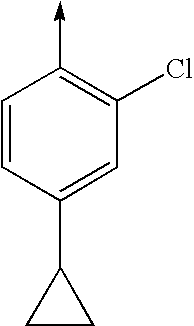 |
Cl | H |
 |
6.8 | 484.1486.1488.0 | 54 |
| 2065 | 4113 |
 |
Cl | H |
 |
4.3 | 581.1583.1585.1 | 24.5 |
| 2068 | 4114 |
 |
Cl | H | —C(Me)2COOH | 6.1 | 520.0522.0524.0 | 200 |
| 2070 | 4115 |
 |
Cl | H |
 |
5.5 | 626.2628.2630.0 | |
| 2071 | 4116 |
 |
Cl | H |
 |
4.7 | 614.2616.2618.0 | |
| 2072 | 4117 |
 |
Cl | H |
 |
5.2 | 585.2587.2589.0 | 52 |
| 2073 | 4118 |
 |
Cl | H |
 |
5.4 | 599.2601.2603.2 | 89.5 |
| 2074 | 4119 |
 |
Cl | H |
 |
5.4 | 585.1587.1589.1 | 121 |
| 2076 | 4120 |
 |
Cl | H |
 |
5.9 | 650.1652.1654.0 | 17.5 |
| 2077 | 4121 |
 |
Cl | H | —C(Me)2COOH | 6.9 | 530.0532.0534.0(M − H)− | 33.5 |
| 2078 | 4122 |
 |
Cl | F | —C(Me)2COOH | 7.1 | 564.1566.1568.0 | 15.5 |
| 2081 | 4123 |
 |
Cl | H |
 |
5.1 | 612.1614.1616.0 | 38 |
| 2082 | 4124 |
 |
Cl | H |
 |
4.6 | 627.1629.1631.0 | 27 |
| 2083 | 4125 |
 |
Cl | H |
 |
4.9 | 642.2644.1646.0 | 26 |
| 2084 | 4126 |
 |
Cl | H |
 |
5.2 | 720.2722.2724.0 | 78 |
| 2085 | 4127 |
 |
Cl | H |
 |
4.5 | 666.2668.2670.0 | 20.5 |
| 2086 | 4128 |
 |
Cl | H |
 |
5.1 | 553.1555.1557.1(M − H)− | 27 |
| 2087 | 4129 |
 |
Cl | H |
 |
4.9 | 598.1600.1602.1 | 15.5 |
| 2088 | 4130 |
 |
Cl | H |
 |
5.2 | 607.2609.2611.0 | 43 |
| 2089 | 4131 |
 |
Cl | H | —(CH2)2OH | 5.4 | 488.1490.1492.0 | 8.95 |
| 2093 | 4132 |
 |
Cl | H |
 |
4.9 | 541.1543.1545.0 | 49.5 |
| 2094 | 4133 |
 |
Cl | H |
 |
6.4 | 470.0472.1474.0 | 53.5 |
| 2095 | 4134 |
 |
Cl | H |
 |
4.6 | 571.1573.1575.0 | 28.5 |
| 2096 | 4135 |
 |
Cl | H |
 |
4.1 | 556.1558.1560.0 | 29 |
| 2102 | 4136 |
 |
Cl | H | —CH2COOH | 5.3 | 502.1504.1506.0 | 32.5 |
| 2109 | 4137 |
 |
Cl | H |
 |
4.3 | 527.0529.0531.0(M − H)− | 88 |
| 2110 | 4138 |
 |
Cl | H |
 |
4.7 | 614.1616.1618.0 | 43 |
| 2111 | 4139 |
 |
Cl | H |
 |
5.8 | 635.1637.1639.1 | 20.5 |
| 2114 | 4140 |
 |
Cl | H |
 |
5.6 | 597.1599.1601.0 | 51 |
| 2115 | 4141 |
 |
Cl | H |
 |
5.3 | 571.1573.1575.1 | 40 |
| 2116 | 4142 |
 |
Cl | H |
 |
5.1 | 627.2629.2631.0 | 50.5 |
| 2117 | 4143 |
 |
Cl | H |
 |
6.6 | 626.2628.2630.2 | 65 |
| 2118 | 4144 |
 |
Cl | H |
 |
8.2 | 615.1617.1619.1 | 81 |
| 2119 | 4145 |
 |
Cl | H |
 |
6.4 | 614.2616.2618.2 | 48 |
| 2120 | 4146 |
 |
Cl | H |
 |
8.7 | 613.2615.2617.2 | 37.5 |
| 2123 | 4147 |
 |
Cl | H |
 |
5.3 | 642.2644.2645.2 | 52 |
| 2133 | 4148 |
 |
Cl | H |
 |
6.9 | 634.1636.1638.1(M − H)− | 11 |
| 2134 | 4149 |
 |
Cl | H |
 |
7.9 | 639.1641.1643.1(M − H)− | 16.5 |
| 2135 | 4150 |
 |
Cl | H |
 |
8.3 | 605.1607.0609.0(M − H)− | 19 |
| 2140 | 4151 |
 |
Cl | F |
 |
4.7 | 517.1519.1520.1(M − H)− | 22.5 |
| 2149 | 4152 |
 |
Cl | H |
 |
7.8 | 654.2656.2658.2 | 36.5 |
| 2150 | 4153 |
 |
Cl | H |
 |
6.77 | 662.2664.2666.2 | 127 |
| 2153 | 4154 |
 |
Cl | H |
 |
4.9 | 670.1672.1674.0 | 10.5 |
| 2155 | 4155 |
 |
Cl | F |
 |
5.0 | 604.1606.1608.0 | 9.15 |
| 2156 | 4156 |
 |
Cl | F |
 |
5.13 | 632.2634.2636.0 | 36.5 |
| 2157 | 4157 |
 |
Cl | F |
 |
5.6 | 640.1642.1644.0 | 5.95 |
| 2158 | 4158 |
 |
Cl | H | —C(Me)2COOH | 7.0 | 598.1600.1602.0 | 208.5 |
| 2159 | 4159 |
 |
Cl | H | —C(Me)2COOH | 7.0 | 598.1600.1602.1 | 136.5 |
| 2161 | 4160 |
 |
Cl | F |
 |
5.6 | 672.1674.1676.0 | 114 |
| 2167 | 4161 |
 |
Cl | H | —C(Me)2COOH | 6.3 | 524.0526.0528.0 | 223.5 |
| 2168 | 4162 |
 |
Cl | H | —C(Me)2COOH | 6.3 | 524.0526.0528.0529.0 | 99 |
| 2170 | 4163 |
 |
Cl | F |
 |
4.4 | 545.1547.1549.0(M − H)− | 83 |
| 2171 | 4164 |
 |
Cl | F |
 |
5.4 | 668.1670.1672.1 | 18.5 |
| 2172 | 4165 |
 |
Cl | F |
 |
5.5 | 641.2643.2645.0 | 67.5 |
| 2173 | 4166 |
 |
Cl | F |
 |
5.4 | 669.2671.2673.0 | 126 |
| 2174 | 4167 |
 |
Cl | H |
 |
5.4 | 623.2625.2627.0 | 39.5 |
| 2175 | 4168 |
 |
Cl | H |
 |
5.3 | 651.2653.2655.0 | 107.5 |
| 2176 | 4169 |
 |
Cl | F |
 |
5.8 | 562.1564.1566.0(M − H)− | 9.2 |
| 2178 | 4170 |
 |
Cl | F |
 |
4.8 | 660.2662.2664.0 | 33.5 |
| 2179 | 4171 |
 |
Cl | F |
 |
4.8 | 632.2634.2636.0 | 31.5 |
| 2180 | 4172 |
 |
Cl | H | —C(Me)2COOH | 5.7 | 602.2604.2606.0 | 578.5 |
| 2181 | 4173 |
 |
Cl | H | —C(Me)2COOH | 9.0 | 544.2546.1548.2 | 51 |
| 2184 | 4174 |
 |
Cl | H | —C(Me)2COOH | 6.6 | 530.1532.1534.1 | 34 |
| 2186 | 4175 |
 |
Cl | F |
 |
5.5 | 617.2619.2621.1 | 67 |
| 2187 | 4176 |
 |
Cl | F |
 |
4.7 | 632.2634.2636.0 | 108 |
| 2190 | 4177 |
 |
Cl | F |
 |
4.9 | 571.1573.1575.0(M − H)− | 23 |
| 2191 | 4178 |
 |
CH3 | F |
 |
5.8 | 620.2622.2624.0 | 26 |
| 2192 | 4179 |
 |
Cl | H | —C(Me)2COOH | 6.5 | 530.1532.1534.0 | 467.5 |
| 2193 | 4180 |
 |
CH3 | H |
 |
5.7 | 602.2604.2606.0 | 71 |
| 2194 | 4181 |
 |
Cl | H | —C(Me)2CH2COOH | 5.8 | 544.1546.1548.0 | 26.5 |
| 2195 | 4182 |
 |
Cl | H |
 |
6.8 | 613.2615.2617.0 | 58.5 |
| 2196 | 4183 |
 |
Cl | H |
 |
9.3 | 669.1671.1673.1 | 61 |
| 2197 | 4184 |
 |
Cl | H |
 |
8.8 | 631.1633.1635.1(M − H)− | 30.5 |
| 2198 | 4185 |
 |
Cl | H |
 |
8.9 | 636.1638.1640.1 | 55.5 |
| 2203 | 4186 |
 |
Cl | H |
 |
4.7 | 608.2610.2612.0 | 12 |
| 2205 | 4187 |
 |
Cl | H | —C(Me)2COOH | 6.7 | 548.1550.1552.0 | 61.5 |
| 2210 | 4188 |
 |
Cl | H |
 |
5.1 | 635.2637.2639.0 | 24 |
| 2213 | 4189 |
 |
Cl | H |
 |
5.7 | 616.1618.1620.1 | 19.5 |
| 2214 | 4190 |
 |
Cl | H |
 |
5.5 | 545.2547.2549.0 | 59.5 |
| 2215 | 4191 |
 |
Cl | H |
 |
6.0 | 622.2624.2626.0 | 4.75 |
| 2216 | 4192 |
 |
Cl | H |
 |
4.7 | 558.2560.2562.0 | 7.9 |
| 2217 | 4193 |
 |
Cl | H |
 |
5.1 | 651.2653.2655.0 | 29 |
| 2218 | 4194 |
 |
Cl | H |
 |
4.7 | 621.1623.1625.1626.1 | 45 |
| 2219 | 4195 |
 |
Cl | H |
 |
5.0 | 627.2629.2631.0 | 22.5 |
| 2224 | 4196 |
 |
Cl | H | —C(Me)2COOH | 7.3 | 558.1560.1562.1 | 198 |
| 2225 | 4197 |
 |
Cl | H |
 |
8.6 | 619.1621.1623.1(M − H)− | 57.5 |
| 2227 | 4198 |
 |
Cl | F |
 |
4.8 | 645.2647.2649.2 | 22 |
| 2228 | 4199 |
 |
Cl | H | —C(Me)2OH | 8.6 | 518.1520.1522.0 | 32 |
| 2229 | 4200 |
 |
Cl | H | —C(Me)2COOH | 8.8 | 546.1548.1550.0 | 35.5 |
| 2230 | 4201 |
 |
Cl | H |
 |
6.4 | 515.1517.1519.0(M − H)− | 52 |
| 2231 | 4202 |
 |
Cl | H |
 |
6.1 | 643.2645.2647.1 | 106.5 |
| 2232 | 4203 |
 |
Cl | H |
 |
6.9 | 667.1669.1671.0 | 164 |
| 2233 | 4204 |
 |
Cl | H |
 |
6.6 | 686.2688.2690.1 | 35 |
| 2234 | 4205 |
 |
Cl | H |
 |
7.6 | 638.1640.1642.1 | 28.5 |
| 2235 | 4206 |
 |
Cl | H | —C(Me)2COOH | 7.0 | 564.1566.1568.1 | 152 |
| 2236 | 4207 |
 |
Cl | H | —C(Me)2COOH | 5.8 | 490.1492.1494.0 | 442 |
| 2237 | 4208 |
 |
Cl | H |
 |
6.0 | 622.2624.1626.0 | 6.9 |
| 2238 | 4209 |
 |
Cl | F |
 |
4.6 | 632.0634.0636.0 | 46 |
| 2240 | 4210 |
 |
Cl | H |
 |
6.2 | 684.0686.0688.0 | 15.5 |
| 2242 | 4211 |
 |
Cl | H | —C(Me)2COOH | 7.0 | 598.1600.1602.0 | 482.5 |
| 2243 | 4212 |
 |
Cl | H | —C(Me)2COOH | 6.0 | 508.0510.0512.0 | 361.5 |
| 2247 | 4213 |
 |
Cl | H | —C(Me)2COOH | 5.9 | 544.1546.0548.0 | 32.5 |
| 2248 | 4214 |
 |
Cl | H |
 |
5.2 | 558.0560.0562.0 | 19.5 |
| 2255 | 4215 |
 |
Cl | F |
 |
6.7 | 656.9658.9660.0 | 56.5 |
| 2256 | 4216 |
 |
Cl | F |
 |
5.9 | 656.9658.9660.0 | 41 |
| 2259 | 4217 |
 |
Cl | F |
 |
6.0 | 653.0655.0657.0 | 90.5 |
| 2261 | 4218 |
 |
Cl | H | —C(Me)2COOH | 7.6 | 567.9569.9571.9573.0 | 31.5 |
| 2262 | 4219 |
 |
Cl | H | —C(Me)2COOH | 9.2 | 624.0626.0628.0630.0 | 97 |
| 2263 | 4220 |
 |
Cl | H |
 |
5.6 | 537.0538.9540.9(M − H)− | 97.5 |
| 2264 | 4221 |
 |
Cl | H |
 |
6.9 | 593.0595.0596.9599.0(M − H)− | 107.5 |
| 2265 | 4222 |
 |
Cl | H |
 |
6.5 | 660.0662.0664.0666.0 | 11.5 |
| 2266 | 4223 |
 |
Cl | H |
 |
8.3 | 716.0718.0720.0722.0 | 30 |
| 2267 | 4224 |
 |
Cl | H |
 |
6.5 | 721.0723.0725.0727.0 | 101 |
| 2268 | 4225 |
 |
Cl | H |
 |
7.5 | 745.0747.0749.0751.0 | 161.5 |
| 2276 | 4226 |
 |
Cl | H |
 |
7.2 | 764.0766.0768.0770.0 | 52 |
| 2277 | 4227 |
 |
Cl | H |
 |
5.8 | 557.0559.0561.030.5 | |
| 2284 | 4228 |
 |
Cl | H |
 |
5.3 | 613.1615.1617.0 | 30 |
| 2285 | 4229 |
 |
Cl | H |
 |
5.4 | 625.0627.0629.0 | 15 |
| 2286 | 4230 |
 |
Cl | F |
 |
6.5 | 708.0710.0712.0 | 30.5 |
| 2287 | 4231 |
 |
Cl | H |
 |
5.6 | 556.0558.0560.0(M − H)− | 16 |
| 2288 | 4232 |
 |
Cl | H |
 |
6.9 | 587.1589.0591.0 | 10 |
| 2289 | 4233 |
 |
Cl | H |
 |
7.8 | 613.1615.1617.0 | 9.35 |
| 2293 | 4234 |
 |
Cl | H |
 |
7.1 | 601.1603.1605.0 | 15.5 |
| 2294 | 4235 |
 |
Cl | H |
 |
5.4 | 682.1684.1686.0 | 718 |
| 2295 | 4236 |
 |
Cl | F |
 |
5.5 | 713.0715.0717.0 | 250 |
| 2297 | 4237 |
 |
Cl | F |
 |
5.7 | 570.0572.0574.0 | 91.5 |
| 2304 | 4238 |
 |
Cl | H |
 |
6.9 | 601.1603.1605.0 | 7.8 |
| 2305 | 4239 |
 |
Cl | H |
 |
7.1 | 615.1617.1619.0 | 8.2 |
| 2311 | 4240 |
 |
Cl | H | —C(Me)2COOH | 8.7 | 544.1546.1548.1 | 174.5 |
| 2316 | 4241 |
 |
Cl | H |
 |
6.5 | 663.2665.2667.0 | 30.5 |
| 2321 | 4242 |
 |
Cl | H |
 |
7.2 | 703.1705.1707.0 | 854 |
| 2322 | 4243 |
 |
Cl | H | —C(Me)2COOH | 7.4 | 533.1535.1537.0 | 140.5 |
| 2325 | 4244 |
 |
Cl | H |
 |
8.3 | 668.2670.2672.0 | 216.5 |
| 2326 | 4245 |
 |
Cl | H |
 |
6.5 | 628.2630.2632.0 | 458.5 |
| 2332 | 4246 |
 |
Cl | H |
 |
6.9 | 613.2615.2617.0 | 212.5 |
| 2333 | 4247 |
 |
Cl | H |
 |
7.4 | 636.2638.2640.0 | 19 |
| 2336 | 4248 |
 |
Cl | F |
 |
7.3 | 708.1710.1712.0 | 30.5 |
| 2337 | 4249 |
 |
Cl | H |
 |
8.3 | 610.1612.1614.0 | 202.5 |
| 2338 | 4250 |
 |
Cl | F |
 |
6.3 | 585.1587.1589.0(M − H)− | 51.5 |
| TABLE 5 |
 |
| wherein R1, R5 and R6 are given in the table below: |
| tR | MS | IC50 | ||||
| BI21 | Cpd | R1 | —N(R5)R6 | (min) | (MH+) | mut (nM) |
| 1628 | 5001 |
 |
 |
7.0 | 590.1592.1594.0 | 71 |
| 1629 | 5002 |
 |
 |
7.0 | 589.1591.1593.0 | 137 |
| 1630 | 5003 |
 |
 |
5.2 | 592.2594.2593.0 | 48 |
| 1631 | 5004 |
 |
 |
6.7 | 579.1581.1583.1 | 41 |
| 1632 | 5005 |
 |
 |
6.5 | 670.2672.2674.0 | 216 |
| 1633 | 5006 |
 |
 |
5.4 | 594.1596.1598.0 | 374 |
| 1634 | 5007 |
 |
 |
5.3 | 622.2624.2626.2 | 244 |
| 1635 | 5008 |
 |
 |
6.8 | 682.2684.2686.2 | 861 |
| 1637 | 5009 |
 |
 |
7.1 | 601.1603.1605.1 | 131 |
| 1638 | 5010 |
 |
 |
7.1 | 629.1631.1633.0 | 402 |
| 1639 | 5011 |
 |
 |
6.9 | 601.1603.1605.1 | 69 |
| 1640 | 5012 |
 |
 |
5.7 | 628.2630.2632.0 | 466 |
| 1641 | 5013 |
 |
 |
6.8 | 601.1603.1605.0 | 150 |
| 1642 | 5014 |
 |
 |
6.5 | 595.1597.1599.1 | 146 |
| 1643 | 5015 |
 |
 |
6.1 | 553.1555.1557.0 | 158 |
| 1644 | 5016 |
 |
 |
6.9 | 629.2631.2633.0 | 116 |
| 1645 | 5017 |
 |
 |
6.7 | 664.1666.1668.1 | 55 |
| 1646 | 5018 |
 |
 |
6.1 | 597.1599.1601.1 | 92 |
| 1647 | 5019 |
 |
 |
6.6 | 631.1633.1635.1 | 78 |
| 1648 | 5020 |
 |
 |
6.3 | 567.1569.1571.1 | 163 |
| 1649 | 5021 |
 |
 |
6.7 | 645.2647.1649.1 | 181 |
| 1650 | 5022 |
 |
 |
6.9 | 629.1631.1633.0 | 106 |
| 1652 | 5023 |
 |
 |
6.9 | 643.1645.1647.1 | 38 |
| 1653 | 5024 |
 |
 |
5.3 | 612.2614.2616.0 | 66 |
| 1654 | 5025 |
 |
 |
6.3 | 581.1683.1585.0 | 124 |
| 1655 | 5026 |
 |
 |
5.5 | 614.2616.2618.0 | 86 |
| 1656 | 5027 |
 |
 |
6.7 | 643.1645.1647.1 | 51 |
| 1657 | 5028 |
 |
 |
6.5 | 621.2623.2625.2 | 39 |
| 1658 | 5029 |
 |
 |
6.7 | 632.1634.1636.0 | 34 |
| 1659 | 5030 |
 |
 |
6.7 | 593.2595.2597.0 | 116 |
| 1660 | 5031 |
 |
 |
6.7 | 649.2651.2653.0 | 118 |
| 1932 | 5032 |
 |
 |
5.7 | 605.1607.1609.1 | 51.5 |
| 1972 | 5033 |
 |
 |
5.0 | 584.1566.0588.0 | 124.5 |
| 1973 | 5034 |
 |
 |
5.1 | 598.1600.0602.0 | 357 |
| 1974 | 5035 |
 |
 |
5.0 | 598.1600.1602.0 | 257.5 |
| 1975 | 5036 |
 |
 |
5.0 | 598.1600.1602.0 | 271 |
| 1976 | 5037 |
 |
 |
5.0 | 612.2614.2616.0 | 174 |
| 1991 | 5038 |
 |
 |
5.5 | 614.0616.0618.0 | 557.5 |
| 1992 | 5039 |
 |
 |
5.4 | 614.0616.0618.0 | 479 |
| 1993 | 5040 |
 |
 |
5.4 | 614.1616.0618.0 | 563 |
| 1994 | 5041 |
 |
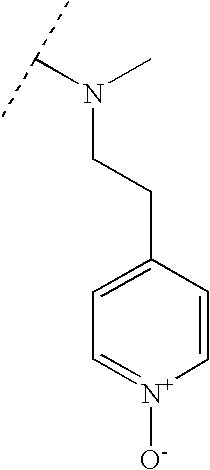 |
5.5 | 628.1630.0632.0 | 131.5 |
| TABLE 6 |
 |
| wherein R1, R5 and R6 are given in the table below: |
| tR | MS | IC50 | ||||
| BI21 | Cpd | R1 | —N(R5)R6 | (min) | (MH+) | mut (nM) |
| 1400 | 6001 |
 |
 |
7.2 | 613.1615.1617.0 | 69 |
| 1593 | 6002 |
 |
 |
6.9 | 519.2521.2523.0 | 31 |
| 1594 | 6003 |
 |
 |
7.1 | 559.2561.2563.2 | 13 |
| 1595 | 6004 |
 |
 |
5.1 | 562.2564.2566.0 | 398 |
| 1596 | 6005 |
 |
 |
6.9 | 549.2551.2553.0 | 564 |
| 1597 | 6006 |
 |
 |
6.7 | 640.3642.3644.0 | 46 |
| 1598 | 6007 |
 |
 |
6.2 | 564.2566.2568.0 | 30 |
| 1599 | 6008 |
 |
 |
5.3 | 570.2572.2574.0 | 26 |
| 1600 | 6009 |
 |
 |
5.9 | 652.3654.3656.0 | 73 |
| 1601 | 6010 |
 |
 |
7.5 | 570.2572.2574.0 | 168 |
| 1602 | 6011 |
 |
 |
7.2 | 571.2573.2575.0 | 26 |
| 1603 | 6012 |
 |
 |
5.8 | 598.3600.3602.0 | 47 |
| 1604 | 6013 |
 |
 |
6.9 | 571.2573.2575.0 | 34 |
| 1605 | 6014 |
 |
 |
7.0 | 599.2601.2603.0 | 34 |
| 1606 | 6015 |
 |
 |
6.6 | 565.2567.2569.2 | 39 |
| 1607 | 6016 |
 |
—NH(CH2)2OH | 6.1 | 523.2525.2527.0 | 35 |
| 1608 | 6017 |
 |
 |
6.9 | 599.3601.3603.0 | 33 |
| 1609 | 6018 |
 |
 |
6.0 | 567.2569.2571.2 | 28 |
| 1610 | 6019 |
 |
 |
6.7 | 601.2603.2605.2 | 36 |
| 1611 | 6020 |
 |
 |
6.7 | 615.3617.3619.3 | 51 |
| 1612 | 6021 |
 |
 |
7.0 | 599.2601.2603.0 | 58 |
| 1613 | 6022 |
 |
 |
7.0 | 625.2627.2629.0 | 14 |
| 1615 | 6023 |
 |
 |
5.3 | 584.3586.3588.0 | 22 |
| 1617 | 6024 |
 |
—NH(CH2)2CO2H | 6.3 | 551.2553.2555.0 | 41 |
| 1618 | 6025 |
 |
 |
6.9 | 611.2613.2615.0 | 41 |
| 1621 | 6026 |
 |
 |
5.6 | 584.1586.1588.1 | 51 |
| 1622 | 6027 |
 |
 |
6.7 | 606.2608.2610.0 | 59 |
| 1623 | 6028 |
 |
 |
5.2 | 592.2594.2596.0 | 55 |
| 1624 | 6029 |
 |
 |
5.5 | 556.1558.1560.1 | 22 |
| 1625 | 6030 |
 |
 |
6.4 | 591.2593.2595.2 | 919 |
| 1893 | 6031 |
 |
 |
7.1 | 627.2629.2631.0 | 29.5 |
| 1894 | 6032 |
 |
 |
7.3 | 639.2641.2643.0 | 20.5 |
| 2037 | 6033 |
 |
—NHC(Me)2COOH | 5.5 | 546.9548.9550.9 | 298 |
| 2050 | 6034 |
 |
 |
5.4 | 568.1570.1572.1(M − H)− | 44.5 |
| 2051 | 6035 |
 |
 |
5.4 | 582.1584.1586.1(M − H)− | 39 |
| 2067 | 6036 |
 |
—NHSO2CH3 | 6.5 | 539.0541.0543.0(M − H)− | 146 |
| 2090 | 6037 |
 |
 |
7.5 | 601.0603.0605.0(M − H)− | 111.5 |
| 2151 | 6038 |
 |
 |
6.1 | 570.1572.1574.0 | 64.5 |
| 2152 | 6039 |
 |
 |
5.9 | 568.1570.1572.1(M − H)− | 104 |
| TABLE 7 |
 |
| wherein W is given in the table below: |
| tR | MS | IC50 | |||
| BI21 | Cpd | W | (min) | (MH+) | mut (nM) |
| 1734 | 7001 |
 |
10.4 | 570.0572.0574.0 | 116 |
| 1735 | 7002 |
 |
10.4 | 570.1572.1574.0 | 187 |
| 1738 | 7003 |
 |
9.9 | 591.1593.0595.0 | 607 |
| 1739 | 7004 |
 |
10.0 | 605.1607.0609.0 | 272 |
| 1742 | 7005 |
 |
10.5 | 555.1557.1559.1 | 106 |
| 1743 | 7006 |
 |
11.0 | 642.2644.0646.0 | 74 |
| 1740 | 7007 |
 |
9.8 | 597.0599.0601.0 | 331 |
| 1748 | 7008 |
 |
10.0 | 582.1584.0586.0(M − H)− | 428 |
| 1749 | 7009 |
 |
9.2 | 612.1614.1616.0(M − H)− | 43 |
| 1750 | 7010 |
 |
9.7 | 521.1523.1525.0 | 83 |
| 1812 | 7011 |
 |
9.9 | 571.1573.1575.0 | 181 |
| 1814 | 7012 |
 |
10.0 | 571.2573.2574.2 | 128 |
| 1815 | 7013 |
 |
11.3 | 589.0591.1593.1595.0 | 121 |
| 1816 | 7014 |
 |
11.5 | 571.2573.2575.0 | 415 |
| 1817 | 7015 |
 |
11.0 | 599.1601.1603.0 | 189 |
| 1818 | 7016 |
 |
11.0 | 599.2601.2603.0 | 145 |
| 1819 | 7017 |
 |
11.1 | 614.2616.2618.0 | 170 |
| 1820 | 7018 |
 |
11.1 | 559.2601.2603.0 | 100 |
| 1821 | 7019 |
 |
11.0 | 614.1616.1618.0 | 25 |
| 1822 | 7020 |
 |
10.3 | 531.2533.2533.0 | 69 |
| 1823 | 7021 |
 |
11.2 | 547.1549.1551.0 | 262 |
| 1824 | 7022 |
 |
11.6 | 561.1563.1565.0 | 629 |
| 1825 | 7023 |
 |
11.6 | 561.2563.1565.0 | 255 |
| 1827 | 7024 |
 |
11.5 | 549.2551.2553.0 | 414 |
| 1828 | 7025 |
 |
11.1 | 612.2614.2616.2(M − H)− | 154 |
| 1829 | 7026 |
 |
10.8 | 575.2577.2579.0 | 88 |
| 1830 | 7027 |
 |
9.9 | 599.1601.1603.0 | 134 |
| 1831 | 7028 |
 |
8.7 | 551.1553.1555.0 | 123 |
| 1835 | 7029 |
 |
9.9 | 599.1601.1603.0 | 88 |
| 1836 | 7030 |
 |
7.7 | 570.1572.1574.0 | 38 |
| 1837 | 7031 |
 |
7.7 | 570.1572.1573.1 | 43 |
| 1838 | 7032 |
 |
7.8 | 570.1572.1574.0 | 30 |
| 1912 | 7033 |
 |
6.3 | 626.0628.0630.0 | 21.5 |
| 1913 | 7034 |
 |
6.8 | 609.0611.0613.0 | 201 |
| 1914 | 7035 |
 |
6.8 | 603.0605.0607.0609.0 | 100 |
| 1915 | 7036 |
 |
6.2 | 637.0639.0641.0643.0 | 712.5 |
| 1916 | 7037 |
 |
5.3 | 612.1614.0616.0 | 236.5 |
| 1917 | 7038 |
 |
6.8 | 583.1585.0587.0 | 860 |
| 1918 | 7039 |
 |
6.8 | 599.0601.0603.0 | 89.5 |
| 1919 | 7040 |
 |
5.9 | 561.0563.0565.0 | 42.5 |
| 1920 | 7041 |
 |
7.0 | 597.1599.0601.0 | 336.5 |
| 1924 | 7042 |
 |
6.5 | 585.0587.0589.0 | 27 |
| 1925 | 7043 |
 |
6.6 | 608.1610.0612.0 | 145 |
| 1928 | 7044 |
 |
6.9 | 583.0585.0587.0 | 334.5 |
| 1930 | 7045 |
 |
102 | 637.2639.0641.0 | 432 |
| 1942 | 7046 |
 |
8.2 | 584.1586.1588.0(M − H)− | 140 |
| 2005 | 7047 |
 |
7.9 | 586.0588.0590.0 | 43.5 |
| 2006 | 7048 |
 |
7.8 | 586.0588.0590.0 | 97 |
Claims (16)


Priority Applications (2)
| Application Number | Priority Date | Filing Date | Title |
|---|---|---|---|
| US11/137,831 US7517998B2 (en) | 2004-06-01 | 2005-05-24 | Non nucleoside reverse transcriptase inhibitors |
| US12/364,551 US8198458B2 (en) | 2004-06-01 | 2009-02-03 | Non-nucleoside reverse transcriptase inhibitors |
Applications Claiming Priority (2)
| Application Number | Priority Date | Filing Date | Title |
|---|---|---|---|
| US57588804P | 2004-06-01 | 2004-06-01 | |
| US11/137,831 US7517998B2 (en) | 2004-06-01 | 2005-05-24 | Non nucleoside reverse transcriptase inhibitors |
Related Child Applications (1)
| Application Number | Title | Priority Date | Filing Date |
|---|---|---|---|
| US12/364,551 Division US8198458B2 (en) | 2004-06-01 | 2009-02-03 | Non-nucleoside reverse transcriptase inhibitors |
Publications (2)
| Publication Number | Publication Date |
|---|---|
| US20050282907A1 US20050282907A1 (en) | 2005-12-22 |
| US7517998B2 true US7517998B2 (en) | 2009-04-14 |
Family
ID=35462871
Family Applications (2)
| Application Number | Title | Priority Date | Filing Date |
|---|---|---|---|
| US11/137,831 Expired - Lifetime US7517998B2 (en) | 2004-06-01 | 2005-05-24 | Non nucleoside reverse transcriptase inhibitors |
| US12/364,551 Active 2026-08-25 US8198458B2 (en) | 2004-06-01 | 2009-02-03 | Non-nucleoside reverse transcriptase inhibitors |
Family Applications After (1)
| Application Number | Title | Priority Date | Filing Date |
|---|---|---|---|
| US12/364,551 Active 2026-08-25 US8198458B2 (en) | 2004-06-01 | 2009-02-03 | Non-nucleoside reverse transcriptase inhibitors |
Country Status (5)
| Country | Link |
|---|---|
| US (2) | US7517998B2 (en) |
| EP (1) | EP1756091A4 (en) |
| JP (1) | JP4906716B2 (en) |
| CA (1) | CA2555633C (en) |
| WO (1) | WO2005118575A1 (en) |
Cited By (2)
| Publication number | Priority date | Publication date | Assignee | Title |
|---|---|---|---|---|
| US20090062213A1 (en) * | 2005-12-30 | 2009-03-05 | Arbor Vita Corporation | Small Molecule Inhibitors of PDZ Interactions |
| WO2015015240A1 (en) * | 2013-08-02 | 2015-02-05 | Rosocha Gregory | New process to make non-nucleosidal reverse transcriptase inhibitors (nnrti) for the treatment of hiv |
Families Citing this family (10)
| Publication number | Priority date | Publication date | Assignee | Title |
|---|---|---|---|---|
| WO2007050087A1 (en) | 2004-08-25 | 2007-05-03 | Ardea Biosciences, Inc. | N[S(4-aryl-triazol-3-yl)α -mercaptoacetyl]-p-amino benozoic acids AS HIV REVERSE TRANSCRIPTASE INHIBITORS |
| ME01512B (en) | 2004-08-25 | 2014-04-20 | Ardea Biosciences Inc | S-triazolyl alpha-mercaptoacetanilides as inhibitors of HIV reverse transcriptase |
| WO2009006611A1 (en) * | 2007-07-03 | 2009-01-08 | Arbor Vita Corporation | Small molecule inhibitors of pdz interactions |
| CN101468985A (en) * | 2007-12-28 | 2009-07-01 | 中国人民解放军军事医学科学院毒物药物研究所 | 5-(3-aromatic heterocyclic substituted phenyl) tetrazole compounds and anti-HIV/AIDS use thereof |
| AR075713A1 (en) | 2009-03-03 | 2011-04-20 | Du Pont | FUNGICIDE PIRAZOLS |
| WO2010135536A2 (en) | 2009-05-20 | 2010-11-25 | Ardea Biosciences, Inc. | Methods of modulating uric acid levels |
| KR20130095772A (en) | 2010-10-05 | 2013-08-28 | 퍼듀 퍼머 엘피 | Quinazoline compounds as sodium channel blockers |
| EP3010908A1 (en) | 2013-02-20 | 2016-04-27 | E. I. du Pont de Nemours and Company | Fungicidal pyrazoles |
| CN104803981A (en) * | 2015-04-22 | 2015-07-29 | 复旦大学 | Piperidine-4-amido diaryl pyrimidine derivative as well as preparation method and application thereof |
| CN118772058B (en) * | 2024-06-14 | 2026-03-17 | 济南尚博医药股份有限公司 | A method for synthesizing 2-chloro-4-(1H-pyrazol-3-yl)benzonitrile and its application |
Citations (5)
| Publication number | Priority date | Publication date | Assignee | Title |
|---|---|---|---|---|
| EP0035046A1 (en) | 1978-09-07 | 1981-09-09 | Otsuka Pharmaceutical Co., Ltd. | Novel tetrazole derivatives, process for the preparation thereof, and anti-ulcer composition containing the same |
| US4399285A (en) | 1979-11-17 | 1983-08-16 | Bayer Aktiengesellschaft | Tetrazolyloxyacetic acid amides, piperidides and perhydro azepinides |
| US6245817B1 (en) | 1997-02-14 | 2001-06-12 | Bayer Corporation | NPY5 receptor antagonists and methods for using same |
| WO2004050643A2 (en) | 2002-12-04 | 2004-06-17 | Boehringer Ingelheim International Gmbh | Non-nucleoside reverse transcriptase inhibitors |
| WO2005115147A2 (en) * | 2004-05-18 | 2005-12-08 | Merck & Co., Inc. | Hiv reverse transcriptase inhibitors |
Family Cites Families (2)
| Publication number | Priority date | Publication date | Assignee | Title |
|---|---|---|---|---|
| JPH0759563B2 (en) * | 1987-01-28 | 1995-06-28 | 大塚化学株式会社 | Pyrazole derivative, method for producing the same, and herbicide containing the derivative as an active ingredient |
| EA009478B1 (en) * | 2002-08-23 | 2008-02-28 | Ардеа Байосайенсиз, Инк. | Non-nucleoside reverse transcriptase inhibitors |
-
2005
- 2005-05-24 US US11/137,831 patent/US7517998B2/en not_active Expired - Lifetime
- 2005-05-30 CA CA2555633A patent/CA2555633C/en not_active Expired - Fee Related
- 2005-05-30 JP JP2007513640A patent/JP4906716B2/en not_active Expired - Fee Related
- 2005-05-30 EP EP05757660A patent/EP1756091A4/en not_active Withdrawn
- 2005-05-30 WO PCT/CA2005/000907 patent/WO2005118575A1/en not_active Ceased
-
2009
- 2009-02-03 US US12/364,551 patent/US8198458B2/en active Active
Patent Citations (5)
| Publication number | Priority date | Publication date | Assignee | Title |
|---|---|---|---|---|
| EP0035046A1 (en) | 1978-09-07 | 1981-09-09 | Otsuka Pharmaceutical Co., Ltd. | Novel tetrazole derivatives, process for the preparation thereof, and anti-ulcer composition containing the same |
| US4399285A (en) | 1979-11-17 | 1983-08-16 | Bayer Aktiengesellschaft | Tetrazolyloxyacetic acid amides, piperidides and perhydro azepinides |
| US6245817B1 (en) | 1997-02-14 | 2001-06-12 | Bayer Corporation | NPY5 receptor antagonists and methods for using same |
| WO2004050643A2 (en) | 2002-12-04 | 2004-06-17 | Boehringer Ingelheim International Gmbh | Non-nucleoside reverse transcriptase inhibitors |
| WO2005115147A2 (en) * | 2004-05-18 | 2005-12-08 | Merck & Co., Inc. | Hiv reverse transcriptase inhibitors |
Cited By (4)
| Publication number | Priority date | Publication date | Assignee | Title |
|---|---|---|---|---|
| US20090062213A1 (en) * | 2005-12-30 | 2009-03-05 | Arbor Vita Corporation | Small Molecule Inhibitors of PDZ Interactions |
| US8633160B2 (en) | 2005-12-30 | 2014-01-21 | Nono Inc. | Small molecule inhibitors of PDZ interactions |
| WO2015015240A1 (en) * | 2013-08-02 | 2015-02-05 | Rosocha Gregory | New process to make non-nucleosidal reverse transcriptase inhibitors (nnrti) for the treatment of hiv |
| US10017479B2 (en) | 2013-08-02 | 2018-07-10 | Gregory Rosocha | Process to make non nucleosidal reverse transcriptase inhibitors (NNRTI) for the treatment of HIV |
Also Published As
| Publication number | Publication date |
|---|---|
| EP1756091A4 (en) | 2009-09-23 |
| JP4906716B2 (en) | 2012-03-28 |
| JP2008500974A (en) | 2008-01-17 |
| WO2005118575A1 (en) | 2005-12-15 |
| CA2555633A1 (en) | 2005-12-15 |
| CA2555633C (en) | 2011-02-01 |
| EP1756091A1 (en) | 2007-02-28 |
| US8198458B2 (en) | 2012-06-12 |
| US20090143370A1 (en) | 2009-06-04 |
| US20050282907A1 (en) | 2005-12-22 |
Similar Documents
| Publication | Publication Date | Title |
|---|---|---|
| US8198458B2 (en) | Non-nucleoside reverse transcriptase inhibitors | |
| US11098045B2 (en) | Haloallylamine indole and azaindole derivative inhibitors of lysyl oxidases and uses thereof | |
| US7642277B2 (en) | Non-nucleoside reverse transcriptase inhibitors | |
| US10202399B2 (en) | Dihydroxy aromatic heterocyclic compound | |
| US7300948B2 (en) | Alkynyl compounds as non nucleoside reverse transcriptase inhibitors | |
| US9908865B2 (en) | Histone demethylase inhibitors | |
| JP2802547B2 (en) | Isoxazoline compounds as anti-inflammatory agents | |
| US20110275827A1 (en) | Mitotic Kinesin Inhibitor | |
| US9649314B2 (en) | Pyrimido[4,5-b]quinoline-4,5(3H,10H)-diones | |
| US7569723B2 (en) | Benzoic acid derivatives as non nucleoside reverse-transcriptase inhibitors | |
| US11440886B2 (en) | Anti-inflammatory compound, and preparation and use thereof | |
| US11708353B2 (en) | Inhibitors of prolyl-tRNA-synthetase | |
| US9650351B2 (en) | Inhibition of IL-2 production | |
| US10081614B2 (en) | Bis(sulfonamide) derivatives and their use as mPGES inhibitors | |
| US20240000806A1 (en) | Methods and materials for inhibiting cb1 activity | |
| HK1258811B (en) | Compounds, compositions, and methods for modulating cftr |
Legal Events
| Date | Code | Title | Description |
|---|---|---|---|
| AS | Assignment |
Owner name: BOEHRINGER INGELHEIM INTERNATIONAL GMBH, GERMANY Free format text: ASSIGNMENT OF ASSIGNORS INTEREST;ASSIGNORS:DEROY, PATRICK;FAUCHER, ANNE-MARIE;GAGNON, ALEXANDRE;AND OTHERS;REEL/FRAME:016640/0497;SIGNING DATES FROM 20050714 TO 20050803 |
|
| FEPP | Fee payment procedure |
Free format text: PAYOR NUMBER ASSIGNED (ORIGINAL EVENT CODE: ASPN); ENTITY STATUS OF PATENT OWNER: LARGE ENTITY |
|
| STCF | Information on status: patent grant |
Free format text: PATENTED CASE |
|
| FPAY | Fee payment |
Year of fee payment: 4 |
|
| FPAY | Fee payment |
Year of fee payment: 8 |
|
| MAFP | Maintenance fee payment |
Free format text: PAYMENT OF MAINTENANCE FEE, 12TH YEAR, LARGE ENTITY (ORIGINAL EVENT CODE: M1553); ENTITY STATUS OF PATENT OWNER: LARGE ENTITY Year of fee payment: 12 |