US7495016B2 - Pyrrolidones with anti-HIV activity - Google Patents
Pyrrolidones with anti-HIV activity Download PDFInfo
- Publication number
- US7495016B2 US7495016B2 US10/690,873 US69087303A US7495016B2 US 7495016 B2 US7495016 B2 US 7495016B2 US 69087303 A US69087303 A US 69087303A US 7495016 B2 US7495016 B2 US 7495016B2
- Authority
- US
- United States
- Prior art keywords
- substituted
- unsubstituted
- mmol
- pyrrolidin
- compound
- Prior art date
- Legal status (The legal status is an assumption and is not a legal conclusion. Google has not performed a legal analysis and makes no representation as to the accuracy of the status listed.)
- Expired - Fee Related, expires
Links
- 150000004040 pyrrolidinones Chemical class 0.000 title abstract description 18
- 230000000694 effects Effects 0.000 title description 22
- 230000036436 anti-hiv Effects 0.000 title description 2
- 150000001875 compounds Chemical class 0.000 claims abstract description 147
- -1 hydroxy, methyl Chemical group 0.000 claims description 127
- 125000003118 aryl group Chemical group 0.000 claims description 33
- 125000001072 heteroaryl group Chemical group 0.000 claims description 24
- 125000003178 carboxy group Chemical group [H]OC(*)=O 0.000 claims description 22
- 125000001997 phenyl group Chemical group [H]C1=C([H])C([H])=C(*)C([H])=C1[H] 0.000 claims description 20
- 125000002496 methyl group Chemical group [H]C([H])([H])* 0.000 claims description 14
- 229910052736 halogen Inorganic materials 0.000 claims description 11
- 125000005843 halogen group Chemical group 0.000 claims description 11
- 125000004093 cyano group Chemical group *C#N 0.000 claims description 10
- 239000008194 pharmaceutical composition Substances 0.000 claims description 10
- 125000004076 pyridyl group Chemical group 0.000 claims description 10
- 125000001797 benzyl group Chemical group [H]C1=C([H])C([H])=C(C([H])=C1[H])C([H])([H])* 0.000 claims description 8
- 229910052739 hydrogen Inorganic materials 0.000 claims description 8
- 239000001257 hydrogen Substances 0.000 claims description 8
- 125000000449 nitro group Chemical group [O-][N+](*)=O 0.000 claims description 8
- 125000002023 trifluoromethyl group Chemical group FC(F)(F)* 0.000 claims description 8
- 125000000714 pyrimidinyl group Chemical group 0.000 claims description 7
- 125000000391 vinyl group Chemical group [H]C([*])=C([H])[H] 0.000 claims description 7
- 125000003710 aryl alkyl group Chemical group 0.000 claims description 6
- 150000002367 halogens Chemical class 0.000 claims description 6
- 239000000546 pharmaceutical excipient Substances 0.000 claims description 5
- 125000003373 pyrazinyl group Chemical group 0.000 claims description 5
- 125000004178 (C1-C4) alkyl group Chemical group 0.000 claims description 4
- 125000004169 (C1-C6) alkyl group Chemical group 0.000 claims description 4
- 125000001511 cyclopentyl group Chemical group [H]C1([H])C([H])([H])C([H])([H])C([H])(*)C1([H])[H] 0.000 claims description 4
- 125000001188 haloalkyl group Chemical group 0.000 claims description 4
- 125000000956 methoxy group Chemical group [H]C([H])([H])O* 0.000 claims description 4
- 125000002924 primary amino group Chemical group [H]N([H])* 0.000 claims description 4
- 238000006467 substitution reaction Methods 0.000 claims description 4
- 125000003545 alkoxy group Chemical group 0.000 claims description 3
- 125000003831 tetrazolyl group Chemical group 0.000 claims description 2
- CBOIHMRHGLHBPB-UHFFFAOYSA-N hydroxymethyl Chemical compound O[CH2] CBOIHMRHGLHBPB-UHFFFAOYSA-N 0.000 claims 6
- 150000002431 hydrogen Chemical class 0.000 claims 5
- 125000005913 (C3-C6) cycloalkyl group Chemical group 0.000 claims 4
- 125000002777 acetyl group Chemical group [H]C([H])([H])C(*)=O 0.000 claims 3
- 125000003917 carbamoyl group Chemical group [H]N([H])C(*)=O 0.000 claims 3
- 125000003107 substituted aryl group Chemical group 0.000 claims 3
- 125000000876 trifluoromethoxy group Chemical group FC(F)(F)O* 0.000 claims 3
- 125000003754 ethoxycarbonyl group Chemical group C(=O)(OCC)* 0.000 claims 2
- 125000004356 hydroxy functional group Chemical group O* 0.000 claims 2
- 125000002098 pyridazinyl group Chemical group 0.000 claims 2
- 125000002943 quinolinyl group Chemical group N1=C(C=CC2=CC=CC=C12)* 0.000 claims 2
- 125000002490 anilino group Chemical group [H]N(*)C1=C([H])C([H])=C([H])C([H])=C1[H] 0.000 claims 1
- 125000003739 carbamimidoyl group Chemical group C(N)(=N)* 0.000 claims 1
- 125000000000 cycloalkoxy group Chemical group 0.000 claims 1
- 125000003652 trifluoroethoxy group Chemical group FC(CO*)(F)F 0.000 claims 1
- 239000000203 mixture Substances 0.000 abstract description 152
- 238000000034 method Methods 0.000 abstract description 104
- 208000031886 HIV Infections Diseases 0.000 abstract description 31
- 208000037357 HIV infectious disease Diseases 0.000 abstract description 28
- 208000033519 human immunodeficiency virus infectious disease Diseases 0.000 abstract description 28
- 239000000126 substance Substances 0.000 abstract description 27
- 241000700605 Viruses Species 0.000 abstract description 19
- 208000037265 diseases, disorders, signs and symptoms Diseases 0.000 abstract description 13
- 208000030507 AIDS Diseases 0.000 abstract description 10
- 201000010099 disease Diseases 0.000 abstract description 10
- 230000005764 inhibitory process Effects 0.000 abstract description 5
- 238000002560 therapeutic procedure Methods 0.000 abstract description 3
- 238000011321 prophylaxis Methods 0.000 abstract description 2
- 150000003384 small molecules Chemical class 0.000 abstract description 2
- XEKOWRVHYACXOJ-UHFFFAOYSA-N Ethyl acetate Chemical compound CCOC(C)=O XEKOWRVHYACXOJ-UHFFFAOYSA-N 0.000 description 136
- 238000002360 preparation method Methods 0.000 description 98
- YMWUJEATGCHHMB-UHFFFAOYSA-N Dichloromethane Chemical compound ClCCl YMWUJEATGCHHMB-UHFFFAOYSA-N 0.000 description 77
- HEDRZPFGACZZDS-MICDWDOJSA-N Trichloro(2H)methane Chemical compound [2H]C(Cl)(Cl)Cl HEDRZPFGACZZDS-MICDWDOJSA-N 0.000 description 76
- 239000000047 product Substances 0.000 description 75
- 239000000243 solution Substances 0.000 description 69
- ZMXDDKWLCZADIW-UHFFFAOYSA-N N,N-Dimethylformamide Chemical compound CN(C)C=O ZMXDDKWLCZADIW-UHFFFAOYSA-N 0.000 description 68
- 235000019439 ethyl acetate Nutrition 0.000 description 68
- VYPSYNLAJGMNEJ-UHFFFAOYSA-N Silicium dioxide Chemical compound O=[Si]=O VYPSYNLAJGMNEJ-UHFFFAOYSA-N 0.000 description 64
- LFQSCWFLJHTTHZ-UHFFFAOYSA-N Ethanol Chemical compound CCO LFQSCWFLJHTTHZ-UHFFFAOYSA-N 0.000 description 57
- 108010092799 RNA-directed DNA polymerase Proteins 0.000 description 57
- 102100034343 Integrase Human genes 0.000 description 54
- 239000000741 silica gel Substances 0.000 description 53
- 229910002027 silica gel Inorganic materials 0.000 description 53
- 210000004027 cell Anatomy 0.000 description 49
- 241000725303 Human immunodeficiency virus Species 0.000 description 47
- CSNNHWWHGAXBCP-UHFFFAOYSA-L Magnesium sulfate Chemical compound [Mg+2].[O-][S+2]([O-])([O-])[O-] CSNNHWWHGAXBCP-UHFFFAOYSA-L 0.000 description 44
- 238000006243 chemical reaction Methods 0.000 description 44
- VLKZOEOYAKHREP-UHFFFAOYSA-N n-Hexane Chemical compound CCCCCC VLKZOEOYAKHREP-UHFFFAOYSA-N 0.000 description 43
- 239000003814 drug Substances 0.000 description 40
- BWHMMNNQKKPAPP-UHFFFAOYSA-L potassium carbonate Chemical compound [K+].[K+].[O-]C([O-])=O BWHMMNNQKKPAPP-UHFFFAOYSA-L 0.000 description 40
- 238000005160 1H NMR spectroscopy Methods 0.000 description 39
- ISWSIDIOOBJBQZ-UHFFFAOYSA-N Phenol Chemical compound OC1=CC=CC=C1 ISWSIDIOOBJBQZ-UHFFFAOYSA-N 0.000 description 39
- 230000002829 reductive effect Effects 0.000 description 38
- HNJBEVLQSNELDL-UHFFFAOYSA-N pyrrolidin-2-one Chemical compound O=C1CCCN1 HNJBEVLQSNELDL-UHFFFAOYSA-N 0.000 description 37
- 239000007787 solid Substances 0.000 description 37
- 239000012267 brine Substances 0.000 description 35
- HPALAKNZSZLMCH-UHFFFAOYSA-M sodium;chloride;hydrate Chemical compound O.[Na+].[Cl-] HPALAKNZSZLMCH-UHFFFAOYSA-M 0.000 description 35
- XLYOFNOQVPJJNP-UHFFFAOYSA-N water Substances O XLYOFNOQVPJJNP-UHFFFAOYSA-N 0.000 description 34
- HEMHJVSKTPXQMS-UHFFFAOYSA-M Sodium hydroxide Chemical compound [OH-].[Na+] HEMHJVSKTPXQMS-UHFFFAOYSA-M 0.000 description 33
- 239000003795 chemical substances by application Substances 0.000 description 33
- 238000000746 purification Methods 0.000 description 33
- 238000004440 column chromatography Methods 0.000 description 32
- 150000003951 lactams Chemical class 0.000 description 31
- 108090000765 processed proteins & peptides Proteins 0.000 description 30
- 238000004895 liquid chromatography mass spectrometry Methods 0.000 description 29
- 239000011541 reaction mixture Substances 0.000 description 29
- 230000008685 targeting Effects 0.000 description 28
- 125000000217 alkyl group Chemical group 0.000 description 27
- 238000003556 assay Methods 0.000 description 27
- 108090000623 proteins and genes Proteins 0.000 description 27
- PAYRUJLWNCNPSJ-UHFFFAOYSA-N Aniline Chemical compound NC1=CC=CC=C1 PAYRUJLWNCNPSJ-UHFFFAOYSA-N 0.000 description 26
- 239000002502 liposome Substances 0.000 description 26
- 239000003446 ligand Substances 0.000 description 25
- 125000001424 substituent group Chemical group 0.000 description 24
- NLXLAEXVIDQMFP-UHFFFAOYSA-N Ammonia chloride Chemical class [NH4+].[Cl-] NLXLAEXVIDQMFP-UHFFFAOYSA-N 0.000 description 23
- 0 [3*]N1CC(C)CC1=O Chemical compound [3*]N1CC(C)CC1=O 0.000 description 23
- 239000007832 Na2SO4 Substances 0.000 description 22
- PMZURENOXWZQFD-UHFFFAOYSA-L Sodium Sulfate Chemical compound [Na+].[Na+].[O-]S([O-])(=O)=O PMZURENOXWZQFD-UHFFFAOYSA-L 0.000 description 22
- 238000001914 filtration Methods 0.000 description 22
- 229910052943 magnesium sulfate Inorganic materials 0.000 description 22
- 102000004196 processed proteins & peptides Human genes 0.000 description 22
- 229910052938 sodium sulfate Inorganic materials 0.000 description 22
- 239000002904 solvent Substances 0.000 description 22
- 229940079593 drug Drugs 0.000 description 21
- 125000000524 functional group Chemical group 0.000 description 21
- 235000018102 proteins Nutrition 0.000 description 21
- 102000004169 proteins and genes Human genes 0.000 description 21
- 238000007792 addition Methods 0.000 description 20
- 229910000027 potassium carbonate Inorganic materials 0.000 description 20
- KDLHZDBZIXYQEI-UHFFFAOYSA-N Palladium Chemical compound [Pd] KDLHZDBZIXYQEI-UHFFFAOYSA-N 0.000 description 19
- 230000027455 binding Effects 0.000 description 18
- 230000010076 replication Effects 0.000 description 18
- QTBSBXVTEAMEQO-UHFFFAOYSA-N Acetic acid Chemical compound CC(O)=O QTBSBXVTEAMEQO-UHFFFAOYSA-N 0.000 description 17
- 125000005647 linker group Chemical group 0.000 description 17
- 229940124597 therapeutic agent Drugs 0.000 description 17
- RYHBNJHYFVUHQT-UHFFFAOYSA-N 1,4-Dioxane Chemical compound C1COCCO1 RYHBNJHYFVUHQT-UHFFFAOYSA-N 0.000 description 16
- 239000011230 binding agent Substances 0.000 description 16
- 239000011347 resin Substances 0.000 description 16
- 229920005989 resin Polymers 0.000 description 16
- LWIHDJKSTIGBAC-UHFFFAOYSA-K tripotassium phosphate Chemical compound [K+].[K+].[K+].[O-]P([O-])([O-])=O LWIHDJKSTIGBAC-UHFFFAOYSA-K 0.000 description 16
- JFDZBHWFFUWGJE-UHFFFAOYSA-N benzonitrile Chemical compound N#CC1=CC=CC=C1 JFDZBHWFFUWGJE-UHFFFAOYSA-N 0.000 description 15
- 229920001184 polypeptide Polymers 0.000 description 15
- UIIMBOGNXHQVGW-UHFFFAOYSA-M Sodium bicarbonate Chemical compound [Na+].OC([O-])=O UIIMBOGNXHQVGW-UHFFFAOYSA-M 0.000 description 14
- 238000003786 synthesis reaction Methods 0.000 description 14
- 230000015572 biosynthetic process Effects 0.000 description 13
- OPQARKPSCNTWTJ-UHFFFAOYSA-L copper(ii) acetate Chemical compound [Cu+2].CC([O-])=O.CC([O-])=O OPQARKPSCNTWTJ-UHFFFAOYSA-L 0.000 description 13
- 125000004404 heteroalkyl group Chemical group 0.000 description 13
- 239000000758 substrate Substances 0.000 description 13
- 238000011282 treatment Methods 0.000 description 13
- MHAJPDPJQMAIIY-UHFFFAOYSA-N Hydrogen peroxide Chemical compound OO MHAJPDPJQMAIIY-UHFFFAOYSA-N 0.000 description 12
- 150000001412 amines Chemical class 0.000 description 12
- 239000003112 inhibitor Substances 0.000 description 12
- 229920001223 polyethylene glycol Polymers 0.000 description 12
- 238000005859 coupling reaction Methods 0.000 description 11
- 239000012044 organic layer Substances 0.000 description 11
- GETQZCLCWQTVFV-UHFFFAOYSA-N trimethylamine Chemical compound CN(C)C GETQZCLCWQTVFV-UHFFFAOYSA-N 0.000 description 11
- RTZKZFJDLAIYFH-UHFFFAOYSA-N Diethyl ether Chemical compound CCOCC RTZKZFJDLAIYFH-UHFFFAOYSA-N 0.000 description 10
- LYCAIKOWRPUZTN-UHFFFAOYSA-N Ethylene glycol Chemical compound OCCO LYCAIKOWRPUZTN-UHFFFAOYSA-N 0.000 description 10
- JUJWROOIHBZHMG-UHFFFAOYSA-N Pyridine Chemical compound C1=CC=NC=C1 JUJWROOIHBZHMG-UHFFFAOYSA-N 0.000 description 10
- 239000002253 acid Substances 0.000 description 10
- 235000001014 amino acid Nutrition 0.000 description 10
- 150000001413 amino acids Chemical group 0.000 description 10
- 150000001502 aryl halides Chemical class 0.000 description 10
- 239000012043 crude product Substances 0.000 description 10
- 239000000706 filtrate Substances 0.000 description 10
- 241000894007 species Species 0.000 description 10
- 210000002845 virion Anatomy 0.000 description 10
- NHOYNZFMBMMOSK-UHFFFAOYSA-N 3-cyclopentyloxy-4-phenylmethoxybenzaldehyde Chemical compound C1CCCC1OC1=CC(C=O)=CC=C1OCC1=CC=CC=C1 NHOYNZFMBMMOSK-UHFFFAOYSA-N 0.000 description 9
- UFGLMSAZXCZHRL-UHFFFAOYSA-N 4-benzyl-3-[3-(3-cyclopentyloxy-4-phenylmethoxyphenyl)-4-nitrobutanoyl]-1,3-oxazolidin-2-one Chemical compound C=1C=C(OCC=2C=CC=CC=2)C(OC2CCCC2)=CC=1C(C[N+](=O)[O-])CC(=O)N(C(OC1)=O)C1CC1=CC=CC=C1 UFGLMSAZXCZHRL-UHFFFAOYSA-N 0.000 description 9
- OKKJLVBELUTLKV-UHFFFAOYSA-N Methanol Chemical compound OC OKKJLVBELUTLKV-UHFFFAOYSA-N 0.000 description 9
- NPXOKRUENSOPAO-UHFFFAOYSA-N Raney nickel Chemical compound [Al].[Ni] NPXOKRUENSOPAO-UHFFFAOYSA-N 0.000 description 9
- FAPWRFPIFSIZLT-UHFFFAOYSA-M Sodium chloride Chemical compound [Na+].[Cl-] FAPWRFPIFSIZLT-UHFFFAOYSA-M 0.000 description 9
- 150000001408 amides Chemical class 0.000 description 9
- 239000003153 chemical reaction reagent Substances 0.000 description 9
- 238000004587 chromatography analysis Methods 0.000 description 9
- 230000008878 coupling Effects 0.000 description 9
- 238000010168 coupling process Methods 0.000 description 9
- 150000002148 esters Chemical class 0.000 description 9
- 125000005842 heteroatom Chemical group 0.000 description 9
- 125000002887 hydroxy group Chemical group [H]O* 0.000 description 9
- 210000004379 membrane Anatomy 0.000 description 9
- 239000012528 membrane Substances 0.000 description 9
- 229910052757 nitrogen Inorganic materials 0.000 description 9
- 239000002777 nucleoside Substances 0.000 description 9
- 102000005962 receptors Human genes 0.000 description 9
- 108020003175 receptors Proteins 0.000 description 9
- 230000003612 virological effect Effects 0.000 description 9
- CLKWZAJNQVRPBV-UHFFFAOYSA-N 3-[4-(3-cyclopentyloxy-4-hydroxyphenyl)-2-oxopyrrolidin-1-yl]benzonitrile Chemical compound OC1=CC=C(C2CC(=O)N(C2)C=2C=C(C=CC=2)C#N)C=C1OC1CCCC1 CLKWZAJNQVRPBV-UHFFFAOYSA-N 0.000 description 8
- UUSQMPWFMGILIN-UHFFFAOYSA-N 4-(3-cyclopentyloxy-4-phenylmethoxyphenyl)pyrrolidin-2-one Chemical compound C1NC(=O)CC1C(C=C1OC2CCCC2)=CC=C1OCC1=CC=CC=C1 UUSQMPWFMGILIN-UHFFFAOYSA-N 0.000 description 8
- 150000001299 aldehydes Chemical class 0.000 description 8
- 125000004432 carbon atom Chemical group C* 0.000 description 8
- 238000001816 cooling Methods 0.000 description 8
- 125000000753 cycloalkyl group Chemical group 0.000 description 8
- 239000000412 dendrimer Substances 0.000 description 8
- 229920000736 dendritic polymer Polymers 0.000 description 8
- ZCSHNCUQKCANBX-UHFFFAOYSA-N lithium diisopropylamide Chemical compound [Li+].CC(C)[N-]C(C)C ZCSHNCUQKCANBX-UHFFFAOYSA-N 0.000 description 8
- 229920002521 macromolecule Polymers 0.000 description 8
- 150000003833 nucleoside derivatives Chemical class 0.000 description 8
- 150000003254 radicals Chemical class 0.000 description 8
- 150000003839 salts Chemical class 0.000 description 8
- 230000005945 translocation Effects 0.000 description 8
- 229910000404 tripotassium phosphate Inorganic materials 0.000 description 8
- 108091032973 (ribonucleotides)n+m Proteins 0.000 description 7
- SIKOMFLSJLVJSV-UHFFFAOYSA-N 4-(3-cyclopentyloxy-4-methoxyphenyl)-1-(3-methylsulfonylphenyl)pyrrolidin-2-one Chemical compound COC1=CC=C(C2CC(=O)N(C2)C=2C=C(C=CC=2)S(C)(=O)=O)C=C1OC1CCCC1 SIKOMFLSJLVJSV-UHFFFAOYSA-N 0.000 description 7
- IJGRMHOSHXDMSA-UHFFFAOYSA-N Atomic nitrogen Chemical compound N#N IJGRMHOSHXDMSA-UHFFFAOYSA-N 0.000 description 7
- 108020004414 DNA Proteins 0.000 description 7
- VEXZGXHMUGYJMC-UHFFFAOYSA-N Hydrochloric acid Chemical compound Cl VEXZGXHMUGYJMC-UHFFFAOYSA-N 0.000 description 7
- ZMANZCXQSJIPKH-UHFFFAOYSA-N Triethylamine Chemical compound CCN(CC)CC ZMANZCXQSJIPKH-UHFFFAOYSA-N 0.000 description 7
- 210000000170 cell membrane Anatomy 0.000 description 7
- 230000014509 gene expression Effects 0.000 description 7
- 125000000592 heterocycloalkyl group Chemical group 0.000 description 7
- 230000002401 inhibitory effect Effects 0.000 description 7
- 238000010992 reflux Methods 0.000 description 7
- 239000003419 rna directed dna polymerase inhibitor Substances 0.000 description 7
- 229910000030 sodium bicarbonate Inorganic materials 0.000 description 7
- 238000003756 stirring Methods 0.000 description 7
- 239000003826 tablet Substances 0.000 description 7
- 230000001225 therapeutic effect Effects 0.000 description 7
- 210000001519 tissue Anatomy 0.000 description 7
- HBOMLICNUCNMMY-XLPZGREQSA-N zidovudine Chemical compound O=C1NC(=O)C(C)=CN1[C@@H]1O[C@H](CO)[C@@H](N=[N+]=[N-])C1 HBOMLICNUCNMMY-XLPZGREQSA-N 0.000 description 7
- MPAZIKGWLHWYKO-UHFFFAOYSA-N 3-[4-(3-cyclopentyloxy-4-methoxyphenyl)-2-oxopyrrolidin-1-yl]benzamide Chemical compound COC1=CC=C(C2CC(=O)N(C2)C=2C=C(C=CC=2)C(N)=O)C=C1OC1CCCC1 MPAZIKGWLHWYKO-UHFFFAOYSA-N 0.000 description 6
- JUEZWZGYCGRSBU-UHFFFAOYSA-N 3-[4-(3-cyclopentyloxy-4-methoxyphenyl)-2-oxopyrrolidin-1-yl]benzonitrile Chemical compound COC1=CC=C(C2CC(=O)N(C2)C=2C=C(C=CC=2)C#N)C=C1OC1CCCC1 JUEZWZGYCGRSBU-UHFFFAOYSA-N 0.000 description 6
- IVAZBAUMPOUZAD-UHFFFAOYSA-N 3-[4-(3-cyclopentyloxy-4-phenylmethoxyphenyl)-2-oxopyrrolidin-1-yl]benzonitrile Chemical compound O=C1CC(C=2C=C(OC3CCCC3)C(OCC=3C=CC=CC=3)=CC=2)CN1C1=CC=CC(C#N)=C1 IVAZBAUMPOUZAD-UHFFFAOYSA-N 0.000 description 6
- VHYFNPMBLIVWCW-UHFFFAOYSA-N 4-Dimethylaminopyridine Chemical compound CN(C)C1=CC=NC=C1 VHYFNPMBLIVWCW-UHFFFAOYSA-N 0.000 description 6
- 102000004190 Enzymes Human genes 0.000 description 6
- 108090000790 Enzymes Proteins 0.000 description 6
- 229920001202 Inulin Polymers 0.000 description 6
- JGFZNNIVVJXRND-UHFFFAOYSA-N N,N-Diisopropylethylamine (DIPEA) Chemical compound CCN(C(C)C)C(C)C JGFZNNIVVJXRND-UHFFFAOYSA-N 0.000 description 6
- YXFVVABEGXRONW-UHFFFAOYSA-N Toluene Chemical compound CC1=CC=CC=C1 YXFVVABEGXRONW-UHFFFAOYSA-N 0.000 description 6
- XSQUKJJJFZCRTK-UHFFFAOYSA-N Urea Chemical compound NC(N)=O XSQUKJJJFZCRTK-UHFFFAOYSA-N 0.000 description 6
- 108020000999 Viral RNA Proteins 0.000 description 6
- 125000002947 alkylene group Chemical group 0.000 description 6
- 239000000427 antigen Substances 0.000 description 6
- 108091007433 antigens Proteins 0.000 description 6
- 102000036639 antigens Human genes 0.000 description 6
- 239000003443 antiviral agent Substances 0.000 description 6
- NEHMKBQYUWJMIP-UHFFFAOYSA-N chloromethane Chemical compound ClC NEHMKBQYUWJMIP-UHFFFAOYSA-N 0.000 description 6
- 230000007423 decrease Effects 0.000 description 6
- UAOMVDZJSHZZME-UHFFFAOYSA-N diisopropylamine Chemical compound CC(C)NC(C)C UAOMVDZJSHZZME-UHFFFAOYSA-N 0.000 description 6
- 230000003993 interaction Effects 0.000 description 6
- JYJIGFIDKWBXDU-MNNPPOADSA-N inulin Chemical compound O[C@H]1[C@H](O)[C@@H](CO)O[C@@]1(CO)OC[C@]1(OC[C@]2(OC[C@]3(OC[C@]4(OC[C@]5(OC[C@]6(OC[C@]7(OC[C@]8(OC[C@]9(OC[C@]%10(OC[C@]%11(OC[C@]%12(OC[C@]%13(OC[C@]%14(OC[C@]%15(OC[C@]%16(OC[C@]%17(OC[C@]%18(OC[C@]%19(OC[C@]%20(OC[C@]%21(OC[C@]%22(OC[C@]%23(OC[C@]%24(OC[C@]%25(OC[C@]%26(OC[C@]%27(OC[C@]%28(OC[C@]%29(OC[C@]%30(OC[C@]%31(OC[C@]%32(OC[C@]%33(OC[C@]%34(OC[C@]%35(OC[C@]%36(O[C@@H]%37[C@@H]([C@@H](O)[C@H](O)[C@@H](CO)O%37)O)[C@H]([C@H](O)[C@@H](CO)O%36)O)[C@H]([C@H](O)[C@@H](CO)O%35)O)[C@H]([C@H](O)[C@@H](CO)O%34)O)[C@H]([C@H](O)[C@@H](CO)O%33)O)[C@H]([C@H](O)[C@@H](CO)O%32)O)[C@H]([C@H](O)[C@@H](CO)O%31)O)[C@H]([C@H](O)[C@@H](CO)O%30)O)[C@H]([C@H](O)[C@@H](CO)O%29)O)[C@H]([C@H](O)[C@@H](CO)O%28)O)[C@H]([C@H](O)[C@@H](CO)O%27)O)[C@H]([C@H](O)[C@@H](CO)O%26)O)[C@H]([C@H](O)[C@@H](CO)O%25)O)[C@H]([C@H](O)[C@@H](CO)O%24)O)[C@H]([C@H](O)[C@@H](CO)O%23)O)[C@H]([C@H](O)[C@@H](CO)O%22)O)[C@H]([C@H](O)[C@@H](CO)O%21)O)[C@H]([C@H](O)[C@@H](CO)O%20)O)[C@H]([C@H](O)[C@@H](CO)O%19)O)[C@H]([C@H](O)[C@@H](CO)O%18)O)[C@H]([C@H](O)[C@@H](CO)O%17)O)[C@H]([C@H](O)[C@@H](CO)O%16)O)[C@H]([C@H](O)[C@@H](CO)O%15)O)[C@H]([C@H](O)[C@@H](CO)O%14)O)[C@H]([C@H](O)[C@@H](CO)O%13)O)[C@H]([C@H](O)[C@@H](CO)O%12)O)[C@H]([C@H](O)[C@@H](CO)O%11)O)[C@H]([C@H](O)[C@@H](CO)O%10)O)[C@H]([C@H](O)[C@@H](CO)O9)O)[C@H]([C@H](O)[C@@H](CO)O8)O)[C@H]([C@H](O)[C@@H](CO)O7)O)[C@H]([C@H](O)[C@@H](CO)O6)O)[C@H]([C@H](O)[C@@H](CO)O5)O)[C@H]([C@H](O)[C@@H](CO)O4)O)[C@H]([C@H](O)[C@@H](CO)O3)O)[C@H]([C@H](O)[C@@H](CO)O2)O)[C@@H](O)[C@H](O)[C@@H](CO)O1 JYJIGFIDKWBXDU-MNNPPOADSA-N 0.000 description 6
- 229940029339 inulin Drugs 0.000 description 6
- 230000004048 modification Effects 0.000 description 6
- 238000012986 modification Methods 0.000 description 6
- 239000002808 molecular sieve Substances 0.000 description 6
- NQDJXKOVJZTUJA-UHFFFAOYSA-N nevirapine Chemical compound C12=NC=CC=C2C(=O)NC=2C(C)=CC=NC=2N1C1CC1 NQDJXKOVJZTUJA-UHFFFAOYSA-N 0.000 description 6
- 229920000570 polyether Polymers 0.000 description 6
- 239000000843 powder Substances 0.000 description 6
- URGAHOPLAPQHLN-UHFFFAOYSA-N sodium aluminosilicate Chemical compound [Na+].[Al+3].[O-][Si]([O-])=O.[O-][Si]([O-])=O URGAHOPLAPQHLN-UHFFFAOYSA-N 0.000 description 6
- 229940124530 sulfonamide Drugs 0.000 description 6
- YBBRCQOCSYXUOC-UHFFFAOYSA-N sulfuryl dichloride Chemical class ClS(Cl)(=O)=O YBBRCQOCSYXUOC-UHFFFAOYSA-N 0.000 description 6
- 239000003053 toxin Substances 0.000 description 6
- 231100000765 toxin Toxicity 0.000 description 6
- 108700012359 toxins Proteins 0.000 description 6
- 229960002555 zidovudine Drugs 0.000 description 6
- SSJXIUAHEKJCMH-PHDIDXHHSA-N (1r,2r)-cyclohexane-1,2-diamine Chemical compound N[C@@H]1CCCC[C@H]1N SSJXIUAHEKJCMH-PHDIDXHHSA-N 0.000 description 5
- ZJXIEQDNPRSXMU-UHFFFAOYSA-N 3-[4-[3-cyclopentyloxy-4-(cyclopropylmethoxy)phenyl]-2-oxopyrrolidin-1-yl]benzonitrile Chemical compound O=C1CC(C=2C=C(OC3CCCC3)C(OCC3CC3)=CC=2)CN1C1=CC=CC(C#N)=C1 ZJXIEQDNPRSXMU-UHFFFAOYSA-N 0.000 description 5
- 108090000288 Glycoproteins Proteins 0.000 description 5
- 102000003886 Glycoproteins Human genes 0.000 description 5
- 241000699670 Mus sp. Species 0.000 description 5
- 125000005041 acyloxyalkyl group Chemical group 0.000 description 5
- 239000002775 capsule Substances 0.000 description 5
- 239000000975 dye Substances 0.000 description 5
- 238000005516 engineering process Methods 0.000 description 5
- 239000012634 fragment Substances 0.000 description 5
- 125000004474 heteroalkylene group Chemical group 0.000 description 5
- 238000000099 in vitro assay Methods 0.000 description 5
- 239000012948 isocyanate Substances 0.000 description 5
- 150000002513 isocyanates Chemical class 0.000 description 5
- 239000007788 liquid Substances 0.000 description 5
- LYGJENNIWJXYER-UHFFFAOYSA-N nitromethane Chemical compound C[N+]([O-])=O LYGJENNIWJXYER-UHFFFAOYSA-N 0.000 description 5
- 229910052760 oxygen Inorganic materials 0.000 description 5
- 125000006239 protecting group Chemical group 0.000 description 5
- UMJSCPRVCHMLSP-UHFFFAOYSA-N pyridine Natural products COC1=CC=CN=C1 UMJSCPRVCHMLSP-UHFFFAOYSA-N 0.000 description 5
- 150000003456 sulfonamides Chemical class 0.000 description 5
- 229910052717 sulfur Inorganic materials 0.000 description 5
- 239000000725 suspension Substances 0.000 description 5
- 230000035897 transcription Effects 0.000 description 5
- 238000013518 transcription Methods 0.000 description 5
- YBJHBAHKTGYVGT-ZKWXMUAHSA-N (+)-Biotin Chemical compound N1C(=O)N[C@@H]2[C@H](CCCCC(=O)O)SC[C@@H]21 YBJHBAHKTGYVGT-ZKWXMUAHSA-N 0.000 description 4
- MBLZDHJUHFQZLN-UHFFFAOYSA-N 1-(3-aminophenyl)-4-(3-cyclopentyloxy-4-methoxyphenyl)pyrrolidin-2-one Chemical compound COC1=CC=C(C2CC(=O)N(C2)C=2C=C(N)C=CC=2)C=C1OC1CCCC1 MBLZDHJUHFQZLN-UHFFFAOYSA-N 0.000 description 4
- PKCVXNIFEPPUBF-UHFFFAOYSA-N 1-(3-aminophenyl)-4-(4-methoxy-3-phenylmethoxyphenyl)pyrrolidin-2-one Chemical compound COC1=CC=C(C2CC(=O)N(C2)C=2C=C(N)C=CC=2)C=C1OCC1=CC=CC=C1 PKCVXNIFEPPUBF-UHFFFAOYSA-N 0.000 description 4
- ZECXISIULNGQLJ-UHFFFAOYSA-N 3-[4-(3-cyclopentyloxy-4-methoxyphenyl)-2-oxopyrrolidin-1-yl]benzenecarboximidamide Chemical compound COC1=CC=C(C2CC(=O)N(C2)C=2C=C(C=CC=2)C(N)=N)C=C1OC1CCCC1 ZECXISIULNGQLJ-UHFFFAOYSA-N 0.000 description 4
- GXORDBDYSPYKBR-UHFFFAOYSA-N 3-[4-(3-cyclopentyloxy-4-methoxyphenyl)-2-oxopyrrolidin-1-yl]benzoic acid Chemical compound COC1=CC=C(C2CC(=O)N(C2)C=2C=C(C=CC=2)C(O)=O)C=C1OC1CCCC1 GXORDBDYSPYKBR-UHFFFAOYSA-N 0.000 description 4
- ZMUARMDZXVPOML-UHFFFAOYSA-N 3-[4-[2-(3-chlorophenoxy)-4-methoxyphenyl]-2-oxopyrrolidin-1-yl]benzamide Chemical compound C=1C=CC(Cl)=CC=1OC1=CC(OC)=CC=C1C(CC1=O)CN1C1=CC=CC(C(N)=O)=C1 ZMUARMDZXVPOML-UHFFFAOYSA-N 0.000 description 4
- FEPWXVZRLRMHJB-UHFFFAOYSA-N 3-[4-[3-cyclopentyloxy-4-(cyclopropylmethoxy)phenyl]-2-oxopyrrolidin-1-yl]benzamide Chemical compound NC(=O)C1=CC=CC(N2C(CC(C2)C=2C=C(OC3CCCC3)C(OCC3CC3)=CC=2)=O)=C1 FEPWXVZRLRMHJB-UHFFFAOYSA-N 0.000 description 4
- STXAVEHFKAXGOX-UHFFFAOYSA-N 3-bromobenzonitrile Chemical compound BrC1=CC=CC(C#N)=C1 STXAVEHFKAXGOX-UHFFFAOYSA-N 0.000 description 4
- ASLGAGIXWVAZOC-UHFFFAOYSA-N 4-(3-cyclopentyloxy-4-methoxyphenyl)-1-(3-methylsulfinylphenyl)pyrrolidin-2-one Chemical compound COC1=CC=C(C2CC(=O)N(C2)C=2C=C(C=CC=2)S(C)=O)C=C1OC1CCCC1 ASLGAGIXWVAZOC-UHFFFAOYSA-N 0.000 description 4
- BXZVVICBKDXVGW-NKWVEPMBSA-N Didanosine Chemical compound O1[C@H](CO)CC[C@@H]1N1C(NC=NC2=O)=C2N=C1 BXZVVICBKDXVGW-NKWVEPMBSA-N 0.000 description 4
- YNQLUTRBYVCPMQ-UHFFFAOYSA-N Ethylbenzene Chemical compound CCC1=CC=CC=C1 YNQLUTRBYVCPMQ-UHFFFAOYSA-N 0.000 description 4
- 108010010369 HIV Protease Proteins 0.000 description 4
- IMNFDUFMRHMDMM-UHFFFAOYSA-N N-Heptane Chemical compound CCCCCCC IMNFDUFMRHMDMM-UHFFFAOYSA-N 0.000 description 4
- LVDRREOUMKACNJ-BKMJKUGQSA-N N-[(2R,3S)-2-(4-chlorophenyl)-1-(1,4-dimethyl-2-oxoquinolin-7-yl)-6-oxopiperidin-3-yl]-2-methylpropane-1-sulfonamide Chemical compound CC(C)CS(=O)(=O)N[C@H]1CCC(=O)N([C@@H]1c1ccc(Cl)cc1)c1ccc2c(C)cc(=O)n(C)c2c1 LVDRREOUMKACNJ-BKMJKUGQSA-N 0.000 description 4
- 208000001388 Opportunistic Infections Diseases 0.000 description 4
- XNKLLVCARDGLGL-JGVFFNPUSA-N Stavudine Chemical compound O=C1NC(=O)C(C)=CN1[C@H]1C=C[C@@H](CO)O1 XNKLLVCARDGLGL-JGVFFNPUSA-N 0.000 description 4
- QAOWNCQODCNURD-UHFFFAOYSA-N Sulfuric acid Chemical compound OS(O)(=O)=O QAOWNCQODCNURD-UHFFFAOYSA-N 0.000 description 4
- SMNRFWMNPDABKZ-WVALLCKVSA-N [[(2R,3S,4R,5S)-5-(2,6-dioxo-3H-pyridin-3-yl)-3,4-dihydroxyoxolan-2-yl]methoxy-hydroxyphosphoryl] [[[(2R,3S,4S,5R,6R)-4-fluoro-3,5-dihydroxy-6-(hydroxymethyl)oxan-2-yl]oxy-hydroxyphosphoryl]oxy-hydroxyphosphoryl] hydrogen phosphate Chemical compound OC[C@H]1O[C@H](OP(O)(=O)OP(O)(=O)OP(O)(=O)OP(O)(=O)OC[C@H]2O[C@H]([C@H](O)[C@@H]2O)C2C=CC(=O)NC2=O)[C@H](O)[C@@H](F)[C@@H]1O SMNRFWMNPDABKZ-WVALLCKVSA-N 0.000 description 4
- 230000009471 action Effects 0.000 description 4
- 230000009435 amidation Effects 0.000 description 4
- 238000007112 amidation reaction Methods 0.000 description 4
- 150000008064 anhydrides Chemical class 0.000 description 4
- 125000004429 atom Chemical group 0.000 description 4
- 229940049706 benzodiazepine Drugs 0.000 description 4
- 150000001557 benzodiazepines Chemical class 0.000 description 4
- 235000013877 carbamide Nutrition 0.000 description 4
- 238000002648 combination therapy Methods 0.000 description 4
- 230000021615 conjugation Effects 0.000 description 4
- WHBIGIKBNXZKFE-UHFFFAOYSA-N delavirdine mesylate Natural products CC(C)NC1=CC=CN=C1N1CCN(C(=O)C=2NC3=CC=C(NS(C)(=O)=O)C=C3C=2)CC1 WHBIGIKBNXZKFE-UHFFFAOYSA-N 0.000 description 4
- 238000010511 deprotection reaction Methods 0.000 description 4
- 239000002552 dosage form Substances 0.000 description 4
- 239000003937 drug carrier Substances 0.000 description 4
- 239000000890 drug combination Substances 0.000 description 4
- 230000002068 genetic effect Effects 0.000 description 4
- 150000004820 halides Chemical class 0.000 description 4
- 238000000338 in vitro Methods 0.000 description 4
- CBVCZFGXHXORBI-PXQQMZJSSA-N indinavir Chemical compound C([C@H](N(CC1)C[C@@H](O)C[C@@H](CC=2C=CC=CC=2)C(=O)N[C@H]2C3=CC=CC=C3C[C@H]2O)C(=O)NC(C)(C)C)N1CC1=CC=CN=C1 CBVCZFGXHXORBI-PXQQMZJSSA-N 0.000 description 4
- 150000002540 isothiocyanates Chemical class 0.000 description 4
- 210000004698 lymphocyte Anatomy 0.000 description 4
- 239000003550 marker Substances 0.000 description 4
- 239000000463 material Substances 0.000 description 4
- BJZGRNPTRCMLEI-NRFANRHFSA-N n-[3-[(4r)-4-(3-cyclopentyloxy-4-methoxyphenyl)-2-oxopyrrolidin-1-yl]phenyl]-3-methoxybenzenesulfonamide Chemical compound COC1=CC=CC(S(=O)(=O)NC=2C=C(C=CC=2)N2C(C[C@@H](C2)C=2C=C(OC3CCCC3)C(OC)=CC=2)=O)=C1 BJZGRNPTRCMLEI-NRFANRHFSA-N 0.000 description 4
- 150000007523 nucleic acids Chemical class 0.000 description 4
- 108020004707 nucleic acids Proteins 0.000 description 4
- 102000039446 nucleic acids Human genes 0.000 description 4
- 229920000642 polymer Polymers 0.000 description 4
- 229920001282 polysaccharide Polymers 0.000 description 4
- 239000005017 polysaccharide Substances 0.000 description 4
- 150000004804 polysaccharides Chemical class 0.000 description 4
- 229910000160 potassium phosphate Inorganic materials 0.000 description 4
- 235000011009 potassium phosphates Nutrition 0.000 description 4
- HJORMJIFDVBMOB-UHFFFAOYSA-N rolipram Chemical compound COC1=CC=C(C2CC(=O)NC2)C=C1OC1CCCC1 HJORMJIFDVBMOB-UHFFFAOYSA-N 0.000 description 4
- 230000007017 scission Effects 0.000 description 4
- 239000011780 sodium chloride Substances 0.000 description 4
- 239000007790 solid phase Substances 0.000 description 4
- 230000002194 synthesizing effect Effects 0.000 description 4
- DYHSDKLCOJIUFX-UHFFFAOYSA-N tert-butoxycarbonyl anhydride Chemical compound CC(C)(C)OC(=O)OC(=O)OC(C)(C)C DYHSDKLCOJIUFX-UHFFFAOYSA-N 0.000 description 4
- 150000007970 thio esters Chemical class 0.000 description 4
- FYSNRJHAOHDILO-UHFFFAOYSA-N thionyl chloride Chemical compound ClS(Cl)=O FYSNRJHAOHDILO-UHFFFAOYSA-N 0.000 description 4
- UMGDCJDMYOKAJW-UHFFFAOYSA-N thiourea Chemical compound NC(N)=S UMGDCJDMYOKAJW-UHFFFAOYSA-N 0.000 description 4
- 230000029812 viral genome replication Effects 0.000 description 4
- UAOUIVVJBYDFKD-XKCDOFEDSA-N (1R,9R,10S,11R,12R,15S,18S,21R)-10,11,21-trihydroxy-8,8-dimethyl-14-methylidene-4-(prop-2-enylamino)-20-oxa-5-thia-3-azahexacyclo[9.7.2.112,15.01,9.02,6.012,18]henicosa-2(6),3-dien-13-one Chemical compound C([C@@H]1[C@@H](O)[C@@]23C(C1=C)=O)C[C@H]2[C@]12C(N=C(NCC=C)S4)=C4CC(C)(C)[C@H]1[C@H](O)[C@]3(O)OC2 UAOUIVVJBYDFKD-XKCDOFEDSA-N 0.000 description 3
- SVYOXGBINYWSDQ-UHFFFAOYSA-N 1,4-dioxane;ethanol Chemical compound CCO.C1COCCO1 SVYOXGBINYWSDQ-UHFFFAOYSA-N 0.000 description 3
- RJNAAOFKPSAZMK-UHFFFAOYSA-N 2-cyclopentyloxy-4-(2-nitroethenyl)-1-phenylmethoxybenzene Chemical compound C1CCCC1OC1=CC(C=C[N+](=O)[O-])=CC=C1OCC1=CC=CC=C1 RJNAAOFKPSAZMK-UHFFFAOYSA-N 0.000 description 3
- KMSUAUHWVKJHBF-UHFFFAOYSA-N 3-[2-oxo-4-(3-phenylmethoxyphenyl)pyrrolidin-1-yl]benzamide Chemical compound NC(=O)C1=CC=CC(N2C(CC(C2)C=2C=C(OCC=3C=CC=CC=3)C=CC=2)=O)=C1 KMSUAUHWVKJHBF-UHFFFAOYSA-N 0.000 description 3
- YKZSCEWIPFIPIS-UHFFFAOYSA-N 3-[2-oxo-4-(3-phenylmethoxyphenyl)pyrrolidin-1-yl]benzonitrile Chemical compound O=C1CC(C=2C=C(OCC=3C=CC=CC=3)C=CC=2)CN1C1=CC=CC(C#N)=C1 YKZSCEWIPFIPIS-UHFFFAOYSA-N 0.000 description 3
- CKCTWUKJONAMEI-UHFFFAOYSA-N 3-[4-(2-hydroxy-4-methoxyphenyl)-2-oxopyrrolidin-1-yl]benzamide Chemical compound OC1=CC(OC)=CC=C1C1CC(=O)N(C=2C=C(C=CC=2)C(N)=O)C1 CKCTWUKJONAMEI-UHFFFAOYSA-N 0.000 description 3
- LXICOIFWECZPOK-UHFFFAOYSA-N 3-[4-(4-methoxy-2-phenylmethoxyphenyl)-2-oxopyrrolidin-1-yl]benzonitrile Chemical compound C=1C=CC=CC=1COC1=CC(OC)=CC=C1C(CC1=O)CN1C1=CC=CC(C#N)=C1 LXICOIFWECZPOK-UHFFFAOYSA-N 0.000 description 3
- JQJVBHKBYTVFMN-UHFFFAOYSA-N 3-[4-(4-methoxy-3-phenylmethoxyphenyl)-2-oxopyrrolidin-1-yl]benzamide Chemical compound COC1=CC=C(C2CC(=O)N(C2)C=2C=C(C=CC=2)C(N)=O)C=C1OCC1=CC=CC=C1 JQJVBHKBYTVFMN-UHFFFAOYSA-N 0.000 description 3
- NHQDETIJWKXCTC-UHFFFAOYSA-N 3-chloroperbenzoic acid Chemical compound OOC(=O)C1=CC=CC(Cl)=C1 NHQDETIJWKXCTC-UHFFFAOYSA-N 0.000 description 3
- AXTLRNOQVIDROJ-UHFFFAOYSA-N 4-(3-phenylmethoxyphenyl)pyrrolidin-2-one Chemical compound C1NC(=O)CC1C1=CC=CC(OCC=2C=CC=CC=2)=C1 AXTLRNOQVIDROJ-UHFFFAOYSA-N 0.000 description 3
- GKULPKVXKRUPST-UHFFFAOYSA-N 4-(4-methoxy-2-phenylmethoxyphenyl)pyrrolidin-2-one Chemical compound C=1C=CC=CC=1COC1=CC(OC)=CC=C1C1CNC(=O)C1 GKULPKVXKRUPST-UHFFFAOYSA-N 0.000 description 3
- OSBOSEFFRGKNMG-UHFFFAOYSA-N 4-[4-methoxy-3-(2-methylphenoxy)phenyl]pyrrolidin-2-one Chemical compound COC1=CC=C(C2CC(=O)NC2)C=C1OC1=CC=CC=C1C OSBOSEFFRGKNMG-UHFFFAOYSA-N 0.000 description 3
- CPYUAJQBQPIHSD-UHFFFAOYSA-N 6-[5-[1-(3-aminophenyl)-5-oxopyrrolidin-3-yl]-2-methoxyphenoxy]hexanenitrile Chemical compound C1=C(OCCCCCC#N)C(OC)=CC=C1C1CC(=O)N(C=2C=C(N)C=CC=2)C1 CPYUAJQBQPIHSD-UHFFFAOYSA-N 0.000 description 3
- WEVYAHXRMPXWCK-UHFFFAOYSA-N Acetonitrile Chemical compound CC#N WEVYAHXRMPXWCK-UHFFFAOYSA-N 0.000 description 3
- UHOVQNZJYSORNB-UHFFFAOYSA-N Benzene Chemical compound C1=CC=CC=C1 UHOVQNZJYSORNB-UHFFFAOYSA-N 0.000 description 3
- 102000053602 DNA Human genes 0.000 description 3
- IAZDPXIOMUYVGZ-UHFFFAOYSA-N Dimethylsulphoxide Chemical compound CS(C)=O IAZDPXIOMUYVGZ-UHFFFAOYSA-N 0.000 description 3
- 102000009331 Homeodomain Proteins Human genes 0.000 description 3
- 108010048671 Homeodomain Proteins Proteins 0.000 description 3
- 241000713772 Human immunodeficiency virus 1 Species 0.000 description 3
- 108090001090 Lectins Proteins 0.000 description 3
- 102000004856 Lectins Human genes 0.000 description 3
- 241000699666 Mus <mouse, genus> Species 0.000 description 3
- NQTADLQHYWFPDB-UHFFFAOYSA-N N-Hydroxysuccinimide Chemical class ON1C(=O)CCC1=O NQTADLQHYWFPDB-UHFFFAOYSA-N 0.000 description 3
- 206010028980 Neoplasm Diseases 0.000 description 3
- MUBZPKHOEPUJKR-UHFFFAOYSA-N Oxalic acid Chemical compound OC(=O)C(O)=O MUBZPKHOEPUJKR-UHFFFAOYSA-N 0.000 description 3
- DNIAPMSPPWPWGF-UHFFFAOYSA-N Propylene glycol Chemical compound CC(O)CO DNIAPMSPPWPWGF-UHFFFAOYSA-N 0.000 description 3
- 108700008625 Reporter Genes Proteins 0.000 description 3
- 108020005202 Viral DNA Proteins 0.000 description 3
- 150000001241 acetals Chemical class 0.000 description 3
- 150000001266 acyl halides Chemical class 0.000 description 3
- 150000001336 alkenes Chemical class 0.000 description 3
- 230000000840 anti-viral effect Effects 0.000 description 3
- 150000001543 aryl boronic acids Chemical class 0.000 description 3
- 210000004369 blood Anatomy 0.000 description 3
- 239000008280 blood Substances 0.000 description 3
- 230000037396 body weight Effects 0.000 description 3
- BRTFVKHPEHKBQF-UHFFFAOYSA-N bromocyclopentane Chemical compound BrC1CCCC1 BRTFVKHPEHKBQF-UHFFFAOYSA-N 0.000 description 3
- 201000011510 cancer Diseases 0.000 description 3
- 150000001720 carbohydrates Chemical class 0.000 description 3
- 239000000969 carrier Substances 0.000 description 3
- 230000001413 cellular effect Effects 0.000 description 3
- KRKNYBCHXYNGOX-UHFFFAOYSA-N citric acid Chemical compound OC(=O)CC(O)(C(O)=O)CC(O)=O KRKNYBCHXYNGOX-UHFFFAOYSA-N 0.000 description 3
- 238000003776 cleavage reaction Methods 0.000 description 3
- 239000010949 copper Substances 0.000 description 3
- 125000004122 cyclic group Chemical group 0.000 description 3
- 238000001212 derivatisation Methods 0.000 description 3
- 238000010790 dilution Methods 0.000 description 3
- 239000012895 dilution Substances 0.000 description 3
- 208000035475 disorder Diseases 0.000 description 3
- 150000002170 ethers Chemical class 0.000 description 3
- FAEXKQZRRCIFPG-UHFFFAOYSA-N ethyl 3-(4-methoxy-2-phenylmethoxyphenyl)-4-nitrobutanoate Chemical compound CCOC(=O)CC(C[N+]([O-])=O)C1=CC=C(OC)C=C1OCC1=CC=CC=C1 FAEXKQZRRCIFPG-UHFFFAOYSA-N 0.000 description 3
- VIHOUGFHPYMREI-UHFFFAOYSA-N ethyl 3-[4-(3-cyclopentyloxy-4-methoxyphenyl)-2-oxopyrrolidin-1-yl]benzoate Chemical compound CCOC(=O)C1=CC=CC(N2C(CC(C2)C=2C=C(OC3CCCC3)C(OC)=CC=2)=O)=C1 VIHOUGFHPYMREI-UHFFFAOYSA-N 0.000 description 3
- NLLCJVKDZKGTNL-UHFFFAOYSA-N ethyl 4-nitro-3-(3-phenylmethoxyphenyl)butanoate Chemical compound CCOC(=O)CC(C[N+]([O-])=O)C1=CC=CC(OCC=2C=CC=CC=2)=C1 NLLCJVKDZKGTNL-UHFFFAOYSA-N 0.000 description 3
- 229940093476 ethylene glycol Drugs 0.000 description 3
- 239000000796 flavoring agent Substances 0.000 description 3
- 230000004927 fusion Effects 0.000 description 3
- 108020001507 fusion proteins Proteins 0.000 description 3
- 102000037865 fusion proteins Human genes 0.000 description 3
- 239000005090 green fluorescent protein Substances 0.000 description 3
- 125000004435 hydrogen atom Chemical class [H]* 0.000 description 3
- 230000002209 hydrophobic effect Effects 0.000 description 3
- 239000005457 ice water Substances 0.000 description 3
- 150000002466 imines Chemical class 0.000 description 3
- 210000000987 immune system Anatomy 0.000 description 3
- 238000003018 immunoassay Methods 0.000 description 3
- 229960001936 indinavir Drugs 0.000 description 3
- 239000000543 intermediate Substances 0.000 description 3
- 150000002576 ketones Chemical class 0.000 description 3
- 239000002523 lectin Substances 0.000 description 3
- 239000007937 lozenge Substances 0.000 description 3
- 230000001404 mediated effect Effects 0.000 description 3
- 108020004999 messenger RNA Proteins 0.000 description 3
- 125000004573 morpholin-4-yl group Chemical group N1(CCOCC1)* 0.000 description 3
- BJZGRNPTRCMLEI-UHFFFAOYSA-N n-[3-[4-(3-cyclopentyloxy-4-methoxyphenyl)-2-oxopyrrolidin-1-yl]phenyl]-3-methoxybenzenesulfonamide Chemical compound COC1=CC=CC(S(=O)(=O)NC=2C=C(C=CC=2)N2C(CC(C2)C=2C=C(OC3CCCC3)C(OC)=CC=2)=O)=C1 BJZGRNPTRCMLEI-UHFFFAOYSA-N 0.000 description 3
- 230000007935 neutral effect Effects 0.000 description 3
- 229960000689 nevirapine Drugs 0.000 description 3
- 125000004433 nitrogen atom Chemical group N* 0.000 description 3
- 239000000137 peptide hydrolase inhibitor Substances 0.000 description 3
- 238000000159 protein binding assay Methods 0.000 description 3
- 238000010791 quenching Methods 0.000 description 3
- 229960001852 saquinavir Drugs 0.000 description 3
- QWAXKHKRTORLEM-UGJKXSETSA-N saquinavir Chemical compound C([C@@H]([C@H](O)CN1C[C@H]2CCCC[C@H]2C[C@H]1C(=O)NC(C)(C)C)NC(=O)[C@H](CC(N)=O)NC(=O)C=1N=C2C=CC=CC2=CC=1)C1=CC=CC=C1 QWAXKHKRTORLEM-UGJKXSETSA-N 0.000 description 3
- 238000012216 screening Methods 0.000 description 3
- 229910052710 silicon Inorganic materials 0.000 description 3
- AKHNMLFCWUSKQB-UHFFFAOYSA-L sodium thiosulfate Chemical compound [Na+].[Na+].[O-]S([O-])(=O)=S AKHNMLFCWUSKQB-UHFFFAOYSA-L 0.000 description 3
- 238000010561 standard procedure Methods 0.000 description 3
- 125000004434 sulfur atom Chemical group 0.000 description 3
- JXLVRRGWUOYIAN-UHFFFAOYSA-N tert-butyl 4-[4-methoxy-3-(2-methylphenoxy)phenyl]-2-oxopyrrolidine-1-carboxylate Chemical compound COC1=CC=C(C2CC(=O)N(C(=O)OC(C)(C)C)C2)C=C1OC1=CC=CC=C1C JXLVRRGWUOYIAN-UHFFFAOYSA-N 0.000 description 3
- 238000012360 testing method Methods 0.000 description 3
- 150000003568 thioethers Chemical class 0.000 description 3
- 125000003396 thiol group Chemical group [H]S* 0.000 description 3
- HUWSZNZAROKDRZ-RRLWZMAJSA-N (3r,4r)-3-azaniumyl-5-[[(2s,3r)-1-[(2s)-2,3-dicarboxypyrrolidin-1-yl]-3-methyl-1-oxopentan-2-yl]amino]-5-oxo-4-sulfanylpentane-1-sulfonate Chemical compound OS(=O)(=O)CC[C@@H](N)[C@@H](S)C(=O)N[C@@H]([C@H](C)CC)C(=O)N1CCC(C(O)=O)[C@H]1C(O)=O HUWSZNZAROKDRZ-RRLWZMAJSA-N 0.000 description 2
- UHPQFNXOFFPHJW-UHFFFAOYSA-N (4-methylphenyl)-phenylmethanamine Chemical compound C1=CC(C)=CC=C1C(N)C1=CC=CC=C1 UHPQFNXOFFPHJW-UHFFFAOYSA-N 0.000 description 2
- ZJPVGEVVDPERGM-UHFFFAOYSA-N 1-(3-aminophenyl)-4-[3-(2,6-dimethylphenoxy)-4-methoxyphenyl]pyrrolidin-2-one Chemical compound COC1=CC=C(C2CC(=O)N(C2)C=2C=C(N)C=CC=2)C=C1OC1=C(C)C=CC=C1C ZJPVGEVVDPERGM-UHFFFAOYSA-N 0.000 description 2
- YOEYQNCJGSXPCT-UHFFFAOYSA-N 1-[3-[4-(3-cyclopentyloxy-4-methoxyphenyl)-2-oxopyrrolidin-1-yl]phenyl]-3-(2-nitrophenyl)urea Chemical compound COC1=CC=C(C2CC(=O)N(C2)C=2C=C(NC(=O)NC=3C(=CC=CC=3)[N+]([O-])=O)C=CC=2)C=C1OC1CCCC1 YOEYQNCJGSXPCT-UHFFFAOYSA-N 0.000 description 2
- YWWNYOXYOGPVMH-UHFFFAOYSA-N 1-[3-[4-(3-cyclopentyloxy-4-methoxyphenyl)-2-oxopyrrolidin-1-yl]phenyl]-3-phenylurea Chemical compound COC1=CC=C(C2CC(=O)N(C2)C=2C=C(NC(=O)NC=3C=CC=CC=3)C=CC=2)C=C1OC1CCCC1 YWWNYOXYOGPVMH-UHFFFAOYSA-N 0.000 description 2
- CBYAZOKPJYBCHE-UHFFFAOYSA-N 1-iodo-3-nitrobenzene Chemical compound [O-][N+](=O)C1=CC=CC(I)=C1 CBYAZOKPJYBCHE-UHFFFAOYSA-N 0.000 description 2
- UISBNLIDIHYFDU-UHFFFAOYSA-N 2-[2-methoxy-5-(5-oxopyrrolidin-3-yl)phenoxy]benzonitrile Chemical compound COC1=CC=C(C2CC(=O)NC2)C=C1OC1=CC=CC=C1C#N UISBNLIDIHYFDU-UHFFFAOYSA-N 0.000 description 2
- UNYWOMUZEXCMJO-UHFFFAOYSA-N 2-[4-[3-(2-carbamoylphenoxy)-4-methoxyphenyl]-2-oxopyrrolidin-1-yl]pyridine-4-carboxamide Chemical compound COC1=CC=C(C2CC(=O)N(C2)C=2N=CC=C(C=2)C(N)=O)C=C1OC1=CC=CC=C1C(N)=O UNYWOMUZEXCMJO-UHFFFAOYSA-N 0.000 description 2
- VXERYXPKHMPSAY-UHFFFAOYSA-N 2-[4-[3-(2-cyanophenoxy)-4-methoxyphenyl]-2-oxopyrrolidin-1-yl]-n,n-bis[(4-methoxyphenyl)methyl]pyridine-4-carboxamide Chemical compound C1=CC(OC)=CC=C1CN(C(=O)C=1C=C(N=CC=1)N1C(CC(C1)C=1C=C(OC=2C(=CC=CC=2)C#N)C(OC)=CC=1)=O)CC1=CC=C(OC)C=C1 VXERYXPKHMPSAY-UHFFFAOYSA-N 0.000 description 2
- FEFPSZZVUOIAKJ-UHFFFAOYSA-N 2-[4-[3-(2-cyanophenoxy)-4-methoxyphenyl]-2-oxopyrrolidin-1-yl]pyridine-4-carboxamide Chemical compound COC1=CC=C(C2CC(=O)N(C2)C=2N=CC=C(C=2)C(N)=O)C=C1OC1=CC=CC=C1C#N FEFPSZZVUOIAKJ-UHFFFAOYSA-N 0.000 description 2
- NIQCNKJGLFTVRP-UHFFFAOYSA-N 2-chloro-n,n-bis[(4-methoxyphenyl)methyl]pyridine-4-carboxamide Chemical compound C1=CC(OC)=CC=C1CN(C(=O)C=1C=C(Cl)N=CC=1)CC1=CC=C(OC)C=C1 NIQCNKJGLFTVRP-UHFFFAOYSA-N 0.000 description 2
- FPQQSJJWHUJYPU-UHFFFAOYSA-N 3-(dimethylamino)propyliminomethylidene-ethylazanium;chloride Chemical compound Cl.CCN=C=NCCCN(C)C FPQQSJJWHUJYPU-UHFFFAOYSA-N 0.000 description 2
- IIENVNWVUYWBNQ-UHFFFAOYSA-N 3-[4-(3-cyclopentyloxy-4-methoxyphenyl)-2-oxopyrrolidin-1-yl]-n-ethylbenzamide Chemical compound CCNC(=O)C1=CC=CC(N2C(CC(C2)C=2C=C(OC3CCCC3)C(OC)=CC=2)=O)=C1 IIENVNWVUYWBNQ-UHFFFAOYSA-N 0.000 description 2
- VWYXXYALGGNATH-UHFFFAOYSA-N 3-[4-(3-hydroxy-4-methoxyphenyl)-2-oxopyrrolidin-1-yl]benzamide Chemical compound C1=C(O)C(OC)=CC=C1C1CC(=O)N(C=2C=C(C=CC=2)C(N)=O)C1 VWYXXYALGGNATH-UHFFFAOYSA-N 0.000 description 2
- FEQBEPKGLHXGCX-UHFFFAOYSA-N 3-[4-(3-hydroxyphenyl)-2-oxopyrrolidin-1-yl]benzamide Chemical compound NC(=O)C1=CC=CC(N2C(CC(C2)C=2C=C(O)C=CC=2)=O)=C1 FEQBEPKGLHXGCX-UHFFFAOYSA-N 0.000 description 2
- WKXMDARZXLKDEG-UHFFFAOYSA-N 3-[4-(4-cycloheptyloxy-3-cyclopentyloxyphenyl)-2-oxopyrrolidin-1-yl]benzamide Chemical compound NC(=O)C1=CC=CC(N2C(CC(C2)C=2C=C(OC3CCCC3)C(OC3CCCCCC3)=CC=2)=O)=C1 WKXMDARZXLKDEG-UHFFFAOYSA-N 0.000 description 2
- CRCNENZYIRUTCQ-UHFFFAOYSA-N 3-[4-(4-cycloheptyloxy-3-cyclopentyloxyphenyl)-2-oxopyrrolidin-1-yl]benzonitrile Chemical compound O=C1CC(C=2C=C(OC3CCCC3)C(OC3CCCCCC3)=CC=2)CN1C1=CC=CC(C#N)=C1 CRCNENZYIRUTCQ-UHFFFAOYSA-N 0.000 description 2
- QZBUBDBHTCZVSP-UHFFFAOYSA-N 3-[4-(4-methoxy-2-phenylmethoxyphenyl)-2-oxopyrrolidin-1-yl]benzamide Chemical compound C=1C=CC=CC=1COC1=CC(OC)=CC=C1C(CC1=O)CN1C1=CC=CC(C(N)=O)=C1 QZBUBDBHTCZVSP-UHFFFAOYSA-N 0.000 description 2
- VOTHHBZYMOHVLK-UHFFFAOYSA-N 3-[4-[3-(2-cyanophenoxy)phenyl]-2-oxopyrrolidin-1-yl]benzamide Chemical compound NC(=O)C1=CC=CC(N2C(CC(C2)C=2C=C(OC=3C(=CC=CC=3)C#N)C=CC=2)=O)=C1 VOTHHBZYMOHVLK-UHFFFAOYSA-N 0.000 description 2
- YMVGXIZVSPMNPD-UHFFFAOYSA-N 3-acetyl-4-benzyl-1,3-oxazolidin-2-one Chemical compound C1OC(=O)N(C(=O)C)C1CC1=CC=CC=C1 YMVGXIZVSPMNPD-UHFFFAOYSA-N 0.000 description 2
- HUNGEAFDVLSPAM-UHFFFAOYSA-N 3-hydroxy-4-phenylmethoxybenzaldehyde Chemical compound OC1=CC(C=O)=CC=C1OCC1=CC=CC=C1 HUNGEAFDVLSPAM-UHFFFAOYSA-N 0.000 description 2
- PLTPAIOSRLBZDK-UHFFFAOYSA-N 4-(3-cyclopentyloxy-4-methoxyphenyl)-1-(4-methylsulfanylphenyl)pyrrolidin-2-one Chemical compound COC1=CC=C(C2CC(=O)N(C2)C=2C=CC(SC)=CC=2)C=C1OC1CCCC1 PLTPAIOSRLBZDK-UHFFFAOYSA-N 0.000 description 2
- MEEUCWUXCKKCFI-UHFFFAOYSA-N 4-(3-cyclopentyloxy-4-methoxyphenyl)-1-[3-(hydroxymethyl)phenyl]pyrrolidin-2-one Chemical compound COC1=CC=C(C2CC(=O)N(C2)C=2C=C(CO)C=CC=2)C=C1OC1CCCC1 MEEUCWUXCKKCFI-UHFFFAOYSA-N 0.000 description 2
- NRAROTWSPDPNJT-UHFFFAOYSA-N 4-(3-cyclopentyloxy-4-methoxyphenyl)-1-[3-(oxolan-3-ylmethylamino)phenyl]pyrrolidin-2-one Chemical compound COC1=CC=C(C2CC(=O)N(C2)C=2C=C(NCC3COCC3)C=CC=2)C=C1OC1CCCC1 NRAROTWSPDPNJT-UHFFFAOYSA-N 0.000 description 2
- FLNKYYHTJQYZSY-UHFFFAOYSA-N 4-(4-methoxy-3-phenylmethoxyphenyl)-1-(3-nitrophenyl)pyrrolidin-2-one Chemical compound COC1=CC=C(C2CC(=O)N(C2)C=2C=C(C=CC=2)[N+]([O-])=O)C=C1OCC1=CC=CC=C1 FLNKYYHTJQYZSY-UHFFFAOYSA-N 0.000 description 2
- QLIBRFKGUKUNLP-UHFFFAOYSA-N 4-(4-methoxy-3-phenylmethoxyphenyl)pyrrolidin-2-one Chemical compound COC1=CC=C(C2CC(=O)NC2)C=C1OCC1=CC=CC=C1 QLIBRFKGUKUNLP-UHFFFAOYSA-N 0.000 description 2
- DASDHCATRVPYIT-UHFFFAOYSA-N 4-[4-(3-cyclopentyloxy-4-methoxyphenyl)-2-oxopyrrolidin-1-yl]benzenesulfonamide Chemical compound COC1=CC=C(C2CC(=O)N(C2)C=2C=CC(=CC=2)S(N)(=O)=O)C=C1OC1CCCC1 DASDHCATRVPYIT-UHFFFAOYSA-N 0.000 description 2
- VGBOUJBNOOXTRU-UHFFFAOYSA-N 4-[4-(3-hydroxy-4-methoxyphenyl)-2-oxopyrrolidin-1-yl]-n,n-bis[(4-methoxyphenyl)methyl]pyridine-2-carboxamide Chemical compound C1=CC(OC)=CC=C1CN(C(=O)C=1N=CC=C(C=1)N1C(CC(C1)C=1C=C(O)C(OC)=CC=1)=O)CC1=CC=C(OC)C=C1 VGBOUJBNOOXTRU-UHFFFAOYSA-N 0.000 description 2
- BFOYMMNYAGYIPF-UHFFFAOYSA-N 4-[4-[3-(2,6-dimethylphenoxy)-4-methoxyphenyl]-2-oxopyrrolidin-1-yl]-n,n-bis[(4-methoxyphenyl)methyl]pyridine-2-carboxamide Chemical compound C1=CC(OC)=CC=C1CN(C(=O)C=1N=CC=C(C=1)N1C(CC(C1)C=1C=C(OC=2C(=CC=CC=2C)C)C(OC)=CC=1)=O)CC1=CC=C(OC)C=C1 BFOYMMNYAGYIPF-UHFFFAOYSA-N 0.000 description 2
- DQZHZANVYIFIKS-UHFFFAOYSA-N 4-[4-[4-methoxy-3-(2-methylphenoxy)phenyl]-2-oxopyrrolidin-1-yl]benzenesulfonamide Chemical compound COC1=CC=C(C2CC(=O)N(C2)C=2C=CC(=CC=2)S(N)(=O)=O)C=C1OC1=CC=CC=C1C DQZHZANVYIFIKS-UHFFFAOYSA-N 0.000 description 2
- JTEGQNOMFQHVDC-RQJHMYQMSA-N 4-amino-1-[(2s,5r)-2-(hydroxymethyl)-1,3-oxathiolan-5-yl]pyrimidin-2-one Chemical compound O=C1N=C(N)C=CN1[C@@H]1O[C@H](CO)SC1 JTEGQNOMFQHVDC-RQJHMYQMSA-N 0.000 description 2
- NNMYRMGMVLMQAY-UHFFFAOYSA-N 4-chloropyridine-2-carboxylic acid Chemical compound OC(=O)C1=CC(Cl)=CC=N1 NNMYRMGMVLMQAY-UHFFFAOYSA-N 0.000 description 2
- KQZFABSTXSNEQH-UHFFFAOYSA-N 4-iodobenzenesulfonamide Chemical compound NS(=O)(=O)C1=CC=C(I)C=C1 KQZFABSTXSNEQH-UHFFFAOYSA-N 0.000 description 2
- LKOWLAQJVAZDHL-UHFFFAOYSA-N 5-[4-[3-(2-carbamoylphenoxy)-4-methoxyphenyl]-2-oxopyrrolidin-1-yl]pyridine-3-carboxamide Chemical compound COC1=CC=C(C2CC(=O)N(C2)C=2C=C(C=NC=2)C(N)=O)C=C1OC1=CC=CC=C1C(N)=O LKOWLAQJVAZDHL-UHFFFAOYSA-N 0.000 description 2
- OBJMRPRTUMNEBD-UHFFFAOYSA-N 5-[4-[3-(2-cyanophenoxy)-4-methoxyphenyl]-2-oxopyrrolidin-1-yl]-n,n-bis[(4-methoxyphenyl)methyl]pyridine-3-carboxamide Chemical compound C1=CC(OC)=CC=C1CN(C(=O)C=1C=C(C=NC=1)N1C(CC(C1)C=1C=C(OC=2C(=CC=CC=2)C#N)C(OC)=CC=1)=O)CC1=CC=C(OC)C=C1 OBJMRPRTUMNEBD-UHFFFAOYSA-N 0.000 description 2
- HQPXPWCSNIBTTR-UHFFFAOYSA-N 5-[4-[3-(2-cyanophenoxy)-4-methoxyphenyl]-2-oxopyrrolidin-1-yl]pyridine-3-carboxamide Chemical compound COC1=CC=C(C2CC(=O)N(C2)C=2C=C(C=NC=2)C(N)=O)C=C1OC1=CC=CC=C1C#N HQPXPWCSNIBTTR-UHFFFAOYSA-N 0.000 description 2
- JNYXZHHQAJJPQC-UHFFFAOYSA-N 6-[4-[3-(2-cyanophenoxy)-4-methoxyphenyl]-2-oxopyrrolidin-1-yl]-n,n-bis[(4-methoxyphenyl)methyl]pyridine-2-carboxamide Chemical compound C1=CC(OC)=CC=C1CN(C(=O)C=1N=C(C=CC=1)N1C(CC(C1)C=1C=C(OC=2C(=CC=CC=2)C#N)C(OC)=CC=1)=O)CC1=CC=C(OC)C=C1 JNYXZHHQAJJPQC-UHFFFAOYSA-N 0.000 description 2
- ZHCIWGFKAGJRIX-UHFFFAOYSA-N 6-[4-[3-(2-cyanophenoxy)-4-methoxyphenyl]-2-oxopyrrolidin-1-yl]pyrazine-2-carboxamide Chemical compound COC1=CC=C(C2CC(=O)N(C2)C=2N=C(C=NC=2)C(N)=O)C=C1OC1=CC=CC=C1C#N ZHCIWGFKAGJRIX-UHFFFAOYSA-N 0.000 description 2
- ZAOJREJHEZNDDP-UHFFFAOYSA-N 6-[4-[3-(2-cyanophenoxy)-4-methoxyphenyl]-2-oxopyrrolidin-1-yl]pyridine-2-carboxamide Chemical compound COC1=CC=C(C2CC(=O)N(C2)C=2N=C(C=CC=2)C(N)=O)C=C1OC1=CC=CC=C1C#N ZAOJREJHEZNDDP-UHFFFAOYSA-N 0.000 description 2
- JEERXOCCQAMKAF-UHFFFAOYSA-N 6-chloropyrazine-2-carboxamide Chemical compound NC(=O)C1=CN=CC(Cl)=N1 JEERXOCCQAMKAF-UHFFFAOYSA-N 0.000 description 2
- 206010001513 AIDS related complex Diseases 0.000 description 2
- USFZMSVCRYTOJT-UHFFFAOYSA-N Ammonium acetate Chemical compound N.CC(O)=O USFZMSVCRYTOJT-UHFFFAOYSA-N 0.000 description 2
- 108700031308 Antennapedia Homeodomain Proteins 0.000 description 2
- CIWBSHSKHKDKBQ-JLAZNSOCSA-N Ascorbic acid Chemical compound OC[C@H](O)[C@H]1OC(=O)C(O)=C1O CIWBSHSKHKDKBQ-JLAZNSOCSA-N 0.000 description 2
- KXDAEFPNCMNJSK-UHFFFAOYSA-N Benzamide Chemical compound NC(=O)C1=CC=CC=C1 KXDAEFPNCMNJSK-UHFFFAOYSA-N 0.000 description 2
- NHLFSLRYABIWEQ-UHFFFAOYSA-N CC(C)C1=CC=C(S(N)(=O)=O)C=C1.CC1=CC=C(C(C)C)C=C1 Chemical compound CC(C)C1=CC=C(S(N)(=O)=O)C=C1.CC1=CC=C(C(C)C)C=C1 NHLFSLRYABIWEQ-UHFFFAOYSA-N 0.000 description 2
- 210000004366 CD4-positive T-lymphocyte Anatomy 0.000 description 2
- MPAZIKGWLHWYKO-KRWDZBQOSA-N COC1=CC=C([C@H]2CC(=O)N(C3=CC=CC(C(N)=O)=C3)C2)C=C1OC1CCCC1 Chemical compound COC1=CC=C([C@H]2CC(=O)N(C3=CC=CC(C(N)=O)=C3)C2)C=C1OC1CCCC1 MPAZIKGWLHWYKO-KRWDZBQOSA-N 0.000 description 2
- OYPRJOBELJOOCE-UHFFFAOYSA-N Calcium Chemical compound [Ca] OYPRJOBELJOOCE-UHFFFAOYSA-N 0.000 description 2
- BVKZGUZCCUSVTD-UHFFFAOYSA-L Carbonate Chemical compound [O-]C([O-])=O BVKZGUZCCUSVTD-UHFFFAOYSA-L 0.000 description 2
- HEDRZPFGACZZDS-UHFFFAOYSA-N Chloroform Chemical compound ClC(Cl)Cl HEDRZPFGACZZDS-UHFFFAOYSA-N 0.000 description 2
- RGHNJXZEOKUKBD-SQOUGZDYSA-N D-gluconic acid Chemical compound OC[C@@H](O)[C@@H](O)[C@H](O)[C@@H](O)C(O)=O RGHNJXZEOKUKBD-SQOUGZDYSA-N 0.000 description 2
- 230000006820 DNA synthesis Effects 0.000 description 2
- 238000005698 Diels-Alder reaction Methods 0.000 description 2
- IAZDPXIOMUYVGZ-WFGJKAKNSA-N Dimethyl sulfoxide Chemical compound [2H]C([2H])([2H])S(=O)C([2H])([2H])[2H] IAZDPXIOMUYVGZ-WFGJKAKNSA-N 0.000 description 2
- 108010053187 Diphtheria Toxin Proteins 0.000 description 2
- 102000016607 Diphtheria Toxin Human genes 0.000 description 2
- 206010059866 Drug resistance Diseases 0.000 description 2
- QUSNBJAOOMFDIB-UHFFFAOYSA-N Ethylamine Chemical compound CCN QUSNBJAOOMFDIB-UHFFFAOYSA-N 0.000 description 2
- VZCYOOQTPOCHFL-OWOJBTEDSA-N Fumaric acid Chemical compound OC(=O)\C=C\C(O)=O VZCYOOQTPOCHFL-OWOJBTEDSA-N 0.000 description 2
- 108010078851 HIV Reverse Transcriptase Proteins 0.000 description 2
- 108060003951 Immunoglobulin Proteins 0.000 description 2
- 102000014150 Interferons Human genes 0.000 description 2
- 108010050904 Interferons Proteins 0.000 description 2
- 241001465754 Metazoa Species 0.000 description 2
- FEPWXVZRLRMHJB-FQEVSTJZSA-N NC(=O)C1=CC(N2C[C@@H](C3=CC=C(OCC4CC4)C(OC4CCCC4)=C3)CC2=O)=CC=C1 Chemical compound NC(=O)C1=CC(N2C[C@@H](C3=CC=C(OCC4CC4)C(OC4CCCC4)=C3)CC2=O)=CC=C1 FEPWXVZRLRMHJB-FQEVSTJZSA-N 0.000 description 2
- PXHVJJICTQNCMI-UHFFFAOYSA-N Nickel Chemical compound [Ni] PXHVJJICTQNCMI-UHFFFAOYSA-N 0.000 description 2
- 229940122313 Nucleoside reverse transcriptase inhibitor Drugs 0.000 description 2
- 229910019142 PO4 Inorganic materials 0.000 description 2
- 108010067902 Peptide Library Proteins 0.000 description 2
- 108010081690 Pertussis Toxin Proteins 0.000 description 2
- NBIIXXVUZAFLBC-UHFFFAOYSA-N Phosphoric acid Chemical compound OP(O)(O)=O NBIIXXVUZAFLBC-UHFFFAOYSA-N 0.000 description 2
- 239000002202 Polyethylene glycol Substances 0.000 description 2
- 229920002873 Polyethylenimine Polymers 0.000 description 2
- 108010076039 Polyproteins Proteins 0.000 description 2
- 241001415846 Procellariidae Species 0.000 description 2
- 108010076504 Protein Sorting Signals Proteins 0.000 description 2
- 108700033844 Pseudomonas aeruginosa toxA Proteins 0.000 description 2
- 229910006124 SOCl2 Inorganic materials 0.000 description 2
- 229920002472 Starch Polymers 0.000 description 2
- QAOWNCQODCNURD-UHFFFAOYSA-L Sulfate Chemical compound [O-]S([O-])(=O)=O QAOWNCQODCNURD-UHFFFAOYSA-L 0.000 description 2
- 210000001744 T-lymphocyte Anatomy 0.000 description 2
- 208000036142 Viral infection Diseases 0.000 description 2
- DPXJVFZANSGRMM-UHFFFAOYSA-N acetic acid;2,3,4,5,6-pentahydroxyhexanal;sodium Chemical compound [Na].CC(O)=O.OCC(O)C(O)C(O)C(O)C=O DPXJVFZANSGRMM-UHFFFAOYSA-N 0.000 description 2
- MKUXAQIIEYXACX-UHFFFAOYSA-N aciclovir Chemical compound N1C(N)=NC(=O)C2=C1N(COCCO)C=N2 MKUXAQIIEYXACX-UHFFFAOYSA-N 0.000 description 2
- 229960004150 aciclovir Drugs 0.000 description 2
- 150000007513 acids Chemical class 0.000 description 2
- 239000012190 activator Substances 0.000 description 2
- 229960001997 adefovir Drugs 0.000 description 2
- WOZSCQDILHKSGG-UHFFFAOYSA-N adefovir depivoxil Chemical compound N1=CN=C2N(CCOCP(=O)(OCOC(=O)C(C)(C)C)OCOC(=O)C(C)(C)C)C=NC2=C1N WOZSCQDILHKSGG-UHFFFAOYSA-N 0.000 description 2
- 150000001298 alcohols Chemical class 0.000 description 2
- 125000003342 alkenyl group Chemical group 0.000 description 2
- 150000001350 alkyl halides Chemical class 0.000 description 2
- 125000000304 alkynyl group Chemical group 0.000 description 2
- 238000005576 amination reaction Methods 0.000 description 2
- 125000003277 amino group Chemical group 0.000 description 2
- 238000010171 animal model Methods 0.000 description 2
- 239000003242 anti bacterial agent Substances 0.000 description 2
- 230000000798 anti-retroviral effect Effects 0.000 description 2
- 238000013459 approach Methods 0.000 description 2
- 239000008346 aqueous phase Substances 0.000 description 2
- 239000007864 aqueous solution Substances 0.000 description 2
- 238000003491 array Methods 0.000 description 2
- 230000008901 benefit Effects 0.000 description 2
- HUMNYLRZRPPJDN-UHFFFAOYSA-N benzenecarboxaldehyde Natural products O=CC1=CC=CC=C1 HUMNYLRZRPPJDN-UHFFFAOYSA-N 0.000 description 2
- WPYMKLBDIGXBTP-UHFFFAOYSA-N benzoic acid Chemical compound OC(=O)C1=CC=CC=C1 WPYMKLBDIGXBTP-UHFFFAOYSA-N 0.000 description 2
- 239000012620 biological material Substances 0.000 description 2
- 229920001222 biopolymer Polymers 0.000 description 2
- 235000020958 biotin Nutrition 0.000 description 2
- 229960002685 biotin Drugs 0.000 description 2
- 239000011616 biotin Substances 0.000 description 2
- KGBXLFKZBHKPEV-UHFFFAOYSA-N boric acid Chemical compound OB(O)O KGBXLFKZBHKPEV-UHFFFAOYSA-N 0.000 description 2
- 239000004327 boric acid Substances 0.000 description 2
- GDTBXPJZTBHREO-UHFFFAOYSA-N bromine Chemical compound BrBr GDTBXPJZTBHREO-UHFFFAOYSA-N 0.000 description 2
- 239000011575 calcium Substances 0.000 description 2
- 229910052791 calcium Inorganic materials 0.000 description 2
- 150000004657 carbamic acid derivatives Chemical class 0.000 description 2
- 239000004202 carbamide Substances 0.000 description 2
- 150000001721 carbon Chemical group 0.000 description 2
- 229910052799 carbon Inorganic materials 0.000 description 2
- CREMABGTGYGIQB-UHFFFAOYSA-N carbon carbon Chemical compound C.C CREMABGTGYGIQB-UHFFFAOYSA-N 0.000 description 2
- 239000011203 carbon fibre reinforced carbon Substances 0.000 description 2
- 150000004649 carbonic acid derivatives Chemical class 0.000 description 2
- 239000001768 carboxy methyl cellulose Substances 0.000 description 2
- 150000001732 carboxylic acid derivatives Chemical class 0.000 description 2
- 239000003054 catalyst Substances 0.000 description 2
- 230000004663 cell proliferation Effects 0.000 description 2
- 230000008859 change Effects 0.000 description 2
- 229940110456 cocoa butter Drugs 0.000 description 2
- 235000019868 cocoa butter Nutrition 0.000 description 2
- 239000003086 colorant Substances 0.000 description 2
- 239000012230 colorless oil Substances 0.000 description 2
- 230000000295 complement effect Effects 0.000 description 2
- 230000001268 conjugating effect Effects 0.000 description 2
- 125000000113 cyclohexyl group Chemical group [H]C1([H])C([H])([H])C([H])([H])C([H])(*)C([H])([H])C1([H])[H] 0.000 description 2
- 210000000172 cytosol Anatomy 0.000 description 2
- 230000034994 death Effects 0.000 description 2
- 231100000517 death Toxicity 0.000 description 2
- 229960002656 didanosine Drugs 0.000 description 2
- 229940043279 diisopropylamine Drugs 0.000 description 2
- MWRBNPKJOOWZPW-CLFAGFIQSA-N dioleoyl phosphatidylethanolamine Chemical compound CCCCCCCC\C=C/CCCCCCCC(=O)OCC(COP(O)(=O)OCCN)OC(=O)CCCCCCC\C=C/CCCCCCCC MWRBNPKJOOWZPW-CLFAGFIQSA-N 0.000 description 2
- MGHPNCMVUAKAIE-UHFFFAOYSA-N diphenylmethanamine Chemical compound C=1C=CC=CC=1C(N)C1=CC=CC=C1 MGHPNCMVUAKAIE-UHFFFAOYSA-N 0.000 description 2
- 229940042399 direct acting antivirals protease inhibitors Drugs 0.000 description 2
- 238000009826 distribution Methods 0.000 description 2
- 150000002019 disulfides Chemical class 0.000 description 2
- 238000012377 drug delivery Methods 0.000 description 2
- 210000001671 embryonic stem cell Anatomy 0.000 description 2
- 239000000839 emulsion Substances 0.000 description 2
- 150000002081 enamines Chemical class 0.000 description 2
- 238000007824 enzymatic assay Methods 0.000 description 2
- 230000002255 enzymatic effect Effects 0.000 description 2
- 150000002118 epoxides Chemical class 0.000 description 2
- 238000006266 etherification reaction Methods 0.000 description 2
- 125000002534 ethynyl group Chemical class [H]C#C* 0.000 description 2
- 238000000605 extraction Methods 0.000 description 2
- 230000002349 favourable effect Effects 0.000 description 2
- 239000012467 final product Substances 0.000 description 2
- 235000019634 flavors Nutrition 0.000 description 2
- 125000001153 fluoro group Chemical group F* 0.000 description 2
- 238000009472 formulation Methods 0.000 description 2
- 108010027225 gag-pol Fusion Proteins Proteins 0.000 description 2
- 230000036541 health Effects 0.000 description 2
- 238000012203 high throughput assay Methods 0.000 description 2
- 238000013537 high throughput screening Methods 0.000 description 2
- 230000006801 homologous recombination Effects 0.000 description 2
- 238000002744 homologous recombination Methods 0.000 description 2
- 238000009396 hybridization Methods 0.000 description 2
- 150000007857 hydrazones Chemical class 0.000 description 2
- 125000004029 hydroxymethyl group Chemical group [H]OC([H])([H])* 0.000 description 2
- 150000003949 imides Chemical class 0.000 description 2
- 102000018358 immunoglobulin Human genes 0.000 description 2
- 239000002955 immunomodulating agent Substances 0.000 description 2
- 229940121354 immunomodulator Drugs 0.000 description 2
- 238000005462 in vivo assay Methods 0.000 description 2
- 238000010348 incorporation Methods 0.000 description 2
- 238000002347 injection Methods 0.000 description 2
- 239000007924 injection Substances 0.000 description 2
- 229940079322 interferon Drugs 0.000 description 2
- ZCYVEMRRCGMTRW-YPZZEJLDSA-N iodine-125 Chemical compound [125I] ZCYVEMRRCGMTRW-YPZZEJLDSA-N 0.000 description 2
- 230000002147 killing effect Effects 0.000 description 2
- JTEGQNOMFQHVDC-NKWVEPMBSA-N lamivudine Chemical compound O=C1N=C(N)C=CN1[C@H]1O[C@@H](CO)SC1 JTEGQNOMFQHVDC-NKWVEPMBSA-N 0.000 description 2
- 229960001627 lamivudine Drugs 0.000 description 2
- 230000003902 lesion Effects 0.000 description 2
- 150000002632 lipids Chemical class 0.000 description 2
- DLEDOFVPSDKWEF-UHFFFAOYSA-N lithium butane Chemical compound [Li+].CCC[CH2-] DLEDOFVPSDKWEF-UHFFFAOYSA-N 0.000 description 2
- OVEHNNQXLPJPPL-UHFFFAOYSA-N lithium;n-propan-2-ylpropan-2-amine Chemical compound [Li].CC(C)NC(C)C OVEHNNQXLPJPPL-UHFFFAOYSA-N 0.000 description 2
- CJPLEFFCVDQQFZ-UHFFFAOYSA-N loviride Chemical compound CC(=O)C1=CC=C(C)C=C1NC(C(N)=O)C1=C(Cl)C=CC=C1Cl CJPLEFFCVDQQFZ-UHFFFAOYSA-N 0.000 description 2
- 229950006243 loviride Drugs 0.000 description 2
- HQKMJHAJHXVSDF-UHFFFAOYSA-L magnesium stearate Chemical compound [Mg+2].CCCCCCCCCCCCCCCCCC([O-])=O.CCCCCCCCCCCCCCCCCC([O-])=O HQKMJHAJHXVSDF-UHFFFAOYSA-L 0.000 description 2
- 125000005439 maleimidyl group Chemical class C1(C=CC(N1*)=O)=O 0.000 description 2
- 210000001161 mammalian embryo Anatomy 0.000 description 2
- 238000005259 measurement Methods 0.000 description 2
- 230000007246 mechanism Effects 0.000 description 2
- 238000002844 melting Methods 0.000 description 2
- 230000008018 melting Effects 0.000 description 2
- 102000006240 membrane receptors Human genes 0.000 description 2
- 229920000609 methyl cellulose Polymers 0.000 description 2
- 239000001923 methylcellulose Substances 0.000 description 2
- 235000010981 methylcellulose Nutrition 0.000 description 2
- MZRVEZGGRBJDDB-UHFFFAOYSA-N n-Butyllithium Substances [Li]CCCC MZRVEZGGRBJDDB-UHFFFAOYSA-N 0.000 description 2
- GCOQLKBPLWAJBG-UHFFFAOYSA-N n-[3-[4-(3-cyclopentyloxy-4-methoxyphenyl)-2-oxopyrrolidin-1-yl]phenyl]-3-(dimethylamino)benzamide Chemical compound COC1=CC=C(C2CC(=O)N(C2)C=2C=C(NC(=O)C=3C=C(C=CC=3)N(C)C)C=CC=2)C=C1OC1CCCC1 GCOQLKBPLWAJBG-UHFFFAOYSA-N 0.000 description 2
- SNOOHUYLBXLBNA-UHFFFAOYSA-N n-[3-[4-(3-cyclopentyloxy-4-methoxyphenyl)-2-oxopyrrolidin-1-yl]phenyl]-3-nitrobenzamide Chemical compound COC1=CC=C(C2CC(=O)N(C2)C=2C=C(NC(=O)C=3C=C(C=CC=3)[N+]([O-])=O)C=CC=2)C=C1OC1CCCC1 SNOOHUYLBXLBNA-UHFFFAOYSA-N 0.000 description 2
- QAGYKUNXZHXKMR-HKWSIXNMSA-N nelfinavir Chemical compound CC1=C(O)C=CC=C1C(=O)N[C@H]([C@H](O)CN1[C@@H](C[C@@H]2CCCC[C@@H]2C1)C(=O)NC(C)(C)C)CSC1=CC=CC=C1 QAGYKUNXZHXKMR-HKWSIXNMSA-N 0.000 description 2
- QJGQUHMNIGDVPM-UHFFFAOYSA-N nitrogen group Chemical group [N] QJGQUHMNIGDVPM-UHFFFAOYSA-N 0.000 description 2
- 229940042402 non-nucleoside reverse transcriptase inhibitor Drugs 0.000 description 2
- 239000002726 nonnucleoside reverse transcriptase inhibitor Substances 0.000 description 2
- 210000004940 nucleus Anatomy 0.000 description 2
- 239000003921 oil Substances 0.000 description 2
- CTSLXHKWHWQRSH-UHFFFAOYSA-N oxalyl chloride Chemical compound ClC(=O)C(Cl)=O CTSLXHKWHWQRSH-UHFFFAOYSA-N 0.000 description 2
- 230000003647 oxidation Effects 0.000 description 2
- 238000007254 oxidation reaction Methods 0.000 description 2
- 150000002923 oximes Chemical class 0.000 description 2
- 239000001301 oxygen Substances 0.000 description 2
- 125000004430 oxygen atom Chemical group O* 0.000 description 2
- ZRSNZINYAWTAHE-UHFFFAOYSA-N p-methoxybenzaldehyde Chemical compound COC1=CC=C(C=O)C=C1 ZRSNZINYAWTAHE-UHFFFAOYSA-N 0.000 description 2
- 239000002245 particle Substances 0.000 description 2
- NBIIXXVUZAFLBC-UHFFFAOYSA-K phosphate Chemical compound [O-]P([O-])([O-])=O NBIIXXVUZAFLBC-UHFFFAOYSA-K 0.000 description 2
- 239000010452 phosphate Substances 0.000 description 2
- 239000006187 pill Substances 0.000 description 2
- 229920000728 polyester Polymers 0.000 description 2
- 229920002643 polyglutamic acid Polymers 0.000 description 2
- 239000002243 precursor Substances 0.000 description 2
- 230000008569 process Effects 0.000 description 2
- 238000012545 processing Methods 0.000 description 2
- 230000035755 proliferation Effects 0.000 description 2
- 230000000069 prophylactic effect Effects 0.000 description 2
- 230000001681 protective effect Effects 0.000 description 2
- 230000002285 radioactive effect Effects 0.000 description 2
- 230000009257 reactivity Effects 0.000 description 2
- 230000009467 reduction Effects 0.000 description 2
- 238000006722 reduction reaction Methods 0.000 description 2
- 230000002441 reversible effect Effects 0.000 description 2
- 229960000311 ritonavir Drugs 0.000 description 2
- NCDNCNXCDXHOMX-XGKFQTDJSA-N ritonavir Chemical compound N([C@@H](C(C)C)C(=O)N[C@H](C[C@H](O)[C@H](CC=1C=CC=CC=1)NC(=O)OCC=1SC=NC=1)CC=1C=CC=CC=1)C(=O)N(C)CC1=CSC(C(C)C)=N1 NCDNCNXCDXHOMX-XGKFQTDJSA-N 0.000 description 2
- 229920006395 saturated elastomer Polymers 0.000 description 2
- 235000019812 sodium carboxymethyl cellulose Nutrition 0.000 description 2
- 229920001027 sodium carboxymethylcellulose Polymers 0.000 description 2
- 238000010532 solid phase synthesis reaction Methods 0.000 description 2
- 239000003381 stabilizer Substances 0.000 description 2
- 235000019698 starch Nutrition 0.000 description 2
- 239000007858 starting material Substances 0.000 description 2
- 229960001203 stavudine Drugs 0.000 description 2
- 150000003431 steroids Chemical class 0.000 description 2
- 235000000346 sugar Nutrition 0.000 description 2
- LSNNMFCWUKXFEE-UHFFFAOYSA-L sulfite Chemical class [O-]S([O-])=O LSNNMFCWUKXFEE-UHFFFAOYSA-L 0.000 description 2
- 150000003457 sulfones Chemical class 0.000 description 2
- 239000000829 suppository Substances 0.000 description 2
- 229920001059 synthetic polymer Polymers 0.000 description 2
- OXWSORALFHKOGQ-UHFFFAOYSA-N tert-butyl 4-(4-methoxy-3-phenylmethoxyphenyl)-2-oxopyrrolidine-1-carboxylate Chemical compound COC1=CC=C(C2CC(=O)N(C(=O)OC(C)(C)C)C2)C=C1OCC1=CC=CC=C1 OXWSORALFHKOGQ-UHFFFAOYSA-N 0.000 description 2
- 239000002562 thickening agent Substances 0.000 description 2
- 125000005309 thioalkoxy group Chemical group 0.000 description 2
- VZCYOOQTPOCHFL-UHFFFAOYSA-N trans-butenedioic acid Natural products OC(=O)C=CC(O)=O VZCYOOQTPOCHFL-UHFFFAOYSA-N 0.000 description 2
- 210000003956 transport vesicle Anatomy 0.000 description 2
- 125000004417 unsaturated alkyl group Chemical group 0.000 description 2
- 150000003672 ureas Chemical class 0.000 description 2
- 230000009385 viral infection Effects 0.000 description 2
- NPLZNDDFVCGRAG-UHFFFAOYSA-N (2-cyanophenyl)boronic acid Chemical compound OB(O)C1=CC=CC=C1C#N NPLZNDDFVCGRAG-UHFFFAOYSA-N 0.000 description 1
- NSJVYHOPHZMZPN-UHFFFAOYSA-N (2-methylphenyl)boronic acid Chemical compound CC1=CC=CC=C1B(O)O NSJVYHOPHZMZPN-UHFFFAOYSA-N 0.000 description 1
- WWTBZEKOSBFBEM-SPWPXUSOSA-N (2s)-2-[[2-benzyl-3-[hydroxy-[(1r)-2-phenyl-1-(phenylmethoxycarbonylamino)ethyl]phosphoryl]propanoyl]amino]-3-(1h-indol-3-yl)propanoic acid Chemical compound N([C@@H](CC=1C2=CC=CC=C2NC=1)C(=O)O)C(=O)C(CP(O)(=O)[C@H](CC=1C=CC=CC=1)NC(=O)OCC=1C=CC=CC=1)CC1=CC=CC=C1 WWTBZEKOSBFBEM-SPWPXUSOSA-N 0.000 description 1
- STBLNCCBQMHSRC-BATDWUPUSA-N (2s)-n-[(3s,4s)-5-acetyl-7-cyano-4-methyl-1-[(2-methylnaphthalen-1-yl)methyl]-2-oxo-3,4-dihydro-1,5-benzodiazepin-3-yl]-2-(methylamino)propanamide Chemical compound O=C1[C@@H](NC(=O)[C@H](C)NC)[C@H](C)N(C(C)=O)C2=CC(C#N)=CC=C2N1CC1=C(C)C=CC2=CC=CC=C12 STBLNCCBQMHSRC-BATDWUPUSA-N 0.000 description 1
- SDEAGACSNFSZCU-UHFFFAOYSA-N (3-chlorophenyl)boronic acid Chemical compound OB(O)C1=CC=CC(Cl)=C1 SDEAGACSNFSZCU-UHFFFAOYSA-N 0.000 description 1
- NXLNNXIXOYSCMB-UHFFFAOYSA-N (4-nitrophenyl) carbonochloridate Chemical compound [O-][N+](=O)C1=CC=C(OC(Cl)=O)C=C1 NXLNNXIXOYSCMB-UHFFFAOYSA-N 0.000 description 1
- 125000006273 (C1-C3) alkyl group Chemical group 0.000 description 1
- 125000000229 (C1-C4)alkoxy group Chemical group 0.000 description 1
- BJEPYKJPYRNKOW-REOHCLBHSA-N (S)-malic acid Chemical compound OC(=O)[C@@H](O)CC(O)=O BJEPYKJPYRNKOW-REOHCLBHSA-N 0.000 description 1
- GJVLPWYJQHRPLE-UHFFFAOYSA-N (carbamoylamino)azanium;carbamate Chemical compound NC([O-])=O.NC(=O)N[NH3+] GJVLPWYJQHRPLE-UHFFFAOYSA-N 0.000 description 1
- ZYZCALPXKGUGJI-DDVDASKDSA-M (e,3r,5s)-7-[3-(4-fluorophenyl)-2-phenyl-5-propan-2-ylimidazol-4-yl]-3,5-dihydroxyhept-6-enoate Chemical compound C=1C=C(F)C=CC=1N1C(\C=C\[C@@H](O)C[C@@H](O)CC([O-])=O)=C(C(C)C)N=C1C1=CC=CC=C1 ZYZCALPXKGUGJI-DDVDASKDSA-M 0.000 description 1
- GWKIPRVERALPRD-ZDUSSCGKSA-N (s)-4-isopropoxycarbonyl-6-methoxy-3-methylthiomethyl-3,4-dihydroquinoxalin-2(1h)-thione Chemical compound N1C(=S)[C@H](CSC)N(C(=O)OC(C)C)C2=CC(OC)=CC=C21 GWKIPRVERALPRD-ZDUSSCGKSA-N 0.000 description 1
- KKHFRAFPESRGGD-UHFFFAOYSA-N 1,3-dimethyl-7-[3-(n-methylanilino)propyl]purine-2,6-dione Chemical compound C1=NC=2N(C)C(=O)N(C)C(=O)C=2N1CCCN(C)C1=CC=CC=C1 KKHFRAFPESRGGD-UHFFFAOYSA-N 0.000 description 1
- XFBMDILDMJAPDU-UHFFFAOYSA-N 1-(2-nitroethenyl)-3-phenylmethoxybenzene Chemical compound [O-][N+](=O)C=CC1=CC=CC(OCC=2C=CC=CC=2)=C1 XFBMDILDMJAPDU-UHFFFAOYSA-N 0.000 description 1
- JORZVPLBBJWCED-UHFFFAOYSA-N 1-(4-methoxy-3-phenylmethoxyphenyl)pyrrolidin-2-one Chemical compound COC1=CC=C(N2C(CCC2)=O)C=C1OCC1=CC=CC=C1 JORZVPLBBJWCED-UHFFFAOYSA-N 0.000 description 1
- HBKPDEWGANZHJO-UHFFFAOYSA-N 1-(4-methoxyphenyl)-n-[(4-methoxyphenyl)methyl]methanamine Chemical compound C1=CC(OC)=CC=C1CNCC1=CC=C(OC)C=C1 HBKPDEWGANZHJO-UHFFFAOYSA-N 0.000 description 1
- HOCFDYZWQYGULA-UHFFFAOYSA-N 1-(5-bromopyridin-2-yl)-3-(2-pyridin-2-ylethyl)thiourea Chemical compound N1=CC(Br)=CC=C1NC(=S)NCCC1=CC=CC=N1 HOCFDYZWQYGULA-UHFFFAOYSA-N 0.000 description 1
- ASOKPJOREAFHNY-UHFFFAOYSA-N 1-Hydroxybenzotriazole Chemical class C1=CC=C2N(O)N=NC2=C1 ASOKPJOREAFHNY-UHFFFAOYSA-N 0.000 description 1
- TUSDEZXZIZRFGC-UHFFFAOYSA-N 1-O-galloyl-3,6-(R)-HHDP-beta-D-glucose Natural products OC1C(O2)COC(=O)C3=CC(O)=C(O)C(O)=C3C3=C(O)C(O)=C(O)C=C3C(=O)OC1C(O)C2OC(=O)C1=CC(O)=C(O)C(O)=C1 TUSDEZXZIZRFGC-UHFFFAOYSA-N 0.000 description 1
- KQZLRWGGWXJPOS-NLFPWZOASA-N 1-[(1R)-1-(2,4-dichlorophenyl)ethyl]-6-[(4S,5R)-4-[(2S)-2-(hydroxymethyl)pyrrolidin-1-yl]-5-methylcyclohexen-1-yl]pyrazolo[3,4-b]pyrazine-3-carbonitrile Chemical compound ClC1=C(C=CC(=C1)Cl)[C@@H](C)N1N=C(C=2C1=NC(=CN=2)C1=CC[C@@H]([C@@H](C1)C)N1[C@@H](CCC1)CO)C#N KQZLRWGGWXJPOS-NLFPWZOASA-N 0.000 description 1
- WZZBNLYBHUDSHF-DHLKQENFSA-N 1-[(3s,4s)-4-[8-(2-chloro-4-pyrimidin-2-yloxyphenyl)-7-fluoro-2-methylimidazo[4,5-c]quinolin-1-yl]-3-fluoropiperidin-1-yl]-2-hydroxyethanone Chemical compound CC1=NC2=CN=C3C=C(F)C(C=4C(=CC(OC=5N=CC=CN=5)=CC=4)Cl)=CC3=C2N1[C@H]1CCN(C(=O)CO)C[C@@H]1F WZZBNLYBHUDSHF-DHLKQENFSA-N 0.000 description 1
- QXOGPTXQGKQSJT-UHFFFAOYSA-N 1-amino-4-[4-(3,4-dimethylphenyl)sulfanylanilino]-9,10-dioxoanthracene-2-sulfonic acid Chemical compound Cc1ccc(Sc2ccc(Nc3cc(c(N)c4C(=O)c5ccccc5C(=O)c34)S(O)(=O)=O)cc2)cc1C QXOGPTXQGKQSJT-UHFFFAOYSA-N 0.000 description 1
- NKYFJZAKUPSUSH-UHFFFAOYSA-N 1-bromo-3-methylsulfanylbenzene Chemical compound CSC1=CC=CC(Br)=C1 NKYFJZAKUPSUSH-UHFFFAOYSA-N 0.000 description 1
- 125000001637 1-naphthyl group Chemical group [H]C1=C([H])C([H])=C2C(*)=C([H])C([H])=C([H])C2=C1[H] 0.000 description 1
- 125000004214 1-pyrrolidinyl group Chemical group [H]C1([H])N(*)C([H])([H])C([H])([H])C1([H])[H] 0.000 description 1
- 125000001462 1-pyrrolyl group Chemical group [*]N1C([H])=C([H])C([H])=C1[H] 0.000 description 1
- NBSLIHUMUUEJER-UHFFFAOYSA-N 1h-imidazol-2-yl formate Chemical class O=COC1=NC=CN1 NBSLIHUMUUEJER-UHFFFAOYSA-N 0.000 description 1
- 125000004206 2,2,2-trifluoroethyl group Chemical group [H]C([H])(*)C(F)(F)F 0.000 description 1
- LSEAAPGIZCDEEH-UHFFFAOYSA-N 2,6-dichloropyrazine Chemical compound ClC1=CN=CC(Cl)=N1 LSEAAPGIZCDEEH-UHFFFAOYSA-N 0.000 description 1
- WGFNXGPBPIJYLI-UHFFFAOYSA-N 2,6-difluoro-3-[(3-fluorophenyl)sulfonylamino]-n-(3-methoxy-1h-pyrazolo[3,4-b]pyridin-5-yl)benzamide Chemical compound C1=C2C(OC)=NNC2=NC=C1NC(=O)C(C=1F)=C(F)C=CC=1NS(=O)(=O)C1=CC=CC(F)=C1 WGFNXGPBPIJYLI-UHFFFAOYSA-N 0.000 description 1
- LWVRZPPVMAXVMJ-UHFFFAOYSA-N 2-(oxolan-3-yl)acetaldehyde Chemical compound O=CCC1CCOC1 LWVRZPPVMAXVMJ-UHFFFAOYSA-N 0.000 description 1
- KPEGQJQQINWQIT-UHFFFAOYSA-N 2-[4-(4-methoxy-3-phenylmethoxyphenyl)-2-oxopyrrolidin-1-yl]-n,n-bis[(4-methoxyphenyl)methyl]pyridine-4-carboxamide Chemical compound C1=CC(OC)=CC=C1CN(C(=O)C=1C=C(N=CC=1)N1C(CC(C1)C=1C=C(OCC=2C=CC=CC=2)C(OC)=CC=1)=O)CC1=CC=C(OC)C=C1 KPEGQJQQINWQIT-UHFFFAOYSA-N 0.000 description 1
- VVCMGAUPZIKYTH-VGHSCWAPSA-N 2-acetyloxybenzoic acid;[(2s,3r)-4-(dimethylamino)-3-methyl-1,2-diphenylbutan-2-yl] propanoate;1,3,7-trimethylpurine-2,6-dione Chemical compound CC(=O)OC1=CC=CC=C1C(O)=O.CN1C(=O)N(C)C(=O)C2=C1N=CN2C.C([C@](OC(=O)CC)([C@H](C)CN(C)C)C=1C=CC=CC=1)C1=CC=CC=C1 VVCMGAUPZIKYTH-VGHSCWAPSA-N 0.000 description 1
- 125000004174 2-benzimidazolyl group Chemical group [H]N1C(*)=NC2=C([H])C([H])=C([H])C([H])=C12 0.000 description 1
- JUPUILVQAIECRR-UHFFFAOYSA-N 2-benzyl-4-methoxy-1-(2-nitroethenyl)benzene Chemical compound COC1=CC=C(C=C[N+]([O-])=O)C(CC=2C=CC=CC=2)=C1 JUPUILVQAIECRR-UHFFFAOYSA-N 0.000 description 1
- IMRWILPUOVGIMU-UHFFFAOYSA-N 2-bromopyridine Chemical compound BrC1=CC=CC=N1 IMRWILPUOVGIMU-UHFFFAOYSA-N 0.000 description 1
- RUJABILIRDBWNK-UHFFFAOYSA-N 2-chloro-1h-pyrazine-2-carboxamide Chemical compound NC(=O)C1(Cl)NC=CN=C1 RUJABILIRDBWNK-UHFFFAOYSA-N 0.000 description 1
- GDHXJNRAJRCGMX-UHFFFAOYSA-N 2-fluorobenzonitrile Chemical compound FC1=CC=CC=C1C#N GDHXJNRAJRCGMX-UHFFFAOYSA-N 0.000 description 1
- 125000002941 2-furyl group Chemical group O1C([*])=C([H])C([H])=C1[H] 0.000 description 1
- NEAQRZUHTPSBBM-UHFFFAOYSA-N 2-hydroxy-3,3-dimethyl-7-nitro-4h-isoquinolin-1-one Chemical class C1=C([N+]([O-])=O)C=C2C(=O)N(O)C(C)(C)CC2=C1 NEAQRZUHTPSBBM-UHFFFAOYSA-N 0.000 description 1
- YZHIXLCGPOTQNB-UHFFFAOYSA-N 2-methyl-furan-3-carbothioic acid [4-chloro-3-(3-methyl-but-2-enyloxy)-phenyl]-amide Chemical compound C1=C(Cl)C(OCC=C(C)C)=CC(NC(=S)C2=C(OC=C2)C)=C1 YZHIXLCGPOTQNB-UHFFFAOYSA-N 0.000 description 1
- 125000001622 2-naphthyl group Chemical group [H]C1=C([H])C([H])=C2C([H])=C(*)C([H])=C([H])C2=C1[H] 0.000 description 1
- IOLFAUFETSIJDP-UHFFFAOYSA-N 2-nitroprop-2-enylbenzene Chemical group [O-][N+](=O)C(=C)CC1=CC=CC=C1 IOLFAUFETSIJDP-UHFFFAOYSA-N 0.000 description 1
- 125000000094 2-phenylethyl group Chemical group [H]C1=C([H])C([H])=C(C([H])=C1[H])C([H])([H])C([H])([H])* 0.000 description 1
- 125000003903 2-propenyl group Chemical group [H]C([*])([H])C([H])=C([H])[H] 0.000 description 1
- 125000004105 2-pyridyl group Chemical group N1=C([*])C([H])=C([H])C([H])=C1[H] 0.000 description 1
- 125000000389 2-pyrrolyl group Chemical group [H]N1C([*])=C([H])C([H])=C1[H] 0.000 description 1
- 125000000175 2-thienyl group Chemical group S1C([*])=C([H])C([H])=C1[H] 0.000 description 1
- BMYNFMYTOJXKLE-UHFFFAOYSA-N 3-azaniumyl-2-hydroxypropanoate Chemical compound NCC(O)C(O)=O BMYNFMYTOJXKLE-UHFFFAOYSA-N 0.000 description 1
- QMQHIFZRHJOHMC-UHFFFAOYSA-N 3-bromo-2h-pyridine-3-carboxylic acid Chemical compound OC(=O)C1(Br)CN=CC=C1 QMQHIFZRHJOHMC-UHFFFAOYSA-N 0.000 description 1
- 125000000474 3-butynyl group Chemical group [H]C#CC([H])([H])C([H])([H])* 0.000 description 1
- WWUQYSHWTLWESE-UHFFFAOYSA-N 3-cyclopentyloxybenzaldehyde Chemical compound O=CC1=CC=CC(OC2CCCC2)=C1 WWUQYSHWTLWESE-UHFFFAOYSA-N 0.000 description 1
- 125000003682 3-furyl group Chemical group O1C([H])=C([*])C([H])=C1[H] 0.000 description 1
- BGARPMGQRREXLN-UHFFFAOYSA-N 3-iodobenzonitrile Chemical compound IC1=CC=CC(C#N)=C1 BGARPMGQRREXLN-UHFFFAOYSA-N 0.000 description 1
- JHJKSEKUZNJKGO-UHFFFAOYSA-N 3-methoxybenzenesulfonyl chloride Chemical compound COC1=CC=CC(S(Cl)(=O)=O)=C1 JHJKSEKUZNJKGO-UHFFFAOYSA-N 0.000 description 1
- 125000003349 3-pyridyl group Chemical group N1=C([H])C([*])=C([H])C([H])=C1[H] 0.000 description 1
- 125000001397 3-pyrrolyl group Chemical group [H]N1C([H])=C([*])C([H])=C1[H] 0.000 description 1
- 125000001541 3-thienyl group Chemical group S1C([H])=C([*])C([H])=C1[H] 0.000 description 1
- RBLRRGLDXZNRSV-UHFFFAOYSA-N 4-(3-cyclopentyloxy-4-methoxyphenyl)-1-(3-methylsulfanylphenyl)pyrrolidin-2-one Chemical compound COC1=CC=C(C2CC(=O)N(C2)C=2C=C(SC)C=CC=2)C=C1OC1CCCC1 RBLRRGLDXZNRSV-UHFFFAOYSA-N 0.000 description 1
- GZCVMXHJFSMVTL-UHFFFAOYSA-N 4-(3-cyclopentyloxy-4-methoxyphenyl)-1-(4-methylsulfonylphenyl)pyrrolidin-2-one Chemical compound COC1=CC=C(C2CC(=O)N(C2)C=2C=CC(=CC=2)S(C)(=O)=O)C=C1OC1CCCC1 GZCVMXHJFSMVTL-UHFFFAOYSA-N 0.000 description 1
- PAIFAXUSHBVXHY-UHFFFAOYSA-N 4-(3-hydroxy-4-methoxyphenyl)pyrrolidin-2-one Chemical compound C1=C(O)C(OC)=CC=C1C1CC(=O)NC1 PAIFAXUSHBVXHY-UHFFFAOYSA-N 0.000 description 1
- WREGKURFCTUGRC-UHFFFAOYSA-N 4-Amino-1-[5-(hydroxymethyl)oxolan-2-yl]pyrimidin-2-one Chemical compound O=C1N=C(N)C=CN1C1OC(CO)CC1 WREGKURFCTUGRC-UHFFFAOYSA-N 0.000 description 1
- JHFBQJBUHSKRRA-UHFFFAOYSA-N 4-[4-(4-methoxy-3-phenylmethoxyphenyl)-2-oxopyrrolidin-1-yl]-n,n-bis[(4-methoxyphenyl)methyl]pyridine-2-carboxamide Chemical compound C1=CC(OC)=CC=C1CN(C(=O)C=1N=CC=C(C=1)N1C(CC(C1)C=1C=C(OCC=2C=CC=CC=2)C(OC)=CC=1)=O)CC1=CC=C(OC)C=C1 JHFBQJBUHSKRRA-UHFFFAOYSA-N 0.000 description 1
- XVZNYBMADXBHNX-UHFFFAOYSA-N 4-[4-[3-(2-carbamoylphenoxy)-4-methoxyphenyl]-2-oxopyrrolidin-1-yl]pyridine-2-carboxamide Chemical compound COC1=CC=C(C2CC(=O)N(C2)C=2C=C(N=CC=2)C(N)=O)C=C1OC1=CC=CC=C1C(N)=O XVZNYBMADXBHNX-UHFFFAOYSA-N 0.000 description 1
- LMWNGRWGEYVOLY-UHFFFAOYSA-N 4-[4-[3-(2-cyanophenoxy)-4-methoxyphenyl]-2-oxopyrrolidin-1-yl]pyridine-2-carboxamide Chemical compound COC1=CC=C(C2CC(=O)N(C2)C=2C=C(N=CC=2)C(N)=O)C=C1OC1=CC=CC=C1C#N LMWNGRWGEYVOLY-UHFFFAOYSA-N 0.000 description 1
- VIBQRYBYKVEMJI-YSIASYRMSA-N 4-[[(2s,3s)-4-[(4r)-4-(tert-butylcarbamoyl)-5,5-dimethyl-1,3-thiazolidin-3-yl]-3-hydroxy-4-oxo-1-phenylbutan-2-yl]amino]-2,2-dimethyl-4-oxobutanoic acid Chemical compound C1SC(C)(C)[C@@H](C(=O)NC(C)(C)C)N1C(=O)[C@@H](O)[C@@H](NC(=O)CC(C)(C)C(O)=O)CC1=CC=CC=C1 VIBQRYBYKVEMJI-YSIASYRMSA-N 0.000 description 1
- BSDGZUDFPKIYQG-UHFFFAOYSA-N 4-bromopyridine Chemical compound BrC1=CC=NC=C1 BSDGZUDFPKIYQG-UHFFFAOYSA-N 0.000 description 1
- FYBNFLRGZHGUDY-UHFFFAOYSA-N 4-chloropyridine-2-carbonyl chloride Chemical compound ClC(=O)C1=CC(Cl)=CC=N1 FYBNFLRGZHGUDY-UHFFFAOYSA-N 0.000 description 1
- ZRSNZINYAWTAHE-PTQBSOBMSA-N 4-methoxybenzaldehyde Chemical group COC1=CC=C([13CH]=O)C=C1 ZRSNZINYAWTAHE-PTQBSOBMSA-N 0.000 description 1
- ZVTWZSXLLMNMQC-UHFFFAOYSA-N 4-phenylmethoxybenzaldehyde Chemical compound C1=CC(C=O)=CC=C1OCC1=CC=CC=C1 ZVTWZSXLLMNMQC-UHFFFAOYSA-N 0.000 description 1
- 125000000339 4-pyridyl group Chemical group N1=C([H])C([H])=C([*])C([H])=C1[H] 0.000 description 1
- KDDQRKBRJSGMQE-UHFFFAOYSA-N 4-thiazolyl Chemical group [C]1=CSC=N1 KDDQRKBRJSGMQE-UHFFFAOYSA-N 0.000 description 1
- WOVKYSAHUYNSMH-RRKCRQDMSA-N 5-bromodeoxyuridine Chemical compound C1[C@H](O)[C@@H](CO)O[C@H]1N1C(=O)NC(=O)C(Br)=C1 WOVKYSAHUYNSMH-RRKCRQDMSA-N 0.000 description 1
- XFJBGINZIMNZBW-CRAIPNDOSA-N 5-chloro-2-[4-[(1r,2s)-2-[2-(5-methylsulfonylpyridin-2-yl)oxyethyl]cyclopropyl]piperidin-1-yl]pyrimidine Chemical compound N1=CC(S(=O)(=O)C)=CC=C1OCC[C@H]1[C@@H](C2CCN(CC2)C=2N=CC(Cl)=CN=2)C1 XFJBGINZIMNZBW-CRAIPNDOSA-N 0.000 description 1
- CWDWFSXUQODZGW-UHFFFAOYSA-N 5-thiazolyl Chemical group [C]1=CN=CS1 CWDWFSXUQODZGW-UHFFFAOYSA-N 0.000 description 1
- QSMITKUODRDLAS-UHFFFAOYSA-N 6-bromo-n,n-bis[(4-methoxyphenyl)methyl]pyridine-2-carboxamide Chemical compound C1=CC(OC)=CC=C1CN(C(=O)C=1N=C(Br)C=CC=1)CC1=CC=C(OC)C=C1 QSMITKUODRDLAS-UHFFFAOYSA-N 0.000 description 1
- ZCYVEMRRCGMTRW-UHFFFAOYSA-N 7553-56-2 Chemical group [I] ZCYVEMRRCGMTRW-UHFFFAOYSA-N 0.000 description 1
- 102000002260 Alkaline Phosphatase Human genes 0.000 description 1
- 108020004774 Alkaline Phosphatase Proteins 0.000 description 1
- IYMAXBFPHPZYIK-BQBZGAKWSA-N Arg-Gly-Asp Chemical class NC(N)=NCCC[C@H](N)C(=O)NCC(=O)N[C@@H](CC(O)=O)C(O)=O IYMAXBFPHPZYIK-BQBZGAKWSA-N 0.000 description 1
- 208000006740 Aseptic Meningitis Diseases 0.000 description 1
- 241000416162 Astragalus gummifer Species 0.000 description 1
- 108090001008 Avidin Proteins 0.000 description 1
- 241000193738 Bacillus anthracis Species 0.000 description 1
- 108090000363 Bacterial Luciferases Proteins 0.000 description 1
- 231100000699 Bacterial toxin Toxicity 0.000 description 1
- 239000005711 Benzoic acid Substances 0.000 description 1
- 108010006654 Bleomycin Proteins 0.000 description 1
- 102000004506 Blood Proteins Human genes 0.000 description 1
- 108010017384 Blood Proteins Proteins 0.000 description 1
- HURLHVWNZQERFP-ABNZKRSOSA-N BrC1CCCC1.CC(=O)N1C(=O)CC[C@H]1CC1=CC=CC=C1.CC1=CC=C(/C=C/[N+](=O)[O-])C=C1OC1CCCC1.CC1=CC=C(C=O)C=C1O.CC1=CC=C(C=O)C=C1OC1CCCC1.CC1=CC=C([C@@H](CC(=O)N2C(=O)OC[C@H]2CC2=CC=CC=C2)C[N+](=O)[O-])C=C1OC1CCCC1.CC1=CC=C([C@@H]2CNC(=O)C2)C=C1OC1CCCC1 Chemical compound BrC1CCCC1.CC(=O)N1C(=O)CC[C@H]1CC1=CC=CC=C1.CC1=CC=C(/C=C/[N+](=O)[O-])C=C1OC1CCCC1.CC1=CC=C(C=O)C=C1O.CC1=CC=C(C=O)C=C1OC1CCCC1.CC1=CC=C([C@@H](CC(=O)N2C(=O)OC[C@H]2CC2=CC=CC=C2)C[N+](=O)[O-])C=C1OC1CCCC1.CC1=CC=C([C@@H]2CNC(=O)C2)C=C1OC1CCCC1 HURLHVWNZQERFP-ABNZKRSOSA-N 0.000 description 1
- AOWGLSLFHNHVNX-OBXDQDNASA-N BrC1CCCC1.CC(=O)N1C(=O)CC[C@H]1CC1=CC=CC=C1.COC1=CC=C(/C=C/[N+](=O)[O-])C=C1OC1CCCC1.COC1=CC=C(C=O)C=C1O.COC1=CC=C(C=O)C=C1OC1CCCC1.COC1=CC=C([C@@H](CC(=O)N2C(=O)OC[C@H]2CC2=CC=CC=C2)C[N+](=O)[O-])C=C1OC1CCCC1.COC1=CC=C([C@@H]2CNC(=O)C2)C=C1OC1CCCC1 Chemical compound BrC1CCCC1.CC(=O)N1C(=O)CC[C@H]1CC1=CC=CC=C1.COC1=CC=C(/C=C/[N+](=O)[O-])C=C1OC1CCCC1.COC1=CC=C(C=O)C=C1O.COC1=CC=C(C=O)C=C1OC1CCCC1.COC1=CC=C([C@@H](CC(=O)N2C(=O)OC[C@H]2CC2=CC=CC=C2)C[N+](=O)[O-])C=C1OC1CCCC1.COC1=CC=C([C@@H]2CNC(=O)C2)C=C1OC1CCCC1 AOWGLSLFHNHVNX-OBXDQDNASA-N 0.000 description 1
- KVKIVAQJALSNAQ-QAMXDRAKSA-N BrC1CCCC1.CC(=O)N1C(=O)CC[C@H]1CC1=CC=CC=C1.O=C(C[C@@H](C[N+](=O)[O-])C1=CC=C(OCC2=CC=CC=C2)C(OC2CCCC2)=C1)N1C(=O)OC[C@H]1CC1=CC=CC=C1.O=C1C[C@H](C2=CC=C(OCC3=CC=CC=C3)C(OC3CCCC3)=C2)CN1.O=CC1=CC=C(OCC2=CC=CC=C2)C(O)=C1.O=CC1=CC=C(OCC2=CC=CC=C2)C(OC2CCCC2)=C1.O=[N+]([O-])/C=C/C1=CC=C(OCC2=CC=CC=C2)C(OC2CCCC2)=C1 Chemical compound BrC1CCCC1.CC(=O)N1C(=O)CC[C@H]1CC1=CC=CC=C1.O=C(C[C@@H](C[N+](=O)[O-])C1=CC=C(OCC2=CC=CC=C2)C(OC2CCCC2)=C1)N1C(=O)OC[C@H]1CC1=CC=CC=C1.O=C1C[C@H](C2=CC=C(OCC3=CC=CC=C3)C(OC3CCCC3)=C2)CN1.O=CC1=CC=C(OCC2=CC=CC=C2)C(O)=C1.O=CC1=CC=C(OCC2=CC=CC=C2)C(OC2CCCC2)=C1.O=[N+]([O-])/C=C/C1=CC=C(OCC2=CC=CC=C2)C(OC2CCCC2)=C1 KVKIVAQJALSNAQ-QAMXDRAKSA-N 0.000 description 1
- UCBRKKJIDMVTSL-ZHDJPEQASA-N C#CC1=C(OC2=C(OC)C=CC([C@H]3CC(=O)N(C4=NC(C(N)=O)=CC=C4)C3)=C2)C=CC=C1.COC1=C(OC2=C(C#N)C=CC=C2)C=C([C@H]2CC(=O)N(C3=CC(C(N)=O)=CN=C3)C2)C=C1.COC1=C(OC2=C(C#N)C=CC=C2)C=C([C@H]2CC(=O)N(C3=NC=CC(C(N)=O)=C3)C2)C=C1 Chemical compound C#CC1=C(OC2=C(OC)C=CC([C@H]3CC(=O)N(C4=NC(C(N)=O)=CC=C4)C3)=C2)C=CC=C1.COC1=C(OC2=C(C#N)C=CC=C2)C=C([C@H]2CC(=O)N(C3=CC(C(N)=O)=CN=C3)C2)C=C1.COC1=C(OC2=C(C#N)C=CC=C2)C=C([C@H]2CC(=O)N(C3=NC=CC(C(N)=O)=C3)C2)C=C1 UCBRKKJIDMVTSL-ZHDJPEQASA-N 0.000 description 1
- BWLRRAYLQADGSJ-RMTDXVATSA-N C#CC1=C(OC2=C(OC)C=CC([C@H]3CC(=O)N(C4=NC(C(N)=O)=CC=C4)C3)=C2)C=CC=C1.[C-]#[N+]C1=CC=CC=C1OC1=CC([C@H]2CC(=O)N(C3=CC=CC(C(=O)N(CC4=CC=C(OC)C=C4)CC4=CC=C(OC)C=C4)=N3)C2)=CC=C1OC Chemical compound C#CC1=C(OC2=C(OC)C=CC([C@H]3CC(=O)N(C4=NC(C(N)=O)=CC=C4)C3)=C2)C=CC=C1.[C-]#[N+]C1=CC=CC=C1OC1=CC([C@H]2CC(=O)N(C3=CC=CC(C(=O)N(CC4=CC=C(OC)C=C4)CC4=CC=C(OC)C=C4)=N3)C2)=CC=C1OC BWLRRAYLQADGSJ-RMTDXVATSA-N 0.000 description 1
- JQUCWIWWWKZNCS-LESHARBVSA-N C(C1=CC=CC=C1)(=O)NC=1SC[C@H]2[C@@](N1)(CO[C@H](C2)C)C=2SC=C(N2)NC(=O)C2=NC=C(C=C2)OC(F)F Chemical compound C(C1=CC=CC=C1)(=O)NC=1SC[C@H]2[C@@](N1)(CO[C@H](C2)C)C=2SC=C(N2)NC(=O)C2=NC=C(C=C2)OC(F)F JQUCWIWWWKZNCS-LESHARBVSA-N 0.000 description 1
- DAXBQLFUXMNPIR-UHFFFAOYSA-N C.C.CC(C)C1=CC(C=O)=CC=C1.CC(C)C1=CC=C(C(=O)=O)C=C1.CC(C)C1=CC=C(C(=O)=O)C=C1.CC(C)C1=CC=C(C=O)C=C1.CC1=CC=C(C(C)C)C=C1.CC1=CC=C(C(C)C)C=C1.CC1=CC=C(C(C)C)C=C1.CC1=CC=CC(C(C)C)=C1 Chemical compound C.C.CC(C)C1=CC(C=O)=CC=C1.CC(C)C1=CC=C(C(=O)=O)C=C1.CC(C)C1=CC=C(C(=O)=O)C=C1.CC(C)C1=CC=C(C=O)C=C1.CC1=CC=C(C(C)C)C=C1.CC1=CC=C(C(C)C)C=C1.CC1=CC=C(C(C)C)C=C1.CC1=CC=CC(C(C)C)=C1 DAXBQLFUXMNPIR-UHFFFAOYSA-N 0.000 description 1
- GRWXEJAHYOUAMR-UHFFFAOYSA-N C.CC(C)C1=CC(C=O)=CC=C1.CC(C)C1=CC=C(C(=O)=O)C=C1.CC(C)C1=CC=C(C(=O)=O)C=C1.CC(C)C1=CC=C(C=O)C=C1.CC1=CC=C(C(C)C)C=C1.CC1=CC=C(C(C)C)C=C1.CC1=CC=C(C(C)C)C=C1.CC1=CC=C(C(C)C)C=C1.CC1=CC=C(C(C)C)C=C1.CC1=CC=C(C(C)C)C=C1.CC1=CC=CC(C(C)C)=C1 Chemical compound C.CC(C)C1=CC(C=O)=CC=C1.CC(C)C1=CC=C(C(=O)=O)C=C1.CC(C)C1=CC=C(C(=O)=O)C=C1.CC(C)C1=CC=C(C=O)C=C1.CC1=CC=C(C(C)C)C=C1.CC1=CC=C(C(C)C)C=C1.CC1=CC=C(C(C)C)C=C1.CC1=CC=C(C(C)C)C=C1.CC1=CC=C(C(C)C)C=C1.CC1=CC=C(C(C)C)C=C1.CC1=CC=CC(C(C)C)=C1 GRWXEJAHYOUAMR-UHFFFAOYSA-N 0.000 description 1
- IHDSBAFFGQHBMB-UHFFFAOYSA-N C.CC(C)CCOCC(=O)O.CCCOCCC(C)C.COCCOCCC(C)C Chemical compound C.CC(C)CCOCC(=O)O.CCCOCCC(C)C.COCCOCCC(C)C IHDSBAFFGQHBMB-UHFFFAOYSA-N 0.000 description 1
- PMHRUOUMCLDRIG-CEQWSXMFSA-N C.CC.CC.CC1=CC=C([C@@H]2CNC(=O)C2)C=C1OC1CCCC1.CC1=CC=CC=C1.COC1=CC=C([C@H]2CC(=O)N(C3=CC=CC=C3)C2)C=C1OC1CCCC1.N[C@@H]1CCCC[C@H]1N Chemical compound C.CC.CC.CC1=CC=C([C@@H]2CNC(=O)C2)C=C1OC1CCCC1.CC1=CC=CC=C1.COC1=CC=C([C@H]2CC(=O)N(C3=CC=CC=C3)C2)C=C1OC1CCCC1.N[C@@H]1CCCC[C@H]1N PMHRUOUMCLDRIG-CEQWSXMFSA-N 0.000 description 1
- JAKXDNDSNJOAPE-NOLZGLGASA-N C.CC1=CC(C#N)=CC=C1.CC1=CC=C([C@@H]2CNC(=O)C2)C=C1OC1CCCC1.CC1=CC=C([C@H]2CC(=O)N(C3=CC=CC(C#N)=C3)C2)C=C1OC1CCCC1.N[C@H]1CCCC[C@@H]1N Chemical compound C.CC1=CC(C#N)=CC=C1.CC1=CC=C([C@@H]2CNC(=O)C2)C=C1OC1CCCC1.CC1=CC=C([C@H]2CC(=O)N(C3=CC=CC(C#N)=C3)C2)C=C1OC1CCCC1.N[C@H]1CCCC[C@@H]1N JAKXDNDSNJOAPE-NOLZGLGASA-N 0.000 description 1
- DNFDWRIPXZVELI-GXBOELMKSA-N C/N=C(\N)C1=CC(N2C[C@@H](C3=CC=C(Cl)C=C3OC3=CC=CC=C3C#N)CC2=O)=NC(C2CCCO2)=C1.N#CC1=CC=CC(Cl)=C1OC1=CC(Cl)=CC=C1[C@H]1CC(=O)N(C2=NC(C3CCCO3)=CC(C(N)=O)=C2)C1.N#CC1=CC=CC(Cl)=C1OC1=CC(Cl)=CC=C1[C@H]1CC(=O)N(C2=NC=CC(C(N)=O)=C2)C1.N#CC1=CC=CC=C1OC1=CC(Cl)=CC=C1[C@H]1CC(=O)N(C2=NC=CC(C(N)=O)=C2)C1 Chemical compound C/N=C(\N)C1=CC(N2C[C@@H](C3=CC=C(Cl)C=C3OC3=CC=CC=C3C#N)CC2=O)=NC(C2CCCO2)=C1.N#CC1=CC=CC(Cl)=C1OC1=CC(Cl)=CC=C1[C@H]1CC(=O)N(C2=NC(C3CCCO3)=CC(C(N)=O)=C2)C1.N#CC1=CC=CC(Cl)=C1OC1=CC(Cl)=CC=C1[C@H]1CC(=O)N(C2=NC=CC(C(N)=O)=C2)C1.N#CC1=CC=CC=C1OC1=CC(Cl)=CC=C1[C@H]1CC(=O)N(C2=NC=CC(C(N)=O)=C2)C1 DNFDWRIPXZVELI-GXBOELMKSA-N 0.000 description 1
- KIRGXKTXZJTSST-FUBFEYFPSA-N C=CC1=CC=C(OC2=CC(Cl)=CC=C2[C@H]2CC(=O)N(C3=CC=C(S(N)(=O)=O)C=C3)C2)C=C1.CC1=CC=C(C)C(OC2=C([C@H]3CC(=O)N(C4=CC=C(S(N)(=O)=O)C=C4)C3)C=CC(Cl)=C2)=C1.CC1=CC=C(F)C=C1OC1=CC(Cl)=CC=C1[C@H]1CC(=O)N(C2=CC=C(S(N)(=O)=O)C=C2)C1.COC1=CC(OC2=CC(Cl)=CC=C2[C@H]2CC(=O)N(C3=CC=C(S(N)(=O)=O)C=C3)C2)=CC=C1 Chemical compound C=CC1=CC=C(OC2=CC(Cl)=CC=C2[C@H]2CC(=O)N(C3=CC=C(S(N)(=O)=O)C=C3)C2)C=C1.CC1=CC=C(C)C(OC2=C([C@H]3CC(=O)N(C4=CC=C(S(N)(=O)=O)C=C4)C3)C=CC(Cl)=C2)=C1.CC1=CC=C(F)C=C1OC1=CC(Cl)=CC=C1[C@H]1CC(=O)N(C2=CC=C(S(N)(=O)=O)C=C2)C1.COC1=CC(OC2=CC(Cl)=CC=C2[C@H]2CC(=O)N(C3=CC=C(S(N)(=O)=O)C=C3)C2)=CC=C1 KIRGXKTXZJTSST-FUBFEYFPSA-N 0.000 description 1
- WMMIGWZNNAZNPN-UHFFFAOYSA-N C=CS(=O)(=O)NC1=CC=CC(N2CC(C3=CC(OC4CCCC4)=C(OC)C=C3)CC2=O)=C1.COC1=C(OC2CCCC2)C=C(C2CC(=O)N(C3=CC(NS(=O)(=O)C(C)C)=CC=C3)C2)C=C1.COC1=C(OC2CCCC2)C=C(C2CC(=O)N(C3=CC(NS(=O)(=O)C4=CC(C(F)(F)F)=CC=C4)=CC=C3)C2)C=C1 Chemical compound C=CS(=O)(=O)NC1=CC=CC(N2CC(C3=CC(OC4CCCC4)=C(OC)C=C3)CC2=O)=C1.COC1=C(OC2CCCC2)C=C(C2CC(=O)N(C3=CC(NS(=O)(=O)C(C)C)=CC=C3)C2)C=C1.COC1=C(OC2CCCC2)C=C(C2CC(=O)N(C3=CC(NS(=O)(=O)C4=CC(C(F)(F)F)=CC=C4)=CC=C3)C2)C=C1 WMMIGWZNNAZNPN-UHFFFAOYSA-N 0.000 description 1
- NMNTWFMZYZALNT-AYVGLZPXSA-N C=NC1=C(F)C=C(F)C=C1OC1=CC([C@H]2CC(=O)N(C3=CC=CC(C(N)=O)=C3)C2)=CC=C1Cl.COC1=C(OC2=CC([C@H]3CC(=O)N(C4=CC=C(S(N)(=O)=O)C=C4)C3)=CC=C2Cl)C(Cl)=CC=C1.NS(=O)(=O)C1=CC=C(N2C[C@@H](C3=CC=C(Cl)C(OC4=CC=CC=C4Cl)=C3)CC2=O)C=C1.[C-]#[N+]C1=CC=CC=C1OC1=CC([C@H]2CC(=O)N(C3=CC=C(S(N)(=O)=O)C=C3)C2)=CC=C1Cl Chemical compound C=NC1=C(F)C=C(F)C=C1OC1=CC([C@H]2CC(=O)N(C3=CC=CC(C(N)=O)=C3)C2)=CC=C1Cl.COC1=C(OC2=CC([C@H]3CC(=O)N(C4=CC=C(S(N)(=O)=O)C=C4)C3)=CC=C2Cl)C(Cl)=CC=C1.NS(=O)(=O)C1=CC=C(N2C[C@@H](C3=CC=C(Cl)C(OC4=CC=CC=C4Cl)=C3)CC2=O)C=C1.[C-]#[N+]C1=CC=CC=C1OC1=CC([C@H]2CC(=O)N(C3=CC=C(S(N)(=O)=O)C=C3)C2)=CC=C1Cl NMNTWFMZYZALNT-AYVGLZPXSA-N 0.000 description 1
- HBUJVZLLXJNAAR-OHUNZQDDSA-N C=NC1=CC(Br)=CC=C1OC1=CC([C@H]2CC(=O)N(C3=CC=CC(C(N)=O)=C3)C2)=CC=C1Cl.C=NC1=CC(C)=CC=C1OC1=CC([C@H]2CC(=O)N(C3=CC=CC(C(N)=O)=C3)C2)=CC=C1Cl.C=NC1=CC=C(C(F)(F)F)C=C1OC1=CC([C@H]2CC(=O)N(C3=CC=CC(C(N)=O)=C3)C2)=CC=C1Cl.C=NC1=CC=CC(C(F)(F)F)=C1OC1=CC([C@H]2CC(=O)N(C3=CC=CC(C(N)=O)=C3)C2)=CC=C1Cl Chemical compound C=NC1=CC(Br)=CC=C1OC1=CC([C@H]2CC(=O)N(C3=CC=CC(C(N)=O)=C3)C2)=CC=C1Cl.C=NC1=CC(C)=CC=C1OC1=CC([C@H]2CC(=O)N(C3=CC=CC(C(N)=O)=C3)C2)=CC=C1Cl.C=NC1=CC=C(C(F)(F)F)C=C1OC1=CC([C@H]2CC(=O)N(C3=CC=CC(C(N)=O)=C3)C2)=CC=C1Cl.C=NC1=CC=CC(C(F)(F)F)=C1OC1=CC([C@H]2CC(=O)N(C3=CC=CC(C(N)=O)=C3)C2)=CC=C1Cl HBUJVZLLXJNAAR-OHUNZQDDSA-N 0.000 description 1
- YOEXBWPTBLXTRH-FHOOHIGLSA-N C=NC1=CC=CC(F)=C1OC1=CC([C@H]2CC(=O)N(C3=CC=CC(C(N)=O)=C3)C2)=CC=C1Cl.N#CC1=C(F)C=C(OC2=CC([C@H]3CC(=O)N(C4=CC=CC(C(N)=O)=C4)C3)=CC=C2Cl)C=C1F.N#CC1=CC=CC(Cl)=C1OC1=CC([C@H]2CC(=O)N(C3=CC=C(S(N)(=O)=O)C=C3)C2)=CC=C1Cl.N#CC1=CC=CC(Cl)=C1OC1=CC([C@H]2CC(=O)N(C3=CC=CC(C(N)=O)=C3)C2)=CC=C1Cl Chemical compound C=NC1=CC=CC(F)=C1OC1=CC([C@H]2CC(=O)N(C3=CC=CC(C(N)=O)=C3)C2)=CC=C1Cl.N#CC1=C(F)C=C(OC2=CC([C@H]3CC(=O)N(C4=CC=CC(C(N)=O)=C4)C3)=CC=C2Cl)C=C1F.N#CC1=CC=CC(Cl)=C1OC1=CC([C@H]2CC(=O)N(C3=CC=C(S(N)(=O)=O)C=C3)C2)=CC=C1Cl.N#CC1=CC=CC(Cl)=C1OC1=CC([C@H]2CC(=O)N(C3=CC=CC(C(N)=O)=C3)C2)=CC=C1Cl YOEXBWPTBLXTRH-FHOOHIGLSA-N 0.000 description 1
- AWVIPBJPSWFQOB-LYBDECOISA-N C=O.C=O.CC1=NOC(C)=C1OC1=C(OC2CCCC2)C=C([C@@H]2CC(=O)N(C3=CC=CC(C(N)=O)=C3)C2)C=C1.N#CCCCCCOC1=C(OC2CCCC2)C=C([C@@H]2CC(=O)N(C3=CC=CC(N)=C3)C2)C=C1.N#CCOC1=C(OC2CCCC2)C=C([C@@H]2CC(=O)N(C3=CC=CC(N)=C3)C2)C=C1 Chemical compound C=O.C=O.CC1=NOC(C)=C1OC1=C(OC2CCCC2)C=C([C@@H]2CC(=O)N(C3=CC=CC(C(N)=O)=C3)C2)C=C1.N#CCCCCCOC1=C(OC2CCCC2)C=C([C@@H]2CC(=O)N(C3=CC=CC(N)=C3)C2)C=C1.N#CCOC1=C(OC2CCCC2)C=C([C@@H]2CC(=O)N(C3=CC=CC(N)=C3)C2)C=C1 AWVIPBJPSWFQOB-LYBDECOISA-N 0.000 description 1
- IULSMGKMUHSYTL-JWEXEEMHSA-N CC(=O)N(CCC1=CC(OC2=C(C#N)C=CC=C2)=C(F)C=C1)C1=CC=C(S(N)(=O)=O)C=C1.COC1=C(OC2=C(F)C=CC([C@H]3CC(=O)N(C4=CC=C(S(N)(=O)=O)C=C4)C3)=C2)C(Cl)=CC=C1.COC1=CC=CC(OC)=C1OC1=C(F)C=CC([C@H]2CC(=O)N(C3=CC=C(S(N)(=O)=O)C=C3)C2)=C1.NS(=O)(=O)C1=CC=C(N2C[C@@H](C3=CC(OC4=C(Br)C=CC=C4)=C(F)C=C3)CC2=O)C=C1 Chemical compound CC(=O)N(CCC1=CC(OC2=C(C#N)C=CC=C2)=C(F)C=C1)C1=CC=C(S(N)(=O)=O)C=C1.COC1=C(OC2=C(F)C=CC([C@H]3CC(=O)N(C4=CC=C(S(N)(=O)=O)C=C4)C3)=C2)C(Cl)=CC=C1.COC1=CC=CC(OC)=C1OC1=C(F)C=CC([C@H]2CC(=O)N(C3=CC=C(S(N)(=O)=O)C=C3)C2)=C1.NS(=O)(=O)C1=CC=C(N2C[C@@H](C3=CC(OC4=C(Br)C=CC=C4)=C(F)C=C3)CC2=O)C=C1 IULSMGKMUHSYTL-JWEXEEMHSA-N 0.000 description 1
- IEZBPQKJGXSYIN-PMBPSFBXSA-N CC(C)C1=C(OC2=CC([C@H]3CC(=O)N(C4=CC=CC(C(N)=O)=C4)C3)=CC=C2Cl)C=CC=C1.CC1=CC(F)=CC=C1OC1=CC([C@H]2CC(=O)N(C3=CC=C(S(N)(=O)=O)C=C3)C2)=CC=C1Cl.CC1=CC=C(F)C=C1OC1=CC([C@H]2CC(=O)N(C3=CC=C(S(N)(=O)=O)C=C3)C2)=CC=C1Cl.CCSC1=C(OC2=CC([C@H]3CC(=O)N(C4=CC=CC(C(N)=O)=C4)C3)=CC=C2Cl)C=CC=C1.N#CC1=CC=C(OC2=CC([C@H]3CC(=O)N(C4=CC=C(S(N)(=O)=O)C=C4)C3)=CC=C2Cl)C=C1 Chemical compound CC(C)C1=C(OC2=CC([C@H]3CC(=O)N(C4=CC=CC(C(N)=O)=C4)C3)=CC=C2Cl)C=CC=C1.CC1=CC(F)=CC=C1OC1=CC([C@H]2CC(=O)N(C3=CC=C(S(N)(=O)=O)C=C3)C2)=CC=C1Cl.CC1=CC=C(F)C=C1OC1=CC([C@H]2CC(=O)N(C3=CC=C(S(N)(=O)=O)C=C3)C2)=CC=C1Cl.CCSC1=C(OC2=CC([C@H]3CC(=O)N(C4=CC=CC(C(N)=O)=C4)C3)=CC=C2Cl)C=CC=C1.N#CC1=CC=C(OC2=CC([C@H]3CC(=O)N(C4=CC=C(S(N)(=O)=O)C=C4)C3)=CC=C2Cl)C=C1 IEZBPQKJGXSYIN-PMBPSFBXSA-N 0.000 description 1
- AHXVRLJYLOMKSL-UHFFFAOYSA-N CC(C)CCN1CCOCC1.CCCC(C)C Chemical compound CC(C)CCN1CCOCC1.CCCC(C)C AHXVRLJYLOMKSL-UHFFFAOYSA-N 0.000 description 1
- TYUUQRROEIYUSL-JZMIMIJTSA-N CC(C)OC1=C(OC2CCCC2)C=C([C@@H]2CC(=O)N(C3=CC=CC(C(N)=O)=C3)C2)C=C1.CCOC1=C(OC2CCCC2)C=C([C@@H]2CC(=O)N(C3=CC=CC(C(N)=O)=C3)C2)C=C1.[C-]#[N+]C1=CC(N2C[C@H](C3=CC(OC4CCCC4)=C(OC4CCCC4)C=C3)CC2=O)=CC=C1.[C-]#[N+]C1=CC(N2C[C@H](C3=CC(OC4CCCC4)=C(OC4CCCCCC4)C=C3)CC2=O)=CC=C1 Chemical compound CC(C)OC1=C(OC2CCCC2)C=C([C@@H]2CC(=O)N(C3=CC=CC(C(N)=O)=C3)C2)C=C1.CCOC1=C(OC2CCCC2)C=C([C@@H]2CC(=O)N(C3=CC=CC(C(N)=O)=C3)C2)C=C1.[C-]#[N+]C1=CC(N2C[C@H](C3=CC(OC4CCCC4)=C(OC4CCCC4)C=C3)CC2=O)=CC=C1.[C-]#[N+]C1=CC(N2C[C@H](C3=CC(OC4CCCC4)=C(OC4CCCCCC4)C=C3)CC2=O)=CC=C1 TYUUQRROEIYUSL-JZMIMIJTSA-N 0.000 description 1
- TZBFCBZZJRQVIB-UCJVUNTASA-N CC1(C)CCCC1OC1=C(Cl)C=CC([C@@H]2CC(=O)N(C3=CC=C(S(N)(=O)=O)C=C3)C2)=C1.CC1=CC=CC(C)=C1OC1=C(C#N)C=CC([C@H]2CC(=O)N(C3=CC=C(S(N)(=O)=O)C=C3)C2)=C1.N#CC1=C(OC2=C(Cl)C=CC([C@H]3CC(=O)N(C4=CC=C(S(N)(=O)=O)C=C4)C3)=C2)C=CC(F)=C1.[C-]#[N+]C1=CC=CC(Br)=C1OC1=C(Cl)C=CC([C@H]2CCN(C3=CC=C(S(N)(=O)=O)C=C3)C2)=C1 Chemical compound CC1(C)CCCC1OC1=C(Cl)C=CC([C@@H]2CC(=O)N(C3=CC=C(S(N)(=O)=O)C=C3)C2)=C1.CC1=CC=CC(C)=C1OC1=C(C#N)C=CC([C@H]2CC(=O)N(C3=CC=C(S(N)(=O)=O)C=C3)C2)=C1.N#CC1=C(OC2=C(Cl)C=CC([C@H]3CC(=O)N(C4=CC=C(S(N)(=O)=O)C=C4)C3)=C2)C=CC(F)=C1.[C-]#[N+]C1=CC=CC(Br)=C1OC1=C(Cl)C=CC([C@H]2CCN(C3=CC=C(S(N)(=O)=O)C=C3)C2)=C1 TZBFCBZZJRQVIB-UCJVUNTASA-N 0.000 description 1
- WKQFHJYNKDNCQS-XWPUZWKHSA-N CC1=C(C(N)=O)C=C(N2C[C@@H](C3=CC(OC4=C(C#N)C=CC=C4Cl)=C(Cl)C=C3)CC2=O)C=C1.CS(=O)(=O)C1=CC=C(N2C[C@@H](C3=CC(OC4=C(C#N)C=CC=C4Cl)=C(Cl)C=C3)CC2=O)C=C1.NC(=O)C1=CC(N2C[C@@H](C3=CC(OC4=C(Cl)C=CC=C4)=C(Cl)C=C3)CC2=O)=NC(C2CCCO2)=C1 Chemical compound CC1=C(C(N)=O)C=C(N2C[C@@H](C3=CC(OC4=C(C#N)C=CC=C4Cl)=C(Cl)C=C3)CC2=O)C=C1.CS(=O)(=O)C1=CC=C(N2C[C@@H](C3=CC(OC4=C(C#N)C=CC=C4Cl)=C(Cl)C=C3)CC2=O)C=C1.NC(=O)C1=CC(N2C[C@@H](C3=CC(OC4=C(Cl)C=CC=C4)=C(Cl)C=C3)CC2=O)=NC(C2CCCO2)=C1 WKQFHJYNKDNCQS-XWPUZWKHSA-N 0.000 description 1
- MWQLSJXELPRGMX-ORPVFKLCSA-N CC1=C(C)C(OC2=CC(Cl)=CC=C2[C@H]2CC(=O)N(C3=CC=C(S(N)(=O)=O)C=C3)C2)=CC=C1.CC1=CC(F)=CC=C1OC1=CC(Cl)=CC=C1[C@H]1CC(=O)N(C2=CC=C(S(N)(=O)=O)C=C2)C1.CC1=CC=C(OC2=CC(Cl)=CC=C2[C@H]2CC(=O)N(C3=CC=C(S(N)(=O)=O)C=C3)C2)C=C1C.NS(=O)(=O)C1=CC=C(N2C[C@@H](C3=CC=C(Cl)C=C3CC3=CC(Cl)=CC(Cl)=C3)CC2=O)C=C1 Chemical compound CC1=C(C)C(OC2=CC(Cl)=CC=C2[C@H]2CC(=O)N(C3=CC=C(S(N)(=O)=O)C=C3)C2)=CC=C1.CC1=CC(F)=CC=C1OC1=CC(Cl)=CC=C1[C@H]1CC(=O)N(C2=CC=C(S(N)(=O)=O)C=C2)C1.CC1=CC=C(OC2=CC(Cl)=CC=C2[C@H]2CC(=O)N(C3=CC=C(S(N)(=O)=O)C=C3)C2)C=C1C.NS(=O)(=O)C1=CC=C(N2C[C@@H](C3=CC=C(Cl)C=C3CC3=CC(Cl)=CC(Cl)=C3)CC2=O)C=C1 MWQLSJXELPRGMX-ORPVFKLCSA-N 0.000 description 1
- SHJFPBJPQXHMNQ-YGPMNPFMSA-N CC1=C(C)C(OC2=CC([C@H]3CC(=O)N(C4=CC=C(S(N)(=O)=O)C=C4)C3)=CC=C2C#N)=C(C)C=C1.CC1=CC(C)=C(C)C(OC2=CC([C@H]3CC(=O)N(C4=CC=C(S(N)(=O)=O)C=C4)C3)=CC=C2C#N)=C1.COC1=C(OC)C(OC2=CC([C@H]3CC(=O)N(C4=CC=C(S(N)(=O)=O)C=C4)C3)=CC=C2C#N)=CC=C1.COC1=CC=CC(F)=C1OC1=CC([C@H]2CC(=O)N(C3=CC=C(S(N)(=O)=O)C=C3)C2)=CC=C1C#N.COC1=CC=CC(OC)=C1OC1=CC([C@H]2CC(=O)N(C3=CC=C(S(N)(=O)=O)C=C3)C2)=CC=C1C#N Chemical compound CC1=C(C)C(OC2=CC([C@H]3CC(=O)N(C4=CC=C(S(N)(=O)=O)C=C4)C3)=CC=C2C#N)=C(C)C=C1.CC1=CC(C)=C(C)C(OC2=CC([C@H]3CC(=O)N(C4=CC=C(S(N)(=O)=O)C=C4)C3)=CC=C2C#N)=C1.COC1=C(OC)C(OC2=CC([C@H]3CC(=O)N(C4=CC=C(S(N)(=O)=O)C=C4)C3)=CC=C2C#N)=CC=C1.COC1=CC=CC(F)=C1OC1=CC([C@H]2CC(=O)N(C3=CC=C(S(N)(=O)=O)C=C3)C2)=CC=C1C#N.COC1=CC=CC(OC)=C1OC1=CC([C@H]2CC(=O)N(C3=CC=C(S(N)(=O)=O)C=C3)C2)=CC=C1C#N SHJFPBJPQXHMNQ-YGPMNPFMSA-N 0.000 description 1
- CTSIVNPQBJQHPC-ILHHVRGWSA-N CC1=C(C)C(OC2=CC([C@H]3CC(=O)N(C4=CC=CC(C(N)=O)=C4)C3)=CC=C2C#N)=C(C)C=C1.CC1=CC(C)=C(C)C(OC2=CC([C@H]3CC(=O)N(C4=CC=CC(C(N)=O)=C4)C3)=CC=C2C#N)=C1.COC1=CC=CC(OC)=C1OC1=CC([C@H]2CC(=O)N(C3=CC=CC(C(N)=O)=C3)C2)=CC=C1C#N.COC1=CC=CC=C1OC1=CC([C@H]2CC(=O)N(C3=CC=CC(C(N)=O)=C3)C2)=CC=C1C#N Chemical compound CC1=C(C)C(OC2=CC([C@H]3CC(=O)N(C4=CC=CC(C(N)=O)=C4)C3)=CC=C2C#N)=C(C)C=C1.CC1=CC(C)=C(C)C(OC2=CC([C@H]3CC(=O)N(C4=CC=CC(C(N)=O)=C4)C3)=CC=C2C#N)=C1.COC1=CC=CC(OC)=C1OC1=CC([C@H]2CC(=O)N(C3=CC=CC(C(N)=O)=C3)C2)=CC=C1C#N.COC1=CC=CC=C1OC1=CC([C@H]2CC(=O)N(C3=CC=CC(C(N)=O)=C3)C2)=CC=C1C#N CTSIVNPQBJQHPC-ILHHVRGWSA-N 0.000 description 1
- MDZFEEPTXSCUTC-ZNXDRCRESA-N CC1=C(COC2=CC(Cl)=CC=C2[C@H]2CC(=O)N(C3=CC=C(S(N)(=O)=O)C=C3)C2)C=CC=C1.N#CC1=CC=CC(COC2=CC(Cl)=CC=C2[C@H]2CC(=O)N(C3=CC=C(S(N)(=O)=O)C=C3)C2)=C1.NS(=O)(=O)C1=CC=C(N2C[C@@H](C3=CC=C(Cl)C=C3OC3=C(Cl)C=NC=C3Cl)CC2=O)C=C1.[C-]#[N+]C1=C(COC2=CC(Cl)=CC=C2[C@H]2CC(=O)N(C3=CC=C(S(N)(=O)=O)C=C3)C2)C=CC=C1 Chemical compound CC1=C(COC2=CC(Cl)=CC=C2[C@H]2CC(=O)N(C3=CC=C(S(N)(=O)=O)C=C3)C2)C=CC=C1.N#CC1=CC=CC(COC2=CC(Cl)=CC=C2[C@H]2CC(=O)N(C3=CC=C(S(N)(=O)=O)C=C3)C2)=C1.NS(=O)(=O)C1=CC=C(N2C[C@@H](C3=CC=C(Cl)C=C3OC3=C(Cl)C=NC=C3Cl)CC2=O)C=C1.[C-]#[N+]C1=C(COC2=CC(Cl)=CC=C2[C@H]2CC(=O)N(C3=CC=C(S(N)(=O)=O)C=C3)C2)C=CC=C1 MDZFEEPTXSCUTC-ZNXDRCRESA-N 0.000 description 1
- WGRBGXCQOKZBLW-UHFFFAOYSA-N CC1=C(F)C=CC(OC2=CC(C3CC(=O)N(C4=CC(C(N)=O)=CC=C4)C3)=CC=C2)=C1.N#CC1=CC=C(OC2=CC=CC(C3CC(=O)N(C4=CC=CC(C(N)=O)=C4)C3)=C2)C=C1.N#CC1=CC=CC(OC2=CC=CC(C3CC(=O)N(C4=CC=CC(C(N)=O)=C4)C3)=C2)=C1 Chemical compound CC1=C(F)C=CC(OC2=CC(C3CC(=O)N(C4=CC(C(N)=O)=CC=C4)C3)=CC=C2)=C1.N#CC1=CC=C(OC2=CC=CC(C3CC(=O)N(C4=CC=CC(C(N)=O)=C4)C3)=C2)C=C1.N#CC1=CC=CC(OC2=CC=CC(C3CC(=O)N(C4=CC=CC(C(N)=O)=C4)C3)=C2)=C1 WGRBGXCQOKZBLW-UHFFFAOYSA-N 0.000 description 1
- AXNLCPWAEZKODC-FKKKFBLPSA-N CC1=C(N2C[C@@H](C3=CC(OC4=C(C#N)C=CC=C4Cl)=C(Cl)C=C3)CC2=O)C=CC(S(N)(=O)=O)=C1.CC1=C(S(N)(=O)=O)C=CC(N2C[C@@H](C3=CC(OC4=C(C#N)C=CC=C4Cl)=C(Cl)C=C3)CC2=O)=C1.CS(=O)C1=CC=C(N2C[C@@H](C3=CC(OC4=C(C#N)C=CC=C4Cl)=C(Cl)C=C3)CC2=O)C=C1 Chemical compound CC1=C(N2C[C@@H](C3=CC(OC4=C(C#N)C=CC=C4Cl)=C(Cl)C=C3)CC2=O)C=CC(S(N)(=O)=O)=C1.CC1=C(S(N)(=O)=O)C=CC(N2C[C@@H](C3=CC(OC4=C(C#N)C=CC=C4Cl)=C(Cl)C=C3)CC2=O)=C1.CS(=O)C1=CC=C(N2C[C@@H](C3=CC(OC4=C(C#N)C=CC=C4Cl)=C(Cl)C=C3)CC2=O)C=C1 AXNLCPWAEZKODC-FKKKFBLPSA-N 0.000 description 1
- IXPYGHOYLOOOCN-QPVYLYJRSA-N CC1=C(OC2=C(C#N)C=CC([C@H]3CC(=O)N(C4=CC=C(S(N)(=O)=O)C=C4)C3)=C2)C(Cl)=CC=C1.CC1=C(OC2=C(Cl)C=CC([C@H]3CC(=O)N(C4=CC(C(N)=O)=CC=C4)C3)=C2)C(C#N)=C(Cl)C=C1.N#CC1=C(OC2=C(Cl)C=CC=C2)C=C([C@H]2CC(=O)N(C3=CC=C(S(N)(=O)=O)C=C3)C2)C=C1.N#CC1=C(OC2=CC(Cl)=CC=C2)C=C([C@H]2CC(=O)N(C3=CC=C(S(N)(=O)=O)C=C3)C2)C=C1 Chemical compound CC1=C(OC2=C(C#N)C=CC([C@H]3CC(=O)N(C4=CC=C(S(N)(=O)=O)C=C4)C3)=C2)C(Cl)=CC=C1.CC1=C(OC2=C(Cl)C=CC([C@H]3CC(=O)N(C4=CC(C(N)=O)=CC=C4)C3)=C2)C(C#N)=C(Cl)C=C1.N#CC1=C(OC2=C(Cl)C=CC=C2)C=C([C@H]2CC(=O)N(C3=CC=C(S(N)(=O)=O)C=C3)C2)C=C1.N#CC1=C(OC2=CC(Cl)=CC=C2)C=C([C@H]2CC(=O)N(C3=CC=C(S(N)(=O)=O)C=C3)C2)C=C1 IXPYGHOYLOOOCN-QPVYLYJRSA-N 0.000 description 1
- XPMFMBHQITYDJY-OTBUAQQPSA-N CC1=C(OC2=C(Cl)C=CC([C@H]3CC(=O)N(C4=CC=C(S(N)(=O)=O)C=C4)C3)=C2)N=C(Cl)N=C1.N#CC1=C(OC2=C(Cl)C=CC([C@H]3CC(=O)N(C4=CC=C(S(N)(=O)=O)C=C4)C3)=C2)N=CC=C1.NS(=O)(=O)C1=CC=C(N2C[C@@H](C3=CC(OC4=CN=CC=C4)=C(Cl)C=C3)CC2=O)C=C1 Chemical compound CC1=C(OC2=C(Cl)C=CC([C@H]3CC(=O)N(C4=CC=C(S(N)(=O)=O)C=C4)C3)=C2)N=C(Cl)N=C1.N#CC1=C(OC2=C(Cl)C=CC([C@H]3CC(=O)N(C4=CC=C(S(N)(=O)=O)C=C4)C3)=C2)N=CC=C1.NS(=O)(=O)C1=CC=C(N2C[C@@H](C3=CC(OC4=CN=CC=C4)=C(Cl)C=C3)CC2=O)C=C1 XPMFMBHQITYDJY-OTBUAQQPSA-N 0.000 description 1
- GBMDHTGXOBFOCJ-FWTJHYJGSA-N CC1=C(OC2=C(Cl)C=CC([C@H]3CC(=O)N(C4=CC=C(S(N)(=O)=O)C=C4)C3)=C2)N=CC=C1.CC1=NC(OC2=C(Cl)C=CC([C@H]3CC(=O)N(C4=CC=C(S(N)(=O)=O)C=C4)C3)=C2)=CC=C1.NC(=O)C1=CC(N2C[C@@H](C3=CC(OC4=C(Cl)C=N(O)C=C4Cl)=C(Cl)C=C3)CC2=O)=CC=C1 Chemical compound CC1=C(OC2=C(Cl)C=CC([C@H]3CC(=O)N(C4=CC=C(S(N)(=O)=O)C=C4)C3)=C2)N=CC=C1.CC1=NC(OC2=C(Cl)C=CC([C@H]3CC(=O)N(C4=CC=C(S(N)(=O)=O)C=C4)C3)=C2)=CC=C1.NC(=O)C1=CC(N2C[C@@H](C3=CC(OC4=C(Cl)C=N(O)C=C4Cl)=C(Cl)C=C3)CC2=O)=CC=C1 GBMDHTGXOBFOCJ-FWTJHYJGSA-N 0.000 description 1
- ZZAMIIVAPGGWKD-YBWHOBBNSA-N CC1=C(OC2=C(Cl)C=CC([C@H]3CC(=O)N(C4=CC=C(S(N)(=O)=O)C=C4)C3)=C2)[N+]([O-])=CC=C1.N#CC1=C(OC2=C(Cl)C=CC([C@H]3CC(=O)N(C4=CSC(C(N)=O)=N4)C3)=C2)C=CC=C1.N#CC1=C(OC2=C(Cl)C=CC([C@H]3CC(=O)N(C4=NC(C(N)=O)=CS4)C3)=C2)C=CC=C1 Chemical compound CC1=C(OC2=C(Cl)C=CC([C@H]3CC(=O)N(C4=CC=C(S(N)(=O)=O)C=C4)C3)=C2)[N+]([O-])=CC=C1.N#CC1=C(OC2=C(Cl)C=CC([C@H]3CC(=O)N(C4=CSC(C(N)=O)=N4)C3)=C2)C=CC=C1.N#CC1=C(OC2=C(Cl)C=CC([C@H]3CC(=O)N(C4=NC(C(N)=O)=CS4)C3)=C2)C=CC=C1 ZZAMIIVAPGGWKD-YBWHOBBNSA-N 0.000 description 1
- CLKLZBISPIZLOC-UHFFFAOYSA-N CC1=C(OC2=CC(C3CC(=O)N(C4=CC(C(N)=O)=CC=C4)C3)=CC=C2)C=C(F)C=C1.CC1=C(OC2=CC(C3CC(=O)N(C4=CC(C(N)=O)=CC=C4)C3)=CC=C2)C=CC(F)=C1.NC(=O)C1=CC(N2CC(C3=CC(OC4=CC(Cl)=C(F)C=C4)=CC=C3)CC2=O)=CC=C1 Chemical compound CC1=C(OC2=CC(C3CC(=O)N(C4=CC(C(N)=O)=CC=C4)C3)=CC=C2)C=C(F)C=C1.CC1=C(OC2=CC(C3CC(=O)N(C4=CC(C(N)=O)=CC=C4)C3)=CC=C2)C=CC(F)=C1.NC(=O)C1=CC(N2CC(C3=CC(OC4=CC(Cl)=C(F)C=C4)=CC=C3)CC2=O)=CC=C1 CLKLZBISPIZLOC-UHFFFAOYSA-N 0.000 description 1
- MGWIGKDSFOPFNT-UHFFFAOYSA-N CC1=C(OC2=CC(C3CC(=O)N(C4=CC(C(N)=O)=CC=C4)C3)=CC=C2)C=CC=C1.CC1=CC(OC2=CC(C3CC(=O)N(C4=CC(C(N)=O)=CC=C4)C3)=CC=C2)=CC=C1.NC(=O)C1=CC=CC(N2CC(C3=CC=CC(OC4=CC=C(C(F)(F)F)C=C4)=C3)CC2=O)=C1 Chemical compound CC1=C(OC2=CC(C3CC(=O)N(C4=CC(C(N)=O)=CC=C4)C3)=CC=C2)C=CC=C1.CC1=CC(OC2=CC(C3CC(=O)N(C4=CC(C(N)=O)=CC=C4)C3)=CC=C2)=CC=C1.NC(=O)C1=CC=CC(N2CC(C3=CC=CC(OC4=CC=C(C(F)(F)F)C=C4)=C3)CC2=O)=C1 MGWIGKDSFOPFNT-UHFFFAOYSA-N 0.000 description 1
- HGYFWKFQYLQNBC-DTQZGMFYSA-N CC1=C(OC2=CC(Cl)=CC=C2[C@H]2CC(=O)N(C3=CC=C(S(N)(=O)=O)C=C3)C2)N=C(Cl)N=C1.COC1=C(C#N)C(OC2=CC(Cl)=CC=C2[C@H]2CC(=O)N(C3=CC=C(S(N)(=O)=O)C=C3)C2)=CC=C1.N#CC1=CC=C(Br)C=C1OC1=CC(Cl)=CC=C1[C@H]1CC(=O)N(C2=CC=C(S(N)(=O)=O)C=C2)C1.N#CC1=CC=C(F)C=C1OC1=CC(Cl)=CC=C1[C@H]1CC(=O)N(C2=CC=C(S(N)(=O)=O)C=C2)C1 Chemical compound CC1=C(OC2=CC(Cl)=CC=C2[C@H]2CC(=O)N(C3=CC=C(S(N)(=O)=O)C=C3)C2)N=C(Cl)N=C1.COC1=C(C#N)C(OC2=CC(Cl)=CC=C2[C@H]2CC(=O)N(C3=CC=C(S(N)(=O)=O)C=C3)C2)=CC=C1.N#CC1=CC=C(Br)C=C1OC1=CC(Cl)=CC=C1[C@H]1CC(=O)N(C2=CC=C(S(N)(=O)=O)C=C2)C1.N#CC1=CC=C(F)C=C1OC1=CC(Cl)=CC=C1[C@H]1CC(=O)N(C2=CC=C(S(N)(=O)=O)C=C2)C1 HGYFWKFQYLQNBC-DTQZGMFYSA-N 0.000 description 1
- CISHVNONNZZSQS-NXTBVQDGSA-N CC1=C(OC2=CC(Cl)=CC=C2[C@H]2CC(=O)N(C3=CC=C(S(N)(=O)=O)C=C3)C2)N=CC=C1.CC1=NC(OC2=CC(Cl)=CC=C2[C@H]2CC(=O)N(C3=CC=C(S(N)(=O)=O)C=C3)C2)=CC=C1.COC1=CC=C(C#N)C(OC2=CC(Cl)=CC=C2[C@H]2CC(=O)N(C3=CC=C(S(N)(=O)=O)C=C3)C2)=C1.NS(=O)(=O)C1=CC=C(N2C[C@@H](C3=CC=C(Cl)C=C3OC3=CC=CC(F)=C3)CC2=O)C=C1 Chemical compound CC1=C(OC2=CC(Cl)=CC=C2[C@H]2CC(=O)N(C3=CC=C(S(N)(=O)=O)C=C3)C2)N=CC=C1.CC1=NC(OC2=CC(Cl)=CC=C2[C@H]2CC(=O)N(C3=CC=C(S(N)(=O)=O)C=C3)C2)=CC=C1.COC1=CC=C(C#N)C(OC2=CC(Cl)=CC=C2[C@H]2CC(=O)N(C3=CC=C(S(N)(=O)=O)C=C3)C2)=C1.NS(=O)(=O)C1=CC=C(N2C[C@@H](C3=CC=C(Cl)C=C3OC3=CC=CC(F)=C3)CC2=O)C=C1 CISHVNONNZZSQS-NXTBVQDGSA-N 0.000 description 1
- ICSWCVFIUPPQJZ-WQBBZDSFSA-N CC1=C(OC2=CC(Cl)=CC=C2[C@H]2CC(=O)N(C3=CC=CC(C(N)=O)=C3)C2)N=C(Cl)N=C1.N#CC1=CC=CC(Cl)=C1OC1=CC(Cl)=CC=C1[C@H]1CC(=O)N(C2=CC=CC(C(N)=O)=C2)C1.NC(=O)C1=CC(N2C[C@@H](C3=CC=C(Cl)C=C3OC3=C(Cl)C=NC=C3Cl)CC2=O)=CC=C1.[C-]#[N+]C1=C(OC2=CC(Cl)=CC=C2[C@H]2CC(=O)N(C3=CC=CC(C(N)=O)=C3)C2)C=CC=C1 Chemical compound CC1=C(OC2=CC(Cl)=CC=C2[C@H]2CC(=O)N(C3=CC=CC(C(N)=O)=C3)C2)N=C(Cl)N=C1.N#CC1=CC=CC(Cl)=C1OC1=CC(Cl)=CC=C1[C@H]1CC(=O)N(C2=CC=CC(C(N)=O)=C2)C1.NC(=O)C1=CC(N2C[C@@H](C3=CC=C(Cl)C=C3OC3=C(Cl)C=NC=C3Cl)CC2=O)=CC=C1.[C-]#[N+]C1=C(OC2=CC(Cl)=CC=C2[C@H]2CC(=O)N(C3=CC=CC(C(N)=O)=C3)C2)C=CC=C1 ICSWCVFIUPPQJZ-WQBBZDSFSA-N 0.000 description 1
- UJWIJXNOSPKGFA-LEXKYSLJSA-N CC1=C(OC2=CC(Cl)=CC=C2[C@H]2CC(=O)N(C3=CC=CC(C(N)=O)=C3)C2)N=CC=C1.CC1=NC(OC2=CC(Cl)=CC=C2[C@H]2CC(=O)N(C3=CC=CC(C(N)=O)=C3)C2)=CC=C1.N#CC1=CC=CC(F)=C1OC1=CC(Cl)=CC=C1[C@H]1CC(=O)N(C2=CC=CC(C(N)=O)=C2)C1.NC(=O)C1=CC(N2C[C@@H](C3=CC=C(Cl)C=C3OC3=CC=NC=C3)CC2=O)=CC=C1 Chemical compound CC1=C(OC2=CC(Cl)=CC=C2[C@H]2CC(=O)N(C3=CC=CC(C(N)=O)=C3)C2)N=CC=C1.CC1=NC(OC2=CC(Cl)=CC=C2[C@H]2CC(=O)N(C3=CC=CC(C(N)=O)=C3)C2)=CC=C1.N#CC1=CC=CC(F)=C1OC1=CC(Cl)=CC=C1[C@H]1CC(=O)N(C2=CC=CC(C(N)=O)=C2)C1.NC(=O)C1=CC(N2C[C@@H](C3=CC=C(Cl)C=C3OC3=CC=NC=C3)CC2=O)=CC=C1 UJWIJXNOSPKGFA-LEXKYSLJSA-N 0.000 description 1
- BXPLNLDATKJQFS-UNEOTGCZSA-N CC1=C(OC2=CC([C@H]3CC(=O)N(C4=CC=CC(C(N)=O)=C4)C3)=CC=C2C#N)C(Cl)=CC=C1.N#CC1=CC=C([C@H]2CC(=O)N(C3=CC=CC(C(N)=O)=C3)C2)C=C1OC1=CC=CC(Cl)=C1.NC(=O)C1=CC(N2C[C@@H](C3=CC=C(Cl)C(OC4=C(C=O)C(C(F)(F)F)=CC=C4Cl)=C3)CC2=O)=CC=C1.[C-]#[N+]C1=CC=C([C@H]2CC(=O)N(C3=CC=CC(C(N)=O)=C3)C2)C=C1OC1=C(F)C=CC=C1OC Chemical compound CC1=C(OC2=CC([C@H]3CC(=O)N(C4=CC=CC(C(N)=O)=C4)C3)=CC=C2C#N)C(Cl)=CC=C1.N#CC1=CC=C([C@H]2CC(=O)N(C3=CC=CC(C(N)=O)=C3)C2)C=C1OC1=CC=CC(Cl)=C1.NC(=O)C1=CC(N2C[C@@H](C3=CC=C(Cl)C(OC4=C(C=O)C(C(F)(F)F)=CC=C4Cl)=C3)CC2=O)=CC=C1.[C-]#[N+]C1=CC=C([C@H]2CC(=O)N(C3=CC=CC(C(N)=O)=C3)C2)C=C1OC1=C(F)C=CC=C1OC BXPLNLDATKJQFS-UNEOTGCZSA-N 0.000 description 1
- OQKVNNZQOOIARU-GYMDFEFOSA-N CC1=CC(C#N)=CC(C)=C1OC1=C(Cl)C=CC([C@H]2CC(=O)N(C3=CC=C(S(N)(=O)=O)C=C3)C2)=C1.COC1=C(OC2=C(Cl)C=CC([C@H]3CC(=O)N(C4=CC(C(N)=O)=CC=C4)C3)=C2)C(C)=CC=C1.N#CC1=C(OC2=C(Cl)C=CC([C@H]3CC(=O)N(C4=CC=CC(C(N)=O)=C4)C3)=C2)C=C(Cl)C=C1.N#CC1=CC=CC(C#N)=C1OC1=C(Cl)C=CC([C@H]2CC(=O)N(C3=CC=C(S(N)(=O)=O)C=C3)C2)=C1.N#CC1=CC=CC(Cl)=C1OC1=C(Cl)C=CC([C@H]2CC(=O)N(C3=CC=CC(C(N)=O)=C3)C2)=C1 Chemical compound CC1=CC(C#N)=CC(C)=C1OC1=C(Cl)C=CC([C@H]2CC(=O)N(C3=CC=C(S(N)(=O)=O)C=C3)C2)=C1.COC1=C(OC2=C(Cl)C=CC([C@H]3CC(=O)N(C4=CC(C(N)=O)=CC=C4)C3)=C2)C(C)=CC=C1.N#CC1=C(OC2=C(Cl)C=CC([C@H]3CC(=O)N(C4=CC=CC(C(N)=O)=C4)C3)=C2)C=C(Cl)C=C1.N#CC1=CC=CC(C#N)=C1OC1=C(Cl)C=CC([C@H]2CC(=O)N(C3=CC=C(S(N)(=O)=O)C=C3)C2)=C1.N#CC1=CC=CC(Cl)=C1OC1=C(Cl)C=CC([C@H]2CC(=O)N(C3=CC=CC(C(N)=O)=C3)C2)=C1 OQKVNNZQOOIARU-GYMDFEFOSA-N 0.000 description 1
- IOOLXIAWCGYIQI-PKOHMTBSSA-N CC1=CC(C(N)=O)=CC(N2C[C@@H](C3=CC(OC4=C(C#N)C=CC=C4Cl)=C(Cl)C=C3)CC2=O)=C1.COC1=CC=CC(OC)=C1OC1=C(Cl)C=CC([C@H]2CC(=O)N(C3=NC=CC(C(N)=O)=C3)C2)=C1.NC(=O)C1=CC(N2C[C@@H](C3=CC(OC4=C(Cl)C=CC=C4)=C(Cl)C=C3)CC2=O)=NC=C1 Chemical compound CC1=CC(C(N)=O)=CC(N2C[C@@H](C3=CC(OC4=C(C#N)C=CC=C4Cl)=C(Cl)C=C3)CC2=O)=C1.COC1=CC=CC(OC)=C1OC1=C(Cl)C=CC([C@H]2CC(=O)N(C3=NC=CC(C(N)=O)=C3)C2)=C1.NC(=O)C1=CC(N2C[C@@H](C3=CC(OC4=C(Cl)C=CC=C4)=C(Cl)C=C3)CC2=O)=NC=C1 IOOLXIAWCGYIQI-PKOHMTBSSA-N 0.000 description 1
- FFLIOEXXZQOJRC-UGQKRFPLSA-N CC1=CC(C)=CC(OC2=CC(Cl)=CC=C2[C@H]2CC(=O)N(C3=CC=C(S(N)(=O)=O)C=C3)C2)=C1.COC1=CC=CC=C1OC1=CC(Cl)=CC=C1[C@H]1CC(=O)N(C2=CC=CC(C(N)=O)=C2)C1.NS(=O)(=O)C1=CC=C(N2C[C@@H](C3=CC=C(Cl)C=C3OC3=CC=CC(OC(F)(F)F)=C3)CC2=O)C=C1.NS(=O)(=O)C1=CC=C(N2C[C@@H](C3=CC=C(Cl)C=C3OC3=CC=CC=C3OC(F)(F)F)CC2=O)C=C1 Chemical compound CC1=CC(C)=CC(OC2=CC(Cl)=CC=C2[C@H]2CC(=O)N(C3=CC=C(S(N)(=O)=O)C=C3)C2)=C1.COC1=CC=CC=C1OC1=CC(Cl)=CC=C1[C@H]1CC(=O)N(C2=CC=CC(C(N)=O)=C2)C1.NS(=O)(=O)C1=CC=C(N2C[C@@H](C3=CC=C(Cl)C=C3OC3=CC=CC(OC(F)(F)F)=C3)CC2=O)C=C1.NS(=O)(=O)C1=CC=C(N2C[C@@H](C3=CC=C(Cl)C=C3OC3=CC=CC=C3OC(F)(F)F)CC2=O)C=C1 FFLIOEXXZQOJRC-UGQKRFPLSA-N 0.000 description 1
- PIXRMRNDJZBRPO-JPXMKWGPSA-N CC1=CC(C)=CC(OC2=CC(Cl)=CC=C2[C@H]2CC(=O)N(C3=CC=CC(C(N)=O)=C3)C2)=C1.CC1=CC=CC(OC2=CC(Cl)=CC=C2[C@H]2CC(=O)N(C3=CC=CC(C(N)=O)=C3)C2)=C1.COC1=CC=C(F)C=C1OC1=CC(Cl)=CC=C1[C@H]1CC(=O)N(C2=CC=CC(C(N)=O)=C2)C1.NC(=O)C1=CC(N2C[C@@H](C3=CC=C(Cl)C=C3OC3=CC=CC(OC(F)(F)F)=C3)CC2=O)=CC=C1 Chemical compound CC1=CC(C)=CC(OC2=CC(Cl)=CC=C2[C@H]2CC(=O)N(C3=CC=CC(C(N)=O)=C3)C2)=C1.CC1=CC=CC(OC2=CC(Cl)=CC=C2[C@H]2CC(=O)N(C3=CC=CC(C(N)=O)=C3)C2)=C1.COC1=CC=C(F)C=C1OC1=CC(Cl)=CC=C1[C@H]1CC(=O)N(C2=CC=CC(C(N)=O)=C2)C1.NC(=O)C1=CC(N2C[C@@H](C3=CC=C(Cl)C=C3OC3=CC=CC(OC(F)(F)F)=C3)CC2=O)=CC=C1 PIXRMRNDJZBRPO-JPXMKWGPSA-N 0.000 description 1
- UBGPGXFXDWJBBC-HSMBOAIASA-N CC1=CC(C)=CC(OC2=CC(Cl)=CC=C2[C@H]2CC(=O)N(C3=NC(C4CCCO4)=CC(C(N)=O)=C3)C2)=C1.CC1=CC(C)=CC(OC2=CC(Cl)=CC=C2[C@H]2CC(=O)N(C3=NC=CC(C(N)=O)=C3)C2)=C1.CC1=CC=CC=C1OC1=CC(Cl)=CC=C1[C@H]1CC(=O)N(C2=CC=CC(C(N)=O)=C2)C1.COC1=CC=C(Br)C=C1OC1=CC(Cl)=CC=C1[C@H]1CC(=O)N(C2=NC=CC(C(N)=O)=C2)C1 Chemical compound CC1=CC(C)=CC(OC2=CC(Cl)=CC=C2[C@H]2CC(=O)N(C3=NC(C4CCCO4)=CC(C(N)=O)=C3)C2)=C1.CC1=CC(C)=CC(OC2=CC(Cl)=CC=C2[C@H]2CC(=O)N(C3=NC=CC(C(N)=O)=C3)C2)=C1.CC1=CC=CC=C1OC1=CC(Cl)=CC=C1[C@H]1CC(=O)N(C2=CC=CC(C(N)=O)=C2)C1.COC1=CC=C(Br)C=C1OC1=CC(Cl)=CC=C1[C@H]1CC(=O)N(C2=NC=CC(C(N)=O)=C2)C1 UBGPGXFXDWJBBC-HSMBOAIASA-N 0.000 description 1
- ZYFKSLXIFNYVQY-JUNBABQUSA-N CC1=CC(F)=CC=C1OC1=CC([C@H]2CC(=O)N(C3=CC=CC(C(N)=O)=C3)C2)=CC=C1Cl.CC1=CC=C(F)C=C1OC1=CC([C@H]2CC(=O)N(C3=CC=CC(C(N)=O)=C3)C2)=CC=C1Cl.CC1=CC=CC=C1OC1=CC([C@H]2CC(=O)N(C3=CC=CC(C(N)=O)=C3)C2)=CC=C1Cl.NC(=O)C1=CC(N2C[C@@H](C3=CC=C(Cl)C(OC4=CC=CC=C4Cl)=C3)CC2=O)=CC=C1 Chemical compound CC1=CC(F)=CC=C1OC1=CC([C@H]2CC(=O)N(C3=CC=CC(C(N)=O)=C3)C2)=CC=C1Cl.CC1=CC=C(F)C=C1OC1=CC([C@H]2CC(=O)N(C3=CC=CC(C(N)=O)=C3)C2)=CC=C1Cl.CC1=CC=CC=C1OC1=CC([C@H]2CC(=O)N(C3=CC=CC(C(N)=O)=C3)C2)=CC=C1Cl.NC(=O)C1=CC(N2C[C@@H](C3=CC=C(Cl)C(OC4=CC=CC=C4Cl)=C3)CC2=O)=CC=C1 ZYFKSLXIFNYVQY-JUNBABQUSA-N 0.000 description 1
- ZUUCCCWZRKYLQK-UDMYHCITSA-N CC1=CC(OC2=C(F)C=CC([C@H]3CC(=O)N(C4=CC=C(S(N)(=O)=O)C=C4)C3)=C2)=C(C)C=C1.CC1=CC=CC(C)=C1OC1=C(F)C=CC([C@H]2CC(=O)N(C3=CC=C(S(N)(=O)=O)C=C3)C2)=C1.CSC1=CC=CC=C1OC1=C(F)C=CC([C@H]2CC(=O)N(C3=CC=C(S(N)(=O)=O)C=C3)C2)=C1 Chemical compound CC1=CC(OC2=C(F)C=CC([C@H]3CC(=O)N(C4=CC=C(S(N)(=O)=O)C=C4)C3)=C2)=C(C)C=C1.CC1=CC=CC(C)=C1OC1=C(F)C=CC([C@H]2CC(=O)N(C3=CC=C(S(N)(=O)=O)C=C3)C2)=C1.CSC1=CC=CC=C1OC1=C(F)C=CC([C@H]2CC(=O)N(C3=CC=C(S(N)(=O)=O)C=C3)C2)=C1 ZUUCCCWZRKYLQK-UDMYHCITSA-N 0.000 description 1
- ZGDXHLGPVSMBTG-IZYCJSFNSA-N CC1=CC(OC2=C(OC3CCCC3)C=C([C@@H]3CC(=O)N(C4=CC(C(N)=O)=CC=C4)C3)C=C2)=CC=C1.CC1=CC=C(OC2=C(OC3CCCC3)C=C([C@@H]3CC(=O)N(C4=CC(C(N)=O)=CC=C4)C3)C=C2)C=C1.CC1=CC=CC=C1OC1=C(OC2CCCC2)C=C([C@@H]2CC(=O)N(C3=CC(C(N)=O)=CC=C3)C2)C=C1.NC(=O)C1=CC=CC(N2C[C@H](C3=CC(OC4CCCC4)=C(OC4=CC=CC=C4)C=C3)CC2=O)=C1 Chemical compound CC1=CC(OC2=C(OC3CCCC3)C=C([C@@H]3CC(=O)N(C4=CC(C(N)=O)=CC=C4)C3)C=C2)=CC=C1.CC1=CC=C(OC2=C(OC3CCCC3)C=C([C@@H]3CC(=O)N(C4=CC(C(N)=O)=CC=C4)C3)C=C2)C=C1.CC1=CC=CC=C1OC1=C(OC2CCCC2)C=C([C@@H]2CC(=O)N(C3=CC(C(N)=O)=CC=C3)C2)C=C1.NC(=O)C1=CC=CC(N2C[C@H](C3=CC(OC4CCCC4)=C(OC4=CC=CC=C4)C=C3)CC2=O)=C1 ZGDXHLGPVSMBTG-IZYCJSFNSA-N 0.000 description 1
- PZYNBNGPQJNVLT-ALMKSHASSA-N CC1=CC(OC2=CC(Cl)=CC=C2[C@H]2CC(=O)N(C3=CC=C(S(N)(=O)=O)C=C3)C2)=CC=C1F.CC1=CC=C(C#N)C(OC2=CC(Cl)=CC=C2[C@H]2CC(=O)N(C3=CC=C(S(N)(=O)=O)C=C3)C2)=C1.CC1=CC=C(OC2=CC(Cl)=CC=C2[C@H]2CC(=O)N(C3=CC=C(S(N)(=O)=O)C=C3)C2)C=C1F.COC1=CC=C(OC)C(OC2=CC(Cl)=CC=C2[C@H]2CC(=O)N(C3=CC=C(S(N)(=O)=O)C=C3)C2)=C1 Chemical compound CC1=CC(OC2=CC(Cl)=CC=C2[C@H]2CC(=O)N(C3=CC=C(S(N)(=O)=O)C=C3)C2)=CC=C1F.CC1=CC=C(C#N)C(OC2=CC(Cl)=CC=C2[C@H]2CC(=O)N(C3=CC=C(S(N)(=O)=O)C=C3)C2)=C1.CC1=CC=C(OC2=CC(Cl)=CC=C2[C@H]2CC(=O)N(C3=CC=C(S(N)(=O)=O)C=C3)C2)C=C1F.COC1=CC=C(OC)C(OC2=CC(Cl)=CC=C2[C@H]2CC(=O)N(C3=CC=C(S(N)(=O)=O)C=C3)C2)=C1 PZYNBNGPQJNVLT-ALMKSHASSA-N 0.000 description 1
- AIKSYUKZOAZKPT-VETUEDNDSA-N CC1=CC(OC2=CC([C@H]3CC(=O)C(C4=CC=CC(C(N)=O)=C4)C3)=CC=C2Cl)=CC=C1.CC1=CC=C(Cl)C=C1OC1=CC([C@H]2CC(=O)N(C3=CC=CC(C(N)=O)=C3)C2)=CC=C1Cl.CC1=CC=CC(C)=C1OC1=CC([C@H]2CC(=O)N(C3=CC=C(S(N)(=O)=O)C=C3)C2)=CC=C1Cl.N#CC1=CC(OC2=CC([C@H]3CC(=O)N(C4=CC=CC(C(N)=O)=C4)C3)=CC=C2Cl)=CC=C1.NC(=O)C1=CC(N2C[C@@H](C3=CC=C(Cl)C(OC4=CC(Cl)=CC(Cl)=C4)=C3)CC2=O)=CC=C1 Chemical compound CC1=CC(OC2=CC([C@H]3CC(=O)C(C4=CC=CC(C(N)=O)=C4)C3)=CC=C2Cl)=CC=C1.CC1=CC=C(Cl)C=C1OC1=CC([C@H]2CC(=O)N(C3=CC=CC(C(N)=O)=C3)C2)=CC=C1Cl.CC1=CC=CC(C)=C1OC1=CC([C@H]2CC(=O)N(C3=CC=C(S(N)(=O)=O)C=C3)C2)=CC=C1Cl.N#CC1=CC(OC2=CC([C@H]3CC(=O)N(C4=CC=CC(C(N)=O)=C4)C3)=CC=C2Cl)=CC=C1.NC(=O)C1=CC(N2C[C@@H](C3=CC=C(Cl)C(OC4=CC(Cl)=CC(Cl)=C4)=C3)CC2=O)=CC=C1 AIKSYUKZOAZKPT-VETUEDNDSA-N 0.000 description 1
- IZNLKNPXJCUSLJ-IMKKCGFCSA-N CC1=CC=C(C#N)C(OC2=CC(Cl)=CC=C2[C@H]2CC(=O)N(C3=CC=C(S(N)(=O)=O)C=C3)C2)=C1.COC1=CC=C(Cl)C=C1OC1=CC(Cl)=CC=C1[C@H]1CC(=O)N(C2=CC=C(S(N)(=O)=O)C=C2)C1.N#CC1=CC(Cl)=C(COC2=CC(Cl)=CC=C2[C@H]2CC(=O)N(C3=CC=C(S(N)(=O)=O)C=C3)C2)C=C1.N#CC1=CC=C(Cl)C=C1OC1=CC(Cl)=CC=C1[C@H]1CC(=O)N(C2=CC=C(S(N)(=O)=O)C=C2)C1 Chemical compound CC1=CC=C(C#N)C(OC2=CC(Cl)=CC=C2[C@H]2CC(=O)N(C3=CC=C(S(N)(=O)=O)C=C3)C2)=C1.COC1=CC=C(Cl)C=C1OC1=CC(Cl)=CC=C1[C@H]1CC(=O)N(C2=CC=C(S(N)(=O)=O)C=C2)C1.N#CC1=CC(Cl)=C(COC2=CC(Cl)=CC=C2[C@H]2CC(=O)N(C3=CC=C(S(N)(=O)=O)C=C3)C2)C=C1.N#CC1=CC=C(Cl)C=C1OC1=CC(Cl)=CC=C1[C@H]1CC(=O)N(C2=CC=C(S(N)(=O)=O)C=C2)C1 IZNLKNPXJCUSLJ-IMKKCGFCSA-N 0.000 description 1
- NVGGFOXLUHXVCS-ABSMAZPTSA-N CC1=CC=C(C#N)C(OC2=CC(Cl)=CC=C2[C@H]2CC(=O)N(C3=CC=CC(C(N)=O)=C3)C2)=C1.CC1=CC=C(C)C(OC2=CC(Cl)=CC=C2[C@H]2CC(=O)N(C3=CC=CC(C(N)=O)=C3)C2)=C1.CC1=CC=C(Cl)C=C1OC1=CC(Cl)=CC=C1[C@H]1CC(=O)N(C2=CC=CC(C(N)=O)=C2)C1.CC1=CC=C(F)C=C1OC1=CC(Cl)=CC=C1[C@H]1CC(=O)N(C2=CC=CC(C(N)=O)=C2)C1 Chemical compound CC1=CC=C(C#N)C(OC2=CC(Cl)=CC=C2[C@H]2CC(=O)N(C3=CC=CC(C(N)=O)=C3)C2)=C1.CC1=CC=C(C)C(OC2=CC(Cl)=CC=C2[C@H]2CC(=O)N(C3=CC=CC(C(N)=O)=C3)C2)=C1.CC1=CC=C(Cl)C=C1OC1=CC(Cl)=CC=C1[C@H]1CC(=O)N(C2=CC=CC(C(N)=O)=C2)C1.CC1=CC=C(F)C=C1OC1=CC(Cl)=CC=C1[C@H]1CC(=O)N(C2=CC=CC(C(N)=O)=C2)C1 NVGGFOXLUHXVCS-ABSMAZPTSA-N 0.000 description 1
- BVDWWTKARJHOQF-QCSCKSTNSA-N CC1=CC=C(C#N)C(OC2=CC(Cl)=CC=C2[C@H]2CC(=O)N(C3=CC=CC(C(N)=O)=C3)C2)=N1.COC1=C(C#N)C(OC2=CC(Cl)=CC=C2[C@H]2CC(=O)N(C3=CC=CC(C(N)=O)=C3)C2)=CC=C1.N#CC1=CC=C(Br)C=C1OC1=CC(Cl)=CC=C1[C@H]1CC(=O)N(C2=CC=CC(C(N)=O)=C2)C1.NC(=O)C1=CC(N2C[C@@H](C3=CC=C(Cl)C=C3OC3=CC=CC=N3)CC2=O)=CC=C1 Chemical compound CC1=CC=C(C#N)C(OC2=CC(Cl)=CC=C2[C@H]2CC(=O)N(C3=CC=CC(C(N)=O)=C3)C2)=N1.COC1=C(C#N)C(OC2=CC(Cl)=CC=C2[C@H]2CC(=O)N(C3=CC=CC(C(N)=O)=C3)C2)=CC=C1.N#CC1=CC=C(Br)C=C1OC1=CC(Cl)=CC=C1[C@H]1CC(=O)N(C2=CC=CC(C(N)=O)=C2)C1.NC(=O)C1=CC(N2C[C@@H](C3=CC=C(Cl)C=C3OC3=CC=CC=N3)CC2=O)=CC=C1 BVDWWTKARJHOQF-QCSCKSTNSA-N 0.000 description 1
- SWIKGIARVPMNCZ-GCVBYGPBSA-N CC1=CC=C(Cl)C=C1OC1=CC(Cl)=CC=C1[C@H]1CC(=O)N(C2=CC=C(S(N)(=O)=O)C=C2)C1.N#CC1=C(C(F)(F)F)C=CC=C1OC1=CC(Cl)=CC=C1[C@H]1CC(=O)N(C2=CC=C(S(N)(=O)=O)C=C2)C1.N#CC1=CC=C(C(F)(F)F)C=C1OC1=CC(Cl)=CC=C1[C@H]1CC(=O)N(C2=CC=C(S(N)(=O)=O)C=C2)C1.N#CC1=CC=CC(C(F)(F)F)=C1OC1=CC(Cl)=CC=C1[C@H]1CC(=O)N(C2=CC=C(S(N)(=O)=O)C=C2)C1 Chemical compound CC1=CC=C(Cl)C=C1OC1=CC(Cl)=CC=C1[C@H]1CC(=O)N(C2=CC=C(S(N)(=O)=O)C=C2)C1.N#CC1=C(C(F)(F)F)C=CC=C1OC1=CC(Cl)=CC=C1[C@H]1CC(=O)N(C2=CC=C(S(N)(=O)=O)C=C2)C1.N#CC1=CC=C(C(F)(F)F)C=C1OC1=CC(Cl)=CC=C1[C@H]1CC(=O)N(C2=CC=C(S(N)(=O)=O)C=C2)C1.N#CC1=CC=CC(C(F)(F)F)=C1OC1=CC(Cl)=CC=C1[C@H]1CC(=O)N(C2=CC=C(S(N)(=O)=O)C=C2)C1 SWIKGIARVPMNCZ-GCVBYGPBSA-N 0.000 description 1
- RLLBNNTYKLNHKP-OXNZDTACSA-N CC1=CC=C(F)C=C1OC1=C(Cl)C=CC([C@H]2CC(=O)N(C3=CC(C(N)=O)=C(F)C=C3)C2)=C1.CC1=CC=CC(C)C1OC1=C(Cl)C=CC([C@H]2CC(=O)N(C3=CC(C(N)=O)=C(F)C=C3)C2)=C1.N#CC1=CC=C(OC2=C(Cl)C=CC([C@H]3CC(=O)N(C4=CC=C(F)C(C(N)=O)=C4)C3)=C2)C=C1 Chemical compound CC1=CC=C(F)C=C1OC1=C(Cl)C=CC([C@H]2CC(=O)N(C3=CC(C(N)=O)=C(F)C=C3)C2)=C1.CC1=CC=CC(C)C1OC1=C(Cl)C=CC([C@H]2CC(=O)N(C3=CC(C(N)=O)=C(F)C=C3)C2)=C1.N#CC1=CC=C(OC2=C(Cl)C=CC([C@H]3CC(=O)N(C4=CC=C(F)C(C(N)=O)=C4)C3)=C2)C=C1 RLLBNNTYKLNHKP-OXNZDTACSA-N 0.000 description 1
- ACUXPAAMLGRKHM-UHFFFAOYSA-N CC1=CC=C(N2CC(C3=CC(OC4=C(Cl)C=CC=C4C#N)=C(Cl)C=C3)CC2=O)C=C1.CC1=CC=C(N2CC(C3=CC(OC4=CC=CC(C#N)=C4)=C(Cl)C=C3)CC2=O)C=C1 Chemical compound CC1=CC=C(N2CC(C3=CC(OC4=C(Cl)C=CC=C4C#N)=C(Cl)C=C3)CC2=O)C=C1.CC1=CC=C(N2CC(C3=CC(OC4=CC=CC(C#N)=C4)=C(Cl)C=C3)CC2=O)C=C1 ACUXPAAMLGRKHM-UHFFFAOYSA-N 0.000 description 1
- VGHQLAKPOMTFQK-YNOIJOCFSA-N CC1=CC=C(OC2=C([C@H]3CC(=O)N(C4=CC=C(S(N)(=O)=O)C=C4)C3)C=CC(Cl)=C2)C=C1.CC1=CC=CC=C1OC1=C([C@H]2CC(=O)N(C3=CC=C(S(N)(=O)=O)C=C3)C2)C=CC(Cl)=C1.COC1=CC=CC=C1OC1=CC(Cl)=CC=C1[C@H]1CC(=O)N(C2=CC=C(S(N)(=O)=O)C=C2)C1.N#CC1=CC=C(OC2=C([C@H]3CC(=O)N(C4=CC=C(S(N)(=O)=O)C=C4)C3)C=CC(Cl)=C2)C=C1 Chemical compound CC1=CC=C(OC2=C([C@H]3CC(=O)N(C4=CC=C(S(N)(=O)=O)C=C4)C3)C=CC(Cl)=C2)C=C1.CC1=CC=CC=C1OC1=C([C@H]2CC(=O)N(C3=CC=C(S(N)(=O)=O)C=C3)C2)C=CC(Cl)=C1.COC1=CC=CC=C1OC1=CC(Cl)=CC=C1[C@H]1CC(=O)N(C2=CC=C(S(N)(=O)=O)C=C2)C1.N#CC1=CC=C(OC2=C([C@H]3CC(=O)N(C4=CC=C(S(N)(=O)=O)C=C4)C3)C=CC(Cl)=C2)C=C1 VGHQLAKPOMTFQK-YNOIJOCFSA-N 0.000 description 1
- WMZHTMLZYWRIAT-IACRTCJVSA-N CC1=CC=CC(C)=C1OC1=C(Cl)C=CC([C@H]2CC(=O)N(C3=CC(C(N)=O)=CC=C3)C2)=C1.CC1=CC=CC(C)=C1OC1=CC(O)=CC([C@H]2CC(=O)N(C3=CC(C(N)=O)=CC=C3)C2)=C1.COC1=CC(OC2=C(C)C=CC=C2C)=C(C2CC(=O)N(C3=CC(C(N)=O)=CC=C3)C2)C=C1.COC1=CC(OC2=CC=C(F)C(Cl)=C2)=C(C2CC(=O)N(C3=CC(C(N)=O)=CC=C3)C2)C=C1 Chemical compound CC1=CC=CC(C)=C1OC1=C(Cl)C=CC([C@H]2CC(=O)N(C3=CC(C(N)=O)=CC=C3)C2)=C1.CC1=CC=CC(C)=C1OC1=CC(O)=CC([C@H]2CC(=O)N(C3=CC(C(N)=O)=CC=C3)C2)=C1.COC1=CC(OC2=C(C)C=CC=C2C)=C(C2CC(=O)N(C3=CC(C(N)=O)=CC=C3)C2)C=C1.COC1=CC(OC2=CC=C(F)C(Cl)=C2)=C(C2CC(=O)N(C3=CC(C(N)=O)=CC=C3)C2)C=C1 WMZHTMLZYWRIAT-IACRTCJVSA-N 0.000 description 1
- XKIHAWVQTXILIL-ZLFHFODASA-N CC1=CC=CC(C)=C1OC1=C(Cl)C=CC([C@H]2CC(=O)N(C3=CC(C4=NN=NN4)=CC=C3)C2)=C1.CC1=CC=CC(C)=C1OC1=CC([C@H]2CC(=O)N(C3=CC=CC(C(N)=O)=C3)C2)=CC=C1Cl.CC1=NC(Cl)=NC(OC2=C(Cl)C=CC([C@H]3CC(=O)N(C4=CC=C(S(N)(=O)=O)C=C4)C3)=C2)=C1.COC1=NC(OC)=NC(CC2=C(Cl)C=CC([C@H]3CC(=O)N(C4=CC=C(S(N)(=O)=O)C=C4)C3)=C2)=C1 Chemical compound CC1=CC=CC(C)=C1OC1=C(Cl)C=CC([C@H]2CC(=O)N(C3=CC(C4=NN=NN4)=CC=C3)C2)=C1.CC1=CC=CC(C)=C1OC1=CC([C@H]2CC(=O)N(C3=CC=CC(C(N)=O)=C3)C2)=CC=C1Cl.CC1=NC(Cl)=NC(OC2=C(Cl)C=CC([C@H]3CC(=O)N(C4=CC=C(S(N)(=O)=O)C=C4)C3)=C2)=C1.COC1=NC(OC)=NC(CC2=C(Cl)C=CC([C@H]3CC(=O)N(C4=CC=C(S(N)(=O)=O)C=C4)C3)=C2)=C1 XKIHAWVQTXILIL-ZLFHFODASA-N 0.000 description 1
- ZLFVXBBBEVSVMP-VACHJSSRSA-N CC1=CC=CC(C)=C1OC1=C(Cl)C=CC([C@H]2CC(=O)N(C3=NC=CC(C(N)=O)=C3)C2)=C1.NC(=O)C1=CC(N2C[C@@H](C3=CC(OC4=C(Cl)C=NC=C4Cl)=C(Cl)C=C3)CC2=O)=CC=C1.NS(=O)(=O)C1=CC=C(N2C[C@@H](C3=CC(OC4=CC=NC=C4)=C(Cl)C=C3)CC2=O)C=C1 Chemical compound CC1=CC=CC(C)=C1OC1=C(Cl)C=CC([C@H]2CC(=O)N(C3=NC=CC(C(N)=O)=C3)C2)=C1.NC(=O)C1=CC(N2C[C@@H](C3=CC(OC4=C(Cl)C=NC=C4Cl)=C(Cl)C=C3)CC2=O)=CC=C1.NS(=O)(=O)C1=CC=C(N2C[C@@H](C3=CC(OC4=CC=NC=C4)=C(Cl)C=C3)CC2=O)C=C1 ZLFVXBBBEVSVMP-VACHJSSRSA-N 0.000 description 1
- OCODKQBINIVYDM-YXNHDLJDSA-N CC1=CC=CC(C)=C1OC1=CC(Cl)=CC=C1[C@H]1CC(=O)C(C2=CC=C(S(N)(=O)=O)C=C2)C1.COC1=CC=C(C)C=C1OC1=CC(Cl)=CC=C1[C@H]1CC(=O)N(C2=CC=C(S(N)(=O)=O)C=C2)C1.COC1=CC=C(F)C=C1OC1=CC(Cl)=CC=C1[C@H]1CC(=O)N(C2=CC=C(S(N)(=O)=O)C=C2)C1.N#CC1=CC=CC(Cl)=C1OC1=CC(Cl)=CC=C1[C@H]1CC(=O)N(C2=CC=C(S(N)(=O)=O)C=C2)C1 Chemical compound CC1=CC=CC(C)=C1OC1=CC(Cl)=CC=C1[C@H]1CC(=O)C(C2=CC=C(S(N)(=O)=O)C=C2)C1.COC1=CC=C(C)C=C1OC1=CC(Cl)=CC=C1[C@H]1CC(=O)N(C2=CC=C(S(N)(=O)=O)C=C2)C1.COC1=CC=C(F)C=C1OC1=CC(Cl)=CC=C1[C@H]1CC(=O)N(C2=CC=C(S(N)(=O)=O)C=C2)C1.N#CC1=CC=CC(Cl)=C1OC1=CC(Cl)=CC=C1[C@H]1CC(=O)N(C2=CC=C(S(N)(=O)=O)C=C2)C1 OCODKQBINIVYDM-YXNHDLJDSA-N 0.000 description 1
- ZDMZSNBNCLEKHL-BLIVIFJQSA-N CC1=CC=CC(C)=C1OC1=CC([C@H]2CC(=O)N(C3=CC=CC(C(=O)NCCO)=C3)C2)=CC=C1Cl.CC1=CN=CC(C)=C1OC1=CC([C@H]2CC(=O)N(C3=CC=C(S(N)(=O)=O)C=C3)C2)=CC=C1Cl.COC1=CN=CC(Cl)=C1OC1=CC([C@H]2CC(=O)N(C3=CC=C(S(N)(=O)=O)C=C3)C2)=CC=C1Cl.NS(=O)(=O)C1=CC=C(N2CC(C3=C(OC4=CC=CC=C4Cl)C=C(Cl)C=C3)CC2=O)C=C1 Chemical compound CC1=CC=CC(C)=C1OC1=CC([C@H]2CC(=O)N(C3=CC=CC(C(=O)NCCO)=C3)C2)=CC=C1Cl.CC1=CN=CC(C)=C1OC1=CC([C@H]2CC(=O)N(C3=CC=C(S(N)(=O)=O)C=C3)C2)=CC=C1Cl.COC1=CN=CC(Cl)=C1OC1=CC([C@H]2CC(=O)N(C3=CC=C(S(N)(=O)=O)C=C3)C2)=CC=C1Cl.NS(=O)(=O)C1=CC=C(N2CC(C3=C(OC4=CC=CC=C4Cl)C=C(Cl)C=C3)CC2=O)C=C1 ZDMZSNBNCLEKHL-BLIVIFJQSA-N 0.000 description 1
- WODFZVOZXZAWTD-DJNOVQKPSA-N CC1=CC=CC(COC2=CC(Cl)=CC=C2[C@H]2CC(=O)N(C3=CC=C(S(N)(=O)=O)C=C3)C2)=C1.N#CC1=CC(F)=CC=C1OC1=CC(Cl)=CC=C1[C@H]1CC(=O)N(C2=CC=C(S(N)(=O)=O)C=C2)C1.NS(=O)(=O)C1=CC=C(N2C[C@@H](C3=CC=C(Cl)C=C3OC3=C(Cl)C=CN=C3)CC2=O)C=C1.NS(=O)(=O)C1=CC=C(N2C[C@@H](C3=CC=C(Cl)C=C3OC3=CC=CC=N3)CC2=O)C=C1 Chemical compound CC1=CC=CC(COC2=CC(Cl)=CC=C2[C@H]2CC(=O)N(C3=CC=C(S(N)(=O)=O)C=C3)C2)=C1.N#CC1=CC(F)=CC=C1OC1=CC(Cl)=CC=C1[C@H]1CC(=O)N(C2=CC=C(S(N)(=O)=O)C=C2)C1.NS(=O)(=O)C1=CC=C(N2C[C@@H](C3=CC=C(Cl)C=C3OC3=C(Cl)C=CN=C3)CC2=O)C=C1.NS(=O)(=O)C1=CC=C(N2C[C@@H](C3=CC=C(Cl)C=C3OC3=CC=CC=N3)CC2=O)C=C1 WODFZVOZXZAWTD-DJNOVQKPSA-N 0.000 description 1
- FXRVXVCZTFTWIZ-MXHONKLNSA-N CC1=CCCC1OC1=CC([C@H]2CC(=O)N(C3=CC=C(S(N)(=O)=O)C=C3)C2)=CC=C1Cl.CC1CCC(C)C1OC1=CC([C@H]2CC(=O)N(C3=CC=C(S(N)(=O)=O)C=C3)C2)=CC=C1Cl.CC1CCCC1OC1=CC([C@H]2CC(=O)N(C3=CC=C(S(N)(=O)=O)C=C3)C2)=CC=C1Cl.N#CC1=CC(OC2=CC([C@H]3CC(=O)N(C4=CC=CC(C(N)=O)=C4)C3)=CC=C2Cl)=CC=C1 Chemical compound CC1=CCCC1OC1=CC([C@H]2CC(=O)N(C3=CC=C(S(N)(=O)=O)C=C3)C2)=CC=C1Cl.CC1CCC(C)C1OC1=CC([C@H]2CC(=O)N(C3=CC=C(S(N)(=O)=O)C=C3)C2)=CC=C1Cl.CC1CCCC1OC1=CC([C@H]2CC(=O)N(C3=CC=C(S(N)(=O)=O)C=C3)C2)=CC=C1Cl.N#CC1=CC(OC2=CC([C@H]3CC(=O)N(C4=CC=CC(C(N)=O)=C4)C3)=CC=C2Cl)=CC=C1 FXRVXVCZTFTWIZ-MXHONKLNSA-N 0.000 description 1
- UOJCGBYIQZACIO-BZNABZBDSA-N CC1=NC(OC2=C(Cl)C=CC([C@H]3CC(=O)N(C4=CC=C(S(N)(=O)=O)C=C4)C3)=C2)=C(C#N)C=C1.NS(=O)(=O)C1=CC=C(N2C[C@@H](C3=CC(OC4=C(Cl)C=NC=C4Cl)=C(Cl)C=C3)CC2=O)C=C1.NS(=O)(=O)C1=CC=C(N2C[C@@H](C3=CC(OC4=NC(Cl)=NC=C4)=C(Cl)C=C3)CC2=O)C=C1.NS(=O)(=O)C1=CC=C(N2C[C@@H](C3=CC(OC4=NC=CC=C4)=C(Cl)C=C3)CC2=O)C=C1 Chemical compound CC1=NC(OC2=C(Cl)C=CC([C@H]3CC(=O)N(C4=CC=C(S(N)(=O)=O)C=C4)C3)=C2)=C(C#N)C=C1.NS(=O)(=O)C1=CC=C(N2C[C@@H](C3=CC(OC4=C(Cl)C=NC=C4Cl)=C(Cl)C=C3)CC2=O)C=C1.NS(=O)(=O)C1=CC=C(N2C[C@@H](C3=CC(OC4=NC(Cl)=NC=C4)=C(Cl)C=C3)CC2=O)C=C1.NS(=O)(=O)C1=CC=C(N2C[C@@H](C3=CC(OC4=NC=CC=C4)=C(Cl)C=C3)CC2=O)C=C1 UOJCGBYIQZACIO-BZNABZBDSA-N 0.000 description 1
- RIGCKTVXJYOGKT-UHFFFAOYSA-N CCCCNC1=CC(N2CC(C3=CC(OC4CCCC4)=C(OC)C=C3)CC2=O)=CC=C1.COC1=C(OC2CCCC2)C=C(C2CC(=O)N(C3=CC(NCC4CCOC4)=CC=C3)C2)C=C1.COC1=C(OCC2=CC=CC=C2)C=C(CNC2=CC(N3CC(C4=CC(OC5CCCC5)=C(OC)C=C4)CC3=O)=CC=C2)C=C1 Chemical compound CCCCNC1=CC(N2CC(C3=CC(OC4CCCC4)=C(OC)C=C3)CC2=O)=CC=C1.COC1=C(OC2CCCC2)C=C(C2CC(=O)N(C3=CC(NCC4CCOC4)=CC=C3)C2)C=C1.COC1=C(OCC2=CC=CC=C2)C=C(CNC2=CC(N3CC(C4=CC(OC5CCCC5)=C(OC)C=C4)CC3=O)=CC=C2)C=C1 RIGCKTVXJYOGKT-UHFFFAOYSA-N 0.000 description 1
- BQXUPNKLZNSUMC-YUQWMIPFSA-N CCN(CCCCCOCC(=O)N[C@H](C(=O)N1C[C@H](O)C[C@H]1C(=O)N[C@@H](C)c1ccc(cc1)-c1scnc1C)C(C)(C)C)CCOc1ccc(cc1)C(=O)c1c(sc2cc(O)ccc12)-c1ccc(O)cc1 Chemical compound CCN(CCCCCOCC(=O)N[C@H](C(=O)N1C[C@H](O)C[C@H]1C(=O)N[C@@H](C)c1ccc(cc1)-c1scnc1C)C(C)(C)C)CCOc1ccc(cc1)C(=O)c1c(sc2cc(O)ccc12)-c1ccc(O)cc1 BQXUPNKLZNSUMC-YUQWMIPFSA-N 0.000 description 1
- BFXZVZKKJDNGDB-KXSSUAHJSA-N CCNC(=O)C1=CC(N2C[C@@H](C3=CC(OC4CCCC4)=C(OC)C=C3)CC2=O)=CC=C1.CCOC(=O)C1=CC(N2C[C@@H](C3=CC(OC4CCCC4)=C(OC)C=C3)CC2=O)=CC=C1 Chemical compound CCNC(=O)C1=CC(N2C[C@@H](C3=CC(OC4CCCC4)=C(OC)C=C3)CC2=O)=CC=C1.CCOC(=O)C1=CC(N2C[C@@H](C3=CC(OC4CCCC4)=C(OC)C=C3)CC2=O)=CC=C1 BFXZVZKKJDNGDB-KXSSUAHJSA-N 0.000 description 1
- VZWOWNWUIKMFIN-CBTZVSKVSA-N CCNC(=O)C1=CC(N2C[C@@H](C3=CC(OC4CCCC4)=C(OC)C=C3)CC2=O)=CC=C1.COC1=C(OC2=C(C(N)=O)C=CC=C2)C=C([C@H]2CC(=O)N(C3=CC(C(N)=O)=CC=C3)C2)C=C1.COC1=C(OC2CCCC2)C=C([C@H]2CC(=O)N(C3=CC(CO)=CC=C3)C2)C=C1 Chemical compound CCNC(=O)C1=CC(N2C[C@@H](C3=CC(OC4CCCC4)=C(OC)C=C3)CC2=O)=CC=C1.COC1=C(OC2=C(C(N)=O)C=CC=C2)C=C([C@H]2CC(=O)N(C3=CC(C(N)=O)=CC=C3)C2)C=C1.COC1=C(OC2CCCC2)C=C([C@H]2CC(=O)N(C3=CC(CO)=CC=C3)C2)C=C1 VZWOWNWUIKMFIN-CBTZVSKVSA-N 0.000 description 1
- FEXHWTBQXOGZBR-XJZLDSFYSA-N CCNC(=O)NC1=CC(N2CC(C3=CC(OC4CCCC4)=C(OC)C=C3)CC2=O)=CC=C1.COC1=C(OC2CCCC2)C=C(C2CC(=O)N(C3=CC(NC(=O)NC4=CC=CC=C4)=CC=C3)C2)C=C1.[C-]#[N+]C1=CC(N2C[C@H](C3=CC(OC4CCCC4)=C(OC(C)C)C=C3)CC2=O)=CC=C1.[C-]#[N+]C1=CC(N2C[C@H](C3=CC(OC4CCCC4)=C(OCC)C=C3)CC2=O)=CC=C1 Chemical compound CCNC(=O)NC1=CC(N2CC(C3=CC(OC4CCCC4)=C(OC)C=C3)CC2=O)=CC=C1.COC1=C(OC2CCCC2)C=C(C2CC(=O)N(C3=CC(NC(=O)NC4=CC=CC=C4)=CC=C3)C2)C=C1.[C-]#[N+]C1=CC(N2C[C@H](C3=CC(OC4CCCC4)=C(OC(C)C)C=C3)CC2=O)=CC=C1.[C-]#[N+]C1=CC(N2C[C@H](C3=CC(OC4CCCC4)=C(OCC)C=C3)CC2=O)=CC=C1 FEXHWTBQXOGZBR-XJZLDSFYSA-N 0.000 description 1
- IIENVNWVUYWBNQ-IBGZPJMESA-N CCNC(c1cccc(N(C[C@H](C2)c(cc3)cc(OC4CCCC4)c3OC)C2=O)c1)=O Chemical compound CCNC(c1cccc(N(C[C@H](C2)c(cc3)cc(OC4CCCC4)c3OC)C2=O)c1)=O IIENVNWVUYWBNQ-IBGZPJMESA-N 0.000 description 1
- LNBRLUBQJDVKKW-UHFFFAOYSA-N CCOC(=O)CNC(=O)NC1=CC(N2CC(C3=CC(OC4CCCC4)=C(OC)C=C3)CC2=O)=CC=C1.COC1=C(OC2CCCC2)C=C(C2CC(=O)N(C3=CC=CC(NC(=O)NC4=CC=C([N+](=O)[O-])C=C4)=C3)C2)C=C1.COC1=CC=C(NC(=O)NC2=CC=CC(N3CC(C4=CC(OC5CCCC5)=C(OC)C=C4)CC3=O)=C2)C=C1 Chemical compound CCOC(=O)CNC(=O)NC1=CC(N2CC(C3=CC(OC4CCCC4)=C(OC)C=C3)CC2=O)=CC=C1.COC1=C(OC2CCCC2)C=C(C2CC(=O)N(C3=CC=CC(NC(=O)NC4=CC=C([N+](=O)[O-])C=C4)=C3)C2)C=C1.COC1=CC=C(NC(=O)NC2=CC=CC(N3CC(C4=CC(OC5CCCC5)=C(OC)C=C4)CC3=O)=C2)C=C1 LNBRLUBQJDVKKW-UHFFFAOYSA-N 0.000 description 1
- VIHOUGFHPYMREI-IBGZPJMESA-N CCOC(c1cccc(N(C[C@H](C2)c(cc3)cc(OC4CCCC4)c3OC)C2=O)c1)=O Chemical compound CCOC(c1cccc(N(C[C@H](C2)c(cc3)cc(OC4CCCC4)c3OC)C2=O)c1)=O VIHOUGFHPYMREI-IBGZPJMESA-N 0.000 description 1
- NYXFRRSEFKPVRT-ZLUYKWBWSA-N CCSC1=CC=CC=C1OC1=CC(Cl)=CC=C1[C@H]1CC(=O)N(C2=CC=C(S(N)(=O)=O)C=C2)C1.COC1=C(C)C=C(OC2=CC(Cl)=CC=C2[C@H]2CC(=O)N(C3=CC=C(S(N)(=O)=O)C=C3)C2)C=C1C.COC1=CC=C(OC2=CC(Cl)=CC=C2[C@H]2CC(=O)N(C3=CC=C(S(N)(=O)=O)C=C3)C2)C(OC)=C1OC.[C-]#[N+]C1=C(OC2=CC(Cl)=CC=C2[C@H]2CC(=O)N(C3=CC=C(S(N)(=O)=O)C=C3)C2)C(F)=CC=C1 Chemical compound CCSC1=CC=CC=C1OC1=CC(Cl)=CC=C1[C@H]1CC(=O)N(C2=CC=C(S(N)(=O)=O)C=C2)C1.COC1=C(C)C=C(OC2=CC(Cl)=CC=C2[C@H]2CC(=O)N(C3=CC=C(S(N)(=O)=O)C=C3)C2)C=C1C.COC1=CC=C(OC2=CC(Cl)=CC=C2[C@H]2CC(=O)N(C3=CC=C(S(N)(=O)=O)C=C3)C2)C(OC)=C1OC.[C-]#[N+]C1=C(OC2=CC(Cl)=CC=C2[C@H]2CC(=O)N(C3=CC=C(S(N)(=O)=O)C=C3)C2)C(F)=CC=C1 NYXFRRSEFKPVRT-ZLUYKWBWSA-N 0.000 description 1
- 108010041884 CD4 Immunoadhesins Proteins 0.000 description 1
- 102100036008 CD48 antigen Human genes 0.000 description 1
- AMCPBDCNSXVKOF-UHFFFAOYSA-N COC(=O)C1=C(S(=O)(=O)NC2=CC(N3CC(C4=CC(OC5CCCC5)=C(OC)C=C4)CC3=O)=CC=C2)C=CC=C1.COC1=C(OC)C=C(S(=O)(=O)NC2=CC(N3CC(C4=CC(OC5CCCC5)=C(OC)C=C4)CC3=O)=CC=C2)C=C1.COC1=C(OC2CCCC2)C=C(C2CC(=O)N(C3=CC(NS(=O)(=O)C4=CC(C)=CC=C4)=CC=C3)C2)C=C1 Chemical compound COC(=O)C1=C(S(=O)(=O)NC2=CC(N3CC(C4=CC(OC5CCCC5)=C(OC)C=C4)CC3=O)=CC=C2)C=CC=C1.COC1=C(OC)C=C(S(=O)(=O)NC2=CC(N3CC(C4=CC(OC5CCCC5)=C(OC)C=C4)CC3=O)=CC=C2)C=C1.COC1=C(OC2CCCC2)C=C(C2CC(=O)N(C3=CC(NS(=O)(=O)C4=CC(C)=CC=C4)=CC=C3)C2)C=C1 AMCPBDCNSXVKOF-UHFFFAOYSA-N 0.000 description 1
- ZIHCGHBGYBGJAZ-UHFFFAOYSA-N COC(=O)C1=C(S(=O)(=O)NC2=CC(N3CC(C4=CC(OC5CCCC5)=C(OC)C=C4)CC3=O)=CC=C2)C=CC=C1.COC1=C(OC2CCCC2)C=C(C2CC(=O)N(C3=CC(NS(=O)(=O)C4=CC=C(C(C)=O)C=C4)=CC=C3)C2)C=C1.COC1=CC(S(=O)(=O)NC2=CC(N3CC(C4=CC(OC5CCCC5)=C(OC)C=C4)CC3=O)=CC=C2)=C(OC)C=C1 Chemical compound COC(=O)C1=C(S(=O)(=O)NC2=CC(N3CC(C4=CC(OC5CCCC5)=C(OC)C=C4)CC3=O)=CC=C2)C=CC=C1.COC1=C(OC2CCCC2)C=C(C2CC(=O)N(C3=CC(NS(=O)(=O)C4=CC=C(C(C)=O)C=C4)=CC=C3)C2)C=C1.COC1=CC(S(=O)(=O)NC2=CC(N3CC(C4=CC(OC5CCCC5)=C(OC)C=C4)CC3=O)=CC=C2)=C(OC)C=C1 ZIHCGHBGYBGJAZ-UHFFFAOYSA-N 0.000 description 1
- HPLPEYLQAGFBCT-FVZAFLSFSA-N COC(=O)C1=CC(N2C[C@@H](C3=CC=C(OC)C(OC4CCCC4)=C3)CC2=O)=CC=C1.COC1=CC=C([C@H]2CC(=O)N(C3=CC=CC(C#N)=C3)C2)C=C1OC1CCCC1.COC1=CC=C([C@H]2CC(=O)N(C3=CC=CC(C(=N)N)=C3)C2)C=C1OC1CCCC1.COC1=CC=C([C@H]2CC(=O)N(C3=CC=CC(C(=O)O)=C3)C2)C=C1OC1CCCC1.COC1=CC=C([C@H]2CC(=O)N(C3=CC=CC(C(N)=O)=C3)C2)C=C1OC1CCCC1.COC1=CC=C([C@H]2CC(=O)N(C3=CC=CC(C)=C3)C2)C=C1OC1CCCC1.COC1=CC=C([C@H]2CC(=O)N(C3=CC=CC(S(C)(=O)=O)=C3)C2)C=C1OC1CCCC1.COC1=CC=C([C@H]2CC(=O)N(C3=CC=CC(S(C)=O)=C3)C2)C=C1OC1CCCC1.COC1=CC=C([C@H]2CC(=O)N(C3=CC=CC(SC)=C3)C2)C=C1OC1CCCC1 Chemical compound COC(=O)C1=CC(N2C[C@@H](C3=CC=C(OC)C(OC4CCCC4)=C3)CC2=O)=CC=C1.COC1=CC=C([C@H]2CC(=O)N(C3=CC=CC(C#N)=C3)C2)C=C1OC1CCCC1.COC1=CC=C([C@H]2CC(=O)N(C3=CC=CC(C(=N)N)=C3)C2)C=C1OC1CCCC1.COC1=CC=C([C@H]2CC(=O)N(C3=CC=CC(C(=O)O)=C3)C2)C=C1OC1CCCC1.COC1=CC=C([C@H]2CC(=O)N(C3=CC=CC(C(N)=O)=C3)C2)C=C1OC1CCCC1.COC1=CC=C([C@H]2CC(=O)N(C3=CC=CC(C)=C3)C2)C=C1OC1CCCC1.COC1=CC=C([C@H]2CC(=O)N(C3=CC=CC(S(C)(=O)=O)=C3)C2)C=C1OC1CCCC1.COC1=CC=C([C@H]2CC(=O)N(C3=CC=CC(S(C)=O)=C3)C2)C=C1OC1CCCC1.COC1=CC=C([C@H]2CC(=O)N(C3=CC=CC(SC)=C3)C2)C=C1OC1CCCC1 HPLPEYLQAGFBCT-FVZAFLSFSA-N 0.000 description 1
- NBAIXVMDJVMGPJ-FUBFEYFPSA-N COC1=C(Cl)C=C(C#N)C(OC2=CC([C@H]3CC(=O)N(C4=CC=CC(C(N)=O)=C4)C3)=CC=C2Cl)=C1.COC1=CC=C(C#N)C(OC2=CC([C@H]3CC(=O)N(C4=CC=CC(C(N)=O)=C4)C3)=CC=C2Cl)=C1Cl.[C-]#[N+]C1=CC(Cl)=C(OC)C=C1OC1=CC([C@H]2CC(=O)N(C3=CC=C(S(N)(=O)=O)C=C3)C2)=CC=C1Cl.[C-]#[N+]C1=CC=C(OC)C(Cl)=C1OC1=CC([C@H]2CC(=O)N(C3=CC=C(S(N)(=O)=O)C=C3)C2)=CC=C1Cl Chemical compound COC1=C(Cl)C=C(C#N)C(OC2=CC([C@H]3CC(=O)N(C4=CC=CC(C(N)=O)=C4)C3)=CC=C2Cl)=C1.COC1=CC=C(C#N)C(OC2=CC([C@H]3CC(=O)N(C4=CC=CC(C(N)=O)=C4)C3)=CC=C2Cl)=C1Cl.[C-]#[N+]C1=CC(Cl)=C(OC)C=C1OC1=CC([C@H]2CC(=O)N(C3=CC=C(S(N)(=O)=O)C=C3)C2)=CC=C1Cl.[C-]#[N+]C1=CC=C(OC)C(Cl)=C1OC1=CC([C@H]2CC(=O)N(C3=CC=C(S(N)(=O)=O)C=C3)C2)=CC=C1Cl NBAIXVMDJVMGPJ-FUBFEYFPSA-N 0.000 description 1
- NQWBNLKIFKZXBT-OIPGKWRVSA-N COC1=C(OC)C(OC2=C(Cl)C=CC([C@H]3CC(=O)N(C4=CC=C(S(N)(=O)=O)C=C4)C3)=C2)=CC=C1.COC1=C(OC2=C(Cl)C=CC([C@H]3CC(=O)N(C4=CC(C(N)=O)=CC=C4)C3)=C2)C(Cl)=CC=C1.COC1=CC=CC(OC)=C1OC1=C(Cl)C=CC([C@H]2CC(=O)N(C3=CC(C(N)=O)=CC=C3)C2)=C1.COC1=CC=CC(OC)=C1OC1=C(Cl)C=CC([C@H]2CC(=O)N(C3=CC=C(S(N)(=O)=O)C=C3)C2)=C1.N#CC1=CC=CC(Br)=C1OC1=C(Cl)C=CC([C@H]2CC(=O)N(C3=CC=CC(C(N)=O)=C3)C2)=C1 Chemical compound COC1=C(OC)C(OC2=C(Cl)C=CC([C@H]3CC(=O)N(C4=CC=C(S(N)(=O)=O)C=C4)C3)=C2)=CC=C1.COC1=C(OC2=C(Cl)C=CC([C@H]3CC(=O)N(C4=CC(C(N)=O)=CC=C4)C3)=C2)C(Cl)=CC=C1.COC1=CC=CC(OC)=C1OC1=C(Cl)C=CC([C@H]2CC(=O)N(C3=CC(C(N)=O)=CC=C3)C2)=C1.COC1=CC=CC(OC)=C1OC1=C(Cl)C=CC([C@H]2CC(=O)N(C3=CC=C(S(N)(=O)=O)C=C3)C2)=C1.N#CC1=CC=CC(Br)=C1OC1=C(Cl)C=CC([C@H]2CC(=O)N(C3=CC=CC(C(N)=O)=C3)C2)=C1 NQWBNLKIFKZXBT-OIPGKWRVSA-N 0.000 description 1
- IQGKHVBTPUOHMY-DPTSWJOUSA-N COC1=C(OC2=C(C#N)C=CC=C2)C=C([C@H]2CC(=O)N(C3=CC(C(N)=O)=CC=C3)C2)C=C1.COC1=C(OC2=C(C(N)=O)C=CC=C2)C=C([C@H]2CC(=O)N(C3=CC(C(N)=O)=CN=C3)C2)C=C1.COC1=C(OC2=C(C(N)=O)C=CC=C2)C=C([C@H]2CC(=O)N(C3=NC=CC(C(N)=O)=C3)C2)C=C1 Chemical compound COC1=C(OC2=C(C#N)C=CC=C2)C=C([C@H]2CC(=O)N(C3=CC(C(N)=O)=CC=C3)C2)C=C1.COC1=C(OC2=C(C(N)=O)C=CC=C2)C=C([C@H]2CC(=O)N(C3=CC(C(N)=O)=CN=C3)C2)C=C1.COC1=C(OC2=C(C(N)=O)C=CC=C2)C=C([C@H]2CC(=O)N(C3=NC=CC(C(N)=O)=C3)C2)C=C1 IQGKHVBTPUOHMY-DPTSWJOUSA-N 0.000 description 1
- DDMWHWXZNQYXEO-RKXIXNIOSA-N COC1=C(OC2=C(C#N)C=CC=C2)C=C([C@H]2CC(=O)N(C3=CC(C(N)=O)=CN=C3)C2)C=C1.[C-]#[N+]C1=CC=CC=C1OC1=CC([C@H]2CC(=O)N(C3=CN=CC(C(=O)N(CC4=CC=C(OC)C=C4)CC4=CC=C(OC)C=C4)=C3)C2)=CC=C1OC Chemical compound COC1=C(OC2=C(C#N)C=CC=C2)C=C([C@H]2CC(=O)N(C3=CC(C(N)=O)=CN=C3)C2)C=C1.[C-]#[N+]C1=CC=CC=C1OC1=CC([C@H]2CC(=O)N(C3=CN=CC(C(=O)N(CC4=CC=C(OC)C=C4)CC4=CC=C(OC)C=C4)=C3)C2)=CC=C1OC DDMWHWXZNQYXEO-RKXIXNIOSA-N 0.000 description 1
- XHTMZYHDLMXVAT-RFIVXPSDSA-N COC1=C(OC2=C(C#N)C=CC=C2)C=C([C@H]2CC(=O)N(C3=CC(C(N)=O)=NC=C3)C2)C=C1.COC1=C(OC2=C(C(N)=O)C=CC=C2)C=C([C@H]2CC(=O)N(C3=CC(C(N)=O)=NC=C3)C2)C=C1.COC1=CC=C([C@@H]2CNC(=O)C2)C=C1O Chemical compound COC1=C(OC2=C(C#N)C=CC=C2)C=C([C@H]2CC(=O)N(C3=CC(C(N)=O)=NC=C3)C2)C=C1.COC1=C(OC2=C(C(N)=O)C=CC=C2)C=C([C@H]2CC(=O)N(C3=CC(C(N)=O)=NC=C3)C2)C=C1.COC1=CC=C([C@@H]2CNC(=O)C2)C=C1O XHTMZYHDLMXVAT-RFIVXPSDSA-N 0.000 description 1
- YXKQCNYUZFUUEE-RKXIXNIOSA-N COC1=C(OC2=C(C#N)C=CC=C2)C=C([C@H]2CC(=O)N(C3=NC=CC(C(N)=O)=C3)C2)C=C1.[C-]#[N+]C1=CC=CC=C1OC1=CC([C@H]2CC(=O)N(C3=NC=CC(C(=O)N(CC4=CC=C(OC)C=C4)CC4=CC=C(OC)C=C4)=C3)C2)=CC=C1OC Chemical compound COC1=C(OC2=C(C#N)C=CC=C2)C=C([C@H]2CC(=O)N(C3=NC=CC(C(N)=O)=C3)C2)C=C1.[C-]#[N+]C1=CC=CC=C1OC1=CC([C@H]2CC(=O)N(C3=NC=CC(C(=O)N(CC4=CC=C(OC)C=C4)CC4=CC=C(OC)C=C4)=C3)C2)=CC=C1OC YXKQCNYUZFUUEE-RKXIXNIOSA-N 0.000 description 1
- VBWSQYQKZKJDPY-UHFFFAOYSA-N COC1=C(OC2=C(C(F)(F)F)C=CC=C2)C=C(C2CC(=O)N(C3=CC(C(N)=O)=CC=C3)C2)C=C1.COC1=C(OC2=CC=C(F)C=C2C)C=C(C2CC(=O)N(C3=CC(C(N)=O)=CC=C3)C2)C=C1.COC1=C(OC2=CC=CC=C2C#N)C=C(C2CC(=O)N(C3=CC(C(N)=O)=CC=C3)C2)C=C1.COC1=C(OC2=CC=CC=C2Cl)C=C(C2CC(=O)N(C3=CC(C(N)=O)=CC=C3)C2)C=C1 Chemical compound COC1=C(OC2=C(C(F)(F)F)C=CC=C2)C=C(C2CC(=O)N(C3=CC(C(N)=O)=CC=C3)C2)C=C1.COC1=C(OC2=CC=C(F)C=C2C)C=C(C2CC(=O)N(C3=CC(C(N)=O)=CC=C3)C2)C=C1.COC1=C(OC2=CC=CC=C2C#N)C=C(C2CC(=O)N(C3=CC(C(N)=O)=CC=C3)C2)C=C1.COC1=C(OC2=CC=CC=C2Cl)C=C(C2CC(=O)N(C3=CC(C(N)=O)=CC=C3)C2)C=C1 VBWSQYQKZKJDPY-UHFFFAOYSA-N 0.000 description 1
- UZPGHPNJJLMNBX-UHFFFAOYSA-N COC1=C(OC2=C(C)C=CC=C2C)C=C(C2CC(=O)N(C3=CC(C(N)=O)=CC=C3)C2)C=C1.COC1=C(OC2=CC(Cl)=CC=C2C)C=C(C2CC(=O)N(C3=CC(C(N)=O)=CC=C3)C2)C=C1.COC1=C(OC2=CC=CC(C#N)=C2)C=C(C2CC(=O)N(C3=CC(C(N)=O)=CC=C3)C2)C=C1 Chemical compound COC1=C(OC2=C(C)C=CC=C2C)C=C(C2CC(=O)N(C3=CC(C(N)=O)=CC=C3)C2)C=C1.COC1=C(OC2=CC(Cl)=CC=C2C)C=C(C2CC(=O)N(C3=CC(C(N)=O)=CC=C3)C2)C=C1.COC1=C(OC2=CC=CC(C#N)=C2)C=C(C2CC(=O)N(C3=CC(C(N)=O)=CC=C3)C2)C=C1 UZPGHPNJJLMNBX-UHFFFAOYSA-N 0.000 description 1
- LLZMTVNKNBPZJU-NVKGTVEISA-N COC1=C(OC2=C(C)C=CC=C2C)C=C([C@H]2CC(=O)N(C3=CC(C(N)=O)=NC=C3)C2)C=C1.COC1=CC=C(CN(CC2=CC=C(OC)C=C2)C(=O)C2=CC(N3C[C@@H](C4=CC=C(OC)C(OCC5=CC=CC=C5)=C4)CC3=O)=CC=N2)C=C1 Chemical compound COC1=C(OC2=C(C)C=CC=C2C)C=C([C@H]2CC(=O)N(C3=CC(C(N)=O)=NC=C3)C2)C=C1.COC1=CC=C(CN(CC2=CC=C(OC)C=C2)C(=O)C2=CC(N3C[C@@H](C4=CC=C(OC)C(OCC5=CC=CC=C5)=C4)CC3=O)=CC=N2)C=C1 LLZMTVNKNBPZJU-NVKGTVEISA-N 0.000 description 1
- VARUECCWVYYZNT-NBPDNNNDSA-N COC1=C(OC2=C(C)C=CC=C2C)C=C([C@H]2CC(=O)N(C3=CC(C(N)=O)=NC=C3)C2)C=C1.COC1=CC=C(CNC(=O)C2=CC(N3C[C@@H](C4=CC(OC5=C(C#N)C=CC=C5)=C(OC)C=C4)CC3=O)=NC=C2)C=C1.COC1=CC=C([C@H]2CC(=O)C(C3=CC=CC(C(=O)NCCO)=C3)C2)C=C1OC1CCCC1 Chemical compound COC1=C(OC2=C(C)C=CC=C2C)C=C([C@H]2CC(=O)N(C3=CC(C(N)=O)=NC=C3)C2)C=C1.COC1=CC=C(CNC(=O)C2=CC(N3C[C@@H](C4=CC(OC5=C(C#N)C=CC=C5)=C(OC)C=C4)CC3=O)=NC=C2)C=C1.COC1=CC=C([C@H]2CC(=O)C(C3=CC=CC(C(=O)NCCO)=C3)C2)C=C1OC1CCCC1 VARUECCWVYYZNT-NBPDNNNDSA-N 0.000 description 1
- UHHTWUTXSVSHGT-UHFFFAOYSA-N COC1=C(OC2=C(F)C=CC(C)=C2)C=C(C2CC(=O)N(C3=CC(C(N)=O)=CC=C3)C2)C=C1.COC1=C(OC2=CC(Cl)=CC(Cl)=C2)C=C(C2CC(=O)N(C3=CC(C(N)=O)=CC=C3)C2)C=C1.COC1=C(OC2=CC=CC=C2C)C=C(C2CC(=O)N(C3=CC(C(N)=O)=CC=C3)C2)C=C1.COC1=C(OCC2=CC=CC=C2)C=C(C2CC(=O)N(C3=CC(C(N)=O)=CC=C3)C2)C=C1 Chemical compound COC1=C(OC2=C(F)C=CC(C)=C2)C=C(C2CC(=O)N(C3=CC(C(N)=O)=CC=C3)C2)C=C1.COC1=C(OC2=CC(Cl)=CC(Cl)=C2)C=C(C2CC(=O)N(C3=CC(C(N)=O)=CC=C3)C2)C=C1.COC1=C(OC2=CC=CC=C2C)C=C(C2CC(=O)N(C3=CC(C(N)=O)=CC=C3)C2)C=C1.COC1=C(OCC2=CC=CC=C2)C=C(C2CC(=O)N(C3=CC(C(N)=O)=CC=C3)C2)C=C1 UHHTWUTXSVSHGT-UHFFFAOYSA-N 0.000 description 1
- UJXHHIXHNMHSQB-UHFFFAOYSA-N COC1=C(OC2=CC=C(F)C(C)=C2)C=C(C2CC(=O)N(C3=CC(C(N)=O)=CC=C3)C2)C=C1.COC1=C(OC2=CC=C([N+](=O)[O-])C=C2)C=C(C2CC(=O)N(C3=CC(C(N)=O)=CC=C3)C2)C=C1.COC1=CC=C(C2CC(=O)N(C3=CC=C(S(N)(=O)=O)C=C3)C2)C=C1OC1=CC=CC=C1C.COC1=CC=C(C2CC(=O)N(C3=CC=C(SOON)C=C3)C2)C=C1OC1=CC=C(F)C=C1C Chemical compound COC1=C(OC2=CC=C(F)C(C)=C2)C=C(C2CC(=O)N(C3=CC(C(N)=O)=CC=C3)C2)C=C1.COC1=C(OC2=CC=C([N+](=O)[O-])C=C2)C=C(C2CC(=O)N(C3=CC(C(N)=O)=CC=C3)C2)C=C1.COC1=CC=C(C2CC(=O)N(C3=CC=C(S(N)(=O)=O)C=C3)C2)C=C1OC1=CC=CC=C1C.COC1=CC=C(C2CC(=O)N(C3=CC=C(SOON)C=C3)C2)C=C1OC1=CC=C(F)C=C1C UJXHHIXHNMHSQB-UHFFFAOYSA-N 0.000 description 1
- CJBFCKCKJXYKKC-QUFCQBATSA-N COC1=C(OC2CC([C@H]3CC(=O)N(C4=CC=C(S(N)(=O)=O)C=C4)C3)CCC2Cl)C(Cl)=CC=C1.N#CC1=C(OC2=C(Cl)C=CC([C@H]3CC(=O)N(C4=CC=C(S(N)(=O)=O)C=C4)C3)=C2)C=CC(Br)=C1.N#CC1=CC=CC(C(F)(F)F)=C1OC1=C(Cl)C=CC([C@H]2CC(=O)N(C3=CC=C(S(N)(=O)=O)C=C3)C2)=C1.[C-]#[N+]C1=CC=CC(F)=C1OC1=C(Cl)C=CC([C@H]2CC(=O)N(C3=CC=C(S(N)(=O)=O)C=C3)C2)=C1 Chemical compound COC1=C(OC2CC([C@H]3CC(=O)N(C4=CC=C(S(N)(=O)=O)C=C4)C3)CCC2Cl)C(Cl)=CC=C1.N#CC1=C(OC2=C(Cl)C=CC([C@H]3CC(=O)N(C4=CC=C(S(N)(=O)=O)C=C4)C3)=C2)C=CC(Br)=C1.N#CC1=CC=CC(C(F)(F)F)=C1OC1=C(Cl)C=CC([C@H]2CC(=O)N(C3=CC=C(S(N)(=O)=O)C=C3)C2)=C1.[C-]#[N+]C1=CC=CC(F)=C1OC1=C(Cl)C=CC([C@H]2CC(=O)N(C3=CC=C(S(N)(=O)=O)C=C3)C2)=C1 CJBFCKCKJXYKKC-QUFCQBATSA-N 0.000 description 1
- WOTIIOFZODQNCJ-UHFFFAOYSA-N COC1=C(OC2CCCC2)C=C(C2CC(=O)N(C3=C(C)C=CC(N)=C3)C2)C=C1.COC1=C(OC2CCCC2)C=C(C2CC(=O)N(C3=CC(N)=C(C)C=C3)C2)C=C1.COC1=C(OC2CCCC2)C=C(C2CC(=O)N(C3=CC=NC=C3)C2)C=C1.COC1=CC=C(NC2=NC(N3CC(C4=CC(OC5CCCC5)=C(OC)C=C4)CC3=O)=CC=N2)C=C1 Chemical compound COC1=C(OC2CCCC2)C=C(C2CC(=O)N(C3=C(C)C=CC(N)=C3)C2)C=C1.COC1=C(OC2CCCC2)C=C(C2CC(=O)N(C3=CC(N)=C(C)C=C3)C2)C=C1.COC1=C(OC2CCCC2)C=C(C2CC(=O)N(C3=CC=NC=C3)C2)C=C1.COC1=CC=C(NC2=NC(N3CC(C4=CC(OC5CCCC5)=C(OC)C=C4)CC3=O)=CC=N2)C=C1 WOTIIOFZODQNCJ-UHFFFAOYSA-N 0.000 description 1
- IEQLVZMTTHDPDM-UHFFFAOYSA-N COC1=C(OC2CCCC2)C=C(C2CC(=O)N(C3=CC(C#N)=CC=C3)C2)C=C1.COC1=C(OC2CCCC2)C=C(C2CC(=O)N(C3=CC([N+](=O)[O-])=C(C)C=C3)C2)C=C1.COC1=C(OC2CCCC2)C=C(C2CC(=O)N(C3=NC=CC=C3)C2)C=C1.COC1=CC=C(C2CC(=O)N(C3=C(C)C=CC([N+](=O)[O-])=C3)C2)C=C1OC1CCCC1 Chemical compound COC1=C(OC2CCCC2)C=C(C2CC(=O)N(C3=CC(C#N)=CC=C3)C2)C=C1.COC1=C(OC2CCCC2)C=C(C2CC(=O)N(C3=CC([N+](=O)[O-])=C(C)C=C3)C2)C=C1.COC1=C(OC2CCCC2)C=C(C2CC(=O)N(C3=NC=CC=C3)C2)C=C1.COC1=CC=C(C2CC(=O)N(C3=C(C)C=CC([N+](=O)[O-])=C3)C2)C=C1OC1CCCC1 IEQLVZMTTHDPDM-UHFFFAOYSA-N 0.000 description 1
- HYKPDEWVQCUZFJ-UHFFFAOYSA-N COC1=C(OC2CCCC2)C=C(C2CC(=O)N(C3=CC(NC(=O)NC4=C/C5=C(\C=C/4)OCO5)=CC=C3)C2)C=C1.COC1=C(OC2CCCC2)C=C(C2CC(=O)N(C3=CC(NC(=O)NCC4=CC=CC=C4)=CC=C3)C2)C=C1.COC1=C(OC2CCCC2)C=C(C2CC(=O)N(C3=CC(NC(=S)NC4=CC=CC=C4)=CC=C3)C2)C=C1 Chemical compound COC1=C(OC2CCCC2)C=C(C2CC(=O)N(C3=CC(NC(=O)NC4=C/C5=C(\C=C/4)OCO5)=CC=C3)C2)C=C1.COC1=C(OC2CCCC2)C=C(C2CC(=O)N(C3=CC(NC(=O)NCC4=CC=CC=C4)=CC=C3)C2)C=C1.COC1=C(OC2CCCC2)C=C(C2CC(=O)N(C3=CC(NC(=S)NC4=CC=CC=C4)=CC=C3)C2)C=C1 HYKPDEWVQCUZFJ-UHFFFAOYSA-N 0.000 description 1
- FTIOJIMCWVHSNJ-UHFFFAOYSA-N COC1=C(OC2CCCC2)C=C(C2CC(=O)N(C3=CC(NCC4=CC(OC5=CC=C(Cl)C=C5)=CC=C4)=CC=C3)C2)C=C1.COC1=C(OC2CCCC2)C=C(C2CC(=O)N(C3=CC(NCC4=CC=CO4)=CC=C3)C2)C=C1.COC1=C(OC2CCCC2)C=C(C2CC(=O)N(C3=CC(NCCCC4=CC=CC=C4)=CC=C3)C2)C=C1 Chemical compound COC1=C(OC2CCCC2)C=C(C2CC(=O)N(C3=CC(NCC4=CC(OC5=CC=C(Cl)C=C5)=CC=C4)=CC=C3)C2)C=C1.COC1=C(OC2CCCC2)C=C(C2CC(=O)N(C3=CC(NCC4=CC=CO4)=CC=C3)C2)C=C1.COC1=C(OC2CCCC2)C=C(C2CC(=O)N(C3=CC(NCCCC4=CC=CC=C4)=CC=C3)C2)C=C1 FTIOJIMCWVHSNJ-UHFFFAOYSA-N 0.000 description 1
- YQJKJJNGEMQWLJ-UHFFFAOYSA-N COC1=C(OC2CCCC2)C=C(C2CC(=O)N(C3=CC(NCC4=CSC5=C4C=CC=C5)=CC=C3)C2)C=C1.COC1=CC=C(CNC2=CC(N3CC(C4=CC(OC5CCCC5)=C(OC)C=C4)CC3=O)=CC=C2)C=C1.COC1=CC=C(S(=O)(=O)NC2=CC(N3CC(C4=CC(OC5CCCC5)=C(OC)C=C4)CC3=O)=CC=C2)C=C1 Chemical compound COC1=C(OC2CCCC2)C=C(C2CC(=O)N(C3=CC(NCC4=CSC5=C4C=CC=C5)=CC=C3)C2)C=C1.COC1=CC=C(CNC2=CC(N3CC(C4=CC(OC5CCCC5)=C(OC)C=C4)CC3=O)=CC=C2)C=C1.COC1=CC=C(S(=O)(=O)NC2=CC(N3CC(C4=CC(OC5CCCC5)=C(OC)C=C4)CC3=O)=CC=C2)C=C1 YQJKJJNGEMQWLJ-UHFFFAOYSA-N 0.000 description 1
- HWOGAIPLYGEJTH-UHFFFAOYSA-N COC1=C(OC2CCCC2)C=C(C2CC(=O)N(C3=CC(NS(=O)(=O)C4=C(Br)C=CC(Br)=C4)=CC=C3)C2)C=C1.COC1=C(OC2CCCC2)C=C(C2CC(=O)N(C3=CC(NS(=O)(=O)C4=C(C#N)C=CC=C4)=CC=C3)C2)C=C1.COC1=C(OC2CCCC2)C=C(C2CC(=O)N(C3=CC(NS(=O)(=O)C4=C(Cl)C=C(Cl)C=C4)=CC=C3)C2)C=C1 Chemical compound COC1=C(OC2CCCC2)C=C(C2CC(=O)N(C3=CC(NS(=O)(=O)C4=C(Br)C=CC(Br)=C4)=CC=C3)C2)C=C1.COC1=C(OC2CCCC2)C=C(C2CC(=O)N(C3=CC(NS(=O)(=O)C4=C(C#N)C=CC=C4)=CC=C3)C2)C=C1.COC1=C(OC2CCCC2)C=C(C2CC(=O)N(C3=CC(NS(=O)(=O)C4=C(Cl)C=C(Cl)C=C4)=CC=C3)C2)C=C1 HWOGAIPLYGEJTH-UHFFFAOYSA-N 0.000 description 1
- WLEOYXDSIKXCPM-UHFFFAOYSA-N COC1=C(OC2CCCC2)C=C(C2CC(=O)N(C3=CC(NS(=O)(=O)C4=C(Br)C=CC=C4)=CC=C3)C2)C=C1.COC1=C(OC2CCCC2)C=C(C2CC(=O)N(C3=CC(NS(=O)(=O)C4=CC(Cl)=CC=C4)=CC=C3)C2)C=C1.COC1=C(OC2CCCC2)C=C(C2CC(=O)N(C3=CC(NS(=O)(=O)C4=CC(F)=CC=C4)=CC=C3)C2)C=C1 Chemical compound COC1=C(OC2CCCC2)C=C(C2CC(=O)N(C3=CC(NS(=O)(=O)C4=C(Br)C=CC=C4)=CC=C3)C2)C=C1.COC1=C(OC2CCCC2)C=C(C2CC(=O)N(C3=CC(NS(=O)(=O)C4=CC(Cl)=CC=C4)=CC=C3)C2)C=C1.COC1=C(OC2CCCC2)C=C(C2CC(=O)N(C3=CC(NS(=O)(=O)C4=CC(F)=CC=C4)=CC=C3)C2)C=C1 WLEOYXDSIKXCPM-UHFFFAOYSA-N 0.000 description 1
- HVJLKTHVROHSRA-UHFFFAOYSA-N COC1=C(OC2CCCC2)C=C(C2CC(=O)N(C3=CC(NS(=O)(=O)C4=C(C)C=CC=C4)=CC=C3)C2)C=C1.COC1=C(OC2CCCC2)C=C(C2CC(=O)N(C3=CC(NS(=O)(=O)C4=C(OC)C=C(C)C=C4)=CC=C3)C2)C=C1.COC1=C(OC2CCCC2)C=C(C2CC(=O)N(C3=CC(NS(=O)(=O)C4=CC(C#N)=CC=C4)=CC=C3)C2)C=C1 Chemical compound COC1=C(OC2CCCC2)C=C(C2CC(=O)N(C3=CC(NS(=O)(=O)C4=C(C)C=CC=C4)=CC=C3)C2)C=C1.COC1=C(OC2CCCC2)C=C(C2CC(=O)N(C3=CC(NS(=O)(=O)C4=C(OC)C=C(C)C=C4)=CC=C3)C2)C=C1.COC1=C(OC2CCCC2)C=C(C2CC(=O)N(C3=CC(NS(=O)(=O)C4=CC(C#N)=CC=C4)=CC=C3)C2)C=C1 HVJLKTHVROHSRA-UHFFFAOYSA-N 0.000 description 1
- OWYZTGMCXYFDCL-UHFFFAOYSA-N COC1=C(OC2CCCC2)C=C(C2CC(=O)N(C3=CC(NS(=O)(=O)C4=C(Cl)C=C(F)C=C4)=CC=C3)C2)C=C1.COC1=C(OC2CCCC2)C=C(C2CC(=O)N(C3=CC(NS(=O)(=O)C4=C(Cl)C=CC(Cl)=C4)=CC=C3)C2)C=C1.COC1=C(OC2CCCC2)C=C(C2CC(=O)N(C3=CC(NS(=O)(=O)C4=C(F)C=C(F)C=C4)=CC=C3)C2)C=C1 Chemical compound COC1=C(OC2CCCC2)C=C(C2CC(=O)N(C3=CC(NS(=O)(=O)C4=C(Cl)C=C(F)C=C4)=CC=C3)C2)C=C1.COC1=C(OC2CCCC2)C=C(C2CC(=O)N(C3=CC(NS(=O)(=O)C4=C(Cl)C=CC(Cl)=C4)=CC=C3)C2)C=C1.COC1=C(OC2CCCC2)C=C(C2CC(=O)N(C3=CC(NS(=O)(=O)C4=C(F)C=C(F)C=C4)=CC=C3)C2)C=C1 OWYZTGMCXYFDCL-UHFFFAOYSA-N 0.000 description 1
- VCSZEXVOTKVPGQ-WMLQNLHASA-N COC1=C(OC2CCCC2)C=C(C2CC(=O)N(C3=CC(NS(=O)(=O)C4=C(Cl)C=CC=C4)=CC=C3)C2)C=C1.COC1=C(OC2CCCC2)C=C([C@@H]2CC(=O)N(C3=CC(NS(=O)(=O)C4=C(C)C(Cl)=CC=C4)=CC=C3)C2)C=C1.COC1=CC(S(=O)(=O)NC2=CC(N3CC(C4=CC(OC5CCCC5)=C(OC)C=C4)CC3=O)=CC=C2)=C(Br)C=C1 Chemical compound COC1=C(OC2CCCC2)C=C(C2CC(=O)N(C3=CC(NS(=O)(=O)C4=C(Cl)C=CC=C4)=CC=C3)C2)C=C1.COC1=C(OC2CCCC2)C=C([C@@H]2CC(=O)N(C3=CC(NS(=O)(=O)C4=C(C)C(Cl)=CC=C4)=CC=C3)C2)C=C1.COC1=CC(S(=O)(=O)NC2=CC(N3CC(C4=CC(OC5CCCC5)=C(OC)C=C4)CC3=O)=CC=C2)=C(Br)C=C1 VCSZEXVOTKVPGQ-WMLQNLHASA-N 0.000 description 1
- XNJWOTJYYNQSCF-UHFFFAOYSA-N COC1=C(OC2CCCC2)C=C(C2CC(=O)N(C3=CC(NS(=O)(=O)C4=C(Cl)C=CC=C4C)=CC=C3)C2)C=C1.COC1=C(OC2CCCC2)C=C(C2CC(=O)N(C3=CC(NS(=O)(=O)C4=C(F)C=CC=C4)=CC=C3)C2)C=C1.COC1=C(OC2CCCC2)C=C(C2CC(=O)N(C3=CC(NS(=O)(=O)C4=CC(Cl)=C(F)C=C4)=CC=C3)C2)C=C1 Chemical compound COC1=C(OC2CCCC2)C=C(C2CC(=O)N(C3=CC(NS(=O)(=O)C4=C(Cl)C=CC=C4C)=CC=C3)C2)C=C1.COC1=C(OC2CCCC2)C=C(C2CC(=O)N(C3=CC(NS(=O)(=O)C4=C(F)C=CC=C4)=CC=C3)C2)C=C1.COC1=C(OC2CCCC2)C=C(C2CC(=O)N(C3=CC(NS(=O)(=O)C4=CC(Cl)=C(F)C=C4)=CC=C3)C2)C=C1 XNJWOTJYYNQSCF-UHFFFAOYSA-N 0.000 description 1
- JNMASOCVBWPZTQ-UHFFFAOYSA-N COC1=C(OC2CCCC2)C=C(C2CC(=O)N(C3=CC(NS(=O)(=O)C4=C(Cl)C=CC=C4Cl)=CC=C3)C2)C=C1.COC1=C(OC2CCCC2)C=C(C2CC(=O)N(C3=CC(NS(=O)(=O)C4=CC(Br)=CC=C4)=CC=C3)C2)C=C1.COC1=C(OC2CCCC2)C=C(C2CC(=O)N(C3=CC(NS(=O)(=O)C4=CC(N)=CC=C4)=CC=C3)C2)C=C1 Chemical compound COC1=C(OC2CCCC2)C=C(C2CC(=O)N(C3=CC(NS(=O)(=O)C4=C(Cl)C=CC=C4Cl)=CC=C3)C2)C=C1.COC1=C(OC2CCCC2)C=C(C2CC(=O)N(C3=CC(NS(=O)(=O)C4=CC(Br)=CC=C4)=CC=C3)C2)C=C1.COC1=C(OC2CCCC2)C=C(C2CC(=O)N(C3=CC(NS(=O)(=O)C4=CC(N)=CC=C4)=CC=C3)C2)C=C1 JNMASOCVBWPZTQ-UHFFFAOYSA-N 0.000 description 1
- LZOHOLHMQJUPCV-UHFFFAOYSA-N COC1=C(OC2CCCC2)C=C(C2CC(=O)N(C3=CC(NS(=O)(=O)C4=C(F)C(F)=C(F)C(F)=C4F)=CC=C3)C2)C=C1.COC1=C(OC2CCCC2)C=C(C2CC(=O)N(C3=CC(NS(=O)(=O)C4=C(F)C=CC=C4F)=CC=C3)C2)C=C1.COC1=C(OC2CCCC2)C=C(C2CC(=O)N(C3=CC(NS(=O)(=O)C4=CC=C(NC(C)=O)C=C4)=CC=C3)C2)C=C1 Chemical compound COC1=C(OC2CCCC2)C=C(C2CC(=O)N(C3=CC(NS(=O)(=O)C4=C(F)C(F)=C(F)C(F)=C4F)=CC=C3)C2)C=C1.COC1=C(OC2CCCC2)C=C(C2CC(=O)N(C3=CC(NS(=O)(=O)C4=C(F)C=CC=C4F)=CC=C3)C2)C=C1.COC1=C(OC2CCCC2)C=C(C2CC(=O)N(C3=CC(NS(=O)(=O)C4=CC=C(NC(C)=O)C=C4)=CC=C3)C2)C=C1 LZOHOLHMQJUPCV-UHFFFAOYSA-N 0.000 description 1
- XYJROBMRALXWTD-UHFFFAOYSA-N COC1=C(OC2CCCC2)C=C(C2CC(=O)N(C3=CC(NS(=O)(=O)C4=C(OC(F)(F)F)C=CC=C4)=CC=C3)C2)C=C1.COC1=C(OC2CCCC2)C=C(C2CC(=O)N(C3=CC(NS(=O)(=O)C4=CC([N+](=O)[O-])=CC=C4)=CC=C3)C2)C=C1.COC1=C(OC2CCCC2)C=C(C2CC(=O)N(C3=CC(NS(=O)(=O)C4=CC=C(C#N)C=C4)=CC=C3)C2)C=C1 Chemical compound COC1=C(OC2CCCC2)C=C(C2CC(=O)N(C3=CC(NS(=O)(=O)C4=C(OC(F)(F)F)C=CC=C4)=CC=C3)C2)C=C1.COC1=C(OC2CCCC2)C=C(C2CC(=O)N(C3=CC(NS(=O)(=O)C4=CC([N+](=O)[O-])=CC=C4)=CC=C3)C2)C=C1.COC1=C(OC2CCCC2)C=C(C2CC(=O)N(C3=CC(NS(=O)(=O)C4=CC=C(C#N)C=C4)=CC=C3)C2)C=C1 XYJROBMRALXWTD-UHFFFAOYSA-N 0.000 description 1
- ZHSHYOUFWKXTMY-UHFFFAOYSA-N COC1=C(OC2CCCC2)C=C(C2CC(=O)N(C3=CC(NS(=O)(=O)C4=C(OC)C=C(Cl)C=C4)=CC=C3)C2)C=C1.COC1=C(OC2CCCC2)C=C(C2CC(=O)N(C3=CC(NS(=O)(=O)C4=C(OC)C=CC(C)=C4)=CC=C3)C2)C=C1.COC1=C(OC2CCCC2)C=C(C2CC(=O)N(C3=CC(NS(=O)(=O)C4=CC(Cl)=CC(Cl)=C4)=CC=C3)C2)C=C1 Chemical compound COC1=C(OC2CCCC2)C=C(C2CC(=O)N(C3=CC(NS(=O)(=O)C4=C(OC)C=C(Cl)C=C4)=CC=C3)C2)C=C1.COC1=C(OC2CCCC2)C=C(C2CC(=O)N(C3=CC(NS(=O)(=O)C4=C(OC)C=CC(C)=C4)=CC=C3)C2)C=C1.COC1=C(OC2CCCC2)C=C(C2CC(=O)N(C3=CC(NS(=O)(=O)C4=CC(Cl)=CC(Cl)=C4)=CC=C3)C2)C=C1 ZHSHYOUFWKXTMY-UHFFFAOYSA-N 0.000 description 1
- RPNUEGRYBKLGTK-UHFFFAOYSA-N COC1=C(OC2CCCC2)C=C(C2CC(=O)N(C3=CC(NS(=O)(=O)C4=CC(C(F)(F)F)=CC(C(F)(F)F)=C4)=CC=C3)C2)C=C1.COC1=C(OC2CCCC2)C=C(C2CC(=O)N(C3=CC(NS(=O)(=O)C4=CC(F)=C(F)C=C4)=CC=C3)C2)C=C1.COC1=C(OC2CCCC2)C=C(C2CC(=O)N(C3=CC(NS(=O)(=O)C4=CC=C(F)C=C4)=CC=C3)C2)C=C1 Chemical compound COC1=C(OC2CCCC2)C=C(C2CC(=O)N(C3=CC(NS(=O)(=O)C4=CC(C(F)(F)F)=CC(C(F)(F)F)=C4)=CC=C3)C2)C=C1.COC1=C(OC2CCCC2)C=C(C2CC(=O)N(C3=CC(NS(=O)(=O)C4=CC(F)=C(F)C=C4)=CC=C3)C2)C=C1.COC1=C(OC2CCCC2)C=C(C2CC(=O)N(C3=CC(NS(=O)(=O)C4=CC=C(F)C=C4)=CC=C3)C2)C=C1 RPNUEGRYBKLGTK-UHFFFAOYSA-N 0.000 description 1
- RTIJXJMSDXCWOX-UHFFFAOYSA-N COC1=C(OC2CCCC2)C=C(C2CC(=O)N(C3=CC(NS(=O)(=O)C4=CC(OC(F)(F)F)=CC=C4)=CC=C3)C2)C=C1.COC1=C(OC2CCCC2)C=C(C2CC(=O)N(C3=CC(NS(=O)(=O)C4=CC=C(S(C)(=O)=O)C=C4)=CC=C3)C2)C=C1.COC1=CC(S(=O)(=O)NC2=CC(N3CC(C4=CC(OC5CCCC5)=C(OC)C=C4)CC3=O)=CC=C2)=CC=C1 Chemical compound COC1=C(OC2CCCC2)C=C(C2CC(=O)N(C3=CC(NS(=O)(=O)C4=CC(OC(F)(F)F)=CC=C4)=CC=C3)C2)C=C1.COC1=C(OC2CCCC2)C=C(C2CC(=O)N(C3=CC(NS(=O)(=O)C4=CC=C(S(C)(=O)=O)C=C4)=CC=C3)C2)C=C1.COC1=CC(S(=O)(=O)NC2=CC(N3CC(C4=CC(OC5CCCC5)=C(OC)C=C4)CC3=O)=CC=C2)=CC=C1 RTIJXJMSDXCWOX-UHFFFAOYSA-N 0.000 description 1
- PRMNKGIOWBYAFZ-UHFFFAOYSA-N COC1=C(OC2CCCC2)C=C(C2CC(=O)N(C3=CC(NS(C)(=O)=O)=CC=C3)C2)C=C1.COC1=CC(S(=O)(=O)NC2=C(C)C=CC(N3CC(C4=CC(OC5CCCC5)=C(OC)C=C4)CC3=O)=C2)=CC=C1 Chemical compound COC1=C(OC2CCCC2)C=C(C2CC(=O)N(C3=CC(NS(C)(=O)=O)=CC=C3)C2)C=C1.COC1=CC(S(=O)(=O)NC2=C(C)C=CC(N3CC(C4=CC(OC5CCCC5)=C(OC)C=C4)CC3=O)=C2)=CC=C1 PRMNKGIOWBYAFZ-UHFFFAOYSA-N 0.000 description 1
- HRLTUSCYUFUGPE-UHFFFAOYSA-N COC1=C(OC2CCCC2)C=C(C2CC(=O)N(C3=CN=C(N)C=C3)C2)C=C1.COC1=C(OC2CCCC2)C=C(C2CC(=O)N(C3=NC=NC(Cl)=C3)C2)C=C1.COC1=CC=C(CNC2=NC(N3CC(C4=CC(OC5CCCC5)=C(OC)C=C4)CC3=O)=CC=N2)C=C1.COC1=CC=C(NC2=NC=NC(N3CC(C4=CC(OC5CCCC5)=C(OC)C=C4)CC3=O)=C2)C=C1 Chemical compound COC1=C(OC2CCCC2)C=C(C2CC(=O)N(C3=CN=C(N)C=C3)C2)C=C1.COC1=C(OC2CCCC2)C=C(C2CC(=O)N(C3=NC=NC(Cl)=C3)C2)C=C1.COC1=CC=C(CNC2=NC(N3CC(C4=CC(OC5CCCC5)=C(OC)C=C4)CC3=O)=CC=N2)C=C1.COC1=CC=C(NC2=NC=NC(N3CC(C4=CC(OC5CCCC5)=C(OC)C=C4)CC3=O)=C2)C=C1 HRLTUSCYUFUGPE-UHFFFAOYSA-N 0.000 description 1
- ZXEGUOUIWZFVFQ-ZJNPWSPJSA-N COC1=C(OC2CCCC2)C=C([C@@H]2CC(=O)N(C3=CC(C(=N)N)=CC=C3)C2)C=C1.COC1=C(OC2CCCC2)C=C([C@@H]2CC(=O)N(C3=CC(S(C)(=O)=O)=CC=C3)C2)C=C1.COC1=C(OC2CCCC2)C=C([C@@H]2CC(=O)N(C3=CC(S(C)=O)=CC=C3)C2)C=C1.COC1=C(OC2CCCC2)C=C([C@H]2CC(=O)N(C3=CC4=C(C=CC=C4)N=C3)C2)C=C1 Chemical compound COC1=C(OC2CCCC2)C=C([C@@H]2CC(=O)N(C3=CC(C(=N)N)=CC=C3)C2)C=C1.COC1=C(OC2CCCC2)C=C([C@@H]2CC(=O)N(C3=CC(S(C)(=O)=O)=CC=C3)C2)C=C1.COC1=C(OC2CCCC2)C=C([C@@H]2CC(=O)N(C3=CC(S(C)=O)=CC=C3)C2)C=C1.COC1=C(OC2CCCC2)C=C([C@H]2CC(=O)N(C3=CC4=C(C=CC=C4)N=C3)C2)C=C1 ZXEGUOUIWZFVFQ-ZJNPWSPJSA-N 0.000 description 1
- KGMBVQSISWICPC-QZCLHVACSA-N COC1=C(OC2CCCC2)C=C([C@@H]2CC(=O)N(C3=CC(N)=CC(F)=C3)C2)C=C1.COC1=C(OC2CCCC2)C=C([C@@H]2CC(=O)N(C3=CC([N+](=O)[O-])=CC(F)=C3)C2)C=C1.COC1=C(OC2CCCC2)C=C([C@@H]2CC(=O)N(C3=CC=C(F)C=C3)C2)C=C1.COC1=C(OC2CCCC2)C=C([C@@H]2CC(=O)N(C3=CC=CC(F)=C3)C2)C=C1 Chemical compound COC1=C(OC2CCCC2)C=C([C@@H]2CC(=O)N(C3=CC(N)=CC(F)=C3)C2)C=C1.COC1=C(OC2CCCC2)C=C([C@@H]2CC(=O)N(C3=CC([N+](=O)[O-])=CC(F)=C3)C2)C=C1.COC1=C(OC2CCCC2)C=C([C@@H]2CC(=O)N(C3=CC=C(F)C=C3)C2)C=C1.COC1=C(OC2CCCC2)C=C([C@@H]2CC(=O)N(C3=CC=CC(F)=C3)C2)C=C1 KGMBVQSISWICPC-QZCLHVACSA-N 0.000 description 1
- WCFGEZQDXAGJQS-YSLKLGJWSA-N COC1=C(OC2CCCC2)C=C([C@@H]2CC(=O)N(C3=CC(SC)=CC=C3)C2)C=C1.COC1=C(OC2CCCC2)C=C([C@@H]2CC(=O)N(C3=CC=C(C(N)=O)C=C3)C2)C=C1.COC1=C(OC2CCCC2)C=C([C@@H]2CC(=O)N(C3=CC=C(S(C)(=O)=O)C=C3)C2)C=C1.COC1=C(OC2CCCC2)C=C([C@@H]2CC(=O)N(C3=CC=C(SC)C=C3)C2)C=C1 Chemical compound COC1=C(OC2CCCC2)C=C([C@@H]2CC(=O)N(C3=CC(SC)=CC=C3)C2)C=C1.COC1=C(OC2CCCC2)C=C([C@@H]2CC(=O)N(C3=CC=C(C(N)=O)C=C3)C2)C=C1.COC1=C(OC2CCCC2)C=C([C@@H]2CC(=O)N(C3=CC=C(S(C)(=O)=O)C=C3)C2)C=C1.COC1=C(OC2CCCC2)C=C([C@@H]2CC(=O)N(C3=CC=C(SC)C=C3)C2)C=C1 WCFGEZQDXAGJQS-YSLKLGJWSA-N 0.000 description 1
- CIIPBNRGJABORB-HXKIECBMSA-N COC1=C(OC2CCCC2)C=C([C@@H]2CC(=O)N(C3=CC([N+](=O)[O-])=CC(F)=C3)C2)C=C1.COC1=C(OC2CCCC2)C=C([C@@H]2CC(=O)N(C3=CC=C(C(F)(F)F)C=C3)C2)C=C1.COC1=C(OC2CCCC2)C=C([C@@H]2CC(=O)N(C3=CC=C(F)C=C3)C2)C=C1.COC1=C(OC2CCCC2)C=C([C@@H]2CC(=O)N(C3=CC=CC(F)=C3)C2)C=C1 Chemical compound COC1=C(OC2CCCC2)C=C([C@@H]2CC(=O)N(C3=CC([N+](=O)[O-])=CC(F)=C3)C2)C=C1.COC1=C(OC2CCCC2)C=C([C@@H]2CC(=O)N(C3=CC=C(C(F)(F)F)C=C3)C2)C=C1.COC1=C(OC2CCCC2)C=C([C@@H]2CC(=O)N(C3=CC=C(F)C=C3)C2)C=C1.COC1=C(OC2CCCC2)C=C([C@@H]2CC(=O)N(C3=CC=CC(F)=C3)C2)C=C1 CIIPBNRGJABORB-HXKIECBMSA-N 0.000 description 1
- QQTSECNTWGNASB-YFVRXUCWSA-N COC1=C(OC2CCCC2)C=C([C@@H]2CC(=O)N(C3=CC=C(C(F)(F)F)C=C3)C2)C=C1.COC1=C(OC2CCCC2)C=C([C@@H]2CC(=O)N(C3=CC=C(C)C=C3)C2)C=C1.COC1=C(OC2CCCC2)C=C([C@@H]2CC(=O)N(C3=CC=CC(C(F)(F)F)=C3)C2)C=C1.COC1=C(OC2CCCC2)C=C([C@@H]2CC(=O)N(C3=CC=CC(C)=C3)C2)C=C1 Chemical compound COC1=C(OC2CCCC2)C=C([C@@H]2CC(=O)N(C3=CC=C(C(F)(F)F)C=C3)C2)C=C1.COC1=C(OC2CCCC2)C=C([C@@H]2CC(=O)N(C3=CC=C(C)C=C3)C2)C=C1.COC1=C(OC2CCCC2)C=C([C@@H]2CC(=O)N(C3=CC=CC(C(F)(F)F)=C3)C2)C=C1.COC1=C(OC2CCCC2)C=C([C@@H]2CC(=O)N(C3=CC=CC(C)=C3)C2)C=C1 QQTSECNTWGNASB-YFVRXUCWSA-N 0.000 description 1
- RNZSVXVHVQEKQU-GBUJLRGISA-N COC1=C(OC2CCCC2)C=C([C@@H]2CC(=O)N(C3=CC=C(S(N)(=O)=O)C=C3)C2)C=C1.COC1=C(OC2CCCC2)C=C([C@@H]2CC(=O)N(C3=CC=CC(S(N)(=O)=O)=C3)C2)C=C1.[C-]#[N+]C1=CC(OC2=C(OC3CCCC3)C=C([C@@H]3CC(=O)N(C4=CC(C(N)=O)=CC=C4)C3)C=C2)=CC=C1.[C-]#[N+]C1=CC=C(OC2=C(OC3CCCC3)C=C([C@@H]3CC(=O)N(C4=CC(C(N)=O)=CC=C4)C3)C=C2)C=C1 Chemical compound COC1=C(OC2CCCC2)C=C([C@@H]2CC(=O)N(C3=CC=C(S(N)(=O)=O)C=C3)C2)C=C1.COC1=C(OC2CCCC2)C=C([C@@H]2CC(=O)N(C3=CC=CC(S(N)(=O)=O)=C3)C2)C=C1.[C-]#[N+]C1=CC(OC2=C(OC3CCCC3)C=C([C@@H]3CC(=O)N(C4=CC(C(N)=O)=CC=C4)C3)C=C2)=CC=C1.[C-]#[N+]C1=CC=C(OC2=C(OC3CCCC3)C=C([C@@H]3CC(=O)N(C4=CC(C(N)=O)=CC=C4)C3)C=C2)C=C1 RNZSVXVHVQEKQU-GBUJLRGISA-N 0.000 description 1
- FYEZTYBWEHSMDL-IGNMMOLZSA-N COC1=C(OC2CCCC2)C=C([C@@H]2CC(=O)N(C3=CC=CC(C(N)=O)=C3)C2)C=C1.[C-]#[N+]C1=CC(N2C[C@H](C3=CC(OC4CCCC4)=C(OC)C=C3)CC2=O)=CC=C1.[C-]#[N+]C1=CC=C(N2C[C@H](C3=CC(OC4CCCC4)=C(OC)C=C3)CC2=O)C=C1 Chemical compound COC1=C(OC2CCCC2)C=C([C@@H]2CC(=O)N(C3=CC=CC(C(N)=O)=C3)C2)C=C1.[C-]#[N+]C1=CC(N2C[C@H](C3=CC(OC4CCCC4)=C(OC)C=C3)CC2=O)=CC=C1.[C-]#[N+]C1=CC=C(N2C[C@H](C3=CC(OC4CCCC4)=C(OC)C=C3)CC2=O)C=C1 FYEZTYBWEHSMDL-IGNMMOLZSA-N 0.000 description 1
- MEEUCWUXCKKCFI-SFHVURJKSA-N COC1=C(OC2CCCC2)C=C([C@H]2CC(=O)N(C3=CC(CO)=CC=C3)C2)C=C1 Chemical compound COC1=C(OC2CCCC2)C=C([C@H]2CC(=O)N(C3=CC(CO)=CC=C3)C2)C=C1 MEEUCWUXCKKCFI-SFHVURJKSA-N 0.000 description 1
- GXORDBDYSPYKBR-KRWDZBQOSA-N COC1=C(OC2CCCC2)C=C([C@H]2CC(=O)N(C3=CC=CC(C(=O)O)=C3)C2)C=C1 Chemical compound COC1=C(OC2CCCC2)C=C([C@H]2CC(=O)N(C3=CC=CC(C(=O)O)=C3)C2)C=C1 GXORDBDYSPYKBR-KRWDZBQOSA-N 0.000 description 1
- IKZAFLQTPQZGCH-WKGSRZLUSA-N COC1=CC(F)=CC=C1OC1=CC([C@H]2CC(=O)N(C3=CC=C(S(N)(=O)=O)C=C3)C2)=CC=C1C#N.COC1=CC(OC2=CC([C@H]3CC(=O)N(C4=CC=C(S(N)(=O)=O)C=C4)C3)=CC=C2C#N)=CC=C1.N#CC1=CC(OC2=CC([C@H]3CC(=O)N(C4=CC=C(S(N)(=O)=O)C=C4)C3)=CC=C2C#N)=CC=C1.[C-]#[N+]C1=CC=C([C@H]2CC(=O)N(C3=CC=C(S(N)(=O)=O)C=C3)C2)C=C1OC1=CC=CC=C1OC.[C-]#[N+]C1=CC=CC=C1OC1=CC([C@H]2CC(=O)N(C3=CC=C(S(N)(=O)=O)C=C3)C2)=CC=C1C#N Chemical compound COC1=CC(F)=CC=C1OC1=CC([C@H]2CC(=O)N(C3=CC=C(S(N)(=O)=O)C=C3)C2)=CC=C1C#N.COC1=CC(OC2=CC([C@H]3CC(=O)N(C4=CC=C(S(N)(=O)=O)C=C4)C3)=CC=C2C#N)=CC=C1.N#CC1=CC(OC2=CC([C@H]3CC(=O)N(C4=CC=C(S(N)(=O)=O)C=C4)C3)=CC=C2C#N)=CC=C1.[C-]#[N+]C1=CC=C([C@H]2CC(=O)N(C3=CC=C(S(N)(=O)=O)C=C3)C2)C=C1OC1=CC=CC=C1OC.[C-]#[N+]C1=CC=CC=C1OC1=CC([C@H]2CC(=O)N(C3=CC=C(S(N)(=O)=O)C=C3)C2)=CC=C1C#N IKZAFLQTPQZGCH-WKGSRZLUSA-N 0.000 description 1
- SZQSBYAQFBGPRJ-ZPYOCWGUSA-N COC1=CC(F)=CC=C1OC1=CC([C@H]2CC(=O)N(C3=CC=CC(C(N)=O)=C3)C2)=CC=C1C#N.N#CC1=CC(OC2=CC([C@H]3CC(=O)N(C4=CC=CC(C(N)=O)=C4)C3)=CC=C2C#N)=CC=C1.N#CC1=CC=C([C@H]2CC(=O)N(C3=CC=CC(C(N)=O)=C3)C2)C=C1OC1=CC=CC=C1Cl.[C-]#[N+]C1=CC=CC=C1OC1=CC([C@H]2CC(=O)N(C3=CC=CC(C(N)=O)=C3)C2)=CC=C1C#N Chemical compound COC1=CC(F)=CC=C1OC1=CC([C@H]2CC(=O)N(C3=CC=CC(C(N)=O)=C3)C2)=CC=C1C#N.N#CC1=CC(OC2=CC([C@H]3CC(=O)N(C4=CC=CC(C(N)=O)=C4)C3)=CC=C2C#N)=CC=C1.N#CC1=CC=C([C@H]2CC(=O)N(C3=CC=CC(C(N)=O)=C3)C2)C=C1OC1=CC=CC=C1Cl.[C-]#[N+]C1=CC=CC=C1OC1=CC([C@H]2CC(=O)N(C3=CC=CC(C(N)=O)=C3)C2)=CC=C1C#N SZQSBYAQFBGPRJ-ZPYOCWGUSA-N 0.000 description 1
- DSASAXHKYPGAFJ-QBEIBBAUSA-N COC1=CC(OC2=CC(Cl)=CC=C2[C@H]2CC(=O)N(C3=CC=CC(C(N)=O)=C3)C2)=CC=C1.COC1=CC=C(C#N)C(OC2=CC(Cl)=CC=C2[C@H]2CC(=O)N(C3=CC=CC(C(N)=O)=C3)C2)=C1.N#CC1=CC=C(Cl)C=C1OC1=CC(Cl)=CC=C1[C@H]1CC(=O)N(C2=CC=CC(C(N)=O)=C2)C1.N#CC1=CC=CC(Cl)=C1OC1=CC(Cl)=CC=C1[C@H]1CC(=O)N(C2=CC=CC(C(N)=O)=C2)C1 Chemical compound COC1=CC(OC2=CC(Cl)=CC=C2[C@H]2CC(=O)N(C3=CC=CC(C(N)=O)=C3)C2)=CC=C1.COC1=CC=C(C#N)C(OC2=CC(Cl)=CC=C2[C@H]2CC(=O)N(C3=CC=CC(C(N)=O)=C3)C2)=C1.N#CC1=CC=C(Cl)C=C1OC1=CC(Cl)=CC=C1[C@H]1CC(=O)N(C2=CC=CC(C(N)=O)=C2)C1.N#CC1=CC=CC(Cl)=C1OC1=CC(Cl)=CC=C1[C@H]1CC(=O)N(C2=CC=CC(C(N)=O)=C2)C1 DSASAXHKYPGAFJ-QBEIBBAUSA-N 0.000 description 1
- FEILXWMOOUMZIM-UHFFFAOYSA-N COC1=CC(OC2=CC(F)=CC=C2C)=C(C2CC(=O)N(C3=CC(C(N)=O)=CC=C3)C2)C=C1.COC1=CC(OC2=CC=C(C#N)C=C2)=C(C2CC(=O)N(C3=CC(C(N)=O)=CC=C3)C2)C=C1.COC1=CC(OC2=CC=C(F)C=C2C)=C(C2CC(=O)N(C3=CC(C(N)=O)=CC=C3)C2)C=C1.COC1=CC(OC2=CC=CC(C#N)=C2)=C(C2CC(=O)N(C3=CC(C(N)=O)=CC=C3)C2)C=C1 Chemical compound COC1=CC(OC2=CC(F)=CC=C2C)=C(C2CC(=O)N(C3=CC(C(N)=O)=CC=C3)C2)C=C1.COC1=CC(OC2=CC=C(C#N)C=C2)=C(C2CC(=O)N(C3=CC(C(N)=O)=CC=C3)C2)C=C1.COC1=CC(OC2=CC=C(F)C=C2C)=C(C2CC(=O)N(C3=CC(C(N)=O)=CC=C3)C2)C=C1.COC1=CC(OC2=CC=CC(C#N)=C2)=C(C2CC(=O)N(C3=CC(C(N)=O)=CC=C3)C2)C=C1 FEILXWMOOUMZIM-UHFFFAOYSA-N 0.000 description 1
- VLKILFGSVVBGJX-UHFFFAOYSA-N COC1=CC(OC2=CC=C(C)C=C2)=C(C2CC(=O)N(C3=CC(C(N)=O)=CC=C3)C2)C=C1.COC1=CC(OC2=CC=CC(C)=C2)=C(C2CC(=O)N(C3=CC(C(N)=O)=CC=C3)C2)C=C1.COC1=CC(OC2=CC=CC=C2C#N)=C(C2CC(=O)N(C3=CC(C(N)=O)=CC=C3)C2)C=C1.COC1=CC(OC2=CC=CC=C2C)=C(C2CC(=O)N(C3=CC(C(N)=O)=CC=C3)C2)C=C1 Chemical compound COC1=CC(OC2=CC=C(C)C=C2)=C(C2CC(=O)N(C3=CC(C(N)=O)=CC=C3)C2)C=C1.COC1=CC(OC2=CC=CC(C)=C2)=C(C2CC(=O)N(C3=CC(C(N)=O)=CC=C3)C2)C=C1.COC1=CC(OC2=CC=CC=C2C#N)=C(C2CC(=O)N(C3=CC(C(N)=O)=CC=C3)C2)C=C1.COC1=CC(OC2=CC=CC=C2C)=C(C2CC(=O)N(C3=CC(C(N)=O)=CC=C3)C2)C=C1 VLKILFGSVVBGJX-UHFFFAOYSA-N 0.000 description 1
- MNPHZQQKYZAKAL-UHFFFAOYSA-N COC1=CC(OC2=CC=C(Cl)C=C2)=C(C2CC(=O)N(C3=CC(C(N)=O)=CC=C3)C2)C=C1.COC1=CC(OC2=CC=CC(Cl)=C2)=C(C2CC(=O)N(C3=CC(C(N)=O)=CC=C3)C2)C=C1.COC1=CC(OC2=CC=CC=C2Cl)=C(C2CC(=O)N(C3=CC(C(N)=O)=CC=C3)C2)C=C1.COC1=CC(OCC2=CC=C(C#N)C=C2)=C(C2CC(=O)N(C3=CC(C(N)=O)=CC=C3)C2)C=C1 Chemical compound COC1=CC(OC2=CC=C(Cl)C=C2)=C(C2CC(=O)N(C3=CC(C(N)=O)=CC=C3)C2)C=C1.COC1=CC(OC2=CC=CC(Cl)=C2)=C(C2CC(=O)N(C3=CC(C(N)=O)=CC=C3)C2)C=C1.COC1=CC(OC2=CC=CC=C2Cl)=C(C2CC(=O)N(C3=CC(C(N)=O)=CC=C3)C2)C=C1.COC1=CC(OCC2=CC=C(C#N)C=C2)=C(C2CC(=O)N(C3=CC(C(N)=O)=CC=C3)C2)C=C1 MNPHZQQKYZAKAL-UHFFFAOYSA-N 0.000 description 1
- LPAVNBWWZZQJAA-UHFFFAOYSA-N COC1=CC(OCC2=CC(C)=CC=C2)=C(C2CC(=O)N(C3=CC(C(N)=O)=CC=C3)C2)C=C1.NC(=O)C1=CC(N2CC(C3=CC(OC4=CC(C(F)(F)F)=CC(C(F)(F)F)=C4)=CC=C3)CC2=O)=CC=C1.NC(=O)C1=CC(N2CC(C3=CC(OC4=CC=C(C(F)(F)F)C=C4)=CC=C3)CC2=O)=CC=C1 Chemical compound COC1=CC(OCC2=CC(C)=CC=C2)=C(C2CC(=O)N(C3=CC(C(N)=O)=CC=C3)C2)C=C1.NC(=O)C1=CC(N2CC(C3=CC(OC4=CC(C(F)(F)F)=CC(C(F)(F)F)=C4)=CC=C3)CC2=O)=CC=C1.NC(=O)C1=CC(N2CC(C3=CC(OC4=CC=C(C(F)(F)F)C=C4)=CC=C3)CC2=O)=CC=C1 LPAVNBWWZZQJAA-UHFFFAOYSA-N 0.000 description 1
- SRXPUMIZZOBWAV-UHFFFAOYSA-N COC1=CC(OCC2=CC([N+](=O)[O-])=CC=C2)=C(C2CC(=O)N(C3=CC(C(N)=O)=CC=C3)C2)C=C1.COC1=CC(OCC2=CC=C(C)C=C2)=C(C2CC(=O)N(C3=CC(C(N)=O)=CC=C3)C2)C=C1.COC1=CC(OCC2=CC=CC=C2C)=C(C2CC(=O)N(C3=CC(C(N)=O)=CC=C3)C2)C=C1 Chemical compound COC1=CC(OCC2=CC([N+](=O)[O-])=CC=C2)=C(C2CC(=O)N(C3=CC(C(N)=O)=CC=C3)C2)C=C1.COC1=CC(OCC2=CC=C(C)C=C2)=C(C2CC(=O)N(C3=CC(C(N)=O)=CC=C3)C2)C=C1.COC1=CC(OCC2=CC=CC=C2C)=C(C2CC(=O)N(C3=CC(C(N)=O)=CC=C3)C2)C=C1 SRXPUMIZZOBWAV-UHFFFAOYSA-N 0.000 description 1
- AXWKHOFQNTYZQZ-JKMJLQEGSA-N COC1=CC(S(=O)(=O)NC2=CC(N3CC(C4=CC(OC5=C(C(F)(F)F)C=CC=C5)=C(OC)C=C4)CC3=O)=CC=C2)=CC=C1.COC1=CC(S(=O)(=O)NC2=CC(N3C[C@@H](C4=CC(OC5=CC(C#N)=CC=C5)=C(OC)C=C4)CC3=O)=CC=C2)=CC=C1 Chemical compound COC1=CC(S(=O)(=O)NC2=CC(N3CC(C4=CC(OC5=C(C(F)(F)F)C=CC=C5)=C(OC)C=C4)CC3=O)=CC=C2)=CC=C1.COC1=CC(S(=O)(=O)NC2=CC(N3C[C@@H](C4=CC(OC5=CC(C#N)=CC=C5)=C(OC)C=C4)CC3=O)=CC=C2)=CC=C1 AXWKHOFQNTYZQZ-JKMJLQEGSA-N 0.000 description 1
- UUELMCJGHXOVKV-OTUCZAKNSA-N COC1=CC=C(Br)C=C1OC1=CC(Cl)=CC=C1[C@H]1CC(=O)N(C2=CC=CC(C(N)=O)=C2)C1.COC1=CC=C(C)C=C1OC1=CC(Cl)=CC=C1[C@H]1CC(=O)N(C2=CC=CC(C(N)=O)=C2)C1.N#CC1=CC=C(F)C=C1OC1=CC(Cl)=CC=C1[C@H]1CC(=O)N(C2=CC=CC(C(N)=O)=C2)C1.NC(=O)C1=CC(N2C[C@@H](C3=CC=C(Cl)C=C3OC3=CC=CC(Cl)=C3)CC2=O)=CC=C1 Chemical compound COC1=CC=C(Br)C=C1OC1=CC(Cl)=CC=C1[C@H]1CC(=O)N(C2=CC=CC(C(N)=O)=C2)C1.COC1=CC=C(C)C=C1OC1=CC(Cl)=CC=C1[C@H]1CC(=O)N(C2=CC=CC(C(N)=O)=C2)C1.N#CC1=CC=C(F)C=C1OC1=CC(Cl)=CC=C1[C@H]1CC(=O)N(C2=CC=CC(C(N)=O)=C2)C1.NC(=O)C1=CC(N2C[C@@H](C3=CC=C(Cl)C=C3OC3=CC=CC(Cl)=C3)CC2=O)=CC=C1 UUELMCJGHXOVKV-OTUCZAKNSA-N 0.000 description 1
- VTANWUUNHAORQS-UHFFFAOYSA-N COC1=CC=C(CN(CC2=CC=C(OC)C=C2)C(=O)C2=CC(Cl)=CC=N2)C=C1 Chemical compound COC1=CC=C(CN(CC2=CC=C(OC)C=C2)C(=O)C2=CC(Cl)=CC=N2)C=C1 VTANWUUNHAORQS-UHFFFAOYSA-N 0.000 description 1
- VGBOUJBNOOXTRU-VWLOTQADSA-N COC1=CC=C(CN(CC2=CC=C(OC)C=C2)C(=O)C2=CC(N3C[C@@H](C4=CC=C(OC)C(O)=C4)CC3=O)=CC=N2)C=C1 Chemical compound COC1=CC=C(CN(CC2=CC=C(OC)C=C2)C(=O)C2=CC(N3C[C@@H](C4=CC=C(OC)C(O)=C4)CC3=O)=CC=N2)C=C1 VGBOUJBNOOXTRU-VWLOTQADSA-N 0.000 description 1
- BFOYMMNYAGYIPF-YTTGMZPUSA-N COC1=CC=C(CN(CC2=CC=C(OC)C=C2)C(=O)C2=CC(N3C[C@@H](C4=CC=C(OC)C(OC5=C(C)C=CC=C5C)=C4)CC3=O)=CC=N2)C=C1 Chemical compound COC1=CC=C(CN(CC2=CC=C(OC)C=C2)C(=O)C2=CC(N3C[C@@H](C4=CC=C(OC)C(OC5=C(C)C=CC=C5C)=C4)CC3=O)=CC=N2)C=C1 BFOYMMNYAGYIPF-YTTGMZPUSA-N 0.000 description 1
- PXSBBXQJRWUENO-UHFFFAOYSA-N COC1=CC=C(N2C(CCC2)=O)C=C1OCC1=CC=CC=C1.C1=CC(OC)=CC=C1CN(C(=O)C=1N=CC=C(C=1)N1C(CC(C1)C=1C=C(OCC=2C=CC=CC=2)C(OC)=CC=1)=O)CC1=CC=C(OC)C=C1 Chemical compound COC1=CC=C(N2C(CCC2)=O)C=C1OCC1=CC=CC=C1.C1=CC(OC)=CC=C1CN(C(=O)C=1N=CC=C(C=1)N1C(CC(C1)C=1C=C(OCC=2C=CC=CC=2)C(OC)=CC=1)=O)CC1=CC=C(OC)C=C1 PXSBBXQJRWUENO-UHFFFAOYSA-N 0.000 description 1
- OCSHOYUXOPURKY-CCMXTQNYSA-N COC1=CC=C(NC2=NC=CC(N3C[C@@H](C4=CC=C(OC)C(OC5CCCC5)=C4)CC3=O)=N2)C=C1.COC1=CC=C([C@@H]2CNC(=O)C2)C=C1OC1CCCC1.COC1=CC=C([C@H]2CC(=O)N(C3=NC(Cl)=NC=C3)C2)C=C1OC1CCCC1.COC1=CC=C([C@H]2CC(=O)N(C3=NC(N)=NC=C3)C2)C=C1OC1CCCC1.ClC1=NC(Cl)=NC=C1 Chemical compound COC1=CC=C(NC2=NC=CC(N3C[C@@H](C4=CC=C(OC)C(OC5CCCC5)=C4)CC3=O)=N2)C=C1.COC1=CC=C([C@@H]2CNC(=O)C2)C=C1OC1CCCC1.COC1=CC=C([C@H]2CC(=O)N(C3=NC(Cl)=NC=C3)C2)C=C1OC1CCCC1.COC1=CC=C([C@H]2CC(=O)N(C3=NC(N)=NC=C3)C2)C=C1OC1CCCC1.ClC1=NC(Cl)=NC=C1 OCSHOYUXOPURKY-CCMXTQNYSA-N 0.000 description 1
- UISBNLIDIHYFDU-AWEZNQCLSA-N COC1=CC=C([C@@H]2CNC(=O)C2)C=C1OC1=CC=CC=C1C#N Chemical compound COC1=CC=C([C@@H]2CNC(=O)C2)C=C1OC1=CC=CC=C1C#N UISBNLIDIHYFDU-AWEZNQCLSA-N 0.000 description 1
- GZCVMXHJFSMVTL-KRWDZBQOSA-N COC1=CC=C([C@H]2CC(=O)N(C3=CC=C(S(C)(=O)=O)C=C3)C2)C=C1OC1CCCC1 Chemical compound COC1=CC=C([C@H]2CC(=O)N(C3=CC=C(S(C)(=O)=O)C=C3)C2)C=C1OC1CCCC1 GZCVMXHJFSMVTL-KRWDZBQOSA-N 0.000 description 1
- DQZHZANVYIFIKS-SFHVURJKSA-N COC1=CC=C([C@H]2CC(=O)N(C3=CC=C(S(N)(=O)=O)C=C3)C2)C=C1OC1=CC=CC=C1C Chemical compound COC1=CC=C([C@H]2CC(=O)N(C3=CC=C(S(N)(=O)=O)C=C3)C2)C=C1OC1=CC=CC=C1C DQZHZANVYIFIKS-SFHVURJKSA-N 0.000 description 1
- DASDHCATRVPYIT-INIZCTEOSA-N COC1=CC=C([C@H]2CC(=O)N(C3=CC=C(S(N)(=O)=O)C=C3)C2)C=C1OC1CCCC1 Chemical compound COC1=CC=C([C@H]2CC(=O)N(C3=CC=C(S(N)(=O)=O)C=C3)C2)C=C1OC1CCCC1 DASDHCATRVPYIT-INIZCTEOSA-N 0.000 description 1
- OTVXDYCKCQHHTL-NHAOFFRVSA-N COC1=CC=C([C@H]2CC(=O)N(C3=CC=CC(C(=O)NO)=C3)C2)C=C1OC1CCCC1.COC1=CC=C([C@H]2CC(=O)N(C3=CN=CC(C(N)=O)=N3)C2)C=C1OC1=CC=CC=C1C#N.NC(=O)C1=CC(N2CC(C3=CC(OCC4=CC=CC=C4)=CC=C3)CC2=O)=CC=C1 Chemical compound COC1=CC=C([C@H]2CC(=O)N(C3=CC=CC(C(=O)NO)=C3)C2)C=C1OC1CCCC1.COC1=CC=C([C@H]2CC(=O)N(C3=CN=CC(C(N)=O)=N3)C2)C=C1OC1=CC=CC=C1C#N.NC(=O)C1=CC(N2CC(C3=CC(OCC4=CC=CC=C4)=CC=C3)CC2=O)=CC=C1 OTVXDYCKCQHHTL-NHAOFFRVSA-N 0.000 description 1
- LIUCTRLYNWSAPE-SFHVURJKSA-N COC1=CC=C([C@H]2CC(=O)N(C3=CC=CC(N)=C3)C2)C=C1OC1=CC=CC=C1C Chemical compound COC1=CC=C([C@H]2CC(=O)N(C3=CC=CC(N)=C3)C2)C=C1OC1=CC=CC=C1C LIUCTRLYNWSAPE-SFHVURJKSA-N 0.000 description 1
- GCOQLKBPLWAJBG-QHCPKHFHSA-N COC1=CC=C([C@H]2CC(=O)N(C3=CC=CC(NC(=O)C4=CC=CC(N(C)C)=C4)=C3)C2)C=C1OC1CCCC1 Chemical compound COC1=CC=C([C@H]2CC(=O)N(C3=CC=CC(NC(=O)C4=CC=CC(N(C)C)=C4)=C3)C2)C=C1OC1CCCC1 GCOQLKBPLWAJBG-QHCPKHFHSA-N 0.000 description 1
- YWWNYOXYOGPVMH-NRFANRHFSA-N COC1=CC=C([C@H]2CC(=O)N(C3=CC=CC(NC(=O)NC4=CC=CC=C4)=C3)C2)C=C1OC1CCCC1 Chemical compound COC1=CC=C([C@H]2CC(=O)N(C3=CC=CC(NC(=O)NC4=CC=CC=C4)=C3)C2)C=C1OC1CCCC1 YWWNYOXYOGPVMH-NRFANRHFSA-N 0.000 description 1
- NRAROTWSPDPNJT-QWAKEFERSA-N COC1=CC=C([C@H]2CC(=O)N(C3=CC=CC(NCC4CCOC4)=C3)C2)C=C1OC1CCCC1 Chemical compound COC1=CC=C([C@H]2CC(=O)N(C3=CC=CC(NCC4CCOC4)=C3)C2)C=C1OC1CCCC1 NRAROTWSPDPNJT-QWAKEFERSA-N 0.000 description 1
- XDKNWAVIQXDEAU-NTISSMGPSA-N COC1=CC=C([C@H]2CC(=O)N(C3=CN=CC(C(N)=O)=N3)C2)C=C1OC1=CC=CC=C1C#N.NC(=O)C1=NC(Cl)=CN=C1 Chemical compound COC1=CC=C([C@H]2CC(=O)N(C3=CN=CC(C(N)=O)=N3)C2)C=C1OC1=CC=CC=C1C#N.NC(=O)C1=NC(Cl)=CN=C1 XDKNWAVIQXDEAU-NTISSMGPSA-N 0.000 description 1
- UKYKZFCBHWQSBV-UHFFFAOYSA-N COc(ccc(C(CC1=O)CN1c1cc(NS(C)(=O)=O)ccc1)c1)c1OC1CCCC1 Chemical compound COc(ccc(C(CC1=O)CN1c1cc(NS(C)(=O)=O)ccc1)c1)c1OC1CCCC1 UKYKZFCBHWQSBV-UHFFFAOYSA-N 0.000 description 1
- IVTOMRSDUWVHST-INIZCTEOSA-N COc(cccc1OC)c1Oc(cc([C@@H](CC1=O)CN1c1cc(C(N)=O)ccn1)cc1)c1Cl Chemical compound COc(cccc1OC)c1Oc(cc([C@@H](CC1=O)CN1c1cc(C(N)=O)ccn1)cc1)c1Cl IVTOMRSDUWVHST-INIZCTEOSA-N 0.000 description 1
- KNDSYKUREGWTDB-QHCPKHFHSA-N COc1cc(S(Nc2cc(N(C[C@H](C3)c(cc4)cc(Oc5cccc(C#N)c5)c4OC)C3=O)ccc2)(=O)=O)ccc1 Chemical compound COc1cc(S(Nc2cc(N(C[C@H](C3)c(cc4)cc(Oc5cccc(C#N)c5)c4OC)C3=O)ccc2)(=O)=O)ccc1 KNDSYKUREGWTDB-QHCPKHFHSA-N 0.000 description 1
- JGBSCKCBHLPLMS-UHFFFAOYSA-N COc1ccc(C(CC2=O)CN2c2cc(NS(c(cccc3)c3Br)(=O)=O)ccc2)cc1OC1CCCC1 Chemical compound COc1ccc(C(CC2=O)CN2c2cc(NS(c(cccc3)c3Br)(=O)=O)ccc2)cc1OC1CCCC1 JGBSCKCBHLPLMS-UHFFFAOYSA-N 0.000 description 1
- USMQWXFKJRCZBE-UHFFFAOYSA-N COc1ccc(C(CC2=O)CN2c2cc(NS(c3cc(Cl)ccc3)(=O)=O)ccc2)cc1OC1CCCC1 Chemical compound COc1ccc(C(CC2=O)CN2c2cc(NS(c3cc(Cl)ccc3)(=O)=O)ccc2)cc1OC1CCCC1 USMQWXFKJRCZBE-UHFFFAOYSA-N 0.000 description 1
- QAGYKUNXZHXKMR-UHFFFAOYSA-N CPD000469186 Natural products CC1=C(O)C=CC=C1C(=O)NC(C(O)CN1C(CC2CCCCC2C1)C(=O)NC(C)(C)C)CSC1=CC=CC=C1 QAGYKUNXZHXKMR-UHFFFAOYSA-N 0.000 description 1
- CXPKCTSBHGAVGS-KRWDZBQOSA-N CS(c(cc1)ccc1N(C[C@H](C1)c(cc2Oc(c(C#N)ccc3)c3Cl)ccc2Cl)C1=O)(=O)=O Chemical compound CS(c(cc1)ccc1N(C[C@H](C1)c(cc2Oc(c(C#N)ccc3)c3Cl)ccc2Cl)C1=O)(=O)=O CXPKCTSBHGAVGS-KRWDZBQOSA-N 0.000 description 1
- IGZGAVFYLZTMBK-BKVVKPGQSA-N CS(c(cc1)ccc1N(C[C@H](C1)c(cc2Oc(c(Cl)ccc3)c3C#N)ccc2Cl)C1=O)=O Chemical compound CS(c(cc1)ccc1N(C[C@H](C1)c(cc2Oc(c(Cl)ccc3)c3C#N)ccc2Cl)C1=O)=O IGZGAVFYLZTMBK-BKVVKPGQSA-N 0.000 description 1
- 206010007134 Candida infections Diseases 0.000 description 1
- 101710132601 Capsid protein Proteins 0.000 description 1
- KXDHJXZQYSOELW-UHFFFAOYSA-M Carbamate Chemical compound NC([O-])=O KXDHJXZQYSOELW-UHFFFAOYSA-M 0.000 description 1
- OKTJSMMVPCPJKN-NJFSPNSNSA-N Carbon-14 Chemical compound [14C] OKTJSMMVPCPJKN-NJFSPNSNSA-N 0.000 description 1
- ZTMZIBUQVLLHDI-KRWDZBQOSA-N Cc(cc(cc1)N(C[C@H](C2)c(cc3Oc(c(C#N)ccc4)c4Cl)ccc3Cl)C2=O)c1S(N)(=O)=O Chemical compound Cc(cc(cc1)N(C[C@H](C2)c(cc3Oc(c(C#N)ccc4)c4Cl)ccc3Cl)C2=O)c1S(N)(=O)=O ZTMZIBUQVLLHDI-KRWDZBQOSA-N 0.000 description 1
- QMZQETIOESMLPF-UHFFFAOYSA-N Cc(ccc(N(CC(C1)c(cc2OC3CCCC3)ccc2OC)C1=O)c1)c1NS(c1cc(OC)ccc1)(=O)=O Chemical compound Cc(ccc(N(CC(C1)c(cc2OC3CCCC3)ccc2OC)C1=O)c1)c1NS(c1cc(OC)ccc1)(=O)=O QMZQETIOESMLPF-UHFFFAOYSA-N 0.000 description 1
- JLQBCBHUTBUUOB-KRWDZBQOSA-N Cc(ccc(N(C[C@H](C1)c(cc2)cc(Oc(c(C#N)ccc3)c3Cl)c2Cl)C1=O)c1)c1C(N)=O Chemical compound Cc(ccc(N(C[C@H](C1)c(cc2)cc(Oc(c(C#N)ccc3)c3Cl)c2Cl)C1=O)c1)c1C(N)=O JLQBCBHUTBUUOB-KRWDZBQOSA-N 0.000 description 1
- OFICZVBXMBTZAX-KRWDZBQOSA-N Cc(cncc1C)c1Oc1cc([C@@H](CC2=O)CN2c(cc2)ccc2S(N)(=O)=O)ccc1Cl Chemical compound Cc(cncc1C)c1Oc1cc([C@@H](CC2=O)CN2c(cc2)ccc2S(N)(=O)=O)ccc1Cl OFICZVBXMBTZAX-KRWDZBQOSA-N 0.000 description 1
- DBEYBVJUPMEWMP-SFHVURJKSA-N Cc1cc(N(C[C@H](C2)c(cc3Oc(c(C#N)ccc4)c4Cl)ccc3Cl)C2=O)cc(C(N)=O)c1 Chemical compound Cc1cc(N(C[C@H](C2)c(cc3Oc(c(C#N)ccc4)c4Cl)ccc3Cl)C2=O)cc(C(N)=O)c1 DBEYBVJUPMEWMP-SFHVURJKSA-N 0.000 description 1
- KYXNJYHTAIVDEI-KRWDZBQOSA-N Cc1cc(S(N)(=O)=O)ccc1N(C[C@H](C1)c(cc2Oc(c(C#N)ccc3)c3Cl)ccc2Cl)C1=O Chemical compound Cc1cc(S(N)(=O)=O)ccc1N(C[C@H](C1)c(cc2Oc(c(C#N)ccc3)c3Cl)ccc2Cl)C1=O KYXNJYHTAIVDEI-KRWDZBQOSA-N 0.000 description 1
- GBEHMQBEIMMPMV-NRFANRHFSA-N Cc1cccc(C)c1Oc(cc([C@@H](CC1=O)CN1c1cc(C(NCCO)=O)ccc1)cc1)c1Cl Chemical compound Cc1cccc(C)c1Oc(cc([C@@H](CC1=O)CN1c1cc(C(NCCO)=O)ccc1)cc1)c1Cl GBEHMQBEIMMPMV-NRFANRHFSA-N 0.000 description 1
- 108010001857 Cell Surface Receptors Proteins 0.000 description 1
- 206010007953 Central nervous system lymphoma Diseases 0.000 description 1
- 102000009410 Chemokine receptor Human genes 0.000 description 1
- 108050000299 Chemokine receptor Proteins 0.000 description 1
- 108010035563 Chloramphenicol O-acetyltransferase Proteins 0.000 description 1
- KZBUYRJDOAKODT-UHFFFAOYSA-N Chlorine Chemical compound ClCl KZBUYRJDOAKODT-UHFFFAOYSA-N 0.000 description 1
- 108010021408 Clostridium perfringens iota toxin Proteins 0.000 description 1
- 229940126639 Compound 33 Drugs 0.000 description 1
- 206010010904 Convulsion Diseases 0.000 description 1
- RYGMFSIKBFXOCR-UHFFFAOYSA-N Copper Chemical compound [Cu] RYGMFSIKBFXOCR-UHFFFAOYSA-N 0.000 description 1
- 201000007336 Cryptococcosis Diseases 0.000 description 1
- 241000221204 Cryptococcus neoformans Species 0.000 description 1
- 101710095468 Cyclase Proteins 0.000 description 1
- 102000004127 Cytokines Human genes 0.000 description 1
- 108090000695 Cytokines Proteins 0.000 description 1
- 206010011831 Cytomegalovirus infection Diseases 0.000 description 1
- RGHNJXZEOKUKBD-UHFFFAOYSA-N D-gluconic acid Natural products OCC(O)C(O)C(O)C(O)C(O)=O RGHNJXZEOKUKBD-UHFFFAOYSA-N 0.000 description 1
- 241000450599 DNA viruses Species 0.000 description 1
- 230000004568 DNA-binding Effects 0.000 description 1
- 102000004163 DNA-directed RNA polymerases Human genes 0.000 description 1
- 108090000626 DNA-directed RNA polymerases Proteins 0.000 description 1
- 206010012289 Dementia Diseases 0.000 description 1
- 229920002307 Dextran Polymers 0.000 description 1
- 239000004375 Dextrin Substances 0.000 description 1
- 229920001353 Dextrin Polymers 0.000 description 1
- FEWJPZIEWOKRBE-JCYAYHJZSA-N Dextrotartaric acid Chemical compound OC(=O)[C@H](O)[C@@H](O)C(O)=O FEWJPZIEWOKRBE-JCYAYHJZSA-N 0.000 description 1
- BWGNESOTFCXPMA-UHFFFAOYSA-N Dihydrogen disulfide Chemical compound SS BWGNESOTFCXPMA-UHFFFAOYSA-N 0.000 description 1
- RWSOTUBLDIXVET-UHFFFAOYSA-N Dihydrogen sulfide Chemical class S RWSOTUBLDIXVET-UHFFFAOYSA-N 0.000 description 1
- 108010016626 Dipeptides Proteins 0.000 description 1
- 238000002965 ELISA Methods 0.000 description 1
- XPOQHMRABVBWPR-UHFFFAOYSA-N Efavirenz Natural products O1C(=O)NC2=CC=C(Cl)C=C2C1(C(F)(F)F)C#CC1CC1 XPOQHMRABVBWPR-UHFFFAOYSA-N 0.000 description 1
- 241000709661 Enterovirus Species 0.000 description 1
- JOYRKODLDBILNP-UHFFFAOYSA-N Ethyl urethane Chemical compound CCOC(N)=O JOYRKODLDBILNP-UHFFFAOYSA-N 0.000 description 1
- PIICEJLVQHRZGT-UHFFFAOYSA-N Ethylenediamine Chemical compound NCCN PIICEJLVQHRZGT-UHFFFAOYSA-N 0.000 description 1
- 239000001263 FEMA 3042 Substances 0.000 description 1
- 102000018233 Fibroblast Growth Factor Human genes 0.000 description 1
- 108050007372 Fibroblast Growth Factor Proteins 0.000 description 1
- 108090000331 Firefly luciferases Proteins 0.000 description 1
- 238000012413 Fluorescence activated cell sorting analysis Methods 0.000 description 1
- PXGOKWXKJXAPGV-UHFFFAOYSA-N Fluorine Chemical compound FF PXGOKWXKJXAPGV-UHFFFAOYSA-N 0.000 description 1
- 229940126656 GS-4224 Drugs 0.000 description 1
- 108010010803 Gelatin Proteins 0.000 description 1
- WQZGKKKJIJFFOK-GASJEMHNSA-N Glucose Natural products OC[C@H]1OC(O)[C@H](O)[C@@H](O)[C@@H]1O WQZGKKKJIJFFOK-GASJEMHNSA-N 0.000 description 1
- JZNWSCPGTDBMEW-UHFFFAOYSA-N Glycerophosphorylethanolamin Natural products NCCOP(O)(=O)OCC(O)CO JZNWSCPGTDBMEW-UHFFFAOYSA-N 0.000 description 1
- 108010043121 Green Fluorescent Proteins Proteins 0.000 description 1
- 102000004144 Green Fluorescent Proteins Human genes 0.000 description 1
- 239000007821 HATU Substances 0.000 description 1
- 229940122440 HIV protease inhibitor Drugs 0.000 description 1
- 229910004373 HOAc Inorganic materials 0.000 description 1
- 208000005794 Hairy Leukoplakia Diseases 0.000 description 1
- 208000007514 Herpes zoster Diseases 0.000 description 1
- 101000716130 Homo sapiens CD48 antigen Proteins 0.000 description 1
- 108010048209 Human Immunodeficiency Virus Proteins Proteins 0.000 description 1
- 241000713340 Human immunodeficiency virus 2 Species 0.000 description 1
- 101900297506 Human immunodeficiency virus type 1 group M subtype B Reverse transcriptase/ribonuclease H Proteins 0.000 description 1
- UFHFLCQGNIYNRP-UHFFFAOYSA-N Hydrogen Chemical compound [H][H] UFHFLCQGNIYNRP-UHFFFAOYSA-N 0.000 description 1
- 108010021625 Immunoglobulin Fragments Proteins 0.000 description 1
- 102000008394 Immunoglobulin Fragments Human genes 0.000 description 1
- 102000015696 Interleukins Human genes 0.000 description 1
- 108010063738 Interleukins Proteins 0.000 description 1
- KJHKTHWMRKYKJE-SUGCFTRWSA-N Kaletra Chemical compound N1([C@@H](C(C)C)C(=O)N[C@H](C[C@H](O)[C@H](CC=2C=CC=CC=2)NC(=O)COC=2C(=CC=CC=2C)C)CC=2C=CC=CC=2)CCCNC1=O KJHKTHWMRKYKJE-SUGCFTRWSA-N 0.000 description 1
- 208000007766 Kaposi sarcoma Diseases 0.000 description 1
- NJBBLOIWMSYVCQ-VZTVMPNDSA-N Kynostatin 272 Chemical compound C([C@H](NC(=O)[C@@H](NC(=O)COC=1C2=CC=NC=C2C=CC=1)CSC)[C@H](O)C(=O)N1[C@@H](CSC1)C(=O)NC(C)(C)C)C1=CC=CC=C1 NJBBLOIWMSYVCQ-VZTVMPNDSA-N 0.000 description 1
- GUBGYTABKSRVRQ-QKKXKWKRSA-N Lactose Natural products OC[C@H]1O[C@@H](O[C@H]2[C@H](O)[C@@H](O)C(O)O[C@@H]2CO)[C@H](O)[C@@H](O)[C@H]1O GUBGYTABKSRVRQ-QKKXKWKRSA-N 0.000 description 1
- 239000000232 Lipid Bilayer Substances 0.000 description 1
- 208000008771 Lymphadenopathy Diseases 0.000 description 1
- FYYHWMGAXLPEAU-UHFFFAOYSA-N Magnesium Chemical compound [Mg] FYYHWMGAXLPEAU-UHFFFAOYSA-N 0.000 description 1
- 206010027201 Meningitis aseptic Diseases 0.000 description 1
- 238000006845 Michael addition reaction Methods 0.000 description 1
- 238000006957 Michael reaction Methods 0.000 description 1
- 241000699660 Mus musculus Species 0.000 description 1
- 208000021642 Muscular disease Diseases 0.000 description 1
- 241000187479 Mycobacterium tuberculosis Species 0.000 description 1
- 201000009623 Myopathy Diseases 0.000 description 1
- SBJCKXBYTICGGJ-UUGXQTSRSA-N N#CC1=C(Cl)C=CC=C1OC1=CC(Cl)=CC=C1[C@H]1CC(=O)N(C2=CC=CC(C(N)=O)=C2)C1.N#CC1=CC(Cl)=CC=C1OC1=CC(Cl)=CC=C1[C@H]1CC(=O)N(C2=CC=CC(C(N)=O)=C2)C1.N#CC1=CC(F)=CC=C1OC1=CC(Cl)=CC=C1[C@H]1CC(=O)N(C2=CC=CC(C(N)=O)=C2)C1.N#CC1=CC=CC=C1OC1=CC(Cl)=CC=C1[C@H]1CC(=O)N(C2=CC=CC(C(N)=O)=C2)C1 Chemical compound N#CC1=C(Cl)C=CC=C1OC1=CC(Cl)=CC=C1[C@H]1CC(=O)N(C2=CC=CC(C(N)=O)=C2)C1.N#CC1=CC(Cl)=CC=C1OC1=CC(Cl)=CC=C1[C@H]1CC(=O)N(C2=CC=CC(C(N)=O)=C2)C1.N#CC1=CC(F)=CC=C1OC1=CC(Cl)=CC=C1[C@H]1CC(=O)N(C2=CC=CC(C(N)=O)=C2)C1.N#CC1=CC=CC=C1OC1=CC(Cl)=CC=C1[C@H]1CC(=O)N(C2=CC=CC(C(N)=O)=C2)C1 SBJCKXBYTICGGJ-UUGXQTSRSA-N 0.000 description 1
- NEZLYKAIYBIUHO-YBWHOBBNSA-N N#CC1=C(OC2=C(Cl)C=CC([C@H]3CC(=O)N(C4=CC(C(N)=O)=C(F)C=C4)C3)=C2)C=CC=C1.NC(=O)C1=C(F)C=CC(N2C[C@@H](C3=CC(OC4=C(Br)C=CC=C4)=C(Cl)C=C3)CC2=O)=C1.NC(=O)C1=C(F)C=CC(N2C[C@@H](C3=CC(OC4=C(Cl)C=CC=C4)=C(Cl)C=C3)CC2=O)=C1 Chemical compound N#CC1=C(OC2=C(Cl)C=CC([C@H]3CC(=O)N(C4=CC(C(N)=O)=C(F)C=C4)C3)=C2)C=CC=C1.NC(=O)C1=C(F)C=CC(N2C[C@@H](C3=CC(OC4=C(Br)C=CC=C4)=C(Cl)C=C3)CC2=O)=C1.NC(=O)C1=C(F)C=CC(N2C[C@@H](C3=CC(OC4=C(Cl)C=CC=C4)=C(Cl)C=C3)CC2=O)=C1 NEZLYKAIYBIUHO-YBWHOBBNSA-N 0.000 description 1
- QOJFMIYCYGEWQC-SOVTUBBCSA-N N#CC1=C(OC2=C(Cl)C=CC([C@H]3CC(=O)N(C4=CC=C(S(N)(=O)=O)C=C4)C3)=C2)C=C(C(F)(F)F)C=C1.N#CC1=C(OC2=C(Cl)C=CC([C@H]3CC(=O)N(C4=CC=C(S(N)(=O)=O)C=C4)C3)=C2)C=CC=C1.N#CC1=C(OC2=C(Cl)C=CC([C@H]3CC(=O)N(C4=CC=C(S(N)(=O)=O)C=C4)C3)=C2)C=CC=C1F.N#CC1=CC=CC(OC2=C(Cl)C=CC([C@H]3CC(=O)N(C4=CC=C(S(N)(=O)=O)C=C4)C3)=C2)=C1 Chemical compound N#CC1=C(OC2=C(Cl)C=CC([C@H]3CC(=O)N(C4=CC=C(S(N)(=O)=O)C=C4)C3)=C2)C=C(C(F)(F)F)C=C1.N#CC1=C(OC2=C(Cl)C=CC([C@H]3CC(=O)N(C4=CC=C(S(N)(=O)=O)C=C4)C3)=C2)C=CC=C1.N#CC1=C(OC2=C(Cl)C=CC([C@H]3CC(=O)N(C4=CC=C(S(N)(=O)=O)C=C4)C3)=C2)C=CC=C1F.N#CC1=CC=CC(OC2=C(Cl)C=CC([C@H]3CC(=O)N(C4=CC=C(S(N)(=O)=O)C=C4)C3)=C2)=C1 QOJFMIYCYGEWQC-SOVTUBBCSA-N 0.000 description 1
- BWFOHUWKUWVHJP-OQWJYRBASA-N N#CC1=C(OC2=C(Cl)C=CC([C@H]3CC(=O)N(C4=NC=CC(C(N)=O)=C4)C3)=C2)C(Cl)=CC=C1.N#CC1=C(OC2=C(Cl)C=CC([C@H]3CC(=O)N(C4=NC=CC(C(N)=O)=C4)C3)=C2)C(F)=CC=C1.NC(=O)C1=CC(N2C[C@@H](C3=CC(OC4=C(Cl)C=NC=C4Cl)=C(Cl)C=C3)CC2=O)=NC=C1 Chemical compound N#CC1=C(OC2=C(Cl)C=CC([C@H]3CC(=O)N(C4=NC=CC(C(N)=O)=C4)C3)=C2)C(Cl)=CC=C1.N#CC1=C(OC2=C(Cl)C=CC([C@H]3CC(=O)N(C4=NC=CC(C(N)=O)=C4)C3)=C2)C(F)=CC=C1.NC(=O)C1=CC(N2C[C@@H](C3=CC(OC4=C(Cl)C=NC=C4Cl)=C(Cl)C=C3)CC2=O)=NC=C1 BWFOHUWKUWVHJP-OQWJYRBASA-N 0.000 description 1
- LJAJBIKRTGBXCQ-ANPUTDAUSA-N N#CC1=CC(OC2=CC(Cl)=CC=C2[C@H]2CC(=O)N(C3=CC=CC(C(N)=O)=C3)C2)=CC=C1.N#CC1=CC=C(COC2=CC(Cl)=CC=C2[C@H]2CC(=O)N(C3=CC=CC(C(N)=O)=C3)C2)C=C1.NC(=O)C1=CC(N2C[C@@H](C3=CC=C(Cl)C=C3OC3=CC=CC(F)=C3)CC2=O)=CC=C1.NC(=O)C1=CC(N2C[C@@H](C3=CC=C(Cl)C=C3OC3=CC=CN=C3)CC2=O)=CC=C1 Chemical compound N#CC1=CC(OC2=CC(Cl)=CC=C2[C@H]2CC(=O)N(C3=CC=CC(C(N)=O)=C3)C2)=CC=C1.N#CC1=CC=C(COC2=CC(Cl)=CC=C2[C@H]2CC(=O)N(C3=CC=CC(C(N)=O)=C3)C2)C=C1.NC(=O)C1=CC(N2C[C@@H](C3=CC=C(Cl)C=C3OC3=CC=CC(F)=C3)CC2=O)=CC=C1.NC(=O)C1=CC(N2C[C@@H](C3=CC=C(Cl)C=C3OC3=CC=CN=C3)CC2=O)=CC=C1 LJAJBIKRTGBXCQ-ANPUTDAUSA-N 0.000 description 1
- 150000001199 N-acyl amides Chemical class 0.000 description 1
- OPFJDXRVMFKJJO-ZHHKINOHSA-N N-{[3-(2-benzamido-4-methyl-1,3-thiazol-5-yl)-pyrazol-5-yl]carbonyl}-G-dR-G-dD-dD-dD-NH2 Chemical compound S1C(C=2NN=C(C=2)C(=O)NCC(=O)N[C@H](CCCN=C(N)N)C(=O)NCC(=O)N[C@H](CC(O)=O)C(=O)N[C@H](CC(O)=O)C(=O)N[C@H](CC(O)=O)C(N)=O)=C(C)N=C1NC(=O)C1=CC=CC=C1 OPFJDXRVMFKJJO-ZHHKINOHSA-N 0.000 description 1
- PPFKLVHILUTBNW-OCNIGDIASA-N NC(=O)C1=CC(N2C[C@H](C3=CC(OC4CCCC4)=C(O)C=C3)CC2=O)=CC=C1.NC(=O)C1=CC(N2C[C@H](C3=CC(OC4CCCC4)=C(OC4CCCC4)C=C3)CC2=O)=CC=C1.NC(=O)C1=CC(N2C[C@H](C3=CC(OC4CCCC4)=C(OC4CCCCCC4)C=C3)CC2=O)=CC=C1.[C-]#[N+]C1=CC(N2C[C@H](C3=CC(OC4CCCC4)=C(O)C=C3)CC2=O)=CC=C1 Chemical compound NC(=O)C1=CC(N2C[C@H](C3=CC(OC4CCCC4)=C(O)C=C3)CC2=O)=CC=C1.NC(=O)C1=CC(N2C[C@H](C3=CC(OC4CCCC4)=C(OC4CCCC4)C=C3)CC2=O)=CC=C1.NC(=O)C1=CC(N2C[C@H](C3=CC(OC4CCCC4)=C(OC4CCCCCC4)C=C3)CC2=O)=CC=C1.[C-]#[N+]C1=CC(N2C[C@H](C3=CC(OC4CCCC4)=C(O)C=C3)CC2=O)=CC=C1 PPFKLVHILUTBNW-OCNIGDIASA-N 0.000 description 1
- DSPSAZBNBDZJIX-BPFQDXFWSA-N NC(=O)C1=CC(N2C[C@H](C3=CC(OC4CCCC4)=C(OCC4=CC=CC=C4)C=C3)CC2=O)=CC=C1.NC(=O)C1=CC(N2C[C@H](C3=CC(OC4CCCC4)=C(OCC4CC4)C=C3)CC2=O)=CC=C1.[C-]#[N+]C1=CC(N2C[C@H](C3=CC(OC4CCCC4)=C(OCC4CC4)C=C3)CC2=O)=CC=C1 Chemical compound NC(=O)C1=CC(N2C[C@H](C3=CC(OC4CCCC4)=C(OCC4=CC=CC=C4)C=C3)CC2=O)=CC=C1.NC(=O)C1=CC(N2C[C@H](C3=CC(OC4CCCC4)=C(OCC4CC4)C=C3)CC2=O)=CC=C1.[C-]#[N+]C1=CC(N2C[C@H](C3=CC(OC4CCCC4)=C(OCC4CC4)C=C3)CC2=O)=CC=C1 DSPSAZBNBDZJIX-BPFQDXFWSA-N 0.000 description 1
- VIKCNUAEKZAZKO-UHFFFAOYSA-N NC(=O)NC1=CC2=C(C=C1)OCO2.NCC1=CC2=CC=CC=C2S1 Chemical compound NC(=O)NC1=CC2=C(C=C1)OCO2.NCC1=CC2=CC=CC=C2S1 VIKCNUAEKZAZKO-UHFFFAOYSA-N 0.000 description 1
- SCQBVIMVXNIDEP-AWEZNQCLSA-N NC(c1c[s]c(N(C[C@H](C2)c(cc3Oc4ccccc4C#N)ccc3Cl)C2=O)n1)=O Chemical compound NC(c1c[s]c(N(C[C@H](C2)c(cc3Oc4ccccc4C#N)ccc3Cl)C2=O)n1)=O SCQBVIMVXNIDEP-AWEZNQCLSA-N 0.000 description 1
- RQPLRSVWZIKLEC-LBOXEOMUSA-N NC(c1cc(C2OCCC2)nc(N(C[C@H](C2)c(cc3)cc(Oc4ccccc4Cl)c3Cl)C2=O)c1)=O Chemical compound NC(c1cc(C2OCCC2)nc(N(C[C@H](C2)c(cc3)cc(Oc4ccccc4Cl)c3Cl)C2=O)c1)=O RQPLRSVWZIKLEC-LBOXEOMUSA-N 0.000 description 1
- VLGNMQKLBWERBF-HNNXBMFYSA-N NC(c1cc(N(C[C@H](C2)c(cc3Oc4ccccc4Cl)ccc3Cl)C2=O)ncc1)=O Chemical compound NC(c1cc(N(C[C@H](C2)c(cc3Oc4ccccc4Cl)ccc3Cl)C2=O)ncc1)=O VLGNMQKLBWERBF-HNNXBMFYSA-N 0.000 description 1
- BVMWIXWOIGJRGE-UHFFFAOYSA-N NP(O)=O Chemical class NP(O)=O BVMWIXWOIGJRGE-UHFFFAOYSA-N 0.000 description 1
- UFIMLTUEJKYDKF-WDIWZBOLSA-N NS(=O)(=O)C1=CC=C(N2C[C@@H](C3=CC=C(Cl)C=C3OC3CCCC3)CC2=O)C=C1.NS(=O)(=O)C1=CC=C(N2C[C@@H](C3=CC=C(Cl)C=C3OCC3=CC=CC=C3)CC2=O)C=C1.[C-]#[N+]C1=C(OC2=CC(Cl)=CC=C2[C@H]2CC(=O)N(C3=CC=C(S(N)(=O)=O)C=C3)C2)C=CC(C)=C1.[C-]#[N+]C1=C(OC2=CC(Cl)=CC=C2[C@H]2CC(=O)N(C3=CC=C(S(N)(=O)=O)C=C3)C2)C=CC(Cl)=C1 Chemical compound NS(=O)(=O)C1=CC=C(N2C[C@@H](C3=CC=C(Cl)C=C3OC3CCCC3)CC2=O)C=C1.NS(=O)(=O)C1=CC=C(N2C[C@@H](C3=CC=C(Cl)C=C3OCC3=CC=CC=C3)CC2=O)C=C1.[C-]#[N+]C1=C(OC2=CC(Cl)=CC=C2[C@H]2CC(=O)N(C3=CC=C(S(N)(=O)=O)C=C3)C2)C=CC(C)=C1.[C-]#[N+]C1=C(OC2=CC(Cl)=CC=C2[C@H]2CC(=O)N(C3=CC=C(S(N)(=O)=O)C=C3)C2)C=CC(Cl)=C1 UFIMLTUEJKYDKF-WDIWZBOLSA-N 0.000 description 1
- 208000012902 Nervous system disease Diseases 0.000 description 1
- JZFPYUNJRRFVQU-UHFFFAOYSA-N Niflumic acid Chemical class OC(=O)C1=CC=CN=C1NC1=CC=CC(C(F)(F)F)=C1 JZFPYUNJRRFVQU-UHFFFAOYSA-N 0.000 description 1
- GRYLNZFGIOXLOG-UHFFFAOYSA-N Nitric acid Chemical compound O[N+]([O-])=O GRYLNZFGIOXLOG-UHFFFAOYSA-N 0.000 description 1
- 238000000636 Northern blotting Methods 0.000 description 1
- 229910003849 O-Si Inorganic materials 0.000 description 1
- 208000007027 Oral Candidiasis Diseases 0.000 description 1
- 208000025157 Oral disease Diseases 0.000 description 1
- 229910003872 O—Si Inorganic materials 0.000 description 1
- 229920002230 Pectic acid Polymers 0.000 description 1
- LRBQNJMCXXYXIU-PPKXGCFTSA-N Penta-digallate-beta-D-glucose Natural products OC1=C(O)C(O)=CC(C(=O)OC=2C(=C(O)C=C(C=2)C(=O)OC[C@@H]2[C@H]([C@H](OC(=O)C=3C=C(OC(=O)C=4C=C(O)C(O)=C(O)C=4)C(O)=C(O)C=3)[C@@H](OC(=O)C=3C=C(OC(=O)C=4C=C(O)C(O)=C(O)C=4)C(O)=C(O)C=3)[C@H](OC(=O)C=3C=C(OC(=O)C=4C=C(O)C(O)=C(O)C=4)C(O)=C(O)C=3)O2)OC(=O)C=2C=C(OC(=O)C=3C=C(O)C(O)=C(O)C=3)C(O)=C(O)C=2)O)=C1 LRBQNJMCXXYXIU-PPKXGCFTSA-N 0.000 description 1
- 108091093037 Peptide nucleic acid Proteins 0.000 description 1
- 108010043958 Peptoids Proteins 0.000 description 1
- 201000005702 Pertussis Diseases 0.000 description 1
- YGYAWVDWMABLBF-UHFFFAOYSA-N Phosgene Chemical compound ClC(Cl)=O YGYAWVDWMABLBF-UHFFFAOYSA-N 0.000 description 1
- ABLZXFCXXLZCGV-UHFFFAOYSA-N Phosphorous acid Chemical class OP(O)=O ABLZXFCXXLZCGV-UHFFFAOYSA-N 0.000 description 1
- 241001315609 Pittosporum crassifolium Species 0.000 description 1
- 241000233872 Pneumocystis carinii Species 0.000 description 1
- 229920003171 Poly (ethylene oxide) Polymers 0.000 description 1
- 239000004952 Polyamide Substances 0.000 description 1
- 108010020346 Polyglutamic Acid Proteins 0.000 description 1
- 239000004642 Polyimide Substances 0.000 description 1
- 239000004721 Polyphenylene oxide Substances 0.000 description 1
- 229920002396 Polyurea Polymers 0.000 description 1
- OFOBLEOULBTSOW-UHFFFAOYSA-N Propanedioic acid Natural products OC(=O)CC(O)=O OFOBLEOULBTSOW-UHFFFAOYSA-N 0.000 description 1
- 229940124158 Protease/peptidase inhibitor Drugs 0.000 description 1
- 101710149951 Protein Tat Proteins 0.000 description 1
- 102000016971 Proto-Oncogene Proteins c-kit Human genes 0.000 description 1
- 108010014608 Proto-Oncogene Proteins c-kit Proteins 0.000 description 1
- 206010038997 Retroviral infections Diseases 0.000 description 1
- NCDNCNXCDXHOMX-UHFFFAOYSA-N Ritonavir Natural products C=1C=CC=CC=1CC(NC(=O)OCC=1SC=NC=1)C(O)CC(CC=1C=CC=CC=1)NC(=O)C(C(C)C)NC(=O)N(C)CC1=CSC(C(C)C)=N1 NCDNCNXCDXHOMX-UHFFFAOYSA-N 0.000 description 1
- 108090000184 Selectins Proteins 0.000 description 1
- 102000003800 Selectins Human genes 0.000 description 1
- 229910007161 Si(CH3)3 Inorganic materials 0.000 description 1
- XUIMIQQOPSSXEZ-UHFFFAOYSA-N Silicon Chemical compound [Si] XUIMIQQOPSSXEZ-UHFFFAOYSA-N 0.000 description 1
- 108020004682 Single-Stranded DNA Proteins 0.000 description 1
- PNUZDKCDAWUEGK-CYZMBNFOSA-N Sitafloxacin Chemical compound C([C@H]1N)N(C=2C(=C3C(C(C(C(O)=O)=CN3[C@H]3[C@H](C3)F)=O)=CC=2F)Cl)CC11CC1 PNUZDKCDAWUEGK-CYZMBNFOSA-N 0.000 description 1
- 229920002125 Sokalan® Polymers 0.000 description 1
- 108010090804 Streptavidin Proteins 0.000 description 1
- 244000028419 Styrax benzoin Species 0.000 description 1
- 235000000126 Styrax benzoin Nutrition 0.000 description 1
- KDYFGRWQOYBRFD-UHFFFAOYSA-N Succinic acid Natural products OC(=O)CCC(O)=O KDYFGRWQOYBRFD-UHFFFAOYSA-N 0.000 description 1
- NINIDFKCEFEMDL-UHFFFAOYSA-N Sulfur Chemical compound [S] NINIDFKCEFEMDL-UHFFFAOYSA-N 0.000 description 1
- 235000008411 Sumatra benzointree Nutrition 0.000 description 1
- 208000000389 T-cell leukemia Diseases 0.000 description 1
- 208000028530 T-cell lymphoblastic leukemia/lymphoma Diseases 0.000 description 1
- FEWJPZIEWOKRBE-UHFFFAOYSA-N Tartaric acid Natural products [H+].[H+].[O-]C(=O)C(O)C(O)C([O-])=O FEWJPZIEWOKRBE-UHFFFAOYSA-N 0.000 description 1
- 101710192266 Tegument protein VP22 Proteins 0.000 description 1
- IQFYYKKMVGJFEH-XLPZGREQSA-N Thymidine Chemical compound O=C1NC(=O)C(C)=CN1[C@@H]1O[C@H](CO)[C@@H](O)C1 IQFYYKKMVGJFEH-XLPZGREQSA-N 0.000 description 1
- AUYYCJSJGJYCDS-LBPRGKRZSA-N Thyrolar Chemical class IC1=CC(C[C@H](N)C(O)=O)=CC(I)=C1OC1=CC=C(O)C(I)=C1 AUYYCJSJGJYCDS-LBPRGKRZSA-N 0.000 description 1
- 101710120037 Toxin CcdB Proteins 0.000 description 1
- 201000005485 Toxoplasmosis Diseases 0.000 description 1
- 229920001615 Tragacanth Polymers 0.000 description 1
- 102000004338 Transferrin Human genes 0.000 description 1
- 108090000901 Transferrin Proteins 0.000 description 1
- YZCKVEUIGOORGS-NJFSPNSNSA-N Tritium Chemical compound [3H] YZCKVEUIGOORGS-NJFSPNSNSA-N 0.000 description 1
- 102100033254 Tumor suppressor ARF Human genes 0.000 description 1
- 241000287411 Turdidae Species 0.000 description 1
- 108010067390 Viral Proteins Proteins 0.000 description 1
- 108070000030 Viral receptors Proteins 0.000 description 1
- 229930003316 Vitamin D Natural products 0.000 description 1
- QYSXJUFSXHHAJI-XFEUOLMDSA-N Vitamin D3 Natural products C1(/[C@@H]2CC[C@@H]([C@]2(CCC1)C)[C@H](C)CCCC(C)C)=C/C=C1\C[C@@H](O)CCC1=C QYSXJUFSXHHAJI-XFEUOLMDSA-N 0.000 description 1
- WREGKURFCTUGRC-POYBYMJQSA-N Zalcitabine Chemical compound O=C1N=C(N)C=CN1[C@@H]1O[C@H](CO)CC1 WREGKURFCTUGRC-POYBYMJQSA-N 0.000 description 1
- HCHKCACWOHOZIP-UHFFFAOYSA-N Zinc Chemical compound [Zn] HCHKCACWOHOZIP-UHFFFAOYSA-N 0.000 description 1
- AOWPVIWVMWUSBD-RNFRBKRXSA-N [(3r)-3-hydroxybutyl] (3r)-3-hydroxybutanoate Chemical compound C[C@@H](O)CCOC(=O)C[C@@H](C)O AOWPVIWVMWUSBD-RNFRBKRXSA-N 0.000 description 1
- LXGQHDUCNDGTDB-PAMNCVQHSA-N [2-[(8s,9r,10s,13s,14s,16s,17r)-9-fluoro-11,17-dihydroxy-10,13,16-trimethyl-3-oxo-6,7,8,11,12,14,15,16-octahydrocyclopenta[a]phenanthren-17-yl]-2-oxoethyl] acetate;[2-[(8s,9r,10s,13s,14s,16s,17r)-9-fluoro-11,17-dihydroxy-10,13,16-trimethyl-3-oxo-6,7,8,11, Chemical compound C1CC2=CC(=O)C=C[C@]2(C)[C@]2(F)[C@@H]1[C@@H]1C[C@H](C)[C@@](C(=O)COC(C)=O)(O)[C@@]1(C)CC2O.C1CC2=CC(=O)C=C[C@]2(C)[C@]2(F)[C@@H]1[C@@H]1C[C@H](C)[C@@](C(=O)COP(O)(O)=O)(O)[C@@]1(C)CC2O LXGQHDUCNDGTDB-PAMNCVQHSA-N 0.000 description 1
- VCJNZEYWGDFOEC-UHFFFAOYSA-N [4-(2,6-dichlorophenyl)-1,2,5-thiadiazol-3-yl] n-ethyl-n-methylcarbamate Chemical compound CCN(C)C(=O)OC1=NSN=C1C1=C(Cl)C=CC=C1Cl VCJNZEYWGDFOEC-UHFFFAOYSA-N 0.000 description 1
- JZAIJYZGMKTWJA-SFHVURJKSA-N [C-]#[N+]C1=C(OC2=CC([C@H]3CC(=O)N(C4=CC=CC(C(N)=O)=C4)C3)=CC=C2)C=CC=C1 Chemical compound [C-]#[N+]C1=C(OC2=CC([C@H]3CC(=O)N(C4=CC=CC(C(N)=O)=C4)C3)=CC=C2)C=CC=C1 JZAIJYZGMKTWJA-SFHVURJKSA-N 0.000 description 1
- RSVZHXUJMUPESJ-PMERELPUSA-N [C-]#[N+]C1=CC=CC=C1OC1=CC([C@H]2CC(=O)N(C3=CC=NC(C(=O)N(CC4=CC=C(OC)C=C4)CC4=CC=C(OC)C=C4)=C3)C2)=CC=C1OC Chemical compound [C-]#[N+]C1=CC=CC=C1OC1=CC([C@H]2CC(=O)N(C3=CC=NC(C(=O)N(CC4=CC=C(OC)C=C4)CC4=CC=C(OC)C=C4)=C3)C2)=CC=C1OC RSVZHXUJMUPESJ-PMERELPUSA-N 0.000 description 1
- WREOTYWODABZMH-DTZQCDIJSA-N [[(2r,3s,4r,5r)-3,4-dihydroxy-5-[2-oxo-4-(2-phenylethoxyamino)pyrimidin-1-yl]oxolan-2-yl]methoxy-hydroxyphosphoryl] phosphono hydrogen phosphate Chemical compound O[C@@H]1[C@H](O)[C@@H](COP(O)(=O)OP(O)(=O)OP(O)(O)=O)O[C@H]1N(C=C\1)C(=O)NC/1=N\OCCC1=CC=CC=C1 WREOTYWODABZMH-DTZQCDIJSA-N 0.000 description 1
- 238000002835 absorbance Methods 0.000 description 1
- 238000010521 absorption reaction Methods 0.000 description 1
- DHKHKXVYLBGOIT-UHFFFAOYSA-N acetaldehyde Diethyl Acetal Natural products CCOC(C)OCC DHKHKXVYLBGOIT-UHFFFAOYSA-N 0.000 description 1
- 159000000021 acetate salts Chemical class 0.000 description 1
- 235000011054 acetic acid Nutrition 0.000 description 1
- 230000002378 acidificating effect Effects 0.000 description 1
- 125000002252 acyl group Chemical group 0.000 description 1
- 230000010933 acylation Effects 0.000 description 1
- 238000005917 acylation reaction Methods 0.000 description 1
- 102000030621 adenylate cyclase Human genes 0.000 description 1
- 108060000200 adenylate cyclase Proteins 0.000 description 1
- 239000002671 adjuvant Substances 0.000 description 1
- 230000002411 adverse Effects 0.000 description 1
- 239000000556 agonist Substances 0.000 description 1
- 239000000783 alginic acid Substances 0.000 description 1
- 235000010443 alginic acid Nutrition 0.000 description 1
- 229920000615 alginic acid Polymers 0.000 description 1
- 229960001126 alginic acid Drugs 0.000 description 1
- 150000004781 alginic acids Chemical class 0.000 description 1
- 150000001335 aliphatic alkanes Chemical class 0.000 description 1
- 125000005205 alkoxycarbonyloxyalkyl group Chemical group 0.000 description 1
- 125000003282 alkyl amino group Chemical group 0.000 description 1
- 125000004414 alkyl thio group Chemical group 0.000 description 1
- 230000029936 alkylation Effects 0.000 description 1
- 238000005804 alkylation reaction Methods 0.000 description 1
- 125000005237 alkyleneamino group Chemical group 0.000 description 1
- 125000005238 alkylenediamino group Chemical group 0.000 description 1
- 125000005530 alkylenedioxy group Chemical group 0.000 description 1
- 125000005529 alkyleneoxy group Chemical group 0.000 description 1
- 150000001361 allenes Chemical class 0.000 description 1
- HSFWRNGVRCDJHI-UHFFFAOYSA-N alpha-acetylene Natural products C#C HSFWRNGVRCDJHI-UHFFFAOYSA-N 0.000 description 1
- BJEPYKJPYRNKOW-UHFFFAOYSA-N alpha-hydroxysuccinic acid Natural products OC(=O)C(O)CC(O)=O BJEPYKJPYRNKOW-UHFFFAOYSA-N 0.000 description 1
- 229910052782 aluminium Inorganic materials 0.000 description 1
- XAGFODPZIPBFFR-UHFFFAOYSA-N aluminium Chemical compound [Al] XAGFODPZIPBFFR-UHFFFAOYSA-N 0.000 description 1
- 229910000147 aluminium phosphate Inorganic materials 0.000 description 1
- 125000003368 amide group Chemical group 0.000 description 1
- 150000001409 amidines Chemical class 0.000 description 1
- BVCZEBOGSOYJJT-UHFFFAOYSA-N ammonium carbamate Chemical compound [NH4+].NC([O-])=O BVCZEBOGSOYJJT-UHFFFAOYSA-N 0.000 description 1
- 230000003321 amplification Effects 0.000 description 1
- 229960001830 amprenavir Drugs 0.000 description 1
- YMARZQAQMVYCKC-OEMFJLHTSA-N amprenavir Chemical compound C([C@@H]([C@H](O)CN(CC(C)C)S(=O)(=O)C=1C=CC(N)=CC=1)NC(=O)O[C@@H]1COCC1)C1=CC=CC=C1 YMARZQAQMVYCKC-OEMFJLHTSA-N 0.000 description 1
- 210000004102 animal cell Anatomy 0.000 description 1
- 125000000129 anionic group Chemical group 0.000 description 1
- 239000005557 antagonist Substances 0.000 description 1
- 229940088710 antibiotic agent Drugs 0.000 description 1
- 230000009830 antibody antigen interaction Effects 0.000 description 1
- 230000000890 antigenic effect Effects 0.000 description 1
- 239000002246 antineoplastic agent Substances 0.000 description 1
- 208000002399 aphthous stomatitis Diseases 0.000 description 1
- 230000006907 apoptotic process Effects 0.000 description 1
- 239000007900 aqueous suspension Substances 0.000 description 1
- 108010072041 arginyl-glycyl-aspartic acid Proteins 0.000 description 1
- 235000021311 artificial sweeteners Nutrition 0.000 description 1
- 125000005165 aryl thioxy group Chemical group 0.000 description 1
- 125000004104 aryloxy group Chemical group 0.000 description 1
- 235000010323 ascorbic acid Nutrition 0.000 description 1
- 239000011668 ascorbic acid Substances 0.000 description 1
- 229960005070 ascorbic acid Drugs 0.000 description 1
- 239000012298 atmosphere Substances 0.000 description 1
- QVGXLLKOCUKJST-UHFFFAOYSA-N atomic oxygen Chemical compound [O] QVGXLLKOCUKJST-UHFFFAOYSA-N 0.000 description 1
- 150000001540 azides Chemical class 0.000 description 1
- 125000000751 azo group Chemical group [*]N=N[*] 0.000 description 1
- 125000005337 azoxy group Chemical group [N+]([O-])(=N*)* 0.000 description 1
- 229940065181 bacillus anthracis Drugs 0.000 description 1
- 239000000688 bacterial toxin Substances 0.000 description 1
- 229910052788 barium Inorganic materials 0.000 description 1
- DSAJWYNOEDNPEQ-UHFFFAOYSA-N barium atom Chemical compound [Ba] DSAJWYNOEDNPEQ-UHFFFAOYSA-N 0.000 description 1
- 230000009286 beneficial effect Effects 0.000 description 1
- HUMNYLRZRPPJDN-KWCOIAHCSA-N benzaldehyde Chemical group O=[11CH]C1=CC=CC=C1 HUMNYLRZRPPJDN-KWCOIAHCSA-N 0.000 description 1
- JUHORIMYRDESRB-UHFFFAOYSA-N benzathine Chemical compound C=1C=CC=CC=1CNCCNCC1=CC=CC=C1 JUHORIMYRDESRB-UHFFFAOYSA-N 0.000 description 1
- 235000010233 benzoic acid Nutrition 0.000 description 1
- 229960002130 benzoin Drugs 0.000 description 1
- 108010005774 beta-Galactosidase Proteins 0.000 description 1
- 102000005936 beta-Galactosidase Human genes 0.000 description 1
- 230000001588 bifunctional effect Effects 0.000 description 1
- 230000003115 biocidal effect Effects 0.000 description 1
- 230000004071 biological effect Effects 0.000 description 1
- 125000000319 biphenyl-4-yl group Chemical group [H]C1=C([H])C([H])=C([H])C([H])=C1C1=C([H])C([H])=C([*])C([H])=C1[H] 0.000 description 1
- 229910052797 bismuth Inorganic materials 0.000 description 1
- JCXGWMGPZLAOME-UHFFFAOYSA-N bismuth atom Chemical compound [Bi] JCXGWMGPZLAOME-UHFFFAOYSA-N 0.000 description 1
- 229960001561 bleomycin Drugs 0.000 description 1
- OYVAGSVQBOHSSS-UAPAGMARSA-O bleomycin A2 Chemical compound N([C@H](C(=O)N[C@H](C)[C@@H](O)[C@H](C)C(=O)N[C@@H]([C@H](O)C)C(=O)NCCC=1SC=C(N=1)C=1SC=C(N=1)C(=O)NCCC[S+](C)C)[C@@H](O[C@H]1[C@H]([C@@H](O)[C@H](O)[C@H](CO)O1)O[C@@H]1[C@H]([C@@H](OC(N)=O)[C@H](O)[C@@H](CO)O1)O)C=1N=CNC=1)C(=O)C1=NC([C@H](CC(N)=O)NC[C@H](N)C(N)=O)=NC(N)=C1C OYVAGSVQBOHSSS-UAPAGMARSA-O 0.000 description 1
- 238000010504 bond cleavage reaction Methods 0.000 description 1
- ZADPBFCGQRWHPN-UHFFFAOYSA-N boronic acid Chemical compound OBO ZADPBFCGQRWHPN-UHFFFAOYSA-N 0.000 description 1
- 238000009395 breeding Methods 0.000 description 1
- 230000001488 breeding effect Effects 0.000 description 1
- 229910052794 bromium Inorganic materials 0.000 description 1
- 125000005997 bromomethyl group Chemical group 0.000 description 1
- AEILLAXRDHDKDY-UHFFFAOYSA-N bromomethylcyclopropane Chemical compound BrCC1CC1 AEILLAXRDHDKDY-UHFFFAOYSA-N 0.000 description 1
- 239000000872 buffer Substances 0.000 description 1
- KDYFGRWQOYBRFD-NUQCWPJISA-N butanedioic acid Chemical compound O[14C](=O)CC[14C](O)=O KDYFGRWQOYBRFD-NUQCWPJISA-N 0.000 description 1
- 239000006227 byproduct Substances 0.000 description 1
- 229910052793 cadmium Inorganic materials 0.000 description 1
- BDOSMKKIYDKNTQ-UHFFFAOYSA-N cadmium atom Chemical compound [Cd] BDOSMKKIYDKNTQ-UHFFFAOYSA-N 0.000 description 1
- 201000003984 candidiasis Diseases 0.000 description 1
- OWIUPIRUAQMTTK-UHFFFAOYSA-N carbazic acid Chemical compound NNC(O)=O OWIUPIRUAQMTTK-UHFFFAOYSA-N 0.000 description 1
- 150000001718 carbodiimides Chemical class 0.000 description 1
- 235000014633 carbohydrates Nutrition 0.000 description 1
- NKCVNYJQLIWBHK-UHFFFAOYSA-N carbonodiperoxoic acid Chemical compound OOC(=O)OO NKCVNYJQLIWBHK-UHFFFAOYSA-N 0.000 description 1
- 125000002915 carbonyl group Chemical group [*:2]C([*:1])=O 0.000 description 1
- 150000007942 carboxylates Chemical class 0.000 description 1
- 150000001735 carboxylic acids Chemical class 0.000 description 1
- 231100000357 carcinogen Toxicity 0.000 description 1
- 239000003183 carcinogenic agent Substances 0.000 description 1
- 150000001768 cations Chemical class 0.000 description 1
- 238000000423 cell based assay Methods 0.000 description 1
- 230000019522 cellular metabolic process Effects 0.000 description 1
- 230000004700 cellular uptake Effects 0.000 description 1
- 229920002678 cellulose Polymers 0.000 description 1
- 239000001913 cellulose Substances 0.000 description 1
- 125000003636 chemical group Chemical group 0.000 description 1
- 238000006757 chemical reactions by type Methods 0.000 description 1
- 239000013626 chemical specie Substances 0.000 description 1
- 239000000460 chlorine Substances 0.000 description 1
- 229910052801 chlorine Inorganic materials 0.000 description 1
- FZFAMSAMCHXGEF-UHFFFAOYSA-N chloro formate Chemical compound ClOC=O FZFAMSAMCHXGEF-UHFFFAOYSA-N 0.000 description 1
- 125000004218 chloromethyl group Chemical group [H]C([H])(Cl)* 0.000 description 1
- 210000000349 chromosome Anatomy 0.000 description 1
- 235000015165 citric acid Nutrition 0.000 description 1
- 229910017052 cobalt Inorganic materials 0.000 description 1
- 239000010941 cobalt Substances 0.000 description 1
- GUTLYIVDDKVIGB-UHFFFAOYSA-N cobalt atom Chemical compound [Co] GUTLYIVDDKVIGB-UHFFFAOYSA-N 0.000 description 1
- 239000000084 colloidal system Substances 0.000 description 1
- 238000012875 competitive assay Methods 0.000 description 1
- 230000002860 competitive effect Effects 0.000 description 1
- 239000000306 component Substances 0.000 description 1
- 229940125758 compound 15 Drugs 0.000 description 1
- 229940126142 compound 16 Drugs 0.000 description 1
- 229940126086 compound 21 Drugs 0.000 description 1
- 229940126208 compound 22 Drugs 0.000 description 1
- 229940125877 compound 31 Drugs 0.000 description 1
- 229940125878 compound 36 Drugs 0.000 description 1
- 238000013329 compounding Methods 0.000 description 1
- 238000010276 construction Methods 0.000 description 1
- 229910052802 copper Inorganic materials 0.000 description 1
- GBRBMTNGQBKBQE-UHFFFAOYSA-L copper;diiodide Chemical compound I[Cu]I GBRBMTNGQBKBQE-UHFFFAOYSA-L 0.000 description 1
- 238000004132 cross linking Methods 0.000 description 1
- 238000011461 current therapy Methods 0.000 description 1
- 150000001913 cyanates Chemical class 0.000 description 1
- 229920005565 cyclic polymer Polymers 0.000 description 1
- 238000006352 cycloaddition reaction Methods 0.000 description 1
- 125000000392 cycloalkenyl group Chemical group 0.000 description 1
- 125000000582 cycloheptyl group Chemical group [H]C1([H])C([H])([H])C([H])([H])C([H])([H])C([H])(*)C([H])([H])C1([H])[H] 0.000 description 1
- 125000004186 cyclopropylmethyl group Chemical group [H]C([H])(*)C1([H])C([H])([H])C1([H])[H] 0.000 description 1
- 102000003675 cytokine receptors Human genes 0.000 description 1
- 108010057085 cytokine receptors Proteins 0.000 description 1
- 210000000805 cytoplasm Anatomy 0.000 description 1
- 229940127089 cytotoxic agent Drugs 0.000 description 1
- 231100000135 cytotoxicity Toxicity 0.000 description 1
- 230000003013 cytotoxicity Effects 0.000 description 1
- 229960005319 delavirdine Drugs 0.000 description 1
- 230000008021 deposition Effects 0.000 description 1
- 230000001687 destabilization Effects 0.000 description 1
- ISAOCJYIOMOJEB-UHFFFAOYSA-N desyl alcohol Natural products C=1C=CC=CC=1C(O)C(=O)C1=CC=CC=C1 ISAOCJYIOMOJEB-UHFFFAOYSA-N 0.000 description 1
- 238000001514 detection method Methods 0.000 description 1
- 239000003599 detergent Substances 0.000 description 1
- 235000019425 dextrin Nutrition 0.000 description 1
- 239000000032 diagnostic agent Substances 0.000 description 1
- 229940039227 diagnostic agent Drugs 0.000 description 1
- 238000000502 dialysis Methods 0.000 description 1
- 150000004985 diamines Chemical class 0.000 description 1
- 125000000664 diazo group Chemical group [N-]=[N+]=[*] 0.000 description 1
- 239000012954 diazonium Substances 0.000 description 1
- IJGRMHOSHXDMSA-UHFFFAOYSA-O diazynium Chemical compound [NH+]#N IJGRMHOSHXDMSA-UHFFFAOYSA-O 0.000 description 1
- 235000005911 diet Nutrition 0.000 description 1
- 230000037213 diet Effects 0.000 description 1
- 235000014113 dietary fatty acids Nutrition 0.000 description 1
- RXKJFZQQPQGTFL-UHFFFAOYSA-N dihydroxyacetone Chemical class OCC(=O)CO RXKJFZQQPQGTFL-UHFFFAOYSA-N 0.000 description 1
- 239000003085 diluting agent Substances 0.000 description 1
- 239000002270 dispersing agent Substances 0.000 description 1
- 241001493065 dsRNA viruses Species 0.000 description 1
- 229960003804 efavirenz Drugs 0.000 description 1
- XPOQHMRABVBWPR-ZDUSSCGKSA-N efavirenz Chemical compound C([C@]1(C2=CC(Cl)=CC=C2NC(=O)O1)C(F)(F)F)#CC1CC1 XPOQHMRABVBWPR-ZDUSSCGKSA-N 0.000 description 1
- 238000007336 electrophilic substitution reaction Methods 0.000 description 1
- 230000009881 electrostatic interaction Effects 0.000 description 1
- 210000002257 embryonic structure Anatomy 0.000 description 1
- MLILORUFDVLTSP-UHFFFAOYSA-N emivirine Chemical compound O=C1NC(=O)N(COCC)C(CC=2C=CC=CC=2)=C1C(C)C MLILORUFDVLTSP-UHFFFAOYSA-N 0.000 description 1
- 210000001163 endosome Anatomy 0.000 description 1
- 230000008029 eradication Effects 0.000 description 1
- VFRSADQPWYCXDG-LEUCUCNGSA-N ethyl (2s,5s)-5-methylpyrrolidine-2-carboxylate;2,2,2-trifluoroacetic acid Chemical compound OC(=O)C(F)(F)F.CCOC(=O)[C@@H]1CC[C@H](C)N1 VFRSADQPWYCXDG-LEUCUCNGSA-N 0.000 description 1
- QAUASTLEZAPQTB-UHFFFAOYSA-N ethyl 3-bromobenzoate Chemical compound CCOC(=O)C1=CC=CC(Br)=C1 QAUASTLEZAPQTB-UHFFFAOYSA-N 0.000 description 1
- 125000001495 ethyl group Chemical group [H]C([H])([H])C([H])([H])* 0.000 description 1
- 230000007717 exclusion Effects 0.000 description 1
- 230000029142 excretion Effects 0.000 description 1
- 238000001125 extrusion Methods 0.000 description 1
- 239000000194 fatty acid Substances 0.000 description 1
- 229930195729 fatty acid Natural products 0.000 description 1
- 229940126864 fibroblast growth factor Drugs 0.000 description 1
- 239000011737 fluorine Substances 0.000 description 1
- 229910052731 fluorine Inorganic materials 0.000 description 1
- 238000011010 flushing procedure Methods 0.000 description 1
- 235000013355 food flavoring agent Nutrition 0.000 description 1
- 239000001530 fumaric acid Substances 0.000 description 1
- 235000011087 fumaric acid Nutrition 0.000 description 1
- 230000000799 fusogenic effect Effects 0.000 description 1
- LRBQNJMCXXYXIU-QWKBTXIPSA-N gallotannic acid Chemical compound OC1=C(O)C(O)=CC(C(=O)OC=2C(=C(O)C=C(C=2)C(=O)OC[C@H]2[C@@H]([C@@H](OC(=O)C=3C=C(OC(=O)C=4C=C(O)C(O)=C(O)C=4)C(O)=C(O)C=3)[C@H](OC(=O)C=3C=C(OC(=O)C=4C=C(O)C(O)=C(O)C=4)C(O)=C(O)C=3)[C@@H](OC(=O)C=3C=C(OC(=O)C=4C=C(O)C(O)=C(O)C=4)C(O)=C(O)C=3)O2)OC(=O)C=2C=C(OC(=O)C=3C=C(O)C(O)=C(O)C=3)C(O)=C(O)C=2)O)=C1 LRBQNJMCXXYXIU-QWKBTXIPSA-N 0.000 description 1
- 239000007789 gas Substances 0.000 description 1
- 239000000499 gel Substances 0.000 description 1
- 239000008273 gelatin Substances 0.000 description 1
- 229920000159 gelatin Polymers 0.000 description 1
- 235000019322 gelatine Nutrition 0.000 description 1
- 235000011852 gelatine desserts Nutrition 0.000 description 1
- 238000003209 gene knockout Methods 0.000 description 1
- 238000003208 gene overexpression Methods 0.000 description 1
- 238000010363 gene targeting Methods 0.000 description 1
- 210000004602 germ cell Anatomy 0.000 description 1
- 239000011521 glass Substances 0.000 description 1
- 239000000174 gluconic acid Substances 0.000 description 1
- 235000012208 gluconic acid Nutrition 0.000 description 1
- 239000008103 glucose Substances 0.000 description 1
- 125000003827 glycol group Chemical group 0.000 description 1
- 210000000224 granular leucocyte Anatomy 0.000 description 1
- 239000008187 granular material Substances 0.000 description 1
- 235000019382 gum benzoic Nutrition 0.000 description 1
- 229940093915 gynecological organic acid Drugs 0.000 description 1
- 125000004970 halomethyl group Chemical group 0.000 description 1
- 238000010438 heat treatment Methods 0.000 description 1
- 208000006454 hepatitis Diseases 0.000 description 1
- 231100000283 hepatitis Toxicity 0.000 description 1
- 125000000623 heterocyclic group Chemical group 0.000 description 1
- 125000004366 heterocycloalkenyl group Chemical group 0.000 description 1
- 239000004030 hiv protease inhibitor Substances 0.000 description 1
- 239000008240 homogeneous mixture Substances 0.000 description 1
- 238000000265 homogenisation Methods 0.000 description 1
- 239000005556 hormone Substances 0.000 description 1
- 229940088597 hormone Drugs 0.000 description 1
- 210000005260 human cell Anatomy 0.000 description 1
- 150000001469 hydantoins Chemical class 0.000 description 1
- 229940042795 hydrazides for tuberculosis treatment Drugs 0.000 description 1
- 150000002429 hydrazines Chemical class 0.000 description 1
- 150000002430 hydrocarbons Chemical group 0.000 description 1
- 238000005984 hydrogenation reaction Methods 0.000 description 1
- 238000007327 hydrogenolysis reaction Methods 0.000 description 1
- WGCNASOHLSPBMP-UHFFFAOYSA-N hydroxyacetaldehyde Natural products OCC=O WGCNASOHLSPBMP-UHFFFAOYSA-N 0.000 description 1
- 150000002443 hydroxylamines Chemical class 0.000 description 1
- 150000002463 imidates Chemical class 0.000 description 1
- 230000028993 immune response Effects 0.000 description 1
- 230000000899 immune system response Effects 0.000 description 1
- 230000000984 immunochemical effect Effects 0.000 description 1
- 238000001727 in vivo Methods 0.000 description 1
- 238000011534 incubation Methods 0.000 description 1
- 208000015181 infectious disease Diseases 0.000 description 1
- 238000001802 infusion Methods 0.000 description 1
- 238000003780 insertion Methods 0.000 description 1
- 230000037431 insertion Effects 0.000 description 1
- 102000006495 integrins Human genes 0.000 description 1
- 108010044426 integrins Proteins 0.000 description 1
- 230000002452 interceptive effect Effects 0.000 description 1
- 102000002467 interleukin receptors Human genes 0.000 description 1
- 108010093036 interleukin receptors Proteins 0.000 description 1
- 229940047122 interleukins Drugs 0.000 description 1
- 102000027411 intracellular receptors Human genes 0.000 description 1
- 108091008582 intracellular receptors Proteins 0.000 description 1
- 238000007918 intramuscular administration Methods 0.000 description 1
- 238000001990 intravenous administration Methods 0.000 description 1
- 229910052740 iodine Inorganic materials 0.000 description 1
- 238000005342 ion exchange Methods 0.000 description 1
- 230000002427 irreversible effect Effects 0.000 description 1
- 125000000959 isobutyl group Chemical group [H]C([H])([H])C([H])(C([H])([H])[H])C([H])([H])* 0.000 description 1
- 125000001449 isopropyl group Chemical group [H]C([H])([H])C([H])(*)C([H])([H])[H] 0.000 description 1
- 230000000155 isotopic effect Effects 0.000 description 1
- 125000000468 ketone group Chemical group 0.000 description 1
- 238000000021 kinase assay Methods 0.000 description 1
- 108010075606 kynostatin 272 Proteins 0.000 description 1
- 239000008101 lactose Substances 0.000 description 1
- 150000002611 lead compounds Chemical class 0.000 description 1
- 150000002634 lipophilic molecules Chemical class 0.000 description 1
- 210000002540 macrophage Anatomy 0.000 description 1
- 239000011777 magnesium Substances 0.000 description 1
- 229910052749 magnesium Inorganic materials 0.000 description 1
- ZLNQQNXFFQJAID-UHFFFAOYSA-L magnesium carbonate Chemical compound [Mg+2].[O-]C([O-])=O ZLNQQNXFFQJAID-UHFFFAOYSA-L 0.000 description 1
- 239000001095 magnesium carbonate Substances 0.000 description 1
- 229910000021 magnesium carbonate Inorganic materials 0.000 description 1
- 235000014380 magnesium carbonate Nutrition 0.000 description 1
- 235000019359 magnesium stearate Nutrition 0.000 description 1
- VZCYOOQTPOCHFL-UPHRSURJSA-N maleic acid Chemical compound OC(=O)\C=C/C(O)=O VZCYOOQTPOCHFL-UPHRSURJSA-N 0.000 description 1
- 239000011976 maleic acid Substances 0.000 description 1
- 239000001630 malic acid Substances 0.000 description 1
- 235000011090 malic acid Nutrition 0.000 description 1
- 210000004962 mammalian cell Anatomy 0.000 description 1
- 108020004084 membrane receptors Proteins 0.000 description 1
- YRSMQXBXGMENSN-UHFFFAOYSA-N men 10979 Chemical compound S=C1N(C)C2=CC=CN=C2N(CC)C2=C1SC1=CC=CN=C21 YRSMQXBXGMENSN-UHFFFAOYSA-N 0.000 description 1
- 230000002503 metabolic effect Effects 0.000 description 1
- 229910052751 metal Inorganic materials 0.000 description 1
- 239000002184 metal Substances 0.000 description 1
- MYWUZJCMWCOHBA-VIFPVBQESA-N methamphetamine Chemical compound CN[C@@H](C)CC1=CC=CC=C1 MYWUZJCMWCOHBA-VIFPVBQESA-N 0.000 description 1
- HRDXJKGNWSUIBT-UHFFFAOYSA-N methoxybenzene Chemical group [CH2]OC1=CC=CC=C1 HRDXJKGNWSUIBT-UHFFFAOYSA-N 0.000 description 1
- 125000001570 methylene group Chemical group [H]C([H])([*:1])[*:2] 0.000 description 1
- 239000011859 microparticle Substances 0.000 description 1
- 150000007522 mineralic acids Chemical class 0.000 description 1
- 238000002156 mixing Methods 0.000 description 1
- 230000004001 molecular interaction Effects 0.000 description 1
- 125000006682 monohaloalkyl group Chemical group 0.000 description 1
- 125000004572 morpholin-3-yl group Chemical group N1C(COCC1)* 0.000 description 1
- 210000004400 mucous membrane Anatomy 0.000 description 1
- SYSQUGFVNFXIIT-UHFFFAOYSA-N n-[4-(1,3-benzoxazol-2-yl)phenyl]-4-nitrobenzenesulfonamide Chemical class C1=CC([N+](=O)[O-])=CC=C1S(=O)(=O)NC1=CC=C(C=2OC3=CC=CC=C3N=2)C=C1 SYSQUGFVNFXIIT-UHFFFAOYSA-N 0.000 description 1
- 125000004108 n-butyl group Chemical group [H]C([H])([H])C([H])([H])C([H])([H])C([H])([H])* 0.000 description 1
- 125000003136 n-heptyl group Chemical group [H]C([H])([H])C([H])([H])C([H])([H])C([H])([H])C([H])([H])C([H])([H])C([H])([H])* 0.000 description 1
- 125000001280 n-hexyl group Chemical group C(CCCCC)* 0.000 description 1
- 125000000740 n-pentyl group Chemical group [H]C([H])([H])C([H])([H])C([H])([H])C([H])([H])C([H])([H])* 0.000 description 1
- 125000004123 n-propyl group Chemical group [H]C([H])([H])C([H])([H])C([H])([H])* 0.000 description 1
- YZMHQCWXYHARLS-UHFFFAOYSA-N naphthalene-1,2-disulfonic acid Chemical class C1=CC=CC2=C(S(O)(=O)=O)C(S(=O)(=O)O)=CC=C21 YZMHQCWXYHARLS-UHFFFAOYSA-N 0.000 description 1
- PSZYNBSKGUBXEH-UHFFFAOYSA-N naphthalene-1-sulfonic acid Chemical class C1=CC=C2C(S(=O)(=O)O)=CC=CC2=C1 PSZYNBSKGUBXEH-UHFFFAOYSA-N 0.000 description 1
- 235000021096 natural sweeteners Nutrition 0.000 description 1
- 229960000884 nelfinavir Drugs 0.000 description 1
- 238000006386 neutralization reaction Methods 0.000 description 1
- 230000003472 neutralizing effect Effects 0.000 description 1
- 108010087904 neutravidin Proteins 0.000 description 1
- 210000000440 neutrophil Anatomy 0.000 description 1
- 229910052759 nickel Inorganic materials 0.000 description 1
- 229910017604 nitric acid Inorganic materials 0.000 description 1
- 125000002560 nitrile group Chemical group 0.000 description 1
- 150000002825 nitriles Chemical class 0.000 description 1
- 150000002828 nitro derivatives Chemical class 0.000 description 1
- 125000006502 nitrobenzyl group Chemical group 0.000 description 1
- RPMXALUWKZHYOV-UHFFFAOYSA-N nitroethene Chemical group [O-][N+](=O)C=C RPMXALUWKZHYOV-UHFFFAOYSA-N 0.000 description 1
- 150000002829 nitrogen Chemical class 0.000 description 1
- 150000002832 nitroso derivatives Chemical class 0.000 description 1
- 230000036963 noncompetitive effect Effects 0.000 description 1
- 231100000252 nontoxic Toxicity 0.000 description 1
- 230000003000 nontoxic effect Effects 0.000 description 1
- 238000003199 nucleic acid amplification method Methods 0.000 description 1
- 238000010534 nucleophilic substitution reaction Methods 0.000 description 1
- 125000003835 nucleoside group Chemical group 0.000 description 1
- JRZJOMJEPLMPRA-UHFFFAOYSA-N olefin Natural products CCCCCCCC=C JRZJOMJEPLMPRA-UHFFFAOYSA-N 0.000 description 1
- 229920001542 oligosaccharide Polymers 0.000 description 1
- 150000002482 oligosaccharides Chemical class 0.000 description 1
- 229940127240 opiate Drugs 0.000 description 1
- 230000003287 optical effect Effects 0.000 description 1
- 239000006186 oral dosage form Substances 0.000 description 1
- 150000007524 organic acids Chemical class 0.000 description 1
- 235000005985 organic acids Nutrition 0.000 description 1
- 150000002892 organic cations Chemical class 0.000 description 1
- 230000008520 organization Effects 0.000 description 1
- 150000002905 orthoesters Chemical class 0.000 description 1
- 238000007500 overflow downdraw method Methods 0.000 description 1
- 235000006408 oxalic acid Nutrition 0.000 description 1
- 238000006400 oxidative hydrolysis reaction Methods 0.000 description 1
- BHAAPTBBJKJZER-UHFFFAOYSA-N p-anisidine Chemical compound COC1=CC=C(N)C=C1 BHAAPTBBJKJZER-UHFFFAOYSA-N 0.000 description 1
- 125000000636 p-nitrophenyl group Chemical group [H]C1=C([H])C(=C([H])C([H])=C1*)[N+]([O-])=O 0.000 description 1
- RXBWRFDZXRAEJT-SZNOJMITSA-N palinavir Chemical compound C([C@H](NC(=O)[C@@H](NC(=O)C=1N=C2C=CC=CC2=CC=1)C(C)C)[C@H](O)CN1[C@@H](C[C@@H](CC1)OCC=1C=CN=CC=1)C(=O)NC(C)(C)C)C1=CC=CC=C1 RXBWRFDZXRAEJT-SZNOJMITSA-N 0.000 description 1
- 229950006460 palinavir Drugs 0.000 description 1
- WLJNZVDCPSBLRP-UHFFFAOYSA-N pamoic acid Chemical compound C1=CC=C2C(CC=3C4=CC=CC=C4C=C(C=3O)C(=O)O)=C(O)C(C(O)=O)=CC2=C1 WLJNZVDCPSBLRP-UHFFFAOYSA-N 0.000 description 1
- QNGNSVIICDLXHT-UHFFFAOYSA-N para-ethylbenzaldehyde Natural products CCC1=CC=C(C=O)C=C1 QNGNSVIICDLXHT-UHFFFAOYSA-N 0.000 description 1
- 239000006201 parenteral dosage form Substances 0.000 description 1
- 238000005192 partition Methods 0.000 description 1
- 239000001814 pectin Substances 0.000 description 1
- 235000010987 pectin Nutrition 0.000 description 1
- 229920001277 pectin Polymers 0.000 description 1
- 238000010647 peptide synthesis reaction Methods 0.000 description 1
- 239000000816 peptidomimetic Substances 0.000 description 1
- 210000003819 peripheral blood mononuclear cell Anatomy 0.000 description 1
- 208000027232 peripheral nervous system disease Diseases 0.000 description 1
- 208000033808 peripheral neuropathy Diseases 0.000 description 1
- 230000035699 permeability Effects 0.000 description 1
- 210000001539 phagocyte Anatomy 0.000 description 1
- 210000000680 phagosome Anatomy 0.000 description 1
- 239000000825 pharmaceutical preparation Substances 0.000 description 1
- 230000000144 pharmacologic effect Effects 0.000 description 1
- 239000012071 phase Substances 0.000 description 1
- 239000005011 phenolic resin Substances 0.000 description 1
- 150000002989 phenols Chemical class 0.000 description 1
- 239000013034 phenoxy resin Substances 0.000 description 1
- 229920006287 phenoxy resin Polymers 0.000 description 1
- DGTNSSLYPYDJGL-UHFFFAOYSA-N phenyl isocyanate Chemical compound O=C=NC1=CC=CC=C1 DGTNSSLYPYDJGL-UHFFFAOYSA-N 0.000 description 1
- 150000008104 phosphatidylethanolamines Chemical class 0.000 description 1
- 150000003904 phospholipids Chemical class 0.000 description 1
- UEZVMMHDMIWARA-UHFFFAOYSA-M phosphonate Chemical compound [O-]P(=O)=O UEZVMMHDMIWARA-UHFFFAOYSA-M 0.000 description 1
- SIOXPEMLGUPBBT-UHFFFAOYSA-N picolinic acid Chemical compound OC(=O)C1=CC=CC=N1 SIOXPEMLGUPBBT-UHFFFAOYSA-N 0.000 description 1
- 125000000587 piperidin-1-yl group Chemical group [H]C1([H])N(*)C([H])([H])C([H])([H])C([H])([H])C1([H])[H] 0.000 description 1
- 125000004483 piperidin-3-yl group Chemical group N1CC(CCC1)* 0.000 description 1
- 229920001308 poly(aminoacid) Polymers 0.000 description 1
- 229920002647 polyamide Polymers 0.000 description 1
- 229920000412 polyarylene Polymers 0.000 description 1
- 229920000515 polycarbonate Polymers 0.000 description 1
- 239000004417 polycarbonate Substances 0.000 description 1
- 239000010318 polygalacturonic acid Substances 0.000 description 1
- 125000006684 polyhaloalkyl group Polymers 0.000 description 1
- 229920001721 polyimide Polymers 0.000 description 1
- 229920000656 polylysine Polymers 0.000 description 1
- 238000006116 polymerization reaction Methods 0.000 description 1
- 229920001296 polysiloxane Polymers 0.000 description 1
- 229920002635 polyurethane Polymers 0.000 description 1
- 239000004814 polyurethane Substances 0.000 description 1
- NNFCIKHAZHQZJG-UHFFFAOYSA-N potassium cyanide Chemical compound [K+].N#[C-] NNFCIKHAZHQZJG-UHFFFAOYSA-N 0.000 description 1
- 230000003389 potentiating effect Effects 0.000 description 1
- 239000003755 preservative agent Substances 0.000 description 1
- 230000002265 prevention Effects 0.000 description 1
- 208000016800 primary central nervous system lymphoma Diseases 0.000 description 1
- 230000001566 pro-viral effect Effects 0.000 description 1
- 229940002612 prodrug Drugs 0.000 description 1
- 239000000651 prodrug Substances 0.000 description 1
- 230000002035 prolonged effect Effects 0.000 description 1
- AAEVYOVXGOFMJO-UHFFFAOYSA-N prometryn Chemical compound CSC1=NC(NC(C)C)=NC(NC(C)C)=N1 AAEVYOVXGOFMJO-UHFFFAOYSA-N 0.000 description 1
- 125000000561 purinyl group Chemical group N1=C(N=C2N=CNC2=C1)* 0.000 description 1
- 125000005344 pyridylmethyl group Chemical group [H]C1=C([H])C([H])=C([H])C(=N1)C([H])([H])* 0.000 description 1
- 150000003235 pyrrolidines Chemical class 0.000 description 1
- 230000000171 quenching effect Effects 0.000 description 1
- 230000005855 radiation Effects 0.000 description 1
- 239000000376 reactant Substances 0.000 description 1
- 108010054624 red fluorescent protein Proteins 0.000 description 1
- 238000006268 reductive amination reaction Methods 0.000 description 1
- 230000001105 regulatory effect Effects 0.000 description 1
- 238000011160 research Methods 0.000 description 1
- 230000001177 retroviral effect Effects 0.000 description 1
- 238000002976 reverse transcriptase assay Methods 0.000 description 1
- 238000010839 reverse transcription Methods 0.000 description 1
- 238000004007 reversed phase HPLC Methods 0.000 description 1
- 238000012552 review Methods 0.000 description 1
- 229910052702 rhenium Inorganic materials 0.000 description 1
- 238000007363 ring formation reaction Methods 0.000 description 1
- 230000000630 rising effect Effects 0.000 description 1
- 229930195734 saturated hydrocarbon Natural products 0.000 description 1
- 239000012047 saturated solution Substances 0.000 description 1
- 125000002914 sec-butyl group Chemical group [H]C([H])([H])C([H])([H])C([H])(*)C([H])([H])[H] 0.000 description 1
- 150000003349 semicarbazides Chemical class 0.000 description 1
- 150000007659 semicarbazones Chemical class 0.000 description 1
- 210000002966 serum Anatomy 0.000 description 1
- 239000010703 silicon Substances 0.000 description 1
- 239000012279 sodium borohydride Substances 0.000 description 1
- 229910000033 sodium borohydride Inorganic materials 0.000 description 1
- XZPVPNZTYPUODG-UHFFFAOYSA-M sodium;chloride;dihydrate Chemical compound O.O.[Na+].[Cl-] XZPVPNZTYPUODG-UHFFFAOYSA-M 0.000 description 1
- 239000007909 solid dosage form Substances 0.000 description 1
- 238000003746 solid phase reaction Methods 0.000 description 1
- 238000010671 solid-state reaction Methods 0.000 description 1
- 238000000527 sonication Methods 0.000 description 1
- 125000006850 spacer group Chemical group 0.000 description 1
- 239000007921 spray Substances 0.000 description 1
- 239000008107 starch Substances 0.000 description 1
- 238000010254 subcutaneous injection Methods 0.000 description 1
- 239000007929 subcutaneous injection Substances 0.000 description 1
- 150000008163 sugars Chemical class 0.000 description 1
- 150000003455 sulfinic acids Chemical class 0.000 description 1
- 150000003460 sulfonic acids Chemical class 0.000 description 1
- 150000003461 sulfonyl halides Chemical class 0.000 description 1
- 150000003462 sulfoxides Chemical class 0.000 description 1
- 239000011593 sulfur Substances 0.000 description 1
- 150000003467 sulfuric acid derivatives Chemical class 0.000 description 1
- 239000000375 suspending agent Substances 0.000 description 1
- 238000010189 synthetic method Methods 0.000 description 1
- 230000009885 systemic effect Effects 0.000 description 1
- 239000000454 talc Substances 0.000 description 1
- 229910052623 talc Inorganic materials 0.000 description 1
- 235000012222 talc Nutrition 0.000 description 1
- 229920002258 tannic acid Polymers 0.000 description 1
- 235000015523 tannic acid Nutrition 0.000 description 1
- 229940033123 tannic acid Drugs 0.000 description 1
- 239000011975 tartaric acid Substances 0.000 description 1
- 235000002906 tartaric acid Nutrition 0.000 description 1
- 208000001608 teratocarcinoma Diseases 0.000 description 1
- 150000003505 terpenes Chemical class 0.000 description 1
- IDPPGKWNFBMIDD-UHFFFAOYSA-N tert-butyl 4-(3-hydroxy-4-methoxyphenyl)-2-oxopyrrolidine-1-carboxylate Chemical compound C1=C(O)C(OC)=CC=C1C1CC(=O)N(C(=O)OC(C)(C)C)C1 IDPPGKWNFBMIDD-UHFFFAOYSA-N 0.000 description 1
- 125000000999 tert-butyl group Chemical group [H]C([H])([H])C(*)(C([H])([H])[H])C([H])([H])[H] 0.000 description 1
- BEUUJDAEPJZWHM-COROXYKFSA-N tert-butyl n-[(2s,3s,5r)-3-hydroxy-6-[[(2s)-1-(2-methoxyethylamino)-3-methyl-1-oxobutan-2-yl]amino]-6-oxo-1-phenyl-5-[(2,3,4-trimethoxyphenyl)methyl]hexan-2-yl]carbamate Chemical compound C([C@@H]([C@@H](O)C[C@H](C(=O)N[C@H](C(=O)NCCOC)C(C)C)CC=1C(=C(OC)C(OC)=CC=1)OC)NC(=O)OC(C)(C)C)C1=CC=CC=C1 BEUUJDAEPJZWHM-COROXYKFSA-N 0.000 description 1
- 125000004192 tetrahydrofuran-2-yl group Chemical group [H]C1([H])OC([H])(*)C([H])([H])C1([H])[H] 0.000 description 1
- IKRMQEUTISXXQP-UHFFFAOYSA-N tetrasulfane Chemical compound SSSS IKRMQEUTISXXQP-UHFFFAOYSA-N 0.000 description 1
- 230000004797 therapeutic response Effects 0.000 description 1
- 150000003567 thiocyanates Chemical class 0.000 description 1
- 150000003573 thiols Chemical class 0.000 description 1
- RYYWUUFWQRZTIU-UHFFFAOYSA-K thiophosphate Chemical compound [O-]P([O-])([O-])=S RYYWUUFWQRZTIU-UHFFFAOYSA-K 0.000 description 1
- DHCDFWKWKRSZHF-UHFFFAOYSA-L thiosulfate(2-) Chemical compound [O-]S([S-])(=O)=O DHCDFWKWKRSZHF-UHFFFAOYSA-L 0.000 description 1
- GWIKYPMLNBTJHR-UHFFFAOYSA-M thiosulfonate group Chemical group S(=S)(=O)[O-] GWIKYPMLNBTJHR-UHFFFAOYSA-M 0.000 description 1
- 150000003585 thioureas Chemical class 0.000 description 1
- 206010043554 thrombocytopenia Diseases 0.000 description 1
- 239000005495 thyroid hormone Substances 0.000 description 1
- 229940036555 thyroid hormone Drugs 0.000 description 1
- 230000001550 time effect Effects 0.000 description 1
- SUJUHGSWHZTSEU-FYBSXPHGSA-N tipranavir Chemical compound C([C@@]1(CCC)OC(=O)C([C@H](CC)C=2C=C(NS(=O)(=O)C=3N=CC(=CC=3)C(F)(F)F)C=CC=2)=C(O)C1)CC1=CC=CC=C1 SUJUHGSWHZTSEU-FYBSXPHGSA-N 0.000 description 1
- 239000006208 topical dosage form Substances 0.000 description 1
- 230000000699 topical effect Effects 0.000 description 1
- 230000002110 toxicologic effect Effects 0.000 description 1
- 231100000759 toxicological effect Toxicity 0.000 description 1
- 239000000196 tragacanth Substances 0.000 description 1
- 235000010487 tragacanth Nutrition 0.000 description 1
- 229940116362 tragacanth Drugs 0.000 description 1
- 230000002103 transcriptional effect Effects 0.000 description 1
- 239000012581 transferrin Substances 0.000 description 1
- 230000009261 transgenic effect Effects 0.000 description 1
- 238000011830 transgenic mouse model Methods 0.000 description 1
- 238000013519 translation Methods 0.000 description 1
- 230000014616 translation Effects 0.000 description 1
- 238000011277 treatment modality Methods 0.000 description 1
- 229910052722 tritium Inorganic materials 0.000 description 1
- 229950000977 trovirdine Drugs 0.000 description 1
- 241001529453 unidentified herpesvirus Species 0.000 description 1
- 241000712461 unidentified influenza virus Species 0.000 description 1
- 241001430294 unidentified retrovirus Species 0.000 description 1
- VBEQCZHXXJYVRD-GACYYNSASA-N uroanthelone Chemical compound C([C@@H](C(=O)N[C@H](C(=O)N[C@@H](CS)C(=O)N[C@@H](CC(N)=O)C(=O)N[C@@H](CS)C(=O)N[C@H](C(=O)N[C@@H]([C@@H](C)CC)C(=O)NCC(=O)N[C@@H](CC=1C=CC(O)=CC=1)C(=O)N[C@@H](CO)C(=O)NCC(=O)N[C@@H](CC(O)=O)C(=O)N[C@@H](CCCNC(N)=N)C(=O)N[C@@H](CS)C(=O)N[C@@H](CCC(N)=O)C(=O)N[C@@H]([C@@H](C)O)C(=O)N[C@@H](CCCNC(N)=N)C(=O)N[C@@H](CC(O)=O)C(=O)N[C@@H](CC(C)C)C(=O)N[C@@H](CCCNC(N)=N)C(=O)N[C@@H](CC=1C2=CC=CC=C2NC=1)C(=O)N[C@@H](CC=1C2=CC=CC=C2NC=1)C(=O)N[C@@H](CCC(O)=O)C(=O)N[C@@H](CC(C)C)C(=O)N[C@@H](CCCNC(N)=N)C(O)=O)C(C)C)[C@@H](C)O)NC(=O)[C@H](CO)NC(=O)[C@H](CC(O)=O)NC(=O)[C@H](CC(C)C)NC(=O)[C@H](CO)NC(=O)[C@H](CCC(O)=O)NC(=O)[C@@H](NC(=O)[C@H](CC=1NC=NC=1)NC(=O)[C@H](CCSC)NC(=O)[C@H](CS)NC(=O)[C@@H](NC(=O)CNC(=O)CNC(=O)[C@H](CC(N)=O)NC(=O)[C@H](CC(C)C)NC(=O)[C@H](CS)NC(=O)[C@H](CC=1C=CC(O)=CC=1)NC(=O)CNC(=O)[C@H](CC(O)=O)NC(=O)[C@H](CC=1C=CC(O)=CC=1)NC(=O)[C@H](CO)NC(=O)[C@H](CO)NC(=O)[C@H]1N(CCC1)C(=O)[C@H](CS)NC(=O)CNC(=O)[C@H]1N(CCC1)C(=O)[C@H](CC=1C=CC(O)=CC=1)NC(=O)[C@H](CO)NC(=O)[C@@H](N)CC(N)=O)C(C)C)[C@@H](C)CC)C1=CC=C(O)C=C1 VBEQCZHXXJYVRD-GACYYNSASA-N 0.000 description 1
- 239000003981 vehicle Substances 0.000 description 1
- 239000002435 venom Substances 0.000 description 1
- 231100000611 venom Toxicity 0.000 description 1
- 210000001048 venom Anatomy 0.000 description 1
- 229920002554 vinyl polymer Polymers 0.000 description 1
- 239000011345 viscous material Substances 0.000 description 1
- 235000019166 vitamin D Nutrition 0.000 description 1
- 239000011710 vitamin D Substances 0.000 description 1
- 150000003710 vitamin D derivatives Chemical class 0.000 description 1
- 229940046008 vitamin d Drugs 0.000 description 1
- 238000005406 washing Methods 0.000 description 1
- 238000001262 western blot Methods 0.000 description 1
- 229910052725 zinc Inorganic materials 0.000 description 1
- 239000011701 zinc Substances 0.000 description 1
- MJIBOYFUEIDNPI-HBNMXAOGSA-L zinc 5-[2,3-dihydroxy-5-[(2R,3R,4S,5R,6S)-4,5,6-tris[[3,4-dihydroxy-5-(3,4,5-trihydroxybenzoyl)oxybenzoyl]oxy]-2-[[3,4-dihydroxy-5-(3,4,5-trihydroxybenzoyl)oxybenzoyl]oxymethyl]oxan-3-yl]oxycarbonylphenoxy]carbonyl-3-hydroxybenzene-1,2-diolate Chemical class [Zn++].Oc1cc(cc(O)c1O)C(=O)Oc1cc(cc(O)c1O)C(=O)OC[C@H]1O[C@@H](OC(=O)c2cc(O)c(O)c(OC(=O)c3cc(O)c(O)c(O)c3)c2)[C@H](OC(=O)c2cc(O)c(O)c(OC(=O)c3cc(O)c(O)c(O)c3)c2)[C@@H](OC(=O)c2cc(O)c(O)c(OC(=O)c3cc(O)c(O)c(O)c3)c2)[C@@H]1OC(=O)c1cc(O)c(O)c(OC(=O)c2cc(O)c([O-])c([O-])c2)c1 MJIBOYFUEIDNPI-HBNMXAOGSA-L 0.000 description 1
Images


Classifications
-
- C—CHEMISTRY; METALLURGY
- C07—ORGANIC CHEMISTRY
- C07D—HETEROCYCLIC COMPOUNDS
- C07D207/00—Heterocyclic compounds containing five-membered rings not condensed with other rings, with one nitrogen atom as the only ring hetero atom
- C07D207/02—Heterocyclic compounds containing five-membered rings not condensed with other rings, with one nitrogen atom as the only ring hetero atom with only hydrogen or carbon atoms directly attached to the ring nitrogen atom
- C07D207/18—Heterocyclic compounds containing five-membered rings not condensed with other rings, with one nitrogen atom as the only ring hetero atom with only hydrogen or carbon atoms directly attached to the ring nitrogen atom having one double bond between ring members or between a ring member and a non-ring member
- C07D207/22—Heterocyclic compounds containing five-membered rings not condensed with other rings, with one nitrogen atom as the only ring hetero atom with only hydrogen or carbon atoms directly attached to the ring nitrogen atom having one double bond between ring members or between a ring member and a non-ring member with hetero atoms or with carbon atoms having three bonds to hetero atoms with at the most one bond to halogen, e.g. ester or nitrile radicals, directly attached to ring carbon atoms
- C07D207/24—Oxygen or sulfur atoms
- C07D207/26—2-Pyrrolidones
-
- C—CHEMISTRY; METALLURGY
- C07—ORGANIC CHEMISTRY
- C07D—HETEROCYCLIC COMPOUNDS
- C07D401/00—Heterocyclic compounds containing two or more hetero rings, having nitrogen atoms as the only ring hetero atoms, at least one ring being a six-membered ring with only one nitrogen atom
- C07D401/02—Heterocyclic compounds containing two or more hetero rings, having nitrogen atoms as the only ring hetero atoms, at least one ring being a six-membered ring with only one nitrogen atom containing two hetero rings
- C07D401/04—Heterocyclic compounds containing two or more hetero rings, having nitrogen atoms as the only ring hetero atoms, at least one ring being a six-membered ring with only one nitrogen atom containing two hetero rings directly linked by a ring-member-to-ring-member bond
-
- C—CHEMISTRY; METALLURGY
- C07—ORGANIC CHEMISTRY
- C07D—HETEROCYCLIC COMPOUNDS
- C07D401/00—Heterocyclic compounds containing two or more hetero rings, having nitrogen atoms as the only ring hetero atoms, at least one ring being a six-membered ring with only one nitrogen atom
- C07D401/02—Heterocyclic compounds containing two or more hetero rings, having nitrogen atoms as the only ring hetero atoms, at least one ring being a six-membered ring with only one nitrogen atom containing two hetero rings
- C07D401/12—Heterocyclic compounds containing two or more hetero rings, having nitrogen atoms as the only ring hetero atoms, at least one ring being a six-membered ring with only one nitrogen atom containing two hetero rings linked by a chain containing hetero atoms as chain links
-
- C—CHEMISTRY; METALLURGY
- C07—ORGANIC CHEMISTRY
- C07D—HETEROCYCLIC COMPOUNDS
- C07D403/00—Heterocyclic compounds containing two or more hetero rings, having nitrogen atoms as the only ring hetero atoms, not provided for by group C07D401/00
- C07D403/02—Heterocyclic compounds containing two or more hetero rings, having nitrogen atoms as the only ring hetero atoms, not provided for by group C07D401/00 containing two hetero rings
- C07D403/04—Heterocyclic compounds containing two or more hetero rings, having nitrogen atoms as the only ring hetero atoms, not provided for by group C07D401/00 containing two hetero rings directly linked by a ring-member-to-ring-member bond
-
- C—CHEMISTRY; METALLURGY
- C07—ORGANIC CHEMISTRY
- C07D—HETEROCYCLIC COMPOUNDS
- C07D403/00—Heterocyclic compounds containing two or more hetero rings, having nitrogen atoms as the only ring hetero atoms, not provided for by group C07D401/00
- C07D403/02—Heterocyclic compounds containing two or more hetero rings, having nitrogen atoms as the only ring hetero atoms, not provided for by group C07D401/00 containing two hetero rings
- C07D403/12—Heterocyclic compounds containing two or more hetero rings, having nitrogen atoms as the only ring hetero atoms, not provided for by group C07D401/00 containing two hetero rings linked by a chain containing hetero atoms as chain links
-
- C—CHEMISTRY; METALLURGY
- C07—ORGANIC CHEMISTRY
- C07D—HETEROCYCLIC COMPOUNDS
- C07D405/00—Heterocyclic compounds containing both one or more hetero rings having oxygen atoms as the only ring hetero atoms, and one or more rings having nitrogen as the only ring hetero atom
- C07D405/14—Heterocyclic compounds containing both one or more hetero rings having oxygen atoms as the only ring hetero atoms, and one or more rings having nitrogen as the only ring hetero atom containing three or more hetero rings
-
- C—CHEMISTRY; METALLURGY
- C07—ORGANIC CHEMISTRY
- C07D—HETEROCYCLIC COMPOUNDS
- C07D413/00—Heterocyclic compounds containing two or more hetero rings, at least one ring having nitrogen and oxygen atoms as the only ring hetero atoms
- C07D413/02—Heterocyclic compounds containing two or more hetero rings, at least one ring having nitrogen and oxygen atoms as the only ring hetero atoms containing two hetero rings
- C07D413/12—Heterocyclic compounds containing two or more hetero rings, at least one ring having nitrogen and oxygen atoms as the only ring hetero atoms containing two hetero rings linked by a chain containing hetero atoms as chain links
-
- C—CHEMISTRY; METALLURGY
- C07—ORGANIC CHEMISTRY
- C07D—HETEROCYCLIC COMPOUNDS
- C07D417/00—Heterocyclic compounds containing two or more hetero rings, at least one ring having nitrogen and sulfur atoms as the only ring hetero atoms, not provided for by group C07D415/00
- C07D417/02—Heterocyclic compounds containing two or more hetero rings, at least one ring having nitrogen and sulfur atoms as the only ring hetero atoms, not provided for by group C07D415/00 containing two hetero rings
- C07D417/12—Heterocyclic compounds containing two or more hetero rings, at least one ring having nitrogen and sulfur atoms as the only ring hetero atoms, not provided for by group C07D415/00 containing two hetero rings linked by a chain containing hetero atoms as chain links
Definitions
- the present invention relates to inhibition of a virus, e.g., HIV, using pyrrolidone-based compounds.
- the compounds of the invention are of use to combat infection by mutant, drug-sensitive, drug-resistant, and multi-drug resistant strains of HIV.
- the invention further relates to methods for using pyrrolidones of the invention to inhibit HIV and to treat HIV-related diseases.
- HIV Human Immunodeficiency Virus
- the disease AIDS is the end result of an HIV-1 or HIV-2 virus following its own complex life cycle.
- the virion life cycle begins with the virion attaching itself to the host human T-4 lymphocyte immune cell through the bonding of a glycoprotein on the surface of the virion's protective coat with the CD4 glycoprotein on the lymphocyte cell.
- the virion sheds its glycoprotein coat, penetrates into the membrane of the host cell, and uncoats its RNA.
- the virion enzyme, reverse transcriptase directs the process of transcribing the RNA into single-stranded DNA.
- the viral RNA is degraded and a second DNA strand is created.
- the now double-stranded DNA is integrated into the human cell's genes and those genes are used for virus reproduction.
- RNA polymerase transcribes the integrated DNA into viral RNA.
- the viral RNA is translated into the precursor gag-pol fusion polyprotein.
- the polyprotein is then cleaved by the HIV protease to yield the mature viral proteins.
- HIV protease is responsible for regulating a cascade of cleavage events that lead to the virus particle's maturing into a virus that is capable of full infectivity.
- the typical human immune system response killing the invading virion, is taxed because the virus infects and kills the immune system's T cells.
- viral reverse transcriptase the enzyme used in making a new virion particle, is not very specific, and causes transcription mistakes that result in continually changed glycoproteins on the surface of the viral protective coat. This lack of specificity decreases the immune system's effectiveness because antibodies specifically produced against one glycoprotein may be useless against another, hence reducing the number of antibodies available to fight the virus.
- the virus continues to reproduce while the immune response system continues to weaken. Eventually, the HIV largely holds free reign over the body's immune system, allowing opportunistic infections to set in and, without the administration of antiviral agents, immunomodulators, or both, death may result.
- virus's life cycle There are at least three critical points in the virus's life cycle which have been identified as possible targets for antiviral drugs: (1) the initial attachment of the virion to the T-4 lymphocyte or macrophage site; (2) the transcription of viral RNA to viral DNA (reverse transcriptase, RT); and (3) the processing of gag-pol protein by HIV protease.
- nucleoside analogs such as 3′-azido-3′-deoxythymidine (AZT), 2′,3′-dideoxycytidine (ddC), 2′,3′-dideoxythymidinene (d4T), 2′,3′-dideoxyinosine (ddI), and 2′,3′-dideoxy-3′-thia-cytidine (3TC) have been shown to be relatively effective in halting HIV replication at the reverse transcriptase (RT) stage.
- AZA 3′-azido-3′-deoxythymidine
- ddC 2′,3′-dideoxycytidine
- d4T 2′,3′-dideoxythymidinene
- ddI 2′,3′-dideoxyinosine
- 3TC 2′,3′-dideoxy-3′-thia-cytidine
- pyrrolidones having novel structures effectively inhibit the replication of HIV, including drug resistant strains of the virus.
- Selected pyrrolidones of the invention are potent reverse transcriptase inhibitors. Accordingly, the present invention provides pharmaceutical compositions, and prophylactic and therapeutic treatments, diagnostic and prognostic methods and kits, and pharmaceutical screening methods that take advantage of the anti-HIV activity of the pyrrolidones.
- the prophylactic or therapeutic administration of the pyrrolidones is a treatment for HIV infection.
- Prophylactic treatments are especially useful for persons at high risk of HIV infection.
- the present invention provides methods of inhibiting HIV replication in a person by administering to the person a pharmaceutically effective amount of a pyrrolidone.
- This invention also provides pharmaceutical compositions comprising one or more pyrrolidones in a pharmaceutically acceptable carrier.
- the compounds of the invention can be administered orally, parentally (including subcutaneous injection, intravenous, intramuscular, intrasternal or infusion techniques), by inhalation spray, topically, by absorption through a mucous membrane, or rectally, in dosage unit formulations containing conventional non-toxic pharmaceutically acceptable carriers, adjuvants or vehicles.
- Methods of inhibiting HIV replication described above can be applied to cells being cultured in vitro, as well.
- the present invention provides a composition including at least one pyrrolidone and a second therapeutic agent or agents.
- the second therapeutic agent is used to prevent or treat HIV infection.
- the second therapeutic agent is used to treat an opportunistic infection associated with HIV infection.
- the second therapeutic is, for example, a protease inhibitor, a non-nucleoside reverse transcriptase inhibitor, a nucleoside reverse transcriptase inhibitor, an antiretroviral nucleoside, an entry inhibitor, or any other anti-viral agent effective to inhibit or treat HIV infection.
- the second therapeutic agent is selected from the group consisting of zidovudine, didanosine, stavudine, interferon, lamivudine, adefovir, nevirapine, delaviridine, loviride, saquinavir, indinavir, and AZT.
- the second therapeutic agent is an antibiotic or acyclovir.
- the second agent is selected from immunomodulators, and entry inhibitors.
- the present invention provides methods of treating or preventing HIV infection in a human comprising administering a pyrrolidone of the invention to a subject.
- the pyrrolidone is optionally combined with one or more additional therapeutic agents.
- the invention also provides pyrrolidones that are of use for inhibiting the replication of drug resistant, including multi-drug resistant, HIV mutants.
- the compounds of the invention have low cytotoxicity and display high potency against HIV and drug resistant strains of HIV.
- the compounds have been shown to inhibit replication of clinically observed drug resistant strains of HIV.
- the present invention provides methods of inhibiting HIV infection in a CD4 + culture comprising the step of contacting the cell with a pyrrolidone of the invention, either alone or in combination with a second therapeutic agent or a combination of other therapeutic agents.
- the therapeutic agent or agents are used to treat or prevent HIV infection.
- FIG. 1 is a table displaying exemplary compounds of the invention.
- the present invention provides new compositions and methods for preventing or ameliorating viral, e.g., HIV infection, killing virally infected cells, e.g., HIV infected cells and generally, inhibiting viral, preferably HIV, replication.
- viral e.g., HIV infection
- the present invention is, in part, based on the surprising discovery that the pyrrolidones of the invention effectively inhibit HIV infection, kill HIV infected cells and/or prevent HIV infection in the individual.
- the compounds of the invention inhibit the replication of drug resistant strains of HIV.
- the present invention provides compounds and pharmaceutical compositions that include those compounds. Moreover, the invention also provides methods of inhibiting HIV infection or replication by administering at least one compound of the invention to a patient in need of such treatment.
- Reactive functional group refers to groups including, but not limited to, olefins, acetylenes, alcohols, phenols, ethers, oxides, halides, aldehydes, ketones, carboxylic acids, esters, amides, cyanates, isocyanates, thiocyanates, isothiocyanates, amines, hydrazines, hydrazones, hydrazides, diazo, diazonium, nitro, nitriles, mercaptans, sulfides, disulfides, sulfoxides, sulfones, sulfonic acids, sulfinic acids, acetals, ketals, anhydrides, sulfates, sulfenic acids isonitriles, amidines, imides, imidates, nitrones, hydroxylamines, oximes, hydroxamic acids thiohydroxamic acids, allenes, ortho
- Reactive functional groups also include those used to prepare bioconjugates, e.g., N-hydroxysuccinimide esters, maleimides and the like. Methods to prepare each of these functional groups are well known in the art and their application to or modification for a particular purpose is within the ability of one of skill in the art (see, for example, Sandler and Karo, eds. O RGANIC F UNCTIONAL G ROUP P REPARATIONS , Academic Press, San Diego, 1989).
- Non-covalent protein binding groups are moieties that interact with an intact or denatured polypeptide in an associative manner. The interaction may be either reversible or irreversible in a biological milieu.
- the incorporation of a “non-covalent protein binding group”into a pyrrolidone of the invention provides the compound with the ability to interact with a polypeptide in a non-covalent manner.
- Exemplary non-covalent interactions include hydrophobic-hydrophobic and electrostatic interactions.
- non-covalent protein binding groups include anionic groups, e.g., phosphate, thiophosphate, phosphonate, carboxylate, boronate, sulfate, sulfone, thiosulfate, and thiosulfonate.
- linking member refers to a covalent chemical bond that includes at least one heteroatom.
- exemplary linking members include —C(O)NH—, —C(O)O—, —NH—, —S—, —O—, and the like.
- targeting group is intended to mean a moiety that is: (1) able to actively direct the entity to which it is attached (e.g., a pyrrolidone) to a target region, e.g., an HIV infected cell; or (2) is preferentially passively absorbed by or entrained within a target tissue.
- the targeting group can be a small molecule, which is intended to include both non-peptides and peptides.
- the targeting group can also be a macromolecule, which includes, but is not limited to, saccharides, lectins, receptors, ligand for receptors, proteins such as BSA, antibodies, poly(ethers), dendrimers, poly(amino acids) and so forth.
- cleavable group is intended to mean a moiety that allows for release of a pyrrolidone from a conjugate by cleaving a bond linking the pyrrolidone (or pyrrolidone linker arm construct) to the remainder of the conjugate. Such cleavage is either chemical in nature, or enzymatically mediated.
- exemplary enzymatically cleavable groups include natural amino acids or peptide sequences that end with a natural amino acid.
- non-enzymatic cleavage agents include, but are not limited to, acids, bases, light (e.g., nitrobenzyl derivatives, phenacyl groups, benzoin esters), and heat.
- cleaveable groups are known in the art. See, for example, Jung et al., Biochem. Biophys. Acta, 761: 152-162 (1983); Joshi et al., J. Biol. Chem., 265: 14518-14525 (1990); Zarling et al., J.
- the symbol whether utilized as a bond or displayed perpendicular to a bond indicates the point at which the displayed moiety is attached to the remainder of the molecule, solid support, etc.
- Certain compounds of the present invention can exist in unsolvated forms as well as solvated forms, including hydrated forms. In general, the solvated forms are equivalent to unsolvated forms and are encompassed within the scope of the present invention. Certain compounds of the present invention may exist in multiple crystalline or amorphous forms. In general, all physical forms are equivalent for the uses contemplated by the present invention and are intended to be within the scope of the present invention.
- Certain compounds of the present invention possess asymmetric carbon atoms (optical centers) or double bonds; the racemates, diastereomers, geometric isomers and individual isomers are encompassed within the scope of the present invention.
- the compounds of the invention may be prepared as a single isomer (e.g., enantiomer, cis-trans, positional, diastereomer) or as a mixture of isomers.
- the compounds are prepared as substantially a single isomer.
- Methods of preparing substantially isomerically pure compounds are known in the art. For example, enantiomerically enriched mixtures and pure enantiomeric compounds can be prepared by using synthetic intermediates that are enantiomerically pure in combination with reactions that either leave the stereochemistry at a chiral center unchanged or result in its complete inversion. Alternatively, the final product or intermediates along the synthetic route can be resolved into a single stereoisomer.
- the compounds of the present invention may also contain unnatural proportions of atomic isotopes at one or more of the atoms that constitute such compounds.
- the compounds may be radiolabeled with radioactive isotopes, such as for example tritium ( 3 H), iodine- 125 (1251) or carbon-14 ( 14 C). All isotopic variations of the compounds of the present invention, whether radioactive or not, are intended to be encompassed within the scope of the present invention.
- radioactive isotopes such as for example tritium ( 3 H), iodine- 125 (1251) or carbon-14 ( 14 C). All isotopic variations of the compounds of the present invention, whether radioactive or not, are intended to be encompassed within the scope of the present invention.
- substituent groups are specified by their conventional chemical formulae, written from left to right, they equally encompass the chemically identical substituents, which would result from writing the structure from right to left, e.g., —CH 2 O— is intended to also recite —OCH 2 —.
- alkyl by itself or as part of another substituent means, unless otherwise stated, a straight or branched chain, or cyclic hydrocarbon radical, or combination thereof, which may be fully saturated, mono- or polyunsaturated and can include di- and multivalent radicals, having the number of carbon atoms designated (i.e. C 1 -C 10 means one to ten carbons).
- saturated hydrocarbon radicals include, but are not limited to, groups such as methyl, ethyl, n-propyl, isopropyl, n-butyl, t-butyl, isobutyl, sec-butyl, cyclohexyl, (cyclohexyl)methyl, cyclopropylmethyl, homologs and isomers of, for example, n-pentyl, n-hexyl, n-heptyl, n-octyl, and the like.
- An unsaturated alkyl group is one having one or more double bonds or triple bonds.
- alkyl groups examples include, but are not limited to, vinyl, 2-propenyl, crotyl, 2-isopentenyl, 2-(butadienyl), 2,4-pentadienyl, 3-(1,4-pentadienyl), ethynyl, 1- and 3-propynyl, 3-butynyl, and the higher homologs and isomers.
- alkyl unless otherwise noted, is also meant to include those derivatives of alkyl defined in more detail below, such as “heteroalkyl.” Alkyl groups that are limited to hydrocarbon groups are termed “homoalkyl”.
- alkylene by itself or as part of another substituent means a divalent radical derived from an alkane, as exemplified, but not limited, by —CH 2 CH 2 CH 2 CH 2 —, and further includes those groups described below as “heteroalkylene.”
- an alkyl (or alkylene) group will have from 1 to 24 carbon atoms, with those groups having 10 or fewer carbon atoms being preferred in the present invention.
- a “lower alkyl” or “lower alkylene” is a shorter chain alkyl or alkylene group, generally having eight or fewer carbon atoms.
- alkoxy alkylamino and “alkylthio” (or thioalkoxy) are used in their conventional sense, and refer to those alkyl groups attached to the remainder of the molecule via an oxygen atom, an amino group, or a sulfur atom, respectively.
- heteroalkyl by itself or in combination with another term, means, unless otherwise stated, a stable straight or branched chain, or cyclic hydrocarbon radical, or combinations thereof, consisting of the stated number of carbon atoms and at least one heteroatom selected from the group consisting of O, N, Si and S, and wherein the nitrogen and sulfur atoms may optionally be oxidized and the nitrogen heteroatom may optionally be quaternized.
- the heteroatom(s) O, N and S and Si may be placed at any interior position of the heteroalkyl group or at the position at which the alkyl group is attached to the remainder of the molecule.
- Examples include, but are not limited to, —CH 2 —CH 2 —O—CH 3 , —CH 2 —CH 2 —NH—CH 3 , —CH 2 —CH 2 —N(CH 3 )—CH 3 , —CH 2 —S—CH 2 —CH 3 , —CH 2 —CH 2 , —S(O)—CH 3 , —CH 2 —CH 2 —S(O) 2 —CH 3 , —CH ⁇ CH—O—CH 3 , —Si(CH 3 ) 3 , —CH 2 —CH ⁇ N—OCH 3 , and —CH ⁇ CH—N(CH 3 )—CH 3 .
- heteroalkylene by itself or as part of another substituent means a divalent radical derived from heteroalkyl, as exemplified, but not limited by, —CH 2 —CH 2 —S—CH 2 —CH 2 — and —CH 2 —S—CH 2 —CH 2 —NH—CH 2 —.
- heteroatoms can also occupy either or both of the chain termini (e.g., alkyleneoxy, alkylenedioxy, alkyleneamino, alkylenediamino, and the like). Still further, for alkylene and heteroalkylene linking groups, no orientation of the linking group is implied by the direction in which the formula of the linking group is written. For example, the formula —C(O) 2 R′— represents both —C(O) 2 R′— and —R° C(O) 2 —.
- cycloalkyl and “heterocycloalkyl”, by themselves or in combination with other terms, represent, unless otherwise stated, cyclic versions of “alkyl” and “heteroalkyl”, respectively. Additionally, for heterocycloalkyl, a heteroatom can occupy the position at which the heterocycle is attached to the remainder of the molecule. Examples of cycloalkyl include, but are not limited to, cyclopentyl, cyclohexyl, 1-cyclohexenyl, 3-cyclohexenyl, cycloheptyl, and the like.
- heterocycloalkyl examples include, but are not limited to, 1-(1,2,5,6-tetrahydropyridyl), 1-piperidinyl, 2-piperidinyl, 3-piperidinyl, 4-morpholinyl, 3-morpholinyl, tetrahydrofuran-2-yl, tetrahydrofuran-3-yl, tetrahydrothien-2-yl, tetrahydrothien-3-yl, 1-piperazinyl, 2-piperazinyl, and the like.
- halo or “halogen,” by themselves or as part of another substituent, mean, unless otherwise stated, a fluorine, chlorine, bromine, or iodine atom. Additionally, terms such as “haloalkyl,” are meant to include monohaloalkyl and polyhaloalkyl.
- halo(C 1 -C 4 )alkyl is mean to include, but not be limited to, trifluoromethyl, 2,2,2-trifluoroethyl, 4-chlorobutyl, 3-bromopropyl, and the like.
- aryl means, unless otherwise stated, a polyunsaturated, aromatic, substituent that can be a single ring or multiple rings (preferably from 1 to 3 rings), which are fused together or linked covalently.
- heteroaryl refers to aryl groups (or rings) that contain from one to four heteroatoms selected from N, O, and S, wherein the nitrogen and sulfur atoms are optionally oxidized, and the nitrogen atom(s) are optionally quaternized.
- a heteroaryl group can be attached to the remainder of the molecule through a heteroatom.
- Non-limiting examples of aryl and heteroaryl groups include phenyl, 1-naphthyl, 2-naphthyl, 4-biphenyl, 1-pyrrolyl, 2-pyrrolyl, 3-pyrrolyl, 3-pyrazolyl, 2-imidazolyl, 4-imidazolyl, pyrazinyl, 2-oxazolyl, 4-oxazolyl, 2-phenyl-4-oxazolyl, 5-oxazolyl, 3-isoxazolyl, 4-isoxazolyl, 5-isoxazolyl, 2-thiazolyl, 4-thiazolyl, 5-thiazolyl, 2-furyl, 3-furyl, 2-thienyl, 3-thienyl, 2-pyridyl, 3-pyridyl, 4-pyridyl, 2-pyrimidyl, 4-pyrimidyl, 5-benzothiazolyl, purinyl, 2-benzimidazolyl, 5-indolyl, 1-isoquinoly
- aryl when used in combination with other terms (e.g., aryloxy, arylthioxy, arylalkyl) includes both aryl and heteroaryl rings as defined above.
- arylalkyl is meant to include those radicals in which an aryl group is attached to an alkyl group (e.g., benzyl, phenethyl, pyridylmethyl and the like) including those alkyl groups in which a carbon atom (e.g., a methylene group) has been replaced by, for example, an oxygen atom (e.g., phenoxymethyl, 2-pyridyloxymethyl, 3-(1-naphthyloxy)propyl, and the like).
- alkyl group e.g., benzyl, phenethyl, pyridylmethyl and the like
- an oxygen atom e.g., phenoxymethyl, 2-pyridyloxymethyl, 3-(1-naph
- alkyl e.g., “alkyl,” “heteroalkyl,” “aryl” and “heteroaryl” is meant to include both substituted and unsubstituted forms of the indicated radical.
- alkyl and heteroalkyl radicals are generically referred to as “alkyl group substituents,” and they can be one or more of a variety of groups selected from, but not limited to: —OR′, ⁇ O, ⁇ NR′, ⁇ N—OR′, —NR′R′′, —SR′, —halogen, —SiR′R′′ R′′′, —OC(O)R′, —C(O)R′, —CO 2 R′, —CONR′R′′, —OC(O)NR′R′′, —NR′C(O)R′, —NR′—C(O)NR′′R′′′, —NR′′C(O) 2 R′, ——OR′, ⁇ O, ⁇ NR′, ⁇ N—OR′, —NR′R′′, —SR′, —halogen, —SiR′R′′ R′′′, —OC(O)R′, —C(O)R′, —CO 2 R′
- R′, R′′, R′′′ and R′′′′ each preferably independently refer to hydrogen, substituted or unsubstituted heteroalkyl, substituted or unsubstituted aryl, e.g., aryl substituted with 1-3 halogens, substituted or unsubstituted alkyl, alkoxy or thioalkoxy groups, or arylalkyl groups.
- each of the R groups is independently selected as are each R′, R′′, R′′′ and R′′′′ groups when more than one of these groups is present.
- R′ and R′′ are attached to the same nitrogen atom, they can be combined with the nitrogen atom to form a 5-, 6-, or 7-membered ring.
- —NR′R′′ is meant to include, but not be limited to, 1-pyrrolidinyl and 4-morpholinyl.
- alkyl is meant to include groups including carbon atoms bound to groups other than hydrogen groups, such as haloalkyl (e.g., —CF 3 and —CH 2 CF 3 ) and acyl (e.g., —C(O)CH 3 , —C(O)CF 3 , —C(O)CH 2 OCH 3 , and the like).
- haloalkyl e.g., —CF 3 and —CH 2 CF 3
- acyl e.g., —C(O)CH 3 , —C(O)CF 3 , —C(O)CH 2 OCH 3 , and the like.
- substituents for the aryl and heteroaryl groups are generically referred to as “aryl group substituents.”
- the substituents are selected from, for example: halogen, —OR′, ⁇ O, ⁇ NR′, ⁇ N—OR′, —NR′R′′, —SR′, -halogen, —SiR′R′′ R′′′, —OC(O)R′, —C(O)R′, —CO 2 R′, —CONR′R′′, —OC(O)NR′R′′, —NR′′C(O)R′, —NR′—C(O)NR′′R′′′, —NR′′C(O) 2 R′, —NR—C(NR′R′′ R′′′) ⁇ NR′′′′, —NR—C(NR′R′′) ⁇ NR′′′, —S(O)R′, —S(O) 2 R′, —S(O) 2 NR′R′′
- each of the R groups is independently selected as are each R′, R′′, R′′′ and R′′′′ groups when more than one of these groups is present.
- the symbol X represents “R” as described above.
- Two of the substituents on adjacent atoms of the aryl or heteroaryl ring may optionally be replaced with a substituent of the formula -T-C(O)—(CRR′) q —U—, wherein T and U are independently —NR—, —O—, —CRR′- or a single bond, and q is an integer of from 0 to 3
- two of the substituents on adjacent atoms of the aryl or heteroaryl ring may optionally be replaced with a substituent of the formula -A-(CH 2 ) r —B—, wherein A and B are independently —CRR′—, —O—, —NR—, —S—, —S(O)—, —S(O) 2 —, —S(O) 2 NR′— or a single bond, and r is an integer of from 1 to 4.
- One of the single bonds of the new ring so formed may optionally be replaced with a double bond.
- two of the substituents on adjacent atoms of the aryl or heteroaryl ring may optionally be replaced with a substituent of the formula —(CRR′) s —X—(CR′′R′′′) d —, where s and d are independently integers of from 0 to 3, and X is —O—, —NR′—, —S—, —S(O)—, —S(O) 2 —, or —S(O) 2 NR′—.
- the substituents R, R′, R′′ and R′′′ are preferably independently selected from hydrogen or substituted or unsubstituted (C 1 -C 6 )alkyl.
- heteroatom is meant to include oxygen (O), nitrogen (N), sulfur (S) and silicon (Si).
- Protecting group refers to a portion of a substrate that is substantially stable under a particular reaction condition, but which is cleaved from the substrate under a different reaction condition.
- a protecting group can also be selected such that it participates in the direct oxidation of the aromatic ring component of the compounds of the invention.
- useful protecting groups see, for example, Greene et al., P ROTECTIVE G ROUPS IN O RGANIC S YNTHESIS , John Wiley & Sons, New York, 1991.
- salts refers to a salt that retains the desired biological activity of the parent compound and does not impart any undesired toxicological effects.
- examples of such salts include, but are not limited to, (a) acid addition salts formed with inorganic acids, for example hydrochloric acid, hydrobromic acid, sulfuric acid, phosphoric acid, nitric acid and the like; and salts formed with organic acids such as, for example, acetic acid, oxalic acid, tartaric acid, succinic acid, maleic acid, fumaric acid, gluconic acid, citric acid, malic acid, ascorbic acid, benzoic acid, tannic acid, pamoic acid, alginic acid, polyglutamic acid, naphthalenesulfonic acids, naphthalenedisulfonic acids, polygalacturonic acid; (b) salts with polyvalent metal cations such as zinc, calcium, bismuth, barium, magnesium, aluminum, copper, cobal
- a “disorder associated with HIV infection” or “disease associated with HIV infection” refers to a disease state which is marked by HIV infection.
- disorders associated with HIV infection include, but are not limited to, AIDS, Kaposi's sarcoma, opportunistic infections such as those caused by Pneumocystis carinii and Mycobacterium tuberculosis ; oral lesions, including thrush, hairy leukoplakia, and aphthous ulcers; generalized lymphadenopathy, shingles, thrombocytopenia, aseptic meningitis, and neurologic disease such as toxoplasmosis, cryptococcosis, CMV infection, primary CNS lymphoma, and HIV-associated dementia, peripheral neuropathies, seizures, and myopathy.
- RT activity means the ability to effect reverse transcription of retroviral RNA to proviral DNA.
- RT activity is by measuring viral replication.
- One measure of HIV-1 viral replication is the p24 core antigen enzyme immunoassay, for example, using the assay commercially available from Coulter Corporation/Immunotech, Inc. (Westbrooke, Mich.).
- RT activity is analyzed is by assay of recombinant HIV-1 reverse transcriptase (rRT) activity, for example, using the Quan-T-RT assay system commercially available from Amersham (Arlington Heights, Ill.) and described in Bosworth, et al., Nature, 1989, 341:167-168.
- rRT recombinant HIV-1 reverse transcriptase
- HIV reverse transcriptase inhibitor is intended to refer to both nucleoside and non-nucleoside inhibitors of HIV reverse transcriptase (RT).
- nucleoside RT inhibitors include, but are not limited to, AZT, ddC, ddI, d4T, and 3TC.
- non-nucleoside RT inhibitors include, but are no limited to, delavirdine (Pharmacia and Upjohn U90152S), efavirenz (DuPont), nevirapine (Boehringer Ingelheim), Ro 18,893 (Roche), trovirdine (Lilly), MKC-442 (Triangle), HBY 097 (Hoechst), ACT (Korean Research Institute), UC-781 (Rega Institute), UC-782 (Rega Institute), RD4-2025 (Tosoh Co. Ltd.), and MEN 10979 (Menarini Farmaceutici).
- HIV protease inhibitor is intended to refer to compounds that inhibit HIV protease. Examples include, but are not limited, saquinavir (Roche, Ro31-8959), ritonavir (Abbott, ABT-538), indinavir (Merck, MK-639), amprenavir (Vertex/Glaxo Wellcome), nelfinavir (Agouron, AG-1343), palinavir (Boehringer Ingelheim), BMS-232623 (Bristol-Myers Squibb), GS3333 (Gilead Sciences), KNI-413 (Japan Energy), KNI-272 (Japan Energy), LG-71350 (LG Chemical), CGP-61755 (Ciba-Geigy), PD 173606 (Parke Davis), PD 177298 (Parke Davis), PD 178390 (Parke Davis), PD 178392 (Parke Davis), U-140690 (Pharmacia and Upjohn), and A
- a compound that “inhibits replication of human immunodeficiency virus (HIV)” means a compound that, when contacted with HIV, for example, via HIV-infected cells, effects a reduction in the amount of HIV as compared with untreated control. Inhibition of replication of HIV can be measured by various means known in the art, for example, the p24 assay.
- terapéuticaally effective dose herein is meant a dose that produces effects for which it is administered.
- the exact dose will depend on the purpose of the treatment, and is ascertainable by one skilled in the art using known techniques (see, e.g., Lieberman, Pharmaceutical Dosage Forms (vols. 1-3, 1992); Lloyd, The Art, Science and Technology of Pharmaceutical Compounding (1999); and Pickar, Dosage Calculations (1999)).
- Wild HIV means a strain of HIV having one or more mutated or altered amino acids as compared with wild type.
- Multi-Drug Resistant HIV means one or more HIV strain that is resistant to treatment with one or more chemotherapeutic agent.
- the invention provides pyrrolidones and related compounds.
- An exemplary compound of the invention has the formula:
- A represents a ring system that is selected from substituted or unsubstituted aryl and substituted or unsubstituted heteroaryl.
- R 3 represents substituted or unsubstituted aryl and substituted or unsubstituted heteroaryl.
- X is substituted or unsubstituted carbon or substituted or unsubstituted nitrogen.
- R a , R b , R c , R d , R e and R f represent members independently selected from H, substituted or unsubstituted alkyl, substituted or unsubstituted cycloalkyl, substituted or unsubstituted heteroalkyl, substituted or unsubstituted aryl, substituted or unsubstituted heteroaryl, or another “alkyl substituent” as defined hereinabove.
- R 3 represents substituted or unsubstituted aryl and substituted or unsubstituted heteroaryl.
- the invention provides a compound according to Formula I:
- R 1 and R 2 independently represent H, substituted or unsubstituted alkyl, substituted or unsubstituted cycloalkyl, substituted or unsubstituted heteroalkyl, substituted or unsubstituted aryl, substituted or unsubstituted heterocycloalkyl or substituted or unsubstituted heteroaryl.
- the symbol R 3 represents substituted or unsubstituted aryl and substituted or unsubstituted heteroaryl.
- Exemplary heteroaryl moieties include substituted or unsubstituted pyridyl, substituted or unsubstituted pyrimidyl and substituted or unsubstituted pyrazinyl.
- R 1 is methyl and R 2 is substituted or unsubstituted cyclopentyl, substituted or unsubstituted phenyl or substituted or unsubstituted benzyl.
- the invention provides compounds in which R 1 is a member independently selected from substituted or unsubstituted C 1 -C 3 alkyl.
- R 2 represents substituted or unsubstituted phenyl or substituted or unsubstituted C 4 -C 6 cycloalkyl.
- R 3 is unsubstituted phenyl or phenyl substituted with S(O) 2 NR 3a R 3b , S(O) n R 3 , NR 3a R 3b , C(O)NR 3a R 3b or OR 3a .
- the symbols R 3a and R 3b independently represent H or substituted or unsubstituted C 1 -C 6 alkyl.
- the index “n” represents 0, 1 or 2.
- Exemplary substituted phenyl groups include:
- At least one of R 1 —R 7 is a moiety that increases the water-solubility of the parent compound.
- exemplary moieties of use for increasing a compound's water solubility include ethers and polyethers, e.g., a member selected from ethylene glycol, and ethylene glycol oligomers, having a molecular weight of from about 60 daltons to about 10,000 daltons, and more preferably of from about 100 daltons to about 1,000 daltons.
- polyether-based substituents include, but are not limited to, the following structures:
- b is preferably a number from 1 to 100, inclusive.
- Other functionalized polyethers are known to those of skill in the art, and many are commercially available from, for example, Shearwater Polymers, Inc. (Alabama).
- At least one of R 1 -R 7 is a linker moiety that includes a reactive functional group for conjugating the compound to another molecule or to a surface.
- the linkers of use in the compounds of the invention can also include a cleaveable group.
- the cleaveable group is interposed between the pyrrolidone core and a targeting agent or macromolecular backbone. Representative useful reactive groups are discussed in greater detail in succeeding sections. Additional information on useful reactive groups is known to those of skill in the art. See, for example, Hermanson, BIOCONJUGATE TECHNIQUES, Academic Press, San Diego, 1996.
- the pyrrolidone core of the compounds of the invention are optionally tethered to other species by means of bonds formed between a reactive functional group on the pyrrolidone or a linker attached to the pyrrolidone, and a reactive functional group of complementary reactivity on the other species.
- a reactive functional group on the pyrrolidone or a linker attached to the pyrrolidone and a reactive functional group of complementary reactivity on the other species.
- the succeeding discussion focuses on the conjugation of representative pyrrolidone of the invention to polymers, including poly(ethers) and dendrimers, and to targeting agents useful for translocating the pyrrolidone -targeting agent conjugate across a membrane.
- the focus exemplifies selected embodiments of the invention from which others are readily inferred by one of skill in the art. No limitation of the invention is implied, by focusing the discussion on the representative embodiments.
- Exemplary pyrrolidones of the invention bear a reactive functional group, which is generally located on the pyrrolidone ring or on a substituted or unsubstituted alkyl or heteroalkyl chain attached to the ring, allowing their facile attachment to another species.
- a convenient location for the reactive group is the terminal position of an alkyl or heteroalkyl substituent of the pyrrolidone core.
- Reactive groups and classes of reactions useful in practicing the present invention are generally those that are well known in the art of bioconjugate chemistry.
- Currently favored classes of reactions available with reactive analogues are those proceeding under relatively mild conditions. These include, but are not limited to nucleophilic substitutions (e.g., reactions of amines and alcohols with acyl halides, active esters), electrophilic substitutions (e.g., enamine reactions) and additions to carbon-carbon and carbon-heteroatom multiple bonds (e.g., Michael reaction, Diels-Alder addition).
- Exemplary reaction types include the reaction of carboxyl groups and various derivatives thereof including, but not limited to, N-hydroxysuccinimide esters, N-hydroxybenzotriazole esters, acid halides, acyl imidazoles, thioesters, p-nitrophenyl esters, alkyl, alkenyl, alkynyl and aromatic esters.
- Hydroxyl groups can be converted to esters, ethers, aldehydes, etc.
- Haloalkyl groups are converted to new species by reaction with, for example, an amine, a carboxylate anion, thiol anion, carbanion, or an alkoxide ion.
- Dienophile (e.g., maleimide) groups participate in Diels-Alder.
- Aldehyde or ketone groups can be converted to imines, hydrazones, semicarbazones or oximes, or reacted via such mechanisms as Grignard addition or alkyllithium addition.
- Sulfonyl halides react readily with amines, for example, to form sulfonamides.
- Amine or sulfhydryl groups are, for example, acylated, alkylated or oxidized.
- Alkenes can be converted to an array of new species using cycloadditions, acylation, Michael addition, etc. Epoxides react readily with amines and hydroxyl compounds.
- the reactive functional groups can be chosen such that they do not participate in, or interfere with, the reactions necessary to assemble the reactive ligand analogue.
- a reactive functional group can be protected from participating in the reaction by the presence of a protecting group.
- protecting groups see Greene et al., P ROTECTIVE G ROUPS IN O RGANIC S YNTHESIS , John Wiley & Sons, New York, 1991.
- At least one of the chemical functionalities is activated prior to forming the linkage between the ligand and the targeting (or other) agent, and optionally, the linker group.
- the chemical functionalities including hydroxy, amino, and carboxy groups, can be activated using a variety of standard methods and conditions.
- a hydroxyl group of the ligand (or targeting agent) can be activated through treatment with phosgene to form the corresponding chloroformate, or p-nitrophenylchloroformate to form the corresponding carbonate.
- the invention makes use of a targeting agent that includes a carboxyl functionality.
- Carboxyl groups may be activated by, for example, conversion to the corresponding acyl halide or active ester. This reaction may be performed under a variety of conditions as illustrated in March, supra pp. 388-89.
- the acyl halide is prepared through the reaction of the carboxyl-containing group with oxalyl chloride. The activated agent is combined with a ligand or ligand-linker arm combination to form a conjugate of the invention.
- carboxyl-containing targeting agents is merely illustrative, and that agents having many other functional groups can be conjugated to the ligands of the invention.
- the compounds of the invention may also be conjugated to an agent that targets the compound to a specific tissue or region of disease.
- the compound of the invention can be targeted for specific delivery to the cells to be treated by conjugation of the compounds to a targeting agent.
- targeting agent refers to a species that serves to deliver the compound of the invention to a specific site.
- Targeting agents include, for example, molecules that specifically bind molecules present on a cell surface.
- Such targeting agents useful in the invention include anti-cell surface antigen antibodies; cytokines, including interleukins, factors such as epidermal growth factor (EGF), and the like, are also specific targeting agents known to bind cells expressing high levels of their receptors.
- Targeting agents include species that are taken up by cells using either active or passive mechanisms.
- Particularly useful targeting agents for targeting the compounds of the invention to cells for therapeutic activity include those ligands that bind antigens or receptors present on virus-infected cells to be treated.
- antigens present on T-cells such as CD48
- Antibody fragments including single chain fragments, can also be used.
- Other such ligand-receptor binding pairs are known in the scientific literature for targeting anti-viral treatments to target cells. Methods for producing conjugates of the compounds of the invention and the targeting moieties are known.
- Membrane translocation polypeptides are another exemplary targeting agent.
- Membrane translocation polypeptides have amphiphilic or hydrophobic amino acid subsequences that have the ability to act as membrane-translocating carriers.
- homeodomain proteins have the ability to translocate across cell membranes.
- the shortest internalizable peptide of a homeodomain protein, Antennapedia was found to be the third helix of the protein, from amino acid position 43 to 58 (see, e.g., Prochiantz, Current Opinion in Neurobiology 6:629-634 (1996)).
- peptide sequences include, but are not limited to: an 11 amino acid peptide of the tat protein of HIV; a 20 residue peptide sequence which corresponds to amino acids 84-103 of the p16 protein (see Fahraeus et al., Current Biology 6:84 (1996)); the third helix of the 60-amino acid long homeodomain of Antennapedia (Derossi et al., J. Biol. Chem.
- K-FGF Kaposi fibroblast growth factor
- VP22 translocation domain from HSV
- Such subsequences can be used to translocate compounds of the invention across a cell membrane.
- Compounds of the invention can be conveniently fused to or derivatized with such sequences.
- the translocation sequence is provided as part of a fusion protein.
- a linker as described herein can be used to link the compound of the invention and the translocation sequence. Any suitable linker can be used, e.g., a peptide linker or other chemical linkers.
- Toxin molecules also have the ability to transport compounds across cell membranes. Often, such molecules are composed of at least two parts (called “binary toxins”): a translocation or binding domain or polypeptide and a separate toxin domain or polypeptide. Typically, the translocation domain or polypeptide binds to a cellular receptor, and then the toxin is transported into the cell.
- Clostridium perfringens iota toxin diphtheria toxin (DT), Pseudomonas exotoxin A (PE), pertussis toxin (PT), Bacillus anthracis toxin, and pertussis adenylate cyclase (CYA)
- DT diphtheria toxin
- PE Pseudomonas exotoxin A
- PT pertussis toxin
- Bacillus anthracis toxin Bacillus anthracis toxin
- pertussis adenylate cyclase CYA
- Non-covalent protein binding groups are also of use to target the compounds of the invention to specific regions of the body and to increase the half-life of the agent through protein binding.
- the invention provides a macromolecular, i.e., MW > 1000 D, conjugate between the pyrrolidone core and a macromolecular species.
- a macromolecular conjugate of the invention is formed by covalently conjugating a pyrrolidone to a macromolecule via a reactive functional group.
- the macromolecular conjugate is formed by a non-covalent interaction between a pyrrolidone derivative and a macromolecule, e.g, a serum protein.
- the invention provides macromolecular conjugates that include components derived from biomolecules and synthetic molecules.
- biomolecules include polypeptides (e.g., antibodies, enzymes, receptors, antigens); polysaccharides (e.g., starches, inulin, dextran); lectins, non-peptide antigens and the like.
- exemplary synthetic polymers include poly(acrylic acid), poly(lysine), poly(glutamic acid), poly(ethylene imine), etc.
- the bond formed between reactive functional groups of the macromolecule and that of the pyrrolidone attaches the pyrrolidone to the macromolecule essentially irreversibly via a “stable bond” between the components.
- a “stable bond”, as used herein, is a bond, which maintains its chemical integrity over a wide range of conditions (e.g., amide, carbamate, carbon-carbon, ether, etc.).
- a “cleaveable bond” links the macromolecule and the pyrrolidone.
- a “cleaveable bond”, as used herein, is a bond that undergoes scission under selected conditions. Cleaveable bonds include, but are not limited to, disulfide, imine, carbonate and ester bonds.
- the reactive functional group can be located at one or more positions of the pyrrolidone.
- the present invention provides conjugates between a pyrrolidone core and saccharides, e.g., polysaccharides.
- the invention provides a conjugate between a pyrrolidone and inulin.
- Inulin is a naturally occurring polysaccharide, which has been previously investigated as a carrier for diagnostic moieties (Rongved, P. K., J. Carbohydr. Res. 1991, 214, 315; Corsi, D. M. V. E. et al., Chem. Eur. J. 2001, 7, 64).
- inulin can be described as a mixture of linear 13- (2 ⁇ 1)-linked ⁇ -D-fructofuranosyl chains with a ⁇ -D-glucopyranosyl unit at the terminal end.
- Inulin is commercially available in a variety of molecular weights and the degree of polymerization varies from 10 to 30, resulting in a molecular weight distribution of 1500 to 5000 Da.
- the high hydrophilicity, pH stability, low solution viscosity and biocompatability of inulin ensure that its conjugates have favorable pharmacological properties.
- the present invention provides a pyrrolidone as set forth above, which is attached to a dendrimer via a reactive functional group. Similar to the polymeric group discussed above, the dendrimer has at least two reactive functional groups. In one embodiment, one or more formed pyrrolidone is attached to the dendrimer. Alternatively, the pyrrolidone is formed directly on the dendrimer.
- a water-soluble and bio-adapted polyester (polypropionate) class of dendrimers has been designed to provide favorable pharmacokinetic properties. See, for example, Il., H. et al., Macromolecules 1998, 31, 4061; Obst, H. et al., .1 Am. Chem. Soc. 1996, 118, 6388; Anders, H., Ibre, H., Patent WO/9900440 (Sweden)).
- the termini of the dendrimers are conjugated to a pyrrolidone core of the invention.
- the invention provides a conjugate between a pyrrolidone core of the invention and poly(ethylene glycol).
- Poly(ethylene glycol) (PEG) is used in biotechnology and biomedical applications. The use of this agent has been reviewed (P OLY(ETHYLENE GLYCOL) C HEMISTRY: B IOTECHNICAL AND B IOMEDICAL A PPLICATIONS, J. M. Harris, Ed., Plenum Press, New York, 1992). Modification of enzymes (Chiu et al., J.
- the compounds of the invention are synthesized by an appropriate combination of generally well-known synthetic methods. Techniques useful in synthesizing the compounds of the invention are both readily apparent and accessible to those of skill in the relevant art. The discussion below is offered to illustrate certain of the diverse methods available for use in assembling the compounds of the invention, it is not intended to define the scope of reactions or reaction sequences that are useful in preparing the compounds of the present invention. Exemplary reaction schemes leading to the formation of pyrrolidones of the invention are set forth below.
- Reagents and conditions a) K 2 CO 3 , DMF, rt; b) CH 3 NO 2 , NH 4 OAc—AcOH, reflux, 2 h; c) LDA; 5, THF, ⁇ 78° C., then 10; d) Raney Ni, EtOH-dioxane, H 2 .
- Reagents and conditions a) K 2 CO 3 , DMF, rt; b) CH 3 NO 2 , NH 4 OAc—AcOH, reflux, 2 h; c) LDA; 5, THF, ⁇ 78° C., then 15; d) Raney Ni, EtOH-dioxane, H 2
- the phenyl ring of the lactam final product in Scheme 1 may be derivatized at the 4 position as shown in Schemes 2, 3 and 4.
- the synthesis begins with a 4-methoxy benzaldehyde 8.
- the synthesis is carried out to give the lactam 12 comprising the corresponding 4-methoxybenzaldehyde substituent.
- 4-benzyloxybenzaldehyde was employed as starting material. The synthesis is carried through to obtain the 4-benzyloxy lactam 17.
- lactam derivatives may be obtained using different alkyls, heteroaryls, arylalkyls, heterocycloalkyls and the like at the 4 position of the benzaldehyde reactant.
- N-substitution of the lactam product from Scheme 2 is shown in Scheme 5.
- An aryl halide 18 is coupled to the lactam 7 under Buchwald coupling conditions to form the N-substituted lactam 19.
- aryl halides variously substituted with, for example, alkyls, heteroaryls, arylalkyls, and heterocycloalkyls.
- a further exemplary N-substitution of the lactam product from Scheme 1 is shown in Scheme 6.
- a m-cyanophenyl halide 2 is coupled to the lactam 1 to form the N-substituted lactam 3.
- 2 is easily substituted with an o-cyanophenyl halide or p-cyanophenyl halide to form the corresponding lactams.
- Reagents and conditions Pd/C, EtOH/EtOAc, H 2 ; b) RX, K 2 CO 3 , DMF; c) NaOH, H 2 O 2 ; d) Cu(OAc) 2 , Et 3 N, R—ArB(OH) 2 , CH 2 Cl 2 , 4 ⁇ MS, e) NaOH, H 2 O 2 .
- Scheme 7 illustrates the formation of a N-substituted lactam comprising a 4-hydroxy substituent 22 through hydrogenolysis of the N-substituted lactam comprising a 4-hydroxy substituent 21.
- the N-substituted lactam comprising a phenyl 4-hydroxy 22 is first converted to the corresponding ether 23.
- Oxidation of the m-cyano substituent of 23 yields the corresponding m-amide 24.
- Derivatization of amides is well known in the art. Thus, one skilled in the art will immediately recognize that the amide substituent of 24 is an excellent starting point for further derivatization.
- the m-cyano substituent in 21 may be easily substituted with o-cyano or p-cyano, resulting in the corresponding o-amide or p-amide.
- Phenol 22 can also be converted to ether 25 by a Cu-mediated coupling reaction. Oxidative hydrolysis of 25 provided 26.
- the amide substituent of 26 is an excellent starting point for further derivatization.
- the m-cyano substituent in 21 may be easily substituted with o-cyano or p-cyano resulting in the corresponding o-amide or p-amide.
- coupling of phenol 22 with different arylboric acid would give different substituted 26.
- Reagents and conditions a) K 3 PO 4 , CuI, trans-cyclohexanediamine, 3-iodobenzenenitrile, DMF, dioxane, 110° C., 20 h; b) NaOH, H 2 O 2 ; c) Pd/C, EtOH, H 2 ; d) K 2 CO 3 , RX, DMF, e) Cu(OAc) 2 , CH 2 Cl 2 , Et 3 N, R—ArB(OH) 2
- Scheme 8 illustrates the synthesis of lactam derivatives with varieties of substituents other than cyclopentyl group at 3-position of the phenyl ring.
- Bn-protected lactam 27 was employed as staring material. After coupling reaction as described above, the nitrile groups is converted to an amide group. Deprotection of the benzyl group provides the free the phenol for further modification. Etherification of phenol 30 with different halides gave 31. As described above, Cu-mediated coupling of phenol 30 with variety of boric acid gave ether 32. Furthermore, coupling of lactam 27 with bromopyridine provides lactam 33 which is deprotected and coupled with different halides or boric acid to give ether 35 and 36 respectively.
- Another method is to couple R 2 B(OH) 2 with a phenol group.
- the reaction can proceed in a suitable solvent (e.g. methylene chloride, chloroform, and the like), a suitable catalyst (copper acetate, and the like), a suitable molecular sieve (e.g., 4 ⁇ or the like) and a suitable base (e.g. pyridine, triethylamine, and the like).
- a suitable solvent e.g. methylene chloride, chloroform, and the like
- a suitable catalyst copper acetate, and the like
- a suitable molecular sieve e.g., 4 ⁇ or the like
- a suitable base e.g. pyridine, triethylamine, and the like.
- FIG. 1 Exemplary compounds produced by the methods set forth above are presented in FIG. 1 .
- the compounds of the invention are synthesized by either solution phase or solid phase synthesis.
- the solid support used is not a critical feature of the present invention provided that it is capable of binding to the carboxyl group while remaining substantially inert to the reagents utilized in the peptide synthesis procedure.
- a starting material can be prepared by attaching an amino-protected precursor via a benzyl ester linkage to a chloromethylated resin or a hydroxymethyl resin or via an amide bond to a benzhydrylamine (BHA) resin or p-methylbenzhydrylamine (MBHA) resin.
- halomethyl resins such as chloromethyl resin or bromomethyl resin
- hydroxymethyl resins such as phenol resins, such as 4-( ⁇ -[2,4-dimethoxyphenyl]-Fmoc-aminomethyl) phenoxy resin
- tert-alkyloxycarbonyl-hydrazidated resins such as tert-alkyloxycarbonyl-hydrazidated resins, and the like.
- the compounds of the present invention can be isolated and purified from the reaction mixture by means of purification strategies well known to those of skill in the art.
- the compounds may be purified using known chromatographic procedures such as reverse phase HPLC, gel permeation, ion exchange, size exclusion, affinity, partition, or countercurrent distribution.
- the compounds of the present invention can be prepared and administered in a wide variety of oral, parenteral and topical dosage forms.
- the compounds of the present invention can be administered by injection, that is, intravenously, intramuscularly, intracutaneously, subcutaneously, intraduodenally, or intraperitoneally.
- the compounds described herein can be administered by inhalation, for example, intranasally.
- the compounds of the present invention can be administered transdermally.
- the present invention also provides pharmaceutical compositions comprising a pharmaceutically acceptable carrier or excipient and one or more compounds of the invention.
- pharmaceutically acceptable carriers can be either solid or liquid.
- Solid form preparations include powders, tablets, pills, capsules, cachets, suppositories, and dispersible granules.
- a solid carrier can be one or more substances, which may also act as diluents, flavoring agents, binders, preservatives, tablet disintegrating agents, or an encapsulating material.
- the carrier is a finely divided solid, which is in a mixture with the finely divided active component.
- the active component is mixed with the carrier having the necessary binding properties in suitable proportions and compacted in the shape and size desired.
- the powders and tablets preferably contain from 5% or 10% to 70% of the active compound.
- Suitable carriers are magnesium carbonate, magnesium stearate, talc, sugar, lactose, pectin, dextrin, starch, gelatin, tragacanth, methylcellulose, sodium carboxymethylcellulose, a low melting wax, cocoa butter, and the like.
- the term “preparation” is intended to include the formulation of the active compound with encapsulating material as a carrier providing a capsule in which the active component with or without other carriers, is surrounded by a carrier, which is thus in association with it.
- cachets and lozenges are included. Tablets, powders, capsules, pills, cachets, and lozenges can be used as solid dosage forms suitable for oral administration.
- a low melting wax such as a mixture of fatty acid glycerides or cocoa butter
- the active component is dispersed homogeneously therein, as by stirring.
- the molten homogeneous mixture is then poured into convenient sized molds, allowed to cool, and thereby to solidify.
- Liquid form preparations include solutions, suspensions, and emulsions, for example, water or water/propylene glycol solutions.
- liquid preparations can be formulated in solution in aqueous polyethylene glycol solution.
- Aqueous solutions suitable for oral use can be prepared by dissolving the active component in water and adding suitable colorants, flavors, stabilizers and thickening agents as desired.
- Aqueous suspensions suitable for oral use can be made by dispersing the finely divided active component in water with viscous material, such as natural or synthetic gums, resins, methylcellulose, sodium carboxymethylcellulose and other well-known suspending agents.
- solid form preparations which are intended to be converted, shortly before use, to liquid form preparations for oral administration.
- liquid forms include solutions, suspensions, and emulsions.
- These preparations may contain, in addition to the active component, colorants, flavors, stabilizers, buffers, artificial and natural sweeteners, dispersants, thickeners, solubilizing agents, and the like.
- the dose administered to a patient should be sufficient to provide a beneficial therapeutic response in the patient over time.
- the dose is determined by the efficacy of the particular compound employed and the condition of the patient, as well as the body weight or surface area of the patient to be treated.
- the size of the dose also is determined by the existence, nature, and extent of any adverse side effects that accompany the administration of a particular compound in a particular patient.
- the compound can also be introduced into an animal cell, preferably a mammalian cell, via a microparticles and liposomes and liposome derivatives such as immunoliposomes.
- liposome refers to vesicles comprised of one or more concentrically ordered lipid bilayers, which encapsulate an aqueous phase.
- the aqueous phase typically contains the compound to be delivered to the cell.
- the liposome fuses with the plasma membrane, thereby releasing the drug into the cytosol.
- the liposome is phagocytosed or taken up by the cell in a transport vesicle. Once in the endosome or phagosome, the liposome either degrades or fuses with the membrane of the transport vesicle and releases its contents.
- the liposome In current methods of drug delivery via liposomes, the liposome ultimately becomes permeable and releases the encapsulated compound at the target tissue or cell. For systemic or tissue specific delivery, this can be accomplished, for example, in a passive manner wherein the liposome bilayer degrades over time through the action of various agents in the body. Alternatively, active drug release involves using an agent to induce a permeability change in the liposome vesicle. Liposome membranes can be constructed so that they become destabilized when the environment becomes acidic near the liposome membrane (see, e.g., PNAS 84:7851 (1987); Biochemistry 28:908 (1989)).
- DOPE Dioleoylphosphatidyl-ethanolamine
- Such liposomes typically comprise a compound of choice and a lipid component, e.g., a neutral and/or cationic lipid, optionally including a receptor-recognition molecule such as an antibody that binds to a predetermined cell surface receptor or ligand (e.g., an antigen).
- a lipid component e.g., a neutral and/or cationic lipid, optionally including a receptor-recognition molecule such as an antibody that binds to a predetermined cell surface receptor or ligand (e.g., an antigen).
- Suitable methods include, for example, sonication, extrusion, high pressure/homogenization, microfluidization, detergent dialysis, calcium-induced fusion of small liposome vesicles and ether-fusion methods, all of which are well known in the art.
- targeting moieties that are specific to a particular cell type, tissue, and the like.
- targeting moieties e.g., ligands, receptors, and monoclonal antibodies
- Standard methods for coupling targeting agents to liposomes can be used. These methods generally involve incorporation into liposomes lipid components, e.g., phosphatidylethanolamine, which can be activated for attachment of targeting agents, or derivatized lipophilic compounds, such as lipid-derivatized bleomycin.
- Antibody targeted liposomes can be constructed using, for instance, liposomes which incorporate protein A (see Renneisen et al., J. Biol. Chem., 265:16337-16342 (1990) and Leonetti et al., PNAS 87:2448-2451 (1990).
- the pharmaceutical preparation is preferably in unit dosage form.
- the preparation is subdivided into unit doses containing appropriate quantities of the active component.
- the unit dosage form can be a packaged preparation, the package containing discrete quantities of preparation, such as packeted tablets, capsules, and powders in vials or ampoules.
- the unit dosage form can be a capsule, tablet, cachet, or lozenge itself, or it can be the appropriate number of any of these in packaged form.
- the quantity of active component in a unit dose preparation may be varied or adjusted from 0.1 mg to 10 g, more typically 1.0 mg to 1 g, most typically 10 mg to 500 mg, according to the particular application and the potency of the active component.
- the composition can, if desired, also contain other compatible therapeutic or diagnostic agents. Administration can be accomplished via single or divided doses.
- the present invention also provides methods for treating or ameliorating HIV disease and related diseases.
- the method includes administering a therapeutically effective dosage of at least one compound of the invention to a subject suffering from HIV disease or HIV-related diseases.
- the invention also provides a method of combination therapy in which one or more compound of the invention is administered in combination with one or more other compound having activity against HIV disease or HIV-related disease.
- Dosage levels of approximately 0.02 to approximately 10.0 grams of a compound of the invention per day are useful in the treatment or prevention of retroviral infection, such as HIV infection, AIDS or AIDS-related complex (ARC), with oral doses 2 to 5 times higher.
- retroviral infection such as HIV infection, AIDS or AIDS-related complex (ARC)
- HIV infection can be treated by administration of from about 0.1 to about 100 milligrams of compound per kilogram of body weight from one to four times per day.
- dosages of about 100 to about 400 milligrams of compound are administered orally every six hours to a subject.
- the specific dosage level and frequency for any particular subject is varied and will depend upon a variety of factors, including the activity of the specific compound the metabolic stability and length of action of that compound, the age, body weight, general health, sex, and diet of the subject, mode of administration, rate of excretion, drug combination, and severity of the particular condition.
- the invention provides methods for inhibiting the replication of drug resistant HIV mutants.
- the high replication rate of HIV leads to genetic variants (mutants), especially when selective pressure is introduced in the form of drug treatment.
- the mutants frequently display resistance to anti-viral agents previously administered to the patient.
- Switching agents or using combination therapies may decrease or delay resistance, but because viral replication is not completely suppressed in single drug treatment or even with a two-drug combination, drug-resistant viral strains ultimately emerge.
- Triple drug combinations employing one (or two) nucleoside analogs and two (or one) non-nucleoside inhibitor (NNI) targeting RT provide a very promising therapy to overcome the drug resistance problem.
- RT mutant strains resistant to such a triple action drug combination would most likely not be able to function.
- mutant strains have been characterized as resistant to NNI compounds, including L1001, K103N, V106A, E138K, Y181C and Y188H.
- the Y181C and K103N mutants may be the most difficult to treat, because they are resistant to most of the NNI compounds that have been examined.
- the compound of the invention utilized in the methods set forth herein has the formula:
- R 1a is a members independently selected from H, and OR 1b .
- R 1b is a member selected from substituted or unsubstituted alkyl, substituted or unsubstituted cycloalkyl, substituted or unsubstituted heteroalkyl, and substituted or unsubstituted aryl.
- R 2 represents H, substituted or unsubstituted alkyl, substituted or unsubstituted cycloalkyl, substituted or unsubstituted heteroalkyl, or substituted or unsubstituted aryl.
- R 3 is a member selected from substituted or unsubstituted aryl and substituted or unsubstituted heteroaryl.
- the compounds of the present invention are administered in combination with one or more additional compounds or therapies.
- multiple reverse transcriptase inhibitors can be co-administered, or one or more compound of the invention can be administered in conjunction with another therapeutic compound.
- the other therapeutic agent is one that is used to prevent or treat HIV infection.
- the other therapeutic agent is an agent used to treat an opportunistic infection associated with HIV infection and/or to treat or prevent HIV infection.
- Suitable therapeutic agents for use in combination with the compounds of the present invention include, but are not limited to, protease inhibitors, non-nucleoside reverse transcriptase inhibitors, nucleoside reverse transcriptase inhibitors, antiretroviral nucleosides, entry inhibitors as well as other anti-viral agents effective to inhibit or treat HIV infection.
- suitable therapeutic agents include, but are not limited to, zidovudine, didanosine, stavudine, interferon, lamivudine, adefovir, nevirapine, delaviridine, loviride, saquinavir, indinavir, and AZT.
- Other suitable therapeutic agents include, but are not limited to, antibiotics or other anti-viral agents, e.g., acyclovir.
- viruses of the invention have anti-viral activity.
- the compounds of the invention can be used to inhibit a wide variety of viruses and, thus, to treat a wide variety of viral infections in a human.
- Viruses that can be inhibited using the compounds of the invention include, but are not limited, to DNA viruses, RNA viruses as well as retroviruses.
- viruses that can be inhibited using the compounds include, but are not limited to, Herpes viruses, Hepatitis (A, B and C) viruses, influenza viruses, POX viruses, Rhino viruses and HTLV (Human T-cell Leukemia) viruses (e.g., HTLV 1 and 2). Based on their anti-viral activity, those of skill in the art are aware of other viruses that can be treated using compounds of the invention.
- Modulation of a reverse transcriptase, and corresponding modulation of HIV and viral infection, preferably inhibition, can be assessed using a variety of in vitro and in vivo assays, including cell-based models. Such assays can be used to test for inhibitors and activators of reverse transcriptase, and, consequently, inhibitors and activators of HIV infection and HIV-associated diseases. Such modulators of reverse transcriptase are useful for treating disorders related to HIV infection, as described herein. Modulators of reverse transcriptase are tested using either recombinant, chemically synthesized or naturally occurring reverse transcriptase.
- Preferred modulators of the invention are those that act to decrease reverse transcriptase activity at the protein level.
- Preferred modulators also include those that decrease expression of reverse transcriptase at the nucleic acid level, e.g., inhibitors of the reverse transcriptase promoter, compounds that increase chromosome accessibility of the reverse transcriptase gene, compounds that decrease reverse transcriptase RNA stability and processing, and compounds that decrease reverse transcriptase RNA levels in the cytoplasm or nucleus.
- Measurement of HIV infection modulation with a reverse transcriptase inhibitor can be performed using a variety of assays, in vitro, in vivo, and ex vivo, as described herein.
- a suitable physical, chemical or phenotypic change that affects activity e.g., enzymatic activity, cell proliferation (e.g., CD4+ lymphocyte proliferation), HIV replication, expression of HIV proteins, or ligand or substrate binding can be used to assess the influence of a test compound on the polypeptide of this invention.
- the functional effects are determined using intact cells or animals, one can also measure a variety of effects, such as, viral RNA levels or viral titers in serum, ligand binding, transcriptional changes to both known and uncharacterized genetic markers (e.g., northern blots), changes in cell metabolism, changes related to cellular proliferation, viral marker expression, DNA synthesis, marker and dye dilution assays (e.g., GFP and cell tracker assays), etc.
- viral RNA levels or viral titers in serum ligand binding
- transcriptional changes to both known and uncharacterized genetic markers e.g., northern blots
- changes in cell metabolism changes related to cellular proliferation
- viral marker expression e.g., DNA synthesis
- marker and dye dilution assays e.g., GFP and cell tracker assays
- Assays to identify compounds with reverse transcriptase modulating activity can be performed in vitro. As described below, the assay can be either solid state or soluble.
- the protein may be bound to a solid support, either covalently or non-covalently.
- the in vitro assays of the invention are substrate or ligand binding or affinity assays, either non-competitive or competitive.
- Other in vitro assays include measuring changes in spectroscopic (e.g., fluorescence, absorbance, refractive index), hydrodynamic (e.g., shape), chromatographic, or solubility properties for the protein.
- a high throughput-binding assay is performed in which the reverse transcriptase or a fragment thereof is contacted with a potential modulator and incubated for a suitable amount of time.
- the potential modulator is bound to a solid support, and the reverse transcriptase is added.
- the reverse transcriptase is bound to a solid support.
- assays can be used to identify reverse transcriptase-modulator binding, including labeled protein-protein binding assays, electrophoretic mobility shifts, immunoassays, enzymatic assays such as kinase assays, and the like.
- the binding of the candidate modulator is determined through the use of competitive binding assays, where interference with binding of a known ligand or substrate is measured in the presence of a potential modulator.
- the modulator or the known ligand or substrate is bound first, and then the competitor is added. After the reverse transcriptase is washed, interference with binding, either of the potential modulator or of the known ligand or substrate, is determined. Often, either the potential modulator or the known ligand or substrate is labeled.
- reverse transcriptase is expressed in a cell, and functional, e.g., physical and chemical or phenotypic, changes are assayed to identify modulators of reverse transcriptase and modulators of HIV replication and HIV infected cells.
- Cells expressing reverse transcriptase can also be used in binding assays and enzymatic assays. Any suitable functional effect can be measured, as described herein.
- cellular morphology e.g., cell volume, nuclear volume, cell perimeter, and nuclear perimeter
- ligand binding e.g., lymphocyte proliferation, apoptosis, viral marker expression, GFP positivity and dye dilution assays (e.g., cell tracker assays with dyes that bind to cell membranes)
- DNA synthesis assays e.g., 3 H-thymidine and fluorescent DNA-binding dyes such as BrdU or Hoechst dye with FACS analysis
- Suitable cells for such cell based assays include both primary cells such as PBMCs, lymphocytes (e.g., CD4+), neutrophils, polymorphonuclear leukocytes, and other phagocytic cells and cell lines, e.g., Jurkat cells, BJAB cells, etc.
- the reverse transcriptase can be naturally occurring or recombinant.
- Cellular reverse transcriptase RNA and polypeptide levels can be determined by measuring the level of protein or mRNA.
- the level of reverse transcriptase or proteins related to reverse transcriptase are measured using immunoassays such as western blotting, ELISA and the like with an antibody that selectively binds to the reverse transcriptase polypeptide or a fragment thereof.
- immunoassays such as western blotting, ELISA and the like with an antibody that selectively binds to the reverse transcriptase polypeptide or a fragment thereof.
- amplification e.g., using PCR, LCR, or hybridization assays, e.g., northern hybridization, RNAse protection, dot blotting, are preferred.
- the level of protein or mRNA is detected using directly or indirectly labeled detection agents, e.g., fluorescently or radioactively labeled nucleic acids, radioactively or enzymatically labeled antibodies, and the like, as described herein.
- reverse transcriptase expression can be measured using a reporter gene system, e.g., utilizing a fusion protein or a gene linked to a reverse transcriptase promoter.
- a reporter gene such as chloramphenicol acetyltransferase, firefly luciferase, bacterial luciferase, ⁇ -galactosidase and alkaline phosphatase.
- the protein of interest can be used as an indirect reporter via attachment to a second reporter such as red or green fluorescent protein (see, e.g., Mistili & Spector, Nature Biotechnology 15:961-964 (1997)).
- the reporter construct is typically transfected into a cell. After treatment with a potential modulator, the amount of reporter gene transcription, translation, or activity is measured according to standard techniques known to those of skill in the art.
- transgenic animal technology including gene knockout technology, for example as a result of homologous recombination with an appropriate gene targeting vector, or gene overexpression, will result in the absence or increased expression of the reverse transcriptase.
- gene knockout technology for example as a result of homologous recombination with an appropriate gene targeting vector, or gene overexpression, will result in the absence or increased expression of the reverse transcriptase.
- the same technology can also be applied to make knock-out cells.
- tissue-specific expression or knockout of the reverse transcriptase protein may be necessary.
- Knock-out cells and transgenic mice can be made by insertion of a marker gene or other heterologous gene into an endogenous reverse transcriptase gene site in the mouse genome via homologous recombination. Such mice can also be made by substituting an endogenous reverse transcriptase with a mutated version of the reverse transcriptase gene by mutating an endogenous reverse transcriptase, e.g., by exposure to carcinogens.
- a DNA construct is introduced into the nuclei of embryonic stem cells.
- Cells containing the newly engineered genetic lesion are injected into a host mouse embryo, which is re-implanted into a recipient female. Some of these embryos develop into chimeric mice that possess germ cells partially derived from the mutant cell line. Therefore, by breeding the chimeric mice it is possible to obtain a new line of mice containing the introduced genetic lesion (see, e.g., Capecchi et al., Science 244:1288 (1989)).
- Chimeric targeted mice can be derived according to Hogan et al., Manipulating the Mouse Embryo: A Laboratory Manual , Cold Spring Harbor Laboratory (1988) and Teratocarcinomas and Embryonic Stem Cells: A Practical Approach , Robertson, ed., IRL Press, Washington, D.C., (1987).
- high throughput screening methods involve providing a combinatorial small organic molecule or peptide library containing a large number of potential therapeutic compounds (potential modulator or ligand compounds). Such “combinatorial chemical libraries” or “ligand libraries” are then screened in one or more assays, as described herein, to identify those library members (particular chemical species or subclasses) that display a desired characteristic activity. The compounds thus identified can serve as conventional “lead compounds” or can themselves be used as potential or actual therapeutics.
- a combinatorial chemical library is a collection of diverse chemical compounds generated by either chemical synthesis or biological synthesis, by combining a number of chemical “building blocks” such as reagents.
- a linear combinatorial chemical library such as a polypeptide library is formed by combining a set of chemical building blocks (amino acids) in every possible way for a given compound length (i.e., the number of amino acids in a polypeptide compound). Millions of chemical compounds can be synthesized through such combinatorial mixing of chemical building blocks.
- combinatorial chemical libraries include, but are not limited to, peptide libraries (see, e.g., U.S. Pat. No. 5,010,175, Furka, Int. J. Pept. Prot. Res. 37:487-493 (1991) and Houghton et al., Nature 354:84-88 (1991)).
- Other chemistries for generating chemical diversity libraries can also be used. Such chemistries include, but are not limited to: peptoids (e.g., PCT Publication No. WO 91/19735), encoded peptides (e.g., PCT Publication No.
- WO 93/20242 random bio-oligomers (e.g., PCT Publication No. WO 92/00091), benzodiazepines (e.g., U.S. Pat. No. 5,288,514), diversomers such as hydantoins, benzodiazepines and dipeptides (Hobbs et al., Proc. Nat. Acad. Sci. USA 90:6909-6913 (1993)), vinylogous polypeptides (Hagihara et al., J. Amer. Chem. Soc. 114:6568 (1992)), nonpeptidal peptidomimetics with glucose scaffolding (Hirschmann et al., J. Amer. Chem. Soc.
- the invention provides soluble assays using a reverse transcriptase protein, or a cell or tissue expressing an reverse transcriptase, either naturally occurring or recombinant.
- the invention provides solid phase based in vitro assays in a high throughput format, where the reverse transcriptase is attached to a solid phase. Any one of the assays described herein can be adapted for high throughput screening.
- each well of a microtiter plate can be used to run a separate assay against a selected potential modulator, or, if concentration or incubation time effects are to be observed, every 5-10 wells can test a single modulator.
- a single standard microtiter plate can assay about 100 (e.g., 96) modulators.
- 1536 well plates are used, then a single plate can easily assay from about 100-about 1500 different compounds. It is possible to assay many plates per day; assay screens for up to about 6,000, 20,000, 50,000, or more than 100,000 different compounds are possible using the integrated systems of the invention.
- the protein of interest or a fragment thereof e.g., an extracellular domain, or a cell or membrane comprising the protein of interest or a fragment thereof as part of a fusion protein can be bound to the solid state component, directly or indirectly, via covalent or non covalent linkage.
- a tag for covalent or non-covalent binding can be any of a variety of components. In general, a molecule which binds the tag (a tag binder) is fixed to a solid support, and the tagged molecule of interest is attached to the solid support by interaction of the tag and the tag binder.
- tags and tag binders can be used, based upon known molecular interactions well described in the literature.
- a tag has a natural binder, for example, biotin, protein A, or protein G
- tag binders avidin, streptavidin, neutravidin, the Fc region of an immunoglobulin, etc.
- Antibodies to molecules with natural binders such as biotin are also widely available and appropriate tag binders; see, SIGMA Immunochemicals 1998 catalogue SIGMA, St. Louis Mo.).
- any haptenic or antigenic compound can be used in combination with an appropriate antibody to form a tag/tag binder pair.
- Thousands of specific antibodies are commercially available and many additional antibodies are described in the literature.
- the tag is a first antibody and the tag binder is a second antibody that recognizes the first antibody.
- receptor-ligand interactions are also appropriate as tag and tag-binder pairs.
- agonists and antagonists of cell membrane receptors e.g., cell receptor-ligand interactions such as transferrin, c-kit, viral receptor ligands, cytokine receptors, chemokine receptors, interleukin receptors, immunoglobulin receptors and antibodies, the cadherein family, the integrin family, the selectin family, and the like; see, e.g., Pigott & Power, The Adhesion Molecule Facts Book I (1993).
- toxins and venoms, viral epitopes, hormones (e.g., opiates, steroids, etc.), intracellular receptors e.g.
- Synthetic polymers such as polyurethanes, polyesters, polycarbonates, polyureas, polyamides, polyethyleneimines, polyarylene sulfides, polysiloxanes, polyimides, and polyacetates can also form an appropriate tag or tag binder. Many other tag/tag binder pairs are also useful in assay systems described herein, as would be apparent to one of skill upon review of this disclosure.
- linkers such as peptides, polyethers, and the like can also serve as tags, and include polypeptide sequences, such as poly gly sequences of between about 5 and 200 amino acids.
- polypeptide sequences such as poly gly sequences of between about 5 and 200 amino acids.
- Such flexible linkers are known to persons of skill in the art.
- poly(ethelyne glycol) linkers are available from Shearwater Polymers, Inc. Huntsville, Ala. These linkers optionally have amide linkages, sulfhydryl linkages, or heterofunctional linkages.
- Tag binders are fixed to solid substrates using any of a variety of methods currently available.
- Solid substrates are commonly derivatized or functionalized by exposing all or a portion of the substrate to a chemical reagent that fixes a chemical group to the surface, which is reactive with a portion of the tag binder.
- groups that are suitable for attachment to a longer chain portion would include amines, hydroxyl, thiol, and carboxyl groups.
- Aminoalkylsilanes and hydroxyalkylsilanes can be used to functionalize a variety of surfaces, such as glass surfaces. The construction of such solid phase biopolymer arrays is well described in the literature. See, e.g., Merrifield, J. Am. Chem. Soc.
- Non-chemical approaches for fixing tag binders to substrates include other common methods, such as heat, cross-linking by UV radiation, and the like.
- 4-Iodobenzensulfonamide Rink resin was prepared according to the procedure by Spear et al. ( Tetrahedron Letters, 37:81145-1148 (1998)). A mixture of 4-iodobenzensulfonamide Rink resin (0.125 mmol), K 3 PO 4 (1 mmol), 4-(3-cyclopentyloxy-4-methoxy-phenyl)-pyrrolidin-2-one (0.375 mmol), CuI (0.07 mmol), and trans-1,2-diamine-cyclohexane (0.07 mmol) in DMF (0.5 mL) was stirred at 110° C. overnight. The reaction was then cooled to r.t.
- Boc protection of 4-(3-Benzyloxy-4-methoxy-phenyl)-pyrrolidin-2-one was performed using the procedure from (Hansen et al., Tetrahedron Letters 36:498949-8952 (1995)).
- Lactam from Example 16 step B (0.05 mmol) and 3-bromopyridine-3-carboxylic acid bis-4-methoxybenzamide (prepared from General Procedure VI) were treated according to General Procedure II to provide crude product which was used directly for the next step without purification.
- Lactam from Example 16 step B (0.05 mmol) and 2-chloro-pyridine-4-carboxylic acid bis-(4-methoxybenzyl)amide (prepared from General Procedure VI) were treated according to General Procedure I to provide crude product which was used directly for the next step without purification.
- Lactam from Example 16 step B (0.05 mmol) and 2-bromo-pyridine-6-carboxylic acid bis-(4-methoxybenzyl)amide (prepared from General Procedure VI) were treated according to General Procedure I to provide crude product which was used directly for the next step without purification.
- Lactam from Example 16 step B (0.05 mmol) and 2-chloropyrazine-2-carboxylic acid amide (0.06 mmol) were treated according to General Procedure II to provide the desired product by preparative LC-MS.
- Aldehyde 14 (6.3 g, 21.3 mmol) was dissolved in a mixture of 13 mL of AcOH and 5.8 mL of CH 3 NO 2 (106.5 mmol).
- NH 4 OAc (3.3 g, 42.5 mmol) was added and the mixture was heated under reflux for 2 h. The mixture was then cooled to r.t. and extracted with CH 2 Cl 2 . The organic layer was washed with water, sat. NaHCO 3 , sat. NaCl and dried with Na 2 SO 4 . Concentration under reduced pressure and purification on silica gel with CH 2 Cl 2 /hexane gave 3.2 g of yellow solid. Yield: 44%.
- Lithium diisopropyl amine (5.2 mL, 10.3 mmol, 2.0 M in heptane/THF/ethylbenzene) was added dropwise to a solution of N-acetylbenzyloxazolidinone (2.1 g, 9.4 mmol) in THF (40 mL) under N 2 at ⁇ 78° C. The mixture was stirred for 20 min. The olefin 70 (3.2 g, 9.4 mmol) dissolved in 20 mL THF was cannulated over and the mixture was stirred for 2 h at ⁇ 78° C., then quenched with sat. NH 4 Cl.
- Nitro-compound 16 (4 g) was partially dissolved in 75 mL EtOAc/75 mL EtOH/75 mL dioxane, and a suspension of Raney Ni was added. The mixture was flushed with H 2 three times. The mixture was stirred under H 2 at 50° C. overnight, then filtered through celite. Concentration and chromatography of the residue on silica gel gave 2.2 g of the desired product. Yield: 88%.
- Compound 28 was prepared using the procedure set forth in Example 1 as for compound 40.
- Compound 34 was prepared using the procedure of Example 27 for compound 22.
Landscapes
- Chemical & Material Sciences (AREA)
- Organic Chemistry (AREA)
- Pharmaceuticals Containing Other Organic And Inorganic Compounds (AREA)
- Investigating Or Analysing Biological Materials (AREA)
Abstract
The present invention relates to inhibition of viruses, e.g., HIV using pyrrolidones and compounds related to pyrrolidones. The invention further relates to methods for identifying and using agents, including small molecule chemical compositions that inhibit HIV in a cell; as well as to methods of prophylaxis, and therapy related to HIV infection and related disease states such as AIDS.
Description
This is a non-provisional filing of U.S. Provisional Patent Application No. 60/420,480 filed on Oct. 21, 2002 and U.S. Provisional Patent Application No. 60/422,619 filed on Oct. 30, 2002, the disclosure of each of which is incorporated herein by reference in its entirety for all purposes.
The present invention relates to inhibition of a virus, e.g., HIV, using pyrrolidone-based compounds. The compounds of the invention are of use to combat infection by mutant, drug-sensitive, drug-resistant, and multi-drug resistant strains of HIV. The invention further relates to methods for using pyrrolidones of the invention to inhibit HIV and to treat HIV-related diseases.
The Human Immunodeficiency Virus (HIV) infects millions of people globally. Cases are reported from nearly every country amounting to 40 million adults and children living with HIV/AIDS worldwide. In 2001, 5 million people were newly infected with HIV, and there were 3 million adult and child deaths due to HIV/AIDS. A full third of those people living with AIDS are aged 15-24. (World Health Organization, 2001).
HIV/AIDS treatments exist, however, the drugs currently used in treatment modalities exhibit numerous side effects, require prolonged treatment that often induces drug resistance, and do not result in complete eradication of the virus from the body.
The disease AIDS is the end result of an HIV-1 or HIV-2 virus following its own complex life cycle. The virion life cycle begins with the virion attaching itself to the host human T-4 lymphocyte immune cell through the bonding of a glycoprotein on the surface of the virion's protective coat with the CD4 glycoprotein on the lymphocyte cell.
Once attached, the virion sheds its glycoprotein coat, penetrates into the membrane of the host cell, and uncoats its RNA. The virion enzyme, reverse transcriptase, directs the process of transcribing the RNA into single-stranded DNA. The viral RNA is degraded and a second DNA strand is created. The now double-stranded DNA is integrated into the human cell's genes and those genes are used for virus reproduction.
At this point, RNA polymerase transcribes the integrated DNA into viral RNA. The viral RNA is translated into the precursor gag-pol fusion polyprotein. The polyprotein is then cleaved by the HIV protease to yield the mature viral proteins. Thus, HIV protease is responsible for regulating a cascade of cleavage events that lead to the virus particle's maturing into a virus that is capable of full infectivity.
The typical human immune system response, killing the invading virion, is taxed because the virus infects and kills the immune system's T cells. In addition, viral reverse transcriptase, the enzyme used in making a new virion particle, is not very specific, and causes transcription mistakes that result in continually changed glycoproteins on the surface of the viral protective coat. This lack of specificity decreases the immune system's effectiveness because antibodies specifically produced against one glycoprotein may be useless against another, hence reducing the number of antibodies available to fight the virus. The virus continues to reproduce while the immune response system continues to weaken. Eventually, the HIV largely holds free reign over the body's immune system, allowing opportunistic infections to set in and, without the administration of antiviral agents, immunomodulators, or both, death may result.
There are at least three critical points in the virus's life cycle which have been identified as possible targets for antiviral drugs: (1) the initial attachment of the virion to the T-4 lymphocyte or macrophage site; (2) the transcription of viral RNA to viral DNA (reverse transcriptase, RT); and (3) the processing of gag-pol protein by HIV protease.
Inhibition of the virus at the second critical point, the viral RNA to viral DNA transcription process, has provided a number of the current therapies used in treading AIDS. This transcription must occur for the virion to reproduce because the virion's genes are encoded in RNA and the host cell reads only DNA. By introducing drugs that block the reverse transcriptase from completing the formation of viral DNA, HIV-1, replication can be stopped.
A number of compounds that interfere with viral replication have been developed to treat AIDS. For example, nucleoside analogs, such as 3′-azido-3′-deoxythymidine (AZT), 2′,3′-dideoxycytidine (ddC), 2′,3′-dideoxythymidinene (d4T), 2′,3′-dideoxyinosine (ddI), and 2′,3′-dideoxy-3′-thia-cytidine (3TC) have been shown to be relatively effective in halting HIV replication at the reverse transcriptase (RT) stage.
Even with the current success of reverse transcriptase inhibitors, it has been found that HIV patients can become resistant to a single inhibitor. Thus, it is desirable to develop additional inhibitors to further combat HIV infection and inhibit the replication of drug resistant strains of HIV.
It has now been discovered that pyrrolidones having novel structures effectively inhibit the replication of HIV, including drug resistant strains of the virus. Selected pyrrolidones of the invention are potent reverse transcriptase inhibitors. Accordingly, the present invention provides pharmaceutical compositions, and prophylactic and therapeutic treatments, diagnostic and prognostic methods and kits, and pharmaceutical screening methods that take advantage of the anti-HIV activity of the pyrrolidones.
Because the pyrrolidones of the invention inhibit HIV replication, the prophylactic or therapeutic administration of the pyrrolidones is a treatment for HIV infection. Prophylactic treatments are especially useful for persons at high risk of HIV infection. Thus, the present invention provides methods of inhibiting HIV replication in a person by administering to the person a pharmaceutically effective amount of a pyrrolidone. This invention also provides pharmaceutical compositions comprising one or more pyrrolidones in a pharmaceutically acceptable carrier. The compounds of the invention can be administered orally, parentally (including subcutaneous injection, intravenous, intramuscular, intrasternal or infusion techniques), by inhalation spray, topically, by absorption through a mucous membrane, or rectally, in dosage unit formulations containing conventional non-toxic pharmaceutically acceptable carriers, adjuvants or vehicles.
Methods of inhibiting HIV replication described above can be applied to cells being cultured in vitro, as well.
In another aspect, the present invention provides a composition including at least one pyrrolidone and a second therapeutic agent or agents. In an exemplary embodiment, the second therapeutic agent is used to prevent or treat HIV infection. In another embodiment, the second therapeutic agent is used to treat an opportunistic infection associated with HIV infection. The second therapeutic is, for example, a protease inhibitor, a non-nucleoside reverse transcriptase inhibitor, a nucleoside reverse transcriptase inhibitor, an antiretroviral nucleoside, an entry inhibitor, or any other anti-viral agent effective to inhibit or treat HIV infection. In another embodiment, the second therapeutic agent is selected from the group consisting of zidovudine, didanosine, stavudine, interferon, lamivudine, adefovir, nevirapine, delaviridine, loviride, saquinavir, indinavir, and AZT. In another embodiment, the second therapeutic agent is an antibiotic or acyclovir. In still a further embodiment, the second agent is selected from immunomodulators, and entry inhibitors.
In another aspect, the present invention provides methods of treating or preventing HIV infection in a human comprising administering a pyrrolidone of the invention to a subject. As discussed above, the pyrrolidone is optionally combined with one or more additional therapeutic agents.
The invention also provides pyrrolidones that are of use for inhibiting the replication of drug resistant, including multi-drug resistant, HIV mutants. The compounds of the invention have low cytotoxicity and display high potency against HIV and drug resistant strains of HIV. The compounds have been shown to inhibit replication of clinically observed drug resistant strains of HIV.
In another aspect, the present invention provides methods of inhibiting HIV infection in a CD4+ culture comprising the step of contacting the cell with a pyrrolidone of the invention, either alone or in combination with a second therapeutic agent or a combination of other therapeutic agents. In one embodiment, the therapeutic agent or agents are used to treat or prevent HIV infection.
Other aspects, objects and advantages of the invention will be apparent from the detailed description that follows.
The present invention provides new compositions and methods for preventing or ameliorating viral, e.g., HIV infection, killing virally infected cells, e.g., HIV infected cells and generally, inhibiting viral, preferably HIV, replication. The present invention is, in part, based on the surprising discovery that the pyrrolidones of the invention effectively inhibit HIV infection, kill HIV infected cells and/or prevent HIV infection in the individual. Moreover, the compounds of the invention inhibit the replication of drug resistant strains of HIV.
The present invention provides compounds and pharmaceutical compositions that include those compounds. Moreover, the invention also provides methods of inhibiting HIV infection or replication by administering at least one compound of the invention to a patient in need of such treatment.
Definitions
“Reactive functional group,” as used herein refers to groups including, but not limited to, olefins, acetylenes, alcohols, phenols, ethers, oxides, halides, aldehydes, ketones, carboxylic acids, esters, amides, cyanates, isocyanates, thiocyanates, isothiocyanates, amines, hydrazines, hydrazones, hydrazides, diazo, diazonium, nitro, nitriles, mercaptans, sulfides, disulfides, sulfoxides, sulfones, sulfonic acids, sulfinic acids, acetals, ketals, anhydrides, sulfates, sulfenic acids isonitriles, amidines, imides, imidates, nitrones, hydroxylamines, oximes, hydroxamic acids thiohydroxamic acids, allenes, ortho esters, sulfites, enamines, ynamines, ureas, pseudoureas, semicarbazides, carbodiimides, carbamates, imines, azides, azo compounds, azoxy compounds, and nitroso compounds. Reactive functional groups also include those used to prepare bioconjugates, e.g., N-hydroxysuccinimide esters, maleimides and the like. Methods to prepare each of these functional groups are well known in the art and their application to or modification for a particular purpose is within the ability of one of skill in the art (see, for example, Sandler and Karo, eds. ORGANIC FUNCTIONAL GROUP PREPARATIONS , Academic Press, San Diego, 1989).
“Non-covalent protein binding groups” are moieties that interact with an intact or denatured polypeptide in an associative manner. The interaction may be either reversible or irreversible in a biological milieu. The incorporation of a “non-covalent protein binding group”into a pyrrolidone of the invention provides the compound with the ability to interact with a polypeptide in a non-covalent manner. Exemplary non-covalent interactions include hydrophobic-hydrophobic and electrostatic interactions. Exemplary “non-covalent protein binding groups” include anionic groups, e.g., phosphate, thiophosphate, phosphonate, carboxylate, boronate, sulfate, sulfone, thiosulfate, and thiosulfonate.
As used herein, “linking member” refers to a covalent chemical bond that includes at least one heteroatom. Exemplary linking members include —C(O)NH—, —C(O)O—, —NH—, —S—, —O—, and the like.
The term “targeting group” is intended to mean a moiety that is: (1) able to actively direct the entity to which it is attached (e.g., a pyrrolidone) to a target region, e.g., an HIV infected cell; or (2) is preferentially passively absorbed by or entrained within a target tissue. The targeting group can be a small molecule, which is intended to include both non-peptides and peptides. The targeting group can also be a macromolecule, which includes, but is not limited to, saccharides, lectins, receptors, ligand for receptors, proteins such as BSA, antibodies, poly(ethers), dendrimers, poly(amino acids) and so forth.
The term “cleavable group” is intended to mean a moiety that allows for release of a pyrrolidone from a conjugate by cleaving a bond linking the pyrrolidone (or pyrrolidone linker arm construct) to the remainder of the conjugate. Such cleavage is either chemical in nature, or enzymatically mediated. Exemplary enzymatically cleavable groups include natural amino acids or peptide sequences that end with a natural amino acid.
In addition to enzymatically cleavable sites, it is within the scope of the present invention to include one or more sites that are cleaved by the action of an agent other than an enzyme. Exemplary non-enzymatic cleavage agents include, but are not limited to, acids, bases, light (e.g., nitrobenzyl derivatives, phenacyl groups, benzoin esters), and heat. Many cleaveable groups are known in the art. See, for example, Jung et al., Biochem. Biophys. Acta, 761: 152-162 (1983); Joshi et al., J. Biol. Chem., 265: 14518-14525 (1990); Zarling et al., J. Immunol., 124: 913-920 (1980); Bouizar et al., Eur. J. Biochem., 155: 141-147 (1986); Park et al., J. Biol. Chem., 261: 205-210 (1986); Browning et al., J. Immunol., 143: 1859-1867 (1989). Moreover a broad range of cleavable, bifunctional (both homo- and hetero-bifunctional) spacer arms are commercially available from suppliers such as Pierce.
The symbol  , whether utilized as a bond or displayed perpendicular to a bond indicates the point at which the displayed moiety is attached to the remainder of the molecule, solid support, etc.
Certain compounds of the present invention can exist in unsolvated forms as well as solvated forms, including hydrated forms. In general, the solvated forms are equivalent to unsolvated forms and are encompassed within the scope of the present invention. Certain compounds of the present invention may exist in multiple crystalline or amorphous forms. In general, all physical forms are equivalent for the uses contemplated by the present invention and are intended to be within the scope of the present invention.
Certain compounds of the present invention possess asymmetric carbon atoms (optical centers) or double bonds; the racemates, diastereomers, geometric isomers and individual isomers are encompassed within the scope of the present invention.
The compounds of the invention may be prepared as a single isomer (e.g., enantiomer, cis-trans, positional, diastereomer) or as a mixture of isomers. In a preferred embodiment, the compounds are prepared as substantially a single isomer. Methods of preparing substantially isomerically pure compounds are known in the art. For example, enantiomerically enriched mixtures and pure enantiomeric compounds can be prepared by using synthetic intermediates that are enantiomerically pure in combination with reactions that either leave the stereochemistry at a chiral center unchanged or result in its complete inversion. Alternatively, the final product or intermediates along the synthetic route can be resolved into a single stereoisomer. Techniques for inverting or leaving unchanged a particular stereocenter, and those for resolving mixtures of stereoisomers are well known in the art and it is well within the ability of one of skill in the art to choose and appropriate method for a particular situation. See, generally, Furniss et al. (eds.), VOGEL'S ENCYCLOPEDIA OF PRACTICAL ORGANIC CHEMISTRY 5TH ED ., Longman Scientific and Technical Ltd., Essex, 1991, pp. 809-816; and Heller, Acc. Chem. Res. 23: 128 (1990).
The compounds of the present invention may also contain unnatural proportions of atomic isotopes at one or more of the atoms that constitute such compounds.
For example, the compounds may be radiolabeled with radioactive isotopes, such as for example tritium (3H), iodine-125 (1251) or carbon-14 (14C). All isotopic variations of the compounds of the present invention, whether radioactive or not, are intended to be encompassed within the scope of the present invention.
Where substituent groups are specified by their conventional chemical formulae, written from left to right, they equally encompass the chemically identical substituents, which would result from writing the structure from right to left, e.g., —CH2O— is intended to also recite —OCH2—.
The term “alkyl,” by itself or as part of another substituent means, unless otherwise stated, a straight or branched chain, or cyclic hydrocarbon radical, or combination thereof, which may be fully saturated, mono- or polyunsaturated and can include di- and multivalent radicals, having the number of carbon atoms designated (i.e. C1-C10 means one to ten carbons). Examples of saturated hydrocarbon radicals include, but are not limited to, groups such as methyl, ethyl, n-propyl, isopropyl, n-butyl, t-butyl, isobutyl, sec-butyl, cyclohexyl, (cyclohexyl)methyl, cyclopropylmethyl, homologs and isomers of, for example, n-pentyl, n-hexyl, n-heptyl, n-octyl, and the like. An unsaturated alkyl group is one having one or more double bonds or triple bonds. Examples of unsaturated alkyl groups include, but are not limited to, vinyl, 2-propenyl, crotyl, 2-isopentenyl, 2-(butadienyl), 2,4-pentadienyl, 3-(1,4-pentadienyl), ethynyl, 1- and 3-propynyl, 3-butynyl, and the higher homologs and isomers. The term “alkyl,” unless otherwise noted, is also meant to include those derivatives of alkyl defined in more detail below, such as “heteroalkyl.” Alkyl groups that are limited to hydrocarbon groups are termed “homoalkyl”.
The term “alkylene” by itself or as part of another substituent means a divalent radical derived from an alkane, as exemplified, but not limited, by —CH2CH2CH2CH2—, and further includes those groups described below as “heteroalkylene.” Typically, an alkyl (or alkylene) group will have from 1 to 24 carbon atoms, with those groups having 10 or fewer carbon atoms being preferred in the present invention. A “lower alkyl” or “lower alkylene” is a shorter chain alkyl or alkylene group, generally having eight or fewer carbon atoms.
The terms “alkoxy,” “alkylamino” and “alkylthio” (or thioalkoxy) are used in their conventional sense, and refer to those alkyl groups attached to the remainder of the molecule via an oxygen atom, an amino group, or a sulfur atom, respectively.
The term “heteroalkyl,” by itself or in combination with another term, means, unless otherwise stated, a stable straight or branched chain, or cyclic hydrocarbon radical, or combinations thereof, consisting of the stated number of carbon atoms and at least one heteroatom selected from the group consisting of O, N, Si and S, and wherein the nitrogen and sulfur atoms may optionally be oxidized and the nitrogen heteroatom may optionally be quaternized. The heteroatom(s) O, N and S and Si may be placed at any interior position of the heteroalkyl group or at the position at which the alkyl group is attached to the remainder of the molecule. Examples include, but are not limited to, —CH2—CH2—O—CH3, —CH2—CH2—NH—CH3, —CH2—CH2—N(CH3)—CH3, —CH2—S—CH2—CH3, —CH2—CH2, —S(O)—CH3, —CH2—CH2—S(O)2—CH3, —CH═CH—O—CH3, —Si(CH3)3, —CH2—CH═N—OCH3, and —CH═CH—N(CH3)—CH3. Up to two heteroatoms may be consecutive, such as, for example, —CH2—NH—OCH3 and —CH2—O—Si(CH3)3. Similarly, the term “heteroalkylene” by itself or as part of another substituent means a divalent radical derived from heteroalkyl, as exemplified, but not limited by, —CH2—CH2—S—CH2—CH2— and —CH2—S—CH2—CH2—NH—CH2—. For heteroalkylene groups, heteroatoms can also occupy either or both of the chain termini (e.g., alkyleneoxy, alkylenedioxy, alkyleneamino, alkylenediamino, and the like). Still further, for alkylene and heteroalkylene linking groups, no orientation of the linking group is implied by the direction in which the formula of the linking group is written. For example, the formula —C(O)2R′— represents both —C(O)2R′— and —R° C(O)2—.
The terms “cycloalkyl” and “heterocycloalkyl”, by themselves or in combination with other terms, represent, unless otherwise stated, cyclic versions of “alkyl” and “heteroalkyl”, respectively. Additionally, for heterocycloalkyl, a heteroatom can occupy the position at which the heterocycle is attached to the remainder of the molecule. Examples of cycloalkyl include, but are not limited to, cyclopentyl, cyclohexyl, 1-cyclohexenyl, 3-cyclohexenyl, cycloheptyl, and the like. Examples of heterocycloalkyl include, but are not limited to, 1-(1,2,5,6-tetrahydropyridyl), 1-piperidinyl, 2-piperidinyl, 3-piperidinyl, 4-morpholinyl, 3-morpholinyl, tetrahydrofuran-2-yl, tetrahydrofuran-3-yl, tetrahydrothien-2-yl, tetrahydrothien-3-yl, 1-piperazinyl, 2-piperazinyl, and the like.
The terms “halo” or “halogen,” by themselves or as part of another substituent, mean, unless otherwise stated, a fluorine, chlorine, bromine, or iodine atom. Additionally, terms such as “haloalkyl,” are meant to include monohaloalkyl and polyhaloalkyl. For example, the term “halo(C1-C4)alkyl” is mean to include, but not be limited to, trifluoromethyl, 2,2,2-trifluoroethyl, 4-chlorobutyl, 3-bromopropyl, and the like.
The term “aryl” means, unless otherwise stated, a polyunsaturated, aromatic, substituent that can be a single ring or multiple rings (preferably from 1 to 3 rings), which are fused together or linked covalently. The term “heteroaryl” refers to aryl groups (or rings) that contain from one to four heteroatoms selected from N, O, and S, wherein the nitrogen and sulfur atoms are optionally oxidized, and the nitrogen atom(s) are optionally quaternized. A heteroaryl group can be attached to the remainder of the molecule through a heteroatom.
Non-limiting examples of aryl and heteroaryl groups include phenyl, 1-naphthyl, 2-naphthyl, 4-biphenyl, 1-pyrrolyl, 2-pyrrolyl, 3-pyrrolyl, 3-pyrazolyl, 2-imidazolyl, 4-imidazolyl, pyrazinyl, 2-oxazolyl, 4-oxazolyl, 2-phenyl-4-oxazolyl, 5-oxazolyl, 3-isoxazolyl, 4-isoxazolyl, 5-isoxazolyl, 2-thiazolyl, 4-thiazolyl, 5-thiazolyl, 2-furyl, 3-furyl, 2-thienyl, 3-thienyl, 2-pyridyl, 3-pyridyl, 4-pyridyl, 2-pyrimidyl, 4-pyrimidyl, 5-benzothiazolyl, purinyl, 2-benzimidazolyl, 5-indolyl, 1-isoquinolyl, 5-isoquinolyl, 2-quinoxalinyl, 5-quinoxalinyl, 3-quinolyl, tetrazolyl, benzo[b] furanyl, benzo[b]thienyl, 2,3-dihydrobenzo[1,4]dioxin-6-yl, benzo[1,3]dioxol-5-yl and 6-quinolyl. Substituents for each of the above noted aryl and heteroaryl ring systems are selected from the group of acceptable substituents described below.
For brevity, the term “aryl” when used in combination with other terms (e.g., aryloxy, arylthioxy, arylalkyl) includes both aryl and heteroaryl rings as defined above. Thus, the term “arylalkyl” is meant to include those radicals in which an aryl group is attached to an alkyl group (e.g., benzyl, phenethyl, pyridylmethyl and the like) including those alkyl groups in which a carbon atom (e.g., a methylene group) has been replaced by, for example, an oxygen atom (e.g., phenoxymethyl, 2-pyridyloxymethyl, 3-(1-naphthyloxy)propyl, and the like).
Each of the above terms (e.g., “alkyl,” “heteroalkyl,” “aryl” and “heteroaryl”) is meant to include both substituted and unsubstituted forms of the indicated radical.
Preferred substituents for each type of radical are provided below.
Substituents for the alkyl and heteroalkyl radicals (including those groups often referred to as alkylene, alkenyl, heteroalkylene, heteroalkenyl, alkynyl, cycloalkyl, heterocycloalkyl, cycloalkenyl, and heterocycloalkenyl) are generically referred to as “alkyl group substituents,” and they can be one or more of a variety of groups selected from, but not limited to: —OR′, ═O, ═NR′, ═N—OR′, —NR′R″, —SR′, —halogen, —SiR′R″ R′″, —OC(O)R′, —C(O)R′, —CO2R′, —CONR′R″, —OC(O)NR′R″, —NR′C(O)R′, —NR′—C(O)NR″R′″, —NR″C(O)2R′, —NR—C(NR′R″ R′″)═NR″″, —NR—C(NR′R″)═NR′″, —S(O)R′, —S(O)2R′, —S(O)2NR′R″, —NRSO2R′, —CN and —NO2 in a number ranging from zero to (2m′+1), where m′ is the total number of carbon atoms in such radical. R′, R″, R′″ and R″″ each preferably independently refer to hydrogen, substituted or unsubstituted heteroalkyl, substituted or unsubstituted aryl, e.g., aryl substituted with 1-3 halogens, substituted or unsubstituted alkyl, alkoxy or thioalkoxy groups, or arylalkyl groups. When a compound of the invention includes more than one R group, for example, each of the R groups is independently selected as are each R′, R″, R′″ and R″″ groups when more than one of these groups is present. When R′ and R″ are attached to the same nitrogen atom, they can be combined with the nitrogen atom to form a 5-, 6-, or 7-membered ring. For example, —NR′R″ is meant to include, but not be limited to, 1-pyrrolidinyl and 4-morpholinyl. From the above discussion of substituents, one of skill in the art will understand that the term “alkyl” is meant to include groups including carbon atoms bound to groups other than hydrogen groups, such as haloalkyl (e.g., —CF3 and —CH2CF3) and acyl (e.g., —C(O)CH3, —C(O)CF3, —C(O)CH2OCH3, and the like).
Similar to the substituents described for the alkyl radical, substituents for the aryl and heteroaryl groups are generically referred to as “aryl group substituents.” The substituents are selected from, for example: halogen, —OR′, ═O, ═NR′, ═N—OR′, —NR′R″, —SR′, -halogen, —SiR′R″ R′″, —OC(O)R′, —C(O)R′, —CO2R′, —CONR′R″, —OC(O)NR′R″, —NR″C(O)R′, —NR′—C(O)NR″R′″, —NR″C(O)2R′, —NR—C(NR′R″ R′″)═NR″″, —NR—C(NR′R″)═NR′″, —S(O)R′, —S(O)2R′, —S(O)2NR′R″, —NRSO2R′, —CN and —NO2, —R′, —N3, —CH(Ph)2, fluoro(C1-C4)alkoxy, and fluoro(C1-C4)alkyl, in a number ranging from zero to the total number of open valences on the aromatic ring system; and where R′, R″, R′″ and R″″ are preferably independently selected from hydrogen, substituted or unsubstituted alkyl, substituted or unsubstituted heteroalkyl, substituted or unsubstituted aryl and substituted or unsubstituted heteroaryl. When a compound of the invention includes more than one R group, for example, each of the R groups is independently selected as are each R′, R″, R′″ and R″″ groups when more than one of these groups is present. In the schemes that follow, the symbol X represents “R” as described above.
Two of the substituents on adjacent atoms of the aryl or heteroaryl ring may optionally be replaced with a substituent of the formula -T-C(O)—(CRR′)q—U—, wherein T and U are independently —NR—, —O—, —CRR′- or a single bond, and q is an integer of from 0 to 3
Alternatively, two of the substituents on adjacent atoms of the aryl or heteroaryl ring may optionally be replaced with a substituent of the formula -A-(CH2)r—B—, wherein A and B are independently —CRR′—, —O—, —NR—, —S—, —S(O)—, —S(O)2—, —S(O)2NR′— or a single bond, and r is an integer of from 1 to 4. One of the single bonds of the new ring so formed may optionally be replaced with a double bond. Alternatively, two of the substituents on adjacent atoms of the aryl or heteroaryl ring may optionally be replaced with a substituent of the formula —(CRR′)s—X—(CR″R′″)d—, where s and d are independently integers of from 0 to 3, and X is —O—, —NR′—, —S—, —S(O)—, —S(O)2—, or —S(O)2NR′—. The substituents R, R′, R″ and R′″ are preferably independently selected from hydrogen or substituted or unsubstituted (C1-C6)alkyl.
As used herein, the term “heteroatom” is meant to include oxygen (O), nitrogen (N), sulfur (S) and silicon (Si).
“Protecting group,” as used herein refers to a portion of a substrate that is substantially stable under a particular reaction condition, but which is cleaved from the substrate under a different reaction condition. A protecting group can also be selected such that it participates in the direct oxidation of the aromatic ring component of the compounds of the invention. For examples of useful protecting groups, see, for example, Greene et al., P ROTECTIVE GROUPS IN ORGANIC SYNTHESIS , John Wiley & Sons, New York, 1991.
As used herein, “pharmaceutically acceptable salt” refers to a salt that retains the desired biological activity of the parent compound and does not impart any undesired toxicological effects. Examples of such salts include, but are not limited to, (a) acid addition salts formed with inorganic acids, for example hydrochloric acid, hydrobromic acid, sulfuric acid, phosphoric acid, nitric acid and the like; and salts formed with organic acids such as, for example, acetic acid, oxalic acid, tartaric acid, succinic acid, maleic acid, fumaric acid, gluconic acid, citric acid, malic acid, ascorbic acid, benzoic acid, tannic acid, pamoic acid, alginic acid, polyglutamic acid, naphthalenesulfonic acids, naphthalenedisulfonic acids, polygalacturonic acid; (b) salts with polyvalent metal cations such as zinc, calcium, bismuth, barium, magnesium, aluminum, copper, cobalt, nickel, cadmium, and the like; or (c) salts formed with an organic cation formed from N,N′-dibenzylethylenediamine or ethylenediamine; or (d) combinations of (a) and (b) or (c), e.g., a zinc tannate salt; and the like. The preferred acid addition salts are the trifluoroacetate salt and the acetate salt.
A “disorder associated with HIV infection” or “disease associated with HIV infection” refers to a disease state which is marked by HIV infection. Such disorders associated with HIV infection include, but are not limited to, AIDS, Kaposi's sarcoma, opportunistic infections such as those caused by Pneumocystis carinii and Mycobacterium tuberculosis; oral lesions, including thrush, hairy leukoplakia, and aphthous ulcers; generalized lymphadenopathy, shingles, thrombocytopenia, aseptic meningitis, and neurologic disease such as toxoplasmosis, cryptococcosis, CMV infection, primary CNS lymphoma, and HIV-associated dementia, peripheral neuropathies, seizures, and myopathy.
As used herein, “reverse transcriptase (RT) activity” means the ability to effect reverse transcription of retroviral RNA to proviral DNA. One means by which RT activity can be determined is by measuring viral replication. One measure of HIV-1 viral replication is the p24 core antigen enzyme immunoassay, for example, using the assay commercially available from Coulter Corporation/Immunotech, Inc. (Westbrooke, Mich.). Another means by which RT activity is analyzed is by assay of recombinant HIV-1 reverse transcriptase (rRT) activity, for example, using the Quan-T-RT assay system commercially available from Amersham (Arlington Heights, Ill.) and described in Bosworth, et al., Nature, 1989, 341:167-168.
As used herein, “HIV reverse transcriptase inhibitor” is intended to refer to both nucleoside and non-nucleoside inhibitors of HIV reverse transcriptase (RT). Examples of nucleoside RT inhibitors include, but are not limited to, AZT, ddC, ddI, d4T, and 3TC. Examples of non-nucleoside RT inhibitors include, but are no limited to, delavirdine (Pharmacia and Upjohn U90152S), efavirenz (DuPont), nevirapine (Boehringer Ingelheim), Ro 18,893 (Roche), trovirdine (Lilly), MKC-442 (Triangle), HBY 097 (Hoechst), ACT (Korean Research Institute), UC-781 (Rega Institute), UC-782 (Rega Institute), RD4-2025 (Tosoh Co. Ltd.), and MEN 10979 (Menarini Farmaceutici).
As used herein, “HIV protease inhibitor” is intended to refer to compounds that inhibit HIV protease. Examples include, but are not limited, saquinavir (Roche, Ro31-8959), ritonavir (Abbott, ABT-538), indinavir (Merck, MK-639), amprenavir (Vertex/Glaxo Wellcome), nelfinavir (Agouron, AG-1343), palinavir (Boehringer Ingelheim), BMS-232623 (Bristol-Myers Squibb), GS3333 (Gilead Sciences), KNI-413 (Japan Energy), KNI-272 (Japan Energy), LG-71350 (LG Chemical), CGP-61755 (Ciba-Geigy), PD 173606 (Parke Davis), PD 177298 (Parke Davis), PD 178390 (Parke Davis), PD 178392 (Parke Davis), U-140690 (Pharmacia and Upjohn), and ABT-378. Additional examples include the cyclic protease inhibitors disclosed in WO93/07128, WO 94/19329, WO 94/22840, and PCT Application Number US96/03426.
As used herein, a compound that “inhibits replication of human immunodeficiency virus (HIV)” means a compound that, when contacted with HIV, for example, via HIV-infected cells, effects a reduction in the amount of HIV as compared with untreated control. Inhibition of replication of HIV can be measured by various means known in the art, for example, the p24 assay.
By “therapeutically effective dose” herein is meant a dose that produces effects for which it is administered. The exact dose will depend on the purpose of the treatment, and is ascertainable by one skilled in the art using known techniques (see, e.g., Lieberman, Pharmaceutical Dosage Forms (vols. 1-3, 1992); Lloyd, The Art, Science and Technology of Pharmaceutical Compounding (1999); and Pickar, Dosage Calculations (1999)).
“Mutant HIV” means a strain of HIV having one or more mutated or altered amino acids as compared with wild type.
“Multi-Drug Resistant HIV” means one or more HIV strain that is resistant to treatment with one or more chemotherapeutic agent.
Compounds
In a first aspect, the invention provides pyrrolidones and related compounds.
An exemplary compound of the invention has the formula:

in which A represents a ring system that is selected from substituted or unsubstituted aryl and substituted or unsubstituted heteroaryl. The symbol R3 represents substituted or unsubstituted aryl and substituted or unsubstituted heteroaryl. X is substituted or unsubstituted carbon or substituted or unsubstituted nitrogen.
Other exemplary compounds of the invention have the formulae:

In the formulae above, the symbols m and n represent integers that are independently selected from 0, 1 and 2. X is substantially as described above.
The symbols Ra, Rb, Rc, Rd, Re and Rf represent members independently selected from H, substituted or unsubstituted alkyl, substituted or unsubstituted cycloalkyl, substituted or unsubstituted heteroalkyl, substituted or unsubstituted aryl, substituted or unsubstituted heteroaryl, or another “alkyl substituent” as defined hereinabove. The symbol R3 represents substituted or unsubstituted aryl and substituted or unsubstituted heteroaryl.
Further detail regarding the identities of the “R” groups set forth above, is provided in the succeeding paragraphs.
In another exemplary embodiment, the invention provides a compound according to Formula I:

in which the symbols R1 and R2 independently represent H, substituted or unsubstituted alkyl, substituted or unsubstituted cycloalkyl, substituted or unsubstituted heteroalkyl, substituted or unsubstituted aryl, substituted or unsubstituted heterocycloalkyl or substituted or unsubstituted heteroaryl. The symbol R3 represents substituted or unsubstituted aryl and substituted or unsubstituted heteroaryl. Exemplary heteroaryl moieties include substituted or unsubstituted pyridyl, substituted or unsubstituted pyrimidyl and substituted or unsubstituted pyrazinyl.
In an exemplary embodiment, R1 is methyl and R2 is substituted or unsubstituted cyclopentyl, substituted or unsubstituted phenyl or substituted or unsubstituted benzyl.
In a further embodiment, the invention provides compounds in which R1 is a member independently selected from substituted or unsubstituted C1-C3 alkyl. The symbol R2 represents substituted or unsubstituted phenyl or substituted or unsubstituted C4-C6 cycloalkyl. R3 is unsubstituted phenyl or phenyl substituted with S(O)2NR3aR3b, S(O)nR3, NR3aR3b, C(O)NR3aR3b or OR3a. The symbols R3a and R3b independently represent H or substituted or unsubstituted C1-C6 alkyl. The index “n” represents 0, 1 or 2.
Exemplary substituted phenyl groups include:

In another exemplary embodiment, at least one of R1—R7 is a moiety that increases the water-solubility of the parent compound. Exemplary moieties of use for increasing a compound's water solubility include ethers and polyethers, e.g., a member selected from ethylene glycol, and ethylene glycol oligomers, having a molecular weight of from about 60 daltons to about 10,000 daltons, and more preferably of from about 100 daltons to about 1,000 daltons.
Representative polyether-based substituents include, but are not limited to, the following structures:

in which b is preferably a number from 1 to 100, inclusive. Other functionalized polyethers are known to those of skill in the art, and many are commercially available from, for example, Shearwater Polymers, Inc. (Alabama).
In another exemplary embodiment, at least one of R1 -R7 is a linker moiety that includes a reactive functional group for conjugating the compound to another molecule or to a surface. The linkers of use in the compounds of the invention can also include a cleaveable group. In an exemplary embodiment, the cleaveable group is interposed between the pyrrolidone core and a targeting agent or macromolecular backbone. Representative useful reactive groups are discussed in greater detail in succeeding sections. Additional information on useful reactive groups is known to those of skill in the art. See, for example, Hermanson, BIOCONJUGATE TECHNIQUES, Academic Press, San Diego, 1996.
Reactive Functional Groups
As discussed above, the pyrrolidone core of the compounds of the invention are optionally tethered to other species by means of bonds formed between a reactive functional group on the pyrrolidone or a linker attached to the pyrrolidone, and a reactive functional group of complementary reactivity on the other species. For clarity of illustration the succeeding discussion focuses on the conjugation of representative pyrrolidone of the invention to polymers, including poly(ethers) and dendrimers, and to targeting agents useful for translocating the pyrrolidone -targeting agent conjugate across a membrane. The focus exemplifies selected embodiments of the invention from which others are readily inferred by one of skill in the art. No limitation of the invention is implied, by focusing the discussion on the representative embodiments.
Exemplary pyrrolidones of the invention bear a reactive functional group, which is generally located on the pyrrolidone ring or on a substituted or unsubstituted alkyl or heteroalkyl chain attached to the ring, allowing their facile attachment to another species. A convenient location for the reactive group is the terminal position of an alkyl or heteroalkyl substituent of the pyrrolidone core.
Reactive groups and classes of reactions useful in practicing the present invention are generally those that are well known in the art of bioconjugate chemistry. Currently favored classes of reactions available with reactive analogues are those proceeding under relatively mild conditions. These include, but are not limited to nucleophilic substitutions (e.g., reactions of amines and alcohols with acyl halides, active esters), electrophilic substitutions (e.g., enamine reactions) and additions to carbon-carbon and carbon-heteroatom multiple bonds (e.g., Michael reaction, Diels-Alder addition). These and other useful reactions are discussed in, for example, March, ADVANCED ORGANIC CHEMISTRY , 3rd Ed., John Wiley & Sons, New York, 1985; Hermanson, BIOCONJUGATE TECHNIQUES , Academic Press, San Diego, 1996; and Feeney et al., MODIFICATION OF PROTEINS ; Advances in Chemistry Series, Vol. 198, American Chemical Society, Washington, D.C., 1982.
Exemplary reaction types include the reaction of carboxyl groups and various derivatives thereof including, but not limited to, N-hydroxysuccinimide esters, N-hydroxybenzotriazole esters, acid halides, acyl imidazoles, thioesters, p-nitrophenyl esters, alkyl, alkenyl, alkynyl and aromatic esters. Hydroxyl groups can be converted to esters, ethers, aldehydes, etc. Haloalkyl groups are converted to new species by reaction with, for example, an amine, a carboxylate anion, thiol anion, carbanion, or an alkoxide ion. Dienophile (e.g., maleimide) groups participate in Diels-Alder. Aldehyde or ketone groups can be converted to imines, hydrazones, semicarbazones or oximes, or reacted via such mechanisms as Grignard addition or alkyllithium addition. Sulfonyl halides react readily with amines, for example, to form sulfonamides. Amine or sulfhydryl groups are, for example, acylated, alkylated or oxidized. Alkenes can be converted to an array of new species using cycloadditions, acylation, Michael addition, etc. Epoxides react readily with amines and hydroxyl compounds.
Exemplary combinations of reactive functional groups found on a ligand of the invention and on a targeting moiety (or polymer or linker) are set forth in Table 1.
| TABLE 1 | ||||
| | Chemical | |||
| Functionality | ||||
| 1 | |
Linkage | ||
| Hydroxy | Carboxy | Ester | ||
| Hydroxy | Carbonate | |||
| Amine | Carbamate | |||
| SO3 | Sulfate | |||
| PO3 | Phosphate | |||
| Carboxy | Acyloxyalkyl | |||
| Ketone | Ketal | |||
| Aldehyde | Acetal | |||
| Hydroxy | Anhydride | |||
| Mercapto | Mercapto | Disulfide | ||
| Carboxy | Acyloxyalkyl | |||
| Thioether | ||||
| Carboxy | Thioester | |||
| Carboxy | Amino amide | |||
| Mercapto | Thioester | |||
| Carboxy | Acyloxyalkyl | |||
| ester | ||||
| Carboxy | Acyloxyalkyl | |||
| amide | ||||
| Amino | Acyloxyalkoxy | |||
| carbonyl | ||||
| Carboxy | Anhydride | |||
| Carboxy | N-acylamide | |||
| Hydroxy | Ester | |||
| Hydroxy | Hydroxymethyl | |||
| ketone ester | ||||
| Hydroxy | Alkoxycarbonyl | |||
| oxyalkyl | ||||
| Amino | Carboxy | Acyloxyalkylamine | ||
| Carboxy | Acyloxyalkylamide | |||
| Amino | Urea | |||
| Carboxy | Amide | |||
| Carboxy | Acyloxyalkoxycarbonyl | |||
| Amide | N-Mannich base | |||
| Carboxy | Acyloxyalkyl carbamate | |||
| Phosphate | Hydroxy | Phosphate | ||
| oxygen ester | Amine | Phosphoramidate | ||
| Mercapto | Thiophosphate ester | |||
| Ketone | Carboxy | Enol ester | ||
| Sulfonamide | Carboxy | Acyloxyalkyl sulfonamide | ||
| Ester | N-sulfonyl-imidate | |||
One skilled in the art will readily appreciate that many of these linkages may be produced in a variety of ways and using a variety of conditions. For the preparation of esters, see, e.g., March supra at 1157; for thioesters, see, March, supra at 362-363, 491, 720-722, 829, 941, and 1172; for carbonates, see, March, supra at 346-347; for carbamates, see, March, supra at 1156-57; for amides, see, March supra at 1152; for ureas and thioureas, see, March supra at 1174; for acetals and ketals, see, Greene et al. supra 178-210 and March supra at 1146; for acyloxyalkyl derivatives, see, PRODRUGS : TOPICAL AND OCULAR DRUG DELIVERY , K. B. Sloan, ed., Marcel Dekker, Inc., New York, 1992; for enol esters, see, March supra at 1160; for N-sulfonylimidates, see, Bundgaard et al., J. Med. Chem., 31:2066 (1988); for anhydrides, see, March supra at 355-56, 636-37, 990-91, and 1154; for N-acylamides, see, March supra at 379; for N-Mannich bases, see, March supra at 800-O2, and 828; for hydroxymethyl ketone esters, see, Petracek et al. Annals NY Acad. Sci., 507:353-54 (1987); for disulfides, see, March supra at 1160; and for phosphonate esters and phosphonamidates.
The reactive functional groups can be chosen such that they do not participate in, or interfere with, the reactions necessary to assemble the reactive ligand analogue. Alternatively, a reactive functional group can be protected from participating in the reaction by the presence of a protecting group. Those of skill in the art will understand how to protect a particular functional group from interfering with a chosen set of reaction conditions. For examples of useful protecting groups, see Greene et al., P ROTECTIVE GROUPS IN ORGANIC S YNTHESIS , John Wiley & Sons, New York, 1991.
Generally, prior to forming the linkage between the ligand and the targeting (or other) agent, and optionally, the linker group, at least one of the chemical functionalities is activated. One skilled in the art will appreciate that a variety of chemical functionalities, including hydroxy, amino, and carboxy groups, can be activated using a variety of standard methods and conditions. For example, a hydroxyl group of the ligand (or targeting agent) can be activated through treatment with phosgene to form the corresponding chloroformate, or p-nitrophenylchloroformate to form the corresponding carbonate.
In an exemplary embodiment, the invention makes use of a targeting agent that includes a carboxyl functionality. Carboxyl groups may be activated by, for example, conversion to the corresponding acyl halide or active ester. This reaction may be performed under a variety of conditions as illustrated in March, supra pp. 388-89. In an exemplary embodiment, the acyl halide is prepared through the reaction of the carboxyl-containing group with oxalyl chloride. The activated agent is combined with a ligand or ligand-linker arm combination to form a conjugate of the invention. Those of skill in the art will appreciate that the use of carboxyl-containing targeting agents is merely illustrative, and that agents having many other functional groups can be conjugated to the ligands of the invention.
Targeting Groups
The compounds of the invention may also be conjugated to an agent that targets the compound to a specific tissue or region of disease. The compound of the invention can be targeted for specific delivery to the cells to be treated by conjugation of the compounds to a targeting agent. The term “targeting agent” refers to a species that serves to deliver the compound of the invention to a specific site. Targeting agents include, for example, molecules that specifically bind molecules present on a cell surface. Such targeting agents useful in the invention include anti-cell surface antigen antibodies; cytokines, including interleukins, factors such as epidermal growth factor (EGF), and the like, are also specific targeting agents known to bind cells expressing high levels of their receptors. Targeting agents include species that are taken up by cells using either active or passive mechanisms.
Particularly useful targeting agents for targeting the compounds of the invention to cells for therapeutic activity include those ligands that bind antigens or receptors present on virus-infected cells to be treated. For example, antigens present on T-cells, such as CD48, can be targeted with antibodies. Antibody fragments, including single chain fragments, can also be used. Other such ligand-receptor binding pairs are known in the scientific literature for targeting anti-viral treatments to target cells. Methods for producing conjugates of the compounds of the invention and the targeting moieties are known.
Membrane translocation polypeptides are another exemplary targeting agent. Membrane translocation polypeptides” have amphiphilic or hydrophobic amino acid subsequences that have the ability to act as membrane-translocating carriers. In one embodiment, homeodomain proteins have the ability to translocate across cell membranes. The shortest internalizable peptide of a homeodomain protein, Antennapedia, was found to be the third helix of the protein, from amino acid position 43 to 58 (see, e.g., Prochiantz, Current Opinion in Neurobiology 6:629-634 (1996)). Another subsequence, the h (hydrophobic) domain of signal peptides, was found to have similar cell membrane translocation characteristics (see, e.g., Lin et al., J. Biol. Chem. 270:14255-14258 (1995)).
Examples of peptide sequences include, but are not limited to: an 11 amino acid peptide of the tat protein of HIV; a 20 residue peptide sequence which corresponds to amino acids 84-103 of the p16 protein (see Fahraeus et al., Current Biology 6:84 (1996)); the third helix of the 60-amino acid long homeodomain of Antennapedia (Derossi et al., J. Biol. Chem. 269:10444 (1994)); the h region of a signal peptide such as the Kaposi fibroblast growth factor (K-FGF) h region (Lin et al., supra); or the VP22 translocation domain from HSV (Elliot & O'Hare, Cell 88:223-233 (1997)). Other suitable chemical moieties that provide enhanced cellular uptake may also be chemically linked to the compounds of the invention.
Such subsequences can be used to translocate compounds of the invention across a cell membrane. Compounds of the invention can be conveniently fused to or derivatized with such sequences. Typically, the translocation sequence is provided as part of a fusion protein. Optionally, a linker as described herein can be used to link the compound of the invention and the translocation sequence. Any suitable linker can be used, e.g., a peptide linker or other chemical linkers.
Toxin molecules also have the ability to transport compounds across cell membranes. Often, such molecules are composed of at least two parts (called “binary toxins”): a translocation or binding domain or polypeptide and a separate toxin domain or polypeptide. Typically, the translocation domain or polypeptide binds to a cellular receptor, and then the toxin is transported into the cell. Several bacterial toxins, including Clostridium perfringens iota toxin, diphtheria toxin (DT), Pseudomonas exotoxin A (PE), pertussis toxin (PT), Bacillus anthracis toxin, and pertussis adenylate cyclase (CYA), have been used in attempts to deliver peptides to the cell cytosol as internal or amino-terminal fusions (Arora et al., J. Biol. Chem., 268: 3334-3341 (1993); Perelle et al., Infect. Immun., 61: 5147-5156 (1993); Stenmark et al., J. Cell Biol. 113: 1025-1032 (1991); Donnelly et al., PNAS U.S.A. 90: 3530-3534 (1993); Carbonetti et al., Abstr. Annu. Meet. Am. Soc. Microbiol. 95: 295 (1995); Sebo et al., Infect. Immun. 63:3851-3857 (1995); Klimpel et al., PNAS U.S.A. 89:10277-10281 (1992); and Novak et al., J. Biol. Chem. 267:17186-17193 1992)).
Non-covalent protein binding groups are also of use to target the compounds of the invention to specific regions of the body and to increase the half-life of the agent through protein binding.
Macromolecular Conjugates
In an exemplary embodiment, the invention provides a macromolecular, i.e., MW > 1000 D, conjugate between the pyrrolidone core and a macromolecular species. In one embodiment, a macromolecular conjugate of the invention is formed by covalently conjugating a pyrrolidone to a macromolecule via a reactive functional group. In another embodiment, the macromolecular conjugate is formed by a non-covalent interaction between a pyrrolidone derivative and a macromolecule, e.g, a serum protein.
In the following discussion, the invention is described by reference to specific macromolecules of use for forming conjugates with the novel pyrrolidone cores of the invention. Those of skill in the art will appreciate that the focus of the discussion is for clarity of illustration and does not limit the scope of the invention. The invention provides macromolecular conjugates that include components derived from biomolecules and synthetic molecules. Exemplary biomolecules include polypeptides (e.g., antibodies, enzymes, receptors, antigens); polysaccharides (e.g., starches, inulin, dextran); lectins, non-peptide antigens and the like. Exemplary synthetic polymers include poly(acrylic acid), poly(lysine), poly(glutamic acid), poly(ethylene imine), etc.
Covalent Conjugation
Selection of an appropriate reactive functional group on a pyrrolidone core of the invention to form a desired macromolecular species is well within the abilities of one of skill in the art. Exemplary reactive functional groups of use in forming the covalent conjugates of the invention are discussed above. It is well within the abilities of one of skill to select and prepare a pyrrolidone core of the invention having an appropriate reactive functional group of complementary reactivity to a reactive group on its conjugation partner.
In one embodiment, the bond formed between reactive functional groups of the macromolecule and that of the pyrrolidone attaches the pyrrolidone to the macromolecule essentially irreversibly via a “stable bond” between the components. A “stable bond”, as used herein, is a bond, which maintains its chemical integrity over a wide range of conditions (e.g., amide, carbamate, carbon-carbon, ether, etc.). In another embodiment, a “cleaveable bond” links the macromolecule and the pyrrolidone. A “cleaveable bond”, as used herein, is a bond that undergoes scission under selected conditions. Cleaveable bonds include, but are not limited to, disulfide, imine, carbonate and ester bonds. As discussed in the preceding sections, the reactive functional group can be located at one or more positions of the pyrrolidone.
Polysaccharides
In an exemplary embodiment, the present invention provides conjugates between a pyrrolidone core and saccharides, e.g., polysaccharides. In an exemplary embodiment, the invention provides a conjugate between a pyrrolidone and inulin. Inulin is a naturally occurring polysaccharide, which has been previously investigated as a carrier for diagnostic moieties (Rongved, P. K., J. Carbohydr. Res. 1991, 214, 315; Corsi, D. M. V. E. et al., Chem. Eur. J. 2001, 7, 64). The structure of inulin can be described as a mixture of linear 13- (2→1)-linked α-D-fructofuranosyl chains with a α-D-glucopyranosyl unit at the terminal end. Inulin is commercially available in a variety of molecular weights and the degree of polymerization varies from 10 to 30, resulting in a molecular weight distribution of 1500 to 5000 Da. The high hydrophilicity, pH stability, low solution viscosity and biocompatability of inulin ensure that its conjugates have favorable pharmacological properties.
Dendrimer-Based Agents
In another aspect, the present invention provides a pyrrolidone as set forth above, which is attached to a dendrimer via a reactive functional group. Similar to the polymeric group discussed above, the dendrimer has at least two reactive functional groups. In one embodiment, one or more formed pyrrolidone is attached to the dendrimer. Alternatively, the pyrrolidone is formed directly on the dendrimer.
In an exemplary embodiment, a water-soluble and bio-adapted polyester (polypropionate) class of dendrimers has been designed to provide favorable pharmacokinetic properties. See, for example, Ihre, H. et al., Macromolecules 1998, 31, 4061; Ihre, H. et al., .1 Am. Chem. Soc. 1996, 118, 6388; Anders, H., Ibre, H., Patent WO/9900440 (Sweden)). In an exemplary embodiment, the termini of the dendrimers are conjugated to a pyrrolidone core of the invention.
Poly(ethylene glycol)-based Agents
In another exemplary embodiment, the invention provides a conjugate between a pyrrolidone core of the invention and poly(ethylene glycol). Poly(ethylene glycol) (PEG) is used in biotechnology and biomedical applications. The use of this agent has been reviewed (POLY(ETHYLENE GLYCOL) C HEMISTRY: B IOTECHNICAL AND B IOMEDICAL A PPLICATIONS, J. M. Harris, Ed., Plenum Press, New York, 1992). Modification of enzymes (Chiu et al., J. Bioconjugate Chem., 4: 290-295 (1993)), RGD peptides (Braatz et al., Bioconjugate Chem., 4: 262-267 (1993)), liposomes (Zalipsky, S. Bioconjugate Chem., 4: 296- 299 (1993)), and CD4-IgG glycoprotein (Chamow et al., Bioconjugate Chem., 4:133-140 (1993)) are some of the recent advances in the use of polyethylene glycol. Surfaces treated with PEG have been shown to resist protein deposition and have improved resistance to thrombogenicity when coated on blood contacting biomaterials (Merrill, “Poly(ethylene oxide) and Blood Contact: A Chronicle of One Laboratory,” in POLY(ETHYLENE GLYCOL) C HEMISTRY: B IOTECHNICAL AND B IOMEDICAL A PPLICATIONS, Harris, Ed., Plenum Press, New York, ( 1992), pp. 199-220).
Many routes are available for attaching a pyrrolidone core of the invention onto a polymeric or oligomeric species. See, for example, Dunn, R.L., et al., Eds. POLYMERIC D RUGS AND D RUG D ELIVERY S YSTEMS, ACS Symposium Series Vol. 469, American Chemical Society, Washington, D.C. 1991; Herren et al., J. Colloid and Interfacial Science 115: 46-55 (1987); Nashabeh et al., J. Chromatography 559: 367-383 (1991); Balachandar et al., Langmuir 6:1621-1627 (1990); and Burns et al., Biomaterials 19: 423-440 (1998).
Many activated derivatives of poly(ethyleneglycol) are available commercially and in the literature. It is well within the abilities of one of skill to choose, and synthesize if necessary, an appropriate activated PEG derivative with which to prepare a conjugate useful in the present invention. See, Abuchowski et al. Cancer Biochem. Biophys., 7: 175-186 (1984); Abuchowski et al., J. Biol. Chem., 252: 3582-3586 (1977); Jackson et al., Anal. Biochem., 165: 114-127 (1987); Koide et al., Biochem Biophys. Res. Commun., 111: 659-667 (1983)), tresylate (Nilsson et al., Methods Enzymol., 104: 56-69 (1984); Delgado et al., Biotechnol. Appl. Biochem., 12: 119-128 (1990)); N-hydroxysuccinimide derived active esters (Buckmann et al., Makromol. Chem., 182: 1379-1384 (1981); Joppich et al., Makromol. Chem., 180: 1381-1384 (1979); Abuchowski et al., Cancer Biochem. Biophys., 7: 175-186 (1984); Katre et al. Proc. Natl. Acad. Sci. U.S.A., 84: 1487-1491 (1987); Kitamura et al., Cancer Res., 51: 4310-4315 (1991); Boccu et al., Z. Naturforsch., 38C: 94-99 (1983), carbonates (Zalipsky et al., P OLY (ETHYLENE GLYCOL ) CHEMISTRY : BIOTECHNICAL AND BIOMEDICAL APPLICATIONS , Harris, Ed., Plenum Press, New York, 1992, pp. 347-370; Zalipsky et al., Biotechnol. Appl. Biochem., 15: 100-114 (1992); Veronese et al., Appl. Biochem. Biotech., 11: 141-152 (1985)), imidazolyl formates (Beauchamp et al., Anal. Biochem., 131: 25-33 (1983); Berger et al., Blood, 71: 1641-1647 (1988)), 4-dithiopyridines (Woghiren et al., Bioconjugate Chem., 4: 314-318 (1993)), isocyanates (Byun et al., ASAIO Journal, M649-M-653 (1992)) and epoxides (U.S. Pat. No. 4,806,595, issued to Noishiki et al., (1989). Other linking groups include the urethane linkage between amino groups and activated PEG. See, Veronese, et al, Appl. Biochem. Biotechnol., 11: 141-152 (1985).
Synthesis and Purification of Pyrrolidones
The compounds of the invention are synthesized by an appropriate combination of generally well-known synthetic methods. Techniques useful in synthesizing the compounds of the invention are both readily apparent and accessible to those of skill in the relevant art. The discussion below is offered to illustrate certain of the diverse methods available for use in assembling the compounds of the invention, it is not intended to define the scope of reactions or reaction sequences that are useful in preparing the compounds of the present invention. Exemplary reaction schemes leading to the formation of pyrrolidones of the invention are set forth below.

Reagents and condition: K3PO4, CuI, R1ArX, trans-cyclohexanediamine, DMF, dioxane, 110° C., 20 h
One method of synthesizing compounds of invention is shown in Scheme 1, wherein R1, R2 and R3 are as described for formula I of the invention. Coupling of the aryl halide (XR3) with the lactam provides N-arylpyrrolidone. The reaction proceeds in a suitable solvent (e.g. DMF, dioxane and the like) and with a suitable catalyst (e.g. copper iodide/suitable 1,2 diamine (trans-cyclohexanediamine, etc), and the like). The reaction proceeds in the temperature range 60-150° C.

Reagents and conditions. a) K2CO3, DMF, rt; b) CH3NO2, NH4OAc—AcOH, reflux, 2 h; c) LDA; 5, THF, −78° C., then 4; d) Raney Ni, EtOH-dioxane, H2;
Another exemplary route to compounds of the invention is set forth in Scheme 2, which illustrates the synthesis of a lactam 7, comprising a 3,4-substituted phenyl group. A 3-hydroxy benzylaldehyde 1 is reacted with cyclopentylbromide 2 under basic condition to form the corresponding 3-cyclopentyloxy-benzaldehyde 3. The aldehyde 3 is then converted to the corresponding nitroethylene 4. Addition of 5 to the benzylnitroethylene 4 is performed in the presence of lithium diisopropylamide to form the imide intermediate 6. The lactam product 7 is obtained by reduction and cyclization.

Reagents and conditions: a) K2CO3, DMF, rt; b) CH3NO2, NH4OAc—AcOH, reflux, 2 h; c) LDA; 5, THF, −78° C., then 10; d) Raney Ni, EtOH-dioxane, H2.

Reagents and conditions: a) K2CO3, DMF, rt; b) CH3NO2, NH4OAc—AcOH, reflux, 2 h; c) LDA; 5, THF, −78° C., then 15; d) Raney Ni, EtOH-dioxane, H2
In further exemplary syntheses, the phenyl ring of the lactam final product in Scheme 1 may be derivatized at the 4 position as shown in Schemes 2, 3 and 4. In Scheme 3, the synthesis begins with a 4-methoxy benzaldehyde 8. The synthesis is carried out to give the lactam 12 comprising the corresponding 4-methoxybenzaldehyde substituent. In Scheme 4,4-benzyloxybenzaldehyde was employed as starting material. The synthesis is carried through to obtain the 4-benzyloxy lactam 17. One skilled in the art will recognize that a wide variety of lactam derivatives may be obtained using different alkyls, heteroaryls, arylalkyls, heterocycloalkyls and the like at the 4 position of the benzaldehyde reactant.

An exemplary N-substitution of the lactam product from Scheme 2 is shown in Scheme 5. An aryl halide 18 is coupled to the lactam 7 under Buchwald coupling conditions to form the N-substituted lactam 19. One skilled in the art will recognize that a wide variety of N-substituted lactam derivatives may be obtained using aryl halides variously substituted with, for example, alkyls, heteroaryls, arylalkyls, and heterocycloalkyls.

A further exemplary N-substitution of the lactam product from Scheme 1 is shown in Scheme 6. A m-cyanophenyl halide 2 is coupled to the lactam 1 to form the N-substituted lactam 3. One skilled in the art will recognize that 2 is easily substituted with an o-cyanophenyl halide or p-cyanophenyl halide to form the corresponding lactams.

Reagents and conditions: Pd/C, EtOH/EtOAc, H2; b) RX, K2CO3, DMF; c) NaOH, H2O2; d) Cu(OAc)2, Et3N, R—ArB(OH)2, CH2Cl2, 4 Å MS, e) NaOH, H2O2.

Reagents and conditions: a) K3PO4, CuI, trans-cyclohexanediamine, 3-iodobenzenenitrile, DMF, dioxane, 110° C., 20 h; b) NaOH, H2O2; c) Pd/C, EtOH, H2; d) K2CO3, RX, DMF, e) Cu(OAc)2, CH2Cl2, Et3N, R—ArB(OH)2

A further exemplary N-substitution of the lactam is shown in Scheme 9. Starting from 37, a variety of sulfonamides are readily synthesized by reacting the lactam with different sulfonyl chlorides. One skilled in the art will recognize that a wide variety of sulfonamides may be obtained using different alkyls, heteroaryls, aryls and sulfonyl chlorides.

One method of synthesizing compounds of invention is shown in Scheme 10, wherein R1, R2 and R3 are as described for Formula I of the invention. An aryl halide (XR2) is coupled with the hydroxy of a phenol group. The reaction can proceed in a suitable solvent (e.g. DMF, dioxane and the like) and a suitable base (e.g. K2CO3, and the like). The reaction proceeds in the temperature range 20-80° C. and can take up to 24 hours for completion.
Another method is to couple R2B(OH)2 with a phenol group. The reaction can proceed in a suitable solvent (e.g. methylene chloride, chloroform, and the like), a suitable catalyst (copper acetate, and the like), a suitable molecular sieve (e.g., 4 Å or the like) and a suitable base (e.g. pyridine, triethylamine, and the like). The reaction proceeds in the temperature range 20-50° C. and can take up to 48 hours for completion.

One method of synthesizing compounds of invention is shown in Scheme 11, wherein R1, R2 and R3 are as described for Formula I of the invention. An aryl halide (XR1) is coupled with the hydroxyl of a phenol group. The reaction can proceed in a suitable solvent (e.g. DMF, dioxane and the like) and a suitable base (e.g. K2CO3, and the like). The reaction proceeds in the temperature range 20-80° C. and can take up to 24 hours for completion.
Exemplary compounds produced by the methods set forth above are presented in FIG. 1 .
The compounds of the invention are synthesized by either solution phase or solid phase synthesis. The solid support used is not a critical feature of the present invention provided that it is capable of binding to the carboxyl group while remaining substantially inert to the reagents utilized in the peptide synthesis procedure. For example, a starting material can be prepared by attaching an amino-protected precursor via a benzyl ester linkage to a chloromethylated resin or a hydroxymethyl resin or via an amide bond to a benzhydrylamine (BHA) resin or p-methylbenzhydrylamine (MBHA) resin. Materials suitable for us as solid supports are well known to those of skill in the art and include, but are not limited to, the following: halomethyl resins, such as chloromethyl resin or bromomethyl resin; hydroxymethyl resins; phenol resins, such as 4-(α-[2,4-dimethoxyphenyl]-Fmoc-aminomethyl) phenoxy resin; tert-alkyloxycarbonyl-hydrazidated resins, and the like. Such resins are commercially available and their methods of preparation are known to those of ordinary skill in the art.
The compounds of the present invention can be isolated and purified from the reaction mixture by means of purification strategies well known to those of skill in the art. For example, the compounds may be purified using known chromatographic procedures such as reverse phase HPLC, gel permeation, ion exchange, size exclusion, affinity, partition, or countercurrent distribution.
Pharmaceutical Formulations
The compounds of the present invention can be prepared and administered in a wide variety of oral, parenteral and topical dosage forms. Thus, the compounds of the present invention can be administered by injection, that is, intravenously, intramuscularly, intracutaneously, subcutaneously, intraduodenally, or intraperitoneally. Also, the compounds described herein can be administered by inhalation, for example, intranasally. Additionally, the compounds of the present invention can be administered transdermally. Accordingly, the present invention also provides pharmaceutical compositions comprising a pharmaceutically acceptable carrier or excipient and one or more compounds of the invention.
For preparing pharmaceutical compositions from the compounds of the present invention, pharmaceutically acceptable carriers can be either solid or liquid. Solid form preparations include powders, tablets, pills, capsules, cachets, suppositories, and dispersible granules. A solid carrier can be one or more substances, which may also act as diluents, flavoring agents, binders, preservatives, tablet disintegrating agents, or an encapsulating material.
In powders, the carrier is a finely divided solid, which is in a mixture with the finely divided active component. In tablets, the active component is mixed with the carrier having the necessary binding properties in suitable proportions and compacted in the shape and size desired.
The powders and tablets preferably contain from 5% or 10% to 70% of the active compound. Suitable carriers are magnesium carbonate, magnesium stearate, talc, sugar, lactose, pectin, dextrin, starch, gelatin, tragacanth, methylcellulose, sodium carboxymethylcellulose, a low melting wax, cocoa butter, and the like. The term “preparation” is intended to include the formulation of the active compound with encapsulating material as a carrier providing a capsule in which the active component with or without other carriers, is surrounded by a carrier, which is thus in association with it. Similarly, cachets and lozenges are included. Tablets, powders, capsules, pills, cachets, and lozenges can be used as solid dosage forms suitable for oral administration.
For preparing suppositories, a low melting wax, such as a mixture of fatty acid glycerides or cocoa butter, is first melted and the active component is dispersed homogeneously therein, as by stirring. The molten homogeneous mixture is then poured into convenient sized molds, allowed to cool, and thereby to solidify.
Liquid form preparations include solutions, suspensions, and emulsions, for example, water or water/propylene glycol solutions. For parenteral injection, liquid preparations can be formulated in solution in aqueous polyethylene glycol solution.
Aqueous solutions suitable for oral use can be prepared by dissolving the active component in water and adding suitable colorants, flavors, stabilizers and thickening agents as desired. Aqueous suspensions suitable for oral use can be made by dispersing the finely divided active component in water with viscous material, such as natural or synthetic gums, resins, methylcellulose, sodium carboxymethylcellulose and other well-known suspending agents.
Also included are solid form preparations, which are intended to be converted, shortly before use, to liquid form preparations for oral administration. Such liquid forms include solutions, suspensions, and emulsions. These preparations may contain, in addition to the active component, colorants, flavors, stabilizers, buffers, artificial and natural sweeteners, dispersants, thickeners, solubilizing agents, and the like.
The dose administered to a patient, in the context of the present invention should be sufficient to provide a beneficial therapeutic response in the patient over time. The dose is determined by the efficacy of the particular compound employed and the condition of the patient, as well as the body weight or surface area of the patient to be treated. The size of the dose also is determined by the existence, nature, and extent of any adverse side effects that accompany the administration of a particular compound in a particular patient.
The compound can also be introduced into an animal cell, preferably a mammalian cell, via a microparticles and liposomes and liposome derivatives such as immunoliposomes. The term “liposome” refers to vesicles comprised of one or more concentrically ordered lipid bilayers, which encapsulate an aqueous phase. The aqueous phase typically contains the compound to be delivered to the cell.
The liposome fuses with the plasma membrane, thereby releasing the drug into the cytosol. Alternatively, the liposome is phagocytosed or taken up by the cell in a transport vesicle. Once in the endosome or phagosome, the liposome either degrades or fuses with the membrane of the transport vesicle and releases its contents.
In current methods of drug delivery via liposomes, the liposome ultimately becomes permeable and releases the encapsulated compound at the target tissue or cell. For systemic or tissue specific delivery, this can be accomplished, for example, in a passive manner wherein the liposome bilayer degrades over time through the action of various agents in the body. Alternatively, active drug release involves using an agent to induce a permeability change in the liposome vesicle. Liposome membranes can be constructed so that they become destabilized when the environment becomes acidic near the liposome membrane (see, e.g., PNAS 84:7851 (1987); Biochemistry 28:908 (1989)). When liposomes are endocytosed by a target cell, for example, they become destabilized and release their contents. This destabilization is termed fusogenesis. Dioleoylphosphatidyl-ethanolamine (DOPE) is the basis of many “fusogenic” systems.
Such liposomes typically comprise a compound of choice and a lipid component, e.g., a neutral and/or cationic lipid, optionally including a receptor-recognition molecule such as an antibody that binds to a predetermined cell surface receptor or ligand (e.g., an antigen). A variety of methods are available for preparing liposomes as described in, e.g., Szoka et al., Ann. Rev. Biophys. Bioeng. 9:467 (1980), U.S. Pat. Nos. 4,186,183, 4,217,344, 4,235,871, 4,261,975, 4,485,054, 4,501,728, 4,774,085, 4,837,028, 4,235,871, 4,261,975, 4,485,054, 4,501,728, 4,774,085, 4,837,028, 4,946,787, PCT Publication No. WO 91\17424, Deamer & Bangham, Biochim. Biophys. Acta 443:629-634 (1976); Fraley, et al., PNAS 76:3348-3352 (1979); Hope et al., Biochim. Biophys. Acta 812:55-65 (1985); Mayer et al., Biochim. Biophys. Acta 858:161-168 (1986); Williams et al., PNAS 85:242-246 (1988); Liposomes (Ostro (ed.), 1983, Chapter 1); Hope et al., Chem. Phys. Lip. 40:89 (1986); Gregoriadis, Liposome Technology (1984) and Lasic, Liposomes: from Physics to Applications (1993)). Suitable methods include, for example, sonication, extrusion, high pressure/homogenization, microfluidization, detergent dialysis, calcium-induced fusion of small liposome vesicles and ether-fusion methods, all of which are well known in the art.
In certain embodiments of the present invention, it is desirable to target the liposomes of the invention using targeting moieties that are specific to a particular cell type, tissue, and the like. Targeting of liposomes using a variety of targeting moieties (e.g., ligands, receptors, and monoclonal antibodies) has been previously described (see, e.g., U.S. Pat. Nos. 4,957,773 and 4,603,044).
Standard methods for coupling targeting agents to liposomes can be used. These methods generally involve incorporation into liposomes lipid components, e.g., phosphatidylethanolamine, which can be activated for attachment of targeting agents, or derivatized lipophilic compounds, such as lipid-derivatized bleomycin. Antibody targeted liposomes can be constructed using, for instance, liposomes which incorporate protein A (see Renneisen et al., J. Biol. Chem., 265:16337-16342 (1990) and Leonetti et al., PNAS 87:2448-2451 (1990).
The pharmaceutical preparation is preferably in unit dosage form. In such form the preparation is subdivided into unit doses containing appropriate quantities of the active component. The unit dosage form can be a packaged preparation, the package containing discrete quantities of preparation, such as packeted tablets, capsules, and powders in vials or ampoules. Also, the unit dosage form can be a capsule, tablet, cachet, or lozenge itself, or it can be the appropriate number of any of these in packaged form. The quantity of active component in a unit dose preparation may be varied or adjusted from 0.1 mg to 10 g, more typically 1.0 mg to 1 g, most typically 10 mg to 500 mg, according to the particular application and the potency of the active component. The composition can, if desired, also contain other compatible therapeutic or diagnostic agents. Administration can be accomplished via single or divided doses.
The Methods
The present invention also provides methods for treating or ameliorating HIV disease and related diseases. The method includes administering a therapeutically effective dosage of at least one compound of the invention to a subject suffering from HIV disease or HIV-related diseases. The invention also provides a method of combination therapy in which one or more compound of the invention is administered in combination with one or more other compound having activity against HIV disease or HIV-related disease.
Dosage levels of approximately 0.02 to approximately 10.0 grams of a compound of the invention per day are useful in the treatment or prevention of retroviral infection, such as HIV infection, AIDS or AIDS-related complex (ARC), with oral doses 2 to 5 times higher. For example, HIV infection can be treated by administration of from about 0.1 to about 100 milligrams of compound per kilogram of body weight from one to four times per day. In one embodiment, dosages of about 100 to about 400 milligrams of compound are administered orally every six hours to a subject. The specific dosage level and frequency for any particular subject is varied and will depend upon a variety of factors, including the activity of the specific compound the metabolic stability and length of action of that compound, the age, body weight, general health, sex, and diet of the subject, mode of administration, rate of excretion, drug combination, and severity of the particular condition.
The invention provides methods for inhibiting the replication of drug resistant HIV mutants. The high replication rate of HIV leads to genetic variants (mutants), especially when selective pressure is introduced in the form of drug treatment. The mutants frequently display resistance to anti-viral agents previously administered to the patient. Switching agents or using combination therapies may decrease or delay resistance, but because viral replication is not completely suppressed in single drug treatment or even with a two-drug combination, drug-resistant viral strains ultimately emerge. Triple drug combinations employing one (or two) nucleoside analogs and two (or one) non-nucleoside inhibitor (NNI) targeting RT provide a very promising therapy to overcome the drug resistance problem. RT mutant strains resistant to such a triple action drug combination would most likely not be able to function.
Dozens of mutant strains have been characterized as resistant to NNI compounds, including L1001, K103N, V106A, E138K, Y181C and Y188H. In particular, the Y181C and K103N mutants may be the most difficult to treat, because they are resistant to most of the NNI compounds that have been examined.
In an exemplary embodiment, the compound of the invention utilized in the methods set forth herein has the formula:

The symbol R1a is a members independently selected from H, and OR1b. R1b is a member selected from substituted or unsubstituted alkyl, substituted or unsubstituted cycloalkyl, substituted or unsubstituted heteroalkyl, and substituted or unsubstituted aryl. R2 represents H, substituted or unsubstituted alkyl, substituted or unsubstituted cycloalkyl, substituted or unsubstituted heteroalkyl, or substituted or unsubstituted aryl. R3 is a member selected from substituted or unsubstituted aryl and substituted or unsubstituted heteroaryl.
Combination Therapies
In numerous embodiments, the compounds of the present invention are administered in combination with one or more additional compounds or therapies. For example, multiple reverse transcriptase inhibitors can be co-administered, or one or more compound of the invention can be administered in conjunction with another therapeutic compound. In one embodiment, the other therapeutic agent is one that is used to prevent or treat HIV infection. In another embodiment, the other therapeutic agent is an agent used to treat an opportunistic infection associated with HIV infection and/or to treat or prevent HIV infection.
Suitable therapeutic agents for use in combination with the compounds of the present invention include, but are not limited to, protease inhibitors, non-nucleoside reverse transcriptase inhibitors, nucleoside reverse transcriptase inhibitors, antiretroviral nucleosides, entry inhibitors as well as other anti-viral agents effective to inhibit or treat HIV infection. Further examples of suitable therapeutic agents include, but are not limited to, zidovudine, didanosine, stavudine, interferon, lamivudine, adefovir, nevirapine, delaviridine, loviride, saquinavir, indinavir, and AZT. Other suitable therapeutic agents include, but are not limited to, antibiotics or other anti-viral agents, e.g., acyclovir.
Other combination therapies known to those of skill in the art can be used in conjunction with the compositions and methods of the present invention.
As explained above, it has now been discovered that pyrrolidones of the invention have anti-viral activity. As such, the compounds of the invention can be used to inhibit a wide variety of viruses and, thus, to treat a wide variety of viral infections in a human. Viruses that can be inhibited using the compounds of the invention include, but are not limited, to DNA viruses, RNA viruses as well as retroviruses. Examples of viruses that can be inhibited using the compounds include, but are not limited to, Herpes viruses, Hepatitis (A, B and C) viruses, influenza viruses, POX viruses, Rhino viruses and HTLV (Human T-cell Leukemia) viruses (e.g., HTLV 1 and 2). Based on their anti-viral activity, those of skill in the art are aware of other viruses that can be treated using compounds of the invention.
Assays for Modulators of Reverse Transcriptase
Modulation of a reverse transcriptase, and corresponding modulation of HIV and viral infection, preferably inhibition, can be assessed using a variety of in vitro and in vivo assays, including cell-based models. Such assays can be used to test for inhibitors and activators of reverse transcriptase, and, consequently, inhibitors and activators of HIV infection and HIV-associated diseases. Such modulators of reverse transcriptase are useful for treating disorders related to HIV infection, as described herein. Modulators of reverse transcriptase are tested using either recombinant, chemically synthesized or naturally occurring reverse transcriptase.
Preferred modulators of the invention are those that act to decrease reverse transcriptase activity at the protein level. Preferred modulators also include those that decrease expression of reverse transcriptase at the nucleic acid level, e.g., inhibitors of the reverse transcriptase promoter, compounds that increase chromosome accessibility of the reverse transcriptase gene, compounds that decrease reverse transcriptase RNA stability and processing, and compounds that decrease reverse transcriptase RNA levels in the cytoplasm or nucleus.
Measurement of HIV infection modulation with a reverse transcriptase inhibitor, can be performed using a variety of assays, in vitro, in vivo, and ex vivo, as described herein. A suitable physical, chemical or phenotypic change that affects activity, e.g., enzymatic activity, cell proliferation (e.g., CD4+ lymphocyte proliferation), HIV replication, expression of HIV proteins, or ligand or substrate binding can be used to assess the influence of a test compound on the polypeptide of this invention. When the functional effects are determined using intact cells or animals, one can also measure a variety of effects, such as, viral RNA levels or viral titers in serum, ligand binding, transcriptional changes to both known and uncharacterized genetic markers (e.g., northern blots), changes in cell metabolism, changes related to cellular proliferation, viral marker expression, DNA synthesis, marker and dye dilution assays (e.g., GFP and cell tracker assays), etc.
In Vitro Assays
Assays to identify compounds with reverse transcriptase modulating activity can be performed in vitro. As described below, the assay can be either solid state or soluble.
The protein may be bound to a solid support, either covalently or non-covalently. Often, the in vitro assays of the invention are substrate or ligand binding or affinity assays, either non-competitive or competitive. Other in vitro assays include measuring changes in spectroscopic (e.g., fluorescence, absorbance, refractive index), hydrodynamic (e.g., shape), chromatographic, or solubility properties for the protein.
In one embodiment, a high throughput-binding assay is performed in which the reverse transcriptase or a fragment thereof is contacted with a potential modulator and incubated for a suitable amount of time. In one embodiment, the potential modulator is bound to a solid support, and the reverse transcriptase is added. In another embodiment, the reverse transcriptase is bound to a solid support. A wide variety of assays can be used to identify reverse transcriptase-modulator binding, including labeled protein-protein binding assays, electrophoretic mobility shifts, immunoassays, enzymatic assays such as kinase assays, and the like. In some cases, the binding of the candidate modulator is determined through the use of competitive binding assays, where interference with binding of a known ligand or substrate is measured in the presence of a potential modulator. The modulator or the known ligand or substrate is bound first, and then the competitor is added. After the reverse transcriptase is washed, interference with binding, either of the potential modulator or of the known ligand or substrate, is determined. Often, either the potential modulator or the known ligand or substrate is labeled.
Cell-Based In Vivo assays
In another embodiment, reverse transcriptase is expressed in a cell, and functional, e.g., physical and chemical or phenotypic, changes are assayed to identify modulators of reverse transcriptase and modulators of HIV replication and HIV infected cells. Cells expressing reverse transcriptase can also be used in binding assays and enzymatic assays. Any suitable functional effect can be measured, as described herein. For example, cellular morphology (e.g., cell volume, nuclear volume, cell perimeter, and nuclear perimeter), ligand binding, lymphocyte proliferation, apoptosis, viral marker expression, GFP positivity and dye dilution assays (e.g., cell tracker assays with dyes that bind to cell membranes), DNA synthesis assays (e.g., 3H-thymidine and fluorescent DNA-binding dyes such as BrdU or Hoechst dye with FACS analysis), are all suitable assays to identify potential modulators using a cell based system. Suitable cells for such cell based assays include both primary cells such as PBMCs, lymphocytes (e.g., CD4+), neutrophils, polymorphonuclear leukocytes, and other phagocytic cells and cell lines, e.g., Jurkat cells, BJAB cells, etc. The reverse transcriptase can be naturally occurring or recombinant.
Cellular reverse transcriptase RNA and polypeptide levels can be determined by measuring the level of protein or mRNA. The level of reverse transcriptase or proteins related to reverse transcriptase are measured using immunoassays such as western blotting, ELISA and the like with an antibody that selectively binds to the reverse transcriptase polypeptide or a fragment thereof. For measurement of mRNA, amplification, e.g., using PCR, LCR, or hybridization assays, e.g., northern hybridization, RNAse protection, dot blotting, are preferred. The level of protein or mRNA is detected using directly or indirectly labeled detection agents, e.g., fluorescently or radioactively labeled nucleic acids, radioactively or enzymatically labeled antibodies, and the like, as described herein.
Alternatively, reverse transcriptase expression can be measured using a reporter gene system, e.g., utilizing a fusion protein or a gene linked to a reverse transcriptase promoter. Such a system can be devised using an reverse transcriptase protein promoter operably linked to a reporter gene such as chloramphenicol acetyltransferase, firefly luciferase, bacterial luciferase, β-galactosidase and alkaline phosphatase. Furthermore, the protein of interest can be used as an indirect reporter via attachment to a second reporter such as red or green fluorescent protein (see, e.g., Mistili & Spector, Nature Biotechnology 15:961-964 (1997)). The reporter construct is typically transfected into a cell. After treatment with a potential modulator, the amount of reporter gene transcription, translation, or activity is measured according to standard techniques known to those of skill in the art.
Animal Models
Animal models of HIV infection also find use in screening for modulators of reverse transcriptase. Similarly, transgenic animal technology including gene knockout technology, for example as a result of homologous recombination with an appropriate gene targeting vector, or gene overexpression, will result in the absence or increased expression of the reverse transcriptase. The same technology can also be applied to make knock-out cells. When desired, tissue-specific expression or knockout of the reverse transcriptase protein may be necessary.
Knock-out cells and transgenic mice can be made by insertion of a marker gene or other heterologous gene into an endogenous reverse transcriptase gene site in the mouse genome via homologous recombination. Such mice can also be made by substituting an endogenous reverse transcriptase with a mutated version of the reverse transcriptase gene by mutating an endogenous reverse transcriptase, e.g., by exposure to carcinogens.
A DNA construct is introduced into the nuclei of embryonic stem cells. Cells containing the newly engineered genetic lesion are injected into a host mouse embryo, which is re-implanted into a recipient female. Some of these embryos develop into chimeric mice that possess germ cells partially derived from the mutant cell line. Therefore, by breeding the chimeric mice it is possible to obtain a new line of mice containing the introduced genetic lesion (see, e.g., Capecchi et al., Science 244:1288 (1989)). Chimeric targeted mice can be derived according to Hogan et al., Manipulating the Mouse Embryo: A Laboratory Manual, Cold Spring Harbor Laboratory (1988) and Teratocarcinomas and Embryonic Stem Cells: A Practical Approach, Robertson, ed., IRL Press, Washington, D.C., (1987).
Solid State and Soluble High Throughput Assays
In one preferred embodiment, high throughput screening methods involve providing a combinatorial small organic molecule or peptide library containing a large number of potential therapeutic compounds (potential modulator or ligand compounds). Such “combinatorial chemical libraries” or “ligand libraries” are then screened in one or more assays, as described herein, to identify those library members (particular chemical species or subclasses) that display a desired characteristic activity. The compounds thus identified can serve as conventional “lead compounds” or can themselves be used as potential or actual therapeutics.
A combinatorial chemical library is a collection of diverse chemical compounds generated by either chemical synthesis or biological synthesis, by combining a number of chemical “building blocks” such as reagents. For example, a linear combinatorial chemical library such as a polypeptide library is formed by combining a set of chemical building blocks (amino acids) in every possible way for a given compound length (i.e., the number of amino acids in a polypeptide compound). Millions of chemical compounds can be synthesized through such combinatorial mixing of chemical building blocks.
Preparation and screening of combinatorial chemical libraries is well known to those of skill in the art. Such combinatorial chemical libraries include, but are not limited to, peptide libraries (see, e.g., U.S. Pat. No. 5,010,175, Furka, Int. J. Pept. Prot. Res. 37:487-493 (1991) and Houghton et al., Nature 354:84-88 (1991)). Other chemistries for generating chemical diversity libraries can also be used. Such chemistries include, but are not limited to: peptoids (e.g., PCT Publication No. WO 91/19735), encoded peptides (e.g., PCT Publication No. WO 93/20242), random bio-oligomers (e.g., PCT Publication No. WO 92/00091), benzodiazepines (e.g., U.S. Pat. No. 5,288,514), diversomers such as hydantoins, benzodiazepines and dipeptides (Hobbs et al., Proc. Nat. Acad. Sci. USA 90:6909-6913 (1993)), vinylogous polypeptides (Hagihara et al., J. Amer. Chem. Soc. 114:6568 (1992)), nonpeptidal peptidomimetics with glucose scaffolding (Hirschmann et al., J. Amer. Chem. Soc. 114:9217-9218 (1992)), analogous organic syntheses of small compound libraries (Chen et al., J. Amer. Chem. Soc. 116:2661 (1994)), oligocarbamates (Cho et al., Science 261:1303 (1993)), and/or peptidyl phosphonates (Campbell et al., J. Org. Chem. 59:658 (1994)), nucleic acid libraries (see Ausubel, Berger and Sambrook, all supra), peptide nucleic acid libraries (see, e.g., U.S. Pat. No. 5,539,083), antibody libraries (see, e.g., Vaughn et al., Nature Biotechnology, 14(3):309-314 (1996) and PCT/US96/10287), carbohydrate libraries (see, e.g., Liang et al., Science, 274:1520-1522 (1996) and U.S. Pat. No. 5,593,853), small organic molecule libraries (see, e.g., benzodiazepines, Baum C&EN, January 18, page 33 (1993); isoprenoids, U.S. Pat. No. 5,569,588; thiazolidinones and metathiazanones, U.S. Pat. No. 5,549,974; pyrrolidines, U.S. Pat. Nos. 5,525,735 and 5,519,134; morpholino compounds, U.S. Pat. No. 5,506,337; benzodiazepines, U.S. Pat. No. 5,288,514, and the like).
Devices for the preparation of combinatorial libraries are commercially available (see, e.g., 357 MPS, 390 MPS, Advanced Chem Tech, Louisville Ky., Symphony, Rainin, Woburn, Mass., 433A Applied Biosystems, Foster City, Calif., 9050 Plus, Millipore, Bedford, Mass.). In addition, numerous combinatorial libraries are themselves commercially available (see, e.g., ComGenex, Princeton, N.J., Asinex, Moscow, Ru, Tripos, Inc., St. Louis, Mo., ChemStar, Ltd, Moscow, RU, 3D Pharmaceuticals, Exton, Pa., Martek Biosciences, Columbia, Md., etc.).
In one embodiment the invention provides soluble assays using a reverse transcriptase protein, or a cell or tissue expressing an reverse transcriptase, either naturally occurring or recombinant. In another embodiment, the invention provides solid phase based in vitro assays in a high throughput format, where the reverse transcriptase is attached to a solid phase. Any one of the assays described herein can be adapted for high throughput screening.
In the high throughput assays of the invention, either soluble or solid state, it is possible to screen up to several thousand different modulators or ligands in a single day. This methodology can be used for reverse transcriptase in vitro, or for cell-based or membrane-based assays comprising an reverse transcriptase protein. In particular, each well of a microtiter plate can be used to run a separate assay against a selected potential modulator, or, if concentration or incubation time effects are to be observed, every 5-10 wells can test a single modulator. Thus, a single standard microtiter plate can assay about 100 (e.g., 96) modulators. If 1536 well plates are used, then a single plate can easily assay from about 100-about 1500 different compounds. It is possible to assay many plates per day; assay screens for up to about 6,000, 20,000, 50,000, or more than 100,000 different compounds are possible using the integrated systems of the invention.
For a solid state reaction, the protein of interest or a fragment thereof, e.g., an extracellular domain, or a cell or membrane comprising the protein of interest or a fragment thereof as part of a fusion protein can be bound to the solid state component, directly or indirectly, via covalent or non covalent linkage. A tag for covalent or non-covalent binding can be any of a variety of components. In general, a molecule which binds the tag (a tag binder) is fixed to a solid support, and the tagged molecule of interest is attached to the solid support by interaction of the tag and the tag binder.
A number of tags and tag binders can be used, based upon known molecular interactions well described in the literature. For example, where a tag has a natural binder, for example, biotin, protein A, or protein G, it can be used in conjunction with appropriate tag binders (avidin, streptavidin, neutravidin, the Fc region of an immunoglobulin, etc.) Antibodies to molecules with natural binders such as biotin are also widely available and appropriate tag binders; see, SIGMA Immunochemicals 1998 catalogue SIGMA, St. Louis Mo.).
Similarly, any haptenic or antigenic compound can be used in combination with an appropriate antibody to form a tag/tag binder pair. Thousands of specific antibodies are commercially available and many additional antibodies are described in the literature. For example, in one common configuration, the tag is a first antibody and the tag binder is a second antibody that recognizes the first antibody. In addition to antibody-antigen interactions, receptor-ligand interactions are also appropriate as tag and tag-binder pairs. For example, agonists and antagonists of cell membrane receptors (e.g., cell receptor-ligand interactions such as transferrin, c-kit, viral receptor ligands, cytokine receptors, chemokine receptors, interleukin receptors, immunoglobulin receptors and antibodies, the cadherein family, the integrin family, the selectin family, and the like; see, e.g., Pigott & Power, The Adhesion Molecule Facts Book I (1993). Similarly, toxins and venoms, viral epitopes, hormones (e.g., opiates, steroids, etc.), intracellular receptors (e.g. which mediate the effects of various small ligands, including steroids, thyroid hormone, retinoids and vitamin D; peptides), drugs, lectins, sugars, nucleic acids (both linear and cyclic polymer configurations), oligosaccharides, proteins, phospholipids and antibodies can all interact with various cell receptors.
Synthetic polymers, such as polyurethanes, polyesters, polycarbonates, polyureas, polyamides, polyethyleneimines, polyarylene sulfides, polysiloxanes, polyimides, and polyacetates can also form an appropriate tag or tag binder. Many other tag/tag binder pairs are also useful in assay systems described herein, as would be apparent to one of skill upon review of this disclosure.
Common linkers such as peptides, polyethers, and the like can also serve as tags, and include polypeptide sequences, such as poly gly sequences of between about 5 and 200 amino acids. Such flexible linkers are known to persons of skill in the art. For example, poly(ethelyne glycol) linkers are available from Shearwater Polymers, Inc. Huntsville, Ala. These linkers optionally have amide linkages, sulfhydryl linkages, or heterofunctional linkages.
Tag binders are fixed to solid substrates using any of a variety of methods currently available. Solid substrates are commonly derivatized or functionalized by exposing all or a portion of the substrate to a chemical reagent that fixes a chemical group to the surface, which is reactive with a portion of the tag binder. For example, groups that are suitable for attachment to a longer chain portion would include amines, hydroxyl, thiol, and carboxyl groups. Aminoalkylsilanes and hydroxyalkylsilanes can be used to functionalize a variety of surfaces, such as glass surfaces. The construction of such solid phase biopolymer arrays is well described in the literature. See, e.g., Merrifield, J. Am. Chem. Soc. 85:2149-2154 (1963) (describing solid phase synthesis of, e.g., peptides); Geysen et al., J. Immun. Meth. 102:259-274 (1987) (describing synthesis of solid phase components on pins); Frank & Doring, Tetrahedron 44:60316040 (1988) (describing synthesis of various peptide sequences on cellulose disks); Fodor et al., Science, 251:767-777 (1991); Sheldon et al., Clinical Chemistry 39(4):718-719 (1993); and Kozal et al., Nature Medicine 2(7):753759 (1996) (all describing arrays of biopolymers fixed to solid substrates). Non-chemical approaches for fixing tag binders to substrates include other common methods, such as heat, cross-linking by UV radiation, and the like.
General Procedure I: Alkylation of Phenol
A mixture of phenol (1 mmol), potassium carbonate (2.5 mmol), alkyl halide (2 mmol) and DMF were added to a round bottom flask and then stirred for 20 h. The mixture was diluted with EtOAc (or CH3Cl) and filtered. The filtrate was washed with water brine, dried over MgSO4, and concentrated under reduced pressure. The residue was purified by column chromatography on silica gel to give pure product.
General Procedure II. Coupling of Lactam with Aryl Halide
A mixture of lactam (0.5 mmol), potassium phosphate (0.9 mmol), aryl halide (0.75 mmol), 1,2-trans-cyclohexanediamine (60 μL) and CuI (80 mg) in DMF (5 mL) and dioxane (5 mL) under N2 was stirred and heated at 110° C. for 20 h. After cooling to r.t., the mixture was diluted with EtOAc and filtered. The filtrate was washed with saturated NH4Cl, dried over MgSO4, and concentrated under reduced pressure. The residue was purified by column chromatography on silica gel to give pure product.
General Procedure III. Coupling of Phenol with Arylboronic Acid
To a solution of phenol (0.1 mmol), copper acetate (0.15 mmol), arylboronic acid (0.12 mmol), and 4 Å Molecular Sieves (“MS”) (100 mg) in CH2Cl2 (1 mL) was added (CH3)3N (0.22 mmol). The flask was sealed and the mixture was stirred for 24 h. The reaction mixture was then diluted with 10 mL of CH2Cl2 and filtered. The filtrate was washed with saturated NH4Cl, dried over MgSO4, and concentrated under reduced pressure. The residue was purified by column chromatography on silica gel or preparative liquid chromatography-mass spectrometry LC-MS to give pure product.
General Procedure IV. Conversion of Benzonitrile to Benzamide
Benzonitrile (1 mmol) in 10 mL EtOH was added to a round bottom flask and heated. To this solution was added 50 μL of 25% NaOH solution followed by 0.5 mL 30% hydrogen peroxide. The mixture was stirred at 45 to 50° C. for 4 h, cooled to r.t., and concentrated under reduced pressure. The residue was dissolved in EtOAc (or CH3Cl), washed with saturated NH4Cl, dried over MgSO4, and concentrated under reduced pressure. The residue was purified by column chromatography on silica gel to give pure product.
General Procedure V. Amidation of 3-[4-(3-cyclopentyloxy-4-methoxyphenyl)-2-oxo-pyrrolidin-1-yl]benzoic acid
A mixture of 3-[4-(3-cyclopentyloxy-4-methoxyphenyl)-2-oxo-pyrrolidin-1-yl]benzoic acid (0.1 mmol), amine (0.12 mmol), (CH3)3N (0.15 mmol) and HATU (0.15 mmol) was stirred at r.t. for 5 h. The mixture was washed with saturated NH4Cl, dried over MgSO4, and concentrated under reduced pressure. The residue was purified by column chromatography on silica gel or preparative liquid chromatography-mass spectrometry (LC-MS) to give pure product.
General Procedure VII: Preparation of Halopyridine Carboxylic Acid Bis-(4-methoxy-benzamide
Pyridine carboxylic acid (1 mmol) was heated with SOCl2 (2 mL) at 80° C. for 12 h. After cooling down to r.t., excess SOCl2 was removed under vacuum and flushed twice with toluene. The resulting mixture was diluted with anhydrous CH2Cl2 (3 mL) and cooled to 0° C. Bis-(4-methoxybenzyl)amine (1.1 mmol) was then added, followed by (CH3)3N (1.5 mmol). The mixture was then warmed up to r.t. and stirred for 1 h. CH2Cl2 (10 mL) was added to dilute the mixture which was washed twice with water (5 mL). The resulting organic layer was washed with brine and dried over MgSO4. After filtration and concentration under reduced pressure, the residue was purified by column chromatography on silica gel to give pure product.
General Procedure VII.: Preparation of Sulfonamide from Aniline and Sulfonyl Chloride
A mixture of aniline (0.05 mmol) and sulfonyl chloride (0.05 mmol) in CH2Cl2 (1 mL) and pyridine (0.2 mL) was created in a dry reaction tube. The mixture was stirred overnight and diluted with 10 mL CH2Cl2, washed with 1 N HCl, then water, and finally brine. The product was dried over MgSO4, filtered, and concentrated under reduced pressure. Purification of the residue by column chromatography on silica gel or preparative LC-MS gave pure product.
General Procedure VIII. Preparation of Urea or Thiourea from Aniline and Isocyanate or Isothiocyanate
A mixture of aniline (0.05 mmol) and urea or thiourea (0.05 mmol) in benzene or toluene (1 mL) was created in a dry reaction tube. The mixture was stirred at r.t. or heated to 80° C. After completion of the reaction, the solvent was removed. The residue was purified by column chromatography on silica gel or by preparative LC-MS to give pure product.
General Procedure IX: Deprotection of OBn by Hydrogenation with Pd/C
To a round bottom flask was added Bn protected phenol (2 mmol) and EtOH (50 mL). 10% Pd/C was added dropwise and the mixture was stirred under H2 atmosphere with a H2 balloon for 4 to 10 h. The mixture was filtered through celite and concentrated under reduced pressure. The residue was purified by column chromatography on silica gel to give pure product.
General Procedure X: Amination of Aniline by Reductive Amination
A mixture of aniline (0.02 mmol), aldehyde (0.024 mmol), NaB(OAc)3H (0.2 mmol), AcOH (0.06 mmol), and DMF (0.5 mL) was created in a dry reaction flask. The mixture was stirred for 20 h and then concentrated. The residue was dissolved in EtOAc, washed with brine, dried over MgSO4, and concentrated under reduced pressure. The residue was purified by column chromatography on silica gel or by preparative LC-MS to give pure product.

1.1 Preparation of 3-[4-(3-cyclopentyloxy-4-methoxyphenyl)-2-oxo-pyrrolidin-1-yl]-benzonitrile, according to General Procedure II
A mixture of 4-(3-cyclopentyloxy-4-methoxyphenyl)-pyrrolidin-2-one (1.5 g, 5 mmol), 3-bromobenzonitrile (1.36 g, 7.5 mmol), potassium phosphate (1.9 g, 9.8 mmol), and 1,2-trans-cyclohexanediamine (60 μL) was created in a dry round bottom flask under nitrogen containing DMF (9 mL) and dioxane (9 mL). The mixture was stirred and CuI (100 mg) was added. The resulting reaction mixture was heated to 110° C. with stirring under N2 for 20 h, and then cooled to r.t. The mixture was diluted with EtOAc and then filtered. The filtrate was washed with saturated aqueous solutions of NH4Cl and brine, dried over MgSO4, and concentrated under reduced pressure. Chromatography on silica gel (EtOAc:hexane=1:3 to 1:1) gave 1.81 g of 3-[4-(3-cyclopentyloxy-4-methoxy-phenyl)-2-oxo-pyrrolidin-1-yl]benzonitrile. Yield: 90%.
1.1a 3-[4-(3-cyclopentyloxy-4-methoxyphenyl)-2-oxo-pyrrolidin-1-yl]-benzonitrile
1H NMR (CDCl3): δ 7.97 (1H, s), 7.93 (1H, d, J=8.1 Hz), 7.46 (1H, d, J=8.1 Hz), 7.44 (1H, d, J=8 Hz), 6.81 (3H, m), 4.76 (1H, brs), 4.16 (1H, t, J=11.8 Hz), 3.84 (3H, s), 3.84 (1H, t, J=11.8 Hz) 3.66 (1H, m) 3.03 (1H, q, J=8.4 Hz), 2.81 (1H, q, J=8.4 Hz), 1.60-1.89 (8H, m).
1.2 Preparation of 3-[4-(3-cyclopentyloxy-4-methoxyphenyl)-2-oxo-pyrrolidin-1-yl]benzamide according to General Procedure IV
To a solution of 3-[4-(3-cyclopentyloxy-4-methoxyphenyl)-2-oxo-pyrrolidin-1-yl]benzonitrile (12.5 mg, 0.033 mmol) in ethanol (0.5 mL) was added 2 μL of a 25% NaOH solution, followed by 29 μL of 35% H2O2. The temperature of the reaction mixture was kept at 50° C. for 3 h. Upon completion, 5% H2SO4 was added until the mixture was neutral (pH 7). The reaction mixture was extracted with EtOAc and dried with MgSO4. Purification on silica gel afforded the product as a white solid. Yield: 94%.
1.2.a 3-[4-(3-cyclopentyloxy-4-methoxyphenyl)-2-oxo-pyrrolidin-1-yl]-benzamide
1H NMR (CDCl3): δ 8.01 (brs, 1H), 7.90 (dd, 1H, J=1.5, 8.1 Hz), 7.58 (d, 1H, J=7.7 Hz), 7.46 (t, 1H, J=8.0 Hz), 6.86-6.80 (m, 3H), 6.24 (brs, 1H), 5.68 (brs, 1H), 4.79-4.75 (m, 1H), 4.21 (dd, 1H, J=8.3, 9.4 Hz), 3.84 (s, 3H), 3.90 (dd, 1H, J=7.6, 9.4 Hz), 3.69-3.61 (m, 1H), 3.01 (dd, 1H, J=8.7, 17.0 Hz), 2.79 (dd, 1H, J=8.9, 17.0 Hz), 1.96-1.82 (m, 6H), 1.65-1.59 (m, 2H).

2.1 Preparation of N-{3-[4-(3-cyclopentyloxy-4-methoxyphenyl)-2-oxo-pyrrolidin-1-yl]-phenyl}-3-methoxybenzenesulfonamide according to General Procedure VII
A mixture of 1-(3-aminophenyl)-4-(3-cyclopentyloxy-4-methoxyphenyl)-pyrrolidin-2-one (15 mg, 0.04 mmol) and 3-methoxybenzenesulfonyl chloride (10 mg, 0.042 mol) in pyridine (30 μL) and CH2Cl2 (0.5 mL) was created in a dry round bottom flask. The mixture was stirred at r.t. for 15 h. After removal of solvent, the residue was purified by preparative LC-MS to give 14 mg of N-{3-[4-(3-cyclopentyloxy-4-methoxyphenyl)-2-oxo-pyrrolidin-1-yl]phenyl}-3-methoxybenzenesulfonamide. Yield: 65%.
2.1.a N-[3-{4-(3-cyclopentyloxy-4-methoxyphenyl)-2-oxo-pyrrolidin-1-yl]-phenyl}-3-methoxybenzenesulfonamide
1H NMR (CDCl3): δ 7.70 (1H, brs), 7.37 (1H, d, J=7.8 Hz), 7.19-7.29 (4H, m), 7.00 (2H, t, J=7.6 Hz); 6.83 (1H, d, J=8 Hz), 6.79 (1H, s), 6.79 (1H, d, J=8 Hz), 4.76 (1H, brs), 4.11 (1H, t, J=8.4 Hz), 3.83 (3H, s), 3.78 (1H, t, J=8.4 Hz), 3.60 (1H, m), 3.02 (1H, q, J=8.1 Hz), 2.85 (1H, q, J=8.1 Hz), 1.61-1.88 (8H, m).

3.1 Preparation of N-{3-[4-(3-cyclopentyloxy-4-methoxyphenyl)-2-oxo-pyrrolidin-1-yl]-phenyl}-3-dimethylaminobenzamide
A mixture of carboxylic acid (0.02 mmol), diisopropylethylamine (0.04 mmol) and 1-(3-dimethylaminopropyl)-3-ethylcarbodiimide hydrochloride (EDC) (0.024 mmol, 1.2 eq) in dry THF was stirred for 20 min before the addition of 1-(3-aminophenyl) -4-(3-cyclopentyloxy-4-methoxyphenyl)pyrrolidin-2-one (0.02 mmol). The reaction mixture was then stirred for 30 h. Concentration under reduced pressure and purification by column chromatography on silica gel gave the desired product.
3.1.a N-{3-[4-(3-cyclopentyloxy-4-methoxyphenyl)-2-oxo-pyrrolidin-1-yl]-phenyl}-3-dimethylaminobenzamide
MS m/z 514.2 (M+1).

4.1 Preparation of 1-{3-[4-(3-cyclopentyloxy-4-methoxyphenyl)-2-oxo-pyrrolidin-1-yl]-phenyl}-3-phenylurea according to General Procedure VIII
A solution of 1-(3-aminophenyl)-4-(3-cyclopentyloxy-4-methoxyphenyl)-pyrrolidin-2-one (8 mg, 0.022 mmol) in CH2Cl2 (0.5 mL) was created. Phenylisocyanate (0.023 mmol) was added, and the reaction mixture was stirred for 20 h. Concentration under reduced pressure and purification by column chromatography on silica gel (EtOAc:Hexane=1:2) gave the desired product.
4.1.a 1-{3-[4-(3-cyclopentyloxy-4-methoxyphenyl)-2-oxo-pyrrolidin-1-yl]-phenyl}-3-phenylurea
MS m/z: 486.2 (M+1)

5.1 Preparation of 4-(3-cyclopentyloxy-4-methoxyphenyl)-1-{3-[(tetrahydrofuran-3-ylmethyl)amino]phenyl}-pyrrolidin-2-one according to General Procedure X
A mixture of 1-(3-aminophenyl)-4-(3-cyclopentyloxy-4-methoxyphenyl)-pyrrolidin-2-one (8 mg, 0.02 mmol), (tetrahydrofuran-3-yl)-acetaldehyde (0.024 mmol), NaB(OAc)3H (0.2 mmol), and AcOH (0.06 mmol) in DMF (0.5 mL) was stirred for 20 h. After concentration under reduced pressure, the residue was dissolved in EtOAc (3 mL), washed with brine (2×3 mL), and dried over Na2SO4. Concentration and chromatography on silica gel (EtOAc: Hexane=1:1) gave 5.2 mg of the desired product. Yield: 57%.
5.1.a 4-(3-cyclopentyloxy-4-methoxyphenyl)-1-{3-[(tetrahydrofuran-3-ylmethyl)amino]phenyl}-pyrrolidin-2-one
MS m/z: 451.2 (M+1).

6.1 Preparation of 4-(3-cyclopentyloxy-4-methoxyphenyl)-1-(4-methylsulfanylphenyl)-pyrrolidin-2-one according to General Procedure II
A mixture of 4-(3-cyclopentyloxy-4-methoxy-phenyl)-pyrrolidin-2-one (276 mg, 1 mmol), 1-bromo-3-methylsulfanylbenzene (1.4 mmol), K3PO4 (1.5 mmol), DMF (3 mL), dioxane (3 mL) and 1,2-trans-cyclohexanediamine (25 μL) was stirred under N2 for 5 min before CuI (35 mg) was added. The reaction mixture was heated at 110° C. for 20 h under N2 with stirring, then cooled down to r.t. The mixture was diluted with EtOAc, washed with saturated NH4Cl (3×10 mL) and dried over Na2SO4. Concentration and chromatography of the residue on silica gel gave 282 mg of pure product. Yield: 71%.
6.1.a 4-(3-cyclopentyloxy-4-methoxyphenyl)-1-(4-methylsulfanylphenyl)-pyrrolidin-2-one
1H NMR (CDCl3): δ 7.33-7.30 (m, 2H), 7.21-7.20 (m, 2H), 6.88-6.86 (m, 3H), 4.81-4.78 (m, 1H), 3.87-3.85 (m, 4H), 3.78-3.70 (m, 1H), 3.01-2.90 (m, 2H), 2.75 (dd, 1H, J=9.1, 18.4 Hz), 1.95-1.82 (m, 6H), 1.63-1.60 (m, 2H).
6.2 Preparation of 4-(3-cyclopentyloxy-4-methoxyphenyl)-1-(4-methanesulfonylphenyl)-pyrrolidin-2-one
After cooling 4-(3-Cyclopentyloxy-4-methoxyphenyl)-1-(3-methylsulfanylphenyl)-pyrrolidin-2-one (90 mg, 0.23 mmol) in CH2Cl2 (5 mL) in an ice water bath, m-CPBA (2.2 eq) was added and the reaction mixture was stirred for 3 h at r.t. The reaction was quenched with 10% Na2S2O3 and the mixture was extracted with EtOAc. The organic layer was washed with saturated solutions of NaHCO3 and brine and dried over Na2SO4. Concentration and purification by silica gel afforded 94 mg of a white solid. Yield: 95%.
6.2.a 4-(3-cyclopentyloxy-4-methoxphenyl)-1-(4-methanesulfonylphenyl)-pyrrolidin-2-one
1H NMR (CDCl3): δ 18.12 (d, 1H, J=7.8 Hz), 7.73-7.69 (m, 1H), 7.60-7.56 (m, 1H), 7.34 (brs, 1H), 6.99-6.85 (m, 3H), 4.80 (brs, 1H), 4.26 (brs, 1H), 3.84-3.75 (m, 4H), 3.66 (brs, 1H), 3.22 (s, 3H), 2.98-2.92 (m, 1H), 2.77 (dd, 1H, J=9.7, 16.9 Hz), 1.90-1.77 (m, 6H), 1.63-1.60 (m, 2H).

7.1 Preparation of 4-benzyloxy-3-cyclopentyloxybenzaldehyde according to General Procedure I
To a solution of 4-benzyloxy-3-hydroxybenzaldehyde (5 g, 21.9 mmol) in DMF (50 mL) was added cyclopentyl bromide (4.7 mL, 43.8 mmol) and K2CO3 (12.1 g, 87.6 mmol). The reaction mixture was stirred at r.t. overnight. K2CO3 was then filtered from the mixture. The mixture was extracted with EtOAc, and the organic layer was washed with water (2×) and then brine, and finally dried over Na2SO4. The product was concentrated under reduced pressure and purified by silica gel to provide a colorless oil which solidified to a white solid upon standing. Yield: 98%.
7.1.a 4-benzyloxy-3-cyclopentyloxy-benzaldehyde
1H NMR (CDCl3): 9.83 (s, 1H), 7.44-7.26 (m, 7H), 6.99 (d, 1H, J=8.2 Hz), 5.21 (s, 2H), 4.88-4.86 (m, 1H), 1.99-1.82 (m, 6H), 1.68-1.56 (m, 2H).
7.2 Preparation of 1-benzyloxy-2-cyclopentyloxy-4-(2-nitro-vinyl)-benzene
A mixture of 4-benzyloxy-3-cyclopentyloxybenzaldehyde (6.3 g, 21.3 mmol) in AcOH (13 mL) and CH3NO2 (5.8 mL, 106.5 mmol) was created. NH4OAc (3.3 g, 42.5 mmol) was added and the mixture was heated under reflux for 2 h. After cooling to r.t., the mixture was extracted with CH2Cl2. The organic layer separated and washed with water, sat.
NaHCO3, and sat. NaCl, and dried over Na2SO4. Concentration under reduced pressure and purification by column chromatography on silica gel (CH2Cl2/hexane) gave 3.2 g of yellow solids. Yield: 44%.
7.2.a 1-benzyloxy-2-cyclopentyloxy-4-(2-nitro-vinyl)-benzene
1H NMR (CDCl3): 7.94 (d, 1H, J=13.5 Hz), 7.49 (d, 1H, J=13.6 Hz), 7.41-7.32 (m, 5H), 7.10-7.04 (m, 2H), 6.93 (d, 1H, J=8.3 Hz), 5.18 (s, 2H), 4.84-4.82 (m, 1H), 1.93-1.83 (m, 6H), 1.76-1.74 (m, 2H).
7.3 Preparation of 4-benzyl-3-[3-(4-benzyloxy-3-cyclopentyloxyphenyl)-4-nitrobutyryl]-oxazolidin-2-one
A mixture of 3-acetyl-4-benzyl-oxazolidin-2-one (2.1 g, 9.4 mmol) in THF (40 mL) was stirred under N2 at −78° C. Lithium diisopropyl amine (5.2 mL, 10.3 mmol, 2.0 M in heptane/THF/ethylbenzene) was then added dropwise. The mixture was stired for 20 min. 1-Benzyloxy-2-cyclopentyloxy-4-(2-nitrovinyl)benzene (3.2 g, 9.4 mmol) dissolved in 20 mL THF was cannulated over and the mixture was stirred for 2 h at −78° C. After quenching the reaction sat. NH4Cl, the mixture was warmed to r.t., extracted with CH3Cl, washed with water and brine, dried and concentrated. Filtration of the solids with 1:1 hexane/EtOAc, afforded 4 g of white solids. Yield: 75%.
7.3.a 4-benzyl-3-[3-(4-benzyloxy-3-cyclopentyloxyphenyl)-4-nitrobutyryl]-oxazolidin-2-one
1H NMR (CDCl3): 7.42-7.26 (m, 8H), 7.17 (d, 2H, J=7.6 Hz), 6.86 (d, 1H, J=8.2), 6.81 (s, 1H), 6.74 (d, 1H, J=8.2), 5.06 (s, 2H), 4.80 (t, 1H, J=4.06 Hz), 4.72-4.55 (m, 4H), 4.13-4.07 (m, 3H), 3.53 (dd, 1H, J=7.7, 17.2 Hz), 3.30-3.21 (m, 2H), 2.73 (dd, 1H, J=9.7, 13.3 Hz), 1.89-1.78 (m, 6H), 1.64-1.63 (m, 2H).
7.4 Preparation of 4-(4-benzyloxy-3-cyclopentyloxyphenyl) -pyrrolidin-2-one
4 g of 4-benzyl-3-[3-(4-benzyloxy-3-cyclopentyloxyphenyl)-4-nitrobutyryl]-oxazolidin-2-one was partially dissolved in 75 mL EtOAc/75 mL EtOH/75 mL dioxane. To this suspension was added a suspension of Raney Ni. The mixture was then flushed three times with H2. The mixture was then stirred under H2 at 50° C. overnight and filtered through celite. Concentration under reduced pressure and purification by column chromatography on silica gel 2.2 g of the desired product. Yield: 88%.
7.4.a 4-(4-benzyloxy-3-cyclopentyloxyphenyl)-pyrrolidin-2-one
1H NMR (CDCl3): 7.44-7.42 (m, 2H), 7.37-7.34 (m, 2H), 7.31 (d, 1H, J=4.9 Hz), 6.87 (d, 1H, J=8.2 Hz), 6.79 (d, 1H, J=2.0 Hz), 6.72 (dd, 1H, J=2.06, 8.2 Hz), 5.86 (brs, 1H), 5.08 (s, 2H), 4.81 (m, 1H), 3.75 (t, 1H, J=8.4 Hz), 3.62 (p, 1H, J=8.5 Hz), 3.38 (dd, 1H, J=7.5, 9.2 Hz), 2.71 (dd, 1H, J=8.8, 16.9 Hz), 2.47 (dd, 1H, J=8.9, 16.9 Hz), 1.90-1.81 (m, 6H), 1.64-1.61 (m, 2H); MS m/z 352.20 [M+H]+.
7.5 Preparation of 3-[4-(4-benzyloxy-3-cyclopentyloxyphenyl) -2-oxo-pyrrolidin-1-yl]-benzonitrile according to General Procedure II
A mixture of 4-(4-benzyloxy-3-cyclopentyloxyphenyl)pyrrolidin-2-one, 3-bromobenzonitrile, phenol (0.1 mmol), copper acetate (0.15 mmol), arylboronic acid (0.12 mmol), 4 Å Molecular Sieves (“MS”) (˜100 mg) and CH2Cl2 (1 mL) was created in a dry round bottom flask. (CH3)3N (0.22 mmol) was added, the flask was sealed, and the mixture was stirred for 24 h. The reaction mixture was then diluted with 10 mL of CH2Cl2 and filtered. The filtrate was washed with saturated NH4Cl, dried over MgSO4, and concentrated under reduced pressure. The residue was purified by column chromatography on silica gel or preparative liquid chromatography-mass spectrometry LC-MS to give pure product. Yield: 74%.
7.5.a 3-[4-(4-benzyloxy-3-cyclopentyloxyphenyl)-2-oxo-pyrrolidin-1-yl]-benzonitrile
MS m/z 453.2 [M+H]+.
7.6 Preparation of 3-[4-(3-cyclopentyloxy-4-hydroxyphenyl)-2-oxo-pyrrolidin-1-yl]-benzonitrile according to General Procedure IX
200 mg of Pd—C was added to 3-[4-(4-benzyloxy-3-cyclopentyloxyphenyl)-2-oxo-pyrrolidin-1-yl]-benzonitrile (1.7 g. 3.8 mmol) in EtOH/EtOAc and flushed with H2 three times. The mixture was then stirred under H2 at r.t. for 72 h. The mixture was filtered through celite and then concentrated under reduced pressure. The residue was then dissolved in EtOAc and washed with 2N HCl, sat. NaHCO3, and sat. NaCl. Purification by silica gel gave 350 mg of the desired product. Yield: 26%.
7.6.a 3-[4-(3-cyclopentyloxy-4-hydroxyphenyl)-2-oxo-pyrrolidin-1-yl]benzonitrile
1H NMR (CDCl3): 7.97-7.92 (m, 2H), 7.50-7.42 (m, 2H), 6.90 (d, 1H, J=10.9 Hz), 6.77-6.74 (m, 2H), 5.59 (s, 1H), 4.88-4.80 (m, 1H), 4.16 (t, 1H, J=8.6 Hz), 3.83 (t, 1H, J=7.7 Hz), 3.65 (p, 1H, J=8.3 Hz), 3.02 (dd, 1H, J=8.7, 17.1 Hz), 2.79 (dd, 1H, J=8.9, 17.1 Hz), 1.94-1.80 (m, 6H), 1.72-1.66 (m, 2H); MS m/z 363.20 [M+H]+.
7.7 Preparation of 3-[4-(3-cyclopentyloxy-4-cyclopropylmethoxyphenyl)-2-oxo-pyrrolidin-1-yl]benzonitrile according to General Procedure I
A mixture of 3-[4-(3-cyclopentyloxy-4-hydroxyphenyl)-2-oxo-pyrrolidin-1-yl]benzonitrile (1 mmol), potassium carbonate (2.5 mmol), cyclopropylmethyl bromide (2 mmol) in DMF was created in a dry round bottom flask. The mixture was stirred for 20 h, diluted with EtOAc (or CH3Cl) and filtered through celite. The filtrate was washed with water and then brine, dried over MgSO4, and concentrated under reduced pressure. The residue was purified by column chromatography on silica gel to give pure product. Yield: 83%.
7.7.a 3-[4-(3-cyclopentyloxy-4-cyclopropylmethoxy-phenyl)-2-oxo-pyrrolidin-1-yl]-benzonitrile
1H NMR (CDCl3): 7.97-7.92 (m, 2H), 7.50-7.42 (m, 2H), 6.88 (d, 1H, J=7.9 Hz), 6.79-6.77 (m, 2H), 4.78 (brs, 1H), 4.16 (t, 1H, J=8.4 Hz), 3.85-3.80 (m, 3H), 3.69-3.61 (m, 1H), 3.01 (dd, 1H, J=8.7, 17.1 Hz), 2.80 (dd, 1H, J=9.0, 17.2 Hz), 1.87-1.83 (m, 6H), 1.65-1.56 (m, 2H), 1.29-1.27 (m, 1H), 0.60 (dd, 2H, J=5.8, 13.2 Hz), 0.33 (dd, 2H, J=4.4, 9.2 Hz).
7.8 Preparation of 3-[4-(3-cyclopentyloxy-4-cyclopropylmethoxyphenyl)-2-oxo-pyrrolidin-1-yl]benzamide according to General Procedure IV
To a dry round bottom flask was added 3-[4-(3-cyclopentyloxy-4-cyclopropylmethoxy-phenyl)-2-oxo-pyrrolidin-1-yl]benzonitrile (1 mmol) in 10 mL EtOH.
This mixture was then heated, and 50 μL of 25% NaOH solution followed by 0.5 mL 30% H2O2 was added to the solution. The mixture was stirred at 45 to 50° C. for 4 h, cooled to r.t., and concentrated under reduced pressure. The residue was dissolved in EtOAc (or CH3CI), washed with saturated NH4Cl, dried over MgSO4, and concentrated under reduced pressure. The residue was purified by column chromatography on silica gel to give pure product. Yield: 87%.
7.8.a 3-[4-(3-cyclopentyloxy-4-cyclopropylmethoxyphenyl)-2-oxo-pyrrolidin-1-yl]benzamide
1H NMR (CDCl3): 8.08, (s, 1H), 7.88 (d, 1H, J=8.0 Hz), 7.59 (d, 1H, J=7.6 Hz), 7.46 (t, 1H, J=8.0 Hz), 6.88 (d, 1H, J=8.0 Hz), 6.80-6.77 (m, 2H), 6.27 (brs, 1H), 5.62 (brs, 1H), 4.79 (brs, 1H), 4.21 (t, 1H, J=8.7 Hz), 3.90 (t, 1H, J=7.8 Hz), 3.82 (d, 2H, J=6.8 Hz), 3.69-3.60 (m, 1H), 3.01 (dd, 1H, J=8.7, 17.0 Hz), 2.79 (dd, 1H, J=9.0, 17.0 Hz), 1.87-1.84 (m, 6H), 1.29-1.25 (m, 3H), 0.60 (dd, 2H, J=5.9, 12.8 Hz), 0.33 (dd, 2H, J=4.6, 10.3 Hz).

8.1 Preparation of 4-[4-(3-cyclopentyloxy-4-methoxyphenyl)-2-oxo-pyrrolidin-1-yl]-benzenesulfonamide
4-Iodobenzensulfonamide Rink resin was prepared according to the procedure by Spear et al. (Tetrahedron Letters, 37:81145-1148 (1998)). A mixture of 4-iodobenzensulfonamide Rink resin (0.125 mmol), K3PO4 (1 mmol), 4-(3-cyclopentyloxy-4-methoxy-phenyl)-pyrrolidin-2-one (0.375 mmol), CuI (0.07 mmol), and trans-1,2-diamine-cyclohexane (0.07 mmol) in DMF (0.5 mL) was stirred at 110° C. overnight. The reaction was then cooled to r.t. and the resin filtered and washed with water, methanol and CH2Cl2 several times. The resin was then treated with a 25% TFA/DCM solution for 30 min. Concentration of the mixture gave a brown residue which was purified by prep LC-MS to obtain 9.3 mg of product. Yield: 17%.
8.1.a 4-[4-(3-cyclopentyloxy-4-methoxyphenyl)-2-oxo-pyrrolidin-1-yl]-benzenesulfonamide
1H NMR (CDCl3): 7.93 (d, 2H, J=8.9 Hz), 7.81 (d, 2H, J=8.9 Hz), 6.93-6.78 (m, 3H), 4.78-4.74 (m, 3H), 4.20 (t, 1H, J=9.3 Hz), 3.89-3.83 (m, 4H), 3.70-3.62 (m, 1H), 3.03 (dd, 1H, J=8.6, 17.2 Hz), 2.82 (dd, 1H, J=9.0, 17.1 Hz), 1.92-1.81 (m, 4H), 1.63-1.59 (s, 4H); MS m/z 431.20 [M+H]+.

9.1 Preparation of 4-(3-benzyloxy-4-methoxyphenyl)-2-oxo-pyrrolidine-1-carboxylic acid tert-butyl ester
Boc protection of 4-(3-Benzyloxy-4-methoxy-phenyl)-pyrrolidin-2-one was performed using the procedure from (Hansen et al., Tetrahedron Letters 36:498949-8952 (1995)).
9.2 Preparation of 4-(3-hydroxy-4-methoxyphenyl)-2-oxo-pyrrolidine-1-carboxylic acid tert-butyl ester
To a solution of 4-(3-benzyloxy-4-methoxyphenyl)-2-oxo-pyrrolidine-1-carboxylic acid tert-butyl ester (0.8 g, 2.02 mmol) in 20 mL of ethanol was added 10% Pd/C (60 mg). After flushing with H2, the mixture was stirred under H2 for 3 h, filtered, and concentrated to give crude phenol which was used in the next step without purification.
9.3 Preparation of 4-(4-methoxy-3-o-tolyloxyphenyl)-2-oxo-pyrrolidine-1-carboxylic acid tert-butyl ester according to General Procedure III
A mixture of 4 Å MS, phenol (0.98 mmol), 2-methylphenyl boronic acid (1.5 mmol), Cu(OAc)2 (1.5 mmol), (CH3)3N (4.9 mmol) in CH2Cl2 (5 mL) was stirred at r.t. overnight. The mixture was filtered through celite and then concentrated under reduced pressure. The residue was purified by silica gel to obtain a colorless product. Yield: 33%.
9.3.a 4-(4-methoxy-3-o-tolyloxyphenyl)-2-oxo-pyrrolidine-1-carboxylic acid tert-butyl ester
1H NMR (CDCl3): 7.25-7.23 (m, 1H), 7.12-7.10 (m, 1H), 7.05-7.01 (m, 1H), 6.98-6.92 (m, 2H), 6.74 (dd, 1H, J=0.8, 8.0 Hz), 6.63 (d, 1H, J=2.0 Hz), 4.07 (dd, 1H, J=8.0, 10.8 Hz), 3.86 (s, 3H), 3.57 (dd, 1H, J=8.8, 10.8 Hz), 3.41-3.37 (m, 1H), 2.80 (dd, 1H, J=8.4, 17.2 Hz), 2.59 (dd, 1H, J=10.0, 17.2 Hz), 2.29 (s, 3H), 1.56 (s, 9H); MS m/z 298.20 [M-tBoc].
9.4 Preparation of 4-(4-methoxy-3-o-tolyloxyphenyl)-pyrrolidin-2-one
The deprotection of 4-(4-methoxy-3-o-tolyloxyphenyl)-2-oxo-pyrrolidine-1-carboxylic acid tert-butyl ester was performed in a 25% TFA/DCM solution. This solution was stirred for 30 min at r.t. After neutralization and extraction in EtOAc, the mixture was concentrated under reduced pressure to give the desired compound without purification.
9.4.a 4-(4-methoxy-3-o-tolyloxyphenyl)-pyrrolidin-2-one
MS m/z 298.20 [M+H]+.
9.5 Preparation of 4-[4-(4-methoxy-3-o-tolyloxyphenyl)-2-oxo-pyrrolidin-1-yl]-benzenesulfonamide
The coupling of 4-(4-methoxy-3-o-tolyloxyphenyl)-pyrrolidin-2-one (0.28 mmol) onto resin (0.09 mmol) and subsequent deprotection was performed according to Example 8 to obtain 20 mg of the desired product. Yield: 49%.
9.5.a 4-[4-(4-methoxy-3-o-tolyloxyphenyl)-2-oxo-pyrrolidin-1-yl]-benzenesulfonamide
1H NMR (CDCl3): 7.91 (d, 2H, J=8.8 Hz), 7.76 (d, 2H, J=8.8 Hz), 7.24-7.22 (m, 1H), 7.13-7.09 (m, 1H), 7.04-7.00 (m, 1H), 6.98 (d, 2H, J=1.2 Hz), 6.74 (dd, 1H, J=0.8, 8.0 Hz), 6.68 (s, 1H), 4.78 (s, 2H), 4.15 (dd, 1H, J=8.0, 9.6 Hz), 3.87 (s, 3H), 3.79 (dd, 1H, J=7.6, 9.2 Hz), 3.64-3.56 (m, 1H), 2.97 (dd, 1H, J=8.8, 17.2 Hz), 2.73 (dd, 1H, J=9.2, 17.2 Hz), 2.29 (s, 3H); MS m/z 453.20 [M+H]+.

10.1 Preparation of 4-(3-benzyloxy-4-methoxyphenyl)-1-(3-nitrophenyl)-pyrrolidin-2-one according to General Procedure II
To a round bottom flask was added 4-(3-benzyloxy-4-methoxyphenyl) -pyrrolidin-2-one (1.76 g, 5.9 mmol), 3-iodonitrobenzene (2.64 g, 10.6 mmol), K3PO4 (2.79 g, 13 mmol), trans-cyclohexanediamine (50 μL), DMF (8 mL) and dioxane (8 mL). The mixture was stirred under N2 for 5 min before the addition of CuI (150 mg). After heating to 110° C. for 20 h, the mixture was cooled to r.t. After filtration, the reaction mixture was diluted with EtOAc (100 mL), washed with saturated NH4Cl, brine and dried over Na2SO4. Concentration and purification by column chromatography on silica gel (EtOAc:hexane=1:3) gave 1.4 g of the desired product. Yield: 57%.
10.2 Preparation of 1-(3-aminophenyl)-4-(3-benzyloxy-4-methoxyphenyl)-pyrrolidin-2-one
To a solution of 4-(3-benzyloxy-4-methoxyphenyl)-1-(3-nitrophenyl)-pyrrolidin-2-one (100 mg) in EtOAc/EtOH (2 mL, 1:1) was added Raney Ni. The mixture was then put under vacuum and recharged with H2. The mixture was stirred under H2 for 10 h. After filtration, concentration gave crude product.
10.3 Protection of 1-(3-aminophenyl)-4-(3-benzyloxy-4-methoxyphenyl)-pyrrolidin-2-one
Crude 1-(3-aminophenyl)-4-(3-benzyloxy-4-methoxyphenyl) -pyrrolidin-2-one (1.08 g) was dissolved in THF (20 mL). A solution of Boc2O (8 mL, 1 M) was added followed by 4-dimethylaminopyridine (DMAP) (2 eq) and diisopropylethylamine (1 mL) at 0° C. The mixture was stirred overnight at 0° C. After dilution with EtOAc (100 mL), the mixture was washed with brine (2×30 mL), and then dried over Na2SO4. Concentration and purification by column chromatography on silica gel gave 0.18 g of Boc protected product.
10.3.a 1-(3-aminophenyl)-4-(3-benzyloxy-4-methoxyphenyl) -pyrrolidin-2-one
1H NMR (CDCl3): δ 7.54 (1H, brs), 7.48 (1H, d, J=7.6 Hz), 7.33 (1H, d, J=7.5 Hz), 7.31 (1H, m), 6.80-6.92 (3H, m), 5.28 (2H, s), 4.09 (1H, t, J=8.1), 3.90 (3H, s), 3.72 (1H, t, J=8.0 Hz), 3.56 (1H, m), 2.96 (1H, q, J=7.8 Hz), 2.69 (1H, q, J=7.9 Hz), 1.49 (18H, s).
10.4 Preparation of 1-(3-aminophenyl)-4-[3-(2,6-dimethylphenoxy)-4-methoxyphenyl]-pyrrolidin-2-one
Fully protected amine (300 mg) was dissolved in EtOH (3 mL). 10% Pd/C (˜20 mg) was added and it was put under vacuum and recharged with H2. The solution was stirred under H2 overnight and filtered. Concentration under reduced pressure gave phenol which was used for the next step. Phenol (15 mg, 0.03 mmol) was dissolved in CH2Cl2 (1 mL). Cu(OAc)2 (0.04 mmol), (CH3)3N (0.07 mmol) and 2-methylbenzeneboric acid (8 mg, 0.05 mmol) were added to a followed by 4 Å MS. The mixture was stirred at r.t. for 30 h.
After filtration, the solvent was removed under reduced pressure. The residue was dissolved in 50% THF/CH2Cl2, stirred for 2 h, concentrated and purified by preparative LC-MS to give 5.2 mg of the desired product. Yield: 43%.
10.4.a 1-(3-aminophenyl)-4-[3-(2,6-dimethylphenoxy)-4-methoxyphenyl]-pyrrolidin-2-one
MS m/z 389.1 (M+1).
11.1 Preparation of 6-{5-[1-(3-amino-phenyl)-5-oxo-pyrrolidin-3-yl]-2-methoxy-phenoxy}-hexanenitrile according to General Procedure I
To a solution of phenol (30 mg, 0.1 mmol) in DMF (0.5 mL) was added K2CO3 (28 mg, 0.2 mmol) followed by 6-bromohexanylnitrile (17 mg, 0.1 mmol). The mixture was stirred at r.t. for 15 h. After filtration, the solution was diluted with EtOAc (5 mL) and washed with water (5 mL), brine (5 mL) and dried over Na2SO4. The solvent was removed under reduced pressure and the residue was dissolved in 50% TFA/CH2Cl2, stirred for 2 h, concentrated and purified on preparative LC-MS to give 16 mg of the desired product. Yield: 40%.
11.1.a 6-{5-[1-(3-aminophenyl)-5-oxo-pyrrolidin-3-yl]-2-methoxyphenoxy}-hexanenitrile
1H NMR (CDCl3): δ 7.82 (1H, brs), 7.29 (1H, m), 7.14 (1H, d, J=7.2 Hz), 6.91 (1H, d, J=7.2 Hz), 6.85 (1H, d, J=8 Hz), 6.81 (1H, d, J=8 Hz), 6.77 (1H, s), 5.62 (2H, brs), 4.11 (1H, t, J=8.2 Hz), 4.02 (2H, t, J=6.4 Hz), 3.82 (3H, s), 3.81 (1H, t, J=8.2 Hz), 3.61 (1H, m), 2.96 (1H, q, J=8.2 Hz), 2.77 (1H, q, J=8.2 Hz), 2.36 (2H, t, J=6.8 Hz), 1.85 (2H, m), 1.73 (2H, m) 1.65 (2H, m).

12.1 Preparation of 3-(3-benzyloxyphenyl)-4-nitro-butyric acid ethyl ester
To a dry round bottom flask was added 2.7 mL of diisopropylamine and 20 mL THF. The mixture was cooled to −78° C. with stirring. A solution of n-BuLi (11.4 mL, 1.6 M) was added dropwise and the resulting solution was stirred for 20 min. EtOAc (1.5 mL) was added slowly to quench and the mixture was stirred for an additional 20 min. 1-Benzyloxy-3-(2-nitrovinyl)benzene (3.4 g, 13 mmol) in 50 mL THF was then added and the solution was stirred for 2 h. The mixture was warmed to r.t., quenched with sat. NH4Cl solution (50 mL), extracted with EtOAc, washed with brine, dried over MgSO4, and concentrated under reduced pressure. The residue was purified by column chromatography on silica gel to give 3.2 g of the desired product.
12.1.a 3-(3-benzyloxyphenyl)-4-nitro-butyric acid ethyl ester
MS m/z 344.2 (M+1).
12.2 Preparation of 4-(3-benzyloxyphenyl)-pyrrolidin-2-one
A mixture of 3-(3-benzyloxyphenyl)-4-nitrobutyric acid ethyl ester (3.2 g) in 10 mL EtOAc and 20 mL EtOH was created in a dry round bottom flask. Raney Ni was added and the resulting mixture was stirred under H2 for 10 h at r.t. and filtered through celite. The solution was heated under reflux for 40 h, cooled to r.t., and concentrated. Chromatography of the residue on silica gel (EtOAc:Hexane=1:1 to 3:1) gave 1.89 g of the desired product.
12.2.a 4-(3-benzyloxyphenyl)-pyrrolidin-2-one
MS m/z 268.1 (M+1).
12.3 Preparation of 3-[4-(3-benzyloxyphenyl)-2-oxo-pyrrolidin-1-yl]benzonitrile
A mixture of 4-(3-benzyloxyphenyl)-pyrrolidin-2-one (1.8 g, 6.7 mmol), 3-bromobenzonitrile (1.83 g, 1.5 eq) and potassium phosphate (2.6 g, 1.8 eq) was created in a dry flask with a stir bar under N2. This mixture was dissolved in 10 mL DMF and 10 mL dioxane. To this solution was added 60 μL of 1,2-trans-cyclohexanediamine and CuI (100 mg). The solution was stirred and heated at 100° C. under N2 for 20 h, and then cooled down to r.t. EtOAc (100 mL) was added and the mixture was filtered, washed with NH4Cl solution, water and brine. The solution was also dried over MgSO4 and concentrated under a reduced pressure. The residue was purified by column chromatography on silica gel (EtOAc:Hexane=1:3) to give 1.36 g of the desired product. Yield: 55%.
12.3.a 3-[4-(3-benzyloxyphenyl)-2-oxo-pyrrolidin-1-yl]benzonitrile
MS m/z 369.1 (M+1).
12.4 Preparation of 3-[4-(3-benzyloxyphenyl)-2-oxo-pyrrolidin-1-yl]benzamide according to General Procedure IV
To a solution of 3-[4-(3-benzyloxyphenyl)-2-oxo-pyrrolidin-1-yl]benzonitrile (1.3 g, 3.36 mmol) in 25 mL EtOH was added 25% NaOH (0.15 mL) followed by the slow addition of 1.5 mL H2O2 (30%). The reaction mixture was heated to 45° C. and stirred for 5 h. The mixture was then cooled down and concentrated under reduced pressure. The residue was dissolved in 100 mL EtOAc, washed with water and brine, dried over MgSO4 and concentrated again. The residue was purified by column chromatography on silica gel (EtOAc:Hexane=1:3) to give 1.3 g of the desired product. Yield: 99%.
12.4.a 3-[4-(3-benzyloxyphenyl)-2-oxo-pyrrolidin-1-yl]benzamide
MS m/z 387.1 (M+1).
12.5 Preparation of 3-[4-(3-hydroxyphenyl)-2-oxo-pyrrolidin-1-yl]benzamide according to General Procedure IX
To a solution of 3-[4-(3-benzyloxyphenyl)-2-oxo-pyrrolidin-1-yl]benzamide (1.2 g) in 50 mL EtOH was added 10% Pd/C (100 mg). The resulting mixture was stirred under H2 for 4 h, filtered, and concentrated under reduced pressure to give 0.8 g of crude product.
12.6 Preparation of 3-{4-[3-(2-cyanophenoxy)phenyl]-2-oxo-pyrrolidin-1-yl}benzamide according to General Procedure III
A mixture of 3-[4-(3-hydroxyphenyl)-2-oxo-pyrrolidin-1-yl]benzamide (30 mg), 2-cyanobenzeneboronic acid (12 mg), and copper acetate (2 eq) was created in a dry tube. The mixture was dissolved in 2 mL CH2Cl2 followed by the addition of (CH3)3N (3 eq). The mixture was stirred at r.t. for 24 h, and then diluted with 10 mL CH2Cl2. The resulting mixture was filtered and washed with NH4Cl solution, water and brine. After removal of solvent, the residue was purified by preparative LC-MS to give 14 mg of the desired product. Yield: 35%.
12.6.a 3-{4-[3-(2-cyanophenoxy)phenyl]-2-oxo-pyrrolidin-1-yl}benzamide
MS m/z 398.4 (M+1).

13.1 Preparation of 3-(2-benzyloxy-4-methoxyphenyl)-4-nitrobutyric acid ethyl ester
To a dry round bottom flask was added 3.5 mL of diisopropylamine and 20 mL THF under N2. The solution was cooled to −78° C. and stirred. A solution of n-BuLi (15 mL, 1.6 mL) was added and the reaction mixture was stirred for an additional 20 min. EtOAc (2.0 mL in 10 mL THF) was added slowly at −78° C. and the resulting solution was stirred for 20 min. 2-Benzyl-4-methoxy-1-(2-nitrovinyl)benzene (5.46 g, 19.1 mmol) was added (in 30 mL THF) and stirred for 2 h. The mixture was slowly warmed up to r.t. and quenched with sat. NH4Cl solution. The mixture was extracted with EtOAc (2×100 mL), washed with water and brine, and then dried. After removal of the solvent, the residue was purified on silica gel to give 5.3 g of the desired product. Yield: 74%.
13.1.a 3-(2-benzyloxy-4-methoxyphenyl)-4-nitrobutyric acid ethyl ester
MS m/z 374.1 (M+1).
13.2 Preparation of 4-(2-benzyloxy-4-methoxyphenyl)-pyrrolidin-2-one
3-(2-Benzyloxy-4-methoxyphenyl)-4-nitro-butyric acid ethyl ester (5.2 g) was dissolved in 20 mL EtOAc and 30 mL of EtOH. Raney Ni was added and the mixture was stirred under H2 for 10 h. The mixture was filtered through celite, heated at 90° C. for 20 h and then cooled down to r.t. The mixture was then concentrated and purified on silica gel to give 3 g of the desired product. Yield: 72%.
13.2.a 4-(2-benzyloxy-4-methoxyphenyl)-pyrrolidin-2-one
MS m/z 298.1 (M+1).
13.3 Preparation of 3-[4-(2-benzyloxy-4-methoxyphenyl)-2-oxo-pyrrolidin-1-yl]benzonitrile according to General Procedure I
4-(2-Benzyloxy-4-methoxyphenyl)-pyrrolidin-2-one (2.0 g. 6.8 mmol), potassium phosphate (2.56 g, 1.8 eq), and 3-bromobenzonitrile (1.82 g, 1.5 eq) was added to a flask under N2. The mixture was charged with 10 mL DMF and 10 mL dioxane followed by the addition of 1,2-trans-cyclohexanediamine (100 μL) and CuI (180 mg). The mixture was heated at 110° C. for 20 h and cooled down to r.t. Next the mixture was diluted with 150 mL EtOAc, washed with sat. NH4Cl, water, and brine, and then dried. After concentration, the residue was purified on silica gel (EtOAc: Hexane=3:1) to give 2.2 g of the desired product. Yield: 81%.
13.3.a 3-[4-(2-benzyloxy-4-methoxyphenyl)-2-oxo-pyrrolidin-1-yl]benzonitrile
MS m/z 399.1 (M+1).
13.4 Preparation of 3-[4-(2-benzyloxy-4-methoxyphenyl)-2-oxo-pyrrolidin-1-yl]benzamide according to General Procedure IV
3-[4-(2-Benzyloxy-4-methoxyphenyl)-2-oxo-pyrrolidin-1-yl]benzonitrile (2 g) was dissolved in 30 mL EtOH. A solution of 25% NaOH (0.23 mL) was added followed by 2.3 mL H2O2 (30%). The mixture was heated to 45° C. for 5 h and cooled to r.t. After concentration the residue was dissolved in CH3Cl (100 mL), washed with NH4Cl, water, and brine, dried over MgSO4, and concentrated to give 1.83 g of crude product which was used in the next step without purification.
13.5 Preparation of 3-[4-(2-hydroxy-4-methoxyphenyl)-2-oxo-pyrrolidin-1-yl]benzamide according to General Procedure IX
3-[4-(2-Benzyloxy-4-methoxyphenyl)-2-oxo-pyrrolidin-1-yl]benzamide (1.8 g, crude) was dissolved in 50 mL of EtOH and 20 mL of EtOAc. 10% Pd/C (200 mg) was added and the mixture was stirred under H2 for 20 h. After filtration and concentration, the residue was purified on silica gel to give 1.2 g of the desired product.
13.5.a 3-[4-(2-hydroxy-4-methoxyphenyl)-2-oxo-pyrrolidin-1-yl]benzamide
MS m/z 327.1 (M+1).
13.6 Preparation of 3-{4-[2-(3-chlorophenoxy)-4-methoxyphenyl]-2-oxo-pyrrolidin-1-yl}-benzamide
3-[4-(2-Hydroxy-4-methoxyphenyl)-2-oxo-pyrrolidin-1-yl]benzamide (32 mg, 0.1 mmol), 3-chlorobenzeneboronic acid (19 mg, 1.2 eq), and copper acetate (1 eq) were added to a dry tube. The mixture was charged with 2 mL CH2Cl2, (CH3)3N (3 eq) followed by addition of 4 Å MS. The mixture was stirred for 24 h and diluted with 10 mL CH2Cl2. After filtration, the mixture was washed with NH4Cl, water, and brine, and then dried. After concentration, the residue was purified by preparative LC-MS to give 7.8 mg of the desired product. Yield: 18%.
13.6.a 3-{4-[2-(3-chlorophenoxy)-4-methoxyphenyl]-2-oxo-pyrrolidin-1-yl}-benzamide
MS m/z 437.1 (M+1).
Step A:

14.1 Preparation of 3-[4-(3-cyclopentyloxy-4-methoxyphenyl) -2-oxo-pyrrolidin-1-yl]benzoic acid ethyl ester
A mixture of 4-(3-cyclopentyloxy-4-methoxyphenyl)-pyrrolidin-2-one (300 mg, 1.1 mmol) and 3-bromobenzoic acid ethyl ester (303 mg, 1.32 mmol) was treated according to General Procedure I to provide 310 mg of the desired product as a white solid. Yield: 67%.
Step B:

14.2 Preparation of 3-[4-(3-cyclopentyloxy-4-methoxyphenyl) -2-oxo-pyrrolidin-1-yl]-benzoic acid
3-[4-(3-Cyclopentyloxy-4-methoxyphenyl)-2-oxo-pyrrolidin-1-yl]benzoic acid ethyl ester (180 mg, 0.43 mmol) was mixed with EtOH:water (1:1, 20 mL) and NaOH (1N, 1.3 mL). The mixture was heated to 90° C. for 12 h and then cooled down to r.t. After neutralizing to pH=2 with HCl (IN), the mixture was extracted twice with EtOAc. The organic layer was combined, washed with brine and dried over MgSO4. After concentration 150 mg of the desired product was obtained as a light brown solid. Yield: 89%.
Step C:
14.3 Preparation of 3-[4-(3-cyclopentyloxy-4-methoxyphenyl) -2-oxo-pyrrolidin-1-yl]-N-ethylbenzamide
3-[4-(3-Cyclopentyloxy-4-methoxyphenyl)-2-oxo-pyrrolidin-1-yl]benzoic acid and ethyl amine was treated according to General Procedure V to provide the desired product.
14.3.a 3-[4-(3-cyclopentyloxy-4-methoxyphenyl)-2-oxo-pyrrolidin-1-yl]-N-ethylbenzamide
MS m/z 423.1 (M+1).

15.1 Preparation of 4-(3-cyclopentyloxy-4-methoxyphenyl)-1-(3-hydroxymethylphenyl)-pyrrolidin-2-one
A solution of 3-[4-(3-cyclopentyloxy-4-methoxyphenyl)-2-oxo-pyrrolidin-1-yl]benzoic acid ethyl ester (20 mg, 0.05 mmol) in EtOH (0.5 mL) was added NaBH4 (5 mg, 0.135 mmol)). The mixture was stirred at r.t. for 12 h when water (1 mL) was added to quench the reaction. The mixture was poured into water (4 mL) and extracted twice with EtOAc. The combined organic layer was concentrated and purified by preparative LC-MS.
15.1.a 4-(3-cyclopentyloxy-4-methoxyphenyl)-1-(3-hydroxymethylphenyl)-pyrrolidin-2-one
MS m/z 382.1 (M+1).
Step A:

16.1 Preparation of 4-(3-hydroxy-4-methoxyphenyl)-pyrrolidin-2-one
To a solution of (3-benzyloxy-4-methoxyphenyl)-pyrrolidin-2-one (1 mmol) in EtOH (10 mL) was added Pd/C (30 mg). The reaction mixture was then degassed, filled with H2 and stirred at r.t. for 12 h. Pd/C was filtered off through celite, and the filtrate was concentrated to provide 207 mg of the desired product as a white solid. Yield: 100%.
16.1.a 4-(3-hydroxy-4-methoxyhenyl)-pyrrolidin-2-one
MS m/z 208.1 (M+1).
Step B:

16.2 Preparation of 2-[2-methoxy-5-(5-oxo-pyrrolidin-3-yl)phenoxy]benzonitrile
A mixture of the product from Example 16.1 (1 mmol), 2-fluorobenzonitrile (1.1 mmol), potassium carbonate (1.5 mmol) and DMSO was heated to 80° C. for 2 h. After cooling down to r.t., the mixture was treated with sat. NH4Cl and extracted three times with EtOAc. The combined organic layer was washed with brine and dried (MgSO4). After filtration and concentration, the residue was purified by column chromatography (silica gel, EtOAc) to give 277 mg of the desired product as a white solid. Yield: 90%.
16.2.a 2-[2-methoxy-5-(5-oxo-pyrrolidin-3-yl)phenoxy]benzonitrile
MS m/z 309.1 (M+1).
Step C:

16.3 Preparation of 4-chloro-pyridine-2-carboxylic acid bis-4-methoxybenzamide
4-Chloropyridine-2-carbonyl chloride (1 mmol, prepared according to the procedure by Gudmundsson et al. in Syn. Comm. 1997, 861) and bis-4-methoxybenzylamine (1.1 mmol) were treated according to General Procedure VI to provide the desired product as a white solid.
16.3.a 4-chloro-pyridine-2-carboxylic acid bis-4-methoxybenzamide
MS m/z 397.2 (M+1).
Step D:

16.4 Preparation of 4-{4-[3-(2-cyanophenoxy)-4-methoxyphenyl]-2-oxo-pyrrolidin-1-yl}-pyridine-2-carboxylic acid bis-(4-methoxybenzamide
2-[2-Methoxy-5-(5-oxo-pyrrolidin-3-yl)phenoxy]benzonitrile (0.05 mmol) and 4-chloropyridine-2-carboxylic acid bis-4-methoxybenzamide (0.06 mmol) were treated according to General Procedure II to provide crude product which was used directly for the next step without purification.
Step E:
16.5 Preparation of 4-{4-[3-(2-cyanophenoxy)-4-methoxyphenyl]-2-oxo-pyrrolidin-1-yl}pyridine-2-carboxylic acid amide and 4-{4-[3-(2-carbamoylphenoxy)-4-methoxyphenyl]-2-oxo-pyrrolidin-1-yl}pyridine-2-carboxylic acid amide
Crude product of 4-{4-[3-(2-cyanophenoxy)-4-methoxyphenyl]-2-oxo-pyrrolidin-1-yl}pyridine-2-carboxylic acid bis-(4-methoxy-benzyl)-amide was added to a TFA (0.5 mL) solution and heated to 100° C. for 8 h. After cooling down to r.t., the mixture was concentrated and purified by preparative LC-MS to provide two products.
16.5.a 4-{4-[3-(2-cyanophenoxy)-4-methoxyphenyl]-2-oxo-pyrrolidin-1-yl}pyridine-2-carboxylic acid amide
MS m/z 429.1 (M+1).
16.5.b 4-{4-[3-(2-carbamoylphenoxy)-4-methoxyphenyl]-2-oxo-pyrrolidin-1-yl}pyridine-2-carboxylic acid amide (byproduct)
MS m/z 447.1 (M+1).
Step A:

17.1 Preparation of 5-{4-[3-(2-cyanophenoxy)-4-methoxyphenyl]-2-oxo-pyrrolidin-1-yl}-N,N-bis-(4-methoxybenzyl)-nicotinamide
Lactam from Example 16 step B (0.05 mmol) and 3-bromopyridine-3-carboxylic acid bis-4-methoxybenzamide (prepared from General Procedure VI) were treated according to General Procedure II to provide crude product which was used directly for the next step without purification.
Step B:
17.2 Preparation of 5-{4-[3-(2-cyanophenoxy)-4-methoxyphenyl]-2-oxo-pyrrolidin-1-yl}-nicotinamide and 5-{4-[3-(2-carbamoylphenoxy)-4-methoxyphenyl]-2-oxo-pyrrolidin-1-yl}-nicotinamide
Crude product of 5-{4-[3-(2-cyanophenoxy)-4-methoxyphenyl]-2-oxo-pyrrolidin-1-yl}-N,N-bis-(4-methoxybenzyl)-nicotinamide was added to a TFA (0.5 mL) solution and heated to 100° C. for 8 h. After cooling down to r.t., mixture was concentrated and purified by preparative LC-MS to provide two products.
17.2.a 5-{4-[3-(2-cyanophenoxy)-4-methoxyphenyl]-2-oxo-pyrrolidin-1-yl}-nicotinamide
MS m/z 429.1 (M+1).
17.2.b 5-{4-[3-(2-carbamoylphenoxy)-4-methoxyphenyl]-2-oxo-pyrrolidin-1-yl}-nicotinamide
MS m/z 447.1 (M+1).
Step A:

18.1 Preparation of 2-{4-[3-(2-cyanophenoxy)-4-methoxyphenyl]-2-oxo-pyrrolidin-1-yl}-N,N-bis-(4-methoxybenzyl)-isonicotinamide
Lactam from Example 16 step B (0.05 mmol) and 2-chloro-pyridine-4-carboxylic acid bis-(4-methoxybenzyl)amide (prepared from General Procedure VI) were treated according to General Procedure I to provide crude product which was used directly for the next step without purification.
Step B:
18.2 Preparation of 2-{4-[3-(2-cyanophenoxy)-4-methoxyphenyl]-2-oxo-pyrrolidin-1-yl}-isonicotinamide and 2-{4-[3-(2-carbamoylphenoxy)-4-methoxyphenyl]-2-oxo-pyrrolidin-1-yl}-isonicotinamide
Crude product of 2-{4-[3-(2-cyanophenoxy)-4-methoxyphenyl]-2-oxo-pyrrolidin-1-yl}-N,N-bis-(4-methoxybenzyl)-isonicotinamide was added to a TFA (0.5 mL) solution and heated to 100° C. for 8 h. After cooling down to r.t., the mixture was concentrated and purified by preparative LC-MS to provide two products.
18.2.a 2-{4-[3-(2-cyanophenoxy)-4-methoxyphenyl]-2-oxo-pyrrolidin-1-yl}-isonicotinamide
MS m/z429.1 (M+1).
18.2.b 2-{4-[3-(2-carbamoylphenoxy)-4-methoxyphenyl]-2-oxo-pyrrolidin-1-yl}-isonicotinamide
MS m/z 447.1 (M+1).
Step A:

19.1 Preparation of 6-{4-[3-(2-cyanophenoxy)-4-methoxyphenyl]-2-oxo-pyrrolidin-1-yl}-pyridine-2-carboxylic acid bis-(4-methoxybenzyl)amide
Lactam from Example 16 step B (0.05 mmol) and 2-bromo-pyridine-6-carboxylic acid bis-(4-methoxybenzyl)amide (prepared from General Procedure VI) were treated according to General Procedure I to provide crude product which was used directly for the next step without purification.
Step B:
19.2 Preparation of 6-{4-[3-(2-cyanophenoxy)-4-methoxyphenyl]-2-oxo-pyrrolidin-1-yl}-pyridine-2-carboxylic acid amide
Crude product of 6-{4-[3-(2-cyanophenoxy)-4-methoxyphenyl]-2-oxo-pyrrolidin-1-yl}pyridine-2-carboxylic acid bis-(4-methoxy-benzyl)-amide was added to a TFA (0.5 mL) solution and heated to 100° C. for 8 h. After cooling down to r.t., the mixture was concentrated and purified by preparative LC-MS to provide the desired product.
19.2.a 6-{4-[3-(2-cyanophenoxy)-4-methoxyphenyl]-2-oxo-pyrrolidin-1-yl}-pyridine-2-carboxylic acid amide
MS m/z 429.1 (M+1).
Step A:

20.1 Preparation of 6-chloropyrazine-2-carboxylic acid amide
To a solution of 2,6-dichloropyrazine (50 mg, 0.34 mmol) in DMF (1 mL) was added a solution of potassium cyanide (24 mg, 0.37 mmol) in H2O (1 mL). After stirring for 3 h at 100° C., the reaction mixture was cooled to r.t., poured into H2O (10 mL) and extracted with EtOAc three times. The combined organic layer was dried over MgSO4, filtered and concentrated. The crude product wa purified by column chromatography (silica gel, EtOAc:Hexane, 3:7) to give 15 mg of the desired product. Yield: 32%.
20.1.a 6-chloropyrazine-2-carboxylic acid amide
MS m/z 158.1 (M+1).
Step B:
20.2 Preparation of 6-{4-[3-(2-cyanophenoxy)-4-methoxyphenyl]-2-oxo-pyrrolidin-1-yl}-pyrazine-2-carboxylic acid amide
Lactam from Example 16 step B (0.05 mmol) and 2-chloropyrazine-2-carboxylic acid amide (0.06 mmol) were treated according to General Procedure II to provide the desired product by preparative LC-MS.
20.2.a 6-{4-[3-(2-cyanophenoxy)-4-methoxyphenyl]-2-oxo-pyrrolidin-1-yl}-pyrazine-2-carboxylic acid amide
MS m/z 430.1 (M+1).
Step A:

1 OBn 21.1 Preparation of 4-[4-(3-benzyloxy-4-methoxyphenyl)-2-oxo-pyrrolidin-1-yl]-pyridine-2-carboxylic acid bis-(4-methoxybenzyl)-amide (3-Benzyloxy-4-methoxyphenyl)-pyrrolidin-2-one (1 mmol) and 2-chloropyridine-4-carboxylic acid bis-(4-methoxybenzyl)-amide (1.1 mmol) were treated according to General Procedure II to provide the desired product. Yield: 63%.
21.1.a 4-[4-(3-benzyloxy-4-methoxyphenyl)-2-oxo-pyrrolidin-1-yl]-pyridine-2-carboxylic acid bis-(4-methoxybenzyl)-amide
MS m/z 658.4 (M+1).
Step B:

21.2 Preparation of 4-[4-(3-hydroxy-4-methoxy-phenyl)-2-oxo-pyrrolidin-1-yl]-pyridine-2-carboxylic acid bis-(4-methoxy-benzyl)-amide
2-[4-(3-Benzyloxy-4-methoxyphenyl)-2-oxo-pyrrolidin-1-yl]-N,N-bis-(4-methoxybenzyl)-isonicotinamide from above was debenzylated following the General Procedure IX to provide the desired product. Yield: 90%.
21.2.a 4-[4-(3-hydroxy-4-methoxy-phenyl)-2-oxo-pyrrolidin-1-yl]-pyridine-2-carboxylic acid bis-(4-methoxy-benzyl)-amide
MS m/z 568.4 (M+1).
Step C:

21.3 Preparation of 4-{4-[3-(2,6-dimethylphenoxy)-4-methoxyphenyl]-2-oxo-pyrrolidin-1-yl}-pyridine-2-carboxylic acid bis-(4-methoxybenzyl)amide
A mixture of phenol from step B (15 mg, 0.026 mmol), 2,6-dimethylphenylboronic acid (20 mg, 0.132 mmol), Cu(OAc)2 (7.2 mg, 0.039 mmol), pyridine (21 mg, 0.26 mmol) and 4 Å MS in anhydrous CH2Cl2 (1 mL) were stirred at r.t. for 3 days. After filtering through celite, the solvent was removed and the residue was purified by column chromatography (silica gel, EtOAc/hexane, 0% to 50%) to provide 13 mg of the desired product. Yield: 73%.
21.3.a 4-{4-[3-(2,6-dimethylphenoxy)-4-methoxyphenyl]-2-oxo-pyrrolidin-1-yl}-pyridine-2-carboxylic acid bis-(4-methoxybenzyl)amide
MS m/z 672.4 (M+1).
Step D:
Following a same procedure as in Example 16 step E, 2-{4-[3-(2,6-dimethylphenoxy)-4-methoxyphenyl]-2-oxo-pyrrolidin-1-yl}-N,N-bis-(4-methoxybenzyl)-isonicotinamide was deprotected and was purified by preparative LC-MS. MS m/z 432.1 (M+1).

22.1 Amidation of lactam 39: General procedure for 40
To a round bottom flask was added 39 (1 mmol), aryl halide (1.4 mmol), K3PO4 (1.5 mmol), DMF (3 mL), dioxane (3 mL) and trans-cyclohexanediamine (25 μL).
The mixture was stirred under N2 for 5 min before CuI (35 mg) was added. The reaction mixture was heated at 110° C. for 20 h under N2 with stirring, then cooled down to r.t. The mixture was diluted with EtOAc, washed with saturated NH4Cl (3×10 mL) and dried over Na2SO4. Concentration and chromatography of the residue on silica gel gave pure product 40.
22.1.a 4-(3-Clopentyloxy-4-methoxy-phenyl)-1-pyridin-4-yl-pyrrolidin-2-one (41)
1H NMR (CDCl3): δ 8.68 (2H, brs), 7.67 (2H, brs), 6.84 (1H, d, J=8.1 Hz), 6.80 (1H, d, J=8.0 Hz), 6.78 (1H, s), 4.76 (1H, m), 4.17 (1H, t, J=8.4 Hz), 3.83 (3H, s), 3.80 (1H, t, J=8.3 Hz), 3.64 (1H, m), 3.02 (1H, q, J=8.6 Hz), 2.80 (1H, q, J=8.5 Hz), 1.82-1.91 (6H, m), 1.60-1.62 (2H, brs).
22.1.b 3-[4-(3-cyclopentyloxy-4-methoxy-phenyl)-2-oxo-pyrrolidin-1-yl]-benzonitrile (42)
1H NMR (CDCl3): δ 7.97 (1H, s), 7.93 (1H, d, J=8.1 Hz), 7.46 (1H, d, J=8.1 Hz), 7.44 (1H, d, J=8 Hz), 6.81 (3H, m), 4.76 (1H, brs), 4.16 (1H, t, J=11.8 Hz), 3.84 (3H, s), 3.84 (1H, t, J=11.8 Hz) 3.66 (1H, m) 3.03 (1H, q, J=8.4 Hz), 2.81 (1H, q, J=8.4 Hz), 1.60-1.89 (8H, m).
22.1.c 4-(3-cyclopentyloxy-4-methoxyphenyl)-1-(3-methylsulfonylphenyl)-pyrrolidin-2-one (6)
1H NMR (CDCl3): δ 7.33-7.30 (m, 2H), 7.21-7.20 (m, 2H), 6.88-6.86 (m, 3H), 4.81-4.78 (m, 1H), 3.87-3.85 (m, 4H), 3.78-3.70 (m, 1H), 3.01-2.90 (m, 2H), 2.75 (dd, 1H, J=9.1, 18.4 Hz), 1.95-1.82 (m, 6H), 1.63-1.60 (m, 2H). Yield: 71%.

23.1 Reaction of Amine with Isocyanate and Isothiocyanate: General Procedure
Aniline 44 (0.022 mmol) was dissolved in CH2Cl2 (1 mL). To this solution was added isocyanate (0.023 mmol) or isothiocyanate (0.024 mmol). The reaction mixture was stirred for 20 h (or refluxed over night). Concentration and purification of the residue by column chromatography on silica gel gave the desired product.
23.1.a 1-{3-[4-(3-cyclopentyloxy-4-methoxy-phenyl)-2-oxo-pyrrolidin-1-yl]-phenyl}-3-(2-nitro-phenyl)-urea (45)
1H NMR (CDCl3): δ 8.39 (1H, brs), 8.10 (1H, brs), 7.80 (1H, s), 7.79 (1H, d, J=7.2 Hz), 7.72 (1H, d, J=7.2 Hz), 7.63 (1H, s), 7.34 (1H, t, J=6.8 Hz), 7.11 (1H, t, J=6.9 Hz), 6.91-6.96 (2H, m), 6.83-6.85 (3H, m), 4.80 (1H, brs), 4.13 (1H, t, J=8.1 Hz), 3.88 (1H, t, J=8.1 Hz), 3.85 (3H, s), 3.70 (1H, m), 3.04 (1H, q, J=8.2 Hz), 2.88 (1H, q, J=8.2 Hz), 1.96 (8H, m).
23.2 Amidation of Aniline 44: General Procedure
To a dry flask was added carboxylic acid (0.02 mmol), diisopropenylethyl amine (0.04 mmol) and EDC (0.024 mmol, 1.2 eq) in dry THF. The mixture was stirred for 20 min before aniline 44 (0.02 mmol) was added. The reaction mixture was stirred for 30 h. Concentration and purification of the residue by column chromatography on silica gel gave the desired product.
23.2.a N-{3-[4-(3-cyclopentyloxy-4-methoxyphenyl)-2-oxo-pyrrolidin-1-yl]phenyl}-3-nitrobenzamide (46)
1H NMR (CDCl3): δ 8.05 (1H, brs), 7.91 (1H, brs), 7.41 (1H, m), 7.10-7.28 (5H, m), 7.13 (1H, m), 6.79-6.83 (3H, m), 4.77 (1H, m), 4.21 (1H, t, J=8.1 Hz), 3.83 (1H, t, J=8.1 Hz), 3.61 (1H, m), 2.98 (3H, s), 2.96 (1H, q, J=8.2 Hz), 2.75 (1H, q, J=8.1 Hz), 1.91-1.99 (8H, m).
23.3 Reaction of Aniline with Sulfonyl Chloride: General Procedure
Aniline 44 (0.02 mmol), sulfonyl chloride (0.022 mmol), pyridine (0.03 mmol) and CH2Cl2 (1 mL) were combined. The reaction mixture was stirred for 15 h. After removal of the solvent, the residue was purified by preparative LC-MS to give the desired product.
23.3.a N-{3-[4-R-(3-cyclopentyloxy-4-methoxyphenyl)-2-oxo-pyrrolidin-1-yl]-phenyl}-3-methoxybenzenesulfonamide (47)
1H NMR (CDCl3): δ 7.70 (1H, brs), 7.37 (1H, d, J=7.8 Hz), 7.19-7.29 (4H, m), 7.00 (2H, t, J=7.6 Hz); 6.83 (1H, d, J=8 Hz), 6.79 (1H, s), 6.79 (1H, d, J=8 Hz), 4.76 (1H, brs), 4.11 (1H, t, J=8.4 Hz), 3.83 (3H, s), 3.78 (1H, t, J=8.4 Hz), 3.60 (1H, m), 3.02 (1H, q, J=8.1 Hz), 2.85 (1H, q, J=8.1 Hz), 1.61-1.88 (8H, m).
23.4 Amination of Aniline 3: General Procedure
To a reaction flask was added aniline 44 (0.02 mmol), aldehyde (0.024 mmol), NaB(OAc)3H (0.2 mmol), AcOH (0.06 mmol) and DMF (0.5 mL). The mixture was stirred for 20 h, then concentrated. The residue was dissolved in EtOAc (3 mL) and washed with brine (2×3 mL) before being dried over Na2SO4. Concentration and purification of the residue by column chromatography on silica gel gave the desired product.

24.1 Preparation of 4-(3-cyclopentyloxy-4-methoxyphenyl)-1-(3-methanesulfinylphenyl)-pyrrolidin-2-one (49)
Pyrrolidinone 43 (20 mg, 0.05 mmol) in CH2Cl2 was cooled by an ice water bath. m-CPBA (1 eq) was added and the reaction mixture was stirred for 3 h at r.t. The reaction was quenched with 10% Na2S2O3 and the mixture was extracted with EtOAc. The organic layer was washed with sat. NaHCO3, water, and brine. Concentration and purification of the residue by column chromatography on silica gel gave the desired product. Yield: 57%.
24.1.a 4-(3-cyclopentyloxy-4-methoxyphenyl)-1-(3-methanesulfinylphenyl)-pyrrolidin-2-one (49)
1H NMR (CDCl3): δ 8.12-8.08 (m, 1H), 7.61-7.52 (m, 2H), 7.26-7.19 (m, 1H), 6.88-6.81 (m, 3H), 4.82-4.77 (m, 1H), 4.21 (t, 1H, J=8.4 Hz), 4.08 (t, 1H, J=8.9 Hz), 3.88-3.82 (m, 4H), 3.79-3.70 (m, 1H), 2.96-2.91 (m, 4H), 2.74 (dd, 1H, J=8.8, 16.9 Hz), 1.94-1.82 (m, 6H), 1.64-1.59 (m, 2H).
24.2 Preparation of 4-(3-cyclopentyloxy-4-methoxyphenyl)-1-(3-methanesulfonylphenyl)-pyrrolidin-2-one (50)
Pyrrolidinone 43 (90 mg, 0.23 mmol) in CH2Cl2 (5 mL) was cooled in an ice water bath, m-CPBA (2.2 eq) was added and the reaction mixture was stirred for 3 h at r.t. The reaction was quenched with 10% Na2S2O3 and the mixture was extracted with EtOAc. The organics was washed with sat. NaHCO3, brine and dried with Na2SO4. Concentration and purification by silica gel afforded 50 as a white solid/oil. Yield: 95%.
24.2.a 4-(3-cyclopentyloxy-4-methoxyphenyl)-1-(3-methanesulfonylphenyl)-pyrrolidin-2-one (50)
1H NMR (CDCl3): δ 18.12 (d, 1H, J=7.8 Hz), 7.73-7.69 (m, 1H), 7.60-7.56 (m, 1H), 7.34 (brs, 1H), 6.99-6.85 (m, 3H), 4.80 (brs, 1H), 4.26 (brs, 1H), 3.84-3.75 (m, 4H), 3.66 (brs, 1H), 3.22 (s, 3H), 2.98-2.92 (m, 1H), 2.77 (dd, 1H, J=9.7, 16.9 Hz), 1.90-1.77 (m, 6H), 0.63-1.60 (m, 2H).
24.3 Preparation of 3-[4-(3-cyclopentyloxy-4-methoxyphenyl) -2-oxo-pyrrolidin-1-yl]benzamide (51)
To 12.5 mg of benzonitrile 42 (0.033 mmol) in 0.5 mL of ethanol was added 2 μL of a 25% NaOH solution followed by 29 μL of 35% H2O2. The temperature of the reaction mixture was kept at 50° C. for 3 h. Upon completion, 5% H2SO4 was added until the mixture was neutral (pH 7). The reaction mixture was extracted with EtOAc and dried with MgSO4. Concentration and purification of the residue by column chromatography on silica gel gave the desired product as a white solid. Yield: 94%.
24.3.a 3-[4-(3-cyclopentyloxy-4-methoxyphenyl)-2-oxo-pyrrolidin-1-yl]benzamide (51)
1H NMR (CDCl3): δ 8.01 (brs, 1H), 7.90 (dd, 1H, J=1.5, 8.1 Hz), 7.58 (d, 1H, J=7.7 Hz), 7.46 (t, 1H, J=8.0 Hz), 6.86-6.80 (m, 3H), 6.24 (brs, 1H), 5.68 (brs, 1H), 4.79-4.75 (m, 1H), 4.21 (dd, 1H, J=8.3, 9.4 Hz), 3.84 (s, 3H), 3.90 (dd, 1H, J=7.6, 9.4 Hz), 3.69-3.61 (m, 1H), 3.01 (dd, 1H, J=8.7, 17.0 Hz), 2.79 (dd, 1H, J=8.9, 17.0 Hz), 1.96-1.82 (m, 6H), 1.65-1.59 (m, 2H).
24.4 Preparation of 3-[4-(3-cyclopentyloxy-4-methoxyphenyl) -2-oxo-pyrrolidin-1-yl]benzamidine (52)
A methanol solution (2 mL) containing 71 mg of benzonitrile 42 (0.19 mmol) was cooled to 0° C. and bubbled with dry HCl gas for 15 min. The reaction flask was sealed and stirred at r.t. overnight. The solvent was removed under reduced pressure and treated with 7N NH3 in methanol (4 mL). The mixture was stirred at r.t. overnight. Concentration and purification of the residue by preparative LC-MS gave the desired product as a white powder.
24.4.a 3-[4-(3-cyclopentyloxy-4-methoxyphenyl)-2-oxo-pyrrolidin-1-yl]benzamidine (52)
1H NMR (DMSO-d6): δ 8.30 (s, 1H), 8.99 (s, 1H), 8.15 (d, 1H, J=8.3 Hz), 7.96 (s, 1H), 7.61 (t, 1H; J=8.0), 7.53 (d, 1H, J=7.7 Hz), 7.08 (s, 1H), 6.99-6.86 (m, 2H), 4.79 (brs, 1H), 4.21 (t, 1H, J=8.8 Hz), 3.87 (t, 1H, J=9.2 Hz), 3.71 (s, 3H), 3.68-3.63 (m, 1H), 2.89 (dd, 1H, J=8.5, 16.7 Hz), 2.77 (dd, 1H, J=9.6, 16.7 Hz), 1.86 (brs, 2H), 1.69 (brs, 2H), 1.54 (brs, 2H).

25.1 Synthesis of 58
To a round bottom flask was added 27 (1.76 g, 5.9 mmol), 3-iodonitrobenzene (2.64 g, 10.6 mmol), K3PO4 (2.79 g, 13 mmol), trans-cyclohexanediamine (50 μL), DMF (8 mL) and dioxane (8 mL). The mixture was stirred under N2 for 5 min before the addition of CuI (150 mg). The mixture was heated at 110° C. for 20 h and cooled to r.t. After filtration, the reaction mixture was diluted with EtOAc (100 mL), washed with saturated NH4Cl and brine, and then dried over Na2SO4. Concentration and purification of the residue by column chromatography on silica gel (EtOAc: hexane=1:3) gave 1.4 g of the desired product.
Compound 56 (100 mg) was dissolved in 2 mL of EtOAc:EtOH (1:1). To this solution was added Raney Ni. The solution was then placed under vacuum, recharged with H2, and stirred for 10 h under H2. Filtration and concentration of the solution gave crude 57.
Crude 57 (1.08 g) was dissolved in THF (20 mL). A solution of Boc2O (8 mL, 1 M) was added followed by addition of DMAP (2 eq) and diisopropylethylamine (1 mL) at 0° C. The mixture was stirred at 0° C. for 4 h and stirred overnight. The mixture was then diluted with EtOAc (100 mL), washed with brine (2×30 mL), and dried over Na2SO4. Concentration and chromatography gave 58 (0.18 g).
25.1.a 58
1H NMR (CDCl3): δ 7.54 (1H, brs), 7.48 (1H, d, J=7.6 Hz), 7.33 (1H, d, J=7.5 Hz), 7.31 (1H, m), 6.80-6.92 (3H, m), 5.28 (2H, s), 4.09 (1H, t, J=8.1), 3.90 (3H, s), 3.72 (1H, t, J=8.0 Hz), 3.56 (1H, m), 2.96 (1H, q, J=7.8 Hz), 2.69 (1H, q, J=7.9 Hz), 1.49 (18H, s).
26.1 General Procedure for Preparing Compound 61
Compound 58 (300 mg) was dissolved in EtOH (3 mL). 10% Pd/C (˜20 mg) was added and the mixture was put under vacuum, recharged with H2, and stirred under H2 overnight. Filtration and concentration of the solution gave crude compound 60.
Compound 60 (30 mg, 0.1 mmol) was dissolved in DMF (0.5 mL). K2CO3 (28 mg, 0.2 mmol) was added followed by addition of 6-bromohexanylnitrile (17 mg, 0.1 mmol). The mixture was stirred at r.t. for 15 h. After filtration, the solution was diluted with EtOAc (5 mL) and washed with water (5 mL), brine (5 mL) and dried over Na2SO4. Removal of solvent gave residue which was dissolved in 1 mL of a CH2Cl2:TFA (1:1) solution. The resulting mixture was stirred at r.t. for 2 h. The solvent was removed under reduced pressure and the residue was purified on preparative LC-MS to give 61.
26.1.a 6-{5-[1-(3-aminophenyl)-5-oxo-pyrrolidin-3-yl]-2-methoxyphenoxy}-hexanenitrile
1H NMR (CDCl3): δ 7.82 (1H, brs), 7.29 (1H, m), 7.14 (1H, d, J=7.2 Hz), 6.91 (1H, d, J=7.2 Hz), 6.85 (1H, d, J=8 Hz), 6.81 (1H, d, J=8 Hz), 6.77 (1H, s), 5.62 (2H, brs), 4.11 (1H, t, J=8.2 Hz), 4.02 (2H, t, J=6.4 Hz), 3.82 (3H, s), 3.81 (1H, t, J=8.2 Hz), 3.61 (1H, m), 2.96 (1H, q, J=8.2 Hz), 2.77 (1H, q, J=8.2 Hz), 2.36 (2H, t, J=6.8 Hz), 1.85 (2H, m), 1.73 (2H, m) 1.65 (2H, m).
26.2 General Procedure for Compound 62
Compound 60 (15 mg, 0.03 mmol) was dissolved in CH2Cl2 (1 mL).
Cu(OAc)2 (0.04 mmol), (CH3)3N (0.07 mmol) and 3-cyanobenzeneboric acid (8 mg, 0.05 mmol) were then added, followed by 4 Å molecular sieves. The mixture was stirred at r.t. for 30 h. After filtration, the solvent was removed under reduced pressure. The residue was purified by preparative LC-MS to give the desired product.

27.1 Preparation of 4-benzyloxy-3-cyclopentyloxybenzaldehyde (14)
To a solution of 4-benzyloxy-3-hydroxybenzaldehyde 13 (5 g, 21.9 mmol) in DMF (50 mL) was added cyclopentyl bromide (4.7 mL, 43.8 mmol) and K2CO3 (12.1 g, 87.6 mmol). The reaction mixture was stirred at r.t. overnight. K2CO3 was filtered from the mixture, and the filtrate was extracted with EtOAc. The organic layer was washed with water (2×) and saturated NaCl, dried with Na2SO4 and concentrated under reduced pressure. Purification by silica gel gave the desired product as a colorless oil (98%). Under high vacuum the oil solidified to a white solid.
27.1.a 4-benzyloxy-3-cyclopentyloxy-benzaldehyde (14)
1H NMR (CDCl3): δ 9.83 (s, 1H), 7.44-7.26 (m, 7H), 6.99 (d, 1H, J=8.2 Hz), 5.21 (s, 2H), 4.88-4.86 (m, 1H), 1.99-1.82 (m, 6H), 1.68-1.56 (m, 2H).
27.2 Preparation of Compound 15
Aldehyde 14 (6.3 g, 21.3 mmol) was dissolved in a mixture of 13 mL of AcOH and 5.8 mL of CH3NO2 (106.5 mmol). NH4OAc (3.3 g, 42.5 mmol) was added and the mixture was heated under reflux for 2 h. The mixture was then cooled to r.t. and extracted with CH2Cl2. The organic layer was washed with water, sat. NaHCO3, sat. NaCl and dried with Na2SO4. Concentration under reduced pressure and purification on silica gel with CH2Cl2/hexane gave 3.2 g of yellow solid. Yield: 44%.
27.2.a 15
1H NMR (CDCl3): δ 7.94 (d, 1H, J=13.5 Hz), 7.49 (d, 1H, J=13.6 Hz), 7.41-7.32 (m, 5H), 7.10-7.04 (m, 2H), 6.93 (d, 1H, J=8.3 Hz), 5.18 (s, 2H), 4.84-4.82 (m, 1H), 1.93-1.83 (m, 6H), 1.76-1.74 (m, 2H).
27.3 Preparation of 4-benzyl-3-[3-(4-benzyloxy-3-cyclopentyloxyphenyl)-4-nitrobutyryl]-oxazolidin-2-one (16)
Lithium diisopropyl amine (5.2 mL, 10.3 mmol, 2.0 M in heptane/THF/ethylbenzene) was added dropwise to a solution of N-acetylbenzyloxazolidinone (2.1 g, 9.4 mmol) in THF (40 mL) under N2 at −78° C. The mixture was stirred for 20 min. The olefin 70 (3.2 g, 9.4 mmol) dissolved in 20 mL THF was cannulated over and the mixture was stirred for 2 h at −78° C., then quenched with sat. NH4Cl.
The mixture was warmed to r.t., extracted with CH3Cl, washed with water and brine, dried over MgSO4, and concentrated. Filtration of the solids from hexane:EtOAc (1:1), afforded 4 g of white solid. Yield: 75%.
27.3.a 4-benzyl-3-[3-(4-benzyloxy-3-cyclopentyloxyphenyl)-4-nitrobutyryl]-oxazolidin-2-one (16)
1H NMR (CDCl3): δ 7.42-7.26 (m, 8H), 7.17 (d, 2H, J=7.6 Hz), 6.86 (d, 1H, J=8.2), 6.81 (s, 1H), 6.74 (d, 1H, J=8.2), 5.06 (s, 2H), 4.80 (t, 1H, J=4.06 Hz), 4.72-4.55 (m, 4H), 4.13-4.07 (m, 3H), 3.53 (dd, 1H, J=7.7, 17.2 Hz), 3.30-3.21 (m, 2H), 2.73 (dd, 1H, J=9.7, 13.3 Hz), 1.89-1.78 (m, 6H), 1.64-1.63 (m, 2H).
27.4 Preparation of 4-(4-benzyloxy-3-cyclopentyloxyphenyl) -pyrrolidin-2-one (17)
Nitro-compound 16 (4 g) was partially dissolved in 75 mL EtOAc/75 mL EtOH/75 mL dioxane, and a suspension of Raney Ni was added. The mixture was flushed with H2 three times. The mixture was stirred under H2 at 50° C. overnight, then filtered through celite. Concentration and chromatography of the residue on silica gel gave 2.2 g of the desired product. Yield: 88%.
27.4.a 4-(4-benzyloxy-3-cyclopentyloxyphenyl)-pyrrolidin-2-one (17)
1H NMR (CDCl3): δ 7.44-7.42 (m, 2H), 7.37-7.34 (m, 2H), 7.31 (d, 1H, J=4.9 Hz), 6.87 (d, 1H, J=8.2 Hz), 6.79 (d, 1H, J=2.0 Hz), 6.72 (dd, 1H, J=2.06, 8.2 Hz), 5.86 (brs, 1H), 5.08 (s, 2H), 4.81 (m, 1H), 3.75 (t, 1H, J=8.4 Hz), 3.62 (p, 1H, J=8.5 Hz), 3.38 (dd, 1H, J=7.5, 9.2 Hz), 2.71 (dd, 1H, J=8.8, 16.9 Hz), 2.47 (dd, 1H, J=8.9, 16.9 Hz), 1.90-1.81 (m, 6H), 1.64-1.61 (m, 2H).
27.5 Preparation of 3-[4-(4-benzyloxy-3-cyclopentyloxyphenyl)-2-oxo-pyrrolidin-1-yl]benzonitrile (21)
The preparation of compound 21 was similar to the amidation of lactam, see Example 22 for compound 40. Yield: 74%.
27.6 Preparation of 3-[4-(3-cyclopentyloxy-4-hydroxyphenyl) -2-oxo-pyrrolidin-1-yl]benzonitrile (22)
To benzonitrile 21 (1.7 g 3.8 mmol) in EtOH/EtOAc was added 200 mg of Pd—C and flushed with H2 three times. The mixture was stirred under H2 at r.t. for 72 h. The mixture was filtered through celite and the filtrate was concentrated. Extraction of the filtrate with EtOAc and washing with 2N HCl, sat. NaHCO3, sat. NaCl, followed by purification with silica gel gave 350 mg of the desired product. Yield: 26%.
27.6.a 3-[4-(3-cyclopentyloxy-4-hydroxyphenyl)-2-oxo-pyrrolidin-1-yl]benzonitrile (22)
1H NMR (CDCl3): δ 7.97-7.92 (m, 2H), 7.50-7.42 (m, 2H), 6.90 (d, 1H, J=10.9 Hz), 6.77-6.74 (m, 2H), 5.59 (s, 1H), 4.88-4.80 (m, 1H), 4.16 (t, 1H, J=8.6 Hz), 3.83 (t, 1H, J=7.7 Hz), 3.65 (p, 1H, J=8.3 Hz), 3.02 (dd, 1H, J=8.7, 17.1 Hz), 2.79 (dd, 1H, J=8.9, 17.1 Hz), 1.94-1.80 (m, 6H), 1.72-1.66 (m, 2H).
27.7 General Procedure
To a reaction flask was added phenol 22 (0.1 mmol), alkyl halide (0.1 mmol), K2CO3 (0.2 mmol) and DMF (0.5 mL). The reaction mixture was stirred at r.t. for 10 h. After filtration, the solution was diluted with EtOAc (5 mL) and washed with water and brine, and then dried over Na2SO4. Concentration and purification of the residue by preparative LC-MS gave pure product.
27.7.a 3-[4-(4-cycloheptyloxy-3-cyclopentyloxyphenyl)-2-oxo-pyrrolidin-1-yl]-benzonitrile (23a)
1H NMR (CDCl3): δ 7.97-7.92 (m, 2H), 7.52-7.43 (m, 2H), 6.86 (d, 1H, J=7.9 Hz), 6.78-6.76 (m, 2H), 4.77 (brs, 1H), 4.33-4.27 (m, 1H), 4.16 (t, 1H, J=8.9 Hz), 3.84 (t, 1H, J=7.8 Hz), 3.69-3.61 (m, 1H), 3.01 (dd, 1H, J=8.7, 17.1 Hz), 2.80 (dd, 1H, J=9.1, 17.2 Hz), 2.00-1.96 (m, 2H), 1.89-1.55 (m, 16H), 1.45-1.36 (m, 2H). Yield: 67%.
27.7.b 3-[4-(3-cyclopentyloxy-4-cyclopropylmethoxy-phenyl)-2-oxo-pyrrolidin-1-yl]-benzonitrile (23b)
1H NMR (CDCl3): δ 7.97-7.92 (m, 2H), 7.50-7.42 (m, 2H), 6.88 (d, 1H, J=7.9 Hz), 6.79-6.77 (m, 2H), 4.78 (brs, 1H), 4.16 (t, 1H, J=8.4 Hz), 3.85-3.80 (m, 3H), 3.69-3.61 (m, 1H), 3.01 (dd, 1H, J=8.7, 17.1 Hz), 2.80 (dd, 1H, J=9.0, 17.2 Hz), 1.87-1.83 (m, 6H), 1.65-1.56 (m, 2H), 1.29-1.27 (m, 1H), 0.60 (dd, 2H, J=5.8, 13.2 Hz), 0.33 (dd, 2H, J=4.4, 9.2 Hz). Yield: 83%.
27.7.c 3-[4-(4-cycloheptyloxy-3-cyclopentyloxyphenyl)-2-oxo-pyrrolidin-1-yl]benzamide (24a)
1H NMR (CDCl3): δ 8.08 (s, 1H), 7.93 (d, 1H, J=14.5 Hz), 7.58 (d, 1H, J=7.6 Hz), 7.46 (t, 1H, J=7.9 Hz), 6.86 (d, 1H, J=8.0 Hz), 6.79-6.76 (m, 2H), 6.24 (brs, 1H), 5.68 (brs, 1H), 4.77 (brs, 1H), 4.32-4.26 (m, 1H), 4.21 (t, 1H, J=8.9 Hz), 3.90 (t, 1H, J=7.8 Hz), 3.68-3.60 (m, 1H), 3.01 (dd, 1H, J=8.7, 17.0 Hz), 2.79 (dd, 1H, J=9.0, 17.0 Hz), 2.03-1.96 (m, 2H), 1.87-1.58 (m, 16H), 1.58-1.39 (m, 2H). Yield: 92%.
27.7.d 3-[4-(3-cyclopentyloxy-4-cyclopropylmethoxy-phenyl)-2-oxo-pyrrolidin-1-yl]-benzamide (24b)
1H NMR (CDCl3): δ 8.08, (s, 1H), 7.88 (d, 1H, J=8.0 Hz), 7.59 (d, 1H, J=7.6 Hz), 7.46 (t, 1H, J=8.0 Hz), 6.88 (d, 1H, J=8.0 Hz), 6.80-6.77 (m, 2H), 6.27 (brs, 1H), 5.62 (brs, 1H), 4.79 (brs, 1H), 4.21 (t, 1H, J=8.7 Hz), 3.90 (t, 1H, J=7.8), 3.82 (d, 2H, J=6.8), 3.69-3.60 (m, 1H), 3.01 (dd, 1H, J=8.7, 17.0 Hz), 2.79 (dd, 1H, J=9.0, 17.0 Hz), 1.87-1.84 (m, 6H), 1.55-1.68 (m, 2H), 1.29-1.25 (m, 3H), 0.60 (dd, 2H, J=5.9, 12.8 Hz), 0.33 (dd, 2H, J=4.6, 10.3 Hz). Yield: 87%.

28.1 Preparation of
28.1.a Compound 28
1H NMR (CDCl3): δ 7.91 (2H, m), 7.23-7.47 (2H, m), 6.89 (1H, d, J=8 Hz), 6.82 (1H, d, J=8 Hz), 6.76 (1H, s), 5.15 (2H, s), 4.09 (1H, t, J=7.7 Hz), 3.89 (3H, s), 3.72 (1H, t, J=7.7 Hz), 3.62 (1H, m), 2.97 (1H, q, J=8.5 Hz), 2.72 (1H, q, J=8.5 Hz).
28.2 Preparation of 3-[4-(3-benzyloxy-4-methoxyphenyl)-2-oxo-pyrrolidin-1-yl]benzamide (29)
To a round bottom flask was added 28 (1.10 g, 2.75 mmol) and 25 mL EtOH.
A solution of 25% NaOH was added followed by slow addition of 1.2 mL H2O2 (30%) to prevent the temperature from rising above 45° C. The reaction was stirred for 3 h, an additional 2 mL of 30% H2O2 was added and the resulting mixture was stirred overnight at 45° C. After concentration, the residue was purified on silica gel to give the product, 0.91 g.
28.3 Preparation of 3-[4-(3-hydroxy-4-methoxyphenyl)-2-oxo-pyrrolidin-1-yl]benzamide (30)
To a solution of 29 (0.9 g, 2.26 mmol) in EtOH (15 mL) was added 10% Pd/C. The solution was then placed under vacuum and recharged with H2. The reaction mixture was stirred under H2 overnight. After filtration and removal of solvent, the residue was placed under vacuum for 10 h to give 30. Etherification of 30 was performed as set forth in Example 27.
28.4 Preparation of Compound 31
Compound 30 (20 mg, 0.06 mmol) was dissolved in DMF (0.3 mL). K2CO3 (28 mg, 0.2 mmol) was added followed by the addition of 4-bromohexanylnitrile (17 mg, 0.1 mmol). The mixture was stirred at r.t. for 15 h. After filtration, the solution was diluted with EtOAc (3 mL) and washed with water (3 mL), brine (3 mL) and dried over Na2SO4. Removal of solvent gave a residue which was purified on preparative LC-MS to give 31.
28.5 Preparation of Compound 32
Compound 60 (20 mg, 0.06 mmol) was dissolved in CH2Cl2 (1 mL). Cu(OAc)2 (11 mg, 0.06 mmol), (CH3)3N (0.12 mmol) and 3-cyanobenzeneboric acid (10 mg, 0.06 mmol) were then added, followed by 4 Å molecular sieves. The mixture was stirred at r.t. for 30 h. After filtration, the solvent was removed under reduced pressure. The residue was purified by preparative LC-MS to give the desired product.
28.6 Preparation of Compound 33
To a round bottom flask was added 27 (2 g, 6.7 mmol), 4-bromopyridine (1.9 g, 10 mmol), K3PO4 (2.8 g, 13 mmol), K2CO3 (0.92 g, 6.7 mmol), DMF (10 mL), dioxane (10 mL) and trans-cyclohexanediamine (60 μL). The mixture was stirred under N2 for 5 min before the addition of CuI (100 mg). The mixture was heated at 110° C. for 20 h and cooled to r.t. The mixture was then diluted with EtOAc (100 mL) and washed with saturated NH4Cl (50 mL) and brine, and dried over Na2SO4. Concentration and chromatography of the residue gave 33 (1.4 g).
28.7 Preparation of Compound 34
28.8 Preparation of Compound 35
Compound 34 (20 mg, 0.056) was dissolved in DMF (0.3 mL). K2CO3 (28 mg, 0.2 mmol) was added followed by addition of 4-bromohexanylnitrile (17 mg, 0.1 mmol). The mixture was stirred at r.t. for 15 h. After filtration, the solution was diluted with EtOAc (3 mL) and washed with water (3 mL) and brine (3 mL), and dried over Na2SO4. Removal of solvent gave a residue which was purified on preparative LC-MS to give 35.
28.9 Preparation of Compound 36
Compound 34 (20 mg, 0.056 mmol) was dissolved in CH2Cl2 (1 mL).
Cu(OAc)2 (11 mg, 0.06 mmol), (CH3)3N (0.12 mmol) and 3-cyanobenzeneboric acid (10 mg, 0.06 mmol) were added, followed by 4 Å molecular sieves. The mixture was stirred at r.t. for 30 h. After filtration, the solvent was removed under reduced pressure. The residue was purified by preparative LC-MS to give the desired product.

29.1 Preparation of
To a dry round bottom flask was added 39 (120 mg, 0.43 mmol), 63 (300 mg, 2 mmol) and DMF (3 mL). This solution was cooled to 0° C. NaH (40 mg, 2.5 mmol) was then added and the reaction mixture was stirred for 2 h, quenched with NH4Cl, extracted with EtOAc, washed with brine and dried over Na2SO4. Concentration and purification by column chromatography on silica gel gave 42 mg of the desired product.
29.2 Preparation of Compound 65
To a round bottom flask was added 64 (20 mg, 0.05 mmol) and 4-methoxylaniline (100 mg) in HOAc (2 mL). The mixture was heated to reflux for 3 h, cooled, and concentrated. Purification of the residue on silica gel gave 65.
29.3 Preparation of Compound 66
To a round bottom flask was added 65 (12 mg), acetonitrile (1 mL) and water (0.5 mL). To this solution was added CAN (28 mg) and the mixture was stirred at 0° C. overnight. The mixture was extracted with EtOAc, washed with brine, and dried over Na2SO4. Concentration and purification of the residue by preparative LC-MS gave 66.
It is understood that the examples and embodiments described herein are for illustrative purposes only and that various modifications or changes in light thereof will be suggested to persons skilled in the art and are to be included within the spirit and purview of this application and scope of the appended claims. All publications, patents, and patent
It is understood that the examples and embodiments described herein are for illustrative purposes only and that various modifications or changes in light thereof will be suggested to persons skilled in the art and are to be included within the spirit and purview of this application and scope of the appended claims. All publications, patents, and patent applications cited herein are hereby incorporated by reference in their entirety for all purposes.
Claims (26)
1. A compound having the formula:

wherein
R1 is a member selected from hydrogen, substituted C1-C4 alkyl and substituted or unsubstituted C3-6 cycloalkyl;
R2 is a member selected from substituted or unsubstituted phenyl, substituted or unsubstituted benzyl and substituted or unsubstituted C3-C6 cycloalkyl;
R3 is a member selected from substituted or unsubstituted pyridyl, substituted or unsubstituted pyrimidyl, substituted or unsubstituted pyrazinyl, and phenyl substituted with a member elected from cyano S(O)nNR3aR3b, NR3aS(O)nR3b, S(O)nR3a, NR3aR3b, OC(O)OR3b, C(O)R3b, and C(O)NR3aR3b;
wherein R3a and R3b are members independently selected from H, substituted or unsubstituted C1-C6 alkyl and substituted or unsubstituted aryl; and
n is a member selected from 0, 1 and 2.
2. The compound according to claim 1 wherein R3 has a formula which is a member selected from:

3. The compound according to claim 1 , wherein R1 is C1-C3 haloalkyl.
4. The compound according to claim 1 , wherein R2 is cyclopentyl.
5. A compond having the formula:

wherein
R10 is a member selected from hydrogen, hydroxy, C1-4 alkyl, C1-4 alkyloxy, C3-6 cycloalkyl-oxy, halo and cyano;
R11 is a member selected from substituted or unsubstituted pyridyl, substituted or unsubstituted pyri midyl, substituted or unsubstituted C3-6 cycloalkyl, substituted or unsubstituted phenyl, substituted or unsubstituted benzyl, and a group selected from (a) or (b):

wherein R13, R14, R15, R16, and R17 are members independently selected from hydrogen, halo, hydroxy, methyl, ethenyl, methoxy, ethoxy, nitro, trifluoromethyl, ditluoromerhyl, difluoromethoxy, trifluoroethoxy, trifluoromethoxy, OC2H5, CH2OH, C(O)CH3, S(O)nCH3, S(O)nC2H5 and cyano;
wherein n is 0, 1 or 2;
R12 is a member selected from substituted aryl, substituted or unsubstituted arylalkyl, substituted or unsubstituted pyridyl, and substituted or unsubstituted heteroaryl other than pyridyl;
wherein said substituted aryl is substituted with halo, methyl, ethenyl, amino, cyano, trifluoromethyl, CH2OH, S(O)nNR3aR3b, NR3aS(O)nR3a, S(O)nR3a, NHR3b, OC(O)OR3b, C(O)NR3aR3b, NH—C(═O)—NR3aR3b, C(═NH)—NH2, NH-C(═S)—NHPh, C(O)NH—OH, tetrazolyl,

said substituted pyridyl is substituted with methyl, ethenyl, amino, nitro, cyano, trifluoroinethyl, ethoxy-carbonyl. C(O)OH, C(O)OCH3, S(O)2NH2, C(O)NH2, C(O)NHC2H5, NHS(Q)2CH3, CH2OH, S(O)2CH3,SCH3, and SC2H5; and R3a, R3b and R3b— are members independently selected from substituted or unsubstituted C1-C6 alkyl and substituted or unsubstituted aryl; or R3a and R3b may be H.
6. The compound according to claim 5 in which at least one of R13,R14, R15, R16, and R17 is CN.
7. The compound according to claim 5 in which R13 is halogen and R17 is CN.
8. The compound according to claim 5 in which R12 is selected from substituted phenyl, and substituted or unsubstituted benzyl, pyridinyl, quinolinyl, pyridazinyl, pyrazinyl, or pyrimidinyl.
9. The compound according to claim 8 in which said substitutions on said benzyl, quinolinyl, pyridazinyl, pyrazinyl or pyrimidinyl include up to 2 members independently selected from halo, methyl, ethenyl, amino, nitro, cyano, trifluoromethyl, ethoxy-carbonyl, C(O)OH, C(O)OCH3, S(O)2NH2, C(O)NH2, C(O)NHC2H5, NHS(O)2CH3, CH2OH, S(O)2CH3, SCH3, and SC2H5.
10. The compound according to claim 5 , wherein said R12 is substituted phenyl, and said substituted phenyl is a member selected from

11. The compound according to claim 10 wherein said compound is a member selected from:

12. A compound having the formula:

wherein:
R10 is haloeen;
R11 is a member selected from substituted or unsubstituted pyridinyl, substituted or unsubstituted pyrimidyl, substituted or unsubstituted C3-6 cycloalkyl, substituted or unsubstituted phenyl, substituted or unsubstituted benzyl, and a group selected from (a) or (b):

wherein R13, R14, R15, R16, and R17 are members independently selected from hydrogen, halo, hydroxy, methyl, ethenyl, methoxy, ethoxy, nitro, trifluoromethyl, ditluoromethyl, difluoromethoxy, trifluoroethoxy, trifluoromethoxy, OC2H5, CH2OH, C(O)CH3, S(O)nCH3, S(O)nC2H5 and cyano;
n is 0, 1 or 2; and R12 is a substituted or unsubstituted aryl, or a substituted or unsubstituted heteroaryl.
13. The compound according to claim 12 in which
R10 is halogen;
R11 is a member selected from substituted pyridinyl, substituted pyrimidyl, and a group selected from (a) or (b):

wherein R13, R14, R15, R6, and R17 are members independently selected from hydrogen, halo, hydroxy. methyl, ethenyl, methoxy, ethoxy, nitro, trifluoromethyl, ditluoromethyl, di tluoromethoxy, trifluoroethoxy, trifluoromethoxy, OC2H5, CH2OH, C(O)CH3, S(O)nCH3, S(O)nC2H5 and cyano;
wherein n is 0, 1 or 2; and
R12 is a member selected from substituted pyridinyl and substituted aryl..
14. The compound according to claim 13 in which R11 is a member selected from:

wherein R21 is halogen; and
R12 is a member selected from:

wherein R21 is halogen and R22 is a member selected from H, CH3,

15. The compound of claim 12 , having the formula:

wherein
R12 is a member selected from substituted or unsubstituted aryl and substituted or unsubstituted heteroaryl; and
R13, R14, R15, R16, and R17 are members independently selected from H, halogen, and CN.
16. The compound according to claim 15 in which at least one of R3, R14, R15,R16, and R17 is CN.
17. The compound according to claim 15 in which R3 is halogen and R17 is CN.
18. The compound according to claim 15 in which R12 is substituted or unsubstituted phenyl.
19. The compound according to claim 18 in which said substituted phenyl is substituted with a member selected from S(O)2NH2 and C(O)NH2.
20. The compound according to claim 19 wherein said substituted phenyl is a member selected from:

21. A pharmaceutical composition comprising the compound of claim 5 and a pharmaceutically acceptable excipient.
22. A pharmaceutical composition comprising the compound of claim 12 and a pharmaceutically acceptable excipient.
23. The compound of claim 1 , wherein said compound is selected from the group consisting of


24. A pharmaceutical composition comprising the compound of claim 23 and a pharmaceutically acceptable excipient.
25. The compound of claim 5 , wherein said compound is selected from the group consisting of


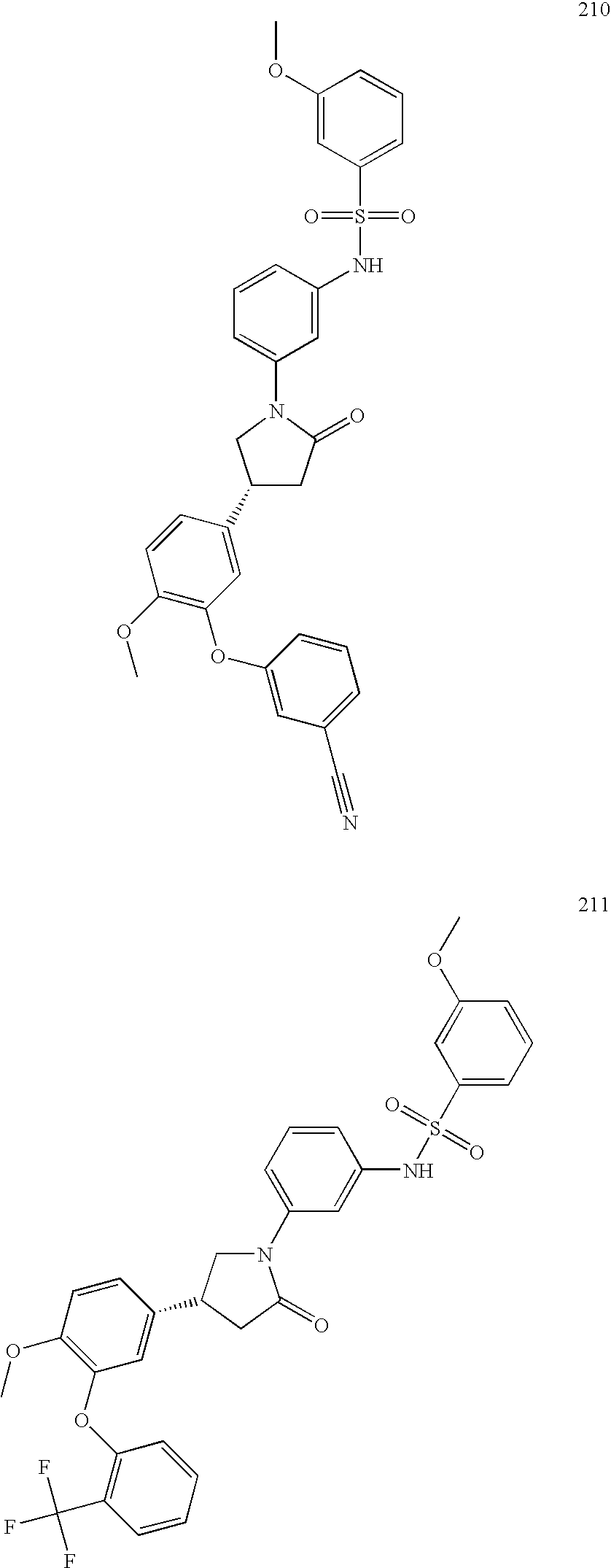


26. A pharmaceutical composition comprising the compound of claim 25 and a pharmaceutically acceptable excipient.
Priority Applications (2)
| Application Number | Priority Date | Filing Date | Title |
|---|---|---|---|
| US10/690,873 US7495016B2 (en) | 2002-10-21 | 2003-10-21 | Pyrrolidones with anti-HIV activity |
| US12/107,637 US7601742B2 (en) | 2002-10-21 | 2008-04-22 | Pyrrolidones with anti-HIV activity |
Applications Claiming Priority (3)
| Application Number | Priority Date | Filing Date | Title |
|---|---|---|---|
| US42048002P | 2002-10-21 | 2002-10-21 | |
| US42261902P | 2002-10-30 | 2002-10-30 | |
| US10/690,873 US7495016B2 (en) | 2002-10-21 | 2003-10-21 | Pyrrolidones with anti-HIV activity |
Related Child Applications (1)
| Application Number | Title | Priority Date | Filing Date |
|---|---|---|---|
| US12/107,637 Continuation US7601742B2 (en) | 2002-10-21 | 2008-04-22 | Pyrrolidones with anti-HIV activity |
Publications (2)
| Publication Number | Publication Date |
|---|---|
| US20040157859A1 US20040157859A1 (en) | 2004-08-12 |
| US7495016B2 true US7495016B2 (en) | 2009-02-24 |
Family
ID=32179797
Family Applications (2)
| Application Number | Title | Priority Date | Filing Date |
|---|---|---|---|
| US10/690,873 Expired - Fee Related US7495016B2 (en) | 2002-10-21 | 2003-10-21 | Pyrrolidones with anti-HIV activity |
| US12/107,637 Expired - Fee Related US7601742B2 (en) | 2002-10-21 | 2008-04-22 | Pyrrolidones with anti-HIV activity |
Family Applications After (1)
| Application Number | Title | Priority Date | Filing Date |
|---|---|---|---|
| US12/107,637 Expired - Fee Related US7601742B2 (en) | 2002-10-21 | 2008-04-22 | Pyrrolidones with anti-HIV activity |
Country Status (3)
| Country | Link |
|---|---|
| US (2) | US7495016B2 (en) |
| AU (1) | AU2003285952A1 (en) |
| WO (1) | WO2004037784A2 (en) |
Families Citing this family (22)
| Publication number | Priority date | Publication date | Assignee | Title |
|---|---|---|---|---|
| CN103251953A (en) * | 2004-07-19 | 2013-08-21 | 约翰·霍普金斯大学 | Flt3 inhibitors for immune suppression |
| MX2007006230A (en) * | 2004-11-30 | 2007-07-25 | Amgen Inc | Quinolines and quinazoline analogs and their use as medicaments for treating cancer. |
| CN101115481A (en) * | 2005-01-28 | 2008-01-30 | Irm责任有限公司 | Phenyl-substituted pyrrolidones |
| BRPI0607294A2 (en) * | 2005-01-28 | 2009-08-25 | Irm Llc | processes for synthesis of aryl pyrrolidones as well as mixing |
| JO2787B1 (en) | 2005-04-27 | 2014-03-15 | امجين إنك, | Substituted Amid derivatives & methods of use |
| PT1891038E (en) * | 2005-05-13 | 2008-12-02 | Lilly Co Eli | Substituted n-arylpyrrolidines as selective androgen receptor modulators |
| JP5164510B2 (en) * | 2006-10-06 | 2013-03-21 | 日本曹達株式会社 | Nitrogen-containing heterocyclic compounds and pest control agents |
| EP2103603A4 (en) * | 2006-12-07 | 2010-06-30 | Japan Tobacco Inc | Method for producing pyrrolidine compound |
| US8455513B2 (en) | 2007-01-10 | 2013-06-04 | Aerie Pharmaceuticals, Inc. | 6-aminoisoquinoline compounds |
| WO2008110351A2 (en) * | 2007-03-15 | 2008-09-18 | Dompe' Pha.R.Ma S.P.A. | Use of (r) and (s)-2-aryl-propionic acid derivatives as antiseptic agents |
| US8450344B2 (en) | 2008-07-25 | 2013-05-28 | Aerie Pharmaceuticals, Inc. | Beta- and gamma-amino-isoquinoline amide compounds and substituted benzamide compounds |
| EP3053913B1 (en) | 2009-05-01 | 2018-03-07 | Aerie Pharmaceuticals, Inc. | Dual mechanism inhibitors for the treatment of disease |
| JPWO2013146963A1 (en) * | 2012-03-28 | 2015-12-14 | 武田薬品工業株式会社 | Heterocyclic compounds |
| EP2975031A4 (en) | 2013-03-14 | 2017-04-19 | Takeda Pharmaceutical Company Limited | Heterocyclic compound |
| CN105263494A (en) | 2013-03-15 | 2016-01-20 | 爱瑞制药公司 | Combination therapy |
| US10053468B2 (en) | 2013-07-03 | 2018-08-21 | Takeda Pharmaceutical Company Limited | Heterocyclic compound |
| WO2015002230A1 (en) | 2013-07-03 | 2015-01-08 | 武田薬品工業株式会社 | Amide compound |
| EP3029031A4 (en) | 2013-07-30 | 2017-01-11 | Takeda Pharmaceutical Company Limited | Heterocyclic compound |
| CN109640966A (en) | 2016-08-31 | 2019-04-16 | 爱瑞制药公司 | Ophthalmic composition |
| CA3057872A1 (en) * | 2017-03-31 | 2018-10-04 | Aerie Pharmaceuticals, Inc. | Aryl cyclopropyl-amino-isoquinolinyl amide compounds |
| AU2019337703B2 (en) | 2018-09-14 | 2023-02-02 | Aerie Pharmaceuticals, Inc. | Aryl cyclopropyl-amino-isoquinolinyl amide compounds |
| JP2023544404A (en) * | 2020-10-06 | 2023-10-23 | ディー.イー.ショウ リサーチ,エルエルシー | Lactam Compounds as Kv1.3 Potassium SHAKER Channel Blockers |
Citations (6)
| Publication number | Priority date | Publication date | Assignee | Title |
|---|---|---|---|---|
| US4012495A (en) | 1974-03-20 | 1977-03-15 | Schering Aktiengesellschaft | 4-(Polyalkoxyphenyl)-2-pyrrolidones |
| US4193926A (en) | 1974-03-20 | 1980-03-18 | Schering Aktiengesellschaft | 4-(Polyalkoxy phenyl)-2-pyrrolidones |
| WO1993007141A1 (en) | 1991-10-11 | 1993-04-15 | Smithkline Beecham Corporation | Heterocyclic 3-phenylpyrrolidin-2-ones, their preparation and use for the manufacture of a medicament for inhibiting tumor necrosis factor production |
| US5547979A (en) | 1992-03-30 | 1996-08-20 | Smithkline Beecham | TNF inhibition |
| US5783591A (en) | 1984-10-19 | 1998-07-21 | Schering Aktiengesellschaft | Administration of oxazolidinone and pyrolidinone compounds for the treatment of inflammation |
| WO2003032981A1 (en) | 2001-10-16 | 2003-04-24 | Memory Pharmaceuticals Corporation | 4-(4-alkoxy-3-hydroxyphenyl)-2-pyrrolidone derivatives as pde-4 inhibitors for the treatment of neurological syndromes |
-
2003
- 2003-10-21 AU AU2003285952A patent/AU2003285952A1/en not_active Abandoned
- 2003-10-21 US US10/690,873 patent/US7495016B2/en not_active Expired - Fee Related
- 2003-10-21 WO PCT/US2003/033560 patent/WO2004037784A2/en not_active Ceased
-
2008
- 2008-04-22 US US12/107,637 patent/US7601742B2/en not_active Expired - Fee Related
Patent Citations (7)
| Publication number | Priority date | Publication date | Assignee | Title |
|---|---|---|---|---|
| US4012495A (en) | 1974-03-20 | 1977-03-15 | Schering Aktiengesellschaft | 4-(Polyalkoxyphenyl)-2-pyrrolidones |
| US4193926A (en) | 1974-03-20 | 1980-03-18 | Schering Aktiengesellschaft | 4-(Polyalkoxy phenyl)-2-pyrrolidones |
| US5783591A (en) | 1984-10-19 | 1998-07-21 | Schering Aktiengesellschaft | Administration of oxazolidinone and pyrolidinone compounds for the treatment of inflammation |
| US5998453A (en) | 1984-10-19 | 1999-12-07 | Schering Aktiengesellschaft | Oxazolidinone compounds and pharmaceutical preparation containing them |
| WO1993007141A1 (en) | 1991-10-11 | 1993-04-15 | Smithkline Beecham Corporation | Heterocyclic 3-phenylpyrrolidin-2-ones, their preparation and use for the manufacture of a medicament for inhibiting tumor necrosis factor production |
| US5547979A (en) | 1992-03-30 | 1996-08-20 | Smithkline Beecham | TNF inhibition |
| WO2003032981A1 (en) | 2001-10-16 | 2003-04-24 | Memory Pharmaceuticals Corporation | 4-(4-alkoxy-3-hydroxyphenyl)-2-pyrrolidone derivatives as pde-4 inhibitors for the treatment of neurological syndromes |
Non-Patent Citations (7)
| Title |
|---|
| Aebischer, et al., "Synthesis of N-Arylrolipram Derivatives-Potent and Selective Phosphodiesterase-IV Inhibitors-By Copper Catalyzed Lactam-Aryl Halide Coupling", Heterocycles, vol. 48, No. 11, pp. 2225-2229, 1998. |
| Bacher, Edmond et al, "N-Arylrolipram Derivatives as Potent and Selective PDE4 inhibitors," Bioorganic & Med. Chem. Letters, 1998 pp. 3229-3234 vol. 8. * |
| Bacher, Edmond, et al.; "N-Arylrolipram Derivatives as Potent and Selective PDE4 Inhibitors"; Bioorganic & Medicinal Chemistry Letters 1998 pp. 3229-3234 vol. 8. |
| Huff, et al., "HIV Protease: A Novel Chemotherapeutic Targe for AIDS," J. Med. Chem. vol. 34(8), 1991, pp. 2305-2314. * |
| Keller, Thomas H. et al, "Synthesis and Structure-Activity Relationship of N-Arylrolipram Derivatives as Inhibitors of PDE4 Isozymes," Chem. Pharm. Bull. 2001 pp. 1009-1017, vol. 49(8). * |
| Keller, Thomas H., et al.; "Synthesis and Structure-Activity Relationship of N-Arylrolipram Derivatives as Inhibitors of PDE4 Isozymes"; Chem. Pharm. Bull. 2001 pp. 1009-1017 vol. 49 No. 8. |
| Menendez-Arias, Luis, "Targeting HIV: antiretroviral therapy and development of drug resistance," Trends in Pharmaceutical Sciences, vol. 23(8), Aug. 2002. * |
Also Published As
| Publication number | Publication date |
|---|---|
| WO2004037784A2 (en) | 2004-05-06 |
| AU2003285952A8 (en) | 2004-05-13 |
| WO2004037784A3 (en) | 2004-08-19 |
| AU2003285952A1 (en) | 2004-05-13 |
| US7601742B2 (en) | 2009-10-13 |
| US20080255136A1 (en) | 2008-10-16 |
| US20040157859A1 (en) | 2004-08-12 |
Similar Documents
| Publication | Publication Date | Title |
|---|---|---|
| US7601742B2 (en) | Pyrrolidones with anti-HIV activity | |
| US7205328B2 (en) | Oxindoles with anti-HIV activity | |
| US20080287516A1 (en) | Phenyl-Substituted Pyrrolidones | |
| ES2238720T3 (en) | HETEROCICLIC DERIVATIVES OF AZAHEXANO ANTIVIRALLY ACTIVE. | |
| ES2550152T3 (en) | 2- (Piperidin-4-yl) -4-phenoxy-or phenylamino-pyrimidine derivatives as non-nucleoside reverse transcriptase inhibitors | |
| KR100418316B1 (en) | Retroviral protease inhibiting compounds | |
| KR100262056B1 (en) | Sulfonamide, an inhibitor of HIV-aspartyl protease | |
| TW500714B (en) | Cell adhesion inhibitors | |
| US6849639B2 (en) | Integrin inhibitors and their methods of use | |
| ES2244437T3 (en) | USEFUL PIPERAZINE DERIVATIVES AS AN CCG5 ANTAGONISTS. | |
| ES2380604T3 (en) | S-triazolyl alpha-mercaptoacetanilides as HIV reverse transcriptase inhibitors | |
| EP1013276A1 (en) | Aminoazacycloalkanes as CCR5 modulators | |
| UA63875C2 (en) | Substituted imidazoles, a process for the preparation thereof, a pharmaceutical composition based thereon and a method for treatment | |
| JP2005502682A (en) | Piperidine derivatives useful as CCR5 antagonists | |
| US7019141B2 (en) | Quinolones with anti-HIV activity | |
| US20060293297A1 (en) | Cyanofluoropyrrolidine derviative | |
| JP2002506854A (en) | Non-nucleoside inhibitors of reverse transcriptase, complex binding pockets and methods of use | |
| CN101965338B (en) | Heterocycle | |
| CN101309911A (en) | HIV-1 protease inhibitor and its preparation method and use method | |
| WO2024263781A1 (en) | Targeted degraders of hiv-1 nef for the treatment of hiv disease | |
| JP2000159747A (en) | New thiol derivative, its production and use | |
| US20060035932A1 (en) | N-aryl piperidine compounds | |
| KR20030060953A (en) | Novel compounds for use as hiv protease inhibitors | |
| CN100490811C (en) | Piperazine derivative used as CCRS antagonist |
Legal Events
| Date | Code | Title | Description |
|---|---|---|---|
| AS | Assignment |
Owner name: IRM LLC, BERMUDA Free format text: ASSIGNMENT OF ASSIGNORS INTEREST;ASSIGNORS:WU, BAOGEN;HE, YUN;NGUYEN, TRUC;AND OTHERS;REEL/FRAME:015219/0339;SIGNING DATES FROM 20040210 TO 20040409 |
|
| REMI | Maintenance fee reminder mailed | ||
| LAPS | Lapse for failure to pay maintenance fees | ||
| STCH | Information on status: patent discontinuation |
Free format text: PATENT EXPIRED DUE TO NONPAYMENT OF MAINTENANCE FEES UNDER 37 CFR 1.362 |
|
| FP | Lapsed due to failure to pay maintenance fee |
Effective date: 20130224 |