US7483080B2 - System for displaying images and method thereof - Google Patents
System for displaying images and method thereof Download PDFInfo
- Publication number
- US7483080B2 US7483080B2 US10/698,653 US69865303A US7483080B2 US 7483080 B2 US7483080 B2 US 7483080B2 US 69865303 A US69865303 A US 69865303A US 7483080 B2 US7483080 B2 US 7483080B2
- Authority
- US
- United States
- Prior art keywords
- monitor
- display
- aspect ratio
- video image
- information
- Prior art date
- Legal status (The legal status is an assumption and is not a legal conclusion. Google has not performed a legal analysis and makes no representation as to the accuracy of the status listed.)
- Expired - Lifetime, expires
Links
Images




Classifications
-
- G—PHYSICS
- G06—COMPUTING OR CALCULATING; COUNTING
- G06F—ELECTRIC DIGITAL DATA PROCESSING
- G06F3/00—Input arrangements for transferring data to be processed into a form capable of being handled by the computer; Output arrangements for transferring data from processing unit to output unit, e.g. interface arrangements
- G06F3/14—Digital output to display device ; Cooperation and interconnection of the display device with other functional units
- G06F3/1423—Digital output to display device ; Cooperation and interconnection of the display device with other functional units controlling a plurality of local displays, e.g. CRT and flat panel display
-
- H—ELECTRICITY
- H04—ELECTRIC COMMUNICATION TECHNIQUE
- H04N—PICTORIAL COMMUNICATION, e.g. TELEVISION
- H04N7/00—Television systems
- H04N7/01—Conversion of standards, e.g. involving analogue television standards or digital television standards processed at pixel level
- H04N7/0117—Conversion of standards, e.g. involving analogue television standards or digital television standards processed at pixel level involving conversion of the spatial resolution of the incoming video signal
- H04N7/0122—Conversion of standards, e.g. involving analogue television standards or digital television standards processed at pixel level involving conversion of the spatial resolution of the incoming video signal the input and the output signals having different aspect ratios
-
- G—PHYSICS
- G09—EDUCATION; CRYPTOGRAPHY; DISPLAY; ADVERTISING; SEALS
- G09G—ARRANGEMENTS OR CIRCUITS FOR CONTROL OF INDICATING DEVICES USING STATIC MEANS TO PRESENT VARIABLE INFORMATION
- G09G2340/00—Aspects of display data processing
- G09G2340/04—Changes in size, position or resolution of an image
- G09G2340/0442—Handling or displaying different aspect ratios, or changing the aspect ratio
-
- G—PHYSICS
- G09—EDUCATION; CRYPTOGRAPHY; DISPLAY; ADVERTISING; SEALS
- G09G—ARRANGEMENTS OR CIRCUITS FOR CONTROL OF INDICATING DEVICES USING STATIC MEANS TO PRESENT VARIABLE INFORMATION
- G09G2340/00—Aspects of display data processing
- G09G2340/04—Changes in size, position or resolution of an image
- G09G2340/045—Zooming at least part of an image, i.e. enlarging it or shrinking it
-
- G—PHYSICS
- G09—EDUCATION; CRYPTOGRAPHY; DISPLAY; ADVERTISING; SEALS
- G09G—ARRANGEMENTS OR CIRCUITS FOR CONTROL OF INDICATING DEVICES USING STATIC MEANS TO PRESENT VARIABLE INFORMATION
- G09G2340/00—Aspects of display data processing
- G09G2340/04—Changes in size, position or resolution of an image
- G09G2340/0464—Positioning
-
- G—PHYSICS
- G09—EDUCATION; CRYPTOGRAPHY; DISPLAY; ADVERTISING; SEALS
- G09G—ARRANGEMENTS OR CIRCUITS FOR CONTROL OF INDICATING DEVICES USING STATIC MEANS TO PRESENT VARIABLE INFORMATION
- G09G2340/00—Aspects of display data processing
- G09G2340/12—Overlay of images, i.e. displayed pixel being the result of switching between the corresponding input pixels
- G09G2340/125—Overlay of images, i.e. displayed pixel being the result of switching between the corresponding input pixels wherein one of the images is motion video
Definitions
- video streams typically include information describing the image including an aspect ratio at which the video it is to be displayed.
- Information, such as the aspect ratio is read by a video decoder and provided to an application associated with the display of the video.
- Video applications generally support the ability to modify the aspect ratio of an image.
- the rendering side of the display driver does not have access to the aspect ratio maintained by the application.
- the rendering side of the display driver is configured by the application with display control information, such as source an destination rectangles, to control the actual display of the image without the use of the actual aspect ratio.
- the ability to display a video image on multiple display devices from a common platform has been accomplished by providing multiple sets of display control information from a specific application to one or more display drivers.
- a video application provides a different set of display driver information for each display device. Because the application controls the set up of the display drivers, only source and destination video rectangles are typically provided to the device drivers to control the display of the image on both display devices. In this manner, it is known to support display of different portions of a video image on different displays by calculating and providing multiple source and destination rectangles to one or more display drivers. This support of multiple displays requires that the application be aware of each display device that is to display the image. A method and system capable of displaying video at different locations on multiple display devices using a common set of display driver data would be useful.
- the present disclosure relates generally to data processing, and more specifically to image processing.
- FIG. 1 is a block diagram of a system in accordance with the present disclosure
- FIG. 2 is a block diagram representation of video system and overlay information in accordance with the present disclosure
- FIGS. 3-9 are block diagrams representing systems having specific overlay information in accordance with specific embodiments of the disclosure.
- FIGS. 10 and 11 are flow diagrams representing methods in accordance with specific embodiments of the present disclosure.
- FIG. 12 represents, in block diagram form, a system in accordance with the present disclosure.
- a first set of display information is received at a device driver.
- the first set of display information indicates a portion of the video image to be displayed in a first window of a first monitor.
- An aspect ratio of the video image is determined based on the first set of display information. Based on the determined aspect ratio, the display driver determines a location on a second display device where the video image is to also be displayed.
- FIG. 1 illustrates, in block diagram form, a system in accordance with the present disclosure.
- FIG. 1 includes a system 10 and display devices 20 and 30 .
- System 10 can represent a data processing system such as a personal computer, a set-top box, a hand-held device, and the like.
- a display driver storage location 14 for storing video specific control information to be used by the display driver.
- Specific information stored in location 14 includes data represented by variables RNV, RS, and RD.
- Variable RNV represents the rectangle of the native video image, where the native video is received from a video source such as a digital television stream, MPEG2 video file, analog to digital capture device, video cassette recorder (VCR), and/or a DVD player, to name a few.
- the variable RNV represents a rectangle indicating the resolution of the native video.
- the native video has a native video aspect ratio based upon a resolution of the transmitted video signal.
- FIG. 2 illustrates in block form a representation of video information as may be stored in video memory 39 .
- Rectangle 40 represents native video
- points 41 and 42 represent two diagonally opposed corners of the native video that define a rectangle containing the entire native video image and generally represent the variable RNV.
- Variable RS indicates a portion of the native video, referred to as the source video, that is to be displayed on a display device.
- the variable RS defines a rectangle that indicates some or all of the native video. Referring to FIG. 2 , a rectangle formed by points 42 and 43 indicate corners of a rectangle defining the location of the source video that is to displayed in the display device 20 of FIG. 1 .
- variable RD The location within display device 20 where the source video is to be displayed is defined by variable RD, which is the destination rectangle
- display device 20 is assumed to have a resolution of 1024 ⁇ 768.
- the destination rectangle is indicated by the rectangle formed by points 56 and 57 , which are illustrated to be part of a video overlay frame 50 .
- the video overlay frame 50 is mapped to correspond to the display area of the display device 20 .
- the fact that the video overlay frame 50 is mapped to correspond to the display area of the display device 20 is indicated by the common use of references 51 and 52 at the corners of the display portion of display device 20 and in overlay frame 50 .
- the rectangle defined by points 56 and 57 represents where the video identified by the source video rectangle (RS), defined by points 43 and 42 , is to be displayed on the display device 20 .
- a corresponding set of points 56 and 57 are also indicated on the display device 20 .
- the destination points 56 and 57 correspond to the data portion of an application window, as opposed to the title/menu bar of an application window.
- DISPLAY MODULE 16 of system 10 is controlled by the variables RS and RD, which define for the DISPLAY MODULE 16 a portion of native video to be displayed, and where this portion is to be displayed.
- the DISPLAY MODULE 16 scales the source video as needed to fit into the destination rectangle defined by points 56 and 57 . Relative to FIG. 2 , it is assumed that the source video, defined by points 43 and 42 , represent the right-most horizontal 1 ⁇ 3 of the native video image 40 .
- the DISPLAY MODULE 16 needs to downscale the source video defined by points 43 and 42 by 2 ⁇ in the vertical dimension as a result of being fitted within the destination rectangle (RD) defined by points 56 and 57 , and that a horizontal scaling of 1 ⁇ has been performed.
- display module 18 determines a display location for the native video image on the second display device 30 based on variables RNV, RS and RD, while preserving the aspect ratio set by an application providing the variables.
- display device 30 is assumed to have a resolution of 1280 ⁇ 1024. It will be appreciated that the resolution of the display devices 20 and 30 may be the same or different.
- the display location of the video on the display device 30 is defined by a rectangle with corner points 31 and 32 that allow the entire video image to be displayed at the 3:1 aspect ratio.
- the points 31 and 32 are determined at the rendering side of the driver based upon the video information RNV, RS, and RD that is associated with displaying the portion of the image on the display device 20 .
- the unreduced aspect ratio X:Y of the image, as currently being displayed by an application can be determined by the equation: X:Y ⁇ [D ( x )/ S ( x )]* NV ( x ) ⁇ : ⁇ [ D ( y )/ S ( y )]* NV ( y ) ⁇ (Equation 1)
- the aspect ratio X:Y provided by Equation 1 is also a resolution at which the image can be displayed.
- TABLE 1 uses exemplary values for the points associated with the variables RNV, RS and RD of FIGS. 1 and 2 where the native video image has a resolution of 720 ⁇ 480 and an aspect ratio of 3:2.
- Column 1 contains variables of the form VARIABLE (TL, LR), where TL is the point indicating the Top Left corner of a rectangle VARIABLE, and LR is the point indicating the Lower Right corner of the rectangle VARIABLE.
- Column 2 indicates the x, y coordinates associated with the point TL.
- Column 3 indicates the x, y coordinates associated with the point LR. Coordinates are provided for variables NV, RS, and RD, from which the variables of Equation 1 are determined.
- Equation Set 2 that solves for the modified image resolution, i.e., unreduced aspect ratio, as set by an application.
- the aspect ratio of 720:240 reduces to an aspect ratio of 3:1.
- the image can be fitted onto the second display device.
- the scaled image is fitted to maintain a resolution of 720:240, while in another embodiment, as illustrated in FIGS. 1 and 2 , the scaled image is fitted to obtain a maximum image size, or other constrained image size, on an available monitor for the calculated aspect ratio.
- FIG. 3 illustrates an alternate embodiment of the present disclosure in greater detail.
- FIG. 3 illustrates a system comprising a data processor 110 , display device 120 , and display device 130 .
- System 110 comprises an application labeled APP 111 , an application labeled APP 112 , an application labeled VIDEO APP 113 , VIDEO DRIVERS 114 , VIDEO/DISPLAY MEMORY 115 , and VIDEO/GRAPHICS PROCESSOR 118 .
- APP 111 is an application associated with window 121 on display device 120 ;
- APP 112 is an application associated with window 122 on display device 120 ;
- VIDEO APP 113 is a video application associated with window 123 on display device 120 that controls the display of a video image within the active portion 158 of window 123 defined by points 156 and 157 .
- the display device 120 has a resolution of 1024 ⁇ 768.
- VIDEO APP 113 interfaces with VIDEO DRIVERS 114 , which in turn interface with the video/graphics processor 118 to control the display of video images on display device 120 .
- the variables RNV, RS 1 , and RD 1 are stored in a memory location for access by the driver 114 , where RNV represents a rectangle defining the resolution of the native video.
- VIDEO DRIVERS 114 may represent one or more drives
- MEMORY 115 is illustrated in detail to include NATIVE VIDEO 143 defined by rectangle 140 ; DESTINATION FRAME 156 , defined by rectangle 150 , which corresponds to display device 120 ; and DESTINATION FRAME 166 , defined by rectangle 150 , corresponding to display device 130 .
- NATIVE VIDEO 143 represents a video image as may be received and stored.
- the points 141 and 142 represent two diagonally opposed corners of NATIVE VIDEO 143 that define a rectangle containing the entire native video image.
- the source rectangle (RS 1 ) is coincident to the entire NATIVE VIDEO 143 , and therefore is also defined by points 141 and 142 .
- DESTINATION FRAME 156 represents a frame with an overlay indicator 149 corresponding to the variable RD 1 that identifies the destination for source video on the display device 120 .
- DESTINATION FRAME 165 represents a frame with an overlay indicator 159 corresponding to a location determined by the display driver using the variables NV, RS 1 , and RD 1 .
- the overlay indicator 159 indicates where a scaled, or unscaled, video is to be inserted with respect to the display of display device 130 .
- display device 130 has a resolution of 1280 ⁇ 1024.
- Display device 120 is illustrated displaying three separate application windows 121 , 122 , and 123 corresponding to applications APP 111 , APP 112 and VIDEO APP 113 . It will be appreciated that the application windows can overlap each other completely, partially, or not at all.
- Each of the application windows 121 123 are illustrated to include a title bar/control area, such as region 124 of window 123 , and an active window portion, such as the region 158 of window 123 defined by the rectangle having points 156 and 157 at diagonally opposed corners.
- An image, based on the NATIVE VIDEO 143 is to be displayed within the active window portion of application window 123 , which can be manipulated by a user to change the location and aspect ratio of the video image.
- an application such as VIDEO APP 113
- VIDEO/GRAPHICS PROCESSOR 118 accesses the native video image, and scales the video image as needed before providing the image to display device 120 for display on its monitor.
- the image can be reproduced on the display device 130 for simultaneous display.
- Equation 1 Substituting the values from TABLE 2 into Equation 1 results in the following set of equations solving for image resolution, i.e., aspect ratio, as set at an application.
- the resolution of 720:480 reduces to an aspect ratio of 3:5, which is the same as the native video.
- the image can be fitted onto the second display device 130 .
- the video is placed to maintain the actual resolution of 640:400, while in another embodiment, as illustrated in FIG. 3 , the video image is fitted onto the monitor to obtain a maximum image size for the modified aspect ratio.
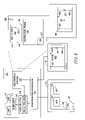
- FIG. 4 illustrates an alternate embodiment of the present disclosure where the video image displayed by the VIDEO APP 113 has been modified to change the aspect ratio of the displayed image by changing the destination rectangle to RS 2 .
- this is accomplished by a user interfacing with the VIDEO APP 113 through a user interface.
- the lower edge of the window 123 has been moved up to form a different size window 223 .
- Window 223 now has an aspect ratio that has a larger horizontal component relative to the vertical component.
- the active window portion 258 of window 223 is now 1 ⁇ 2 the vertical height of the active window portion 158 of FIG. 3
- the following TABLE 3 data and Equation Set 4 determine the new resolution and aspect ratio. Reference points that have not changed have maintained the same reference numbers in TABLE 3.
- Equation Set 2 Substituting the values from TABLE 3 into Equation Set 2 results in the following set of equations solving for the aspect ratio as set at an application.
- the aspect ratio of 720:240 reduces to an aspect ratio of 3:1.
- the image can be fitted onto the second display device.
- the scaled image is positioned to maintain a resolution of 720:240, while in another embodiment, as illustrated in FIG. 3 , an image is fitted to obtain a maximum image size on an available monitor for the determined aspect ratio. In this manner, it is possible for an image to be displayed on more than one display device using a common set of display driver information. As a result, it is not necessary for the application program that is setting the video driver information to have knowledge of the second display device.
- FIG. 5 illustrates an alternate embodiment of the present disclosure where the video image of FIG. 4 , displayed by the VIDEO APP 113 , has been modified by being shifted partially off screen, without changing the aspect ratio. This is accomplished by changing the source and destination rectangles to RS 2 and RD 3 . Typically such a shift will be accomplished by a user interfacing with the VIDEO APP 113 through a user interface.
- the left edge of the window 123 has been moved off screen to form new window 323 whereby a horizontal portion of the video is shifted past the vertical edge of the monitor (e.g., at least one column width of pixels is shifted off screen).
- the following TABLE 4 and Equation Set 5 determine the new aspect ratio.
- Equation Set 3 X:Y ⁇ [D ( x )/ S ( x )]* NV ( x ) ⁇ : ⁇ [ D ( y )/ S ( y )]* NV ( y ) ⁇ X:Y ⁇ [(288 ⁇ 0)/(720 ⁇ 432)]*(720 ⁇ 0) ⁇ : ⁇ [(624 ⁇ 384)/(480 ⁇ 0)]*(480 ⁇ 0) ⁇ X:Y ⁇ [(288)/(288)]*(720) ⁇ : ⁇ [(240)/(480)]*(480) ⁇ X:Y ⁇ 720 ⁇ : ⁇ 240 ⁇ Aspect Ratio (Equation Set 3)
- Equation 1 allows for the resolution and aspect ratio of the video image to be determined even when only a partial image is displayed onscreen.
- FIG. 6 illustrates an alternate embodiment of the present disclosure where the video image of FIG. 5 , displayed by the VIDEO APP 113 , has been modified by having its aspect ratio changed by expanding the active portion of window 323 , FIG. 5 , while a portion of the image is offscreen, to obtain window 423 in FIG. 6 .
- This has been accomplished by changing the destination rectangle to RD 4 .
- Typically such a change in aspect ratio will be accomplished by a user interfacing with the VIDEO APP 113 through a user interface.
- the left edge of the window 123 continues to be offscreen.
- active portion 458 of window 323 has been expanded by 2 ⁇ in the vertical direction, the following table and equations determine the new resolution and aspect ratio.
- Equation 1 Substituting the values from TABLE 5 into Equation 1 results in the following set of equations solving for the aspect ratio, as set at an application.
- Equation 1 allows for the resolution and aspect ratio of the video image to be changed offscreen and still determine the aspect ratio.
- FIG. 7 illustrates a specific embodiment, where the video window is partially off the bottom of the screen resulting in a vertical portion of the video being shifted offscreen, i.e., clipped by a horizontal edge of the display device 120 .
- FIG. 8 illustrates a specific embodiment where the window is shifted to be partially off-screen in both a vertical and a horizontal direction.
- FIG. 9 illustrates a specific embodiment where the image of FIG. 8 has its aspect ratio modified while partially off-screen.
- Equation 1 can be used to determine the appropriate resolution and/or aspect ratio of the image as scaled by the VIDEO APP 113 for display on a separate monitor without the knowledge and/or intervention of the video application.
- FIG. 10 illustrates, in flow diagram form, a method in accordance with the present disclosure.
- a device driver determines display information for a video image to be displayed in a first window of first monitor.
- the device driver can determine the display information by receiving the information from an application, or by accessing the information from a storage location.
- the display information is used to determine at the device driver a display location for the video image on a second monitor.
- a video image is displayed in window 21 between points 56 and 57 on monitor 20 , and the same video image content is displayed on the monitor 30 between points 56 ′ and 32 .
- the video image may be a portion of an available image, such as the image on display device 120 of FIG. 7 between points 525 and 557 and the corresponding image between points 427 and 557 ′ on DEVICE 130 .
- the method of FIG. 10 allows for a display driver to support multiple display devices without the knowledge of the overlying application program. As illustrated in FIG. 1 , one embodiment allows the video from the video application to be displayed on a separate monitor independent of the application window.
- FIG. 11 illustrates, in flow diagram form, a method in accordance with the present disclosure.
- a resolution for a second monitor is determined.
- the resolution of the second monitor can be received at the device driver, or by a query to the device driver which would then supply the information. In one embodiment, it would be consistent for an overlying application program to assist in determining the resolution of the second monitor. In an alternate embodiment, the resolution of the second monitor would be determined without knowledge and/or intervention of an overlying application program.
- the device driver determines a first display information for the video image to be displayed at a first location within an application window of the first monitor.
- One way that the device driver can determine the first display information is to receive the information from an application, or access the information from a storage location.
- the first display information and the resolution of the second monitor are used by the device driver to determine a second display location for the video image on a second monitor.
- a video image is displayed in a window 21 , on monitor 20 , at a first location between points 56 and 57 ; and the same video image is displayed on the monitor of display device 30 at a second location between points 56 ′ and 32 .
- the video image is not necessarily displayed at the same resolution on the display devices 20 and 30 .
- the display driver determines a second display information for the video image, which is to be displayed at a third location of the first monitor.
- the second display information will typically represent new video display information received at the display driver from a video application concerning the image to be displayed, such as different source and destination rectangles stored in MEMORY 114 as illustrated in FIGS. 3-4 .
- the second display information and the resolution of the second monitor are used by the device driver to determine a new display location for the video image on a second monitor. For example, if the second display information results in a new aspect ratio being detected, it will be represented in the new display location on the second monitor.
- FIG. 12 illustrates, in block diagram form, a PROCESSING DEVICE 500 that may represent a data processing system, such as a personal computer system.
- the PROCESSING DEVICE 500 is illustrated to include a CENTRAL PROCESSING UNIT 510 , which may be a conventional proprietary data processor; memory, including RANDOM ACCESS MEMORY 512 , READ ONLY MEMORY 514 ; INPUT OUTPUT ADAPTER 522 ; a USER INTERFACE ADAPTER 520 ; a COMMUNICATIONS INTERFACE ADAPTER 524 ; and a MULTIMEDIA CONTROLLER 526 .
- the INPUT OUTPUT (I/O) ADAPTER 522 is further connected to, and controls, DISK DRIVES 547 , PRINTER 545 , REMOVABLE STORAGE DEVICES 546 , as well as other standard and proprietary I/O devices.
- the USER INTERFACE ADAPTER 520 can be considered to be a specialized I/O adapter.
- the adapter 520 is illustrated to be connected to a mouse 540 , and a keyboard 541 .
- the user INTERFACE ADAPTER 520 may be connected to other devices capable of providing various types of user control, such as touch screen devices.
- the COMMUNICATIONS INTERFACE ADAPTER 524 is connected to a bridge 550 such as is associated with a local or a wide area network, and a modem 551 .
- a bridge 550 such as is associated with a local or a wide area network
- a modem 551 By connecting the SYSTEM BUS 502 to various communication devices, external access to information can be obtained.
- the MULTIMEDIA CONTROLLER 526 will generally include a video graphics controller, such as the type described herein, capable of displaying images upon the monitor 560 , which may represent multiple monitors, as well as providing audio to external components (not illustrated).
- a video graphics controller such as the type described herein, capable of displaying images upon the monitor 560 , which may represent multiple monitors, as well as providing audio to external components (not illustrated).
- the SYSTEM 500 will be capable of implementing the system and methods described herein.
Landscapes
- Engineering & Computer Science (AREA)
- Theoretical Computer Science (AREA)
- Human Computer Interaction (AREA)
- Physics & Mathematics (AREA)
- General Engineering & Computer Science (AREA)
- General Physics & Mathematics (AREA)
- Computer Graphics (AREA)
- Multimedia (AREA)
- Signal Processing (AREA)
- Controls And Circuits For Display Device (AREA)
Abstract
Description
X:Y→{[D(x)/S(x)]* NV (x)}:{[D(y)/S(y)]*NV(y)} (Equation 1)
-
- where:
- D(x) is the horizontal resolution or distance of the destination rectangle;
- D(y) is the vertical resolution or distance of the destination rectangle;
- S(x) is the horizontal resolution or distance of the source rectangle;
- S(y) is the horizontal resolution or distance of the source rectangle;
- NV(x) is the horizontal resolution or distance of the native video rectangle; and
- NV(y) is the vertical resolution or distance of the native video rectangle.
| TABLE 1 | ||||
| VARIABLE | TL(x, y) | LR(x, y) | ||
| NV(P41, P42) | 0, 0 | 720, 480 | ||
| S(P43, P42) | 480, 0 | 720, 480 | ||
| D(P56, P57) | 0, 392 | 240, 632 | ||
X:Y→{[D(x)/S(x)]*NV(x)}:{[D(y)/S(y)]*NV(y)}
X:Y→{[(240−0)/(720−480)]*(720−0)}:{[(632−392)/(480−0)]*(480−0)}
X:Y→{[(240)/(240)]*(720)}:{[(240)/(480)]*(480)}
X:Y→{[1]*(720)}:{[½]*(480)}
X:Y→720:240←Aspect Ratio (Equation Set 2)
| TABLE 2 | ||||
| Variable | UL(x, y) | LR(x, y) | ||
| NV(P141, P142) | 0, 0 | 720, 480 | ||
| S(P141, P142) | 0, 0 | 720, 480 | ||
| D(P156, P157) | 152, 384 | 872, 864 | ||
X:Y→{[D(x)/S(x)]*NV(x)}:{[D(y)/S(y)]*NV(y)}
X:Y→{[(872−152)/(720−0)]*(720−0)}:{[(864−384)/(480−0)]*(480−0)}
X:Y→{[(720)/(720)]*(720)}:{[(480)/(480)]*(480)}
X:Y→{720 }:{480}←Aspect Ratio (Equation Set 3)
| TABLE 3 | ||||
| Variable | UL(x, y) | LR(x, y) | ||
| NV(P141, P142) | 0, 0 | 720, 480 | ||
| S(P141, P142) | 0, 0 | 720, 480 | ||
| D(P156, P257) | 152, 384 | 872, 624 | ||
X:Y→{[D(x)/S(x)]*NV(x)}:{[D(y)/S(y)]*NV(y)}
X:Y→{[(872−152)/(720−0)]*(720−0)}:{[(624−384)/(480−0)]*(480−0)}
X:Y→{[(720)/(720)]*(720)}:{[(240)/(480)]*(480)}
X:Y→{720 }:{240}←Aspect Ratio (Equation Set 2)
| TABLE 4 | ||||
| Variable | UL(x, y) | LR(x, y) | ||
| NV(P141, P142) | 0, 0 | 720, 480 | ||
| S(P343, P142) | 432, 0 | 720, 480 | ||
| D(P325, P357) | 0, 384 | 288, 624 | ||
X:Y→{[D(x)/S(x)]*NV(x)}:{[D(y)/S(y)]*NV(y)}
X:Y→{[(288−0)/(720−432)]*(720−0)}:{[(624−384)/(480−0)]*(480−0)}
X:Y→{[(288)/(288)]*(720)}:{[(240)/(480)]*(480)}
X:Y→{720 }:{240}←Aspect Ratio (Equation Set 3)
| TABLE 5 | ||||
| Variable | LL(x, y) | UR(x, y) | ||
| NV(P141, P142) | 0, 0 | 720, 480 | ||
| S(P343, P142) | 432, 0 | 720, 480 | ||
| D(P425, P357) | 0, 384 | 288, 864 | ||
X:Y→{[D(x)/S(x)]*NV(x)}:{[D(y)/S(y)]*NV(y)}
X:Y→{[(288−0)/(720−432)]*(720−0)}:{[(864−384)/(480−0)]*(480−0)}
X:Y→{[(288)/(288)]*(720)}:{[(480)/(480)]*(480)}
X:Y→{720 }:{480}←Aspect Ratio (Equation Set 2)
Claims (31)
Priority Applications (1)
| Application Number | Priority Date | Filing Date | Title |
|---|---|---|---|
| US10/698,653 US7483080B2 (en) | 2003-10-31 | 2003-10-31 | System for displaying images and method thereof |
Applications Claiming Priority (1)
| Application Number | Priority Date | Filing Date | Title |
|---|---|---|---|
| US10/698,653 US7483080B2 (en) | 2003-10-31 | 2003-10-31 | System for displaying images and method thereof |
Publications (2)
| Publication Number | Publication Date |
|---|---|
| US20050097476A1 US20050097476A1 (en) | 2005-05-05 |
| US7483080B2 true US7483080B2 (en) | 2009-01-27 |
Family
ID=34550711
Family Applications (1)
| Application Number | Title | Priority Date | Filing Date |
|---|---|---|---|
| US10/698,653 Expired - Lifetime US7483080B2 (en) | 2003-10-31 | 2003-10-31 | System for displaying images and method thereof |
Country Status (1)
| Country | Link |
|---|---|
| US (1) | US7483080B2 (en) |
Cited By (4)
| Publication number | Priority date | Publication date | Assignee | Title |
|---|---|---|---|---|
| US20120042265A1 (en) * | 2010-08-10 | 2012-02-16 | Shingo Utsuki | Information Processing Device, Information Processing Method, Computer Program, and Content Display System |
| US8779265B1 (en) | 2009-04-24 | 2014-07-15 | Shindig, Inc. | Networks of portable electronic devices that collectively generate sound |
| US20170041657A1 (en) * | 2013-02-26 | 2017-02-09 | Roku, Inc. | Method and apparatus for automatic second screen engagement |
| US20180309938A1 (en) * | 2013-08-22 | 2018-10-25 | Gopro, Inc. | Conversion between aspect ratios in camera |
Families Citing this family (10)
| Publication number | Priority date | Publication date | Assignee | Title |
|---|---|---|---|---|
| WO2005031526A2 (en) * | 2003-09-23 | 2005-04-07 | Amazon.Com, Inc. | Personalized searchable library based on user ownership |
| US7496560B2 (en) * | 2003-09-23 | 2009-02-24 | Amazon Technologies, Inc. | Personalized searchable library with highlighting capabilities |
| JP4585795B2 (en) * | 2004-06-03 | 2010-11-24 | キヤノン株式会社 | Display driving apparatus and control method thereof |
| JP3729417B1 (en) * | 2004-09-07 | 2005-12-21 | ソニー株式会社 | Information processing apparatus and method, and program |
| US20080100642A1 (en) * | 2006-10-31 | 2008-05-01 | International Business Machines Corporation | User definable aspect ratios for image regions |
| KR20090036779A (en) * | 2007-10-10 | 2009-04-15 | 삼성전자주식회사 | Display Devices, Systems, and Methods |
| US8289301B2 (en) * | 2007-11-07 | 2012-10-16 | Young Electric Sign Company | Apparatus and method for control of multiple displays |
| TWI400638B (en) * | 2009-10-20 | 2013-07-01 | Acer Inc | Touch display device, touch display system and method for adjusting touch area thereof |
| US9344696B2 (en) * | 2014-07-29 | 2016-05-17 | Texas Instruments Incorporated | Methods and apparatus for optical display using multiple spatial light modulators for increased resolution |
| EP4391563A4 (en) * | 2022-01-14 | 2025-01-01 | Samsung Electronics Co., Ltd. | Method for providing image and electronic device supporting same |
Citations (6)
| Publication number | Priority date | Publication date | Assignee | Title |
|---|---|---|---|---|
| US4394690A (en) * | 1980-04-25 | 1983-07-19 | Sony Corporation | Variable aspect ratio television receiver |
| US5532719A (en) * | 1994-01-14 | 1996-07-02 | Cordata, Inc. | Remote control of display functions |
| US5682529A (en) | 1994-03-14 | 1997-10-28 | Apple Computer, Inc. | System for dynamically accommodating changes in display configuration by notifying changes to currently running application programs to generate information by application programs to conform to changed configuration |
| US5986635A (en) | 1996-04-23 | 1999-11-16 | Hitachi, Ltd. | Processor for converting pixel number of video signal and display apparatus using the same |
| US6081265A (en) | 1996-08-30 | 2000-06-27 | Hitachi, Ltd. | System for providing a same user interface and an appropriate graphic user interface for computers having various specifications |
| US6864921B2 (en) * | 2000-10-17 | 2005-03-08 | Sony Corporation | Display control system for controlling a display screen formed of multiple display units |
-
2003
- 2003-10-31 US US10/698,653 patent/US7483080B2/en not_active Expired - Lifetime
Patent Citations (6)
| Publication number | Priority date | Publication date | Assignee | Title |
|---|---|---|---|---|
| US4394690A (en) * | 1980-04-25 | 1983-07-19 | Sony Corporation | Variable aspect ratio television receiver |
| US5532719A (en) * | 1994-01-14 | 1996-07-02 | Cordata, Inc. | Remote control of display functions |
| US5682529A (en) | 1994-03-14 | 1997-10-28 | Apple Computer, Inc. | System for dynamically accommodating changes in display configuration by notifying changes to currently running application programs to generate information by application programs to conform to changed configuration |
| US5986635A (en) | 1996-04-23 | 1999-11-16 | Hitachi, Ltd. | Processor for converting pixel number of video signal and display apparatus using the same |
| US6081265A (en) | 1996-08-30 | 2000-06-27 | Hitachi, Ltd. | System for providing a same user interface and an appropriate graphic user interface for computers having various specifications |
| US6864921B2 (en) * | 2000-10-17 | 2005-03-08 | Sony Corporation | Display control system for controlling a display screen formed of multiple display units |
Cited By (11)
| Publication number | Priority date | Publication date | Assignee | Title |
|---|---|---|---|---|
| US8779265B1 (en) | 2009-04-24 | 2014-07-15 | Shindig, Inc. | Networks of portable electronic devices that collectively generate sound |
| US9401132B2 (en) | 2009-04-24 | 2016-07-26 | Steven M. Gottlieb | Networks of portable electronic devices that collectively generate sound |
| US20120042265A1 (en) * | 2010-08-10 | 2012-02-16 | Shingo Utsuki | Information Processing Device, Information Processing Method, Computer Program, and Content Display System |
| US20170041657A1 (en) * | 2013-02-26 | 2017-02-09 | Roku, Inc. | Method and apparatus for automatic second screen engagement |
| US10602211B2 (en) * | 2013-02-26 | 2020-03-24 | Roku, Inc. | Method and apparatus for automatic second screen engagement |
| US20180309938A1 (en) * | 2013-08-22 | 2018-10-25 | Gopro, Inc. | Conversion between aspect ratios in camera |
| US10368013B2 (en) * | 2013-08-22 | 2019-07-30 | Gopro, Inc. | Conversion between aspect ratios in camera |
| US10819918B2 (en) | 2013-08-22 | 2020-10-27 | Gopro, Inc. | Conversion between aspect ratios in camera |
| US11190709B2 (en) | 2013-08-22 | 2021-11-30 | Gopro, Inc. | Conversion between aspect ratios in camera |
| US11722631B2 (en) | 2013-08-22 | 2023-08-08 | Gopro, Inc. | Conversion between aspect ratios in camera |
| US12302028B2 (en) | 2013-08-22 | 2025-05-13 | Gopro, Inc. | Conversion between aspect ratios in camera |
Also Published As
| Publication number | Publication date |
|---|---|
| US20050097476A1 (en) | 2005-05-05 |
Similar Documents
| Publication | Publication Date | Title |
|---|---|---|
| US20050097476A1 (en) | System for displaying images and method thereof | |
| US5388202A (en) | Method and apparatus for generating window borders having pictorial frame elements | |
| US5546531A (en) | Visual frame buffer architecture | |
| CA2417250C (en) | Scaling images | |
| US20070076020A1 (en) | Method and apparatus for nonlinear anamorphic scaling of video images | |
| JPS62242281A (en) | Digital video generator | |
| MY151680A (en) | Storage medium storing interactive graphics stream, and reproducing apparatus and method | |
| JP2502728B2 (en) | Video data processor | |
| US20070130539A1 (en) | Apparatus and method for displaying image | |
| US5640175A (en) | Dynamic image display device | |
| US7893943B1 (en) | Systems and methods for converting a pixel rate of an incoming digital image frame | |
| US7362340B2 (en) | Method for controlling resolution of graphic image | |
| US5870074A (en) | Image display control device, method and computer program product | |
| JPH04174497A (en) | Display controlling device | |
| US6473101B1 (en) | Single surface multi-view panning system and method for multiple displays | |
| EP0486090B1 (en) | Display method and apparatus | |
| US20040027484A1 (en) | Advertisement display method of mixing, advertisement pictures with tv broadcasting pictures, mobile communication pictures and pictures of picture storage mediums | |
| JPS61215587A (en) | Image display unit | |
| KR100188664B1 (en) | Sub-picture display method | |
| JPH0764524A (en) | Image display device | |
| JP2000181440A (en) | Display device | |
| JPH04123221A (en) | Device for calibrating touch panel | |
| US20040021692A1 (en) | Method for controlling a multimedia document display | |
| JP3024175B2 (en) | Multi-window display device | |
| JP3264941B2 (en) | Image display control method and apparatus |
Legal Events
| Date | Code | Title | Description |
|---|---|---|---|
| AS | Assignment |
Owner name: ATI TECHNOLOGIES, INC., ONTARIO Free format text: ASSIGNMENT OF ASSIGNORS INTEREST;ASSIGNORS:ARORA, JITESH;CAO, PETER X.;REEL/FRAME:014667/0531 Effective date: 20031031 |
|
| FEPP | Fee payment procedure |
Free format text: PAYOR NUMBER ASSIGNED (ORIGINAL EVENT CODE: ASPN); ENTITY STATUS OF PATENT OWNER: LARGE ENTITY |
|
| STCF | Information on status: patent grant |
Free format text: PATENTED CASE |
|
| CC | Certificate of correction | ||
| FPAY | Fee payment |
Year of fee payment: 4 |
|
| FPAY | Fee payment |
Year of fee payment: 8 |
|
| MAFP | Maintenance fee payment |
Free format text: PAYMENT OF MAINTENANCE FEE, 12TH YEAR, LARGE ENTITY (ORIGINAL EVENT CODE: M1553); ENTITY STATUS OF PATENT OWNER: LARGE ENTITY Year of fee payment: 12 |