US7471503B2 - Solid electrolytic capacitors - Google Patents
Solid electrolytic capacitors Download PDFInfo
- Publication number
- US7471503B2 US7471503B2 US11/731,723 US73172307A US7471503B2 US 7471503 B2 US7471503 B2 US 7471503B2 US 73172307 A US73172307 A US 73172307A US 7471503 B2 US7471503 B2 US 7471503B2
- Authority
- US
- United States
- Prior art keywords
- layer
- electrolytic capacitor
- organophosphorus
- conductive polymer
- dielectric
- Prior art date
- Legal status (The legal status is an assumption and is not a legal conclusion. Google has not performed a legal analysis and makes no representation as to the accuracy of the status listed.)
- Expired - Fee Related, expires
Links
Images


Classifications
-
- H—ELECTRICITY
- H01—ELECTRIC ELEMENTS
- H01G—CAPACITORS; CAPACITORS, RECTIFIERS, DETECTORS, SWITCHING DEVICES, LIGHT-SENSITIVE OR TEMPERATURE-SENSITIVE DEVICES OF THE ELECTROLYTIC TYPE
- H01G9/00—Electrolytic capacitors, rectifiers, detectors, switching devices, light-sensitive or temperature-sensitive devices; Processes of their manufacture
- H01G9/004—Details
- H01G9/04—Electrodes or formation of dielectric layers thereon
- H01G9/042—Electrodes or formation of dielectric layers thereon characterised by the material
-
- H—ELECTRICITY
- H01—ELECTRIC ELEMENTS
- H01G—CAPACITORS; CAPACITORS, RECTIFIERS, DETECTORS, SWITCHING DEVICES, LIGHT-SENSITIVE OR TEMPERATURE-SENSITIVE DEVICES OF THE ELECTROLYTIC TYPE
- H01G11/00—Hybrid capacitors, i.e. capacitors having different positive and negative electrodes; Electric double-layer [EDL] capacitors; Processes for the manufacture thereof or of parts thereof
- H01G11/54—Electrolytes
- H01G11/56—Solid electrolytes, e.g. gels; Additives therein
-
- H—ELECTRICITY
- H01—ELECTRIC ELEMENTS
- H01G—CAPACITORS; CAPACITORS, RECTIFIERS, DETECTORS, SWITCHING DEVICES, LIGHT-SENSITIVE OR TEMPERATURE-SENSITIVE DEVICES OF THE ELECTROLYTIC TYPE
- H01G9/00—Electrolytic capacitors, rectifiers, detectors, switching devices, light-sensitive or temperature-sensitive devices; Processes of their manufacture
- H01G9/0029—Processes of manufacture
- H01G9/0036—Formation of the solid electrolyte layer
-
- H—ELECTRICITY
- H01—ELECTRIC ELEMENTS
- H01G—CAPACITORS; CAPACITORS, RECTIFIERS, DETECTORS, SWITCHING DEVICES, LIGHT-SENSITIVE OR TEMPERATURE-SENSITIVE DEVICES OF THE ELECTROLYTIC TYPE
- H01G9/00—Electrolytic capacitors, rectifiers, detectors, switching devices, light-sensitive or temperature-sensitive devices; Processes of their manufacture
- H01G9/004—Details
- H01G9/07—Dielectric layers
-
- H—ELECTRICITY
- H01—ELECTRIC ELEMENTS
- H01G—CAPACITORS; CAPACITORS, RECTIFIERS, DETECTORS, SWITCHING DEVICES, LIGHT-SENSITIVE OR TEMPERATURE-SENSITIVE DEVICES OF THE ELECTROLYTIC TYPE
- H01G9/00—Electrolytic capacitors, rectifiers, detectors, switching devices, light-sensitive or temperature-sensitive devices; Processes of their manufacture
- H01G9/15—Solid electrolytic capacitors
-
- Y—GENERAL TAGGING OF NEW TECHNOLOGICAL DEVELOPMENTS; GENERAL TAGGING OF CROSS-SECTIONAL TECHNOLOGIES SPANNING OVER SEVERAL SECTIONS OF THE IPC; TECHNICAL SUBJECTS COVERED BY FORMER USPC CROSS-REFERENCE ART COLLECTIONS [XRACs] AND DIGESTS
- Y02—TECHNOLOGIES OR APPLICATIONS FOR MITIGATION OR ADAPTATION AGAINST CLIMATE CHANGE
- Y02E—REDUCTION OF GREENHOUSE GAS [GHG] EMISSIONS, RELATED TO ENERGY GENERATION, TRANSMISSION OR DISTRIBUTION
- Y02E60/00—Enabling technologies; Technologies with a potential or indirect contribution to GHG emissions mitigation
- Y02E60/13—Energy storage using capacitors
Definitions
- the present invention relates to solid electrolytic capacitors comprising a conductive polymer layer bonded to a dielectric layer, and more particularly, to solid electrolytic capacitors having improved adhesion between the conductive polymer layer and the dielectric layer.
- a solid electrolytic capacitor consists of a valve metal anode, a dielectric layer that is usually an oxide of the valve metal, an electrolyte layer that is typically formed from a conductive polymer and is positioned over the dielectric layer.
- a cathode layer is positioned over the electrolyte layer and the structure is encapsulated in a dielectric plastic.
- the electrolytic capacitor must have low current leakage and be resistant to external stresses. Significant current leakage can result if the adhesion between the electrolyte layer and the dielectric layer fails. Also, series resistance across the interface between the dielectric layer and electrolytic layer can be minimized by improved adhesion and wetting. If the capacitor is subjected to external stresses, the adhesion between these layers may suffer, and the series resistance can increase. Therefore, it would be desirable to enhance the adhesion between the conductive polymer layer and the dielectric layer.
- the present invention provides for a solid electrolytic capacitor comprising:
- the conductive polymer layer can contain ⁇ conjugation, and optionally the organo group of the organophosphorus material is a ⁇ conjugated oligomer or polymer.
- FIG. 1 is a schematic cross-sectional view of a solid electrolytic capacitor according to the present invention.
- FIG. 2 shows an oligo thiophene substituted phosphorus material bonded to an aluminum oxide dielectric layer.
- the capacitor comprises an anode 1 which may be a sintered valve metal such as aluminum, tantalum, niobium, silicon and titanium and a dielectric coating 2 typically formed by oxidation of the anode material, that is, an oxide of aluminum, tantalum or niobium.
- anode 1 which may be a sintered valve metal such as aluminum, tantalum, niobium, silicon and titanium and a dielectric coating 2 typically formed by oxidation of the anode material, that is, an oxide of aluminum, tantalum or niobium.
- the capacitor comprises an electrolyte layer 4 and a cathode layer typically a graphite-silver paste layer 5 . Positioned between the electrolyte layer 4 and the dielectric layer 2 is a layer of an organophosphorus material 3 . An anode terminal 7 is connected to the anode lead member 6 inserted into the anode body 1 from one end surface thereof. A cathode terminal 8 is connected to the cathode layer 5 and the capacitor is sealed with an exterior resin 9 such as an epoxy or a phenolic resin.
- an exterior resin 9 such as an epoxy or a phenolic resin.
- the electrolyte layer 3 is formed from an electrically conductive (includes semi conductive) polymer.
- electrically conductive polymers are ⁇ conjugated polymers such as polyaniline, polythiophene, polypyrrole, polyacetylene, polyphenylene and poly(p-phenylene-vinylenes).
- a coupling or an adhesive layer 3 comprised of an organophosphorus compound in which the organo group improves adhesion of the conductive polymer.
- the organo group may have a ⁇ conjugated subsistent and may be a monomeric, oligomeric or polymeric subsistent, and may be comprised of the same monomer units that are used in forming the electrically conductive polymer layer.
- the electrically conductive polymer is a polythiophene type
- the organo group of the phosphorus material will also be a thiophene monomer, polymer or oligomer. It should be understood that by the same monomers is meant the same family of monomers.
- electrically conductive polythiophene polymers may be prepared from 3-alkyl substituted thiophene monomers or may be prepared from 3,4-ethylenedioxythiophene monomers.
- the organo group of the organophosphorus material can be an oligomer or polymer derived from either of these monomers or simply from thiophene itself.
- the organophosphorus material serves to couple or adhesively bond the electrically conductive polymeric layer 4 to the dielectric layer 2 .
- Bonding can be accomplished by using an organophosphorus acid that reacts with the valve metal oxide dielectric layer to form stable metal phosphonate bonds.
- the layer that forms is self-assembled with the organo ⁇ conjugated moiety extending outwardly from the dielectric layer in an ordered fashion.
- FIG. 2 shows an oligo thiophene substituted phosphonic acid bonded to an aluminum oxide dielectric layer. The oligo thiophene moiety provides a compatible surface that adheres well to the subsequently applied polythiophene electrolyte layer 4 .
- the adhesion of the electrolyte layer 4 to the dielectric layer 2 is significantly improved through the use of the organophosphorus interlayer 3 .
- 3,4-ethylenedioxythiophene monomer can be polymerized in situ as generally described in U.S. Pat. No. 6,987,663 onto the oligo thiophene substituted phosphorus acid layer.
- the oligo thiophene moieties possibly participate in the polymerization to more securely bond the poly(3,4-ethylenedioxythiophene) layer to the dielectric layer 2 .
- the organophosphorus compound can be applied to the dielectric layer in the form of a dilute solution.
- Suitable solvents include alcohols such as ethanol, tetrahydrofuran, ethyl acetate, dichloromethane and acetone.
- the concentration of the organophosphorus compound can range from about 0.01 micromolar to as high as the upper limit of the solubility of the organophosphorus compound in the solvent, typically from about 0.1 micromolar to about 100 micromolar, from about 0.1 millimolar to about 10.0 millimolar.
- the solution of the organophosphorus compound can be applied by conventional techniques such as dipping, spraying and fogging. Depending on the concentration of the solution and method of application, coatings as thin as a monolayer may be applied. Repeated applications will build film thickness; however, thin films of monolayer or slightly thicker (2-10 layers) are preferred.
- the applied layer on the substrate typically is treated to enhance bonding directly to the substrate.
- the applied layer can be treated with heat and/or electromagnetic radiation, such as microwave radiation (e.g., 2450 MHz or a wavelength of about 12 cm).
- microwave radiation e.g., 2450 MHz or a wavelength of about 12 cm.
- the applied layer is exposed to radiant and/or induction heating, for example, to a temperature of 50° C. to about 200° C. (e.g., about 150° C.) for about 30-120 seconds.
- FIG. 2 which shows application of an oligo thiophene substituted phosphonic acid to an aluminum oxide surface
- application of the acid results in proton transfer from the acid to hydroxyl and ⁇ -oxo groups located on the aluminum oxide surface.
- Proton transfer to ⁇ -oxo groups form hydroxyl groups, and the phosphonate is bonded to the surface via a first phosphorus-oxygen bond.
- Another proton is transferred from the acid to hydroxyl groups, and water is eliminated, and the phosphonate is further bonded to the surface via a second phosphorus-oxygen bond.
- organophosphorus acids are organo phosphoric acids, organo phosphonic acids and/or organo phosphinic acids including derivatives thereof.
- derivatives are materials that perform similarly as the acid precursors such as acid salts, acid esters and acid complexes.
- the organo group of the phosphorus acid may be a monomeric, oligomeric or polymeric group and may contain ⁇ conjugation.
- phosphorus acids are phosphoric acids, phosphonic acids and phosphinic acids including derivatives thereof.
- Example of phosphonic acids are compounds or mixture of compounds having the formula:
- R and R′′ are each organo radicals and at least one of which may have ⁇ conjugation.
- R′ is H, a metal, such as an alkali metal, for example, sodium or potassium or lower alkyl having 1-4 carbons such as methyl or ethyl. Preferably at least a portion of R′ is H.
- Example of phosphinic acids are compounds or mixture of compounds having the formula:
- R and R′′ are each independently organo radicals and at least one of which may have ⁇ conjugation.
- R′ is H, a metal, such as an alkali metal, for example, sodium or potassium or lower alkyl having 1-4 carbons, such as methyl or ethyl. Preferably a portion of R′ is H.
Landscapes
- Engineering & Computer Science (AREA)
- Power Engineering (AREA)
- Microelectronics & Electronic Packaging (AREA)
- Chemical & Material Sciences (AREA)
- Chemical Kinetics & Catalysis (AREA)
- Electrochemistry (AREA)
- Materials Engineering (AREA)
- Manufacturing & Machinery (AREA)
- Polyoxymethylene Polymers And Polymers With Carbon-To-Carbon Bonds (AREA)
- Fixed Capacitors And Capacitor Manufacturing Machines (AREA)
Abstract
Description
-
- (a) an anode,
- (b) a dielectric material covering the surface of the anode,
- (c) a layer of an organophosphorus material at least partially covering the dielectric layer,
- (d) a layer of a conductive polymer at least partially covering layer (c) and optionally serving as a cathode and when not serving as a cathode,
- (e) a cathode layer positioned on layer (d).
(RO)xP(O)(OR′)y
wherein x is 1-2, y is 1-2 and x+y=3, R is an organic radical that may have π conjugation, where R′ is H, a metal such as an alkali metal, for example, sodium or potassium or lower alkyl having 1 to 4 carbons, such as methyl or ethyl. Preferably, a portion of R′ is H.
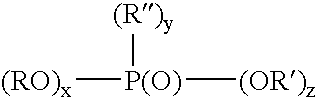
wherein x is 0-1, y is 1, z is 1-2 and x+y+z is 3. R and R″ are each organo radicals and at least one of which may have π conjugation. R′ is H, a metal, such as an alkali metal, for example, sodium or potassium or lower alkyl having 1-4 carbons such as methyl or ethyl. Preferably at least a portion of R′ is H.

wherein x is 0-2, y is 0-2, z is 1 and x+y+z is 3. R and R″ are each independently organo radicals and at least one of which may have π conjugation. R′ is H, a metal, such as an alkali metal, for example, sodium or potassium or lower alkyl having 1-4 carbons, such as methyl or ethyl. Preferably a portion of R′ is H.
Claims (12)
Priority Applications (1)
| Application Number | Priority Date | Filing Date | Title |
|---|---|---|---|
| US11/731,723 US7471503B2 (en) | 2006-03-31 | 2007-03-30 | Solid electrolytic capacitors |
Applications Claiming Priority (2)
| Application Number | Priority Date | Filing Date | Title |
|---|---|---|---|
| US78829006P | 2006-03-31 | 2006-03-31 | |
| US11/731,723 US7471503B2 (en) | 2006-03-31 | 2007-03-30 | Solid electrolytic capacitors |
Publications (2)
| Publication Number | Publication Date |
|---|---|
| US20070230092A1 US20070230092A1 (en) | 2007-10-04 |
| US7471503B2 true US7471503B2 (en) | 2008-12-30 |
Family
ID=38461014
Family Applications (1)
| Application Number | Title | Priority Date | Filing Date |
|---|---|---|---|
| US11/731,723 Expired - Fee Related US7471503B2 (en) | 2006-03-31 | 2007-03-30 | Solid electrolytic capacitors |
Country Status (3)
| Country | Link |
|---|---|
| US (1) | US7471503B2 (en) |
| EP (1) | EP2024980A2 (en) |
| WO (1) | WO2007123752A2 (en) |
Cited By (29)
| Publication number | Priority date | Publication date | Assignee | Title |
|---|---|---|---|---|
| US20090185329A1 (en) * | 2008-01-22 | 2009-07-23 | Avx Corporation | Electrolytic Capacitor Anode Treated with an Organometallic Compound |
| US20100097743A1 (en) * | 2004-08-30 | 2010-04-22 | Shin-Etsu Polymer Co., Ltd. | Conductive composition vand conductive cross-linked product, capacitor and production method thereof, and antistatic coating material, antistatic coating, antistatic film, optical filter, and optical information recording medium |
| US20100110614A1 (en) * | 2008-10-31 | 2010-05-06 | Sanyo Electric Co., Ltd. | Solid electrolytic capacitor |
| DE102010012374A1 (en) | 2009-03-23 | 2010-10-07 | Avx Corporation | High-voltage electrolytic capacitors |
| US20110188173A1 (en) * | 2010-01-27 | 2011-08-04 | Sanyo Electric Co., Ltd. | Solid electrolytic capacitor and manufacturing method thereof |
| US8405956B2 (en) | 2009-06-01 | 2013-03-26 | Avx Corporation | High voltage electrolytic capacitors |
| US9060560B2 (en) | 2007-08-10 | 2015-06-23 | Greenhill Antiballistics Corporation | Composite material |
| US9328788B2 (en) | 2010-10-18 | 2016-05-03 | Greenhill Antiballistics Corporation | Gradient nanoparticle-carbon allotrope-polymer composite material |
| US9688926B2 (en) | 2013-02-28 | 2017-06-27 | Electrolab, Inc. | SAMP coated level sensor, method of treating a level sensor, and method of installing level sensor into crude oil service operation |
| US9994732B1 (en) | 2014-09-12 | 2018-06-12 | Steven Martin Johnson | Polysilazane and fluoroacrylate coating composition |
| US10186382B2 (en) | 2016-01-18 | 2019-01-22 | Avx Corporation | Solid electrolytic capacitor with improved leakage current |
| US10562065B1 (en) | 2015-11-03 | 2020-02-18 | Newtech Llc | Systems and methods for application of polysilazane and fluoroacrylate coating compositions |
| US10584264B1 (en) | 2016-02-25 | 2020-03-10 | Newtech Llc | Hydrophobic and oleophobic coating compositions |
| US10622160B2 (en) | 2017-03-06 | 2020-04-14 | Avx Corporation | Solid electrolytic capacitor assembly |
| US10741333B2 (en) | 2016-10-18 | 2020-08-11 | Avx Corporation | Solid electrolytic capacitor with improved leakage current |
| US10763046B2 (en) | 2016-09-15 | 2020-09-01 | Avx Corporation | Solid electrolytic capacitor with improved leakage current |
| US10770238B2 (en) | 2017-07-03 | 2020-09-08 | Avx Corporation | Solid electrolytic capacitor assembly with hydrophobic coatings |
| US10892095B2 (en) | 2016-10-18 | 2021-01-12 | Avx Corporation | Solid electrolytic capacitor assembly |
| US11049664B2 (en) | 2018-04-13 | 2021-06-29 | Avx Corporation | Solid electrolytic capacitor containing a vapor-deposited barrier film |
| US11056285B2 (en) | 2018-04-13 | 2021-07-06 | Avx Corporation | Solid electrolytic capacitor containing an adhesive film |
| US11139117B2 (en) | 2018-04-13 | 2021-10-05 | Avx Corporation | Solid electrolytic capacitor containing a sequential vapor-deposited interior conductive polymer film |
| US11183339B2 (en) | 2018-11-29 | 2021-11-23 | Avx Corporation | Solid electrolytic capacitor containing a sequential vapor-deposited dielectric film |
| US11257628B2 (en) | 2017-07-03 | 2022-02-22 | KYOCERA AVX Components Corporation | Solid electrolytic capacitor containing a nanocoating |
| US11387047B2 (en) | 2016-10-18 | 2022-07-12 | KYOCERA AVX Components Corporation | Solid electrolytic capacitor with improved performance at high temperatures and voltages |
| US11837415B2 (en) | 2021-01-15 | 2023-12-05 | KYOCERA AVX Components Corpration | Solid electrolytic capacitor |
| US12002631B2 (en) | 2021-10-20 | 2024-06-04 | KYOCERA AVX Components Corporation | Electrodeposited dielectric for a solid electrolytic capacitor |
| US12191228B2 (en) | 2016-04-06 | 2025-01-07 | Sanctioned Risk Solutions, Inc. | Heat dissipation using nanoscale materials |
| US12476052B2 (en) | 2018-06-21 | 2025-11-18 | KYOCERA AVX Components Corporation | Delamination-resistant solid electrolytic capacitor |
| US12548715B2 (en) | 2018-06-21 | 2026-02-10 | KYOCERA AVX Components Corporation | Solid electrolytic capacitor containing an interfacial coating |
Families Citing this family (5)
| Publication number | Priority date | Publication date | Assignee | Title |
|---|---|---|---|---|
| DE102007048212A1 (en) * | 2007-10-08 | 2009-04-09 | H.C. Starck Gmbh | Process for the preparation of electrolytic capacitors with polymeric interlayer |
| JP5736534B2 (en) * | 2008-09-29 | 2015-06-17 | パナソニックIpマネジメント株式会社 | Solid electrolytic capacitor |
| US20100193745A1 (en) * | 2009-01-30 | 2010-08-05 | Sanyo Electric Co., Ltd. | Conductive polymer film, conductive polymeric material and electronic device |
| JP5566709B2 (en) * | 2010-01-27 | 2014-08-06 | 三洋電機株式会社 | Solid electrolytic capacitor |
| US8559164B2 (en) | 2010-08-02 | 2013-10-15 | Panasonic Corporation | Solid electrolytic capacitor |
Citations (9)
| Publication number | Priority date | Publication date | Assignee | Title |
|---|---|---|---|---|
| US4858078A (en) | 1987-10-30 | 1989-08-15 | Asahi Glass Company Ltd. | Solid electrolytic capacitor |
| DE4243091A1 (en) | 1992-12-18 | 1994-06-23 | Siemens Ag | Solid electrolytic capacitor prodn. with polymeric electrolyte |
| US5729428A (en) | 1995-04-25 | 1998-03-17 | Nec Corporation | Solid electrolytic capacitor with conductive polymer as solid electrolyte and method for fabricating the same |
| US6515848B1 (en) * | 1999-07-30 | 2003-02-04 | Nec Corporation | Solid electrolytic capacitors and method for manufacturing the same |
| US6731495B2 (en) | 2001-11-03 | 2004-05-04 | H. C. Starck, Inc. | Thin film capacitor using conductive polymers |
| US20050162815A1 (en) | 2003-12-26 | 2005-07-28 | Industrial Technology Research Institute | Solid electrolytic capacitor, fabrication method thereof, and coupling agent utilized in the same |
| US6982865B2 (en) | 2003-10-08 | 2006-01-03 | Sanyo Electric Co., Ltd. | Solid electrolytic capacitor |
| US6987663B2 (en) | 2003-10-17 | 2006-01-17 | H.C. Starck Gmbh | Electrolytic capacitors with a polymeric outer layer |
| US6992880B2 (en) | 2002-08-28 | 2006-01-31 | Matsushita Electric Industrial Co., Ltd. | Solid electrolytic capacitor and its manufacturing method |
-
2007
- 2007-03-30 EP EP07754517A patent/EP2024980A2/en not_active Withdrawn
- 2007-03-30 WO PCT/US2007/008004 patent/WO2007123752A2/en not_active Ceased
- 2007-03-30 US US11/731,723 patent/US7471503B2/en not_active Expired - Fee Related
Patent Citations (10)
| Publication number | Priority date | Publication date | Assignee | Title |
|---|---|---|---|---|
| US4858078A (en) | 1987-10-30 | 1989-08-15 | Asahi Glass Company Ltd. | Solid electrolytic capacitor |
| DE4243091A1 (en) | 1992-12-18 | 1994-06-23 | Siemens Ag | Solid electrolytic capacitor prodn. with polymeric electrolyte |
| US5729428A (en) | 1995-04-25 | 1998-03-17 | Nec Corporation | Solid electrolytic capacitor with conductive polymer as solid electrolyte and method for fabricating the same |
| US6515848B1 (en) * | 1999-07-30 | 2003-02-04 | Nec Corporation | Solid electrolytic capacitors and method for manufacturing the same |
| US6731495B2 (en) | 2001-11-03 | 2004-05-04 | H. C. Starck, Inc. | Thin film capacitor using conductive polymers |
| US6912113B2 (en) | 2001-11-03 | 2005-06-28 | H. C. Starck, Inc. | Thin film capacitor using conductive polymers |
| US6992880B2 (en) | 2002-08-28 | 2006-01-31 | Matsushita Electric Industrial Co., Ltd. | Solid electrolytic capacitor and its manufacturing method |
| US6982865B2 (en) | 2003-10-08 | 2006-01-03 | Sanyo Electric Co., Ltd. | Solid electrolytic capacitor |
| US6987663B2 (en) | 2003-10-17 | 2006-01-17 | H.C. Starck Gmbh | Electrolytic capacitors with a polymeric outer layer |
| US20050162815A1 (en) | 2003-12-26 | 2005-07-28 | Industrial Technology Research Institute | Solid electrolytic capacitor, fabrication method thereof, and coupling agent utilized in the same |
Cited By (46)
| Publication number | Priority date | Publication date | Assignee | Title |
|---|---|---|---|---|
| US20100097743A1 (en) * | 2004-08-30 | 2010-04-22 | Shin-Etsu Polymer Co., Ltd. | Conductive composition vand conductive cross-linked product, capacitor and production method thereof, and antistatic coating material, antistatic coating, antistatic film, optical filter, and optical information recording medium |
| US20120057269A1 (en) * | 2004-08-30 | 2012-03-08 | Shin-Etsu Polymer Co., Ltd. | Conductive composition and conductive cross-linked product, capacitor and production method thereof, and antistatic coating material, antistatic coating, antistatic film, optical filter, and optical information recording medium |
| US8388866B2 (en) * | 2004-08-30 | 2013-03-05 | Shin-Etsu Polymer Co., Ltd. | Conductive composition and conductive cross-linked product, capacitor and production method thereof, and antistatic coating material, antistatic coating, antistatic film, optical filter, and optical information recording medium |
| US8551366B2 (en) | 2004-08-30 | 2013-10-08 | Shin-Etsu Polymer Co., Ltd. | Conductive composition and conductive cross-linked product, capacitor and production method thereof, and antistatic coating material, antistatic coating, antistatic film, optical filter, and optical information recording medium |
| US9060560B2 (en) | 2007-08-10 | 2015-06-23 | Greenhill Antiballistics Corporation | Composite material |
| US11718067B2 (en) | 2007-08-10 | 2023-08-08 | Greenhill Antiballistics Corporation | Composite material |
| US7852615B2 (en) | 2008-01-22 | 2010-12-14 | Avx Corporation | Electrolytic capacitor anode treated with an organometallic compound |
| US20090185329A1 (en) * | 2008-01-22 | 2009-07-23 | Avx Corporation | Electrolytic Capacitor Anode Treated with an Organometallic Compound |
| US20100110614A1 (en) * | 2008-10-31 | 2010-05-06 | Sanyo Electric Co., Ltd. | Solid electrolytic capacitor |
| DE102010012374A1 (en) | 2009-03-23 | 2010-10-07 | Avx Corporation | High-voltage electrolytic capacitors |
| US8405956B2 (en) | 2009-06-01 | 2013-03-26 | Avx Corporation | High voltage electrolytic capacitors |
| US20110188173A1 (en) * | 2010-01-27 | 2011-08-04 | Sanyo Electric Co., Ltd. | Solid electrolytic capacitor and manufacturing method thereof |
| US8503167B2 (en) * | 2010-01-27 | 2013-08-06 | Sanyo Electric Co., Ltd. | Solid electrolytic capacitor and manufacturing method thereof |
| US9328788B2 (en) | 2010-10-18 | 2016-05-03 | Greenhill Antiballistics Corporation | Gradient nanoparticle-carbon allotrope-polymer composite material |
| US9982736B2 (en) | 2010-10-18 | 2018-05-29 | Greenhill Antiballistics Corporation | Gradient nanoparticle-carbon allotrope polymer composite |
| US12064948B2 (en) | 2010-10-18 | 2024-08-20 | Greenhill Antiballistics Corporation | Gradient nanoparticle-carbon allotrope-polymer composite material |
| US10926513B2 (en) | 2010-10-18 | 2021-02-23 | Greenhill Antiballistics Corporation | Gradient nanoparticle-carbon allotrope-polymer composite material |
| US9688926B2 (en) | 2013-02-28 | 2017-06-27 | Electrolab, Inc. | SAMP coated level sensor, method of treating a level sensor, and method of installing level sensor into crude oil service operation |
| US10059892B2 (en) | 2013-02-28 | 2018-08-28 | Electrolab, Inc. | SAMP coated cooperating surfaces, method of treating cooperating surfaces, and method of installing cooperating surfaces into crude oil service operation |
| US10150924B2 (en) | 2013-02-28 | 2018-12-11 | Electrolab, Inc. | Bonded layer treatment method for a device utilized in a crude oil service operation, and method of installing said device |
| US10934497B2 (en) | 2013-02-28 | 2021-03-02 | E9 Treatments, Inc. | SAMP treatment method for a device utilized in a crude oil service operation, and method of installing said device |
| US10647884B1 (en) | 2014-09-12 | 2020-05-12 | Newtech Llc | Polysilazane and fluoroacrylate coating composition |
| US9994732B1 (en) | 2014-09-12 | 2018-06-12 | Steven Martin Johnson | Polysilazane and fluoroacrylate coating composition |
| US10562065B1 (en) | 2015-11-03 | 2020-02-18 | Newtech Llc | Systems and methods for application of polysilazane and fluoroacrylate coating compositions |
| US10186382B2 (en) | 2016-01-18 | 2019-01-22 | Avx Corporation | Solid electrolytic capacitor with improved leakage current |
| US10584264B1 (en) | 2016-02-25 | 2020-03-10 | Newtech Llc | Hydrophobic and oleophobic coating compositions |
| US12191228B2 (en) | 2016-04-06 | 2025-01-07 | Sanctioned Risk Solutions, Inc. | Heat dissipation using nanoscale materials |
| US11056286B2 (en) | 2016-09-15 | 2021-07-06 | Avx Corporation | Solid electrolytic capacitor with improved leakage current |
| US10763046B2 (en) | 2016-09-15 | 2020-09-01 | Avx Corporation | Solid electrolytic capacitor with improved leakage current |
| US11387047B2 (en) | 2016-10-18 | 2022-07-12 | KYOCERA AVX Components Corporation | Solid electrolytic capacitor with improved performance at high temperatures and voltages |
| US10741333B2 (en) | 2016-10-18 | 2020-08-11 | Avx Corporation | Solid electrolytic capacitor with improved leakage current |
| US10892095B2 (en) | 2016-10-18 | 2021-01-12 | Avx Corporation | Solid electrolytic capacitor assembly |
| US11170942B2 (en) | 2016-10-18 | 2021-11-09 | Avx Corporation | Solid electrolytic capacitor with improved leakage current |
| US10622160B2 (en) | 2017-03-06 | 2020-04-14 | Avx Corporation | Solid electrolytic capacitor assembly |
| US10770238B2 (en) | 2017-07-03 | 2020-09-08 | Avx Corporation | Solid electrolytic capacitor assembly with hydrophobic coatings |
| US11257628B2 (en) | 2017-07-03 | 2022-02-22 | KYOCERA AVX Components Corporation | Solid electrolytic capacitor containing a nanocoating |
| US11056285B2 (en) | 2018-04-13 | 2021-07-06 | Avx Corporation | Solid electrolytic capacitor containing an adhesive film |
| US11139117B2 (en) | 2018-04-13 | 2021-10-05 | Avx Corporation | Solid electrolytic capacitor containing a sequential vapor-deposited interior conductive polymer film |
| US11948756B2 (en) | 2018-04-13 | 2024-04-02 | KYOCERA AVX Components Corporation | Solid electrolytic capacitor containing a vapor-deposited barrier film |
| US11049664B2 (en) | 2018-04-13 | 2021-06-29 | Avx Corporation | Solid electrolytic capacitor containing a vapor-deposited barrier film |
| US12548715B2 (en) | 2018-06-21 | 2026-02-10 | KYOCERA AVX Components Corporation | Solid electrolytic capacitor containing an interfacial coating |
| US12476052B2 (en) | 2018-06-21 | 2025-11-18 | KYOCERA AVX Components Corporation | Delamination-resistant solid electrolytic capacitor |
| US11183339B2 (en) | 2018-11-29 | 2021-11-23 | Avx Corporation | Solid electrolytic capacitor containing a sequential vapor-deposited dielectric film |
| US12191090B2 (en) | 2018-11-29 | 2025-01-07 | KYOCERA AVX Components Corporation | Solid electrolytic capacitor containing a sequential vapor-deposited dielectric film |
| US11837415B2 (en) | 2021-01-15 | 2023-12-05 | KYOCERA AVX Components Corpration | Solid electrolytic capacitor |
| US12002631B2 (en) | 2021-10-20 | 2024-06-04 | KYOCERA AVX Components Corporation | Electrodeposited dielectric for a solid electrolytic capacitor |
Also Published As
| Publication number | Publication date |
|---|---|
| US20070230092A1 (en) | 2007-10-04 |
| WO2007123752A2 (en) | 2007-11-01 |
| EP2024980A2 (en) | 2009-02-18 |
| WO2007123752A3 (en) | 2008-01-03 |
Similar Documents
| Publication | Publication Date | Title |
|---|---|---|
| US7471503B2 (en) | Solid electrolytic capacitors | |
| US7800887B2 (en) | Solid electrolytic capacitor and method for producing the same | |
| KR102441435B1 (en) | Process for the preparation of functionalized polythiophenes | |
| CN105431918B (en) | Conductive polymer composition with dual crosslinker system for capacitors | |
| US6920036B1 (en) | Solid electrolytic capacitor, fabrication method thereof, and coupling agent utilized in the same | |
| KR101689416B1 (en) | Electronic component and method for producing an electronic component | |
| CN102005313B (en) | Solid electrolytic capacitor and method of manufacturing thereof | |
| TWI632570B (en) | A capacitor, the production process and use thereof, a dispersion,the preparation process and use thereof, an organic solar cell and the production process thereof, and electronic circuits | |
| TWI417916B (en) | Process for the production of electrolyte capacitors of high nominal voltage | |
| KR101605213B1 (en) | Planarizing agents and devices | |
| US8503167B2 (en) | Solid electrolytic capacitor and manufacturing method thereof | |
| US10570520B2 (en) | Preparation of conjugated dimer and products formed therefrom | |
| US20190006116A1 (en) | Solid Electrolytic Capacitor Containing a Nanocoating | |
| US8476119B2 (en) | Encapsulation methods and dielectric layers for organic electrical devices | |
| US10943743B2 (en) | Electrolytic capacitor and method for producing same | |
| US20100055416A1 (en) | Composite and manufacturing method thereof | |
| US20220223349A1 (en) | Electrolytic capacitor, and method for manufacturing electrolytic capacitor | |
| US11056285B2 (en) | Solid electrolytic capacitor containing an adhesive film | |
| US20100304147A1 (en) | Method for coating layers which contain nonpolar poly-aromatics | |
| JP2010537427A (en) | Electroluminescent device using organic cathode | |
| JP4989559B2 (en) | Electronic device and manufacturing method thereof | |
| JP5816840B2 (en) | Solid electrolytic capacitor manufacturing method and solid electrolytic capacitor | |
| JP7591728B2 (en) | Electrolytic capacitors | |
| JP2005286250A (en) | Solid-state electrolytic capacitor | |
| JP2010153417A (en) | Method for manufacturing solid electrolytic capacitor |
Legal Events
| Date | Code | Title | Description |
|---|---|---|---|
| AS | Assignment |
Owner name: ACULON, INC., CALIFORNIA Free format text: ASSIGNMENT OF ASSIGNORS INTEREST;ASSIGNORS:BRUNER, ERIC L.;MERKER, UDO;REEL/FRAME:019509/0089;SIGNING DATES FROM 20070608 TO 20070618 Owner name: H.C. STARCK GMBH & CO. KG, GERMANY Free format text: ASSIGNMENT OF ASSIGNORS INTEREST;ASSIGNORS:BRUNER, ERIC L.;MERKER, UDO;REEL/FRAME:019509/0089;SIGNING DATES FROM 20070608 TO 20070618 |
|
| FEPP | Fee payment procedure |
Free format text: PAYOR NUMBER ASSIGNED (ORIGINAL EVENT CODE: ASPN); ENTITY STATUS OF PATENT OWNER: LARGE ENTITY |
|
| AS | Assignment |
Owner name: HERAEUS CLEVIOS GMBH, GERMANY Free format text: ASSIGNMENT OF ASSIGNORS INTEREST;ASSIGNOR:H.C. STARCK GMBH & CO. KG;REEL/FRAME:027718/0713 Effective date: 20111111 |
|
| AS | Assignment |
Owner name: HERAEUS PRECIOUS METALS GMBH & CO. KG, GERMANY Free format text: MERGER;ASSIGNOR:HERAEUS CLEVIOS GMBH;REEL/FRAME:027734/0357 Effective date: 20110718 |
|
| FPAY | Fee payment |
Year of fee payment: 4 |
|
| REMI | Maintenance fee reminder mailed | ||
| LAPS | Lapse for failure to pay maintenance fees | ||
| STCH | Information on status: patent discontinuation |
Free format text: PATENT EXPIRED DUE TO NONPAYMENT OF MAINTENANCE FEES UNDER 37 CFR 1.362 |
|
| STCH | Information on status: patent discontinuation |
Free format text: PATENT EXPIRED DUE TO NONPAYMENT OF MAINTENANCE FEES UNDER 37 CFR 1.362 |
|
| FP | Lapsed due to failure to pay maintenance fee |
Effective date: 20161230 |