US7470824B2 - Adamantane derivative and process for producing the same - Google Patents
Adamantane derivative and process for producing the same Download PDFInfo
- Publication number
- US7470824B2 US7470824B2 US10/540,547 US54054705A US7470824B2 US 7470824 B2 US7470824 B2 US 7470824B2 US 54054705 A US54054705 A US 54054705A US 7470824 B2 US7470824 B2 US 7470824B2
- Authority
- US
- United States
- Prior art keywords
- formula
- alkyl group
- oxo
- hydrogen
- integer
- Prior art date
- Legal status (The legal status is an assumption and is not a legal conclusion. Google has not performed a legal analysis and makes no representation as to the accuracy of the status listed.)
- Expired - Lifetime, expires
Links
- 0 CC.CC.[1*]C([2*])(OC([3*])([4*])C)C12CC3CC(CC(C3)C1)C2.[1*]C([2*])(OC([3*])([4*])C)C12CC3CC(CC(C3)C1)C2 Chemical compound CC.CC.[1*]C([2*])(OC([3*])([4*])C)C12CC3CC(CC(C3)C1)C2.[1*]C([2*])(OC([3*])([4*])C)C12CC3CC(CC(C3)C1)C2 0.000 description 15
- JHAQIDVHMOXNCF-UHFFFAOYSA-N C.C.C.C.C.C.C=CC(=O)OC12CC3CC(CC(COCCl)(C3)C1)C2.C=CC(=O)OC12CC3CC(CC(OCCl)(C3)C1)C2.CC.CC.CC.CC(OCCl)C12CC3CC(CC(C3)C1)C2.ClCOC12CC3CC(CC(C3)C1)C2.ClCOCC12CC3CC(CC(C3)C1)C2.ClCOCC12CC3CC(CC(C3)C1)C2.ClCOCCC12CC3CC(CC(C3)C1)C2.OC12CC3CC(C1)CC(COCCl)(C3)C2.OC12CC3CC(C1)CC(OCCl)(C3)C2.OC12CC3CC(C1)CC(OCCl)(C3)C2 Chemical compound C.C.C.C.C.C.C=CC(=O)OC12CC3CC(CC(COCCl)(C3)C1)C2.C=CC(=O)OC12CC3CC(CC(OCCl)(C3)C1)C2.CC.CC.CC.CC(OCCl)C12CC3CC(CC(C3)C1)C2.ClCOC12CC3CC(CC(C3)C1)C2.ClCOCC12CC3CC(CC(C3)C1)C2.ClCOCC12CC3CC(CC(C3)C1)C2.ClCOCCC12CC3CC(CC(C3)C1)C2.OC12CC3CC(C1)CC(COCCl)(C3)C2.OC12CC3CC(C1)CC(OCCl)(C3)C2.OC12CC3CC(C1)CC(OCCl)(C3)C2 JHAQIDVHMOXNCF-UHFFFAOYSA-N 0.000 description 1
- ZEWNTIUVMQENHZ-UHFFFAOYSA-N C.C.C.C.C.C=C(C)C(=O)OC12CC3CC(CC(O)(C3)C1)C2.C=CC(=O)OC12CC3CC(CC(O)(C3)C1)C2.CC.CC.CC.CC(O)C12CC3CC(CC(C3)C1)C2.OC12CC3CC(C1)CC(O)(C3)C2.OC12CC3CC(C1)CC(O)(C3)C2.OC12CC3CC(CC(C3)C1)C2.OCC12CC3CC(CC(C3)C1)C2.OCC12CC3CC(CC(C3)C1)C2.OCC12CC3CC(CC(O)(C3)C1)C2.OCCC12CC3CC(CC(C3)C1)C2 Chemical compound C.C.C.C.C.C=C(C)C(=O)OC12CC3CC(CC(O)(C3)C1)C2.C=CC(=O)OC12CC3CC(CC(O)(C3)C1)C2.CC.CC.CC.CC(O)C12CC3CC(CC(C3)C1)C2.OC12CC3CC(C1)CC(O)(C3)C2.OC12CC3CC(C1)CC(O)(C3)C2.OC12CC3CC(CC(C3)C1)C2.OCC12CC3CC(CC(C3)C1)C2.OCC12CC3CC(CC(C3)C1)C2.OCC12CC3CC(CC(O)(C3)C1)C2.OCCC12CC3CC(CC(C3)C1)C2 ZEWNTIUVMQENHZ-UHFFFAOYSA-N 0.000 description 1
- XEIUOEVUDAOGDS-UHFFFAOYSA-N CC.CC.CC.CC.CC.CC1(CO)C2CC3CC(C2)CC1C3.CC1(CO)C2CC3CC(C2)CC1C3.CC1(O)C2CC3CC(C2)CC1C3.CC1(O)C2CC3CC(C2)CC1C3.CCC1(O)C2CC3CC(C2)CC1C3.CCC1(O)C2CC3CC(C2)CC1C3.OC1C2CC3CC(C2)CC1C3.OCC1C2CC3CC(C2)CC1C3.[H]C1(CO)C2CC3CC(C2)CC1C3.[H]C1(O)C2CC3CC(C2)CC1C3 Chemical compound CC.CC.CC.CC.CC.CC1(CO)C2CC3CC(C2)CC1C3.CC1(CO)C2CC3CC(C2)CC1C3.CC1(O)C2CC3CC(C2)CC1C3.CC1(O)C2CC3CC(C2)CC1C3.CCC1(O)C2CC3CC(C2)CC1C3.CCC1(O)C2CC3CC(C2)CC1C3.OC1C2CC3CC(C2)CC1C3.OCC1C2CC3CC(C2)CC1C3.[H]C1(CO)C2CC3CC(C2)CC1C3.[H]C1(O)C2CC3CC(C2)CC1C3 XEIUOEVUDAOGDS-UHFFFAOYSA-N 0.000 description 1
- QOYLUFZHCSXYCI-UHFFFAOYSA-N CC.CC.CC.CC.CC.CC1(COCCl)C2CC3CC(C2)CC1C3.CC1(COCCl)C2CC3CC(C2)CC1C3.CC1(OCCl)C2CC3CC(C2)CC1C3.CC1(OCCl)C2CC3CC(C2)CC1C3.CCC1(OCCl)C2CC3CC(C2)CC1C3.CCC1(OCCl)C2CC3CC(C2)CC1C3.ClCOC1C2CC3CC(C2)CC1C3.ClCOCC1C2CC3CC(C2)CC1C3.[H]C1(COCCl)C2CC3CC(C2)CC1C3.[H]C1(OCCl)C2CC3CC(C2)CC1C3 Chemical compound CC.CC.CC.CC.CC.CC1(COCCl)C2CC3CC(C2)CC1C3.CC1(COCCl)C2CC3CC(C2)CC1C3.CC1(OCCl)C2CC3CC(C2)CC1C3.CC1(OCCl)C2CC3CC(C2)CC1C3.CCC1(OCCl)C2CC3CC(C2)CC1C3.CCC1(OCCl)C2CC3CC(C2)CC1C3.ClCOC1C2CC3CC(C2)CC1C3.ClCOCC1C2CC3CC(C2)CC1C3.[H]C1(COCCl)C2CC3CC(C2)CC1C3.[H]C1(OCCl)C2CC3CC(C2)CC1C3 QOYLUFZHCSXYCI-UHFFFAOYSA-N 0.000 description 1
- QBAUQDFDSGHDNO-UHFFFAOYSA-N ClCOCC12CC3CC(CC(C3)C1)C2 Chemical compound ClCOCC12CC3CC(CC(C3)C1)C2 QBAUQDFDSGHDNO-UHFFFAOYSA-N 0.000 description 1
- BEPPHPDUZQZCIM-UHFFFAOYSA-N O=C1C2CC3CC(C2)C(OCCl)C1C3 Chemical compound O=C1C2CC3CC(C2)C(OCCl)C1C3 BEPPHPDUZQZCIM-UHFFFAOYSA-N 0.000 description 1
Classifications
-
- C—CHEMISTRY; METALLURGY
- C07—ORGANIC CHEMISTRY
- C07C—ACYCLIC OR CARBOCYCLIC COMPOUNDS
- C07C43/00—Ethers; Compounds having groups, groups or groups
- C07C43/02—Ethers
- C07C43/03—Ethers having all ether-oxygen atoms bound to acyclic carbon atoms
- C07C43/04—Saturated ethers
- C07C43/12—Saturated ethers containing halogen
-
- C—CHEMISTRY; METALLURGY
- C07—ORGANIC CHEMISTRY
- C07C—ACYCLIC OR CARBOCYCLIC COMPOUNDS
- C07C43/00—Ethers; Compounds having groups, groups or groups
- C07C43/02—Ethers
- C07C43/18—Ethers having an ether-oxygen atom bound to a carbon atom of a ring other than a six-membered aromatic ring
- C07C43/192—Ethers having an ether-oxygen atom bound to a carbon atom of a ring other than a six-membered aromatic ring containing halogen
-
- C—CHEMISTRY; METALLURGY
- C07—ORGANIC CHEMISTRY
- C07C—ACYCLIC OR CARBOCYCLIC COMPOUNDS
- C07C49/00—Ketones; Ketenes; Dimeric ketenes; Ketonic chelates
- C07C49/385—Saturated compounds containing a keto group being part of a ring
- C07C49/517—Saturated compounds containing a keto group being part of a ring containing ether groups, groups, groups, or groups
-
- G—PHYSICS
- G03—PHOTOGRAPHY; CINEMATOGRAPHY; ANALOGOUS TECHNIQUES USING WAVES OTHER THAN OPTICAL WAVES; ELECTROGRAPHY; HOLOGRAPHY
- G03F—PHOTOMECHANICAL PRODUCTION OF TEXTURED OR PATTERNED SURFACES, e.g. FOR PRINTING, FOR PROCESSING OF SEMICONDUCTOR DEVICES; MATERIALS THEREFOR; ORIGINALS THEREFOR; APPARATUS SPECIALLY ADAPTED THEREFOR
- G03F7/00—Photomechanical, e.g. photolithographic, production of textured or patterned surfaces, e.g. printing surfaces; Materials therefor, e.g. comprising photoresists; Apparatus specially adapted therefor
- G03F7/004—Photosensitive materials
- G03F7/0045—Photosensitive materials with organic non-macromolecular light-sensitive compounds not otherwise provided for, e.g. dissolution inhibitors
-
- C—CHEMISTRY; METALLURGY
- C07—ORGANIC CHEMISTRY
- C07C—ACYCLIC OR CARBOCYCLIC COMPOUNDS
- C07C2603/00—Systems containing at least three condensed rings
- C07C2603/56—Ring systems containing bridged rings
- C07C2603/58—Ring systems containing bridged rings containing three rings
- C07C2603/70—Ring systems containing bridged rings containing three rings containing only six-membered rings
- C07C2603/74—Adamantanes
Definitions
- the present invention relates to a novel adamantane derivative and a process for producing the same. More specifically, the present invention relates to novel (monohalogen-substituted methyl) (adamantyl group-containing alkyl)ethers which are useful as a modifying agent for a resin for a photoresist and a dry etching resistance-improving agent in the photolithography field, agricultural and medical intermediates and other various industrial products and a process for efficiently producing the same.
- adamantane is a highly symmetric and stable compound having a structure in which four cyclohexane rings are condensed in a cage form and that the derivatives thereof are useful as agricultural and medical raw materials and a raw material for high functional-industrial materials since it shows a specific function.
- it has an optical characteristic and a heat resistance, so that it is tried to be used for an optical disc substrate, an optical fiber and a lens (refer to, for example, Japanese Patent Application Laid-Open No. 305044/1994 and Japanese Patent Application Laid-Open No. 302077/1997).
- adamantane esters are tried to be used as a resin raw material for a photoresist making use of an acid sensitivity, a dry etching resistance and a UV ray transmittance thereof (refer to, for example, Japanese Patent Application Laid-Open No. 39665/1992).
- the present invention has been made under the situations described above, and an object of the present invention is to provide a novel adamantane derivative which is useful as a modifying agent for a resin for a photoresist and a dry etching resistance-improving agent in the photolithography field, agricultural and medical intermediates and other various industrial products and a process for producing the same.
- the present invention comprises the following scope.
- X represents a halogen atom
- Y represents an alkyl group having 1 to 10 carbon atoms, a halogenated alkyl group having 1 to 10 carbon atoms, a halogen atom or a hetero atom-containing group
- R 1 to R 4 represent independently hydrogen, a halogen atom, an alkyl group having 1 to 10 carbon atoms or a halogenated alkyl group having 1 to 10 carbon atoms
- m represents an integer of 0 to 15, and n represents an integer of 0 to 10; and excluded is a case where in Formula (I), m and n are 0 at the same time and R 3 and R 4 are a hydrogen atom at the same time.
- R 3 and R 4 are the same as described above, and when m and n are 0 at the same time in Formula (III) described above, R 3 and R 4 are not a hydrogen atom at the same time) and hydrogen halide gas.
- the adamantane derivatives of the present invention are the compound represented by Formula (I) (hereinafter referred to as the compound A) and the compound represented by Formula (II) (hereinafter referred to as the compound B), and both of them are novel compounds which are not described in documents.
- the compound A, the compound B and the production processes for the same shall be explained below.
- the compound A of the present invention is (monohalogen-substituted methyl) (adamantyl group-containing alkyl)ethers having a structure represented by Formula (I):
- X represents a halogen atom
- Y represents an alkyl group having 1 to 10 carbon atoms, a halogenated alkyl group having 1 to 10 carbon atoms, a halogen atom or a hetero atom-containing group
- R 1 to R 4 represent independently hydrogen, a halogen atom, an alkyl group having 1 to 10 carbon atoms or a halogenated alkyl group having 1 to 10 carbon atoms
- m represents an integer of 0 to 15
- n represents an integer of 0 to 10. Excluded is a case where m and n are 0 at the same time and R 3 and R 4 are a hydrogen atom at the same time.
- the halogen atom includes fluorine, chlorine, bromine and iodine.
- the alkyl group having 1 to 10 carbon atoms may be either linear or branched.
- the halogenated alkyl group having 1 to 10 carbon atoms may be a group in which the foregoing alkyl group having 1 to 10 carbon atoms is substituted with at least one halogen group in a suitable position thereof.
- the hetero atom-containing group is a substituent containing O (oxygen), S (sulfur) or N (nitrogen). For example, it can be represented by the following formula:
- R represents independently hydrogen, a halogen atom, an alkyl group having 1 to 10 carbon atoms or a halogenated alkyl group having 1 to 10 carbon atoms).
- the hetero atom-containing group may be ⁇ O formed by allowing two Y's to be put together.
- the compound A represented by Formula (I) described above includes, for example, the following compounds:
- the compound B of the present invention is (monohalogen-substituted methyl) (adamantyl group-containing alkyl)ethers having a structure represented by Formula (II):
- X, Y, R 1 to R 4 , m and n are the same as described above. In this case, included is a case where m and n are 0 at the same time and R 3 and R 4 are a hydrogen atom at the same time.
- the compound B represented by Formula (II) described above includes, for example, the following compounds:
- the production processes include the following two processes.
- the raw material alcohol for the compound A includes the following compounds represented by Formula (III) described above:
- the raw material alcohol for the compound B includes the following compounds represented by Formula (IV) described above:
- the carbonyl compound described above includes formaldehyde (paraformaldehyde), acetaldehyde, acetone, propionaldehyde, n-butylaldehyde, isobutylaldehyde, ethyl methyl ketone, isopropyl methyl ketone, isobutyl methyl ketone and diethyl ketone.
- An amount of the carbonyl compound is usually 1 to 5 moles per mole of the raw material alcohol.
- desiccants can be used as the desiccant described above.
- it includes anhydrous inorganic salts such as anhydrous magnesium sulfate, anhydrous iron chloride and anhydrous aluminum chloride, calcium chloride, molecular sieves, diphosphorus pentaoxide, sodium perchlorate, activated alumina, silica gel, calcium hydride and lithium aluminum hydride.
- An amount of the desiccant is usually 0.5 to 5 moles per mole of the raw material alcohol.
- Hydrogen halide gas is preferably dried. Capable of being adopted are a method in which it is supplied from a commercial bomb and a method in which hydrogen halide gas produced by reacting sodium halide with conc. sulfuric acid is supplied. An amount of the hydrogen halide gas is usually 1 to 20 moles per mole of the raw material alcohol. In general, hydrogen chloride gas is used as the hydrogen halide gas.
- a solvent may not be used, but when it is used, a solvent having a solubility of 0.5 mass % or more, preferably 5 mass % or more for the raw material alcohol may be used.
- it includes hydrocarbon base solvents such as hexane and heptane; ether base solvents such as diethyl ether and THF; and halogen base solvents such as dichloromethane and carbon tetrachloride.
- An amount of the solvent is such an amount that a concentration of the raw material alcohol in the reaction mixture is usually 0.5 mass % or more, preferably 5 mass % or more.
- the raw material alcohol may stay in a suspension state but is preferably dissolved. Moisture contained in the solvent is preferably removed before use.
- the reaction temperature is usually ⁇ 200 to 200° C., preferably ⁇ 78 to 50° C. If the temperature is too low, the reaction rate is reduced, and the reaction time is extended. If the temperature is too high, side reactions are increased, and hydrogen chloride gas is reduced in a solubility in the solvent, which results in requiring a large amount of hydrogen chloride gas. Accordingly, both are not preferred.
- the reaction pressure is usually 0.01 to 10 MPa, preferably atmospheric pressure to 1 MPa in terms of absolute pressure. If the pressure is too low, hydrogen chloride gas is reduced in a solubility, and the reaction time is extended. If the pressure is too high, a specific pressure proofing apparatus is required, and it is not economical.
- the reaction time is usually 1 minute to 24 hours, preferably 30 minutes to 5 hours.
- Distillation, crystallization and separation by a column can be adopted for refining the intended reaction product, and the refining method can be selected according to the properties of the product and the kind of impurities.
- the raw material alcohol and dimethylsulfoxide are mixed and heated under the coexistence of acetic anhydride to produce a (methylthio)methyl ether compound (hereinabove, a front stage step), and the (methylthio)methyl ether compound thus obtained is reacted with sulfuryl chloride to obtain the intended chlorinated methyl ether compound (hereinabove, a rear stage step).
- An amount of dimethylsulfoxide is usually 1 to 1,000 moles per mole of the raw material alcohol.
- An amount of acetic anhydride is usually 1 to 1,000 moles, preferably 2 to 100 moles per mole of the raw material alcohol.
- a solvent may not be used, but when it is used, it includes, to be specific, hydrocarbon base solvents such as hexane and heptane; ether base solvents such as diethyl ether and THF; and halogen base solvents such as dichloromethane and carbon tetrachloride.
- An amount of the solvent may be such an amount that a concentration of the raw material alcohol is 1 to 50 mass %.
- the reaction temperature is usually ⁇ 200 to 200° C., preferably ⁇ 78 to 50° C. If the temperature is too low, the reaction rate is reduced, and the reaction time is extended. If the temperature is too high, side reactions are increased. Accordingly, both are not preferred.
- the reaction pressure is usually 0.01 to 10 MPa, preferably atmospheric pressure in terms of absolute pressure.
- the reaction time is usually 6 hours to 14 days, preferably 1 to 7 days.
- the reaction mixture is poured into a saturated sodium hydrogencarbonate aqueous solution. Solid sodium hydrogencarbonate is added thereto while stirring until foaming is not observed. Further, sodium hydroxide and diethyl ether are added thereto and stirred for 3 hours to 3 days. The diethyl ether layer is separated, and then the aqueous layer is further extracted with diethyl ether. Subsequently, the diethyl ether solution is mixed therewith, and after drying, diethyl ether is distilled off to obtain a crude product.
- Distillation, crystallization and separation by a column can be adopted for refining the reaction product, and the refining method can be selected according to the properties of the product and the kind of impurities. Or, it can be used for reaction in the rear stage step without refining.
- a solvent may not be used, but when it is used, it includes, to be specific, hydrocarbon base solvents such as hexane and heptane; ether base solvents such as diethyl ether and THF; and halogen base solvents such as dichloromethane and carbon tetrachloride.
- An amount of the solvent may be such an amount that a concentration of the (methylthio)methyl ether compound is 1 to 50 mass %.
- the reaction temperature is usually ⁇ 200 to 100° C., preferably ⁇ 78 to 30° C. If the temperature is too low, the reaction rate is reduced, and the reaction time is extended. If the temperature is too high, side reactions are increased. Accordingly, both are not preferred.
- the reaction pressure is usually 0.01 to 10 MPa, preferably atmospheric pressure in terms of absolute pressure.
- the reaction time is usually 1 minute to 24 hours, preferably 30 minutes to 5 hours.
- the solvent and the light by-products can be removed by evaporation.
- Distillation, crystallization and separation by a column can be adopted for refining the intended reaction product, and the refining method can be selected according to the properties of the product and the kind of impurities.
- adamantane derivative [(monohalogen-substituted methyl) (adamantyl group-containing alkyl)ethers] of the present invention can efficiently be produced in the manner described above.
- the compound thus obtained can be identified by means of gas chromatography (GC), liquid chromatography (LC), gas chromatography mass spectrometry (GC-MS), nuclear magnetic resonance spectrometry (NMR), infrared spectrometry (IR) and a melting point measuring apparatus.
- GC gas chromatography
- LC liquid chromatography
- GC-MS gas chromatography mass spectrometry
- NMR nuclear magnetic resonance spectrometry
- IR infrared spectrometry
- a Kjeldahl flask having a volume of 50 ml equipped with a nozzle for introducing hydrogen chloride gas was charged with 1.66 g (10 mmol) of 1-adamantylmethanol, 0.60 g (20 mmol) of paraformaldehyde, 1.20 g (10 mmol) of magnesium sulfate and 30 ml of dried dichloromethane, and it was cooled to 0° C. on an ice bath and stirred. Hydrogen chloride gas generated by mixing 10 g of sodium chloride with 50 ml of conc. sulfuric acid was blown thereinto through the nozzle for one hour.
- a separable flask having a volume of one liter equipped with a nozzle for introducing hydrogen chloride gas was equipped with a stirring device and charged with 50.0 g (301 mmol) of 4-oxo-2-adamantanol, 13.6 g (450 mmol) of paraformaldehyde, 36.2 g (300 mmol) of magnesium sulfate and 650 ml of dried dichloromethane, and it was cooled to 0° C. on an ice bath and stirred.
- Hydrogen chloride gas generated by mixing 300.7 g (5 mole) of sodium chloride with 700 ml of conc. sulfuric acid was blown thereinto through the nozzle for one hour.
- the adamantane derivatives of the present invention are novel (monohalogen-substituted methyl) (adamantyl group-containing alkyl)ethers, and they are useful as a modifying agent for a resin for a photoresist and a dry etching resistance-improving agent in the photolithography field, agricultural and medical intermediates and other various industrial products.
Landscapes
- Chemical & Material Sciences (AREA)
- Organic Chemistry (AREA)
- Physics & Mathematics (AREA)
- Spectroscopy & Molecular Physics (AREA)
- General Physics & Mathematics (AREA)
- Organic Low-Molecular-Weight Compounds And Preparation Thereof (AREA)
Abstract

wherein X represents a halogen atom; Y represents an alkyl group having 1 to 10 carbon atoms, a halogenated alkyl group having 1 to 10 carbon atoms, a halogen atom or a hetero atom-containing group; R1 to R4 represent independently hydrogen, a halogen atom, an alkyl group having 1 to 10 carbon atoms or a halogenated alkyl group having 1 to 10 carbon atoms; m represents an integer of 0 to 15, and n represents an integer of 0 to 10; and excluded is a case where in Formula (I), m and n are 0 at the same time and R3 and R4 are a hydrogen atom at the same time.
Description
- 1. An adamantane derivative characterized by having a structure represented by Formula (I) or (II):

wherein X represents a halogen atom; Y represents an alkyl group having 1 to 10 carbon atoms, a halogenated alkyl group having 1 to 10 carbon atoms, a halogen atom or a hetero atom-containing group; R1 to R4 represent independently hydrogen, a halogen atom, an alkyl group having 1 to 10 carbon atoms or a halogenated alkyl group having 1 to 10 carbon atoms; m represents an integer of 0 to 15, and n represents an integer of 0 to 10; and excluded is a case where in Formula (I), m and n are 0 at the same time and R3 and R4 are a hydrogen atom at the same time.
- 2. The adamantane derivative as described in the above item 1, wherein in Formula (I) or (II) described above, Y represents ═O formed by allowing two Y's to be put together.
- 3. A production process for the adamantane derivative as described in the above item 1 or 2, characterized by reacting alcohol having an adamantyl group represented by Formula (III) or (IV):

(wherein X, Y, R1, R2, m and n are the same as described above) with a carbonyl compound represented by Formula (V):
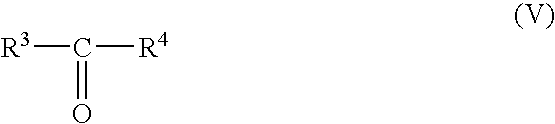
(wherein R3 and R4 are the same as described above, and when m and n are 0 at the same time in Formula (III) described above, R3 and R4 are not a hydrogen atom at the same time) and hydrogen halide gas.
- 4. A production process for the adamantane derivative as described in the above item 1 or 2, characterized by reacting alcohol having an adamantyl group represented by Formula (III) or (IV):


(wherein X, Y, R1, R2, m and n are the same as described above, and a case where m and n are 0 at the same time in Formula (III) is excluded) with dimethylsulfoxide under the presence of acetic anhydride to obtain a (methylthio)methyl ether compound and reacting it with sulfuryl chloride after isolating it or without isolating it.


(wherein R represents independently hydrogen, a halogen atom, an alkyl group having 1 to 10 carbon atoms or a halogenated alkyl group having 1 to 10 carbon atoms).


(wherein R3 and R4 are the same as described above, and when m and n are 0 at the same time in Formula (III) described above, R3 and R4 are not a hydrogen atom at the same time) and hydrogen halide gas (production process 1) and a process in which the raw material alcohol is reacted with dimethylsulfoxide under the presence of acetic anhydride to obtain a (methylthio)methyl ether compound and in which it is reacted with sulfuryl chloride after isolating it or without isolating it (production process 2). In the production process 2, a case where m and n are 0 at the same time in Formula (III) described above is excluded.


-
- Nuclear magnetic resonance spectrometry (NMR): CDCl3 1H-NMR (500 MHz): 1.53 (6H, f), 1.64 to 1.72 (6H, d), 1.97 (3H, e), 3.25 (2H, b), 5.50 (2H, a), 13C-NMR (126 MHz): 28.18 (e), 37.11 (d or f), 39.45 (d or f), 33.49 (c), 81.34 (b), 84.25 (a)
- Infrared spectrometry (IR): 2905 cm−1 (C—H; str.), 1157 cm−1 (C—O—C; str.), 650 cm−1 (C—Cl; str.)
- Boiling point (bp): 130 to 133° C./0.7 kPa

-
- Nuclear magnetic resonance spectrometry (NMR): CDCl3 1H-NMR (500 MHz): 1.66 to 1.69 (m), 1.75 to 1.78 (m), 1.89 to 2.12 (m), 2.20 (m), 2.25 (m), 2.82 (m), 2.40 (dq, J=13.0 Hz, 2.8 Hz), 2.51 (s), 2.54 (s), 2.79 (s), 3.94 (t, J=3.5 Hz, 1H, b2), 4.31 (q, J=2.7 Hz, 1H, b1), 5.52 (s, 2H, a1), 5.55 (dd, J=5.4 Hz, 17.6 Hz, 2H, a2), 13C-NMR (127 MHz): 26.26 (g1), 26.39 (g2) 29.98 (f2 or h2 or j2 or k2), 30.95 (i2), 31.26 (i1), 32.46 (f2 or h2 or j2 or k2), 32.98 (f1 or h1 or j1 or k1), 33.44 (f2 or h2 or j2 or k2), 34.99 (f1 or h1 or j1 or k1), 37.80 (f1 or h1 or j1 or k1), 38.68 (f2 or h2 or j2 or k2), 38.78 (f1 or h1 or j1 or k1), 45.31 (e2), 46.18 (e1), 50.52 (c1), 51.07 (c2), 79.69 (b1), 79.82 (a2), 80.44 (b2), 83.97 (a1), 213.86 (d2) 214.96 (d1) (superscript numeral 1 represents a principal isomer, and superscript numeral 2 represents a subsidiary isomer)
- Gas chromatography mass spectrometry (GC-MS): EI 216 (M++2, 2.9%), 214 (M+, 8.7%), 148 (29.2%), 79 (100%)
- Boiling point: 160 to 161° C./0.2 kPa
Claims (3)


Applications Claiming Priority (3)
| Application Number | Priority Date | Filing Date | Title |
|---|---|---|---|
| JP2002-374659 | 2002-12-25 | ||
| JP2002374659 | 2002-12-25 | ||
| PCT/JP2003/016258 WO2004058675A1 (en) | 2002-12-25 | 2003-12-18 | Adamantane derivative and process for producing the same |
Publications (2)
| Publication Number | Publication Date |
|---|---|
| US20060149073A1 US20060149073A1 (en) | 2006-07-06 |
| US7470824B2 true US7470824B2 (en) | 2008-12-30 |
Family
ID=32677307
Family Applications (1)
| Application Number | Title | Priority Date | Filing Date |
|---|---|---|---|
| US10/540,547 Expired - Lifetime US7470824B2 (en) | 2002-12-25 | 2003-12-18 | Adamantane derivative and process for producing the same |
Country Status (5)
| Country | Link |
|---|---|
| US (1) | US7470824B2 (en) |
| EP (1) | EP1577285A4 (en) |
| JP (1) | JP5137982B2 (en) |
| KR (1) | KR20050090415A (en) |
| WO (1) | WO2004058675A1 (en) |
Families Citing this family (5)
| Publication number | Priority date | Publication date | Assignee | Title |
|---|---|---|---|---|
| US7528279B2 (en) | 2004-02-05 | 2009-05-05 | Idemitsu Kosan Co., Ltd. | Adamantane derivatives and process for producing the same |
| CA2823837A1 (en) | 2010-12-07 | 2012-06-14 | Yale University | Small-molecule hydrophobic tagging of fusion proteins and induced degradation of same |
| GB201311891D0 (en) | 2013-07-03 | 2013-08-14 | Glaxosmithkline Ip Dev Ltd | Novel compound |
| GB201311888D0 (en) | 2013-07-03 | 2013-08-14 | Glaxosmithkline Ip Dev Ltd | Novel compounds |
| US20180228907A1 (en) | 2014-04-14 | 2018-08-16 | Arvinas, Inc. | Cereblon ligands and bifunctional compounds comprising the same |
Citations (4)
| Publication number | Priority date | Publication date | Assignee | Title |
|---|---|---|---|---|
| DE119008C (en) | ||||
| WO2002036533A1 (en) | 2000-10-31 | 2002-05-10 | Daicel Chemical Industries, Ltd. | Monomers having electron-withdrawing groups and processes for preparing the same |
| US20020115883A1 (en) | 2001-02-22 | 2002-08-22 | Toshiyuki Ogata | Novel fluorine-containing monomeric ester compound for base resin in photoresist composition |
| US6440636B1 (en) | 1999-11-02 | 2002-08-27 | Kabushiki Kaisha Toshiba | Polymeric compound and resin composition for photoresist |
Family Cites Families (3)
| Publication number | Priority date | Publication date | Assignee | Title |
|---|---|---|---|---|
| US2652432A (en) * | 1953-09-15 | Method of making chlokomethyl | ||
| JP3353937B2 (en) * | 1993-03-31 | 2002-12-09 | 保土谷化学工業株式会社 | Method for producing chloromethyl alkyl ether |
| KR100301062B1 (en) * | 1999-07-29 | 2001-09-22 | 윤종용 | Photosensitive polymer having cyclic backbone and resist composition comprising the same |
-
2003
- 2003-12-18 EP EP03780891A patent/EP1577285A4/en not_active Withdrawn
- 2003-12-18 KR KR1020057011889A patent/KR20050090415A/en not_active Ceased
- 2003-12-18 US US10/540,547 patent/US7470824B2/en not_active Expired - Lifetime
- 2003-12-18 WO PCT/JP2003/016258 patent/WO2004058675A1/en not_active Ceased
-
2010
- 2010-02-03 JP JP2010022576A patent/JP5137982B2/en not_active Expired - Fee Related
Patent Citations (4)
| Publication number | Priority date | Publication date | Assignee | Title |
|---|---|---|---|---|
| DE119008C (en) | ||||
| US6440636B1 (en) | 1999-11-02 | 2002-08-27 | Kabushiki Kaisha Toshiba | Polymeric compound and resin composition for photoresist |
| WO2002036533A1 (en) | 2000-10-31 | 2002-05-10 | Daicel Chemical Industries, Ltd. | Monomers having electron-withdrawing groups and processes for preparing the same |
| US20020115883A1 (en) | 2001-02-22 | 2002-08-22 | Toshiyuki Ogata | Novel fluorine-containing monomeric ester compound for base resin in photoresist composition |
Non-Patent Citations (11)
| Title |
|---|
| Ben-David et al. "A novel synthesis of trifluoromethyl ethers via xanthates, utilizing BrF3" Journal of Fluorine Chemistry, 1999, vol. 97, pp. 75-78. * |
| Ben-David, Iris et al., "A novel synthesis of trifluoromethyl ethers via xanthates, utilizing BrF3", Journal of Fluorine Chemistry, vol. 97, No. 1-2, pp. 75-78, 1999. 0009. |
| Database Crossfire Beilstein, Beilstein Institut zur Foerderung der Chemischen Wissenschaften, XP002367361, Palfray, Sabetay: Bull. Soc. Chim. Fr., <4> 43, p. 900, 1928. |
| Farren, J.W. et al., Chloro Ethers. II. Preparation of Some New Chloro Ethers and Alkoxymethyl Esters, J. AM. Chem. Soc., vol. 47, pp. 2419-2423, 1925. |
| Machula, A. A. et al., "Radiochemical alkylation of adamantane by perfluorovinyl ethers", Khimiya Vysokikh Energii, vol. 24, No. 2, pp. 117-121, 1990. |
| McMurry, John "Organic Chemistry-Fourth Edition" Brooks/Cole Publishing Company, 1996, pp. 816-818. * |
| Moss, Robert A. et al., "Absolute Kinetics of Alkoxychlorocarbene Fragmentation", Journal of the American Chemical Society, vol. 118, No. 40, pp. 9792 to 9793, 1996. |
| Okada et al. "Amino Acids and Peptides. L. Development of a Novel N-pi-Protecting Group for Histidine, N-pi-2-Adamantyloxymethylhistidine, and Its Application to Peptide Synthesis" Chem Pharm Bull, 1997, vol. 45, pp. 452-456. * |
| Okada, Yoshio et al., "Amino acids and peptides. L. Development of a Novel Npi-protecting group for histidine, Npi-adamantyloxymethylhistidine, and its application to peptide synthesis", Chemical and Pharmaceutical Bulletin, vol. 45, No. 3, pp. 452 to 456, 1997. |
| Pericas, Miquel A. et al., Efficient synthesis of tert-alkoxy ethynes, Tetrahedron, vol. 43, No. 10, 2311 to 2316. |
| Rykov, S.V. et al., Photochemical reactions of some mono- and diketo derivatives of adamantane in different solvents, Izvestiya Akademii Nauk, Seriya Kimicheskaya, No. 9, pp. 1833 to 1835. 0039. |
Also Published As
| Publication number | Publication date |
|---|---|
| JP5137982B2 (en) | 2013-02-06 |
| EP1577285A1 (en) | 2005-09-21 |
| US20060149073A1 (en) | 2006-07-06 |
| WO2004058675A1 (en) | 2004-07-15 |
| KR20050090415A (en) | 2005-09-13 |
| JP2010095548A (en) | 2010-04-30 |
| EP1577285A4 (en) | 2006-04-12 |
Similar Documents
| Publication | Publication Date | Title |
|---|---|---|
| US20220056008A1 (en) | Process and intermediates for the synthesis of voxelotor | |
| JP5137982B2 (en) | Adamantane derivative and method for producing the same | |
| US5248832A (en) | Chemical process for manufacturing trifluoroacetaldehyde hydrate or trifluoroacetalde hemiacetal | |
| US7402712B2 (en) | Adamantyl vinyl ether compound and production process for the same | |
| JP4580165B2 (en) | Adamantane derivative and method for producing the same | |
| US7312354B2 (en) | Adamantane derivative and production process for the same | |
| US10562834B2 (en) | Process for preparing substituted crotonic acids | |
| US7038091B2 (en) | Process for producing acetylene compound | |
| JP4659251B2 (en) | Process for producing hydroxy-4-oxatricyclo [4.3.1.13,8] undecan-5-one and (meth) acrylic acid ester thereof | |
| US6894197B2 (en) | Process for producing fluorinated alcohol | |
| JP4002114B2 (en) | Method for producing allyl alcohols | |
| KR20030094370A (en) | Process for the preparation of alkyl-n-(3-dimethylamino)alkylcarbamates | |
| US7193106B2 (en) | Halogenoacetoxyadamantane derivatives and process for production thereof | |
| JPWO2005058859A1 (en) | Process for producing 3- (4-tetrahydropyranyl) -3-oxopropanoic acid alkyl compound and 4-acyltetrahydropyran | |
| EP0881207A1 (en) | 2,3-dihalogeno-6-trifluoromethylbenzene derivatives and processes for the preparation thereof | |
| EP0019804A1 (en) | Bromination of side chain of m-phenoxytoluene | |
| US6787673B2 (en) | Process for producing 2-bromocyclopentanone | |
| JP2708617B2 (en) | Method for producing 4,4-dialkyl-substituted thiazolidinethione | |
| JPH08151354A (en) | Production of aminoacetamide derivative | |
| WO1996004229A1 (en) | The preparation of organic compounds | |
| JPH04234333A (en) | Process for producing beta-fluoroalcohol | |
| US5144083A (en) | Process for producing p-hydroxyneophyl m-phenoxybenzyl ether | |
| US20050222439A1 (en) | Process for producing tetrahydropyran-4-ol, intermediate therefor, and process for producing the same | |
| JPH1112253A (en) | Method for producing 4-amino-5-chloro-6- (1-fluoroethyl) pyrimidine derivative | |
| JPH0672957A (en) | Production of trans-beta-substituted acrylic ester derivative |
Legal Events
| Date | Code | Title | Description |
|---|---|---|---|
| AS | Assignment |
Owner name: IDEMITSU KOSAN CO., LTD., JAPAN Free format text: ASSIGNMENT OF ASSIGNORS INTEREST;ASSIGNORS:TANAKA, SHINJI;ONO, HIDETOSHI;KODOI, KOUICHI;AND OTHERS;REEL/FRAME:017355/0004 Effective date: 20050616 |
|
| AS | Assignment |
Owner name: IDEMITSU KOSAN CO., LTD., JAPAN Free format text: CORRECTIVE ASSIGNMENT TO CORRECT ASSIGNEE'S ADDRESS PREVIOUSLY RECORDED ON REEL 017355 FRAME 0004;ASSIGNORS:TANAKA, SHINJI;ONO, HIDETOSHI;KODOI, KOUICHI;AND OTHERS;REEL/FRAME:017907/0437 Effective date: 20050616 |
|
| FEPP | Fee payment procedure |
Free format text: PAYOR NUMBER ASSIGNED (ORIGINAL EVENT CODE: ASPN); ENTITY STATUS OF PATENT OWNER: SMALL ENTITY |
|
| STCF | Information on status: patent grant |
Free format text: PATENTED CASE |
|
| CC | Certificate of correction | ||
| CC | Certificate of correction | ||
| FPAY | Fee payment |
Year of fee payment: 4 |
|
| AS | Assignment |
Owner name: OSAKA ORGANIC CHEMICAL INDUSTRY LTD., JAPAN Free format text: ASSIGNMENT OF ASSIGNORS INTEREST;ASSIGNOR:IDEMITSU KOSAN CO., LTD.;REEL/FRAME:033722/0526 Effective date: 20140819 |
|
| FEPP | Fee payment procedure |
Free format text: PAT HOLDER CLAIMS SMALL ENTITY STATUS, ENTITY STATUS SET TO SMALL (ORIGINAL EVENT CODE: LTOS); ENTITY STATUS OF PATENT OWNER: SMALL ENTITY |
|
| FPAY | Fee payment |
Year of fee payment: 8 |
|
| MAFP | Maintenance fee payment |
Free format text: PAYMENT OF MAINTENANCE FEE, 12TH YR, SMALL ENTITY (ORIGINAL EVENT CODE: M2553); ENTITY STATUS OF PATENT OWNER: SMALL ENTITY Year of fee payment: 12 |
|
| AS | Assignment |
Owner name: OSAKA ORGANIC CHEMICAL INDUSTRY LTD., JAPAN Free format text: CHANGE OF ADDRESS;ASSIGNOR:OSAKA ORGANIC CHEMICAL INDUSTRY LTD.;REEL/FRAME:059721/0809 Effective date: 20211122 |