US7463262B2 - Image processing apparatus and method - Google Patents
Image processing apparatus and method Download PDFInfo
- Publication number
- US7463262B2 US7463262B2 US11/237,960 US23796005A US7463262B2 US 7463262 B2 US7463262 B2 US 7463262B2 US 23796005 A US23796005 A US 23796005A US 7463262 B2 US7463262 B2 US 7463262B2
- Authority
- US
- United States
- Prior art keywords
- section
- curved cross
- line
- data
- dimensional image
- Prior art date
- Legal status (The legal status is an assumption and is not a legal conclusion. Google has not performed a legal analysis and makes no representation as to the accuracy of the status listed.)
- Expired - Fee Related, expires
Links
Images




Classifications
-
- G—PHYSICS
- G06—COMPUTING OR CALCULATING; COUNTING
- G06T—IMAGE DATA PROCESSING OR GENERATION, IN GENERAL
- G06T3/00—Geometric image transformations in the plane of the image
- G06T3/06—Topological mapping of higher dimensional structures onto lower dimensional surfaces
- G06T3/067—Reshaping or unfolding three-dimensional [3D] tree structures onto two-dimensional [2D] planes
-
- G—PHYSICS
- G06—COMPUTING OR CALCULATING; COUNTING
- G06T—IMAGE DATA PROCESSING OR GENERATION, IN GENERAL
- G06T15/00—Three-dimensional [3D] image rendering
- G06T15/08—Volume rendering
-
- G—PHYSICS
- G06—COMPUTING OR CALCULATING; COUNTING
- G06T—IMAGE DATA PROCESSING OR GENERATION, IN GENERAL
- G06T19/00—Manipulating three-dimensional [3D] models or images for computer graphics
-
- G—PHYSICS
- G06—COMPUTING OR CALCULATING; COUNTING
- G06T—IMAGE DATA PROCESSING OR GENERATION, IN GENERAL
- G06T2210/00—Indexing scheme for image generation or computer graphics
- G06T2210/41—Medical
-
- G—PHYSICS
- G06—COMPUTING OR CALCULATING; COUNTING
- G06T—IMAGE DATA PROCESSING OR GENERATION, IN GENERAL
- G06T2215/00—Indexing scheme for image rendering
- G06T2215/06—Curved planar reformation of 3D line structures
-
- G—PHYSICS
- G06—COMPUTING OR CALCULATING; COUNTING
- G06T—IMAGE DATA PROCESSING OR GENERATION, IN GENERAL
- G06T2219/00—Indexing scheme for manipulating 3D models or images for computer graphics
- G06T2219/021—Flattening
-
- G—PHYSICS
- G06—COMPUTING OR CALCULATING; COUNTING
- G06T—IMAGE DATA PROCESSING OR GENERATION, IN GENERAL
- G06T2219/00—Indexing scheme for manipulating 3D models or images for computer graphics
- G06T2219/028—Multiple view windows (top-side-front-sagittal-orthogonal)
Definitions
- the present invention relates to an image processing apparatus and method which can provide an image allowing easy comprehension of a curved cross-sectional shape of a target under observation.
- Image processing apparatuses recently used in the field of medical images are widely used in many hospitals, examination organizations, and the like in combination with ultrasound diagnostic apparatuses, X-ray CT scanners, magnetic resonance imaging apparatuses, and the like.
- This image processing apparatus can provide various kinds of images useful as clinical information along with increases in image processing speed and resolution, and is used, for example, for imaging of an alimentary tract lumen which is performed to check blood vessel running, an alimentary tract tumor, the formation of a plaque (blood clot), stenochoria, and the like in a simulation or the like before a surgical operation.
- C-MPR curved multi-planar reformatting
- an image is formed by C-MPR according to the following sequence: (1) setting polygonal lines on the screen on which an overall three-dimensional image is displayed, (2) forming a cross-section (C-MPR cross-section) containing the polygonal lines set perpendicular to the screen, and (3) displaying pixel values on the cross-section as a two-dimensional image.
- FIG. 6 is a view for explaining a C-MPR image (an image generated by C-MPR).
- C-MPR image an image generated by C-MPR.
- polygonal lines a, b, c, and d which define a C-MPR cross-section are formed by four straight lines.
- a C-MPR image is generated by displaying pixel values on the C-MPR cross-section comprising four planes which include the respective polygonal lines and are perpendicular to the screen without any change. That is, C-MPR is a method of displaying pixel values side by side on one plane, which are not present on a plane as a whole. According to this technique, images on a curved surface comprising planes can be observed at once.
- Another method of displaying pixels values side by side on one plane, which are not present on a plane as a whole, is known.
- this method is executed according to the following sequence: (1) setting polygonal lines on the screen on which an overall three-dimensional image is displayed, (2) forming a cross-section (C-PC cross-section) containing the polygonal lines set perpendicular to the screen, and (3) displaying only pixel values on the cross-section by projecting them on a projection surface in consideration of a line of sight.
- this display method will be referred to as curved plane cut (C-PC).
- FIG. 7 is a view for explaining a C-PC image.
- the right-side portion indicates a C-PC image, which is displayed to show the shape of a C-PC cross-section.
- An overall C-PC cross-section can be observed at different lines of sight upon rotation.
- a C-MPR image is an image obtained by transforming a curved surface into planes
- the shape of an observation target cannot be comprehended.
- a winding observation target such as a blood vessel is observed.
- a curved surface cannot always be designated so as to allow an observer to comprehend how the overall observation target is curved, the observer may not comprehend how the overall observation target is curved.
- the observer observes a C-MPR image from a direction different from the direction in which he/she has observed a three-dimensional image when setting a C-MPR cross-section. It is natural for the observer to observe a cross-section of the observation target, at this point of time, in the same direction as that in which he/she sees the three-dimensional image. However, this requirement cannot be satisfied by a C-MPR image.
- C-PC uses the same curved surface designating method as that in C-MPR, and hence there is a limit to the comprehension of the overall shape.
- an entire C-PC cross-section can be rotated and observed from different directions.
- the C-PC cross-section remains the same, and hence this operation is no more than to observe the same data from different directions. Therefore, no C-PC image can satisfy the requirement to observe a cross-section of an observation target from the same direction as that in which a three-dimensional image is seen at a given time point.
- the present invention has been made in consideration of the above situations, and has as its object to provide an image processing apparatus and method which can generate useful cross-sectional images with a light operation burden when a cross-sectional image of a curved observation target is to be generated.
- an image processing apparatus comprising a position data specifying unit which specifies a plurality of position data indicating a position of an input observation target on three-dimensional image data of the observation target, a curved cross-section calculating unit which calculates a first curved cross-section in a desired line-of-sight direction from the plurality of position data and line-of-sight data including the line-of-sight direction, a projection image generating unit which generates a projection image by projecting the three-dimensional image data on the first curved cross-section or three-dimensional image data concerning an area with reference to the first curved cross-section onto a projection surface along the line-of-sight direction, and a display unit which displays the projection image.
- a medical image diagnosis apparatus comprising an acquiring unit which acquires three-dimensional image data of an observation target, a position data specifying data which specifies a plurality of position data indicating a position of the observation target on the three-dimensional image data, a curved cross-section calculating unit which calculates a first curved cross-section in the line-of-sight direction from the plurality of position data and line-of-sight data including a desired line-of-sight direction, a projection image generating unit which generates a projection image by projecting the three-dimensional image data on the first curved cross-section or three-dimensional image data concerning an area with reference to the first curved cross-section onto a projection surface along the line-of-sight direction, and a display unit which displays the projection image.
- an image processing method comprising specifying a plurality of position data indicating a position of an input observation target on three-dimensional image data of the observation target, calculating a first curved cross-section in a desired line-of-sight direction from the plurality of position data and line-of-sight data including the line-of-sight direction, generating a projection image by projecting the three-dimensional image data on the first curved cross-section or three-dimensional image data concerning an area with reference to the first curved cross-section onto a projection surface along the line-of-sight direction, and displaying the projection image.
- FIG. 1 is a block diagram showing an image processing apparatus 10 according to this embodiment
- FIG. 2 is a block diagram showing the arrangement of an image processing unit 15 ;
- FIG. 3 is a flowchart showing a sequence of curved cross-sectional image generation processing executed by the image processing apparatus 10 ;
- FIG. 4 is a conceptual view showing an example of a distance D i between points s P x,y and ( s x i , s y i ) on the screen;
- FIGS. 5A and 5B are views for explaining the results obtained by executing curved cross-sectional image generation processing for a three-dimensional CT image containing the aorta;
- FIG. 5C is a view for explaining modification 1 of this embodiment.
- FIG. 6 is a conceptual view for explaining C-MPR as a cross-section display technique for an observation target
- FIG. 7 is a conceptual view for explaining C-PC as a cross-section display technique for an observation target
- FIG. 8 is a flowchart showing the flow of blood vessel inner wall visualization processing according to embodiment 1;
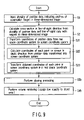
- FIG. 9 is a flowchart showing the flow of blood vessel inner wall visualization processing according to embodiment 2.
- FIG. 10 is a view for explaining the assignment of opacities in volume rendering
- FIG. 11 is a flowchart showing the flow of blood vessel inner wall visualization processing according to embodiment 3.
- FIG. 12 is a view for explaining a non-blood area specifying technique using a blood vessel center line
- FIG. 13 is a view showing a change in voxel value along a radial direction.
- FIG. 14 is a view showing an example of the display form of a reference image.
- an image processing apparatus is assumed to be a unitized medical workstation which executes image processing to be described later by developing a dedicated program in a working memory.
- the present invention is not limited to this and may apply to an image processing apparatus or the like incorporated in various kinds of modalities such as a medical image dedicated viewer, X-ray computed tomography apparatus, ultrasound diagnosis apparatus, and magnetic resonance imaging apparatus.
- a three-dimensional image means three-dimensional image data to be displayed instead of a displayed image.
- This three-dimensional image is to be defined in a real space (a three-dimensional image space or volume space) and is sometimes called volume data.
- FIG. 1 is a block diagram of an image processing apparatus 10 according to this embodiment.
- the image processing apparatus 10 comprises a control unit 11 , main storage unit 13 , external storage unit 14 , image processing unit 15 , transmission/reception unit 17 , display unit 19 , and input unit 21 .
- the control unit 11 serves as a control center to statically or dynamically control the image processing apparatus 10 .
- the main storage unit 13 stores the image data (irrespective of before or after reconstruction) acquired by various kinds of modalities which are received by the transmission/reception unit 17 through a network.
- the main storage unit 13 stores a dedicated program for executing curved cross-sectional image generation processing (to be described later).
- the external storage unit 14 is a recording medium such as a magnetic disk (e.g., a floppy disk or hard disk), an optical disk (e.g., a CD-ROM or DVD), or a semiconductor memory.
- the external storage unit 14 may be designed to store at least part of image data, programs, and the like to be stored in the main storage unit 13 .
- the image processing unit 15 executes curved cross-sectional image generation processing.
- the arrangement of the image processing unit 15 and the contents of the curved cross-sectional image generation processing will be described in detail later.
- the transmission/reception unit 17 transmits/receives various kinds of data including image data to/from various kinds of medical imaging apparatuses (e.g., an X-ray computed tomography apparatus, ultrasound diagnostic apparatuses, or magnetic resonance imaging apparatus) through a network.
- medical imaging apparatuses e.g., an X-ray computed tomography apparatus, ultrasound diagnostic apparatuses, or magnetic resonance imaging apparatus
- the display unit 19 is an output unit which displays a projection image received from a three-dimensional image projection unit 157 in a predetermined form.
- the input unit 21 has input devices (e.g., a mouse, trackball, mode switches, and keyboard) for inputting various kinds of commands, instructions, and information from an observer (operator).
- input devices e.g., a mouse, trackball, mode switches, and keyboard
- FIG. 2 is a block diagram showing the arrangement of the image processing unit 15 .
- the image processing unit 15 comprises a three-dimensional image storage unit 151 , a position data storage unit 152 , a curved cross-section data computing unit 153 , a curved cross-section data storage unit 154 , a line-of-sight data changing unit 155 , a line-of-sight data storage unit 156 , and the three-dimensional image projection unit 157 .
- the function and arrangement of the image processing unit 15 can be implemented by, for example, installing a dedicated program for executing this processing in the image processing apparatus 10 , reading out the program, and developing it in an auxiliary storage unit (memory) (not shown) under the control of the control unit 11 .
- a program which can implement the function of the image processing unit 15 or the like can be distributed while being stored in a recording medium such as a magnetic disk (a floppy disk or hard disk), an optical disk (e.g., a CD-ROM or DVD), or a semiconductor memory.
- This embodiment is not limited to such an arrangement based on software.
- at least part of the arrangement shown in FIG. 2 may be implemented by a hardware arrangement using a graphic card and the like.
- the three-dimensional image storage unit 151 stores three-dimensional image data read out from the main storage unit 13 .
- the position data storage unit 152 stores predetermined position data (e.g., blood vessel center line data (to be described later) which is a curved observation target in a three-dimensional image) input through the input unit 21 , another apparatus connected via a network, and a detachable external storage such as a CD.
- predetermined position data e.g., blood vessel center line data (to be described later) which is a curved observation target in a three-dimensional image
- the curved cross-section data computing unit 153 inputs blood vessel center line data read out from the position data storage unit 152 and line-of-sight data read out from the line-of-sight data storage unit 156 and generates curved cross-section data by predetermined computation. This computation will be described in detail later.
- the curved cross-section data storage unit 154 stores the curved cross-section data generated by the curved cross-section data computing unit 153 .
- the line-of-sight data changing unit 155 generates line-of-sight data in response to operation from the input unit 21 which is performed to change the line of sight. More specifically, the line-of-sight data changing unit 155 regards the direction and degree of movement of a mouse or trackball as an amount of change in view point or line of sight on the basis of input data from the input unit 21 , and generates line-of-sight data defining at least a line-of-sight direction. Note that line-of-sight data may define a view point as well as a line-of-sight direction as needed.
- the line-of-sight data storage unit 156 stores the line-of-sight data generated by the line-of-sight data changing unit 155 .
- the three-dimensional image projection unit 157 generates a projection image by projecting a three-dimensional image using a projection method indicated by the control unit 11 on the basis of the three-dimensional image read out from the three-dimensional image storage unit 151 and the line-of-sight data read out from the line-of-sight data storage unit 156 .
- the generated projection image is output to an image display unit 29 to be displayed in a predetermined form.
- a projection image is generated by executing predetermined projection processing on the basis of the three-dimensional image read out from the three-dimensional image storage unit 151 , the line-of-sight data read out from the line-of-sight data storage unit 156 , and the curved cross-section data stored in the curved cross-section data storage unit 154 .
- This projection processing will be described in detail later.
- the generated projection image is output to the image display unit 29 to be displayed in a predetermined form.
- FIG. 3 is a flowchart showing a sequence for curved cross-sectional image generation processing executed by the image processing apparatus 10 . As shown in FIG. 10 , this curved cross-sectional image generation processing is roughly comprised of the following three steps.
- Step S 1 A plurality of position data indicating an observation target object in a three-dimensional image are input.
- Step S 2 A curved cross-section in the line-of-sight direction is obtained from the plurality of position data and line-of-sight data with respect to the three-dimensional image.
- Step S 3 The three-dimensional image on the curved cross-section is projected on a projection surface on the basis of the line-of-sight data.
- a plurality of position data indicating the position of an observation target object in a three-dimensional image are input.
- n ( n is a natural number equal to two or more) position data are input, and the overall position data are represented by w K
- w x i , w y i , w z i are the x-coordinate, y-coordinate, and z-coordinate in the real space, respectively.
- step S 2 a curved cross-section is calculated from n position data and line-of-sight data input in step S 1 .
- the processing executed in this step is comprised of the following three sub-steps as indicated by steps S 21 to S 23 in FIG. 3 .
- Step S 2 - 1 The coordinates of position data are transformed from the real space coordinate system into the screen coordinate system.
- Step S 2 - 2 The coordinates of each point on the screen in the depth direction are obtained from the position data transformed into the screen coordinate system.
- Step S 2 - 3 The obtained coordinates of each point in the screen coordinate system are transformed into those in the real space coordinate system.
- a transformation matrix from the real space coordinate system where volume data are arranged to the screen coordinates system is represented by s T w
- the inverse transformation matrix thereof is represented by w T s
- w T s represents an inverse transformation matrix from the screen coordinate system to the real space coordinate system.
- s T w and w T s will be referred to as line-of-sight data as a whole.
- step S 2 - 2 the data of each point (pixel) s P on the screen in the depth direction in the screen coordinate system are obtained from the position data in the screen coordinate system which are obtained in step S 2 - 1 .
- s P x,y be a point at coordinates ( s x, s y) on the screen
- obtaining data in the depth direction is equivalent to obtaining a value s z of a z-coordinate (information concerning the depth direction) in the screen coordinate system
- a set of ( s x, s y, s z) is data representing a curved cross-section to be obtained.
- the position data w K i in the real space transformed into the screen coordinate system will be referred to as s K i .
- FIG. 4 is a conceptual view showing an example of a distance D i between the point s P x,y and ( s x i , s y i ) on the screen.
- s z is obtained according to equations (4) and (5):
- ⁇ i 1 /D i m (5)
- ⁇ i is a weight, which increases as D i decreases, i.e., s K i becomes closer to the point ( s x i , s y i ).
- step S 3 projection processing of projecting a three-dimensional image is executed by using the curved cross-section data in the real space in step S 2 . That is, in step S 3 , with respect to each point ( s x, s y) on the screen, pixel values (voxels) V( w x, w y, w z) of the three-dimensional image at the coordinates ( w x, w y, w z) in the real space corresponding to the coordinates ( s x, s y, s z) obtained in step S 2 - 2 are obtained, and projection processing is performed with the obtained pixel values being pixel values at ( s x, s y).
- FIGS. 5A and 5B are views for explaining the result obtained by executing this curved cross-sectional image generation processing for a three-dimensional CT image containing the aorta. That is, FIG. 5A shows data s z in the depth direction obtained in step S 2 - 2 as an image, with a black portion indicating that it is located closer to the front side than a white portion. A line-of-sight direction is set in a direction in which a CT image is observed from almost the front surface side relative to the patient, and the value of m in step S 2 - 2 is set to 8.
- FIG. 5B shows the result obtained by executing processing up to step S 3 .
- a cross-sectional shape of the overall aorta seen from the line-of-sight direction is displayed in a manner easy to understand.
- the resultant image is natural to the observer.
- a curve indicating the position of the blood vessel center line of the aorta is superimposed on the image.
- position data data indicating the position of the blood vessel center line of the aorta is used.
- one of the techniques disclosed in the following references can be used: Ali Shahrokni et al., “Fast skeltonization algorithm for 3-D elongated objects”, Proceedings of SPIE Vol. 4322, pp. 323-330, 2001, U.S. Pat. No. 5,971,767, and Onno Wink, Wiro J. Niessen, “Fast Delineation and Visualization of Vessels in 3-D Angiographic Images”, IEEE Trans. Med. Image., Vol. 19, No. 4, 2000.
- step S 3 a projection method of performing projection with a thickness being provided for the curved cross-section obtained in step S 2 is used in step S 3 .
- predetermined thicknesses are provided for the front and back sides on the curved cross-section obtained in step S 2 in the line-of-sight direction so as to set a projection area with a thickness corresponding to L voxels.
- the maximum voxel value of those of voxels which are located on a line of sight perpendicular to each point on the screen and fall within a projection area through which the line of sight passes is projected as the pixel value of the corresponding point on the screen.
- This processing is known well as maximum intensity projection.
- the image allows the observer to easily comprehend the overall shape of the aorta viewed from the line-of-sight direction and more easily grasp the blood vessels, organs, and bones around the aorta.
- thickness need not be constant.
- an overall area located deeper than a curved cross-section in the line-of-sight direction may be projected.
- a projection method other than maximum intensity projection may be used.
- various kinds of projection methods can be used in accordance with the region of interest, e.g., so-called volume rendering of performing projection by using opacities and colors.
- the line-of-sight data changing unit 155 calculates an amount of change in line of sight on the basis of a line-of-sight direction change instruction (e.g., an instruction to move a pointer by a predetermined amount in a predetermined direction) from the input unit 21 such as a mouse or trackball, and generates new line-of-sight data.
- a line-of-sight direction change instruction e.g., an instruction to move a pointer by a predetermined amount in a predetermined direction
- the transmission/reception unit 17 calculates curved cross-section data on screen coordinates on the basis of the changed line-of-sight direction.
- the three-dimensional image projection unit 157 generates a projection image by projecting a curved cross-section in the real space on the basis of the changed line-of-sight direction.
- the obtained projection image is displayed on the display unit 19 in a predetermined form.
- This image processing apparatus obtains a curved cross-section in the real space from a winding cross-section on the screen which includes a winding observation target, and projects data on a curved cross-section in the real space or an area including the curved cross-section and having a thickness. This makes it possible to provide a projection image which allows to easily comprehend the shape of the overall observation target as compared with the conventional technique of observing a winding observation target upon transforming its cross-section into planes.
- a curved cross-section in the real space is calculated from position data set with respect to a curved observation target and the data of a line-of-sight direction, and a curved cross-sectional image is generated by projecting the curved cross-section.
- This curved cross-section in the real space is obtained from the position data transformed into the screen coordinate system by using the coordinates of each point on the screen in the depth direction in accordance with the line-of-sight direction.
- a projection image is generated by using a curved cross-section in the real space viewed from the same direction as that in which the observer observes a three-dimensional image, a projection image can be provided, which allows to observe the winding observation target in a natural manner as compared with the conventional technique of generating an image from a direction different from the direction in which the observer observes the three-dimensional image.
- this image processing apparatus when the line-of-sight direction is changed, even if new cross-sectional position data is not input, a new curved cross-section in the real space viewed from the changed line-of-sight direction is generated, and a projection image is generated by this.
- a new cross-sectional image cannot be generated unless new cross-sectional position data is input.
- a projection image can be provided, which allows the observer to observe a winding observation target in a natural manner regardless of how a line-of-sight direction is set.
- An image processing apparatus has a function (blood vessel inner wall visualizing function) of visualizing a blood vessel inner wall by using a curved cross-section obtained in the first embodiment.
- a function blood vessel inner wall visualizing function
- the contents of this function and processing based thereon will be described in accordance with this embodiment.
- a curved cross-section acquired in step S 2 in FIG. 3 will be referred to as a “first type curved cross-section”.
- a curved cross-section generated by processing (blood vessel inner wall visualization processing) based on the blood vessel inner wall visualizing function using the first type curved cross-section will be referred to as a “second type curved cross-section”.
- Example 1 is directed to generate a second type curved cross-section by replacing a blood area existing on a first type curved cross-section with a non-blood area appearing first from the blood area in the depth direction along the line-of-sight direction.
- FIG. 8 is a flowchart showing the flow of blood vessel inner wall visualization processing according to this example.
- a plurality of position data indicating the position of an observation target in a three-dimensional image are input (step S 1 ), and a first type curved cross-section in the line-of-sight direction is calculated from the input plurality of position data and line-of-sight data with respect to a three-dimensional image (step S 2 ).
- step S 1 a plurality of position data indicating the position of an observation target in a three-dimensional image
- a first type curved cross-section in the line-of-sight direction is calculated from the input plurality of position data and line-of-sight data with respect to a three-dimensional image (step S 2 ).
- a curved cross-section data computing unit 153 determines whether a voxel having a value (a value regarded as representing blood) within a predetermined range exists on the first type curved cross-section (step S 3 a ). If it is determined that no corresponding voxel exists on the first type curved cross-section, a three-dimensional image projection unit 157 generates a display image by projecting three-dimensional data on the first type curved cross-section onto a two-dimensional plane on the basis of the line-of-sight data (step S 7 a ). This processing is the same as that in step S 3 in FIG. 3 .
- the curved cross-section data computing unit 153 specifies a blood area existing on the first type curved cross-section by extracting the corresponding voxel (step S 4 a ).
- the curved cross-section data computing unit 153 determines a voxel value from each position in the blood area along the line-of-sight depth direction, and specifies the first voxel having a value which does not correspond to blood, thereby specifying a non-blood area (i.e., a blood vessel inner wall) (step S 5 a ).
- the curved cross-section data computing unit 153 generates a second type curved cross-section including a blood vessel inner wall by replacing the blood area on the first type curved cross-section with the specified non-blood area (step S 6 a ).
- the three-dimensional image projection unit 157 then generates a display image by projecting three-dimensional data on the generated second type curved cross-section onto a two-dimensional plane on the basis of line-of-sight data (step S 7 a )
- Example 2 is directed to actively visualize a blood vessel inner wall by performing clipping processing of removing data located closer to the front side than the first type curved cross-section and volume rendering processing of assigning 0 or low opacity (relative to the tissue) to a voxel having a value (a value regarded as representing blood) within a predetermined range.
- FIG. 9 is a flowchart showing the flow of blood vessel inner wall visualization processing according to this example.
- a plurality of position data indicating the position of an observation target in a three-dimensional image are input (step S 1 ).
- a first type curved cross-section in the line-of-sight direction is calculated from the input plurality of position data and line-of-sight data with respect to the three-dimensional image (step S 2 ).
- a three-dimensional image projection unit 157 uses the first type curved cross-section as a clipping surface and performs clipping processing of removing data located closer to the front side than the clipping surface (step S 3 b ).
- the three-dimensional image projection unit 157 executes volume rendering processing of assigning a low opacity (or an opacity of 0) to a voxel having a value corresponding to blood (step S 4 b ) by using the clipped data, as shown in FIG. 10 .
- This makes it possible to generate a volume rendering image visualizing the blood vessel inner wall.
- the opacity to be assigned to a voxel having a value corresponding to blood can be set to an arbitrary value.
- Example 3 is directed to generate a second type curved cross-section by specifying a blood vessel inner wall using a blood vessel center line acquired in the first embodiment and replacing a blood area on a first type curved cross-section with the blood vessel inner wall.
- FIG. 11 is a flowchart showing the flow of blood vessel inner wall visualization processing according to this example.
- a plurality of position data indicating the position of an observation target in a three-dimensional image are input (step S 1 ).
- a first type curved cross-section in the line-of-sight direction is calculated from the input plurality of position data and line-of-sight data with respect to the three-dimensional image (step S 2 ).
- a curved cross-section data computing unit 153 determines whether a voxel having a value corresponding to blood exists on a first type curved cross-section (step S 3 c ). If it is determined that no corresponding voxel exists on the first type curved cross-section, a three-dimensional image projection unit 157 generates a display image by projecting three-dimensional data on the first curved cross-section onto a two-dimensional plane on the basis of line-of-sight data (step S 7 c ). This processing is the same as that in step S 3 in FIG. 3 .
- the curved cross-section data computing unit 153 specifies a blood area existing on the first type curved cross-section by extracting the corresponding voxel (step S 4 c ).
- the curved cross-section data computing unit 153 determines voxel values at all angles along the radial direction from the blood vessel center line. For example, as shown in FIG. 13 , the curved cross-section data computing unit 153 then specifies a non-blood area (i.e., a blood vessel inner wall) by specifying the first voxel, at each angle, whose voxel value changes by a predetermined threshold or more (step S 5 c ).
- a non-blood area i.e., a blood vessel inner wall
- the curved cross-section data computing unit 153 generates a second type curved cross-section containing a blood vessel inner wall by replacing a blood area on the first type curved cross-section with a non-blood area existing at a deeper position from the blood area along the line-of-sight depth direction (step S 6 c ).
- the three-dimensional image projection unit 157 generates a display image by projecting three-dimensional data on the generated second type curved cross-section onto a two-dimensional plane on the basis of line-of-sight data (step S 7 c ).
- a blood vessel inner wall may be specified with reference to a voxel value itself instead of a rate of change in voxel value. That is, a blood vessel inner wall can be specified by determining voxel values along all radial directions from the blood vessel center line and specifying the first voxel having a value which does not correspond to blood.
- the visualized blood vessel inner wall image generated by each technique described above is displayed on a display unit 19 independently or together with a reference image in, for example, the form shown in FIG. 14 .
- the reference image is an image obtained by visualizing the same target as that for the display image acquired by a technique based on the first or second embodiment from the same line-of-sight direction.
- a typical example of this image is a volume rendering image with respect to the same target from the same line-of-sight direction.
- This reference image may be an image acquired by any kind of modality.
- the line-of-sight direction, enlargement ratio, or the like of the reference image is preferably changed in synchronism with a change in the line-of-sight direction, enlargement ratio, or the like of, for example, a visualized blood vessel inner wall image.
- a display unit 19 may display a visualized blood vessel inner wall image together with an image visualizing blood as shown in FIGS. 5B and 5C .
- the display unit 19 may also display a visualized blood vessel inner wall image, an image visualizing blood, and a reference image synchronously and simultaneously, as needed.
- This image processing apparatus can generate and display a visualized blood vessel inner wall image as if blood were removed from the blood vessel image shown in FIG. 5B or 5 C to bring the blood vessel inner wall into sight. Therefore, a blood vessel inner wall which cannot be observed in the prior art can be freely observed. This can contribute to an improvement in quality of medical practice.
- a visualized blood vessel inner wall image can be displayed, together with a reference image, in correspondence with each other.
- the observer can therefore observe an entire diagnosis region in association with a reference image, and a detailed region in association with a visualized blood vessel inner wall image.
- using the image acquired in the first embodiment makes it possible to freely observe an image with or without blood in the blood vessel in accordance with a purpose. This makes it possible to provide new diagnosis information and increase the degree of freedom in diagnosis information selection.
- each embodiment described above has exemplified the image processing apparatus which executes a series of processing from, for example, setting position data with respect to a three-dimensional CT image to the formation of a projection image of a curved cross-section.
- this apparatus may be designed to generate a projection image of a curved cross-section by using at least one of position data, curved cross-section data, line-of-sight data, and the like stored in the main storage unit 13 or the like in advance. In such a case, since data stored in advance is used, input operation by the observer can be omitted. In addition, predetermined data generation processing operation can be omitted.
- various inventions can be formed by proper combinations of a plurality of constituent elements disclosed in the above embodiments.
- constituent elements may be omitted from all the constituent elements disclosed in the above embodiments.
- constituent elements in the different embodiments may be properly combined.
Landscapes
- Engineering & Computer Science (AREA)
- Physics & Mathematics (AREA)
- General Physics & Mathematics (AREA)
- Theoretical Computer Science (AREA)
- Computer Graphics (AREA)
- Computer Hardware Design (AREA)
- General Engineering & Computer Science (AREA)
- Software Systems (AREA)
- Apparatus For Radiation Diagnosis (AREA)
- Magnetic Resonance Imaging Apparatus (AREA)
- Image Generation (AREA)
Abstract
Description
position data w K i:(w x i, w y i, w z i)i=0, 1, 2, . . . n−1 (1)
where wxi, wyi, wzi are the x-coordinate, y-coordinate, and z-coordinate in the real space, respectively.
[Step S2]
t[Sxi Syi Szi1]=STW t[ Wxi Wyi Wzi1] (2)
where t[] indicates a transposed matrix. “1” as an element in the transposed matrix is present because sTw is data set in consideration of a shift amount (translation amount) between the two coordinate systems.
[Step S2-2]
D i=((S x i−S x)2+(S y i−S y)2)1/2 (3)
S z=Σ(δi S z i)/Σ δi(i=0, . . . , n−1) (4)
δi=1/D i m (5)
where δi is a weight, which increases as Di decreases, i.e., sKi becomes closer to the point (sxi, syi).
t[Wx Wy Wz 1]=WTS t[SxSySz1] (6)
A set of (wx, wy, wz) is the data of the curved cross-section in the real space.
[Step S3]
Claims (24)
Applications Claiming Priority (2)
| Application Number | Priority Date | Filing Date | Title |
|---|---|---|---|
| JP2004-287280 | 2004-09-30 | ||
| JP2004287280 | 2004-09-30 |
Publications (2)
| Publication Number | Publication Date |
|---|---|
| US20060099558A1 US20060099558A1 (en) | 2006-05-11 |
| US7463262B2 true US7463262B2 (en) | 2008-12-09 |
Family
ID=35511014
Family Applications (1)
| Application Number | Title | Priority Date | Filing Date |
|---|---|---|---|
| US11/237,960 Expired - Fee Related US7463262B2 (en) | 2004-09-30 | 2005-09-29 | Image processing apparatus and method |
Country Status (3)
| Country | Link |
|---|---|
| US (1) | US7463262B2 (en) |
| EP (1) | EP1643453B1 (en) |
| CN (1) | CN100585639C (en) |
Cited By (4)
| Publication number | Priority date | Publication date | Assignee | Title |
|---|---|---|---|---|
| US20070182731A1 (en) * | 2006-01-23 | 2007-08-09 | Lutz Gundel | Method and device for virtual endoscopy in a hollow tract |
| US20080303818A1 (en) * | 2007-06-08 | 2008-12-11 | Yoshiyuki Moriya | Medical image display apparatus and program, and recording medium therefor |
| US20090086912A1 (en) * | 2007-09-28 | 2009-04-02 | Takuya Sakaguchi | Image display apparatus and x-ray diagnostic apparatus |
| US20150279120A1 (en) * | 2014-03-28 | 2015-10-01 | Fujifilm Corporation | Three dimensional orientation configuration apparatus, method and non-transitory computer readable medium |
Families Citing this family (19)
| Publication number | Priority date | Publication date | Assignee | Title |
|---|---|---|---|---|
| JP4510853B2 (en) * | 2007-07-05 | 2010-07-28 | シャープ株式会社 | Image data display device, image data output device, image data display method, image data output method and program |
| US20100130860A1 (en) * | 2008-11-21 | 2010-05-27 | Kabushiki Kaisha Toshiba | Medical image-processing device, medical image-processing method, medical image-processing system, and medical image-acquiring device |
| JP4676021B2 (en) * | 2009-04-16 | 2011-04-27 | 富士フイルム株式会社 | Diagnosis support apparatus, diagnosis support program, and diagnosis support method |
| JP5551955B2 (en) * | 2010-03-31 | 2014-07-16 | 富士フイルム株式会社 | Projection image generation apparatus, method, and program |
| US8942789B2 (en) * | 2010-10-07 | 2015-01-27 | Siemens Aktiengesellschaft | 2D3D overlay on a CPR basis for aneurysm repair |
| US8953865B2 (en) * | 2011-03-03 | 2015-02-10 | Hitachi Medical Corporation | Medical image processing device and medical image processing method |
| CN102411670A (en) * | 2011-08-04 | 2012-04-11 | 深圳市海云天教育测评有限公司 | Imaging method and system of detection indices of marking quality of markers |
| CN102411671A (en) * | 2011-08-04 | 2012-04-11 | 深圳市海云天教育测评有限公司 | Imaging system and method for detection index of test paper quality |
| JP6143425B2 (en) * | 2012-06-11 | 2017-06-07 | 東芝メディカルシステムズ株式会社 | X-ray diagnostic equipment |
| CN102903147A (en) * | 2012-09-18 | 2013-01-30 | 深圳市旭东数字医学影像技术有限公司 | Three-dimensional data clipping method and system |
| US9076227B2 (en) * | 2012-10-01 | 2015-07-07 | Mitsubishi Electric Research Laboratories, Inc. | 3D object tracking in multiple 2D sequences |
| US9443346B2 (en) | 2013-07-23 | 2016-09-13 | Mako Surgical Corp. | Method and system for X-ray image generation |
| US9552663B2 (en) | 2014-11-19 | 2017-01-24 | Contextvision Ab | Method and system for volume rendering of medical images |
| KR102519424B1 (en) * | 2015-09-25 | 2023-04-10 | 삼성메디슨 주식회사 | Method of displaying a ultrasound image and apparatus thereof |
| KR102002279B1 (en) * | 2017-04-06 | 2019-07-23 | 한국한의학연구원 | Apparatus for diaagnosing three dimensional face |
| CN106997428A (en) * | 2017-04-08 | 2017-08-01 | 上海中医药大学附属曙光医院 | Mesh examines system |
| WO2019235298A1 (en) * | 2018-06-07 | 2019-12-12 | 富士フイルム株式会社 | Image diagnostic assistance device, image diagnostic assistance method, and image diagnostic assistance program |
| CN115397336A (en) * | 2020-03-31 | 2022-11-25 | 泰尔茂株式会社 | Image processing device, image processing system, image display method, and image processing program |
| JP7786103B2 (en) * | 2021-09-29 | 2025-12-16 | 株式会社リコー | Information processing device, information processing system, information processing method and program |
Citations (6)
| Publication number | Priority date | Publication date | Assignee | Title |
|---|---|---|---|---|
| US5971767A (en) | 1996-09-16 | 1999-10-26 | The Research Foundation Of State University Of New York | System and method for performing a three-dimensional virtual examination |
| JP2001014496A (en) | 1999-06-29 | 2001-01-19 | Hitachi Medical Corp | Image display device |
| WO2004049265A1 (en) | 2002-11-27 | 2004-06-10 | Voxar Limited | User-interface and method for curved multi-planar reformatting for three-dimensional volume data sets |
| JP2004283373A (en) | 2003-03-20 | 2004-10-14 | Toshiba Corp | Analytical processing device for luminal structure |
| US20060064006A1 (en) * | 1999-05-18 | 2006-03-23 | Mediguide Ltd. | Method and system for determining a three dimensional representation of a tubular organ |
| US7245754B2 (en) * | 2000-06-30 | 2007-07-17 | Hitachi Medical Corporation | image diagnosis supporting device |
-
2005
- 2005-09-29 US US11/237,960 patent/US7463262B2/en not_active Expired - Fee Related
- 2005-09-29 CN CN200510121619A patent/CN100585639C/en not_active Expired - Fee Related
- 2005-09-29 EP EP05021337.0A patent/EP1643453B1/en not_active Expired - Lifetime
Patent Citations (6)
| Publication number | Priority date | Publication date | Assignee | Title |
|---|---|---|---|---|
| US5971767A (en) | 1996-09-16 | 1999-10-26 | The Research Foundation Of State University Of New York | System and method for performing a three-dimensional virtual examination |
| US20060064006A1 (en) * | 1999-05-18 | 2006-03-23 | Mediguide Ltd. | Method and system for determining a three dimensional representation of a tubular organ |
| JP2001014496A (en) | 1999-06-29 | 2001-01-19 | Hitachi Medical Corp | Image display device |
| US7245754B2 (en) * | 2000-06-30 | 2007-07-17 | Hitachi Medical Corporation | image diagnosis supporting device |
| WO2004049265A1 (en) | 2002-11-27 | 2004-06-10 | Voxar Limited | User-interface and method for curved multi-planar reformatting for three-dimensional volume data sets |
| JP2004283373A (en) | 2003-03-20 | 2004-10-14 | Toshiba Corp | Analytical processing device for luminal structure |
Non-Patent Citations (7)
| Title |
|---|
| Ali Shahrokni, et al. "Fast Skeletonization Algorithm for 3-D Elongated Objects", 2001, Proceedings of SPIE, vol. 4322, 8 pages. |
| Armin Kanitsar, et al., "Computed Tomography Angiography: A Case Study of Peripheral Vessel Investigation", IEEE, Conference on Visualization 2001, XP-002338528, Oct. 21, 2001, pp. 477-480. |
| Armin Kanitsar, et al., "CPR-Curved Planar Reformation", IEEE Visualization 2002, XP-010633273, Oct. 27, 2002, pp. 37-44. |
| Hitoshi Yamagata, et al. "Development of Fusion 3D Imaging Providing High Speed and High Image Quality", 2002, Medical Review, vol. 26, No. 1, pp. 19-22. |
| Matthijs Oudkerk, et al., "Comparison of contrast-enhanced magnetic resonance angiography and conventional pulmonary angiography for the diagnosis of pulmonary embolism: a prospective study", The Lancet, vol. 359, No. 9318, XP-004790810, May 11, 2002, pp. 1643-1647. |
| Onno Wink, et al. "Fast Delineation and Visualization of Vessels in 3-D Angiographic Images", IEEE Transactions on Medical Imaging, vol. 19, No. 4, Apr. 2000, pp. 337-346. |
| Raghav Raman, et al., "Automated Generation of Curved Planar Reformations from Volume Data: Method and Evaluation", Radiology, vol. 223, No. 1, XP-002363485, Apr. 2002, pp. 275-280. |
Cited By (6)
| Publication number | Priority date | Publication date | Assignee | Title |
|---|---|---|---|---|
| US20070182731A1 (en) * | 2006-01-23 | 2007-08-09 | Lutz Gundel | Method and device for virtual endoscopy in a hollow tract |
| US20080303818A1 (en) * | 2007-06-08 | 2008-12-11 | Yoshiyuki Moriya | Medical image display apparatus and program, and recording medium therefor |
| US20090086912A1 (en) * | 2007-09-28 | 2009-04-02 | Takuya Sakaguchi | Image display apparatus and x-ray diagnostic apparatus |
| US8934604B2 (en) * | 2007-09-28 | 2015-01-13 | Kabushiki Kaisha Toshiba | Image display apparatus and X-ray diagnostic apparatus |
| US20150279120A1 (en) * | 2014-03-28 | 2015-10-01 | Fujifilm Corporation | Three dimensional orientation configuration apparatus, method and non-transitory computer readable medium |
| US9589391B2 (en) * | 2014-03-28 | 2017-03-07 | Fujifilm Corporation | Three dimensional orientation configuration apparatus, method and non-transitory computer readable medium |
Also Published As
| Publication number | Publication date |
|---|---|
| US20060099558A1 (en) | 2006-05-11 |
| CN100585639C (en) | 2010-01-27 |
| EP1643453A1 (en) | 2006-04-05 |
| CN1815508A (en) | 2006-08-09 |
| EP1643453B1 (en) | 2017-04-05 |
Similar Documents
| Publication | Publication Date | Title |
|---|---|---|
| US7463262B2 (en) | Image processing apparatus and method | |
| EP3493161B1 (en) | Transfer function determination in medical imaging | |
| US7890155B2 (en) | Feature emphasis and contextual cutaways for image visualization | |
| JP4421016B2 (en) | Medical image processing device | |
| US9058679B2 (en) | Visualization of anatomical data | |
| US8077948B2 (en) | Method for editing 3D image segmentation maps | |
| EP3561768B1 (en) | Visualization of lung fissures in medical imaging | |
| JP2009034521A (en) | System and method for volume rendering data in medical diagnostic imaging, and computer readable storage medium | |
| JP2000182078A (en) | Three-dimensional (3d) imaging system and method for deciding boundary in threedimensional (3d) image | |
| JP5566370B2 (en) | Medical image processing apparatus and method | |
| US20080252641A1 (en) | Projection image generation apparatus and program | |
| JP2006055213A (en) | Image processor and program | |
| EP4231246A1 (en) | Technique for optical guidance during a surgical procedure | |
| US7424140B2 (en) | Method, computer program product, and apparatus for performing rendering | |
| JP2016202319A (en) | Medical image processing apparatus, medical image processing method, and medical image processing program | |
| JP4105176B2 (en) | Image processing method and image processing program | |
| US12002147B2 (en) | Method and system for optimizing distance estimation | |
| Kim et al. | Automatic navigation path generation based on two-phase adaptive region-growing algorithm for virtual angioscopy | |
| JP4896470B2 (en) | Image processing apparatus, medical image diagnostic apparatus, and image processing method | |
| US7893938B2 (en) | Rendering anatomical structures with their nearby surrounding area | |
| EP3423968B1 (en) | Medical image navigation system | |
| US20250225654A1 (en) | Method for displaying a 3d model of a patient | |
| CN110546684A (en) | Quantitative evaluation of time-varying data | |
| Kim et al. | Visualization of the internal carotid artery using MRA images | |
| EP4258216A1 (en) | Method for displaying a 3d model of a patient |
Legal Events
| Date | Code | Title | Description |
|---|---|---|---|
| AS | Assignment |
Owner name: KABUSHIKI KAISHA TOSHIBA, JAPAN Free format text: ASSIGNMENT OF ASSIGNORS INTEREST;ASSIGNOR:EMA, TAKEHIRO;REEL/FRAME:017054/0978 Effective date: 20050829 Owner name: TOSHIBA MEDICAL SYSTEMS CORPORATION, JAPAN Free format text: ASSIGNMENT OF ASSIGNORS INTEREST;ASSIGNOR:EMA, TAKEHIRO;REEL/FRAME:017054/0978 Effective date: 20050829 |
|
| STCF | Information on status: patent grant |
Free format text: PATENTED CASE |
|
| FPAY | Fee payment |
Year of fee payment: 4 |
|
| FPAY | Fee payment |
Year of fee payment: 8 |
|
| AS | Assignment |
Owner name: TOSHIBA MEDICAL SYSTEMS CORPORATION, JAPAN Free format text: ASSIGNMENT OF ASSIGNORS INTEREST;ASSIGNOR:KABUSHIKI KAISHA TOSHIBA;REEL/FRAME:038891/0693 Effective date: 20160316 |
|
| FEPP | Fee payment procedure |
Free format text: MAINTENANCE FEE REMINDER MAILED (ORIGINAL EVENT CODE: REM.); ENTITY STATUS OF PATENT OWNER: LARGE ENTITY |
|
| LAPS | Lapse for failure to pay maintenance fees |
Free format text: PATENT EXPIRED FOR FAILURE TO PAY MAINTENANCE FEES (ORIGINAL EVENT CODE: EXP.); ENTITY STATUS OF PATENT OWNER: LARGE ENTITY |
|
| STCH | Information on status: patent discontinuation |
Free format text: PATENT EXPIRED DUE TO NONPAYMENT OF MAINTENANCE FEES UNDER 37 CFR 1.362 |
|
| FP | Lapsed due to failure to pay maintenance fee |
Effective date: 20201209 |