US7462717B2 - C6-and C9-substituted chromeno[4,3-c]isoxazoline derivatives and their use as anti-depressants - Google Patents
C6-and C9-substituted chromeno[4,3-c]isoxazoline derivatives and their use as anti-depressants Download PDFInfo
- Publication number
- US7462717B2 US7462717B2 US10/524,989 US52498905A US7462717B2 US 7462717 B2 US7462717 B2 US 7462717B2 US 52498905 A US52498905 A US 52498905A US 7462717 B2 US7462717 B2 US 7462717B2
- Authority
- US
- United States
- Prior art keywords
- alkyl
- group
- radical
- hydrogen
- mono
- Prior art date
- Legal status (The legal status is an assumption and is not a legal conclusion. Google has not performed a legal analysis and makes no representation as to the accuracy of the status listed.)
- Expired - Lifetime, expires
Links
- 0 [1*]C1=C([2*])C([15*])=C2CCC3C(=NOC3CC)C2=C1[14*].[3*]C Chemical compound [1*]C1=C([2*])C([15*])=C2CCC3C(=NOC3CC)C2=C1[14*].[3*]C 0.000 description 16
- UKCLWLHLRSZLQC-UHFFFAOYSA-N COCCOC(=O)COC Chemical compound COCCOC(=O)COC UKCLWLHLRSZLQC-UHFFFAOYSA-N 0.000 description 4
- SOCDKKNSQIMMAF-UHFFFAOYSA-N CCNC(=O)OCCOC Chemical compound CCNC(=O)OCCOC SOCDKKNSQIMMAF-UHFFFAOYSA-N 0.000 description 3
- LSCYTCMNCWMCQE-UHFFFAOYSA-N CNC1=CC=NC=C1 Chemical compound CNC1=CC=NC=C1 LSCYTCMNCWMCQE-UHFFFAOYSA-N 0.000 description 2
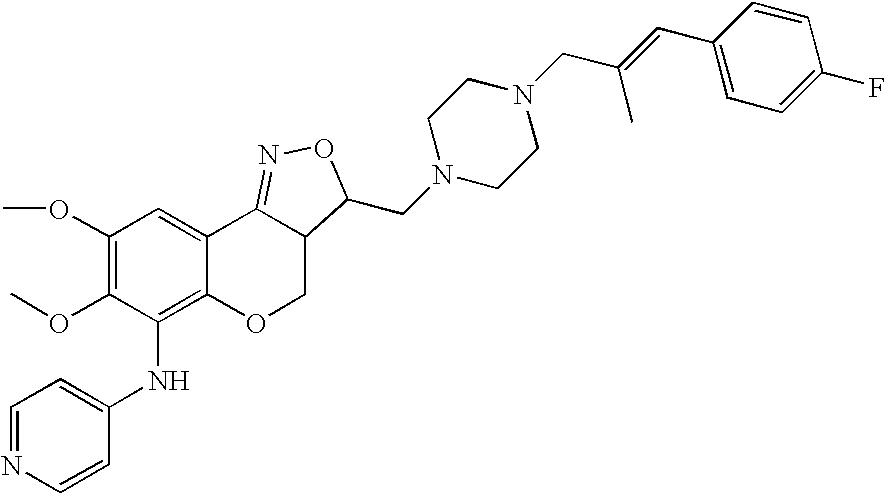
- FAYYGCQQNHMMAZ-LTGZKZEYSA-N COC1=C(OC)C(NC2=CC=NC=C2)=C2OCC3C(=NOC3CN3CCN(C/C(C)=C/C4=CC=C(F)C=C4)CC3)C2=C1 Chemical compound COC1=C(OC)C(NC2=CC=NC=C2)=C2OCC3C(=NOC3CN3CCN(C/C(C)=C/C4=CC=C(F)C=C4)CC3)C2=C1 FAYYGCQQNHMMAZ-LTGZKZEYSA-N 0.000 description 2
- UXRCHNMIMLWBLI-NBVRZTHBSA-N C/C(=C\C1=CC=CC=C1)CN1CCN(CC2ON=C3C4=CC=CC(O)=C4OCC32)CC1 Chemical compound C/C(=C\C1=CC=CC=C1)CN1CCN(CC2ON=C3C4=CC=CC(O)=C4OCC32)CC1 UXRCHNMIMLWBLI-NBVRZTHBSA-N 0.000 description 1
- IABRWXCXQSTUSS-UHFFFAOYSA-N CCNC(=O)NC Chemical compound CCNC(=O)NC IABRWXCXQSTUSS-UHFFFAOYSA-N 0.000 description 1
- DTZWOECGOBYHKI-HMMYKYKNSA-N CCOC(=O)C1=C2OCC3C(=NOC3CN3CCN(C/C(C)=C/C4=CC=CC=C4)CC3)C2=CC(OC)=C1OC Chemical compound CCOC(=O)C1=C2OCC3C(=NOC3CN3CCN(C/C(C)=C/C4=CC=CC=C4)CC3)C2=CC(OC)=C1OC DTZWOECGOBYHKI-HMMYKYKNSA-N 0.000 description 1
- QOEUNLQGZBSTBB-UHFFFAOYSA-N CN1CCC1=O Chemical compound CN1CCC1=O QOEUNLQGZBSTBB-UHFFFAOYSA-N 0.000 description 1
- RXYPXQSKLGGKOL-UHFFFAOYSA-N CN1CCN(C)CC1 Chemical compound CN1CCN(C)CC1 RXYPXQSKLGGKOL-UHFFFAOYSA-N 0.000 description 1
- OHLUUHNLEMFGTQ-UHFFFAOYSA-N CNC(C)=O Chemical compound CNC(C)=O OHLUUHNLEMFGTQ-UHFFFAOYSA-N 0.000 description 1
- RIWRFSMVIUAEBX-UHFFFAOYSA-N CNCC1=CC=CC=C1 Chemical compound CNCC1=CC=CC=C1 RIWRFSMVIUAEBX-UHFFFAOYSA-N 0.000 description 1
- GYGYDOOXVKDZCF-UHFFFAOYSA-N CNCCN1CCCC1 Chemical compound CNCCN1CCCC1 GYGYDOOXVKDZCF-UHFFFAOYSA-N 0.000 description 1
- YBUNKZFICCGATE-QGOAFFKASA-N COC1=C(OC)C(Br)=C2OCC3C(=NOC3CN3CCN(C/C(C)=C/C4=CC=CC=C4)CC3)C2=C1 Chemical compound COC1=C(OC)C(Br)=C2OCC3C(=NOC3CN3CCN(C/C(C)=C/C4=CC=CC=C4)CC3)C2=C1 YBUNKZFICCGATE-QGOAFFKASA-N 0.000 description 1
- FPEIIYNKXAMKGV-UHFFFAOYSA-N COC1=C(OC)C(Br)=C2OCC3C(=NOC3COS(C)(=O)=O)C2=C1 Chemical compound COC1=C(OC)C(Br)=C2OCC3C(=NOC3COS(C)(=O)=O)C2=C1 FPEIIYNKXAMKGV-UHFFFAOYSA-N 0.000 description 1
- KIHZRRYBEUDRDO-XMHGGMMESA-N COC1=C(OC)C(C)=C2OCC3C(=NOC3CN3CCN(C/C(C)=C/C4=CC=CC=C4)CC3)C2=C1 Chemical compound COC1=C(OC)C(C)=C2OCC3C(=NOC3CN3CCN(C/C(C)=C/C4=CC=CC=C4)CC3)C2=C1 KIHZRRYBEUDRDO-XMHGGMMESA-N 0.000 description 1
- MMMFQERBTVXIBX-PTGBLXJZSA-N COC1=C(OC)C(N2CCN(C)CC2)=C2OCC3C(=NOC3CN3CCN(C/C(C)=C/C4=CC=CC=C4)CC3)C2=C1 Chemical compound COC1=C(OC)C(N2CCN(C)CC2)=C2OCC3C(=NOC3CN3CCN(C/C(C)=C/C4=CC=CC=C4)CC3)C2=C1 MMMFQERBTVXIBX-PTGBLXJZSA-N 0.000 description 1
- QYXBCAPAIGVCIC-UHFFFAOYSA-N COC1=C2C(=CC=C1)OCC1C2=NOC1COS(C)(=O)=O Chemical compound COC1=C2C(=CC=C1)OCC1C2=NOC1COS(C)(=O)=O QYXBCAPAIGVCIC-UHFFFAOYSA-N 0.000 description 1
- HVZRDIXANSLJFL-XDJHFCHBSA-N COC1=C2OCC3C(=NOC3CN3CCN(C/C(C)=C/C4=CC=CC=C4)CC3)C2=CC=C1 Chemical compound COC1=C2OCC3C(=NOC3CN3CCN(C/C(C)=C/C4=CC=CC=C4)CC3)C2=CC=C1 HVZRDIXANSLJFL-XDJHFCHBSA-N 0.000 description 1
- JBTAQGNPEKQWGJ-UHFFFAOYSA-N COC1=C2OCC3C(=NOC3COS(C)(=O)=O)C2=CC=C1 Chemical compound COC1=C2OCC3C(=NOC3COS(C)(=O)=O)C2=CC=C1 JBTAQGNPEKQWGJ-UHFFFAOYSA-N 0.000 description 1
- XNWFRZJHXBZDAG-UHFFFAOYSA-N COCCO Chemical compound COCCO XNWFRZJHXBZDAG-UHFFFAOYSA-N 0.000 description 1
- XLLIQLLCWZCATF-UHFFFAOYSA-N COCCOC(C)=O Chemical compound COCCOC(C)=O XLLIQLLCWZCATF-UHFFFAOYSA-N 0.000 description 1
- HJCVDXSRAFMQNP-UHFFFAOYSA-N COc(cc(C1=NOC(COS(C)=O)C1CO1)c1c1Br)c1OC Chemical compound COc(cc(C1=NOC(COS(C)=O)C1CO1)c1c1Br)c1OC HJCVDXSRAFMQNP-UHFFFAOYSA-N 0.000 description 1
Classifications
-
- C—CHEMISTRY; METALLURGY
- C07—ORGANIC CHEMISTRY
- C07D—HETEROCYCLIC COMPOUNDS
- C07D498/00—Heterocyclic compounds containing in the condensed system at least one hetero ring having nitrogen and oxygen atoms as the only ring hetero atoms
- C07D498/02—Heterocyclic compounds containing in the condensed system at least one hetero ring having nitrogen and oxygen atoms as the only ring hetero atoms in which the condensed system contains two hetero rings
- C07D498/04—Ortho-condensed systems
-
- A—HUMAN NECESSITIES
- A61—MEDICAL OR VETERINARY SCIENCE; HYGIENE
- A61P—SPECIFIC THERAPEUTIC ACTIVITY OF CHEMICAL COMPOUNDS OR MEDICINAL PREPARATIONS
- A61P1/00—Drugs for disorders of the alimentary tract or the digestive system
- A61P1/14—Prodigestives, e.g. acids, enzymes, appetite stimulants, antidyspeptics, tonics, antiflatulents
-
- A—HUMAN NECESSITIES
- A61—MEDICAL OR VETERINARY SCIENCE; HYGIENE
- A61P—SPECIFIC THERAPEUTIC ACTIVITY OF CHEMICAL COMPOUNDS OR MEDICINAL PREPARATIONS
- A61P15/00—Drugs for genital or sexual disorders; Contraceptives
- A61P15/10—Drugs for genital or sexual disorders; Contraceptives for impotence
-
- A—HUMAN NECESSITIES
- A61—MEDICAL OR VETERINARY SCIENCE; HYGIENE
- A61P—SPECIFIC THERAPEUTIC ACTIVITY OF CHEMICAL COMPOUNDS OR MEDICINAL PREPARATIONS
- A61P25/00—Drugs for disorders of the nervous system
-
- A—HUMAN NECESSITIES
- A61—MEDICAL OR VETERINARY SCIENCE; HYGIENE
- A61P—SPECIFIC THERAPEUTIC ACTIVITY OF CHEMICAL COMPOUNDS OR MEDICINAL PREPARATIONS
- A61P25/00—Drugs for disorders of the nervous system
- A61P25/08—Antiepileptics; Anticonvulsants
-
- A—HUMAN NECESSITIES
- A61—MEDICAL OR VETERINARY SCIENCE; HYGIENE
- A61P—SPECIFIC THERAPEUTIC ACTIVITY OF CHEMICAL COMPOUNDS OR MEDICINAL PREPARATIONS
- A61P25/00—Drugs for disorders of the nervous system
- A61P25/14—Drugs for disorders of the nervous system for treating abnormal movements, e.g. chorea, dyskinesia
-
- A—HUMAN NECESSITIES
- A61—MEDICAL OR VETERINARY SCIENCE; HYGIENE
- A61P—SPECIFIC THERAPEUTIC ACTIVITY OF CHEMICAL COMPOUNDS OR MEDICINAL PREPARATIONS
- A61P25/00—Drugs for disorders of the nervous system
- A61P25/14—Drugs for disorders of the nervous system for treating abnormal movements, e.g. chorea, dyskinesia
- A61P25/16—Anti-Parkinson drugs
-
- A—HUMAN NECESSITIES
- A61—MEDICAL OR VETERINARY SCIENCE; HYGIENE
- A61P—SPECIFIC THERAPEUTIC ACTIVITY OF CHEMICAL COMPOUNDS OR MEDICINAL PREPARATIONS
- A61P25/00—Drugs for disorders of the nervous system
- A61P25/18—Antipsychotics, i.e. neuroleptics; Drugs for mania or schizophrenia
-
- A—HUMAN NECESSITIES
- A61—MEDICAL OR VETERINARY SCIENCE; HYGIENE
- A61P—SPECIFIC THERAPEUTIC ACTIVITY OF CHEMICAL COMPOUNDS OR MEDICINAL PREPARATIONS
- A61P25/00—Drugs for disorders of the nervous system
- A61P25/22—Anxiolytics
-
- A—HUMAN NECESSITIES
- A61—MEDICAL OR VETERINARY SCIENCE; HYGIENE
- A61P—SPECIFIC THERAPEUTIC ACTIVITY OF CHEMICAL COMPOUNDS OR MEDICINAL PREPARATIONS
- A61P25/00—Drugs for disorders of the nervous system
- A61P25/24—Antidepressants
-
- A—HUMAN NECESSITIES
- A61—MEDICAL OR VETERINARY SCIENCE; HYGIENE
- A61P—SPECIFIC THERAPEUTIC ACTIVITY OF CHEMICAL COMPOUNDS OR MEDICINAL PREPARATIONS
- A61P25/00—Drugs for disorders of the nervous system
- A61P25/28—Drugs for disorders of the nervous system for treating neurodegenerative disorders of the central nervous system, e.g. nootropic agents, cognition enhancers, drugs for treating Alzheimer's disease or other forms of dementia
-
- A—HUMAN NECESSITIES
- A61—MEDICAL OR VETERINARY SCIENCE; HYGIENE
- A61P—SPECIFIC THERAPEUTIC ACTIVITY OF CHEMICAL COMPOUNDS OR MEDICINAL PREPARATIONS
- A61P25/00—Drugs for disorders of the nervous system
- A61P25/30—Drugs for disorders of the nervous system for treating abuse or dependence
- A61P25/32—Alcohol-abuse
-
- A—HUMAN NECESSITIES
- A61—MEDICAL OR VETERINARY SCIENCE; HYGIENE
- A61P—SPECIFIC THERAPEUTIC ACTIVITY OF CHEMICAL COMPOUNDS OR MEDICINAL PREPARATIONS
- A61P25/00—Drugs for disorders of the nervous system
- A61P25/30—Drugs for disorders of the nervous system for treating abuse or dependence
- A61P25/36—Opioid-abuse
-
- A—HUMAN NECESSITIES
- A61—MEDICAL OR VETERINARY SCIENCE; HYGIENE
- A61P—SPECIFIC THERAPEUTIC ACTIVITY OF CHEMICAL COMPOUNDS OR MEDICINAL PREPARATIONS
- A61P3/00—Drugs for disorders of the metabolism
- A61P3/04—Anorexiants; Antiobesity agents
-
- A—HUMAN NECESSITIES
- A61—MEDICAL OR VETERINARY SCIENCE; HYGIENE
- A61P—SPECIFIC THERAPEUTIC ACTIVITY OF CHEMICAL COMPOUNDS OR MEDICINAL PREPARATIONS
- A61P43/00—Drugs for specific purposes, not provided for in groups A61P1/00-A61P41/00
Definitions
- the invention concerns substituted tricyclic isoxazoline derivatives, more in particular tricyclic dihydrobenzopyranoisoxazoline, dihydroquinolinoisoxazoline, dihydronaphthalenoisoxazoline and dihydrobenzothiopyranoisoxazoline derivatives substituted on at least one of the C6- and C9-positions of the phenylpart of the tricyclic moiety with a selected radical, as well as processes for their preparation, pharmaceutical compositions comprising them and their use as a medicine, in particular for treating depression, anxiety, movement disorders, psychosis, Parkinson's disease and body weight disorders including anorexia nervosa and bulimia.
- the invention also relates to novel combination of said multi-substituted tricyclic isoxazoline derivatives, with antidepressants, anxiolytics, antipsychotics and anti-Parkinson's disease drugs.
- Tetrahydronaphtalene and indane derivatives showing anti-depressant activity are known from EP-361 577 B1. These compounds are typical monoamine reuptake blockers with additional ⁇ 2 -adrenoceptor antagonist activity and they show anti-depressant activity without being sedative.
- the problems associated with the compounds according to the state of the art is that the compounds cause considerable side-effects, such as nausea, excitation, an increased heart rate and a reduced sexual function. Furthermore, it requires a long time, in particular 3-4 weeks, before the response starts.
- the purpose of the present invention is to provide novel compounds for treating depression, anxiety, movement disorders, psychosis, schizophrenia and body weight disorders, in particular compounds that do not exhibit the aforementioned disadvantages.
- the present invention relates to novel substituted tricyclic isoxazoline derivatives according to the general Formula (I)
- radicals R 1 , R 2 , R 14 and R 15 occupy respectively the C8-, C7-, C9- and C6-positions of the phenylpart of the tricyclic moiety of the isoxazoline derivatives according to the invention.
- the invention relates to compounds according to Formula (I), the pharmaceutically acceptable acid or base addition salts thereof, the stereochemically isomeric forms thereof and the N-oxide form thereof, wherein R 3 is a radical according to any one of Formula (IIIa), (IIIb) or (IIIc)
- the invention relates to compounds according to Formula (I), the pharmaceutically acceptable acid or base addition salts thereof, the stereochemically isomeric forms thereof and the N-oxide form thereof, wherein R 1 , R 2 , R 14 and R 15 are each, independently from each other, selected from the group of hydrogen; halo; cyano; hydroxy; alkyloxy; alkylcarbonyloxyalkyloxy; alkyloxyalkylcarbonyloxyalkyloxy; monoalkylaminocarbonyloxyalkyloxy; morpholinylalkyl; —NR 10 R 11 , wherein R 10 and R 11 each, independently from each other, are selected from the group of hydrogen, pyrrolidinylalkyl, mono- or di(alkyl)aminoalkyl, pyridinyl, alkylcarbonyl and phenylalkyl; or R 10 and R 11 are taken together to form a radical (a) wherein R 13 is oxo or a radical (f
- the invention relates to compounds according to Formula (I), the pharmaceutically acceptable acid or base addition salts thereof, the stereochemically isomeric forms thereof and the N-oxide form thereof, wherein R 1 and R 2 are both either hydrogen or methoxy and R 14 and R 15 are each, independently from each other, selected from the group of hydrogen; halo; cyano; hydroxy; alkyloxy; alkylcarbonyloxyalkyloxy; alkyloxyalkylcarbonyloxyalkyloxy; monoalkylaminocarbonyloxyalkyloxy; morpholinylalkyl; —NR 10 R 11 , wherein R 10 and R 11 each, independently from each other, are selected from the group of hydrogen, pyrrolidinylalkyl, mono- or di(alkyl)aminoalkyl, pyridinyl, alkylcarbonyl and phenylalkyl; or R 10 and R 11 are taken together to form a radical (a) wherein R 13 is oxo
- alkyl defines straight or branched saturated hydrocarbon radicals having from 1 to 6 carbon atoms, for example methyl, ethyl, propyl, butyl, 1-methylpropyl, 1,1-dimethylethyl, pentyl, hexyl; or alkyl defines cyclic saturated hydrocarbon radicals having from 3 to 6 carbon atoms, for example cyclopropyl, methylcyclopropyl, cyclobutyl, cyclopentyl and cyclohexyl.
- alkyl also comprises alkyl radicals that are substituted with one or more halo, cyano, oxo, hydroxy, formyl or amino radicals, for example hydroxyalkyl, in particular hydroxymethyl and hydroxyethyl and polyhaloalkyl, in particular difluoromethyl and trifluoromethyl.
- alkenyl represents a straight or branched unsatured hydrocarbon radical having one or more double bonds, for example ethenyl, 1-propenyl, 2-propenyl and 1,3-butanedienyl.
- the definition of alkenyl also comprises alkenyl radicals that are substituted with one or more halo, cyano, oxo, hydroxy, formyl or amino radicals, for example hydroxyethenyl.
- Ar is phenyl or naphthyl, optionally substituted with one or more halo, cyano, oxo, hydroxy, alkyl, formyl, alkyloxy or amino radicals, such as for example, 3-fluoro-phenyl of 3-fluoro-naphthyl.
- halo is generic to fluoro, chloro, bromo and iodo.
- the pharmaceutically acceptable salts are defined to comprise the therapeutically active non-toxic acid addition salts forms that the compounds according to Formula (I) are able to form.
- Said salts can be obtained by treating the base form of the compounds according to Formula (I) with appropriate acids, for example inorganic acids, for example hydrohalic acid, in particular hydrochloric acid, hydrobromic acid, sulfuric acid, nitric acid and phosphoric acid; organic acids, for example acetic acid, hydroxyacetic acid, propanoic acid, lactic acid, pyruvic acid, oxalic acid, malonic acid, succinic acid, maleic acid, fumaric acid, malic acid, tartaric acid, citric acid, methanesulfonic acid, ethanesulfonic acid, benzenesulfonic acid, p-toluenesulfonic acid, cyclamic acid, salicyclic acid, p-aminosalicylic acid and pamoic acid.
- acids for example inorganic
- the compounds according to Formula (I) containing acidic protons may also be converted into their therapeutically active non-toxic metal or amine addition salts forms by treatment with appropriate organic and inorganic bases.
- Appropriate base salts forms comprise, for example, the ammonium salts, the alkaline and earth alkaline metal salts, in particular lithium, sodium, potassium, magnesium and calcium salts, salts with organic bases, e.g. the benzathine, N-methyl-D-glucamine, hybramine salts, and salts with amino acids, for example arginine and lysine.
- salts forms can be converted into the free forms by treatment with an appropriate base or acid.
- addition salt as used in the framework of this application also comprises the solvates that the compounds according to Formula (I) as well as the salts thereof, are able to form.
- Such solvates are, for example, hydrates and alcoholates.
- N-oxide forms of the compounds according to Formula (I) are meant to comprise those compounds of Formula (I) wherein one or several nitrogen atoms are oxidized to the so-called N-oxide, particularly those N-oxides wherein one or more nitrogens of the piperazinyl radical are N-oxidized.
- stereochemically isomeric forms as used hereinbefore defines all the possible isomeric forms that the compounds of Formula (I) may possess. Unless otherwise mentioned or indicated, the chemical designation of compounds denotes the mixture of all possible stereochemically isomeric forms, said mixtures containing all diastereomers and enantiomers of the basic molecular structure. More in particular, stereogenic centers may have the R- or S-configuration; substituents on bivalent cyclic (partially) saturated radicals may have either the cis- or trans-configuration. Compounds encompassing double bonds can have an E or Z-stereochemistry at said double bond. Stereochemically isomeric forms of the compounds of Formula (I) are obviously intended to be embraced within the scope of this invention.
- an R or S descriptor is assigned (based on Cahn-Ingold-Prelog sequence rule) to the lowest-numbered chiral center, the reference center.
- the configuration of the second stereogenic center is indicated using relative descriptors [R*,R*] or [R*,S*], where R* is always specified as the reference center and [R*,R*] indicates centers with the same chirality and [R*,S*] indicates centers of unlike chirality. For example, if the lowest-numbered chiral center in the molecule has an S configuration and the second center is R, the stereo descriptor would be specified as S—[R*,S*].
- the position of the highest priority substituent on the asymmetric carbon atom in the ring system having the lowest ring number is arbitrarily always in the “ ⁇ ” position of the mean plane determined by the ring system.
- the position of the highest priority substituent on the other asymmetric carbon atom in the ring system (hydrogen atom in compounds according to Formula (I)) relative to the position of the highest priority substituent on the reference atom is denominated “ ⁇ ”, if it is on the same side of the mean plane determined by the ring system, or “ ⁇ ”, if it is on the other side of the mean plane determined by the ring system.
- Compounds according to Formula (I) and some of the intermediate compounds have at least two stereogenic centers in their structure, respectively denoted a and b in Formula (I). Due to the synthetic pathway followed for the synthesis of the tricyclic system, the configuration of those two asymmetric centers a and b is predetermined, so that the relative configuration of center a is S* and of center b is R*.
- the invention also comprises derivative compounds (usually called “pro-drugs”) of the pharmacologically-active compounds according to the invention, which are degraded in vivo to yield the compounds according to the invention.
- Pro-drugs are usually (but not always) of lower potency at the target receptor than the compounds to which they are degraded.
- Pro-drugs are particularly useful when the desired compound has chemical or physical properties that make its administration difficult or inefficient. For example, the desired compound may be only poorly soluble, it may be poorly transported across the mucosal epithelium, or it may have an undesirably short plasma half-life. Further discussion on pro-drugs may be found in Stella, V. J. et al., “Prodrugs”, Drug Delivery Systems, 1985, pp. 112-176, and Drugs, 1985, 29, pp. 455-473.
- Pro-drugs forms of the pharmacologically-active compounds according to the invention will generally be compounds according to Formula (I), the pharmaceutically acceptable acid or base addition salts thereof, the stereochemically isomeric forms thereof and the N-oxide form thereof, having an acid group which is esterified or amidated. Included in such esterified acid groups are groups of the formula —COOR x , where R x is a C 1-6 alkyl, phenyl, benzyl or one of the following groups:
- Amidated groups include groups of the formula —CONR y R z , wherein R y is H, C 1-6 alkyl, phenyl or benzyl and R z is —OH, H, C 1-6 alkyl, phenyl or benzyl.
- Compounds according to the invention having an amino group may be derivatised with a ketone or an aldehyde such as formaldehyde to form a Mannich base. This base will hydrolyze with first order kinetics in aqueous solution.
- the compounds of Formula (I) as prepared in the processes described below may be synthesized in the form of racemic mixtures of enantiomers that can be separated from one another following art-known resolution procedures.
- the racemic compounds of Formula (I) may be converted into the corresponding diastereomeric salt forms by reaction with a suitable chiral acid. Said diastereomeric salt forms are subsequently separated, for example, by selective or fractional crystallization and the enantiomers are liberated therefrom by alkali.
- An alternative manner of separating the enantiomeric forms of the compounds of Formula (I) involves liquid chromatography using a chiral stationary phase.
- Said pure stereochemically isomeric forms may also be derived from the corresponding pure stereochemically isomeric forms of the appropriate starting materials, provided that the reaction occurs stereospecifically.
- said compound would be synthesized by stereospecific methods of preparation. These methods will advantageously employ enantiomerically pure starting materials.
- the compounds according to the invention in particular compounds according to Formula (I), the pharmaceutically acceptable acid or base addition salts thereof, the stereochemically isomeric forms thereof and the N-oxide form thereof, have surprisingly been shown to have selective serotonine (5-HT) reuptake inhibitor activity in combination with additional ⁇ 2 -adrenoceptor antagonist activity and show a strong anti-depressant and/or anxiolytic activity and/or antipsychotic and/or a body weight control activity without being sedative.
- 5-HT serotonine
- compounds according to the invention are also suitable for treatment and/or prophylaxis in diseases where either one of the activities alone or the combination of said activities may be of therapeutic use.
- the compounds according to the invention may be suitable for treatment and/or prophylaxis in the following diseases:
- the present invention thus also relates to compounds according to Formula (I), the pharmaceutically acceptable acid or base addition salts thereof, the stereochemically isomeric forms thereof, the N-oxide form thereof, as well as the prodrugs thereof for use as a medicine, in particular for the treatment and/or prophylaxis of depression, anxiety, movement disorders, psychosis, Parkinson's disease and body weight disorders.
- the present invention also relates to a method for the treatment and/or prophylaxis of diseases where either one of the activities (selective serotonine (5-HT) reuptake inhibitor and ⁇ 2 -adrenoceptor antagonist activity) alone or the combination of said activities may be of therapeutic use, in particular for the treatment and/or prophylaxis of depression, anxiety, movement disorders, psychosis, Parkinson's disease and body weight disorders comprising administering to a human in need of such administration an affective amount of a compound according to the invention, in particular according to Formula (I), the pharmaceutically acceptable acid or base addition salts thereof, the stereochemically isomeric forms thereof, the N-oxide form thereof, as well as the pro-drugs thereof.
- a compound according to the invention in particular according to Formula (I), the pharmaceutically acceptable acid or base addition salts thereof, the stereochemically isomeric forms thereof, the N-oxide form thereof, as well as the pro-drugs thereof.
- the invention also relates to a pharmaceutical composition
- a pharmaceutical composition comprising a pharmaceutically acceptable carrier and, as active ingredient, a therapeutically effective amount of a compound according to the invention, in particular a compound according to Formula (I), the pharmaceutically acceptable acid or base addition salts thereof, the stereochemically isomeric forms thereof and the N-oxide form thereof or a prodrug as defined above.
- the compounds according to the invention in particular the compounds according to Formula (I), the pharmaceutically acceptable acid or base addition salts thereof, the stereochemically isomeric forms thereof and the N-oxide form thereof and the prodrugs, or any subgroup thereof may be formulated into various pharmaceutical forms for administration purposes.
- compositions there may be cited all compositions usually employed for systemically administering drugs.
- an effective amount of the particular compound, optionally in addition salt form, as the active ingredient is combined in intimate admixture with a pharmaceutically acceptable carrier, which carrier may take a wide variety of forms depending on the form of preparation desired for administration.
- compositions are desirable in unitary dosage form suitable, in particular, for administration orally, rectally, percutaneously, by parenteral injection or by inhalation.
- any of the usual pharmaceutical media may be employed such as, for example, water, glycols, oils, alcohols and the like in the case of oral liquid preparations such as suspensions, syrups, elixirs, emulsions and solutions; or solid carriers such as starches, sugars, kaolin, diluents, lubricants, binders, disintegrating agents and the like in the case of powders, pills, capsules and tablets.
- tablets and capsules represent the most advantageous oral dosage unit forms in which case solid pharmaceutical carriers are obviously employed.
- the carrier will usually comprise sterile water, at least in large part, though other ingredients, for example, to aid solubility, may be included.
- injectable solutions for example, may be prepared in which the carrier comprises saline solution, glucose solution or a mixture of saline and glucose solution.
- injectable suspensions may also be prepared in which case appropriate liquid carriers, suspending agents and the like may be employed.
- solid form preparations that are intended to be converted, shortly before use, to liquid form preparations.
- the carrier optionally comprises a penetration enhancing agent and/or a suitable wetting agent, optionally combined with suitable additives of any nature in minor proportions, which additives do not introduce a significant deleterious effect on the skin. Said additives may facilitate the administration to the skin and/or may be helpful for preparing the desired compositions.
- These compositions may be administered in various ways, e.g., as a transdermal patch, as a spot-on, as an ointment.
- Unit dosage form refers to physically discrete units suitable as unitary dosages, each unit containing a predetermined quantity of active ingredient calculated to produce the desired therapeutic effect in association with the required pharmaceutical carrier.
- unit dosage forms are tablets (including scored or coated tablets), capsules, pills, powder packets, wafers, suppositories, injectable solutions or suspensions and the like, and segregated multiples thereof.
- the compounds according to the invention may also be suitable as add-on treatment and/or prophylaxis in the above listed diseases in combination with any combination of compounds selected from the group of antidepressants, anxiolytics, antipsychotics and/or anti-Parkinson's disease drugs which are currently available or in development or which will become available in the future, to improve efficacy and/or onset of action.
- antidepressants anxiolytics, antipsychotics and/or anti-Parkinson's disease drugs which are currently available or in development or which will become available in the future, to improve efficacy and/or onset of action.
- antidepressants anxiolytics, antipsychotics and/or anti-Parkinson's disease drugs are shown to be active.
- compounds are evaluated in combination with antidepressants, anxiolytics, antipsychotics and/or anti-Parkinson's disease drugs for attenuation of stress-induced hyperthermia.
- the invention therefore also relates to a pharmaceutical composition
- a pharmaceutical composition comprising the compounds according to the invention, in particular the compounds according to Formula (I), the pharmaceutically acceptable acid or base addition salts thereof, the stereochemically isomeric forms thereof and the N-oxide form thereof, and the prodrugs and one or more other compounds selected from the group of antidepressants, anxiolytics, antipsychotics and anti-Parkinson's disease drugs.
- the invention also relates to the use of a pharmaceutical composition according to the invention for the manufacture of a medicament to improve efficacy and/or onset of action in the treatment and/or prophylaxis of depression, anxiety, movement disorders, psychosis, Parkinson's disease and body weight disorders.
- the invention relates to the use of a compound according to the invention for the manufacture of a medicament for the treatment and/or prophylaxis of depression, anxiety, movement disorders, psychosis, Parkinson's disease and body weight disorders, said treatment comprising the simultaneous or sequential administration of a compound according to the invention and one or more other compounds selected from the group of antidepressants, anxiolytics, anti-psychosis and anti-Parkinson's drugs.
- the invention further relates to a process for making a pharmaceutical composition
- a process for making a pharmaceutical composition comprising mixing a compound according to the invention, in particular the compounds according to Formula (I), the pharmaceutically acceptable acid or base addition salts thereof, the stereochemically isomeric forms thereof and the N-oxide form thereof, and the prodrugs, or any subgroup thereof and a compound selected from the group of antidepressants, anxiolytics, antipsychotics and anti-Parkinson's disease drugs and a pharmaceutically acceptable carrier.
- ⁇ 2-adrenoceptor antagonism in vivo, the reversal of the loss of righting reflex, observed in rats after subcutaneous injection or oral dosage of the compound before intravenous medetomidine administration in rats can be used (medetomidine-test).
- indices of serotonine (5-HT) reuptake inhibition activity the inhibition of head-twitches and excitation in rats, observed after subcutaneous injection or oral dosage of the compound before subcutaneous p-chloroamphetamine administration in rats can be used (pCA-test).
- the compounds according to the invention can generally be prepared by a succession of steps, each of which is known to the skilled person.
- the compounds according to Formula (I) can be prepared by a nucleophilic substitution reaction with a ring-closed amine, such as a substituted piperazine or piperidine, according to the following reaction:
- L is any suitable leaving group, such as, for example, halo, in particular chloro, bromo and iodo; sulphonyloxy and 4-methylsulphonyloxy.
- substituents R 14 and R 15 in compounds according to Formula (I) may be changed or interconverted into each other by methods well know in the art, such as demethylation, acylation, esterification, metalation followed by electrophilic substitution, amination, amidation, etc.
- compounds according to Formula (I) with R 14 and/or R 15 being an alkyl or acyl radical can also be prepared from a compound according to Formula (I′) in which at R 14 and/or R 15 is an halo atom, in particular a bromo atom, using a metalating agent, such as lithium, butyllithyum, etc., under inert atmosphere in the preselce of an inert solvent, for example tetrahydrofuran, and converted into an alkyl or acyl derivative, such as methyl, ethoxycarbonyl, etc. using the corresponding electrophiles, for example, methyl iodide or ethyl carbonate as exemplified in the following reaction scheme where a radical R 15 is introduced into the molecule on the C6-position.
- a radical R 15 is introduced into the molecule on the C6-position.
- compounds according to Formula (I) with R 14 or R 15 being an amino radical including, for example, morpholine, substituted pyridine or a substituted piperazine can also be prepared from a compound according to Formula (I′) in which at least one of R 14 and R 15 is an halo atom, in particular a bromo or iodo atom, by palladium coupling reactions.
- This art-known reaction is performed on compounds of Formula (I′) with nitrogenated compounds of Formula (VI) in the presence of a palladium catalyst such as Pd(2+) salt of acetic acid, Pd(PPh 3 ) 4 or Pd 2 (dba) 3 , a base, for example K 2 CO 3 , Na 2 CO 3 , CsCO 3 or potassium tert-butoxide, a phosphine, such as PPh 3 , PBu 3 or 2,2′-bis-diphenylphosphanyl-[1,1′]binaphthalenyl under an inert atmosphere and in a suitable deoxigenated solvent, such as toluene, dioxane, water, an alcohol, tetrahydrofuran or a mixture thereof, generally at temperatures ranging between 50° C. and 100° C., for example according to the following reaction:
- a palladium catalyst such as Pd(2+) salt of acetic acid, Pd(PPh 3 )
- the starting materials and the intermediate compounds are compounds that are either commercially available or may be prepared according to conventional reaction procedures generally known in the art.
- Intermediate I is converted into an oxime under temperature range ⁇ 10° C. to 0° C. using art-known techniques, such as hydroxylamine hydrochloride in the presence of a suitable base, such as AcONa, NaHCO 3 or pyridine in a reaction inert solvent, for example ethanol.
- a suitable base such as AcONa, NaHCO 3 or pyridine
- Oxidation of intermediate 2 to its nitrile oxide and in situ intramolecular cycloaddition yields intermediate 3.
- This oxidation can be carried out using sodium hypochlorite solution in the presence of triethylamine in an inert solvent, such dichloromethane at room temperature.
- Oxidation can also be performed using chloramine-T hydrate (N-chloro-4-methylbenzenesulphonamide, sodium salt), stirring and heating in a solvent such as refluxing ethanol. At this stage two steroisomers are formed.
- a suitable reducing agent for example sodium borohydride
- the corresponding halo-derivative can also be prepared, e.g.
- R 14 and R 15 may be a halo atom.
- the halo atom may also be introduced using an aromatic bromination reaction, as exemplified in the following reaction scheme for R 15 :
- This bromination can be carried out by any brominating agent, such as bromine or N-bromosuccinimide, in a suitable solvent, such us dichloromethane, dioxane or acetonitrile, optionally in the presence of a base, such as, NaHCO 3 , Na 2 CO 3 , triethylamine or pyridine. It is self-evident that the same reaction and reaction conditions apply for a bromination on the C9-position as R 14 or on both C6- and C9-positions in the same reaction.
- a suitable solvent such us dichloromethane, dioxane or acetonitrile
- a base such as, NaHCO 3 , Na 2 CO 3 , triethylamine or pyridine.
- stereochemically isomeric form which was first isolated is designated as “A” and the second as “B”, without further reference to the actual stereochemical configuration.
- said “A” and “B” isomeric forms can be unambiguously characterized by a person skilled in the art, using art-known methods such as, for example, X-ray diffraction.
- the stereogenic centers a and b in Formula (I) have respectively the ring numbers 3a and 3.
- DMF N,N-dimethylformamide
- DIPE diisopropyl ether
- ACN is defined as acetonitrile
- DCM is defined as dichloromethane
- MIK is defined as 4-methyl-2-pentanone
- THF is defined as tetrahydrofurane.
- BBr 3 (6.5 ml, 0.068 mol) was added dropwise to a solution of final compound 6 (5.93 g, 0.0136 mol) in CH 2 Cl 2 (195 ml), stirred under N 2 atmosphere and cooled with an ice-bath. The resulting reaction mixture was stirred overnight at room temperature. The crude reaction was cooled with an ice-bath and it was carefully treated with a 10% NH 4 Cl solution and brine. The mixture was filtered off over celite and the filtrate was extracted with CH 2 Cl 2 . The separated organic layer was dried (Na 2 SO 4 ), filtered, and the filtrate was evaporated.
- the residue was purified in a manifold (vac.) using a Sep-Pak silica cartridge (5 g) (eluent: CH 2 Cl 2 /CH 3 OH 98/2, 96/4), then purified by high-performance liquid chromatography (eluent: (0.05% NH 4 Oac in H 2 O)/CH 3 CN). The product fractions were collected and the solvent was evaporated.
- melting points were obtained with a Büchi melting point apparatus B-545.
- the heating medium is a metal block.
- the melting of the sample is visually observed by a magnifying lense and a big light contrast. Melting points are measured with a temperature gradient of either 3 or 10 degrees Celsius/minute.
- the interaction of the compounds of Formula (I) with h ⁇ 2 -receptors and h5-HT-transporters was assessed in in vitro radioligand binding experiments.
- a low concentration of a radioligand with a high binding affinity for a particular receptor or transporter is incubated with a sample of a tissue preparation enriched in a particular receptor or transporter or with a preparation of cells expressing cloned human receptors in a buffered medium.
- the radioligand binds to the receptor or transporter.
- the receptor bound radioactivity is separated from the non-bound radioactivity, and the receptor- or transporter-bound activity is counted.
- the interaction of the test compounds with the receptor is assessed in competition binding experiments.
- test compound Various concentrations of the test compound are added to the incubation mixture containing the receptor- or transporter preparation and the radioligand.
- the test compound in proportion to its binding affinity and its concentration inhibits binding of the radioligand.
- the radioligand used for h ⁇ 2A , h ⁇ 2B and h ⁇ 2C receptor binding was [ 3 H]-raulwolscine and for the h5-HT transporter was [ 3 H]paroxetine.
- CHO cells stabile transfected with human adrenergic- ⁇ 2A -, - ⁇ 2B or ⁇ 2C receptor cDNA, were cultured in Dulbecco's Modified Eagle's Medium (DMEM)/Nutrient mixture Ham's F12 (ratio 1:1) (Gibco, Gent-Belgium) supplemented with 10% heat inactivated fetal calf serum (Life Technologies, Merelbeke-Belgium) and antibiotics (100 IU/ml penicillin G, 100 ⁇ g/ml streptomycin sulphate, 110 ⁇ g/ml pyruvic acid and 100 ⁇ g/ml L-glutamine).
- DMEM Dulbecco's Modified Eagle's Medium
- Ham's F12 ratio 1:1
- antibiotics 100 IU/ml penicillin G, 100 ⁇ g/ml streptomycin sulphate, 110 ⁇ g/ml pyruvic acid and 100 ⁇ g/ml L-glu
- Membranes were thawed and re-homogenized in incubation buffer (glycylglycine 25 mM, pH 8.0). In a total volume of 500 ⁇ l, 2-10 ⁇ g protein was incubated with [ 3 H]raulwolscine (NET-722) (New England Nuclear, USA) (1 nM final concentration) with or without competitor for 60 min at 25° C. followed by rapid filtration over GF/B filter using a Filtermate 196 harvester (Packard, Meriden, Conn.). Filters were rinsed extensively with ice-cold rinsing buffer (Tris-HCl 50 mM pH 7.4).
- incubation buffer glycylglycine 25 mM, pH 8.0.
- Filter-bound radioactivity was determined by scintillation counting in a Topcount (Packard, Meriden, Conn.) and results were expressed as counts per minute (cpm).
- Non-specific binding was determined in the presence of 1 ⁇ M oxymetazoline for h ⁇ 2A - and h ⁇ 2B -receptors and 1 ⁇ M spiroxatrine for h ⁇ 2C receptors.
- Human platelet membranes (Oceanix Biosciences Corporation, Hanover, Md., USA) were thawed, diluted in buffer (Tris-HCl 50 mM, 120 mM NaCl and 5 mM KCl) and quickly (max 3 s) homogenised with an Ultraturrax homogenizer. In a total volume of 250 ⁇ L, 50-100 ⁇ g protein was incubated with [ 3 H]paroxetine (NET-869) (New England Nuclear, USA) (0.5 nM final concentration) with or without competitor for 60 min at 25° C.
- buffer Tris-HCl 50 mM, 120 mM NaCl and 5 mM KCl
- Ultraturrax homogenizer In a total volume of 250 ⁇ L, 50-100 ⁇ g protein was incubated with [ 3 H]paroxetine (NET-869) (New England Nuclear, USA) (0.5 nM final concentration) with or without competitor for 60 min at 25° C.
- Incubation was stopped by rapid filtration of the incubation mixture over GF/B filters, pre-wetted with 0.1% polyethyleneamine, using a Filtermate 196 harvester (Packard, Meriden, Conn.). Filters were rinsed extensively with ice-cold buffer and radioactivity on the filters was counted in a Topcount liquid scintillation counter (Packard, Meriden, Conn.). Data were expressed as cpm. Imipramine (at 1 ⁇ M final concentration) was used to determine the non-specific binding.
- test compounds were calculated as a percentage of total binding measured in the absence of test compound. Inhibition curves, plotting percent of total binding versus the log value of the concentration of the test compound, were automatically generated, and sigmoidal inhibition curves were fitted using non-linear regression. The pIC 50 values of test compounds were derived from individual curves. All compounds according to Formula (I) produced an inhibition at least at the h ⁇ 2A site (but often also at the h ⁇ 2B and h ⁇ 2C sites) and simultaneously at the 5-HT transporter site of more than 50% (PIC 50 ) at a test concentration ranging between 10 ⁇ 6 M and 10 ⁇ 9 M in a concentration-dependent manner.
Landscapes
- Health & Medical Sciences (AREA)
- Organic Chemistry (AREA)
- Chemical & Material Sciences (AREA)
- Bioinformatics & Cheminformatics (AREA)
- Engineering & Computer Science (AREA)
- Life Sciences & Earth Sciences (AREA)
- General Health & Medical Sciences (AREA)
- Nuclear Medicine, Radiotherapy & Molecular Imaging (AREA)
- General Chemical & Material Sciences (AREA)
- Pharmacology & Pharmacy (AREA)
- Chemical Kinetics & Catalysis (AREA)
- Animal Behavior & Ethology (AREA)
- Medicinal Chemistry (AREA)
- Public Health (AREA)
- Veterinary Medicine (AREA)
- Neurology (AREA)
- Neurosurgery (AREA)
- Biomedical Technology (AREA)
- Psychiatry (AREA)
- Addiction (AREA)
- Pain & Pain Management (AREA)
- Psychology (AREA)
- Hospice & Palliative Care (AREA)
- Obesity (AREA)
- Hematology (AREA)
- Diabetes (AREA)
- Child & Adolescent Psychology (AREA)
- Nutrition Science (AREA)
- Gynecology & Obstetrics (AREA)
- Endocrinology (AREA)
- Reproductive Health (AREA)
- Pharmaceuticals Containing Other Organic And Inorganic Compounds (AREA)
- Nitrogen And Oxygen Or Sulfur-Condensed Heterocyclic Ring Systems (AREA)
Abstract

wherein X=CH2, N—R7, S or O, R1, R2, R14 and R15 are certain specific substituents, with the proviso that at least one of R14 and R15 is not hydrogen, Pir is preferably an optionally substituted piperidinyl or piperazinyl radical and R3 represents an optionally substituted aromatic homocyclic or heterocyclic ring system including a partially or completely hydrogenated hydrocarbon chain of maximum 6 atoms long with which the ring system is attached to the Pir radical and which may contain one or more heteroatoms selected from the group of O, N and S; a process for their preparation, pharmaceutical compositions comprising them and their use as a medicine, in particular for the treatment of depression, anxiety, movement disorders, psychosis, Parkinson's disease and body weight disorders. The compounds according to the invention have surprisingly been shown to have a serotonine (5-HT) reuptake inhibitor activity in combination with additional α2-adrenoceptor antagonist activity and show a strong anti-depressant activity without being sedative. The invention also relates to novel combination of isoxazoline derivatives according to the invention with one or more other compounds selected from the group of antidepressants, anxiolytics, anti-psychotics and anti-Parkinson's disease drugs to improve efficacy and/or onset of action.
Description

the pharmaceutically acceptable acid or base addition salts thereof, the stereochemically isomeric forms thereof and the N-oxide form thereof, wherein:
- X is CH2, N—R7, S or O;
- R7 is selected from the group of hydrogen, alkyl, Ar, Ar-alkyl, alkylcarbonyl, alkyloxycarbonyl and mono- and di(alkyl)aminocarbonyl;
- R1, R2, R14, R15 are each, independently from each other, selected from the group of
- hydrogen;
- halo;
- a radical selected from the group of hydroxy, —OSO2H, —OSO2CH3, alkyloxy, alkyloxyalkyloxy, alkyloxyalkyloxyalkyloxy, tetrahydrofuranyloxy, alkylcarbonyloxy, alkyloxyalkylcarbonyloxy, pyridinylcarbonyloxy, alkylcarbonyloxyalkyloxy, alkyloxyalkylcarbonyloxyalkyloxy, alkyloxycarbonyloxy, alkenyloxy, alkenylcarbonyloxy, mono- or di(alkyl)aminoalkyloxy, mono- or di(alkyl)aminocarbonyloxyalkyloxy;
- a radical selected from the group of cyano, CN—OH, CN-oxyalkyl, alkyl, alkyloxyalkyl, alkyloxyalkyloxyalkyl, alkyloxyalkyloxyalkyloxyalkyl, alkylcarbonylalkyl, alkylcarbonyloxyalkyl, alkyloxycarbonylalkyl, Ar-alkyl, Ar-carbonylalkyl, Ar-oxyalkyl, mono- or di(alkyl)aminoalkyl, mono- or di(alkylcarbonyl)aminoalkyl, mono- or di(alkyl)aminocarbonyl-alkyl, Het-alkyl, formyl, alkylcarbonyl, alkyloxycarbonyl, alkyloxyalkyl-carbonyl, mono- or di(alkyl)aminocarbonyl, Ar-carbonyl and Ar-oxycarbonyl;
- —N—R10R11 wherein R10 and R11 each, independently from each other, are selected from the group of hydrogen, alkyl, Ar, pyridinyl, Ar-alkyl, pyrrolidinylalkyl, piperidinylalkyl, homopiperidinylalkyl, piperazinylalkyl, morpholinylalkyl, mono- or di(alkyl)aminoalkyl, alkylcarbonyl, alkenylcarbonyl, Ar-carbonyl, pyridinylcarbonyl, alkyloxycarbonyl, mono- or di(alkyl)aminocarbonyl, mono- or di(Ar)aminocarbonyl, mono- or di(alkyloxycarbonylalkyl)aminocarbonyl, pyrrolidinylcarbonyl, aminoiminomethyl, alkylaminoiminomethyl, N-benzylpiperazinyliminomethyl, alkylsulphonyl and Ar-sulphonyl; or
- R10 and R11 may be taken together and with the N may form a monovalent radical selected from the group of

-
- wherein
- R12 is selected from the group of hydrogen, alkyl, Ar, Ar-alkyl, Ar-alkenyl, alkylcarbonyl, alkyloxycarbonyl, alkyloxyalkylcarbonyl and mono- or di(alkyl)aminocarbonyl;
- each R13 is, independently from each other, selected from the group of alkyl, oxo, Ar, Ar-alkyl, Ar-alkenyl and alkyloxycarbonyl;
- q is an integer ranging from 0 to 6;
- alkylthio;
- Ar and Het;
- with the proviso that at least one of R14 and R15 is not hydrogen;
- Ar is phenyl or naphthyl, optionally substituted with one or more halo, cyano, oxo, hydroxy, alkyl, formyl, alkyloxy or amino radicals;
- Het is a heterocyclic radical selected from the group of Het1, Het2 and Het3;
- Het1 is an aliphatic monocyclic heterocyclic radical selected from the group of pyrrolidinyl, dioxolyl, imidazolidinyl, pyrrazolidinyl, piperidinyl, dioxyl, morpholinyl, dithianyl, thiomorpholinyl, piperazinyl and tetrahydrofuryl;
- Het2 is a semi-aromatic monocyclic heterocyclic radical selected from the group of 2H-pyrrolyl, pyrrolinyl, imidazolinyl and pyrrazolinyl;
- Het3 is an aromatic monocyclic heterocyclic radical selected from the group of pyrrolyl, pyrazolyl, imidazolyl, furyl, thienyl, oxazolyl, isoxazolyl, thiazolyl, isothiazolyl, pyridinyl, pyrimidinyl, pyrazinyl, pyridazinyl and triazinyl; or an aromatic bicyclic heterocyclic radical selected from the group of quinolinyl, quinoxalinyl, indolyl, benzimidazolyl, benzoxazolyl, benzisoxazolyl, benzothiazolyl, benzisothiazolyl, benzofuranyl and benzothienyl;
- wherein each Het-radical may optionally be substituted on either a carbon or heteroatom with halo, hydroxy, alkyloxy, alkyl, Ar, Ar-alkyl, formyl, alkylcarbonyl or pyridinyl;
- a and b are asymmetric centers;
- (CH2)m is a straight hydrocarbon chain of m carbon atoms, m being an integer ranging from 1 to 4;
- Pir is a radical according to any one of Formula (IIa), (IIb) or (IIc)

-
- optionally substituted with n radicals R8, wherein:
- each R8 is, independently from each other, selected from the group of hydroxy, amino, nitro, cyano, halo and alkyl;
- n is an integer ranging from 0 to 5;
- R9 is selected from the group of hydrogen, alkyl and formyl;
- R3 represents an optionally substituted aromatic homocyclic or heterocyclic ring system together with an optionally substituted and partially or completely hydrogenated hydrocarbon chain of 1 to 6 atoms long with which said ring system is attached to the Pir radical and of which may contain one or more heteroatoms selected from the group of O, N and S;
- alkyl represents a straight or branched saturated hydrocarbon radical having from 1 to 6 carbon atoms or a cyclic saturated hydrocarbon radical having from 3 to 6 carbon atoms, optionally substituted with one or more halo, cyano, oxo, hydroxy, formyl or amino radicals and
- alkenyl represents a straight or branched unsatured hydrocarbon radical having one or more double bonds, optionally substituted with one or more halo, cyano, oxo, hydroxy, formyl or amino radicals.

wherein:
- d is a single bond while Z is a bivalent radical selected from the group of —CH2—, —C(═O)—, —CH(OH)—, —C(═N—OH)—, —CH(alkyl)-, —O—, —S—, —S(═O)—, —NH— and —SH—; or d is a double bond while Z is a trivalent radical of formula ═CH— or ═C(alkyl)-;
- A is a 5- or 6-membered aromatic homocyclic or heterocyclic ring, selected from the group of phenyl, pyranyl, pyridinyl, pyrazinyl, pyrimidinyl, pyridazinyl, thienyl, isothiazolyl, pyrrolyl, imidazolyl, pyrazolyl, furanyl, oxadiazolyl and isoxazolyl;
- p is an integer ranging from 0 to 6;
- R4 and R5 are each, independently from each other, selected from the group of hydrogen, alkyl, Ar, biphenyl, halo and cyano; or
- R4 and R5 may be taken together to form a bivalent radical —R4—R5— selected from the group of —CH2—, ═CH—, —CH2—CH2—, —CH═CH—, —O—, —NH—, ═N—, —S—, —CH2N(-alkyl)-, —N(-alkyl)CH2—, —CH2NH—, —NHCH2—, —CH═N—, —N═CH—, —CH2O— and —OCH2—;
- each R6 is independently from each other, selected from the group of hydroxy, amino, nitro, cyano, halo, carboxyl, alkyl, Ar, alkyloxy, Ar-oxy, alkyl-carbonyloxy, alkyloxycarbonyl, alkylthio, mono- and di(alkyl)amino, alkylcarbonylamino, mono- and di(alkyl)aminocarbonyl, mono- and di(alkyl)aminocarbonyloxy, mono- and di(alkyl)aminoalkyloxy; or
- two vicinal radicals R6 may be taken together to form a bivalent radical —R6—R6— selected from the group of —CH2—CH2—O—, —O—CH2—CH2—, —O—CH2—C(═O)—, —C(═O)—CH2—O—, —O—CH2—O—, —CH2—O—CH2—, —O—CH2—CH2—O—, —CH═CH—CH═CH—, —CH═CH—CH═N—, —CH═CH—N═CH—, —CH═N—CH═CH—, —N═CH—CH═CH—, —CH2—CH2—CH2—, —CH2—CH2—C(═O)—, —C(═O)—CH2—CH2—, —CH2—C(═O)—CH2— and —CH2—CH2—CH2—CH2— and
- R16 is selected from the group of hydrogen, alkyl, Ar and Ar-alkyl.

-
- Central nervous system disorders, including:
- Mood disorders, including particularly major depressive disorder, depression with or without psychotic features, catatonic features, melancholic features, atypical features of postpartum onset and, in the case of recurrent episodes, with or without seasonal pattern, dysthymic disorder, bipolar I disorder, bipolar II disorder, cyclothymic disorder, recurrent brief depressive disorder, mixed affective disorder, bipolar disorder not otherwise specified, mood disorder due to a general medical condition, substance-induced mood disorder, mood disorder not otherwise specified, seasonal affective disorder and premenstrual dysphoric disorders.
- Anxiety disorders, including panic attack, agoraphobia, panic disorder without agoraphobia, agoraphobia without history of panic disorder, specific phobia, social phobia, obsessive-compulsive disorder, posttraumatic stress disorder, acute stress disorder, generalized anxiety disorder, anxiety disorder due to a general medical condition, substance-induced anxiety disorder and anxiety disorder not otherwise specified.
- Stress-related disorders associated with depression and/or anxiety, including acute stress reaction, adjustment disorders (brief depressive reaction, prolonged depressive reaction, mixed anxiety and depressive reaction, adjustment disorder with predominant disturbance of other emotions, adjustment disorder with predominant disturbance of conduct, adjustment disorder with mixed disturbance of emotions and conduct, adjustment disorders with other specified predominant symptoms) and other reactions to severe stress.
- Dementia, amnesic disorders and cognitive disorders not otherwise specified, especially dementia caused by degenerative disorders, lesions, trauma, infections, vascular disorders, toxins, anoxia, vitamin deficiency or endocrinic disorders, or amnesic disorders caused by alcohol or other causes of thiamin deficiency, bilateral temporal lobe damage due to Herpes simplex encephalitis and other limbic encephalitis, neuronal loss secondary to anoxia/hypoglycemia/severe convulsions and surgery, degenerative disorders, vascular disorders or pathology around ventricle III.
- Cognitive disorders due to cognitive impairment resulting from other medical conditions.
- Personality disorders, including paranoid personality disorder, schizoid personality disorder, schizotypical personality disorder, antisocial personality disorder, borderline personality disorder, histrionic personality disorder, narcissistic personality disorder, avoidant personality disorder, dependent personality disorder, obsessive-compulsive personality disorder and personality disorder not otherwise specified.
- Schizoaffective disorders resulting from various causes, including schizoaffective disorders of the manic type, of the depressive type, of mixed type, paranoid, disorganized, catatonic, undifferentiated and residual schizophrenia, schizophreniform disorder, schizoaffective disorder, delusional disorder, brief psychotic disorder, shared psychotic disorder, substance-induced psychotic disorder and psychotic disorder not otherwise specified.
- Akinesia, akinetic-rigid syndromes, dyskinesia and medication-induced parkinsonism, Gilles de la Tourette syndrome and its symptoms, tremor, chorea, myoclonus, tics and dystonia.
- Attention-deficit/hyperactivity disorder (ADHD).
- Parkinson's disease, drug-induced Parkinsonism, post-encephalitic Parkinsonism, progressive supranuclear palsy, multiple system atrophy, corticobasal degeneration, parkinsonism-ALS dementia complex and basal ganglia calcification.
- Dementia of the Alzheimer's type, with early or late onset, with depressed mood.
- Behavioral disturbances and conduct disorders in dementia and the mentally retarded, including restlessness and agitation.
- Extra-pyramidal movement disorders.
- Down's syndrome.
- Akathisia.
- Eating Disorders, including anorexia nervosa, atypical anorexia nervosa, bulimia nervosa, atypical bulimia nervosa, overeating associated with other psychological disturbances, vomiting associated with other psychological disturbances and non-specified eating disorders.
- AIDS-associated dementia.
- Chronic pain conditions, including neuropathic pain, inflammatory pain, cancer pain and post-operative pain following surgery, including dental surgery. These indications might also include acute pain, skeletal muscle pain, low back pain, upper extremity pain, fibromyalgia and myofascial pain syndromes, orofascial pain, abdominal pain, phantom pain, tic douloureux and atypical face pain, nerve root damage and arachnoiditis, geriatric pain, central pain and inflammatory pain.
- Neurodegenerative diseases, including Alzheimer's disease, Huntington's chorea, Creutzfeld-Jacob disease, Pick's disease, demyelinating disorders, such as multiple sclerosis and ALS, other neuropathies and neuralgia, multiple sclerosis, amyotropical lateral sclerosis, stroke and head trauma.
- Addiction disorders, including:
- Substance dependence or abuse with or without physiological dependence, particularly where the substance is alcohol, amphetamines, amphetamine-like substances, caffeine, cannabis, cocaine, hallucinogens, inhalants, nicotine, opioids, phencyclidine, phencyclidine-like compounds, sedative-hypnotics, benzodiazepines and/or other substances, particularly useful for treating withdrawal from the above substances and alcohol withdrawal delirium.
- Mood disorders induced particularly by alcohol, amphetamines, caffeine, cannabis, cocaine, hallucinogens, inhalants, nicotine, opioids, phencyclidine, sedatives, hypnotics, anxiolitics and other substances.
- Anxiety disorders induced particularly by alcohol, amphetamines, caffeine, cannabis, cocaine, hallucinogens, inhalants, nicotine, opioids, phencyclidine, sedatives, hypnotics, anxiolitics and other substances and adjustment disorders with anxiety.
- Smoking cessation.
- Body weight control, including obesity.
- Sleep disorders and disturbances, including
- Dyssomnias and/or parasomnias as primary sleep disorders, sleep disorders related to another mental disorder, sleep disorder due to a general medical condition and substance-induced sleep disorder.
- Circadian rhythms disorders.
- Improving the quality of sleep.
- Sexual dysfunction, including sexual desire disorders, sexual arousal disorders, orgasmic disorders, sexual pain disorders, sexual dysfunction due to a general medical condition, substance-induced sexual dysfunction and sexual dysfunction not otherwise specified.
- Central nervous system disorders, including:

wherein all variables have the same meaning as in Formula (I) and L is any suitable leaving group, such as, for example, halo, in particular chloro, bromo and iodo; sulphonyloxy and 4-methylsulphonyloxy.


| TABLE 1 |
 |
| Co. | Exp. | |||||
| nr. | nr. | —R1 | —R14 | —R15 | —R6 | Phys. data |
| 1 | B1 | —OCH3 | —H | —Br | —H | B-[3α(E),3aα] |
| 18 | B1 | —OCH3 | —H | —I | —F | [3α(E),3aα] |
| 19 | B3 | —OCH3 | —H | —CN | —F | [3α(E),3aα] |
| 3 | B3 | —OCH3 | —H | —CH3 | —H | B-[3α(E),3aα] |
| 4 | B4 | —OCH3 | —H | —CO2Et | —H | B-[3α(E),3aα]; mp. |
| 60.2-84.3° C. | ||||||
| 5 | B4 | —OCH3 | —H | —CO2Me | —H | B-[3α(E),3aα] |
| 6 | B5 | —H | —H | —OCH3 | —H | [3α(E),3aα]; mp. |
| 54.0-62.7° C. | ||||||
| 7 | B6 | —H | —H | —OH | —H | [3α(E),3aα]; mp. |
| 119.0-141.9° C. | ||||||
| 8 | B5 | —H | —OCH3 | —H | —H | [3α(E),3aα] |
| 9 | B6 | —H | —OH | —H | —H | [3α(E),3aα]; mp. |
| 92.4-117.1° C. | ||||||
| 10 | B5 | —H | —H |
 |
—H | [3α(E),3aα] |
| 11 | B5 | —H | —H |
 |
—H | [3α(E),3aα]; mp.92.4-117.1° C. |
| 12 | B5 | —H | —H |
 |
—H | [3α(E),3aα] |
| 24 | B5 | —H | —H |
 |
—H | A-[3α(E),3aα]mp. 76.5° C.[α]20 D = −71.6° |
| 25 | B5 | —H | —H |
 |
—H | B-[3α(E),3aα]mp. 82.4° C.[α]20 D = +72.0° |
| 13 | B5 | —H | —H |
 |
—H | [3α(E),3aα] |
| 14 | B5 | —H |
 |
—H | —H | [3α(E),3aα] |
| 15 | B5 | —H |
 |
—H | —H | [3α(E),3aα]; mp.66.5-78.3° C. |
| 16 | B7 | —H | —H |
 |
—H | [3α(E),3aα] |
| 22 | B7 | —H | —H |
 |
—H | [3α(E),3aα] |
| 17 | B7 | —H | —H |
 |
—H | [3α(E),3aα] |
| 20 | B7 | —OCH3 | —H |
 |
—F | [3α(E),3aα] |
| 23 | B7 | —H | —H |
 |
—H | [3α(E),3aα] |
| 21 | B7 | —OCH3 | —H |
 |
—F | [3α(E),3aα] |
| 2 | B2 | —OCH3 | —H |
 |
—H | B-[3α(E),3aα] |
| TABLE 2 |
| Pharmacological data. |
| Co. No | hα2A | hα2B | hα2C | 5-HTT |
| 1 | 8.7 | — | 9.0 | 7.9 |
| 2 | 8.2 | 8.8 | 9.1 | 7.4 |
| 3 | 8.8 | — | 9.4 | 7.5 |
| 4 | 8.2 | 8.4 | 8.9 | 7.2 |
| 5 | 8.7 | 8.3 | 8.9 | 6.8 |
| 6 | 8.1 | 8.7 | 8.8 | 7.3 |
| 7 | 8.1 | 8.9 | 8.7 | 7.3 |
| 8 | 8.7 | 9.0 | 8.6 | 6.6 |
| 9 | 7.6 | 8.7 | 8.9 | 7.2 |
| 10 | 7.1 | 8.3 | 8.2 | 7.4 |
| 11 | 8.5 | 8.6 | 8.5 | 7.3 |
| 12 | 6.9 | 8.2 | 8.4 | 6.9 |
| 14 | 8.6 | 8.5 | 8.9 | 6.0 |
| 15 | 8.4 | 8.4 | 8.6 | 6.7 |
| 16 | 7.4 | 8.4 | 8.1 | 7.6 |
| 17 | 7.2 | 8.2 | 7.8 | 8.0 |
| 18 | 7.6 | 7.5 | 7.6 | 7.3 |
| 19 | 8.0 | 7.7 | 7.8 | 6.9 |
| 20 | 7.1 | 7.6 | 7.5 | 6.9 |
| 21 | 7.2 | 7.8 | 8.2 | 6.4 |
| 22 | 7.5 | 8.7 | 8.4 | 7.6 |
| 23 | 7.2 | 7.3 | 7.7 | 6.9 |
| 24 | 7.0 | 7.6 | 7.4 | 7.5 |
| 25 | 7.4 | 8.8 | 8.7 | 6.5 |
Claims (11)


Applications Claiming Priority (3)
| Application Number | Priority Date | Filing Date | Title |
|---|---|---|---|
| EP02078844.4 | 2002-08-21 | ||
| EP02078844 | 2002-08-21 | ||
| PCT/EP2003/009532 WO2004018482A2 (en) | 2002-08-21 | 2003-08-19 | C6- and c9-substituted chromeno[4, 3-c]isoxazoline derivatives and their use as anti-depressants |
Publications (2)
| Publication Number | Publication Date |
|---|---|
| US20060122167A1 US20060122167A1 (en) | 2006-06-08 |
| US7462717B2 true US7462717B2 (en) | 2008-12-09 |
Family
ID=31896931
Family Applications (1)
| Application Number | Title | Priority Date | Filing Date |
|---|---|---|---|
| US10/524,989 Expired - Lifetime US7462717B2 (en) | 2002-08-21 | 2003-08-19 | C6-and C9-substituted chromeno[4,3-c]isoxazoline derivatives and their use as anti-depressants |
Country Status (13)
| Country | Link |
|---|---|
| US (1) | US7462717B2 (en) |
| EP (1) | EP1532155B1 (en) |
| JP (1) | JP4478570B2 (en) |
| CN (1) | CN1303085C (en) |
| AR (1) | AR041020A1 (en) |
| AT (1) | ATE387455T1 (en) |
| AU (1) | AU2003271567B2 (en) |
| CA (1) | CA2495058C (en) |
| DE (1) | DE60319388T2 (en) |
| ES (1) | ES2301816T3 (en) |
| MY (1) | MY134287A (en) |
| TW (1) | TW200413392A (en) |
| WO (1) | WO2004018482A2 (en) |
Families Citing this family (5)
| Publication number | Priority date | Publication date | Assignee | Title |
|---|---|---|---|---|
| DK1492796T3 (en) * | 2002-04-02 | 2007-12-03 | Janssen Pharmaceutica Nv | Substituted aminoisoxazoline derivatives and their use as antidepressants |
| AR040967A1 (en) * | 2002-08-12 | 2005-04-27 | Janssen Pharmaceutica Nv | TRICYCLIC C-SUBSTITUTED ISOXAZOLINE DERIVATIVES AND ITS USE AS ANTI-DEPRESSIVE |
| WO2006056600A1 (en) * | 2004-11-26 | 2006-06-01 | Janssen Pharmaceutica N.V. | Isoxazoline-indole derivatives with an improved antipsychotic and anxiolytic a ivity |
| WO2008086158A1 (en) * | 2007-01-04 | 2008-07-17 | Smithkline Beecham Corporation | Benzodihydroquinazoline as pi3 kinase inhibitors |
| WO2024042361A1 (en) * | 2022-08-24 | 2024-02-29 | Sudo Biosciences Limited | Tyk2 inhibitors and uses thereof |
Citations (4)
| Publication number | Priority date | Publication date | Assignee | Title |
|---|---|---|---|---|
| WO1995007262A1 (en) | 1993-09-09 | 1995-03-16 | Merck Sharp & Dohme Limited | Fused tricyclic heteroaromatic derivatives as dopamine receptor subtype ligands |
| WO1997025317A1 (en) | 1996-01-05 | 1997-07-17 | Hoechst Marion Roussel, Inc. | 4,5-dihydronaphth[1,2-c]isoxazoles and derivatives thereof having cns activity |
| WO2002066484A1 (en) | 2001-02-21 | 2002-08-29 | Janssen Pharmaceutica N.V. | Isoxazoline derivatives as anti-depressants |
| US7265103B2 (en) * | 2002-04-02 | 2007-09-04 | Janssen Pharmaceutica Nv. | Substituted amino isoxazoline derivatives and their use as anti-depressants |
-
2003
- 2003-08-19 JP JP2004530256A patent/JP4478570B2/en not_active Expired - Fee Related
- 2003-08-19 CN CNB038198622A patent/CN1303085C/en not_active Expired - Fee Related
- 2003-08-19 DE DE60319388T patent/DE60319388T2/en not_active Expired - Lifetime
- 2003-08-19 ES ES03753363T patent/ES2301816T3/en not_active Expired - Lifetime
- 2003-08-19 AT AT03753363T patent/ATE387455T1/en not_active IP Right Cessation
- 2003-08-19 MY MYPI20033147A patent/MY134287A/en unknown
- 2003-08-19 EP EP03753363A patent/EP1532155B1/en not_active Expired - Lifetime
- 2003-08-19 WO PCT/EP2003/009532 patent/WO2004018482A2/en not_active Ceased
- 2003-08-19 CA CA2495058A patent/CA2495058C/en not_active Expired - Fee Related
- 2003-08-19 US US10/524,989 patent/US7462717B2/en not_active Expired - Lifetime
- 2003-08-19 AU AU2003271567A patent/AU2003271567B2/en not_active Ceased
- 2003-08-20 AR ARP030103002A patent/AR041020A1/en unknown
- 2003-08-20 TW TW092122802A patent/TW200413392A/en unknown
Patent Citations (5)
| Publication number | Priority date | Publication date | Assignee | Title |
|---|---|---|---|---|
| WO1995007262A1 (en) | 1993-09-09 | 1995-03-16 | Merck Sharp & Dohme Limited | Fused tricyclic heteroaromatic derivatives as dopamine receptor subtype ligands |
| WO1997025317A1 (en) | 1996-01-05 | 1997-07-17 | Hoechst Marion Roussel, Inc. | 4,5-dihydronaphth[1,2-c]isoxazoles and derivatives thereof having cns activity |
| WO2002066484A1 (en) | 2001-02-21 | 2002-08-29 | Janssen Pharmaceutica N.V. | Isoxazoline derivatives as anti-depressants |
| US7169786B2 (en) * | 2001-02-21 | 2007-01-30 | Andres-Gil Jose Ignacio | Isoxazoline derivatives as anti-depressants |
| US7265103B2 (en) * | 2002-04-02 | 2007-09-04 | Janssen Pharmaceutica Nv. | Substituted amino isoxazoline derivatives and their use as anti-depressants |
Non-Patent Citations (1)
| Title |
|---|
| International Search Report for PCT/EP03/09532 dated Jan. 23, 2004. |
Also Published As
| Publication number | Publication date |
|---|---|
| CN1303085C (en) | 2007-03-07 |
| CA2495058A1 (en) | 2004-03-04 |
| JP2005538143A (en) | 2005-12-15 |
| TW200413392A (en) | 2004-08-01 |
| WO2004018482A8 (en) | 2005-03-24 |
| CN1675223A (en) | 2005-09-28 |
| ES2301816T3 (en) | 2008-07-01 |
| WO2004018482A3 (en) | 2004-04-01 |
| US20060122167A1 (en) | 2006-06-08 |
| ATE387455T1 (en) | 2008-03-15 |
| AU2003271567B2 (en) | 2009-12-24 |
| JP4478570B2 (en) | 2010-06-09 |
| CA2495058C (en) | 2012-01-03 |
| AR041020A1 (en) | 2005-04-27 |
| DE60319388T2 (en) | 2009-02-19 |
| EP1532155A2 (en) | 2005-05-25 |
| EP1532155B1 (en) | 2008-02-27 |
| DE60319388D1 (en) | 2008-04-10 |
| WO2004018482A2 (en) | 2004-03-04 |
| MY134287A (en) | 2007-11-30 |
| AU2003271567A1 (en) | 2004-03-11 |
Similar Documents
| Publication | Publication Date | Title |
|---|---|---|
| US7169786B2 (en) | Isoxazoline derivatives as anti-depressants | |
| AU2002244717A1 (en) | Isoxazoline derivatives as anti-depressants | |
| US7462717B2 (en) | C6-and C9-substituted chromeno[4,3-c]isoxazoline derivatives and their use as anti-depressants | |
| US7265103B2 (en) | Substituted amino isoxazoline derivatives and their use as anti-depressants | |
| US7501418B2 (en) | Fused heterocyclic isoxazoline derivatives and their use as anti-depressants | |
| US7465741B2 (en) | C-substituted tricyclic isoxazoline derivatives and their use as anti-depressants | |
| AU2003219111B2 (en) | Substituted amino isoxazoline derivatives and their use as anti-depressants |
Legal Events
| Date | Code | Title | Description |
|---|---|---|---|
| AS | Assignment |
Owner name: JANSSEN-CILAG S.A., SPAIN Free format text: ASSIGNMENT OF ASSIGNORS INTEREST;ASSIGNORS:ANDREAS GIL, JOSE IGNACIO;ALCAZAR-VACA, MANUEL JESUS;MATESANZ-BALLESTEROS, MARIA ENCARNACION;REEL/FRAME:016950/0447 Effective date: 20050308 Owner name: JANSSEN PHARMACEUTICA N.V., BELGIUM Free format text: ASSIGNMENT OF ASSIGNORS INTEREST;ASSIGNOR:JANSSEN-CILAG S.A.;REEL/FRAME:016950/0413 Effective date: 20050308 Owner name: JANSSEN PHARMACEUTICA N.V., BELGIUM Free format text: ASSIGNMENT OF ASSIGNORS INTEREST;ASSIGNORS:MEGENS, ANTONIUS ADRIANUS HENDRIKUS PETRUS;BAKKER, MARGARETHA HENRICA MARIA;REEL/FRAME:016950/0450;SIGNING DATES FROM 20041116 TO 20041202 |
|
| AS | Assignment |
Owner name: JANSSEN PHARMACEUTICA N.V., BELGIUM Free format text: ASSIGNMENT OF ASSIGNORS INTEREST;ASSIGNOR:MEGENS, ANTONIUS ADRIANUS HENDRIKUS PETRUS;REEL/FRAME:019188/0907 Effective date: 20041116 Owner name: JANSSEN PHARMACEUTICA N.V., BELGIUM Free format text: ASSIGNMENT OF ASSIGNORS INTEREST;ASSIGNOR:BAKKER, MARGARETHA HENRICA MARIA;REEL/FRAME:019188/0909 Effective date: 20041202 Owner name: JANSSEN PHARMACEUTICA N.V., BELGIUM Free format text: ASSIGNMENT OF ASSIGNORS INTEREST;ASSIGNOR:JANSSEN-CILAG S.A.;REEL/FRAME:019188/0944 Effective date: 20050308 Owner name: JANSSEN-CILAG S.A., SPAIN Free format text: ASSIGNMENT OF ASSIGNORS INTEREST;ASSIGNORS:ANDRES-GIL, JOSE IGNACIO;ALCAZAR-VACA, MANUEL JESUS;MATESANZ-BALLESTEROS, MARIA ENCARNACION;REEL/FRAME:019189/0029 Effective date: 20050308 |
|
| STCF | Information on status: patent grant |
Free format text: PATENTED CASE |
|
| FPAY | Fee payment |
Year of fee payment: 4 |
|
| FPAY | Fee payment |
Year of fee payment: 8 |
|
| MAFP | Maintenance fee payment |
Free format text: PAYMENT OF MAINTENANCE FEE, 12TH YEAR, LARGE ENTITY (ORIGINAL EVENT CODE: M1553); ENTITY STATUS OF PATENT OWNER: LARGE ENTITY Year of fee payment: 12 |