US7462344B2 - Methods for reversibly storing hydrogen - Google Patents
Methods for reversibly storing hydrogen Download PDFInfo
- Publication number
- US7462344B2 US7462344B2 US11/758,114 US75811407A US7462344B2 US 7462344 B2 US7462344 B2 US 7462344B2 US 75811407 A US75811407 A US 75811407A US 7462344 B2 US7462344 B2 US 7462344B2
- Authority
- US
- United States
- Prior art keywords
- hydride
- hydrogen
- stable
- destabilizing
- energy level
- Prior art date
- Legal status (The legal status is an assumption and is not a legal conclusion. Google has not performed a legal analysis and makes no representation as to the accuracy of the status listed.)
- Expired - Fee Related
Links
Images




Classifications
-
- C—CHEMISTRY; METALLURGY
- C01—INORGANIC CHEMISTRY
- C01B—NON-METALLIC ELEMENTS; COMPOUNDS THEREOF; METALLOIDS OR COMPOUNDS THEREOF NOT COVERED BY SUBCLASS C01C
- C01B3/00—Hydrogen; Gaseous mixtures containing hydrogen; Separation of hydrogen from mixtures containing it; Purification of hydrogen; Reversible storage of hydrogen
- C01B3/0005—Reversible storage of hydrogen, e.g. by hydrogen getters or electrodes
- C01B3/001—Reversible storage of hydrogen, e.g. by hydrogen getters or electrodes characterised by the uptaking media; Treatment thereof
- C01B3/0078—Composite solid storage media, e.g. mixtures of polymers and metal hydrides, coated solid compounds or structurally heterogeneous solid compounds
-
- C—CHEMISTRY; METALLURGY
- C01—INORGANIC CHEMISTRY
- C01B—NON-METALLIC ELEMENTS; COMPOUNDS THEREOF; METALLOIDS OR COMPOUNDS THEREOF NOT COVERED BY SUBCLASS C01C
- C01B3/00—Hydrogen; Gaseous mixtures containing hydrogen; Separation of hydrogen from mixtures containing it; Purification of hydrogen; Reversible storage of hydrogen
- C01B3/0005—Reversible storage of hydrogen, e.g. by hydrogen getters or electrodes
- C01B3/001—Reversible storage of hydrogen, e.g. by hydrogen getters or electrodes characterised by the uptaking media; Treatment thereof
- C01B3/0018—Inorganic elements or compounds, e.g. oxides, nitrides, borohydrides or zeolites; Solutions thereof
- C01B3/0026—Metals or metal hydrides
-
- C—CHEMISTRY; METALLURGY
- C01—INORGANIC CHEMISTRY
- C01B—NON-METALLIC ELEMENTS; COMPOUNDS THEREOF; METALLOIDS OR COMPOUNDS THEREOF NOT COVERED BY SUBCLASS C01C
- C01B3/00—Hydrogen; Gaseous mixtures containing hydrogen; Separation of hydrogen from mixtures containing it; Purification of hydrogen; Reversible storage of hydrogen
- C01B3/0005—Reversible storage of hydrogen, e.g. by hydrogen getters or electrodes
- C01B3/001—Reversible storage of hydrogen, e.g. by hydrogen getters or electrodes characterised by the uptaking media; Treatment thereof
- C01B3/0018—Inorganic elements or compounds, e.g. oxides, nitrides, borohydrides or zeolites; Solutions thereof
- C01B3/0031—Intermetallic compounds; Metal alloys
-
- C—CHEMISTRY; METALLURGY
- C01—INORGANIC CHEMISTRY
- C01B—NON-METALLIC ELEMENTS; COMPOUNDS THEREOF; METALLOIDS OR COMPOUNDS THEREOF NOT COVERED BY SUBCLASS C01C
- C01B3/00—Hydrogen; Gaseous mixtures containing hydrogen; Separation of hydrogen from mixtures containing it; Purification of hydrogen; Reversible storage of hydrogen
- C01B3/02—Production of hydrogen; Production of gaseous mixtures containing hydrogen
- C01B3/06—Production of hydrogen; Production of gaseous mixtures containing hydrogen by reaction of inorganic compounds containing electro-positively bound hydrogen with inorganic reducing agents
- C01B3/065—Production of hydrogen; Production of gaseous mixtures containing hydrogen by reaction of inorganic compounds containing electro-positively bound hydrogen with inorganic reducing agents by reaction of inorganic compounds with hydrides
-
- Y—GENERAL TAGGING OF NEW TECHNOLOGICAL DEVELOPMENTS; GENERAL TAGGING OF CROSS-SECTIONAL TECHNOLOGIES SPANNING OVER SEVERAL SECTIONS OF THE IPC; TECHNICAL SUBJECTS COVERED BY FORMER USPC CROSS-REFERENCE ART COLLECTIONS [XRACs] AND DIGESTS
- Y02—TECHNOLOGIES OR APPLICATIONS FOR MITIGATION OR ADAPTATION AGAINST CLIMATE CHANGE
- Y02E—REDUCTION OF GREENHOUSE GAS [GHG] EMISSIONS, RELATED TO ENERGY GENERATION, TRANSMISSION OR DISTRIBUTION
- Y02E60/00—Enabling technologies; Technologies with a potential or indirect contribution to GHG emissions mitigation
- Y02E60/30—Hydrogen technology
- Y02E60/32—Hydrogen storage
-
- Y—GENERAL TAGGING OF NEW TECHNOLOGICAL DEVELOPMENTS; GENERAL TAGGING OF CROSS-SECTIONAL TECHNOLOGIES SPANNING OVER SEVERAL SECTIONS OF THE IPC; TECHNICAL SUBJECTS COVERED BY FORMER USPC CROSS-REFERENCE ART COLLECTIONS [XRACs] AND DIGESTS
- Y02—TECHNOLOGIES OR APPLICATIONS FOR MITIGATION OR ADAPTATION AGAINST CLIMATE CHANGE
- Y02E—REDUCTION OF GREENHOUSE GAS [GHG] EMISSIONS, RELATED TO ENERGY GENERATION, TRANSMISSION OR DISTRIBUTION
- Y02E60/00—Enabling technologies; Technologies with a potential or indirect contribution to GHG emissions mitigation
- Y02E60/30—Hydrogen technology
- Y02E60/36—Hydrogen production from non-carbon containing sources, e.g. by water electrolysis
Definitions
- the invention relates to methods of reversibly storing and releasing hydrogen.
- Hydrogen is desirable as a source of energy because it reacts cleanly with air producing water as a by-product.
- this is done by conventional means such as storage under high pressure, at thousands of pounds per square inch, cooling to a liquid state, or absorbing hydrogen into a solid such as a metal hydride. Pressurization and liquification require relatively expensive processing and storage equipment.
- Storing hydrogen in a solid material provides relatively high volumetric hydrogen density and a compact storage medium. Hydrogen stored in a solid is desirable since it can be released or desorbed under appropriate temperature and pressure conditions, thereby providing a controllable source of hydrogen.
- One embodiment of the invention provides a method of reversibly storing hydrogen at industrially practicable temperature and pressure conditions.
- the method comprises providing a mixture comprising a stable hydrogen storage hydride and a destabilizing hydride.
- the stable hydride is capable of releasing hydrogen at a first energy level (E 1 ).
- the stable hydride is reacted with the destabilizing hydride in a reaction to release hydrogen at a second energy level (E 2 ).
- the second energy level E 2 is less than the first energy level E 1 .
- the reaction is substantially reversible at the industrially practicable pressure and temperature conditions.
- the invention provides a method of reversibly storing hydrogen comprising providing a mixture of a stable hydrogen storage hydride and a destabilizing hydride.
- the stable hydride is capable of releasing hydrogen at a first energy level (E 1 ) and is represented by the nominal general formula AH x , wherein A comprises at least one element of Group 13 or Group 15 of the Periodic Table.
- the destabilizing hydride is represented by the nominal general formula MH y .
- the method comprises reacting the stable hydride with the destabilizing hydride to release hydrogen at a second energy level (E 2 ). E 2 is less than E 1 .
- the reacting occurs by the following reaction: nAH x +mMH y A n M m +1 ⁇ 2(nx+my)H 2 wherein M is one or more cationic species that are distinct from A, and n, m, x, and y are selected so as to maintain electroneutrality.
- the reaction is substantially reversible at the industrially practicable pressure and temperature conditions.
- the invention provides a method of reversibly storing hydrogen at industrially practicable temperature and pressure conditions.
- the method comprises providing a mixture having a stable hydrogen storage hydride and a destabilizing hydride.
- the stable hydride is capable of releasing hydrogen at a first energy level (E 1 ).
- the reacting of the stable hydride with the destabilizing hydride releases hydrogen at a second energy level (E 2 ).
- E 2 is less than E 1 l and E 2 is related to a free energy of less than about 10 and greater than 0 kJ/mol-H 2 .
- the reaction is substantially reversible at industrially practicable pressure and temperature conditions.
- FIG. 1A shows comparative energy diagrams of a prior art stable hydride, lithium borohydride or LiBH 4 ;
- FIG. 1B shows one embodiment of a hydrogen storage material of the invention combining a stable hydride LiBH 4 and a destabilizing hydride, magnesium hydride or MgH 2 ;
- FIG. 2 shows a comparative volumetric analysis in a custom Sievert's apparatus showing dehydrogenation of one embodiment of a hydrogen storage material of the invention (LiBH 4 and MgH 2 ) versus time and the weight loss of a prior art stable hydride (LiBH 4 ) versus time as temperature is increased to 450° C. and then held constant;
- a hydrogen storage material of the invention LiBH 4 and MgH 2
- LiBH 4 prior art stable hydride
- FIG. 3 shows a comparative volumetric analysis of hydrogen absorption of an embodiment of a hydrogen storage material of the invention (LiBH 4 and MgH 2 ) as compared to a prior art stable hydride (LiBH 4 ), where heat is applied at a constant rate of 120° C. per hour or 2° C. per minute;
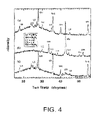
- FIG. 4 is an x-ray diffraction pattern of a hydrogen storage material according to one embodiment of the invention (LiBH 4 and MgH 2 ) taken after milling a stable hydride with a destabilizing hydride (curve a), after dehydrogenation (curve b), and after rehydrogenation (curve c);
- FIG. 5 is another volumetric analysis showing cyclic dehydrogenation and rehydrogenation of an embodiment of a hydrogen storage material of the invention (LiH and MgB 2 );
- FIG. 6 shows absorption and desorption isotherms for multiple samples of hydrogen storage materials of an embodiment of the invention (LiH and MgB 2 ) where the filled symbols indicate absorption and the open symbols at 400° C. indicate desorption;
- FIG. 7 is a van't Hoff plot showing equilibrium pressures obtained from absorption isotherms corresponding to the 4 weight % data of FIG. 6 , indicated therein by the “X” mark designations;
- FIG. 8 shows an x-ray diffraction (XRD) graph showing dehydrogenation of a stable hydride and a destabilizing hydride under a hydrogen atmosphere and an argon atmosphere according to one embodiment of the invention
- FIG. 9A is a gravimetric analysis performed in a commercial thermogravimetric analyzer showing the first (solid line) and second (dash-dot line) dehydrogenation of one embodiment of a hydrogen storage material of the invention (LiBH 4 and CaH 2 ) versus time during heating according to the shown temperature profile (dashed line).
- FIG. 9B is a gravimetric analysis of the first (solid line) and second (dash-dot line) hydrogen absorption where the first absorption was conducted after the first desorption but prior to the second desorption of FIG. 9A , and the second absorption was conducted subsequent to the second desorption of FIG. 9A .
- FIG. 10A is a gravimetric analysis of the third desorption after the second absorption of FIG. 9B .
- FIG. 10B is a gravimetric analysis of the third absorption after the third desorption of FIG. 10A .
- FIG. 11 is an x-ray diffraction pattern of a hydrogen storage material according to one embodiment of the invention (LiBH 4 and CaH 2 ) taken after milling a stable hydride with a destabilizing hydride (panel a), after the first desorption of FIG. 9A (panel b), and after the third hydrogenation of FIG. 10B (panel c).
- a hydrogen storage material LiBH 4 and CaH 2
- the word “include,” and its variants, is intended to be non-limiting, such that recitation of items in a list is not to the exclusion of other like items that may also be useful in the materials, compositions, devices, and methods of this invention.
- the invention provides a hydrogen storage material system that is capable of releasing relatively high hydrogen content and reversibly storing hydrogen at industrially practicable temperature and pressure conditions.
- a mixture is provided of a stable hydrogen storage hydride composition combined with a destabilizing composition to provide a reversible high-hydrogen content hydrogen storage material.
- the destabilizing composition comprises at least one destabilizing hydride. While in the presence of the destabilizing hydride, the stable hydride releases hydrogen and reversibly absorbs hydrogen at significantly lower temperature and pressure conditions, making the hydrogen storage material of the invention particularly suitable for various applications such as mobile hydrogen applications.
- reversible it is meant that one or more of the hydrogen starting materials is capable of being regenerated at temperature and pressure conditions which are economically and industrially useful and practicable.
- a “non-reversible reaction” generally applies to both reactions that are traditionally considered irreversible because they generally are not capable of reacting via the same reaction mechanism pathway, but also includes those reactions where regenerating a species of a hydrogen containing starting material by exposure to hydrogen is carried out at impractical processing conditions, such as extreme temperature, extreme pressure, or cumbersome product removal, which prevents its widespread and practical use.
- hydrogen storage compositions that release hydrogen endothermically are typically considered the best candidates for reversible hydrogen storage at desirable temperature and pressure conditions.
- “reversible” reactions include those where exposing one or more product compositions to hydrogen regenerates a species of one or more of the starting materials, while enabling a hydrogen release of about 5 wt % or more, and in some embodiments about 7 wt % or more.
- the concept of industrially practicable reversibility includes evaluating the weight percent of hydrogen released, as balanced with the energy input necessary to reversibly cycle (release and absorb) hydrogen.
- an endothermic hydrogen storage material may require a high energy input to release hydrogen.
- this energy input may be offset by a relatively high hydrogen content (concentration of hydrogen released from the material) such that some of the hydrogen being released can be consumed as energy to fuel additional release of hydrogen.
- overall the hydrogen storage material releases a sufficient amount of hydrogen to be a suitable candidate for fuel cell applications.
- One embodiment of the invention includes a hydrogen storage material system that has a reduction in the overall energy requirements for storing and subsequently releasing hydrogen. Minimizing the overall enthalpy changes associated with the hydrogen storage material system results in an improvement in the overall efficiency of an associated fuel cell system. As the overall enthalpy change increases, so does the requirement for managing heat transfer systems (heating and cooling operations). In particular, it is highly advantageous to minimize heating and cooling systems in mobile units containing fuel cells that consume hydrogen (e.g., vehicles or electronic devices), because additional systems draw parasitic energy and increase the overall weight of the mobile unit, thereby decreasing its gravimetric efficiency.
- hydrogen e.g., vehicles or electronic devices
- FIG. 1A shows an energy diagram of a prior art hydrogen storage hydride material, pure lithium borohydride, LiBH 4 .
- FIG. 1A shows the energy diagram for LiBH 4 calculated based on predicted products and performed using HSC Chemistry software. While the total hydrogen content of LiBH 4 is relatively high at above about 18 wt %, pure LiBH 4 does not reversibly store significant hydrogen, and the products of the decomposition of LiBH 4 have not been clearly identified.
- a predicted partial decomposition reaction produces LiH, B, and 3/2 H 2 , and has a theoretical yield of 13.6 wt % hydrogen.
- the calculated standard enthalpy for this reaction is about +67 kJ/mol-H 2 and thus, even if reversible, an equilibrium pressure of 1 bar requires a temperature of greater than 400° C. Such a temperature is generally considered too high for practical hydrogen storage applications.
- LiBH 4 can be defined as a “stable” hydride, meaning that the composition requires a prohibitive input of energy in order to release hydrogen because it is thermodynamically stable.
- prohibitive it is meant that the energy required is industrially impracticable, particularly for mobile consumer products, and tends to preclude the use of the material due to excessive energy requirements.
- the modification of hydrogenation/dehydrogenation thermodynamics can be accomplished with various material systems by using destabilizing additives that form alloys or compounds with a stable hydride composition.
- a destabilizing composition is added to a stable hydrogen storage composition to favorably alter the thermodynamics for hydrogen storage applications, the equilibrium pressure is increased, and thus reduces the energy input requirements for the overall system.
- a destabilizing compound reacts with the stable hydrogen storage compound to form additional or modified reactants and/or products to arrive at more favorable thermodynamics. Hydrides of many Period 2 and 3 elements (of the Periodic Table) are known in the art to have relatively high hydrogen densities, for example greater than 5-6 wt %. However, most of these hydrides are quite stable and do not release hydrogen until the temperature exceeds 250° C. at 1 bar.
- Lithium hydride contains 12.5 wt % hydrogen, but requires 910° C. for an equilibrium pressure of 1 bar.
- Magnesium hydride contains 7.7 wt % hydrogen and has a 1 bar equilibrium pressure at 275° C.
- the thermodynamics of the magnesium hydride can be altered by using additives that form alloys or compounds with Mg in either or both the hydrogenated and/or dehydrogenated states.
- a well-known example is adding nickel to the magnesium to form Mg 2 Ni in the starting materials, which, upon hydrogenation, forms Mg 2 NiH 4 with 3.6 wt % hydrogen and an equilibrium pressure of 1 bar at 245° C.
- Elemental aluminum has been found to destabilize MgH 2 by forming a Mg/Al alloy upon dehydrogenation. The reaction is reversible with MgH 2 and Al reforming and segregating during hydrogenation. At 280° C., the more favorable equilibrium pressure is a factor of 3 larger than that of pure MgH 2 .
- additives can be introduced to the stable hydride to form compounds or alloys with the dehydrogenated metals.
- Destabilization occurs because the system can cycle between the hydride and the newly formed and more thermodynamically favorable compound(s) instead of the less favorable dehydrogenated elemental metal(s).
- a destabilizing element for example silicon (Si), destabilizes certain stable hydride storage systems, such as lithium hydride or magnesium hydride. The added silicon forms relatively strong bonds with either lithium or magnesium. These newly formed strong bonds reduce dehydrogenation enthalpies and increase equilibrium hydrogen pressures.
- Other useful elemental destabilizers for stable hydrides include, by way of example, silicon (Si), aluminum (Al), and copper (Cu).
- one embodiment of the invention provides methods of destabilizing one or more stable hydride species.
- one object is to increase the equilibrium pressure of various strongly bound stable hydrides to in essence reduce the required system enthalpy and stabilize the dehydrogenated state. Stabilizing the dehydrogenated state reduces the enthalpy for dehydrogenation, thereby increasing the equilibrium hydrogen pressure.
- the thermodynamic properties of reversible hydrogen storage material systems can potentially be tuned to a finer extent than would be possible with individual materials to achieve reversible hydrogen release at practical temperature and pressure conditions.
- the invention may provide a relatively high yield of hydrogen gas from a hydrogen storage material, while minimizing the energy input required for the reversible system.
- the invention provides relatively light-weight reversible hydrogen storage materials.
- the reversible hydrogen storage materials may have gravimetric system capacities of greater than 5 to 9 wt % hydrogen.
- the invention provides in various embodiments a high hydrogen content hydrogen storage system that comprises a stable hydride material and a destabilizing hydride material, where each of the reactants potentially contribute to the amount of released hydrogen for consumption in the fuel cell Hence, both the stable hydride and the destabilizing hydride provide hydrogen to increase the hydrogen content released. Additionally, in accordance with the invention, as previously described, the addition of a destabilizing hydride with a stable hydride favorably improves the reaction thermodynamics, such that the required energy input or enthalpy is reduced by increasing the equilibrium pressure of the hydrogen storage system.
- thermodynamics and equilibrium pressures are useful for selecting hydrogen storage materials of the invention, however a discrepancy between the calculated or predicted values associated with energy levels (e.g., equilibrium pressure, enthalpy) and the actual values is often observed.
- the invention provides a method of reversibly storing hydrogen at industrially practicable temperature and pressure conditions.
- a stable hydrogen storage hydride is mixed with a destabilizing hydride.
- the stable hydride is characterized by releasing hydrogen in a first reaction having a first free energy level (E 1 ).
- the first energy level is related to a change in enthalpy denoted by ⁇ H.
- Also associated with the release of hydrogen is a change in entropy denoted by ⁇ S.
- the Gibbs free energy change relates to the thermodynamic feasibility of a chemical reaction. If ⁇ G>0, the reaction cannot spontaneously occur. If ⁇ G ⁇ 0, the reaction can occur spontaneously if there are no kinetic limitations along the reaction pathway.
- T ⁇ S The entropic contribution to the free energy, represented by the term T ⁇ S, compensates for the higher enthalpy or energy level that must be attained to enable a particular reaction to occur.
- hydrogen is a low molecular weight diatomic gas
- the entropy of hydrogen gas to a large extent dominates the entropy change associated with hydrogen release reactions regardless of the solid phase components that are involved.
- the free energy can be generally expressed as a required “energy level” that must be applied or input to the system to enable a desired reaction.
- the effect of mixing a stable hydride with a destabilizing hydride is approximately determined by the associated enthalpy or energy level changes.
- hydrogen release can occur in a second reaction having a lower ⁇ H and, consequently a lower reaction temperature.
- a two phase hydrogen storage material is formed.
- the stable hydride is then reacted with the destabilizing hydride in a second hydrogen release reaction that has a second energy level (E 2 ).
- E 2 the energy level for the second reaction, E 2
- the energy level for the second reaction, E 2 is less than the first energy level for the stable hydride by itself, E 1 .
- the hydrogen storage material comprises a stable hydride lithium borohydride (LiBH 4 ) combined with a destabilizing compound (MgH 2 ).
- the stable hydride is capable of releasing hydrogen at a first energy level.
- the storage material comprising the stable hydride is in the presence of the destabilizing hydride, the storage material releases hydrogen at a second energy level, and the second energy level may be significantly reduced from the first energy level.
- the hydrogen storage system comprises a stable hydride LiBH 4 and a destabilizing hydride MgH 2
- the stability of the MgB 2 alloy reduces the standard enthalpy for dehydrogenation from about +66 kJ/mol-H 2 to about +46 kJ/mol-H 2 , which translates to a reduction of 30% in energy.
- the temperature reduction is 240° C. at a pressure of 1 bar, which likewise equates to a reduction in the required energy input.
- the second energy level E 2 is less than the first energy level for the stable hydride by itself, E 1 . It should be noted that combining the stable hydride LiBH 4 with the destabilizing hydride MgH 2 actually destabilizes both the LiBH 4 and the MgH 2 in this case, to release hydrogen at a lower enthalpy than either the stable hydride or destabilizing hydride by itself, as will be discussed in more detail below.
- the second energy level E 2 may be significantly reduced from the first energy level E 1 for the hydrogen storage material.
- a “significant” reduction may be at least 10% reduction between the energy levels.
- the second energy level E 2 is at least 20% less than the first energy level E 1 , and in other embodiments, the difference in energy level is at least 30%.
- the first energy level is related to a first temperature that the system must achieve to release hydrogen from the stable hydride alone
- the second energy level is related to a second temperature required to release hydrogen in the reaction between the stable hydride and destabilizing hydride.
- the first temperature is greater than about 250° C. and the second temperature is less than 250° C. at a pressure of 1 bar.
- the second temperature is less than about 200° C.
- the second temperature is less than about 175° C.
- the second temperature required to release hydrogen may be reduced as low as possible for the hydrogen storage material.
- the reduction in the energy level can also be related to the equilibrium pressure of the respective hydrogen storage systems.
- a prior art system such as LiBH 4
- the first energy level is related to a first equilibrium pressure reflected in an equilibrium pressure that is low (about 1 bar or less) at 400° C.
- the second energy level is related to a second equilibrium pressure that is significantly higher (greater than about 10 bar) at the same temperature, correlating the reduced second energy level.
- the addition of the destabilizing hydride alters the thermodynamics of the hydrogen storage material hydrogen desorption reaction, and further enables a reversible hydrogenation reaction, where one or more of the products formed during the dehydrogenation reaction can be rehydrogenated upon exposure to hydrogen gas.
- the ease of reversibility of the reaction is correlated to the free energy level of the products. As the overall Gibb's free energy level for the hydrogen release approaches zero, the reversibility occurs with increasingly greater ease.
- one particular application for the hydrogen storage materials is a mobile fuel cell application.
- hydrogen storage materials both release and recharge hydrogen at industrially practicable temperature and pressures.
- these temperatures in the vehicular fuel cell applications correspond to a range of approximately ambient temperature to fuel cell operating temperatures.
- Exemplary operating temperatures generally range up to about 150° C.
- Operating temperatures may be from about 80° C. to about 100° C.
- the hydrogen storage material is selected to desorb and absorb around the operating temperatures of the mobile fuel cell. For example, this can be achieved by selecting a hydrogen storage material system that has a free energy that approaches zero at the appropriate temperature conditions (in that the enthalpy term ( ⁇ H) of Equation 1 is nearly equal to the entropy term (T ⁇ S)).
- the reaction enthalpy is endothermic.
- the second energy level E 2 correlates to an enthalpy of less than about +45 kJ/mol-H 2 and greater than about +30 kJ/mol-H 2 at ambient temperatures (ambient temperatures include a range of temperatures at which mobile applications may operate, which include, by way of example, approximately ⁇ 35° C. to 25° C.) to about 150° C. and ambient pressure (approximately 1 bar) demonstrating a relatively facile and controllable reversible reaction system.
- ambient temperatures include a range of temperatures at which mobile applications may operate, which include, by way of example, approximately ⁇ 35° C. to 25° C.) to about 150° C. and ambient pressure (approximately 1 bar) demonstrating a relatively facile and controllable reversible reaction system.
- the enthalpy is about +35 kJ/mol-H 2 , which relates to good control and reversibility at current operating temperatures in mobile fuel cell applications, although the material can be selected for any range of temperatures and corresponding enthalpy.
- the destabilizing hydride is capable of releasing hydrogen in a third reaction (in the absence of the stable hydride) and has a third energy level E 3 .
- the second energy level E 2 is less than the third energy level E 3 , thus the combined hydrides that form the hydrogen storage material of the invention encounter a lower free energy in combination than either hydride would have by itself upon releasing hydrogen.
- the destabilizing hydride is MgH 2 and the stable hydride is LiBH 4 . When these compounds are combined, the free energy is less than the respective free energy for hydrogen release for the individual compounds.
- the invention provides a solid state hydrogen storage material system that comprises a hydrogenated state where hydrogen is “stored” in the reactants and another dehydrogenated state subsequent to hydrogen release corresponding to the products.
- the hydrogenated state comprises two separate solid phases, the first phase corresponding to a stable hydride and the second solid phase corresponding to the destabilizing compound or hydride.
- the solid phase reactants are milled to reduce the average diameter particle size and to increase the surface area of the particles prior to reacting.
- the average particle diameter size is reduced to less than about 25 ⁇ m, or in other embodiments less than about 15 ⁇ m.
- a stable hydrogen storage hydride is represented by the nominal general formula AH x , where A comprises at least one element of Group 13 or Group 15 of the Periodic Table.
- the hydrogen storage material also comprises a destabilizing hydrogen storage hydride which can be represented by the nominal general formula MH y , where M is one or more cationic species distinct from A. Further, x and y are selected so as to maintain electroneutrality. In the absence of the destabilizing hydride, the stable hydride would require a prohibitive energy input to release hydrogen.
- the cationic species A of the stable hydride comprises one or more elements other than hydrogen, for example at least one element of Group 13 or Group 15 of the Periodic Table.
- the cationic species A comprises at least one of aluminum (Al), boron (B), gallium (Ga), indium (In), thallium (Tl), arsenic (As), nitrogen (N), or antimony (Sb).
- the stable hydride may include a cationic species A comprising boron (B).
- A is a complex cationic species, which comprises two or more distinct cationic species. Hydrides are often referred to as complex hydrides, which are further contemplated in the invention.
- suitable complex hydrides include those where A comprises additional cationic species that differ from the general expression described above, and A may comprise multiple cationic species or a compound, so long as the charge balance and electroneutrality of the complex hydride are maintained.
- A further comprises at least one element of Group 1 or Group 2 of the Periodic Table, in addition to at least one element of Group 13 or Group 15.
- A may comprise at least one of barium (Ba), beryllium (Be), calcium (Ca), cesium (Cs), potassium (K), lithium (Li), magnesium (Mg), sodium (Na), rubidium (Rb), or strontium (Sr).
- A comprises at least one of boron (B), aluminum (Al), lithium (Li), sodium (Na), potassium (K), beryllium (Be), magnesium (Mg), or calcium (Ca).
- the stable hydride is a complex hydride that comprises boron (B) and also comprises lithium (Li), magnesium (Mg), or sodium (Na).
- the stable hydride is a complex hydride and A comprises at least one transition metal. Transition metals include elements of Groups 3 to 12 of the Periodic Table.
- the stable hydride is at least one of lithium borohydride (LiBH 4 ), sodium borohydride (NaBH 4 ), lithium aluminum hydride (LiAlH 4 ), magnesium borohydride (Mg(BH 4 ) 2 ), magnesium aluminum hydride (Mg(AlH 4 ) 2 ), sodium aluminum hydride (NaAlH 4 ), calcium borohydride (Ca(BH 4 ) 2 ), or calcium aluminum hydride (Ca(AlH 4 ) 2 ).
- the stable hydride is at least one of lithium borohydride (LiBH 4 ), sodium borohydride (NaBH 4 ), or magnesium borohydride (Mg(BH 4 ) 2 ).
- the cationic species M in the destabilizing hydride MH y comprises one or more cationic species distinct from those in A.
- the elements of the cationic species M may be distinct from those of the stable hydride to enable a thermodynamic modification of the hydrogen release reaction in accordance with the invention.
- the cationic species M may be represented by a single cationic species or a mixture of cationic species other than hydrogen (e.g., a complex hydride).
- suitable cationic species include metal cations, non-metal cations (such as boron), and non-metal cations which are organic (such as CH 3 ).
- the destabilizing hydride comprises at least one transition metal. Transition metals include elements of Groups 3 to 12 of the Periodic Table.
- the cationic species may comprise at least one of aluminum (Al), arsenic (As), boron (B), barium (Ba), beryllium (Be), calcium (Ca), cadmium (Cd), cerium (Ce), cesium (Cs), copper (Cu), europium (Eu), iron (Fe), gallium (Ga), gadolinium (Gd), germanium (Ge), hafnium (Hf), mercury (Hg), indium (In), potassium (K), lanthanum (La), lithium (Li), magnesium (Mg), manganese (Mn), sodium (Na), neodymium (Nd), nickel (Ni), lead (Pb), praseodymium (Pr), rubidium (Rb), antimony (Sb), scandium (Sc), selenium (Se), silicon (Si), samarium (Sm), tin (Sn), strontium (Sr), thorium (Th), titanium (Ti), thall
- the cations for the cationic species M of the destabilizing hydride include at least one of aluminum (Al), barium (Ba), beryllium (Be), boron (B), calcium (Ca), cesium (Cs), iron (Fe), gallium (Ga), germanium (Ge), indium (In), lithium (Li), magnesium (Mg), nitrogen (N), potassium (K), rubidium (Rb), silicon (Si), sodium (Na), strontium (Sr), titanium (Ti), thallium (Tl), tin (Sn), or zirconium (Zr).
- M comprises at least one of aluminum (Al), beryllium (Be), boron (B), calcium (Ca), lithium (Li), magnesium (Mg), nitrogen (N), potassium (K), or sodium (Na).
- the destabilizing hydride is a “binary” hydride, meaning that the hydride comprises hydrogen and only one other cationic species M.
- the cationic species M is an alkali or alkaline earth metal (Groups 1 and 2 of the Periodic Table).
- Non-limiting examples of binary hydrides include LiH, NaH, MgH 2 , CaH 2 , and the like.
- the destabilizing hydride is at least one of lithium hydride (LiH), sodium hydride (NaH), potassium hydride (KH), magnesium hydride (MgH 2 ), calcium hydride (CaH 2 ), lithium aluminum hydride (LiAlH 4 ), sodium borohydride (NaBH 4 ), lithium borohydride (LiBH 4 ), magnesium borohydride (Mg(BH 4 ) 2 ), or sodium aluminum hydride (NaAlH 4 ).
- the hydrogen storage material comprising a stable hydride and a destabilizing hydride releases hydrogen by the following reversible reaction: nAH x +mMH y A n M m +1 ⁇ 2(nx+my)H 2 wherein n, m, x, and y are selected so as to maintain electroneutrality.
- the reaction produces both H 2 , as well as a byproduct compound A n M m .
- the byproduct compound A n M m may thermodynamically favor decomposing into further smaller and/or distinct byproduct compounds.
- Such additional distinct byproduct compounds may include metal hydrides, which may slightly detract from the total amount of hydrogen generated designated as 1 ⁇ 2(nx+my) H 2 .
- the stable hydride is a complex hydride (i.e., where A is a complex cationic species) the material releases hydrogen by the following reversible reaction: nA′ c A′′ d H (c+d) +mMH y nA′H c +A′′ n M m +1 ⁇ 2(nd+my)H 2 wherein n, m, c, d, x, and y are selected so as to maintain electroneutrality.
- the stable hydride is a complex hydride and the destabilizing hydride is a binary hydride.
- a stable hydride is lithium borohydride (LiBH 4 ) and a destabilizing hydride is magnesium hydride (MgH 2 ).
- a hydrogen storage material has a stable hydride, sodium borohydride (NaBH 4 ) and a destabilizing hydride, lithium hydride (LiH).
- a hydrogen storage material where a stable hydride is sodium borohydride (NaBH 4 ) and a destabilizing hydride is magnesium hydride (MgH 2 ).
- a stable hydride lithium borohydride (LiBH 4 ) and a destabilizing hydride: sodium hydride (NaH); a stable hydride: magnesium borohydride (Mg(BH 4 ) 2 ) and a destabilizing hydride: lithium hydride (LiH); a stable hydride: magnesium borohydride (Mg(BH 4 ) 2 ) and a destabilizing hydride: sodium hydride (NaH); a stable hydride: lithium borohydride (LiBH 4 ) and a destabilizing hydride: sodium borohydride (NaBH 4 ); stable hydride: lithium borohydride (LiBH 4 ) and a destabilizing hydride: sodium borohydride (NaBH 4 ); stable hydride: lithium borohydride (LiBH 4 ) and a destabilizing hydride: sodium borohydride (NaBH 4 ); a stable hydride: lithium borohydride (L
- the hydrogen storage material may comprise a plurality of distinct stable hydride compositions, or a plurality of destabilizing hydride compositions, or a plurality of both stable hydrides and destabilizing hydrides.
- the hydrogen storage material comprises a stable hydride and a destabilizing hydride, and further comprises a destabilizing compound, that is distinct from the destabilizing hydride, where the destabilizing compound promotes the release of hydrogen from the storage material at a reduced energy level from that of the stable hydride by itself.
- the additional destabilizing compound achieves an even greater reduction for the second energy level E 2 than would be achieved for the mixture of the destabilizing hydride and the stable hydride in the absence of the additional destabilizing compound.
- destabilizing compounds include elemental forms of silicon (Si), aluminum (Al), and copper (Cu).
- the hydrogen storage material may have a theoretical hydrogen content of greater than about 5 wt %, or in another embodiment greater than 7 wt %. In some embodiments, the hydrogen storage material has a theoretical hydrogen content of greater than 9 wt %. As recognized by one of skill in the art, the theoretical yield is rarely observed empirically, and actual yields are often less than the predicted theoretical yield.
- the hydrogen storage material may initially comprise the dehydrogenated products of the above reactions, and may be subsequently hydrogenated, thereby cyclically releasing and storing hydrogen in accordance with the invention.
- the starting materials comprise LiH and MgB 2 .
- the starting materials are exposed to hydrogen gas, where they transform to LiBH 4 and MgH 2 in a hydrogenated state, and are subsequently able to reversibly release and absorb hydrogen, as previously described above.
- a catalyst is employed to enhance the reaction kinetics.
- Such catalysts are well known to one of skill in the art.
- Catalysts that may be useful with the invention comprise an element from the following non-limiting list: Fe, Ni, Co, Pt, Pd, Sr, and compounds and mixtures thereof.
- Suitable catalyst compounds include TiH 2 TiH x , TiF 3 , TiCl 2 , TiCl 4 , TiF 4 , VCl 3 , VF 3 , and VH x .
- the catalyst is generally added to either one of the hydrogen storage starting materials or to both of the hydrogen storage materials. The materials may be milled to achieve a desirable particle size and homogeneous mixing.
- catalyst concentrations in the hydrogen storage material system are from between about 0.1 to about 10 mole %.
- the invention provides a method of reversibly storing hydrogen where hydrogen is released from starting materials while in the presence of a hydrogen.
- the hydrogen generation reaction which occurs between a stable hydride and a destabilizing hydride under a hydrogen atmosphere, is substantially reversible at industrially practicable pressure and temperature conditions
- the reacting of a stable hydride and a destabilizing hydride to release hydrogen is conducted in a hydrogen atmosphere comprising substantially all hydrogen gas (the hydrogen gas may contain a small level of impurities that do not detrimentally impact the reaction), one or more of the reaction products formed in the reaction are capable of reforming the starting materials upon exposure to hydrogen (i.e., the dehydrogenation reaction is reversible).
- the minimum hydrogen pressure of the hydrogen atmosphere is at least about 10 atm (approximately about 1000 kPa); at least about 8 atm (approximately about 800 kPa); at least about 6 atm (approximately about 600 kPa); at least about 5 atm (approximately about 500 kPa); at least about 4 atm (approximately about 400 kPa); at least about 3 atm (approximately about 300 kPa); at least about 2 atm (approximately about 200 kPa); or at least about 1 atm (approximately about 100 kPa).
- a stable hydride is lithium borohydride (LiBH 4 ) and a destabilizing hydride is magnesium hydride (MgH 2 ).
- LiBH 4 lithium borohydride
- MgH 2 magnesium hydride
- a hydrogen atmosphere appears to facilitate the formation of the more readily reversible products LiH and MgB 2 (in addition to hydrogen), rather than the alternative products of Mg and B metals, as will be described further in Example 3 below.
- a mixture of LiBH 4 and MgH 2 is prepared having a molar ratio of 2:1 that reacts according to the above described chemical reaction formula.
- the LiBH 4 is commercially available from Lancaster Synthesis, Inc. of Windham, N.H. (and is specified to be ⁇ 95% purity) and the MgH 2 is commercially available at 95% purity from Gelest.
- the starting powders are mixed in the molar ratio 2 LiBH 4 :1 MgH 2 with 2 mole % of a catalyst (TiCl 3 ) added during milling.
- the starting materials weigh 1.2 grams and are added and sealed into a 80 cm 3 hardened steel ball mill vessel under an argon (Ar) inert atmosphere. Thirty chrome-steel mill balls having a 7 mm diameter are placed in the vessel with the powder prior to sealing. The material is then high-energy ball milled for at least one hour in a Fritsch Pulversette 6 planetary mill at 400 rpm.
- the average particle size diameter of the compound(s) remaining in the mill may be approximately 5 ⁇ m to about 15 ⁇ m.
- FIG. 2 shows a volumetric analysis obtained with a mass spectrometer monitoring the exhaust gas from the Sievert's apparatus.
- FIG. 2 shows hydrogen release by weight loss as a function of time for a sample of the milled hydrogen storage composition comprising LiBH 4 and MgH 2 prepared in accordance with Example 1.
- FIG. 2 also depicts a plot of the hydrogen release by weight loss as a function of time for a sample of milled LiBH 4 prepared in accordance with the procedure described above, however without any destabilizing hydride (e.g., MgH 2 ).
- the LiBH 4 has a TiCl 3 catalyst added, as well. Each sample is continuously heated at a rate of 2° C. per minute up to 450° C. (represented by the dashed line).
- Curve “a” represents the hydrogen storage material of the invention having the LiBH 4 and MgH 2
- curve “b” represents LiBH 4 alone in accordance with the prior art.
- the behavior of the LiBH 4 and MgH 2 hydrogen storage material is complex, nearly 10 wt % of hydrogen is generated from the hydrogen storage material (the wt % of the catalyst is not included).
- the LiBH 4 only produces less than 8 wt % hydrogen (not including the catalyst).
- the hydrogen storage material prepared in accordance with the invention demonstrates improved hydrogen release over the prior art.
- FIG. 3 shows hydrogen absorption behavior of the dehydrogenated mixture of the sample prepared in accordance with Example 1.
- a dehydrogenated sample of pure LiBH 4 with 0.1 mole TiCl 3 catalyst is also provided for comparison.
- the LiBH 4 and MgH 2 is heated at 2° C. per minute up to a temperature of 300° C. where it is held constant.
- the prior art sample of LiBH 4 is heated at a rate of 2° C. per minute up to a temperature of 400° C. where it is held.
- the LiBH 4 and MgH 2 mixture represented by curve “a” absorbs greater than 8 wt % hydrogen.
- the pure LiBH 4 represented by curve “b” absorbs less than 4 wt % hydrogen.
- the LiBH 4 and MgH 2 mixture of the invention having a stable hydride and a destabilizing hydride demonstrates good hydrogen absorption at lower temperatures, as compared to the prior art stable hydride alone.
- FIG. 4 shows an x-ray diffraction pattern of a sample prepared in accordance with Example 1.
- “LB” represents LiBH 4
- “MH” represents MgH 2
- “MB” represents, MgB 2
- “LC” represents LiCl 3 .
- Curve “a” is taken after mechanical milling of LiBH 4 and MgH 2 together and shows that milling produces a physical mixture with no reaction products between the stable hydride and destabilizing hydride. However, as can be seen, a small concentration of lithium chloride is produced from a reaction of TiCl 3 with LiBH 4 which may occur during milling. No diffraction from any species containing Ti was observed.
- FIG. 5 shows hydrogenation and dehydrogenation of a sample prepared in accordance with Example 2.
- the temperature ramp dehydrogenation/hydrogenation and isotherm measurements are performed in two custom Sievert's apparatus.
- the system was pumped using an oilfree pumping station (the Tribodyn 100/120-HVP model available from Danielson Associates).
- the pressure at the sample is determined by replacing the sample container with an ionization gauge and measuring the pressure. After pumping overnight, a pressure of 1 ⁇ 10 ⁇ 6 Torr (1.3 ⁇ 10 ⁇ 4 Pa) can be obtained.
- Hydrogen pressures are measured using low-range (0-100 psia or approximately 7.0 ⁇ 10 2 kPa) and high-range (0-3000 psia or approximately 2.1 ⁇ 10 4 kPa) capacitance manometers at selected temperatures over the range from 75° C. to 575° C.
- Absorption and desorption isotherms for the sample prepared in accordance with Example 2 are shown in FIG. 6 .
- Isotherm measurements are performed manually in the same Sievert's apparatus used for the temperature ramp experiments.
- Absorption isotherms are shown between 315° C. and 450° C. (specifically at 330° C., 363° C., 400° C., and 450° C.) and a desorption isotherm is shown at 400° C.
- the isotherms show sloping plateaus from 2 to 8 wt % with capacities of approximately 10 wt %.
- Equilibrium pressures vary from 4.5 bar at 315° C. to 19 bar at 450° C.
- Absorption and desorption isotherms obtained at 400° C. display a hysteresis of 2 to 3 bar.
- FIG. 7 is a preliminary van't Hoff plot (logarithm of the equilibrium pressure versus the inverse of the absolute temperature) using absorption equilibrium pressures at 4 wt % (see FIG. 6 ).
- curve “b” shows an estimate of the behavior for dehydrogenation of LiBH 4 to LiH+B.
- Curve “c” shows equilibrium pressures for MgH 2 /Mg obtained from the IEA/DOE/SNL database.
- the enthalpy for the LiBH 4 /LiH+B system is estimated to be +67 kJ/mol-H 2 .
- the hydrogenation/dehydrogenation enthalpy for the LiBH 4 +1 ⁇ 2 MgH 2 system is lower by 25 kJ/mol-H 2 and at 400° C. the equilibrium pressure is increased from approximately 1 to 12 bar.
- extrapolating the linear behavior gives a temperature of 225° C. for an equilibrium hydrogen pressure of 1 bar.
- the equilibrium pressure indicates that addition of MgH 2 significantly destabilizes LiBH 4 for hydrogen storage.
- the enthalpy for the alternate reaction should be less than the enthalpy for the reaction designated as Reaction 1 previously described above for the dehydrogenation reaction of LiBH 4 +1 ⁇ 2 MgH 2 . Consequently, the variation of equilibrium pressure with temperature should display a lower enthalpy, i.e., a lower slope, above approximately 360° C.
- the measured equilibrium pressure at 450° C. is lower than the pressure extrapolated from lower temperatures. While not wishing to be bound by any particular theory, it is believed that this data point may indicate a transition from Reaction 1 at temperatures below about 360° C. to the alternate reaction (Reaction 8) at higher temperatures.
- the temperature ramp desorption measurements show two desorption steps which likely correspond to dehydrogenation of MgH 2 followed by reaction of Mg with LiBH 4 to form MgB 2 .
- the addition of MgH 2 to LiBH 4 yields a reversible, destabilized hydrogen storage material system with an actual hydrogen capacity of approximately 8 to 10 wt %.
- the hydrogenation/dehydrogenation enthalpy is reduced by 25 kJ/mol-H 2 , as compared with pure LiBH 4 and the temperature for an equilibrium pressure of 1 bar is estimated to be 225° C.
- a mixture of LiBH 4 and MgH 2 is prepared having a molar ratio of 2:1 with a TiCl 3 catalyst at 2 mole %, in the same manner as that described in Example 1 above.
- the ball-milled samples are dehydrogenated under two different atmospheric conditions to demonstrate the effect of hydrogen atmosphere on reaction products.
- FIG. 8 shows x-ray diffraction (XRD) data for the two different dehydrogenation scenarios.
- Scan A shows an XRD for a material dehydrogenated by heating to 400° C. under flowing hydrogen at a pressure of 5 atm (approximately 500 kPa).
- Scan A shows that the reaction products include MgB 2 , but no detectable quantities of Mg metal were produced.
- the sample in Scan B was dehydrogenated by heating to 400° C. under a flowing argon atmosphere at 1 atm (100 kPa).
- the XRD pattern in Scan B shows that Mg metal was formed as a reaction product, but no detectable amounts of MgB 2 are formed.
- the dehydrogenation reaction of the stable hydride with the destabilizing hydride may be conducted in the presence of hydrogen, for example in a hydrogen atmosphere, to enable formation of reaction products that are capable of being readily regenerated by exposure to hydrogen gas (e.g., MgB 2 rather than elemental Mg and B).
- hydrogen gas e.g., MgB 2 rather than elemental Mg and B.
- a mixture of LiBH 4 and CaH 2 is prepared having a molar ratio of 6:1 that reacts according to Reaction 7 described above.
- the LiBH 4 is commercially available from Aldrich Chemicals of Milwaukee, Wis. (and is specified to be ⁇ 95% purity), and the CaH 2 is commercially available at 99.9% purity also from Aldrich.
- the starting powders are mixed in the molar ratio 6 LiBH 4 :1 CaH 2 and ball milled for one hour in an SPEX 8000 Mixer/Mill. Prior to milling, 0.25 mole of a catalyst (TiCl 3 ) is added.
- FIGS. 9 and 10 show dehydrogenation and hydrogenation of a sample prepared in accordance with Example 4. Hydrogen desorption and absorption were measured gravimetrically by monitoring the weight loss and gain, respectively, in a Cahn Model 2151 high pressure thermogravimetric analyzer, available from Cahn Instruments.
- FIG. 9A shows the first desorption (solid line) and second desorption (dash-dot line) of the sample according to one embodiment of the invention versus time during heating according to the shown temperature profile (dashed line).
- FIG. 9B shows the subsequent first absorption (solid line) and second absorption (dash-dot line) between and following the first and second desorptions, respectively.
- FIGS. 9A shows the first desorption (solid line) and second desorption (dash-dot line) of the sample according to one embodiment of the invention versus time during heating according to the shown temperature profile (dashed line).
- FIG. 9B shows the subsequent first absorption (solid line) and second absorption (dash-dot
- FIG. 10A and 9B correspond to two cycles of dehydrogenation and rehydrogenation.
- FIG. 10A shows the third desorption after the second absorption of FIG. 9B
- FIG. 10B shows the third absorption after the third desorption of FIG. 10A .
- FIG. 11 is x-ray diffraction (XRD) patterns of a sample prepared in accordance with Example 4.
- Panel (a) of FIG. 11 shows the XRD pattern of the initial mixture, demonstrating that the as-prepared sample consists of a mixture of LiBH 4 , CaH 2 , LiCl (from the reaction of TiCl 3 with Li from the LiBH 4 ), and CaO (an impurity not deliberately added, but which is an impurity in the commercial CaH 2 used—its only effect is as a diluant).
- Panel (b) of FIG. 11 shows the XRD pattern after dehydrogenation (after the desorption of FIG. 9A ).
- panel (c) of FIG. 11 shows the XRD pattern after the third rehydrogenation (of FIG. 10B ), and it consists of a mixture of LiBH 4 and CaH 2 , along with CaO impurity. This demonstrates the reversible nature of the reaction.
- the total observed hydrogen cycling amount is 9.1 wt %.
- the hydrogen storage materials according to the invention provide a stable reversible solid phase hydrogen storage composition material, which is especially advantageous in mobile fuel cell applications.
- the reaction to generate hydrogen is readily controlled by temperature and pressure, and the required energy input is significantly reduced to increase efficiency of the overall system, while the hydrogen storage capacity is substantially increased.
- the hydrogen storage material system according to various embodiments of the invention provides a stable, safe, and energy efficient means to store hydrogen for prolonged periods while enabling both hydrogen release and reversible reaction at moderate conditions.
Landscapes
- Chemical & Material Sciences (AREA)
- Organic Chemistry (AREA)
- Inorganic Chemistry (AREA)
- Chemical Kinetics & Catalysis (AREA)
- Engineering & Computer Science (AREA)
- Combustion & Propulsion (AREA)
- General Health & Medical Sciences (AREA)
- Health & Medical Sciences (AREA)
- Life Sciences & Earth Sciences (AREA)
- Environmental & Geological Engineering (AREA)
- General Life Sciences & Earth Sciences (AREA)
- Geology (AREA)
- Hydrogen, Water And Hydrids (AREA)
- Fuel Cell (AREA)
Abstract
Description
nAHx+mMHy

wherein M is one or more cationic species that are distinct from A, and n, m, x, and y are selected so as to maintain electroneutrality. The reaction is substantially reversible at the industrially practicable pressure and temperature conditions.
ΔG=ΔH−TΔS=−RT(In K eq) (Equation 1)
where Keq is the equilibrium constant, H is the enthalpy, S is the entropy, T is the absolute temperature in Kelvins, and R is the gas constant. The Gibbs free energy change relates to the thermodynamic feasibility of a chemical reaction. If ΔG>0, the reaction cannot spontaneously occur. If ΔG<0, the reaction can occur spontaneously if there are no kinetic limitations along the reaction pathway. The temperature at which a reaction becomes thermodynamically feasible is the temperature at which ΔG=0 or alternatively Keq=1. This temperature is generally determined by the following equation:
T(ΔG=0)=ΔH/ΔS (Equation 2)
The entropic contribution to the free energy, represented by the term TΔS, compensates for the higher enthalpy or energy level that must be attained to enable a particular reaction to occur. Because hydrogen is a low molecular weight diatomic gas, the entropy of hydrogen gas to a large extent dominates the entropy change associated with hydrogen release reactions regardless of the solid phase components that are involved. Hence, the free energy can be generally expressed as a required “energy level” that must be applied or input to the system to enable a desired reaction.
nAHx+mMHy
wherein n, m, x, and y are selected so as to maintain electroneutrality. The reaction produces both H2, as well as a byproduct compound AnMm. It should be noted that the byproduct compound AnMm may thermodynamically favor decomposing into further smaller and/or distinct byproduct compounds. These further byproducts are formed of the same general constituents as the primary byproduct, but they have different valence states, atomic ratios, or stoichiometry, depending on the cationic species involved, as recognized by one of skill in the art. Such additional distinct byproduct compounds may include metal hydrides, which may slightly detract from the total amount of hydrogen generated designated as ½(nx+my) H2. For example, in one embodiment, where the stable hydride is a complex hydride (i.e., where A is a complex cationic species) the material releases hydrogen by the following reversible reaction:
nA′cA″dH(c+d)+mMHy
wherein n, m, c, d, x, and y are selected so as to maintain electroneutrality.
-
- 1) 2 LiBH4+MgH2→2 LiH+MgB2+4 H2 (Reaction 1), which generates a theoretical 11.4 wt % hydrogen and has a predicted enthalpy of reaction of +45.6 kJ/mol-H2, and a predicted equilibrium temperature of 170° C. at 1 bar (although the measure equilibrium temperature was approximately 225° C. at 1 bar).
generates a theoretical 7.8 wt % hydrogen, has a predicted enthalpy of reaction at 20° C. of 32.6 kJ/mol-H2 and a predicted equilibrium temperature of 70° C. at 1 bar.
generates a theoretical 10.9 wt % hydrogen, has a predicted enthalpy of reaction at 20° C. of 16.8 kJ/mol-H2 and a predicted equilibrium temperature of 90° C. at 1 bar.
generates a theoretical 9.1 wt % hydrogen, has a predicted enthalpy of reaction at 20° C. of 23.3 kJ/mol-H2 and a predicted equilibrium temperature of 0° C. at 1 bar.
generates a theoretical 6.9 wt % hydrogen, has a predicted enthalpy of reaction at 20° C. of 39.2 kJ/mol-H2 and a predicted equilibrium temperature of 150° C. at 1 bar.
generates a theoretical 7.9 wt % hydrogen, has a predicted enthalpy of reaction at 20° C. of 63.6 kJ/mol-H2 and a predicted equilibrium temperature of 350° C. at 1 bar.
-
- 7) 6 LiBH4+CaH2 6 LiH+CaB6+10H2 (Reaction 7), which generates a theoretical 11.7 wt % hydrogen, has a predicted enthalpy of reaction of 66.2 kJ/mole H2 and a predicted equilibrium temperature of 388° C. at 1 bar.
- 7) 6 LiBH4+CaH2
Claims (29)
nAHx+mMHy
nA′cA″dH(c+d)+mMHy
Priority Applications (1)
| Application Number | Priority Date | Filing Date | Title |
|---|---|---|---|
| US11/758,114 US7462344B2 (en) | 2004-03-26 | 2007-06-05 | Methods for reversibly storing hydrogen |
Applications Claiming Priority (4)
| Application Number | Priority Date | Filing Date | Title |
|---|---|---|---|
| US55703804P | 2004-03-26 | 2004-03-26 | |
| US61887004P | 2004-10-14 | 2004-10-14 | |
| US11/086,993 US20060013766A1 (en) | 2004-03-26 | 2005-03-22 | Methods for reversibly storing hydrogen |
| US11/758,114 US7462344B2 (en) | 2004-03-26 | 2007-06-05 | Methods for reversibly storing hydrogen |
Related Parent Applications (1)
| Application Number | Title | Priority Date | Filing Date |
|---|---|---|---|
| US11/086,993 Continuation-In-Part US20060013766A1 (en) | 2004-03-26 | 2005-03-22 | Methods for reversibly storing hydrogen |
Publications (2)
| Publication Number | Publication Date |
|---|---|
| US20070280869A1 US20070280869A1 (en) | 2007-12-06 |
| US7462344B2 true US7462344B2 (en) | 2008-12-09 |
Family
ID=35599658
Family Applications (1)
| Application Number | Title | Priority Date | Filing Date |
|---|---|---|---|
| US11/758,114 Expired - Fee Related US7462344B2 (en) | 2004-03-26 | 2007-06-05 | Methods for reversibly storing hydrogen |
Country Status (1)
| Country | Link |
|---|---|
| US (1) | US7462344B2 (en) |
Cited By (4)
| Publication number | Priority date | Publication date | Assignee | Title |
|---|---|---|---|---|
| US20070264182A1 (en) * | 2005-03-22 | 2007-11-15 | Gm Global Technology Operations, Inc. | Reversible hydrogen storage systems |
| DE102013211106A1 (en) * | 2013-06-14 | 2014-12-18 | Fraunhofer-Gesellschaft zur Förderung der angewandten Forschung e.V. | Composite material, device and method for the hydrolytic production of hydrogen and apparatus for generating electrical energy and possible uses |
| US10443954B1 (en) | 2014-12-05 | 2019-10-15 | Savannah River Nuclear Solutions, Llc | High performance metal hydride based thermal energy storage systems for concentrating solar power |
| US11976235B2 (en) | 2020-10-27 | 2024-05-07 | Battelle Savannah River Alliance, Llc | High temperature thermochemical energy storage materials |
Families Citing this family (2)
| Publication number | Priority date | Publication date | Assignee | Title |
|---|---|---|---|---|
| US20100068134A1 (en) * | 2008-09-18 | 2010-03-18 | Ford Global Technologies, Llc | Methods of enhancing kinetic properties of hydrogen storage materials by self-catalysis |
| US20100184595A1 (en) * | 2009-01-20 | 2010-07-22 | Gm Global Technology Operations, Inc. | Transition metal complex anion-based hydrogen storage material system |
Citations (8)
| Publication number | Priority date | Publication date | Assignee | Title |
|---|---|---|---|---|
| US3971846A (en) * | 1964-01-30 | 1976-07-27 | The Dow Chemical Company | Preparation of beryllium hydride and aluminum hydride |
| US4341651A (en) * | 1980-08-26 | 1982-07-27 | The United States Of America As Represented By The Secretary Of The Navy | Compositions and methods for generation of gases containing hydrogen or hydrogen isotopes |
| US6251349B1 (en) * | 1997-10-10 | 2001-06-26 | Mcgill University | Method of fabrication of complex alkali metal hydrides |
| US6358488B1 (en) * | 1999-07-05 | 2002-03-19 | Seijirau Suda | Method for generation of hydrogen gas |
| US20040120889A1 (en) * | 2002-11-05 | 2004-06-24 | Shah Shailesh A. | Hydrogen generator |
| US6866836B2 (en) * | 2002-09-13 | 2005-03-15 | General Motors Corporation | Method of generating hydrogen from borohydrides and water |
| US20050079129A1 (en) * | 2003-10-14 | 2005-04-14 | Srinivasan Venkatesan | Rapid chemical charging of metal hydrides |
| US7083657B2 (en) * | 2002-08-20 | 2006-08-01 | Millennium Cell, Inc. | System for hydrogen generation |
-
2007
- 2007-06-05 US US11/758,114 patent/US7462344B2/en not_active Expired - Fee Related
Patent Citations (8)
| Publication number | Priority date | Publication date | Assignee | Title |
|---|---|---|---|---|
| US3971846A (en) * | 1964-01-30 | 1976-07-27 | The Dow Chemical Company | Preparation of beryllium hydride and aluminum hydride |
| US4341651A (en) * | 1980-08-26 | 1982-07-27 | The United States Of America As Represented By The Secretary Of The Navy | Compositions and methods for generation of gases containing hydrogen or hydrogen isotopes |
| US6251349B1 (en) * | 1997-10-10 | 2001-06-26 | Mcgill University | Method of fabrication of complex alkali metal hydrides |
| US6358488B1 (en) * | 1999-07-05 | 2002-03-19 | Seijirau Suda | Method for generation of hydrogen gas |
| US7083657B2 (en) * | 2002-08-20 | 2006-08-01 | Millennium Cell, Inc. | System for hydrogen generation |
| US6866836B2 (en) * | 2002-09-13 | 2005-03-15 | General Motors Corporation | Method of generating hydrogen from borohydrides and water |
| US20040120889A1 (en) * | 2002-11-05 | 2004-06-24 | Shah Shailesh A. | Hydrogen generator |
| US20050079129A1 (en) * | 2003-10-14 | 2005-04-14 | Srinivasan Venkatesan | Rapid chemical charging of metal hydrides |
Non-Patent Citations (11)
| Title |
|---|
| Alapati et al "Identification of Destabilized Metal Hydrides for Hydrogen Storage Using First Principles Calculations", J. Phys. Chem. B110, 8769-8776 (2006), no month. |
| Alapati et al "Identification of Destabilized Metal Hydrides for Hydrogen Storage Using First Principles Calculations", J. Phys. Chem. B110, 8769-8776 (2006). |
| Argonne National Laboratory, "Basic Research Needs for the Hydrogen Economy", May 13-15, 2003, pp. 95-109. |
| Johnson et al, "Computational Studies of Hydrogen Storage: Metal Organic Frameworks and Destabilized Metal Hydrides", found on the web at www.h-workshop.uni-konstanz.de/talks, no date. |
| Johnson et al, "Computational Studies of Hydrogen Storage: Metal Organic Frameworks and Destabilized Metal Hydrides", found on the web at www.h-workshop.uni-konstanz.de/talks. |
| Johnson, Session D6: Simulating Hydrogen Storage: From Current Challenges to Future Promises, 2006 APS March Meeting Event, Abstract D6.00001, no month. |
| Johnson, Session D6: Simulating Hydrogen Storage: From Current Challenges to Future Promises, 2006 APS March Meeting Event, Abstract D6.00001. |
| Vajo et al, "Reversible Storage of Hydrogen in Destabilized LiBH4", J. Phys. Chem. B, 109(9) pp. 3719-3722 (published on the web on Feb. 12, 2005). |
| Vajo et al, Altering Hydrogen Storage Properties by Hydride Destabilization through Alloy Formation, J. Phys. Chem. B, 108 (37) pp. 13977-13983 (2004), no month. |
| Vajo et al, Altering Hydrogen Storage Properties by Hydride Destabilization through Alloy Formation, J. Phys. Chem. B, 108 (37) pp. 13977-13983 (2004). |
| Zaluska et al, "Structure, catalysis and atomic reactions on the nano-scale", Applied Physics A: Materials Science & Processing 72(2), pp. 157-159, 162-165 (Feb. 2001). |
Cited By (4)
| Publication number | Priority date | Publication date | Assignee | Title |
|---|---|---|---|---|
| US20070264182A1 (en) * | 2005-03-22 | 2007-11-15 | Gm Global Technology Operations, Inc. | Reversible hydrogen storage systems |
| DE102013211106A1 (en) * | 2013-06-14 | 2014-12-18 | Fraunhofer-Gesellschaft zur Förderung der angewandten Forschung e.V. | Composite material, device and method for the hydrolytic production of hydrogen and apparatus for generating electrical energy and possible uses |
| US10443954B1 (en) | 2014-12-05 | 2019-10-15 | Savannah River Nuclear Solutions, Llc | High performance metal hydride based thermal energy storage systems for concentrating solar power |
| US11976235B2 (en) | 2020-10-27 | 2024-05-07 | Battelle Savannah River Alliance, Llc | High temperature thermochemical energy storage materials |
Also Published As
| Publication number | Publication date |
|---|---|
| US20070280869A1 (en) | 2007-12-06 |
Similar Documents
| Publication | Publication Date | Title |
|---|---|---|
| US20060013766A1 (en) | Methods for reversibly storing hydrogen | |
| US7341703B2 (en) | Mixed hydrogen generation material | |
| KR101009331B1 (en) | Method of Hydrogen Release by Nitrogen-Containing Hydrogen Storage Material | |
| US7601329B2 (en) | Regeneration of hydrogen storage system materials and methods including hydrides and hydroxides | |
| US7029649B2 (en) | Combinations of hydrogen storage materials including amide/imide | |
| US20070264182A1 (en) | Reversible hydrogen storage systems | |
| JP4805908B2 (en) | Hydrogen storage material and process comprising hydride and hydroxide | |
| US20110071021A1 (en) | Hydrogen Storage Systems And Compositions | |
| US20040265222A1 (en) | Imide/amide hydrogen storage materials and methods | |
| US7462344B2 (en) | Methods for reversibly storing hydrogen | |
| US7166150B2 (en) | Scaffolded borazane-lithium hydride hydrogen storage materials | |
| US7749484B2 (en) | Li-B-Mg-X system for reversible hydrogen storage | |
| US20100233076A1 (en) | Hydrogen Storage Materials | |
| US20070231254A1 (en) | Direct synthesis and methods of using hydrogen storage materials | |
| JP5823961B2 (en) | High capacity stabilized complex hydrides for hydrogen storage |
Legal Events
| Date | Code | Title | Description |
|---|---|---|---|
| AS | Assignment |
Owner name: GM GLOBAL TECHNOLOGY OPERATIONS, INC., MICHIGAN Free format text: ASSIGNMENT OF ASSIGNORS INTEREST;ASSIGNORS:VAJO, JOHN J.;MERTENS, FLORIAN O.;SKEITH, SKY;AND OTHERS;REEL/FRAME:019709/0343;SIGNING DATES FROM 20070607 TO 20070815 |
|
| AS | Assignment |
Owner name: UNITED STATES DEPARTMENT OF THE TREASURY, DISTRICT Free format text: SECURITY AGREEMENT;ASSIGNOR:GM GLOBAL TECHNOLOGY OPERATIONS, INC.;REEL/FRAME:022201/0448 Effective date: 20081231 Owner name: UNITED STATES DEPARTMENT OF THE TREASURY,DISTRICT Free format text: SECURITY AGREEMENT;ASSIGNOR:GM GLOBAL TECHNOLOGY OPERATIONS, INC.;REEL/FRAME:022201/0448 Effective date: 20081231 |
|
| AS | Assignment |
Owner name: CITICORP USA, INC. AS AGENT FOR BANK PRIORITY SECU Free format text: SECURITY AGREEMENT;ASSIGNOR:GM GLOBAL TECHNOLOGY OPERATIONS, INC.;REEL/FRAME:022553/0540 Effective date: 20090409 Owner name: CITICORP USA, INC. AS AGENT FOR HEDGE PRIORITY SEC Free format text: SECURITY AGREEMENT;ASSIGNOR:GM GLOBAL TECHNOLOGY OPERATIONS, INC.;REEL/FRAME:022553/0540 Effective date: 20090409 |
|
| AS | Assignment |
Owner name: GM GLOBAL TECHNOLOGY OPERATIONS, INC., MICHIGAN Free format text: RELEASE BY SECURED PARTY;ASSIGNOR:UNITED STATES DEPARTMENT OF THE TREASURY;REEL/FRAME:023124/0563 Effective date: 20090709 Owner name: GM GLOBAL TECHNOLOGY OPERATIONS, INC.,MICHIGAN Free format text: RELEASE BY SECURED PARTY;ASSIGNOR:UNITED STATES DEPARTMENT OF THE TREASURY;REEL/FRAME:023124/0563 Effective date: 20090709 |
|
| AS | Assignment |
Owner name: GM GLOBAL TECHNOLOGY OPERATIONS, INC., MICHIGAN Free format text: RELEASE BY SECURED PARTY;ASSIGNORS:CITICORP USA, INC. AS AGENT FOR BANK PRIORITY SECURED PARTIES;CITICORP USA, INC. AS AGENT FOR HEDGE PRIORITY SECURED PARTIES;REEL/FRAME:023155/0663 Effective date: 20090814 Owner name: GM GLOBAL TECHNOLOGY OPERATIONS, INC.,MICHIGAN Free format text: RELEASE BY SECURED PARTY;ASSIGNORS:CITICORP USA, INC. AS AGENT FOR BANK PRIORITY SECURED PARTIES;CITICORP USA, INC. AS AGENT FOR HEDGE PRIORITY SECURED PARTIES;REEL/FRAME:023155/0663 Effective date: 20090814 |
|
| AS | Assignment |
Owner name: UNITED STATES DEPARTMENT OF THE TREASURY, DISTRICT Free format text: SECURITY AGREEMENT;ASSIGNOR:GM GLOBAL TECHNOLOGY OPERATIONS, INC.;REEL/FRAME:023156/0264 Effective date: 20090710 Owner name: UNITED STATES DEPARTMENT OF THE TREASURY,DISTRICT Free format text: SECURITY AGREEMENT;ASSIGNOR:GM GLOBAL TECHNOLOGY OPERATIONS, INC.;REEL/FRAME:023156/0264 Effective date: 20090710 |
|
| AS | Assignment |
Owner name: UAW RETIREE MEDICAL BENEFITS TRUST, MICHIGAN Free format text: SECURITY AGREEMENT;ASSIGNOR:GM GLOBAL TECHNOLOGY OPERATIONS, INC.;REEL/FRAME:023162/0140 Effective date: 20090710 Owner name: UAW RETIREE MEDICAL BENEFITS TRUST,MICHIGAN Free format text: SECURITY AGREEMENT;ASSIGNOR:GM GLOBAL TECHNOLOGY OPERATIONS, INC.;REEL/FRAME:023162/0140 Effective date: 20090710 |
|
| AS | Assignment |
Owner name: GM GLOBAL TECHNOLOGY OPERATIONS, INC., MICHIGAN Free format text: RELEASE BY SECURED PARTY;ASSIGNOR:UNITED STATES DEPARTMENT OF THE TREASURY;REEL/FRAME:025245/0656 Effective date: 20100420 |
|
| AS | Assignment |
Owner name: GM GLOBAL TECHNOLOGY OPERATIONS, INC., MICHIGAN Free format text: RELEASE BY SECURED PARTY;ASSIGNOR:UAW RETIREE MEDICAL BENEFITS TRUST;REEL/FRAME:025314/0946 Effective date: 20101026 |
|
| AS | Assignment |
Owner name: WILMINGTON TRUST COMPANY, DELAWARE Free format text: SECURITY AGREEMENT;ASSIGNOR:GM GLOBAL TECHNOLOGY OPERATIONS, INC.;REEL/FRAME:025324/0057 Effective date: 20101027 |
|
| AS | Assignment |
Owner name: GM GLOBAL TECHNOLOGY OPERATIONS LLC, MICHIGAN Free format text: CHANGE OF NAME;ASSIGNOR:GM GLOBAL TECHNOLOGY OPERATIONS, INC.;REEL/FRAME:025781/0035 Effective date: 20101202 |
|
| REMI | Maintenance fee reminder mailed | ||
| LAPS | Lapse for failure to pay maintenance fees | ||
| STCH | Information on status: patent discontinuation |
Free format text: PATENT EXPIRED DUE TO NONPAYMENT OF MAINTENANCE FEES UNDER 37 CFR 1.362 |
|
| FP | Expired due to failure to pay maintenance fee |
Effective date: 20121209 |