US7452886B2 - Pyrrolo pyrimidines as agents for the inhibition of cystein proteases - Google Patents
Pyrrolo pyrimidines as agents for the inhibition of cystein proteases Download PDFInfo
- Publication number
- US7452886B2 US7452886B2 US10/487,760 US48776004A US7452886B2 US 7452886 B2 US7452886 B2 US 7452886B2 US 48776004 A US48776004 A US 48776004A US 7452886 B2 US7452886 B2 US 7452886B2
- Authority
- US
- United States
- Prior art keywords
- optionally substituted
- heterocyclyl
- acoet
- aryl
- cdcl
- Prior art date
- Legal status (The legal status is an assumption and is not a legal conclusion. Google has not performed a legal analysis and makes no representation as to the accuracy of the status listed.)
- Expired - Fee Related, expires
Links
- 230000005764 inhibitory process Effects 0.000 title description 5
- 102000035195 Peptidases Human genes 0.000 title description 2
- 108091005804 Peptidases Proteins 0.000 title description 2
- 239000003795 chemical substances by application Substances 0.000 title description 2
- XUJNEKJLAYXESH-UHFFFAOYSA-N cysteine Natural products SCC(N)C(O)=O XUJNEKJLAYXESH-UHFFFAOYSA-N 0.000 title description 2
- 239000004365 Protease Substances 0.000 title 1
- 150000004944 pyrrolopyrimidines Chemical class 0.000 title 1
- 150000001875 compounds Chemical class 0.000 claims abstract description 131
- 150000003839 salts Chemical class 0.000 claims abstract description 24
- 150000002148 esters Chemical class 0.000 claims abstract description 10
- -1 R4 is H Chemical group 0.000 claims description 251
- 125000000217 alkyl group Chemical group 0.000 claims description 69
- 238000000034 method Methods 0.000 claims description 67
- 125000005843 halogen group Chemical group 0.000 claims description 32
- 125000003118 aryl group Chemical group 0.000 claims description 24
- 238000002360 preparation method Methods 0.000 claims description 23
- 125000004356 hydroxy functional group Chemical group O* 0.000 claims description 19
- 125000000753 cycloalkyl group Chemical group 0.000 claims description 14
- 125000002924 primary amino group Chemical group [H]N([H])* 0.000 claims description 14
- 125000003545 alkoxy group Chemical group 0.000 claims description 11
- CYJAWBVQRMVFEO-UHFFFAOYSA-N piperazine-2,6-dione Chemical class O=C1CNCC(=O)N1 CYJAWBVQRMVFEO-UHFFFAOYSA-N 0.000 claims description 11
- 125000004104 aryloxy group Chemical group 0.000 claims description 9
- 125000004043 oxo group Chemical group O=* 0.000 claims description 9
- 125000001424 substituent group Chemical group 0.000 claims description 9
- IZXIZTKNFFYFOF-UHFFFAOYSA-N 2-Oxazolidone Chemical class O=C1NCCO1 IZXIZTKNFFYFOF-UHFFFAOYSA-N 0.000 claims description 8
- 229940091173 hydantoin Drugs 0.000 claims description 8
- 239000002243 precursor Substances 0.000 claims description 8
- KAESVJOAVNADME-UHFFFAOYSA-N 1H-pyrrole Natural products C=1C=CNC=1 KAESVJOAVNADME-UHFFFAOYSA-N 0.000 claims description 7
- XKJCHHZQLQNZHY-UHFFFAOYSA-N phthalimide Chemical class C1=CC=C2C(=O)NC(=O)C2=C1 XKJCHHZQLQNZHY-UHFFFAOYSA-N 0.000 claims description 7
- 125000003435 aroyl group Chemical group 0.000 claims description 6
- 125000000623 heterocyclic group Chemical group 0.000 claims description 6
- 229910052739 hydrogen Inorganic materials 0.000 claims description 6
- 125000003342 alkenyl group Chemical group 0.000 claims description 5
- 125000003282 alkyl amino group Chemical group 0.000 claims description 5
- 125000004391 aryl sulfonyl group Chemical group 0.000 claims description 5
- 229910052757 nitrogen Inorganic materials 0.000 claims description 5
- 239000008194 pharmaceutical composition Substances 0.000 claims description 5
- 125000000304 alkynyl group Chemical group 0.000 claims description 4
- 125000001246 bromo group Chemical group Br* 0.000 claims description 4
- 125000002837 carbocyclic group Chemical group 0.000 claims description 4
- 230000008878 coupling Effects 0.000 claims description 4
- 238000010168 coupling process Methods 0.000 claims description 4
- 238000005859 coupling reaction Methods 0.000 claims description 4
- 125000005842 heteroatom Chemical group 0.000 claims description 4
- 239000001257 hydrogen Substances 0.000 claims description 4
- 229920006395 saturated elastomer Polymers 0.000 claims description 4
- 201000001320 Atherosclerosis Diseases 0.000 claims description 3
- 125000003368 amide group Chemical group 0.000 claims description 3
- 125000002915 carbonyl group Chemical group [*:2]C([*:1])=O 0.000 claims description 3
- 229910052760 oxygen Inorganic materials 0.000 claims description 3
- JCXJVPUVTGWSNB-UHFFFAOYSA-N Nitrogen dioxide Chemical compound O=[N]=O JCXJVPUVTGWSNB-UHFFFAOYSA-N 0.000 claims description 2
- 125000004453 alkoxycarbonyl group Chemical group 0.000 claims description 2
- 125000003236 benzoyl group Chemical group [H]C1=C([H])C([H])=C(C([H])=C1[H])C(*)=O 0.000 claims description 2
- 125000002619 bicyclic group Chemical group 0.000 claims description 2
- 125000003107 substituted aryl group Chemical group 0.000 claims 6
- 229910020008 S(O) Inorganic materials 0.000 claims 2
- 239000003937 drug carrier Substances 0.000 claims 2
- 125000004435 hydrogen atom Chemical group [H]* 0.000 claims 2
- 125000004433 nitrogen atom Chemical group N* 0.000 claims 2
- 229910052717 sulfur Inorganic materials 0.000 claims 2
- 125000002777 acetyl group Chemical group [H]C([H])([H])C(*)=O 0.000 claims 1
- 150000003851 azoles Chemical class 0.000 claims 1
- 150000001469 hydantoins Chemical class 0.000 claims 1
- 239000012038 nucleophile Substances 0.000 claims 1
- 125000001501 propionyl group Chemical group O=C([*])C([H])([H])C([H])([H])[H] 0.000 claims 1
- 125000006413 ring segment Chemical group 0.000 claims 1
- 125000003003 spiro group Chemical group 0.000 claims 1
- 238000006467 substitution reaction Methods 0.000 claims 1
- 102000004171 Cathepsin K Human genes 0.000 abstract description 20
- 108090000625 Cathepsin K Proteins 0.000 abstract description 20
- 208000037265 diseases, disorders, signs and symptoms Diseases 0.000 abstract description 18
- 201000010099 disease Diseases 0.000 abstract description 16
- 238000011282 treatment Methods 0.000 abstract description 9
- 208000001132 Osteoporosis Diseases 0.000 abstract description 8
- 206010028980 Neoplasm Diseases 0.000 abstract description 6
- 239000003112 inhibitor Substances 0.000 abstract description 6
- 201000008482 osteoarthritis Diseases 0.000 abstract description 6
- 206010039073 rheumatoid arthritis Diseases 0.000 abstract description 6
- 206010061218 Inflammation Diseases 0.000 abstract description 4
- 230000004054 inflammatory process Effects 0.000 abstract description 4
- 208000035475 disorder Diseases 0.000 abstract description 2
- HEDRZPFGACZZDS-MICDWDOJSA-N Trichloro(2H)methane Chemical compound [2H]C(Cl)(Cl)Cl HEDRZPFGACZZDS-MICDWDOJSA-N 0.000 description 914
- VLKZOEOYAKHREP-UHFFFAOYSA-N n-Hexane Chemical compound CCCCCC VLKZOEOYAKHREP-UHFFFAOYSA-N 0.000 description 676
- XEKOWRVHYACXOJ-UHFFFAOYSA-N Ethyl acetate Chemical compound CCOC(C)=O XEKOWRVHYACXOJ-UHFFFAOYSA-N 0.000 description 590
- OKKJLVBELUTLKV-UHFFFAOYSA-N Methanol Chemical compound OC OKKJLVBELUTLKV-UHFFFAOYSA-N 0.000 description 439
- YMWUJEATGCHHMB-UHFFFAOYSA-N Dichloromethane Chemical compound ClCCl YMWUJEATGCHHMB-UHFFFAOYSA-N 0.000 description 291
- CSNNHWWHGAXBCP-UHFFFAOYSA-L Magnesium sulfate Chemical compound [Mg+2].[O-][S+2]([O-])([O-])[O-] CSNNHWWHGAXBCP-UHFFFAOYSA-L 0.000 description 214
- 239000000203 mixture Substances 0.000 description 160
- 238000005160 1H NMR spectroscopy Methods 0.000 description 156
- 239000011541 reaction mixture Substances 0.000 description 141
- 239000000243 solution Substances 0.000 description 125
- XLYOFNOQVPJJNP-UHFFFAOYSA-N water Chemical compound O XLYOFNOQVPJJNP-UHFFFAOYSA-N 0.000 description 118
- 239000012267 brine Substances 0.000 description 112
- HPALAKNZSZLMCH-UHFFFAOYSA-M sodium;chloride;hydrate Chemical compound O.[Na+].[Cl-] HPALAKNZSZLMCH-UHFFFAOYSA-M 0.000 description 112
- 229910052943 magnesium sulfate Inorganic materials 0.000 description 107
- BWHMMNNQKKPAPP-UHFFFAOYSA-L potassium carbonate Chemical compound [K+].[K+].[O-]C([O-])=O BWHMMNNQKKPAPP-UHFFFAOYSA-L 0.000 description 106
- 239000002904 solvent Substances 0.000 description 86
- ZMANZCXQSJIPKH-UHFFFAOYSA-N Triethylamine Chemical compound CCN(CC)CC ZMANZCXQSJIPKH-UHFFFAOYSA-N 0.000 description 85
- ZMXDDKWLCZADIW-UHFFFAOYSA-N N,N-dimethylformamide Substances CN(C)C=O ZMXDDKWLCZADIW-UHFFFAOYSA-N 0.000 description 69
- 238000010898 silica gel chromatography Methods 0.000 description 67
- 239000000284 extract Substances 0.000 description 66
- VYPSYNLAJGMNEJ-UHFFFAOYSA-N Silicium dioxide Chemical compound O=[Si]=O VYPSYNLAJGMNEJ-UHFFFAOYSA-N 0.000 description 65
- IAZDPXIOMUYVGZ-UHFFFAOYSA-N Dimethylsulphoxide Chemical compound CS(C)=O IAZDPXIOMUYVGZ-UHFFFAOYSA-N 0.000 description 63
- 239000012044 organic layer Substances 0.000 description 60
- 239000000047 product Substances 0.000 description 59
- 239000007858 starting material Substances 0.000 description 59
- 0 *C1=NC(C#N)=NC2=C1C=C(C[14*])N2[13*] Chemical compound *C1=NC(C#N)=NC2=C1C=C(C[14*])N2[13*] 0.000 description 53
- 229910000027 potassium carbonate Inorganic materials 0.000 description 53
- 235000019341 magnesium sulphate Nutrition 0.000 description 51
- 230000002829 reductive effect Effects 0.000 description 51
- 239000000741 silica gel Substances 0.000 description 51
- 229910002027 silica gel Inorganic materials 0.000 description 51
- 229960001866 silicon dioxide Drugs 0.000 description 51
- PMZURENOXWZQFD-UHFFFAOYSA-L Sodium Sulfate Chemical compound [Na+].[Na+].[O-]S([O-])(=O)=O PMZURENOXWZQFD-UHFFFAOYSA-L 0.000 description 48
- UIIMBOGNXHQVGW-UHFFFAOYSA-M Sodium bicarbonate Chemical compound [Na+].OC([O-])=O UIIMBOGNXHQVGW-UHFFFAOYSA-M 0.000 description 48
- 239000012043 crude product Substances 0.000 description 48
- 229910052938 sodium sulfate Inorganic materials 0.000 description 48
- RTZKZFJDLAIYFH-UHFFFAOYSA-N Diethyl ether Chemical compound CCOCC RTZKZFJDLAIYFH-UHFFFAOYSA-N 0.000 description 44
- 235000011152 sodium sulphate Nutrition 0.000 description 36
- CSCPPACGZOOCGX-UHFFFAOYSA-N Acetone Chemical compound CC(C)=O CSCPPACGZOOCGX-UHFFFAOYSA-N 0.000 description 35
- IAZDPXIOMUYVGZ-WFGJKAKNSA-N Dimethyl sulfoxide Chemical compound [2H]C([2H])([2H])S(=O)C([2H])([2H])[2H] IAZDPXIOMUYVGZ-WFGJKAKNSA-N 0.000 description 34
- 235000019439 ethyl acetate Nutrition 0.000 description 34
- NLXLAEXVIDQMFP-UHFFFAOYSA-N Ammonia chloride Chemical compound [NH4+].[Cl-] NLXLAEXVIDQMFP-UHFFFAOYSA-N 0.000 description 32
- YXFVVABEGXRONW-UHFFFAOYSA-N Toluene Chemical compound CC1=CC=CC=C1 YXFVVABEGXRONW-UHFFFAOYSA-N 0.000 description 29
- SVNIABUZGXNWNA-UHFFFAOYSA-N 6-(bromomethyl)-7-(2,2-dimethylpropyl)pyrrolo[2,3-d]pyrimidine-2-carbonitrile Chemical compound N1=C(C#N)N=C2N(CC(C)(C)C)C(CBr)=CC2=C1 SVNIABUZGXNWNA-UHFFFAOYSA-N 0.000 description 28
- OKKJLVBELUTLKV-MZCSYVLQSA-N Deuterated methanol Chemical compound [2H]OC([2H])([2H])[2H] OKKJLVBELUTLKV-MZCSYVLQSA-N 0.000 description 28
- LFQSCWFLJHTTHZ-UHFFFAOYSA-N Ethanol Chemical compound CCO LFQSCWFLJHTTHZ-UHFFFAOYSA-N 0.000 description 28
- 229940086542 triethylamine Drugs 0.000 description 26
- 239000012299 nitrogen atmosphere Substances 0.000 description 25
- DTQVDTLACAAQTR-UHFFFAOYSA-N trifluoroacetic acid Substances OC(=O)C(F)(F)F DTQVDTLACAAQTR-UHFFFAOYSA-N 0.000 description 22
- 238000004440 column chromatography Methods 0.000 description 20
- VEXZGXHMUGYJMC-UHFFFAOYSA-N Hydrochloric acid Chemical compound Cl VEXZGXHMUGYJMC-UHFFFAOYSA-N 0.000 description 19
- 238000000746 purification Methods 0.000 description 19
- 229910000030 sodium bicarbonate Inorganic materials 0.000 description 19
- 239000000725 suspension Substances 0.000 description 19
- 238000004587 chromatography analysis Methods 0.000 description 17
- 239000003480 eluent Substances 0.000 description 16
- 239000007787 solid Substances 0.000 description 16
- QTBSBXVTEAMEQO-UHFFFAOYSA-N Acetic acid Chemical compound CC(O)=O QTBSBXVTEAMEQO-UHFFFAOYSA-N 0.000 description 15
- YNHIGQDRGKUECZ-UHFFFAOYSA-L bis(triphenylphosphine)palladium(ii) dichloride Chemical compound [Cl-].[Cl-].[Pd+2].C1=CC=CC=C1P(C=1C=CC=CC=1)C1=CC=CC=C1.C1=CC=CC=C1P(C=1C=CC=CC=1)C1=CC=CC=C1 YNHIGQDRGKUECZ-UHFFFAOYSA-L 0.000 description 15
- 229940093499 ethyl acetate Drugs 0.000 description 15
- 239000000706 filtrate Substances 0.000 description 15
- 239000007832 Na2SO4 Substances 0.000 description 14
- 238000001704 evaporation Methods 0.000 description 14
- 230000008020 evaporation Effects 0.000 description 14
- 125000001997 phenyl group Chemical group [H]C1=C([H])C([H])=C(*)C([H])=C1[H] 0.000 description 14
- 238000001816 cooling Methods 0.000 description 13
- 239000005457 ice water Substances 0.000 description 13
- WYURNTSHIVDZCO-UHFFFAOYSA-N tetrahydrofuran Substances C1CCOC1 WYURNTSHIVDZCO-UHFFFAOYSA-N 0.000 description 13
- HNRMPXKDFBEGFZ-UHFFFAOYSA-N CCC(C)(C)C Chemical compound CCC(C)(C)C HNRMPXKDFBEGFZ-UHFFFAOYSA-N 0.000 description 12
- REOGNJJZNVOODF-UHFFFAOYSA-N CCC1=CC2=C(N=C(C#N)N=C2)N1CC(C)(C)C Chemical compound CCC1=CC2=C(N=C(C#N)N=C2)N1CC(C)(C)C REOGNJJZNVOODF-UHFFFAOYSA-N 0.000 description 12
- IXCSERBJSXMMFS-UHFFFAOYSA-N hydrogen chloride Substances Cl.Cl IXCSERBJSXMMFS-UHFFFAOYSA-N 0.000 description 12
- 229910000041 hydrogen chloride Inorganic materials 0.000 description 12
- KZXZPTCXNTWWCS-UHFFFAOYSA-N 5-bromo-4-(2,2-dimethylpropylamino)pyrimidine-2-carbonitrile Chemical compound CC(C)(C)CNC1=NC(C#N)=NC=C1Br KZXZPTCXNTWWCS-UHFFFAOYSA-N 0.000 description 11
- QWTDNUCVQCZILF-UHFFFAOYSA-N CCC(C)C Chemical compound CCC(C)C QWTDNUCVQCZILF-UHFFFAOYSA-N 0.000 description 11
- 229910021595 Copper(I) iodide Inorganic materials 0.000 description 11
- 125000004432 carbon atom Chemical group C* 0.000 description 11
- IIHQNAXFIODVDU-UHFFFAOYSA-N pyrimidine-2-carbonitrile Chemical compound N#CC1=NC=CC=N1 IIHQNAXFIODVDU-UHFFFAOYSA-N 0.000 description 11
- HEDRZPFGACZZDS-UHFFFAOYSA-N Chloroform Chemical compound ClC(Cl)Cl HEDRZPFGACZZDS-UHFFFAOYSA-N 0.000 description 10
- JGFZNNIVVJXRND-UHFFFAOYSA-N N,N-Diisopropylethylamine (DIPEA) Chemical compound CCN(C(C)C)C(C)C JGFZNNIVVJXRND-UHFFFAOYSA-N 0.000 description 10
- JUJWROOIHBZHMG-UHFFFAOYSA-N Pyridine Chemical class C1=CC=NC=C1 JUJWROOIHBZHMG-UHFFFAOYSA-N 0.000 description 10
- 238000003756 stirring Methods 0.000 description 10
- WEVYAHXRMPXWCK-UHFFFAOYSA-N Acetonitrile Chemical compound CC#N WEVYAHXRMPXWCK-UHFFFAOYSA-N 0.000 description 9
- 239000002253 acid Substances 0.000 description 9
- LSXDOTMGLUJQCM-UHFFFAOYSA-M copper(i) iodide Chemical compound I[Cu] LSXDOTMGLUJQCM-UHFFFAOYSA-M 0.000 description 9
- 238000001914 filtration Methods 0.000 description 9
- 229910000104 sodium hydride Inorganic materials 0.000 description 9
- RYHBNJHYFVUHQT-UHFFFAOYSA-N 1,4-Dioxane Chemical compound C1COCCO1 RYHBNJHYFVUHQT-UHFFFAOYSA-N 0.000 description 8
- BLDNWXVISIXWKZ-UHFFFAOYSA-N CCC1=CC=C(F)C=C1 Chemical compound CCC1=CC=C(F)C=C1 BLDNWXVISIXWKZ-UHFFFAOYSA-N 0.000 description 8
- FOTXAJDDGPYIFU-UHFFFAOYSA-N CCC1CC1 Chemical compound CCC1CC1 FOTXAJDDGPYIFU-UHFFFAOYSA-N 0.000 description 8
- RXYPXQSKLGGKOL-UHFFFAOYSA-N CN1CCN(C)CC1 Chemical compound CN1CCN(C)CC1 RXYPXQSKLGGKOL-UHFFFAOYSA-N 0.000 description 8
- 241000124008 Mammalia Species 0.000 description 8
- 238000004128 high performance liquid chromatography Methods 0.000 description 8
- 125000002496 methyl group Chemical group [H]C([H])([H])* 0.000 description 8
- ONNNJLDEPAZHLQ-UHFFFAOYSA-N 6-[(4-aminophenyl)methyl]-7-(2,2-dimethylpropyl)pyrrolo[2,3-d]pyrimidine-2-carbonitrile Chemical compound C=1C2=CN=C(C#N)N=C2N(CC(C)(C)C)C=1CC1=CC=C(N)C=C1 ONNNJLDEPAZHLQ-UHFFFAOYSA-N 0.000 description 7
- OTMSDBZUPAUEDD-UHFFFAOYSA-N CC Chemical compound CC OTMSDBZUPAUEDD-UHFFFAOYSA-N 0.000 description 7
- UAEPNZWRGJTJPN-UHFFFAOYSA-N CC1CCCCC1 Chemical compound CC1CCCCC1 UAEPNZWRGJTJPN-UHFFFAOYSA-N 0.000 description 7
- SJRJJKPEHAURKC-UHFFFAOYSA-N CN1CCOCC1 Chemical compound CN1CCOCC1 SJRJJKPEHAURKC-UHFFFAOYSA-N 0.000 description 7
- 238000005481 NMR spectroscopy Methods 0.000 description 7
- WJRBRSLFGCUECM-UHFFFAOYSA-N hydantoin Chemical compound O=C1CNC(=O)N1 WJRBRSLFGCUECM-UHFFFAOYSA-N 0.000 description 7
- 239000010410 layer Substances 0.000 description 7
- 239000000843 powder Substances 0.000 description 7
- RIOQSEWOXXDEQQ-UHFFFAOYSA-N triphenylphosphine Chemical compound C1=CC=CC=C1P(C=1C=CC=CC=1)C1=CC=CC=C1 RIOQSEWOXXDEQQ-UHFFFAOYSA-N 0.000 description 7
- NHQDETIJWKXCTC-UHFFFAOYSA-N 3-chloroperbenzoic acid Chemical compound OOC(=O)C1=CC=CC(Cl)=C1 NHQDETIJWKXCTC-UHFFFAOYSA-N 0.000 description 6
- HCNCYKRNISOPIX-UHFFFAOYSA-N 4-(2-fluoro-4-hydroxyphenyl)piperazine-1-carboxylic acid Chemical compound C1CN(C(=O)O)CCN1C1=CC=C(O)C=C1F HCNCYKRNISOPIX-UHFFFAOYSA-N 0.000 description 6
- XQWHIIQIVZJEMR-UHFFFAOYSA-N 7-(2,2-dimethylpropyl)-6-(piperazin-1-ylmethyl)pyrrolo[2,3-d]pyrimidine-2-carbonitrile Chemical compound C=1C2=CN=C(C#N)N=C2N(CC(C)(C)C)C=1CN1CCNCC1 XQWHIIQIVZJEMR-UHFFFAOYSA-N 0.000 description 6
- HCJRBZZBADWUJG-UHFFFAOYSA-N 7-(2,2-dimethylpropyl)-6-[(1-methyl-2,4-dioxo-1,3,8-triazaspiro[4.5]decan-3-yl)methyl]pyrrolo[2,3-d]pyrimidine-2-carbonitrile Chemical compound CN1C(=O)N(CC=2N(C3=NC(=NC=C3C=2)C#N)CC(C)(C)C)C(=O)C11CCNCC1 HCJRBZZBADWUJG-UHFFFAOYSA-N 0.000 description 6
- IJGRMHOSHXDMSA-UHFFFAOYSA-N Atomic nitrogen Chemical compound N#N IJGRMHOSHXDMSA-UHFFFAOYSA-N 0.000 description 6
- ATUOYWHBWRKTHZ-UHFFFAOYSA-N CCC Chemical compound CCC ATUOYWHBWRKTHZ-UHFFFAOYSA-N 0.000 description 6
- KEFVKKQOIQWELT-UHFFFAOYSA-N COC1=CC(OC)=C(N2CCN(C)CC2)C=C1 Chemical compound COC1=CC(OC)=C(N2CCN(C)CC2)C=C1 KEFVKKQOIQWELT-UHFFFAOYSA-N 0.000 description 6
- YNAVUWVOSKDBBP-UHFFFAOYSA-N Morpholine Chemical class C1COCCN1 YNAVUWVOSKDBBP-UHFFFAOYSA-N 0.000 description 6
- NQRYJNQNLNOLGT-UHFFFAOYSA-N Piperidine Chemical class C1CCNCC1 NQRYJNQNLNOLGT-UHFFFAOYSA-N 0.000 description 6
- HEMHJVSKTPXQMS-UHFFFAOYSA-M Sodium hydroxide Chemical compound [OH-].[Na+] HEMHJVSKTPXQMS-UHFFFAOYSA-M 0.000 description 6
- YJVFFLUZDVXJQI-UHFFFAOYSA-L palladium(ii) acetate Chemical compound [Pd+2].CC([O-])=O.CC([O-])=O YJVFFLUZDVXJQI-UHFFFAOYSA-L 0.000 description 6
- 239000002244 precipitate Substances 0.000 description 6
- UMJSCPRVCHMLSP-UHFFFAOYSA-N pyridine Chemical class COC1=CC=CN=C1 UMJSCPRVCHMLSP-UHFFFAOYSA-N 0.000 description 6
- 125000004076 pyridyl group Chemical group 0.000 description 6
- PUYWQTHRUDZMLC-UHFFFAOYSA-N 7-(2,2-dimethylpropyl)-6-(naphthalen-2-ylmethyl)pyrrolo[2,3-d]pyrimidine-2-carbonitrile Chemical compound N1=C(C#N)N=C2N(CC(C)(C)C)C(CC=3C=C4C=CC=CC4=CC=3)=CC2=C1 PUYWQTHRUDZMLC-UHFFFAOYSA-N 0.000 description 5
- KPMKBEDNNBTQPE-UHFFFAOYSA-N 7-(2,2-dimethylpropyl)-6-[(2,4-dioxo-1-oxa-3,8-diazaspiro[4.5]decan-3-yl)methyl]pyrrolo[2,3-d]pyrimidine-2-carbonitrile Chemical compound C=1C2=CN=C(C#N)N=C2N(CC(C)(C)C)C=1CN(C1=O)C(=O)OC21CCNCC2 KPMKBEDNNBTQPE-UHFFFAOYSA-N 0.000 description 5
- SYHBEDCSCPDPHK-UHFFFAOYSA-N 7-(2,2-dimethylpropyl)-6-[(4-oxopiperidin-1-yl)methyl]pyrrolo[2,3-d]pyrimidine-2-carbonitrile Chemical compound C=1C2=CN=C(C#N)N=C2N(CC(C)(C)C)C=1CN1CCC(=O)CC1 SYHBEDCSCPDPHK-UHFFFAOYSA-N 0.000 description 5
- YAXHAOVRQMQDBH-UHFFFAOYSA-N 7-(2,2-dimethylpropyl)-6-[[4-(2-methyl-4-nitrophenyl)piperazin-1-yl]methyl]pyrrolo[2,3-d]pyrimidine-2-carbonitrile Chemical compound CC1=CC([N+]([O-])=O)=CC=C1N1CCN(CC=2N(C3=NC(=NC=C3C=2)C#N)CC(C)(C)C)CC1 YAXHAOVRQMQDBH-UHFFFAOYSA-N 0.000 description 5
- CZLGRYMIJLFYHO-UHFFFAOYSA-N 7-(2,2-dimethylpropyl)-6-[[4-(6-fluoropyridin-3-yl)piperazin-1-yl]methyl]pyrrolo[2,3-d]pyrimidine-2-carbonitrile Chemical compound C=1C2=CN=C(C#N)N=C2N(CC(C)(C)C)C=1CN(CC1)CCN1C1=CC=C(F)N=C1 CZLGRYMIJLFYHO-UHFFFAOYSA-N 0.000 description 5
- IJDNQMDRQITEOD-UHFFFAOYSA-N CCCC Chemical compound CCCC IJDNQMDRQITEOD-UHFFFAOYSA-N 0.000 description 5
- OFBQJSOFQDEBGM-UHFFFAOYSA-N CCCCC Chemical compound CCCCC OFBQJSOFQDEBGM-UHFFFAOYSA-N 0.000 description 5
- CHLICZRVGGXEOD-UHFFFAOYSA-N COC1=CC=C(C)C=C1 Chemical compound COC1=CC=C(C)C=C1 CHLICZRVGGXEOD-UHFFFAOYSA-N 0.000 description 5
- 229910019020 PtO2 Inorganic materials 0.000 description 5
- YKIOKAURTKXMSB-UHFFFAOYSA-N adams's catalyst Chemical compound O=[Pt]=O YKIOKAURTKXMSB-UHFFFAOYSA-N 0.000 description 5
- 125000003106 haloaryl group Chemical group 0.000 description 5
- 229910052736 halogen Inorganic materials 0.000 description 5
- 150000002367 halogens Chemical class 0.000 description 5
- 150000002466 imines Chemical class 0.000 description 5
- 238000000338 in vitro Methods 0.000 description 5
- INQOMBQAUSQDDS-UHFFFAOYSA-N iodomethane Chemical compound IC INQOMBQAUSQDDS-UHFFFAOYSA-N 0.000 description 5
- QARBMVPHQWIHKH-UHFFFAOYSA-N methanesulfonyl chloride Chemical compound CS(Cl)(=O)=O QARBMVPHQWIHKH-UHFFFAOYSA-N 0.000 description 5
- 125000004999 nitroaryl group Chemical group 0.000 description 5
- 238000011321 prophylaxis Methods 0.000 description 5
- OVKXEUNBXUPEAP-UHFFFAOYSA-N 1-(2-methyl-4-nitrophenyl)piperazine Chemical compound CC1=CC([N+]([O-])=O)=CC=C1N1CCNCC1 OVKXEUNBXUPEAP-UHFFFAOYSA-N 0.000 description 4
- FPQQSJJWHUJYPU-UHFFFAOYSA-N 3-(dimethylamino)propyliminomethylidene-ethylazanium;chloride Chemical compound Cl.CCN=C=NCCCN(C)C FPQQSJJWHUJYPU-UHFFFAOYSA-N 0.000 description 4
- JRCPMLGMFDQDKY-UHFFFAOYSA-N 3-[[2-cyano-7-(2,2-dimethylpropyl)pyrrolo[2,3-d]pyrimidin-6-yl]methyl]-1-methyl-2,4-dioxo-1,3,8-triazaspiro[4.5]decane-8-carboxylic acid Chemical compound CN1C(=O)N(CC=2N(C3=NC(=NC=C3C=2)C#N)CC(C)(C)C)C(=O)C11CCN(C(O)=O)CC1 JRCPMLGMFDQDKY-UHFFFAOYSA-N 0.000 description 4
- HRHJAOSSWNUZMC-UHFFFAOYSA-N 4-(2-fluoro-4-formylphenyl)piperazine-1-carboxylic acid Chemical compound C1CN(C(=O)O)CCN1C1=CC=C(C=O)C=C1F HRHJAOSSWNUZMC-UHFFFAOYSA-N 0.000 description 4
- NKPRNYJXQANTAV-UHFFFAOYSA-N 4-[[2-cyano-7-(2,2-dimethylpropyl)pyrrolo[2,3-d]pyrimidin-6-yl]methyl]benzoic acid Chemical compound C=1C2=CN=C(C#N)N=C2N(CC(C)(C)C)C=1CC1=CC=C(C(O)=O)C=C1 NKPRNYJXQANTAV-UHFFFAOYSA-N 0.000 description 4
- UJHSNWSGTOEURH-UHFFFAOYSA-N 4-[[2-cyano-7-(2,2-dimethylpropyl)pyrrolo[2,3-d]pyrimidin-6-yl]methyl]piperazine-1-carboximidamide Chemical compound C=1C2=CN=C(C#N)N=C2N(CC(C)(C)C)C=1CN1CCN(C(N)=N)CC1 UJHSNWSGTOEURH-UHFFFAOYSA-N 0.000 description 4
- VURIYIYAKMLWMZ-UHFFFAOYSA-N 4-benzylpiperazine-2,6-dione Chemical compound C1C(=O)NC(=O)CN1CC1=CC=CC=C1 VURIYIYAKMLWMZ-UHFFFAOYSA-N 0.000 description 4
- CDMYCQLYQYWGIK-UHFFFAOYSA-N 5-bromo-2-chloro-n-(2,2-dimethylpropyl)pyrimidin-4-amine Chemical compound CC(C)(C)CNC1=NC(Cl)=NC=C1Br CDMYCQLYQYWGIK-UHFFFAOYSA-N 0.000 description 4
- CDZBRYFIHGHOAJ-UHFFFAOYSA-N 6-[[4-(2,4-dimethoxyphenyl)piperidin-1-yl]methyl]-7-(2,2-dimethylpropyl)pyrrolo[2,3-d]pyrimidine-2-carbonitrile Chemical compound COC1=CC(OC)=CC=C1C1CCN(CC=2N(C3=NC(=NC=C3C=2)C#N)CC(C)(C)C)CC1 CDZBRYFIHGHOAJ-UHFFFAOYSA-N 0.000 description 4
- DRKAFUGFRPVJKV-UHFFFAOYSA-N 7-(2,2-dimethylpropyl)-6-[(2,4-dioxo-8-propyl-1,3,8-triazaspiro[4.5]decan-3-yl)methyl]pyrrolo[2,3-d]pyrimidine-2-carbonitrile Chemical compound C1CN(CCC)CCC21C(=O)N(CC=1N(C3=NC(=NC=C3C=1)C#N)CC(C)(C)C)C(=O)N2 DRKAFUGFRPVJKV-UHFFFAOYSA-N 0.000 description 4
- HPONNJVVWKWGIG-UHFFFAOYSA-N 7-(2,2-dimethylpropyl)-6-[(2,4-dioxo-8-pyrimidin-2-yl-1,3,8-triazaspiro[4.5]decan-3-yl)methyl]pyrrolo[2,3-d]pyrimidine-2-carbonitrile Chemical compound C=1C2=CN=C(C#N)N=C2N(CC(C)(C)C)C=1CN(C1=O)C(=O)NC1(CC1)CCN1C1=NC=CC=N1 HPONNJVVWKWGIG-UHFFFAOYSA-N 0.000 description 4
- AKNKTZSOHUDXID-UHFFFAOYSA-N 7-(2,2-dimethylpropyl)-6-[[4-(4-fluorophenyl)-2,6-dioxopiperazin-1-yl]methyl]pyrrolo[2,3-d]pyrimidine-2-carbonitrile Chemical compound C=1C2=CN=C(C#N)N=C2N(CC(C)(C)C)C=1CN(C(C1)=O)C(=O)CN1C1=CC=C(F)C=C1 AKNKTZSOHUDXID-UHFFFAOYSA-N 0.000 description 4
- VZUFZLLOMYMLIK-UHFFFAOYSA-N 7-(2,2-dimethylpropyl)-6-[[4-(5-ethylpyrimidin-2-yl)piperazin-1-yl]methyl]pyrrolo[2,3-d]pyrimidine-2-carbonitrile Chemical compound N1=CC(CC)=CN=C1N1CCN(CC=2N(C3=NC(=NC=C3C=2)C#N)CC(C)(C)C)CC1 VZUFZLLOMYMLIK-UHFFFAOYSA-N 0.000 description 4
- NYDZYJCLGPFYRB-UHFFFAOYSA-N 7-cyclohexyl-6-[[4-(hydroxymethyl)phenyl]methyl]pyrrolo[2,3-d]pyrimidine-2-carbonitrile Chemical compound C1=CC(CO)=CC=C1CC1=CC2=CN=C(C#N)N=C2N1C1CCCCC1 NYDZYJCLGPFYRB-UHFFFAOYSA-N 0.000 description 4
- FERIUCNNQQJTOY-UHFFFAOYSA-N Butyric acid Chemical compound CCCC(O)=O FERIUCNNQQJTOY-UHFFFAOYSA-N 0.000 description 4
- OWUYNOHYZQWEPV-UHFFFAOYSA-N CC1=CC=CC(OCCCN2CCN(C)CC2)=C1 Chemical compound CC1=CC=CC(OCCCN2CCN(C)CC2)=C1 OWUYNOHYZQWEPV-UHFFFAOYSA-N 0.000 description 4
- FKNYTRBBGNUNOX-UHFFFAOYSA-N CCN(CC)CCOC1=CC=C(C)C=C1 Chemical compound CCN(CC)CCOC1=CC=C(C)C=C1 FKNYTRBBGNUNOX-UHFFFAOYSA-N 0.000 description 4
- BXSJYSLVPSHMLI-UHFFFAOYSA-N CCOC1=CC=C(N2CCN(C)CC2)C=C1 Chemical compound CCOC1=CC=C(N2CCN(C)CC2)C=C1 BXSJYSLVPSHMLI-UHFFFAOYSA-N 0.000 description 4
- UEKVEPQDQOYBHB-UHFFFAOYSA-N CN1CCC2(CC1)NC(=O)N(C)C2=O Chemical compound CN1CCC2(CC1)NC(=O)N(C)C2=O UEKVEPQDQOYBHB-UHFFFAOYSA-N 0.000 description 4
- CAYQCDIYYKANMS-UHFFFAOYSA-N CN1CCN(C2=CC=C(OCCO)C=C2)CC1 Chemical compound CN1CCN(C2=CC=C(OCCO)C=C2)CC1 CAYQCDIYYKANMS-UHFFFAOYSA-N 0.000 description 4
- 101000761509 Homo sapiens Cathepsin K Proteins 0.000 description 4
- AFVFQIVMOAPDHO-UHFFFAOYSA-N Methanesulfonic acid Chemical compound CS(O)(=O)=O AFVFQIVMOAPDHO-UHFFFAOYSA-N 0.000 description 4
- 239000012359 Methanesulfonyl chloride Substances 0.000 description 4
- GLUUGHFHXGJENI-UHFFFAOYSA-N Piperazine Chemical class C1CNCCN1 GLUUGHFHXGJENI-UHFFFAOYSA-N 0.000 description 4
- 150000007513 acids Chemical class 0.000 description 4
- 125000001931 aliphatic group Chemical group 0.000 description 4
- 150000001412 amines Chemical class 0.000 description 4
- 239000012298 atmosphere Substances 0.000 description 4
- FJDQFPXHSGXQBY-UHFFFAOYSA-L caesium carbonate Chemical compound [Cs+].[Cs+].[O-]C([O-])=O FJDQFPXHSGXQBY-UHFFFAOYSA-L 0.000 description 4
- 229910000024 caesium carbonate Inorganic materials 0.000 description 4
- 229910052681 coesite Inorganic materials 0.000 description 4
- 229910052906 cristobalite Inorganic materials 0.000 description 4
- 102000049698 human CTSK Human genes 0.000 description 4
- 238000001727 in vivo Methods 0.000 description 4
- 230000002401 inhibitory effect Effects 0.000 description 4
- 239000000543 intermediate Substances 0.000 description 4
- CTSLXHKWHWQRSH-UHFFFAOYSA-N oxalyl chloride Chemical compound ClC(=O)C(Cl)=O CTSLXHKWHWQRSH-UHFFFAOYSA-N 0.000 description 4
- KJIFKLIQANRMOU-UHFFFAOYSA-N oxidanium;4-methylbenzenesulfonate Chemical compound O.CC1=CC=C(S(O)(=O)=O)C=C1 KJIFKLIQANRMOU-UHFFFAOYSA-N 0.000 description 4
- 125000000951 phenoxy group Chemical group [H]C1=C([H])C([H])=C(O*)C([H])=C1[H] 0.000 description 4
- 150000003254 radicals Chemical class 0.000 description 4
- 238000010992 reflux Methods 0.000 description 4
- 238000004007 reversed phase HPLC Methods 0.000 description 4
- 239000000377 silicon dioxide Substances 0.000 description 4
- MNWBNISUBARLIT-UHFFFAOYSA-N sodium cyanide Chemical compound [Na+].N#[C-] MNWBNISUBARLIT-UHFFFAOYSA-N 0.000 description 4
- 229910052682 stishovite Inorganic materials 0.000 description 4
- 125000001425 triazolyl group Chemical group 0.000 description 4
- 229910052905 tridymite Inorganic materials 0.000 description 4
- 238000005406 washing Methods 0.000 description 4
- DPWSMMSNJFCJNW-LLVKDONJSA-N (5r)-1-[(4-chlorophenyl)methyl]-5-propan-2-ylimidazolidine-2,4-dione Chemical compound O=C1NC(=O)[C@@H](C(C)C)N1CC1=CC=C(Cl)C=C1 DPWSMMSNJFCJNW-LLVKDONJSA-N 0.000 description 3
- 125000005913 (C3-C6) cycloalkyl group Chemical group 0.000 description 3
- XQRLXUYZKZXSBN-UHFFFAOYSA-N 1-benzyl-4-hydroxypiperidine-4-carbonitrile Chemical compound C1CC(O)(C#N)CCN1CC1=CC=CC=C1 XQRLXUYZKZXSBN-UHFFFAOYSA-N 0.000 description 3
- CYNYIHKIEHGYOZ-UHFFFAOYSA-N 1-bromopropane Chemical compound CCCBr CYNYIHKIEHGYOZ-UHFFFAOYSA-N 0.000 description 3
- GNZUKUHRXXDNFS-UHFFFAOYSA-N 1-chloro-4-prop-2-ynylbenzene Chemical compound ClC1=CC=C(CC#C)C=C1 GNZUKUHRXXDNFS-UHFFFAOYSA-N 0.000 description 3
- FUPPPVQJOVHZSX-UHFFFAOYSA-N 1-oxa-8-thia-3-azaspiro[4.5]decane-2,4-dione Chemical compound O1C(=O)NC(=O)C11CCSCC1 FUPPPVQJOVHZSX-UHFFFAOYSA-N 0.000 description 3
- XEZNGIUYQVAUSS-UHFFFAOYSA-N 18-crown-6 Chemical compound C1COCCOCCOCCOCCOCCO1 XEZNGIUYQVAUSS-UHFFFAOYSA-N 0.000 description 3
- BRCKVDCTPPXVLB-UHFFFAOYSA-N 2,2,2-trichloroethyl 3-[[2-cyano-7-(2,2-dimethylpropyl)pyrrolo[2,3-d]pyrimidin-6-yl]methyl]-2,4-dioxo-1-oxa-3,8-diazaspiro[4.5]decane-8-carboxylate Chemical compound C=1C2=CN=C(C#N)N=C2N(CC(C)(C)C)C=1CN(C1=O)C(=O)OC21CCN(C(=O)OCC(Cl)(Cl)Cl)CC2 BRCKVDCTPPXVLB-UHFFFAOYSA-N 0.000 description 3
- XDIAMRVROCPPBK-UHFFFAOYSA-N 2,2-dimethylpropan-1-amine Chemical compound CC(C)(C)CN XDIAMRVROCPPBK-UHFFFAOYSA-N 0.000 description 3
- VWYHJCRJHOEEEK-UHFFFAOYSA-N 2-(difluoromethyl)-1h-pyridin-4-one Chemical compound OC1=CC=NC(C(F)F)=C1 VWYHJCRJHOEEEK-UHFFFAOYSA-N 0.000 description 3
- UUKARKUXRDKERZ-UHFFFAOYSA-N 4-(2,4-dimethoxyphenyl)piperidine Chemical compound COC1=CC(OC)=CC=C1C1CCNCC1 UUKARKUXRDKERZ-UHFFFAOYSA-N 0.000 description 3
- ZMVFUQBONUMHBA-UHFFFAOYSA-N 4-(2,4-dimethoxyphenyl)pyridine Chemical compound COC1=CC(OC)=CC=C1C1=CC=NC=C1 ZMVFUQBONUMHBA-UHFFFAOYSA-N 0.000 description 3
- YIRCFDGIPKZITC-UHFFFAOYSA-N 4-(4-fluorophenyl)piperazine-2,6-dione Chemical compound C1=CC(F)=CC=C1N1CC(=O)NC(=O)C1 YIRCFDGIPKZITC-UHFFFAOYSA-N 0.000 description 3
- VRJHQPZVIGNGMX-UHFFFAOYSA-N 4-piperidinone Chemical compound O=C1CCNCC1 VRJHQPZVIGNGMX-UHFFFAOYSA-N 0.000 description 3
- VEALCIROMFSFNA-UHFFFAOYSA-N 4-prop-2-ynylbenzoic acid Chemical compound OC(=O)C1=CC=C(CC#C)C=C1 VEALCIROMFSFNA-UHFFFAOYSA-N 0.000 description 3
- SIKXIUWKPGWBBF-UHFFFAOYSA-N 5-bromo-2,4-dichloropyrimidine Chemical compound ClC1=NC=C(Br)C(Cl)=N1 SIKXIUWKPGWBBF-UHFFFAOYSA-N 0.000 description 3
- DVMPFBHDMBDOPF-UHFFFAOYSA-N 5-bromo-2-chloro-n-(2-methylpropyl)pyrimidin-4-amine Chemical compound CC(C)CNC1=NC(Cl)=NC=C1Br DVMPFBHDMBDOPF-UHFFFAOYSA-N 0.000 description 3
- VQUITPSSYYIQAB-UHFFFAOYSA-N 5-bromo-4-(2-methylpropylamino)pyrimidine-2-carbonitrile Chemical compound CC(C)CNC1=NC(C#N)=NC=C1Br VQUITPSSYYIQAB-UHFFFAOYSA-N 0.000 description 3
- JNKIAPCJQSFACR-UHFFFAOYSA-N 5-ethyl-2-piperazin-1-ylpyrimidine Chemical compound N1=CC(CC)=CN=C1N1CCNCC1 JNKIAPCJQSFACR-UHFFFAOYSA-N 0.000 description 3
- NEJYHLUXZLGKCH-UHFFFAOYSA-N 6-(aminomethyl)-7-(2,2-dimethylpropyl)pyrrolo[2,3-d]pyrimidine-2-carbonitrile Chemical compound N1=C(C#N)N=C2N(CC(C)(C)C)C(CN)=CC2=C1 NEJYHLUXZLGKCH-UHFFFAOYSA-N 0.000 description 3
- YTTDBGZSXXZUKX-JOCHJYFZSA-N 6-[[(4r)-3-[(4-chlorophenyl)methyl]-2,5-dioxo-4-propan-2-ylimidazolidin-1-yl]methyl]-7-(2,2-dimethylpropyl)pyrrolo[2,3-d]pyrimidine-2-carbonitrile Chemical compound N1([C@@H](C(N(CC=2N(C3=NC(=NC=C3C=2)C#N)CC(C)(C)C)C1=O)=O)C(C)C)CC1=CC=C(Cl)C=C1 YTTDBGZSXXZUKX-JOCHJYFZSA-N 0.000 description 3
- IQFKMQAIOBWBLW-UHFFFAOYSA-N 6-[[4-(4-acetylphenyl)piperazin-1-yl]methyl]-7-(2,2-dimethylpropyl)pyrrolo[2,3-d]pyrimidine-2-carbonitrile Chemical compound C1=CC(C(=O)C)=CC=C1N1CCN(CC=2N(C3=NC(=NC=C3C=2)C#N)CC(C)(C)C)CC1 IQFKMQAIOBWBLW-UHFFFAOYSA-N 0.000 description 3
- OPSCDEKVNNNUFM-UHFFFAOYSA-N 6-[[4-[4-[2-(dimethylamino)ethoxy]phenyl]piperidin-1-yl]methyl]-7-(2,2-dimethylpropyl)pyrrolo[2,3-d]pyrimidine-2-carbonitrile Chemical compound C1=CC(OCCN(C)C)=CC=C1C1CCN(CC=2N(C3=NC(=NC=C3C=2)C#N)CC(C)(C)C)CC1 OPSCDEKVNNNUFM-UHFFFAOYSA-N 0.000 description 3
- GGAYIGWLHXTANP-UHFFFAOYSA-N 6-benzyl-7-(2-methylpropyl)pyrrolo[2,3-d]pyrimidine-2-carbonitrile Chemical compound C=1C2=CN=C(C#N)N=C2N(CC(C)C)C=1CC1=CC=CC=C1 GGAYIGWLHXTANP-UHFFFAOYSA-N 0.000 description 3
- PFKIGSMIBLTUBK-UHFFFAOYSA-N 7-(2,2-dimethylpropyl)-6-(hydroxymethyl)pyrrolo[2,3-d]pyrimidine-2-carbonitrile Chemical compound N1=C(C#N)N=C2N(CC(C)(C)C)C(CO)=CC2=C1 PFKIGSMIBLTUBK-UHFFFAOYSA-N 0.000 description 3
- TWEMVYLZNFEDGK-UHFFFAOYSA-N 7-(2,2-dimethylpropyl)-6-(imidazol-1-ylmethyl)pyrrolo[2,3-d]pyrimidine-2-carbonitrile Chemical compound C=1C2=CN=C(C#N)N=C2N(CC(C)(C)C)C=1CN1C=CN=C1 TWEMVYLZNFEDGK-UHFFFAOYSA-N 0.000 description 3
- HMHIKIJXNFXOLP-UHFFFAOYSA-N 7-(2,2-dimethylpropyl)-6-[(1,3-dioxoisoindol-2-yl)methyl]pyrrolo[2,3-d]pyrimidine-2-carbonitrile Chemical compound N1=C(C#N)N=C2N(CC(C)(C)C)C(CN3C(C4=CC=CC=C4C3=O)=O)=CC2=C1 HMHIKIJXNFXOLP-UHFFFAOYSA-N 0.000 description 3
- ZDJLKHADBWOJQU-UHFFFAOYSA-N 7-(2,2-dimethylpropyl)-6-[(1-ethyl-2,4-dioxo-1,3,8-triazaspiro[4.5]decan-8-yl)methyl]pyrrolo[2,3-d]pyrimidine-2-carbonitrile Chemical compound CCN1C(=O)NC(=O)C11CCN(CC=2N(C3=NC(=NC=C3C=2)C#N)CC(C)(C)C)CC1 ZDJLKHADBWOJQU-UHFFFAOYSA-N 0.000 description 3
- BMARMFRBHSZQCK-UHFFFAOYSA-N 7-(2,2-dimethylpropyl)-6-[(2,4-dioxo-1-oxa-8-thia-3-azaspiro[4.5]decan-3-yl)methyl]pyrrolo[2,3-d]pyrimidine-2-carbonitrile Chemical compound C=1C2=CN=C(C#N)N=C2N(CC(C)(C)C)C=1CN(C1=O)C(=O)OC21CCSCC2 BMARMFRBHSZQCK-UHFFFAOYSA-N 0.000 description 3
- LVJUDBWCBYYCLI-UHFFFAOYSA-N 7-(2,2-dimethylpropyl)-6-[(2,4-dioxo-3-propyl-1-oxa-3,8-diazaspiro[4.5]decan-8-yl)methyl]pyrrolo[2,3-d]pyrimidine-2-carbonitrile Chemical compound O=C1N(CCC)C(=O)OC11CCN(CC=2N(C3=NC(=NC=C3C=2)C#N)CC(C)(C)C)CC1 LVJUDBWCBYYCLI-UHFFFAOYSA-N 0.000 description 3
- DRETZBXCDQMKEU-UHFFFAOYSA-N 7-(2,2-dimethylpropyl)-6-[(2,6-dioxopiperazin-1-yl)methyl]pyrrolo[2,3-d]pyrimidine-2-carbonitrile Chemical compound C=1C2=CN=C(C#N)N=C2N(CC(C)(C)C)C=1CN1C(=O)CNCC1=O DRETZBXCDQMKEU-UHFFFAOYSA-N 0.000 description 3
- USHMVOYUHZUPCH-UHFFFAOYSA-N 7-(2,2-dimethylpropyl)-6-[(3-methyl-2,4-dioxo-1,3,8-triazaspiro[4.5]decan-8-yl)methyl]pyrrolo[2,3-d]pyrimidine-2-carbonitrile Chemical compound O=C1N(C)C(=O)NC11CCN(CC=2N(C3=NC(=NC=C3C=2)C#N)CC(C)(C)C)CC1 USHMVOYUHZUPCH-UHFFFAOYSA-N 0.000 description 3
- SUKUDPDURLRHPV-UHFFFAOYSA-N 7-(2,2-dimethylpropyl)-6-[(3-methyl-2,4-dioxo-1-propyl-1,3,8-triazaspiro[4.5]decan-8-yl)methyl]pyrrolo[2,3-d]pyrimidine-2-carbonitrile Chemical compound CCCN1C(=O)N(C)C(=O)C11CCN(CC=2N(C3=NC(=NC=C3C=2)C#N)CC(C)(C)C)CC1 SUKUDPDURLRHPV-UHFFFAOYSA-N 0.000 description 3
- OSDDWOIIKLKPAK-UHFFFAOYSA-N 7-(2,2-dimethylpropyl)-6-[(4-methoxyphenyl)methyl]pyrrolo[2,3-d]pyrimidine-2-carbonitrile Chemical compound C1=CC(OC)=CC=C1CC1=CC2=CN=C(C#N)N=C2N1CC(C)(C)C OSDDWOIIKLKPAK-UHFFFAOYSA-N 0.000 description 3
- QJPDRXSQBQNRMV-UHFFFAOYSA-N 7-(2,2-dimethylpropyl)-6-[[4-(2-methoxyphenyl)piperazin-1-yl]methyl]pyrrolo[2,3-d]pyrimidine-2-carbonitrile Chemical compound COC1=CC=CC=C1N1CCN(CC=2N(C3=NC(=NC=C3C=2)C#N)CC(C)(C)C)CC1 QJPDRXSQBQNRMV-UHFFFAOYSA-N 0.000 description 3
- AJVZMHQTRAFPGB-UHFFFAOYSA-N 7-(2,2-dimethylpropyl)-6-[[4-(4-ethoxyphenyl)piperazin-1-yl]methyl]pyrrolo[2,3-d]pyrimidine-2-carbonitrile Chemical compound C1=CC(OCC)=CC=C1N1CCN(CC=2N(C3=NC(=NC=C3C=2)C#N)CC(C)(C)C)CC1 AJVZMHQTRAFPGB-UHFFFAOYSA-N 0.000 description 3
- PFHCMEHEVUUULC-UHFFFAOYSA-N 7-(2,2-dimethylpropyl)-6-[[4-(morpholine-4-carbonyl)phenyl]methyl]pyrrolo[2,3-d]pyrimidine-2-carbonitrile Chemical compound C=1C2=CN=C(C#N)N=C2N(CC(C)(C)C)C=1CC(C=C1)=CC=C1C(=O)N1CCOCC1 PFHCMEHEVUUULC-UHFFFAOYSA-N 0.000 description 3
- CITFTSZERJEKKN-UHFFFAOYSA-N 8-propyl-1,3,8-triazaspiro[4.5]decane-2,4-dione Chemical compound C1CN(CCC)CCC21C(=O)NC(=O)N2 CITFTSZERJEKKN-UHFFFAOYSA-N 0.000 description 3
- XNUCTSFUWANONS-UHFFFAOYSA-N 8-pyrimidin-2-yl-1,3,8-triazaspiro[4.5]decane-2,4-dione Chemical compound N1C(=O)NC(=O)C11CCN(C=2N=CC=CN=2)CC1 XNUCTSFUWANONS-UHFFFAOYSA-N 0.000 description 3
- JDNXLCWRLJTHIF-UHFFFAOYSA-N CC(C)(C)CN1C(CC2=CC=C(NC(=O)OC(C)(C)C)C=C2)=CC2=CN=C(C#N)N=C21 Chemical compound CC(C)(C)CN1C(CC2=CC=C(NC(=O)OC(C)(C)C)C=C2)=CC2=CN=C(C#N)N=C21 JDNXLCWRLJTHIF-UHFFFAOYSA-N 0.000 description 3
- WFNRSIKLRUTKMJ-UHFFFAOYSA-N CC(C)(C)CN1C(CC2=CC=C(NS(C)(=O)=O)C=C2)=CC2=CN=C(C#N)N=C21 Chemical compound CC(C)(C)CN1C(CC2=CC=C(NS(C)(=O)=O)C=C2)=CC2=CN=C(C#N)N=C21 WFNRSIKLRUTKMJ-UHFFFAOYSA-N 0.000 description 3
- UJPMYEOUBPIPHQ-UHFFFAOYSA-N CC(F)(F)F Chemical compound CC(F)(F)F UJPMYEOUBPIPHQ-UHFFFAOYSA-N 0.000 description 3
- WRWPPGUCZBJXKX-UHFFFAOYSA-N CC1=CC=C(F)C=C1 Chemical compound CC1=CC=C(F)C=C1 WRWPPGUCZBJXKX-UHFFFAOYSA-N 0.000 description 3
- SJPVFJQSTPMHCS-UHFFFAOYSA-N CC1=CC=C(OCCN(C)C)C=C1 Chemical compound CC1=CC=C(OCCN(C)C)C=C1 SJPVFJQSTPMHCS-UHFFFAOYSA-N 0.000 description 3
- OJSQCMXZEFRCEQ-UHFFFAOYSA-N CC1=CC=C(OCCN2CCCC2)C=C1 Chemical compound CC1=CC=C(OCCN2CCCC2)C=C1 OJSQCMXZEFRCEQ-UHFFFAOYSA-N 0.000 description 3
- IWEPJAOQTLHQGG-UHFFFAOYSA-N CC1=CC=CC(OCCN2CCN(C)CC2)=C1 Chemical compound CC1=CC=CC(OCCN2CCN(C)CC2)=C1 IWEPJAOQTLHQGG-UHFFFAOYSA-N 0.000 description 3
- FKNQCJSGGFJEIZ-UHFFFAOYSA-N CC1=CC=NC=C1 Chemical compound CC1=CC=NC=C1 FKNQCJSGGFJEIZ-UHFFFAOYSA-N 0.000 description 3
- CAWHJQAVHZEVTJ-UHFFFAOYSA-N CC1=NC=CN=C1 Chemical compound CC1=NC=CN=C1 CAWHJQAVHZEVTJ-UHFFFAOYSA-N 0.000 description 3
- IIEWJVIFRVWJOD-UHFFFAOYSA-N CCC1CCCCC1 Chemical compound CCC1CCCCC1 IIEWJVIFRVWJOD-UHFFFAOYSA-N 0.000 description 3
- VNKYTQGIUYNRMY-UHFFFAOYSA-N CCCOC Chemical compound CCCOC VNKYTQGIUYNRMY-UHFFFAOYSA-N 0.000 description 3
- GETQZCLCWQTVFV-UHFFFAOYSA-N CN(C)C Chemical compound CN(C)C GETQZCLCWQTVFV-UHFFFAOYSA-N 0.000 description 3
- MZQQHYDUINOMDG-UHFFFAOYSA-N CN1C(=O)CNC1=O Chemical compound CN1C(=O)CNC1=O MZQQHYDUINOMDG-UHFFFAOYSA-N 0.000 description 3
- XAXGBJDBTIAZEB-UHFFFAOYSA-N CN1CCN(C/C2=C/C3=C(N=C(C#N)N=C3)N2CC(C)(C)C)CC1 Chemical compound CN1CCN(C/C2=C/C3=C(N=C(C#N)N=C3)N2CC(C)(C)C)CC1 XAXGBJDBTIAZEB-UHFFFAOYSA-N 0.000 description 3
- OSNMRWURXNWCGA-UHFFFAOYSA-N COC1=CC=C(C)C(OC)=C1 Chemical compound COC1=CC=C(C)C(OC)=C1 OSNMRWURXNWCGA-UHFFFAOYSA-N 0.000 description 3
- UFHFLCQGNIYNRP-UHFFFAOYSA-N Hydrogen Chemical compound [H][H] UFHFLCQGNIYNRP-UHFFFAOYSA-N 0.000 description 3
- 241000283973 Oryctolagus cuniculus Species 0.000 description 3
- MUBZPKHOEPUJKR-UHFFFAOYSA-N Oxalic acid Natural products OC(=O)C(O)=O MUBZPKHOEPUJKR-UHFFFAOYSA-N 0.000 description 3
- HCHKCACWOHOZIP-UHFFFAOYSA-N Zinc Chemical compound [Zn] HCHKCACWOHOZIP-UHFFFAOYSA-N 0.000 description 3
- 125000003302 alkenyloxy group Chemical group 0.000 description 3
- 235000019270 ammonium chloride Nutrition 0.000 description 3
- 239000007864 aqueous solution Substances 0.000 description 3
- 150000004982 aromatic amines Chemical class 0.000 description 3
- JFWSHARGYGZZLJ-UHFFFAOYSA-N benzyl 2,4-dioxo-1-oxa-3,8-diazaspiro[4.5]decane-8-carboxylate Chemical compound C1CC2(C(NC(=O)O2)=O)CCN1C(=O)OCC1=CC=CC=C1 JFWSHARGYGZZLJ-UHFFFAOYSA-N 0.000 description 3
- RDHPKYGYEGBMSE-UHFFFAOYSA-N bromoethane Chemical compound CCBr RDHPKYGYEGBMSE-UHFFFAOYSA-N 0.000 description 3
- 239000003054 catalyst Substances 0.000 description 3
- 238000006243 chemical reaction Methods 0.000 description 3
- WRJWRGBVPUUDLA-UHFFFAOYSA-N chlorosulfonyl isocyanate Chemical compound ClS(=O)(=O)N=C=O WRJWRGBVPUUDLA-UHFFFAOYSA-N 0.000 description 3
- KRKNYBCHXYNGOX-UHFFFAOYSA-N citric acid Chemical compound OC(=O)CC(O)(C(O)=O)CC(O)=O KRKNYBCHXYNGOX-UHFFFAOYSA-N 0.000 description 3
- NPZTUJOABDZTLV-UHFFFAOYSA-N hydroxybenzotriazole Substances O=C1C=CC=C2NNN=C12 NPZTUJOABDZTLV-UHFFFAOYSA-N 0.000 description 3
- RAXXELZNTBOGNW-UHFFFAOYSA-N imidazole Chemical class C1=CNC=N1 RAXXELZNTBOGNW-UHFFFAOYSA-N 0.000 description 3
- 125000002883 imidazolyl group Chemical group 0.000 description 3
- WWPDSTHUZRRKCU-GFCCVEGCSA-N methyl (2r)-2-[(4-chlorophenyl)methylamino]-3-methylbutanoate Chemical compound COC(=O)[C@@H](C(C)C)NCC1=CC=C(Cl)C=C1 WWPDSTHUZRRKCU-GFCCVEGCSA-N 0.000 description 3
- CBUNWEQRCRGRNA-UHFFFAOYSA-N n-[4-[4-[[2-cyano-7-(2,2-dimethylpropyl)pyrrolo[2,3-d]pyrimidin-6-yl]methyl]piperazin-1-yl]phenyl]methanesulfonamide Chemical compound C=1C2=CN=C(C#N)N=C2N(CC(C)(C)C)C=1CN(CC1)CCN1C1=CC=C(NS(C)(=O)=O)C=C1 CBUNWEQRCRGRNA-UHFFFAOYSA-N 0.000 description 3
- YYHLNGKLSXDOSN-UHFFFAOYSA-N n-[4-[[2-cyano-7-(2,2-dimethylpropyl)pyrrolo[2,3-d]pyrimidin-6-yl]methyl]phenyl]acetamide Chemical compound C1=CC(NC(=O)C)=CC=C1CC1=CC2=CN=C(C#N)N=C2N1CC(C)(C)C YYHLNGKLSXDOSN-UHFFFAOYSA-N 0.000 description 3
- 239000012074 organic phase Substances 0.000 description 3
- KDLHZDBZIXYQEI-UHFFFAOYSA-N palladium Substances [Pd] KDLHZDBZIXYQEI-UHFFFAOYSA-N 0.000 description 3
- RFIOZSIHFNEKFF-UHFFFAOYSA-N piperazine-1-carboxylic acid Chemical compound OC(=O)N1CCNCC1 RFIOZSIHFNEKFF-UHFFFAOYSA-N 0.000 description 3
- 125000000714 pyrimidinyl group Chemical group 0.000 description 3
- 235000017557 sodium bicarbonate Nutrition 0.000 description 3
- 239000012279 sodium borohydride Substances 0.000 description 3
- 229910000033 sodium borohydride Inorganic materials 0.000 description 3
- DHJXKTPWDXJQEK-UHFFFAOYSA-N tert-butyl 2,4-dioxo-1,3,8-triazaspiro[4.5]decane-8-carboxylate Chemical compound C1CN(C(=O)OC(C)(C)C)CCC21C(=O)NC(=O)N2 DHJXKTPWDXJQEK-UHFFFAOYSA-N 0.000 description 3
- WFYWNZAFKBBGCF-UHFFFAOYSA-N tert-butyl 3-methyl-2,4-dioxo-1,3,8-triazaspiro[4.5]decane-8-carboxylate Chemical compound O=C1N(C)C(=O)NC11CCN(C(=O)OC(C)(C)C)CC1 WFYWNZAFKBBGCF-UHFFFAOYSA-N 0.000 description 3
- HWGWISRVEWQRIQ-UHFFFAOYSA-N tert-butyl 4-(5-ethylpyrimidin-2-yl)piperazine-1-carboxylate Chemical compound N1=CC(CC)=CN=C1N1CCN(C(=O)OC(C)(C)C)CC1 HWGWISRVEWQRIQ-UHFFFAOYSA-N 0.000 description 3
- UUKKQQKEPIXSKN-UHFFFAOYSA-N tert-butyl 4-(6-fluoropyridin-3-yl)piperazine-1-carboxylate Chemical compound C1CN(C(=O)OC(C)(C)C)CCN1C1=CC=C(F)N=C1 UUKKQQKEPIXSKN-UHFFFAOYSA-N 0.000 description 3
- NWSNCNVCDPBGAR-UHFFFAOYSA-N tert-butyl 4-[[2-cyano-7-(2,2-dimethylpropyl)pyrrolo[2,3-d]pyrimidin-6-yl]methyl]-3,5-dioxopiperazine-1-carboxylate Chemical compound C=1C2=CN=C(C#N)N=C2N(CC(C)(C)C)C=1CN1C(=O)CN(C(=O)OC(C)(C)C)CC1=O NWSNCNVCDPBGAR-UHFFFAOYSA-N 0.000 description 3
- HJUGFYREWKUQJT-UHFFFAOYSA-N tetrabromomethane Chemical compound BrC(Br)(Br)Br HJUGFYREWKUQJT-UHFFFAOYSA-N 0.000 description 3
- 125000003831 tetrazolyl group Chemical group 0.000 description 3
- 125000001544 thienyl group Chemical group 0.000 description 3
- VZCYOOQTPOCHFL-UHFFFAOYSA-N trans-butenedioic acid Natural products OC(=O)C=CC(O)=O VZCYOOQTPOCHFL-UHFFFAOYSA-N 0.000 description 3
- IMNIMPAHZVJRPE-UHFFFAOYSA-N triethylenediamine Chemical compound C1CN2CCN1CC2 IMNIMPAHZVJRPE-UHFFFAOYSA-N 0.000 description 3
- 125000002023 trifluoromethyl group Chemical group FC(F)(F)* 0.000 description 3
- PVOAHINGSUIXLS-UHFFFAOYSA-N 1-Methylpiperazine Chemical compound CN1CCNCC1 PVOAHINGSUIXLS-UHFFFAOYSA-N 0.000 description 2
- INSORAMQJUDMGZ-UHFFFAOYSA-N 1-[[2-cyano-7-(2,2-dimethylpropyl)pyrrolo[2,3-d]pyrimidin-6-yl]methyl]-n-phenylpiperidine-4-carboxamide Chemical compound C=1C2=CN=C(C#N)N=C2N(CC(C)(C)C)C=1CN(CC1)CCC1C(=O)NC1=CC=CC=C1 INSORAMQJUDMGZ-UHFFFAOYSA-N 0.000 description 2
- PJUPKRYGDFTMTM-UHFFFAOYSA-N 1-hydroxybenzotriazole;hydrate Chemical compound O.C1=CC=C2N(O)N=NC2=C1 PJUPKRYGDFTMTM-UHFFFAOYSA-N 0.000 description 2
- YGDZKYYCJUNORF-UHFFFAOYSA-N 1-propylpiperidin-4-one Chemical compound CCCN1CCC(=O)CC1 YGDZKYYCJUNORF-UHFFFAOYSA-N 0.000 description 2
- KJUGUADJHNHALS-UHFFFAOYSA-N 1H-tetrazole Chemical compound C=1N=NNN=1 KJUGUADJHNHALS-UHFFFAOYSA-N 0.000 description 2
- NRKYWOKHZRQRJR-UHFFFAOYSA-N 2,2,2-trifluoroacetamide Chemical compound NC(=O)C(F)(F)F NRKYWOKHZRQRJR-UHFFFAOYSA-N 0.000 description 2
- SZQUPQVVCLFZLC-UHFFFAOYSA-N 2-[benzyl(carboxymethyl)amino]acetic acid Chemical compound OC(=O)CN(CC(O)=O)CC1=CC=CC=C1 SZQUPQVVCLFZLC-UHFFFAOYSA-N 0.000 description 2
- GIAJXZYZFGSOKY-UHFFFAOYSA-N 2-[n-(carboxymethyl)-4-fluoroanilino]acetic acid Chemical compound OC(=O)CN(CC(O)=O)C1=CC=C(F)C=C1 GIAJXZYZFGSOKY-UHFFFAOYSA-N 0.000 description 2
- XJMLZRNQSXPUST-UHFFFAOYSA-N 2-chloro-4-n-(2,2-dimethylpropyl)pyrimidine-4,5-diamine Chemical compound CC(C)(C)CNC1=NC(Cl)=NC=C1N XJMLZRNQSXPUST-UHFFFAOYSA-N 0.000 description 2
- JRVIFCAJCNVOTO-UHFFFAOYSA-N 2-chloro-9-(2,2-dimethylpropyl)-8-methylpurine Chemical compound N1=C(Cl)N=C2N(CC(C)(C)C)C(C)=NC2=C1 JRVIFCAJCNVOTO-UHFFFAOYSA-N 0.000 description 2
- NTHNHBTUGGCOHS-UHFFFAOYSA-N 2-chloro-n-(2,2-dimethylpropyl)-5-nitropyrimidin-4-amine Chemical compound CC(C)(C)CNC1=NC(Cl)=NC=C1[N+]([O-])=O NTHNHBTUGGCOHS-UHFFFAOYSA-N 0.000 description 2
- MWFMGBPGAXYFAR-UHFFFAOYSA-N 2-hydroxy-2-methylpropanenitrile Chemical compound CC(C)(O)C#N MWFMGBPGAXYFAR-UHFFFAOYSA-N 0.000 description 2
- KDSNLYIMUZNERS-UHFFFAOYSA-N 2-methylpropanamine Chemical compound CC(C)CN KDSNLYIMUZNERS-UHFFFAOYSA-N 0.000 description 2
- HQAXHIGPGBPPFU-UHFFFAOYSA-N 2-prop-2-ynoxyoxane Chemical compound C#CCOC1CCCCO1 HQAXHIGPGBPPFU-UHFFFAOYSA-N 0.000 description 2
- QAECTWRJMQMUGK-UHFFFAOYSA-N 2-prop-2-ynylnaphthalene Chemical compound C1=CC=CC2=CC(CC#C)=CC=C21 QAECTWRJMQMUGK-UHFFFAOYSA-N 0.000 description 2
- JPHKMYXKNKLNDF-UHFFFAOYSA-N 3,4-difluorobenzaldehyde Chemical compound FC1=CC=C(C=O)C=C1F JPHKMYXKNKLNDF-UHFFFAOYSA-N 0.000 description 2
- RASXUNGMAREXCK-UHFFFAOYSA-N 3-propyl-1-oxa-3,8-diazaspiro[4.5]decane-2,4-dione Chemical compound O=C1N(CCC)C(=O)OC11CCNCC1 RASXUNGMAREXCK-UHFFFAOYSA-N 0.000 description 2
- CDPAAACMFZQYAH-UHFFFAOYSA-N 4-(2,2-dimethylpropylamino)-5-[3-(oxan-2-yloxy)prop-1-ynyl]pyrimidine-2-carbonitrile Chemical compound CC(C)(C)CNC1=NC(C#N)=NC=C1C#CCOC1OCCCC1 CDPAAACMFZQYAH-UHFFFAOYSA-N 0.000 description 2
- LZVMLFAIHZFKJQ-UHFFFAOYSA-N 4-(4-ethoxy-2-fluorophenyl)piperazine-1-carboxylic acid Chemical compound FC1=CC(OCC)=CC=C1N1CCN(C(O)=O)CC1 LZVMLFAIHZFKJQ-UHFFFAOYSA-N 0.000 description 2
- YFLJDICREHFXTF-UHFFFAOYSA-N 4-[4-[[2-cyano-7-(2,2-dimethylpropyl)pyrrolo[2,3-d]pyrimidin-6-yl]methyl]anilino]-4-oxobutanoic acid Chemical compound C=1C2=CN=C(C#N)N=C2N(CC(C)(C)C)C=1CC1=CC=C(NC(=O)CCC(O)=O)C=C1 YFLJDICREHFXTF-UHFFFAOYSA-N 0.000 description 2
- QOWVDOOBMUSMBK-UHFFFAOYSA-N 4-[[2-cyano-7-(2,2-dimethylpropyl)pyrrolo[2,3-d]pyrimidin-6-yl]methyl]-3,5-dioxopiperazine-1-carboxylic acid Chemical compound C=1C2=CN=C(C#N)N=C2N(CC(C)(C)C)C=1CN1C(=O)CN(C(O)=O)CC1=O QOWVDOOBMUSMBK-UHFFFAOYSA-N 0.000 description 2
- SDZZRVZXILQIKA-UHFFFAOYSA-N 4-prop-2-ynylaniline Chemical compound NC1=CC=C(CC#C)C=C1 SDZZRVZXILQIKA-UHFFFAOYSA-N 0.000 description 2
- 125000004938 5-pyridyl group Chemical group N1=CC=CC(=C1)* 0.000 description 2
- VGUCQUBMYXWLEJ-UHFFFAOYSA-N 6-[(3-amino-1,2,4-triazol-1-yl)methyl]-7-(2,2-dimethylpropyl)pyrrolo[2,3-d]pyrimidine-2-carbonitrile Chemical compound C=1C2=CN=C(C#N)N=C2N(CC(C)(C)C)C=1CN1C=NC(N)=N1 VGUCQUBMYXWLEJ-UHFFFAOYSA-N 0.000 description 2
- KAZZFKVDMBTPLY-UHFFFAOYSA-N 6-[(4-butanoylpiperazin-1-yl)methyl]-7-(2,2-dimethylpropyl)pyrrolo[2,3-d]pyrimidine-2-carbonitrile Chemical compound C1CN(C(=O)CCC)CCN1CC1=CC2=CN=C(C#N)N=C2N1CC(C)(C)C KAZZFKVDMBTPLY-UHFFFAOYSA-N 0.000 description 2
- VOABHOCZYOLWHL-UHFFFAOYSA-N 6-[(4-butylsulfonyl-2,6-dioxopiperazin-1-yl)methyl]-7-(2,2-dimethylpropyl)pyrrolo[2,3-d]pyrimidine-2-carbonitrile Chemical compound O=C1CN(S(=O)(=O)CCCC)CC(=O)N1CC1=CC2=CN=C(C#N)N=C2N1CC(C)(C)C VOABHOCZYOLWHL-UHFFFAOYSA-N 0.000 description 2
- ORWXGUZMNRLSLG-UHFFFAOYSA-N 6-[(4-chloro-n-methylanilino)methyl]-7-(2,2-dimethylpropyl)pyrrolo[2,3-d]pyrimidine-2-carbonitrile Chemical compound C=1C2=CN=C(C#N)N=C2N(CC(C)(C)C)C=1CN(C)C1=CC=C(Cl)C=C1 ORWXGUZMNRLSLG-UHFFFAOYSA-N 0.000 description 2
- NMPKSVSAPWRTCT-UHFFFAOYSA-N 6-[(4-chlorophenyl)methyl]-7-(2,2-dimethylpropyl)pyrrolo[2,3-d]pyrimidine-2-carbonitrile Chemical compound C=1C2=CN=C(C#N)N=C2N(CC(C)(C)C)C=1CC1=CC=C(Cl)C=C1 NMPKSVSAPWRTCT-UHFFFAOYSA-N 0.000 description 2
- SBUODCQTURHSIL-UHFFFAOYSA-N 6-[(4-cyclopentylpiperazin-1-yl)methyl]-7-(2,2-dimethylpropyl)pyrrolo[2,3-d]pyrimidine-2-carbonitrile Chemical compound C=1C2=CN=C(C#N)N=C2N(CC(C)(C)C)C=1CN(CC1)CCN1C1CCCC1 SBUODCQTURHSIL-UHFFFAOYSA-N 0.000 description 2
- KRXIONWULNSNIA-UHFFFAOYSA-N 6-[(6-chloropyridin-3-yl)oxymethyl]-7-(2,2-dimethylpropyl)pyrrolo[2,3-d]pyrimidine-2-carbonitrile Chemical compound C=1C2=CN=C(C#N)N=C2N(CC(C)(C)C)C=1COC1=CC=C(Cl)N=C1 KRXIONWULNSNIA-UHFFFAOYSA-N 0.000 description 2
- XCLCHALZLMRKMQ-UHFFFAOYSA-N 6-[(6-chloropyrimidin-4-yl)oxymethyl]-7-(2,2-dimethylpropyl)pyrrolo[2,3-d]pyrimidine-2-carbonitrile Chemical compound C=1C2=CN=C(C#N)N=C2N(CC(C)(C)C)C=1COC1=CC(Cl)=NC=N1 XCLCHALZLMRKMQ-UHFFFAOYSA-N 0.000 description 2
- YGOYMLWWNCTREJ-UHFFFAOYSA-N 6-[(8-benzyl-2,4-dioxo-1-oxa-3,8-diazaspiro[4.5]decan-3-yl)methyl]-7-(2,2-dimethylpropyl)pyrrolo[2,3-d]pyrimidine-2-carbonitrile Chemical compound C=1C2=CN=C(C#N)N=C2N(CC(C)(C)C)C=1CN(C1=O)C(=O)OC1(CC1)CCN1CC1=CC=CC=C1 YGOYMLWWNCTREJ-UHFFFAOYSA-N 0.000 description 2
- BPKVCHZUIJHACN-UHFFFAOYSA-N 6-[[2-(difluoromethyl)pyridin-4-yl]oxymethyl]-7-(2,2-dimethylpropyl)pyrrolo[2,3-d]pyrimidine-2-carbonitrile Chemical compound C=1C2=CN=C(C#N)N=C2N(CC(C)(C)C)C=1COC1=CC=NC(C(F)F)=C1 BPKVCHZUIJHACN-UHFFFAOYSA-N 0.000 description 2
- AICUKZMRFRXNGM-UHFFFAOYSA-N 6-[[3-[(4-chlorophenyl)methyl]-2,5-dioxoimidazolidin-1-yl]methyl]-7-(2,2-dimethylpropyl)pyrrolo[2,3-d]pyrimidine-2-carbonitrile Chemical compound C=1C2=CN=C(C#N)N=C2N(CC(C)(C)C)C=1CN(C1=O)C(=O)CN1CC1=CC=C(Cl)C=C1 AICUKZMRFRXNGM-UHFFFAOYSA-N 0.000 description 2
- OAINXYLTHFSMMN-UHFFFAOYSA-N 6-[[4-(2,6-dimethylphenyl)piperazin-1-yl]methyl]-7-(2,2-dimethylpropyl)pyrrolo[2,3-d]pyrimidine-2-carbonitrile Chemical compound CC1=CC=CC(C)=C1N1CCN(CC=2N(C3=NC(=NC=C3C=2)C#N)CC(C)(C)C)CC1 OAINXYLTHFSMMN-UHFFFAOYSA-N 0.000 description 2
- RIQOIGVIZNQWRT-UHFFFAOYSA-N 6-[[4-(3,4-dimethylphenyl)piperazin-1-yl]methyl]-7-(2,2-dimethylpropyl)pyrrolo[2,3-d]pyrimidine-2-carbonitrile Chemical compound C1=C(C)C(C)=CC=C1N1CCN(CC=2N(C3=NC(=NC=C3C=2)C#N)CC(C)(C)C)CC1 RIQOIGVIZNQWRT-UHFFFAOYSA-N 0.000 description 2
- SWFJVFKBAWZQAA-UHFFFAOYSA-N 6-[[4-(bromomethyl)phenyl]methyl]-7-(2,2-dimethylpropyl)pyrrolo[2,3-d]pyrimidine-2-carbonitrile Chemical compound C=1C2=CN=C(C#N)N=C2N(CC(C)(C)C)C=1CC1=CC=C(CBr)C=C1 SWFJVFKBAWZQAA-UHFFFAOYSA-N 0.000 description 2
- UMAXMYCILWJYLE-UHFFFAOYSA-N 6-[[4-(bromomethyl)phenyl]methyl]-7-cyclohexylpyrrolo[2,3-d]pyrimidine-2-carbonitrile Chemical compound C1=CC(CBr)=CC=C1CC1=CC2=CN=C(C#N)N=C2N1C1CCCCC1 UMAXMYCILWJYLE-UHFFFAOYSA-N 0.000 description 2
- MCTBEZRRBWETKQ-UHFFFAOYSA-N 7-(2,2-dimethylpropyl)-6-(pyridin-4-yloxymethyl)pyrrolo[2,3-d]pyrimidine-2-carbonitrile Chemical compound C=1C2=CN=C(C#N)N=C2N(CC(C)(C)C)C=1COC1=CC=NC=C1 MCTBEZRRBWETKQ-UHFFFAOYSA-N 0.000 description 2
- ACCFTJSLVXVACN-UHFFFAOYSA-N 7-(2,2-dimethylpropyl)-6-[(1,4-dioxo-3h-phthalazin-2-yl)methyl]pyrrolo[2,3-d]pyrimidine-2-carbonitrile Chemical compound N1=C(C#N)N=C2N(CC(C)(C)C)C(CN3C(C4=CC=CC=C4C(=O)N3)=O)=CC2=C1 ACCFTJSLVXVACN-UHFFFAOYSA-N 0.000 description 2
- URBMCQKDFAJWFI-UHFFFAOYSA-N 7-(2,2-dimethylpropyl)-6-[(1-methyl-2,4-dioxo-8-propyl-1,3,8-triazaspiro[4.5]decan-3-yl)methyl]pyrrolo[2,3-d]pyrimidine-2-carbonitrile Chemical compound C1CN(CCC)CCC21C(=O)N(CC=1N(C3=NC(=NC=C3C=1)C#N)CC(C)(C)C)C(=O)N2C URBMCQKDFAJWFI-UHFFFAOYSA-N 0.000 description 2
- UKJMYPORNSQINW-UHFFFAOYSA-N 7-(2,2-dimethylpropyl)-6-[(2,4-dioxo-1,3,8-triazaspiro[4.5]decan-3-yl)methyl]pyrrolo[2,3-d]pyrimidine-2-carbonitrile Chemical compound C=1C2=CN=C(C#N)N=C2N(CC(C)(C)C)C=1CN(C1=O)C(=O)NC21CCNCC2 UKJMYPORNSQINW-UHFFFAOYSA-N 0.000 description 2
- DCRDJUKEEDFMJM-UHFFFAOYSA-N 7-(2,2-dimethylpropyl)-6-[(2,6-dioxo-4-phenylsulfanylpiperazin-1-yl)methyl]pyrrolo[2,3-d]pyrimidine-2-carbonitrile Chemical compound C=1C2=CN=C(C#N)N=C2N(CC(C)(C)C)C=1CN(C(C1)=O)C(=O)CN1SC1=CC=CC=C1 DCRDJUKEEDFMJM-UHFFFAOYSA-N 0.000 description 2
- GRDGOWSHAKRGKL-UHFFFAOYSA-N 7-(2,2-dimethylpropyl)-6-[(3-methyl-1,4-dioxophthalazin-2-yl)methyl]pyrrolo[2,3-d]pyrimidine-2-carbonitrile Chemical compound O=C1C2=CC=CC=C2C(=O)N(C)N1CC1=CC2=CN=C(C#N)N=C2N1CC(C)(C)C GRDGOWSHAKRGKL-UHFFFAOYSA-N 0.000 description 2
- ZYMLDSPQZKWMIL-UHFFFAOYSA-N 7-(2,2-dimethylpropyl)-6-[(3-nitro-1,2,4-triazol-1-yl)methyl]pyrrolo[2,3-d]pyrimidine-2-carbonitrile Chemical compound C=1C2=CN=C(C#N)N=C2N(CC(C)(C)C)C=1CN1C=NC([N+]([O-])=O)=N1 ZYMLDSPQZKWMIL-UHFFFAOYSA-N 0.000 description 2
- NRXQFHRFWPCKKP-UHFFFAOYSA-N 7-(2,2-dimethylpropyl)-6-[(4-hydroxyiminopiperidin-1-yl)methyl]pyrrolo[2,3-d]pyrimidine-2-carbonitrile Chemical compound C=1C2=CN=C(C#N)N=C2N(CC(C)(C)C)C=1CN1CCC(=NO)CC1 NRXQFHRFWPCKKP-UHFFFAOYSA-N 0.000 description 2
- FRYZBJZFCPOOIO-UHFFFAOYSA-N 7-(2,2-dimethylpropyl)-6-[(4-pyrrol-1-ylphenyl)methyl]pyrrolo[2,3-d]pyrimidine-2-carbonitrile Chemical compound C=1C2=CN=C(C#N)N=C2N(CC(C)(C)C)C=1CC(C=C1)=CC=C1N1C=CC=C1 FRYZBJZFCPOOIO-UHFFFAOYSA-N 0.000 description 2
- UWHQBQUZWAPNLT-UHFFFAOYSA-N 7-(2,2-dimethylpropyl)-6-[(6-morpholin-4-ylpyrimidin-4-yl)oxymethyl]pyrrolo[2,3-d]pyrimidine-2-carbonitrile Chemical compound C=1C2=CN=C(C#N)N=C2N(CC(C)(C)C)C=1COC(N=CN=1)=CC=1N1CCOCC1 UWHQBQUZWAPNLT-UHFFFAOYSA-N 0.000 description 2
- KIOFZLXBOBFPFS-UHFFFAOYSA-N 7-(2,2-dimethylpropyl)-6-[(8-ethyl-2,4-dioxo-1-oxa-3,8-diazaspiro[4.5]decan-3-yl)methyl]pyrrolo[2,3-d]pyrimidine-2-carbonitrile Chemical compound C1CN(CC)CCC21C(=O)N(CC=1N(C3=NC(=NC=C3C=1)C#N)CC(C)(C)C)C(=O)O2 KIOFZLXBOBFPFS-UHFFFAOYSA-N 0.000 description 2
- WRUBWPFTKTUGAD-UHFFFAOYSA-N 7-(2,2-dimethylpropyl)-6-[(8-methylsulfonyl-2,4-dioxo-1-oxa-3,8-diazaspiro[4.5]decan-3-yl)methyl]pyrrolo[2,3-d]pyrimidine-2-carbonitrile Chemical compound C=1C2=CN=C(C#N)N=C2N(CC(C)(C)C)C=1CN(C1=O)C(=O)OC21CCN(S(C)(=O)=O)CC2 WRUBWPFTKTUGAD-UHFFFAOYSA-N 0.000 description 2
- MUCAITYLHPDXGI-UHFFFAOYSA-N 7-(2,2-dimethylpropyl)-6-[[4-(1,2,4-triazol-1-ylmethyl)phenyl]methyl]pyrrolo[2,3-d]pyrimidine-2-carbonitrile Chemical compound C=1C2=CN=C(C#N)N=C2N(CC(C)(C)C)C=1CC(C=C1)=CC=C1CN1C=NC=N1 MUCAITYLHPDXGI-UHFFFAOYSA-N 0.000 description 2
- BJQDLCMDHPWKCD-UHFFFAOYSA-N 7-(2,2-dimethylpropyl)-6-[[4-(2-ethoxyethyl)piperazin-1-yl]methyl]pyrrolo[2,3-d]pyrimidine-2-carbonitrile Chemical compound C1CN(CCOCC)CCN1CC1=CC2=CN=C(C#N)N=C2N1CC(C)(C)C BJQDLCMDHPWKCD-UHFFFAOYSA-N 0.000 description 2
- OADYPSSPKCRBET-UHFFFAOYSA-N 7-(2,2-dimethylpropyl)-6-[[4-(2-methoxyethyl)piperazin-1-yl]methyl]pyrrolo[2,3-d]pyrimidine-2-carbonitrile Chemical compound C1CN(CCOC)CCN1CC1=CC2=CN=C(C#N)N=C2N1CC(C)(C)C OADYPSSPKCRBET-UHFFFAOYSA-N 0.000 description 2
- KQNSRDLXLRACEV-UHFFFAOYSA-N 7-(2,2-dimethylpropyl)-6-[[4-(3-imidazol-1-ylpropylamino)piperidin-1-yl]methyl]pyrrolo[2,3-d]pyrimidine-2-carbonitrile Chemical compound C=1C2=CN=C(C#N)N=C2N(CC(C)(C)C)C=1CN(CC1)CCC1NCCCN1C=CN=C1 KQNSRDLXLRACEV-UHFFFAOYSA-N 0.000 description 2
- OZYZSAAGXUPFLA-UHFFFAOYSA-N 7-(2,2-dimethylpropyl)-6-[[4-(3-methoxypropyl)piperazin-1-yl]methyl]pyrrolo[2,3-d]pyrimidine-2-carbonitrile Chemical compound C1CN(CCCOC)CCN1CC1=CC2=CN=C(C#N)N=C2N1CC(C)(C)C OZYZSAAGXUPFLA-UHFFFAOYSA-N 0.000 description 2
- LUNAFLGEXCNEOT-UHFFFAOYSA-N 7-(2,2-dimethylpropyl)-6-[[4-(4-methoxyphenyl)piperazin-1-yl]methyl]pyrrolo[2,3-d]pyrimidine-2-carbonitrile Chemical compound C1=CC(OC)=CC=C1N1CCN(CC=2N(C3=NC(=NC=C3C=2)C#N)CC(C)(C)C)CC1 LUNAFLGEXCNEOT-UHFFFAOYSA-N 0.000 description 2
- BRFRIQAERLNHPP-UHFFFAOYSA-N 7-(2,2-dimethylpropyl)-6-[[4-[(4-ethylpiperazin-1-yl)methyl]phenyl]methyl]pyrrolo[2,3-d]pyrimidine-2-carbonitrile Chemical compound C1CN(CC)CCN1CC(C=C1)=CC=C1CC1=CC2=CN=C(C#N)N=C2N1CC(C)(C)C BRFRIQAERLNHPP-UHFFFAOYSA-N 0.000 description 2
- UVAROJNICDWCIJ-UHFFFAOYSA-N 7-(2,2-dimethylpropyl)-6-[[4-[(4-fluorophenyl)methyl]piperazin-1-yl]methyl]pyrrolo[2,3-d]pyrimidine-2-carbonitrile Chemical compound C=1C2=CN=C(C#N)N=C2N(CC(C)(C)C)C=1CN(CC1)CCN1CC1=CC=C(F)C=C1 UVAROJNICDWCIJ-UHFFFAOYSA-N 0.000 description 2
- QWHIFPYUUXXOAO-UHFFFAOYSA-N 7-(2,2-dimethylpropyl)-6-[[4-[(4-methylpiperazin-1-yl)methyl]phenoxy]methyl]pyrrolo[2,3-d]pyrimidine-2-carbonitrile Chemical compound C1CN(C)CCN1CC(C=C1)=CC=C1OCC1=CC2=CN=C(C#N)N=C2N1CC(C)(C)C QWHIFPYUUXXOAO-UHFFFAOYSA-N 0.000 description 2
- CKHJOMXSTXAING-UHFFFAOYSA-N 7-(2,2-dimethylpropyl)-6-[[4-[4-(trifluoromethyl)phenyl]piperazin-1-yl]methyl]pyrrolo[2,3-d]pyrimidine-2-carbonitrile Chemical compound C=1C2=CN=C(C#N)N=C2N(CC(C)(C)C)C=1CN(CC1)CCN1C1=CC=C(C(F)(F)F)C=C1 CKHJOMXSTXAING-UHFFFAOYSA-N 0.000 description 2
- FLKKPSYZHBQYRS-UHFFFAOYSA-N 7-(2,2-dimethylpropyl)-6-[[6-(4-methylpiperazin-1-yl)pyrimidin-4-yl]oxymethyl]pyrrolo[2,3-d]pyrimidine-2-carbonitrile Chemical compound C1CN(C)CCN1C1=CC(OCC=2N(C3=NC(=NC=C3C=2)C#N)CC(C)(C)C)=NC=N1 FLKKPSYZHBQYRS-UHFFFAOYSA-N 0.000 description 2
- IBCATTULRMKVPF-UHFFFAOYSA-N 7-cyclohexyl-6-[[4-(4-methylpiperazin-1-yl)phenyl]methyl]pyrrolo[2,3-d]pyrimidine-2-carbonitrile Chemical compound C1CN(C)CCN1C(C=C1)=CC=C1CC1=CC2=CN=C(C#N)N=C2N1C1CCCCC1 IBCATTULRMKVPF-UHFFFAOYSA-N 0.000 description 2
- GMWDSXUYOQNALT-UHFFFAOYSA-N 7-cyclohexyl-6-[[4-(diethylaminomethyl)phenyl]methyl]pyrrolo[2,3-d]pyrimidine-2-carbonitrile Chemical compound C1=CC(CN(CC)CC)=CC=C1CC1=CC2=CN=C(C#N)N=C2N1C1CCCCC1 GMWDSXUYOQNALT-UHFFFAOYSA-N 0.000 description 2
- UYAYVVXQBIKHLI-UHFFFAOYSA-N 8-benzyl-1-oxa-3,8-diazaspiro[4.5]decane-2,4-dione;hydrochloride Chemical compound Cl.O1C(=O)NC(=O)C11CCN(CC=2C=CC=CC=2)CC1 UYAYVVXQBIKHLI-UHFFFAOYSA-N 0.000 description 2
- KPZUIZAZQYTZID-UHFFFAOYSA-N 9-(2,2-dimethylpropyl)-8-methylpurine-2-carbonitrile Chemical compound N1=C(C#N)N=C2N(CC(C)(C)C)C(C)=NC2=C1 KPZUIZAZQYTZID-UHFFFAOYSA-N 0.000 description 2
- 208000037260 Atherosclerotic Plaque Diseases 0.000 description 2
- 208000023275 Autoimmune disease Diseases 0.000 description 2
- KXDAEFPNCMNJSK-UHFFFAOYSA-N Benzamide Chemical compound NC(=O)C1=CC=CC=C1 KXDAEFPNCMNJSK-UHFFFAOYSA-N 0.000 description 2
- CPELXLSAUQHCOX-UHFFFAOYSA-M Bromide Chemical compound [Br-] CPELXLSAUQHCOX-UHFFFAOYSA-M 0.000 description 2
- KDKYADYSIPSCCQ-UHFFFAOYSA-N C#CCC Chemical compound C#CCC KDKYADYSIPSCCQ-UHFFFAOYSA-N 0.000 description 2
- VBAFKOVJCGBYBP-UHFFFAOYSA-N C/C(=N/C(=O)OCC1=CC=CC=C1)NC(=O)OCC1=CC=CC=C1 Chemical compound C/C(=N/C(=O)OCC1=CC=CC=C1)NC(=O)OCC1=CC=CC=C1 VBAFKOVJCGBYBP-UHFFFAOYSA-N 0.000 description 2
- VXNZUUAINFGPBY-UHFFFAOYSA-N C=CCC Chemical compound C=CCC VXNZUUAINFGPBY-UHFFFAOYSA-N 0.000 description 2
- YSDBJKNOEWSFGA-UHFFFAOYSA-N CC(=O)N1CCN(C)CC1 Chemical compound CC(=O)N1CCN(C)CC1 YSDBJKNOEWSFGA-UHFFFAOYSA-N 0.000 description 2
- OSRHLENIKLXJMY-UHFFFAOYSA-N CC(C)(C)CN1C(CN2CCN(C3=CC=C(OCCO)C=C3F)CC2)=CC2=C1N=C(C#N)N=C2 Chemical compound CC(C)(C)CN1C(CN2CCN(C3=CC=C(OCCO)C=C3F)CC2)=CC2=C1N=C(C#N)N=C2 OSRHLENIKLXJMY-UHFFFAOYSA-N 0.000 description 2
- WZURMGWTBNZAGC-UHFFFAOYSA-N CC(C)(C)OC(=O)N1CCN(C2=C(F)C=C(C=O)C=C2)CC1.CC(C)(C)OC(=O)N1CCN(C2=C(F)C=C(O)C=C2)CC1 Chemical compound CC(C)(C)OC(=O)N1CCN(C2=C(F)C=C(C=O)C=C2)CC1.CC(C)(C)OC(=O)N1CCN(C2=C(F)C=C(O)C=C2)CC1 WZURMGWTBNZAGC-UHFFFAOYSA-N 0.000 description 2
- AXCSKXQVTYEQDV-UHFFFAOYSA-M CC(C)(C)OC(=O)N1CCN(C2=C(F)C=C(C=O)C=C2)CC1.CC(C)(C)OC(=O)N1CCNCC1.O=CC1=CC(F)=C(F)C=C1.O=COO[K].[KH] Chemical compound CC(C)(C)OC(=O)N1CCN(C2=C(F)C=C(C=O)C=C2)CC1.CC(C)(C)OC(=O)N1CCNCC1.O=CC1=CC(F)=C(F)C=C1.O=COO[K].[KH] AXCSKXQVTYEQDV-UHFFFAOYSA-M 0.000 description 2
- XGBHGYCVRNMODQ-UHFFFAOYSA-N CC(C)CN1C(CN2CCN(C)CC2)=CC2=C1N=C(C#N)N=C2 Chemical compound CC(C)CN1C(CN2CCN(C)CC2)=CC2=C1N=C(C#N)N=C2 XGBHGYCVRNMODQ-UHFFFAOYSA-N 0.000 description 2
- ODIQTOYGORNLPE-UHFFFAOYSA-N CC(C)N1CCN(C)CC1 Chemical compound CC(C)N1CCN(C)CC1 ODIQTOYGORNLPE-UHFFFAOYSA-N 0.000 description 2
- ZGEAYXBIJAYBKA-UHFFFAOYSA-N CC1=C(F)C=C(F)C(F)=C1 Chemical compound CC1=C(F)C=C(F)C(F)=C1 ZGEAYXBIJAYBKA-UHFFFAOYSA-N 0.000 description 2
- MPXDAIBTYWGBSL-UHFFFAOYSA-N CC1=C(F)C=C(F)C=C1 Chemical compound CC1=C(F)C=C(F)C=C1 MPXDAIBTYWGBSL-UHFFFAOYSA-N 0.000 description 2
- RTJLPQXHLKKGJU-UHFFFAOYSA-N CC1=C(OCCN2CCN(C)CC2)C=CC=C1 Chemical compound CC1=C(OCCN2CCN(C)CC2)C=CC=C1 RTJLPQXHLKKGJU-UHFFFAOYSA-N 0.000 description 2
- CWAWHGMQUOVUNP-UHFFFAOYSA-N CC1=CC(F)=C(N2CCN(CC3=CC4=C(N=C(C#N)N=C4)N3CC(C)(C)C)CC2)C=C1 Chemical compound CC1=CC(F)=C(N2CCN(CC3=CC4=C(N=C(C#N)N=C4)N3CC(C)(C)C)CC2)C=C1 CWAWHGMQUOVUNP-UHFFFAOYSA-N 0.000 description 2
- URLKBWYHVLBVBO-UHFFFAOYSA-N CC1=CC=C(C)C=C1 Chemical compound CC1=CC=C(C)C=C1 URLKBWYHVLBVBO-UHFFFAOYSA-N 0.000 description 2
- NPDACUSDTOMAMK-UHFFFAOYSA-N CC1=CC=C(Cl)C=C1 Chemical compound CC1=CC=C(Cl)C=C1 NPDACUSDTOMAMK-UHFFFAOYSA-N 0.000 description 2
- LLXPGRBRXVQKPY-UHFFFAOYSA-N CC1=CC=C(OCCCN2CCN(C)CC2)C=C1 Chemical compound CC1=CC=C(OCCCN2CCN(C)CC2)C=C1 LLXPGRBRXVQKPY-UHFFFAOYSA-N 0.000 description 2
- YSOXHWYLPZLCFY-UHFFFAOYSA-N CC1=CC=CC(OCCN(C)C)=C1 Chemical compound CC1=CC=CC(OCCN(C)C)=C1 YSOXHWYLPZLCFY-UHFFFAOYSA-N 0.000 description 2
- LWTHCQMTPFZJKK-UHFFFAOYSA-N CC1=CC=CC(OCCN2CCCC2)=C1 Chemical compound CC1=CC=CC(OCCN2CCCC2)=C1 LWTHCQMTPFZJKK-UHFFFAOYSA-N 0.000 description 2
- IBSQPLPBRSHTTG-UHFFFAOYSA-N CC1=CC=CC=C1Cl Chemical compound CC1=CC=CC=C1Cl IBSQPLPBRSHTTG-UHFFFAOYSA-N 0.000 description 2
- SIJBNLWPKDANBF-UHFFFAOYSA-N CC1=CC=CC=C1OCCCN1CCN(C)CC1 Chemical compound CC1=CC=CC=C1OCCCN1CCN(C)CC1 SIJBNLWPKDANBF-UHFFFAOYSA-N 0.000 description 2
- MAAOCTAUJRPCTL-UHFFFAOYSA-N CC1=CC=CC=C1OCCN(C)C Chemical compound CC1=CC=CC=C1OCCN(C)C MAAOCTAUJRPCTL-UHFFFAOYSA-N 0.000 description 2
- YAARYBBZQCVAQK-UHFFFAOYSA-N CC1=CC=CC=C1OCCN1CCCC1 Chemical compound CC1=CC=CC=C1OCCN1CCCC1 YAARYBBZQCVAQK-UHFFFAOYSA-N 0.000 description 2
- BSKHPKMHTQYZBB-UHFFFAOYSA-N CC1=NC=CC=C1 Chemical compound CC1=NC=CC=C1 BSKHPKMHTQYZBB-UHFFFAOYSA-N 0.000 description 2
- KDWQLICBSFIDRM-UHFFFAOYSA-N CCC(F)(F)F Chemical compound CCC(F)(F)F KDWQLICBSFIDRM-UHFFFAOYSA-N 0.000 description 2
- GGLWSLBFZLEDEF-UHFFFAOYSA-N CCC1=C(F)C=C(F)C=C1 Chemical compound CCC1=C(F)C=C(F)C=C1 GGLWSLBFZLEDEF-UHFFFAOYSA-N 0.000 description 2
- GPOFSFLJOIAMSA-UHFFFAOYSA-N CCC1=CC=C(Cl)C=C1 Chemical compound CCC1=CC=C(Cl)C=C1 GPOFSFLJOIAMSA-UHFFFAOYSA-N 0.000 description 2
- AFABGHUZZDYHJO-UHFFFAOYSA-N CCCC(C)C Chemical compound CCCC(C)C AFABGHUZZDYHJO-UHFFFAOYSA-N 0.000 description 2
- LDRPULCXZDDSGE-UHFFFAOYSA-N CCCC(F)(F)F Chemical compound CCCC(F)(F)F LDRPULCXZDDSGE-UHFFFAOYSA-N 0.000 description 2
- VTDIWMPYBAVEDY-UHFFFAOYSA-N CCCN1CCCCC1 Chemical compound CCCN1CCCCC1 VTDIWMPYBAVEDY-UHFFFAOYSA-N 0.000 description 2
- NVJUHMXYKCUMQA-UHFFFAOYSA-N CCCOCC Chemical compound CCCOCC NVJUHMXYKCUMQA-UHFFFAOYSA-N 0.000 description 2
- GNVRJGIVDSQCOP-UHFFFAOYSA-N CCN(C)CC Chemical compound CCN(C)CC GNVRJGIVDSQCOP-UHFFFAOYSA-N 0.000 description 2
- UVDFZOBSTHZKFA-UHFFFAOYSA-N CCN(CC)CCOC1=CC=CC(C)=C1 Chemical compound CCN(CC)CCOC1=CC=CC(C)=C1 UVDFZOBSTHZKFA-UHFFFAOYSA-N 0.000 description 2
- ISAROBGGCCJPID-UHFFFAOYSA-N CCN(CC)CCOC1=CC=CC=C1C Chemical compound CCN(CC)CCOC1=CC=CC=C1C ISAROBGGCCJPID-UHFFFAOYSA-N 0.000 description 2
- HTLZVHNRZJPSMI-UHFFFAOYSA-N CCN1CCCCC1 Chemical compound CCN1CCCCC1 HTLZVHNRZJPSMI-UHFFFAOYSA-N 0.000 description 2
- TXIOGJHPPVXTOY-UHFFFAOYSA-N CCN1CCN(C)CC1 Chemical compound CCN1CCN(C)CC1 TXIOGJHPPVXTOY-UHFFFAOYSA-N 0.000 description 2
- QPKMZRHQBJIDTA-UHFFFAOYSA-N CN1C(=O)CN(CC2=C(F)C=CC=C2)C1=O Chemical compound CN1C(=O)CN(CC2=C(F)C=CC=C2)C1=O QPKMZRHQBJIDTA-UHFFFAOYSA-N 0.000 description 2
- XVMVWYDLUJJFFW-UHFFFAOYSA-N CN1C(=O)NC2(CCOCC2)C1=O Chemical compound CN1C(=O)NC2(CCOCC2)C1=O XVMVWYDLUJJFFW-UHFFFAOYSA-N 0.000 description 2
- IRYJRGCIQBGHIV-UHFFFAOYSA-N CN1C(=O)OC(C)(C)C1=O Chemical compound CN1C(=O)OC(C)(C)C1=O IRYJRGCIQBGHIV-UHFFFAOYSA-N 0.000 description 2
- OQJQPIWVCBJVAZ-UHFFFAOYSA-N CN1C=CN=C1C1=CC=CC=C1 Chemical compound CN1C=CN=C1C1=CC=CC=C1 OQJQPIWVCBJVAZ-UHFFFAOYSA-N 0.000 description 2
- RFTORHYUCZJHDO-UHFFFAOYSA-N CN1CC(=O)N(C)C1=O Chemical compound CN1CC(=O)N(C)C1=O RFTORHYUCZJHDO-UHFFFAOYSA-N 0.000 description 2
- WYZUUWRTLRYBEP-UHFFFAOYSA-N CN1CC(=O)N(C/C2=C/C3=C(N=C(C#N)N=C3)N2CC(C)(C)C)C(=O)C1 Chemical compound CN1CC(=O)N(C/C2=C/C3=C(N=C(C#N)N=C3)N2CC(C)(C)C)C(=O)C1 WYZUUWRTLRYBEP-UHFFFAOYSA-N 0.000 description 2
- GZBCCDKGDFQCFD-UHFFFAOYSA-N CN1CCC2(CC1)OC(=O)N(CC1=CC3=C(N=C(C#N)N=C3)N1CC(C)(C)C)C2=O Chemical compound CN1CCC2(CC1)OC(=O)N(CC1=CC3=C(N=C(C#N)N=C3)N1CC(C)(C)C)C2=O GZBCCDKGDFQCFD-UHFFFAOYSA-N 0.000 description 2
- AVFZOVWCLRSYKC-UHFFFAOYSA-N CN1CCCC1 Chemical compound CN1CCCC1 AVFZOVWCLRSYKC-UHFFFAOYSA-N 0.000 description 2
- PAMIQIKDUOTOBW-UHFFFAOYSA-N CN1CCCCC1 Chemical compound CN1CCCCC1 PAMIQIKDUOTOBW-UHFFFAOYSA-N 0.000 description 2
- QHTUMQYGZQYEOZ-UHFFFAOYSA-N CN1CCN(CCO)CC1 Chemical compound CN1CCN(CCO)CC1 QHTUMQYGZQYEOZ-UHFFFAOYSA-N 0.000 description 2
- HXQHRUJXQJEGER-UHFFFAOYSA-N CN1N=NC2=C1C=CC=C2 Chemical compound CN1N=NC2=C1C=CC=C2 HXQHRUJXQJEGER-UHFFFAOYSA-N 0.000 description 2
- KCAUHAHOMIRXAN-UHFFFAOYSA-N CNCCN1CCCCC1 Chemical compound CNCCN1CCCCC1 KCAUHAHOMIRXAN-UHFFFAOYSA-N 0.000 description 2
- OSIGJGFTADMDOB-UHFFFAOYSA-N COC1=CC(C)=CC=C1 Chemical compound COC1=CC(C)=CC=C1 OSIGJGFTADMDOB-UHFFFAOYSA-N 0.000 description 2
- TXBHLLHHHQAFNN-UHFFFAOYSA-N COC1=CC(Cl)=CN=C1 Chemical compound COC1=CC(Cl)=CN=C1 TXBHLLHHHQAFNN-UHFFFAOYSA-N 0.000 description 2
- VQKJLIJNBRMZJE-UHFFFAOYSA-N COC1=CC2=N/O/N=C\2C=C1 Chemical compound COC1=CC2=N/O/N=C\2C=C1 VQKJLIJNBRMZJE-UHFFFAOYSA-N 0.000 description 2
- YJJIYWITNWIECO-UHFFFAOYSA-N COC1=CC=C(C2CCN(C)CC2)C=C1 Chemical compound COC1=CC=C(C2CCN(C)CC2)C=C1 YJJIYWITNWIECO-UHFFFAOYSA-N 0.000 description 2
- GIBGGWFWTSZAGO-UHFFFAOYSA-N COC1=CC=CC(N2CCN(C)CC2)=C1 Chemical compound COC1=CC=CC(N2CCN(C)CC2)=C1 GIBGGWFWTSZAGO-UHFFFAOYSA-N 0.000 description 2
- SIEFLGNRQSDDTM-UHFFFAOYSA-N COC1=CC=NC(C(F)(F)F)=C1 Chemical compound COC1=CC=NC(C(F)(F)F)=C1 SIEFLGNRQSDDTM-UHFFFAOYSA-N 0.000 description 2
- ZFELWKKEFVPBJQ-UHFFFAOYSA-N COCCN1CCN(C)CC1 Chemical compound COCCN1CCN(C)CC1 ZFELWKKEFVPBJQ-UHFFFAOYSA-N 0.000 description 2
- HHVIBTZHLRERCL-UHFFFAOYSA-N CS(C)(=O)=O Chemical compound CS(C)(=O)=O HHVIBTZHLRERCL-UHFFFAOYSA-N 0.000 description 2
- QQBIOCGHCKNYGP-UHFFFAOYSA-N CSC1CCCCC1 Chemical compound CSC1CCCCC1 QQBIOCGHCKNYGP-UHFFFAOYSA-N 0.000 description 2
- OKTJSMMVPCPJKN-UHFFFAOYSA-N Carbon Chemical compound [C] OKTJSMMVPCPJKN-UHFFFAOYSA-N 0.000 description 2
- 102000005600 Cathepsins Human genes 0.000 description 2
- 108010084457 Cathepsins Proteins 0.000 description 2
- 241000282693 Cercopithecidae Species 0.000 description 2
- VZCYOOQTPOCHFL-OWOJBTEDSA-N Fumaric acid Chemical compound OC(=O)\C=C\C(O)=O VZCYOOQTPOCHFL-OWOJBTEDSA-N 0.000 description 2
- AEMRFAOFKBGASW-UHFFFAOYSA-N Glycolic acid Natural products OCC(O)=O AEMRFAOFKBGASW-UHFFFAOYSA-N 0.000 description 2
- XEEYBQQBJWHFJM-UHFFFAOYSA-N Iron Chemical compound [Fe] XEEYBQQBJWHFJM-UHFFFAOYSA-N 0.000 description 2
- KFZMGEQAYNKOFK-UHFFFAOYSA-N Isopropanol Chemical compound CC(C)O KFZMGEQAYNKOFK-UHFFFAOYSA-N 0.000 description 2
- JVTAAEKCZFNVCJ-UHFFFAOYSA-N Lactic Acid Natural products CC(O)C(O)=O JVTAAEKCZFNVCJ-UHFFFAOYSA-N 0.000 description 2
- 206010027476 Metastases Diseases 0.000 description 2
- PCLIMKBDDGJMGD-UHFFFAOYSA-N N-bromosuccinimide Chemical compound BrN1C(=O)CCC1=O PCLIMKBDDGJMGD-UHFFFAOYSA-N 0.000 description 2
- GNYICZVGHULCHE-UHFFFAOYSA-N O=C1NC(=O)C2=CC(Br)=CC=C12 Chemical compound O=C1NC(=O)C2=CC(Br)=CC=C12 GNYICZVGHULCHE-UHFFFAOYSA-N 0.000 description 2
- OFOBLEOULBTSOW-UHFFFAOYSA-N Propanedioic acid Natural products OC(=O)CC(O)=O OFOBLEOULBTSOW-UHFFFAOYSA-N 0.000 description 2
- KEAYESYHFKHZAL-UHFFFAOYSA-N Sodium Chemical compound [Na] KEAYESYHFKHZAL-UHFFFAOYSA-N 0.000 description 2
- PXIPVTKHYLBLMZ-UHFFFAOYSA-N Sodium azide Chemical compound [Na+].[N-]=[N+]=[N-] PXIPVTKHYLBLMZ-UHFFFAOYSA-N 0.000 description 2
- QAOWNCQODCNURD-UHFFFAOYSA-N Sulfuric acid Chemical compound OS(O)(=O)=O QAOWNCQODCNURD-UHFFFAOYSA-N 0.000 description 2
- FEWJPZIEWOKRBE-UHFFFAOYSA-N Tartaric acid Natural products [H+].[H+].[O-]C(=O)C(O)C(O)C([O-])=O FEWJPZIEWOKRBE-UHFFFAOYSA-N 0.000 description 2
- 206010052779 Transplant rejections Diseases 0.000 description 2
- 206010064390 Tumour invasion Diseases 0.000 description 2
- 150000001336 alkenes Chemical class 0.000 description 2
- 150000001345 alkine derivatives Chemical class 0.000 description 2
- 150000003973 alkyl amines Chemical class 0.000 description 2
- 125000002877 alkyl aryl group Chemical group 0.000 description 2
- 125000005530 alkylenedioxy group Chemical group 0.000 description 2
- 125000005133 alkynyloxy group Chemical group 0.000 description 2
- 150000003863 ammonium salts Chemical class 0.000 description 2
- 125000004658 aryl carbonyl amino group Chemical group 0.000 description 2
- VZOVOHRDLOYBJX-UHFFFAOYSA-N benzyl 4-oxopiperidine-1-carboxylate Chemical compound C1CC(=O)CCN1C(=O)OCC1=CC=CC=C1 VZOVOHRDLOYBJX-UHFFFAOYSA-N 0.000 description 2
- MUALRAIOVNYAIW-UHFFFAOYSA-N binap Chemical group C1=CC=CC=C1P(C=1C(=C2C=CC=CC2=CC=1)C=1C2=CC=CC=C2C=CC=1P(C=1C=CC=CC=1)C=1C=CC=CC=1)C1=CC=CC=C1 MUALRAIOVNYAIW-UHFFFAOYSA-N 0.000 description 2
- WEDIIKBPDQQQJU-UHFFFAOYSA-N butane-1-sulfonyl chloride Chemical compound CCCCS(Cl)(=O)=O WEDIIKBPDQQQJU-UHFFFAOYSA-N 0.000 description 2
- 239000011203 carbon fibre reinforced carbon Substances 0.000 description 2
- PFKFTWBEEFSNDU-UHFFFAOYSA-N carbonyldiimidazole Chemical compound C1=CN=CN1C(=O)N1C=CN=C1 PFKFTWBEEFSNDU-UHFFFAOYSA-N 0.000 description 2
- 230000015556 catabolic process Effects 0.000 description 2
- 230000003197 catalytic effect Effects 0.000 description 2
- KXZJHVJKXJLBKO-UHFFFAOYSA-N chembl1408157 Chemical compound N=1C2=CC=CC=C2C(C(=O)O)=CC=1C1=CC=C(O)C=C1 KXZJHVJKXJLBKO-UHFFFAOYSA-N 0.000 description 2
- 208000029078 coronary artery disease Diseases 0.000 description 2
- 239000013078 crystal Substances 0.000 description 2
- 125000004093 cyano group Chemical group *C#N 0.000 description 2
- 125000000113 cyclohexyl group Chemical group [H]C1([H])C([H])([H])C([H])([H])C([H])(*)C([H])([H])C1([H])[H] 0.000 description 2
- 125000001511 cyclopentyl group Chemical group [H]C1([H])C([H])([H])C([H])([H])C([H])(*)C1([H])[H] 0.000 description 2
- 125000001559 cyclopropyl group Chemical group [H]C1([H])C([H])([H])C1([H])* 0.000 description 2
- 238000006731 degradation reaction Methods 0.000 description 2
- 230000001419 dependent effect Effects 0.000 description 2
- 230000001687 destabilization Effects 0.000 description 2
- 239000012973 diazabicyclooctane Substances 0.000 description 2
- KOLRBJXRZQYUDU-UHFFFAOYSA-N ditert-butyl 2,4-dioxo-1,3,8-triazaspiro[4.5]decane-3,8-dicarboxylate Chemical compound O=C1N(C(=O)OC(C)(C)C)C(=O)NC11CCN(C(=O)OC(C)(C)C)CC1 KOLRBJXRZQYUDU-UHFFFAOYSA-N 0.000 description 2
- CNXMDTWQWLGCPE-UHFFFAOYSA-N ditert-butyl-(2-phenylphenyl)phosphane Chemical compound CC(C)(C)P(C(C)(C)C)C1=CC=CC=C1C1=CC=CC=C1 CNXMDTWQWLGCPE-UHFFFAOYSA-N 0.000 description 2
- 230000000694 effects Effects 0.000 description 2
- IKDUDTNKRLTJSI-UHFFFAOYSA-N hydrazine hydrate Chemical compound O.NN IKDUDTNKRLTJSI-UHFFFAOYSA-N 0.000 description 2
- 125000002962 imidazol-1-yl group Chemical group [*]N1C([H])=NC([H])=C1[H] 0.000 description 2
- 125000001041 indolyl group Chemical group 0.000 description 2
- 229910052740 iodine Inorganic materials 0.000 description 2
- 125000000842 isoxazolyl group Chemical group 0.000 description 2
- 239000011777 magnesium Substances 0.000 description 2
- VZCYOOQTPOCHFL-UPHRSURJSA-N maleic acid Chemical compound OC(=O)\C=C/C(O)=O VZCYOOQTPOCHFL-UPHRSURJSA-N 0.000 description 2
- 239000011976 maleic acid Substances 0.000 description 2
- 239000011159 matrix material Substances 0.000 description 2
- 230000001404 mediated effect Effects 0.000 description 2
- 230000009401 metastasis Effects 0.000 description 2
- 229940098779 methanesulfonic acid Drugs 0.000 description 2
- ITMHKLSHUYPVIU-UHFFFAOYSA-N methyl 2-(4-fluoroanilino)acetate Chemical compound COC(=O)CNC1=CC=C(F)C=C1 ITMHKLSHUYPVIU-UHFFFAOYSA-N 0.000 description 2
- 125000002950 monocyclic group Chemical group 0.000 description 2
- WMZUJMCFIGOZNX-UHFFFAOYSA-N n,n-dimethyl-2-(4-pyridin-4-ylphenoxy)ethanamine Chemical compound C1=CC(OCCN(C)C)=CC=C1C1=CC=NC=C1 WMZUJMCFIGOZNX-UHFFFAOYSA-N 0.000 description 2
- JNZXOXWZMCNYJB-UHFFFAOYSA-N n-[4-[[2-cyano-7-(2,2-dimethylpropyl)pyrrolo[2,3-d]pyrimidin-6-yl]methyl]phenyl]-n-methylmethanesulfonamide Chemical compound C1=CC(N(C)S(C)(=O)=O)=CC=C1CC1=CC2=CN=C(C#N)N=C2N1CC(C)(C)C JNZXOXWZMCNYJB-UHFFFAOYSA-N 0.000 description 2
- SZSUNQBSXSFPDF-UHFFFAOYSA-N n-[4-[[2-cyano-7-(2,2-dimethylpropyl)pyrrolo[2,3-d]pyrimidin-6-yl]methyl]phenyl]butanamide Chemical compound C1=CC(NC(=O)CCC)=CC=C1CC1=CC2=CN=C(C#N)N=C2N1CC(C)(C)C SZSUNQBSXSFPDF-UHFFFAOYSA-N 0.000 description 2
- RANMMRKEKFIMSR-UHFFFAOYSA-N n-[4-[[2-cyano-7-(2,2-dimethylpropyl)pyrrolo[2,3-d]pyrimidin-6-yl]methyl]phenyl]butane-1-sulfonamide Chemical compound C1=CC(NS(=O)(=O)CCCC)=CC=C1CC1=CC2=CN=C(C#N)N=C2N1CC(C)(C)C RANMMRKEKFIMSR-UHFFFAOYSA-N 0.000 description 2
- 150000002825 nitriles Chemical class 0.000 description 2
- 239000003921 oil Substances 0.000 description 2
- LXNAVEXFUKBNMK-UHFFFAOYSA-N palladium(II) acetate Substances [Pd].CC(O)=O.CC(O)=O LXNAVEXFUKBNMK-UHFFFAOYSA-N 0.000 description 2
- 230000000144 pharmacologic effect Effects 0.000 description 2
- XHXFXVLFKHQFAL-UHFFFAOYSA-N phosphoryl trichloride Chemical compound ClP(Cl)(Cl)=O XHXFXVLFKHQFAL-UHFFFAOYSA-N 0.000 description 2
- 125000004194 piperazin-1-yl group Chemical group [H]N1C([H])([H])C([H])([H])N(*)C([H])([H])C1([H])[H] 0.000 description 2
- 125000003226 pyrazolyl group Chemical group 0.000 description 2
- 125000000168 pyrrolyl group Chemical group 0.000 description 2
- 125000002943 quinolinyl group Chemical group N1=C(C=CC2=CC=CC=C12)* 0.000 description 2
- 208000023504 respiratory system disease Diseases 0.000 description 2
- 239000012312 sodium hydride Substances 0.000 description 2
- GEHJYWRUCIMESM-UHFFFAOYSA-L sodium sulfite Chemical compound [Na+].[Na+].[O-]S([O-])=O GEHJYWRUCIMESM-UHFFFAOYSA-L 0.000 description 2
- 239000000758 substrate Substances 0.000 description 2
- 238000003786 synthesis reaction Methods 0.000 description 2
- DYHSDKLCOJIUFX-UHFFFAOYSA-N tert-butoxycarbonyl anhydride Chemical compound CC(C)(C)OC(=O)OC(=O)OC(C)(C)C DYHSDKLCOJIUFX-UHFFFAOYSA-N 0.000 description 2
- RUVRAIGXERUAHV-UHFFFAOYSA-N tert-butyl 3,5-dioxopiperazine-1-carboxylate Chemical compound CC(C)(C)OC(=O)N1CC(=O)NC(=O)C1 RUVRAIGXERUAHV-UHFFFAOYSA-N 0.000 description 2
- MLTLDPJLTFLFQA-UHFFFAOYSA-N tert-butyl 4-[2-fluoro-4-[2-(oxan-2-yloxy)ethoxy]phenyl]piperazine-1-carboxylate Chemical compound C1CN(C(=O)OC(C)(C)C)CCN1C(C(=C1)F)=CC=C1OCCOC1OCCCC1 MLTLDPJLTFLFQA-UHFFFAOYSA-N 0.000 description 2
- ROUYFJUVMYHXFJ-UHFFFAOYSA-N tert-butyl 4-oxopiperidine-1-carboxylate Chemical compound CC(C)(C)OC(=O)N1CCC(=O)CC1 ROUYFJUVMYHXFJ-UHFFFAOYSA-N 0.000 description 2
- FQKMRIJPQXEDTO-UHFFFAOYSA-N tert-butyl n-(4-prop-2-ynylphenyl)carbamate Chemical compound CC(C)(C)OC(=O)NC1=CC=C(CC#C)C=C1 FQKMRIJPQXEDTO-UHFFFAOYSA-N 0.000 description 2
- VZGDMQKNWNREIO-UHFFFAOYSA-N tetrachloromethane Chemical compound ClC(Cl)(Cl)Cl VZGDMQKNWNREIO-UHFFFAOYSA-N 0.000 description 2
- RWRDLPDLKQPQOW-UHFFFAOYSA-N tetrahydropyrrole Natural products C1CCNC1 RWRDLPDLKQPQOW-UHFFFAOYSA-N 0.000 description 2
- 125000000335 thiazolyl group Chemical group 0.000 description 2
- HFVMEOPYDLEHBR-UHFFFAOYSA-N (2-fluorophenyl)-phenylmethanol Chemical compound C=1C=CC=C(F)C=1C(O)C1=CC=CC=C1 HFVMEOPYDLEHBR-UHFFFAOYSA-N 0.000 description 1
- PVLADJJGQWFQRO-UHFFFAOYSA-N (4-prop-2-ynylphenyl)carbamic acid Chemical compound OC(=O)NC1=CC=C(CC#C)C=C1 PVLADJJGQWFQRO-UHFFFAOYSA-N 0.000 description 1
- KMFBMUWZGGIREA-UHFFFAOYSA-N (4-prop-2-ynylphenyl)methanol Chemical compound OCC1=CC=C(CC#C)C=C1 KMFBMUWZGGIREA-UHFFFAOYSA-N 0.000 description 1
- 125000004169 (C1-C6) alkyl group Chemical group 0.000 description 1
- BJEPYKJPYRNKOW-REOHCLBHSA-N (S)-malic acid Chemical compound OC(=O)[C@@H](O)CC(O)=O BJEPYKJPYRNKOW-REOHCLBHSA-N 0.000 description 1
- VLLHEPHWWIDUSS-ONEGZZNKSA-N (e)-4-methoxybut-3-en-2-one Chemical compound CO\C=C\C(C)=O VLLHEPHWWIDUSS-ONEGZZNKSA-N 0.000 description 1
- JYEUMXHLPRZUAT-UHFFFAOYSA-N 1,2,3-triazine Chemical class C1=CN=NN=C1 JYEUMXHLPRZUAT-UHFFFAOYSA-N 0.000 description 1
- FMCUPJKTGNBGEC-UHFFFAOYSA-N 1,2,4-triazol-4-amine Chemical compound NN1C=NN=C1 FMCUPJKTGNBGEC-UHFFFAOYSA-N 0.000 description 1
- WSLDOOZREJYCGB-UHFFFAOYSA-N 1,2-Dichloroethane Chemical compound ClCCCl WSLDOOZREJYCGB-UHFFFAOYSA-N 0.000 description 1
- WORJRXHJTUTINR-UHFFFAOYSA-N 1,4-dioxane;hydron;chloride Chemical compound Cl.C1COCCO1 WORJRXHJTUTINR-UHFFFAOYSA-N 0.000 description 1
- VNZLQLYBRIOLFZ-UHFFFAOYSA-N 1-(2-methoxyphenyl)piperazine Chemical compound COC1=CC=CC=C1N1CCNCC1 VNZLQLYBRIOLFZ-UHFFFAOYSA-N 0.000 description 1
- VACWCRKVYUBLFC-UHFFFAOYSA-N 1-(4-ethoxy-2-fluorophenyl)piperazine Chemical compound FC1=CC(OCC)=CC=C1N1CCNCC1 VACWCRKVYUBLFC-UHFFFAOYSA-N 0.000 description 1
- NVNPLEPBDPJYRZ-UHFFFAOYSA-N 1-(bromomethyl)-4-fluorobenzene Chemical compound FC1=CC=C(CBr)C=C1 NVNPLEPBDPJYRZ-UHFFFAOYSA-N 0.000 description 1
- HMUNWXXNJPVALC-UHFFFAOYSA-N 1-[4-[2-(2,3-dihydro-1H-inden-2-ylamino)pyrimidin-5-yl]piperazin-1-yl]-2-(2,4,6,7-tetrahydrotriazolo[4,5-c]pyridin-5-yl)ethanone Chemical compound C1C(CC2=CC=CC=C12)NC1=NC=C(C=N1)N1CCN(CC1)C(CN1CC2=C(CC1)NN=N2)=O HMUNWXXNJPVALC-UHFFFAOYSA-N 0.000 description 1
- SJZKULRDWHPHGG-UHFFFAOYSA-N 1-benzylpiperidin-4-one Chemical compound C1CC(=O)CCN1CC1=CC=CC=C1 SJZKULRDWHPHGG-UHFFFAOYSA-N 0.000 description 1
- NIUZVSQOXJIHBL-UHFFFAOYSA-N 1-bromo-2,4-dimethoxybenzene Chemical compound COC1=CC=C(Br)C(OC)=C1 NIUZVSQOXJIHBL-UHFFFAOYSA-N 0.000 description 1
- SLFNGVGRINFJLK-UHFFFAOYSA-N 1-bromo-2-fluoro-4-methylbenzene Chemical compound CC1=CC=C(Br)C(F)=C1 SLFNGVGRINFJLK-UHFFFAOYSA-N 0.000 description 1
- RJPNVPITBYXBNB-UHFFFAOYSA-N 1-bromo-4-fluoro-2-methylbenzene Chemical compound CC1=CC(F)=CC=C1Br RJPNVPITBYXBNB-UHFFFAOYSA-N 0.000 description 1
- JQZAEUFPPSRDOP-UHFFFAOYSA-N 1-chloro-4-(chloromethyl)benzene Chemical compound ClCC1=CC=C(Cl)C=C1 JQZAEUFPPSRDOP-UHFFFAOYSA-N 0.000 description 1
- JKKJVECWRTUJOT-UHFFFAOYSA-N 1-ethyl-1,3,8-triazaspiro[4.5]decane-2,4-dione Chemical compound CCN1C(=O)NC(=O)C11CCNCC1 JKKJVECWRTUJOT-UHFFFAOYSA-N 0.000 description 1
- WGCYRFWNGRMRJA-UHFFFAOYSA-N 1-ethylpiperazine Chemical compound CCN1CCNCC1 WGCYRFWNGRMRJA-UHFFFAOYSA-N 0.000 description 1
- XUCYJGMIICONES-UHFFFAOYSA-N 1-fluoro-2-methyl-4-nitrobenzene Chemical compound CC1=CC([N+]([O-])=O)=CC=C1F XUCYJGMIICONES-UHFFFAOYSA-N 0.000 description 1
- FTVOPYIWXFTNOS-UHFFFAOYSA-N 1-methoxy-4-prop-2-ynylbenzene Chemical compound COC1=CC=C(CC#C)C=C1 FTVOPYIWXFTNOS-UHFFFAOYSA-N 0.000 description 1
- RRWJXAJEGRDMQH-UHFFFAOYSA-N 1-methoxypropa-1,2-diene Chemical compound COC=C=C RRWJXAJEGRDMQH-UHFFFAOYSA-N 0.000 description 1
- 125000001637 1-naphthyl group Chemical group [H]C1=C([H])C([H])=C2C(*)=C([H])C([H])=C([H])C2=C1[H] 0.000 description 1
- UGOQKSGJGCADAG-UHFFFAOYSA-N 1-prop-2-ynylimidazole Chemical compound C#CCN1C=CN=C1 UGOQKSGJGCADAG-UHFFFAOYSA-N 0.000 description 1
- ORFPLVFPQNNBST-UHFFFAOYSA-N 1-pyrimidin-2-ylpiperidin-4-one Chemical compound C1CC(=O)CCN1C1=NC=CC=N1 ORFPLVFPQNNBST-UHFFFAOYSA-N 0.000 description 1
- LJCZNYWLQZZIOS-UHFFFAOYSA-N 2,2,2-trichlorethoxycarbonyl chloride Chemical compound ClC(=O)OCC(Cl)(Cl)Cl LJCZNYWLQZZIOS-UHFFFAOYSA-N 0.000 description 1
- KGLPWQKSKUVKMJ-UHFFFAOYSA-N 2,3-dihydrophthalazine-1,4-dione Chemical compound C1=CC=C2C(=O)NNC(=O)C2=C1 KGLPWQKSKUVKMJ-UHFFFAOYSA-N 0.000 description 1
- INUSQTPGSHFGHM-UHFFFAOYSA-N 2,4-dichloro-5-nitropyrimidine Chemical compound [O-][N+](=O)C1=CN=C(Cl)N=C1Cl INUSQTPGSHFGHM-UHFFFAOYSA-N 0.000 description 1
- BTTNYQZNBZNDOR-UHFFFAOYSA-N 2,4-dichloropyrimidine Chemical compound ClC1=CC=NC(Cl)=N1 BTTNYQZNBZNDOR-UHFFFAOYSA-N 0.000 description 1
- GFISDBXSWQMOND-UHFFFAOYSA-N 2,5-dimethoxyoxolane Chemical compound COC1CCC(OC)O1 GFISDBXSWQMOND-UHFFFAOYSA-N 0.000 description 1
- VZSRBBMJRBPUNF-UHFFFAOYSA-N 2-(2,3-dihydro-1H-inden-2-ylamino)-N-[3-oxo-3-(2,4,6,7-tetrahydrotriazolo[4,5-c]pyridin-5-yl)propyl]pyrimidine-5-carboxamide Chemical compound C1C(CC2=CC=CC=C12)NC1=NC=C(C=N1)C(=O)NCCC(N1CC2=C(CC1)NN=N2)=O VZSRBBMJRBPUNF-UHFFFAOYSA-N 0.000 description 1
- GCUOLJOTJRUDIZ-UHFFFAOYSA-N 2-(2-bromoethoxy)oxane Chemical compound BrCCOC1CCCCO1 GCUOLJOTJRUDIZ-UHFFFAOYSA-N 0.000 description 1
- VSZRACLTGPYXKR-UHFFFAOYSA-N 2-(3-fluoro-4-piperazin-1-ylphenoxy)ethanol Chemical compound FC1=CC(OCCO)=CC=C1N1CCNCC1 VSZRACLTGPYXKR-UHFFFAOYSA-N 0.000 description 1
- FALRKNHUBBKYCC-UHFFFAOYSA-N 2-(chloromethyl)pyridine-3-carbonitrile Chemical compound ClCC1=NC=CC=C1C#N FALRKNHUBBKYCC-UHFFFAOYSA-N 0.000 description 1
- SXAMGRAIZSSWIH-UHFFFAOYSA-N 2-[3-[2-(2,3-dihydro-1H-inden-2-ylamino)pyrimidin-5-yl]-1,2,4-oxadiazol-5-yl]-1-(2,4,6,7-tetrahydrotriazolo[4,5-c]pyridin-5-yl)ethanone Chemical compound C1C(CC2=CC=CC=C12)NC1=NC=C(C=N1)C1=NOC(=N1)CC(=O)N1CC2=C(CC1)NN=N2 SXAMGRAIZSSWIH-UHFFFAOYSA-N 0.000 description 1
- WZFUQSJFWNHZHM-UHFFFAOYSA-N 2-[4-[2-(2,3-dihydro-1H-inden-2-ylamino)pyrimidin-5-yl]piperazin-1-yl]-1-(2,4,6,7-tetrahydrotriazolo[4,5-c]pyridin-5-yl)ethanone Chemical compound C1C(CC2=CC=CC=C12)NC1=NC=C(C=N1)N1CCN(CC1)CC(=O)N1CC2=C(CC1)NN=N2 WZFUQSJFWNHZHM-UHFFFAOYSA-N 0.000 description 1
- ZRPAUEVGEGEPFQ-UHFFFAOYSA-N 2-[4-[2-(2,3-dihydro-1H-inden-2-ylamino)pyrimidin-5-yl]pyrazol-1-yl]-1-(2,4,6,7-tetrahydrotriazolo[4,5-c]pyridin-5-yl)ethanone Chemical compound C1C(CC2=CC=CC=C12)NC1=NC=C(C=N1)C=1C=NN(C=1)CC(=O)N1CC2=C(CC1)NN=N2 ZRPAUEVGEGEPFQ-UHFFFAOYSA-N 0.000 description 1
- YJLUBHOZZTYQIP-UHFFFAOYSA-N 2-[5-[2-(2,3-dihydro-1H-inden-2-ylamino)pyrimidin-5-yl]-1,3,4-oxadiazol-2-yl]-1-(2,4,6,7-tetrahydrotriazolo[4,5-c]pyridin-5-yl)ethanone Chemical compound C1C(CC2=CC=CC=C12)NC1=NC=C(C=N1)C1=NN=C(O1)CC(=O)N1CC2=C(CC1)NN=N2 YJLUBHOZZTYQIP-UHFFFAOYSA-N 0.000 description 1
- APSMUYYLXZULMS-UHFFFAOYSA-N 2-bromonaphthalene Chemical compound C1=CC=CC2=CC(Br)=CC=C21 APSMUYYLXZULMS-UHFFFAOYSA-N 0.000 description 1
- BGLLZQRUXJGTAD-UHFFFAOYSA-N 2-chloro-5-ethylpyrimidine Chemical compound CCC1=CN=C(Cl)N=C1 BGLLZQRUXJGTAD-UHFFFAOYSA-N 0.000 description 1
- WQMAANNAZKNUDL-UHFFFAOYSA-N 2-dimethylaminoethyl chloride Chemical compound CN(C)CCCl WQMAANNAZKNUDL-UHFFFAOYSA-N 0.000 description 1
- 125000006176 2-ethylbutyl group Chemical group [H]C([H])([H])C([H])([H])C([H])(C([H])([H])*)C([H])([H])C([H])([H])[H] 0.000 description 1
- 125000001622 2-naphthyl group Chemical group [H]C1=C([H])C([H])=C2C([H])=C(*)C([H])=C([H])C2=C1[H] 0.000 description 1
- HRSWSISJJJDBOQ-UHFFFAOYSA-N 2-oxo-1,3-diaza-8-azoniaspiro[4.5]dec-3-en-4-olate Chemical compound N1C(=O)NC(=O)C11CCNCC1 HRSWSISJJJDBOQ-UHFFFAOYSA-N 0.000 description 1
- 125000001494 2-propynyl group Chemical group [H]C#CC([H])([H])* 0.000 description 1
- 125000004105 2-pyridyl group Chemical group N1=C([*])C([H])=C([H])C([H])=C1[H] 0.000 description 1
- 125000000175 2-thienyl group Chemical group S1C([*])=C([H])C([H])=C1[H] 0.000 description 1
- KICIZVYIMBDENH-UHFFFAOYSA-N 3,5-dioxopiperazine-1-carboxylic acid Chemical compound OC(=O)N1CC(=O)NC(=O)C1 KICIZVYIMBDENH-UHFFFAOYSA-N 0.000 description 1
- KDHWOCLBMVSZPG-UHFFFAOYSA-N 3-imidazol-1-ylpropan-1-amine Chemical compound NCCCN1C=CN=C1 KDHWOCLBMVSZPG-UHFFFAOYSA-N 0.000 description 1
- 125000001541 3-thienyl group Chemical group S1C([H])=C([*])C([H])=C1[H] 0.000 description 1
- XJPZKYIHCLDXST-UHFFFAOYSA-N 4,6-dichloropyrimidine Chemical compound ClC1=CC(Cl)=NC=N1 XJPZKYIHCLDXST-UHFFFAOYSA-N 0.000 description 1
- BERLVZUXIFQJOC-UHFFFAOYSA-N 4-(5-ethylpyrimidin-2-yl)piperazine-1-carboxylic acid Chemical compound N1=CC(CC)=CN=C1N1CCN(C(O)=O)CC1 BERLVZUXIFQJOC-UHFFFAOYSA-N 0.000 description 1
- FTKPVSMUCLLXOY-UHFFFAOYSA-N 4-[2-fluoro-4-[2-(oxan-2-yloxy)ethoxy]phenyl]piperazine-1-carboxylic acid Chemical compound C1CN(C(=O)O)CCN1C(C(=C1)F)=CC=C1OCCOC1OCCCC1 FTKPVSMUCLLXOY-UHFFFAOYSA-N 0.000 description 1
- CNOOSFLJNRNLSN-UHFFFAOYSA-N 4-[[1-[[2-cyano-7-(2,2-dimethylpropyl)pyrrolo[2,3-d]pyrimidin-6-yl]methyl]cyclohexa-2,4-dien-1-yl]amino]-4-oxobutanoic acid Chemical compound C=1C2=CN=C(C#N)N=C2N(CC(C)(C)C)C=1CC1(NC(=O)CCC(O)=O)CC=CC=C1 CNOOSFLJNRNLSN-UHFFFAOYSA-N 0.000 description 1
- LIWAPSFHBIIYOT-UHFFFAOYSA-N 4-[[2-cyano-7-(2,2-dimethylpropyl)pyrrolo[2,3-d]pyrimidin-6-yl]methyl]piperazine-1-carboxylic acid Chemical compound C=1C2=CN=C(C#N)N=C2N(CC(C)(C)C)C=1CN1CCN(C(O)=O)CC1 LIWAPSFHBIIYOT-UHFFFAOYSA-N 0.000 description 1
- YHCFUKQHOARICH-UHFFFAOYSA-N 4-[[4-(bromomethyl)phenyl]methyl]-7-cyclohexylpyrrolo[2,3-d]pyrimidine-2-carbonitrile Chemical compound C1=CC(CBr)=CC=C1CC1=NC(C#N)=NC2=C1C=CN2C1CCCCC1 YHCFUKQHOARICH-UHFFFAOYSA-N 0.000 description 1
- MPZMVUQGXAOJIK-UHFFFAOYSA-N 4-bromopyridine;hydron;chloride Chemical compound Cl.BrC1=CC=NC=C1 MPZMVUQGXAOJIK-UHFFFAOYSA-N 0.000 description 1
- XCEYKKJMLOFDSS-UHFFFAOYSA-N 4-chloro-n-methylaniline Chemical compound CNC1=CC=C(Cl)C=C1 XCEYKKJMLOFDSS-UHFFFAOYSA-N 0.000 description 1
- AVPYQKSLYISFPO-UHFFFAOYSA-N 4-chlorobenzaldehyde Chemical compound ClC1=CC=C(C=O)C=C1 AVPYQKSLYISFPO-UHFFFAOYSA-N 0.000 description 1
- XAASLEJRGFPHEV-UHFFFAOYSA-N 4-cyanobenzyl alcohol Chemical compound OCC1=CC=C(C#N)C=C1 XAASLEJRGFPHEV-UHFFFAOYSA-N 0.000 description 1
- 125000004860 4-ethylphenyl group Chemical group [H]C1=C([H])C(=C([H])C([H])=C1*)C([H])([H])C([H])([H])[H] 0.000 description 1
- KRZCOLNOCZKSDF-UHFFFAOYSA-N 4-fluoroaniline Chemical compound NC1=CC=C(F)C=C1 KRZCOLNOCZKSDF-UHFFFAOYSA-N 0.000 description 1
- VNDHYTGVCGVETQ-UHFFFAOYSA-N 4-fluorobenzamide Chemical compound NC(=O)C1=CC=C(F)C=C1 VNDHYTGVCGVETQ-UHFFFAOYSA-N 0.000 description 1
- BBYDXOIZLAWGSL-UHFFFAOYSA-N 4-fluorobenzoic acid Chemical compound OC(=O)C1=CC=C(F)C=C1 BBYDXOIZLAWGSL-UHFFFAOYSA-N 0.000 description 1
- 125000001255 4-fluorophenyl group Chemical group [H]C1=C([H])C(*)=C([H])C([H])=C1F 0.000 description 1
- DFNLMGPHQQCJDR-UHFFFAOYSA-N 4-hydroxythiane-4-carbonitrile Chemical compound N#CC1(O)CCSCC1 DFNLMGPHQQCJDR-UHFFFAOYSA-N 0.000 description 1
- 125000004172 4-methoxyphenyl group Chemical group [H]C1=C([H])C(OC([H])([H])[H])=C([H])C([H])=C1* 0.000 description 1
- CUYTYLVEYFUAAX-UHFFFAOYSA-N 4-methylbenzenesulfonic acid;sodium Chemical compound [Na].CC1=CC=C(S(O)(=O)=O)C=C1 CUYTYLVEYFUAAX-UHFFFAOYSA-N 0.000 description 1
- 125000004195 4-methylpiperazin-1-yl group Chemical group [H]C([H])([H])N1C([H])([H])C([H])([H])N(*)C([H])([H])C1([H])[H] 0.000 description 1
- YXFWFUSVDJIVIV-UHFFFAOYSA-N 4-nitro-2h-triazole Chemical compound [O-][N+](=O)C=1C=NNN=1 YXFWFUSVDJIVIV-UHFFFAOYSA-N 0.000 description 1
- YTMSIVKCVBMPFF-UHFFFAOYSA-N 4-phenylisoindole-1,3-dione Chemical compound O=C1NC(=O)C2=C1C=CC=C2C1=CC=CC=C1 YTMSIVKCVBMPFF-UHFFFAOYSA-N 0.000 description 1
- GPEOAEVZTOQXLG-UHFFFAOYSA-N 4-piperazin-1-ium-1-ylphenolate Chemical compound C1=CC(O)=CC=C1N1CCNCC1 GPEOAEVZTOQXLG-UHFFFAOYSA-N 0.000 description 1
- CZBZIZOYSYHBNM-UHFFFAOYSA-N 4-prop-2-ynyl-1,4-thiazinane 1,1-dioxide Chemical compound O=S1(=O)CCN(CC#C)CC1 CZBZIZOYSYHBNM-UHFFFAOYSA-N 0.000 description 1
- UZLXZISQPUIHQT-UHFFFAOYSA-N 4-prop-2-ynylbenzaldehyde Chemical compound O=CC1=CC=C(CC#C)C=C1 UZLXZISQPUIHQT-UHFFFAOYSA-N 0.000 description 1
- DANMQSWQAGVFKV-UHFFFAOYSA-N 4-pyridin-4-ylphenol Chemical compound C1=CC(O)=CC=C1C1=CC=NC=C1 DANMQSWQAGVFKV-UHFFFAOYSA-N 0.000 description 1
- 125000000339 4-pyridyl group Chemical group N1=C([H])C([H])=C([*])C([H])=C1[H] 0.000 description 1
- 125000004199 4-trifluoromethylphenyl group Chemical group [H]C1=C([H])C(=C([H])C([H])=C1*)C(F)(F)F 0.000 description 1
- NSPMIYGKQJPBQR-UHFFFAOYSA-N 4H-1,2,4-triazole Chemical compound C=1N=CNN=1 NSPMIYGKQJPBQR-UHFFFAOYSA-N 0.000 description 1
- MYUQKYGWKHTRPG-UHFFFAOYSA-N 5-bromo-2-fluoropyridine Chemical compound FC1=CC=C(Br)C=N1 MYUQKYGWKHTRPG-UHFFFAOYSA-N 0.000 description 1
- UICNHELPBGLBEL-UHFFFAOYSA-N 5-bromo-4-(cyclohexylamino)pyrimidine-2-carbonitrile Chemical compound BrC1=CN=C(C#N)N=C1NC1CCCCC1 UICNHELPBGLBEL-UHFFFAOYSA-N 0.000 description 1
- KUEFXPHXHHANKS-UHFFFAOYSA-N 5-nitro-1h-1,2,4-triazole Chemical compound [O-][N+](=O)C1=NC=NN1 KUEFXPHXHHANKS-UHFFFAOYSA-N 0.000 description 1
- XVMSFILGAMDHEY-UHFFFAOYSA-N 6-(4-aminophenyl)sulfonylpyridin-3-amine Chemical compound C1=CC(N)=CC=C1S(=O)(=O)C1=CC=C(N)C=N1 XVMSFILGAMDHEY-UHFFFAOYSA-N 0.000 description 1
- JONCSJWEUABFRF-UHFFFAOYSA-N 6-(bromomethyl)-7h-pyrrolo[2,3-d]pyrimidine-2-carbonitrile Chemical class N1=C(C#N)N=C2NC(CBr)=CC2=C1 JONCSJWEUABFRF-UHFFFAOYSA-N 0.000 description 1
- SRRUNBQCDUMELK-UHFFFAOYSA-N 6-(cyclopentylsulfonylmethyl)-7-(2,2-dimethylpropyl)pyrrolo[2,3-d]pyrimidine-2-carbonitrile Chemical compound C=1C2=CN=C(C#N)N=C2N(CC(C)(C)C)C=1CS(=O)(=O)C1CCCC1 SRRUNBQCDUMELK-UHFFFAOYSA-N 0.000 description 1
- HBKGPEOCDSSCFL-UHFFFAOYSA-N 6-(piperidin-1-ylmethyl)-7h-pyrrolo[2,3-d]pyrimidine-2-carbonitrile Chemical compound N1C2=NC(C#N)=NC=C2C=C1CN1CCCCC1 HBKGPEOCDSSCFL-UHFFFAOYSA-N 0.000 description 1
- LTHFDJWYOKENMZ-UHFFFAOYSA-N 6-[(4-aminopiperidin-1-yl)methyl]-7-(2,2-dimethylpropyl)-7h-pyrrolo[3,2-c]pyridine-2-carbonitrile Chemical compound CC(C)(C)CC1C2=NC(C#N)=CC2=CN=C1CN1CCC(N)CC1 LTHFDJWYOKENMZ-UHFFFAOYSA-N 0.000 description 1
- ZJUNFFKKIRGUPL-UHFFFAOYSA-N 6-[(4-aminopiperidin-1-yl)methyl]-7-(2,2-dimethylpropyl)pyrrolo[2,3-d]pyrimidine-2-carbonitrile Chemical compound C=1C2=CN=C(C#N)N=C2N(CC(C)(C)C)C=1CN1CCC(N)CC1 ZJUNFFKKIRGUPL-UHFFFAOYSA-N 0.000 description 1
- ARWZUYPUODODQE-UHFFFAOYSA-N 6-[(4-chlorophenyl)methyl]-7-(2-ethyl-2-methylbutyl)pyrrolo[2,3-d]pyrimidine-2-carbonitrile Chemical compound C=1C2=CN=C(C#N)N=C2N(CC(C)(CC)CC)C=1CC1=CC=C(Cl)C=C1 ARWZUYPUODODQE-UHFFFAOYSA-N 0.000 description 1
- CRHQXVGHKNGJCS-UHFFFAOYSA-N 6-[(4-chlorophenyl)methyl]-7-cyclohexylpyrrolo[2,3-d]pyrimidine-2-carbonitrile Chemical compound C1=CC(Cl)=CC=C1CC1=CC2=CN=C(C#N)N=C2N1C1CCCCC1 CRHQXVGHKNGJCS-UHFFFAOYSA-N 0.000 description 1
- CONKBQPVFMXDOV-QHCPKHFHSA-N 6-[(5S)-5-[[4-[2-(2,3-dihydro-1H-inden-2-ylamino)pyrimidin-5-yl]piperazin-1-yl]methyl]-2-oxo-1,3-oxazolidin-3-yl]-3H-1,3-benzoxazol-2-one Chemical compound C1C(CC2=CC=CC=C12)NC1=NC=C(C=N1)N1CCN(CC1)C[C@H]1CN(C(O1)=O)C1=CC2=C(NC(O2)=O)C=C1 CONKBQPVFMXDOV-QHCPKHFHSA-N 0.000 description 1
- VDTQYMVZZNQBPA-UHFFFAOYSA-N 6-[[(4-chloropyrimidin-2-yl)amino]methyl]-7-(2,2-dimethylpropyl)pyrrolo[2,3-d]pyrimidine-2-carbonitrile Chemical compound C=1C2=CN=C(C#N)N=C2N(CC(C)(C)C)C=1CNC1=NC=CC(Cl)=N1 VDTQYMVZZNQBPA-UHFFFAOYSA-N 0.000 description 1
- JQDKDBRSGJXQMT-UHFFFAOYSA-N 6-[[4-[4-[2-(dimethylamino)ethoxy]phenyl]piperazin-1-yl]methyl]-7-(2,2-dimethylpropyl)pyrrolo[2,3-d]pyrimidine-2-carbonitrile Chemical compound C1=CC(OCCN(C)C)=CC=C1N1CCN(CC=2N(C3=NC(=NC=C3C=2)C#N)CC(C)(C)C)CC1 JQDKDBRSGJXQMT-UHFFFAOYSA-N 0.000 description 1
- SSCLAVNWGNPMJT-UHFFFAOYSA-N 6-[[5-[4-(2-chloroethyl)phenyl]tetrazol-2-yl]methyl]-7-(2-ethyl-2-methylbutyl)pyrrolo[2,3-d]pyrimidine-2-carbonitrile Chemical compound C=1C2=CN=C(C#N)N=C2N(CC(C)(CC)CC)C=1CN(N=1)N=NC=1C1=CC=C(CCCl)C=C1 SSCLAVNWGNPMJT-UHFFFAOYSA-N 0.000 description 1
- IRISWLTXHFULOP-UHFFFAOYSA-N 6-[[5-[4-(chloromethyl)phenyl]tetrazol-2-yl]methyl]-7-(2,2-dimethylpropyl)pyrrolo[2,3-d]pyrimidine-2-carbonitrile Chemical compound C=1C2=CN=C(C#N)N=C2N(CC(C)(C)C)C=1CN(N=1)N=NC=1C1=CC=C(CCl)C=C1 IRISWLTXHFULOP-UHFFFAOYSA-N 0.000 description 1
- KVCOOWROABTXDJ-UHFFFAOYSA-N 6-chloropyridin-3-ol Chemical compound OC1=CC=C(Cl)N=C1 KVCOOWROABTXDJ-UHFFFAOYSA-N 0.000 description 1
- UZIYODKWBGQERB-UHFFFAOYSA-N 6-piperazin-1-yl-7h-pyrrolo[2,3-d]pyrimidine-2-carbonitrile Chemical compound N1C2=NC(C#N)=NC=C2C=C1N1CCNCC1 UZIYODKWBGQERB-UHFFFAOYSA-N 0.000 description 1
- QPZLOEBEDMRKQP-UHFFFAOYSA-N 7-(2,2-dimethylpropyl)-6-(pyridin-4-yloxymethyl)pyrrolo[2,3-d]pyrimidine-2-carbonitrile;hydrochloride Chemical compound Cl.C=1C2=CN=C(C#N)N=C2N(CC(C)(C)C)C=1COC1=CC=NC=C1 QPZLOEBEDMRKQP-UHFFFAOYSA-N 0.000 description 1
- HCQDVZWAHCAVAN-UHFFFAOYSA-N 7-(2,2-dimethylpropyl)-6-(tetrazol-1-ylmethyl)pyrrolo[2,3-d]pyrimidine-2-carbonitrile Chemical compound C=1C2=CN=C(C#N)N=C2N(CC(C)(C)C)C=1CN1C=NN=N1 HCQDVZWAHCAVAN-UHFFFAOYSA-N 0.000 description 1
- ZTEFVMVRGUSBOS-UHFFFAOYSA-N 7-(2,2-dimethylpropyl)-6-(tetrazol-2-ylmethyl)pyrrolo[2,3-d]pyrimidine-2-carbonitrile Chemical compound C=1C2=CN=C(C#N)N=C2N(CC(C)(C)C)C=1CN1N=CN=N1 ZTEFVMVRGUSBOS-UHFFFAOYSA-N 0.000 description 1
- NXBKLPMOMROGPT-UHFFFAOYSA-N 7-(2,2-dimethylpropyl)-6-[(1,1-dioxo-1,4-thiazinan-4-yl)methyl]pyrrolo[2,3-d]pyrimidine-2-carbonitrile Chemical compound C=1C2=CN=C(C#N)N=C2N(CC(C)(C)C)C=1CN1CCS(=O)(=O)CC1 NXBKLPMOMROGPT-UHFFFAOYSA-N 0.000 description 1
- GXOJVJRVBSWEIY-UHFFFAOYSA-N 7-(2,2-dimethylpropyl)-6-[(1-methyl-2,4-dioxo-3-propyl-1,3,8-triazaspiro[4.5]decan-8-yl)methyl]pyrrolo[2,3-d]pyrimidine-2-carbonitrile Chemical compound O=C1N(CCC)C(=O)N(C)C11CCN(CC=2N(C3=NC(=NC=C3C=2)C#N)CC(C)(C)C)CC1 GXOJVJRVBSWEIY-UHFFFAOYSA-N 0.000 description 1
- ROOAZSFNNONQFB-UHFFFAOYSA-N 7-(2,2-dimethylpropyl)-6-[(2,4-dioxo-3-propyl-1,3,8-triazaspiro[4.5]decan-8-yl)methyl]pyrrolo[2,3-d]pyrimidine-2-carbonitrile Chemical compound O=C1N(CCC)C(=O)NC11CCN(CC=2N(C3=NC(=NC=C3C=2)C#N)CC(C)(C)C)CC1 ROOAZSFNNONQFB-UHFFFAOYSA-N 0.000 description 1
- NGMJSUFOFRGTQQ-UHFFFAOYSA-N 7-(2,2-dimethylpropyl)-6-[(2,5-dioxoimidazolidin-1-yl)methyl]pyrrolo[2,3-d]pyrimidine-2-carbonitrile Chemical compound C=1C2=CN=C(C#N)N=C2N(CC(C)(C)C)C=1CN1C(=O)CNC1=O NGMJSUFOFRGTQQ-UHFFFAOYSA-N 0.000 description 1
- JJEKJRFGVLIFFV-UHFFFAOYSA-N 7-(2,2-dimethylpropyl)-6-[(4-phenylpiperidin-1-yl)methyl]pyrrolo[2,3-d]pyrimidine-2-carbonitrile Chemical compound C=1C2=CN=C(C#N)N=C2N(CC(C)(C)C)C=1CN(CC1)CCC1C1=CC=CC=C1 JJEKJRFGVLIFFV-UHFFFAOYSA-N 0.000 description 1
- KZCAHUQQCVXQRO-UHFFFAOYSA-N 7-(2,2-dimethylpropyl)-6-[(5-nitro-1,3-dioxo-4h-pyrrolo[3,4-c]pyridin-2-yl)methyl]pyrrolo[2,3-d]pyrimidine-2-carbonitrile Chemical compound N1=C(C#N)N=C2N(CC(C)(C)C)C(CN3C(C4=C(CN(C=C4)[N+]([O-])=O)C3=O)=O)=CC2=C1 KZCAHUQQCVXQRO-UHFFFAOYSA-N 0.000 description 1
- SIHBQZUUBGXURW-UHFFFAOYSA-N 7-(2,2-dimethylpropyl)-6-[(6-oxo-1h-pyridazin-3-yl)oxymethyl]pyrrolo[2,3-d]pyrimidine-2-carbonitrile Chemical compound C=1C2=CN=C(C#N)N=C2N(CC(C)(C)C)C=1COC1=CC=C(O)N=N1 SIHBQZUUBGXURW-UHFFFAOYSA-N 0.000 description 1
- CSVHRXNKGLJLOX-UHFFFAOYSA-N 7-(2,2-dimethylpropyl)-6-[[4-(4-hydroxyphenyl)piperazin-1-yl]methyl]pyrrolo[2,3-d]pyrimidine-2-carbonitrile Chemical compound C=1C2=CN=C(C#N)N=C2N(CC(C)(C)C)C=1CN(CC1)CCN1C1=CC=C(O)C=C1 CSVHRXNKGLJLOX-UHFFFAOYSA-N 0.000 description 1
- BFVMYIQYUYQWIA-UHFFFAOYSA-N 7-(2,2-dimethylpropyl)-6-[[4-(5-nitropyrimidin-2-yl)piperazin-1-yl]methyl]pyrrolo[2,3-d]pyrimidine-2-carbonitrile Chemical compound C=1C2=CN=C(C#N)N=C2N(CC(C)(C)C)C=1CN(CC1)CCN1C1=NC=C([N+]([O-])=O)C=N1 BFVMYIQYUYQWIA-UHFFFAOYSA-N 0.000 description 1
- OVHJEPGUVQSSHZ-UHFFFAOYSA-N 7-(2,2-dimethylpropyl)-6-[[5-[4-(hydroxymethyl)phenyl]tetrazol-2-yl]methyl]pyrrolo[2,3-d]pyrimidine-2-carbonitrile Chemical compound C=1C2=CN=C(C#N)N=C2N(CC(C)(C)C)C=1CN(N=1)N=NC=1C1=CC=C(CO)C=C1 OVHJEPGUVQSSHZ-UHFFFAOYSA-N 0.000 description 1
- WQERFJSPLZEJFK-UHFFFAOYSA-N 7-(2,2-dimethylpropyl)-6-[[5-[4-(piperidin-1-ylmethyl)phenyl]tetrazol-2-yl]methyl]pyrrolo[2,3-d]pyrimidine-2-carbonitrile Chemical compound C=1C2=CN=C(C#N)N=C2N(CC(C)(C)C)C=1CN(N=1)N=NC=1C(C=C1)=CC=C1CN1CCCCC1 WQERFJSPLZEJFK-UHFFFAOYSA-N 0.000 description 1
- JDTNUODODFBTAB-UHFFFAOYSA-N 7-cyclohexyl-6-[[4-[(4-methylpiperazin-1-yl)methyl]phenoxy]methyl]pyrrolo[2,3-d]pyrimidine-2-carbonitrile Chemical compound C1CN(C)CCN1CC(C=C1)=CC=C1OCC1=CC2=CN=C(C#N)N=C2N1C1CCCCC1 JDTNUODODFBTAB-UHFFFAOYSA-N 0.000 description 1
- ZCYVEMRRCGMTRW-UHFFFAOYSA-N 7553-56-2 Chemical compound [I] ZCYVEMRRCGMTRW-UHFFFAOYSA-N 0.000 description 1
- XYPKNCIOPIPZEG-UHFFFAOYSA-N 8-(bromomethyl)-9-(2,2-dimethylpropyl)purine-2-carbonitrile Chemical compound N1=C(C#N)N=C2N(CC(C)(C)C)C(CBr)=NC2=C1 XYPKNCIOPIPZEG-UHFFFAOYSA-N 0.000 description 1
- ATRRKUHOCOJYRX-UHFFFAOYSA-N Ammonium bicarbonate Chemical compound [NH4+].OC([O-])=O ATRRKUHOCOJYRX-UHFFFAOYSA-N 0.000 description 1
- CKLJMWTZIZZHCS-UHFFFAOYSA-N Aspartic acid Chemical compound OC(=O)C(N)CC(O)=O CKLJMWTZIZZHCS-UHFFFAOYSA-N 0.000 description 1
- LAONCIBHTNBIRB-ONJKHNHGSA-N B.CO.COC(=O)[C@H](/N=C/C1=CC=C(Cl)C=C1)C(C)C.COC(=O)[C@H](N)C(C)C.COC(=O)[C@H](NCC1=CC=C(Cl)C=C1)C(C)C.[H]C(=O)C1=CC=C(Cl)C=C1.[NaH] Chemical compound B.CO.COC(=O)[C@H](/N=C/C1=CC=C(Cl)C=C1)C(C)C.COC(=O)[C@H](N)C(C)C.COC(=O)[C@H](NCC1=CC=C(Cl)C=C1)C(C)C.[H]C(=O)C1=CC=C(Cl)C=C1.[NaH] LAONCIBHTNBIRB-ONJKHNHGSA-N 0.000 description 1
- OMPJBNCRMGITSC-UHFFFAOYSA-N Benzoylperoxide Chemical compound C=1C=CC=CC=1C(=O)OOC(=O)C1=CC=CC=C1 OMPJBNCRMGITSC-UHFFFAOYSA-N 0.000 description 1
- 208000006386 Bone Resorption Diseases 0.000 description 1
- 206010065687 Bone loss Diseases 0.000 description 1
- ZGPJKULDMRVKAV-UHFFFAOYSA-N BrCCOC1CCCCO1.CC(C)(C)OC(=O)N1CCN(C2=C(F)C=C(O)C=C2)CC1.CC(C)(C)OC(=O)N1CCN(C2=C(F)C=C(OCCOC3CCCCO3)C=C2)CC1 Chemical compound BrCCOC1CCCCO1.CC(C)(C)OC(=O)N1CCN(C2=C(F)C=C(O)C=C2)CC1.CC(C)(C)OC(=O)N1CCN(C2=C(F)C=C(OCCOC3CCCCO3)C=C2)CC1 ZGPJKULDMRVKAV-UHFFFAOYSA-N 0.000 description 1
- ZKLVDFZCFBJCJY-UHFFFAOYSA-N C#CC1=NC2=C(C=N1)C=C(CC1=CC=C(Cl)C=C1)N2C[C]C Chemical compound C#CC1=NC2=C(C=N1)C=C(CC1=CC=C(Cl)C=C1)N2C[C]C ZKLVDFZCFBJCJY-UHFFFAOYSA-N 0.000 description 1
- RHMNCGXTZDYUAW-UHFFFAOYSA-N C#CC1=NC2=C(C=N1)C=C(CN1CCN(C3=CC=C(OCCO)C=C3F)CC1)N2CC(C)(C)C Chemical compound C#CC1=NC2=C(C=N1)C=C(CN1CCN(C3=CC=C(OCCO)C=C3F)CC1)N2CC(C)(C)C RHMNCGXTZDYUAW-UHFFFAOYSA-N 0.000 description 1
- MXWLEWBVDRSBOS-UHFFFAOYSA-N C#CCC1=CC=C(NS(C)(=O)=O)C=C1 Chemical compound C#CCC1=CC=C(NS(C)(=O)=O)C=C1 MXWLEWBVDRSBOS-UHFFFAOYSA-N 0.000 description 1
- PHRXQWNHRDKSDQ-KBXBZICCSA-N C.C#CCO.C#CCOC1CCCCO1.CC(C)(C)CN1C(CBr)=CC2=C1N=C(C#N)N=C2.CC(C)(C)CN1C(CO)=CC2=C1N=C(C#N)N=C2.CC(C)(C)CN1C(COC2CCCCO2)=CC2=C1N=C(C#N)N=C2.CC(C)(C)CNC1=C(Br)C=NC(C#N)=N1.CC(C)(C)CNC1=C(Br)C=NC(Cl)=N1.CC(C)(C)CNC1=C(C#CCOC2CCCCO2)C=NC(C#N)=N1.ClC1=NC(Cl)=C(Br)C=N1.F.[2HH] Chemical compound C.C#CCO.C#CCOC1CCCCO1.CC(C)(C)CN1C(CBr)=CC2=C1N=C(C#N)N=C2.CC(C)(C)CN1C(CO)=CC2=C1N=C(C#N)N=C2.CC(C)(C)CN1C(COC2CCCCO2)=CC2=C1N=C(C#N)N=C2.CC(C)(C)CNC1=C(Br)C=NC(C#N)=N1.CC(C)(C)CNC1=C(Br)C=NC(Cl)=N1.CC(C)(C)CNC1=C(C#CCOC2CCCCO2)C=NC(C#N)=N1.ClC1=NC(Cl)=C(Br)C=N1.F.[2HH] PHRXQWNHRDKSDQ-KBXBZICCSA-N 0.000 description 1
- QSQAWGPLCBOENG-UHFFFAOYSA-N C.CC(C)(C)OC(=O)N1CCC(=O)CC1.CC(C)(C)OC(=O)N1CCC2(CC1)NC(=O)NC2=O Chemical compound C.CC(C)(C)OC(=O)N1CCC(=O)CC1.CC(C)(C)OC(=O)N1CCC2(CC1)NC(=O)NC2=O QSQAWGPLCBOENG-UHFFFAOYSA-N 0.000 description 1
- BBOMPXLLOLGMEX-ATXCYYORSA-N C.CC(C)[C@@H]1C(=O)NC(=O)N1CC1=CC=C(Cl)C=C1.COC(=O)[C@H](NCC1=CC=C(Cl)C=C1)C(C)C.O=C=N[K] Chemical compound C.CC(C)[C@@H]1C(=O)NC(=O)N1CC1=CC=C(Cl)C=C1.COC(=O)[C@H](NCC1=CC=C(Cl)C=C1)C(C)C.O=C=N[K] BBOMPXLLOLGMEX-ATXCYYORSA-N 0.000 description 1
- QQONPFPTGQHPMA-UHFFFAOYSA-N C=CC Chemical compound C=CC QQONPFPTGQHPMA-UHFFFAOYSA-N 0.000 description 1
- GNKZMNRKLCTJAY-UHFFFAOYSA-N CC(=O)C1=CC=C(C)C=C1 Chemical compound CC(=O)C1=CC=C(C)C=C1 GNKZMNRKLCTJAY-UHFFFAOYSA-N 0.000 description 1
- UXOFKXKDAGQFNU-UHFFFAOYSA-N CC(=O)C1=CC=C(CC2=CC3=CN=C(C#N)N=C3N2CC(C)(C)C)C=C1 Chemical compound CC(=O)C1=CC=C(CC2=CC3=CN=C(C#N)N=C3N2CC(C)(C)C)C=C1 UXOFKXKDAGQFNU-UHFFFAOYSA-N 0.000 description 1
- DFBZHQBJMFLYJF-UHFFFAOYSA-N CC(=O)COC1=CC=C(Cl)C=C1 Chemical compound CC(=O)COC1=CC=C(Cl)C=C1 DFBZHQBJMFLYJF-UHFFFAOYSA-N 0.000 description 1
- KJOJMDSADHRBKL-UHFFFAOYSA-N CC(=O)N1CCN(CC2=CC3=C(N=C(C#N)N=C3)N2CC(C)(C)C)CC1 Chemical compound CC(=O)N1CCN(CC2=CC3=C(N=C(C#N)N=C3)N2CC(C)(C)C)CC1 KJOJMDSADHRBKL-UHFFFAOYSA-N 0.000 description 1
- WMOVHXAZOJBABW-UHFFFAOYSA-N CC(=O)OC(C)(C)C Chemical compound CC(=O)OC(C)(C)C WMOVHXAZOJBABW-UHFFFAOYSA-N 0.000 description 1
- OJYMVCOWMKGUOL-UHFFFAOYSA-N CC(C)(C)CN.CC(C)(C)CNC1=C([N+](=O)[O-])C=NC(Cl)=N1.Cl.O=[N+]([O-])C1=CN=C(Cl)N=C1Cl Chemical compound CC(C)(C)CN.CC(C)(C)CNC1=C([N+](=O)[O-])C=NC(Cl)=N1.Cl.O=[N+]([O-])C1=CN=C(Cl)N=C1Cl OJYMVCOWMKGUOL-UHFFFAOYSA-N 0.000 description 1
- WGUMZWOTDWTECN-UHFFFAOYSA-N CC(C)(C)CN1C(CBr)=CC2=C1N=C(C#N)N=C2.CC(C)(C)CN1C(CN2C(=O)NC3(CCN(C4=NC=CC=N4)CC3)C2=O)=CC2=C1N=C(C#N)N=C2.O=C1NC(=O)C2(CCN(C3=NC=CC=N3)CC2)N1 Chemical compound CC(C)(C)CN1C(CBr)=CC2=C1N=C(C#N)N=C2.CC(C)(C)CN1C(CN2C(=O)NC3(CCN(C4=NC=CC=N4)CC3)C2=O)=CC2=C1N=C(C#N)N=C2.O=C1NC(=O)C2(CCN(C3=NC=CC=N3)CC2)N1 WGUMZWOTDWTECN-UHFFFAOYSA-N 0.000 description 1
- VTQLBADMISHNOD-UHFFFAOYSA-N CC(C)(C)CN1C(CBr)=CC2=C1N=C(C#N)N=C2.CC(C)(C)CN1C(CN2C(=O)OC3(CCN(CC4=CC=CC=C4)CC3)C2=O)=CC2=C1N=C(C#N)N=C2.O=C1NC(=O)C2(CCN(CC3=CC=CC=C3)CC2)O1 Chemical compound CC(C)(C)CN1C(CBr)=CC2=C1N=C(C#N)N=C2.CC(C)(C)CN1C(CN2C(=O)OC3(CCN(CC4=CC=CC=C4)CC3)C2=O)=CC2=C1N=C(C#N)N=C2.O=C1NC(=O)C2(CCN(CC3=CC=CC=C3)CC2)O1 VTQLBADMISHNOD-UHFFFAOYSA-N 0.000 description 1
- CVARQEMXLDSQDZ-UHFFFAOYSA-M CC(C)(C)CN1C(CBr)=CC2=C1N=C(C#N)N=C2.CC(C)(C)CN1C(CN2C(=O)OC3(CCSCC3)C2=O)=CC2=C1N=C(C#N)N=C2.O=C1NC(=O)C2(CCSCC2)O1.O=COO[K].[KH] Chemical compound CC(C)(C)CN1C(CBr)=CC2=C1N=C(C#N)N=C2.CC(C)(C)CN1C(CN2C(=O)OC3(CCSCC3)C2=O)=CC2=C1N=C(C#N)N=C2.O=C1NC(=O)C2(CCSCC2)O1.O=COO[K].[KH] CVARQEMXLDSQDZ-UHFFFAOYSA-M 0.000 description 1
- XSVVNYMMEIJCTG-UHFFFAOYSA-N CC(C)(C)CN1C(CBr)=CC2=C1N=C(C#N)N=C2.CC(C)(C)CN1C(CN2CCC(=O)CC2)=CC2=C1N=C(C#N)N=C2.O=C1CCNCC1 Chemical compound CC(C)(C)CN1C(CBr)=CC2=C1N=C(C#N)N=C2.CC(C)(C)CN1C(CN2CCC(=O)CC2)=CC2=C1N=C(C#N)N=C2.O=C1CCNCC1 XSVVNYMMEIJCTG-UHFFFAOYSA-N 0.000 description 1
- GZHLVLHEKXPRGG-UHFFFAOYSA-N CC(C)(C)CN1C(CBr)=CC2=C1N=C(C#N)N=C2.CC(C)(C)CN1C(CN2CCC(C(=O)NC3=CC=CC=C3)CC2)=CC2=C1N=C(C#N)N=C2.O=C(NC1=CC=CC=C1)C1CCNCC1 Chemical compound CC(C)(C)CN1C(CBr)=CC2=C1N=C(C#N)N=C2.CC(C)(C)CN1C(CN2CCC(C(=O)NC3=CC=CC=C3)CC2)=CC2=C1N=C(C#N)N=C2.O=C(NC1=CC=CC=C1)C1CCNCC1 GZHLVLHEKXPRGG-UHFFFAOYSA-N 0.000 description 1
- JNRDITTVHWCTNS-UHFFFAOYSA-M CC(C)(C)CN1C(CBr)=CC2=C1N=C(C#N)N=C2.CC(C)(C)CN1C(CN2CCN(C3=CC=C(O)C=C3)CC2)=CC2=C1N=C(C#N)N=C2.O=COO[K].OC1=CC=C(N2CCNCC2)C=C1.[KH] Chemical compound CC(C)(C)CN1C(CBr)=CC2=C1N=C(C#N)N=C2.CC(C)(C)CN1C(CN2CCN(C3=CC=C(O)C=C3)CC2)=CC2=C1N=C(C#N)N=C2.O=COO[K].OC1=CC=C(N2CCNCC2)C=C1.[KH] JNRDITTVHWCTNS-UHFFFAOYSA-M 0.000 description 1
- DICYGTUJXTTWIQ-UHFFFAOYSA-N CC(C)(C)CN1C(CBr)=CC2=C1N=C(C#N)N=C2.CC(C)(C)CN1C(CN2CCN(C3=CC=C(OCCO)C=C3F)CC2)=CC2=C1N=C(C#N)N=C2.CC(C)(C)OC(=O)N1CCN(C2=C(F)C=C(OCCOC3CCCCO3)C=C2)CC1.OCCOC1=CC(F)=C(N2CCNCC2)C=C1 Chemical compound CC(C)(C)CN1C(CBr)=CC2=C1N=C(C#N)N=C2.CC(C)(C)CN1C(CN2CCN(C3=CC=C(OCCO)C=C3F)CC2)=CC2=C1N=C(C#N)N=C2.CC(C)(C)OC(=O)N1CCN(C2=C(F)C=C(OCCOC3CCCCO3)C=C2)CC1.OCCOC1=CC(F)=C(N2CCNCC2)C=C1 DICYGTUJXTTWIQ-UHFFFAOYSA-N 0.000 description 1
- ONMICPSHIWFSCA-UHFFFAOYSA-N CC(C)(C)CN1C(CBr)=CC2=C1N=C(C#N)N=C2.CC(C)(C)CN1C2=C(C=NC(C#N)=N2)/C=C\1CN1C(=O)CN(C(=O)OC(C)(C)C)CC1=O.CC(C)(C)OC(=O)N1CC(=O)NC(=O)C1 Chemical compound CC(C)(C)CN1C(CBr)=CC2=C1N=C(C#N)N=C2.CC(C)(C)CN1C2=C(C=NC(C#N)=N2)/C=C\1CN1C(=O)CN(C(=O)OC(C)(C)C)CC1=O.CC(C)(C)OC(=O)N1CC(=O)NC(=O)C1 ONMICPSHIWFSCA-UHFFFAOYSA-N 0.000 description 1
- VHNRZOUFZWFUNW-UHFFFAOYSA-N CC(C)(C)CN1C(CBr)=CC2=C1N=C(C#N)N=C2.CC(C)(C)CN1C2=C(C=NC(C#N)=N2)/C=C\1CN1C(=O)CN(C2=CC=C(F)C=C2)CC1=O.O=C1CN(C2=CC=C(F)C=C2)CC(=O)N1 Chemical compound CC(C)(C)CN1C(CBr)=CC2=C1N=C(C#N)N=C2.CC(C)(C)CN1C2=C(C=NC(C#N)=N2)/C=C\1CN1C(=O)CN(C2=CC=C(F)C=C2)CC1=O.O=C1CN(C2=CC=C(F)C=C2)CC(=O)N1 VHNRZOUFZWFUNW-UHFFFAOYSA-N 0.000 description 1
- PJXZUPPABQIQQJ-UHFFFAOYSA-N CC(C)(C)CN1C(CBr)=CC2=C1N=C(C#N)N=C2.CC(C)(C)CN1C2=C(C=NC(C#N)=N2)/C=C\1CN1C(=O)CN(CC2=CC=CC=C2)CC1=O.O=C1CN(CC2=CC=CC=C2)CC(=O)N1 Chemical compound CC(C)(C)CN1C(CBr)=CC2=C1N=C(C#N)N=C2.CC(C)(C)CN1C2=C(C=NC(C#N)=N2)/C=C\1CN1C(=O)CN(CC2=CC=CC=C2)CC1=O.O=C1CN(CC2=CC=CC=C2)CC(=O)N1 PJXZUPPABQIQQJ-UHFFFAOYSA-N 0.000 description 1
- WXBLOKDVTNKSPY-MABIIGBYSA-N CC(C)(C)CN1C(CBr)=CC2=C1N=C(C#N)N=C2.CC(C)[C@@H]1C(=O)N(CC2=CC3=C(N=C(C#N)N=C3)N2CC(C)(C)C)C(=O)N1CC1=CC=C(Cl)C=C1.CC(C)[C@@H]1C(=O)NC(=O)N1CC1=CC=C(Cl)C=C1 Chemical compound CC(C)(C)CN1C(CBr)=CC2=C1N=C(C#N)N=C2.CC(C)[C@@H]1C(=O)N(CC2=CC3=C(N=C(C#N)N=C3)N2CC(C)(C)C)C(=O)N1CC1=CC=C(Cl)C=C1.CC(C)[C@@H]1C(=O)NC(=O)N1CC1=CC=C(Cl)C=C1 WXBLOKDVTNKSPY-MABIIGBYSA-N 0.000 description 1
- PZHJZGRYNNDNOD-UHFFFAOYSA-N CC(C)(C)CN1C(CBr)=CC2=C1N=C(C#N)N=C2.CCCN1C(=O)OC2(CCN(CC3=CC4=C(N=C(C#N)N=C4)N3CC(C)(C)C)CC2)C1=O.CCCN1C(=O)OC2(CCNCC2)C1=O Chemical compound CC(C)(C)CN1C(CBr)=CC2=C1N=C(C#N)N=C2.CCCN1C(=O)OC2(CCN(CC3=CC4=C(N=C(C#N)N=C4)N3CC(C)(C)C)CC2)C1=O.CCCN1C(=O)OC2(CCNCC2)C1=O PZHJZGRYNNDNOD-UHFFFAOYSA-N 0.000 description 1
- REVYYJMPAWYVBD-UHFFFAOYSA-N CC(C)(C)CN1C(CBr)=CC2=C1N=C(C#N)N=C2.CCCN1CCC2(CC1)NC(=O)N(CC1=CC3=C(N=C(C#N)N=C3)N1CC(C)(C)C)C2=O.CCCN1CCC2(CC1)NC(=O)NC2=O Chemical compound CC(C)(C)CN1C(CBr)=CC2=C1N=C(C#N)N=C2.CCCN1CCC2(CC1)NC(=O)N(CC1=CC3=C(N=C(C#N)N=C3)N1CC(C)(C)C)C2=O.CCCN1CCC2(CC1)NC(=O)NC2=O REVYYJMPAWYVBD-UHFFFAOYSA-N 0.000 description 1
- XGEQDYITQPEMPH-UHFFFAOYSA-N CC(C)(C)CN1C(CBr)=CC2=C1N=C(C#N)N=C2.CCOC1=CC(F)=C(N2CCNCC2)C=C1.CCOC1=CC=C(N2CCN(CC3=CC4=C(N=C(C#N)N=C4)N3CC(C)(C)C)CC2)C(F)=C1.COC1=CC(F)=C(N2CCN(C(=O)OC(C)(C)C)CC2)C=C1 Chemical compound CC(C)(C)CN1C(CBr)=CC2=C1N=C(C#N)N=C2.CCOC1=CC(F)=C(N2CCNCC2)C=C1.CCOC1=CC=C(N2CCN(CC3=CC4=C(N=C(C#N)N=C4)N3CC(C)(C)C)CC2)C(F)=C1.COC1=CC(F)=C(N2CCN(C(=O)OC(C)(C)C)CC2)C=C1 XGEQDYITQPEMPH-UHFFFAOYSA-N 0.000 description 1
- JWEDSJSFQTXBOA-UHFFFAOYSA-M CC(C)(C)CN1C(CBr)=CC2=C1N=C(C#N)N=C2.CN(C)CCOC1=CC=C(C2CCN(CC3=CC4=C(N=C(C#N)N=C4)N3CC(C)(C)C)CC2)C=C1.CN(C)CCOC1=CC=C(C2CCNCC2)C=C1.Cl.Cl.O=COO[K].[KH] Chemical compound CC(C)(C)CN1C(CBr)=CC2=C1N=C(C#N)N=C2.CN(C)CCOC1=CC=C(C2CCN(CC3=CC4=C(N=C(C#N)N=C4)N3CC(C)(C)C)CC2)C=C1.CN(C)CCOC1=CC=C(C2CCNCC2)C=C1.Cl.Cl.O=COO[K].[KH] JWEDSJSFQTXBOA-UHFFFAOYSA-M 0.000 description 1
- BRIMSEJHWKLFRI-UHFFFAOYSA-N CC(C)(C)CN1C(CBr)=CC2=C1N=C(C#N)N=C2.CN1C(=O)NC2(CCN(C(=O)OC(C)(C)C)CC2)C1=O.CN1C(=O)NC2(CCN(CC3=CC4=C(N=C(C#N)N=C4)N3CC(C)(C)C)CC2)C1=O Chemical compound CC(C)(C)CN1C(CBr)=CC2=C1N=C(C#N)N=C2.CN1C(=O)NC2(CCN(C(=O)OC(C)(C)C)CC2)C1=O.CN1C(=O)NC2(CCN(CC3=CC4=C(N=C(C#N)N=C4)N3CC(C)(C)C)CC2)C1=O BRIMSEJHWKLFRI-UHFFFAOYSA-N 0.000 description 1
- LOIJEVJQVUQEGZ-UHFFFAOYSA-N CC(C)(C)CN1C(CBr)=CC2=CN=C(C#N)N=C21.CC(C)(C)CN1C(CN2C(=O)C3=C(C=CC=C3)C2=O)=CC2=CN=C(C#N)N=C21.O=C1NC(=O)C2=CC=CC=C12 Chemical compound CC(C)(C)CN1C(CBr)=CC2=CN=C(C#N)N=C21.CC(C)(C)CN1C(CN2C(=O)C3=C(C=CC=C3)C2=O)=CC2=CN=C(C#N)N=C21.O=C1NC(=O)C2=CC=CC=C12 LOIJEVJQVUQEGZ-UHFFFAOYSA-N 0.000 description 1
- CPXAIMUHCDRMRJ-UHFFFAOYSA-N CC(C)(C)CN1C(CBr)=CC2=CN=C(C#N)N=C21.CC(C)(C)CN1C(CN2N=NC(C3=CC=C(CO)C=C3)=N2)=CC2=CN=C(C#N)N=C21.N#CC1=CC=C(CO)C=C1.OCC1=CC=C(C2=NNN=N2)C=C1 Chemical compound CC(C)(C)CN1C(CBr)=CC2=CN=C(C#N)N=C21.CC(C)(C)CN1C(CN2N=NC(C3=CC=C(CO)C=C3)=N2)=CC2=CN=C(C#N)N=C21.N#CC1=CC=C(CO)C=C1.OCC1=CC=C(C2=NNN=N2)C=C1 CPXAIMUHCDRMRJ-UHFFFAOYSA-N 0.000 description 1
- KJUUSIKEQBWWDJ-UHFFFAOYSA-N CC(C)(C)CN1C(CBr)=CC2=CN=C(C#N)N=C21.CN1C(=O)C2=C(C=CC=C2)C(=O)N1CC1=CC2=CN=C(C#N)N=C2N1CC(C)(C)C.O=C1NNC(=O)C2=CC=CC=C12 Chemical compound CC(C)(C)CN1C(CBr)=CC2=CN=C(C#N)N=C21.CN1C(=O)C2=C(C=CC=C2)C(=O)N1CC1=CC2=CN=C(C#N)N=C2N1CC(C)(C)C.O=C1NNC(=O)C2=CC=CC=C12 KJUUSIKEQBWWDJ-UHFFFAOYSA-N 0.000 description 1
- GPHJRJVPWXZTRL-UHFFFAOYSA-N CC(C)(C)CN1C(CBr)=NC2=C1N=C(C#N)N=C2.CC1=NC2=C(N=C(Cl)N=C2)N1CC(C)(C)C Chemical compound CC(C)(C)CN1C(CBr)=NC2=C1N=C(C#N)N=C2.CC1=NC2=C(N=C(Cl)N=C2)N1CC(C)(C)C GPHJRJVPWXZTRL-UHFFFAOYSA-N 0.000 description 1
- ZBPMYPKWJKMAQA-UHFFFAOYSA-N CC(C)(C)CN1C(CC2=CC=C(N3C(=O)CN(CC4=CC=CC=C4)CC3=O)C=C2)=CC2=CN=C(C#N)N=C21 Chemical compound CC(C)(C)CN1C(CC2=CC=C(N3C(=O)CN(CC4=CC=CC=C4)CC3=O)C=C2)=CC2=CN=C(C#N)N=C21 ZBPMYPKWJKMAQA-UHFFFAOYSA-N 0.000 description 1
- FRFYPUYJZPIGTF-UHFFFAOYSA-N CC(C)(C)CN1C(CN)=CC2=C1N=C(C#N)N=C2.CC(C)(C)CN1C(CN2C(=O)C3=C(C=CC=C3)C2=O)=CC2=C1N=C(C#N)N=C2.CC(C)(C)CN1C(CNC2=NC=CC(Cl)=N2)=CC2=C1N=C(C#N)N=C2 Chemical compound CC(C)(C)CN1C(CN)=CC2=C1N=C(C#N)N=C2.CC(C)(C)CN1C(CN2C(=O)C3=C(C=CC=C3)C2=O)=CC2=C1N=C(C#N)N=C2.CC(C)(C)CN1C(CNC2=NC=CC(Cl)=N2)=CC2=C1N=C(C#N)N=C2 FRFYPUYJZPIGTF-UHFFFAOYSA-N 0.000 description 1
- VNXBYELZBKIJDD-UHFFFAOYSA-N CC(C)(C)CN1C(CN2C(=O)C3=C(C=C(NS(C)(=O)=O)C=C3)C2=O)=CC2=CN=C(C#N)N=C21.CC(C)(C)CN1C(CN2C(=O)C3=C(C=C([N+](=O)[O-])C=C3)C2=O)=CC2=CN=C(C#N)N=C21 Chemical compound CC(C)(C)CN1C(CN2C(=O)C3=C(C=C(NS(C)(=O)=O)C=C3)C2=O)=CC2=CN=C(C#N)N=C21.CC(C)(C)CN1C(CN2C(=O)C3=C(C=C([N+](=O)[O-])C=C3)C2=O)=CC2=CN=C(C#N)N=C21 VNXBYELZBKIJDD-UHFFFAOYSA-N 0.000 description 1
- PNAYFTXVPLBXJY-UHFFFAOYSA-N CC(C)(C)CN1C(CN2C(=O)CN(CC3=CC=C(Cl)C=C3)C2=O)=CC2=CN=C(C#N)N=C21.CC(C)(C)CN1C(CN2C(=O)CNC2=O)=CC2=CN=C(C#N)N=C21.ClCC1=CC=C(Cl)C=C1 Chemical compound CC(C)(C)CN1C(CN2C(=O)CN(CC3=CC=C(Cl)C=C3)C2=O)=CC2=CN=C(C#N)N=C21.CC(C)(C)CN1C(CN2C(=O)CNC2=O)=CC2=CN=C(C#N)N=C21.ClCC1=CC=C(Cl)C=C1 PNAYFTXVPLBXJY-UHFFFAOYSA-N 0.000 description 1
- YUSOFVKICDSZQJ-UHFFFAOYSA-N CC(C)(C)CN1C(CN2C(=O)NC3(CCN(C(=O)OC(C)(C)C)CC3)C2=O)=CC2=C1N=C(C#N)N=C2.CC(C)(C)CN1C(CN2C(=O)NC3(CCNCC3)C2=O)=CC2=C1N=C(C#N)N=C2 Chemical compound CC(C)(C)CN1C(CN2C(=O)NC3(CCN(C(=O)OC(C)(C)C)CC3)C2=O)=CC2=C1N=C(C#N)N=C2.CC(C)(C)CN1C(CN2C(=O)NC3(CCNCC3)C2=O)=CC2=C1N=C(C#N)N=C2 YUSOFVKICDSZQJ-UHFFFAOYSA-N 0.000 description 1
- VOZFLPJFYAKXJA-UHFFFAOYSA-N CC(C)(C)CN1C(CN2C(=O)NC3(CCN(C(=O)OC(C)(C)C)CC3)C2=O)=CC2=C1N=C(C#N)N=C2.CN1C(=O)N(CC2=CC3=C(N=C(C#N)N=C3)N2CC(C)(C)C)C(=O)C12CCN(C(=O)OC(C)(C)C)CC2 Chemical compound CC(C)(C)CN1C(CN2C(=O)NC3(CCN(C(=O)OC(C)(C)C)CC3)C2=O)=CC2=C1N=C(C#N)N=C2.CN1C(=O)N(CC2=CC3=C(N=C(C#N)N=C3)N2CC(C)(C)C)C(=O)C12CCN(C(=O)OC(C)(C)C)CC2 VOZFLPJFYAKXJA-UHFFFAOYSA-N 0.000 description 1
- SVCZCCMNAPWCGU-UHFFFAOYSA-N CC(C)(C)CN1C(CN2C(=O)OC3(CCN(C(=O)OCC(Cl)(Cl)Cl)CC3)C2=O)=CC2=C1N=C(C#N)N=C2.CC(C)(C)CN1C(CN2C(=O)OC3(CCN(CC4=CC=CC=C4)CC3)C2=O)=CC2=C1N=C(C#N)N=C2 Chemical compound CC(C)(C)CN1C(CN2C(=O)OC3(CCN(C(=O)OCC(Cl)(Cl)Cl)CC3)C2=O)=CC2=C1N=C(C#N)N=C2.CC(C)(C)CN1C(CN2C(=O)OC3(CCN(CC4=CC=CC=C4)CC3)C2=O)=CC2=C1N=C(C#N)N=C2 SVCZCCMNAPWCGU-UHFFFAOYSA-N 0.000 description 1
- NKXSNCIRWNRMQI-UHFFFAOYSA-N CC(C)(C)CN1C(CN2C(=O)OC3(CCN(C(=O)OCC(Cl)(Cl)Cl)CC3)C2=O)=CC2=C1N=C(C#N)N=C2.CC(C)(C)CN1C(CN2C(=O)OC3(CCNCC3)C2=O)=CC2=C1N=C(C#N)N=C2 Chemical compound CC(C)(C)CN1C(CN2C(=O)OC3(CCN(C(=O)OCC(Cl)(Cl)Cl)CC3)C2=O)=CC2=C1N=C(C#N)N=C2.CC(C)(C)CN1C(CN2C(=O)OC3(CCNCC3)C2=O)=CC2=C1N=C(C#N)N=C2 NKXSNCIRWNRMQI-UHFFFAOYSA-N 0.000 description 1
- GNCLISJTEJOQER-UHFFFAOYSA-N CC(C)(C)CN1C(CN2C(=O)OC3(CCNCC3)C2=O)=CC2=C1N=C(C#N)N=C2.CCN1CCC2(CC1)OC(=O)N(CC1=CC3=C(N=C(C#N)N=C3)N1CC(C)(C)C)C2=O Chemical compound CC(C)(C)CN1C(CN2C(=O)OC3(CCNCC3)C2=O)=CC2=C1N=C(C#N)N=C2.CCN1CCC2(CC1)OC(=O)N(CC1=CC3=C(N=C(C#N)N=C3)N1CC(C)(C)C)C2=O GNCLISJTEJOQER-UHFFFAOYSA-N 0.000 description 1
- FJXHPTOSKXZLPM-UHFFFAOYSA-N CC(C)(C)CN1C(CN2C(=O)OC3(CCS(=O)(=O)CC3)C2=O)=CC2=C1N=C(C#N)N=C2 Chemical compound CC(C)(C)CN1C(CN2C(=O)OC3(CCS(=O)(=O)CC3)C2=O)=CC2=C1N=C(C#N)N=C2 FJXHPTOSKXZLPM-UHFFFAOYSA-N 0.000 description 1
- YXIWAWRGZGVFOA-UHFFFAOYSA-N CC(C)(C)CN1C(CN2C(=O)OC3(CCS(=O)(=O)CC3)C2=O)=CC2=C1N=C(C#N)N=C2.CC(C)(C)CN1C(CN2C(=O)OC3(CCSCC3)C2=O)=CC2=C1N=C(C#N)N=C2.ClCCl Chemical compound CC(C)(C)CN1C(CN2C(=O)OC3(CCS(=O)(=O)CC3)C2=O)=CC2=C1N=C(C#N)N=C2.CC(C)(C)CN1C(CN2C(=O)OC3(CCSCC3)C2=O)=CC2=C1N=C(C#N)N=C2.ClCCl YXIWAWRGZGVFOA-UHFFFAOYSA-N 0.000 description 1
- CONYKQQWJUDOQN-UHFFFAOYSA-N CC(C)(C)CN1C(CN2C=NC(NC(=O)CN3CCCCC3)=N2)=CC2=C1N=C(C#N)N=C2 Chemical compound CC(C)(C)CN1C(CN2C=NC(NC(=O)CN3CCCCC3)=N2)=CC2=C1N=C(C#N)N=C2 CONYKQQWJUDOQN-UHFFFAOYSA-N 0.000 description 1
- DYPWKASRIRPWKN-UHFFFAOYSA-N CC(C)(C)CN1C(CN2C=NN=N2)=CC2=C1N=C(C#N)N=C2.CC(C)(C)CN1C(CN2N=CN=N2)=CC2=C1N=C(C#N)N=C2 Chemical compound CC(C)(C)CN1C(CN2C=NN=N2)=CC2=C1N=C(C#N)N=C2.CC(C)(C)CN1C(CN2N=CN=N2)=CC2=C1N=C(C#N)N=C2 DYPWKASRIRPWKN-UHFFFAOYSA-N 0.000 description 1
- BPJQVFZYLCFVKL-UHFFFAOYSA-N CC(C)(C)CN1C(CN2CCC(=O)CC2)=CC2=C1N=C(C#N)N=C2.CC(C)(C)CN1C(CN2CCC(N)CC2)=CC2=C1N=C(C#N)N=C2.NN1C=NN=C1 Chemical compound CC(C)(C)CN1C(CN2CCC(=O)CC2)=CC2=C1N=C(C#N)N=C2.CC(C)(C)CN1C(CN2CCC(N)CC2)=CC2=C1N=C(C#N)N=C2.NN1C=NN=C1 BPJQVFZYLCFVKL-UHFFFAOYSA-N 0.000 description 1
- LFGAHNKTZDJZDO-UHFFFAOYSA-N CC(C)(C)CN1C(CN2CCC(=O)CC2)=CC2=C1N=C(C#N)N=C2.CC(C)(C)CN1C(CN2CCC(NCCCN3C=CN=C3)CC2)=CC2=C1N=C(C#N)N=C2.NCCCN1C=CN=C1 Chemical compound CC(C)(C)CN1C(CN2CCC(=O)CC2)=CC2=C1N=C(C#N)N=C2.CC(C)(C)CN1C(CN2CCC(NCCCN3C=CN=C3)CC2)=CC2=C1N=C(C#N)N=C2.NCCCN1C=CN=C1 LFGAHNKTZDJZDO-UHFFFAOYSA-N 0.000 description 1
- TZSTZBXGFQAVLI-UHFFFAOYSA-N CC(C)(C)CN1C(CN2CCN(/C(=N\C(=O)OC(C)(C)C)NC(=O)OC(C)(C)C)CC2)=CC2=CN=C(C#N)N=C21 Chemical compound CC(C)(C)CN1C(CN2CCN(/C(=N\C(=O)OC(C)(C)C)NC(=O)OC(C)(C)C)CC2)=CC2=CN=C(C#N)N=C21 TZSTZBXGFQAVLI-UHFFFAOYSA-N 0.000 description 1
- SDVWFVVNLSZFJO-UHFFFAOYSA-N CC(C)(C)CN1C(CN2CCN(C3=CC=C(O)C=C3)CC2)=CC2=C1N=C(C#N)N=C2.CN(C)CCCl.CN(C)CCOC1=CC=C(N2CCN(CC3=CC4=C(N=C(C#N)N=C4)N3CC(C)(C)C)CC2)C=C1.Cl Chemical compound CC(C)(C)CN1C(CN2CCN(C3=CC=C(O)C=C3)CC2)=CC2=C1N=C(C#N)N=C2.CN(C)CCCl.CN(C)CCOC1=CC=C(N2CCN(CC3=CC4=C(N=C(C#N)N=C4)N3CC(C)(C)C)CC2)C=C1.Cl SDVWFVVNLSZFJO-UHFFFAOYSA-N 0.000 description 1
- QZOIZENHWHSATG-UHFFFAOYSA-N CC(C)(C)CN1C(CN2CCS(=O)(=O)CC2)=CC2=C1N=C(C#N)N=C2.CC(C)(C)CN1C(CN2CCS(=O)(=O)CC2)=CC2=C1N=C(C#N)N=C2.CC(C)(C)CNC1=C(Br)C=NC(C#N)=N1.[H]C#CCN1CCS(=O)(=O)CC1 Chemical compound CC(C)(C)CN1C(CN2CCS(=O)(=O)CC2)=CC2=C1N=C(C#N)N=C2.CC(C)(C)CN1C(CN2CCS(=O)(=O)CC2)=CC2=C1N=C(C#N)N=C2.CC(C)(C)CNC1=C(Br)C=NC(C#N)=N1.[H]C#CCN1CCS(=O)(=O)CC1 QZOIZENHWHSATG-UHFFFAOYSA-N 0.000 description 1
- JUNAWWBUEUZYRF-UHFFFAOYSA-N CC(C)(C)CN1C(CN2N=NC(C3=CC=C(CCl)C=C3)=N2)=CC2=CN=C(C#N)N=C21.CC(C)(C)CN1C(CN2N=NC(C3=CC=C(CN4CCCCC4)C=C3)=N2)=CC2=CN=C(C#N)N=C21.CC(C)(C)CN1C(CN2N=NC(C3=CC=C(CO)C=C3)=N2)=CC2=CN=C(C#N)N=C21 Chemical compound CC(C)(C)CN1C(CN2N=NC(C3=CC=C(CCl)C=C3)=N2)=CC2=CN=C(C#N)N=C21.CC(C)(C)CN1C(CN2N=NC(C3=CC=C(CN4CCCCC4)C=C3)=N2)=CC2=CN=C(C#N)N=C21.CC(C)(C)CN1C(CN2N=NC(C3=CC=C(CO)C=C3)=N2)=CC2=CN=C(C#N)N=C21 JUNAWWBUEUZYRF-UHFFFAOYSA-N 0.000 description 1
- WAKCWSQTCYLGMT-UHFFFAOYSA-N CC(C)(C)CN1C(CNC(=O)C2=CC=C(F)C=C2)=CC2=C1N=C(C#N)N=C2 Chemical compound CC(C)(C)CN1C(CNC(=O)C2=CC=C(F)C=C2)=CC2=C1N=C(C#N)N=C2 WAKCWSQTCYLGMT-UHFFFAOYSA-N 0.000 description 1
- ALHAZIDFGGZYAX-UHFFFAOYSA-N CC(C)(C)CN1C(COC2=CC=C(O)N=N2)=CC2=C1N=C(C#N)N=C2.COC1=CC=C(OCC2=CC3=C(N=C(C#N)N=C3)N2CC(C)(C)C)N=N1 Chemical compound CC(C)(C)CN1C(COC2=CC=C(O)N=N2)=CC2=C1N=C(C#N)N=C2.COC1=CC=C(OCC2=CC3=C(N=C(C#N)N=C3)N2CC(C)(C)C)N=N1 ALHAZIDFGGZYAX-UHFFFAOYSA-N 0.000 description 1
- LERUFURBVQSIQY-UHFFFAOYSA-N CC(C)(C)CN1C(COC2CCCCO2)=CC2=C1N=C(C#N)N=C2 Chemical compound CC(C)(C)CN1C(COC2CCCCO2)=CC2=C1N=C(C#N)N=C2 LERUFURBVQSIQY-UHFFFAOYSA-N 0.000 description 1
- GWXQYQPOOBOSHM-UHFFFAOYSA-N CC(C)(C)CN1C2=C(C=NC(C#N)=N2)/C=C\1CN1C(=O)CN(C(=O)OC(C)(C)C)CC1=O.CC(C)(C)CN1C2=C(C=NC(C#N)=N2)/C=C\1CN1C(=O)CNCC1=O Chemical compound CC(C)(C)CN1C2=C(C=NC(C#N)=N2)/C=C\1CN1C(=O)CN(C(=O)OC(C)(C)C)CC1=O.CC(C)(C)CN1C2=C(C=NC(C#N)=N2)/C=C\1CN1C(=O)CNCC1=O GWXQYQPOOBOSHM-UHFFFAOYSA-N 0.000 description 1
- GBPAYCYJUSSHFF-UHFFFAOYSA-N CC(C)(C)CN1C2=C(C=NC(C#N)=N2)/C=C\1CN1C(=O)CNCC1=O.CCCCS(=O)(=O)Cl.CCCCS(=O)(=O)N1CC(=O)N(C/C2=C/C3=C(N=C(C#N)N=C3)N2CC(C)(C)C)C(=O)C1 Chemical compound CC(C)(C)CN1C2=C(C=NC(C#N)=N2)/C=C\1CN1C(=O)CNCC1=O.CCCCS(=O)(=O)Cl.CCCCS(=O)(=O)N1CC(=O)N(C/C2=C/C3=C(N=C(C#N)N=C3)N2CC(C)(C)C)C(=O)C1 GBPAYCYJUSSHFF-UHFFFAOYSA-N 0.000 description 1
- DJCWYNUYSTZOME-UHFFFAOYSA-N CC(C)(C)CN1C2=C(C=NC(C#N)=N2)/C=C\1CN1CCN(C2=CC=C(OC(F)(F)F)C=C2)CC1 Chemical compound CC(C)(C)CN1C2=C(C=NC(C#N)=N2)/C=C\1CN1CCN(C2=CC=C(OC(F)(F)F)C=C2)CC1 DJCWYNUYSTZOME-UHFFFAOYSA-N 0.000 description 1
- JLWVGQBLBXVXJN-UHFFFAOYSA-N CC(C)(C)CN1C2=C(C=NC(C#N)=N2)/C=C\1CN1CCN(C2=CC=CC=C2)CC1 Chemical compound CC(C)(C)CN1C2=C(C=NC(C#N)=N2)/C=C\1CN1CCN(C2=CC=CC=C2)CC1 JLWVGQBLBXVXJN-UHFFFAOYSA-N 0.000 description 1
- VACZHAJMSWMQJW-UHFFFAOYSA-N CC(C)(C)CNC1=C(N)C=NC(Cl)=N1.CC(C)(C)CNC1=C([N+](=O)[O-])C=NC(Cl)=N1 Chemical compound CC(C)(C)CNC1=C(N)C=NC(Cl)=N1.CC(C)(C)CNC1=C([N+](=O)[O-])C=NC(Cl)=N1 VACZHAJMSWMQJW-UHFFFAOYSA-N 0.000 description 1
- LAXUYIVYHMDWHE-UHFFFAOYSA-N CC(C)(C)CNC1=C(N)C=NC(Cl)=N1.CC1=NC2=C(N=C(Cl)N=C2)N1CC(C)(C)C Chemical compound CC(C)(C)CNC1=C(N)C=NC(Cl)=N1.CC1=NC2=C(N=C(Cl)N=C2)N1CC(C)(C)C LAXUYIVYHMDWHE-UHFFFAOYSA-N 0.000 description 1
- ACJXMZCTUXSXHC-UHFFFAOYSA-N CC(C)(C)OC(=O)CBr.COC(=O)CN(CC(=O)OC(C)(C)C)C1=CC=C(F)C=C1.COC(=O)CNC1=CC=C(F)C=C1 Chemical compound CC(C)(C)OC(=O)CBr.COC(=O)CN(CC(=O)OC(C)(C)C)C1=CC=C(F)C=C1.COC(=O)CNC1=CC=C(F)C=C1 ACJXMZCTUXSXHC-UHFFFAOYSA-N 0.000 description 1
- SQWPSXGSCVNHJF-UHFFFAOYSA-N CC(C)(C)OC(=O)N1CC(=O)NC(=O)C1.CO.O=C1CNCC(=O)N1 Chemical compound CC(C)(C)OC(=O)N1CC(=O)NC(=O)C1.CO.O=C1CNCC(=O)N1 SQWPSXGSCVNHJF-UHFFFAOYSA-N 0.000 description 1
- QXQMDJFDURAYDB-UHFFFAOYSA-N CC(C)(C)OC(=O)N1CCC(=O)CC1.CC(C)(C)OC(=O)OC(=O)OC(C)(C)C.O=C1CCNCC1 Chemical compound CC(C)(C)OC(=O)N1CCC(=O)CC1.CC(C)(C)OC(=O)OC(=O)OC(C)(C)C.O=C1CCNCC1 QXQMDJFDURAYDB-UHFFFAOYSA-N 0.000 description 1
- QAAZLBMYSYPTSW-UHFFFAOYSA-N CC(C)(C)OC(=O)N1CCC2(CC1)NC(=O)N(C(=O)OC(C)(C)C)C2=O.CC(C)(C)OC(=O)N1CCC2(CC1)NC(=O)NC2=O.CC(C)(C)OC(=O)OC(=O)OC(C)(C)C.CCN(CC)CC Chemical compound CC(C)(C)OC(=O)N1CCC2(CC1)NC(=O)N(C(=O)OC(C)(C)C)C2=O.CC(C)(C)OC(=O)N1CCC2(CC1)NC(=O)NC2=O.CC(C)(C)OC(=O)OC(=O)OC(C)(C)C.CCN(CC)CC QAAZLBMYSYPTSW-UHFFFAOYSA-N 0.000 description 1
- ZMWGQZZDFXFVOH-UHFFFAOYSA-M CC(C)(C)OC(=O)N1CCC2(CC1)NC(=O)N(C(=O)OC(C)(C)C)C2=O.CCBr.CCN1C(=O)N(C(=O)OC(C)(C)C)C(=O)C12CCN(C(=O)OC(C)(C)C)CC2.CCN1C(=O)NC(=O)C12CCN(CC1=CC3=C(N=C(C#N)N=C3)N1CC(C)(C)C)CC2.CCN1C(=O)NC(=O)C12CCNCC2.O=COO[K].[KH].[NaH] Chemical compound CC(C)(C)OC(=O)N1CCC2(CC1)NC(=O)N(C(=O)OC(C)(C)C)C2=O.CCBr.CCN1C(=O)N(C(=O)OC(C)(C)C)C(=O)C12CCN(C(=O)OC(C)(C)C)CC2.CCN1C(=O)NC(=O)C12CCN(CC1=CC3=C(N=C(C#N)N=C3)N1CC(C)(C)C)CC2.CCN1C(=O)NC(=O)C12CCNCC2.O=COO[K].[KH].[NaH] ZMWGQZZDFXFVOH-UHFFFAOYSA-M 0.000 description 1
- AHIGIKIHELKBLM-UHFFFAOYSA-M CC(C)(C)OC(=O)N1CCC2(CC1)NC(=O)NC2=O.CI.CN1C(=O)NC2(CCN(C(=O)OC(C)(C)C)CC2)C1=O.O=COO[K].[KH] Chemical compound CC(C)(C)OC(=O)N1CCC2(CC1)NC(=O)NC2=O.CI.CN1C(=O)NC2(CCN(C(=O)OC(C)(C)C)CC2)C1=O.O=COO[K].[KH] AHIGIKIHELKBLM-UHFFFAOYSA-M 0.000 description 1
- GIJMXOOAFAAOID-UHFFFAOYSA-N CC(C)(C)OC(=O)N1CCN(C2=C(F)C=C(O)C=C2)CC1.CCBr.CCOC1=CC(F)=C(N2CCN(C(=O)OC(C)(C)C)CC2)C=C1 Chemical compound CC(C)(C)OC(=O)N1CCN(C2=C(F)C=C(O)C=C2)CC1.CCBr.CCOC1=CC(F)=C(N2CCN(C(=O)OC(C)(C)C)CC2)C=C1 GIJMXOOAFAAOID-UHFFFAOYSA-N 0.000 description 1
- DACXKEZCMKUHSO-UHFFFAOYSA-N CC(C)(C)OC(CN(CC(OC)=O)c(cc1)ccc1F)=O Chemical compound CC(C)(C)OC(CN(CC(OC)=O)c(cc1)ccc1F)=O DACXKEZCMKUHSO-UHFFFAOYSA-N 0.000 description 1
- NNPPMTNAJDCUHE-UHFFFAOYSA-N CC(C)C Chemical compound CC(C)C NNPPMTNAJDCUHE-UHFFFAOYSA-N 0.000 description 1
- GAGVPGPRLSAZGP-UHFFFAOYSA-N CC(C)C1C(=O)N(C)C(=O)N1CC1=CC=C(Cl)C=C1 Chemical compound CC(C)C1C(=O)N(C)C(=O)N1CC1=CC=C(Cl)C=C1 GAGVPGPRLSAZGP-UHFFFAOYSA-N 0.000 description 1
- KETFTBKZUDVUSB-UHFFFAOYSA-N CC(C)CN1C(CN2CCC(C)CC2)=CC2=C1N=C(C#N)N=C2 Chemical compound CC(C)CN1C(CN2CCC(C)CC2)=CC2=C1N=C(C#N)N=C2 KETFTBKZUDVUSB-UHFFFAOYSA-N 0.000 description 1
- HOLAMNFRWUTIPH-UHFFFAOYSA-N CC(C)CN1C(CN2CCN(C3=CC(OCCN4CCN(C)CC4)=CC=C3)CC2)=CC2=C1N=C(C#N)N=C2 Chemical compound CC(C)CN1C(CN2CCN(C3=CC(OCCN4CCN(C)CC4)=CC=C3)CC2)=CC2=C1N=C(C#N)N=C2 HOLAMNFRWUTIPH-UHFFFAOYSA-N 0.000 description 1
- FNPBVCDOFHULAQ-UHFFFAOYSA-N CC(C)CN1C(CN2CCN(C3=CC=C(OCCN4CCN(C)CC4)C=C3)CC2)=CC2=C1N=C(C#N)N=C2 Chemical compound CC(C)CN1C(CN2CCN(C3=CC=C(OCCN4CCN(C)CC4)C=C3)CC2)=CC2=C1N=C(C#N)N=C2 FNPBVCDOFHULAQ-UHFFFAOYSA-N 0.000 description 1
- DQUZYWZIXXEIGK-UHFFFAOYSA-N CC(C)CN1C(CN2CCN(C3=CC=C(OCCO)C=C3)CC2)=CC2=C1N=C(C#N)N=C2 Chemical compound CC(C)CN1C(CN2CCN(C3=CC=C(OCCO)C=C3)CC2)=CC2=C1N=C(C#N)N=C2 DQUZYWZIXXEIGK-UHFFFAOYSA-N 0.000 description 1
- AUNXAUMTLBKWDN-UHFFFAOYSA-N CC(C)CN1C(CN2CCN(C3=CC=CC=C3OCCN3CCN(C)CC3)CC2)=CC2=C1N=C(C#N)N=C2 Chemical compound CC(C)CN1C(CN2CCN(C3=CC=CC=C3OCCN3CCN(C)CC3)CC2)=CC2=C1N=C(C#N)N=C2 AUNXAUMTLBKWDN-UHFFFAOYSA-N 0.000 description 1
- GNZWTDFVCRJBRF-UHFFFAOYSA-N CC/C1=N/C2=C(N=C(C#N)N=C2)N1CC(C)(C)C Chemical compound CC/C1=N/C2=C(N=C(C#N)N=C2)N1CC(C)(C)C GNZWTDFVCRJBRF-UHFFFAOYSA-N 0.000 description 1
- UUDAJLMQZYVINF-UHFFFAOYSA-N CC/C1=N/C2=C(N=C(C#N)N=C2)N1CC(C)C Chemical compound CC/C1=N/C2=C(N=C(C#N)N=C2)N1CC(C)C UUDAJLMQZYVINF-UHFFFAOYSA-N 0.000 description 1
- GOAAYKAROGUTEN-UHFFFAOYSA-N CC/C1=N/C2=C(N=C(C#N)N=C2)N1CC1CCCCC1 Chemical compound CC/C1=N/C2=C(N=C(C#N)N=C2)N1CC1CCCCC1 GOAAYKAROGUTEN-UHFFFAOYSA-N 0.000 description 1
- MPMBRWOOISTHJV-XVNBXDOJSA-N CC/C=C/C1=CC=CC=C1 Chemical compound CC/C=C/C1=CC=CC=C1 MPMBRWOOISTHJV-XVNBXDOJSA-N 0.000 description 1
- NWPNXBQSRGKSJB-UHFFFAOYSA-N CC1=C(C#N)C=CC=C1 Chemical compound CC1=C(C#N)C=CC=C1 NWPNXBQSRGKSJB-UHFFFAOYSA-N 0.000 description 1
- RDTIFYBSPQERAS-UHFFFAOYSA-N CC1=C(C)N(C)C=N1 Chemical compound CC1=C(C)N(C)C=N1 RDTIFYBSPQERAS-UHFFFAOYSA-N 0.000 description 1
- LLYXJBROWQDVMI-UHFFFAOYSA-N CC1=C(Cl)C=C([N+](=O)[O-])C=C1 Chemical compound CC1=C(Cl)C=C([N+](=O)[O-])C=C1 LLYXJBROWQDVMI-UHFFFAOYSA-N 0.000 description 1
- WZHWPZQQPWKEAV-UHFFFAOYSA-N CC1=C(Cl)N=CC=N1 Chemical compound CC1=C(Cl)N=CC=N1 WZHWPZQQPWKEAV-UHFFFAOYSA-N 0.000 description 1
- WIQISTBTOQNVCE-UHFFFAOYSA-N CC1=C(F)C=C([N+](=O)[O-])C=C1 Chemical compound CC1=C(F)C=C([N+](=O)[O-])C=C1 WIQISTBTOQNVCE-UHFFFAOYSA-N 0.000 description 1
- VNNKCANMENEUJX-UHFFFAOYSA-N CC1=C(N2CCN(CC3=CC4=C(N=C(C#N)N=C4)N3CC(C)(C)C)CC2)C=CC(F)=C1 Chemical compound CC1=C(N2CCN(CC3=CC4=C(N=C(C#N)N=C4)N3CC(C)(C)C)CC2)C=CC(F)=C1 VNNKCANMENEUJX-UHFFFAOYSA-N 0.000 description 1
- KWYCFJCICXFNEK-UHFFFAOYSA-N CC1=C(OCCO)C=CC=C1 Chemical compound CC1=C(OCCO)C=CC=C1 KWYCFJCICXFNEK-UHFFFAOYSA-N 0.000 description 1
- OSOUNOBYRMOXQQ-UHFFFAOYSA-N CC1=CC(Cl)=CC=C1 Chemical compound CC1=CC(Cl)=CC=C1 OSOUNOBYRMOXQQ-UHFFFAOYSA-N 0.000 description 1
- BTQZKHUEUDPRST-UHFFFAOYSA-N CC1=CC(F)=CC=C1 Chemical compound CC1=CC(F)=CC=C1 BTQZKHUEUDPRST-UHFFFAOYSA-N 0.000 description 1
- FOMSYEDYNWEPKX-UHFFFAOYSA-N CC1=CC(OCCCNCCN(C)C)=CC=C1 Chemical compound CC1=CC(OCCCNCCN(C)C)=CC=C1 FOMSYEDYNWEPKX-UHFFFAOYSA-N 0.000 description 1
- FDBXUXVQIOQYIX-UHFFFAOYSA-N CC1=CC(OCCO)=CC=C1 Chemical compound CC1=CC(OCCO)=CC=C1 FDBXUXVQIOQYIX-UHFFFAOYSA-N 0.000 description 1
- GHPODDMCSOYWNE-UHFFFAOYSA-N CC1=CC2=C(C=C1)OCO2 Chemical compound CC1=CC2=C(C=C1)OCO2 GHPODDMCSOYWNE-UHFFFAOYSA-N 0.000 description 1
- QIMMUPPBPVKWKM-UHFFFAOYSA-N CC1=CC2=CC=CC=C2C=C1 Chemical compound CC1=CC2=CC=CC=C2C=C1 QIMMUPPBPVKWKM-UHFFFAOYSA-N 0.000 description 1
- LRLRAYMYEXQKID-UHFFFAOYSA-N CC1=CC=C(C(F)(F)F)C=C1 Chemical compound CC1=CC=C(C(F)(F)F)C=C1 LRLRAYMYEXQKID-UHFFFAOYSA-N 0.000 description 1
- WGTYXBCLGNWBEN-UHFFFAOYSA-N CC1=CC=C(C2OCCO2)C=C1 Chemical compound CC1=CC=C(C2OCCO2)C=C1 WGTYXBCLGNWBEN-UHFFFAOYSA-N 0.000 description 1
- QZUVNJHIOLCKNR-UHFFFAOYSA-N CC1=CC=C(CC2=CC3=CN=C(C#N)N=C3N2CC(C)(C)C)C=C1 Chemical compound CC1=CC=C(CC2=CC3=CN=C(C#N)N=C3N2CC(C)(C)C)C=C1 QZUVNJHIOLCKNR-UHFFFAOYSA-N 0.000 description 1
- ONPUEMGBKGCDOQ-UHFFFAOYSA-N CC1=CC=C(CN2C=NC=N2)C=C1 Chemical compound CC1=CC=C(CN2C=NC=N2)C=C1 ONPUEMGBKGCDOQ-UHFFFAOYSA-N 0.000 description 1
- JSGULDBTVVNANL-UHFFFAOYSA-N CC1=CC=C(CN2CCCCC2)C=C1 Chemical compound CC1=CC=C(CN2CCCCC2)C=C1 JSGULDBTVVNANL-UHFFFAOYSA-N 0.000 description 1
- GSDPDUAEOGGTQE-UHFFFAOYSA-N CC1=CC=C(CN2CCN(C)CC2)C=C1 Chemical compound CC1=CC=C(CN2CCN(C)CC2)C=C1 GSDPDUAEOGGTQE-UHFFFAOYSA-N 0.000 description 1
- KMTDMTZBNYGUNX-UHFFFAOYSA-N CC1=CC=C(CO)C=C1 Chemical compound CC1=CC=C(CO)C=C1 KMTDMTZBNYGUNX-UHFFFAOYSA-N 0.000 description 1
- XUVOJMYSHYVOOC-UHFFFAOYSA-N CC1=CC=C(OCCN2CCN(C)CC2)C=C1 Chemical compound CC1=CC=C(OCCN2CCN(C)CC2)C=C1 XUVOJMYSHYVOOC-UHFFFAOYSA-N 0.000 description 1
- FFWXHQFJNOGDJE-UHFFFAOYSA-N CC1=CC=C(OCCO)C=C1 Chemical compound CC1=CC=C(OCCO)C=C1 FFWXHQFJNOGDJE-UHFFFAOYSA-N 0.000 description 1
- ZPTVNYMJQHSSEA-UHFFFAOYSA-N CC1=CC=C([N+](=O)[O-])C=C1 Chemical compound CC1=CC=C([N+](=O)[O-])C=C1 ZPTVNYMJQHSSEA-UHFFFAOYSA-N 0.000 description 1
- FYGHSUNMUKGBRK-UHFFFAOYSA-N CC1=CC=CC(C)=C1C Chemical compound CC1=CC=CC(C)=C1C FYGHSUNMUKGBRK-UHFFFAOYSA-N 0.000 description 1
- CTQNGGLPUBDAKN-UHFFFAOYSA-N CC1=CC=CC=C1C Chemical compound CC1=CC=CC=C1C CTQNGGLPUBDAKN-UHFFFAOYSA-N 0.000 description 1
- MMZYCBHLNZVROM-UHFFFAOYSA-N CC1=CC=CC=C1F Chemical compound CC1=CC=CC=C1F MMZYCBHLNZVROM-UHFFFAOYSA-N 0.000 description 1
- PCHVLRBSZYRMMR-UHFFFAOYSA-N CC1=CC=CC=C1OCCCN1CCN(CCO)CC1 Chemical compound CC1=CC=CC=C1OCCCN1CCN(CCO)CC1 PCHVLRBSZYRMMR-UHFFFAOYSA-N 0.000 description 1
- ITQTTZVARXURQS-UHFFFAOYSA-N CC1=CC=CN=C1 Chemical compound CC1=CC=CN=C1 ITQTTZVARXURQS-UHFFFAOYSA-N 0.000 description 1
- XQQBUAPQHNYYRS-UHFFFAOYSA-N CC1=CC=CS1 Chemical compound CC1=CC=CS1 XQQBUAPQHNYYRS-UHFFFAOYSA-N 0.000 description 1
- AGMJWUBJIPQHBM-UHFFFAOYSA-N CC1=CN(C)C(C)=N1 Chemical compound CC1=CN(C)C(C)=N1 AGMJWUBJIPQHBM-UHFFFAOYSA-N 0.000 description 1
- BLHTXORQJNCSII-UHFFFAOYSA-N CC1=CN(C)C=N1 Chemical compound CC1=CN(C)C=N1 BLHTXORQJNCSII-UHFFFAOYSA-N 0.000 description 1
- SZQCPPRPWDXLMM-UHFFFAOYSA-N CC1=CN(C)N=C1 Chemical compound CC1=CN(C)N=C1 SZQCPPRPWDXLMM-UHFFFAOYSA-N 0.000 description 1
- TWGNOYAGHYUFFR-UHFFFAOYSA-N CC1=CN=CN=C1 Chemical compound CC1=CN=CN=C1 TWGNOYAGHYUFFR-UHFFFAOYSA-N 0.000 description 1
- XLSZMDLNRCVEIJ-UHFFFAOYSA-N CC1=CNC=N1 Chemical compound CC1=CNC=N1 XLSZMDLNRCVEIJ-UHFFFAOYSA-N 0.000 description 1
- QENGPZGAWFQWCZ-UHFFFAOYSA-N CC1=CSC=C1 Chemical compound CC1=CSC=C1 QENGPZGAWFQWCZ-UHFFFAOYSA-N 0.000 description 1
- XTKIKANTNFVMLE-UHFFFAOYSA-N CC1=NC2=C(C=N1)C=C(CBr)N2CC(C)(C)C Chemical compound CC1=NC2=C(C=N1)C=C(CBr)N2CC(C)(C)C XTKIKANTNFVMLE-UHFFFAOYSA-N 0.000 description 1
- DMQVYDVVHWCEEP-JOCHJYFZSA-N CC1=NC2=C(C=N1)C=C(CN1C(=O)[C@@H](C(C)C)N(CC3=CC=C(Cl)C=C3)C1=O)N2CC(C)(C)C Chemical compound CC1=NC2=C(C=N1)C=C(CN1C(=O)[C@@H](C(C)C)N(CC3=CC=C(Cl)C=C3)C1=O)N2CC(C)(C)C DMQVYDVVHWCEEP-JOCHJYFZSA-N 0.000 description 1
- WPYPWEQSAKHCGN-UHFFFAOYSA-N CC1=NC2=C(N=C(C#N)N=C2)N1CC(C)(C)C.CC1=NC2=C(N=C(Cl)N=C2)N1CC(C)(C)C Chemical compound CC1=NC2=C(N=C(C#N)N=C2)N1CC(C)(C)C.CC1=NC2=C(N=C(Cl)N=C2)N1CC(C)(C)C WPYPWEQSAKHCGN-UHFFFAOYSA-N 0.000 description 1
- DCKUAHKIBNUXHX-UHFFFAOYSA-N CC1=NC2=CC=CC=C2C(=O)N1C Chemical compound CC1=NC2=CC=CC=C2C(=O)N1C DCKUAHKIBNUXHX-UHFFFAOYSA-N 0.000 description 1
- LNJMHEJAYSYZKK-UHFFFAOYSA-N CC1=NC=CC=N1 Chemical compound CC1=NC=CC=N1 LNJMHEJAYSYZKK-UHFFFAOYSA-N 0.000 description 1
- GIWQSPITLQVMSG-UHFFFAOYSA-N CC1=NC=CN1C Chemical compound CC1=NC=CN1C GIWQSPITLQVMSG-UHFFFAOYSA-N 0.000 description 1
- VZWOXDYRBDIHMA-UHFFFAOYSA-N CC1=NC=CS1 Chemical compound CC1=NC=CS1 VZWOXDYRBDIHMA-UHFFFAOYSA-N 0.000 description 1
- PRORLQAJNJMGAR-UHFFFAOYSA-N CC1=NN=C(Cl)C=C1 Chemical compound CC1=NN=C(Cl)C=C1 PRORLQAJNJMGAR-UHFFFAOYSA-N 0.000 description 1
- VNXBKJFUJUWOCW-UHFFFAOYSA-N CC1CC1 Chemical compound CC1CC1 VNXBKJFUJUWOCW-UHFFFAOYSA-N 0.000 description 1
- GDOPTJXRTPNYNR-UHFFFAOYSA-N CC1CCCC1 Chemical compound CC1CCCC1 GDOPTJXRTPNYNR-UHFFFAOYSA-N 0.000 description 1
- NCGLZZYEHZEAGD-UHFFFAOYSA-N CC1CCN(CC2=CC3=C(N=C(C#N)N=C3)N2C2CCCCC2)CC1 Chemical compound CC1CCN(CC2=CC3=C(N=C(C#N)N=C3)N2C2CCCCC2)CC1 NCGLZZYEHZEAGD-UHFFFAOYSA-N 0.000 description 1
- AORMDLNPRGXHHL-UHFFFAOYSA-N CCC(CC)CC Chemical compound CCC(CC)CC AORMDLNPRGXHHL-UHFFFAOYSA-N 0.000 description 1
- GVKVKRGIVAIQPG-UHFFFAOYSA-N CCC1(CC)OC(=O)N(C)C1=O Chemical compound CCC1(CC)OC(=O)N(C)C1=O GVKVKRGIVAIQPG-UHFFFAOYSA-N 0.000 description 1
- KQEGEUFWWMXGCU-UHFFFAOYSA-N CCC1=CC2=C(N=C(C#N)N=C2)N1CCC(C)C Chemical compound CCC1=CC2=C(N=C(C#N)N=C2)N1CCC(C)C KQEGEUFWWMXGCU-UHFFFAOYSA-N 0.000 description 1
- JRLPEMVDPFPYPJ-UHFFFAOYSA-N CCC1=CC=C(C)C=C1 Chemical compound CCC1=CC=C(C)C=C1 JRLPEMVDPFPYPJ-UHFFFAOYSA-N 0.000 description 1
- BWRFFVKUWABEQI-UHFFFAOYSA-N CCC1=CC=C(CC2=CC3=C(N=C(C#N)N=C3)N2C2CCCCC2)C=C1 Chemical compound CCC1=CC=C(CC2=CC3=C(N=C(C#N)N=C3)N2C2CCCCC2)C=C1 BWRFFVKUWABEQI-UHFFFAOYSA-N 0.000 description 1
- ZASZLYKYOJSERR-UHFFFAOYSA-N CCC1=CC=C(CC2=CC3=C(N=C(C#N)N=C3)N2CC(C)(C)C)C=C1 Chemical compound CCC1=CC=C(CC2=CC3=C(N=C(C#N)N=C3)N2CC(C)(C)C)C=C1 ZASZLYKYOJSERR-UHFFFAOYSA-N 0.000 description 1
- VJXRKZJMGVSXPX-UHFFFAOYSA-N CCC1=CC=NC=C1 Chemical compound CCC1=CC=NC=C1 VJXRKZJMGVSXPX-UHFFFAOYSA-N 0.000 description 1
- WLQHNYLGKAIKJP-UHFFFAOYSA-N CCC1=NC2=C(N=C(C#N)N=C2)N1C1=CC=CC=C1 Chemical compound CCC1=NC2=C(N=C(C#N)N=C2)N1C1=CC=CC=C1 WLQHNYLGKAIKJP-UHFFFAOYSA-N 0.000 description 1
- UINDRJHZBAGQFD-UHFFFAOYSA-N CCC1=NC=CN1C Chemical compound CCC1=NC=CN1C UINDRJHZBAGQFD-UHFFFAOYSA-N 0.000 description 1
- NEZRFXZYPAIZAD-UHFFFAOYSA-N CCC1CCC1 Chemical compound CCC1CCC1 NEZRFXZYPAIZAD-UHFFFAOYSA-N 0.000 description 1
- IWNVUIBSEOFXOT-UHFFFAOYSA-M CCCBr.CCCN1C(=O)N(C)C(=O)C12CCN(C(=O)OC(C)(C)C)CC2.CCCN1C(=O)N(C)C(=O)C12CCN(CC1=CC3=C(N=C(C#N)N=C3)N1CC(C)(C)C)CC2.CCCN1C(=O)N(C)C(=O)C12CCNCC2.CN1C(=O)NC2(CCN(C(=O)OC(C)(C)C)CC2)C1=O.O=COO[K].[KH].[NaH] Chemical compound CCCBr.CCCN1C(=O)N(C)C(=O)C12CCN(C(=O)OC(C)(C)C)CC2.CCCN1C(=O)N(C)C(=O)C12CCN(CC1=CC3=C(N=C(C#N)N=C3)N1CC(C)(C)C)CC2.CCCN1C(=O)N(C)C(=O)C12CCNCC2.CN1C(=O)NC2(CCN(C(=O)OC(C)(C)C)CC2)C1=O.O=COO[K].[KH].[NaH] IWNVUIBSEOFXOT-UHFFFAOYSA-M 0.000 description 1
- VSLBGWKACAPYPK-UHFFFAOYSA-N CCCBr.CCCN1CCC(=O)CC1.O=C1CCNCC1 Chemical compound CCCBr.CCCN1CCC(=O)CC1.O=C1CCNCC1 VSLBGWKACAPYPK-UHFFFAOYSA-N 0.000 description 1
- GAKGVBDOWSHACG-UHFFFAOYSA-N CCCBr.CCCN1CCC2(CC1)C(=O)N(CC1=CC3=C(N=C(C#N)N=C3)N1CC(C)(C)C)C(=O)N2C.CN1C(=O)N(CC2=CC3=C(N=C(C#N)N=C3)N2CC(C)(C)C)C(=O)C12CCNCC2 Chemical compound CCCBr.CCCN1CCC2(CC1)C(=O)N(CC1=CC3=C(N=C(C#N)N=C3)N1CC(C)(C)C)C(=O)N2C.CN1C(=O)N(CC2=CC3=C(N=C(C#N)N=C3)N2CC(C)(C)C)C(=O)C12CCNCC2 GAKGVBDOWSHACG-UHFFFAOYSA-N 0.000 description 1
- DECWYWSYTFTUAV-UHFFFAOYSA-N CCCC1=NC=CN1C Chemical compound CCCC1=NC=CN1C DECWYWSYTFTUAV-UHFFFAOYSA-N 0.000 description 1
- MWVPQZRIWVPJCA-UHFFFAOYSA-N CCCC1CC1 Chemical compound CCCC1CC1 MWVPQZRIWVPJCA-UHFFFAOYSA-N 0.000 description 1
- QQZOPKMRPOGIEB-UHFFFAOYSA-N CCCCC(C)=O Chemical compound CCCCC(C)=O QQZOPKMRPOGIEB-UHFFFAOYSA-N 0.000 description 1
- GENRYAJRHIWOJI-UHFFFAOYSA-N CCCCC(F)(F)F Chemical compound CCCCC(F)(F)F GENRYAJRHIWOJI-UHFFFAOYSA-N 0.000 description 1
- SBBKUBSYOVDBBC-UHFFFAOYSA-N CCCCC1=CC=C(C)C=C1 Chemical compound CCCCC1=CC=C(C)C=C1 SBBKUBSYOVDBBC-UHFFFAOYSA-N 0.000 description 1
- VFWCMGCRMGJXDK-UHFFFAOYSA-N CCCCCl Chemical compound CCCCCl VFWCMGCRMGJXDK-UHFFFAOYSA-N 0.000 description 1
- MCMFEZDRQOJKMN-UHFFFAOYSA-N CCCCN1C=CN=C1 Chemical compound CCCCN1C=CN=C1 MCMFEZDRQOJKMN-UHFFFAOYSA-N 0.000 description 1
- QRXUXNUNFHPWLQ-UHFFFAOYSA-N CCCCS(C)(=O)=O Chemical compound CCCCS(C)(=O)=O QRXUXNUNFHPWLQ-UHFFFAOYSA-N 0.000 description 1
- HOTVHSPOJASXJR-UHFFFAOYSA-N CCCN1C(=O)N(C)C2(CCN(CC3=CC4=C(N=C(C#N)N=C4)N3CC(C)(C)C)CC2)C1=O.CCCN1C(=O)NC2(CCN(CC3=CC4=C(N=C(C#N)N=C4)N3CC(C)(C)C)CC2)C1=O Chemical compound CCCN1C(=O)N(C)C2(CCN(CC3=CC4=C(N=C(C#N)N=C4)N3CC(C)(C)C)CC2)C1=O.CCCN1C(=O)NC2(CCN(CC3=CC4=C(N=C(C#N)N=C4)N3CC(C)(C)C)CC2)C1=O HOTVHSPOJASXJR-UHFFFAOYSA-N 0.000 description 1
- YYBOMTLLSZMUIG-UHFFFAOYSA-N CCCN1C(=O)OC2(CCNCC2)C1=O.O=C1NC(=O)C2(CCN(C(=O)OCC3=CC=CC=C3)CC2)O1 Chemical compound CCCN1C(=O)OC2(CCNCC2)C1=O.O=C1NC(=O)C2(CCN(C(=O)OCC3=CC=CC=C3)CC2)O1 YYBOMTLLSZMUIG-UHFFFAOYSA-N 0.000 description 1
- JDLWVTXOMZVLPP-UHFFFAOYSA-N CCCN1CCC(=O)CC1.CCCN1CCC2(CC1)NC(=O)NC2=O Chemical compound CCCN1CCC(=O)CC1.CCCN1CCC2(CC1)NC(=O)NC2=O JDLWVTXOMZVLPP-UHFFFAOYSA-N 0.000 description 1
- QLTKVDKXTKKJOX-UHFFFAOYSA-N CCCOC1=CC=C(C)C=C1 Chemical compound CCCOC1=CC=C(C)C=C1 QLTKVDKXTKKJOX-UHFFFAOYSA-N 0.000 description 1
- ILLHRDFIVGEPIU-UHFFFAOYSA-N CCCOCCOC Chemical compound CCCOCCOC ILLHRDFIVGEPIU-UHFFFAOYSA-N 0.000 description 1
- IHFOKWPYAWVPAK-UHFFFAOYSA-N CCN(C)CCN(CC)CC Chemical compound CCN(C)CCN(CC)CC IHFOKWPYAWVPAK-UHFFFAOYSA-N 0.000 description 1
- MKDYQLJYEBWUIG-UHFFFAOYSA-N CCN(CC)CCNC Chemical compound CCN(CC)CCNC MKDYQLJYEBWUIG-UHFFFAOYSA-N 0.000 description 1
- KRLPSXPOXOZOMU-UHFFFAOYSA-N CCN(CC)CCOC1=CC=CC(N2CCN(CC3=CC4=C(N=C(C#N)N=C4)N3CC(C)C)CC2)=C1 Chemical compound CCN(CC)CCOC1=CC=CC(N2CCN(CC3=CC4=C(N=C(C#N)N=C4)N3CC(C)C)CC2)=C1 KRLPSXPOXOZOMU-UHFFFAOYSA-N 0.000 description 1
- IWDFHWZHHOSSGR-UHFFFAOYSA-N CCN1C=CN=C1 Chemical compound CCN1C=CN=C1 IWDFHWZHHOSSGR-UHFFFAOYSA-N 0.000 description 1
- IYEMQKKONVFOBR-UHFFFAOYSA-N CCN1CCC(C2=CC(OC)=C(OC)C(OC)=C2)CC1 Chemical compound CCN1CCC(C2=CC(OC)=C(OC)C(OC)=C2)CC1 IYEMQKKONVFOBR-UHFFFAOYSA-N 0.000 description 1
- FIBVEPVVNOSBAN-UHFFFAOYSA-N CCN1CCN(CC2=CC3=C(N=C(C#N)N=C3)N2CC(C)(C)C)CC1 Chemical compound CCN1CCN(CC2=CC3=C(N=C(C#N)N=C3)N2CC(C)(C)C)CC1 FIBVEPVVNOSBAN-UHFFFAOYSA-N 0.000 description 1
- DLKZGJFHULRDQU-UHFFFAOYSA-N CCOC1=CC=C(N2CCN(CC3=CC4=C(N=C(C#N)N=C4)N3CC(C)(C)C)CC2)C(F)=C1 Chemical compound CCOC1=CC=C(N2CCN(CC3=CC4=C(N=C(C#N)N=C4)N3CC(C)(C)C)CC2)C(F)=C1 DLKZGJFHULRDQU-UHFFFAOYSA-N 0.000 description 1
- MCZPURMRESTIHS-UHFFFAOYSA-N CCOC1=CC=C(N2CCN(CC3=CC4=C(N=C(C#N)N=C4)N3CC(C)C)CC2)C=C1 Chemical compound CCOC1=CC=C(N2CCN(CC3=CC4=C(N=C(C#N)N=C4)N3CC(C)C)CC2)C=C1 MCZPURMRESTIHS-UHFFFAOYSA-N 0.000 description 1
- LZDKZFUFMNSQCJ-UHFFFAOYSA-N CCOCCOCC Chemical compound CCOCCOCC LZDKZFUFMNSQCJ-UHFFFAOYSA-N 0.000 description 1
- ZORMGGQFTJBQFQ-UHFFFAOYSA-N CCS(=O)(=O)N1CCN(C)CC1 Chemical compound CCS(=O)(=O)N1CCN(C)CC1 ZORMGGQFTJBQFQ-UHFFFAOYSA-N 0.000 description 1
- JMHRFEVCGUHMOK-UHFFFAOYSA-N CN(C)CCCl.CN(C)CCOC1=CC=C(C2=CC=NC=C2)C=C1.OC1=CC=C(C2=CC=NC=C2)C=C1 Chemical compound CN(C)CCCl.CN(C)CCOC1=CC=C(C2=CC=NC=C2)C=C1.OC1=CC=C(C2=CC=NC=C2)C=C1 JMHRFEVCGUHMOK-UHFFFAOYSA-N 0.000 description 1
- SOQPHGIPJABGLR-UHFFFAOYSA-N CN(C)CCOC1=CC=C(C2=CC=NC=C2)C=C1.CN(C)CCOC1=CC=C(C2CCNCC2)C=C1 Chemical compound CN(C)CCOC1=CC=C(C2=CC=NC=C2)C=C1.CN(C)CCOC1=CC=C(C2CCNCC2)C=C1 SOQPHGIPJABGLR-UHFFFAOYSA-N 0.000 description 1
- MIHVOLUVRLIVGE-UHFFFAOYSA-N CN(C)CCOC1=CC=C(C2CCN(C)CC2)C=C1 Chemical compound CN(C)CCOC1=CC=C(C2CCN(C)CC2)C=C1 MIHVOLUVRLIVGE-UHFFFAOYSA-N 0.000 description 1
- JBCHWGTZAAZJKG-UHFFFAOYSA-N CN1C(=O)C2=CC=C([N+](=O)[O-])C=C2C1=O Chemical compound CN1C(=O)C2=CC=C([N+](=O)[O-])C=C2C1=O JBCHWGTZAAZJKG-UHFFFAOYSA-N 0.000 description 1
- DHSVUPZSHZKQDA-UHFFFAOYSA-N CN1C(=O)C2=CC=CC=C2N(C)C1=O Chemical compound CN1C(=O)C2=CC=CC=C2N(C)C1=O DHSVUPZSHZKQDA-UHFFFAOYSA-N 0.000 description 1
- UNNHKPOHFLHRCV-UHFFFAOYSA-N CN1C(=O)C2=CC=NC=C2C1=O Chemical compound CN1C(=O)C2=CC=NC=C2C1=O UNNHKPOHFLHRCV-UHFFFAOYSA-N 0.000 description 1
- VUYOLIKWIVQHBC-UHFFFAOYSA-N CN1C(=O)CCCC1=O Chemical compound CN1C(=O)CCCC1=O VUYOLIKWIVQHBC-UHFFFAOYSA-N 0.000 description 1
- AREMLOKGZQPHLT-UHFFFAOYSA-N CN1C(=O)CCN(CC2=C(F)C=C(F)C=C2)C1=O Chemical compound CN1C(=O)CCN(CC2=C(F)C=C(F)C=C2)C1=O AREMLOKGZQPHLT-UHFFFAOYSA-N 0.000 description 1
- NBJXCWQWCULTSW-UHFFFAOYSA-N CN1C(=O)CCN(CC2=CC=C(Cl)C=C2)C1=O Chemical compound CN1C(=O)CCN(CC2=CC=C(Cl)C=C2)C1=O NBJXCWQWCULTSW-UHFFFAOYSA-N 0.000 description 1
- BBGCCPKOWOUNED-UHFFFAOYSA-N CN1C(=O)CCN(CC2=CN=C(F)C=C2)C1=O Chemical compound CN1C(=O)CCN(CC2=CN=C(F)C=C2)C1=O BBGCCPKOWOUNED-UHFFFAOYSA-N 0.000 description 1
- XMZBXFYLQRMZNI-UHFFFAOYSA-N CN1C(=O)CCN(CC2=NC(F)=CC=C2)C1=O Chemical compound CN1C(=O)CCN(CC2=NC(F)=CC=C2)C1=O XMZBXFYLQRMZNI-UHFFFAOYSA-N 0.000 description 1
- RVAFDUBAJVHJOG-UHFFFAOYSA-N CN1C(=O)CCNC1=O Chemical compound CN1C(=O)CCNC1=O RVAFDUBAJVHJOG-UHFFFAOYSA-N 0.000 description 1
- QNLJKBFOIWFVFQ-UHFFFAOYSA-N CN1C(=O)CN(CC2=C(Cl)C=C(Cl)C=C2)C1=O Chemical compound CN1C(=O)CN(CC2=C(Cl)C=C(Cl)C=C2)C1=O QNLJKBFOIWFVFQ-UHFFFAOYSA-N 0.000 description 1
- QQYHQXWFHBOUSJ-UHFFFAOYSA-N CN1C(=O)CN(CC2=C(Cl)C=CC=C2)C1=O Chemical compound CN1C(=O)CN(CC2=C(Cl)C=CC=C2)C1=O QQYHQXWFHBOUSJ-UHFFFAOYSA-N 0.000 description 1
- KRKVGNHKKJSJMO-UHFFFAOYSA-N CN1C(=O)CN(CC2=C(F)C=C(F)C=C2)C1=O Chemical compound CN1C(=O)CN(CC2=C(F)C=C(F)C=C2)C1=O KRKVGNHKKJSJMO-UHFFFAOYSA-N 0.000 description 1
- FGNPOESGZXUZRR-UHFFFAOYSA-N CN1C(=O)CN(CC2=CC(Cl)=CC=C2)C1=O Chemical compound CN1C(=O)CN(CC2=CC(Cl)=CC=C2)C1=O FGNPOESGZXUZRR-UHFFFAOYSA-N 0.000 description 1
- VDRVEQAPRBWWHO-UHFFFAOYSA-N CN1C(=O)CN(CC2=CC(F)=NC=C2)C1=O Chemical compound CN1C(=O)CN(CC2=CC(F)=NC=C2)C1=O VDRVEQAPRBWWHO-UHFFFAOYSA-N 0.000 description 1
- RBRNMNQECUORQJ-UHFFFAOYSA-N CN1C(=O)CN(CC2=CC=C(N3CCCCC3)C=C2)C1=O Chemical compound CN1C(=O)CN(CC2=CC=C(N3CCCCC3)C=C2)C1=O RBRNMNQECUORQJ-UHFFFAOYSA-N 0.000 description 1
- XKKXWEJPFFISIK-UHFFFAOYSA-N CN1C(=O)CN(CC2=CN=C(F)C=C2)C1=O Chemical compound CN1C(=O)CN(CC2=CN=C(F)C=C2)C1=O XKKXWEJPFFISIK-UHFFFAOYSA-N 0.000 description 1
- MKAWRXTTWUHPAV-UHFFFAOYSA-N CN1C(=O)CN(CC2=NC(F)=CC=C2)C1=O Chemical compound CN1C(=O)CN(CC2=NC(F)=CC=C2)C1=O MKAWRXTTWUHPAV-UHFFFAOYSA-N 0.000 description 1
- YIQKMFHNROLAEO-UHFFFAOYSA-N CN1C(=O)CN(CC2=NC=CN=C2)C1=O Chemical compound CN1C(=O)CN(CC2=NC=CN=C2)C1=O YIQKMFHNROLAEO-UHFFFAOYSA-N 0.000 description 1
- NDKGLYUVXLQSEG-UHFFFAOYSA-N CN1C(=O)CN(CCN2CCCC2)C1=O Chemical compound CN1C(=O)CN(CCN2CCCC2)C1=O NDKGLYUVXLQSEG-UHFFFAOYSA-N 0.000 description 1
- SHZGPUUYVAWLLN-UHFFFAOYSA-N CN1C(=O)COC1=O Chemical compound CN1C(=O)COC1=O SHZGPUUYVAWLLN-UHFFFAOYSA-N 0.000 description 1
- HGBUNMIJJVSOPG-UHFFFAOYSA-N CN1C(=O)COC2=C1N=CC=C2 Chemical compound CN1C(=O)COC2=C1N=CC=C2 HGBUNMIJJVSOPG-UHFFFAOYSA-N 0.000 description 1
- HMLWNNMYODLLJO-UHFFFAOYSA-N CN1C(=O)CSC1=O Chemical compound CN1C(=O)CSC1=O HMLWNNMYODLLJO-UHFFFAOYSA-N 0.000 description 1
- CYFUTQFVJKHZRW-UHFFFAOYSA-N CN1C(=O)N(C)C(C)(C)C1=O Chemical compound CN1C(=O)N(C)C(C)(C)C1=O CYFUTQFVJKHZRW-UHFFFAOYSA-N 0.000 description 1
- WVBPXQGNMILGLC-UHFFFAOYSA-N CN1C(=O)N(CC2=CC3=C(N=C(C#N)N=C3)N2CC(C)(C)C)C(=O)C12CCN(C(=O)OC(C)(C)C)CC2.CN1C(=O)N(CC2=CC3=C(N=C(C#N)N=C3)N2CC(C)(C)C)C(=O)C12CCNCC2 Chemical compound CN1C(=O)N(CC2=CC3=C(N=C(C#N)N=C3)N2CC(C)(C)C)C(=O)C12CCN(C(=O)OC(C)(C)C)CC2.CN1C(=O)N(CC2=CC3=C(N=C(C#N)N=C3)N2CC(C)(C)C)C(=O)C12CCNCC2 WVBPXQGNMILGLC-UHFFFAOYSA-N 0.000 description 1
- VNCHGHMIOSXDTI-UHFFFAOYSA-N CN1C(=O)NC2(CC(C)(C)NC(C)(C)C2)C1=O Chemical compound CN1C(=O)NC2(CC(C)(C)NC(C)(C)C2)C1=O VNCHGHMIOSXDTI-UHFFFAOYSA-N 0.000 description 1
- HUNUBQWRKXDKMX-UHFFFAOYSA-N CN1C(=O)NC2(CCCC2)C1=O Chemical compound CN1C(=O)NC2(CCCC2)C1=O HUNUBQWRKXDKMX-UHFFFAOYSA-N 0.000 description 1
- VSFUHUUDMVNIRO-UHFFFAOYSA-N CN1C(=O)NC2(CCCCC2)C1=O Chemical compound CN1C(=O)NC2(CCCCC2)C1=O VSFUHUUDMVNIRO-UHFFFAOYSA-N 0.000 description 1
- JPJVAPNMFGRCQI-UHFFFAOYSA-N CN1C(=O)OC2(CCC2)C1=O Chemical compound CN1C(=O)OC2(CCC2)C1=O JPJVAPNMFGRCQI-UHFFFAOYSA-N 0.000 description 1
- QDUOKQKIKURWQG-UHFFFAOYSA-N CN1C(=O)OC2(CCCC2)C1=O Chemical compound CN1C(=O)OC2(CCCC2)C1=O QDUOKQKIKURWQG-UHFFFAOYSA-N 0.000 description 1
- CGVHUHBYRGZRSF-UHFFFAOYSA-N CN1C(=O)OC2(CCCCC2)C1=O Chemical compound CN1C(=O)OC2(CCCCC2)C1=O CGVHUHBYRGZRSF-UHFFFAOYSA-N 0.000 description 1
- PYAPQCAUYIBRJH-UHFFFAOYSA-N CN1C(=O)OC2(CCOCC2)C1=O Chemical compound CN1C(=O)OC2(CCOCC2)C1=O PYAPQCAUYIBRJH-UHFFFAOYSA-N 0.000 description 1
- KEASPWBUCGFJNO-UHFFFAOYSA-N CN1C(=O)SC(C)(C)C1=O Chemical compound CN1C(=O)SC(C)(C)C1=O KEASPWBUCGFJNO-UHFFFAOYSA-N 0.000 description 1
- PQPGCADGMKEUOW-UHFFFAOYSA-N CN1C(CC2=CC=C(CBr)C=C2)=CC2=C1N=C(C#N)N=C2 Chemical compound CN1C(CC2=CC=C(CBr)C=C2)=CC2=C1N=C(C#N)N=C2 PQPGCADGMKEUOW-UHFFFAOYSA-N 0.000 description 1
- NAFHRTQFTOZZCX-UHFFFAOYSA-N CN1C(CC2=CC=CC=C2)=CC2=C1N=C(C#N)N=C2 Chemical compound CN1C(CC2=CC=CC=C2)=CC2=C1N=C(C#N)N=C2 NAFHRTQFTOZZCX-UHFFFAOYSA-N 0.000 description 1
- PHKGMJXDWJTBOO-UHFFFAOYSA-N CN1C(Cl)=NC(Cl)=C1Cl Chemical compound CN1C(Cl)=NC(Cl)=C1Cl PHKGMJXDWJTBOO-UHFFFAOYSA-N 0.000 description 1
- MCTWTZJPVLRJOU-UHFFFAOYSA-N CN1C=CN=C1 Chemical compound CN1C=CN=C1 MCTWTZJPVLRJOU-UHFFFAOYSA-N 0.000 description 1
- JWAWEQBUZOGIBZ-UHFFFAOYSA-N CN1C=CN=N1 Chemical compound CN1C=CN=N1 JWAWEQBUZOGIBZ-UHFFFAOYSA-N 0.000 description 1
- SUOVGHDPXJUFME-UHFFFAOYSA-N CN1C=NC(C#N)=C1C#N Chemical compound CN1C=NC(C#N)=C1C#N SUOVGHDPXJUFME-UHFFFAOYSA-N 0.000 description 1
- YSIRHNSNQUYYME-UHFFFAOYSA-N CN1C=NC(C(N)=O)=C1C(N)=O Chemical compound CN1C=NC(C(N)=O)=C1C(N)=O YSIRHNSNQUYYME-UHFFFAOYSA-N 0.000 description 1
- VVYQLPWYFQBZOL-UHFFFAOYSA-N CN1C=NC(Cl)=C1Cl Chemical compound CN1C=NC(Cl)=C1Cl VVYQLPWYFQBZOL-UHFFFAOYSA-N 0.000 description 1
- HSCOLDQJZRZQMV-UHFFFAOYSA-N CN1C=NC([N+](=O)[O-])=C1 Chemical compound CN1C=NC([N+](=O)[O-])=C1 HSCOLDQJZRZQMV-UHFFFAOYSA-N 0.000 description 1
- DOEWLMFVRWMCGM-UHFFFAOYSA-N CN1C=NC([N+](=O)[O-])=N1 Chemical compound CN1C=NC([N+](=O)[O-])=N1 DOEWLMFVRWMCGM-UHFFFAOYSA-N 0.000 description 1
- FGYADSCZTQOAFK-UHFFFAOYSA-N CN1C=NC2=C1C=CC=C2 Chemical compound CN1C=NC2=C1C=CC=C2 FGYADSCZTQOAFK-UHFFFAOYSA-N 0.000 description 1
- LHGGZFWXQZSSEK-UHFFFAOYSA-N CN1CC2=CC=CC=C2S1(=O)=O Chemical compound CN1CC2=CC=CC=C2S1(=O)=O LHGGZFWXQZSSEK-UHFFFAOYSA-N 0.000 description 1
- NEPOYLVMRQRLAT-UHFFFAOYSA-N CN1CC=C(C2=CC=C(Cl)C=C2)CC1 Chemical compound CN1CC=C(C2=CC=C(Cl)C=C2)CC1 NEPOYLVMRQRLAT-UHFFFAOYSA-N 0.000 description 1
- BUHRTPXALUXAGG-UHFFFAOYSA-N CN1CCC(N2CCCC2)CC1 Chemical compound CN1CCC(N2CCCC2)CC1 BUHRTPXALUXAGG-UHFFFAOYSA-N 0.000 description 1
- WUFINGBTODUAJH-UHFFFAOYSA-N CN1CCC(O)(C2=CC=C(Cl)C=C2)CC1 Chemical compound CN1CCC(O)(C2=CC=C(Cl)C=C2)CC1 WUFINGBTODUAJH-UHFFFAOYSA-N 0.000 description 1
- KYXSVGVQGFPNRQ-UHFFFAOYSA-N CN1CCC2=CC=CC=C2C1 Chemical compound CN1CCC2=CC=CC=C2C1 KYXSVGVQGFPNRQ-UHFFFAOYSA-N 0.000 description 1
- YQWYNMOCRRYVCE-UHFFFAOYSA-N CN1CCCN(C)CC1 Chemical compound CN1CCCN(C)CC1 YQWYNMOCRRYVCE-UHFFFAOYSA-N 0.000 description 1
- AWDBIHGLEKVIHT-UHFFFAOYSA-N CN1CCN(C(=O)N2C=CC(N)=N2)CC1 Chemical compound CN1CCN(C(=O)N2C=CC(N)=N2)CC1 AWDBIHGLEKVIHT-UHFFFAOYSA-N 0.000 description 1
- CJDYFMIDIQXELO-UHFFFAOYSA-N CN1CCN(C(=O)OC(C)(C)C)CC1 Chemical compound CN1CCN(C(=O)OC(C)(C)C)CC1 CJDYFMIDIQXELO-UHFFFAOYSA-N 0.000 description 1
- UERSPDFDXMWNRJ-UHFFFAOYSA-N CN1CCN(C2=CC=C(CN3CC(=O)N(C)C3=O)C=C2)CC1 Chemical compound CN1CCN(C2=CC=C(CN3CC(=O)N(C)C3=O)C=C2)CC1 UERSPDFDXMWNRJ-UHFFFAOYSA-N 0.000 description 1
- ZNMWLLVTOQSGBG-UHFFFAOYSA-N CN1CCN(CC2=CC3=C(N=C(C#N)N=C3)N2C2CCCCC2)CC1 Chemical compound CN1CCN(CC2=CC3=C(N=C(C#N)N=C3)N2C2CCCCC2)CC1 ZNMWLLVTOQSGBG-UHFFFAOYSA-N 0.000 description 1
- ZEDLHAOBHCLDOP-UHFFFAOYSA-M CN1CCN(CC2=CC=C(OC/C3=C/C4=CN=C(C#N)N=C4N3C3CCCCC3)C=C2)CC1.CN1CCN(CC2=CC=C(OCC#CC3=CN=C(C#N)N=C3NC3CCCCC3)C=C2)CC1.[Cu]I Chemical compound CN1CCN(CC2=CC=C(OC/C3=C/C4=CN=C(C#N)N=C4N3C3CCCCC3)C=C2)CC1.CN1CCN(CC2=CC=C(OCC#CC3=CN=C(C#N)N=C3NC3CCCCC3)C=C2)CC1.[Cu]I ZEDLHAOBHCLDOP-UHFFFAOYSA-M 0.000 description 1
- XHRCTZAXSUDEMN-UHFFFAOYSA-N CN1CCN(CCOC2=CC=CC=C2)CC1 Chemical compound CN1CCN(CCOC2=CC=CC=C2)CC1 XHRCTZAXSUDEMN-UHFFFAOYSA-N 0.000 description 1
- OAPQSGTTZLYWJB-UHFFFAOYSA-N CN1N=C(Br)N=C1Br Chemical compound CN1N=C(Br)N=C1Br OAPQSGTTZLYWJB-UHFFFAOYSA-N 0.000 description 1
- BILVAFUMOLVWDJ-UHFFFAOYSA-N CN1N=C([N+](=O)[O-])N=C1Br Chemical compound CN1N=C([N+](=O)[O-])N=C1Br BILVAFUMOLVWDJ-UHFFFAOYSA-N 0.000 description 1
- NGCXHCGUQHIOLZ-UHFFFAOYSA-N CN1N=CC=N1 Chemical compound CN1N=CC=N1 NGCXHCGUQHIOLZ-UHFFFAOYSA-N 0.000 description 1
- JHLVEBNWCCKSGY-UHFFFAOYSA-N CNC(=O)OC(C)(C)C Chemical compound CNC(=O)OC(C)(C)C JHLVEBNWCCKSGY-UHFFFAOYSA-N 0.000 description 1
- HCUFKIUYBRJORR-UHFFFAOYSA-N CNC1=CC(C)=NC=C1 Chemical compound CNC1=CC(C)=NC=C1 HCUFKIUYBRJORR-UHFFFAOYSA-N 0.000 description 1
- LFRYVKXHKZPNED-UHFFFAOYSA-N CNC1=CC=C(Cl)N=C1 Chemical compound CNC1=CC=C(Cl)N=C1 LFRYVKXHKZPNED-UHFFFAOYSA-N 0.000 description 1
- TVRPZLLAQQVNEG-UHFFFAOYSA-N CNC1=CC=C(OC)N=C1 Chemical compound CNC1=CC=C(OC)N=C1 TVRPZLLAQQVNEG-UHFFFAOYSA-N 0.000 description 1
- AFBPFSWMIHJQDM-UHFFFAOYSA-N CNC1=CC=CC=C1 Chemical compound CNC1=CC=CC=C1 AFBPFSWMIHJQDM-UHFFFAOYSA-N 0.000 description 1
- NOWPYQNOYJQXPV-UHFFFAOYSA-N CNC1=NNC=N1 Chemical compound CNC1=NNC=N1 NOWPYQNOYJQXPV-UHFFFAOYSA-N 0.000 description 1
- HUMIEJNVCICTPJ-UHFFFAOYSA-N CNCC(OC)OC Chemical compound CNCC(OC)OC HUMIEJNVCICTPJ-UHFFFAOYSA-N 0.000 description 1
- BMYUOHROMQSSBD-UHFFFAOYSA-N CNN1CCOCC1 Chemical compound CNN1CCOCC1 BMYUOHROMQSSBD-UHFFFAOYSA-N 0.000 description 1
- WZSQWTNRXLXFLQ-UHFFFAOYSA-N COC(=O)CBr.COC(=O)CNC1=CC=C(F)C=C1.NC1=CC=C(F)C=C1 Chemical compound COC(=O)CBr.COC(=O)CNC1=CC=C(F)C=C1.NC1=CC=C(F)C=C1 WZSQWTNRXLXFLQ-UHFFFAOYSA-N 0.000 description 1
- SYXMQFNOLWSDMO-UHFFFAOYSA-N COC(=O)CN(CC(=O)OC(C)(C)C)C1=CC=C(F)C=C1.O=C(O)CN(CC(=O)O)C1=CC=C(F)C=C1.O=C1CN(C2=CC=C(F)C=C2)CC(=O)N1 Chemical compound COC(=O)CN(CC(=O)OC(C)(C)C)C1=CC=C(F)C=C1.O=C(O)CN(CC(=O)O)C1=CC=C(F)C=C1.O=C1CN(C2=CC=C(F)C=C2)CC(=O)N1 SYXMQFNOLWSDMO-UHFFFAOYSA-N 0.000 description 1
- DTFKRVXLBCAIOZ-UHFFFAOYSA-N COC1=C(C)C=CC=C1 Chemical compound COC1=C(C)C=CC=C1 DTFKRVXLBCAIOZ-UHFFFAOYSA-N 0.000 description 1
- MJPWEOSCYPTWIC-UHFFFAOYSA-N COC1=C2C=CC(Cl)=CC2=NC=C1 Chemical compound COC1=C2C=CC(Cl)=CC2=NC=C1 MJPWEOSCYPTWIC-UHFFFAOYSA-N 0.000 description 1
- MWVSSYOXUWYVTJ-UHFFFAOYSA-N COC1=CC(C)=NC=C1 Chemical compound COC1=CC(C)=NC=C1 MWVSSYOXUWYVTJ-UHFFFAOYSA-N 0.000 description 1
- PMTPFBWHUOWTNN-UHFFFAOYSA-N COC1=CC(Cl)=NC=C1 Chemical compound COC1=CC(Cl)=NC=C1 PMTPFBWHUOWTNN-UHFFFAOYSA-N 0.000 description 1
- RGGGAHLNFURXSX-UHFFFAOYSA-N COC1=CC(N2CCN(C/C3=C/C4=C(N=C(C#N)N=C4)N3CC(C)C)CC2)=CC=C1 Chemical compound COC1=CC(N2CCN(C/C3=C/C4=C(N=C(C#N)N=C4)N3CC(C)C)CC2)=CC=C1 RGGGAHLNFURXSX-UHFFFAOYSA-N 0.000 description 1
- UZXGHGTXTIOVJW-UHFFFAOYSA-N COC1=CC(N2CCN(CC3=CC4=C(N=C(C#N)N=C4)N3C3CCCCC3)CC2)=CC=C1 Chemical compound COC1=CC(N2CCN(CC3=CC4=C(N=C(C#N)N=C4)N3C3CCCCC3)CC2)=CC=C1 UZXGHGTXTIOVJW-UHFFFAOYSA-N 0.000 description 1
- BZIUQZRSHNDQTH-UHFFFAOYSA-N COC1=CC(O)=NC=C1 Chemical compound COC1=CC(O)=NC=C1 BZIUQZRSHNDQTH-UHFFFAOYSA-N 0.000 description 1
- SPUYFKBFURBLKE-UHFFFAOYSA-N COC1=CC(OC)=C(N2CCN(C/C3=C/C4=C(N=C(C#N)N=C4)N3CC(C)(C)C)CC2)C=C1 Chemical compound COC1=CC(OC)=C(N2CCN(C/C3=C/C4=C(N=C(C#N)N=C4)N3CC(C)(C)C)CC2)C=C1 SPUYFKBFURBLKE-UHFFFAOYSA-N 0.000 description 1
- NPYGIHOGINWDBX-UHFFFAOYSA-N COC1=CC(OC)=C(N2CCN(CC3=CC4=C(N=C(C#N)N=C4)N3CC(C)C)CC2)C=C1 Chemical compound COC1=CC(OC)=C(N2CCN(CC3=CC4=C(N=C(C#N)N=C4)N3CC(C)C)CC2)C=C1 NPYGIHOGINWDBX-UHFFFAOYSA-N 0.000 description 1
- INUHNTIKBKQOQA-UHFFFAOYSA-N COC1=CC=C(CN2C=CN=C2)N=C1 Chemical compound COC1=CC=C(CN2C=CN=C2)N=C1 INUHNTIKBKQOQA-UHFFFAOYSA-N 0.000 description 1
- ZXGHKJHRHVDMSW-UHFFFAOYSA-N COC1=CC=C(Cl)N=C1 Chemical compound COC1=CC=C(Cl)N=C1 ZXGHKJHRHVDMSW-UHFFFAOYSA-N 0.000 description 1
- AVCQLYXAEKNILW-UHFFFAOYSA-N COC1=CC=C(N2CCN(C(C)=O)CC2)C=C1 Chemical compound COC1=CC=C(N2CCN(C(C)=O)CC2)C=C1 AVCQLYXAEKNILW-UHFFFAOYSA-N 0.000 description 1
- RKTONEIGIQFSLI-UHFFFAOYSA-N COC1=CC=C(N2CCN(C/C3=C/C4=C(N=C(C#N)N=C4)N3CC(C)C)CC2)C=C1 Chemical compound COC1=CC=C(N2CCN(C/C3=C/C4=C(N=C(C#N)N=C4)N3CC(C)C)CC2)C=C1 RKTONEIGIQFSLI-UHFFFAOYSA-N 0.000 description 1
- NXLHDIFENHZPQQ-UHFFFAOYSA-N COC1=CC=C(N2CCN(CC3=CC4=C(N=C(C#N)N=C4)N3C3CCCCC3)CC2)C(OC)=C1 Chemical compound COC1=CC=C(N2CCN(CC3=CC4=C(N=C(C#N)N=C4)N3C3CCCCC3)CC2)C(OC)=C1 NXLHDIFENHZPQQ-UHFFFAOYSA-N 0.000 description 1
- PQJPEJDEERRNGE-UHFFFAOYSA-N COC1=CC=C(N2CCN(CC3=CC4=C(N=C(C#N)N=C4)N3C3CCCCC3)CC2)C=C1 Chemical compound COC1=CC=C(N2CCN(CC3=CC4=C(N=C(C#N)N=C4)N3C3CCCCC3)CC2)C=C1 PQJPEJDEERRNGE-UHFFFAOYSA-N 0.000 description 1
- ZOILPUKKYLZIMU-UHFFFAOYSA-N COC1=CC=C2OCOC2=C1 Chemical compound COC1=CC=C2OCOC2=C1 ZOILPUKKYLZIMU-UHFFFAOYSA-N 0.000 description 1
- KMKNPCBCSDZJCC-UHFFFAOYSA-N COC1=CC=C2SC(=O)OC2=C1 Chemical compound COC1=CC=C2SC(=O)OC2=C1 KMKNPCBCSDZJCC-UHFFFAOYSA-N 0.000 description 1
- XHONYVFDZSPELQ-UHFFFAOYSA-N COC1=CC=CC(C(F)(F)F)=C1 Chemical compound COC1=CC=CC(C(F)(F)F)=C1 XHONYVFDZSPELQ-UHFFFAOYSA-N 0.000 description 1
- XQABVLBGNWBWIV-UHFFFAOYSA-N COC1=CC=NC=C1 Chemical compound COC1=CC=NC=C1 XQABVLBGNWBWIV-UHFFFAOYSA-N 0.000 description 1
- LPVVVCBDJJRLHT-UHFFFAOYSA-N COC1=CN=C(C)C=C1 Chemical compound COC1=CN=C(C)C=C1 LPVVVCBDJJRLHT-UHFFFAOYSA-N 0.000 description 1
- YXQXYXXISMKTOX-UHFFFAOYSA-N COC1=NC(C)=NC2=C1C=CC=C2 Chemical compound COC1=NC(C)=NC2=C1C=CC=C2 YXQXYXXISMKTOX-UHFFFAOYSA-N 0.000 description 1
- CUJCDCSWBJDFNI-UHFFFAOYSA-N COC1=NN=C(O)C=C1 Chemical compound COC1=NN=C(O)C=C1 CUJCDCSWBJDFNI-UHFFFAOYSA-N 0.000 description 1
- MBGSSZLPFNHEHX-UHFFFAOYSA-N COCC1=CC=NC=C1 Chemical compound COCC1=CC=NC=C1 MBGSSZLPFNHEHX-UHFFFAOYSA-N 0.000 description 1
- YPLGUORDXNQFEP-UHFFFAOYSA-N COCCN1CC(=O)N(C)C1=O Chemical compound COCCN1CC(=O)N(C)C1=O YPLGUORDXNQFEP-UHFFFAOYSA-N 0.000 description 1
- XRGOCHJGMQZHQC-UHFFFAOYSA-N COCCN1CCC(=O)N(C)C1=O Chemical compound COCCN1CCC(=O)N(C)C1=O XRGOCHJGMQZHQC-UHFFFAOYSA-N 0.000 description 1
- STEFDMBZXJZSGP-UHFFFAOYSA-N CS(=O)(=O)C1CCCC1 Chemical compound CS(=O)(=O)C1CCCC1 STEFDMBZXJZSGP-UHFFFAOYSA-N 0.000 description 1
- JVZYBWYGYVTPMR-UHFFFAOYSA-N CS(=O)(=O)C1CCCCC1 Chemical compound CS(=O)(=O)C1CCCCC1 JVZYBWYGYVTPMR-UHFFFAOYSA-N 0.000 description 1
- HNKJADCVZUBCPG-UHFFFAOYSA-N CSC1=CC=CC=C1 Chemical compound CSC1=CC=CC=C1 HNKJADCVZUBCPG-UHFFFAOYSA-N 0.000 description 1
- XCHSSZMKKXPBAI-UHFFFAOYSA-N CSC1=CC=NC=C1 Chemical compound CSC1=CC=NC=C1 XCHSSZMKKXPBAI-UHFFFAOYSA-N 0.000 description 1
- VLQBSKLZRSUMTJ-UHFFFAOYSA-N CSC1=NC=CC=C1 Chemical compound CSC1=NC=CC=C1 VLQBSKLZRSUMTJ-UHFFFAOYSA-N 0.000 description 1
- VQNOAXZUEKPSJC-UHFFFAOYSA-N CSC1=NC=CS1 Chemical compound CSC1=NC=CS1 VQNOAXZUEKPSJC-UHFFFAOYSA-N 0.000 description 1
- QBQOOUMQVKQIQH-UHFFFAOYSA-N CSC1=NNC=N1 Chemical compound CSC1=NNC=N1 QBQOOUMQVKQIQH-UHFFFAOYSA-N 0.000 description 1
- OTQVGYMGQKHLMY-UHFFFAOYSA-N CSC1CCCC1 Chemical compound CSC1CCCC1 OTQVGYMGQKHLMY-UHFFFAOYSA-N 0.000 description 1
- MYIGWLANBDRPFK-MRVPVSSYSA-N C[C@@H]1C(=O)N(C)C(=O)N1CC1=CC=C(Cl)C=C1 Chemical compound C[C@@H]1C(=O)N(C)C(=O)N1CC1=CC=C(Cl)C=C1 MYIGWLANBDRPFK-MRVPVSSYSA-N 0.000 description 1
- MYIGWLANBDRPFK-QMMMGPOBSA-N C[C@H]1C(=O)N(C)C(=O)N1CC1=CC=C(Cl)C=C1 Chemical compound C[C@H]1C(=O)N(C)C(=O)N1CC1=CC=C(Cl)C=C1 MYIGWLANBDRPFK-QMMMGPOBSA-N 0.000 description 1
- 241000282472 Canis lupus familiaris Species 0.000 description 1
- UHHACNXQCSXSQH-UHFFFAOYSA-N Cc(ccc(S(O)=O)c1)c1I Chemical compound Cc(ccc(S(O)=O)c1)c1I UHHACNXQCSXSQH-UHFFFAOYSA-N 0.000 description 1
- MIBCFZQOWARAJO-UHFFFAOYSA-N Cc(ccc(S(O)=O)c1)c1N Chemical compound Cc(ccc(S(O)=O)c1)c1N MIBCFZQOWARAJO-UHFFFAOYSA-N 0.000 description 1
- VEXZGXHMUGYJMC-UHFFFAOYSA-M Chloride anion Chemical compound [Cl-] VEXZGXHMUGYJMC-UHFFFAOYSA-M 0.000 description 1
- VGCXGMAHQTYDJK-UHFFFAOYSA-N Chloroacetyl chloride Chemical compound ClCC(Cl)=O VGCXGMAHQTYDJK-UHFFFAOYSA-N 0.000 description 1
- XICXLOKSFNOVNL-UHFFFAOYSA-N Cl.N#CC1(O)CCN(CC2=CC=CC=C2)CC1.O=C1NC(=O)C2(CCN(CC3=CC=CC=C3)CC2)O1 Chemical compound Cl.N#CC1(O)CCN(CC2=CC=CC=C2)CC1.O=C1NC(=O)C2(CCN(CC3=CC=CC=C3)CC2)O1 XICXLOKSFNOVNL-UHFFFAOYSA-N 0.000 description 1
- 208000035473 Communicable disease Diseases 0.000 description 1
- 229910021589 Copper(I) bromide Inorganic materials 0.000 description 1
- 241000222716 Crithidia Species 0.000 description 1
- 102000005927 Cysteine Proteases Human genes 0.000 description 1
- 108010005843 Cysteine Proteases Proteins 0.000 description 1
- BUDQDWGNQVEFAC-UHFFFAOYSA-N Dihydropyran Chemical compound C1COC=CC1 BUDQDWGNQVEFAC-UHFFFAOYSA-N 0.000 description 1
- KCXVZYZYPLLWCC-UHFFFAOYSA-N EDTA Chemical compound OC(=O)CN(CC(O)=O)CCN(CC(O)=O)CC(O)=O KCXVZYZYPLLWCC-UHFFFAOYSA-N 0.000 description 1
- ZGTMUACCHSMWAC-UHFFFAOYSA-L EDTA disodium salt (anhydrous) Chemical compound [Na+].[Na+].OC(=O)CN(CC([O-])=O)CCN(CC(O)=O)CC([O-])=O ZGTMUACCHSMWAC-UHFFFAOYSA-L 0.000 description 1
- 102000004190 Enzymes Human genes 0.000 description 1
- 108090000790 Enzymes Proteins 0.000 description 1
- 208000009386 Experimental Arthritis Diseases 0.000 description 1
- WHUUTDBJXJRKMK-UHFFFAOYSA-N Glutamic acid Natural products OC(=O)C(N)CCC(O)=O WHUUTDBJXJRKMK-UHFFFAOYSA-N 0.000 description 1
- 239000007818 Grignard reagent Substances 0.000 description 1
- AVXURJPOCDRRFD-UHFFFAOYSA-N Hydroxylamine Chemical compound ON AVXURJPOCDRRFD-UHFFFAOYSA-N 0.000 description 1
- 206010020584 Hypercalcaemia of malignancy Diseases 0.000 description 1
- WHUUTDBJXJRKMK-VKHMYHEASA-N L-glutamic acid Chemical compound OC(=O)[C@@H](N)CCC(O)=O WHUUTDBJXJRKMK-VKHMYHEASA-N 0.000 description 1
- 241001572347 Lycaena hermes Species 0.000 description 1
- FYYHWMGAXLPEAU-UHFFFAOYSA-N Magnesium Chemical compound [Mg] FYYHWMGAXLPEAU-UHFFFAOYSA-N 0.000 description 1
- 208000030136 Marchiafava-Bignami Disease Diseases 0.000 description 1
- 208000029725 Metabolic bone disease Diseases 0.000 description 1
- 201000011442 Metachromatic leukodystrophy Diseases 0.000 description 1
- 241001465754 Metazoa Species 0.000 description 1
- 241000699670 Mus sp. Species 0.000 description 1
- IYOFTOPSCQKTDM-UHFFFAOYSA-N N#CC1(O)CCN(CC2=CC=CC=C2)CC1.O=C1CCN(CC2=CC=CC=C2)CC1 Chemical compound N#CC1(O)CCN(CC2=CC=CC=C2)CC1.O=C1CCN(CC2=CC=CC=C2)CC1 IYOFTOPSCQKTDM-UHFFFAOYSA-N 0.000 description 1
- SHQYZSXMDCGGAI-UHFFFAOYSA-N N#CC1(O)CCSCC1.O=C1NC(=O)C2(CCSCC2)O1 Chemical compound N#CC1(O)CCSCC1.O=C1NC(=O)C2(CCSCC2)O1 SHQYZSXMDCGGAI-UHFFFAOYSA-N 0.000 description 1
- WTPFGNCJZHVQBG-UHFFFAOYSA-N N1C(C#N)=NC=C2N=CC=C21 Chemical compound N1C(C#N)=NC=C2N=CC=C21 WTPFGNCJZHVQBG-UHFFFAOYSA-N 0.000 description 1
- IQBQPGBHDCRRME-UHFFFAOYSA-N O=C(O)CN(CC(=O)O)CC1=CC=CC=C1.O=C1CN(CC2=CC=CC=C2)CC(=O)N1 Chemical compound O=C(O)CN(CC(=O)O)CC1=CC=CC=C1.O=C1CN(CC2=CC=CC=C2)CC(=O)N1 IQBQPGBHDCRRME-UHFFFAOYSA-N 0.000 description 1
- RQXMPDKADANVPU-UHFFFAOYSA-N O=C1CCN(C2=NC=CC=N2)CC1.O=C1NC(=O)C2(CCN(C3=NC=CC=N3)CC2)N1 Chemical compound O=C1CCN(C2=NC=CC=N2)CC1.O=C1NC(=O)C2(CCN(C3=NC=CC=N3)CC2)N1 RQXMPDKADANVPU-UHFFFAOYSA-N 0.000 description 1
- GHTUGJJBYQVBFY-UHFFFAOYSA-N O=C1CN(CC2=CC=CC=C2)CC(=O)N1.O=C1CNCC(=O)N1 Chemical compound O=C1CN(CC2=CC=CC=C2)CC(=O)N1.O=C1CNCC(=O)N1 GHTUGJJBYQVBFY-UHFFFAOYSA-N 0.000 description 1
- 208000010191 Osteitis Deformans Diseases 0.000 description 1
- ZCQWOFVYLHDMMC-UHFFFAOYSA-N Oxazole Chemical class C1=COC=N1 ZCQWOFVYLHDMMC-UHFFFAOYSA-N 0.000 description 1
- 229910019213 POCl3 Inorganic materials 0.000 description 1
- 208000027868 Paget disease Diseases 0.000 description 1
- 208000030852 Parasitic disease Diseases 0.000 description 1
- ATTZFSUZZUNHBP-UHFFFAOYSA-N Piperonyl sulfoxide Chemical compound CCCCCCCCS(=O)C(C)CC1=CC=C2OCOC2=C1 ATTZFSUZZUNHBP-UHFFFAOYSA-N 0.000 description 1
- 241000233872 Pneumocystis carinii Species 0.000 description 1
- GOOHAUXETOMSMM-UHFFFAOYSA-N Propylene oxide Chemical group CC1CO1 GOOHAUXETOMSMM-UHFFFAOYSA-N 0.000 description 1
- WTKZEGDFNFYCGP-UHFFFAOYSA-N Pyrazole Chemical class C=1C=NNC=1 WTKZEGDFNFYCGP-UHFFFAOYSA-N 0.000 description 1
- CZPWVGJYEJSRLH-UHFFFAOYSA-N Pyrimidine Chemical class C1=CN=CN=C1 CZPWVGJYEJSRLH-UHFFFAOYSA-N 0.000 description 1
- 241000700159 Rattus Species 0.000 description 1
- 241000700157 Rattus norvegicus Species 0.000 description 1
- 241000219061 Rheum Species 0.000 description 1
- KDYFGRWQOYBRFD-UHFFFAOYSA-N Succinic acid Natural products OC(=O)CCC(O)=O KDYFGRWQOYBRFD-UHFFFAOYSA-N 0.000 description 1
- NINIDFKCEFEMDL-UHFFFAOYSA-N Sulfur Chemical compound [S] NINIDFKCEFEMDL-UHFFFAOYSA-N 0.000 description 1
- UCKMPCXJQFINFW-UHFFFAOYSA-N Sulphide Chemical compound [S-2] UCKMPCXJQFINFW-UHFFFAOYSA-N 0.000 description 1
- 239000005864 Sulphur Substances 0.000 description 1
- FZWLAAWBMGSTSO-UHFFFAOYSA-N Thiazole Chemical class C1=CSC=N1 FZWLAAWBMGSTSO-UHFFFAOYSA-N 0.000 description 1
- OKJPEAGHQZHRQV-UHFFFAOYSA-N Triiodomethane Natural products IC(I)I OKJPEAGHQZHRQV-UHFFFAOYSA-N 0.000 description 1
- YRBYIQONKVQONA-UHFFFAOYSA-N [4-(2h-tetrazol-5-yl)phenyl]methanol Chemical compound C1=CC(CO)=CC=C1C1=NNN=N1 YRBYIQONKVQONA-UHFFFAOYSA-N 0.000 description 1
- YQCCSCKKNHJTKT-UHFFFAOYSA-N [4-[[2-cyano-7-(2,2-dimethylpropyl)pyrrolo[2,3-d]pyrimidin-6-yl]methyl]phenyl]methanesulfonamide Chemical compound C=1C2=CN=C(C#N)N=C2N(CC(C)(C)C)C=1CC1=CC=C(CS(N)(=O)=O)C=C1 YQCCSCKKNHJTKT-UHFFFAOYSA-N 0.000 description 1
- XNFGTNMLVHKANV-UHFFFAOYSA-N [c-[4-[[2-cyano-7-(2,2-dimethylpropyl)pyrrolo[2,3-d]pyrimidin-6-yl]methyl]piperazin-1-yl]-n-[(2-methylpropan-2-yl)oxycarbonyl]carbonimidoyl]carbamic acid Chemical compound C=1C2=CN=C(C#N)N=C2N(CC(C)(C)C)C=1CN1CCN(C(NC(O)=O)=NC(=O)OC(C)(C)C)CC1 XNFGTNMLVHKANV-UHFFFAOYSA-N 0.000 description 1
- CSCPPACGZOOCGX-WFGJKAKNSA-N acetone d6 Chemical compound [2H]C([2H])([2H])C(=O)C([2H])([2H])[2H] CSCPPACGZOOCGX-WFGJKAKNSA-N 0.000 description 1
- WETWJCDKMRHUPV-UHFFFAOYSA-N acetyl chloride Chemical compound CC(Cl)=O WETWJCDKMRHUPV-UHFFFAOYSA-N 0.000 description 1
- 239000012346 acetyl chloride Substances 0.000 description 1
- 239000004480 active ingredient Substances 0.000 description 1
- 125000002252 acyl group Chemical group 0.000 description 1
- 125000004457 alkyl amino carbonyl group Chemical group 0.000 description 1
- 125000003806 alkyl carbonyl amino group Chemical group 0.000 description 1
- HSFWRNGVRCDJHI-UHFFFAOYSA-N alpha-acetylene Natural products C#C HSFWRNGVRCDJHI-UHFFFAOYSA-N 0.000 description 1
- BJEPYKJPYRNKOW-UHFFFAOYSA-N alpha-hydroxysuccinic acid Natural products OC(=O)C(O)CC(O)=O BJEPYKJPYRNKOW-UHFFFAOYSA-N 0.000 description 1
- 235000001014 amino acid Nutrition 0.000 description 1
- 150000001413 amino acids Chemical class 0.000 description 1
- 125000005001 aminoaryl group Chemical group 0.000 description 1
- 239000001099 ammonium carbonate Substances 0.000 description 1
- 235000012501 ammonium carbonate Nutrition 0.000 description 1
- 238000004458 analytical method Methods 0.000 description 1
- 238000010171 animal model Methods 0.000 description 1
- 230000002456 anti-arthritic effect Effects 0.000 description 1
- 229940053202 antiepileptics carboxamide derivative Drugs 0.000 description 1
- 239000008346 aqueous phase Substances 0.000 description 1
- 239000007900 aqueous suspension Substances 0.000 description 1
- 125000005100 aryl amino carbonyl group Chemical group 0.000 description 1
- 125000005129 aryl carbonyl group Chemical group 0.000 description 1
- 235000003704 aspartic acid Nutrition 0.000 description 1
- 238000003556 assay Methods 0.000 description 1
- QVGXLLKOCUKJST-UHFFFAOYSA-N atomic oxygen Chemical compound [O] QVGXLLKOCUKJST-UHFFFAOYSA-N 0.000 description 1
- 230000009286 beneficial effect Effects 0.000 description 1
- 125000003785 benzimidazolyl group Chemical group N1=C(NC2=C1C=CC=C2)* 0.000 description 1
- 125000000499 benzofuranyl group Chemical group O1C(=CC2=C1C=CC=C2)* 0.000 description 1
- 125000004619 benzopyranyl group Chemical group O1C(C=CC2=C1C=CC=C2)* 0.000 description 1
- 125000004196 benzothienyl group Chemical group S1C(=CC2=C1C=CC=C2)* 0.000 description 1
- 125000004600 benzothiopyranyl group Chemical group S1C(C=CC2=C1C=CC=C2)* 0.000 description 1
- 235000019400 benzoyl peroxide Nutrition 0.000 description 1
- OQFSQFPPLPISGP-UHFFFAOYSA-N beta-carboxyaspartic acid Natural products OC(=O)C(N)C(C(O)=O)C(O)=O OQFSQFPPLPISGP-UHFFFAOYSA-N 0.000 description 1
- 230000015572 biosynthetic process Effects 0.000 description 1
- 230000024279 bone resorption Effects 0.000 description 1
- 229910052794 bromium Inorganic materials 0.000 description 1
- 125000004369 butenyl group Chemical group C(=CCC)* 0.000 description 1
- 125000004106 butoxy group Chemical group [*]OC([H])([H])C([H])([H])C(C([H])([H])[H])([H])[H] 0.000 description 1
- 125000000484 butyl group Chemical group [H]C([*])([H])C([H])([H])C([H])([H])C([H])([H])[H] 0.000 description 1
- 125000000480 butynyl group Chemical group [*]C#CC([H])([H])C([H])([H])[H] 0.000 description 1
- 230000009400 cancer invasion Effects 0.000 description 1
- 239000007963 capsule composition Substances 0.000 description 1
- BVKZGUZCCUSVTD-UHFFFAOYSA-N carbonic acid Chemical class OC(O)=O BVKZGUZCCUSVTD-UHFFFAOYSA-N 0.000 description 1
- 125000006297 carbonyl amino group Chemical group [H]N([*:2])C([*:1])=O 0.000 description 1
- 150000001735 carboxylic acids Chemical class 0.000 description 1
- 210000000845 cartilage Anatomy 0.000 description 1
- 239000003153 chemical reaction reagent Substances 0.000 description 1
- 229910052801 chlorine Inorganic materials 0.000 description 1
- 235000015165 citric acid Nutrition 0.000 description 1
- 239000012230 colorless oil Substances 0.000 description 1
- NKNDPYCGAZPOFS-UHFFFAOYSA-M copper(i) bromide Chemical compound Br[Cu] NKNDPYCGAZPOFS-UHFFFAOYSA-M 0.000 description 1
- 239000003246 corticosteroid Substances 0.000 description 1
- 238000002425 crystallisation Methods 0.000 description 1
- 230000008025 crystallization Effects 0.000 description 1
- 125000006310 cycloalkyl amino group Chemical group 0.000 description 1
- 125000000582 cycloheptyl group Chemical group [H]C1([H])C([H])([H])C([H])([H])C([H])([H])C([H])(*)C([H])([H])C1([H])[H] 0.000 description 1
- UKJLNMAFNRKWGR-UHFFFAOYSA-N cyclohexatrienamine Chemical group NC1=CC=C=C[CH]1 UKJLNMAFNRKWGR-UHFFFAOYSA-N 0.000 description 1
- 125000000640 cyclooctyl group Chemical group [H]C1([H])C([H])([H])C([H])([H])C([H])([H])C([H])(*)C([H])([H])C([H])([H])C1([H])[H] 0.000 description 1
- 235000018417 cysteine Nutrition 0.000 description 1
- GUJOJGAPFQRJSV-UHFFFAOYSA-N dialuminum;dioxosilane;oxygen(2-);hydrate Chemical compound O.[O-2].[O-2].[O-2].[Al+3].[Al+3].O=[Si]=O.O=[Si]=O.O=[Si]=O.O=[Si]=O GUJOJGAPFQRJSV-UHFFFAOYSA-N 0.000 description 1
- 150000001991 dicarboxylic acids Chemical class 0.000 description 1
- HEBFVNDLZIOUIW-UHFFFAOYSA-N dichloromethane;7-(2,2-dimethylpropyl)-6-[[4-(4-hydroxyphenyl)piperazin-1-yl]methyl]pyrrolo[2,3-d]pyrimidine-2-carbonitrile Chemical compound ClCCl.C=1C2=CN=C(C#N)N=C2N(CC(C)(C)C)C=1CN(CC1)CCN1C1=CC=C(O)C=C1 HEBFVNDLZIOUIW-UHFFFAOYSA-N 0.000 description 1
- YNHIGQDRGKUECZ-UHFFFAOYSA-N dichloropalladium;triphenylphosphanium Chemical compound Cl[Pd]Cl.C1=CC=CC=C1[PH+](C=1C=CC=CC=1)C1=CC=CC=C1.C1=CC=CC=C1[PH+](C=1C=CC=CC=1)C1=CC=CC=C1 YNHIGQDRGKUECZ-UHFFFAOYSA-N 0.000 description 1
- 229940079919 digestives enzyme preparation Drugs 0.000 description 1
- 238000007865 diluting Methods 0.000 description 1
- ZUOUZKKEUPVFJK-UHFFFAOYSA-N diphenyl Chemical group C1=CC=CC=C1C1=CC=CC=C1 ZUOUZKKEUPVFJK-UHFFFAOYSA-N 0.000 description 1
- COEOIWPNAPQFDH-UHFFFAOYSA-N ditert-butyl 1-ethyl-2,4-dioxo-1,3,8-triazaspiro[4.5]decane-3,8-dicarboxylate Chemical compound CCN1C(=O)N(C(=O)OC(C)(C)C)C(=O)C11CCN(C(=O)OC(C)(C)C)CC1 COEOIWPNAPQFDH-UHFFFAOYSA-N 0.000 description 1
- VHJLVAABSRFDPM-QWWZWVQMSA-N dithiothreitol Chemical compound SC[C@@H](O)[C@H](O)CS VHJLVAABSRFDPM-QWWZWVQMSA-N 0.000 description 1
- 239000003814 drug Substances 0.000 description 1
- 238000010828 elution Methods 0.000 description 1
- 238000005516 engineering process Methods 0.000 description 1
- 229940088598 enzyme Drugs 0.000 description 1
- GZKHDVAKKLTJPO-UHFFFAOYSA-N ethyl 2,2-difluoroacetate Chemical compound CCOC(=O)C(F)F GZKHDVAKKLTJPO-UHFFFAOYSA-N 0.000 description 1
- OAYLNYINCPYISS-UHFFFAOYSA-N ethyl acetate;hexane Chemical compound CCCCCC.CCOC(C)=O OAYLNYINCPYISS-UHFFFAOYSA-N 0.000 description 1
- 125000001495 ethyl group Chemical group [H]C([H])([H])C([H])([H])* 0.000 description 1
- 125000002534 ethynyl group Chemical group [H]C#C* 0.000 description 1
- 230000005284 excitation Effects 0.000 description 1
- RWTNPBWLLIMQHL-UHFFFAOYSA-N fexofenadine Chemical compound C1=CC(C(C)(C(O)=O)C)=CC=C1C(O)CCCN1CCC(C(O)(C=2C=CC=CC=2)C=2C=CC=CC=2)CC1 RWTNPBWLLIMQHL-UHFFFAOYSA-N 0.000 description 1
- 229910052731 fluorine Inorganic materials 0.000 description 1
- 239000001530 fumaric acid Substances 0.000 description 1
- 125000002541 furyl group Chemical group 0.000 description 1
- 208000024693 gingival disease Diseases 0.000 description 1
- 208000007565 gingivitis Diseases 0.000 description 1
- 239000011521 glass Substances 0.000 description 1
- 235000013922 glutamic acid Nutrition 0.000 description 1
- 239000004220 glutamic acid Substances 0.000 description 1
- 150000004795 grignard reagents Chemical class 0.000 description 1
- 208000008750 humoral hypercalcemia of malignancy Diseases 0.000 description 1
- DKAGJZJALZXOOV-UHFFFAOYSA-N hydrate;hydrochloride Chemical compound O.Cl DKAGJZJALZXOOV-UHFFFAOYSA-N 0.000 description 1
- 150000004677 hydrates Chemical class 0.000 description 1
- SXWRTZOXMUOJER-UHFFFAOYSA-N hydron;piperidin-4-one;chloride;hydrate Chemical compound O.Cl.O=C1CCNCC1 SXWRTZOXMUOJER-UHFFFAOYSA-N 0.000 description 1
- 230000000148 hypercalcaemia Effects 0.000 description 1
- 208000030915 hypercalcemia disease Diseases 0.000 description 1
- 238000000099 in vitro assay Methods 0.000 description 1
- 238000011534 incubation Methods 0.000 description 1
- 208000015181 infectious disease Diseases 0.000 description 1
- 229910052500 inorganic mineral Inorganic materials 0.000 description 1
- 239000002198 insoluble material Substances 0.000 description 1
- 239000011630 iodine Substances 0.000 description 1
- 229910052742 iron Inorganic materials 0.000 description 1
- 125000000959 isobutyl group Chemical group [H]C([H])([H])C([H])(C([H])([H])[H])C([H])([H])* 0.000 description 1
- 125000000904 isoindolyl group Chemical group C=1(NC=C2C=CC=CC12)* 0.000 description 1
- 125000000555 isopropenyl group Chemical group [H]\C([H])=C(\*)C([H])([H])[H] 0.000 description 1
- 125000002183 isoquinolinyl group Chemical group C1(=NC=CC2=CC=CC=C12)* 0.000 description 1
- 230000000366 juvenile effect Effects 0.000 description 1
- 239000004310 lactic acid Substances 0.000 description 1
- 235000014655 lactic acid Nutrition 0.000 description 1
- 230000002132 lysosomal effect Effects 0.000 description 1
- 229910052749 magnesium Inorganic materials 0.000 description 1
- 201000004792 malaria Diseases 0.000 description 1
- 239000001630 malic acid Substances 0.000 description 1
- 235000011090 malic acid Nutrition 0.000 description 1
- 208000027202 mammary Paget disease Diseases 0.000 description 1
- 239000000463 material Substances 0.000 description 1
- KUGLDBMQKZTXPW-NUBCRITNSA-N methyl (2r)-2-amino-3-methylbutanoate;hydrochloride Chemical compound Cl.COC(=O)[C@H](N)C(C)C KUGLDBMQKZTXPW-NUBCRITNSA-N 0.000 description 1
- YDCHPLOFQATIDS-UHFFFAOYSA-N methyl 2-bromoacetate Chemical compound COC(=O)CBr YDCHPLOFQATIDS-UHFFFAOYSA-N 0.000 description 1
- 238000004452 microanalysis Methods 0.000 description 1
- 235000010755 mineral Nutrition 0.000 description 1
- 239000011707 mineral Substances 0.000 description 1
- 150000007522 mineralic acids Chemical class 0.000 description 1
- 125000002757 morpholinyl group Chemical group 0.000 description 1
- 201000006938 muscular dystrophy Diseases 0.000 description 1
- DLJJEQQPDKCGLS-UHFFFAOYSA-N n,n-dimethyl-2-(4-piperidin-4-ylphenoxy)ethanamine Chemical compound C1=CC(OCCN(C)C)=CC=C1C1CCNCC1 DLJJEQQPDKCGLS-UHFFFAOYSA-N 0.000 description 1
- FMNWJTDPFYVBGF-UHFFFAOYSA-N n,n-dimethyl-2-(4-piperidin-4-ylphenoxy)ethanamine;dihydrochloride Chemical compound Cl.Cl.C1=CC(OCCN(C)C)=CC=C1C1CCNCC1 FMNWJTDPFYVBGF-UHFFFAOYSA-N 0.000 description 1
- DAZXVJBJRMWXJP-UHFFFAOYSA-N n,n-dimethylethylamine Chemical compound CCN(C)C DAZXVJBJRMWXJP-UHFFFAOYSA-N 0.000 description 1
- AKQIYQXGTBXWND-UHFFFAOYSA-N n-phenylpiperidine-4-carboxamide Chemical compound C1CNCCC1C(=O)NC1=CC=CC=C1 AKQIYQXGTBXWND-UHFFFAOYSA-N 0.000 description 1
- 125000001624 naphthyl group Chemical group 0.000 description 1
- 125000001971 neopentyl group Chemical group [H]C([*])([H])C(C([H])([H])[H])(C([H])([H])[H])C([H])([H])[H] 0.000 description 1
- 230000001613 neoplastic effect Effects 0.000 description 1
- 125000000449 nitro group Chemical group [O-][N+](*)=O 0.000 description 1
- 210000000056 organ Anatomy 0.000 description 1
- 125000002971 oxazolyl group Chemical group 0.000 description 1
- TWNQGVIAIRXVLR-UHFFFAOYSA-N oxo(oxoalumanyloxy)alumane Chemical compound O=[Al]O[Al]=O TWNQGVIAIRXVLR-UHFFFAOYSA-N 0.000 description 1
- 125000006353 oxyethylene group Chemical group 0.000 description 1
- 239000001301 oxygen Substances 0.000 description 1
- 125000003854 p-chlorophenyl group Chemical group [H]C1=C([H])C(*)=C([H])C([H])=C1Cl 0.000 description 1
- 125000001037 p-tolyl group Chemical group [H]C1=C([H])C(=C([H])C([H])=C1*)C([H])([H])[H] 0.000 description 1
- MUJIDPITZJWBSW-UHFFFAOYSA-N palladium(2+) Chemical compound [Pd+2] MUJIDPITZJWBSW-UHFFFAOYSA-N 0.000 description 1
- 230000036961 partial effect Effects 0.000 description 1
- 201000001245 periodontitis Diseases 0.000 description 1
- 239000012071 phase Substances 0.000 description 1
- 125000004193 piperazinyl group Chemical group 0.000 description 1
- 125000003386 piperidinyl group Chemical group 0.000 description 1
- 235000010482 polyoxyethylene sorbitan monooleate Nutrition 0.000 description 1
- 229920000053 polysorbate 80 Polymers 0.000 description 1
- 229910052700 potassium Inorganic materials 0.000 description 1
- GKKCIDNWFBPDBW-UHFFFAOYSA-M potassium cyanate Chemical compound [K]OC#N GKKCIDNWFBPDBW-UHFFFAOYSA-M 0.000 description 1
- NNFCIKHAZHQZJG-UHFFFAOYSA-N potassium cyanide Chemical compound [K+].N#[C-] NNFCIKHAZHQZJG-UHFFFAOYSA-N 0.000 description 1
- LPNYRYFBWFDTMA-UHFFFAOYSA-N potassium tert-butoxide Chemical compound [K+].CC(C)(C)[O-] LPNYRYFBWFDTMA-UHFFFAOYSA-N 0.000 description 1
- 238000002953 preparative HPLC Methods 0.000 description 1
- TVDSBUOJIPERQY-UHFFFAOYSA-N prop-2-yn-1-ol Chemical compound OCC#C TVDSBUOJIPERQY-UHFFFAOYSA-N 0.000 description 1
- NGKSKVYWPINGLI-UHFFFAOYSA-N prop-2-ynylbenzene Chemical compound C#CCC1=CC=CC=C1 NGKSKVYWPINGLI-UHFFFAOYSA-N 0.000 description 1
- 229940024999 proteolytic enzymes for treatment of wounds and ulcers Drugs 0.000 description 1
- WHMDPDGBKYUEMW-UHFFFAOYSA-N pyridine-2-thiol Chemical compound SC1=CC=CC=N1 WHMDPDGBKYUEMW-UHFFFAOYSA-N 0.000 description 1
- 125000005554 pyridyloxy group Chemical group 0.000 description 1
- 150000003235 pyrrolidines Chemical class 0.000 description 1
- 125000001567 quinoxalinyl group Chemical group N1=C(C=NC2=CC=CC=C12)* 0.000 description 1
- 238000011552 rat model Methods 0.000 description 1
- 230000002441 reversible effect Effects 0.000 description 1
- 201000004409 schistosomiasis Diseases 0.000 description 1
- 238000013077 scoring method Methods 0.000 description 1
- 210000002966 serum Anatomy 0.000 description 1
- 239000011734 sodium Substances 0.000 description 1
- UKLNMMHNWFDKNT-UHFFFAOYSA-M sodium chlorite Chemical compound [Na+].[O-]Cl=O UKLNMMHNWFDKNT-UHFFFAOYSA-M 0.000 description 1
- 229960002218 sodium chlorite Drugs 0.000 description 1
- 239000012064 sodium phosphate buffer Substances 0.000 description 1
- 235000010265 sodium sulphite Nutrition 0.000 description 1
- XZPVPNZTYPUODG-UHFFFAOYSA-M sodium;chloride;dihydrate Chemical compound O.O.[Na+].[Cl-] XZPVPNZTYPUODG-UHFFFAOYSA-M 0.000 description 1
- 241000894007 species Species 0.000 description 1
- 239000001384 succinic acid Substances 0.000 description 1
- 229940014800 succinic anhydride Drugs 0.000 description 1
- 125000001174 sulfone group Chemical group 0.000 description 1
- 150000003460 sulfonic acids Chemical class 0.000 description 1
- 229940066771 systemic antihistamines piperazine derivative Drugs 0.000 description 1
- 239000007916 tablet composition Substances 0.000 description 1
- 239000011975 tartaric acid Substances 0.000 description 1
- 235000002906 tartaric acid Nutrition 0.000 description 1
- LMBFAGIMSUYTBN-MPZNNTNKSA-N teixobactin Chemical compound C([C@H](C(=O)N[C@@H]([C@@H](C)CC)C(=O)N[C@@H](CO)C(=O)N[C@H](CCC(N)=O)C(=O)N[C@H]([C@@H](C)CC)C(=O)N[C@@H]([C@@H](C)CC)C(=O)N[C@@H](CO)C(=O)N[C@H]1C(N[C@@H](C)C(=O)N[C@@H](C[C@@H]2NC(=N)NC2)C(=O)N[C@H](C(=O)O[C@H]1C)[C@@H](C)CC)=O)NC)C1=CC=CC=C1 LMBFAGIMSUYTBN-MPZNNTNKSA-N 0.000 description 1
- BNWCETAHAJSBFG-UHFFFAOYSA-N tert-butyl 2-bromoacetate Chemical compound CC(C)(C)OC(=O)CBr BNWCETAHAJSBFG-UHFFFAOYSA-N 0.000 description 1
- QWDOTDXPKNACPE-UHFFFAOYSA-N tert-butyl 3-[[2-cyano-7-(2,2-dimethylpropyl)pyrrolo[2,3-d]pyrimidin-6-yl]methyl]-1-methyl-2,4-dioxo-1,3,8-triazaspiro[4.5]decane-8-carboxylate Chemical compound CN1C(=O)N(CC=2N(C3=NC(=NC=C3C=2)C#N)CC(C)(C)C)C(=O)C11CCN(C(=O)OC(C)(C)C)CC1 QWDOTDXPKNACPE-UHFFFAOYSA-N 0.000 description 1
- MNNWGYQTGPBIIN-UHFFFAOYSA-N tert-butyl 3-methyl-2,4-dioxo-1-propyl-1,3,8-triazaspiro[4.5]decane-8-carboxylate Chemical compound CCCN1C(=O)N(C)C(=O)C11CCN(C(=O)OC(C)(C)C)CC1 MNNWGYQTGPBIIN-UHFFFAOYSA-N 0.000 description 1
- 125000000999 tert-butyl group Chemical group [H]C([H])([H])C(*)(C([H])([H])[H])C([H])([H])[H] 0.000 description 1
- DEGRJODPOICGRU-UHFFFAOYSA-N tert-butyl piperazine-1-carboxylate;hydrochloride Chemical compound Cl.CC(C)(C)OC(=O)N1CCNCC1 DEGRJODPOICGRU-UHFFFAOYSA-N 0.000 description 1
- 125000004263 tetrahydroisoquinolin-1-yl group Chemical group [H]N1C([H])([H])C([H])([H])C2=C([H])C([H])=C([H])C([H])=C2C1([H])* 0.000 description 1
- 125000004523 tetrazol-1-yl group Chemical group N1(N=NN=C1)* 0.000 description 1
- 150000003536 tetrazoles Chemical class 0.000 description 1
- 230000001225 therapeutic effect Effects 0.000 description 1
- 238000002560 therapeutic procedure Methods 0.000 description 1
- 125000005309 thioalkoxy group Chemical group 0.000 description 1
- 125000002813 thiocarbonyl group Chemical group *C(*)=S 0.000 description 1
- 210000001519 tissue Anatomy 0.000 description 1
- 150000003852 triazoles Chemical class 0.000 description 1
- 238000001665 trituration Methods 0.000 description 1
- 210000002700 urine Anatomy 0.000 description 1
- 238000005292 vacuum distillation Methods 0.000 description 1
- 125000000391 vinyl group Chemical group [H]C([*])=C([H])[H] 0.000 description 1
- 229920002554 vinyl polymer Polymers 0.000 description 1
- 239000011701 zinc Substances 0.000 description 1
- 229910052725 zinc Inorganic materials 0.000 description 1
Classifications
-
- C—CHEMISTRY; METALLURGY
- C07—ORGANIC CHEMISTRY
- C07D—HETEROCYCLIC COMPOUNDS
- C07D487/00—Heterocyclic compounds containing nitrogen atoms as the only ring hetero atoms in the condensed system, not provided for by groups C07D451/00 - C07D477/00
- C07D487/02—Heterocyclic compounds containing nitrogen atoms as the only ring hetero atoms in the condensed system, not provided for by groups C07D451/00 - C07D477/00 in which the condensed system contains two hetero rings
- C07D487/04—Ortho-condensed systems
-
- A—HUMAN NECESSITIES
- A61—MEDICAL OR VETERINARY SCIENCE; HYGIENE
- A61P—SPECIFIC THERAPEUTIC ACTIVITY OF CHEMICAL COMPOUNDS OR MEDICINAL PREPARATIONS
- A61P11/00—Drugs for disorders of the respiratory system
-
- A—HUMAN NECESSITIES
- A61—MEDICAL OR VETERINARY SCIENCE; HYGIENE
- A61P—SPECIFIC THERAPEUTIC ACTIVITY OF CHEMICAL COMPOUNDS OR MEDICINAL PREPARATIONS
- A61P19/00—Drugs for skeletal disorders
-
- A—HUMAN NECESSITIES
- A61—MEDICAL OR VETERINARY SCIENCE; HYGIENE
- A61P—SPECIFIC THERAPEUTIC ACTIVITY OF CHEMICAL COMPOUNDS OR MEDICINAL PREPARATIONS
- A61P19/00—Drugs for skeletal disorders
- A61P19/02—Drugs for skeletal disorders for joint disorders, e.g. arthritis, arthrosis
-
- A—HUMAN NECESSITIES
- A61—MEDICAL OR VETERINARY SCIENCE; HYGIENE
- A61P—SPECIFIC THERAPEUTIC ACTIVITY OF CHEMICAL COMPOUNDS OR MEDICINAL PREPARATIONS
- A61P19/00—Drugs for skeletal disorders
- A61P19/08—Drugs for skeletal disorders for bone diseases, e.g. rachitism, Paget's disease
- A61P19/10—Drugs for skeletal disorders for bone diseases, e.g. rachitism, Paget's disease for osteoporosis
-
- A—HUMAN NECESSITIES
- A61—MEDICAL OR VETERINARY SCIENCE; HYGIENE
- A61P—SPECIFIC THERAPEUTIC ACTIVITY OF CHEMICAL COMPOUNDS OR MEDICINAL PREPARATIONS
- A61P25/00—Drugs for disorders of the nervous system
-
- A—HUMAN NECESSITIES
- A61—MEDICAL OR VETERINARY SCIENCE; HYGIENE
- A61P—SPECIFIC THERAPEUTIC ACTIVITY OF CHEMICAL COMPOUNDS OR MEDICINAL PREPARATIONS
- A61P29/00—Non-central analgesic, antipyretic or antiinflammatory agents, e.g. antirheumatic agents; Non-steroidal antiinflammatory drugs [NSAID]
-
- A—HUMAN NECESSITIES
- A61—MEDICAL OR VETERINARY SCIENCE; HYGIENE
- A61P—SPECIFIC THERAPEUTIC ACTIVITY OF CHEMICAL COMPOUNDS OR MEDICINAL PREPARATIONS
- A61P31/00—Antiinfectives, i.e. antibiotics, antiseptics, chemotherapeutics
-
- A—HUMAN NECESSITIES
- A61—MEDICAL OR VETERINARY SCIENCE; HYGIENE
- A61P—SPECIFIC THERAPEUTIC ACTIVITY OF CHEMICAL COMPOUNDS OR MEDICINAL PREPARATIONS
- A61P35/00—Antineoplastic agents
-
- A—HUMAN NECESSITIES
- A61—MEDICAL OR VETERINARY SCIENCE; HYGIENE
- A61P—SPECIFIC THERAPEUTIC ACTIVITY OF CHEMICAL COMPOUNDS OR MEDICINAL PREPARATIONS
- A61P35/00—Antineoplastic agents
- A61P35/02—Antineoplastic agents specific for leukemia
-
- A—HUMAN NECESSITIES
- A61—MEDICAL OR VETERINARY SCIENCE; HYGIENE
- A61P—SPECIFIC THERAPEUTIC ACTIVITY OF CHEMICAL COMPOUNDS OR MEDICINAL PREPARATIONS
- A61P35/00—Antineoplastic agents
- A61P35/04—Antineoplastic agents specific for metastasis
-
- A—HUMAN NECESSITIES
- A61—MEDICAL OR VETERINARY SCIENCE; HYGIENE
- A61P—SPECIFIC THERAPEUTIC ACTIVITY OF CHEMICAL COMPOUNDS OR MEDICINAL PREPARATIONS
- A61P37/00—Drugs for immunological or allergic disorders
-
- A—HUMAN NECESSITIES
- A61—MEDICAL OR VETERINARY SCIENCE; HYGIENE
- A61P—SPECIFIC THERAPEUTIC ACTIVITY OF CHEMICAL COMPOUNDS OR MEDICINAL PREPARATIONS
- A61P37/00—Drugs for immunological or allergic disorders
- A61P37/02—Immunomodulators
-
- A—HUMAN NECESSITIES
- A61—MEDICAL OR VETERINARY SCIENCE; HYGIENE
- A61P—SPECIFIC THERAPEUTIC ACTIVITY OF CHEMICAL COMPOUNDS OR MEDICINAL PREPARATIONS
- A61P37/00—Drugs for immunological or allergic disorders
- A61P37/02—Immunomodulators
- A61P37/06—Immunosuppressants, e.g. drugs for graft rejection
-
- A—HUMAN NECESSITIES
- A61—MEDICAL OR VETERINARY SCIENCE; HYGIENE
- A61P—SPECIFIC THERAPEUTIC ACTIVITY OF CHEMICAL COMPOUNDS OR MEDICINAL PREPARATIONS
- A61P43/00—Drugs for specific purposes, not provided for in groups A61P1/00-A61P41/00
-
- A—HUMAN NECESSITIES
- A61—MEDICAL OR VETERINARY SCIENCE; HYGIENE
- A61P—SPECIFIC THERAPEUTIC ACTIVITY OF CHEMICAL COMPOUNDS OR MEDICINAL PREPARATIONS
- A61P9/00—Drugs for disorders of the cardiovascular system
-
- A—HUMAN NECESSITIES
- A61—MEDICAL OR VETERINARY SCIENCE; HYGIENE
- A61P—SPECIFIC THERAPEUTIC ACTIVITY OF CHEMICAL COMPOUNDS OR MEDICINAL PREPARATIONS
- A61P9/00—Drugs for disorders of the cardiovascular system
- A61P9/10—Drugs for disorders of the cardiovascular system for treating ischaemic or atherosclerotic diseases, e.g. antianginal drugs, coronary vasodilators, drugs for myocardial infarction, retinopathy, cerebrovascula insufficiency, renal arteriosclerosis
-
- C—CHEMISTRY; METALLURGY
- C07—ORGANIC CHEMISTRY
- C07D—HETEROCYCLIC COMPOUNDS
- C07D473/00—Heterocyclic compounds containing purine ring systems
Definitions
- This invention relates to inhibitors of cysteine proteases, in particular to pyrrolo pyrimidine nitrile cathepsin K inhibitors and to their pharmaceutical use for the treatment or prophylaxis of diseases or medical conditions in which cathepsin K is implicated.
- Cathepsin K is a member of the family of lysosomal cysteine cathepsin enzymes, e.g. cathepsins B, K, L and S, which are implicated in various disorders including inflammation, rheumatoid arthritis, osteoarthritis, osteoporosis, tumors (especially tumor invasion and tumor metastasis), coronary disease, atherosclerosis (including atherosclerotic plaque rupture and destabilization), autoimmune diseases, respiratory diseases, infectious diseases and immunologically mediated diseases (including transplant rejection).
- cathepsins B, K, L and S lysosomal cysteine cathepsin enzymes, e.g. cathepsins B, K, L and S, which are implicated in various disorders including inflammation, rheumatoid arthritis, osteoarthritis, osteoporosis, tumors (especially tumor invasion and tumor metastasis), coronary disease, atherosclerosis (including atherosclerotic plaque rupture and destabil
- the present invention provides a compound of formula I, or a pharmaceutically acceptable salt or ester thereof
- Aryl represents carbocyclic or heterocyclic aryl.
- Carbocyclic aryl represents monocyclic, bicyclic or tricyclic aryl, for example phenyl or phenyl mono-, di- or tri-substituted by one, two or three radicals selected from lower alkyl, lower alkoxy, aryl, hydroxy, halogen, cyano, trifluoromethyl, lower alkylenedioxy and oxy-C 2 -C 3 -alkylene and other substituents, for instance as described in the examples; or 1- or 2-naphthyl; or 1- or 2-phenanthrenyl.
- Lower alkylenedioxy is a divalent substituent attached to two adjacent carbon atoms of phenyl, e.g. methylenedioxy or ethylenedioxy.
- Oxy-C 2 -C 3 -alkylene is also a divalent substituent attached to two adjacent carbon atoms of phenyl, e.g. oxyethylene or oxypropylene.
- phenyl e.g. oxyethylene or oxypropylene.
- An example for oxy-C 2 C 3 -alkylene-phenyl is 2,3-dihydrobenzofuran-5-yl.
- carbocyclic aryl is naphthyl, phenyl or phenyl optionally substituted, for instance, as described in the examples, e.g. mono- or disubstituted by lower alkoxy, phenyl, halogen, lower alkyl or trifluoromethyl.
- Heterocyclic aryl represents monocyclic or bicyclic heteroaryl, for example pyridyl, indolyl, quinoxalinyl, quinolinyl, isoquinolinyl, benzothienyl, benzofuranyl, benzopyranyl, benzothiopyranyl, furanyl, pyrrolyl, thiazolyl, oxazolyl, isoxazolyl, triazolyl, tetrazolyl, pyrazolyl, imidazolyl, thienyl, or any said radical substituted, especially mono- or di-substituted as defined above.
- heterocyclic aryl is pyridyl, indolyl, quinolinyl, pyrrolyl, thiazolyl, isoxazolyl, triazolyl, tetrazolyl, pyrazolyl, imidazolyl, thienyl, or any said radical substituted, especially mono- or di-substituted as defined above.
- Cycloalkyl represents a saturated cyclic hydrocarbon optionally substituted by lower alkyl which contains 3 to 10 ring carbons and is advantageously cyclopropyl, cyclopentyl, cyclohexyl, cycloheptyl or cyclooctyl optionally substituted by lower alkyl.
- N-heterocyclyl is as defined above.
- Preferred N-heterocyclic substituents are optionally substituted pyrrolidine, pyrrole, diazole, triazole, tetrazole, imidazole, oxazole, thiazole, pyridine, pyrimidine, triazine, piperidine, piperazine, morpholine, phthalimde, hydantoin, oxazolidinone or 2,6-dioxo-piperazine and, for example, as hereinafter described in the examples.
- R is H
- R13 and R14 are as defined above.
- R13 is lower alkyl e.g. straight chain or more preferably branched-chain C 1 -C 6 alkyl, e.g. especially 2-ethylbutyl, isobutyl, or 2,2-dimethylpropyl; or C 3 -C 6 cycloalkyl, especially cyclopropyl, cyclopentyl or cyclohexyl; or C 3 -C 6 cycloalkyl-lower alkyl, e.g. C 3 -C 6 cycloalkylmethyl.
- R14 is optionally substituted (aryl, aryl-W—, aryl-lower alkyl-W—, C 3 to C 10 cycloalkyl, C 3 to C 6 cycloalkyl-W— or N-heterocyclyl or N-heterocyclyl-W— (wherein N-heterocyclyl is as defined above), phthalimide, hydantoin, oxazolidinone, or 2,6-dioxo-piperazine.
- —W — is prefrably —O—, —NH(R27)-, (where R27 is H or lower alkyl), —S— or —S(O) 2 —.
- R14 as aryloxy is preferably optionally substituted (phenoxy, methylenedioxyphenoxy, 3,4(2-oxa-1,3-imidazo)phenoxy, 3,4(2-oxo-1-thio-3-dihydrofuran)phenoxy, pyridyloxy, pyrazinyloxy, benzopyrazinyloxy, quinazolinyloxy or pyrimidinyloxy).
- R14 as aryloxy is preferably optionally substituted by halo, hydroxy, lower alkyl, N-heterocyclyl-lower alkyl, and trifluoromethyl.
- R14 as aryloxy examples include pyridin-4-yloxy, 6-chloropyridin-3-yloxy, 6-methylpyridin-3-yloxy, 3-chloropyridin-4-yloxy, 2-chloropyridin-4-yloxy, pyridin-3-yloxy, 3-methylpyridin-4-yloxy, 2-hydroxypyridin-4-yloxy, 5-chloropyridin-3-yloxy, 4-imidazolmethyl-pyridn-3-yloxy, 6-hydroxypyridazin-3-yloxy, 6-methoxypyridazin-3-yloxy, 2-difluoromethylpyridin-4-yloxy, 2-trifluoromethylpyridin-4-yloxy, 3,4(2-oxa-1,3-imidazo)phenoxy, 3,4-methylenedioxy-phenoxy, 3-trifluoromethylphenoxy, 3,4(2-oxo-1-thio-3-dihydrofuran)phenoxy, 3-chlor
- R14 as aryl-lower alkoxy is, for example, pyridinyl-lower alkyl, e.g. pyridin-4-ylmethoxy.
- R14 as arylamine is preferably optionally substituted (phenylamino, pyridylamino or pyrimidinylamino).
- R14 as arylamine is preferably optionally substituted by halo, lower alkyl or lower alkoxy.
- R14 as N-hetrocyclyl-lower alkylamine is for example, piperidyl-lower alky, e.g. piperidylethylamino.
- R14 as arylcarbonylamino is for example, benzamide, e.g. 4-fluorobenzamide.
- R14 as arylamine, N-heterocyclyl-lower alkylamine and arylcarbonyl amino are: (4-chlorophenyl)-methyl-amino, 6-chloropyridin-3-ylamino, 6-methoxypyridin-3-ylamino, 5-methylpyridin-4-ylamino, piperidin-1-ylamino, 4-chloropyrimidin-2-ylamino or 4-fluorobenzamido.
- R14 as arylsuphanyl is preferably optionally substituted (phenyl, pyridinyl, triazolyl or thioimidazolyl), e.g. pyridin-2-yl, pyridin-4-yl, triazol-3-yl or thioimidazol-2-yl.
- R14 as cycloalkylsulphanyl is preferably optionally substituted C 3 -C 6 cycloalkyl, e.g. cyclopentylsulphanyl or cyclohexylsuphanyl.
- R14 as cycloalkylsulphonyl is preferably optionally substituted C 3 -C 6 cycloalkyl, e.g. cyclopentylsulphonyl or cyclohexylsulphonyl.
- R14 as N-heterocyclyl is preferably optionally substituted (aromatic N-heterocyclyl or aliphatic N-heterocyclyl) (wherein N-heterocyclyl is as defined above).
- R14 as aromatic N-heterocyclyl is preferably optionally substituted (imidazolyl, benzimidazolyl, triazolyl, benztriazolyl, dihyrosulphonazolyl, benz-dihydroslphonazolyl or tetrazolyl).
- R14 as aromatic N-heterocyclyl is preferably optionally substituted by from 1-3 substituents selected from halo, lower alkyl, cyano, nitro, aryl (e.g. phenyl, pyridinyl or pyrimidinyl), amino aryl (e.g. phenyl, pyridinyl or pyrimidinyl), aryl-lower alkyl (e.g.
- phenyl, pyridinyl or pyrimidinyl carbonylamino, N-heterocyclyl-lower alkyl-carbonylamino, hydroxy-lower alkyl-aryl, haloaryl or N-heterocyclyl-lower alkyl-aryl.
- R14 as aromatic N-heterocyclyl are: imidazol-1-yl, 4,5-dichloroimidazol-1-yl, 2-methylimidazol-1-yl, 4,5-dicyanoimidazol-1-yl, 2-ethylimidazol-1-yl, 2-phenylimidazol-1-yl, 2,4,5-trichloroimidazol-1-yl, 4,5-di(carbonylamino)imidazol-1-yl, 2-propylimidazol-1-yl, 4,5-dimethylimidazol-1-yl, 4,5-benzotriazol-1-yl, 3,4-benzo-2-dioxo-2S,1N-dihydrothiazolyl, 3-nitro-[1,2,4]triazol-1-yl, 3,5-dibromo-[1,2,4]triazol-1-yl, 3-nitro-5-bromo-[1,2,4]triazol-1-yl
- R14 as aliphatic N-heterocyclyl is preferably optionally substituted (piperidin-yl [preferably piperidin-1-yl], partially unsaturated piperidinyl, e,g. piperid-3,4-en-1-yl, piperazinyl [preferably piperazin-1-yl] or morpholinyl, e.g. 1,1-dioxo-1 ⁇ 6 -thiomorpholinyl).
- piperidin-yl preferably piperidin-1-yl
- partially unsaturated piperidinyl e,g. piperid-3,4-en-1-yl
- piperazinyl preferably piperazin-1-yl
- morpholinyl e.g. 1,1-dioxo-1 ⁇ 6 -thiomorpholinyl
- R14 as aliphatic N-heterocyclyl is preferably optionally substituted by from 1-3 substituents selected from halo, hydroxy, nitro, cyano, amino, oxo C 3 -C 10 cycloalkyl, C 3 -C 10 cycloalkyl-amino, halo-lower alkyl, aryl, halo-aryl, nitro-aryl, lower-alkyl aryl, lower-alkoxy aryl, di-loweralkoxy-aryl, loweralkoxy, halo-aryl, hydroxy-loweralkoxy, halo-aryl, halo, nitro-aryl, lower-alkyl, nitro-aryl, halo-lower alkyl, nitro-aryl, lower alkyl, lower-alkoxy-lower alkyl, nitro-aryl, lower alkyl, halo-aryl, aryl-lower alkenyl, lower-alkyl
- R14 as as aliphatic N-heterocyclyl are: 4-(2-methoxy-phenyl)-piperazin-1-yl, 4-(4-fluorophenyl)-piperazin-1-yl, 4-(2-chlorophenyl)-piperazin-1-yl, 4-(pyridin-2-yl)-piperazin-1-yl, 4-(pyrimidin-2-yl)-piperazin-1-yl, 4-(4-nitrophenyl)-piperazin-1-yl, 4-(3-prop-2,3-en-1-yl)-piperazin-1-yl, 4-(2-fluorophenyl)-piperazin-1-yl, 4-(2-methylphenyl)-piperazin-1-yl, 4-(3-chlorophenyl)-piperazin-1-yl, 4-(4-chlorophenyl)-piperazin-1-yl, 4-(2,3-dimethylphenyl)-piperazin-1-yl,
- R14 may be optionally substituted thiophenyl, e.g. thiophen-2-yl or thiophen-3-yl.
- R14 as carbocyclic aryl is preferably optionally substituted (phenyl or naphthylenyl, preferably phenyl),
- R14 as carbocyclic aryl is preferably optionally substituted by from 1-4 substituents selected from halo, hydroxy, nitro, cyano, amino, oxo, lower-alkyl, halo-lower-alkyl, sulphonamido, lower-alkylsulphonamido, lower-alkenylsulphonamido, loweralkoxy-lower-alkylsulphonamido, halo-lower-alkylsulphonamido, arylsulphonamido, halo-arylsuphonamido, di-lower-alkylarylsulphonamido, hydroxy-lower alkyl, lower-alkoxy, lower-alkylcarbonylamino, carboxylower-alkylcarbonylamino, aryl-lower-alkylsuccinimido, lower-alkoxy-carbonylamino, di-lower alkylamino, di-lower
- R14 as carbocyclic aryl examples include: phenyl, naphthalene-2-yl, 4-(1,2-dioxyethylmethylene)-phen-1-yl 3,4-dioxyethylphen-1-yl, 4-chlorophenyl, 4-(4-methyl-piperazin-1-yl)-phenyl, 4-morpholin-1-yl-phenyl, 4-(4-isopropyl-piperazin-1-yl)-phenyl, 4-(4-(2-methoxyethyl)-piperazin-1-yl)-phenyl, 4-(4-methylcarbonyl-piperazin-1-yl)-phenyl, 4-(4-t.butoxycarbonylyl-piperazin-1-yl)-phenyl, 4-(4-ethylsulphonyl-piperazin-1-yl)-phenyl, 4-(4-methyl-piperazin-1-yl)-phenyl, 4-(4-methyl
- R14 as phthalimide, hydantoin, oxazolidinone or 2,6-dioxo-piperazine is preferably optionally substituted (isoindolyl, e.g. isoindol-2-yl, 2,6-dioxo-piperidin-1-yl, 3,4-benzo-2,6-dioxo-isopiperazin-1-yl, 2,5-dioxo-imidazolidin-1-yl, 2,5-dioxo-oxazolidin-1-yl, 1,3-dioxo-2,3-dihydro-1H-pyrrolo[3,4-c]pyridin-5-yl, 2,5-dioxo-thiazolidin-1-yl, 2,6-dioxo-4,5-dihydro-1H-pyrimidin-1-yl, 2-oxo-morpholino[5,6-?]pyridin-?-yl, 1,4-d
- R14 as phthalimide, hydantoin, oxazolidinone or 2,6-dioxo-piperazine is preferably optionally substituted by from 1-8 substituents selected from halo, hydroxy, nitro, cyano, amino, oxo, lower-alkyl, lower-alkenyl, lower-alkynyl, C 3 -C 10 cycloalkyl, C 3 -C 10 cycloalkyl-lower-alkyl, lower-alkoxy, lower-alkoxy-lower-alkyl, lower-alkoxy-lower-alkoxy-lower-alkyl, halo-lower-alkyl, aryl, aryl-lower-alkyl, halo-aryl-lower-alkyl, halo-aryloxy-lower-alkyl-carbonyl, lower-alkyl-sulphonyl, lower-alkyl-carbonyl, lower-alkoxy-carbony
- R14 as phthalimide, hydantoin, oxazolidinone or 2,6-dioxo-piperazine are: 1,3-dioxo-1,3-dihydro-isoindol-2-yl, 2,6-dioxo-piperidin-1-yl, 2,5-dioxo-3-methyl-imidazol-1-yl, 2,5-dioxo-4,4-dimethyl-oxazol-1-yl, 6-nitro-1,3-dioxo-1,3-dihydro-isoindol-2-yl 2,5-dioxo-3N,4,4-trimethyl-imidazol-1-yl, 2,5-dioxo-imidazol-1-yl, 2,6-dioxo-4,5-dihydro-1H-pyrimidin-1-yl, 2,5-dioxo-thiazolidin-1-yl, 2,5-dioxo
- Particularly preferred compounds of the invention are the compounds of the examples
- R13 is as defined above and R14′ is as defined above for R14, except that R14′ is not optionally substituted carbocyclic aryl, may be prepared by coupling of a halo precursor of formula XI
- R13 is as defined above and Halo is preferably bromo, with an R14′ precursor.
- R13 is as defined above and R14′′ is optionally substituted (carbocylic aryl or azole) may be prepared by cyclising a corresponding carbocyclic arly-1-prop-2-yne, or azole-1-prop-2-yne of formula XII with a 5-halo-pyrimidine-2-carbonitrile precursor of formula XIII
- Halo is preferably Br, and R13 and R14′′ are as defined above.
- the starting materials may be prepared and the coupled and cyclised products may be converted into other compounds of formula V and salts and esters thereof using methods and procedures known in the art, and as hereinafter described in the examples.
- Compounds of the Invention having basic groups can be converted into acid addition salts, especially pharmaceutically acceptable salts. These are formed, for example, with inorganic acids, such as mineral acids, for example sulfuric acid, a phosphoric or hydrohalic acid, or with organic carboxylic acids, such as (C 1 -C 4 )alkanecarboxylic acids which, for example, are unsubstituted or substituted by halogen, for example acetic acid, such as saturated or unsaturated dicarboxylic acids, for example oxalic, succinic, maleic or fumaric acid, such as hydroxycarboxylic acids, for example glycolic, lactic, malic, tartaric or citric acid, such as amino acids, for example aspartic or glutamic acid, or with organic sulfonic acids, such as (C 1 -C 4 )-alkylsulfonic acids (for example methanesulfonic acid) or arylsulfonic acids which are unsubstituted or
- the compounds, including their salts, can also be obtained in the form of their hydrates, or include other solvents used for their crystallization.
- the compounds of the invention exhibit valuable pharmacological properties in mammals and are particularly useful as inhibitors of cathepsin K.
- cathepsin K inhibitory effects of the compound of the invention can be demonstrated in vitro by measuring the inhibition of e.g. recombinant human cathepsin K.
- the In Vitro assay is Carried out as followss:
- the assay is performed in 96 well microtiter plates at ambient temperature using recombinant human cathepsin K. Inhibition of cathepsin K is assayed at a constant enzyme (0.16 nM) and substrate concentration (54 mM Z-Phe-Arg-AMCA—Peptide Institute Inc. Osaka, Japan) in 100 mM sodium phosphate buffer, pH 7.0, containing 2 mM dithiothreitol 20 mM Tween 80 and 1 mM EDTA. Cathepsin K is preincubated with the inhibitors for 30 min, and the reaction is initiated by the addition of substrate.
- Compounds of the Invention typically have IC 50 s for inhibition of human cathepsin K of less than about 100 nM down to about 1 nM or less, preferably of about 5 nM or less, e.g. about 0.5 nM.
- the compounds of Examples 6-15 and 7-45 have IC 50 s for inhibition of human cathepsin K of 1 nM and 0.6 nM respectively.
- Compounds of the Invention are particularly useful in mammals as agents for treatment and prophylaxis of diseases and medical conditions involving elevated levels of cathepsin K.
- diseases include diseases involving infection by organisms such as pneumocystis carinii, trypsanoma cruzi, trypsanoma brucei, crithidia fusiculata , as well as parasitic diseases such as schistosomiasis and malaria, tumours (tumour invasion and tumour metastasis), and other diseases such as metachromatic leukodystrophy, muscular dystrophy, amytrophy and similar diseases.
- Cathepsin K has been implicated in diseases of excessive bone loss, and thus the Compounds of the Invention may be used for treatment and prophylaxis of such diseases, including osteoporosis, gingival diseases such as gingivitis and periodontitis, Paget's disease, hypercalcemia of malignancy, e.g. tumour-induced hypercalcemia and metabolic bone disease. Also the Compounds of the Invention may be use for treatment or prophylaxis of diseases of excessive cartilage or matrix degradation, including osteoarthritis and rheumatoid arthritis as well as certain neoplastic diseases involving expression of high levels of proteolytic enzymes and matrix degradation.
- Compounds of the Invention are also indicated for preventing or treating coronary disease, atherosclerosis (including atherosclerotic plaque rupture and destabilization), autoimmune diseases, respiratory diseases and immunologically mediated diseases (including transplant rejection).
- Compounds of the Invention are particularly indicated for preventing or treating osteoporosis of various genesis (e.g. juvenile, menopausal, post-menopausal, post-traumatic, caused by old age or by cortico-steroid therapy or inactivity).
- various genesis e.g. juvenile, menopausal, post-menopausal, post-traumatic, caused by old age or by cortico-steroid therapy or inactivity.
- the antiarthritic efficacy of the Compounds of the Invention for the treatment of rheumatoid arthritis can be determined using models such as or similar to the rat model of adjuvant arthritis, as described previously (R. E. Esser, et. al. J. Rheumatology, 1993, 20, 1176.)
- the efficacy of the compounds of the invention for the treatment of osteoarthritis can be determined using models such as or similar to the rabbit partial lateral meniscectomy model, as described previously (Colombo et al. Arth. Rheum. 1993 26, 875-886).
- the efficacy of the compounds in the model can be quantified using histological scoring methods, as described previously (O'Byrne et al. Inflamm Res 1995, 44, S117-S118).
- the efficacy of the compounds of the invention for the treatment of osteoporosis can be determined using an animal model such as the ovariectomised rat or other similar species, e.g. rabbit or monkey, in which test compounds are administered to the animal and the presence of markers of bone resorption are measured in urine or serum (e.g. as described in Osteoporos Int (1997) 7:539-543).
- an animal model such as the ovariectomised rat or other similar species, e.g. rabbit or monkey, in which test compounds are administered to the animal and the presence of markers of bone resorption are measured in urine or serum (e.g. as described in Osteoporos Int (1997) 7:539-543).
- the present invention relates to methods of using Compounds of the Invention and their pharmaceutically acceptable salts, or pharmaceutical compositions thereof, in mammals for inhibiting cathepsin K, and for the treatment of cathepsin K dependent conditions, such as the cathepsin K dependent conditions, described herein, e.g. inflammation, osteoporosis, rheumatoid arthritis and osteoarthritis.
- cathepsin K dependent conditions such as the cathepsin K dependent conditions, described herein, e.g. inflammation, osteoporosis, rheumatoid arthritis and osteoarthritis.
- the present invention relates to a method of selectively inhibiting cathepsin K activity in a mammal which comprises administering to a mammal in need thereof an effective cathepsin K inhibiting amount of a Compound of the Invention.
- Such relates to a method of treating osteoporosis, rheumatoid arthritis, osteoarthritis, and inflammation (and other diseases as identified above) in mammals comprises administering to a mammal in need thereof a correspondingly effective amount of a Compound of the Invention.
- Example 1 describes the preparation of 6-bromomethyl-7H-pyrrolo[2,3-d]pyrimidine-2-carbonitrile derivatives which are key intermediates for the preparation of compounds of Formula V.
- Neopentylamine (30 ml, 0.255 mol) is added dropwise at 0° C. over 20 min to a soln. of 5-bromo-2,4-dichloropyrimidine (29.17 g, 0.128 mol) in MeOH (230 ml). After stirring for 20 min at 0° C., the mixture is warmed to room temperature, stirred for 3 h, and evaporated. The residue is suspended in 300 ml of EtOAc, washed with sat. aq. NaHCO 3 soln. (80 ml) and brine (80 ml), dried (MgSO 4 ), and evaporated.
- a suspension of piperazine (3.0 mmol), N,N-diisopropylethylamine (6.0 mmol), and 2-fluoro-5-nitrotoluene (7.5 mmol) in acetonitrile are stirred at 50° C. for 3 h and then 100° C. for 9.5 h, and poured into water. The mixture is extracted with AcOEt. The organic layer is washed with water, dried over magnesium sulfate, and concentrated. The crude product is purified by silica gel column chromatography to give the product in 85% yield.
- Butyric acid (0.35 mmol) and 7-(2,2-dimethyl-propyl)-6-piperazin-1-ylmethyl-7H-pyrrolo[2,3-d]pyrimidine-2-carbonitrile (0.29 mmol) are dissolved in DMF (10 ml) and cooled with ice.
- HOBt (0.42 mmol) and WSCD.HCl (0.42 mmol) are added to the cold solution, and the reaction mixture is stirred at 4° C.-25° C. overnight. After saturated ammonium chloride is added to the reaction mixture, the mixture is extracted with AcOEt. The organic layer is washed with saturated ammonium chloride and brine, dried over magnesium sulfate and evaporated down.
- 6-Bromomethyl-7-(2,2-dimethyl-propyl)-7.H.-pyrrolo[2,3-.d.]pyrimidine-2-carbonitrile (12 mmol) is added to the mixture at 0° C.
- the reaction mixture is stirred at room temperature for 3 h and quenched with saturated ammonium chloride.
- the mixture is extracted with AcOEt.
- the combined extracts are washed with H 2 O, brine and dried over magnesium sulfate.
- the Grignard reagent prepared from magnesium (5 g) and 1-Bromo-2,4-dimethoxybenzene (38 g) in THF (300 ml), is added at room temperature to 4-Bromo-pyridine hydrochloride salt in THF (10 ml). The mixture is heated under reflux for 2 hours and then evaporated to dryness. The residue is taken up in ethyl acetate and extracted with 1N hydrochloric acid. The aqueous phase is neutralised with 4M sodium hydroxide solution and extracted with ethyl acetate.
- 6-74 6- ⁇ 4-[4-(2-Di-methylamino-ethoxy)-phe-nyl]-piperazin-1-ylmeth-yl ⁇ -7-(2,2-di-methyl-propyl)-7H-pyr-rolo[2,3-d]pyrimidine-2-carbo-nitrile CDCl 3 , 300 MHz: 1.01(s, 9H), 2.37(s, 6H), 2.61(m, 4H), 2.76(m, 2H),3.08(m, 4H), 3.83(s, 2H), 4.03(t,2H), 4.36(s, 2H), 6.59(s,1H), 6.84(m, 4H), 8.87(s, 1H).
- 6-78 6- ⁇ 4-[3-(2-Diethylamino-eth-oxy)-phenyl]-piperazin-1-ylmeth-yl ⁇ -7-(2,2-di-methyl-propyl)-7H-pyr-rolo[2,3-d]pyrimidine-2-carbo-nitrile CDCl 3 , 300 MHz: 1.02(s, 9H), 1.10(t, 6H), 2.60(m, 4H), 2.68(q, 4H),2.91(t, 2H), 3.18(m, 4H), 3.83(s,2H), 4.05(t, 2H), 4.24(s, 2H), 6.35-6.55(m, 3H), 6.61(s, 1H),7.15(t,1H), 8.89(s, 1H).
- 6-91 7-(2,2-Dimethyl-propyl)-6- ⁇ 4-[2-(2-hy-droxy-ethoxy)-phe-nyl]-piperazin-1-ylmeth-yl ⁇ -7H-pyrrolo[2,3-d]py-rimidine-2-carbonitrile CDCl 3 , 300 MHz: 1.01((s, 9H), 2.80((m, 4H), 3.18((m, 4H), 3.69((m,2H), 3.99((s, 2H), 4.17((m2H), 4.47((s2H), 6.68((s, 1H), 6.95-7.15((m,4H), 8.91((s, 1H).
- 6-106 6-[4-(2,4-Dimethoxy-phe-nyl)-piperazin-1-ylmeth-yl]-7-(3-methyl-bu-tyl)-7H-pyrrolo[2,3-d]py-rimidine-2-carbo-nitrile CDCl 3 , 300 MHz: 1.02(d, 6H), 1.57(m, 1H), 1.73(m, 2H), 2.68(m, 4H),3.00(m, 4H), 3.74(m, 5H), 3.82(s,3H), 4.41(m, 2H), 6.4-6.6(m, 3H),6.82(d, 1H), 8.87(s, 1H).
- MH + 449.
- 6-108 7-Cyclohexyl-6-[4-(3-meth-oxy-phenyl)-pipera-zin-1-ylmethyl]-7H-pyr-rolo[2,3-d]pyrimidine-2-carbo-nitrile CDCl 3 , 300 MHz, 1.3–2.0(m, 8H),2.65(m, 6H), 3.19(m, 4H), 3.75(s,2H), 3.80(s, 3H), 4.47(m, 1H), 6.4–6.6(m, 4H), 7.16(t, 1H), 8.87(s,1H), MH + : 431 6-109 7-Cyclohexyl-6-[4-(2,4-di-methoxy-phenyl)-pipera-zin-1-ylmethyl]-7H-pyr-rolo[2,3-d]pyrimidine-2-carbo-nitrile CDCl 3 , 300 MHz: 1.3–2.0(m, 8H),2.65(m, 6H),
- Example 7 Describes the Preparation of 6-piperidinylmethyl-7H-pyrrolo[2,3-d]pyrimidine-2-carbonitrile
- Dichlorobis(triphenylphosphine)palladium (II) is used instead of palladium (II) acetate for the synthesis of 8-15.
- 1,4-Dioxane is used instead of toluene for the syntheses of 8-17 and 8-19 to 8-27.
- 1,2,4-Triazole (0.6 mmol) is dissolved in DMF (1 ml) and sodium hydride (0.6 mmol) is added. The mixture is stirred and 6-(4-bromomethyl-benzyl)-7-(2,2-dimethyl-propyl)-7H-pyrrolo[2,3-d]pyrimidine-2-carbonitrile (0.5 mmol) in DMF (1 ml) is added at 0° C. The mixture is stirred at room temperature for 0.5 h, and quenched with H 2 O. The mixture is extracted with AcOEt. The organic layer is washed with water and brine, dried over magnesium sulfate and concentrated. The crude product is purified by silica gel column chromatography to give the product in 57% yield.
- Example 9 Describes the Preparation of phthalimide, hydantoin, oxazolidinone and 2,6-dioxo-piperazine Derivatives
- reaction mixture is stirred at 0° C. for 2 hours and concentrated to 1 ⁇ 4 of whole volume under reduced pressure.
- the mixture is extracted with AcOEt and the combined extracts are washed with sat. NaHCO 3 and brine, dried over Na 2 SO 4 and concentrated under reduced pressure to give 3.72 g of desired (R)-2-(4-chloro-benzylamino)-3-methyl-butyric acid methyl ester in 97% yield.
- reaction mixture After being stirred for 5 hours at 110° C., the reaction mixture is diluted with CH 2 Cl 2 , washed with brine, dried over Na 2 SO 4 and concentrated under reduced pressure. The residue is purified by silica gel column chromatography to give 1.14 g of disired 1-oxa-8-thia-3-aza-spiro[4.5]decane-2,4-dione in 41% yield.
- reaction mixture is quenched with cold H 2 O and extracted with AcOEt.
- the combined extracts are washed with brine, dried over MgSO 4 and concentrated reduced pressure.
- the residue is purified by silica gel column chromatography to give 90.5 mg of desired 7-(2,2-dimethyl-propyl)-6-(1-methyl-2,4-dioxo-8-propyl-1,3,8-triaza-spiro[4.5]dec-3-ylmethyl)-7H-pyrrolo[2,3-d]pyrimidine-2-carbonitrile in 41% yield.
- reaction mixture is quenched with cold H 2 O and extracted with CH 2 Cl 2 .
- the combined extracts are washed with H 2 O brine, dried over MgSO 4 and concentrated under reduced pressure.
Landscapes
- Health & Medical Sciences (AREA)
- Chemical & Material Sciences (AREA)
- Organic Chemistry (AREA)
- Pharmacology & Pharmacy (AREA)
- Animal Behavior & Ethology (AREA)
- Chemical Kinetics & Catalysis (AREA)
- General Chemical & Material Sciences (AREA)
- Medicinal Chemistry (AREA)
- Nuclear Medicine, Radiotherapy & Molecular Imaging (AREA)
- Veterinary Medicine (AREA)
- Public Health (AREA)
- Life Sciences & Earth Sciences (AREA)
- General Health & Medical Sciences (AREA)
- Bioinformatics & Cheminformatics (AREA)
- Engineering & Computer Science (AREA)
- Immunology (AREA)
- Physical Education & Sports Medicine (AREA)
- Rheumatology (AREA)
- Oncology (AREA)
- Orthopedic Medicine & Surgery (AREA)
- Cardiology (AREA)
- Heart & Thoracic Surgery (AREA)
- Transplantation (AREA)
- Urology & Nephrology (AREA)
- Vascular Medicine (AREA)
- Communicable Diseases (AREA)
- Biomedical Technology (AREA)
- Neurology (AREA)
- Neurosurgery (AREA)
- Pain & Pain Management (AREA)
- Hematology (AREA)
- Pulmonology (AREA)
- Pharmaceuticals Containing Other Organic And Inorganic Compounds (AREA)
- Nitrogen Condensed Heterocyclic Rings (AREA)
- Plural Heterocyclic Compounds (AREA)
- Nitrogen And Oxygen Or Sulfur-Condensed Heterocyclic Ring Systems (AREA)
Abstract
The invention provides compounds of Formula I or a pharmaceutically acceptable salt or ester thereof wherein the symbols have meaning as defined, which are inhibitors of cathepsin K and find use pharmaceutically for treatment of diseases and medical conditions in which cathepsin K is implicated, e.g. various disorders including inflammation, rheumatoid arthritis, osteoarthritis, osteoporosis and tumors.
Description
This invention relates to inhibitors of cysteine proteases, in particular to pyrrolo pyrimidine nitrile cathepsin K inhibitors and to their pharmaceutical use for the treatment or prophylaxis of diseases or medical conditions in which cathepsin K is implicated.
Cathepsin K is a member of the family of lysosomal cysteine cathepsin enzymes, e.g. cathepsins B, K, L and S, which are implicated in various disorders including inflammation, rheumatoid arthritis, osteoarthritis, osteoporosis, tumors (especially tumor invasion and tumor metastasis), coronary disease, atherosclerosis (including atherosclerotic plaque rupture and destabilization), autoimmune diseases, respiratory diseases, infectious diseases and immunologically mediated diseases (including transplant rejection).
Accordingly the present invention provides a compound of formula I, or a pharmaceutically acceptable salt or ester thereof

wherein
- R is H, —R2, —OR2 or NR1R2,
- wherein R1 is H, lower alkyl or C3 to C10 cycloalkyl, and
- R2 is lower alkyl or C3 to C10 cycloalkyl, and
- wherein R1 and R2 are independently, optionally substituted by halo, hydroxy, lower alkoxy, CN, NO2, or optionally mono- or di-lower alkyl substituted amino;
- X is ═N— or ═C(Z)-,
- wherein Z is H, —C(O)—NR3R4, —NH—C(O)—R3, —CH2—NH—C(O)—R3, —C(O)—R3, —S(O)—R, —S(O)2—R3, —CH3—C(O)—R3, —CH2—NR3R4, —R4, —C≡C—CH2—R5, N-heterocyclyl, N-heterocyclyl-carbonyl, or —C(P)═C(Q)-R4
wherein - R13 is lower alkyl, C3 to C10 cycloalkyl or C3-C10cycloalkyl-lower alkyl, all of which are independently optionally substituted by halo, hydroxy, CN, NO2 or optionally mono- or di-lower alkyl-substituted amino; and
- R14 is H or optionally substituted (aryl, aryl-W—, aryl-lower alkyl-W—, C3 to C10 cycloalkyl, C3 to C10 cycloalkyl-W—, N-heterocyclyl or N-heterocyclyl-W— (wherein N-heterocyclyl is as defined above), phthalimide, hydantoin, oxazolidinone, or 2,6-dioxo-piperazine),
- wherein —W — is —O—, —C(O)—, —NH(R6)-, —NH(R6)-C(O)—, —NH(R6)-C(O)—O—, (where R6 is as defined above), —S(O)—, —S(O)2— or —S—,
- wherein R14 is optionally substituted by R18 which represents from 1 to 10 substitutents selected from halo, hydroxy, CN, NO2, oxo, amido, carbonyl, sulphonamido, lower-alkyldioxymethylene, or optionally substituted (lower-alkoxy, lower-alkyl, lower-alkenyl, lower alkynyl, lower alkoxy carbonyl, optionally mono- or di-lower alkyl substituted amino, aryl, aryl-lower alkyl, aryl-lower alkenyl, aryloxy, aroyl, lower-alkylsulphonyl, arylsulphonyl, N-heterocyclyl, N-heterocyclyl-lower alkyl (wherein N-heterocyclyl is as defined above), heterocyclyl or R14 comprising aryl has aryl fused with a hetero-atom containing ring, and
- wherein R18 is optionally substituted by R19 which represents from 1 to 4 substitutents selected from halo, hydroxy, CN, NO2 or oxo, or optionally substituted (lower-alkoxy, lower-alkyl, lower-alkoxy-lower-alkyl, C3-C10cycloalkyl lower-alkoxy carbonyl, halo-lower alkyl, optionally mono- or di-lower alkyl substituted amino, aryl, aryloxy, aroyl (e.g. benzoyl), acyl (e.g. lower-alkyl carbonyl), lower-alkylsulphonyl, arylsulphonyl or N-heterocyclyl, or N-heterocyclyl-lower alkyl (wherein N-heterocyclyl is as defined above)),
- wherein R19 is optionally substituted by from 1 to 4 substitutents selected from halo, hydroxy, CN, NO2, oxo, optionally mono- or di-lower alkyl substituted amino, lower-alkyl, or lower-alkoxy.
Above and elsewhere in the present description the following terms have the following meanings.
- Halo or Halogen Denote I, Br, Cl or F.
- The term “lower” referred to above and hereinafter in connection with organic radicals or compounds respectively defines such as branched or unbranched with up to and including 7, preferably up to and including 5 and advantageously one, two or three carbon atoms.
- A lower alkyl group is branched or unbranched and contains 1 to 7 carbon atoms, preferably 1-5 carbon atoms. Lower alkyl represents; for example, methyl, ethyl, propyl butyl, isopropyl isobutyl, tertiary butyl or neopentyl (2,2-dimethylpropyl).
- Halo-substituted lower alkyl is C1-C7lower alkyl substituted by up to 6 Halo Atoms.
- A lower alkoxy group is branched or unbranched and contains 1 to 7 carbon atoms, preferably 1-4 carbon atoms. Lower alkoxy represents for example methoxy, ethoxy, propoxy, butoxy, isopropoxy, isobutoxy or tertiary butoxy.
- A lower alkene, alkenyl or alkenyloxy group is branched or unbranched and contains 2 to 7 carbon atoms, preferably 2-4 carbon atoms and contains at least one carbon-carbon double bond. Lower alkene lower alkenyl or lower alkenyloxy represents for example vinyl, prop-1-enyl, alkyl, butenyl, isopropenyl or isobutenyl and the oxy equivalents thereof.
- A lower alkyne, alkynyl or alkynyloxy group is branched or unbranched and contains 2 to 7 carbon atoms, preferably 2-4 carbon atoms and contains at least one carbon-carbon triple bond. Lower alkyne or alkynyl represents for example ethynyl, prop-1-ynyl, propargyl, butynyl, isopropynyl or isobutynyl and the oxy equivalents thereof.
- In the present description, oxygen containing substituents, e.g. alkoxy, alkenyloxy, alkynyloxy, carbonyl, etc. encompass their sulphur containing homologues, e.g. thioalkoxy, thioalkenyloxy, thioalkynyloxy, thiocarbonyl, sulphone, sulphoxide etc.
Aryl represents carbocyclic or heterocyclic aryl.
Carbocyclic aryl represents monocyclic, bicyclic or tricyclic aryl, for example phenyl or phenyl mono-, di- or tri-substituted by one, two or three radicals selected from lower alkyl, lower alkoxy, aryl, hydroxy, halogen, cyano, trifluoromethyl, lower alkylenedioxy and oxy-C2-C3-alkylene and other substituents, for instance as described in the examples; or 1- or 2-naphthyl; or 1- or 2-phenanthrenyl. Lower alkylenedioxy is a divalent substituent attached to two adjacent carbon atoms of phenyl, e.g. methylenedioxy or ethylenedioxy. Oxy-C2-C3-alkylene is also a divalent substituent attached to two adjacent carbon atoms of phenyl, e.g. oxyethylene or oxypropylene. An example for oxy-C2C3-alkylene-phenyl is 2,3-dihydrobenzofuran-5-yl.
Preferred as carbocyclic aryl is naphthyl, phenyl or phenyl optionally substituted, for instance, as described in the examples, e.g. mono- or disubstituted by lower alkoxy, phenyl, halogen, lower alkyl or trifluoromethyl.
Heterocyclic aryl represents monocyclic or bicyclic heteroaryl, for example pyridyl, indolyl, quinoxalinyl, quinolinyl, isoquinolinyl, benzothienyl, benzofuranyl, benzopyranyl, benzothiopyranyl, furanyl, pyrrolyl, thiazolyl, oxazolyl, isoxazolyl, triazolyl, tetrazolyl, pyrazolyl, imidazolyl, thienyl, or any said radical substituted, especially mono- or di-substituted as defined above.
Preferably, heterocyclic aryl is pyridyl, indolyl, quinolinyl, pyrrolyl, thiazolyl, isoxazolyl, triazolyl, tetrazolyl, pyrazolyl, imidazolyl, thienyl, or any said radical substituted, especially mono- or di-substituted as defined above.
Cycloalkyl represents a saturated cyclic hydrocarbon optionally substituted by lower alkyl which contains 3 to 10 ring carbons and is advantageously cyclopropyl, cyclopentyl, cyclohexyl, cycloheptyl or cyclooctyl optionally substituted by lower alkyl.
N-heterocyclyl is as defined above. Preferred N-heterocyclic substituents are optionally substituted pyrrolidine, pyrrole, diazole, triazole, tetrazole, imidazole, oxazole, thiazole, pyridine, pyrimidine, triazine, piperidine, piperazine, morpholine, phthalimde, hydantoin, oxazolidinone or 2,6-dioxo-piperazine and, for example, as hereinafter described in the examples.
Preferably R is H
Thus in a preferred embodiment the invention provides a compound of formula II or a pharmaceutically acceptable salt or ester thereof

wherein R13 and R14 are as defined above.
Preferably R13 is lower alkyl e.g. straight chain or more preferably branched-chain C1-C6 alkyl, e.g. especially 2-ethylbutyl, isobutyl, or 2,2-dimethylpropyl; or C3-C6cycloalkyl, especially cyclopropyl, cyclopentyl or cyclohexyl; or C3-C6cycloalkyl-lower alkyl, e.g. C3-C6cycloalkylmethyl.
Preferably R14 is optionally substituted (aryl, aryl-W—, aryl-lower alkyl-W—, C3 to C10 cycloalkyl, C3 to C6 cycloalkyl-W— or N-heterocyclyl or N-heterocyclyl-W— (wherein N-heterocyclyl is as defined above), phthalimide, hydantoin, oxazolidinone, or 2,6-dioxo-piperazine.
—W — is prefrably —O—, —NH(R27)-, (where R27 is H or lower alkyl), —S— or —S(O)2—.
R14 as aryloxy is preferably optionally substituted (phenoxy, methylenedioxyphenoxy, 3,4(2-oxa-1,3-imidazo)phenoxy, 3,4(2-oxo-1-thio-3-dihydrofuran)phenoxy, pyridyloxy, pyrazinyloxy, benzopyrazinyloxy, quinazolinyloxy or pyrimidinyloxy).
R14 as aryloxy is preferably optionally substituted by halo, hydroxy, lower alkyl, N-heterocyclyl-lower alkyl, and trifluoromethyl.
Examples of R14 as aryloxy are pyridin-4-yloxy, 6-chloropyridin-3-yloxy, 6-methylpyridin-3-yloxy, 3-chloropyridin-4-yloxy, 2-chloropyridin-4-yloxy, pyridin-3-yloxy, 3-methylpyridin-4-yloxy, 2-hydroxypyridin-4-yloxy, 5-chloropyridin-3-yloxy, 4-imidazolmethyl-pyridn-3-yloxy, 6-hydroxypyridazin-3-yloxy, 6-methoxypyridazin-3-yloxy, 2-difluoromethylpyridin-4-yloxy, 2-trifluoromethylpyridin-4-yloxy, 3,4(2-oxa-1,3-imidazo)phenoxy, 3,4-methylenedioxy-phenoxy, 3-trifluoromethylphenoxy, 3,4(2-oxo-1-thio-3-dihydrofuran)phenoxy, 3-chloro-quinolin-6-yloxy, 4-(4-acetyl-piperazin-1-ylphenoxy, 4-(4-methyl-piperazin-1-ylmethyl)-phenoxy, 4,5-benzo-2-methyl-pyrimidin-4-yloxy, 6-chloro-pyrimidin-4-yloxy, 6-(4-methyl-piperazin-1-yl)-pyrimidin-4-yloxy and 6-morpholin-4-yl-pyrimidin-4-yloxy.
R14 as aryl-lower alkoxy is, for example, pyridinyl-lower alkyl, e.g. pyridin-4-ylmethoxy.
R14 as arylamine is preferably optionally substituted (phenylamino, pyridylamino or pyrimidinylamino).
R14 as arylamine is preferably optionally substituted by halo, lower alkyl or lower alkoxy.
R14 as N-hetrocyclyl-lower alkylamine is for example, piperidyl-lower alky, e.g. piperidylethylamino.
R14 as arylcarbonylamino is for example, benzamide, e.g. 4-fluorobenzamide.
Examples of R14 as arylamine, N-heterocyclyl-lower alkylamine and arylcarbonyl amino are: (4-chlorophenyl)-methyl-amino, 6-chloropyridin-3-ylamino, 6-methoxypyridin-3-ylamino, 5-methylpyridin-4-ylamino, piperidin-1-ylamino, 4-chloropyrimidin-2-ylamino or 4-fluorobenzamido.
R14 as arylsuphanyl is preferably optionally substituted (phenyl, pyridinyl, triazolyl or thioimidazolyl), e.g. pyridin-2-yl, pyridin-4-yl, triazol-3-yl or thioimidazol-2-yl.
R14 as cycloalkylsulphanyl is preferably optionally substituted C3-C6cycloalkyl, e.g. cyclopentylsulphanyl or cyclohexylsuphanyl.
R14 as cycloalkylsulphonyl is preferably optionally substituted C3-C6cycloalkyl, e.g. cyclopentylsulphonyl or cyclohexylsulphonyl.
R14 as N-heterocyclyl is preferably optionally substituted (aromatic N-heterocyclyl or aliphatic N-heterocyclyl) (wherein N-heterocyclyl is as defined above).
R14 as aromatic N-heterocyclyl is preferably optionally substituted (imidazolyl, benzimidazolyl, triazolyl, benztriazolyl, dihyrosulphonazolyl, benz-dihydroslphonazolyl or tetrazolyl).
R14 as aromatic N-heterocyclyl is preferably optionally substituted by from 1-3 substituents selected from halo, lower alkyl, cyano, nitro, aryl (e.g. phenyl, pyridinyl or pyrimidinyl), amino aryl (e.g. phenyl, pyridinyl or pyrimidinyl), aryl-lower alkyl (e.g. phenyl, pyridinyl or pyrimidinyl), carbonylamino, N-heterocyclyl-lower alkyl-carbonylamino, hydroxy-lower alkyl-aryl, haloaryl or N-heterocyclyl-lower alkyl-aryl.
Examples of R14 as aromatic N-heterocyclyl are: imidazol-1-yl, 4,5-dichloroimidazol-1-yl, 2-methylimidazol-1-yl, 4,5-dicyanoimidazol-1-yl, 2-ethylimidazol-1-yl, 2-phenylimidazol-1-yl, 2,4,5-trichloroimidazol-1-yl, 4,5-di(carbonylamino)imidazol-1-yl, 2-propylimidazol-1-yl, 4,5-dimethylimidazol-1-yl, 4,5-benzotriazol-1-yl, 3,4-benzo-2-dioxo-2S,1N-dihydrothiazolyl, 3-nitro-[1,2,4]triazol-1-yl, 3,5-dibromo-[1,2,4]triazol-1-yl, 3-nitro-5-bromo-[1,2,4]triazol-1-yl, 4-nitroimidazol-1-yl, [1,2,3]triazol-2-yl, [1,2,3]triazol-1-yl, 4-methyl-[1,2]imidazol-1-yl, 3-amino-[1,2,4]triazol-1-yl, 3-(2-piperidin-1-ylamido)-[1,2,4]triazol-1-yl, tetrazol-1-yl, tetrazol-2-yl, 5-pyrimidinyltetrazol-2-yl, 5-pyrimidinyltetrazol-1-yl, 5-(4-hydroxymethyl-phenyl)tetrazol-2-yl, 5-(3-fluorophenyl)tetrazol-2-yl, 5-3-fluorophenly)tetrazol-2-yl, 5-pyridin-4-yl-tetrazol-2-yl, 5-pyridin-3-yl-tetrazol-2-yl, 5-(pyridin-4-ylmethyl)-tetrazol-2-yl, 5-(piperidin-1-ylmethyl)-tetrazol-2-yl, 5-piperidin-1-yl-tetrazol-2-yl, 5-pyrrolidin-1-yl-tetrazol-2-yl, 5-(4-piperidin-1-ylphenyl)-tetrazol-2-yl, 5-(4-(4-methylpiperazin-1-yl)phenyl)-tetrazol-2-yl and 5-(4-[1,2,4]triazol-1-ylmethyl-phenyl)-tetrazol-2-yl.
R14 as aliphatic N-heterocyclyl is preferably optionally substituted (piperidin-yl [preferably piperidin-1-yl], partially unsaturated piperidinyl, e,g. piperid-3,4-en-1-yl, piperazinyl [preferably piperazin-1-yl] or morpholinyl, e.g. 1,1-dioxo-1λ6-thiomorpholinyl).
R14 as aliphatic N-heterocyclyl is preferably optionally substituted by from 1-3 substituents selected from halo, hydroxy, nitro, cyano, amino, oxo C3-C10 cycloalkyl, C3-C10 cycloalkyl-amino, halo-lower alkyl, aryl, halo-aryl, nitro-aryl, lower-alkyl aryl, lower-alkoxy aryl, di-loweralkoxy-aryl, loweralkoxy, halo-aryl, hydroxy-loweralkoxy, halo-aryl, halo, nitro-aryl, lower-alkyl, nitro-aryl, halo-lower alkyl, nitro-aryl, lower alkyl, lower-alkoxy-lower alkyl, nitro-aryl, lower alkyl, halo-aryl, aryl-lower alkenyl, lower-alkylcarbonyl aryl, lower-alkylcarbonyl, arylcarbonyl, lower-alkoxycarbonyl, (aryl-loweralkoxycarbamoyl)-lower alkyl, (loweralkoxycarbamoyl)-lower alkyl, carboxamidinyl, halo-aryl-lower alkyl, aryl-lower alkyl, lower-alkyl-sulphonamido-aryl, halo-lower-alkyl-sulphonamido-aryl, halo-loweralkoxy-aryl, halo-loweralkyl-aryl, arylaminocarbonyl, amino-arylcarbonyl-N-heterocyclyl, N-heterocyclyl, lower-alkyl-N-heterocyclyl, N-heterocyclyl-lower-alkyl-amino, (wherein N-heterocyclyl is as defined above).
Examples of R14 as as aliphatic N-heterocyclyl are: 4-(2-methoxy-phenyl)-piperazin-1-yl, 4-(4-fluorophenyl)-piperazin-1-yl, 4-(2-chlorophenyl)-piperazin-1-yl, 4-(pyridin-2-yl)-piperazin-1-yl, 4-(pyrimidin-2-yl)-piperazin-1-yl, 4-(4-nitrophenyl)-piperazin-1-yl, 4-(3-prop-2,3-en-1-yl)-piperazin-1-yl, 4-(2-fluorophenyl)-piperazin-1-yl, 4-(2-methylphenyl)-piperazin-1-yl, 4-(3-chlorophenyl)-piperazin-1-yl, 4-(4-chlorophenyl)-piperazin-1-yl, 4-(2,3-dimethylphenyl)-piperazin-1-yl, 4-(2,4-difluorophenyl)-piperazin-1-yl, 4-(2-cyanophenyl)-piperazin-1-yl, 4-(4-methylphenyl)-piperazin-1-yl, 4-(2-pyrimidin-4-yl)-piperazin-1-yl, 4-(4-methylcarbonylphenyl)-piperazin-1-yl, 4-methyl-piperazin-1-yl, 4-ethyl-piperazin-1-yl, 4-methylcarbonyl-piperazin-1-yl, 4-pyridin-4-yl-piperazin-1-yl, 4-t.butoxycarbonyl-piperazin-1-yl, 4-benzoxycarbamoylmethyl-piperazin-1-yl, 4-thiazol-1-yl-piperazin-1-yl, 4-pyrazin-2-yl-piperazin-1-yl, 4-(3-chloropyrazin-2-yl)-piperazin-1-yl, 4-(2-fluoro-4-nitro-phenyl)-piperazin-1-yl, 4-(2-chloro-4-nitro-phenyl)-piperazin-1-yl, 4-(5-ethyl-pyrimidin-2-yl)-piperazin-1-yl, 4-(2-methyl-4-nitro-phenyl)-piperazin-1-yl, 4-(2-trifluoromethyl-4-nitro-phenyl)-piperazin-1-yl, 4-(6-fluoro-pyridin-3-yl)-piperazin-1-yl, piperazin-1-yl, 4-(2-fluoro-4-methyl-phenyl)-piperazin-1-yl, 4-(2-methyl-4-fluoro-phenyl)-piperazin-1-yl, 4-carboxamidino-piperazin-1-yl, 4-(4-fluorobenzyl)-piperazin-1-yl, 4-(2,4-difluorobenzyl)-piperazin-1-yl, 4-(2,4,5-trifluorobenzyl)-piperazin-1-yl, 4-butyryl-piperazin-1-yl, 4-propyryl-piperazin-1-yl, 4-imidazol-4-yl-piperazin-1-yl, 4-(4-methylsulphoamidophenyl)-piperazin-1-yl, 4-(4-ethylsulphoamidophenyl)-piperazin-1-yl, 4-(4-2,2,2-trifluoroethylsulphoamidophenyl)-piperazin-1-yl 4-(4-methylsulphoamido-2-methyl-phenyl)-piperazin-1-yl, 4-(4-methylsulphoamido-2-fluoro-phenyl)-piperazin-1-yl, 4-(4-methylsulphoamido-2-chloro-phenyl)-piperazin-1-yl, 4-(4-methylsulphoamido-2-trifluoromethyl-phenyl)-piperazin-1-yl, 4-(4-ethylsulphoamido-2-fluoro-phenyl)-piperazin-1-yl, 4-(4-trifluoromethoxyphenyl)-piperazin-1-yl, 4-(4-methoxyphenyl)-piperazin-1-yl, 4-(4-trifluoromethylphenyl)-piperazin-1-yl, 4-(2,4-dimethoxyphenyl)-piperazin-1-yl, 4-(3,4-dimethylphenyl)-piperazin-1-yl, 4-(2,6-dimethylphenyl)-piperazin-1-yl, 4-(4-ethoxyphenyl)-piperazin-1-yl, 4-(4-ethoxy-2-fluoro-phenyl)-piperazin-1-yl, 4-(4[2-hydroxy-ethoxy]-2-fluoro-phenyl)-piperazin-1-yl, 4-cyclopentyl-piperazin-1-yl, 4-ethoxyethyl-piperazin-1-yl, 4-methoxyethyl-piperazin-1-yl, 4-phenylpiperidin-1-yl, 4-oxo-piperidin-1-yl, 4-1,2-9,10 tetrahydro-isoquinolin-1-yl, 4-pyrrolidin-1-yl-piperidin-1-yl, 4-hydroxy-4(4-chlorophenyl)-piperidin-1-yl 4(4-chlorophenyl)-piperidin-1-yl, 4-(2,4-dimethoxy-phenyl)-piperidin-1-yl, 4-hydroximino-piperidin-1-yl, 4-amino-piperidin-1-yl, 4-(3-imidazol-1-yl-propylamino)-piperidin-1-yl 4-cyclopropylamino-piperidin-1-yl, 4-phenylamido-piperidin-1-yl triazol-2-yl amido-piperidin-1-yl, 4-(4-(3-amino)-imidazol-1-ylcarbonylpiperazidin-1-yl-piperidin-1-yl, 4-(4-methylpiperazidin-1-yl)-piperidin-1-yl, 4-pyrrolidin-1-yl-piperidin-1-yl or 1,1-dioxo-1λ6thiomorpholin-4-yl.
R14 may be optionally substituted thiophenyl, e.g. thiophen-2-yl or thiophen-3-yl.
R14 as carbocyclic aryl is preferably optionally substituted (phenyl or naphthylenyl, preferably phenyl),
R14 as carbocyclic aryl is preferably optionally substituted by from 1-4 substituents selected from halo, hydroxy, nitro, cyano, amino, oxo, lower-alkyl, halo-lower-alkyl, sulphonamido, lower-alkylsulphonamido, lower-alkenylsulphonamido, loweralkoxy-lower-alkylsulphonamido, halo-lower-alkylsulphonamido, arylsulphonamido, halo-arylsuphonamido, di-lower-alkylarylsulphonamido, hydroxy-lower alkyl, lower-alkoxy, lower-alkylcarbonylamino, carboxylower-alkylcarbonylamino, aryl-lower-alkylsuccinimido, lower-alkoxy-carbonylamino, di-lower alkylamino, di-lower alkylaminocarbonyl, di-lower alkylamino-lower alkyl, di-lower alkylamino-lower alkylamino-lower-alkyl, di-loweralkoxy-loweralkylamino-lower alkyl, C3-C10 cycloalkyl, methylene-1,2-dioxyethylene, N-heterocyclyl, N-heterocyclyl-carbonyl, N-heterocyclyl-lower alkyl, N-heterocyclyl-amino, hydroxy-lower-alkyl-N-heterocyclyl-lower alkyl, N-heterocyclyl-lower alkylamino-lower alkyl, lower-alkyl-N-hetrocyclyl, lower-alkyl-N-hetrocyclyl-lower alkyl, lower-alkoxy-N-hetrocyclyl (wherein N-heterocyclyl is as defined above).
Examples of R14 as carbocyclic aryl are: phenyl, naphthalene-2-yl, 4-(1,2-dioxyethylmethylene)-phen-1-yl 3,4-dioxyethylphen-1-yl, 4-chlorophenyl, 4-(4-methyl-piperazin-1-yl)-phenyl, 4-morpholin-1-yl-phenyl, 4-(4-isopropyl-piperazin-1-yl)-phenyl, 4-(4-(2-methoxyethyl)-piperazin-1-yl)-phenyl, 4-(4-methylcarbonyl-piperazin-1-yl)-phenyl, 4-(4-t.butoxycarbonylyl-piperazin-1-yl)-phenyl, 4-(4-ethylsulphonyl-piperazin-1-yl)-phenyl, 4-(4-methyl-piperazin-1-yl)-phenyl, 4-(4-methylTAB006?1-yl)-phenyl, 4-hydroxymethylphenyl, 4-bromomethylphenyl, 4-(diethylaminomethyl)-phenyl, 4-(2,2-dimethoxy)-ethylaminophenyl, 4-(4-methyl-piperazin-1-ylmethyl)-phenyl, 4-(morpholin-1-yl-methyl)-phenyl, 4-(4-(2-hydroxyethyl)-piperazin-1-yl)-methylphenyl, 4-(4-(2,2-diethylaminoethylamino)-piperazin-1-ylmethyl)-phenyl, 4-(4-ethyl-piperazin-1-yl)-phenyl, 4-(4-(1,1-ethyl-(2,2-diethylaminoethyl)-amino)-piperazin-1-yl)-methylphenyl, 4-methoxy-phenyl, 4-n-propyloxy-phenyl, 4-fluorophenyl, 4-trifluoromethylphenyl, 4-methylphenyl, 4-ethylphenyl, 4-n-butylphenyl, 4-(4-ethyl-piperazin-1-ylmethyl)-phenyl, 4-(4-morpholin-1-ylmethyl)-phenyl, 4-(4-methylcarbonyl-piperazin-1-ylmethyl)-phenyl, 4-(imidazol-1-ylmethyl)-phenyl, 4-[1,2,4]triazol-1-ylmethyl-phenyl, 4-(morpholine-4-carbonyl-phenyl, 4-dimethylaminocarbonylphenyl, 4-(4-methyl-piperazin-1-ylcarbonyl)-phenyl, 4-(morpholine-4-aminocarbonyl)-phenyl, 4-methylsulphonamido-phenyl, 4-t-butoxy-cabonylamino-phenyl, 4-dimethylaminophenyl, 4-aminophenyl, 4-pyrrol-1-ylphenyl, 4-n-butylsulphonamidophenyl, 4-isopropylsulphonamidophenyl, 4-(4-chlorophenylsulphonamido)-phenyl, 4-(1,2-dimethylimidazol-4-ylsulphonamido)-phenyl, 4-(dimethylaminosulphonamido)-phenyl, 4-ethylsulphonamidophenyl, 4-n-propylsulphonamidophenyl, 4-(prop-2-en-1-ylsulphonamido)-phenyl, 4-(2-methoxyethylsulphonamido)-phenyl, 4-(3-chloro-n-prop-1-ylsulphonamido)-phenyl, 4-(1-methlyimidazol-4-ylsulphonamido)-phenyl, 4-(amnosulphonamido)-phenyl, 4-(2,2,2-trifluoroeth-1-ylsulphonamido)-phenyl, 4-(N-methyl-methanesulphonamido)-phenyl, 4-(methylcarbonylamino)-phenyl, 4-(n-butylcarbonylamino)-phenyl, 4-(2-carboxyeth-1-ylcarbonylamino)-phenyl, 4-(4-benzyl-succinamo-1-yl)-phenyl,
R14 as phthalimide, hydantoin, oxazolidinone or 2,6-dioxo-piperazine is preferably optionally substituted (isoindolyl, e.g. isoindol-2-yl, 2,6-dioxo-piperidin-1-yl, 3,4-benzo-2,6-dioxo-isopiperazin-1-yl, 2,5-dioxo-imidazolidin-1-yl, 2,5-dioxo-oxazolidin-1-yl, 1,3-dioxo-2,3-dihydro-1H-pyrrolo[3,4-c]pyridin-5-yl, 2,5-dioxo-thiazolidin-1-yl, 2,6-dioxo-4,5-dihydro-1H-pyrimidin-1-yl, 2-oxo-morpholino[5,6-?]pyridin-?-yl, 1,4-dioxo-3,4-dihydro-1H-phthalazinyl, 2,4,8,8-tetraoxo-1-oxa-8λ6-thia-3-aza-spiro[4,5]dec-3-yl, 2,4-dioxo-1-oxa-3,8-diaza-spiro[4,5]dec-3-yl or 2,4-dioxo-1,3,8-triaza-spiro[4,5]dec-3-yl.
R14 as phthalimide, hydantoin, oxazolidinone or 2,6-dioxo-piperazine is preferably optionally substituted by from 1-8 substituents selected from halo, hydroxy, nitro, cyano, amino, oxo, lower-alkyl, lower-alkenyl, lower-alkynyl, C3-C10cycloalkyl, C3-C10cycloalkyl-lower-alkyl, lower-alkoxy, lower-alkoxy-lower-alkyl, lower-alkoxy-lower-alkoxy-lower-alkyl, halo-lower-alkyl, aryl, aryl-lower-alkyl, halo-aryl-lower-alkyl, halo-aryloxy-lower-alkyl-carbonyl, lower-alkyl-sulphonyl, lower-alkyl-carbonyl, lower-alkoxy-carbonyl, sulphonamido, lower-alkylsulphonamido, lower-alkenylsulphonamido, loweralkoxy-lower-alkylsulphonamido, halo-lower-alkylsulphonamido, arylsulphonamido, N-heterocyclyl-aryl-lower-alkyl or N-heterocyclyl-lower-alkyl (wherein N-heterocyclyl is as defined above).
Examples of R14 as phthalimide, hydantoin, oxazolidinone or 2,6-dioxo-piperazine are: 1,3-dioxo-1,3-dihydro-isoindol-2-yl, 2,6-dioxo-piperidin-1-yl, 2,5-dioxo-3-methyl-imidazol-1-yl, 2,5-dioxo-4,4-dimethyl-oxazol-1-yl, 6-nitro-1,3-dioxo-1,3-dihydro-isoindol-2-yl 2,5-dioxo-3N,4,4-trimethyl-imidazol-1-yl, 2,5-dioxo-imidazol-1-yl, 2,6-dioxo-4,5-dihydro-1H-pyrimidin-1-yl, 2,5-dioxo-thiazolidin-1-yl, 2,5-dioxo-oxazolidin-1-yl, 6-bromo-1,3-dioxo-1,3-dihydro-isoindol-2-yl, 4,4-diethyl-2,5-dioxo-oxazolidin-1-yl, 4,4-dimethyl-2,5-dioxo-oxazolidin-1-yl, 6-methylsulphonamido-1,3-dioxo-1,3-dihydro-isoindol-2-yl, 3-methyl-1,4-dioxo-3,4-dihydro-1H-phthalazin-2-yl, 3-(4-chlorobenzyl)-2,5-dioxo-imidazolidin-1-yl, 3-(4-chlorobenzyl)-2,5-dioxo-imidazolidin-1-yl, 3-(2-chlorobenzyl)-2,5-dioxo-imidazolidin-1-yl, 3-(2,4-dichlorobenzyl)-2,5-dioxo-imidazolidin-1-yl, 3-(3-fluoropyridin-4-ylmethyl)-2,5-dioxo-imidazolidin-1-yl, 3-(4-fluoropyridin-3-ylmethyl)-2,5-dioxo-imidazolidin-1-yl, 3-(2-fluorobenzyl)-2,5-dioxo-imidazolidin-1-yl, 3-(6-fluoropyridin-2-ylmethyl)-2,6-dioxo-4,5-dihydro-1H-pyrimidin-1-yl, 3-(2-pyrrolidin-1-ylethyl)-2,5-dioxo-imidazolidin-1-yl 3-(4-fluoropyridin-3-ylmethyl)-2,6-dioxo-4,5-dihydro-1H-pyrimidin-1-yl, 3-(2.4-difluorobenzyl)-2,5-dioxo-imidazolidin-1-yl 3-(2.4-difluorobenzyl)-2,6-dioxo-4,5-dihydro-1H-pyrimidin-1-yl, 3-pyrazin-2-yl-2,56-dioxo-imidazolidin-1-yl, 3-(4-chlorobenzyl)-2,6-dioxo-4,5-dihydro-1H-pyrimidin-1-yl, 3-(2-methoxyethyl)-2,6-dioxo-4,5-dihydro-1H-pyrimidin-1-yl, 3-(2-methoxyethyl-2,5-dioxo-imidazolidin-1-yl, 3-(4-chlorobenzyl)-4-isopropyl-2,5-dioxo-imidazolidin-1-yl, 3-(4-chlorobenzyl)-4-methyl-2,5-dioxo-imidazolidin-1-yl, 3-(4-(4-methylpiperazin-1-yl)benzyl)-2,5-dioxo-imidazolidin-1-yl, 3-(4-piperidin-1-ylbenzyl)-2,5-dioxo-imidazolidin-1-yl, 2,4,8,8-tetraoxo-1-oxa-8λ6-thia-3-aza-spiro[4,5]dec-3-yl, 2,4-dioxo-1-oxa-3,8-diaza-spiro[4,5]dec-3-yl, 8-(4-chlorobenzyl)-2,4-dioxo-1-oxa-3,8-diaza-spiro[4,5]dec-3-yl, 8-(4-fluorobenzyl)-2,4-dioxo-1-oxa-3,8-diaza-spiro[4,5]dec-3-yl, 8-ethyl-2,4-dioxo-1-oxa-3,8-diaza-spiro[4,5]dec-3-yl, 8-n-propyl-2,4-dioxo-1-oxa-3,8-diaza-spiro[4,5]dec-3-yl, 8-(3,3,3-trifluoro-n-propyl)-2,4-dioxo-1-oxa-3,8-diaza-spiro[4,5]dec-3-yl, 8-isobutyl-2,4-dioxo-1-oxa-3,8-diaza-spiro[4,5]dec-3-yl, 8-cyclopropylmethyl-2,4-dioxo-1-oxa-3,8-diaza-spiro[4,5]dec-3-yl, 8-n-butyl-2,4-dioxo-1-oxa-3,8-diaza-spiro[4,5]dec-3-yl, 8-methylsulphonyl-2,4-dioxo-1-oxa-3,8-diaza-spiro[4,5]dec-3-yl, 8-methylcarbonyl-2,4-dioxo-1-oxa-3,8-diaza-spiro[4,5]dec-3-yl, 1-methyl-2,4-dioxo-1,3,8-triaza-spiro[4,5]dec-3-yl, 1-methyl-8-n-propyl-2,4-dioxo-1,3,8-triaza-spiro[4,5]dec-3-yl, 1-methyl-8-cyclopropylmethyl-2,4-dioxo-1,3,8-triaza-spiro[4,5]dec-3-yl, 1-methyl-8-cyclobutylmethyl-2,4-dioxo-1,3,8-triaza-spiro[4,5]dec-3-yl, 1-methyl-8-cyclohexylmethyl-2,4-dioxo-1,3,8-triaza-spiro[4,5]dec-3-yl, 1-methyl-8-prop-2-ynyl-2,4-dioxo-1,3,8-triaza-spiro[4,5]dec-3-yl, 1-methyl-8-(4-chlorobenzyl)-2,4-dioxo-1,3,8-triaza-spiro[4,5]dec-3-yl, 1-methyl-8-(2,4-difluorobenzyl)-2,4-dioxo-1,3,8-triaza-spiro[4,5]dec-3-yl, 1-methyl-8-(2-ethoxyethyl)-2,4-dioxo-1,3,8-triaza-spiro[4,5]dec-3-yl, 1-methyl-8-(2-(2-ethoxy)-ethoxymethyl)-2,4-dioxo-1,3,8-triaza-spiro[4,5]dec-3-yl, 1-methyl-8-(2-methoxyethyl)-2,4-dioxo-1,3,8-triaza-spiro[4,5]dec-3-yl, 1-methyl-8-(2-(2-methoxy)-ethoxyethyl)-2,4-dioxo-1,3,8-triaza-spiro[4,5]dec-3-yl, 1-methyl-8-butylsulphonyl-2,4-dioxo-1,3,8-triaza-spiro[4,5]dec-3-yl, 1-methyl-8-butylcarbonyl-2,4-dioxo-1,3,8-triaza-spiro[4,5]dec-3-yl, 8-n-propyl-2,4-dioxo-1,3,8-triaza-spiro[4,5]dec-3-yl, 8-(4-fluorobenzyl)-2,4-dioxo-1,3,8-triaza-spiro[4,5]dec-3-yl, 8-n-butyl-2,4-dioxo-1,3,8-triaza-spiro[4,5]dec-3-yl, 8-(3,3,3-trifluoropropyl)-2,4-dioxo-1,3,8-triaza-spiro[4,5]dec-3-yl 8-isobutyl-2,4-dioxo-1,3,8-triaza-spiro[4,5]dec-3-yl, 8-pyrimidin-2-yl-2,4-dioxo-1,3,8-triaza-spiro[4,5]dec-3-yl, 4-t-butoxycarbonyl-2,6-dioxo-piperazin-1-yl, 4-phenylsulphanyl-2,6-dioxo-piperazin-1-yl 4-(4-fluorobenzyl)-2,6-dioxo-piperazin-1-yl, 4-(2-ethoxyethyl)-2,6-dioxo-piperazin-1-yl 4-(2-methoxyethyl)-2,6-dioxo-piperazin-1-yl, 4-propargyl-2,6-dioxo-piperazin-1-yl 4-(butane-1-sulphonyl)-2,6-dioxo-piperazin-1-yl 4-methylsulphonyl-2,6-dioxo-piperazin-1-yl 4-(4-chlorophenoxymethylcarbonyl)-2,6-dioxo-piperazin-1-yl and 4-(4-fluorophenyl)-2,6-dioxo-piperazin-1-yl.
Particularly preferred compounds of the invention are the compounds of the examples
Compounds of formula V′ or a pharmaceutically acceptable salts or esters thereof

wherein R13 is as defined above and R14′ is as defined above for R14, except that R14′ is not optionally substituted carbocyclic aryl, may be prepared by coupling of a halo precursor of formula XI

R13 is as defined above and Halo is preferably bromo, with an R14′ precursor.
Compounds of formula V″ or a pharmaceutically acceptable salts or esters thereof

wherein R13 is as defined above and R14″ is optionally substituted (carbocylic aryl or azole) may be prepared by cyclising a corresponding carbocyclic arly-1-prop-2-yne, or azole-1-prop-2-yne of formula XII with a 5-halo-pyrimidine-2-carbonitrile precursor of formula XIII

wherein Halo is preferably Br, and R13 and R14″ are as defined above.
The above coupling and cyclisation reactions may be carried out under various conditions and in the presence of solvents and other reagents as required, including catalysts and co-factors as known in the art and for instance, as hereinafter described in the examples.
The starting materials may be prepared and the coupled and cyclised products may be converted into other compounds of formula V and salts and esters thereof using methods and procedures known in the art, and as hereinafter described in the examples.
Accordingly the present invention further provides processes for the preparation of compounds of Formula I

as hereinbefore defined, comprising
- i) for the preparation of compounds of formula V′ or a pharmaceutically acceptable salts or esters thereof

- wherein R13 is as defined above and R14′ is as defined above for R14, except that R14′ is not optionally substituted carbocyclic aryl, coupling of a halo precursor of formula XI

- wherein R13 is as defined above and Halo is preferably bromo, with an R14′ precursor;
- ii) for the prearation of compounds of formula V″ or a pharmaceutically acceptable salts or esters thereof

- wherein R13 is as defined above and R14″ is optionally substituted (carbocylic aryl or azole), cyclising a corresponding carbocyclic arly-1-prop-2-yne, or azole-1-prop-2-yne of formula XII with a 5-halo-pyrimidine-2-carbonitrile precursor of formula XIII

- wherein Halo is preferably Br, and R13 and R14″ are as defined above; and thereafter, if desired, converting the product obtained into a further compound of formula I, or into a salt or ester thereof.
Compounds of the invention are either obtained in the free form, or as a salt thereof if salt forming groups are present.
Compounds of the Invention having basic groups can be converted into acid addition salts, especially pharmaceutically acceptable salts. These are formed, for example, with inorganic acids, such as mineral acids, for example sulfuric acid, a phosphoric or hydrohalic acid, or with organic carboxylic acids, such as (C1-C4)alkanecarboxylic acids which, for example, are unsubstituted or substituted by halogen, for example acetic acid, such as saturated or unsaturated dicarboxylic acids, for example oxalic, succinic, maleic or fumaric acid, such as hydroxycarboxylic acids, for example glycolic, lactic, malic, tartaric or citric acid, such as amino acids, for example aspartic or glutamic acid, or with organic sulfonic acids, such as (C1-C4)-alkylsulfonic acids (for example methanesulfonic acid) or arylsulfonic acids which are unsubstituted or substituted (for example by halogen). Preferred are salts formed with hydrochloric acid, methanesulfonic acid and maleic acid.
In view of the close relationship between the free compounds and the compounds in the form of their salts, whenever a compound is referred to in this context, a corresponding salt is also intended, provided such is possible or appropriate under the circumstances.
The compounds, including their salts, can also be obtained in the form of their hydrates, or include other solvents used for their crystallization.
The compounds of the invention exhibit valuable pharmacological properties in mammals and are particularly useful as inhibitors of cathepsin K.
The cathepsin K inhibitory effects of the compound of the invention can be demonstrated in vitro by measuring the inhibition of e.g. recombinant human cathepsin K.
The In Vitro assay is Carried out as Follows:
For Cathepsin K:
The assay is performed in 96 well microtiter plates at ambient temperature using recombinant human cathepsin K. Inhibition of cathepsin K is assayed at a constant enzyme (0.16 nM) and substrate concentration (54 mM Z-Phe-Arg-AMCA—Peptide Institute Inc. Osaka, Japan) in 100 mM sodium phosphate buffer, pH 7.0, containing 2 mM dithiothreitol 20 mM Tween 80 and 1 mM EDTA. Cathepsin K is preincubated with the inhibitors for 30 min, and the reaction is initiated by the addition of substrate. After 30 min incubation the reaction is stopped by the addition of E-64 (2 mM), and fluorescence intensity is read on a multi-well plate reader at excitation and emission wavelengths of 360 and 460 nm, respectively. Compounds of the Invention typically have IC50s for inhibition of human cathepsin K of less than about 100 nM down to about 1 nM or less, preferably of about 5 nM or less, e.g. about 0.5 nM. Thus for example, the compounds of Examples 6-15 and 7-45 have IC50s for inhibition of human cathepsin K of 1 nM and 0.6 nM respectively.
In view of their activity as inhibitors of cathepsin K, Compounds of the Invention are particularly useful in mammals as agents for treatment and prophylaxis of diseases and medical conditions involving elevated levels of cathepsin K. Such diseases include diseases involving infection by organisms such as pneumocystis carinii, trypsanoma cruzi, trypsanoma brucei, crithidia fusiculata, as well as parasitic diseases such as schistosomiasis and malaria, tumours (tumour invasion and tumour metastasis), and other diseases such as metachromatic leukodystrophy, muscular dystrophy, amytrophy and similar diseases.
Cathepsin K, has been implicated in diseases of excessive bone loss, and thus the Compounds of the Invention may be used for treatment and prophylaxis of such diseases, including osteoporosis, gingival diseases such as gingivitis and periodontitis, Paget's disease, hypercalcemia of malignancy, e.g. tumour-induced hypercalcemia and metabolic bone disease. Also the Compounds of the Invention may be use for treatment or prophylaxis of diseases of excessive cartilage or matrix degradation, including osteoarthritis and rheumatoid arthritis as well as certain neoplastic diseases involving expression of high levels of proteolytic enzymes and matrix degradation.
Compounds of the Invention, are also indicated for preventing or treating coronary disease, atherosclerosis (including atherosclerotic plaque rupture and destabilization), autoimmune diseases, respiratory diseases and immunologically mediated diseases (including transplant rejection).
Compounds of the Invention are particularly indicated for preventing or treating osteoporosis of various genesis (e.g. juvenile, menopausal, post-menopausal, post-traumatic, caused by old age or by cortico-steroid therapy or inactivity).
Beneficial effects are evaluated in in vitro and in vivo pharmacological tests generally known in the art, and as illustrated herein.
The above cited properties are demonstrable in in vitro and in vivo tests, using advantageously mammals, e.g. rats, mice, dogs, rabbits, monkeys or isolated organs and tissues, as well as mammalian enzyme preparations, either natural or prepared by e.g. recombinant technology. Compounds of the Invention can be applied in vitro in the form of solutions, e.g. preferably aqueous solutions or suspensions, and in vivo either enterally or parenterally, advantageously orally, e.g. as a suspension or in aqueous solution, or as a solid capsule or tablet formulation. The dosage in vitro may range between about 10−5 molar and 10−9 molar concentrations. The dosage in vivo may range, depending on the route of administration, between about 0.1 and 100 mg/kg.
The antiarthritic efficacy of the Compounds of the Invention for the treatment of rheumatoid arthritis can be determined using models such as or similar to the rat model of adjuvant arthritis, as described previously (R. E. Esser, et. al. J. Rheumatology, 1993, 20, 1176.)
The efficacy of the compounds of the invention for the treatment of osteoarthritis can be determined using models such as or similar to the rabbit partial lateral meniscectomy model, as described previously (Colombo et al. Arth. Rheum. 1993 26, 875-886). The efficacy of the compounds in the model can be quantified using histological scoring methods, as described previously (O'Byrne et al. Inflamm Res 1995, 44, S117-S118).
The efficacy of the compounds of the invention for the treatment of osteoporosis can be determined using an animal model such as the ovariectomised rat or other similar species, e.g. rabbit or monkey, in which test compounds are administered to the animal and the presence of markers of bone resorption are measured in urine or serum (e.g. as described in Osteoporos Int (1997) 7:539-543).
Accordingly in further aspects the invention provides:
- A Compound of the Invention for use as a pharmaceutical;
- a pharmaceutical composition comprising a Compound of the Invention as an active ingredient;
- a method of treating a patient suffering from or susceptible to a disease or medical condition in which cathepsin K is implicated, comprising administering an effective amount of a Compound of the Invention to the patient, and
- the use of a Compound of the Invention for the preparation of a medicament for therapeutic or prophylactic treatment of a disease or medical condition in which cathepsin K is implicated.
The present invention relates to methods of using Compounds of the Invention and their pharmaceutically acceptable salts, or pharmaceutical compositions thereof, in mammals for inhibiting cathepsin K, and for the treatment of cathepsin K dependent conditions, such as the cathepsin K dependent conditions, described herein, e.g. inflammation, osteoporosis, rheumatoid arthritis and osteoarthritis.
Particularly the present invention relates to a method of selectively inhibiting cathepsin K activity in a mammal which comprises administering to a mammal in need thereof an effective cathepsin K inhibiting amount of a Compound of the Invention.
More specifically such relates to a method of treating osteoporosis, rheumatoid arthritis, osteoarthritis, and inflammation (and other diseases as identified above) in mammals comprises administering to a mammal in need thereof a correspondingly effective amount of a Compound of the Invention.
The following examples are intended to illustrate the invention and are not to be construed as being limitations thereon. Temperatures are given in degrees Centigrade. If not mentioned otherwise, all evaporations are performed under reduced pressure, preferably between about 15 and 100 mm Hg (=20-133 mbar). The structure of final products, intermediates and starting materials is confirmed by standard analytical methods, e.g. microanalysis and spectroscopic characteristics (e.g. MS, IR, NMR). Abbreviations used are those conventional in the art.
Example 1 describes the preparation of 6-bromomethyl-7H-pyrrolo[2,3-d]pyrimidine-2-carbonitrile derivatives which are key intermediates for the preparation of compounds of Formula V.

A) 5-Bromo-2-chloro-4-(neopentyl)aminopyrimidine (A)

Neopentylamine (30 ml, 0.255 mol) is added dropwise at 0° C. over 20 min to a soln. of 5-bromo-2,4-dichloropyrimidine (29.17 g, 0.128 mol) in MeOH (230 ml). After stirring for 20 min at 0° C., the mixture is warmed to room temperature, stirred for 3 h, and evaporated. The residue is suspended in 300 ml of EtOAc, washed with sat. aq. NaHCO3 soln. (80 ml) and brine (80 ml), dried (MgSO4), and evaporated. The residue is chromagraphed on silica gel column (800 g of silica gel; hexane/EtOAc 5:1) to give the product (A) (32.64 g, 92%). White crystals. 1H-NMR (400 MHz, CDCl3) δ 1.00 (s), 3.36 (d, J=8.0), 5.52-5.61 (br. s), 8.12 (s). Rf 0.48 (hexane/EtOAc 5:1).
B) 5-Bromo-2-cyano-4-(neopentyl)aminopyrimidine (B)

At room temperature, to an aqueous soln. (26 ml) of NaCN (8.610 g, 0.176 mol) is added successively DMSO (33 ml), DABCO (4.395 g, 39.2 mmol), and a soln. of A (32.59 g, 0.117 mol) in DMSO (200 ml). The mixture is stirred for 2 h at 60° C., poured into an ice water (ca. 750 ml), extracted (2×200 ml of EtOAc, and 2×200 ml of Et2O), and dried (MgSO4). The organic layer is treated with SiO2 (90 g), evaporated, and the residue is chromatographed on a silica gel column. (850 g of silica gel; hexane/EtOAc 4:1) to give the product (B) (28.95 g, 92%). Light yellow solid.
1H-NMR (400 MHz, CDCl3) δ 1.00 (s), 3.38 (d, J=8.0), 5.14-5.29 (br. s), 8.30 (s). Rf 0.43 (hexane/EtOAc 4:1).
C) Propargyl (tetrahydro-2H-pyran-2-yl) ether (C)

At 0° C., 3,4-dihydro-2H-pyran (173 ml, 1.90 mol) is added dropwise over 10 min to a soln. of propargyl alcohol (88.49 g, 1.58 mol) and TsOH.H2O (16.08 g, 84.53 mmol) in CH2Cl2 (880 ml). After stirring for 80 min at 0° C., the mixture is warmed to room temperature, stirred for 3 h, treated with Et3N (12 ml), and evaporated. A vacuum distillation (20 mmHg, 80° C.) gives C (224 g, quant.). Colourless oil. 1H-NMR (400 MHz, CDCl3) δ 1.46-1.70 (m, 4 H), 1.70-1.91 (n, 2 H), 2.41 (t, J=2.2), 3.49-3.58 (m, 1 H), 3.81-3.88 (m, 1 H), 3.49-3.58 (m, 1 H), 4.23 (dd, J=15, 2.2), 4.30 (dd, J=15, 2.2), 4.83 (t, J=3.0).
D) 2-Cyano-4-(neopentyl)amino-5-[3-(tetrahydro-2H-pyran-2-yloxy)-prop-1-ynyl]-pyrimidine (D)

At room temperature, a soln. of B (42.50 g, 0.158 mol) and C (44 ml, 0.313 mol) in dry DMF (420 ml) is treated with Et3N (66 ml, 0.473 mol), CuI (3.1 g, 16.3 mmol), and (Ph3P)2PdCl2 (5.0 g, 7.1 mmol). The mixture is stirred for 2 h at 80° C., poured into an ice water (ca. 3000 ml), extracted (2×400 ml of EtOAc, and 3×300 ml of Et2O), washed with 2% aq. Na2EDTA soln. (2×350 ml), and dried (MgSO4). The organic layer is treated with SiO2 (120 g), evaporated, and the residue is cheomatographed on a silica gel column (1800 g of silica gel; hexane/EtOAc 2:1) to give the product (D) (47.14 g, 92%). Orange solid. 1H-NMR (400 MHz, CDCl3) δ 1.47-1.70 (m, 4 H), 1.70-1.92 (m, 2 H), 3.31-3.43 (m, 2 H), 3.52-3.61 (m, 1 H), 3.84-3.92 (m, 1 H), 4.53 (AB q, J=7.0), 4.86 (t, J=3.0), 5.89-5.97 (br. s), 8.21 (s). Rf 0.44 (hexane/EtOAc 2:1).
E) 7-Neopentyl-6-(tetrahydro-2H-pyran-2-yloxy)methyl-7H-pyrrolo[2,3-d]pyrimi-dine-2-carbonitrile (E)

At room temperature, a soln. of D (43.94 g, 0.134 mol) in dry DMF (350 ml) is treated with DBU (7.1 ml, 47.5 mmol), stirred for 2 h at 100° C., poured into an ice water (ca 2500 11l), extracted (2×500 ml of EtOAc, and 2×500 ml of Et2O), washed with H2O (2×300 ml), dried (MgSO4), and evaporated. A soln. of the residue in CH2Cl2/MeOH 1:1 (1000 ml) is treated with activated charcoal (10 g), stirred at 40° C. for 30 min, and filtered. An evaporation of the filtrate gives the product (E) (40.86 g, 93%). Brown solid. 1H-NMR (400 MHz, CDCl3) δ 1.10 (s), 1.51-1.70 (m, 4 H), 1.70-1.90 (m, 2 H), 3.53-3.63 (m, 1 H), 3.83-3.94 (m, 1 H), 4.22 (s), 4.67 (t, J=3.0), 4.75 (d, J=13.0), 5.04 (d, J=13.0), 6.58 (s), 8.93 (s). Rf 0.38 (hexane/EtOAc 2:1).
F) 6-Hydroxymethyl-7-neopentyl-7H-pyrrolo[2,3-d]pyrimidine-2-carbonitrile (F)

At room temperature, a soln. of E (40.86 g, 0.124 mol) in THF (300 ml) is treated with MeOH (600 ml) and TsOH.H2O (2.30 g, 12.1 mmol), stirred for 3 h, treated with Et3N (1.75 ml), and evaporated. The residue is suspended in 30 ml of EtOAc, and filtered. Washing the cake with EtOAc (100 ml) gives the product (F) (20.76 g, batch 1). The filtrate is evaporated, dissolved in 500 ml of CH2Cl2, washed with H2O (100 ml) and brine (100 ml), and evaporated. The residue is suspended in 10 ml of EtOAc, and filtered. Washing the cake with EtOAc (30 ml) gives further the product (F) (2.65 g, batch 2). The filtrate is treated with SiO2 (30 g), evaporated, and the residue is chromatographed on a silica gel column (300 g of silica gel; CH2Cl2/EtOAc 3:2) to give another F (2.58 g, batch 3). Combining the batches 1-3 gives F (25.99 g, 87%). Yellow solid. 1H-NMR (400 MH, CDCl3) δ 1.10 (s), 1.90 (t, J=6.0), 4.23 (s), 4.98 (d, J=6.0), 6.68 (s), 8.92 (s). Rf 0.46 (CHCl3/EtOAc 3:2).
G) 6-Bromomethyl-7-neopentyl-7H-pyrrolo[2,3-d]pyrimidine-2-carbonitrile

At 0° C., a soln. of CBr4 (56.1 g, 0.17 mol) in dry CH2Cl2 (150 ml) is added dropwise over 15 min to a soln. of F (20.65 g, 84.5 mmol) and Ph3P (44.2 g, 0.17 mol) in dry CH2Cl2 (150 ml). After stirring for 30 min at 0° C., the mixture is warmed to room temperature, stirred for 3 h. The mixture is diluted with CH2Cl2 (300 ml), washed with sat. aq. NaHCO3 soln. (150 ml) and brine (150 ml), and dried (MgSO4). The org. layer is treated with SiO2 (70 g), evaporated, and the residue is loaded on a silica gel column. FC (800 g of silica gel; hexane/EtOAc 7:4) gives the title compound (20.36 g, 78%). Yellow solid. 1H-NMR (400 MHz, CDCl3) δ 1.12 (s), 4.27 (s), 4.72 (s), 4.84 (s), 6.75 (s), 8.95 (s). Rf 0.44 (hexane/EtOAc 7:4).
Example 2 Describes the Preparation of 6-Aryloxy-7H-pyrrolo[2,3-d]pyrimidine-2-carboxamide Derivatives

6-Bromomethyl-7-(2,2-dimethyl-propyl)-7H-pyrrolo[2,3-d]pyrimidine-2-carbonitrile (1.3 mmol) is dissolved in DMSO (or DMF) (4 ml). To the solution, 2-chloro-5-hydroxypyridine (1.56 mmol) and K2CO3 (1.69 mmol) are added. The mixture is stirred at room temperature under nitrogen atomosphere for 11 h. The reaction mixture is diluted with water and extracted with AcOEt (twice) and Et2O (twice). The combined organic layer is washed with water and brine, dried over MgSO4, and concentrated in vacuo. The residue is purified by silica gel column chromatography (n-hexane:AcOEt=1:1) to give the product in 99% yield.
By repeating the procedures described above using appropriate starting materials and conditions the following compounds of formula 2-1 are obtained as identified below in Table 2-1.
| TABLE 2-1 | |
| 2-1 | |
 |
|
| Expl. No. | Rx | Yield(%) | Rf(solvent) | NMR(400 MHz, δ) |
| 2-1 |
 |
99 | 0.34(n-hexane:AcOEt = 1:1) | (DMSO-d6)0.97(s, 9H), 4.25(s, 2H), 5.56(s, 2H),7.03(s, 1H), 7.49(d, 1H), 7.67(dd,1H), 8.28(d, 1H), 9.18(d, 1H) |
| 2-2 |
 |
55 | 0.24(n-hexane:AcOEt = 1:1) | (CDCl3)1.03(s, 9H), 2.53(s, 3H), 4.25(s, 2H),5.33(s, 1H), 6.77(s, 1H), 7.11(d, 1H),7.17(dd, 1H), 8.26(d, 1H), 8.97(s,1H) |
| 2-3 |
 |
75 | 0.27(n-hexane:AcOEt = 1:1) | (CDCl3)1.04(s, 9H), 4.22(s, 2H), 5.35(s, 1H),6.81(s, 1H), 6.84(dd, 1H), 6.94(d,1H), 8.28(d, 1H), 9.01(s, 1H) |
| 2-4 |
 |
66 | 0.25(CH2Cl2:MeOH = 9:1) | (CDCl3)1.07(s, 9H), 4.10(s, 2H), 5.22(s, 2H),6.41(s, 1H), 6.45(d, 2H), 7.30(d, 2H),8.96(s, 1H) |
| 2-5 |
 |
57 | 0.26(AcOEt) | (CDCl3)1.04(s, 9H), 4.26(s, 2H), 5.36(s, 2H),6.79(s, 1H), 7.28–7.27(m, 2H), 8.33–8.31(m,1H), 8.40(brs, 1H), 8.98(s,1H) |
| 2-6 |
 |
35 | 0.47(n-hexane:AcOEt = 1:2) | (CDCl3)1.00(s, 9H), 4.22(s, 2H),4.57(s, 2H), 4.84(s, 2H), 6.70(s, 1H),7.25–7.26(m, 2H), 8.61–8.62(m, 2H),8.96(s, 1H). |
| 2-7 |
 |
28 | 0.20(n-hexane:AcOEt = 1:1) | (CDCl3): 8.99(s, 1H), 8.39(d, 1H),6.79(s, 1H), 6.75(d, 1H), 6.71(dd,1H), 5.33(s, 2H), 4.23(s, 2H), 2.55(s,3H), 1.03(s, 9H) |
| 2-8 |
 |
27 | 0.43(CH2Cl2:MeOH = 9:1) | (DMSO): 0.96(s, 9H), 4.22(s, 2H),5.41(s, 2H), 5.95(dd, 1H), 5.98(d,1H), 7.01(s, 1H), 7.29(d, 1H), 9.19(s,1H), 11.18(s, 1H) |
| 2-9 |
 |
26 | 0.29(n-hexane:AcOEt = 2:1) | (CDCl3)1.04(s, 9H), 4.24(s, 2H), 5.35(s, 2H),6.80(s, 1H), 7.30(t, 1H), 8.29–8.28(m,2H), 9.00(s, 1H) |
| 2-10 |
 |
11 | 0.22(CH2Cl2:MeOH = 9:1) | (DMSO): 0.95(s, 9H), 4.23(s, 2H),5.21(s, 2H), 5.51(s, 2H), 6.87(s, 1H),7.00(s, 1H), 7.15(s, 1H), 7.21(d, 1H),7.55(dd, 1H), 7.70(s, 1H), 8.37(d,1H), 9.15(s, 1H) |
| 2-11 |
 |
64 | 0.14(AcOEt) | (DMSO-d6)0.97(s, 9H), 4.24(s, 2H), 5.50(s, 2H),6.93(d, 1H), 7.00(s, 1H), 7.26(d, 1H),9.18(s, 1H), 12.28(s, 1H) |
| 2-12 |
 |
74 | 0.4(CHCl3:acetone = 9:1) | (CDCl3)1.04(s, 9H), 4.24(s, 2H), 5.41(s, 2H),6.82(s, 1H), 7.03–7.08(m, 1H), 7.27–7.31(m,1H), 8.60–8.65(m, 1H),9.01(s, 1H) |
| 2-13 |
 |
77 | 0.56(n-hexane:AcOEt = 1:1) | (CDCl3)1.05(s, 9H), 4.25(s, 2H), 5.39(s, 2H),6.87(s, 1H), 7.03(s, 1H), 7.12–7.17(m,1H), 7.78–7.82(m, 1H),9.02(s, 1H) |
| 2-14 |
 |
90 | 0.24(n-hexane:AcOEt = 3:1) | (CDCl3)1.02(s, 9H), 4.25(s, 2H), 5.22(s, 2H),5.94(s, 2H), 6.36–6.40(m, 1H), 6.52–6.54(m,1H), 6.70–6.75(m, 2H),8.96(s, 1H) |
| 2-15 |
 |
18 | 0.25(n-hexane:AcOEt = 3:1) | (CDCl3)1.04(s, 9H), 4.26(s, 2H), 5.34(s, 2H),6.79(s, 1H), 7.12–7.16(m, 1H),7.21(brs, 1H), 7.29–7.33(m, 1H),7.42–7.48(m, 1H), 8.98(s, 1H) |
| 2-16 |
 |
3 | 0.49(n-hexane:AcOEt = 1:1) | (CDCl3)1.03(s, 9H), 4.25(s, 2H), 5.32(s, 2H),6.79(s, 1H), 6.87–6.92(m, 1H), 6.95–6.98(m,1H), 7.31–7.34(m, 1H),8.98(s, 1H) |
| 2-17 |
 |
14 | 0.56(CH2Cl2:MeOH = 9:1) | (CDCl3+DMSO-d6)1.04(s, 9H), 4.29(s, 2H), 5.55(s, 2H),6.85–6.89(m, 1H), 6.90(s, 1H), 7.45–7.50(m,1H), 8.05–8.12(s, 2H), 8.78–8.83(m,1H), 9.03(s, 1H) |
| 2-18 |
 |
9 | 0.34(CHCl3:acetone = 4:1) | (CDCl3)1.02(s, 9H), 2.14(s, 3H), 3.02–3.12(m,4H), 3.59–3.65(m, 2H), 3.74–3.80(m,2H), 4.26(s, 2H), 5.25(s,2H), 6.74(s, 1H), 6.90(s, 4H), 8.95(s,1H) |
| 2-19 |
 |
57 | 0.53(n-hexane:AcOEt = 1:3) | (CDCl3)1.07(, 9H), 2.75(s, 3H), 4.35(s, 2H),5.90(s, 2H), 6.87(s, 1H), 7.48–7.54(m,1H), 7.79–7.91(m, 2H), 8.07–8.12(m,1H), 8.97(s, 1H) |

To a solution of 7-(2,2-dimethyl-propyl)-6-(pyridin-4-yloxymethyl)-7H-pyrrolo[2,3-d]pyrimidine-2-carbonitrile (0.31 mmol) obtained above in acetonitrile (3 ml) and CH2Cl2 (5 ml) is added 4N hydrogen chloride in dioxane (2 ml) at room temperature. The solvent is evaporated to give the product in 94% yield. 1H NMR(400 MHz, DMSO-d6) δ 1.0(s, 91), 4.27(s, 2H), 6.02(s, 2H), 6.55(s, 1H), 7.38-7.46(m, 2H), 8.71-8.78(m, 2H), 9.13(s, 1H).
Preparation of 2-difluoromethyl-pyridin-4-ol
A mixture of (E)-4-methoxy-but-3-en-2-one (20 mmol) and ethyl difluoroacetate (24 mmol) is added dropwise to a mixture of potassium tert-butoxide (26 mmol) and diethyl ether (50 ml) under nitrogen atmosphere at −15° C. over 30 min. The mixture is allowed to warm up to room temperature slowly over 3 h. After cooling to 0° C., acetic acid (26 mmol) and H2O (10 ml) are successively added dropwise to the reaction mixture. The organic layer is separated, washed with sat. aq. NaHCO3, dried over MgSO4, and evaporated in vacuo. The residue is dissolved in i-propanol (30 ml). To the solution, conc. HCl (2 ml) is added and the mixture is refluxed for 3 h. After cooling, the reaction mixture is neutralised with sat. aq. NaHCO3 and extracted with CH2Cl2. The organic layer is dried over MgSO4 and evaporated in vacuo. The residue is dissolved in i-propanol (20 ml). To the solution, 28% aq. NH3 (50 mmol) is added and the mixture is refluxed for 20 h. After cooling, the reaction mixture is diluted with H2O and extracted with AcOEt. The organic layer is dried over MgSO4 and evaporated in vacuo. The residue is purified by silica gel column chromatography (n-hexane:AcOEt=1:1) to give 2-difluoromethyl-pyridin-4-ol in 32% yield.
2-Difluoromethyl-pyridin-4-ol (1.18 mmol) obtained above is dissolved in CH3CN (5 ml). To the solution, 6-bromomethyl-7-(2,2-dimethyl-propyl)-7.H.-pyrrolo[2,3-.d.]pyrimidine-2-carbonitrile (0.98 mmol) and potassium carbonate (2.25 mmol) are added. The mixture is allowed to stir at room temperature under nitrogen atmosphere overnight. The reaction mixture is diluted with H2O and extracted with ethyl acetate. The organic layer is dried over MgSO4 and evaporated in vacuo. The residue is purified by silica gel column chromatography (n-hexane:AcOEt=1:1) to give 6-(2-difluoromethyl-pyridin-4-yloxymethyl)-7-(2,2-dimethyl-propyl)-7H-pyrrolo[2,3-d]pyrimidine-2-carbonitrile in 76% yield. Rf=0.28 (n-hexane:AcOEt=1:1). 1H NMR (400 MHz, CDCl3) δ: 1.04(s, 9H), 4.24(s, 2H), 5.41(s, 2H), 6.62(t, 1H), 6.82(s, 1H), 6.98(dd, 1H), 7.24(d, 1H), 8.54(d, 1H), 9.01(s, 1H).

7-(2,2-Dimethyl-propyl)-6-(6-hydroxy-pyridazin-3-yloxymethyl)-7H-pyrrolo[2,3-d]pyrimidine-2-carbonitrile (0.296 mmol) obtained above is dissolved in DMSO (1 ml). To the solution, K2CO3 (0.385 mmol) and MeI (0.354 mmol) are added successively. The mixture is stirred at room temperature under nitrogen atmosphere for 4 h. After removal of precipitates by filtration, the filtrate is purified by HPLC (water-0.1% TFA:acetonitrile-0.1% TFA). Fractions are collected, basified with 5% NaHCO3 aq., and extracted with AcOEt. The organic layer is washed with brine, dried over MgSO4 and concentrated to give the product in 19% yield. Rf (CH2Cl2:MeOH=9:1). 1H NMR(400 MHz, DMSO-d6) δ 1.04(s, 9H), 3.67(s, 3H), 4.23(s, 2H), 5.44(s, 2H), 6.78(s, 1H), 6.96(s, 2H), 8.98(s, 1H).

A mixture of compound 12-4 (see below) (1.1 mol), i-Pr2NEt (12 ml), and CuI (0.11 mmol) and dry DMF (6 ml) is heated at 80° C. under nitrogen atmosphere for 4 days. After cooling, the reaction mixture is diluted with water and extracted with AcOEt. The organic layer is washed with brine, dried over sodium sulfate, and concentrated in vacuo. The crude product is purified by silica gel column chromatography to give the product in 9% yield. Rf=0.60 (CH2Cl2:MeOH=1:5). 1H-NMR (400 MHz, CDCl3). 1.31-1.46 (m, 3H), 1.68-1.78 (m, 1H), 1.87-1.98 (m 4H), 2.29 (s, 3H), 2.46 (brs, 8H), 2.57-2.70 (m, 2H), 3.47 (s, 2H), 4.36 (tt, 1H), 5.22 (s, 2H), 6.68 (s, 1H), 6.94 (d, 2H), 7.27 (d, 2H), 8.93 (s, 1H).

Following by the procedure described above, compound 12-7 (see below) is converted to the title.
Yield 12%. Rf=0.57 (CH2Cl2:MeOH=1:5). 1H-NMR (400 MHz, CDCl3) δ 1.03 (s, 9H), 2.28 (s, 3H), 2.46 (brs, 8H), 3.47 (s, 2H), 4.26 (s, 1H), 5.29 (s, 2H), 6.76 (s, 1H), 6.94 (d, 2H), 7.27 (d, 2H), 8.96 (s, 1H).

To a solution of 7-(2,2-dimethyl-propyl)-6-hydroxymethyl-7H-pyrrolo[2,3-d]pyrimidine-2-carbonitrile (1.0 mmol) in THF (10 ml) is added NaH (1.2 mmol) at room temperature under nitrogen atmosphere. After 15 min stirring, 4,6-dichloropyrimidine (1.1 mmol) is added and the mixture is stirred at room temperature for 1 h. The reaction mixture is diluted with H2O and extracted with AcOEt. The organic extracts are dried over Na2SO4 and concentrated. The residue obtained is purified by column chromatography on silica gel to give the product in 92% yield. Rf=0.49 (AcOEt:n-hexane=1:2). 1H NMR(400 MHz, CDCl3) δ 1.05 (s, 9H), 4.26(s, 2H), 5.74(s, 2H), 6.83(s, 1H), 6.86(s, 1H), 8.62(s, 1H), 8.97(s, 1H).

A mixture of 2-25 (0.3 mmol) obtained above, 4-methylpiperazine (0.36 mmol), and triethylamine (0.9 mmol) in DMF (5 ml) is heated at 80° C. under nitrogen atmosphere for 3 h. After cooling to room temperature, the mixture is diluted with H2O and extracted with ether. The organic extracts are dried over Na2SO4 and concentrated in vacuo. The residue obtained is purified by column chromatography on silica gel to give the product in 93% yield. Rf=15 (AcOEt:n-hexane=1:2). 1NMR(400 MHz, CDCl3) δ 1.03 (s, 9H), 2.33(s, 3H), 2.44-2.47 (m, 4H), 3.59-3.62(m, 4H), 4.24(s, 2H), 5.64(s, 2H), 5.85(s, 1H), 6.76(s, 1H), 8.30(s, 1H), 8.94(s, 1H).

A mixture of 2-25 (0.32 mmol), morpholine (0.38 mmol), and triethylamine (0.96 mmol) in DMF (5 ml) is heated at 60° C. under nitrogen atmosphere for 17 h. After cooling to room temperature, the mixture is diluted with H2O and extracted with ether. The organic extracts are dried over Na2SO4 and concentrated in vacuo. The residue obtained is purified by column chromatography on silica gel to give the product in 97% yield. Rf=0.17 (AcOEt:n-hexane=1:2). 1NMR(400 MHz, CDCl3) δ 1.03 (s, 9H), 3.57(t, 4H), 3.77 (t, 4H), 4.24(s, 2H), 5.65(s, 2H), 5.85(s, 1H), 6.76(s, 1H), 8.31(s, 1H), 8.94(s, 1H).
Example 3 Describes the Preparation of 6-arylamino-7H-pyrrolo-[2,3-d]pyrimidine-2-carbonitrile Derivatives

To a solution of 6-bromomethyl-7-(2,2-dimethyl-propyl)-7H-pyrrolo[2,3-d]pyrimidine-2-carbonitrile (1 mmol) in DMF (or DMSO) (5 ml) are added 4-chloro-N-methylaniline (1.2 mmol) and potassium carbonate (2.4 mmol). The mixture is heated at 50° C. for 13 h. The reaction mixture is diluted with AcOEt, washed with water and brine, dried over sodium sulfate and concentrated. The crude product is purified by HPLC (n-hexane:AcOEt) to give the product in 27% yield. Rf=0.69(n-hexane:AcOEt=1:1). 1H NMR(400 MHz, CDCl3) δ 1.06(s, 9H), 3.03(s, 3H), 4.13(s, 2H), 4.71(s, 2H), 6.40(s, 1H), 6.62-6.69(m, 2H), 7.17-7.23(m, 2H), 8.84(s, 1H).
By repeating the procedures described above using appropriate starting materials and conditions (room temperature, purification by silica gel column chromatography) the following compounds of formula 3-1 are obtained as identified below in Table 3-1.
| TABLE 3-1 | |
| 3-1 | |
 |
|
| Example No. | Rx | Yield(%) | Rf(solvent) | NMR(400 MHz, δ) |
| 3-2 |
 |
41 | 0.26(n-hexane:AcOEt = 2:1) | (CDCl3)1.00(s, 9H), 4.23(s, 2H), 4.66(d, 2H),6.71(s, 1H), 6.82(t, 1H), 7.07(dd,1H), 7.18(d, 1H), 7.80(d, 1H), 9.07(s,1H) |
| 3-3 |
 |
14 | 0.24(n-hexane:AcOEt = 1:1) | (CDCl3)1.04(s, 9H), 3.73(br, 1H), 3.87(s,3H), 4.20(d, 2H), 4.56(d, 2H), 6.65(s,1H), 6.66(d, 1H), 7.01(dd, 1H),7.59(d, 1H), 8.90(d, 1H) |
| 3-4 |
 |
4 | 0.26(n-hexane:AcOEt = 1:1) | (CDCl3)1.02(s, 9H), 2.51(s, 3H), 4.20(s, 2H),5.48(s, 2H), 6.77(s, 1H), 7.15(d, 1H),7.26(d, 1H), 7.42(bs, 1H), 8.35(d,1H), 8.95(s, 1H) |
| 3-5 |
 |
78 | 0.14(MeOH) | (CDCl3)1.00(s, 9H), 1.41–1.49(m, 2H),1.52–1.60(m, 4H), 1.61(brs,1H), 2.35(brs, 4H), 2.45(t, 2H), 2.72(t, 2H), 4.06(s, 2H), 4.22(s, 2H),6.61(s, 1H), 8.83(s, 1H) |

Preparation of 6-aminomethyl-7-(2,2-dimethyl-propyl)-7H-pyrrolo[2,3-d]pyrimidine-2-carbonitrile A
To a solution of 7-(2,2-dimethyl-propyl)-6-(1,3-dioxo-1,3-dihydro-isoindol-2-ylmethyl)-7H-pyrrolo[2,3-d]pyrimidine-2-carbonitrile (B) (15.0 mmol) in MeOH (150 ml) is added hydrazine monohydrate (30.0 mmol) at room temperature. The mixture is refluxed for 4 h. After cooling down to room temperature, the reaction mixture is diluted with H2O and extracted with ethyl acetate. The organic extracts are dried over sodium sulfate and concentrated. The residue obtained is purified by column chromatography on silica gel to give the product in 55% yield. Rf=0.21 (CH2Cl2:MeOH=20:1). 1H NMR(400 MHz, CDCl3) δ 1.01 (s, 9H), 4.15(s, 2H), 4.16(d, 2H), 6.65(s, 1H), 8.90(s, 11).
6-Aminomethyl-7-(2,2-dimethyl-propyl)-7H-pyrrolo[2,3-d]pyrimidine-2-carbonitrile (A) (1.0 mmol) obtained above and 2,4-dichloropyrimidine (1.2 mmol) are dissolved in toluene (15 ml). To the solution are added Pd(OAc)2 (0.05 mmol), (t-Bu)2P(o-biphenyl) (0.1 mmol), and CsCO3 (1.5 mmol) at room teperature. The suspension is refluxed under nitrogen atmosphere for 20 h. After cooling down to room temperature, the reaction mixture is diluted with H2O and extracted with ether. The organic extracts are dried over sodium sulfate and concentrated in vacuo. The residue obtained is purified by column chromatography on silica gel to give the product in 14% yield. Rf=0.40 (AcOEt:n-hexane=2:1). 1H NMR(400 MHz, CDCl3) δ 1.06 (s, 9H), 4.21(s, 2H), 4.93(d, 2H), 5.58(s, 1H), 6.61(s, 1H), 6.68(d, 1H), 8.18(d, 1H), 8.89(s, 1H).

To a solution of 4-fluorobenzoic acid (0.75 mmol) in toluene (5 ml) are added dropwise oxalylchloride(1.125 mmol) and one drop of DMF at room temperature. The mixture is heated at 70 ° C. for 30 min. The reaction mixture is concentrated to remove oxalylchloride and the solvent. The residue is dissolved in THF (5 ml) and 6-aminomethyl-7-(2,2-dimethyl-propyl)-7H-pyrrolo[2,3-d]pyrimidine-2-carbonitrile (0. 5 mmol) obtained above is added. After stirring at room temperature for 1 h, the reaction mixture is diluted with sat.NaHCO3 aq. and extracted with ether. The organic extracts are dried over sodium sulfate and concentrated in vacuo. The residue obtained is purified by column chromatography on silica gel to give the product in 96% yield. Rf=0.26 (AcOEt:n-hexane=1:1). 1H NMR(400 MHz, CDCl3) δ 1.04 (s, 9H), 4.20(s, 2H), 4.94(d, 2H), 6.60(s, 1H), 6.64(s, 1H), 7.15(t, 2H), 7.83-7.86(m, 2H), 8.84(s, 1H).
Example 4 Describes the Preparation of 6-arylsulfanyl-7H-pyrrolo-[2,3-d]pyrimidine-2-carbonitrile Derivatives
To a solution of 6-bromomethyl-7-(2,2-dimethyl-propyl)-7H-pyrrolo[2,3-d]pyrimidine-2-carbonitrile (0.65 mmol) in DMF (10 ml), 2-mercaptopyridine (0.78 mmol) is added. The solution is stirred at room temperature for 2 h, and poured into aqueous sodium hydrogen carbonate. The organic layer is extracted with AcOEt, washed with water, dried over magnesium sulfate, and concentrated. The crude product is purified by silica gel column chromatography to give the product in 81% yield.
By repeating the procedures described above using appropriate starting materials (K2CO3 is used as a base for examples 4-4, 4-6 and 4-7) and conditions (purification by aluminum oxide column chromatography for examples 4-4 and 4-5), the following compounds of formula 4-1 are obtained as identified below in Table 4-1.
| TABLE 4-1 | |
| 4-1 | |
 |
|
| Expl. No. | Rx | Yield(%) | Rf(solvent) | 1H NMR(400 MHz, CDCl3) δ |
| 4-1 |
 |
81 | 0.54(n-hexane:AcOEt = 1:1) | 1.05(s, 9H), 4.25(s, 2H), 4.75(s,2H), 6.68(s, 1H), 7.03(m, 1H),7.16(d, 1H), 7.51(ddd, 1H), 8.45(m,1H), 8.84(s, 1H). |
| 4-2 |
 |
72 | 0.21(n-hexane:AcOEt = 1:1) | 1.03(s, 9H), 4.25(s, 2H), 4.65(s,2H), 6.68(s, 1H), 8.20(s, 1H),8.86(s, 1H). |
| 4-3 |
 |
78 | 0.29(n-hexane:AcOEt = 1:1) | 1.04(s, 9H), 4.24(s, 2H), 4.43(s,2H), 6.66(s, 1H), 7.12(d, 2H),8.45(d, 2H), 8.90(s, 1H). |
| 4-4 |
 |
83 | 0.64(n-hexane:AcOEt = 1:1) | 1.00(s, 9H), 4.21(s, 2H), 4.29(s,2H), 6.37(s, 1H), 7.26(m, 5H),8.82(s, 1H). |
| 4-5 |
 |
51 | 0.57(n-hexane:AcOEt = 1:1) | 1.03(s, 9H), 4.23(s, 2H), 4.74(s,2H), 6.64(s, 1H), 7.27(m, 1H),7.73(d, 1H), 8.87(s, 1H). |
| 4-6 |
 |
59 | 0.61(n-hexane:AcOEt = 1:1) | 1.01(s, 9H), 1.45–1.60(m, 4H),1.73(m, 2H), 1.94(m, 2H), 2.95(m,1H), 3.98(s, 2H), 4.26(s, 2H),6.58(s, 1H), 8.89(s, 1H). |
| 4-7 |
 |
93 | 0.68(n-hexane:AcOEt = 1:1) | 1.01(s, 9H), 1.22–1.41(m, 5H),1.61(m, 1H), 1.74(m, 2H), 1.91(m,2H), 2.55(m, 1H), 3.97(s,2H), 4.25(s, 2H), 6.58(s, 1H),8.89(s, 1H). |
To a solution of the sulfide of example 4-4 (0.25 mmol) obtained above in dichloromethane (20 ml), sodium hydrogen carbonate (0.89 mmol) and m-chloroperbenzoic acid (0.62 mmol) are added. The suspension is stirred at room temperature for 1 h, and poured into sodium sulfite aq. The organic layer is extracted with AcOEt, washed with water, dried over magnesium sulfate, and concentrated to give the product in 39% yield.
This compound is obtained from the compound of example 4-7 (0.44 mmol) in the similar way described in Example for 4-8. Purification of resulting solids by washing with methanol gives the product in 59% yield.
Compounds of formula 4-2 as identified in Table 4-2 are prepared as described above
| TABLE 4-2 | |
| 4-2 | |
 |
|
| Example No. | Rx | Yield(%) | Rf(solvent) | 1H NMR(400 MHz, CDCl3 δ) |
| 4-8 |
 |
39 | 0.24(n-hexane:AcOEt = 1:1) | 0.99(s, 9H), 1.68(m, 2H), 1.85(m,2H), 1.95–2.18(m, 4H), 3.44(m,1H), 4.36(s, 2H), 4.56(s,2H), 6.84(s, 1H), 8.99(s, 1H). |
| 4-9 |
 |
59 | 0.31(n-hexane:AcOEt = 1:1) | 1.00(s, 9H), 1.30(m, 3H), 1.61(m,2H), 1.77(m, 1H), 1.99(m,2H), 2.20(d, 2H), 2.97(m, 1H),4.35(s, 2H), 4.53(s, 2H), 6.68(s,1H), 9.00(s, 1H). |
Example 5 Describes the Preparation of 6-azole-7H-pyrrolo-[2,3-d]pyrimidine-2-carbonitrile Derivatives

1-Prop-2-ynyl-1H-imidazole (15 mmol) is dissolved in DMF at room temperature under nitrogen atmosphere. To the solution, 5-bromo-4-(2,2-dimethyl-propylamino)-pyrimidine-2-carbonitrile (8 mmol), triethylamine (24 mmol), copper(I) iodide (0.8 mmol), and dichlorobis(triphenylphosphine)palladium (II) (0.4 mmol) are added successively. The mixture is heated at 80° C. under nitrogen atmosphere for 3 h. After cooling at room temperature, the mixture is diluted with H2O and AcOEt and filtered with celite. The organic layer is taken, dried over MgSO4 and evaporated in vacuo. The residue is purified by silica gel column chromatography (AcOEt:MeOH=20:1) to give 7-(2,2-dimethyl-propyl)-6-imidazol-1-ylmethyl-7H-pyrrolo[2,3-d]pyrimidine-2-carbonitrile in 64% yield.
By repeating the procedure described above using appropriate starting materials and conditions, the following compounds of formula 5-1 are obtained as identified below in Table 5-1.
| TABLE 5-1 | |
| 5-1 | |
 |
|
| Example No | Rx | Yield(%) | Rf(solvent) | 1H NMR(400 MHz, δ) |
| 5-1 |
 |
64 | 0.13(AcOEt) | (CDCl3): 1.06(s, 9H), 4.06(s, 2H),5.42(s, 2H), 6.36(s, 1H), 6.92(s, 1H),7.17(s, 1H), 7.58(s, 1H), 8.93(s, 1H) |
| 5-2 |
 |
45 | 0.42(AcOEt) | (CDCl3): 1.08(s, 9H), 4.14(s, 2H),5.36(s, 2H), 6.29(s, 1H), 7.43(s, 1H),8.95(s, 1H) |
| 5-3 |
 |
49 | 0.40(AcOEt:MeOH = 4:1) | (CDCl3): 1.08(s, 9H), 2.38(s, 3H),3.94(s, 2H), 4.95(s, 2H), 6.09(s, 1H),6.83(d, 1H), 6.97(s, 1H), 9.12(s, 1H) |
| 5-4 |
 |
10 | 0.15(nhexane:AcOEt = 1:1) | (CDCl3): 1.08(s, 9H), 3.98(s, 2H),5.30(s, 2H), 6.22(s, 1H), 7.75(s, 1H),8.78(s, 1H) |
| 5-5 |
 |
11 | 0.25(n-hexane:AcOE = 1:1) | (CDCl3): 1.08(s, 9H), 1.34(t, 3H),2.65(dd, 2H), 4.11(s, 2H), 5.30(s, 2H),6.09(s, 1H), 6.82(s, 1H), 7.08(s, 1H),8.88(s, 1H) |
| 5-6 |
 |
11 | 0.35(AcOEt) | (CDCl3): 0.87(s, 9H), 3.88(s, 3H),5.44(s, 2H), 6.42(s, 1H), 6.95(s, 1H),7.23(s, 1H), 7.42–7.47(m, 2H), 7.53–7.57(m,2H), 8.93(s, 1H) |
| 5-7 |
 |
97 | 0.15(n-hexane:AcOEt = 5:1) | (CDCl3): 1.10(s, 9H), 4.21(s, 2H),5.37(d, 2H), 6.10(t, 1H), 8.92(s, 1H) |
| 5-8 |
 |
80 | 0.15(n-hexane:AcOEt = 3:1) | (DMSO): 1.02(s, 9H), 4.28(s, 2H),6.02(s, 2H), 6.04(s, 1H), 7.55(s, 1H),7.91(s, 1H), 8.10(s, 1H), 8.21(s, 1H),9.01(s, 1H), 10.7(s, 1H) |
| 5-9 |
 |
33 | 0.48(AcOEt:MeOH = 4:1) | (CDCl3): 0.97(t, 3H), 1.08(s, 9H),1.78(dd, 2H), 2.60(t, 2H), 4.11(s, 2H),5.30(s, 2H), 6.08(s, 1H), 6.80(s, 1H),7.07(s, 1H), 8.88(s, 1H) |
| 5-10 |
 |
30 | 0.40(AcOEt:MeOH = 4:1) | (CDCl3): 1.09(s, 9H), 2.06(s, 3H), 2.21(s,3H), 4.13(s, 2H), 5.25(s, 2H), 6.05(s,1H), 7.44(s, 1H), 8.86(s, 1H) |
| 5-11 |
 |
90 | 0.35(n-hexane:AcOEt = 1:1) | (CDCl3): 1.12(s, 9H), 4.23(s, 2H),6.15(s, 2H), 6.48(s, 1H), 7.51–7.38(m,3H), 8.12(d, 1H), 8.91(s, 1H) |
| 5-12 |
 |
45 | 0.45(n-hexane:AcOEt = 1:1) | (CDCl3): 1.06(s, 9H), 4.20(s, 2H),4.32(s, 2H), 4.73(s, 2H), 6.80(s, 1H),7.33(d, 1H), 7.57–7.63(m, 2H), 7.86(d,1H), 8.97(s, 1H) |
| 5-13 |
 |
40 | 0.47(n-hexane:AcOEt = 1:1) | (CDCl3): 0.77(s, 9H), 3.24(d, 2H),5.29(s, 2H), 5.46(brs, 1H), 8.23(s, 1H),7.35–7.39(m, 2H), 7.52–7.53(m, 1H),7.85–7.87(m, 1H), 8.02(brs, 1H) |
| 5-14 |
 |
92 | 0.50(n-hexane:AcOEt = 5:1) | (CDCl3): 1.04(s, 9H)4.10(s, 2H),4.43(s, 2H), 6.44(s, 1H), 6.85–6.86(m,1H), 6.97–6.99(m, 1H), 7.23–7.25(m,1H), 8.87(s, 1H) |
| 5-15 |
 |
23 | 0.20(n-hexane:AcOEt = 5:1) | (CDCl3): 1.04(s, 9H), 4.08(s, 2H),4.24(s, 2H), 6.32(s, 1H), 6.91–6.92(m,1H), 7.00–7.02(m, 1H), 7.34–7.36(m,1H), 8.84(s, 1H) |

6-Bromomethyl-7-(2,2-dimethyl-propyl)-7H-pyrrolo[2,3-d]pyrimidine-2-carbonitrile (3 mmol) and 3-nitro-[1,2,4]triazole (3 mmol) are dissolved in DMSO (20 ml). Potassium carbonate (6 mmol) is added to the solution. The mixture is allowed to stir at room temperature overnight. The reaction mixture is diluted with H2O and extracted with AcOEt. The organic layer is dried over MgSO4 and evaporated in vacuo. The residue is purified by silica gel column chromatography (n-hexane:AcOEt=1:5) to give 7-(2,2-dimethyl-propyl)-6-(3-nitro-[1,2,4]triazol-1-ylmethyl)-7H-pyrrolo[2,3-d]pyrimidine-2-carbonitrile in 41% yield.
By repeating the procedure described above using appropriate starting materials and conditions, the following compound of formula 5-2 are obtained as identified below in Table 5-2.
| TABLE 5-2 | |
| 5-2 | |
 |
|
| Example No | Rx | Yield(%) | Rf(solvent) | 1H NMR(400 MHz, δ) |
| 5-6 |
 |
41 | 0.25(n-hexane:AcOEt = 1:5) | (CDCl3): 1.06(s, 9H), 4.22(s, 2H),5.77(s, 2H), 6.67(s, 1H), 8.18(s, 1H),9.02(s, 1H) |
| 5-7 |
 |
41 | 0.40(n-hexane:AcOEt = 1:1) | (CDCl3): 1.06(s, 9H), 4.29(s, 2H),5.61(s, 2H), 6.58(s, 1H), 8.97(s, 1H) |
| 5-18 |
 |
85 | 0.24(AcOEt:MeOH = 10:1) | (CDCl3): 1.05(s, 9H), 4.15(brs, 2H),4.20(s, 2H), 5.43(s, 2H), 6.55(s, 1H),7.75(s, 1H), 8.94(s, 1H) |
| 5-19 |
 |
74 | 0.48(n-hexane:AcOEt = 1:5) | (CDCl3): 1.09(s, 9H), 4.11(s, 2H),5.52(s, 2H), 6.49(s, 1H), 7.56(d, 1H),7.78(d, 1H), 8.98(s, 1H) |
| 5-20 |
 |
16 | 0.23(n-hexane:AcOEt = 1:4) | (CDCl3): 1.06(s, 9H), 4.21(s, 2H), 5.91(s,2H), 6.64(s, 1H), 7.66(s, 2H), 8.94(s,1H). |
| 5-21 |
 |
59 | 0.51(n-hexane:AcOEt = 1:2) | (CDCl3): 1.06(s, 9H), 4.14(s, 2H), 5.90(s,2H), 6.59(s, 1H), 7.55(s, 1H), 7.77(s,1H), 8.96(s, 1H). |
| 5-22 |
 |
38 | 0.34(n-hexane:AcOEt = 1:1) | 1.04(s, 9H), 2.07(s, 3H), 4.10(s, 2H),5.53(s, 2H), 6.46(s, 1H), 7.14(s, 1H),7.37(s, 1H), 8.91(s, 1H). |

To a solution of the nitrotriazole (0.49 mmol) obtained above in MeOH is added PtO2 (25 mg). The mixture is stirred at room temperature under hydrogen atmosphere overnight. The catalyst was removed by filtration. The filtrate is concentrated in vacuo and the residue is purified by silica gel column chromatography (AcOEt:MeOH=20:1) to give 6-(3-Amino-[1,2,4]triazol-1-ylmethyl)-7-(2,2-dimethyl-propyl)-7H-pyrrolo[2,3-d]pyrimidine-2-carbonitrile in 85% yield. Rf=0.24 (AcOEt:MeOH=10:1) 1H NMR (400 MHz, CDCl3) δ: 1.05(s, 9H), 4.15(brs, 2H), 4.20(s, 2H), 5.43(s, 2H), 6.55(s, 1H), 7.75(s, 1H), 8.94(s, 1H).

The amono-triazole (5-23) (1.61 mmol) obtained above is dissolved in CH2Cl2 (40 ml). To the solution, pyridine (2.09 mmol) and chloroacetyl chloride (1.93 mmol) are added successively and the mixture is stirred at room temperature under nitrogen atmosphere for 2 h. The reaction mixture is wshed with H2O, dried over MgSO4, and evaporated in vacuo. The residue is purified by silica gel column chromatography (AcOEt:MeOH=10:1) to give 2-chloro-.N.-{1-[2-cyano-7-(2,2-dimethyl-propyl)-7.H.-pyrrolo[2,3-.d.]pyrimidin-6-ylmethyl]-1.H.-[1,2,4]triazol-3-yl}-acetamide as an intermediate in 88% yield. The intermediate (0.52 mmol) is dissolved in DMF (10 ml) at room temperature under nitrogen atmosphere. To the solution, potassium carbonate (1.55 mmol) and piperidine (0.78 mmol) are added successively. The mixture is stirred at room temperature under nitrogen atmosphere for 5 h. The reaction mixture is diluted with H2O and extracted with AcOEt. The organic layer is dried over MgSO4 and evaporated in vacuo. The residue is purified by silica gel column chromatography (AcOEt:MeOH=10:3) to give N.-{1-[2-Cyano-7-(2,2-dimethyl-propyl)-7H-pyrrolo[2,3-d]pyrimidin-6-ylmethyl]-1H-[1,2,4]triazol-3-yl}-2-piperidin-1-yl-acetamide in 62% yield. Rf=0.27 (n-hexane:AcOEt=1:1). 1H NMR (400Mz, CDCl3) δ: 1.05(s, 9H), 1.48-1.47(brm, 2H), 1.67-1.61(brm, 4H), 2.54(brs, 4H), 3.12(s, 2H), 4.20(s, 2H), 5.62(s, 2H), 6.56(s, 1H), 7.93(brs, 1H), 8.95(s, 1H), 9.78(brs, 1H).

6-Bromomethyl-7-(2,2-dimethyl-propyl)-7H-pyrrolo[2,3-d]pyrimidine-2-carbonitrile (0.33 mmol) and 1H-tetrazole (0.65 mmol) are dissolved in DMF (3 ml). To the solution, K2CO3 (0.98 mmol) is added and the mixture is stirred at room temperature under nitrogen atmosphere for 23 h. The reaction mixture is diluted with water and extracted with AcOEt. The organic layer is washed with brine, dried over sodium sulfate, and concentrated. The crude product is purified by silica gel column chromatography to give A in 45% yield and B in 48% yield in the order of elution.
By repeating the procedure described above using appropriate starting materials and conditions, the following compounds formula 5-3 and 5-4 are obtained as identified in the Table 3 and Table 4.
| TABLE 5-3 | |
| 5-3 | |
 |
|
| Example No | R | Yield(%) | Rf(solvent) | 1H NMR(400 MHz, CDCl3) δ |
| 5-25 | H | 45 | 0.74 | 1.08(s, 9H), 4.28(s, 2H), 6.12(s, |
| (AcOEt:n-hexane = 2:1) | 2H), 6.76(s, 1H), 8.55(s, 1H), 8.98(s, | |||
| 1H) | ||||
| 5-27 |
 |
14 | 0.60(AcOEt:n-hexane = 2:1) | 1.09(s, 9H), 4.33(s, 2H), 6.21(s,2H), 6.85(s, 1H), 8.71(d, 1H),8.74(d 1H), 9.46(s, 1H) |
| TABLE 5-4 | |
| 5-4 | |
 |
|
| Example No | R | Yield(%) | Rf(solvent) | 1H NMR(400 MHz, CDCl3) δ |
| 5-26 | H | 48 | 0.34 | 1.07(s, 9H), 4.20(s, 2H), 5.94(s, |
| (AcOEt:n-hexane = 2:1) | 2H), 6.60(s, 1H), 8.63(s, 1H), | |||
| 8.98(s, 1H) | ||||
| 5-27 |
 |
28 | 0.63(AcOEt:n-hexane = 2:1) | 1.09(s, 9H), 4.40(s, 2H), 6.33(s,1H), 6.48(s, 2H), 8.64(d, 1H),8.79(d, 1H)9.46(s, 1H) |

Preparation of [4-(2H-tetrazol-5-yl)-phenyl]-methanol
4-Hydroxymethyl-benzonitrile (7.5 mol) is dissolved in dry DMF (20 ml). To the solution are added sodium azide (8.3 mmol) and ammonium chloride (1.9 mmol at room temperature. The mixture is heated at 110° C. under nitrogen atmosphere for 24 h. After cooling, the reaction mixture is concentrated in vacuo. MeOH is added to the residue and filtered. The filtrate is concentrated to give the crude product in 57% yield.
[4-(2.H.-Tetrazol-5-yl)-phenyl]-methanol (3.5 mmol) and 6-bromomethyl-7-(2,2-dimethyl-propyl)-7H-pyrrolo[2,3-d]pyrimidine-2-carbonitrile (1,2 mmol) are dissolved in DMF (5 ml). K2CO3 (3.5 mmol) is added to the solution and the mixture is stirred at room temperature under nitrogen atmosphere for 4 h. The reaction mixture is diluted with water and extracted with AcOEt. The organic layer is washed with brine, dried over sodium sulfate, and concentrated. The crude product is purified by silica gel column chromatography to give the product in 98% yield.
By repeating the procedure described above using appropriate starting materials and conditions, the following compounds of formula 5-5 are obtained as identified below in Table 5-5.
| TABLE 5-5 | |
| 5-5 | |
 |
|
| Example No | R | Yield(%) | Rf(solvent) | 1H NMR(400 MHz, CDCl3) δ |
| 5-29 |
 |
98 | 0.23(AcOEt:n-hexane = 1:1) | 1.09(s, 9H), 1.93(br, 1H), 4.32(s,2H), 4.76(s, 2H), 6.12(s, 2H),6.79(s, 1H), 7.48(d, 2H), 8.09(d,2H), 8.97(s, 1H) |
| 5-30 |
 |
33 | 0.27(AcOEt:n-hexane = 1:2) | 1.09(s, 9H), 4.32(s, 2H), 6.12(s,2H), 6.79(s, 1H), 7.18(dt, 1H),7.45(q, 1H), 7.80(dd, 1H), 7.91(d,1H), 8.98(s, 1H) |
| 5-31 |
 |
30 | 0.16(AcOEt:n-hexane = 1:1) | 1.10(s, 9H), 4.32(s, 2H), 6.16(s,2H), 6.81(s, 1H), 7.98(d, 2H),8.77(d, 2H), 8.99(s, 1H) |
| 5-32 |
 |
16 | 0.12(AcOEt:n-hexane = 1:1) | 1.10(s, 9H), 4.33(s, 2H), 6.15(s,2H), 6.81(s, 2H), 7.43(t, 2H), 8.39(d,2H), 8.73(brs, 1H), 8.99(s,1H), 9.34(brs, 1H) |
| 5-33 |
 |
45 | 0.12(AcOEt:n-hexane = 1:1) | 1.10(s, 9H), 4.41(s, 2H), 6.37(s,2H), 6.55(s, 2H), 7.48(t, 1H),7.94(t, 1H), 8.42(d, 1H), 8.66(d,1H), 8.83(s, 1H) |
| 5-34 |
 |
16 | 0.25(AcOEt:n-hexane = 1:2) | 1.06(s, 9H), 4.23(s, 2H), 4.26(s,2H), 6.04(s, 2H), 6.78(s, 1H),7.22(d, 2H), 8.54(d 2H), 8.93(s,1H) |
| 5-35 |
 |
5 | 0.50(MeOH:CH2Cl2 = 1:4) | 1.07(s, 9H), 1.38–1.45(m, 2H),1.60(pent, 4H), 2.49(brt, 4H),3.81(s, 2H), 4.30(s, 2H), 6.08(s,2H), 6.69(s, 1H), 8.98(s, 1H) |
| 5-36 |
 |
70 | 0.60(AcOEt:n-hexane = 1:1) | 1.06(s, 9H), 1.61(brs, 6H), 3.43(brt,4H), 4.27(s, 2H), 5.85(s,2H), 6.71(s, 1H), 8.96(s, 1H) |
| 5-37 |
 |
72 | 0.36(AcOEt:n-hexane = 1:1) | 1.06(s, 9H), 1.96(t, 4H), 3.45(t,4H), 4.80(s, 2H), 5.86(s, 2H),6.72(s, 1H), 8.95(s, 1H) |

Preparation of 6-[5-(4-chloroethyl-phenyl)-tetrazol-2-ylmethyl]-7-(2,2-diethyl-propyl)-7H-pyrrolo[2,3-d]pyrimidine-2-carbonitrile
5-28 (1.1 mmol) obtained above and i-Pr2NEt (3.4 mmol) are dissolved in CH2Cl2 (5 ml). To the solution is added methansulfonyl chloride (2.3 mmol) at 0° C. The mixture is stirred at room temperature under nitrogen atmosphere overnight. The reaction mixture is washed with water, dried over sodium sulfate, and concentrated. The crude product is purified by silica gel column chromatography to give the product in 94% yield.
6-[5-(4-Chloromethyl-phenyl)-tetrazol-2-ylmethyl]-7-(2,2-dimethyl-propyl)-7H-pyrrolo[2,3-d]pyrimidine-2-carbonitrile (0.23 mmol) obtained above is dissolved in DMF (5 ml). To the solution is added piperidine (0.69 mmol) at room temperature. The mixture is allowed to stir at room temperature under nitrogen atmosphere overnight. The reaction mixture is diluted with water and extracted with AcOEt. The organic layer is washed with brine, dried over sodium sulfate, and concentrated. The crude product is purified by silica gel column chromatography to give the product in 100% yield.
By repeating the procedure described above using appropriate starting materials and conditions, the following compounds of formula 5-6 are obtained as identified below in Table 5-6.
| TABLE 5-6 | |
| 5-6 | |
 |
|
| Example No | R | Yield(%) | Rf(solvent) | 1H NMR(400 MHz, CDCl3) δ |
| 5-38 |
 |
100 | 0.29(AcOEt:MeOH = 9:1) | 1.09(s, 9H), 1.38–1.46(m, 2H),1.59–1.54(m, 4H), 2.37(brs,4H), 3.51(s, 2H), 4.32(s, 2H),6.11(s, 2H), 6.77(s, 1H), 7.43(d,2H), 8.04(d, 2H), 8.97(s,1H) |
| 5-39 |
 |
87 | 0.22(MeOH) | 1.09(s, 9H), 2.28(s, 3H), 2.47(brs,8H), 3.55(s, 2H), 4.32(s,2H), 6.11(s, 2H), 6.77(s, 1H),7.44(d, 2H), 8.05(d, 2H), 8.97(s,1H) |
| 5-40 |
 |
37 | 0.47(AcOEt:MeOH = 9:1) | 1.09(s, 9H), 4.31(s, 2H), 5.40(s,2H), 6.12(s, 2H), 6.78(s,1H), 7.36(d, 2H), 7.99(s, 1H),8.11(d, 2H), 8.97(s, 1H) |
Example 6 Describes the Preparation of 6-piperazinyl-7H-pyrrolo[2,3-d]pyrimidine-2-carbonitrile

To a suspension of NaH (0.91 mmol) in DMF (10 ml), 1-(2-methoxyphenyl)piperazine (1.04 mmol) and 18-crown-6 (0.003 mmol) are successively added at 0° C. To the mixture, 6-bromomethyl-7-(2,2-dimethyl-propyl)-7H-pyrrolo[2,3-d]pyrimidine-2-carbonitrile (0.65 mmol) is added at 0° C. and the mixture is stirred for 2 h at ambient temperature. The reaction mixture is quenched with ice-water and extracted with AcOEt. The combined extracts are washed with H2O, brine and dried over magnesium sulfate. Chromatography on silica gel (eluent; n-hexane:AcOEt=1:1) give 227 mg of desired 7-(2,2-Dimethyl-propyl)-6-[4-(2-methoxy-phenyl)-piperazin-1-ylmethyl]-7H-pyrrolo[2,3-d]pyrimidine-2-carbonitrile in 83% yield.
By repeating the procedures described above using appropriate starting materials and conditions the following compounds of formula 6-1 are obtained as identified below in Table 61.
| TABLE 6-1 | |
| 6-1 | |
 |
|
| Expl. No. | Rx | Yield(%) | Rf(Solvent) | NMR(400 MHz, δ) |
| 6-1 |
 |
83 | 0.40(n-hexane:AcOEt = 1:1) | (CDCl3): 1.02(s, 9H), 2.60-2.72(m, 4H), 3.02-3.15(m,4H), 3.86(s, 5H), 4.39(s,2H), 6.60(s, 1H), 6.85-7.05(m, 4H), 8.90(s, 1H) |
| 6-2 |
 |
59 | 0.54(n-hexane:AcOEt = 1:1) | (CDCl3): 1.02(s, 9H), 2.52-2.65(m, 4H), 3.05-3.15(m,4H), 3.84(s, 2H), 4.37(s,2H), 6.61(s, 1H), 6.82-6.90(m, 2H), 6.93-7.00(m,2H), 8.91(s, 1H) |
| 6-3 |
 |
57 | 0.66(n-hexane:AcOEt = 1:1) | (CDCl3): 1.03(s, 9H), 2.60-2.70(m, 4H), 3.02-3.12(m,4H), 3.87(s, 2H, s), 4.39(s,2H), 6.61(s, 1H), 6.95-7.07(m, 2H), 7.18-7.26(m,1H), 7.35(dd, 1H),8.91(s, 1H) |
| 6-4 |
 |
43 | 0.34(n-hexane:AcOEt = 1:1) | (CDCl3): 1.02(s, 9H), 2.52-2.62(m, 4H), 3.50-3.60(m,4H), 3.83(s, 2H), 4.38(s,2H), 6.58-6.70(m, 3H),7.46-7.50(m, 1H), 8.18-8.20(m, 1H), 8.91(s, 1H) |
| 6-5 |
 |
56 | 0.30(n-hexane:AcOEt = 1:1) | (CDCl3): 1.02(s, 9H), 2.45-2.55(m, 4H), 3.75-3.85(m,4H), 4.38(s, 2H), 6.50(t,1H), 6.61(s, 1H), 8.30(d,2H), 8.91(s, 1H) |
| 6-6 |
 |
48 | 0.34(n-hexane:AcOEt = 1:1) | (CDCl3): 1.02(s, 9H), 2.60-2.65(m, 4H), 3.40-3.48(m,4H), 3.86(s, 2H), 4.36(s,2H), 6.62(s, 1H), 6.82(d,2H), 8.12(d, 2H), 8.92(s,H) |
| 6-7 |
 |
73 | 0.22(n-hexane:AcOEt = 1:1) | (CDCl3): 1.00(s, 9H), 2.51(brs,8H), 3.16(d, 2H),3.79(s, 2H), 4.35(s, 2H),6.20-6.30(m, 1H), 6.51(d,1H), 6.57(s, 1H), 7.20-7.40(m, 5H), 8.88(s, 1H) |
| 6-8 |
 |
59 | 0.60(n-hexane:AcOEt = 1:1) | (CDCl3): 1.02(s, 9H), 2.60-2.70(m, 4H), 3.05-3.15(m,4H), 3.85(s, 2H), 4.38(s,2H), 6.61(s, 1H), 6.91-7.10(m, 4H), 8.91(s, 1H) |
| 6-9 |
 |
55 | 0.66(n-hexane:AcOEt = 1:1) | (CDCl3): 1.03(s, 9H), 2.29(s,3H), 2.55-2.65(m, 4H),2.85-2.95(m, 4H), 3.86(s,2H), 4.40(s, 2H), 6.61(s,1H), 6.95-7.05(m, 2H),7.15-7.20(m, 2H), 8.91(s,1H) |
| 6-10 |
 |
50 | 0.34(n-hexane:AcOEt = 1:1) | (CDCl3): 1.02(s, 9H), 2.55-2.65(m, 4H), 3.15-3.25(m,4H), 3.84(s, 2H), 4.36(s,2H), 6.61(s, 1H), 6.70-6.90(m, 3H), 7.16(dd, 1H),8.91(s, 1H) |
| 6-11 |
 |
45 | 0.72(AcOEt) | (CDCl3): 1.02(s, 9H), 2.61(t,4H), 3.16(t, 4H), 3.84(s, 2H),4.36(s, 2H), 6.61(s, 1H), 6.82(d,2H), 7.20(d, 2H), 8.91(s,1H) |
| 6-12 |
 |
48 | 0.68(n-hexane:AcOEt = 1:1) | (CDCl3): 1.03(s, 9H), 2.21(s,3H), 2.26(s, 3H), 2.55-2.70(m, 4H), 2.85-2.95(m,4H), 3.86(s, 2H), 4.40(s,2H), 6.61(s, 1H), 6.90(m,1H), 7.71(dd, 1H), 8.90(s,1H) |
| 6-13 |
 |
34 | 0.56(n-hexane:AcOEt = 1:1) | (CDCl3): 1.02(s, 9H), 2.55-2.70(m, 4H), 3.00-3.10(m,4H), 3.85(s, 2H), 4.37(s,2H), 6.61(s, 1H), 6.75-6.95(m, 3H, m), 8.90(s,1H) |
| 6-14 |
 |
54 | 0.46(n-hexane:AcOEt = 1:1) | (CDCl3): 1.02(s, 9H), 2.65-2.75(m, 4H), 3.17-3.27(m,4H), 3.87(s, 2H), 4.37(s,2H), 6.62(s, 1H), 6.95-7.05(m, 2H), 7.45-7.51(m,1H), 7.56(dd, 1H), 8.91(s,1H) |
| 6-15 |
 |
65 | 0.46(n-hexane:AcOEt = 1:1) | (CDCl3): 1.02(s, 9H), 2.27(s,3H), 2.55-2.65(m, 4H),3.10-3.20(m, 4H), 3.84(s,2H), 4.37(s, 2H), 6.60(s,1H), 6.82(d, 2H), 7.07(d,2H), 8.90(s, 1H) |
| 6-16 |
 |
74 | 0.30(AcOEt:EtOH = 10:1) | (CDCl3): 1.02(s, 9H), 2.60-2.70(m, 4H), 3.25-3.35(m,4H), 3.86(s, 2H), 4.36(s,2H), 6.62(s, 1H), 8.36(s,2H), 8.71(s, 1H), 8.92(s,1H) |

6-Bromomethyl-7-(2,2-dimethyl-propyl)-7H-pyrrolo[2,3-d]pyrimidine-2-carbonitrile (0.33 mmol) and 1-(4-piperazin-1-yl)-ethanone (0.39 mmol) are dissolved in DMF (3 ml) and potassium carbonate (0.78 mmol) is added to the solution. The reaction mixture is heated at 50° C. for 3 h. After the mixture is extracted whit AcOEt, the organic layer is washed with brine, dried over magnesium sulfate and filtrated. AcOEt is evaporated and the residue is purified by column chromatography on silica gel using n-hexane:AcOEt=1:1 (v/v). The product is obtained in 51.8% yield.
Rf=0.68 (n-hexane:AcOEt=1:5).
By repeating the procedures described above using appropriate starting materials and conditions the following compounds of formula 6-2 are obtained as identified below in Table 6-2.
| TABLE 6-2 | |
| 6-2 | |
 |
|
| Expl. No. | Rx | Yield(%) | Rf(Solvent) | 1H-NMR(400 MHz, δ) |
| 6-17 |
 |
52 | 0.50(n-hexane:AcOEt = 1:5) | (CDCl3): 1.02(s, 9H), 2.52(s,3H), 2.60-2.62(m, 4H), 3.35-3.37(m, 4H), 3.85(s, 2H), 4.36(s,2H), 6.61(s, 1H), 6.86(d, 2H),7.87(d, 2H), 8.91(s, 1H), |
| 6-18 |
 |
67 | 0.35(CH2Cl2:MeOH = 9:1) | (CDCl3): 1.01(s, 9H), 2.29(s,3H), 2.48(br, 8H), 3.78(s, 2H),4.35(s, 2H), 6.57(s, 1H), 8.88(s,1H), |
| 6-19 |
 |
49 | 0.37(CH2Cl2:MeOH = 9:1) | (CDCl3): 1.00(s, 9H), 1.06(t,3H), 2.40-2.50(br, 10H), 3.78(s,2H), 4.36(s, 2H), 6.57(s, 1H),8.88(s, 1H), |
| 6-20 |
 |
62 | 0.58(CH2Cl2:MeOH = 9:1) | (CDCl3): 1.01(s, 9H), 2.09(s,3H), 2.43-2.45(m, 4H), 3.45-3.47(m, 2H), 3.62-3.64(br, 2H),3.80(s, 2H), 4.33(s, 2H), 6.59(s,1H), 8.89(s, 1H), |
| 6-21 |
 |
44 | 0.28(CH2Cl2:MeOH = 9:1) | (CDCl3): 1.02(s, 9H), 2.58-2.60(m, 4H), 3.33-3.35(m, 4H),3.84(s, 2H), 4.36(s, 2H), 6.61(s,1H), 6.64-6.65(m, 2H), 8.28-8.29(m, 2H), 8.92(s, 1H), |
| 6-22 |
 |
91 | 0.60(n-hexane:AcOEt = 1:5) | (CDCl3): 1.01(s, 9H), 1.45(s,9H), 2.40(br, 4H), 3.43(br, 4H),3.78(s, 2H), 4.34(s, 2H), 6.58(s,1H), 8.90(s, 1H), |
| 6-23 |
 |
60 | 0.36(n-hexane:AcOEt = 1:1) | (CDCl3): 1.00(s, 9H), 2.42(brs,4H), 3.51(brs, 4H), 3.78(s, 2H),4.32(s, 2H), 5.13(s, 2H), 5.21(s,2H), 6.57(s, 1H), 7.30-7.41(m,11H), 8.89(s, 1H). |
| 6-24 |
 |
47 | 0.30(n-hexane:AcOEt = 1:1) | (CDCl3): 1.02(s, 9H), 2.59(m,4H), 3.51(m, 4H), 3.84(s, 2H),4.35(s, 2H), 6.59(d, 1H), 6.61(s,1H), 7.20(d, 1H), 7.20(d,1H), 8.91(s, 1H). |
| 6-25 |
 |
55 | 0.20(n-hexane:AcOEt = 1:1) | (CDCl3): 1.03(s, 9H), 2.58(m,4H), 3.61(m, 4H), 3.84(s, 2H),4.37(s, 2H), 6.62(s, 1H), 7.87(d,1H), 8.07(dd, 1H), 8.13(d,1H), 8.92(s, 1H). |
| 6-26 |
 |
75 | 0.37(n-hexane:AcOEt = 1:1) | (CDCl3): 1.02(s, 9H), 2.59(m,4H), 3.65(m, 4H), 3.84(s, 2H),4.36(s, 2H), 6.61(s, 1H), 6.88(d,1H), 7.21(d, 1H), 8.92(s,1H). |
| 6-27 |
 |
68 | 0.25(n-hexane:AcOEt = 1:1) | (CDCl3): 1.02(s, 9H), 2.63(m,4H), 3.47(m, 4H), 3.86(s, 2H),4.38(s, 2H), 6.61(s, 1H), 7.89(d,1H), 8.10(d, 1H), 8.91(s,1H). |
| 6-28 |
 |
79 | 0.40(n-hexane:AcOEt = 1:1) | (CDCl3): 1.03(s, 9H), 2.64(m,4H), 3.30(m, 4H), 3.87(s, 2H),4.35(s, 2H), 6.61(s, 1H), 6.90(dd,1H), 7.91(dd, 1H), 7.98(dd,1H), 8.92(s, 1H). |
| 6-29 |
 |
83 | 0.41(n-hexane:AcOEt = 1:1) | (CDCl3): 1.03(s, 9H), 2.63-2.71(m,4H), 3.18-3.26(m, 4H), 3.88(s,2H), 4.37(s, 2H), 6.62(s,1H), 7.02(d, 1H), 8.08(dd, 1H),8.26(d, 1H), 8.92(s, 1H) |

A. 4-(5-Ethyl-pyrimidin-2-yl)-piperazine-1-carboxylic acid tert-butyl ester

To piperazine-1-carboxylic acid .tert.-butyl ester (3.543 mmol) in EtOH (13 ml), triethylamine (1.5 ml) and 2-chloro-5-ethyl-pyrimidine (3.540 mmol) are added. The mixture is refluxed with stirring for 6 h. After cooling at room temperature, the reaction mixture is quenched with an ice water and extracted with AcOEt. The organic layer is washed with brine, dried over magnesium sulfate and concentrated to give the product in 41% yield. Rf=0.45 (n-hexane:AcOEt=10:1) 1H NMR(400 MHz, CDCl3) δ 1.19 (t, 3H), 1.49 (s, 9H), 2.47 (q, 2H), 3.49 (dd, 4H), 3.76 (dd, 4H), 8.18 (s, 2H)
B. 5-Ethyl-2-piperazin-1-yl-pyrimidine

To 4-(5-ethyl-pyrimidin-2-yl)-piperazine-1-carboxylic acid .tert.-butyl ester (1.881 mmol) in CH2Cl2 (5.5 ml), trifluoroacetic acid (5.5 ml) is added at 0° C. The mixture is stirred at room temperature for 1 h and saturated sodium bicarbonate at 0° C. The aqueous layer is extracted with CH2Cl2 and the organic layer is dried over magnesium sulfate and concentrated to give the product in 89% yield. The crude product is used for the next step without purification.
Rf=0.33 (CH2Cl2:MeOH=9:1) 1H NMR(400 MHz, CDCl3) δ 1.21 (t, 3H), 2.51 (q, 2H), 3.21 (dd, 4H), 4.10 (dd, 4-H), 8.22 (s, 2H)
C. 7-(2,2-Dimethyl-propyl)-6-[4-(5-ethyl-pyrimidin-2-yl)-piperazin-1-ylmethyl]-7H-pyrrolo[2,3-d]pyrimidine-2-carbonitrile

To sodium hydride (0.978 mmol) and 18-crown-6 (0.041 mmoles) in DMF (2.5 ml) suspension, 5-ethyl-2-piperazin-1-yl-pyrimidine (1.058 mmol) is added at room temperature. After 10 minutes, 7-(2,2-dimethyl-propyl)-6-(1-methyl-2,4-dioxo-1,3,8-triaza-spiro[4.5]dec-3-ylmethyl)-7H-pyrrolo[2,3-d]pyrimidine-2-carbonitrile (0.814 mmol) is added at 0° C. The mixture is stirred at room temperature for 5 h and quenched with an ice water. The mixture is extracted with AcOEt. The organic layer is washed with brine and dried over magnesium sulfate and concentrated. The crude product is purified by silica gel column chromatography to give the product in 60% yield.
Rf=0.28 (n-hexane:AcOEt=1:1) 1H NMR(400 MHz, CDCl3) δ 1.02 (s, 9H), 1.19 (s, 3H), 2.43-2.55 (m, 4H), 3.77-3.84 (m, 6H), 4.38 (s, 2H), 6.60(s, 1H), 8.17 (s, 2H), 8.91 (s, 1H)

A. 1-(2-Methyl-4-nitro-phenyl)-piperazine

A suspension of piperazine (3.0 mmol), N,N-diisopropylethylamine (6.0 mmol), and 2-fluoro-5-nitrotoluene (7.5 mmol) in acetonitrile are stirred at 50° C. for 3 h and then 100° C. for 9.5 h, and poured into water. The mixture is extracted with AcOEt. The organic layer is washed with water, dried over magnesium sulfate, and concentrated. The crude product is purified by silica gel column chromatography to give the product in 85% yield.
By repeating the procedures described above using appropriate starting materials and conditions the following compounds of formula 6-3 are obtained as identified below in Table 6-3.
| TABLE 6-3 | |
| 6-3 | |
 | |
| Expl | |||
| No. | Rx | Rf(Solvent) | 1H-NMR(400 MHz, δ) |
| 6-32 | — | 0.47 | (CDCl3): 2.37(s, 3H), 2.99(m, |
| (MeOH:CH2Cl2 = | 4H), 3.05(m, 4H), 6.98(d, 1H), | ||
| 1:4) | 8.04(m, 1H), 8.05(s, 1H). | ||
| 6-33 |  | 0.15(n-hexane:AcOEt =1:1) | (CDCl3):3.00-3.05(m, 4H), 3.05-3.13(m, 4H), 7.27(m, 1H),8.31(dd, 1H), 8.51(d, 1H). |
B. 7-(2,2-Dimethyl-propyl)-6-[4-(2-methyl-4-nitro-phenyl)-piperazin-1-ylmethyl]-7H-pyrrolo[2,3-d]pyrimidine-2-carbonitrile

To a solution of 1.1 (0.83 mmol) in DMF, 1-(2-methyl-4-nitro-phenyl)-piperazine (1.0 mmol) and potassium carbonate (1.0 mmol) are added. The suspension is stirred at room temperature. After 14 h, the resulting yellow suspension is poured into water. The mixture is extracted with AcOEt. The organic layer is washed with water, dried over magnesium sulfate, and concentrated. The crude product is purified by silica gel column chromatography to give the product in 79% yield.
By repeating the procedures described above using appropriate starting materials and conditions the following compounds of formula 6-3 are obtained as identified below in Table 6-4.
| TABLE 6-4 | |
| 6-4 | |
 |
|
| Example Nos. | Rx | Yield(%) | Rf(Solvent) | 1H-NMR(400 mHz, δ) |
| 6-34 | — | 79 | 0.45 | (CDCl3): 1.03(s, 9H), 2.35(s, 3H), 2.65(m, |
| (n-hexane:AcOEt = 1:1) | 4H), 3.04(m, 4H), 3.48(s, 2H), 4.48(s, | |||
| 2H), 6.62(s, 1H), 6.99(d, 1H), 8.03(m, | ||||
| 1H), 8.04(s, 1H), 8.91(s, 1H). | ||||
| 6-35 |
 |
73 | 0.46(n-hexane:AcOEt = 1:1) | (CDCl3): 1.08(s, 9H), 2.57-2.68(s, 4H),3.07-3.16(m 4H), 3.87(s, 2H), 4.37(s,2H), 6.62(s, 1H), 7.29(d, 1H), 8.72(dd,1H), 8.52(d, 1H), 8.91(s, 1H). |

A. 4-(6-Fluoro-pyridin-3-yl)-piperazine-1-carboxylic acid tert-butyl ester

A suspension of piperazine-1-carboxylic acid tert-butyl ester hydrochloride (0.75 mmol), 5-bromo-2-fluoropyridine (0.90 mmol), (R)-2,2′-bis(diphenylphosphino)-1, 1′-binaphthyl (0.038 mmol), palladium acetate (0.038 mmol) and cesium carbonate (1.8 mmol) in toluene is stirred at 80° C. for 7 h and then 100° C. for 4 h, and poured into water. The mixture is extracted with AcOEt. The organic layer is washed with water, dried over magnesium sulfate, and concentrated. The crude product is purified by silica gel column chromatography to give the product in 43% yield. Rf=0.61 (n-hexane:AcOEt=1:1)
1H NMR(400 MHz, CDCl3) δ 1.48 (s, 9H), 3.08 (m, 4H), 3.59 (m, 4H), 6.83 (dd, 1H), 7.36 (m, 1H), 7.80 (d, 1H).
B. 7-(2,2-Dimethyl-propyl)-6-[4-(6-fluoro-pyridin-3-yl)-piperazin-1-ylmethyl]-7H-pyrrolo[2,3-d]pyrimidine-2-carbonitrile

To a solution of 4-(6-fluoro-pyridin-3-yl)-piperazine-1-carboxylic acid tert-butyl ester (0.32 mmol) in CH2Cl2, trifluoroacetic acid (3.2 mmol) is added at 0° C., and the solution is stirred at room temperature. After 2 h, the solution is cooled again to 0° C. To the solution, DMF, potassium carbonate (1.9 mmol) and 1.1 (0.28 mmol) are added. The resulting suspension is stirred at room temperature for 2.5 h and poured into water. The mixture is extracted with AcOEt. The organic layer is washed with water, dried over magnesium sulfate, and concentrated. Purification by silica gel column chromatography, followed by washing of the resulting solids with MeOH gives the product in 63% yield. Rf=0.32 (n-hexane:AcOEt=1:1)
1H NMR(400 MHz, CDCl3) δ 1.02 (s, 9H), 2.63 (m, 4), 3.16 (m, 4H), 3.85 (s, 2H), 4.36 (s, 2H), 6.61 (s, 1H), 6.83 (dd, 1H), 7.33 (m, 1H), 7.78 (br.s, 1H), 8.91 (s, 1H).

4N HCl/dioxane is added to 4-[2-cyano-7-(2,2-dimethyl-propyl)-7H-pyrrolo[2,3-d]pyrimidin-6-ylmethyl]-piperazine-1-carboxylic acid .tert.-butyl ester at 0° C. and stirred at 25° C. for 90 min. Ether is added to the residue to afford a precipitate, which is collected by filtration. The crude product is dissolved in MeOH and purified by reverse phase HPLC. The fractions (fraction Nos. 23-25) are collected and evaporated. The residue is extracted with ethyl acetate. The organic layer is washed with saturated sodium bicarbonate and brine, and dried over magnesium sulfate and filtrated. The solvent is removed by evaporation and dried in vacuo to afford the title compound. yield 58.1%, Rf=0.30 (CH2Cl2:MeOH=8:2). 1H-NMR (400 MHz, CDCl3) δ 1.01(s, 9H), 2.43(br, 4H), 2.90(br, 4H), 3.76(s, 2H), 4.36(s, 2H), 6.57(s, 1H), 8.89(s, 1H),

A suspension of 7-(2,2-dimethyl-propyl)-6-piperazin-1-ylmethyl-7H-pyrrolo[2,3-d]pyrimidine-2-carbonitrile (0.32 mmol), 4-bromo-3-fluorotoluene (3.84 mmol), biphenyl-2-yl-di-tert-butyl-phosphane (0.064 mmol), palladium acetate (0.064 mmol), cesium carbonate (0.45 mmol) in 1,4-dioxane is stirred at 100° C. for 24 h and poured into water. The mixture is extracted with AcOEt. The organic layer is washed with water, dried over magnesium sulfate, and concentrated. Purification by silica gel column chromatography gives the product in 18% yield. R-0.56 (n-hexane:AcOEt=1:1)
1H NMR(400 MHz, CDCl3) δ 1.02 (s, 9H), 2.28 (s, 3H), 2.63 (m, 4H), 3.05 (m, 4H), 3.84 (s, 2H), 4.49 (s, 2H), 6.59 (s, 1H), 6.77-6.87 (m, 3H), 8.90 (s, 1H).

A suspension of 7-(2,2-dimethyl-propyl)-6-piperazin-1-ylmethyl-7H-pyrrolo[2,3-d]pyrimidine-2-carbonitrile (0.20 mmol), 2-bromo-5-fluorotoluene (2.0 mmol), (R)-2,2′-bis(diphenylphosphino)-1, 1′-binaphthyl (0.039 mmol), palladium acetate (0.039 mmol) and cesium carbonate (0.28 mmol) in toluene is stirred at 110° C. for 24 h, and poured into water. The mixture is extracted with AcOEt. The organic layer is washed with water, dried over magnesium sulfate, and concentrated. The crude product is purified by silica gel column chromatography to give the product in 24% yield. Rf=0.56 (n-hexane:AcOEt=1:1)
1H NMR(400 MHz, CDCl3) δ 1.03 (s, 9H), 2.28 (s, 3H), 2.59 (m, 4H), 2.88 (m, 4H), 3.86 (s, 2H), 4.49 (s, 2H), 6.60 (s, 1H), 6.78-6.91 (m, 2H), 6.95 (dd, 1H), 8.90 (s, 1H).

A. (tert.-Butoxcarbonylimino-{4-[2-cyano-7-(2,2-dimethyl-propyl)-7H-pyrrolo[2,3-d]pyrimidin-6-ylmethyl]-piperazin-1-yl}-methyl)-carbamic acid tert-butyl ester

(tert.-Butoxycarbonylimino-piperazin-1-yl-methyl)-carbamic acid .tert.-butyl ester (1.3 mmol) and 6-bromomethyl-7-(2,2-dimethyl-propyl)-7H-pyrrolo[2,3-d]pyrimidine-2-carbonitrile (0.86 mmol) are dissolved in DMF (10 ml) and potassium carbonate (2.6 mmol) is added at room temperature. The mixture is stirred for overnight. Water and AcOEt are added and the organic layer is washed with brine, dried over sodium sulfate and concentrated. The crude product is purified by silica gel column chromatography to give the product in 75% yield. Rf=0.50 (n-hexane:AcOEt=1:2). 1H-NMR (400 MHz, CDCl3) δ 1.01 (s, 9H), 1.52 (brs, 18H), 2.52 (t, 4H), 3.59 (brs, 4H), 3.81 (s, 2H), 4.33 (s, 2H), 6.59 (s, 1H), 8.91 (s, 1H).
B. 4-[2-Cyano-7-(2,2-dimethyl-propyl)-7H-pyrrolo[2,3-d]pyrimidin-6-ylmethyl]-piperazine-1-carboxamidine

(tert-Butoxycarbonylimino-{4-[2cyano-7-(2,2-dimethyl-propyl)-7H-pyrrolo[2,3-d]pyrimidin-6ylmethyl]-piperazin-1-yl}-methyl)-carbamic acid .tert.-butyl ester (0.48 mmol) is dissolved in dioxane (10 ml) and 4N HCl in dioxane (5 ml) is added at 0° C. The mixture is stirred for overnight at room temperature. Water and AcOEt are added and the organic layer is washed with brine, dried over sodium sulfate and concentrated. The crude product is purified by silica gel column chromatography to give the product in 3% yield. Rf=0.26 (CH2Cl2:MeOH=1:4). 1H-NMR (400 MHz, CD3OD) δ 1.09 (s, 9H), 2.59 (t, 4H), 3.49 (t, 4H), 3.93 (s, 2H), 4.40 (s, 2H), 6.89 (s, 1H), 8.98 (s, 1H).

7-(2,2-Dimethyl-propyl)-6-piperazin-1-ylmethyl-7H-pyrrolo[2,3-d]pyrimidine-2-carbonitrile (0.4 mmol) and 1-bromomethyl-4-fluoro-benzene (0.6 mmol) is dissolved in DMF (5 ml) and potassium carbonate (0.6 mmol) is added to the solution. The reaction mixture is heated at 50° C. for 3 h. After the mixture is diluted with AcOEt, the organic layer is washed with brine, dried over magnesium sulfate and filtrated. AcOEt is evaporated and the residue is purified by reverse phase HPLC. The product is obtained in 90.5% yield. Rf=0.32 (n-hexane:AcOEt=1:5).
By repeating the procedures described above using appropriate starting materials and conditions the following compounds of formula 6-5 are obtained as identified below in Table 6-5.
| TABLE 6-5 | |
| 6-5 | |
 |
|
| Expl. Nos. | Rx | Yield(%) | Rf(Solvent) | 1H-NMR(400 mHz, δ) |
| 6-42 |
 |
30 | 0.32(n-hexane:AcOEt = 1:5) | (CDCl3): 1.00(s, 9H),2.46(br, 8H), 3.46(s,2H), 3.77(s, 2H), 4.35(s,2H), 6.57(s, 1H), 6.97(t,2H), 7.20-7.24(m, 2H),8.88(s, 1H), |
| 6-43 |
 |
34 | 0.38(n-hexane:AcOEt = 1:5) | (CDCl3): 1.00(s, 9H),2.47(br, 8H), 3.54(s,2H), 3.77(s, 2H), 4.33(s,2H), 6.57(s, 1H), 6.76-6.86(m, 2H), 7.28-7.34(m, 1H), 8.87(s,1H), |
| 6-44 |
 |
66 | 0.55(n-hexane:AcOEt = 1:5) | (CDCl3): 1.00(s, 9H),2.48(br, 8H), 3.54(s,2H), 3.77(s, 2H), 4.33(s,2H), 6.57(s, 1H), 6.87-6.92(m, 1H), 7.19-7.26(m, 1H), 8.88(s,1H), |

Butyric acid (0.35 mmol) and 7-(2,2-dimethyl-propyl)-6-piperazin-1-ylmethyl-7H-pyrrolo[2,3-d]pyrimidine-2-carbonitrile (0.29 mmol) are dissolved in DMF (10 ml) and cooled with ice. HOBt (0.42 mmol) and WSCD.HCl (0.42 mmol) are added to the cold solution, and the reaction mixture is stirred at 4° C.-25° C. overnight. After saturated ammonium chloride is added to the reaction mixture, the mixture is extracted with AcOEt. The organic layer is washed with saturated ammonium chloride and brine, dried over magnesium sulfate and evaporated down. The crude product is applied to silica gel column chromatography, which is eluted with following solvents: n-hexane:AcOEt=1:1 (v/v), n-hexane:AcOEt=1:4 (v/v) and n-hexane:AcOEt=1:9 (v/v). The solvent of the latter effluent is removed by evaporation and dried in vacuo to afford the title compound. yield 43.2%, Rf=0.19 (n-hexane:AcOEt=1:5).
By repeating the procedures described above using appropriate starting materials and conditions the following compounds of formula 6-6 are obtained as identified below in Table 6-6.
| TABLE 6-6 | |
| 6-6 | |
 |
|
| Expl. No. | Rx | Yield(%) | Rf(Solvent) | 1H-NMR(400 mHz, δ) |
| 6-46 |
 |
43 | 0.19(n-hexane:AcOEt = 1:5) | (CDCl3): 0.96(t, 3H),1.01(s, 9H), 2.09(s, 3H),1.61-1.70(m, 2H), 2.91(t,2H), 2.41-2.46(m, 4H),3.45-3.48(m, 2H), 3.62-3.64(br, 2H), 3.80(s, 2H),4.33(s, 2H), 6.59(s, 1H),8.91(s, 1H), |
| 6-47 |
 |
35 | 0.31(CH2Cl2:MeOH = 9:1) | (CDCl3): 1.02(s, 9H),2.09(s, 3H), 2.53-2.55(m,4H), 3.50-4.3(br, 4H),3.82(s, 2H), 4.35(s, 2H),6.60(s, 1H), 7.52-7.63(m,2H), 8.91(s, 1H), 9.6-10.6(br, 1H), |

To a suspension of catalytic amount of PtO2 in MeOH (20 ml) and AcOEt (20 ml), 7-(2,2-dimethyl-propyl)-6-[4-(5-nitro-pyrimidin-2-yl)-piperazin-1-ylmethyl]-7H-pyrrolo[2,3-d]pyrimidine-2-carbonitrile (1.15 mmol) is added and the mixture is stirred under H2 atmosphere. After being stirred for 3 h, the reaction mixture is filtered through celite and concentrated under reduced pressure to give crude amine. To a solution of the crude amine in pyridine (10 ml), methanesulfonyl chloride (1.99 mmol) is added at 0° C. and the mixture is allowed to warm to ambient temperature and stirred for 2 h. The reaction mixture is poured into ice water and extracted with AcOEt. The combined extracts are washed with brine, dried over magnesium sulfate and concentrated under reduced pressure. The residue is purified by silica gel column chromatography (eluent; n-hexane:AcOEt=1:1) to give 296 mg of desired N-(4-{4-[2-cyano-7-(2,2-dimethyl-propyl)-7H-pyrrolo[2,3-d]pyrimidin-6-ylmethyl]-piperazin-1-yl}-phenyl)-methanesulfonamide in 49% yield. Rf=0.52 (AcOEt only). 1H NMR (400 MHz, CDCl3) δ 1.02 (s, 9H), 2.55-2.65 (m, 4H), 2.94 (s, 3H), 3.15-3.25 (m, 4H), 3.85 (s, 2H), 4.37 (s, 2H), 6.17 (brs, 1H), 6.61 (s, 1H), 6.88 (d, 2H), 7.15 (d, 2H), 8.91 (s, 1H)
By repeating the procedures described above using appropriate starting materials and conditions the following compounds of formula 6-7 are obtained as identified below in Table 6-7.
| TABLE 6-7 | |
| 6-7 | |
 |
|
| Expl. No. | R1 | R2 | Yield(%) | Rf(Solvent) | 1H-NMR(400 MHz, δ) |
| 6-49 |
 |
H | 49 | 0.52(AcOEt only) | (CDCl3): 1.02(s, 9H),2.55-2.65(m, 4H),2.94(s, 3H), 3.15-3.25(m,4H), 3.85(s, 2H),4.37(s, 2H), 6.17(brs,1H), 6.61(s, 1H),6.88(d, 2H), 7.15(d,2H), 8.91(s, 1H) |
| 6-50 |
 |
H | 64.7 | 0.47(n-hexane:AcOEt = 1:5) | (CDCl3): 1.02(s, 9H),1.39(t, 3H), 1.61-1.70(m,2H), 2.60-2.62(m, 4H),3.04(q, 2H), 3.16-3.18(m,4H), 3.84(s, 2H), 4.36(s,2H), 6.07(s, 1H), 6.61(s,1H), 6.86(d, 2H), 7.14(d,2H), 8.91(s, 1H), |
| 6-51 |
 |
H | 36.9 | 0.62n-hexane:AcOEt = 1:5) | (CDCl3): 1.02(s, 9H),2.60-2.65(m, 4H), 3.19-3.21(m, 4H), 3.77(q, 2H),3.85(s, 2H), 4.36(s, 2H),6.40(s, 1H), 6.61(s, 1H),6.86(d, 2H), 7.17(d, 2H),8.91(s, 1H), |
| 6-52 |
 |
— | 59 | 0.17(n-hexane:AcOEt = 1:1) | (CDCl3): 1.03(s, 9H),2.29(s, 3H), 2.55-2.64(m,4H), 2.85-2.92(m, 4H),2.97(s, 3H), 3.86(s, 2H),4.39(s, 2H), 6.13(s, 1H),6.61(s, 1H), 6.98(d, 1H),7.00-7.06(m, 2H), 8.90(s,1H) |
| 6-53 |
 |
—F | 26 | 0.19(n-hexane:AcOEt = 1:1) | (CDCl3): 1.02(s, 9H),2.60-2.68(m, 4H), 2.98(s,3H), 3.03-3.12(m, 4H),3.85(s, 2H), 4.37(s, 2H),6.20(s, 1H), 6.61(s, 1H),6.86-6.94(m, 2H), 7.01(d,1H), 8.91(s, 1H) |
| 6-54 |
 |
—Cl | 76 | 0.18(n-hexane:AcOEt = 1:1) | (CDCl3): 1.02(s, 9H),2.59-2.69(m, 4H), 3.00(s,3H), 3.00-3.11(m, 4H),3.86(s, 2H), 4.38(s, 2H),6.30(s, 1H), 6.61(s, 1H),7.01(d, 1H), 7.11(dd,1H), 7.28(d, 1H), 8.91(s,1H) |
| 6-55 |
 |
 |
57 | 0.28(n-hexane:AcOEt = 1:1) | (CDCl3): 1.03(s, 9H),2.56-2.62(m, 4H), 2.87-2.94(m, 4H), 3.04(s, 3H),3.85(s, 2H), 4.39(s, 2H),6.40(s, 1H), 6.61(s, 1H),7.37(d, 1H), 7.41-7.46(m,2H), 8.90(s, 1H) |
| 6-56 |
 |
—F | 49 | 0.23(n-hexane:AcOEt = 1:1) | (CDCl3): 1.02(s, 9H),1.38(t, 3H), 2.58-2.68(m,4H), 3.05-3.14(m, 4H),3.85(s, 2H), 4.37(s, 2H),6.18(s, 1H), 6.61(s, 1H),6.87-6.90(m, 2H), 6.98-7.03(m, 1H), 8.91(s, 1H). |
The Following Compounds 6-51 to 6-62 are Similarly Prepared

1H-NMR (CDCl3): 1.03 (s, 9H); 2.63 (m, 2H); 3.19 (m, 2H); 3.84 (s, 2H); 4.37 (s, 2H); 6.61 (s, 1H); 6.87 (d, 2H); 7.10 (d, 2H); 8.89 (s, 1H). MH+: 473

1H-NMR (CDCl3): 1.03 (s, 9H); 2.62 (m, 4H); 3.08 (m, 4H);3.75 (s, 3H); 3.84 (s, 2H); 4.37 (s, 2H), 6.62 (s, 1H); 6.8-6.95 (m, 4H); 8.91 (s, 1H). MH+: 419

1H-NMR (CDCl3): 1.03 (s, 9H); 2.62 (m, 4H); 3.28 (m, 4H), 3.84 (s, 2H); 4.34 (s, 2H); 6.62 (s, 1H); 6.92 (d, 2H); 7.47 (d, 2H); 8.91 (s, 1H). MH+ 457

1H-NMR (CDCl3): 1.03 (s, 9H); 2.64 (m, 4H); 2.9-3.1 (bs, 4H); 3.76 (s, 3H); 3.83 (s, 3H); 3.84 (s, 2H); 4.38 (s, 2H) 6.4-6.5 (m, 2H); 6.51 (s, 1H); 6.84 (d, 1H); 8.89 (s, 1H). MH+ 449

1H-NMR (CDCl3): 1.03 (s, 9H); 2.18 (s, 3H); 2.24 (s, 3H); 2.60 (m, 4H); 3.13 (m, 4H); 3.84 (s, 2H); 4.37 (s, 2H); 6.62 (s, 1H); 6.67 (m, 1H); 6.73 (s, 1H); 7.01 (d, 1H); 8.91 (s, 1H). MH+: 417

1H-NMR (CDCl3): 1.03 (s, 9H); 2.16 (s, 6H); 2.55 (m, 4H); 3.10 (m, 4H); 3.82 (s, 2H); 4.41 (s, 2H); 6.62 (s, 1H); 6.97 (m, 3H); 8.91 (s, 1H). MH+: 417

1H-NMR (CDCl3): 1.03 (s, 9H); 1.38 (t, 3H); 2.61 (m, 4H); 3.08 (m, 4H); 3.83 (s, 2H); 3.98 (q, 2H); 4.35 (s, 2H), 6.60 (s, 1H); 6.8-6.95 (m, 4H); 8.91 (s, 1H). MH+: 433

1H-NMR (CDCl3): 1.00 (s, 9H); 1.3-1.9 (m, 8H); 2.1-2.8 (bm, 9H); 3.76 (s, 2H); 4.34 (s, 2H); 6.56 (s, 1H); 8.81 (s, 1H). MH+: 381

1H-NMR (CDCl3): 1.00 (s, 9H); 1.18 (t, 3H); 2,3-2.7 (bm, 8H); 2.58 (t, 2H); 3.59 (q, 2H); 3.54 (t, 2H); 3.78 (s, 2H); 4.34 (s, 2H), 6.56 (s, 1H); 8.89 (s, 1H). MH+: 385

1H-NMR (CDCl3): 0.98 (s, 9H); 1.73 (m, 2H); 2,3-2.6 (m, 101); 3.30 (s, 3H); 3.40 (t, 2H); 3.76 (s, 2H); 4.33 (s, 2H), 6.55 (s, 1H); 8.87 (s, 1H). MH+: 385

1H-NMR (CDCl3): 1.00 (s, 9H); 2.4-2.7 (bm, 8H); 2.58 (t, 2H); 3.35 (s, 3H); 3.50 (t, 2H); 3.54 (t, 2H); 3.78 (s, 2H); 4.34 (s, 2H), 6.56 (s, 1H); 8.88 (s, 1H). MH+: 371

1H-NMR (CDCl3, 2 rotamers): 1.03 (s, 9H); 1.6-1.9 (m, 3H); 2.17 (bt, 1H); 2.51 (m, 1H); 2.93 (bd, 1H); 3.80 (s, 1H); 4.26 (s, 1H); 4.38 (s, 1H); 4.71 (s, 0.5 H); 4.84 (s, 0.5H); 6.59 (s, 0.5H); 6.76 (s, 0.5H); 7.1-7.4 (m, 3H); 8.81 (s, 0.5H); 8.96 (bs, 0.5H). MH+: 388

A. 4-(2-Fluoro-4-formyl-phenyl)-piperazine-1-carboxylic acid .tert.-butyl ester

3,4-Difluoro-benzaldehyde (281 mmol) and piperazine-1-carboxylic acid, tert.-butyl ester (366 mmol) are dissolved in DMF (400 ml) and potassium carbonate (422 mmol) is added to the solution. The reaction mixture is heated at 100° C. for 24 h. After the mixture is extracted with AcOEt, the organic layer is washed with brine, dried over magnesium sulfate and filtered. The solvent is evaporated and the residue is purified by column chromatography on silica gel using n-hexane:AcOEt=3:1 (v/v).
Rf=0.23 (n-hexane:AcOEt=3:1). 1H-NMR (400 MHz, CDCl3) δ: 1.49 (s, 9H), 3.20-3.23 (m, 4H), 3.59-3.62 (m, 4H), 6.98 (t, 1H), 7.52-7.60 (m, 2H), 9.84 (s, 1H).
B. 4-(2-Fluoro-4-hydroxy-phenyl)-piperazine-1-carboxylic acid .tert.-butyl ester

To a solution of 4-(2-fluoro-4-formyl-phenyl)-piperazine-1-carboxylic acid, tert.-butyl ester (97 mmol) in CH2Cl2 (600 ml), m-chloroperbenzoic acid (194 mmol) is added at 0° C. for 5 min and NaHCO3 (243 mmol) is added at 0° C. The mixture is stirred at 0° C. for 20 min and at room temperature for 1 h. To the mixture, m-chloroperbenzoic acid (48.5 mmol) is added at 0° C. The reaction mixture is stirred at room temperature for 1 h, slowly quenched with saturated NaHCO3 at 0° C. and extracted with AcOEt. The combined extracts are washed with saturated NaHCO3, brine and dried over magnesium sulfate. The solvent is evaporated. To the residue, 10% KOH/EtOH is added at 0° C. and the reaction mixture is stirred at room temperature for 1 h. After the mixture is extracted with AcOEt, the organic layer is washed with brine, dried over magnesium sulfate and filtered. The solvent is evaporated and the residue is chromatographed on silica gel (eluent; n-hexane, n-hexane:AcOEt=5:1, n-hexane:AcOEt=4:1, n-hexane:AcOEt=3:1) to give 8.5 g of desired 4-(2-fluoro-4-hydroxy-phenyl)-piperazine-1-carboxylic acid, tert.-butyl ester.
Rf=0.47 (n-hexane:AcOEt=1:1). 1H-NMR (400 MHz, CDCl3) δ: 1.48 (s, 9H), 1.50-2.00 (br, 1H), 2.91-2.94 (m, 4H), 3.57-3.59 (m, 4H), 6.53-6.62 (m, 2H), 6.83 (t, 1H).
C. 4-(4-Ethoxy-2-fluoro-phenyl)-piperazine-1-carboxylic acid .tert.-butyl ester

4-(2-Fluoro-4-hydroxy-phenyl)-piperazine-1carboxylic acid, tert.-butyl ester (17 mmol) and ethyl bromide (21 mmol) are dissolved in DMF (50 ml) and potassium carbonate (21 mmol) is added to the mixture. The reaction mixture is heated at 70° C. for 3 h. After the mixture is extracted with AcOEt, the organic layer is washed with brine, dried over magnesium sulfate and filtered. The solvent is evaporated and the residue is purified by column chromatography on silica gel using n-hexane, n-hexane:AcOEt=4:1 (v/v).
Rf=0.68 (n-hexane:AcOEt=4:1). 1H-NMR (400 MHz, CDCl3) δ: 1.39 (t, 3H), 1.48 (s, 9H), 2.92-2.95 (m, 4H), 3.57-3.59 (m, 4H), 3.97 (q, 2H), 6.59-6.66 (m, 2H), 6.87 (t, 1H).
D. 7-(2,2-Dimethyl-propyl)-6-[4-(4-ethoxy-2-fluoro-phenyl)-piperazin-1-ylmethyl]-7.H.-pyrrolo[2,3-.d.]pyrimidine-2-carbonitrile

To a solution of 4-(4-Ethoxy-2-fluoro-phenyl)-piperazine-1-carboxylic acid, tert.-butyl ester (12 mmol) in CH2Cl2 (150 ml), TFA (29 ml) is added at 0° C. The reaction mixture is stirred at room temperature for 1 h. The solvent is removed by evaporation and dried to give crude product, 1-(4-ethoxy-2-fluoro-phenyl)-piperazine. To the crude product in DMF (50 ml), potassium carbonate (30 mmol) is successively added at 0° C. The mixture is stirred at 0° C. for 15 min. 6-Bromomethyl-7-(2,2-dimethyl-propyl)-7.H.-pyrrolo[2,3-.d.]pyrimidine-2-carbonitrile (12 mmol) is added to the mixture at 0° C. The reaction mixture is stirred at room temperature for 3 h and quenched with saturated ammonium chloride. The mixture is extracted with AcOEt. The combined extracts are washed with H2O, brine and dried over magnesium sulfate. The solvent is evaporated and the residue is purified by column chromatography on silica gel using n-hexane:AcOEt=2:1 (v/v).
Rf=0.26 (n-hexane:AcOEt=2:1). 1H-NMR (400 MHz, CDCl3) δ: 1.02 (s, 9H), 1.38 (t, 3H), 2.62-2.64 (m, 4H), 3.00-3.02 (m, 4H), 3.84 (s, 2H), 3.96 (q, 2H), 4.38(s, 2H), 6.58-6.65 (m, 2H), 6.87 (t, 1H), 8.90 (s, 1H).

A. 4-(2-Fluoro-4-formyl-phenyl)-piperazine-1-carboxylic acid, tert.-butyl ester

3,4-Difluoro-benzaldehyde (281 mmol) and piperazine-1-carboxylic acid, tert.-butyl ester (366 mmol) are dissolved in DMF (400 ml) and potassium carbonate (422 mmol) is added to the solution. The reaction mixture is heated at 100° C. for 24 h. After the mixture is extracted with AcOEt, the organic layer is washed with brine, dried over magnesium sulfate and filtrated. The solvent is evaporated and the residue is purified by column chromatography on silica gel using n-hexane:AcOEt=3:1 (v/v).
Rf=0.23 (n-hexane:AcOEt=3:1). 1H-NMR (400 MHz, CDCl3) δ: 1.49 (s, 9H), 3.20-3.23 (m, 4H), 3.59-3.62 (m, 4H), 6.98 (t, 1H), 7.52-7.60 (m, 2H), 9.84 (s, 1H).
B. 4-(2-Fluoro-4-hydroxy-phenyl)-piperazine-1-carboxylic acid, tert.-butyl ester

To the solution of 4-(2-fluoro-4-formyl-phenyl)-piperazine-1-carboxylic acid, tert.-butyl ester (97 mmol) in CH2Cl2 (600 ml), m-chloroperbenzoic acid (194 mmol) is added at 0° C. for 5 min and NaHCO3 (243 mmol) is added at 0° C. The mixture is stirred at 0° C. for 20 min and at room temperature for 1 h. To the mixture, m-chloroperbenzoic acid (48.5 mmol) is added at 0° C. The reaction mixture is stirred at room temperature for 1 h, slowly quenched with saturated NaHCO3 at 0° C. and extracted with AcOEt. The combined extracts are washed with saturated NaHCO3, brine and dried over magnesium sulfate. The solvent is evaporated. To the residue, 10% KOH/EtOH is added at 0° C. and the reaction mixture is stirred at room temperature for 1 h. After the mixture is extracted with AcOEt, the organic layer is washed with brine, dried over magnesium sulfate and filtered. The solvent is evaporated and the residue is chromatographed on silica gel using n-hexane, n-hexane:AcOEt=5:1, n-hexane:AcOEt=4:1, n-hexane AcOEt=3:1 to give the desired 4-(2-fluoro-4-hydroxy-phenyl)-piperazine-1-carboxylic acid, tert-butyl ester.
Rf=0.47 (n-hexane:AcOEt=1:1). 1H-NMR (400 MHz, CDCl3) δ: 1.48 (s, 9H), 1.50-2.00 (br, 1H), 2.91-2.94 (m, 4H), 3.57-3.59 (m, 4H), 6.53-6.62 (m, 2H), 6.83 (t, 1H).
C. 4-{2-Fluoro-4-[2-(tetrahydro-pyran-2-yloxy)-ethoxy]-phenyl}-piperazine-1-carboxylic acid .tert.-butyl ester

To a suspension of NaH (21.3 mmol) in DMF (50 ml), 4-(2-fluoro-4-hydroxy-phenyl)-piperazine-1-carboxylic acid, tert.-butyl ester (17.8 mmol) is successively added at 0° C. To the mixture, 2-(2-bromoethoxy)-tetrahydro-2H-pyrane (24.9 mmol) is added at 0° C. and the mixture is stirred for 2 h at ambient temperature. The reaction mixture is quenched with ice-water and extracted with AcOEt. The combined extracts are washed with H2O, brine and dried over magnesium sulfate. Chromatography on silica gel using n-hexane, n-hexane:AcOEt=6:1, n-hexane:AcOEt=4:1 gives the desired 4-{2-fluoro-4-[2-(tetrahydro-pyran-2-yloxy)-ethoxy]-phenyl}-piperazine-1-carboxylic acid, tert-butyl ester.
Rf=0.53 (n-hexane:AcOEt=1:1). 1H-NMR (400 MHz, CDCl3) δ: 1.48 (s, 9H), 1.51-1.85 (m, 7H), 2.92-2.95 (m, 4H), 3.50-3.59 (m, 5H), 3.76-3.81 (m, 1H), 3.86-3.91 (m, 1H), 4.00-4.05 (m, 1H), 4.08-4.15 (m, 1H), 4.69 (t, 1H), 6.64-6.72 (m, 2H), 6.87 (t, 1H).
D. 7-(2,2-Dimethyl-propyl)-6-{4-[2-fluoro-4-(2-hydroxy-ethoxy)-phenyl]-piperazin-1-ylmethyl}-7.H.-pyrrolo[2,3-.d.]pyrimidine-2-carbonitrile

p-Toluenesulfonic acid monohydrate (45.2 mmol) is added to 4-{2-fluoro-4-[2-(tetrahydro-pyran-2-yloxy)-ethoxy]-phenyl}-piperazine-1-carboxylic acid, tert.-butyl ester (22.6 mmol) in MeOH (50 ml) at room temperature. The reaction mixture is stirred at room temperature for 1.5 h. After the mixture is extracted with AcOEt, the organic layer is washed with brine, dried over magnesium sulfate and filtered. The solvent is evaporated. To the residue in CH2Cl2 (9 ml), TFA (17.5 ml) is added at 0° C. The reaction mixture is stirred at room temperature for 1 h. The solvent is removed by evaporation and dried to give brown crude oily product, 2-(3-fluoro-4-piperazin-1-yl-phenoxy)-ethanol. To the crude product in DMF (100 ml), potassium carbonate (113 mmol) is successively added at 0° C. The mixture is stirred at 0° C. for 15 min. 6-Bromomethyl-7-(2,2-dimethyl-propyl)-7.H.-pyrrolo[2,3-.d.]pyrimidine-2-carbonitrile (22.6 mmol) is added to the mixture at 0° C. The reaction mixture is stirred at room temperature for 3 h and quenched with saturated ammonium chloride. The mixture is extracted with AcOEt. The combined extracts are washed with H2O, brine and dried over magnesium sulfate. The solvent is evaporated and the residue is purified by column chromatography on silica gel using n-hexane:AcOEt=3:2 (v/v).
Rf=0.42 (n-hexane:AcOEt=1:5). 1H-NMR (400 MHz, CDCl3) δ: 1.02 (s, 9H), 1.94 (t, 1H), 2.62-2.64 (m, 4H), 3.01-3.03 (m, 4H), 3.85 (s, 2H), 3.92-3.96 (m, 2H), 4.01-4.04 (m, 2H), 4.38 (s, 2H), 6.61 (s, 1H), 6.62-6.69 (m, 2H), 8.90 (s, 1H).

A. 4-(2,4-Dimethoxy-phenyl)-pyridine

The Grignard reagent, prepared from magnesium (5 g) and 1-Bromo-2,4-dimethoxybenzene (38 g) in THF (300 ml), is added at room temperature to 4-Bromo-pyridine hydrochloride salt in THF (10 ml). The mixture is heated under reflux for 2 hours and then evaporated to dryness. The residue is taken up in ethyl acetate and extracted with 1N hydrochloric acid. The aqueous phase is neutralised with 4M sodium hydroxide solution and extracted with ethyl acetate. The organic phase is dried with magnesium sulfate, evaporated and the residue is purified by column chromatography on silica gel using n-hexane:AcOEt=1:1 (v/v). MS-APCI+ (M+H)+=216
B. 4-(2,4-Dimethoxy-phenyl)-piperidine

4-(2,4-Dimethoxy-phenyl)-pyridine (6.9 g) is dissolved in a mixture of Ethanol (140 ml) and conc hydrochloric acid (3.5 ml). PtO2 (0.7 g) is added and the mixture is stirred under hydrogen atmosphere for 8 hours. The catalyst is filtered off and the solution is evaporated to dryness. MS-APCI+ (M+H)+=222
C. 6-[4-(2,4-Dimethoxy-phenyl)-piperidin-1-ylmethyl]-7-(2,2-dimethyl-propyl)-7H-pyrrolo[2,3-d]pyrimidine-2-carbonitrile

6-Bromomethyl-7-(2,2-dimethyl-propyl)-7H-pyrrolo[2,3-d]pyrimidine-2-carbonitrile (2.2 g) and 4-(2,4-Dimethoxy-phenyl)-piperidine (2.0 g) are dissolved in Acetone (30 ml) and potassium carbonate (3.6 g) is added to the solution. The reaction mixture is stirred for 6 h at room temperature. The mixture is diluted with ethyl acetate, washed with brine, dried over magnesium sulfate and filtrated. Ethyl acetate is evaporated and the residue is purified by column chromatography on silica gel using n-hexane:AcOEt=1:1 (v/v).
mp: 60-63° C. 1H-NMR (CDCl3): 1.02 (s, 9H); 1.5-1.9 (m, 4H); 2.19 (bt, 2H); 2.8-3.0 (m, 3H); 3.7-3.9 (m, 8H); 4.39 (s, 2H); 6.4-6.5 (m, 2H); 6.58 (bs, 1H); 7.08 (d, 1H); 8.88 (s, 1H). MS-APCI+ (M+H)+=448

0.5 g of 6-bromomethyl-7-(2,2-dimethyl-propyl)-7H-pyrrolo[2,3-d]pyrimidine-2-carbonitrile, 0.7 g of 4-piperazin-1-yl-phenol and 1.1 g of potassium carbonate were stirred in 5 ml acetone at 25° C. for 2 hours. The mixture was extracted with ethyl acetate/water, dried over sodium sulfate and evaporated to driness. After trituration with dichloromethane 7-(2,2-dimethyl-propyl)-6-[4-(4-hydroxy-phenyl)-piperazin-1-ylmethyl]-7H-pyrrolo[2,3-d]pyrimidine-2-carbonitrile was obtained as yellow solid.

0.24 g 7-(2,2-dimethyl-propyl)-6-[4-(4-hydroxy-phenyl)-piperazin-1-ylmethyl]-7H-pyrrolo[2,3-d]pyrimidine-2-carbonitrile and 0.128 g dimethylaminoethane.HCl were stirred in 2 ml of acetone in the presence of 0.41 g of potassium carbonate. After 18 hours the mixture was extracted with ethyl acetate/water, dried over Magnesium sulfate and evaporated. The residue was chromatographed on silicagel using CH2Cl2/MeOH yielding 6-{4-[4-(2-dimethylamino-ethoxy)-phenyl]-piperazin-1-ylmethyl}-7-(2,2-dimethyl-propyl)-7H-pyrrolo[2,3-d]pyrimidine-2-carbonitrile as colorless wax.
By repeating the procedures described above using appropriate starting materials and conditions the following compounds of formula 6-8 are obtained as identified below in Table 6-8.
| 6-8 | |
 |
|
| 6-73 |
 |
7-(2,2-Dimethyl-propyl)-6-[4-(3-meth-oxy-phenyl)-pipe-razin-1-ylmethyl]-7H-pyr-rolo[2,3-d]pyrimidine-2-carbo-nitrile | CDCl3, 300 MHz: 1.02(s, 9H), 2.62(m,4H), 3.20(m, 4H), 3.78(s, 3H),3.84(m, 2H), 4.36(s, 2H), 6.4-6.55(m, 4H), 7.18(m, 1H), 8.91(s, 1H).MH+: 419. |
| 6-74 |
 |
6-{4-[4-(2-Di-methylamino-ethoxy)-phe-nyl]-piperazin-1-ylmeth-yl}-7-(2,2-di-methyl-propyl)-7H-pyr-rolo[2,3-d]pyrimidine-2-carbo-nitrile | CDCl3, 300 MHz: 1.01(s, 9H), 2.37(s, 6H), 2.61(m, 4H), 2.76(m, 2H),3.08(m, 4H), 3.83(s, 2H), 4.03(t,2H), 4.36(s, 2H), 6.59(s,1H), 6.84(m, 4H), 8.87(s, 1H). MH+: 476 |
| 6-75 |
 |
6-{4-[3-(2-Di-methylamino-ethoxy)-phe-nyl]-piperazin-1-ylmeth-yl}-7-(2,2-di-methyl-propyl)-7H-pyr-rolo[2,3-d]py-rimidine-2-carbo-nitrile | CDCl3, 300 MHz: 1.02(s, 9H), 2.40(s, 6H), 2.59(m, 4H), 2.82(m, 2H),3.17(m, 4H), 3.82(s, 2H), 4.07(t,2H), 4.35(s, 2H), 6.35-6.55(m, 3H),6.58(s, 1H), 7.13(t, 1H),8.87(s, 1H). MH+: 476 |
| 6-76 |
 |
6-{4-[2-(2-Di-methylamino-ethoxy)-phe-nyl]-piperazin-1-ylmeth-yl}-7-(2,2-di-methyl-propyl)-7H-pyr-rolo[2,3-d]pyrimidine-2-carbo-nitrile | CDCl3, 300 MHz: 1.01(s, 9H), 2.37(s, 6H), 2.63(m, 4H), 2.80(m, 2H),3.08(m, 4H), 3.82(s, 2H), 4.10(m,2H), 4.37(s, 2H), 6.58(s, 1H),6.8-7.0(m, 4H), 8.85(s, 1H). MH+: 476 |
| 6-77 |
 |
6-{4-[4-(2-Diethylamino-eth-oxy)-phenyl]-piperazin-1-ylmeth-yl}-7-(2,2-di-methyl-propyl)-7H-pyr-rolo[2,3-d]pyrimidine-2-carbo-nitrile | CDCl3, 300 MHz: 1.02(s, 9H), 1.10(t, 6H), 2.61(m, 4H), 2.71(q, 4H),2.92(t, 2H), 3.08(m, 4H), 3.68(s,2H), 4.03(t, 2H), 4.37(s, 2H), 6.60(s,1H), 6.84(m, 4H),8.89(s, 1H).MH+: 504. |
| 6-78 |
 |
6-{4-[3-(2-Diethylamino-eth-oxy)-phenyl]-piperazin-1-ylmeth-yl}-7-(2,2-di-methyl-propyl)-7H-pyr-rolo[2,3-d]pyrimidine-2-carbo-nitrile | CDCl3, 300 MHz: 1.02(s, 9H), 1.10(t, 6H), 2.60(m, 4H), 2.68(q, 4H),2.91(t, 2H), 3.18(m, 4H), 3.83(s,2H), 4.05(t, 2H), 4.24(s, 2H), 6.35-6.55(m, 3H), 6.61(s, 1H),7.15(t,1H), 8.89(s, 1H). MH+: 504 |
| 6-79 |
 |
6-{4-[2-(2-Diethylamino-eth-oxy)-phenyl]-piperazin-1-ylmeth-yl}-7-(2,2-di-methyl-propyl)-7H-pyr-rolo[2,3-d]pyrimidine-2-carbo-nitrile | CDCl3, 300 MHz: 1.02(s, 9H), 1.08(t, 6H), 2.5-2.8(m, 8H), 2.93(t, 2H),3.09(m, 4H), 3.84(s, 2H), 4.09(m,2H), 4.24(s, 2H), 6.60(s, 1H), 6.8-7.05(m, 4H), 8.88(s, 1H).MH+: 504 |
| 6-80 |
 |
7-(2,2-Dimethyl-propyl)-6-(4-{4-[2-(4-meth-yl-pipera-zin-1-yl)-ethoxy]-phe-nyl}-piperazin-1-ylmeth-yl)-7H-pyrrolo[2,3-d]py-rimidine-2-carbonitrile | CDCl3, 300 MHz: 1.01(s, 9H), 2.43(s, 3H), 2.5-3.0(m, 16H), 3.08(m,2H), 3.84(s, 2H), 4.06(t, 2H), 4.36(s,2H), 6.60(s, 1H), 6.84(m, 4H), 8.89(s, 1H).MH+: 531. |
| 6-81 |
 |
7-(2,2-Dimethyl-propyl)-6-(4-{3-[2-(4-meth-yl-pipera-zin-1-yl)-ethoxy]-phe-nyl}-piperazin-1-ylmeth-yl)-7H-pyrrolo[2,3-d]pyrimi-dine-2-carbonitrile | CDCl3, 300 MHz: 1.02((s, 9H); 2.33((s, 3H), 2.3-2.8((m, 12H), 2.60((t,2H), 3.18((m, 4H), 3.83((s, 2H), 4.08((t, 2H), 4.36((s, 2H), 6.4-6.6((m,3H), 6.60((s, 1H),(7.14(t, 1H), 8.89((s, 1H). MH+:: 531 |
| 6-82 |
 |
7-(2,2-Dimethyl-propyl)-6-(4-{2-[2-(4-meth-yl-pipera-zin-1-yl)-ethoxy]-phe-nyl}-piperazin-1-ylmeth-yl)-7H-pyrrolo[2,3-d]py-rimidine-2-carbonitrile | CDCl3, 300 MHz: 1.01(s, 9H), 2.34(s, 3H), 2.4-2.9(m, 12H), 2.84(t, 2H),3.08(m, 4H), 3.83(s, 2H), 4.10(t,2H), 4.35(s, 2H), 6.87(s, 1H), 6.8-7.0(m, 4H),8.89(s, 1H). MH+: 531 |
| 6-83 |
 |
7-(2,2-Dimethyl-propyl)-6-(4-{4-[3-(4-meth-yl-pipera-zin-1-yl)-propoxy]-phe-nyl}-piperazin-1-ylmeth-yl)-7H-pyrrolo[2,3-d]py-rimidine-2-carbonitrile | CDCl3, 300 MHz: 1.01(s, 9H), 1.95(m, 2H), 2.29(s, 3H), 2.3-2.7(m,14H), 3.07(m, 4H), 3.84(s, 2H), 3.95(m, 2H), 4.36(s, 2H), 6.71(s, 1H),6.84(m, 4H), 8.89(s, 1H).MH+: 545. |
| 6-84 |
 |
7-(2,2-Dimethyl-propyl)-6-(4-{3-[3-(4-meth-yl-pipera-zin-1-yl)-propoxy]-phe-nyl}-piperazin-1-ylmeth-yl)-7H-pyrrolo[2,3-d]py-rimidine-2-carbonitrile | CDCl3, 300 MHz: 1.03(s, 9H), 1.95(m, 2H), 2.30(s, 3H), 2.4-2.7(m,14H), 3.18(m, 4H), 3.83(s, 2H), 3.99(t, 2H), 4.37(s, 2H), 6.35-6.55(m,3H), 6.61(s, 1H),7.15(t, 1H), 8.90(s,1H). MH+: 545 |
| 6-85 |
 |
7-(2,2-Dimethyl-propyl)-6-(4-{2-[3-(4-meth-yl-pipera-zin-1-yl)-propoxy]-phe-nyl}-piperazin-1-ylmeth-yl)-7H-pyrrolo[2,3-d]pyrimi-dine-2-carbonitrile | CDCl3, 300 MHz: 1.02(s, 9H), 2.03(m, 2H), 2.31(s, 3H), 2.4-2.7(m,14H), 3.08(m, 4H), 3.83(s, 2H), 4.03(t, 2H), 4.35(s, 2H), 6.61(s, 1H), 6.8-7.0(m, 4H), 8.89(s, 1H).MH+: 545 |
| 6-86 |
 |
7-(2,2-Dimethyl-propyl)-6-{4-[4-(2-pyr-rolidin-1-yl-eth-oxy)-phenyl]-piperazin-1-ylmeth-yl}-7H-pyr-rolo[2,3-d]pyrimidine-2-carbo-nitrile | CDCl3, 300 MHz: 1.02(s, 9H), 1.7-1.9(m, 4H), 2.62(m, 4H), 2.72(m,4H), 2.95(t, 2H), 3.08(m, 4H), 3.84(s, 2H), 4.09(t, 2H), 4.37(s, 2H), 6.60(s, 1H), 6.84(m, 4H),8.89(s, 1H).MH+: 502. |
| 6-87 |
 |
7-(2,2-Dimethyl-propyl)-6-{4-[3-(2-pyr-rolidin-1-yl-eth-oxy)-phenyl]-piperazin-1-ylmeth-yl}-7H-pyr-rolo[2,3-d]pyrimidine-2-carbo-nitrile | CDCl3, 300 MHz: 1.01(s, 9H), 1.82(m, 4H), 2.5-2.75(m, 8H), 2.91(t,2H), 3.17(m, 4H), 3.82(s, 2H), 4.10(t, 2H), 4.36(s, 2H), 6.4-6.55(m, 3H),6.60(s, 1H), 7.14(t, 1H),8.89(s, 1H),MH+: 502 |
| 6-88 |
 |
7-(2,2-Dimethyl-propyl)-6-{4-[2-(2-pyr-rolidin-1-yl-eth-oxy)-phenyl]-piperazin-1-ylmeth-yl}-7H-pyr-rolo[2,3-d]pyrimidine-2-carbo-nitrile | CDCl3, 300 MHz: 1.02(s, 9H), 1.82(m, 4H), 2.4-2.8(m, 8H), 2.95(t, 2H),3.08(m, 4H), 3.85(s, 2H), 4.01(t,2H), 4.38(s, 2H), 7.05(s, 1H), 6.8-7.05(m, 4H), 8.89(s, 1H).MH+: 502 |
| 6-89 |
 |
7-(2,2-Dimethyl-propyl)-6-{4-[4-(2-hy-droxy-ethoxy)-phe-nyl]-piperazin-1-ylmeth-yl}-7H-pyrrolo[2,3-d]pyri-midine-2-carbonitrile | CD3OD, 300 MHz: Hydrochloride0.99(s, 9H), 3.30(m, 4H), 3.38(m,4H), 3.79(m, 2H), 4.07(m, 2H), 4.48(s, 2H), 4.63(s, 2H), 7.01(m, 2H),7.20m, 3H), 9.16(s, 1H). MH+: 449 |
| 6-90 |
 |
7-(2,2-Dimethyl-propyl)-6-{4-[3-(2-hy-droxy-ethoxy)-phe-nyl]-piperazin-1-ylmeth-yl}-7H-pyrrolo[2,3-d]pyrimi-dine-2-carbonitrile | CDCl3, 300 MHz: 1.01(sm9H), 2.61(m, 4H), 3.18(m, 4H), 3.70(m, 2H),3.80(m, 2H), 4.05(m, 2H), 4.36(s,2H), 6.4-6.7(m, 4H), 7.14(t, 1H),8.89(s, 1H). MH+: 449. |
| 6-91 |
 |
7-(2,2-Dimethyl-propyl)-6-{4-[2-(2-hy-droxy-ethoxy)-phe-nyl]-piperazin-1-ylmeth-yl}-7H-pyrrolo[2,3-d]py-rimidine-2-carbonitrile | CDCl3, 300 MHz: 1.01((s, 9H), 2.80((m, 4H), 3.18((m, 4H), 3.69((m,2H), 3.99((s, 2H), 4.17((m2H), 4.47((s2H), 6.68((s, 1H), 6.95-7.15((m,4H), 8.91((s, 1H). MH+: 449 |
| 6-92 |
 |
7-(2,2-Dimethyl-propyl)-6-[4-(2-pipe-ridin-1-yl-ethyl)-pipe-razin-1-ylmethyl]-7H-pyr-rolo[2,3-d]pyrimidine-2-carbo-nitrile | CDCl3, 300 MHz: 1.00(s, 9H), 1.44(m, 2H), 1.59(m, 4H), 2.3-2.9(m,16H), 3.76(s, 2H), 4.34(s, 2H), 6.55(s, 1H), 8.87(s, 1H). MH+: 424. |
| 6-93 |
 |
6-[4-(2-Diethylamino-eth-yl)-piperazin-1-ylmeth-yl]-7-(2,2-dimethyl-pro-pyl)-7H-pyrrolo[2,3-d]py-rimidine-2-carbonitrile | CDCl3, 300 MHz: 0.99(s, 9H), 1.04(t, 6H), 2.4-2.7(m, 16H), 3.76(s, 2H),4.33(s, 2H), 6.55(s, 1H), 8.86(s,1H). MH+: 412. |
| 6-94 |
 |
7-(2,2-Dimethyl-propyl)-6-[4-(1-meth-yl-piperidin-4-yl)-pipe-razin-1-ylmethyl]-7H-pyr-rolo[2,3-d]py-rimidine-2-carbonitrile | CDCl3, 300 MHz: 0.99(s, 9H), 1.5-1.9(m, 4H), 1.04(m, 2H), 2.28(m,1H), 2.32(s, 3H), 2.52(m, 8H), 2.98(m, 2H), 3.76(s, 2H), 4.23(s, 2H),6.56(s, 1H), 8.87(s, 1H). MH+: 410. |
By repeating the procedures described above using appropriate starting materials and conditions the following compounds of formula 6-9 are obtained as identified below in Table 6-9
| 6-9 | |
 |
|
| Expl | |||
| No | Rx | 1H NMR(400 MHz, δ) | |
| 6-95 |
 |
7-Iso-butyl-6-[4-(4-meth-oxy-phenyl)-pipe-razin-1-yl-methyl]-7H-pyr-rolo[2,3-d]pyrimi-dine-2-carbo-nitrile | CDCl3, 300 MHz:0.92(d, 6H), 2.36(m, 1H), 2.77(m, 4H), 3.09(m, 4H),3.77(m, 5H), 4.26(d, 2H),6.58(s,1H), 6.86(m,4H), 8.89(s, 1H).MH+: 405. |
| 6-96 |
 |
7-Iso-butyl-6-[4-(3-meth-oxy-phenyl)-pipe-razin-1-yl-methyl]-7H-pyr-rolo[2,3-d]pyrimi-dine-2-carbo-nitrile | CDCl3, 300 MHz:0.92(d, 6H), 2.36(m, 1H), 2.66(m, 4H),3.20(m, 4H),3.76(m, 2H),3.79(s, 3H). 4.27(d,2H), 8.4-8.6(m,4H), 7.18(m, 1H),8.90(s, 1H).MH+: 405 |
| 6-97 |
 |
6-[4-(4-Eth-oxy-phenyl)-pipe-razin-1-yl-methyl]-7-iso-butyl-7H-pyr-rolo[2,3-d]py-rimidine-2-carbo-nitrile | CDCl3, 300 MHz:0.92(d, 6H), 1.38(t, 3H), 2.36(m,1H), 2.68(m, 4H),3.10(m, 4H),3.77(s, 2H), 3.97(q,2H), 4.26(d, 2H),6.58(s, 1H), 6.84(m, 4H),8.88(s, 1H).MH+: 419 |
| 6-98 |
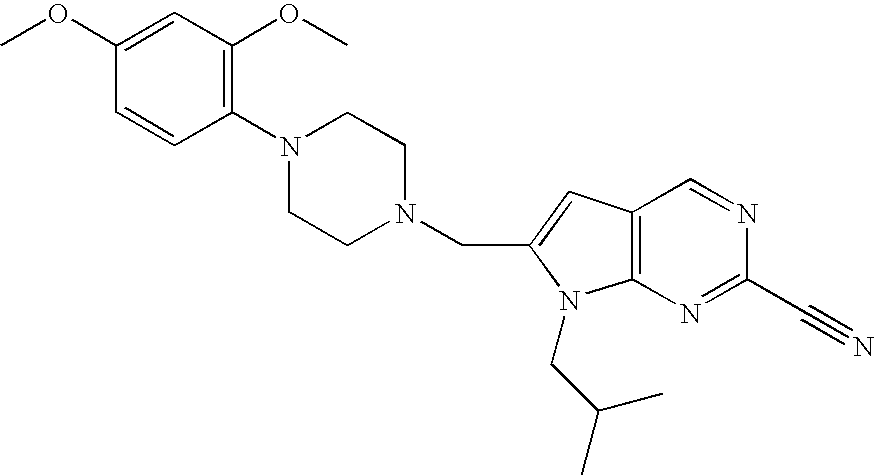 |
6-[4-(2,4-Di-methoxy-phe-nyl)-pipe-razin-1-ylmeth-yl]-7-isobutyl-7H-pyr-rolo[2,3-d]pyri-midine-2-carbo-nitrile | CDCl3, 300 MHz:0.92((d, 6H), 2.36((m, 1H),2.71((m, 4H), 3.01((m, 4H), 3.78((s,5H), 3.83((s,3H), 4.28((d, 2H),6.39-6.47((m,2H), 6.58((s, 1H),6.86((m, 1H),8.88((s, 1H). MH+:: 435 |
| 6-99 |
 |
6-{4-[3-(2-Di-ethylamino-eth-oxy)-phenyl]-pipe-razin-1-ylmeth-yl}-7-isobutyl-7H-pyr-rolo[2,3-d]py-rimidine-2-carbo-nitrile | CDCl3, 300 MHz:0.92(d, 6H), 1.11(t, 6H), 2.36(m,1H), 2.6-2.8(m,8H), 2.93(t, 2H),3.18(m, 4H), 3.76(s, 2H), 4.08(t,2H), 4.25(d,2H),6.4-6.55(m, 3H),6.57(s, 1H), 7.14(t, 1H), 8.89(s, 1H). MH+: |
| 6-100 |
 |
7-Isobu-tyl-6-(4-{4-[2-(4-meth-yl-piperazin-1-yl)-eth-oxy]-phenyl}-pipe-razin-1-yl-methyl)-7H-pyr-rolo[2,3-d]py-rimidine-2-carbo-nitrile | CDCl3, 300 MHz:0.93((d, 6H),2.37((m, 1H),2.49((bs, 3H), 2.6-2.9((m, 14H),3.09(m, 4H), 3.78(s,2H),4.08(m,2H), 4.27(s, 2H), 6.58(s, 1H), 6.86(m,4H), 8.90(s, 1H).MH+: 517 |
| 6-101 |
 |
7-Isobu-tyl-6-(4-{3-[2-(4-meth-yl-piperazin-1-yl)-eth-oxy]-phenyl}-pipe-razin-1-yl-methyl)-7H-pyr-rolo[2,3-d]py-rimidine-2-carbo-nitrile | CDCl3, 300 MHz:0.91(d, 6H), 2.2-2.4(m, 4H),2.4-2.8(m, 12H), 2.82(t, 2H), 3.17(m,4H), 3.75(s, 2H),4.08(m, 2H),4.25(d, 2H), 6.35-6.55(m, 3H),6.56(s, 1H), 7.15(t,1H), 8.89(s, 1H). MH+: 517 |
| 6-102 |
 |
7-Isobu-tyl-6-(4-{2-[2-(4-meth-yl-piperazin-1-yl)-eth-oxy]-phenyl}-pipe-razin-1-yl-methyl)-7H-pyr-rolo[2,3-d]py-rimidine-2-carbo-nitrile | CDCl3, 300 MHz:0.92(d, 6H), 2.33(s, 3H), 2.35-2.8(m,13H), 2.83(t,2H), 3.08(m, 4H),3.76(s, 2H),4.11(m, 2H),4.26(d, 2H), 6.58(s, 1H),6.8-7.0(m, 4H),8.88(s, 1H). MH+:517 |
| 6-103 |
 |
6-{4-[4-(2-Hy-droxy-eth-oxy)-phenyl]-pipe-razin-1-ylmeth-yl}-7-isobutyl-7H-pyr-rolo[2,3-d]py-rimidine-2-carbo-nitrile | CDCl3, 300 MHz:0.92((d, 6H),2.34((m, 1H),2.72((bs, 4H), 3.13((bs, 4H), 3.79((s,2H), 3.92((m,2H), 4.03((m, 2H),4.25((d,2H),6.59((s,1H), 6.8-7.0((m, 4H), 8.88((s, 1H). MH+: 435 |
By repeating the procedures described above using appropriate starting materials and conditions the following compounds of formula 6-10 are obtained as identified below in Table 6-10
| 6-10 | |
 |
|
| 6-104 |
 |
6-[4-(4-Methoxy-phenyl)-pipe-razin-1-ylmethyl]-7-(3-meth-yl-butyl)-7H-pyr-rolo[2,3-d]pyrimidine-2-carbo-nitrile | CDCl3, 300 MHz: 1.01(d, 6H), 1.72(m, 3H), 2.67(m, 4H), 3.10(m, 4H),3.77(m, 5H), 4.42(m, 2H), 6.56(s,1H), 6.8-6.95(m, 4H), 8.89(s, 1H).MH+: 419. |
| 6-105 |
 |
6-[4-(3-Methoxy-phenyl)-pipe-razin-1-ylmethyl]-7-(3-meth-yl-butyl)-7H-pyr-rolo[2,3-d]pyrimidine-2-carbo-nitrile | CD3OD, 300 MHz: 1.04(d, 6H),1.65-1.85(m, 3H), 2.67(m, 4H),3.16(m, 4H), 3.74(s, 3H), 3.85(s,2H), 4.46(m, 2H), 6.4-6.6(m, 3H),6.72(s, 1H), 7.11(t, 1H), 8.95(s,1H). MH+: 419. |
| 6-106 |
 |
6-[4-(2,4-Dimethoxy-phe-nyl)-piperazin-1-ylmeth-yl]-7-(3-methyl-bu-tyl)-7H-pyrrolo[2,3-d]py-rimidine-2-carbo-nitrile | CDCl3, 300 MHz: 1.02(d, 6H), 1.57(m, 1H), 1.73(m, 2H), 2.68(m, 4H),3.00(m, 4H), 3.74(m, 5H), 3.82(s,3H), 4.41(m, 2H), 6.4-6.6(m, 3H),6.82(d, 1H), 8.87(s, 1H). MH+:449. |
By repeating the procedures described above using appropriate starting materials and conditions the following compounds of formula 6-11 are obtained as identified below in Table 6-11
| 6-11 | |
 |
|
| 6-107 |
 |
7-Cyclohexyl-6-[4-(4-meth-oxy-phenyl)-pipera-zin-1-ylmethyl]-7H-pyr-rolo[2,3-d]pyrimidine-2-carbo-nitrile | CDCl3, 300 MHz, 1.3–2.0(m, 8H),2.66(m, 6H), 3.08(m, 4H), 3.74(s,2H), 3.76(s, 3H), 4.47(m, 1H), 6.51(s, 1H), 6.8–7.0(m, 4H), 8.86(s,1H). MH+: 431. |
| 6-108 |
 |
7-Cyclohexyl-6-[4-(3-meth-oxy-phenyl)-pipera-zin-1-ylmethyl]-7H-pyr-rolo[2,3-d]pyrimidine-2-carbo-nitrile | CDCl3, 300 MHz, 1.3–2.0(m, 8H),2.65(m, 6H), 3.19(m, 4H), 3.75(s,2H), 3.80(s, 3H), 4.47(m, 1H), 6.4–6.6(m, 4H), 7.16(t, 1H), 8.87(s,1H), MH+: 431 |
| 6-109 |
 |
7-Cyclohexyl-6-[4-(2,4-di-methoxy-phenyl)-pipera-zin-1-ylmethyl]-7H-pyr-rolo[2,3-d]pyrimidine-2-carbo-nitrile | CDCl3, 300 MHz: 1.3–2.0(m, 8H),2.65(m, 6H), 2.98(m, 4H), 3.72(s,2H), 3.75(s, 3H), 3.83(s, 3H), 4.49(m, 1H), 6.35–6.55(m, 3H), 6.83(s,1H), 8.84(s, 1H). MH+: 461. |
Example 7 Describes the Preparation of 6-piperidinylmethyl-7H-pyrrolo[2,3-d]pyrimidine-2-carbonitrile

To a solution of 100 mg (0.32 mmoles) of 6-bromomethyl-7-(2,2-dimethyl-propyl)-7H-pyrrolo[2,3-d]pyrimidine-2-carbonitrile and 150 mg (0.96 mmoles) of piperidin-4-one in 5 ml of DMF, 88 mg (0.64 mmoles) of K2CO3 is added at ambient temperature. After being stirred for 18 hours, the reaction mixture is quenched with H2O and the mixture is extracted with AcOEt. The combined extracts are washed with brine, dried over MgSO4 and concentrated under reduced pressure. The residue is purified by silica gel column chromatography to give 96 mg of disired 7-(2,2-dimethyl-propyl)-6-(4-oxo-piperidin-1-ylmethyl)-7H-pyrrolo[2,3-d]pyrimidine-2-carbonitrile in 92% yield.
1H NMR (400 MHz, CDCl3, δ); 1.03 (s, 9H), 2.47 (t, 4H), 2.78 (t, 4H), 3.90 (s, 2H), 4.37 (s, 2H), 7.26 (s, 2H), 8.91 (s, 1H) Rf:=0.26 (AcOEt:n-Hexane=1:1)
By repeating the procedures described above using appropriate starting materials and conditions the following compounds of formula 7-1 are obtained as identified below in Table 7-1.
| TABLE 7-1 | |
| 7-1 | |
 |
|
| Expl. No. | Rx | Yield(%) | Rf(solvent) | 1H NMR(400 MHz, δ) |
| 7-2 |
 |
89.7 | 0.85(n-Hexane:ether = 1:5). | CDCl3: 1.01(s, 9H), 2.76(t,2H), 2.90(t, 2H), 3.65(s,2H), 3.96(s, 2H), 4.36(s,2H), 6.64(s, 1H), 6.97–6.99(m, 1H), 7.11–7.17(m,3H), 8.91(s, 1H) |
| 7-3 |
 |
60 | 0.20(CH2Cl2:MeOH = 9:1) | DMSO-d6.: 0.96(s, 9H),1.32–1.47(m, 2H), 1.58–1.71(m, 4H), 1.73–1.85(m,2H), 1.88–2.15(m, 3H),2.36–2.51(m, 4H), 2.71–2.81(m, 2H), 3.79(s, 2H),4.32(s, 2H), 6.78(s, 1H),9.07(s, 1H) |
| 7-4 |
 |
51 | 0.30(n-Hexane:AcOEt = 1:1) | CDCl3: 1.02(s, 9H), 1.73(brd,2H), 2.08(m, 2H),2.55(m, 2H), 2.72(brd,2H), 3.84(s, 2H), 4.37(s,2H), 6.61(s, 1H), 7.32(d,2H), 7.43(d, 2H), 8.90(s,1H). |
| 7-5 |
 |
29 | 0.47(n-Hexane:Ether = 1:1). | CDCl3: 1.02(s, 9H), 2.52(br,2H), 2.73(t, 2H), 3.16–3.18(m, 2H), 3.91(s, 2H),4.36(s, 2H), 6.03–6.05(m,1H), 6.63(s, 1H), 7.27–7.32(m, 4H), 8.90(s, 1H),9.07(s, 1H) |
7-(2,2-Dimethyl-propyl)-6-(4-hydroxyimino-piperidin-1-ylmethyl)-7H-pyrrolo[2,3-d]pyrimidine-2-carbonitrile
To a solution of 100 mg (0.30 mmoles) of 7-(2,2-dimethyl-propyl)-6-(4-oxo-piperidin-1-ylmethyl)-7H-pyrrolo[2,3-d]pyrimidine-2-carbonitrile and 0.047 ml (0.75 mmoles) of pyridine in 5 ml of CH2Cl2, 52 mg (0.75 mmoles) of hydroxyl amine is added at ambient temperature. After being stirred for 24 hours, the reaction mixture is quenched with H2O and extracted with CH2Cl2. The combined extracts are washed with brine, dried over MgSO4 and concentrated under reduced pressure. The residue is purified by silica gel column chromatography to give 100 mg of desired 7-(2,2-dimethyl-propyl)-6-(4-hydroxyimino-piperidin-1-ylmethyl)-7H-pyrrolo[2,3-d]pyrimidine-2-carbonitrile in 98% yield.
1H NMR (400 MHz, CDCl3, δ): 1.01 (s, 99H), 1.55 (s, 1H), 2.35 (t, 2H), 2.56 (t, 2H), 2.58 (t, 2H), 2.64 (t, 2H), 3.81 (s, 2H), 4.36 (s, 2H), 6.59 (s, 1H), 8.90 (s, 1H) Rf=0.47 (AcOEt)

To the mixture of 100 mg (0.30 mmoles) of 7-(2,2-Dimethyl-propyl)-6-(4-oxo-piperidin-1-ylmethyl)-7H-pyrrolo[2,3-d]pyrimidine-2-carbonitrile, 40 mg (0.60 mmoles) of [1,2,4]triazol-4-ylamine and 0.16 ml (1.1 mmoles) of triethylamine in 5 ml of CH2Cl2, 58 mg (0.48 mmoles) of MgSO4 is added at ambient temperature and the mixture is stirred for 17.5 hours at ambient temperature. The reaction mixture is filtered to remove MgSO4 and concentrated under reduced pressure to give crude imine. To a solution of crude imine in 5 ml of MeOH, 13 mg (0.33 mmoles) of NaBH4 is added at −10-−20° C., and the reaction mixture is stirred at 0° C. for 1 h. After addition of 5 ml of acetone, the mixture is concentrated, diluted with H2O, and then extracted with CH2Cl2. The combined extrats are washed with brine, dried over MgSO4 and concentrated under reduced pressure. The residue is purified by silica gel column chromatography to give 85 mg of desired 6-(4-amino-piperidin-1-ylmethyl)-7-(2,2-dimethyl-propyl)-7H-pyrrolo[2,3-d]pyrimidine-2-carbonitrile in 85% yield.
1H NMR(400 MHz, CDCl3, δ): 1.00 (s, 9H), 1.51-1.62 (m, 4H), 1.87-1.91 (m, 2H), 2.21 (brt, 2H), 2.70-2.71 (m, 2H), 3.76 (s, 3H), 4.35 (s, 2H), 6.55 (s, 1H), 8.88 (s, 1H) Rf=0.16 (AcOEt:n-Hexane=4:1)

To the mixture of 100 mg (0.30 mmoles) of 7-(2,2-dimethyl-propyl)-6-(4-oxo-piperidin-1-ylmethyl)-7H-pyrrolo[2,3-d]pyrimidine-2-carbonitrile, 60 mg (0.48 mmoles) of 3-Imidazol-1-yl-propylamine and 0.15 ml (1.1 mmoles) of triethylamine in 5 ml of CH2Cl2, 58 mg (1.1 mmoles) of MgSO4 is added at ambient temperature. The mixture is stirred for 15.5 hours at ambient temperature. The reaction mixture is filterlated to remove MgSO4 and concentrated under reduced pressure to give crude imine. To a solution of crude imine in 5 ml of MeOH, 13 mg (0.33 mmoles) of NaBH4 is added at −10-−20° C., and the reaction mixture is stirred at 0° C. for 4.5 hours. After addition of 5 ml of acetone, the mixture is concentrated, diluted with H2O, and then extracted with CH2Cl2. The combined extrats are washed with brine, dried over MgSO4 and concentrated under reduced pressure. The residue is purified by silica gel column chromatography to give 95 mg of desired 7-(2,2-dimethyl-propyl)-6-[4-(3-imidazol-1-yl-propylamino)-piperidin-1-ylmethyl]-7H-pyrrolo[2,3-d]pyrimidine-2-carbonitrile in 73% yield.
By repeating the procedures described above using appropriate starting materials and conditions the following compounds of formula 7.2 are obtained as identified below in Table 7-2.
| TABLE 7-2 | |
| 7-2 | |
 |
|
| Expl. No. | R | Yield(%) | Rf(solvent) | 1H NMR(400 MHz, δ) |
| 7-9 |
 |
73 | 0.09(MeOH) | MeOH-d4; 1.01(s, 9H),1.35–1.39(m, 2H), 1.84–1.87(m, 2H), 1.94(m,2H), 2.12(brt, 2H),2.38–2.48(m, 1H), 2.56(t,2H), 2.84(brd, 2H),3.83(s, 2H), 4.08(t, 2H),4.40(s, 2H), 6.74(s,1H), 6.95(s, 1H), 7.12(s,1H), 7.64(s, 1H),8.94(s, 1H) |
| 7-10 |
 |
76 | 0.07(AcOEt:MeOH = 9:1) | CDCl3; 0.25–0.33(m, 2H),0.43–0.46(m, 2H),0.99(s, 9H), 1.29–1.42(m,2H), 1.81–1.93(m,2H), 2.05–2.17(m, 2H),2.54–2.67(m, 1H), 2.71–2.83(m, 2H), 3.75(s,2H), 4.37(s, 2H), 6.54(s,1H), 8.87(s, 1H) |

To a solution of 100 mg (0.32 mmoles) of 6-bromomethyl-7-(2,2-dimethyl-propyl)-7H-pyrrolo[2,3-d]pyrimidine-2-carbonitrile and 230 mg (0.96 mmoles) of piperidine-4-carboxylic acid phenylamide in 5 ml of DMF, 130 mg (0.96 mmoles) of K2CO3 is added at ambient temperature. The reaction mixture is stirred for 18 hours at ambient temperature. The reaction mixture is quenched with H2O and extracted with AcOEt. The combined extracts are washed with brine, dried over MgSO4 and concentrated under reduced pressure. The residue is purified by silica gel column chromatography to give 130 mg of disired 1-[2-cyano-7-(2,2-dimethyl-propyl)-7H-pyrrolo[2,3-d]pyrimidin-6-ylmethyl]-piperidine-4-carboxylic acid phenylamide in 95% yield.
By repeating the procedures described above using appropriate starting materials and conditions the following compounds of formula 7-3 are obtained as identified below in Table 7-3.
| TABLE 7-3 | |
| 7-3 | |
 |
|
| Expl. No. | R | Yield(%) | Rf(solvent) | 1H NMR(400 MHz, δ) |
| 7-11 |
 |
95 | 0.19(AcOEt:Hexane = 1:1) | CDCl3; 1.01(s, 9H), 1.82–1.97(m,4H), 2.05–2.19(m, 2H), 2.20–2.31(m, 1H), 2.85–2.96(m, 2H), 3.78(s, 2H), 4.36(s, 2H), 6.56(s, 1H),7.12(m, 2H), 7.31(t, 2H), 7.50(d, 2H), 8.89(s, 1H) |
| 7-12 |
 |
8 | 0.21(AcOEt:Hexane = 4:1) | Acetone-d6; 0.91(s, 9H), 1.62–1.73(m, 2H), 1.81–1.93(m, 2H), 2.05–2.15(m, 2H), 2.78–2.89(m, 2H),3.21–3.33(m, 1H), 3.80(s, 2H),4.33(s, 2H), 6.67(s, 1H), 6.91(brs,1H), 7.32(s, 1H), 8.88(s, 1H) |
| 7-13 |
 |
28 | 0.37(AcOEt:Hexane = 4:1) | MeOH-d4; 1.02(s, 9H), 1.72–1.86(m,2H), 1.89–1.98(m, 2H), 2.18–2.38(m, 2H), 2.91–2.98(m, 2H),3.39–3.47(m, 1H), 3.87(s, 2H),4.43(s, 1H), 5.97(d, 1H), 6.77(s,1H), 7.99(d, 1H), 8.95(s, 1H) |
| 7-14 |
 |
93 | 0.26(MeOH) | CDCl3; 1.00(s, 9H), 1.64–1.72(m,2H), 1.81–1.95(m, 2H), 2.09(brt,2H), 2.37(s, 3H), 2.42–2.42(m,4H), 2.45–2.53(m, 1H), 2.82–2.91(m, 2H), 3.45–3.52(m, 2H),3.58–3.67(m, 2H), 3.76(s, 2H),4.36(s, 2H), 6.54(s, 1H), 8.88(s, 1H) |
| 7-15 |
 |
92 | 0.38(AcOEt:MeOH = 9:1) | CDCl3; 1.19(s, 9H), 1.66–1.74(m,2H), 1.83–1.89(m, 2H), 1.91–1.98(m, 2H), 2.02–2.13(m, 2H), 2.29–2.39(m, 1H), 2.84–2.93(m, 2H),3.45(t, 4H), 3.76(s, 2H), 4.37(s,1H), 6.54(s, 1H), 8.87(s, 1H) |

To a solution of 0.54 g (2 mmoles) of 5-bromo-4-(2,2-dimethyl-propylamino)-pyrimidine-2-carbonitrile and 0.75 g (4.3 mmoles) of 4-propargylthiomorpholine-1,1-dioxide in 5 ml of DMF are added 0.841 ml (6 mmoles) of triethylamine, 0.38 g (2 mmoles) of copper(I) iodide and 0.14 g (0.2 mmoles) of Pd(PPh3)2Cl2under nitrogen atmosphere. The mixture is stirred for 31 hours at 80° C. The mixture is filtered through celite, diluted with AcOEt, washed with H2O and brine, dried over Na2SO4 and concentrated under reduced pressure. The residue is purified by HPLC(H2O—0.1% TFA/CH3CN—0.1% TFA). Fractions are collected, basified with 5% aqueous NaHCO3, extracted with AcOEt, washed with brine, dried over Na2SO4 and concentrated under reduced pressure. The resulting residue is then purified by HPLC (n-Hexane/AcOEt) to give 0.01 g of desired 7-(2,2-dimethyl-propyl)-6-(1,1-dioxo-1λ6-thiomorpholin-4-ylmethyl)-7H-pyrrolo[2,3-d]pyrimidine-2-carbonitrile in 1.4% yield.
1H NMR (400 MHz, CDCl3, δ): 1.01(s, 9H), 3.0-3.15 (m, 8H), 3.95 (s, 2H), 4.28 (s, 2H), 6.63 (s, 1H), 8.93 (s, 1H) Rf=0.57 (n-Hexane:AcOEt=1:5)

1 g of 4-pyridin-4-yl-phenol, 1.3 g of (2-chloro-ethyl)-dimethyl-amine.HCl and 2.42 g of K2CO2 were heated for 48 h under reflux. The mixture was diluted with chloroform, washed with brine and dried over MgSO4. After evaporation to dryness the residue was chromatographed on silicagel with CH2Cl2/MeOH/NH3conc=90:10:1 to give dimethyl-[2-(4-pyridin-4-yl-phenoxy)-ethyl]-amine as brown powder.

0.38 g of dimethyl-[2-(4-pyridin-4-yl-phenoxy)-ethyl]-amine was dissolved in 15 ml of EtOH/H2O=80:20, 0.35 ml HCl conc and 80 mg of PtO2 were added and the mixture was stirred under 1 atm of hydrogen gas for 6 hours. After filtration over celite and evaporation the dihydrochloride salt of dimethyl-[2-(4-piperidin-4-yl-phenoxy)-ethyl]-amine was obtained as colorless oil.

0.22 g of 6-bromomethyl-7-(2,2-dimethyl-propyl)-7H-pyrrolo[2,3-d]pyrimidine-2-carbonitrile, 0.23 g of dimethyl-[2-(4-piperidin-4-yl-phenoxy)-ethyl]-amine bishydrochloride and 0.5 g of potassium carbonate were stirred in 2 ml acetone at 25° C. for 2 hours. The mixture was extracted with ethyl acetate/water, dried over sodium sulfate and evaporated to driness. After chromatography on silicagel using CH2Cl2/MeOH=90:10 6-{4-[4-(2-dimethylamino-ethoxy)-phenyl]-piperidin-1-ylmethyl}-7-(2,2-dimethyl-propyl)-7H-pyrrolo[2,3-d]pyrimidine-2-carbonitrile was obtained as yellow solid.
By repeating the procedures described above using appropriate starting materials and conditions the following compounds of formula 7-4 are obtained as identified below in Table 7-4.
| TABLE 7-4 | |
| 7-4 | |
 |
|
| 7-18 |
 |
7-(2,2-Dimethyl-propyl)-6-[4-(4-meth-oxy-phenyl)-pipe-ridin-1-ylmethyl]-7H-pyr-rolo[2,3-d]pyrimidine-2-carbo-nitrile | CDCl3, 300 MHz: 1.02(s,9H), 2.55–2.90(m, 4H),2.16(t, 2H),2.48(m, 1H), 2.93(m, 2H), 3.80(m,5H), 4.38(s, 2H), 6.58(bs,1H), 6.85(d, 2H), 7.14(d,2H), (8.89 1H). MH+: 418 |
| 7-19 |
 |
6-[4-(2,4-Dimethoxy-phe-nyl)-piperidin-1-ylmeth-yl]-7-(2,2-dimethyl-pro-pyl)-7H-pyrrolo[2,3-d]py-rimidine-2-carbo-nitrile | CDCl3, 300 MHz: 1.03(s,9H), 1.6–1.85(m, 4H),2.19(m, 2H), 2.89(m,3H), 3.79(m, 8H), 4.39(s,2H), 6.43(s, 1H), 6.44(d,1H), 6.55(s, 1H), 7.07(d,1H), 8.88(s, 1H).MH+:448. |
| 7-20 |
 |
7-(2,2-Dimethyl-propyl)-6-[4-(3,4,5-tri-methoxy-phe-nyl)-piperidin-1-yl-methyl]-7H-pyrrolo[2,3-d]py-rimidine-2-carbo-nitrile | CDCl3, 300 MHz: 1.03(s,9H), 1.5–1.9(m, 4H), 2.16(m, 2H), 2.46(m, 1H),2.95(m, 2H), 3.81(s, 2H),3.82(s, 3H), 3.86(s, 6H),4.37(s, 2H), 6.42(s, 2H),6.59(s, 1H),8.88(s, 1H).MH+: 478 |
| 7-21 |
 |
6-{4-[4-(2-Di-methylamino-ethoxy)-phe-nyl]-piperidin-1-yl-methyl}-7-(2,2-di-methyl-propyl)-7H-pyr-rolo[2,3-d]pyrimidine-2-carbo-nitrile | CDCl3, 300 MHz: 1.02(s,9H), 1.6-1-85(m, 4H),2.15(m, 2H), 2.34(s, 6H),2.46(m, 1H), 2.72(t, 2H),2.9(2m, 2H), 3.78(s, 2H),4.04(t, 2H),4.38(s, 2H),6.57(s, 1H), 6.85(d, 2H),7.11(d, 2H), 8.87(s, 1H).MH+: 475 |
| 7-22 |
 |
6-{4-[3-(2-Di-methylamino-ethoxy)-phe-nyl]-piperidin-1-yl-methyl}-7-(2,2-di-methyl-propyl)-7H-pyr-rolo[2,3-d]pyrimidine-2-carbo-nitrile | CD3OD, 300 MHz: 1.03(s, 9H), 1.80(m, 4H), 2.22(m, 2H), 2.37(s, 6H), 2.52(m, 1H), 2.86(t, 2H), 2.99(m, 2H), 3.88(s, 2H), 4.08(t, 2H), 4.44(s,2H), 6.78(m, 4H),7.17(t, 1H), 8.95(s, 1H). MH+: 475. |
| 7-23 |
 |
6-{4-[2-(2-Di-methylamino-ethoxy)-phe-nyl]-piperidin-1-yl-methyl}-7-(2,2-di-methyl-propyl)-7H-pyr-rolo[2,3-d]pyrimidine-2-carbo-nitrile | CDCl3, 300 MHz: 1.03(s,9H), 1.6–1.9(m, 4H), 2.17(m, 2H), 2.36(s, 6H), 2.76(t, 2H), 2.93(m, 3H), 3.80(s, 2H), 4.08(t, 2H), 4.41(s, 2H), 6.58(s, 1H),6.8–6.95(m, 2H), 7.16(m,2H), 8.88(s, 1H). MH+:475. |
| 7-24 |
 |
6-{4-[4-(2-Diethylamino-eth-oxy)-phenyl]-piperidin-1-yl-methyl}-7-(2,2-di-methyl-propyl)-7H-pyr-rolo[2,3-d]pyrimidine-2-carbo-nitrile | CDCl3, 300 MHz: 1.02(s,9H), 1.08(t, 6H), 1.6–1.9(m, 4H), 2.15(m, 2H),2.44(m, 1H), 2.67(m,4H), 2.92(m, 4H), 3.78(s,2H), 4.06(t, 2H), 4.39(s,2H), 6.57(s,1H 6.83(d, 2H),7.12(d, 2H),8.88(s, 1H). MH+: 503. |
| 7-25 |
 |
6-{4-[3-(2-Diethylamino-eth-oxy)-phenyl]-piperidin-1-ylmeth-yl}-7-(2,2-di-methyl-propyl)-7H-pyr-rolo[2,3-d]pyrimidine-2-carbo-nitrile | CDCl3, 300 MHz: 1.02(s,9H), 1.08(t, 6H), 1.6–1.9(m, 4H), 2.16(m, 2H),2.48(m, 1H), 2.67(m,4H), 2.92(m, 4H), 3.79(s,2H), 4.05(t, 2H), 4.39(s,2H), 6.58(s,1H), 6.78(m,3H), 7.20 (t, 1H), 8.88(s,1H). MH+: 503. |
| 7-26 |
 |
6-{4-[2-(2-Diethylamino-eth-oxy)-phenyl]-piperidin-1-yl-methyl}-7-(2,2-di-methyl-propyl)-7H-pyr-rolo[2,3-d]pyrimidine-2-carbo-nitrile | CDCl3, 300 MHz: 1.02(s,9H), 1.12(t, 6H), 1.6–1.9(m, 4H), 2.17(m, 2H),2.69(m, 4H), 2.95(m,5H), 3.80(s, 2H), 5.06(m,2H), 4.39(s, 2H), 6.58(s,1H), 6.88(m,2H), 7.17(m, 2H), 8.88(s, 1H).MH+: 503. |
| 7-27 |
 |
7-(2,2-Dimethyl-propyl)-6-(4-{4-[2-(4-meth-yl-pipera-zin-1-yl)-ethoxy]-phe-nyl}-piperidin-1-yl-methyl)-7H-pyrrolo[2,3-d]py-rimidine-2-carbo-nitrile | CDCl3, 300 MHz: 1.02(s,9H), 1.6–1.9(m, 4H), 2.15(m, 2H), 2.32(s, 3H), 2.3–2.8(m, 9H), 2.82(t, 2H),2.92(m, 2H), 3.79(s, 2H),4.10(t, 2H),4.38(s, 2H),6.58(s, 1H), 6.84(d, 2H),7.12(d, 2H), 8.88(s, 1H).MH+: 530. |
| 7-28 |
 |
7-(2,2-Dimethyl-propyl)-6-(4-{3-[2-(4-meth-yl-pipera-zin-1-yl)-ethoxy]-phe-nyl}-piperidin-1-yl-methyl)-7H-pyrrolo[2,3-d]py-rimidine-2-carbo-nitrile | CDCl3, 300 MHz: 1.02(s,9H), 1.6–1.9(m, 4H), 2.15(m, 2H), 2.31(s, 3H), 2.4–2.8(m, 9H), 2.82(s, 2H),2.93(m, 2H), 3.79(s, 2H),4.09(m, 2H),4.38(s, 2H), 6.57(s,1H), 6.7–6.85(m,3H), 7.20(t. 1H), 8.88(s,1H). MH+: 530. |
| 7-29 |
 |
7-(2,2-Dimethyl-propyl)-6-(4-{2-[2-(4-meth-yl-pipera-zin-1-yl)-ethoxy]-phe-nyl}-piperidin-1-yl-methyl)-7H-pyrrolo[2,3-d]py-rimidine-2-carbo-nitrile | CDCl3, 300 MHz: 1.02(s,9H), 1.6–1.9(m, 4H), 2.16(m, 2H), 2.32(s, 3H), 2.3–2.8(m, 8H), 2.85(t, 2H),2.93(m, 3H), 3.80(s, 2H),4.12(m, 2H),4.41(s, 2H),6.58(s, 1H), 6.83(d, 1H),6.93(t, 1H), 7.16(m, 2H),8.89(s, 1H). MH+: 530. |
| 7-30 |
 |
7-(2,2-Dimethyl-propyl)-6-(4-{4-[3-(4-meth-yl-pipera-zin-1-yl)-propoxy]-phe-nyl}-piperidin-1-yl-methyl)-7H-pyrrolo[2,3-d]py-rimidine-2-carbo-nitrile | CDCl3, 300 MHz: 1.01(s,9H), 1.6–1.85(m, 4H),1.96(m, 2H), 2.15(m,2H), 2.30(s, 3H), 2.35–2.65(m, 11H), 2.90(m,2H), 3.79(s,2H), 3.88(t,2H), 4.38(s, 2H), 6.57(s,1H), 6.82(d, 2H), 7.11(d,2H), 8.87 (s, 1H). MH+:544 |
| 7-31 |
 |
7-(2,2-Dimethyl-propyl)-6-(4-{3-[3-(4-meth-yl-piperazin-1-yl)-propoxy]-phe-nyl}-piperidin-1-yl-methyl)-7H-pyrrolo[2,3-d]py-rimidine-2-carbo-nitrile | CDCl3, 300 MHz: 1.02(s,9H), 1.6–1.9(m, 4H), 1.97(m, 2H), 2.15(m, 2H),2.31(s, 3H), 2.3–2.7(m,11H), 2.82(m, 2H), 3.80(s, 2H), 4.00(t, 2H),4.38(s, 2H), 6.58(s, 1H), 6.75(m, 3H), 7.20(t, 1H), 8.88(s, 1H). MH+: 544. |
| 7-32 |
 |
7-(2,2-Dimethyl-propyl)-6-(4-{2-[3-(4-meth-yl-pipera-zin-1-yl)-propoxy]-phe-nyl}-piperidin-1-yl-methyl)-7H-pyrrolo[2,3-d]py-rimidine-2-carbo-nitrile | CD3OD, 300 MHz: 1.04(s, 9H), 1.7–1.9(m, 4H),2.01(m, 2H), 2.23(m,2H), 2.35(s, 3H), 2.4–3.1(m, 13H), 3.90(s, 2H),4.02(t, 2H), 4.45(s, 2H),6.79(s, 1H),6.88(m, 2H),7.14(m, 2H), 8.96(s, 1H).MH+: 544. |
| 7-33 |
 |
7-(2,2-Dimethyl-propyl)-6-{4-[4-(2-pyr-rolidin-1-yl-eth-oxy)-phenyl]-piperidin-1-yl-methyl}-7H-pyr-rolo[2,3-d]pyrimidine-2-carbo-nitrile | CDCl3, 300MHz: 1.02(s,9H), 1.6–1.9(m, 8H), 2.15(m, 2H), 2.46(m, 1H),2.66(m, 4H), 2.83(m,4H), 3.79(s, 2H), 4.12(t,2H), 4.38(s, 2H), 6.57(s,1H), 6.85(d, 2H),7.11(d,2H), 8.87(s, 1H). MH+:501. |
| 7-34 |
 |
7-(2,2-Dimethyl-propyl)-6-{4-[3-(2-pyr-rolidin-1-yl-eth-oxy)-phenyl]-piperidin-1-yl-methyl}-7H-pyr-rolo[2,3-d]pyrimidine-2-carbo-nitrile | CDCl3, 300 MHz: 1.02(s,9H), 1.6–1.9(m, 8H), 2.15(m, 2H), 2.48(m, 1H),2.62(m, 4H), 2.91(m,4H), 3.79(s, 2H), 4.10(t,2H), 4.39(s, 2H), 6.58(s,1H), 6.77(m, 3H),7.20(t,1H), 8.88(s, 1H). MH+:501. |
| 7-35 |
 |
7-(2,2-Dimethyl-propyl)-6-{4-[2-(2-pyr-rolidin-1-yl-eth-oxy)-phenyl]-piperidin-1-yl-methyl}-7H-pyr-rolo[2,3-d]pyrimidine-2-carbo-nitrile | CDCl3, 300 MHz: 1.02(s,9H), 1.6–1.95(m, 8H),2.16(m, 2H), 2.74(m,4H), 2.95(m, 5H), 3.80(s,2H), 4.16(m, 2H), 4.40(s,2H), 6.58(s, 1H), 6.88(m,2H), 7.16(m, 2H),8.88(s,1H). MH+: 501. |
| 7-36 |
 |
7-(2,2-Dimethyl-propyl)-6-[4-(2-{3-[4-(2-hy-droxy-eth-yl)-piperazin-1-yl]-pro-poxy}-phenyl)-piperi-din-1-ylmethyl]-7H-pyr-rolo[2,3-d]pyrimidine-2-carbo-nitrile | CDCl3, 300 MHz: 1.02(s,9H), 1.26(m, 2H), 1.6–1.9(m, 4H), 2.00(m, 2H),2.17(m, 2H), 2.56(m,10H), 2.93(m, 3H), 3.74(m, 2H), 3.91(s,2H), 4.02(t, 2H), 4.41(s, 2H), 6.59(s, 1H), 6.84(d, 1H), 6.92(t, 1H), 7.17(m, 2H), 8.88(s, 1H). MH+: 574 |

A. 4-Oxo-piperidine-1-carboxylic acid tert-butyl ester

To a solution of piperidin-4-one.H2O.HCl (86.9 g, 0.57 mol) in dioxane/H2O (600 ml/400 ml), di-t-butyl dicarbonate (135.9 g, 0.62 mol) and NaOH (47.5 g, 1.18 mol) are added at ambient temperature. The reaction mixture is stirred at ambient temperature for 18 h. After removal of the solvent, the residue is extracted with CH2Cl2 and the combined extracts are washed with brine, dried over magnesium sulfate, concentrated to give yellow solid.
Yield: quant. 1H-NMR (400Mz, δ, CDCl3): 1.50 (s, 9H), 2.44 (t, 4H), 3.72 (t, 4H)

B. 2,4-Dioxo-1,3,8-triaza-spiro[4.5]decane-8-carboxylic acid tert-butyl ester
To a solution of 4-oxo-piperidine-1-carboxylic acid tert-butyl ester (30.0 g, 151 mmol) in MeOH (100 ml), H2O (40 ml), ammonium carbonate (331 mmol) and sodium cyanide (226 mmol) in H2O (60 ml) are added successively at ambient temperature. The reaction mixture is stirred at ambient temperature for 18 h to give precipitates, which are filtered off and washed with H2O and ether on the filter.
Yield: 88% 1H-NMR (400 MHz, δ, DMSO-d6): 1.40 (s, 9H), 1.44-1.51 (m, 2H), 1.63-1.70 (m, 2H), 3.10 (br, 2H), 3.78-3.81 (m, 2H), 8.39 (brs, 1H), 10.7 (br, 1H).
C. 3-Methyl-2,4-dioxo-1,3,8-triaza-spiro[4.5]decane-8-carboxylic acid tert-butyl ester

To a solution of 2,4-dioxo-1,3,8-triaza-spiro[4.5]decane-8-carboxylic acid tert-butyl ester (3.60 g, 13 mmol) in DMSO (30 ml), MeI (2.27 g, 16 mmol) and potassium carbonate (2.40 g, 17 mmol) are added at ambient temperature. The mixture is stirred for 18 h at ambient temperature. The reaction mixture is quenched with water and extracted with AcOEt. The combined extracts are washed with brine, dried over magnesium sulfate, filtrated and evaporated to afford 3.8 g of the desired product.
Yield: quant. Rf=0.60 (CH2Cl2:MeOH=10:1). 1H-NMR (400 MHz, δ, CDCl3): 1.47 (s, 9H), 1.59-1.62 (m, 2H), 1.98-2.04 (m, 2H), 3.03 (s, 3H), 3.18-3.24 (m, 2H), 3.97-4.00 (m, 2H), 6.08 (brs, 1H).
D. 7-(2,2-Dimethyl-propyl)-6-(3-methyl-2,4-dioxo-1,3,8-triaza-spiro[4.5]dec-8-ylmethyl)-7H-pyrrolo[2,3-d]pyrimidine-2-carbonitrile

To a solution of 3-methyl-2,4-dioxo-1,3,8-triaza-spiro[4.5]decane-8-carboxylic acid tert-butyl ester (10.0 g, 35 mmol) in CH2Cl2 (50 ml), TFA (27.2 ml, 353 mmol) is added at 0° C. The reaction mixture is stirred at room temperature for 1 h. After removal of the solvent, ether is added to the residue and amorphase is filtrated and dried (yield: 96%, Rf=0.21 (CH2Cl2:MeOH=10:1)). To the crude product (10.1 g, 34 mmol) in DMSO (100 ml), diisopropyl ethylamine (12.23 ml, 70 mmol) and 6-bromomethyl-7-(2,2-dimethyl-propyl)-7H-pyrrolo[2,3-d]pyrimidine-2-carbonitrile (7.99 g, 26 mmol) are added to the mixture at ambient temperature. The reaction mixture is stirred at ambient temperature for 4 h, quenched with saturated ammonium chloride and extracted with AcOEt. The combined extracts are washed with H2O, brine and dried over magnesium sulfate. The solvent is concentrated and diethyl ether is added to the residue to give pale yellow solid, which are filtrated and recrystallized by CH3CN to give the product in 81% yield.
Rf=0.30 (AcOEt). 1H-NMR (400 MHz, δ, CDCl3): 1.01 (s, 9H), 1.64-1.68 (m, 2H), 2.10-2.17 (m, 2H), 2.24-2.29 (m, 2H), 2.88-2.93 (m, 2H), 3.03 (s, 3H), 3.84 (s, 2H), 4.34 (s, 2H), 5.95 (brs, 1H), 6.59 (s, 1H), 8.91 (s, 1H).
By repeating the procedures described above using appropriate starting materials and conditions the following compounds of formula I are obtained as identified below in Table 7-5.
| TABLE 7-5 | |
| Formula 1 | |
 |
|
| Expl. No |
 |
 |
Rf(Solvent) | 1H NMR(400 MHz, □) |
| 7-38 |
 |
H | 0.12(n-Hexane:AcOEt = 1:1) | (CDCl3): 0.91(t, 3H), 1.01(s, 9H), 1.55–1.68(m, 4H), 2.09–2.16(m, 2H), 2.25(m,2H), 2.89–2.92(m, 2H), 3.47(dd, 2H), 3.83(s, 2H), 4.33(s, 2H), 5.65(brs, 1H), 6.59(s, 1H), 8.91(s, 1H). |
| 7-39 |
 |
H | 0.11(n-Hexane:AcOEt = 1:1) | (CDCl3): 0.89(d, 6H), 1.01(s, 9H), 1.62–1.68(s,2H), 2.06–2.17(m, 3H), 2.23–2.27(m, 2H), 2.89–2.92(m, 2H), 3.32(d, 2H), 3.83(s, 2H), 4.33(s,2H), 5.60(brs, 1H), 6.59(s, 1H), 8.90(s, 1H). |
| 7-40 |
 |
H | 0.08(n-Hexane:AcOEt = 1:1) | (CDCl3): 0.32–0.36(m, 2H), 0.47–0.52(m, 2H),1.02(s, 9H), 1.02–1.18(m, 1H), 1.65–1.68(m,2H), 2.10–2.17(m, 2H), 2.24(dd, 2H), 2.88–2.94(m, 2H), 3.37(d, 2H), 3.39(s, 2H), 4.34(s, 2H),5.85(brs, 1H), 6.59(s, 1H), 8.91(s, 1H) |
| 7-41 |
 |
H | 0.66(CH2Cl2:MeOH = 9:1) | (CDCl3): 1.01(s, 9H), 1.65–1.69(m, 2H), 2.10–2.17(m, 2H), 2.27(dd, 2H), 2.88–2.94(m, 2H),3.84(s, 2H), 4.11(dd, 2H), 4.33(s, 2H), 5.19–5.23(m, 2H), 5.75–5.86(m, 2H), 6.59(s, 1H),8.91(s, 1H) |
| 7-42 |
 |
H | 0.48(CH2Cl2:MeOH = 9:1) | (CDCl3): 0.94–1.13(m, 11H), 1.17–1.22(m, 3H),1.60–1.77(m, 8H), 2.10–2.17(m, 2H), 2.23–2.28(m, 2H), 2.88–2.93(m, 2H), 3.33(d, 2H), 3.83(s,2H), 4.33(s, 2H), 5.71(brs, 1H), 6.59(s, 1H),8.91(s, 1H). |
| 7-43 |
 |
H | 0.41(CH2Cl2:MeOH = 9:1) | (CDCl3): 1.01(s, 9H), 1.35–1.40(m, 2H), 1.45–1.50(m, 4H), 1.65–1.68(m, 2H), 2.09–2.16(m,2H), 2.24–2.29(m, 2H), 2.36–2.44(m, 4H), 2.52(t, 2H), 2.88–2.93(m, 2H), 3.61(t, 2H), 3.83(s,2H), 4.34(s, 2H), 5.70(brs, 1H), 6.59(s, 1H),8.90(s, 1H) |
| 7-44 |
 |
H | 0.13(n-Hexane:AcOEt = 1:1) | (CDCl3): 1.01(s, 9H), 1.61–1.65(m, 2H), 2.07–2.14(m, 2H), 2.25(dd, 2H), 2.86–2.91(m, 2H),3.82(s, 2H), 4.32(s, 2H), 4.61(s, 2H), 5.65(brs,1H), 6.58(s, 1H), 6.99(ddd, 2H), 7.34–7.37(m,2H), 8.90(s, 2H). |
| 7-45 | H | H | 0.35(AcOEt) | (CDCl3): 1.01(s, 9H), 1.70–1.83(m, 2H), 2.09–2.22(m, 2H), 2.24–2.32(m, 2H), 2.87–2.93(m,2H), 3.84(s, 2H), 4.33(s, 2H), 5.99(brs, 1H),6.58(s, 1H), 7.60(brs, 1H), 8.91(s, 1H) |

To a solution of 7-(2,2-dimethyl-propyl)-6-(2,4-dioxo-3-propyl-1,3,8-triaza-spiro[4.5]dec-8-ylmethyl)-7H-pyrrolo[2,3-d]pyrimidine-2-carbonitrile (0.2 g, 0.48 mmol) in DMF (2 ml), NaH (22 mg, 0.55 mmol) and MeI (50 □1, 0.55 mmol) are added at 0° C. The reaction mixture is stirred at ambient temperature for 4 h, quenched with saturated ammonium chloride and extracted with AcOEt. The organic layer is washed with brine, dried over magnesium sulfate and filtrated The combined extracts are concentrated and the residue is purified by column chromatography on silica gel using CH2Cl2:MeOH=25:1 (v/v) and CH2Cl2:MeOH=15:1 (v/v) to give 71 mg of desired product in 34% yield.
Rf=0.80 (CH2Cl2:MeOH=9:1). 1H-NMR (400 MHz, δ, CDCl3): 0.90 (t, 3H), 1.02 (s, 9H), 1.57-1.68 (m, 4H), 1.96-2.04 (m, 2H), 2.74-2.77 (m, 2H), 2.87 (s, 3H), 2.89-2.96 (m, 2H), 3.46 (t, 3H), 3.87 (s, 3H), 4.32 (s, 2H), 6.60 (s, 1H), 8.90 (s, 1H).
By repeating the procedures described above using appropriate starting materials and conditions the following compounds of formula II are obtained as identified below in Table 7-6.
| TABLE 7-6 | |
| Formula II | |
 |
|
| Expl. No |
 |
 |
Rf(Solvent) | 1H NMR(400 MHz, □) |
| 7-47 | CH3 | CH3 | 0.24 | (CDCl3): 1.02(s, 9H), 1.62–1.66 |
| (n-Hexane:AcOEt = 1:3) | (m, 2H), 1.96–2.04(m, 2H), | |||
| 2.74–2.76(m, 2H), 2.88–2.96(m, | ||||
| 5H), 3.01(s, 3H), 3.88(s, 2H), | ||||
| 4.32(s, 2H), 6.61(s, 1H), 8.90 | ||||
| (s, 1H). | ||||
| 7-48 |
 |
CH3 | 0.34(n-Hexane:AcOEt = 1:3) | (CDCl3): 0.89(d, 6H), 1.02(s,9H), 1.58–1.64(m, 2H), 1.97–2.08(m, 3H), 2.74–2.77(m, 2H),2.88(s, 3H), 2.89–2.96(m, 2H),3.30(d, 2H), 3.87(s, 2H), 4.32(s, 2H), 6.60(s, 1H), 8.90(s,1H). |
| 7-49 |
 |
CH3 | 0.68(CH2Cl2:MeOH = 9:1) | (CDCl3): 0.32–0.34(m, 2H),0.46–0.49(m, 2H), 1.02(s, 9H),1.13–1.16(m, 1H), 1.63–1.67(m,2H), 1.97–2.04(m, 2H), 2.75–2.77(m, 2H), 2.88–2.96(m, 5H),3.35(d, 2H), 3.87(s, 2H), 4.32(s, 2H), 6.61(s, 1H), 8.90(s,1H). |
| 7-50 |
 |
CH3 | 0.07(n-Hexane:AcOEt = 1:1) | (CDCl3): 1.01(s, 9H), 1.59–1.61(m, 2H), 1.95–2.04(m, 2H),2.73–2.76(m, 2H), 2.87–2.93(m,5H), 3.87(s, 2H), 4.31(s, 2H),4.60(s, 2H), 6.59(s, 1H), 6.99(ddd, 2H), 7.34–7.37(m, 2H),8.90(s, 1H). |
| 7-51 | ||||


To a solution of 3-methyl-2,4-dioxo-1,3,8-triaza-spiro[4.5]decane-8-carboxylic acid tert-butyl ester (1 g, 3.53 mmol) in DMF (10 ml), Na (211 mg, 5.4 mmol) and n-propryl bromide (384 □1, 4.24 mmol) are added at 0° C. The reaction mixture is stirred at ambient temperature for 4 h, quenched with saturated ammonium chloride and extracted with AcOEt. The organic layer is washed with brine, dried over magnesium sulfate and filtrated. To a solution of 3-methyl-2,4-dioxo-1-propyl-1,3,8-triaza-spiro[4.5]decane-8-carboxylic acid tert-butyl ester (3.53 mmol) in CH2Cl2 (5 ml), TFA (5 ml) are added at 0° C. The reaction mixture is stirred at room temperature for 1 h. After removal of the solvent, H2O is added to the residue and lyophilized. To the crude product (1.5 g, 4.42 mmol) in DMSO (10 ml), potassium carbonate (1.2 g, 8.82 mmol) and 6-bromomethyl-7-(2,2-dimethyl-propyl)-7H-pyrrolo[2,3-d]pyrimidine-2-carbonitrile (0.7 g, 2.28 mmol) are added to the mixture at ambient temperature. The reaction mixture is stirred at ambient temperature for 3 h, quenched with saturated ammonium chloride and extracted with AcOEt. The combined extracts are washed with H2O, brine and dried over magnesium sulfate. The combined extracts are concentrated and the residue is purified by column chromatography on silica gel using n-hexane:AcOEt=3:1 to give 386 mg of desired product in 24% yield.
Rf=0.33 (n-Hexane:AcOEt=1:3) 1H-NMR (400 MHz, δ, CDCl3): 0.94 (t, 3H), 1.02 (s, 9H), 1.62-1.70 (m, 4H), 1.93-2.01 m, 2H), 2.74-2.77 (m, 2H), 2.91-3.00 (m, 5H), 3.17 (dd, 2H), 3.87 (s, 2H), 4.32 (s, 2H), 6.62 (s, 1H), 8.90 (s, 1H).
By repeating the procedures described above using appropriate starting materials and conditions the following compounds of formula III are obtained as identified below in Table 7-7.
| TABLE 7-7 | |
| Formula III | |
 |
|
| Expl No |
 |
 |
Yield(%) | Rf(Solvent) | 1H NMR(400 MHz, □) |
| 7-52 | CH3 |
 |
30 | 0.30(n-Hexane:AcOEt = 1:3) | (CDCl3): 0.35–0.37(m, 2H),0.54–0.58(m, 2H), 1.02(s,9H), 1.17–1.25(m, 1H), 1.68–1.71(m, 2H), 2.02–2.09(m,2H), 2.74–2.77(m, 2H), 2.74–2.99(m, 2H), 3.01(s, 3H),3.16(d, 2H), 3.88(s, 2H),4.33(s, 2H), 6.61(s, 1H), 8.90(s, 1H). |
| 7-53 | CH3 |
 |
21 | 0.08(n-Hexane:AcOEt = 1:1) | (CDCl3): 1.00(s, 9H), 1.55–1.59(m, 2H), 1.87–1.93(m,2H), 2.67–2.69(m, 2H), 2.86–2.92(m, 2H), 3.06(s, 3H),3.84(s, 2H), 4.29(s, 2H), 4.51(s, 2H), 6.56(s, 1H), 6.99–7.04(m, 2H), 7.27–7.29(m, 2H),8.89(s, 1H). |

A. 2,4-Dioxo-1,3,8-triaza-spiro[4.5]decane-3,8-dicarboxylic acid di-tert-butyl ester

To a solution of 2,4-dioxo-1,3,8-triaza-spiro[4.5]decane-8-carboxylic acid tert-butyl ester (3 g, 11.1 mmol) in DMF (10 ml), (Boc)2O (4.9 g, 22.2 mmol) and triethyl amine (3.1 ml, 22.2 mmol) are added at ambient temperature. The mixture is stirred for 18 h at ambient temperature. The reaction mixture is quenched with water and extracted with AcOEt. The combined extracts are washed with brine, dried over magnesium sulfate, filtrated and evaporated. AcOEt is added to the residue to give white powder.
Yield: 2.5 g (62%). Rf=0.50 (CH2Cl2:MeOH=10:1). 1H-NMR (400 MHz, δ, CDCl3): 1.47 (s, 9H), 1.58 (s, 9H), 1.65-1.68 (m, 2H), 2.01-2.07 m, 2H), 3.22-3.28 (m, 2H), 3.94-3.98 (m, 2H), 6.41 (brs, 1H).
B. 7-(2,2-Dimethyl-propyl)-6-(1-ethyl-2,4-dioxo-1,3,8-triaza-spiro[4.5]dec-8-ylmethyl)-7H-pyrrolo[2,3-d]pyrimidine-2-carbonitrile

To a solution of 2,4-dioxo-1,3,8-triaza-spiro[4.5]decane-3,8-dicarboxylic acid di-tert-butyl ester (0.4 g, 1.1 mmol) in DMF (8 ml), NaH (80 mg, 2.2 mmol) and ethyl bromide (166 □1, 2.16 mmol) are added at room temperature. The reaction mixture is stirred at ambient temperature for 15 h, quenched with saturated ammonium clroride and extracted with AcOEt. The organic layer is washed with brine, dried over magnesium sulfate and filtrated. To a solution of 1-ethyl-2,4-dioxo-1,3,8-triaza-spiro[4.5]decane-3,8-dicarboxylic acid di-tert-butyl ester (1.1 mmol) in CH2Cl2 (10 ml), TFA (10 ml) are added at 0° C. The reaction mixture is stirred at room temperature for 1 h. After removal of the solvent, ethyl ether is added to the residue to give 34 mg of desired product in 10% yield. To a solution of 1-ethyl-1,3,8-triaza-spiro[4.5]decane-2,4-dione (30 mg, 0.096 mmol) in DMSO (1 ml), potassium carbonate (13.8 mg, 0.1 mmol) and 6-bromomethyl-7-(2,2-dimethyl-propyl)-7H-pyrrolo[2,3-d]pyrimidine-2-carbonitrile (30.7 mg, 0.1 mmol) are added to the mixture at ambient temperature. The reaction mixture is stirred at ambient temperature for 3 h, quenched with saturated ammonium clroride and extracted with AcOEt. The combined extracts are washed with H2O, brine and dried over magnesium sulfate. The combined extracts are concentrated and the residue is purified by reverse phase preparative HPLC to give 20 mg of desired product in 3.6% yield.
Rf=0.19 (n-Hexane:AcOEt=1:3) 1H-NMR (400 MHz, δ, CDCl3): 1.01 (s, 9H), 1.22 (t, 3H), 1.63-1.66 (m, 2H), 2.09-2.16 (m, 2H), 2.23-2.28 (m, 2H), 2.88-2.93 (m, 2H), 3.56 (q, 2H), 3.84 (s, 2H), 4.34 (s, 2H), 5.76 (brs, 1H), 6.59 (s, 1H), 8.91 (s, 1H)
By repeating the procedures described above using appropriate starting materials and conditions the following compounds of formula III are obtained as identified below in Table 7-8.
| TABLE 7-8 | |
| Formula III | |
 |
|
| Expl No |
 |
 |
Yield(%) | Rf(Solvent) | 1H NMR(400 MHz, □) |
| 7-55 | H |
 |
4.5 | 0.28(n-Hexane:AcOEt = 1:3) | (CDCl3): 0.91(t,3H), 1.02(s, 9H),1.61–1.70(m, 4H),2.05–2.17(m, 2H),2.25–2.31(m, 2H),2.88–2.93(m, 2H),3.48(t, 2H), 3.84(s,2H), 4.34(s, 2H),6.22(brs, 1H), 6.59(s, 1H), 8.91(s, 1H). |
| 7-56 | H |
 |
4.2 | 0.22(n-Hexane:AcOEt = 1:3) | (CDCl3): 0.35–0.37(m, 2H), 0.47–0.52(m, 2H), 1.02(s, 9H),1.13–1.19(m, 1H),1.65–1.69(m, 2H),2.10–2.17(m, 2H),2.24–2.30(m, 2H),2.89–2.93(m, 2H),3.37(d, 2H), 3.83(s,2H), 4.34(s, 2H),5.88(br, 1H), 6.59(s,1H), 8.91(s, 1H). |

A. 2,4-Dioxo-1-oxa-3,8-diaza-spiro[4.5]decane-8-carboxylic acid benzyl ester

To a solution of 4-oxo-piperidine-1-carboxylic acid benzyl ester (25 g, 0.11 mol) in EtOH (400 ml), potassium carbonate (4.4 g, 0.03 mol) and 2-hydroxy-2-methyl-propionitrile (68.5 ml, 0.75 mol) are added at ambient temperature. The reaction mixture is stirred at ambient temperature for 18 h. After removal of the solvent, the residue is extracted with AcOEt and the combined extracts are washed with brine, dried over magnesium sulfate, concentrated to give yellow solid (36.2 g). To a solution of crude yellow solid (36.2 g) in toluene (450 ml), chlorosulfonyl isocyanate (10.3 ml, 0.12 mol) and triethylamine (18 ml, 0.13 mol) are added at ambient temperature. The reaction mixture is refluxed for 2.5 h. After removal of the solvent, conc.HCl (30 ml) and EtOH (250 ml) was added to the residue. The reaction mixture is refluxed for 1.5 h and evaporated down. The reaction mixture is quenched with water and extracted with AcOEt. The combined extracts are washed with brine, dried over magnesium sulfate, filtrated and evaporated to afford 24.8 g of the desired product.
Yield: 70%. 1H-NMR (400 MHz, δ, DMSO-d6): 1.47-1.93 (m, 4H), 3.12-3.23 (m, 2H), 3.90-3.96 (m, 2H), 5.10 (s, 2H), 7.31-7.38 (m, 5H)
B. 3-Propyl-1-oxa-3,8-diaza-spiro[4.5]decane-2,4-dione

To a solution of 2,4-dioxo-1-oxa-3,8-diaza-spiro[4.5]decane-8-carboxylic acid benzyl ester (24.4 g, 80 mmol) in DMSO (240 ml), potassium carbonate (16.5 g, 120 mmol) and bromopropane (11 ml, 120 mmol) are added to the mixture at ambient temperature. The reaction mixture is stirred at ambient temperature for 12 h, quenched with water and extracted with AcOEt:ether (1:1 (v/v)). The combined extracts are washed with brine, dried over magnesium sulfate, filtrated and concentrated. The residue is purified by column chromatography on silica gel using n-hexane:AcOEt=2:1 (v/v). to give 21.2 g of desired product in 76% yield. Rf=0.8 (n-hexane:AcOEt=1:1). To white solid (21.2 g) and 10% Pd/C (3 g), MeOH (300 ml) is added. The reaction mixture is stirred at ambient temperature for 18 h under H2. After the filtration, the solvent is evaporated down to give the desired product.
Yield: 78%. Rf=0.6 (n-hexane:AcOEt=1:1) 1H-NMR (400 MHz, δ, DMSO-d6): 0.83 (t, 3H), 1.56 (q, 2H), 1.68-1.71 (m, 2H), 1.77-1.85 (m, 2H), 2.66-2.73 (m, 2H), 2.88-2.93 (m, 2H)
C. 7-(2,2-Dimethyl-propyl)-6-(2,4-dioxo-3-propyl-1-oxa-3,8-diaza-spiro[4.5]dec-8-ylmethyl)-7H-pyrrolo[2,3-d]pyrimidine-2-carbonitrile

To a solution of 3-propyl-1-oxa-3,8-diaza-spiro[4.5]decane-2,4-dione (332 mg, 1.6 mmol) in DMSO (4 ml), potassium carbonate (234 mg, 1.7 mmol) and 6-bromomethyl-7-(2,2-dimethyl-propyl)-7H-pyrrolo[2,3-d]pyrimidine-2-carbonitrile (400 mg, 1.3 mmol) are added to the mixture at ambient temperature. The reaction mixture is stirred at ambient temperature for 2 h, quenched with saturated water and extracted with AcOEt. The combined extracts are washed with H2O, brine and dried over magnesium sulfate. The solvent is concentrated and diethyl ether is added to the residue to give pale yellow solid, which are filtrated and recrystallized by MeOH to give the product in 81% yield.
Rf=0.50 (AcOEt). 1H-NMR (400 MHz, δ, CDCl3): 0.92 (t, 3H), 1.01 (s, 9H), 1.68 (q, 2H), 1.75-1.79 (m, 2H), 2.13-2.20 (m, 2H), 2.45-2.52 (m, 2H), 2.80-2.84 (m, 2H), 3.84 (s, 2H), 4.33 (s, 2H), 6.60 (s, 1H), 8.91 (s, 1H)
By repeating the procedures described above using appropriate starting materials and conditions the following compounds of formula I are obtained as identified below in Table 7-9.
| TABLE 7-9 | |
| Formula I | |
 |
|
| Expl No |
 |
Yield(%) | Rf(Solvent) | 1H NMR(400 MHz, □) |
| 7-58 |
 |
46 | 0.48(n-Hexane:AcOEt = 1:1) | (CDCl3): 0.36(q, 2H), 0.53(q, 2H),1.01(s, 9H), 1.16–1.20(m, 1H),1.79(d, 2H), 2.13–2.21(m, 2H), 2.81–2.84(m, 2H), 3.39–3.41(m, 2H),3.85(s, 2H), 4.33(s, 2H), 6.60(s, 1H),8.91(s, 1H) |
| 7-59 |
 |
7.3(overall) | 0.44(n-Hexane:AcOEt = 1:1) | (CDCl3): 0.01–0.05(m, 2H), 0.43–0.46(m, 2H), 0.63–0.66(m, 1H),1.02(s, 9H), 1.54–1.57(m, 2H), 1.76–1.80(m, 2H), 2.13–2.20(m, 2H), 2.46–2.52(m, 2H), 2.81–2.83(m, 2H),3.64(t, 2H), 3.84(s, 2H), 4.33(s, 2H),6.60(s, 1H), 8.90(s, 1H) |
| 7-60 |
 |
9.4(overall) | 0.48(n-Hexane:AcOEt = 1:1) | (CDCl3): 0.94(d, 6H), 1.01(s, 9H),1.50–1.57(m, 2H), 1.76(d, 2H), 2.12–2.19(m, 2H), 2.45–2.52(m, 2H), 2.80–2.84(m, 2H), 3.55(t, 2H), 3.84(s, 2H),4.33(s, 2H), 6.60(s, 1H), 8.90(s, 1H) |
| 7-61 |
 |
13.2(overall) | 0.35(n-Hexane:AcOEt = 1:1) | (CDCl3): 1.01(s, 9H), 1.26(t, 3H),1.77(d, 2H), 2.04–2.20(m, 2H), 2.45–2.52(m, 2H), 2.81–2.84(m, 2H),3.59(q, 2H), 3.84(s, 2H), 4.33(s, 2H),6.60(s, 1H), 8.90(s, 1H) |
| 7-62 |
 |
12.0(overall) | 0.44(n-Hexane:AcOEt = 1:1) | (CDCl3): 0.94(t, 3H), 1.01(s, 9H),1.26–1.30(m, 2H), 1.59–1.67(m, 2H),1.77(d, 2H), 2.13–2.20(m, 2H), 2.45–2.52(m, 2H), 2.80–2.81(m, 2H),3.53(t, 2H), 3.84(s, 2H), 4.33(s, 2H),6.60(s, 1H), 8.90(s, 1H) |
| 7-63 |
 |
5.5(overall) | 0.44(n-Hexane:AcOEt = 1:1) | (CDCl3): 0.91(d, 6H), 1.01(s, 9H),1.76–1.79(m, 2H), 2.09–2.21(m, 3H),2.46–2.52(d, 2H), 2.80–2.83(m, 2H),3.35(d, 2H), 3.84(s, 2H), 4.33(s,2H), 6.60(s, 1H), 8.91(s, 1H) |
| 7-64 |
 |
8.4(overall) | 0.23(AcOEt) | (CDCl3): 1.02(s, 9H), 1.38–1.46(m,6H), 1.80(d, 2H), 2.13–2.20(m, 2H),2.38(brs, 4H), 2.46–2.60(m, 4H),2.81–2.82(m, 2H), 3.63(t, 2H), 3.85(s,2H), 4.34(s, 2H), 6.60(s, 1H), 8.90(s,1H) |
By repeating the procedures described above using appropriate starting materials and conditions the following compounds of formula 7-10 are obtained as identified below in Table 7-10
| 7-10 | |
 |
|
| 7-65 |
 |
7-Isobutyl-6-(3-methyl-2,4-di-oxo-1,3,8-triaza-spir-o[4.5]dec-8-yl-methyl)-7H-pyr-rolo[2,3-d]pyrimidine-2-carbo-nitrile | CDCl3, 300 MHz, 0.93(d, 6H),1.72(m, 2H), 2.05–2.45(m, 5H),2.97(m, 2H), 3.03(s, 3H), 3.80(m, 2H), 4.25(d, 2H), 6.46(m,1H), 6.59(bs, 1H), 8.91(s, 1H).MH+: 396. |
| 7-66 |
 |
7-Isobutyl-6-[4-(4-meth-oxy-phenyl)-piperi-din-1-ylmethyl]-7H-pyr-rolo[2,3-d]pyrimidine-2-carbo-nitrile | CDCl3, 300 MHz: 0.94(d, 6H),1.6–1.9(m, 4H), 2.21(m, 2H),2.36(m, 1H), 2.50(m, 1H), 3.00(m, 2H), 3.75(bs, 2H), 3.79(s,3H), 4.28(d, 2H), 6.58(m, 1H),6.84(d, 2H), 7.13(d, 2H), 8.89(s,1H). MH+: 404. |
| 7-67 |
 |
6-{4-[4-(2-Di-methylamino-ethoxy)-phe-nyl]-piperidin-1-yl-methyl}-7-isobutyl-7H-pyr-rolo[2,3-d]pyrimidine-2-carbo-nitrile | CDCl3, 300 MHz: 0.92(d, 6H),1.6–1.9(m, 4H), 2.18(m, 2H),2.36(m, 1H), 2.39(s, 6H), 2.47(m, 1H), 2.81(t, 2H), 2.98(m,2H), 3.71(s, 2H), 4.07(t, 2H),4.27(d, 2H), 6.54(s, 1H),6.85(d,2H), 7.11(d, 2H), 8.87(s, 1H).MH+: 461. |
| 7-68 |
 |
6-{4-[4-(2-Diethylamino-eth-oxy)-phenyl]-pipe-ridin-1-ylmethyl}-7-iso-butyl-7H-pyrrolo[2,3-d]py-rimidine-2-carbo-nitrile | CDCl3, 300 MHz: 0.92(d, 6H),1.06(t, 6H), 1.6–1.9(m, 4H), 2.18(m, 2H), 2.35(m, 1H), 2.47(m,1H), 2.65(q, 4H), 2.88(t, 2H),2.96(m, 2H), 2.71(s, 2H), 4.03(t,2H), 4.17(d, 2H),6.54(s, 1H),6.83(d, 2H), 7.10(d, 2H), 8.86(s,1H). MH+: 489. |
| 7-69 |
 |
7-Isobutyl-6-(4-{3-[2-(4-meth-yl-piperazin-1-yl)-eth-oxy]-phenyl}-pipe-ridin-1-ylmethyl)-7H-pyr-rolo[2,3-d]pyrimidine-2-carbo-nitrile | CDCl3, 300 MHz: 0.92(d, 6H),1.6–1.9(m, 4H), 2.17(m, 2H),2.29(s, 3H), 2.3–2.7(m, 10H),2.81(t, 2H), 2.97(m, 2H), 3.71(s,2H), 4.09(t, 2H), 4.18(d, 2H),6.54(s, 1H), 6.7–6.85(m, 3H),7.19(t, 1H), 8.86(s, 1H). MH+:516. |
| 7-70 |
 |
7-Isobutyl-6-(4-{3-[3-(4-meth-yl-piperazin-1-yl)-pro-poxy]-phenyl}-pipe-ridin-1-ylmethyl)-7H-pyr-rolo[2,3-d]pyrimidine-2-carbo-nitrile | CDCl3, 300 MHz: 0.92(d, 6H),1.6–2.1(m, 6H), 2.18(m, 2H),2.29(s, 3H), 2.3–2.7(m, 12H),2.98(m, 2H), 2.71(s, 2H), 2.99(t,2H), 4.28(d, 2H), 6.54(s, 1H),6.7–6.8(m, 3H),7.18(t, 1H), 8.87(s, 1H). MH+: 530. |
| 7-71 |
 |
7-Isobutyl-6-{4-[4-(2-pyr-rolidin-1-yl-ethoxy)-phe-nyl]-piperidin-1-yl-methyl}-7H-pyr-rolo[2,3-d]pyrimidine-2-carbo-nitrile | CDCl3, 300 MHz: 0.94(d, 6H),1.6–1.9(M, 8H), 2.17(m, 2H),2.36(m, 1H), 2.47(m, 1H), 2.70(m, 4H), 2.96(m, 4H), 3.71(s,2H), 4.12(t, 2H), 4.27(d, 2H),6.55(s, 1H), 6.85(d, 2H),7.12(d,2H), 8.87(s, 1H). MH+: 487. |
By repeating the procedures described above using appropriate starting materials and conditions the following compounds of formula 7-11 are obtained as identified below in Table 7-11
| 7-11 | |
 |
|
| 7-72 |
 |
7-(3-Methyl-butyl)-6-(3-meth-yl-2,4-dioxo-1,3,8-tri-aza-spiro[4.5]dec-8-yl-methyl)-7H-pyr-rolo[2,3-d]pyrimidine-2-carbo-nitrile | CDCl3, 300 MHz: 1.02(d, 6H),1.70(m, 5H), 2.13(m, 2H), 2.35(m, 2H), 2.95(m, 2H), 3.03(s,3H), 3.78(s, 2H), 4.42(m, 2H),6.54(s, 1H), 6.79(bs, 1H), 8.88(s, 1H). MH+: 410. |
| 7-73 |
 |
6-[4-(4-Methoxy-phe-nyl)-piperidin-1-yl-methyl]-7-(3-methyl-bu-tyl)-7H-pyrrolo[2,3-d]py-rimidine-2-carbo-nitrile | CDCl3, 300 MHz: 1.04(d, 6H),1.61–1.95(m, 7H), 2.22(m, 2H),2.51(m, 1H), 3.02(m, 2H), 3.76(m, 2H), 3.78(s, 3H). 4.45(m,2H), 6.56(s, 1H), 6.86(d, 2H),7.12(d, 2H), 8.88(s, 1H).MH+:418. |
By repeating the procedures described above using appropriate starting materials and conditions the following compounds of formula 7-12 are obtained as identified below in Table 7-12
| 7-12 | |
 |
|
| 7-74 |
 |
7-Cyclohexyl-6-(3-meth-yl-2,4-dioxo-1,3,8-tri-aza-spiro[4.5]dec-8-yl-methyl)-7H-pyr-rolo[2,3-d]pyrimidine-2-carbo-nitrile | CDCl3, 300 MHz: 1.3–1.9(m, 8H),1.95–2.2(m, 4H), 2.30(m, 2H),2.65(m, 2H), 2.95(m, 2H), 3.03(s, 3H), 3.73(s, 2H), 4.42(m, 1H),6.08(bs, 1H), 6.49(s, 1H), 8.86(s, 1H). MH+: 422. |
| 7-75 |
 |
7-Cyclohexyl-6-[4-(4-meth-oxy-phenyl)-piperi-din-1-ylmethyl]-7H-pyr-rolo[2,3-d]pyrimidine-2-carbo-nitrile | CD3OD, 300 MHz: 1.4–2.1(m,12H), 2.22(m, 2H), 2.50(m, 1H),2.71(m, 2H), 2.98(m, 2H), 3.75(s, 3H), 3.79(s, 2H), 4.67(m, 1H),6.65(s, 1H), 6.83(d, 2H), 7.10(d,2H), 8.91(s, 1H). MH+: 430. |
Example 8 Describes the Preparation of 6-benzyl-7H-pyrrolo[2.3-d]pyrimidine-2-carbonitriles

A. (5-Bromo-2-chloro-pyrimidin-4-yl)-isobutyl-amine

To a solution of 5-bromo-2,4-dichloropyrimidine (14.0 mmol) in methanol (30 ml) is added isobutylamine (28.0 mmol) at room temperature. The mixture is stirred at room temperature for one day and diluted with AcOEt. The organic layer is washed with water and brine, dried over sodium sulfate and concentrated. Chromatography on silica gel (n-hexane and n-hexane:AcOEt=25:1) gives the product in 78% yield. Rf=0.52 (n-hexane:AcOEt=4:1)
B. 5-Bromo-4-isobutylamino-pyrimidine-2-carbonitrile

To a solution of (5-bromo-2-chloro-pyrimidin-4-yl)-isobutyl-amine (11.2 mmol) in DMSO (30 ml) is added potassium cyanide (22.5 mmol) and sodium p-toluenesulfonic acid (3.75 mmol) in DMSO(17 ml) at room temperature. The mixture is stirred at 75° C. for 18 h and diluted with AcOEt. The organic layer is washed with water and brine, dried over sodium sulfate and concentrated. Chromatography on silica gel (n-hexane:AcOEt=25:1, 15:1 and 12:1) gives the product in 84% yield. Rf=46 (n-hexane:AcOEt=3:1)
C. 6-Benzyl-7-isobutyl-7H-pyrrolo[2,3-d]pyrimidine-2-carbonitrile
5-Bromo-4-isobutylamino-pyrimidine-2-carbonitrile (0.39 mmol), 3-phenyl-1-propyne (0.78 mmol), dichlorobis(triphenylphosphine)palladium (II) (0.02 mmol), copper (I) iodide (0.04 mmol) and triethylamine (1.2 mmol) in DMF (3 ml) is stirred at 75° C. for 2.5 h. After the reaction mixture is treated with saturated ammonium chloride, the mixture is extracted with AcOEt. The organic layer is washed with brine, dried over magnesium sulfate and evaporated down. The crude product is applied to a column chromatography on silica gel, which is eluted with following solvents: n-hexane:AcOEt=10:1 (v/v) and n-hexane:AcOEt=8:1 (v/v). The solvent of the latter effluent is removed by evaporation and dried in vacuo to afford the title compound. yield 40.6%, Rf=0.53 (n-hexane:AcOEt=1:1).
By repeating the procedures described above using appropriate starting materials and conditions the following compounds of formula 8-1 are obtained as identified below in Table 8-1.
| TABLE 8-1 | |
| 8-1 | |
 |
|
| Expl. No. | Rx | Yield(%) | Rf(Solvent) | 1H-NMR(400 MHz, δ) |
| 8-1 |
 |
41 | 0.53(n-hexane:AcOEt = 1:1) | (CDCl3): 0.90(d, 6H), 2.19–2.30(m,1H), 4.02(d, 2H), 4.19(s, 2H),6.28(s, 1H), 7.19(d, 2H), 7.26–7.38(m, 3H), 8.84(s, 1H) |
| 8-2 |
 |
74 | 0.50(n-hexane:AcOEt = 2:1) | (CDCl3): 1.05(d, 9H), 4.07(s, 2H),4.22(s, 2H), 6.24(s, 1H), 7.19(d,2H), 7.26–7.38(m, 3H), 8.82(s, 1H) |

A. 2-Prop-2-ynyl-naphthalene

To a suspension of Mg powder (5.3 mmol) and one piece of iodine in THF (4 ml) is added 2-bromonaphthalene (4.6 mmol) in THF (2 ml) at room temperature and the mixture is stirred at 85° C. for 0.5 h. Copper(I) bromide (0.32 mmol) is added at room temperature then methoxyallene (4.6 mmol) in THF (3 ml) is added at 0° C. and the mixture is stirred at room temperature for 2 h. The mixture is poured into saturated ammonium chloride, extracted with AcOEt. The organic layer is washed with brine, dried over sodium sulfate and concentrated. Chromatography on silica gel (n-hexane:AcOEt=20:1) gives the product in 18% yield. Rf=0.5 (n-hexane:AcOEt=10:1)
B. 7-(2,2-Dimethyl-propyl)-6-naphthalen-2-ylmethyl-7H-pyrrolo[2,3-d]pyrimidine-2-carbonitrile

This compound is obtained analogously to 8-1 above.
Rf=0.4(n-hexane:AcOEt=3:1) 1H NMR(400 MHz, CDCl3) δ 1.08(s, 9H), 4.11(s, 2H), 4.38(s, 2H), 6.27(s, 1H), 7.26-7.30(m, 1H), 7.47-7.52(m, 2H), 7.61(br s, 1H), 7.75-7.88(m, 3H), 8.82(s, 1H)
By repeating the procedures described above using appropriate starting materials and conditions the following compounds of formula 8-2 are obtained as identified below in T
| TABLE 8-2 | |
| 8-2 | |
 |
|
| Expl. No. |
 |
Rf(Solvent) | 1H NMR(400 MHz, δ) |
| 8-3 |
 |
0.4(n-hexane:AcOEt = 3:1) | (CDCl3)1.08(s, 9H), 4.11(s, 2H), 4.38(s, 2H),6.27(s, 1H), 7.26–7.30(m, 1H), 7.47–7.52(m, 2H), 7.61(brs, 1H), 7.75–7.88(m,3H), 8.82(s, 1H) |
| 8-4 |
 |
0.54(n-hexane:AcOEt = 1:1) | (CDCl3)1.05(s, 9H), 4.02–4.17(m, 6H), 4.23(s,2H), 5.80(s, 1H), 6.23(s, 1H), 7.17–7.22(m, 2H), 7.46–7.51(m, 2H), 8.82(s,1H) |
| 8-5 |
 |
0.31(n-hexane:AcOEt = 3:1) | (CDCl3)1.04(s, 9H), 4.06(s, 2H), 4.15(s, 2H),5.97(s, 2H), 6.28(s, 1H), 6.59–6.65(m,2H), 6.75–6.80(m, 1H), 8.84(s, 1H) |

A. (5-Bromo-2-chloro-pyrimidin-4-yl)-(2,2-dimethyl-propyl)-amine

To a solution of 5-bromo-2,4-dichloropyrimidine (13.2 mmol) in MeOH (20 ml) is added neopentylamine (25.5 mmol) at room temperature. The mixture is stirred at room temperature for one day, diluted with AcOEt. The organic layer is washed with water and brine, dried over sodium sulfate and concentrated. Chromatography on silica gel (n-hexane:AcOEt=30:1 and 3:1) gives the product in 78% yield.
Rf=0.62 (n-hexane:AcOEt=3:1)
B. 5-Bromo-4-(2,2-dimethyl-propylamino)-pyrimidine-2-carbonitrile

To a solution of sodium cyanide(10.4 mmol) and 1,4-diazabicyclo[2.2.2]octane(1.1 mmol) in water(2 ml) and DMSO(1 ml) is added (5-bromo-2-chloro-pyrimidinyl)-(2,2-dimethyl-propyl)-amine(10.3 mmol) in DMSO(17 ml) at room temperature. The mixture is stirred at 60° C. for 6 h and diluted with AcOEt. The organic layer is washed with water and brine, dried over sodium sulfate and concentrated. Chromatography on silica gel (n-hexane:AcOEt=30:1, 10:1 and 3:1) gives the product in 84% yield.
Rf=0.46 (n-hexane:AcOEt=3:1)
C. 1-Chloro-4-prop-2-ynyl-benzene

D. 6-(4-Chloro-benzyl)-7-(2,2-dimethyl-propyl)-7H-pyrrolo[2,3-d]pyrimidine-2-carbonitrile

To a solution of 5-bromo-4-(2,2-dimethyl-propylamino)-pyrimidine-2-carbonitrile(8.7 mmol) and 1-chloro-4-prop-2-ynyl-benzene(13.1 mmol) in DMF(30 ml) are added triethylamine(25.8 mmol), copper(I) iodide(0.87 mmol) and dichlorobis(triphenylphosphine)palladium (II) (0.44 mmol) under nitrogen. The mixture is stirred at 80° C. for 2 h and diluted with AcOEt. The organic layer is washed with water, saturated ammonium chloride and brine, dried over sodium sulfate and concentrated. The crude product is purified by chromatography on silica gel (n-hexane:AcOEt=25:1, 15:1, 10:1 and 5:1) to give the product in 95% yield.
Rf=0.43(n-hexane:AcOEt=3:1) 1H NMR (400 MHz, CDCl3) δ 1.05(s, 9H), 4.06(s, 2H), 4.19(s, 2H), 6.22(s, 1H), 7.08-7.13(m, 2H), 7.30-7.35(m, 2H), 8.84(s, 1H)
By repeating the procedures described above using appropriate starting materials and conditions the following compounds of formula 8-3 are obtained as identified below in Table 8-3.
| TABLE 8-3 | |
| 8-3 | |
 |
|
| Expl. No. |
 |
Rf(Solvent) | 1H NMR(400 MHz, δ) |
| 8-6 |
 |
0.43(n-hexane:AcOEt = 3:1) | (CDCl3): 1.05(s, 9H), 4.06(s, 2H), 4.19(s,2H), 6.22(s, 1H), 7.08–7.13(m, 2H), 7.30–7.35(m, 2H), 8.84(s, 1H) |
| 8-7 |
 |
0.24(n-hexane:AcOEt = 4:1) | (CDCl3): 1.21–1.90(m, 8H), 2.52–2.59(m,2H), 4.06–4.13(m, 1H), 4.16(s, 2H), 6.31(s,1H), 7.12(d, 2H), 7.33(d, 2H), 8.84(s, 1H) |
| 8-8 |
 |
0.36(n-hexane:AcOEt = 3:1) | (CDCl3): 0.91(d, 6H), 2.19–2.31(m, 1H),4.02(d, 2H), 4.16(s, 2H), 6.26(s, 1H), 7.11–7.16(m, 2H), 7.30–7.36(m, 2H), 8.85(s, 1H) |
| 8-9 |
 |
0.35(n-hexane:AcOEt = 3:1) | (CDCl3): 0.43–0.58(m, 4H), 1.03–1.17(m,1H), 4.12(d, 2H), 4.22(s, 2H), 6.29(s, 1H),7.12–7.18(m, 2H), 7.30–7.36(m, 2H), 8.86(s,1H) |
| 8-10 |
 |
0.37(n-hexane:AcOEt = 3:1) | (CDCl3): 1.0–1.22(m, 5H), 1.44–1.52(m,2H), 1.66–1.89(m, 4H), 4.03(d, 2H), 4.16(s,2H), 6.26(s, 1H), 7.11–7.16(m, 2H), 7.30–7.36(m, 2H), 8.84(s, 1H) |
| 8-11 |
 |
0.31(n-hexane:AcOEt = 3:1) | (CDCl3): 0.95(d, 6H), 1.49–1.68(m, 3H),4.16–4.22(m, 4H), 6.31(s, 1H), 7.11–7.17(m,2H), 7.30–7.37(m, 2H), 8.85(s, 1H) |
| 8-12 |
 |
0.37(n-hexane:AcOEt = 3:1) | (CDCl3): 0.8(t, 6H), 1.18–1.42(m, 4H),1.77–1.89(m, 1H), 4.09(d, 2H), 4.16(s, 2H),6.28(s, 1H), 7.11–7.17(m, 2H), 7.30–7.37(m,2H), 8.86(s, 1H) |

A mixture of 6-(4-chloro-benzyl)-7-cyclohexyl-7H-pyrrolo[2,3-d]pyrimidine-2-carbonitrile (1.5 mmol), 1-methylpiperazine (1.8 mmol), cesium carbonate (1.4 mmol), 2-(di-t-butylphosphino)-biphenyl (0.3 mmol) and palladium (II) acetate in toluene (6 ml) is stirred at 100° C. for 3 h. After the reaction mixture is quenched with saturated ammonium chloride, the mixture is extracted with AcOEt. The organic layer is washed with brine, dried over magnesium sulfate and evaporated down. The crude product is applied to a silica gel column chromatography, which is eluted with following solvents: 2% MeOH in CH2Cl2 and 3% MeOH in CH2Cl2. The solvent of the latter effluent is removed by evaporation and dried in vacuo to afford the title compound. yield 40.0%,
By repeating the procedures described above using appropriate starting materials and conditions the following compounds of formula 8-4 are obtained as identified below in Table 8-4.
Dichlorobis(triphenylphosphine)palladium (II) is used instead of palladium (II) acetate for the synthesis of 8-15. 1,4-Dioxane is used instead of toluene for the syntheses of 8-17 and 8-19 to 8-27.
| TABLE 8-4 | |
| 8-4 | |
 |
|
| Expl. No. |
 |
 |
Rf(Solvent) | 1H NMR(400 MHz, δ) |
| 8-13 |
 |
 |
0.47(CH2Cl2:methanol = 9:1) | (CDCl3): 1.20–1.88(m, 8H), 2.35(s,3H), 2.50–2.60(m, 6H), 3.18–3.21(m,4H), 4.09(s, 2H), 4.13–4.19(m, 1H),6.30(s, 1H), 6.95(d, 2H), 7.02(d, 2H),8.81(s, 1H) |
| 8-14 |
 |
 |
0.48(n-hexane:AcOEt = 1:1) | (CDCl3): 1.20–1.45(m, 4H), 1.45–1.75(m, 2H), 1.80–1.90(m, 2H), 2.49–2.51(m, 2H), 3.14(t, 4H), 4.10(s, 2H),4.10–4.20(m, 1H), 6.3(s, 1H), 6.88(d,2H), 7.09(d, 2H), 8.82(s, 1H) |
| 8-15 |
 |
 |
0.39(CH2Cl2:MeOH = 9:1) | (CDCl3): 1.56–1.70(m, 2H), 1.78–1.90(m, 2H), 2.03–2.17(m, 2H), 2.30–2.42(m, 5H), 2.57–2.60(m, 4H), 3.19–3.22(m, 4H), 4.12(s, 2H), 4.64–4.72(m,1H), 6.30(s, 1H), 6.88–6.91(m, 2H),7.03–7.06(m, 2H), 8.82(s, 1H) |
| 8-16 |
 |
 |
0.45(CH2Cl2:MeOH = 9:1) | (CDCl3): 0.90(d, 6H), 2.18–2.30(m,1H), 2.36(s, 3H), 2.55–2.61(m, 4H),3.19–3.22(m, 4H), 4.02(d, 2H), 4.09(s,2H), 6.27(s, 1H), 6.88–6.92(m, 2H),7.05–7.10(m, 2H), 8.82(s, 1H) |
| 8-17 |
 |
 |
0.54(n-hexane:AcOEt = 1:1) | (CDCl3+DMSO-d6): 0.91(d, 6H), 2.20–2.31(m, 1H), 3.10–3.18(m, 4H), 3.82–3.89(m, 4H), 4.03(d, 2H), 4.12(s, 2H),6.30(s, 1H), 6.88–6.92(m, 2H), 7.08–7.12(m, 2H), 8.83(s, 1H) |
| 8-18 |
 |
 |
0.46(CH2Cl2:MeOH = 9:1) | (CDCl3+CD3OD): 1.05(s, 9H), 2.39(s,3H), 2.60–2.70(m, 4H), 3.20–3.28(m,4H), 4.07(s, 2H), 4.14(s, 2H), 6.26(s,1H), 6.88–6.92(m, 2H), 7.02–7.08(m,2H), 8.81(s, 1H) |
| 8-19 |
 |
 |
0.61(CH2Cl2:MeOH = 9:1) | (CDCl3): 0.90(d, 6H), 1.10(d, 6H),2.20–2.32(m, 1H), 2.67–2.80(m, 5H),3.18–3.25(m, 4H), 4.02(d, 2H), 4.09(s,2H), 6.27(s, 1H), 6.88–6.92(m, 2H),7.03–7.08(m, 2H), 8.82(s, 1H) |
| 8-20 |
 |
 |
0.56(CH2Cl2:MeOH = 9:1) | (CDCl3): 0.90(d, 6H), 2.19–2.31(m,1H), 2.60–2.82(m, 6H), 3.18–3.28(m,4H), 3.37(s, 3H), 3.53–3.58(m, 2H),4.02(d, 2H), 4.09(s, 2H), 6.27(s, 1H),6.87–6.92(m, 2H), 7.03–7.08(m, 2H),8.82(s, 1H) |
| 8-21 |
 |
 |
0.59(CH2Cl2:MeOH = 9:1) | (CDCl3): 1.04(s, 9H), 1.09(d, 6H),2.65–2.76(m, 5H), 3.17–3.23(m, 4H),4.06(s, 2H), 4.13(s, 2H), 6.25(s, 1H),6.88–6.92(m, 2H), 7.02–7.06(m, 2H),8.81(s, 1H) |
| 8-22 |
 |
 |
0.56(CH2Cl2:MeOH = 9:1) | (CDCl3): 1.04(s, 9H), 2.60–2.72(m,6H), 3.20–3.27(m, 4H), 3.38(s, 3H),3.53–3.58(m, 2H), 4.07(s, 2H), 4.13(s,2H), 6.24(s, 1H), 6.85–6.91(m, 2H),7.01–7.06(m, 2H), 8.81(s, 1H) |
| 8-23 |
 |
 |
0.66(n-hexane:AcOEt = 1:1) | (CDCl3): 1.04(s, 9H), 3.03–3.09(m,4H), 3.82–3.89(m ,4H), 4.07(s, 2H),4.14(s, 2H), 6.24(s, 1H), 6.85–6.91(m,2H), 7.03–7.09(m, 2H), 8.81(s, 1H) |
| 8-24 |
 |
 |
0.52(CH2Cl2:MeOH = 9:1) | (CDCl3): 1.04(s, 9H), 2.14(s, 3H),3.12–3.22(m, 4H), 3.60–3.65(m, 2H),3.75–3.80(m, 2H), 4.07(s, 2H), 4.14(s,2H), 6.24(s, 1H), 6.87–6.93(m, 2H),7.04–7.10(m, 2H), 8.82(s, 1H)7.04–7.10(m, 2H), 8.82(s, 1H) |
| 8-25 |
 |
 |
0.62(n-hexane:AcOEt = 1:1) | (CDCl3): 1.04(s, 9H), 1.48(s, 9H),3.08–3.17(m, 4H), 3.53–3.62(m, 4H),4.06(s, 2H), 4.14(s, 2H), 6.24(s, 1H),6.86–6.92(m, 2H), 7.02–7.08(m, 2H),8.81(s, 1H) |
| 8-26 |
 |
 |
0.24(n-hexane:AcOEt = 1:1) | (CDCl3+DMSO-d6): 1.05(s, 9H),1.41(t, 3H), 3.01(q, 2H), 3.23–3.30(m,4H), 3.43–3.50(m, 4H), 4.09(s, 2H),4.15(s, 2H), 6.25(s, 1H), 6.88–6.95(m,2H), 7.05–7.12(m, 2H), 8.82(s, 1H) |
| 8-27 |
 |
 |
0.37(CH2Cl2:MeOH = 9:1) | (CDCl3): 1.04(s, 9H), 2.0–2.1(m, 2H),2.41(s, 3H), 2.58–2.65(m, 2H), 2.7–2.78(m, 2H), 3.45–3.51(m, 2H), 3.55–3.62(m, 2H), 4.08(s, 2H), 4.10(s, 2H),6.26(s, 1H), 6.62–6.68(m, 2H), 6.97–7.02(m, 2H), 8.81(s, 1H) |

To a solution of (4-prop-2-ynyl-phenyl)-methanol (10 mmol) and 5-bromo-4-cyclohexylamino-pyrimidine-2-carbonitrile (7 mmol) in DMF (20 ml) are added triethylamine (21 mmol), dichlorobis(triphenylphosphine)palladium (II) (0.35 mmol) and copper (I) iodide (0.7 mmol). The reaction mixture is heated at 85° C. ca. for 2 h. The reaction mixture is quenched with saturated ammonium chloride and extracted with AcOEt. The organic layer is washed with brine and then dried over sodium sulfate and concentrated under vacuum to give 2.6 g of crude product, which is purified by silica gel column chromatography. Yield 58%.
By repeating the procedures described above using appropriate starting materials and conditions the following compounds of formula 8-5 are obtained as identified below in Table 8-5.
| TABLE 8-5 | |
| 8-5 | |
 |
|
| Expl. No. | R | Rf(Solvent) | 1H NMR(400 MHz, δ) |
| 8-28 |
 |
0.1(n-hexane:AcOEt = 4:1) | (CDCl3): 1.15–1.45(m, 4H), 1.5–1.9(m, 4H),2.49–2.61(m, 2H), 4.08–4.2(m, 1H), 4.18(s, 2H),4.71(d, 2H), 6.32(s, 1H), 7.19(d, 2H), 7.35(d,2H), 8.83(s, 1H) |
| 8-29 |
 |
0.31(n-hexane:AcOEt = 1:1) | (CDCl3): 1.05(s, 9H), 1.70–1.76(m, 1H), 4.07(s,2H), 4.22(s, 2H), 4.72(d, 2H), 6.24(s, 1H),7.16(d, 2H), 7.36(d, 2H), 8.82(s, 1H) |

To a solution of 7-cyclohexyl-6-(4-hydroxymethyl-benzyl)-7H-pyrrolo[2,3-d]pyrimidine-2-carbonitrile (0.43 mmol) in CH2Cl2 (5 ml), triphenylphosphine (0.47 mmol) and carbontetrabromide (0.47 mmol) are added at 0° C. under nitrogen. The reaction mixture is stirred at 0° C. for 1 h and at room temperature for 1 h. The crude product is applied to a column of silica gel, which is eluted with following solvents: n-hexane:AcOEt=10:1 (v/v), n-hexane:AcOEt=8:1 (v/v) and n-hexane:AcOEt=5:1 (v/v). The solvent of the latter effluent is removed by evaporation and dried in vacuo to afford the title compound. yield 73.9%, Rf=0.72 (n-hexane:AcOEt=1:1).
By repeating the procedures described above using appropriate starting materials and conditions the following compounds of formula 8-6 are obtained as identified below in Table 8-6.
| TABLE 8-6 | |
| 8-6 | |
 |
|
| Expl. No. | Rx | Rf(Solvent) | 1H-NMR(400 MHz, δ) |
| 8-30 |
 |
0.72(n-hexane:AcOEt = 1:1) | (CDCl3): 1.19–1.85(m, 8H), 2.51–2.58(m, 2H), 4.07–4.15(m, 1H), 4.49(s, 2H), 6.38(s, 1H), 7.16(d, 2H),7.37(d, 2H), 8.84(s, 1H) |
| 8-31 |
 |
0.38(n-hexane:AcOEt = 7:3) | (CDCl3): 1.05(s, 9H), 4.07(s, 2H), 4.22(s, 2H), 4.50(s,2H), 6.25(s, 1H), 7.15(d, 2H), 7.38(d, 2H), 8.83(s, 1H) |

To (4-bromomethyl-benzyl)-7-cyclohexyl-7H-pyrrolo[2,3-d]pyrimidine-2-carbonitrile (0.27 mmol) in THF (2 ml), diethyamine (0.54 mmol) is added at 0° C. and stirred at room temperature for 18 h. After the reaction mixture is quenched with saturated ammonium chloride, the mixture is extracted with AcOEt. The organic layer is washed with brine, dried over magnesium sulfate and evaporated down. The crude product is applied to a chromatography on silica gel, which is eluted with following solvents: 2% MeOH in CH2Cl2and 3% MeOH in CH2Cl2. The solvent of the latter effluent is removed by evaporation and dried in vacuo to afford the title compound. yield 83.3%, Rf=0.39 (CH2Cl2:MeOH=9:1).
By repeating the procedures described above using appropriate starting materials and conditions the following compounds of formula 8-7 are obtained as identified below in Table 8-7.
| TABLE 8-7 | |
| 8-7 | |
 |
|
| Expl. No. | Rx | Rf(Solvent) | 1H-NMR(400 MHz, δ) |
| 8-32 |
 |
0.39(CH2Cl2:MeOH = 9:1) | (CDCl3): 1.03(t, 6H), 1.17–1.84(m, 8H), 2.49–2.58(m, 6H), 3.56(s, 2H), 4.06–4.19(m, 1H), 4.17(s,2H), 6.36(s, 1H), 7.11(d, 2H), 7.30(d, 2H), 8.84(s,1H) |
| 8-33 |
 |
0.43(CH2Cl2:MeOH = 9:1) | (CDCl3): 1.20–1.87(m, 8H), 2.50–2.60(m, 2H),2.71(d, 2H), 3.37(s, 6H), 3.78(s, 2H), 4.10–4.14(m,1H), 4.16(s, 2H), 4.48(s, 1H), 6.32(s, 1H), 7.17(d,2H), 7.30(d, 2H), 8.83(s, 1H) |
| 8-34 |
 |
0.56(CH2Cl2:MeOH = 9:1) | (CDCl3): 1.17–1.84(m, 8H), 2.40–2.42(m, 4H), 2.49–2.59(m, 2H), 3.48(s, 2H), 3.68–3.70(m, 4H), 4.06–4.13(m, 1H), 4.17(s, 2H), 6.35(s, 1H), 7.15(d, 2H),7.29(d, 2H), 8.84(s, 1H) |
| 8-35 |
 |
0.37(CH2Cl2:MeOH = 9:1) | (CDCl3): 1.14–1.84(m, 8H), 2.29(s, 3H), 2.45–2.60(m, 10H), 3.49(s, 2H), 4.07–4.16(m, 1H),4.16(s, 2H), 6.35(s, 1H), 7.14(d, 2H), 7.28(d, 2H),8.84(s, 1H) |
| 8-36 |
 |
0.44(CH2Cl2:MeOH = 9:1) | (CDCl3): 1.17–1.84(m, 8H), 2.46–2.58(m, 12H),2.71–2.86(br, 1H), 3.51(s, 2H), 3.59–3.61(m, 2H),4.07–4.13(m, 1H), 4.17(s, 2H), 6.36(s, 1H), 7.12(d,2H), 7.28(d, 2H), 8.84(s, 1H) |
| 8-37 |
 |
0.21(CH2Cl2:MeOH = 9:1) | (CDCl3): 1.02(t, 6H), 1.17–1.87(m, 9H), 2.53–2.70(m, 10H), 3.80(s, 2H), 3.68–.370(m, 4H), 4.10–4.16(m, 1H), 4.16(s, 2H), 6.32(s, 1H), 7.13(d, 2H),7.29(d, 2H), 8.83(s, 1H) |
| 8-38 |
 |
0.15(CH2Cl2:MeOH = 9:1) | (CDCl3): 1.20–1.87(m, 15H), 2.42–2.60(m, 8H),2.70–2.73(m, 2H), 3.80(s, 2H), 4.10–4.16(m, 1H),4.16(s, 2H), 6.32(s, 1H), 7.13(d, 2H), 7.29(d, 2H),8.83(s, 1H) |
| 8-39 |
 |
0.26(CH2Cl2:MeOH = 9:1) | (CDCl3): 1.09(t, 3H), 1.18–1.85(m, 8H), 2.43–2.59(m, 12H), 3.50(s, 2H), 4.07–4.16(m, 1H),4.16(s, 2H), 6.35(s, 1H), 7.12(d, 2H), 7.28(d, 2H),8.84(s, 1H) |
| 8-40 |
 |
0.37(CH2Cl2:MeOH = 9:1) | (CDCl3): 1.05(t, 9H), 1.18–1.89(m, 8H), 2.51–2.66(m, 12H), 3.57(s, 2H), 4.12–4.18(m, 1H),6.36(s, 1H), 7.14(d, 2H), 7.32(d, 2H), 8.85(s, 1H) |

1-Methoxy-4-prop-2-ynyl-benzene (3.01 mmol) is dissolved in DMF (7 ml) at room temperature under nitrogen atmosphere. To the solution, 5-bromo-4-(2,2-dimethyl-propylamino)-pyrimidine-2-carbonitrile (2.01 mmol), triethylamine (6 mmol), copper(I) iodide (0.2 mmol), and dichlorobis(triphenylphosphine)palladium (II) (0.1 mmol) are added successively. The mixture is heated at 80° C. under nitrogen atmosphere for 3 h. After cooling at room temperature, the mixture is diluted with H2O and extracted with AcOEt. The organic layer is dried over MgSO4 and evaporated in vacuo. The residue is purified by silica gel column chromatography (n-hexane:AcOEt=7:1) to give 7-(2,2-dimethyl-propyl)-6-(4-methoxy-benzyl)-7H-pyrrolo[2,3-d]pyrimidine-2-carbonitrile in 57%.
By repeating the procedure described above using appropriate starting materials and conditions, the following compounds of formula 8-8 are obtained as identified below in Table 8.
| TABLE 8-8 | |
| 8-8 | |
 |
|
| Expl. No. | Rx | Rf(Solvent) | 1H NMR(400 MHz, δ) |
| 8-41 |
 |
0.30(n-hexane:AcOEt = 3:1) | (CDCl3): 1.05(s, 9H), 3.81(s, 3H),4.07(s, 2H), 4.16(s, 2H), 6.23(s, 1H),6.88(d, 2H), 7.08(d, 2H), 8.82(s, 1H) |
| 8-42 |
 |
0.40(n-hexane:AcOEt = 5:1) | (CDCl3): 1.02–1.06(m, 12H), 1.79–1.84(m, 2H), 3.92(t, 2H), 4.06(s, 2H),4.15(s, 2H), 6.23(s, 1H), 6.87(d, 2H),7.06(d, 2H), 8.82(s, 1H) |
| 8-43 |
 |
0.38(n-hexane:AcOEt = 5:1) | (CDCl3): 1.05(s, 9H), 4.07(s, 2H),4.19(s, 2H), 6.21(s, 1H), 7.03–7.07(m,2H), 7.12–7.16(m, 2H), 8.83(s, 1H) |
| 8-44 |
 |
0.30(n-hexane:AcOEt = 5:1) | (CDCl3): 1.06(s, 9H), 4.08(s, 2H),4.28(s, 2H), 6.22(s, 1H), 7.30(d, 2H),7.62(d, 2H), 8.85(s, 1H) |
| 8-45 |
 |
0.44(n-hexane:AcOEt = 3:1) | (CDCl3): 1.04(s, 9H), 2.35(s, 3H),4.07(s, 2H), 4.18(s, 2H), 6.24(s, 1H),7.15(d, 1H), 7.04(d, 2H), 8.82(s, 1H) |
| 8-46 |
 |
0.56(n-hexane:AcOEt = 3:1) | (CDCl3): 1.05(s, 9H), 1.24(t, 3H),2.65(q, 2H), 4.07(s, 2H), 6.25(s, 1H),7.07(d, 2H), 7.18(d, 2H), 8.82(s, 1H) |
| 8-47 |
 |
0.67(n-hexane:AcOEt = 3:1) | (CDCl3): 0.93(t, 3H), 1.35–1.37(m, 2H),1.58–1.62(m, 2H), 2.61(t, 2H), 4.07(s,2H), 4.18(s, 2H), 6.25(s, 1H), 7.06(d,2H), 7.16(d, 2H), 8.83(s, 1H) |

1-Ethyl-piperazine (1.1 mmol) and 6-(4-bromomethyl-benzyl)-7-(2,2-dimethyl-propyl)-7H-pyrrolo[2,3-d]pyrimidine-2-carbonitrile (0.35 mmol) are dissolved in DMF (3 ml) and stirred at room temperature for 3 h. After the reaction mixture is diluted with AcOEt, the organic layer is washed with brine, dried over magnesium sulfate and filtrated. The solvent is evaporated and the residue is purified by chromatography on silica gel using 2% MeOH in CH2Cl2 and 7% MeOH in CH2Cl2. The solvent of the latter effluent is removed by evaporation and dried in vacuo to afford crystals. yield 81.8%, Rf=0.34 (CH2Cl2:MeOH=9:1).
By repeating the procedures described above using appropriate starting materials and conditions the following compounds of formula 8-9 are obtained as identified below in Table 8-9.
| TABLE 8-9 | |
| 8-9 | |
 |
|
| Expl. No. | Rx | Rf(Solvent) | 1H-NMR(400 MHz, δ) |
| 8-48 |
 |
0.34(CH2Cl2:MeOH = 9:1) | (CDCl3): 1.05(s, 9H), 1.09(t, 3H), 2.41–2.52(m, 10H), 3.52(s, 2H), 4.07(s, 2H),4.20(s, 2H), 6.24(s, 1H), 7.10(d, 2H), 7.29(d,2H), 8.88(s, 1H), |
| 8-49 |
 |
0.57(CH2Cl2:MeOH = 9:1) | (CDCl3): 1.05(s, 9H), 2.43–2.46(m, 4H),3.50(s, 2H), 3.70–3.72(m, 4H), 4.07(s, 2H),4.20(s, 2H), 6.24(s, 1H), 7.20(d, 2H), 7.30(d,2H), 8.83(s, 1H), |
| 8-50 |
 |
0.31(CH2Cl2:MeOH = 9:1) | (CDCl3): 1.05(s, 9H), 2.50–2.57(m, 11H),3.51(s, 2H), 3.61(t, 2H), 4.07(s, 2H), 4.20(s,2H), 6.25(s, 1H), 7.10(d, 2H), 7.29(d, 2H),8.83(s, 1H), |
| 8-51 |
 |
0.30(n-hexane:AcOEt = 2:1) | (CDCl3): 1.04(s, 9H), 1.56(s, 6H), 4.05(s,2H), 4.20(s, 2H), 4.67(s, 2H), 6.23(s, 1H),7.14(d, 2H), 7.35(d, 2H), 8.83(s, 1H), |
| 8-52 |
 |
0.50(n-hexane:AcOEt = 1:5) | (CDCl3): 1.04(s, 9H), 3.00(s, 3H), 3.87(s,2H), 4.10(s, 2H), 4.23(s, 2H), 4.66(s, 2H),6.22(s, 1H), 7.12(d, 2H), 7.39(d, 2H), 8.82(s,1H), |
| 8-53 |
 |
0.33(CH2Cl2:MeOH = 9:1) | (CDCl3): 1.05(s, 9H), 2.31(s, 3H), 2.50(m,8H), 3.52(s, 2H), 4.07(s, 2H), 4.20(s, 2H),6.24(s, 1H), 7.11(d, 2H), 7.30(d, 2H), 8.83(s,1H) |
| 8-54 |
 |
0.34(CH2Cl2:MeOH = 9:1) | (CDCl3): 1.05(s, 9H), 1.07(t, 6H), 2.56(q,4H), 3.59(s, 2H), 4.07(s, 2H), 4.20(s, 2H),6.24(s, 1H), 7.11(d, 2H), 7.34(d, 2H), 8.82(s,1H) |
| 8-55 |
 |
0.5(CH2Cl2:MeOH = 9:1) | (CDCl3): 1.05(s, 9H), 2.08(s, 3H), 2.43(m,4H), 3.46(t, 2H), 3.52(s, 2H), 4.08(s, 2H),4.21(s, 2H), 6.25(s, 1H), 7.12(d, 2H), 7.30(d,2H), 8.83(s, 1H) |
| 8-56 |
 |
0.58(CH2Cl2:MeOH = 9:1) | (CDCl3): 1.04(s, 9H), 4.05(s, 2H), 4.22(s,2H), 4.75(s, 2H), 5.36(s, 1H), 7.18(d, 2H),7.24–7.30(m, 2H), 7.99(s, 1H), 8.09(s, 1H),8.83(s, 1H) |

1,2,4-Triazole (0.6 mmol) is dissolved in DMF (1 ml) and sodium hydride (0.6 mmol) is added. The mixture is stirred and 6-(4-bromomethyl-benzyl)-7-(2,2-dimethyl-propyl)-7H-pyrrolo[2,3-d]pyrimidine-2-carbonitrile (0.5 mmol) in DMF (1 ml) is added at 0° C. The mixture is stirred at room temperature for 0.5 h, and quenched with H2O. The mixture is extracted with AcOEt. The organic layer is washed with water and brine, dried over magnesium sulfate and concentrated. The crude product is purified by silica gel column chromatography to give the product in 57% yield. Rf=0.50 (CH2Cl2:MeOH=9:1). 1H NMR (400 MHz, CDCl3) δ 1.04(s, 9H), 4.06(s, 2H), 4.22(s, 2H), 5.36(s, 2H), 6.22(s, 1H), 7.18(d, 2H), 7.23-7.39(m, 2H), 7.98(s, 1H), 8.09(s, 1H), 8.83(s, 1H).

A. 4-Prop-2-ynyl-benzoic acid

To a solution of 4-prop-2-ynyl-benzaldehyde (10 mmol) in THF (30 ml), amidosurfulic acid (16 mmol) and water (15 ml) solution of sodium chlorite (30 mmol) are added. The reaction mixture is stirred at room temperature for 2 h. Water is added and then aqueous layer is extracted with two 50 ml portions of CH2Cl2. The combined extracts are washed with brine, dried over sodium sulfate and concentrated under vacuum to give crude product which is purified by silica gel column chromatography. Yield: 62%. Rf=0.44 (n-hexane:AcOEt=7:3)
B. 4-[2-Cyano-7-(2,2-dimethyl-propyl)-7H-pyrrolo[2,3-d]pyrimidin-6-ylmethyl]-benzoic acid

To a solution of 4-prop-2-ynyl-benzoic acid (6.3 mmol) and 5-bromo-4-(2,2-dimethyl-propylamino)-pyrimidine-2-carbonitrile (4.8 mmol) in DMF (30 ml), triethylamine(14.4 mmol), dichlorobis(triphenylphosphine)palladium (II) (0.48 mmol) and copper (I) iodide (0.96 mmol) are added. The reaction mixture is heated at 75° C. ca. for 18 h. Saturated aqueous solution of ammonium chloride is added to the reaction mixture and then aqueous layer is extracted with two 150 ml portions of AcOEt. The combined extracts are washed with brine, dried over sodium sulfate and concentrated under vacuum to give crude product which is purified by silica gel column chromatography. Yield: 51%. Rf=0.18 (AcOEt only)
C. 7-(2,2-Dimethyl-propyl)-6-[4-(morpholine-4-carbonyl-benzyl]-7H-pyrrolo[2,3-d]pyrimidine-2-carbonitrile

To a solution of 4-[2-cyano-7-(2,2-dimethyl-propyl)-7H-pyrrolo[2,3-d]pyrimidin-6-ylmethyl]-benzoic acid (0.3 mmol) in DMF (3 ml), morpholine (0.6 mmol), water soluble carbodiimide hydrochloride (0.45 mmol) and 1-hydroxybenzotriazole hydrate (0.45 mmol) are added at 0° C. The reaction mixture is stirred at room temperature for 2 days. The mixture is quenched with saturated ammonium chloride and extracted with two 50 ml portions of AcOEt. The combined extracts are washed with brine, dried over sodium sulfate and concentrated under vacuum to give crude product. Purification of the residue by silica gel column chromatography affords title compound in 90% yield.
By repeating the procedures described above using appropriate starting materials and conditions the following compounds of formula 8-10 are obtained as identified below in Table 8-10.
| TABLE 8-10 | |
| Formula 8-10 | |
 |
|
| Expl. No. | Rx | Rf(Solvent) | 1H NMR(400 MHz, δ) |
| 8-58 |
 |
0.43(AcOEt only) | (CDCl3): 1.05(s, 9H), 3.71(m, 8H), 4.07(s,2H), 4.25(s, 2H), 6.26(s, 1H), 7.22(d, 2H),7.41(d, 2H), 8.85(s, 1H) |
| 8-59 |
 |
0.47(n-hexane:AcOEt = 1:1) | (CDCl3): 1.05(s, 9H), 3.00(brs, 3H), 3.12(brs,3H), 4.07(s, 2H), 4.25(s, 2H), 6.26(s, 1H),7.20(d, 2H), 7.42(d, 2H), 8.85(s, 1H) |
| 8-60 |
 |
0.46(CH2Cl2:MeOH = 9:1) | (CDCl3): 1.05(s, 9H), 2.33(s, 3H), 2.43(m,4H), 3.46(m, 2H), 3.80(m, 2H), 4.07(s, 2H),4.25(s, 2H), 6.26(s, 1H), 7.21(d, 2H), 7.41(d,2H), 8.85(s, 1H) |
| 8-61 |
 |
0.14(AcOEt only) | (CDCl3): 1.05(s, 9H), 2.97(m, 4H), 3.88(m,4H), 4.06(s, 2H), 4.27(s, 2H), 6.22(s, 1H),6.78(brs, 1H), 7.24(d, 2H), 7.74(d, 2H),8.84(s, 1H) |

A. N.-(4-Prop-2-ynyl-phenyl)-methanesulfonamide

To a solution of 4-prop-2-ynyl-phenylamine (3.05 mmol) in pyridine(3 ml), methanesulfonyl chloride (4.6 mmol) is added. The reaction mixture is stirred at room temperature for 1 h. The mixture is quenched with saturated ammonium chloride and extracted with two 50 ml portions of AcOEt. The combined extracts are washed with brine, dried over magnesium sulfate and concentrated under vacuum to give 600 mg of crude product.
Rf=0.54 (n-hexane:AcOEt=7:3)
B. N.-{4-[2-Cyano-7-(2,2-dimethyl-propyl)-7H-pyrrolo[2,3-d]pyrimidin-6-ylmethyl]-phenyl}-methanesulfonamide

To a solution of N.-(4-prop-2-ynyl-phenyl)-methanesulfonamide (1.0 mmol) and 5-bromo-4-(2,2-dimethyl-propylamino)-pyrimidine-2-carbonitrile (0.5 mmol) in DMF (5 ml), triethylamine (1.5 mmol), dichlorobis-dichlorobis(triphenylphosphine)palladium (II) (0.05 mmol) and copper (I) iodide (0.1 mmol) is added. The reaction mixture is heated at 70° C. ca. for 2.5 h. The mixture is quenched with saturated ammonium chloride and extracted with two 50 ml portions of AcOEt. The combined extracts are washed with brine, dried over sodium sulfate and concentrated under vacuum to give crude product, which is purified by silica gel column chromatography. Yield: 60.7%. Rf=0.55 (n-hexane:AcOEt=1:1)
1H NMR (400 MHz, CDCl3) δ1.05(s, 9H), 3.04(s, 3H), 4.07(s, 2H), 4.20(s, 2H), 6.24(s, 1H), 6.40(brs, 1H), 7.16 (d, 2H), 7.21(d, 2H), 8.84(s, 1H).

A. (4-Prop-2-ynyl-phenyl)-carbamic acid tert-butyl ester

To a solution of 4-prop-2-ynyl-phenylamine (85.4 mmol) and triethylamine (102.5 mmol) in THF (200 ml), di-t-butyl dicarbonate (128.1 mmol) is added. The reaction mixture is stirred at room temperature for 17 h. The reaction mixture is quenched with saturated ammonium chloride and extracted with two 150 ml portions of AcOEt. The combined extracts are washed with brine, dried over sodium sulfate and concentrated under vacuum to give 22.6 g of crude product. Purification of the residue by silica gel column chromatography affords title compound in quantitative yield.
Rf=0.70 (n-hexane:AcOEt=7:3)
B. N.-{4-[2-Cyano-7-(2,2-di(ethyl-propyl)-7H-pyrrolo[2,3-d]pyrimidin-6-ylmethyl]-phenyl}-methanesulfonamide

To a solution of (4-prop-2-ynyl-phenyl)-carbamic acid .tert.-butyl ester (7.5 mmol) and 5-bromo-4-(2,2-dimethyl-propylamino)-pyrimidine-2-carbonitrile (5.0 mmol) in DMF (30 ml), triethylamine (15.0 mmol), dichlorobisdichlorobis(triphenylphosphine)palladium (II) (0.5 mmol) and copper (I) iodide (1.0 mmol) are added. The reaction mixture is heated at 80° C. ca. for 6 h. The mixture is quenched with saturated ammonium chloride and extracted with two 200 ml portions of AcOEt. The combined extracts are washed with brine, dried over sodium sulfate and concentrated under vacuum to give 3.01 g of crude product which is purified by silica gel column chromatography. Yield: 63%.
By repeating the procedures described above using appropriate starting materials and conditions the following compounds of formula 8-11 are obtained as identified below in Table 8-11.
| TABLE 8-11 | |
| 8-11 | |
 |
|
| Expl. No. | Rx | Rf(Solvent) | 1H NMR(400 MHz, δ) |
| 8-64 |
 |
0.71(n-hexane:AcOEt = 1:1) | (CDCl3): 1.04(s, 9H), 2.95(s, 6H), 4.07(s,2H), 4.11(s, 2H), 6.25(s, 1H), 6.70(d,2H), 7.01(d, 2H), 8.80(s, 1H) |
| 8-63 |
 |
0.40(n-hexane:AcOEt = 7:3) | (CDCl3): 1.04(s, 9H), 1.52(s, 9H),4.06(s, 2H), 4.16(s, 2H), 6.23(s, 1H),6.48(brs, 1H), 7.08(d, 2H), 7.35(d, 2H),8.82(s, 1H) |

To a solution of N.-{(4-[2-Cyano-7-(2,2-dimethyl-propyl)-7H-pyrrolo[2,3-d]pyrimidin-6-ylmethyl]-phenyl}-methanesulfonamide (91 mmol) in 1,2-dichloroethan(5 ml), montmorillonite K-10 (5.72 g) is added. The reaction mixture is refluxed for 15 h and then filtered on glass filter. The filtrates are concentrated under vacuum. Purification of the residue by silica gel column chromatography affords title compound in 79% yield. Rf=0.37 (n-hexane:AcOEt=1:1)
1H NMR(400 MHz, CDCl3) δ 1.02(s, 9H), 2.38(s, 3H), 3.55 (s, 3H), 4.02(s, 2H), 4.14(s, 2H), 6.21(s, 1H), 7.04(d, 2H), 7.19(d, 2H), 7.31(s, 1H), 7.52(brs, 1H), 8.82(s, 1H)

To a solution of 6-(4-amino-benzyl)-7-(2,2-dimethyl-propyl)-7H-pyrrolo[2,3-d]pyrimidine-2-carbonitrile (0.32 mmol) in acetic acid (1 ml) is slowly added 2,5-dimethoxy-tetrahydro-furan (0.35 mmol). The reaction mixture is refluxed for 2 h and cooled. The mixture is quenched with saturated ammonium chloride and extracted with AcOEt. The organic layer is washed with saturated ammonium chloride and brine, dried over magnesium sulfate and evaporated down. The crude product is applied to a silica gel column chromatography, which is eluted with following solvents: n-hexane:AcOEt=6:1 (v/v) and n-hexane:AcOEt=4:1 (v/v). The solvent of the latter effluent is removed by evaporation and dried in vacuo to afford the title compound. yield 60.2%, Rf=0.55 (n-hexane:AcOEt=2:1). 1H-NMR (400 MHz, CDCl3) δ 1.06(s, 9H), 4.09(s, 2H), 4.24(s, 2H), 6.27(s, 1H), 6.35-6.36(m, 2H), 7.16-7.17(m, 2H), 7.21(d, 2H), 7.38(d, 2H), 8.84(s, 1H)

To a solution of 6-(4-amino-benzyl)-7-(2,2-dimethyl-propyl)-7H-pyrrolo[2,3-d]pyrimidine-2-carbonitrile (0.3 mmol) in CH2Cl2 (5 ml) are slowly added triethylamine (0.36 mmol) and 1-butanesulfonyl chloride (0.36 mmol) at 0° C. The reaction mixture is stirred at room temperature for 15 h. The mixture is quenched with saturated ammonium chloride and extracted with two 50 ml portions of CH2Cl2. The combined extracts are washed with brine, dried over sodium sulfate and concentrated under vacuum to give crude product. Purification of the residue by silica gel column chromatography affords title compound in 39% yield.
By repeating the procedures described above using appropriate starting materials and conditions the following compounds of formula 8-12 are obtained as identified below in Table 8-12.
| TABLE 8-12 | |
| 8-12 | |
 |
|
| Expl. No. | Rx | Rf(Solvent) | 1H NMR(400 MHz, δ) |
| 8-67 |
 |
0.57(n-hexane:AcOEt = 1:1) | (CDCl3): 0.91(t, 3H), 1.05(s, 9H),1.43(hex, 2H), 1.82(qui, 2H), 3.10(t, 2H),4.20(s, 2H), 6.24(s, 1H), 6.53(brs, 1H), 7.14(d,2H), 7.20(d, 2H), 8.84(s, 1H). |
| 8-68 |
 |
0.63(n-hexane:AcOEt = 1:1) | (CDCl3): 1.05(s, 9H), 1.41(s, 3H), 1.42(s, 3H),3.31(m, 1H), 4.07(s, 2H), 4.18(s, 2H), 6.24(s,1H), 6.28(brs, 1H), 7.13(d, 2H), 7.21(d, 2H),8.84(s, 1H) |
| 8-69 |
 |
0.64(n-hexane:AcOEt = 1:1) | (CDCl3): 1.03(s, 9H), 4.02(s, 2H), 4.16(s, 2H),6.16(s, 1H), 6.45(brs, 1H), 7.05(d, 2H), 7.43(d,2H), 7.70(d, 2H), 8.84(s, 1H) |
| 8-70 |
 |
0.75(CH2Cl2:MeOH = 9:1) | (CDCl3): 1.02(s, 9H) 2.38(s, 3H), 3.55(s, 3H),4.02(s, 2H), 4.14(s, 2H), 6.21(s, 1H), 7.04(d,2H), 7.19(d, 2H), 7.31(s, 1H), 7.52(brs, 1H),8.82(s, 1H) |
| 8-71 |
 |
0.52(n-hexane:AcOEt = 1:1) | (CDCl3): 1.04(s, 9H), 2.87(s, 6H), 4.06(s, 2H),4.18(s, 2H), 6.23(s, 1H), 6.32(brs, 1H), 7.11(d,2H), 7.15(d, 2H), 8.84(s, 1H) |
| 8-72 |
 |
0.55(n-hexane:AcOEt = 1:1) | (CDCl3): 1.05(s, 9H), 1.40(t, 3H), 3.15(q, 3H),4.07(s, 2H), 4.19(s, 2H), 6.24(s, 1H), 6.30(brs,1H), 7.14(d, 2H), 7.20(d, 2H), 8.84(s, 1H) |
| 8-73 |
 |
0.50(n-hexane:AcOEt = 1:1) | (CDCl3): 1.05(s, 9H), 1.05(t, 3H), 1.88(m, 2H),3.09(t, 2H), 4.07(s, 2H), 4.19(s, 2H), 6.24(s,1H), 6.27(brs, 1H), 7.14(d, 2H), 7.19(d, 2H),8.84(s, 1H) |
| 8-74 |
 |
0.42(n-hexane:AcOEt = 1:1) | (CDCl3): 1.04(s, 9H), 4.06(s, 2H), 4.18(s, 2H),5.99(d, 1H), 6.23(s, 1H), 6.31(d, 1H), 6.58(q,1H), 6.60(brs, 1H), 7.12(d, 2H), 7.17(d, 2H),8.84(s, 1H) |
| 8-75 |
 |
0.42(n-hexane:AcOEt = 1:1) | (CDCl3): 1.05(s, 9H), 3,24(t, 2H), 3.43(s, 3H),3.85(t, 2H), 4.07(s, 2H), 4.20(s, 2H), 6.25(s,1H), 6.47(brs, 1H), 7.14(d, 2H), 7.24(d, 2H),8.84(s, 1H) |
| 8-76 |
 |
0.30(n-hexane:AcOEt = 7:3) | (DMSO-d6): 0.99(s, 9H), 2.11(m, 2H), 3.22(t,2H), 3.72(t, 2H), 4.13(s, 2H), 4.26(s, 2H),6.35(s, 1H), 7.04(d, 2H), 7.20(d, 2H), 7.25(s,1H), 9.01(s, 1H), 9.89(brs, 1H) |
| 8-77 |
 |
0.68(CH2Cl2:MeOH = 9:1) | (DMSO-d6): 0.97(s, 9H), 3.64(s, 3H), 4.10(s,2H), 4.19(s, 2H), 6.30(s, 1H), 7.12(s, 4H),7.73(s, 1H), 7.79(s, 1H), 9.00(s, 1H), 10.17(brs,1H) |
| 8-78 | H2N— | 0.31 | (CDCl3): 1.05(s, 9H), 3.82(m, 2H), 4.08(s, 2H), |
| (n-hexane:AcOEt = 1:1) | 4.22(s, 2H), 6.25(s, 1H), 6.84(brs, 1H), 7.20(d, | ||
| 2H), 7.26(d, 2H), 8.86(s, 1H) | |||
| 8-79 |
 |
0.65(n-hexane:AcOEt = 1:1) | (CDCl3): 1.02(s, 9H), 2.38(s, 3H), 3.55(s, 3H),4.02(s, 2H), 4.14(s, 2H), 6.21(s, 1H), 7.04(d,2H), 7.19(d, 2H), 7.31(s, 1H), 7.52(brs, 1H),8.82(s, 1H) |

To a solution of .N.-{4-[2-cyano-7-(2,2-dimethyl-propyl)-7H-pyrrolo[2,3-d]pyrimidin-6-ylmethyl]-phenyl}-methanesulfonamide (0.377 mmol) in DMF (5ml), potassium carbonate (0.453 mmol) and methyliodide (0.453 mmol) is added at 0° C. The reaction mixture is stirred at room temperature for 21 h. The mixture is quenched with saturated ammonium chloride and extracted with two 50 ml portions of AcOEt. The combined extracts are washed with brine, dried over sodium sulfate and concentrated under vacuum to give 220 mg of crude product. Purification of the residue by column chromatography affords title compound in 92% yield. Rf=0.35 (n-hexane:AcOEt=7:3)
1H NMR(400 MHz, CDCl3) δ 1.05(s, 9H), 2.86(s, 3H), 3.33(s, 3H), 4.08(s, 2H), 4.22(s, 2H), 6.26(s, 1H), 7.19 (d, 2H), 7.36(d, 2H), 8.85(s, 1H).

To a solution of 6-(4-amino-benzyl)-7-(2,2-dimethyl-propyl)-7H-pyrrolo[2,3-d]pyrimidine-2-carbonitrile (0.3 mmol) in CH2Cl2 (4 mL), triethylamine(0.36 mmol) and acetyl chloride (0.36 mmol) is added at 0° C. The reaction mixture stirred at room temperature for 1 day. The mixture is quenched with saturated ammonium chloride and extracted with two 50 ml portions of AcOEt. The combined extracts are washed with brine, dried over sodium sulfate and concentrated under vacuum to crude product. Purification of the residue by silica gel column chromatography affords title compound in 84% yield.
Rf=0.22 (n-hexane:AcOEt=1:1) 1H NMR (400 MHz, CDCl3) δ 1.04(s, 9H), 2.19(s, 3H), 4.06(s, 2H), 4.18 (s, 2H), 6.24(s, 1H), 7.11(d, 2H), 7.18(br s, 1H), 7.49(d, 2H), 8.83(s, 1H).

To a solution of 6-(4-amino-benzyl)-7-(2,2-dimethyl-propyl)-7H-pyrrolo[2,3-d]pyrimidine-2-carbonitrile (0.3 mmol) in DMF (4 ml), butyric acid (0.36 mmol), water soluble carbodiimide (0.45 mmol) and 1-hydroxybenzotriazole hydrate (0.45 mmol) are added at 0° C. and then the reaction mixture is stirred at room temperature for 1 day. The reaction mixture is quenched with ammonium chloride and extracted with AcOEt. The organic layer is washed with brine, dried over sodium sulfate and evaporated in vacuo to give 129 mg of crude product. Purification of the residue by silica gel column chromatography affords the title compound in 96% yield. Rf=0.46 (n-hexane:AcOEt=1:1)
1H NMR(400 MHz, CDCl3) δ 1.02(t, 3H), 1.04(s, 9H), 1.701.85(m, 2H), 2.35(t, 2H), 4.06(s, 2H), 4.18(s, 2H), 6.24(s, 1H), 7.11 (d, 2H), 7.12(br s, 1H), 7.51(d, 2H), 8.82(s, 1H).

To a solution of 6-(4-amino-benzyl)-7-(2,2-dimethyl-propyl)-7H-pyrrolo[2,3-d]pyrimidine-2-carbonitrile (0.626 mmol) in THF (3 ml), succinic anhydride (0.626 mmol) is added. The reaction mixture is stirred at room temperature for 16 h. The reaction mixture is concentrated under vacuum. Purification of the residue by silica gel column chromatography affords the title compound in quantitative yield.
Rf=0.49(CH2Cl2:MeOH=9:1) 1H NMR(400 MHz, CDCl3) δ 1.05(s, 9H), 2.56(s, 4H), 4.18(s, 2H), 4.30(s, 2H), 6.40(s, 1H), 7.25(d, 2H), 7.63(d, 2H), 9.06(s, 1H), 10.25(br s, 1H).

To a suspension of N-benzyliminodiacetic acid (2 mmol) in THF (15 ml), 1,1′-carbonyldiimidazole (4.4 mmol) is added. The reaction mixture is refluxed for 10 minutes. 6-(4-Amino-benzyl)-7-(2,2-dimethyl-propyl)-7.H.-pyrrolo[2,3-.d.]pyrimidine-2-carbonitrile is added to the reaction mixture and then the mixture is stirred at 80° C. for 1 day. The mixture is quenched with saturated ammonium chloride and extracted with two 100 ml portions of AcOEt. The organic layer is washed with brine, dried over sodium sulfate and concentrated under vacuum. Purification of the residue by silica gel column chromatography affords 874 mg of title compound in 86% yield.
Rf=0.48 (n-hexane:AcOEt=7:3) 1H NMR (400 MHz, CDCl3) δ 1.05(s, 9H), 3.58(s, 4H), 3.73 (s, 2H), 4.10(s, 2H), 4.25(s, 2H), 6.30(s, 1H), 7.12(d, 2H), 7.25(d, 2H), 7.35(m, 5H), 8.85(s, 1H)
Example 9 Describes the Preparation of phthalimide, hydantoin, oxazolidinone and 2,6-dioxo-piperazine Derivatives

To a solution of 500 mg (1.63 mmoles) of phenylphthalimide in 20 ml of DMF, 315 mg (2.28 mmoles) of K2CO3 and 500 mg (1.63 mmoles) of 6-bromomethyl-7-(2,2-dimethyl-propyl)-7H-pyrrolo[2,3-d]pyrimidine-2-carbonitrile are added successively and the mixture is stireed for 2 hours at ambient temperature. The reaction mixture is quenched with ice-water and extracted with AcOEt. The combined extracts are washed with H2O, brine and dried over MgSO4. Chromatography on silica gel (eluent: n-Hexane:AcOEt=2:1) give 412 mg of desired 7-(2,2-dimethyl-propyl)-6-(1,3-dioxo-1,3-dihydro-isoindol-2-ylmethyl)-7H-pyrrolo[2,3-d]pyrimidine-2-carbonitrile in 68% yield.
NMR (400 MHz, CDCl3, □): 1.08 (s, 9H), 4.39 (s, 2H), 5.12 (s, 2H), 6.70 (s, 1H), 7.75-7.80 (m, 22), 7.85-7.92 (m, 2 H), 8.88 (s, 1 H) Rf=0.24 (n-Hexane:AcOEt=1:1)
By repeating the procedures described above using appropriate starting materials and conditions the following compounds of formula 9-1 are obtained as identified below in Table 9-1.
| TABLE 9-1 | |
| 9-1 | |
 |
|
| Expl. No. | Rx | Rf(solvent) | 1H NMR(400 MHz, δ) |
| 9-2 |
 |
0.51(n-Hexane:AcOEt = 1:5) | CDCl3: 1.02(s, 9H), 1.97–2.04(m, 2H),2.73(t, 4H), 4.54(s, 2H), 5.17(s, 2H),6.48(s, 1H), 8.86(s, 1H) |
| 9-3 |
 |
0.32(nHexane:AcOEt = 1:1) | CDCl3: 1.06(s, 9H), 3.76(s, 3H), 4.30(s,2H), 5.63(s, 2H), 6.85(s, 1H), 7.77–7.83(m, 2H), 8.42–8.44(m, 1H),8.99(s, 1H) |
| 9-4 |
 |
0.36(AcOEt) | CDCl3: 1.03(s, 9H), 3.03(s, 3H), 3.92(s,2H), 4.37(s, 2H), 4.93(s, 2H), 6.75(s,1H), 8.90(s, 1H) |
| 9-5 |
 |
0.7(CH2Cl2:Acetone = 9:1) | CDCl3: 1.04(s, 9H), 1.59(s, 6H), 4.34(s,2H), 4.96(s, 2H), 6.71(s, 1H), 8.95(s, 1H) |
| 9-6 |
 |
0.52(n-Hexane:AcOEt = 1:1) | CDCl3: 1.08(s, 9H), 4.39(s, 2H), 5.18(s,2H), 6.73(s, 1H), 8.08(d, 1H),8.63(dd, 1H), 8.69(d, 1H), 8.90(s, 1H) |
| 9-7 |
 |
0.20(n-Hexane:AcOEt = 1:1 | CDCl3: 1.08(s, 9H), 4.38(s, 2H), 5.15(s,2H), 6.72(s, 1H), 7.78(dd, 1H),8.90(s, 1H), 9.11(d, 1H), 9.19(d, 1H) |
| 9-8 |
 |
0.52(AcOEt) | CDCl3: 1.03(s, 9H), 1.40(s, 6H), 2.90(s,3H), 4.35(s, 2H), 4.93(s, 2H), 6.65(s, 1H), 8.90(s, 1H) |
| 9-9 |
 |
0.27(n-Hexane:AcOEt = 1:3) | (CDCl3: 1.13(s, 9H), 2.66(s, 3H), 4.28(s,2H), 5.54(s, 2H), 6.18(s, 1H), 7.48–7.53(m, 1H), 7.68–7.72(m, 1H), 7.78–7.84(m, 1H), 8.22–8.27(m, 1H), 8.81(s,1H) |
| 9-10 |
 |
0.34(AcOEt) | CDCl3: 1.03(s, 9H), 4.04(s, 2H), 4.36(s,2H), 4.95(s, 2H), 5.15(brs, 2H),6.74(s, 1H), 8.91(s, 1H) |
| 9-11 |
 |
0.24(AcOEt) | CDCl3: 1.02(s, 9H), 2.75–2.85(m, 2H),3.45–3.55(m, 2H), 4.35(s, 2H),5.18(s, 2H), 5.74(brs, 2H), 6.57(s,1H), 8.87(s, 1H) |
| 9-12 |
 |
0.48(n-Hexane:AcOEt = 1:1) | CDCl3: 1.08(s, 9H), 4.43(s, 2H), 5.57(s,2H), 6.54(s, 1H), 6.95–7.05(m, 1H),7.25–7.35(m, 1H), 7.99(s, 1H),8.82(s, 1H) |
| 9-13 |
 |
0.46(CHCl3:Acetone = 9:1) | CDCl3: 1.02(s, 9H), 4.01(s, 2H), 4.35(s,2H), 5.04(s, 2H), 6.70(s, 1H), 8.92(s,1H) |
| 9-14 |
 |
0.36(n-Hexane:AcOEt = 1:1) | CDCl3: 1.03(s, 9H), 1.33–1.44(m, 3H),1.57–1.74(m, 2H), 1.83–1.94(m, 5H),4.33(s, 2H), 4.91(s, 2H), 6.04(s, 1H),6.63(s, 1H), 8.91(s, 1H) |
| 9-15 |
 |
0.50(AcOEt) | CDCl3: 1.04(s, 9H), 1.76–1.85(m, 4H),1.88–1.97(m, 2H), 2.13–2.24(m, 2H),4.34(s, 2H), 4.93(s, 2H), 5.51(bs, 1H),6.66(s, 1H), 8.91(s, 1H) |
| 9-16 |
 |
0.50(AcOEt) | CDCl3: 1.04(s, 9H), 1.22(s, 6H), 1.25(s,6H), 1.64(d, 2H), 1.80(d, 2H), 4.34(s, 2H), 4.93(s, 2H), 6.01(brs, 1H),6.66(s, 1H), 8.93(s, 1H) |
| 9-17 |
 |
0.64(n-Hexane:AcOEt = 1:1) | CDCl3: 1.07(s, 9H), 4.37(s, 2H), 5.11(s,2H), 6.69(s, 1H), 7.73(d, 1H),7.90(dd, 1H), 8.01(d, 1H), 8.88(s, 1H) |
| 9-18 |
 |
0.5(n-Hexane:AcOEt = 1:1) | CDCl3: 1.03(s, 9H), 1.32–1.45(m, 1H),1.50–1.58(m, 1H), 1.61–1.96(m, 8H),4.32(s, 2H), 4.94(s, 2H), 6.68(s, 1H),8.93(s, 1H) |
| 9-19 |
 |
0.64(n-Hexane:AcOEt = 1:3) | (CDCl3+DMSO-d6): 1.04(s, 9H), 4.35(s,2H), 4.78(s, 2H)5.00(s, 2H), 6.81(s,1H), 8.95(s, 1H) |
| 9-20 |
 |
0.31(n-Hexane:AcOEt = 1:1) | CDCl3: 1.04(s, 9H), 1.73(brd, 2H),2.15–2.23(m, 2H), 3.79(brt, 2H), 3.97–4.02(m, 2H), 4.34(s, 2H), 4.98(s, 2H),6.71(s, 1H), 8.95(s, 1H) |
| 9-21 |
 |
0.5(n-Hexane:AcOEt = 1:1) | CDCl3: 0.85(t, 6H), 1.03(s, 9H), 1.91(q,4H), 4.35(s, 2H), 4.96(s, 2H), 6.73(s, 1H), 8.95(s, 1H) |
| 9-22 |
 |
0.49(n-Hexane:AcOEt = 1:1) | CDCl3: 1.04(s, 9H), 1.88–1.99(m, 4H),2.02–2.08(m, 2H), 2.15–2.22(m, 2H),4.34(s, 2H), 4.97(s, 2H), 6.71(s, 1H),8.95(s, 1H) |
| 9-23 |
 |
0.57(AcOEt:MeOH = 4:1) | CDCl3: 1.04(s, 9H), 1.62–1.68(m, 2H),2.08–2.17(m, 2H), 3.60–3.68(m, 2H),4.04–4.11(m, 2H), 4.34(s, 2H), 4.93(s,2H), 5.96(brs, 1H), 6.65(s, 1H), 8.91(s, 1H) |
| 9-24 |
 |
0.41(n-Hexane:AcOEt = 1:1) | CDCl3: 1.03(s, 9H), 1.97–2.11(m, 2H),2.59–2.64(m, 4H), 4.34(s, 2H), 4.95(s,2H), 6.74(s, 1H), 8.94(s, 1H) |
| 9-25 |
 |
0.65(n-Hexane:Ether = 1:1). | CDCl3: 1.03(s, 9H), 1.73(s, 6H), 4.33(s,2H), 5.02(s, 2H), 6.61(s, 1H), 8.92(s, 1H) |

To a suspension of catalytic amount of PtO2 in 10 ml of MeOH and 10 ml of AcOEt, 200 mg (0.48 mmoles) of 7-(2,2-dimethyl-propyl)-6-(5-nitro-1,3-dioxo-1,3-dihydro-pyrrolo[3,4-c]pyridin-2-ylmethyl)-7H-pyrrolo[2,3-d]pyrimidine-2-carbonitrile is added and the mixture is stirred under H2 atmosphere. After being stirred for 3 hours, the reaction mixture is filtered through celite and concentrated under reduced pressure to give crude amine. To the crude amine, 0.052 ml (0.67 mmoles) of methanesulfonyl chloride is added at 0° C. and the mixture is allowed to warm to ambient temperature and stirred for 3 hours. The reaction mixture is poured into ice water and extracted with AcOEt. The combined extracts are washed with brine, dried over MgSO4 and concentrated under reduced pressure. The residue is purified by silica gel column chromatography (eluent: n-Hexane:AcOEt=1:1) to give 98 mg of desired N.-{2-[2-cyano-7-(2,2-dimethyl-propyl)-7H-pyrrolo[2,3-d]pyrimidin-6-ylmethyl]-1,3-dioxo-2,3-dihydro-1H-pyrrolo[3,4-c]pyridin-5-yl}-methanesulfonamide in 44% yield.
1H NMR(400 MHz, CDCl3, δ): 1.03 (s, 9H), 3.18 (s, 3H), 4.30 (s, 2H), 5.11 (s, 2H), 6.72(s, H), 7.57 (dd, 1 H), 7.65 (s, 1 H), 7.90 (d, 1 H), 9.03 (s, 1 H), 10.70 (s, 1 H) Rf=0.62 (AcOEt)

To a solution of 338 mg (1.3 mmoles) of phthalhydrazide in 20 ml of DMF, 252 mg (1.83 mmoles) of K2CO3 and 400 mg (1.30 mmoles) of 6-Bromomethyl-7-(2,2-dimethyl-propyl)-7H-pyrrolo[2,3-d]pyrimidine-2-carbonitrile are added successively and the mixture is stireed for 18 hours at ambient temperature. The reaction mixture is quenched with ice-water and extracted with AcOEt. The combined extracts are washed with H2O, brine and dried over MgSO4. Chromatography on silica gel (eluent: n-Hexane:AcOEt=1:2) give 412 mg of desired 7-(2,2-dimethyl-propyl)-6-(1,4-dioxo-3,4-dihydro-1H-phthalazin-2-ylmethyl)-7H-pyrrolo[2,3-d]pyrimidine-2-carbonitrile in 70% yield. The obtained product is treated with MeJ under the same conditionto give N-methylated compound. To a solution of 295 mg (0.76 mmoles) of 7-(2,2-dimethyl-propyl)-6-(1,4-dioxo-3,4-dihydro-1H-phthalazin-2-ylmethyl)-7H-pyrrolo[2,3-d]pyrimidine-2-carbonitrile in 20 ml of DMF, 0.066 ml (1.06 mmoles) of MeJ and 168 mg (1.22 mmoles) of K2CO3 are added successively and the mixture is stireed for 18 hours at ambient temperature. The reaction mixture is quenched with ice-water and extracted with AcOEt. The combined extracts are washed with H2O, brine and dried over MgSO4. Chromatography on silica gel (eluent: n-Hexane:AcOEt=1:4) give 238 mg of 7-(2,2-Dimethyl-propyl)-6-(3-methyl-1,4dioxo-3,4-dihydro-1H-phthalazin-2-ylmethyl)-7H-pyrrolo[2,3-d]pyrimidine-2-carbonitrile in 78% yield.
1H NMR(400 MHz, CDCl3, δ): 1.07 (s, 9H), 3.63 (s, 3H), 4.47 (s, 2H), 5.51 (s, 2H), 6.63 (s, 1H), 7.25 (d, 1H), 7.28-7.45 (m, 1H), 7.70-7.80 (m, 1H), 8.24 (dd, 1H), 8.82 (s, 1H) Rf=0.40 (n-Hexane:AcOEt=1:4)

To a solution of 200 mg (0.61 mmoles) of 7-(2,2-dimethyl-propyl)-6-(2,5-dioxo-imidazolidin-1-ylmethyl)-7H-pyrrolo[2,3-d]pyrimidine-2-carbonitrile in 10 ml of DMF, 136 mg (0.98 mmoles) of K2CO3, 138 mg (0.86 mmoles) of p-chlorobenzylchloride in 2 ml of DMF and 142 mg (0.86 mmoles) of KI are added successively at ambient temperature. After being stirred for 18 hours, the reaction mixture is quenched with ice water and extracted with AcOEt. The combined extracts are washed with H2O, brine and dried over MgSO4. Chromatography on silica gel (eluent: CH2C2:AcOEt=8:1) give 203 mg of desired 6-[3-(4-chloro-benzyl)-2,5-dioxo-imidazolidin-1-ylmethyl]-7-(2,2-dimethyl-propyl)-7H-pyrrolo[2,3-d]pyrimidine-2-carbonitrile in 73% yield.
1H NMR(400 MHz, CDCl3, δ): 1.03 (s, 9H), 3.78 (s, 2H), 4.37 (s, 2H), 4.53 (s, 2H), 4.96 (s, 2H), 6.74 (s, 1H), 7.18 (d, 2H), 7.34 (d, 2H), 8.92 (s, 1H) Rf=0.28 (n-Hexane:AcOEt=1:1)
By repeating the procedures described above using appropriate starting materials and conditions the following compounds of formula 9-2 are obtained as identified below in Table 9-2.
| TABLE 9-2 | |
| 9-2 | |
 |
|
| Expl. No. | Rx | Rf(solvent) | 1H NMR(400 MHz, δ) |
| 9-29 |
 |
0.34(n-Hexane:AcOEt = 1:1) | CDCl3: 1.04(s, 9H), 3.80(m, 2H),4.38(s, 2H), 4.54(s, 2H), 4.97(s,2H), 6.75(s, 1H), 7.05–7.15(m,1H), 7.22–7.35(m, 3H), 8.92(s,1H) |
| 9-30 |
 |
0.40(n-Hexane:AcOEt = 1:1) | CDCl3: 1.03(s, 9H), 3.84(s, 2H),4.36(s, 2H), 4.71(s, 2H), 4.96(s,2H), 6.74(s, 1H), 7.22–7.35(m,3H), 7.37–7.45(m, 1H), 8.91(s,1H) |
| 9-31 |
 |
0.38(n-Hexane:AcOEt = 1:1) | CDCl3: 1.03(s, 9H), 3.85(s, 2H),4.36(s, 2H), 4.67(s, 2H), 4.95(s,2H), 6.73(s, 1H), 7.25–7.30(m,2H), 7.44(d, 1H), 8.92(s, 1H) |
| 9-32 |
 |
0.46(AcOEt) | CDCl3: 1.04(s, 9H), 3.88(s, 2H),4.38(s, 2H), 4.60(s, 2H), 4.99(s,2H), 6.77(s, 1H), 6.81(brs, 1H),7.07(d, 1H), 8.24(d, 1H), 8.93(d,1H) |
| 9-33 |
 |
0.48(AcOEt) | CDCl3: 1.03(s, 9H), 3.83(s, 2H),4.37(s, 2H), 4.57(s, 2H), 4.96(s,2H), 6.75(s, 1H), 6.95–7.00(m,1H), 7.70–7.78(m, 1H), 8.15(dd,1H), 8.92(d, 1H) |
| 9-34 |
 |
0.50(AcOEt) | CDCl3: 1.04(s, 9H), 4.11(s, 2H),4.33(s, 2H), 4.65(s, 2H), 4.97(s,2H), 6.82(s, 1H), 6.89(dd, 1H),7.15(dd, 1H), 7.75–7.85(m, 1H),8.92(d, 1H) |
| 9-35 |
 |
0.38(n-Hexane:AcOEt = 1:1) | CDCl3: 1.03(s, 9H), 3.86(s, 2H),4.36(s, 2H), 4.63(s, 2H), 4.94(s,2H), 6.73(s, 1H), 7.05–7.20(m,2H), 7.30–7.40(m, 2H), 8.91(s,1H) |
| 9-36 |
 |
0.46(AcOEt) | CDCl3: 1.02(s, 9H), 2.85–2.95(m,2H), 3.60–3.70(m, 2H), 4.30(s,2H), 4.71(s, 2H), 5.22(s, 2H),6.67(s, 1H), 6.85–6.90(m, 1H),7.15–7.20(m, 1H), 7.75–7.85(m,1H), 8.88(s, 1H) |
| 9-37 |
 |
0.38(CH2Cl2:MeOH = 10:1) | CDCl3: 1.03(s, 9H), 1.70–1.80(m,4H), 2.40–2.80(m, 6H), 3.50–3.60(m, 2H), 4.07(s, 2H), 4.35(s, 2H),4.93(s, 2H), 6.73(s, 1H), 8.90(s,1H) |
| 9-38 |
 |
0.38(AcOEt) | CDCl3: 1.03(s, 9H), 2.75–2.85(m,2H), 3.35–3.45(m, 2H), 4.36(s,2H), 4.62(s, 2H), 5.22(s, 2H),6.53(s, 1H), 6.90–7.00(m, 1H),7.70–7.80(m, 1H), 8.17(d, 1H),8.88(s, 1H) |
| 9-39 |
 |
0.36(n-Hexane:AcOEt = 1:1) | CDCl3: 1.03(s, 9H), 3.86(s, 2H),4.36(s, 2H), 4.58(s, 2H), 4.94(s,2H), 6.73(s, 1H), 6.85–6.95(m,2H), 7.26–7.38(m, 1H), 8.91(s,1H) |
| 9-40 |
 |
0.30(n-Hexane:AcOEt = 1:1) | CDCl3: 1.02(s, 9H), 2.70–2.80(m,2H), 3.35–3.45(m, 2H), 4.34(s,2H), 4.64(s, 2H), 5.20(s, 2H),6.52(s, 1H), 6.80–6.92(m, 2H),7.30–7.40(m, 1H), 8.86(s, 1H) |
| 9-41 |
 |
0.2(AcOEt) | CDCl3: 1.03(s, 9H), 4.09(s, 2H),4.36(s, 2H), 4.74(s, 2H), 4.97(s,2H), 6.75(s, 1H), 8.50–8.60(m,2H), 8.61(d, 1H), 8.92(s, 1H) |
| 9-42 |
 |
0.22(n-Hexane:AcOEt = 1:1) | (CDCl3: 1.03(s, 9H), 2.70–2.80(m,2H), 3.25–3.35(m, 2H), 4.36(s,2H), 4.60(s, 2H), 5.23(s, 2H),6.54(s, 1H), 7.20(d, 2H), 7.31(d,2H), 8.88(s, 1H), |
| 9-43 |
 |
0.28(AcOEt) | CDCl3: 1.02(s, 9H), 2.77(t, 2H),3.34(s, 3H), 3.50–3.58(m, 4H),3.62(t, 2H), 4.34(s, 2H), 5.19(s,2H), 6.53(s, 1H), 8.85(s, 1H) |
| 9-44 |
 |
0.36(AcOEt) | CDCl3: 1.03(s, 9H), 3.34(s, 3H),3.50–3.60(m, 4H), 4.05(s, 2H),4.37(s, 2H), 4.94(s, 2H), 6.74(s,1H), 8.91(s, 1H) |

A) (R)-2-(4-Chloro-benzylamino)-3-methyl-butyric acid methyl ester

3 g (18 mmoles) of (R)-2-amino-3-methyl-butyric acid methyl ester hydrochloride, 2.1 g (15 mmoles) of 4-chloro-benzaldehyde and 2.94 ml (21 mmoles) of triethyl amine are dissolved in 100 ml of CH2Cl2 and excess of MgSO4 is added at ambient temperature under N2 atmosphere. After being stirred for 18 hours at ambient temperature, the reaction mixture is filtered off and washed with CH2Cl2. The filtrate is concentrated under reduced pressure. To the crude imine in 250 ml of MeOH, 2.04 g (54 mmoles) of NaBH4 is added portionwise at 0° C. The reaction mixture is stirred at 0° C. for 2 hours and concentrated to ¼ of whole volume under reduced pressure. The mixture is extracted with AcOEt and the combined extracts are washed with sat. NaHCO3 and brine, dried over Na2SO4 and concentrated under reduced pressure to give 3.72 g of desired (R)-2-(4-chloro-benzylamino)-3-methyl-butyric acid methyl ester in 97% yield.
1H NMR (400 MHz, CDCl3, δ): 0.92-0.95 (m, 6H), 1.75 (brs, 1H), 1.87-1.95 (m, 1H), 2.97 (d, 1H), 3.53 (d, 1H), 3.72 (s, 3H), 3.80 (d, 1H), 7.27 (s, 4H) Rf=0.76 (n-Hexane:AcOEt=1:1)
B) (R)-1-(4-Chloro-benzyl)-5-isopropyl-imidazolidine-2,4-dione

To a solution of 1.68 g (6.59 mmoles) of (R)-2-(4-chloro-benzylamino)-3-methyl-butyric acid methyl ester in 20 ml of acetic acid, 0.64 g (7.91 mmoles) of potassium cyanate is added at ambient temperature under N2 atmosphere. The mixture is stirred for 15 hours at ambient temperature and heated for 3 hours at 100° C., and then the reaction mixture is concentrated under reduced pressure. The mixture is extracted with AcOEt, and the combined extracts are washed with sat. NaHCO3 and brine, dried over MgSO4 and then concentrated under reduced pressure. The residue is purified by silica gel column chromatography to give 1.57 g of desired (R)-1-(4-chloro-benzyl)-5-isopropyl-imidazolidine-2,4-dione in 77% yield.
1H NMR (400 MHz, CDCl3, δ): 0.92 (d, 3H), 1.12 (d, 3H), 2.14-2.22 (m, 1H), 3.70 (d, 1H), 4.06 (d, 1H), 4.98 (d, 1H), 7.20 (d, 2H), 7.34 (d, 2H), 8.21 (brs, 1H) Rf=0.38 (n-Hexane:AcOEt=1:1)
C) 6-[(R)-3-(4-Chloro-benzyl)-4-isopropyl-2,5-dioxo-imidazolidin-1-ylmethyl]-7-(2,2-dimethyl-propyl)-7H-pyrrolo[2,3-d]pyrimidine-2-carbonitrile

To a solution of 0.5 g (1.63 mmoles) of 6-bromomethyl-7-(2,2-dimethyl-propyl)-7H-pyrrolo[2,3-d]pyrimidine-2-carbonitrile in DMF (5 ml) are added 0.653 g of (2.45 mmoles) of (R)-1-(4-chloro-benzyl)-5-isopropyl-imidazolidine-2,4-dione and 0.293 g (2.12 mmoles) of K2CO3 at ambient temperature under N2 atmosphere. The mixture is stirred at ambient temperature for 15 hours. The mixture is diluted with ethyl acetate, washed with water and brine, dried over MgSO4 and concentrated. The crude product is purified by silica gel column chromatography to give 0.644 g of desired 6-[(R)-3-(4-chloro-benzyl)-4-isopropyl-2,5-dioxo-imidazolidin-1-ylmethyl]-7-(2,2-dimethyl-propyl)-7H-pyrrolo[2,3-d]pyrimidine-2-carbonitrile in 78% yield.
1H NMR (400 MHz, CDCl3, δ): 0.80 (d, 3H), 1.04 (s, 9H), 1.10 (d, 3H), 2.16-2.23 (m, 1H), 3.69 (d, 1H), 4.10 (d, 1H), 4.36 (s, 2H), 4.89-5.00 (m, 3H), 6.67 (s, 1H), 7.18 (d, 2H), 7.33 (d, 2H), 8.92 (s, 1H) Rf=0.41 (n-Hexane:AcOEt=1:1)
By repeating the procedures described above using appropriate starting materials and conditions the following compounds of formula 9-3 are obtained as identified below in Table 9-3.
| TABLE 9-3 | |
| 9-3 | |
 |
|
| Expl. No. | Rx | Rf(solvent) | 1H NMR(400 MHz, δ) |
| 9-45 |
 |
0.41(n-Hexane:AcOEt = 1:1) | CDCl3: 0.80(d, 3H), 1.04(s, 9H),1.10(d, 3H), 2.16–2.23(m, 1H), 3.69(d,1H), 4.10(d, 1H), 4.36(s, 2H),4.89–5.00(m, 3H), 6.67(s, 1H), 7.18(d, 2H), 7.33(d, 2H), 8.92(s, 1H) |
| 9-46 |
 |
0.26(n-Hexane:AcOEt = 1:1) | CDCl3: 1.04(s, 9H), 1.38(d, 3H),3.84(q, 1H), 4.18(d, 1H), 4.36(s, 2H),4.88(d, 1H), 4.91–5.00(m, 2H),6.69(s, 1H), 7.19(d, 2H), 7.33(d, 2H),8.92(s, 1H) |
| 9-47 |
 |
0.26(n-Hexane:AcOEt = 1:1) | CDCl3: 1.04(s, 9H), 1.38(d, 3H),3.84(q, 1H), 4.18(d, 1H), 4.36(s, 2H),4.88(d, 1H), 4.91–5.00(m, 2H),6.69(s, 1H), 7.19(d, 2H), 7.33(d, 2H),8.92(s, 1H) |
| 9-48 |
 |
0.44(CH2Cl2:MeOH = 10:1) | CDCl3: 1.03(s, 9H), 2.35(s, 3H), 2.55–2.65(m, 4H), 3.15–3.25(m, 4H),3.75(s, 2H), 4.37(s, 2H), 4.46(s, 2H),4.94(s, 2H), 6.73(s, 1H), 6.87(d,2H), 7.11(d, 2H), 8.91(s, 1H) |
| 9-49 |
 |
0.32(n-Hexane:AcOEt = 1:1) | CDCl3: 1.09(s, 9H), 1.55–1.75(m, 6H),3.10–3.20(m, 4H), 3.75(s, 2H),4.37(s, 2H), 4.45(s, 2H), 4.94(s, 2H),6.73(s, 1H), 6.87(d, 2H), 7.10(d,2H), 8.91(s, 1H) |

A) 1-Oxa-8-thia-3-aza-spiro[4.5]decane-2,4-dione

To a solution of 2.15 g (15 mmoles) of 4-hydroxy-tetrahydro-thiopyran-4-carbonitrile in 40 ml of toluene is added 1.30 ml (15 mmoles) of chlorosulfonyl isocyanate dropwise at ambient temperature. The mixture is stirred at ambient temperature for 1 hour, and 2.09 ml (15 mmoles) of triethylamine is added to the mixture. The mixture is stirred for 3 hours at 110° C., and then at ambient temperature for 15 hours and concentrated under reduced pressure. 16 ml of ethanol and 3.2 ml of conc. hydrochloric acid are added to the residue at ambient temperature. After being stirred for 5 hours at 110° C., the reaction mixture is diluted with CH2Cl2, washed with brine, dried over Na2SO4 and concentrated under reduced pressure. The residue is purified by silica gel column chromatography to give 1.14 g of disired 1-oxa-8-thia-3-aza-spiro[4.5]decane-2,4-dione in 41% yield.
1H NMR (400 MHz, CDCl3, δ); 2.10-2.15 (m, 2H), 2.22-2.29 (m, 2H), 2.66-2.71 (m, 2H), 2.95-3.02 (m, 2H), 8.47 (brs, 1H) Rf:=0.57 (AcOEt:n-Hexane=1:1)
B) 7-(2,2-Dimethyl-propyl)-6-(2,4-dioxo-1-oxa-8-thia-3-aza-spiro[4.5]dec-3-ylmethyl)-7H-pyrrolo[2,3-d]pyrimidine-2-carbonitrile

To a solution of 200 mg (0.52 mmoles) of 6-bromomethyl-7-(2,2-dimethyl-propyl)-7H-pyrrolo[2,3-d]pyrimidine-2-carbonitrile and 146 mg (0.78 mmoles) of 1-oxa-8-thia-3-aza-spiro[4.5]decane-2,4-dione in 5 ml of DMF, 117 mg (0.846 mmoles) of K2CO3 is added at ambient temperature. After being stirred for 18 hours, the reaction mixture is quenched with H2O and extracted with AcOEt. The combined extracts are washed with brine, dried over MgSO4 and concentrated under reduced pressure. The residue is purified by reverse-phase HPLC to give 85 mg of disired 7-(2,2-dimethyl-propyl)-6-(2,4-dioxo-1-oxa-8-thia-3-aza-spiro[4.5]dec-3-ylmethyl)-7H-pyrrolo[2,3-d]pyrimidine-2-carbonitrile (NVP-TAB516-NX) in 32% yield.
1H NMR (400 MHz, CDCl3, δ); 1.02 (s, 9H), 2.00-2.06 (m, 2H), 2.21-2.28 (m, 2H), 2.65-2.70 (m, 2H), 2.93-3.00 (m, 2H), 4.32 (s, 2H), 4.95 (s, 2H), 6.69 (s, 1H), 8.94 (s, 1H) Rf:=0.58 (AcOEt:n-Hexane=1:1)
C) 7-(2,2-Dimethyl-propyl)-6-(2,4,8,8-tetraoxo-1-oxa-8□6-thia-3-aza-spiro[4.5]dec-3-ylmethyl)-7H-pyrrolo[2,3-d]pyrimidine-2-carbonitrile

To a solution of 80 mg (0.193 mmoles) of 7-(2,2-dimethyl-propyl)-6-(2,4-dioxo-1-oxa-8-thia-3-aza-spiro[4.5]dec-3-ylmethyl)-7H-pyrrolo[2,3-d]pyrimidine-2-carbonitrile in 4 ml of CH2Cl2, 83 mg (0.484 mmoles) of 3-chloroperbenzoic acid is added at ambient temperature. After being stirred for 1 hour, the reaction mixture is diluted with CH2Cl2, and washed with saturated NaHCO3 and brine, dried over MgSO4 and concentrated under reduced pressure. The residue is purified by reverse-phase HPLC to give 54 mg of disired 7-(2,2-dimethyl-propyl)-6-(2,4,8,8-tetraoxo-1-oxa-8□6-thia-3-aza-spiro[4.5]dec-3-ylmethyl)-7H-pyrrolo[2,3-d]pyrimidine-2-carbonitrile in 62% yield.
1H NMR (400 MHz, CDCl3, δ);1.03 (s, 9H), 2.28-2.32 (m, 2H), 2.71-2.78 (m, 2H), 3.19-3.23 (m, 2H), 3.29-3.36 (m, 2H), 4.35 (s, 2H), 5.01 (s, 2H), 6.78 (s, 1H), 9.01 (s, 1H) Rf:=0.23 (AcOEt:n-Hexane=1:1)

A). 1-Benzyl-4-hydroxy-piperidine-4-carbonitrile

To a solution of 2 g (10.6 mmoles) of 1-benzyl-piperidin-4-one in 14 ml of ethanol are added 6.8 ml (74.5 mmoles) of 2-hydroxy-2-methyl-propionitrile and 0.41 g (3 mmoles) of K2CO3 at 0° C. The mixture is stirred at 0° C. for 5 hours and diluted with diethyl ether. The organic layer is washed with water, dried over Na2SO4 and concentrated. Chromatography on silica gel (CH2Cl2:MeOH=9:1) gives 1.94 g of desired 1-benzyl-4-hydroxy-piperidine-4-carbonitrile in 85% yield.
Rf=0.38 (CH2Cl2:MeOH=9:1)

To a solution of 1.94 g (9 mmoles) of 1-benzyl-4-hydroxy-piperidine-4-carbonitrile in 30 ml of toluene is added 0.78 ml (9 mmoles) of chlorosulfonyl isocyanate dropwise at ambient temperature. The mixture is stirred at 110° C. for 3 hours, and then stirred for 18 hours at ambient temperature and concentrated. 5 ml of Ethanol and 6N HCl are added at ambient temperature and the mixture is stirred at 110° C. for 5 hours. H2O and CH2Cl2 are added and the aqueous layer is concentrated. Methanol is added to the residue and precipitates are collected. The crude product is used for the next step.
C) 6-(8-Benzyl-2,4-dioxo-1-oxa-3,8-diaza-spiro[4.5]dec-3-ylmethyl)-7-(2,2-dimethyl-propyl)-7H-pyrrolo[2,3-d]pyrimidine-2-carbonitrile

To a solution of 1.23 g (4 mmoles) of 6-bromomethyl-7-(2,2-dimethyl-propyl)-7H-pyrrolo[2,3-d]pyrimidine-2-carbonitrile in 20 ml of DMF are added 1.42 g (4.8 mmoles) of 8-benzyl-1-oxa-3,8-diaza-spiro[4.5]decane-2,4-dione hydrochloride(4.8 mmol) and 2.85 g (20.6 mmoles) of K2CO3. The mixture is stirred for 3 hours at 50° C. 0.67 ml (4.8 mmoles) of triethylamine is added and the reaction mixture is stirred for 18 hours at ambient temperature. The mixture is diluted with AcOEt, washed with water and brine, dried over Na2SO4 and concentrated under reduced pressure. The residue is purified by HPLC(n-Hexane/AcOEt) to give 0.59 g of desired 6-(8-benzyl-2,4-dioxo-1-oxa-3,8-diaza-spiro[4.5]dec-3-ylmethyl)-7-(2,2-dimethyl-propyl)-7-pyrrolo[2,3-d]pyrimidine-2-carbonitrile in 30% yield.
1H NMR (400 MHz, CDCl3, δ): 1.03 (s, 9H), 1.72-1.82 (m, 2H), 2.12-2.23 (m, 2H), 2.33-2.46 (m, 2H), 2.80-2.89 (m, 2H), 3.56 (s, 2H), 4.33 (s, 2H), 4.95 (s, 2H), 6.69 (s, 1H), 7.27-7.38 (m, 5H), 8.94 (s, 1H) Rf=0.38 (n-Hexane:AcOEt=1:1)
By repeating the procedures described above using appropriate starting materials and conditions the following compounds of formula 9-4 are obtained as identified below in Table 9-4.
| TABLE 9-4 |
 |
| Expl. No. | Rx | Rf(solvent) | 1H NMR(400 MHz, δ) |
| 9-52 |
 |
0.36(n-Hexane:AcOEt = 1:1) | CDCl3: 1.03(s, 9H), 1.78(d, 2H),2.17(dt, 2H), 2.37–2.43(m, 2H),2.81–2.84(m, 2H), 3.52(s, 2H),4.32(s, 2H), 4.95(s, 2H), 6.69(s,1H), 7.24–7.28(m, 4H), 8.94(s, 1H) |
| 9-53 |
 |
0.38(n-Hexane/AcOEt = 1/1) | CDCl3: 1.05(s, 9H), 1.72–1.82(m, 2H),2.1–2.25(m, 2H), 2.32–2.48(m, 2H),2.80–2.89(m, 2H), 3.54(s, 2H), 4.34(s,2H), 4.97(s, 2H), 6.71(s, 1H), 6.97–7.07(m, 2H), 7.2–7.35(m, 2H), 8.96(s,1H) |

To a solution of 0.22 g (0.45 mmoles) of 6-(8-benzyl-2,4-dioxo-1-oxa-3,8-diaza-spiro[4.5]dec-3-ylmethyl)-7-(2,2-dimethyl-propyl)-7H-pyrrolo[2,3-d]pyrimidine-2-carbonitrile in 4 ml of CH3CN is added 2,2,2-trichloroethyl chloroformate(0.91 mmol) at ambient temperature and the mixture is stirred for 18 hours. Aqueous NH4Cl is added and the organic layer is extracted with AcOEt, washed with brine, dried over Na2SO4 and concentrated. The crude product is purified by silica gel column chromatography (n-Hexane:AcOEt=1:1) to give 0.25 g of 3-[2-cyano-7-(2,2-dimethyl-propyl)-7H-pyrrolo[2,3-d]pyrimidin-6-ylmethyl]-2,4-dioxo-1-oxa-3,8-diaza-spiro[4.5]decane-8-carboxylic acid 2,2,2-trichloro-ethyl ester in 96% yield.
Rf=0.56 (n-Hexane:AcOEt=1:1). 1H NMR(400 MHz, CDCl3) δ1.05(s, 9H), 1.78-1.88(m, 2H), 2.07-2.18(m, 2H), 3.38-3.5(m, 2H), 4.12-4.22(m, 2H), 4.26(s, 2H), 4.7-4.85(m, 2H), 4.98(s, 2H), 6.71(s, 1H), 8.95(s, 1H).

To a solution of 0.25 g (0.43 mmoles) of 3-[2cyano-7-(2,2-dimethyl-propyl)-7H-pyrrolo[2,3-d]pyrimidin-6-ylmethyl]-2,4-dioxo-1-oxa-3,8-diaza-spiro[4.5]decane-8-carboxylic acid 2,2,2-trichloro-ethyl ester in 7 ml of acetic acid is added 112 mg (1.7 mmoles) of zinc powder at ambient temperature and the mixture is stirred for 3 hours at ambient temperature. Additional 300 mg (4.6 mmoles) of zinc powder is added at ambient temperature and the mixture is stirred for 2 hours. After removal of zinc by filtration through celitec, aqueous NaHCO3 is added and the mixture is extracted with CH2Cl2. The combined extracts are washed with brine, dried over Na2SO4 and concentrated under reduced pressure. The residue is purified by HPLC (H2O—0.1% TFA/acetonitrile—0.1% TFA). Fractions are collected, basified with 5% aqueous NaHCO3, extracted with AcOEt, washed with brine, dried over Na2SO4 and concentrated under reduced pressure to give 0.046 g of desired 7-(2,2ethyl-propyl)-6-(2,4-dioxo-1-oxa-3,8-diaza-spiro[4.5]dec-3-ylmethyl)-7H-pyrrolo[2,3-d]pyrimidine-2-carbonitrile in 28% yield.
1H NMR (400 MHz, CDCl3, δ): 1.03 (s, 9H), 1.68-1.78 (m, 2H), 1.98-2.12 (m, 2H), 2.94-3.15 (m, 4H), 4.33 (s, 2H), 4.96 (s, 2H), 6.70 (s, 1H), 8.94 (s, 1H) Rf=0.2 (CH2Cl2:MeOH=9:1)

To a solution of 7-(2,2-dimethyl-propyl)-6-(2,4-dioxo-1-oxa-3,8-diaza-spiro[4.5]dec-3-ylmethyl)-7H-pyrrolo[2,3-d]pyrimidine-2-carbonitrile (0.63 mmol) in DMF (2 ml) are added ethyl bromide (0.69 mmol), K2CO3 (0.76 mmol), and NaI (0.95 mmol). The mixture is allowed to stir at ambient temperature under nitrogen atmosphere for 18 hours. The reaction mixture is diluted with H2O and extracted with AcOEt. The organic layer is washed with brine, dried over Na2SO4 and concentrated under reduced pressure. The residue is purified by HPLC(H2O—0.1% TFA/acetonitrile—0.1% TFA). Fractions are collected, basified with 5% aqueous NaHCO3, extracted with AcOEt, washed with brine, dried over Na2SO4 and concentrated under reduced pressure to give 7-(2,2-dimethyl-propyl)-6-(8-ethyl-2,4-dioxo-1-oxa-3,8-diaza-spiro[4.5]dec-3-ylmethyl)-7H-pyrrolo[2,3-d]pyrimidine-2-carbonitrile.
By repeating the procedures described above using appropriate starting materials and conditions the following compounds of formula 9-5 are obtained as identified below in Table 9-5.
| TABLE 9-5 | |
| 9-5 | |
 |
|
| Expl. No. | Rx | Rf(solvent) | 1H NMR(400 MHz, δ) |
| 9-56 |
 |
0.51(CH2Cl2:MeOH = 10:1) | (CDCl3): 1.05(s, 9H), 1.12(t, 3H), 1.82(d,2H), 2.21(dt, 2H), 2.39(t, 2H), 2.51(q, 2H),2.90–2.93(m, 2H), 4.35(s, 2H), 4.98(s, 2H),6.72(s, 1H), 8.96(s, 1H) |
| 9-57 |
 |
0.56(CH2Cl2:MeOH = 8:1) | (CDCl3): 0.91(t, 3H), 1.03(,s 9H), 1.44–1.52(m, 2H), 1.78(d, 2H), 2.13–2.23(m,2H), 2.32–2.41(m, 4H), 2.82–2.93(m, 2H),4.33(s, 2H), 4.96(s, 2H), 7.00(s, 1H),8.94(s, 1H) |
| 9-58 |
 |
0.30(n-Hexane:AcOEt = 1:1) | (CDCl3): 1.03(s, 9H), 1.79(d, 2H),2.17(ddd, 2H), 2.27–2.34(m, 2H), 2.45(ddd,2H), 2.67(dd, 2H), 2.85(d, 2H), 4.33(s, 2H),4.96(s, 2H), 6.70(s, 1H), 8.95(s, 1H) |
| 9-59 |
 |
0.33(n-Hexane:AcOEt = 1:1) | (CDCl3): 0.89(d, 6H), 1.03(s, 9H), 1.74–1.81(m, 3H), 2.13(d, 2H), 2.19–2.20(m,2H), 2.33(t, 2H), 2.80(d, 2H), 4.33(s, 2H),4.95(s, 2H), 6.69(s, 1H), 8.94(s, 1H) |
| 9-60 |
 |
0.42(CH2Cl2:MeOH = 10:1) | (CDCl3): 0.11(q, 2H), 0.54(q, 2H), 0.85–0.87(m, 1H), 1.03(s, 9H), 1.80(d, 2H),2.21(dt, 2H), 2.32(d, 2H), 2.43(t, 2H), 2.99–3.02(m, 2H), 4.33(s, 2H), 4.96(s, 2H),6.70(s, 1H), 8.94(s, 1H) |
| 9-61 |
 |
0.31(n-Hexane:AcOEt = 1:5) | (CDCl3): 0.92(t, 3H), 1.03(s, 9H), 1.20–1.55(m, 4H), 1.70–1.82(m, 2H), 2.10–2.48(m, 6H), 2.78–2.95(m, 2H), 4.33(s, 2H),4.96(s, 2H), 6.70(s, 1H), 8.94(s, 1H) |

To a solution of 0.2 g (0.5 mmoles) of 7-(2,2-dimethyl-propyl)-6-(2,4-dioxo-1-oxa-3,8-diaza-spiro[4.5]dec-3-ylmethyl)-7H-pyrrolo[2,3-d]pyrimidine-2-carbonitrile in 5 ml of CH2Cl2 are added 0.05 ml (0.65 mmoles) of methanesulfonyl chloride and 0.08 ml (0.57 mmoles) of triethylamine. The mixture is stirred for 18 hours at ambient temperature and purified by HPLC(n-hexane/AcOEt) to give the product in 48% yield.
Rf=0.21(n-hexane:AcOEt=1:1) 1H NMR(400 MHz, DMSO-d6) δ1.03(s, 9H), 1.85-1.95(m, 2H), 2,2-2.3(m, 2H), 2.84(s, 3H), 3.1-3.2(m, 2H), 3.75-3.85(m, 2H), 4.33(s, 2H), 4.98(s, 2H), 6.72(s, 1H), 8.95(s, 1H).
By repeating the procedures described above using appropriate starting materials and conditions the following compounds of formula 9-6 are obtained as identified below in Table 9-6.
| TABLE 9-6 | |
| 9-6 | |
 |
|
| Expl. No. |
 |
Rf(solvent) | 1H NMR(400 MHz, δ) |
| 9-63 |
 |
0.43(CH2Cl2:MeOH = 9:1) | (CDCl3)1.03(s, 9H), 1.75–1.87(m, 2H), 2.0–2.1(m,2H), 2.13(s, 3H), 3.11–3.22(m, 1H), 3.45–3.55(m, 1H), 3.8–3.9(m, 1H), 4.33(s, 2H),4.33–4.45(m, 1H), 4.98(s, 2H), 6.71(s, 1H),8.95(s, 1H) |
| 9-64 |
 |
0.21(n-hexane:AcOEt = 1:1) | (CDCl3)1.03(s, 9H), 1.85–1.95(m, 2H), 2.2–2.3(m,2H), 2.84(s, 3H), 3.1–3.2(m, 2H), 3.75–3.85(m, 2H), 4.33(s, 2H), 4.98(s, 2H),6.72(s, 1H), 8.95(s, 1H) |

A) 3-[2-Cyano-7-(2,2-dimethyl-propyl)-7H-pyrrolo[2,3-d]pyrimidin-6-ylmethyl]-1-methyl-2,4-dioxo-1,3,8-triaza-spiro[4.5]decane-8-carboxylic acid .tert.-butyl ester
6.45 g (0.02 moles) of 1,3,8-triaza-spiro[4.5]decane-2,4-dione in 65 ml of DMF is added 3.32 g (0.024 moles) of K2CO3 and 7.35 g (0.027 moles) of 6-bromomethyl-7-(2,2-dimethyl-propyl)-7.H.-pyrrolo[2,3-.d.]pyrimidine-2-carbonitrile at ambient temperature. After being stirred for 5 hours, the reaction mixture is filtered to remove K2CO3. The filtrate is diluted with AcOEt and H2O, and then extracted with AcOEt. The combined extracts are washed with water and brine, dried over MgSO4 and concentrated under reduced pressure. The residue is purified by silica gel column chromatography to give 9.43 g of desired 3-[2-cyano-7-(2,2-dimethyl-propyl)-7H-pyrrolo[2,3-d]pyrimidin-6-ylmethyl]-1-methyl-2,4-dioxo-1,3,8-triaza-spiro[4.5]decane-8-carboxylic acid .tert.-butyl ester in 90% yield.
1H NMR (400 MHz,CDCl3, δ): 1.03 (s, 9H), 1.47 (s, 9H), 1.58-1.65 (m, 2H), 1.95-2.07 (m, 2H), 3.15-3.27 (m, 2H), 3.91-4.05 (m, 2H), 4.33 (s, 2H), 4.92 (s, 2H), 5.74 (brs, 1H), 6.71 (s, 1H), 8.92(s, 1H) Rf=0.25 (n-Hexane:AcOEt=1:1)
B) 3-[2-Cyano-7-(2,2-dimethyl-propyl)-7H-pyrrolo[2,3-d]pyrimidin-6-ylmethyl]-1-methyl-2,4-dioxo-1,3,8-triaza-spiro[4.5]decane-8-carboxylic acid .tert.-butyl ester

To a suspension of 0.9 g (0.024 moles) of NaH in 90 ml of DMF, is added 9.34 g (0.019 moles) of 3-[2-Cyano-7-(2,2-dimethyl-propyl)-7.H.-pyrrolo[2,3-.d.]pyrimidin-6-ylmethyl]-1-methyl-2,4-dioxo-1,3,8-triaza-spiro[4.5]decane-8-carboxylic acid .tert.-butyl ester at ambient temperature. After being stirred for 10 minutes, 1.6 ml (0.026 moles) of iodo methane is added slowly at 0° C. After being stirred for 5 hours at ambient temperature, the reaction mixture is quenched with cold H2O and the mixture is extracted with AcOEt. The combined extracts are washed with brine, dried over MgSO4 and concentrated under reduced pressure. The residue is purified by silica gel column chromatography to give 1.54 g of desired 3-[2-cyano-7-(2,2-dimethyl-propyl)-7H-pyrrolo[2,3-d]pyrimidin-6-ylmethyl]-1-methyl-2,4-dioxo-1,3,8-triaza-spiro[4.5]decane-8-carboxylic acid tert-butyl ester in 92% yield.
1H NMR (400 MHz, CDCl3., δ); 1.03 (s, 9H), 1.47 (s, 9H), 1.55-1.64 (m, 2H), 1.82-1.94 (m, 2H), 2.85 (s, 3H), 3.38-3.52 (m, 2H), 4.00-4.22 (m, 2H), 4.35 (s, 2H), 4.92 (s, 2H), 6.64 (s, 1H), 8.91 (s, 1H) Rf=0.20 (CH2Cl2:AcOEt=9:1)
C) 7-(2,2-Dimethyl-propyl)-6-(1-methyl-2,4-dioxo-1,3,8-triaza-spiro[4.5]dec-3-ylmethyl)-7H-pyrrolo[2,3-d]pyrimidine-2-carbonitrile

To a solution of 7.62 g (0.015 moles) of 3-[2-cyano-7-(2,2-dimethyl-propyl)-7H-pyrrolo[2,3-d]pyrimidin-6-ylmethyl]-1-methyl-2,4-dioxo-1,3,8-triaza-spiro[4.5]decane-8-carboxylic acid .tert.-butyl ester in 30 ml of CH2Cl2, 30 ml (389 mmoles) of TFA is added at 0° C. After bing stirred for 1 hour at ambient temperature, sat. NaHCO3 is added at 0° C. to the reaction mixture and the mixture is extracted with CH2Cl2. The combined extracts are dried over MgSO4 and concentrated under reduced pressure to give desired 7-(2,2-dimethyl-propyl)-6-(1-methyl-2,4-dioxo-1,3,8-triaza-spiro[4.5]dec-3-ylmethyl)-7H-pyrrolo[2,3-d]pyrimidine-2-carbonitrile in quantitative yield. The crude product is used for the next step without purification.
1H NMR (400 MHz, CDCl3., δ): 1.03 (s, 9H), 1.58-1.67 (m, 2H), 1.87-1.98 (m, 2H), 2.89 (s, 3H), 3.03-3.11 (m, 2H), 3.31-3.40 (m, 2H), 4.35 (s, 2H), 4.92 (s, 2H), 6.64 (s, 1H), 8.91 (s, 1H) Rf=0.25 (CH2Cl2:MeOH=9:1)

To a suspension of 27.4 mg (0.685 mmoles) of NaH and 6.5 mg (0.025 mmoles) of 18-crown-6 in 2.0 ml of DMF, 200 mg (0.488 mmoles) of 7-(2,2-Dimethyl-propyl)-6-(1-methyl-2,4-dioxo-1,3,8-triaza-spiro[4.5]dec-3-ylmethyl)-7H-pyrrolo[2,3-d]pyrimidine-2-carbonitrile is added at ambient temperature. After being stirred for 10 minutes, 75□l (0.823 mmoles) of 1-bromo propane is added at 0° C. and the reaction mixture is stirred for 5 hours at ambient temperature. The reaction mixture is quenched with cold H2O and extracted with AcOEt. The combined extracts are washed with brine, dried over MgSO4 and concentrated reduced pressure. The residue is purified by silica gel column chromatography to give 90.5 mg of desired 7-(2,2-dimethyl-propyl)-6-(1-methyl-2,4-dioxo-8-propyl-1,3,8-triaza-spiro[4.5]dec-3-ylmethyl)-7H-pyrrolo[2,3-d]pyrimidine-2-carbonitrile in 41% yield.
1H NMR (400 MHz, CDCl3., δ); 0.91 (t, 3H), 1.03 (s, 9H), 1.48-1.60 (m, 2H), 1.60-1.67 (m, 2H), 2.00-2.13 (m, 2H), 2.42 (t, 2H), 2.68-2.80 (m, 2H), 2.82-2.91 (m, 2H), 2.88 (s, 3H), 4.35 (s, 2H), 4.91 (s, 2H), 6.64 (s, 1H), 8.90 (s, 1H) Rf=0.15 (AcOEt:MeOH=4:1)
By repeating the procedures described above using starting material (ex.9-1) and appropriate bromide or chloride, the following compounds of formula 9-7 are obtained as identified below in Table 9-7.
| TABLE 9-7 | |
| 9-7 | |
 |
|
| Expl. No. | R | Rf(solvent) | 1H NMR(400 MHz, δ) |
| 9-67 |
 |
0.13(AcOEt:MeOH = 4:1) | CDCl3: 0.10–0.17(m, 2H), 0.51–0.59(m,2H), 0.83–0.98(m, 2H), 1.03(s, 9H), 1.61–1.69(m, 2H), 2.07–2.28(m, 2H), 2.34–2.42(m, 2H), 2.70–2.80(m, 2H), 2.89(s, 3H),2.97–3.08(m, 2H), 3.36(s, 2H), 4.34(s,2H), 4.91(s, 2H), 6.64(s, 1H), 8.90(s,1H) |
| 9-68 |
 |
0.25(AcOEt:MeOH = 4:1) | CDCl3: 1.03(s, 9H), 1.61–1.69(m, 2H),2.07–2.28(m, 2H), 2.34–2.42(m, 2H),2.70–2.80(m, 2H), 2.87(s, 3H), 2.97–3.08(m,2H), 3.36(brs, 2H), 4.34(s, 2H), 4.90(s,2H), 6.63(s, 1H), 8.90(s, 1H) |
| 9-69 |
 |
0.49(AcOEt:MeOH = 4:1) | CDCl3: 0.81–0.98(m, 2H), 1.03(s, 9H),1.14–1.26(m, 3H), 1.57–1.64(m, 2H), 1.65–1.81(m, 4H), 1.98–2.01(m, 2H), 2.22(d,2H), 2.62–2.72(m, 2H), 2.73–2.80(m, 2H),2.86(d, 2H), 2.88(s, 3H), 4.34(s, 2H),4.90(s, 2H), 6.64(s, 1H), 8.90(s, 1H) |
| 9-70 |
 |
0.43(AcOEt:MeOH = 4:1) | CDCl3: 1.03(s, 9H), 1.62–1.70(m, 2H),2.05–2.17(m, 2H), 2.30(brs, 1H), 2.88(s,3H), 2.89–3.02(m, 4H), 3.36(brs, 2H),4.34(s, 2H), 4.91(s, 2H), 6.64(s, 1H),8.90(s, 1H) |
| 9-71 |
 |
0.50(AcOEt:MeOH = 4:1) | CDCl3: 1.03(s, 9H), 1.58–1.66(m, 2H),2.00–2.12(m, 2H), 2.70–2.83(m, 4H), 2.88(s, 3H), 3.56(s, 2H), 4.34(s, 2H), 4.91(s,2H), 6.63(s, 1H), 7.00(t, 2H), 7.26–7.30(m, 2□), 8.89(s, 1H) |
| 9-72 |
 |
0.26(AcOEt:MeOH = 4:1) | CDCl3: 1.03(s, 9H), 1.59–1.66(m, 2H),2.02–2.13(m, 2H), 2.68–2.77(m, 2H),2.83–2.93(m, 2H), 2.88(s, 3H), 3.11(d,2H), 4.35(s, 2H), 4.91(s, 2H), 5.14–5.25(m,2H), 5.81–5.93(m, 1H), 6.64(s, 1H),8.90(s, 1H) |
| 9-73 |
 |
0.70(AcOEt:MeOH = 4:1) | CDCl3: 1.03(s, 9H), 1.57–1.64(m, 2H),2.00–2.10(m, 2H), 2.72–2.84(m, 4H), 3.49(s, 3H), 3.56(s, 2H), 4.34(s, 2H), 4.91(s,2H), 6.63(s, 1H), 7.23–7.32(m, 4□),8.90(s, 1H) |
| 9-74 |
 |
0.78(AcOEt:MeOH = 4:1) | CDCl3: 1.03(s, 9H), 1.58–1.66(m, 2H),2.00–2.12(m, 2H), 2.70–2.83(m, 4H), 2.88(s, 3H), 3.56(s, 2H), 4.34(s, 2H), 4.91(s,2H), 6.63(s, 1H), 7.00(t, 2H), 7.26–7.30(m, 2□), 8.89(s, 1H) |
| 9-75 |
 |
0.23(AcOEt:MeOH = 4:1) | CDCl3: 1.03(s, 9H), 1.20(□, 3H), 1.58–1.64(m, 2H), 2.04–2.16(m, 2H), 2.69(t,2H), 2.78–2.87(m, 2H), 2.88(s, 3H),2.88–2.95(m, 2H), 3.51(q, 2H), 3.56(t,2H), 4.34(s, 2H), 4.91(s, 2H), 6.63(s,1H), 8.90(s, 1H) |
| 9-76 |
 |
0.40(AcOEt:MeOH = 4:1) | CDCl3: 1.03(s, 9H), 1.20(t, 3H), 1.56–1.64(m, 2H), 2.08–2.18(m, 2H), 2.70(t,2H), 2.77–2.96(m, 2H), 2.88(s, 3H), 3.52(q, 2H), 3.57–3.68(m, 6H), 4.34(s, 2H),4.90(s, 2H), 6.63(s, 1H), 8.90(s, 1H) |
| 9-77 |
 |
0.11(AcOEt:MeOH = 4:1) | CDCl3: 1.03(s, 9H), 1.58–1.66(m, 2H),2.08–2.20(m, 2H), 2.66–2.71(m, 2H),2.73–2.84(m, 2H), 2.87(s, 3H), 2.86–2.95(m, 2H), 3.36(s, 3H), 3.47–3.55(m, 2H),4.34(s, 2H), 4.91(s, 2H), 6.63(s, 1H),8.90(s, 1H) |
| 9-78 |
 |
0.14(AcOEt:MeOH = 4:1) | CDCl3: 1.03(s, 9H), 2.04–2.16(m, 2H),2.71(t, 2H), 2.77–2.95(m, 4H), 2.88(s,3H), 2.38(s, 3H), 3.53–3.58(m, 2H),3.59–3.67(m, 4H), 4.35(s, 2H), 4.90(s,2H), 6.63(s, 1H), 8.90(s, 1H) |
| 9-79 |
 |
0.34(n-hexane:AcOEt = 1:1) | CDCl3: 0.96(t, 3H), 1.03(s, 9H), 1.42–1.54(m, 2H), 1.65–1.73(m, 2H), 1.75–1.85(m, 2H), 2.06–2.18(m, 2H), 2.88(s, 3H),2.97(t, 2H), 3.47–3.56(m, 2H), 3.80–3.87(m,2H), 4.35(s, 2H), 4.92(s, 2H), 6.64(s,1H), 8.92(s, 1H) |
| 9-80 |
 |
0.71(AcOEt:MeOH = 4:1) | CDCl3: 0.94(t, 3H), 1.03(s, 9H), 1.38(q,2H), 1.49–1.73(m, 4H), 1.89–1.95(m, 2H),2.35(dd, 2H), 2.84(s, 3H), 3.23–3.33(m,1H), 3.74–3.90(m, 2H), 4.36(s, 2H),4.62–4.71(m, 1H), 4.93(s, 2H), 6.65(s,1H), 8.92(s, 1H) |

To a solution of 147.2 mg (0.297 mmoles) of 3-[2-cyano-7-(2,2-dimethyl-propyl)-7H-pyrrolo[2,3-d]pyrimidin-6-ylmethyl]-1-methyl-2,4-dioxo-1,3,8-triaza-spiro[4.5]decane-8-carboxylic acid tert-butyl in 2.0 ml of CH2Cl2, 2 ml (25.96 mmoles) of TFA is added at 0° C. The reaction mixture is stirred for 3 hours at ambient temperature and then sat. NaHCO3 is added at 0° C. The mixture is extracted with CH2Cl2, dried over MgSO4 and concentrated under reduced pressure. The residue is purified by silica gel column chromatography to give 26.3 mg of desired 7-(2,2-dimethyl-propyl)-6-(2,4-dioxo-1,3,8-triaza-spiro[4.5]dec-3-ylmethyl)-7H-pyrrolo[2,3-d]pyrimidine-2-carbonitrile in 22% yield.
1H NMR (400 MHz, CDCl3., δ): 1.03 (s, 2H), 1.54-1.72 (m, 2H), 2.00-2.10 (m, 2H), 2.78-2.89 (m, 2H), 3.21-3.30 (m, 2H), 4.33 (s, 2H), 4.92 (s, 2H), 6.15 (brs, 1H), 6.64 (s, 1H), 8.91 (s, 1H) Rf=0.10 (CH2Cl2:MeOH=9:1)

A) 8-Propyl-piperidin-4-one

To a solution of 20 g (0.130 moles) of 4-piperidone hydrochloride monohydrate in 200 ml of DMF, 23.4 g (0.170 moles) of K2CO3 and 25 ml (0.274 moles) of 1-bromopropane are added at 0° C. The reaction mixture is stirred for 18 hours at ambient temperature and filtered to remove K2CO3. The filtrate is extracted with AcOEt and combined extracts are washed with water and brine, dried over MgSO4 and concentrated to give 17.11 g of desired 8-propyl-piperidin-4-one in 93%. The crude product is used for the next step without purification.
1H NMR (400 MHz, CDCl3, δ): 0.94 (t, 3H), 1.55 (dd, 2H), 2.39-2.48 (m, 6H), 2.74 (t, 4H) Rf=0.30 (AcOEt)
B) 8-Propyl-1,3,8-triaza-spiro[4.5]decane-2,4-dione

12.6 g (0.257 moles) of NaCN in 35 ml of H2O is added dropwise over 5 min to a solution of 17.1 g (0.121 moles) of 1-propyl-piperidin-4-one and 25.4 g (0.264 moles) of (NH4)2CO3 in 65 ml of H2O and 75 ml of MeOH. The reaction mixture is stirred for 2 days at ambient temperature. An appered precipitate is removed by filtration, and the filtrate is concentrated under reduced pressure and dissolved in EtOH. After removal of insoluble material, the filtrate is concentrated again under reduced pressure. The resultant material is isolated by filtration and washed with ether to give 17.11 g of desired 8-propyl-1,3,8-triaza-spiro[4.5]decane-2,4-dione in 40% yield. The crude product is used for the next step without purification.
1H NMR (400 MHz, DMSO-d6, δ): 0.84 (t, 3H), 1.37-1.49 (m, 4H), 1.72-1.83 (m, 2H), 2.02-2.27 (m, 2H), 2.24 (t, 2H), 2.66-2.75 (m, 2H), 8.03 (brs, 1H) Rf=0.10 (AcOEt)
C) 7-(2,2-Dimethyl-propyl)-6-(2,4-dioxo-8-propyl-1,3,8-triaza-spiro[4.5]dec-3-ylmethyl)-7H-pyrrolo[2,3-d]pyrimidine-2-carbonitrile

To a solution of 7.73 g (0.037 moles) of 8-propyl-1,3,8-triaza-spiro[4.5]decane-2,4-dione in 70 ml of DMF, 4.39 g (0.032 moles) of K2CO3 and 7.50 g (0.024 moles) of 6- are added at ambient temperature. The reaction mixture is stirred for 5 hours at ambient temperature and K2CO3 is filtered off. The filtrate is diluted with AcOEt, H2O and extracted with AcOEt. The combined extracts are washed with water and brine, dried over MgSO4 and concentrated under reduced pressure. The residue is purified by silica gel column chromatography to give 5.87 g of desired 7-(2,2-dimethyl-propyl)-6-(2,4-dioxo-8-propyl-1,3,8-triaza-spiro[4.5]dec-3-ylmethyl)-7H-pyrrolo[2,3-d]pyrimidine-2-carbonitrile in 55% yield.
1H NMR (400 MHz, CDCl3., δ); 0.91 (t, 3H), 1.03 (s, 9H), 1.44-1.56 (m, 2H), 1.62-1.70 (m, 2H), 2.09-2.22 (m, 4H), 2.34 (t, 2H), 2.89-2.98 (m, 2H), 4.33 (s, 2H), 4.92 (s, 2H), 5.77 (brs, 1H), 6.64 (s, 1H), 8.91 (s, 1H) Rf=0.26 (AcOEt:MeOH=4:1)
By repeating the procedures described above using appropriate starting materials and conditions the following compounds of formula 9-8 are obtained as identified below in Table 9-8
| TABLE 9-8 | |
| 9-8 | |
 |
|
| Expl. No. | R | Rf(solvent) | 1H NMR(400 MHz, δ) |
| 9-83 |
 |
0.60(AcOEt:MeOH = 4:1) | CDCl3: 1.03(s, 9H), 1.60–1.72(m,2H), 2.11–2.18(m, 4H), 2.87–2.93(m,2H), 3.51(s, 2H), 4.33(s, 2H),4.91(s, 2H), 5.78(brs, 1H), 6.63(s,1H), 7.24–7.31(m, 2H), 7.24–7.30(□,2H), 8.90(s, 1H) |
| 9-84 |
 |
0.38(AcOEt:MeOH = 4:1) | CDCl3: 0.96(t, 3H), 1.03(s, 9H),1.28–1.37(m, 2H), 1.41–1.50(m, 2H),1.61–1.69(m, 2H), 2.05–2.20(m, 4H),2.37(t, 2H), 2.89–2.97(m, 2H),4.33(s, 2H), 4.92(s, 2H), 5.71(brs,1H), 6.64(s, 1H), 8.91(s, 1H) |
| 9-85 |
 |
0.58(AcOEt) | (CDCl3): 1.05(s, 9H), 1.65–1.75(m, 2H),2.11–2.22(m, 2H), 2.23–2.42(m,4H), 2.65–2.69(m, 2H), 2.90–3.00(m,2H), 4.35(s, 2H), 4.94(s, 2H), 6.00(brs, 1H), 6.66(s, 1H), 8.93(s, 1H) |
| 9-86 |
 |
0.5(AcOEt) | (CDCl3): 0.95(s, 3H), 1.05(s, 9H),1.39(dd, 2H), 1.62–1.68(m, 2H), 1.68–1.77(m, 2H), 1.98–2.13(m, 2H), 2.30–2.42(m, 2H), 3.39–3.57(m, 2H), 3.85–3.97(m, 1H), 4.10–4.21(m, 1H), 4.36(s,2H), 4.95(s, 2H), 5.96(brs, 1H),6.67(s, 1H), 8.943(s, 1H) |
| 9-87 |
 |
0.17(AcOEt) | (CDCl3): 0.92(t, 3H), 1.05(s, 9H),1.25–1.41(m, 4H), 1.43–1.58(m, 2H),1.62–1.73(m, 2H), 2.08–2.24(m, 2H),2.35–2.43(t, 2H), 2.91–3.05(m, 2H),4.35(s, 2H), 4.94(s, 2H), 5.77(brs,1H), 6.66(s, 1H), 8.93(s, 1H) |
| 9-88 |
 |
0.35(AcOEt) | (CDCl3): 0.91(s, 3H), 0.92(s, 3H),1.03(s, 9H), 1.60–1.68(m, 2H), 1.72–1.85(m, 2H), 2.03–2.22(m, 2H), 2.86–2.95(m, 2H), 4.35(s, 2H), 4.94(s, 2H),5.76(bs, 1H), 6.66(s, 1H), 8.93(s,1H) |
| 9-89 |
 |
0.58(MeOH:CH2Cl2 = 1:9) | (CDCl3)□1.03(s, 9H), 1.48–1.57(m,4H), 1.62–1.79(m, 4H), 2.07–2.22(m,6H), 2.44(t, 2H), 2.85–2.93(m, 2H),4.33(s, 2H), 4.92(s, 2H), 6.64(s,1H), 7.19(brs, 1H), 8.91(s, 1H) |

A) 8-pyrimidin-2-yl-1,3,8-triaza-spiro[4.5]decane-2,4-dione

182.2 mg (3.718 mmoles) of NaCN in 0.5 ml of H2O is added dropwise over 5 min to a solution of 300.0 mg (1.693 mmoles) of 1-pyrimidin-2-yl-piperidin-4-one and 341.0 mg (3.549 mmoles) of (NH4)2CO3 in 0.9 ml of H2O and 1.1 ml of MeOH. The reaction mixture is stirred for 2 days at ambient temperature. Precipitates are removed by filtration, the filtrate is extracted with CH2Cl2. The combined extracts are washed with water and brine, dried over MgSO4 and concentrated to give 180 mg of desired 8-pyrimidin-2-yl-1,3,8-triaza-spiro[4.5]decane-2,4-dione in 43% yield, which is used for the next step without purification.
1H NMR (400 MHz, DMSO, δ): 1.55-1.62 (m, 2H), 1.70-1.80 (m, 2H), 3.33-3.44 (m, 2H), 4.40-4.48 (m, 2H), 6.64 (t, 1H), 8.37 (d, 2H), 8.59 (brs, 1H), 10.7 (brs, 1H) Rf=0.3 (AcOEt)
B) 7-(2,2-Dimethyl-propyl)-6-(2,4-dioxo-8-pyrimidin-2-yl-1,3,8-triaza-spiro[4.5]dec-3-ylmethyl)-7H-pyrrolo[2,3-d]pyrimidine-2-carbonitrile

To a solution of 180.0 mg (0.728 mmoles) of 8-pyrimidin-2-yl-1,3,8-triaza-spiro[4.5]decane-2,4-dione in 2.0 ml of DMF, 99.4 mg (0.719 mmoles) of K2CO3 and 170.0 mg (0.553 mmoles) of 6-bromomethyl-7-(2,2-dimethyl-propyl)-7H-pyrrolo[2,3-d]pyrimidine-2-carbonitrile are added at ambient temperature. The mixture is stirred for 5 hours at ambient temperature and filtered. The mixture is diluted with AcOEt and H2O, and then extracted with AcOEt. The combined extracts are washed with water and brine, dried over MgSO4 and concentrated under reduced pressure. The residue is purified by silica gel column chromatography to give 151.5 mg of desired 7-(2,2-dimethyl-propyl)-6-(2,4-dioxo-8-pyrimidin-2-yl-1,3,8-triaza-spiro[4.5]dec-3-ylmethyl)-7H-pyrrolo[2,3-d]pyrimidine-2-carbonitrile in 58% yield.
1H NMR (400 MHz, CDCl3., δ): 1.01 (s, 9H), 1.67-1.77 (m, 2H), 2.05-2.15 (m, 2H), 3.45-3.54 (m, 2H), 4.32 (s, 2H), 4.51-4.60 (m, 2H), 4.93 (s, 2H), 6.55 (t, 1H), 6.65 (brs, 1H), 6.66 (s, 1H), 8.33 (d, 2H), 8.92 (s, 1H) Rf=0.44 (AcOEt)

A) 4-Benzyl-piperazine-2,6-dione

To a suspensiopn of 15 g (67 mmoles) of benzyliminodiacetic acid in 300 ml of CH2Cl2, 28 ml (201 mmoles) of triethylamine, 21.77 g (161 mmoles) of 1H-hydroxybenztriazole and 10.6 g (94 mmoles) of trifluoroacetamide are successively added and then 28.34 g (147.8 mmoles) of 1-[3(dimethylamino)propyl]-3-ethylcarbodiimide hydrochloride is added at 0° C. The reaction mixture is allowed to warm to ambient temperature and stirred for 18 hours. The reaction mixture is quenched with cold H2O and extracted with CH2Cl2. The combined extracts are washed with H2O brine, dried over MgSO4 and concentrated under reduced pressure. The residue is purified by silica gel column chromatography (eluent: n-Hexane:AcOEt=2:1) to give 10 g of desired 4-benzyl-piperazine-2,6-dione in 73% yield.
1H NMR (400 MHz, CDCl3., δ); 3.37 (s, 4H), 3.67 (s, 2H), 7.25-7.40 (m, 5H), 8.35 (brs, 1 H) Rf=0.30 (n-Hexane:AcOEt=1:1)
B) Piperazine-2,6-dione

The mixture of 10 g (49 mmoles) of 4-benzyl-piperazine-2,6-dione and cat.amount of 10% Pd/C in 200 ml of MeOH and 50 ml of CH2Cl2 is stirred for 18 hours at ambient temperature. The reaction mixture is filtered off through celite, and the filtrate is concentrated under reduced pressure to give powder, which is washed with AcOEt to give 5.47 g of desired piperazine-2,6-dione in 98% yield.
1H NMR (400 MHz, CDCl3, δ): 3.15 (m, 4H), 3.35 (s, 4H), 10.80 (brs, 1H) Rf=0.27 (CH2Cl2:MeOH=10:1)
C) 3,5 Dioxo-piperazine-1-carboxylic acid tert-butyl ester

To a solution of 0.8 g (7 mmoles) of piperazine-2,6-dione in 10 ml of dioxane and 10 ml of H2O, 1.46 ml (10.5 mmoles) of triethylamine and 1.99 g (9.1 mmoles) of (Boc)2 O in 5 ml of dioxane are successively added at 0° C. The reaction mixture is allowed to warm to ambient temperature and stirred for 18 hours. The reaction mixture is diluted with AcOEt and then extracted with AcOEt. The combined extracts are washed with brine, dried over MgSO4 and concentrated under reduceed pressure to give 1.2 g of desired 3,5 dioxo-piperazine-1-carboxylic acid tert-butyl ester in 80% yield.
1H NMR (400 MHz, CDCl3, δ): 1.49 (s, 9H), 4.30 (s, 4H), 8.53 (s, 1H) Rf=0.68 (CH2Cl2:MeOH=10:1)
D) 4-[2-Cyano-7-(2,2-dimethyl-propyl)-7H-pyrrolo[2,3-d]pyrimidin-6-ylmethyl]-3,5-dioxo-piperazine-1-carboxylic acid tert-butyl ester

To a solution of 6 g (28 mmoles) of 3,5-dioxo-piperazine-1-carboxylic acid tert.-butyl ester in 70 ml of DMF, 4.64 g (32.3 mmoles) of K2CO3 and 6.89 g (22.4 mmoles) of 6-bromomethyl-7-(2,2-dimethyl-propyl)-7H-pyrrolo[2,3-d]pyrimidine-2-carbonitrile are added at 0° C. and the reaction mixture is allowed to warm to ambient temperature and stirred for 1 hour. The reaction mixture is quenched with H2O and extracted with AcOEt. The combined extracts are washed with H2O, brine, dried over MgSO4 and concentrated under reduced pressure. The residue is purified by silica gel column chromatography (eluent: n-Hexane:AcOEt=3:1) to give 10.5 g of desired of 4-[2-cyano-7-(2,2-dimethyl-propyl)-7H-pyrrolo[2,3-d]pyrimidin-6-ylmethyl]-3,5-dioxo-piperazine-1-carboxylic acid .tert.-butyl ester in 85% yield.
1H NMR (400 MHz, CDCl3, δ): 1.02 (s, 9H), 4.36 (s, 2H), 4.39 (s, 4H), 5.19 (s, 2H), 6.53 (s, 1H), 8.88 (s, 1H) Rf=0.48 (n-Hexane:AcOEt=1:1)

To a solution of 4.65 g (22.8 mmoles) of 4-benzyl-piperazine-2,6-dione in 50 ml of DMF, 3.40 g (24.6 mmoles) of K2CO3 and 5 g (16.2 mmoles) of 6-bromomethyl-7-(2,2-dimethyl-propyl)-7H-pyrrolo[2,3-d]pyrimidine-2-carbonitrile are added at 0° C. and the reaction mixture is allowed to warm to ambient temperature and stirred for 3 hour. The reaction mixture is quenched with H2O and extracted with AcOEt. The combined extracts are washed with H2O and brine, dried over MgSO4 and then concentrated under reduced pressure. The residue is purified by silica gel column chromatography (eluent: n-Hexane:AcOEt=2:1) to give 5.75 g of desired 7-(2,2-dimethyl-propyl)-6-(2,6-dioxo-4-phenylsulfanyl-piperazin-1-ylmethyl)-7H-pyrrolo[2,3-d]pyrimidine-2-carbonitrile in 82% yield.
1H NMR (400 MHz, CDCl3, δ): 1.02 (s, 9H), 3.46 (s, 4H), 3.56 (s, 2H), 4.34 (s, 2H), 5.15 (s, 2H), 6.53 (s, 1H), 7.25-7.40 (m, 5H), 8.88 (s, 1H) Rf=0.48 (n-Hexane:AcOEt=1:1)
By repeating the procedures described above using appropriate starting materials and conditions the following compounds of formula 9-9 are obtained as identified below in Table 9-9.
| TABLE 9-9 | |
| 9-9 | |
 |
|
| Expl. No. | RX | Rf | 1H NMR(400 MHz, δ) |
| 9-93 |
 |
0.40(n-Hexane:AcOEt = 1:1) | CDCl3: 1.02(s, 9H), 3.45(s, 4H),3.62(s, 2H), 4.34(s, 2H), 5.15(s,2H), 6.53(s, 1H), 7.00–7.10(m, 2H),7.20–7.30(□, 2H), 8.88(s, 1H) |
| 9-94 |
 |
0.48(AcOEt) | CDCl3: 1.02(s, 9H), 1.20(t, 3H),2.70–2.78(m, 2H), 3.47(q, 2H),3.52–3.57(m, 2H), 3.59(s, 4H),4.35(s, 2H), 5.16(s, 2H), 6.55(s,1H), 8.87(s, 1H) |
| 9-95 |
 |
0.40(AcOEt) | CDCl3: 1.02(s, 9H), 2.72(t, 3H),3.34(s, 3H), 3.53(t, 2H), 3.57(s,4H), 4.35(s, 2H), 5.16(s, 2H), 6.55(s, 1H), 8.87(s, 1H) |
| 9-96 |
 |
0.30(n-Hexane:AcOEt = 1:1) | CDCl3: 1.02(s, 9H), 2.40(t, 1H),3.50(d, 2H), 3.55(s, 4H), 4.34(s,2H), 4.35(s, 2H), 5.17(s, 2H), 6.53(s, 1H), 8.87(s, 1H) |

To a solution of 10.5 g (23.9 mmoles) of 4-[2-cyano-7-(2,2-dimethyl-propyl)-7H-pyrrolo[2,3-d]pyrimidin-6-ylmethyl]-3,5-dioxo-piperazine-1-carboxylic acid .tert.-butyl ester in 300 ml of CH2Cl2, 52 ml (675 mmoles) of TFA is added at 0° C. The reaction mixture is allowed to warm to ambient temperature and stirred for 6 hours. The reaction mixture is concentrated under reduced pressure, neutralized with sat.NaHCO3 and extracted with CH2Cl2. The combined extracts are washed with brine, dried over MgSO4 and concentrated under reduced pressure. The residue is purified by silica gel column chromatography (eluent: CH2CO2:AcOEt=1:3) give 7.18 g of desired 7-(2,2-dimethyl-propyl)-6-(2,6-dioxo-piperazin-1-ylmethyl)-7H-pyrrolo[2,3-d]pyrimidine-2-carbonitrile in 88.5% yield.
1H NMR (400 MHz, CDCl3, δ): 1.02 (s, 9H), 1.57 (brs, 1H), 3.78 (s, 4H), 4.36 (s, 2H), 5.19 (s, 2H), 6.56 (s, 1H), 8.86 (s, 1H) Rf=0.20 (AcOEt)

To a solution of 200 mg (0.59 mmoles) of 7-(2,2-dimethyl-propyl)-6-(2,6-dioxo-piperazin-1-ylmethyl)-7H-pyrrolo[2,3-d]pyrimidine-2-carbonitrile in 4 ml of pyridine, 184 mg (1.2 mmoles) of 1-butanesulfonylchloride is added at 0° C. The reaction mixture is allowed to warm to ambient temperature and stirred for 2 hours and the mixture is concentrated under reduced pressure. The obtained crude powder is dissolved in CH2Cl2, and the CH7Cl2 layer is washed with 1N aqueous HCl, brine, and then dried over MgSO4. The CH2Cl2 layer is concentrated under reduced pressure to give colorless powder, which is washed with ether to give 195 mg of desred 6-[4-(Butane-1-sulfonyl)-2,6-dioxo-piperazin-1-ylmethyl]-7-(2,2-dimethyl-propyl)-7H-pyrrolo[2,3-d]pyrimidine-2-carbonitrile in 72% yield.
1H NMR (400 MHz, CDCl3., δ): 0.93 (t, 3H), 1.02 (s, 9H), 1.35-1.50 (m, 2H), 1.70-1.82 (m, 2H), 3.00-3.10 (m, 2H), 4.28 (s, 4H), 4.32 (s, 2H), 5.20 (s, 2H), 6.58 (s, 1H), 8.87 (s, 1H) Rf=0.26 (n-Hexane:AcOEt=1:1)
By repeating the procedures described above using appropriate starting materials and conditions the following compounds of formula 9-10 are obtained as identified below in Table 9-10
| TABLE 9-10 | |
| 9-10 | |
 |
|
| Expl. No. | R | Rf(solvent) | 1H NMR(400 MHz, δ) |
| 9-99 |
 |
0.44(AcOEt) | CDCl3: 1.02(s, 9H), 2.97(s, 3H), 4.27(s, 4H),4.33(s, 2H), 5.21(s, 3H), 6.57(s, 1H), 8.89(s, 1H) |
| 9-100 |
 |
0.56(AcOEt) | CDCl3: 1.01(s, 9H), 4.32(s, 2H), 4.60(brs, 4H),4.75(s, 2H), 5.14(s, 2H), 6.35(s, 1H), 6.85(d, 2H), 7.24(d, 2H), 8.85(s, 1H) |

A) (4-Fluoro-phenylamino)-acetic acid methyl ester

To a solution of 25 g (225 mmoles) of p-fluoroaniline in 250 ml of DMF, 25.56 ml of methyl bromoacetate and 46.6 g of K2CO3 are added successively at ambient temperature. After being stirred for 18 hours at ambient temperature, the reaction mixture is quenched with H2O and extracted with AcOEt. The combined extracts are washed with H2O, brine, dried over MgSO4 and concentrated under reduced pressure. The residue is purified by silica gel column chromatography (eluent: n-Hexane:AcOEt=3:1) to give 34.3 g of desired 4-fluoro-phenylamino)-acetic acid methyl ester in 83.2% yield.
1H NMR (400 MHz, CDCl3, δ): 3.78 (s, 3H), 3.88 (s, 2H), 4.16 (brs, 1H), 6.50-6.60 (m, 2H), 6.85-6.95 (s, 2H) Rf=0.45 (n-Hexane:AcOEt=1:1)
B) [tert.-Butoxycarbonylmethyl-(4-fluoro-phenyl)-amino]-acetic acid methyl ester

To a solution of 15 g of 4-fluoro-phenylamino)-acetic acid methyl ester in 70 ml of DMF, 15.7 ml of bromo-acetic acid tert.-butyl ester and 15.84 g of K2CO3 are added successively at ambient temperature. After being stirred for 18 hours at 65° C., the reaction mixture is quenched with H2O and extracted with AcOEt. The combined extracts are washed with H2O, brine, dried over MgSO4 and concentrated under reduced pressure. The residue is purified by silica gel column chromatography (eluent: n-Hexane:AcOEt=2:1) to give 20 g of desired tert.-butoxycarbonylmethyl-(4-fluoro-phenyl)-amino]-acetic acid methyl ester in 82% yield.
1H NMR (400 MHz, CDCl3, δ): 1.45 (s, 9H), 3.785 (s, 3H), 3.99 (s, 2H), 4.11 (s, 1H), 6.50-6.60 (m, 2H), 6.87-6.97 (s, 2H) Rf=0.55 (n-Hexane:AcOEt=1:1)
C) 4-(4-Fluoro-phenyl)-piperazine-2,6-dione

To a solution of 5 g (16.8 mmoles) of tert.-butoxycarbonylmethyl-(4-fluoro-phenyl)-amino]-acetic acid methyl ester in 100 ml of MeOH, 33.7 ml of 1 mole aqueous KOH is added at 0° C. The reaction mixture is stirred for 4 hours and acidified with 1 mole aueous HCl. The mixture is extracted with CH2Cl2 several times and the combined extracts are washed with brine, dried over MgSO4 and concentrated under reduced pressure to give 4.08 g of desired crude mono acid in 85% yield. The crude acid in 200 ml of CH2Cl2 is treated with 31 ml of TFA. After being stirred for 18 hours at ambient temperature, the reaction mixture is concentrated under reduced pressure to give 4.92 g of desied [carboxymethyl-(4-fluoro-phenyl)-amino]-acetic acid in 100% yield as trifluoroacetic acid salt. To a solution of 4.92 g (14.4 mmoles) of [carboxymethyl-(4-fluoro-phenyl)-amino]-acetic acid in 300 ml of CH2Cl2, 9.63 ml (69.2 mmoles) of triethylamine, 4.67 g (34.6 mmoles) of 1H-hydroxybenztriazole and 2.45 g (21.7 mmoles) of trifluoroacetamide are successively added and then 6.64 g (34.6 mmoles) of 1-[3(dimethylamino)propyl]-3-ethylcarbodiimide hydrochloride is added at 0° C. The reaction mixture is allowed to warm to ambient temperature and stirred for 18 hours. The reaction mixture is quenched with cold H2O and extracted with CH2Cl2. The combined extracts are washed with H2O, brine, dried over MgSO4 and concentrated under reduced pressure. The residue is purified by silica gel column chromatography (eluent: n-Hexane:AcOEt=1:1) to give 1.15 g of desired 4-(4-fluoro-phenyl)-piperazine-2,6-dione in 38% yield.
1H NMR (400 MHz, CDCl3, δ): 4.03 (s, 4H), 6.85-6.95 (m, 2H), 7.00-7.10 (s, 2H), 8.21 (brs, 1 H) Rf=0.30 (n-Hexane:AcOEt=1:1)
D) 7-(2,2-Dimethyl-propyl)-6-[4-(4-fluoro-phenyl)-2,6-dioxo-piperazin-1-ylmethyl]-7H-pyrrolo[2,3-d]pyrimidine-2-carbonitrile

To a solution of 176 mg (0.8 mmoles) of 4-(4-fluoro-phenyl)-piperazine-2,6-dione In 5 ml of DMF, 176 mg (0.8 mmoles) of 6-bromomethyl-7-(2,2-dimethyl-propyl)-7.H.-pyrrolo[2,3-.d.]pyrimidine-2-carbonitrile and 0.126 g (0.9 mmoles) of K2CO3 are added at ambient temperature and the reaction mixture is stirred for 2 hour. The reaction mixture is quenched with H2O and extracted with AcOEt. The combined extracts are washed with H2O, brine, dried over MgSO4 and concentrated under reduced pressure. The residue is purified by silica gel column chromatography (eluent: n-Hexane:Acetone=3:1) to give 169 mg g of desired 7-(2,2-dimethyl-propyl)-6-[4-(4-fluoro-phenyl)-2,6-dioxo-piperazin-1-ylmethyl]-7H-pyrrolo[2,3-d]pyrimidine-2-carbonitrile in 59.8% yield.
1H NMR (400 MHz, CDCl3, δ): 1.02 (s, 9H), 4.14 (s, 4H), 4.33 (s, 2H), 5.20 (s, 2H), 6.37 (s, 1H), 6.85-6.95 (m, 2H), 7.00-7.10 (s, 2H), 8.83 (brs, 1H) Rf=0.40 (n-Hexane:AcOEt=1:1)

To a solution of 5 g of 2,4-dichloro-5-nitro-pyrimidine in 150 ml of dichloromethan 3.1 g of neopentylamine and 10.5 ml of diisopropylethylamine were added in succession at 0° C. After 2 hours the mixture was washed with saturated NaHCO3 solution, dried over sodium sulfate and evaporated to dryness yielding (2-Chloro-5-nitro-pyrimidin-4-yl)-(2,2-dimethyl-propyl)-amine as yellow cristals.

1.95 g of (2-Chloro-5-nitro-pyrimidin-4-yl)-(2,2-dimethyl-propyl)-amine and 1.69 g of iron filings were heated under reflux in 10 ml of methanol/HCl conc=1:1. After cooling and diluting with water 2-chloro-N4-(2,2-dimethyl-propyl)-pyrimidine-4,5-diamine precipitated as pale yellow

To a solution of 4.2 g of 2-chloro-N4-(2,2-dimethyl-propyl)-pyrimidine-4,5-diamine in 40 ml of DMA was added 1.6 ml of POCl3. The solution was stirred at 100° C. for 2 hours, cooled and extracted with ethyl acetate and saturated NaHCO3 solution. The organic phases were dried over sodium sulfate and evaporated to dryness yielding 2-chloro-9-(2,2-dimethyl-propyl)-8-methyl-9H-purine as a brown oil.

6.1 g of 2-chloro-9-(2,2-dimethyl-propyl)-8-methyl-9H-purine, 1.25 g of NaCN and 0.57 g of DABCO were heated for 6 hours to 80° C. in 60 ml DMSO/H2O=90:10. The crude mixture was extracted with ethyl acetate and saturated NaHCO3 solution and the organic phases were dried over sodium sulfate and evaporated to dryness. After chromatography on silicagel with ethyl acetate/hexanes=1:1 9-(2,2-dimethyl-propyl)-8-methyl-9H-purine-2-carbonitrile was isolated as a pale brown powder.

A mixture of 1.1 g 9-(2,2-dimethyl-propyl)-8-methyl-9H-purine-2-carbonitrile, 1.7 g of N-bromosuccinimide and 116 mg dibenzoylperoxide was heated for 18 hours under reflux in 5 ml of CCl4. The mixture was evaporated and the residue was chromatographed on silicagel using hexanes/ethylacetate yielding 8-bromomethyl-9-(2,2-dimethyl-propyl)-9H-purine-2-carbonitrile as pale yellow wax.
By repeating the procedures described above using appropriate starting materials and conditions the following compounds of formula 10-1 are obtained as identified below in Table 10-1
| TABLE 10-1 | |
| 10-1 | |
 |
|
| 10-1 | H | 9-(2,2-Dimethyl-propyl)-8-meth- | CDCl3, 300 MHz: 1.05(s, 9H), 2.75 |
| yl-9H-purine-2-carbo- | (s, 3H), 4.08(s, 2H), 9.00(s, 1H). | ||
| nitrile | MH+: 230. | ||
| 10-2 |
 |
8-Benzyl-9-(2,2-dimethyl-pro-pyl)-9H-purine-2-carbo-nitrile | CDCl3, 300 MHz: 1.08(s, 9H), 4.13(s, 2H), 4.43(s, 2H), 7.15–7.4(m,5H), 9.16(s, 1H). MH+: 306. |
| 10-3 |
 |
9-(2,2-Dimethyl-propyl)-8-[4-(3-meth-oxy-phenyl)-pipera-zin-1-ylmethyl]-9H-pur-ine-2-carbonitrile | CDCl3, 300 MHz: 1.05(s, 9H), 2.71(m, 4H), 3.21(m, 4H), 3.78(s, 3H),4.03(s, 2H), 4.40(s, 2H), 6.4–6.55(m, 3H),7.16(t, 1H), 9.08(s, 1H),MH+: 420. |
| 10-4 |
 |
9-(2,2-Dimethyl-propyl)-8-[4-(4-eth-oxy-phenyl)-pipera-zin-1-ylmethyl]-9H-pur-ine-2-carbonitrile | CDCl3, 300 MHz: 1.06(s, 9H), 1.40(t, 3H), 2.73(m, 4H), 3.13(m, 4H),3.97(q, 2H), 4.04(s, 2H), 4.41(s,2H), 6.84(m,4H), 9.90(s, 1H).MH+: 434. |
| 10-5 |
 |
8-[4-(2,4-Dimethoxy-phe-nyl)-piperazin-1-yl-methyl]-9-(2,2-dimethyl-pro-pyl)-9H-purine-2-carbo-nitrile | CDCl3, 300 MHz: 1.05(s, 9H), 2.76(m, 4H), 3.04(m, 4H), 3.77(s,3H), 3.84(s, 3H), 4.05(s, 2H), 4.41(s,2H), 6.41(m,1H), 6.47(d, 1H),6.86(d, 1H), 9.07(s, 1H). MH+:450. |
| 10-6 |
 |
9-(2,2-Dimethyl-propyl)-8-{4-[4-(2-hy-droxy-ethoxy)-phe-nyl]-piperazin-1-yl-methyl}-9H-purine-2-carbo-nitrile | CDCl3, 300 MHz: 1.05(s, 9H), 2.22(bs, 1H), 2.72(m, 4H), 3.13(m,4H), 3.93(m, 2H), 4.03(m, 4H),4.40(s, 2H),6.86(m, 4H), 9.08(s,1H). MH+: 450. |
| 10-7 |
 |
9-(2,2-Dimethyl-propyl)-8-[4-(4-meth-oxy-phenyl)-pipe-ridin-1-ylmethyl]-9H-pur-ine-2-carbonitrile | CDCl3, 300 MHz: 1.06(s, 9H), 1.82(m, 4H), 2.34(m, 2H), 2.50(m, 1H),2.96(m, 2H), 3.78(s, 3H), 4.02(s,2H), 4.43(s, 2H), 6.84(d, 2H), 7.12(d, 2H), (9.06s,1H). MH+: 419. |
| 10-8 |
 |
8-{4-[4-(2-Di-methylamino-ethoxy)-phe-nyl]-piperidin-1-yl-methyl}-9-(2,2-di-methyl-propyl)-9H-pur-ine-2-carbonitrile | CDCl3, 300 MHz: 1.05(s, 9H), 1.6–1.9(m, 4H), 2.28(m, 2H), 2.35(s,6H), 2.46(m, 1H), 2.75(t, 2H), 2.92(m, 2H), 3.99(s, 2H), 4.05(t, 2H),4.44(s, 2H), 6.86(d,2H), 7.12(d,2H), 9.06(s, 1H). MH+: 476. |
| 10-9 |
 |
9-(2,2-Dimethyl-propyl)-8-(3-meth-yl-2,4-dioxo-1,3,8-tri-aza-spiro[4.5]dec-8-yl-methyl)-9H-purine-2-carbo-nitrile | CDCl3, 300 MHz: 1.06(s, 9H), 1.79(m, 2H), 2.16(m, 2H), 2.52(m, 2H),3.00(m, 2H), 3.03(s, 3H), 4.08(m,2H), 4.36(s, 2H), 6.08(s, 1H), 9.10(s. 1H). MH+: 411. |
By repeating the procedures described above using appropriate starting materials and conditions the following compounds of formula 10-2 are obtained as identified below in Table 10-2
| TABLE 10-2 | |
| 10-2 | |
 |
|
| 10-10 | H | 9-Isobutyl-8-methyl-9H-pur- | CDCl3, 300 MHz: 0.97(d, 6H), |
| ine-2-carbonitrile | 2.30(m, 1H), 2.73(s, 3H), 4.07(d, | ||
| 2H), 9.00(s, 1H). MH+: 216. | |||
| 10-11 |
 |
9-Isobutyl-8-[4-(3-meth-oxy-phenyl)-pipe-razin-1-ylmethyl]-9H-pur-ine-2-carbonitrile | CDCl3, 300 MHz: 0.98(d, 6H),2.44(m, 1H), 2.74(m, 4H), 3.22(m, 4H), 3.79(s, 3H), 3.95(s, 2H),4.28(d, 2H), 6.4–6.6(m, 3H), 7.16(t, 1H), 9.07(s, 1H). MH+: 406. |
| 10-12 |
 |
8-{4-[4-(2-Hydroxy-eth-oxy)-phenyl]-piperazin-1-yl-methyl}-9-isobutyl-9H-pur-ine-2-carbonitrile | CD3OD, 300 MHz: 0.99(d, 6H),2.54(m, 1H), (2.76m, 4H), 3.09(m, 4H), 3.84(m, 2H), 3.95–4.05(m, 4H), 4.34(d, 2H), 6.90(m,4H), 9.10(s, 1H). MH+: 436 |
| 10-13 |
 |
8-[4-(2,4-Dimethoxy-phe-nyl)-piperazin-1-yl-methyl]-9-isobutyl-9H-pur-ine-2-carbonitrile | CDCl3, 300 MHz: 0.98(d, 6H),2.44(m, 1H), 2.77(m, 4H), 3.03(m, 4H), 3.77(s, 3H), 3.83(s, 3H),3.96(s, 2H), 4.30(d, 2H), 6.41(m,1H), 6.47(d, 1H), 6.85(m, 1H),9.05(s, 1H). MH+: 436. |
| 10-14 |
 |
9-Isobutyl-8-(3-methyl-2,4-di-oxo-1,3,8-triaza-spir-o[4.5]dec-8-yl-methyl)-9H-pur-ine-2-carbonitrile | CD3OD, 300 MHz: 1.00(d, 6H),1.66(m, 2H), 2.05(m, 2H), 2.53(m, 3H), 2.95(m, 5H), 4.01(s,2H), 4.33(d, 2H), 9.10(s, 1H).MH+: 397 |
By repeating the procedures described above using appropriate starting materials and conditions the following compounds of formula 10-3 are obtained as identified below in Table 10-3
| TABLE 10-3 | |
| 10-3 | |
 |
|
| 10-15 | H | 8-Methyl-9-phenyl-9H-pur- | CDCl3, 300 MHz: 2.66(s, 3H), |
| ine-2-carbonitrile | 7.39(d, 2H), 7.65(m, 3H), 9.1(s, | ||
| 1H). MH+: 236. | |||
| 10-16 |
 |
8-[4-(4-Ethoxy-phenyl)-pipe-razin-1-ylmethyl]-9-phe-nyl-9H-purine-2-carbo-nitrile | CD3OD, 300 MHz: 1.36(t, 3H),2.79(m, 4H), 3.04(m, 4H), 3.96(q, 2H), 4.00(s, 2H), 6.82(d, 2H),6.94(d, 2H), 7.64(m, 5H), 9.20(s,1H). MH+: 440. |
| 10-17 |
 |
8-[4-(2,4-Dimethoxy-phe-nyl)-piperazin-1-yl-methyl]-9-phenyl-9H-pur-ine-2-carbonitrile | CD3OD, 300 MHz: 2.74(m, 4H),2.95(m, 4H), 3.75(s, 3H), 3.95(s,3H), 3.95(m, 2H), 6.45(m, 1H),6.54(s, 1H), 6.91(m, 1H), 7.64(m,5H), 9.20(s, 1H). MH+: 456. |
| 10-18 |
 |
8-{4-[4-(2-Hydroxy-eth-oxy)-phenyl]-piperazin-1-yl-methyl}-9-phenyl-9H-pur-ine-2-carbonitrile | CDCl3, 300 MHz: 1.60(bs, 1H),2.72(m, 4H), 3.05(m, 4H), 3.81(s,2H), 3.94(m, 2H), 4.03(m, 2H),6.85(m, 4H), 7.53(m, 2H), 7.61(m, 3H), 9.18(s, 1H). MH+: 456. |
| 10-19 |
 |
8-(3-Methyl-2,4-dioxo-1,3,8-tri-aza-spiro[4.5]dec-8-yl-methyl)-9-phenyl-9H-pur-ine-2-carbonitrile | CDCl3, 300 MHz: 1.64(m, 2H),2.05(m, 2H), 2.45(m, 2H), 2.96(m, 2H), 3.01(s, 3H), 3.82(m,2H), 6.18(bs, 1H), 7.52(m, 2H),7.63(m, 3H), 9.19(s, 1H). MH+:417. |
By repeating the procedures described above using appropriate starting materials and conditions the following compounds of formula 10-4 are obtained as identified below in Table 10-4
| TABLE 10-4 | |
| 10-4 | |
 |
|
| 10-20 | H | 9-Cyclohexylmethyl-8-meth- | CDCl3, 300 MHz: 1.0–1.3(m, 5H), |
| yl-9H-purine-2-carbo- | 1.56(m, 2H), 1.72(m, 3H), 1.92(m, | ||
| nitrile | 1H), 2.72(s, 3H), 4.07(d, 2H), 9.00 | ||
| (s, 1H). MH+: 256 | |||
| 10-21 |
 |
9-Cyclohexylmethyl-8-{4-[4-(2-hy-droxy-ethoxy)-phe-nyl]-piperazin-1-yl-methyl}-9H-purine-2-carbo-nitrile | DMSO-d6, 300 MHz: 1.0–1.3(m,5H), 1.45–1.75(m, 5H), 2.16(m,1H), 2.66(m, 4H), 3.00(m, 4H),3.67(m, 2H), 3.88(m, 2H), 3.98(s,2H), 4.25(d, 2H), 4.81(t, 1H), 6.83(m, 4H), 9.15(s, 1H). MH+: 476 |
| 10-22 |
 |
9-Cyclohexylmethyl-8-[4-(4-eth-oxy-phenyl)-pipe-razin-1-ylmethyl]-9H-pur-ine-2-carbonitrile | CD3OD, 300 MHz: 1.1–1.4(m, 6H),1.35(t, 3H), 1.55–1.9(m, 4H), 2.20(m, 1H), 2.86(m, 4H), 3.14(m, 4H),3.87(q, 2H), 4.08(m, 2H), 4.33(d,2H), 6.89(m, 4H), 9.10(s, 1H).MH+: 460 |
| 10-23 |
 |
9-Cyclohexylmethyl-8-[4-(2,4-di-methoxy-phenyl)-pipe-razin-1-ylmethyl]-9H-pur-ine-2-carbonitrile | CD3OD, 300 MHz: 1.1–1.4(m, 6H),1.55–1.85(m, 4H), 2.22(m, 1H),2.84(m, 4H), 3.18(m, 4H), 3.76(s,3H), 3.85(s, 3H), 4.07(m, 2H), 4.24(d, 2H), 6.46(m, 1H), 6.56(m, 1H),6.94(m, 1H), 9.10(s, 1H). MH+:476. |
Claims (7)
1. A compound of formula I, or a pharmaceutically acceptable salt thereof

wherein
R is H, —R2, —OR2 or NR1R2,
wherein R1 is H, lower alkyl or C3 to C10 cycloalkyl, and
R2 is lower alkyl or C3 to C10 C10 cycloalkyl, and
wherein R1 and R2 are independently, optionally substituted by halo, hydroxy, lower alkoxy, CN, NO2, or optionally mono- or di-lower alkyl substituted amino;
X is ═C(Z)-,
wherein Z is H, —C(O)—NR3R4, —NH—C(O)—R3, —CH2—NH—C(O)—R3, —C(O)—R3, —S(O)—R3, —S(O)2—R3,—CH2—C(O)—R3, —CH2—NR3R4, —R4, —C≡C—CH2—R5, N-heterocyclyl, N-heterocyclyl-carbonyl, or —C(P)═C(Q)-R4
wherein
P and Q independently are H, lower alkyl or aryl,
R3 is aryl, aryl-lower alkyl, C3—C10cycloalkyl, C3—C10cycloalkyl-lower alkyl, heterocyclyl or heterocyclyl-lower alkyl,
R4 is H, aryl, aryl-lower alkyl, aryl-lower-alkenyl, C3—C10cycloalkyl, C3—C10cycloalkyl-lower alkyl, heterocyclyl or heterocyclyl-lower alkyl, or
wherein R3 and R4 together with the nitrogen atom to which they are joined form an N-heterocyclyl group,
wherein N-heterocyclyl denotes a saturated, partially unsaturated or aromatic nitrogen containing heterocyclic moiety attached via a nitrogen atom thereof having from 3 to 8 ring atoms optionally containing further 1, 2 or 3 heteroatoms selected from N, NR6, O, S, S(O) or S(O)2 and wherein the N-heterocyclyl is optionally fused in a bicyclic structure and wherein the N-heterocyclyl is optionally linked in a spiro structure with a 3 to 8 membered cycloalkyl or heterocyclic ring wherein the heterocyclic ring has from 3 to 10 ring members and contains from 1 to 3 heteroatoms selected from N, NR6, O, S, S(O) or S(O)2
R6 is hydrogen, optionally substituted lower alkyl, optionally substituted carboxy, formyl, optionally substituted acetyl, optionally substituted propionyl, optionally substituted benzoyl, optionally substituted amido, or optionally substituted aryl;
wherein R3 and R4 are independently, optionally substituted by 1-3 groups, selected from halo, hydroxy, oxo, lower alkoxy, CN or NO2, amino, or optionally substituted mono- or di-lower alkyl amino, optionally substituted aryl, optionally substituted aryl-lower alkyl, optionally substituted N-heterocyclyl or optionally substituted N-heterocyclyl-lower alkyl (wherein the optional substitution comprises from 1 to 3 substituents selected from halo, hydroxy, lower alkoxy, CN, NO2, or optionally mono- or di- lower alkyl substituted amino, and
wherein
R5 is aryl, aryl-lower alkyl, aryloxy, aroyl or N-heterocyclyl as defined above, and
wherein R5 is optionally substituted by R7 which represents from 1 to 5 substitutents selected from halo, hydroxy, ON, NO2 or oxo, or optionally substituted lower-alkoxy, optionally substituted lower-alkyl, optionally substituted aryl, optionally substituted aryloxy, optionally substituted aroyl, optionally substituted lower-alkylsulphonyl, optionally substituted arylsulphonyl, amino optionally substituted mono- or di-lower alkyl amino, or optionally substituted N-heterocyclyl, or optionally substituted N-heterocyclyl-lower alkyl wherein N-heterocyclyl is as defined above, and
wherein R7 is optionally substituted by from 1 to 3 substitutents selected from halo, hydroxy, optionally mono- or di- lower-alkyl substituted amino, lower-alkyl carbonyl, lower-alkoxy or lower-alkylamido;
R13 is lower alkyl, C3 to C10 cycloalkyl or C3—C10cycloalkyl-lower alkyl, all of which are independently optionally substituted by halo, hydroxy, CN, NO2 or optionally mono- or di-lower alkyl-substituted amino; and
R14 is H or optionally substituted aryl, optionally substituted aryl-W—, optionally substituted aryl-lower alkyl-W—, optionally substituted C3 to C10 cycloalkyl, optionally substituted C3 to C10 cycloalkyl-W—, optionally substituted N-heterocyclyl or optionally substituted N-heterocyclyl-W— wherein N-heterocyclyl is as defined above, optionally substituted phthalimide, optionally substituted hydantoin, optionally substituted oxazolidinone, or optionally substituted 2,6-dioxo-piperazine,
wherein —W— is —O—, —C(O)—, —N(R6)—, —N(R6)—C(O)—, —N(R6)—C(O)—O—, —S(O)—, —S(O)2— or —S—,
wherein R14 is optionally substituted by R18 which represents from 1 to 10 substitutents selected from halo, hydroxy, ON, NO2, oxo, amido, carbonyl, sulphonamido, lower-alkyldioxymethylene, or optionally substituted (-lower-alkoxy, optionally substituted lower-alkyl, optionally substituted lower-alkenyl, optionally substituted lower alkynyl, optionally substituted lower alkoxy carbonyl, amino, optionally substituted mono- or di-lower alkyl amino, optionally substituted aryl, aryl-lower alkyl, aryl-lower alkenyl, aryloxy, aroyl, lower-alkylsulphonyl, arylsulphonyl, N-heterocyclyl, N-heterocyclyl-lower alkyl wherein N-heterocyclyl is as defined above, heterocyclyl or R14 comprising aryl has an aryl fused with a hetero-atom containing ring, and
wherein R18 is optionally substituted by R19 which represents from 1 to 4 substitutents selected from halo, hydroxy, CN, NO2 or oxo, or optionally substituted lower-alkoxy, optionally substituted lower-alkyl, optionally substituted lower-alkoxy-lower-alkyl, optionally substituted C3—C10cycloalkyl, optionally substituted lower-alkoxy carbonyl, optionally substituted halo-lower alkyl, amino, optionally substituted mono- or di-lower alkyl amino, optionally substituted aryl, optionally substituted aryloxy, optionally substituted aroyl optionally substituted lower-alkyl carbonyl, optionally substituted lower-alkylsulphonyl, optionally substituted arylsulphonyl, optionally substituted N-heterocyclyl, or optionally substituted N-heterocyclyl-lower alkyl wherein N-heterocyclyl is as defined above,
wherein R19 is optionally substituted by from 1 to 4 substitutents selected from halo, hydroxy, CN, NO2, oxo, optionally mono- or di-lower alkyl substituted amino, lower-alkyl, or lower-alkoxy.
2. A compound according to claim 1 of formula I or a pharmaceutically acceptable salt or ester thereof

wherein R is hydrogen.
3. A pharmaceutical composition comprising a compound according to claim 1 and a pharmaceutically acceptable carrier.
4. A process for the preparation of a compound of claim 1 of formula I or a salt thereof which comprises

i) coupling of halo precursor of formula XI, wherein R13 and R14 are as defined in claim 1 , except that R14 is not optionally substituted for carbocyclic aryl,

and wherein halo is bromo, with a corresponding R14 nucleophile, or
ii) the preparation of compounds of formula I or pharmaceutically acceptable salts thereof

wherein R13 is as defined in claim 1 and R14 is optionally substituted carbocyclic aryl or optionally substituted azole, cyclizinq a corresponding carbocyclic aryl-1-prop-2-yne, or azole-1-prop-2-yne of formula XII with a 5-halo-pyrimidine-2-carbonitrile precursor of formula XIII

wherein halo is bromo, and thereafter, if desired, converting the product obtained into a further compound of formula I, or into a salt thereof.
5. A compound of formula

6. A pharmaceutical composition comprising the compound of claim 5 and a pharmaceutically acceptable carrier.
7. A method of treating atherosclerosis comprising administering the pharmaceutical composition of claim 6 to a patient in need thereof.
Priority Applications (1)
| Application Number | Priority Date | Filing Date | Title |
|---|---|---|---|
| US12/237,896 US20090054467A1 (en) | 2001-08-30 | 2008-09-25 | Pyrrolo Pyrimidines as Agents for the Inhibition of Cystein Proteases |
Applications Claiming Priority (3)
| Application Number | Priority Date | Filing Date | Title |
|---|---|---|---|
| GBGB0121033.5A GB0121033D0 (en) | 2001-08-30 | 2001-08-30 | Organic compounds |
| GB0121033.5 | 2001-08-30 | ||
| PCT/EP2002/009663 WO2003020721A1 (en) | 2001-08-30 | 2002-08-29 | Pyrrolo pyrimidines as agents for the inhibition of cystein proteases |
Related Child Applications (1)
| Application Number | Title | Priority Date | Filing Date |
|---|---|---|---|
| US12/237,896 Continuation US20090054467A1 (en) | 2001-08-30 | 2008-09-25 | Pyrrolo Pyrimidines as Agents for the Inhibition of Cystein Proteases |
Publications (2)
| Publication Number | Publication Date |
|---|---|
| US20050054851A1 US20050054851A1 (en) | 2005-03-10 |
| US7452886B2 true US7452886B2 (en) | 2008-11-18 |
Family
ID=9921234
Family Applications (2)
| Application Number | Title | Priority Date | Filing Date |
|---|---|---|---|
| US10/487,760 Expired - Fee Related US7452886B2 (en) | 2001-08-30 | 2002-08-29 | Pyrrolo pyrimidines as agents for the inhibition of cystein proteases |
| US12/237,896 Abandoned US20090054467A1 (en) | 2001-08-30 | 2008-09-25 | Pyrrolo Pyrimidines as Agents for the Inhibition of Cystein Proteases |
Family Applications After (1)
| Application Number | Title | Priority Date | Filing Date |
|---|---|---|---|
| US12/237,896 Abandoned US20090054467A1 (en) | 2001-08-30 | 2008-09-25 | Pyrrolo Pyrimidines as Agents for the Inhibition of Cystein Proteases |
Country Status (29)
| Country | Link |
|---|---|
| US (2) | US7452886B2 (en) |
| EP (1) | EP1423391B8 (en) |
| JP (1) | JP4629334B2 (en) |
| KR (1) | KR100695845B1 (en) |
| CN (1) | CN100372849C (en) |
| AR (1) | AR036374A1 (en) |
| AT (1) | ATE326469T1 (en) |
| AU (1) | AU2002333760B2 (en) |
| BR (1) | BR0212226A (en) |
| CA (1) | CA2458684C (en) |
| CY (1) | CY1105573T1 (en) |
| DE (1) | DE60211530T2 (en) |
| DK (1) | DK1423391T3 (en) |
| EC (1) | ECSP044998A (en) |
| ES (1) | ES2262888T3 (en) |
| GB (1) | GB0121033D0 (en) |
| HU (1) | HUP0401301A3 (en) |
| IL (3) | IL160367A0 (en) |
| MX (1) | MXPA04001935A (en) |
| MY (1) | MY157368A (en) |
| NO (1) | NO328890B1 (en) |
| NZ (1) | NZ531343A (en) |
| PE (1) | PE20030418A1 (en) |
| PL (1) | PL368280A1 (en) |
| PT (1) | PT1423391E (en) |
| RU (1) | RU2331644C2 (en) |
| TW (1) | TWI297690B (en) |
| WO (1) | WO2003020721A1 (en) |
| ZA (1) | ZA200401042B (en) |
Cited By (3)
| Publication number | Priority date | Publication date | Assignee | Title |
|---|---|---|---|---|
| US20070129345A1 (en) * | 2005-12-05 | 2007-06-07 | Jincong Zhuo | Lactam compounds and methods of using the same |
| US20090064726A1 (en) * | 2005-02-01 | 2009-03-12 | Lg Electronics Inc. | Driving apparatus for washing machine |
| US20090227596A1 (en) * | 2002-08-30 | 2009-09-10 | Eva Altmann | Heteroaryl nitrile derivatives |
Families Citing this family (67)
| Publication number | Priority date | Publication date | Assignee | Title |
|---|---|---|---|---|
| US20030144234A1 (en) * | 2001-08-30 | 2003-07-31 | Buxton Francis Paul | Methods for the treatment of chronic pain and compositions therefor |
| SE0201980D0 (en) | 2002-06-24 | 2002-06-24 | Astrazeneca Ab | Novel compounds |
| EP1575576A2 (en) | 2002-09-24 | 2005-09-21 | Novartis AG | Organic compounds |
| PE20050068A1 (en) * | 2003-02-06 | 2005-03-11 | Novartis Ag | 2-CYANOPYRROLOPYRIMIDINES AS INHIBITORS OF CATEPSIN S |
| GB0304640D0 (en) * | 2003-02-28 | 2003-04-02 | Novartis Ag | Organic compounds |
| WO2004092169A1 (en) * | 2003-04-18 | 2004-10-28 | Ono Pharmaceutical Co., Ltd. | Spiropiperidine compound and medicinal use thereof |
| US20070037835A1 (en) * | 2003-04-28 | 2007-02-15 | Pamposh Ganju | Pharmaceutical composition comprising a cathepsin s inhibitor and an opioid |
| EP1797883A3 (en) * | 2003-04-28 | 2007-08-01 | Novartis AG | Pharmaceutical composition comprising a cathepsin S inhibitor and an opioid |
| CA2523085A1 (en) * | 2003-04-30 | 2004-11-18 | Fmc Corporation | Insecticidal (dihalopropenyl) phenylalkyl substituted dihydrobenzofuran and dihydrobenzopyran derivatives |
| WO2005011703A1 (en) * | 2003-08-04 | 2005-02-10 | Akzo Nobel N.V. | 2-cyano-1,3,5-triazine-4,6-diamine derivatives |
| WO2005023810A1 (en) * | 2003-09-10 | 2005-03-17 | Virochem Pharma Inc. | Spirohydantoin compounds and methods for the modulation of chemokine receptor activity |
| WO2005080356A1 (en) | 2004-02-18 | 2005-09-01 | Astrazeneca Ab | Tetrazole compounds and their use as metabotropic glutamate receptor antagonits |
| JPWO2005085210A1 (en) * | 2004-03-10 | 2008-01-17 | 小野薬品工業株式会社 | Nitrile compound and pharmaceutical composition containing the compound as an active ingredient |
| ES2251292B1 (en) | 2004-04-20 | 2007-07-01 | Inke, S.A. | PROCEDURE FOR OBTAINING A PHARMACEUTICALLY ACTIVE COMPOUND AND ITS SYNTHESIS INTERMEDIATES. |
| CA2564953A1 (en) * | 2004-05-03 | 2005-11-24 | Janssen Pharmaceutica N.V. | Novel indole derivatives as selective androgen receptor modulators (sarms) |
| TW200614993A (en) | 2004-06-11 | 2006-05-16 | Akzo Nobel Nv | 4-phenyl-pyrimidine-2-carbonitrile derivatives |
| EP1790639B1 (en) | 2004-08-27 | 2014-03-26 | Ono Pharmaceutical Co., Ltd. | Spirocyclic compounds and their use as cxcr4-antagonists |
| RU2424234C2 (en) * | 2005-08-05 | 2011-07-20 | Ибриженикс Са | Novel cysteine protease inhibitors and therapeutic application thereof |
| EA013816B1 (en) | 2005-09-01 | 2010-08-30 | Арес Трейдинг С.А. | Treatment of optic neurotis |
| TW200745055A (en) * | 2005-09-23 | 2007-12-16 | Organon Nv | 4-Phenyl-6-substituted-pyrimidine-2-carbonitrile derivatives |
| US7326715B2 (en) | 2005-09-23 | 2008-02-05 | N.V. Organon | 4-Phenyl-6-substituted-pyrimidine-2-carbonitrile derivatives |
| TW200732314A (en) * | 2005-10-26 | 2007-09-01 | Smithkline Beecham Corp | Substituted thiazoles and their use |
| WO2007058322A1 (en) | 2005-11-18 | 2007-05-24 | Ono Pharmaceutical Co., Ltd. | Basic group-containing compound and use thereof |
| US7687515B2 (en) | 2006-01-17 | 2010-03-30 | N.V. Organon | 6-phenyl-1H-imidazo[4,5-c]pyridine-4-carbonitrile derivatives |
| WO2007132846A1 (en) | 2006-05-16 | 2007-11-22 | Ono Pharmaceutical Co., Ltd. | Compound having acidic group which may be protected, and use thereof |
| JP2010503656A (en) | 2006-09-13 | 2010-02-04 | アストラゼネカ アクチボラグ | Spiro-oxazolidinone compounds and their use as metabotropic glutamate receptor potentiators |
| TW200911803A (en) * | 2007-07-16 | 2009-03-16 | Organon Nv | 6-phenyl-1H-imidazo [4,5-c] pyridine-4-carbonitrile derivatives |
| US7932251B2 (en) | 2007-07-16 | 2011-04-26 | N.V. Organon | 6-phenyl-1H-imidazo[4,5-c]pyridine-4-carbonitrile derivatives |
| BRPI0818448A2 (en) | 2007-10-19 | 2015-05-12 | Astrazeneca Ab | Compound, pharmaceutical composition, use of a compound, and methods for treating or preventing a madian disorder by the mglur5 receptor. |
| JP2011525189A (en) | 2008-06-20 | 2011-09-15 | ノバルティス アーゲー | Pediatric composition for treating multiple sclerosis |
| TW201035094A (en) | 2009-01-16 | 2010-10-01 | Organon Nv | 6-phenyl-1H-imidazo[4,5-c]pyridine-4-carbonitrile derivatives |
| US8026236B2 (en) | 2009-01-16 | 2011-09-27 | N.V. Organon | 6-phenyl-1H-imidazo[4,5-c]pyridine-4-carbonitrile derivatives |
| KR101763656B1 (en) | 2009-06-29 | 2017-08-01 | 인사이트 홀딩스 코포레이션 | Pyrimidinones as pi3k inhibitors |
| US8759359B2 (en) | 2009-12-18 | 2014-06-24 | Incyte Corporation | Substituted heteroaryl fused derivatives as PI3K inhibitors |
| AU2010339444A1 (en) | 2009-12-30 | 2012-07-19 | Arqule, Inc. | Substituted pyrrolo-aminopyrimidine compounds |
| WO2011086125A1 (en) | 2010-01-15 | 2011-07-21 | N.V. Organon | 1H-[1,2,3]TRIAZOLO[4,5-c]PYRIDINE-4-CARBONITRILE DERIVATIVES |
| EP2558463A1 (en) | 2010-04-14 | 2013-02-20 | Incyte Corporation | Fused derivatives as i3 inhibitors |
| WO2011163195A1 (en) | 2010-06-21 | 2011-12-29 | Incyte Corporation | Fused pyrrole derivatives as pi3k inhibitors |
| US8609672B2 (en) | 2010-08-27 | 2013-12-17 | University Of The Pacific | Piperazinylpyrimidine analogues as protein kinase inhibitors |
| EP3517630B1 (en) | 2010-10-06 | 2022-01-19 | Institució Catalana de Recerca i Estudis Avançats | Method for the diagnosis, prognosis and treatment of breast cancer metastasis |
| EP3660016A1 (en) | 2010-12-20 | 2020-06-03 | Incyte Holdings Corporation | N-(1-(substituted-phenyl)ethyl)-9h-purin-6-amines as pi3k inhibitors |
| US9108984B2 (en) | 2011-03-14 | 2015-08-18 | Incyte Corporation | Substituted diamino-pyrimidine and diamino-pyridine derivatives as PI3K inhibitors |
| WO2012135009A1 (en) | 2011-03-25 | 2012-10-04 | Incyte Corporation | Pyrimidine-4,6-diamine derivatives as pi3k inhibitors |
| PT3513793T (en) | 2011-09-02 | 2021-05-10 | Incyte Holdings Corp | Heterocyclylamines as pi3k inhibitors |
| AR090548A1 (en) | 2012-04-02 | 2014-11-19 | Incyte Corp | BICYCLIC AZAHETEROCICLOBENCILAMINS AS PI3K INHIBITORS |
| EP2650682A1 (en) | 2012-04-09 | 2013-10-16 | Fundació Privada Institut de Recerca Biomèdica | Method for the prognosis and treatment of cancer metastasis |
| EP2840083B1 (en) * | 2012-04-17 | 2017-09-13 | Astellas Pharma Inc. | Nitrogenated bicyclic aromatic heterocyclic compound |
| EP3467124A1 (en) | 2012-06-06 | 2019-04-10 | Fundació Institut de Recerca Biomèdica IRB (Barcelona) | Method for the diagnosis, prognosis and treatment of lung cancer metastasis |
| US10119171B2 (en) | 2012-10-12 | 2018-11-06 | Inbiomotion S.L. | Method for the diagnosis, prognosis and treatment of prostate cancer metastasis |
| KR101872965B1 (en) | 2012-10-12 | 2018-06-29 | 인바이오모션 에스.엘. | Method for the diagnosis, prognosis and treatment of prostate cancer metastasis using c-maf |
| WO2014184679A2 (en) | 2013-03-15 | 2014-11-20 | Inbiomotion S.L. | Method for the prognosis and treatment of renal cell carcinoma metastasis |
| JP6577873B2 (en) | 2013-03-15 | 2019-09-18 | フンダシオ、インスティトゥト、デ、レセルカ、ビオメディカ(イエレベ、バルセロナ)Fundacio Institut De Recerca Biomedica (Irb Barcelona) | Methods for prognosis and treatment of cancer metastasis |
| TR201907389T4 (en) | 2013-10-09 | 2019-06-21 | Fundacio Inst De Recerca Biomedica Irb Barcelona | Method for the prognosis and treatment of bone cancer with metastases caused by breast cancer. |
| WO2015191677A1 (en) | 2014-06-11 | 2015-12-17 | Incyte Corporation | Bicyclic heteroarylaminoalkyl phenyl derivatives as pi3k inhibitors |
| KR20170093182A (en) | 2014-12-11 | 2017-08-14 | 인바이오모션 에스.엘. | Binding members for human c-maf |
| SG10201907576SA (en) | 2015-02-27 | 2019-09-27 | Incyte Corp | Salts of pi3k inhibitor and processes for their preparation |
| US9988401B2 (en) | 2015-05-11 | 2018-06-05 | Incyte Corporation | Crystalline forms of a PI3K inhibitor |
| US9732097B2 (en) | 2015-05-11 | 2017-08-15 | Incyte Corporation | Process for the synthesis of a phosphoinositide 3-kinase inhibitor |
| AU2017271385B2 (en) | 2016-05-25 | 2023-10-05 | Inbiomotion S.L. | Therapeutic treatment of breast cancer based on c-MAF status |
| MX2020005182A (en) | 2017-11-22 | 2020-08-17 | Inbiomotion Sl | Therapeutic treatment of breast cancer based on c-maf. |
| KR102054910B1 (en) * | 2017-12-19 | 2019-12-12 | 한림제약(주) | Pyrrolo[2,3-d]pyrimidine derivative or its salt and pharmaceutical composition comprising the same |
| EP3556760A1 (en) * | 2018-04-19 | 2019-10-23 | F. Hoffmann-La Roche AG | Spiro compounds |
| EP3781156A4 (en) | 2018-04-16 | 2022-05-18 | C4 Therapeutics, Inc. | SPIROCYCLIC COMPOUNDS |
| SG11202011680YA (en) | 2018-06-01 | 2020-12-30 | Incyte Corp | Dosing regimen for the treatment of pi3k related disorders |
| WO2020201572A1 (en) | 2019-04-05 | 2020-10-08 | Université De Bretagne Occidentale | Protease-activated receptor-2 inhibitors for the treatment of sensory neuropathy induced by a marine neurotoxic poisoning |
| WO2022226166A1 (en) * | 2021-04-22 | 2022-10-27 | Protego Biopharma, Inc. | Spirocyclic imidazolidinones and imidazolidinediones for treatment of light chain amyloidosis |
| IL312831A (en) * | 2021-12-01 | 2024-07-01 | St Pharm Co Ltd | Method for preparing triazolopyrimidinone derivative |
Citations (4)
| Publication number | Priority date | Publication date | Assignee | Title |
|---|---|---|---|---|
| CH437911A (en) | 1960-11-02 | 1967-06-15 | Geigy Ag J R | Plant growth inhibitors |
| US4220770A (en) | 1977-04-14 | 1980-09-02 | Ciba-Geigy Corporation | Triazine compounds |
| US5683999A (en) | 1995-03-17 | 1997-11-04 | The Dupont Merck Pharmaceutical Company | Cyclic urea HIV protease inhibitors |
| WO2001083460A1 (en) | 2000-04-28 | 2001-11-08 | Tanabe Seiyaku Co., Ltd. | Cyclic compounds |
Family Cites Families (8)
| Publication number | Priority date | Publication date | Assignee | Title |
|---|---|---|---|---|
| US5958930A (en) * | 1991-04-08 | 1999-09-28 | Duquesne University Of The Holy Ghost | Pyrrolo pyrimidine and furo pyrimidine derivatives |
| DE59500788D1 (en) * | 1994-05-03 | 1997-11-20 | Ciba Geigy Ag | Pyrrolopyrimidine derivatives with antiproliferative activity |
| JP3290666B2 (en) * | 1995-06-07 | 2002-06-10 | ファイザー・インコーポレーテッド | Heterocyclic fused-ring pyrimidine derivatives |
| TR199902301T2 (en) * | 1997-03-19 | 1999-12-21 | Basf Aktiengesellschaft | Pyrilo $2,3D]pyrimidines and their use. |
| US6384041B1 (en) * | 1998-06-30 | 2002-05-07 | Eli Lilly And Company | Bicyclic sPLA2 inhibitors |
| ID29028A (en) * | 1998-09-18 | 2001-07-26 | Basf Ag | PIROLOPIRIMIDINA AS A PROTEIN OF INHINING PROTEIN |
| DE60037345T2 (en) * | 1999-12-10 | 2008-11-13 | Pfizer Products Inc., Groton | -Pyrrolo (2,3-d) pyrimidin-compounds |
| CA2402516A1 (en) * | 2000-03-20 | 2001-09-27 | Roopa Rai | Non-amidine containing protease inhibitors |
-
2001
- 2001-08-30 GB GBGB0121033.5A patent/GB0121033D0/en not_active Ceased
-
2002
- 2002-08-27 MY MYPI20023181A patent/MY157368A/en unknown
- 2002-08-28 AR ARP020103229A patent/AR036374A1/en unknown
- 2002-08-28 TW TW091119570A patent/TWI297690B/en not_active IP Right Cessation
- 2002-08-29 CA CA002458684A patent/CA2458684C/en not_active Expired - Fee Related
- 2002-08-29 MX MXPA04001935A patent/MXPA04001935A/en active IP Right Grant
- 2002-08-29 WO PCT/EP2002/009663 patent/WO2003020721A1/en not_active Ceased
- 2002-08-29 AT AT02797553T patent/ATE326469T1/en active
- 2002-08-29 NZ NZ531343A patent/NZ531343A/en not_active IP Right Cessation
- 2002-08-29 KR KR1020047003048A patent/KR100695845B1/en not_active Expired - Fee Related
- 2002-08-29 US US10/487,760 patent/US7452886B2/en not_active Expired - Fee Related
- 2002-08-29 BR BR0212226-0A patent/BR0212226A/en not_active Application Discontinuation
- 2002-08-29 HU HU0401301A patent/HUP0401301A3/en unknown
- 2002-08-29 JP JP2003524991A patent/JP4629334B2/en not_active Expired - Fee Related
- 2002-08-29 PE PE2002000833A patent/PE20030418A1/en not_active Application Discontinuation
- 2002-08-29 DK DK02797553T patent/DK1423391T3/en active
- 2002-08-29 PL PL02368280A patent/PL368280A1/en not_active Application Discontinuation
- 2002-08-29 DE DE60211530T patent/DE60211530T2/en not_active Expired - Lifetime
- 2002-08-29 CN CNB028168402A patent/CN100372849C/en not_active Expired - Fee Related
- 2002-08-29 RU RU2004109815/04A patent/RU2331644C2/en not_active IP Right Cessation
- 2002-08-29 PT PT02797553T patent/PT1423391E/en unknown
- 2002-08-29 ES ES02797553T patent/ES2262888T3/en not_active Expired - Lifetime
- 2002-08-29 EP EP02797553A patent/EP1423391B8/en not_active Expired - Lifetime
- 2002-08-29 IL IL16036702A patent/IL160367A0/en unknown
- 2002-08-29 AU AU2002333760A patent/AU2002333760B2/en not_active Ceased
-
2004
- 2004-02-09 ZA ZA200401042A patent/ZA200401042B/en unknown
- 2004-02-12 IL IL160367A patent/IL160367A/en not_active IP Right Cessation
- 2004-03-01 EC EC2004004998A patent/ECSP044998A/en unknown
- 2004-03-19 NO NO20041180A patent/NO328890B1/en not_active IP Right Cessation
-
2006
- 2006-08-03 CY CY20061101095T patent/CY1105573T1/en unknown
-
2008
- 2008-09-25 US US12/237,896 patent/US20090054467A1/en not_active Abandoned
-
2009
- 2009-05-07 IL IL198643A patent/IL198643A/en not_active IP Right Cessation
Patent Citations (4)
| Publication number | Priority date | Publication date | Assignee | Title |
|---|---|---|---|---|
| CH437911A (en) | 1960-11-02 | 1967-06-15 | Geigy Ag J R | Plant growth inhibitors |
| US4220770A (en) | 1977-04-14 | 1980-09-02 | Ciba-Geigy Corporation | Triazine compounds |
| US5683999A (en) | 1995-03-17 | 1997-11-04 | The Dupont Merck Pharmaceutical Company | Cyclic urea HIV protease inhibitors |
| WO2001083460A1 (en) | 2000-04-28 | 2001-11-08 | Tanabe Seiyaku Co., Ltd. | Cyclic compounds |
Non-Patent Citations (7)
| Title |
|---|
| Caplus Abstract Accession No. 1990:515257 Nippon Kagaku Kaishi vol. 4, 1990, Y Mori et al, Syntheses and Reactions of Cyano-1,3,5-Triazines, pp. 396-4000. |
| Caplus Abstract Accession No. 1996:628861 & Bioorg. Med. Chem. Lett. vol. 6, No. 19, 1996, T Besson et al., Antimicrobial Evaluation of 3,1-Benzoxazin-4-ones . . . pp. 2342-2348. |
| Caplus Abstract Accession No. 1999:504266 & Bioorg. Med Chem Lett. vol. 9, No. 14, 1999, G Caravatti et al, "Structure-Based Design of a Non-Peptidic Antagonist . . . ", pp. 1973-1978. |
| Caplus Abstract Accession No. 1999:710017 & Heterocycles vol. 51, No. 11, (1999), Yong-Goo Chang and Kyongtae Kim, "A Facile Synthesis of N-arylcyanoformamidoximes . . . ", pp. 2653-2666. |
| Caplus Abstract Accession No. 2001:816647 & WO 01/83460. |
| Falgeuyret, J.P. et al, "Novel, Nonpetidic Cyanamides as Potent and Reversible Inhibitors of Human Cathepsins K and L", 2001, Journal of Medicinal Chemistry, vol. 44, pp. 94-104. |
| Wang et. al.; International Journal fo Pharmaceutics; 2004; 277; 73-79. * |
Cited By (5)
| Publication number | Priority date | Publication date | Assignee | Title |
|---|---|---|---|---|
| US20090227596A1 (en) * | 2002-08-30 | 2009-09-10 | Eva Altmann | Heteroaryl nitrile derivatives |
| US7820818B2 (en) * | 2002-08-30 | 2010-10-26 | Novartis Ag | Heteroaryl nitrile derivatives |
| US20090064726A1 (en) * | 2005-02-01 | 2009-03-12 | Lg Electronics Inc. | Driving apparatus for washing machine |
| US20070129345A1 (en) * | 2005-12-05 | 2007-06-07 | Jincong Zhuo | Lactam compounds and methods of using the same |
| US8193207B2 (en) * | 2005-12-05 | 2012-06-05 | Incyte Corporation | Lactam compounds and methods of using the same |
Also Published As
Similar Documents
| Publication | Publication Date | Title |
|---|---|---|
| US7452886B2 (en) | Pyrrolo pyrimidines as agents for the inhibition of cystein proteases | |
| AU2002333760A1 (en) | Pyrrolo pyrimidines as agents for the inhibition of cystein proteases | |
| US20250129085A1 (en) | Substituted imidazo[1,2-b]pyridazines as protein kinase inhibitors | |
| US7279473B2 (en) | Pyrazolopyridazine derivatives | |
| US7709482B2 (en) | Polycyclic heteroaryl substituted triazoles useful as Axl inhibitors | |
| CN110551105B (en) | Substituted triazoles useful as AXL inhibitors | |
| US7582630B2 (en) | Pyradazine compounds as GSK-3 inhibitors | |
| US7750016B2 (en) | Hydroxyalkyl substituted pyrido-7-pyrimidin-7-ones | |
| SK15332002A3 (en) | Imidazopyrimidine derivatives and triazolopyrimidine derivatives | |
| CZ20013465A3 (en) | Aminopyrimidines functioning as sorbitol dehydrogenase inhibitors | |
| US20060035908A1 (en) | Thienopyrimidines useful as Aurora kinase inhibitors | |
| US20050261248A1 (en) | New-4-pyrrolopyrimidin-6-YL)benzenesulphonamide derivatives | |
| HK1072254B (en) | Pyrrolo pyrimidines as agents for the inhibition of cystein proteases |
Legal Events
| Date | Code | Title | Description |
|---|---|---|---|
| AS | Assignment |
Owner name: NOVARTIS AG, SWITZERLAND Free format text: ASSIGNMENT OF ASSIGNORS INTEREST;ASSIGNORS:BETSCHART, CLAUDIA;HAYAKAWA, KENJI;IRIE, OSAMU;AND OTHERS;REEL/FRAME:021101/0666;SIGNING DATES FROM 20040130 TO 20060205 |
|
| REMI | Maintenance fee reminder mailed | ||
| LAPS | Lapse for failure to pay maintenance fees | ||
| STCH | Information on status: patent discontinuation |
Free format text: PATENT EXPIRED DUE TO NONPAYMENT OF MAINTENANCE FEES UNDER 37 CFR 1.362 |
|
| FP | Lapsed due to failure to pay maintenance fee |
Effective date: 20121118 |