US7433703B2 - Method for allocating resources in a wireless communication system - Google Patents
Method for allocating resources in a wireless communication system Download PDFInfo
- Publication number
- US7433703B2 US7433703B2 US11/153,924 US15392405A US7433703B2 US 7433703 B2 US7433703 B2 US 7433703B2 US 15392405 A US15392405 A US 15392405A US 7433703 B2 US7433703 B2 US 7433703B2
- Authority
- US
- United States
- Prior art keywords
- resource control
- priority
- control bit
- determining
- power control
- Prior art date
- Legal status (The legal status is an assumption and is not a legal conclusion. Google has not performed a legal analysis and makes no representation as to the accuracy of the status listed.)
- Expired - Fee Related, expires
Links
Images


Classifications
-
- H—ELECTRICITY
- H04—ELECTRIC COMMUNICATION TECHNIQUE
- H04W—WIRELESS COMMUNICATION NETWORKS
- H04W52/00—Power management, e.g. Transmission Power Control [TPC] or power classes
- H04W52/04—Transmission power control [TPC]
- H04W52/30—Transmission power control [TPC] using constraints in the total amount of available transmission power
- H04W52/34—TPC management, i.e. sharing limited amount of power among users or channels or data types, e.g. cell loading
-
- H—ELECTRICITY
- H04—ELECTRIC COMMUNICATION TECHNIQUE
- H04W—WIRELESS COMMUNICATION NETWORKS
- H04W24/00—Supervisory, monitoring or testing arrangements
-
- H—ELECTRICITY
- H04—ELECTRIC COMMUNICATION TECHNIQUE
- H04W—WIRELESS COMMUNICATION NETWORKS
- H04W72/00—Local resource management
- H04W72/20—Control channels or signalling for resource management
- H04W72/23—Control channels or signalling for resource management in the downlink direction of a wireless link, i.e. towards a terminal
Definitions
- This invention relates generally to communication systems, and, more particularly, to wireless communication systems.
- Conventional wireless communication systems include one or more base stations, which may also be referred to as node-Bs or Access Network (AN), for providing wireless connectivity to one or more mobile units, which may also be referred to using terms such as user equipment, subscriber equipment, and Access Terminals (AT).
- Exemplary mobile units include cellular telephones, personal data assistants, smart phones, text messaging devices, laptop computers, desktop computers, and the like.
- Each base station may provide wireless connectivity to one or more mobile units, such as the mobile units in a geographical area, or cell, associated with the base station.
- Each mobile unit may also maintain one or more wireless communication links, or legs, with one or more base stations.
- a mobile unit can maintain a plurality of wireless communication links with an associated plurality of base stations.
- a mobile unit that is in communication with more than one base station over more than one leg is conventionally referred to as a mobile unit in “soft handoff” with the plurality of base stations.
- Resources for communication between the base stations and the mobile units over the wireless communication links may be allocated using bits that are transmitted over channels of the wireless communication links. For example, power control bits may be transmitted from a base station to one or more mobile units over a shared channel. The power control bits may be used by the mobile units to adjust reverse link transmission powers used to transmit information from the mobile units to the base station. The base station transmits each power control bit at a power level that may be selected based upon a desired bit error rate or frame error rate associated with the transmitted power control bit. However, the overall power budget for transmitting power control bits may be limited to a maximum total power. In some cases, the sum of the power levels selected to transmit the power control bits may exceed the maximum total power budget. Conventional base stations may therefore scale down, or clip, the power levels for the power control bits so that the sum of the power levels is less than the maximum total power budget.
- Scaling down the power levels used to transmit the power control bits may increase the number of error bursts on the reverse link and, consequently, may degrade the quality of the wireless communication link. For example, when a mobile unit is in soft handoff with a large number of base stations in an active set, many of the legs may be relatively weak, which may increase the probability that the base stations may transmit power control bits including UP commands over the associated legs.
- the error rate for the power control bits transmitted over the relatively weak legs may be larger than the error rate for relatively strong legs, so the probability that the mobile unit may incorrectly decode an UP command as a DOWN command when the associated power control bit is sent over a relatively weak leg may also be larger.
- a single incorrectly decoded UP command may cause the mobile unit to erroneously decrease its reverse link transmission power.
- the mobile unit typically applies a voting rule to adjust the reverse link transmission power.
- the mobile unit will adjust its reverse link transmission power downward if it receives at least one DOWN command in a power control bit received over one of the legs in the active set.
- Reducing a reverse link transmission power based on an incorrectly decoded power control bit may lead to one reverse link packet error or a burst of reverse link packet errors.
- a burst of reverse link packet errors may degrade the overall performance of the wireless communication link. Frequent bursts of errors experienced by some mobile units may lead to reduction of overall reverse link radiofrequency capacity.
- outer loop power control systems implemented in base stations typically respond to reverse link errors by increasing a set point, which may be used to determine whether to transmit an UP command or a DOWN command in each power control bit.
- the present invention is directed to addressing the effects of one or more of the problems set forth above.
- the following presents a simplified summary of the invention in order to provide a basic understanding of some aspects of the invention. This summary is not an exhaustive overview of the invention. It is not intended to identify key or critical elements of the invention or to delineate the scope of the invention. Its sole purpose is to present some concepts in a simplified form as a prelude to the more detailed description that is discussed later.
- a method for allocating resources in a wireless communication system.
- the method may include selecting at least one resource control bit that is not to be transmitted.
- the at least one resource control bit is selected based on at least one priority associated with the at least one resource control bit.
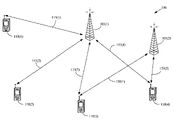
- FIG. 1 conceptually illustrates one exemplary embodiment of a wireless communication system, in accordance with the present invention.
- FIG. 2 conceptually illustrates one exemplary embodiment of a method of selecting power control bits based on a prioritization, in accordance with the present invention.
- the software implemented aspects of the invention are typically encoded on some form of program storage medium or implemented over some type of transmission medium.
- the program storage medium may be magnetic (e.g., a floppy disk or a hard drive) or optical (e.g., a compact disk read only memory, or “CD ROM”), and may be read only or random access.
- the transmission medium may be twisted wire pairs, coaxial cable, optical fiber, or some other suitable transmission medium known to the art. The invention is not limited by these aspects of any given implementation.
- FIG. 1 conceptually illustrates one exemplary embodiment of a wireless communication system 100 .
- the wireless communication system 100 includes a plurality of base stations 105 ( 1 - 2 ). Although two base stations 105 ( 1 - 2 ) are shown in FIG. 1 , persons of ordinary skill in the art should appreciate that any number of base stations 105 ( 1 - 2 ) may be deployed in the wireless communication system 100 .
- the base stations 105 ( 1 - 2 ) provide wireless connectivity according to one or more wireless communication protocols.
- the base stations 105 provide wireless connectivity according to a high rate packet data (HRPD) system protocol such as an Evolved, Data-Optimized (EVDO) protocol, an Evolved, Data-Voice (EVDV) protocol, a High Speed Downlink Packet Access (HSDPA) protocol, and the like.
- HRPD high rate packet data
- EVDO Evolved, Data-Optimized
- EVDV Evolved, Data-Voice
- HSDPA High Speed Downlink Packet Access
- the present invention is not limited to these protocols and in alternative embodiments any communication protocol may be used.
- the base stations 105 ( 1 - 2 ) provide wireless connectivity to one or more mobile units 110 ( 1 - 4 ).
- Exemplary mobile units 110 ( 1 - 4 ) may include, but are not limited to, cellular telephones, personal data assistants, smart phones, text messaging devices, laptop computers, desktop computers, and the like.
- the base station 105 ( 1 ) provides wireless connectivity to the mobile units 110 ( 1 - 4 ) over the wireless communication links 115 ( 1 - 4 ) and the base station 105 ( 2 ) provides wireless connectivity to the mobile units 110 ( 3 - 4 ) over wireless communication links 120 ( 1 - 2 ).
- the wireless communication links 115 ( 1 - 4 ), 120 ( 1 - 2 ) may also referred to as legs 115 ( 1 - 4 ), 120 ( 1 - 2 ). Although a single double-headed arrow is used to represent the legs 115 ( 1 - 4 ), 120 ( 1 - 2 ), persons of ordinary skill in the art should appreciate that the legs 115 ( 1 - 4 ), 120 ( 1 - 2 ) may represent one or more channels, including one or more downlink (or forward link) channels and/or one or more uplink (or reverse link) channels.
- the mobile unit 110 ( 3 ) is in communication with the base stations 105 ( 1 - 2 ) via the legs 115 ( 3 ), 120 ( 1 ) and the mobile unit 110 ( 4 ) is in communication with the base stations 105 ( 1 - 2 ) via the legs 115 ( 4 ), 120 ( 2 ). Accordingly, the mobile units 110 ( 3 - 4 ) are in soft handoff with the base stations 105 ( 1 - 2 ), which are in the active sets of the associated mobile units 110 ( 3 - 4 ).
- Persons of ordinary skill in the art should appreciate that in alternative embodiments more or fewer base stations 15 ( 1 - 2 ) may be in the active sets of the mobile units 110 ( 1 - 4 ).
- either of the base stations 105 ( 1 - 2 ) may serve as the serving base station for the mobile units 110 ( 3 - 4 ) that are in soft hand off.
- the base stations 105 ( 1 - 2 ) may transmit one or more resource control bits to the mobile units 110 ( 1 - 4 ) over the legs 115 ( 1 - 4 ), 120 ( 1 - 2 ).
- the mobile units 110 ( 1 - 4 ) can use the resource control bits to allocate one or more resources, e.g., one or more resources associated with transmission on a reverse link.
- the base stations 105 ( 1 - 2 ) transmit the one or more resource control bits over one or more shared channels on a forward link and the shared resources used to transmit the resource control bits may be subject to one or more limitations.
- the resource control bits are assumed to be power control bits that the mobile units 110 ( 1 - 4 ) may use to allocate power for transmission on a reverse link.
- the power control bits are transmitted over a shared channel and the total power available to transmit the power control bits is limited to a maximum total power, P max .
- the resources that may be controlled according to the present invention are not limited to transmission powers.
- the present invention may be used to allocate other shared resources such as channel codes, time slots or intervals, and the like, and control information other than power control bits may be transmitted.
- the base stations 105 ( 1 - 2 ) can determine power levels that are used to transmit the power control bits to the mobile units 110 ( 1 - 4 ). However, the sum of the allocated power levels may exceed the total power budget for transmitting the power control bits, i.e. the maximum total power, P max . Accordingly, the base stations 105 ( 1 - 2 ) may prioritize the power control bits and then use the priorities associated with the power control bits to select one or more power control bits that are not to be transmitted to one or more of the mobile units 110 ( 1 - 4 ). For example, one or more of the lowest priority power control bits may be omitted so that the sum of the allocated power levels associated with the remaining higher priority power control bits is less than the total power budget for transmitting the power control bits, i.e. the maximum total power, P max .
- the power control bits may be prioritized such that an acceptable reliability (e.g., as measured by a bit error rate or a frame error rate) is maintained for more important power control bit transmissions, while the less important transmissions could be omitted at the base station 105 ( 1 - 2 ).
- the importance of the power control bit may be evaluated along several dimensions, as will be discussed in detail below, and this technique may be extended to include more considerations in the priority calculation.
- reverse link performance degradation and/or capacity degradation may be reduced, or avoided, by maintaining a reliable power control loop on the higher priority legs 115 ( 1 - 4 ), 120 ( 1 - 2 ).
- Overall power may be saved or conserved by omitting power control bits on the lower priority legs 115 ( 1 - 4 ), 120 ( 1 - 2 ) that are less critical to the stable operation of the power control and/or the lower priority legs 115 ( 1 - 4 ), 120 ( 1 - 2 ) where the power control bit error transmissions are more likely to result in the error burst condition.
- FIG. 2 conceptually illustrates one exemplary embodiment of a method 200 of prioritizing power control bits and selecting power control bits based on the prioritization.
- a base station such as the base stations 105 ( 1 - 2 ) shown in FIG. 1 , determines (at 205 ) one or more power allocations p i associated with one or more power control bits that are intended to be transmitted to one or more mobile units, such as the mobile units 110 ( 1 - 4 ) shown in FIG. 1 .
- the base station may calculate the power allocations necessary for reliable delivery of all power control bits in the next power control interval under the assumption of unconstrained overall power.
- the base station determines (at 205 ) the power allocations p i for each connection or leg (indicated by the subscript i) that is included in the power control loops controlled by the base station.
- the total required power for the power allocations p i is
- P req ⁇ i M ⁇ p i , where M is the number of connections or legs under the base station's power control.
- the base station determines (at 210 ) whether or not the total required power exceeds the power budget associated with the power control bits. If the total power budget could be met by allocating the required power to all power control bits, i.e., P req ⁇ P max , then the base station may allocate the power allocations p, to each connection or leg. Alternatively, the base station may scale up the power allocations and allocate
- the base station may then transmit (at 215 ) the one or more power control bits to the one or more mobile units.
- the base station may prioritize (at 220 ) the one or more power control bits.
- a priority function W i may be calculated in each power control interval for each connection or leg i.
- a priority function W i may be computed using the polynomial
- n 0 a
- f( ) is a uniformly decreasing function of p i .
- n 1 a
- i 0
- the power control command is “UP” and if call is in soft handoff a
- i 1
- the power control command is “DOWN” and if call is in soft handoff or, if for any power control command if call is in simplex or softer only.
- the base station may then omit (at 225 ) one or more power control bits from the list of power control bits that are to be transmitted based on the determined priority. For example, after the value of priority function W i is calculated, the connections or legs may be sorted in the order of decreasing priority, as indexed by j. The first M′ power control bits may then be selected for transmission, where
- the scaling factor s j is in the range from 0 to 1 and, in various alternative embodiments, could be set as a function of the priority category from Table 1, e.g. as a function of the handoff scenario associated with each leg. For example, the scaling factor s j could be set to higher values for simplex calls and lower values for handoff non-serving legs.
- the scaling factor s j could also be set as a function of the power control command that is being sent in the power control bit (e.g., an UP or DOWN command).
- the value of the scaling factor s j corresponds to the lowest tolerable power level at which the power control bit could be received at an acceptable error rate performance. Bits associated with connections or legs that do not belong to the subset of indices selected for transmission according to above criterion are omitted (at 225 ).
- the base station may then transmit (at 215 ) the power control bits that have been selected for transmission.
- the selected bits are transmitted using power allocations ⁇ tilde over (p) ⁇ j .
- the selected bits are scaled and transmitted with the power allocation
- Omitting (at 225 ) one or more power control bits based on one or more priorities associated with the power control bits may provide a number of advantages over conventional practice.
- the likelihood of error bursts may be reduced.
- the power control bits belonging to mobile units that are in simplex (or softer only) connection with a base station which are set to transmit a DOWN command, and which have the smallest power allocation requirement, will have the highest priority.
- the power control bits for mobile units that are in soft handoff with a non-serving base station which are set to transmit an UP command, and which require the largest amount of power will have the lowest priority.
- Omitting (at 225 ) one or more power control bits that have the largest power requirement may enable the base station to transmitted a larger number of power control bits that are destined to other mobile units that have smaller power requirements. Also, the power control bits that require the largest amount of power may be destined to the mobile units associated with the worst radiofrequency and/or path loss conditions in the sector and therefore these power control bits are most likely to suffer decoding errors at the mobile unit. Accordingly, omitting (at 225 ) these high power bits altogether may be preferable to scaling them down to a lower transmission power, which may increase the probability that these power control bits may be decoded incorrectly.
- omitting (at 225 ) power control bits representing an UP command may be less costly to system performance than omitting (at 225 ) power control bits representing a DOWN command.
- a power control bit representing the UP command is received and/or decoded in error (perhaps because of excessive scaling of power and bad RF quality) and is interpreted as a DOWN command at the mobile unit, then the risk of triggering the burst of frame errors on the reverse link may be increased due to an excessive powering down of the mobile transmission. Accordingly, it may be preferable not to transmit any command at all rather than to transmit the UP command that has a high probability of turning into a DOWN command through erroneous reception.
- Omitting (at 225 ) one or more power control bits from secondary non-serving legs of a call may provide better system performance than transmitting them with high probability of error.
- secondary non-serving legs of a call are the weaker legs in the soft handoff active set and they may be more prone to reverse link packet errors.
- secondary non-serving legs of a call are more likely to transmit the UP command and be ignored as a result of the voting rule where the DOWN command always wins. If the secondary non-serving legs are ignored anyway, there may be a minimal impact if they don't transmit altogether. However, if they do transmit and are received in error, the consequences might be very negative since the voting rule would take the erroneous DOWN commands from these legs into account.
- the base station may try to compensate for the weakness of the secondary handoff legs by allocating their power control bits more power.
- this compensation may be very crude because it may be based on feedback to the serving base station indicating the strength of its signal and not on the strength of the secondary legs. Therefore, the likelihood of errors on these bits in the loaded scenario may be high.
- One solution may be to omit (at 225 ) these bits altogether if the total power budget cannot be satisfied subject to acceptable bit error performance.
- the present invention is not limited to determining (at 220 ) priorities using the priority function W i and the parameters listed in Table 1.
- the leg is in softer handoff within this base station and/or in soft handoff with another base station.
- the other leg(s) may also omit the one or more power control bits, or if one of the legs decides not to omit the bit, the other leg may transmit it as well.
- other categories could be defined. For example, if the user's power control bit has been omitted from transmission on several previous occasions, its priority could be lifted via another priority category with the higher polynomial order and a non-zero coefficient value.
- connections based on the priority function, W i are possible to achieve the same goal of selecting a subset of the connections for which the power control bits should be transmitted reliably using available power budget.
- the implementation may prioritize the connections by using the rules specified above but without explicitly calculating the W i values, or the implementation could use a calculation of a priority function but in a different form from the polynomial described above.
Landscapes
- Engineering & Computer Science (AREA)
- Computer Networks & Wireless Communication (AREA)
- Signal Processing (AREA)
- Mobile Radio Communication Systems (AREA)
Abstract
Description
where M is the number of connections or legs under the base station's power control.
to each connection or leg. The base station may then transmit (at 215) the one or more power control bits to the one or more mobile units.
where N is the number of priority categories used to classify the “importance” of the power control bit transmission and an,i is the polynomial coefficient value for the connection or leg i in the priority category n. Examples of priority categories and polynomial coefficients that may be used to determine the priority function Wi are shown in Table 1.
| TABLE 1 | ||
| n = 0 | a0, i = | Required power allocations pi are sorted in the order |
| f{pi) | of increasing power requirements. f( ) is a uniformly | |
| decreasing function of pi. | ||
| n = 1 | a1, i = 0 | If the power control command is “UP” and if call is |
| in soft handoff | ||
| a1, i = 1 | If the power control command is “DOWN” and if call is | |
| in soft handoff or, | ||
| if for any power control command if call is in | ||
| simplex or softer only. | ||
| n = 2 | a2, i = 0 | if the base station is not the serving base station |
| for the call | ||
| a2, i = 1 | if the base station is the serving base station and | |
| the call is in soft handoff with another base station | ||
| a2, i = 2 | if call is in simplex or softer handoff connection | |
| with this base station only | ||
The power control bits that were omitted (at 225) are not transmitted (at 215).
Claims (15)
Priority Applications (1)
| Application Number | Priority Date | Filing Date | Title |
|---|---|---|---|
| US11/153,924 US7433703B2 (en) | 2005-06-16 | 2005-06-16 | Method for allocating resources in a wireless communication system |
Applications Claiming Priority (1)
| Application Number | Priority Date | Filing Date | Title |
|---|---|---|---|
| US11/153,924 US7433703B2 (en) | 2005-06-16 | 2005-06-16 | Method for allocating resources in a wireless communication system |
Publications (2)
| Publication Number | Publication Date |
|---|---|
| US20060286992A1 US20060286992A1 (en) | 2006-12-21 |
| US7433703B2 true US7433703B2 (en) | 2008-10-07 |
Family
ID=37574048
Family Applications (1)
| Application Number | Title | Priority Date | Filing Date |
|---|---|---|---|
| US11/153,924 Expired - Fee Related US7433703B2 (en) | 2005-06-16 | 2005-06-16 | Method for allocating resources in a wireless communication system |
Country Status (1)
| Country | Link |
|---|---|
| US (1) | US7433703B2 (en) |
Families Citing this family (3)
| Publication number | Priority date | Publication date | Assignee | Title |
|---|---|---|---|---|
| US8493941B2 (en) * | 2006-04-21 | 2013-07-23 | Alcatel Lucent | Method to control the effects of out-of-cell interference in a wireless cellular system using over-the-air feedback control |
| JP5224733B2 (en) * | 2007-06-19 | 2013-07-03 | 株式会社エヌ・ティ・ティ・ドコモ | Base station apparatus and user apparatus |
| US8433292B2 (en) * | 2007-06-29 | 2013-04-30 | Alcatel Lucent | Network based mobile user proxy and agent |
Citations (7)
| Publication number | Priority date | Publication date | Assignee | Title |
|---|---|---|---|---|
| US20020077138A1 (en) * | 1999-03-15 | 2002-06-20 | Gunnar Bark | Adaptive power control in a radio communications systems |
| US20050111391A1 (en) * | 2003-11-11 | 2005-05-26 | Sony Ericsson Mobile Communications Japan, Inc. | Mobile communication terminal and method of controlling transmission power |
| US20050265282A1 (en) * | 2004-05-25 | 2005-12-01 | Gross Jonathan H | Method for adaptive channel signaling |
| US20060154684A1 (en) * | 2002-11-07 | 2006-07-13 | Adaptix, Inc. | Method and apparatus for adaptive carrier allocation and power control in multi-carrier communication systems |
| US7158557B2 (en) * | 2001-10-12 | 2007-01-02 | Samsung Electronics Co., Ltd. | Channel estimation apparatus and method |
| US20070150215A1 (en) * | 2002-01-02 | 2007-06-28 | American Power Conversion Corporation | Method and apparatus for preventing overloads of power distribution networks |
| US7277406B2 (en) * | 2002-01-21 | 2007-10-02 | Samsung Electronics Co., Ltd. | Apparatus and method for distributing power in an HSDPA system |
-
2005
- 2005-06-16 US US11/153,924 patent/US7433703B2/en not_active Expired - Fee Related
Patent Citations (7)
| Publication number | Priority date | Publication date | Assignee | Title |
|---|---|---|---|---|
| US20020077138A1 (en) * | 1999-03-15 | 2002-06-20 | Gunnar Bark | Adaptive power control in a radio communications systems |
| US7158557B2 (en) * | 2001-10-12 | 2007-01-02 | Samsung Electronics Co., Ltd. | Channel estimation apparatus and method |
| US20070150215A1 (en) * | 2002-01-02 | 2007-06-28 | American Power Conversion Corporation | Method and apparatus for preventing overloads of power distribution networks |
| US7277406B2 (en) * | 2002-01-21 | 2007-10-02 | Samsung Electronics Co., Ltd. | Apparatus and method for distributing power in an HSDPA system |
| US20060154684A1 (en) * | 2002-11-07 | 2006-07-13 | Adaptix, Inc. | Method and apparatus for adaptive carrier allocation and power control in multi-carrier communication systems |
| US20050111391A1 (en) * | 2003-11-11 | 2005-05-26 | Sony Ericsson Mobile Communications Japan, Inc. | Mobile communication terminal and method of controlling transmission power |
| US20050265282A1 (en) * | 2004-05-25 | 2005-12-01 | Gross Jonathan H | Method for adaptive channel signaling |
Also Published As
| Publication number | Publication date |
|---|---|
| US20060286992A1 (en) | 2006-12-21 |
Similar Documents
| Publication | Publication Date | Title |
|---|---|---|
| JP4778106B2 (en) | Method and apparatus for adapting to fast closed loop rate in high rate packet data transmission | |
| US8295189B2 (en) | Interference detection | |
| US8005037B2 (en) | Communication control method, radio base station, and radio control station | |
| EP2147508B1 (en) | Channel control based on error correction values | |
| US20040202196A1 (en) | Method and apparatus for adaptive rate selection in a communication system | |
| US20070091852A1 (en) | Method and apparatus for uplink rate selection in the presence of multiple transport channels in a wireless communication system | |
| KR20070068486A (en) | Method and apparatus for controlling reverse link data rate of mobile station | |
| US7515579B2 (en) | Dynamic switching of a transmission time interval in a wireless system | |
| US8249599B2 (en) | Terminal, random access signal transmission method, and base station | |
| KR101127867B1 (en) | Hybrid automatic repeat request operation during soft hand offs in a wireless system | |
| US20120099526A1 (en) | Decoding device | |
| US20220006590A1 (en) | Information sending method, user terminal and computer-readable storage medium | |
| US7433703B2 (en) | Method for allocating resources in a wireless communication system | |
| US8098643B2 (en) | Method of increasing the capacity of the forward link MAC channel in a wireless communication system | |
| US20050135289A1 (en) | Apparatus and method for data rate transmission of user equipment in mobile communication system | |
| US7483386B2 (en) | Adaptive threshold setting for discontinuous transmission detection | |
| CN116419265B (en) | Channel adaptive processing method, base station and readable storage medium | |
| US7676240B2 (en) | Power control based on estimates of cumulative received energy | |
| JP4656310B2 (en) | Scheduling method and mobile communication system | |
| KR20100095945A (en) | Method of modulation and encoding in mobile telecommunications system and terminal thereof | |
| US8666318B2 (en) | Method and apparatus for managing cellular uplink transmissions | |
| US20230051144A1 (en) | Device and method for listen-before-talk random access with adaptive energy detection threshold selection | |
| CN112713961B (en) | Multi-user transmission processing method and device | |
| JP5199350B2 (en) | User terminal power shortage display | |
| KR20060034606A (en) | Uplink Enhancement Channel Packet Transmission Control Method |
Legal Events
| Date | Code | Title | Description |
|---|---|---|---|
| AS | Assignment |
Owner name: LUCENT TECHNOLOGIES INC., NEW JERSEY Free format text: ASSIGNMENT OF ASSIGNORS INTEREST;ASSIGNORS:VITEBSKY, STAN;YANG, YANG;REEL/FRAME:016695/0909 Effective date: 20050614 |
|
| FPAY | Fee payment |
Year of fee payment: 4 |
|
| AS | Assignment |
Owner name: CREDIT SUISSE AG, NEW YORK Free format text: SECURITY INTEREST;ASSIGNOR:ALCATEL-LUCENT USA INC.;REEL/FRAME:030510/0627 Effective date: 20130130 |
|
| AS | Assignment |
Owner name: ALCATEL-LUCENT USA INC., NEW JERSEY Free format text: MERGER;ASSIGNOR:LUCENT TECHNOLOGIES INC.;REEL/FRAME:032388/0405 Effective date: 20081101 |
|
| AS | Assignment |
Owner name: ALCATEL-LUCENT USA INC., NEW JERSEY Free format text: RELEASE OF SECURITY INTEREST;ASSIGNOR:CREDIT SUISSE AG;REEL/FRAME:032578/0931 Effective date: 20140331 Owner name: BANK OF AMERICA NA, VIRGINIA Free format text: SECURITY INTEREST;ASSIGNOR:LGS INNOVATIONS LLC;REEL/FRAME:032579/0066 Effective date: 20140331 |
|
| AS | Assignment |
Owner name: LGS INNOVATIONS LLC, VIRGINIA Free format text: ASSIGNMENT OF ASSIGNORS INTEREST;ASSIGNOR:ALCATEL LUCENT;REEL/FRAME:032743/0584 Effective date: 20140331 |
|
| AS | Assignment |
Owner name: ALCATEL-LUCENT USA INC., NEW JERSEY Free format text: RELEASE BY SECURED PARTY;ASSIGNOR:CREDIT SUISSE AG;REEL/FRAME:033950/0261 Effective date: 20140819 |
|
| REMI | Maintenance fee reminder mailed | ||
| LAPS | Lapse for failure to pay maintenance fees | ||
| STCH | Information on status: patent discontinuation |
Free format text: PATENT EXPIRED DUE TO NONPAYMENT OF MAINTENANCE FEES UNDER 37 CFR 1.362 |
|
| STCH | Information on status: patent discontinuation |
Free format text: PATENT EXPIRED DUE TO NONPAYMENT OF MAINTENANCE FEES UNDER 37 CFR 1.362 |
|
| FP | Lapsed due to failure to pay maintenance fee |
Effective date: 20161007 |
|
| AS | Assignment |
Owner name: BANK OF AMERICA, N.A., NEW YORK Free format text: NOTICE OF GRANT OF SECURITY INTEREST IN PATENTS;ASSIGNOR:LGS INNOVATIONS LLC;REEL/FRAME:043254/0393 Effective date: 20170718 |
|
| AS | Assignment |
Owner name: LGS INNOVATIONS LLC, VIRGINIA Free format text: RELEASE BY SECURED PARTY;ASSIGNOR:BANK OF AMERICA, N.A.;REEL/FRAME:049074/0094 Effective date: 20190301 |
|
| AS | Assignment |
Owner name: LGS INNOVATIONS LLC, GEORGIA Free format text: RELEASE BY SECURED PARTY;ASSIGNOR:BANK OF AMERICA, N.A.;REEL/FRAME:049247/0557 Effective date: 20190521 |