US7432036B2 - Non-resonant two-photon absorbing material, non-resonant two-photon emitting material, and method for inducing absorption or generating emission of non-resonant two photons by using the material - Google Patents

Non-resonant two-photon absorbing material, non-resonant two-photon emitting material, and method for inducing absorption or generating emission of non-resonant two photons by using the material Download PDF

Info

Publication number
US7432036B2
US7432036B2 US10/678,301 US67830103A US7432036B2 US 7432036 B2 US7432036 B2 US 7432036B2 US 67830103 A US67830103 A US 67830103A US 7432036 B2 US7432036 B2 US 7432036B2
Authority
US
United States
Prior art keywords
group
resonant
photon
ring
absorption
Prior art date
Legal status (The legal status is an assumption and is not a legal conclusion. Google has not performed a legal analysis and makes no representation as to the accuracy of the status listed.)
Expired - Fee Related, expires
Application number
US10/678,301
Other versions
US20040086803A1 (en
Inventor
Hiroo Takizawa
Takeharu Tani
Naoki Morinaga
Current Assignee (The listed assignees may be inaccurate. Google has not performed a legal analysis and makes no representation or warranty as to the accuracy of the list.)
Fujifilm Holdings Corp
Fujifilm Corp
Original Assignee
Fujifilm Corp
Priority date (The priority date is an assumption and is not a legal conclusion. Google has not performed a legal analysis and makes no representation as to the accuracy of the date listed.)
Filing date
Publication date
Priority claimed from JP2003071875A external-priority patent/JP4115308B2/en
Priority claimed from JP2003071874A external-priority patent/JP4074824B2/en
Application filed by Fujifilm Corp filed Critical Fujifilm Corp
Assigned to FUJI PHOTO FILM CO., LTD. reassignment FUJI PHOTO FILM CO., LTD. ASSIGNMENT OF ASSIGNORS INTEREST (SEE DOCUMENT FOR DETAILS). Assignors: MORINAGA, NAOKI, TAKIZAWA, HIROO, TANI, TAKEHARU
Publication of US20040086803A1 publication Critical patent/US20040086803A1/en
Assigned to FUJIFILM CORPORATION reassignment FUJIFILM CORPORATION ASSIGNMENT OF ASSIGNORS INTEREST (SEE DOCUMENT FOR DETAILS). Assignors: FUJIFILM HOLDINGS CORPORATION (FORMERLY FUJI PHOTO FILM CO., LTD.)
Application granted granted Critical
Publication of US7432036B2 publication Critical patent/US7432036B2/en
Adjusted expiration legal-status Critical
Expired - Fee Related legal-status Critical Current

Links

Classifications

    • CCHEMISTRY; METALLURGY
    • C09DYES; PAINTS; POLISHES; NATURAL RESINS; ADHESIVES; COMPOSITIONS NOT OTHERWISE PROVIDED FOR; APPLICATIONS OF MATERIALS NOT OTHERWISE PROVIDED FOR
    • C09BORGANIC DYES OR CLOSELY-RELATED COMPOUNDS FOR PRODUCING DYES, e.g. PIGMENTS; MORDANTS; LAKES
    • C09B23/00Methine or polymethine dyes, e.g. cyanine dyes
    • C09B23/02Methine or polymethine dyes, e.g. cyanine dyes the polymethine chain containing an odd number of >CH- or >C[alkyl]- groups
    • C09B23/06Methine or polymethine dyes, e.g. cyanine dyes the polymethine chain containing an odd number of >CH- or >C[alkyl]- groups three >CH- groups, e.g. carbocyanines
    • BPERFORMING OPERATIONS; TRANSPORTING
    • B82NANOTECHNOLOGY
    • B82YSPECIFIC USES OR APPLICATIONS OF NANOSTRUCTURES; MEASUREMENT OR ANALYSIS OF NANOSTRUCTURES; MANUFACTURE OR TREATMENT OF NANOSTRUCTURES
    • B82Y10/00Nanotechnology for information processing, storage or transmission, e.g. quantum computing or single electron logic
    • CCHEMISTRY; METALLURGY
    • C09DYES; PAINTS; POLISHES; NATURAL RESINS; ADHESIVES; COMPOSITIONS NOT OTHERWISE PROVIDED FOR; APPLICATIONS OF MATERIALS NOT OTHERWISE PROVIDED FOR
    • C09BORGANIC DYES OR CLOSELY-RELATED COMPOUNDS FOR PRODUCING DYES, e.g. PIGMENTS; MORDANTS; LAKES
    • C09B23/00Methine or polymethine dyes, e.g. cyanine dyes
    • C09B23/0008Methine or polymethine dyes, e.g. cyanine dyes substituted on the polymethine chain
    • CCHEMISTRY; METALLURGY
    • C09DYES; PAINTS; POLISHES; NATURAL RESINS; ADHESIVES; COMPOSITIONS NOT OTHERWISE PROVIDED FOR; APPLICATIONS OF MATERIALS NOT OTHERWISE PROVIDED FOR
    • C09BORGANIC DYES OR CLOSELY-RELATED COMPOUNDS FOR PRODUCING DYES, e.g. PIGMENTS; MORDANTS; LAKES
    • C09B23/00Methine or polymethine dyes, e.g. cyanine dyes
    • C09B23/0008Methine or polymethine dyes, e.g. cyanine dyes substituted on the polymethine chain
    • C09B23/0016Methine or polymethine dyes, e.g. cyanine dyes substituted on the polymethine chain the substituent being a halogen atom
    • CCHEMISTRY; METALLURGY
    • C09DYES; PAINTS; POLISHES; NATURAL RESINS; ADHESIVES; COMPOSITIONS NOT OTHERWISE PROVIDED FOR; APPLICATIONS OF MATERIALS NOT OTHERWISE PROVIDED FOR
    • C09BORGANIC DYES OR CLOSELY-RELATED COMPOUNDS FOR PRODUCING DYES, e.g. PIGMENTS; MORDANTS; LAKES
    • C09B23/00Methine or polymethine dyes, e.g. cyanine dyes
    • C09B23/0008Methine or polymethine dyes, e.g. cyanine dyes substituted on the polymethine chain
    • C09B23/0025Methine or polymethine dyes, e.g. cyanine dyes substituted on the polymethine chain the substituent being bound through an oxygen atom
    • CCHEMISTRY; METALLURGY
    • C09DYES; PAINTS; POLISHES; NATURAL RESINS; ADHESIVES; COMPOSITIONS NOT OTHERWISE PROVIDED FOR; APPLICATIONS OF MATERIALS NOT OTHERWISE PROVIDED FOR
    • C09BORGANIC DYES OR CLOSELY-RELATED COMPOUNDS FOR PRODUCING DYES, e.g. PIGMENTS; MORDANTS; LAKES
    • C09B23/00Methine or polymethine dyes, e.g. cyanine dyes
    • C09B23/0008Methine or polymethine dyes, e.g. cyanine dyes substituted on the polymethine chain
    • C09B23/0033Methine or polymethine dyes, e.g. cyanine dyes substituted on the polymethine chain the substituent being bound through a sulfur atom
    • CCHEMISTRY; METALLURGY
    • C09DYES; PAINTS; POLISHES; NATURAL RESINS; ADHESIVES; COMPOSITIONS NOT OTHERWISE PROVIDED FOR; APPLICATIONS OF MATERIALS NOT OTHERWISE PROVIDED FOR
    • C09BORGANIC DYES OR CLOSELY-RELATED COMPOUNDS FOR PRODUCING DYES, e.g. PIGMENTS; MORDANTS; LAKES
    • C09B23/00Methine or polymethine dyes, e.g. cyanine dyes
    • C09B23/0008Methine or polymethine dyes, e.g. cyanine dyes substituted on the polymethine chain
    • C09B23/005Methine or polymethine dyes, e.g. cyanine dyes substituted on the polymethine chain the substituent being a COOH and/or a functional derivative thereof
    • CCHEMISTRY; METALLURGY
    • C09DYES; PAINTS; POLISHES; NATURAL RESINS; ADHESIVES; COMPOSITIONS NOT OTHERWISE PROVIDED FOR; APPLICATIONS OF MATERIALS NOT OTHERWISE PROVIDED FOR
    • C09BORGANIC DYES OR CLOSELY-RELATED COMPOUNDS FOR PRODUCING DYES, e.g. PIGMENTS; MORDANTS; LAKES
    • C09B23/00Methine or polymethine dyes, e.g. cyanine dyes
    • C09B23/0066Methine or polymethine dyes, e.g. cyanine dyes the polymethine chain being part of a carbocyclic ring,(e.g. benzene, naphtalene, cyclohexene, cyclobutenene-quadratic acid)
    • CCHEMISTRY; METALLURGY
    • C09DYES; PAINTS; POLISHES; NATURAL RESINS; ADHESIVES; COMPOSITIONS NOT OTHERWISE PROVIDED FOR; APPLICATIONS OF MATERIALS NOT OTHERWISE PROVIDED FOR
    • C09BORGANIC DYES OR CLOSELY-RELATED COMPOUNDS FOR PRODUCING DYES, e.g. PIGMENTS; MORDANTS; LAKES
    • C09B23/00Methine or polymethine dyes, e.g. cyanine dyes
    • C09B23/0091Methine or polymethine dyes, e.g. cyanine dyes having only one heterocyclic ring at one end of the methine chain, e.g. hemicyamines, hemioxonol
    • CCHEMISTRY; METALLURGY
    • C09DYES; PAINTS; POLISHES; NATURAL RESINS; ADHESIVES; COMPOSITIONS NOT OTHERWISE PROVIDED FOR; APPLICATIONS OF MATERIALS NOT OTHERWISE PROVIDED FOR
    • C09BORGANIC DYES OR CLOSELY-RELATED COMPOUNDS FOR PRODUCING DYES, e.g. PIGMENTS; MORDANTS; LAKES
    • C09B23/00Methine or polymethine dyes, e.g. cyanine dyes
    • C09B23/02Methine or polymethine dyes, e.g. cyanine dyes the polymethine chain containing an odd number of >CH- or >C[alkyl]- groups
    • C09B23/04Methine or polymethine dyes, e.g. cyanine dyes the polymethine chain containing an odd number of >CH- or >C[alkyl]- groups one >CH- group, e.g. cyanines, isocyanines, pseudocyanines
    • CCHEMISTRY; METALLURGY
    • C09DYES; PAINTS; POLISHES; NATURAL RESINS; ADHESIVES; COMPOSITIONS NOT OTHERWISE PROVIDED FOR; APPLICATIONS OF MATERIALS NOT OTHERWISE PROVIDED FOR
    • C09BORGANIC DYES OR CLOSELY-RELATED COMPOUNDS FOR PRODUCING DYES, e.g. PIGMENTS; MORDANTS; LAKES
    • C09B23/00Methine or polymethine dyes, e.g. cyanine dyes
    • C09B23/02Methine or polymethine dyes, e.g. cyanine dyes the polymethine chain containing an odd number of >CH- or >C[alkyl]- groups
    • C09B23/08Methine or polymethine dyes, e.g. cyanine dyes the polymethine chain containing an odd number of >CH- or >C[alkyl]- groups more than three >CH- groups, e.g. polycarbocyanines
    • C09B23/083Methine or polymethine dyes, e.g. cyanine dyes the polymethine chain containing an odd number of >CH- or >C[alkyl]- groups more than three >CH- groups, e.g. polycarbocyanines five >CH- groups
    • CCHEMISTRY; METALLURGY
    • C09DYES; PAINTS; POLISHES; NATURAL RESINS; ADHESIVES; COMPOSITIONS NOT OTHERWISE PROVIDED FOR; APPLICATIONS OF MATERIALS NOT OTHERWISE PROVIDED FOR
    • C09BORGANIC DYES OR CLOSELY-RELATED COMPOUNDS FOR PRODUCING DYES, e.g. PIGMENTS; MORDANTS; LAKES
    • C09B23/00Methine or polymethine dyes, e.g. cyanine dyes
    • C09B23/02Methine or polymethine dyes, e.g. cyanine dyes the polymethine chain containing an odd number of >CH- or >C[alkyl]- groups
    • C09B23/08Methine or polymethine dyes, e.g. cyanine dyes the polymethine chain containing an odd number of >CH- or >C[alkyl]- groups more than three >CH- groups, e.g. polycarbocyanines
    • C09B23/086Methine or polymethine dyes, e.g. cyanine dyes the polymethine chain containing an odd number of >CH- or >C[alkyl]- groups more than three >CH- groups, e.g. polycarbocyanines more than five >CH- groups
    • CCHEMISTRY; METALLURGY
    • C09DYES; PAINTS; POLISHES; NATURAL RESINS; ADHESIVES; COMPOSITIONS NOT OTHERWISE PROVIDED FOR; APPLICATIONS OF MATERIALS NOT OTHERWISE PROVIDED FOR
    • C09BORGANIC DYES OR CLOSELY-RELATED COMPOUNDS FOR PRODUCING DYES, e.g. PIGMENTS; MORDANTS; LAKES
    • C09B23/00Methine or polymethine dyes, e.g. cyanine dyes
    • C09B23/10The polymethine chain containing an even number of >CH- groups
    • CCHEMISTRY; METALLURGY
    • C09DYES; PAINTS; POLISHES; NATURAL RESINS; ADHESIVES; COMPOSITIONS NOT OTHERWISE PROVIDED FOR; APPLICATIONS OF MATERIALS NOT OTHERWISE PROVIDED FOR
    • C09BORGANIC DYES OR CLOSELY-RELATED COMPOUNDS FOR PRODUCING DYES, e.g. PIGMENTS; MORDANTS; LAKES
    • C09B23/00Methine or polymethine dyes, e.g. cyanine dyes
    • C09B23/10The polymethine chain containing an even number of >CH- groups
    • C09B23/105The polymethine chain containing an even number of >CH- groups two >CH- groups
    • CCHEMISTRY; METALLURGY
    • C09DYES; PAINTS; POLISHES; NATURAL RESINS; ADHESIVES; COMPOSITIONS NOT OTHERWISE PROVIDED FOR; APPLICATIONS OF MATERIALS NOT OTHERWISE PROVIDED FOR
    • C09BORGANIC DYES OR CLOSELY-RELATED COMPOUNDS FOR PRODUCING DYES, e.g. PIGMENTS; MORDANTS; LAKES
    • C09B23/00Methine or polymethine dyes, e.g. cyanine dyes
    • C09B23/10The polymethine chain containing an even number of >CH- groups
    • C09B23/107The polymethine chain containing an even number of >CH- groups four >CH- groups
    • GPHYSICS
    • G02OPTICS
    • G02FOPTICAL DEVICES OR ARRANGEMENTS FOR THE CONTROL OF LIGHT BY MODIFICATION OF THE OPTICAL PROPERTIES OF THE MEDIA OF THE ELEMENTS INVOLVED THEREIN; NON-LINEAR OPTICS; FREQUENCY-CHANGING OF LIGHT; OPTICAL LOGIC ELEMENTS; OPTICAL ANALOGUE/DIGITAL CONVERTERS
    • G02F1/00Devices or arrangements for the control of the intensity, colour, phase, polarisation or direction of light arriving from an independent light source, e.g. switching, gating or modulating; Non-linear optics
    • G02F1/35Non-linear optics
    • G02F1/355Non-linear optics characterised by the materials used
    • G02F1/361Organic materials
    • G02F1/3611Organic materials containing Nitrogen
    • G02F1/3612Heterocycles having N as heteroatom
    • GPHYSICS
    • G02OPTICS
    • G02FOPTICAL DEVICES OR ARRANGEMENTS FOR THE CONTROL OF LIGHT BY MODIFICATION OF THE OPTICAL PROPERTIES OF THE MEDIA OF THE ELEMENTS INVOLVED THEREIN; NON-LINEAR OPTICS; FREQUENCY-CHANGING OF LIGHT; OPTICAL LOGIC ELEMENTS; OPTICAL ANALOGUE/DIGITAL CONVERTERS
    • G02F1/00Devices or arrangements for the control of the intensity, colour, phase, polarisation or direction of light arriving from an independent light source, e.g. switching, gating or modulating; Non-linear optics
    • G02F1/35Non-linear optics
    • G02F1/355Non-linear optics characterised by the materials used
    • G02F1/361Organic materials
    • G02F1/3613Organic materials containing Sulfur
    • G02F1/3614Heterocycles having S as heteroatom
    • GPHYSICS
    • G03PHOTOGRAPHY; CINEMATOGRAPHY; ANALOGOUS TECHNIQUES USING WAVES OTHER THAN OPTICAL WAVES; ELECTROGRAPHY; HOLOGRAPHY
    • G03FPHOTOMECHANICAL PRODUCTION OF TEXTURED OR PATTERNED SURFACES, e.g. FOR PRINTING, FOR PROCESSING OF SEMICONDUCTOR DEVICES; MATERIALS THEREFOR; ORIGINALS THEREFOR; APPARATUS SPECIALLY ADAPTED THEREFOR
    • G03F7/00Photomechanical, e.g. photolithographic, production of textured or patterned surfaces, e.g. printing surfaces; Materials therefor, e.g. comprising photoresists; Apparatus specially adapted therefor
    • G03F7/0037Production of three-dimensional images
    • GPHYSICS
    • G03PHOTOGRAPHY; CINEMATOGRAPHY; ANALOGOUS TECHNIQUES USING WAVES OTHER THAN OPTICAL WAVES; ELECTROGRAPHY; HOLOGRAPHY
    • G03FPHOTOMECHANICAL PRODUCTION OF TEXTURED OR PATTERNED SURFACES, e.g. FOR PRINTING, FOR PROCESSING OF SEMICONDUCTOR DEVICES; MATERIALS THEREFOR; ORIGINALS THEREFOR; APPARATUS SPECIALLY ADAPTED THEREFOR
    • G03F7/00Photomechanical, e.g. photolithographic, production of textured or patterned surfaces, e.g. printing surfaces; Materials therefor, e.g. comprising photoresists; Apparatus specially adapted therefor
    • G03F7/20Exposure; Apparatus therefor
    • G03F7/2051Exposure without an original mask, e.g. using a programmed deflection of a point source, by scanning, by drawing with a light beam, using an addressed light or corpuscular source
    • G03F7/2053Exposure without an original mask, e.g. using a programmed deflection of a point source, by scanning, by drawing with a light beam, using an addressed light or corpuscular source using a laser
    • GPHYSICS
    • G11INFORMATION STORAGE
    • G11BINFORMATION STORAGE BASED ON RELATIVE MOVEMENT BETWEEN RECORD CARRIER AND TRANSDUCER
    • G11B7/00Recording or reproducing by optical means, e.g. recording using a thermal beam of optical radiation by modifying optical properties or the physical structure, reproducing using an optical beam at lower power by sensing optical properties; Record carriers therefor
    • G11B7/24Record carriers characterised by shape, structure or physical properties, or by the selection of the material
    • G11B7/241Record carriers characterised by shape, structure or physical properties, or by the selection of the material characterised by the selection of the material
    • G11B7/242Record carriers characterised by shape, structure or physical properties, or by the selection of the material characterised by the selection of the material of recording layers
    • G11B7/244Record carriers characterised by shape, structure or physical properties, or by the selection of the material characterised by the selection of the material of recording layers comprising organic materials only
    • G11B7/246Record carriers characterised by shape, structure or physical properties, or by the selection of the material characterised by the selection of the material of recording layers comprising organic materials only containing dyes
    • G11B7/247Record carriers characterised by shape, structure or physical properties, or by the selection of the material characterised by the selection of the material of recording layers comprising organic materials only containing dyes methine or polymethine dyes
    • G11B7/2472Record carriers characterised by shape, structure or physical properties, or by the selection of the material characterised by the selection of the material of recording layers comprising organic materials only containing dyes methine or polymethine dyes cyanine
    • GPHYSICS
    • G11INFORMATION STORAGE
    • G11BINFORMATION STORAGE BASED ON RELATIVE MOVEMENT BETWEEN RECORD CARRIER AND TRANSDUCER
    • G11B7/00Recording or reproducing by optical means, e.g. recording using a thermal beam of optical radiation by modifying optical properties or the physical structure, reproducing using an optical beam at lower power by sensing optical properties; Record carriers therefor
    • G11B7/24Record carriers characterised by shape, structure or physical properties, or by the selection of the material
    • G11B7/241Record carriers characterised by shape, structure or physical properties, or by the selection of the material characterised by the selection of the material
    • G11B7/242Record carriers characterised by shape, structure or physical properties, or by the selection of the material characterised by the selection of the material of recording layers
    • G11B7/244Record carriers characterised by shape, structure or physical properties, or by the selection of the material characterised by the selection of the material of recording layers comprising organic materials only
    • G11B7/246Record carriers characterised by shape, structure or physical properties, or by the selection of the material characterised by the selection of the material of recording layers comprising organic materials only containing dyes
    • G11B7/247Record carriers characterised by shape, structure or physical properties, or by the selection of the material characterised by the selection of the material of recording layers comprising organic materials only containing dyes methine or polymethine dyes
    • G11B7/2475Record carriers characterised by shape, structure or physical properties, or by the selection of the material characterised by the selection of the material of recording layers comprising organic materials only containing dyes methine or polymethine dyes merocyanine
    • GPHYSICS
    • G11INFORMATION STORAGE
    • G11BINFORMATION STORAGE BASED ON RELATIVE MOVEMENT BETWEEN RECORD CARRIER AND TRANSDUCER
    • G11B7/00Recording or reproducing by optical means, e.g. recording using a thermal beam of optical radiation by modifying optical properties or the physical structure, reproducing using an optical beam at lower power by sensing optical properties; Record carriers therefor
    • G11B7/24Record carriers characterised by shape, structure or physical properties, or by the selection of the material
    • G11B7/241Record carriers characterised by shape, structure or physical properties, or by the selection of the material characterised by the selection of the material
    • G11B7/242Record carriers characterised by shape, structure or physical properties, or by the selection of the material characterised by the selection of the material of recording layers
    • G11B7/244Record carriers characterised by shape, structure or physical properties, or by the selection of the material characterised by the selection of the material of recording layers comprising organic materials only
    • G11B7/246Record carriers characterised by shape, structure or physical properties, or by the selection of the material characterised by the selection of the material of recording layers comprising organic materials only containing dyes
    • G11B7/247Record carriers characterised by shape, structure or physical properties, or by the selection of the material characterised by the selection of the material of recording layers comprising organic materials only containing dyes methine or polymethine dyes
    • G11B7/2478Record carriers characterised by shape, structure or physical properties, or by the selection of the material characterised by the selection of the material of recording layers comprising organic materials only containing dyes methine or polymethine dyes oxonol
    • YGENERAL TAGGING OF NEW TECHNOLOGICAL DEVELOPMENTS; GENERAL TAGGING OF CROSS-SECTIONAL TECHNOLOGIES SPANNING OVER SEVERAL SECTIONS OF THE IPC; TECHNICAL SUBJECTS COVERED BY FORMER USPC CROSS-REFERENCE ART COLLECTIONS [XRACs] AND DIGESTS
    • Y10TECHNICAL SUBJECTS COVERED BY FORMER USPC
    • Y10STECHNICAL SUBJECTS COVERED BY FORMER USPC CROSS-REFERENCE ART COLLECTIONS [XRACs] AND DIGESTS
    • Y10S430/00Radiation imagery chemistry: process, composition, or product thereof
    • Y10S430/146Laser beam

Definitions

  • the present invention relates to a material of expressing a non-linear optical effect, more specifically, the present invention relates to a non-linear optical material having a large non-resonant two-photon absorbing cross-sectional area and ensuring a high emission efficiency from the excited state resultant of non-resonant two-photon absorption.
  • the non-linear optical effect means a non-linear optical response proportional to the square, cube or higher power of photoelectric field applied.
  • the secondary non-linear optical effect proportional to the square of photoelectric field applied include second harmonic generation (SHG), optical rectification, photorefractive effect, Pockels effect, parametric amplification, parametric oscillation, light sum frequency mixing and light difference frequency mixing.
  • the ternary non-linear optical effect include third harmonic generation (THG), optical Kerr effect, self-induced refractive index change and two-photon absorption.
  • inorganic materials can be hardly used in practice because so-called molecular design so as to optimize desired non-linear optical characteristics or various properties necessary for the production of a device is difficult.
  • organic compounds can realize not only optimization of desired non-linear optical characteristics by the molecular design but also control of other various properties and therefore, the probability of its practical use is high. Thus, organic compounds are attracting attention as a promising non-linear optical material.
  • ternary non-linear optical effects particularly, non-resonant two-photon absorption and non-resonant two-photon emission
  • the two-photon absorption is a phenomenon such that a compound is excited by simultaneously absorbing two photons.
  • the two-photon absorption occurs in the energy region having no (linear) absorption band of the compound, this is called resonant two-photon absorption.
  • the non-resonant two-photon emission means emission generated by an excited molecule resultant of the non-resonant two-photon absorption in the radiation inactivation process of the excited state.
  • two-photon absorption and two-photon emission indicate non-resonant two-photon absorption and non-resonant two-photon emission, respectively.
  • the non-resonant two-photon absorption efficiency is proportional to the square of photoelectric field applied (square-law characteristic of two-photon absorption). Therefore, when a laser is irradiated on a two-dimensional plane, two-photon absorption takes place only in the position having a high electric field strength at the center part of laser spot and utterly no two-photon absorption occurs in the portion having a weak electric field strength in the periphery. On the other hand, in a three-dimensional space, two-photon absorption occurs only in the region having a large electric field strength at the focus where the laser rays are converged through a lens, and two-photon absorption does not take place at all in the off-focus region because the electric field strength is weak.
  • the excitation light can reach the inside of a sample without being absorbed or scattered and one point inside the sample can be excited with very high space resolution due to the square-law characteristic of non-resonant two-photon absorption. Therefore, application of the non-resonant two-photon absorption and non-resonant two-photon emission to two-photon contrasting of a living organism or two-photon photodynamic therapy is being expected.
  • stilbazolium derivatives As the organic compound of undergoing two-photon emission or up-conversion lasing with good efficiency, so-called stilbazolium derivatives are known (see, G. S. He, et al., Appl. Phys. Lett., 67, 3703 (1995), G. S. He, et al., Appl. Phys. Lett., 67, 2433 (1995), G. S. He, et al., Appl. Phys. Lett., 68, 3549 (1996), G. S. He, et al., J. Appl. Phys., 81, 2529 (1997), P. N. Prasad, et al., Nonlinear Optics, 21, 39 (1999), Y.
  • the two-photon absorption efficiency (two-photon absorbing cross-sectional area) of the organic compound used and the emission efficiency from the excited state resultant of the two-photon absorption must be high.
  • 4-fold excitation light intensity is necessary due to the square-law characteristic of two-photon absorption.
  • irradiation of excessively strong laser light highly probably incurs, for example, photo-damage of a living organism or photo-deterioration of the two-photon emitting dye itself and therefore, this is not preferred.
  • a three-dimensional optical recording medium is abruptly attracting an attention as an ultimate high-density, high-capacity recording medium.
  • bit recording is superposed in tens or hundreds of layers in the three-dimensional (thickness) direction to achieve super high-density and super high-capacity recording as large as tens or hundreds of times conventional two-dimensional recording mediums.
  • access and writing must be performed at an arbitrary position in the three-dimensional (thickness) direction and as a technique therefor, a method of using a two-photon absorbing material is effective.
  • a three-dimensional display or three-dimensional stereolithography of enabling many persons to observe a natural solid without spectacles is demanded so as to apply a more adequate therapy to a three-dimensionally intricate site such as brain or ear.
  • a three-dimensional volume display or three-dimensional stereolithography composition using two-photon absorption is expected.
  • An object of the present invention is to provide an organic material capable of absorbing two photons with good efficiency, namely, an organic material having a large two-photon absorbing cross-sectional area, and also provide an organic material capable of exhibiting two-photon emission having a large emission intensity.
  • the present inventors have made extensive investigations, as a result, the object of the present invention can be attained by the following techniques.
  • a non-resonant two-photon absorbing material comprising a methine dye undergoing a non-resonant two-photon absorption.
  • the methine dye is at least one selected from the group consisting of a cyanine dye, a merocyanine dye and an oxonol dye.
  • na 1 , na 2 and na 3 all represent 0.
  • Ra 1 and Ra 2 , Ma 3 to Ma 5 , ka 1 , CI and y have the same meanings as in the formula (1)
  • X 1 and X 2 each independently represents —O—, —S—, —NR 3 —or —CR 4 R 5 —
  • R 3 , R 4 and R 5 each independently represents a hydrogen atom, an alkyl group, an alkenyl group, an aryl group or a heterocyclic group
  • R 1 and R 2 each independently represents a substituent
  • a1 and a2 each independently represents an integer of 0 to 4, provided that when a1 and a2 each is 2 or more, multiple R 1 s may be the same or different and may combine with each other to form a ring and multiple R 2 s may be the same or different and may combine with each other to form a ring;
  • X 1 , R 3 , R 4 , R 5 , R 1 and a1 have the same meanings as in the formula (4)
  • Ma 10 , Ma 11 , Ra 3 , Za 4 , ka 2 , CI and y have the same meanings as in the formula (2), provided that when al is 2 or more, multiple R 1 s may be the same or different and may combine with each other to form a ring;
  • Ma 12 to Ma 14 , ka 3 , CI and y have the same meanings as in the formula (3), X 11 , and X 12 each independently represents either O or S, and R 11 to R 14 each independently represents a hydrogen atom, an alkyl group, an alkenyl group, an aryl group or a heterocyclic group.
  • Za 1 , Za 2 and Za 3 each represents an atomic group for forming a 5- or 6-membered nitrogen-containing heterocyclic ring
  • Za 4 , Za 5 and Za 6 each represents an atomic group for forming a 5- or 6-membered ring
  • Ra 1 , Ra 2 and Ra 3 each independently represents a hydrogen atom, an alkyl group, an alkenyl group, an aryl group or a heterocyclic group
  • Ma 1 to Ma 14 each independently represents a methine group, which may have a substituent or may form a ring together with another methine group
  • na 1 , na 2 and na 3 each represents 0 or 1
  • ka 1 and ka 3 each represents an integer of 0 to 3, provided that when ka 1 is 2 or more, multiple Ma 3 s may be the same or different and multiple Ma 4 s may be the same or different and when ka 3 is 2 or more, multiple Ma 12 s may be the same or different and multiple Ma 13 s may be the same or
  • R 1 and R 2 each independently represents a chlorine atom, a bromine atom, a fluorine atom, an iodine atom, a sulfo group, a methyl group, a phenyl group or a pyrrole group.
  • R 1 and R 2 each independently represents a chlorine atom, a bromine atom, a sulfo group, a methyl group or a phenyl group.
  • R 1 and R 2 each independently represents a chlorine atom or a bromine atom.
  • the non-resonant two-photon absorbing material as described in any one of the items 3 to 9, 14, 15 and 22, wherein in the formulae (2), (3) and (5), the ring formed by Za 4 , Za 5 or Za 6 each is 2-pyrazolon-5-one, pyrazolidine-3,5-dione, rhodanine, indane-1,3-dione, thiophen-3-one, thiophen-3-one-1,1-dioxide, 1,3-dioxane-4,6-dione, barbituric acid, 2-thiobarbituric acid or coumarin-2,4-dione.
  • R 11 to R 14 each independently represents a hydrogen atom, an alkyl group or an aryl group.
  • Ma 1 to Ma 14 each independently represents an unsubstituted methine group, a methyl-substituted methine group or an ethyl-substituted methine group.
  • a non-resonant two-photon absorbing material comprising a non-resonant two-photon absorbing compound undergoing non-resonant two-photon absorption in the intermolecular aggregation state.
  • a non-resonant two-photon absorbing material comprising a non-resonant two-photon absorbing compound represented by any one of the formulae (1) to (6), the non-resonant two-photon absorbing compound undergoing non-resonant two-photon absorption in the intermolecular aggregation state.
  • non-resonant two-photon absorbing material as described in any one of the items 1 to 32, wherein the non-resonant two-photon absorbing compound has a two-photon absorbing cross-sectional area ⁇ of 1,000 GM or more.
  • non-resonant two-photon absorbing material as described in any one of the items 1 to 32, wherein the non-resonant two-photon absorbing compound has a two-photon absorbing cross-sectional area ⁇ of 10,000 GM or more.
  • non-resonant two-photon absorbing material as described in any one of the items 1 to 32, wherein the non-resonant two-photon absorbing compound has a two-photon absorbing cross-sectional area ⁇ of 30,000 GM or more.
  • non-resonant two-photon absorbing material as described in any one of the items 1 to 32, wherein the non-resonant two-photon absorbing compound has a two-photon absorbing cross-sectional area ⁇ of 60,000 GM or more.
  • a non-resonant two-photon emitting material comprising the non-resonant two-photon emitting dye described in any one of the items 1 to 36, wherein the non-resonant two-photon emitting dye undergoes a two-photon emitting.
  • a method for inducing a non-resonant two-photon absorption which comprises irradiating the dye undergoing a non-resonant two-photon absorption described in any one of the items 1 to 37 with a laser ray having a wavelength longer than the linear absorption band of the dye to induce a two-photon absorption.
  • a method for inducing a non-resonant two-photon absorption which comprises irradiating the dye undergoing a non-resonant two-photon absorption described in any one of the items 1 to 38 with a laser ray having a wavelength longer than the linear absorption band of the dye and present in the range of 400 to 1,000 nm to induce a two-photon absorption.
  • a method for inducing a non-resonant two-photon absorption which comprises irradiating the dye undergoing a non-resonant two-photon absorption described in any one of the items 1 to 38 with a laser ray having a wavelength longer than the linear absorption band of the dye and present in the range of 400 to 800 nm to induce a two-photon absorption.
  • a method for generating an emission comprising irradiating the dye undergoing a non-resonant two-photon absorption described in the item 37 with a laser ray having a wavelength longer than the linear absorption band of the dye to induce a two-photon absorption and generate an emission.
  • An optical recording medium comprising the non-resonant two-photon absorbing material described in any one of the items 1 to 41.
  • a three-dimensional optical recording medium comprising the non-resonant two-photon absorbing material described in any one of the items 1 to 41.
  • a three-dimensional volume display comprising the non-resonant two-photon absorbing material described in any one of the items 1 to 41.
  • a three-dimensional stereolithography comprising the non-resonant two-photon absorbing material described in any one of the items 1 to 41.
  • a group when a specific moiety is called “a group”, unless otherwise indicated, this means that the group may or may not be substituted by one or more (up to the maximum possible number) substituent.
  • an alkyl group means a substituted or unsubstituted alkyl group.
  • the substituent which can be used in the compound for use in the present invention may be any substituent.
  • the ring when a specific moiety is called “a ring” or when “a ring” is contained in “a group”, unless otherwise indicated, the ring may be a monocyclic ring or a condensed ring or may or may not be substituted.
  • an aryl group may be a phenyl group or a naphthyl group or may be a substituted phenyl group.
  • the methine dye of undergoing non-resonant two-photon absorption for use in the present invention is described below.
  • the dye as used in the present invention is a generic term of compounds having a part of the absorption in the ultraviolet region (200 to 400 nm), visible region (400 to 700 nm) and/or near infrared region (700 to 2,000 nm).
  • methine dye for use in the present invention examples include cyanine dyes, hemicyanine dyes, strepto-cyanine dyes, styryl dyes, merocyanine dyes, trinuclear merocyanine dyes, tetranuclear merocyanine dyes, rhodacyanine dyes, complex cyanine dyes, complex merocyanine dyes, allopolar dyes, oxonol dyes, hemioxonol dyes, squalium dyes, arylidene dyes and polyene dyes.
  • cyanine dyes preferred in the present invention are cyanine dyes, hemicyanine dyes, strepto-cyanine dyes, styryl dyes, merocyanine dyes, oxonol dyes, squalium dyes and arylidene dyes, more preferred are cyanine dyes, merocyanine dyes and oxonol dyes, and most preferred are cyanine dyes.
  • cyanine, merocyanine and oxonol dyes include those described in F. M. Harmer, Heterocyclic Compounds - Cyanine Dyes and Related Compounds, John Wiley & Sons, New York, London (1964).
  • formulae (XI) and (XII) described at pages 21 and 22 of U.S. Pat. No. 5,340,694 are preferred (however, the numbers represented by n12 and n15 are not limited and each is an integer of 0 or more (preferably 4 or less)).
  • the methine dye of undergoing non-resonant two-photon absorption for use in the present invention is preferably a cyanine dye, merocyanine dye or an oxonol dye.
  • the methine dye of undergoing non-resonant two-photon absorption for use in the present invention is more preferably a cyanine dye represented by formula (1).
  • Za 1 and Za 2 each represents an atomic group for forming a 5- or 6-membered nitrogen-containing heterocyclic ring.
  • Preferred examples of the 5- or 6-membered nitrogen-containing heterocyclic ring formed include oxazole nuclei having a carbon number (hereinafter referred to as “a C number”) of 3 to 25 (e.g., 2-3-methyloxazolyl, 2-3-ethyloxazolyl, 2-3,4-diethyloxazolyl, 2-3-methylbenzoxazolyl, 2-3-ethylbenzoxazolyl, 2-3-sulfoethylbenzoxazolyl, 2-3-sulfopropylbenzoxazolyl, 2-3-methylthioethylbenzoxazolyl, 2-3-methoxyethylbenzoxazolyl, 2-3-sulfobutylbenzoxazolyl, 2-3-methyl- ⁇ -naphthoxazolyl, 2-3-methyl- ⁇ -naphtho
  • the heterocyclic ring may be substituted and preferred examples of the substituent include an alkyl group (preferably having a C number of 1 to 20, e.g., methyl, ethyl, n-propyl, isopropyl, n-butyl, n-pentyl, benzyl, 3-sulfopropyl, 4-sulfobutyl, carboxymethyl, 5-carboxypentyl), an alkenyl group (preferably having a C number of 2 to 20, e.g., vinyl, allyl, 2-butenyl, 1,3-butadienyl), a cycloalkyl group (preferably having a C number of 3 to 20, e.g., cyclopentyl, cyclohexyl), an aryl group (preferably having a C number of 6 to 20, e.g., phenyl, 2-chlorophenyl, 4-methoxyphenyl, 3-methylphenyl, 1-naphth
  • an alkyl group an aryl group, a heterocyclic group, a halogen atom, a cyano group, a carboxyl group, a sulfo group, an alkoxy group, a sulfamoyl group, a carbamoyl group and an alkoxycarbonyl group.
  • the heterocyclic ring may also be condensed with another ring.
  • Preferred examples of the ring with which the heterocyclic ring is condensed include a benzene ring, a benzofuran ring, a pyridine ring, a pyrrole ring, an indole ring and a thiophene ring.
  • the 5- or 6-membered nitrogen-containing heterocyclic ring formed by Za 1 and Za 2 is more preferably an oxazole nucleus, an imidazole nucleus, a thiazole nucleus or an indolenine ring, still more preferably an oxazole nucleus, an imidazole nucleus or an indolenine ring, yet still more preferably an oxazole ring or an imidazole ring, and most preferably an oxazole nucleus.
  • Ra 1 and Ra 2 each independently represents a hydrogen atom, an alkyl group (preferably having a C number of 1 to 20, e.g., methyl, ethyl, n-propyl, isopropyl, n-butyl, n-pentyl, benzyl, 3-sulfopropyl, 4-sulfobutyl, 3-methyl-3-sulfopropyl, 2′-sulfobenzyl, carboxymethyl, 5-carboxypentyl), an alkenyl group (preferably having a C number of 2 to 20, e.g., vinyl, allyl), an aryl group (preferably having a C number of 6 to 20, e.g., phenyl, 2-chlorophenyl, 4-methoxyphenyl, 3-methylphenyl, 1-naphthyl) or a heterocyclic group (preferably having a C number of 1 to 20, e.g., pyridyl, thieny
  • Ma 1 to Ma 7 each represents a methine group and may have a substituent (preferred examples of the substituent are the same as examples of the substituent on Za 1 and Za 2 )
  • the substituent is preferably an alkyl group, a halogen atom, a nitro group, an alkoxy group, an aryl group, a nitro group, a heterocyclic group, an aryloxy group, an acylamino group, a carbamoyl group, a sulfo group, a hydroxy group, a carboxy group, an alkylthio group or a cyano group, more preferably an alkyl group.
  • Ma 1 to Ma 7 each is preferably an unsubstituted methine group or an alkyl group (preferably having a C number of 1 to 6)-substituted methine group, more preferably an unsubstituted methine group, an ethyl group-substituted methine group or a methyl group-substituted methine group.
  • Ma 1 to Ma 7 may combine with each other to form a ring and preferred examples of the ring formed include a cyclohexene ring, a cyclopentene ring, a benzene ring and a thiophene ring.
  • na 1 and na 2 each is 0 or 1, preferably both are 0.
  • ka 1 represents an integer of 0 to 3, preferably 0 to 2, more preferably 1 or 2.
  • multiple Ma 3 s may be the same or different and multiple Ma 4 s may be the same or different.
  • CI represents an ion for neutralizing the electric charge and y represents a number necessary for the neutralization of electric charge.
  • the cyanine dye of undergoing non-resonant two-photon absorption for use in the present invention is more preferably represented by formula (4).
  • Ra 1 , Ra 2 , Ma 3 to Ma 5 , ka 1 , CI and y have the same meanings as in formula (1) and respective preferred embodiments are also the same.
  • X 1 and X 2 each independently represents —O—, —S—, —NR 3 — or —CR 4 R 5 —, and R 3 , R 4 and R 5 each independently represents a hydrogen atom, an alkyl group, an alkenyl group, an aryl group or a heterocyclic group (respective preferred examples are the same as those described for Ra 1 and Ra 2 ), preferably an alkyl group.
  • X 1 and X 2 each is independently preferably —O—, —NR 3 — or —CR 4 R 5 —, more preferably —O — or —NR 3 —, still more preferably —O—, and most preferably both are —O—.
  • R 1 and R 2 each independently represents a substituent (preferred examples of the substituent are the same as examples of the substituent on Za 1 and Za 2 ), preferably an alkyl group, an aryl group, a heterocyclic group, a halogen atom, a cyano group, a carboxyl group, a sulfo group, an alkoxy group, a sulfamoyl group, a carbamoyl group or an alkoxycarbonyl group.
  • a substituent preferably an alkyl group, an aryl group, a heterocyclic group, a halogen atom, a cyano group, a carboxyl group, a sulfo group, an alkoxy group, a sulfamoyl group, a carbamoyl group or an alkoxycarbonyl group.
  • a1 and a2 each independently represents an integer of 0 to 4, preferably 0 to 2, more preferably 0 or 1, and most preferably 1.
  • R 1 and R 2 each is independently substituted preferably at the 5-position (respective para-positions of X 1 and X 2 ) on the benzene ring.
  • R 1 and R 2 each is independently preferably a chlorine atom, a bromine atom, a fluorine atom, an iodine atom, a sulfo group, a methyl group, a phenyl group or a pyrrole group, more preferably a chlorine atom, a bromine atom, a sulfo group, a methyl group or a phenyl group, still more preferably a chlorine atom or a bromine atom, and most preferably a chlorine group.
  • multiple R 1 s may be the same or different and may combine with each other to form a ring and multiple R 2 s may be the same or different and may combine with each other to form a ring.
  • Preferred examples of the ring formed include a benzene ring, a benzofuran ring, a pyridine ring, a pyrrole ring, an indole ring and a thiophene ring. Among these, a benzene ring and a benzofuran ring are more preferred.
  • the merocyanine dye of undergoing non-resonant two-photon absorption for use in the present invention is preferably a merocyanine dye represented by formula (2).
  • Za 3 represents an atomic group for forming a 5- or 6-membered nitrogen-containing heterocyclic ring.
  • Preferred examples of the 5- or 6-membered nitrogen-containing heterocyclic ring formed include oxazole nuclei having a carbon number (hereinafter referred to as “a C number”) of 3 to 25 (e.g., 2-3-methyloxazolyl, 2-3---ethyloxazolyl, 2-3,4-diethyloxazolyl, 2-3-methylbenzoxazolyl, 2-3-ethylbenzoxazolyl, 2-3-sulfoethylbenzoxazolyl, 2-3-sulfopropylbenzoxazolyl, 2-3-methylthioethylbenzoxazolyl, 2-3-methoxyethylbenzoxazolyl, 2-3-sulfobutylbenzoxazolyl, 2-3-methyl- ⁇ -naphthoxazolyl, 2-3-methyl- ⁇ -naphthoxazolyl
  • the heterocyclic ring may be substituted and preferred examples of the substituent include an alkyl group (preferably having a C number of 1 to 20, e.g., methyl, ethyl, n-propyl, isopropyl, n-butyl, n-pentyl, benzyl, 3-sulfopropyl, 4-sulfobutyl, carboxymethyl, 5-carboxypentyl), an alkenyl group (preferably having a C number of 2 to 20, e.g., vinyl, allyl, 2-butenyl, 1,3-butadienyl), a cycloalkyl group (preferably having a C number of 3 to 20, e.g., cyclopentyl, cyclohexyl), an aryl group (preferably having a C number of 6 to 20, e.g., phenyl, 2-chlorophenyl, 4-methoxyphenyl, 3-methylphenyl, 1-naphth
  • an alkyl group an aryl group, a heterocyclic group, a halogen atom, a cyano group, a carboxyl group, a sulfo group, an alkoxy group, a sulfamoyl group, a carbamoyl group and an alkoxycarbonyl group.
  • the heterocyclic ring may also be condensed with another ring.
  • Preferred examples of the ring with which the heterocyclic ring is condensed include a benzene ring, a benzofuran ring, a pyridine ring, a pyrrole ring, an indole ring and a thiophene ring.
  • the 5- or 6-membered nitrogen-containing heterocyclic ring formed by Za 3 is more preferably an oxazole nucleus, an imidazole nucleus, a thiazole nucleus or an indolenine ring, still more preferably an oxazole nucleus, a thiazole ring or an indolenine ring.
  • Za 4 represents an atomic group for forming a 5- or 6-membered ring.
  • the ring formed by Za 4 is a moiety generally called an acidic nucleus which is defined in James (compiler), The Theory of the Photographic Process, 4th ed., page 198, Macmillan (1977).
  • the ring formed by Za 4 is preferably a nucleus such as 2-pyrazolon-5-one, pyrazolidine-3,5-dione, imidazolin-5-one, hydantoin, 2- or 4-thiohydantoin, 2-iminooxazolidin-4-one, 2-oxazolin-5-one, 2-thiooxazoline-2,4-dione, isorhodanine, rhodanine, indane-1,3-dione, thiophen-3-one, thiophen-3-one-l,1-dioxide, indolin-2-one, indolin-3-one, 2-oxoindazolium, 5,7-dioxo-6,7-dihydrothiazolo[3,2-a]pyrimidine, 3,4-dihydroisoquinolin-4-one, 1,3-dioxane-4,6-dione, barbituric acid, 2-thiobarbituric acid
  • the ring formed by Za 4 is more preferably 2-pyrazolon-5-one, pyrazolidine-3,5-dione, rhodanine, indane-1,3-dione, thiophen-3-one, thiophen-3-one-1,1-dioxide, 1,3-dioxane-4,6-dione, barbituric acid, 2-thiobarbituric acid or coumarin-2,4-dione, still more preferably pyrazolidine-3,5-dione, indane-1,3-dione, 1,3-dioxane-4,6-dione, barbituric acid or 2-thiobarbituric acid, yet still more preferably pyrazolidine-3,5-dione, barbituric acid or 2-thiobarbituric acid, and most preferably 2-thiobarbituric acid.
  • the ring formed by Za 4 may be substituted (preferred examples of the substituent are the same as examples of the substituent on Za 3 ) and the substituent is preferably an alkyl group, an aryl group, a heterocyclic group, a halogen atom a cyano group, a carboxyl group, a sulfo group, an alkoxy group, a sulfamoyl group, a carbamoyl group or an alkoxycarbonyl group.
  • the heterocyclic ring may also be condensed with another ring.
  • Preferred examples of the ring with which the heterocyclic ring is condensed include a benzene ring, a benzofuran ring, a pyridine ring, a pyrrole ring, an indole ring and a thiophene ring.
  • Each Ra 3 independently represents a hydrogen atom, an alkyl group (preferably having a C number of 1 to 20, e.g., methyl, ethyl, n-propyl, isopropyl, n-butyl, n-pentyl, benzyl, 3-sulfopropyl, 4-sulfobutyl, 3-methyl-3-sulfopropyl, 2′-sulfobenzyl, carboxymethyl, 5-carboxypentyl), an alkenyl group (preferably having a C number of 2 to 20, e.g., vinyl, allyl), an aryl group (preferably having a C number of 6 to 20, e.g., phenyl, 2-chlorophenyl, 4-methoxyphenyl, 3-methylphenyl, 1-naphthyl) or a heterocyclic group (preferably having a C number of 1 to 20, e.g., pyridyl, thienyl, fu
  • Ma 8 to Ma 11 each represents a methine group and may have a substituent (preferred examples of the substituent are the same as examples of the substituent on Za 1 and Za 2 ).
  • the substituent is preferably an alkyl group, a halogen atom, a nitro group, an alkoxy group, an aryl group, a nitro group, a heterocyclic group, an aryloxy group, an acylamino group, a carbamoyl group, a sulfo group, a hydroxy group, a carboxy group, an alkylthio group or a cyano group, more preferably an alkyl group.
  • Ma 8 to Ma 11 each is preferably an unsubstituted methine group or an alkyl group (preferably having a C number of 1 to 6)-substituted methine group, more preferably an unsubstituted methine group, an ethyl groupsubstituted methine group or a methyl group-substituted methine group.
  • Ma 8 to Ma 11 may combine with each other to form a ring and preferred examples of the ring formed include a cyclohexene ring, a cyclopentene ring, a benzene ring and a thiophene ring.
  • na 3 is 0 or 1, preferably 0.
  • ka 3 represents an integer of 0 to 8, preferably 0 to 4, more preferably 1 to 3.
  • multiple Ma 10 s may be the same or different and multiple Ma 11 s may be the same or different.
  • CI represents an ion for neutralizing the electric charge and y represents a number necessary for the neutralization of electric charge.
  • the merocyanine dye of undergoing non-resonant two-photon absorption for use in the present invention is more preferably represented by formula (5).
  • X 1 represents —O—, —S—, —NR 3 — or —CR 4 R 5 —
  • R 3 , R 4 and R 5 each independently represents a hydrogen atom, an alkyl group, an alkenyl group, an aryl group or a heterocyclic group (respective preferred examples are the same as those described for Ra 3 ), preferably an alkyl group.
  • X 1 is preferably —O—, —S— or —CR 4 R 5 —.
  • R 1 represents a substituent (preferred examples of the substituent are the same as examples of the substituent on Za 3 ), preferably an alkyl group, an aryl group, a heterocyclic group, a halogen atom, a cyano group, a carboxyl group, a sulfo group, an alkoxy group, a sulfamoyl group, a carbamoyl group or an alkoxycarbonyl group.
  • a1 represents an integer of 0 to 4, preferably 0 to 2, more preferably 0 or 1.
  • R 1 s When al is 2 or more, multiple R 1 s may be the same or different and may combine with each other to form a ring.
  • Preferred examples of the ring formed include a benzene ring, a benzofuran ring, a pyridine ring, a pyrrole ring, an indole ring and a thiophene ring.
  • the oxonol dye of undergoing non-resonant two-photon absorption for use in the present invention is preferably an oxonol dye represented by formula (3).
  • Za 5 and Za 6 each represents an atomic group for forming a 5- or 6-membered ring.
  • the ring formed by Za 5 and Za 6 is a moiety generally called an acidic nucleus which is defined in James (compiler), The Theory of the Photographic Process, 4th ed., page 198, Macmillan (1977).
  • the ring formed by Za 5 and Za 6 is preferably a nucleus such as 2-pyrazolon-5-one, pyrazolidine-3,5-dione, imidazolin-5-one, hydantoin, 2- or 4-thiohydantoin, 2-iminooxazolidin-4-one, 2-oxazolin-5-one, 2-thiooxazoline-2,4-dione, isorhodanine, rhodanine, indane-1,3-dione, thiophen-3-one, thiophen-3-one-1,1-dioxide, indolin-2-one, indolin-3-one, 2-oxoindazolium, 5,7-dioxo-6,7-dihydrothiazolo[3,2-a]pyrimidine, 3,4-dihydroisoquinolin-4-one, 1,3-dioxane-4,6-dione, barbituric acid, 2-thiobarbituri
  • the ring formed by Za 5 and Za 6 is more preferably 2-pyrazolon-5-one, pyrazolidine-3,5-dione, rhodanine, indane-1,3-dione, thiophen-3-one, thiophen-3-one-1,1-dioxide, 1,3-dioxane-4,6-dione, barbituric acid, 2-thiobarbituric acid or coumarin-2,4-dione, still more preferably barbituric acid or 2-thiobarbituric acid, and most preferably barbituric acid
  • the ring formed by Za 5 and Za 6 may be substituted and preferred examples of the substituent include an alkyl group (preferably having a C number of 1 to 20, e.g., methyl, ethyl, n-propyl, isopropyl, n-butyl, n-pentyl, benzyl, 3-sulfopropyl, 4-sulfobutyl, carboxymethyl, 5-carboxypentyl), an alkenyl group (preferably having a C number of 2 to 20, e.g., vinyl, allyl, 2-butenyl, 1,3-butadienyl), a cycloalkyl group (preferably having a C number of 3 to 20, e.g., cyclopentyl, cyclohexyl), an aryl group (preferably having a C number of 6 to 20, e.g., phenyl, 2-chlorophenyl, 4-methoxyphenyl, 3-methylphenyl, 1-n
  • an alkyl group an aryl group, a heterocyclic group, a halogen atom, a cyano group, a carboxyl group, a sulfo group, an alkoxy group, a sulfamoyl group, a carbamoyl group and an alkoxycarbonyl group.
  • the heterocyclic ring may also be condensed with another ring.
  • Preferred examples of the ring with which the heterocyclic ring is condensed include a benzene ring, a benzofuran ring, a pyridine ring, a pyrrole ring, an indole ring and a thiophene ring.
  • Ma 12 to Ma 14 each represents a methine group and may have a substituent (preferred examples of the substituent are the same as examples of the substituent on Za 5 and Za 6 )
  • the substituent is preferably an alkyl group, a halogen atom, a nitro group, an alkoxy group, an aryl group, a nitro group, a heterocyclic group, an aryloxy group, an acylamino group, a carbamoyl group, a sulfo group, a hydroxy group, a carboxy group, an alkylthio group or a cyano group, more preferably an alkyl group, a halogen atom, an alkoxy group, an aryl group, a heterocyclic group, a carbamoyl group or a carboxy group, still more preferably an alkyl group, an aryl group or a heterocyclic group.
  • Ma 12 to Ma 14 each is preferably an unsubstituted methine group.
  • Ma 12 to Ma 14 may combine with each other to form a ring and preferred examples of the ring formed include a cyclohexene ring, a cyclopentene ring, a benzene ring and a thiophene ring.
  • ka 3 represents an integer of 0 to 3, preferably 0 to 2, more preferably 1 or 2.
  • multiple Ma 12 s may be the same or different and multiple Ma 13 s may be the same or different.
  • CI represents an ion for neutralizing the electric charge and y represents a number necessary for the neutralization of electric charge.
  • the oxonol dye of undergoing non-resonant two-photon absorption for use in the present invention represented by formula (3), is more preferably represented by formula (6).
  • X 11 and X 12 each independently represents O or S and X 11 and X 12 both are preferably O.
  • R 11 to R 14 each independently represents a hydrogen atom, an alkyl group (preferably having a carbon atom number (hereinafter referred to as “a C number”) of 1 to 20, e.g., methyl, ethyl, n-propyl, isopropyl, n-butyl, n-pentyl, benzyl, 2-sulfopropyl, 3-sulfopropyl, 4-sulfobutyl, 3-methyl-3-sulfopropyl, 2′-sulfobenzyl, carboxymethyl, 5-carboxypentyl), an alkenyl group (preferably having a C number of 2 to 20, e.g., vinyl, allyl), an aryl group (preferably having a C number of 6 to 20, e.g., phenyl, 2-chlorophenyl, 4-methoxyphenyl, 3-methylphenyl, 1-naphthyl, 4-carboxyphenyl, 2-sul
  • X 11 , R 11 and R 12 are preferably the same as X 12 , R 13 and R 14 , respectively.
  • the methine dye for use in the present invention may be used in the monomer state or in the aggregated state.
  • the state where dye chromophores are fixed to give a specific spatial disposition by a bonding force such as covalent bonding, coordinate bonding or various intermolecular forces (e.g., hydrogen bonding, van der Waals force, Coulomb force) is generally called an associated (or aggregated) state.
  • the aggregate is described below.
  • the aggregate is described in detail, for example, in James (compiler), The Theory of the Photographic Process, 4th ed., Chap. 8, pp. 218-222, Macmillan (1977), and Takayoshi Kobayashi, J - Aggregates , World Scientific Publishing Co. Pte. Ltd. (1996).
  • the monomer means a one-molecule form. From the standpoint of absorption wavelength of the aggregate, an aggregate where the absorption shifts to the shorter wavelength with respect to the monomer absorption is called an H-aggregate (a two-molecule form is specially called a dimer), and an aggregate where the absorption shifts to the longer wavelength is called a J-aggregate.
  • H-aggregate a two-molecule form is specially called a dimer
  • J-aggregate an aggregate where the absorption shifts to the longer wavelength
  • an aggregate small in the shear angle is called a J-aggregate and an aggregate large in the shear angle is called an H-aggregate.
  • the brickwork aggregate is described in detail in Chemical Physics Letters , Vol. 6, page 183 (1970).
  • an aggregate having a ladder or staircase structure is known as an aggregate having a ladder or staircase structure.
  • the aggregate having a ladder or staircase structure is described in detail in Zeitschrift fur Physikalische Chemie, Vol. 49, page 324 (1941).
  • an aggregate taking a herringbone structure is known (this aggregate can be called a herringbone aggregate).
  • the herringbone aggregate is described in Charles Reich, Photographic Science and Engineering , Vol. 18, No. 3, page 335 (1974).
  • the herringbone aggregate has two absorption maximums attributed to the aggregate.
  • the compound for use in the present invention may be shifted to shorter wavelength (H-aggregate), longer wavelength (J-aggregate) or both regions, but J-aggregate is preferred.
  • the intermolecular aggregation state of a compound can be formed by various methods.
  • a matrix such as gelatin (for example, an aqueous 0.5 wt % gelatin•10 ⁇ 4 M compound solution) or in an aqueous solution having added thereto a salt such as KCl (for example, an aqueous 5% KCl•2 ⁇ 10 ⁇ 3 M compound solution)
  • a bad solvent for example, DMF-water system or chloroform-toluene system
  • a film system methods such as polymer dispersion system, amorphous system, crystal system and LB film system may be used.
  • the intermolecular aggregation state may also be formed by the adsorption, chemical bonding or self-organization to a bulk or fine particle (from ⁇ m to nm size) semiconductor (for example, silver halide or titanium oxide) or to a bulk or fine particle metal (for example, gold, silver or platinum).
  • a bulk or fine particle from ⁇ m to nm size semiconductor (for example, silver halide or titanium oxide) or to a bulk or fine particle metal (for example, gold, silver or platinum).
  • two compounds may be used or a very large number of compounds may be used.
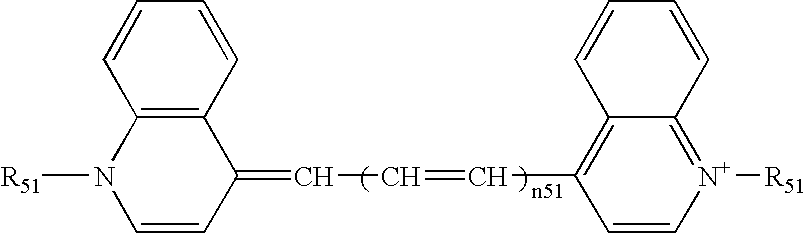
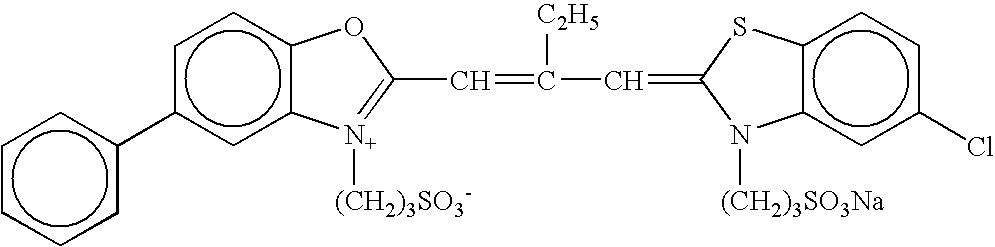
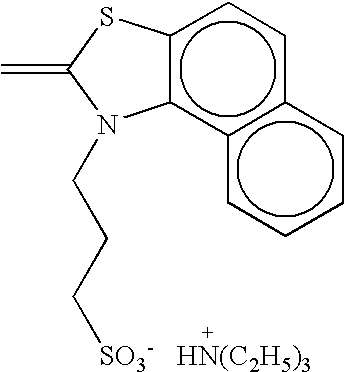
  • methine dye of undergoing non-resonant two-photon absorption for use in the present invention are set forth below, however, the present invention is not limited thereto.
  • the compound for use in the present invention is preferably a compound having a two-photon absorbing cross-sectional area ⁇ of 1,000 GM or more, because when used in the material, elevation of sensitivity, improvement of recording speed, reduction in the size of laser at recording can be obtained.
  • the two-photon absorbing cross-sectional area is more preferably 5,000 GM or more, still more preferably 10,000 GM or more, yet still more preferably 30,000 GM or more, and most preferably 60,000 GM or more.
  • the value of the two-photon absorbing cross-sectional area is a value measured in our company according to the measuring method described later in Examples.
  • the compound for use in the present invention is preferably irradiated with a laser ray having a wavelength longer than the linear absorption band of the compound to induce non-resonant two-photon absorption.
  • the compound is more preferably irradiated with a laser ray having a wavelength longer than the linear absorption band of the compound and present in the range from 400 to 1,000 nm, still more preferably with a laser ray of 400 to 800 nm, to induce non-resonant two-photon absorption.
  • the compound for use in the present invention preferably induces non-resonant two-photon absorption by the irradiation of a laser ray having a wavelength longer than the linear absorption band of the compound and generates emission from the resulting excited state.
  • the compound for use in the present invention may undergo non-resonant multi-photon absorption and non-resonant multi-photon emission of three or more photons.
  • the content of the dye in the two-photon absorbing material is not particularly limited, but may be properly selected from the range of 0.01 to 100% by weight based on the use thereof.
  • the two-photon absorbing material of the present invention can be applied to optical recording medium, three-dimensional optical recording medium, three-dimensional volume display, three-dimensional stereo-lithography, two-photon contrasting, two-photon photo-dynamic therapy (PDT), up-conversion laser and the like.
  • Compound D-1 of the present invention can be synthesized by the following method.
  • Benzoxazole [3] (52.25 g (0.2 mol)) and 45.75 g (0.375 mol) of propane sultone [4] were stirred under heating at 140° C. for 4 hours. After cooling, acetone was added and crystals were separated by filtration and washed with acetone to obtain 70.42 g (yield: 85%) of a quaternary salt [5].
  • the quaternary salt [5] (66.2 g (0.2 mol)), 200 ml of triethyl orthopropionate, 200 ml of pyridine and 80 ml of acetic acid were stirred under heating at 120° C. for 1 hour. After cooling, the reaction solution was washed by decantation three times with ethyl acetate and then dissolved and stirred in 100 ml of methanol. Thereto, a 20 ml methanol solution containing 4.0 g (50 mmol) of sodium acetate was added and crystals produced were separated by filtration. These crystals were further dispersed in methanol and then separated by filtration to
  • Benzoxazole [3] (52.25 g (0.2 mol)) and 45.75 g (0.375 mol) of propane sultone [4] were stirred under heating at 140° C. for 4 hours. After cooling, acetone was added and crystals were separated by filtration and washed with acetone to obtain 70.42 g (yield: 85%) of a quaternary salt [5].
  • the quaternary salt [5] (66.2 g (0.2 mol)), 200 ml of triethyl orthopropionate, 200 ml of pyridine and 80 ml of acetic acid were stirred under heating at 120° C. for 1 hour. After cooling, the reaction solution was washed by decantation three times with ethyl acetate and then dissolved and stirred in 100 ml of methanol. Thereto, a 20 ml methanol solution containing 4.0 g (50 mmol) of sodium acetate was added and crystals produced were separated by filtration. These crystals were further dispersed in methanol and then separated by filtration to obtain 31.36 g (yield: 43.4%) of the objective D-1 as vermilion crystal.
  • Compound D-117 of the present invention can be synthesized by the following method.
  • Compound D-149 of the present invention can be synthesized by the following method.
  • cyanine dyes merocyanine dyes, oxonol dyes and the like can also be synthesized according to the methods described, for example, in F. M. Harmer, Heterocyclic Compounds—Cyanine Dyes and Related Compounds , John Wiley & Sons, New York, London (1964), and D. M. Sturmer, Heterocyclic Compounds—Special Topics in Heterocyclic Chemistry , Chap. 18, Sec. 14, pp. 482-515, John Wiley & Sons, New York, London.
  • the synthesis method of the compounds for use in the present invention is not limited thereto.
  • the two-photon absorbing cross-sectional area of the compound for use in the present invention was evaluated by referring to the method described in M. A. Albota et al., Appl. Opt. , Vol. 37, page 7352 (1998).
  • a Ti:sapphire pulse laser pulse width: 100 fs, repetition: 80 MH, average output: 1 W, peak power: 100 kW
  • the two-photon absorbing cross-sectional area was measured in the wavelength range from 700 to 1,000 nm.
  • rhodamine B and fluoresceine were measured as standard substances and the measured values obtained were corrected by using the two-photon absorbing cross-sectional area values of rhodamine B and fluoresceine described in C. Xu et al., J. Opt. Soc. Am. B , Vol. 13, page 481 (1996), whereby the two-photon absorbing cross-sectional area of each compound was obtained.
  • a solution having dissolved therein a compound in a concentration of 1 ⁇ 10 ⁇ 4 was used as the sample for the measurement of two-photon absorption.
  • the value shown in Table 1 is a maximum value of two-photon absorbing cross-sectional area in the range of measurement wavelength.
  • the compound for use in the present invention has a very large two-photon absorbing cross-sectional area as compared with Comparative Compound 1.
  • Aqueous Solution A and 5 ml of Aqueous Solution B were charged into a test tube and mixed to prepare an aqueous 0.5 wt % gelatin•10 ⁇ 4 M D-1 solution and this aqueous solution was left standing at 25° C. for 3 hours and then measured on the absorption spectrum. The same operation was performed for D-19 and D-35.
  • the two-photon absorbing cross-sectional area of the compound for use in the present invention was evaluated by referring to the method described in M. A. Albota et al., Appl. Opt. , Vol. 37, page 7352 (1998).
  • a Ti:saphire pulse laser pulse width: 100 fs, repetition: 80 MH, average output: 1 W, peak power: 100 kW
  • the two-photon absorbing cross-sectional area was measured in the wavelength range from 700 to 1,000 nm.
  • rhodamine B and fluoresceine were measured as standard substances and the measured values obtained were corrected by using the two-photon absorbing cross-sectional area values of rhodamine B and fluoresceine described in C. Xu et al., J. Opt. Soc. Am. B , Vol. 13, page 481 (1996), whereby the two-photon absorbing cross-sectional area of each compound was obtained.
  • samples for the measurement of two-photon absorption aqueous 0.5 wt % gelatin.
  • the value shown in the Table is a maximum value of two-photon absorbing cross-sectional area in the range of measurement wavelength.
  • a Ti:sapphire pulse laser (720 nm) was irradiated to measure the non-resonant two-photon emission spectrum. From the obtained emission spectrum area, the non-resonant two-photon emission intensity was determined.
  • a Ti:sapphire pulse laser (1,000 nm) was irradiated on Comparative Sample 1 to measure the non-resonant two-photon emission spectrum.
  • the obtained emission spectrum areas (non-resonant two-photon emission intensities) are shown in Table 4 as a relative value by taking the value of Comparative Sample 1 as 1.
  • the two-photon absorbing compound of the present invention exhibits a remarkably large non-resonant two-photon emission intensity as compared with Comparative Compound “dye 1”.
  • a non-resonant two-photon absorbing and emitting material capable of giving non-resonant two-photon absorption and two-photon emission by far stronger than conventional materials can be obtained. Furthermore, by using the intermolecular aggregation state of the compound of the present invention, a non-resonant two-photon absorbing and emitting material capable of giving non-resonant two-photon absorption and two-photon emission stronger than the monomer state can be obtained.

Landscapes

  • Chemical & Material Sciences (AREA)
  • Organic Chemistry (AREA)
  • Physics & Mathematics (AREA)
  • Nonlinear Science (AREA)
  • General Physics & Mathematics (AREA)
  • Engineering & Computer Science (AREA)
  • Optics & Photonics (AREA)
  • Nanotechnology (AREA)
  • Mathematical Physics (AREA)
  • Theoretical Computer Science (AREA)
  • Crystallography & Structural Chemistry (AREA)
  • Optical Modulation, Optical Deflection, Nonlinear Optics, Optical Demodulation, Optical Logic Elements (AREA)
  • Optical Record Carriers And Manufacture Thereof (AREA)
  • Organic Low-Molecular-Weight Compounds And Preparation Thereof (AREA)
  • Lasers (AREA)

Abstract

A non-resonant two-photon absorbing material is provided, comprising a methine dye undergoing a non-resonant two-photon absorption, in which the methine dye is preferably a cyanine dye, a merocyanine dye or an oxonol dye, and a non-resonant two-photon absorbing material is provided, comprising a non-resonant two-photon absorbing compound undergoing non-resonant two-photon absorption in the intermolecular aggregation state.

Description

FIELD OF THE INVENTION
The present invention relates to a material of expressing a non-linear optical effect, more specifically, the present invention relates to a non-linear optical material having a large non-resonant two-photon absorbing cross-sectional area and ensuring a high emission efficiency from the excited state resultant of non-resonant two-photon absorption.
BACKGROUND OF THE INVENTION
In general, the non-linear optical effect means a non-linear optical response proportional to the square, cube or higher power of photoelectric field applied. Known examples of the secondary non-linear optical effect proportional to the square of photoelectric field applied include second harmonic generation (SHG), optical rectification, photorefractive effect, Pockels effect, parametric amplification, parametric oscillation, light sum frequency mixing and light difference frequency mixing. Examples of the ternary non-linear optical effect include third harmonic generation (THG), optical Kerr effect, self-induced refractive index change and two-photon absorption.
As the non-linear optical material of exhibiting these non-linear optical effects, a large number of inorganic materials have been heretofore found. However, inorganic materials can be hardly used in practice because so-called molecular design so as to optimize desired non-linear optical characteristics or various properties necessary for the production of a device is difficult. On the other hand, organic compounds can realize not only optimization of desired non-linear optical characteristics by the molecular design but also control of other various properties and therefore, the probability of its practical use is high. Thus, organic compounds are attracting attention as a promising non-linear optical material.
In recent years, among non-linear optical characteristics of the organic compound, ternary non-linear optical effects, particularly, non-resonant two-photon absorption and non-resonant two-photon emission, are being taken notice of. The two-photon absorption is a phenomenon such that a compound is excited by simultaneously absorbing two photons. In the case where the two-photon absorption occurs in the energy region having no (linear) absorption band of the compound, this is called resonant two-photon absorption. The non-resonant two-photon emission means emission generated by an excited molecule resultant of the non-resonant two-photon absorption in the radiation inactivation process of the excited state. In the following, even when not particularly specified, two-photon absorption and two-photon emission indicate non-resonant two-photon absorption and non-resonant two-photon emission, respectively.
The non-resonant two-photon absorption efficiency is proportional to the square of photoelectric field applied (square-law characteristic of two-photon absorption). Therefore, when a laser is irradiated on a two-dimensional plane, two-photon absorption takes place only in the position having a high electric field strength at the center part of laser spot and utterly no two-photon absorption occurs in the portion having a weak electric field strength in the periphery. On the other hand, in a three-dimensional space, two-photon absorption occurs only in the region having a large electric field strength at the focus where the laser rays are converged through a lens, and two-photon absorption does not take place at all in the off-focus region because the electric field strength is weak. As compared with the linear absorption where excitation occurs in all positions proportionally to the strength of photoelectric field applied, in the non-resonant two-photon absorption, excitation occurs only at one point inside the space by virtue of the square-law characteristic and therefore, the space resolution is remarkably enhanced. Usually, in the case of inducing non-resonant two-photon absorption, a short pulse laser in the near infrared region having a wavelength longer than the wavelength region where the (linear) absorption band of a compound is present, and not having the absorption of the compound is used in many cases. Since a near infrared ray in a so-called transparent region where the (linear) absorption band of a compound is not present is used, the excitation light can reach the inside of a sample without being absorbed or scattered and one point inside the sample can be excited with very high space resolution due to the square-law characteristic of non-resonant two-photon absorption. Therefore, application of the non-resonant two-photon absorption and non-resonant two-photon emission to two-photon contrasting of a living organism or two-photon photodynamic therapy is being expected. Furthermore, when non-resonant two-photon absorption and two-photon emission is used, a photon having an energy higher than the energy of incident photon can be taken out, therefore, in view of a wavelength converting device, studies on up-conversion lasing are also reported. In addition, application of the two-photon absorbing compound to three-dimensional optical recording medium, three-dimensional display, three-dimensional stereolithography and the like is also expected.
As the organic compound of undergoing two-photon emission or up-conversion lasing with good efficiency, so-called stilbazolium derivatives are known (see, G. S. He, et al., Appl. Phys. Lett., 67, 3703 (1995), G. S. He, et al., Appl. Phys. Lett., 67, 2433 (1995), G. S. He, et al., Appl. Phys. Lett., 68, 3549 (1996), G. S. He, et al., J. Appl. Phys., 81, 2529 (1997), P. N. Prasad, et al., Nonlinear Optics, 21, 39 (1999), Y. Ren, et al., J. Mater. Chem., 10, 2025 (2000), G. Zhou, et al., Jpn. J. Appl. Phys., 40, 1250 (2001), and M. Albota, et al., Science, Vol. 281, page 1653 (1998). Furthermore, various applications using the two-photon emission of a stilbazolium compound having a specific structure are described in W097/09043.
In the case of applying the non-resonant two-photon emission to contrasting of a living organism, photodynamic therapy, up-conversion lasing or the like, the two-photon absorption efficiency (two-photon absorbing cross-sectional area) of the organic compound used and the emission efficiency from the excited state resultant of the two-photon absorption must be high. In order to obtain 2-fold two-photon emission intensity by using the same organic compound, 4-fold excitation light intensity is necessary due to the square-law characteristic of two-photon absorption. However, irradiation of excessively strong laser light highly probably incurs, for example, photo-damage of a living organism or photo-deterioration of the two-photon emitting dye itself and therefore, this is not preferred. Accordingly, in order to obtain strong two-photon emission with weak excitation light intensity, an organic compound of efficiently undergoing two-photon absorption and two-photon emission must be developed. The two-photon emission efficiency of stilbazolium derivatives cannot fully satisfy the performance in practical uses.
With recent progress of the advanced information society, a three-dimensional optical recording medium is abruptly attracting an attention as an ultimate high-density, high-capacity recording medium. In the three-dimensional optical recording medium, bit recording is superposed in tens or hundreds of layers in the three-dimensional (thickness) direction to achieve super high-density and super high-capacity recording as large as tens or hundreds of times conventional two-dimensional recording mediums. In order to provide a three-dimensional optical recording medium, access and writing must be performed at an arbitrary position in the three-dimensional (thickness) direction and as a technique therefor, a method of using a two-photon absorbing material is effective.
In the medical field, a three-dimensional display or three-dimensional stereolithography of enabling many persons to observe a natural solid without spectacles is demanded so as to apply a more adequate therapy to a three-dimensionally intricate site such as brain or ear. As a promising material therefor, a three-dimensional volume display or three-dimensional stereolithography composition using two-photon absorption is expected.
However, for practically using the three-dimensional optical recording medium, three-dimensional volume display or stereolithography composition, a high-speed recording technique is necessary. Since the recording speed is proportional to the two-photon absorbing cross-sectional area, if a known two-photon absorbing compound having a low two-photon absorption efficiency is used, a practical material or system cannot be provided. Under these circumstances, development of a compound having a very large two-photon absorbing cross-sectional area is keenly demanded.
As described above, use of non-resonant two-photon absorption and non-resonant two-photon emission enables various applications characterized by very high space resolution. However, two-photon emitting compounds usable at present are low in the two-photon absorbing ability and also bad in the two-photon emission efficiency and therefore, a very high-output laser is necessary as an excitation light source of inducing two-photon absorption and two-photon emission.
SUMMARY OF THE INVENTION
An object of the present invention is to provide an organic material capable of absorbing two photons with good efficiency, namely, an organic material having a large two-photon absorbing cross-sectional area, and also provide an organic material capable of exhibiting two-photon emission having a large emission intensity.
The present inventors have made extensive investigations, as a result, the object of the present invention can be attained by the following techniques.
1. A non-resonant two-photon absorbing material comprising a methine dye undergoing a non-resonant two-photon absorption.
2. The non-resonant two-photon absorbing material as described in the item 1, wherein the methine dye is at least one selected from the group consisting of a cyanine dye, a merocyanine dye and an oxonol dye.
3. The non-resonant two-photon absorbing material as described in the item 2, wherein the cyanine dye, the merocyanine dye and the oxonol dye are represented by the following formulae (1), (2) and (3), respectively:
Figure US07432036-20081007-C00001
Figure US07432036-20081007-C00002
4. The non-resonant two-photon absorbing material as described in the item 3, wherein na1, na2 and na3 all represent 0.
5. The non-resonant two-photon absorbing material as described in the item 2 or 3, wherein the cyanine dye, the merocyanine dye and the oxonol dye are represented by the following formulae (4), (5) and (6), respectively:
Figure US07432036-20081007-C00003
Figure US07432036-20081007-C00004
Figure US07432036-20081007-C00005

wherein in formula (4), Ra1 and Ra2, Ma3 to Ma5, ka1, CI and y have the same meanings as in the formula (1), X1 and X2 each independently represents —O—, —S—, —NR3—or —CR4R5—, R3, R4 and R5 each independently represents a hydrogen atom, an alkyl group, an alkenyl group, an aryl group or a heterocyclic group, R1 and R2 each independently represents a substituent, and a1 and a2 each independently represents an integer of 0 to 4, provided that when a1 and a2 each is 2 or more, multiple R1s may be the same or different and may combine with each other to form a ring and multiple R2s may be the same or different and may combine with each other to form a ring;
in formula (5), X1, R3, R4, R5, R1 and a1 have the same meanings as in the formula (4), and Ma10, Ma11, Ra3, Za4, ka2, CI and y have the same meanings as in the formula (2), provided that when al is 2 or more, multiple R1s may be the same or different and may combine with each other to form a ring; and
in formula (6), Ma12 to Ma14, ka3, CI and y have the same meanings as in the formula (3), X11, and X12 each independently represents either O or S, and R11 to R14 each independently represents a hydrogen atom, an alkyl group, an alkenyl group, an aryl group or a heterocyclic group.
6. The non-resonant two-photon absorbing material as described in any one of the items 3 to 5, wherein ka1 and ka3 each is an integer of 0 to 2 and ka2 is an integer
Figure US07432036-20081007-C00006

wherein Za1, Za2 and Za3 each represents an atomic group for forming a 5- or 6-membered nitrogen-containing heterocyclic ring, Za4, Za5 and Za6 each represents an atomic group for forming a 5- or 6-membered ring, Ra1, Ra2 and Ra3 each independently represents a hydrogen atom, an alkyl group, an alkenyl group, an aryl group or a heterocyclic group, Ma1 to Ma14 each independently represents a methine group, which may have a substituent or may form a ring together with another methine group, na1, na2 and na3 each represents 0 or 1, ka1 and ka3 each represents an integer of 0 to 3, provided that when ka1 is 2 or more, multiple Ma3s may be the same or different and multiple Ma4s may be the same or different and when ka3 is 2 or more, multiple Ma12s may be the same or different and multiple Ma13s may be the same or different, ka2 represents an integer of 0 to 8, provided that when ka2 is 2 or more, multiple Ma10s may be the same or different and multiple Ma11, may be the same or different, CI represents an ion for neutralizing the electric charge, and y represents a number necessary for the neutralization of electric charge. of 0 to 4.
7. The non-resonant two-photon absorbing material as described in the item 6, wherein ka1 and ka3 each is 1 or 2 and ka2 is an integer of 1 to 3.
8. The non-resonant two-photon absorbing material as described in any one of the items 3 to 7, wherein Ra1, Ra2 and Ra3 all represent an alkyl group.
9. The non-resonant two-photon absorbing material as described in any one of the items 5 to 8, wherein R3, R4 and R5 all represent an alkyl group.
10. The non-resonant two-photon absorbing material as described in any one of the items 5 to 9, wherein X1 and X2 in formula (4) each independently represents —O—, —NR3— or —CR4R5—.
11. The non-resonant two-photon absorbing material as described in the item 10, wherein at least one of X1 and X2 represents —O— or —NR3—.
12. The non-resonant two-photon absorbing material as described in the item 11, wherein at least one of X1 and X2 represents —O—.
13. The non-resonant two-photon absorbing material as described in the item 12, wherein X1 and X2 both represent —O—.
14. The non-resonant two-photon absorbing material as described in any one of the items 5 to 13, wherein in formulae (4) and (5), a1 and a2 each independently represents an integer of 0 to 2.
15. The non-resonant two-photon absorbing material as described in any one of the items 5 to 14, wherein in formulae (4) and (5), R1 and R2 each is substituted at the 5-position (respective para-positions of X1 and X2) on the benzene ring.
16. The non-resonant two-photon absorbing material as described in any one of the items 5 to 15, wherein in formula (4), R1 and R2 each independently represents a chlorine atom, a bromine atom, a fluorine atom, an iodine atom, a sulfo group, a methyl group, a phenyl group or a pyrrole group.
17. The non-resonant two-photon absorbing material as described in the item 16, wherein R1 and R2 each independently represents a chlorine atom, a bromine atom, a sulfo group, a methyl group or a phenyl group.
18. The non-resonant two-photon absorbing material as described in the item 16, wherein R1 and R2 each independently represents a chlorine atom or a bromine atom.
19. The non-resonant two-photon absorbing material as described in the item 18, wherein at least one of R1 and R2 represents a chlorine atom.
20. The non-resonant two-photon absorbing material as described in (19), wherein R1 and R2 both are a chlorine atom.
21. The non-resonant two-photon absorbing material as described in the item 20, wherein X1 and X2 both represent —O—, R1 and R2 both represent a chlorine atom, and a1 and a2 both represent 1, in which R1 and R2 each are substituted at the 5-position on the benzene ring.
22. The non-resonant two-photon absorbing material as described in any one of the items 5 to 9, 14 and 15, wherein in formula (5), X1 each independently represents —O—, —S— or —CR4R5—.
23. The non-resonant two-photon absorbing material as described in any one of the items 3 to 9, 14, 15 and 22, wherein in the formulae (2), (3) and (5), the ring formed by Za4, Za5 or Za6 each is 2-pyrazolon-5-one, pyrazolidine-3,5-dione, rhodanine, indane-1,3-dione, thiophen-3-one, thiophen-3-one-1,1-dioxide, 1,3-dioxane-4,6-dione, barbituric acid, 2-thiobarbituric acid or coumarin-2,4-dione.
24. The non-resonant two-photon absorbing material as described in the item 23, wherein in formulae (2) and (5), the ring formed by Za4 is pyrazolidine-3,5-dione, indane-1,3-dione, 1,3-dioxane-4,6-dione, barbituric acid or 2-thiobarbituric acid.
25. The non-resonant two-photon absorbing material as described in the item 24, wherein the ring formed by Za4 is pyrazolidine-3,5-dione, barbituric acid or 2-thiobarbituric acid.
26. The non-resonant two-photon absorbing material as described in the item 25, wherein the ring formed by Za4 is 2-thiobarbituric acid.
27. The non-resonant two-photon absorbing material as described in any one of the items 3 to 7, wherein in formula (3), the rings formed by Za5 and Za6 each is barbituric acid or 2-thiobarbituric acid.
28. The non-resonant two-photon absorbing material as described in any one of the items 5 to 7 and 27, wherein in formula (6), X11 and X12 both represent O.
29. The non-resonant two-photon absorbing material as described in any one of the items 5 to 7, 27 and 28, wherein in formula (6), R11 to R14 each independently represents a hydrogen atom, an alkyl group or an aryl group.
30. The non-resonant two-photon absorbing material as described in any one of the items 3 to 29, wherein in formulae (1) to (6), Ma1 to Ma14 each independently represents an unsubstituted methine group, a methyl-substituted methine group or an ethyl-substituted methine group.
31. A non-resonant two-photon absorbing material comprising a non-resonant two-photon absorbing compound undergoing non-resonant two-photon absorption in the intermolecular aggregation state.
32. A non-resonant two-photon absorbing material comprising a non-resonant two-photon absorbing compound represented by any one of the formulae (1) to (6), the non-resonant two-photon absorbing compound undergoing non-resonant two-photon absorption in the intermolecular aggregation state.
33. The non-resonant two-photon absorbing material as described in any one of the items 1 to 32, wherein the non-resonant two-photon absorbing compound has a two-photon absorbing cross-sectional area δ of 1,000 GM or more.
34. The non-resonant two-photon absorbing material as described in any one of the items 1 to 32, wherein the non-resonant two-photon absorbing compound has a two-photon absorbing cross-sectional area δ of 10,000 GM or more.
35. The non-resonant two-photon absorbing material as described in any one of the items 1 to 32, wherein the non-resonant two-photon absorbing compound has a two-photon absorbing cross-sectional area δ of 30,000 GM or more.
36. The non-resonant two-photon absorbing material as described in any one of the items 1 to 32, wherein the non-resonant two-photon absorbing compound has a two-photon absorbing cross-sectional area δ of 60,000 GM or more.
37. A non-resonant two-photon emitting material comprising the non-resonant two-photon emitting dye described in any one of the items 1 to 36, wherein the non-resonant two-photon emitting dye undergoes a two-photon emitting.
38. A method for inducing a non-resonant two-photon absorption, which comprises irradiating the dye undergoing a non-resonant two-photon absorption described in any one of the items 1 to 37 with a laser ray having a wavelength longer than the linear absorption band of the dye to induce a two-photon absorption.
39. A method for inducing a non-resonant two-photon absorption, which comprises irradiating the dye undergoing a non-resonant two-photon absorption described in any one of the items 1 to 38 with a laser ray having a wavelength longer than the linear absorption band of the dye and present in the range of 400 to 1,000 nm to induce a two-photon absorption.
40. A method for inducing a non-resonant two-photon absorption, which comprises irradiating the dye undergoing a non-resonant two-photon absorption described in any one of the items 1 to 38 with a laser ray having a wavelength longer than the linear absorption band of the dye and present in the range of 400 to 800 nm to induce a two-photon absorption.
41. A method for generating an emission, comprising irradiating the dye undergoing a non-resonant two-photon absorption described in the item 37 with a laser ray having a wavelength longer than the linear absorption band of the dye to induce a two-photon absorption and generate an emission.
42. An optical recording medium comprising the non-resonant two-photon absorbing material described in any one of the items 1 to 41.
43. A three-dimensional optical recording medium comprising the non-resonant two-photon absorbing material described in any one of the items 1 to 41.
44. A three-dimensional volume display comprising the non-resonant two-photon absorbing material described in any one of the items 1 to 41.
45. A three-dimensional stereolithography comprising the non-resonant two-photon absorbing material described in any one of the items 1 to 41.
DETAILED DESCRIPTION OF THE INVENTION
The compound of undergoing non-resonant two-photon absorption for use in the present invention is described in detail below.
In the present invention, when a specific moiety is called “a group”, unless otherwise indicated, this means that the group may or may not be substituted by one or more (up to the maximum possible number) substituent. For example, “an alkyl group” means a substituted or unsubstituted alkyl group. The substituent which can be used in the compound for use in the present invention may be any substituent.
In the present invention, when a specific moiety is called “a ring” or when “a ring” is contained in “a group”, unless otherwise indicated, the ring may be a monocyclic ring or a condensed ring or may or may not be substituted.
For example, “an aryl group” may be a phenyl group or a naphthyl group or may be a substituted phenyl group.
The methine dye of undergoing non-resonant two-photon absorption for use in the present invention is described below.
Incidentally, the dye as used in the present invention is a generic term of compounds having a part of the absorption in the ultraviolet region (200 to 400 nm), visible region (400 to 700 nm) and/or near infrared region (700 to 2,000 nm).
Examples of the methine dye for use in the present invention include cyanine dyes, hemicyanine dyes, strepto-cyanine dyes, styryl dyes, merocyanine dyes, trinuclear merocyanine dyes, tetranuclear merocyanine dyes, rhodacyanine dyes, complex cyanine dyes, complex merocyanine dyes, allopolar dyes, oxonol dyes, hemioxonol dyes, squalium dyes, arylidene dyes and polyene dyes.
Among these methine dyes, preferred in the present invention are cyanine dyes, hemicyanine dyes, strepto-cyanine dyes, styryl dyes, merocyanine dyes, oxonol dyes, squalium dyes and arylidene dyes, more preferred are cyanine dyes, merocyanine dyes and oxonol dyes, and most preferred are cyanine dyes.
These dyes are described in detail, for example, in F. M. Harmer, Heterocyclic Compounds-Cyanine Dyes and Related Compounds, John Wiley & Sons, New York, London (1964), D. M. Sturmer, Heterocyclic Compounds-Special topics in heterocyclic chemistry, Chap. 18, Section 14, pp. 482-515, John Wiley & Sons, New York, London (1977), and Rodd's Chemistry of Carbon Compounds, 2nd ed., Vol. IV, Part B, Chap. 15, pp. 369-422, Elsevier Science Publishing Company Inc., New York (1977).
Specific examples of the cyanine, merocyanine and oxonol dyes include those described in F. M. Harmer, Heterocyclic Compounds-Cyanine Dyes and Related Compounds, John Wiley & Sons, New York, London (1964).
As for the formulae of the cyanine and merocyanine dyes, formulae (XI) and (XII) described at pages 21 and 22 of U.S. Pat. No. 5,340,694 are preferred (however, the numbers represented by n12 and n15 are not limited and each is an integer of 0 or more (preferably 4 or less)).
The methine dye of undergoing non-resonant two-photon absorption for use in the present invention is preferably a cyanine dye, merocyanine dye or an oxonol dye.
The methine dye of undergoing non-resonant two-photon absorption for use in the present invention is more preferably a cyanine dye represented by formula (1).
In formula (1), Za1 and Za2 each represents an atomic group for forming a 5- or 6-membered nitrogen-containing heterocyclic ring. Preferred examples of the 5- or 6-membered nitrogen-containing heterocyclic ring formed include oxazole nuclei having a carbon number (hereinafter referred to as “a C number”) of 3 to 25 (e.g., 2-3-methyloxazolyl, 2-3-ethyloxazolyl, 2-3,4-diethyloxazolyl, 2-3-methylbenzoxazolyl, 2-3-ethylbenzoxazolyl, 2-3-sulfoethylbenzoxazolyl, 2-3-sulfopropylbenzoxazolyl, 2-3-methylthioethylbenzoxazolyl, 2-3-methoxyethylbenzoxazolyl, 2-3-sulfobutylbenzoxazolyl, 2-3-methyl-β-naphthoxazolyl, 2-3-methyl-α-naphthoxazolyl, 2-3-sulfopropyl-β-naphthoxazolyl, 2-3-sulfopropyl-γ-naphthoxazolyl, 2-3-(3-naphthoxyethyl)-benzoxazolyl, 2-3,5-dimethylbenzoxazolyl, 2-6-chloro-3-methylbenzoxazolyl, 2-5-bromo-3-methylbenzoxazolyl, 2-3-ethyl-5-methoxybenzoxazolyl, 2-5-phenyl-3-sulfopropyl-benzoxazolyl, 2-5-(4-bromophenyl)-3-sulfobutylbenzoxazolyl, 2-3-dimethyl-5,6-dimethylthiobenzoxazolyl, 2-3-sulfopropyl-oxazoly, 2-3-sulfopropyl-γ-naphthoxazolyl, 2-3-ethyl-α-naphthoxazolyl, 2-5-chloro-4-ethyl-α-naphthoxazolyl, 2-5-chloro-3-ethylbenzoxazolyl, 2-5-chloro-3-sulfopropylbenzoxazolyl, 2-5,6-dichloro-3-sulfopropylbenzoxazolyl, 2-5-bromo-3-sulfopropylbenzoxazolyl, 2-3-ethyl-5-phenylbenzoxazolyl, 2-5-(1-pyrrolyl)-3-sulfopropylbenzoxazolyl, 2-5,6-dimethyl-3-sulfopropylbenzoxazolyl, 2-3-ethyl-5-sulfobenzoxazolyl), thiazole nuclei having a carbon number of 3 to 25 (e.g., 2-3-methylthiazolyl, 2-3-ethylthiazolyl, 2-3-sulfopropylthiazolyl, 2-3-sulfobutylthiazolyl, 2-3,4-dimethylthiazolyl, 2-3,4,4-trimethylthiazolyl, 2-3-carboxyethylthiazolyl, 2-3-methylbenzothiazolyl, 2-3-ethylbenzothiazolyl, 2-3-butylbenzothiazolyl, 2-3-sulfopropylbenzothiazolyl, 2-3-sulfobutylbenzothiazolyl, 2-3-methyl-β-naphthothiazolyl, 2-3-sulfopropyl-γ-naphthothiazolyl, 2-3-(1-naphthoxyethyl)benzothiazolyl, 2-3,5-dimethylbenzothiazolyl, 2-6-chloro-3-methylbenzothiazolyl, 2-6-iodo-3-methylbenzothiazolyl, 2-5-bromo-3-methylbenzothiazolyl, 2-3-ethyl-5-methoxybenzothiazolyl, 2-5-phenyl-3-sulfopropylbenzothiazolyl, 2-5-(4-bromophenyl)-3-sulfobutylbenzothiazolyl, 2-3-dimethyl-5,6-dimethylthiobenzothiazolyl, 2-5-chloro-3-ethylbenzothiazolyl, 2-5-chloro-3-sulfopropylbenzothiazolyl, 2-3-ethyl-5-iodobenzothiazolyl), imidazole nuclei having a carbon number of 3 to 25 (e.g., 2-1,3-diethylimidazolyl, 2-1,3-dimethylimidazolyl, 2-1-methylbenzimidazolyl, 2-1,3,4-triethylimidazolyl, 2-1,3-diethylbenzimidazolyl, 2-1,3,5-trimethylbenzimidazolyl, 2-6-chloro-1,3-dimethylbenzimidazolyl, 2-5,6-dichloro-1,3-diethylbenzimidazolyl, 2-1,3-disulfopropyl-5-cyano-6-chlorobenzimidazolyl, 2-5,6-dichloro-3-ethyl-1-sulfopropylbenzimidazolyl, 2-5-chloro-6-cyano-1,3-diethylbenzimidazolyl, 2-5-chloro-1,3-diethyl-6-trifluoromethylbenzimidazolyl), indolenine nuclei having a carbon number of 10 to 30 carbon atoms (e.g., 3,3-dimethyl-1-pentylindolenine, 3,3-dimethyl-1-sulfopropylindolenine, 5-carboxy-1,3,3-trimethylindolenine, 5-carbamoyl-1,3,3-trimethylindolenine, 1,3,3-trimethyl-4,5-benzindolenine), quinoline nuclei having a carbon number of 9 to 25 (e.g., 2-1-methylquinolyl, 2-1-ethylquinolyl, 2-1-methyl-6-chloroquinolyl, 2-1,3-diethylquinolyl, 2-1-methyl-6-methylthioquinolyl, 2-1-sulfopropylquinolyl, 4-1-methylquinolyl, 4-1-pentylquinolyl, 4-1-sulfoethylquinolyl, 4-1-methyl-7-chloroquinolyl, 4-1,8-diethylquinolyl, 4-1-methyl-6-methylthioquinolyl, 4-1-sulfopropylquinolyl), selenazole nuclei having a carbon number of 3 to 25 (e.g., 2-3-methylbenzoselenazolyl), pyridine nuclei having a carbon number of 5 to 25 (e.g., 2-pyridyl), thiazoline nuclei, oxazoline nuclei, selenazoline nuclei, tetrazoline nuclei, tetrazole nuclei, benzotellurazole nuclei, imidazoline nuclei, imidazo[4,5-quinoxaline] nuclei, oxadiazole nuclei, thiadiazole nuclei, tetrazole nuclei and pyrimidine nuclei.
The heterocyclic ring may be substituted and preferred examples of the substituent include an alkyl group (preferably having a C number of 1 to 20, e.g., methyl, ethyl, n-propyl, isopropyl, n-butyl, n-pentyl, benzyl, 3-sulfopropyl, 4-sulfobutyl, carboxymethyl, 5-carboxypentyl), an alkenyl group (preferably having a C number of 2 to 20, e.g., vinyl, allyl, 2-butenyl, 1,3-butadienyl), a cycloalkyl group (preferably having a C number of 3 to 20, e.g., cyclopentyl, cyclohexyl), an aryl group (preferably having a C number of 6 to 20, e.g., phenyl, 2-chlorophenyl, 4-methoxyphenyl, 3-methylphenyl, 1-naphthyl), a heterocyclic group (preferably having a C number of 1 to 20, e.g., pyridyl, thienyl, furyl, thiazolyl, imidazolyl, pyrazolyl, pyrrolidino, piperidino, morpholino), an alkynyl group (preferably having a C number of 2 to 20, e.g., ethynyl, 2-propynyl, 1,3-butadynyl, 2-phenylethynyl), a halogen atom (e.g., F, Cl, Br, I), an amino group (preferably having a C number of 0 to 20, e.g., amino, dimethylamino, diethylamino, dibutylamino, anilino), a cyano group, a nitro group, a hydroxyl group, a mercapto group, a carboxyl group, a sulfo group, a phosphonic acid group, an acyl group (preferably having a C number of 1 to 20, e.g., acetyl, benzoyl, salicyloyl, pivaloyl), an alkoxy group (preferably having a C number of 1 to 20, e.g., methoxy, butoxy, cyclohexyloxy), an aryloxy group (preferably having a C number of 6 to 26, e.g., phenoxy, 1-naphthoxy), an alkylthio group (preferably having a C number of 1 to 20, e.g., methylthio, ethylthio), an arylthio group (preferably having a C number of 6 to 20, e.g., phenylthio, 4-chlorophenylthio), an alkylsulfonyl group (preferably having a C number of 1 to 20, e.g., methanesulfonyl, butanesulfonyl), an arylsulfonyl group (preferably having a C number of 6 to 20, e.g., benzenesulfonyl, paratoluenesulfonyl), a sulfamoyl group (preferably having a C number of 0 to 20, e.g., sulfamoyl, N-methylsulfamoyl, N-phenylsulfamoyl), a carbamoyl group (preferably having a C number of 1 to 20, e.g., carbamoyl, N-methylcarbamoyl, N,N-dimethylcarbamoyl, N-phenylcarbamoyl), an acylamino group (preferably having a C number of 1 to 20, e.g., acetylamino, benzoylamino), an imino group (preferably having a C number of 2 to 20, e.g., phthalylimino), an acyloxy group (preferably having a C number of 1 to 20, e.g., acetyloxy, benzoyloxy), an alkoxycarbonyl group (preferably having a C number of 2 to 20, e.g., methoxycarbonyl, phenoxycarbonyl) and a carbamoylamino group (preferably having a C number of 1 to 20, e.g., carbamoylamino, N-methylcarbamoylamino, N-phenylcarbamoylamino). Among these, more preferred are an alkyl group, an aryl group, a heterocyclic group, a halogen atom, a cyano group, a carboxyl group, a sulfo group, an alkoxy group, a sulfamoyl group, a carbamoyl group and an alkoxycarbonyl group.
The heterocyclic ring may also be condensed with another ring. Preferred examples of the ring with which the heterocyclic ring is condensed include a benzene ring, a benzofuran ring, a pyridine ring, a pyrrole ring, an indole ring and a thiophene ring.
The 5- or 6-membered nitrogen-containing heterocyclic ring formed by Za1 and Za2 is more preferably an oxazole nucleus, an imidazole nucleus, a thiazole nucleus or an indolenine ring, still more preferably an oxazole nucleus, an imidazole nucleus or an indolenine ring, yet still more preferably an oxazole ring or an imidazole ring, and most preferably an oxazole nucleus.
Ra1 and Ra2 each independently represents a hydrogen atom, an alkyl group (preferably having a C number of 1 to 20, e.g., methyl, ethyl, n-propyl, isopropyl, n-butyl, n-pentyl, benzyl, 3-sulfopropyl, 4-sulfobutyl, 3-methyl-3-sulfopropyl, 2′-sulfobenzyl, carboxymethyl, 5-carboxypentyl), an alkenyl group (preferably having a C number of 2 to 20, e.g., vinyl, allyl), an aryl group (preferably having a C number of 6 to 20, e.g., phenyl, 2-chlorophenyl, 4-methoxyphenyl, 3-methylphenyl, 1-naphthyl) or a heterocyclic group (preferably having a C number of 1 to 20, e.g., pyridyl, thienyl, furyl, thiazolyl, imidazolyl, pyrazolyl, pyrrolidino, piperidino, morpholino), preferably an alkyl group (preferably an alkyl group having a C number of 1 to 6) or a sulfoalkyl group (preferably 3-sulfopropyl, 4-sulfobutyl, 3-methyl-3-sulfopropyl or 2′-sulfobenzyl).
Ma1 to Ma7 each represents a methine group and may have a substituent (preferred examples of the substituent are the same as examples of the substituent on Za1 and Za2) The substituent is preferably an alkyl group, a halogen atom, a nitro group, an alkoxy group, an aryl group, a nitro group, a heterocyclic group, an aryloxy group, an acylamino group, a carbamoyl group, a sulfo group, a hydroxy group, a carboxy group, an alkylthio group or a cyano group, more preferably an alkyl group.
Ma1 to Ma7 each is preferably an unsubstituted methine group or an alkyl group (preferably having a C number of 1 to 6)-substituted methine group, more preferably an unsubstituted methine group, an ethyl group-substituted methine group or a methyl group-substituted methine group.
Ma1 to Ma7 may combine with each other to form a ring and preferred examples of the ring formed include a cyclohexene ring, a cyclopentene ring, a benzene ring and a thiophene ring.
na1 and na2 each is 0 or 1, preferably both are 0.
ka1 represents an integer of 0 to 3, preferably 0 to 2, more preferably 1 or 2.
When ka1 is 2 or more, multiple Ma3s may be the same or different and multiple Ma4s may be the same or different.
CI represents an ion for neutralizing the electric charge and y represents a number necessary for the neutralization of electric charge.
The cyanine dye of undergoing non-resonant two-photon absorption for use in the present invention, represented by formula (1), is more preferably represented by formula (4).
In formula (4), Ra1, Ra2, Ma3 to Ma5, ka1, CI and y have the same meanings as in formula (1) and respective preferred embodiments are also the same.
X1 and X2 each independently represents —O—, —S—, —NR3— or —CR4R5—, and R3, R4 and R5 each independently represents a hydrogen atom, an alkyl group, an alkenyl group, an aryl group or a heterocyclic group (respective preferred examples are the same as those described for Ra1 and Ra2), preferably an alkyl group.
X1 and X2 each is independently preferably —O—, —NR3— or —CR4R5—, more preferably —O — or —NR3—, still more preferably —O—, and most preferably both are —O—.
R1 and R2 each independently represents a substituent (preferred examples of the substituent are the same as examples of the substituent on Za1 and Za2), preferably an alkyl group, an aryl group, a heterocyclic group, a halogen atom, a cyano group, a carboxyl group, a sulfo group, an alkoxy group, a sulfamoyl group, a carbamoyl group or an alkoxycarbonyl group.
a1 and a2 each independently represents an integer of 0 to 4, preferably 0 to 2, more preferably 0 or 1, and most preferably 1.
In this case, R1 and R2 each is independently substituted preferably at the 5-position (respective para-positions of X1 and X2) on the benzene ring.
R1 and R2 each is independently preferably a chlorine atom, a bromine atom, a fluorine atom, an iodine atom, a sulfo group, a methyl group, a phenyl group or a pyrrole group, more preferably a chlorine atom, a bromine atom, a sulfo group, a methyl group or a phenyl group, still more preferably a chlorine atom or a bromine atom, and most preferably a chlorine group.
When a1 and a2 each is 2 or more, multiple R1s may be the same or different and may combine with each other to form a ring and multiple R2s may be the same or different and may combine with each other to form a ring. Preferred examples of the ring formed include a benzene ring, a benzofuran ring, a pyridine ring, a pyrrole ring, an indole ring and a thiophene ring. Among these, a benzene ring and a benzofuran ring are more preferred.
The merocyanine dye of undergoing non-resonant two-photon absorption for use in the present invention is preferably a merocyanine dye represented by formula (2).
In formula (2), Za3 represents an atomic group for forming a 5- or 6-membered nitrogen-containing heterocyclic ring. Preferred examples of the 5- or 6-membered nitrogen-containing heterocyclic ring formed include oxazole nuclei having a carbon number (hereinafter referred to as “a C number”) of 3 to 25 (e.g., 2-3-methyloxazolyl, 2-3---ethyloxazolyl, 2-3,4-diethyloxazolyl, 2-3-methylbenzoxazolyl, 2-3-ethylbenzoxazolyl, 2-3-sulfoethylbenzoxazolyl, 2-3-sulfopropylbenzoxazolyl, 2-3-methylthioethylbenzoxazolyl, 2-3-methoxyethylbenzoxazolyl, 2-3-sulfobutylbenzoxazolyl, 2-3-methyl-β-naphthoxazolyl, 2-3-methyl-α-naphthoxazolyl, 2-3-sulfopropyl-β-naphthoxazolyl, 2-3-sulfopropyl-γ-naphthoxazolyl, 2-3-(3-naphthoxyethyl)benzoxazolyl, 2-3,5-dimethylbenzoxazolyl, 2-6-chloro-3-methylbenzoxazolyl, 2-5-bromo-3-methylbenzoxazolyl, 2-3-ethyl-5-methoxybenzoxazolyl, 2-5-phenyl-3-sulfopropylbenzoxazolyl, 2-5-(4-bromophenyl)-3-sulfobutylbenzoxazolyl, 2-3-dimethyl-5,6-dimethylthiobenzoxazolyl), thiazole nuclei having a C number of 3 to 25 (e.g., 2-3-methylthiazolyl, 2-3-ethylthiazolyl, 2-3-sulfopropylthiazolyl, 2-3-sulfobutylthiazolyl, 2-3,4-dimethylthiazolyl, 2-3,4,4-trimethylthiazolyl, 2-3-carboxyethylthiazolyl, 2-3-methylbenzothiazolyl, 2-3-ethylbenzothiazolyl, 2-3-butylbenzothiazolyl, 2-3-sulfopropylbenzothiazolyl, 2-3-sulfobutylbenzothiazolyl, 2-3-methyl-β-naphthothiazolyl, 2-3-sulfopropyl-γ-naphthothiazolyl, 2-3-(1-naphthoxyethyl)benzothiazolyl, 2-3,5-dimethylbenzothiazolyl, 2-6-chloro-3-methylbenzothiazolyl, 2-6-iodo-3-methylbenzothiazolyl, 2-5-bromo-3-methylbenzothiazolyl, 2-3-ethyl-5-methoxybenzothiazolyl, 2-5-phenyl-3-sulfopropylbenzothiazolyl, 2-5-(4-bromophenyl)-3-sulfobutylbenzothiazolyl, 2-3-dimethyl-5,6-dimethylthiobenzothiazolyl), imidazole nuclei having a C number of 3 to 25 (e.g., 2-1,3-diethylimidazolyl, 2-1,3-dimethylimidazolyl, 2-1-methylbenzimidazolyl, 2-1,3,4-triethylimidazolyl, 2-1,3-diethylbenzimidazolyl, 2-1,3,5-trimethylbenzimidazolyl, 2-6-chloro-1,3-dimethylbenzimidazolyl, 2-5,6-dichloro-1,3-diethylbenzimidazolyl, 2-1,3-disulfopropyl-5-cyano-6-chlorobenzimidazolyl), indolenine nuclei having a carbon number of 10 to 30 carbon atoms (e.g., 3,3-dimethylindolenine), quinoline nuclei having a C number of 9 to 25 (e.g., 2-1-methylquinolyl, 2-1-ethylquinolyl, 2-1-methyl-6-chloroquinolyl, 2-1,3-diethylquinolyl, 2-1-methyl-6-methylthioquinolyl, 2-1-sulfopropylquinolyl, 4-1-methylquinolyl, 4-1-sulfoethylquinolyl, 4-1-methyl-7-chloroquinolyl, 4-1,8-diethylquinolyl, 4-1-methyl-6-methylthioquinolyl, 4-1-sulfopropylquinolyl), selenazole nuclei having a C number of 3 to 25 (e.g., 2-3-methylbenzoselenazolyl), pyridine nuclei having a C number of 5 to 25 (e.g., 2-pyridyl), thiazoline nuclei, oxazoline nuclei, selenazoline nuclei, tetrazoline nuclei, tetrazole nuclei, benzotellurazole nuclei, imidazoline nuclei, imidazo[4,5-quinoxaline] nuclei, oxadiazole nuclei, thiadiazole nuclei, tetrazole nuclei and pyrimidine nuclei.
The heterocyclic ring may be substituted and preferred examples of the substituent include an alkyl group (preferably having a C number of 1 to 20, e.g., methyl, ethyl, n-propyl, isopropyl, n-butyl, n-pentyl, benzyl, 3-sulfopropyl, 4-sulfobutyl, carboxymethyl, 5-carboxypentyl), an alkenyl group (preferably having a C number of 2 to 20, e.g., vinyl, allyl, 2-butenyl, 1,3-butadienyl), a cycloalkyl group (preferably having a C number of 3 to 20, e.g., cyclopentyl, cyclohexyl), an aryl group (preferably having a C number of 6 to 20, e.g., phenyl, 2-chlorophenyl, 4-methoxyphenyl, 3-methylphenyl, 1-naphthyl), a heterocyclic group (preferably having a C number of 1 to 20, e.g., pyridyl, thienyl, furyl, thiazolyl, imidazolyl, pyrazolyl, pyrrolidino, piperidino, morpholino), an alkynyl group (preferably having a C number of 2 to 20, e.g., ethynyl, 2-propynyl, 1,3-butadynyl, 2-phenylethynyl), a halogen atom (e.g., F, Cl, Br, I), an amino group (preferably having a C number of 0 to 20, e.g., amino, dimethylamino, diethylamino, dibutylamino; anilino), a cyano group, a nitro group, a hydroxyl group, a mercapto group, a carboxyl group, a sulfo group, a phosphonic acid group, an acyl group (preferably having a C number of 1 to 20, e.g., acetyl, benzoyl, salicyloyl, pivaloyl), an alkoxy group (preferably having a C number of 1 to 20, e.g., methoxy, butoxy, cyclohexyloxy), an aryloxy group (preferably having a C number of 6 to 26, e.g., phenoxy, 1-naphthoxy), an alkylthio group (preferably having a C number of 1 to 20, e.g., methylthio, ethylthio), an arylthio group (preferably having a C number of 6 to 20, e.g., phenylthio, 4-chlorophenylthio), an alkylsulfonyl group (preferably having a C number of 1 to 20, e.g., methanesulfonyl, butanesulfonyl), an arylsulfonyl group (preferably having a C number of 6 to 20, e.g., benzenesulfonyl, paratoluenesulfonyl), a sulfamoyl group (preferably having a C number of 0 to 20, e.g., sulfamoyl, N-methylsulfamoyl, N-phenylsulfamoyl), a carbamoyl group (preferably having a C number of 1 to 20, e.g., carbamoyl, N-methylcarbamoyl, N,N-dimethylcarbamoyl, N-phenylcarbamoyl), an acylamino group (preferably having a C number of 1 to 20, e.g., acetylamino, benzoylamino), an imino group (preferably having a C number of 2 to 20, e.g., phthalylimino), an acyloxy group (preferably having a C number of 1 to 20, e.g., acetyloxy, benzoyloxy), an alkoxycarbonyl group (preferably having a C number of 2 to 20, e.g., methoxycarbonyl, phenoxycarbonyl) and a carbamoylamino group (preferably having a C number of 1 to 20, e.g., carbamoylamino, N-methylcarbamoylamino, N-phenylcarbamoylamino). Among these, more preferred are an alkyl group, an aryl group, a heterocyclic group, a halogen atom, a cyano group, a carboxyl group, a sulfo group, an alkoxy group, a sulfamoyl group, a carbamoyl group and an alkoxycarbonyl group.
The heterocyclic ring may also be condensed with another ring. Preferred examples of the ring with which the heterocyclic ring is condensed include a benzene ring, a benzofuran ring, a pyridine ring, a pyrrole ring, an indole ring and a thiophene ring.
The 5- or 6-membered nitrogen-containing heterocyclic ring formed by Za3 is more preferably an oxazole nucleus, an imidazole nucleus, a thiazole nucleus or an indolenine ring, still more preferably an oxazole nucleus, a thiazole ring or an indolenine ring.
Za4 represents an atomic group for forming a 5- or 6-membered ring. The ring formed by Za4 is a moiety generally called an acidic nucleus which is defined in James (compiler), The Theory of the Photographic Process, 4th ed., page 198, Macmillan (1977). The ring formed by Za4 is preferably a nucleus such as 2-pyrazolon-5-one, pyrazolidine-3,5-dione, imidazolin-5-one, hydantoin, 2- or 4-thiohydantoin, 2-iminooxazolidin-4-one, 2-oxazolin-5-one, 2-thiooxazoline-2,4-dione, isorhodanine, rhodanine, indane-1,3-dione, thiophen-3-one, thiophen-3-one-l,1-dioxide, indolin-2-one, indolin-3-one, 2-oxoindazolium, 5,7-dioxo-6,7-dihydrothiazolo[3,2-a]pyrimidine, 3,4-dihydroisoquinolin-4-one, 1,3-dioxane-4,6-dione, barbituric acid, 2-thiobarbituric acid, coumarin-2,4-dione, indazolin-2-one, pyrido[1,2-a]pyrimidine-1,3-dione, pyrazolo[1,5-b]quinazolone or pyrazolopyridone.
The ring formed by Za4 is more preferably 2-pyrazolon-5-one, pyrazolidine-3,5-dione, rhodanine, indane-1,3-dione, thiophen-3-one, thiophen-3-one-1,1-dioxide, 1,3-dioxane-4,6-dione, barbituric acid, 2-thiobarbituric acid or coumarin-2,4-dione, still more preferably pyrazolidine-3,5-dione, indane-1,3-dione, 1,3-dioxane-4,6-dione, barbituric acid or 2-thiobarbituric acid, yet still more preferably pyrazolidine-3,5-dione, barbituric acid or 2-thiobarbituric acid, and most preferably 2-thiobarbituric acid.
The ring formed by Za4 may be substituted (preferred examples of the substituent are the same as examples of the substituent on Za3) and the substituent is preferably an alkyl group, an aryl group, a heterocyclic group, a halogen atom a cyano group, a carboxyl group, a sulfo group, an alkoxy group, a sulfamoyl group, a carbamoyl group or an alkoxycarbonyl group.
The heterocyclic ring may also be condensed with another ring. Preferred examples of the ring with which the heterocyclic ring is condensed include a benzene ring, a benzofuran ring, a pyridine ring, a pyrrole ring, an indole ring and a thiophene ring.
Each Ra3 independently represents a hydrogen atom, an alkyl group (preferably having a C number of 1 to 20, e.g., methyl, ethyl, n-propyl, isopropyl, n-butyl, n-pentyl, benzyl, 3-sulfopropyl, 4-sulfobutyl, 3-methyl-3-sulfopropyl, 2′-sulfobenzyl, carboxymethyl, 5-carboxypentyl), an alkenyl group (preferably having a C number of 2 to 20, e.g., vinyl, allyl), an aryl group (preferably having a C number of 6 to 20, e.g., phenyl, 2-chlorophenyl, 4-methoxyphenyl, 3-methylphenyl, 1-naphthyl) or a heterocyclic group (preferably having a C number of 1 to 20, e.g., pyridyl, thienyl, furyl, thiazolyl, imidazolyl, pyrazolyl, pyrrolidino, piperidino, morpholino), preferably an alkyl group (preferably an alkyl group having a C number of 1 to 6) or a sulfoalkyl group (preferably 3-sulfopropyl, 4-sulfobutyl, 3-methyl-3-sulfopropyl or 2′-sulfobenzyl).
Ma8 to Ma11 each represents a methine group and may have a substituent (preferred examples of the substituent are the same as examples of the substituent on Za1 and Za2). The substituent is preferably an alkyl group, a halogen atom, a nitro group, an alkoxy group, an aryl group, a nitro group, a heterocyclic group, an aryloxy group, an acylamino group, a carbamoyl group, a sulfo group, a hydroxy group, a carboxy group, an alkylthio group or a cyano group, more preferably an alkyl group.
Ma8to Ma11 each is preferably an unsubstituted methine group or an alkyl group (preferably having a C number of 1 to 6)-substituted methine group, more preferably an unsubstituted methine group, an ethyl groupsubstituted methine group or a methyl group-substituted methine group.
Ma8 to Ma11 may combine with each other to form a ring and preferred examples of the ring formed include a cyclohexene ring, a cyclopentene ring, a benzene ring and a thiophene ring.
na3 is 0 or 1, preferably 0.
ka3 represents an integer of 0 to 8, preferably 0 to 4, more preferably 1 to 3.
When ka3 is 2 or more, multiple Ma10s may be the same or different and multiple Ma11s may be the same or different.
CI represents an ion for neutralizing the electric charge and y represents a number necessary for the neutralization of electric charge.
The merocyanine dye of undergoing non-resonant two-photon absorption for use in the present invention, represented by formula (2), is more preferably represented by formula (5).
In formula (2), Ma10, Ma11, Ra3, Za4, ka3, CI and y have the same meanings as in formula (1).
In formula (2), X1 represents —O—, —S—, —NR3— or —CR4R5—, and R3, R4 and R5 each independently represents a hydrogen atom, an alkyl group, an alkenyl group, an aryl group or a heterocyclic group (respective preferred examples are the same as those described for Ra3), preferably an alkyl group.
X1 is preferably —O—, —S— or —CR4R5—.
R1 represents a substituent (preferred examples of the substituent are the same as examples of the substituent on Za3), preferably an alkyl group, an aryl group, a heterocyclic group, a halogen atom, a cyano group, a carboxyl group, a sulfo group, an alkoxy group, a sulfamoyl group, a carbamoyl group or an alkoxycarbonyl group.
a1 represents an integer of 0 to 4, preferably 0 to 2, more preferably 0 or 1.
When al is 2 or more, multiple R1s may be the same or different and may combine with each other to form a ring. Preferred examples of the ring formed include a benzene ring, a benzofuran ring, a pyridine ring, a pyrrole ring, an indole ring and a thiophene ring.
The oxonol dye of undergoing non-resonant two-photon absorption for use in the present invention is preferably an oxonol dye represented by formula (3).
In formula (I), Za5 and Za6 each represents an atomic group for forming a 5- or 6-membered ring. The ring formed by Za5 and Za6 is a moiety generally called an acidic nucleus which is defined in James (compiler), The Theory of the Photographic Process, 4th ed., page 198, Macmillan (1977). The ring formed by Za5 and Za6 is preferably a nucleus such as 2-pyrazolon-5-one, pyrazolidine-3,5-dione, imidazolin-5-one, hydantoin, 2- or 4-thiohydantoin, 2-iminooxazolidin-4-one, 2-oxazolin-5-one, 2-thiooxazoline-2,4-dione, isorhodanine, rhodanine, indane-1,3-dione, thiophen-3-one, thiophen-3-one-1,1-dioxide, indolin-2-one, indolin-3-one, 2-oxoindazolium, 5,7-dioxo-6,7-dihydrothiazolo[3,2-a]pyrimidine, 3,4-dihydroisoquinolin-4-one, 1,3-dioxane-4,6-dione, barbituric acid, 2-thiobarbituric acid, coumarin-2,4-dione, indazolin-2-one, pyrido[1,2-a]pyrimidine-1,3-dione, pyrazolo[1,5-b]quinazolone or pyrazolopyridone.
The ring formed by Za5 and Za6 is more preferably 2-pyrazolon-5-one, pyrazolidine-3,5-dione, rhodanine, indane-1,3-dione, thiophen-3-one, thiophen-3-one-1,1-dioxide, 1,3-dioxane-4,6-dione, barbituric acid, 2-thiobarbituric acid or coumarin-2,4-dione, still more preferably barbituric acid or 2-thiobarbituric acid, and most preferably barbituric acid
The ring formed by Za5 and Za6 may be substituted and preferred examples of the substituent include an alkyl group (preferably having a C number of 1 to 20, e.g., methyl, ethyl, n-propyl, isopropyl, n-butyl, n-pentyl, benzyl, 3-sulfopropyl, 4-sulfobutyl, carboxymethyl, 5-carboxypentyl), an alkenyl group (preferably having a C number of 2 to 20, e.g., vinyl, allyl, 2-butenyl, 1,3-butadienyl), a cycloalkyl group (preferably having a C number of 3 to 20, e.g., cyclopentyl, cyclohexyl), an aryl group (preferably having a C number of 6 to 20, e.g., phenyl, 2-chlorophenyl, 4-methoxyphenyl, 3-methylphenyl, 1-naphthyl), a heterocyclic group (preferably having a C number of 1 to 20, e.g., pyridyl, thienyl, furyl, thiazolyl, imidazolyl, pyrazolyl, pyrrolidino, piperidino, morpholino), an alkynyl group (preferably having a C number of 2 to 20, e.g., ethynyl, 2-propynyl, 1,3-butadynyl, 2-phenylethynyl), a halogen atom (e.g., F, Cl, Br, I), an amino group (preferably having a C number of 0 to 20, e.g., amino, dimethylamino, diethylamino, dibutylamino, anilino), a cyano group, a nitro group, a hydroxyl group, a mercapto group, a carboxyl group, a sulfo group, a phosphonic acid group, an acyl group (preferably having a C number of 1 to 20, e.g., acetyl, benzoyl, salicyloyl, pivaloyl), an alkoxy group (preferably having a C number of 1 to 20, e.g., methoxy, butoxy, cyclohexyloxy), an aryloxy group (preferably having a C number of 6 to 26, e.g., phenoxy, 1-naphthoxy), an alkylthio group (preferably having a C number of 1 to 20, e.g., methylthio, ethylthio), an arylthio group (preferably having a C number of 6 to 20, e.g., phenylthio, 4-chlorophenylthio), an alkylsulfonyl group (preferably having a C number of 1 to 20, e.g., methanesulfonyl, butanesulfonyl), an arylsulfonyl group (preferably having a C number of 6 to 20, e.g., benzenesulfonyl, paratoluenesulfonyl), a sulfamoyl group (preferably having a C number of 0 to 20, e.g., sulfamoyl, N-methylsulfamoyl, N-phenylsulfamoyl), a carbamoyl group (preferably having a C number of 1 to 20, e.g., carbamoyl, N-methylcarbamoyl, N,N-dimethylcarbamoyl, N-phenylcarbamoyl), an acylamino group (preferably having a C number of 1 to 20, e.g., acetylamino, benzoylamino), an imino group (preferably having a C number of 2 to 20, e.g., phthalylimino), an acyloxy group (preferably having a C number of 1 to 20, e.g., acetyloxy, benzoyloxy), an alkoxycarbonyl group (preferably having a C number of 2 to 20, e.g., methoxycarbonyl, phenoxycarbonyl) and a carbamoylamino group (preferably having a C number of 1 to 20, e.g., carbamoylamino, N-methylcarbamoylamino, N-phenylcarbamoylamino) . Among these, more preferred are an alkyl group, an aryl group, a heterocyclic group, a halogen atom, a cyano group, a carboxyl group, a sulfo group, an alkoxy group, a sulfamoyl group, a carbamoyl group and an alkoxycarbonyl group.
The heterocyclic ring may also be condensed with another ring. Preferred examples of the ring with which the heterocyclic ring is condensed include a benzene ring, a benzofuran ring, a pyridine ring, a pyrrole ring, an indole ring and a thiophene ring.
Ma12 to Ma14 each represents a methine group and may have a substituent (preferred examples of the substituent are the same as examples of the substituent on Za5 and Za6) The substituent is preferably an alkyl group, a halogen atom, a nitro group, an alkoxy group, an aryl group, a nitro group, a heterocyclic group, an aryloxy group, an acylamino group, a carbamoyl group, a sulfo group, a hydroxy group, a carboxy group, an alkylthio group or a cyano group, more preferably an alkyl group, a halogen atom, an alkoxy group, an aryl group, a heterocyclic group, a carbamoyl group or a carboxy group, still more preferably an alkyl group, an aryl group or a heterocyclic group.
Ma12 to Ma14 each is preferably an unsubstituted methine group.
Ma12 to Ma14 may combine with each other to form a ring and preferred examples of the ring formed include a cyclohexene ring, a cyclopentene ring, a benzene ring and a thiophene ring.
ka3 represents an integer of 0 to 3, preferably 0 to 2, more preferably 1 or 2.
When ka1 is 2 or more, multiple Ma12s may be the same or different and multiple Ma13s may be the same or different.
CI represents an ion for neutralizing the electric charge and y represents a number necessary for the neutralization of electric charge.
The oxonol dye of undergoing non-resonant two-photon absorption for use in the present invention, represented by formula (3), is more preferably represented by formula (6).
In formula (2), Ma12 to Ma14, ka1, CI and y have the same meanings as in formula (1).
X11 and X12 each independently represents O or S and X11 and X12 both are preferably O.
R11 to R14 each independently represents a hydrogen atom, an alkyl group (preferably having a carbon atom number (hereinafter referred to as “a C number”) of 1 to 20, e.g., methyl, ethyl, n-propyl, isopropyl, n-butyl, n-pentyl, benzyl, 2-sulfopropyl, 3-sulfopropyl, 4-sulfobutyl, 3-methyl-3-sulfopropyl, 2′-sulfobenzyl, carboxymethyl, 5-carboxypentyl), an alkenyl group (preferably having a C number of 2 to 20, e.g., vinyl, allyl), an aryl group (preferably having a C number of 6 to 20, e.g., phenyl, 2-chlorophenyl, 4-methoxyphenyl, 3-methylphenyl, 1-naphthyl, 4-carboxyphenyl, 2-sulfophenyl, 4-sulfophenyl) or a hetero-cyclic group (preferably having a C number of 1 to 20, e.g., pyridyl, thienyl, furyl, thiazolyl, imidazolyl, pyrazolyl, pyrrolidino, piperidino, morpholino), preferably a hydrogen atom, an alkyl group or an aryl group.
X11, R11 and R12 are preferably the same as X12, R13 and R14, respectively.
The methine dye for use in the present invention may be used in the monomer state or in the aggregated state.
Incidentally, the state where dye chromophores are fixed to give a specific spatial disposition by a bonding force such as covalent bonding, coordinate bonding or various intermolecular forces (e.g., hydrogen bonding, van der Waals force, Coulomb force) is generally called an associated (or aggregated) state.
For reference, the aggregate is described below. The aggregate is described in detail, for example, in James (compiler), The Theory of the Photographic Process, 4th ed., Chap. 8, pp. 218-222, Macmillan (1977), and Takayoshi Kobayashi, J-Aggregates, World Scientific Publishing Co. Pte. Ltd. (1996).
The monomer means a one-molecule form. From the standpoint of absorption wavelength of the aggregate, an aggregate where the absorption shifts to the shorter wavelength with respect to the monomer absorption is called an H-aggregate (a two-molecule form is specially called a dimer), and an aggregate where the absorption shifts to the longer wavelength is called a J-aggregate.
From the standpoint of structure of the aggregate, in the case of a brickwork aggregate, an aggregate small in the shear angle is called a J-aggregate and an aggregate large in the shear angle is called an H-aggregate. The brickwork aggregate is described in detail in Chemical Physics Letters, Vol. 6, page 183 (1970). As an aggregate having a similar structure to the brickwork aggregate, an aggregate having a ladder or staircase structure is known. The aggregate having a ladder or staircase structure is described in detail in Zeitschrift fur Physikalische Chemie, Vol. 49, page 324 (1941).
Also, as an aggregate of forming a structure other than the brickwork structure, an aggregate taking a herringbone structure is known (this aggregate can be called a herringbone aggregate).
The herringbone aggregate is described in Charles Reich, Photographic Science and Engineering, Vol. 18, No. 3, page 335 (1974). The herringbone aggregate has two absorption maximums attributed to the aggregate.
As described above, whether the dye is taking an aggregated state can be confirmed by the change in the absorption (absorption λmax, ε, absorption form) from the monomer state.
Whichever system, solution system or film system, is used for the compound of the present invention, when the absorption is changed from the absorption in the monomer state of a dilute solution, this can be defined as an intermolecular aggregation state.
The compound for use in the present invention may be shifted to shorter wavelength (H-aggregate), longer wavelength (J-aggregate) or both regions, but J-aggregate is preferred.
The intermolecular aggregation state of a compound can be formed by various methods.
For example, in the case of a solution system, a method of dissolving the compound in an aqueous solution having added thereto a matrix such as gelatin (for example, an aqueous 0.5 wt % gelatin•10−4 M compound solution) or in an aqueous solution having added thereto a salt such as KCl (for example, an aqueous 5% KCl•2×10⁻³ M compound solution), or a method of adding the compound in a good solvent and then adding thereto a bad solvent (for example, DMF-water system or chloroform-toluene system) may be used.
In the case of a film system, methods such as polymer dispersion system, amorphous system, crystal system and LB film system may be used.
Furthermore, the intermolecular aggregation state may also be formed by the adsorption, chemical bonding or self-organization to a bulk or fine particle (from μm to nm size) semiconductor (for example, silver halide or titanium oxide) or to a bulk or fine particle metal (for example, gold, silver or platinum). The spectral sensitization by the J-aggregation adsorption of cyanine dye on a silver halide crystal performed in the field of silver salt color photography utilizes this technique.
As for the number of compounds participating in the intermolecular aggregation, two compounds may be used or a very large number of compounds may be used.
Specific preferred examples of the methine dye of undergoing non-resonant two-photon absorption for use in the present invention are set forth below, however, the present invention is not limited thereto.
Figure US07432036-20081007-C00007
R51 Cl
D-1
Figure US07432036-20081007-Parenopenst
CH2
Figure US07432036-20081007-Parenclosest
3 SO3
Na+
D-2
Figure US07432036-20081007-Parenopenst
CH2
Figure US07432036-20081007-Parenclosest
2 SO3
Figure US07432036-20081007-C00008
D-3 —C2H5 I
D-4
Figure US07432036-20081007-Parenopenst
CH2
Figure US07432036-20081007-Parenclosest
3 N+(CH3)3
(Br)3
Figure US07432036-20081007-C00009
R51 R52 Cl
D-5
Figure US07432036-20081007-Parenopenst
CH2
Figure US07432036-20081007-Parenclosest
3 SO3
—Cl Na+
D-6 —C2H5 Br
D-7
Figure US07432036-20081007-Parenopenst
CH2
Figure US07432036-20081007-Parenclosest
4 SO3
Figure US07432036-20081007-C00010
HN+(C2H5)3
D-8
Figure US07432036-20081007-Parenopenst
CH2
Figure US07432036-20081007-Parenclosest
3 SO3
—COOH K+
D-9 —CH3 —SO3 Na+
D-10
Figure US07432036-20081007-Parenopenst
CH2
Figure US07432036-20081007-Parenclosest
3 SO3
Figure US07432036-20081007-C00011
Figure US07432036-20081007-C00012
Figure US07432036-20081007-C00013
R51 R52 R53 Cl
D-11
Figure US07432036-20081007-Parenopenst
CH2
Figure US07432036-20081007-Parenclosest
4 SO3
Figure US07432036-20081007-C00014
—H
Figure US07432036-20081007-C00015
D-12 —C2H5 I
D-13
Figure US07432036-20081007-Parenopenst
CH2
Figure US07432036-20081007-Parenclosest
3 SO3
Figure US07432036-20081007-C00016
—C2H5 Na+
D-14
Figure US07432036-20081007-Parenopenst
CH2
Figure US07432036-20081007-Parenclosest
3 N+(CH3)3
—Cl —CH3 (Br)3
D-15
Figure US07432036-20081007-Parenopenst
CH2
Figure US07432036-20081007-Parenclosest
3 SO3
—H —H K+
D-16 —C2H5 —CH3 —C2H5 I
D-17
Figure US07432036-20081007-Parenopenst
CH2
Figure US07432036-20081007-Parenclosest
4 SO3
—OCH3 —H
Figure US07432036-20081007-C00017
D-18
Figure US07432036-20081007-C00018
D-19
Figure US07432036-20081007-C00019
Figure US07432036-20081007-C00020
R51 Cl
D-20
Figure US07432036-20081007-Parenopenst
CH2
Figure US07432036-20081007-Parenclosest
3 SO3
HN+(C2H5)3
D-21 —C2H5
Figure US07432036-20081007-C00021
D-22
Figure US07432036-20081007-C00022
(Br)3
Figure US07432036-20081007-C00023
R51 Cl
D-23
Figure US07432036-20081007-Parenopenst
CH2
Figure US07432036-20081007-Parenclosest
3 SO3
Na+
D-24 —CH3 I
Figure US07432036-20081007-C00024
R51 n51 Cl
D-25
Figure US07432036-20081007-Parenopenst
CH2
Figure US07432036-20081007-Parenclosest
3 SO3
0 Na+
D-26 —C2H5 1
Figure US07432036-20081007-C00025
D-27
Figure US07432036-20081007-Parenopenst
CH2
Figure US07432036-20081007-Parenclosest
3 SO3
1 K+
D-28 2 Na+
Figure US07432036-20081007-C00026
R51 n51
D-29
Figure US07432036-20081007-Parenopenst
CH2
Figure US07432036-20081007-Parenclosest
3 SO3
0 Na+
D-30 1
D-31 —C2H5
Figure US07432036-20081007-C00027
Figure US07432036-20081007-C00028
R51 R52 n51 Cl
D-32
Figure US07432036-20081007-Parenopenst
CH2
Figure US07432036-20081007-Parenclosest
3 SO3
—Cl 0 Na+
D-33 1
D-34 —C2H5 I
D-35
Figure US07432036-20081007-Parenopenst
CH2
Figure US07432036-20081007-Parenclosest
4 SO3
—CN HN+(C2H5)3
D-36 —CF3 K+
D-37 —Cl 2
Figure US07432036-20081007-C00029
D-38 —CF3 K+
D-39
Figure US07432036-20081007-Parenopenst
CH2
Figure US07432036-20081007-Parenclosest
3 SO3
—CN
Figure US07432036-20081007-C00030
D-40 —C2H5 I
Figure US07432036-20081007-C00031
R51 R52 n51 Cl
D-41
Figure US07432036-20081007-Parenopenst
CH2
Figure US07432036-20081007-Parenclosest
3 SO3
—H 0 Na+
D-42 1
Figure US07432036-20081007-C00032
D-43 —C4H9 —COOH
Figure US07432036-20081007-C00033
D-44 —CH3 —CONH2
D-45 —CH3 —SO3 K+
D-46
Figure US07432036-20081007-Parenopenst
CH2
Figure US07432036-20081007-Parenclosest
4 SO3
—H 2
D-47
Figure US07432036-20081007-Parenopenst
CH2
Figure US07432036-20081007-Parenclosest
3 SO3
—COOH
D-48 —CH3 —CH3
Figure US07432036-20081007-C00034
D-49 —Cl
D-50 —CN
D-51
Figure US07432036-20081007-C00035
D-52
Figure US07432036-20081007-C00036
D-53
Figure US07432036-20081007-C00037
D-54
Figure US07432036-20081007-C00038
D-55
Figure US07432036-20081007-C00039
D-56
Figure US07432036-20081007-C00040
Figure US07432036-20081007-C00041
n51
D-57 0
D-58 1
D-59
Figure US07432036-20081007-C00042
D-60
Figure US07432036-20081007-C00043
D-61
Figure US07432036-20081007-C00044
D-62
Figure US07432036-20081007-C00045
D-63
Figure US07432036-20081007-C00046
Figure US07432036-20081007-C00047
R52
D-64 —F
D-65 —Cl
D-66 —Br
D-67 —I
D-68
Figure US07432036-20081007-C00048
D-69
Figure US07432036-20081007-C00049
D-70
Figure US07432036-20081007-C00050
D-71
Figure US07432036-20081007-C00051
D-72
Figure US07432036-20081007-C00052
D-73
Figure US07432036-20081007-C00053
D-74
Figure US07432036-20081007-C00054
D-75
Figure US07432036-20081007-C00055
D-76
Figure US07432036-20081007-C00056
D-77
Figure US07432036-20081007-C00057
D-78
Figure US07432036-20081007-C00058
D-79
Figure US07432036-20081007-C00059
D-80
Figure US07432036-20081007-C00060
D-81
Figure US07432036-20081007-C00061
D-82
Figure US07432036-20081007-C00062
D-83
Figure US07432036-20081007-C00063
D-84
Figure US07432036-20081007-C00064
D-85
Figure US07432036-20081007-C00065
Figure US07432036-20081007-C00066
n52
D-86 1
D-87 2
Figure US07432036-20081007-C00067
n52
D-88 1
D-89 2
Figure US07432036-20081007-C00068
n52
D-90 1
D-91 2
Figure US07432036-20081007-C00069
n52
D-92 1
D-93 2
Figure US07432036-20081007-C00070
n52
D-94 1
D-95 2
Figure US07432036-20081007-C00071
n52
D-96 1
D-97 2
Figure US07432036-20081007-C00072
n52
D-98 1
D-99 2
Figure US07432036-20081007-C00073
n51 CI
D-100 1
Figure US07432036-20081007-C00074
D-101 2 Na+
D-102
Figure US07432036-20081007-C00075
D-103
Figure US07432036-20081007-C00076
Figure US07432036-20081007-C00077
R51 R52 R53 R54 X51 n51
D-104 —CH3 —CH3 —C2H5 —H —O— 2
D-105 —H —H
Figure US07432036-20081007-Parenopenst
CH2
Figure US07432036-20081007-Parenclosest
3 SO3Na
Figure US07432036-20081007-C00078
1
D-106 —C2H5 —H —C2H5 —SO3Na 3
D-107 —CH3
Figure US07432036-20081007-C00079
—H 4
D-108 —C4H9 —CH2COOH 2
D-109 —CH3 —CH3
Figure US07432036-20081007-C00080
—S—
D-110 —C4H9
Figure US07432036-20081007-C00081
Figure US07432036-20081007-Parenopenst
CH2
Figure US07432036-20081007-Parenclosest
3 SO3Na
—H 3
D-111 —C2H5 —H —C2H5 —H —NC2H5 2
D-112 —CH3 —CH3 —CH3 —H —N(CH3)2 2
D-113 —C2H5 —H 3
D-114 —C4H9
Figure US07432036-20081007-C00082
Figure US07432036-20081007-Parenopenst
CH2
Figure US07432036-20081007-Parenclosest
4 SO3K
2
D-115
Figure US07432036-20081007-C00083
D-116
Figure US07432036-20081007-C00084
Figure US07432036-20081007-C00085
R53 R54 R55 X51 n51
D-117
Figure US07432036-20081007-Parenopenst
CH2
Figure US07432036-20081007-Parenclosest
3 SO3 HN+(C2H5)3
—H —H —C(CH3)2 2
D-118 —CH3 3
D-119 1
D-120 —CONH2 2
D-121
Figure US07432036-20081007-Parenopenst
CH2
Figure US07432036-20081007-Parenclosest
3 SO3Na
—COOH 3
D-122 —H —H —O— 2
D-123 —Cl —H 2
D-124 —SO3Na —S— 3
D-125
Figure US07432036-20081007-Parenopenst
CH2
Figure US07432036-20081007-Parenclosest
4 SO3Na
—CH3 —CH3 2
D-126 —C2H5 —Cl —CN —NC2H5 3
D-127
Figure US07432036-20081007-Parenopenst
CH2
Figure US07432036-20081007-Parenclosest
4 SO3Na
—Cl —Cl —NC2H5 2
D-128
Figure US07432036-20081007-C00086
D-129
Figure US07432036-20081007-C00087
Figure US07432036-20081007-C00088
Q51 n51
D-130
Figure US07432036-20081007-C00089
2
D-131 3
D-132
Figure US07432036-20081007-C00090
4
Figure US07432036-20081007-C00091
R56 X51 n51
D-133 —CN —S— 2
D-134
Figure US07432036-20081007-C00092
—O— 3
D-135 —COOC2H5 —C(CH3)2
D-136
Figure US07432036-20081007-C00093
2
Figure US07432036-20081007-C00094
Q52 n51
D-137
Figure US07432036-20081007-C00095
2
D-138 3
D-139
Figure US07432036-20081007-C00096
2
D-140
Figure US07432036-20081007-C00097
3
D-141
Figure US07432036-20081007-C00098
2
D-142
Figure US07432036-20081007-C00099
2
D-143
Figure US07432036-20081007-C00100
2
D-144
Figure US07432036-20081007-C00101
Figure US07432036-20081007-C00102
R53
D-145
Figure US07432036-20081007-Parenopenst
CH2
Figure US07432036-20081007-Parenclosest
3 SO3 HN+(C2H5)3
D-146 —CH3
Figure US07432036-20081007-C00103
R53
D-147
Figure US07432036-20081007-Parenopenst
CH2
Figure US07432036-20081007-Parenclosest
3 SO3 HN+(C2H5)3
D-148 —CH3
Figure US07432036-20081007-C00104
R51 R52 n51
D-149 —CH3 —CH3 2
D-150 —H —H
D-151 —C2H5 —H
D-152 —C4H9
Figure US07432036-20081007-C00105
D-153 —CH3
Figure US07432036-20081007-C00106
D-154 —C4H9 —CH2COOH
D-155 —CH3
Figure US07432036-20081007-Parenopenst
CH2
Figure US07432036-20081007-Parenclosest
3 SO3Na
D-156 —CH2COOH
D-157
Figure US07432036-20081007-C00107
—CH3
D-158
Figure US07432036-20081007-C00108
D-159
Figure US07432036-20081007-C00109
Figure US07432036-20081007-C00110
D-160 —CH3 —CH3 1
D-161
Figure US07432036-20081007-C00111
D-162 —H —H
D-163 —CH3 —CH3 0
D-164 —H
Figure US07432036-20081007-C00112
2
D-165 —H
Figure US07432036-20081007-C00113
Figure US07432036-20081007-C00114
R51 R52 n51 Cl
D-166 —C2H5 —C2H5 2 HN+(C2H5)3
D-167 —H —H H+
D-168 —C2H5
Figure US07432036-20081007-C00115
HN+(C2H5)3
D-169
Figure US07432036-20081007-C00116
Figure US07432036-20081007-C00117
Figure US07432036-20081007-C00118
D-170 —H —C2H5 Na+
D-171 —C2H5 —C2H5 1
Figure US07432036-20081007-C00119
D-172 —H —H
D-173 —C2H5
Figure US07432036-20081007-C00120
H+
D-174 —C2H5 —C2H5 0
D-175
Figure US07432036-20081007-C00121
Figure US07432036-20081007-C00122
R53
D-176
Figure US07432036-20081007-C00123
D-177 —CH3
D-178 —COOH
D-179 —COOC2H5
D-180 —Cl
D-181 —OCH3
Q51 ═CH
Figure US07432036-20081007-Parenopenst
CH═CH
Figure US07432036-20081007-Parenclosest
n51 Q51
Q51 Q52 n51
D-182
Figure US07432036-20081007-C00124
Figure US07432036-20081007-C00125
2
D-183 1
D-184
Figure US07432036-20081007-C00126
Figure US07432036-20081007-C00127
2
D-185 1
D-186
Figure US07432036-20081007-C00128
Figure US07432036-20081007-C00129
2
D-187
Figure US07432036-20081007-C00130
Figure US07432036-20081007-C00131
2
D-188
Figure US07432036-20081007-C00132
Figure US07432036-20081007-C00133
2
D-189
Figure US07432036-20081007-C00134
Figure US07432036-20081007-C00135
2
D-190
Figure US07432036-20081007-C00136
Figure US07432036-20081007-C00137
2
Figure US07432036-20081007-C00138
R53
D-191 —H
D-192
Figure US07432036-20081007-C00139
D-193 —COOC2H5
D-194 —Cl
Figure US07432036-20081007-C00140
R54
D-195 —CN
D-196
Figure US07432036-20081007-C00141
D-197 —COOC2H5
D-198
Figure US07432036-20081007-C00142
D-200
Figure US07432036-20081007-C00143
D-201
Figure US07432036-20081007-C00144
Figure US07432036-20081007-C00145
R51 CI
D-202 —C2H5 I
D-203
Figure US07432036-20081007-Parenopenst
CH2
Figure US07432036-20081007-Parenclosest
3 SO3
Figure US07432036-20081007-C00146
Figure US07432036-20081007-C00147
R51 CI
D-204 —C2H5 I
D-205
Figure US07432036-20081007-Parenopenst
CH2
Figure US07432036-20081007-Parenclosest
3 SO3
HN+(C2H5)3
Figure US07432036-20081007-C00148
R51 CI
D-206 —C2H5 I
D-207
Figure US07432036-20081007-Parenopenst
CH2
Figure US07432036-20081007-Parenclosest
3 SO3
HN+(C2H5)3
Figure US07432036-20081007-C00149
R51 CI
D-206 —C2H5 I
D-207
Figure US07432036-20081007-Parenopenst
CH2
Figure US07432036-20081007-Parenclosest
3 SO3
Na+
The compound for use in the present invention is preferably a compound having a two-photon absorbing cross-sectional area δ of 1,000 GM or more, because when used in the material, elevation of sensitivity, improvement of recording speed, reduction in the size of laser at recording can be obtained. The two-photon absorbing cross-sectional area is more preferably 5,000 GM or more, still more preferably 10,000 GM or more, yet still more preferably 30,000 GM or more, and most preferably 60,000 GM or more. The value of the two-photon absorbing cross-sectional area is a value measured in our company according to the measuring method described later in Examples.
The compound for use in the present invention is preferably irradiated with a laser ray having a wavelength longer than the linear absorption band of the compound to induce non-resonant two-photon absorption. In view of recording density on use in a two-photon absorbing (three-dimensional) recording material or the like, the compound is more preferably irradiated with a laser ray having a wavelength longer than the linear absorption band of the compound and present in the range from 400 to 1,000 nm, still more preferably with a laser ray of 400 to 800 nm, to induce non-resonant two-photon absorption.
Also, the compound for use in the present invention preferably induces non-resonant two-photon absorption by the irradiation of a laser ray having a wavelength longer than the linear absorption band of the compound and generates emission from the resulting excited state.
The compound for use in the present invention may undergo non-resonant multi-photon absorption and non-resonant multi-photon emission of three or more photons.
The content of the dye in the two-photon absorbing material is not particularly limited, but may be properly selected from the range of 0.01 to 100% by weight based on the use thereof.
The two-photon absorbing material of the present invention can be applied to optical recording medium, three-dimensional optical recording medium, three-dimensional volume display, three-dimensional stereo-lithography, two-photon contrasting, two-photon photo-dynamic therapy (PDT), up-conversion laser and the like.
EXAMPLES
The present invention is described in greater detail below by referring to Examples, however, the present invention is of course not limited to these Examples.
Example 1
[Synthesis of D-1]
Compound D-1 of the present invention can be synthesized by the following method.
Figure US07432036-20081007-C00150
Benzoxazole [3] (52.25 g (0.2 mol)) and 45.75 g (0.375 mol) of propane sultone [4] were stirred under heating at 140° C. for 4 hours. After cooling, acetone was added and crystals were separated by filtration and washed with acetone to obtain 70.42 g (yield: 85%) of a quaternary salt [5].
The quaternary salt [5] (66.2 g (0.2 mol)), 200 ml of triethyl orthopropionate, 200 ml of pyridine and 80 ml of acetic acid were stirred under heating at 120° C. for 1 hour. After cooling, the reaction solution was washed by decantation three times with ethyl acetate and then dissolved and stirred in 100 ml of methanol. Thereto, a 20 ml methanol solution containing 4.0 g (50 mmol) of sodium acetate was added and crystals produced were separated by filtration. These crystals were further dispersed in methanol and then separated by filtration to
Figure US07432036-20081007-C00151
Benzoxazole [3] (52.25 g (0.2 mol)) and 45.75 g (0.375 mol) of propane sultone [4] were stirred under heating at 140° C. for 4 hours. After cooling, acetone was added and crystals were separated by filtration and washed with acetone to obtain 70.42 g (yield: 85%) of a quaternary salt [5].
The quaternary salt [5] (66.2 g (0.2 mol)), 200 ml of triethyl orthopropionate, 200 ml of pyridine and 80 ml of acetic acid were stirred under heating at 120° C. for 1 hour. After cooling, the reaction solution was washed by decantation three times with ethyl acetate and then dissolved and stirred in 100 ml of methanol. Thereto, a 20 ml methanol solution containing 4.0 g (50 mmol) of sodium acetate was added and crystals produced were separated by filtration. These crystals were further dispersed in methanol and then separated by filtration to obtain 31.36 g (yield: 43.4%) of the objective D-1 as vermilion crystal.
The structure was confirmed by NMR spectrum, MS spectrum and elemental analysis.
[Synthesis of D-117]
Compound D-117 of the present invention can be synthesized by the following method.
Synthesis of D-117
Figure US07432036-20081007-C00152
A quaternary salt [1] (2.81 g (10 mmol)), 6.67 g (30 mmol) of [2], 10 g of acetic anhydride and 50 ml of acetonitrile were refluxed for 30 minutes. After concentration and decantation with ethyl acetate, a crude product of the anil form [3] was obtained.
To the crude product of anil form [3], 2,00 g (10 mmol) of thiobarbituric acid [4], 3.0 g (30 mmol) of triethylamine and 100 ml of ethanol were added and refluxed for 1 hour. The reaction solution was concentrated, purified by silica gel column chromatography (developer solvent: chloroform:methanol=20:1→10:1) and recrystallized with methanol-isopropyl alcohol to obtain 2.55 g (total yield: 41.3%) of the objective D-117 crystal.
The structure was confirmed by NMR spectrum, MS spectrum and elemental analysis.
[Synthesis of D-149]
Compound D-149 of the present invention can be synthesized by the following method.
Figure US07432036-20081007-C00153
Barbituric acid [1] (3.12 g (20 mmol)), 2.85 g (10 mmol) of anil form [2] and 4.1 g (40 mmol) of triethylamine were dissolved in 30 ml of DMF and stirred at room temperature for 2 hours. Subsequently, dilute hydrochloric acid was added thereto and produced crystals were separated by filtration, washed with water and dried to obtain 2.99 g (yield: 80.0%) of the objective D-149 crystal.
The structure was confirmed by NMR spectrum, MS spectrum and elemental analysis.
Other cyanine dyes, merocyanine dyes, oxonol dyes and the like can also be synthesized according to the methods described, for example, in F. M. Harmer, Heterocyclic Compounds—Cyanine Dyes and Related Compounds, John Wiley & Sons, New York, London (1964), and D. M. Sturmer, Heterocyclic Compounds—Special Topics in Heterocyclic Chemistry, Chap. 18, Sec. 14, pp. 482-515, John Wiley & Sons, New York, London.
However, the synthesis method of the compounds for use in the present invention is not limited thereto.
Example 2
[Evaluation Method of Two-Photon Absorbing Cross-Sectional Area]
The two-photon absorbing cross-sectional area of the compound for use in the present invention was evaluated by referring to the method described in M. A. Albota et al., Appl. Opt., Vol. 37, page 7352 (1998). In the measurement of the two-photon absorbing cross-sectional area, a Ti:sapphire pulse laser (pulse width: 100 fs, repetition: 80 MH, average output: 1 W, peak power: 100 kW) was used as a light source and the two-photon absorbing cross-sectional area was measured in the wavelength range from 700 to 1,000 nm. Also, rhodamine B and fluoresceine were measured as standard substances and the measured values obtained were corrected by using the two-photon absorbing cross-sectional area values of rhodamine B and fluoresceine described in C. Xu et al., J. Opt. Soc. Am. B, Vol. 13, page 481 (1996), whereby the two-photon absorbing cross-sectional area of each compound was obtained. As the sample for the measurement of two-photon absorption, a solution having dissolved therein a compound in a concentration of 1×10⁻⁴ was used.
The two-photon absorbing cross-sectional area of the compound for use in the present invention was measured by the above-described method and the results obtained are shown by the GM unit in Table 1 (1 GM=1×10−50 cm4s/photon). The value shown in Table 1 is a maximum value of two-photon absorbing cross-sectional area in the range of measurement wavelength.
Furthermore, the two-photon absorbing cross-sectional area of Comparative Compound 1 described in M. Albota, et al., Science, Vol. 281, page 1653 (1998) having the structure shown below was measured by the above-described method and the result obtained is shown in Table 1.
Figure US07432036-20081007-C00154
TABLE 1
Two-Photon
Absorbing
Cross- Evaluation
Sectional Wavelength
Sample Compound Solvent Area (GM) (mm) Remarks
101 D-11 DMSO 29600 720 Invention
102 D-33 3450 1000
103 D-35 2290 820
104 D-42 2700 720
105 D-42 methanol 7070 720
106 D-12 DMSO 78000 740
107 D-15 50200 720
108 D-65 351700 720
109 D-66 75100 720
110 D-70 DMSO 33800 760 Invention
111 D-71 68000 740
112 D-72 30500 720
113 D-74 18000 780
114 D-75 60300 720
115 D-76 157800 720
116 D-80 27600 760
117 D-83 11200 760
118 D-88 DMSO 74000 740
119 D-100 8480 740
120 D-117 16900 720
121 D-115 3590 820
122 D-137 1540 720
123 D-144 3640 820
124 D-139 1460 740
125 D-125 19500 720
126 D-127 2270 740
127 D-122 6500 960
128 D-145 6060 780
129 D-147 5920 760
130 D-123 10600 700
131 D-149 DMSO 28540 720
132 D-166 9040 760
133 D-171 2350 720
134 D-182 1210 740
135 D-192 1200 740
136 D-188 2980 820
137 D-153 41200 720
138 D-154 27900 720
139 D-159 12500 720
140 D-164 20500 720
141 D-165 14100 720
142 Comparative Chloroform 880 760 Comparison
Compound 1
As seen from Table 1, the compound for use in the present invention has a very large two-photon absorbing cross-sectional area as compared with Comparative Compound 1.
Example 3
[Formation of Intermolecular Aggregation State]
In 20 ml of water, 2.89 mg of D-1 was dissolved to prepare Aqueous 2×10⁻⁴ M D-1 Solution (A). Separately, 198 g of water was added to 2 g of gelatin and the gelatin was swelled for 30 minutes while cooling with ice water and then dissolved at 45° C. to prepare Aqueous 1 wt % Gelatin Solution (B).
Thereafter, 5 ml of Aqueous Solution A and 5 ml of Aqueous Solution B were charged into a test tube and mixed to prepare an aqueous 0.5 wt % gelatin•10−4 M D-1 solution and this aqueous solution was left standing at 25° C. for 3 hours and then measured on the absorption spectrum. The same operation was performed for D-19 and D-35.
The absorption λmax and ε of D-1, D-19 and D-35 each in an aqueous 0.5 wt % gelatin•10−4 M solution and λmax and ε in the monomer state as comparison are shown in Table 2.
As seen from Table 2, in the aqueous gelatin solution system, λmax was shifted to the longer wavelength than the monomer state and moreover, the absorption was very sharp and ε was increased. This clearly reveals that D-1, D-19 and D-35 each could form a so-called intermolecular J-aggregation state in the aqueous gelatin solution system.
TABLE 2
Dye Absorp-
Concen- tion,
Sample Compound Solvent tration λmax ε State
201 D-1 aqueous 10−4 M 542 nm 335000 J-
0.5 wt aggregate
%
gelatin
solution
202 meth- 10−4 M 504 nm 152000 monomer
anol
203 D-19 aqueous 10−4 M 481 nm 230000 J-
0.5 wt aggregate
%
gelatin
solution
204 DMSO 10−4 M 449 nm 85600 monomer
205 D-35 aqueous 10−4 M 601 nm 322000 J-
0.5 wt aggregate
%
gelatin
solution
206 DMSO 10−4 M 535 nm 174000 monomer
Example 4
[Evaluation Method of Two-Photon Absorbing Cross-Sectional Area]
The two-photon absorbing cross-sectional area of the compound for use in the present invention was evaluated by referring to the method described in M. A. Albota et al., Appl. Opt., Vol. 37, page 7352 (1998). In the measurement of the two-photon absorbing cross-sectional area, a Ti:saphire pulse laser (pulse width: 100 fs, repetition: 80 MH, average output: 1 W, peak power: 100 kW) was used as a light source and the two-photon absorbing cross-sectional area was measured in the wavelength range from 700 to 1,000 nm. Also, rhodamine B and fluoresceine were measured as standard substances and the measured values obtained were corrected by using the two-photon absorbing cross-sectional area values of rhodamine B and fluoresceine described in C. Xu et al., J. Opt. Soc. Am. B, Vol. 13, page 481 (1996), whereby the two-photon absorbing cross-sectional area of each compound was obtained. As samples for the measurement of two-photon absorption, aqueous 0.5 wt % gelatin. 10−4 M D-1, D-19 and D-35 solutions (in the intermolecular J-aggregation state, Samples 201, 203 and 205) prepared in Example 3 and solutions of these compounds in the monomer state (Samples 202, 204 and 206) as comparison were used.
The two-photon absorbing cross-sectional area of the compound for use in the present invention was measured by the above-described method in the intermolecular aggregation state and in the monomer state as comparison and the results obtained are shown by the GM unit in Table 3 (1 GM=1×10−50 cm4s/photon). The value shown in the Table is a maximum value of two-photon absorbing cross-sectional area in the range of measurement wavelength.
TABLE 3
Two-Photon
Absorbing Evalua-
Cross- tion
Sectional Wave-
Sample Compound Solvent State Area, GM length Remarks
201 D-1 aqueous 0.5 J- 6280 720 nm Invention
wt % gelatin aggregate
solution
202 methanol monomer 891 720 nm Comparison
203 D-19 aqueous 0.5 J- 280 740 nm Invention
wt % gelatin aggregate
solution
204 DMSO monomer 19 840 nm Comparison
205 D-35 aqueous 0.5 J- 6260 780 nm Invention
wt % gelatin aggregate
solution
206 DMSO monomer 270 740 nm Comparison
As apparent from Table 3, by forming an inter-molecular aggregation state, a remarkably large two-photon absorbing cross-sectional area is obtained as compared with the monomer state.
Example 5
[Evaluation Method of Two-Photon Emission Intensity]
On Samples 101, 119 and 129 of Example 2, a Ti:sapphire pulse laser (720 nm) was irradiated to measure the non-resonant two-photon emission spectrum. From the obtained emission spectrum area, the non-resonant two-photon emission intensity was determined.
Comparative Sample 1
As a compound of emitting strong two-photon emission, 0.0059 g of the compound (shown below) described in International Publication No. 97/09043 (W09709043) was dissolved in 100 ml of acetonitrile to prepare a 1×10⁻⁴ M solution.
Figure US07432036-20081007-C00155
A Ti:sapphire pulse laser (1,000 nm) was irradiated on Comparative Sample 1 to measure the non-resonant two-photon emission spectrum. The obtained emission spectrum areas (non-resonant two-photon emission intensities) are shown in Table 4 as a relative value by taking the value of Comparative Sample 1 as 1.
TABLE 4
Non-Resonant Two-Photon
Sample Compound Emission Intensity
Sample 101 D-11  315
Comparative Sample 1 “dye 1” of 1
W09709043
Sample 119 D-117 114
Sample 129 D-149 308
As apparent from Table 4, the two-photon absorbing compound of the present invention exhibits a remarkably large non-resonant two-photon emission intensity as compared with Comparative Compound “dye 1”.
By using the methine dye of undergoing non-resonant two-photon absorption of the present invention, a non-resonant two-photon absorbing and emitting material capable of giving non-resonant two-photon absorption and two-photon emission by far stronger than conventional materials can be obtained. Furthermore, by using the intermolecular aggregation state of the compound of the present invention, a non-resonant two-photon absorbing and emitting material capable of giving non-resonant two-photon absorption and two-photon emission stronger than the monomer state can be obtained.
The entire disclosure of each and every foreign patent application: Japanese Patent Applications No. 2002-293720, No. 2002-65580, No. 2002-71874, No. 2002-71875 and No. 2003-168028, from which the benefit of foreign priority has been claimed in the present application is incorporated herein by reference, as if fully set forth.

Claims (2)

1. A method for inducing a non-resonant two-photon absorption, which comprises irradiating a non-resonant two-photon absorbing material comprising an oxonol dye undergoing a non-resonant two-photon absorption with a laser ray having a wavelength longer than the linear absorption band of the dye where the two photon cross-section is at least 1000 GM, which is in the range of 400 to 1,000 nm to induce a two-photon absorption.
2. The method as described in claim 1, wherein the oxonol dye is represented by the following formula (3):
Figure US07432036-20081007-C00156
wherein Za5 and Za6 each represents an atomic group for forming a 5- or 6-membered ring,
Ma12 to Ma14 each independently represents a methine group, which may have a substituent or may form a ring together with another methine group,
ka3 represents an integer of 0 to 3, provided that when ka3 is 2 or more, multiple Ma12s may be the same or different and multiple Ma13s may be the same or different, CI represents an ion for neutralizing the electric charge, and y represents a number necessary for the neutralization of electric charge.
US10/678,301 2002-10-07 2003-10-06 Non-resonant two-photon absorbing material, non-resonant two-photon emitting material, and method for inducing absorption or generating emission of non-resonant two photons by using the material Expired - Fee Related US7432036B2 (en)

Applications Claiming Priority (8)

Application Number Priority Date Filing Date Title
JPP.2002-293720 2002-10-07
JP2002293720 2002-10-07
JP2003065580 2003-03-11
JPP.2003-065580 2003-03-11
JPP.2003-071874 2003-03-17
JP2003071875A JP4115308B2 (en) 2003-03-17 2003-03-17 Non-resonant two-photon absorption material, non-resonant two-photon light-emitting material, and non-resonant two-photon absorption induction method and light emission generation method thereby
JPP.2003-071875 2003-03-17
JP2003071874A JP4074824B2 (en) 2003-03-17 2003-03-17 Non-resonant two-photon absorption material, non-resonant two-photon light-emitting material, and non-resonant two-photon absorption induction method and light emission generation method thereby

Publications (2)

Publication Number Publication Date
US20040086803A1 US20040086803A1 (en) 2004-05-06
US7432036B2 true US7432036B2 (en) 2008-10-07

Family

ID=32034349

Family Applications (1)

Application Number Title Priority Date Filing Date
US10/678,301 Expired - Fee Related US7432036B2 (en) 2002-10-07 2003-10-06 Non-resonant two-photon absorbing material, non-resonant two-photon emitting material, and method for inducing absorption or generating emission of non-resonant two photons by using the material

Country Status (2)

Country Link
US (1) US7432036B2 (en)
EP (3) EP1408366A3 (en)

Families Citing this family (17)

* Cited by examiner, † Cited by third party
Publication number Priority date Publication date Assignee Title
US7582390B2 (en) * 2003-05-23 2009-09-01 Fujifilm Corporation Two-photon absorbing polymerization method, two-photon absorbing optical recording material and two-photon absorbing optical recording method
TW200606918A (en) * 2004-03-30 2006-02-16 Taiyo Yuden Kk Monomethine dye compound, optical information recording medium utilizing the compound and process for producing the same
ES2461858T3 (en) 2004-08-13 2014-05-21 Epoch Biosciences, Inc. Phosphonate and conjugate fluorescent dyes
JP4436737B2 (en) * 2004-09-10 2010-03-24 富士フイルム株式会社 Two-photon absorption decoloring material, two-photon absorption refractive index modulation material, two-photon absorption polymerization material, two-photon absorption polymerization method, and three-dimensional optical recording material
JP4649158B2 (en) * 2004-09-30 2011-03-09 富士フイルム株式会社 Hologram recording method
US7758943B2 (en) * 2006-01-10 2010-07-20 Industrial Technology Research Institute Organic dye for recording layer and high density optical recording medium using the same
JP2007307814A (en) * 2006-05-19 2007-11-29 Taiyo Yuden Co Ltd Optical information recording medium and its manufacturing method
JP2008012884A (en) * 2006-07-10 2008-01-24 Taiyo Yuden Co Ltd Optical information recording medium and its manufacturing method
US7781044B2 (en) * 2007-09-05 2010-08-24 Industrial Technology Research Institute Organic compound for recording layer for high speed recording of information and optical recording medium including the same
JP6196968B2 (en) 2011-05-24 2017-09-13 エリテックグループ・ベスローテン・フェンノートシャップElitechgroup B.V. Detection of methicillin-resistant Staphylococcus aureus
JP2016510991A (en) 2013-03-11 2016-04-14 エリテックグループ・ベスローテン・フェンノートシャップElitechgroup B.V. Method for accurate strand displacement isothermal amplification
EP2997161B1 (en) 2013-05-13 2017-09-27 Elitechgroup B.V. Droplet digital pcr with short minor groove probes
JP2017538419A (en) 2014-12-12 2017-12-28 エリテックグループ・ベスローテン・フェンノートシャップElitechgroup B.V. Methods and compositions for detecting antibiotic-resistant bacteria
US9988670B2 (en) 2014-12-12 2018-06-05 Elitechgroup B.V. Methods and compositions for detecting antibiotic resistant bacteria
EP3537216B1 (en) * 2018-03-09 2021-09-15 Max-Planck-Gesellschaft zur Förderung der Wissenschaften e.V. Method for producing an xuv and x-ray diffractive optic
WO2021080629A1 (en) 2019-10-23 2021-04-29 Elitechgroup, Inc. Methods for true isothermal strand displacement amplification
JP7246562B2 (en) * 2020-02-25 2023-03-27 富士フイルム株式会社 Wavelength selective absorption filter, organic electroluminescence display device and liquid crystal display device

Citations (34)

* Cited by examiner, † Cited by third party
Publication number Priority date Publication date Assignee Title
US2170807A (en) * 1938-02-25 1939-08-29 Eastman Kodak Co Merocyanine dyes from barbituric acids
US2706193A (en) * 1952-11-22 1955-04-12 Eastman Kodak Co Merocyanine dyes and method of making them
FR2291256A1 (en) * 1974-11-14 1976-06-11 Kodak Pathe Oxonol methine dye prepn. - by condsn. of heterocyclic keto-methylenic deriv. and e.g. ethyl orthoformate in N,N-dialkyl amide
US4288861A (en) * 1977-12-01 1981-09-08 Formigraphic Engine Corporation Three-dimensional systems
JPS60239948A (en) * 1984-05-15 1985-11-28 Ricoh Co Ltd optical information recording medium
US4568647A (en) * 1983-10-11 1986-02-04 Eastman Kodak Company Method and element for albumin assay
US4743529A (en) * 1986-11-21 1988-05-10 Eastman Kodak Company Negative working photoresists responsive to shorter visible wavelengths and novel coated articles
JPS63288786A (en) * 1987-05-20 1988-11-25 Ricoh Co Ltd optical recording medium
US4996138A (en) * 1988-10-04 1991-02-26 Konica Corporation Silver halide photographic light-sensitive material
US5035977A (en) * 1989-06-16 1991-07-30 Eastman Kodak Company Infrared absorbing oxonol dyes for dye-donor element used in laser-induced thermal dye transfer
JPH03231741A (en) * 1990-02-08 1991-10-15 Konica Corp Direct positive silver halide photographic sensitive material
US5230986A (en) * 1991-02-01 1993-07-27 Stereographics Limited Partnership Photosensitive compositions containing benzospiropyrans and uses thereof
US5325324A (en) * 1989-04-25 1994-06-28 Regents Of The University Of California Three-dimensional optical memory
WO1995030909A1 (en) 1994-05-10 1995-11-16 Georgetown University Neutron spectrometer, real-time dosimeter and methodology using three-dimensional optical memory
JPH08211552A (en) 1995-02-01 1996-08-20 Fuji Photo Film Co Ltd Silver halide photographic sensitive material containing hexamethylenemerocyanine compound
WO1997009043A1 (en) 1995-09-06 1997-03-13 The Research Foundation Of State University Of New York Two-photon upconverting dyes and applications
US5741623A (en) * 1982-07-30 1998-04-21 Tdk Corporation Optical recording medium
US5891738A (en) * 1995-01-16 1999-04-06 Erkki Soini Biospecific multiparameter assay method
US20010003032A1 (en) * 1999-12-03 2001-06-07 Akinori Harada Plate-making method, plate-making apparatus used in such plate-making method, and image recording material
JP2001260536A (en) * 2000-03-16 2001-09-25 Fuji Photo Film Co Ltd Optical information recording medium, information recording method and coloring matter compound
US6342379B1 (en) * 1995-06-07 2002-01-29 The Regents Of The University Of California Detection of transmembrane potentials by optical methods
JP2002210857A (en) 2001-01-12 2002-07-31 Toppan Printing Co Ltd Gas barrier laminate material
US20020114027A1 (en) * 1998-02-27 2002-08-22 Optware Corporation Apparatus and method for recording optical information, apparatus and method for reproducing optical information, apparatus for recording/reproducing optical information, and optical information recording medium
US20020127563A1 (en) 2001-01-08 2002-09-12 Salafsky Joshua S. Method and apparatus using a surface-selective nonlinear optical technique for detection of probe-target interactions without labels
JP2003183213A (en) * 2001-09-05 2003-07-03 Fuji Photo Film Co Ltd Non-resonant two-photon absorbing compound, non- resonant two-photon emission compound and non- resonant two-photon absorption inducing method and luminescent method using the same
US6667830B1 (en) * 1998-04-09 2003-12-23 Japan Science And Technology Corporation Super-resolution microscope system and method for illumination
JP2004149517A (en) 2002-10-07 2004-05-27 Fuji Photo Film Co Ltd Non-resonating two-photon absorption compound, non-resonating two-photon emission compound, method for inducing non-resonating two-photon absorption, and method for causing non-resonating two-photon emission
US20040131969A1 (en) * 2002-10-07 2004-07-08 Fuji Photo Film Co., Ltd. Non-resonant two-photon absorbing material, non-resonant two-photon emitting material, method for inducing absorption of non-resonant two-photons and method for generating emission of non-resonant two-photons
US20040204513A1 (en) * 2003-03-25 2004-10-14 Fuji Photo Film Co., Ltd. Two-photon absorbing polymerizable composition and polymerization process thereof
US20040245432A1 (en) * 2003-05-23 2004-12-09 Fuji Photo Film Co., Ltd. Two-photon absorbing polymerization method, two-photon absorbing optical recording material and two-photon absorbing optical recording method
US20050003133A1 (en) * 2003-06-27 2005-01-06 Fuji Photo Film Co., Ltd. Two-photon absorbing optical recording material and two-photon absorbing optical recording and reproducing method
US20050019711A1 (en) * 2003-07-18 2005-01-27 Fuji Photo Film Co., Ltd. Two-photon absorption dye-containing material, three-dimensional refractive index modulation material, three-dimensional absorption index modulation material and three-dimensional optical recording material
US20050231776A1 (en) * 2001-09-05 2005-10-20 Fuji Photo Film Co., Ltd. Non-resonant two-photon absorption induction method and process for emitting light thereby, optical data recording medium and process for recording data thereon
US20060083890A1 (en) * 2004-09-10 2006-04-20 Fuji Photo Film Co., Ltd. Two-photon absorption decolorizable material, two-photon absorption refractive index modulation material, two-photon absorption polymerization material, two-photon absorption polymerization method and three-dimensional optical recording material

Family Cites Families (9)

* Cited by examiner, † Cited by third party
Publication number Priority date Publication date Assignee Title
US5268862A (en) * 1989-04-25 1993-12-07 The Regents Of The Unversity Of California Three-dimensional optical memory
JP3062294B2 (en) 1991-05-10 2000-07-10 ティーディーケイ株式会社 Optical recording medium
JP2787630B2 (en) 1992-02-06 1998-08-20 富士写真フイルム株式会社 Silver halide photosensitive material
JP2001210857A (en) * 2000-01-28 2001-08-03 Fuji Photo Film Co Ltd Optical sensor
JP2002071874A (en) 2000-08-28 2002-03-12 Hitachi Ltd Boiling water nuclear power plant and method for measuring polymer impurities degraded by ion exchange resin
JP2002071875A (en) 2000-08-29 2002-03-12 Mitsubishi Heavy Ind Ltd Method and apparatus for lateral load impact test of fuel assembly
JP3958507B2 (en) 2000-09-04 2007-08-15 ペンタックス株式会社 Electronic endoscope system
JP2002293720A (en) 2001-03-30 2002-10-09 National Institute Of Advanced Industrial & Technology Hair restorer
JP2003168028A (en) 2001-11-29 2003-06-13 Ntt Data Corp Bid implementation support system and bid implementation support program

Patent Citations (36)

* Cited by examiner, † Cited by third party
Publication number Priority date Publication date Assignee Title
US2170807A (en) * 1938-02-25 1939-08-29 Eastman Kodak Co Merocyanine dyes from barbituric acids
US2706193A (en) * 1952-11-22 1955-04-12 Eastman Kodak Co Merocyanine dyes and method of making them
FR2291256A1 (en) * 1974-11-14 1976-06-11 Kodak Pathe Oxonol methine dye prepn. - by condsn. of heterocyclic keto-methylenic deriv. and e.g. ethyl orthoformate in N,N-dialkyl amide
US4288861A (en) * 1977-12-01 1981-09-08 Formigraphic Engine Corporation Three-dimensional systems
US5741623A (en) * 1982-07-30 1998-04-21 Tdk Corporation Optical recording medium
US4568647A (en) * 1983-10-11 1986-02-04 Eastman Kodak Company Method and element for albumin assay
JPS60239948A (en) * 1984-05-15 1985-11-28 Ricoh Co Ltd optical information recording medium
US4743529A (en) * 1986-11-21 1988-05-10 Eastman Kodak Company Negative working photoresists responsive to shorter visible wavelengths and novel coated articles
JPS63288786A (en) * 1987-05-20 1988-11-25 Ricoh Co Ltd optical recording medium
US4996138A (en) * 1988-10-04 1991-02-26 Konica Corporation Silver halide photographic light-sensitive material
US5325324A (en) * 1989-04-25 1994-06-28 Regents Of The University Of California Three-dimensional optical memory
US5035977A (en) * 1989-06-16 1991-07-30 Eastman Kodak Company Infrared absorbing oxonol dyes for dye-donor element used in laser-induced thermal dye transfer
JPH03231741A (en) * 1990-02-08 1991-10-15 Konica Corp Direct positive silver halide photographic sensitive material
US5230986A (en) * 1991-02-01 1993-07-27 Stereographics Limited Partnership Photosensitive compositions containing benzospiropyrans and uses thereof
WO1995030909A1 (en) 1994-05-10 1995-11-16 Georgetown University Neutron spectrometer, real-time dosimeter and methodology using three-dimensional optical memory
JPH10503588A (en) 1994-05-10 1998-03-31 ジョージタウン ユニバーシティ Neutron spectrometer, real-time dosimeter, and method using three-dimensional optical memory
US5891738A (en) * 1995-01-16 1999-04-06 Erkki Soini Biospecific multiparameter assay method
JPH08211552A (en) 1995-02-01 1996-08-20 Fuji Photo Film Co Ltd Silver halide photographic sensitive material containing hexamethylenemerocyanine compound
US6342379B1 (en) * 1995-06-07 2002-01-29 The Regents Of The University Of California Detection of transmembrane potentials by optical methods
WO1997009043A1 (en) 1995-09-06 1997-03-13 The Research Foundation Of State University Of New York Two-photon upconverting dyes and applications
US20020114027A1 (en) * 1998-02-27 2002-08-22 Optware Corporation Apparatus and method for recording optical information, apparatus and method for reproducing optical information, apparatus for recording/reproducing optical information, and optical information recording medium
US6667830B1 (en) * 1998-04-09 2003-12-23 Japan Science And Technology Corporation Super-resolution microscope system and method for illumination
US20010003032A1 (en) * 1999-12-03 2001-06-07 Akinori Harada Plate-making method, plate-making apparatus used in such plate-making method, and image recording material
JP2001260536A (en) * 2000-03-16 2001-09-25 Fuji Photo Film Co Ltd Optical information recording medium, information recording method and coloring matter compound
US20020127563A1 (en) 2001-01-08 2002-09-12 Salafsky Joshua S. Method and apparatus using a surface-selective nonlinear optical technique for detection of probe-target interactions without labels
JP2002210857A (en) 2001-01-12 2002-07-31 Toppan Printing Co Ltd Gas barrier laminate material
JP2003183213A (en) * 2001-09-05 2003-07-03 Fuji Photo Film Co Ltd Non-resonant two-photon absorbing compound, non- resonant two-photon emission compound and non- resonant two-photon absorption inducing method and luminescent method using the same
US20050231776A1 (en) * 2001-09-05 2005-10-20 Fuji Photo Film Co., Ltd. Non-resonant two-photon absorption induction method and process for emitting light thereby, optical data recording medium and process for recording data thereon
JP2004149517A (en) 2002-10-07 2004-05-27 Fuji Photo Film Co Ltd Non-resonating two-photon absorption compound, non-resonating two-photon emission compound, method for inducing non-resonating two-photon absorption, and method for causing non-resonating two-photon emission
US20040131969A1 (en) * 2002-10-07 2004-07-08 Fuji Photo Film Co., Ltd. Non-resonant two-photon absorbing material, non-resonant two-photon emitting material, method for inducing absorption of non-resonant two-photons and method for generating emission of non-resonant two-photons
US20040204513A1 (en) * 2003-03-25 2004-10-14 Fuji Photo Film Co., Ltd. Two-photon absorbing polymerizable composition and polymerization process thereof
US7112616B2 (en) * 2003-03-25 2006-09-26 Fuji Photo Film Co., Ltd. Two-photon absorbing polymerizable composition and polymerization process thereof
US20040245432A1 (en) * 2003-05-23 2004-12-09 Fuji Photo Film Co., Ltd. Two-photon absorbing polymerization method, two-photon absorbing optical recording material and two-photon absorbing optical recording method
US20050003133A1 (en) * 2003-06-27 2005-01-06 Fuji Photo Film Co., Ltd. Two-photon absorbing optical recording material and two-photon absorbing optical recording and reproducing method
US20050019711A1 (en) * 2003-07-18 2005-01-27 Fuji Photo Film Co., Ltd. Two-photon absorption dye-containing material, three-dimensional refractive index modulation material, three-dimensional absorption index modulation material and three-dimensional optical recording material
US20060083890A1 (en) * 2004-09-10 2006-04-20 Fuji Photo Film Co., Ltd. Two-photon absorption decolorizable material, two-photon absorption refractive index modulation material, two-photon absorption polymerization material, two-photon absorption polymerization method and three-dimensional optical recording material

Non-Patent Citations (9)

* Cited by examiner, † Cited by third party
Title
Albota, Marius et. al, Science, Sep. 1998, p. 1653-1656, vol. 281.
Feldner et al., "Nonlinear optical properties of specific polymethines: influence of substituents and chain length", Nonlinear Opt. vol. 26 pp. 99-106 (2000). *
Foucault et al. "Two photon absorption in organic dyes-relation withthe symmetry of the levels", Opt. Comm. vol. 15(3) pp. 412-415 (Nov. 12, 1995). *
Kajzar, et al., "Third-Order Hyperpolarizability of Centrosymmetric Langmuir-Blodgett Films of Stilbazolium Dyes," Thin Solid Films 160:209-215 (1988).
Kasatani et al., Short wavelengtgh fluorescence caused by sequantial two-photon excitation of some cyaine dyes . . . , Chem. Phys. vol. 83, pp. 461-469 (1984). *
Lee et al., "Two photo radiacal photointiator system upon iodiniated benzospiraopyrans" Chem. Mater. vol. 3 pp. 858-864 (1991). *
Naqvi et al. "On the long transient absorption observed in nnaosecond laser photolysis . . . "Chem. Phys. Lett., vol. 22(2) pp. 226-229 (Oct. 1973). *
Penzkofer et al., "So and s1 two photon absorption dynamics of organic dyes solutions", Opt. Quantum electron. vol. 19 pp. 327-349 (1987). *
Scherer et al. "Two photon states in squarine monomerds and oligomers", Chem. Lett., vol. 279 pp. 179-207 (2002). *

Also Published As

Publication number Publication date
EP2503389A3 (en) 2013-09-04
EP2503388A2 (en) 2012-09-26
EP2503388A3 (en) 2013-09-04
EP1408366A3 (en) 2009-12-16
EP2503389A2 (en) 2012-09-26
EP1408366A2 (en) 2004-04-14
US20040086803A1 (en) 2004-05-06

Similar Documents

Publication Publication Date Title
US7432036B2 (en) Non-resonant two-photon absorbing material, non-resonant two-photon emitting material, and method for inducing absorption or generating emission of non-resonant two photons by using the material
US7531667B2 (en) Two-photon absorption dye-containing material, three-dimensional refractive index modulation material, three-dimensional absorption index modulation material and three-dimensional optical recording material
US7582391B2 (en) Two-photon absorption decolorizable material, two-photon absorption refractive index modulation material, two-photon absorption polymerization material, two-photon absorption polymerization method and three-dimensional optical recording material
US20100239962A1 (en) Two-photon absorbing optical recording material and two-photon absorbing optical recording and reproducing method
US7582390B2 (en) Two-photon absorbing polymerization method, two-photon absorbing optical recording material and two-photon absorbing optical recording method
KR100713710B1 (en) Cyanine Pigment
JP4465167B2 (en) Three-dimensional optical recording medium recording method, three-dimensional optical recording medium reproducing method
US5266699A (en) NIR dyes, methods of preparing them and their use
Henary et al. Synthesis and applications of benzothiazole containing cyanine dyes
US20090246443A1 (en) Simultaneous two-photon absorption three-dimensional optical recording medium and simultaneous two-photon three-dimensional optical recording method
Shirinian et al. Merocyanines: synthesis and application
US20090303855A1 (en) Two-photon-absorbing recording medium, two-photon-absorbing recording/reproducing method, and two-photon-absorbing recording/reproducing apparatus
CN101437902B (en) Methine dyes and their uses
JP4511126B2 (en) Two-photon absorption coloring material and two-photon absorption coloring method
TW559678B (en) Novel cyanine-TCNQ dye for high density data storage media
TW460544B (en) Preparation of cyanine dye for high density optical recording disk
JP4317727B2 (en) Two-photon absorption material, non-resonant two-photon absorption induction method and light emission generation method therefor, and photon absorption optical recording material using the two-photon absorption three-dimensional volume display and two-photon absorption optical modeling composition
JP2005029726A (en) Non-resonating multiple photon absorption material
Ибраев et al. Photovoltaic properties of functionalized indodicarbocyanine dye
WO2002089128A1 (en) An optical data storage medium containing a diaza hemicyanine dye as the light-absorbing compound in the information layer
JP4115308B2 (en) Non-resonant two-photon absorption material, non-resonant two-photon light-emitting material, and non-resonant two-photon absorption induction method and light emission generation method thereby
US5338848A (en) Indolizinetrimethine dyes
US20040131969A1 (en) Non-resonant two-photon absorbing material, non-resonant two-photon emitting material, method for inducing absorption of non-resonant two-photons and method for generating emission of non-resonant two-photons
Ta et al. SPECTROSCOPIC STUDIES ON PYRROLYL-SQUARAINE DYES IN MOLECULAR, IONIC & EUTECTIC SOLVENTS
JP2010185076A (en) Two-photon absorption light emitting material and two-photon absorption light emitting method

Legal Events

Date Code Title Description
AS Assignment

Owner name: FUJI PHOTO FILM CO., LTD., JAPAN

Free format text: ASSIGNMENT OF ASSIGNORS INTEREST;ASSIGNORS:TAKIZAWA, HIROO;TANI, TAKEHARU;MORINAGA, NAOKI;REEL/FRAME:014589/0232

Effective date: 20031001

AS Assignment

Owner name: FUJIFILM CORPORATION, JAPAN

Free format text: ASSIGNMENT OF ASSIGNORS INTEREST;ASSIGNOR:FUJIFILM HOLDINGS CORPORATION (FORMERLY FUJI PHOTO FILM CO., LTD.);REEL/FRAME:018904/0001

Effective date: 20070130

Owner name: FUJIFILM CORPORATION,JAPAN

Free format text: ASSIGNMENT OF ASSIGNORS INTEREST;ASSIGNOR:FUJIFILM HOLDINGS CORPORATION (FORMERLY FUJI PHOTO FILM CO., LTD.);REEL/FRAME:018904/0001

Effective date: 20070130

FPAY Fee payment

Year of fee payment: 4

REMI Maintenance fee reminder mailed
LAPS Lapse for failure to pay maintenance fees
STCH Information on status: patent discontinuation

Free format text: PATENT EXPIRED DUE TO NONPAYMENT OF MAINTENANCE FEES UNDER 37 CFR 1.362

STCH Information on status: patent discontinuation

Free format text: PATENT EXPIRED DUE TO NONPAYMENT OF MAINTENANCE FEES UNDER 37 CFR 1.362

FP Lapsed due to failure to pay maintenance fee

Effective date: 20161007