US7428240B2 - Data communications method using backoff number control - Google Patents

Data communications method using backoff number control Download PDF

Info

Publication number
US7428240B2
US7428240B2 US10/247,482 US24748202A US7428240B2 US 7428240 B2 US7428240 B2 US 7428240B2 US 24748202 A US24748202 A US 24748202A US 7428240 B2 US7428240 B2 US 7428240B2
Authority
US
United States
Prior art keywords
station
backoff
stations
data
numbers
Prior art date
Legal status (The legal status is an assumption and is not a legal conclusion. Google has not performed a legal analysis and makes no representation as to the accuracy of the status listed.)
Expired - Lifetime, expires
Application number
US10/247,482
Other versions
US20030053480A1 (en
Inventor
Kyung-Hun Jang
Woo-Shik Kang
Current Assignee (The listed assignees may be inaccurate. Google has not performed a legal analysis and makes no representation or warranty as to the accuracy of the list.)
Samsung Electronics Co Ltd
Original Assignee
Samsung Electronics Co Ltd
Priority date (The priority date is an assumption and is not a legal conclusion. Google has not performed a legal analysis and makes no representation as to the accuracy of the date listed.)
Filing date
Publication date
Application filed by Samsung Electronics Co Ltd filed Critical Samsung Electronics Co Ltd
Assigned to SAMSUNG ELECTRONICS CO., LTD. reassignment SAMSUNG ELECTRONICS CO., LTD. ASSIGNMENT OF ASSIGNORS INTEREST (SEE DOCUMENT FOR DETAILS). Assignors: JANG, KYUNG-HUN, KANG, WOO-SHIK
Publication of US20030053480A1 publication Critical patent/US20030053480A1/en
Application granted granted Critical
Publication of US7428240B2 publication Critical patent/US7428240B2/en
Adjusted expiration legal-status Critical
Expired - Lifetime legal-status Critical Current

Links

Images

Classifications

    • HELECTRICITY
    • H04ELECTRIC COMMUNICATION TECHNIQUE
    • H04LTRANSMISSION OF DIGITAL INFORMATION, e.g. TELEGRAPHIC COMMUNICATION
    • H04L12/00Data switching networks
    • H04L12/28Data switching networks characterised by path configuration, e.g. LAN [Local Area Networks] or WAN [Wide Area Networks]
    • H04L12/42Loop networks
    • H04L12/423Loop networks with centralised control, e.g. polling
    • HELECTRICITY
    • H04ELECTRIC COMMUNICATION TECHNIQUE
    • H04WWIRELESS COMMUNICATION NETWORKS
    • H04W74/00Wireless channel access
    • H04W74/08Non-scheduled access, e.g. ALOHA
    • H04W74/0833Random access procedures, e.g. with 4-step access
    • H04W74/0841Random access procedures, e.g. with 4-step access with collision treatment
    • H04W74/085Random access procedures, e.g. with 4-step access with collision treatment collision avoidance
    • HELECTRICITY
    • H04ELECTRIC COMMUNICATION TECHNIQUE
    • H04LTRANSMISSION OF DIGITAL INFORMATION, e.g. TELEGRAPHIC COMMUNICATION
    • H04L12/00Data switching networks
    • H04L12/28Data switching networks characterised by path configuration, e.g. LAN [Local Area Networks] or WAN [Wide Area Networks]
    • H04L12/40Bus networks
    • H04L12/407Bus networks with decentralised control
    • H04L12/413Bus networks with decentralised control with random access, e.g. carrier-sense multiple-access with collision detection [CSMA-CD]
    • HELECTRICITY
    • H04ELECTRIC COMMUNICATION TECHNIQUE
    • H04WWIRELESS COMMUNICATION NETWORKS
    • H04W74/00Wireless channel access
    • H04W74/04Scheduled access
    • H04W74/06Scheduled access using polling

Definitions

  • the present invention relates to a centralized data transmission method using a carrier sense multiplexing access (CSMA) method. More particularly, the present invention relates to a data transmission method in which an access point transmits data by transmitting a multi-poll message using the CSMA method.
  • CSMA carrier sense multiplexing access
  • FIG. 1 illustrates a timing diagram for a conventional approach for transmitting data using a distributed coordination function (DCF) method for centralized data communications using a carrier sense multiplexing access (CSMA) method according to the prior art.
  • DCF distributed coordination function
  • CSMA carrier sense multiplexing access
  • each station In a CSMA centralized data communications system using a wireless LAN system, such as one based on IEEE 802.11, in order to minimize contention, each station generates a random backoff number. If the channel is idle longer than a predetermined time (DCF Inter Frame Space, DIFS), the station successively decreases the backoff number, until it reaches zero (0), at which time the station transmits data. This is referred to as a DCF method.
  • the backoff number is a randomly generated number between a minimum value (CWmin) and a maximum value (CWmax) of a contention window (CW) determined by an access point.
  • station 1 transmits data and the backoff numbers of station 2 and station 3 are three (3) and five (5), respectively.
  • One DIFS after station 1 ends data transmission the backoff number of station 2 is counted down, and data is transmitted. While data of station 2 is being transmitted, counting down of the backoff number of station 3 is stopped.
  • One DIFS after station 2 has ended data transmission the backoff number of station 3 is counted down, and when the backoff number reaches zero (0), data is transmitted.
  • FIG. 2 illustrates a timing diagram for a conventional data transmission method using a point coordination function (PCF), in which a contention free period (CFP), which can be controlled by an access point, is set, and transmission opportunities are provided to each station based on a polling method.
  • PCF point coordination function
  • PIFS PCF Inter Frame Space
  • SIFS Short Inter Frame Space
  • the PCF function is not offered due to the complexity of implementation.
  • FIG. 3 illustrates a timing diagram for a conventional data transmission method of a centralized data communications system using the CSMA of FIG. 1 , but wherein contention period (CP) intervals and contention free period (CFP) intervals are mixed and used together.
  • a leading beacon message may contain information on CFP intervals or CP intervals, or beacon message intervals.
  • An access point transmits a polling message (D 1 +Poll, D 2 +ack+Poll, D 3 +ack+Poll).
  • the polling messages are transmitted to the stations from the access point.
  • the stations that receive the polling messages transmit data and a confirmation message to confirm the transmission of the data to the access point.
  • the DCF method is used during the CP interval, while the PCF method is used during the CFP interval. Since the DCF method depends on obtaining transmission opportunities based on probability, it is difficult to support time-limited services. However, use of polling stations using the PCF method during the CFP interval does allow for time-limited services, but requires that a polling message be transmitted thereby further requiring additional timing management for the CFP intervals. Thus, implementation is complicated.
  • the station since the CFP interval is typically fixed, data transmitted by a polled station may exceed the CFP interval. In this case, the station has to give up the PCF transmission, and transmit the remaining data fragment in a CP interval on a contention basis. For example, when stations that received polling messages transmit data and a confirmation message (U 1 +ack, U 2 +ack or U 3 +ack) to confirm the transmission of data, a station that desires to transmit U 3 data cannot transmit the data in the CFP interval and has to transmit the data in the CP interval.
  • a confirmation message U 1 +ack, U 2 +ack or U 3 +ack
  • a polled station is to transmit continuous fragmented data, it may be necessary to adjust the lengths of a transmission frame and a CFP interval in order to practically support time-limited services. For some services, if very short interval polling is requested, polling in the CP interval, as well as polling in the CFP interval, may be needed. To solve this, the length of a transmission frame should be shorter than a corresponding polling cycle interval.
  • a data transmission method using a backoff number control in a centralized data communications system which includes an access point and a plurality of stations, the method including (a) receiving a multi-poll message containing backoff numbers to be assigned to each station by the access point; (b) setting the backoff numbers of the multi-poll message to the backoff numbers of the stations; and (c) counting down the set backoff numbers, preferably to zero, before transmitting data from one of the plurality of stations.
  • the method may further include allowing any station that has data to transmit to request a transmission time slot from an access point by registering IDs and polling cycles with that access point.
  • the access point Upon receipt of the request, the access point generates the multi-poll message that contains at least one of the number of stations to be polled, the station IDs, or backoff numbers of the stations.
  • Each station to be polled monitors the multi-poll message and determines if the associated station ID is included, and if so, extracts the appropriate backoff number from the message and sets that value as the backoff number for the station.
  • the method preferably further includes setting for a station having no data to be transmitted, and/or not waiting for a transmission opportunity, a minimum value from the range of random values from which backoff numbers are generated to be equal to the number of stations to be polled.
  • a transmission opportunity may be derived by resetting the backoff number to a value obtained by adding the current number of stations to be polled to a randomly generated backoff number in a station that is not among the stations to be polled.
  • FIG. 1 illustrates a timing diagram for a conventional approach for transmitting data using distributed coordination function (DCF) method for centralized data communications using a carrier sense multiplexing access (CSMA) method according to the prior art.
  • DCF distributed coordination function
  • CSMA carrier sense multiplexing access
  • FIG. 2 illustrates a timing diagram for a conventional data transmission method for polling with a point coordination function (PCF) in conventional centralized data communications using the CSMA method according to the prior art.
  • PCF point coordination function
  • FIG. 3 illustrates a timing diagram for a conventional data transmission method in which contention period (CP) intervals and contention free period (CFP) intervals are mixed and used together according to the prior art.
  • CP contention period
  • CPP contention free period
  • FIG. 4 illustrates a flowchart showing a data transmission method using a backoff number control mechanism according to the present invention.
  • FIG. 5 illustrates a timing diagram of a data transmission frame for a data transmission method using a backoff number control according to the present invention.
  • FIG. 6 illustrates an exemplary table showing unique backoff numbers for each listed station.
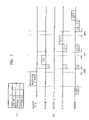
  • FIGS. 7 a and 7 b illustrate a station table and an associated timing diagram for a preferred embodiment of a data transmission method using a backoff number control according to the present invention.
  • FIG. 4 illustrates a flowchart showing a data transmission method using a backoff number control mechanism in a CSMA centralized data communications system according to an embodiment of the present invention.
  • an access point preferably transmits a multi-poll message to a plurality of stations, each of which receives the message, sets a unique backoff number contained therein, and transmits data according to that backoff number.
  • each station transmits registration information containing a station ID and a polling cycle to the access point.
  • the access point calculates the lengths of transmission frames based on the registered polling cycles and randomly generates a unique backoff number for each station.
  • the access point sets the backoff numbers.
  • the access point From the information registered in step 410 , the access point generates and transmits a multi-poll message containing the number of stations that are to be polled, the IDs of those stations, and/or the unique backoff numbers to be assigned to those stations.
  • each station receives the multi-poll message transmitted by the access point.
  • each station checks the multi-poll message for an associated station ID and, in step 450 , determines if the station has data to be transmitted. If both of those conditions are met, in step 475 , the station sets the unique backoff number extracted from the multi-poll message that corresponds to the ID of the station in order to prepare to transmit data.
  • the station then transmits the data using the DCF method by decrementing the backoff number at each basic time slot.
  • step 450 If, however, it is determined in step 450 for any station that uses polling that there is no data to be transmitted, that station is set to a minimum number of stations desired to be polled in the contention window in step 473 and will remain in that condition until such time that there is data to be transmitted, and a new backoff number can be randomly generated between the minimum value and the maximum value of the Contention Window by the access point.
  • the backoff number is increased by a number of corresponding to the number of stations that are to be polled, and a new backoff number is set in step 463 .
  • a new backoff number is set in step 463 .
  • step 440 If it is determined, in step 440 , that for any station that uses polling that the ID of the station is not in the polling list of the received multi-poll message and the station is not waiting to obtain a transmission opportunity in step 460 , the number of stations desired to be polled is set as the minimum value in the contention window in step 465 . At such time that there is data to be transmitted, a new backup number will be generated and transmitted by the access point. If two stations desire to poll simultaneously, each of the two stations set a different backoff number. The backoff number is determined by a predetermined scheduling algorithm.
  • FIG. 5 illustrates a timing diagram of a data transmission frame for a data transmission method using a backoff number control according to the present invention.
  • a transmission frame is preferably formed with beacon message information containing the interval of CP or the interval of a beacon message transmitted by the access point, a multi-poll message, and data transmitted by each station.
  • the time interval between a beacon message and a multi-poll message may be variable, and the time interval for transmitting each data (D 1 through D 5 ) is preferably a DIFS.
  • the time when a polling message is transmitted is preferably variable, because the polling cycle registered by each station is confirmed and according to the cycle, the polling message is transmitted. Additionally, since a plurality of multi-poll messages can be transmitted in one transmission frame interval (length), the polling interval is also preferably variable.
  • FIG. 6 illustrates an exemplary table showing a listing of a unique backoff numbers with an associated station to be polled, i.e. the ID and backoff number of each station are included. If the access point transmits a multi-polling message having the structure shown in FIG. 6 during an interval which is shorter than a DIFS, after a beacon message is transmitted, each station sets a backoff number corresponding to the ID of the station, and then transmits data in a DIFS interval.
  • FIG. 7 a illustrates a station table, similar to the listing shown in FIG. 6 , of a preferred embodiment of the present invention. Since the number of stations that want polling is an exemplary three (3), backoff numbers zero (0), one (1), and two (2) are assigned to stations 1 , 2 , and 3 , respectively.
  • FIG. 7 b illustrates a timing diagram of an exemplary data transmission of a multi-poll message, followed by associated data transmissions from the polled stations according to the present invention.
  • stations 1 through 4 receive the multi-poll message, check registered IDs and backoff numbers, set assigned backoff numbers and then transmit data when the set backup number reaches zero.
  • station 1 may have a transmission opportunity immediately after receiving the multi-poll message. If the channel becomes idle a DIFS interval after station 1 ends data transmission, stations excluding station 1 decrease backoff numbers by one (1) at each basic time slot. Therefore, station 2 , which decrements the backoff number thereof from one (1) to zero (0) obtains a transmission opportunity. However, since in this example station 2 has no data to be transmitted, the channel is still idle. Since the channel is also idle for a basic time slot at this time, stations excluding stations 1 and 2 decrease the backoff numbers by one (1). Thus, station 3 obtains the next transmission opportunity.
  • the polling cycle indicates the interval between multi-poll messages.
  • the access point can always perform polling of the stations such that time-limited services may be effectively supported.
  • the present invention may be embodied in a code, which may be read by a computer, on a computer readable recording medium.
  • the computer readable recording medium may include a plurality of recording apparatuses on which computer readable data are stored, such as magnetic storage media (e.g., ROM's, floppy disks, hard disks, etc.), optically readable media (e.g., CD-ROMs, DVDs, etc.) and carrier waves (e.g., transmissions over the Internet).
  • the computer readable recording media may also be distributed among computer systems connected through a network and can may store and execute a computer readable code in a distributed mode. Additionally, the structure of data or a database required in performing the method according to the present invention may be recorded in the recording medium as described above and by operating the computer program, desired functions and effects may be obtained.
  • the data transmission method using a backoff number control in a CSMA centralized data communications system is applied for controlling media access of a wireless LAN or Home PNA such that time-limited services can be supported. Further, with simple implementation, the method may be easily applied to existing systems such that the method can support real time service in low priced systems.

Landscapes

  • Engineering & Computer Science (AREA)
  • Computer Networks & Wireless Communication (AREA)
  • Signal Processing (AREA)
  • Mobile Radio Communication Systems (AREA)
  • Small-Scale Networks (AREA)
  • Communication Control (AREA)

Abstract

A method for transmitting data in a centralized data communications system having an access point and a plurality of stations using a carrier sense multiplexing access (CSMA) method using a backoff number control preferably includes (a) receiving a multi-poll message containing backoff numbers to be assigned to each station by the access point; (b) setting the backoff numbers of the multi-poll message to the backoff numbers of the stations; and (c) counting down the set backoff numbers and transmitting data. Each station that desires polling registers a station ID and a polling cycle, sets a backoff number contained in a multi-poll message, counts the backoff number, and if the backoff number becomes zero, transmits data such that contention between stations is prevented.

Description

BACKGROUND OF THE INVENTION
1. Field of the Invention
The present invention relates to a centralized data transmission method using a carrier sense multiplexing access (CSMA) method. More particularly, the present invention relates to a data transmission method in which an access point transmits data by transmitting a multi-poll message using the CSMA method.
2. Description of the Related Art
FIG. 1 illustrates a timing diagram for a conventional approach for transmitting data using a distributed coordination function (DCF) method for centralized data communications using a carrier sense multiplexing access (CSMA) method according to the prior art.
In a CSMA centralized data communications system using a wireless LAN system, such as one based on IEEE 802.11, in order to minimize contention, each station generates a random backoff number. If the channel is idle longer than a predetermined time (DCF Inter Frame Space, DIFS), the station successively decreases the backoff number, until it reaches zero (0), at which time the station transmits data. This is referred to as a DCF method. Here, the backoff number is a randomly generated number between a minimum value (CWmin) and a maximum value (CWmax) of a contention window (CW) determined by an access point.
Referring to the example shown in FIG. 1, station 1 transmits data and the backoff numbers of station 2 and station 3 are three (3) and five (5), respectively. One DIFS after station 1 ends data transmission, the backoff number of station 2 is counted down, and data is transmitted. While data of station 2 is being transmitted, counting down of the backoff number of station 3 is stopped. One DIFS after station 2 has ended data transmission, the backoff number of station 3 is counted down, and when the backoff number reaches zero (0), data is transmitted.
Since the DCF method works on a probability basis, there is a high possibility of contention between data transmitted by stations. Additionally, since the access points do not typically control the number and size of data packets, it is difficult to support time-limited services.
FIG. 2 illustrates a timing diagram for a conventional data transmission method using a point coordination function (PCF), in which a contention free period (CFP), which can be controlled by an access point, is set, and transmission opportunities are provided to each station based on a polling method. This is referred to as a point coordination function (PCF) method. In the PCF method, a PCF Inter Frame Space (PIFS) and a Short Inter Frame Space (SIFS), which are shorter than the DIFS, are used instead of the DIFS in order to obtain priority over DCF-using stations. However, in wireless LAN systems, for example, Intersil and ATmel, the PCF function is not offered due to the complexity of implementation.
FIG. 3 illustrates a timing diagram for a conventional data transmission method of a centralized data communications system using the CSMA of FIG. 1, but wherein contention period (CP) intervals and contention free period (CFP) intervals are mixed and used together. A leading beacon message may contain information on CFP intervals or CP intervals, or beacon message intervals. One SIFS interval after one station ends data transmission, an access point transmits a polling message (D1+Poll, D2+ack+Poll, D3+ack+Poll). The polling messages are transmitted to the stations from the access point. The stations that receive the polling messages transmit data and a confirmation message to confirm the transmission of the data to the access point.
The DCF method is used during the CP interval, while the PCF method is used during the CFP interval. Since the DCF method depends on obtaining transmission opportunities based on probability, it is difficult to support time-limited services. However, use of polling stations using the PCF method during the CFP interval does allow for time-limited services, but requires that a polling message be transmitted thereby further requiring additional timing management for the CFP intervals. Thus, implementation is complicated.
In addition, since the CFP interval is typically fixed, data transmitted by a polled station may exceed the CFP interval. In this case, the station has to give up the PCF transmission, and transmit the remaining data fragment in a CP interval on a contention basis. For example, when stations that received polling messages transmit data and a confirmation message (U1+ack, U2+ack or U3+ack) to confirm the transmission of data, a station that desires to transmit U3 data cannot transmit the data in the CFP interval and has to transmit the data in the CP interval.
If a polled station is to transmit continuous fragmented data, it may be necessary to adjust the lengths of a transmission frame and a CFP interval in order to practically support time-limited services. For some services, if very short interval polling is requested, polling in the CP interval, as well as polling in the CFP interval, may be needed. To solve this, the length of a transmission frame should be shorter than a corresponding polling cycle interval.
SUMMARY OF THE INVENTION
In an effort to solve the above problems, it is a first feature of an embodiment of the present invention to provide a data transmission method using a backoff number control in a CSMA centralized data communications system.
It is a second feature of an embodiment of the present invention to provide a computer readable recording medium having the data transmission method therein.
To provide the first feature of an embodiment of the present invention, there is provided a data transmission method using a backoff number control in a centralized data communications system, which includes an access point and a plurality of stations, the method including (a) receiving a multi-poll message containing backoff numbers to be assigned to each station by the access point; (b) setting the backoff numbers of the multi-poll message to the backoff numbers of the stations; and (c) counting down the set backoff numbers, preferably to zero, before transmitting data from one of the plurality of stations. The method may further include allowing any station that has data to transmit to request a transmission time slot from an access point by registering IDs and polling cycles with that access point. Upon receipt of the request, the access point generates the multi-poll message that contains at least one of the number of stations to be polled, the station IDs, or backoff numbers of the stations.
Each station to be polled monitors the multi-poll message and determines if the associated station ID is included, and if so, extracts the appropriate backoff number from the message and sets that value as the backoff number for the station. The method preferably further includes setting for a station having no data to be transmitted, and/or not waiting for a transmission opportunity, a minimum value from the range of random values from which backoff numbers are generated to be equal to the number of stations to be polled. Alternatively, a transmission opportunity may be derived by resetting the backoff number to a value obtained by adding the current number of stations to be polled to a randomly generated backoff number in a station that is not among the stations to be polled.
BRIEF DESCRIPTION OF THE DRAWINGS
The above and other features and advantages of the present invention will become more apparent upon review of a detailed description of preferred embodiments thereof with reference to the attached drawings in which:
FIG. 1 illustrates a timing diagram for a conventional approach for transmitting data using distributed coordination function (DCF) method for centralized data communications using a carrier sense multiplexing access (CSMA) method according to the prior art.
FIG. 2 illustrates a timing diagram for a conventional data transmission method for polling with a point coordination function (PCF) in conventional centralized data communications using the CSMA method according to the prior art.
FIG. 3 illustrates a timing diagram for a conventional data transmission method in which contention period (CP) intervals and contention free period (CFP) intervals are mixed and used together according to the prior art.
FIG. 4 illustrates a flowchart showing a data transmission method using a backoff number control mechanism according to the present invention.
FIG. 5 illustrates a timing diagram of a data transmission frame for a data transmission method using a backoff number control according to the present invention.
FIG. 6 illustrates an exemplary table showing unique backoff numbers for each listed station.
FIGS. 7 a and 7 b illustrate a station table and an associated timing diagram for a preferred embodiment of a data transmission method using a backoff number control according to the present invention.
DETAILED DESCRIPTION OF THE INVENTION
Korean Patent Application No. 2001-58361, filed Sep. 20, 2001, and entitled: “Data Communications Method Using Backoff Number Control,” is incorporated by reference herein in its entirety.
FIG. 4 illustrates a flowchart showing a data transmission method using a backoff number control mechanism in a CSMA centralized data communications system according to an embodiment of the present invention. In this embodiment, an access point preferably transmits a multi-poll message to a plurality of stations, each of which receives the message, sets a unique backoff number contained therein, and transmits data according to that backoff number.
Initially, in step 410, each station transmits registration information containing a station ID and a polling cycle to the access point. The access point calculates the lengths of transmission frames based on the registered polling cycles and randomly generates a unique backoff number for each station. Here, assuming that the interval of random values is within a contention window (CW), the access point sets the backoff numbers. From the information registered in step 410, the access point generates and transmits a multi-poll message containing the number of stations that are to be polled, the IDs of those stations, and/or the unique backoff numbers to be assigned to those stations.
In step 430, each station receives the multi-poll message transmitted by the access point. In step 440, each station checks the multi-poll message for an associated station ID and, in step 450, determines if the station has data to be transmitted. If both of those conditions are met, in step 475, the station sets the unique backoff number extracted from the multi-poll message that corresponds to the ID of the station in order to prepare to transmit data. In step 480, the station then transmits the data using the DCF method by decrementing the backoff number at each basic time slot.
If, however, it is determined in step 450 for any station that uses polling that there is no data to be transmitted, that station is set to a minimum number of stations desired to be polled in the contention window in step 473 and will remain in that condition until such time that there is data to be transmitted, and a new backoff number can be randomly generated between the minimum value and the maximum value of the Contention Window by the access point.
If it is determined that the ID of the station is not in the polling list of the received multi-poll message in step 440, but that the station is waiting to obtain a transmission opportunity in step 460, the backoff number is increased by a number of corresponding to the number of stations that are to be polled, and a new backoff number is set in step 463. By decreasing the new backoff number by one (1) at each basic time slot, data is then transmitted using the DCF method in step 480 when the backoff number reaches zero (0).
If it is determined, in step 440, that for any station that uses polling that the ID of the station is not in the polling list of the received multi-poll message and the station is not waiting to obtain a transmission opportunity in step 460, the number of stations desired to be polled is set as the minimum value in the contention window in step 465. At such time that there is data to be transmitted, a new backup number will be generated and transmitted by the access point. If two stations desire to poll simultaneously, each of the two stations set a different backoff number. The backoff number is determined by a predetermined scheduling algorithm.
FIG. 5 illustrates a timing diagram of a data transmission frame for a data transmission method using a backoff number control according to the present invention. A transmission frame is preferably formed with beacon message information containing the interval of CP or the interval of a beacon message transmitted by the access point, a multi-poll message, and data transmitted by each station. The time interval between a beacon message and a multi-poll message may be variable, and the time interval for transmitting each data (D1 through D5) is preferably a DIFS. The time when a polling message is transmitted is preferably variable, because the polling cycle registered by each station is confirmed and according to the cycle, the polling message is transmitted. Additionally, since a plurality of multi-poll messages can be transmitted in one transmission frame interval (length), the polling interval is also preferably variable.
FIG. 6 illustrates an exemplary table showing a listing of a unique backoff numbers with an associated station to be polled, i.e. the ID and backoff number of each station are included. If the access point transmits a multi-polling message having the structure shown in FIG. 6 during an interval which is shorter than a DIFS, after a beacon message is transmitted, each station sets a backoff number corresponding to the ID of the station, and then transmits data in a DIFS interval.
FIG. 7 a illustrates a station table, similar to the listing shown in FIG. 6, of a preferred embodiment of the present invention. Since the number of stations that want polling is an exemplary three (3), backoff numbers zero (0), one (1), and two (2) are assigned to stations 1, 2, and 3, respectively.
FIG. 7 b illustrates a timing diagram of an exemplary data transmission of a multi-poll message, followed by associated data transmissions from the polled stations according to the present invention.
Referring to FIGS. 7 a and 7 b, if an access point transmits a multi-poll message as shown in FIG. 7 a, stations 1 through 4 receive the multi-poll message, check registered IDs and backoff numbers, set assigned backoff numbers and then transmit data when the set backup number reaches zero.
For example, since the backoff number of station 1 is zero (0) as shown in the table in FIG. 7 a, station 1 may have a transmission opportunity immediately after receiving the multi-poll message. If the channel becomes idle a DIFS interval after station 1 ends data transmission, stations excluding station 1 decrease backoff numbers by one (1) at each basic time slot. Therefore, station 2, which decrements the backoff number thereof from one (1) to zero (0) obtains a transmission opportunity. However, since in this example station 2 has no data to be transmitted, the channel is still idle. Since the channel is also idle for a basic time slot at this time, stations excluding stations 1 and 2 decrease the backoff numbers by one (1). Thus, station 3 obtains the next transmission opportunity. Since station 4 was not in the polling list, it increased its backoff number to the number of stations that require polling (i.e. three (3) stations,) and when the multi-poll message is received, station 4 cannot obtain a transmission opportunity in the polling cycle. Here, the polling cycle indicates the interval between multi-poll messages.
Thus, the access point can always perform polling of the stations such that time-limited services may be effectively supported.
The present invention may be embodied in a code, which may be read by a computer, on a computer readable recording medium. The computer readable recording medium may include a plurality of recording apparatuses on which computer readable data are stored, such as magnetic storage media (e.g., ROM's, floppy disks, hard disks, etc.), optically readable media (e.g., CD-ROMs, DVDs, etc.) and carrier waves (e.g., transmissions over the Internet). The computer readable recording media may also be distributed among computer systems connected through a network and can may store and execute a computer readable code in a distributed mode. Additionally, the structure of data or a database required in performing the method according to the present invention may be recorded in the recording medium as described above and by operating the computer program, desired functions and effects may be obtained.
According to the present invention as described above, the data transmission method using a backoff number control in a CSMA centralized data communications system is applied for controlling media access of a wireless LAN or Home PNA such that time-limited services can be supported. Further, with simple implementation, the method may be easily applied to existing systems such that the method can support real time service in low priced systems.
A preferred embodiment of the present invention has been disclosed herein and, although specific terms are employed, they are used in a generic and descriptive sense only and not for purpose of limitation. Accordingly, it will be understood by those of ordinary skill in the art that various changes in form and details may be made without departing from the spirit and scope of the invention as set forth in the following claims.

Claims (14)

1. A data transmission method using a backoff number control in a centralized data communications system, which includes an access point and a plurality of stations, comprising:
(a) receiving a multi-poll message containing backoff numbers to be assigned to each station by the access point;
(b) determining at each station if a station ID corresponding to that station is identified in the multi-poll message;
(c) setting the backoff numbers of the stations to the corresponding backoff numbers assigned by the multi-poll message;
(d) counting down the set backoff numbers before transmitting data from one of the plurality of stations; and
(e) resetting the backoff number to a value obtained by adding the current number of stations identified in the multi-poll message to a randomly generated backoff number in a station that is not among the identified stations.
2. The method as claimed in claim 1, further comprising:
registering IDs and polling cycles of the stations to be polled at the access point.
3. The method as claimed in claim 1, wherein in (a) the multi-poll message contains at least one of the number of stations to be polled, the station IDs, or backoff numbers of the stations.
4. The method as claimed in claim 3, wherein in (c) each station to be polled checks the IDs of stations in the multi-poll message and sets a backoff number corresponding to the respective station.
5. The method as claimed in claim 1, wherein in (d) the set backoff number is counted down and when the backoff number becomes zero, data is transmitted.
6. The method as claimed in claim 1, further comprising:
setting the number of stations to be polled as the minimum value in the range of random values for generating backoff numbers if there is a station having no data to be transmitted among the stations to be polled.
7. The method as claimed in claim 1, further comprising:
setting the number of stations to be polled as the minimum value in a range of random values to be generated if there is no station waiting to obtain the transmission opportunity by randomly setting the backoff number.
8. A computer readable medium having embodied thereon a computer program for the method of claim 1.
9. A computer readable medium having embodied thereon a computer program for the method of claim 2.
10. A computer readable medium having embodied thereon a computer program for the method of claim 3.
11. A computer readable medium having embodied thereon a computer program for the method of claim 4.
12. A computer readable medium having embodied thereon a computer program for the method of claim 5.
13. A computer readable medium having embodied thereon a computer program for the method of claim 6.
14. A computer readable medium having embodied thereon a computer program for the method of claim 7.
US10/247,482 2001-09-20 2002-09-20 Data communications method using backoff number control Expired - Lifetime US7428240B2 (en)

Applications Claiming Priority (2)

Application Number Priority Date Filing Date Title
KR2001-58361 2001-09-20
KR10-2001-0058361A KR100442821B1 (en) 2001-09-20 2001-09-20 Data communication method based backoff number control

Publications (2)

Publication Number Publication Date
US20030053480A1 US20030053480A1 (en) 2003-03-20
US7428240B2 true US7428240B2 (en) 2008-09-23

Family

ID=36500570

Family Applications (1)

Application Number Title Priority Date Filing Date
US10/247,482 Expired - Lifetime US7428240B2 (en) 2001-09-20 2002-09-20 Data communications method using backoff number control

Country Status (6)

Country Link
US (1) US7428240B2 (en)
EP (1) EP1296484B1 (en)
JP (1) JP3771889B2 (en)
KR (1) KR100442821B1 (en)
CN (1) CN100488150C (en)
DE (1) DE60206118T2 (en)

Cited By (3)

* Cited by examiner, † Cited by third party
Publication number Priority date Publication date Assignee Title
US20050233789A1 (en) * 2004-04-16 2005-10-20 Itaru Maekawa Communication terminal, method and system for transmitting data
US20060018332A1 (en) * 2004-07-21 2006-01-26 Nokia Corporation System and method for increasing data throughout using a block acknowledgement
US20100195572A1 (en) * 2009-02-01 2010-08-05 Qualcomm Incorporated Distributed prioritized contention for spectrum sharing

Families Citing this family (41)

* Cited by examiner, † Cited by third party
Publication number Priority date Publication date Assignee Title
US20040071154A1 (en) * 2002-10-08 2004-04-15 Wentink Maarten Menzo Achieving high priority and bandwidth efficiency in a shared communications medium
US7508781B2 (en) * 2003-03-25 2009-03-24 Texas Instruments Incorporated Power saving mechanism for wireless LANs via schedule information vector
CN1549610A (en) 2003-05-09 2004-11-24 ��������ͨ�ż����о����޹�˾ Method for providing multi-level access service in common access channel
KR100559023B1 (en) 2003-05-30 2006-03-10 엘지전자 주식회사 Home network system and its configuration system
KR20040110302A (en) * 2003-06-18 2004-12-31 삼성전자주식회사 Method of wireless network communication using access point
KR100526184B1 (en) * 2003-07-18 2005-11-03 삼성전자주식회사 Method of multimedia data transmssion in wireless network
US8050199B2 (en) * 2003-09-30 2011-11-01 Avaya Inc. Endpoint registration with local back-off in a call processing system
JP3903033B2 (en) * 2003-09-30 2007-04-11 沖電気工業株式会社 Wireless transmission device
US8199723B2 (en) * 2003-12-23 2012-06-12 Intel Corporation Parallel wireless communication apparatus, method, and system
US7606257B2 (en) * 2004-01-15 2009-10-20 Atheros Communications, Inc. Apparatus and method for transmission collision avoidance
JP4047836B2 (en) 2004-04-02 2008-02-13 株式会社東芝 COMMUNICATION DEVICE, COMMUNICATION SYSTEM, COMMUNICATION METHOD, AND COMMUNICATION CONTROL PROGRAM
KR100603561B1 (en) * 2004-04-16 2006-07-24 삼성전자주식회사 Wireless LAN system based on transmission power control and transmission power control method thereof
US20060009229A1 (en) * 2004-07-10 2006-01-12 Yuan Yuan Sequential coordinated channel access in wireless networks
KR100590896B1 (en) * 2004-11-26 2006-06-19 삼성전자주식회사 Media access method for competition and no competition
US20060133394A1 (en) * 2004-12-21 2006-06-22 Ware Christopher G Methods of wireless backhaul in a multi-tier WLAN
US7796545B2 (en) * 2006-01-10 2010-09-14 Qualcomm Incorporated Method and apparatus for scheduling in a wireless communication network
JP4840043B2 (en) * 2006-09-21 2011-12-21 ソニー株式会社 Wireless communication system and wireless communication apparatus
US9497229B2 (en) * 2007-05-16 2016-11-15 At&T Intellectual Property I, L.P. Methods and apparatus to manage internet protocol (IP) multimedia subsystem (IMS) network capacity
JP2008306516A (en) * 2007-06-08 2008-12-18 Panasonic Corp Communication terminal, communication system, and transmission method
EP2171941B1 (en) 2007-06-22 2019-02-20 Thomson Licensing Method and apparatus for media access in contention-based networks
CN101682531B (en) * 2007-06-22 2012-09-05 汤姆逊许可公司 Method and apparatus for media access in contention-based networks
EP2106166A1 (en) * 2008-03-26 2009-09-30 THOMSON Licensing Relaxed deterministic back-off method for medium access control
US9467308B2 (en) * 2008-08-01 2016-10-11 At&T Intellectual Property I, L.P. Methods and apparatus to control synchronization in voice over internet protocol networks after catastrophes
JP2009060621A (en) * 2008-09-10 2009-03-19 Victor Co Of Japan Ltd Wireless packet data transmission system
WO2010095791A1 (en) 2009-02-18 2010-08-26 Lg Electronics Inc. Method of controlling channel access
EP2257115A1 (en) * 2009-05-26 2010-12-01 Thomson Licensing, Inc. A constant window back-off method for multiple access in wireless local area networks
KR101060821B1 (en) 2009-09-07 2011-08-30 포항공과대학교 산학협력단 ID allocation method for CSM / IC
US8477801B2 (en) 2009-12-15 2013-07-02 Qualcomm Incorporated Backoff procedure for post downlink SDMA operation
KR200468276Y1 (en) * 2010-02-24 2013-08-02 주식회사 자인 Assembly Pillar
US9357565B2 (en) 2010-03-09 2016-05-31 Qualcomm Incorporated Multi-user uplink communication using EDCA with polling
US8576809B2 (en) * 2010-10-07 2013-11-05 Qualcomm Incorporated Facilitating distributed channel access for a plurality of access terminals transmitting in a wireless communication environment
US8787159B2 (en) * 2011-04-14 2014-07-22 Alcatel Lucent Mechanism for wireless access networks to throttle traffic during congestion
JP5631843B2 (en) * 2011-10-31 2014-11-26 日本電信電話株式会社 Wireless LAN access control method and wireless LAN system
JP5631845B2 (en) * 2011-11-01 2014-11-26 日本電信電話株式会社 Wireless LAN access control method and wireless LAN system
US8995406B2 (en) * 2012-02-06 2015-03-31 Qualcomm Incorporated Systems and methods for reducing collisions after traffic indication map paging
HK1206190A1 (en) * 2012-03-06 2015-12-31 Interdigital Patent Holdings, Inc. Supporting a large number of devices in wireless communications
JP2013255143A (en) * 2012-06-08 2013-12-19 Sharp Corp Wireless communication apparatus, wireless communication method, wireless communication system, and processing apparatus
US9144072B2 (en) * 2012-09-07 2015-09-22 Intel Corporation Methods and arrangements to assign slots in restricted access windows in wireless networks
US9971014B2 (en) * 2013-05-13 2018-05-15 Qualcomm Incorporated Access point-assisted positioning framework
JP5855154B2 (en) * 2014-03-18 2016-02-09 株式会社東芝 Wireless communication device, wireless communication method, wireless terminal, memory card, and integrated circuit
WO2025174002A1 (en) * 2024-02-16 2025-08-21 엘지전자 주식회사 Method and device for collision control in wireless communication system

Citations (11)

* Cited by examiner, † Cited by third party
Publication number Priority date Publication date Assignee Title
JPS5955658A (en) 1982-09-24 1984-03-30 Fujitsu Ltd Controlling method of poling
EP0483546A1 (en) 1990-10-29 1992-05-06 International Business Machines Corporation Methods for polling mobile users in a multiple cell wireless network
JPH04181837A (en) 1990-11-16 1992-06-29 Nippon Telegr & Teleph Corp <Ntt> Point-multipoint transmission system
EP0652523A1 (en) 1993-11-10 1995-05-10 Nec Corporation Remote monitoring system
US5761446A (en) * 1995-06-14 1998-06-02 Unisys Corp Livelock avoidance
US5940399A (en) 1996-06-20 1999-08-17 Mrv Communications, Inc. Methods of collision control in CSMA local area network
JPH11355291A (en) 1998-06-10 1999-12-24 Nippon Telegr & Teleph Corp <Ntt> CSMA / CA method in autonomous distributed system
EP0994604A2 (en) 1998-10-14 2000-04-19 Lucent Technologies Inc. Method and apparatus for random backoff based access priority
US6813260B1 (en) * 2000-03-16 2004-11-02 Ericsson Inc. Systems and methods for prioritized access in a contention based network
US7027461B1 (en) * 2000-07-20 2006-04-11 General Instrument Corporation Reservation/retry media access control
US20070121529A1 (en) * 1991-10-01 2007-05-31 Broadcom Corporation Communication network providing wireless and hard-wired dynamic routing

Family Cites Families (3)

* Cited by examiner, † Cited by third party
Publication number Priority date Publication date Assignee Title
JP2579963B2 (en) * 1987-10-26 1997-02-12 シャープ株式会社 Communication method
JPH0993270A (en) * 1995-09-27 1997-04-04 Toshiba Corp Data transmission system
JPH1155294A (en) * 1997-07-30 1999-02-26 Nec Corp Data collection system by polling and method therefor and recording medium for recording collection control program

Patent Citations (11)

* Cited by examiner, † Cited by third party
Publication number Priority date Publication date Assignee Title
JPS5955658A (en) 1982-09-24 1984-03-30 Fujitsu Ltd Controlling method of poling
EP0483546A1 (en) 1990-10-29 1992-05-06 International Business Machines Corporation Methods for polling mobile users in a multiple cell wireless network
JPH04181837A (en) 1990-11-16 1992-06-29 Nippon Telegr & Teleph Corp <Ntt> Point-multipoint transmission system
US20070121529A1 (en) * 1991-10-01 2007-05-31 Broadcom Corporation Communication network providing wireless and hard-wired dynamic routing
EP0652523A1 (en) 1993-11-10 1995-05-10 Nec Corporation Remote monitoring system
US5761446A (en) * 1995-06-14 1998-06-02 Unisys Corp Livelock avoidance
US5940399A (en) 1996-06-20 1999-08-17 Mrv Communications, Inc. Methods of collision control in CSMA local area network
JPH11355291A (en) 1998-06-10 1999-12-24 Nippon Telegr & Teleph Corp <Ntt> CSMA / CA method in autonomous distributed system
EP0994604A2 (en) 1998-10-14 2000-04-19 Lucent Technologies Inc. Method and apparatus for random backoff based access priority
US6813260B1 (en) * 2000-03-16 2004-11-02 Ericsson Inc. Systems and methods for prioritized access in a contention based network
US7027461B1 (en) * 2000-07-20 2006-04-11 General Instrument Corporation Reservation/retry media access control

Non-Patent Citations (1)

* Cited by examiner, † Cited by third party
Title
Deng, et al., "A Priority Scheme for IEEE 802.11 DCF Access Method", IEICE Transactions on Communications, Institute of Electronics Information and Comm. Eng., Tokyo, JP, vol. E82-B, No. 1, pp. 96-102 (Jan. 1999) [XP000927880].

Cited By (6)

* Cited by examiner, † Cited by third party
Publication number Priority date Publication date Assignee Title
US20050233789A1 (en) * 2004-04-16 2005-10-20 Itaru Maekawa Communication terminal, method and system for transmitting data
US8934468B2 (en) * 2004-04-16 2015-01-13 Sony Corporation Communication terminal, method and system for transmitting data
US20060018332A1 (en) * 2004-07-21 2006-01-26 Nokia Corporation System and method for increasing data throughout using a block acknowledgement
US8223647B2 (en) * 2004-07-21 2012-07-17 Nokia Corporation System and method for increasing data throughout using a block acknowledgement
US20100195572A1 (en) * 2009-02-01 2010-08-05 Qualcomm Incorporated Distributed prioritized contention for spectrum sharing
US8675623B2 (en) * 2009-02-01 2014-03-18 Qualcomm Incorporated Distributed prioritized contention for spectrum sharing

Also Published As

Publication number Publication date
EP1296484A1 (en) 2003-03-26
US20030053480A1 (en) 2003-03-20
EP1296484B1 (en) 2005-09-14
CN1406029A (en) 2003-03-26
KR20030025417A (en) 2003-03-29
CN100488150C (en) 2009-05-13
KR100442821B1 (en) 2004-08-02
DE60206118D1 (en) 2005-10-20
JP3771889B2 (en) 2006-04-26
DE60206118T2 (en) 2006-06-14
JP2003179610A (en) 2003-06-27

Similar Documents

Publication Publication Date Title
US7428240B2 (en) Data communications method using backoff number control
US7974302B2 (en) Hybrid implicit token carrier sensing multiple access/collision avoidance protocol
US7027462B2 (en) Random medium access methods with backoff adaptation to traffic
US7801104B2 (en) System and method for reducing packet collisions in wireless local area networks
JP5182965B2 (en) Method and apparatus for media access in a contention network
JP5182964B2 (en) Device for media access in contention network
EP1374496B1 (en) Random medium access methods with backoff adaptation to traffic
US20030161340A1 (en) Method and system for optimally serving stations on wireless LANs using a controlled contention/resource reservation protocol of the IEEE 802.11e standard
US20040013135A1 (en) System and method for scheduling traffic in wireless networks
EP1429496B1 (en) Apparatus and method for making a polling list taking QOS into consideration
US20050025131A1 (en) Medium access control in wireless local area network
US20060109833A1 (en) Method for processing packets and scheduling superframe in polling-based WLAN system
US20110007703A1 (en) Relaxed deterministic back-off method for medium access control
JP5376673B2 (en) Device for media access in contention network
KR101373136B1 (en) Method for transmitting data using implicit forward orderinginformation obtained through DCF(Distributed Coordination Function) contention in wireless LAN, and wireless communication device for transmitting data using it
EP1569385B1 (en) Method and system for the improvement of the QoS support in the de-centrally organized wireless networks
KR101404993B1 (en) Method for transmitting a data
KR100799584B1 (en) Media access method in wireless LAN environment

Legal Events

Date Code Title Description
AS Assignment

Owner name: SAMSUNG ELECTRONICS CO., LTD., KOREA, REPUBLIC OF

Free format text: ASSIGNMENT OF ASSIGNORS INTEREST;ASSIGNORS:JANG, KYUNG-HUN;KANG, WOO-SHIK;REEL/FRAME:013314/0196

Effective date: 20020918

STCF Information on status: patent grant

Free format text: PATENTED CASE

FEPP Fee payment procedure

Free format text: PAYOR NUMBER ASSIGNED (ORIGINAL EVENT CODE: ASPN); ENTITY STATUS OF PATENT OWNER: LARGE ENTITY

FEPP Fee payment procedure

Free format text: PAYOR NUMBER ASSIGNED (ORIGINAL EVENT CODE: ASPN); ENTITY STATUS OF PATENT OWNER: LARGE ENTITY

Free format text: PAYER NUMBER DE-ASSIGNED (ORIGINAL EVENT CODE: RMPN); ENTITY STATUS OF PATENT OWNER: LARGE ENTITY

FPAY Fee payment

Year of fee payment: 4

FPAY Fee payment

Year of fee payment: 8

MAFP Maintenance fee payment

Free format text: PAYMENT OF MAINTENANCE FEE, 12TH YEAR, LARGE ENTITY (ORIGINAL EVENT CODE: M1553); ENTITY STATUS OF PATENT OWNER: LARGE ENTITY

Year of fee payment: 12