US7422657B2 - Method for the feed of cellulose chips during the continuous cooking of cellulose - Google Patents
Method for the feed of cellulose chips during the continuous cooking of cellulose Download PDFInfo
- Publication number
- US7422657B2 US7422657B2 US10/504,948 US50494804A US7422657B2 US 7422657 B2 US7422657 B2 US 7422657B2 US 50494804 A US50494804 A US 50494804A US 7422657 B2 US7422657 B2 US 7422657B2
- Authority
- US
- United States
- Prior art keywords
- fluid
- chips
- impregnation vessel
- pressure
- Prior art date
- Legal status (The legal status is an assumption and is not a legal conclusion. Google has not performed a legal analysis and makes no representation as to the accuracy of the status listed.)
- Expired - Lifetime, expires
Links
- 238000000034 method Methods 0.000 title claims abstract description 69
- 229920002678 cellulose Polymers 0.000 title claims abstract description 31
- 239000001913 cellulose Substances 0.000 title claims abstract description 31
- 238000010411 cooking Methods 0.000 title claims abstract description 18
- 239000012530 fluid Substances 0.000 claims abstract description 118
- 239000000203 mixture Substances 0.000 claims abstract description 29
- 239000000126 substance Substances 0.000 claims abstract description 7
- 239000002002 slurry Substances 0.000 claims abstract description 4
- 238000005470 impregnation Methods 0.000 claims description 61
- 238000012546 transfer Methods 0.000 claims description 39
- 239000002023 wood Substances 0.000 claims description 10
- 238000000926 separation method Methods 0.000 claims description 8
- 230000003068 static effect Effects 0.000 claims description 7
- 238000005086 pumping Methods 0.000 claims description 3
- 239000007788 liquid Substances 0.000 claims description 2
- 238000011144 upstream manufacturing Methods 0.000 claims 1
- 230000008569 process Effects 0.000 description 22
- 238000004519 manufacturing process Methods 0.000 description 3
- 230000009467 reduction Effects 0.000 description 3
- 241000609240 Ambelania acida Species 0.000 description 2
- 241000218631 Coniferophyta Species 0.000 description 2
- 244000081757 Phalaris arundinacea Species 0.000 description 2
- QAOWNCQODCNURD-UHFFFAOYSA-L Sulfate Chemical compound [O-]S([O-])(=O)=O QAOWNCQODCNURD-UHFFFAOYSA-L 0.000 description 2
- 239000010905 bagasse Substances 0.000 description 2
- 230000006835 compression Effects 0.000 description 2
- 238000007906 compression Methods 0.000 description 2
- 238000012856 packing Methods 0.000 description 2
- 239000002994 raw material Substances 0.000 description 2
- 239000007787 solid Substances 0.000 description 2
- LSNNMFCWUKXFEE-UHFFFAOYSA-L sulfite Chemical compound [O-]S([O-])=O LSNNMFCWUKXFEE-UHFFFAOYSA-L 0.000 description 2
- 229910021653 sulphate ion Inorganic materials 0.000 description 2
- OKTJSMMVPCPJKN-UHFFFAOYSA-N Carbon Chemical compound [C] OKTJSMMVPCPJKN-UHFFFAOYSA-N 0.000 description 1
- 229920003043 Cellulose fiber Polymers 0.000 description 1
- 229920002488 Hemicellulose Polymers 0.000 description 1
- 230000004075 alteration Effects 0.000 description 1
- 238000013459 approach Methods 0.000 description 1
- 229910052799 carbon Inorganic materials 0.000 description 1
- 238000004891 communication Methods 0.000 description 1
- 238000005516 engineering process Methods 0.000 description 1
- 238000002474 experimental method Methods 0.000 description 1
- 238000004064 recycling Methods 0.000 description 1
- 238000010025 steaming Methods 0.000 description 1
- 238000006467 substitution reaction Methods 0.000 description 1
Images




Classifications
-
- D—TEXTILES; PAPER
- D21—PAPER-MAKING; PRODUCTION OF CELLULOSE
- D21C—PRODUCTION OF CELLULOSE BY REMOVING NON-CELLULOSE SUBSTANCES FROM CELLULOSE-CONTAINING MATERIALS; REGENERATION OF PULPING LIQUORS; APPARATUS THEREFOR
- D21C7/00—Digesters
- D21C7/06—Feeding devices
Definitions
- the invention concerns a method for the feed of cellulose chips during the continuous cooking of cellulose.
- the chips When cooking cellulose chips in continuous digesters, the chips are transported from a feed system at atmospheric pressure, or a pressure slightly over atmospheric pressure, by what is known as a “transfer flow” to an impregnation vessel or a digester at a considerably higher pressure. Transport in the transfer flow is made possible by the chips being combined with a transport fluid, preferably a process fluid, to form a slurry; the transport fluid being subsequently separated from the chips in separation equipment, normally denoted the “top separator”, when it has reached the impregnation vessel or the digester. The transport fluid is returned to the feed system through a return line.
- a transport fluid preferably a process fluid
- the transfer flow has for many years comprised a special type of sluice feeder, known as a high-pressure feeder, that will hereafter be denoted the “HP feeder”.
- This feeder has been specially designed such that it can resist the large differences in pressure that are present between the two systems.
- the HP feeder is provided with a rotor having symmetrical through-pockets that come into contact during rotation, alternately with the low-pressure system and the high-pressure system, without allowing any communication between these two systems.
- the chips can in this way be taken from a system at zero pressure or at a low pressure, typically 0-4 bar (abs), and they can be fed via the HP feeder into a system at a considerably higher pressure, typically 7-20 bar (abs).
- the method currently used for filling the pocket in the HP feeder is to establish a large flow of fluid through what is known as a “chute flow” such that the transport fluid in this way carries chips with it into the pocket.
- a chlorute flow such that the transport fluid in this way carries chips with it into the pocket.
- Chips are expelled from the pocket by the same principle for onwards transport up to the impregnation vessel or the digester in what is known as a transfer flow, something that in principle means that the transfer flow carries with it a larger quantity of transport fluid than is actually desirable. It is therefore necessary to withdraw (as a minimum amount) the excess transport fluid from the chips before they are fed down into the treatment vessel.
- the transport fluid that is withdrawn is returned to the HP feeder in order to expel chips again from a filled pocket in the HP feeder.
- L/W ratios Very high liquid/wood ratios, L/W ratios, are created through both of these flows, and this has long been regarded as necessary in order to transport the chips. It has also been believed that the HP feeder requires these high fluid flows in order to function satisfactorily with respect to, among other aspects, the degree of filling and the expulsion of the chips from the pocket at the high-pressure position, particularly when it is required to increase the production capacity and when the rotation of the HP feeder has consequently been increased. This way of thinking has resulted in it being normal for many years to establish a L/W ratio in the chute flow of between 5-10 tones per tonne, and a ratio as high as 15-25 tones/tonne in the transport flow.
- the aim of the invention is to offer a method during the transport of a chips mixture from an input system that works at a first low pressure and that comprises an HP feeder for transfer of the chips mixture through a sluice to a treatment vessel in a digester system for the continuous cooking of chemical cellulose pulp that functions at a second, higher pressure and where the input system does not comprise a chute flow nor does it comprise a return line in the transport flow.
- a further aim is to make an input system possible where a top separator at the top of the impregnation vessel or the digester is not necessary.
- the method according to the invention can be applied in both single-vessel and in double-vessel digester systems of digesters of both steam-phase and hydraulic type.
- the method is applied such that the fluid that feeds the chips mixture from the pockets of the HP feeder when these pockets are positioned in the emptying position in a second position is constituted by the fluid that has been expelled from the pockets of the HP feeder when these are positioned in a filling position in a first position.
- the chips mixture is transported from the HP feeder to a treatment vessel via a transfer line and the method is characterised in that the L/W ratio in the chips mixture is essentially maintained at the same level in this transfer line as the level in the position immediately before the feed into the HP feeder.
- the method does not require any extra addition of transport fluid to the HP feeder in order to extract the chips, which ensures that the return line for transport fluid from separation equipment at the top of the treatment vessel is not necessary.
- the method is applied to processes with high L/W ratios during the impregnation or the cooking, also making separation equipment at the top of the treatment vessel unnecessary.
- the HP feeder can be located in an input system in order to promote a chips mixture from a chip chute with a preceding steaming vessel, which can be constituted by an impregnation vessel or by a digester.
- the HP feeder can also be located at a position between two treatment vessels, which can be constituted by a first impregnation vessel, at atmospheric pressure, and a second, pressurised, digester.
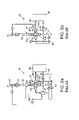
- FIG. 1 shows schematically a conventional feed system with an HP feeder together with a chip chute and a transfer flow.
- FIGS. 2 a , 2 b show schematically a feed system according to a technology developed later comprising both a chute flow and a transfer flow with return line (according to U.S. Pat. No. 6,120,646).
- FIG. 3 shows in detail an arrangement around the HP feeder (according to U.S. Pat. No. 6,120,646).
- FIG. 4 shows one preferred embodiment of a feed system according to the invention.
- FIG. 5 shows an alternative embodiment according to the invention in which the method is applied for an HP feeder located between two treatment vessels.
- FIG. 6 shows a second alternative embodiment according to the present invention.
- FIG. 1 shows schematically a feed system according to the prior art with an HP feeder 33 together with a chips flow 34 and a transfer flow ( 6 a , 45 ).
- the transfer flow is constituted by a transfer line 6 a for transport of chips that have been formed into a slurry with a transport fluid, and a return line 45 for the transport fluid.
- the transfer line 6 a connects at its upper end to a top separator 47 at the top of a treatment vessel 48 where the excess transport fluid is separated from the chips and subsequently returned to the HP feeder 33 through the return line 45 .
- the top separator 47 is here symbolised by a downwardly fed version in a hydraulic digester, but it can just as well be constituted by a upwardly fed top separator in a steam/fluid phase digester, a strainer arrangement at the top of a hydraulically filled treatment vessel or any other separation equipment arranged in the transfer line or at the upper section of the treatment vessel.
- FIGS. 2 a and 2 b Two examples of feed systems are shown in FIGS. 2 a and 2 b comprising both a chute flow and a transfer flow with return line according to U.S. Pat. No. 6,120,646. These examples can be said to constitute examples of feed systems according to the prior art developed at a later stage.
- the reference numerals in each drawing are specified according to the following order ( FIG. 2 a , FIG. 2 b ).
- the chute flow in FIG. 2 a is constituted by the line 34 and the associated pump 37
- the chute flow in FIG. 2 b is equivalent to the line 69 .
- One of the characteristics of the present patent is the omission of a strainer, known as a “bottom strainer”, between the high-pressure feeder and the line of the chute flow ( 34 , 69 ) in what can be said to constitute the bottom of the pocket of the HP feeder, when this is located at its filling position at its first position.
- the return lines ( 45 , 55 ) in the transfer flow from the treatment vessel ( 48 , 60 ) are also seen in the drawings.
- the L/W ratio in the chip chute ( 32 , 52 ) can be controlled by adjusting the addition of fluid in the chute flow ( 34 , 69 ). In order to ensure a secure feed of chips in the chip chute ( 32 , 52 ) the L/W ratio normally lies in the interval from 5-10:1.
- a degree of filling in the chip chute ( 32 , 52 ) of 80-85% according to what is specified in U.S. Pat. No. 6,120,646 is equivalent to an L/W ratio of 5.8-6.3:1 when the density of chips is 145 kg/m 3 , and a L/W ratio of 4.24-6:1 when the density of the chips is 200 kg/m 3 .
- the transport fluid that is added at the second inlet ( 33 c , 53 c ) of the HP feeder in order to expel the chips from the pocket arrives through the return line ( 45 , 55 ) from the treatment vessel ( 48 , 60 ) when the pocket is in its second position, that is, when the chip pocket opens onto the high-pressure system.
- the transport fluid is used in order to make transport of the chips to the top of the treatment vessel ( 48 , 60 ) possible, and very high L/W ratios, typically between 15-20:1 have traditionally been locally established in the transfer line ( 6 a , 6 b ) between the high-pressure feeder ( 33 , 53 ) and the top separator (not shown in the drawings) by addition of this transport fluid.
- a quantity of transport fluid is subsequently withdrawn at the top separator such that the L/W ratio becomes between 2.5-5 when the chips are fed downwards into the treatment vessel.
- the embodiment according to FIG. 2 b is the one that lies closest to the present invention, since the recirculation line 54 from the first outlet 53 b of the HP feeder is connected with the second inlet 53 c of the HP feeder, although this is connected via the return line 55 in the transfer flow.
- FIG. 3 An arrangement equivalent to FIG. 2 a around the HP feeder 33 is shown in more detail in FIG. 3 with the chute flow 34 and the transfer flow ( 6 a , 45 ) together with some of the pumps ( 37 , 42 , 46 ), valves (HS) and instruments (SF, SC, LC, FC, FI, FF) that are required to control this arrangement.
- pumps 37 , 42 , 46
- valves HS
- instruments SF, SC, LC, FC, FI, FF
- FIG. 4 shows one preferred embodiment of a feed system according to the invention.
- the HP feeder in the present invention can preferably be constructed without any bottom strainer, but it can also be the case that the HP feeder has a bottom strainer according to older systems.
- the HP feeder 53 ′ is fed with a mixture of chips and fluid from a chip chute 52 ′ where an L/W ratio of between 4-10:1 is established through an active addition of fluid LIQ A .
- this fluid LIQ A is constituted by a process fluid such as impregnation fluid or cooking fluid.
- a process fluid such as impregnation fluid or cooking fluid.
- a conventional HP feeder 53 ′ follows the chip chute equipped with a rotor with symmetrically placed through-pockets ( 1 , 2 ) that during rotation are alternately placed in contact with the chip chute 52 ′ and the transfer line 6 b ′.
- the pocket facing the equivalent circulation line 54 ′ opens, and an open channel is created through the HP feeder. The pocket is in its first location when it is located in this filling position.
- the fluid in pocket 1 Under the influence of one or more high-pressure pumps 57 ′, 57 ′′ or one pump with several pumping stages in the circulation line 54 ′ together with the static pressure that is established by the column 52 ′ of fluid in the chip chute, the fluid in pocket 1 will be sucked out/expelled while the chips mixture is fed into the pocket at the same time. Since there is no chute flow with forced flow of fluid as there was in earlier methods, the chips and the fluid move down through the chip chute at the same speed. This means that the chips mixture is fed into the pocket 1 with a maintained L/W ratio, in contrast with earlier methods in which the forced flow of fluid carried chips with it into the pocket, causing in this manner a reduction in the L/W ratio.
- This makeup fluid LTQ B is characterised in that it is not in any way a withdrawal from subsequent separation equipment connected to the treatment vessel 60 ′.
- the makeup fluid LIQ B constituted in any way by a withdrawal from a strainer section at the upper part of a hydraulically tilled treatment vessel, which strainer section is to be equivalent to a top separator. It is characteristic for the addition of a makeup fluid LIQ B that the amount that is added to the circulation line 54 ′ results in a limited increase in the L/W ratio in the transfer line 6 b ′ such that the added makeup fluid LIQ B does not exceed 50%, preferably less than 40% and more preferably less than 30%, of the L/W ratio in the chip chute 52 ′ and never in such an amount that the L/W ratio in the transfer line 6 b ′ exceeds 10:1.
- the makeup iluid LIQ B can be constituted by white liquor, black liquor, green liquor, or it may contain chemicals that promote the process or increase the yield such as cellulose derivatives, icr example CMC, organic suiphides such as carbon disuiphide, mercaptides, etc., AQ derivatives or other substances.
- FIG. 5 shows an alternative embodiment in which the method is applied to an HP feeder 53 ′ located between two treatment vessels which can be constituted by a first impregnation vessel 3 , essentially at atmospheric pressure, and a second, pressurised, digester 60 ′.
- the digester is symbolised in the figure by a steamphase digester displaying two strainer sections for the withdrawal of cooking fluid, but it is to be understood that the method is not limited to this.
- the method can also be applied in association with continuous digesters of various types, both steam phase and hydraulic types, with modified cooking systems (MCC, EMCC, Lo-Solids) and with ITC, and it can be used when manufacturing cellulose pulp according to both the sulphite method and the sulphate method.
- deciduous wood, conifer wood, annuals can constitute the raw material for cellulose.
- the term “impregnation vessel essentially at atmospheric pressure” is used here to denote an impregnation vessel in which the pressure at the top lies within the interval 1-3 bar (abs) and in which the inlet can be connected through some form of chip feed 2 directly to a chips pocket or other chips magazine 1 in an feed system.
- This impregnation vessel 3 can be designed such that the chips are first steamed during their downward passage through the vessel at an upper section Z 1 and are subsequently impregnated in impregnation fluid in a lower section Z 2 of the impregnation vessel in order to be subsequently fed onwards through the HP feeder 53 ′ to the digester 60 ′.
- no special equipment is needed other than, possibly, an output scraper (not shown in the drawing) at the bottom of the impregnation vessel 3 in order to expel the chips.
- Separation equipment 47 ′ is shown in the drawing at the top of the digester, in which equipment a part of the process fluid in the chips mixture can be withdrawn if this is desirable from the point of view of the process.
- This withdrawn fluid is made visible by the line LIQ C .
- this withdrawn process fluid LIQ C is not returned to the HP feeder as a transport fluid, but there are otherwise no limitations on the use of this fluid.
- it can be led back to the input or to the impregnation vessel or in other cases it can be led forwards in the system and added as a cooking fluid in the lower zones of the digester.
- the withdrawn process fluid LIQ C can be partially or fully led away for the recycling of its chemicals.
- a certain amount of compression of the chips is obtained as a consequence of the high static pressure that is present at the bottom of the impregnation vessel 3 . This compression is not obtained in a chip chute.
- One measure of the concentration of chips that is present at a certain position is constituted by the degree of filling that is present. A degree of filling of 100% corresponds to the concentration of chips that is obtained when a container is filled with non-deformed pieces of chip without any forced packing, where fluid is subsequently added to the container such that the fluid fills the spaces that are present between the pieces of chip, while the pieces of chip retain the contact with each other in the same manner as if no fluid were present in the container.
- the degree of filling for stable feed of chips in a chip chute normally lies at approximately 50-85%, while degrees of filling have been measured at the bottom of the impregnation vessel under stable conditions of operation of up to 110% due to the increased degree of packing that is obtained there. This means that an increased capacity of the HP feeder that is directly proportional to the degree of filling is obtained.
- the HP feeder located after a chip chute, it has been traditional to arrange the HP feeder such that filling of the same takes place from above when a pocket in its first position has a vertical axis of symmetry.
- the method according to the invention is not limited to this manner of filling the HP feeder, and filling can also take place when the axis of symmetry of the pocket is in a horizontal position. This may be particularly appropriate when the HP feeder is arranged subsequent to an impregnation vessel. Since impregnation vessels are normally placed on the ground, due to their size, it is not obvious that there is sufficient space available for filling of the HP feeder from above.
- the motor of this scraper will be located centrally under the bottom of the impregnation vessel, which probably results in it becoming necessary to place the HP feeder to one side of the vertical axis of symmetry of the impregnation vessel, and thus it is no longer obvious that the best manner of filling the HP feeder is from above. Horizontal filling may be appropriate in this case, while it may also be relevant to consider filling from below.
- the method may also be applied in a feed system according to the variation shown in FIG. 6 .
- Reference numerals in this drawing are the same as those in FIG. 4 to the extent that the same equipment is denoted
- the principle of force-feeding of the HP feeder 53 ′ is applied in this feed system with the aid of a pump 59 or other type of force-feed such as, for example, a screw.
- Supply of chips to this pump can take place from a chip chute 58 with horizontal output of chips, but supply of chips to this pump 59 can also take place from an impregnation vessel according to the embodiment that is described in FIG. 5 .
- the method according to the invention does not require the exchange of process fluid at this position.
- the process fluid that is separated from the chips in the top separator can be returned to another position in the process and, depending on how the process is designed, the process fluid can be used in both preceding and in subsequent sections of the process. If the fluid withdrawn from the top separator is impregnation fluid, it may be appropriate to return this fluid to the impregnation vessel.
- the impregnation fluid is, in general, rich in hemicellulose, and thus it may be desirable to seek to reprecipitate this hemicellulose onto the cellulose fibres in the digester, which means that the impregnation fluid can instead be added at the final phase of the cooking stage.
- a combination of the two positions at which it is added can also be envisaged.
- the method according to the invention is not limited to these manners of using the withdrawn process fluid, and that the use of this fluid does not constitute any characteristic of the innovative concept in any way other than that it is not to be returned to the HP feeder in order to be used as transport fluid in the transfer line.
- the method can be applied in all types of digester system such as single-vessel and double-vessel digester systems of both steam phase and hydraulic types; digester systems with black liquor impregnation (BLI); modified digester systems (MCC, EMCC, Lo-Solids), and ITC; and it can be used during the manufacture of cellulose pulp according to both the sulphite method and the sulphate method.
- digester system such as single-vessel and double-vessel digester systems of both steam phase and hydraulic types; digester systems with black liquor impregnation (BLI); modified digester systems (MCC, EMCC, Lo-Solids), and ITC; and it can be used during the manufacture of cellulose pulp according to both the sulphite method and the sulphate method.
- deciduous wood, conifer wood, annuals (such as bagasse, reed canary grass, etc.) can constitute the raw material for cellulose.
Landscapes
- Paper (AREA)
- Polysaccharides And Polysaccharide Derivatives (AREA)
- Physical Or Chemical Processes And Apparatus (AREA)
- Processes Of Treating Macromolecular Substances (AREA)
- Processing And Handling Of Plastics And Other Materials For Molding In General (AREA)
- General Preparation And Processing Of Foods (AREA)
Abstract
Description
Claims (8)
Applications Claiming Priority (3)
| Application Number | Priority Date | Filing Date | Title |
|---|---|---|---|
| SE0200790-4 | 2002-03-15 | ||
| SE0200790A SE519262E (en) | 2002-03-15 | 2002-03-15 | Process for feeding cellulose chips on continuous boiling |
| PCT/SE2003/000407 WO2003078727A1 (en) | 2002-03-15 | 2003-03-12 | Method for the feed of cellulose chips during the continuous cooking of cellulose |
Publications (2)
| Publication Number | Publication Date |
|---|---|
| US20060037723A1 US20060037723A1 (en) | 2006-02-23 |
| US7422657B2 true US7422657B2 (en) | 2008-09-09 |
Family
ID=20287279
Family Applications (1)
| Application Number | Title | Priority Date | Filing Date |
|---|---|---|---|
| US10/504,948 Expired - Lifetime US7422657B2 (en) | 2002-03-15 | 2003-03-12 | Method for the feed of cellulose chips during the continuous cooking of cellulose |
Country Status (9)
| Country | Link |
|---|---|
| US (1) | US7422657B2 (en) |
| EP (1) | EP1488038B1 (en) |
| JP (1) | JP4898092B2 (en) |
| AT (1) | ATE478992T1 (en) |
| AU (1) | AU2003208689A1 (en) |
| BR (1) | BR0308310B1 (en) |
| DE (1) | DE60333907D1 (en) |
| SE (1) | SE519262E (en) |
| WO (1) | WO2003078727A1 (en) |
Cited By (1)
| Publication number | Priority date | Publication date | Assignee | Title |
|---|---|---|---|---|
| US20130284390A1 (en) * | 2012-04-25 | 2013-10-31 | Andritz Inc. | In-line drainer with shaped screen slots |
Families Citing this family (7)
| Publication number | Priority date | Publication date | Assignee | Title |
|---|---|---|---|---|
| SE518897C2 (en) * | 2001-04-17 | 2002-12-03 | Lars Obitz | System and method for feeding fibers from a fiber separation step at a first pressure to a drying step at a second, lower pressure |
| SE519262E (en) * | 2002-03-15 | 2008-01-08 | Kvaerner Pulping Tech | Process for feeding cellulose chips on continuous boiling |
| SE526704C2 (en) * | 2003-12-30 | 2005-10-25 | Kvaerner Pulping Tech | Feeding of cellulose chips from a low pressure part to a high pressure part with a lock feeder |
| SE0400940L (en) * | 2004-04-07 | 2005-08-16 | Kvaerner Pulping Tech | Method and apparatus for diluting dewatered cellulose pulp |
| US7556713B2 (en) * | 2004-06-22 | 2009-07-07 | Andritz, Inc. | Method and system for feeding cellulose chips to a high pressure continuous cooking system |
| SE528571C2 (en) * | 2005-03-23 | 2006-12-19 | Kvaerner Pulping Tech | Arrangement for feeding a chip suspension from a vessel to a boiler |
| US8672588B2 (en) * | 2009-04-15 | 2014-03-18 | Andritz Inc. | Unobstructed low pressure outlet and screen grid for a high pressure feeder |
Citations (19)
| Publication number | Priority date | Publication date | Assignee | Title |
|---|---|---|---|---|
| US3681192A (en) * | 1968-07-04 | 1972-08-01 | Defibrator Ab | Sluice feeders for introducing finely divided chips into vessels under pressure |
| US4284120A (en) | 1976-09-03 | 1981-08-18 | Gloeersen Stig | Method and device for transfer of fiber materials transportable by liquids |
| US4954219A (en) | 1978-03-02 | 1990-09-04 | Beloit Corporation | Method for transfere of firrous materials transport by liquids |
| US5476572A (en) * | 1994-06-16 | 1995-12-19 | Kamyr, Inc. | Chip feeding for a continuous digester |
| US5635025A (en) * | 1994-12-05 | 1997-06-03 | Ahlstrom Machinery Inc. | Digester system containing a single vessel serving as all of a chip bin, steaming vessel, and chip chute |
| WO1999042653A1 (en) | 1998-02-18 | 1999-08-26 | Kvaerner Pulping Ab | Feeding system in connection with the continuous cooking of cellulose containing material |
| US6120646A (en) * | 1998-04-06 | 2000-09-19 | Kvaerner Pulping Ab | Feeding system of feeding a cellulose material |
| US20010000588A1 (en) * | 1997-02-10 | 2001-05-03 | Kvaerner Pulping Ab | Method and device for the continuous cooking of chemical pulp |
| US6280567B1 (en) * | 1997-10-16 | 2001-08-28 | Kvaerner Pulping Ab | System and method for treatment of cellulose-containing material prior to pulp digestion |
| JP2001329479A (en) * | 2000-05-18 | 2001-11-27 | Andritz Ahlstrom Inc | Method and system for supplying cellulose material to treatment tank |
| US6332950B1 (en) * | 1997-06-25 | 2001-12-25 | Kaverner Pulping Ab | Method in connection with the pretreatment of comminuted fibrous material |
| US20030000660A1 (en) * | 1999-12-29 | 2003-01-02 | Lennart Gustavsson | Method for controlling the cooking temperature in a continuous vapour phase digester |
| WO2003078727A1 (en) * | 2002-03-15 | 2003-09-25 | Kvaerner Pulping Ab | Method for the feed of cellulose chips during the continuous cooking of cellulose |
| US20040060672A1 (en) * | 2002-01-24 | 2004-04-01 | Vidar Snekkenes | Continuous cooking of cellulose pulp with improved heat economy |
| US20050061464A1 (en) * | 2001-05-04 | 2005-03-24 | Vidar Snekkenes | Feeding arrangement for feeding of chips to chip bins |
| WO2005064078A1 (en) * | 2003-12-30 | 2005-07-14 | Kvaerner Pulping Ab | Feed of a mixture of chips and fluid from a low-pressure system to a high-pressure system |
| US20050279468A1 (en) * | 2004-06-22 | 2005-12-22 | Andritz Inc. | Method and system for feeding cellulose chips to a high pressure continuous cooking system |
| US20060070709A1 (en) * | 2002-05-21 | 2006-04-06 | Vidar Snekkenes | Method for the continuous cooking of wood raw material for cellulose pulp |
| US20070187053A1 (en) * | 2001-12-17 | 2007-08-16 | Vidar Snekkenes | Method and arrangement for impregnating chips |
Family Cites Families (4)
| Publication number | Priority date | Publication date | Assignee | Title |
|---|---|---|---|---|
| JPS489122Y1 (en) * | 1969-04-25 | 1973-03-10 | ||
| SE354086B (en) * | 1971-09-22 | 1973-02-26 | Kamyr Ab | |
| US3843468A (en) * | 1973-03-12 | 1974-10-22 | Kamyr Inc | Method and apparatus of a two zoned,liquid level controlled screening and feeding device for cellulose digestion |
| US6248208B1 (en) * | 1995-06-02 | 2001-06-19 | Andritz-Ahlstrom Inc. | Pretreatment of chips before cooking |
-
2002
- 2002-03-15 SE SE0200790A patent/SE519262E/en not_active IP Right Cessation
-
2003
- 2003-03-12 US US10/504,948 patent/US7422657B2/en not_active Expired - Lifetime
- 2003-03-12 BR BRPI0308310-1B1A patent/BR0308310B1/en active IP Right Grant
- 2003-03-12 WO PCT/SE2003/000407 patent/WO2003078727A1/en not_active Ceased
- 2003-03-12 DE DE60333907T patent/DE60333907D1/en not_active Expired - Lifetime
- 2003-03-12 AT AT03707283T patent/ATE478992T1/en active
- 2003-03-12 EP EP03707283A patent/EP1488038B1/en not_active Expired - Lifetime
- 2003-03-12 AU AU2003208689A patent/AU2003208689A1/en not_active Abandoned
- 2003-03-12 JP JP2003576708A patent/JP4898092B2/en not_active Expired - Lifetime
Patent Citations (27)
| Publication number | Priority date | Publication date | Assignee | Title |
|---|---|---|---|---|
| US3681192A (en) * | 1968-07-04 | 1972-08-01 | Defibrator Ab | Sluice feeders for introducing finely divided chips into vessels under pressure |
| US4284120A (en) | 1976-09-03 | 1981-08-18 | Gloeersen Stig | Method and device for transfer of fiber materials transportable by liquids |
| US4954219A (en) | 1978-03-02 | 1990-09-04 | Beloit Corporation | Method for transfere of firrous materials transport by liquids |
| US5476572A (en) * | 1994-06-16 | 1995-12-19 | Kamyr, Inc. | Chip feeding for a continuous digester |
| US5968314A (en) * | 1994-06-16 | 1999-10-19 | Ahlstrom Machinery Inc. | Chip feeding for a digester |
| US5635025A (en) * | 1994-12-05 | 1997-06-03 | Ahlstrom Machinery Inc. | Digester system containing a single vessel serving as all of a chip bin, steaming vessel, and chip chute |
| US20010000588A1 (en) * | 1997-02-10 | 2001-05-03 | Kvaerner Pulping Ab | Method and device for the continuous cooking of chemical pulp |
| US6332950B1 (en) * | 1997-06-25 | 2001-12-25 | Kaverner Pulping Ab | Method in connection with the pretreatment of comminuted fibrous material |
| US6280567B1 (en) * | 1997-10-16 | 2001-08-28 | Kvaerner Pulping Ab | System and method for treatment of cellulose-containing material prior to pulp digestion |
| WO1999042653A1 (en) | 1998-02-18 | 1999-08-26 | Kvaerner Pulping Ab | Feeding system in connection with the continuous cooking of cellulose containing material |
| US6120646A (en) * | 1998-04-06 | 2000-09-19 | Kvaerner Pulping Ab | Feeding system of feeding a cellulose material |
| US20030000660A1 (en) * | 1999-12-29 | 2003-01-02 | Lennart Gustavsson | Method for controlling the cooking temperature in a continuous vapour phase digester |
| US20020059991A1 (en) * | 2000-05-18 | 2002-05-23 | Andritz-Ahlstrom Inc. | Feeding cellulose material to a treatment vessel |
| US6436233B1 (en) * | 2000-05-18 | 2002-08-20 | Andritz Inc. | Feeding cellulose material to a treatment vessel |
| US6447645B1 (en) * | 2000-05-18 | 2002-09-10 | Andritz Inc. | Feeding cellulose material to a treatment vessel |
| JP2001329479A (en) * | 2000-05-18 | 2001-11-27 | Andritz Ahlstrom Inc | Method and system for supplying cellulose material to treatment tank |
| US20050061464A1 (en) * | 2001-05-04 | 2005-03-24 | Vidar Snekkenes | Feeding arrangement for feeding of chips to chip bins |
| US20070187053A1 (en) * | 2001-12-17 | 2007-08-16 | Vidar Snekkenes | Method and arrangement for impregnating chips |
| US20040060672A1 (en) * | 2002-01-24 | 2004-04-01 | Vidar Snekkenes | Continuous cooking of cellulose pulp with improved heat economy |
| US7112256B2 (en) * | 2002-01-24 | 2006-09-26 | Kvaerner Pulping Ab | Method for continuous cooking of chemical pulp to improve heat economy |
| WO2003078727A1 (en) * | 2002-03-15 | 2003-09-25 | Kvaerner Pulping Ab | Method for the feed of cellulose chips during the continuous cooking of cellulose |
| US20060037723A1 (en) * | 2002-03-15 | 2006-02-23 | Lennart Gustavsson | Method for the feed of cellulose chips during the continuous cooking of cellulose |
| US20060070709A1 (en) * | 2002-05-21 | 2006-04-06 | Vidar Snekkenes | Method for the continuous cooking of wood raw material for cellulose pulp |
| US7279070B2 (en) * | 2002-05-21 | 2007-10-09 | Metso Fiber Karlstad Ab | Method for the continuous cooking of wood raw material for cellulose pulp |
| US20070095490A1 (en) * | 2003-12-30 | 2007-05-03 | Vidar Snekkenes | Feed of a mixture of chips and fluid from a low-pressure system to a high-pressure system |
| WO2005064078A1 (en) * | 2003-12-30 | 2005-07-14 | Kvaerner Pulping Ab | Feed of a mixture of chips and fluid from a low-pressure system to a high-pressure system |
| US20050279468A1 (en) * | 2004-06-22 | 2005-12-22 | Andritz Inc. | Method and system for feeding cellulose chips to a high pressure continuous cooking system |
Cited By (2)
| Publication number | Priority date | Publication date | Assignee | Title |
|---|---|---|---|---|
| US20130284390A1 (en) * | 2012-04-25 | 2013-10-31 | Andritz Inc. | In-line drainer with shaped screen slots |
| US8894819B2 (en) * | 2012-04-25 | 2014-11-25 | Andritz Inc. | In-line drainer with shaped screen slots |
Also Published As
| Publication number | Publication date |
|---|---|
| SE519262E (en) | 2008-01-08 |
| JP2005520943A (en) | 2005-07-14 |
| WO2003078727A1 (en) | 2003-09-25 |
| SE0200790D0 (en) | 2002-03-15 |
| DE60333907D1 (en) | 2010-10-07 |
| AU2003208689A1 (en) | 2003-09-29 |
| US20060037723A1 (en) | 2006-02-23 |
| BR0308310B1 (en) | 2013-11-12 |
| SE519262C2 (en) | 2003-02-04 |
| BR0308310A (en) | 2004-12-28 |
| EP1488038B1 (en) | 2010-08-25 |
| JP4898092B2 (en) | 2012-03-14 |
| EP1488038A1 (en) | 2004-12-22 |
| SE0200790L (en) | 2003-02-04 |
| ATE478992T1 (en) | 2010-09-15 |
Similar Documents
| Publication | Publication Date | Title |
|---|---|---|
| FI122896B (en) | Process and system for feeding of finely divided fiber material | |
| US5700355A (en) | Chip feeding for a continuous digester | |
| CA2174873C (en) | Chip pumping to a continuous digester | |
| US5080755A (en) | Process for the continuous digestion of cellulosic fiber material | |
| US7976675B2 (en) | Continuous digester system | |
| US7422657B2 (en) | Method for the feed of cellulose chips during the continuous cooking of cellulose | |
| US6841042B2 (en) | Feeding comminuted fibrous material using high pressure screw and centrifugal pumps | |
| US5192396A (en) | Process for the continuous digestion of cellulosic fiber material | |
| US7459058B2 (en) | Feed of a mixture of chips and fluid from a low-pressure system to a high-pressure system | |
| US7713383B2 (en) | Arrangement for feeding a slurry of chips and liquid | |
| US7112256B2 (en) | Method for continuous cooking of chemical pulp to improve heat economy | |
| US6280567B1 (en) | System and method for treatment of cellulose-containing material prior to pulp digestion | |
| US5236553A (en) | Continuous cooking with reduced horsepower and pulp degradation | |
| US6030492A (en) | Impregnation of cellulose-containing material with black liquor in a single vessel digester | |
| RU2539339C2 (en) | System and method for supply with pump of wood chips to boiling vessel of continuous action | |
| JPH11323757A (en) | Method and system for supplying finely divided fibrous material | |
| CA2455172C (en) | Feeding comminuted fibrous material using high pressure screw and centrifugal pumps | |
| EP0988414B1 (en) | Method for continuous cooking in a single-vessel digester | |
| EP0407371A2 (en) | Continuous cooking with reduced cost, horsepower and pulp degradation |
Legal Events
| Date | Code | Title | Description |
|---|---|---|---|
| AS | Assignment |
Owner name: KVAERNER PULPING AB, SWEDEN Free format text: ASSIGNMENT OF ASSIGNORS INTEREST;ASSIGNORS:GUSTAVSSON, LENNART;SNEKKENES, VIDAR;REEL/FRAME:015146/0186 Effective date: 20040813 |
|
| AS | Assignment |
Owner name: METSO FIBER KARLSTAD AB, SWEDEN Free format text: CHANGE OF NAME;ASSIGNOR:KVAERNER PULPING AKTIEBOLAG;REEL/FRAME:019347/0962 Effective date: 20070306 |
|
| FEPP | Fee payment procedure |
Free format text: PAYOR NUMBER ASSIGNED (ORIGINAL EVENT CODE: ASPN); ENTITY STATUS OF PATENT OWNER: LARGE ENTITY |
|
| STCF | Information on status: patent grant |
Free format text: PATENTED CASE |
|
| AS | Assignment |
Owner name: METSO PAPER SWEDEN AKTIEBOLAG, SWEDEN Free format text: CHANGE OF NAME;ASSIGNOR:METSO FIBER KARLSTAD AB;REEL/FRAME:026027/0611 Effective date: 20110103 |
|
| FPAY | Fee payment |
Year of fee payment: 4 |
|
| FPAY | Fee payment |
Year of fee payment: 8 |
|
| MAFP | Maintenance fee payment |
Free format text: PAYMENT OF MAINTENANCE FEE, 12TH YEAR, LARGE ENTITY (ORIGINAL EVENT CODE: M1553); ENTITY STATUS OF PATENT OWNER: LARGE ENTITY Year of fee payment: 12 |