US7419848B2 - Compound having anchoring group, electronic device comprising the compound, and methods of producing them - Google Patents

Compound having anchoring group, electronic device comprising the compound, and methods of producing them Download PDF

Info

Publication number
US7419848B2
US7419848B2 US11/177,176 US17717605A US7419848B2 US 7419848 B2 US7419848 B2 US 7419848B2 US 17717605 A US17717605 A US 17717605A US 7419848 B2 US7419848 B2 US 7419848B2
Authority
US
United States
Prior art keywords
compound
electronic device
electrode
self
molecular layer
Prior art date
Legal status (The legal status is an assumption and is not a legal conclusion. Google has not performed a legal analysis and makes no representation as to the accuracy of the status listed.)
Expired - Fee Related, expires
Application number
US11/177,176
Other versions
US20060097248A1 (en
Inventor
Hyoyoung Lee
Hyeon-jeong Do
Do Hyun Kim
Taehyoung Zyung
Kun Jun
Current Assignee (The listed assignees may be inaccurate. Google has not performed a legal analysis and makes no representation or warranty as to the accuracy of the list.)
Electronics and Telecommunications Research Institute ETRI
Original Assignee
Electronics and Telecommunications Research Institute ETRI
Priority date (The priority date is an assumption and is not a legal conclusion. Google has not performed a legal analysis and makes no representation as to the accuracy of the date listed.)
Filing date
Publication date
Application filed by Electronics and Telecommunications Research Institute ETRI filed Critical Electronics and Telecommunications Research Institute ETRI
Assigned to ELECTRONICS AND TELECOMMUNICATIONS RESEARCH INSTITUTE reassignment ELECTRONICS AND TELECOMMUNICATIONS RESEARCH INSTITUTE ASSIGNMENT OF ASSIGNORS INTEREST (SEE DOCUMENT FOR DETAILS). Assignors: DO, HYEON-JEONG, JUN, KUN, LEE, HYOYOUNG, ZYUNG, TAEHYOUNG, KIM, DO HYUN
Publication of US20060097248A1 publication Critical patent/US20060097248A1/en
Application granted granted Critical
Publication of US7419848B2 publication Critical patent/US7419848B2/en
Expired - Fee Related legal-status Critical Current
Adjusted expiration legal-status Critical

Links

Images

Classifications

    • HELECTRICITY
    • H10SEMICONDUCTOR DEVICES; ELECTRIC SOLID-STATE DEVICES NOT OTHERWISE PROVIDED FOR
    • H10KORGANIC ELECTRIC SOLID-STATE DEVICES
    • H10K85/00Organic materials used in the body or electrodes of devices covered by this subclass
    • H10K85/60Organic compounds having low molecular weight
    • H10K85/649Aromatic compounds comprising a hetero atom
    • H10K85/653Aromatic compounds comprising a hetero atom comprising only oxygen as heteroatom
    • CCHEMISTRY; METALLURGY
    • C07ORGANIC CHEMISTRY
    • C07DHETEROCYCLIC COMPOUNDS
    • C07D311/00Heterocyclic compounds containing six-membered rings having one oxygen atom as the only hetero atom, condensed with other rings
    • C07D311/02Heterocyclic compounds containing six-membered rings having one oxygen atom as the only hetero atom, condensed with other rings ortho- or peri-condensed with carbocyclic rings or ring systems
    • C07D311/78Ring systems having three or more relevant rings
    • C07D311/80Dibenzopyrans; Hydrogenated dibenzopyrans
    • C07D311/82Xanthenes
    • C07D311/84Xanthenes with hetero atoms or with carbon atoms having three bonds to hetero atoms with at the most one bond to halogen, e.g. ester or nitrile radicals, directly attached in position 9
    • C07D311/86Oxygen atoms, e.g. xanthones
    • BPERFORMING OPERATIONS; TRANSPORTING
    • B82NANOTECHNOLOGY
    • B82YSPECIFIC USES OR APPLICATIONS OF NANOSTRUCTURES; MEASUREMENT OR ANALYSIS OF NANOSTRUCTURES; MANUFACTURE OR TREATMENT OF NANOSTRUCTURES
    • B82Y10/00Nanotechnology for information processing, storage or transmission, e.g. quantum computing or single electron logic
    • BPERFORMING OPERATIONS; TRANSPORTING
    • B82NANOTECHNOLOGY
    • B82YSPECIFIC USES OR APPLICATIONS OF NANOSTRUCTURES; MEASUREMENT OR ANALYSIS OF NANOSTRUCTURES; MANUFACTURE OR TREATMENT OF NANOSTRUCTURES
    • B82Y30/00Nanotechnology for materials or surface science, e.g. nanocomposites
    • CCHEMISTRY; METALLURGY
    • C07ORGANIC CHEMISTRY
    • C07DHETEROCYCLIC COMPOUNDS
    • C07D311/00Heterocyclic compounds containing six-membered rings having one oxygen atom as the only hetero atom, condensed with other rings
    • C07D311/02Heterocyclic compounds containing six-membered rings having one oxygen atom as the only hetero atom, condensed with other rings ortho- or peri-condensed with carbocyclic rings or ring systems
    • C07D311/78Ring systems having three or more relevant rings
    • C07D311/80Dibenzopyrans; Hydrogenated dibenzopyrans
    • HELECTRICITY
    • H10SEMICONDUCTOR DEVICES; ELECTRIC SOLID-STATE DEVICES NOT OTHERWISE PROVIDED FOR
    • H10KORGANIC ELECTRIC SOLID-STATE DEVICES
    • H10K85/00Organic materials used in the body or electrodes of devices covered by this subclass
    • H10K85/60Organic compounds having low molecular weight
    • H10K85/649Aromatic compounds comprising a hetero atom
    • H10K85/657Polycyclic condensed heteroaromatic hydrocarbons
    • HELECTRICITY
    • H10SEMICONDUCTOR DEVICES; ELECTRIC SOLID-STATE DEVICES NOT OTHERWISE PROVIDED FOR
    • H10KORGANIC ELECTRIC SOLID-STATE DEVICES
    • H10K10/00Organic devices specially adapted for rectifying, amplifying, oscillating or switching; Organic capacitors or resistors having potential barriers
    • H10K10/701Organic molecular electronic devices
    • HELECTRICITY
    • H10SEMICONDUCTOR DEVICES; ELECTRIC SOLID-STATE DEVICES NOT OTHERWISE PROVIDED FOR
    • H10KORGANIC ELECTRIC SOLID-STATE DEVICES
    • H10K30/00Organic devices sensitive to infrared radiation, light, electromagnetic radiation of shorter wavelength or corpuscular radiation
    • H10K30/451Organic devices sensitive to infrared radiation, light, electromagnetic radiation of shorter wavelength or corpuscular radiation comprising a metal-semiconductor-metal [m-s-m] structure

Definitions

  • the present invention relates to a compound for use in electronic devices, a method of producing the compound, an electronic device comprising a layer composed of the compound, and a method of manufacturing the electronic device, and more particularly, to a compound for use in electronic devices which is derived from a Rose Bengal molecule having switching/memory properties, a method of producing the compound, an electronic device comprising a layer composed of the compound, and a method of manufacturing the electronic device.
  • the present invention provides a compound which is useful for electronic devices, has an anchoring group and can be selectively immobilized as a single molecular layer on a metal electrode, and thus, can be suitably used to manufacture a molecular electronic device comprising an ultra-thin film composed of a single molecular layer.
  • the present invention also provides a method of producing the compound that is useful for electronic devices, has an anchoring group and can be selectively immobilized on a metal electrode.
  • the present invention further provides an electronic device in which a single molecular layer having functional organic molecules arranged in a predetermined direction is interposed between a lower electrode and an upper electrode to provide switching/memory properties.
  • the present invention further provides a method of manufacturing an electronic device in which the thickness of a functional organic molecular layer interposed between a lower electrode and an upper electrode can be easily controlled to produce an ultra-thin electronic device.
  • R is an unsaturated or saturated C 2 -C 20 hydrocarbon group.
  • R may be an alkyl group or an alkene group.
  • the compound for use in electronic devices may be a compound having the following formula:
  • n is an integer from 2 to 20.
  • a method of producing a compound for use in electronic devices comprising:
  • R is an unsaturated or saturated C 2 -C 20 hydrocarbon group.
  • the coupling the acyl chloride intermediate with the thiol compound may be performed under a basic atmosphere.
  • a pyridine-based solvent may be used in the coupling of the acyl chloride intermediate with the thiol compound.
  • an electronic device comprising: a first electrode; a self-assembled molecular layer composed of the above compound for use in electronic devices selectively immobilized on the first electrode by self-assembling; and a second electrode formed on the self-assembled molecular layer.
  • the electronic device may constitute a memory device or a switching device.
  • a method of manufacturing of an electronic device comprising forming a first electrode on a substrate; preparing a solution of the above compound for use in electronic devices dissolved in a solvent; dipping the substrate having the first electrode formed thereon into the obtained solution to form a self-assembled molecular layer on the first electrode; and forming a second electrode on the self-assembled molecular layer.
  • a compound according to an embodiment of the present invention can be used to form a single molecular layer on an electrode in a self-assembling manner and realize switch/memory devices.
  • the single molecular layer can be ultra-thin with a thickness of about several nanometers.
  • the thickness of the single molecular layer composed of the compound according to an embodiment of the present invention can be controlled by varying the length of a substituent of the compound.
  • An electronic device comprising the single molecular layer produced in a self-assembling manner according to an embodiment of the present invention has switching/memory properties, and thus, a practical molecular device can be manufactured.
  • FIG. 1 is a chemical scheme illustrating a process of producing a compound for use in electronic devices according to an embodiment of the present invention
  • FIG. 2 is a chemical scheme illustrating synthesis of compounds according to embodiments of the present invention.
  • FIG. 3 is a cross-sectional view of essential parts of an electronic device according to an embodiment of the present invention.
  • FIG. 4 is an FT-IR spectrum of an acyl chloride intermediate formed during a process of producing a compound according to an embodiment of the present invention
  • FIG. 5 is a 1 H-NMR spectrum of a compound according to an embodiment of the present invention.
  • FIG. 6 is a mass spectrum (MALDI TOF) of a compound according to an embodiment of the present invention.
  • FIG. 7 is an enlarged view of the mass spectrum (MALDI TOF) illustrated in FIG. 6 ;
  • FIG. 8 is an FT-IR spectrum of a compound according to another embodiment of the present invention.
  • FIG. 9 is a graph of molecular switching (hysteresis) properties of an electronic device according to an embodiment of the present invention.
  • FIG. 10 is a graph of memory properties of an electronic device according to an embodiment of the present invention.
  • a compound for use in electronic devices can be used to form a single molecular layer on a surface of an electrode such that the compound can be suitably used to manufacture an electronic device which provides switching/memory properties.
  • the compound for use in electronic devices contains an anchoring group which can be selectively attached to the surface of the electrode so as to form a single molecular layer in which each of the molecules is arranged in a predetermined direction.
  • the compound for use in electronic devices according to an embodiment of the present invention has formula 1, in which an anchoring group containing a mercapto group is introduced into the position of a carboxyl group (—COOH) in Rose Bengal:
  • R is an unsaturated or saturated C 2 -C 20 hydrocarbon group, and preferably an alkyl group or an alkene group.
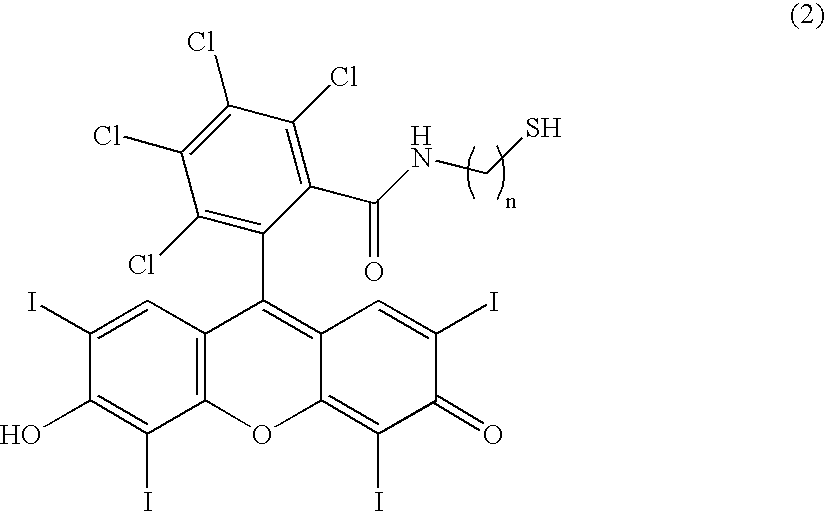
  • the compound for use in electronic devices may be a 2,3,4,5-tetrachloro-6-(6-hydroxy-2,4,5,7-tetraiodo-3-oxo-3H-xanthene-9-yl)-N-(n-mer capto-alkyl)-benzamide derivative represented by formula 2:
  • n is an integer from 2 to 20.
  • the inventors of the present invention conducted research and introduced an alkyl- or alkene-thiol group into the position of the carboxyl group (—COOH) of Rose Bengal via an amide group.
  • FIG. 1 is a chemical scheme illustrating a process of producing a compound for use in electronic devices according to an embodiment of the present invention.
  • Rose Bengal (I) is reacted with thionyl chloride to obtain an acyl chloride intermediate (II). Then, the acyl chloride intermediate (II) is coupled with a thiol compound, for example, aminoalkanethiol, to obtain a compound (III) represented by the above formula 1.
  • a thiol compound for example, aminoalkanethiol
  • an immobilizing technique that can allow organic molecules in an active layer to be arranged in a single molecular layer such that the organic molecules have a specific function is considered to be critical.
  • a compound having a specific functional group (alligator clip) (see David W. Price, Jr., Shawn M. Dirk, Francisco Maya, James M. Tour, Tetrahedron 59 (2003) 2497-2518) is introduced into a specific position of the functional molecule.
  • alkyl thiol which is a specific functional group, can function as an anchoring group for the metal electrode.
  • FIG. 2 is a chemical scheme illustrating synthesis of Rose Bengal derivatives having a thiol group according to an embodiment of the present invention.
  • the carboxyl group must be activated.
  • the Rose Bengal 211 is reacted with thionyl chloride to obtain an acyl chloride intermediate 212. It has been confirmed that it is very important to efficiently remove hydrogen chloride (HCl) formed as a side product of the activation reaction. Due to an excess amount of HCl or hydrochloric acid, Rose Bengal 211 is substituted with a hydrogen ion, and thus, a phenomenon by which a red color disappears, i.e., bleaching, occurs.
  • HCl hydrogen chloride
  • a minimum amount of thionyl chloride as a solvent that can dissolve Rose Bengal 211 should be used.
  • aminoalkanethiol is used for a coupling reaction.
  • An aminoalkanethiol compound 213 was available from Aldrich, and aminoalkanethiol compounds 214 and 215 were prepared conventionally (Journal of organic chemistry, 1999, 64, 2903-2909).
  • the coupling reaction is performed under a basic atmosphere.
  • a pyridine-based solvent is used as a reaction solvent to dissolve the aminoalkanethiol compounds 213, 214, and 215.
  • the pyridine-based solvent can maintain the basic condition necessary for the coupling reaction. There are not many solvents that can dissolve the aminoalkanethiol compounds 213, 214, and 215 and even the pyridine-based solvent can only dissolve the aminoalkanethiol compounds very slowly.
  • the pyridine-based solvent used is an anhydrous solvent. In general, as alkyl groups in the aminoalkanethiol compounds 213, 214, and 215 become longer, the reaction time increases.
  • the coupling reaction is performed for about 2-3 days. Thus, the desired compounds 216, 217, and 218 are obtained. The desired compounds 216, 217, and 218 are confirmed using hydrogen/carbon NMR and/or mass spectrometry (MALDI-TOF). Detailed descriptions will be provided later.
  • an electronic device manufactured by forming and immobilizing a single molecular layer on a lower electrode using a compound according to the embodiment of the present invention and depositing an upper electrode on the immobilized single molecular layer is provided. That is, an ultra-thin film comprised of at least one organic molecular layer is interposed between the lower electrode and the upper electrode.
  • FIG. 3 is a cross-sectional view of essential parts of an electronic device according to an embodiment of the present invention.
  • the electronic device includes a first electrode 20 and a second electrode 30 formed on a substrate 10 and a self-assembled molecular layer 40 interposed between the first electrode 20 and the second electrode 30 .
  • the self-assembled molecular layer 40 is selectively immobilized on the first electrode 20 in a self-assembling manner.
  • the self-assembled molecular layer 40 is composed of the compound having formula 1 described above.
  • the self-assembled molecular layer 40 may be composed of a single molecular layer, but may also be composed of a plurality of molecular layers layered in a self-assembling manner, if necessary.
  • Each of the first electrode 20 and the second electrode 30 may be composed of metal, preferably gold.
  • the electronic device illustrated in FIG. 3 may constitute a memory device or a switching device according to the end of use.
  • 2-aminoethanthiol (0.24 g, 2.0 mmol, compound 213) was mixed with N,N-dimethyl-4-aminopyridine (0.22 g, 2.0 mmol) and an excess amount of pyridine was added to the mixture and stirred to obtain a solution.
  • the obtained solution was transferred to the acyl chloride intermediate 212 produced in Synthesis example 1 using a metal tube, and then the mixture was stirred for about 2 days under a nitrogen atmosphere. Then, the resultant product was subjected to silica gel column chromatography using a dichloromethane-based solvent containing 25% diethyl ester to obtain the desired compound 216 in the form of a red solid (0.51 g, yield 50%).
  • the compound 216 was confirmed using several analytic methods.
  • the 1 H-NMR spectrum, mass spectrum (MALDI-TOF), and FT-IR spectrum of the desired compound 216 were respectively shown in FIG. 5 , FIGS. 6 and 7 , and FIG. 8 .
  • the desired compound 217 was obtained in the form of a red solid (0.52 g, yield 49%) in the same manner as in Synthesis example 2, except that the aminoalkanethiol compound 214 (0.35 g, 2.0 mmol) was used instead of the aminoalkanethiol compound 213.
  • the desired compound 217 was confirmed using mass spectrometry (MALDI-TOF)
  • the desired compound 218 was obtained in the form of a red solid (0.57 g, yield 50%) in the same manner as in Synthesis example 2, except that the aminoalkanethiol compound 215 (0.5 g, 2.0 mmol) was used instead of the aminoalkanethiol compound 213.
  • the desired compound 218 was confirmed using mass spectrometry (MALDI-TOF).
  • three lines of lower electrodes were formed by manufacturing a compound semiconductor using a general nano-imprinting technique.
  • the lower electrodes were formed of gold.
  • the line width of each of the lower electrodes were in a range of 20 nm-5 ⁇ m, and could be in a range of 20 nm-50 nm.
  • the desired compound 216 synthesized in Synthesis example 2 was immobilized on each of the lower electrodes using a self-assembling method. At this time, an anhydrous, oxygen-free dimethylformamide (DMF) was used as a solvent in a glove box maintained under an oxygen-free and dry atmosphere. A substrate on which the lower electrodes were formed was dipped in a 10 ml-solution containing the desired compound 216 in a concentration of 1 mmol in the DMF and was left for 24 hours. Then, the substrate was removed and washed sequentially with DMF, THF, ethanol, and distilled water.
  • DMF dimethylformamide
  • the washed molecular device was dried in a low-temperature vacuum oven (40° C., 10 ⁇ 3 torr) for at least 2 hours, and then placed in a deposition apparatus. Gold was deposited on the molecular device at 10 ⁇ 6 torr and ⁇ 78° C.
  • Switching properties of the electronic device manufactured in the Manufacturing example were determined using a semiconductor parameter analyzer (HP 4156C) and memory properties of the electronic device were determined using a pulse generator unit (HP 41501 expander) and a source monitor unit/pulse generator unit (SMU-PGU) selector (HP 16440A).
  • a semiconductor parameter analyzer HP 4156C
  • memory properties of the electronic device were determined using a pulse generator unit (HP 41501 expander) and a source monitor unit/pulse generator unit (SMU-PGU) selector (HP 16440A).
  • the experiment conditions were as follows. First, to prevent oxidation of the molecules in the memory device manufactured in the manufacture examples, the memory device was stored in a vacuum chamber at room temperature before the analysis. Current-voltage characteristics were determined using a semiconductor parameter analyzer (HP 4156C, measurement range: 1fA/2V-1A/200V). The molecular switching/memory properties were determined in the same direction as and opposite direction to the voltage.
  • the molecular switching/memory properties were determined from +V c voltage to ⁇ V c voltage, from ⁇ V c voltage to +V c voltage, and also in a voltage loop from 0 to +V c voltage to ⁇ V c voltage to +V c voltage.
  • the switching properties of the device were confirmed, and the results are illustrated in FIG. 9 .
  • a pulse was measured using a pulse generator (HP 41501 expander) and an SMU-PGU selector (HP 16440A), which can be connected to the above apparatus for determining the switching properties, to evaluate the memory properties of the device.
  • the results are illustrated in FIG. 10 .
  • the pulse generator which has a measurement range of several Hz to several MHz, must be selected considering the switching properties of the molecular memory device rising/falling time of a voltage pulse had a period of 100 ns or less.
  • a compound for use in electronic devices according to the present invention is derived from Rose Bengal.
  • the compound can be used to form a single molecular layer on an electrode in a self-assembling manner to realize a molecular switch/memory device.
  • the compound according to the present invention can be used to form an active layer composed of a single molecular layer with an ultra-thin thickness of about several nanometers that can be controlled according to the length of a substituent of the compound.
  • the voltage between a lower electrode and an upper electrode can be controlled by varying the length and type of the substituent.
  • the intensity of a current flowing through the single molecular layer can be controlled according to the length of an alkyl group.
  • an electronic device comprising the single molecular layer which is formed in the self-assembling manner with a thickness controlled by varying the length of the substituent has switching/memory properties. Thus, a practical molecular device can be manufactured.

Landscapes

  • Chemical & Material Sciences (AREA)
  • Engineering & Computer Science (AREA)
  • Nanotechnology (AREA)
  • Physics & Mathematics (AREA)
  • Materials Engineering (AREA)
  • Organic Chemistry (AREA)
  • Spectroscopy & Molecular Physics (AREA)
  • Crystallography & Structural Chemistry (AREA)
  • Composite Materials (AREA)
  • Condensed Matter Physics & Semiconductors (AREA)
  • General Physics & Mathematics (AREA)
  • Mathematical Physics (AREA)
  • Theoretical Computer Science (AREA)
  • Semiconductor Memories (AREA)

Abstract

Provided are compounds having a thiol group as an anchoring group introduced into a Rose Bengal molecule, a method of producing the compound, an electronic device comprising the compound immobilized on an electrode by a self-assembling method, and a method of manufacturing the electronic device. The compound has the following formula:
Figure US07419848-20080902-C00001
    • wherein
    • R is an unsaturated or saturated C2-C20 hydrocarbon group.
The compound can provide switch/memory properties and form a single molecular layer by self-assembling when manufacturing a molecular electronic device.

Description

BACKGROUND OF THE INVENTION
This application claims the benefit of Korean Patent Application No. 10-2004-0091576, filed on Nov. 10, 2004, in the Korean Intellectual Property Office, the disclosure of which is incorporated herein in its entirety by reference.
1. Field of the Invention
The present invention relates to a compound for use in electronic devices, a method of producing the compound, an electronic device comprising a layer composed of the compound, and a method of manufacturing the electronic device, and more particularly, to a compound for use in electronic devices which is derived from a Rose Bengal molecule having switching/memory properties, a method of producing the compound, an electronic device comprising a layer composed of the compound, and a method of manufacturing the electronic device.
2. Description of the Related Art
It has been recently discovered that organic materials having π-electrons that form conjugate bonds have semiconducting properties and considerable research is being conducted to develop such organic semiconductor materials. Research on organic semiconductor materials has been primarily related to electron transportation. Also, vigorous research is being conducted to apply such materials to molecular switch/memory devices using a charging phenomenon that occurs due to the polarization of π-electrons in the molecules. It has been reported that a molecular device manufactured by spin coating Rose Bengal molecules, which are used as organic coloring agents, has a molecular memory property. However, the molecular film produced by spin coating is composed of up to several tens of molecular layers, and the thickness of the molecular film is at least several tens of nanometers. Thus, an ultra-thin film cannot be easily produced and it is almost impossible to control the thickness of the film.
SUMMARY OF THE INVENTION
The present invention provides a compound which is useful for electronic devices, has an anchoring group and can be selectively immobilized as a single molecular layer on a metal electrode, and thus, can be suitably used to manufacture a molecular electronic device comprising an ultra-thin film composed of a single molecular layer.
The present invention also provides a method of producing the compound that is useful for electronic devices, has an anchoring group and can be selectively immobilized on a metal electrode.
The present invention further provides an electronic device in which a single molecular layer having functional organic molecules arranged in a predetermined direction is interposed between a lower electrode and an upper electrode to provide switching/memory properties.
The present invention further provides a method of manufacturing an electronic device in which the thickness of a functional organic molecular layer interposed between a lower electrode and an upper electrode can be easily controlled to produce an ultra-thin electronic device.
According to an aspect of the present invention, there is provided a compound for use in electronic devices, having the following formula:
Figure US07419848-20080902-C00002
wherein
R is an unsaturated or saturated C2-C20 hydrocarbon group.
In the above formula, R may be an alkyl group or an alkene group.
The compound for use in electronic devices may be a compound having the following formula:
Figure US07419848-20080902-C00003
wherein
n is an integer from 2 to 20.
According to another aspect of the present invention, there is provided a method of producing a compound for use in electronic devices, comprising:
reacting Rose Bengal having the following formula with thionyl chloride to obtain an acyl chloride intermediate; and
Figure US07419848-20080902-C00004
coupling the acyl chloride intermediate with a thiol compound to obtain a compound having the following formula:
Figure US07419848-20080902-C00005
wherein
R is an unsaturated or saturated C2-C20 hydrocarbon group.
The coupling the acyl chloride intermediate with the thiol compound may be performed under a basic atmosphere. For example, a pyridine-based solvent may be used in the coupling of the acyl chloride intermediate with the thiol compound.
According to still another aspect of the present invention, there is provided an electronic device comprising: a first electrode; a self-assembled molecular layer composed of the above compound for use in electronic devices selectively immobilized on the first electrode by self-assembling; and a second electrode formed on the self-assembled molecular layer.
The electronic device may constitute a memory device or a switching device.
According to yet another aspect of the present invention, there is provided a method of manufacturing of an electronic device, comprising forming a first electrode on a substrate; preparing a solution of the above compound for use in electronic devices dissolved in a solvent; dipping the substrate having the first electrode formed thereon into the obtained solution to form a self-assembled molecular layer on the first electrode; and forming a second electrode on the self-assembled molecular layer.
A compound according to an embodiment of the present invention can be used to form a single molecular layer on an electrode in a self-assembling manner and realize switch/memory devices. The single molecular layer can be ultra-thin with a thickness of about several nanometers. The thickness of the single molecular layer composed of the compound according to an embodiment of the present invention can be controlled by varying the length of a substituent of the compound. An electronic device comprising the single molecular layer produced in a self-assembling manner according to an embodiment of the present invention has switching/memory properties, and thus, a practical molecular device can be manufactured.
BRIEF DESCRIPTION OF THE DRAWINGS
The above and other features and advantages of the present invention will become more apparent by describing in detail exemplary embodiments thereof with reference to the attached drawings in which:
FIG. 1 is a chemical scheme illustrating a process of producing a compound for use in electronic devices according to an embodiment of the present invention;
FIG. 2 is a chemical scheme illustrating synthesis of compounds according to embodiments of the present invention; and
FIG. 3 is a cross-sectional view of essential parts of an electronic device according to an embodiment of the present invention;
FIG. 4 is an FT-IR spectrum of an acyl chloride intermediate formed during a process of producing a compound according to an embodiment of the present invention;
FIG. 5 is a 1H-NMR spectrum of a compound according to an embodiment of the present invention;
FIG. 6 is a mass spectrum (MALDI TOF) of a compound according to an embodiment of the present invention;
FIG. 7 is an enlarged view of the mass spectrum (MALDI TOF) illustrated in FIG. 6;
FIG. 8 is an FT-IR spectrum of a compound according to another embodiment of the present invention;
FIG. 9 is a graph of molecular switching (hysteresis) properties of an electronic device according to an embodiment of the present invention; and
FIG. 10 is a graph of memory properties of an electronic device according to an embodiment of the present invention.
DETAILED DESCRIPTION OF THE INVENTION
A compound for use in electronic devices according to an embodiment of the present invention can be used to form a single molecular layer on a surface of an electrode such that the compound can be suitably used to manufacture an electronic device which provides switching/memory properties. The compound for use in electronic devices contains an anchoring group which can be selectively attached to the surface of the electrode so as to form a single molecular layer in which each of the molecules is arranged in a predetermined direction.
The compound for use in electronic devices according to an embodiment of the present invention has formula 1, in which an anchoring group containing a mercapto group is introduced into the position of a carboxyl group (—COOH) in Rose Bengal:
Figure US07419848-20080902-C00006
wherein
R is an unsaturated or saturated C2-C20 hydrocarbon group, and preferably an alkyl group or an alkene group.
The compound for use in electronic devices may be a 2,3,4,5-tetrachloro-6-(6-hydroxy-2,4,5,7-tetraiodo-3-oxo-3H-xanthene-9-yl)-N-(n-mer capto-alkyl)-benzamide derivative represented by formula 2:
Figure US07419848-20080902-C00007
wherein
n is an integer from 2 to 20.
The inventors of the present invention conducted research and introduced an alkyl- or alkene-thiol group into the position of the carboxyl group (—COOH) of Rose Bengal via an amide group.
FIG. 1 is a chemical scheme illustrating a process of producing a compound for use in electronic devices according to an embodiment of the present invention.
Referring to FIG. 1, Rose Bengal (I) is reacted with thionyl chloride to obtain an acyl chloride intermediate (II). Then, the acyl chloride intermediate (II) is coupled with a thiol compound, for example, aminoalkanethiol, to obtain a compound (III) represented by the above formula 1. In the compound (III) illustrated in FIG. 1, R is as described above.
In order to efficiently manufacture molecular devices, an immobilizing technique that can allow organic molecules in an active layer to be arranged in a single molecular layer such that the organic molecules have a specific function is considered to be critical. In an embodiment of the present invention, in order to selectively attach a functional molecule which can provide switching/memory properties to a metal electrode of an electronic device in a self-assembling manner, a compound having a specific functional group (alligator clip) (see David W. Price, Jr., Shawn M. Dirk, Francisco Maya, James M. Tour, Tetrahedron 59 (2003) 2497-2518) is introduced into a specific position of the functional molecule. For example, alkyl thiol, which is a specific functional group, can function as an anchoring group for the metal electrode.
FIG. 2 is a chemical scheme illustrating synthesis of Rose Bengal derivatives having a thiol group according to an embodiment of the present invention.
Referring to FIG. 2, to introduce an anchoring group into a position of a carboxyl group in Rose Bengal 211, the carboxyl group must be activated. Although many methods of activating a carboxyl group are known, in the present embodiment, the Rose Bengal 211 is reacted with thionyl chloride to obtain an acyl chloride intermediate 212. It has been confirmed that it is very important to efficiently remove hydrogen chloride (HCl) formed as a side product of the activation reaction. Due to an excess amount of HCl or hydrochloric acid, Rose Bengal 211 is substituted with a hydrogen ion, and thus, a phenomenon by which a red color disappears, i.e., bleaching, occurs. To overcome this problem, a minimum amount of thionyl chloride as a solvent that can dissolve Rose Bengal 211 should be used. For a coupling reaction, aminoalkanethiol is used. An aminoalkanethiol compound 213 was available from Aldrich, and aminoalkanethiol compounds 214 and 215 were prepared conventionally (Journal of organic chemistry, 1999, 64, 2903-2909). To prevent the bleaching due to the acid, the coupling reaction is performed under a basic atmosphere.
A pyridine-based solvent is used as a reaction solvent to dissolve the aminoalkanethiol compounds 213, 214, and 215. The pyridine-based solvent can maintain the basic condition necessary for the coupling reaction. There are not many solvents that can dissolve the aminoalkanethiol compounds 213, 214, and 215 and even the pyridine-based solvent can only dissolve the aminoalkanethiol compounds very slowly. The pyridine-based solvent used is an anhydrous solvent. In general, as alkyl groups in the aminoalkanethiol compounds 213, 214, and 215 become longer, the reaction time increases. The coupling reaction is performed for about 2-3 days. Thus, the desired compounds 216, 217, and 218 are obtained. The desired compounds 216, 217, and 218 are confirmed using hydrogen/carbon NMR and/or mass spectrometry (MALDI-TOF). Detailed descriptions will be provided later.
In an embodiment of the present invention, an electronic device manufactured by forming and immobilizing a single molecular layer on a lower electrode using a compound according to the embodiment of the present invention and depositing an upper electrode on the immobilized single molecular layer is provided. That is, an ultra-thin film comprised of at least one organic molecular layer is interposed between the lower electrode and the upper electrode.
FIG. 3 is a cross-sectional view of essential parts of an electronic device according to an embodiment of the present invention.
Referring to FIG. 3, the electronic device includes a first electrode 20 and a second electrode 30 formed on a substrate 10 and a self-assembled molecular layer 40 interposed between the first electrode 20 and the second electrode 30. The self-assembled molecular layer 40 is selectively immobilized on the first electrode 20 in a self-assembling manner. The self-assembled molecular layer 40 is composed of the compound having formula 1 described above.
The self-assembled molecular layer 40 may be composed of a single molecular layer, but may also be composed of a plurality of molecular layers layered in a self-assembling manner, if necessary. Each of the first electrode 20 and the second electrode 30 may be composed of metal, preferably gold.
The electronic device illustrated in FIG. 3 may constitute a memory device or a switching device according to the end of use.
Hereinafter, a method of synthesizing a compound for use in electronic devices according to an embodiment of the present invention and a method of manufacturing an electronic device according to an embodiment of the present invention will be described in more detail with reference to the following examples. These examples are provided for the purpose of illustration and are not intended to limit the scope of the present invention.
SYNTHESIS EXAMPLE 1 Synthesis Process 210 of FIG. 2
A 50 ml two-necked flask was flame-dried and cooled in a vacuum. Rose Bengal (1 g, 0.98 mmol) was placed in the flask and dried in a high vacuum. 20 ml of thionyl chloride (SOCl2) was slowly added to the Rose Bengal and cooled, since, as soon as thionyl chloride (SOCl2) was added, a reaction occurred, rapidly increasing the temperature. To efficiently remove hydrogen chloride generated during the reaction, a trap dipped in a basic solution was connected to the flask and nitrogen was continuously passed through the trap. After stirring the resultant mixed solution for about 2 days, the resultant product was confirmed using FT-IR and the reaction was stopped. An excess amount of thionyl chloride was removed under reduced pressure, and then the resultant product was dried in a vacuum. Thus, the acyl chloride intermediate 212 was obtained. The FT-IR spectrum of the acyl chloride intermediate 212 is shown in FIG. 4.
Compound 212; FT-IR (film) 1784.6, 1584.9, 1566.9, 1449.2, 1408.0, 1378.3, 1203.9, 1161.5, 1123.0 cm−1
SYNTHESIS EXAMPLE 2 Synthesis Process 220 of FIG. 2
2-aminoethanthiol (0.24 g, 2.0 mmol, compound 213) was mixed with N,N-dimethyl-4-aminopyridine (0.22 g, 2.0 mmol) and an excess amount of pyridine was added to the mixture and stirred to obtain a solution. The obtained solution was transferred to the acyl chloride intermediate 212 produced in Synthesis example 1 using a metal tube, and then the mixture was stirred for about 2 days under a nitrogen atmosphere. Then, the resultant product was subjected to silica gel column chromatography using a dichloromethane-based solvent containing 25% diethyl ester to obtain the desired compound 216 in the form of a red solid (0.51 g, yield 50%). The compound 216 was confirmed using several analytic methods. The 1H-NMR spectrum, mass spectrum (MALDI-TOF), and FT-IR spectrum of the desired compound 216 were respectively shown in FIG. 5, FIGS. 6 and 7, and FIG. 8.
Compound 216; MS (M+K, MALDI-TOF): m/z (%):1072; FT-IR (film) 3411.9, 3165.8, 3064.7, 2941.6, 1639.2, 1567.2, 1449.4, 1341.5, 1209.8, 994.5, 938.8 cm−1
SYNTHESIS EXAMPLE 3 Synthesis Process 230 in FIG. 2
The desired compound 217 was obtained in the form of a red solid (0.52 g, yield 49%) in the same manner as in Synthesis example 2, except that the aminoalkanethiol compound 214 (0.35 g, 2.0 mmol) was used instead of the aminoalkanethiol compound 213. The desired compound 217 was confirmed using mass spectrometry (MALDI-TOF)
Compound 217 (M+K, MALDI-TOF): m/z (%): 1128
SYNTHESIS EXAMPLE 4 Synthesis Process (240) of FIG. 2
The desired compound 218 was obtained in the form of a red solid (0.57 g, yield 50%) in the same manner as in Synthesis example 2, except that the aminoalkanethiol compound 215 (0.5 g, 2.0 mmol) was used instead of the aminoalkanethiol compound 213. The desired compound 218 was confirmed using mass spectrometry (MALDI-TOF).
Compound 218 (M+K, MALDI-TOF): m/z(%): 1198
Manufacturing Example (Manufacturing of an Electronic Device)
First, three lines of lower electrodes were formed by manufacturing a compound semiconductor using a general nano-imprinting technique. The lower electrodes were formed of gold. The line width of each of the lower electrodes were in a range of 20 nm-5 μm, and could be in a range of 20 nm-50 nm.
The desired compound 216 synthesized in Synthesis example 2 was immobilized on each of the lower electrodes using a self-assembling method. At this time, an anhydrous, oxygen-free dimethylformamide (DMF) was used as a solvent in a glove box maintained under an oxygen-free and dry atmosphere. A substrate on which the lower electrodes were formed was dipped in a 10 ml-solution containing the desired compound 216 in a concentration of 1 mmol in the DMF and was left for 24 hours. Then, the substrate was removed and washed sequentially with DMF, THF, ethanol, and distilled water. The washed molecular device was dried in a low-temperature vacuum oven (40° C., 10−3 torr) for at least 2 hours, and then placed in a deposition apparatus. Gold was deposited on the molecular device at 10−6 torr and −78° C.
EVALUATION EXAMPLE Evaluation Of Switching/Memory Properties
Switching properties of the electronic device manufactured in the Manufacturing example were determined using a semiconductor parameter analyzer (HP 4156C) and memory properties of the electronic device were determined using a pulse generator unit (HP 41501 expander) and a source monitor unit/pulse generator unit (SMU-PGU) selector (HP 16440A).
The experiment conditions were as follows. First, to prevent oxidation of the molecules in the memory device manufactured in the manufacture examples, the memory device was stored in a vacuum chamber at room temperature before the analysis. Current-voltage characteristics were determined using a semiconductor parameter analyzer (HP 4156C, measurement range: 1fA/2V-1A/200V). The molecular switching/memory properties were determined in the same direction as and opposite direction to the voltage.
That is, the molecular switching/memory properties were determined from +Vc voltage to −Vc voltage, from −Vc voltage to +Vc voltage, and also in a voltage loop from 0 to +Vc voltage to −Vc voltage to +Vc voltage. Thus, the switching properties of the device were confirmed, and the results are illustrated in FIG. 9.
A pulse was measured using a pulse generator (HP 41501 expander) and an SMU-PGU selector (HP 16440A), which can be connected to the above apparatus for determining the switching properties, to evaluate the memory properties of the device. The results are illustrated in FIG. 10. In particular, the pulse generator, which has a measurement range of several Hz to several MHz, must be selected considering the switching properties of the molecular memory device rising/falling time of a voltage pulse had a period of 100 ns or less.
A compound for use in electronic devices according to the present invention is derived from Rose Bengal. The compound can be used to form a single molecular layer on an electrode in a self-assembling manner to realize a molecular switch/memory device. As opposed to a conventional thin film having a thickness of several tens of nanometers formed by a spin coating method, the compound according to the present invention can be used to form an active layer composed of a single molecular layer with an ultra-thin thickness of about several nanometers that can be controlled according to the length of a substituent of the compound. In particular, to introduce an anchoring group into Rose Bengal, the voltage between a lower electrode and an upper electrode can be controlled by varying the length and type of the substituent. Using an exemplary compound according to the present invention, the intensity of a current flowing through the single molecular layer can be controlled according to the length of an alkyl group. According to the present invention, an electronic device comprising the single molecular layer which is formed in the self-assembling manner with a thickness controlled by varying the length of the substituent has switching/memory properties. Thus, a practical molecular device can be manufactured.
While the present invention has been particularly shown and described with reference to exemplary embodiments thereof, it will be understood by those of ordinary skill in the art that various changes in form and details may be made therein without departing from the spirit and scope of the present invention as defined by the following claims.

Claims (16)

1. A compound for use in electronic devices, having the following formula:
Figure US07419848-20080902-C00008
wherein
R is an unsaturated or saturated C2-C20 hydrocarbon group.
2. The compound of claim 1, wherein R is an alkyl group or an alkene group.
3. The compound of claim 1, having the following formula:
Figure US07419848-20080902-C00009
wherein
n is an integer from 2 to 20.
4. A method of producing a compound for use in electronic devices, comprising:
reacting Rose Bengal having the following formula with thionyl chloride to obtain an acyl chloride intermediate; and
Figure US07419848-20080902-C00010
coupling the acyl chloride intermediate with a thiol compound to obtain a compound having the following formula:
Figure US07419848-20080902-C00011
wherein
R is an unsaturated or saturated C2-C20 hydrocarbon group.
5. The method of claim 4, wherein the coupling the acyl chloride intermediate with the thiol compound is performed under a basic atmosphere.
6. The method of claim 4, wherein a pyridine-based solvent is used in the coupling of the acyl chloride intermediate with the thiol compound.
7. The method of claim 4, wherein the thiol compound is aminoalkanethiol.
8. An electronic device comprising:
a first electrode;
a self-assembled molecular layer composed of a compound having the following formula selectively immobilized on the first electrode by self-assembling; and
a second electrode formed on the self-assembled molecular layer,
Figure US07419848-20080902-C00012
wherein
R is an unsaturated or saturated C2-C20 hydrocarbon group.
9. The electronic device of claim 8, wherein the self-assembled molecular layer is composed of a single molecular layer.
10. The electronic device of claim 8, wherein the self-assembled molecular layer is composed of a plurality of molecular layers.
11. The electronic device of claim 8, constituting a memory device.
12. The electronic device of claim 8, constituting a switching device.
13. The electronic device of claim 8, wherein each of the first electrode and the second electrode are made of gold.
14. A method of manufacturing of an electronic device, comprising:
forming a first electrode on a substrate;
preparing a solution of a compound having the following formula dissolved in a solvent;
dipping the substrate having the first electrode formed thereon into the obtained solution to form a self-assembled molecular layer on the first electrode; and
forming a second electrode on the self-assembled molecular layer.
Figure US07419848-20080902-C00013
wherein
R is an unsaturated or saturated C2-C20 hydrocarbon group.
15. The method of claim 14, wherein the solvent is dimethylformamide (DMF).
16. The method of claim 14, wherein the preparing of the solution is performed under an oxygen-free anhydrous atmosphere.
US11/177,176 2004-11-10 2005-07-08 Compound having anchoring group, electronic device comprising the compound, and methods of producing them Expired - Fee Related US7419848B2 (en)

Applications Claiming Priority (2)

Application Number Priority Date Filing Date Title
KR10-2004-0091576 2004-11-10
KR1020040091576A KR100651728B1 (en) 2004-11-10 2004-11-10 Compound for an electronic device having a fixing group, an electronic device comprising the same and a method of manufacturing the same

Publications (2)

Publication Number Publication Date
US20060097248A1 US20060097248A1 (en) 2006-05-11
US7419848B2 true US7419848B2 (en) 2008-09-02

Family

ID=36315409

Family Applications (1)

Application Number Title Priority Date Filing Date
US11/177,176 Expired - Fee Related US7419848B2 (en) 2004-11-10 2005-07-08 Compound having anchoring group, electronic device comprising the compound, and methods of producing them

Country Status (2)

Country Link
US (1) US7419848B2 (en)
KR (1) KR100651728B1 (en)

Families Citing this family (3)

* Cited by examiner, † Cited by third party
Publication number Priority date Publication date Assignee Title
US7759677B2 (en) * 2006-09-05 2010-07-20 Electronics And Telecommunications Research Institute Molecular electronic device including organic dielectric thin film and method of fabricating the same
WO2019204270A1 (en) * 2018-04-16 2019-10-24 Cornell University Tumor ablation using low-intensity ultrasound and sound excitable drug
DE102021213793A1 (en) * 2021-12-03 2023-06-07 Henkel Ag & Co. Kgaa N-substituted 2-(6-hydroxy-3-oxo-3H-xanthen-9-yl)benzamides as photoactivators in detergents

Citations (1)

* Cited by examiner, † Cited by third party
Publication number Priority date Publication date Assignee Title
US4652894A (en) 1980-03-14 1987-03-24 The Johns Hopkins University Electrical organic thin film switching device switching between detectably different oxidation states

Family Cites Families (83)

* Cited by examiner, † Cited by third party
Publication number Priority date Publication date Assignee Title
US103141A (en) * 1870-05-17 Richard t
US59465A (en) * 1866-11-06 Improvement in suspenders
US215492A (en) * 1879-05-20 Improvement in fire-lighters for engines
US19387A (en) * 1858-02-16 Improvement in repeating fire-arms
US9229A (en) * 1852-08-31 Holler saw-set
US119990A (en) * 1871-10-17 Improvement in glass clock-cases
US1061044A (en) * 1912-08-21 1913-05-06 John W Calhoun Valve.
CS180644B2 (en) * 1973-09-29 1978-01-31 Takeda Chemical Industries Ltd Process for preparing nonapeptides
US3993754A (en) * 1974-10-09 1976-11-23 The United States Of America As Represented By The United States Energy Research And Development Administration Liposome-encapsulated actinomycin for cancer chemotherapy
JPS5186117A (en) * 1975-01-27 1976-07-28 Tanabe Seiyaku Co Johoseibiryushiseizainoseiho
US4115544A (en) * 1976-08-18 1978-09-19 Alza Corporation Ocular system made of bioerodible esters having linear ether
GB1575343A (en) * 1977-05-10 1980-09-17 Ici Ltd Method for preparing liposome compositions containing biologically active compounds
CH624011A5 (en) * 1977-08-05 1981-07-15 Battelle Memorial Institute
FR2402109A1 (en) * 1977-09-05 1979-03-30 Glaenzer Spicer Sa PRE-STRESSING PROCESS FOR A HOMOCINETIC JOINT WITH AXIAL RETENTION, AND JOINT WITH APPLICATION
US4263428A (en) * 1978-03-24 1981-04-21 The Regents Of The University Of California Bis-anthracycline nucleic acid function inhibitors and improved method for administering the same
CA1173360A (en) * 1979-06-22 1984-08-28 Jurg Schrank Pharmaceutical preparations
HU184141B (en) * 1979-12-27 1984-07-30 Human Oltoanyagtermelo Adjuvant particles compositions containing said particles and biologically active substances adsorbed thereon and a process for the preparation thereof
US4348384A (en) * 1980-10-17 1982-09-07 Dainippon Pharmaceutical Co., Ltd. Pharmaceutical composition for oral administration containing coagulation factor VIII or IX
US4419348A (en) * 1981-04-27 1983-12-06 Georgetown University Anthracycline glycoside compositions, their use and preparation
US4473692A (en) * 1981-09-04 1984-09-25 Kabushiki Kaisha Yakult Honsha Camptothecin derivatives and process for preparing same
US4522803A (en) * 1983-02-04 1985-06-11 The Liposome Company, Inc. Stable plurilamellar vesicles, their preparation and use
US4515736A (en) * 1983-05-12 1985-05-07 The Regents Of The University Of California Method for encapsulating materials into liposomes
US4610868A (en) * 1984-03-20 1986-09-09 The Liposome Company, Inc. Lipid matrix carriers for use in drug delivery systems
US4721612A (en) * 1984-04-12 1988-01-26 The Liposome Company, Inc. Steroidal liposomes
US4857319A (en) * 1985-01-11 1989-08-15 The Regents Of The University Of California Method for preserving liposomes
US5023087A (en) * 1986-02-10 1991-06-11 Liposome Technology, Inc. Efficient method for preparation of prolonged release liposome-based drug delivery system
US5187167A (en) * 1986-03-27 1993-02-16 Imperial Chemical Industries Plc Pharmaceutical compositions comprising quinazolin-4-one derivatives
US4812312A (en) * 1987-03-03 1989-03-14 Board Of Regents Of The University Of Texas System Liposome-incorporated nystatin
US5616334A (en) * 1987-03-05 1997-04-01 The Liposome Company, Inc. Low toxicity drug-lipid systems
US4981968A (en) * 1987-03-31 1991-01-01 Research Triangle Institute Synthesis of camptothecin and analogs thereof
GB8727737D0 (en) * 1987-11-26 1987-12-31 Ici Plc Antitumour agents
MX9203504A (en) * 1988-04-20 1992-07-01 Liposome Co Inc AGENT COMPLEX: HIGH PROPORTION ACTIVE LIPID.
US4952408A (en) * 1988-05-23 1990-08-28 Georgetown University Liposome-encapsulated vinca alkaloids and their use in combatting tumors
US5552154A (en) * 1989-11-06 1996-09-03 The Stehlin Foundation For Cancer Research Method for treating cancer with water-insoluble s-camptothecin of the closed lactone ring form and derivatives thereof
US5389377A (en) * 1989-12-22 1995-02-14 Molecular Bioquest, Inc. Solid care therapeutic compositions and methods for making same
US5665710A (en) * 1990-04-30 1997-09-09 Georgetown University Method of making liposomal oligodeoxynucleotide compositions
US5422344A (en) * 1990-05-08 1995-06-06 The United States Of America As Represented By The Secretary Of The Department Of Health & Human Services Method of treating retroviral infections in mammals
US5247089A (en) * 1990-12-20 1993-09-21 North Carolina State University Method of making intermediates useful for the manufacture of camptothecin and camptothecin analogs
US5162532A (en) * 1990-12-20 1992-11-10 North Carolina State University Intermediates and method of making camptothecin and camptothecin analogs
US5145684A (en) * 1991-01-25 1992-09-08 Sterling Drug Inc. Surface modified drug nanoparticles
US5747469A (en) * 1991-03-06 1998-05-05 Board Of Regents, The University Of Texas System Methods and compositions comprising DNA damaging agents and p53
ES2148223T3 (en) * 1992-03-23 2000-10-16 Univ Georgetown TAXOL ENCAPSULATED IN LIPOSOMES AND METHOD FOR USE.
US5391745A (en) * 1992-07-23 1995-02-21 Sloan-Kettering Institute For Cancer Research Methods of preparation of camptothecin analogs
WO1994005259A1 (en) * 1992-09-02 1994-03-17 Georgetown University Method of encapsulating anthracycline glycosides in liposomes
US5552156A (en) * 1992-10-23 1996-09-03 Ohio State University Liposomal and micellular stabilization of camptothecin drugs
US5916596A (en) * 1993-02-22 1999-06-29 Vivorx Pharmaceuticals, Inc. Protein stabilized pharmacologically active agents, methods for the preparation thereof and methods for the use thereof
US5352789A (en) * 1993-02-25 1994-10-04 The Stehlin Foundation For Cancer Research Methods for purifying camptothecin compounds
US5527913A (en) * 1993-02-25 1996-06-18 The Stehlin Foundation For Cancer Research Methods for purifying camptothecin compounds
US5776486A (en) * 1993-05-28 1998-07-07 Aphios Corporation Methods and apparatus for making liposomes containing hydrophobic drugs
DE4324368A1 (en) * 1993-07-21 1995-01-26 Hoechst Ag Process for the preparation of fluorobenzonitriles
TW406020B (en) * 1993-09-29 2000-09-21 Bristol Myers Squibb Co Stabilized pharmaceutical composition and its method for preparation and stabilizing solvent
US5447936A (en) * 1993-12-22 1995-09-05 Bionumerik Pharmaceuticals, Inc. Lactone stable formulation of 10-hydroxy 7-ethyl camptothecin and methods for uses thereof
US5786344A (en) * 1994-07-05 1998-07-28 Arch Development Corporation Camptothecin drug combinations and methods with reduced side effects
US5626862A (en) * 1994-08-02 1997-05-06 Massachusetts Institute Of Technology Controlled local delivery of chemotherapeutic agents for treating solid tumors
CA2203622C (en) * 1994-08-19 2011-11-01 Andre Trouet Compounds, pharmaceutical composition and diagnostic device comprising them and their use
US5776743A (en) * 1994-09-06 1998-07-07 La Jolla Cancer Research Foundation Method of sensitizing tumor cells with adenovirus E1A
US5496830A (en) * 1994-09-14 1996-03-05 Johns Hopkins University Inhibition of hemoflagellates by camptothecin compounds
IL115099A (en) * 1994-10-14 1999-04-11 Upjohn Co Lyophilizate of phospholipid complex of water insoluble camptothecins
US6214388B1 (en) * 1994-11-09 2001-04-10 The Regents Of The University Of California Immunoliposomes that optimize internalization into target cells
US5919816A (en) * 1994-11-14 1999-07-06 Bionumerik Pharmaceuticals, Inc. Formulations and methods of reducing toxicity of antineoplastic agents
US5736156A (en) * 1995-03-22 1998-04-07 The Ohio State University Liposomal anf micellular stabilization of camptothecin drugs
US5834012A (en) * 1995-05-03 1998-11-10 Roman Perez-Soler Lipid complexed topoisomerase I inhibitors
US5726181A (en) * 1995-06-05 1998-03-10 Bionumerik Pharmaceuticals, Inc. Formulations and compositions of poorly water soluble camptothecin derivatives
US5972955A (en) * 1995-06-06 1999-10-26 Dr. Reddy's Research Foundation Water soluble C-ring analogues of 20(S)-camptothecin
SG50747A1 (en) * 1995-08-02 1998-07-20 Tanabe Seiyaku Co Comptothecin derivatives
AU7732996A (en) * 1995-11-22 1997-06-11 Research Triangle Institute Camptothecin compounds with combined topoisomerase i inhibition and dna alkylation properties
US6096336A (en) * 1996-01-30 2000-08-01 The Stehlin Foundation For Cancer Research Liposomal prodrugs comprising derivatives of camptothecin and methods of treating cancer using these prodrugs
US6056973A (en) * 1996-10-11 2000-05-02 Sequus Pharmaceuticals, Inc. Therapeutic liposome composition and method of preparation
US5759767A (en) * 1996-10-11 1998-06-02 Joseph R. Lakowicz Two-photon and multi-photon measurement of analytes in animal and human tissues and fluids
US5837282A (en) * 1996-10-30 1998-11-17 University Of British Columbia Ionophore-mediated liposome loading
US5948750A (en) * 1996-10-30 1999-09-07 Merck & Co., Inc. Conjugates useful in the treatment of prostate cancer
US6331286B1 (en) * 1998-12-21 2001-12-18 Photogen, Inc. Methods for high energy phototherapeutics
SG88737A1 (en) * 1996-10-30 2002-05-21 Tanabe Seiyaku Co S type 2-substituted hydroxy-2-indolidinylbutyric ester compounds and process for preparation thereof
US5827533A (en) * 1997-02-06 1998-10-27 Duke University Liposomes containing active agents aggregated with lipid surfactants
DE19819642A1 (en) * 1997-05-28 1998-12-03 Phoenix Ag Air spring system for automobile
US6090407A (en) * 1997-09-23 2000-07-18 Research Development Foundation Small particle liposome aerosols for delivery of anti-cancer drugs
US6461637B1 (en) * 2000-09-01 2002-10-08 Neopharm, Inc. Method of administering liposomal encapsulated taxane
US6146659A (en) * 1998-07-01 2000-11-14 Neopharm, Inc. Method of administering liposomal encapsulated taxane
DE19832995C1 (en) * 1998-07-22 1999-11-04 Siemens Ag Memory device using resistive ferroelectric memory cells
EP1121102B1 (en) * 1998-09-16 2003-04-23 Alza Corporation Liposome-entrapped topoisomerase inhibitors
US6294285B1 (en) * 1998-12-07 2001-09-25 Eleven Engineering Inc. Quick change battery system
US6291676B1 (en) * 1999-03-03 2001-09-18 University Of Kentucky Research Foundation Water-soluble derivatives of camptothecin/homocamptothecin
US6750266B2 (en) * 2001-12-28 2004-06-15 3M Innovative Properties Company Multiphoton photosensitization system

Patent Citations (1)

* Cited by examiner, † Cited by third party
Publication number Priority date Publication date Assignee Title
US4652894A (en) 1980-03-14 1987-03-24 The Johns Hopkins University Electrical organic thin film switching device switching between detectably different oxidation states

Non-Patent Citations (3)

* Cited by examiner, † Cited by third party
Title
"Large Conductance Switching and Binary Operation in Organic Devices: Role of Functional Groups", A. Bandhopadhyay, et al, J. Phys. Chem B 2003, 107, pp. 2531-2536.
"Tuning of Organic Reversible Switching via Self-Assembled Supramolecular Structures", A. Bandyopadhyay, et al., Adv. Mater. 2003, No. 22, Nov. 17, pp. 1949-1952.
Large conductance switching and memory effects in organic molecules for data-storage applications, Applied Physics Letters, vol. 82, No. 8, Feb. 24, 2003, pp. 1215-1217.

Also Published As

Publication number Publication date
US20060097248A1 (en) 2006-05-11
KR20060042790A (en) 2006-05-15
KR100651728B1 (en) 2006-12-06

Similar Documents

Publication Publication Date Title
US7928432B2 (en) Sensing devices from molecular electronic devices
JP4912364B2 (en) Compositions comprising soluble sexual thiophene derivatives
Lee et al. Modification of an ITO anode with a hole-transporting SAM for improved OLED device characteristics
KR101096981B1 (en) New Condensed Ring Compounds and Organic Electronic Devices Using The Same
EP2361915A1 (en) Novel heterocyclic compound and use thereof
Audi et al. Electrical molecular switch addressed by chemical stimuli
US7932463B2 (en) Quinacridine derivatives and organic electronic devices using the same
US7419848B2 (en) Compound having anchoring group, electronic device comprising the compound, and methods of producing them
Dhawan et al. Organic field effect transistors based on self-assembling core-modified peptidic polymers
Mahmud et al. Triazole-linked dendro [60] fullerenes: modular synthesis via a ‘click’reaction and acidity-dependent self-assembly on the surface
US20080275273A1 (en) Method for Synthesizing Long-Chain Phosphonic Acid Derivatives and Thiol Derivatives
Hoang et al. New semiconducting multi-branched conjugated molecules based on π-extended triphenylene and its application to organic field-effect transistor
Nuic et al. Disulfide-Containing Nitrosoarenes: Synthesis and Insights into Their Self-Polymerization on a Gold Surface
KR101299098B1 (en) Preparing method for organic thin layer of organic light emitting devices using electrochemical deposition
JP2003092407A (en) Transistor and display device using the same
Snowdon et al. Carboxylic acids as anchoring components on aluminum oxide for the alignment relay technique of single-walled carbon nanotubes
US7897735B2 (en) Compound having thiol anchoring group, method of synthesizing the same, and molecular electronic device having molecular active layer formed using the compound
Nogues et al. SAMs functionalised by α-quaterthiophene as model for polythiophene grafting
JP3492241B2 (en) Polymer and organic electroluminescent materials
KR100873802B1 (en) Organic Rectifier with Fullerene Derivatives
Hoang et al. Photoreactive π-conjugated star-shaped molecules for the organic field-effect transistor
US20070292601A1 (en) Thin Film Devices Utilizing Hexabenzocoronenes
KR101941685B1 (en) Organic semiconductor device and method of manufacturing the same
US20040010028A1 (en) Self-assembled nanostructures with macroscopic polar order
Ikeda et al. Electrochemically durable thiophene alkanethiol self-assembled monolayers

Legal Events

Date Code Title Description
AS Assignment

Owner name: ELECTRONICS AND TELECOMMUNICATIONS RESEARCH INSTIT

Free format text: ASSIGNMENT OF ASSIGNORS INTEREST;ASSIGNORS:LEE, HYOYOUNG;DO, HYEON-JEONG;KIM, DO HYUN;AND OTHERS;REEL/FRAME:022294/0212;SIGNING DATES FROM 20050619 TO 20050620

FEPP Fee payment procedure

Free format text: PAYOR NUMBER ASSIGNED (ORIGINAL EVENT CODE: ASPN); ENTITY STATUS OF PATENT OWNER: SMALL ENTITY

FEPP Fee payment procedure

Free format text: PAYER NUMBER DE-ASSIGNED (ORIGINAL EVENT CODE: RMPN); ENTITY STATUS OF PATENT OWNER: SMALL ENTITY

Free format text: PAYOR NUMBER ASSIGNED (ORIGINAL EVENT CODE: ASPN); ENTITY STATUS OF PATENT OWNER: SMALL ENTITY

FPAY Fee payment

Year of fee payment: 4

REMI Maintenance fee reminder mailed
LAPS Lapse for failure to pay maintenance fees
STCH Information on status: patent discontinuation

Free format text: PATENT EXPIRED DUE TO NONPAYMENT OF MAINTENANCE FEES UNDER 37 CFR 1.362

STCH Information on status: patent discontinuation

Free format text: PATENT EXPIRED DUE TO NONPAYMENT OF MAINTENANCE FEES UNDER 37 CFR 1.362

FP Lapsed due to failure to pay maintenance fee

Effective date: 20160902