US7410982B2 - Propanamine derivatives as serotonin and norepinephrine reuptake inhibitors - Google Patents
Propanamine derivatives as serotonin and norepinephrine reuptake inhibitors Download PDFInfo
- Publication number
- US7410982B2 US7410982B2 US10/532,765 US53276505A US7410982B2 US 7410982 B2 US7410982 B2 US 7410982B2 US 53276505 A US53276505 A US 53276505A US 7410982 B2 US7410982 B2 US 7410982B2
- Authority
- US
- United States
- Prior art keywords
- alkyl
- mmol
- phenyl
- methyl
- compound
- Prior art date
- Legal status (The legal status is an assumption and is not a legal conclusion. Google has not performed a legal analysis and makes no representation as to the accuracy of the status listed.)
- Expired - Fee Related, expires
Links
- QZAYGJVTTNCVMB-UHFFFAOYSA-N serotonin Chemical compound C1=C(O)C=C2C(CCN)=CNC2=C1 QZAYGJVTTNCVMB-UHFFFAOYSA-N 0.000 title description 68
- 229940076279 serotonin Drugs 0.000 title description 33
- WGYKZJWCGVVSQN-UHFFFAOYSA-N propylamine Chemical class CCCN WGYKZJWCGVVSQN-UHFFFAOYSA-N 0.000 title description 12
- 239000002767 noradrenalin uptake inhibitor Substances 0.000 title description 3
- 239000003772 serotonin uptake inhibitor Substances 0.000 title description 3
- 229940127221 norepinephrine reuptake inhibitor Drugs 0.000 title description 2
- 150000003839 salts Chemical class 0.000 claims abstract description 41
- 150000001875 compounds Chemical class 0.000 claims description 168
- 239000003085 diluting agent Substances 0.000 claims description 4
- 239000008194 pharmaceutical composition Substances 0.000 claims description 3
- -1 thio 3-substituted propanamine compound Chemical class 0.000 abstract description 68
- 125000004178 (C1-C4) alkyl group Chemical group 0.000 abstract description 34
- 125000001424 substituent group Chemical group 0.000 abstract description 23
- 125000001997 phenyl group Chemical group [H]C1=C([H])C([H])=C(*)C([H])=C1[H] 0.000 abstract description 22
- 125000000229 (C1-C4)alkoxy group Chemical group 0.000 abstract description 20
- 125000001544 thienyl group Chemical group 0.000 abstract description 14
- 125000004093 cyano group Chemical group *C#N 0.000 abstract description 12
- 125000004582 dihydrobenzothienyl group Chemical group S1C(CC2=C1C=CC=C2)* 0.000 abstract description 12
- 125000002023 trifluoromethyl group Chemical group FC(F)(F)* 0.000 abstract description 12
- 125000001164 benzothiazolyl group Chemical group S1C(=NC2=C1C=CC=C2)* 0.000 abstract description 11
- 125000004588 thienopyridyl group Chemical group S1C(=CC2=C1C=CC=N2)* 0.000 abstract description 11
- 125000005956 isoquinolyl group Chemical group 0.000 abstract description 10
- 125000005493 quinolyl group Chemical group 0.000 abstract description 10
- 125000006552 (C3-C8) cycloalkyl group Chemical group 0.000 abstract description 7
- 125000004648 C2-C8 alkenyl group Chemical group 0.000 abstract description 7
- 125000001316 cycloalkyl alkyl group Chemical group 0.000 abstract description 7
- 125000004169 (C1-C6) alkyl group Chemical group 0.000 abstract description 3
- 125000000217 alkyl group Chemical group 0.000 abstract description 3
- 125000001475 halogen functional group Chemical group 0.000 abstract 4
- HEDRZPFGACZZDS-MICDWDOJSA-N Trichloro(2H)methane Chemical compound [2H]C(Cl)(Cl)Cl HEDRZPFGACZZDS-MICDWDOJSA-N 0.000 description 94
- XEKOWRVHYACXOJ-UHFFFAOYSA-N Ethyl acetate Chemical compound CCOC(C)=O XEKOWRVHYACXOJ-UHFFFAOYSA-N 0.000 description 90
- YMWUJEATGCHHMB-UHFFFAOYSA-N Dichloromethane Chemical compound ClCCl YMWUJEATGCHHMB-UHFFFAOYSA-N 0.000 description 83
- OKKJLVBELUTLKV-UHFFFAOYSA-N Methanol Chemical compound OC OKKJLVBELUTLKV-UHFFFAOYSA-N 0.000 description 72
- VLKZOEOYAKHREP-UHFFFAOYSA-N n-Hexane Chemical compound CCCCCC VLKZOEOYAKHREP-UHFFFAOYSA-N 0.000 description 72
- 239000000243 solution Substances 0.000 description 59
- 208000002193 Pain Diseases 0.000 description 43
- 238000000034 method Methods 0.000 description 41
- 239000000203 mixture Substances 0.000 description 41
- 230000036407 pain Effects 0.000 description 38
- 238000006243 chemical reaction Methods 0.000 description 37
- RTZKZFJDLAIYFH-UHFFFAOYSA-N Diethyl ether Chemical compound CCOCC RTZKZFJDLAIYFH-UHFFFAOYSA-N 0.000 description 34
- CSNNHWWHGAXBCP-UHFFFAOYSA-L Magnesium sulfate Chemical compound [Mg+2].[O-][S+2]([O-])([O-])[O-] CSNNHWWHGAXBCP-UHFFFAOYSA-L 0.000 description 34
- 239000002904 solvent Substances 0.000 description 34
- 235000019439 ethyl acetate Nutrition 0.000 description 33
- XLYOFNOQVPJJNP-UHFFFAOYSA-N water Chemical compound O XLYOFNOQVPJJNP-UHFFFAOYSA-N 0.000 description 33
- 239000007787 solid Substances 0.000 description 32
- WYURNTSHIVDZCO-UHFFFAOYSA-N Tetrahydrofuran Chemical compound C1CCOC1 WYURNTSHIVDZCO-UHFFFAOYSA-N 0.000 description 30
- SFLSHLFXELFNJZ-QMMMGPOBSA-N (-)-norepinephrine Chemical compound NC[C@H](O)C1=CC=C(O)C(O)=C1 SFLSHLFXELFNJZ-QMMMGPOBSA-N 0.000 description 28
- SFLSHLFXELFNJZ-UHFFFAOYSA-N norepinephrine Natural products NCC(O)C1=CC=C(O)C(O)=C1 SFLSHLFXELFNJZ-UHFFFAOYSA-N 0.000 description 28
- 229960002748 norepinephrine Drugs 0.000 description 28
- 0 CCC(C)C(C)*[Y] Chemical compound CCC(C)C(C)*[Y] 0.000 description 26
- 238000003818 flash chromatography Methods 0.000 description 24
- 229940127285 new chemical entity Drugs 0.000 description 24
- 108010001237 Cytochrome P-450 CYP2D6 Proteins 0.000 description 23
- VYPSYNLAJGMNEJ-UHFFFAOYSA-N Silicium dioxide Chemical compound O=[Si]=O VYPSYNLAJGMNEJ-UHFFFAOYSA-N 0.000 description 23
- LFQSCWFLJHTTHZ-UHFFFAOYSA-N Ethanol Chemical compound CCO LFQSCWFLJHTTHZ-UHFFFAOYSA-N 0.000 description 22
- 208000037265 diseases, disorders, signs and symptoms Diseases 0.000 description 22
- 239000003112 inhibitor Substances 0.000 description 22
- 238000001819 mass spectrum Methods 0.000 description 22
- 239000007921 spray Substances 0.000 description 22
- CSCPPACGZOOCGX-UHFFFAOYSA-N Acetone Chemical compound CC(C)=O CSCPPACGZOOCGX-UHFFFAOYSA-N 0.000 description 21
- WEVYAHXRMPXWCK-UHFFFAOYSA-N Acetonitrile Chemical compound CC#N WEVYAHXRMPXWCK-UHFFFAOYSA-N 0.000 description 21
- WSFSSNUMVMOOMR-UHFFFAOYSA-N Formaldehyde Chemical compound O=C WSFSSNUMVMOOMR-UHFFFAOYSA-N 0.000 description 21
- YXFVVABEGXRONW-UHFFFAOYSA-N Toluene Chemical compound CC1=CC=CC=C1 YXFVVABEGXRONW-UHFFFAOYSA-N 0.000 description 21
- 125000005843 halogen group Chemical group 0.000 description 21
- 239000000741 silica gel Substances 0.000 description 20
- 229910002027 silica gel Inorganic materials 0.000 description 20
- 238000003756 stirring Methods 0.000 description 20
- 102100021704 Cytochrome P450 2D6 Human genes 0.000 description 19
- 208000035475 disorder Diseases 0.000 description 19
- 230000002085 persistent effect Effects 0.000 description 18
- 230000002829 reductive effect Effects 0.000 description 18
- 238000012360 testing method Methods 0.000 description 18
- 238000002360 preparation method Methods 0.000 description 17
- 229910052943 magnesium sulfate Inorganic materials 0.000 description 16
- 239000012074 organic phase Substances 0.000 description 16
- 150000002500 ions Chemical class 0.000 description 15
- 239000012528 membrane Substances 0.000 description 15
- 239000003921 oil Substances 0.000 description 15
- 235000019198 oils Nutrition 0.000 description 15
- 238000011282 treatment Methods 0.000 description 15
- 239000003153 chemical reaction reagent Substances 0.000 description 14
- 239000000284 extract Substances 0.000 description 14
- NLXLAEXVIDQMFP-UHFFFAOYSA-N Ammonia chloride Chemical compound [NH4+].[Cl-] NLXLAEXVIDQMFP-UHFFFAOYSA-N 0.000 description 13
- VEXZGXHMUGYJMC-UHFFFAOYSA-N Hydrochloric acid Chemical compound Cl VEXZGXHMUGYJMC-UHFFFAOYSA-N 0.000 description 13
- 239000000725 suspension Substances 0.000 description 13
- HEDRZPFGACZZDS-UHFFFAOYSA-N Chloroform Chemical compound ClC(Cl)Cl HEDRZPFGACZZDS-UHFFFAOYSA-N 0.000 description 12
- BAVYZALUXZFZLV-UHFFFAOYSA-N Methylamine Chemical compound NC BAVYZALUXZFZLV-UHFFFAOYSA-N 0.000 description 12
- 102000019208 Serotonin Plasma Membrane Transport Proteins Human genes 0.000 description 12
- HEMHJVSKTPXQMS-UHFFFAOYSA-M Sodium hydroxide Chemical compound [OH-].[Na+] HEMHJVSKTPXQMS-UHFFFAOYSA-M 0.000 description 12
- 230000015572 biosynthetic process Effects 0.000 description 12
- 239000000047 product Substances 0.000 description 12
- 125000004076 pyridyl group Chemical group 0.000 description 12
- FVAUCKIRQBBSSJ-UHFFFAOYSA-M sodium iodide Chemical compound [Na+].[I-] FVAUCKIRQBBSSJ-UHFFFAOYSA-M 0.000 description 12
- 108010012996 Serotonin Plasma Membrane Transport Proteins Proteins 0.000 description 11
- 230000005764 inhibitory process Effects 0.000 description 11
- 239000010410 layer Substances 0.000 description 11
- 230000004060 metabolic process Effects 0.000 description 11
- 125000002496 methyl group Chemical group [H]C([H])([H])* 0.000 description 11
- 230000004044 response Effects 0.000 description 11
- IJGRMHOSHXDMSA-UHFFFAOYSA-N Atomic nitrogen Chemical compound N#N IJGRMHOSHXDMSA-UHFFFAOYSA-N 0.000 description 10
- UIIMBOGNXHQVGW-UHFFFAOYSA-M Sodium bicarbonate Chemical class [Na+].OC([O-])=O UIIMBOGNXHQVGW-UHFFFAOYSA-M 0.000 description 10
- 239000003814 drug Substances 0.000 description 10
- 239000000543 intermediate Substances 0.000 description 10
- 239000012071 phase Substances 0.000 description 10
- 238000010992 reflux Methods 0.000 description 10
- 239000000126 substance Substances 0.000 description 10
- 238000005160 1H NMR spectroscopy Methods 0.000 description 9
- QGZKDVFQNNGYKY-UHFFFAOYSA-N Ammonia Chemical compound N QGZKDVFQNNGYKY-UHFFFAOYSA-N 0.000 description 9
- 241000124008 Mammalia Species 0.000 description 9
- 102000008092 Norepinephrine Plasma Membrane Transport Proteins Human genes 0.000 description 9
- 108010049586 Norepinephrine Plasma Membrane Transport Proteins Proteins 0.000 description 9
- 206010046543 Urinary incontinence Diseases 0.000 description 9
- 239000012267 brine Substances 0.000 description 9
- 125000004432 carbon atom Chemical group C* 0.000 description 9
- 239000012141 concentrate Substances 0.000 description 9
- 108090000623 proteins and genes Proteins 0.000 description 9
- 102000004169 proteins and genes Human genes 0.000 description 9
- 238000000746 purification Methods 0.000 description 9
- 229920006395 saturated elastomer Polymers 0.000 description 9
- 238000002821 scintillation proximity assay Methods 0.000 description 9
- HPALAKNZSZLMCH-UHFFFAOYSA-M sodium;chloride;hydrate Chemical compound O.[Na+].[Cl-] HPALAKNZSZLMCH-UHFFFAOYSA-M 0.000 description 9
- FAPWRFPIFSIZLT-UHFFFAOYSA-M Sodium chloride Chemical compound [Na+].[Cl-] FAPWRFPIFSIZLT-UHFFFAOYSA-M 0.000 description 8
- 150000001412 amines Chemical class 0.000 description 8
- VYFYYTLLBUKUHU-UHFFFAOYSA-N dopamine Chemical compound NCCC1=CC=C(O)C(O)=C1 VYFYYTLLBUKUHU-UHFFFAOYSA-N 0.000 description 8
- 230000004064 dysfunction Effects 0.000 description 8
- 229910052731 fluorine Inorganic materials 0.000 description 8
- 125000002485 formyl group Chemical group [H]C(*)=O 0.000 description 8
- 238000011534 incubation Methods 0.000 description 8
- BWHMMNNQKKPAPP-UHFFFAOYSA-L potassium carbonate Chemical compound [K+].[K+].[O-]C([O-])=O BWHMMNNQKKPAPP-UHFFFAOYSA-L 0.000 description 8
- AOJFQRQNPXYVLM-UHFFFAOYSA-N pyridin-1-ium;chloride Chemical compound [Cl-].C1=CC=[NH+]C=C1 AOJFQRQNPXYVLM-UHFFFAOYSA-N 0.000 description 8
- LOUPRKONTZGTKE-LHHVKLHASA-N quinidine Chemical compound C([C@H]([C@H](C1)C=C)C2)C[N@@]1[C@H]2[C@@H](O)C1=CC=NC2=CC=C(OC)C=C21 LOUPRKONTZGTKE-LHHVKLHASA-N 0.000 description 8
- 241000894007 species Species 0.000 description 8
- RIOQSEWOXXDEQQ-UHFFFAOYSA-N triphenylphosphine Chemical compound C1=CC=CC=C1P(C=1C=CC=CC=1)C1=CC=CC=C1 RIOQSEWOXXDEQQ-UHFFFAOYSA-N 0.000 description 8
- VHUUQVKOLVNVRT-UHFFFAOYSA-N Ammonium hydroxide Chemical compound [NH4+].[OH-] VHUUQVKOLVNVRT-UHFFFAOYSA-N 0.000 description 7
- 238000003820 Medium-pressure liquid chromatography Methods 0.000 description 7
- 150000001408 amides Chemical class 0.000 description 7
- 238000003556 assay Methods 0.000 description 7
- 230000027455 binding Effects 0.000 description 7
- 235000008504 concentrate Nutrition 0.000 description 7
- 230000000694 effects Effects 0.000 description 7
- 229910000069 nitrogen hydride Inorganic materials 0.000 description 7
- KOTYGCCJJOGBDD-UHFFFAOYSA-N 1-[benzyl(methyl)amino]heptan-3-ol Chemical compound CCCCC(O)CCN(C)CC1=CC=CC=C1 KOTYGCCJJOGBDD-UHFFFAOYSA-N 0.000 description 6
- QKNYBSVHEMOAJP-UHFFFAOYSA-N 2-amino-2-(hydroxymethyl)propane-1,3-diol;hydron;chloride Chemical compound Cl.OCC(N)(CO)CO QKNYBSVHEMOAJP-UHFFFAOYSA-N 0.000 description 6
- 208000019901 Anxiety disease Diseases 0.000 description 6
- 208000006096 Attention Deficit Disorder with Hyperactivity Diseases 0.000 description 6
- 108010078791 Carrier Proteins Proteins 0.000 description 6
- 208000021384 Obsessive-Compulsive disease Diseases 0.000 description 6
- 239000000908 ammonium hydroxide Substances 0.000 description 6
- 230000036506 anxiety Effects 0.000 description 6
- 239000008346 aqueous phase Substances 0.000 description 6
- 239000012131 assay buffer Substances 0.000 description 6
- 239000012043 crude product Substances 0.000 description 6
- UAOMVDZJSHZZME-UHFFFAOYSA-N diisopropylamine Chemical compound CC(C)NC(C)C UAOMVDZJSHZZME-UHFFFAOYSA-N 0.000 description 6
- 238000004519 manufacturing process Methods 0.000 description 6
- 230000000966 norepinephrine reuptake Effects 0.000 description 6
- NLKNQRATVPKPDG-UHFFFAOYSA-M potassium iodide Chemical compound [K+].[I-] NLKNQRATVPKPDG-UHFFFAOYSA-M 0.000 description 6
- 230000008569 process Effects 0.000 description 6
- 238000000159 protein binding assay Methods 0.000 description 6
- 239000011541 reaction mixture Substances 0.000 description 6
- 230000000697 serotonin reuptake Effects 0.000 description 6
- FGPCEVMDBSCUMO-SECBINFHSA-N (1r)-3-iodo-1-phenylpropan-1-ol Chemical compound ICC[C@@H](O)C1=CC=CC=C1 FGPCEVMDBSCUMO-SECBINFHSA-N 0.000 description 5
- VLSJPIWHDLNJOP-UHFFFAOYSA-N 1,2-benzothiazol-4-ol Chemical compound OC1=CC=CC2=C1C=NS2 VLSJPIWHDLNJOP-UHFFFAOYSA-N 0.000 description 5
- GTYMTYBCXVOBBB-UHFFFAOYSA-N 2-(tert-butylamino)-1-[7-(1-hydroxyethyl)-1-benzofuran-2-yl]ethanol Chemical compound CC(O)C1=CC=CC2=C1OC(C(O)CNC(C)(C)C)=C2 GTYMTYBCXVOBBB-UHFFFAOYSA-N 0.000 description 5
- QEVWTHPRYBXSJM-UHFFFAOYSA-N 4-fluoro-2,3-dihydro-1-benzothiophen-7-ol Chemical compound OC1=CC=C(F)C2=C1SCC2 QEVWTHPRYBXSJM-UHFFFAOYSA-N 0.000 description 5
- WILUPWLPVVSGHY-UHFFFAOYSA-N 4-methoxy-1,2-benzothiazole Chemical compound COC1=CC=CC2=C1C=NS2 WILUPWLPVVSGHY-UHFFFAOYSA-N 0.000 description 5
- 208000036864 Attention deficit/hyperactivity disease Diseases 0.000 description 5
- 239000004215 Carbon black (E152) Substances 0.000 description 5
- 208000015802 attention deficit-hyperactivity disease Diseases 0.000 description 5
- 210000004027 cell Anatomy 0.000 description 5
- 229910052801 chlorine Inorganic materials 0.000 description 5
- 229930195733 hydrocarbon Natural products 0.000 description 5
- 229910052740 iodine Inorganic materials 0.000 description 5
- 125000000956 methoxy group Chemical group [H]C([H])([H])O* 0.000 description 5
- 229910052757 nitrogen Inorganic materials 0.000 description 5
- 239000003586 protic polar solvent Substances 0.000 description 5
- 229910000030 sodium bicarbonate Inorganic materials 0.000 description 5
- 239000000758 substrate Substances 0.000 description 5
- NZFKDDMHHUEVPI-UHFFFAOYSA-N 1,3-benzothiazol-4-ol Chemical compound OC1=CC=CC2=C1N=CS2 NZFKDDMHHUEVPI-UHFFFAOYSA-N 0.000 description 4
- FNFLZTAZFBHXNO-UHFFFAOYSA-N 1-[benzyl(methyl)amino]-5-methylhexan-3-ol Chemical compound CC(C)CC(O)CCN(C)CC1=CC=CC=C1 FNFLZTAZFBHXNO-UHFFFAOYSA-N 0.000 description 4
- DMQVDZQGJKAUDT-UHFFFAOYSA-N 1-[benzyl(methyl)amino]heptan-3-one Chemical compound CCCCC(=O)CCN(C)CC1=CC=CC=C1 DMQVDZQGJKAUDT-UHFFFAOYSA-N 0.000 description 4
- GQHTUMJGOHRCHB-UHFFFAOYSA-N 2,3,4,6,7,8,9,10-octahydropyrimido[1,2-a]azepine Chemical compound C1CCCCN2CCCN=C21 GQHTUMJGOHRCHB-UHFFFAOYSA-N 0.000 description 4
- DFARRSPLSQESAJ-UHFFFAOYSA-N 3-[benzyl(methyl)amino]-n-methoxy-n-methylpropanamide Chemical compound CON(C)C(=O)CCN(C)CC1=CC=CC=C1 DFARRSPLSQESAJ-UHFFFAOYSA-N 0.000 description 4
- LMSZGKFWXCSKKV-CQSZACIVSA-N 7-[(1r)-3-iodo-1-phenylpropoxy]thieno[3,2-b]pyridine Chemical compound C1([C@H](OC=2C=3SC=CC=3N=CC=2)CCI)=CC=CC=C1 LMSZGKFWXCSKKV-CQSZACIVSA-N 0.000 description 4
- KLDGEBHGLRRTJS-AWEZNQCLSA-N 7-[(1s)-3-chloro-1-phenylpropoxy]thieno[3,2-b]pyridine Chemical compound C1([C@@H](OC=2C=3SC=CC=3N=CC=2)CCCl)=CC=CC=C1 KLDGEBHGLRRTJS-AWEZNQCLSA-N 0.000 description 4
- 208000007848 Alcoholism Diseases 0.000 description 4
- 208000000044 Amnesia Diseases 0.000 description 4
- 208000027691 Conduct disease Diseases 0.000 description 4
- OKKJLVBELUTLKV-MZCSYVLQSA-N Deuterated methanol Chemical compound [2H]OC([2H])([2H])[2H] OKKJLVBELUTLKV-MZCSYVLQSA-N 0.000 description 4
- 102000006441 Dopamine Plasma Membrane Transport Proteins Human genes 0.000 description 4
- 108010044266 Dopamine Plasma Membrane Transport Proteins Proteins 0.000 description 4
- 102000004190 Enzymes Human genes 0.000 description 4
- 108090000790 Enzymes Proteins 0.000 description 4
- 206010060800 Hot flush Diseases 0.000 description 4
- 208000026139 Memory disease Diseases 0.000 description 4
- JGFZNNIVVJXRND-UHFFFAOYSA-N N,N-diisopropylethylamine Substances CCN(C(C)C)C(C)C JGFZNNIVVJXRND-UHFFFAOYSA-N 0.000 description 4
- 208000008589 Obesity Diseases 0.000 description 4
- 229940124639 Selective inhibitor Drugs 0.000 description 4
- PMZURENOXWZQFD-UHFFFAOYSA-L Sodium Sulfate Chemical compound [Na+].[Na+].[O-]S([O-])(=O)=O PMZURENOXWZQFD-UHFFFAOYSA-L 0.000 description 4
- YTPLMLYBLZKORZ-UHFFFAOYSA-N Thiophene Chemical compound C=1C=CSC=1 YTPLMLYBLZKORZ-UHFFFAOYSA-N 0.000 description 4
- 239000002253 acid Substances 0.000 description 4
- 230000004913 activation Effects 0.000 description 4
- 239000004480 active ingredient Substances 0.000 description 4
- 208000005298 acute pain Diseases 0.000 description 4
- 201000007930 alcohol dependence Diseases 0.000 description 4
- 125000005233 alkylalcohol group Chemical group 0.000 description 4
- VSCWAEJMTAWNJL-UHFFFAOYSA-K aluminium trichloride Chemical compound Cl[Al](Cl)Cl VSCWAEJMTAWNJL-UHFFFAOYSA-K 0.000 description 4
- 235000019270 ammonium chloride Nutrition 0.000 description 4
- ILAHWRKJUDSMFH-UHFFFAOYSA-N boron tribromide Chemical compound BrB(Br)Br ILAHWRKJUDSMFH-UHFFFAOYSA-N 0.000 description 4
- 229910052794 bromium Inorganic materials 0.000 description 4
- 239000000872 buffer Substances 0.000 description 4
- 239000003638 chemical reducing agent Substances 0.000 description 4
- LOUPRKONTZGTKE-UHFFFAOYSA-N cinchonine Natural products C1C(C(C2)C=C)CCN2C1C(O)C1=CC=NC2=CC=C(OC)C=C21 LOUPRKONTZGTKE-UHFFFAOYSA-N 0.000 description 4
- 229960003638 dopamine Drugs 0.000 description 4
- 125000001153 fluoro group Chemical group F* 0.000 description 4
- 238000002347 injection Methods 0.000 description 4
- 239000007924 injection Substances 0.000 description 4
- CSNXUYRHPXGSJD-UHFFFAOYSA-N isoquinolin-5-ol Chemical compound N1=CC=C2C(O)=CC=CC2=C1 CSNXUYRHPXGSJD-UHFFFAOYSA-N 0.000 description 4
- 150000002576 ketones Chemical class 0.000 description 4
- 239000000463 material Substances 0.000 description 4
- 230000006984 memory degeneration Effects 0.000 description 4
- 208000023060 memory loss Diseases 0.000 description 4
- 230000003228 microsomal effect Effects 0.000 description 4
- RIWRFSMVIUAEBX-UHFFFAOYSA-N n-methyl-1-phenylmethanamine Chemical compound CNCC1=CC=CC=C1 RIWRFSMVIUAEBX-UHFFFAOYSA-N 0.000 description 4
- 239000002858 neurotransmitter agent Substances 0.000 description 4
- 235000020824 obesity Nutrition 0.000 description 4
- YBYRMVIVWMBXKQ-UHFFFAOYSA-N phenylmethanesulfonyl fluoride Chemical compound FS(=O)(=O)CC1=CC=CC=C1 YBYRMVIVWMBXKQ-UHFFFAOYSA-N 0.000 description 4
- 238000003752 polymerase chain reaction Methods 0.000 description 4
- 229910000027 potassium carbonate Inorganic materials 0.000 description 4
- 229960001404 quinidine Drugs 0.000 description 4
- 229920005989 resin Polymers 0.000 description 4
- 239000011347 resin Substances 0.000 description 4
- 230000005586 smoking cessation Effects 0.000 description 4
- 239000012279 sodium borohydride Substances 0.000 description 4
- 229910000033 sodium borohydride Inorganic materials 0.000 description 4
- 239000011780 sodium chloride Substances 0.000 description 4
- 235000009518 sodium iodide Nutrition 0.000 description 4
- 229910052938 sodium sulfate Inorganic materials 0.000 description 4
- 235000011152 sodium sulphate Nutrition 0.000 description 4
- 238000006467 substitution reaction Methods 0.000 description 4
- 230000000946 synaptic effect Effects 0.000 description 4
- 238000003786 synthesis reaction Methods 0.000 description 4
- VZGDMQKNWNREIO-UHFFFAOYSA-N tetrachloromethane Chemical compound ClC(Cl)(Cl)Cl VZGDMQKNWNREIO-UHFFFAOYSA-N 0.000 description 4
- YLQBMQCUIZJEEH-UHFFFAOYSA-N tetrahydrofuran Natural products C=1C=COC=1 YLQBMQCUIZJEEH-UHFFFAOYSA-N 0.000 description 4
- SSEBTPPFLLCUMN-CYBMUJFWSA-N (1r)-2-(tert-butylamino)-1-(7-ethyl-1-benzofuran-2-yl)ethanol Chemical compound CCC1=CC=CC2=C1OC([C@H](O)CNC(C)(C)C)=C2 SSEBTPPFLLCUMN-CYBMUJFWSA-N 0.000 description 3
- JZFUHAGLMZWKTF-SECBINFHSA-N (1r)-3-chloro-1-phenylpropan-1-ol Chemical compound ClCC[C@@H](O)C1=CC=CC=C1 JZFUHAGLMZWKTF-SECBINFHSA-N 0.000 description 3
- YISRPYKYTBBHBK-ZCFIWIBFSA-N (1r)-3-chloro-1-thiophen-2-ylpropan-1-ol Chemical compound ClCC[C@@H](O)C1=CC=CS1 YISRPYKYTBBHBK-ZCFIWIBFSA-N 0.000 description 3
- JZFUHAGLMZWKTF-VIFPVBQESA-N (1s)-3-chloro-1-phenylpropan-1-ol Chemical compound ClCC[C@H](O)C1=CC=CC=C1 JZFUHAGLMZWKTF-VIFPVBQESA-N 0.000 description 3
- MFJXQFHDUCBKPJ-OAQYLSRUSA-N (3r)-3-(1,3-benzothiazol-4-yloxy)-n-benzyl-n-methyl-3-phenylpropan-1-amine Chemical compound C1([C@H](OC=2C=3N=CSC=3C=CC=2)CCN(C)CC=2C=CC=CC=2)=CC=CC=C1 MFJXQFHDUCBKPJ-OAQYLSRUSA-N 0.000 description 3
- FNUYTTTUIDTLSO-UITAMQMPSA-N (z)-3-(2-fluoro-5-methoxyphenyl)-2-sulfanylprop-2-enoic acid Chemical compound COC1=CC=C(F)C(\C=C(/S)C(O)=O)=C1 FNUYTTTUIDTLSO-UITAMQMPSA-N 0.000 description 3
- MPDQNUIRWPOQRV-UHFFFAOYSA-N 1,2-benzothiazol-7-ol Chemical compound OC1=CC=CC2=C1SN=C2 MPDQNUIRWPOQRV-UHFFFAOYSA-N 0.000 description 3
- RYHBNJHYFVUHQT-UHFFFAOYSA-N 1,4-Dioxane Chemical compound C1COCCO1 RYHBNJHYFVUHQT-UHFFFAOYSA-N 0.000 description 3
- RYUOOMJLEWLHLO-UHFFFAOYSA-N 1,7-naphthyridin-5-ol Chemical compound C1=CC=C2C(O)=CN=CC2=N1 RYUOOMJLEWLHLO-UHFFFAOYSA-N 0.000 description 3
- WSEQXVZVJXJVFP-UHFFFAOYSA-N 1-[3-(dimethylamino)propyl]-1-(4-fluorophenyl)-1,3-dihydro-2-benzofuran-5-carbonitrile Chemical compound O1CC2=CC(C#N)=CC=C2C1(CCCN(C)C)C1=CC=C(F)C=C1 WSEQXVZVJXJVFP-UHFFFAOYSA-N 0.000 description 3
- GMINVHYGAYPZBN-UHFFFAOYSA-N 1-[benzyl(methyl)amino]hexan-3-one Chemical compound CCCC(=O)CCN(C)CC1=CC=CC=C1 GMINVHYGAYPZBN-UHFFFAOYSA-N 0.000 description 3
- RZWHKKIXMPLQEM-UHFFFAOYSA-N 1-chloropropan-1-ol Chemical class CCC(O)Cl RZWHKKIXMPLQEM-UHFFFAOYSA-N 0.000 description 3
- LIHCOUDNHILORI-UHFFFAOYSA-N 2-fluoro-3-methoxybenzaldehyde Chemical compound COC1=CC=CC(C=O)=C1F LIHCOUDNHILORI-UHFFFAOYSA-N 0.000 description 3
- LMAGCBWLTFAVAA-UHFFFAOYSA-N 2-fluoro-n,3-dimethoxy-n-methylbenzamide Chemical compound CON(C)C(=O)C1=CC=CC(OC)=C1F LMAGCBWLTFAVAA-UHFFFAOYSA-N 0.000 description 3
- MSLOAFIOTOHDIE-UHFFFAOYSA-N 3-chloro-1-thiophen-2-ylpropan-1-one Chemical compound ClCCC(=O)C1=CC=CS1 MSLOAFIOTOHDIE-UHFFFAOYSA-N 0.000 description 3
- QRPWOZZMIXPXQT-OAHLLOKOSA-N 4-fluoro-7-[(1r)-3-iodo-1-phenylpropoxy]-2,3-dihydro-1-benzothiophene Chemical compound C1([C@@H](CCI)OC2=CC=C(C=3CCSC=32)F)=CC=CC=C1 QRPWOZZMIXPXQT-OAHLLOKOSA-N 0.000 description 3
- NCCDLHNJZFEWBG-UHFFFAOYSA-N 4-fluoro-7-methoxy-1-benzothiophene Chemical compound COC1=CC=C(F)C2=C1SC=C2 NCCDLHNJZFEWBG-UHFFFAOYSA-N 0.000 description 3
- CVRPDFDPJINJDU-UHFFFAOYSA-N 4-fluoro-7-methoxy-2,3-dihydro-1-benzothiophene Chemical compound COC1=CC=C(F)C2=C1SCC2 CVRPDFDPJINJDU-UHFFFAOYSA-N 0.000 description 3
- XQPAPBLJJLIQGV-UHFFFAOYSA-N 4-methoxy-1,3-benzothiazole Chemical compound COC1=CC=CC2=C1N=CS2 XQPAPBLJJLIQGV-UHFFFAOYSA-N 0.000 description 3
- XZNUJESLPUNSNO-UHFFFAOYSA-N 6-methoxyisoquinoline Chemical compound C1=NC=CC2=CC(OC)=CC=C21 XZNUJESLPUNSNO-UHFFFAOYSA-N 0.000 description 3
- VTYHEUZKGDJQNR-UHFFFAOYSA-N 7-methoxy-1,2-benzothiazole Chemical compound COC1=CC=CC2=C1SN=C2 VTYHEUZKGDJQNR-UHFFFAOYSA-N 0.000 description 3
- XDRDFUUGDRQVCQ-UHFFFAOYSA-N 7-methyl-1,2-benzothiazol-4-ol Chemical compound CC1=CC=C(O)C2=C1SN=C2 XDRDFUUGDRQVCQ-UHFFFAOYSA-N 0.000 description 3
- QTBSBXVTEAMEQO-UHFFFAOYSA-N Acetic acid Chemical compound CC(O)=O QTBSBXVTEAMEQO-UHFFFAOYSA-N 0.000 description 3
- CURLTUGMZLYLDI-UHFFFAOYSA-N Carbon dioxide Chemical compound O=C=O CURLTUGMZLYLDI-UHFFFAOYSA-N 0.000 description 3
- 239000007818 Grignard reagent Substances 0.000 description 3
- 101000639975 Homo sapiens Sodium-dependent noradrenaline transporter Proteins 0.000 description 3
- ZMXDDKWLCZADIW-UHFFFAOYSA-N N,N-Dimethylformamide Chemical compound CN(C)C=O ZMXDDKWLCZADIW-UHFFFAOYSA-N 0.000 description 3
- MUBZPKHOEPUJKR-UHFFFAOYSA-N Oxalic acid Natural products OC(=O)C(O)=O MUBZPKHOEPUJKR-UHFFFAOYSA-N 0.000 description 3
- 241000700159 Rattus Species 0.000 description 3
- ZMANZCXQSJIPKH-UHFFFAOYSA-N Triethylamine Chemical compound CCN(CC)CC ZMANZCXQSJIPKH-UHFFFAOYSA-N 0.000 description 3
- 230000009471 action Effects 0.000 description 3
- 238000004458 analytical method Methods 0.000 description 3
- 238000006254 arylation reaction Methods 0.000 description 3
- 239000011324 bead Substances 0.000 description 3
- 230000006399 behavior Effects 0.000 description 3
- 229950006886 bufuralol Drugs 0.000 description 3
- 235000011089 carbon dioxide Nutrition 0.000 description 3
- QOPVNWQGBQYBBP-UHFFFAOYSA-N chloroethyl chloroformate Chemical compound CC(Cl)OC(Cl)=O QOPVNWQGBQYBBP-UHFFFAOYSA-N 0.000 description 3
- 230000001684 chronic effect Effects 0.000 description 3
- FAMRKDQNMBBFBR-BQYQJAHWSA-N diethyl azodicarboxylate Substances CCOC(=O)\N=N\C(=O)OCC FAMRKDQNMBBFBR-BQYQJAHWSA-N 0.000 description 3
- 201000010099 disease Diseases 0.000 description 3
- 229940079593 drug Drugs 0.000 description 3
- 238000003821 enantio-separation Methods 0.000 description 3
- 150000002170 ethers Chemical class 0.000 description 3
- 238000001914 filtration Methods 0.000 description 3
- 239000011737 fluorine Substances 0.000 description 3
- 239000012458 free base Substances 0.000 description 3
- 150000004795 grignard reagents Chemical class 0.000 description 3
- 102000055827 human SLC6A2 Human genes 0.000 description 3
- 150000003840 hydrochlorides Chemical class 0.000 description 3
- 125000004356 hydroxy functional group Chemical group O* 0.000 description 3
- 230000002401 inhibitory effect Effects 0.000 description 3
- DXTUTXYCHFWRQC-UHFFFAOYSA-N isoquinolin-4-ol Chemical compound C1=CC=C2C(O)=CN=CC2=C1 DXTUTXYCHFWRQC-UHFFFAOYSA-N 0.000 description 3
- GPVPDRHTRGTSIH-UHFFFAOYSA-N isoquinolin-6-ol Chemical compound C1=NC=CC2=CC(O)=CC=C21 GPVPDRHTRGTSIH-UHFFFAOYSA-N 0.000 description 3
- 239000003446 ligand Substances 0.000 description 3
- 238000004811 liquid chromatography Methods 0.000 description 3
- 210000001853 liver microsome Anatomy 0.000 description 3
- 238000002844 melting Methods 0.000 description 3
- 230000008018 melting Effects 0.000 description 3
- 230000003040 nociceptive effect Effects 0.000 description 3
- 230000009871 nonspecific binding Effects 0.000 description 3
- 238000010791 quenching Methods 0.000 description 3
- GYESAYHWISMZOK-UHFFFAOYSA-N quinolin-5-ol Chemical compound C1=CC=C2C(O)=CC=CC2=N1 GYESAYHWISMZOK-UHFFFAOYSA-N 0.000 description 3
- 230000009467 reduction Effects 0.000 description 3
- 230000000862 serotonergic effect Effects 0.000 description 3
- 239000006228 supernatant Substances 0.000 description 3
- UHXAPLKZXAQXDS-UHFFFAOYSA-N tert-butyl n-(4-cyclohexyl-3-oxobutyl)-n-methylcarbamate Chemical compound CC(C)(C)OC(=O)N(C)CCC(=O)CC1CCCCC1 UHXAPLKZXAQXDS-UHFFFAOYSA-N 0.000 description 3
- 238000002560 therapeutic procedure Methods 0.000 description 3
- CMAVWFDMNHLUPX-UHFFFAOYSA-N thieno[2,3-c]pyridin-4-ol Chemical compound OC1=CN=CC2=C1C=CS2 CMAVWFDMNHLUPX-UHFFFAOYSA-N 0.000 description 3
- MCFUVTYFDWKMMD-UHFFFAOYSA-N thieno[3,2-c]pyridin-7-ol Chemical compound OC1=CN=CC2=C1SC=C2 MCFUVTYFDWKMMD-UHFFFAOYSA-N 0.000 description 3
- 150000003568 thioethers Chemical class 0.000 description 3
- 210000001835 viscera Anatomy 0.000 description 3
- QUSLQENMLDRCTO-YJNKXOJESA-N win 35428 Chemical compound C1([C@H]2C[C@@H]3CC[C@@H](N3C)[C@H]2C(=O)OC)=CC=C(F)C=C1 QUSLQENMLDRCTO-YJNKXOJESA-N 0.000 description 3
- FGPCEVMDBSCUMO-VIFPVBQESA-N (1s)-3-iodo-1-phenylpropan-1-ol Chemical compound ICC[C@H](O)C1=CC=CC=C1 FGPCEVMDBSCUMO-VIFPVBQESA-N 0.000 description 2
- WSZUEJHXMNWHIB-CQSZACIVSA-N (3r)-3-(1,3-benzothiazol-4-yloxy)-n-methyl-3-phenylpropan-1-amine Chemical compound C1([C@H](OC=2C=3N=CSC=3C=CC=2)CCNC)=CC=CC=C1 WSZUEJHXMNWHIB-CQSZACIVSA-N 0.000 description 2
- RTHCYVBBDHJXIQ-MRXNPFEDSA-N (R)-fluoxetine Chemical compound O([C@H](CCNC)C=1C=CC=CC=1)C1=CC=C(C(F)(F)F)C=C1 RTHCYVBBDHJXIQ-MRXNPFEDSA-N 0.000 description 2
- ZEUITGRIYCTCEM-KRWDZBQOSA-N (S)-duloxetine Chemical compound C1([C@@H](OC=2C3=CC=CC=C3C=CC=2)CCNC)=CC=CS1 ZEUITGRIYCTCEM-KRWDZBQOSA-N 0.000 description 2
- UFLYSJZFHGLEQL-UHFFFAOYSA-N 1-[benzyl(methyl)amino]-4-methylpentan-3-ol Chemical compound CC(C)C(O)CCN(C)CC1=CC=CC=C1 UFLYSJZFHGLEQL-UHFFFAOYSA-N 0.000 description 2
- XRCFMWBWFKTRTQ-UHFFFAOYSA-N 1-[benzyl(methyl)amino]hexan-3-ol Chemical compound CCCC(O)CCN(C)CC1=CC=CC=C1 XRCFMWBWFKTRTQ-UHFFFAOYSA-N 0.000 description 2
- TTZNYZBELLUJAL-UHFFFAOYSA-N 1-iodopropan-1-ol Chemical class CCC(O)I TTZNYZBELLUJAL-UHFFFAOYSA-N 0.000 description 2
- XNWFRZJHXBZDAG-UHFFFAOYSA-N 2-METHOXYETHANOL Chemical compound COCCO XNWFRZJHXBZDAG-UHFFFAOYSA-N 0.000 description 2
- HOJWFVSHZMXLAP-UHFFFAOYSA-N 3-[benzyl(methyl)amino]-1-phenylpropan-1-ol Chemical compound C=1C=CC=CC=1CN(C)CCC(O)C1=CC=CC=C1 HOJWFVSHZMXLAP-UHFFFAOYSA-N 0.000 description 2
- INUNLMUAPJVRME-UHFFFAOYSA-N 3-chloropropanoyl chloride Chemical compound ClCCC(Cl)=O INUNLMUAPJVRME-UHFFFAOYSA-N 0.000 description 2
- QCQCHGYLTSGIGX-GHXANHINSA-N 4-[[(3ar,5ar,5br,7ar,9s,11ar,11br,13as)-5a,5b,8,8,11a-pentamethyl-3a-[(5-methylpyridine-3-carbonyl)amino]-2-oxo-1-propan-2-yl-4,5,6,7,7a,9,10,11,11b,12,13,13a-dodecahydro-3h-cyclopenta[a]chrysen-9-yl]oxy]-2,2-dimethyl-4-oxobutanoic acid Chemical compound N([C@@]12CC[C@@]3(C)[C@]4(C)CC[C@H]5C(C)(C)[C@@H](OC(=O)CC(C)(C)C(O)=O)CC[C@]5(C)[C@H]4CC[C@@H]3C1=C(C(C2)=O)C(C)C)C(=O)C1=CN=CC(C)=C1 QCQCHGYLTSGIGX-GHXANHINSA-N 0.000 description 2
- QRPWOZZMIXPXQT-HNNXBMFYSA-N 4-fluoro-7-[(1s)-3-iodo-1-phenylpropoxy]-2,3-dihydro-1-benzothiophene Chemical compound C1([C@H](CCI)OC2=CC=C(C=3CCSC=32)F)=CC=CC=C1 QRPWOZZMIXPXQT-HNNXBMFYSA-N 0.000 description 2
- JZCSQEWQDMCTMT-UHFFFAOYSA-N 4-fluoro-7-methoxy-1-benzothiophene-2-carboxylic acid Chemical compound COC1=CC=C(F)C2=C1SC(C(O)=O)=C2 JZCSQEWQDMCTMT-UHFFFAOYSA-N 0.000 description 2
- SRPVPBPEEMRYPI-UHFFFAOYSA-N 4-methoxy-7-methyl-1,2-benzothiazole Chemical compound COC1=CC=C(C)C2=C1C=NS2 SRPVPBPEEMRYPI-UHFFFAOYSA-N 0.000 description 2
- AACVULYSNJAKEQ-UHFFFAOYSA-N 4h-thieno[3,2-b]pyridin-7-one Chemical compound OC1=CC=NC2=C1SC=C2 AACVULYSNJAKEQ-UHFFFAOYSA-N 0.000 description 2
- MOIJUAYUMWQRQV-UHFFFAOYSA-N 5-[(2-fluoro-5-methoxyphenyl)methylidene]-2-sulfanylidene-1,3-thiazolidin-4-one Chemical compound COC1=CC=C(F)C(C=C2C(NC(=S)S2)=O)=C1 MOIJUAYUMWQRQV-UHFFFAOYSA-N 0.000 description 2
- 102000040125 5-hydroxytryptamine receptor family Human genes 0.000 description 2
- 108091032151 5-hydroxytryptamine receptor family Proteins 0.000 description 2
- KLDGEBHGLRRTJS-CQSZACIVSA-N 7-[(1r)-3-chloro-1-phenylpropoxy]thieno[3,2-b]pyridine Chemical compound C1([C@H](OC=2C=3SC=CC=3N=CC=2)CCCl)=CC=CC=C1 KLDGEBHGLRRTJS-CQSZACIVSA-N 0.000 description 2
- LMSZGKFWXCSKKV-AWEZNQCLSA-N 7-[(1s)-3-iodo-1-phenylpropoxy]thieno[3,2-b]pyridine Chemical compound C1([C@@H](OC=2C=3SC=CC=3N=CC=2)CCI)=CC=CC=C1 LMSZGKFWXCSKKV-AWEZNQCLSA-N 0.000 description 2
- UVVYERZBUDCERY-UHFFFAOYSA-N 7-bromo-4-methoxy-1,2-benzothiazole Chemical compound COC1=CC=C(Br)C2=C1C=NS2 UVVYERZBUDCERY-UHFFFAOYSA-N 0.000 description 2
- ZCYVEMRRCGMTRW-UHFFFAOYSA-N 7553-56-2 Chemical compound [I] ZCYVEMRRCGMTRW-UHFFFAOYSA-N 0.000 description 2
- HGINCPLSRVDWNT-UHFFFAOYSA-N Acrolein Chemical compound C=CC=O HGINCPLSRVDWNT-UHFFFAOYSA-N 0.000 description 2
- WFIKMCLATLFEBS-OAHLLOKOSA-N CNCC[C@@H](OC1=CN=CC2=C1C=CS2)C1=CC=CC=C1.Cl Chemical compound CNCC[C@@H](OC1=CN=CC2=C1C=CS2)C1=CC=CC=C1.Cl WFIKMCLATLFEBS-OAHLLOKOSA-N 0.000 description 2
- BSDHYVDNAYSCKF-OAHLLOKOSA-N CNCC[C@@H](OC1=CN=CC2=C1SC=C2)C1=CC=CC=C1.Cl Chemical compound CNCC[C@@H](OC1=CN=CC2=C1SC=C2)C1=CC=CC=C1.Cl BSDHYVDNAYSCKF-OAHLLOKOSA-N 0.000 description 2
- MNBMTBSBRUSCRS-GOSISDBHSA-N CNCC[C@@H](OC1=CN=CC2=CC=CC=C21)C1=CC=CC=C1.Cl Chemical compound CNCC[C@@H](OC1=CN=CC2=CC=CC=C21)C1=CC=CC=C1.Cl MNBMTBSBRUSCRS-GOSISDBHSA-N 0.000 description 2
- MYEULRSLYWKDLD-INIZCTEOSA-N CNCC[C@H](OC1=CC=C(F)C2=C1SCC2)C1=CC=CC=C1.Cl Chemical compound CNCC[C@H](OC1=CC=C(F)C2=C1SCC2)C1=CC=CC=C1.Cl MYEULRSLYWKDLD-INIZCTEOSA-N 0.000 description 2
- 206010064012 Central pain syndrome Diseases 0.000 description 2
- DIYLHBPQOSEUJJ-GOSISDBHSA-N ClCC[C@@H](OC1=CC=C2C=NC=CC2=C1)C1=CC=CC=C1 Chemical compound ClCC[C@@H](OC1=CC=C2C=NC=CC2=C1)C1=CC=CC=C1 DIYLHBPQOSEUJJ-GOSISDBHSA-N 0.000 description 2
- 208000007220 Cytochrome P-450 CYP2D6 Inhibitors Diseases 0.000 description 2
- 108010015742 Cytochrome P-450 Enzyme System Proteins 0.000 description 2
- 102000003849 Cytochrome P450 Human genes 0.000 description 2
- 108020004414 DNA Proteins 0.000 description 2
- IAZDPXIOMUYVGZ-WFGJKAKNSA-N Dimethyl sulfoxide Chemical compound [2H]C([2H])([2H])S(=O)C([2H])([2H])[2H] IAZDPXIOMUYVGZ-WFGJKAKNSA-N 0.000 description 2
- 208000030814 Eating disease Diseases 0.000 description 2
- 208000019454 Feeding and Eating disease Diseases 0.000 description 2
- 108010010803 Gelatin Proteins 0.000 description 2
- DHMQDGOQFOQNFH-UHFFFAOYSA-N Glycine Chemical compound NCC(O)=O DHMQDGOQFOQNFH-UHFFFAOYSA-N 0.000 description 2
- 206010065390 Inflammatory pain Diseases 0.000 description 2
- KFZMGEQAYNKOFK-UHFFFAOYSA-N Isopropanol Chemical class CC(C)O KFZMGEQAYNKOFK-UHFFFAOYSA-N 0.000 description 2
- 238000005684 Liebig rearrangement reaction Methods 0.000 description 2
- AFVFQIVMOAPDHO-UHFFFAOYSA-N Methanesulfonic acid Chemical compound CS(O)(=O)=O AFVFQIVMOAPDHO-UHFFFAOYSA-N 0.000 description 2
- 208000019695 Migraine disease Diseases 0.000 description 2
- 238000006751 Mitsunobu reaction Methods 0.000 description 2
- MZRVEZGGRBJDDB-UHFFFAOYSA-N N-Butyllithium Chemical compound [Li]CCCC MZRVEZGGRBJDDB-UHFFFAOYSA-N 0.000 description 2
- IMNFDUFMRHMDMM-UHFFFAOYSA-N N-Heptane Chemical compound CCCCCCC IMNFDUFMRHMDMM-UHFFFAOYSA-N 0.000 description 2
- 102000008299 Nitric Oxide Synthase Human genes 0.000 description 2
- 108010021487 Nitric Oxide Synthase Proteins 0.000 description 2
- 208000037273 Pathologic Processes Diseases 0.000 description 2
- XYFCBTPGUUZFHI-UHFFFAOYSA-N Phosphine Chemical compound P XYFCBTPGUUZFHI-UHFFFAOYSA-N 0.000 description 2
- WUGQZFFCHPXWKQ-UHFFFAOYSA-N Propanolamine Chemical class NCCCO WUGQZFFCHPXWKQ-UHFFFAOYSA-N 0.000 description 2
- JUJWROOIHBZHMG-UHFFFAOYSA-N Pyridine Chemical compound C1=CC=NC=C1 JUJWROOIHBZHMG-UHFFFAOYSA-N 0.000 description 2
- SMWDFEZZVXVKRB-UHFFFAOYSA-N Quinoline Chemical compound N1=CC=CC2=CC=CC=C21 SMWDFEZZVXVKRB-UHFFFAOYSA-N 0.000 description 2
- 229920002472 Starch Polymers 0.000 description 2
- 229930006000 Sucrose Natural products 0.000 description 2
- CZMRCDWAGMRECN-UGDNZRGBSA-N Sucrose Chemical compound O[C@H]1[C@H](O)[C@@H](CO)O[C@@]1(CO)O[C@@H]1[C@H](O)[C@@H](O)[C@H](O)[C@@H](CO)O1 CZMRCDWAGMRECN-UGDNZRGBSA-N 0.000 description 2
- NINIDFKCEFEMDL-UHFFFAOYSA-N Sulfur Chemical compound [S] NINIDFKCEFEMDL-UHFFFAOYSA-N 0.000 description 2
- DTQVDTLACAAQTR-UHFFFAOYSA-N Trifluoroacetic acid Chemical compound OC(=O)C(F)(F)F DTQVDTLACAAQTR-UHFFFAOYSA-N 0.000 description 2
- 208000027418 Wounds and injury Diseases 0.000 description 2
- 230000001154 acute effect Effects 0.000 description 2
- 239000000935 antidepressant agent Substances 0.000 description 2
- 229940005513 antidepressants Drugs 0.000 description 2
- 239000012298 atmosphere Substances 0.000 description 2
- IOJUPLGTWVMSFF-UHFFFAOYSA-N benzothiazole Chemical compound C1=CC=C2SC=NC2=C1 IOJUPLGTWVMSFF-UHFFFAOYSA-N 0.000 description 2
- WGQKYBSKWIADBV-UHFFFAOYSA-N benzylamine Chemical compound NCC1=CC=CC=C1 WGQKYBSKWIADBV-UHFFFAOYSA-N 0.000 description 2
- UCMIRNVEIXFBKS-UHFFFAOYSA-N beta-alanine Chemical compound NCCC(O)=O UCMIRNVEIXFBKS-UHFFFAOYSA-N 0.000 description 2
- AFYNADDZULBEJA-UHFFFAOYSA-N bicinchoninic acid Chemical compound C1=CC=CC2=NC(C=3C=C(C4=CC=CC=C4N=3)C(=O)O)=CC(C(O)=O)=C21 AFYNADDZULBEJA-UHFFFAOYSA-N 0.000 description 2
- 229960000074 biopharmaceutical Drugs 0.000 description 2
- 230000002051 biphasic effect Effects 0.000 description 2
- 238000005119 centrifugation Methods 0.000 description 2
- 238000001311 chemical methods and process Methods 0.000 description 2
- 238000004587 chromatography analysis Methods 0.000 description 2
- ZPUCINDJVBIVPJ-LJISPDSOSA-N cocaine Chemical compound O([C@H]1C[C@@H]2CC[C@@H](N2C)[C@H]1C(=O)OC)C(=O)C1=CC=CC=C1 ZPUCINDJVBIVPJ-LJISPDSOSA-N 0.000 description 2
- 208000010877 cognitive disease Diseases 0.000 description 2
- 239000002299 complementary DNA Substances 0.000 description 2
- GGIMHJFVOMBCFX-UHFFFAOYSA-M cyanomethyl(trimethyl)phosphanium;iodide Chemical compound [I-].C[P+](C)(C)CC#N GGIMHJFVOMBCFX-UHFFFAOYSA-M 0.000 description 2
- 230000006378 damage Effects 0.000 description 2
- 238000001514 detection method Methods 0.000 description 2
- 238000011161 development Methods 0.000 description 2
- 230000018109 developmental process Effects 0.000 description 2
- 229940043279 diisopropylamine Drugs 0.000 description 2
- 235000014632 disordered eating Nutrition 0.000 description 2
- 239000002552 dosage form Substances 0.000 description 2
- 229960002866 duloxetine Drugs 0.000 description 2
- FAMRKDQNMBBFBR-UHFFFAOYSA-N ethyl n-ethoxycarbonyliminocarbamate Chemical compound CCOC(=O)N=NC(=O)OCC FAMRKDQNMBBFBR-UHFFFAOYSA-N 0.000 description 2
- 229960002464 fluoxetine Drugs 0.000 description 2
- 210000002683 foot Anatomy 0.000 description 2
- 239000008273 gelatin Substances 0.000 description 2
- 229920000159 gelatin Polymers 0.000 description 2
- 235000019322 gelatine Nutrition 0.000 description 2
- 235000011852 gelatine desserts Nutrition 0.000 description 2
- 238000010438 heat treatment Methods 0.000 description 2
- 125000005553 heteroaryloxy group Chemical group 0.000 description 2
- 238000007654 immersion Methods 0.000 description 2
- 230000002757 inflammatory effect Effects 0.000 description 2
- 208000014674 injury Diseases 0.000 description 2
- 239000011630 iodine Substances 0.000 description 2
- 239000007788 liquid Substances 0.000 description 2
- 238000004895 liquid chromatography mass spectrometry Methods 0.000 description 2
- 229910052744 lithium Inorganic materials 0.000 description 2
- HQKMJHAJHXVSDF-UHFFFAOYSA-L magnesium stearate Chemical compound [Mg+2].CCCCCCCCCCCCCCCCCC([O-])=O.CCCCCCCCCCCCCCCCCC([O-])=O HQKMJHAJHXVSDF-UHFFFAOYSA-L 0.000 description 2
- IUYHWZFSGMZEOG-UHFFFAOYSA-M magnesium;propane;chloride Chemical compound [Mg+2].[Cl-].C[CH-]C IUYHWZFSGMZEOG-UHFFFAOYSA-M 0.000 description 2
- 238000004949 mass spectrometry Methods 0.000 description 2
- 238000005259 measurement Methods 0.000 description 2
- 230000007246 mechanism Effects 0.000 description 2
- 239000002609 medium Substances 0.000 description 2
- 210000001589 microsome Anatomy 0.000 description 2
- 206010027599 migraine Diseases 0.000 description 2
- 238000010369 molecular cloning Methods 0.000 description 2
- KRKPYFLIYNGWTE-UHFFFAOYSA-N n,o-dimethylhydroxylamine Chemical compound CNOC KRKPYFLIYNGWTE-UHFFFAOYSA-N 0.000 description 2
- 230000002981 neuropathic effect Effects 0.000 description 2
- 150000007524 organic acids Chemical class 0.000 description 2
- 239000012044 organic layer Substances 0.000 description 2
- 125000002524 organometallic group Chemical group 0.000 description 2
- 230000004783 oxidative metabolism Effects 0.000 description 2
- 230000009054 pathological process Effects 0.000 description 2
- 239000008188 pellet Substances 0.000 description 2
- 230000003389 potentiating effect Effects 0.000 description 2
- BDERNNFJNOPAEC-UHFFFAOYSA-N propan-1-ol Chemical compound CCCO BDERNNFJNOPAEC-UHFFFAOYSA-N 0.000 description 2
- FVSKHRXBFJPNKK-UHFFFAOYSA-N propionitrile Chemical compound CCC#N FVSKHRXBFJPNKK-UHFFFAOYSA-N 0.000 description 2
- 201000000980 schizophrenia Diseases 0.000 description 2
- 229940124834 selective serotonin reuptake inhibitor Drugs 0.000 description 2
- 239000012896 selective serotonin reuptake inhibitor Substances 0.000 description 2
- LPXPTNMVRIOKMN-UHFFFAOYSA-M sodium nitrite Chemical compound [Na+].[O-]N=O LPXPTNMVRIOKMN-UHFFFAOYSA-M 0.000 description 2
- 239000012064 sodium phosphate buffer Substances 0.000 description 2
- 230000000392 somatic effect Effects 0.000 description 2
- 235000019698 starch Nutrition 0.000 description 2
- 239000007858 starting material Substances 0.000 description 2
- 239000011550 stock solution Substances 0.000 description 2
- 230000035882 stress Effects 0.000 description 2
- 208000011117 substance-related disease Diseases 0.000 description 2
- 239000005720 sucrose Substances 0.000 description 2
- 229910052717 sulfur Inorganic materials 0.000 description 2
- 239000011593 sulfur Substances 0.000 description 2
- 208000011580 syndromic disease Diseases 0.000 description 2
- 235000020357 syrup Nutrition 0.000 description 2
- 239000006188 syrup Substances 0.000 description 2
- ZVIMDYWXDZIIHW-UHFFFAOYSA-N tert-butyl n-(4-cyclohexyl-3-hydroxybutyl)-n-methylcarbamate Chemical compound CC(C)(C)OC(=O)N(C)CCC(O)CC1CCCCC1 ZVIMDYWXDZIIHW-UHFFFAOYSA-N 0.000 description 2
- 229930192474 thiophene Natural products 0.000 description 2
- URAYPUMNDPQOKB-UHFFFAOYSA-N triacetin Chemical compound CC(=O)OCC(OC(C)=O)COC(C)=O URAYPUMNDPQOKB-UHFFFAOYSA-N 0.000 description 2
- TUQOTMZNTHZOKS-UHFFFAOYSA-N tributylphosphine Chemical compound CCCCP(CCCC)CCCC TUQOTMZNTHZOKS-UHFFFAOYSA-N 0.000 description 2
- AQRLNPVMDITEJU-UHFFFAOYSA-N triethylsilane Chemical compound CC[SiH](CC)CC AQRLNPVMDITEJU-UHFFFAOYSA-N 0.000 description 2
- 239000003643 water by type Substances 0.000 description 2
- SNICXCGAKADSCV-JTQLQIEISA-N (-)-Nicotine Chemical compound CN1CCC[C@H]1C1=CC=CN=C1 SNICXCGAKADSCV-JTQLQIEISA-N 0.000 description 1
- VMKAFJQFKBASMU-KRWDZBQOSA-N (3as)-1-methyl-3,3-diphenyl-3a,4,5,6-tetrahydropyrrolo[1,2-c][1,3,2]oxazaborole Chemical compound C([C@H]12)CCN1B(C)OC2(C=1C=CC=CC=1)C1=CC=CC=C1 VMKAFJQFKBASMU-KRWDZBQOSA-N 0.000 description 1
- DNXIKVLOVZVMQF-UHFFFAOYSA-N (3beta,16beta,17alpha,18beta,20alpha)-17-hydroxy-11-methoxy-18-[(3,4,5-trimethoxybenzoyl)oxy]-yohimban-16-carboxylic acid, methyl ester Natural products C1C2CN3CCC(C4=CC=C(OC)C=C4N4)=C4C3CC2C(C(=O)OC)C(O)C1OC(=O)C1=CC(OC)=C(OC)C(OC)=C1 DNXIKVLOVZVMQF-UHFFFAOYSA-N 0.000 description 1
- YVGQZINKEXGTAH-XFULWGLBSA-N (3r)-3-(1,2-benzothiazol-7-yloxy)-n-methyl-3-phenylpropan-1-amine;hydrochloride Chemical compound Cl.C1([C@H](OC=2C=3SN=CC=3C=CC=2)CCNC)=CC=CC=C1 YVGQZINKEXGTAH-XFULWGLBSA-N 0.000 description 1
- ZSOPAOITURYFTQ-GMUIIQOCSA-N (3r)-3-isoquinolin-4-yloxy-n-methyl-3-phenylpropan-1-amine;hydrochloride Chemical compound Cl.C1([C@H](OC=2C3=CC=CC=C3C=NC=2)CCNC)=CC=CC=C1 ZSOPAOITURYFTQ-GMUIIQOCSA-N 0.000 description 1
- MHAJXSIFYQDUFP-GMUIIQOCSA-N (3r)-3-isoquinolin-5-yloxy-n-methyl-3-phenylpropan-1-amine;hydrochloride Chemical compound Cl.C1([C@H](OC=2C3=CC=NC=C3C=CC=2)CCNC)=CC=CC=C1 MHAJXSIFYQDUFP-GMUIIQOCSA-N 0.000 description 1
- CNJIZXGOLCGPBA-FSRHSHDFSA-N (3r)-3-isoquinolin-6-yloxy-n-methyl-3-phenylpropan-1-amine;hydrochloride Chemical compound Cl.C1([C@H](OC=2C=C3C=CN=CC3=CC=2)CCNC)=CC=CC=C1 CNJIZXGOLCGPBA-FSRHSHDFSA-N 0.000 description 1
- FAFGQOFLVBLXGA-UNTBIKODSA-N (3r)-n-methyl-3-(1,7-naphthyridin-5-yloxy)-3-phenylpropan-1-amine;hydrochloride Chemical compound Cl.C1([C@H](OC=2C3=CC=CN=C3C=NC=2)CCNC)=CC=CC=C1 FAFGQOFLVBLXGA-UNTBIKODSA-N 0.000 description 1
- QAEALXOPWFGWDX-PKLMIRHRSA-N (3r)-n-methyl-3-[(7-methyl-1,2-benzothiazol-4-yl)oxy]-3-phenylpropan-1-amine;hydrochloride Chemical compound Cl.C1([C@H](OC=2C=3C=NSC=3C(C)=CC=2)CCNC)=CC=CC=C1 QAEALXOPWFGWDX-PKLMIRHRSA-N 0.000 description 1
- FHJNXJFNPFHPNV-GMUIIQOCSA-N (3r)-n-methyl-3-phenyl-3-quinolin-5-yloxypropan-1-amine;hydrochloride Chemical compound Cl.C1([C@H](OC=2C3=CC=CN=C3C=CC=2)CCNC)=CC=CC=C1 FHJNXJFNPFHPNV-GMUIIQOCSA-N 0.000 description 1
- GVERMNPNUXNAPE-XFULWGLBSA-N (3r)-n-methyl-3-phenyl-3-thieno[2,3-c]pyridin-4-yloxypropan-1-amine;hydrochloride Chemical compound Cl.C1([C@H](OC=2C=3C=CSC=3C=NC=2)CCNC)=CC=CC=C1 GVERMNPNUXNAPE-XFULWGLBSA-N 0.000 description 1
- PYPVTLZUTLZOQT-XFULWGLBSA-N (3r)-n-methyl-3-phenyl-3-thieno[3,2-b]pyridin-7-yloxypropan-1-amine;hydrochloride Chemical compound Cl.C1([C@H](OC=2C=3SC=CC=3N=CC=2)CCNC)=CC=CC=C1 PYPVTLZUTLZOQT-XFULWGLBSA-N 0.000 description 1
- PIPPCPPSKREPFB-XFULWGLBSA-N (3r)-n-methyl-3-phenyl-3-thieno[3,2-c]pyridin-7-yloxypropan-1-amine;hydrochloride Chemical compound Cl.C1([C@H](OC=2C=3SC=CC=3C=NC=2)CCNC)=CC=CC=C1 PIPPCPPSKREPFB-XFULWGLBSA-N 0.000 description 1
- SSUUTXFSECRRME-RSAXXLAASA-N (3s)-3-(1,2-benzothiazol-4-yloxy)-n-methyl-3-phenylpropan-1-amine;hydrochloride Chemical compound Cl.C1([C@@H](OC=2C=3C=NSC=3C=CC=2)CCNC)=CC=CC=C1 SSUUTXFSECRRME-RSAXXLAASA-N 0.000 description 1
- YVGQZINKEXGTAH-RSAXXLAASA-N (3s)-3-(1,2-benzothiazol-7-yloxy)-n-methyl-3-phenylpropan-1-amine;hydrochloride Chemical compound Cl.C1([C@@H](OC=2C=3SN=CC=3C=CC=2)CCNC)=CC=CC=C1 YVGQZINKEXGTAH-RSAXXLAASA-N 0.000 description 1
- MHAJXSIFYQDUFP-FERBBOLQSA-N (3s)-3-isoquinolin-5-yloxy-n-methyl-3-phenylpropan-1-amine;hydrochloride Chemical compound Cl.C1([C@@H](OC=2C3=CC=NC=C3C=CC=2)CCNC)=CC=CC=C1 MHAJXSIFYQDUFP-FERBBOLQSA-N 0.000 description 1
- CNJIZXGOLCGPBA-FYZYNONXSA-N (3s)-3-isoquinolin-6-yloxy-n-methyl-3-phenylpropan-1-amine;hydrochloride Chemical compound Cl.C1([C@@H](OC=2C=C3C=CN=CC3=CC=2)CCNC)=CC=CC=C1 CNJIZXGOLCGPBA-FYZYNONXSA-N 0.000 description 1
- QAEALXOPWFGWDX-NTISSMGPSA-N (3s)-n-methyl-3-[(7-methyl-1,2-benzothiazol-4-yl)oxy]-3-phenylpropan-1-amine;hydrochloride Chemical compound Cl.C1([C@@H](OC=2C=3C=NSC=3C(C)=CC=2)CCNC)=CC=CC=C1 QAEALXOPWFGWDX-NTISSMGPSA-N 0.000 description 1
- FHJNXJFNPFHPNV-FERBBOLQSA-N (3s)-n-methyl-3-phenyl-3-quinolin-5-yloxypropan-1-amine;hydrochloride Chemical compound Cl.C1([C@@H](OC=2C3=CC=CN=C3C=CC=2)CCNC)=CC=CC=C1 FHJNXJFNPFHPNV-FERBBOLQSA-N 0.000 description 1
- PYPVTLZUTLZOQT-RSAXXLAASA-N (3s)-n-methyl-3-phenyl-3-thieno[3,2-b]pyridin-7-yloxypropan-1-amine;hydrochloride Chemical compound Cl.C1([C@@H](OC=2C=3SC=CC=3N=CC=2)CCNC)=CC=CC=C1 PYPVTLZUTLZOQT-RSAXXLAASA-N 0.000 description 1
- PIPPCPPSKREPFB-RSAXXLAASA-N (3s)-n-methyl-3-phenyl-3-thieno[3,2-c]pyridin-7-yloxypropan-1-amine;hydrochloride Chemical compound Cl.C1([C@@H](OC=2C=3SC=CC=3C=NC=2)CCNC)=CC=CC=C1 PIPPCPPSKREPFB-RSAXXLAASA-N 0.000 description 1
- 125000006273 (C1-C3) alkyl group Chemical group 0.000 description 1
- SCYULBFZEHDVBN-UHFFFAOYSA-N 1,1-Dichloroethane Chemical compound CC(Cl)Cl SCYULBFZEHDVBN-UHFFFAOYSA-N 0.000 description 1
- GBBSAMQTQCPOBF-UHFFFAOYSA-N 2,4,6-trimethyl-1,3,5,2,4,6-trioxatriborinane Chemical compound CB1OB(C)OB(C)O1 GBBSAMQTQCPOBF-UHFFFAOYSA-N 0.000 description 1
- NGNBDVOYPDDBFK-UHFFFAOYSA-N 2-[2,4-di(pentan-2-yl)phenoxy]acetyl chloride Chemical compound CCCC(C)C1=CC=C(OCC(Cl)=O)C(C(C)CCC)=C1 NGNBDVOYPDDBFK-UHFFFAOYSA-N 0.000 description 1
- AVGWCJLTQZQLCN-UHFFFAOYSA-N 2-fluoro-3-methoxybenzoic acid Chemical compound COC1=CC=CC(C(O)=O)=C1F AVGWCJLTQZQLCN-UHFFFAOYSA-N 0.000 description 1
- DKIQXHIAEMGZGO-UHFFFAOYSA-N 2-fluoro-5-methoxybenzaldehyde Chemical compound COC1=CC=C(F)C(C=O)=C1 DKIQXHIAEMGZGO-UHFFFAOYSA-N 0.000 description 1
- UIOAYOIJMYMOEU-UHFFFAOYSA-N 2-fluoro-6-methoxybenzaldehyde Chemical compound COC1=CC=CC(F)=C1C=O UIOAYOIJMYMOEU-UHFFFAOYSA-N 0.000 description 1
- 125000000175 2-thienyl group Chemical group S1C([*])=C([H])C([H])=C1[H] 0.000 description 1
- ITJNARMNRKSWTA-RLXJOQACSA-N 3-(2-methoxyphenoxy)-3-phenyl-n-(tritritiomethyl)propan-1-amine Chemical compound C=1C=CC=CC=1C(CCNC([3H])([3H])[3H])OC1=CC=CC=C1OC ITJNARMNRKSWTA-RLXJOQACSA-N 0.000 description 1
- MZVOOWWGCTUZMA-UHFFFAOYSA-N 3-amino-n-methoxy-n-methylpropanamide Chemical compound CON(C)C(=O)CCN MZVOOWWGCTUZMA-UHFFFAOYSA-N 0.000 description 1
- HPAOGJIJRRDYPB-UHFFFAOYSA-N 3-bromo-n-methoxy-n-methylpropanamide Chemical compound CON(C)C(=O)CCBr HPAOGJIJRRDYPB-UHFFFAOYSA-N 0.000 description 1
- DHXNZYCXMFBMHE-UHFFFAOYSA-N 3-bromopropanoic acid Chemical compound OC(=O)CCBr DHXNZYCXMFBMHE-UHFFFAOYSA-N 0.000 description 1
- IHBVNSPHKMCPST-UHFFFAOYSA-N 3-bromopropanoyl chloride Chemical compound ClC(=O)CCBr IHBVNSPHKMCPST-UHFFFAOYSA-N 0.000 description 1
- JZFUHAGLMZWKTF-UHFFFAOYSA-N 3-chloro-1-phenylpropan-1-ol Chemical compound ClCCC(O)C1=CC=CC=C1 JZFUHAGLMZWKTF-UHFFFAOYSA-N 0.000 description 1
- YEBCRAVYUWNFQT-UHFFFAOYSA-N 4-methoxy-1,3-benzothiazol-2-amine Chemical compound COC1=CC=CC2=C1N=C(N)S2 YEBCRAVYUWNFQT-UHFFFAOYSA-N 0.000 description 1
- HBAQYPYDRFILMT-UHFFFAOYSA-N 8-[3-(1-cyclopropylpyrazol-4-yl)-1H-pyrazolo[4,3-d]pyrimidin-5-yl]-3-methyl-3,8-diazabicyclo[3.2.1]octan-2-one Chemical class C1(CC1)N1N=CC(=C1)C1=NNC2=C1N=C(N=C2)N1C2C(N(CC1CC2)C)=O HBAQYPYDRFILMT-UHFFFAOYSA-N 0.000 description 1
- 230000035502 ADME Effects 0.000 description 1
- 244000215068 Acacia senegal Species 0.000 description 1
- 235000006491 Acacia senegal Nutrition 0.000 description 1
- KWOLFJPFCHCOCG-UHFFFAOYSA-N Acetophenone Natural products CC(=O)C1=CC=CC=C1 KWOLFJPFCHCOCG-UHFFFAOYSA-N 0.000 description 1
- 208000030090 Acute Disease Diseases 0.000 description 1
- 108060003345 Adrenergic Receptor Proteins 0.000 description 1
- 102000017910 Adrenergic receptor Human genes 0.000 description 1
- GUBGYTABKSRVRQ-XLOQQCSPSA-N Alpha-Lactose Chemical compound O[C@@H]1[C@@H](O)[C@@H](O)[C@@H](CO)O[C@H]1O[C@@H]1[C@@H](CO)O[C@H](O)[C@H](O)[C@H]1O GUBGYTABKSRVRQ-XLOQQCSPSA-N 0.000 description 1
- 208000024827 Alzheimer disease Diseases 0.000 description 1
- USFZMSVCRYTOJT-UHFFFAOYSA-N Ammonium acetate Chemical compound N.CC(O)=O USFZMSVCRYTOJT-UHFFFAOYSA-N 0.000 description 1
- 239000005695 Ammonium acetate Substances 0.000 description 1
- 208000000103 Anorexia Nervosa Diseases 0.000 description 1
- 241000416162 Astragalus gummifer Species 0.000 description 1
- 208000027448 Attention Deficit and Disruptive Behavior disease Diseases 0.000 description 1
- 206010003805 Autism Diseases 0.000 description 1
- 208000020706 Autistic disease Diseases 0.000 description 1
- 229910015845 BBr3 Inorganic materials 0.000 description 1
- 238000000035 BCA protein assay Methods 0.000 description 1
- ZOXJGFHDIHLPTG-UHFFFAOYSA-N Boron Chemical compound [B] ZOXJGFHDIHLPTG-UHFFFAOYSA-N 0.000 description 1
- WKBOTKDWSSQWDR-UHFFFAOYSA-N Bromine atom Chemical compound [Br] WKBOTKDWSSQWDR-UHFFFAOYSA-N 0.000 description 1
- 206010006550 Bulimia nervosa Diseases 0.000 description 1
- LOKYDAQEHHNOGY-YLGOEUMMSA-N C/C=C(\S)C(O)C(CO)OCC1=CC=CC=C1.C1CCOC1.CC(C)(C)[Si](C)(C)Cl.CC(C)(C)[Si](C)(C)OCC(O)C(O[Y])C1=CC=CS1.CC(C)(C)[Si](C)(C)OCC(OCC1=CC=CC=C1)C(O)C1=CC=CS1.CC(C)(C)[Si](C)(C)OCC(OCC1=CC=CC=C1)C(O[Y])C1=CC=CS1.CC1(C)CN([P+](C2=CC=CC=C2)(C2=CC=CC=C2)C2=CC=CC=C2)S(=O)(=O)[N-]1.CCOC(C)=O.CNCC(O)C(O[Y])C1=CC=CS1.OCC(O)C(O[Y])C1=CC=CS1 Chemical compound C/C=C(\S)C(O)C(CO)OCC1=CC=CC=C1.C1CCOC1.CC(C)(C)[Si](C)(C)Cl.CC(C)(C)[Si](C)(C)OCC(O)C(O[Y])C1=CC=CS1.CC(C)(C)[Si](C)(C)OCC(OCC1=CC=CC=C1)C(O)C1=CC=CS1.CC(C)(C)[Si](C)(C)OCC(OCC1=CC=CC=C1)C(O[Y])C1=CC=CS1.CC1(C)CN([P+](C2=CC=CC=C2)(C2=CC=CC=C2)C2=CC=CC=C2)S(=O)(=O)[N-]1.CCOC(C)=O.CNCC(O)C(O[Y])C1=CC=CS1.OCC(O)C(O[Y])C1=CC=CS1 LOKYDAQEHHNOGY-YLGOEUMMSA-N 0.000 description 1
- ZKKVOKORHDTZAJ-UHFFFAOYSA-N C1=CSC=C1.O=C(CC[W])C1=CC=CS1.OC(CC[W])C1=CC=CS1 Chemical compound C1=CSC=C1.O=C(CC[W])C1=CC=CS1.OC(CC[W])C1=CC=CS1 ZKKVOKORHDTZAJ-UHFFFAOYSA-N 0.000 description 1
- XTCZWLCTRZSFLK-VHWXCACRSA-M C1CCNC1.CC(=O)[C@H]1COC(C)(C)O1.CC1(C)OC[C@H](C(=O)N2CCCC2)O1.COC(=O)[C@H]1COC(C)(C)O1.C[C@@H](O)[C@H]1COC(C)(C)O1.C[C@H](O)[C@H]1COC(C)(C)O1.C[Mg]Br Chemical compound C1CCNC1.CC(=O)[C@H]1COC(C)(C)O1.CC1(C)OC[C@H](C(=O)N2CCCC2)O1.COC(=O)[C@H]1COC(C)(C)O1.C[C@@H](O)[C@H]1COC(C)(C)O1.C[C@H](O)[C@H]1COC(C)(C)O1.C[Mg]Br XTCZWLCTRZSFLK-VHWXCACRSA-M 0.000 description 1
- BUAFSJKQPBECIH-UHFFFAOYSA-N CC(Cl)OC(=O)Cl.CN(C)CC(F)C(O[Y])C1=CC=CS1.CNCC(F)C(O[Y])C1=CC=CS1.CO.NCC(F)C(O[Y])C1=CC=CS1.OCC(O)C(O[Y])C1=CC=CS1.[N-]=[N+]=NCC(F)C(O[Y])C1=CC=CS1.[N-]=[N+]=NCC(O)C(O[Y])C1=CC=CS1 Chemical compound CC(Cl)OC(=O)Cl.CN(C)CC(F)C(O[Y])C1=CC=CS1.CNCC(F)C(O[Y])C1=CC=CS1.CO.NCC(F)C(O[Y])C1=CC=CS1.OCC(O)C(O[Y])C1=CC=CS1.[N-]=[N+]=NCC(F)C(O[Y])C1=CC=CS1.[N-]=[N+]=NCC(O)C(O[Y])C1=CC=CS1 BUAFSJKQPBECIH-UHFFFAOYSA-N 0.000 description 1
- ZRCKQASLAOVYFA-UHFFFAOYSA-N CC(O)CCN(C)CC1=CC=CC=C1.CNCC1=CC=CC=C1.[H]C(=O)C=C([H])[H].[H]C(=O)CCN(C)CC1=CC=CC=C1 Chemical compound CC(O)CCN(C)CC1=CC=CC=C1.CNCC1=CC=CC=C1.[H]C(=O)C=C([H])[H].[H]C(=O)CCN(C)CC1=CC=CC=C1 ZRCKQASLAOVYFA-UHFFFAOYSA-N 0.000 description 1
- YSGPYVWACGYQDJ-RXMQYKEDSA-N CC1(C)OC[C@@H](C=O)O1 Chemical compound CC1(C)OC[C@@H](C=O)O1 YSGPYVWACGYQDJ-RXMQYKEDSA-N 0.000 description 1
- BVFVELXISHAJMW-ZROOHWQRSA-M CC1(C)OC[C@H](C=O)O1.C[C@@H](O)[C@H]1COC(C)(C)O1.C[C@H](O)[C@H]1COC(C)(C)O1.C[Mg]Br Chemical compound CC1(C)OC[C@H](C=O)O1.C[C@@H](O)[C@H]1COC(C)(C)O1.C[C@H](O)[C@H]1COC(C)(C)O1.C[Mg]Br BVFVELXISHAJMW-ZROOHWQRSA-M 0.000 description 1
- XBGDMGMMFLJPBB-UHFFFAOYSA-N CN(C)CCC(=O)O.CNCCC(=O)O.CON(C)C(=O)CCBr.CON(C)C(=O)CCN(C)C.O=C(Cl)CCBr Chemical compound CN(C)CCC(=O)O.CNCCC(=O)O.CON(C)C(=O)CCBr.CON(C)C(=O)CCN(C)C.O=C(Cl)CCBr XBGDMGMMFLJPBB-UHFFFAOYSA-N 0.000 description 1
- MUYQGBWWDFTPPN-RFVHGSKJSA-N CN(C)CC[C@@H](O[Y])C1=CC=CC=C1 Chemical compound CN(C)CC[C@@H](O[Y])C1=CC=CC=C1 MUYQGBWWDFTPPN-RFVHGSKJSA-N 0.000 description 1
- MUYQGBWWDFTPPN-MERQFXBCSA-N CN(C)CC[C@H](O[Y])C1=CC=CC=C1 Chemical compound CN(C)CC[C@H](O[Y])C1=CC=CC=C1 MUYQGBWWDFTPPN-MERQFXBCSA-N 0.000 description 1
- SHYPTEWTAKCDRC-MRXNPFEDSA-N CNCC[C@@H](OC1=CC=C(C)C2=C1C=NS2)C1=CC=CC=C1.Cl Chemical compound CNCC[C@@H](OC1=CC=C(C)C2=C1C=NS2)C1=CC=CC=C1.Cl SHYPTEWTAKCDRC-MRXNPFEDSA-N 0.000 description 1
- MYEULRSLYWKDLD-MRXNPFEDSA-N CNCC[C@@H](OC1=CC=C(F)C2=C1SCC2)C1=CC=CC=C1.Cl Chemical compound CNCC[C@@H](OC1=CC=C(F)C2=C1SCC2)C1=CC=CC=C1.Cl MYEULRSLYWKDLD-MRXNPFEDSA-N 0.000 description 1
- ALXCOAHNJISWFM-LJQANCHMSA-N CNCC[C@@H](OC1=CC=C2C=NC=CC2=C1)C1=CC=CC=C1.Cl Chemical compound CNCC[C@@H](OC1=CC=C2C=NC=CC2=C1)C1=CC=CC=C1.Cl ALXCOAHNJISWFM-LJQANCHMSA-N 0.000 description 1
- OYQRLAGJRLUXOK-OAHLLOKOSA-N CNCC[C@@H](OC1=CC=CC2=C1SN=C2)C1=CC=CC=C1.Cl Chemical compound CNCC[C@@H](OC1=CC=CC2=C1SN=C2)C1=CC=CC=C1.Cl OYQRLAGJRLUXOK-OAHLLOKOSA-N 0.000 description 1
- RDDFXCLWFMHMML-GOSISDBHSA-N CNCC[C@@H](OC1=CC=CC2=CN=CC=C21)C1=CC=CC=C1.Cl Chemical compound CNCC[C@@H](OC1=CC=CC2=CN=CC=C21)C1=CC=CC=C1.Cl RDDFXCLWFMHMML-GOSISDBHSA-N 0.000 description 1
- WKKZRBCOFCWVRQ-GOSISDBHSA-N CNCC[C@@H](OC1=CC=CC2=NC=CC=C12)C1=CC=CC=C1.Cl Chemical compound CNCC[C@@H](OC1=CC=CC2=NC=CC=C12)C1=CC=CC=C1.Cl WKKZRBCOFCWVRQ-GOSISDBHSA-N 0.000 description 1
- ZCSPLLZNJUQJSR-OAHLLOKOSA-N CNCC[C@@H](OC1=CC=NC2=C1SC=C2)C1=CC=CC=C1.Cl Chemical compound CNCC[C@@H](OC1=CC=NC2=C1SC=C2)C1=CC=CC=C1.Cl ZCSPLLZNJUQJSR-OAHLLOKOSA-N 0.000 description 1
- RKVLTDXKRXIKQL-QGZVFWFLSA-N CNCC[C@@H](OC1=CN=CC2=NC=CC=C12)C1=CC=CC=C1.Cl Chemical compound CNCC[C@@H](OC1=CN=CC2=NC=CC=C12)C1=CC=CC=C1.Cl RKVLTDXKRXIKQL-QGZVFWFLSA-N 0.000 description 1
- SHYPTEWTAKCDRC-INIZCTEOSA-N CNCC[C@H](OC1=CC=C(C)C2=C1C=NS2)C1=CC=CC=C1.Cl Chemical compound CNCC[C@H](OC1=CC=C(C)C2=C1C=NS2)C1=CC=CC=C1.Cl SHYPTEWTAKCDRC-INIZCTEOSA-N 0.000 description 1
- ALXCOAHNJISWFM-IBGZPJMESA-N CNCC[C@H](OC1=CC=C2C=NC=CC2=C1)C1=CC=CC=C1.Cl Chemical compound CNCC[C@H](OC1=CC=C2C=NC=CC2=C1)C1=CC=CC=C1.Cl ALXCOAHNJISWFM-IBGZPJMESA-N 0.000 description 1
- VTLIUTWWYMAIMQ-HNNXBMFYSA-N CNCC[C@H](OC1=CC=CC2=C1C=NS2)C1=CC=CC=C1.Cl Chemical compound CNCC[C@H](OC1=CC=CC2=C1C=NS2)C1=CC=CC=C1.Cl VTLIUTWWYMAIMQ-HNNXBMFYSA-N 0.000 description 1
- OYQRLAGJRLUXOK-HNNXBMFYSA-N CNCC[C@H](OC1=CC=CC2=C1SN=C2)C1=CC=CC=C1.Cl Chemical compound CNCC[C@H](OC1=CC=CC2=C1SN=C2)C1=CC=CC=C1.Cl OYQRLAGJRLUXOK-HNNXBMFYSA-N 0.000 description 1
- RDDFXCLWFMHMML-SFHVURJKSA-N CNCC[C@H](OC1=CC=CC2=CN=CC=C21)C1=CC=CC=C1.Cl Chemical compound CNCC[C@H](OC1=CC=CC2=CN=CC=C21)C1=CC=CC=C1.Cl RDDFXCLWFMHMML-SFHVURJKSA-N 0.000 description 1
- WKKZRBCOFCWVRQ-SFHVURJKSA-N CNCC[C@H](OC1=CC=CC2=NC=CC=C12)C1=CC=CC=C1.Cl Chemical compound CNCC[C@H](OC1=CC=CC2=NC=CC=C12)C1=CC=CC=C1.Cl WKKZRBCOFCWVRQ-SFHVURJKSA-N 0.000 description 1
- ZCSPLLZNJUQJSR-HNNXBMFYSA-N CNCC[C@H](OC1=CC=NC2=C1SC=C2)C1=CC=CC=C1.Cl Chemical compound CNCC[C@H](OC1=CC=NC2=C1SC=C2)C1=CC=CC=C1.Cl ZCSPLLZNJUQJSR-HNNXBMFYSA-N 0.000 description 1
- BSDHYVDNAYSCKF-HNNXBMFYSA-N CNCC[C@H](OC1=CN=CC2=C1SC=C2)C1=CC=CC=C1.Cl Chemical compound CNCC[C@H](OC1=CN=CC2=C1SC=C2)C1=CC=CC=C1.Cl BSDHYVDNAYSCKF-HNNXBMFYSA-N 0.000 description 1
- MNBMTBSBRUSCRS-SFHVURJKSA-N CNCC[C@H](OC1=CN=CC2=CC=CC=C21)C1=CC=CC=C1.Cl Chemical compound CNCC[C@H](OC1=CN=CC2=CC=CC=C21)C1=CC=CC=C1.Cl MNBMTBSBRUSCRS-SFHVURJKSA-N 0.000 description 1
- DOWWCCDWPKGNGX-YFKPBYRVSA-N COC(=O)[C@@H]1COC(C)(C)O1 Chemical compound COC(=O)[C@@H]1COC(C)(C)O1 DOWWCCDWPKGNGX-YFKPBYRVSA-N 0.000 description 1
- UTNOUDPEPPPIKX-INFYKWCESA-N COC1=C2SC(C(=O)O)=CC2=C(F)C=C1.COC1=CC(/C=C(\S)C(=O)O)=C(F)C=C1 Chemical compound COC1=C2SC(C(=O)O)=CC2=C(F)C=C1.COC1=CC(/C=C(\S)C(=O)O)=C(F)C=C1 UTNOUDPEPPPIKX-INFYKWCESA-N 0.000 description 1
- MOIJUAYUMWQRQV-UITAMQMPSA-N COC1=CC(/C=C2\SC(=S)NC2=O)=C(F)C=C1 Chemical compound COC1=CC(/C=C2\SC(=S)NC2=O)=C(F)C=C1 MOIJUAYUMWQRQV-UITAMQMPSA-N 0.000 description 1
- WIYUEFQGZSNENL-KGJTXLAUSA-N C[C@@H](O)[C@@H]1COC(C)(C)O1.C[C@@H](O)[C@H]1COC(C)(C)O1.C[C@H](O)[C@@H]1COC(C)(C)O1.C[C@H](O)[C@H]1COC(C)(C)O1 Chemical compound C[C@@H](O)[C@@H]1COC(C)(C)O1.C[C@@H](O)[C@H]1COC(C)(C)O1.C[C@H](O)[C@@H]1COC(C)(C)O1.C[C@H](O)[C@H]1COC(C)(C)O1 WIYUEFQGZSNENL-KGJTXLAUSA-N 0.000 description 1
- 229940127291 Calcium channel antagonist Drugs 0.000 description 1
- 208000024172 Cardiovascular disease Diseases 0.000 description 1
- 206010008874 Chronic Fatigue Syndrome Diseases 0.000 description 1
- 208000000094 Chronic Pain Diseases 0.000 description 1
- ZCFNXZXSRLTEEF-CYBMUJFWSA-N ClCC[C@@H](OC1=CC=CC2=C1N=CS2)C1=CC=CC=C1 Chemical compound ClCC[C@@H](OC1=CC=CC2=C1N=CS2)C1=CC=CC=C1 ZCFNXZXSRLTEEF-CYBMUJFWSA-N 0.000 description 1
- HDWCYXCUVIPVRL-QGZVFWFLSA-N ClCC[C@@H](OC1=CC=CC2=CN=CC=C21)C1=CC=CC=C1 Chemical compound ClCC[C@@H](OC1=CC=CC2=CN=CC=C21)C1=CC=CC=C1 HDWCYXCUVIPVRL-QGZVFWFLSA-N 0.000 description 1
- SZRIDUDHAGVXFM-QGZVFWFLSA-N ClCC[C@@H](OC1=CC=CC2=NC=CC=C12)C1=CC=CC=C1 Chemical compound ClCC[C@@H](OC1=CC=CC2=NC=CC=C12)C1=CC=CC=C1 SZRIDUDHAGVXFM-QGZVFWFLSA-N 0.000 description 1
- ZMBVVGLNBNWZSI-QGZVFWFLSA-N ClCC[C@@H](OC1=CN=CC2=CC=CC=C21)C1=CC=CC=C1 Chemical compound ClCC[C@@H](OC1=CN=CC2=CC=CC=C21)C1=CC=CC=C1 ZMBVVGLNBNWZSI-QGZVFWFLSA-N 0.000 description 1
- NDXVLVOYMYYTNZ-MRXNPFEDSA-N ClCC[C@@H](OC1=CN=CC2=NC=CC=C12)C1=CC=CC=C1 Chemical compound ClCC[C@@H](OC1=CN=CC2=NC=CC=C12)C1=CC=CC=C1 NDXVLVOYMYYTNZ-MRXNPFEDSA-N 0.000 description 1
- DIYLHBPQOSEUJJ-SFHVURJKSA-N ClCC[C@H](OC1=CC=C2C=NC=CC2=C1)C1=CC=CC=C1 Chemical compound ClCC[C@H](OC1=CC=C2C=NC=CC2=C1)C1=CC=CC=C1 DIYLHBPQOSEUJJ-SFHVURJKSA-N 0.000 description 1
- HDWCYXCUVIPVRL-KRWDZBQOSA-N ClCC[C@H](OC1=CC=CC2=CN=CC=C21)C1=CC=CC=C1 Chemical compound ClCC[C@H](OC1=CC=CC2=CN=CC=C21)C1=CC=CC=C1 HDWCYXCUVIPVRL-KRWDZBQOSA-N 0.000 description 1
- ZMBVVGLNBNWZSI-KRWDZBQOSA-N ClCC[C@H](OC1=CN=CC2=CC=CC=C21)C1=CC=CC=C1 Chemical compound ClCC[C@H](OC1=CN=CC2=CC=CC=C21)C1=CC=CC=C1 ZMBVVGLNBNWZSI-KRWDZBQOSA-N 0.000 description 1
- 208000022497 Cocaine-Related disease Diseases 0.000 description 1
- 206010009900 Colitis ulcerative Diseases 0.000 description 1
- 108020004635 Complementary DNA Proteins 0.000 description 1
- 208000013586 Complex regional pain syndrome type 1 Diseases 0.000 description 1
- FBPFZTCFMRRESA-FSIIMWSLSA-N D-Glucitol Natural products OC[C@H](O)[C@H](O)[C@@H](O)[C@H](O)CO FBPFZTCFMRRESA-FSIIMWSLSA-N 0.000 description 1
- FBPFZTCFMRRESA-KVTDHHQDSA-N D-Mannitol Chemical compound OC[C@@H](O)[C@@H](O)[C@H](O)[C@H](O)CO FBPFZTCFMRRESA-KVTDHHQDSA-N 0.000 description 1
- FBPFZTCFMRRESA-JGWLITMVSA-N D-glucitol Chemical compound OC[C@H](O)[C@@H](O)[C@H](O)[C@H](O)CO FBPFZTCFMRRESA-JGWLITMVSA-N 0.000 description 1
- 206010012289 Dementia Diseases 0.000 description 1
- 208000020401 Depressive disease Diseases 0.000 description 1
- HCYAFALTSJYZDH-UHFFFAOYSA-N Desimpramine Chemical compound C1CC2=CC=CC=C2N(CCCNC)C2=CC=CC=C21 HCYAFALTSJYZDH-UHFFFAOYSA-N 0.000 description 1
- XTHFKEDIFFGKHM-UHFFFAOYSA-N Dimethoxyethane Chemical compound COCCOC XTHFKEDIFFGKHM-UHFFFAOYSA-N 0.000 description 1
- 206010013654 Drug abuse Diseases 0.000 description 1
- 238000005967 Finkelstein reaction Methods 0.000 description 1
- 238000005863 Friedel-Crafts acylation reaction Methods 0.000 description 1
- 208000018522 Gastrointestinal disease Diseases 0.000 description 1
- 206010071602 Genetic polymorphism Diseases 0.000 description 1
- WQZGKKKJIJFFOK-GASJEMHNSA-N Glucose Natural products OC[C@H]1OC(O)[C@H](O)[C@@H](O)[C@@H]1O WQZGKKKJIJFFOK-GASJEMHNSA-N 0.000 description 1
- 239000004471 Glycine Substances 0.000 description 1
- 229920000084 Gum arabic Polymers 0.000 description 1
- 206010019233 Headaches Diseases 0.000 description 1
- 101100298362 Homo sapiens PPIG gene Proteins 0.000 description 1
- QGCPBAFCOVVFBQ-KRWDZBQOSA-N ICC[C@H](OC1=CC=CC2=NC=CC=C12)C1=CC=CC=C1 Chemical compound ICC[C@H](OC1=CC=CC2=NC=CC=C12)C1=CC=CC=C1 QGCPBAFCOVVFBQ-KRWDZBQOSA-N 0.000 description 1
- GUBGYTABKSRVRQ-QKKXKWKRSA-N Lactose Natural products OC[C@H]1O[C@@H](O[C@H]2[C@H](O)[C@@H](O)C(O)O[C@@H]2CO)[C@H](O)[C@@H](O)[C@H]1O GUBGYTABKSRVRQ-QKKXKWKRSA-N 0.000 description 1
- 239000002841 Lewis acid Substances 0.000 description 1
- FYYHWMGAXLPEAU-UHFFFAOYSA-N Magnesium Chemical compound [Mg] FYYHWMGAXLPEAU-UHFFFAOYSA-N 0.000 description 1
- 229930195725 Mannitol Natural products 0.000 description 1
- 229930045534 Me ester-Cyclohexaneundecanoic acid Natural products 0.000 description 1
- 241001465754 Metazoa Species 0.000 description 1
- 238000006845 Michael addition reaction Methods 0.000 description 1
- 208000019022 Mood disease Diseases 0.000 description 1
- 206010028403 Mutism Diseases 0.000 description 1
- FXHOOIRPVKKKFG-UHFFFAOYSA-N N,N-Dimethylacetamide Chemical compound CN(C)C(C)=O FXHOOIRPVKKKFG-UHFFFAOYSA-N 0.000 description 1
- 102000004868 N-Methyl-D-Aspartate Receptors Human genes 0.000 description 1
- 108090001041 N-Methyl-D-Aspartate Receptors Proteins 0.000 description 1
- VDIPNVCWMXZNFY-UHFFFAOYSA-N N-methyl-beta-alanine Chemical compound CNCCC(O)=O VDIPNVCWMXZNFY-UHFFFAOYSA-N 0.000 description 1
- XJLXINKUBYWONI-NNYOXOHSSA-N NADP zwitterion Chemical compound NC(=O)C1=CC=C[N+]([C@H]2[C@@H]([C@H](O)[C@@H](COP([O-])(=O)OP(O)(=O)OC[C@@H]3[C@H]([C@@H](OP(O)(O)=O)[C@@H](O3)N3C4=NC=NC(N)=C4N=C3)O)O2)O)=C1 XJLXINKUBYWONI-NNYOXOHSSA-N 0.000 description 1
- 244000061176 Nicotiana tabacum Species 0.000 description 1
- 235000002637 Nicotiana tabacum Nutrition 0.000 description 1
- 206010057852 Nicotine dependence Diseases 0.000 description 1
- 208000001294 Nociceptive Pain Diseases 0.000 description 1
- VPZWOZHGVCQHES-ABUKECDOSA-N O[C@@H](CCCl)C1=CC=CC=C1.O[C@@H](CCI)C1=CC=CC=C1.O[C@H](CCCl)C1=CC=CC=C1.O[C@H](CCI)C1=CC=CC=C1 Chemical compound O[C@@H](CCCl)C1=CC=CC=C1.O[C@@H](CCI)C1=CC=CC=C1.O[C@H](CCCl)C1=CC=CC=C1.O[C@H](CCI)C1=CC=CC=C1 VPZWOZHGVCQHES-ABUKECDOSA-N 0.000 description 1
- 208000027089 Parkinsonian disease Diseases 0.000 description 1
- 206010034010 Parkinsonism Diseases 0.000 description 1
- NFHFRUOZVGFOOS-UHFFFAOYSA-N Pd(PPh3)4 Substances [Pd].C1=CC=CC=C1P(C=1C=CC=CC=1)C1=CC=CC=C1.C1=CC=CC=C1P(C=1C=CC=CC=1)C1=CC=CC=C1.C1=CC=CC=C1P(C=1C=CC=CC=1)C1=CC=CC=C1.C1=CC=CC=C1P(C=1C=CC=CC=1)C1=CC=CC=C1 NFHFRUOZVGFOOS-UHFFFAOYSA-N 0.000 description 1
- ZLMJMSJWJFRBEC-UHFFFAOYSA-N Potassium Chemical compound [K] ZLMJMSJWJFRBEC-UHFFFAOYSA-N 0.000 description 1
- 206010036618 Premenstrual syndrome Diseases 0.000 description 1
- OFOBLEOULBTSOW-UHFFFAOYSA-N Propanedioic acid Natural products OC(=O)CC(O)=O OFOBLEOULBTSOW-UHFFFAOYSA-N 0.000 description 1
- 208000028017 Psychotic disease Diseases 0.000 description 1
- 201000001947 Reflex Sympathetic Dystrophy Diseases 0.000 description 1
- LCQMZZCPPSWADO-UHFFFAOYSA-N Reserpilin Natural products COC(=O)C1COCC2CN3CCc4c([nH]c5cc(OC)c(OC)cc45)C3CC12 LCQMZZCPPSWADO-UHFFFAOYSA-N 0.000 description 1
- QEVHRUUCFGRFIF-SFWBKIHZSA-N Reserpine Natural products O=C(OC)[C@@H]1[C@H](OC)[C@H](OC(=O)c2cc(OC)c(OC)c(OC)c2)C[C@H]2[C@@H]1C[C@H]1N(C2)CCc2c3c([nH]c12)cc(OC)cc3 QEVHRUUCFGRFIF-SFWBKIHZSA-N 0.000 description 1
- 206010039966 Senile dementia Diseases 0.000 description 1
- 201000001880 Sexual dysfunction Diseases 0.000 description 1
- 206010041250 Social phobia Diseases 0.000 description 1
- KEAYESYHFKHZAL-UHFFFAOYSA-N Sodium Chemical compound [Na] KEAYESYHFKHZAL-UHFFFAOYSA-N 0.000 description 1
- 102100023145 Sodium- and chloride-dependent glycine transporter 1 Human genes 0.000 description 1
- 101710083171 Sodium- and chloride-dependent glycine transporter 1 Proteins 0.000 description 1
- 101710083167 Sodium- and chloride-dependent glycine transporter 2 Proteins 0.000 description 1
- 206010066218 Stress Urinary Incontinence Diseases 0.000 description 1
- 208000025569 Tobacco Use disease Diseases 0.000 description 1
- 206010043903 Tobacco abuse Diseases 0.000 description 1
- 229920001615 Tragacanth Polymers 0.000 description 1
- 208000030886 Traumatic Brain injury Diseases 0.000 description 1
- 238000010162 Tukey test Methods 0.000 description 1
- 201000006704 Ulcerative Colitis Diseases 0.000 description 1
- XSQUKJJJFZCRTK-UHFFFAOYSA-N Urea Chemical compound NC(N)=O XSQUKJJJFZCRTK-UHFFFAOYSA-N 0.000 description 1
- 206010046477 Urethral syndrome Diseases 0.000 description 1
- 208000000921 Urge Urinary Incontinence Diseases 0.000 description 1
- 206010047700 Vomiting Diseases 0.000 description 1
- 108010046516 Wheat Germ Agglutinins Proteins 0.000 description 1
- CIUQDSCDWFSTQR-UHFFFAOYSA-N [C]1=CC=CC=C1 Chemical compound [C]1=CC=CC=C1 CIUQDSCDWFSTQR-UHFFFAOYSA-N 0.000 description 1
- KHCUQVOICFKMIQ-UHFFFAOYSA-N [H]N(C)CCC(O[Y])C1=CC=CC=C1 Chemical compound [H]N(C)CCC(O[Y])C1=CC=CC=C1 KHCUQVOICFKMIQ-UHFFFAOYSA-N 0.000 description 1
- 230000007488 abnormal function Effects 0.000 description 1
- 235000010489 acacia gum Nutrition 0.000 description 1
- 150000008062 acetophenones Chemical class 0.000 description 1
- 239000011149 active material Substances 0.000 description 1
- 239000000443 aerosol Substances 0.000 description 1
- 230000032683 aging Effects 0.000 description 1
- 150000001298 alcohols Chemical class 0.000 description 1
- 235000010443 alginic acid Nutrition 0.000 description 1
- 229920000615 alginic acid Polymers 0.000 description 1
- 230000001668 ameliorated effect Effects 0.000 description 1
- 150000001414 amino alcohols Chemical class 0.000 description 1
- 125000003277 amino group Chemical group 0.000 description 1
- 229910021529 ammonia Inorganic materials 0.000 description 1
- 229940043376 ammonium acetate Drugs 0.000 description 1
- 235000019257 ammonium acetate Nutrition 0.000 description 1
- VZTDIZULWFCMLS-UHFFFAOYSA-N ammonium formate Chemical compound [NH4+].[O-]C=O VZTDIZULWFCMLS-UHFFFAOYSA-N 0.000 description 1
- 230000000202 analgesic effect Effects 0.000 description 1
- 238000000540 analysis of variance Methods 0.000 description 1
- 239000005557 antagonist Substances 0.000 description 1
- 230000001430 anti-depressive effect Effects 0.000 description 1
- VMWNQDUVQKEIOC-CYBMUJFWSA-N apomorphine Chemical compound C([C@H]1N(C)CC2)C3=CC=C(O)C(O)=C3C3=C1C2=CC=C3 VMWNQDUVQKEIOC-CYBMUJFWSA-N 0.000 description 1
- 229960004046 apomorphine Drugs 0.000 description 1
- 239000007864 aqueous solution Substances 0.000 description 1
- LUCXVPAZUDVVBT-UNTBIKODSA-N atomoxetine hydrochloride Chemical compound Cl.O([C@H](CCNC)C=1C=CC=CC=1)C1=CC=CC=C1C LUCXVPAZUDVVBT-UNTBIKODSA-N 0.000 description 1
- 229960002828 atomoxetine hydrochloride Drugs 0.000 description 1
- 230000003542 behavioural effect Effects 0.000 description 1
- 230000008901 benefit Effects 0.000 description 1
- 235000019445 benzyl alcohol Nutrition 0.000 description 1
- 150000003938 benzyl alcohols Chemical class 0.000 description 1
- 125000001797 benzyl group Chemical group [H]C1=C([H])C([H])=C(C([H])=C1[H])C([H])([H])* 0.000 description 1
- WQZGKKKJIJFFOK-VFUOTHLCSA-N beta-D-glucose Chemical compound OC[C@H]1O[C@@H](O)[C@H](O)[C@@H](O)[C@@H]1O WQZGKKKJIJFFOK-VFUOTHLCSA-N 0.000 description 1
- 229940000635 beta-alanine Drugs 0.000 description 1
- 230000008033 biological extinction Effects 0.000 description 1
- 230000005540 biological transmission Effects 0.000 description 1
- 208000030963 borderline personality disease Diseases 0.000 description 1
- 229910052796 boron Inorganic materials 0.000 description 1
- MCQRPQCQMGVWIQ-UHFFFAOYSA-N boron;methylsulfanylmethane Chemical compound [B].CSC MCQRPQCQMGVWIQ-UHFFFAOYSA-N 0.000 description 1
- UWTDFICHZKXYAC-UHFFFAOYSA-N boron;oxolane Chemical compound [B].C1CCOC1 UWTDFICHZKXYAC-UHFFFAOYSA-N 0.000 description 1
- 210000004556 brain Anatomy 0.000 description 1
- GDTBXPJZTBHREO-UHFFFAOYSA-N bromine Substances BrBr GDTBXPJZTBHREO-UHFFFAOYSA-N 0.000 description 1
- UUWSLBWDFJMSFP-UHFFFAOYSA-N bromomethylcyclohexane Chemical compound BrCC1CCCCC1 UUWSLBWDFJMSFP-UHFFFAOYSA-N 0.000 description 1
- 108010015412 bufuralol 1'-hydroxylase Proteins 0.000 description 1
- 239000001506 calcium phosphate Substances 0.000 description 1
- 229910000389 calcium phosphate Inorganic materials 0.000 description 1
- 235000011010 calcium phosphates Nutrition 0.000 description 1
- 238000005251 capillar electrophoresis Methods 0.000 description 1
- 239000002775 capsule Substances 0.000 description 1
- 150000001720 carbohydrates Chemical class 0.000 description 1
- 235000014633 carbohydrates Nutrition 0.000 description 1
- 229910052799 carbon Inorganic materials 0.000 description 1
- 150000001735 carboxylic acids Chemical class 0.000 description 1
- 239000000969 carrier Substances 0.000 description 1
- 210000003169 central nervous system Anatomy 0.000 description 1
- 238000012512 characterization method Methods 0.000 description 1
- 239000003610 charcoal Substances 0.000 description 1
- 150000001793 charged compounds Chemical class 0.000 description 1
- 239000013000 chemical inhibitor Substances 0.000 description 1
- 230000014107 chromosome localization Effects 0.000 description 1
- 229960001653 citalopram Drugs 0.000 description 1
- 230000007012 clinical effect Effects 0.000 description 1
- 229960003920 cocaine Drugs 0.000 description 1
- 201000001272 cocaine abuse Diseases 0.000 description 1
- 239000012230 colorless oil Substances 0.000 description 1
- 230000006957 competitive inhibition Effects 0.000 description 1
- 239000008139 complexing agent Substances 0.000 description 1
- 239000013078 crystal Substances 0.000 description 1
- 238000009109 curative therapy Methods 0.000 description 1
- 238000011461 current therapy Methods 0.000 description 1
- 201000003146 cystitis Diseases 0.000 description 1
- 230000003111 delayed effect Effects 0.000 description 1
- 230000017858 demethylation Effects 0.000 description 1
- 238000010520 demethylation reaction Methods 0.000 description 1
- 238000010511 deprotection reaction Methods 0.000 description 1
- 229960003914 desipramine Drugs 0.000 description 1
- 239000008121 dextrose Substances 0.000 description 1
- 238000003745 diagnosis Methods 0.000 description 1
- HPNMFZURTQLUMO-UHFFFAOYSA-N diethylamine Chemical compound CCNCC HPNMFZURTQLUMO-UHFFFAOYSA-N 0.000 description 1
- 239000012470 diluted sample Substances 0.000 description 1
- 238000010790 dilution Methods 0.000 description 1
- 239000012895 dilution Substances 0.000 description 1
- 229940113088 dimethylacetamide Drugs 0.000 description 1
- 208000035548 disruptive behavior disease Diseases 0.000 description 1
- GUTQMBQKTSGBPQ-UHFFFAOYSA-N dithiophen-2-ylmethanone Chemical compound C=1C=CSC=1C(=O)C1=CC=CS1 GUTQMBQKTSGBPQ-UHFFFAOYSA-N 0.000 description 1
- 230000028436 dopamine uptake Effects 0.000 description 1
- 239000003937 drug carrier Substances 0.000 description 1
- 206010013663 drug dependence Diseases 0.000 description 1
- 230000008406 drug-drug interaction Effects 0.000 description 1
- 201000006549 dyspepsia Diseases 0.000 description 1
- 238000000132 electrospray ionisation Methods 0.000 description 1
- 239000003995 emulsifying agent Substances 0.000 description 1
- 230000007613 environmental effect Effects 0.000 description 1
- 230000001856 erectile effect Effects 0.000 description 1
- 238000011156 evaluation Methods 0.000 description 1
- 238000002474 experimental method Methods 0.000 description 1
- 238000001400 expression cloning Methods 0.000 description 1
- 239000013604 expression vector Substances 0.000 description 1
- 239000000796 flavoring agent Substances 0.000 description 1
- 239000006260 foam Substances 0.000 description 1
- 235000013305 food Nutrition 0.000 description 1
- 238000004108 freeze drying Methods 0.000 description 1
- 230000006870 function Effects 0.000 description 1
- 239000007789 gas Substances 0.000 description 1
- 230000030135 gastric motility Effects 0.000 description 1
- 208000021302 gastroesophageal reflux disease Diseases 0.000 description 1
- 239000007903 gelatin capsule Substances 0.000 description 1
- 235000013773 glyceryl triacetate Nutrition 0.000 description 1
- 230000013595 glycosylation Effects 0.000 description 1
- 238000006206 glycosylation reaction Methods 0.000 description 1
- 229910052736 halogen Inorganic materials 0.000 description 1
- 150000002367 halogens Chemical class 0.000 description 1
- 231100000869 headache Toxicity 0.000 description 1
- 230000002440 hepatic effect Effects 0.000 description 1
- 210000000548 hind-foot Anatomy 0.000 description 1
- 102000056262 human PPIG Human genes 0.000 description 1
- 210000005260 human cell Anatomy 0.000 description 1
- 229910052739 hydrogen Inorganic materials 0.000 description 1
- USZLCYNVCCDPLQ-UHFFFAOYSA-N hydron;n-methoxymethanamine;chloride Chemical compound Cl.CNOC USZLCYNVCCDPLQ-UHFFFAOYSA-N 0.000 description 1
- 238000005805 hydroxylation reaction Methods 0.000 description 1
- UWYVPFMHMJIBHE-OWOJBTEDSA-N hydroxymaleic acid group Chemical group O/C(/C(=O)O)=C/C(=O)O UWYVPFMHMJIBHE-OWOJBTEDSA-N 0.000 description 1
- TVZISJTYELEYPI-UHFFFAOYSA-N hypodiphosphoric acid Chemical compound OP(O)(=O)P(O)(O)=O TVZISJTYELEYPI-UHFFFAOYSA-N 0.000 description 1
- 238000000338 in vitro Methods 0.000 description 1
- 238000000099 in vitro assay Methods 0.000 description 1
- 208000035231 inattentive type attention deficit hyperactivity disease Diseases 0.000 description 1
- 230000003993 interaction Effects 0.000 description 1
- INQOMBQAUSQDDS-UHFFFAOYSA-N iodomethane Chemical compound IC INQOMBQAUSQDDS-UHFFFAOYSA-N 0.000 description 1
- 208000002551 irritable bowel syndrome Diseases 0.000 description 1
- 208000023569 ischemic bowel disease Diseases 0.000 description 1
- 239000008101 lactose Substances 0.000 description 1
- 238000011031 large-scale manufacturing process Methods 0.000 description 1
- 150000007517 lewis acids Chemical class 0.000 description 1
- 238000001638 lipofection Methods 0.000 description 1
- 239000011344 liquid material Substances 0.000 description 1
- 210000004185 liver Anatomy 0.000 description 1
- 239000007937 lozenge Substances 0.000 description 1
- 239000000314 lubricant Substances 0.000 description 1
- 230000000938 luteal effect Effects 0.000 description 1
- 239000011777 magnesium Substances 0.000 description 1
- 229910052749 magnesium Inorganic materials 0.000 description 1
- 235000019359 magnesium stearate Nutrition 0.000 description 1
- YSMZEMQBSONIMJ-UHFFFAOYSA-M magnesium;2-methanidylpropane;chloride Chemical compound [Mg+2].[Cl-].CC(C)[CH2-] YSMZEMQBSONIMJ-UHFFFAOYSA-M 0.000 description 1
- RYEXTBOQKFUPOE-UHFFFAOYSA-M magnesium;propane;chloride Chemical compound [Mg+2].[Cl-].CC[CH2-] RYEXTBOQKFUPOE-UHFFFAOYSA-M 0.000 description 1
- VZCYOOQTPOCHFL-UPHRSURJSA-N maleic acid Chemical compound OC(=O)\C=C/C(O)=O VZCYOOQTPOCHFL-UPHRSURJSA-N 0.000 description 1
- 239000011976 maleic acid Substances 0.000 description 1
- 239000000594 mannitol Substances 0.000 description 1
- 235000010355 mannitol Nutrition 0.000 description 1
- 230000002503 metabolic effect Effects 0.000 description 1
- 238000006241 metabolic reaction Methods 0.000 description 1
- WSFSSNUMVMOOMR-NJFSPNSNSA-N methanone Chemical compound O=[14CH2] WSFSSNUMVMOOMR-NJFSPNSNSA-N 0.000 description 1
- 229920000609 methyl cellulose Polymers 0.000 description 1
- 239000001923 methylcellulose Substances 0.000 description 1
- 235000010981 methylcellulose Nutrition 0.000 description 1
- 239000002480 mineral oil Substances 0.000 description 1
- 235000010446 mineral oil Nutrition 0.000 description 1
- 150000007522 mineralic acids Chemical class 0.000 description 1
- 230000000897 modulatory effect Effects 0.000 description 1
- 238000012544 monitoring process Methods 0.000 description 1
- 230000036651 mood Effects 0.000 description 1
- 210000003205 muscle Anatomy 0.000 description 1
- 208000029766 myalgic encephalomeyelitis/chronic fatigue syndrome Diseases 0.000 description 1
- MAOHKIFTZXHSEW-UHFFFAOYSA-N n-methyl-3-(3-naphthalen-1-yloxythiophen-2-yl)propan-1-amine;hydrochloride Chemical compound Cl.S1C=CC(OC=2C3=CC=CC=C3C=CC=2)=C1CCCNC MAOHKIFTZXHSEW-UHFFFAOYSA-N 0.000 description 1
- 208000004296 neuralgia Diseases 0.000 description 1
- 210000002569 neuron Anatomy 0.000 description 1
- 208000021722 neuropathic pain Diseases 0.000 description 1
- 229960002715 nicotine Drugs 0.000 description 1
- SNICXCGAKADSCV-UHFFFAOYSA-N nicotine Natural products CN1CCCC1C1=CC=CN=C1 SNICXCGAKADSCV-UHFFFAOYSA-N 0.000 description 1
- 229950004211 nisoxetine Drugs 0.000 description 1
- 229960001073 nomifensine Drugs 0.000 description 1
- XXPANQJNYNUNES-UHFFFAOYSA-N nomifensine Chemical compound C12=CC=CC(N)=C2CN(C)CC1C1=CC=CC=C1 XXPANQJNYNUNES-UHFFFAOYSA-N 0.000 description 1
- 230000001473 noxious effect Effects 0.000 description 1
- SBOJXQVPLKSXOG-UHFFFAOYSA-N o-amino-hydroxylamine Chemical compound NON SBOJXQVPLKSXOG-UHFFFAOYSA-N 0.000 description 1
- 239000002674 ointment Substances 0.000 description 1
- 238000001543 one-way ANOVA Methods 0.000 description 1
- 229940127240 opiate Drugs 0.000 description 1
- 230000003287 optical effect Effects 0.000 description 1
- 235000005985 organic acids Nutrition 0.000 description 1
- 125000001979 organolithium group Chemical group 0.000 description 1
- 230000003204 osmotic effect Effects 0.000 description 1
- 125000004430 oxygen atom Chemical group O* 0.000 description 1
- 208000019906 panic disease Diseases 0.000 description 1
- 230000036961 partial effect Effects 0.000 description 1
- 230000007310 pathophysiology Effects 0.000 description 1
- 230000037361 pathway Effects 0.000 description 1
- 230000002093 peripheral effect Effects 0.000 description 1
- 210000001428 peripheral nervous system Anatomy 0.000 description 1
- 235000019271 petrolatum Nutrition 0.000 description 1
- 239000000546 pharmaceutical excipient Substances 0.000 description 1
- 230000000144 pharmacologic effect Effects 0.000 description 1
- 235000011007 phosphoric acid Nutrition 0.000 description 1
- 150000003016 phosphoric acids Chemical class 0.000 description 1
- 229910000073 phosphorus hydride Inorganic materials 0.000 description 1
- 230000006461 physiological response Effects 0.000 description 1
- 229920001223 polyethylene glycol Polymers 0.000 description 1
- 229920000642 polymer Polymers 0.000 description 1
- 229920000137 polyphosphoric acid Polymers 0.000 description 1
- 229920005990 polystyrene resin Polymers 0.000 description 1
- 208000028173 post-traumatic stress disease Diseases 0.000 description 1
- 239000011591 potassium Substances 0.000 description 1
- 229910052700 potassium Inorganic materials 0.000 description 1
- 239000002244 precipitate Substances 0.000 description 1
- 239000002243 precursor Substances 0.000 description 1
- 206010036596 premature ejaculation Diseases 0.000 description 1
- 239000003755 preservative agent Substances 0.000 description 1
- 230000002035 prolonged effect Effects 0.000 description 1
- HJWLCRVIBGQPNF-UHFFFAOYSA-N prop-2-enylbenzene Chemical compound C=CCC1=CC=CC=C1 HJWLCRVIBGQPNF-UHFFFAOYSA-N 0.000 description 1
- 150000003152 propanolamines Chemical class 0.000 description 1
- 238000011321 prophylaxis Methods 0.000 description 1
- 238000002731 protein assay Methods 0.000 description 1
- 208000020016 psychiatric disease Diseases 0.000 description 1
- 230000008255 psychological mechanism Effects 0.000 description 1
- 239000004089 psychotropic agent Substances 0.000 description 1
- 239000008213 purified water Substances 0.000 description 1
- UMJSCPRVCHMLSP-UHFFFAOYSA-N pyridine Natural products COC1=CC=CN=C1 UMJSCPRVCHMLSP-UHFFFAOYSA-N 0.000 description 1
- 239000000376 reactant Substances 0.000 description 1
- 230000000306 recurrent effect Effects 0.000 description 1
- 230000003252 repetitive effect Effects 0.000 description 1
- 238000011160 research Methods 0.000 description 1
- BJOIZNZVOZKDIG-MDEJGZGSSA-N reserpine Chemical compound O([C@H]1[C@@H]([C@H]([C@H]2C[C@@H]3C4=C([C]5C=CC(OC)=CC5=N4)CCN3C[C@H]2C1)C(=O)OC)OC)C(=O)C1=CC(OC)=C(OC)C(OC)=C1 BJOIZNZVOZKDIG-MDEJGZGSSA-N 0.000 description 1
- 229960003147 reserpine Drugs 0.000 description 1
- 238000007894 restriction fragment length polymorphism technique Methods 0.000 description 1
- KIWUVOGUEXMXSV-UHFFFAOYSA-N rhodanine Chemical compound O=C1CSC(=S)N1 KIWUVOGUEXMXSV-UHFFFAOYSA-N 0.000 description 1
- MDMGHDFNKNZPAU-UHFFFAOYSA-N roserpine Natural products C1C2CN3CCC(C4=CC=C(OC)C=C4N4)=C4C3CC2C(OC(C)=O)C(OC)C1OC(=O)C1=CC(OC)=C(OC)C(OC)=C1 MDMGHDFNKNZPAU-UHFFFAOYSA-N 0.000 description 1
- 239000000523 sample Substances 0.000 description 1
- 150000003335 secondary amines Chemical class 0.000 description 1
- 239000012056 semi-solid material Substances 0.000 description 1
- 230000013275 serotonin uptake Effects 0.000 description 1
- 231100000872 sexual dysfunction Toxicity 0.000 description 1
- 208000019116 sleep disease Diseases 0.000 description 1
- 235000017557 sodium bicarbonate Nutrition 0.000 description 1
- HRZFUMHJMZEROT-UHFFFAOYSA-L sodium disulfite Chemical class [Na+].[Na+].[O-]S(=O)S([O-])(=O)=O HRZFUMHJMZEROT-UHFFFAOYSA-L 0.000 description 1
- 239000012312 sodium hydride Substances 0.000 description 1
- 229910000104 sodium hydride Inorganic materials 0.000 description 1
- 235000010288 sodium nitrite Nutrition 0.000 description 1
- 239000011343 solid material Substances 0.000 description 1
- 238000010532 solid phase synthesis reaction Methods 0.000 description 1
- 239000000600 sorbitol Substances 0.000 description 1
- 235000010356 sorbitol Nutrition 0.000 description 1
- 230000008925 spontaneous activity Effects 0.000 description 1
- 238000013222 sprague-dawley male rat Methods 0.000 description 1
- 239000003381 stabilizer Substances 0.000 description 1
- 239000008107 starch Substances 0.000 description 1
- 239000012058 sterile packaged powder Substances 0.000 description 1
- 230000000638 stimulation Effects 0.000 description 1
- 239000012258 stirred mixture Substances 0.000 description 1
- 201000009032 substance abuse Diseases 0.000 description 1
- 231100000736 substance abuse Toxicity 0.000 description 1
- 235000011149 sulphuric acid Nutrition 0.000 description 1
- 239000000829 suppository Substances 0.000 description 1
- 238000001356 surgical procedure Methods 0.000 description 1
- 230000002459 sustained effect Effects 0.000 description 1
- 208000024891 symptom Diseases 0.000 description 1
- 239000003826 tablet Substances 0.000 description 1
- 239000000454 talc Substances 0.000 description 1
- 229910052623 talc Inorganic materials 0.000 description 1
- 235000012222 talc Nutrition 0.000 description 1
- QKSQWQOAUQFORH-UHFFFAOYSA-N tert-butyl n-[(2-methylpropan-2-yl)oxycarbonylimino]carbamate Chemical compound CC(C)(C)OC(=O)N=NC(=O)OC(C)(C)C QKSQWQOAUQFORH-UHFFFAOYSA-N 0.000 description 1
- QHCVPOUUVUZPOJ-UHFFFAOYSA-N tert-butyl n-[3-[methoxy(methyl)amino]-3-oxopropyl]-n-methylcarbamate Chemical compound CON(C)C(=O)CCN(C)C(=O)OC(C)(C)C QHCVPOUUVUZPOJ-UHFFFAOYSA-N 0.000 description 1
- XBXCNNQPRYLIDE-UHFFFAOYSA-N tert-butylcarbamic acid Chemical compound CC(C)(C)NC(O)=O XBXCNNQPRYLIDE-UHFFFAOYSA-N 0.000 description 1
- 230000001225 therapeutic effect Effects 0.000 description 1
- 150000003573 thiols Chemical class 0.000 description 1
- AWLILQARPMWUHA-UHFFFAOYSA-M thiopental sodium Chemical compound [Na+].CCCC(C)C1(CC)C(=O)NC([S-])=NC1=O AWLILQARPMWUHA-UHFFFAOYSA-M 0.000 description 1
- 229960000340 thiopental sodium Drugs 0.000 description 1
- 230000000451 tissue damage Effects 0.000 description 1
- 231100000827 tissue damage Toxicity 0.000 description 1
- 208000037816 tissue injury Diseases 0.000 description 1
- JOXIMZWYDAKGHI-UHFFFAOYSA-N toluene-4-sulfonic acid Chemical compound CC1=CC=C(S(O)(=O)=O)C=C1 JOXIMZWYDAKGHI-UHFFFAOYSA-N 0.000 description 1
- 125000003944 tolyl group Chemical group 0.000 description 1
- 230000001256 tonic effect Effects 0.000 description 1
- 239000000196 tragacanth Substances 0.000 description 1
- 235000010487 tragacanth Nutrition 0.000 description 1
- 229940116362 tragacanth Drugs 0.000 description 1
- VZCYOOQTPOCHFL-UHFFFAOYSA-N trans-butenedioic acid Natural products OC(=O)C=CC(O)=O VZCYOOQTPOCHFL-UHFFFAOYSA-N 0.000 description 1
- 229960002622 triacetin Drugs 0.000 description 1
- QORWJWZARLRLPR-UHFFFAOYSA-H tricalcium bis(phosphate) Chemical compound [Ca+2].[Ca+2].[Ca+2].[O-]P([O-])([O-])=O.[O-]P([O-])([O-])=O QORWJWZARLRLPR-UHFFFAOYSA-H 0.000 description 1
- YFNKIDBQEZZDLK-UHFFFAOYSA-N triglyme Chemical compound COCCOCCOCCOC YFNKIDBQEZZDLK-UHFFFAOYSA-N 0.000 description 1
- 210000001170 unmyelinated nerve fiber Anatomy 0.000 description 1
- 238000010200 validation analysis Methods 0.000 description 1
- 235000015112 vegetable and seed oil Nutrition 0.000 description 1
- 239000008158 vegetable oil Substances 0.000 description 1
- 239000003981 vehicle Substances 0.000 description 1
- 229920002554 vinyl polymer Polymers 0.000 description 1
- 230000007371 visceral function Effects 0.000 description 1
- 239000011782 vitamin Substances 0.000 description 1
- 229940088594 vitamin Drugs 0.000 description 1
- 235000013343 vitamin Nutrition 0.000 description 1
- 229930003231 vitamin Natural products 0.000 description 1
- 239000000080 wetting agent Substances 0.000 description 1
- 210000000707 wrist Anatomy 0.000 description 1
Classifications
-
- C—CHEMISTRY; METALLURGY
- C07—ORGANIC CHEMISTRY
- C07D—HETEROCYCLIC COMPOUNDS
- C07D275/00—Heterocyclic compounds containing 1,2-thiazole or hydrogenated 1,2-thiazole rings
- C07D275/04—Heterocyclic compounds containing 1,2-thiazole or hydrogenated 1,2-thiazole rings condensed with carbocyclic rings or ring systems
-
- A—HUMAN NECESSITIES
- A61—MEDICAL OR VETERINARY SCIENCE; HYGIENE
- A61P—SPECIFIC THERAPEUTIC ACTIVITY OF CHEMICAL COMPOUNDS OR MEDICINAL PREPARATIONS
- A61P25/00—Drugs for disorders of the nervous system
-
- C—CHEMISTRY; METALLURGY
- C07—ORGANIC CHEMISTRY
- C07D—HETEROCYCLIC COMPOUNDS
- C07D215/00—Heterocyclic compounds containing quinoline or hydrogenated quinoline ring systems
- C07D215/02—Heterocyclic compounds containing quinoline or hydrogenated quinoline ring systems having no bond between the ring nitrogen atom and a non-ring member or having only hydrogen atoms or carbon atoms directly attached to the ring nitrogen atom
- C07D215/16—Heterocyclic compounds containing quinoline or hydrogenated quinoline ring systems having no bond between the ring nitrogen atom and a non-ring member or having only hydrogen atoms or carbon atoms directly attached to the ring nitrogen atom with hetero atoms or with carbon atoms having three bonds to hetero atoms with at the most one bond to halogen, e.g. ester or nitrile radicals, directly attached to ring carbon atoms
- C07D215/20—Oxygen atoms
-
- C—CHEMISTRY; METALLURGY
- C07—ORGANIC CHEMISTRY
- C07D—HETEROCYCLIC COMPOUNDS
- C07D217/00—Heterocyclic compounds containing isoquinoline or hydrogenated isoquinoline ring systems
- C07D217/02—Heterocyclic compounds containing isoquinoline or hydrogenated isoquinoline ring systems with only hydrogen atoms or radicals containing only carbon and hydrogen atoms, directly attached to carbon atoms of the nitrogen-containing ring; Alkylene-bis-isoquinolines
-
- C—CHEMISTRY; METALLURGY
- C07—ORGANIC CHEMISTRY
- C07D—HETEROCYCLIC COMPOUNDS
- C07D217/00—Heterocyclic compounds containing isoquinoline or hydrogenated isoquinoline ring systems
- C07D217/02—Heterocyclic compounds containing isoquinoline or hydrogenated isoquinoline ring systems with only hydrogen atoms or radicals containing only carbon and hydrogen atoms, directly attached to carbon atoms of the nitrogen-containing ring; Alkylene-bis-isoquinolines
- C07D217/04—Heterocyclic compounds containing isoquinoline or hydrogenated isoquinoline ring systems with only hydrogen atoms or radicals containing only carbon and hydrogen atoms, directly attached to carbon atoms of the nitrogen-containing ring; Alkylene-bis-isoquinolines with hydrocarbon or substituted hydrocarbon radicals attached to the ring nitrogen atom
-
- C—CHEMISTRY; METALLURGY
- C07—ORGANIC CHEMISTRY
- C07D—HETEROCYCLIC COMPOUNDS
- C07D217/00—Heterocyclic compounds containing isoquinoline or hydrogenated isoquinoline ring systems
- C07D217/22—Heterocyclic compounds containing isoquinoline or hydrogenated isoquinoline ring systems with hetero atoms or with carbon atoms having three bonds to hetero atoms with at the most one bond to halogen, e.g. ester or nitrile radicals, directly attached to carbon atoms of the nitrogen-containing ring
- C07D217/24—Oxygen atoms
-
- C—CHEMISTRY; METALLURGY
- C07—ORGANIC CHEMISTRY
- C07D—HETEROCYCLIC COMPOUNDS
- C07D277/00—Heterocyclic compounds containing 1,3-thiazole or hydrogenated 1,3-thiazole rings
- C07D277/60—Heterocyclic compounds containing 1,3-thiazole or hydrogenated 1,3-thiazole rings condensed with carbocyclic rings or ring systems
- C07D277/62—Benzothiazoles
-
- C—CHEMISTRY; METALLURGY
- C07—ORGANIC CHEMISTRY
- C07D—HETEROCYCLIC COMPOUNDS
- C07D333/00—Heterocyclic compounds containing five-membered rings having one sulfur atom as the only ring hetero atom
- C07D333/50—Heterocyclic compounds containing five-membered rings having one sulfur atom as the only ring hetero atom condensed with carbocyclic rings or ring systems
- C07D333/52—Benzo[b]thiophenes; Hydrogenated benzo[b]thiophenes
- C07D333/54—Benzo[b]thiophenes; Hydrogenated benzo[b]thiophenes with only hydrogen atoms, hydrocarbon or substituted hydrocarbon radicals, directly attached to carbon atoms of the hetero ring
-
- C—CHEMISTRY; METALLURGY
- C07—ORGANIC CHEMISTRY
- C07D—HETEROCYCLIC COMPOUNDS
- C07D471/00—Heterocyclic compounds containing nitrogen atoms as the only ring hetero atoms in the condensed system, at least one ring being a six-membered ring with one nitrogen atom, not provided for by groups C07D451/00 - C07D463/00
- C07D471/02—Heterocyclic compounds containing nitrogen atoms as the only ring hetero atoms in the condensed system, at least one ring being a six-membered ring with one nitrogen atom, not provided for by groups C07D451/00 - C07D463/00 in which the condensed system contains two hetero rings
- C07D471/04—Ortho-condensed systems
-
- C—CHEMISTRY; METALLURGY
- C07—ORGANIC CHEMISTRY
- C07D—HETEROCYCLIC COMPOUNDS
- C07D495/00—Heterocyclic compounds containing in the condensed system at least one hetero ring having sulfur atoms as the only ring hetero atoms
- C07D495/02—Heterocyclic compounds containing in the condensed system at least one hetero ring having sulfur atoms as the only ring hetero atoms in which the condensed system contains two hetero rings
- C07D495/04—Ortho-condensed systems
Definitions
- This invention relates to novel heteroaryloxy/thio 3-substituted propanamines, and to their use in inhibiting serotonin and norepinephrine reuptake.
- Serotonin (5-HT) has been implicated in the aetiology of many disease states and has been found to be of importance in mental illnesses, depression, anxiety, schizophrenia, eating disorders, obsessive compulsive disorder (OCD) and migraine. Indeed many currently used treatments of these disorders are thought to act by modulating serotonergic tone.
- OCD obsessive compulsive disorder
- multiple serotonin receptor subtypes have been characterized. This has led to the realisation that many treatments act via the serotonergic system, such as selective serotonin reuptake inhibitor (SSRI) antidepressants which increase serotonin transmission, such as, for example, the hydrochloride salt of fluoxetine.
- SSRI selective serotonin reuptake inhibitor
- norepinephrinergic system Drugs that exert their main action on the norepinephrinergic system have been available for some time, however their lack of selectivity made it difficult to determine specific clinical effects produced by a selective action on norepinephrine reuptake. Accumulating evidence indicates that the norepinephrinergic system modulates drive and energy, whereas the serotonergic system modulates mood. Thus norepinephrine appears to play an important role in the disturbances of vegetative function associated with affective, anxiety and cognitive disorders.
- Atomoxetine hydrochloride is a selective inhibitor of norepinephrine, and is currently marketed for the treatment of attention deficit hyperactivity disorder (ADHD).
- ADHD attention deficit hyperactivity disorder
- Norepinephrine and serotonin receptors are known to interact anatomically and pharmacologically. Compounds that affect only serotonin have been shown to exhibit modulatory effects on norepinephrine, pointing toward an important relationship between the two neurotransmitter systems.
- Duloxetine (+)-N-methyl-3-(1-naphthalenyloxy)-2-thiophenepropanamine hydrochloride, inhibits the reuptake of both norepinephrine and serotonin, and is currently under development for the treatment of depression and urinary incontinence.
- the compound duloxetine was disclosed in U.S. Pat. Nos. 5,023,269 and 4,956,388.
- R is, for example, phenyl, substituted phenyl, tolyl or anisyl.
- the compounds block the uptake of various physiologically active monoamines including serotonin, norepinephrine and dopamine. Some of the compounds are selective to one of the monoamines and others have multiple activity. The compounds are indicated as psychotropic agents. Some are also antagonists of apomorphine and/or reserpine.
- WO 00/02551 describes inter alia 3-aryloxy-3-substituted propanamines which are active at the NMDA receptor and serotonin reuptake site.
- WO 97/45115 describes compounds which inhibit glycine transport via the GlyT-1 or GlyT-2 transporters. Some of the compounds disclosed are 3-aryloxy-3-phenyl-substituted propanamines although they also possess further N-substitution by, for example, CH2(CO2)Et.
- EP 0318727 and EP 0399504 disclose certain aryloxyphenylpropanamines for use as calcium antagonists.
- WO 01/62714 discloses phenylheteroalkylamine derivatives which are inhibitors of nitric oxide synthase.
- WO 03/011831 and WO 03/011830 discloses heteroarylheteroalkylamine derivatives which are inhibitors of nitric oxide synthase.
- WO 02/094262 discloses heteroaryloxy 3-substituted propanamines as serotonin and norepinephrine reuptake inhibitors.
- the present invention provides novel heteroaryloxy/thio propanamines which are potent inhibitors of both serotonin and norepinephrine reuptake.
- Preferred compounds of the present invention exhibit (i) greater potency of inhibition of the serotonin and/or morepinephrine transporters; and/or (ii) improved selectivity of inhibition of the serotonin and/or norepinephrine transporters relative to the dopamine transporter, and/or (iii) improved ADME properties (e.g. reduced tendency to act as a substrate and/or inhibitor the enzyme Cytochrome P450 2D6), and/or (iv) improved acid stability, as compared known inhibitors of both serotonin and norepinephrine reuptake.
- the compounds of the present invention are potent and selective inhibitors of serotonin and norepinephrine reuptake.
- A is —O—.
- A is —S—.
- one of R 1 and R 2 is H.
- R 1 and R 2 may both be H.
- one of R 1 and R 2 may be H while the other is C 1 -C 4 alkyl, for example C 1 -C 3 alkyl.
- one of R 1 and R 2 is H and the other is methyl.
- a compound of formula I will possess at least one or, when Z is not H, at least two chiral centres.
- a structural formula does not specify the stereochemistry at one or more chiral centres, it encompasses all possible stereoisomers and all possible mixtures of stereoisomers (including, but not limited to, racemic mixtures) which may result from stereoisomerism at each of the one or more chiral centers.
- the compound possesses the stereochemistry defined in formula II
- the compound possesses the stereochemistry defined in formula III
- Z is H.
- X is unsubstituted phenyl or phenyl which is mono- di- or tri-substituted with substituents independently selected from halo, C 1 -C 4 alkyl and/or C 1 -C 4 alkoxy.
- Halo substituents include F, Cl, Br and I, preferably F or Cl.
- X is unsubstituted phenyl or phenyl which is mono-substituted with fluorine.
- Halo substituents include F, Cl, Br and I, preferably F or Cl.
- Suitable C 1 -C 4 alkyl substituents include unsubstituted straight or branched alkyl groups of 1, 2, 3 or 4 carbon atoms, preferably methyl.
- X is thienyl it is preferably thien-2-yl.
- Y is dihydrobenzothienyl optionally substituted with up to 5 substituents each independently selected from halo, C 1 -C 4 alkyl, C 1 -C 4 alkoxy, C 1 -C 4 alkyl-S(O) n — where n is 0, 1 or 2, nitro, acetyl, —CF 3 , —SCF 3 and cyano.
- Y is preferably unsubstituted dihydrobenzothienyl or dihydrobenzothienyl which is mono-substituted with fluorine, preferably at the 4-position.
- Y is benzothiazolyl or benzoisothiazolyl, each of which may be optionally substituted with up to 4 substituents each independently selected from halo, C 1 -C 4 alkyl, C 1 -C 4 alkoxy, C 1 -C 4 alkyl-S(O) n — where n is 0, 1 or 2, nitro, acetyl, —CF 3 , —SCF 3 and cyano.
- Y is preferably unsubstituted benzothiazolyl, unsubstituted benzoisothiazolyl, benzothiazolyl which is mono-substituted with CH 3 (preferably in the 4- or 7-position) or benzoisothiazolyl which is mono-substituted with CH 3 (preferably in the 4- or 7-position).
- Y is thienopyridyl optionally substituted with up to 4 substituents each independently selected from halo, C 1 -C 4 alkyl, C 1 -C 4 alkoxy, C 1 -C 4 alkyl-S(O) n — where n is 0, 1 or 2, nitro, acetyl, —CF 3 , —SCF 3 and cyano.
- Y is preferably unsubstituted thienopyridyl, more preferably selected from thieno-[2,3-b]pyridinyl, thieno-[2,3-c]pyridinyl, thieno-[3,2-c]pyridinyl and thieno-[3,2-b]pyridinyl with thieno-[3,2-b]pyridinyl and thieno-[3,2-c]pyridinyl being most preferred.
- the preferred point of attachment of the group Y to the —O— or —S— atom is attachment at the 4 or 7 position.
- Y is quinolyl, isoquinolyl or naphthyridyl, each of which may be optionally substituted with up to 5 substituents each independently selected from halo, C 1 -C 4 alkyl, C 1 -C 4 alkoxy, C 1 -C 4 alkyl-S(O) n — where n is 0, 1 or 2, nitro, acetyl, —CF 3 , —SCF 3 and cyano.
- Y is preferably unsubstituted quinolyl, isoquinolyl or naphthyridyl. When Y is unsubstituted naphthyridyl it is preferably selected from 1,5-, 1,6-, 1,7- and 1,8-naphthyridyl with 1,7-naphthyridyl being most preferred.
- the preferred point of attachment of the group Y to the —O— or —S— atom is attachment at the 4, 5 or 6 position.
- the present invention also provides sub-groups of compounds of formula I or II or III:
- the present invention also provides sub-groups of compounds of formula I or II or III:
- the present invention also provides sub-groups of compounds of formula I or II or III:
- the present invention also provides sub-groups of compounds of formula I or II or III:
- the present invention also provides sub-groups of compounds of formula I or II or III:
- C 2 -C 8 alkyl means a monovalent unsubstituted saturated straight-chain or branched-chain hydrocarbon radical having from 2 to 8 carbon atoms.
- C 2 -C 8 alkenyl means a monovalent unsubstituted unsaturated straight-chain or branched-chain hydrocarbon radical having from 2 to 8 carbon atoms.
- C 3 -C 8 cycloalkyl means a monovalent unsubstituted saturated cyclic hydrocarbon radical having from 3 to 8 carbon atoms.
- C 4 -C 8 cycloalkylalkyl means a monovalent unsubstituted saturated cyclic hydrocarbon radical having from 3 to 7 carbon atoms linked to the point of substitution by a divalent unsubstituted saturated straight-chain or branched-chain hydrocarbon radical having at least 1 carbon atom.
- halo or halogen means F, Cl, Br or I.
- C 1 -C 4 alkoxy means a monovalent unsubstituted saturated straight-chain or branched-chain hydrocarbon radical having from 1 to 4 carbon atoms linked to the point of substitution by an O atom.
- phenyl C 1 -C 6 alkyl means a monovalent phenyl radical linked to the point of substitution by a divalent unsubstituted saturated straight-chain or branched-chain hydrocarbon radical having from 1 to 6 carbon atoms.
- dihydrobenzothienyl includes 2,3-dihydrobenzothienyl and 1,3-dihydrobenzothienyl. 2,3-dihydrobenzothienyl is preferred.
- benzoisothiazolyl includes 1,2-benzoisothiazolyl and 2,1-benzoisothiazolyl. 1,2-benzoisothiazolyl is preferred.
- naphthyridyl includes 1,5-, 1,6-, 1,7- and 1,8-naphthyridyl. 1,7- naphthyridyl is preferred.
- thienopyridyl includes thieno-[2,3-b]pyridinyl, thieno-[2,3-c]pyridinyl, thieno-[3,2-c]pyridinyl and thieno-[3,2-b]pyridinyl.
- Thieno-[3,2-b]pyridinyl and thieno-[3,2-c]pyridinyl are preferred.
- PS-DIPEA polymer-supported diisopropylethylamine
- the present invention also provides a process for producing a compound of formula I above, or a pharmaceutically acceptable salt thereof, which comprises reacting a compound of the formula IV:
- A, X, Y and Z are as formula I above, and W is a leaving group, with an amine NR 1 R 2 where R 1 and R 2 are as formula I above, optionally followed by the step of forming a pharmaceutically acceptable salt.
- suitable leaving groups include halo, mesylate and tosylate, but the nature of the leaving group is not critical.
- the reaction may be carried out in a sealed vessel with a lower alkyl alcohol as solvent.
- the present invention also provides a process for producing a compound of formula I above wherein R 2 is H, or a pharmaceutically acceptable salt thereof, which comprises deprotecting a compound of the formula V
- R 4 is a suitable N-protecting group, optionally followed by the step of forming a pharmaceutically acceptable salt.
- suitable N-protecting groups will be known to the person skilled in the art and include, for example, benzyl and t-butoxycarbonyl.
- the present invention also provides a process for producing a compound of formula I above wherein Z is OH, or a pharmaceutically acceptable salt thereof, which comprises reacting a compound of the formula VI
- A, X and Y are as formula I above with an amine NR 1 R 2 where R 1 and R 2 as as formula I above, optionally followed by the step of forming a pharmaceutically acceptable salt.
- the present invention also provides a process for producing a compound of formula I above wherein R 1 and R 2 are H, or a pharmaceutically acceptable salt thereof, which comprises reducing a compound of the formula VII:
- A, X, Y and Z are as formula I above, optionally followed by the step of forming a pharmaceutically acceptable salt.
- suitable reducing agents will be known to the person skilled in the art.
- the present invention also provides a process for producing a compound of formula I above wherein R 1 and R 2 are C 1 -C 4 alkyl, or a pharmaceutically acceptable salt thereof, which comprises N-protecting a compound of the formula VIII by the introduction of two C 1 -C 4 alkyl groups:
- A, X, Y and Z are as formula I above, optionally followed by the step of forming a pharmaceutically acceptable salt.
- suitable reagents for effecting N-protection by two C 1 -C 4 alkyl groups will be known to the person skilled in the art.
- Compounds of the present invention are selective inhibitors of the reuptake of both serotonin and norepinephrine and as such are useful as pharmaceuticals. They are particularly useful for the treatment of pain.
- pain may be divided into two categories: acute pain and persistent pain.
- Acute pain is provoked by noxious stimulation produced by injury and/or disease of skin, deep somatic structures or viscera, or abnormal function of muscle or viscera that does not produce actual tissue damage.
- persistent pain can be defined as pain that persists beyond the usual course of an acute disease or a reasonable time for an injury to heal or that is associated with a chronic pathologic process that causes continuous pain or the pain recurs at intervals for months or years. If pain is still present after a cure should have been achieved, it is considered persistent pain.
- persistent pain can be chronic non-remitting or recurrent. The difference in definition between acute and persistent pain is not merely semantic but has an important clinical relevance.
- a simple fracture of the wrist usually remains painful for a week to 10 days. If the pain is still present beyond the typical course of treatment, it is likely that the patient is developing reflex sympathetic dystrophy, a persistent pain syndrome that requires immediate effective therapy. Early and effective intervention potentially prevents the undue disability and suffering, and avoids the potential development of a condition that becomes refractory to therapy.
- Acute and chronic pain differ in etiology, mechanisms, pathophysiology, symptomatology, diagnosis, therapy, and physiological responses.
- persistent pain is caused by chronic pathologic processes in somatic structures or viscera, by prolonged and sometimes permanent dysfunction of the peripheral or central nervous system, or both.
- persistent pain can sometimes be attributed to psychologic mechanisms and/or environmental factors.
- Current therapies for persistent pain include opiates, barbiturate-like drugs such as thiopental sodium and surgical procedures such as neurectomy, rhizotomy, cordotomy, and cordectomy.
- the compounds of the present invention are indicated in the treatment of persistent pain and references herein to pain are intended to refer to persistent pain.
- the present invention further provides pharmaceutical compositions comprising a compound of formula I or a pharmaceutically acceptable salt thereof, together with a pharmaceutically acceptable diluent or carrier.
- the present invention provides a compound of formula I or a pharmaceutically acceptable salt thereof, for use as a pharmaceutical; and a compound of formula I or a pharmaceutically acceptable salt thereof, for use as a selective inhibitor of the reuptake of both serotonin and norepinephrine.
- the present compounds and salts may be indicated in the treatment of disorders associated with serotonin and norepinephrine dysfunction in mammals.
- serotonin and norepinephrine dysfunction refers to a reduction in the amount of serotonin and norepinephrine neurotransmitters within the synaptic cleft below that which would be considered to be normal or desirable for a species, or an individual within that species.
- disorders associated with serotonin and norepinephrine dysfunction in mammals refers to disorders which are associated with a reduction in the amount of serotonin and norepinephrine neurotransmitters within the synaptic cleft below that which would be considered to be normal or desirable for the mammalian species, or an individual within the species, in question.
- disorders currently believed to be associated with reduced levels of serotonin and norepinephrine within the synaptic cleft include depression, OCD, anxiety, memory loss, urinary incontinence (including stress urinary incontinence and urge incontinence), conduct disorders, attention-deficit disorder (including ADHD), obesity, hot flushes/flashes, pain (including inflammatory pain, neuropathic pain, non-neuropathic non-inflammatory pain, persistent pain, persistent pain of inflammatory and/or neuropathic origin, headache and migraine), eating disorders (including bulimia and anorexia nervosa), inflammatory bowel disorders, functional bowel disorders, dyspepsia, chron's disease, iletis, ischemic bowel disease, ulcerative colitis, gastroesophageal reflux for functional bowel disorders, irritable bowel syndrome, insterstitial cystitis, urethral syndrome, gastric motility disorders, substance abuse (including alcoholism, tobacco abuse, smoking cessation, symptoms caused by withdrawal or
- the compounds of the present invention are also indicated for the treatment of disorders which are ameliorated by an increase in the amount of serotonin and norepinephrine neurotransmitters within the synaptic cleft of a mammal above that which would be considered to be normal or desirable for the mammalian species, or an individual within the species, in question.
- treatment refers to both curative and prophylactic treatment of disorders associated with norepinephrine dysfunction.
- the present invention also provides the use of a compound of formula I, or a pharmaceutically acceptable salt thereof, in the manufacture of a medicament for selectively inhibiting the reuptake of serotonin and norepinephrine; the use of a compound of formula I, or a pharmaceutically acceptable salt thereof, in the manufacture of a medicament for the treatment of disorders associated with serotonin and norepinephrine dysfunction in mammals; the use of a compound of formula I, or a pharmaceutically acceptable salt thereof, in the manufacture of a medicament for the treatment of a disorder selected from those listed above and in particular selected from depression, OCD, anxiety, memory loss, urinary incontinence, conduct disorders, ADHD, obesity, alcoholism, smoking cessation, hot flushes/flashes and pain; and the use of a compound of formula I, or a pharmaceutically acceptable salt thereof, in the manufacture of a medicament for the treatment of a disorder selected from depression, urinary incontinence, particularly stress induced urinary incontinence, and more especially, pain.
- the present invention further provides a compound of formula I for treating disorders associated with serotonin and norepinephrine dysfunction in mammals, for example a disorder selected from those listed above and in particular selected from depression, OCD, anxiety, memory loss, urinary incontinence, conduct disorders, ADHD, obesity, alcoholism, smoking cessation, hot flushes/flashes and pain, especially depression, urinary incontinence, particularly stress induced urinary incontinence, and, more especially, pain.
- disorders associated with serotonin and norepinephrine dysfunction in mammals for example a disorder selected from those listed above and in particular selected from depression, OCD, anxiety, memory loss, urinary incontinence, conduct disorders, ADHD, obesity, alcoholism, smoking cessation, hot flushes/flashes and pain, especially depression, urinary incontinence, particularly stress induced urinary incontinence, and, more especially, pain.
- the present invention provides a method for selectively inhibiting the reuptake of serotonin and norepinephrine in mammals, comprising administering to a patient in need thereof an effective amount of a compound of formula I or a pharmaceutically acceptable salt thereof; a method for treating disorders associated with serotonin and norepinephrine dysfunction in mammals, comprising administering to a patient in need thereof an effective amount of a compound of formula I or a pharmaceutically acceptable salt thereof; and a method for treating a disorder selected from those listed above and in particular selected from depression, OCD, anxiety, memory loss, urinary incontinence, conduct disorders, ADHD, obesity, alcoholism, smoking cessation, hot flushes/flashes and pain, comprising administering to a patient in need thereof an effective amount of a compound of formula I or a pharmaceutically acceptable salt thereof.
- Suitable salts include acid addition salts, including salts formed with inorganic acids, for example hydrochloric, hydrobromic, nitric, sulphuric or phosphoric acids, or with organic acids, such as organic carboxylic acids, for example pyruvic, lactobionic, glycolic, oxalic, maleic, hydroxymaleic, fumaric, malic, tartaric, citric, salicylic, o-acetoxybenzoic, or organic sulphonic, 2-hydroxyethane sulphonic, toluene-p-sulphonic, bisethanesulphonic acid or methanesulphonic acid.
- inorganic acids for example hydrochloric, hydrobromic, nitric, sulphuric or phosphoric acids
- organic acids such as organic carboxylic acids, for example pyruvic, lactobionic, glycolic, oxalic, maleic, hydroxymaleic, fumaric, malic, tartaric, citric, salicylic,
- salts are included in the invention. They may serve as intermediates in the purification of compounds or in the preparation of other, for example pharmaceutically acceptable, acid addition salts, or are useful for identification, characterization or purification.
- the chiral alcohols are commercially available from the Aldrich Chemical Company in pure enantiomeric form and can be used without further purification. Additionally, the chloropropanols which are commercially available from the Aldrich Chemical Company may be converted via a Finkelstein reaction using sodium iodide in acetone under reflux conditions to the corresponding iodopropanols and these may be used as an alternative to the chloropropanols.
- thiophene to classical Friedel-Crafts acylation with an acid chloride such as chloropropionyl chloride in roughly equal quantities, with a strong Lewis acid such as aluminium chloride in a non-protic solvent such as dichloromethane or dichloroethane at temperatures ranging from ⁇ 5° C. to reflux can result in the desired thienyl ketone.
- This ketone can be readily reduced to the desired alcohol either racemically using standard reducing agents such as sodium borohydride in a protic solvent such as the lower order alkyl alcohols, or Borane-THF complex in a polar non-protic solvent such as diethyl ether or THF.
- Chiral reduction of the ketone can be performed using a boron based chiral reducing agent in which high enantiomeric excesses can be obtained. Further details regarding this procedure can be found in J. Labelled Compd. Rad., 1995, 36, (3), 213 and references therein.
- X is selected from C 2 -C 8 alkyl, C 2 -C 8 alkenyl, C 3 -C 8 cycloalkyl and C 4 -C 8 cycloalkylalkyl
- the corresponding 1-X, 3-aminopropanols can be prepared via the corresponding 3-amino-N-methoxy-N-methylpropanamide, known as a Weinreb amide, as follows:
- a Weinreb amide of N-methyl ⁇ -alanine appropriately protected at the nitrogen for example as a t-butyl carbamate (Boc) or as a benzyl amine
- an organometallic reagent like an alkyl Grignard or alkyl lithium
- the ketone can be readily reduced to the desired racemic alcohol using standard reducing agents such as sodium borohydride in a protic solvent such as lower order alkyl alcohols.
- the Weinreb amides of this invention may be prepared by conventional organic chemistry techniques as exemplified below:
- the Weinreb amides can also be prepared by reacting a 3-bromopropanoyl chloride with N-methyl-O-methylhydroxylamine to give the Weinreb amide of 3-bromopropanoic acid, which then can be substituted with an appropriately substituted amine to give the desired Weinreb amide.
- Another preferred route to 1-X, 3-aminopropanols is addition of a suitable organometallic reagent to an appropriately N-protected aminoaldehyde.
- a suitable organometallic reagent to an appropriately N-protected aminoaldehyde.
- an appropriately protected amine can be added to a vinyl aldehyde in a Michael addition reaction to give a 3-aminoaldehyde.
- the aminoaldehyde can be subjected to (for example) an alkyl Grignard reagent or an alkyl lithium reagent to give the desired 1-alkylpropanol. Selection of other Grignard reagents or organolithium reagents could provide other 1-X,3-aminopropanols.
- chiral hydroxy intermediates are subjected to arylation reactions.
- Various arylation conditions can be used such as the Mitsunobu reaction, wherein roughly equal quantities of the heteroaryl alcohol and chloropropanol or iodopropanol are stirred at temperatures of between 0° C. and reflux in a polar non-protic solvent such as THF, with a complexing agent such as diethyl azodicarboxylate, or other derivative with a phosphine ligand such as triphenylphosphine.
- the corresponding ethers and thioethers can be readily converted to the amines by heating in a sealed vessel with the appropriate amine in a lower alkyl alcohol solvent, at temperatures between 100° C. and 150° C. for between 1 and 6 hours.
- their organic acid salts can typically be prepared using equimolar quantities of the propanolamines with an organic acid such as oxalic and maleic acid.
- the reactants are generally combined in a mutual solvent such as ethyl acetate, and the salt normally precipitates out over time and can be isolated by filtration, or by removing the solvent in vacuo, re-dissolving in purified water and freeze drying to obtain the salt.
- Z is OH and X is phenyl, C 2 -C 8 alkyl, C 2 -C 8 alkenyl, C 3 -C 8 cycloalkyl or C 4 -C 8 cycloalkylalkyl.
- the “anti” chain hydroxylated propanamines may be prepared using the methodology outlined below. Although X is shown as optionally substituted phenyl in the reaction schemes below, the same methodology could be applied for other identities of X (except thienyl).
- the “syn” chain hydroxylated propanamines may be prepared using the method outlined below (conversion of (I) to (II) is further described in Tetrahedron Let. 1986, 41, 4987). Although X is shown as phenyl in the reaction schemes below, the same methodology could be applied for other identities of X (except thienyl).
- the “syn” chain hydroxylated propanamines may be prepared using the method outlined below.
- the “syn” and “anti” chain hydroxylated propanamines may be prepared using the intermediates shown below.
- the same chemistry may be used to obtain the other three final products, i.e.
- the four intermediates may be synthesized by two different routes.
- the first route is shown below:
- the second route is shown below:
- Z is F and X is phenyl, C 2 -C 8 alkyl, C 2 -C 8 alkenyl, C 3 -C 8 cycloalkyl or C 4 -C 8 cycloalkylalkyl.
- the “syn” chain fluorinated propanamines may be prepared using the method outlined below. Although X is shown as optionally substituted phenyl in the reaction schemes below, the same methodology could be applied for other identities of X (except thienyl).
- the “anti” chain fluorinated propanamines may be prepared using the method outlined below. Although X is shown as optionally substituted phenyl in the reaction schemes below, the same methodology could be applied for other identities of X (except thienyl).
- the hydroxylated propanamines may be prepared using the methodology outlined below.
- the fluorinated propanamines may be prepared using the methodology outlined below.
- the starting material is synthesized as shown in the previous scheme.
- the mixture of stereoisomers obtained by this route is firstly separated by achiral chromatography to give a mixture of chiral diasteroisomers, then by chiral chromatography to separate the mixture of chiral diasteroisomeric isomers into individual chiral final products.
- Y—SH in place of Y—OH in the above methodologies where Z is OH or F provides compounds wherein A is S. Note however that for converting hydroxy to aryl sulfide it is preferred to react the propanol species with Y—SH, (cyanomethyl)trimethylphosphonium iodide (Tetrahedron, 2001, 57, 5451-5454) and diisopropylamine in propionitrile.
- the sequence is preferably performed on a macroporous polystyrene resin, e.g. ArgoPoreTM.
- ArgoPore-Cl is converted with methylamine in methanol to a secondary amine bound to the resin.
- a Mannich type reaction is then performed on the resin bound amine with aqueous formaldehyde, hydrochloric acid a substituted acetophenone and isopropanol.
- the resultant aminoketone is then reduced with sodium borohydride in ethanol/triethyleneglycol dimethyl ether to give the amino alcohol.
- Chloropropionyl chloride (12 mL, 130 mmol) in dry dichloromethane (50 mL) was added dropwise at ⁇ 5° C. to a stirred suspension of aluminium chloride (18.8 g, 141 mmol) in dry dichloromethane (100 mL). The resulting suspension was allowed to stir at ⁇ 5° C. for 10 mins before a solution of thiophene (10 g, 118 mmol) in dry dichloromethane (50 mL) was added dropwise. The resulting orange solution was stirred at ⁇ 5° C. for 1 hr before being carefully dropped onto crushed ice (200 g).
- Tetrahedron 2002, 1719-1737) and tetrahydrofuran 120 mL kept at 0° C. under N 2 . Stir the mixture for one h at 0° C. and for 2 h at room temperature. Add more of the Grignard reagent (40 mL) and stir for another hour at room temperature. Add saturated aqueous ammonium chloride and separated the layers. Extract the water layer with diethyl ether ( ⁇ 3). Dry the combined organic layers, filter and concentrate. Purify the crude residue by flash column chromatography, eluting with ethyl acetate/hexane (1:9) to yield 1.0 g of the title compound.
- N-benzylmethylamine (1.50 mL, 11.6 mmol) to a stirred solution of 1,8-diazabicyclo[5.4.0]undec-7-ene (0.0175 mL, 0.117 mmol) and anhydrous tetrahydrofuran (10 mL). Cool the solution to ⁇ 15° C. under nitrogen. Add acrolein (0.78 mL, 11.7 mmol) slowly and stir for 30 minutes at ⁇ 15° C. Cool the reaction to ⁇ 78° C. Add isobutylmagnesium chloride (11.0 mL, 2.0 M solution in diethyl ether, 22.0 mmol) and stir for 1 hour at ⁇ 78° C.
- the title compound is commercially available and was purchased from the Aldrich Chemical Company.
- the title compound is commercially available and was purchased from the Aldrich Chemical Company.
- 2-Amino-4-methoxy-benzothiazole (1.00 g, 5.54 mmol) was added to a stirred solution of polyphosphoric acid (85%, 40 ml) at 60° C. The resulting mixture was stirred at 60° C. until all the benzothiazole had dissolved. The resulting solution was then cooled to ⁇ 10° C. and a solution of sodium nitrite (2.3 g, 33.3 mmol) in water (5 ml) was added so as to keep the internal temperature below ⁇ 4° C. After complete addition the resulting solution was added to a solution of hypophosphoric acid (50%, 15 ml) at 0° C.
- N-Methyl benzylamine (100 ⁇ l, 0.79 mmol) was added to a stirred suspension of 4-[(1R)-3-chloro-1-phenylpropyl]oxy-1-benzothiazole (200 mg, 0.658 mmol) and K 2 CO 3 (450 mg, 3.29 mmol) and potassium iodide (110 mg, 0.658 mmol) in MeCN (20 ml).
- the resulting suspension was stirred at 60° C. for 48 hrs. After this time the reaction was allowed to cool to room temperature and diluted with water (ca. 50 ml) and extracted with EtOAc (3 ⁇ 50 ml). The combined organic extracts were dried (MgSO 4 ) and the solvent removed in vacuo.
- ADDP 434 mg, 1.72 mmol, 1.5 equiv.
- a stirred solution of of (R)-(+)-3-iodo-1-phenyl-1-propanol 404 mg, 1.54 mmol, 1 equiv.
- tri-n-butyl phosphine 428 ⁇ l, 1.72 mmol, 1.5 equiv.
- 5-hydroxyisoquinoline 249 mg, 1.72 mmol, 1.5 equiv., commercially available from the Aldrich Chemical Company
- reaction mixture was concentrated in vacuo, with the residue being re-dissolved in MeOH (10 ml) and heated to reflux for a further 4 hours. After this time the reaction was concentrated in vacuo and purified by flash chromatography eluting silica gel with DCM:MeOH [9:1] to give the free base (136 mg, 98%).
- the compounds of the present invention may be used as medicaments in human or veterinary medicine.
- the compounds may be administered by various routes, for example, by oral or rectal routes, topically or parenterally, for example by injection, and are usually employed in the form of a pharmaceutical composition.
- compositions may be prepared by methods well known in the pharmaceutical art and normally comprise at least one active compound in association with a pharmaceutically acceptable diluent or carrier.
- the active ingredient will usually be mixed with a carrier or diluted by a carrier, and/or enclosed within a carrier which may, for example, be in the form of a capsule, sachet, paper or other container.
- a carrier which may, for example, be in the form of a capsule, sachet, paper or other container.
- the carrier serves as a diluent, it may be solid, semi-solid, or liquid material which acts as a vehicle, excipient or medium for the active ingredient.
- the composition may be in the form of tablets, lozenges, sachets, cachets, elixirs, suspensions, solutions, syrups, aerosol (as a solid or in a liquid medium), ointments containing, for example, up to 10% by weight of the active compound, soft and hard gelatin capsules, suppositories, injection solutions and suspensions and sterile packaged powders.
- suitable carriers are lactose, dextrose, vegetable oils, benzyl alcohols, alkylene glycols, polyethylene glycols, glycerol triacetate, gelatin, carbohydrates such as starch and petroleum jelly, sucrose sorbitol, mannitol, starches, gum acacia, calcium phosphate, alginates, tragacanth, gelatin, syrup, methyl cellulose, methyl- and propyl-hydrobenzoate, talc, magnesium stearate and mineral oil.
- the compounds of formula (I) can also be lyophilized and the lyophilizates obtained used, for example, for the production of injection preparations.
- compositions of the invention may be formulated so as to provide, quick, sustained or delayed release of the active ingredient after administration to the patient by employing procedures well known in the art.
- compositions are preferably formulated in a unit dosage form, each dosage containing from about 5 to about 500 mg, more usually about 25 to about 300 mg, of the active ingredient.
- unit dosage form refers to physically discrete units suitable as unitary doses for human subjects and other mammals, each unit containing a predetermined quantity of active material calculated to produce the desired therapeutic effect, in association with a suitable pharmaceutical carrier.
- the pharmacological profile of the present compounds may be demonstrated as follows.
- Preferred compounds of the present invention exhibit a K i value less than 1 ⁇ M at the serotonin and norepinephrine transporters as determined using the scintillation proximity assays described below. More preferred compounds of the present invention exhibit a K i value less than 100 nM at the serotonin transporter and/or a K i value less than 100 nM at the norepinephrine transporter as determined using the scintillation proximity assays described below.
- Still more preferred compounds of the present invention are those which exhibit a K i value less than 100 nM (preferably less than 50 nM) at the serotonin transporter and a K i value less than 100 nM (preferably less than 50 nM) at the norepinephrine transporter as determined using the scintillation proximity assays described below. Furthermore, preferred compounds of the present invention selectively inhibit the serotonin and norepinephrine transporters relative to the dopamine transporter by a factor of at least five using the scintillation proximity assays as described below.
- PCR polymerase chain reaction
- Human dopamine transporter GenBank M95167. Reference: Vandenbergh D J, Persico A M and Uhl G R. A human dopanmine transporter cDNA predicts reduced glycosylation, displays a novel repetitive element and provides racially - dimorphic TaqI RFLPs . Molecular Brain Research (1992) volume 15, pages 161-166.
- Human norepinephrine transporter GenBank M65105. Reference: Pacholczyk T, Blakely, R D and Amara S G. Expression cloning of a cocaine - and antidepressant - sensitive human noradrenaline transporter . Nature (1991) volume 350, pages 350-354.
- Human serotonin transporter GenBank L05568. Reference: Ramamoorthy S, Bauman A L, Moore K R, Han H, Yang-Peng T, Chang A S, Ganapathy V and Blakely R D. Antidepressant - and cocaine - sensitive human serotonin transporter: Molecular cloning, expression, and chromosomal localization . Proceedings of the National Academy of Sciences of the USA (1993) volume 90, pages 2542-2546.
- PCR products were cloned into a mammalian expression vector (eg pcDNA3.1 (Invitrogen)) using standard ligation techniques.
- the constructs were then used to stably transfect HEK293 cells using a commercially available lipofection reagent (LipofectamineTM—Invitrogen) following the manufacture's protocol.
- the compounds of the present invention are norepinephrine and serotonin reuptake inhibitors, and possess excellent activity in, for example, a scintillation proximity assay (e.g. J. Gobel, D. L. Saussy and A. Goetz, J. Pharmacol. Toxicolo. (1999), 42, 237-244).
- a scintillation proximity assay e.g. J. Gobel, D. L. Saussy and A. Goetz, J. Pharmacol. Toxicolo. (1999), 42, 237-244
- Cell pastes from large scale production of HEK-293 cells expressing cloned human norepinephrine transporters were homogenized in 4 volumes 50 mM Tris-HCl containing 300 mM NaCl and 5 mM KCl, pH 7.4.
- the homogenate was centrifuged twice (40,000 g, 10 min, 4° C.) with pellet re-suspension in 4 volumes of Tris-HCl buffer containing the above reagents after the first spin and 8 volumes after the second spin.
- the suspended homogenate was centrifuged (100 g, 10 min, 4° C.) and the supernatant kept and recentrifuged (40,000 g, 20 min, 4° C.).
- the pellet was resuspended in Tris-HCl buffer containing the above reagents along with 10% w/v sucrose and 0.1 mM phenylmethylsulfonyl fluoride (PMSF).
- the membrane preparation was stored in aliquots (1 ml) at ⁇ 80° C. until required.
- the protein concentration of the membrane preparation was determined using a bicinchoninic acid (BCA) protein assay reagent kit (available from Pierce).
- BCA bicinchoninic acid
- Each well of a 96 well microtitre plate was set up to contain the following:
- microtitre plates were incubated at room temperature for 10 hours prior to reading in a Trilux scintillation counter.
- the results were analysed using an automatic spline fitting programme (Multicalc, Packard, Milton Keynes, UK) to provide Ki values for each of the test compounds.
- test compound to compete with [ 3 H]-citalopram for its binding sites on cloned human serotonin transporter containing membranes has been used as a measure of test compound ability to block serotonin uptake via its specific transporter (Ramamoorthy, S., Giovanetti, E., Qian, Y., Blakely, R., (1998) J. Biol. Chem. 273, 2459).
- Membrane preparation is essentially similar to that for the norepinephrine transporter containing membranes as described above.
- the membrane preparation was stored in aliquots (1 ml) at ⁇ 70° C. until required.
- the protein concentration of the membrane preparation was determined using a BCA protein assay reagent kit.
- Each well of a 96 well microtitre plate was set up to contain the following:
- microtitre plates were incubated at room temperature for 10 hours prior to reading in a Trilux scintillation counter.
- the results were analysed using an automatic spline fitting programme (Multicalc, Packard, Milton Keynes, UK) to provide Ki (nM) values for each of the test compounds.
- test compound to compete with [ 3 H]-WIN35,428 for its binding sites on human cell membranes containing cloned human dopamine transporter has been used as a measure of the ability of such test compounds to block dopamine uptake via its specific transporter (Ramamoorthy et al 1998 supra).
- Each well of a 96 well microtitre plate was set up to contain the following:
- microtitre plates were incubated at room temperature for 120 minutes prior to reading in a Trilux scintillation counter.
- the results were analysed using an automatic spline fitting programme (Multicalc, Packard, Milton Keynes, UK) to provide Ki values for each of the test compounds.
- the analgesic effect of compounds of the invention for the treatment of persistent nociceptive pain was demonstrated using the well-known “formalin test.”
- the formalin test is a model of persistent nociceptive activation induced by tissue injury which can lead to central sensitization. (Shibata, M., Ohkubo, T., Takahashi, H., and Inoki, R., “Modified formalin test: Characteristic biphasic pain response,” Pain (1989) 38: 347-352; and Tjolsen, A., Berge, O. G., Hunskaar, S., Rosland, J.
- mice Male Sprague-Dawley rats (200-250 g; Charles River, Portage, Md. were maintained at constant temperature and light (12 h light/12 h dark) for 4-7 days prior to the studies. Animals had free access to food and water at all times prior to the day of the experiment.
- Scoring in the formalin test was performed according to Coderre et al., 1993b and Abbott et al., 1995. (Coderre T. J., Fundytus M. E., McKenna J. E., Dalal S. and Melzack R. “The formalin test: a validation of the weighted-scores method of the behavioral pain rating,” Pain (1993b) 54: 43-50; and Abbott F. V., Franklin K. B. J. and Westbrook R. F.
- the preferred compounds of the present invention show good stability to the action of the CYP 2D6 enzyme. This is advantageous because it is likely to lead to improved metabolic stability of the compounds.
- Stability to the CYP 2D6 enzyme may be determined according to the assay described below:
- Cytochrome P450 2D6 (CYP2D6) is a mammalian enzyme which is commonly associated with the metabolism of around 30% of pharmaceutical compounds. Moreover, this enzyme shows a genetic polymorphism with as a consequence a presence in the population of poor and normal metabolizers.
- a low involvement of CYP2D6 in the metabolism of compounds i.e. the compound being a poor substrate of CYP2D6 is desirable in order to reduce any variability from subject to subject in the pharmacokinetics of the compound.
- compounds with a low inhibitor potential for CYP2D6 are desirable in order to avoid drug-drug interactions with co-administered drugs that are substrates of CYP2D6.
- Compounds may be tested both as substrates and as inhibitors of this enzyme by means of the following assays.
- This assay determines the extent of the CYP2D6 enzyme involvement in the total oxidative metabolism of a compound in microsomes.
- Preferred compounds of the present invention exhibit less than 75% total metabolism via the CYP2D6 pathway.
- HLM human liver microsomes
- LC/MS liquid chromatography/mass spectrometry
- Solvent A and Solvent B were a mixture of ammonium formate 5.10 ⁇ 3 M pH 4.5/methanol in the proportions 95/5 (v/v) and 10/90 (v/v), for solvent A and solvent B, respectively.
- the NCE and the internal standard were quantified by monitoring their molecular ion using a mass spectrometer ZMD or ZQ (Waters-Micromass corp, Machester, UK) operated in a positive electrospray ionisation.
- the extent of CYP2D6 involvement was calculated comparing the extent of metabolism in absence and in presence of quinidine in the incubation.
- NCE ⁇ ⁇ response in samples without inhibitor ⁇ time ⁇ ⁇ 0 - ( NCE ⁇ ⁇ response in samples with inhibitor ) ⁇ time ⁇ ⁇ 30 ( NCE ⁇ ⁇ response in samples without inhibitor ) ⁇ time ⁇ ⁇ 0 ⁇ 100
- the NCE response is the area of the NCE divided by the area of the internal standard in the LC/MS analysis chromatogram
- time0 and time30 correspond to the 0 and 30 minutes incubation time.
- % of CYP2D6 involvement was calculated as follows:
- the CYP2D6 inhibitor assay evaluates the potential for a compound to inhibit CYP2D6. This is performed by the measurement of the inhibition of the bufuralol 1′-hydroxylase activity by the compound compared to a control.
- the 1′-hydroxylation of bufuralol is a metabolic reaction specific to CYP2D6.
- Preferred compounds of the present invention exhibit an IC 50 higher than 6 ⁇ M for CYP2D6 activity, the IC 50 being the concentration of the compound that gives 50% of inhibition of the CYP2D6 activity.
- Human liver microsomes (mixture of 20 different donors, mixed gender) were acquired from Human Biologics (Scottsdale, Ariz.).
- ⁇ -NADPH was purchased from Sigma (St Louis, Mo.).
- Bufuralol was purchased from Ultrafine (Manchester, UK). All the other reagents and solvents were of analytical grade.
- Microsomal incubation mixture (total volume 0.1 mL) contained bufuralol 10 ⁇ M, ⁇ -NADPH (2 mM), microsomal proteins (0.5 mg/mL), and the new chemical entity (NCE) (0, 5, and 25 ⁇ M) in 100 mM sodium phosphate buffer pH 7.4.
- the mixture was incubated in a shaking waterbath at 37° C. for 5 minutes.
- the reaction was terminated by the addition of methanol (75 ⁇ L).
- the samples were vortexed and the denaturated proteins were removed by centrifugation. The supernatant was analyzed by liquid chromatography connected to a fluorescence detector.
- the formation of the 1′-hydroxybufuralol was monitored in control samples (0 ⁇ M NCE) and in the samples incubated in presence of the NCE.
- the stock solution of NCE was prepared in a mixture of Acetonitrile/Water to reach a final concentration of acetonitrile in the incubation below 1.0%.
- Solvent A and Solvent B consisted of a mixture of 0.02 M potassium dihydrogenophosphate buffer pH3/methanol in the proportion 90/10 (v/v) for solvent A and 10/90 (v/v) for solvent B. The run time was 7.5 minutes. Formation of 1′-hydroxybufuralol was monitored by fluorimetric detection with extinction at ⁇ 252 nm and emission at ⁇ 302 nm.
- the IC 50 of the NCE for CYP2D6 was calculated by the measurement of the percent of inhibition of the formation of the 1′-hydroxybufuralol in presence of the NCE compared to control samples (no NCE) at a known concentration of the NCE.
- the percent of inhibition of the formation of the 1′-hydroxybufuralol is calculated as follows:
- the IC 50 is calculated from the percent inhibition of the formation of the 1′-hydroxyfururalol as follows (assuming competitive inhibition):
- IC 50 estimation is assumed valid if inhibition is between 20% and 80% (Moody G C, Griffin S J, Mather A N, McGinnity D P, Riley R J. 1999. Fully automated analysis of activities catalyzed by the major human liver cytochrome P450 (CYP) enzymes: assessment of human CYP inhibition potential. Xenobiotica, 29(1): 53-75).
- CYP cytochrome P450
Landscapes
- Chemical & Material Sciences (AREA)
- Organic Chemistry (AREA)
- Health & Medical Sciences (AREA)
- Medicinal Chemistry (AREA)
- Pharmacology & Pharmacy (AREA)
- Biomedical Technology (AREA)
- Neurology (AREA)
- Neurosurgery (AREA)
- Chemical Kinetics & Catalysis (AREA)
- General Chemical & Material Sciences (AREA)
- Engineering & Computer Science (AREA)
- Nuclear Medicine, Radiotherapy & Molecular Imaging (AREA)
- Bioinformatics & Cheminformatics (AREA)
- Life Sciences & Earth Sciences (AREA)
- Animal Behavior & Ethology (AREA)
- General Health & Medical Sciences (AREA)
- Public Health (AREA)
- Veterinary Medicine (AREA)
- Pharmaceuticals Containing Other Organic And Inorganic Compounds (AREA)
- Acyclic And Carbocyclic Compounds In Medicinal Compositions (AREA)
- Medicines That Contain Protein Lipid Enzymes And Other Medicines (AREA)
- Plural Heterocyclic Compounds (AREA)
Abstract
There is provided a heretoaryloxy/thio 3-substituted propanamine compound of formula (I) wherein A is selected from —O— and —S—; X is selected from phenyl optionally substituted with up to 5 substituents each independently selected from halo, C1-C4 alkyl and C1-C4 alkoxy, thienyl optionally substituted with up to 3 substituents each independently selected from halo and C1-C4 alkyl, and C2-C8 alkyl, C2-C8 alkenyl, C3-C8 cycloalkyl and C4-C8 cycloalkylalkyl, each of which may be optionally substituted with up to 3 substituents each independently selected from halo, C1-C4 alkyl, C1-C4 alkoxy, C1-C4 alkyl —S(O)n— where n is 0, 1 or 2, —CF3, —CN and —CONH2; Y is selected from dihydrobenzothienyl, benzothiazolyl, benzoisothiazolyl, quinolyl, isoquinolyl, naphthyridyl, and thienopyridyl, each of which may be optionally substituted with up to 4 or, where possible, up to 5 substituents each independently selected from halo, C1-C4 alkyl, C1-C4 alkoxy, C1-C4 alkyl-S(O)n— where n is 0, 1 or 2, nitro acetyl, —CF3, —SCF3 and cyano; Z is selected from H, OR3 or F, wherein R3 is selected from H, C1-C6 alkyl and phenyl C1C6 alkyl; R1 and R2 are each independently H or C1-C4 alkyl; and pharmaceutically acceptable salts thereof.

Description
This application is a United States national phase entry, pursuant to 35 U.S.C. 371, of PCT/US2003/031512, filed Oct. 24, 2003, which claims the benefit of U.S. provisional patent application Ser. No. 60/424,126, filed Nov. 5, 2002.
This invention relates to novel heteroaryloxy/thio 3-substituted propanamines, and to their use in inhibiting serotonin and norepinephrine reuptake.
Serotonin (5-HT) has been implicated in the aetiology of many disease states and has been found to be of importance in mental illnesses, depression, anxiety, schizophrenia, eating disorders, obsessive compulsive disorder (OCD) and migraine. Indeed many currently used treatments of these disorders are thought to act by modulating serotonergic tone. During the last decade, multiple serotonin receptor subtypes have been characterized. This has led to the realisation that many treatments act via the serotonergic system, such as selective serotonin reuptake inhibitor (SSRI) antidepressants which increase serotonin transmission, such as, for example, the hydrochloride salt of fluoxetine.
Drugs that exert their main action on the norepinephrinergic system have been available for some time, however their lack of selectivity made it difficult to determine specific clinical effects produced by a selective action on norepinephrine reuptake. Accumulating evidence indicates that the norepinephrinergic system modulates drive and energy, whereas the serotonergic system modulates mood. Thus norepinephrine appears to play an important role in the disturbances of vegetative function associated with affective, anxiety and cognitive disorders. Atomoxetine hydrochloride is a selective inhibitor of norepinephrine, and is currently marketed for the treatment of attention deficit hyperactivity disorder (ADHD).
Norepinephrine and serotonin receptors are known to interact anatomically and pharmacologically. Compounds that affect only serotonin have been shown to exhibit modulatory effects on norepinephrine, pointing toward an important relationship between the two neurotransmitter systems.
Duloxetine, (+)-N-methyl-3-(1-naphthalenyloxy)-2-thiophenepropanamine hydrochloride, inhibits the reuptake of both norepinephrine and serotonin, and is currently under development for the treatment of depression and urinary incontinence. The compound duloxetine was disclosed in U.S. Pat. Nos. 5,023,269 and 4,956,388.
U.S. Pat. No. 4,018,895 describes aryloxyphenyl propanamine compounds including compounds of the formula

Where R is, for example, phenyl, substituted phenyl, tolyl or anisyl. The compounds block the uptake of various physiologically active monoamines including serotonin, norepinephrine and dopamine. Some of the compounds are selective to one of the monoamines and others have multiple activity. The compounds are indicated as psychotropic agents. Some are also antagonists of apomorphine and/or reserpine.
WO 00/02551 describes inter alia 3-aryloxy-3-substituted propanamines which are active at the NMDA receptor and serotonin reuptake site.
WO 97/45115 describes compounds which inhibit glycine transport via the GlyT-1 or GlyT-2 transporters. Some of the compounds disclosed are 3-aryloxy-3-phenyl-substituted propanamines although they also possess further N-substitution by, for example, CH2(CO2)Et.
EP 0318727 and EP 0399504 disclose certain aryloxyphenylpropanamines for use as calcium antagonists.
WO 01/62714 discloses phenylheteroalkylamine derivatives which are inhibitors of nitric oxide synthase. WO 03/011831 and WO 03/011830 discloses heteroarylheteroalkylamine derivatives which are inhibitors of nitric oxide synthase.
WO 02/094262 discloses heteroaryloxy 3-substituted propanamines as serotonin and norepinephrine reuptake inhibitors.
The present invention provides novel heteroaryloxy/thio propanamines which are potent inhibitors of both serotonin and norepinephrine reuptake. Preferred compounds of the present invention exhibit (i) greater potency of inhibition of the serotonin and/or morepinephrine transporters; and/or (ii) improved selectivity of inhibition of the serotonin and/or norepinephrine transporters relative to the dopamine transporter, and/or (iii) improved ADME properties (e.g. reduced tendency to act as a substrate and/or inhibitor the enzyme Cytochrome P450 2D6), and/or (iv) improved acid stability, as compared known inhibitors of both serotonin and norepinephrine reuptake.
According to the present invention there is provided a compound of formula I:

wherein
- A is selected from —O— and —S—;
- X is selected from
- phenyl optionally substituted with up to 5 substituents each independently selected from halo, C1-C4 alkyl and C1-C4 alkoxy,
- thienyl optionally substituted with up to 3 substituents each independently selected from halo and C1-C4 alkyl, and
- C2-C8 alkyl, C2-C8 alkenyl, C3-C8 cycloalkyl and C4-C8 cycloalkylalkyl, each of which may be optionally substituted with up to 3 substituents each independently selected from halo, C1-C4 alkyl, C1-C4 alkoxy, C1-C4 alkyl-S(O)n- where n is 0, 1 or 2, —CF3, —CN and —CONH2;
- Y is selected from dihydrobenzothienyl, benzothiazolyl, benzoisothiazolyl, quinolyl, isoquinolyl, naphthyridyl, and thienopyridyl, each of which may be optionally substituted with up to 4 or, where possible, up to 5 substituents each independently selected from halo, C1-C4 alkyl, C1-C4 alkoxy, C1-C4 alkyl-S(O)n— where n is 0, 1 or 2, nitro, acetyl, —CF3, —SCF3 and cyano;
- Z is selected from H, OR3 or F, wherein R3 is selected from H, C1-C6 alkyl and phenyl C1-C6 alkyl;
- R1 and R2 are each independently H or C1-C4 alkyl;
- and pharmaceutically acceptable salts thereof.
The compounds of the present invention are potent and selective inhibitors of serotonin and norepinephrine reuptake.
In one group of compounds according to the present invention, A is —O—.
In another group of compounds according to the present invention, A is —S—.
Preferably, one of R1 and R2 is H.
R1 and R2 may both be H. Alternatively, one of R1 and R2 may be H while the other is C1-C4 alkyl, for example C1-C3 alkyl. Preferably, one of R1 and R2 is H and the other is methyl.
It will be appreciated that a compound of formula I will possess at least one or, when Z is not H, at least two chiral centres. Where a structural formula does not specify the stereochemistry at one or more chiral centres, it encompasses all possible stereoisomers and all possible mixtures of stereoisomers (including, but not limited to, racemic mixtures) which may result from stereoisomerism at each of the one or more chiral centers.
In one embodiment of the present invention, the compound possesses the stereochemistry defined in formula II

In another embodiment of the present invention, the compound possesses the stereochemistry defined in formula III

In another embodiment of the present invention, Z is H.
In one embodiment of the present invention, X is unsubstituted phenyl or phenyl which is mono- di- or tri-substituted with substituents independently selected from halo, C1-C4 alkyl and/or C1-C4 alkoxy. Halo substituents include F, Cl, Br and I, preferably F or Cl. Preferably, X is unsubstituted phenyl or phenyl which is mono-substituted with fluorine.
When X in formula I above is substituted thienyl, it is preferably mono-, di- or tri-substituted. Halo substituents include F, Cl, Br and I, preferably F or Cl. Suitable C1-C4 alkyl substituents include unsubstituted straight or branched alkyl groups of 1, 2, 3 or 4 carbon atoms, preferably methyl. When X is thienyl it is preferably thien-2-yl.
In one embodiment of the present invention, Y is dihydrobenzothienyl optionally substituted with up to 5 substituents each independently selected from halo, C1-C4 alkyl, C1-C4 alkoxy, C1-C4 alkyl-S(O)n— where n is 0, 1 or 2, nitro, acetyl, —CF3, —SCF3 and cyano. In this embodiment, Y is preferably unsubstituted dihydrobenzothienyl or dihydrobenzothienyl which is mono-substituted with fluorine, preferably at the 4-position.
In one embodiment of the present invention, Y is benzothiazolyl or benzoisothiazolyl, each of which may be optionally substituted with up to 4 substituents each independently selected from halo, C1-C4 alkyl, C1-C4 alkoxy, C1-C4 alkyl-S(O)n— where n is 0, 1 or 2, nitro, acetyl, —CF3, —SCF3 and cyano. In this embodiment, Y is preferably unsubstituted benzothiazolyl, unsubstituted benzoisothiazolyl, benzothiazolyl which is mono-substituted with CH3 (preferably in the 4- or 7-position) or benzoisothiazolyl which is mono-substituted with CH3 (preferably in the 4- or 7-position).
In one embodiment of the present invention, Y is thienopyridyl optionally substituted with up to 4 substituents each independently selected from halo, C1-C4 alkyl, C1-C4 alkoxy, C1-C4 alkyl-S(O)n— where n is 0, 1 or 2, nitro, acetyl, —CF3, —SCF3 and cyano. In this embodiment, Y is preferably unsubstituted thienopyridyl, more preferably selected from thieno-[2,3-b]pyridinyl, thieno-[2,3-c]pyridinyl, thieno-[3,2-c]pyridinyl and thieno-[3,2-b]pyridinyl with thieno-[3,2-b]pyridinyl and thieno-[3,2-c]pyridinyl being most preferred.
In the embodiments described above wherein Y is dihydrobenzothienyl, benzothiazolyl, benzoisothiazolyl or thienopyridyl, each of which being optionally substituted as described above, the preferred point of attachment of the group Y to the —O— or —S— atom is attachment at the 4 or 7 position.
In one embodiment of the present invention, Y is quinolyl, isoquinolyl or naphthyridyl, each of which may be optionally substituted with up to 5 substituents each independently selected from halo, C1-C4 alkyl, C1-C4 alkoxy, C1-C4 alkyl-S(O)n— where n is 0, 1 or 2, nitro, acetyl, —CF3, —SCF3 and cyano. In this embodiment, Y is preferably unsubstituted quinolyl, isoquinolyl or naphthyridyl. When Y is unsubstituted naphthyridyl it is preferably selected from 1,5-, 1,6-, 1,7- and 1,8-naphthyridyl with 1,7-naphthyridyl being most preferred.
In the embodiments described above wherein Y is quinolyl, isoquinolyl or naphthyridyl, the preferred point of attachment of the group Y to the —O— or —S— atom is attachment at the 4, 5 or 6 position.
The present invention also provides sub-groups of compounds of formula I or II or III:

wherein
- A is selected from —O— and —S—;
- X is selected from
- phenyl optionally substituted with up to 5 substituents each independently selected from halo, C1-C4 alkyl and C1-C4 alkoxy, and
- thienyl optionally substituted with up to 3 substituents each independently selected from halo and C1-C4 alkyl;
- Y is selected from dihydrobenzothienyl, benzothiazolyl, benzoisothiazolyl, quinolyl, isoquinolyl, naphthyridyl, and thienopyridyl, each of which may be optionally substituted with up to 4 or, where possible, up to 5 substituents each independently selected from halo, C1-C4 alkyl, C1-C4 alkoxy, C1-C4 alkyl-S(O)n— where n is 0, 1 or 2, nitro, acetyl, —CF3, —SCF3 and cyano;
- Z is selected from H, OR3 or F, wherein R3 is selected from H, C1-C6 alkyl and phenyl C1-C6 alkyl;
- R1 and R2 are each independently H or C1-C4 alkyl;
- and pharmaceutically acceptable salts thereof.
The present invention also provides sub-groups of compounds of formula I or II or III:

wherein
- A is selected from —O— and —S—;
- X is selected from
- phenyl optionally substituted with up to 5 substituents each independently selected from halo, C1-C4 alkyl and C1-C4 alkoxy, and
- thienyl optionally substituted with up to 3 substituents each independently selected from halo and C1-C4 alkyl;
- Y is selected from dihydrobenzothienyl, benzothiazolyl, benzoisothiazolyl, quinolyl, isoquinolyl, naphthyridyl, and thienopyridyl, each of which may be optionally substituted with up to 4 or, where possible, up to 5 substituents each independently selected from halo, C1-C4 alkyl, C1-C4 alkoxy, C1-C4 alkyl-S(O)n— where n is 0, 1 or 2, nitro, acetyl, —CF3, —SCF3 and cyano;
- Z is H;
- R1 and R2 are each independently H or C1-C4 alkyl;
- and pharmaceutically acceptable salts thereof.
The present invention also provides sub-groups of compounds of formula I or II or III:

wherein
- A is selected from —O— and —S—;
- X is phenyl optionally substituted with up to 5 substituents each independently selected from halo, C1-C4 alkyl and C1-C4 alkoxy;
- Y is selected from dihydrobenzothienyl, benzothiazolyl, benzoisothiazolyl, quinolyl, isoquinolyl, naphthyridyl, and thienopyridyl, each of which may be optionally substituted with up to 4 or, where possible, up to 5 substituents each independently selected from halo, C1-C4 alkyl, C1-C4 alkoxy, C1-C4 alkyl-S(O)n— where n is 0, 1 or 2, nitro, acetyl, —CF3, —SCF3 and cyano;
- Z is H;
- R1 and R2 are each independently H or C1-C4 alkyl;
- and pharmaceutically acceptable salts thereof.
The present invention also provides sub-groups of compounds of formula I or II or III:

wherein
- A is —O—;
- X is phenyl optionally substituted with up to 5 substituents each independently selected from halo, C1-C4 alkyl and C1-C4 alkoxy;
- Y is selected from dihydrobenzothienyl, benzothiazolyl, benzoisothiazolyl, quinolyl, isoquinolyl, naphthyridyl, and thienopyridyl, each of which may be optionally mono-substituted with halo, C1-C4 alkyl, C1-C4 alkoxy, —CF3, or cyano;
- Z is H;
- R1 and R2 are each independently H or C1-C4 alkyl;
- and pharmaceutically acceptable salts thereof.
The present invention also provides sub-groups of compounds of formula I or II or III:

wherein
- A is —O—;
- X is phenyl optionally mono-substituted with fluorine;
- Y is selected from dihydrobenzothienyl, benzothiazolyl, benzoisothiazolyl, quinolyl, isoquinolyl, naphthyridyl, and thienopyridyl, each of which may be optionally mono-substituted with fluoro or methyl;
- Z is H;
- R1 is H and R2 is methyl;
- and pharmaceutically acceptable salts thereof.
In the present specification the term “C2-C8 alkyl” means a monovalent unsubstituted saturated straight-chain or branched-chain hydrocarbon radical having from 2 to 8 carbon atoms.
In the present specification the term “C2-C8 alkenyl” means a monovalent unsubstituted unsaturated straight-chain or branched-chain hydrocarbon radical having from 2 to 8 carbon atoms.
In the present specification the term “C3-C8 cycloalkyl” means a monovalent unsubstituted saturated cyclic hydrocarbon radical having from 3 to 8 carbon atoms.
In the present specification the term “C4-C8 cycloalkylalkyl” means a monovalent unsubstituted saturated cyclic hydrocarbon radical having from 3 to 7 carbon atoms linked to the point of substitution by a divalent unsubstituted saturated straight-chain or branched-chain hydrocarbon radical having at least 1 carbon atom.
In the present specification the term “halo” or “halogen” means F, Cl, Br or I.
In the present specification the term “C1-C4 alkoxy” means a monovalent unsubstituted saturated straight-chain or branched-chain hydrocarbon radical having from 1 to 4 carbon atoms linked to the point of substitution by an O atom.
In the present specification the term “phenyl C1-C6 alkyl” means a monovalent phenyl radical linked to the point of substitution by a divalent unsubstituted saturated straight-chain or branched-chain hydrocarbon radical having from 1 to 6 carbon atoms.
In the above definitions, similar terms specifying different numbers of C atoms take an analogous meaning.
In the present specification the term “dihydrobenzothienyl” includes 2,3-dihydrobenzothienyl and 1,3-dihydrobenzothienyl. 2,3-dihydrobenzothienyl is preferred.
In the present specification the term “benzoisothiazolyl” includes 1,2-benzoisothiazolyl and 2,1-benzoisothiazolyl. 1,2-benzoisothiazolyl is preferred.
In the present specification the term “naphthyridyl” includes 1,5-, 1,6-, 1,7- and 1,8-naphthyridyl. 1,7- naphthyridyl is preferred.
In the present specification the term “thienopyridyl” includes thieno-[2,3-b]pyridinyl, thieno-[2,3-c]pyridinyl, thieno-[3,2-c]pyridinyl and thieno-[3,2-b]pyridinyl. Thieno-[3,2-b]pyridinyl and thieno-[3,2-c]pyridinyl are preferred.
In the present specification the abbreviation “Ace-Cl” stands for α-chloroethyl chloroformate.
In the present specification the abbreviation “PS-DIPEA” stands for polymer-supported diisopropylethylamine.
The present invention also provides a process for producing a compound of formula I above, or a pharmaceutically acceptable salt thereof, which comprises reacting a compound of the formula IV:

where A, X, Y and Z are as formula I above, and W is a leaving group, with an amine NR1R2 where R1 and R2 are as formula I above, optionally followed by the step of forming a pharmaceutically acceptable salt. Examples of suitable leaving groups include halo, mesylate and tosylate, but the nature of the leaving group is not critical. The reaction may be carried out in a sealed vessel with a lower alkyl alcohol as solvent.
The present invention also provides a process for producing a compound of formula I above wherein R2 is H, or a pharmaceutically acceptable salt thereof, which comprises deprotecting a compound of the formula V

where A, X, Y, Z and R1 are as formula I above, and R4 is a suitable N-protecting group, optionally followed by the step of forming a pharmaceutically acceptable salt. Examples of suitable N-protecting groups will be known to the person skilled in the art and include, for example, benzyl and t-butoxycarbonyl.
The present invention also provides a process for producing a compound of formula I above wherein Z is OH, or a pharmaceutically acceptable salt thereof, which comprises reacting a compound of the formula VI

where A, X and Y are as formula I above with an amine NR1R2 where R1 and R2 as as formula I above, optionally followed by the step of forming a pharmaceutically acceptable salt.
The present invention also provides a process for producing a compound of formula I above wherein R1 and R2 are H, or a pharmaceutically acceptable salt thereof, which comprises reducing a compound of the formula VII:

where A, X, Y and Z are as formula I above, optionally followed by the step of forming a pharmaceutically acceptable salt. Examples of suitable reducing agents will be known to the person skilled in the art.
The present invention also provides a process for producing a compound of formula I above wherein R1 and R2 are C1-C4 alkyl, or a pharmaceutically acceptable salt thereof, which comprises N-protecting a compound of the formula VIII by the introduction of two C1-C4 alkyl groups:

where A, X, Y and Z are as formula I above, optionally followed by the step of forming a pharmaceutically acceptable salt. Examples of suitable reagents for effecting N-protection by two C1-C4 alkyl groups will be known to the person skilled in the art.
Compounds of the present invention are selective inhibitors of the reuptake of both serotonin and norepinephrine and as such are useful as pharmaceuticals. They are particularly useful for the treatment of pain.
For clinical purposes, pain may be divided into two categories: acute pain and persistent pain. Acute pain is provoked by noxious stimulation produced by injury and/or disease of skin, deep somatic structures or viscera, or abnormal function of muscle or viscera that does not produce actual tissue damage. On the other hand, persistent pain can be defined as pain that persists beyond the usual course of an acute disease or a reasonable time for an injury to heal or that is associated with a chronic pathologic process that causes continuous pain or the pain recurs at intervals for months or years. If pain is still present after a cure should have been achieved, it is considered persistent pain. For the purpose of the present invention, persistent pain can be chronic non-remitting or recurrent. The difference in definition between acute and persistent pain is not merely semantic but has an important clinical relevance. For example, a simple fracture of the wrist usually remains painful for a week to 10 days. If the pain is still present beyond the typical course of treatment, it is likely that the patient is developing reflex sympathetic dystrophy, a persistent pain syndrome that requires immediate effective therapy. Early and effective intervention potentially prevents the undue disability and suffering, and avoids the potential development of a condition that becomes refractory to therapy.
Acute and chronic pain differ in etiology, mechanisms, pathophysiology, symptomatology, diagnosis, therapy, and physiological responses. In contrast to the transitory nature of acute pain, persistent pain is caused by chronic pathologic processes in somatic structures or viscera, by prolonged and sometimes permanent dysfunction of the peripheral or central nervous system, or both. Also, persistent pain can sometimes be attributed to psychologic mechanisms and/or environmental factors.
Current therapies for persistent pain include opiates, barbiturate-like drugs such as thiopental sodium and surgical procedures such as neurectomy, rhizotomy, cordotomy, and cordectomy.
The compounds of the present invention are indicated in the treatment of persistent pain and references herein to pain are intended to refer to persistent pain.
In addition to the compounds of formula I and processes for the preparation of said compounds, the present invention further provides pharmaceutical compositions comprising a compound of formula I or a pharmaceutically acceptable salt thereof, together with a pharmaceutically acceptable diluent or carrier.
Further, the present invention provides a compound of formula I or a pharmaceutically acceptable salt thereof, for use as a pharmaceutical; and a compound of formula I or a pharmaceutically acceptable salt thereof, for use as a selective inhibitor of the reuptake of both serotonin and norepinephrine.
The present compounds and salts may be indicated in the treatment of disorders associated with serotonin and norepinephrine dysfunction in mammals.
The term “serotonin and norepinephrine dysfunction” as used herein refers to a reduction in the amount of serotonin and norepinephrine neurotransmitters within the synaptic cleft below that which would be considered to be normal or desirable for a species, or an individual within that species. Thus the phrase “disorders associated with serotonin and norepinephrine dysfunction in mammals” refers to disorders which are associated with a reduction in the amount of serotonin and norepinephrine neurotransmitters within the synaptic cleft below that which would be considered to be normal or desirable for the mammalian species, or an individual within the species, in question. Some examples of disorders currently believed to be associated with reduced levels of serotonin and norepinephrine within the synaptic cleft include depression, OCD, anxiety, memory loss, urinary incontinence (including stress urinary incontinence and urge incontinence), conduct disorders, attention-deficit disorder (including ADHD), obesity, hot flushes/flashes, pain (including inflammatory pain, neuropathic pain, non-neuropathic non-inflammatory pain, persistent pain, persistent pain of inflammatory and/or neuropathic origin, headache and migraine), eating disorders (including bulimia and anorexia nervosa), inflammatory bowel disorders, functional bowel disorders, dyspepsia, chron's disease, iletis, ischemic bowel disease, ulcerative colitis, gastroesophageal reflux for functional bowel disorders, irritable bowel syndrome, insterstitial cystitis, urethral syndrome, gastric motility disorders, substance abuse (including alcoholism, tobacco abuse, smoking cessation, symptoms caused by withdrawal or partial withdrawal from the use of tobacco or nicotine and drug addiction including cocaine abuse), dementia of ageing, senile dementia, Alzheimer's, Parkinsonism, social phobia, disruptive behavior disorders, impulsive control disorders, borderline personality disorder, chronic fatigue syndrome, panic disorders, post-traumatic stress disorder, schizophrenia, gastrointestinal disorders, cardiovascular disorders, emesis, sleep disorders, cognitive disorders, psychotic disorders, brain trauma, premenstrual syndrome or late luteal syndrome, sexual dysfunction (including premature ejaculation and erectile difficulty), autism, mutism and trichotilomania. The compounds of the present invention are particularly suitable for the treatment of pain.
The compounds of the present invention are also indicated for the treatment of disorders which are ameliorated by an increase in the amount of serotonin and norepinephrine neurotransmitters within the synaptic cleft of a mammal above that which would be considered to be normal or desirable for the mammalian species, or an individual within the species, in question.
The term “treatment” as used herein refers to both curative and prophylactic treatment of disorders associated with norepinephrine dysfunction.
The present invention also provides the use of a compound of formula I, or a pharmaceutically acceptable salt thereof, in the manufacture of a medicament for selectively inhibiting the reuptake of serotonin and norepinephrine; the use of a compound of formula I, or a pharmaceutically acceptable salt thereof, in the manufacture of a medicament for the treatment of disorders associated with serotonin and norepinephrine dysfunction in mammals; the use of a compound of formula I, or a pharmaceutically acceptable salt thereof, in the manufacture of a medicament for the treatment of a disorder selected from those listed above and in particular selected from depression, OCD, anxiety, memory loss, urinary incontinence, conduct disorders, ADHD, obesity, alcoholism, smoking cessation, hot flushes/flashes and pain; and the use of a compound of formula I, or a pharmaceutically acceptable salt thereof, in the manufacture of a medicament for the treatment of a disorder selected from depression, urinary incontinence, particularly stress induced urinary incontinence, and more especially, pain. The present invention further provides a compound of formula I for treating disorders associated with serotonin and norepinephrine dysfunction in mammals, for example a disorder selected from those listed above and in particular selected from depression, OCD, anxiety, memory loss, urinary incontinence, conduct disorders, ADHD, obesity, alcoholism, smoking cessation, hot flushes/flashes and pain, especially depression, urinary incontinence, particularly stress induced urinary incontinence, and, more especially, pain.
Further the present invention provides a method for selectively inhibiting the reuptake of serotonin and norepinephrine in mammals, comprising administering to a patient in need thereof an effective amount of a compound of formula I or a pharmaceutically acceptable salt thereof; a method for treating disorders associated with serotonin and norepinephrine dysfunction in mammals, comprising administering to a patient in need thereof an effective amount of a compound of formula I or a pharmaceutically acceptable salt thereof; and a method for treating a disorder selected from those listed above and in particular selected from depression, OCD, anxiety, memory loss, urinary incontinence, conduct disorders, ADHD, obesity, alcoholism, smoking cessation, hot flushes/flashes and pain, comprising administering to a patient in need thereof an effective amount of a compound of formula I or a pharmaceutically acceptable salt thereof.
The present invention includes the pharmaceutically acceptable salts of the compounds of formula L Suitable salts include acid addition salts, including salts formed with inorganic acids, for example hydrochloric, hydrobromic, nitric, sulphuric or phosphoric acids, or with organic acids, such as organic carboxylic acids, for example pyruvic, lactobionic, glycolic, oxalic, maleic, hydroxymaleic, fumaric, malic, tartaric, citric, salicylic, o-acetoxybenzoic, or organic sulphonic, 2-hydroxyethane sulphonic, toluene-p-sulphonic, bisethanesulphonic acid or methanesulphonic acid.
In addition to the pharmaceutically acceptable salts, other salts are included in the invention. They may serve as intermediates in the purification of compounds or in the preparation of other, for example pharmaceutically acceptable, acid addition salts, or are useful for identification, characterization or purification.
While all the compounds of the present invention are believed to inhibit the reuptake of serotonin and norepinephrine in mammals there are certain of these compounds which are preferred for such uses. Preferred values for A, X, Y, Z, R1 and R2 and substituents for each have been set out above.
Compounds of the present invention may be prepared by conventional organic chemistry techniques.
Where Z is H and X is phenyl the chiral alcohols are commercially available from the Aldrich Chemical Company in pure enantiomeric form and can be used without further purification. Additionally, the chloropropanols which are commercially available from the Aldrich Chemical Company may be converted via a Finkelstein reaction using sodium iodide in acetone under reflux conditions to the corresponding iodopropanols and these may be used as an alternative to the chloropropanols.

Where Z is H and X is thienyl the corresponding thienyl-propanols can typically be prepared generally as follows (W is as defined above):

Subjecting thiophene to classical Friedel-Crafts acylation with an acid chloride such as chloropropionyl chloride in roughly equal quantities, with a strong Lewis acid such as aluminium chloride in a non-protic solvent such as dichloromethane or dichloroethane at temperatures ranging from −5° C. to reflux can result in the desired thienyl ketone. This ketone can be readily reduced to the desired alcohol either racemically using standard reducing agents such as sodium borohydride in a protic solvent such as the lower order alkyl alcohols, or Borane-THF complex in a polar non-protic solvent such as diethyl ether or THF. Chiral reduction of the ketone can be performed using a boron based chiral reducing agent in which high enantiomeric excesses can be obtained. Further details regarding this procedure can be found in J. Labelled Compd. Rad., 1995, 36, (3), 213 and references therein.
Where Z is H and X is selected from C2-C8 alkyl, C2-C8 alkenyl, C3-C8 cycloalkyl and C4-C8 cycloalkylalkyl, the corresponding 1-X, 3-aminopropanols can be prepared via the corresponding 3-amino-N-methoxy-N-methylpropanamide, known as a Weinreb amide, as follows:

Subjecting a Weinreb amide of N-methyl β-alanine appropriately protected at the nitrogen, for example as a t-butyl carbamate (Boc) or as a benzyl amine, to an organometallic reagent like an alkyl Grignard or alkyl lithium results in the desired X-substituted ketone. The ketone can be readily reduced to the desired racemic alcohol using standard reducing agents such as sodium borohydride in a protic solvent such as lower order alkyl alcohols.
The Weinreb amides of this invention may be prepared by conventional organic chemistry techniques as exemplified below:

Subjecting a commercially available appropriately N-protected β-alanine to sodium hydride followed by methyl iodide results in the N-methylated derivative, which then can be converted to the Weinreb amide by reaction with N-methyl-O-methylhydroxylamine. The Weinreb amides can also be prepared by reacting a 3-bromopropanoyl chloride with N-methyl-O-methylhydroxylamine to give the Weinreb amide of 3-bromopropanoic acid, which then can be substituted with an appropriately substituted amine to give the desired Weinreb amide.
Another preferred route to 1-X, 3-aminopropanols is addition of a suitable organometallic reagent to an appropriately N-protected aminoaldehyde. Thus an appropriately protected amine can be added to a vinyl aldehyde in a Michael addition reaction to give a 3-aminoaldehyde. The aminoaldehyde can be subjected to (for example) an alkyl Grignard reagent or an alkyl lithium reagent to give the desired 1-alkylpropanol. Selection of other Grignard reagents or organolithium reagents could provide other 1-X,3-aminopropanols.

Where Z is H and X is phenyl or thienyl, the corresponding ethers and thioethers can typically be prepared generally as follows (W, X, A and Y are as defined above).

The chiral hydroxy intermediates are subjected to arylation reactions. Various arylation conditions can be used such as the Mitsunobu reaction, wherein roughly equal quantities of the heteroaryl alcohol and chloropropanol or iodopropanol are stirred at temperatures of between 0° C. and reflux in a polar non-protic solvent such as THF, with a complexing agent such as diethyl azodicarboxylate, or other derivative with a phosphine ligand such as triphenylphosphine. Alternatively 4,4-(dimethyl-1,1-dioxido-1,2,5-thiadiazolidin-2-yl)-triphenyl phosphonium in THF or toluene may be used in place of mixtures diethyl azodicarboxylate and triphenylphosphine. This type of reaction is well known and further combinations of the Mitsunobu reagents can be found in Organic Preparations and Procedures Int., 1996, 28, 2, 165 and references therein. Note however that for converting hydroxy to aryl sulfide it is preferred to react the propanol species with Y—SH, (cyanomethyl)trimethylphosphonium iodide (Tetrahedron, 2001, 57, 5451-5454) and diisopropylamine in propionitrile.
The corresponding ethers and thioethers can be readily converted to the amines by heating in a sealed vessel with the appropriate amine in a lower alkyl alcohol solvent, at temperatures between 100° C. and 150° C. for between 1 and 6 hours. To aid handling of the resulting amines their organic acid salts can typically be prepared using equimolar quantities of the propanolamines with an organic acid such as oxalic and maleic acid. The reactants are generally combined in a mutual solvent such as ethyl acetate, and the salt normally precipitates out over time and can be isolated by filtration, or by removing the solvent in vacuo, re-dissolving in purified water and freeze drying to obtain the salt.

Where Z is H and X is C2-C8 alkyl, C2-C8 alkenyl, C3-C8 cycloalkyl or C4-C8 cycloalkylalkyl the corresponding ethers and thioethers can typically be prepared under arylation conditions as described above. Deprotection of the amine group provides the compounds of the invention.
The following methodology applies where Z is OH and X is phenyl, C2-C8 alkyl, C2-C8 alkenyl, C3-C8 cycloalkyl or C4-C8 cycloalkylalkyl.
The “anti” chain hydroxylated propanamines may be prepared using the methodology outlined below. Although X is shown as optionally substituted phenyl in the reaction schemes below, the same methodology could be applied for other identities of X (except thienyl).

The “syn” chain hydroxylated propanamines may be prepared using the method outlined below (conversion of (I) to (II) is further described in Tetrahedron Let. 1986, 41, 4987). Although X is shown as phenyl in the reaction schemes below, the same methodology could be applied for other identities of X (except thienyl).

Alternatively, the “syn” chain hydroxylated propanamines, may be prepared using the method outlined below.

Alternatively, the “syn” and “anti” chain hydroxylated propanamines may be prepared using the intermediates shown below.

The same chemical transformations may be applied to each intermediate to obtain each of the four stereochemically distinct final products. For example:

Starting from the other three intermediates, the same chemistry may be used to obtain the other three final products, i.e.

The four intermediates may be synthesized by two different routes. The first route is shown below:
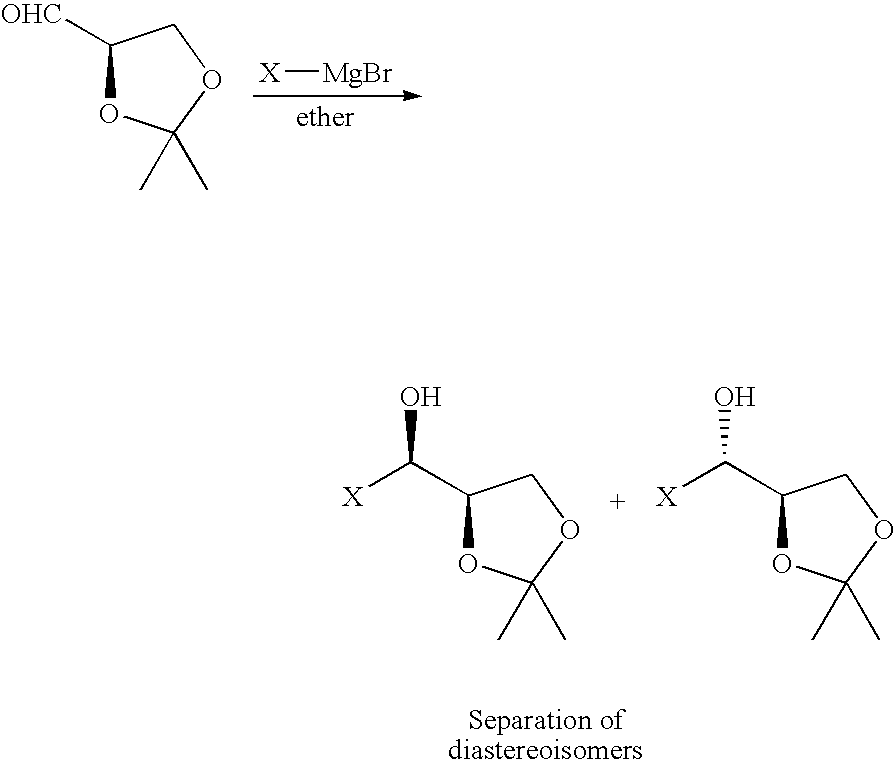
The other two intermediates may be obtained using the same chemistry but starting with the compound:

The second route is shown below:

The other two intermediates may be obtained using the same chemistry but starting with the compound:

4,4-(dimethyl-1,1-dioxido-1,2,5-thiadiazolidine-2-yl)-triphenyl phosphonium is prepared according to J. Org. Chem. 1994, 59, 2289.
The following methodology applies where Z is F and X is phenyl, C2-C8 alkyl, C2-C8 alkenyl, C3-C8 cycloalkyl or C4-C8 cycloalkylalkyl.
The “syn” chain fluorinated propanamines may be prepared using the method outlined below. Although X is shown as optionally substituted phenyl in the reaction schemes below, the same methodology could be applied for other identities of X (except thienyl).

The “anti” chain fluorinated propanamines may be prepared using the method outlined below. Although X is shown as optionally substituted phenyl in the reaction schemes below, the same methodology could be applied for other identities of X (except thienyl).

When X is thienyl, the hydroxylated propanamines may be prepared using the methodology outlined below.

The synthesis of A is described in the reference S. Kobayashi, I. Hachiya, M. Yasuda; Tetrahedron Letters, 1996, 37(31), 5569-5572. The mixture of stereoisomers obtained by this route is firstly separated by achiral chromatography to give a mixture of chiral diasteroisomers, then by chiral chromatography to separate the mixture of chiral diasteroisomeric isomers into individual chiral final products.
When X is thienyl, the fluorinated propanamines may be prepared using the methodology outlined below.

The starting material is synthesized as shown in the previous scheme. The mixture of stereoisomers obtained by this route is firstly separated by achiral chromatography to give a mixture of chiral diasteroisomers, then by chiral chromatography to separate the mixture of chiral diasteroisomeric isomers into individual chiral final products.
Use of Y—SH in place of Y—OH in the above methodologies where Z is OH or F provides compounds wherein A is S. Note however that for converting hydroxy to aryl sulfide it is preferred to react the propanol species with Y—SH, (cyanomethyl)trimethylphosphonium iodide (Tetrahedron, 2001, 57, 5451-5454) and diisopropylamine in propionitrile.
Compounds of formula I where R1=methyl and R2=H may be prepared by solid phase synthesis by the route shown below.

The sequence is preferably performed on a macroporous polystyrene resin, e.g. ArgoPore™. Thus ArgoPore-Cl is converted with methylamine in methanol to a secondary amine bound to the resin. A Mannich type reaction is then performed on the resin bound amine with aqueous formaldehyde, hydrochloric acid a substituted acetophenone and isopropanol. The resultant aminoketone is then reduced with sodium borohydride in ethanol/triethyleneglycol dimethyl ether to give the amino alcohol. This is then subjected to a Mitsunobu reaction using di-t-butylazodicarboxylate, triphenyl phosphine and a heteroaryl alcohol/thiol (Y-AH) to give a resin bound heteroaryl aminothioether. Removal of the aminoether from the resin is effected with 1-chloroethyl chloroformate and Hunigs base in THF. Finally resolution of the enantiomers is achieved using chiral chromatography.
The following Examples further illustrate the compounds of the present invention and methods for their synthesis.
In the following section, there is described the synthesis of precursors and common intermediates for the compounds of the present invention.

To a solution of (S)-(−)-3-chloro-1-phenyl-1-propanol (5 g, 29.3 mmol) in acetone (50 mL) was added sodium iodide (4.83 g, 32.2 mmol). The resulting solution was heated at reflux for 16 h. The solution was cooled, filtered and concentrated in vacuo. The residue was purified by flash chromatography eluting silica gel with hexane: ethyl acetate [100:0 to 3:1] to yield the iodo compound (7.44 g, 97%); δH (300 MHz, CDCl3) 7.36 (5H, m, Ar), 4.83 (1H, m, O—CH), 3.34-3.15 (2H, m, CH2), 2.28-2.15 (2H, m, CH2).

To a solution of (R)-(+)-3-chloro-1-phenyl-1-propanol (5 g, 29.3 mmol) in acetone (50 mL) was added sodium iodide (4.83 g, 32.2 mmol). The resulting solution was heated at reflux for 16 h. The solution was cooled, filtered and concentrated in vacuo. The residue was purified by flash chromatography eluting silica gel with hexane: ethyl acetate [100:0 to 3:1] to yield the title compound as a white solid (7.51 g, 98%); δH (300 MHz, CDCl3) 7.36 (5H, m, Ar), 4.83 (1H, m, O—CH), 3.34-3.15 (2H, m, CH2), 2.28-2.15 (2H, m, CH2).
a) 3-Chloro-1-(2-thienyl)-1-propanone

Chloropropionyl chloride (12 mL, 130 mmol) in dry dichloromethane (50 mL) was added dropwise at −5° C. to a stirred suspension of aluminium chloride (18.8 g, 141 mmol) in dry dichloromethane (100 mL). The resulting suspension was allowed to stir at −5° C. for 10 mins before a solution of thiophene (10 g, 118 mmol) in dry dichloromethane (50 mL) was added dropwise. The resulting orange solution was stirred at −5° C. for 1 hr before being carefully dropped onto crushed ice (200 g). The organic phase was separated and dried (MgSO4), the solvent was then passed through a pad of celite/charcoal to remove any colour. Removal of the solvent in vacuo resulted in the title compound as a colourless oil (20 g, 100%); δH (300 MHz, CDCl3) 7.75 (1H, d, Ar), 7.68 (1H, d, Ar), 7.15 (1H, m, Ar), 3.90 (2H, t, J=7 Hz, CH2), 3.38 (2H, t, J=7 Hz, CH2).
b) (1R)-3-Chloro-1-(2-thienyl)-1-propanol

Borane dimethylsulfide complex (2.75 mL, 28.6 mmol) was added at room temperature to a stirred solution of (S)-2-methyl-CBS-oxazaborolidine (2.87 mL, 1M) in dry TXF (50 mL). The resulting solution was stirred at room temperature to 10 mins before a solution of 3-chloro-1-(2-thienyl)-1-propanone (2.5 g, 14.3 mmol) in dry THF (100 mL) was added dropwise over 1 hr. After complete addition the resulting solution was stirred at room temperature for a further 1 hr before the solvent was removed in vacuo. The residue was taken up in ether (200 mL) and washed with NH4Cl (sat, 100 mL). The organic phase was dried (MgSO4) and concentrated in vacuo. The residue was purified by flash chromatography eluting silica gel with hexane:ether [7:3] to yield a colourless oil (2.1 g, 84%); Optical purity determined by capillary electrophoresis to be 83% ee; δH (300 MHz, CDCl3) 7.25 (1H, d, Ar), 7.08-6.9 (2H, m, Ar), 5.28-5.20 (1H, m, CHO), 3.80-3.52 (2H, m, CH2), 2.35-2.12 (2H, m, CH2).

A solution of 3-chloro-1-phenylpropan-1-ol (2 g, 11.7 mmol), N-methylbenzylamine (2.12 g, 17.5 mmol), potassium iodide (2.6 g, 22 mmol), and potassium carbonate (3.2 g, 23.4 mmol) in dimethylformamide (120 mL) was stirred at 90° C. in a reacti-vial for 16 h. After this time the reaction was allowed to cool to room temperature. The reaction mixture was purified by an SCX-2 column eluting with Methanol followed by ammonia:methanol solution (7 N). The organics were then evaporated and the compound taken directly onto the next step without any further purification. (M+H+1 [256]); δH (300 MHz, CDCl3) 7.2-7.4 (10H, m, Ar), 4.9 (1H, t, CH—OH), 3.55 (1H, d, CH 2-Ph), 3.45 (1H, d, CH 2—PH), 2.8-3 (1H, m, CH2), 2.55-2.65 (1H, m, CH2), 2.25 (3H, s, CH3), 1.89-1.9 (2H, m, CH2), 1.6 (1H, brs, OH).

Add potassium carbonate (63.50 g, 459 mmol) to a stirred solution of N-benzylmethylamine (14.8 mL, 115 mmol), 3-bromo-N-methoxy-N-methyl-propionamide (22.47 g, 115 mmol, prepared according to Jacobi, P. A.; Blum, C. A.; DeSimone, R. W.; Udodong, U. E. S. J. Am. Chem. Soc. 1991, 113, 5384-5392), and anhydrous acetonitrile (460 mL). Heat the reaction to reflux under nitrogen for 3 hours. Cool the reaction to room temperature and filter the reaction through Celite®. Wash the Celite® with ethyl acetate and concentrate on a rotary evaporator to give the crude product. Purify the crude product by flash chromatography on silica gel eluting with 0.5% concentrated ammonium hydroxide/5% ethanol/chloroform to yield 22.31 g (82%) of 3-(benzyl-methyl-amino)-N-methoxy-N-methyl-propionamide: mass spectrum (ion spray) m/z=237.1(M+1); 1H NMR (CDCl3) δ 7.31-7.21 (m, 5H), 3.65 (s, 3H), 3.53 (s, 2H), 3.17 (s, 3H), 2.80-2.76 (m, 2H), 2.67-2.63 (m, 2H), 2.23 (s, 3H).

Add butyllithium (12.3 ml (1.6 M solution in hexane), 19.6 mmol) to a stirred solution of 3-(benzyl-methyl-amino)-N-methoxy-N-methyl-propionamide and anhydrous tetrahydrofuran (70 ml) at −40° C. under N2. Stir for 1 hr at −40° C. Quench the reaction with saturated ammonium chloride (25 ml), allow the reaction to reach room temperature and add saturated sodium bicarbonate. Extract with ethyl acetate, wash with brine and dry over sodium sulfate. Filter off and concentrate to give the crude product. Purify the compound by flash chromatography, eluting with 2% ethanol/0.2% ammonium hydroxide/chloroform to yield 2.41 g (81%) of 1-(benzyl-methyl-amino)-heptan-3-one: mass spectrum (ion spray) m/z=234 (M+1); 1H NMR (CDCl3) δ 7.31-7.24 (m, 5H), 3.5 (s, 2H), 2.74-2.7 (m, 2H), 2.64-2.60 (m, 2H), 2.41 (t, 2H), 2.19 (s, 3), 1.59-1.51 (m, 2H), 1.35-1.28 (m, 2H), 0.91 (t, 3H).

Using a method similar to that for 1-Benzyl-methyl-amino)-heptan-3-one, propylmagnesium chloride (2 M solution in diethyl ether) affords the title compound: mass spectrum (ion spray) m/z=220 (M+1): 1H NMR (CDCl3) δ 7.35-7.24 (m, 5H), 3.51 (s, 2H), 2.74-2.69 (m, 2H), 2.66-2.61 (m, 2H), 2.39 (t, 2H), 2.20 (s, 3H), 1.67-1.57 (m, 2H), 0.92 (t, 3H),

Add dropwise bromomethylcyclohexane (16.96 mL, 0.121 mol) to a stirred warm solution of magnesium (granulae, 3.02 g, 0.124 mol), a crystal of iodine and tetrahydrofuran (130 mL). Heat the mixture to reflux for one hour. Add the Grignard reagent (30 mL) to a stirred mixture of [2-(methoxy-methyl-carbamoyl)-ethyl]-methyl-carbamic acid tert-butyl ester (3.0 g, 12.0 mmol, prepared according to Blaney, P.; Grigg, R.; Rankovic, Z.; Thornton-Pett, M.; Xu, J. Tetrahedron 2002, 1719-1737) and tetrahydrofuran (120 mL) kept at 0° C. under N2. Stir the mixture for one h at 0° C. and for 2 h at room temperature. Add more of the Grignard reagent (40 mL) and stir for another hour at room temperature. Add saturated aqueous ammonium chloride and separated the layers. Extract the water layer with diethyl ether (×3). Dry the combined organic layers, filter and concentrate. Purify the crude residue by flash column chromatography, eluting with ethyl acetate/hexane (1:9) to yield 1.0 g of the title compound. 1H NMR (CDCl3) δ 3.46-3.40 (m, 2H), 2.85 (s, 3H), 2.68-2.60 (m, 2H), 2.29 (d, 2H), 1.87-1.60 (m, 6H), 1.46 (s, 9H), 1.33-1.07 (m, 3H), 0.99-0.86 (m, 2H).

Add sodium borohydride (1.29 g, 34.1 mmol) to a stirred solution of 1-(benzyl-methyl-amino)-heptan-3-one (2.41 g, 10 mmol) and methanol (45 ml) at 0° C. under N2. Stir the reaction for 1 hr at 0° C. Quench the reaction with water at 0° C. and concentrate under reduced pressure. Dissolve the residue in ethyl acetate, wash with brine and dry over sodium sulfate. Filter off and concentrate to give the crude compound. Purify the compound by flash chromatography, eluting with 5% ethanol/0.5% ammonium hydroxide/chloroform to yield 2.22 g (91%) of 1-(benzyl-methyl-amino)-heptan-3-ol: mass spectrum (ion spray) m/z=236 (M+1); 1H NMR (CDCl3) δ 7.34-7.23 (m, 5H), 3.76-3.72 (m, 1H), 3.53 (dd, 2H), 2.80-2.73 (m, 1H), 2.59-2.53 (m, 1H), 2.21 (s, 1H), 1.68-1.62 (m, 1H), 1.57-1.29 (m, 7H), 0.91 (t, 3H).

Using a method similar to that for 1-(Benzyl-methyl-amino)-heptan-3-ol, 1-(benzyl-methyl-amino)-hexan-3-one affords the title compound: mass spectrum (ion spray) m/z 222 (M+1); 1H NMR (CDCl3) δ 7.34-7.24 (m, 5H), 3.79-3.73 (m, 1H), 3.55 (dd, 2H), 2.81-2.74 (m, 1H), 2.59-2.55 (m, 1H), 2.22 (s, 3H), 1.72-1.62 (m, 1H), 1.56-1.31 (m, 5H), 0.93 (t, 3H).

Using a method similar to that for 1-(Benzyl-methyl-amino)-heptan-3-ol, (4-cyclohexyl-3-oxo-butyl)-methyl-carbamic acid tert-butyl ester affords the title compound: 1H NMR (CDCl3) δ 3.90-3.80 (m, 1H), 3.62-3.52 (m, 1H), 2.88-2.96 (m, 1H), 2.83 (3H), 1.80-1.60 (m, 6H), 1.56-1.32 (m, 3H), 1.47 (s, 9H), 1.31-1.08 (m, 4H), 0.98-0.77 (m, 2H),

Add N-benzylmethylamine (1.50 mL, 11.6 mmol) to a stirred solution of 1,8-diazabicyclo[5.4.0]undec-7-ene (0.0175 mL, 0.117 mmol) and anhydrous tetrahydrofuran (10 mL). Cool the solution to −15° C. under nitrogen. Add acrolein (0.78 mL, 11.7 mmol) slowly and stir for 30 minutes at −15° C. Cool the reaction to −78° C. Add isobutylmagnesium chloride (11.0 mL, 2.0 M solution in diethyl ether, 22.0 mmol) and stir for 1 hour at −78° C. Quench the reaction with water at −78° C. and then pour the reaction into 100 mL of 1N sodium hydroxide/saturated sodium bicarbonate (1:1). Extract with ethyl acetate (3×100 mL), wash the ethyl acetate with brine (100 mL), and dry the ethyl acetate over sodium sulfate. Filter off the sodium sulfate and concentrate on a rotary evaporator to give the crude product. Purify the crude product by flash chromatography on silica gel eluting with 0.3% concentrated ammonium hydroxide/3% ethanol/chloroform to yield 1.0010 g (37%) of 1-(benzyl-methyl-amino)-5-methyl-hexan-3-ol: mass spectrum (ion spray) m/z=236.2(M+1); 1H NMR (CDC3) δ 7.34-7.23 (m, 5H), 6.08 (br s, 1H), 3.86-3.80 (m, 1H), 3.62 (d, 1H), 3.43 (d, 1H), 2.79-2.73 (m, 1H), 2.58-2.53 (m, 1H), 2.21 (s, 3H), 1.83-1.40 (m, 4H), 1.16-1.09 (m, 1H), 0.91-0.89 (m, 6H).

Using a method similar to that for 1-(Benzyl-methyl-amino)-5-methyl-hexan-3-ol, isopropylmagnesium chloride affords the title compound: mass spectrum (ion spray) m/z=222.1(M+1); 1H NMR (CDCl3) δ 7.34-7.23 (m, 5H), 6.21 (br s, 1H), 3.63 (d, 1H), 3.51-3.47 (m, 1H), 3.42 (d, 1H), 2.81-2.74 (m, 1H), 2.59-2.54 (m, 1H), 2.19 (s, 3H), 1.72-1.47 (m, 3H), 0.95 (d, 3H), 0.89 (d, 3H).

The title compound was prepared as described in Tetrahedron, 1963, 19, 827-832.
a) 6-Methoxy-isoquinoline

The title compound was prepared as described in Synth. Commun., 1999, 29, 1617-1625.
b) Isoquinolin-6-ol

Heat a mixture of 6-methoxy-isoquinoline (2.1 g, 13.2 mmol) and pyridine hydrochloride (30 g) in a heavy walled screw cap sealed tube at 160° C. overnight. Cool to room temperature, add water and concentrated ammonium hydroxide to bring the pH of the mixture to 10-11, extract with ethyl acetate (4 times), wash the combined organic extracts with water (4 times), and concentrate under reduced pressure. Purification by medium pressure liquid chromatography eluting with 0-3% of 2N NH3/MeOH in dichloromethane afford the title compound (520 mg, 27%): δH (DMSO-d6, 400 MHz): 7.09 (s, 1H), 7.19 (dd, 1H, J=9, 2 Hz), 7.56 (d, 1H, J=6 Hz), 7.94 (d, 1H, J=9 Hz), 8.29 (d, 1H, J=6 Hz), 9.05 (s, 1H), 10.36 (s, 1H).

The title compound was prepared as described in Liebigs Annalen Der Chemie, 1979, 443-445.

The title compound is commercially available and was purchased from the Aldrich Chemical Company.

The title compound is commercially available and was purchased from the Aldrich Chemical Company.
a) 4-Methoxy-benzo[d]isothiazole

To a solution of 2-fluoro-6-methoxybenzaldehyde (2.0 g, 13.0 mmol) in 2-methoxyethanol (10 mL) in a sealed tube was added sulfur (416 mg, 13.0 mmol) and aqueous ammonium hydroxide (10 mL). The solution was heated to 160 degC. for 18 h and was then cooled to rt. The reaction was partitioned between dichloromethane and water. The organic layer was separated and the aqueous layer was extracted with 2×50 mL dichloromethane. The combined organic phases were dried (MgSO4) and concentrated in vacuo. The residue was purified by flash chromatography eluting silica gel with EtOAc:hexane [0:100 to 4:6] to yield the title compound as an oil (1.51 g, 70%); Mass spectrum (ion spray): m/z=165.9 (m+1).
b) Benzo[d]isothiazol-4-ol

To a sealed tube was added 4-methoxy-benzo[d]isothiazole (760 mg, 4.60 mmol) and pyridine hydrochloride (5.5 g, 48 mmol). The reaction was heated to 150° C. for 18 h and was then cooled to rt. The mixture was partitioned between dichloromethane and water. The organic phase was separated and the aqueous layer was extracted with 2×30 mL dichloromethane. The combined organic phases were dried (MgSO4) and concentrated in vacuo. The residue was purified by flash chromatography eluting silica gel with EtOAc:hexane [0:100 to 3:7] to yield the title compound as a solid (223 mg, 32%); Mass spectrum (ion spray): m/z=151.9 (m+1).
a) 7-Bromo-4-methoxy-benzo[d]isothiazole

To a solution of 4-methoxy-benzo[d]isothiazole (prepared as described above) (1.0 g, 6.05 mmol) in carbon tetrachloride (20 mL) at 0° C. was added bromine (310 μL, 6.05 mmol) in carbon tetrachloride (10 mL). The reaction was allowed to stir at 0° C. for 3 h and was then warmed to rt. Saturated aqueous NaHCO3 and dichloromethane were added and the organic phase was separated. The aqueous phase was extracted with 2×20 mL dichloromethane. The combined organic phases were dried (MgSO4) and concentrated in vacuo. The residue was purified by flash chromatography eluting silica gel with FtOAc:hexane [0:100 to 1:20] to yield the title compound (980 mg, 66%): δH (300 MHz, CDCl3): 9.09 (1H, s), 7.52 (1H, d, J=8.1 Hz), 6.67 (1H, d, J=8.4 Hz), 4.00 (3H, s).
b) 7-methyl-benzo[d]isothiazol-4-ol

A solution of 7-4-methoxy-benzo[d]isothiazole (460 mg, 1.88 mmol), K2CO3 (780 mg, 5.64 mmol), and Pd(PPh3)4 (217 mg, 0.188 mmol) in 1,4-dioxane (5 mL) was added trimethylboroxine (290 μL, 2.07 mmol) and the solution was heated to 110° C. for 18 h. The reaction was cooled to rt and diluted with water and dichloromethane. The organic phase was separated and the aqueous phase was extracted with 2×30 mL dichloromethane. The combined organic phases were dried (MgSO4) and concentrated in vacuo. The residue was purified by flash chromatography eluting silica gel with EtOAc:hexane [0:100 to 1:10] to yield 4-methoxy-7-methyl-benzo[d]isothiazole (88 mg, 26%). A method similar to that described for the preparation of benzo[d]isothiazol-4-ol (above) using 4-methoxy-7-methyl-benzo[d]isothiazole (88 mg, 0.491 mmol) and pyridine hydrochloride (567 mg, 5 mol) gave the title compound (30 mg, 37%): δH (300 MHz, CDCl3): 8.99 (1H, s), 7.15 (1H, d, J=7.5 Hz), 6.70 (1H, d, J=7.5 Hz), 2.45 (3H, s).
a) 2-Fluoro-3,N-dimethoxy-N-methyl-benzamide

To a solution of 2-fluoro-3-methoxy-benzoic acid (5.0 g, 29.4 mmol) and PyBOP (13.7 g, 29.4 mmol) in 7:1 CH2Cl2:THF was added triethylamine (4.10 mL, 29.4 mmol) over a 10 min period. N,O-Dimethylhydroxylamine hydrochloride (2.87 g, 29.4 mL) was then added and the reaction was allowed to stir at rt for 3 h. The reaction was then partitioned between dichloromethane and water. The organic phase was separated and the aqueous phase was extracted with 2×100 mL dichloromethane. The combined organic phases were dried (MgSO4) and concentrated in vacuo. The residue was taken up in ethyl acetate and was washed successively with 1N HCl, saturated aqueous NaHCO3, and brine. The organic phase was again dried (MgSO4) and concentrated in vacuo to yield the title compound (2.30 g, 37%).
b) 2-Fluoro-3-methoxy-benzaldehyde

To a solution of 2-fluoro-3,N-dimethoxy-N-methyl-benzamide (2.30 g, 10.8 mmol) in THF (20 mL) at −78° C. was added 1M DEBAL-H in toluene.(12 mL, 12 mmol). The reaction stirred at −78° C. for 3 h and then the remaining 1M DIDAL-H in toluene (4.2 mL, 4.2 mmol) was added to the reaction. The reaction was allowed to stir at −78° C. for 30 min and was then warmed to rt. The reaction was quenched slowly with saturated aqueous NH4Cl. The organic phase was separated and the aqueous phase was extracted with 2×50 mL ethyl acetate. The combined organic phases were washed successively with 1N HCl and brine. The organic phase was dried (MgSO4) and concentrated in vacuo. The residue was purified by flash chromatography eluting silica gel with EtOAc:hexane [0:100 to 1:1] to yield the title compound (1.41 g, 85%): δH (300 MHz, CDCl3): 10.38 (1H, s), 7.43-7.40 (1H, m), 7.24-7.15 (2H, m), 3.95 (3H, s).
c) 7-methoxy-benzo[d]isothiazole

A method similar to 4-methoxy-benzo[d]isothiazole using 2-fluoro-3-methoxy-benzaldehyde (410 mg, 2.66 mmol), sulfur (85 mg, 2.66 mmol), NH4OH (5 mL), and 2-methoxyethanol (5 mL) gave the title compound (60 mg, 14%); Mass spectrum (ion-spray): m/z=165.8 (m+1).
d) Benzo[d]isothiazol-7-ol

A method similar to that used in the preparation of benzo[d]isothiazol-4-ol using 7-methoxy-benzo[d]isothiazole (60 mg, 0.363 mmol) and pyridine hydrochloride (500 mg, 4.33 mmol) gave the title compound (26 mg, 47%); Mass spectrum (ion-spray): m/z=151.9 (m+1).
a) 4-Methoxy-benzothiazole

2-Amino-4-methoxy-benzothiazole (1.00 g, 5.54 mmol) was added to a stirred solution of polyphosphoric acid (85%, 40 ml) at 60° C. The resulting mixture was stirred at 60° C. until all the benzothiazole had dissolved. The resulting solution was then cooled to −10° C. and a solution of sodium nitrite (2.3 g, 33.3 mmol) in water (5 ml) was added so as to keep the internal temperature below −4° C. After complete addition the resulting solution was added to a solution of hypophosphoric acid (50%, 15 ml) at 0° C. After the evolution of gas had ceased the mixture was diluted with water and basified with NaHCO3 (sat). The aqueous solution was extracted with CHCl3 (3×200 ml) with the combined organic extracts dried (MgSO4) and the solvent removed in vacuo. The resulting solid was recrystallised from EtOH:H2O to give an orange solid (300 mg).
The liquor was concentrated and purified by flash chromatography eluting silica gel with hexane:EtOAc [4:1] to hexane:EtOAc [1:1] to give a further 210 mg of product. Rf=0.38 in hexane:ether [1:1]; δH (300 MHz, CDCl3) 8.91 (1H, s, CH), 7.53 (1H, d, Ar), 7.39 (1H, t, Ar), 6.93 (1H, d, Ar), 4.07 (3H, s, OCH3).
b) 4-Hydroxy-benzothiazole

Boron tribromide (3.09 ml, 1M solution in DCM, 3.09 mmol) was added dropwise at 0° C. to a stirred solution of 4-methoxy-benzothiazole (510 mg, 3.09 mmol) in dry DCM (30 ml). The resulting solution was warmed to 40° C. and allowed to stir overnight. The resulting solution was concentrated in vacuo and diluted with water and HCl (2N). The aqueous phase was neutralised to pH ˜7 with NaHCO3 and the solution extracted with EtOAc (3×100 ml) and the combined organic extracts dried (MgSO4) and the solvent removed in vacuo. The resulting oil was purified by flash chromatography eluting silica gel with hexane:EtOAc [4:1] to hexane:EtOAc [7:3] to give the title compound as a tan solid (730 mg, 80%); δH (300 MHz, CDCl3) 7.59 (1H, s, CH), 7.46 (1H, dd, Ar), 7.36 (1H, t, Ar), 7.02 (1H, dd, Ar).

The title compound was prepared as described in Patent GB 2010249A.

The title compound was prepared as described in Patent GB 2010249A.
a) 5-(2-Fluoro-5-methoxybenzylidene)-2-thioxo-1,3-thiazolidin-4-one

To a suspension of 2-fluoro-5-methoxybenzaldehyde (5.00 g, 32.46 mmol) and rhodanine (4.31 g, 32.46 mmol) in dry toluene (1000 mL) was added ammonium acetate (50 mg) and acetic acid (2 mL). The resulting suspension was allowed to stir at 120° C. for 12 h under Dean-Stark apparatus before being allowed to cool and filtered. Resultant solid was washed with hexane and allowed to dry in vacuo to give an orange crystalline solid (8.00 g, 91%); δH (300 MHz, CDCl3) 7.50 (1H, s, CH═C); 7.31 (1H, t, Ar), 7.20-7.11 (1H, m Ar), 6.95-6.89 (1H, m, Ar), 3.80 (3H, s, OCH3).
b) (2Z)-3-(2-Fluoro-5-methoxyphenyl)-2-mercapto-2-propenoic acid

5-(2-Fluoro-5-methoxybenzylidene)-2-thioxo-1,3-thiazolidin-4-one (8.00 g, 9.7 mmol) was added in one portion to 25% w/v sodium hydroxide solution (40 mL). This was allowed stir at reflux for 1 h. After this time the reaction was allowed to cool to room temperature and poured onto water (50 mL). This was washed with dichloromethane (50 mL), and the aqueous layer acidified to pH 2 with aqueous hydrochloric acid (2 N, 50 mL) to give a white suspension. Product was extracted with ether (2×60 mL), dried (MgSO4) and solvent removed in vacuo to give a white solid (6.71 g, 100%); δH (300 MHz, CD3OD) 7.85 (1H, s, Ar), 7.46-7.35 (1H, m, Ar), 7.11 (1H, t, Ar), 7.01-6.75 (2H, m, CH═, and SH), 3.80 (3H, s, OCH3).
c) 4-Fluoro-7-methoxy-1-benzothiophene-2-carboxylic acid

(2Z)-3-(2-Fluoro-5-methoxyphenyl)-2-mercapto-2-propenoic acid (1.00 g, 4.38 mmol) was added in one portion to a solution of iodine (1.66 g, 6.56 mmol) in dimethoxyethane (10 mL). This was heated in the microwave with 300 W at 160° C. for 10 mins. After this time the reaction was allowed to cool to room temperature and poured onto saturated sodium metabisulphite (200 mL) and ether (400 mL). Ether layer was separated and product extracted with aqueous sodium hydroxide (2 N, 2×100 mL). This was then acidified to pH 2 with aqueous hydrochloric acid (2 N, 250 mL), and product extracted with ether (2×150 mL). The combined organic extracts were dried (MgSO4) and concentrated in vacuo to give a white solid (580 mg, 30%); δH (300 MHz, CD3OD) 8.00 (1H, s, Ar), 7.30-7.19 (1H, m, Ar), 7.10-7.00 (1H, m, Ar), 3.95.(3H, s, OCH3).
d) 4-Fluoro-7-methoxy-1-benzothiophene

4-Fluoro-7-methoxy-1-benzothiophene-2-carboxylic acid (2.00 g, 8.84 mmol) was added in one portion to DBU (8 mL) and dimethyl acetamide (10 mL). This was heated in the microwave with 300 W at 200° C. for 1 h. The reaction mixture was allowed to cool and poured onto water (100 mL). Product was extracted with hexane (2×100 mL), washed with aqueous hydrochloric acid (2 N, 50 mL), aqueous sodium hydroxide (2 N, 50 mL), and the combined organic extracts were dried (MgSO4) and concentrated in vacuo. The residue was purified by flash chromatography eluting silica gel with hexane:ethyl acetate [96:4] to give an oil (1.12 g, 70%): δH (300 MHz, CDCl3) 7.4 (2H, s, Ar), 6.9 (1H, t, Ar), 6.60 (1H, dd, Ar), 3.91 (3H, s, OCH3).
e) 4-Fluoro-7-methoxy-2,3-dihydrobenzo[b]thiophene

To a solution of 4-fluoro-7-methoxy-1-benzothiophene (1.55 g, 8.5 mmol, 1 eq) in trifluoroacetic acid (40 ml) was added triethylsilane (3.40 ml, 21.25 mmol, 2.5 eq). The mixture was heated to 60° C. for 48 hours, then cooled to room temperature and the solvent removed in vacuo. The crude product was purified by flash chromatography with a gradient of 40-60% chloroform in heptane to give 1.24 g, 80% recovered starting material and 199 mg, 13% yield of the title compound as a colourless oil: δH (300 MHz, CDCl3) 3.78-6.58 (2H, m, ArH), 3.82 (3H, s, CH3) and 3.44-3.30 (4H, m, SCH2CH2).
f) 4-Fluoro-2,3-dihydrobenzo[b]thiophen-7-ol

A BBr3 demethylation of 4-fluoro-7-methoxy-2,3-dihydrobenzo[b]thiophene similar to that described for 4-hydroxy benzothiazole affords the title compound as a brown solid 251 mg: δH (300 MHz, CDCl3) 6.57-6.48 (2H, m, ArH), 4.67 (1H, br. s, OH) and 3.43-3.23 (4H, m, SCH2CH2).

Add 4,4-(dimethyl-1,1-dioxido-1,2,5-thiadiazolidin-2-yl)-triphenyl phosphonium (547 mg, 1.4 mmol, 1.2 equiv. Prepared as described in J. Org. Chem. 1994, 59, 2289.) to a stirred solution of (S)-(−)-3-chloro-1-phenyl-1-propanol (306 mg, 1.17 mmol, 1 equiv.) and isoquinolin-4-ol (206 mg, 1.42 mmol, 1.2 equiv. prepared as described in Tetrahedron, 1963, 19, 827-832) in dry toluene (11 mL) and stir at room temperature for 18 hr. Add ethyl acetate, water, and brine, separate the layers, and extract the aqueous layer with ethyl acetate (3 times). Wash the combined organic extracts with brine (2 times), dry over anhydrous magnesium sulfate, filter, and concentrate under reduced pressure. Purification by medium pressure liquid chromatography eluting with 0-50% ethyl acetate in hexanes affords the title compound as a pale yellow oil (163 mg, 47%): δH (CDCl3, 400 MHz): 2.32-2.42 (m, 1H), 2.66-2.71 (m, 1H), 3.64-3.72 (m, 1H), 3.82-3.91 (m, 1H), 5.67 (dd, 1H, J=9, 5 Hz), 7.25-7.37 (m, 3H), 7.40-7.46 (m, 2H), 7.62 (ddd, 1H, J=7, 7, 2 Hz), 7.73 (ddd, 1H, J=7, 7, 1 Hz), 7.91 (d, 1H, J=8 Hz), 7.93 (s, 1H), 8.33 (dd, 1H, J=8, 1 Hz), 8.83 (s, 1H).
Similarly prepared were

as a pale yellow oil: δH (CDCl3, 400 MHz): 2.25-2.35 (m, 1H), 2.50-2.60 (m, 1H), 3.60-3.69 (m, 1H), 3.80-3.90 (m, 1H), 5.58 (dd, 1H, J=9, 5 Hz), 6.96 (d, 1H, J=2 Hz), 7.23-7.47 (m, 7H), 7.84 (d, 1H, J=10 Hz), 8.36 (br s, 1H), 9.01 (br s, 1H).

using [1,7]naphthyridin-5-ol (prepared as described in Liebigs Annalen Der Chemie, 1979, 443-445) affords the title compound as a gummy yellow oil (349 mg, 74%): δH (CDCl3, 400 MHz): 2.32-2.43 (m, 1H), 2.60-2.71 (m, 1H), 3.60-3.67 (m, 1H), 3.78-3.87 (m, 1H), 5.67 (dd, 1H, J=8, 5 Hz), 7.25-7.45 (m, 5H), 7.63 (dd, 1H, J=9, 5 Hz), 8.02 (br s, 1H), 8.65 (dd, 1H, J=9, 1 Hz), 9.02 (dd, 1H, J=5, 1 Hz), 9.09 (br s, 1H).

using 5-hydroxy isoquinoline (commercially available from the Aldrich Chemical Company) affords the title compound as a yellow oil (550 mg, 74%): δH (CDCl3, 400 MHz): 2.31-2.42 (m, 1H), 2.60-2.70 (m, 1H), 3.64-3.72 (m, 1H), 3.82-3.91 (m, 1H), 5.63 (dd, 1H, J=8, 5 Hz), 6.89 (d, 1H, J=8 Hz), 7.26-7.44 (m, 6H), 7.51 (d, 1H, J=8 Hz), 8.18 (d, 1H, J=6 Hz), 8.57 (d, 1H, J=6 Hz), 9.21 (br d, 1H).

using 5-quinolinol (commercially available from the Aldrich Chemical Company) affords the title compound as a colorless foam (93 mg, 40%): δH (CDCl3, 400 MHz): 2.24-2.34 (m, 1H), 2.52-2.62 (m, 1H), 3.55-3.63 (m, 1H), 3.74-3.82 (m, 1H), 5.54 (dd, 1H, J=8,4 Hz), 6.65 (d, 1H, J=8 Hz), 7.18-7.40 (m, 7H), 7.56 (d, 1H, J=8 Hz), 8.63 (ddd, 1H, J=8, 1, 1 Hz), 8.84 (dd, 1H, J=5, 2 Hz).

using (S)-1-iodo-3-phenyl-3-propanol with 4-fluoro-2,3-dihydrobenzo[b]thiophen-7-ol, to give 243 mg of the title compound as a colourless solid: δH (300 MHz, CDCl3) 7.32-7.12 (5H, m, 3-ArH), 6.46-6.27 (3H, m, ArH), 5.15-5.06 (1H, m, CHO), 3.43-3.11 (6H, m CH2CH2HI and SCH2CH2), 2.50-2.31 (1H, m, CHHCH2I) and 2.27-2.09 (1H, m, CHHCH2I).

as a colourless oil (200 mg, 100%); Rf=0.40 in hexane:ether [1:1]: δH (300 MHz, CDCl3) 8.95 (1H, s, Ar), 7.49-6.81 (8H, m, Ar), 5.73-5.68 (1H, m, CHO), 3.94-3.91 (1H, m, CH), 3.72-3.67 (1H, m, CH), 2.73-2.71 (1H, m, CHH), 2.40-2.30 (1H, m, CHH).

N-Methyl benzylamine (100 μl, 0.79 mmol) was added to a stirred suspension of 4-[(1R)-3-chloro-1-phenylpropyl]oxy-1-benzothiazole (200 mg, 0.658 mmol) and K2CO3 (450 mg, 3.29 mmol) and potassium iodide (110 mg, 0.658 mmol) in MeCN (20 ml). The resulting suspension was stirred at 60° C. for 48 hrs. After this time the reaction was allowed to cool to room temperature and diluted with water (ca. 50 ml) and extracted with EtOAc (3×50 ml). The combined organic extracts were dried (MgSO4) and the solvent removed in vacuo. The resulting oil was purified by flash chromatography eluting silica gel with DCM:MeOH [97.5:2.5] to DCM:MeOH [9:1] to give the title compound as a tan oil (180 mg, 70%); Rf=0.40 in DCM:MeOH [9:1]: δH (300 MHz, CDCl3) 8.90 (1H, s, Ar), 7.45-6.77 (13H, m, Ar), 5.64-5.59 (1H, m, CHO), 3.46 (2H, dd, CH2), 2.78-2.68 (1H, m, CH), 2.53-2.44 (2H, m, CH2), 2.21 (3H, s, CH3), 2.14-2.11 (1H, m, CH).

(S)-(−)-3-chloro-1-phenyl-1-propanol (1 g, 5.8 mmol) and thieno[3,2-b]pyridin-7-ol (1.15 g, 7.6 mmol, commercially available from the Aldrich Chemical Company) in dry TBF (6 ml) were stirred under an inert atmosphere of nitrogen. PPh3 (1.99 g, 7.6 mmol) followed by DEAD (1 mL, 7.6 mmol) were added and the resulting solution was allowed to stir for a further 72 h while heating at 40° C. before the solvent was removed in vacuo. The residue was purified by flash chromatography, eluting silica gel with hexane:ethyl acetate [100:0 to 1:3] to yield the title compound (1.38 g, 78%); mass spectrum (ion spray): m/z=304.05 (m+1).
Prepared similarly was

using (R)-(+)-3-chloro-1-phenyl-1-propanol, thieno[3,2-b]pyridin-7-ol (commercially available from the Aldrich Chemical Company), PBu3, and ADPP gave the title compound (0.71 g, 54%); Mass spectrum (ion spray): m/z=304.06 (m+1).

To a solution of 7-[(1R)-(3-Chloro-1-phenyl-propoxy)]-thieno[3,2-b]pyridine (703 mg, 2.3 mmol) in 15 mL of acetone was added NaI (3.5 g, 23 mmol). The resulting solution was allowed to stir at 55° C. for 18 h before removing the acetone in vacuo. The residue was taken up in CH2Cl2 and water. The layers were separated and the aqueous phase was further extracted 2 times with CH2Cl2. The combined organic phase was dried (MgSO4) and concentrated in vacuo. The residue was purified by flash chromatography eluting silica gel with hexane:ethyl acetate [100:0 to 1:1] to yield the title compound (0.79 g, 87%); mass spectrum (ion spray): m/z=395.98 (m+1).
Prepared similarly was

using 7-[(1S)-(3-chloro-1-phenyl-propoxy)]-thieno[3,2-b]pyridine gave the title compound (0.22 g, 71%); Mass spectrum (ion spray): m/z=395.99 (m+1).

Add 4,4-(dimethyl-1,1-dioxido-1,2,5-thiadiazolidin-2-yl)-triphenyl phosphonium (790 mg, 2.0 mmol, 1.3 equiv.) to a stirred solution of (R)-(+)-3-chloro-1-phenyl-1-propanol (404 mg, 1.54 mmol, 1 equiv.) and isoquinolinfol (293 mg, 2.0 mmol, 1.3 equiv., prepared as described in Tetrahedron, 1963, 19, 827-832) in dry toluene (15 mL) and stir at room temperature for 18 hr. Add ethyl acetate, water, and brine, separate the layers, and extract the aqueous layer with ethyl acetate (3 times). Wash the combined organic extracts with brine (2 times), dry over anhydrous magnesium sulfate, filter, and concentrate under reduced pressure. Purification by medium pressure liquid chromatography eluting with 0-20% ethyl acetate in hexanes affords the title compound as a pale yellow oil (229 mg, 50%): δH (CDCl3, 400 MHz): 2.32-2.42 (m, 1H), 2.66-2.71 (m, 1H), 3.64-3.72 (m, 1H), 3.82-3.91 (m, 1H), 5.67 (dd, 1H, J=9, 5 Hz), 7.25-7.37 (m, 3H), 7.40-7.46 (m, 2H), 7.62 (ddd, 1H, J=7, 7, 2 Hz), 7.73 (ddd, 1H, J=7, 7, 1 Hz), 7.91 (d, 1H, J=8 Hz), 7.93 (s, 1H), 8.33 (dd, 1H, J=8, 1 Hz), 8.83 (s, 1H).
Similarly prepared were

as a pale yellow oil: δH (CDCl3, 400 MHz): 2.25-2.35 (m, 1H), 2.50-2.60 (m, 1H), 3.60-3.69 (m, 1H), 3.80-3.90 (m, 1H), 5.58 (dd, 1H, J=9, 5 Hz), 6.96 (d, 1H, J=2 Hz), 7.23-7.47 (m, 7H), 7.84 (d, 1H, J=10 Hz), 8.36 (br s, 1H), 9.01 (br s, 1H).

as a colorless oil (320 mg, 56%): δH (CDCl3, 400 MHz): 2.31-2.42 (m, 1H), 2.60-2.70 (m, 1H), 3.64-3.72 (m, 1H), 3.82-3.91 (m, 1H), 5.63 (dd, 1H, J=8, 5 Hz), 6.89 (d, 1H, J=8 Hz), 7.26-7.44 (m, 6H), 7.51 (d, 1H, J=8 Hz), 8.18 (d, 1H, J=6 Hz), 8.57 (d, 1H, J=6 Hz), 9.21 (br d, 1H).

using (R)-1-iodo-3-phenyl-3-propanol with 4-fluoro-2,3-dihydrobenzo[b]thiophen-7-ol, to give 242 mg of the title compound as a colorless solid: δH (300 MHz, CDCl3) 7.32-7.12 (5H, m, 3-ArH), 6.46-6.27 (3H, m, ArH), 5.15-5.06 (1H, m, CHO), 3.43-3.11 (6H, m, CH2CH2HI and SCH2CH2), 2.50-2.31 (1H, m, CHHCH2I) and 2.27-2.09 (1H, m, CHHCH2I).

Add ADDP (434 mg, 1.72 mmol, 1.5 equiv.) to a stirred solution of of (R)-(+)-3-iodo-1-phenyl-1-propanol (404 mg, 1.54 mmol, 1 equiv.), tri-n-butyl phosphine (428 μl, 1.72 mmol, 1.5 equiv.), and 5-hydroxyisoquinoline (249 mg, 1.72 mmol, 1.5 equiv., commercially available from the Aldrich Chemical Company) in dry toluene (17 mL) and stir at room temperature overnight. The reaction mixture is concentrated under reduced pressure and the crude residue thus obtained is purified via medium pressure liquid chromatography eluting with 1:1 ethyl acetate:hexanes to afford the title compound as a yellow solid (298 mg, 67%): δH (CDCl3, 400 MHz): 2.40-2.50 (m, 1H), 2.62-2.72 (m, 1H), 3.25-3.35 (m, 1H), 3.38-3.48 (m, 1H), 5.50 (dd, 1H, J=8,4 Hz), 6.73 (d, 1H, J=8 Hz), 7.23-7.49 (m, 7H), 7.66 (d, 1H, J=8 Hz), 8.73 (d, 1H, J=9 Hz), 8.92 (dd, 1H, J=4, 2 Hz).
In the following section, there is described the synthesis of compounds of the present invention.

Add methyl amine (3 mL, 40% wt in water) to a solution of 4-[(3R)-chloro-1-phenyl-propoxy]-isoquinoline (163 mg, 0.546 mmol) in 1,4-dioxane (7 mL) in a heavy walled screw top sealed tube, seal the tube, and heat at 110° C. overnight. The mixture is cooled and concentrated under reduced pressure. Purification by medium pressure liquid chromatography eluting with 0-5% of 2N NH3/MeOH in dichloromethane is followed by HCl salt formation by dissolving in methanol (5 mL), adding solid ammonium chloride (23.4 mg, 0.437 mmol,) and sonicating for 15-20 minutes. The mixture is concentrated under reduced pressure and the residue is dissolved in water, frozen at −78° C., and freeze dried to afford the title compound as a colorless solid (143 mg, 80%): δH (CDCl3, 400 MHz): 2.50-2.62 (m, 1H), 2.67 (s, 3H), 2.70-2.81 (m, 1H), 3.17-3.27 (m, 2H), 5.75 (dd, 1H, J=8, 5 Hz), 7.19-7.30 (m, 3H), 7.41 (d, 2H, J=6 Hz), 7.59 (dd, 1H, J=7,7 Hz), 7.74 (dd, 1H, J=8, 8 Hz), 7.84 (d, 1H, J=8 Hz), 7.93 (s, 1H), 8.32 (d, 1H, J=8 Hz), 8.73 (s, 1H), 9.88 (br s, 2H).
Similarly prepared were

as an off-white solid (172 mg, 40%): δH (CDCl3, 400 MHz): 2.43-2.63 (m, 2H), 2.66 (s, 3H), 3.10-3.25 (m, 2H), 5.62 (dd, 1H, J=8, 4 Hz), 6.91 (d, 1H, J=2 Hz), 7.20-7.43 (m, 7H), 7.78 (d, 1H, J=10 Hz), 8.32 (d, 1H, J=6 Hz), 9.01 (s, 1H).

as a solid (175 mg, 32%): δH (CDCl3, 400 MHz): 2.50-2.65 (m, 1H), 2.68-2.82 (m, 1H), 2.69 (s, 3H), 3.15-3.30 (m, 2H), 5.79 (dd, 1H, J=8, 5 Hz), 7.20-7.33 (m, 3H), 7.37-7.47 (m, 2H), 7.61 (dd, 1H, J=9, 4 Hz), 8.06 (br s, 1H), 8.66 (dd, 1H, J=9, 1 Hz), 8.98 (dd, 1H, J=4, 1 Hz), 9.00 (br s, 1H), 9.83 (br s 2H).

as a solid (211 mg, 50%): δH (CDCl3, 400 MHz): 2.50-2.63 (m, 1H), 2.64-2.80 (m, 1H), 2.67 (s, 3H), 3.15-3.30 (m, 2H), 5.69 (dd, 1H, J=8, 5 Hz), 6.86 (d, 1H, J=8 Hz), 7.20-7.33 (m, 4H), 7.38 (d, 2H, J=7 Hz), 7.45 (d, 1H, J=8 Hz), 8.16 (br s, 1H), 8.53 (br s, 1H), 9.20 (br s, 1H), 9.85 (br s, 2H).

as a solid (149 mg, 71%): δH (CDCl3, 400 MHz): 2.51-2.78 (m, 2H), 2.64 (s, 3H), 3.15-3.27 (m, 2H), 5.63 (dd, 1H, J=8, 4 Hz), 6.70 (d, 1H, J=8 Hz), 7.20-7.50 (m, 7H), 7.63 (d, 1H, J=9 Hz), 8.74 (d, 1H, J=8 Hz), 8.84 (br d, 1H, J=3 Hz), 9.82 (br s, 2H).

Prepared similarly except the aqueous methyl amine (40 wt %) was stirred at room temperature with (1R)-4-fluoro-7-(3-iodo-1-phenyl-propoxy)-2,3-dihydrobenzo[b]thiophene in THF. The hydrochloride salt was formed by addition of 1M hydrochloric acid in diethyl ether (1 eq) to a solution of the compound in diethyl ether. Filtration of the solid gave 111 mg of a white crystalline solid: δH (300 MHz, CDCl3) 9.61 (1H, br. s, NH), 7.41-7.20 (5H, m, ArH), 6.51-6.32 (2H, m, ArH), 5.40-5.32 (1H, m, CHO), 3.47-3.25 (4H, m, SCH2CH2), 3.25-3.15 (2H, m, 1-CH2), 2.70 (3H, s, NHCH3) and 2.58-2.31 (2H, m, 2-CH2).
Prepared similarly was

to give 101 mg of a white crystalline solid; δH (300 MHz, CDCl3) 9.61 (1H, br. s, NH), 7.41-7.20 (5H, m, ArH), 6.51-6.32 (2H, m, ArH), 5.40-5.32 (1H, m, CHO), 3.47-3.25 (4H, m, SCH2CH2), 3.25-3.15 (2H, m, 1-CH2), 2.70 (3H, s, NHCH3) and 2.58-2.31 (2H, m, 2-CH2).

To a stirred suspension of (3R)-3-(1,3-benzothiazol-4-yloxy)-N-methyl-3-phenyl-N-(phenylmethyl)-propan-1-amine (0.18 g, 0.463 mmol) in dry DCM (10 ml) and Polymer supported diethylamine [PS-DIEA] (0.39 g, 3.56 mmol/g, 1.38 mmol) was added 1-chloroethyl chloroformate (0.25 ml, 2.3 mmol), the resulting suspension was heated to reflux for 2 hours. The reaction mixture was allowed to cool to room temperature and the PS-DIEA was removed by filtration. The reaction mixture was concentrated in vacuo, with the residue being re-dissolved in MeOH (10 ml) and heated to reflux for a further 4 hours. After this time the reaction was concentrated in vacuo and purified by flash chromatography eluting silica gel with DCM:MeOH [9:1] to give the free base (136 mg, 98%). Rf=0.36 [9:1] DCM:MeOH: δH (300 MHz, CDCl3) 9.07 (1H, s, Ar), 7.60-6.66 (8H, m, Ar), 5.39 (1H, dd, CHO), 3.49-3.45 (1H, m, CHH), 3.31-3.20 (1H, m, CHH), 2.88 (3H, s, CH3), 2.68-2.62 (1H, m, CHH), 2.51-2.47 (1H, m, CHH).

Methylamine (40% in water, 7 ml) was added to a solution of 7-[(1R)-(3-Iodo-1-phenyl-propoxy)]-thieno[3,2-b]pyridine (110 mg, 0.28 mmol) in EtOH (5 ml), the resulting solution was stirred at rt for 4 h. The solvent was removed in vacuo and the residue was purified by flash chromatography eluting silica gel with CH2Cl2:MeOH (2M NH3) [100:0 to 10:1] to yield the free-base of the title compound (153 mg, 77%). The resulting residue was dissolved in MeOH (5 mL) and NH4Cl was added. The mixture was sonicated at room temperature for 10 min and then the solvent removed in vacuo. The residue was dissolved in MeCN (0.5 mL) and water (1 mL), this solution was then frozen by immersion in a dry ice:acetone bath, the resulting frozen material was freeze dried overnight to yield the target compound as a fluffy white solid: Melting point of title compound: 120.4° C.
Prepared similarly were

to afford the title compound (120 mg, 80%); Melting point: 118.2° C.

(R)-(+)-3-iodo-1-phenyl-1-propanol (0.68 g, 2.6 mmol) and thieno[3,2-c]pyridin-7-ol (0.30 g, 1.98 mmol) in dry THF (8 ml) were stirred under an inert atmosphere of nitrogen. Merck Reagent (4,4-(dimethyl-1,1-dioxido-1,2,5-thiadiazolidin-2-yl)-triphenyl phosphonium) (1.06 g, 2.6 mmol) was added and the resulting suspension was allowed to stir for a further 120 h at rt before the solvent was removed in vacuo. The residue was purified by flash chromatography, eluting silica gel with hexane: ethyl acetate [100:0 to 1:1] to yield the intermediate iodo compound (0.183 g, 23%). This residue was immediately taken up in 10 mL of 2M NH3 in THF and stirred for 4 h. The solvent was removed in vacuo and the residue was purified by flash chromatography eluting silica gel with CH2Cl2:MeOH (2M NH3) [100:0 to 3:1] to yield the free-base of the title compound (29.2 mg, 22%). The resulting residue was dissolved in MeOH (5 mL) and NH4Cl was added. The mixture was sonicated at room temperature for 10 min and then the solvent removed in vacuo. The residue was dissolved in MeCN (0.5 mL) and water (1 mL), this solution was then frozen by immersion in a dry ice:acetone bath, the resulting frozen material was freeze dried overnight to yield the target compound as a fluffy white solid: mass spectrum (ion spray): m/z=299.12 (m+1).
Prepared similarly were

gave the title compound (49.5 mg, 41%); mass spectrum (ion spray): m/z=299.12 (m+1).

gave the title compound as a solid (38 mg, 29%): Melting point: 68.1° C.

gave the title compound (206 mg, 62%): Mass spectrum (ion-spray): m/z=299.1 (m+1).

gave the title compound (17 mg, 22%); Mass spectrum (ion-spray): m/z=299.1 (m+1).

gave the title compound (85 mg, 50%); Mass spectrum (ion-spray): m/z=299.1 (m+1).

gave the title compound (77 mg, 32%); Mass spectrum (ion-spray): m/z=313.1 (M+1).

gave the title compound (71 mg, 34%); Mass spectrum (ion-spray): m/z=313.1 (m+1).

Add methyl amine (3 mL, 40% wt in water) to a solution of 4-[(3S)-chloro-1-phenyl-propoxy]-isoquinoline (229 mg, 0.769 mmol) in 1,4-dioxane (10 mL) in a heavy walled screw top sealed tube, seal the tube, and heat at 110° C. overnight. The mixture is cooled and concentrated under reduced pressure. Purification by medium pressure liquid chromatography eluting with 0-4% of 2N NH3/MeOH in dichloromethane is followed by HCl salt formation by dissolving in methanol (3 mL), adding solid ammonium chloride (30.8 mg, 0.576 mmol,) and sonicating for 15-20 minutes. The mixture is concentrated under reduced pressure and the residue is dissolved in water, frozen at −78° C., and freeze dried to afford the title compound as a colorless solid (185 mg, 73%): δH (CDCl3, 400 MHz): 2.50-2.62 (m, 1H), 2.67 (s, 3H), 2.70-2.81 (m, 1H), 3.17-3.27 (m, 2H), 5.75 (dd, 1H, J=8, 5 Hz), 7.19-7.30 (m, 3H), 7.41 (d, 2H, J=6 Hz), 7.59 (dd, 1H, J=7, 7 Hz), 7.74 (dd, 1H, J=8, 8 Hz), 7.84 (d, 1H, J=8 Hz), 7.93 (s, 1H), 8.32 (d, 1H, J=8 Hz), 8.73 (s, 1H), 9.88 (br s, 2H).
Similarly prepared were

as an off-white solid (270 mg, 37%): δH (CDCl3, 400 MHz): 2.43-2.63 (m, 2H), 2.66 (s, 3H), 3.10-3.25 (m, 2H), 5.62 (dd, 1H, J=8,4 Hz), 6.91 (d, 1H, J=2 Hz), 7.20-7.43 (m, 7H), 7.78 (d, 1H, J=10 Hz), 8.32 (d, 1H; J=6 Hz), 9.01 (s, 1).

as a solid (358 mg, 98%): δH (CDCl3, 400 MHz): 2.50-2.63 (m, 1H), 2.64-2.80 (m, 1H), 2.67 (s, 3), 3.15-3.30 (m, 2H), 5.69 (dd, 1H, J=8, 5 Hz), 6.86 (d, 1H, J=8 Hz), 7.20-7.33 (m, 4H), 7.38 (d, 2H, J=7 Hz), 7.45 (d, 1H, J=8 Hz), 8.16 (br s, 1H), 8.53 (br s, 1H), 9.20 (br s, 1H), 9.85 (br s, 2H).

Add methyl amine (40% wt in water, 5 mL) to a solution of 5-[(3S)-iodo-1-phenyl-propoxy]-quinoline quinoline (200 mg, 0.51 mmol, 1 equiv.) in THF (1 mL) and stir at room temperature for 1 hr. The reaction mixture is concentrated under reduced pressure and purified by medium pressure liquid chromatography eluting with 0-8% of 2N NH3/MeOH in dichloromethane which is followed by HCl salt formation by dissolving in methanol, adding solid ammonium chloride (9.5 mg, 0.18 mmol) and sonicating for 15-20 minutes. The mixture is concentrated under reduced pressure and the residue is dissolved in water, frozen at −78° C., and freeze dried to afford the title compound as a solid (65 mg, 35 %): δH (CDCl3, 400 MHz): 2.51-2.78 (m, 2H), 2.64 (s, 3H), 3.15-3.27 (m, 2H), 5.63 (dd, 1H, J=8, 4 Hz), 6.70 (d, 1H, J=8 Hz), 7.20-7.50 (m, 7H), 7.63 (d, 1H, J=9 Hz), 8.74 (d, 1H, J=8 Hz), 8.84 (br d, 1H, J=3 Hz), 9.82 (br s, 2H).
The compounds of the present invention may be used as medicaments in human or veterinary medicine. The compounds may be administered by various routes, for example, by oral or rectal routes, topically or parenterally, for example by injection, and are usually employed in the form of a pharmaceutical composition.
Such compositions may be prepared by methods well known in the pharmaceutical art and normally comprise at least one active compound in association with a pharmaceutically acceptable diluent or carrier. In making the compositions of the present invention, the active ingredient will usually be mixed with a carrier or diluted by a carrier, and/or enclosed within a carrier which may, for example, be in the form of a capsule, sachet, paper or other container. Where the carrier serves as a diluent, it may be solid, semi-solid, or liquid material which acts as a vehicle, excipient or medium for the active ingredient. Thus, the composition may be in the form of tablets, lozenges, sachets, cachets, elixirs, suspensions, solutions, syrups, aerosol (as a solid or in a liquid medium), ointments containing, for example, up to 10% by weight of the active compound, soft and hard gelatin capsules, suppositories, injection solutions and suspensions and sterile packaged powders.
Some examples of suitable carriers are lactose, dextrose, vegetable oils, benzyl alcohols, alkylene glycols, polyethylene glycols, glycerol triacetate, gelatin, carbohydrates such as starch and petroleum jelly, sucrose sorbitol, mannitol, starches, gum acacia, calcium phosphate, alginates, tragacanth, gelatin, syrup, methyl cellulose, methyl- and propyl-hydrobenzoate, talc, magnesium stearate and mineral oil. The compounds of formula (I) can also be lyophilized and the lyophilizates obtained used, for example, for the production of injection preparations. The preparations indicated can be sterilized and/or can contain auxiliaries such as lubricants, preservatives, stabilizers and/or wetting agents, emulsifiers, salts for affecting the osmotic pressure, buffer substances, colourants, flavourings and/or one or more further active compounds, e.g. one or more vitamins. Compositions of the invention may be formulated so as to provide, quick, sustained or delayed release of the active ingredient after administration to the patient by employing procedures well known in the art.
The compositions are preferably formulated in a unit dosage form, each dosage containing from about 5 to about 500 mg, more usually about 25 to about 300 mg, of the active ingredient. The term “unit dosage form” refers to physically discrete units suitable as unitary doses for human subjects and other mammals, each unit containing a predetermined quantity of active material calculated to produce the desired therapeutic effect, in association with a suitable pharmaceutical carrier.
The pharmacological profile of the present compounds may be demonstrated as follows. Preferred compounds of the present invention exhibit a Ki value less than 1 μM at the serotonin and norepinephrine transporters as determined using the scintillation proximity assays described below. More preferred compounds of the present invention exhibit a Ki value less than 100 nM at the serotonin transporter and/or a Ki value less than 100 nM at the norepinephrine transporter as determined using the scintillation proximity assays described below. Still more preferred compounds of the present invention are those which exhibit a Ki value less than 100 nM (preferably less than 50 nM) at the serotonin transporter and a Ki value less than 100 nM (preferably less than 50 nM) at the norepinephrine transporter as determined using the scintillation proximity assays described below. Furthermore, preferred compounds of the present invention selectively inhibit the serotonin and norepinephrine transporters relative to the dopamine transporter by a factor of at least five using the scintillation proximity assays as described below.
Generation of Stable Cell-lines Expressing the Human Dopamine, Norepinephrine and Serotonin Transporters
Standard molecular cloning techniques were used to generate stable cell-lines expressing the human dopamine, norepinephrine and serotonin transporters. The polymerase chain reaction (PCR) was used in order to isolate and amplify each of the three full-length cDNAs from an appropriate cDNA library. Primers for PCR were designed using the following published sequence data:
Human dopamine transporter: GenBank M95167. Reference: Vandenbergh D J, Persico A M and Uhl G R. A human dopanmine transporter cDNA predicts reduced glycosylation, displays a novel repetitive element and provides racially-dimorphic TaqI RFLPs. Molecular Brain Research (1992) volume 15, pages 161-166.
Human norepinephrine transporter: GenBank M65105. Reference: Pacholczyk T, Blakely, R D and Amara S G. Expression cloning of a cocaine- and antidepressant-sensitive human noradrenaline transporter. Nature (1991) volume 350, pages 350-354.
Human serotonin transporter: GenBank L05568. Reference: Ramamoorthy S, Bauman A L, Moore K R, Han H, Yang-Peng T, Chang A S, Ganapathy V and Blakely R D. Antidepressant- and cocaine-sensitive human serotonin transporter: Molecular cloning, expression, and chromosomal localization. Proceedings of the National Academy of Sciences of the USA (1993) volume 90, pages 2542-2546.
The PCR products were cloned into a mammalian expression vector (eg pcDNA3.1 (Invitrogen)) using standard ligation techniques. The constructs were then used to stably transfect HEK293 cells using a commercially available lipofection reagent (Lipofectamine™—Invitrogen) following the manufacture's protocol.
Scintillation Proximity Assays for Determining the Affinity of Test Ligands at the Norepinephrine and Serotonin Transporters.
The compounds of the present invention are norepinephrine and serotonin reuptake inhibitors, and possess excellent activity in, for example, a scintillation proximity assay (e.g. J. Gobel, D. L. Saussy and A. Goetz, J. Pharmacol. Toxicolo. (1999), 42, 237-244). Thus 3H-nisoxetine binding to norepinephrine re-uptake sites in a cell line transfected with DNA encoding human norepinephrine transporter binding protein and similarly 3H-citalopram binding to serotonin re-uptake sites in a cell line transfected with DNA encoding human serotonin transporter binding protein have been used to determine the affinity of ligands at the norepinephrine and serotonin transporters respectively.
Norepinephrine Binding Assay
Membrane Preparation:
Cell pastes from large scale production of HEK-293 cells expressing cloned human norepinephrine transporters were homogenized in 4 volumes 50 mM Tris-HCl containing 300 mM NaCl and 5 mM KCl, pH 7.4. The homogenate was centrifuged twice (40,000 g, 10 min, 4° C.) with pellet re-suspension in 4 volumes of Tris-HCl buffer containing the above reagents after the first spin and 8 volumes after the second spin. The suspended homogenate was centrifuged (100 g, 10 min, 4° C.) and the supernatant kept and recentrifuged (40,000 g, 20 min, 4° C.). The pellet was resuspended in Tris-HCl buffer containing the above reagents along with 10% w/v sucrose and 0.1 mM phenylmethylsulfonyl fluoride (PMSF). The membrane preparation was stored in aliquots (1 ml) at −80° C. until required. The protein concentration of the membrane preparation was determined using a bicinchoninic acid (BCA) protein assay reagent kit (available from Pierce).
[3H]-Nisoxetine Binding Assay:
Each well of a 96 well microtitre plate was set up to contain the following:
- 50 μl 2 nM [N-methyl-3H]-Nisoxetine hydrochloride (70-87 Ci/mmol, from NEN Life Science Products)
- 75 μl Assay buffer (50 mM Tris-HCl pH 7.4 containing 300 mM NaCl and 5 mM KCl)
- 25 μl Test compound, assay buffer (total binding) or 10 μM Desipramine HCl (non-specific binding)
- 50 μl Wheatgerm agglutinin coated poly (vinyltoluene) (WGA PVT) SPA Beads (Amersham Biosciences RPNQ0001) (10 mg/ml)
- 50 μl Membrane (0.2 mg protein per ml)
The microtitre plates were incubated at room temperature for 10 hours prior to reading in a Trilux scintillation counter. The results were analysed using an automatic spline fitting programme (Multicalc, Packard, Milton Keynes, UK) to provide Ki values for each of the test compounds.
Serotonin Binding Assay
The ability of a test compound to compete with [3H]-citalopram for its binding sites on cloned human serotonin transporter containing membranes has been used as a measure of test compound ability to block serotonin uptake via its specific transporter (Ramamoorthy, S., Giovanetti, E., Qian, Y., Blakely, R., (1998) J. Biol. Chem. 273, 2459).
Membrane Preparation:
Membrane preparation is essentially similar to that for the norepinephrine transporter containing membranes as described above. The membrane preparation was stored in aliquots (1 ml) at −70° C. until required. The protein concentration of the membrane preparation was determined using a BCA protein assay reagent kit.
[3H]-Citalopram Binding Assay:
Each well of a 96 well microtitre plate was set up to contain the following:
- 50 μl 2 nM [3H]-Citalopram (60-86 Ci/mmol, Amersham Biosciences)
- 75 μl Assay buffer (50 mM Tris-HCl pH 7.4 containing 150 mM NaCl and 5 mM KCl)
- 25 μl Diluted compound, assay buffer (total binding) or 100 μM Fluoxetine (non-specific binding)
- 50 μl WGA PVT SPA Beads (40 mg/ml)
- 50 μl Membrane preparation (0.4 mg protein per ml)
The microtitre plates were incubated at room temperature for 10 hours prior to reading in a Trilux scintillation counter. The results were analysed using an automatic spline fitting programme (Multicalc, Packard, Milton Keynes, UK) to provide Ki (nM) values for each of the test compounds.
Dopamine Binding Assay
The ability of a test compound to compete with [3H]-WIN35,428 for its binding sites on human cell membranes containing cloned human dopamine transporter has been used as a measure of the ability of such test compounds to block dopamine uptake via its specific transporter (Ramamoorthy et al 1998 supra).
Membrane Preparation:
Is essentially the same as for membranes containing cloned human serotonin transporter as described above.
[3H]-WIN35,428 Binding Assay:
Each well of a 96 well microtitre plate was set up to contain the following:
- 50 μl 4 nM [3H]-WIN35,428 (84-87 Ci/mmol, from NEN Life Science Products)
- 75 μl Assay buffer (50 nM Tris-HCl pH 7.4 containing 150 mM NaCl and 5 mM KCl)
- 25 μl Diluted compound, assay buffer (total binding) or 100 μM Nomifensine (non-specific binding)
- 50 μl WGA PVT SPA Beads (10 mg/ml)
- 50 μl Membrane preparation (0.2 mg protein per ml.)
The microtitre plates were incubated at room temperature for 120 minutes prior to reading in a Trilux scintillation counter. The results were analysed using an automatic spline fitting programme (Multicalc, Packard, Milton Keynes, UK) to provide Ki values for each of the test compounds.
Formalin Paw Assay
The analgesic effect of compounds of the invention for the treatment of persistent nociceptive pain was demonstrated using the well-known “formalin test.” The formalin test is a model of persistent nociceptive activation induced by tissue injury which can lead to central sensitization. (Shibata, M., Ohkubo, T., Takahashi, H., and Inoki, R., “Modified formalin test: Characteristic biphasic pain response,” Pain (1989) 38: 347-352; and Tjolsen, A., Berge, O. G., Hunskaar, S., Rosland, J. H., and Hole, K., “The formalin test: an evaluation of the method,” Pain (1992) 51:5-17.) The effect of compounds of the invention on formalin-induced paw-licking behavior in the rat was investigated as an index of persistent nociceptive activation. In this test, the injection of formalin under the skin on the dorsal lateral surface of the hind paw of rats causes an immediate and intense increase in the spontaneous activity of C fiber afferents. This activation evokes a distinctly quantifiable behavior indicative of pain, such as licking of the injected paw. The behavioral response to formalin is biphasic, with an early phase that is short lived, followed by an extended tonic response or late phase of persistent nociceptive activation. Mechanisms causing the late phase response, such as central sensitization of pain transmitting neurons, are currently believed to contribute to various types of persistent pains.
Male Sprague-Dawley rats (200-250 g; Charles River, Portage, Md. were maintained at constant temperature and light (12 h light/12 h dark) for 4-7 days prior to the studies. Animals had free access to food and water at all times prior to the day of the experiment.
Scoring in the formalin test was performed according to Coderre et al., 1993b and Abbott et al., 1995. (Coderre T. J., Fundytus M. E., McKenna J. E., Dalal S. and Melzack R. “The formalin test: a validation of the weighted-scores method of the behavioral pain rating,” Pain(1993b) 54: 43-50; and Abbott F. V., Franklin K. B. J. and Westbrook R. F. “The formalin test: scoring properties of the first and second phases of the pain response in rats,” Pain (1995) 60: 91-102.) The sum of time spent licking in seconds from time 0 to 5 minutes was considered the early phase while the late phase was taken as the sum of seconds spent licking from 15 to 40 minutes.
Data are presented as means with standard errors of means (±SEM). Data were evaluated by one-way analysis of variance (ANOVA) and the appropriate contrasts analyzed by Tukey's test and Dunnett “t” test for two-sided comparisons.
The preferred compounds of the present invention show good stability to the action of the CYP 2D6 enzyme. This is advantageous because it is likely to lead to improved metabolic stability of the compounds.
Stability to the CYP 2D6 enzyme may be determined according to the assay described below:
In Vitro Determination of the Interaction of Compounds with CYP2D6 in Human Hepatic Microsomes
Cytochrome P450 2D6 (CYP2D6) is a mammalian enzyme which is commonly associated with the metabolism of around 30% of pharmaceutical compounds. Moreover, this enzyme shows a genetic polymorphism with as a consequence a presence in the population of poor and normal metabolizers. A low involvement of CYP2D6 in the metabolism of compounds (i.e. the compound being a poor substrate of CYP2D6) is desirable in order to reduce any variability from subject to subject in the pharmacokinetics of the compound. Also, compounds with a low inhibitor potential for CYP2D6 are desirable in order to avoid drug-drug interactions with co-administered drugs that are substrates of CYP2D6. Compounds may be tested both as substrates and as inhibitors of this enzyme by means of the following assays.
CYP2D6 Substrate Assay
Principle:
This assay determines the extent of the CYP2D6 enzyme involvement in the total oxidative metabolism of a compound in microsomes. Preferred compounds of the present invention exhibit less than 75% total metabolism via the CYP2D6 pathway.
For this in vitro assay, the extent of oxidative metabolism in human liver microsomes (HLM) is determined after a 30 minute incubation in the absence and presence of Quinidine, a specific chemical inhibitor of CYP2D6. The difference in the extent of metabolism in absence and presence of the inhibitor indicates the involvement of CYP2D6 in the metabolism of the compound.
Materials and Methods:
Human liver microsomes (mixture of 20 different donors, mixed gender) were acquired from Human Biologics (Scottsdale, Ariz., USA). Quinidine and β-NADPH (β-Nicotinamide Adenine Dinucleotide Phosphate, reduced form, tetrasodium salt) were purchased from Sigma (St Louis, Mo., USA). All the other reagents and solvents were of analytical grade. A stock solution of the new chemical entity (NCE) was prepared in a mixture of Acetonitrile/Water to reach a final concentration of acetonitrile in the incubation below 0.5%.
The microsomal incubation mixture (total volume 0.1 mL) contained the NCE (4 μM), β-NADPH (1 mM), microsomal proteins (0.5 mg/mL), and Quinidine (0 or 2 μM) in 100 mM sodium phosphate buffer pH 7.4. The mixture was incubated for 30 minutes at 37° C. in a shaking waterbath. The reaction was terminated by the addition of acetonitrile (75 μL). The samples were vortexed and the denaturated proteins were removed by centrifugation. The amount of NCE in the supernatant was analyzed by liquid chromatography/mass spectrometry (LC/MS) after addition of an internal standard. A sample was also taken at the start of the incubation (t=0), and analysed similarly.
Analysis of the NCE was performed by liquid chromatography/mass spectrometry. Ten μL of diluted samples (20 fold dilution in the mobile phase) were injected onto a Spherisorb CN Column, 5 μM and 2.1 mm×100 mm (Waters corp. Milford, Mass., USA). The mobile phase consisting of a mixture of Solvent A/Solvent B, 30/70 (v/v) was pumped (Alliance 2795, Waters corp. Milford, Mass., USA) through the column at a flow rate of 0.2 ml/minute. Solvent A and Solvent B were a mixture of ammonium formate 5.10 −3 M pH 4.5/methanol in the proportions 95/5 (v/v) and 10/90 (v/v), for solvent A and solvent B, respectively. The NCE and the internal standard were quantified by monitoring their molecular ion using a mass spectrometer ZMD or ZQ (Waters-Micromass corp, Machester, UK) operated in a positive electrospray ionisation.
The extent of CYP2D6 involvement (% of CYP2D6 involvement) was calculated comparing the extent of metabolism in absence and in presence of quinidine in the incubation.
The extent of metabolism without inhibitor (%) was calculated as follows:
The extent of metabolism with inhibitor (%) was calculated as follows:
where the NCE response is the area of the NCE divided by the area of the internal standard in the LC/MS analysis chromatogram, time0 and time30 correspond to the 0 and 30 minutes incubation time.
The % of CYP2D6 involvement was calculated as follows:
CYP2D6 Inhibitor Assay
Principle:
The CYP2D6 inhibitor assay evaluates the potential for a compound to inhibit CYP2D6. This is performed by the measurement of the inhibition of the bufuralol 1′-hydroxylase activity by the compound compared to a control. The 1′-hydroxylation of bufuralol is a metabolic reaction specific to CYP2D6. Preferred compounds of the present invention exhibit an IC50 higher than 6 μM for CYP2D6 activity, the IC50 being the concentration of the compound that gives 50% of inhibition of the CYP2D6 activity.
Material and Methods:
Human liver microsomes (mixture of 20 different donors, mixed gender) were acquired from Human Biologics (Scottsdale, Ariz.). β-NADPH was purchased from Sigma (St Louis, Mo.). Bufuralol was purchased from Ultrafine (Manchester, UK). All the other reagents and solvents were of analytical grade.
Microsomal incubation mixture (total volume 0.1 mL) contained bufuralol 10 μM, β-NADPH (2 mM), microsomal proteins (0.5 mg/mL), and the new chemical entity (NCE) (0, 5, and 25 μM) in 100 mM sodium phosphate buffer pH 7.4. The mixture was incubated in a shaking waterbath at 37° C. for 5 minutes. The reaction was terminated by the addition of methanol (75 μL). The samples were vortexed and the denaturated proteins were removed by centrifugation. The supernatant was analyzed by liquid chromatography connected to a fluorescence detector. The formation of the 1′-hydroxybufuralol was monitored in control samples (0 μM NCE) and in the samples incubated in presence of the NCE. The stock solution of NCE was prepared in a mixture of Acetonitrile/Water to reach a final concentration of acetonitrile in the incubation below 1.0%.
The determination of 1′hydroxybufuralol in the samples was performed by liquid chromatograhy with fluorimetric detection as described below. Twenty five μL samples were injected onto a Chromolith Performance RP-18e column (100 mm×4.6 mm) (Merck KGAa, Darmstadt, Germany). The mobile phase, consisting of a mixture of solvent A and solvent B whose the proportions changed according the following linear gradient, was pumped through the column at a flow rate of 1 ml/min:
| Time (minutes) | Solvent A (%) | Solvent B (%) |
| 0 | 65 | 35 |
| 2.0 | 65 | 35 |
| 2.5 | 0 | 100 |
| 5.5 | 0 | 100 |
| 6.0 | 65 | 35 |
Solvent A and Solvent B consisted of a mixture of 0.02 M potassium dihydrogenophosphate buffer pH3/methanol in the proportion 90/10 (v/v) for solvent A and 10/90 (v/v) for solvent B. The run time was 7.5 minutes. Formation of 1′-hydroxybufuralol was monitored by fluorimetric detection with extinction at λ 252 nm and emission at λ 302 nm.
The IC50 of the NCE for CYP2D6 was calculated by the measurement of the percent of inhibition of the formation of the 1′-hydroxybufuralol in presence of the NCE compared to control samples (no NCE) at a known concentration of the NCE.
The percent of inhibition of the formation of the 1′-hydroxybufuralol is calculated as follows:
The IC50 is calculated from the percent inhibition of the formation of the 1′-hydroxyfururalol as follows (assuming competitive inhibition):
The IC50 estimation is assumed valid if inhibition is between 20% and 80% (Moody G C, Griffin S J, Mather A N, McGinnity D P, Riley R J. 1999. Fully automated analysis of activities catalyzed by the major human liver cytochrome P450 (CYP) enzymes: assessment of human CYP inhibition potential. Xenobiotica, 29(1): 53-75).
Claims (4)
1. A compound of formula I:

where Y is thienopyridinyl; or a pharmaceutically acceptable salt thereof.
2. A compound of claim 1 , wherein the compound possesses the stereochemistry defined in formula II

3. A compound claim 1 , wherein the compound possesses the stereochemistry defined in formula III

4. A pharmaceutical composition comprising a compound of formula I or a pharmaceutically acceptable salt thereof, as defined in claim 1 , together with a pharmaceutically acceptable diluent or carrier.
Priority Applications (1)
| Application Number | Priority Date | Filing Date | Title |
|---|---|---|---|
| US10/532,765 US7410982B2 (en) | 2002-11-05 | 2003-10-24 | Propanamine derivatives as serotonin and norepinephrine reuptake inhibitors |
Applications Claiming Priority (3)
| Application Number | Priority Date | Filing Date | Title |
|---|---|---|---|
| US42412602P | 2002-11-05 | 2002-11-05 | |
| PCT/US2003/031512 WO2004043931A1 (en) | 2002-11-05 | 2003-10-24 | Propanamine derivatives as serotonin and norepinephrine reuptake inhibitors |
| US10/532,765 US7410982B2 (en) | 2002-11-05 | 2003-10-24 | Propanamine derivatives as serotonin and norepinephrine reuptake inhibitors |
Publications (2)
| Publication Number | Publication Date |
|---|---|
| US20060058360A1 US20060058360A1 (en) | 2006-03-16 |
| US7410982B2 true US7410982B2 (en) | 2008-08-12 |
Family
ID=32312755
Family Applications (1)
| Application Number | Title | Priority Date | Filing Date |
|---|---|---|---|
| US10/532,765 Expired - Fee Related US7410982B2 (en) | 2002-11-05 | 2003-10-24 | Propanamine derivatives as serotonin and norepinephrine reuptake inhibitors |
Country Status (7)
| Country | Link |
|---|---|
| US (1) | US7410982B2 (en) |
| EP (1) | EP1567501B1 (en) |
| AT (1) | ATE343566T1 (en) |
| AU (1) | AU2003287022A1 (en) |
| DE (1) | DE60309349T2 (en) |
| ES (1) | ES2274286T3 (en) |
| WO (1) | WO2004043931A1 (en) |
Families Citing this family (12)
| Publication number | Priority date | Publication date | Assignee | Title |
|---|---|---|---|---|
| US7417064B2 (en) | 2002-11-05 | 2008-08-26 | Eli Lilly And Company | 3-aryloxy/thio-3-substituted propanamines and their use in inhibiting serotonin and norepinephrine reuptake |
| EP1587781A1 (en) | 2002-11-05 | 2005-10-26 | Eli Lilly And Company | 3-aryloxy/thio-2,3-substituted propanamines and their use in inhibiting serotonin and norepinephrine reuptake |
| US20050008607A1 (en) * | 2003-06-05 | 2005-01-13 | L'oreal | Composition containing a carbonyl amine |
| JP2008509212A (en) * | 2004-08-09 | 2008-03-27 | ワーナー−ランバート カンパニー リミテッド ライアビリティー カンパニー | A novel quinoxalinone norepinephrine reabsorption inhibitor for the treatment of central nervous system disorders |
| US20090023772A1 (en) * | 2004-08-26 | 2009-01-22 | Eriksen Birgitte L | Novel substituted heteroaryloxy alkylamines and their use as monoamine neurotransmitter re-uptake inhibitors |
| US8690831B2 (en) * | 2008-04-25 | 2014-04-08 | Ethicon Endo-Surgery, Inc. | Gas jet fluid removal in a trocar |
| WO2008140583A2 (en) * | 2006-11-22 | 2008-11-20 | The Regents Of The University Of California | Functionalized boron nitride nanotubes |
| US8183266B2 (en) * | 2007-06-04 | 2012-05-22 | Intra-Cellular Therapies, Inc. | Methods |
| US8101642B2 (en) | 2008-06-05 | 2012-01-24 | Sk Biopharmaceuticals Co., Ltd. | 3-substituted propanamine compounds |
| EP3339307A1 (en) * | 2016-12-20 | 2018-06-27 | Laboratorios del Dr. Esteve, S.A. | Nitrogen containing bicyclic derivatives for treating pain and pain related conditions |
| EP3339304A1 (en) * | 2016-12-20 | 2018-06-27 | Laboratorios del Dr. Esteve, S.A. | Quinoline and isoquinoline derivatives for treating pain and pain related conditions |
| CN113214182B (en) * | 2021-05-19 | 2022-12-23 | 佛山湘潭大学绿色智造研究院 | Benzisothiazole compound and preparation method thereof |
Citations (5)
| Publication number | Priority date | Publication date | Assignee | Title |
|---|---|---|---|---|
| GB2060622A (en) | 1979-09-14 | 1981-05-07 | Wyeth John & Brother Ltd | 3-Aryl-3-aryloxyalkylamines |
| EP0373836A1 (en) | 1988-12-14 | 1990-06-20 | Eli Lilly And Company | Improvements in or relating to serotonin and norepinephrine uptake inhibitors |
| US5023269A (en) | 1986-12-22 | 1991-06-11 | Eli Lilly And Company | 3-aryloxy-3-substituted propanamines |
| WO2002094262A1 (en) | 2001-05-18 | 2002-11-28 | Eli Lilly And Company | Heteroaryloxy 3-substituted propanamines s serotonin and norepinephrine reuptake inhibitors |
| WO2004043904A1 (en) | 2002-11-05 | 2004-05-27 | Eli Lilly And Company | 3-aryloxy/thio-3-substituted propanamines and their use in inhibiting serotonin and norephinephrine reuptake |
-
2003
- 2003-10-24 US US10/532,765 patent/US7410982B2/en not_active Expired - Fee Related
- 2003-10-24 ES ES03777542T patent/ES2274286T3/en not_active Expired - Lifetime
- 2003-10-24 WO PCT/US2003/031512 patent/WO2004043931A1/en not_active Ceased
- 2003-10-24 AU AU2003287022A patent/AU2003287022A1/en not_active Abandoned
- 2003-10-24 EP EP03777542A patent/EP1567501B1/en not_active Expired - Lifetime
- 2003-10-24 DE DE60309349T patent/DE60309349T2/en not_active Expired - Fee Related
- 2003-10-24 AT AT03777542T patent/ATE343566T1/en not_active IP Right Cessation
Patent Citations (5)
| Publication number | Priority date | Publication date | Assignee | Title |
|---|---|---|---|---|
| GB2060622A (en) | 1979-09-14 | 1981-05-07 | Wyeth John & Brother Ltd | 3-Aryl-3-aryloxyalkylamines |
| US5023269A (en) | 1986-12-22 | 1991-06-11 | Eli Lilly And Company | 3-aryloxy-3-substituted propanamines |
| EP0373836A1 (en) | 1988-12-14 | 1990-06-20 | Eli Lilly And Company | Improvements in or relating to serotonin and norepinephrine uptake inhibitors |
| WO2002094262A1 (en) | 2001-05-18 | 2002-11-28 | Eli Lilly And Company | Heteroaryloxy 3-substituted propanamines s serotonin and norepinephrine reuptake inhibitors |
| WO2004043904A1 (en) | 2002-11-05 | 2004-05-27 | Eli Lilly And Company | 3-aryloxy/thio-3-substituted propanamines and their use in inhibiting serotonin and norephinephrine reuptake |
Non-Patent Citations (2)
| Title |
|---|
| David T. Wong et al., LY248686, A New Inhibitor of Serotonin and Norepinephrine Uptake, Neuropsychopharmacology, 1993, 23-33, vol. 8, No. 1. |
| King, Med Chem: Principle and Practice (1994), p. 206-208. * |
Also Published As
| Publication number | Publication date |
|---|---|
| EP1567501A1 (en) | 2005-08-31 |
| AU2003287022A1 (en) | 2004-06-03 |
| DE60309349D1 (en) | 2006-12-07 |
| WO2004043931A1 (en) | 2004-05-27 |
| ATE343566T1 (en) | 2006-11-15 |
| ES2274286T3 (en) | 2007-05-16 |
| DE60309349T2 (en) | 2007-05-10 |
| US20060058360A1 (en) | 2006-03-16 |
| EP1567501B1 (en) | 2006-10-25 |
Similar Documents
| Publication | Publication Date | Title |
|---|---|---|
| US20060058360A1 (en) | Propanamine derivatives as serotonin and norepinephrine reuptake inhibitors | |
| EP1397129B1 (en) | Heteroaryloxy 3-substituted propanamines s serotonin and norepinephrine reuptake inhibitors | |
| ZA200609255B (en) | 1-aza--bicyclo[3.3.1] nonanes | |
| US7384941B2 (en) | 2-(phenoxymethyl)-and 2-(phenylthiomethyl)-morpholine derivatives for use as selective norepinephrine reuptake inhibitors | |
| PT1869025E (en) | BENZOTIOPHENS SUBSTITUTED WITH PIPERAZINE FOR THE TREATMENT OF MENTAL DISORDERS | |
| KR101443003B1 (en) | (1-aza-bicyclo[3.3.1]non-4-yl)-[5-(1h-indol-5-yl)-heteroaryl]-amines as cholinergic ligands of the n-achr for the treatment of psychotic and neurodegenerative disorders | |
| US7410996B2 (en) | 3-aryloxy/thio-2,3-substituted propanamines and their use in inhibiting serotonin and norepinephrine reuptake | |
| US3984405A (en) | Anti-inflammatory agents | |
| US7417064B2 (en) | 3-aryloxy/thio-3-substituted propanamines and their use in inhibiting serotonin and norepinephrine reuptake | |
| SK3512002A3 (en) | Thienoisoxazolyl- and thienylpyrrazolyl-phenoxy substituted propyl derivatives useful as D4 antagonists | |
| US20060079554A1 (en) | Inhibitors of monomine uptake | |
| US20070072859A1 (en) | Pharmaceutical compounds | |
| US7294623B2 (en) | Benzyl morpholine derivatives | |
| US7354920B2 (en) | Aryl and heteroaryl morpholine derivatives | |
| US7037932B2 (en) | Heteroaryloxy 3-substituted propanamines as serotonin and norepinephrine reuptake inhibitors | |
| EP1622874B1 (en) | 3,4-dihydro-1h-quinolin-2-one derivatives as norepinephrine reuptake inhibitors | |
| WO2005066144A1 (en) | Morpholine derivatives as norepinephrine reuptake inhibitors | |
| JP4565747B2 (en) | Tetrahydroisoquinoline alkanol derivative and pharmaceutical composition containing the same | |
| CS250580B1 (en) | N-(piperazinoacyl) and 4-cyclopentylaniline's n-(piperazinoalkyl)derivatives and their salts |
Legal Events
| Date | Code | Title | Description |
|---|---|---|---|
| AS | Assignment |
Owner name: ELI LILLY AND COMPANY, INDIANA Free format text: ASSIGNMENT OF ASSIGNORS INTEREST;ASSIGNORS:BOULET, SERGE LOUIS;FILLA, SANDRA ANN;GALLAGHER, PETER THADDEUS;AND OTHERS;REEL/FRAME:017075/0615;SIGNING DATES FROM 20030807 TO 20030930 |
|
| REMI | Maintenance fee reminder mailed | ||
| LAPS | Lapse for failure to pay maintenance fees | ||
| STCH | Information on status: patent discontinuation |
Free format text: PATENT EXPIRED DUE TO NONPAYMENT OF MAINTENANCE FEES UNDER 37 CFR 1.362 |
|
| FP | Lapsed due to failure to pay maintenance fee |
Effective date: 20120812 |