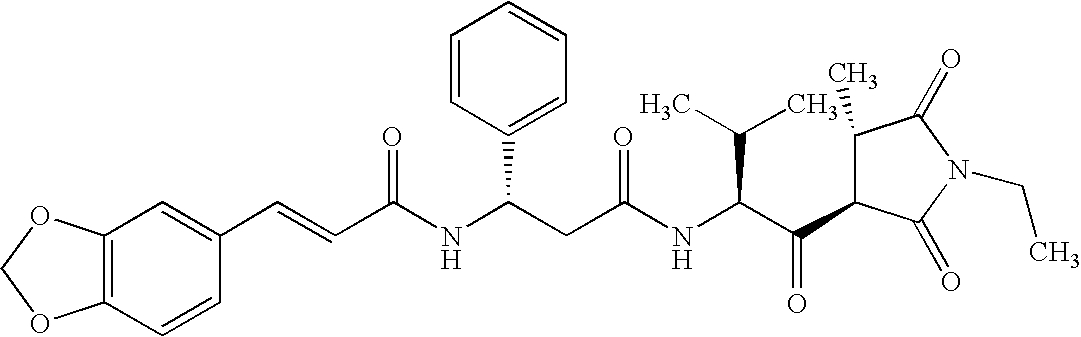
The present invention relates to compounds, to processes for preparing them, to pharmaceutical compositions comprising them, and to their use in-the therapy and/or prophylaxis in illnesses in people or animals, especially diseases of bacterial infection.
The natural substances moiramide B (Ra=hydrogen, Rb=methyl) and andrimid (Ra=hydrogen, Rb=propenyl) have been described as having antibacterial activity, whereas moiramide C (Ra=hydroxyl, Rb=propenyl) is inactive. (A. Fredenhagen, S. Y. Tamura, P. T. M. Kenny, H. Komura, Y. Naya, K. Nakanishi, J. Am. Chem. Soc., 1987, 109, 4409-4411; J. Needham, M. T. Kelly, M. Ishige, R. J. Andersen, J. Org. Chem., 1994, 59, 2058-2063; M. P. Singh, M. J. Mroczenski-Wildey, D. A. Steinberg, R. J. Andersen, W. M. Maiese, M. Greenstein, J. Antibiot., 1997, 50(3), 270-273). The isolation and antibacterial activity of andrimid is also desccribed in EP-A-250 115. JP 01301657 describes the use of andrimid and certain amide-type derivatives as agrochemical antibiotics.
The synthesis of andrimid is described in A. V. Rama Rao, A. K. Singh, Ch. V. N. S. Varaprasad, Tetrahedron Letters, 1991, 32, 4393-4396, that of moiramide B and andrimid in S. G. Davies, D. J. Dixon, J. Chem. Soc., Perkin Trans. 1, 1998, 2635-2643.
The properties of the natural substances, such as their activity, for example, do not meet the requirements imposed on antibacterial medicinal products.
Although antibacterial products with different structures are on the market, a regular possibility is the development of resistance. New products for improved and effective therapy are therefore desirable.
It is an object of the present invention, therefore, to provide new and alternative compounds having equal or improved antibacterial action for treating bacterial diseases in people and animals.
Surprisingly it has been found that derivatives of this class of compound in which the beta-phenylalanine amide group is replaced by a vinylogous aromatic or heteroaromatic amide have antibacterial activity.
The present invention accordingly provides compounds of the formula
- R1 is hydrogen, methyl or halogen,
- R1′ is hydrogen, methyl or halogen,
- R2 is hydrogen or methyl,
- R3 is hydrogen, hydroxyl, amino, C1-C3 alkyl, C1-C3 alkoxy, benzyloxy, C1-C3 alkylamino, C1-C3 alkylcarbonylamino, phenylcarbonylamino or benzyl-carbonylamino,
- R4 is hydrogen or C1-C3 alkyl,
- R5 is halogen, trifluoromethyl, trifluoromethoxy, nitro, amino, alkylamino, hydroxyl, alkyl, alkoxy, carboxyl, alkoxycarbonyl, benzyloxycarbonyl, aminocarbonyl, alkylaminocarbonyl, aryl or heteroaryl,
- or
- two substituents R5 together with the carbon atoms to which they are attached form a cycloalkyl or heterocyclyl each of which may be substituted by 0, 1 or 2 substituents R5-1, the substituents R5-1 being selected independently of one another from the group consisting of halogen, nitro, amino, trifluoromethyl, hydroxyl and alkoxy,
- R6 is alkyl, cycloalkyl or cycloalkenyl,
- it being possible for R6 to be substituted by 0, 1, 2 or 3 substituents R6-1, the substituents R6-1 being selected independently of one another from the group consisting of halogen, nitro, amino, trifluoromethyl, hydroxyl, alkyl and alkoxy,
- n is a number 0, 1, 2 or 3,
- it being possible for the radicals R5 to be identical or different when n is 2 or 3,
- m is a number 1, 2 or 3,
- A is aryl or heteroaryl,
- it being possible for A to be substituted by 0, 1, 2 or 3 substituents RA, the substituents RA being selected independently of one another from the group consisting of halogen, alkyl, nitro, amino, cyano, trifluoromethyl, aryl, heteroaryl, hydroxyl, alkoxy, alkylamino, carboxyl, alkoxycarbonyl, aminocarbonyl, alkyl-carbonylamino and alkylaminocarbonyl,
- or
- two substituents RA together with the carbon atoms to which they are attached form a cycloalkyl or heterocyclyl each of which may be substituted by 0, 1 or 2 substituents RA-1, the substituents RA-1 being selected independently of one another from the group consisting of halogen, nitro, amino, trifluoromethyl, hydroxyl and alkoxy,
- B is aryl or heteroaryl.
The compounds of the invention may also be in the form of their salts, solvates or solvates of the salts.
Depending on their structure the compounds of the invention may exist in stereoisomeric forms (enantiomers, diastereomers). The invention therefore relates to the enantiomers or diastereomers and their respective mixtures. From such mixtures of enantiomers and/or diastereomers it is possible to isolate the stereoisomerically uniform constituents in a known way.
The invention relates also, depending on the structure of the compounds, to tautomers of the compounds.
Salts preferred in the context of the invention are physiologically acceptable salts of the compounds of the invention.
Physiologically acceptable salts of the compounds (I) embrace acid addition salts of mineral acids, carboxylic acids and sulfonic acids, e.g., salts of hydrochloric acid, hydrobromic acid, sulfuric acid, phosphoric acid, methanesulfonic acid, ethanesulfonic acid, toluenesulfonic acid, benzenesulfonic acid, naphthalenedisulfonic acid, acetic acid, propionic acid, lactic acid, tartaric acid, malic acid, citric acid, fumaric acid, maleic acid and benzoic acid.
Physiologically acceptable salts of the compounds (I) also embrace salts of customary bases, such as, by way of example and preferably, alkali metal salts (e.g., sodium and potassium salts), alkaline earth metal salts (e.g. calcium and magnesium salts) and ammonium salts derived from ammonia or organic amines having 1 to 16 carbon atoms, such as, by way of example and preferably, ethylamine, diethylamine, triethylamine, ethyldiisopropylamine, monoethanolamine, diethanolamine, triethanolamine, dicyclo-hexylamine, dimethylaminoethanol, procaine, dibenzylamine, n-methylmorpholine, dihydroabietylamine, arginine, lysine, ethylenediamine and methylpiperidin.
Solvates in the context of the invention are those forms of the compounds which in the solid or liquid state form a complex by coordination with solvent molecules. Hydrates are one specific form of the solvates, in which the coordination is with water.
In the context of the present invention the signification of the substituents, unless specified otherwise, is as follows
Alkyl per se and “alk” and “alkyl” in alkoxy, alklamino, alkylaminocarbonyl, alkylcarbonylamino and alkoxycarbonyl are a linear or branched alkyl radical having generally 1 to 6, preferably 1 to 4, more preferably 1 to 3 carbon atoms, by way of example and preferably methyl, ethyl, n-propyl, isopropyl, tert-butyl, n-pentyl and n-hexyl.
Alkoxy is by of example and preferably methoxy, ethoxy, n-propoxy, isopropoxy, tert-butoxy, n-pentoxy and n-hexoxy.
Alkylamino is an alkylamino radical having one or two alkyl substituents (chosen independently of one another), by way of example and preferably methylamino, ethylamino, n-propylamino, isopropylamino, tert-butylamino, n-pentylamino, n-hexylamino, N,N-dimethylamino, N,N-diethylamino, N-ethyl-N-methylamino, N-methyl-N-n-propylamino, N-isopropyl-N-n-propylamino, N-t-butyl-N-methylamino, N-ethyl-N-n-pentylamino and N-n-Hexyl-N-methylamino.
Alkylaminocarbonyl is an alkylaminocarbonyl radical having one or two alkyl substituents (chosen independently of one another), by way of example and preferably methylaminocarbonyl, ethylaminocarbonyl, n-propylaminocarbonyl, isopropylamino-carbonyl, tert-butylaminocarbonyl, n-pentylaminocarbonyl, n-hexylaminocarbonyl, N,N-dimethylaminocarbonyl, N,N-diethylaminocarbonyl, N-ethyl-N-methylamino-carbonyl, N-methyl-N-n-propylaminocarbonyl, N-isopropyl-N-n-propylaminocarbonyl, N-t-butyl-N-methylaminocarbonyl, N-ethyl-N-n-pentylaminocarbonyl and N-n-hexyl-N-methylaminocarbonyl.
Alkylcarbonylamino is by way of example and preferably methylcarbonylamino, ethylcarbonylamino, n-propylcarbonylamino, isopropylcarbonylamino, tert-butyl-carbonylamino, n-pentylcarbonylamino and n-hexylcarbonylamino.
Alkoxycarbonyl is by way of example and preferably methoxycarbonyl, ethoxy-carbonyl, n-propoxycarbonyl, isopropoxycarbonyl, tert-butoxycarbonyl, n-pentoxycarbonyl and n-hexoxycarbonyl.
Cycloalkyl is a cycloalkyl group having generally 3 to 8, preferably 5 to 7 carbon atoms; specified by way of example and preferably for cycloalkyl are cyclopropyl, cyclobutyl, cyclopentyl, cyclohexyl and cycloheptyl.
Cycloalkenyl is a cycloalkyl group having generally 3 to 8, preferably 5 to 7 carbon atoms; specified by way of example and preferably for cycloalkenyl are cyclopropenyl, cyclobutenyl, cyclopentenyl, cyclohexenyl and cycloheptenyl.
Aryl is a mono- to tricyclic aromatic radical having generally 6 to 14 carbon atoms; specified by way of example and preferably for aryl are phenyl, naphthyl and phenanthrenyl.
Heteroaryl is an aromatic, mono- or bicyclic radical having generally 5 to 10, preferably 5 to 6 ring atoms and up to 5, preferably up to 4, heteroatoms from the series S, O and N; by way of example and preferably thienyl, furyl, pyrrolyl, thiazolyl, oxazolyl, imidazolyl, pyridyl, pyrimidyl, pyridazinyl, indolyl, indazolyl, benzofuranyl, benzothiophenyl, quinolinyl, isoquinolinyl.
Heterocyclyl is a mono- or polycyclic, preferably mono- or bicyclic, heterocyclic radical having generally 4 to 10, preferably 5 to 8 ring atoms and up to 3, preferably up to 2, heteroatoms and/or hetero-groups from the series N, O, S, SO, SO2. The heterocyclyl radicals may be saturated or partly unsaturated. Preference is given to 5- to 8-membered, monocyclic saturated heterocyclyl radicals having up to two heteroatoms from the series O, N and S, such as, by way of example and preferably, tetrahydrofuran-2-yl, pyrrolidin-2-yl, pyrrolidin-3-yl, pyrrolinyl, piperidinyl, morpholinyl, perhydroazepinyl.
Halogen is fluorine, chlorine, bromine and iodine, preferably fluorine and chlorine.
If radicals in the compounds of the invention are substituted the radicals, unless specified otherwise, may be substituted by one or more identical or different substituents. Substitution by up to three identical or different substituents is preferred. Very particular preference is given to substitution by one substituent.
Preference is given in the context of the present invention to compounds of the formula (I)
in which
- R1 is hydrogen or methyl,
- R1′ is hydrogen, methyl or fluorine,
- R2 is hydrogen,
- R3 is hydrogen, amino, C1-C3 alkyl, C1-C3 alkoxy, benzyloxy, C1-C3 alkylamino, C1-C3 alkylcarbonylamino, phenylcarbonylamino or benzyl-carbonylamino,
- R4 is methyl,
- R5 is fluorine, chlorine, trifluoromethyl, trifluoromethoxy, nitro, amino, alkylamino, hydroxyl, alkyl, alkoxy, alkoxycarbonyl, aminocarbonyl, phenyl or 5- to 6-membered heteroaryl,
- or
- two substituents R5 together with the carbon atoms to which they are attached form a 5- to 6-membered cycloalkyl or 5- to 6-membered heterocyclyl,
- R6 is C2-C7 alkyl, C3-C7 cycloalkyl or C5-C7 cycloalkenyl,
- it being possible for R6 to be substituted by 0, 1 or 2 substituent R6-1, R6-1 being selected from the group consisting of halogen, trifluoromethyl, alkyl and methoxy,
- n is a number 0, 1 or 2,
- it being possible for the radicals R5 to be identical or different if n is 2,
- m is a number 1 or 2,
- A is phenyl, naphthyl or 5-, 6- or 10-membered heteroaryl,
- it being possible for A to be substituted by 0, 1 or 2 substituents. RA, the substituents RA being selected independently of one another from the group consisting of halogen, alkyl, amino, cyano, trifluoromethyl, aryl, heteroaryl, hydroxyl, alkoxy, alkylamino, alkoxycarbonyl and aminocarbonyl,
- or
- two substituents RA together with the carbon atoms to which they are attached form a 5- to 6-membered cycloalkyl or 5- to 6-membered heterocyclyl each of which may be substituted by 0 or 1 substituents RA-1, the substituents RA-1 being selected independently of one another from the group consisting of halogen, nitro, amino, trifluoromethyl, hydroxyl and alkoxy,
- B is phenyl, naphthyl or 5-, 6-, 9- or 10-membered heteroaryl.
Preference in the context of the present invention is also given to compounds of the formula (I) which conform to the formula (Ia)
- R1 is hydrogen,
- R1′ is hydrogen, methyl or fluorine,
- R2 is hydrogen,
- R3 is hydrogen, amino, methyl, methoxy, ethoxy, methylamino or dimethylamino,
- R4 is methyl,
- R5 is fluorine, chlorine, trifluoromethyl, alkoxy, methoxycarbonyl, C1-C4 alkyl, phenyl or pyridyl,
- or
- two substituents R5 together with the carbon atoms to which they are attached form a 5- or 6-membered heterocyclyl,
- R6 is C3-C6 alkyl, C4-C6 cycloalkyl or C5-C6 cycloalkenyl,
- n is a number 0, 1 or 2,
- it being possible for the radicals R5 to be identical or different if n is 2,
- m is the number 1,
- A is phenyl, pyridyl, imidazolyl, thienyl, furanyl, oxadiazolyl, pyrazolyl, pyrazinyl, pyridazinyl, pyrimidinyl, quinolinyl or isoquinolinyl,
- it being possible for A to be substituted by 0, 1 or 2 substituents RA, the substituents RA being selected independently of one another from the group consisting of halogen, alkyl, cyano, trifluoromethyl, phenyl and alkoxy,
- or
- two substituents RA together with the carbon atoms to which they are attached form a 5- or 6-membered heterocyclyl,
- B is phenyl, naphthyl, pyridyl, thienyl, furanyl, quinolinyl or isoquinolinyl.
Preference in the context of the present invention is also given to compounds of the formula (Ia),
- in which
- R1 is hydrogen,
- R1′ is hydrogen,
- R2 is hydrogen,
- R3 is hydrogen, amino, methylamino or dimethylamino,
- R4 is methyl,
- R5 is fluorine, chlorine, trifluoromethyl, methoxy, C1-C4 alkyl, phenyl or pyridyl,
- or
- two substituents R5 together with the phenyl ring to which they are attached form a 1,3-benzodioxole or a 1,4-benzodioxane,
- R6 is isopropyl, tert-butyl, isobutyl, isopentyl, cyclobutyl or cyclopentyl,
- n is a number 0, 1 or 2,
- it being possible for the radicals R5 to be identical or different if n is 2,
- m is the number 1,
- A is phenyl, pyridyl, thienyl, quinolinyl or isoquinolinyl,
- it being possible for A to be substituted by 0, 1 or 2 substituents RA, the substituents RA being selected independently of one another from the group consisting of fluorine, chlorine, C1-C3 alkyl, cyano, trifluoromethyl, phenyl and C1-C3 alkoxy,
- or
- two substituents RA together with the phenyl ring to which they are attached form a 1,3-benzodioxole or a 1,4-benzodioxane,
- B is phenyl, naphthyl, thienyl, quinolinyl or isoquinolinyl.
Preference in the context of the present invention is also given to compounds of formula (I) in which R1 to R6, A, B, m and n are as defined above and R4 is other than hydrogen.
Preference in the context of the present invention is also given to the compounds of the formula (I) in which R1 is hydrogen.
Preference in the context of the present invention is also given to the compounds of the formula (I) or (Ia) in which R1′ is hydrogen.
Preference in the context of the present invention is also given to the compounds of the formula (I) in which R2 is hydrogen.
Preference in the context of the present invention is also given to the compounds of the formula (I) or (Ia) in which R3 is hydrogen or amino.
Preference in the context of the present invention is also given to the compounds of the formula (I) in which R4 is methyl.
Preference in the context of the present invention is also given to the compounds of the formula (I) or (Ia) in which n is the number zero.
Preference in the context of the present invention is also given to the compounds of the formula (I) in which n is the number 1, B is phenyl and R5 is fluorine, chlorine, trifluoromethyl, alkoxy, C1-C4 alkyl, phenyl or pyridyl, R5 being positioned meta or para to the linkage site of the phenyl ring. By the linkage site of the phenyl ring is meant the carbon atom of the phenyl ring carrying R5 to which the phenyl ring carrying R5, in accordance with formula (I) or (Ia) as B, is attached to the remainder of the compound.
Preference in the context of the present invention is also given to the compounds of the formula (I) or (Ia), in which R6 is isopropyl, tert-butyl, isobutyl, isopentyl or cyclopentyl.
Preference in the context of the present invention is also given to the compounds of the formula (I), in which m is the number 1.
Preference in the context of the present invention is also given to the compounds of the formula (I) or (Ia) in which
- A is phenyl or pyridyl,
- it being possible for A to be substituted by 0, 1 or 2 substituents RA, the substituents RA being selected independently of one another from the group consisting of fluorine, chlorine, cyano, trifluoromethyl, phenyl and methoxy.
Preference in the context of the present invention is also given to the compounds of the formula (I) or (Ia) in which B is phenyl.
Preference in the context of the present invention is also given to the following compounds:
- (2E)-3-(1,3-benzodioxol-5-yl)-N-{(1S)-3-[((1S)-2-methyl-1-{[(3R,4S)-4-methyl-2,5-dioxo-3-pyrrolidinyl]carbonyl}propyl)amino]-3-oxo-1-phenylpropyl}-2-propenamide,
- (2E)-3-(1,3-benzodioxol-5-yl)-N-{(1S)-3-[((1S)-2,2-dimethyl-1-{[(3R,4S)-4-methyl-2,5-dioxo-3-pyrrolidinyl]carbonyl}propyl)amino]-3-oxo-1-phenylpropyl}-2-propenamide,
- (2E)-3-(1,3-benzodioxol-5-yl)-N-{1-(2,3-dihydro-1,4-benzodioxin-6-yl)-3-[((1S)-2-methyl-1-{[(3R,4S)-4-methyl-2,5-dioxo-3-pyrrolidinyl]-3-carbonyl}propyl)amino]-3-oxopropyl}-2-propenamide,
- (2E)-N-{1-(2,3-dihydro-1,4-benzodioxin-6-yl)-3-[((1S)-2-methyl-1-{[(3R,4S)-4-methyl-2,5-dioxo-3-pyrrolidinyl]carbonyl}propyl)amino]-3-oxopropyl}-3-phenyl-2-propenamide,
- (2E)-N-{(1S)-3-[((1S)-2-methyl-1-{[(3R,4S)-4-methyl-2,5-dioxo-3-pyrrolidinyl]-carbonyl}propyl)amino]-3-oxo-1-phenylpropyl}-3-(4-methylphenyl)-2-propenamide,
- (2E)-3-(2H-benzo[d]1,3-dioxolan-5-yl)-N-((1S)-2-{N-[(1S)-2-((4S,3R)-4-methyl-2,5-dioxoazolidin-3-yl)-1-cyclopentyl-2-oxoethyl]carbamoyl}-1-phenylethyl)prop-2-enamide,
- (2E)-N-((1S)-2-{N-[(1S)-2-((4S,3R)-4-methyl-2,5-dioxoazolidin-3-yl)-1-cyclopentyl-2-oxoethyl]carbamoyl}-1-phenylethyl)-3-(4-cyanophenyl)prop-2-enamide,
- (2E)-N-((1S)-2-{N-[(1S)-2-((4S,3R)-1-amino-4-methyl-2,5-dioxoazolidin-3-yl)-1-cyclopentyl-2-oxoethyl]carbamoyl}-1-phenylethyl)-3-(4-cyanophenyl)prop-2-enamide,
- (2E)-N-(2-{N-[(1S)-2-((4S,3R)-1-amino-4-methyl-2,5-dioxoazolidin-3-yl)-1-cyclo-pentyl-2-oxoethyl]carbamoyl}-1-(2-naphthyl)ethyl)-3-(4-cyanophenyl)prop-2-enamide,
- (2E)-N-[(1S)-2-(N-{((1S)-2-[(4S,3R)-1-(dimethylamino)-4-methyl-2,5-dioxoazolidin-3-yl]-1-cyclopentyl-2-oxoethyl}carbamoyl)-1-phenylethyl]-3-(4-cyanophenyl)prop-2-enamide.
The invention further provides processes for preparing compounds of the formula (I), where
- by process [A]
- compounds of the formula
in which R
2 to R
6, B and n are as defined above, are reacted with compounds of the formula
in which R
1 and R
1′, A and m are as defined above, it being possible for these to be in activated form if desired,
- or
- by process [B]
- compounds of the formula
in which R
3, R
4 and R
6 are as defined above, are reacted with compounds of the formula
in which R
1, R
1′, R
2, R
5, A, B, m and n are as defined above, it being possible for these to be in activated form if desired.
Suitable for converting the compounds into the activated form in the abovementioned processes are, for example, carbodiimides such as N,N′-diethyl-, N,N,′-dipropyl-, N,N′-diisopropyl-, N,N′-dicyclohexylcarbodiimide, N-(3-dimethylaminoisopropyl)-N′-ethylcarbodiimide hydrochloride (EDC) (optionally in the presence of pentafluorophenol (PFP)), N-cyclohexylcarbodiimide-N′-propyloxymethyl-polystyrene (PS-carbodiimide) or carbonyl compounds such as carbonyldiimidazole, or 1,2-oxazolium compounds such as 2-ethyl-5-phenyl-1,2-oxazolium-3-sulfate or 2-tert-butyl-5-methyl-isoxazolium perchlorate, or acylamino compounds such as 2-ethoxy-1-ethoxycarbonyl-1,2-dihydroquinoline, or propanephosphonic anhydride, or isobutyl chloroformate, or bis(2-oxo-3-oxazolidinyl)phosphoryl chloride or benzotriazolyloxytri(dimethylamino)phosphonium hexafluorophosphate, or O-(benzotriazol-1-yl)-N,N,N′,N′-tetramethyluronium hexafluorophosphate (HBTU), 2-(2-oxo-1-(2H)-pyridyl)-1,1,3,3-tetramethyluronium tetrafluoroborate (TPTU) or O-(7-azabenzotriazol-1-yl)-N,N,N′,N′-tetramethyl-uronium hexafluorophosphate (HATU), or 1-hydroxybenzotriazole (HOBt), or benzotriazol-1-yloxytris(dimethylamino)phosphonium hexafluorophosphate (BOP), or mixtures of these with bases.
Bases are, for example, alkali metal carbonates, such as sodium or potassium carbonate, or hydrogencarbonate, or organic bases such as trialkylamines, e.g. triethylamine, N-methylmorpholine, N-methylpiperidine, 4-dimethylaaminopyridine or diisopropylethylamine.
Preference is given to using HATU and diisopropylethylamine or EDC with HOBt and triethylamine.
Suitable solvents in this context include inert organic solvents which do not change under the reaction conditions. These include halogenated hydrocarbons such as dichloromethane or trichloromethane, hydrocarbon such as benzene, xylene, toluene, hexane, cyclohexane, or petroleum fractions, nitromethane, dimethylformamide or acetonitrile or ethers such as diethyl ether, tetrahydrofuran or dioxane. It is also possible to use mixtures of the solvents. Particular preference is given to a mixture of dichloromethane and dimethylformamide.
Process [A]
The compounds of the formula (II) are known or can be prepared by admixing compounds of the formula
in which R
2 to R
6, B and n are as defined above,
- with acid, in particular with hydrochloric acid or trifluoroacetic acid. The compounds of the formula (II) are in this case obtained in the form of the corresponding salts, e.g. in the form of their hydrochlorides, and can be used further in this form.
Suitable solvents in this context include inert organic solvents which do not change under the reaction conditions. These include halogenated hydrocarbons such as dichloromethane or trichloromethane, hydrocarbons such as benzene, xylene, toluene, hexane, cyclohexane, or petroleum fractions, nitromethane, dimethylformamide or acetonitrile or ethers such as diethyl ether, tetrahydrofuran or dioxane. It is also possible to use mixtures of the solvents. Particular preference is given to the use of hydrochloric acid in dioxane or trifluoroacetic acid in dichloromethane.
The compounds of the formula (VI) are known or can be prepared by reacting compounds of the formula (IV) with compounds of the formula
in which R
2, R
5, B and n are as defined above, it being possible for these to be in activated form if desired.
Suitable for converting the compounds into the activated form are, for example, carbodiimides such as N,N′-diethyl-, N,N,′-dipropyl-, N,N′-diisopropyl-, N,N′-dicyclohexylcarbodiimide, N-(3-dimethylaminoisopropyl)-N′-ethylcarbodiimide hydrochloride (EDC) (optionally in the presence of pentafluorophenol (PFP)), N-cyclohexylcarbodiimide-N′-propyloxymethyl-polystyrene (PS-carbodiimide) or carbonyl compounds such as carbonyldiimidazole, or 1,2-oxazolium compounds such as 2-ethyl-5-phenyl-1,2-oxazolium-3-sulfate or 2-tert-butyl-5-methyl-isoxazolium perchlorate, or acylamino compounds such as 2-ethoxy-1-ethoxycarbonyl-1,2-dihydroquinoline, or propanephosphonic anhydride, or isobutyl chloroformate, or bis(2-oxo-3-oxazolidinyl)phosphoryl chloride or benzotriazolyloxytri(dimethylamino)phosphonium hexafluorophosphate, or O-(benzotriazol-1-yl)-N,N,N′,N′-tetramethyluronium hexafluorophosphate (HBTU), 2-(2-oxo-1-(2H)-pyridyl)-1,1,3,3-tetramethyluronium tetrafluoroborate (TPTU) or O-(7-azabenzotriazol-1-yl)-N,N,N′,N′-tetramethyl-uronium hexafluorophosphate (HATU), or 1-hydroxybenzotriazole (HOBt), or benzotriazol-1-yloxytris(dimethylamino)phosphonium hexafluorophosphate (BOP), or mixtures of these with bases.
Bases are, for example, alkali metal carbonates, such as sodium or potassium carbonate, or hydrogencarbonate, or organic bases such as trialkylamines, e.g. triethylamine, N-methylmorpholine, N-methylpiperidine, 4-dimethylaminopyridine or diisopropylethylamine.
Preference is given to using HATU and diisopropylethylamine or EDC with HOBt and triethylamine.
Suitable solvents in this context include inert organic solvents which do not change under the reaction conditions. These include halogenated hydrocarbons such as dichloromethane or trichloromethane, hydrocarbon such as benzene, xylene, toluene, hexane, cyclohexane, or petroleum fractions, nitromethane, dimethylformamide or acetonitrile or ethers such as diethyl ether, tetrahydrofuran or dioxane. It is also possible to use mixtures of the solvents. Particular preference is given to a mixture of dichloromethane and dimethylformamide.
The compounds of the formula (IV) are known from the literature or can be prepared by admixing compounds of the formula
in which R
3, R
4 and R
6 are as defined above, with acid, in particular with hydrochloric acid or trifluoroacetic acid.
Suitable solvents in this context include inert organic solvents which do not change under the reaction conditions. These include halogenated hydrocarbons such as dichloromethane or trichloromethane, hydrocarbons such as benzene, xylene, toluene, hexane, cyclohexane, or petroleum fractions, nitromethane, dimethylformamide or acetonitrile or ethers such as diethyl ether, tetrahydrofuran or dioxane. It is also possible to use mixtures of the solvents. Particular preference is given to the use of hydrochloric acid in dioxane or trifluoroacetic acid in dichloromethane.
The compounds of the formula (VII) are known or can be prepared by procedures known from the literature. (With regard to the preparation of aromatic beta-amino acids see: S. Rault, P. Dallemagne, M. Robba, Bull. Soc. Chim. Fr., 1987, 1079-1083; S. G. Davies, et al., J. Chem. Soc., Chem. Commun. 1993, 14, 1153-1155; regarding the reaction to form the tert-butoxycarbonyl-protected compounds see T. W. Greene, P. G. M. Wuts, Protective Groups in Organic Synthesis, 3rd Edt. 1999, J. Wiley & Sons, Inc.).
The compounds of the formula (VIII) are known or can be prepared by methods known from the literature. (Cf., e.g., S. G. Davies, D. J. Dixon, J. Chem. Soc., Perkin Trans. 1, 1998, 17, 2635-2643; A. V. Rama Rao, A. K. Singh, Ch. V. N. S. Varaprasad, Tetrahedron Letters, 1991, 32, 4393-4396).
The compounds of the formula (III) are known or can be prepared by methods known from the literature (Houben-Weyl, Methoden der organischen Chemie, vol. E5, carboxylic acids and carboxylic acid derivatives, Thieme Verlag, Stuttgart, 1985).
Process [B]
The compounds of the formula (V) are known from the literature or can be prepared by hydrolyzing compounds of the formula
in which R
1, R
1′, R
2, R
5, A, B, m and n are as defined above and R
7 is an alkyl radical.
The hydrolysis can be carried out in accordance with standard methods, e.g., in a mixture of ethanol and water with 40% strength sodium hydroxide solution at room temperature or in a mixture of dioxane and water with methanolic potassium hydroxide solution.
The compounds of the formula (IX) are known from the literature or can be prepared by reacting compounds of the formula
in which R
2, R
5, R
7, B and n are as defined above, with compounds of the formula (III), it being possible for these to be in activated form if desired.
Suitable for converting the compounds into the activated form in the abovementioned processes are, for example, carbodiimides such as N,N′-diethyl-, N,N,′-dipropyl-, N,N′-diisopropyl-, N,N′-dicyclohexylcarbodiimide, N-(3-dimethylaminoisopropyl)-N′-ethylcarbodiimide hydrochloride (EDC) (optionally in the presence of pentafluorophenol (PFP)), N-cyclohexylcarbodiimide-N′-propyloxymethyl-polystyrene (PS-carbodiimide) or carbonyl compounds such as carbonyldiimidazole, or 1,2-oxazolium compounds such as 2-ethyl-5-phenyl-1,2-oxazolium-3-sulfate or 2-tert-butyl-5-methyl-isoxazolium perchlorate, or acylamino compounds such as 2-ethoxy-1-ethoxycarbonyl-1,2-dihydroquinoline, or propanephosphonic anhydride, or isobutyl chloroformate, or bis(2-oxo-3-oxazolidinyl)phosphoryl chloride or benzotriazolyloxytri(dimethylamino)phosphonium hexafluorophosphate, or O-(benzotriazol-1-yl)-N,N,N′,N′-tetramethyluronium hexafluorophosphate (HBTU), 2-(2-oxo-1-(2H)-pyridyl)-1,1,3,3-tetramethyluronium tetrafluoroborate (TPTU) or O-(7-azabenzotriazol-1-yl)-N,N,N′,N′-tetramethyl-uronium hexafluorophosphate (HATU), or 1-hydroxybenzotriazole (HOBt), or benzotriazol-1-yloxytris(dimethylamino)phosphonium hexafluorophosphate (BOP), or mixtures of these with bases.
Bases are, for example, alkali metal carbonates, such as sodium or potassium carbonate, or hydrogencarbonate, or organic bases such as trialkylamines, e.g. triethylamine, N-methylmorpholine, N-methylpiperidine, 4-dimethylaminopyridine or diisopropylethylamine.
Preference is given to using HATU and diisopropylethylamine or EDC with HOBt and triethylamine.
Suitable solvents in this context include inert organic solvents which do not change under the reaction conditions. These include halogenated hydrocarbons such as dichloromethane or trichloromethane, hydrocarbon such as benzene, xylene, toluene, hexane, cyclohexane, or petroleum fractions, nitromethane, dimethylformamide or acetonitrile or ethers such as diethyl ether, tetrahydrofuran or dioxane. It is also possible to use mixtures of the solvents. Particular preference is given to a mixture of dichloromethane and dimethylformamide.
The compounds of the formula (X) are known from the literature or can be prepared in analogy to methods known from the literature (e.g., S. G. Davies et. al., J. Chem. Soc. Chem. Comm., 1993, 14, 1153-1155; S. J. Faulconbridge et al., Tetrahedron Letters, 2000, 41, 2679-2682; M. J. Ashton et al., Heterocycles, 1989, 28, 1015-1035).
Synthesis may also take place on a polymeric support. In that case R2 in the synthesis sequence is a polymer (Resin), preference being given to the use of 4-(4-formyl-3-methoxyphenoxy)butyryl-aminomethyl-polystyrene or another resin in which a polymeric backbone such as polystyrene or block copolymers of polystyrene with ethylene glycol has attached to it via a linker group such as 3-methoxyphenoxyethyl, 3,5-dimethoxyphenoxyethoxymethyl or 3-methoxyphenoxybutyrylaminomethyl a formyl radical or another radical which allows amines to be attached to the polymeric support.
The preparation of the compounds of the invention can be illustrated by the following synthesis schemes:
Starting Compounds
Preparation Examples
Solid-phase Synthesis
The present invention further provides compounds of the formula (I) for controlling diseases, particularly bacterial diseases, and also medicinal products comprising compounds of the formula (I) in combination with at least one pharmaceutically compatible, pharmaceutically acceptable carrier or other auxiliary, and also for the use of compounds of the formula (I) for producing a medicinal product for treating bacterial diseases.
The formulations of the invention are particularly active against bacteria and bacterialike microorganisms. They are therefore particularly suitable for the prophylaxis and chemotherapy of local and systemic infections in human and veterinary medicine that are induced by these pathogens.
By way of example it is possible to treat and/or prevent local and/or systemic diseases caused by the following pathogens or by combinations of the following pathogens:
Gram-positive cocci, e.g., staphylococci (Staph. aureus, Staph. epidermidis), enterococci (E. faecalis, E. faecius) and streptococci (Strept. agalactiae, Strept. pneumoniae); gram-negative cocci (Neisseria gonorrhoeae) and gram-negative rods such as enterobacteria, e.g., Escherichia coli, hemophilus influenzae, Citrobacter (Citrob. freundii, Citrob. divemis), salmonella and shigella; and also Klebsiellas (Klebs. pneumoniae, Klebs. oxytocy), Enterobacter (Ent. aerogenes, Ent. agglomerans), hafnia, serratia (Serr. marcescens), providencia, yersinia, and also the genus Acinetobacter. The antibacterial spectrum further embraces strictly anaerobic bacteria such as Bacteroides fragilis, representatives of the genus Peptococcus, Peptostreptococcus and the genus Clostridium; and also Mycoplasmas (M. pneumoniae, M. hominis, M. urealyticum) and Mycobacteria, e.g., Mycobacterium tuberculosis.
The above listing of pathogens should be interpreted merely as exemplary and in no way as restrictive. Examples that may be mentioned of diseases which may be caused by the stated pathogens or combination infections and which may be prevented, remedied or cured by the formulations of the invention include the following:
Infectious diseases in humans, such as septic infections, bone and joint infections, skin infections, postoperative wound infections, abscesses, phlegmons, wound infections, infected burns, burn wounds, infections in the oral region, infections following dental operations, septic arthritis, mastitis, tonsillitis, genital infections and eye infections.
As well as in humans, bacterial infections in other species too can be treated. Examples that may be mentioned include the following:
- pigs: coli diarrhea, enterotoxemia, sepsis, dysenteria, salmonellosis, metritis-mastitis-agalactia syndrome, mastitis;
- ruminants (cattle, sheep, goats): diarrhea, sepsis, bronchopneumonia, salmonellosis, pasteurellosis, mycoplasmosis, genital infections;
- horses: bronchopneumonias, joint ill, puerperal and postpartum infections, salmonellosis;
- dogs and cats: bronchopneumonia, diarrhea, dermatitis, otitis, urinary tract infections, prostatitis;
- poultry (chickens, turkeys, quails, pigeons, ornamental birds and others): mycoplasmosis, E. coli infections, chronic respiratory tract diseases, salmonellosis, pasteurellosis, psittacosis.
It is also possible to treat bacterial diseases associated with the breeding and keeping of farmed and ornamental fish, in which case the antibacterial spectrum extends beyond the aforementioned pathogens to embrace further pathogens such as Pasteurella, Brucella, Campylobacter, Listeria, Erysipelothris, Corynebacteria, Borellia, Treponema, Nocardia, Rickettsi, Yersinia, for example.
The active ingredient may act systemically and/or locally. For that purpose it can be administered in appropriate manner, such as orally, parenterally, pulmonically, nasally, sublingually, lingually, buccally, rectally, transdermally, conjunctivally, otically or as an implant.
For these administration routes the active ingredient can be administered in suitable administration forms.
Administration forms suitable for oral administration are known such forms which deliver the active ingredient rapidly and/or in a modified way, such as tablets (uncoated and coated tablets, such as film-coated tablets or tablets provided with enteric coatings), capsules, sugar-coated tablets, granules, pellets, powders, emulsions, suspensions and solutions.
Parenteral administration can be made with avoidance of an absorption step (intravenously, intraarterially, intracardially, intraspinally or intralumbarly) or with inclusion of absorption (intramuscularly, subcutaneously, intracutaneously, percutaneously, or intraperitoneally). Administration forms suitable for parenteral administration include preparations for injection and infusion in the form of solutions, suspensions, emulsions, lyophilisates and sterile powders.
Preference is given to parenteral administration, more particularly intravenous administration.
Examples suitable for the other administration routes are pharmaceutical forms for inhalation (including powder inhalers, nebulizers), nasal drops/solutions, sprays; capsules or tablets to be administered lingually, sublingually or buccally, suppositories, ear and eye preparations, vaginal capsules, aqueous suspensions (lotions, shaking mixtures), lipophilic suspensions, ointments, creams, milk, pastes, dusting powders or implants.
The active ingredients can be converted in conventional manner into the stated administration forms. This is done with the use of inert, nontoxic, pharmaceutically appropriate auxiliaries (excipients). These include, among others, carriers (e.g., microcrystalline cellulose), solvents (e.g. liquid polyethylene glycols), emulsifiers (e.g., sodium dodecyl sulfate), dispersants (e.g., polyvinylpyrrolidone), synthetic and natural biopolymers (e.g., albumen), stabilizers (e.g., antioxidants such as ascorbic acid), colorants (e.g., inorganic pigments such as iron oxides) or flavor and/or odor masking agents.
It has generally proven advantageous in the case of parenteral administration to administer amounts of about 5 to 250 mg/kg body weight per 24 hours in order to achieve effective results. In the case of oral administration the amount is about 5 to 100 mg/kg body weight per 24 hours.
It may nevertheless be necessary, where appropriate, to deviate from the amounts specified, specifically as a function of body weight, administration route, individual response to the active ingredient, type of formulation, and time or interval at which administration takes place.
The percentages in the tests and examples below, unless stated otherwise, are percentages by weight; parts are parts by weight. Solvent ratios, dilution ratios and concentration figures for liquid/liquid solutions are based in each case on the volume.
A. EXAMPLES
Reaction schemes which are shown for general procedures show a selection of examples, but can be employed in each case for all of the examples which refer to them.
| Boc |
tert-butoxycarbonyl |
| CDCl3 |
deuterochloroform |
| DCI |
direct chemical ionization |
| DIEA |
N,N-diisopropylethylamine |
| DMSO |
dimethyl sulfoxide |
| EDC |
N-(3-dimethylaminoisopropyl)-N′-ethylcarbodiimide |
| |
hydrochloride |
| eq. |
equivalent |
| ESI |
electrospray ionization (for MS) |
| Fmoc |
fluorenylmethoxycarbonyl |
| h |
hour |
| HATU |
O-(7-azabenzotriazol-1-yl)-N,N,N′,N′-tetramethyluronium |
| |
hexafluorophosphate |
| HOBt |
1-hydroxylbenzotriazole |
| HPLC |
High-pressure, high-performance liquid chromatography |
| LC-MS |
liquid chromatography-coupled mass spectroscopy |
| MS |
mass spectroscopy |
| NMR |
nuclear magnetic resonance spectroscopy |
| PS-DIEA |
N,N-diisopropylethylamine-polystyrene (Resin) |
| Rf |
retention index (for TLC) |
| RP-HPLC |
reverse phase HPLC |
| RT |
room temperature |
| Rt |
retention time (for HPLC) |
| THF |
tetrahydrofuran |
| |
HPLC and LC-MS Methods
Method 1: column: Kromasil C18, L-R temperature: 30° C., flow rate=0.75 ml min−1, mobile phase: A=0.01 M HClO4, B=acetonitrile, gradient:→0.5 min 98% A→4.5 min 10% A→6.5 min 10% A
Method 2: column: Kromasil C18 60*2, L-R temperature: 30° C., flow rate=0.75 ml min−1, mobile phase: A=0.01 M H3PO4, B=acetonitrile, gradient:→0.5 min 90% A→4.5 min 10% A→6.5 min 10% A
Method 3: column: Kromasil C18 60*2, L-R temperature: 30° C., flow rate=0.75 ml min−1, mobile phase: A=0.005 M HClO4, B=acetonitrile, gradient:→0.5 min 98% A→4.5 min 10% A→6.5 min 10% A
Method 4: column: Symmetry C18 2.1×150 mm, column oven: 50° C., flow rate=0.6 ml min−1, mobile phase: A=0.6 g 30% strength hydrochloric acid/1 water, B=acetonitrile, gradient: 0.0 min 90% A→4.0 min 10% A→9 min 10% A
Method 5: Instrument: Micromass Quattro LCZ
Column: Symmetry C18, 50 mm×2.1 mm, 3.5 μm, temperature: 40° C., flow rate=0.5 ml min−1, mobile phase A=acetonitrile+0.1% formic acid, mobile phase B=water+0.1% formic acid, gradient: 0.0 min 10% A→4 min 90% A→6 min 90% A
Method 6: Instrument: Micromass Platform LCZ
Column: Symmetry C18, 50 mm×2.1 mm, 3.5 μm, temperature: 40° C., flow rate=0.5 ml min−1, mobile phase A=acetonitrile+0.1% formic acid, mobile phase B=water+0.1% formic acid, gradient: 0.0 min 10% A→4 min 90% A→6 min 90% A
Method 7: Instrument: Micromass Quattro LCZ
Column: Symmetry C18, 50 mm×2.1 mm, 3.5 μm, temperature: 40° C., flow rate=0.5 ml min−1, mobile phase A=acetonitrile+0.1% formic acid, mobile phase B=water+0.1% formic acid, gradient: 0.0 min 5% A→1 min 5% A→5 min 90% A→6 min 90% A
Method 8: column: Symmetry C18 2.1×150 mm, 5 μm, column oven: 70° C., flow rate=0.9 ml min−1, mobile phase: A=acetonitrile, B=0.3 g 30% strength hydrochloric acid/1 water, gradient: 0.0 min 2% A→2.5 min 95% A→5 min 95% A
Method 9: column: Symmetry C18 3.9×150 mm, column oven: 40° C., flow rate=1.5 ml min−1, mobile phase: A=water+0.05% H3PO4, B=acetonitrile, gradient: 0.0 min 10% B→0.6 min 10% B→3.8 min 100% B→5.0 min 100% B.
Method 10: Instrument: Waters Alliance 2790 LC; column: Symmetry C18, 50 mm×2.1 mm, 3.5 μm; mobile phase A: water+0.1% formic acid, mobile phase B: acetonitrile+0.1% formic acid; gradient: 0.0 min 5% B→5.0 min 10% B→6.0 min 10% B; temperature: 50C, flow rate: 1.0 ml/min, UV detection: 210 nm.
Method 11: Instrument type MS: Micromass ZQ; instrument type HPLC: Waters Alliance 2790; column: Symmetry C 18, 50 mm×2.1 mm, 3.5 μm; mobile phase B: acetonitrile+0.05% formic acid, mobile phase A: water+0.05% formic acid; gradient: 0.0 min 10% B→3.5 min 90% B→5.5 min 90% B; oven: 50° C., flow rate: 0.8 ml/min, UV detection: 210 nm.
Method 12: Instrument: Waters Alliance 2790 LC; column: Symmetry C18, 50 mm×2.1 mm, 3.5 μm; mobile phase A: water+0.05% formic acid, mobile phase B: acetonitrile+0.05% formic acid; gradient: 0.0 min 5% B→4.5 min 10% B→5.5 min 10% B; temperature: 50° C., flow rate: 1.0 ml/min, UV detection: 210 nm.
Method 13: Instrument: Micromass Quattro LCZ, HP1100; column: Symmetry C18, 50 mm×2.1 mm, 3.5 μm; mobile phase A: water+0.05% formic acid, mobile phase B: acetonitrile+0.05% formic acid; gradient: 0.0 min 90% A→4.0 min 10% A→6.0 min 10% A; Oven: 40° C., flow rate: 0.5 ml/min, UV detection: 208-400 nm.
Method 14: Instrument: Micromass Platform LCZ, HP1100; column: Symmetry C18, 50 mm×2.1 mm, 3.5 μm; mobile phase A: water+0.05% formic acid, mobile phase B: acetonitrile+0.05% formic acid; gradient: 0.0 min 90% A→4.0 min 10% A→6.0 min 10% A; oven: 40° C., flow rate: 0.5 ml/min, UV detection: 208-400 nm.
Method 15: Instrument: Waters Alliance 2790 LC; column: Symmetry C18, 50 mm×2.1 mm, 3.5 μm; mobile phase A: water+0.05% formic acid, mobile phase B: acetonitrile+0.05% formic acid; gradient: 0.0 min 10% B 4 4.0 min 90% B→6.0 min 90% B; temperature: 50° C., flow rate: 0.0 min 0.5 ml/min→4.0 min 0.8 ml/min, UV detection: 210 nm.
Method 16: Instrument type MS: Micromass ZQ; instrument type HPLC: Waters Alliance 2790; column: Symmetry C 18, 50 mm×2.1 mm, 3.5 μm; mobile phase B: acetonitrile+0.05% formic acid, mobile phase A: water+0.05% formic acid; gradient: 0.0 min 5% B 4.5 min 90% B 5.5 min 90% B; oven: 50° C., flow rate: 1.0 ml/, UV detection: 210 nm
Method 17: Instrument type MS: Micromass ZQ; instrument type HPLC: Waters Alliance 2790; column: Uptisphere C 18, 50 mm×2.0 mm, 3.0 μm; mobile phase B: acetonitrile+0.05% formic acid, mobile phase A: water+0.05% formic acid; gradient: 0.0 min 5% B→2.0 min 40% B→4.5 min 90% B→5.5 min 90% B; oven: 45° C., flow rate: 0.0 min 0.75 ml/min→4.5 min 0.75 ml/min→5.5 min 1.25 ml/min, WV detection: 210 nm
Method 18: Instrument: Micromass Platform LCZ with HPLC Agilent series 1100; column: Grom-SIL120 ODS-4 HE, 50 mm×2.0 mm, 3 μm; mobile phase A: 1 l water+1 ml 50% strength formic acid, mobile phase B: 1 l acetonitrile+1 ml 50% strength formic acid; gradient: 0.0 min 100% A→0.2 min 100% A→2.9 min 30% A→3.1 min 10% A→4.5 min 10% A; oven: 55° C., flow rate: 0.8 ml/min, UV detection: 208-400 nm.
Method 19: Instrument: Micromass Quattro LCZ, with HPLC Agilent series 1100; column: Grom-SIL120 ODS-4 HE, 50 mm×2.0 mm, 3 μm; mobile phase A: 1 l water+1 ml 50% strength formic acid, mobile phase B: 1 l acetonitrile+1 ml 50% strength formic acid; gradient: 0.0 min 100% A→0.2 min 100% A→2.9 min 30% A→3.1 min 10% A→4.5 min 10% A; oven: 55° C., flow rate: 0.8 ml/min, UV detection: 208-400 nm.
Method 20: Instrument type MS: Micromass ZQ; instrument type HPLC: Waters Alliance 2790; column: Grom-Sil 120 ODS-4 HE 50×2 mm, 3.0 μm; mobile phase B: acetonitrile+0.05% formic acid, mobile phase A: water+0.05% formic acid; gradient: 0.0 min 5% B→2.0 min 40% B→4.5 min 90% B→5.5 min 90% B; oven: 45° C.; flow rate: 0.0 min 0.75 ml/min→4.5 min 0.75 ml/min→5.5 min 1.25 ml/min; UV detection: 210 nm.
Method 21: Instrument type MS: Micromass ZQ; instrument type HPLC: Waters Alliance 2790; column: Grom-Sil 120 ODS-4 HE 50×2 mm, 3.0 μm; mobile phase B: acetonitrile+500 ul 50% strength formic acid/1; mobile phase A: water+500 ul 50% strength formic acid/1; gradient: 0.0 min 0% B→0.2 min 0% B→2.9 min 70% B→3.1 min 90% B→4.5 min 90% B, oven: 50° C., flow rate:0.8 ml/min; UV detection: 210 nm.
Method 22: Instrument: Micromass Quattro LCZ with HPLC Agilent series 1100; column: UPTISPHERE HDO, 50 mm×2.0 mm, 3 μm; mobile phase A: 1 l water+1 ml 50% strength formic acid, mobile phase B: 1 l acetonitrile+1 ml 50% strength formic acid; gradient: 0.0 min 100% A→0.2 min 100% A→2.9 min 30% A→3.1 min 10% A→4.5 min 10% A; oven: 55° C., flow rate: 0.8 ml/min, UV detection: 208-400 nm.
Starting Compounds
Example 1A
(3S)-1,3-Dimethyl-2,5-pyrrolidinedione
600 mg (5.26 mmol) of (3S)-3-methyldihydro-2,5-furandione (preparation: S. G. Davies, D. J. Dixon, J. Chem. Soc., Perkin Trans. 1, 1998, 17, 2635-2643) are introduced to a vessel together with 559 mg (0.77 ml, 5.52 mmol) of triethylamine in 5 ml of dichloromethane at 0° C. and 373 mg (5.52 mmol) of methylamine hydrochloride are added. The reaction mixture is stirred at room temperature overnight and then 938 mg (5.78 mmol) of N,N-carbonyldiimidazole are added in portions. The mixture is stirred at room temperature for 1.5 h and at reflux temperature for 30 minutes. After it has cooled to room temperature the reaction mixture is washed with 5% strength hydrochloric acid and water, the organic phase is dried over magnesium sulfate, filtered and concentrated and the product is dried under a high vacuum. This gives 605 mg of the product (88% of theory).
MS (ESI+): m/z (%)=128 (M+H+) (100). HPLC (method 6): Rt=0.81 min. 1H-NMR (300 MHz, CDCl3): δ=3.10 (dd, 1H), 2.99 (s, 3H), 2.90-2.82 (m, 1H), 2.32 (dd, 1H), 1.35 (d, 3H).
Example 2A
(3R,4S)-3-[(2S)-2-(tert-Butoxycarbonyl)amino-3-methylbutanoyl]-1,4-dimethyl-2,5-pyrrolidinedione
684 mg (3.15 mmol) of N-(tert-butoxycarbonyl)-L-valine and 561 mg (3.46 mmol) of N,N-carbonyldiimidazole are stirred in 4 ml of tetrahydrofuran at room temperature for 2 h. Then 400 mg (3.15 mmol) of (3S)-3-1,3-dimethyl-2,5-pyrrolidinedione are added to this mixture and the whole mixture is added dropwise over the course of 30 minutes to 6.3 ml of a 1 molar solution of lithium hexamethyldisilazide in THF, which has been cooled to −65° C. After the end of the addition stirring is continued at −65° C. for 15 minutes more, and then 6 ml of saturated aqueous ammonium chloride are added. After the reaction mixture has been warmed to room temperature it is diluted with diethyl ether and the organic phase is washed with saturated aqueous sodium chloride solution and subsequently concentrated. The crude product is purified by RP-HPLC (mobile phase: water-acetonitrile, gradient). This gives 223 mg (22% of theory) of the desired product.
MS (ESI−): m/z (%)=325 (M−H+) (35). HPLC (method 5): Rt=3.99 min. 1H-NMR (200 MHz, CDCl3): δ=5.70 (br. d, 1H), 4.57 (dd, 1H), 3.78 (d, 1H), 3.47-3.30 (m, 1H), 2.98 (s, 3H), 2.50-2.32 (m, 1H), 1.46 (s, 9H), 1.32 (d, 3H), 1.02 (d, 3H), 0.80 (d, 3H).
In the same way as for Example 2A it is possible by reacting the corresponding N-tert-butoxycarbonyl-protected amino acids with (35)-1-(benzyloxy)-3-methyl-2,5-pyrrolidinedione (preparation: S. G. Davies, D. J. Dixon, J Chem. Soc., Perkin Trans. 1, 1998, 17, 2635-2643) to prepare the following derivatives (Examples 3A to 5A):
Example 3A
(3R,4S)-1-Benzyloxy-3-[(2S)-2-(tert-butoxycarbonyl)amino-3,3-dimethylbutanoyl]-4-methyl-2,5-pyrrolidinedione
MS (ESI−): m/z (%)=431 (M−H+) (100). HPLC (method 6): Rt=4.87 min.
Example 4A
(3R,4S)-1-Benzyloxy-3-[(2S)-2-(tert-butoxycarbonyl)amino-4-methylpentanoyl]-4-methyl-2,5-pyrrolidinedione
MS (ESI−): m/z (%)=431 (M−H+) (100). HPLC (method 6): Rt=4.88 min.
Example 5A
(3R,4S)-1-Benzyloxy-3-[(2S)-2-(tert-butoxycarbonyl)amino-butanoyl]-4-methyl-2,5-pyrrolidinedione
MS (ESI−): m/z (%)=403 (M−H+) (100). HPLC (method 6): Rt=4.54 min.
General Instructions A: Reductive Deprotection of 1-benzyloxy-2,5-pyrrolidinediones
Deprotection takes place in a manner similar to that of S. G. Davies, D. J. Dixon, J. Chem. Soc., Perkin Trans. 1 1998, 2635-2643.
The 1-benzyloxy-2,5-pyrrolidinedione (1 eq.) is dissolved in methanol or ethanol (about 0.02 mol/l), a catalytic amount of palladium-on-carbon (10%) is added, and the mixture is stirred under a hydrogen atmosphere (atmospheric pressure) for 1 h. The reaction mixture is then filtered and concentrated. The residue is dissolved in acetonitrile (about 0.05 mol/l) and added dropwise at room temperature to a solution of 2-bromoacetophenone (1 eq) in acetonitrile (about 0.03 mol/l) at room temperature. Thereafter over a period of 2 h, 1.5 eq. of triethylamine in acetonitrile (about 0.35 mol/l) are added dropwise to the reaction mixture. The reaction mixture is stirred at room temperature overnight and concentrated and the crude product is purified by means of RP-HPLC (mobile phase: acetonitrile/water or acetonitrile/water+0.3 ml 37% strength hydrochloric acid/1, gradient).
Example 6A
(3R,4S)-3-[(2S)-2-(tert-Butoxycarbonyl)amino-3,3-dimethylbutanoyl]-4-methyl-2,5-pyrrolidinedione
Preparation is in accordance with general instructions A.
MS (ESI+): m/z (%)=327 (M+H+) (100). HPLC (method 5): Rt=3.87 min.
Example 7A
(3R,4S)-3-[(2S)-2-(tert-Butoxycarbonyl)amino-4-methylpentanoyl]-4-methyl-2,5-pyrrolidinedione
Preparation is in accordance with general instructions A.
MS (ESI−): m/z (%)=325 (M−H+) (100). HPLC (method 5): Rt=3.91 min.
Example 8A
(3R,4S)-3-[(2S)-2-(tert-Butoxycarbonyl)amino-butanoyl]-4-methyl-2,5-pyrrolidinedione
Preparation is in accordance with general instructions A.
MS (ESI−): m/z (%)=297 (M−H+) (100). HPLC (method 6): Rt=3.50 min.
Example 9A
(3R,4S)-3-[(2S)-2-Amino-3-methylbutanoyl]-4-methyl-2,5-pyrrolidinedione hydrochloride
A solution, cooled at 0° C., of 4.40 g (14.09 mmol) of (3R,4S)-3-[(2S)-2-(tert-butoxycarbonyl)amino-3-methylbutanoyl]-4-methyl-2,5-pyrrolidinedione (preparation: S. G. Davies, D. J. Dixon, J. Chem. Soc., Perkin Trans. 1, 1998, 17, 2635-2643) is admixed dropwise with 35 ml of 4N hydrochloric acid solution in 1,4-dioxane. When the addition is at an end the mixture is warmed to room temperature and stirred for 2 h, after which the mixture is concentrated under reduced pressure. The crude product can be used directly in the next stage. If desired the residue is treated with diethyl ether and the crystals precipitated are filtered off and dried under a high vacuum. Yield: 2.99 g of colorless crystals (86% of theory).
MS (ESI+): m/z (%)=213 (M+H+) (100). HPLC (method 4): Rt=0.41 min.
In the same way as for Example 9A it is possible, from the corresponding tert-butoxycarbonylamino derivatives, by treatment with hydrochloric acid/dioxane, to prepare the following amines (Examples 10A to 13A) in the form of their hydrochlorides:
Example 10A
(3R,4S)-3-[(2S)-2-Amino-3-methylbutanoyl]-1,4-dimethyl-2,5-pyrrolidinedione hydrochloride
MS (ESI+): m/z (%)=227 (M+H+) (80).
Example 11A
(3R,4S)-3-[(2S)-2-Amino-3,3-dimethylbutanoyl]-4-methyl-2,5-pyrrolidinedione hydrochloride
MS (ESI+): m/z (%)=227 (M+H+) (100).
Example 12A
(3R,4S)-3-[(2S)-2-Amino-4-methylpentanoyl]-4-methyl-2,5-pyrrolidinedione hydrochloride
MS (ESI+): m/z (%)=227 (M+H+) (100).
Example 13A
(3R,4S)-3-[(2S)-2-Amino-butanoyl]-4-methyl-2,5-pyrrolidinedione hydrochloride
MS (ESI+): m/z (%)=199 (M+H+) (100).
General Instructions B: Reaction of 3-aminopropionic acid alkyl esters with carboxylic acids
A solution of the carboxylic acid derivative (1.2-1.5 eq.) in absolute dichloromethane or a mixture (5:1 to 1:1) of absolute dichloromethane and N,N-dimethylformamide (about 0.1 to 0.3 mol/l) is admixed at 0° C. first with an equimolar amount of HATU and then with the 3-aminopropionic acid alkyl ester (1 eq., optionally as a solution in N,N-dimethylformamide or dichloromethane/N,N-dimethylformamide mixtures). Subsequently at 0° C. a solution of 2.5-3.5 eq. of diisopropylethylamine in a 1:1 mixture of absolute dichloromethane and N,N-dimethylformamide (0.2-1 mol/l) is added dropwise over a period of 1 h. When the addition is at an end the reaction mixture is stirred at 0° C. for 30 minutes more and then at room temperature overnight, before being concentrated under reduced pressure. The product can be obtained by chromatography on silica gel (mobile phases; mixtures of cyclohexane/ethyl acetate or mixtures of dichloromethane and ethanol) or by RP-HPLC (mobile phases: variable gradients of water and acetonitrile), or alternatively by a combination of both methods.
((S)-3-Amino-3-phenylpropionic acid methyl ester, preparation: S. G. Davies et. al., J. Chem. Soc., Chem. Comm., 1993,14, 1153-1155).
Alternatively the reaction can take place by the following method as well:
A solution of the 3-aminopropionic acid alkyl ester (1 eq.) in absolute dichloromethane or a mixture (5:1 to 1:1) of absolute dichloromethane and N,N-dimethylformamide (about 0.1 to 0.3 mol/l) is admixed with the carboxylic acid derivative (1.1-1.5 eq.), triethylamine (3 eq.), HOBt (3 eq.) and finally 1.2 eq. of EDC. The reaction mixture is stirred at room temperature (2 h to overnight), before being concentrated under reduced pressure. The residue is taken up in ethyl acetate or dichloromethane and the organic phase is washed with water, saturated sodium hydrogencarbonate solution and saturated sodium chloride solution, dried over sodium sulfate, filtered and concentrated. The product can be purified by chromatography on silica gel (mobile phases: mixtures of cyclohexane/ethyl acetate or mixtures of dichloromethane and ethanol) or by RP-HPLC (mobile phases: variable gradients of water and acetonitrile), or alternatively by a combination of both methods.
Example 14A
Methyl (3S)-3-{[(2E)-3-(1,3-benzodioxol-5-yl)-2-propenoyl]amino}-3-phenylpropionate
Preparation takes place in accordance with general instructions B.
1H-NMR (300 MHz, d6-DMSO): δ=8.50 (d, 1H), 7.38-7.21 (m, 6H), 7.14 (d, 1H), 7.06 (dd, 1H), 6.93 (d, 1H), 6.49 (d, 1H), 6.05 (s, 2H), 5.32 (q, 1H), 3.56 (s, 3H), 2.91-2.78 (m, 2H). MS (ESI+): m/z (%)=354 (M+H+) (65).
General Instructions C: Hydrolysis of the propionic acid alkyl esters
The propionic acid alkyl ester is introduced to a vessel in a 3:1 mixture of ethanol and water (about 0.1-0.15 mol/l) and 5 eq. of 40% strength sodium hydroxide solution are added. The reaction mixture is stirred at room temperature for 24 h, acidified with dilute hydrochloric acid (to a pH of about 3) and concentrated. The residue is taken up in ethyl acetate and washed with saturated aqueous sodium chloride solution. The organic phase is dried over magnesium sulfate, filtered and concentrated. The product obtained can be used without further purification in the next stage.
An alternative option is to use the following method:
The propionic acid alkyl ester is introduced to a vessel in a 1:1 mixture of dioxane and water (about 0.1-0.15 mol/l) and 3 eq. of a solution of potassium hydroxide in methanol (100 mg/ml) are added. The reaction mixture is stirred at room temperature for 2 h and then concentrated. The residue is taken up in water and acidified with dilute hydrochloric acid. The aqueous phase is extracted three times with a 1:1 mixture of dichloromethane and ethyl acetate. The combined organic phases are dried over sodium sulfate, filtered and concentrated. The product obtained can be used without further purification in the next stage.
Example 15A
(3S)-3-{[(2E)-3-(1,3-Benzodioxol-5-yl)-2-propenoyl]amino}-3-phenylpropionic acid
Preparation takes place in accordance with general instructions C.
1H-NMR (300 MHz, d6-DMSO): δ=12.21 (s, 1H), 8.50 (d, 1H), 7.38-7.21 (m, 6H), 7.14 (d, 1H), 7.06 (dd, 1H), 6.93 (d, 1H), 6.50 (d, 1H), 6.06 (s, 2H), 5.31 (q, 1H), 2.83-2.66 (m, 2H). MS (ESI+): m/z (%)=340 (M+H+) (85). HPLC (method 5): Rt=3.47 min.
The propionic acid derivatives obtained in this way can be reacted in accordance with general instructions D (acylation of 3-[2-aminoalkanoyl]-2,5-pyrrolidinedione hydrochloride derivatives with carboxylic acid derivatives).
General Instructions D: Acylation of 3-[2-aminoalkanoyl]-2,5-pyrrolidinedione hydrochloride derivatives with carboxylic acid derivatives
A solution of carboxylic acid derivative (1.2-1.5 eq.) in absolute dichloromethane or a mixture (5:1 to 1:1) of absolute dichloromethane and N,N-dimethylformamide (about 0.1 to 0.3 mol/l) is admixed at 0° C. first with an equimolar amount of HATU and then with the 3-[2-aminoalkanoyl]-2,5-pyrrolidinedione hydrochloride derivative (1 eq., optionally as a solution in N,N-dimethylformamide or dichloromethane/N,N-dimethylformamide mixtures). Subsequently at 0° C. a solution of 2.5-3.5 eq. of diisopropylethylamine in a 1:1 mixture of absolute dichloromethane and N,N-dimethylformamide (0.2-1 mol/l) is added dropwise over a period of 1 h. After the end of the addition the reaction mixture is stirred at 0° C. for 30 minutes more and then at room temperature overnight, before being concentrated under reduced pressure. The product can be obtained by chromatography on silica gel (mobile phases: mixtures of cyclohexane/ethyl acetate or mixtures of dichloromethane and ethanol) or by RP-HPLC (mobile phases: variable gradients of water and acetonitrile), or alternatively by a combination of both methods.
Alternatively the reaction may also take place by the following method:
A solution of the 3-[2-aminoalkanoyl]-2,5-pyrrolidinedione hydrochloride derivative (1 eq.) in absolute dichloromethane or a mixture (5:1 to 1:1) of absolute dichloromethane and N,N-dimethylformamide (about 0.1 to 0.3 mol/l) is admixed with the carboxylic acid derivative (1.1-1.5 eq.), triethylamine (3 eq.), HOBt (3 eq.) and finally 1.2 eq. of EDC. The reaction mixture is stirred at room temeprature (2 h to overnight) before being concentrated under reduced pressure. The residue is taken up in ethyl acetate or dichloromethane and the organic phase is washed with water, saturated sodium hydrogencarbonate solution and saturated sodium chloride solution, dried over sodium sulfate, filtered and concentrated. The product can be purified by chromatography on silica gel (mobile phases: mixtures of cyclohexane/ethyl acetate or mixtures of dichloromethane and ethanol) or by RP-HPLC (mobile phases: variable gradients of water and acetonitrile), or alternatively by a combination of both methods.
Example 16A
tert-Butyl ((S)-2-{(S)-2-methyl-1-[1-((3R,4S)-4-methyl-2,5-dioxo-pyrrolidin-3-yl)-methanoyl]-propylcarbamoyl}-1-phenylethyl)carbamate
Preparation is in accordance with general instructions D.
1H-NMR (400 MHz, d6-DMSO): δ=11.45 (s, 1H), 7.98 (d, 1H), 7.31-7.24 (m, 5H), 7.20 (br. s, 1H), 4.88-4.82 (br. s, 1H), 4.69 (br. s, 1H), 3.98 (d, 1H), 2.95-2.89 (m, 1H), 2.77-2.69 (m, 1H), 2.51-2.44 (m, 1H), 2.35-2.29 (m, 1H), 1.10 (d, 3H), 0.85 (d, 3H), 0.78 (d, 3H). MS (ESI+): m/z (%)=460 (M+H+) (100). HPLC (method 6): Rt=3.90 min.
General Instructions E: Deblocking of Boc-protected derivatives
The tert-butyloxycarbonyl (BOC) protected amine derivative (optionally as a solution in dioxane) is admixed at 0° C. or room temperature with 4N hydrochloric acid solution in 1,4-dioxane (about 0.1 mol/l) and stirred at room temperature for 2 to 24 h before being concentrated under reduced pressure. The residue can be reacted further without additional purification or if desired is desired is treated with dichloromethane and diethyl ether (about 1:2). The precipitated crystals are filtered off with suction and dried under a high vacuum. This gives the product as the hydrochloride.
Example 17A
(S)-3-Amino-{(S)-2-methyl-1-[1-((3R,4S)-4-methyl-2,5-dioxopyrrolidin-3-yl)-methanoyl]-propyl}-3-phenylpropionamide hydrochloride
Preparation takes place in accordance with general instructions E.
1H-NMR (200 MHz, d6-DMSO): δ=11.49 (br. s, 1H), 8.5 (br. s, about 3H), 7.54-7.32 (m, 5H), 4.69-4.55 (m, 2H), 3.89 (d, 1H), 3.06-2.80 (m, 3H), 2.39-2.25 (m, 1H), 1.01 (d, 3H), 0.81 (d, 3H), 0.75 (d, 3H). MS (ESI+): m/z (%)=360 (M−Cl)+ (100). HPLC (method 4): Rt=1.44 min.
Example 18A
Methyl 3-amino-3-(2,3-dihydro-1,4-benzodioxin-6-yl)propionate
3-Amino-3-(2,3-dihydro-1,4-benzodioxin-6-yl)propionic acid [synthesis according to instructions known from the literature (e.g., L. Lázár, T. Martinek, G. Bernáth, F. Fülöp, Synth. Comm. 1998, 28, 219-224)]is introduced into a vessel in methanol (about 0.5 to 1.0 mol/l) and admixed dropwise at 0° C. with 1.2 eq of thionyl chloride. When the addition has been made the reaction mixture is stirred at room temperature overnight and subsequently concentrated. The residue is dissolved in a little methanol and the product is precipitated with diethyl ether. The solid is filtered off with suction, washed repeatedly with diethyl ether and dried under reduced pressure.
1H-NMR (300MHz, d6-DMSO): δ=8.51 (br. s, 3H), 7.07 (d, 1H), 6.95 (dd, 1H), 6.88 (d, 1H), 4.48 (dd, 1H), 4.24 (s, 4H), 3.57 (s, 3H), 3.12 (dd, 1H), 2.94 (dd, 1H). MS (ESI+): m/z=238 (M+H+).
In the same way as for Example 1A the following compounds (Example 19A to 26A) can be obtained by reacting (3S)-3-methyldihydro-2,5-furandione with the corresponding primary amines, hydroxylamine derivatives or hydrazine derivatives. The crude products can be purified by RP-HPLC (mobile phase: water-acetonitrile, gradient).
| |
| Example | Structure | MW | MS | HPLC |
| |
| 19A | | 219.24 | | HPLC (method6): Rt = 3.37min |
| |
| 20A | | 156.18 | MS (ESI+),m/z:157 (M + H)+ | HPLC (method19): Rt = 2.62min |
| |
| 21A | | 157.17 | MS (DCI),m/z: 175(M + NH4)+ | HPLC (method20): Rt = 1.70min |
| |
| 22A | | 228.25 | MS (DCI),m/z: 246(M + NH4)+ | HPLC (method20): Rt = 2.09min |
| |
| 23A | | 143.14 | MS (ESI+),m/z: 144(M + H)+ |
| |
| 24A | | 276.29 | MS (DCI),m/z: 294(M + NH4)+ | HPLC (method21): Rt = 2.80min |
| |
| 25A | | 155.20 | MS (ESI+),m/z: 156(M + H)+ | HPLC (method19): Rt = 3.26min |
| |
| 26A | | 141.17 | MS (ESI+),m/z: 142(M + H)+ | HPLC (method19): Rt = 2.78min |
| |
General Instructions F: Reaction of N-tert-butoxycarbonyl-protected amino acids with 2,5-pyrrolidinedione derivatives
The N-tert-butoxycarbonyl-protected amino acid (1 eq.) and N,N-carbonyldiimidazole (1.1 eq.) are stirred in tetrahydrofuran (about 0.1-1 mol/l) at room temperature for 2 h. The 2,5-pyrrolidinedione (1 eq.) is then added to this mixture and the total mixture is added dropwise over the course of 30 minutes to a 1 molar solution of lithium hexamethyldisilazide (2 eq.) in THF, which is cooled at −65° C. After the end of the addition stirring is continued at −65° C. for 15 minutes more, and then saturated aqueous ammonium chloride solution is added. After the reaction mixture has been warmed to room temperature it is diluted with diethyl ether and the organic phase is washed with saturated aqueous sodium chloride solution, dried over magnesium sulfate, filtered and subsequently concentrated. The crude product is purified by RP-HPLC (mobile phase: water-acetonitrile, gradient).
In accordance with general instructions F it is possible by reacting the corresponding N-tert-butoxycarbonyl-protected amino acids (for the preparation of non-natural alpha-amino acids see, for example, A. A. Cordi et al., J. Med. Chem. 2001, 44, 787-805; K. Mai, G. Patil, Tetrahedron Lett. 1984, 25, 4583-4586; N. A. Hassan, E. Bayer, J. C. Jochims, J. Chem. Soc., Perkin Trans. 1 1998, 3747-3757; for the tert-butoxycarbonyl protection see, e.g., T. W. Greene, P. G. M. Wuts, Protective Groups in Organic Synthesis, 3rd Edt. 1999, J. Wiley & Sons, Inc.) with 2,5-pyrrolidinediones to obtain the following derivatives (Examples 27A to 52A):
| |
| Example |
Structure |
MW |
MS |
HPLC |
| |
| 27A |
|
432.51 |
MS (ESI−),m/z: 431(M − H)− |
HPLC (method10): Rt = 4.10min |
| |
| 28A |
|
458.55 |
MS (ESI−),m/z: 457(M − H)− |
HPLC (method12): Rt = 4.12min |
| |
| 29A |
|
444.53 |
MS (ESI−),m/z: 443(M − H)− |
HPLC (method18): Rt = 4.11min |
| |
| 30A |
|
432.51 |
MS (ESI−),m/z: 431(M − H)− |
HPLC (method6): Rt = 4.88min |
| |
| 31A |
|
432.51 |
MS (ESI−),m/z: 431(M − H)− |
HPLC (method13): Rt = 5.08min |
| |
| 32A |
|
432.51 |
MS (ESI−),m/z: 431(M − H)− |
HPLC (method11): Rt = 3.72min |
| |
| 33A |
|
446.54 |
MS (ESI−),m/z: 445(M − H)− |
HPLC (method17): Rt = 4.42min |
| |
| 34A |
|
352.43 |
MS (ESI−),m/z: 351(M − H)− |
HPLC (method14): Rt = 4.61min |
| |
| 35A |
|
416.47 |
MS (ESI−),m/z: 415(M − H)− |
HPLC (method16): Rt = 3.49min |
| |
| 36A |
|
354.44 |
MS (ESI−),m/z: 353(M − H)− |
HPLC (method16): Rt = 3.44min |
| |
| 37A |
|
380.36 |
MS (ESI−),m/z: 379(M − H)− |
HPLC (method17): Rt = 3.72min |
| |
| 38A |
|
434.49 |
MS (ESI−),m/z: 433(M − H)− |
HPLC (method17): Rt = 3.98min |
| |
| 39A |
|
454.52 |
MS (ESI−),m/z: 453(M − H)− |
HPLC (method22): Rt = 4.41min |
| |
| 40A |
|
362.42 |
MS (ESI−),m/z: 361(M − H)− |
HPLC (method18): Rt = 3.74min |
| |
| 41A |
|
355.43 |
MS (ESI+),m/z: 378(M + Na)+ |
HPLC (method19): Rt = 4.12min |
| |
| 42A |
|
356.42 |
MS (ESI−),m/z: 355(M − H)− |
HPLC (method20): Rt = 3.64min |
| |
| 43A |
|
427.50 |
MS (ESI−),m/z: 426(M − H)− |
HPLC (method20): Rt = 3.73min |
| |
| 44A |
|
342.39 |
MS (ESI−),m/z: 341(M − H)− |
HPLC (method19): Rt = 4.18min |
| |
| 45A |
|
446.54 |
MS (ESI−),m/z: 445(M − H)− |
HPLC (method20): Rt = 4.02min |
| |
| 46A |
|
381.47 |
MS (ESI−),m/z: 380(M − H)− |
HPLC (method21): Rt = 3.43min |
| |
| 47A |
|
475.54 |
MS (ESI−),m/z: 474(M − H)− |
HPLC (method20): Rt = 3.91min |
| |
| 48A |
|
354.44 |
MS (ESI−),m/z: 353(M − H)− |
HPLC (method18): Rt = 3.80min |
| |
| 49A |
|
340.42 |
MS (ESI−),m/z: 339(M − H)− |
HPLC (method20): Rt = 3.61min |
| |
| 50A |
|
501.58 |
MS (ESI−),m/z: 500(M − H)− |
HPLC (method21): Rt = 3.93min |
| |
| 51A |
|
453.53 |
MS (ESI−),m/z: 452(M − H)− |
HPLC (method21): Rt = 3.61min |
| |
| 52A |
|
430.51 |
MS (ESI+),m/z: 453(M + Na)+ |
HPLC (method20): Rt = 4.32min |
| |
In accordance with general instructions A it is possible to obtain the following compounds (Example 53A to 64A):
| |
| Example |
Structure |
MW |
MS |
HPLC |
| |
| 53A |
|
326.40 |
MS (ESI+),m/z: 349(M + Na)+ |
HPLC (method12): Rt = 2.97min |
| |
| 54A |
|
352.43 |
MS (ESI−),m/z: 351(M − H)− |
HPLC (method12): Rt = 3.23min |
| |
| 55A |
|
326.39 |
MS (ESI−),m/z: 325(M − H)− |
HPLC (method5): Rt = 3.91min |
| |
| 56A |
|
326.39 |
MS (ESI−),m/z: 325(M − H)− |
HPLC (method12): Rt = 2.88min |
| |
| 57A |
|
326.39 |
MS (ESI−),m/z: 325(M − H)− |
HPLC (method13): Rt = 4.25min |
| |
| 58A |
|
340.42 |
MS (ESI−),m/z: 339(M − H)− |
HPLC (method17): Rt = 3.59min |
| |
| 59A |
|
310.35 |
MS (ESI−),m/z: 309(M − H)− |
HPLC (method16): Rt = 2.41min |
| |
| 60A |
|
328.26 |
MS (ESI+),m/z: 351(M + Na)+ |
HPLC (method20): Rt = 3.18min |
| |
| 61A |
|
338.40 |
MS (ESI−),m/z: 337(M − H)− |
HPLC (method17): Rt = 3.57min |
| |
| 62A |
|
340.42 |
MS (ESI+),m/z: 341(M + H)+ |
HPLC (method20): Rt = 3.79min |
| |
| 63A |
|
324.38 |
MS (ESI−),m/z: 323(M − H)− |
HPLC (method19): Rt = 4.02min |
| |
| 64A |
|
350.41 |
MS (ESI−),m/z: 349(M − H)− |
HPLC (method18): Rt = 3.66min |
| |
Compound 64A was formed in the course of the reaction of compound 39A.
General Instructions G: Deblockins of benzyloxycarbonyl-protected hydrazine derivatives
The benzyloxycarbonyl-protected hydrazine derivative (1 eq.) is dissolved in methanol or ethanol (about 0.05 mol/l), a catalytic amount of palladium-on-carbon (10%) is added and the mixture is stirred under a hydrogen atmosphere (atmospheric pressure) for 3-4 h. The reaction mixture is then filtered and concentrated. The crude product can be reacted without further purification.
In accordance with general instructions G is it possible to obtain the following compounds (Example 65A and 66A):
| |
| Example |
Structure |
MW |
MS |
HPLC |
| |
| 65A |
|
341.41 |
MS (ESI−),m/z: 340(M − H)− |
HPLC (method19): Rt = 4.00min |
| |
| 66A |
|
367.44 |
MS (ESI−),m/z: 366(M − H)− |
HPLC (method20): Rt = 3.47min |
| |
In accordance with general instructions E it is possible to obtain the following compounds (Example 67A to 93A):
| |
| Ex- |
|
|
| ample |
Structure |
MW |
| |
| 67A |
|
226.28 |
| |
| 68A |
|
252.32 |
| |
| 69A |
|
238.29 |
| |
| 70A |
|
226.28 |
| |
| 71A |
|
226.28 |
| |
| 72A |
|
226.28 |
| |
| 73A |
|
240.30 |
| |
| 74A |
|
252.32 |
| |
| 75A |
|
318.38 |
| |
| 76A |
|
210.23 |
| |
| 77A |
|
254.33 |
| |
| 78A |
|
280.25 |
| |
| 79A |
|
228.25 |
| |
| 80A |
|
262.31 |
| |
| 81A |
|
250.30 |
| |
| 82A |
|
255.32 |
| |
| 83A |
|
256.30 |
| |
| 84A |
|
227.27 |
| |
| 85A |
|
242.28 |
| |
| 86A |
|
281.36 |
| |
| 87A |
|
240.30 |
| |
| 88A |
|
241.29 |
| |
| 89A |
|
254.33 |
| |
| 90A |
|
240.30 |
| |
| 91A |
|
267.33 |
| |
| 92A |
|
253.30 |
| |
| 93A |
|
224.26 |
| |
Example 94A
Methyl (S)-3-amino-3-phenylpropionate
2.3 g (11.65 mmol) of (S)-3-amino-3-phenylpropionic acid are introduced to a vessel in 100 ml of methanol, and a catalytic amount of concentrated sulfuric acid (0.02 eq.) is added. The reaction mixture is heated at reflux for 24 h and then concentrated. The crude product can be used without further purification in the next stage.
Yield: 2.7 g (65% of theory). 1H-NMR (300 MHz, d6-DMSO): δ=8.50 (s, 2H), 7.52-7.37 (m, 5H), 4.61 (t, 1H), 3.58 (s, 3H), 3.13 (dd, 1H), 2.98 (dd, 1H). MS (ES+): m/z (%)=180 (M+H)+ (100).
General Instructions H: Synthesis of the beta-amino Acid methyl esters
The beta-amino acid (1 eq) [synthesis in accordance with instructions known from the literature, e.g., S. Rault, P. Dallemagne, M. Robba, Bull. Soc. Chim. Fr., 1987, 1079-1083; L. Lázár, T. Martinek, G. Bernáth, F. Fülöp, Synth. Comm., 1998, 28, 219-224]is suspended in methanol (concentration 0.3-1 mol/l) at temperatures between −40° C. and 0° C. Thionyl chloride (2 eq) is added dropwise and the reaction mixture is warmed to room temperature and stirred overnight. It is evaporated to dryness and then the residue is taken up in water and washed twice with ethyl acetate. The organic phase is discarded and the aqueous phase is neutralized with saturated sodium hydrogencarbonate solution and again extracted three times with ethyl acetate. The organic phases of the final extraction are dried over sodium sulfate or magnesium sulfate, decanted and evaporated to dryness. Alternatively the crude product can be worked up by dissolving it in a little methanol and recrystallizing the product by adding diethyl ether.
In accordance with general working instructions H it is possible to prepare the following compounds (Example 95A to 108A):
| |
| Example |
Structure |
MW |
MS |
HPLC/NMR |
| |
| 95A |
|
180.2 |
MS (ESI+),m/z: 180(M + H)+ |
| |
| 96A |
|
235.3 |
MS (DCI),m/z: 236(M + H)+ |
| |
| 97A |
|
256.3 |
MS (ESI+),m/z: 257(M + H)+ |
HPLC (method 5):Rt = 3.68 min |
| |
| 98A |
|
248.1 |
MS (ESI+),m/z: 248(M + H)+ |
| |
| 99A |
|
255.3 |
MS (DCI),m/z: 256(M + H)+ |
| |
| 100A |
|
197.2 |
MS (DCI),m/z: 198(M + H)+ |
| |
| 101A |
|
209.2 |
|
1H-NMR (300MHz,CDCl3): δ = 2.61-2.68(m,2H); 3.69(s, 3H);3.80(s, 3H); 4.40(dd,1H); 6.80(dd, 1H);6.90-6.96(m, 2H);7.20-7.29(m, 1H) |
| |
| 102A |
|
221.3 |
MS (DCI),m/z: 222(M + H)+ |
| |
| 103A |
|
230.3 |
MS (ESI+),m/z: 231(M + H)+ |
HPLC (method 20):Rt = 1.70 min |
| |
| 104A |
|
229.3 |
MS (ESI+),m/z: 230(M + H)+ |
HPLC (method 19):Rt = 1.75 min |
| |
| 105A |
|
185.3 |
MS (ESI+),m/z: 186(M + H)+ |
| |
| 106A |
|
169.2 |
MS (ESI+),m/z: 170(M + H)+ |
| |
| 107A |
|
237.3 |
MS (ESI+),m/z: 238(M + H)+ |
| |
| 108A |
|
223.2 |
MS (ESI+),m/z: 224(M + H)+ |
| |
In accordance with general instructions B it is possible to obtain the following compounds (Example 109A to 117A):
| |
| Example | Structure | MW | MS | HPLC |
| |
| 109A | | 430.46 | MS (ESI+),m/z (%): 431(M + H)+ | HPLC (method12): Rt = 2.51min |
| |
| 110A | | 387.82 | MS (ESI+),m/z (%): 388(M + H)+ | HPLC (method12): Rt = 3.10min |
| |
| 111A | | 371.36 | MS (ESI+),m/z (%): 372(M + H)+ | HPLC (method17): Rt = 3.48min |
| |
| 112A | | 395.45 | MS (ESI+),m/z (%): 396(M + H)+ | HPLC (method17): Rt = 3.93min |
| |
| 113A | | 404.42 | MS (ESI+),m/z (%): 405(M + H)+ | HPLC (method19): Rt = 2.40min |
| |
| 114A | | 411.46 | MS (ESI+),m/z (%): 412(M + H)+ | HPLC (method20): Rt = 3.20min |
| |
| 115A | | 334.37 | MS (ESI+),m/z (%): 335(M + H)+ | HPLC (method18): Rt = 3.36min |
| |
| 116A | | 384.43 | MS (ESI+),m/z (%): 385(M + H)+ | HPLC (method21): Rt = 3.38min |
| |
| 117A | | 385.42 | MS (ESI+),m/z (%): 386(M + H)+ | HPLC (method21): Rt = 2.76min |
| |
General Instructions I: Reaction of 3-aminopropionic acid alkyl esters with carbonyl chlorides
The 3-aminopropionic acid alkyl ester is introduced to a vessel in dichloromethane (about 0.1-0.4 mol/l) at RT and 2 to 3 eq. of diisopropylethylamine and 1.2 eq. of the carbonyl chloride are added. The mixture is stirred at room temperature for 2 to 3 h. Then water is added to the reaction mixture and the organic phase is separated off, dried over sodium sulfate, filtered and concentrated. The residue can be recrystallized from dichloromethane and diethyl ether or purified by means of chromatography on silica gel (mobile phase: mixtures of dichloromethane and ethyl acetate).
In accordance with general instructions I it is possible to obtain the following compounds (Example 118A to 122A):
| |
| Example |
Structure |
MW |
MS |
HPLC |
| |
| 118A |
|
443.50 |
MS (ES+),m/z (%): 444(M + H)+ |
| |
| 119A |
|
375.43 |
MS (ES+),m/z (%): 376(M + H)+ |
HPLC (method9): Rt = 4.59min |
| |
| 120A |
|
381.43 |
MS (ES+),m/z (%): 382(M + H)+ |
HPLC (method9): Rt = 3.65min |
| |
| 121A |
|
337.42 |
MS (ES+),m/z (%): 338(M + H)+ |
HPLC (method9): Rt = 4.52min |
| |
| 122A |
|
413.52 |
MS (ES+),m/z (%): 414(M + H)+ |
HPLC (method9): Rt = 4.91min |
| |
In accordance with general instructions C it is possible to obtain the following compounds (Example 123A to 136A):
| |
| Example |
Structure |
MW |
MS |
HPLC |
| |
| 123A |
|
416.43 |
MS (ESI+),m/z (%): 417(M + H)+ |
HPLC (method17): Rt = 2.90min |
| |
| 124A |
|
373.79 |
MS (ESI+),m/z (%): 374(M + H)+ |
HPLC (method16): Rt = 2.75min |
| |
| 125A |
|
357.34 |
MS (ESI+),m/z (%): 358(M + H)+ |
HPLC (method17): Rt = 3.20min |
| |
| 126A |
|
381.43 |
MS (ESI+),m/z (%): 382(M + H)+ |
HPLC (method17): Rt = 3.59min |
| |
| 127A |
|
390.39 |
MS (ESI+),m/z (%): 391(M + H)+ |
HPLC (method20): Rt = 2.27min |
| |
| 128A |
|
397.43 |
MS (ESI+),m/z (%): 398(M + H)+ |
HPLC (method19): Rt = 2.11min |
| |
| 129A |
|
320.35 |
MS (ESI+),m/z (%): 321(M + H)+ |
HPLC (method20): Rt = 2.65min |
| |
| 130A |
|
370.41 |
MS (ESI+),m/z (%): 371(M + H)+ |
HPLC (method19): Rt = 2.65min |
| |
| 131A |
|
371.39 |
MS (ESI+),m/z (%): 372(M + H)+ |
HPLC (method20): Rt = 2.35min |
| |
| 132A |
|
338.37 |
MS (ESI+),m/z (%): 339(M + H)+ |
HPLC (method18): Rt = 2.72min |
| |
| 133A |
|
429.48 |
MS (ES+),m/z (%): 430(M + H)+ |
HPLC (method9): Rt = 4.31min |
| |
| 134A |
|
361.40 |
MS (ES+),m/z (%): 362(M + H)+ |
| |
| 135A |
|
309.37 |
MS (ES+),m/z (%): 310(M + H)+ |
HPLC (method9): Rt = 4.04min |
| |
| 136A |
|
385.47 |
MS (ES+),m/z (%): 386(M + H)+ |
| |
Compound 132A was formed as a by-product during the preparation of compound 129A.
The propionic acid derivatives obtained in this way can be reacted in accordance with general instructions D (acylation of 3-[2-aminoalkanoyl]-2,5-pyrrolidinedione hydrochloride derivatives with carboxylic acid derivatives).
General Instructions J: Preparation of N-tert-butoxycarbonyl-protected beta-amino acids
The beta-amino acid (1 eq.) [synthesis in accordance with instructions known from the literature, e.g., S. Rault, P. Dallemagne, M. Robba, Bull. Soc. Chim. Fr., 1987, 1079-1083; L. Lázár, T. Martinek, G. Bernáth, F. Fülöp, Synth. Comm., 1998, 28, 219-224]is introduced to a vessel in water (concentration about 0.3-1 mol/l), and triethylamine (1.5-3 eq.) is added. Then a solution of 2-(tert-butoxycarbonyl-oximino)phenylacetonitrile (1.1 eq.) in dioxane (0.3-1 mol/l) is added. The reaction mixture is stirred at room temperature for 3 h, diluted with water and washed with diethyl ether. The aqueous phase is acidified with 5% strength citric acid (to a pH of about 2) and extracted three times with ethyl acetate. The combined organic phases are washed with saturated sodium chloride solution, dried over sodium sulfate, filtered and concentrated. The crude product can optionally be recrystallized from ethyl acetate/n-hexane.
In accordance with general instructions J it is possible to obtain the following compounds (Example 137A to 150A):
| |
| Example |
Structure |
MW |
MS |
HPLC |
| |
| 137A |
|
310.3 |
MS (ESI+),m/z: 311(M + H)+ |
HPLC (method8): Rt = 3.87min |
| |
| 138A |
|
323.34 |
MS (ESI+),m/z: 324(M + H)+ |
HPLC (method8): Rt = 2.39min |
| |
| 139A |
|
371.44 |
MS (ESI+),m/z: 372(M + H)+ |
HPLC (method9): Rt = 4.47min |
| |
| 140A |
|
295.34 |
MS (ESI+),m/z: 296(M + H)+ |
| |
| 141A |
|
323.35 |
|
HPLC (method9): Rt = 3.96min |
| |
| 142A |
|
315.37 |
MS (ESI−),m/z: 314(M − H)− |
HPLC (method21): Rt = 3.21min |
| |
| 143A |
|
316.36 |
MS (ESI+),m/z: 317(M + H)+ |
HPLC (method19): Rt = 3.47min |
| |
| 144A |
|
295.33 |
MS (ESI+),m/z: 296(M + H)+ |
HPLC (method20): Rt = 3.00min |
| |
| 145A |
|
325.36 |
|
HPLC (method9): Rt = 3.76min |
| |
| 146A |
|
266.30 |
MS (DCI),m/z: 167(M − 100 + H)+ |
HPLC (method9): Rt = 1.92min |
| |
| 147A |
|
309.32 |
MS (ESI−),m/z: 308(M − H)− |
HPLC (method13): Rt = 3.69min |
| |
| 148A |
|
323.39 |
MS (ESI−),m/z: 322(M − H)− |
HPLC (method14): Rt = 4.35min |
| |
| 149A |
|
295.33 |
MS (ESI+),m/z: 296(M + H)+ |
| |
| 150A |
|
316.36 |
MS (ESI+),m/z: 317(M + H)+ |
HPLC (method21): Rt = 2.14min |
| |
Example 151A
(3S)-3-[(tert-Butoxycarbonyl)amino]-3-phenylpropionic acid
2.82 g (17 mmol) of (S)-3-amino-3-phenylpropionic acid are suspended in 60 ml of dioxane and at 0° C. 4.1 g (18.8 mmol) of di-tert-butyl dicarbonate (Boc anhydride) and 43 ml of a 1N sodium hydroxide solution in water are added. The reaction mixture is stirred at 0° C. for another 30 minutes and then at room temperature for 3 h. Subsequently the reaction mixture is concentrated and the residue is taken up in methylene chloride. The organic phase is washed with 1N hydrochloric acid and saturated sodium chloride solution, dried over magnesium sulfate and concentrated. The crude product (3.12 g) can be reacted further without additional purification.
MS (ES−): m/z (%)=264 (M−H)− (100). HPLC (method 14): Rt=3.89 min.
Example 152A
(3S)-3-[(tert-Butoxycarbonyl)methylamino]-3-phenylpropionic acid
500 mg (1.88 mmol) of (3S)-3-[(tert-butoxycarbonyl)amino]-3-phenylpropionic acid are introduced to a vessel in 6 ml of tetrahydrofuran, and at 0° C. 2.14 g (15.1 mmol) of iodomethane are added. Then 226 mg (5.65 mmol) of a 60% dispersion of sodium hydride in mineral oil are added in portions. The reaction mixture is warmed to room temperature and stirred overnight. Subsequently 5 ml of water are added cautiously and the reaction mixture is concentrated. The residue is taken up in ethyl acetate. The organic phase is washed with water, dried over magnesium sulfate, filtered and concentrated. The crude product (110 mg) can be reacted further without additional purification.
MS (ESI−): m/z=278 (M−H)−. HPLC (method 14): Rt=4.27 min.
In accordance with general instructions D it is possible to obtain the following compounds (Example 153A to 170A):
| |
| Example |
Structure |
MW |
MS |
HPLC |
| |
| 153A |
|
517.58 |
MS (ESI+),m/z: 518(M + H)+ |
HPLC (method8): Rt = 2.60min |
| |
| 154A |
|
504.54 |
MS (ESI−),m/z: 503(M − H)− |
HPLC (method6):Rt = 3.99 min |
| |
| 155A |
|
565.67 |
MS (ESI+),m/z: 566(M + H)+ |
HPLC (method16):Rt = 3.45 min |
| |
| 156A |
|
489.57 |
MS (ESI+),m/z: 490(M + H)+ |
HPLC (method16):Rt = 2.90 min |
| |
| 157A |
|
517.58 |
MS (ESI+),m/z: 518(M + H)+ |
HPLC (method16):Rt = 2.89 min |
| |
| 158A |
|
485.58 |
MS (ESI−),m/z: 484(M − H)− |
HPLC (method20):Rt = 3.72 min |
| |
| 159A |
|
487.59 |
MS (ESI+),m/z: 488(M + H)+ |
HPLC (method17):Rt = 3.73 min |
| |
| 160A |
|
473.57 |
MS (ESI−),m/z: 472(M − H)− |
HPLC (method12):Rt = 3.20 min |
| |
| 161A |
|
510.59 |
MS (ESI−),m/z: 509(M − H)− |
HPLC (method19):Rt = 3.99 min |
| |
| 162A |
|
509.61 |
MS (ESI−),m/z: 508(M − H)− |
HPLC (method20):Rt = 3.77 min |
| |
| 163A |
|
519.60 |
MS (ESI−),m/z: 518(M − H)− |
HPLC (method18):Rt = 3.36 min |
| |
| 164A |
|
489.57 |
MS (ESI−),m/z: 488(M − H)− |
HPLC (method19):Rt = 4.19 min |
| |
| 165A |
|
489.57 |
MS (ESI−),m/z: 488(M − H)− |
HPLC (method20):Rt = 3.36 min |
| |
| 166A |
|
474.56 |
MS (ESI−),m/z: 473(M − H)− |
HPLC (method19):Rt = 2.55 min |
| |
| 167A |
|
460.53 |
MS (ESI+),m/z: 461(M + H)+ |
HPLC (method5):Rt = 2.86 min |
| |
| 168A |
|
517.63 |
MS (ESI−),m/z: 516(M − H)− |
HPLC (method14):Rt = 4.42 min |
| |
| 169A |
|
503.56 |
MS (ESI+),m/z: 504(M + H)+ |
HPLC (method14):Rt = 4.05 min |
| |
| 170A |
|
510.59 |
MS (ESI+),m/z: 511(M + H)+ |
HPLC (method21):Rt = 2.50 min |
| |
In accordance with general instructions E it is possible to obtain the following compounds (Example 171A to 188A) in the form of their hydrochlorides:
| |
| Example |
Structure |
MW |
MS |
HPLC |
| |
| 171A |
|
417.47 |
MS (ESI−),m/z: 416(M − H)− |
HPLC (method5): Rt = 2.23min |
| |
| 172A |
|
404.43 |
| |
| 173A |
|
465.55 |
MS (ESI−),m/z: 464(M − H)− |
HPLC (method17):Rt = 2.63 min |
| |
| 174A |
|
389.46 |
MS (ESI+),m/z: 390(M + H)+ |
HPLC (method17):Rt = 2.14 and2.25 min |
| |
| 175A |
|
417.47 |
| |
| 176A |
|
385.47 |
MS (ESI−),m/z: 384(M − H)− |
HPLC (method20):Rt = 1.90 min |
| |
| 177A |
|
387.48 |
| |
| 178A |
|
373.46 |
MS (ESI−),m/z: 372(M − H)− |
HPLC (method12):Rt = 1.33 min |
| |
| 179A |
|
410.48 |
|
HPLC (method9):Rt = 2.79 min |
| |
| 180A |
|
409.49 |
MS (ESI−),m/z: 408(M − H)− |
HPLC (method20):Rt = 2.14 +2.23 min |
| |
| 181A |
|
419.48 |
|
HPLC (method9):Rt = 2.80 min |
| |
| 182A |
|
389.46 |
MS (ESI−),m/z: 388(M − H)− |
HPLC (method19):Rt = 3.17 min |
| |
| 183A |
|
389.46 |
|
HPLC (method9):Rt = 2.86 min |
| |
| 184A |
|
374.44 |
| |
| 185A |
|
360.42 |
MS (ESI+),m/z: 361(M + H)+ |
| |
| 186A |
|
417.51 |
MS (ESI−),m/z: 416(M − H)− |
HPLC (method9):Rt = 2.97 min |
| |
| 187A |
|
403.44 |
MS (ESI−),m/z: 402(M − H)− |
HPLC (method14):Rt = 2.40 min |
| |
| 188A |
|
410.48 |
| |
Preparation Examples
General Instructions K: Acylation of acylalkylamino substituted 3-[2-amino-alkanoyl]-2,5-pyrrolidinedione hydrochloride derivatives with carboxylic acid derivatives
A mixture of amine hydrochloride (1.0 eq.), carboxylic acid (1.2 to 1.3 eq.) and HATU (1.2-1.4 eq.) in solution in absolute N,N-dimethylformamide or in a 1:1 mixture of N,N-dimethylformamide and dichloromethane (0.02-0.2 mol/l) is admixed at 0° C. with a 0.2-1.0 molar solution of diisopropylethylamine (2.5 to 3.5 eq.) in N,N-dimethylformamide or a 1:1 mixture of N,N-dimethylformamide and dichloromethane over a period of 1 h. When the addition is over the reaction mixture is stirred at 0° C. for another 30 minutes and at room temperature overnight, and then is concentrated under reduced pressure. The product can be obtained by chromatography on silica gel (mobile phases: mixtures of cyclohexane/ethyl acetate or mixtures of dichloromethane and ethanol) or by RP-HPLC (mobile phases: variable gradients of water and acetonitrile), or alternatively by a combination of both methods.
Alternatively the reaction may also take place in accordance with the following method:
A mixture of amine hydrochloride (1.0 eq.), carboxylic acid (1.2 to 1.3 eq.), triethylamine (2.4-3 eq.) and HOBt (2.4-3 eq.) in absolute dichloromethane or in a mixture of N,N-dimethylformamide and dichloromethane (0.02-0.2 mol/l) is admixed finally with 1.2 eq. of EDC. The reaction mixture is stirred at room temperature (2 h to overnight) before being concentrated under reduced pressure. The residue is taken up in ethyl acetate or dichloromethane and the organic phase is washed with water, saturated sodium hydrogencarbonate solution and saturated sodium chloride solution, dried over sodium sulfate, filtered and concentrated. The product can be purified by chromatography on silica gel (mobile phases: mixtures of cyclohexane/ethyl acetate or mixtures of dichloromethane and ethanol) or by RP-HPLC (mobile phases: variable gradients of water and acetonitrile), or alternatively by a combination of both methods.
General Instructions L: Solid-phase-supported Synthesis
The aldehyde resin (Nova Biochem) (0.78 mmol/g) is suspended in toluene/trimethyl orthoformate (1:1 to 4:1), admixed with the corresponding beta-amino acid methyl ester (2.5-3 eq) at room temperature and shaken overnight. The resin is washed twice with N,N-dimethylformamide, suspended in N,N-dimethylformamide and admixed with tetrabutylammonium borohydride (2-5 eq) at room temperature. After 30 minutes of shaking at room temperature the reaction mixture is slowly admixed with glacial acetic acid (100 eq) at from −40° C. to room temperature, optionally warmed to room temperature again and shaken for at least 1 h. The resin is washed repeatedly with water, methanol, dichlormethane/10% N,N-diisopropylethylamine, methanol, dichloromethane and diethyl ether and dried. The resin is suspended in dichloromethane and shaken with N,N-diisopropylethylamine (10-20 eq) and with the corresponding carbonyl chloride (5 eq) at room temperature for 1-2 h. The resin is washed repeatedly with methanol, N,N-dimethylformamide, methanol, dichloromethane and diethyl ether and dried. For hydrolysis the resin is admixed with a solution of potassium hydroxide (30 eq) in methanol/dioxane (1:2, 30 mg potassium hydroxide/ml solution) and shaken at RT for 3 h. Subsequently the resin is washed with water, methanol, dichloromethane/glacial acetic acid, dichloromethane, dichloromethane/N,N-diisopropylethylamine, methanol, N,N-dimethylformamide, methanol, dichloromethane and diethyl ether. The resin is shaken with (benzotriazol-1-yloxy)bisdimethylaminomethylium fluoroborate (5 eq) and N,N-diisopropyl-ethylamine (20 eq) in N,N-dimethylacetamide at RT for 1 h, washed twice with N,N-dimethylacetamide, admixed with a freshly prepared solution of (3R,4S)-3-[(2S)-2-amino-3-methylbutanoyl]-4-methyl-2,5-pyrrolidinedione hydrochloride (1.5-2 eq) and N,N-diisopropylethylamine (20 eq) and shaken at RT for 3 h. Finally the resin is washed repeatedly with methanol, N,N-dimethylformamide, water, N,N-dimethylformamide, methanol, dichloromethane and diethyl ether and dried. The residue is shaken with trifluoroacetic acid or 50% strength trifluoroacetic acid in dichloromethane at from RT to 50° C. for from 30 minutes to 3 h. The crude product solution is filtered, evaporated to dryness and purifed by reversed phase HPLC using a water/acetonitrile gradient. An alternative possibility is chromatography on silica gel (mobile phases: mixtures of dichloromethane and methanol).
In accordance with the above-described instructions for the acylation of 3-[2-amino-alkanoyl]-2,5-pyrrolidinedione hydrochloride derivatives (general instructions D) or of acylalkylamino-substituted 3-[2-aminoalkanoyl]-2,5-pyrrolidinedione hydrochloride derivatives (general instructions K) with carboxylic acid derivatives or the solid-phase-supported synthesis (general instructions L) it is possible to obtain the following compounds.
Example 1
(2E)-3-(1,3-Benzodioxol-5-yl)-N-{(1S)-3-[((1S)-2-methyl-1-{[(3R,4S)-4-methyl-2,5-dioxo-3-pyrrolidinyl]carbonyl}propyl)amino]-3-oxo-1-phenylpropyl}-2-propenamide
1H-NMR (400 MHz, d6-DMSO): δ=11.34 (s, 1H), 8.44 (d, 1H), 8.12 (d, 1H), 7.46-7.38 (m, 5H), 7.35-7.29 (m, 1H), 7.13 (s, 1H), 7.05 (d, 1H), 6.92 (d, 1H), 6.50 (d, 1H), 6.07 (s, 2H), 5.47-5.30 (m, 1H), 4.61 (dd, 1H), 3.91 (d, 1 H, 2.95-2.90 (m, 1H), 2.80 (dd, 1H), 2.69 (dd, 1H), 2.32-2.25 (m, 1H), 1.08 (d, 3H), 0.79 (d, 3H), 0.74 (d, 3H). MS (ESI+): m/z (%)=534 (M+H+) (100). HPLC (method 4): Rt=2.34 min.
Example 2
(2E)-3-(1,3-Benzodioxol-5-yl)-N-{(1S)-3-[((1S)-2,2-dimethyl-1-{[(3R,4S)-4-methyl-2,5-dioxo-3-pyrrolidinyl]carbonyl}propyl)amino]-3-oxo-1-phenylpropyl}-2-propenamide
1H-NMR (200 MHz, d6-DMSO): δ=11.40 (s, 1H), 8.46 (d, 1H), 8.19 (d, 1H), 7.35-6.90 (m, 9H), 6.50 (d, 1H), 6.07 (s, 2H), 5.37-5.25 (m, 1H), 4.39 (br.d, 1H), 3.85-3.75 (m, 1H), 2.90-2.63 (m, 3H), 1.09 (d, 3H), 0.92 (s, 9H). MS (ESI+): m/z (%)=548 (M+H+) (100). HPLC (method 8): Rt=2.45 min.
Example 3
(2E)-3-(1,3-Benzodioxol-5-yl)-N-{(1S)-3-[((1S)-1-{[(3R,4S)-1,4-dimethyl-2,5-dioxo-3-pyrrolidinyl]carbonyl}-2-methylpropyl)amino]-3-oxo-1-phenylpropyl}-2-propenamide
1H-NMR (400 MHz, d6-DMSO): δ=8.45 (d, 1H), 8.16 (d, 1H), 7.36-7.25 (m, 5H), 7.22-7.18 (m, 1H), 7.12 (s, 1H), 7.03 (d, 1H), 6.94 (d, 1H), 6.50 (d, 1H), 6.06 (s, 2H), 5.38-5.28 (m, 1H), 4.66 (dd, 1H), 3.88 (d, 1H), 3.00-2.92 (m, 1H), 2.82 (s, 3H) 2.78-2.65 (m, 2H), 2.33-2.27 (m, 1H), 1.10 (d, 3H), 0.80 (d, 3H), 0.76 (d, 3H). MS (ESI+): m/z (%)=548 (M+H+) (100). HPLC (method 5): Rt=2.34 min.
Example 4
(2E)-3-(1,1′-Biphenyl-4-yl)-N-{(1S)-3-[((1S)-2-methyl-1-{[(3R,4S)-4-methyl-2,5-dioxo-3-pyrrolidinyl]carbonyl}propyl)amino]-3-oxo-1-phenylpropyl}-2-propenamide
1H-NMR (400 MHz, d6-DMSO): δ=11.33 (s, 1H), 8.54 (d, 1H), 8.13 (d, 1H), 7.76-7.61 (m, 7H), 7.50-7.21 (m, 8H), 6.70 (s, 2H), 5.40-5.30 (m, 1H), 4.63 (dd, 1H), 3.92 (d, 1H), 2.95-2.89 (m, 1H), 2.82 (dd, 1H), 2.70 (dd, 1H), 2.32-2.28 (m, 1H), 1.09 (d, 3H), 0.80 (d, 3H), 0.75 (d, 3H). MS (ESI+): m/z (%)=566 (M+H+) (100). HPLC (method 4): Rt=2.68 min.
Example 5
(2E)-3-(1,3-Benzodioxol-5-yl)-N-{1-(2,3-dihydro-1,4-benzodioxin-6-yl)-3-[((1S)-2-methyl-1-{[(3R,4S)-4-methyl-2,5-dioxo-3-pyrrolidinyl]carbonyl}propyl)amino]-3-oxopropyl}-2-propenamide
1H-NMR (2 diastereoisomers, 400 MHz, CDCl3): δ=8.41 (br. s, 1H), 8.01 (br. d, 1H), 7.56-7.48 (m, 1H), 7.01-6.96 (m, 2H), 6.85-6.75 (m, 3H), 6.34 (d, 0.5H), 6.28 (d, 0.5H), 6.00 (s, 1H), 5.99 (s, 1H), 5.61-5-59 (m, 1H), 5.50-5.46 (m, 1H), 4.81 (dd, 0.5H); 4.70 (dd, 0.5H), 4.20-4.16 (m, 4H), 3.98-3.93 (m, 1.5H), 3.48-3.33 (m, 0.5H), 3.30-3.29 (m, 0.5H), 2.94-2.88 (m, 1.5H), 2.49-2.35 (m, 1H), 1.24 (d, 1.5H), 1.17 (d, 1.5H), 0.93 (d, 1.5H), 0.82 (d, 1.5H), 0.75 (d, 1.5H), 0.69 (d, 1.5H). MS (ESI+): m/z=592 (M+H+).
Example 6
(2E)-N-{1-(2,3-Dihydro-1,4-benzodioxin-6-yl)-3-[((1S)-2-methyl-1-{[(3R,4S)-4-methyl-2,5-dioxo-3-pyrrolidinyl]carbonyl}propyl)amino]-3-oxopropyl}-3-phenyl-2-propenamide
MS (ESI+): m/z (%)=548 (M+H+) (100). HPLC (method 9): Rt=4.00 min.
| |
| Example |
Structure |
MW |
MS |
HPLC |
| |
| |
| 7 |
|
479.53 |
MS (ES+), m/z(%): 480(M + H)+ (100) |
HPLC(method 6):Rt = 2.41 min |
| |
| 8 |
|
490.56 |
MS (ES+), m/z(%): 491(M + H)+ (100) |
HPLC(method 6):Rt = 2.83 min |
| |
| 9 |
|
490.56 |
MS (ES+), m/z(%): 491(M + H)+ (100) |
HPLC(method 6):Rt = 2.59 min |
| |
| 10 |
|
490.56 |
MS (ES+), m/z(%): 491(M + H)+ (100) |
HPLC(method 6):Rt = 3.12 min |
| |
| 11 |
|
495.60 |
MS (ES+), m/z(%): 496(M + H)+ (100) |
HPLC(method 6):Rt = 3.74 min |
| |
| 12 |
|
479.53 |
MS (ES+), m/z(%): 480(M + H)+ (100) |
HPLC(method 6):Rt = 3.62 min |
| |
| 13 |
|
479.53 |
MS (ES+), m/z(%): 480(M + H)+ (100) |
HPLC(method 6):Rt = 3.59 min |
| |
| 14 |
|
489.57 |
MS (ES+), m/z(%): 490(M + H)+ (100) |
HPLC(method 6):Rt = 3.83 min |
| |
| 15 |
|
503.60 |
MS (ES+), m/z(%): 504(M + H)+ (100) |
HPLC(method 6):Rt = 4.00 min |
| |
| 16 |
|
507.56 |
MS (ES+), m/z(%): 508(M + H)+ (100) |
HPLC(method 6):Rt = 3.88 min |
| |
| 17 |
|
507.56 |
MS (ES+), m/z(%): 508(M + H)+ (100) |
HPLC(method 6):Rt = 3.88 min |
| |
| 18 |
|
519.59 |
MS (ES+), m/z(%): 520(M + H)+ (100) |
HPLC(method 6):Rt = 3.86 min |
| |
| 19 |
|
519.59 |
MS (ES+), m/z(%): 520(M + H)+ (100) |
HPLC(method 6):Rt = 3.81 min |
| |
| 20 |
|
524.01 |
MS (ES+), m/z(%): 524(M + H)+ (100) |
HPLC(method 6):Rt = 4.07 min |
| |
| 21 |
|
524.01 |
MS (ES+), m/z(%): 524(M + H)+ (100) |
HPLC(method 6):Rt = 4.06 min |
| |
| 22 |
|
524.01 |
MS (ES+), m/z(%): 524(M + H)+ (100) |
HPLC(method 6):Rt = 4.00 min |
| |
| 23 |
|
549.62 |
MS (ES+), m/z(%): 550(M + H)+ (100) |
HPLC(method 6):Rt = 3.81 min |
| |
| 24 |
|
549.62 |
MS (ES+), m/z(%): 550(M + H)+ (100) |
HPLC(method 6):Rt = 3.64 min |
| |
| 25 |
|
549.62 |
MS (ES+), m/z(%): 550(M + H)+ (100) |
HPLC(method 6):Rt = 3.90 min |
| |
| 26 |
|
557.57 |
MS (ES+), m/z(%): 558(M + H)+ (100) |
HPLC(method 6):Rt = 4.17 min |
| |
| 27 |
|
558.46 |
MS (ES+), m/z(%): 558(M + H)+ (100) |
HPLC(method 6):Rt = 4.29 min |
| |
| 28 |
|
515.61 |
MS (ES+), m/z(%): 516(M + H)+ (100) |
HPLC(method 6):Rt = 4.11 min |
| |
| 29 |
|
519.55 |
MS (ES+), m/z(%): 520(M + H)+ (100) |
HPLC(method 5):Rt = 3.63 min |
| |
| 30 |
|
547.60 |
MS (ES+), m/z(%): 548(M + H)+ (100) |
HPLC(method 5):Rt = 3.98 min |
| |
Example 31
(2E)-3-(2H-Benzo[d]1,3-dioxolan-5-yl)-N-((1S)-2-{N-[(1S)-2-((4S,3R)-4-methyl-2,5-dioxoazolin-3-yl)-1-cyclopentyl-2-oxoethyl]carbamoyl}-1-phenylethyl)prop-2-enamide
1H-NMR (400 MHz, d6-DMSO): δ=11.33 (s, 1H), 8.49 (br. s, 1H), 8.40 (br. d, 1H), 7.37-7.18 (m, 6H), 7.12 (s, 1H), 7.04 (d, 1H), 6.93 (d, 1H), 6.51 (d, 1H), 6.06 (s, 2H), 5.48-5.27 (m, 1H), 4.52 (t, 1H), 3.89 (m, 1H), 2.91-2.78 (m, 2H), 2.69-2.60 (m, 1H), 2.48-2.27 (m, 1H), 1.60-1.32 (m, 6H), 1.26-1.03 (m, 3H), 1.05 (d, 2H). MS (ESI+): m/z=560 (M+H+). HPLC (method 22): Rt=4.15 min.
Example 32
(2E)-N-((1S)-2-{N-[(1S)-2-((4S,3R)-4-methyl-2,5-dioxoazolidin-3-yl)-1-cyclopentyl-2-oxoethyl]carbamoyl}-1-phenylethyl)-3-(2,2-difluorobenzo[3,4-d]1,3-dioxolen-5-yl)prop-2-enamide
1H-NMR (200 MHz, d6-DMSO): δ=11.34 (s, 1H), 8.57 (br. s, 1H), 8.29 (br. d, 1H), 7.63 (s, 1H), 7.50-7.12 (m, 7H), 6.67 (br. d, 1H), 5.43-5.24 (m, 1H), 4.63-4.41 (m, 1H), 4.40-4.20 (m, 1H), 3.88 (d, 1H), 2.97-2.57 (m, 3H), 2.41-2.12 (m, 1H), 1.54-1.28 (m, 6H), 1.28-0.97 (m, 5H). MS (ESI+): m/z=596.3 (M+H+). HPLC (method 19): Rt=4.24 min.
Example 33
(2E)-N-((1S)-2-{N-[(1S)-2-((4S,3R)-4-methyl-2,5-dioxoazolidin-3-yl)-1-cyclopentyl-2-oxoethyl]carbamoyl}-1-phenylethyl)-3-(4-cyanophenyl)prop-2-enamide
1H-NMR (300 MHz, d6-DMSO): δ=11.31 (s, 1H), 8.70-8.56 (m, 1H), 8.27 (d, 1H), 7.87 (d, 2H), 7.72 (d, 2H), 7.50-7.16 (m, 6H), 6.80 (d, 1H), 5.34 (dd, 1H), 4.57-4.22 (m, 1H), 3.87 (m, 1H), 2.93-2.61 (m, 3H), 2.46-2.17 (m, 2H), 1.61-1.29 (m, 6H), 1.28-0.96 (m, 4H). MS (ESI+): m/z=541 (M+H+). HPLC (method 19): Rt=4.10 min.
Example 34
(2E)-N-((1S)-2-{N-[(1S)-2-((4S,3R)-1-amino-4-methyl-2,5-dioxoazolidin-3-yl)-1-cyclopentyl-2-oxoethyl]carbamoyl}-1-phenylethyl)-3-(4-cyanophenyl)prop-2-enamide
1NMR (300 MHz, d6-DMSO): δ=8.72-8.57 (m, 1H), 8.54-8.23 (m, 1H), 7.88 (d, 2H), 7.72 (d, 2-H), 7.45 (d, 1H), 7.39-7.16 (m, 5H), 6.81 (d, 1H), 5.43-5.27 (m, 1H), 4.53-4.31 (m, 1H), 3.71 (d, 1H), 2.94-2.63 (m, 3H), 2.42-2.23 (m, 2H), 2.04-1.93 (m, 1H), 1.67-1.32 (m, 6H), 1.21-1.02 (m, 5H). MS (ESI+): m/z=556 (M+H+). HPLC (method 19): Rt=4.08 min.
| |
| Ex- |
|
|
|
|
| ample |
Structure |
MW |
MS |
HPLC |
| |
| |
| 35 |
|
539.61 |
MS (ESI+),m/z: 540(M + H)+ |
HPLC (method9): Rt = 3.97min |
| |
| 36 |
|
495.60 |
MS (ESI+),m/z: 496(M + H)+ |
HPLC (method9): Rt = 4.04min |
| |
| 37 |
|
490.56 |
MS (ESI+),m/z: 491(M + H)+ |
HPLC (method5): Rt = 2.74and 2.78 min |
| |
| 38 |
|
566.66 |
MS (ESI+),m/z: 567(M + H)+ |
HPLC (method5): Rt = 3.37min |
| |
| 39 |
|
623.70 |
MS (ESI+),m/z: 624(M + H)+ |
HPLC (method5): Rt = 4.30min |
| |
| 40 |
|
579.69 |
MS (ESI+),m/z: 580(M + H)+ |
HPLC (method9): Rt = 4.60min |
| |
| 41 |
|
503.60 |
MS (ESI+),m/z: 504(M + H)+ |
HPLC (method9): Rt = 4.19min |
| |
| 42 |
|
555.63 |
MS (ESI+),m/z: 556(M + H)+ |
HPLC (method9): Rt = 4.40min |
| |
| 43 |
|
623.70 |
MS (ESI+),m/z: 624(M + H)+ |
HPLC (method9): Rt = 4.45min |
| |
| 44 |
|
621.77 |
MS (ESI+),m/z: 622(M + H)+ |
HPLC (method5): Rt = 5.01min |
| |
| 45 |
|
642.75 |
MS (ESI+),m/z: 643(M + H)+ |
HPLC (method5): Rt = 4.21min |
| |
| 46 |
|
634.56 |
MS (ESI+),m/z: 634(M + H)+ |
HPLC (method5): Rt = 4.79min |
| |
| 47 |
|
580.12 |
MS (ESI+),m/z: 580(M + H)+ |
HPLC (method5): Rt = 4.77min |
| |
| 48 |
|
600.11 |
MS (ESI+),m/z: 600(M + H)+ |
HPLC (method5): Rt = 4.65min |
| |
| 49 |
|
601.10 |
MS (ESI+),m/z: 601(M + H)+ |
HPLC (method14): Rt = 4.13min |
| |
| 50 |
|
547.61 |
MS (ESI+),m/z: 548(M + H)+ |
HPLC (method12):Rt = 2.92 min |
| |
| 51 |
|
591.66 |
MS (ESI+),m/z: 592(M + H)+ |
HPLC (method14): Rt = 4.39min |
| |
| 52 |
|
577.59 |
MS (ESI+),m/z: 578(M + H)+ |
HPLC (method10): Rt = 2.88min |
| |
| 53 |
|
591.61 |
MS (ESI+),m/z: 592(M + H)+ |
HPLC (method14): Rt = 4.25min |
| |
| 54 |
|
547.61 |
MS (ESI+),m/z: 548(M + H)+ |
HPLC (method6): Rt = 3.84min |
| |
| 55 |
|
547.61 |
MS (ESI+),m/z: 570(M + Na)+ |
HPLC (method13):Rt = 4.13 min |
| |
| 56 |
|
547.61 |
MS (ESI+),m/z: 548(M + H)+ |
HPLC (method12):Rt = 2.99 min |
| |
| 57 |
|
610.66 |
MS (ESI+),m/z: 611(M + H)+ |
HPLC (method12):Rt = 2.45 min |
| |
| 58 |
|
639.70 |
MS (ESI+),m/z: 640(M + H)+ |
HPLC (method12):Rt = 3.50 min |
| |
| 59 |
|
568.02 |
MS (ESI+),m/z: 568(M + H)+ |
HPLC (method16):Rt = 2.99 min |
| |
| 60 |
|
578.58 |
MS (ESI+),m/z: 579(M + H)+ |
HPLC (method9): Rt = 4.06min |
| |
| 61 |
|
569.56 |
MS (ESI+),m/z: 570(M + H)+ |
HPLC (method14):Rt = 4.47 min |
| |
| 62 |
|
531.56 |
MS (ESI+),m/z: 532(M + H)+ |
HPLC (method16):Rt = 2.65 min |
| |
| 63 |
|
575.66 |
MS (ESI+),m/z: 576(M + H)+ |
HPLC (method16):Rt = 3.29 min |
| |
| 64 |
|
561.63 |
MS (ESI+),m/z: 562(M + H)+ |
HPLC (method16):Rt = 3.06 min |
| |
| 65 |
|
573.64 |
MS (ESI+),m/z: 574(M + H)+ |
HPLC (method17):Rt = 3.72 min |
| |
| 66 |
|
591.61 |
MS (ESI+),m/z: 592(M + H)+ |
HPLC (method14): Rt = 4.33min |
| |
| 67 |
|
623.70 |
MS (ESI+),m/z: 624(M + H)+ |
HPLC (method17): Rt = 3.92min |
| |
| 68 |
|
601.58 |
MS (ESI+),m/z: 602(M + H)+ |
HPLC (method17):Rt = 3.68 min |
| |
| 69 |
|
507.56 |
MS (ESI+),m/z: 508(M + H)+ |
HPLC (method17):Rt = 3.64 min |
| |
| 70 |
|
552.07 |
MS (ESI+),m/z: 552(M + H)+ |
HPLC (method18):Rt = 3.84 min |
| |
| 71 |
|
517.62 |
MS (ESI+),m/z: 518(M + H)+ |
HPLC (method18):Rt = 3.74 min |
| |
| 72 |
|
553.60 |
MS (ESI+),m/z: 554(M + H)+ |
HPLC (method18):Rt = 3.83 min |
| |
| 73 |
|
547.65 |
MS (ESI+),m/z: 548(M + H)+ |
HPLC (method18):Rt = 3.75 min |
| |
| 74 |
|
577.61 |
MS (ESI+),m/z: 578(M + H)+ |
HPLC (method18):Rt = 3.45 min |
| |
| 75 |
|
601.70 |
MS (ESI+),m/z: 602(M + H)+ |
HPLC (method18):Rt = 3.62 min |
| |
| 76 |
|
532.64 |
MS (ESI+),m/z: 533(M + H)+ |
HPLC (method17):Rt = 3.45 min |
| |
| 77 |
|
503.60 |
MS (ESI+),m/z: 504(M + H)+ |
HPLC (method17):Rt = 3.57 min |
| |
| 78 |
|
636.70 |
MS (ESI+),m/z: 637(M + H)+ |
HPLC (method17):Rt = 3.27 min |
| |
| 79 |
|
579.62 |
MS (ESI+),m/z: 580(M + H)+ |
HPLC (method17):Rt = 3.72 min |
| |
| 80 |
|
603.72 |
MS (ESI+),m/z: 604(M + H)+ |
HPLC (method17):Rt = 4.09 min |
| |
| 81 |
|
533.60 |
MS (ESI+),m/z: 534(M + H)+ |
HPLC (method22):Rt = 4.10 min |
| |
| 82 |
|
550.05 |
MS (ESI+),m/z: 550(M + H)+ |
HPLC (method19): Rt = 4.22min |
| |
| 83 |
|
549.58 |
MS (ESI+),m/z: 550(M + H)+ |
HPLC (method19):Rt = 4.02 min |
| |
| 84 |
|
583.64 |
MS (ESI+),m/z: 584(M + H)+ |
HPLC (method18):Rt = 3.70 min |
| |
| 85 |
|
571.63 |
MS (ESI+),m/z: 572(M + H)+ |
HPLC (method20):Rt = 3.59 min |
| |
| 86 |
|
638.72 |
MS (ESI+),m/z: 639(M + H)+ |
HPLC (method20):Rt = 3.39 min |
| |
| 87 |
|
576.65 |
MS (ESI+),m/z: 577(M + H)+ |
HPLC (method20):Rt = 3.60 min |
| |
| 88 |
|
564.08 |
MS (ESI+),m/z: 564(M + H)+ |
HPLC (method18):Rt = 3.90 min |
| |
| 89 |
|
577.63 |
MS (ESI+),m/z: 578(M + H)+ |
HPLC (method20):Rt = 3.73 min |
| |
| 90 |
|
548.59 |
MS (ESI+),m/z: 549(M + H)+ |
HPLC (method21):Rt = 2.96 min |
| |
| 91 |
|
545.59 |
MS (ESI+),m/z: 546(M + H)+ |
HPLC (method20): Rt = 3.37min |
| |
| 92 |
|
583.64 |
MS (ESI+),m/z: 584(M + H)+ |
HPLC (method19):Rt = 4.25 min |
| |
| 93 |
|
557.65 |
MS (ESI+),m/z: 558(M + H)+ |
HPLC (method19): Rt = 4.08min |
| |
| 94 |
|
526.59 |
MS (ESI+),m/z: 527(M + H)+ |
HPLC (method20): Rt = 3.48min |
| |
| 95 |
|
563.60 |
MS (ESI+),m/z: 564(M + H)+ |
HPLC (method20):Rt = 3.46 min |
| |
| 96 |
|
593.63 |
MS (ESI+),m/z: 594(M + H)+ |
HPLC (method20):Rt = 3.16 min |
| |
| 97 |
|
660.77 |
MS (ESI+),m/z: 661(M + H)+ |
HPLC (method21):Rt = 3.10 min |
| |
| 98 |
|
561.63 |
MS (ESI+),m/z: 562(M + H)+ |
HPLC (method19):Rt = 4.19 min |
| |
| 99 |
|
562.62 |
MS (ESI+),m/z: 563(M + H)+ |
HPLC (method19):Rt = 4.14 min |
| |
| 100 |
|
514.58 |
MS (ESI+),m/z: 515(M + H)+ |
HPLC (method19): Rt = 4.00min |
| |
| 101 |
|
543.62 |
MS (ESI+),m/z: 544(M + H)+ |
HPLC (method21):Rt = 3.09 min |
| |
| 102 |
|
539.63 |
MS (ESI+),m/z: 540(M + H)+ |
HPLC (method19): Rt = 4.12min |
| |
| 103 |
|
529.59 |
MS (ESI+),m/z: 530(M + H)+ |
HPLC (method18):Rt = 3.17 min |
| |
| 104 |
|
514.58 |
MS (ESI+),m/z: 515(M + H)+ |
HPLC (method18): Rt = 3.30min |
| |
| 105 |
|
575.66 |
MS (ESI+),m/z: 576(M + H)+ |
HPLC (method21):Rt = 3.52 min |
| |
| 106 |
|
633.75 |
MS (ESI+),m/z: 634(M + H)+ |
HPLC (method20):Rt = 3.33 min |
| |
| 107 |
|
583.69 |
MS (ESI+),m/z: 584(M + H)+ |
HPLC (method18): Rt = 3.58min |
| |
| 108 |
|
569.66 |
MS (ESI+),m/z: 570(M + H)+ |
HPLC (method19): Rt = 2.76min |
| |
| 109 |
|
540.62 |
MS (ESI+),m/z: 541(M + H)+ |
HPLC (method20): Rt = 3.19min |
| |
| 110 |
|
561.63 |
MS (ESI+),m/z: 562(M + H)+ |
HPLC (method18):Rt = 3.58 min |
| |
| 111 |
|
491.55 |
MS (ESI+),m/z: 492(M + H)+ |
HPLC (method20): Rt = 2.68min |
| |
| 112 |
|
514.58 |
MS (ESI+),m/z: 515(M + H)+ |
HPLC (method20): Rt = 3.25min |
| |
| 113 |
|
546.62 |
MS (ESI+),m/z: 547(M + H)+ |
HPLC (method20): Rt = 2.86min |
| |
| 114 |
|
563.60 |
MS (ESI+),m/z: 564(M + H)+ |
HPLC (method20):Rt = 3.28 min |
| |
| 115 |
|
605.69 |
MS (ESI+),m/z: 606(M + H)+ |
HPLC (method19):Rt = 2.85 min |
| |
| 116 |
|
521.62 |
MS (ESI+),m/z: 522(M + H)+ |
HPLC (method20): Rt = 2.59min |
| |
| 117 |
|
584.63 |
MS (ESI+),m/z: 585(M + H)+ |
HPLC (method21):Rt = 2.81 min |
| |
| 118 |
|
565.63 |
MS (ESI+),m/z: 566(M + H)+ |
HPLC (method19):Rt = 2.29 min |
| |
| 119 |
|
532.59 |
MS (ESI+),m/z: 533(M + H)+ |
HPLC (method21): Rt = 2.58min |
| |
| 120 |
|
565.63 |
MS (ESI+),m/z: 566(M + H)+ |
HPLC (method19): Rt = 2.12min |
| |
Example 121
4-(1-((2E)-3-(2H-Benzo[3,4-d]1,3-dioxolen-5-yl)prop-2-enoylamino)-2-{N-[(1S)-2-((4S,3R)-4-methyl-2,5-dioxoazolidin-3-yl)-1-(methylethyl)-2-oxoethyl]carbamoyl}-ethyl)benzoic acid
The benzoic acid methyl ester of Example 53 (240 mg, 0.41 mmol) is dissolved in 10 ml of a dioxane/water (1/1) mixture and the solution is admixed with 50 mg (0.89 mol) of potassium hydroxide. After 2 h at room temperature a further 25 mg of potassium hydroxide are added and stirring is continued for 3 h more. The reaction mixture is concentrated and the residue is taken up in water and acidified with 1 N hydrochloric acid. The product is obtained in crystalline form and is isolated by filtration. This gives 96 mg of product.
MS (ESI+): m/z=578 (M+H+). HPLC (method 14): Rt=3.68 min.
General Instructions M: Preparation of benzoic esters
The benzoic acid derivative of Example 121 is dissolved in dichloromethane and the solution is admixed with 2 to 3 eq. of the corresponding alcohol. Alternatively the alcohol can be used as solvent. 2.2 eq. of 4-dimethylaminopyridine and 1.1 eq. of EDC are added to the solution. The reaction mixture is stirred at room temperature overnight and concentrated. The product can then be crystallized from the residue by treatment with dichloromethane and diethyl ether. The product is purified further by chromatography on silica gel using dichloromethane/methanol mixtures.
In accordance with general instructions M it is possible to obtain the following compounds (Example 122 and 123):
| |
| Example | Structure | MW | MS | HPLC |
| |
| 122 | | 667.71 | MS (ESI+),m/z: 668(M + H)+ | HPLC (method14): Rt = 4.52min |
| |
| 123 | | 605.64 | MS (ESI+),m/z: 606(M + H)+ | HPLC (method14): Rt = 4.22min |
| |
General Instructions N: Acylation of N-aminopyrrolidinedione derivatives
The N-aminopyrrolidinedione derivative is dissolved in pyridine (about 0.1 mol/l) and the solution is admixed with 1.1 eq of the corresponding carbonyl chloride. The reaction mixture is stirred at room temperature overnight and concentrated under reduced pressure. The residue is admixed with water and dichloromethane and filtered over Extrelut. The organic phase is concentrated and the crude product is purified by chromatography on silica gel using dichloromethane/ethanol mixtures.
In accordance with general instructions N it is possible to obtain the following compounds (Example 124 to 126):
| |
| Ex- |
|
|
|
|
| ample |
Structure |
MW |
MS |
HPLC |
| |
| 124 |
|
590.63 |
MS(ESI+),m/z: 591(M + H)+ |
HPLC (method19):Rt = 2.59 min |
| |
| 125 |
|
652.70 |
MS(ESI+),m/z: 653(M + H)+ |
HPLC (method21):Rt = 3.30 min |
| |
| 126 |
|
666.73 |
MS(ESI+),m/z: 667(M + H)+ |
HPLC (method19): Rt = 2.78min |
| |
B. EVALUATION OF PHYSIOLOGICAL ACTIVITY
The suitability of the compounds of the invention for treating bacterial diseases can be demonstrated in the following animal models:
Determination of the Minimum Inhibitory Concentration (MIC):
The MIC is determined in a liquid dilution test. Overnight cultures of the test organisms are diluted to a cell count of 105 organisms per ml in Isosensitest medium (Difco, Irvine, USA) and are incubated with dilutions of the test substances (1:2 dilution stages). Exceptions are the tests with S. pneumoniae G9A, which are conducted in BHI broth (Difco) plus 20% bovine serum, and with H. influenzae, which are conducted in BHI broth (Difco) plus 20% bovine serum, 10 μg/ml hemin and 1% Isovitale (Becton Dickinson, N.J., USA).
The cultures are incubated at 37° C. for 18-24 hours; S. pneumoniae and H. influenzae in the presence of 8-10% CO2.
Results:
The lowest concentration of each substance at which there is no longer any visible bacterial growth is defined as the MIC. The MICs in μmol/1 of some compounds of the invention against a series of test organisms are listed by way of example in the table below.
| |
| | Staphylococcus | Haemophilus influenzae |
| Ex. No. | aureus 133 | Spain 7 |
| |
| |
| 1 | 3.9 | 31.3 |
| 2 | 7.8 | 31.3 |
| 5 | 7.8 | 3.9 |
| 11 | 7.8 | 62.5 |
| 31 | <1 | 31.3 |
| 34 | <1 | 7.8 |
| 92 | <1 | 15.6 |
| |
Systemic Infection with
S. aureus 133
S. aureus 133 cells are cultured overnight in BH broth (Oxoid, N.Y., USA). The overnight culture is diluted 1:100 in fresh BH broth and spun at high speed for 3 hours. The bacteria in the logarithmic growth phase are centrifuged off and washed 2× with buffered physiological saline solution. Subsequently a photometer (Dr. Lange model LP 2W, Berlin, Germany) is used to establish a cell suspension in saline solution with an extinction of 50 units. Following a dilution step (1:15) this suspension is mixed 1:1 with a 10% mucin suspension. 0.25 ml/20 g mouse of this infection solution is administered intraperitoneally. This corresponds to a cell count of approximately 1×10 E6 organisms/mouse. The intraperitoneal or intravenous therapy is practiced 30 minutes following infection. Female CFW1 mice are used for the infection experiment. The survival of the animals is recorded over 6 days.
C. EXAMPLES OF PHARMACEUTICAL COMPOSITIONS
The substances of the invention can be converted into pharmaceutical formulations as follows:
Tablet:
Composition:
100 mg of the compound from Example 1, 50 mg of lactose (monohydrate), 50 mg of corn starch, 10 mg of polyvinylpyrolidone (PVP 25) (BASF, Germany) and 2 mg of magnesium stearate.
Tablet weight 212 mg. Diameter 8 mm, radius of curvature 12 mm.
Production:
The mixture of the compound of Example 1, lactose and starch is granulated with a 5% strength solution (m/m) of the PVP in water. The granules are dried and then mixed with the magnesium stearate for 5 minutes. This mixture is compressed using a conventional tablet press (see above for tablet format).
Oral Suspension:
Composition:
1000 mg of the compound from Example 1, 1000 mg of ethanol (96%), 400 mg of Rhodigel (xanthan gum) (FMC, USA) and 99 g of water.
10 ml of oral suspension correspond to a single dose of 100 mg of the compound of the invention.
Production:
The Rhodigel is suspended in ethanol and the compound of Example 1 is added to the suspension. The water is added with stirring. The mixture is stirred for about 6 h until the Rhodigel has finished swelling.
Solution for Intravenous Administration:
Composition:
100-200 mg of the compound from Example 1, 15 g of polyethylene glycol 400 and 250 g of injection-grade water.
Production:
The compound of Example 1 is dissolved together with polyethylene glycol 400 in the water, with stirring. The solution is subjected to sterile filtration (pore diameter 0.22 μm) and dispensed under aseptic conditions into heat-sterilized infusion bottles. These bottles are sealed with infusion stoppers and crimped caps.