US7359512B1 - Authentication in a quantum cryptographic system - Google Patents
Authentication in a quantum cryptographic system Download PDFInfo
- Publication number
- US7359512B1 US7359512B1 US10/797,849 US79784904A US7359512B1 US 7359512 B1 US7359512 B1 US 7359512B1 US 79784904 A US79784904 A US 79784904A US 7359512 B1 US7359512 B1 US 7359512B1
- Authority
- US
- United States
- Prior art keywords
- bit sequence
- bit
- optical pulses
- optical
- channel
- Prior art date
- Legal status (The legal status is an assumption and is not a legal conclusion. Google has not performed a legal analysis and makes no representation as to the accuracy of the status listed.)
- Expired - Fee Related, expires
Links
Images



Classifications
-
- H—ELECTRICITY
- H04—ELECTRIC COMMUNICATION TECHNIQUE
- H04L—TRANSMISSION OF DIGITAL INFORMATION, e.g. TELEGRAPHIC COMMUNICATION
- H04L9/00—Cryptographic mechanisms or cryptographic arrangements for secret or secure communications; Network security protocols
- H04L9/32—Cryptographic mechanisms or cryptographic arrangements for secret or secure communications; Network security protocols including means for verifying the identity or authority of a user of the system or for message authentication, e.g. authorization, entity authentication, data integrity or data verification, non-repudiation, key authentication or verification of credentials
- H04L9/3236—Cryptographic mechanisms or cryptographic arrangements for secret or secure communications; Network security protocols including means for verifying the identity or authority of a user of the system or for message authentication, e.g. authorization, entity authentication, data integrity or data verification, non-repudiation, key authentication or verification of credentials using cryptographic hash functions
- H04L9/3242—Cryptographic mechanisms or cryptographic arrangements for secret or secure communications; Network security protocols including means for verifying the identity or authority of a user of the system or for message authentication, e.g. authorization, entity authentication, data integrity or data verification, non-repudiation, key authentication or verification of credentials using cryptographic hash functions involving keyed hash functions, e.g. message authentication codes [MACs], CBC-MAC or HMAC
-
- H—ELECTRICITY
- H04—ELECTRIC COMMUNICATION TECHNIQUE
- H04L—TRANSMISSION OF DIGITAL INFORMATION, e.g. TELEGRAPHIC COMMUNICATION
- H04L9/00—Cryptographic mechanisms or cryptographic arrangements for secret or secure communications; Network security protocols
- H04L9/08—Key distribution or management, e.g. generation, sharing or updating, of cryptographic keys or passwords
- H04L9/0816—Key establishment, i.e. cryptographic processes or cryptographic protocols whereby a shared secret becomes available to two or more parties, for subsequent use
- H04L9/0852—Quantum cryptography
- H04L9/0858—Details about key distillation or coding, e.g. reconciliation, error correction, privacy amplification, polarisation coding or phase coding
Definitions
- the present invention relates generally to quantum cryptography, and more particularly, to authentication in quantum cryptographic systems.
- Cryptography is the art of rendering a message unintelligible to any unauthorized party.
- an algorithm also called a cryptosystem or cipher
- a cryptosystem or cipher
- encryption For a cryptosystem to be secure, it should be impossible to unlock the cryptogram without the key.
- Two parties that wish to communicate using conventional cryptographic techniques may begin by agreeing on a key to use with the cipher. If Alice and Bob were previously able to communicate over a secure channel, they may have securely agreed on a key to use in their future communications over unsecure channels. More generally, however, this may not be possible or practical, and Alice and Bob may desire to agree on a cryptographic key over an unsecure channel. In these situations, Alice and Bob need a technique for exchanging keys in which a potential eavesdropper, called Eve, is not able to also learn the key.
- Eve a potential eavesdropper
- Quantum cryptography is one known technique in which two users communicating over an unsecure communication channel can create a body of shared and secret information. This information may take the form of a random string of bits, which can then be used as a conventional secret key for secure communication.
- the advantage of quantum mechanical cryptography or quantum cryptography over traditional key exchange methods is that the exchange of information can be shown to be very secure, without making assumptions about the intractability of certain mathematical problems. Even when assuming hypothetical eavesdroppers with unlimited computing power, the laws of physics guarantee (probabilistically) that the secret key exchange will be secure.
- the quantum channel is a transmission medium that isolates the polarized photons from interaction with the environment.
- the public channel may comprise a channel on any type of communication network such as a Public Switched Telephone network, the Internet, or a wireless network.
- An eavesdropper, Eve may attempt to measure the photons on the quantum channel. Such eavesdropping, however, generally will induce a measurable disturbance in the photons in accordance with the Heisenberg uncertainty principle.
- Alice and Bob use the public channel to discuss and compare the photons sent through the quantum channel. If, through their discussion and comparison, they determine that there are no significant disturbances and, thus, sufficiently small evidence of eavesdropping, then the key material distributed via the quantum channel can be considered secret.
- Authentication can be important so that, for example, Alice can be sure she is communicating with Bob, and not with some malicious interloper. Similarly, Bob would like to be able to authenticate that he is truly communicating with Alice.
- One aspect consistent with the invention is directed to a method of authenticating an optical channel.
- the method includes modulating optical pulses corresponding to a first bit sequence based on a second bit sequence and transmitting the optical pulses over the optical channel.
- the method further includes receiving the modulated optical pulses, demodulating the received optical pulses using the second bit sequence, and authenticating the optical channel based on a number of bits from the first bit sequence that are correctly received and demodulated.
- a second aspect of the invention is directed to a method that includes receiving optical pulses corresponding to a first bit sequence that were modulated based on a second bit sequence, the optical pulses being received over an optical channel. The method further includes demodulating the received optical pulses using the second bit sequence and authenticating the optical channel based on a number of bits from the first bit sequence that are correctly received and demodulated.
- Another aspect of the invention is directed to a cryptographic device that includes a polarized pulse generator and a polarizing rotator.
- the polarized pulse generator emits optical pulses polarized in one of a first state and a second state based on values stored in a first bit sequence.
- the polarizing rotator rotates the optical pulses received from the polarized pulse generator by an angle specified by one or more bits from a second bit sequence to obtain a series of modulated optical pulses.
- the optical pulses are transmitted over an optical channel and used to authenticate the optical channel.
- Another aspect of the invention is directed to a cryptographic device that includes a polarization rotator that rotates optical pulses received over an optical channel by an angle specified by one or more bits from a second bit sequence.
- the device further includes a polarizing beam splitter that receives the optical pulses rotated by the polarization rotator and a detector that generates indications of the polarizations of the received optical pulses.
- a counter tabulates a number of times the detector indicates that the received optical pulses are polarized in a state that matches a state of a corresponding bit in a first bit sequence.
- the optical channel is authenticated based on at least one count value of the counter.
- another aspect of the invention is directed to a cryptographic device that includes phase setting logic configured to determine an initial phase based on values stored in a first bit sequence and summing logic configured to add the initial phase to a second phase determined based on one on or more bits from a second bit sequence and to output a summed phase angle.
- a phase modulator modulates optical pulses by the summed phase angle to obtain a series of modulated optical pulses.
- the modulated optical pulses are transmitted over an optical channel and used to authenticate the optical channel.
- FIG. 1 is a diagram illustrating an optics-based cryptography system
- FIG. 2 is a diagram that conceptually illustrates an exemplary system for implementing authentication in a dual-channel quantum cryptographic system
- FIG. 3 is a flow chart illustrating operations consistent with the invention as performed at the transmitting side in the system shown in FIG. 2 ;
- FIG. 4 is a flow chart illustrating operations consistent with the invention as performed at the receiving side in the system shown in FIG. 1 ;
- FIG. 5 is a diagram that conceptually illustrates an alternate exemplary system for implementing authentication in a dual-channel quantum cryptographic system
- FIG. 6 is a diagram illustrating an exemplary implementation in which authentication text information and authentication angles are combined into a single bit sequence
- FIG. 7 is a flow chart illustrating operations performed consistent with the invention for implementing an authentication protocol that generates the authentication text and authentication angles post-facto;
- FIG. 8 is a flow chart illustrating operations performed consistent with the invention for implementing an authentication protocol that generates the authentication text and authentication angles pre-facto;
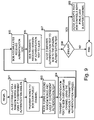
- FIG. 9 is a flow chart illustrating operations performed consistent with the invention for implementing an authentication protocol based on a challenge-response initiated by Alice.
- FIG. 10 is a flow chart illustrating operations performed consistent with the invention for implementing an authentication protocol based on a challenge-response initiated by Bob.
- a quantum cryptographic system is described below that enables authentication on both a public and an optical channel.
- the authentication can be tied to both channels so that both parties can be assured that a single authenticated entity is at the other end of both channels.
- FIG. 1 is a high-level diagram illustrating an optics-based cryptography system 100 .
- a sender 101 (“Alice”) would like to send an encrypted message to a receiver 102 (“Bob”).
- Two channels may be used to send the message : a public channel 110 and an optical (quantum) channel 120 .
- Public channel 110 may be any available communication medium between Alice and Bob, such as, for example, the Internet, a freespace optical or radio link, a public-switched telephone network, or a cellular or radio network.
- Quantum channel 120 may be a purely quantum channel that is used for dissemination of, and agreement upon, cryptographic key material.
- Quantum channel 120 may be implemented through, for example, lasers transmitting via either free space quantum links or through fiber optic cables.
- public channel 110 is a two-way channel in which messages, such as bit-streams in the form of packets, may be exchanged.
- Quantum channel 120 may be a one-way channel (not shown) or a two-way channel.
- Alice or Bob
- Bob or Alice
- one party may prepare a number of photons and the other party modulates, attenuates, and reflects the photons. The first party may then receive the reflected and attenuated result.
- quantum channel 120 is distinct from public channel 110 . Both the quantum and public channel may be susceptible to monitoring from a malicious third party, Eve.
- sender (Alice) 101 may use a quantum state generator 105 to transmit a secret key to a quantum state detector 107 at receiver (Bob) 102 .
- the key is transmitted over quantum channel 120 as a series of photons.
- the key may be negotiated between Alice and Bob using a standard quantum cryptography protocol such as the well-known BB84 protocol.
- Quantum state generator 105 may be, for example, a faint laser source that emits photons. Alternatively it may be a true source of single photons.
- Quantum state detector 107 may be a detector designed to detect the emitted photons. Suitable quantum state generators 105 and quantum state detectors 107 are known in the art.
- Alice and Bob may both use the key to encrypt and decrypt messages sent over public channel 110 . More specifically, Alice may encrypt/decrypt messages using encryption component 106 . Bob may encrypt/decrypt messages using a corresponding encryption component 108 .
- systems and methods are described that allow Alice and Bob to authenticate each other on multiple channels—both the public channel 110 and quantum channel 120 . Each party may thus be assured that a single (authenticated)entity is at the other end of the channels.
- FIG. 2 is a diagram that conceptually illustrates an exemplary system 200 for implementing authentication in a dual-channel quantum cryptographic system.
- the quantum channel 120 in FIG. 2 is illustrated as being implemented using a polarization-based modulation scheme.
- the public channel is not explicitly shown in FIG. 2 .
- Alice and Bob may each store authentication text 201 and authentication angles 205 . Both Alice and Bob store the same authentication text 201 and authentication angles 205 .
- Authentication text 201 may be a relatively lengthy sequence, such as a sequence of binary digits (i.e., ones or zeroes).
- Authentication angles 205 represents a sequence of angles that will be used to modulate each bit in authentication text 201 . If K bits from authentication angles 205 are used to modulate each bit of authentication text 201 , then the total length of the authentication angles 205 will be K times the length of authentication text 201 .
- authentication text 201 and authentication angles 205 may simply be randomly generated sequences of bits that Alice and Bob have previously shared with one another via, for example, a trusted courier.
- System 200 may use a polarization-based modulation scheme.
- Horizontal polarizer 210 and vertical polarizer 215 may emit horizontally and vertically polarized photon pulses, respectively.
- Horizontal polarizer 210 and vertical polarizer 215 may each include a laser diode designed to emit respective horizontally and vertically polarized pulses. Alternatively a single source may be polarized. Whether a horizontally polarized photon or a vertically polarized photon is to be emitted can be determined by the current bit in authentication text 201 (e.g., a one bit may indicate horizontal polarization and a zero bit may indicate vertical polarization).
- the polarized photon may be input to polarization rotator 220 , which rotates its input photon by an adjustable angle.
- the angle to rotate the photon is determined by the corresponding K bits from authentication angles 205 .
- Suitable polarization rotators are known in the art and will not be described further herein.
- the polarized and rotated photon is then transmitted from Alice to Bob.
- the receiving side of system 200 complements the transmitting side (Alice's side) of system 200 .
- this side may also include a polarization rotator 220 , which rotates its received photon by the same adjustable angle supplied by Alice, but inverted, so as to undo the rotation supplied by Alice.
- the receiving side of system 200 may also include a polarizing beam splitter 225 and photon counting detectors 235 and 240 .
- Polarizing beam splitter 225 directs an input photon into either counting detector 235 or counting detector 240 depending on the polarization (e.g., horizontal or vertical) of the photon.
- counting detector 235 may receive a photon and generate an output signal when a vertically polarized photon is received by polarizing beam splitter 225 and counting detector 240 may receive a photon and generate an output signal when a horizontally polarized photon is received by polarizing beam splitter 225 .
- Counter 245 may tabulate the signals generated by counting detectors 235 and 240 .
- FIG. 3 is a flow chart illustrating operations consistent with the invention as performed at the transmitting side (Alice) in system 200 .
- Alice may begin by extracting the first or next K bits from authentication angles 205 (act 301 ). Based on these K bits, Alice sets a rotation angle, ⁇ , (act 302 ) for polarization rotator 220 .
- the possible rotation angles can be any set of rotation angles that Alice and Bob have previously agreed upon and that are indexed by the K bits. For example, if K equals two, the rotation angles may be defined as 0 degrees when the two bits are 00, 90 degrees when the two bits are 01, 180 degrees when the two bits are 10, and 270 degrees when the two bits are 11.
- Alice may also extract the next bit of the authentication text 201 (act 303 ). This bit of authentication text 201 may be used in conjunction with the authentication angle bits extracted in act 301 . Depending on the value of the bit, Alice may emit either a vertically or horizontally polarized pulse (acts 304 , 305 , and 306 ). The polarized pulse is passed through polarization rotator 220 and transmitted (acts 307 and 308 ). Acts 301 - 308 may be repeated until all the authentication text is sent (act 309 ).
- FIG. 4 is a flow chart illustrating operations consistent with the invention as performed at the receiving side (Bob) in system 200 .
- Bob extracts the next K bits from his copy of authentication angles 205 (act 401 ).
- Bob's K bits should be identical to the corresponding K bits extracted by Alice in act 301 .
- Bob determines the appropriate angle ⁇ using the same conventions used by Alice (act 402 ).
- Bob sets the rotation angle of Bob's polarization rotator by negative ⁇ , (act 403 ), to undue the rotation performed by Alice.
- Bob may then receive a photon pulse from Alice (act 404 ).
- the photon passes through Bob's polarization rotator 220 , (act 405 ), which brings the pulse back to the normal vertical or horizontal polarization.
- the pulse may then pass through polarizing beam splitter 225 (act 406 ), which then activates the appropriate detector 235 or 240 .
- Bob may extract the next bit from authentication text 201 , (act 407 ), and compare the value of the bit to the value output from the activated detector (act 408 ). If the values are identical, counter 245 may increment a “Correct Bits” counter (act 409 ). If the values are not identical, counter 245 may increment a “Bad Bits” counter (act 410 ). In this manner, Bob keeps track of the number of correctly received and incorrectly received bits.
- Bob may repeat acts 401 - 408 until all the authentication text information has been processed (act 411 ).
- Alice will have prepared and sent all (or an agreed upon subset) of her authentication text 201 , each bit of the authentication text being modulated by a rotation angle supplied from authentication angle information 205 .
- Bob may detect some or all of these bits, again demodulated by an identical authentication angle sequence.
- Bob may not detect all the photon pulses that Alice sends, because, for example, some of the pulses may get lost due to attenuation in the quantum channel, inefficiencies in Bob's detectors, etc.
- some of the photons received by Bob may be interpreted incorrectly due to noise in the receiving side of system 200 .
- Bob will have a count of Correct Bits received and Bad Bits received.
- Bob may then determine whether a sufficient number of Correct Bits have been received.
- One possible technique Bob can use is to compute the percentage of received bits that are correct as Correct Bits/(Correct Bits plus Bad Bits). If an adversary has interposed himself between Alice and Bob but does not known the authentication text 201 or the authentication angles 205 , this percentage is likely to be appropriately 50%. If, however, Bob is indeed receiving the bits directly from Alice, on a perfect channel, this percentage should be 100%. However, if there is noise in the system, the percentage may be less than 100%. In one implementation, Bob may use a predetermined threshold for this percentage (e.g., 95%). If the percentage is greater than the percentage, Bob determines that he is indeed communicating with Alice. Bob may then inform Alice of his determination over public channel 110 .
- a predetermined threshold for this percentage e.g., 95%). If the percentage is greater than the percentage, Bob determines that he is indeed communicating with Alice. Bob may then inform Alice of his determination over public channel 110 .
- Bob may additionally require that a certain number of bits be correctly received. Assume that Alice sends 1000 modulated pulses in a series, Bob may require that the percentage of correctly received bits be at least 95% and that at least 100 bits are received.
- FIG. 5 is a diagram that conceptually illustrates an alternate exemplary system 500 for implementing authentication in a dual-channel quantum cryptographic system.
- System 500 is similar to system 200 , except that system 500 uses phase modulation instead of polarization modulation.
- phase modulation may be preferable when the optical signal is transmitted though telecommunication fiber, which tends to scramble polarization, and polarization modulation may be preferable when the optical signal is transmitted through free space.
- a phase modulation 520 such as a modulator that includes unbalanced Mach-Zehnder interferometers, in which the modulation is applied via a phase modulator in one branch of the arm, may perform the phase modulation.
- the phase modulator 520 may be, for example, a conventional Lithium Niobate modulator or other known modulators.
- Initial phase setting logic 510 determines an initial phase, P, to input to phase modulator 520 .
- the initial phase may be 0 degrees if the bit from authentication text 201 is a one and 90 degrees if the bit from authentication text 201 is a zero.
- Summer 515 may add the angle P to an angle derived from the corresponding K bits from authentication angles 205 to obtain P′, a final phase modulation value for phase modulator 520 .
- K may be, for example, 10 bits long, allowing for 1,024 distinct values for ⁇ .
- Laser source 507 may be a conventional laser source for use in quantum cryptography. Pulses from laser source 507 are input to phase modulator 520 , which modulates the phase by P+ ⁇ degrees.
- phase modulator 520 modulates the received pulses by negative ⁇ degrees.
- a 50/50 (non polarizing) beam splitter 525 may receive the output of phase modulator 520 .
- Phase modulator 520 directs an input pulse into either counting detector 535 or counting detector 540 depending on the phase (i.e., 90 degrees or 0 degrees) of the pulse.
- Counter 545 operates similarly to counter 245 . That is, counter 545 increments a Correct Bits count or a Bad Bits count, depending on which counting detector is activated.
- authentication text 201 and authentication angles 205 have been described as distinct pieces of information. In some implementations, however, it may be useful to use a single bit sequence as source of both authentication text 201 and authentication angles 205 .
- FIG. 6 is a diagram illustrating an exemplary implementation in which authentication text 201 and authentication angles 205 are combined into a single bit sequence.
- the authentication text 201 and the authentication angle 205 are interleaved in a single bit sequence 600 .
- Single bit sequence 600 may include a number of repeated authentication text/authentication angle pairs in which each pair includes a bit of the authentication text 201 followed by the corresponding K bits of the authentication angles 205 .
- a single pair 605 is illustrated.
- the authentication text 201 and the authentication angles 205 are possible and may be used.
- the authentication text may be the “leftmost” bits in the combined sequence, followed by a series of authentication angles that form the “rightmost” bits.
- K may be equal to one and the angle values may be assigned as zero degrees (bit value of zero) and 45 degrees (bit value of one). This is essentially a choice of one of two non-orthogonal bases for the authentication text bit to be transmitted. This technique may be advantageous because it makes it difficult for an eavesdropper to determine which basis was being used, and which value is being transmitted, with only a minimal number of bits for the authentication angles.
- FIGS. 2 and 5 illustrate systems that modulate optical pulses that may be used to implement authentication schemes.
- a number of authentication protocols may be layered on top of systems 200 and 500 , some of which will now be described.
- One protocol for implementing authentication using systems 200 and 500 includes distributing the authentication text and authentication angles as shared secret keys.
- Alice and Bob agree, in a secure manner, on the authentication text and the authentication angles. They may agree, for example, by sharing the secret keys via a courier or by constructing the secret keys from an ongoing cryptographic process (e.g., by a quantum cryptographic process), or by a classical process such as the Diffie-Hellman algorithm
- a second protocol for implementing authentication using systems 200 and 500 may be based on secret authentication angles but known authentication text.
- the authentication text may be a publicly known series of bit values, such as a series of ones, and the authentication angles are shared between Alice and Bob as secret keys.
- Bob is simply checking whether quantum channel 120 is conveying the proper angle modulations.
- FIG. 7 is a flow chart illustrating operations performed consistent with the invention for implementing this protocol.
- Alice and Bob may begin by communicating over public channel 110 (act 701 ).
- the communication over public channel 110 may be encrypted using a symmetric key exchanged via quantum channel 120 , as would be performed in a conventional quantum cryptographic system.
- a pre-designated block of the information communicated over the public channel such as, for example, the first 1000 bytes of the communication, may then be used by both Alice and Bob to create a message authentication code (MAC) (act 702 ).
- the MAC may be generated by performing a cryptographic hash, such as the well known HMAC, SHA-1, or MD5 hash functions, on the block of information. Alternatively a universal hash function, or other information-theoretic hash, may be employed.
- Alice and Bob may then designate a portion of the MAC to form the authentication text and/or authentication angles (act 703 ).
- the derived authentication text and/or authentication angles may be used to authenticate quantum channel 120 using the techniques discussed above with reference to FIGS. 3 and 4 (act 704 ). In this manner, Alice and Bob can verify that the optical channel is indeed properly linked to the public message communication channel.
- FIG. 8 is a flow chart illustrating operations performed consistent with the invention for implementing this protocol.
- Alice may begin by creating a MAC for a block of information that she would like to communicate with Bob (act 801 ). Alice may then transmit the MAC to Bob via the public channel (act 802 ). Alice and Bob may use the portion of the MAC to form the authentication text and/or authentication angles (act 803 ). At this point, the derived authentication text and/or authentication angles may be used to authenticate quantum channel 120 using the techniques discussed above with reference to FIGS. 3 and 4 (act 804 ). Alice may then communicate the block of information to Bob via the public channel (act 805 ). Bob may then convert the block of information to a MAC, using the same technique that Alice used to initially generate the MAC, and verify that the newly converted MAC matches that MAC originally sent by Alice (act 806 ). In this manner, Alice and Bob can verify that the optical channel is properly linked to the public message communication channel.
- FIG. 9 is a flow chart illustrating operations performed consistent with the invention for implementing this protocol.
- Alice may begin by generating a random nonce (random sequence of 0 and 1 bits), which she will use to represent the authentication angles (act 901 ). Alice may then transmit the nonce to Bob over public channel 110 (act 902 ). Alice may also form a second random nonce, which she uses to represent the authentication text (act 903 ). Alice may then transmit the authentication text to Bob over quantum channel 120 using the authentication angles defined by the first nonce (act 904 ). Bob accumulates the received authentication text, (act 905 ), and then transmits the received authentication text back to Alice over public channel 110 (act 906 ). Alice may compare the version of the authentication text she received from Bob to the original version of the authentication text that she generated (act 907 ). If the two versions are similar, Alice may accept that Bob controls both the public and the quantum channel.
- a random nonce random sequence of 0 and 1 bits
- FIG. 10 is a flow chart illustrating operations performed consistent with the invention for implementing this protocol.
- Bob may begin by generating a random nonce that he uses to represent the authentication text and authentication angles (act 1001 ).
- Bob may send the nonce to Alice over public channel 110 (act 1002 ).
- Alice may then use the authentication text and the authentication angles derived from the nonce to authenticate quantum channel 120 using the techniques discussed above with reference to FIGS. 3 and 4 (act 1003 ).
- authentication protocols described above may additionally be “blended” such that multiple of these protocols can be combined or aspects of the multiple protocols can be combined.
- the quantum cryptographic system described above enables authentication between parties participating in encrypted communications.
- a number of possible authentication protocols were also described that may be implemented using the physical system.
Landscapes
- Engineering & Computer Science (AREA)
- Computer Security & Cryptography (AREA)
- Computer Networks & Wireless Communication (AREA)
- Signal Processing (AREA)
- Power Engineering (AREA)
- Physics & Mathematics (AREA)
- Electromagnetism (AREA)
- Theoretical Computer Science (AREA)
- Optical Communication System (AREA)
Abstract
Description
Claims (41)
Priority Applications (1)
| Application Number | Priority Date | Filing Date | Title |
|---|---|---|---|
| US10/797,849 US7359512B1 (en) | 2004-03-10 | 2004-03-10 | Authentication in a quantum cryptographic system |
Applications Claiming Priority (1)
| Application Number | Priority Date | Filing Date | Title |
|---|---|---|---|
| US10/797,849 US7359512B1 (en) | 2004-03-10 | 2004-03-10 | Authentication in a quantum cryptographic system |
Publications (1)
| Publication Number | Publication Date |
|---|---|
| US7359512B1 true US7359512B1 (en) | 2008-04-15 |
Family
ID=39281657
Family Applications (1)
| Application Number | Title | Priority Date | Filing Date |
|---|---|---|---|
| US10/797,849 Expired - Fee Related US7359512B1 (en) | 2004-03-10 | 2004-03-10 | Authentication in a quantum cryptographic system |
Country Status (1)
| Country | Link |
|---|---|
| US (1) | US7359512B1 (en) |
Cited By (18)
| Publication number | Priority date | Publication date | Assignee | Title |
|---|---|---|---|---|
| US20070014415A1 (en) * | 2005-06-16 | 2007-01-18 | Harrison Keith A | Quantum key distribution method and apparatus |
| US20070025551A1 (en) * | 2005-06-16 | 2007-02-01 | Harrison Keith A | Quantum key distribution apparatus & method |
| US20070092083A1 (en) * | 2005-10-24 | 2007-04-26 | Magiq Technologies, Inc. | QKD system with synchronization channel verification |
| US20070110242A1 (en) * | 2003-11-28 | 2007-05-17 | Japan Science And Technology Agency | Communication system and communication method using the same |
| US20080318552A1 (en) * | 2007-06-19 | 2008-12-25 | Harms David C | Authentication loading control and information recapture in a UMTS network |
| US20110142242A1 (en) * | 2009-12-16 | 2011-06-16 | Sony Corporation | Quantum public key encryption system, key generation apparatus, encryption apparatus, decryption apparatus, key generation method, encryption method, and decryption method |
| EP2735182A4 (en) * | 2011-07-20 | 2014-12-31 | Visa Int Service Ass | COMMUNICATION BY A SECURITY GATEWAY |
| US20150295707A1 (en) * | 2014-04-09 | 2015-10-15 | The Boeing Company | Secure data communication |
| US9191198B2 (en) | 2005-06-16 | 2015-11-17 | Hewlett-Packard Development Company, L.P. | Method and device using one-time pad data |
| US20160241396A1 (en) * | 2015-02-16 | 2016-08-18 | Alibaba Group Holding Limited | Method, apparatus, and system for identity authentication |
| EP2654238A3 (en) * | 2012-04-17 | 2017-08-02 | The Boeing Company | Secure quantum authentication system |
| US10171238B2 (en) | 2014-04-09 | 2019-01-01 | The Boeing Company | Secure data transmission using quantum communication |
| US10242167B2 (en) * | 2015-11-10 | 2019-03-26 | Samsung Electronics Co., Ltd. | Method for user authentication and electronic device implementing the same |
| KR20190044272A (en) * | 2017-10-20 | 2019-04-30 | 한국전자통신연구원 | Quantum direct communication method based on user authentication and apparatus using the same |
| US20230065129A1 (en) * | 2021-08-29 | 2023-03-02 | International Business Machines Corporation | Photon-level light shifting for enhanced file system security and authenticity |
| US12124921B2 (en) | 2021-02-02 | 2024-10-22 | Bank Of America Corporation | Information security using quantum encoding |
| US12244699B1 (en) * | 2023-02-13 | 2025-03-04 | Wells Fargo Bank, N.A. | System and methods for authentication between multiple devices using N-way entanglement |
| US20250088355A1 (en) * | 2023-09-11 | 2025-03-13 | Wells Fargo Bank, N.A. | Systems and methods for establishing cryptographic keys shared among three or more devices |
Citations (3)
| Publication number | Priority date | Publication date | Assignee | Title |
|---|---|---|---|---|
| US20040151321A1 (en) * | 2001-04-11 | 2004-08-05 | Norbert Lutkenhaus | Polarization to phase converter |
| US7035411B2 (en) * | 2000-06-12 | 2006-04-25 | Canon Kabushiki Kaisha | Encryption method and apparatus encrypting and adding signature information to qubits |
| US7243226B2 (en) * | 2001-12-12 | 2007-07-10 | Valve Corporation | Method and system for enabling content security in a distributed system |
-
2004
- 2004-03-10 US US10/797,849 patent/US7359512B1/en not_active Expired - Fee Related
Patent Citations (3)
| Publication number | Priority date | Publication date | Assignee | Title |
|---|---|---|---|---|
| US7035411B2 (en) * | 2000-06-12 | 2006-04-25 | Canon Kabushiki Kaisha | Encryption method and apparatus encrypting and adding signature information to qubits |
| US20040151321A1 (en) * | 2001-04-11 | 2004-08-05 | Norbert Lutkenhaus | Polarization to phase converter |
| US7243226B2 (en) * | 2001-12-12 | 2007-07-10 | Valve Corporation | Method and system for enabling content security in a distributed system |
Non-Patent Citations (3)
| Title |
|---|
| Frederic Grosshans et al.: "Quantum key distribution using gaussian-modulated coherent states," 2003 Nature Publishing Group, vol. 421, Jan. 16, 2003, pp. 238-241. |
| G.A. Barbosa et al.: "Secure Communication Using Coherent States," in Quantum Communication, Measurement, and Computing (QCMC'02), Rinton Press, New Jersey, 2002, pp. 1-3. |
| G.A. Barbosa et al.: "Secure Communication Using Mesoscopic Coherent States," Northwestern University, Evanston, IL, Apr. 17. 2003, pp. 1-4. |
Cited By (35)
| Publication number | Priority date | Publication date | Assignee | Title |
|---|---|---|---|---|
| US20070110242A1 (en) * | 2003-11-28 | 2007-05-17 | Japan Science And Technology Agency | Communication system and communication method using the same |
| US7974540B2 (en) * | 2003-11-28 | 2011-07-05 | Japan Science And Technology Agency | Communication system and communication method using the same |
| US9191198B2 (en) | 2005-06-16 | 2015-11-17 | Hewlett-Packard Development Company, L.P. | Method and device using one-time pad data |
| US20070014415A1 (en) * | 2005-06-16 | 2007-01-18 | Harrison Keith A | Quantum key distribution method and apparatus |
| US7864958B2 (en) * | 2005-06-16 | 2011-01-04 | Hewlett-Packard Development Company, L.P. | Quantum key distribution method and apparatus |
| US20070025551A1 (en) * | 2005-06-16 | 2007-02-01 | Harrison Keith A | Quantum key distribution apparatus & method |
| US8054976B2 (en) * | 2005-06-16 | 2011-11-08 | Keith Alexander Harrison | Quantum key distribution apparatus and method |
| US7809143B2 (en) * | 2005-10-24 | 2010-10-05 | Magiq Technologies, Inc. | QKD system with synchronization channel verification |
| US20070092083A1 (en) * | 2005-10-24 | 2007-04-26 | Magiq Technologies, Inc. | QKD system with synchronization channel verification |
| US20080318552A1 (en) * | 2007-06-19 | 2008-12-25 | Harms David C | Authentication loading control and information recapture in a UMTS network |
| US8175270B2 (en) * | 2007-06-19 | 2012-05-08 | Alcatel Lucent | Authentication loading control and information recapture in a UMTS network |
| US20120172003A1 (en) * | 2007-06-19 | 2012-07-05 | Alcatel-Lucent Usa, Inc. | Authentication loading control and information recapture in a umts network |
| US8571219B2 (en) * | 2007-06-19 | 2013-10-29 | Alcatel Lucent | Authentication loading control and information recapture in a UMTS network |
| US20110142242A1 (en) * | 2009-12-16 | 2011-06-16 | Sony Corporation | Quantum public key encryption system, key generation apparatus, encryption apparatus, decryption apparatus, key generation method, encryption method, and decryption method |
| US8744075B2 (en) * | 2009-12-16 | 2014-06-03 | Sony Corporation | Quantum public key encryption system |
| US9686235B2 (en) | 2011-07-20 | 2017-06-20 | Visa International Service Association | Mobile banking system with cryptographic expansion device |
| EP2735182A4 (en) * | 2011-07-20 | 2014-12-31 | Visa Int Service Ass | COMMUNICATION BY A SECURITY GATEWAY |
| US9473454B2 (en) | 2011-07-20 | 2016-10-18 | Visa International Service Association | Security gateway communication |
| EP2654238A3 (en) * | 2012-04-17 | 2017-08-02 | The Boeing Company | Secure quantum authentication system |
| US10171238B2 (en) | 2014-04-09 | 2019-01-01 | The Boeing Company | Secure data transmission using quantum communication |
| US20150295707A1 (en) * | 2014-04-09 | 2015-10-15 | The Boeing Company | Secure data communication |
| US10756891B2 (en) * | 2014-04-09 | 2020-08-25 | The Boeing Company | Secure data communication |
| US10432396B2 (en) | 2015-02-16 | 2019-10-01 | Alibaba Group Holding Limited | Method, apparatus, and system for identity authentication |
| US20160241396A1 (en) * | 2015-02-16 | 2016-08-18 | Alibaba Group Holding Limited | Method, apparatus, and system for identity authentication |
| US10038554B2 (en) * | 2015-02-16 | 2018-07-31 | Alibaba Group Holding Limited | Method, apparatus, and system for identity authentication |
| US10242167B2 (en) * | 2015-11-10 | 2019-03-26 | Samsung Electronics Co., Ltd. | Method for user authentication and electronic device implementing the same |
| KR20190044272A (en) * | 2017-10-20 | 2019-04-30 | 한국전자통신연구원 | Quantum direct communication method based on user authentication and apparatus using the same |
| KR101978774B1 (en) | 2017-10-20 | 2019-05-15 | 한국전자통신연구원 | Quantum direct communication method based on user authentication and apparatus using the same |
| US10778420B2 (en) * | 2017-10-20 | 2020-09-15 | Electronics And Telecommunications Research Institute | Quantum direct communication method with user authentication and apparatus using the same |
| US12124921B2 (en) | 2021-02-02 | 2024-10-22 | Bank Of America Corporation | Information security using quantum encoding |
| US20230065129A1 (en) * | 2021-08-29 | 2023-03-02 | International Business Machines Corporation | Photon-level light shifting for enhanced file system security and authenticity |
| US11811921B2 (en) * | 2021-08-29 | 2023-11-07 | International Business Machines Corporation | Photon-level light shifting for enhanced file system security and authenticity |
| US12244699B1 (en) * | 2023-02-13 | 2025-03-04 | Wells Fargo Bank, N.A. | System and methods for authentication between multiple devices using N-way entanglement |
| US20250088355A1 (en) * | 2023-09-11 | 2025-03-13 | Wells Fargo Bank, N.A. | Systems and methods for establishing cryptographic keys shared among three or more devices |
| US12512975B2 (en) * | 2023-09-11 | 2025-12-30 | Wells Fargo Bank, N.A. | Systems and methods for establishing cryptographic keys shared among three or more devices |
Similar Documents
| Publication | Publication Date | Title |
|---|---|---|
| US7359512B1 (en) | Authentication in a quantum cryptographic system | |
| KR100631242B1 (en) | Quantum transmitter, quantum receiver, quantum cryptography and quantum cryptography | |
| CN110247765B (en) | Quantum secret data chain communication system | |
| US7620182B2 (en) | QKD with classical bit encryption | |
| US8311224B2 (en) | Method and system utilizing quantum authentication | |
| US7760883B2 (en) | Any-point-to-any-point (AP2AP) quantum key distribution protocol for optical ring network | |
| CA2747891C (en) | Method for generating an encryption/decryption key | |
| US20060059343A1 (en) | Key expansion for qkd | |
| US20070076888A1 (en) | Double phase encoding quantum key distribution | |
| US20070130455A1 (en) | Series encryption in a quantum cryptographic system | |
| Sabani et al. | Quantum key distribution: Basic protocols and threats | |
| Wang et al. | Authentication of quantum key distribution with post-quantum cryptography and replay attacks | |
| Papanikolaou | An introduction to quantum cryptography | |
| TWI487308B (en) | Method for quantum communication | |
| Kanamori et al. | On quantum authentication protocols | |
| Nguyen et al. | Integration of quantum cryptography in 802.11 networks | |
| Thangavel et al. | Performance of integrated quantum and classical cryptographic model for password authentication | |
| Svozil | Feasibility of the interlock protocol against man-in-the-middle attacks on quantum cryptography | |
| JPH11234265A (en) | Information security communication device and method | |
| Parakh et al. | Improving efficiency of quantum key distribution with probabilistic measurements | |
| CN113852616A (en) | Mutual authentication method and system of quantum safety equipment | |
| Chuchkov et al. | An Analysis of Quantum Technologies Implemented in Encryption Systems | |
| Kartheek et al. | Security using quantum key distribution protocols (QKDPs) | |
| Qawaqneh et al. | A new hardware quantum-based encryption algorithm | |
| Shrivastava et al. | A security enhancement approach in quantum cryptography |
Legal Events
| Date | Code | Title | Description |
|---|---|---|---|
| AS | Assignment |
Owner name: BBNT SOLUTIONS LLC, MASSACHUSETTS Free format text: ASSIGNMENT OF ASSIGNORS INTEREST;ASSIGNOR:ELLIOTT, BRIG BARNUM;REEL/FRAME:015086/0886 Effective date: 20040308 |
|
| AS | Assignment |
Owner name: VERIZON CORPORATE SERVICES GROUP INC., NEW JERSEY Free format text: ASSIGNMENT OF ASSIGNORS INTEREST;ASSIGNOR:BBNT SOLUTIONS LLC;REEL/FRAME:020570/0749 Effective date: 20040324 |
|
| AS | Assignment |
Owner name: BANK OF AMERICA, N.A., MASSACHUSETTS Free format text: INTELLECTUAL PROPERTY SECURITY AGREEMENT SUPPLEMENT;ASSIGNOR:BBN TECHNOLOGIES CORP.;REEL/FRAME:021924/0279 Effective date: 20081124 |
|
| AS | Assignment |
Owner name: AFRL/RIJ, NEW YORK Free format text: CONFIRMATORY LICENSE;ASSIGNOR:BBN TECHNOLOGIES CORPORATION;REEL/FRAME:022694/0927 Effective date: 20090519 |
|
| AS | Assignment |
Owner name: VERIZON CORPORATE SERVICES GROUP INC., NEW JERSEY Free format text: CORRECTIVE ASSIGNMENT TO CORRECT THE IN ADDITION TO VERIZON CORPORATE SERVICES GROUP INC., PLEASE INCLUDE BBNT SOLUTIONS LLC AS AN ASSIGNEE. PREVIOUSLY RECORDED ON REEL 020570 FRAME 0749;ASSIGNOR:BBNT SOLUTIONS LLC;REEL/FRAME:023318/0008 Effective date: 20040326 Owner name: BBNT SOLUTIONS LLC, MASSACHUSETTS Free format text: CORRECTIVE ASSIGNMENT TO CORRECT THE IN ADDITION TO VERIZON CORPORATE SERVICES GROUP INC., PLEASE INCLUDE BBNT SOLUTIONS LLC AS AN ASSIGNEE. PREVIOUSLY RECORDED ON REEL 020570 FRAME 0749;ASSIGNOR:BBNT SOLUTIONS LLC;REEL/FRAME:023318/0008 Effective date: 20040326 Owner name: BBN TECHNOLOGIES OPERATING CORP., MASSACHUSETTS Free format text: MERGER;ASSIGNOR:BBNT SOLUTIONS LLC;REEL/FRAME:023312/0960 Effective date: 20051122 Owner name: BBN TECHNOLOGIES CORP., MASSACHUSETTS Free format text: CHANGE OF NAME;ASSIGNOR:BBN TECHNOLOGIES OPERATING CORP.;REEL/FRAME:023312/0965 Effective date: 20051201 |
|
| AS | Assignment |
Owner name: BBN TECHNOLOGIES CORP. (AS SUCCESSOR BY MERGER TO Free format text: RELEASE OF SECURITY INTEREST;ASSIGNOR:BANK OF AMERICA, N.A. (SUCCESSOR BY MERGER TO FLEET NATIONAL BANK);REEL/FRAME:023427/0436 Effective date: 20091026 |
|
| AS | Assignment |
Owner name: RAYTHEON BBN TECHNOLOGIES CORP.,MASSACHUSETTS Free format text: CHANGE OF NAME;ASSIGNOR:BBN TECHNOLOGIES CORP.;REEL/FRAME:024523/0625 Effective date: 20091027 Owner name: RAYTHEON BBN TECHNOLOGIES CORP., MASSACHUSETTS Free format text: CHANGE OF NAME;ASSIGNOR:BBN TECHNOLOGIES CORP.;REEL/FRAME:024523/0625 Effective date: 20091027 |
|
| FPAY | Fee payment |
Year of fee payment: 4 |
|
| AS | Assignment |
Owner name: VERIZON PATENT AND LICENSING INC., NEW JERSEY Free format text: ASSIGNMENT OF ASSIGNORS INTEREST;ASSIGNOR:VERIZON CORPORATE SERVICES GROUP INC.;REEL/FRAME:033421/0403 Effective date: 20140409 |
|
| REMI | Maintenance fee reminder mailed | ||
| LAPS | Lapse for failure to pay maintenance fees | ||
| STCH | Information on status: patent discontinuation |
Free format text: PATENT EXPIRED DUE TO NONPAYMENT OF MAINTENANCE FEES UNDER 37 CFR 1.362 |
|
| STCH | Information on status: patent discontinuation |
Free format text: PATENT EXPIRED DUE TO NONPAYMENT OF MAINTENANCE FEES UNDER 37 CFR 1.362 |
|
| FP | Lapsed due to failure to pay maintenance fee |
Effective date: 20160415 |