US7348357B2 - Arylamides - Google Patents
Arylamides Download PDFInfo
- Publication number
- US7348357B2 US7348357B2 US10/524,080 US52408003A US7348357B2 US 7348357 B2 US7348357 B2 US 7348357B2 US 52408003 A US52408003 A US 52408003A US 7348357 B2 US7348357 B2 US 7348357B2
- Authority
- US
- United States
- Prior art keywords
- substituents
- hplc
- alkyl
- phenyl
- amino
- Prior art date
- Legal status (The legal status is an assumption and is not a legal conclusion. Google has not performed a legal analysis and makes no representation as to the accuracy of the status listed.)
- Expired - Fee Related
Links
- 0 *N1C(=O)C([4*])C([H])(C(=O)C([6*])N([H])C(=O)CC(C)N([2*])C(=O)C[1*])C1=O.CC Chemical compound *N1C(=O)C([4*])C([H])(C(=O)C([6*])N([H])C(=O)CC(C)N([2*])C(=O)C[1*])C1=O.CC 0.000 description 28
- PYTNXQVLAIXIKX-SEAMWHPUSA-N CC(C)[C@@H](NC(=O)C[C@H](NC(=O)CCN1N=NC2=C1C=CC=C2)C1=CC=CC=C1)C(=O)[C@@H]1C(=O)NC(=O)[C@@H]1C Chemical compound CC(C)[C@@H](NC(=O)C[C@H](NC(=O)CCN1N=NC2=C1C=CC=C2)C1=CC=CC=C1)C(=O)[C@@H]1C(=O)NC(=O)[C@@H]1C PYTNXQVLAIXIKX-SEAMWHPUSA-N 0.000 description 2
- QSEQUJMXXMCEBK-YUTCNCBUSA-N CC(C)[C@H](N)C(=O)[C@@H]1C(=O)N(OCC2=CC=CC=C2)C(=O)[C@H]1C.Cl Chemical compound CC(C)[C@H](N)C(=O)[C@@H]1C(=O)N(OCC2=CC=CC=C2)C(=O)[C@H]1C.Cl QSEQUJMXXMCEBK-YUTCNCBUSA-N 0.000 description 2
- VCSUEDYCFMUJSA-LQCGCAQGSA-N CC(C)[C@H](NC(=O)CC(NC(=O)C1=CC=CC=N1)C1=CC=C(Cl)S1)C(=O)[C@@H]1C(=O)NC(=O)[C@H]1C Chemical compound CC(C)[C@H](NC(=O)CC(NC(=O)C1=CC=CC=N1)C1=CC=C(Cl)S1)C(=O)[C@@H]1C(=O)NC(=O)[C@H]1C VCSUEDYCFMUJSA-LQCGCAQGSA-N 0.000 description 2
- QBOVVSSGLGLEMD-OJUBZWNVSA-N CC(C)[C@H](NC(=O)CC(NC(=O)OC(C)(C)C)C1=CC=C2C=CC=CC2=C1)C(=O)[C@@H]1C(=O)NC(=O)[C@H]1C Chemical compound CC(C)[C@H](NC(=O)CC(NC(=O)OC(C)(C)C)C1=CC=C2C=CC=CC2=C1)C(=O)[C@@H]1C(=O)NC(=O)[C@H]1C QBOVVSSGLGLEMD-OJUBZWNVSA-N 0.000 description 2
- ZJJZBAAJBKTGRG-QANXQLDVSA-N CC(C)[C@H](NC(=O)CC(NC(=O)OC(C)(C)C)C1=CN=C2C=CC=CC2=C1)C(=O)[C@@H]1C(=O)NC(=O)[C@H]1C Chemical compound CC(C)[C@H](NC(=O)CC(NC(=O)OC(C)(C)C)C1=CN=C2C=CC=CC2=C1)C(=O)[C@@H]1C(=O)NC(=O)[C@H]1C ZJJZBAAJBKTGRG-QANXQLDVSA-N 0.000 description 2
- IBOVUNQWDKZCKQ-PDJUBECSSA-N CC(C)[C@H](NC(=O)C[C@H](NC(=O)/C1=C/C2=C(C=C(C#N)C=C2)N1)C1=CC=CC=C1)C(=O)[C@@H]1C(=O)NC(=O)[C@H]1C Chemical compound CC(C)[C@H](NC(=O)C[C@H](NC(=O)/C1=C/C2=C(C=C(C#N)C=C2)N1)C1=CC=CC=C1)C(=O)[C@@H]1C(=O)NC(=O)[C@H]1C IBOVUNQWDKZCKQ-PDJUBECSSA-N 0.000 description 2
- QQQLJSATOHTFQI-SQZWAXCWSA-N CC(C)[C@H](NC(=O)C[C@H](NC(=O)C1=CC2=C(C=C1)OCO2)C1=CC=CC=C1)C(=O)[C@@H]1C(=O)NC(=O)[C@H]1C Chemical compound CC(C)[C@H](NC(=O)C[C@H](NC(=O)C1=CC2=C(C=C1)OCO2)C1=CC=CC=C1)C(=O)[C@@H]1C(=O)NC(=O)[C@H]1C QQQLJSATOHTFQI-SQZWAXCWSA-N 0.000 description 2
- RRXNAJPKERRIMS-DNRQBCDUSA-N CC(C)[C@H](NC(=O)C[C@H](NC(=O)C1=CC=C(N(C)C)C=C1)C1=CC=CC=C1)C(=O)[C@@H]1C(=O)NC(=O)[C@H]1C Chemical compound CC(C)[C@H](NC(=O)C[C@H](NC(=O)C1=CC=C(N(C)C)C=C1)C1=CC=CC=C1)C(=O)[C@@H]1C(=O)NC(=O)[C@H]1C RRXNAJPKERRIMS-DNRQBCDUSA-N 0.000 description 2
- IUIYFDBHUKNNBT-KFCZAJJNSA-N CC1=NC2=C(C=CC(C(=O)N[C@@H](CC(=O)N[C@@H](C(=O)[C@@H]3C(=O)NC(=O)[C@@H]3C)C(C)C)C3=CC=CC=C3)=C2)O1 Chemical compound CC1=NC2=C(C=CC(C(=O)N[C@@H](CC(=O)N[C@@H](C(=O)[C@@H]3C(=O)NC(=O)[C@@H]3C)C(C)C)C3=CC=CC=C3)=C2)O1 IUIYFDBHUKNNBT-KFCZAJJNSA-N 0.000 description 2
- XZTUXOOLPQWQJL-WKAHHKJFSA-N CCC(CC)C(NC(=O)OC(C)(C)C)C(=O)[C@@H]1C(=O)NC(=O)[C@H]1C Chemical compound CCC(CC)C(NC(=O)OC(C)(C)C)C(=O)[C@@H]1C(=O)NC(=O)[C@H]1C XZTUXOOLPQWQJL-WKAHHKJFSA-N 0.000 description 2
- LCNSWZBZSHRRNY-AXFHLTTASA-N CNN1C(=O)[C@@H](C)[C@H](C(=O)[C@@H](NC(=O)OC(C)(C)C)C(C)C)C1=O Chemical compound CNN1C(=O)[C@@H](C)[C@H](C(=O)[C@@H](NC(=O)OC(C)(C)C)C(C)C)C1=O LCNSWZBZSHRRNY-AXFHLTTASA-N 0.000 description 2
- NSLKCQPTXXXEGO-WPUCRFQZSA-N COC(=O)C1=CC=C([C@@H](N)CC(=O)N[C@H](C(=O)[C@@H]2C(=O)NC(=O)[C@H]2C)C(C)C)C=C1.[H]Cl Chemical compound COC(=O)C1=CC=C([C@@H](N)CC(=O)N[C@H](C(=O)[C@@H]2C(=O)NC(=O)[C@H]2C)C(C)C)C=C1.[H]Cl NSLKCQPTXXXEGO-WPUCRFQZSA-N 0.000 description 2
- KWSRRITYQZWWJA-KTLUACOFSA-N COC1=C2C=CC=CC2=NC(C(=O)N[C@@H](CC(=O)N[C@@H](C(=O)[C@@H]2C(=O)NC(=O)[C@@H]2C)C(C)C)C2=CC=CC=C2)=C1 Chemical compound COC1=C2C=CC=CC2=NC(C(=O)N[C@@H](CC(=O)N[C@@H](C(=O)[C@@H]2C(=O)NC(=O)[C@@H]2C)C(C)C)C2=CC=CC=C2)=C1 KWSRRITYQZWWJA-KTLUACOFSA-N 0.000 description 2
- AMPPOKROKGGHOF-VHHKXPHXSA-N CON1C(=O)[C@@H](C)[C@H](C(=O)[C@@H](NC(=O)C[C@H](NC(=O)C2=NC=CC=C2)C2=CC=CC=C2)C(C)C)C1=O Chemical compound CON1C(=O)[C@@H](C)[C@H](C(=O)[C@@H](NC(=O)C[C@H](NC(=O)C2=NC=CC=C2)C2=CC=CC=C2)C(C)C)C1=O AMPPOKROKGGHOF-VHHKXPHXSA-N 0.000 description 2
- FQJXXVBQAKXSTJ-MEGFKASBSA-N C[C@@H]1C(=O)NC(=O)[C@H]1C(=O)[C@@H](NC(=O)C[C@H](NC(=O)OC(C)(C)C)C1=CC=CC=C1)C1CCCC1 Chemical compound C[C@@H]1C(=O)NC(=O)[C@H]1C(=O)[C@@H](NC(=O)C[C@H](NC(=O)OC(C)(C)C)C1=CC=CC=C1)C1CCCC1 FQJXXVBQAKXSTJ-MEGFKASBSA-N 0.000 description 2
- BZUCWGRGUTYERP-WCQGTBRESA-N C[C@@H]1C(=O)NC(=O)[C@H]1C(=O)[C@@H](NC(=O)OC(C)(C)C)C1CCCC1 Chemical compound C[C@@H]1C(=O)NC(=O)[C@H]1C(=O)[C@@H](NC(=O)OC(C)(C)C)C1CCCC1 BZUCWGRGUTYERP-WCQGTBRESA-N 0.000 description 2
- VVDQZHONRZBYML-UHFFFAOYSA-N O=C(O)CC(NC(=O)C1=NC=CC=C1)C1=CSC=C1 Chemical compound O=C(O)CC(NC(=O)C1=NC=CC=C1)C1=CSC=C1 VVDQZHONRZBYML-UHFFFAOYSA-N 0.000 description 2
- VSSDZTCJXHBUGF-UHFFFAOYSA-N CC(C)(C)OC(=O)NC(CC(=O)O)C1=CC([N+](=O)[O-])=CC=C1 Chemical compound CC(C)(C)OC(=O)NC(CC(=O)O)C1=CC([N+](=O)[O-])=CC=C1 VSSDZTCJXHBUGF-UHFFFAOYSA-N 0.000 description 1
- NCQJBPXXRXOIJD-UHFFFAOYSA-N CC(C)(C)OC(=O)NC(CC(=O)O)C1=CC=C2C=CC=CC2=C1 Chemical compound CC(C)(C)OC(=O)NC(CC(=O)O)C1=CC=C2C=CC=CC2=C1 NCQJBPXXRXOIJD-UHFFFAOYSA-N 0.000 description 1
- UOQWIQGAZKFCDC-UHFFFAOYSA-N CC(C)(C)OC(=O)NC(CC(=O)O)C1=CC=C2OCOC2=C1 Chemical compound CC(C)(C)OC(=O)NC(CC(=O)O)C1=CC=C2OCOC2=C1 UOQWIQGAZKFCDC-UHFFFAOYSA-N 0.000 description 1
- SXFUVXJTBWCCGD-UHFFFAOYSA-N CC(C)(C)OC(=O)NC(CC(=O)O)C1=CN=C2C=CC=CC2=C1 Chemical compound CC(C)(C)OC(=O)NC(CC(=O)O)C1=CN=C2C=CC=CC2=C1 SXFUVXJTBWCCGD-UHFFFAOYSA-N 0.000 description 1
- GQWRNLFTLLZYBJ-UHFFFAOYSA-N CC(C)(C)OC(=O)NC(CC(=O)O)C1=CN=CC=C1 Chemical compound CC(C)(C)OC(=O)NC(CC(=O)O)C1=CN=CC=C1 GQWRNLFTLLZYBJ-UHFFFAOYSA-N 0.000 description 1
- JTNQFJPZRTURSI-NSHDSACASA-N CC(C)(C)OC(=O)N[C@@H](CC(=O)O)C1=CC=CC=C1 Chemical compound CC(C)(C)OC(=O)N[C@@H](CC(=O)O)C1=CC=CC=C1 JTNQFJPZRTURSI-NSHDSACASA-N 0.000 description 1
- WLNHQZMRROSLEX-KGRRWZJRSA-N CC(C)CC(NC(=O)C[C@H](NC(=O)C1=CC=CC=N1)C1=CC=CC=C1)C(=O)[C@@H]1C(=O)NC(=O)[C@H]1C Chemical compound CC(C)CC(NC(=O)C[C@H](NC(=O)C1=CC=CC=N1)C1=CC=CC=C1)C(=O)[C@@H]1C(=O)NC(=O)[C@H]1C WLNHQZMRROSLEX-KGRRWZJRSA-N 0.000 description 1
- LCFFKRYLLLBOOG-BIIVOSGPSA-N CC(C)C[C@H](N)C(=O)[C@@H]1C(=O)NC(=O)[C@H]1C.Cl Chemical compound CC(C)C[C@H](N)C(=O)[C@@H]1C(=O)NC(=O)[C@H]1C.Cl LCFFKRYLLLBOOG-BIIVOSGPSA-N 0.000 description 1
- YIHRJAQWAVWKHQ-RYQLBKOJSA-N CC(C)C[C@H](NC(=O)OC(C)(C)C)C(=O)[C@@H]1C(=O)N(OCC2=CC=CC=C2)C(=O)[C@H]1C Chemical compound CC(C)C[C@H](NC(=O)OC(C)(C)C)C(=O)[C@@H]1C(=O)N(OCC2=CC=CC=C2)C(=O)[C@H]1C YIHRJAQWAVWKHQ-RYQLBKOJSA-N 0.000 description 1
- CPZCHSSLBBCYAL-GARJFASQSA-N CC(C)C[C@H](NC(=O)OC(C)(C)C)C(=O)[C@@H]1C(=O)NC(=O)[C@H]1C Chemical compound CC(C)C[C@H](NC(=O)OC(C)(C)C)C(=O)[C@@H]1C(=O)NC(=O)[C@H]1C CPZCHSSLBBCYAL-GARJFASQSA-N 0.000 description 1
- ZTSNKZDQIKYBSM-YIOFQFOYSA-N CC(C)OC1=CC=C(C(CC(=O)N[C@@H](C(=O)[C@@H]2C(=O)NC(=O)[C@@H]2C)C(C)C)NC(=O)C2=CC=CC(F)=N2)C=C1 Chemical compound CC(C)OC1=CC=C(C(CC(=O)N[C@@H](C(=O)[C@@H]2C(=O)NC(=O)[C@@H]2C)C(C)C)NC(=O)C2=CC=CC(F)=N2)C=C1 ZTSNKZDQIKYBSM-YIOFQFOYSA-N 0.000 description 1
- CADRTODNBBBUDV-UHFFFAOYSA-N CC(C)OC1=CC=C(C(CC(=O)O)NC(=O)OC(C)(C)C)C=C1 Chemical compound CC(C)OC1=CC=C(C(CC(=O)O)NC(=O)OC(C)(C)C)C=C1 CADRTODNBBBUDV-UHFFFAOYSA-N 0.000 description 1
- WTIOUZDVCRURJQ-IVJVFBROSA-N CC(C)OC1=CC=C([C@@H](N)CC(=O)N[C@H](C(=O)[C@@H]2C(=O)NC(=O)[C@H]2C)C(C)C)C=C1.[H]Cl Chemical compound CC(C)OC1=CC=C([C@@H](N)CC(=O)N[C@H](C(=O)[C@@H]2C(=O)NC(=O)[C@H]2C)C(C)C)C=C1.[H]Cl WTIOUZDVCRURJQ-IVJVFBROSA-N 0.000 description 1
- CEWDUXQVDHZJIF-VHHKXPHXSA-N CC(C)OC1=CC=C([C@H](CC(=O)N[C@H](C(=O)[C@@H]2C(=O)NC(=O)[C@H]2C)C(C)C)NC(=O)OC(C)(C)C)C=C1 Chemical compound CC(C)OC1=CC=C([C@H](CC(=O)N[C@H](C(=O)[C@@H]2C(=O)NC(=O)[C@H]2C)C(C)C)NC(=O)OC(C)(C)C)C=C1 CEWDUXQVDHZJIF-VHHKXPHXSA-N 0.000 description 1
- PLAURKZBIKSLCI-MKHNBGRSSA-N CC(C)[C@@H](C([C@@H]([C@H](C)C(N1)=O)C1=O)=O)NC(C[C@@H](C)N)=O Chemical compound CC(C)[C@@H](C([C@@H]([C@H](C)C(N1)=O)C1=O)=O)NC(C[C@@H](C)N)=O PLAURKZBIKSLCI-MKHNBGRSSA-N 0.000 description 1
- YFOQMONZRGENAM-VIBGQLCTSA-N CC(C)[C@@H](NC(=O)CC(NC(=O)C1=CC=CC(F)=N1)C1=CC([N+](=O)[O-])=CC=C1)C(=O)[C@@H]1C(=O)NC(=O)[C@@H]1C Chemical compound CC(C)[C@@H](NC(=O)CC(NC(=O)C1=CC=CC(F)=N1)C1=CC([N+](=O)[O-])=CC=C1)C(=O)[C@@H]1C(=O)NC(=O)[C@@H]1C YFOQMONZRGENAM-VIBGQLCTSA-N 0.000 description 1
- LXXYGIMUFVJVGC-PKYSBAPMSA-N CC(C)[C@@H](NC(=O)CC(NC(=O)C1=CC=CC=N1)C1=CC2=C(C=C1)OCO2)C(=O)[C@@H]1C(=O)NC(=O)[C@@H]1C Chemical compound CC(C)[C@@H](NC(=O)CC(NC(=O)C1=CC=CC=N1)C1=CC2=C(C=C1)OCO2)C(=O)[C@@H]1C(=O)NC(=O)[C@@H]1C LXXYGIMUFVJVGC-PKYSBAPMSA-N 0.000 description 1
- GDNBIRPLEGJMKM-SVCDUMILSA-N CC(C)[C@@H](NC(=O)CC(NC(=O)C1=NC(F)=CC=C1)C1=CC2=C(C=C1)OCCO2)C(=O)[C@@H]1C(=O)NC(=O)[C@@H]1C Chemical compound CC(C)[C@@H](NC(=O)CC(NC(=O)C1=NC(F)=CC=C1)C1=CC2=C(C=C1)OCCO2)C(=O)[C@@H]1C(=O)NC(=O)[C@@H]1C GDNBIRPLEGJMKM-SVCDUMILSA-N 0.000 description 1
- YSIWEZJNWLNXOC-USBZTGAKSA-N CC(C)[C@@H](NC(=O)CC(NC(=O)C1=NC=CC=C1)C1=CC2=C(C=C1)OCCO2)C(=O)[C@@H]1C(=O)NC(=O)[C@@H]1C Chemical compound CC(C)[C@@H](NC(=O)CC(NC(=O)C1=NC=CC=C1)C1=CC2=C(C=C1)OCCO2)C(=O)[C@@H]1C(=O)NC(=O)[C@@H]1C YSIWEZJNWLNXOC-USBZTGAKSA-N 0.000 description 1
- WMBHMRBJDOXSJF-NHBKVQAHSA-N CC(C)[C@@H](NC(=O)C[C@H](NC(=O)/C1=C/C2=C(C=CC=C2)O1)C1=CC=CC=C1)C(=O)[C@@H]1C(=O)NC(=O)[C@@H]1C Chemical compound CC(C)[C@@H](NC(=O)C[C@H](NC(=O)/C1=C/C2=C(C=CC=C2)O1)C1=CC=CC=C1)C(=O)[C@@H]1C(=O)NC(=O)[C@@H]1C WMBHMRBJDOXSJF-NHBKVQAHSA-N 0.000 description 1
- IQGYAEMXOIUPSE-ISJOWMGUSA-N CC(C)[C@@H](NC(=O)C[C@H](NC(=O)C1=C(Cl)C=C(C(F)(F)F)C=N1)C1=CC=CC=C1)C(=O)[C@@H]1C(=O)NC(=O)[C@@H]1C Chemical compound CC(C)[C@@H](NC(=O)C[C@H](NC(=O)C1=C(Cl)C=C(C(F)(F)F)C=N1)C1=CC=CC=C1)C(=O)[C@@H]1C(=O)NC(=O)[C@@H]1C IQGYAEMXOIUPSE-ISJOWMGUSA-N 0.000 description 1
- SQOIRSRGNRVQDB-HCAQKZJRSA-N CC(C)[C@@H](NC(=O)C[C@H](NC(=O)C1=C(Cl)C=CC(Cl)=N1)C1=CC=CC=C1)C(=O)[C@@H]1C(=O)NC(=O)[C@@H]1C Chemical compound CC(C)[C@@H](NC(=O)C[C@H](NC(=O)C1=C(Cl)C=CC(Cl)=N1)C1=CC=CC=C1)C(=O)[C@@H]1C(=O)NC(=O)[C@@H]1C SQOIRSRGNRVQDB-HCAQKZJRSA-N 0.000 description 1
- YTOPETONYJSEKS-IXMYUCAJSA-N CC(C)[C@@H](NC(=O)C[C@H](NC(=O)C1=C(F)C=CC=N1)C1=CC=CC=C1)C(=O)[C@@H]1C(=O)NC(=O)[C@@H]1C Chemical compound CC(C)[C@@H](NC(=O)C[C@H](NC(=O)C1=C(F)C=CC=N1)C1=CC=CC=C1)C(=O)[C@@H]1C(=O)NC(=O)[C@@H]1C YTOPETONYJSEKS-IXMYUCAJSA-N 0.000 description 1
- YVBCVIMWTDJORU-GYPMPWGGSA-N CC(C)[C@@H](NC(=O)C[C@H](NC(=O)C1=CC(Cl)=CC=N1)C1=CC=CC=C1)C(=O)[C@@H]1C(=O)NC(=O)[C@@H]1C Chemical compound CC(C)[C@@H](NC(=O)C[C@H](NC(=O)C1=CC(Cl)=CC=N1)C1=CC=CC=C1)C(=O)[C@@H]1C(=O)NC(=O)[C@@H]1C YVBCVIMWTDJORU-GYPMPWGGSA-N 0.000 description 1
- FEJDTUKBLTVKPA-LRRAVIJHSA-N CC(C)[C@@H](NC(=O)C[C@H](NC(=O)C1=CC(O)=C2C=CC=CC2=N1)C1=CC=CC=C1)C(=O)[C@@H]1C(=O)NC(=O)[C@@H]1C Chemical compound CC(C)[C@@H](NC(=O)C[C@H](NC(=O)C1=CC(O)=C2C=CC=CC2=N1)C1=CC=CC=C1)C(=O)[C@@H]1C(=O)NC(=O)[C@@H]1C FEJDTUKBLTVKPA-LRRAVIJHSA-N 0.000 description 1
- XAQLIAMUBGNGMR-GYPMPWGGSA-N CC(C)[C@@H](NC(=O)C[C@H](NC(=O)C1=CC(O)=CC=N1)C1=CC=CC=C1)C(=O)[C@@H]1C(=O)NC(=O)[C@@H]1C Chemical compound CC(C)[C@@H](NC(=O)C[C@H](NC(=O)C1=CC(O)=CC=N1)C1=CC=CC=C1)C(=O)[C@@H]1C(=O)NC(=O)[C@@H]1C XAQLIAMUBGNGMR-GYPMPWGGSA-N 0.000 description 1
- WKRCIPCKKKVQMI-GYPMPWGGSA-N CC(C)[C@@H](NC(=O)C[C@H](NC(=O)C1=CC=C(F)N=C1)C1=CC=CC=C1)C(=O)[C@@H]1C(=O)NC(=O)[C@@H]1C Chemical compound CC(C)[C@@H](NC(=O)C[C@H](NC(=O)C1=CC=C(F)N=C1)C1=CC=CC=C1)C(=O)[C@@H]1C(=O)NC(=O)[C@@H]1C WKRCIPCKKKVQMI-GYPMPWGGSA-N 0.000 description 1
- WXMFLQIDDXUYNU-GYPMPWGGSA-N CC(C)[C@@H](NC(=O)C[C@H](NC(=O)C1=CC=CC(Cl)=N1)C1=CC=CC=C1)C(=O)[C@@H]1C(=O)NC(=O)[C@@H]1C Chemical compound CC(C)[C@@H](NC(=O)C[C@H](NC(=O)C1=CC=CC(Cl)=N1)C1=CC=CC=C1)C(=O)[C@@H]1C(=O)NC(=O)[C@@H]1C WXMFLQIDDXUYNU-GYPMPWGGSA-N 0.000 description 1
- ZSHHXPCNAUTVLJ-IXMYUCAJSA-N CC(C)[C@@H](NC(=O)C[C@H](NC(=O)C1=CC=CN=C1F)C1=CC=CC=C1)C(=O)[C@@H]1C(=O)NC(=O)[C@@H]1C Chemical compound CC(C)[C@@H](NC(=O)C[C@H](NC(=O)C1=CC=CN=C1F)C1=CC=CC=C1)C(=O)[C@@H]1C(=O)NC(=O)[C@@H]1C ZSHHXPCNAUTVLJ-IXMYUCAJSA-N 0.000 description 1
- OSMPLDLCCAMWFV-NSGGIEJNSA-N CC(C)[C@@H](NC(=O)C[C@H](NC(=O)C1=CC=NC=C1)C1=CC=CC=C1)C(=O)[C@@H]1C(=O)NC(=O)[C@@H]1C Chemical compound CC(C)[C@@H](NC(=O)C[C@H](NC(=O)C1=CC=NC=C1)C1=CC=CC=C1)C(=O)[C@@H]1C(=O)NC(=O)[C@@H]1C OSMPLDLCCAMWFV-NSGGIEJNSA-N 0.000 description 1
- ZBZKXFXFOVVRPP-WRWCPAJBSA-N CC(C)[C@@H](NC(=O)C[C@H](NC(=O)C1=NC2=CC=CC=C2C=C1)C1=CC=CC=C1)C(=O)[C@@H]1C(=O)NC(=O)[C@@H]1C Chemical compound CC(C)[C@@H](NC(=O)C[C@H](NC(=O)C1=NC2=CC=CC=C2C=C1)C1=CC=CC=C1)C(=O)[C@@H]1C(=O)NC(=O)[C@@H]1C ZBZKXFXFOVVRPP-WRWCPAJBSA-N 0.000 description 1
- SZTGIMSSUADDIA-FEUCXKDYSA-N CC(C)[C@@H](NC(=O)C[C@H](NC(=O)C1=NC=C2C=CC=CC2=C1)C1=CC=CC=C1)C(=O)[C@@H]1C(=O)NC(=O)[C@@H]1C Chemical compound CC(C)[C@@H](NC(=O)C[C@H](NC(=O)C1=NC=C2C=CC=CC2=C1)C1=CC=CC=C1)C(=O)[C@@H]1C(=O)NC(=O)[C@@H]1C SZTGIMSSUADDIA-FEUCXKDYSA-N 0.000 description 1
- YQYZNNLEPHKCGW-DRVJTKKISA-N CC(C)[C@@H](NC(=O)C[C@H](NC(=O)CC1=CC=CC=N1)C1=CC=CC=C1)C(=O)[C@@H]1C(=O)NC(=O)[C@@H]1C Chemical compound CC(C)[C@@H](NC(=O)C[C@H](NC(=O)CC1=CC=CC=N1)C1=CC=CC=C1)C(=O)[C@@H]1C(=O)NC(=O)[C@@H]1C YQYZNNLEPHKCGW-DRVJTKKISA-N 0.000 description 1
- BFOZQCSJVWZJEQ-ZOIWCPRRSA-N CC(C)[C@@H](NC(=O)C[C@H](NC(=O)CC1=CSC=C1)C1=CC=CC=C1)C(=O)[C@@H]1C(=O)NC(=O)[C@@H]1C Chemical compound CC(C)[C@@H](NC(=O)C[C@H](NC(=O)CC1=CSC=C1)C1=CC=CC=C1)C(=O)[C@@H]1C(=O)NC(=O)[C@@H]1C BFOZQCSJVWZJEQ-ZOIWCPRRSA-N 0.000 description 1
- SHZJNSQYWKYEQF-QBZXIGGISA-N CC(C)[C@@H](NC(=O)C[C@H](NC(=O)CCCC1=CC=CS1)C1=CC=CC=C1)C(=O)[C@@H]1C(=O)NC(=O)[C@@H]1C Chemical compound CC(C)[C@@H](NC(=O)C[C@H](NC(=O)CCCC1=CC=CS1)C1=CC=CC=C1)C(=O)[C@@H]1C(=O)NC(=O)[C@@H]1C SHZJNSQYWKYEQF-QBZXIGGISA-N 0.000 description 1
- YGTYCCTXQHFVGJ-IDZYALCFSA-N CC(C)[C@H](C([C@@H]([C@@H](C)C(N1)=O)C1=O)=O)NCC(C[C@@H](c1ccccc1)NC(c1ccncc1)=O)=O Chemical compound CC(C)[C@H](C([C@@H]([C@@H](C)C(N1)=O)C1=O)=O)NCC(C[C@@H](c1ccccc1)NC(c1ccncc1)=O)=O YGTYCCTXQHFVGJ-IDZYALCFSA-N 0.000 description 1
- VMQWSHLXTKAIES-RNJXMRFFSA-N CC(C)[C@H](N)C(=O)[C@@H]1C(=O)N(C)C(=O)[C@H]1C Chemical compound CC(C)[C@H](N)C(=O)[C@@H]1C(=O)N(C)C(=O)[C@H]1C VMQWSHLXTKAIES-RNJXMRFFSA-N 0.000 description 1
- IXRVAHGBZJSEJL-YIZRAAEISA-N CC(C)[C@H](N)C(=O)[C@@H]1C(=O)N(N(C)C)C(=O)[C@H]1C.Cl Chemical compound CC(C)[C@H](N)C(=O)[C@@H]1C(=O)N(N(C)C)C(=O)[C@H]1C.Cl IXRVAHGBZJSEJL-YIZRAAEISA-N 0.000 description 1
- AJSVRYDACDWHNE-XVMARJQXSA-N CC(C)[C@H](N)C(=O)[C@@H]1C(=O)N(N)C(=O)[C@H]1C.Cl Chemical compound CC(C)[C@H](N)C(=O)[C@@H]1C(=O)N(N)C(=O)[C@H]1C.Cl AJSVRYDACDWHNE-XVMARJQXSA-N 0.000 description 1
- MSIBHNXBFBEQER-PQGNINKXSA-N CC(C)[C@H](N)C(=O)[C@@H]1C(=O)NC(=O)[C@H]1C.CC(C)[C@H](NC(=O)OC(C)(C)C)C(=O)[C@@H]1C(=O)NC(=O)[C@H]1C.[H]Cl Chemical compound CC(C)[C@H](N)C(=O)[C@@H]1C(=O)NC(=O)[C@H]1C.CC(C)[C@H](NC(=O)OC(C)(C)C)C(=O)[C@@H]1C(=O)NC(=O)[C@H]1C.[H]Cl MSIBHNXBFBEQER-PQGNINKXSA-N 0.000 description 1
- ZXJMPKHBNMFYKG-YVBQOKJQSA-N CC(C)[C@H](NC(=O)CC(N)C1=CC=C2/C=C\C=C/C2=C1)C(=O)[C@@H]1C(=O)NC(=O)[C@H]1C.Cl Chemical compound CC(C)[C@H](NC(=O)CC(N)C1=CC=C2/C=C\C=C/C2=C1)C(=O)[C@@H]1C(=O)NC(=O)[C@H]1C.Cl ZXJMPKHBNMFYKG-YVBQOKJQSA-N 0.000 description 1
- IEVLOMSEMJLRRD-OOULOQJXSA-N CC(C)[C@H](NC(=O)CC(N)C1=CC=C2OCOC2=C1)C(=O)[C@@H]1C(=O)NC(=O)[C@H]1C.Cl Chemical compound CC(C)[C@H](NC(=O)CC(N)C1=CC=C2OCOC2=C1)C(=O)[C@@H]1C(=O)NC(=O)[C@H]1C.Cl IEVLOMSEMJLRRD-OOULOQJXSA-N 0.000 description 1
- WOWUODWHDYOFQO-XUPBNAPRSA-N CC(C)[C@H](NC(=O)CC(N)C1=CN=C2/C=C\C=C/C2=C1)C(=O)[C@@H]1C(=O)NC(=O)[C@H]1C.Cl Chemical compound CC(C)[C@H](NC(=O)CC(N)C1=CN=C2/C=C\C=C/C2=C1)C(=O)[C@@H]1C(=O)NC(=O)[C@H]1C.Cl WOWUODWHDYOFQO-XUPBNAPRSA-N 0.000 description 1
- BTIXTEQEPLJRJB-KZQPRWOGSA-N CC(C)[C@H](NC(=O)CC(N)C1=CN=CC=C1)C(=O)[C@@H]1C(=O)NC(=O)[C@H]1C.Cl Chemical compound CC(C)[C@H](NC(=O)CC(N)C1=CN=CC=C1)C(=O)[C@@H]1C(=O)NC(=O)[C@H]1C.Cl BTIXTEQEPLJRJB-KZQPRWOGSA-N 0.000 description 1
- KMVFAQDLZZWUJA-YDNFTZNHSA-N CC(C)[C@H](NC(=O)CC(NC(=O)C1=CC2=C(C=C1)OCO2)C1=CC=C2OCCOC2=C1)C(=O)[C@@H]1C(=O)NC(=O)[C@H]1C Chemical compound CC(C)[C@H](NC(=O)CC(NC(=O)C1=CC2=C(C=C1)OCO2)C1=CC=C2OCCOC2=C1)C(=O)[C@@H]1C(=O)NC(=O)[C@H]1C KMVFAQDLZZWUJA-YDNFTZNHSA-N 0.000 description 1
- VRJGJTOTEYCVML-NEJCCEPUSA-N CC(C)[C@H](NC(=O)CC(NC(=O)C1=CC2=C(C=C1)OCO2)C1=CN=CC=C1)C(=O)[C@@H]1C(=O)NC(=O)[C@H]1C Chemical compound CC(C)[C@H](NC(=O)CC(NC(=O)C1=CC2=C(C=C1)OCO2)C1=CN=CC=C1)C(=O)[C@@H]1C(=O)NC(=O)[C@H]1C VRJGJTOTEYCVML-NEJCCEPUSA-N 0.000 description 1
- MVKAXEYREVPDAQ-XUPBNAPRSA-N CC(C)[C@H](NC(=O)CC(NC(=O)C1=CC=CC=N1)C1=CC(Br)=CS1)C(=O)[C@@H]1C(=O)NC(=O)[C@H]1C Chemical compound CC(C)[C@H](NC(=O)CC(NC(=O)C1=CC=CC=N1)C1=CC(Br)=CS1)C(=O)[C@@H]1C(=O)NC(=O)[C@H]1C MVKAXEYREVPDAQ-XUPBNAPRSA-N 0.000 description 1
- ZHUYLOMCZPRMIW-ZWSPOJTASA-N CC(C)[C@H](NC(=O)CC(NC(=O)C1=CC=CC=N1)C1=CC=CO1)C(=O)[C@@H]1C(=O)NC(=O)[C@H]1C Chemical compound CC(C)[C@H](NC(=O)CC(NC(=O)C1=CC=CC=N1)C1=CC=CO1)C(=O)[C@@H]1C(=O)NC(=O)[C@H]1C ZHUYLOMCZPRMIW-ZWSPOJTASA-N 0.000 description 1
- VWZIOXVIVPCUBU-KVDGJYBCSA-N CC(C)[C@H](NC(=O)CC(NC(=O)C1=CC=CC=N1)C1=CSC=C1)C(=O)[C@@H]1C(=O)NC(=O)[C@H]1C Chemical compound CC(C)[C@H](NC(=O)CC(NC(=O)C1=CC=CC=N1)C1=CSC=C1)C(=O)[C@@H]1C(=O)NC(=O)[C@H]1C VWZIOXVIVPCUBU-KVDGJYBCSA-N 0.000 description 1
- TYBXBCPCXZIHKN-WTTNUYLTSA-N CC(C)[C@H](NC(=O)CC(NC(=O)C1=NC(F)=CC=C1)C1=CC=C2C=CC=CC2=C1)C(=O)[C@@H]1C(=O)NC(=O)[C@H]1C Chemical compound CC(C)[C@H](NC(=O)CC(NC(=O)C1=NC(F)=CC=C1)C1=CC=C2C=CC=CC2=C1)C(=O)[C@@H]1C(=O)NC(=O)[C@H]1C TYBXBCPCXZIHKN-WTTNUYLTSA-N 0.000 description 1
- BDVVKOISLHVHKI-AZLXMZNASA-N CC(C)[C@H](NC(=O)CC(NC(=O)C1=NC(F)=CC=C1)C1=CN=C2C=CC=CC2=C1)C(=O)[C@@H]1C(=O)NC(=O)[C@H]1C Chemical compound CC(C)[C@H](NC(=O)CC(NC(=O)C1=NC(F)=CC=C1)C1=CN=C2C=CC=CC2=C1)C(=O)[C@@H]1C(=O)NC(=O)[C@H]1C BDVVKOISLHVHKI-AZLXMZNASA-N 0.000 description 1
- HIGPJHUZUBWYRH-XBLOIMFHSA-N CC(C)[C@H](NC(=O)CC(NC(=O)C1=NC(F)=CC=C1)C1=CN=CC=C1)C(=O)[C@@H]1C(=O)NC(=O)[C@H]1C Chemical compound CC(C)[C@H](NC(=O)CC(NC(=O)C1=NC(F)=CC=C1)C1=CN=CC=C1)C(=O)[C@@H]1C(=O)NC(=O)[C@H]1C HIGPJHUZUBWYRH-XBLOIMFHSA-N 0.000 description 1
- NGYOYIWEXCJBIF-GVCJGPNSSA-N CC(C)[C@H](NC(=O)CC(NC(=O)C1=NC=CC=C1)C1=CC=CC(Cl)=C1)C(=O)[C@@H]1C(=O)NC(=O)[C@H]1C Chemical compound CC(C)[C@H](NC(=O)CC(NC(=O)C1=NC=CC=C1)C1=CC=CC(Cl)=C1)C(=O)[C@@H]1C(=O)NC(=O)[C@H]1C NGYOYIWEXCJBIF-GVCJGPNSSA-N 0.000 description 1
- IGOZQGAFRUIFHM-MILIDNETSA-N CC(C)[C@H](NC(=O)CC(NC(=O)C1=NC=CC=C1)C1=CN=CC=C1)C(=O)[C@@H]1C(=O)NC(=O)[C@H]1C Chemical compound CC(C)[C@H](NC(=O)CC(NC(=O)C1=NC=CC=C1)C1=CN=CC=C1)C(=O)[C@@H]1C(=O)NC(=O)[C@H]1C IGOZQGAFRUIFHM-MILIDNETSA-N 0.000 description 1
- NXCLLXUEIBYBCG-ULMVHVPKSA-N CC(C)[C@H](NC(=O)CC(NC(=O)OC(C)(C)C)C1=CC=C2OCOC2=C1)C(=O)[C@@H]1C(=O)NC(=O)[C@H]1C Chemical compound CC(C)[C@H](NC(=O)CC(NC(=O)OC(C)(C)C)C1=CC=C2OCOC2=C1)C(=O)[C@@H]1C(=O)NC(=O)[C@H]1C NXCLLXUEIBYBCG-ULMVHVPKSA-N 0.000 description 1
- WGFCHJAGJOMDKP-HWGXEKPZSA-N CC(C)[C@H](NC(=O)CC(NC(=O)OC(C)(C)C)C1=CN=CC=C1)C(=O)[C@@H]1C(=O)NC(=O)[C@H]1C Chemical compound CC(C)[C@H](NC(=O)CC(NC(=O)OC(C)(C)C)C1=CN=CC=C1)C(=O)[C@@H]1C(=O)NC(=O)[C@H]1C WGFCHJAGJOMDKP-HWGXEKPZSA-N 0.000 description 1
- FOSRWRKPDXIOML-CEFQPYBMSA-N CC(C)[C@H](NC(=O)C[C@H](N)C1=CC=CC([N+](=O)[O-])=C1)C(=O)[C@@H]1C(=O)NC(=O)[C@H]1C.[H]Cl Chemical compound CC(C)[C@H](NC(=O)C[C@H](N)C1=CC=CC([N+](=O)[O-])=C1)C(=O)[C@@H]1C(=O)NC(=O)[C@H]1C.[H]Cl FOSRWRKPDXIOML-CEFQPYBMSA-N 0.000 description 1
- CUBPRMCJNMXHKP-YUDUHTQSSA-N CC(C)[C@H](NC(=O)C[C@H](N)C1=CC=CC=C1)C(=O)[C@@H]1C(=O)N(N)C(=O)[C@H]1C.Cl Chemical compound CC(C)[C@H](NC(=O)C[C@H](N)C1=CC=CC=C1)C(=O)[C@@H]1C(=O)N(N)C(=O)[C@H]1C.Cl CUBPRMCJNMXHKP-YUDUHTQSSA-N 0.000 description 1
- CAFZYVLBIJHEIF-YUDUHTQSSA-N CC(C)[C@H](NC(=O)C[C@H](N)C1=CC=CC=C1)C(=O)[C@@H]1C(=O)NC(=O)[C@H]1C.[H]Cl Chemical compound CC(C)[C@H](NC(=O)C[C@H](N)C1=CC=CC=C1)C(=O)[C@@H]1C(=O)NC(=O)[C@H]1C.[H]Cl CAFZYVLBIJHEIF-YUDUHTQSSA-N 0.000 description 1
- YKUKFGZHEZLPET-HRCNYPLYSA-N CC(C)[C@H](NC(=O)C[C@H](NC(=O)/C1=C(\Cl)C2=C(C=CC=C2)S1)C1=CC=CC=C1)C(=O)[C@@H]1C(=O)NC(=O)[C@H]1C Chemical compound CC(C)[C@H](NC(=O)C[C@H](NC(=O)/C1=C(\Cl)C2=C(C=CC=C2)S1)C1=CC=CC=C1)C(=O)[C@@H]1C(=O)NC(=O)[C@H]1C YKUKFGZHEZLPET-HRCNYPLYSA-N 0.000 description 1
- HVVILYLXZRQIKC-QWAYJBQGSA-N CC(C)[C@H](NC(=O)C[C@H](NC(=O)/C1=C/C2=C(C=C(C#N)C=C2)S1)C1=CC=CC=C1)C(=O)[C@@H]1C(=O)NC(=O)[C@H]1C Chemical compound CC(C)[C@H](NC(=O)C[C@H](NC(=O)/C1=C/C2=C(C=C(C#N)C=C2)S1)C1=CC=CC=C1)C(=O)[C@@H]1C(=O)NC(=O)[C@H]1C HVVILYLXZRQIKC-QWAYJBQGSA-N 0.000 description 1
- AFNZKDXJOAPFRF-NWACYDSMSA-N CC(C)[C@H](NC(=O)C[C@H](NC(=O)/C1=C/C2=C(C=CC(Br)=C2)N1)C1=CC=CC=C1)C(=O)[C@@H]1C(=O)NC(=O)[C@H]1C Chemical compound CC(C)[C@H](NC(=O)C[C@H](NC(=O)/C1=C/C2=C(C=CC(Br)=C2)N1)C1=CC=CC=C1)C(=O)[C@@H]1C(=O)NC(=O)[C@H]1C AFNZKDXJOAPFRF-NWACYDSMSA-N 0.000 description 1
- KYTZBTVARGJHSD-BAJFQRFUSA-N CC(C)[C@H](NC(=O)C[C@H](NC(=O)/C1=C/C2=C(C=CC(C(F)(F)F)=C2)S1)C1=CC=CC=C1)C(=O)[C@@H]1C(=O)NC(=O)[C@H]1C Chemical compound CC(C)[C@H](NC(=O)C[C@H](NC(=O)/C1=C/C2=C(C=CC(C(F)(F)F)=C2)S1)C1=CC=CC=C1)C(=O)[C@@H]1C(=O)NC(=O)[C@H]1C KYTZBTVARGJHSD-BAJFQRFUSA-N 0.000 description 1
- OKZVBCNJBVZNGN-NWACYDSMSA-N CC(C)[C@H](NC(=O)C[C@H](NC(=O)/C1=C/C2=C(C=CC(F)=C2)N1)C1=CC=CC=C1)C(=O)[C@@H]1C(=O)NC(=O)[C@H]1C Chemical compound CC(C)[C@H](NC(=O)C[C@H](NC(=O)/C1=C/C2=C(C=CC(F)=C2)N1)C1=CC=CC=C1)C(=O)[C@@H]1C(=O)NC(=O)[C@H]1C OKZVBCNJBVZNGN-NWACYDSMSA-N 0.000 description 1
- UQXMUSMGDVLVNA-NWACYDSMSA-N CC(C)[C@H](NC(=O)C[C@H](NC(=O)/C1=C/C2=C(C=CC(O)=C2)N1)C1=CC=CC=C1)C(=O)[C@@H]1C(=O)NC(=O)[C@H]1C Chemical compound CC(C)[C@H](NC(=O)C[C@H](NC(=O)/C1=C/C2=C(C=CC(O)=C2)N1)C1=CC=CC=C1)C(=O)[C@@H]1C(=O)NC(=O)[C@H]1C UQXMUSMGDVLVNA-NWACYDSMSA-N 0.000 description 1
- ZRPKTNQJKNRWOE-WAKVWTGMSA-N CC(C)[C@H](NC(=O)C[C@H](NC(=O)/C1=C/C2=C(C=CC=C2)N1C)C1=CC=CC=C1)C(=O)[C@@H]1C(=O)NC(=O)[C@H]1C Chemical compound CC(C)[C@H](NC(=O)C[C@H](NC(=O)/C1=C/C2=C(C=CC=C2)N1C)C1=CC=CC=C1)C(=O)[C@@H]1C(=O)NC(=O)[C@H]1C ZRPKTNQJKNRWOE-WAKVWTGMSA-N 0.000 description 1
- JQHDPZKZIJDGBR-WNLBNGGTSA-N CC(C)[C@H](NC(=O)C[C@H](NC(=O)/C1=C/C2=C(C=CC=C2)S1)C1=CC=CC=C1)C(=O)[C@@H]1C(=O)NC(=O)[C@H]1C Chemical compound CC(C)[C@H](NC(=O)C[C@H](NC(=O)/C1=C/C2=C(C=CC=C2)S1)C1=CC=CC=C1)C(=O)[C@@H]1C(=O)NC(=O)[C@H]1C JQHDPZKZIJDGBR-WNLBNGGTSA-N 0.000 description 1
- RSNXVLARUKSAKZ-PLMWIHFZSA-N CC(C)[C@H](NC(=O)C[C@H](NC(=O)/C1=C/C2=C(N1)C(F)=CC(F)=C2)C1=CC=CC=C1)C(=O)[C@@H]1C(=O)NC(=O)[C@H]1C Chemical compound CC(C)[C@H](NC(=O)C[C@H](NC(=O)/C1=C/C2=C(N1)C(F)=CC(F)=C2)C1=CC=CC=C1)C(=O)[C@@H]1C(=O)NC(=O)[C@H]1C RSNXVLARUKSAKZ-PLMWIHFZSA-N 0.000 description 1
- OQTLOZHFNYDPCA-ZLCQYNJWSA-N CC(C)[C@H](NC(=O)C[C@H](NC(=O)/C=C/C=C/[Rb])C1=CC=CC=C1)C(=O)[C@]1([RaH])C(=O)NC(=O)[C@H]1C Chemical compound CC(C)[C@H](NC(=O)C[C@H](NC(=O)/C=C/C=C/[Rb])C1=CC=CC=C1)C(=O)[C@]1([RaH])C(=O)NC(=O)[C@H]1C OQTLOZHFNYDPCA-ZLCQYNJWSA-N 0.000 description 1
- SQZRKYFZEVKSLB-VHHKXPHXSA-N CC(C)[C@H](NC(=O)C[C@H](NC(=O)C1=C(C2=CC=CC=C2)N=NS1)C1=CC=CC=C1)C(=O)[C@@H]1C(=O)NC(=O)[C@H]1C Chemical compound CC(C)[C@H](NC(=O)C[C@H](NC(=O)C1=C(C2=CC=CC=C2)N=NS1)C1=CC=CC=C1)C(=O)[C@@H]1C(=O)NC(=O)[C@H]1C SQZRKYFZEVKSLB-VHHKXPHXSA-N 0.000 description 1
- MACDUOQAVBSHQJ-OBZTVWKBSA-N CC(C)[C@H](NC(=O)C[C@H](NC(=O)C1=C(N)N=CC=C1)C1=CC=CC=C1)C(=O)[C@@H]1C(=O)NC(=O)[C@H]1C Chemical compound CC(C)[C@H](NC(=O)C[C@H](NC(=O)C1=C(N)N=CC=C1)C1=CC=CC=C1)C(=O)[C@@H]1C(=O)NC(=O)[C@H]1C MACDUOQAVBSHQJ-OBZTVWKBSA-N 0.000 description 1
- GPYYYMZBGQPBPC-DNRQBCDUSA-N CC(C)[C@H](NC(=O)C[C@H](NC(=O)C1=C2C=CC=CC2=CC=N1)C1=CC=CC=C1)C(=O)[C@@H]1C(=O)NC(=O)[C@H]1C Chemical compound CC(C)[C@H](NC(=O)C[C@H](NC(=O)C1=C2C=CC=CC2=CC=N1)C1=CC=CC=C1)C(=O)[C@@H]1C(=O)NC(=O)[C@H]1C GPYYYMZBGQPBPC-DNRQBCDUSA-N 0.000 description 1
- TUDFZHGUBINVIF-PMEUPWEYSA-N CC(C)[C@H](NC(=O)C[C@H](NC(=O)C1=CC(C2=CC=CC=C2)=CC=N1)C1=CC=CC=C1)C(=O)[C@@H]1C(=O)NC(=O)[C@H]1C Chemical compound CC(C)[C@H](NC(=O)C[C@H](NC(=O)C1=CC(C2=CC=CC=C2)=CC=N1)C1=CC=CC=C1)C(=O)[C@@H]1C(=O)NC(=O)[C@H]1C TUDFZHGUBINVIF-PMEUPWEYSA-N 0.000 description 1
- SKWSDCAZXCIQSM-DNRQBCDUSA-N CC(C)[C@H](NC(=O)C[C@H](NC(=O)C1=CC(N(C)C)=CC=C1)C1=CC=CC=C1)C(=O)[C@@H]1C(=O)NC(=O)[C@H]1C Chemical compound CC(C)[C@H](NC(=O)C[C@H](NC(=O)C1=CC(N(C)C)=CC=C1)C1=CC=CC=C1)C(=O)[C@@H]1C(=O)NC(=O)[C@H]1C SKWSDCAZXCIQSM-DNRQBCDUSA-N 0.000 description 1
- DJNDDDZVIOKZPE-XUDNORQLSA-N CC(C)[C@H](NC(=O)C[C@H](NC(=O)C1=CC(OC2=CC=CC=C2)=CC=C1)C1=CC=CC=C1)C(=O)[C@@H]1C(=O)NC(=O)[C@H]1C Chemical compound CC(C)[C@H](NC(=O)C[C@H](NC(=O)C1=CC(OC2=CC=CC=C2)=CC=C1)C1=CC=CC=C1)C(=O)[C@@H]1C(=O)NC(=O)[C@H]1C DJNDDDZVIOKZPE-XUDNORQLSA-N 0.000 description 1
- QTTZHVCBQAUUHD-ZQJPODCASA-N CC(C)[C@H](NC(=O)C[C@H](NC(=O)C1=CC2=C(C=C1)NCCC2)C1=CC=CC=C1)C(=O)[C@@H]1C(=O)N(N)C(=O)[C@H]1C Chemical compound CC(C)[C@H](NC(=O)C[C@H](NC(=O)C1=CC2=C(C=C1)NCCC2)C1=CC=CC=C1)C(=O)[C@@H]1C(=O)N(N)C(=O)[C@H]1C QTTZHVCBQAUUHD-ZQJPODCASA-N 0.000 description 1
- SZTGIMSSUADDIA-QAKHVSMSSA-N CC(C)[C@H](NC(=O)C[C@H](NC(=O)C1=CC2=CC=CC=C2C=N1)C1=CC=CC=C1)C(=O)[C@@H]1C(=O)NC(=O)[C@H]1C Chemical compound CC(C)[C@H](NC(=O)C[C@H](NC(=O)C1=CC2=CC=CC=C2C=N1)C1=CC=CC=C1)C(=O)[C@@H]1C(=O)NC(=O)[C@H]1C SZTGIMSSUADDIA-QAKHVSMSSA-N 0.000 description 1
- ZVWYMJCIKDBKSP-JIOQYBSPSA-N CC(C)[C@H](NC(=O)C[C@H](NC(=O)C1=CC=C(C#N)C=C1)C1=CC=CC=C1)C(=O)[C@@H]1C(=O)NC(=O)[C@H]1C Chemical compound CC(C)[C@H](NC(=O)C[C@H](NC(=O)C1=CC=C(C#N)C=C1)C1=CC=CC=C1)C(=O)[C@@H]1C(=O)NC(=O)[C@H]1C ZVWYMJCIKDBKSP-JIOQYBSPSA-N 0.000 description 1
- ZRDRQSKYBUWJRW-XUDNORQLSA-N CC(C)[C@H](NC(=O)C[C@H](NC(=O)C1=CC=C(C2=CC=CC=C2)C=C1)C1=CC=CC=C1)C(=O)[C@@H]1C(=O)NC(=O)[C@H]1C Chemical compound CC(C)[C@H](NC(=O)C[C@H](NC(=O)C1=CC=C(C2=CC=CC=C2)C=C1)C1=CC=CC=C1)C(=O)[C@@H]1C(=O)NC(=O)[C@H]1C ZRDRQSKYBUWJRW-XUDNORQLSA-N 0.000 description 1
- PJWZYSKHHCAJQD-XUDNORQLSA-N CC(C)[C@H](NC(=O)C[C@H](NC(=O)C1=CC=C(C2CCCCC2)C=C1)C1=CC=CC=C1)C(=O)[C@@H]1C(=O)NC(=O)[C@H]1C Chemical compound CC(C)[C@H](NC(=O)C[C@H](NC(=O)C1=CC=C(C2CCCCC2)C=C1)C1=CC=CC=C1)C(=O)[C@@H]1C(=O)NC(=O)[C@H]1C PJWZYSKHHCAJQD-XUDNORQLSA-N 0.000 description 1
- MEDCFPBCZMPKGQ-SZLKJRAXSA-N CC(C)[C@H](NC(=O)C[C@H](NC(=O)C1=CC=C(S(N)(=O)=O)C=C1)C1=CC=CC=C1)C(=O)[C@@H]1C(=O)NC(=O)[C@H]1C Chemical compound CC(C)[C@H](NC(=O)C[C@H](NC(=O)C1=CC=C(S(N)(=O)=O)C=C1)C1=CC=CC=C1)C(=O)[C@@H]1C(=O)NC(=O)[C@H]1C MEDCFPBCZMPKGQ-SZLKJRAXSA-N 0.000 description 1
- VXRZRQFRIFKNCM-WNLBNGGTSA-N CC(C)[C@H](NC(=O)C[C@H](NC(=O)C1=CC=C2OCCOC2=C1)C1=CC=CC=C1)C(=O)[C@@H]1C(=O)NC(=O)[C@H]1C Chemical compound CC(C)[C@H](NC(=O)C[C@H](NC(=O)C1=CC=C2OCCOC2=C1)C1=CC=CC=C1)C(=O)[C@@H]1C(=O)NC(=O)[C@H]1C VXRZRQFRIFKNCM-WNLBNGGTSA-N 0.000 description 1
- ITADZDDHWLWICL-ULQLWLPVSA-N CC(C)[C@H](NC(=O)C[C@H](NC(=O)C1=CC=CC(F)=N1)C1=CC=CC=C1)C(=O)[C@@H]1C(=O)NC(=O)[C@H]1C Chemical compound CC(C)[C@H](NC(=O)C[C@H](NC(=O)C1=CC=CC(F)=N1)C1=CC=CC=C1)C(=O)[C@@H]1C(=O)NC(=O)[C@H]1C ITADZDDHWLWICL-ULQLWLPVSA-N 0.000 description 1
- VPDIENNTULMLSE-VHHKXPHXSA-N CC(C)[C@H](NC(=O)C[C@H](NC(=O)C1=CC=CC=N1)C1=CC=CC=C1)C(=O)[C@@H]1C(=O)N(C)C(=O)[C@H]1C Chemical compound CC(C)[C@H](NC(=O)C[C@H](NC(=O)C1=CC=CC=N1)C1=CC=CC=C1)C(=O)[C@@H]1C(=O)N(C)C(=O)[C@H]1C VPDIENNTULMLSE-VHHKXPHXSA-N 0.000 description 1
- JUFLGTYSULBQTP-AGKOVVGXSA-N CC(C)[C@H](NC(=O)C[C@H](NC(=O)C1=CC=CC=N1)C1=CC=CC=C1)C(=O)[C@@H]1C(=O)N(CC2=CC=CC=C2)C(=O)[C@H]1C Chemical compound CC(C)[C@H](NC(=O)C[C@H](NC(=O)C1=CC=CC=N1)C1=CC=CC=C1)C(=O)[C@@H]1C(=O)N(CC2=CC=CC=C2)C(=O)[C@H]1C JUFLGTYSULBQTP-AGKOVVGXSA-N 0.000 description 1
- NVTIUYVXHMJDIU-MEGFKASBSA-N CC(C)[C@H](NC(=O)C[C@H](NC(=O)C1=CC=CC=N1)C1=CC=CC=C1)C(=O)[C@@H]1C(=O)N(O)C(=O)[C@H]1C Chemical compound CC(C)[C@H](NC(=O)C[C@H](NC(=O)C1=CC=CC=N1)C1=CC=CC=C1)C(=O)[C@@H]1C(=O)N(O)C(=O)[C@H]1C NVTIUYVXHMJDIU-MEGFKASBSA-N 0.000 description 1
- WFXHYQQJSNPGTD-AGKOVVGXSA-N CC(C)[C@H](NC(=O)C[C@H](NC(=O)C1=CC=CC=N1)C1=CC=CC=C1)C(=O)[C@@H]1C(=O)N(OCC2=CC=CC=C2)C(=O)[C@H]1C Chemical compound CC(C)[C@H](NC(=O)C[C@H](NC(=O)C1=CC=CC=N1)C1=CC=CC=C1)C(=O)[C@@H]1C(=O)N(OCC2=CC=CC=C2)C(=O)[C@H]1C WFXHYQQJSNPGTD-AGKOVVGXSA-N 0.000 description 1
- SZYYCTIJZYKMKQ-MEGFKASBSA-N CC(C)[C@H](NC(=O)C[C@H](NC(=O)C1=CC=CC=N1)C1=CC=CC=C1)C(=O)[C@@H]1C(=O)NC(=O)[C@H]1C Chemical compound CC(C)[C@H](NC(=O)C[C@H](NC(=O)C1=CC=CC=N1)C1=CC=CC=C1)C(=O)[C@@H]1C(=O)NC(=O)[C@H]1C SZYYCTIJZYKMKQ-MEGFKASBSA-N 0.000 description 1
- JSSLDAJLIUKRHI-MEGFKASBSA-N CC(C)[C@H](NC(=O)C[C@H](NC(=O)C1=CC=CN=C1)C1=CC=CC=C1)C(=O)[C@@H]1C(=O)NC(=O)[C@H]1C Chemical compound CC(C)[C@H](NC(=O)C[C@H](NC(=O)C1=CC=CN=C1)C1=CC=CC=C1)C(=O)[C@@H]1C(=O)NC(=O)[C@H]1C JSSLDAJLIUKRHI-MEGFKASBSA-N 0.000 description 1
- KKPNXGPRKTUULR-ULQLWLPVSA-N CC(C)[C@H](NC(=O)C[C@H](NC(=O)C1=CN=C(N)C=C1)C1=CC=CC=C1)C(=O)[C@@H]1C(=O)NC(=O)[C@H]1C Chemical compound CC(C)[C@H](NC(=O)C[C@H](NC(=O)C1=CN=C(N)C=C1)C1=CC=CC=C1)C(=O)[C@@H]1C(=O)NC(=O)[C@H]1C KKPNXGPRKTUULR-ULQLWLPVSA-N 0.000 description 1
- MDSGKTOGXFJSHR-IKPGRFEGSA-N CC(C)[C@H](NC(=O)C[C@H](NC(=O)C1=NC(F)=CC=C1)C1=CC=CC=C1)C(=O)[C@@H]1C(=O)N(N(C)C)C(=O)[C@H]1C Chemical compound CC(C)[C@H](NC(=O)C[C@H](NC(=O)C1=NC(F)=CC=C1)C1=CC=CC=C1)C(=O)[C@@H]1C(=O)N(N(C)C)C(=O)[C@H]1C MDSGKTOGXFJSHR-IKPGRFEGSA-N 0.000 description 1
- NBJGBGHIUJEWKZ-BPCBYJRWSA-N CC(C)[C@H](NC(=O)C[C@H](NC(=O)C1=NC=CC=C1)C1=CC=CC=C1)C(=O)[C@@H]1C(=O)N(N(C)C)C(=O)[C@H]1C Chemical compound CC(C)[C@H](NC(=O)C[C@H](NC(=O)C1=NC=CC=C1)C1=CC=CC=C1)C(=O)[C@@H]1C(=O)N(N(C)C)C(=O)[C@H]1C NBJGBGHIUJEWKZ-BPCBYJRWSA-N 0.000 description 1
- MZNVVDVNYXXAKQ-GFHVFCLLSA-N CC(C)[C@H](NC(=O)C[C@H](NC(=O)CC1=C(F)C=C(C(F)(F)F)C=C1Cl)C1=CC=CC=C1)C(=O)[C@@H]1C(=O)NC(=O)[C@H]1C Chemical compound CC(C)[C@H](NC(=O)C[C@H](NC(=O)CC1=C(F)C=C(C(F)(F)F)C=C1Cl)C1=CC=CC=C1)C(=O)[C@@H]1C(=O)NC(=O)[C@H]1C MZNVVDVNYXXAKQ-GFHVFCLLSA-N 0.000 description 1
- HEDVRQCWBZLFRG-NWACYDSMSA-N CC(C)[C@H](NC(=O)C[C@H](NC(=O)CC1=CC(Cl)=C(Cl)C=C1)C1=CC=CC=C1)C(=O)[C@@H]1C(=O)NC(=O)[C@H]1C Chemical compound CC(C)[C@H](NC(=O)C[C@H](NC(=O)CC1=CC(Cl)=C(Cl)C=C1)C1=CC=CC=C1)C(=O)[C@@H]1C(=O)NC(=O)[C@H]1C HEDVRQCWBZLFRG-NWACYDSMSA-N 0.000 description 1
- CQQDEOPJADOCPE-MLOYYEGNSA-N CC(C)[C@H](NC(=O)C[C@H](NC(=O)CC1=CC2=CC=CN=C2C=C1)C1=CC=CC=C1)C(=O)[C@@H]1C(=O)NC(=O)[C@H]1C Chemical compound CC(C)[C@H](NC(=O)C[C@H](NC(=O)CC1=CC2=CC=CN=C2C=C1)C1=CC=CC=C1)C(=O)[C@@H]1C(=O)NC(=O)[C@H]1C CQQDEOPJADOCPE-MLOYYEGNSA-N 0.000 description 1
- HXRHSNCHBJXHJY-PMEUPWEYSA-N CC(C)[C@H](NC(=O)C[C@H](NC(=O)CC1=CC=C(N2C=CC=N2)C=C1)C1=CC=CC=C1)C(=O)[C@@H]1C(=O)NC(=O)[C@H]1C Chemical compound CC(C)[C@H](NC(=O)C[C@H](NC(=O)CC1=CC=C(N2C=CC=N2)C=C1)C1=CC=CC=C1)C(=O)[C@@H]1C(=O)NC(=O)[C@H]1C HXRHSNCHBJXHJY-PMEUPWEYSA-N 0.000 description 1
- PJPOMNUUHSDBRY-PFVXNTLOSA-N CC(C)[C@H](NC(=O)C[C@H](NC(=O)CC1=CC=C(N2CCOCC2)C=C1)C1=CC=CC=C1)C(=O)[C@@H]1C(=O)NC(=O)[C@H]1C Chemical compound CC(C)[C@H](NC(=O)C[C@H](NC(=O)CC1=CC=C(N2CCOCC2)C=C1)C1=CC=CC=C1)C(=O)[C@@H]1C(=O)NC(=O)[C@H]1C PJPOMNUUHSDBRY-PFVXNTLOSA-N 0.000 description 1
- CSKOLEBMHRBHPQ-IBJYTMGXSA-N CC(C)[C@H](NC(=O)C[C@H](NC(=O)CC1=CC=C(NC(=O)C2=CC=CC=C2)C=C1)C1=CC=CC=C1)C(=O)[C@@H]1C(=O)NC(=O)[C@H]1C Chemical compound CC(C)[C@H](NC(=O)C[C@H](NC(=O)CC1=CC=C(NC(=O)C2=CC=CC=C2)C=C1)C1=CC=CC=C1)C(=O)[C@@H]1C(=O)NC(=O)[C@H]1C CSKOLEBMHRBHPQ-IBJYTMGXSA-N 0.000 description 1
- OFGZFYSTYSAMAG-IBJYTMGXSA-N CC(C)[C@H](NC(=O)C[C@H](NC(=O)CC1=CC=CC(OC2=CC=CC=C2)=C1)C1=CC=CC=C1)C(=O)[C@@H]1C(=O)NC(=O)[C@H]1C Chemical compound CC(C)[C@H](NC(=O)C[C@H](NC(=O)CC1=CC=CC(OC2=CC=CC=C2)=C1)C1=CC=CC=C1)C(=O)[C@@H]1C(=O)NC(=O)[C@H]1C OFGZFYSTYSAMAG-IBJYTMGXSA-N 0.000 description 1
- WSOWJQINCWWONK-XJBIIRKISA-N CC(C)[C@H](NC(=O)C[C@H](NC(=O)CC1=CC=CS1)C1=CC=CC=C1)C(=O)[C@@H]1C(=O)NC(=O)[C@H]1C Chemical compound CC(C)[C@H](NC(=O)C[C@H](NC(=O)CC1=CC=CS1)C1=CC=CC=C1)C(=O)[C@@H]1C(=O)NC(=O)[C@H]1C WSOWJQINCWWONK-XJBIIRKISA-N 0.000 description 1
- QNOBGTXERQOXGS-XCGMLYCLSA-N CC(C)[C@H](NC(=O)C[C@H](NC(=O)CCC1=CC=C2OCOC2=C1)C1=CC=CC=C1)C(=O)[C@@H]1C(=O)NC(=O)[C@H]1C Chemical compound CC(C)[C@H](NC(=O)C[C@H](NC(=O)CCC1=CC=C2OCOC2=C1)C1=CC=CC=C1)C(=O)[C@@H]1C(=O)NC(=O)[C@H]1C QNOBGTXERQOXGS-XCGMLYCLSA-N 0.000 description 1
- ARQPONMSLGIZKD-WAKVWTGMSA-N CC(C)[C@H](NC(=O)C[C@H](NC(=O)CCC1=NC(C2=NC=CC=C2)=NO1)C1=CC=CC=C1)C(=O)[C@@H]1C(=O)NC(=O)[C@H]1C Chemical compound CC(C)[C@H](NC(=O)C[C@H](NC(=O)CCC1=NC(C2=NC=CC=C2)=NO1)C1=CC=CC=C1)C(=O)[C@@H]1C(=O)NC(=O)[C@H]1C ARQPONMSLGIZKD-WAKVWTGMSA-N 0.000 description 1
- KPKNWYHNKPLVSF-IVJVFBROSA-N CC(C)[C@H](NC(=O)C[C@H](NC(=O)OC(C)(C)C)C1=CC=CC([N+](=O)[O-])=C1)C(=O)[C@@H]1C(=O)NC(=O)[C@H]1C Chemical compound CC(C)[C@H](NC(=O)C[C@H](NC(=O)OC(C)(C)C)C1=CC=CC([N+](=O)[O-])=C1)C(=O)[C@@H]1C(=O)NC(=O)[C@H]1C KPKNWYHNKPLVSF-IVJVFBROSA-N 0.000 description 1
- QTGRVLPMPMQLEN-WQCNXYOZSA-N CC(C)[C@H](NC(=O)C[C@H](NC(=O)OC(C)(C)C)C1=CC=CC=C1)C(=O)[C@@H]1C(=O)N(N)C(=O)[C@H]1C Chemical compound CC(C)[C@H](NC(=O)C[C@H](NC(=O)OC(C)(C)C)C1=CC=CC=C1)C(=O)[C@@H]1C(=O)N(N)C(=O)[C@H]1C QTGRVLPMPMQLEN-WQCNXYOZSA-N 0.000 description 1
- XSNPJRYSPZWVGR-WQCNXYOZSA-N CC(C)[C@H](NC(=O)C[C@H](NC(=O)OC(C)(C)C)C1=CC=CC=C1)C(=O)[C@@H]1C(=O)NC(=O)[C@H]1C Chemical compound CC(C)[C@H](NC(=O)C[C@H](NC(=O)OC(C)(C)C)C1=CC=CC=C1)C(=O)[C@@H]1C(=O)NC(=O)[C@H]1C XSNPJRYSPZWVGR-WQCNXYOZSA-N 0.000 description 1
- UUUSTYZFGWSVNL-XRAXDQMPSA-N CC(C)[C@H](NC(=O)OC(C)(C)C)C(=O)[C@@H]1C(=O)N(C)C(=O)[C@H]1C.C[C@H]1CC(=O)N(C)C1=O Chemical compound CC(C)[C@H](NC(=O)OC(C)(C)C)C(=O)[C@@H]1C(=O)N(C)C(=O)[C@H]1C.C[C@H]1CC(=O)N(C)C1=O UUUSTYZFGWSVNL-XRAXDQMPSA-N 0.000 description 1
- VZNGETMWSBOHMZ-JQHSSLGASA-N CC(C)[C@H](NC(=O)OC(C)(C)C)C(=O)[C@@H]1C(=O)N(N(C)C(=O)OCC2=CC=CC=C2)C(=O)[C@H]1C Chemical compound CC(C)[C@H](NC(=O)OC(C)(C)C)C(=O)[C@@H]1C(=O)N(N(C)C(=O)OCC2=CC=CC=C2)C(=O)[C@H]1C VZNGETMWSBOHMZ-JQHSSLGASA-N 0.000 description 1
- BWXNEZDNAYSYEV-TUAOUCFPSA-N CC(C)[C@H](NC(=O)OC(C)(C)C)C(=O)[C@@H]1C(=O)N(N(C)C)C(=O)[C@H]1C Chemical compound CC(C)[C@H](NC(=O)OC(C)(C)C)C(=O)[C@@H]1C(=O)N(N(C)C)C(=O)[C@H]1C BWXNEZDNAYSYEV-TUAOUCFPSA-N 0.000 description 1
- RSPQWARXNASOPY-XQQFMLRXSA-N CC(C)[C@H](NC(=O)OC(C)(C)C)C(=O)[C@@H]1C(=O)N(NC(=O)OC(C)(C)C)C(=O)[C@H]1C Chemical compound CC(C)[C@H](NC(=O)OC(C)(C)C)C(=O)[C@@H]1C(=O)N(NC(=O)OC(C)(C)C)C(=O)[C@H]1C RSPQWARXNASOPY-XQQFMLRXSA-N 0.000 description 1
- YJVKKZKBVUVEHM-ZHFAOOELSA-N CC1=CC=C(C(=O)N[C@@H](CC(=O)N[C@@H](C(=O)[C@@H]2C(=O)NC(=O)[C@@H]2C)C(C)C)C2=CC=CC=C2)S1 Chemical compound CC1=CC=C(C(=O)N[C@@H](CC(=O)N[C@@H](C(=O)[C@@H]2C(=O)NC(=O)[C@@H]2C)C(C)C)C2=CC=CC=C2)S1 YJVKKZKBVUVEHM-ZHFAOOELSA-N 0.000 description 1
- CCTKDOZLTCDUMZ-GAQMHIEESA-N CC1=CC=C(C(CC(=O)N[C@@H](C(=O)[C@@H]2C(=O)NC(=O)[C@@H]2C)C(C)C)NC(=O)C2=CC=CC=N2)C=C1 Chemical compound CC1=CC=C(C(CC(=O)N[C@@H](C(=O)[C@@H]2C(=O)NC(=O)[C@@H]2C)C(C)C)NC(=O)C2=CC=CC=N2)C=C1 CCTKDOZLTCDUMZ-GAQMHIEESA-N 0.000 description 1
- QQTNELMFMRTSKF-WESNHXOBSA-N CC1=CC=C(C(CC(=O)N[C@H](C(=O)[C@@H]2C(=O)NC(=O)[C@H]2C)C(C)C)NC(=O)C2=CC3=C(C=C2)OCO3)C=C1 Chemical compound CC1=CC=C(C(CC(=O)N[C@H](C(=O)[C@@H]2C(=O)NC(=O)[C@H]2C)C(C)C)NC(=O)C2=CC3=C(C=C2)OCO3)C=C1 QQTNELMFMRTSKF-WESNHXOBSA-N 0.000 description 1
- DPQRLJBPRQTDBC-UHFFFAOYSA-N CC1=CC=C(C(CC(=O)O)NC(=O)C2=CC3=C(C=C2)OCO3)C=C1 Chemical compound CC1=CC=C(C(CC(=O)O)NC(=O)C2=CC3=C(C=C2)OCO3)C=C1 DPQRLJBPRQTDBC-UHFFFAOYSA-N 0.000 description 1
- KXYIRORAVMFOOF-UHFFFAOYSA-N CC1=CC=C(C(CC(=O)O)NC(=O)C2=NC=CC=C2)C=C1 Chemical compound CC1=CC=C(C(CC(=O)O)NC(=O)C2=NC=CC=C2)C=C1 KXYIRORAVMFOOF-UHFFFAOYSA-N 0.000 description 1
- ZLKVDYOJBPAXQM-DGEVVOEJSA-N CC1=NC(C(=O)N[C@@H](CC(=O)N[C@@H](C(=O)[C@@H]2C(=O)NC(=O)[C@@H]2C)C(C)C)C2=CC=CC=C2)=CC=C1 Chemical compound CC1=NC(C(=O)N[C@@H](CC(=O)N[C@@H](C(=O)[C@@H]2C(=O)NC(=O)[C@@H]2C)C(C)C)C2=CC=CC=C2)=CC=C1 ZLKVDYOJBPAXQM-DGEVVOEJSA-N 0.000 description 1
- AISJCLMOGLPHHP-DZESUTGNSA-N CCC(CC)C(N)C(=O)[C@@H]1C(=O)NC(=O)[C@H]1C.Cl Chemical compound CCC(CC)C(N)C(=O)[C@@H]1C(=O)NC(=O)[C@H]1C.Cl AISJCLMOGLPHHP-DZESUTGNSA-N 0.000 description 1
- CWECPHZBRXVBSE-PFWLFNHPSA-N CCC(CC)C(NC(=O)C[C@H](N)C1=CC=CC=C1)C(=O)[C@@H]1C(=O)NC(=O)[C@H]1C.Cl Chemical compound CCC(CC)C(NC(=O)C[C@H](N)C1=CC=CC=C1)C(=O)[C@@H]1C(=O)NC(=O)[C@H]1C.Cl CWECPHZBRXVBSE-PFWLFNHPSA-N 0.000 description 1
- FCMQNHILNDXFAN-OQLREUNQSA-N CCC(CC)C(NC(=O)C[C@H](NC(=O)C1=CC(C2=CC=CC=C2)=CC=N1)C1=CC=CC=C1)C(=O)[C@@H]1C(=O)NC(=O)[C@H]1C Chemical compound CCC(CC)C(NC(=O)C[C@H](NC(=O)C1=CC(C2=CC=CC=C2)=CC=N1)C1=CC=CC=C1)C(=O)[C@@H]1C(=O)NC(=O)[C@H]1C FCMQNHILNDXFAN-OQLREUNQSA-N 0.000 description 1
- RCDQFUXVDHIHLC-HLNUEDSPSA-N CCC(CC)C(NC(=O)C[C@H](NC(=O)OC(C)(C)C)C1=CC=CC=C1)C(=O)[C@@H]1C(=O)NC(=O)[C@H]1C Chemical compound CCC(CC)C(NC(=O)C[C@H](NC(=O)OC(C)(C)C)C1=CC=CC=C1)C(=O)[C@@H]1C(=O)NC(=O)[C@H]1C RCDQFUXVDHIHLC-HLNUEDSPSA-N 0.000 description 1
- PYILWMJNLIPYFP-APBAKZIRSA-N CCC(CC)C(NC(=O)OC(C)(C)C)C(=O)[C@@H]1C(=O)N(OCC2=CC=CC=C2)C(=O)[C@H]1C Chemical compound CCC(CC)C(NC(=O)OC(C)(C)C)C(=O)[C@@H]1C(=O)N(OCC2=CC=CC=C2)C(=O)[C@H]1C PYILWMJNLIPYFP-APBAKZIRSA-N 0.000 description 1
- CHJPASDRDMBHDY-CLIRFAGPSA-N CCCCC1=CC=C(C(=O)N[C@@H](CC(=O)N[C@@H](C(=O)[C@@H]2C(=O)NC(=O)[C@@H]2C)C(C)C)C2=CC=CC=C2)N=C1 Chemical compound CCCCC1=CC=C(C(=O)N[C@@H](CC(=O)N[C@@H](C(=O)[C@@H]2C(=O)NC(=O)[C@@H]2C)C(C)C)C2=CC=CC=C2)N=C1 CHJPASDRDMBHDY-CLIRFAGPSA-N 0.000 description 1
- LETHBWHDBCNIJW-GLGDSCIHSA-N CCCCOC1=CC=C(C(=O)N[C@@H](CC(=O)N[C@H](C(=O)[C@@H]2C(=O)NC(=O)[C@H]2C)C(C)C)C2=CC=CC=C2)C=C1 Chemical compound CCCCOC1=CC=C(C(=O)N[C@@H](CC(=O)N[C@H](C(=O)[C@@H]2C(=O)NC(=O)[C@H]2C)C(C)C)C2=CC=CC=C2)C=C1 LETHBWHDBCNIJW-GLGDSCIHSA-N 0.000 description 1
- XGZMNNRPRNNCRR-UHFFFAOYSA-N CCOC(=O)CC(NC(=O)C1=CC2=C(C=C1)OCO2)C1=CC=C(C)C=C1 Chemical compound CCOC(=O)CC(NC(=O)C1=CC2=C(C=C1)OCO2)C1=CC=C(C)C=C1 XGZMNNRPRNNCRR-UHFFFAOYSA-N 0.000 description 1
- WPYGLFQLPJSOBU-UHFFFAOYSA-N CCOC(=O)CC(NC(=O)C1=NC=CC=C1)C1=CC=C(C)C=C1 Chemical compound CCOC(=O)CC(NC(=O)C1=NC=CC=C1)C1=CC=C(C)C=C1 WPYGLFQLPJSOBU-UHFFFAOYSA-N 0.000 description 1
- BZCSOUHFFCTFGP-YFKPBYRVSA-N CCON1C(=O)C[C@H](C)C1=O Chemical compound CCON1C(=O)C[C@H](C)C1=O BZCSOUHFFCTFGP-YFKPBYRVSA-N 0.000 description 1
- YMJCQHJRTJCBBF-YIZRAAEISA-N CCON1C(=O)[C@@H](C)[C@H](C(=O)[C@@H](N)C(C)C)C1=O.Cl Chemical compound CCON1C(=O)[C@@H](C)[C@H](C(=O)[C@@H](N)C(C)C)C1=O.Cl YMJCQHJRTJCBBF-YIZRAAEISA-N 0.000 description 1
- QWYNBUCZDNKPOV-BPCBYJRWSA-N CCON1C(=O)[C@@H](C)[C@H](C(=O)[C@@H](NC(=O)C[C@H](NC(=O)C2=NC=CC=C2)C2=CC=CC=C2)C(C)C)C1=O Chemical compound CCON1C(=O)[C@@H](C)[C@H](C(=O)[C@@H](NC(=O)C[C@H](NC(=O)C2=NC=CC=C2)C2=CC=CC=C2)C(C)C)C1=O QWYNBUCZDNKPOV-BPCBYJRWSA-N 0.000 description 1
- XUPGDYAJJUZAHX-TUAOUCFPSA-N CCON1C(=O)[C@@H](C)[C@H](C(=O)[C@@H](NC(=O)OC(C)(C)C)C(C)C)C1=O Chemical compound CCON1C(=O)[C@@H](C)[C@H](C(=O)[C@@H](NC(=O)OC(C)(C)C)C(C)C)C1=O XUPGDYAJJUZAHX-TUAOUCFPSA-N 0.000 description 1
- VAUCERVMKAYNKM-CWKFCGSDSA-N CC[C@@H](C)[C@H](N)C(=O)[C@@H]1C(=O)NC(=O)[C@H]1C.Cl Chemical compound CC[C@@H](C)[C@H](N)C(=O)[C@@H]1C(=O)NC(=O)[C@H]1C.Cl VAUCERVMKAYNKM-CWKFCGSDSA-N 0.000 description 1
- XMWZMYLOHWAESJ-ATLSCFEFSA-N CC[C@@H](C)[C@H](NC(=O)OC(C)(C)C)C(=O)[C@@H]1C(=O)N(OCC2=CC=CC=C2)C(=O)[C@H]1C Chemical compound CC[C@@H](C)[C@H](NC(=O)OC(C)(C)C)C(=O)[C@@H]1C(=O)N(OCC2=CC=CC=C2)C(=O)[C@H]1C XMWZMYLOHWAESJ-ATLSCFEFSA-N 0.000 description 1
- XUHNAOWLPAKYNZ-YTWAJWBKSA-N CC[C@@H](C)[C@H](NC(=O)OC(C)(C)C)C(=O)[C@@H]1C(=O)NC(=O)[C@H]1C Chemical compound CC[C@@H](C)[C@H](NC(=O)OC(C)(C)C)C(=O)[C@@H]1C(=O)NC(=O)[C@H]1C XUHNAOWLPAKYNZ-YTWAJWBKSA-N 0.000 description 1
- ABFPLXARSHKGOQ-YCKJQGHTSA-N CC[C@H](C)[C@@H](NC(=O)C[C@H](NC(=O)C1=CC=CC=N1)C1=CC=CC=C1)C(=O)[C@@H]1C(=O)NC(=O)[C@@H]1C Chemical compound CC[C@H](C)[C@@H](NC(=O)C[C@H](NC(=O)C1=CC=CC=N1)C1=CC=CC=C1)C(=O)[C@@H]1C(=O)NC(=O)[C@@H]1C ABFPLXARSHKGOQ-YCKJQGHTSA-N 0.000 description 1
- VAUCERVMKAYNKM-HSNKUXOKSA-N CC[C@H](C)[C@H](N)C(=O)[C@@H]1C(=O)NC(=O)[C@H]1C Chemical compound CC[C@H](C)[C@H](N)C(=O)[C@@H]1C(=O)NC(=O)[C@H]1C VAUCERVMKAYNKM-HSNKUXOKSA-N 0.000 description 1
- SJCSZFSMZZVDFH-ITPGPPHISA-N CC[C@H](C)[C@H](NC(=O)C[C@H](NC(=O)C1=CC=CC(F)=N1)C1=CC=CC=C1)C(=O)[C@@H]1C(=O)NC(=O)[C@H]1C Chemical compound CC[C@H](C)[C@H](NC(=O)C[C@H](NC(=O)C1=CC=CC(F)=N1)C1=CC=CC=C1)C(=O)[C@@H]1C(=O)NC(=O)[C@H]1C SJCSZFSMZZVDFH-ITPGPPHISA-N 0.000 description 1
- XMWZMYLOHWAESJ-ONIAQPFYSA-N CC[C@H](C)[C@H](NC(=O)OC(C)(C)C)C(=O)[C@@H]1C(=O)N(OCC2=CC=CC=C2)C(=O)[C@H]1C Chemical compound CC[C@H](C)[C@H](NC(=O)OC(C)(C)C)C(=O)[C@@H]1C(=O)N(OCC2=CC=CC=C2)C(=O)[C@H]1C XMWZMYLOHWAESJ-ONIAQPFYSA-N 0.000 description 1
- XUHNAOWLPAKYNZ-MMWGEVLESA-N CC[C@H](C)[C@H](NC(=O)OC(C)(C)C)C(=O)[C@@H]1C(=O)NC(=O)[C@H]1C Chemical compound CC[C@H](C)[C@H](NC(=O)OC(C)(C)C)C(=O)[C@@H]1C(=O)NC(=O)[C@H]1C XUHNAOWLPAKYNZ-MMWGEVLESA-N 0.000 description 1
- SQTVAXHUNKYBPS-RNJXMRFFSA-N CNN1C(=O)[C@@H](C)[C@H](C(=O)[C@@H](N)C(C)C)C1=O.Cl Chemical compound CNN1C(=O)[C@@H](C)[C@H](C(=O)[C@@H](N)C(C)C)C1=O.Cl SQTVAXHUNKYBPS-RNJXMRFFSA-N 0.000 description 1
- VCOXVKRZAQPXKG-SFGNSQDASA-N CNN1C(=O)[C@@H](C)[C@H](C(=O)[C@@H](N)C2CCCC2)C1=O.Cl Chemical compound CNN1C(=O)[C@@H](C)[C@H](C(=O)[C@@H](N)C2CCCC2)C1=O.Cl VCOXVKRZAQPXKG-SFGNSQDASA-N 0.000 description 1
- VVLXGPKBGBRGHJ-VHHKXPHXSA-N CNN1C(=O)[C@@H](C)[C@H](C(=O)[C@@H](NC(=O)C[C@H](NC(=O)C2=NC=CC=C2)C2=CC=CC=C2)C(C)C)C1=O Chemical compound CNN1C(=O)[C@@H](C)[C@H](C(=O)[C@@H](NC(=O)C[C@H](NC(=O)C2=NC=CC=C2)C2=CC=CC=C2)C(C)C)C1=O VVLXGPKBGBRGHJ-VHHKXPHXSA-N 0.000 description 1
- ORFVLOHLZYMZDD-UHTWSYAYSA-N CNN1C(=O)[C@@H](C)[C@H](C(=O)[C@@H](NC(=O)OC(C)(C)C)C2CCCC2)C1=O Chemical compound CNN1C(=O)[C@@H](C)[C@H](C(=O)[C@@H](NC(=O)OC(C)(C)C)C2CCCC2)C1=O ORFVLOHLZYMZDD-UHTWSYAYSA-N 0.000 description 1
- JKOBKVJAKNJQBM-ZPOYMEIESA-N COC(=O)C1=CC(C(CC(=O)N[C@H](C(=O)[C@@H]2C(=O)NC(=O)[C@H]2C)C(C)C)NC(=O)C2=NC(F)=CC=C2)=CC=C1 Chemical compound COC(=O)C1=CC(C(CC(=O)N[C@H](C(=O)[C@@H]2C(=O)NC(=O)[C@H]2C)C(C)C)NC(=O)C2=NC(F)=CC=C2)=CC=C1 JKOBKVJAKNJQBM-ZPOYMEIESA-N 0.000 description 1
- RZQANIUDZSMFRI-MILIDNETSA-N COC(=O)C1=CC(C(CC(=O)N[C@H](C(=O)[C@@H]2C(=O)NC(=O)[C@H]2C)C(C)C)NC(=O)OC(C)(C)C)=CC=C1 Chemical compound COC(=O)C1=CC(C(CC(=O)N[C@H](C(=O)[C@@H]2C(=O)NC(=O)[C@H]2C)C(C)C)NC(=O)OC(C)(C)C)=CC=C1 RZQANIUDZSMFRI-MILIDNETSA-N 0.000 description 1
- CXPVLRLXSVNUMH-MDMQDRFWSA-N COC(=O)C1=CC(C(N)CC(=O)N[C@H](C(=O)[C@@H]2C(=O)NC(=O)[C@H]2C)C(C)C)=CC=C1.Cl Chemical compound COC(=O)C1=CC(C(N)CC(=O)N[C@H](C(=O)[C@@H]2C(=O)NC(=O)[C@H]2C)C(C)C)=CC=C1.Cl CXPVLRLXSVNUMH-MDMQDRFWSA-N 0.000 description 1
- GLIRGUJMXQTNJH-VLHOGTBXSA-N COC(=O)C1=CC=C(C(CC(=O)N[C@@H](C(=O)[C@@H]2C(=O)NC(=O)[C@@H]2C)C(C)C)NC(=O)C2=CC=C(F)N=C2)C=C1 Chemical compound COC(=O)C1=CC=C(C(CC(=O)N[C@@H](C(=O)[C@@H]2C(=O)NC(=O)[C@@H]2C)C(C)C)NC(=O)C2=CC=C(F)N=C2)C=C1 GLIRGUJMXQTNJH-VLHOGTBXSA-N 0.000 description 1
- UUDRMFOYFTVZIO-VLHOGTBXSA-N COC(=O)C1=CC=C(C(CC(=O)N[C@@H](C(=O)[C@@H]2C(=O)NC(=O)[C@@H]2C)C(C)C)NC(=O)C2=CC=CC(F)=N2)C=C1 Chemical compound COC(=O)C1=CC=C(C(CC(=O)N[C@@H](C(=O)[C@@H]2C(=O)NC(=O)[C@@H]2C)C(C)C)NC(=O)C2=CC=CC(F)=N2)C=C1 UUDRMFOYFTVZIO-VLHOGTBXSA-N 0.000 description 1
- KVYMHXRLALSCGS-MKHSKUOGSA-N COC(=O)C1=CC=C(C(CC(=O)N[C@@H](C(=O)[C@@H]2C(=O)NC(=O)[C@@H]2C)C(C)C)NC(=O)C2=CC=CC=N2)C=C1 Chemical compound COC(=O)C1=CC=C(C(CC(=O)N[C@@H](C(=O)[C@@H]2C(=O)NC(=O)[C@@H]2C)C(C)C)NC(=O)C2=CC=CC=N2)C=C1 KVYMHXRLALSCGS-MKHSKUOGSA-N 0.000 description 1
- BGUIPTOUEHTIIT-BVGYCFOESA-N COC(=O)C1=CC=C(C(CC(=O)N[C@@H](C(=O)[C@@H]2C(=O)NC(=O)[C@@H]2C)C(C)C)NC(=O)C2=CC=CN=C2F)C=C1 Chemical compound COC(=O)C1=CC=C(C(CC(=O)N[C@@H](C(=O)[C@@H]2C(=O)NC(=O)[C@@H]2C)C(C)C)NC(=O)C2=CC=CN=C2F)C=C1 BGUIPTOUEHTIIT-BVGYCFOESA-N 0.000 description 1
- AWWCOFYMXBOGQM-YLZCHBIISA-N COC(=O)C1=CC=C(C(CC(=O)N[C@H](C(=O)[C@@H]2C(=O)NC(=O)[C@H]2C)C(C)C)NC(=O)C2=CC3=C(C=C2)OCO3)C=C1 Chemical compound COC(=O)C1=CC=C(C(CC(=O)N[C@H](C(=O)[C@@H]2C(=O)NC(=O)[C@H]2C)C(C)C)NC(=O)C2=CC3=C(C=C2)OCO3)C=C1 AWWCOFYMXBOGQM-YLZCHBIISA-N 0.000 description 1
- HBIRVHZUGREWKK-UHFFFAOYSA-N COC(=O)C1=CC=C(C(CC(=O)O)NC(=O)OC(C)(C)C)C=C1 Chemical compound COC(=O)C1=CC=C(C(CC(=O)O)NC(=O)OC(C)(C)C)C=C1 HBIRVHZUGREWKK-UHFFFAOYSA-N 0.000 description 1
- HGEQCCHKHMPFPG-OBZTVWKBSA-N COC(=O)C1=CC=C([C@H](CC(=O)N[C@H](C(=O)[C@@H]2C(=O)NC(=O)[C@H]2C)C(C)C)NC(=O)OC(C)(C)C)C=C1 Chemical compound COC(=O)C1=CC=C([C@H](CC(=O)N[C@H](C(=O)[C@@H]2C(=O)NC(=O)[C@H]2C)C(C)C)NC(=O)OC(C)(C)C)C=C1 HGEQCCHKHMPFPG-OBZTVWKBSA-N 0.000 description 1
- HGEARZOVGIHYJJ-UHFFFAOYSA-N COC(=O)C1=CC=CC(C(CC(=O)O)NC(=O)OC(C)(C)C)=C1 Chemical compound COC(=O)C1=CC=CC(C(CC(=O)O)NC(=O)OC(C)(C)C)=C1 HGEARZOVGIHYJJ-UHFFFAOYSA-N 0.000 description 1
- NAVLCHCTGNRQJX-UHFFFAOYSA-N COC(=O)CC(N)C1=CC(Br)=CS1 Chemical compound COC(=O)CC(N)C1=CC(Br)=CS1 NAVLCHCTGNRQJX-UHFFFAOYSA-N 0.000 description 1
- YKYWSBSBRGBNAJ-UHFFFAOYSA-N COC(=O)CC(N)C1=CC=C(Cl)S1 Chemical compound COC(=O)CC(N)C1=CC=C(Cl)S1 YKYWSBSBRGBNAJ-UHFFFAOYSA-N 0.000 description 1
- JFWNNOBLJXSMPG-UHFFFAOYSA-N COC(=O)CC(N)C1=CC=C2/C=C\C=C/C2=C1 Chemical compound COC(=O)CC(N)C1=CC=C2/C=C\C=C/C2=C1 JFWNNOBLJXSMPG-UHFFFAOYSA-N 0.000 description 1
- DOVJGJRFTVNMDI-UHFFFAOYSA-N COC(=O)CC(N)C1=CC=C2OCCOC2=C1 Chemical compound COC(=O)CC(N)C1=CC=C2OCCOC2=C1 DOVJGJRFTVNMDI-UHFFFAOYSA-N 0.000 description 1
- UXDOSHAYWISNPJ-UHFFFAOYSA-N COC(=O)CC(N)C1=CC=C2OCOC2=C1 Chemical compound COC(=O)CC(N)C1=CC=C2OCOC2=C1 UXDOSHAYWISNPJ-UHFFFAOYSA-N 0.000 description 1
- WKTWPAVCKXHOQH-UHFFFAOYSA-N COC(=O)CC(N)C1=CC=CC(Cl)=C1 Chemical compound COC(=O)CC(N)C1=CC=CC(Cl)=C1 WKTWPAVCKXHOQH-UHFFFAOYSA-N 0.000 description 1
- BUQRVIRMBKZVQH-UHFFFAOYSA-N COC(=O)CC(N)C1=CC=CO1 Chemical compound COC(=O)CC(N)C1=CC=CO1 BUQRVIRMBKZVQH-UHFFFAOYSA-N 0.000 description 1
- OVEPFYWMJUQQMR-UHFFFAOYSA-N COC(=O)CC(N)C1=CN=C2/C=C\C=C/C2=C1 Chemical compound COC(=O)CC(N)C1=CN=C2/C=C\C=C/C2=C1 OVEPFYWMJUQQMR-UHFFFAOYSA-N 0.000 description 1
- PNXGVJAVPWMYRQ-UHFFFAOYSA-N COC(=O)CC(N)C1=CN=CC=C1 Chemical compound COC(=O)CC(N)C1=CN=CC=C1 PNXGVJAVPWMYRQ-UHFFFAOYSA-N 0.000 description 1
- BSTUGKFLCCGLKN-UHFFFAOYSA-N COC(=O)CC(N)C1=CSC=C1 Chemical compound COC(=O)CC(N)C1=CSC=C1 BSTUGKFLCCGLKN-UHFFFAOYSA-N 0.000 description 1
- ULRNBTBXCODNQG-UHFFFAOYSA-N COC(=O)CC(NC(=O)C1=CC2=C(C=C1)OCO2)C1=CC=C2OCCOC2=C1 Chemical compound COC(=O)CC(NC(=O)C1=CC2=C(C=C1)OCO2)C1=CC=C2OCCOC2=C1 ULRNBTBXCODNQG-UHFFFAOYSA-N 0.000 description 1
- KEYGZVUVXNTGMR-UHFFFAOYSA-N COC(=O)CC(NC(=O)C1=NC(F)=CC=C1)C1=CC=C2OCCOC2=C1 Chemical compound COC(=O)CC(NC(=O)C1=NC(F)=CC=C1)C1=CC=C2OCCOC2=C1 KEYGZVUVXNTGMR-UHFFFAOYSA-N 0.000 description 1
- RBZPRPQKECRTLA-UHFFFAOYSA-N COC(=O)CC(NC(=O)C1=NC=CC=C1)C1=CC(Br)=CS1 Chemical compound COC(=O)CC(NC(=O)C1=NC=CC=C1)C1=CC(Br)=CS1 RBZPRPQKECRTLA-UHFFFAOYSA-N 0.000 description 1
- VZIZAVNACWBHDF-UHFFFAOYSA-N COC(=O)CC(NC(=O)C1=NC=CC=C1)C1=CC=C(Cl)S1 Chemical compound COC(=O)CC(NC(=O)C1=NC=CC=C1)C1=CC=C(Cl)S1 VZIZAVNACWBHDF-UHFFFAOYSA-N 0.000 description 1
- CYKKXOYGQDIDOU-UHFFFAOYSA-N COC(=O)CC(NC(=O)C1=NC=CC=C1)C1=CC=C2OCCOC2=C1 Chemical compound COC(=O)CC(NC(=O)C1=NC=CC=C1)C1=CC=C2OCCOC2=C1 CYKKXOYGQDIDOU-UHFFFAOYSA-N 0.000 description 1
- FTCYLRDXCMMQPJ-UHFFFAOYSA-N COC(=O)CC(NC(=O)C1=NC=CC=C1)C1=CC=C2OCOC2=C1 Chemical compound COC(=O)CC(NC(=O)C1=NC=CC=C1)C1=CC=C2OCOC2=C1 FTCYLRDXCMMQPJ-UHFFFAOYSA-N 0.000 description 1
- ADJDQKMWVKCXSY-UHFFFAOYSA-N COC(=O)CC(NC(=O)C1=NC=CC=C1)C1=CC=CO1 Chemical compound COC(=O)CC(NC(=O)C1=NC=CC=C1)C1=CC=CO1 ADJDQKMWVKCXSY-UHFFFAOYSA-N 0.000 description 1
- AHDHKJGXAOFOAT-UHFFFAOYSA-N COC(=O)CC(NC(=O)C1=NC=CC=C1)C1=CSC=C1 Chemical compound COC(=O)CC(NC(=O)C1=NC=CC=C1)C1=CSC=C1 AHDHKJGXAOFOAT-UHFFFAOYSA-N 0.000 description 1
- XKIOBYHZFPTKCZ-VIFPVBQESA-N COC(=O)C[C@H](N)C1=CC=CC=C1 Chemical compound COC(=O)C[C@H](N)C1=CC=CC=C1 XKIOBYHZFPTKCZ-VIFPVBQESA-N 0.000 description 1
- WZKJTODQUCTOCV-ZDUSSCGKSA-N COC(=O)C[C@H](NC(=O)C1=CC=CC(F)=N1)C1=CC=CC=C1 Chemical compound COC(=O)C[C@H](NC(=O)C1=CC=CC(F)=N1)C1=CC=CC=C1 WZKJTODQUCTOCV-ZDUSSCGKSA-N 0.000 description 1
- OYXHTQPGUJMOMH-AWEZNQCLSA-N COC(=O)C[C@H](NC(=O)C1=CC=CC=N1)C1=CC=CC=C1 Chemical compound COC(=O)C[C@H](NC(=O)C1=CC=CC=N1)C1=CC=CC=C1 OYXHTQPGUJMOMH-AWEZNQCLSA-N 0.000 description 1
- LDVGFEWMWURYJH-RDRGIUDTSA-N COC(C)C(N)C(=O)[C@@H]1C(=O)NC(=O)[C@H]1C.Cl Chemical compound COC(C)C(N)C(=O)[C@@H]1C(=O)NC(=O)[C@H]1C.Cl LDVGFEWMWURYJH-RDRGIUDTSA-N 0.000 description 1
- XLBDTNQAVYPOSF-DYXIJSKYSA-N COC(C)C(NC(=O)C[C@H](NC(=O)C1=NC(F)=CC=C1)C1=CC=CC=C1)C(=O)[C@@H]1C(=O)NC(=O)[C@H]1C Chemical compound COC(C)C(NC(=O)C[C@H](NC(=O)C1=NC(F)=CC=C1)C1=CC=CC=C1)C(=O)[C@@H]1C(=O)NC(=O)[C@H]1C XLBDTNQAVYPOSF-DYXIJSKYSA-N 0.000 description 1
- WYVANKMLCYGKKE-DKVOJFQGSA-N COC(C)C(NC(=O)OC(C)(C)C)C(=O)[C@@H]1C(=O)N(OCC2=CC=CC=C2)C(=O)[C@H]1C Chemical compound COC(C)C(NC(=O)OC(C)(C)C)C(=O)[C@@H]1C(=O)N(OCC2=CC=CC=C2)C(=O)[C@H]1C WYVANKMLCYGKKE-DKVOJFQGSA-N 0.000 description 1
- VYEKJCYDMPBORU-QGVKSAJWSA-N COC(C)C(NC(=O)OC(C)(C)C)C(=O)[C@@H]1C(=O)NC(=O)[C@H]1C Chemical compound COC(C)C(NC(=O)OC(C)(C)C)C(=O)[C@@H]1C(=O)NC(=O)[C@H]1C VYEKJCYDMPBORU-QGVKSAJWSA-N 0.000 description 1
- BLZAKZXCYZNBSF-IKPGRFEGSA-N COC1=C(OC)C(OC)=C(C(=O)N[C@@H](CC(=O)N[C@H](C(=O)[C@@H]2C(=O)NC(=O)[C@H]2C)C(C)C)C2=CC=CC=C2)C=C1 Chemical compound COC1=C(OC)C(OC)=C(C(=O)N[C@@H](CC(=O)N[C@H](C(=O)[C@@H]2C(=O)NC(=O)[C@H]2C)C(C)C)C2=CC=CC=C2)C=C1 BLZAKZXCYZNBSF-IKPGRFEGSA-N 0.000 description 1
- NOEVPXYRCVCOIV-UHFFFAOYSA-N COC1=C(OC)C=C(C(CC(=O)O)NC(=O)OC(C)(C)C)C=C1 Chemical compound COC1=C(OC)C=C(C(CC(=O)O)NC(=O)OC(C)(C)C)C=C1 NOEVPXYRCVCOIV-UHFFFAOYSA-N 0.000 description 1
- XTZYQTHXTUPQPP-ZPOYMEIESA-N COC1=CC=C(C(CC(=O)N[C@H](C(=O)[C@@H]2C(=O)NC(=O)[C@H]2C)C(C)C)NC(=O)C2=NC(F)=CC=C2)C=C1 Chemical compound COC1=CC=C(C(CC(=O)N[C@H](C(=O)[C@@H]2C(=O)NC(=O)[C@H]2C)C(C)C)NC(=O)C2=NC(F)=CC=C2)C=C1 XTZYQTHXTUPQPP-ZPOYMEIESA-N 0.000 description 1
- PBSKFPSVJQPBSR-FBDODFDKSA-N COC1=CC=C(C(CC(=O)N[C@H](C(=O)[C@@H]2C(=O)NC(=O)[C@H]2C)C(C)C)NC(=O)C2=NC(F)=CC=C2)C=C1OC Chemical compound COC1=CC=C(C(CC(=O)N[C@H](C(=O)[C@@H]2C(=O)NC(=O)[C@H]2C)C(C)C)NC(=O)C2=NC(F)=CC=C2)C=C1OC PBSKFPSVJQPBSR-FBDODFDKSA-N 0.000 description 1
- NTCBNTCYYGGKAN-MILIDNETSA-N COC1=CC=C(C(CC(=O)N[C@H](C(=O)[C@@H]2C(=O)NC(=O)[C@H]2C)C(C)C)NC(=O)OC(C)(C)C)C=C1 Chemical compound COC1=CC=C(C(CC(=O)N[C@H](C(=O)[C@@H]2C(=O)NC(=O)[C@H]2C)C(C)C)NC(=O)OC(C)(C)C)C=C1 NTCBNTCYYGGKAN-MILIDNETSA-N 0.000 description 1
- PNUFSNIFXAWTCX-ICKBUPCOSA-N COC1=CC=C(C(CC(=O)N[C@H](C(=O)[C@@H]2C(=O)NC(=O)[C@H]2C)C(C)C)NC(=O)OC(C)(C)C)C=C1OC Chemical compound COC1=CC=C(C(CC(=O)N[C@H](C(=O)[C@@H]2C(=O)NC(=O)[C@H]2C)C(C)C)NC(=O)OC(C)(C)C)C=C1OC PNUFSNIFXAWTCX-ICKBUPCOSA-N 0.000 description 1
- OPAAZWPTEYZZIW-UHFFFAOYSA-N COC1=CC=C(C(CC(=O)O)NC(=O)OC(C)(C)C)C=C1 Chemical compound COC1=CC=C(C(CC(=O)O)NC(=O)OC(C)(C)C)C=C1 OPAAZWPTEYZZIW-UHFFFAOYSA-N 0.000 description 1
- LKSFCOIIPPIOIQ-MDMQDRFWSA-N COC1=CC=C(C(N)CC(=O)N[C@H](C(=O)[C@@H]2C(=O)NC(=O)[C@H]2C)C(C)C)C=C1.Cl Chemical compound COC1=CC=C(C(N)CC(=O)N[C@H](C(=O)[C@@H]2C(=O)NC(=O)[C@H]2C)C(C)C)C=C1.Cl LKSFCOIIPPIOIQ-MDMQDRFWSA-N 0.000 description 1
- OYPVUXDQAOPOOA-NYRPLSMZSA-N COC1=CC=C(C(N)CC(=O)N[C@H](C(=O)[C@@H]2C(=O)NC(=O)[C@H]2C)C(C)C)C=C1OC.Cl Chemical compound COC1=CC=C(C(N)CC(=O)N[C@H](C(=O)[C@@H]2C(=O)NC(=O)[C@H]2C)C(C)C)C=C1OC.Cl OYPVUXDQAOPOOA-NYRPLSMZSA-N 0.000 description 1
- PMKWKOVQKBGQQE-RAFIYNLTSA-N COC1=CC=C(CC(=O)N[C@@H](CC(=O)N[C@H](C(=O)[C@@H]2C(=O)NC(=O)[C@H]2C)C(C)C)C2=CC=CC=C2)C(Cl)=C1Cl Chemical compound COC1=CC=C(CC(=O)N[C@@H](CC(=O)N[C@H](C(=O)[C@@H]2C(=O)NC(=O)[C@H]2C)C(C)C)C2=CC=CC=C2)C(Cl)=C1Cl PMKWKOVQKBGQQE-RAFIYNLTSA-N 0.000 description 1
- ZTUUSBVUDSGHMC-LQCLUMCYSA-N COC1=CC=C(CCC(=O)N[C@@H](CC(=O)N[C@H](C(=O)[C@@H]2C(=O)NC(=O)[C@H]2C)C(C)C)C2=CC=CC=C2)C=C1OC Chemical compound COC1=CC=C(CCC(=O)N[C@@H](CC(=O)N[C@H](C(=O)[C@@H]2C(=O)NC(=O)[C@H]2C)C(C)C)C2=CC=CC=C2)C=C1OC ZTUUSBVUDSGHMC-LQCLUMCYSA-N 0.000 description 1
- ZEGRGXWCJFHEEA-BYPYZUCNSA-N CON1C(=O)C[C@H](C)C1=O Chemical compound CON1C(=O)C[C@H](C)C1=O ZEGRGXWCJFHEEA-BYPYZUCNSA-N 0.000 description 1
- JRDOSZTVHHDMEF-RNJXMRFFSA-N CON1C(=O)[C@@H](C)[C@H](C(=O)[C@@H](N)C(C)C)C1=O.Cl Chemical compound CON1C(=O)[C@@H](C)[C@H](C(=O)[C@@H](N)C(C)C)C1=O.Cl JRDOSZTVHHDMEF-RNJXMRFFSA-N 0.000 description 1
- NXPJPIFZVXFBFU-SDNTUTLCSA-N CON1C(=O)[C@@H](C)[C@H](C(=O)[C@@H](NC(=O)C[C@H](N)C2=CC=CC=C2)C(C)C)C1=O.Cl Chemical compound CON1C(=O)[C@@H](C)[C@H](C(=O)[C@@H](NC(=O)C[C@H](N)C2=CC=CC=C2)C(C)C)C1=O.Cl NXPJPIFZVXFBFU-SDNTUTLCSA-N 0.000 description 1
- GBXSCKASKKIFIN-UUXHPUJUSA-N CON1C(=O)[C@@H](C)[C@H](C(=O)[C@@H](NC(=O)C[C@H](NC(=O)OC(C)(C)C)C2=CC=CC=C2)C(C)C)C1=O Chemical compound CON1C(=O)[C@@H](C)[C@H](C(=O)[C@@H](NC(=O)C[C@H](NC(=O)OC(C)(C)C)C2=CC=CC=C2)C(C)C)C1=O GBXSCKASKKIFIN-UUXHPUJUSA-N 0.000 description 1
- AJVIRSXJJBMRJC-AXFHLTTASA-N CON1C(=O)[C@@H](C)[C@H](C(=O)[C@@H](NC(=O)OC(C)(C)C)C(C)C)C1=O Chemical compound CON1C(=O)[C@@H](C)[C@H](C(=O)[C@@H](NC(=O)OC(C)(C)C)C(C)C)C1=O AJVIRSXJJBMRJC-AXFHLTTASA-N 0.000 description 1
- VHQJOFJWXCLYCA-FYCLDYGYSA-N C[C@@H]([C@H](C([C@H](C1CCCC1)NC(C[C@@H](C=C)NC(c1cc(-c2ccccc2)ccn1)=O)=O)=O)C(N1)=O)C1=O Chemical compound C[C@@H]([C@H](C([C@H](C1CCCC1)NC(C[C@@H](C=C)NC(c1cc(-c2ccccc2)ccn1)=O)=O)=O)C(N1)=O)C1=O VHQJOFJWXCLYCA-FYCLDYGYSA-N 0.000 description 1
- FTHNUMNWLUOWNX-CEVVRISASA-N C[C@@H]1C(=O)N(C)C(=O)[C@H]1C(=O)C(N)C1CCCC1.Cl Chemical compound C[C@@H]1C(=O)N(C)C(=O)[C@H]1C(=O)C(N)C1CCCC1.Cl FTHNUMNWLUOWNX-CEVVRISASA-N 0.000 description 1
- VMEYMNWKRCMCBA-YLXCADGPSA-N C[C@@H]1C(=O)N(C)C(=O)[C@H]1C(=O)C(NC(=O)C[C@H](NC(=O)C1=CC=CC=N1)C1=CC=CC=C1)C1CCCC1 Chemical compound C[C@@H]1C(=O)N(C)C(=O)[C@H]1C(=O)C(NC(=O)C[C@H](NC(=O)C1=CC=CC=N1)C1=CC=CC=C1)C1CCCC1 VMEYMNWKRCMCBA-YLXCADGPSA-N 0.000 description 1
- SOYNXWCKZLSAMQ-LQNXFFKNSA-N C[C@@H]1C(=O)N(C)C(=O)[C@H]1C(=O)C(NC(=O)OC(C)(C)C)C1CCCC1 Chemical compound C[C@@H]1C(=O)N(C)C(=O)[C@H]1C(=O)C(NC(=O)OC(C)(C)C)C1CCCC1 SOYNXWCKZLSAMQ-LQNXFFKNSA-N 0.000 description 1
- DINIGRVAGQGIQC-DBVUQKKJSA-N C[C@@H]1C(=O)N(N(C)C(=O)OCC2=CC=CC=C2)C(=O)[C@H]1C(=O)[C@@H](NC(=O)OC(C)(C)C)C1CCCC1 Chemical compound C[C@@H]1C(=O)N(N(C)C(=O)OCC2=CC=CC=C2)C(=O)[C@H]1C(=O)[C@@H](NC(=O)OC(C)(C)C)C1CCCC1 DINIGRVAGQGIQC-DBVUQKKJSA-N 0.000 description 1
- MMPZGIXLZNOJHE-GDPRMGEGSA-N C[C@@H]1C(=O)N(N(C)C)C(=O)[C@H]1C(=O)[C@@H](N)C1CCCC1.Cl Chemical compound C[C@@H]1C(=O)N(N(C)C)C(=O)[C@H]1C(=O)[C@@H](N)C1CCCC1.Cl MMPZGIXLZNOJHE-GDPRMGEGSA-N 0.000 description 1
- MWKXJNWLBGPKGJ-YUTCNCBUSA-N C[C@@H]1C(=O)N(N(C)C)C(=O)[C@H]1C(=O)[C@@H](NC(=O)OC(C)(C)C)C1CCCC1 Chemical compound C[C@@H]1C(=O)N(N(C)C)C(=O)[C@H]1C(=O)[C@@H](NC(=O)OC(C)(C)C)C1CCCC1 MWKXJNWLBGPKGJ-YUTCNCBUSA-N 0.000 description 1
- IFKZXJVQVLLOIK-ZQARSLAVSA-N C[C@@H]1C(=O)N(N)C(=O)[C@H]1C(=O)[C@@H](N)C1CCCC1.Cl Chemical compound C[C@@H]1C(=O)N(N)C(=O)[C@H]1C(=O)[C@@H](N)C1CCCC1.Cl IFKZXJVQVLLOIK-ZQARSLAVSA-N 0.000 description 1
- VQIIWWGQQNXAMS-CFVMTHIKSA-N C[C@@H]1C(=O)N(NC(=O)OC(C)(C)C)C(=O)[C@H]1C(=O)[C@@H](NC(=O)OC(C)(C)C)C1CCCC1 Chemical compound C[C@@H]1C(=O)N(NC(=O)OC(C)(C)C)C(=O)[C@H]1C(=O)[C@@H](NC(=O)OC(C)(C)C)C1CCCC1 VQIIWWGQQNXAMS-CFVMTHIKSA-N 0.000 description 1
- IMHOBLNQVVBGHK-VPSRXSMPSA-N C[C@@H]1C(=O)N(OCC2=CC=CC=C2)C(=O)[C@H]1C(=O)C(NC(=O)OC(C)(C)C)C1=CCC=CC1 Chemical compound C[C@@H]1C(=O)N(OCC2=CC=CC=C2)C(=O)[C@H]1C(=O)C(NC(=O)OC(C)(C)C)C1=CCC=CC1 IMHOBLNQVVBGHK-VPSRXSMPSA-N 0.000 description 1
- MINCAEXZMIECMF-ZGRMHCKUSA-N C[C@@H]1C(=O)N(OCC2=CC=CC=C2)C(=O)[C@H]1C(=O)C(NC(=O)OC(C)(C)C)C1CCC1 Chemical compound C[C@@H]1C(=O)N(OCC2=CC=CC=C2)C(=O)[C@H]1C(=O)C(NC(=O)OC(C)(C)C)C1CCC1 MINCAEXZMIECMF-ZGRMHCKUSA-N 0.000 description 1
- NWEVNIYTCMYLJQ-APBAKZIRSA-N C[C@@H]1C(=O)N(OCC2=CC=CC=C2)C(=O)[C@H]1C(=O)C(NC(=O)OC(C)(C)C)C1CCCC1 Chemical compound C[C@@H]1C(=O)N(OCC2=CC=CC=C2)C(=O)[C@H]1C(=O)C(NC(=O)OC(C)(C)C)C1CCCC1 NWEVNIYTCMYLJQ-APBAKZIRSA-N 0.000 description 1
- IZGPMUGWRDNJJV-YXJHDRRASA-N C[C@@H]1C(=O)N(OCC2=CC=CC=C2)C(=O)[C@H]1C(=O)[C@@H](NC(=O)OC(C)(C)C)C(C)(C)C Chemical compound C[C@@H]1C(=O)N(OCC2=CC=CC=C2)C(=O)[C@H]1C(=O)[C@@H](NC(=O)OC(C)(C)C)C(C)(C)C IZGPMUGWRDNJJV-YXJHDRRASA-N 0.000 description 1
- NWEVNIYTCMYLJQ-IPELMVKDSA-N C[C@@H]1C(=O)N(OCC2=CC=CC=C2)C(=O)[C@H]1C(=O)[C@@H](NC(=O)OC(C)(C)C)C1CCCC1 Chemical compound C[C@@H]1C(=O)N(OCC2=CC=CC=C2)C(=O)[C@H]1C(=O)[C@@H](NC(=O)OC(C)(C)C)C1CCCC1 NWEVNIYTCMYLJQ-IPELMVKDSA-N 0.000 description 1
- QMXHBBBBSQIPGM-DBVUQKKJSA-N C[C@@H]1C(=O)N(OCC2=CC=CC=C2)C(=O)[C@H]1C(=O)[C@@H](NC(=O)OC(C)(C)C)C1CCCCC1 Chemical compound C[C@@H]1C(=O)N(OCC2=CC=CC=C2)C(=O)[C@H]1C(=O)[C@@H](NC(=O)OC(C)(C)C)C1CCCCC1 QMXHBBBBSQIPGM-DBVUQKKJSA-N 0.000 description 1
- BLZWBVNTFOGVCS-CEVVRISASA-N C[C@@H]1C(=O)NC(=O)[C@H]1C(=O)C(N)C1=CCCCC1.Cl Chemical compound C[C@@H]1C(=O)NC(=O)[C@H]1C(=O)C(N)C1=CCCCC1.Cl BLZWBVNTFOGVCS-CEVVRISASA-N 0.000 description 1
- UENSZCDXEUUPRG-LSBSRIOGSA-N C[C@@H]1C(=O)NC(=O)[C@H]1C(=O)C(N)C1CCC1.Cl Chemical compound C[C@@H]1C(=O)NC(=O)[C@H]1C(=O)C(N)C1CCC1.Cl UENSZCDXEUUPRG-LSBSRIOGSA-N 0.000 description 1
- NTUKQXXAIXAOSR-DZESUTGNSA-N C[C@@H]1C(=O)NC(=O)[C@H]1C(=O)C(N)C1CCCC1 Chemical compound C[C@@H]1C(=O)NC(=O)[C@H]1C(=O)C(N)C1CCCC1 NTUKQXXAIXAOSR-DZESUTGNSA-N 0.000 description 1
- NLEILSUAQHAIBP-YLXCADGPSA-N C[C@@H]1C(=O)NC(=O)[C@H]1C(=O)C(NC(=O)C[C@H](NC(=O)C1=CC=CC=N1)C1=CC=CC=C1)C1=CCCCC1 Chemical compound C[C@@H]1C(=O)NC(=O)[C@H]1C(=O)C(NC(=O)C[C@H](NC(=O)C1=CC=CC=N1)C1=CC=CC=C1)C1=CCCCC1 NLEILSUAQHAIBP-YLXCADGPSA-N 0.000 description 1
- AAEOEYOFDMOOPX-CKQHPUEGSA-N C[C@@H]1C(=O)NC(=O)[C@H]1C(=O)C(NC(=O)C[C@H](NC(=O)C1=CC=CC=N1)C1=CC=CC=C1)C1CCCC1 Chemical compound C[C@@H]1C(=O)NC(=O)[C@H]1C(=O)C(NC(=O)C[C@H](NC(=O)C1=CC=CC=N1)C1=CC=CC=C1)C1CCCC1 AAEOEYOFDMOOPX-CKQHPUEGSA-N 0.000 description 1
- DLRHXZSWHYMDMN-ALAOXCGVSA-N C[C@@H]1C(=O)NC(=O)[C@H]1C(=O)C(NC(=O)C[C@H](NC(=O)C1=NC=CC=C1)C1=CC=CC=C1)C1CCC1 Chemical compound C[C@@H]1C(=O)NC(=O)[C@H]1C(=O)C(NC(=O)C[C@H](NC(=O)C1=NC=CC=C1)C1=CC=CC=C1)C1CCC1 DLRHXZSWHYMDMN-ALAOXCGVSA-N 0.000 description 1
- LEIPPACGSUOPFB-LQNXFFKNSA-N C[C@@H]1C(=O)NC(=O)[C@H]1C(=O)C(NC(=O)OC(C)(C)C)C1=CCCCC1 Chemical compound C[C@@H]1C(=O)NC(=O)[C@H]1C(=O)C(NC(=O)OC(C)(C)C)C1=CCCCC1 LEIPPACGSUOPFB-LQNXFFKNSA-N 0.000 description 1
- VBJXPAYIDJBOBC-OZRKRLJNSA-N C[C@@H]1C(=O)NC(=O)[C@H]1C(=O)C(NC(=O)OC(C)(C)C)C1CCC1 Chemical compound C[C@@H]1C(=O)NC(=O)[C@H]1C(=O)C(NC(=O)OC(C)(C)C)C1CCC1 VBJXPAYIDJBOBC-OZRKRLJNSA-N 0.000 description 1
- BZUCWGRGUTYERP-WKAHHKJFSA-N C[C@@H]1C(=O)NC(=O)[C@H]1C(=O)C(NC(=O)OC(C)(C)C)C1CCCC1 Chemical compound C[C@@H]1C(=O)NC(=O)[C@H]1C(=O)C(NC(=O)OC(C)(C)C)C1CCCC1 BZUCWGRGUTYERP-WKAHHKJFSA-N 0.000 description 1
- XXFJTFFOEZLIKR-SHYZEUOFSA-N C[C@@H]1C(=O)NC(=O)[C@H]1C(=O)[C@@H](N)C(C)(C)C Chemical compound C[C@@H]1C(=O)NC(=O)[C@H]1C(=O)[C@@H](N)C(C)(C)C XXFJTFFOEZLIKR-SHYZEUOFSA-N 0.000 description 1
- NTUKQXXAIXAOSR-ZQARSLAVSA-N C[C@@H]1C(=O)NC(=O)[C@H]1C(=O)[C@@H](N)C1CCCC1.Cl Chemical compound C[C@@H]1C(=O)NC(=O)[C@H]1C(=O)[C@@H](N)C1CCCC1.Cl NTUKQXXAIXAOSR-ZQARSLAVSA-N 0.000 description 1
- WJIQHQBBPWFKOD-SFGNSQDASA-N C[C@@H]1C(=O)NC(=O)[C@H]1C(=O)[C@@H](N)C1CCCCC1 Chemical compound C[C@@H]1C(=O)NC(=O)[C@H]1C(=O)[C@@H](N)C1CCCCC1 WJIQHQBBPWFKOD-SFGNSQDASA-N 0.000 description 1
- FQTBJPZXCIORHW-HZCDGDGTSA-N C[C@@H]1C(=O)NC(=O)[C@H]1C(=O)[C@@H](NC(=O)C[C@H](N)C1=CC=CC=C1)C1CCCC1.Cl Chemical compound C[C@@H]1C(=O)NC(=O)[C@H]1C(=O)[C@@H](NC(=O)C[C@H](N)C1=CC=CC=C1)C1CCCC1.Cl FQTBJPZXCIORHW-HZCDGDGTSA-N 0.000 description 1
- FKMSHQOYIBLSEL-ZUVRJUTJSA-N C[C@@H]1C(=O)NC(=O)[C@H]1C(=O)[C@@H](NC(=O)C[C@H](NC(=O)C1=CC(C2=CC=CC=C2)=CC=N1)C1=CC=CC=C1)C1CCCC1 Chemical compound C[C@@H]1C(=O)NC(=O)[C@H]1C(=O)[C@@H](NC(=O)C[C@H](NC(=O)C1=CC(C2=CC=CC=C2)=CC=N1)C1=CC=CC=C1)C1CCCC1 FKMSHQOYIBLSEL-ZUVRJUTJSA-N 0.000 description 1
- WBLFBCITLHZRBT-DSSJZYOESA-N C[C@@H]1C(=O)NC(=O)[C@H]1C(=O)[C@@H](NC(=O)C[C@H](NC(=O)C1=CC2=C(C=CC(F)=C2)N1)C1=CC=CC=C1)C1CCCC1 Chemical compound C[C@@H]1C(=O)NC(=O)[C@H]1C(=O)[C@@H](NC(=O)C[C@H](NC(=O)C1=CC2=C(C=CC(F)=C2)N1)C1=CC=CC=C1)C1CCCC1 WBLFBCITLHZRBT-DSSJZYOESA-N 0.000 description 1
- LLZYXQBTDIWSAB-VDLLWNFJSA-N C[C@@H]1C(=O)NC(=O)[C@H]1C(=O)[C@@H](NC(=O)C[C@H](NC(=O)C1=CC2=CC=CC=C2N=C1)C1=CC=CC=C1)C1CCCC1 Chemical compound C[C@@H]1C(=O)NC(=O)[C@H]1C(=O)[C@@H](NC(=O)C[C@H](NC(=O)C1=CC2=CC=CC=C2N=C1)C1=CC=CC=C1)C1CCCC1 LLZYXQBTDIWSAB-VDLLWNFJSA-N 0.000 description 1
- XWXYYMOFPKBHKT-FOEAQLGISA-N C[C@@H]1C(=O)NC(=O)[C@H]1C(=O)[C@@H](NC(=O)C[C@H](NC(=O)C1=CC=CC(F)=N1)C1=CC=CC=C1)C1CCCCC1 Chemical compound C[C@@H]1C(=O)NC(=O)[C@H]1C(=O)[C@@H](NC(=O)C[C@H](NC(=O)C1=CC=CC(F)=N1)C1=CC=CC=C1)C1CCCCC1 XWXYYMOFPKBHKT-FOEAQLGISA-N 0.000 description 1
- PGMLPDSVHMIYSV-FZDNCAFZSA-N C[C@@H]1C(=O)NC(=O)[C@H]1C(=O)[C@@H](NC(=O)C[C@H](NC(=O)C1=NC=CC=C1)C1=CC=CC=C1)C(C)(C)C Chemical compound C[C@@H]1C(=O)NC(=O)[C@H]1C(=O)[C@@H](NC(=O)C[C@H](NC(=O)C1=NC=CC=C1)C1=CC=CC=C1)C(C)(C)C PGMLPDSVHMIYSV-FZDNCAFZSA-N 0.000 description 1
- YPRDWJRAPCOXML-IQJOONFLSA-N C[C@@H]1C(=O)NC(=O)[C@H]1C(=O)[C@@H](NC(=O)OC(C)(C)C)C(C)(C)C Chemical compound C[C@@H]1C(=O)NC(=O)[C@H]1C(=O)[C@@H](NC(=O)OC(C)(C)C)C(C)(C)C YPRDWJRAPCOXML-IQJOONFLSA-N 0.000 description 1
- GOIUTHZYGVDSAS-UHTWSYAYSA-N C[C@@H]1C(=O)NC(=O)[C@H]1C(=O)[C@@H](NC(=O)OC(C)(C)C)C1CCCCC1 Chemical compound C[C@@H]1C(=O)NC(=O)[C@H]1C(=O)[C@@H](NC(=O)OC(C)(C)C)C1CCCCC1 GOIUTHZYGVDSAS-UHTWSYAYSA-N 0.000 description 1
- IMLQQLAVFMGTOE-SSDOTTSWSA-N C[C@H](CC(O)=O)NC(c1ccccn1)=O Chemical compound C[C@H](CC(O)=O)NC(c1ccccn1)=O IMLQQLAVFMGTOE-SSDOTTSWSA-N 0.000 description 1
- VTWRODRWIFCWBR-ZCFIWIBFSA-N C[C@H](CC(O)=O)NC(c1nc(F)ccc1)=O Chemical compound C[C@H](CC(O)=O)NC(c1nc(F)ccc1)=O VTWRODRWIFCWBR-ZCFIWIBFSA-N 0.000 description 1
- JKUMCWZGQRWGMF-WOYAITHZSA-N C[C@H]1CC(=O)N(C)C1=O.C[C@H]1CC(=O)OC1=O Chemical compound C[C@H]1CC(=O)N(C)C1=O.C[C@H]1CC(=O)OC1=O JKUMCWZGQRWGMF-WOYAITHZSA-N 0.000 description 1
- OHZKUYXZLQHRPY-JTQLQIEISA-N C[C@H]1CC(=O)N(N(C)C(=O)OCC2=CC=CC=C2)C1=O Chemical compound C[C@H]1CC(=O)N(N(C)C(=O)OCC2=CC=CC=C2)C1=O OHZKUYXZLQHRPY-JTQLQIEISA-N 0.000 description 1
- NRJITAVOCBVDSW-YFKPBYRVSA-N C[C@H]1CC(=O)N(N(C)C)C1=O Chemical compound C[C@H]1CC(=O)N(N(C)C)C1=O NRJITAVOCBVDSW-YFKPBYRVSA-N 0.000 description 1
- HKBVHXVSDQTLJD-LURJTMIESA-N C[C@H]1CC(=O)N(NC(=O)OC(C)(C)C)C1=O Chemical compound C[C@H]1CC(=O)N(NC(=O)OC(C)(C)C)C1=O HKBVHXVSDQTLJD-LURJTMIESA-N 0.000 description 1
- IGBWKBZEVDQUIK-VIFPVBQESA-N C[C@H]1CC(=O)N(OCC2=CC=CC=C2)C1=O Chemical compound C[C@H]1CC(=O)N(OCC2=CC=CC=C2)C1=O IGBWKBZEVDQUIK-VIFPVBQESA-N 0.000 description 1
- NTUDBMKWLHSARA-UHFFFAOYSA-N O=C(O)CC(NC(=O)C1=CC2=C(C=C1)OCO2)C1=CC=C2OCCOC2=C1 Chemical compound O=C(O)CC(NC(=O)C1=CC2=C(C=C1)OCO2)C1=CC=C2OCCOC2=C1 NTUDBMKWLHSARA-UHFFFAOYSA-N 0.000 description 1
- HTLRKFMHIYTNBY-UHFFFAOYSA-N O=C(O)CC(NC(=O)C1=NC(F)=CC=C1)C1=CC=C2OCCOC2=C1 Chemical compound O=C(O)CC(NC(=O)C1=NC(F)=CC=C1)C1=CC=C2OCCOC2=C1 HTLRKFMHIYTNBY-UHFFFAOYSA-N 0.000 description 1
- KCIKHQCGGOZEPV-UHFFFAOYSA-N O=C(O)CC(NC(=O)C1=NC=CC=C1)C1=CC(Br)=CS1 Chemical compound O=C(O)CC(NC(=O)C1=NC=CC=C1)C1=CC(Br)=CS1 KCIKHQCGGOZEPV-UHFFFAOYSA-N 0.000 description 1
- PXOXULFWIVUCNO-UHFFFAOYSA-N O=C(O)CC(NC(=O)C1=NC=CC=C1)C1=CC=C(Cl)S1 Chemical compound O=C(O)CC(NC(=O)C1=NC=CC=C1)C1=CC=C(Cl)S1 PXOXULFWIVUCNO-UHFFFAOYSA-N 0.000 description 1
- KJURDMVCKVPXCO-UHFFFAOYSA-N O=C(O)CC(NC(=O)C1=NC=CC=C1)C1=CC=C2OCCOC2=C1 Chemical compound O=C(O)CC(NC(=O)C1=NC=CC=C1)C1=CC=C2OCCOC2=C1 KJURDMVCKVPXCO-UHFFFAOYSA-N 0.000 description 1
- JZELYJVUWPFKAO-UHFFFAOYSA-N O=C(O)CC(NC(=O)C1=NC=CC=C1)C1=CC=C2OCOC2=C1 Chemical compound O=C(O)CC(NC(=O)C1=NC=CC=C1)C1=CC=C2OCOC2=C1 JZELYJVUWPFKAO-UHFFFAOYSA-N 0.000 description 1
- CNLPKLBGICPGAV-UHFFFAOYSA-N O=C(O)CC(NC(=O)C1=NC=CC=C1)C1=CC=CO1 Chemical compound O=C(O)CC(NC(=O)C1=NC=CC=C1)C1=CC=CO1 CNLPKLBGICPGAV-UHFFFAOYSA-N 0.000 description 1
- BDUOTROWAYNQPG-LBPRGKRZSA-N O=C(O)C[C@H](NC(=O)C1=CC=CC(F)=N1)C1=CC=CC=C1 Chemical compound O=C(O)C[C@H](NC(=O)C1=CC=CC(F)=N1)C1=CC=CC=C1 BDUOTROWAYNQPG-LBPRGKRZSA-N 0.000 description 1
- CWNSLFFOPAIZQD-ZDUSSCGKSA-N O=C(O)C[C@H](NC(=O)C1=CC=CC=N1)C1=CC=CC=C1 Chemical compound O=C(O)C[C@H](NC(=O)C1=CC=CC=N1)C1=CC=CC=C1 CWNSLFFOPAIZQD-ZDUSSCGKSA-N 0.000 description 1
Classifications
-
- C—CHEMISTRY; METALLURGY
- C07—ORGANIC CHEMISTRY
- C07D—HETEROCYCLIC COMPOUNDS
- C07D207/00—Heterocyclic compounds containing five-membered rings not condensed with other rings, with one nitrogen atom as the only ring hetero atom
- C07D207/02—Heterocyclic compounds containing five-membered rings not condensed with other rings, with one nitrogen atom as the only ring hetero atom with only hydrogen or carbon atoms directly attached to the ring nitrogen atom
- C07D207/30—Heterocyclic compounds containing five-membered rings not condensed with other rings, with one nitrogen atom as the only ring hetero atom with only hydrogen or carbon atoms directly attached to the ring nitrogen atom having two double bonds between ring members or between ring members and non-ring members
- C07D207/34—Heterocyclic compounds containing five-membered rings not condensed with other rings, with one nitrogen atom as the only ring hetero atom with only hydrogen or carbon atoms directly attached to the ring nitrogen atom having two double bonds between ring members or between ring members and non-ring members with hetero atoms or with carbon atoms having three bonds to hetero atoms with at the most one bond to halogen, e.g. ester or nitrile radicals, directly attached to ring carbon atoms
- C07D207/36—Oxygen or sulfur atoms
- C07D207/40—2,5-Pyrrolidine-diones
-
- A—HUMAN NECESSITIES
- A61—MEDICAL OR VETERINARY SCIENCE; HYGIENE
- A61P—SPECIFIC THERAPEUTIC ACTIVITY OF CHEMICAL COMPOUNDS OR MEDICINAL PREPARATIONS
- A61P1/00—Drugs for disorders of the alimentary tract or the digestive system
- A61P1/12—Antidiarrhoeals
-
- A—HUMAN NECESSITIES
- A61—MEDICAL OR VETERINARY SCIENCE; HYGIENE
- A61P—SPECIFIC THERAPEUTIC ACTIVITY OF CHEMICAL COMPOUNDS OR MEDICINAL PREPARATIONS
- A61P11/00—Drugs for disorders of the respiratory system
-
- A—HUMAN NECESSITIES
- A61—MEDICAL OR VETERINARY SCIENCE; HYGIENE
- A61P—SPECIFIC THERAPEUTIC ACTIVITY OF CHEMICAL COMPOUNDS OR MEDICINAL PREPARATIONS
- A61P17/00—Drugs for dermatological disorders
-
- A—HUMAN NECESSITIES
- A61—MEDICAL OR VETERINARY SCIENCE; HYGIENE
- A61P—SPECIFIC THERAPEUTIC ACTIVITY OF CHEMICAL COMPOUNDS OR MEDICINAL PREPARATIONS
- A61P29/00—Non-central analgesic, antipyretic or antiinflammatory agents, e.g. antirheumatic agents; Non-steroidal antiinflammatory drugs [NSAID]
-
- A—HUMAN NECESSITIES
- A61—MEDICAL OR VETERINARY SCIENCE; HYGIENE
- A61P—SPECIFIC THERAPEUTIC ACTIVITY OF CHEMICAL COMPOUNDS OR MEDICINAL PREPARATIONS
- A61P31/00—Antiinfectives, i.e. antibiotics, antiseptics, chemotherapeutics
- A61P31/04—Antibacterial agents
-
- C—CHEMISTRY; METALLURGY
- C07—ORGANIC CHEMISTRY
- C07D—HETEROCYCLIC COMPOUNDS
- C07D401/00—Heterocyclic compounds containing two or more hetero rings, having nitrogen atoms as the only ring hetero atoms, at least one ring being a six-membered ring with only one nitrogen atom
- C07D401/02—Heterocyclic compounds containing two or more hetero rings, having nitrogen atoms as the only ring hetero atoms, at least one ring being a six-membered ring with only one nitrogen atom containing two hetero rings
- C07D401/12—Heterocyclic compounds containing two or more hetero rings, having nitrogen atoms as the only ring hetero atoms, at least one ring being a six-membered ring with only one nitrogen atom containing two hetero rings linked by a chain containing hetero atoms as chain links
-
- C—CHEMISTRY; METALLURGY
- C07—ORGANIC CHEMISTRY
- C07D—HETEROCYCLIC COMPOUNDS
- C07D405/00—Heterocyclic compounds containing both one or more hetero rings having oxygen atoms as the only ring hetero atoms, and one or more rings having nitrogen as the only ring hetero atom
- C07D405/02—Heterocyclic compounds containing both one or more hetero rings having oxygen atoms as the only ring hetero atoms, and one or more rings having nitrogen as the only ring hetero atom containing two hetero rings
- C07D405/12—Heterocyclic compounds containing both one or more hetero rings having oxygen atoms as the only ring hetero atoms, and one or more rings having nitrogen as the only ring hetero atom containing two hetero rings linked by a chain containing hetero atoms as chain links
-
- C—CHEMISTRY; METALLURGY
- C07—ORGANIC CHEMISTRY
- C07D—HETEROCYCLIC COMPOUNDS
- C07D409/00—Heterocyclic compounds containing two or more hetero rings, at least one ring having sulfur atoms as the only ring hetero atoms
- C07D409/02—Heterocyclic compounds containing two or more hetero rings, at least one ring having sulfur atoms as the only ring hetero atoms containing two hetero rings
- C07D409/12—Heterocyclic compounds containing two or more hetero rings, at least one ring having sulfur atoms as the only ring hetero atoms containing two hetero rings linked by a chain containing hetero atoms as chain links
-
- C—CHEMISTRY; METALLURGY
- C07—ORGANIC CHEMISTRY
- C07D—HETEROCYCLIC COMPOUNDS
- C07D413/00—Heterocyclic compounds containing two or more hetero rings, at least one ring having nitrogen and oxygen atoms as the only ring hetero atoms
- C07D413/02—Heterocyclic compounds containing two or more hetero rings, at least one ring having nitrogen and oxygen atoms as the only ring hetero atoms containing two hetero rings
- C07D413/12—Heterocyclic compounds containing two or more hetero rings, at least one ring having nitrogen and oxygen atoms as the only ring hetero atoms containing two hetero rings linked by a chain containing hetero atoms as chain links
-
- Y—GENERAL TAGGING OF NEW TECHNOLOGICAL DEVELOPMENTS; GENERAL TAGGING OF CROSS-SECTIONAL TECHNOLOGIES SPANNING OVER SEVERAL SECTIONS OF THE IPC; TECHNICAL SUBJECTS COVERED BY FORMER USPC CROSS-REFERENCE ART COLLECTIONS [XRACs] AND DIGESTS
- Y02—TECHNOLOGIES OR APPLICATIONS FOR MITIGATION OR ADAPTATION AGAINST CLIMATE CHANGE
- Y02A—TECHNOLOGIES FOR ADAPTATION TO CLIMATE CHANGE
- Y02A50/00—TECHNOLOGIES FOR ADAPTATION TO CLIMATE CHANGE in human health protection, e.g. against extreme weather
- Y02A50/30—Against vector-borne diseases, e.g. mosquito-borne, fly-borne, tick-borne or waterborne diseases whose impact is exacerbated by climate change
Definitions
- the present invention relates to compounds, to processes for preparing them, to pharmaceutical compositions comprising them, and to their use in the therapy and/or prophylaxis of diseases in people or animals, especially diseases of bacterial infection.
- JP 01301657 describes the use of andrimid and certain amide-type derivatives as agrochemical antibiotics.
- the present invention provides compounds of the formula
- the compounds of the invention may exist in stereoisomeric forms (enantiomers, diastereomers).
- the invention therefore relates to the enantiomers or diastereomers and their respective mixtures. From such mixtures of enantiomers and/or diastereomers it is possible to isolate the stereoisomerically uniform constituents in a known way.
- the invention relates also, depending on the structure of the compounds, to tautomers of the compounds.
- Salts preferred in the context of the invention are physiologically acceptable salts of the compounds of the invention.
- Physiologically acceptable salts of the compounds (I) embrace acid addition salts of mineral acids, carboxylic acids and sulfonic acids, e.g., salts of hydrochloric acid, hydrobromic acid, sulfuric acid, phosphoric acid, methanesulfonic acid, ethanesulfonic acid, toluenesulfonic acid, benzenesulfonic acid, naphthalenedisulfonic acid, acetic acid, propionic acid, lactic acid, tartaric acid, malic acid, citric acid, fumaric acid, maleic acid and benzoic acid.
- salts of mineral acids, carboxylic acids and sulfonic acids e.g., salts of hydrochloric acid, hydrobromic acid, sulfuric acid, phosphoric acid, methanesulfonic acid, ethanesulfonic acid, toluenesulfonic acid, benzenesulfonic acid, naphthalenedisulfonic acid,
- Physiologically acceptable salts of the compounds (I) also embrace salts of customary bases, such as, by way of example and preferably, alkali metal salts (e.g., sodium and potassium salts), alkaline earth metal salts (e.g. calcium and magnesium salts) and ammonium salts derived from ammonia or organic amines having 1 to 16 carbon atoms, such as, by way of example and preferably, ethylamine, diethylamine, triethylamine, ethyldiisopropylamine, monoethanolamine, diethanolamine, triethanolamine, dicyclo-hexylamine, dimethylaminoethanol, procaine, dibenzylamine, n-methylmorpholine, dihydroabietylamine, arginine, lysine, ethylenediamine and methylpiperidin.
- alkali metal salts e.g., sodium and potassium salts
- alkaline earth metal salts e.g. calcium and magnesium
- Solvates in the context of the invention are those forms of the compounds which in the solid or liquid state form a complex by coordination with solvent molecules. Hydrates are one specific form of the solvates, in which the coordination is with water.
- Alkyl per se and “alk” and “alkyl” in alkoxy, alkylamino, alkylaminocarbonyl, alkylcarbonylamino and alkoxycarbonyl are a linear or branched alkyl radical having generally 1 to 8, preferably 1 to 6, more preferably 1 to 4, very preferably 1 to 3 carbon atoms, by way of example and preferably methyl, ethyl, n-propyl, isopropyl, tert-butyl, n-pentyl and n-hexyl.
- Alkoxy is by way of example and preferably methoxy, ethoxy, n-propoxy, isopropoxy, tert-butoxy, n-pentoxy and n-hexoxy.
- Alkylamino is an alkylamino radical having one or two alkyl substituents (chosen independently of one another), the alkyl substituents independently of one another having generally 1 to 6, preferably 1 to 4, more preferably 1 to 3 carbon atoms, by way of example and preferably methylamino, ethylamino, n-propylamino, isopropylamino, tert-butylamino, n-pentylamino, n-hexylamino, N,N-dimethylamino, N,N-diethylamino, N-ethyl-N-methylamino, N-methyl-N-n-propylamino, N-isopropyl-N-n-propylamino, N-t-butyl-N-methylamino, N-ethyl-N-n-pentylamino and N-n-hexyl-N-methylamino.
- Alkylaminocarbonyl is an alkylaminocarbonyl radical having one or two alkyl substituents (chosen independently of one another), the alkyl substituents independently of one another having generally 1 to 6, preferably 1 to 4, more preferably 1 to 3 carbon atoms, by way of example and preferably methylaminocarbonyl, ethylaminocarbonyl, n-propylaminocarbonyl, isopropylaminocarbonyl, tert-butylaminocarbonyl, n-pentylaminocarbonyl, n-hexylaminocarbonyl, N,N-dimethylaminocarbonyl, N,N-diethylaminocarbonyl, N-ethyl-N-methylaminocarbonyl, N-methyl-N-n-propylaminocarbonyl, N-isopropyl-N-n-propylaminocarbonyl, N-t-butyl-N-methyla
- C 1 -C 3 alkylaminocarbonyl is for example a monoalkylaminocarbonyl radical having 1 to 3 carbon atoms or a dialkylaminocarbonyl radical having 1 to 3 carbon atoms in each alkyl substituent.
- Alkylcarbonylamino is by way of example and preferably methylcarbonylamino, ethylcarbonylamino, n-propylcarbonylamino, isopropylcarbonylamino, tert-butylcarbonylamino, n-pentylcarbonylamino and n-hexylcarbonylamino.
- Alkoxycarbonyl is by way of example and preferably methoxycarbonyl, ethoxycarbonyl, n-propoxycarbonyl, isopropoxycarbonyl, tert-butoxycarbonyl, n-pentoxycarbonyl and n-hexoxycarbonyl.
- Cycloalkyl is a cycloalkyl group having generally 3 to 8, preferably 5 to 7 carbon atoms; specified by way of example and preferably for cycloalkyl are cyclopropyl,
- cyclobutyl cyclopentyl, cyclohexyl and cycloheptyl.
- two carbon atoms of the cycloalkyl group are sp 2 hybridized.
- Cycloalkenyl is a cycloalkyl group having generally 3 to 8, preferably 5 to 7 carbon atoms; specified by way of example and preferably for cycloalkenyl are cyclopropenyl, cyclobutenyl, cyclopentenyl, cyclohexenyl and cycloheptenyl.
- Aryl is a mono- to tricyclic aromatic radical having generally 6 to 14 carbon atoms; specified by way of example and preferably for aryl are phenyl, naphthyl and phenanthrenyl.
- Aryloxy is a mono- to tricyclic aromatic radical, attached via an oxygen atom, and having generally 6 to 14 carbon atoms, by way of example and preferably phenoxy, naphthyloxy and phenanthrenyloxy.
- Arylcarbonylamino is by way of example and preferably phenylcarbonylamino, naphthylcarbonylamino and phenanthrenylcarbonylamino.
- Heteroaryl is an aromatic, mono- or bicyclic radical having generally 5 to 10, preferably 5 to 6 ring atoms and up to 5, preferably up to 4, heteroatoms from the series S, O and N; by way of example and preferably thienyl, furyl, pyrrolyl, thiazolyl, oxazolyl, oxadiazolyl, pyrazolyl, imidazolyl, pyridyl, pyrimidyl, pyridazinyl, pyrazinyl, indolyl, indazolyl, benzofuranyl, benzothiophenyl, quinolinyl, isoquinolinyl.
- Heterocyclyl is a mono- or polycyclic, preferably mono- or bicyclic, heterocyclic radical having generally 4 to 10, preferably 5 to 8 ring atoms and up to 3, preferably up to 2, heteroatoms and/or hetero-groups from the series N, O, S, SO, SO 2 .
- the heterocyclyl radicals may be saturated or partly unsaturated.
- Halogen is fluorine, chlorine, bromine and iodine, preferably fluorine and chlorine.
- radicals in the compounds of the invention are substituted, the radicals, unless specified otherwise, may be substituted by one or more identical or different substituents. Substitution by up to three identical or different substituents is preferred. Very particular preference is given to substitution by one substituent.
- R 1 to R 6 , A, m and n are as defined for formula (I), and their salts, their solvates and the solvates of their salts.
- n is the number 1
- A is phenyl and R 5 is fluoro, chloro, trifluoromethyl, alkoxy, C 1 -C 4 alkyl, phenyl or pyridyl, R 5 being positioned meta or para to the linkage site of the phenyl ring.
- the linkage site of the phenyl ring is meant the carbon atom of the phenyl ring carrying R 5 to which the phenyl ring carrying R 5 , in accordance with formula (I) or (Ia) as A, is attached to the remainder of the compound.
- R 6 is C 3 -C 6 alkyl or 3- to 6-membered cycloalkyl, especially isopropyl, isobutyl, 1-methylpropyl or cyclopentyl, very particularly isopropyl or cyclopentyl.
- the invention further provides a process for preparing compounds of the formula (I), where
- R 1 and m are as defined above, it being possible for these to be in activated form if desired, or
- R 1 , R 2 , R 5 , A, m and n are as defined above, it being possible for these to be in activated form if desired.
- Suitable for converting the compounds into the activated form in the abovementioned processes are, for example, carbodiimides such as N,N′-diethyl-, N,N,′-dipropyl-, N,N′-diisopropyl-, N,N′-dicyclohexylcarbodiimide, N-(3-dimethylaminoisopropyl)-N′-ethylcarbodiimide hydrochloride (EDC) (optionally in the presence of pentafluorophenol (PFP)), N-cyclohexylcarbodiimide-N′-propyloxymethyl-polystyrene (PS-carbodiimide) or carbonyl compounds such as carbonyldiimidazole, or 1,2-oxazolium compounds such as 2-ethyl-5-phenyl-1,2-oxazolium-3-sulfate or 2-tert-butyl-5-methyl-isoxazolium per
- Bases are, for example, alkali metal carbonates, such as sodium or potassium carbonate, or hydrogencarbonate, or organic bases such as trialkylamines, e.g. triethylamine, N-methylmorpholine, N-methylpiperidine, 4-dimethylaminopyridine or diisopropylethylamine.
- alkali metal carbonates such as sodium or potassium carbonate, or hydrogencarbonate
- organic bases such as trialkylamines, e.g. triethylamine, N-methylmorpholine, N-methylpiperidine, 4-dimethylaminopyridine or diisopropylethylamine.
- Suitable solvents in this context include inert organic solvents which do not change under the reaction conditions. These include halogenated hydrocarbons such as dichloromethane or trichloromethane, hydrocarbon such as benzene, xylene, toluene, hexane, cyclohexane, or petroleum fractions, nitromethane, dimethylformamide or acetonitrile or ethers such as diethyl ether, tetrahydrofuran or dioxane. It is also possible to use mixtures of the solvents. Particular preference is given to dichloromethane or a mixture of dichloromethane and dimethylformamide.
- the compounds of the formula (II) are known or can be prepared by admixing compounds of the formula
- R 2 to R 6 , A and n are as defined above, with acid, in particular with hydrochloric acid or trifluoroacetic acid.
- the compounds of the formula (II) are in this case obtained in the form of the corresponding salts, e.g., in the form of their hydrochlorides, and can be used further in this form or converted by chromatographic purification into their salt-free form.
- Suitable solvents in this context include inert organic solvents which do not change under the reaction conditions. These include halogenated hydrocarbons such as dichloromethane or trichloromethane, hydrocarbons such as benzene, xylene, toluene, hexane, cyclohexane, or petroleum fractions, nitromethane, dimethylformamide or acetonitrile or ethers such as diethyl ether, tetrahydrofuran or dioxane. It is also possible to use mixtures of the solvents. Particular preference is given to the use of hydrochloric acid in dioxane or trifluoroacetic acid in dichloromethane.
- the compounds of the formula (VI) are known or can be prepared by reacting compounds of the formula (IV) with compounds of the formula
- R 2 , R 5 , A and n are as defined above, it being possible for these to be in activated form if desired.
- Suitable for converting the compounds into the activated form are, for example, carbodiimides such as N,N′-diethyl-, N,N,′-dipropyl-, N,N′-diisopropyl-, N,N′-dicyclohexylcarbodiimide, N-(3-dimethylaminoisopropyl)-N′-ethylcarbodiimide hydrochloride (EDC) (optionally in the presence of pentafluorophenol (PFP)), N-cyclohexylcarbodiimide-N′-propyloxymethyl-polystyrene (PS-carbodiimide) or carbonyl compounds such as carbonyldiimidazole, or 1,2-oxazolium compounds such as 2-ethyl-5-phenyl-1,2-oxazolium-3-sulfate or 2-tert-butyl-5-methylisoxazolium perchlorate, or acylamin
- Bases are, for example, alkali metal carbonates, such as sodium or potassium carbonate, or hydrogencarbonate, or organic bases such as trialkylamines, e.g. triethylamine, N-methylmorpholine, N-methylpiperidine, 4-dimethylaminopyridine or diisopropylethylamine.
- alkali metal carbonates such as sodium or potassium carbonate, or hydrogencarbonate
- organic bases such as trialkylamines, e.g. triethylamine, N-methylmorpholine, N-methylpiperidine, 4-dimethylaminopyridine or diisopropylethylamine.
- Suitable solvents in this context include inert organic solvents which do not change under the reaction conditions. These include halogenated hydrocarbons such as dichloromethane or trichloromethane, hydrocarbon such as benzene, xylene, toluene, hexane, cyclohexane, or petroleum fractions, nitromethane, dimethylformamide or acetonitrile or ethers such as diethyl ether, tetrahydrofuran or dioxane. It is also possible to use mixtures of the solvents. Particular preference is given to a mixture of dichloromethane and dimethylformamide.
- the compounds of the formula (IV) are known from the literature or new and can be prepared by admixing compounds of the formula
- R 3 , R 4 and R 6 are as defined above, with acid, in particular with hydrochloric acid or trifluoroacetic acid.
- Suitable solvents in this context include inert organic solvents which do not change under the reaction conditions. These include halogenated hydrocarbons such as dichloromethane or trichloromethane, hydrocarbons such as benzene, xylene, toluene, hexane, cyclohexane, or petroleum fractions, nitromethane, dimethylformamide or acetonitrile or ethers such as diethyl ether, tetrahydrofuran or dioxane. It is also possible to use mixtures of the solvents. Particular preference is given to the use of hydrochloric acid in dioxane or trifluoroacetic acid in dichloromethane.
- the compounds of the formula (VII) are known or can be prepared by procedures known from the literature.
- S. Rault, P. Dallemagne, M. Robba, Bull. Soc. Chim. Fr ., 1987, 1079-1083 S. G. Davies et al., J. Chem. Soc., Chem. Commun . 1993, 1153-1155; V. A. Soloshonok et al., Tetrahedron Asymmetry , 1995, 1601-1610; regarding the reaction to form the tert-butoxycarbonyl-protected compounds see T. W. Greene, P. G. M. Wuts, Protective Groups in Organic Synthesis, 3d Edt. 1999, J. Wiley & Sons, Inc.).
- the compounds of the formula (VIII) are known or can be prepared by methods known from the literature. (Cf., e.g., S. G. Davies, D. J. Dixon, J. Chem. Soc., Perkin Trans . 1, 1998, 17, 2635-2643; A. V. Rama Rao, A. K. Singh, Ch. V. N. S. Varaprasad, Tetrahedron Letters , 1991, 32, 4393-4396).
- R 1 , R 2 , R 5 , A, m and n are as defined above and R 7 is an alkyl radical.
- the hydrolysis can be carried out in accordance with standard methods, e.g., in a mixture of ethanol and water with 40% strength sodium hydroxide solution at room temperature or in a mixture of dioxane and water with 10% strength methanolic potassium hydroxide solution.
- R 2 , R 5 , R 7 , A and n are as defined above, with compounds of the formula (III), it being possible for these to be in activated form if desired.
- Suitable for converting the compounds into the activated form in the abovementioned processes are, for example, carbodiimides such as N,N′-diethyl-, N,N,′-dipropyl-, N,N′-diisopropyl-, N,N′-dicyclohexylcarbodiimide, N-(3-dimethylaminoisopropyl)-N′-ethylcarbodiimide hydrochloride (EDC) (optionally in the presence of pentafluorophenol (PFP)), N-cyclohexylcarbodiimide-N′-propyloxymethylpolystyrene (PS-carbodiimide) or carbonyl compounds such as carbonyldiimidazole, or 1,2-oxazolium compounds such as 2-ethyl-5-phenyl-1,2-oxazolium-3-sulfate or 2-tert-butyl-5-methyl-isoxazolium perch
- Bases are, for example, alkali metal carbonates, such as sodium or potassium carbonate, or hydrogencarbonate, or organic bases such as trialkylamines, e.g., triethylamine, N-methylmorpholine, N-methylpiperidine, 4-dimethylaminopyridine or diisopropylethylamine.
- alkali metal carbonates such as sodium or potassium carbonate, or hydrogencarbonate
- organic bases such as trialkylamines, e.g., triethylamine, N-methylmorpholine, N-methylpiperidine, 4-dimethylaminopyridine or diisopropylethylamine.
- Suitable solvents in this context include inert organic solvents which do not change under the reaction conditions. These include halogenated hydrocarbons such as dichloromethane or trichloromethane, hydrocarbon such as benzene, xylene, toluene, hexane, cyclohexane, or petroleum fractions, nitromethane, dimethylformamide or acetonitrile or ethers such as diethyl ether, tetrahydrofuran or dioxane. It is also possible to use mixtures of the solvents. Particular preference is given to dichloromethane or a mixture of dichloromethane and dimethylformamide.
- the compounds of the formula (X) are known from the literature or new and can be prepared in analogy to methods known from the literature (With regard to the preparation of aromatic beta-amino acids and their conversion into the corresponding alkyl esters see for example: S. Rault, P. Dallemagne, M. Robba, Bull. Soc. Chim. Fr ., 1987, 1079-1083; S. G. Davies et al., J. Chem. Soc., Chem. Commun . 1993, 1153-1155; V. A. Soloshonok et al., Tetrahedron Asymmetry , 1995, 1601-1610; S. J. Faulconbridge et al., Tetrahedron Letters , 2000, 41, 2679-2682).
- Synthesis may also take place on a polymeric support.
- R 2 in the synthesis sequence is a polymer (resin), preference being given to the use of 4-(4-formyl-3-methoxyphenoxy)butyryl-aminomethyl-polystyrene or another resin in which a polymeric backbone such as polystyrene or block copolymers of polystyrene with ethylene glycol has attached to it via a linker group such as 3-methoxyphenoxyethyl, 3,5-dimethoxyphenoxyethoxymethyl or 3-methoxyphenoxybutyrylaminomethyl a formyl radical or another radical which allows amines to be attached to the polymeric support.
- a linker group such as 3-methoxyphenoxyethyl, 3,5-dimethoxyphenoxyethoxymethyl or 3-methoxyphenoxybutyrylaminomethyl a formyl radical or another radical which allows amines to be attached to the polymeric support.
- the present invention further provides compounds of the formula I for controlling diseases, particularly bacterial diseases, and also medicinal products comprising compounds of the formula I and auxiliaries, and also for the use of compounds of the formula (I) for producing a medicinal product for treating bacterial diseases.
- the formulations of the invention are particularly active against bacteria and bacterialike microorganisms. They are therefore particularly suitable for the prophylaxis and chemotherapy of local and systemic infections in human and veterinary medicine that are induced by these pathogens.
- Gram-positive cocci e.g., staphylococci ( Staph. aureus, Staph. epidermidis ), enterococci ( E. faecalis, E. faecius ) and streptococci ( Strept. agalactiae, Strept. pneumoniae ); gram-negative cocci ( Neisseria gonorrhoeae ) and gram-negative rods such as enterobacteria, e.g., Escherichia coli, Haemophilus influenzae, citrobacter ( Citrob. freundii, Citrob. divernis ), salmonella and shigella ; and also klebsiellas ( Klebs.
- staphylococci Staph. aureus, Staph. epidermidis
- enterococci E. faecalis, E. faecius
- streptococci Strept. agalactiae, Strept
- the antibacterial spectrum further embraces strictly anaerobic bacteria such as Bacteroides fragilis , representatives of the genus Peptococcus, Peptostreptococcus and the genus Clostridium ; and also mycoplasmas ( M. pneumoniae, M. hominis, M. urealyticum ) and mycobacteria, e.g., Mycobacterium tuberculosis.
- pathogens should be interpreted merely as exemplary and in no way as restrictive. Examples that may be mentioned of diseases which may be caused by the stated pathogens or combination infections and which may be prevented, remedied or cured by the formulations of the invention include the following:
- Infectious diseases in humans such as septic infections, bone and joint infections, skin infections, postoperative wound infections, abscesses, phlegmons, wound infections, infected burns, burn wounds, infections in the oral region, infections following dental operations, septic arthritis, mastitis, tonsillitis, genital infections and eye infections.
- bacterial infections in other species too can be treated. Examples that may be mentioned include the following:
- pigs coli diarrhea, enterotoxemia, sepsis, dysenteria, salmonellosis, metritis-mastitis-agalactia syndrome, mastitis;
- ruminants cattle, sheep, goats: diarrhea, sepsis, bronchopneumonia, salmonellosis, pasteurellosis, mycoplasmosis, genital infections;
- horses bronchopneumonias, joint ill, puerperal and postpartum infections, salmonellosis;
- dogs and cats bronchopneumonia, diarrhea, dermatitis, otitis, urinary tract infections, prostatitis;
- poultry (chickens, turkeys, quails, pigeons, ornamental birds and others): mycoplasmosis, E. coli infections, chronic respiratory tract diseases, salmonellosis, pasteurellosis, psittacosis.
- the active ingredient may act systemically and/or locally. For that purpose it can be administered in appropriate manner, such as orally, parenterally, pulmonically, nasally, sublingually, lingually, buccally, rectally, transdermally, conjunctivally, otically or as an implant.
- the active ingredient can be administered in suitable administration forms.
- Administration forms suitable for oral administration are known such forms which deliver the active ingredient rapidly and/or in a modified way, such as tablets (uncoated and coated tablets, such as film-coated tablets or tablets provided with enteric coatings), capsules, sugar-coated tablets, granules, pellets, powders, emulsions, suspensions and solutions.
- Parenteral administration can be made with avoidance of an absorption step (intravenously, intraarterially, intracardially, intraspinally or intralumbarly) or with inclusion of absorption (intramuscularly, subcutaneously, intracutaneously, percutaneously, or intraperitoneally).
- Administration forms suitable for parenteral administration include preparations for injection and infusion in the form of solutions, suspensions, emulsions, lyophilisates and sterile powders.
- Examples suitable for the other administration routes are pharmaceutical forms for inhalation (including powder inhalers, nebulizers), nasal drops/solutions, sprays; capsules or tablets to be administered lingually, sublingually or buccally, suppositories, ear and eye preparations, vaginal capsules, aqueous suspensions (lotions, shaking mixtures), lipophilic suspensions, ointments, creams, milk, pastes, dusting powders or implants.
- inhalation including powder inhalers, nebulizers
- nasal drops/solutions, sprays capsules or tablets to be administered lingually, sublingually or buccally, suppositories, ear and eye preparations, vaginal capsules, aqueous suspensions (lotions, shaking mixtures), lipophilic suspensions, ointments, creams, milk, pastes, dusting powders or implants.
- the active ingredients can be converted in conventional manner into the stated administration forms. This is done with the use of inert, nontoxic, pharmaceutically appropriate auxiliaries (excipients). These include, among others, carriers (e.g., microcrystalline cellulose), solvents (e.g. liquid polyethylene glycols), emulsifiers (e.g., sodium dodecyl sulfate), dispersants (e.g., polyvinylpyrrolidone), synthetic and natural biopolymers (e.g., albumen), stabilizers (e.g., antioxidants such as ascorbic acid), colorants (e.g., inorganic pigments such as iron oxides) or flavor and/or odor masking agents.
- carriers e.g., microcrystalline cellulose
- solvents e.g. liquid polyethylene glycols
- emulsifiers e.g., sodium dodecyl sulfate
- dispersants e.g., polyvinylpyrrolidone
- parenteral administration it has generally proven advantageous in the case of parenteral administration to administer amounts of about 5 to 250 mg/kg body weight per 24 hours in order to achieve effective results. In the case of oral administration the amount is about 5 to 100 mg/kg body weight per 24 hours.
- Method 10 Instrument: Waters Alliance 2790 LC; column: Symmetry C18, 50 mm ⁇ 2.1 mm, 3.5 ⁇ m; mobile phase A: water+0.1% formic acid, mobile phase B: acetonitrile+0.1% formic acid; gradient: 0.0 min 5% B ⁇ 5.0 min 10% B ⁇ 6.0 min 10% B; temperature: 50° C., flow rate: 1.0 m/min, UV detection: 210 nm.
- Method 11 Instrument type MS: Micromass ZQ; instrument type HPLC: Waters Alliance 2790; column: Symmetry C 18, 50 mm ⁇ 2.1 mm, 3.5 ⁇ m; mobile phase B: acetonitrile+0.05% formic acid, mobile phase A: water+0.05% formic acid; gradient: 0.0 min 10% B ⁇ 3.5 min 90% B ⁇ 5.5 min 90% B; oven: 50° C., flow rate: 0.8 ml/min, UV detection: 210 nm.
- Method 12 Instrument: Waters Alliance 2790 LC; column: Symmetry C18, 50 mm ⁇ 2.1 mm, 3.5 ⁇ m; mobile phase A: water+0.05% formic acid, mobile phase B: acetonitrile+0.05% formic acid; gradient: 0.0 min 5% B ⁇ 4.5 min 10% B ⁇ 5.5 min 10% B; temperature: 50° C., flow rate: 1.0 ml/min, UV detection: 210 nm.
- Method 13 Instrument: Micromass Quattro LCZ, HP1100; column: Symmetry C18, 50 mm ⁇ 2.1 mm, 3.5 ⁇ m; mobile phase A: water+0.05% formic acid, mobile phase B: acetonitrile+0.05% formic acid; gradient: 0.0 min 90% A ⁇ 4.0 min 10% A ⁇ 6.0 min 10% A; Oven: 40° C., flow rate: 0.5 ml/min, UV detection: 208-400 nm.
- Method 14 Instrument: Micromass Platform LCZ, HP1100; column: Symmetry C18, 50 mm ⁇ 2.1 mm, 3.5 ⁇ m; mobile phase A: water+0.05% formic acid, mobile phase B: acetonitrile+0.05% formic acid; gradient: 0.0 min 90% A ⁇ 4.0 min 10% A ⁇ 6.0 min 10% A; oven: 40° C., flow rate: 0.5 ml/min, UV detection: 208-400 nm.
- Method 15 Instrument: Waters Alliance 2790 LC; column: Symmetry C18, 50 mm ⁇ 2.1 mm, 3.5 ⁇ m; mobile phase A: water+0.05% formic acid, mobile phase B: acetonitrile+0.05% formic acid; gradient: 0.0 min 10% B ⁇ 4.0 min 90% B o 6.0 min 90% B; temperature: 50° C., flow rate: 0.0 min 0.5 ml/min ⁇ 4.0 min 0.8 ml/min, UV detection: 210 nm.
- Method 16 Instrument type MS: Micromass ZQ; intrument type HPLC: Waters Alliance 2790; column: Symmetry C 18, 50 mm ⁇ 2.1 mm, 3.5 ⁇ m; mobile phase B: acetonitrile+0.05% formic acid, mobile phase A: water+0.05% formic acid; gradient: 0.0 min 5% B ⁇ 4.5 min 90% B ⁇ 5.5 min 90% B; oven: 50° C., flow rate: 1.0 ml/, UV detection: 210 nm.
- Method 17 Instrument type MS: Micromass ZQ; instrument type HPLC: Waters Alliance 2790; column: Uptisphere C 18, 50 mm ⁇ 2.0 mm, 3.0 ⁇ m; mobile phase B: acetonitrile+0.05% formic acid, mobile phase A: water+0.05% formic acid; gradient: 0.0 min 5% B ⁇ 2.0 min 40% B ⁇ 4.5 min 90% B ⁇ 5.5 min 90% B; oven: 45° C., flow rate: 0.0 min 0.75 ml/min ⁇ 4.5 min 0.75 ml/min ⁇ 5.5 min 1.25 ml/min, UV detection: 210 nm.
- Method 18 Instrument: Micromass Platform LCZ with HPLC Agilent series 1100; column: Grom-SIL120 ODS-4 HE, 50 mm ⁇ 2.0 mm, 3 ⁇ m; mobile phase A: 1 l water+1 ml 50% strength formic acid, mobile phase B: 1 l acetonitrile+1 ml 50% strength formic acid; gradient: 0.0 min 100% A ⁇ 0.2 min 100% A ⁇ 2.9 min 30% A ⁇ 3.1 min 10% A ⁇ 4.5 min 10% A; oven: 55° C., flow rate: 0.8 ml/min, UV detection: 208-400 nm.
- Method 19 Instrument: Micromass Quattro LCZ, with HPLC Agilent series 1100; column: Grom-SIL120 ODS-4 HE, 50 mm ⁇ 2.0 mm, 3 ⁇ m; mobile phase A: 1 l water+1 ml 50% strength formic acid, mobile phase B: 1 l acetonitrile+1 ml 50% strength formic acid; gradient: 0.0 min 100% A ⁇ 0.2 min 100% A ⁇ 2.9 min 30% A ⁇ 3.1 min 10% A ⁇ 4.5 min 10% A; oven: 55° C., flow rate: 0.8 ml/min, UV detection: 208-400 nm.
- Method 20 Instrument type MS: Micromass ZQ; instrument type HPLC: Waters Alliance 2790; column: Grom-Sil 120 ODS-4 HE 50 ⁇ 2 mm, 3.0 ⁇ m; mobile phase B: acetonitrile+0.05% formic acid, mobile phase A: water+0.05% formic acid; gradient: 0.0 min 5% B ⁇ 2.0 min 40% B ⁇ 4.5 min 90% B ⁇ 5.5 min 90% B; oven: 45° C.; flow rate: 0.0 min 0.75 ml/min 4.5 min 0.75 ml/min ⁇ 5.5 min 1.25 ml/min; UV detection: 210 nm.
- Method 21 Instrument type MS: Micromass ZQ; instrument type HPLC: Waters Alliance 2790; column: Grom-Sil 120 ODS-4 HE 50 ⁇ 2 mm, 3.0 ⁇ m; mobile phase B: acetonitrile+500 ul 50% strength formic acid/1; mobile phase A: water+500 ⁇ l 50% strength formic acid/1; gradient: 0.0 min 0% B+0.2 min 0% B ⁇ 2.9 min 70% B ⁇ 3.1 min 90% B ⁇ 4.5 min 90% B, oven: 50° C., flow rate: 0.8 ml/min; UV detection: 210 nm.
- Method 22 Instrument: Micromass Quattro LCZ with HPLC Agilent series 1100; column: UPTISPHERE HDO, 50 mm ⁇ 2.0 mm, 3 ⁇ m; mobile phase A: 1 l water+1 ml 50% strength formic acid, mobile phase B: 1 l acetonitrile+1 ml 50% strength formic acid; gradient: 0.0 min 100% A ⁇ 0.2 min 100% A ⁇ 2.9 min 30% A ⁇ 3.1 min 10% A ⁇ 4.5 min 10% A; oven: 55° C., flow rate: 0.8 ml/min, UV detection: 208-400 nm.
- the 1-benzyloxy-2,5-pyrrolidinedione (1 eq.) is dissolved in methanol (about 0.02 mol/l), a catalytic amount of palladium-on-carbon (10%) is added, and the mixture is stirred under a hydrogen atmosphere (atmospheric pressure) for 1 h.
- the reaction mixture is then filtered and concentrated.
- the residue is dissolved in acetonitrile (about 0.05 mol/l) and added dropwise at room temperature to a solution of 2-bromoacetophenone (1 eq) in acetonitrile (about 0.03 mol/l) at room temperature. Thereafter over a period of 2 h, 1.5 eq.
- the workup may take place as follows: following evaporation to dryness, the residue is taken up in water and washed twice with ethyl acetate. The organic phase is discarded and the aqueous phase is neutralized with saturated sodium hydrogen carbonate solution and again extracted three times with ethyl acetate. The organic phases of the final extraction are dried over sodium sulfate or magnesium sulfate, decanted and evaporated to dryness.
- the carboxylic acid (1.3-1.5 eq.) is introduced in dichloromethane (about 0.1 mol/l) at 0° C. and admixed with 1.3-1.5 eq. of HATU.
- This mixture is admixed first with a solution of the 3-amino-3-phenylpropionic acid alkyl ester (1 eq.) in a 1:1 mixture of dichloromethane and N,N-dimethylformamide (about 0.1 mol/l) and subsequently dropwise, over a period of 1 h, with a solution of diisopropylethylamine (3.5 eq) in a 1:1 mixture of dichloromethane and N,N-dimethylformamide (about 1 mol/l).
- the mixture is stirred at 0° C. for 30 minutes and then at room temperature overnight.
- the reaction mixture is then concentrated and purified by means of RP-HPLC (mobile phase: water-acetonitrile, gradient).
- reaction may also take place by the following method:
- a solution of the 3-aminopropionic acid alkyl ester (1 eq.) in absolute dichloromethane or a mixture (5:1 to 1:1) of absolute dichloromethane and N,N-di-methylformamide (about 0.1 to 0.3 mol/l) is admixed with the carboxylic acid derivative (1.1-1.5 eq.), triethylamine (3 eq.), HOBt (3 eq.) and finally 1.2 eq. of EDC.
- the reaction mixture is stirred at room temperature (2 h to overnight), before being concentrated under reduced pressure.
- the residue is taken up in ethyl acetate or dichloromethane and the organic phase is washed with water, saturated sodium hydrogencarbonate solution and saturated sodium chloride solution, dried over sodium sulfate, filtered and concentrated.
- the product can be purified by chromatography on silica gel (mobile phases: mixtures of cyclohexane/ethyl acetate or mixtures of dichloromethane and ethanol) or by RP-HPLC (mobile phases: variable gradients of water and acetonitrile), or alternatively by a combination of both methods.
- the propionic acid alkyl ester is introduced to a vessel in a 3:1 mixture of ethanol and water (about 0.1-0.15 mol/l) and 5 eq. of 40% strength sodium hydroxide solution are added.
- the reaction mixture is stirred at room temperature for 24 h, acidified with dilute hydrochloric acid (to a pH of about 3) and concentrated.
- the residue is taken up in ethyl acetate and washed with saturated aqueous sodium chloride solution.
- the organic phase is dried over magnesium sulfate, filtered and concentrated. The product obtained can be used without further purification in the next stage.
- the propionic acid alkyl ester is introduced to a vessel in a 1:1 mixture of dioxane and water (about 0.1-0.15 mol/l) and 3 eq. of a solution of potassium hydroxide in methanol (100 mg/ml) are added.
- the reaction mixture is stirred at room temperature for 2 h and then concentrated.
- the residue is taken up in water and acidified with dilute hydrochloric acid.
- the aqueous phase is extracted three times with a 1:1 mixture of dichloromethane and ethyl acetate.
- the combined organic phases are dried over sodium sulfate, filtered and concentrated.
- the product obtained can be used without further purification in the next stage.
- the propionic acid derivatives obtained in this way can be reacted in accordance with the instructions described below (reaction of 3-[2-aminoalkanoyl]-2,5-pyrrolidinedione hydrochloride derivatives with carboxylic acid derivatives).
- the beta-amino acid (1 eq.) [synthesis in accordance with instructions known from the literature (e.g., S. Rault, P. Dallemagne, M. Robba, Bull. Soc. Chim. Fr ., 1987, 1079-1083; L. Lázár, T. Martinek, G. Bemath, F. Fülöp, Synth. Comm ., 1998, 28, 219-224)] is introduced in water (concentration about 0.3-1 mol/l) and admixed with triethylamine (1.5-3 eq.).
- a solution of carboxylic acid derivative (1.2-1.5 eq.) in absolute dichloromethane or a mixture (5:1 to 1:1) of absolute dichloromethane and N,N-dimethylformamide (about 0.1 to 0.3 mol/l) is admixed at 0° C. first with an equimolar amount of HATU and then with the 3-[2-aminoalkanoyl]-2,5-pyrrolidinedione hydrochloride derivative (1 eq., optionally as a solution in N,N-dimethylformamide or dichloromethane/N,N-dimethylformamide mixtures). Subsequently at 0° C. a solution of 2.5-3.5 eq.
- reaction may also take place by the following method:
- the residue is taken up in ethyl acetate or dichloromethane and the organic phase is washed with water, saturated sodium hydrogencarbonate solution and saturated sodium chloride solution, dried over sodium sulfate, filtered and concentrated.
- the product can be purified by chromatography on silica gel (mobile phases: mixtures of cyclohexane/ethyl acetate or mixtures of dichloromethane and ethanol) or by RP-HPLC (mobile phases: variable gradients of water and acetonitrile), or alternatively by a combination of both methods.
- the tert-butyloxycarbonyl (BOC) protected amine derivative (optionally as a solution in dioxane) is admixed at 0° C. or room temperature with 4N hydrochloric acid solution in 1,4-dioxane (about 0.1 mol/l) and stirred at room temperature for 2 to 24 h before being concentrated under reduced pressure.
- the residue can be reacted further without additional purification or if desired is treated with dichloromethane and diethyl ether.
- the precipitated crystals are filtered off with suction and dried under a high vacuum. This gives the product as the hydrochloride.
- Example 1A In the same way as for Example 1A the following compounds are obtained by reacting (3S)-3-methyldihydro-2,5-furandione with the corresponding primary amines, hydroxylamine derivatives or hydrazine derivatives.
- the crude products can be purified by RP-HPLC (mobile phase: water-acetonitrile, gradient).
- N-tert-butoxycarbonyl-protected amino acid (1 eq.) and N,N-carbonyldiimidazole (1.1 eq.) are stirred in tetrahydrofuran (about 0.1-1 mol/l) at room temperature for 2 h.
- the 2,5-pyrrolidinedione (1 eq.) is then added to this mixture and the total mixture is added dropwise over the course of 30 minutes to a 1 molar solution of lithium hexamethyldisilazide (2 eq.) in THF, which is cooled at ⁇ 65° C. After the end of the addition stirring is continued at ⁇ 65° C. for 15 minutes more, and then saturated aqueous ammonium chloride solution is added.
- reaction mixture After the reaction mixture has been warmed to room temperature it is diluted with diethyl ether and the organic phase is washed with saturated aqueous sodium chloride solution, dried over magnesium sulfate, filtered and subsequently concentrated.
- the crude product is purified by RP-HPLC (mobile phase: water-acetonitrile, gradient).
- the benzyloxycarbonyl-protected hydrazine derivative (1 eq.) is dissolved in methanol or ethanol (about 0.05 mol/l), a catalytic amount of palladium-on-carbon (10%) is added and the mixture is stirred under a hydrogen atmosphere (atmospheric pressure) for 3-4 h. The reaction mixture is then filtered and concentrated. The crude product can be reacted without further purification.
- the tert-butyloxycarbonyl (BOC)-protected amine derivative (optionally as a solution in dioxane) is admixed with a 4N solution of hydrochloric acid in 1,4-dioxane (about 0.1 mol/l) and stirred at room temperature for 2-24 h before being concentrated under reduced pressure.
- the residue can be reacted further without additional purification or if desired is treated with dichloromethane and diethyl ether.
- the precipitated crystals are filtered off with suction and dried under a high vacuum. The product is obtained as the hydrochloride.
- the 3-aminopropionic acid alkyl ester is introduced in dichloromethane (about 0.1-0.4 mol/l) at room temperature and 2-3 eq. of diisopropylethylamine and 1.2 eq. of the carbonyl chloride are added. The mixture is stirred at room temperature for 2-3 h. Then water is added to the reaction mixture and the organic phase is separated off, dried over sodium sulfate, filtered and concentrated. The residue can be recrystallized from dichloromethane and diethyl ether or purified by means of chromatography on silica gel (mobile phase: mixtures of dichloromethane and ethyl acetate).
- the propionic acid derivatives obtained in this way can be reacted in accordance with the general instructions F described below (acylation of 3-[2-aminoalkanoyl]-2,5-pyrrolidinedione hydrochloride derivatives with carboxylic acid derivatives).
- a mixture of amine hydrochloride (1.0 eq.), carboxylic acid (1.2 to 1.3 eq.) and HATU (1.2-1.4 eq.) in solution in absolute N,N-dimethylformamide or in a 1:1 mixture of N,N-dimethylformamide and dichloromethane (0.02-0.2 mol/l) is admixed dropwise at 0° C. with a 0.2-1.0 molar solution of diisopropylethylamine (2.5 to 3.5 eq.) in N,N-dimethylformamide or a 1:1 mixture of N,N-dimethylformamide and dichloromethane over a period of 1 h.
- the addition is over the reaction mixture is stirred at 0° C.
- the product can be obtained by chromatography on silica gel (mobile phases: mixtures of cyclohexane/ethyl acetate or mixtures of dichloromethane and ethanol) or by RP-HPLC (mobile phases: variable gradients of water and acetonitrile), or alternatively by a combination of both methods.
- reaction may also take place. in accordance with the following method:
- the reaction mixture is stirred at room temperature (2 h to overnight) before being concentrated under reduced pressure.
- the residue is taken up in ethyl acetate or dichloromethane and the organic phase is washed with water, saturated sodium hydrogencarbonate solution and saturated sodium chloride solution, dried over sodium sulfate, filtered and concentrated.
- the product can be purified by chromatography on silica gel (mobile phases: mixtures of cyclohexane/ethyl acetate or mixtures of dichloromethane and ethanol) or by RP-HPLC (mobile phases: variable gradients of water and acetonitrile), or alternatively by a combination of both methods.
- the aldehyde resin (Nova Biochem) (0.78 mmol/g) is suspended in toluene/trimethyl orthoformate (1:1 to 4:1), admixed with the corresponding beta-amino acid methyl ester (2.5-3 eq) at room temperature and shaken overnight.
- the resin is washed twice with N,N-dimethylformamide, suspended in N,N-dimethylformamide and admixed with tetrabutylammonium borohydride (2-5 eq) at room temperature. After 30 minutes of shaking at room temperature the reaction mixture is slowly admixed with glacial acetic acid (100 eq) at from 40° C.
- the resin is washed repeatedly with water, methanol, dichloromethane/10% N,N-diisopropylethylamine, methanol, dichloromethane and diethyl ether and dried.
- the resin is suspended in dichloromethane and shaken with N,N-diisopropylethylamine (10-20 eq) and with the corresponding carbonyl chloride (5 eq) at room temperature for 1-2 h.
- the resin is washed repeatedly with methanol, N,N-dimethylformamide, methanol, dichloromethane and diethyl ether and dried.
- the resin is admixed with a solution of potassium hydroxide (30 eq) in methanol/dioxane (1:2, 30 mg potassium hydroxide/ml solution) and shaken at RT for 3 h. Subsequently the resin is washed with water, methanol, dichloromethane/glacial acetic acid, dichloromethane, dichloromethane/N,N-diisopropylethylamine, methanol, N,N-dimethylformamide, methanol, dichloromethane and diethyl ether.
- the resin is shaken with (benzotriazol-1-yloxy)bisdimethylaminomethylium fluoroborate (5 eq) and N,N-diisopropylethylamine (20 eq) in N,N-dimethylacetamide at RT for 1 h, washed twice with N,N-dimethylacetamide, admixed with a freshly prepared solution of (3R,4S)-3-[(2S)-2-amino-3-methylbutanoyl]-4-methyl-2,5-pyrrolidinedione hydrochloride (1.5-2 eq) and N,N-diisopropylethylamine (20 eq) and shaken at RT for 3 h.
- the MIC is determined in a liquid dilution test. Overnight cultures of the test organisms are diluted to a cell count of 10 5 organisms per ml in Isosensitest medium (Difco, Irvine, USA) and are incubated with dilutions of the test substances (1:2 dilution stages). Exceptions are the tests with S. pneumoniae G9A, which are conducted in BHI broth (Difco) plus 20% bovine serum, and with H. influenzae , which are conducted in BHI broth (Difco) plus 20% bovine serum, 10 ⁇ g/ml hemin and 1% Isovitale (Becton Dickinson, New Jersey, USA).
- the cultures are incubated at 37° C. for 18-24 hours; S. pneumoniae and H. influenzae in the presence of 8-10% CO 2 .
- the lowest concentration of each substance at which there is no longer any visible bacterial growth is defined as the MIC.
- the MICs in ⁇ mol/l of some compounds of the invention against a series of test organisms are listed by way of example in the table below.
- S. aureus 133 cells are cultured overnight in BH broth (Oxoid, N.Y., USA). The overnight culture is diluted 1:100 in fresh BH broth and spun at high speed for 3 hours. The bacteria in the logarithmic growth phase are centrifuged off and washed 2 ⁇ with buffered physiological saline solution. Subsequently a photometer (Dr. Lange model LP 2W, Berlin, Germany) is used to establish a cell suspension in saline solution with an extinction of 50 units. Following a dilution step (1:15) this suspension is mixed 1:1 with a 10% mucin suspension. 0.25 ml/20 g mouse of this infection solution is administered intraperitoneally. This corresponds to a cell count of approximately 1 ⁇ 10E 6 organisms/mouse. The intraperitoneal or intravenous therapy is practiced 30 minutes following infection. Female CFW1 mice are used for the infection experiment. The survival of the animals is recorded over 6 days.
- the substances of the invention can be converted into pharmaceutical formulations as follows:
- Example 1 100 mg of the compound from Example 1, 50 mg of lactose (monohydrate), 50 mg of corn starch, 10 mg of polyvinylpyrolidone (PVP 25) (BASF, Germany) and 2 mg of magnesium stearate.
- the mixture of the compound of Example 1, lactose and starch is granulated with a 5% strength solution (m/m) of the PVP in water.
- the granules are dried and then mixed with the magnesium stearate for 5 minutes. This mixture is compressed using a conventional tablet press (see above for tablet format).
- 10 ml of oral suspension correspond to a single dose of 100 mg of the compound of the invention.
- Rhodigel is suspended in ethanol and the compound of Example 1 is added to the suspension. The water is added with stirring. The mixture is stirred for about 6 h until the Rhodigel has finished swelling.
- Example 1 The compound of Example 1 is dissolved together with polyethylene glycol 400 in the water, with stirring. The solution is subjected to sterile filtration (pore diameter 0.22 ⁇ m) and dispensed under aseptic conditions into heat-sterilized infusion bottles. These bottles are sealed with infusion stoppers and crimped caps.
Landscapes
- Chemical & Material Sciences (AREA)
- Organic Chemistry (AREA)
- Health & Medical Sciences (AREA)
- General Health & Medical Sciences (AREA)
- Veterinary Medicine (AREA)
- General Chemical & Material Sciences (AREA)
- Medicinal Chemistry (AREA)
- Nuclear Medicine, Radiotherapy & Molecular Imaging (AREA)
- Chemical Kinetics & Catalysis (AREA)
- Pharmacology & Pharmacy (AREA)
- Life Sciences & Earth Sciences (AREA)
- Animal Behavior & Ethology (AREA)
- Public Health (AREA)
- Engineering & Computer Science (AREA)
- Bioinformatics & Cheminformatics (AREA)
- Communicable Diseases (AREA)
- Oncology (AREA)
- Pain & Pain Management (AREA)
- Rheumatology (AREA)
- Pulmonology (AREA)
- Dermatology (AREA)
- Pharmaceuticals Containing Other Organic And Inorganic Compounds (AREA)
- Plural Heterocyclic Compounds (AREA)
- Pyrrole Compounds (AREA)
Abstract
Description

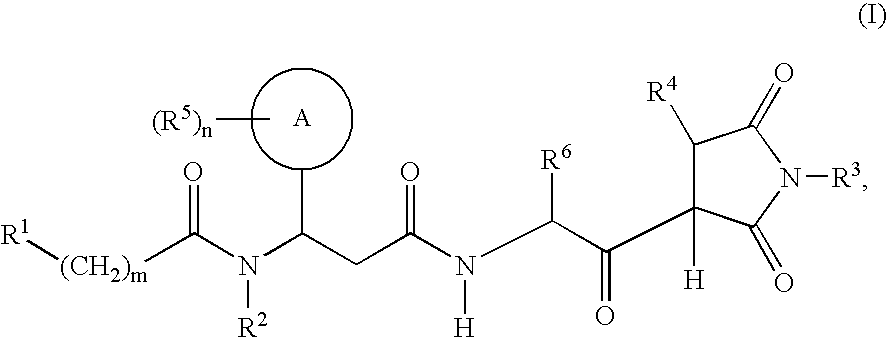
in which
- R1 is heteroaryl,
- where heteroaryl can be substituted by 0, 1, 2 or 3 substituents R1-1, the substituents R1-1 being selected independently of one another from the group consisting of halogen, alkyl, nitro, amino, alkylamino, cyano, trifluoromethyl, cycloalkyl, heterocyclyl, aryl, heteroaryl, hydroxyl, alkoxy, aryloxy, benzyloxy, carboxyl, alkoxycarbonyl, aminocarbonyl, alkylcarbonylamino, alkylaminocarbonyl and aminosulfonyl,
or - R1 is aryl,
- where aryl is substituted by 1, 2 or 3 substituents R1-2, the substituents R1-2 being selected independently of one another from the group consisting of halogen, alkyl, nitro, amino, alkylamino, cyano, trifluoromethyl, cycloalkyl, heterocyclyl, aryl, heteroaryl, hydroxyl, alkoxy, aryloxy, benzyloxy, carboxyl, alkoxycarbonyl, aminocarbonyl, alkylcarbonylamino, arylcarbonylamino, alkylaminocarbonyl and aminosulfonyl,
- or
- two substituents R1-2, together with the carbon atoms to which they are attached, form a cycloalkyl or heterocyclyl which can be substituted by 0, 1 or 2 substituents R1-2-1, the substituents R1-2-1 being selected independently of one another from the group consisting of halogen, nitro, amino, trifluoromethyl, hydroxyl, alkyl and alkoxy,
- R2 is hydrogen or methyl,
- R3 is hydrogen, hydroxyl, amino, C1-C3 alkyl, benzyl, C1-C3 alkoxy, benzyloxy, C1-C3 alkylamino, C1-C3 alkylcarbonylamino, phenylcarbonylamino or benzylcarbonylamino,
- R4 is hydrogen or C1-C3 alkyl,
- R5 is halogen, trifluoromethyl, trifluoromethoxy, nitro, amino, alkylamino, hydroxyl, alkyl, alkoxy, carboxyl, alkoxycarbonyl, aminocarbonyl, alkylaminocarbonyl, aryl or heteroaryl,
- or
- two substituents R5 together with the carbon atoms to which they are attached form a cycloalkyl or heterocyclyl each of which may be substituted by 0, 1 or 2 substituents R5-1, the substituents R5-1 being selected independently of one another from the group consisting of halogen, nitro, amino, trifluoromethyl, hydroxyl, alkyl and alkoxy,
- R6 is alkyl, cycloalkyl, cycloalkenyl or heterocyclyl,
it being possible for R6 to be substituted by 0, 1 or 2 substituents R6-1, the substituents R6-1 being selected independently of one another from the group consisting of halogen, nitro, amino, trifluoromethyl, hydroxyl, alkyl and alkoxy, - n is a number 0, 1, 2 or 3,
- it being possible for the radicals R5 to be identical or different when n is 2 or 3,
- m is a number 0, 1, 2, 3 or 4,
- A is aryl or heteroaryl,
and their salts, their solvates and the solvates of their salts.
Compounds of the invention are the compounds of the formula (I) and their salts, solvates and solvates of the salts, the compounds of the formula (Ia), mentioned below, that are embraced by formula (I), and their salts, solvates and solvates of the salts, and also the compounds embraced by formula (D) and (Ia) and referred to below as implementation example(s), and their salts, solvates and solvates of the salts, where the compounds referred to below and embraced by formula (I) and/or (Ia) are not already salts, solvates and solvates of the salts.

in which R1 to R6, A, m and n are as defined for formula (I), and their salts, their solvates and the solvates of their salts.
- R1 is 5-, 6-, 9- or 10-membered heteroaryl,
- where R1 can be substituted by 0, 1 or 2 substituents R1-1, the substituents R1-1 being selected independently of one another from the group consisting of halogen, alkyl, amino, alkylamino, cyano, trifluoromethyl, aryl, heteroaryl, alkoxy, alkoxycarbonyl and aminocarbonyl,
or - R1 is phenyl or naphthyl,
- where phenyl or naphthyl are substituted by 1, 2 or 3 substituents R1-2, the substituents R1-2 being selected independently of one another from the group consisting of halogen, alkyl, nitro, amino; alkylamino, cyano, trifluoromethyl, cycloalkyl, heterocyclyl, aryl, heteroaryl, alkoxy, aryloxy, benzyloxy,
- alkoxycarbonyl, aminocarbonyl, alkylcarbonylamino, arylcarbonylamino, alkylaminocarbonyl and aminosulfonyl,
- or
- two substituents R1-2, together with the carbon atoms to which they are attached, form a 5- or 6-membered cycloalkyl or a 5- or 6-membered heterocyclyl,
- R2 is hydrogen,
- R3 is hydrogen, hydroxyl, amino, methyl, benzyl, C1-C3 alkoxy, benzyloxy or C1-C3 alkylamino,
- R4 is methyl,
- R5 is fluoro, chloro, trifluoromethyl, trifluoromethoxy, nitro, amino, alkylamino, hydroxyl, alkoxy, aminocarbonyl, alkoxycarbonyl, alkyl, phenyl or 5- or 6-membered heteroaryl,
- or
- two substituents R5, together with the carbon atoms to which they are attached, form a 5- or 6-membered cycloalkyl or 5- or 6-membered heterocyclyl,
- R6 is C2-C7 alkyl or 3- to 7-membered cycloalkyl,
- where R6 can be substituted by 0, 1 or 2 substituents R6-1, the substituents R6-1 being selected independently of one another from the group consisting of halogen, alkoxy, alkyl and trifluoromethyl,
- n is a number 0, 1 or 2,
- where, if n is 2, the radicals R5 can be identical or different,
- m is a number 0, 1, 2 or 3,
and - A is phenyl, naphthyl or 5-, 6-, 9- or 10-membered heteroaryl.
- R1 is pyridyl, imidazolyl, thienyl, furyl, oxadiazolyl, pyrazolyl, pyrazinyl, pyridazinyl, pyrimidinyl, quinolinyl or isoquinolinyl,
- where R1 can be substituted by 0, 1 or 2 substituents R1-1, the substituents R1-1 being selected independently of one another from the group consisting of halogen, alkyl, amino, trifluoromethyl, phenyl and alkoxy,
or - R1 is phenyl or naphthyl,
- where phenyl or naphthyl are substituted by 1, 2 or 3 substituents R1-2, the substituents R1-2 being selected independently of one another from the group consisting of halogen, C1-C4 alkyl, dimethylamino, cyano, trifluoromethyl, 3- to 7-membered cycloalkyl, 5- or 6-membered heterocyclyl, phenyl, 5- or 6-membered heteroaryl, C1-C3 alkoxy, phenyloxy, benzyloxy, phenylcarbonylamino and aminosulfonyl,
- or
- two substituents R1-2, together with the carbon atoms to which they are attached, form a 1,3-benzodioxole or a 1,4-benzodioxane,
- R2 is hydrogen,
- R3 is hydrogen, amino, methyl, methoxy, ethoxy, methylamino or dimethylamino,
- R4 is methyl,
- R5 is fluoro, chloro, trifluoromethyl, C1-C4 alkoxy, methoxycarbonyl, C1-C4 alkyl, phenyl or pyridyl,
- or
- two substituents R5, together with the phenyl ring to which they are attached, form a 1,3-benzodioxole or a 1,4-benzodioxane,
- R6 is C3-C6 alkyl or 3- to 6-membered cycloalkyl,
- n is a number 0, 1 or 2,
- and, if n is 2, the radicals R5 can be identical or different,
- m is a number 0, 1, 2 or 3,
and - A is phenyl, naphthyl, pyridyl, thienyl, furanyl, quinolinyl or isoquinolinyl.
- R1 is pyridyl, thienyl, furyl, quinolinyl or isoquinolinyl,
- where R1 can be substituted by 0, 1 or 2 substituents R1-1, the substituents R1-1 being selected independently of one another from the group consisting of halogen, C1-C4 alkyl, trifluoromethyl, phenyl and C1-C3-alkoxy,
or - R1 is phenyl or naphthyl,
- where phenyl or naphthyl are substituted by 1, 2 or 3 substituents R1-2, the substituents R1-2 being selected independently of one another from the group consisting of halogen, C1-C4 alkyl, dimethylamino, cyano, trifluoromethyl, 5- or 6-membered heterocyclyl, 5- or 6-membered heteroaryl, C1-C3 alkoxy, phenyloxy or benzyloxy,
- or
- two substituents R1-2, together with the carbon atoms to which they are attached, form a 1,3-benzodioxole or a 1,4-benzodioxane,
- R2 is hydrogen,
- R3 is hydrogen, amino, methylamino or dimethylamino,
- R4 is methyl,
- R5 is fluoro, chloro, trifluoromethyl, C1-C3 alkoxy, C1-C4 alkyl, phenyl or pyridyl,
- R6 is isopropyl, tert-butyl, isopentyl, cyclopentyl or cyclohexyl,
- n is a number 0, 1 or 2,
- and, if n is 2, the radicals R5 can be identical or different,
- m is a number 0, 1 or 2,
and - A is phenyl, naphthyl, pyridyl, thienyl, quinolinyl or isoquinolinyl.
- R1 is pyridyl, thienyl, furyl, quinolinyl or isoquinolinyl,
- where R1 can be substituted by 0, 1 or 2 substituents R1-1, the substituents R1-1 being selected independently of one another from the group consisting of fluoro, chloro, trifluoromethyl, C1-C4 alkyl, phenyl and methoxy.
- R1 is phenyl or naphthyl,
- where phenyl or naphthyl are substituted by 1, 2 or 3 substituents R1-2, the substituents R1-2 being selected independently of one another from the group consisting of halogen, C1-C4 alkyl, dimethylamino, cyano, trifluoromethyl, 5-or 6-membered heterocyclyl, 5- or 6-membered heteroaryl, C1-C3 alkoxy, phenyloxy or benzyloxy,
- or
- two substituents R1-2, together with the carbon atoms to which they are attached, form a 1,3-benzodioxole or a 1,4-benzodioxane.
- [A] compounds of the formula

in which R2 to R6, A and n are as defined above, are reacted with compounds of the formula

in which R1 and m are as defined above, it being possible for these to be in activated form if desired,
or
- [B] compounds of the formula

in which R3, R4 and R6 are as defined above, are reacted with compounds of the formula

in which R1, R2, R5, A, m and n are as defined above,
it being possible for these to be in activated form if desired.

in which R2 to R6, A and n are as defined above,
with acid, in particular with hydrochloric acid or trifluoroacetic acid. The compounds of the formula (II) are in this case obtained in the form of the corresponding salts, e.g., in the form of their hydrochlorides, and can be used further in this form or converted by chromatographic purification into their salt-free form.

in which R2, R5, A and n are as defined above,
it being possible for these to be in activated form if desired.

in which R3, R4 and R6 are as defined above,
with acid, in particular with hydrochloric acid or trifluoroacetic acid.

in which R1, R2, R5, A, m and n are as defined above and R7 is an alkyl radical.

in which R2, R5, R7, A and n are as defined above,
with compounds of the formula (III), it being possible for these to be in activated form if desired.

Preparation Examples:

Solid Phase Synthesis:

- Boc tert-butoxycarbonyl
- CDCl3 deuterochloroform
- DCI direct chemical ionization
- DIEA N,N-diisopropylethylamine
- DMSO dimethyl sulfoxide
- EDC N-(3-dimethylaminoisopropyl)-N′-ethylcarbodiimide hydrochloride
- eq. equivalent
- ES electrospray ionization (for MS)
- Fmoc fluorenylmethoxycarbonyl
- HATU O-(7-azabenzotriazol-1-yl)-N,N,N′,N′-tetramethyluronium hexafluorophosphate
- h hour
- HOBt 1-hydroxylbenzotriazole
- HPLC high-pressure, high-performance liquid chromatography
- LC-MS liquid chromatography-coupled mass spectroscopy
- MS mass spectroscopy
- MW molecular weight [g/mol]
- NMR nuclear magnetic resonance spectroscopy
- PS-DIEA N,N-diisopropylethylamine-polystyrene (Resin)
- Rf retention index (for TLC)
- RP-HPLC reverse phase HPLC
- RT room temperature
- Rt retention time (for HPLC)
- THF tetrahydrofuran
HPLC and LC-MS Methods:


| Example | Structure | MW | MS | HPLC |
| 3A |  | 432.52 | MS (ES−),m/z (%): 431(M − H)− (100) | HPLC(method 6):Rt = 4.87 min |
| 4A |  | 432.51 | MS (ES−),m/z (%): 431(M − H)− (100) | HPLC(method 10):Rt = 4.10 min |
| 5A |  | 458.55 | MS (ES−),m/z (%): 457(M − H)− (100) | HPLC(method 12):Rt = 4.12 min |
| 6A |  | 444.53 | MS (ES−),m/z (%): 443(M − H)− (100) | HPLC(method 12):Rt = 3.97 min |
General Instructions A: Reductive deprotection of 1-benzyloxy-2,5-pyrrolidinediones

| Example | Structure | MW | MS | HPLC |
| 7A |
 |
326.40 | MS (ES+),m/z (%): 327(M + H)+ (100) | HPLC(method 5):Rt = 3.87 min |
| 8A |
 |
326.40 | MS (ES+),m/z (%): 349(M + Na)+ (100) | HPLC(method 12):Rt = 2.97 min |
| 9A |
 |
352.43 | MS (ES−),m/z (%): 351(M − H)− (100) | HPLC(method 12):Rt = 3.23 min |
| 10A |
 |
338.40 | MS (ES−),m/z (%): 337(M − H)− (100) | HPLC(method 13):Rt = 4.16 min |

| Example | Structure | MW | MS |
| 12A |
 |
226.28 | MS (ES+),m/z (%): 227(M + H)+ (80) |
| 13A |
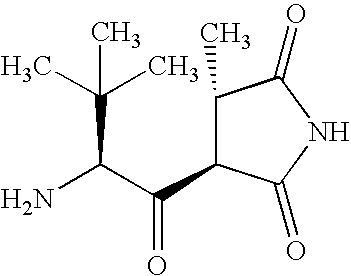 |
226.28 | MS (ES+),m/z (%): 227(M + H)+ (100) |
| 14A |
 |
226.28 | |
| 15A |
 |
252.32 | |
| 16A |
 |
238.29 | |
| Example | Structure | MW | MS |
| 17A |
 |
237.25 | MS (ES+),m/z (%): 238(M + H)+ |
| 18A |
 |
223.23 | MS (ES+),m/z (%): 224(M + H)+ |


| Example | Structure | MW | MS |
| 23A |
 |
342.35 | MS (ES+),m/z (%): 343(M + H)+ |
| 24A |
 |
360.34 | MS (ES+),m/z (%): 361(M + H)+ |
| 25A |
 |
328.32 | MS (ES+),m/z (%): 329(M + H)+ |
| 26A |
 |
312.37 | MS (ES+),m/z (%): 313(M + H)+ |


| Example | Structure | MW | MS | HPLC |
| 29A |
 |
328.32 | MS (ES+),m/z (%): 329(M + H)+ | |
| 30A |
 |
346.31 | MS (ES−),m/z (%): 345(M − H)− | HPLC(method 9):Rt = 3.69 min |
| 31A |
 |
314.3 | MS (ES+),m/z (%): 315(M + H)+ | |
| 32A |
 |
284.31 | MS (ES+),m/z (%): 285(M + H)+ | HPLC(method 9):Rt = 3.82 min |
| Example | Structure | MW | MS | HPLC |
| 33A |
 |
310.3 | MS (ES+),m/z (%): 311(M + H)+ | HPLC(method 8):Rt = 3.87 min |
| 34A |
 |
323.34 | MS (ES+),m/z (%): 324(M + H)+ | HPLC(method 8):Rt = 2.39 min |
| 35A |
 |
323.39 | MS (ES−),m/z (%): 322(M − H)− | HPLC(method 14):Rt = 4.35 min |


| Example | Structure | MW | MS | HPLC |
| 38A |  | 517.58 | MS (ES+),m/z (%): 518(M + H)+ | HPLC(method 8):Rt = 2.60 min |
| 39A |  | 517.62 | MS (ES+),m/z (%): 518(M + H)+ | HPLC(method 14):Rt = 4.42 min |
| 40A |  | 504.54 | MS (ES−),m/z (%): 503(M − H)− | HPLC(method 6):Rt = 3.99 min |
General Instructions G: Deblocking of Boc-protected derivatives


| Example | Structure | MW | MS | HPLC |
| 42A |
 |
417.46 | MS (ES−),m/z (%): 416(M − H)− | HPLC(method 5):Rt = 2.23 min |
| 43A |
 |
417.51 | MS (ES−),m/z (%): 416(M − H)− | HPLC(method 9):Rt = 2.97 min |
| 44A |
 |
404.42 | ||
| Example | Structure | MW | MS | HPLC |
| 45A |  | 219.24 | HPLC(method 6):Rt = 3.37 min | |
| 46A | 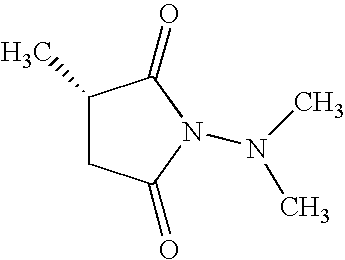 | 156.18 | MS (ESI+),m/z: 157(M + H)+ | HPLC(method 19):Rt = 2.62 min |
| 47A |  | 157.17 | MS (DCI),m/z: 175(M + NH4)+ | HPLC(method 20):Rt = 1.70 min |
| 48A |  | 228.25 | MS (DCI),m/z: 246(M + NH4)+ | HPLC(method 20):Rt = 2.09 min |
| 49A |  | 143.14 | MS (ESI+),m/z: 144(M + H)+ | |
| 50A |  | 276.29 | MS (DCI),m/z: 294(M + NH4)+ | HPLC(method 21):Rt = 2.80 min |
General Instructions J: Reaction of N-tert-butoxycarbonyl-protected amino acids with 2,5-pyrrolidinedione derivatives

| Example | Structure | MW | MS | HPLC |
| 51A |
 |
444.53 | MS (ES−),m/z: 443(M − H)− | HPLC(method 18):Rt = 4.11 min |
| 52A |
 |
432.51 | MS (ES−),m/z: 431(M − H)− | HPLC(method 6):Rt = 4.88 min |
| 53A |
 |
432.51 | MS (ES−),m/z: 431(M − H)− | HPLC(method 13):Rt = 5.08 min |
| 54A |
 |
446.54 | MS (ES−),m/z: 445(M − H)− | HPLC(method 17):Rt = 4.42 min |
| 55A |
 |
352.43 | MS (ES−),m/z: 351(M − H)− | HPLC(method 14):Rt = 4.61 min |
| 56A |
 |
434.49 | MS (ES−),m/z: 433(M − H)− | HPLC(method 17):Rt = 3.98 min |
| 57A |
 |
454.52 | MS (ES−),m/z: 453(M − H)− | HPLC(method 22):Rt = 4.41 min |
| 58A |
 |
355.43 | MS (ES+),m/z: 378(M + Na)+ | HPLC(method 19):Rt = 4.12 min |
| 59A |
 |
356.42 | MS (ES−),m/z: 355(M − H)− | HPLC(method 20):Rt = 3.64 min |
| 60A |
 |
427.50 | MS (ES−),m/z: 426(M − H)− | HPLC(method 20):Rt = 3.73 min |
| 61A |
 |
342.39 | MS (ES−),m/z: 341(M − H)− | HPLC(method 19):Rt = 4.18 min |
| 62A |
 |
381.47 | MS (ES−),m/z: 380(M − H)− | HPLC(method 21):Rt = 3.43 min |
| 63A |
 |
475.54 | MS (ES−),m/z: 474(M − H)− | HPLC(method 20):Rt = 3.91 min |
| 64A |
 |
501.58 | MS (ES−),m/z: 500(M − H)− | HPLC(method 21):Rt = 3.93 min |
| 65A |
 |
453.53 | MS (ES−),m/z: 452(M − H)− | HPLC(method 21):Rt = 3.61 min |
| 66A |
 |
430.51 | MS (ES+),m/z: 453(M + Na)+ | HPLC(method 20):Rt = 4.32 min |
| Example | Structure | MW | MS | HPLC |
| 67A |
 |
326.39 | MS (ES−),m/z: 325(M − H)− | HPLC(method 5):Rt = 3.91 min |
| 68A |
 |
326.39 | MS (ES−),m/z: 325(M − H)− | HPLC(method 12):Rt = 2.88 min |
| 69A |
 |
340.42 | MS (ES−),m/z: 339(M − H)− | HPLC(method 17):Rt = 3.59 min |
| 70A |
 |
328.26 | MS (ES+),m/z: 351(M + Na)+ | HPLC(method 20):Rt = 3.18 min |
| 71A |
 |
338.40 | MS (ES−),m/z: 337(M − H)− | HPLC(method 17):Rt = 3.57 min |
| 72A |
 |
324.38 | MS (ES−),m/z: 323(M − H)− | HPLC(method 19):Rt = 4.02 min |
| 73A |
 |
350.41 | MS (ES−),m/z: 349(M − H)− | HPLC(method 18):Rt = 3.66 min |
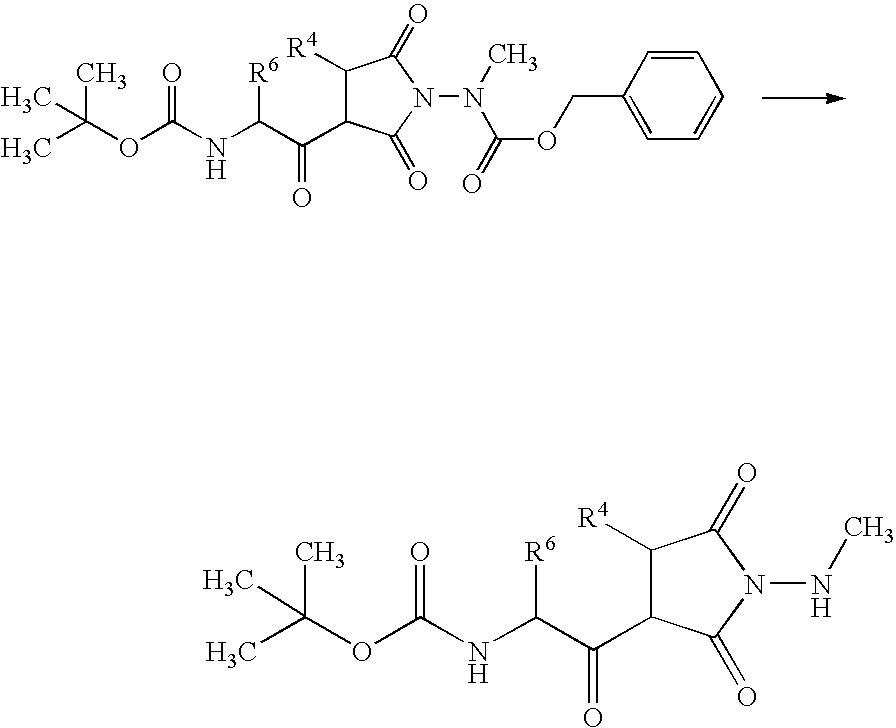
| Example | Structure | MW | MS | HPLC |
| 74A |  | 341.41 | MS (ES−),m/z: 340(M − H)− | HPLC(Methode 19):Rt = 4.00 min |
| 75A |  | 367.44 | MS (ES−),m/z: 366(M − H)− | HPLC(Methode 20):Rt = 3.47 min |
General Instructions L: Deblocking of Boc-protected Derivatives

| Exam- | ||
| ple | Structure | MW |
| 76A |
 |
238.29 |
| 77A |
 |
226.28 |
| 78A |
 |
226.28 |
| 79A |
 |
240.30 |
| 80A |
 |
252.32 |
| 81A |
 |
318.38 |
| 82A |
 |
228.25 |
| 83A |
 |
250.30 |
| 84A |
 |
255.32 |
| 85A |
 |
256.30 |
| 86A |
 |
227.27 |
| 87A |
 |
242.28 |
| 88A |
 |
281.36 |
| 89A |
 |
241.29 |
| 90A |
 |
267.33 |
| 91A |
 |
253.30 |
| 92A |
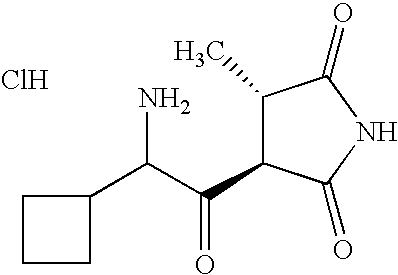 |
224.26 |
| Example | Structure | MW | MS | HPLC |
| 93A |
 |
180.2 | MS (ES+),m/z: 180(M + H)+ | |
| 94A |
 |
230.3 | MS (ES+),m/z: 231(M + H)+ | HPLC(method 20):Rt = 1.70 min) |
| 95A |
 |
229.3 | MS (ES+),m/z: 230(M + H)+ | HPLC(method 19):Rt = 1.75 min) |
| 96A |
 |
185.3 | MS (ES+),m/z: 186(M + H)+ | |
| 97A |
 |
169.2 | MS (ES+),m/z: 170(M + H)+ | |
| 98A |
 |
219.69 | MS (ES+),m/z: 220(M + H)+ | |
| 99A |
 |
264.14 | MS (ES+),m/z: 264(M + H)+ | |
| Example | Structure | MW | MS |
| 100A |  | 290.34 | MS (ES+),m/z (%): 291(M + H)+ |
| 101A |  | 274.28 | MS (ES+),m/z (%): 275(M + H)+ |
| 102A |  | 324.79 | MS (ES+),m/z (%): 325(M + H)+ |
| 103A |  | 369.24 | MS (ES+),m/z (%): 369(M + H)+ |
General Instructions M: Reaction of 3-aminopropionic acid alkyl esters with carbonyl chlorides

| Example | Structure | MW | MS |
| 104A |
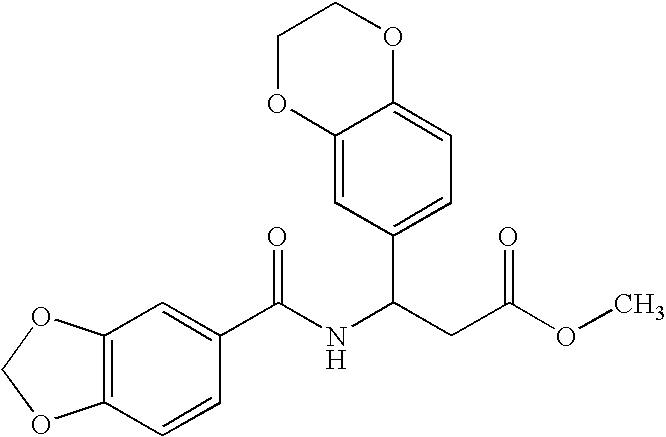 |
385.38 | MS (ES+),m/z (%): 386(M + H)+ |
| 105A |
 |
355.39 | MS (ES+),m/z (%): 356(M + H)+ |
| Example | Structure | MW | MS | HPLC |
| 106A |
 |
276.32 | MS (ES+),m/z (%): 277(M + H)+ | HPLC(method 9):Rt = 3.55 min |
| 107A |
 |
260.25 | MS (ES+),m/z (%): 261(M + H)+ | HPLC(method 9):Rt = 3.43 min |
| 108A |
 |
310.76 | MS (ES+),m/z (%): 311(M + H)+ | HPLC(method 9):Rt = 3.92 min |
| 109A |
 |
355.21 | MS (ES+),m/z (%): 355(M + H)+ | HPLC(method 9):Rt = 3.89 min |
| 110A |
 |
371.35 | MS (ES+),m/z (%): 372(M + H)+ | HPLC(method 9):Rt = 3.64 min |
| 111A |
 |
327.34 | MS (ES+),m/z (%): 328(M + H)+ | |
| Example | Structure | MW | MS | HPLC |
| 112A |
 |
323.35 | HPLC(method 9):Rt = 3.96 min | |
| 113A |
 |
315.37 | MS (ESI−),m/z: 314(M − H)− | HPLC(method 21):Rt = 3.21 min |
| 114A |
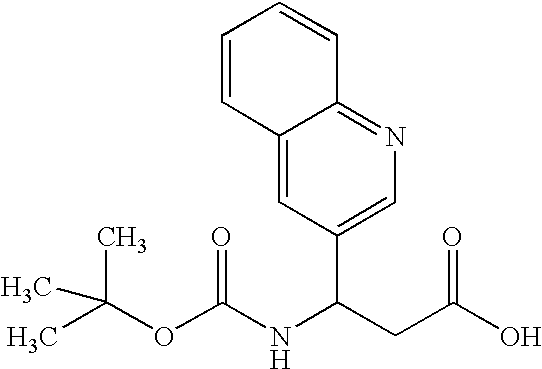 |
316.36 | MS (ESI+),m/z: 317(M + H)+ | HPLC(method 19):Rt = 3.47 min |
| 115A |
 |
295.33 | MS (ESI+),m/z: 296(M + H)+ | HPLC(method 20):Rt = 3.00 min |
| 116A |
 |
325.36 | HPLC(method 9):Rt = 3.76 min | |
| 117A |
 |
266.30 | MS (DCI),m/z: 167(M − 100 + H)+ | HPLC(method 9):Rt = 1.92 min |
| 118A |
 |
309.32 | MS (ESI−),m/z: 308(M − H)− | HPLC(method 13):Rt = 3.69 min |
| Example | Structure | MW | MS | HPLC |
| 119A |
 |
517.58 | MS (ESI+),m/z: 518(M + H)+ | HPLC(method 16):Rt = 2.89 min |
| 120A |
 |
485.58 | MS (ESI−),m/z: 484(M − H)− | HPLC(method 20):Rt = 3.72 min |
| 121A |
 |
487.59 | MS (ESI+),m/z: 488(M + H)+ | HPLC(method 17):Rt = 3.73 min |
| 122A |
 |
510.59 | MS (ESI−),m/z: 509(M − H)− | HPLC(method 19):Rt = 3.99 min |
| 123A |
 |
509.61 | MS (ESI−),m/z: 508(M − H)− | HPLC(method 20):Rt = 3.77 min |
| 124A |
 |
519.60 | MS (ESI−),m/z: 518(M − H)− | HPLC(method 18):Rt = 3.36 min |
| 125A |
 |
489.57 | MS (ESI−),m/z: 488(M − H)− | HPLC(method 19):Rt = 4.19 min |
| 126A |
 |
489.57 | MS (ESI−),m/z: 488(M − H)− | HPLC(method 20):Rt = 3.36 min |
| 127A |
 |
474.56 | MS (ESI−),m/z: 473(M − H)− | HPLC(method 19):Rt = 2.55 min |
| 128A |
 |
460.53 | MS (ESI+),m/z: 461(M + H)+ | HPLC(method 5):Rt = 2.86 min |
| 129A |
 |
503.56 | MS (ESI+),m/z: 504(M + H)+ | HPLC(method 14):Rt = 4.05 min |
| Example | Structure | MW | MS | HPLC |
| 130A |
 |
417.47 | ||
| 131A |
 |
385.47 | MS (ESI−),m/z: 384(M − H)− | HPLC(method 20):Rt = 1.90 min |
| 132A |
 |
387.48 | ||
| 133A |
 |
410.48 | HPLC(method 9):Rt = 2.79 min | |
| 134A |
 |
409.49 | MS (ESI−),m/z: 408(M − H)− | HPLC(method 20):Rt = 2.14 and 2.23 min |
| 135A |
 |
419.48 | HPLC(method 9):Rt = 2.80 min | |
| 136A |
 |
389.46 | MS (ESI−),m/z: 388(M − H)− | HPLC(method 19):Rt = 3.17 min |
| 137A |
 |
389.46 | HPLC(method 9):Rt = 2.86 min | |
| 138A |
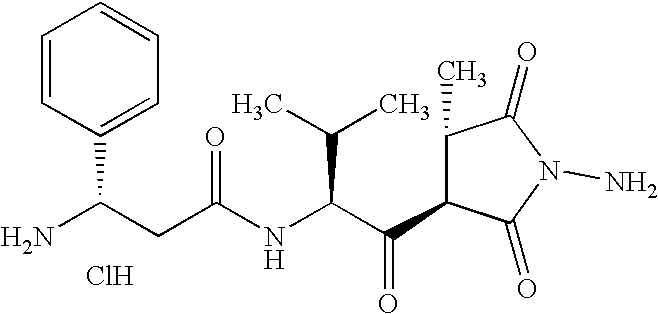 |
374.44 | ||
| 139A |
 |
360.42 | MS (ESI+),m/z: 361(M + H)+ | |
| 140A |
 |
403.44 | MS (ESI−),m/z: 402(M − H)− | HPLC(method 14):Rt = 2.40 min |


| Example | Structure | MW | MS | HPLC |
| 11 |  | 478.55 | MS (ES+),m/z (%): 479(M + H)+ (100) | HPLC(method 5)Rt = 3.69 min |
| 12 |  | 522.55 | MS (ES+),m/z (%): 523(M + H)+ (75) | HPLC(method 9)Rt = 3.81 min |
| 13 |  | 514.58 | MS (ES+),m/z (%): 515(M + H)+ (100) | HPLC(method 5)Rt = 3.97 min |
| 14 |  | 464.52 | MS (ES+),m/z (%): 465(M + H)+ (100) | HPLC(method 5)Rt = 3.01 min |
| 15 |  | 483.59 | MS (ES+),m/z (%): 506(M + Na)+ (100) | HPLC(method 5)Rt = 3.74 min |
| 16 |  | 482.51 | MS (ES+),m/z (%): 505(M + Na)+ (100) | HPLC(method 6)Rt = 3.48 min |
| 17 |  | 482.51 | MS (ES−),m/z (%): 481(M − H+) (100) | HPLC(method 6)Rt = 3.46 min |
| 18 |  | 478.55 | MS (ES+),m/z (%): 479(M + H)+ (45) | HPLC(method 9)Rt = 4.03 min |
| 19 |  | 503.55 | MS (ES+),m/z (%): 523(M + Na)+ (100) | HPLC(method 6)Rt = 3.94 min |
| 20 |  | 508.53 | MS (ES+),m/z (%): 509(M + H)+ (90) | HPLC(method 9)Rt = 3.82 min |
| 21 |  | 518.57 | MS (ES+),m/z (%): 519(M + H)+ (100) | HPLC(method 3)Rt = 3.95 min |
| 22 |  | 540.55 | MS (ES+),m/z (%): 541(M + H)+ (35) | HPLC(method 9)Rt = 3.92 min |
| 23 |  | 520.63 | MS (ES−),m/z (%): 519(M − H)− (100) | HPLC(method 5)Rt = 4.6 min |
| 24 |  | 478.55 | MS (ES−),m/z (%): 477(M − H)− (100) | HPLC(method 5)Rt = 3.9 min |
| 25 |  | 530.58 | MS (ES+),m/z (%): 531(M + H)+ (100) | HPLC(method 6)Rt = 3.70 min |
| 26 |  | 533.41 | MS (ES+),m/z (%): 533(M + H)+ (100) | HPLC(method 6)Rt = 4.20 min |
| 27 |  | 566.96 | MS (ES+),m/z (%): 567(M + H)+ (100) | HPLC(method 6)Rt = 4.42 min |
| 28 |  | 482.51 | MS (ES+),m/z (%): 483(M + H)+ (100) | HPLC(method 11)Rt = 2.66 min |
| 29 |  | 544.60 | MS (ES+),m/z (%): 545(M + H)+ (100) | HPLC(method 14)Rt = 4.5 min |
| 30 |  | 514.58 | MS (ES−),m/z (%): 513(M − H)− (100) | HPLC(method 14)Rt = 4.40 min |
| 31 |  | 498.96 | MS (ES−),m/z (%): 497(M − H)− (100) | HPLC(method 14)Rt = 4.37 min |
| 32 |  | 498.96 | MS (ES+),m/z (%): 521(M + Na)+ (100) | HPLC(method 13)Rt = 4.05 min |
| 33 |  | 480.52 | MS (ES+),m/z (%): 481(M + H)+ (100) | HPLC(method 14)Rt = 3.65 min |
| 34 |  | 478.55 | MS (ES+),m/z (%): 479(M + H)+ (100) | HPLC(method 13)Rt = 3.98 min |
| 35 |  | 540.59 | MS (ES−),m/z (%): 539(M − H)− (100) | HPLC(method 11)Rt = 2.73 min |
| 36 |  | 522.55 | MS (ES−),m/z (%): 521(M − H)− (100) | HPLC(method 5)Rt = 3.67 min |
| 37 |  | 540.55 | MS (ES+),m/z (%): 541(M + H)+ (100) | HPLC(method 9)Rt = 3.75 min |
| 38 |  | 540.55 | MS (ES+),m/z (%): 541(M + H)+ (100) | HPLC(method 9)Rt = 3.80 min |
| 39 |  | 540.55 | MS (ES+),m/z (%): 541(M + H)+ (100) | HPLC(method 14)Rt = 4.12 min |
| 40 |  | 527.51 | MS (ES+),m/z (%): 528(M + H)+ (100) | HPLC(method 12)Rt = 2.76 min |
| 41 |  | 478.55 | MS (ES+),m/z (%): 479(M + H)+ (100) | HPLC(method 5)Rt = 2.64 min |
| 42 |  | 483.59 | MS (ES+),m/z (%): 484(M + H)+ (100) | HPLC(method 15)Rt = 2.94 min |
| 43 |  | 532.60 | MS (ES+),m/z (%): 555(M + Na)+ (100) | HPLC(method 5)Rt = 3.52 min |
| 44 |  | 511.64 | MS (ES+),m/z (%): 534(M + Na)+ (100) | HPLC(method 5)Rt = 4.00 min |
General Instructions I: Solid-phase-supported Synthesis


| Example | Structure | MW | MS | HPLC |
| 49 |  | 539.63 | MS (ES+),m/z: 540(M + H)+ | HPLC(method 5):Rt = 4.22 min |
| 50 |  | 507.54 | MS (ES+),m/z: 508(M + H)+ | HPLC(method 5):Rt = 3.61 min |
| 51 |  | 554.64 | MS (ES+),m/z: 555(M + H)+ | HPLC(method 8):Rt = 2.72 min |
| 52 |  | 478.55 | MS (ES+),m/z: 479(M + H)+ | HPLC(method 5):Rt = 3.67 min |
| 53 |  | 508.53 | MS (ES+),m/z: 509(M + H)+ | HPLC(method 5):Rt = 2.45 and 2.52 min |
| 54 |  | 465.51 | MS (ES+),m/z: 466(M + H)+ | |
| 55 |  | 464.52 | MS (ES+),m/z: 465(M + H)+ | HPLC(method 5):Rt = 3.02 min |
| 56 |  | 506.60 | MS (ES+),m/z: 507(M + H)+ | HPLC(method 5):Rt = 3.72 min |
| 57 |  | 506.60 | MS (ES+),m/z: 507(M + H)+ | HPLC(method 5):Rt = 3.62 min |
| 58 |  | 546.45 | MS (ES+),m/z: 546(M + H)+ | HPLC(method 8):Rt = 2.60 min |
| 59 |  | 545.68 | MS (ES+),m/z: 546(M + H)+ | HPLC(method 5):Rt = 4.65 min |
| 60 |  | 569.65 | MS (ES+),m/z: 570(M + H)+ | HPLC(method 5):Rt = 4.19 min |
| 61 |  | 560.61 | MS (ES+),m/z: 561(M + H)+ | HPLC(method 5):Rt = 3.28 min |
| 62 |  | 470.55 | MS (ES+),m/z: 471(M + H)+ | HPLC(method 5):Rt = 3.5 min |
| 63 |  | 454.48 | MS (ES+),m/z: 455(M + H)+ | HPLC(method 5):Rt = 3.4 min |
| 64 |  | 504.99 | MS (ES+),m/z: 505(M + H)+ | HPLC(method 5):Rt = 3.8 min |
| 65 |  | 549.44 | MS (ES+),m/z: 551(M + H)+ | HPLC(method 5):Rt = 3.8 min |
| 66 |  | 565.58 | MS (ES+),m/z: 566(M + H)+ | HPLC(method 5):Rt = 3.5 min |
| 67 |  | 555.63 | MS (ES−),m/z: 554(M − H)− | HPLC(method 6):Rt = 4.28 min |
| 68 |  | 553.61 | MS (ES+),m/z: 554(M + H)+ | HPLC(method 6):Rt = 3.85 min |
| 69 |  | 535.64 | MS (ES+),m/z: 536(M + H)+ | HPLC(method 6):Rt = 4.34 min |
| 70 |  | 570.64 | MS (ES+),m/z: 571(M + H)+ | HPLC(method 5):Rt = 4.48 min |
| 71 |  | 521.57 | MS (ES+),m/z: 522(M + H)+ | HPLC(method 9):Rt = 4.05 min |
| 72 |  | 521.57 | MS (ES+),m/z: 522(M + H)+ | HPLC(method 5):Rt = 3.73 min |
| 73 |  | 535.59 | MS (ES−),m/z: 534(M − H)− | HPLC(method 5):Rt = 3.71 min |
| 74 |  | 551.64 | MS (ES−),m/z: 550(M − H)− | HPLC(method 5):Rt = 3.65 min |
| 75 |  | 596.68 | MS (ES+),m/z: 597(M + H)+ | HPLC(method 6):Rt = 3.78 min |
| 76 |  | 480.52 | MS (ES+),m/z: 481(M + H)+ | HPLC(method 5):Rt = 3.63 min |
| 77 |  | 535.59 | MS (ES+),m/z: 536(M + H)+ | HPLC(method 6):Rt = 3.76 min |
| 78 |  | 542.61 | MS (ES−),m/z: 541(M − H)− | HPLC(method 5):Rt = 3.39 min |
| 79 |  | 565.58 | MS (ES+),m/z: 566(M + H)+ | HPLC(method 14):Rt = 4.19 min |
| 80 |  | 483.50 | MS (ES+),m/z: 484(M + H)+ | HPLC(method 9):Rt = 2.93 min |
| 81 |  | 504.58 | MS (ES+),m/z: 505(M + H)+ | HPLC(method 17):Rt = 3.57 min |
| 82 |  | 540.55 | MS (ES+),m/z: 563(M + Na)+ | HPLC(method 14):Rt = 4.25 min |
| 83 |  | 568.67 | MS (ES+),m/z: 570(M + H)+ | HPLC(method 18):Rt = 3.96 min |
| 84 |  | 502.57 | MS (ES+),m/z: 503(M + H)+ | HPLC(method 20):Rt = 3.45 min |
| 85 |  | 525.58 | MS (ES+),m/z: 526(M + H)+ | HPLC(method 20):Rt = 3.55 min |
| 86 |  | 507.59 | MS (ES+),m/z: 508(M + H)+ | HPLC(method 20):Rt = 3.43 min |
| 87 |  | 508.57 | MS (ES+),m/z: 509(M + H)+ | HPLC(method 20):Rt = 3.60 min |
| 88 |  | 476.53 | MS (ES+),m/z: 477(M + H)+ | HPLC(method 20):Rt = 3.12 min |
| 89 |  | 498.51 | MS (ES+),m/z: 499(M + H)+ | HPLC(method 18):Rt = 3.35 min |
| 90 |  | 532.57 | MS (ES+),m/z: 533(M + H)+ | HPLC(method 19):Rt = 4.24 min |
| 91 |  | 494.55 | MS (ES+),m/z: 495(M + H)+ | HPLC(method 19):Rt = 3.47 min |
| 92 |  | 542.56 | MS (ES+),m/z: 543(M + H)+ | HPLC(method 20):Rt = 3.02 min |
| 93 |  | 493.56 | MS (ES+),m/z: 494(M + H)+ | HPLC(method 19):Rt = 4.06 min |
| 94 |  | 544.63 | MS (ES+),m/z: 545(M + H)+ | HPLC(method 20):Rt = 3.42 min |
| 95 |  | 520.56 | MS (ES+),m/z: 521(M + H)+ | HPLC(method 19):Rt = 4.17 min |
| 96 |  | 581.46 | MS (ES+),m/z: 583(M + H)+ | HPLC(method 18):Rt = 3.6 min |
| 97 |  | 554.06 | MS (ES+),m/z: 554(M + H)+ | HPLC(method 19):Rt = 4.17 min |
| 98 |  | 547.63 | MS (ES+),m/z: 548(M + H)+ | HPLC(method 19):Rt = 4.01 min |
| 99 |  | 512.54 | MS (ES+),m/z: 513(M + H)+ | HPLC(method 19):Rt = 4.04 min |
| 100 |  | 488.54 | MS (ES+),m/z: 489(M + H)+ | HPLC(method 20):Rt = 3.15 min |
| 101 |  | 516.60 | MS (ES+),m/z: 517(M + H)+ | HPLC(method 18):Rt = 3.5 min |
| 102 |  | 538.55 | MS (ES+),m/z: 539(M + H)+ | HPLC(method 18):Rt = 3.5 min |
| 103 | 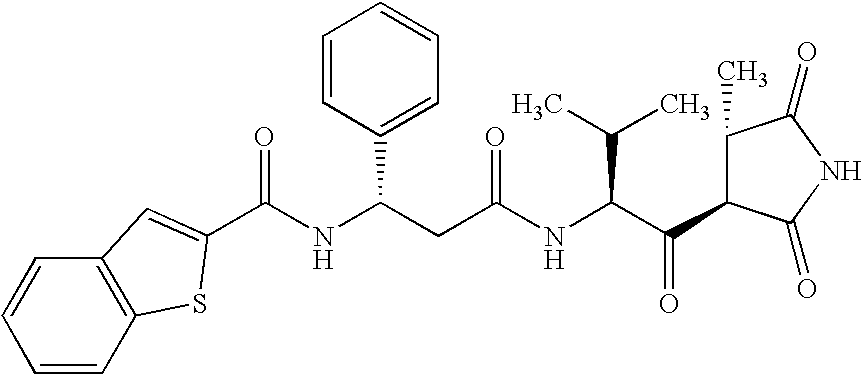 | 519.62 | MS (ES+),m/z: 520(M + H)+ | HPLC(method 18):Rt = 3.5 min |
| 104 |  | 587.62 | MS (ES+),m/z: 588(M + H)+ | HPLC(method 18):Rt = 3.7 min |
| 105 |  | 562.66 | MS (ES+),m/z: 563(M + H)+ | HPLC(method 19):Rt = 2.42 min |
| 106 |  | 543.62 | MS (ES+),m/z: 544(M + H)+ | HPLC(method 18):Rt = 3.2 min |
| 107 |  | 533.56 | MS (ES+),m/z: 534(M + H)+ | HPLC(method 20):Rt = 2.45 min |
| 108 |  | 597.99 | MS (ES+),m/z: 598(M + H)+ | HPLC(method 18):Rt = 3.6 min |
| 109 |  | 576.47 | MS (ES+),m/z: 576(M + H)+ | HPLC(method 18):Rt = 3.5 min |
| 110 |  | 528.61 | MS (ES+),m/z: 529(M + H)+ | HPLC(method 18):Rt = 2.6 min |
| 111 |  | 518.57 | MS (ES+),m/z: 519(M + H)+ | HPLC(method 19):Rt = 2.26 min |
| 112 |  | 527.58 | MS (ES+),m/z: 528(M + H)+ | HPLC(method 19):Rt = 2.61 min |
| 113 |  | 533.63 | MS (ES+),m/z: 534(M + H)+ | HPLC(method 19):Rt = 2.55 min |
| 114 |  | 479.53 | MS (ES+),m/z: 480(M + H)+ | HPLC(method 20):Rt = 1.97 min |
| 115 |  | 479.53 | MS (ES+),m/z: 480(M + H)+ | HPLC(method 19):Rt = 1.82 min |
B) Evaluation of Physiological Activity
| Staphylococcus | Haemophilus influenzae | |
| Ex. No. | aureus 133 | Spain 7 |
| 2 | 15.63 | 7.81 |
| 4 | 15.63 | 31.25 |
| 6 | 7.81 | 15.63 |
| 9 | 7.81 | 62.5 |
| 48 | 0.98 | 15.63 |
| 109 | 0.98 | 62.5 |
Systemic Infection with S. aureus 133
Claims (18)


Applications Claiming Priority (3)
| Application Number | Priority Date | Filing Date | Title |
|---|---|---|---|
| DE10236340A DE10236340A1 (en) | 2002-08-08 | 2002-08-08 | New heteroar(alkan)oyl-substituted phenyl-beta-alaninamide derivatives, useful as broad-spectrum antibacterial agents in human or veterinary medicine |
| DE10236340.4 | 2002-08-08 | ||
| PCT/EP2003/008300 WO2004020432A1 (en) | 2002-08-08 | 2003-07-28 | Arylamides |
Publications (2)
| Publication Number | Publication Date |
|---|---|
| US20060173040A1 US20060173040A1 (en) | 2006-08-03 |
| US7348357B2 true US7348357B2 (en) | 2008-03-25 |
Family
ID=30469581
Family Applications (1)
| Application Number | Title | Priority Date | Filing Date |
|---|---|---|---|
| US10/524,080 Expired - Fee Related US7348357B2 (en) | 2002-08-08 | 2003-07-28 | Arylamides |
Country Status (7)
| Country | Link |
|---|---|
| US (1) | US7348357B2 (en) |
| EP (1) | EP1529042B1 (en) |
| JP (1) | JP4528122B2 (en) |
| AU (1) | AU2003255307A1 (en) |
| CA (1) | CA2494846C (en) |
| DE (1) | DE10236340A1 (en) |
| WO (1) | WO2004020432A1 (en) |
Families Citing this family (2)
| Publication number | Priority date | Publication date | Assignee | Title |
|---|---|---|---|---|
| DE10326918A1 (en) * | 2003-06-16 | 2005-02-17 | Bayer Healthcare Ag | Substituted alkylamides |
| US8492428B2 (en) | 2005-09-20 | 2013-07-23 | Mayo Foundation For Medical Education And Research | Small-molecule botulinum toxin inhibitors |
Citations (1)
| Publication number | Priority date | Publication date | Assignee | Title |
|---|---|---|---|---|
| EP0250115A2 (en) | 1986-06-02 | 1987-12-23 | Kabushiki Kaisha Ueno Seiyaku Oyo Kenkyujo | 2,5-Pyrrolidine dione derivatives obtained from bacteriae, and their use as bactericides |
Family Cites Families (2)
| Publication number | Priority date | Publication date | Assignee | Title |
|---|---|---|---|---|
| JPS63141593A (en) * | 1986-06-02 | 1988-06-14 | Ueno Seiyaku Oyo Kenkyusho:Kk | Ufc-n11 produced by bacteria, its production and use thereof |
| JPH01301657A (en) * | 1988-05-28 | 1989-12-05 | Suntory Ltd | Novel andrimide derivative |
-
2002
- 2002-08-08 DE DE10236340A patent/DE10236340A1/en not_active Withdrawn
-
2003
- 2003-07-28 JP JP2004531824A patent/JP4528122B2/en not_active Expired - Fee Related
- 2003-07-28 WO PCT/EP2003/008300 patent/WO2004020432A1/en not_active Ceased
- 2003-07-28 US US10/524,080 patent/US7348357B2/en not_active Expired - Fee Related
- 2003-07-28 CA CA2494846A patent/CA2494846C/en not_active Expired - Fee Related
- 2003-07-28 AU AU2003255307A patent/AU2003255307A1/en not_active Abandoned
- 2003-07-28 EP EP03790823A patent/EP1529042B1/en not_active Expired - Lifetime
Patent Citations (1)
| Publication number | Priority date | Publication date | Assignee | Title |
|---|---|---|---|---|
| EP0250115A2 (en) | 1986-06-02 | 1987-12-23 | Kabushiki Kaisha Ueno Seiyaku Oyo Kenkyujo | 2,5-Pyrrolidine dione derivatives obtained from bacteriae, and their use as bactericides |
Non-Patent Citations (1)
| Title |
|---|
| Needham, et al. Andrimid and Moiramides A-C, Metabolites Produced in Culture by a Marine Isolate of the Bacterium Pseudomonas fluorescens: Structure Elucidation and Biosynthesis, J. Org. Chem., 59: 2058-2063 (1994). |
Also Published As
| Publication number | Publication date |
|---|---|
| AU2003255307A1 (en) | 2004-03-19 |
| JP4528122B2 (en) | 2010-08-18 |
| EP1529042B1 (en) | 2013-02-20 |
| EP1529042A1 (en) | 2005-05-11 |
| CA2494846C (en) | 2012-01-17 |
| US20060173040A1 (en) | 2006-08-03 |
| CA2494846A1 (en) | 2004-03-11 |
| WO2004020432A1 (en) | 2004-03-11 |
| JP2005539040A (en) | 2005-12-22 |
| DE10236340A1 (en) | 2004-02-19 |
Similar Documents
| Publication | Publication Date | Title |
|---|---|---|
| US20070129288A1 (en) | Antibacterial amide macrocycles | |
| US6894173B2 (en) | Intermediates useful for synthesis of heteroaryl-substituted urea compounds, and processes of making same | |
| US7655643B2 (en) | Antibacterial macrocycles with substituted biphenyl | |
| DE10208256A1 (en) | Piperidinouracile | |
| US7786079B2 (en) | Substituted nonadepsipeptides | |
| US20060258571A1 (en) | Antibacterial ester macrocycles | |
| US8076285B2 (en) | Lysobactin amides | |
| US20090149528A1 (en) | Cinnamic acid amides | |
| US20060173040A1 (en) | Arylamides | |
| KR20080015411A (en) | N-formylhydroxylamine compounds as peptide deformylase inhibitors | |
| US7544709B2 (en) | Derivatives of andrimide and moiramide B having antibacterial properties | |
| DE10326918A1 (en) | Substituted alkylamides | |
| DE10243201A1 (en) | New N-acyl-aminoacid N-(succinimidyl-carbonyl-alkyl)-amide compounds, are broad-spectrum antibacterial agents useful in human or veterinary medicine | |
| JP2008534538A (en) | Cyclic iminopeptide derivatives | |
| DE10162745A1 (en) | Heterocyclylaminocarbonyluracile |
Legal Events
| Date | Code | Title | Description |
|---|---|---|---|
| AS | Assignment |
Owner name: BAYER HEALTHCARE AG, GERMANY Free format text: ASSIGNMENT OF ASSIGNORS INTEREST;ASSIGNORS:BRUNNER, NINA;FREIBERG, CHRISTOPH;LAMPE, THOMAS;AND OTHERS;REEL/FRAME:016977/0738;SIGNING DATES FROM 20050203 TO 20050802 |
|
| FEPP | Fee payment procedure |
Free format text: PAYOR NUMBER ASSIGNED (ORIGINAL EVENT CODE: ASPN); ENTITY STATUS OF PATENT OWNER: LARGE ENTITY |
|
| AS | Assignment |
Owner name: BAYER SCHERING PHARMA AKTIENGESELLSCHAFT, GERMANY Free format text: MERGER;ASSIGNOR:BAYER HEALTHCARE AG;REEL/FRAME:023769/0122 Effective date: 20081204 Owner name: BAYER SCHERING PHARMA AKTIENGESELLSCHAFT,GERMANY Free format text: MERGER;ASSIGNOR:BAYER HEALTHCARE AG;REEL/FRAME:023769/0122 Effective date: 20081204 |
|
| FEPP | Fee payment procedure |
Free format text: PAYER NUMBER DE-ASSIGNED (ORIGINAL EVENT CODE: RMPN); ENTITY STATUS OF PATENT OWNER: LARGE ENTITY Free format text: PAYOR NUMBER ASSIGNED (ORIGINAL EVENT CODE: ASPN); ENTITY STATUS OF PATENT OWNER: LARGE ENTITY |
|
| AS | Assignment |
Owner name: INTERMED DISCOVERY GMBH, GERMANY Free format text: ASSIGNMENT OF ASSIGNORS INTEREST;ASSIGNOR:BAYER SCHERING PHARMA AKTIENGESELLSCHAFT;REEL/FRAME:026646/0836 Effective date: 20110622 |
|
| FPAY | Fee payment |
Year of fee payment: 4 |
|
| REMI | Maintenance fee reminder mailed | ||
| LAPS | Lapse for failure to pay maintenance fees | ||
| STCH | Information on status: patent discontinuation |
Free format text: PATENT EXPIRED DUE TO NONPAYMENT OF MAINTENANCE FEES UNDER 37 CFR 1.362 |
|
| STCH | Information on status: patent discontinuation |
Free format text: PATENT EXPIRED DUE TO NONPAYMENT OF MAINTENANCE FEES UNDER 37 CFR 1.362 |
|
| FP | Lapsed due to failure to pay maintenance fee |
Effective date: 20160325 |