US7312343B2 - Synthesis of α-amino-β-alkoxy-carboxylic acid esters - Google Patents
Synthesis of α-amino-β-alkoxy-carboxylic acid esters Download PDFInfo
- Publication number
- US7312343B2 US7312343B2 US11/140,319 US14031905A US7312343B2 US 7312343 B2 US7312343 B2 US 7312343B2 US 14031905 A US14031905 A US 14031905A US 7312343 B2 US7312343 B2 US 7312343B2
- Authority
- US
- United States
- Prior art keywords
- benzyl
- alkyl
- methyl
- butyl
- mmol
- Prior art date
- Legal status (The legal status is an assumption and is not a legal conclusion. Google has not performed a legal analysis and makes no representation as to the accuracy of the status listed.)
- Expired - Fee Related, expires
Links
- 0 *N([4*])[C@@H]([1*])[C@@H](CC(C)=O)O[3*] Chemical compound *N([4*])[C@@H]([1*])[C@@H](CC(C)=O)O[3*] 0.000 description 24
- PQIDZRZZOZETOD-YIGUZQASSA-N *.*.S.S.[Cl].[H][C@@]1([C@@H](CC(=O)OC(C)(C)C)OC)CCCN1.[H][C@@]1([C@@H](CC(=O)OC(C)(C)C)OC)CCCN1CC1=CC=CC=C1 Chemical compound *.*.S.S.[Cl].[H][C@@]1([C@@H](CC(=O)OC(C)(C)C)OC)CCCN1.[H][C@@]1([C@@H](CC(=O)OC(C)(C)C)OC)CCCN1CC1=CC=CC=C1 PQIDZRZZOZETOD-YIGUZQASSA-N 0.000 description 1
- HKLLOSWUGFIBAC-JMRZBOGYSA-N *.C=C(OC(C)(C)C)O[Si](C)(C)C(C)(C)C.COC(OC)[C@@H]1CCCN1CC1=CC=CC=C1.S.S.S.[H][C@@]1([C@@H](CC(=O)OC(C)(C)C)OC)CCCN1CC1=CC=CC=C1.[H][C@@]1([C@H](CC(=O)OC(C)(C)C)OC)CCCN1CC1=CC=CC=C1 Chemical compound *.C=C(OC(C)(C)C)O[Si](C)(C)C(C)(C)C.COC(OC)[C@@H]1CCCN1CC1=CC=CC=C1.S.S.S.[H][C@@]1([C@@H](CC(=O)OC(C)(C)C)OC)CCCN1CC1=CC=CC=C1.[H][C@@]1([C@H](CC(=O)OC(C)(C)C)OC)CCCN1CC1=CC=CC=C1 HKLLOSWUGFIBAC-JMRZBOGYSA-N 0.000 description 1
- QVJKPITWAKWSEY-UHFFFAOYSA-N C=C(OC(C)(C)C)O[Si](C)(C)C(C)(C)C.CC(=O)OC(C)(C)C Chemical compound C=C(OC(C)(C)C)O[Si](C)(C)C(C)(C)C.CC(=O)OC(C)(C)C QVJKPITWAKWSEY-UHFFFAOYSA-N 0.000 description 1
- KPPRLGDDJVHATE-GSJSLEKASA-N C=C(OC(C)(C)C)O[Si](C)(C)C(C)(C)C.CC[C@H](C)[C@@H](C(OC)OC)N(C)CC1=CC=CC=C1.CC[C@H](C)[C@@H]([C@@H](CC(=O)OC(C)(C)C)OC)N(C)CC1=CC=CC=C1 Chemical compound C=C(OC(C)(C)C)O[Si](C)(C)C(C)(C)C.CC[C@H](C)[C@@H](C(OC)OC)N(C)CC1=CC=CC=C1.CC[C@H](C)[C@@H]([C@@H](CC(=O)OC(C)(C)C)OC)N(C)CC1=CC=CC=C1 KPPRLGDDJVHATE-GSJSLEKASA-N 0.000 description 1
- NYGGTSSUZDKBKG-JTGFSFSNSA-N C=C(OC(C)(C)C)O[Si](C)(C)C(C)(C)C.COC(OC)[C@H](C(C)C)N(C)CC1=CC=CC=C1.CO[C@H](CC(=O)OC(C)(C)C)[C@H](C(C)C)N(C)CC1=CC=CC=C1 Chemical compound C=C(OC(C)(C)C)O[Si](C)(C)C(C)(C)C.COC(OC)[C@H](C(C)C)N(C)CC1=CC=CC=C1.CO[C@H](CC(=O)OC(C)(C)C)[C@H](C(C)C)N(C)CC1=CC=CC=C1 NYGGTSSUZDKBKG-JTGFSFSNSA-N 0.000 description 1
- UBBOKFMCEWJSNV-OSOXFUFKSA-N C=C(OC(C)(C)C)O[Si](C)(C)C(C)(C)C.COC(OC)[C@H](C)N(C)CC1=CC=CC=C1.CO[C@H](CC(=O)OC(C)(C)C)[C@H](C)N(C)CC1=CC=CC=C1 Chemical compound C=C(OC(C)(C)C)O[Si](C)(C)C(C)(C)C.COC(OC)[C@H](C)N(C)CC1=CC=CC=C1.CO[C@H](CC(=O)OC(C)(C)C)[C@H](C)N(C)CC1=CC=CC=C1 UBBOKFMCEWJSNV-OSOXFUFKSA-N 0.000 description 1
- AYKFELLOBPJXCG-ZDUSSCGKSA-N CC(=O)[C@@H](NC(=O)OCC1=CC=CC=C1)C(C)C Chemical compound CC(=O)[C@@H](NC(=O)OCC1=CC=CC=C1)C(C)C AYKFELLOBPJXCG-ZDUSSCGKSA-N 0.000 description 1
- DOPVCZRBFBOZGG-UGDRNJNMSA-N CC(C)[C@@H](C(=O)O)N(C)C(=O)OC(C)(C)C.CC(C)[C@@H](CO)N(C)C(=O)OC(C)(C)C Chemical compound CC(C)[C@@H](C(=O)O)N(C)C(=O)OC(C)(C)C.CC(C)[C@@H](CO)N(C)C(=O)OC(C)(C)C DOPVCZRBFBOZGG-UGDRNJNMSA-N 0.000 description 1
- WZZUQWBUVSVLRT-SECBINFHSA-N CC(C)[C@@H](C=O)N(C)C(OC(C)(C)C)=O Chemical compound CC(C)[C@@H](C=O)N(C)C(OC(C)(C)C)=O WZZUQWBUVSVLRT-SECBINFHSA-N 0.000 description 1
- DUXNNFRDFVEXMF-USJXWOKUSA-N CC(C)[C@@H](CO)N(C)C(=O)OC(C)(C)C.[H]C(=O)[C@H](C(C)C)N(C)C(=O)OC(C)(C)C Chemical compound CC(C)[C@@H](CO)N(C)C(=O)OC(C)(C)C.[H]C(=O)[C@H](C(C)C)N(C)C(=O)OC(C)(C)C DUXNNFRDFVEXMF-USJXWOKUSA-N 0.000 description 1
- CMQXNCQNVUMSNJ-SECBINFHSA-N CC(C)[C@@H](CO)N(C)C(OC(C)(C)C)=O Chemical compound CC(C)[C@@H](CO)N(C)C(OC(C)(C)C)=O CMQXNCQNVUMSNJ-SECBINFHSA-N 0.000 description 1
- JXPBSFOWNXMGGS-TYJFVMKUSA-N CC[C@H](C)C(NC)C(OC)OC.CC[C@H](C)[C@@H](C(OC)OC)N(C)CC1=CC=CC=C1.Cl.[H]C(=O)C1=CC=CC=C1 Chemical compound CC[C@H](C)C(NC)C(OC)OC.CC[C@H](C)[C@@H](C(OC)OC)N(C)CC1=CC=CC=C1.Cl.[H]C(=O)C1=CC=CC=C1 JXPBSFOWNXMGGS-TYJFVMKUSA-N 0.000 description 1
- RLQILOVCPXBPHV-JHFIUAMNSA-N CC[C@H](C)C(NC)C(OC)OC.Cl.[H]C(=O)[C@H]([C@@H](C)CC)N(C)C(=O)OC(C)(C)C Chemical compound CC[C@H](C)C(NC)C(OC)OC.Cl.[H]C(=O)[C@H]([C@@H](C)CC)N(C)C(=O)OC(C)(C)C RLQILOVCPXBPHV-JHFIUAMNSA-N 0.000 description 1
- QSGPUUHBKSCFCW-WCPPNZLNSA-N CC[C@H](C)C(NC)[C@@H](CC(=O)OC(C)(C)C)OC.CC[C@H](C)[C@@H]([C@@H](CC(=O)OC(C)(C)C)OC)N(C)CC1=CC=CC=C1.Cl Chemical compound CC[C@H](C)C(NC)[C@@H](CC(=O)OC(C)(C)C)OC.CC[C@H](C)[C@@H]([C@@H](CC(=O)OC(C)(C)C)OC)N(C)CC1=CC=CC=C1.Cl QSGPUUHBKSCFCW-WCPPNZLNSA-N 0.000 description 1
- VDEAAWQJMJETAH-WWCXIWNGSA-N CC[C@H](C)[C@@H](C(=O)O)N(C)C(=O)OC(C)(C)C.CC[C@H](C)[C@@H](CO)N(C)C(=O)OC(C)(C)C Chemical compound CC[C@H](C)[C@@H](C(=O)O)N(C)C(=O)OC(C)(C)C.CC[C@H](C)[C@@H](CO)N(C)C(=O)OC(C)(C)C VDEAAWQJMJETAH-WWCXIWNGSA-N 0.000 description 1
- RCRJXMZGJIEDCE-CJTSCXPWSA-N CC[C@H](C)[C@@H](C(=O)O)N(C)CC1=CC=CC=C1.CC[C@H](C)[C@@H](CO)N(C)CC1=CC=CC=C1 Chemical compound CC[C@H](C)[C@@H](C(=O)O)N(C)CC1=CC=CC=C1.CC[C@H](C)[C@@H](CO)N(C)CC1=CC=CC=C1 RCRJXMZGJIEDCE-CJTSCXPWSA-N 0.000 description 1
- BTIGOGCADVTYBL-FRJVPODDSA-N CC[C@H](C)[C@@H](C(=O)O)N(C)CC1=CC=CC=C1.CC[C@H](C)[C@H](NCC1=CC=CC=C1)C(=O)O Chemical compound CC[C@H](C)[C@@H](C(=O)O)N(C)CC1=CC=CC=C1.CC[C@H](C)[C@H](NCC1=CC=CC=C1)C(=O)O BTIGOGCADVTYBL-FRJVPODDSA-N 0.000 description 1
- AGPKZVBTJJNPAG-WHFBIAKZSA-N CC[C@H](C)[C@@H](C(O)=O)N Chemical compound CC[C@H](C)[C@@H](C(O)=O)N AGPKZVBTJJNPAG-WHFBIAKZSA-N 0.000 description 1
- HTBIAUMDQYXOFG-IUCAKERBSA-N CC[C@H](C)[C@@H](C(O)=O)N(C)C(OC(C)(C)C)=O Chemical compound CC[C@H](C)[C@@H](C(O)=O)N(C)C(OC(C)(C)C)=O HTBIAUMDQYXOFG-IUCAKERBSA-N 0.000 description 1
- GPAVORZIWQTJJQ-JQWIXIFHSA-N CC[C@H](C)[C@@H](C(O)=O)NCc1ccccc1 Chemical compound CC[C@H](C)[C@@H](C(O)=O)NCc1ccccc1 GPAVORZIWQTJJQ-JQWIXIFHSA-N 0.000 description 1
- JNKYYOQBADJTTL-RXKUGPHNSA-N CC[C@H](C)[C@@H](C(OC)OC)N(C)CC1=CC=CC=C1.[H]C(=O)[C@H]([C@@H](C)CC)N(C)CC1=CC=CC=C1 Chemical compound CC[C@H](C)[C@@H](C(OC)OC)N(C)CC1=CC=CC=C1.[H]C(=O)[C@H]([C@@H](C)CC)N(C)CC1=CC=CC=C1 JNKYYOQBADJTTL-RXKUGPHNSA-N 0.000 description 1
- HEJQTLCSTKABLT-VSWBFIKISA-N CC[C@H](C)[C@@H](CO)N(C)C(=O)OC(C)(C)C.[H]C(=O)[C@H]([C@@H](C)CC)N(C)C(=O)OC(C)(C)C Chemical compound CC[C@H](C)[C@@H](CO)N(C)C(=O)OC(C)(C)C.[H]C(=O)[C@H]([C@@H](C)CC)N(C)C(=O)OC(C)(C)C HEJQTLCSTKABLT-VSWBFIKISA-N 0.000 description 1
- VGTFUJYWESJTIM-VHSXEESVSA-N CC[C@H](C)[C@@H](CO)N(C)C(OC(C)(C)C)=O Chemical compound CC[C@H](C)[C@@H](CO)N(C)C(OC(C)(C)C)=O VGTFUJYWESJTIM-VHSXEESVSA-N 0.000 description 1
- QHUIXOWEWYHKBL-QUYRBMQUSA-N CC[C@H](C)[C@@H](CO)N(C)CC1=CC=CC=C1.[H]C(=O)[C@H]([C@@H](C)CC)N(C)CC1=CC=CC=C1 Chemical compound CC[C@H](C)[C@@H](CO)N(C)CC1=CC=CC=C1.[H]C(=O)[C@H]([C@@H](C)CC)N(C)CC1=CC=CC=C1 QHUIXOWEWYHKBL-QUYRBMQUSA-N 0.000 description 1
- CHUXFAITSAJEMO-UXZPRYJUSA-N CC[C@H](C)[C@@H]([C@@H](CC(=O)N1CCC[C@H]1[C@H](SC)[C@@H](C)C(=O)N(C)CCC1=CC=CC(C)=C1)OC)N(C)C(=O)[C@@H](NC(=O)[C@H](C(C)C)N(C)C)C(C)C Chemical compound CC[C@H](C)[C@@H]([C@@H](CC(=O)N1CCC[C@H]1[C@H](SC)[C@@H](C)C(=O)N(C)CCC1=CC=CC(C)=C1)OC)N(C)C(=O)[C@@H](NC(=O)[C@H](C(C)C)N(C)C)C(C)C CHUXFAITSAJEMO-UXZPRYJUSA-N 0.000 description 1
- JWYVLPBRCSQFJF-JZLPAQLLSA-N CC[C@H](C)[C@H](N)C(=O)O.CC[C@H](C)[C@H](NCC1=CC=CC=C1)C(=O)O.[H]C(=O)C1=CC=CC=C1 Chemical compound CC[C@H](C)[C@H](N)C(=O)O.CC[C@H](C)[C@H](NCC1=CC=CC=C1)C(=O)O.[H]C(=O)C1=CC=CC=C1 JWYVLPBRCSQFJF-JZLPAQLLSA-N 0.000 description 1
- CSFCMODKBCEDBW-UTLKBRERSA-N CNC(C(C)C)C(OC)OC.COC(OC)[C@H](C(C)C)N(C)CC1=CC=CC=C1.Cl.[H]C(=O)C1=CC=CC=C1 Chemical compound CNC(C(C)C)C(OC)OC.COC(OC)[C@H](C(C)C)N(C)CC1=CC=CC=C1.Cl.[H]C(=O)C1=CC=CC=C1 CSFCMODKBCEDBW-UTLKBRERSA-N 0.000 description 1
- SBKKFAPJLXXCLL-SBSPUUFOSA-N CNC(C(C)C)C(OC)OC.Cl.[H]C(=O)[C@H](C(C)C)N(C)C(=O)OC(C)(C)C Chemical compound CNC(C(C)C)C(OC)OC.Cl.[H]C(=O)[C@H](C(C)C)N(C)C(=O)OC(C)(C)C SBKKFAPJLXXCLL-SBSPUUFOSA-N 0.000 description 1
- VZGUJRRAIWOBHT-BBKQJSMDSA-N CNC(C(C)C)[C@@H](CC(=O)OC(C)(C)C)OC.CO[C@H](CC(=O)OC(C)(C)C)[C@H](C(C)C)N(C)CC1=CC=CC=C1.Cl Chemical compound CNC(C(C)C)[C@@H](CC(=O)OC(C)(C)C)OC.CO[C@H](CC(=O)OC(C)(C)C)[C@H](C(C)C)N(C)CC1=CC=CC=C1.Cl VZGUJRRAIWOBHT-BBKQJSMDSA-N 0.000 description 1
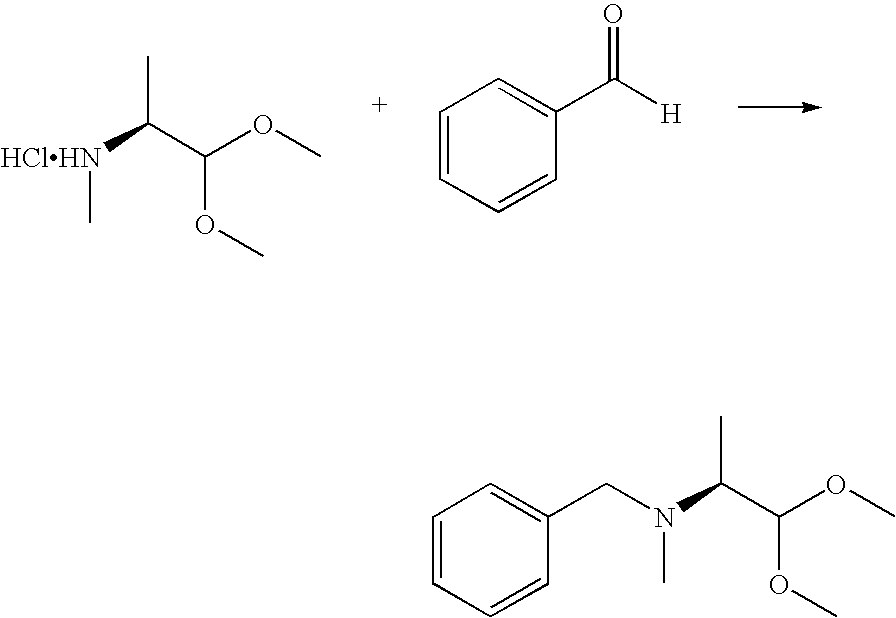
- FLNXDMKZJOFPFH-IDMXKUIJSA-N CNC(C)C(OC)OC.COC(OC)[C@H](C)N(C)CC1=CC=CC=C1.Cl.[H]C(=O)C1=CC=CC=C1 Chemical compound CNC(C)C(OC)OC.COC(OC)[C@H](C)N(C)CC1=CC=CC=C1.Cl.[H]C(=O)C1=CC=CC=C1 FLNXDMKZJOFPFH-IDMXKUIJSA-N 0.000 description 1
- AOSOXGRODWOPGI-FJXQXJEOSA-N CNC(C)C(OC)OC.Cl.[H]C(=O)[C@H](C)N(C)C(=O)OC(C)(C)C Chemical compound CNC(C)C(OC)OC.Cl.[H]C(=O)[C@H](C)N(C)C(=O)OC(C)(C)C AOSOXGRODWOPGI-FJXQXJEOSA-N 0.000 description 1
- POOPUDVVPUFDAU-WDSIDYNRSA-N CNC(C)[C@@H](CC(=O)OC(C)(C)C)OC.CO[C@H](CC(=O)OC(C)(C)C)[C@H](C)N(C)CC1=CC=CC=C1.Cl Chemical compound CNC(C)[C@@H](CC(=O)OC(C)(C)C)OC.CO[C@H](CC(=O)OC(C)(C)C)[C@H](C)N(C)CC1=CC=CC=C1.Cl POOPUDVVPUFDAU-WDSIDYNRSA-N 0.000 description 1
- PAPCOBWGUUJAFH-HIBAQLOWSA-N COC(OC)[C@@H]1CCCN1.COC(OC)[C@@H]1CCCN1CC1=CC=CC=C1.[Cl] Chemical compound COC(OC)[C@@H]1CCCN1.COC(OC)[C@@H]1CCCN1CC1=CC=CC=C1.[Cl] PAPCOBWGUUJAFH-HIBAQLOWSA-N 0.000 description 1
- MJXDVSHBZWWVNS-RVYSEXHFSA-N COC(OC)[C@@H]1CCCN1.[Cl].[H]C(=O)[C@@H]1CCCN1C(=O)OC(C)(C)C Chemical compound COC(OC)[C@@H]1CCCN1.[Cl].[H]C(=O)[C@@H]1CCCN1C(=O)OC(C)(C)C MJXDVSHBZWWVNS-RVYSEXHFSA-N 0.000 description 1
- CJFHZQBNMAIVMS-NMNGKWJYSA-N C[C@@H](C(=O)O)N(C)C(=O)OC(C)(C)C.C[C@@H](CO)N(C)C(=O)OC(C)(C)C Chemical compound C[C@@H](C(=O)O)N(C)C(=O)OC(C)(C)C.C[C@@H](CO)N(C)C(=O)OC(C)(C)C CJFHZQBNMAIVMS-NMNGKWJYSA-N 0.000 description 1
- XRUWWPXDMHTRAE-VGMFFHCQSA-N C[C@@H](CO)N(C)C(=O)OC(C)(C)C.[H]C(=O)[C@H](C)N(C)C(=O)OC(C)(C)C Chemical compound C[C@@H](CO)N(C)C(=O)OC(C)(C)C.[H]C(=O)[C@H](C)N(C)C(=O)OC(C)(C)C XRUWWPXDMHTRAE-VGMFFHCQSA-N 0.000 description 1
Classifications
-
- C—CHEMISTRY; METALLURGY
- C07—ORGANIC CHEMISTRY
- C07C—ACYCLIC OR CARBOCYCLIC COMPOUNDS
- C07C217/00—Compounds containing amino and etherified hydroxy groups bound to the same carbon skeleton
- C07C217/02—Compounds containing amino and etherified hydroxy groups bound to the same carbon skeleton having etherified hydroxy groups and amino groups bound to acyclic carbon atoms of the same carbon skeleton
- C07C217/44—Compounds containing amino and etherified hydroxy groups bound to the same carbon skeleton having etherified hydroxy groups and amino groups bound to acyclic carbon atoms of the same carbon skeleton the carbon skeleton being saturated and containing rings
-
- C—CHEMISTRY; METALLURGY
- C07—ORGANIC CHEMISTRY
- C07D—HETEROCYCLIC COMPOUNDS
- C07D207/00—Heterocyclic compounds containing five-membered rings not condensed with other rings, with one nitrogen atom as the only ring hetero atom
- C07D207/02—Heterocyclic compounds containing five-membered rings not condensed with other rings, with one nitrogen atom as the only ring hetero atom with only hydrogen or carbon atoms directly attached to the ring nitrogen atom
- C07D207/04—Heterocyclic compounds containing five-membered rings not condensed with other rings, with one nitrogen atom as the only ring hetero atom with only hydrogen or carbon atoms directly attached to the ring nitrogen atom having no double bonds between ring members or between ring members and non-ring members
- C07D207/08—Heterocyclic compounds containing five-membered rings not condensed with other rings, with one nitrogen atom as the only ring hetero atom with only hydrogen or carbon atoms directly attached to the ring nitrogen atom having no double bonds between ring members or between ring members and non-ring members with hydrocarbon radicals, substituted by hetero atoms, attached to ring carbon atoms
-
- C—CHEMISTRY; METALLURGY
- C07—ORGANIC CHEMISTRY
- C07C—ACYCLIC OR CARBOCYCLIC COMPOUNDS
- C07C215/00—Compounds containing amino and hydroxy groups bound to the same carbon skeleton
- C07C215/02—Compounds containing amino and hydroxy groups bound to the same carbon skeleton having hydroxy groups and amino groups bound to acyclic carbon atoms of the same carbon skeleton
- C07C215/04—Compounds containing amino and hydroxy groups bound to the same carbon skeleton having hydroxy groups and amino groups bound to acyclic carbon atoms of the same carbon skeleton the carbon skeleton being saturated
- C07C215/06—Compounds containing amino and hydroxy groups bound to the same carbon skeleton having hydroxy groups and amino groups bound to acyclic carbon atoms of the same carbon skeleton the carbon skeleton being saturated and acyclic
- C07C215/08—Compounds containing amino and hydroxy groups bound to the same carbon skeleton having hydroxy groups and amino groups bound to acyclic carbon atoms of the same carbon skeleton the carbon skeleton being saturated and acyclic with only one hydroxy group and one amino group bound to the carbon skeleton
-
- C—CHEMISTRY; METALLURGY
- C07—ORGANIC CHEMISTRY
- C07C—ACYCLIC OR CARBOCYCLIC COMPOUNDS
- C07C217/00—Compounds containing amino and etherified hydroxy groups bound to the same carbon skeleton
- C07C217/02—Compounds containing amino and etherified hydroxy groups bound to the same carbon skeleton having etherified hydroxy groups and amino groups bound to acyclic carbon atoms of the same carbon skeleton
- C07C217/04—Compounds containing amino and etherified hydroxy groups bound to the same carbon skeleton having etherified hydroxy groups and amino groups bound to acyclic carbon atoms of the same carbon skeleton the carbon skeleton being acyclic and saturated
- C07C217/28—Compounds containing amino and etherified hydroxy groups bound to the same carbon skeleton having etherified hydroxy groups and amino groups bound to acyclic carbon atoms of the same carbon skeleton the carbon skeleton being acyclic and saturated having one amino group and at least two singly-bound oxygen atoms, with at least one being part of an etherified hydroxy group, bound to the carbon skeleton, e.g. ethers of polyhydroxy amines
- C07C217/40—Compounds containing amino and etherified hydroxy groups bound to the same carbon skeleton having etherified hydroxy groups and amino groups bound to acyclic carbon atoms of the same carbon skeleton the carbon skeleton being acyclic and saturated having one amino group and at least two singly-bound oxygen atoms, with at least one being part of an etherified hydroxy group, bound to the carbon skeleton, e.g. ethers of polyhydroxy amines having at least two singly-bound oxygen atoms, with at least one being part of an etherified hydroxy group, bound to the same carbon atom of the carbon skeleton, e.g. amino-ketals, ortho esters
-
- C—CHEMISTRY; METALLURGY
- C07—ORGANIC CHEMISTRY
- C07C—ACYCLIC OR CARBOCYCLIC COMPOUNDS
- C07C223/00—Compounds containing amino and —CHO groups bound to the same carbon skeleton
- C07C223/02—Compounds containing amino and —CHO groups bound to the same carbon skeleton having amino groups bound to acyclic carbon atoms of the carbon skeleton
-
- C—CHEMISTRY; METALLURGY
- C07—ORGANIC CHEMISTRY
- C07C—ACYCLIC OR CARBOCYCLIC COMPOUNDS
- C07C229/00—Compounds containing amino and carboxyl groups bound to the same carbon skeleton
- C07C229/02—Compounds containing amino and carboxyl groups bound to the same carbon skeleton having amino and carboxyl groups bound to acyclic carbon atoms of the same carbon skeleton
- C07C229/04—Compounds containing amino and carboxyl groups bound to the same carbon skeleton having amino and carboxyl groups bound to acyclic carbon atoms of the same carbon skeleton the carbon skeleton being acyclic and saturated
- C07C229/06—Compounds containing amino and carboxyl groups bound to the same carbon skeleton having amino and carboxyl groups bound to acyclic carbon atoms of the same carbon skeleton the carbon skeleton being acyclic and saturated having only one amino and one carboxyl group bound to the carbon skeleton
- C07C229/10—Compounds containing amino and carboxyl groups bound to the same carbon skeleton having amino and carboxyl groups bound to acyclic carbon atoms of the same carbon skeleton the carbon skeleton being acyclic and saturated having only one amino and one carboxyl group bound to the carbon skeleton the nitrogen atom of the amino group being further bound to acyclic carbon atoms or to carbon atoms of rings other than six-membered aromatic rings
- C07C229/12—Compounds containing amino and carboxyl groups bound to the same carbon skeleton having amino and carboxyl groups bound to acyclic carbon atoms of the same carbon skeleton the carbon skeleton being acyclic and saturated having only one amino and one carboxyl group bound to the carbon skeleton the nitrogen atom of the amino group being further bound to acyclic carbon atoms or to carbon atoms of rings other than six-membered aromatic rings to carbon atoms of acyclic carbon skeletons
-
- C—CHEMISTRY; METALLURGY
- C07—ORGANIC CHEMISTRY
- C07C—ACYCLIC OR CARBOCYCLIC COMPOUNDS
- C07C229/00—Compounds containing amino and carboxyl groups bound to the same carbon skeleton
- C07C229/02—Compounds containing amino and carboxyl groups bound to the same carbon skeleton having amino and carboxyl groups bound to acyclic carbon atoms of the same carbon skeleton
- C07C229/04—Compounds containing amino and carboxyl groups bound to the same carbon skeleton having amino and carboxyl groups bound to acyclic carbon atoms of the same carbon skeleton the carbon skeleton being acyclic and saturated
- C07C229/22—Compounds containing amino and carboxyl groups bound to the same carbon skeleton having amino and carboxyl groups bound to acyclic carbon atoms of the same carbon skeleton the carbon skeleton being acyclic and saturated the carbon skeleton being further substituted by oxygen atoms
-
- C—CHEMISTRY; METALLURGY
- C07—ORGANIC CHEMISTRY
- C07C—ACYCLIC OR CARBOCYCLIC COMPOUNDS
- C07C271/00—Derivatives of carbamic acids, i.e. compounds containing any of the groups, the nitrogen atom not being part of nitro or nitroso groups
- C07C271/06—Esters of carbamic acids
- C07C271/08—Esters of carbamic acids having oxygen atoms of carbamate groups bound to acyclic carbon atoms
- C07C271/10—Esters of carbamic acids having oxygen atoms of carbamate groups bound to acyclic carbon atoms with the nitrogen atoms of the carbamate groups bound to hydrogen atoms or to acyclic carbon atoms
- C07C271/16—Esters of carbamic acids having oxygen atoms of carbamate groups bound to acyclic carbon atoms with the nitrogen atoms of the carbamate groups bound to hydrogen atoms or to acyclic carbon atoms to carbon atoms of hydrocarbon radicals substituted by singly-bound oxygen atoms
-
- C—CHEMISTRY; METALLURGY
- C07—ORGANIC CHEMISTRY
- C07C—ACYCLIC OR CARBOCYCLIC COMPOUNDS
- C07C271/00—Derivatives of carbamic acids, i.e. compounds containing any of the groups, the nitrogen atom not being part of nitro or nitroso groups
- C07C271/06—Esters of carbamic acids
- C07C271/08—Esters of carbamic acids having oxygen atoms of carbamate groups bound to acyclic carbon atoms
- C07C271/10—Esters of carbamic acids having oxygen atoms of carbamate groups bound to acyclic carbon atoms with the nitrogen atoms of the carbamate groups bound to hydrogen atoms or to acyclic carbon atoms
- C07C271/18—Esters of carbamic acids having oxygen atoms of carbamate groups bound to acyclic carbon atoms with the nitrogen atoms of the carbamate groups bound to hydrogen atoms or to acyclic carbon atoms to carbon atoms of hydrocarbon radicals substituted by doubly-bound oxygen atoms
-
- C—CHEMISTRY; METALLURGY
- C07—ORGANIC CHEMISTRY
- C07C—ACYCLIC OR CARBOCYCLIC COMPOUNDS
- C07C271/00—Derivatives of carbamic acids, i.e. compounds containing any of the groups, the nitrogen atom not being part of nitro or nitroso groups
- C07C271/06—Esters of carbamic acids
- C07C271/08—Esters of carbamic acids having oxygen atoms of carbamate groups bound to acyclic carbon atoms
- C07C271/10—Esters of carbamic acids having oxygen atoms of carbamate groups bound to acyclic carbon atoms with the nitrogen atoms of the carbamate groups bound to hydrogen atoms or to acyclic carbon atoms
- C07C271/22—Esters of carbamic acids having oxygen atoms of carbamate groups bound to acyclic carbon atoms with the nitrogen atoms of the carbamate groups bound to hydrogen atoms or to acyclic carbon atoms to carbon atoms of hydrocarbon radicals substituted by carboxyl groups
Definitions
- the present invention relates to compounds of formula I
- R 1 -R 4 are as herein defined, and to a process (Mukaiyama Aldol reaction) for the preparation of such compounds.
- Compounds of formula I are useful intermediates in the synthesis of other products, including, e.g. Dolastatin 10.
- Mukaiyama Aldol reactions are known. Dialkyl acetals are known to be substituted by Mukaiyama aldol reactions with silyl enol ethers or silyl ketene acetals affording ⁇ -alkoxy ketones or esters (K. Saigo, M. Osaki, T. Mukaiyama, Chem. Lett. 1976, 769-770; T. Mukaiyama, M. Murakami, Synthesis 1987, 1043-1054; S. Kano, T. Yokomatsu, H. Iwasawa, S. Shibuya, Chem. Lett. 1987, 1531-1534; M. A. Graham, A. H. Wadsworth, M.
- N-benzyl-protected dialkyl acetal derivatives undergo desired aldol reaction with high diastereoselectivity using a Mukaiyama aldol reaction.
- the present invention relates to a process of the preparation of compounds of formula I
- R 1 is C 1-4 alkyl, C 3-6 cycloalkyl-C 1-4 alkyl or aryl-C 1-4 alkyl
- R 2 is C 1-4 alkyl, benzyl, substituted benzyl or allyl
- R 3 is C 1-4 alkyl or allyl
- R 4 is C 1-4 alkyl, allyl, benzyl or substituted benzyl
- R 4 ′ is benzyl or substituted benzyl; or alternatively R 1 and R 4 together with the nitrogen to which they are bound form a pyrrolidine group
- R 5 is a trialkylsilyl group.
- the invention relates to compounds of formula I as defined above.
- the invention relates to compounds of formula II as described above, and compounds of formula IV and VI as defined below.
- C 1-4 alkyl denotes straight or branched chain hydrocarbon residues containing 1 to 4 carbon atoms, such as methyl, ethyl, n-propyl, isopropyl, n-butyl, sec-butyl, isobutyl or tert-butyl.
- C 1-4 alkyl in R 1 is methyl, ethyl, n-propyl, isopropyl, n-butyl, sec-butyl (the R or S isomer), isobutyl or tert-butyl. More preferably, C 1-4 alkyl in R 1 is methyl, ethyl, isopropyl or sec-butyl (the R or S isomer). Most preferably it denotes a (S)-sec-butyl group as depicted in Example 1-12.
- C 1-4 alkyl in R 2 is preferably methyl, ethyl or tert-butyl, most preferably it denotes a tert-butyl group.
- C 1-4 alkyl in R 3 is preferably methyl or ethyl; most preferably it denotes a methyl group.
- C 1-4 alkyl in R 4 is preferably methyl or ethyl; most preferably it denotes a methyl group.
- C 3-6 cycloalkyl-C 1-4 alkyl denotes a C 3-6 cycloalkyl (cyclopropyl, cyclobutyl, cyclopentyl or cyclohexyl) linked to a C 1-4 alkyl group as defined above.
- C 3-6 cydoalkyl-C 1-4 alkyl denotes a cyclohexylmethyl group.
- aryl-C 1-4 alkyl denotes a aryl group as defined below linked to a C 1-4 alkyl group as defined above.
- aryl-C 1-4 alkyl denotes a benzyl group.
- aryl denotes an optionally substituted phenyl and naphthyl, both optionally benz-fused to an optionally substituted saturated, partially unsaturated or aromatic monocyclic, bicyclic or tricyclic heterocycle or carbocycle e.g. to cyclohexyl or cyclopentyl.
- aryl as used herein denotes a phenyl group.
- allyl means a monovalent radical —C 3 H 5 which contains a double bond.
- benzyl means the monovalent aryl radical PhCH 2 —.
- substituted benzyl as used herein for the substituents R 2 , R 4 and R 4′ , denotes the following substituents attached to the benzyl group: 2,4,6-trimethyl, 3-methoxy, 4-methoxy, 2,4-dimethoxy, 3,4-dimethoxy, 3,5-dimethoxy, 2-nitro, 4-nitro, 2,4-dinitro, 4-bromo, 4-phenyl and 3,4-methylene-dioxy.
- titanium alkylsilyl group denotes a Si(C 1-6 alkyl) 3 , group wherein C 1-6 alkyl denotes straight or branched chain hydrocarbon residues containing 1 to 6 carbon atoms, such as methyl, ethyl, n-propyl, isopropyl, n-butyl, sec-butyl, isobutyl, tert-butyl, pentyl or hexyl.
- titanium alkylsilyl group denotes the following groups: dimethyl-tert-butyl-silyl, trimethyl-silyl or triethyl-silyl, most preferably it denotes a dimethyl-tert-butyl-silyl group.
- Lewis acid denotes to BF 3 , TMSOTf, TiCl 4 or the corresponding solvent complexes, such as BF 3 .OEt 2 or BF 3 .DMF, preferably BF 3 .DMF.
- organic solvent as used for the synthesis of compound of formula I denotes solvents such as dichloromethane MeCN, THF, DMF (N,N-dimethylformamide), CHCl 3 , toluene or dichlorethane . Most preferably, dichloromethane may be used as the organic solvent.
- organic solvent as used for the synthesis of a compound of formula II (reaction of the compound of formula IV and V) denotes alcohols, such as methanol, ethanol, propanol and butanol. In a preferred embodiment the alcohol depends on the substituent R 3 . If, for example, R 3 is methyl the solvent is methanol.
- organic solvent as used for the synthesis of the compound of formula II (reaction of the compound of formula VI and benzaldehyde) denotes a chlorinated solvent, such as dichloromethane, trichlormethane or dichlorethane. Most preferably, dichloromethane may be used as organic solvent.
- acid denotes HCl, HBr, H 2 SO 4 , CF 3 SO 3 H or p-Toluenesulfonic acid. Most preferably the term “acid” denotes H 2 SO 4 or HCl.
- mineral acid as used herein means HCl, HBr, H 2 SO 4 or CF 3 SO 3 H, preferably HCl or H 2 SO 4 .
- reducing agent denotes NaHB(OAc) 3 or NaBH 4 . Most preferably the term “reducing agent” denotes NaHB(OAc) 3 .
- base denotes typical N-containing organic bases, such as Me 3 N, Et 3 N, or pyridine. Most preferably, the term “base” denotes to Et 3 N.
- the synthesis of the compound of formula I is carried out at a temperature range of ⁇ 40° C. to 70° C., preferably at a temperature range of ⁇ 20° C. to 30° C., and most preferably at a temperature range of ⁇ 10° C. to 10° C.
- R 1 is C 1-4 alkyl, C 3-6 cycloalkyl-C 1-4 alkyl or aryl-C 1-4 alkyl
- R 4 is C 1-4 alkyl, allyl, benzyl or substituted benzyl
- R 4 ′ is benzyl or substituted benzyl, or R 1 and R 4 together with the nitrogen to which they are bound form a pyrrolidine group
- a compound of formula V HC(OR 3 ) 3 V wherein R 3 is C 1-4 alkyl or allyl; in the presence of an organic solvent and an acid.
- a compound of formula II may be obtained by contacting a compound of formula VI
- R 1 and R 3 are as defined above; with benzaldehyde or substituted benzaldehyde, a reducing agent, a base and an organic solvent.
- benzaldehyde is used.
- substituted benzaldehyde as used herein for the synthesis of compounds of formula IV (from compounds of formula VI), denotes to the following substituents attached to the phenyl group of the substituted benzaldehyde: 2,4,6-trimethyl, 3-methoxy, 4-methoxy, 2,4-dimethoxy, 3,4-dimethoxy, 3,5-dimethoxy, 2-nitro, 4-nitro, 2,4-dinitro, 4-bromo, 4-phenyl and 3,4-methylene-dioxy.
- the substituted benzaldehyde is either commercially available or may be alternatively synthesized according to methods known from textbooks on organic chemistry (e.g. J. March (1992), “Advanced Organic Chemistry: Reactions, Mechanisms, and Structure”, 4 th ed. John Wiley & Sons).
- R 1 is methyl, ethyl, isopropyl or sec-butyl
- R 2 is methyl, ethyl or tert-butyl
- R 3 is methyl or ethyl
- R 4 is C 1-4 alkyl, allyl or benzyl
- R 4 ′ is benzyl
- R 5 is dimethyl-tert-butyl-silyl, trimethyl-silyl or triethyl-silyl
- the Lewis acid is BF 3 , TMSOTf, TiCl 4 , BF 3 .OEt 2 or BF 3 .DMF.
- R 1 is (S)-sec-butyl
- R 2 is tert-butyl
- R 3 is methyl
- R 4 is methyl
- R 4 ′ is benzyl
- R 5 is dimethyl-tert-butyl-silyl
- the Lewis acid is BF 3 .DMF.
- R 1 is C 1-4 alkyl, C 3-6 cycloalkyl-C 1-4 alkyl or aryl-C 1-4 alkyl;
- R 2 is C 1-4 alkyl, benzyl, substituted benzyl or allyl;
- R 3 is C 1-4 alkyl or allyl;
- R 4 is C 1-4 alkyl, allyl, benzyl or substituted benzyl;
- R 4 ′ is benzyl or substituted benzyl; or alternatively, R 1 and R 4 together with the nitrogen to which they are bound form a pyrrolidine group.
- R 1 is methyl, ethyl, isopropyl, sec-butyl, cyclohexylmethyl, and benzyl
- R 2 is methyl, ethyl or tert-butyl
- R 3 is methyl or ethyl
- R 4 is methyl, ethyl, allyl or benzyl
- R 4 ′ is benzyl
- R 1 is (S)-sec-butyl
- R 2 is tert-butyl
- R 3 is methyl
- R 4 is methyl
- R 4 ′ is benzyl
- R 1 is C 1-4 alkyl, C 3-6 cycloalkyl-C 1-4 alkyl or aryl-C 1-4 alkyl;
- R 3 is C 1-4 alkyl or allyl;
- R 4 is C 1-4 alkyl, allyl, benzyl or substituted benzyl;
- R 4 ′ is benzyl or substituted benzyl; or alternatively, R 1 and R 4 together with the nitrogen to which they are bound form a pyrrolidine group.
- R 1 is methyl, ethyl, isopropyl or sec-butyl
- R 3 is methyl or ethyl
- R 4 is methyl, ethyl, allyl or benzyl
- R 4 ′ is benzyl
- R 1 is (S)-sec-butyl
- R 3 is methyl
- R 4 is methyl
- R 4 ′ is benzyl
- R 1 is C 1-4 alkyl, C 3-6 cycloalkyl-C 1-4 alkyl or aryl-C 1-4 alkyl
- R 4 is C 1-4 alkyl, allyl, benzyl or substituted benzyl
- R 4 ′ is benzyl or substituted benzyl, or alternatively, R 1 and R 4 together with the nitrogen to which they are bound form a pyrrolidine group.
- R 1 is methyl, ethyl, isopropyl or sec-butyl
- R 4 is methyl, ethyl, allyl or benzyl
- R 4 ′ is benzyl
- R 1 is (S)-sec-butyl
- R 4 is methyl
- R 4 ′ is benzyl
- R 1 is C 1-4 alkyl, C 3-6 cycloalkyl-C 1-4 alkyl or aryl-C 1-4 alkyl;
- R 4 is C 1-4 alkyl, allyl, benzyl or substituted benzyl;
- R 4 ′ is benzyl or substituted benzyl; or alternatively,
- R 1 and R 4 together with the nitrogen to which they are bound form a pyrrolidine group is a follows:
- the starting material compound of formula a wherein R 1 is C 1-4 alkyl, C 3-6 cycloalkyl-C 1-4 alkyl or aryl-C 1-4 alkyl, is either commercially available or can be synthesized according to methods well known to the skilled artisan and as for example disclosed in textbooks on organic chemistry (e.g. J. March (1992), “Advanced Organic Chemistry: Reactions, Mechanisms, and Structure”, 4 th ed. John Wiley & Sons).
- R 1 is C 1-4 alkyl, C 3-6 cycloalkyl-C 1-4 alkyl or aryl-C 1-4 alkyl;
- R 3 is C 1-4 alkyl or allyl; is as follows:
- the starting material compound of formula d wherein R 1 is C 1-4 alkyl, C 3-6 cycloalkyl-C 1-4 alkyl or aryl-C 1-4 alkyl, is either commercially available or can be synthesized according to methods well known to the skilled artisan and as for example described in textbooks on organic chemistry (e.g. J. March (1992), “Advanced Organic Chemistry: Reactions, Mechanisms, and Structure”, 4 th ed. John Wiley & Sons).
- the compounds of formula I are important building blocks for the production of useful products in the chemical, agricultural and in the pharmaceutical industry.
- they are useful for the production of anticancer substances as for example Dolastatin 10 or derivatives thereof as for example described in G. R. Pettit, “The Dolastatins”, Progress in the Chemistry of Organic Natural Compounds, Springer, Vienna 1997, Vol. 70, 1-79, or in WO 03/008378.
- Another embodiment of the present invention is the process as described above, wherein a compound of formula I is further reacted to give a compound of formula A
- R 1 , R 2 , R 3 and R 4 are as defined herein before; R 7 , R 8 , R 9 and R 10 independently from each other represent alkyl; and R 11 is phenylalkyl-, or phenyldialkylamino or phenylalkyloxy, having (C 1 -C 4 )-alkylene and wherein the phenyl group optionally may be substituted with one, two or three substituents selected from the group consisting of halogen, alkoxycarbonyl, sulfamoyl, alkylcarbonyloxy, carbamoyloxy, cyano, mono- or di-alkylamino, alkyl, alkoxy, phenyl, phenoxy, trifluoromethyl, trifluoromethoxy, alkylthio, hydroxy, alkylcarbonylamino, 1,3-dioxolyl, 1,4-dioxolyl, amino and benz
- the N-protected valine derivative in step b) of the process as described above is the compound of formula F,
- N-protected amino acids as for example valine and/or derivatives thereof as mentioned above are well known to the skilled artisan.
- said deprotection of the N-protected valine derivative according to step b) of the process described above is preferably carried out by hydrogenolysis.
- Still another embodiment of the present invention is the process as described above, wherein
- R 1 is sec-butyl
- R 2 is tert-butyl
- R 3 , R 4 , R 7 , R 8 , R 9 , and R 10 are methyl
- R 11 is 2-(3-hydroxyphenyl) ethyl-methyl amino.
- Still another embodiment of the present invention is the process as described above for the manufacture of the compound of formula A-1
- Yet another embodiment of the present invention is the use of the process according to the present invention in the manufacture of the compounds of formula A as defined above.
- Yet another embodiment of the present invention is the use of the process according to the present invention in the manufacture of the compound of formula A-1 as defined above.
Landscapes
- Chemical & Material Sciences (AREA)
- Organic Chemistry (AREA)
- Organic Low-Molecular-Weight Compounds And Preparation Thereof (AREA)
- Pyrrole Compounds (AREA)
Abstract

and a process for the preparation of such compounds are disclosed.
Description

wherein R1-R4 are as herein defined, and to a process (Mukaiyama Aldol reaction) for the preparation of such compounds. Compounds of formula I are useful intermediates in the synthesis of other products, including, e.g. Dolastatin 10.

comprising reacting a compound of formula II

with a compound of formula III

in the presence of a Lewis acid and an organic solvent;
wherein
R1 is C1-4 alkyl, C3-6 cycloalkyl-C1-4 alkyl or aryl-C1-4 alkyl;
R2 is C1-4 alkyl, benzyl, substituted benzyl or allyl;
R3 is C1-4 alkyl or allyl;
R4 is C1-4 alkyl, allyl, benzyl or substituted benzyl;
R4′ is benzyl or substituted benzyl; or alternatively
R1 and R4 together with the nitrogen to which they are bound form a pyrrolidine group; and
R5 is a trialkylsilyl group.

is synthesized by reacting a compound of formula II

with a compound of formula III

in the presence of a Lewis acid and an organic solvent;
wherein R1-R5 are as defined above.

wherein R1 is C1-4 alkyl, C3-6 cycloalkyl-C1-4 alkyl or aryl-C1-4 alkyl;
R4 is C1-4 alkyl, allyl, benzyl or substituted benzyl;
R4′ is benzyl or substituted benzyl, or
R1 and R4 together with the nitrogen to which they are bound form a pyrrolidine group;
with a compound of formula V
HC(OR3)3 V
wherein R3 is C1-4 alkyl or allyl;
in the presence of an organic solvent and an acid.

wherein R1 and R3 are as defined above;
with benzaldehyde or substituted benzaldehyde, a reducing agent, a base and an organic solvent.
Preferably, benzaldehyde is used.

wherein
R1 is C1-4 alkyl, C3-6 cycloalkyl-C1-4 alkyl or aryl-C1-4 alkyl;
R2 is C1-4 alkyl, benzyl, substituted benzyl or allyl;
R3 is C1-4 alkyl or allyl;
R4 is C1-4 alkyl, allyl, benzyl or substituted benzyl;
R4′ is benzyl or substituted benzyl; or alternatively,
R1 and R4 together with the nitrogen to which they are bound form a pyrrolidine group.

wherein
R1 is C1-4 alkyl, C3-6 cycloalkyl-C1-4 alkyl or aryl-C1-4 alkyl;
R3 is C1-4 alkyl or allyl;
R4 is C1-4 alkyl, allyl, benzyl or substituted benzyl;
R4′ is benzyl or substituted benzyl; or alternatively,
R1 and R4 together with the nitrogen to which they are bound form a pyrrolidine group.

wherein
R1 is C1-4 alkyl, C3-6 cycloalkyl-C1-4 alkyl or aryl-C1-4 alkyl;
R4 is C1-4 alkyl, allyl, benzyl or substituted benzyl;
R4′ is benzyl or substituted benzyl, or alternatively,
R1 and R4 together with the nitrogen to which they are bound form a pyrrolidine group.


as follows:
a) the benzyl or substituted benzyl group of R4′ in formula I is cleaved in the presence of hydrochloric acid, hydrogen and a palladium catalyst to give a compound of formula I-A

b) said compound of formula I-A is further reacted with an N-protected valine derivative to give, after N-deprotection, a compound of formula B,

c) said compound of formula B is further reacted with a compound of formula C

to give a compound of formula D

d) the compound of formula D is further reacted with a compound of formula E

to give a compound of formula A; wherein
R1, R2, R3 and R4 are as defined herein before;
R7, R8, R9 and R10 independently from each other represent alkyl; and
R11 is phenylalkyl-, or phenyldialkylamino or phenylalkyloxy, having (C1-C4)-alkylene and wherein the phenyl group optionally may be substituted with one, two or three substituents selected from the group consisting of halogen, alkoxycarbonyl, sulfamoyl, alkylcarbonyloxy, carbamoyloxy, cyano, mono- or di-alkylamino, alkyl, alkoxy, phenyl, phenoxy, trifluoromethyl, trifluoromethoxy, alkylthio, hydroxy, alkylcarbonylamino, 1,3-dioxolyl, 1,4-dioxolyl, amino and benzyl.


- NMR nuclear magnetic resonance spectroscopy
- IR infra red spectroscopy
- HV high vacuum
- min minute(s)
- h hour(s)
- RT room temperature
- Me methyl
- Et ethyl




Claims (5)


Applications Claiming Priority (2)
| Application Number | Priority Date | Filing Date | Title |
|---|---|---|---|
| EP04102458 | 2004-06-02 | ||
| EP04102458.9 | 2004-06-02 |
Publications (2)
| Publication Number | Publication Date |
|---|---|
| US20050272665A1 US20050272665A1 (en) | 2005-12-08 |
| US7312343B2 true US7312343B2 (en) | 2007-12-25 |
Family
ID=34979563
Family Applications (1)
| Application Number | Title | Priority Date | Filing Date |
|---|---|---|---|
| US11/140,319 Expired - Fee Related US7312343B2 (en) | 2004-06-02 | 2005-05-27 | Synthesis of α-amino-β-alkoxy-carboxylic acid esters |
Country Status (10)
| Country | Link |
|---|---|
| US (1) | US7312343B2 (en) |
| EP (1) | EP1756038A1 (en) |
| JP (1) | JP2008501653A (en) |
| KR (1) | KR20070020060A (en) |
| CN (1) | CN1960965A (en) |
| CA (1) | CA2567914A1 (en) |
| IL (1) | IL179538A0 (en) |
| MX (1) | MXPA06013998A (en) |
| TW (1) | TW200702325A (en) |
| WO (1) | WO2005118525A1 (en) |
Cited By (4)
| Publication number | Priority date | Publication date | Assignee | Title |
|---|---|---|---|---|
| US10494432B2 (en) | 2007-07-16 | 2019-12-03 | Genentech, Inc. | Anti-CD79B antibodies and immunoconjugates and methods of use |
| US10544218B2 (en) | 2008-01-31 | 2020-01-28 | Genentech, Inc. | Anti-CD79B antibodies and immunoconjugates and methods of use |
| US10981987B2 (en) | 2007-07-16 | 2021-04-20 | Genentech, Inc. | Humanized anti-CD79b antibodies and immunoconjugates and methods of use |
| US11000510B2 (en) | 2014-09-23 | 2021-05-11 | Genentech, Inc. | Methods of using anti-CD79b immunoconjugates |
Families Citing this family (10)
| Publication number | Priority date | Publication date | Assignee | Title |
|---|---|---|---|---|
| US7256257B2 (en) * | 2001-04-30 | 2007-08-14 | Seattle Genetics, Inc. | Pentapeptide compounds and uses related thereto |
| DK1545613T3 (en) | 2002-07-31 | 2011-11-14 | Seattle Genetics Inc | Auristatin conjugates and their use in the treatment of cancer, an autoimmune disease or an infectious disease |
| EP2478912B1 (en) | 2003-11-06 | 2016-08-31 | Seattle Genetics, Inc. | Auristatin conjugates with anti-HER2 or anti-CD22 antibodies and their use in therapy |
| US8288352B2 (en) * | 2004-11-12 | 2012-10-16 | Seattle Genetics, Inc. | Auristatins having an aminobenzoic acid unit at the N terminus |
| US7585030B2 (en) * | 2006-07-20 | 2009-09-08 | Galbreath Ashford A | Environmentally friendly layered seating assembly |
| US20090035848A1 (en) * | 2007-08-03 | 2009-02-05 | Robert Hickey | Moving bed biofilm reactor (mbbr) system for conversion of syngas components to liquid products |
| DK2265283T3 (en) | 2008-03-18 | 2014-10-20 | Seattle Genetics Inc | Auristatin drug linker conjugates |
| JP5187534B2 (en) * | 2010-02-12 | 2013-04-24 | 有機合成薬品工業株式会社 | Process for producing N-tert-butoxycarbonyl-4-formylpiperidine |
| KR102356286B1 (en) | 2011-05-27 | 2022-02-08 | 암브룩스, 인코포레이티드 | Compositions containing, methods involving, and uses of non-natural amino acid linked dolastatin derivatives |
| CN116462622B (en) * | 2023-03-10 | 2024-02-09 | 上海药坦药物研究开发有限公司 | Preparation method of N-Boc-L-prolyl |
Citations (1)
| Publication number | Priority date | Publication date | Assignee | Title |
|---|---|---|---|---|
| WO2003008378A1 (en) | 2001-07-19 | 2003-01-30 | F.Hoffmann-La Roche Ag | Dolastatin 10 derivatives |
Family Cites Families (1)
| Publication number | Priority date | Publication date | Assignee | Title |
|---|---|---|---|---|
| US6765000B2 (en) * | 1999-03-17 | 2004-07-20 | Bonner Jr Ernest L | Treatment for reactive arthritis or bursitis |
-
2005
- 2005-05-27 MX MXPA06013998A patent/MXPA06013998A/en not_active Application Discontinuation
- 2005-05-27 KR KR1020067025340A patent/KR20070020060A/en not_active Ceased
- 2005-05-27 CA CA002567914A patent/CA2567914A1/en not_active Abandoned
- 2005-05-27 WO PCT/EP2005/005736 patent/WO2005118525A1/en not_active Ceased
- 2005-05-27 JP JP2007513818A patent/JP2008501653A/en active Pending
- 2005-05-27 EP EP05750539A patent/EP1756038A1/en not_active Withdrawn
- 2005-05-27 US US11/140,319 patent/US7312343B2/en not_active Expired - Fee Related
- 2005-05-27 CN CNA200580017491XA patent/CN1960965A/en active Pending
- 2005-07-08 TW TW094117703A patent/TW200702325A/en unknown
-
2006
- 2006-11-23 IL IL179538A patent/IL179538A0/en unknown
Patent Citations (2)
| Publication number | Priority date | Publication date | Assignee | Title |
|---|---|---|---|---|
| WO2003008378A1 (en) | 2001-07-19 | 2003-01-30 | F.Hoffmann-La Roche Ag | Dolastatin 10 derivatives |
| US20030055002A1 (en) | 2001-07-19 | 2003-03-20 | Toshihiko Fujii | Dolastatin 10 derivatives |
Non-Patent Citations (17)
| Title |
|---|
| Andres, et al., Eur. J. Org. Chem., pp. 1558-1566 (2004), XP002348956. |
| Andres, et al., Tetrahedron, vol. 57, pp. 8521-8530 (2001), XP002348958. |
| Floersheim, P., et al., Chima, Aarau, CH, vol. 46, No. 7/8, pp. 323-334 (1992), XP000863256. |
| Gennari, et al., J. Org. Chem., vol. 60, pp. 6248-6249 (1995), XP002348959. |
| Gennari, et al., Tetrahedron, vol. 53, No. 15, pp. 5593-5608 (1997), XP002348961. |
| Graham, et al., Chem Commun., vol. 11, pp. 966-967 (2001), XP009054987. |
| Graham, et al., Org. Biomol. Chem. 2003, vol. 1, pp. 834-849. |
| Graham, et al., Tetrahedron Lett. 2001, vol. 42, pp. 2865-2868. |
| Hanessian, et al., Angew. Chem. Int. Ed., vol. 40, No. 20, pp. 3810-3813 (2001), XP002348962. |
| Hanessian, et al., Synlett, pp. 351-352 (1997), XP002348960. |
| Kano, et al., Chem. Lett. 1987, pp. 1531-1534. |
| Matsunaga, et al., Heterocycles, vol. 33, No. 1, pp. 235-255 (1992), XP009055491. |
| Mukaiyama, et al., Synthesis 1987, pp. 1043-1054. |
| Pettit, et al., The Dolastatins, Progress in the Chem. Of Organic Natural Compounds, Springer, Vienna, 1997, vol. 70, pp. 1-79. |
| Poli, et al., Tetrahedron, vol. 54, pp. 10403-10418 (1998), XP002348955. |
| Reetz, et al., Tetrahedon Letters, vol. 33, No. 24, pp. 3453-3456 (1992), XP002348957. |
| Saigo, et al., Chem. Lett. 1976, pp. 769-770. |
Cited By (7)
| Publication number | Priority date | Publication date | Assignee | Title |
|---|---|---|---|---|
| US10494432B2 (en) | 2007-07-16 | 2019-12-03 | Genentech, Inc. | Anti-CD79B antibodies and immunoconjugates and methods of use |
| US10981987B2 (en) | 2007-07-16 | 2021-04-20 | Genentech, Inc. | Humanized anti-CD79b antibodies and immunoconjugates and methods of use |
| USRE48558E1 (en) | 2007-07-16 | 2021-05-18 | Genentech, Inc. | Anti-CD79B antibodies and immunoconjugates and methods of use |
| US11866496B2 (en) | 2007-07-16 | 2024-01-09 | Genentech, Inc. | Humanized anti-CD79B antibodies and immunoconjugates and methods of use |
| US10544218B2 (en) | 2008-01-31 | 2020-01-28 | Genentech, Inc. | Anti-CD79B antibodies and immunoconjugates and methods of use |
| US11000510B2 (en) | 2014-09-23 | 2021-05-11 | Genentech, Inc. | Methods of using anti-CD79b immunoconjugates |
| US12016842B2 (en) | 2014-09-23 | 2024-06-25 | Genentech, Inc. | Methods of using anti-CD79b immunoconjugates |
Also Published As
| Publication number | Publication date |
|---|---|
| WO2005118525A1 (en) | 2005-12-15 |
| TW200702325A (en) | 2007-01-16 |
| CA2567914A1 (en) | 2005-12-15 |
| JP2008501653A (en) | 2008-01-24 |
| MXPA06013998A (en) | 2007-02-08 |
| EP1756038A1 (en) | 2007-02-28 |
| CN1960965A (en) | 2007-05-09 |
| IL179538A0 (en) | 2007-05-15 |
| US20050272665A1 (en) | 2005-12-08 |
| KR20070020060A (en) | 2007-02-16 |
Similar Documents
| Publication | Publication Date | Title |
|---|---|---|
| US7312343B2 (en) | Synthesis of α-amino-β-alkoxy-carboxylic acid esters | |
| EP2200983B1 (en) | Method for preparing disubstituted piperidine and intermediates | |
| AU2012601A (en) | Novel esters derived from (rr,ss)-2-hydroxybenzoate of 3-(2-dimethylaminomethyl-1-hydroxycyclohexyl)phenyl | |
| CN107382783B (en) | A kind of chiral beta-amino acid derivative and preparation method thereof | |
| US20100113778A1 (en) | Process for preparing o-chloromethylphenylglyoxylic esters, improved process for preparing (e)-2-(2-chloromethylphenyl)-2-alkoximinoacetic esters, and novel intermediates for their preparation | |
| WO1997028105A1 (en) | Processes for the reduction of carbonyl compounds | |
| JPWO1997028105A1 (en) | Method for reducing carbonyl compounds | |
| CA3183771A1 (en) | Process of preparing butyl-(5s)-5-({2-[4-(butoxycarbonyl)phenyl]ethyl}[2-(2-{[3-chloro-4'-(trifluoromethyl)[biphenyl]-4-yl]methoxy}phenyl)ethyl]amino)-5,6,7,8-tetrahydroquinoline-2-carboxylate | |
| US8624024B2 (en) | Phosphoramide compound, method for producing the same, ligand, complex, catalyst and method for producing optically active alcohol | |
| JP5548129B2 (en) | Asymmetric organic catalyst | |
| JP2008523001A (en) | Novel process for preparing 3-pyrrolidin-2-yl-propionic acid derivatives | |
| US9056817B2 (en) | Arylated β-dicarbonyl compounds and process for the preparation thereof | |
| KR20100034256A (en) | Novel 1,3-butadien-2-yl methyl amine derivatives and a process for their preparation using indium reagents | |
| FR2927076A1 (en) | 2-AMINO-2-PHENYL-ALKANOL DERIVATIVES, THEIR PREPARATION AND THE PHARMACEUTICAL COMPOSITIONS CONTAINING THEM | |
| EP2448916B1 (en) | Production of trans-4-aminocyclopent-2-ene-1-carboxylic acid derivatives | |
| US7705161B2 (en) | Process for producing nitrogenous 5-membered cyclic compound | |
| JP5384353B2 (en) | Method for synthesizing aryloxypropylamine and heteroaryloxypropylamine | |
| US20100076203A1 (en) | Succinic acid diester derivative, process for production thereof, and use of the derivative in the production of pharmaceutical preparation | |
| WO2002048095A1 (en) | Process for producing a-aminohalomethyl ketone derivatives | |
| JP2533110B2 (en) | Optically active fluorine-containing diol derivative | |
| KR20120098686A (en) | Processes for preparing a polymeric compound | |
| EP1926709A1 (en) | Process for the preparation of chiral 3-hydroxy pyrrolidine compound and derivatives thereof having high optical purity | |
| US7763754B2 (en) | Process for producing (1RS,3RS,6RS)-6-dimethylaminomethyl-1-(3-methoxyphenyl)-cyclohexane-1,3-diol | |
| CN101102993A (en) | Novel one-step synthesis of useful disubstituted amines | |
| Liu et al. | The synthesis of a chiral β-amino acid derivative by the Grignard reaction of an aspartic acid equivalent |
Legal Events
| Date | Code | Title | Description |
|---|---|---|---|
| AS | Assignment |
Owner name: HOFFMANN-LA ROCHE INC., NEW JERSEY Free format text: ASSIGNMENT OF ASSIGNORS INTEREST;ASSIGNOR:F. HOFFMANN-LA ROCHE AG;REEL/FRAME:016517/0222 Effective date: 20050524 Owner name: F. HOFFMANN-LA ROCHE AG, SWITZERLAND Free format text: ASSIGNMENT OF ASSIGNORS INTEREST;ASSIGNORS:SCHMID, RUDOLF;ZUTTER, ULRICH;REEL/FRAME:016519/0259 Effective date: 20050523 |
|
| REMI | Maintenance fee reminder mailed | ||
| LAPS | Lapse for failure to pay maintenance fees | ||
| STCH | Information on status: patent discontinuation |
Free format text: PATENT EXPIRED DUE TO NONPAYMENT OF MAINTENANCE FEES UNDER 37 CFR 1.362 |
|
| FP | Lapsed due to failure to pay maintenance fee |
Effective date: 20111225 |