US7312342B2 - Process for the preparation of (3-cyano-1h-indol-7-yl) (4-(4-fluorophenethyl) piperazin-1-yl)-methanone and salts thereof - Google Patents
Process for the preparation of (3-cyano-1h-indol-7-yl) (4-(4-fluorophenethyl) piperazin-1-yl)-methanone and salts thereof Download PDFInfo
- Publication number
- US7312342B2 US7312342B2 US10/466,991 US46699103A US7312342B2 US 7312342 B2 US7312342 B2 US 7312342B2 US 46699103 A US46699103 A US 46699103A US 7312342 B2 US7312342 B2 US 7312342B2
- Authority
- US
- United States
- Prior art keywords
- indole
- carboxylate
- formula
- cyano
- ethyl
- Prior art date
- Legal status (The legal status is an assumption and is not a legal conclusion. Google has not performed a legal analysis and makes no representation as to the accuracy of the status listed.)
- Expired - Fee Related, expires
Links
- 150000003839 salts Chemical class 0.000 title claims abstract description 47
- 238000000034 method Methods 0.000 title claims abstract description 36
- AQRLDDAFYYAIJP-UHFFFAOYSA-N Pruvanserin Chemical compound C1=CC(F)=CC=C1CCN1CCN(C(=O)C=2C=3NC=C(C=3C=CC=2)C#N)CC1 AQRLDDAFYYAIJP-UHFFFAOYSA-N 0.000 title claims abstract description 26
- 238000002360 preparation method Methods 0.000 title claims abstract description 13
- -1 indole ester Chemical class 0.000 claims abstract description 30
- FDASYGXNFLWEMM-UHFFFAOYSA-N 3-cyano-1h-indole-7-carboxylic acid Chemical compound OC(=O)C1=CC=CC2=C1NC=C2C#N FDASYGXNFLWEMM-UHFFFAOYSA-N 0.000 claims abstract description 27
- LODHVDKKTUZVDK-UHFFFAOYSA-N 1-[2-(4-fluorophenyl)ethyl]piperazine Chemical compound C1=CC(F)=CC=C1CCN1CCNCC1 LODHVDKKTUZVDK-UHFFFAOYSA-N 0.000 claims abstract description 12
- SIKJAQJRHWYJAI-UHFFFAOYSA-N benzopyrrole Natural products C1=CC=C2NC=CC2=C1 SIKJAQJRHWYJAI-UHFFFAOYSA-N 0.000 claims abstract description 10
- PZOUSPYUWWUPPK-UHFFFAOYSA-N indole Natural products CC1=CC=CC2=C1C=CN2 PZOUSPYUWWUPPK-UHFFFAOYSA-N 0.000 claims abstract description 10
- RKJUIXBNRJVNHR-UHFFFAOYSA-N indolenine Natural products C1=CC=C2CC=NC2=C1 RKJUIXBNRJVNHR-UHFFFAOYSA-N 0.000 claims abstract description 10
- 150000001875 compounds Chemical class 0.000 claims description 60
- 125000000217 alkyl group Chemical group 0.000 claims description 23
- 125000003710 aryl alkyl group Chemical group 0.000 claims description 20
- 125000004432 carbon atom Chemical group C* 0.000 claims description 20
- VEXZGXHMUGYJMC-UHFFFAOYSA-N Hydrochloric acid Chemical compound Cl VEXZGXHMUGYJMC-UHFFFAOYSA-N 0.000 claims description 14
- 239000002253 acid Substances 0.000 claims description 14
- 150000002148 esters Chemical class 0.000 claims description 9
- GYTQNBPGAFOSTP-UHFFFAOYSA-N ethyl 3-bromo-1h-indole-7-carboxylate Chemical compound CCOC(=O)C1=CC=CC2=C1NC=C2Br GYTQNBPGAFOSTP-UHFFFAOYSA-N 0.000 claims description 9
- 125000001495 ethyl group Chemical group [H]C([H])([H])C([H])([H])* 0.000 claims description 8
- 238000007098 aminolysis reaction Methods 0.000 claims description 6
- 229910052794 bromium Inorganic materials 0.000 claims description 6
- 229910052801 chlorine Inorganic materials 0.000 claims description 6
- WQBIZOLLGSBVLW-UHFFFAOYSA-N ethyl 3-iodo-1h-indole-7-carboxylate Chemical compound CCOC(=O)C1=CC=CC2=C1NC=C2I WQBIZOLLGSBVLW-UHFFFAOYSA-N 0.000 claims description 6
- 229910052740 iodine Inorganic materials 0.000 claims description 6
- GXGCVEVNRZWNRA-UHFFFAOYSA-N methyl 3-cyano-1h-indole-7-carboxylate Chemical compound COC(=O)C1=CC=CC2=C1NC=C2C#N GXGCVEVNRZWNRA-UHFFFAOYSA-N 0.000 claims description 6
- 125000002496 methyl group Chemical group [H]C([H])([H])* 0.000 claims description 6
- 150000002923 oximes Chemical class 0.000 claims description 6
- 230000026030 halogenation Effects 0.000 claims description 5
- 238000005658 halogenation reaction Methods 0.000 claims description 5
- 125000001624 naphthyl group Chemical group 0.000 claims description 5
- 125000001997 phenyl group Chemical group [H]C1=C([H])C([H])=C(*)C([H])=C1[H] 0.000 claims description 5
- QPXSZQXPSYYDOP-UHFFFAOYSA-N benzyl 3-bromo-1h-indole-7-carboxylate Chemical compound C1=CC=C2C(Br)=CNC2=C1C(=O)OCC1=CC=CC=C1 QPXSZQXPSYYDOP-UHFFFAOYSA-N 0.000 claims description 4
- KUVRKVZNJFEROL-UHFFFAOYSA-N benzyl 3-iodo-1h-indole-7-carboxylate Chemical compound C1=CC=C2C(I)=CNC2=C1C(=O)OCC1=CC=CC=C1 KUVRKVZNJFEROL-UHFFFAOYSA-N 0.000 claims description 4
- 125000004093 cyano group Chemical group *C#N 0.000 claims description 4
- NWSOTSIVONXYBH-UHFFFAOYSA-N ethyl 3-cyano-1h-indole-7-carboxylate Chemical compound CCOC(=O)C1=CC=CC2=C1NC=C2C#N NWSOTSIVONXYBH-UHFFFAOYSA-N 0.000 claims description 4
- XQYBKNRDFIWTDO-UHFFFAOYSA-N methyl 3-bromo-1h-indole-7-carboxylate Chemical compound COC(=O)C1=CC=CC2=C1NC=C2Br XQYBKNRDFIWTDO-UHFFFAOYSA-N 0.000 claims description 4
- QHKCXKOTFXOTCP-UHFFFAOYSA-N methyl 3-iodo-1h-indole-7-carboxylate Chemical compound COC(=O)C1=CC=CC2=C1NC=C2I QHKCXKOTFXOTCP-UHFFFAOYSA-N 0.000 claims description 4
- KKVFSCTVCZYCMI-UHFFFAOYSA-N tert-butyl 3-bromo-1h-indole-7-carboxylate Chemical compound CC(C)(C)OC(=O)C1=CC=CC2=C1NC=C2Br KKVFSCTVCZYCMI-UHFFFAOYSA-N 0.000 claims description 4
- RGURVNHQRAVPOX-UHFFFAOYSA-N tert-butyl 3-iodo-1h-indole-7-carboxylate Chemical compound CC(C)(C)OC(=O)C1=CC=CC2=C1NC=C2I RGURVNHQRAVPOX-UHFFFAOYSA-N 0.000 claims description 4
- CLBMREHNICTDNQ-UHFFFAOYSA-N CC(C)(C)OC(=O)C1=CC=CC2=C1NCC2=NO Chemical compound CC(C)(C)OC(=O)C1=CC=CC2=C1NCC2=NO CLBMREHNICTDNQ-UHFFFAOYSA-N 0.000 claims description 3
- JOSNOZILIPXEBS-UHFFFAOYSA-N CCOC(=O)C1=CC=CC2=C1NCC2=NO Chemical compound CCOC(=O)C1=CC=CC2=C1NCC2=NO JOSNOZILIPXEBS-UHFFFAOYSA-N 0.000 claims description 3
- XNUATYYYJPEPBG-UHFFFAOYSA-N COC(=O)C1=CC=CC2=C1NCC2=NO Chemical compound COC(=O)C1=CC=CC2=C1NCC2=NO XNUATYYYJPEPBG-UHFFFAOYSA-N 0.000 claims description 3
- AVXURJPOCDRRFD-UHFFFAOYSA-N Hydroxylamine Chemical compound ON AVXURJPOCDRRFD-UHFFFAOYSA-N 0.000 claims description 3
- LEMJIXSKBAQGHC-UHFFFAOYSA-N ON=C1CNC2=C1C=CC=C2C(=O)OCC1=CC=CC=C1 Chemical compound ON=C1CNC2=C1C=CC=C2C(=O)OCC1=CC=CC=C1 LEMJIXSKBAQGHC-UHFFFAOYSA-N 0.000 claims description 3
- GXKVBXJJMBPUOE-UHFFFAOYSA-N benzyl 3-cyano-1h-indole-7-carboxylate Chemical compound C=1C=CC=2C(C#N)=CNC=2C=1C(=O)OCC1=CC=CC=C1 GXKVBXJJMBPUOE-UHFFFAOYSA-N 0.000 claims description 3
- 238000005580 one pot reaction Methods 0.000 claims description 3
- XLLNHBLVVFLWNP-UHFFFAOYSA-N tert-butyl 3-cyano-1h-indole-7-carboxylate Chemical compound CC(C)(C)OC(=O)C1=CC=CC2=C1NC=C2C#N XLLNHBLVVFLWNP-UHFFFAOYSA-N 0.000 claims description 3
- 238000007333 cyanation reaction Methods 0.000 claims description 2
- 125000004185 ester group Chemical group 0.000 claims 1
- 229910052736 halogen Inorganic materials 0.000 claims 1
- 230000002140 halogenating effect Effects 0.000 claims 1
- 150000002367 halogens Chemical class 0.000 claims 1
- ZMXDDKWLCZADIW-UHFFFAOYSA-N Vilsmeier-Haack reagent Natural products CN(C)C=O ZMXDDKWLCZADIW-UHFFFAOYSA-N 0.000 description 52
- 239000000203 mixture Substances 0.000 description 22
- 0 *OC(=O)C1=C2C(=CC=C1)C=CN2[H].C Chemical compound *OC(=O)C1=C2C(=CC=C1)C=CN2[H].C 0.000 description 18
- CSCPPACGZOOCGX-UHFFFAOYSA-N Acetone Chemical compound CC(C)=O CSCPPACGZOOCGX-UHFFFAOYSA-N 0.000 description 18
- YXFVVABEGXRONW-UHFFFAOYSA-N Toluene Chemical compound CC1=CC=CC=C1 YXFVVABEGXRONW-UHFFFAOYSA-N 0.000 description 15
- 238000006243 chemical reaction Methods 0.000 description 15
- 108090000371 Esterases Proteins 0.000 description 13
- UHOVQNZJYSORNB-UHFFFAOYSA-N Benzene Chemical compound C1=CC=CC=C1 UHOVQNZJYSORNB-UHFFFAOYSA-N 0.000 description 12
- OKKJLVBELUTLKV-UHFFFAOYSA-N Methanol Chemical compound OC OKKJLVBELUTLKV-UHFFFAOYSA-N 0.000 description 12
- 230000015572 biosynthetic process Effects 0.000 description 10
- 238000003786 synthesis reaction Methods 0.000 description 10
- LFQSCWFLJHTTHZ-UHFFFAOYSA-N Ethanol Chemical compound CCO LFQSCWFLJHTTHZ-UHFFFAOYSA-N 0.000 description 9
- XEKOWRVHYACXOJ-UHFFFAOYSA-N Ethyl acetate Chemical compound CCOC(C)=O XEKOWRVHYACXOJ-UHFFFAOYSA-N 0.000 description 9
- SECXISVLQFMRJM-UHFFFAOYSA-N N-Methylpyrrolidone Chemical compound CN1CCCC1=O SECXISVLQFMRJM-UHFFFAOYSA-N 0.000 description 9
- WYURNTSHIVDZCO-UHFFFAOYSA-N Tetrahydrofuran Chemical compound C1CCOC1 WYURNTSHIVDZCO-UHFFFAOYSA-N 0.000 description 8
- 239000000126 substance Substances 0.000 description 8
- XLYOFNOQVPJJNP-UHFFFAOYSA-N water Substances O XLYOFNOQVPJJNP-UHFFFAOYSA-N 0.000 description 8
- QTBSBXVTEAMEQO-UHFFFAOYSA-N Acetic acid Chemical compound CC(O)=O QTBSBXVTEAMEQO-UHFFFAOYSA-N 0.000 description 6
- WEVYAHXRMPXWCK-UHFFFAOYSA-N Acetonitrile Chemical compound CC#N WEVYAHXRMPXWCK-UHFFFAOYSA-N 0.000 description 6
- YMWUJEATGCHHMB-UHFFFAOYSA-N Dichloromethane Chemical compound ClCCl YMWUJEATGCHHMB-UHFFFAOYSA-N 0.000 description 6
- HEMHJVSKTPXQMS-UHFFFAOYSA-M Sodium hydroxide Chemical compound [OH-].[Na+] HEMHJVSKTPXQMS-UHFFFAOYSA-M 0.000 description 6
- 239000000543 intermediate Substances 0.000 description 6
- XHXFXVLFKHQFAL-UHFFFAOYSA-N phosphoryl trichloride Chemical compound ClP(Cl)(Cl)=O XHXFXVLFKHQFAL-UHFFFAOYSA-N 0.000 description 6
- 125000002914 sec-butyl group Chemical group [H]C([H])([H])C([H])([H])C([H])(*)C([H])([H])[H] 0.000 description 6
- 239000002904 solvent Substances 0.000 description 6
- QAOWNCQODCNURD-UHFFFAOYSA-N Sulfuric acid Chemical compound OS(O)(=O)=O QAOWNCQODCNURD-UHFFFAOYSA-N 0.000 description 5
- ZWEHNKRNPOVVGH-UHFFFAOYSA-N 2-Butanone Chemical compound CCC(C)=O ZWEHNKRNPOVVGH-UHFFFAOYSA-N 0.000 description 4
- KFZMGEQAYNKOFK-UHFFFAOYSA-N Isopropanol Chemical compound CC(C)O KFZMGEQAYNKOFK-UHFFFAOYSA-N 0.000 description 4
- LRHPLDYGYMQRHN-UHFFFAOYSA-N N-Butanol Chemical compound CCCCO LRHPLDYGYMQRHN-UHFFFAOYSA-N 0.000 description 4
- CTQNGGLPUBDAKN-UHFFFAOYSA-N O-Xylene Chemical compound CC1=CC=CC=C1C CTQNGGLPUBDAKN-UHFFFAOYSA-N 0.000 description 4
- KDLHZDBZIXYQEI-UHFFFAOYSA-N Palladium Chemical compound [Pd] KDLHZDBZIXYQEI-UHFFFAOYSA-N 0.000 description 4
- NBIIXXVUZAFLBC-UHFFFAOYSA-N Phosphoric acid Chemical compound OP(O)(O)=O NBIIXXVUZAFLBC-UHFFFAOYSA-N 0.000 description 4
- JUJWROOIHBZHMG-UHFFFAOYSA-N Pyridine Chemical compound C1=CC=NC=C1 JUJWROOIHBZHMG-UHFFFAOYSA-N 0.000 description 4
- 150000007513 acids Chemical class 0.000 description 4
- 239000002585 base Substances 0.000 description 4
- 239000013078 crystal Substances 0.000 description 4
- 239000003814 drug Substances 0.000 description 4
- 230000022244 formylation Effects 0.000 description 4
- 238000006170 formylation reaction Methods 0.000 description 4
- 210000004185 liver Anatomy 0.000 description 4
- BDAGIHXWWSANSR-UHFFFAOYSA-N methanoic acid Natural products OC=O BDAGIHXWWSANSR-UHFFFAOYSA-N 0.000 description 4
- 210000000056 organ Anatomy 0.000 description 4
- 238000007127 saponification reaction Methods 0.000 description 4
- YLQBMQCUIZJEEH-UHFFFAOYSA-N tetrahydrofuran Natural products C=1C=COC=1 YLQBMQCUIZJEEH-UHFFFAOYSA-N 0.000 description 4
- JOXIMZWYDAKGHI-UHFFFAOYSA-N toluene-4-sulfonic acid Chemical compound CC1=CC=C(S(O)(=O)=O)C=C1 JOXIMZWYDAKGHI-UHFFFAOYSA-N 0.000 description 4
- 238000010626 work up procedure Methods 0.000 description 4
- 239000008096 xylene Substances 0.000 description 4
- PNEYBMLMFCGWSK-UHFFFAOYSA-N Alumina Chemical compound [O-2].[O-2].[O-2].[Al+3].[Al+3] PNEYBMLMFCGWSK-UHFFFAOYSA-N 0.000 description 3
- RTZKZFJDLAIYFH-UHFFFAOYSA-N Diethyl ether Chemical compound CCOCC RTZKZFJDLAIYFH-UHFFFAOYSA-N 0.000 description 3
- OFOBLEOULBTSOW-UHFFFAOYSA-N Malonic acid Chemical compound OC(=O)CC(O)=O OFOBLEOULBTSOW-UHFFFAOYSA-N 0.000 description 3
- AFVFQIVMOAPDHO-UHFFFAOYSA-N Methanesulfonic acid Chemical compound CS(O)(=O)=O AFVFQIVMOAPDHO-UHFFFAOYSA-N 0.000 description 3
- ZMANZCXQSJIPKH-UHFFFAOYSA-N Triethylamine Chemical compound CCN(CC)CC ZMANZCXQSJIPKH-UHFFFAOYSA-N 0.000 description 3
- 150000001298 alcohols Chemical class 0.000 description 3
- 150000001408 amides Chemical class 0.000 description 3
- 238000006555 catalytic reaction Methods 0.000 description 3
- KRKNYBCHXYNGOX-UHFFFAOYSA-N citric acid Chemical compound OC(=O)CC(O)(C(O)=O)CC(O)=O KRKNYBCHXYNGOX-UHFFFAOYSA-N 0.000 description 3
- 238000001816 cooling Methods 0.000 description 3
- 230000000694 effects Effects 0.000 description 3
- WZXGOHXFXHUJLR-UHFFFAOYSA-N ethyl 1h-indole-7-carboxylate Chemical compound CCOC(=O)C1=CC=CC2=C1NC=C2 WZXGOHXFXHUJLR-UHFFFAOYSA-N 0.000 description 3
- 125000000623 heterocyclic group Chemical group 0.000 description 3
- FTLOEULOTNVCGF-UHFFFAOYSA-N methyl 1h-indole-7-carboxylate Chemical compound COC(=O)C1=CC=CC2=C1NC=C2 FTLOEULOTNVCGF-UHFFFAOYSA-N 0.000 description 3
- JUXJMSUTGAQOBS-UHFFFAOYSA-N methyl 3-(hydroxyiminomethyl)-1H-indole-7-carboxylate Chemical compound COC(=O)C1=CC=CC2=C1NC=C2C=NO JUXJMSUTGAQOBS-UHFFFAOYSA-N 0.000 description 3
- JVUPHJBFLSMOGY-UHFFFAOYSA-N methyl 3-formyl-1h-indole-7-carboxylate Chemical compound COC(=O)C1=CC=CC2=C1NC=C2C=O JVUPHJBFLSMOGY-UHFFFAOYSA-N 0.000 description 3
- 235000011007 phosphoric acid Nutrition 0.000 description 3
- BWKAYBPLDRWMCJ-UHFFFAOYSA-N 1,1-diethoxy-n,n-dimethylmethanamine Chemical compound CCOC(N(C)C)OCC BWKAYBPLDRWMCJ-UHFFFAOYSA-N 0.000 description 2
- RYHBNJHYFVUHQT-UHFFFAOYSA-N 1,4-Dioxane Chemical compound C1COCCO1 RYHBNJHYFVUHQT-UHFFFAOYSA-N 0.000 description 2
- BJMPGMOWXAYATG-UHFFFAOYSA-N 1-[2-(4-fluorophenyl)ethyl]piperazine;dihydrochloride Chemical compound Cl.Cl.C1=CC(F)=CC=C1CCN1CCNCC1 BJMPGMOWXAYATG-UHFFFAOYSA-N 0.000 description 2
- OSWFIVFLDKOXQC-UHFFFAOYSA-N 4-(3-methoxyphenyl)aniline Chemical compound COC1=CC=CC(C=2C=CC(N)=CC=2)=C1 OSWFIVFLDKOXQC-UHFFFAOYSA-N 0.000 description 2
- DGDAVTPQCQXLGU-UHFFFAOYSA-N 5437-38-7 Chemical compound CC1=CC=CC(C(O)=O)=C1[N+]([O-])=O DGDAVTPQCQXLGU-UHFFFAOYSA-N 0.000 description 2
- CIWBSHSKHKDKBQ-JLAZNSOCSA-N Ascorbic acid Chemical compound OC[C@H](O)[C@H]1OC(=O)C(O)=C1O CIWBSHSKHKDKBQ-JLAZNSOCSA-N 0.000 description 2
- HEDRZPFGACZZDS-UHFFFAOYSA-N Chloroform Chemical compound ClC(Cl)Cl HEDRZPFGACZZDS-UHFFFAOYSA-N 0.000 description 2
- RGHNJXZEOKUKBD-SQOUGZDYSA-N D-gluconic acid Chemical compound OC[C@@H](O)[C@@H](O)[C@H](O)[C@@H](O)C(O)=O RGHNJXZEOKUKBD-SQOUGZDYSA-N 0.000 description 2
- 206010012335 Dependence Diseases 0.000 description 2
- VZCYOOQTPOCHFL-OWOJBTEDSA-N Fumaric acid Chemical compound OC(=O)\C=C\C(O)=O VZCYOOQTPOCHFL-OWOJBTEDSA-N 0.000 description 2
- WTDHULULXKLSOZ-UHFFFAOYSA-N Hydroxylamine hydrochloride Chemical compound Cl.ON WTDHULULXKLSOZ-UHFFFAOYSA-N 0.000 description 2
- ZSXGLVDWWRXATF-UHFFFAOYSA-N N,N-dimethylformamide dimethyl acetal Chemical compound COC(OC)N(C)C ZSXGLVDWWRXATF-UHFFFAOYSA-N 0.000 description 2
- PVNIIMVLHYAWGP-UHFFFAOYSA-N Niacin Chemical compound OC(=O)C1=CC=CN=C1 PVNIIMVLHYAWGP-UHFFFAOYSA-N 0.000 description 2
- PXHVJJICTQNCMI-UHFFFAOYSA-N Nickel Chemical compound [Ni] PXHVJJICTQNCMI-UHFFFAOYSA-N 0.000 description 2
- SMWDFEZZVXVKRB-UHFFFAOYSA-N Quinoline Chemical compound N1=CC=CC2=CC=CC=C21 SMWDFEZZVXVKRB-UHFFFAOYSA-N 0.000 description 2
- 235000011054 acetic acid Nutrition 0.000 description 2
- 239000004480 active ingredient Substances 0.000 description 2
- 238000005917 acylation reaction Methods 0.000 description 2
- 239000003513 alkali Substances 0.000 description 2
- 229910052784 alkaline earth metal Inorganic materials 0.000 description 2
- 239000005557 antagonist Substances 0.000 description 2
- 239000000010 aprotic solvent Substances 0.000 description 2
- WPYMKLBDIGXBTP-UHFFFAOYSA-N benzoic acid Chemical compound OC(=O)C1=CC=CC=C1 WPYMKLBDIGXBTP-UHFFFAOYSA-N 0.000 description 2
- 125000001797 benzyl group Chemical group [H]C1=C([H])C([H])=C(C([H])=C1[H])C([H])([H])* 0.000 description 2
- XBDQKXXYIPTUBI-UHFFFAOYSA-N dimethylselenoniopropionate Natural products CCC(O)=O XBDQKXXYIPTUBI-UHFFFAOYSA-N 0.000 description 2
- 150000002170 ethers Chemical class 0.000 description 2
- XUTDEDCNVFAAEQ-UHFFFAOYSA-N ethyl 3-formyl-1h-indole-7-carboxylate Chemical compound CCOC(=O)C1=CC=CC2=C1NC=C2C=O XUTDEDCNVFAAEQ-UHFFFAOYSA-N 0.000 description 2
- 235000019253 formic acid Nutrition 0.000 description 2
- 239000012458 free base Substances 0.000 description 2
- 229940093915 gynecological organic acid Drugs 0.000 description 2
- 125000005843 halogen group Chemical group 0.000 description 2
- 229930195733 hydrocarbon Natural products 0.000 description 2
- 150000002430 hydrocarbons Chemical class 0.000 description 2
- 238000011065 in-situ storage Methods 0.000 description 2
- 150000002475 indoles Chemical class 0.000 description 2
- SUMDYPCJJOFFON-UHFFFAOYSA-N isethionic acid Chemical compound OCCS(O)(=O)=O SUMDYPCJJOFFON-UHFFFAOYSA-N 0.000 description 2
- 125000000959 isobutyl group Chemical group [H]C([H])([H])C([H])(C([H])([H])[H])C([H])([H])* 0.000 description 2
- TWBYWOBDOCUKOW-UHFFFAOYSA-N isonicotinic acid Chemical compound OC(=O)C1=CC=NC=C1 TWBYWOBDOCUKOW-UHFFFAOYSA-N 0.000 description 2
- 150000002576 ketones Chemical class 0.000 description 2
- JVTAAEKCZFNVCJ-UHFFFAOYSA-N lactic acid Chemical compound CC(O)C(O)=O JVTAAEKCZFNVCJ-UHFFFAOYSA-N 0.000 description 2
- 238000002844 melting Methods 0.000 description 2
- 230000008018 melting Effects 0.000 description 2
- CGRCGYSAUITVAA-UHFFFAOYSA-N methyl 2-cyano-1h-indole-7-carboxylate Chemical compound COC(=O)C1=CC=CC2=C1NC(C#N)=C2 CGRCGYSAUITVAA-UHFFFAOYSA-N 0.000 description 2
- 150000007522 mineralic acids Chemical class 0.000 description 2
- 150000002825 nitriles Chemical class 0.000 description 2
- 150000007524 organic acids Chemical class 0.000 description 2
- 235000005985 organic acids Nutrition 0.000 description 2
- 238000006146 oximation reaction Methods 0.000 description 2
- 229910052763 palladium Inorganic materials 0.000 description 2
- WLJVNTCWHIRURA-UHFFFAOYSA-N pimelic acid Chemical compound OC(=O)CCCCCC(O)=O WLJVNTCWHIRURA-UHFFFAOYSA-N 0.000 description 2
- UMJSCPRVCHMLSP-UHFFFAOYSA-N pyridine Natural products COC1=CC=CN=C1 UMJSCPRVCHMLSP-UHFFFAOYSA-N 0.000 description 2
- 239000011541 reaction mixture Substances 0.000 description 2
- YGSDEFSMJLZEOE-UHFFFAOYSA-N salicylic acid Chemical compound OC(=O)C1=CC=CC=C1O YGSDEFSMJLZEOE-UHFFFAOYSA-N 0.000 description 2
- 238000003756 stirring Methods 0.000 description 2
- VZCYOOQTPOCHFL-UHFFFAOYSA-N trans-butenedioic acid Natural products OC(=O)C=CC(O)=O VZCYOOQTPOCHFL-UHFFFAOYSA-N 0.000 description 2
- BJEPYKJPYRNKOW-REOHCLBHSA-N (S)-malic acid Chemical compound OC(=O)[C@@H](O)CC(O)=O BJEPYKJPYRNKOW-REOHCLBHSA-N 0.000 description 1
- KEXFRBIOHPDZQM-UHFFFAOYSA-N 1,1-bis(2,2-dimethylpropoxy)-n,n-dimethylmethanamine Chemical compound CC(C)(C)COC(N(C)C)OCC(C)(C)C KEXFRBIOHPDZQM-UHFFFAOYSA-N 0.000 description 1
- GSFFXKGTGPMVLM-UHFFFAOYSA-N 1,1-dibutoxy-n,n-dimethylmethanamine Chemical compound CCCCOC(N(C)C)OCCCC GSFFXKGTGPMVLM-UHFFFAOYSA-N 0.000 description 1
- 125000005919 1,2,2-trimethylpropyl group Chemical group 0.000 description 1
- 125000006218 1-ethylbutyl group Chemical group [H]C([H])([H])C([H])([H])C([H])([H])C([H])(*)C([H])([H])C([H])([H])[H] 0.000 description 1
- 125000006219 1-ethylpentyl group Chemical group [H]C([H])([H])C([H])([H])C([H])([H])C([H])([H])C([H])(*)C([H])([H])C([H])([H])[H] 0.000 description 1
- SBNOTUDDIXOFSN-UHFFFAOYSA-N 1h-indole-2-carbaldehyde Chemical class C1=CC=C2NC(C=O)=CC2=C1 SBNOTUDDIXOFSN-UHFFFAOYSA-N 0.000 description 1
- CBTITARLOCZPDU-UHFFFAOYSA-N 1h-indole-2-carbonitrile Chemical class C1=CC=C2NC(C#N)=CC2=C1 CBTITARLOCZPDU-UHFFFAOYSA-N 0.000 description 1
- OXQGTIUCKGYOAA-UHFFFAOYSA-N 2-Ethylbutanoic acid Chemical compound CCC(CC)C(O)=O OXQGTIUCKGYOAA-UHFFFAOYSA-N 0.000 description 1
- 125000006176 2-ethylbutyl group Chemical group [H]C([H])([H])C([H])([H])C([H])(C([H])([H])*)C([H])([H])C([H])([H])[H] 0.000 description 1
- 125000004493 2-methylbut-1-yl group Chemical group CC(C*)CC 0.000 description 1
- 125000005916 2-methylpentyl group Chemical group 0.000 description 1
- SHXWCVYOXRDMCX-UHFFFAOYSA-N 3,4-methylenedioxymethamphetamine Chemical compound CNC(C)CC1=CC=C2OCOC2=C1 SHXWCVYOXRDMCX-UHFFFAOYSA-N 0.000 description 1
- BMYNFMYTOJXKLE-UHFFFAOYSA-N 3-azaniumyl-2-hydroxypropanoate Chemical compound NCC(O)C(O)=O BMYNFMYTOJXKLE-UHFFFAOYSA-N 0.000 description 1
- 125000005917 3-methylpentyl group Chemical group 0.000 description 1
- 206010002383 Angina Pectoris Diseases 0.000 description 1
- 208000000103 Anorexia Nervosa Diseases 0.000 description 1
- 208000019901 Anxiety disease Diseases 0.000 description 1
- 241000194110 Bacillus sp. (in: Bacteria) Species 0.000 description 1
- 238000005679 Batcho-Leimgruber synthesis reaction Methods 0.000 description 1
- 239000005711 Benzoic acid Substances 0.000 description 1
- BVKZGUZCCUSVTD-UHFFFAOYSA-M Bicarbonate Chemical compound OC([O-])=O BVKZGUZCCUSVTD-UHFFFAOYSA-M 0.000 description 1
- 108091007474 BsteE Proteins 0.000 description 1
- 208000032841 Bulimia Diseases 0.000 description 1
- 206010006550 Bulimia nervosa Diseases 0.000 description 1
- JOSNOZILIPXEBS-LCYFTJDESA-N CCOC(=O)C1=CC=CC\2=C1NCC/2=N/O Chemical compound CCOC(=O)C1=CC=CC\2=C1NCC/2=N/O JOSNOZILIPXEBS-LCYFTJDESA-N 0.000 description 1
- OYPRJOBELJOOCE-UHFFFAOYSA-N Calcium Chemical compound [Ca] OYPRJOBELJOOCE-UHFFFAOYSA-N 0.000 description 1
- BVKZGUZCCUSVTD-UHFFFAOYSA-L Carbonate Chemical compound [O-]C([O-])=O BVKZGUZCCUSVTD-UHFFFAOYSA-L 0.000 description 1
- 208000024172 Cardiovascular disease Diseases 0.000 description 1
- RGHNJXZEOKUKBD-UHFFFAOYSA-N D-gluconic acid Natural products OCC(O)C(O)C(O)C(O)C(O)=O RGHNJXZEOKUKBD-UHFFFAOYSA-N 0.000 description 1
- FEWJPZIEWOKRBE-JCYAYHJZSA-N Dextrotartaric acid Chemical compound OC(=O)[C@H](O)[C@@H](O)C(O)=O FEWJPZIEWOKRBE-JCYAYHJZSA-N 0.000 description 1
- 208000030814 Eating disease Diseases 0.000 description 1
- 208000019454 Feeding and Eating disease Diseases 0.000 description 1
- 208000001640 Fibromyalgia Diseases 0.000 description 1
- 208000010412 Glaucoma Diseases 0.000 description 1
- DGAQECJNVWCQMB-PUAWFVPOSA-M Ilexoside XXIX Chemical compound C[C@@H]1CC[C@@]2(CC[C@@]3(C(=CC[C@H]4[C@]3(CC[C@@H]5[C@@]4(CC[C@@H](C5(C)C)OS(=O)(=O)[O-])C)C)[C@@H]2[C@]1(C)O)C)C(=O)O[C@H]6[C@@H]([C@H]([C@@H]([C@H](O6)CO)O)O)O.[Na+] DGAQECJNVWCQMB-PUAWFVPOSA-M 0.000 description 1
- 206010022562 Intermittent claudication Diseases 0.000 description 1
- 108010044467 Isoenzymes Proteins 0.000 description 1
- 239000004367 Lipase Substances 0.000 description 1
- 108090001060 Lipase Proteins 0.000 description 1
- 102000004882 Lipase Human genes 0.000 description 1
- JLTDJTHDQAWBAV-UHFFFAOYSA-N N,N-dimethylaniline Chemical compound CN(C)C1=CC=CC=C1 JLTDJTHDQAWBAV-UHFFFAOYSA-N 0.000 description 1
- NQTADLQHYWFPDB-UHFFFAOYSA-N N-Hydroxysuccinimide Chemical compound ON1C(=O)CCC1=O NQTADLQHYWFPDB-UHFFFAOYSA-N 0.000 description 1
- 208000012902 Nervous system disease Diseases 0.000 description 1
- 208000025966 Neurological disease Diseases 0.000 description 1
- GRYLNZFGIOXLOG-UHFFFAOYSA-N Nitric acid Chemical compound O[N+]([O-])=O GRYLNZFGIOXLOG-UHFFFAOYSA-N 0.000 description 1
- 208000021384 Obsessive-Compulsive disease Diseases 0.000 description 1
- 229910019213 POCl3 Inorganic materials 0.000 description 1
- 208000002193 Pain Diseases 0.000 description 1
- ZLMJMSJWJFRBEC-UHFFFAOYSA-N Potassium Chemical compound [K] ZLMJMSJWJFRBEC-UHFFFAOYSA-N 0.000 description 1
- 208000003782 Raynaud disease Diseases 0.000 description 1
- 208000012322 Raynaud phenomenon Diseases 0.000 description 1
- 241000235403 Rhizomucor miehei Species 0.000 description 1
- 235000014680 Saccharomyces cerevisiae Nutrition 0.000 description 1
- 240000004808 Saccharomyces cerevisiae Species 0.000 description 1
- VYPSYNLAJGMNEJ-UHFFFAOYSA-N Silicium dioxide Chemical compound O=[Si]=O VYPSYNLAJGMNEJ-UHFFFAOYSA-N 0.000 description 1
- 208000013738 Sleep Initiation and Maintenance disease Diseases 0.000 description 1
- PMZURENOXWZQFD-UHFFFAOYSA-L Sodium Sulfate Chemical compound [Na+].[Na+].[O-]S([O-])(=O)=O PMZURENOXWZQFD-UHFFFAOYSA-L 0.000 description 1
- KDYFGRWQOYBRFD-UHFFFAOYSA-N Succinic acid Natural products OC(=O)CCC(O)=O KDYFGRWQOYBRFD-UHFFFAOYSA-N 0.000 description 1
- FEWJPZIEWOKRBE-UHFFFAOYSA-N Tartaric acid Natural products [H+].[H+].[O-]C(=O)C(O)C(O)C([O-])=O FEWJPZIEWOKRBE-UHFFFAOYSA-N 0.000 description 1
- 241001147775 Thermoanaerobacter brockii Species 0.000 description 1
- 206010070863 Toxicity to various agents Diseases 0.000 description 1
- 206010047163 Vasospasm Diseases 0.000 description 1
- 241000235015 Yarrowia lipolytica Species 0.000 description 1
- DHKHKXVYLBGOIT-UHFFFAOYSA-N acetaldehyde Diethyl Acetal Natural products CCOC(C)OCC DHKHKXVYLBGOIT-UHFFFAOYSA-N 0.000 description 1
- 230000004913 activation Effects 0.000 description 1
- 230000010933 acylation Effects 0.000 description 1
- 125000002723 alicyclic group Chemical group 0.000 description 1
- 125000001931 aliphatic group Chemical group 0.000 description 1
- 229910001854 alkali hydroxide Inorganic materials 0.000 description 1
- 229910001860 alkaline earth metal hydroxide Inorganic materials 0.000 description 1
- 150000001342 alkaline earth metals Chemical class 0.000 description 1
- BJEPYKJPYRNKOW-UHFFFAOYSA-N alpha-hydroxysuccinic acid Natural products OC(=O)C(O)CC(O)=O BJEPYKJPYRNKOW-UHFFFAOYSA-N 0.000 description 1
- 229910000147 aluminium phosphate Inorganic materials 0.000 description 1
- 150000001412 amines Chemical class 0.000 description 1
- 150000008064 anhydrides Chemical class 0.000 description 1
- 230000000561 anti-psychotic effect Effects 0.000 description 1
- 239000000164 antipsychotic agent Substances 0.000 description 1
- 229940005529 antipsychotics Drugs 0.000 description 1
- 239000012062 aqueous buffer Substances 0.000 description 1
- 150000004945 aromatic hydrocarbons Chemical class 0.000 description 1
- 206010003119 arrhythmia Diseases 0.000 description 1
- 125000003118 aryl group Chemical group 0.000 description 1
- 235000010323 ascorbic acid Nutrition 0.000 description 1
- 239000011668 ascorbic acid Substances 0.000 description 1
- 229960005070 ascorbic acid Drugs 0.000 description 1
- 239000003693 atypical antipsychotic agent Substances 0.000 description 1
- 239000011324 bead Substances 0.000 description 1
- SRSXLGNVWSONIS-UHFFFAOYSA-N benzenesulfonic acid Chemical compound OS(=O)(=O)C1=CC=CC=C1 SRSXLGNVWSONIS-UHFFFAOYSA-N 0.000 description 1
- 229940092714 benzenesulfonic acid Drugs 0.000 description 1
- 235000010233 benzoic acid Nutrition 0.000 description 1
- UMGLSMYSWIQHOX-UHFFFAOYSA-N benzyl 1h-indole-7-carboxylate Chemical compound C=1C=CC=2C=CNC=2C=1C(=O)OCC1=CC=CC=C1 UMGLSMYSWIQHOX-UHFFFAOYSA-N 0.000 description 1
- LPMWXGSJVXKIOZ-UHFFFAOYSA-N benzyl 3-chloro-1h-indole-7-carboxylate Chemical compound C1=CC=C2C(Cl)=CNC2=C1C(=O)OCC1=CC=CC=C1 LPMWXGSJVXKIOZ-UHFFFAOYSA-N 0.000 description 1
- IBOWCCKTZNTOHW-UHFFFAOYSA-N benzyl 3-formyl-1h-indole-7-carboxylate Chemical compound C1=CC=C2C(C=O)=CNC2=C1C(=O)OCC1=CC=CC=C1 IBOWCCKTZNTOHW-UHFFFAOYSA-N 0.000 description 1
- 239000011230 binding agent Substances 0.000 description 1
- 230000005540 biological transmission Effects 0.000 description 1
- 238000009835 boiling Methods 0.000 description 1
- 230000031709 bromination Effects 0.000 description 1
- 238000005893 bromination reaction Methods 0.000 description 1
- KDYFGRWQOYBRFD-NUQCWPJISA-N butanedioic acid Chemical compound O[14C](=O)CC[14C](O)=O KDYFGRWQOYBRFD-NUQCWPJISA-N 0.000 description 1
- 229910052791 calcium Inorganic materials 0.000 description 1
- 239000011575 calcium Substances 0.000 description 1
- PFKFTWBEEFSNDU-UHFFFAOYSA-N carbonyldiimidazole Chemical compound C1=CN=CN1C(=O)N1C=CN=C1 PFKFTWBEEFSNDU-UHFFFAOYSA-N 0.000 description 1
- 125000003178 carboxy group Chemical group [H]OC(*)=O 0.000 description 1
- 150000001732 carboxylic acid derivatives Chemical class 0.000 description 1
- 125000002843 carboxylic acid group Chemical group 0.000 description 1
- 230000000747 cardiac effect Effects 0.000 description 1
- 239000007795 chemical reaction product Substances 0.000 description 1
- 238000004587 chromatography analysis Methods 0.000 description 1
- 229960004106 citric acid Drugs 0.000 description 1
- 235000015165 citric acid Nutrition 0.000 description 1
- DOBRDRYODQBAMW-UHFFFAOYSA-N copper(i) cyanide Chemical compound [Cu+].N#[C-] DOBRDRYODQBAMW-UHFFFAOYSA-N 0.000 description 1
- 238000002425 crystallisation Methods 0.000 description 1
- 238000000354 decomposition reaction Methods 0.000 description 1
- 238000007257 deesterification reaction Methods 0.000 description 1
- 208000037265 diseases, disorders, signs and symptoms Diseases 0.000 description 1
- 235000014632 disordered eating Nutrition 0.000 description 1
- MOTZDAYCYVMXPC-UHFFFAOYSA-N dodecyl hydrogen sulfate Chemical compound CCCCCCCCCCCCOS(O)(=O)=O MOTZDAYCYVMXPC-UHFFFAOYSA-N 0.000 description 1
- 238000006911 enzymatic reaction Methods 0.000 description 1
- BGHDUTQZGWOQIA-RKUMIMICSA-N ergovaline Natural products O=C(N[C@@]1(C)C(=O)N2[C@H](C(C)C)C(=O)N3[C@@H]([C@]2(O)O1)CCC3)[C@@H]1C=C2[C@H](N(C)C1)Cc1c3c([nH]c1)cccc23 BGHDUTQZGWOQIA-RKUMIMICSA-N 0.000 description 1
- 230000032050 esterification Effects 0.000 description 1
- 238000005886 esterification reaction Methods 0.000 description 1
- AFAXGSQYZLGZPG-UHFFFAOYSA-N ethanedisulfonic acid Chemical compound OS(=O)(=O)CCS(O)(=O)=O AFAXGSQYZLGZPG-UHFFFAOYSA-N 0.000 description 1
- CCIVGXIOQKPBKL-UHFFFAOYSA-M ethanesulfonate Chemical compound CCS([O-])(=O)=O CCIVGXIOQKPBKL-UHFFFAOYSA-M 0.000 description 1
- JOSNOZILIPXEBS-UKTHLTGXSA-N ethyl (3Z)-3-hydroxyimino-1,2-dihydroindole-7-carboxylate Chemical compound CCOC(=O)C1=CC=CC\2=C1NCC/2=N\O JOSNOZILIPXEBS-UKTHLTGXSA-N 0.000 description 1
- VZRDADXMBKOCNX-UHFFFAOYSA-N ethyl 3-chloro-1h-indole-7-carboxylate Chemical compound CCOC(=O)C1=CC=CC2=C1NC=C2Cl VZRDADXMBKOCNX-UHFFFAOYSA-N 0.000 description 1
- 238000001704 evaporation Methods 0.000 description 1
- 230000008020 evaporation Effects 0.000 description 1
- 238000000605 extraction Methods 0.000 description 1
- 230000002349 favourable effect Effects 0.000 description 1
- 239000001530 fumaric acid Substances 0.000 description 1
- 239000000174 gluconic acid Substances 0.000 description 1
- 235000012208 gluconic acid Nutrition 0.000 description 1
- 229950006191 gluconic acid Drugs 0.000 description 1
- 150000008282 halocarbons Chemical class 0.000 description 1
- 238000010438 heat treatment Methods 0.000 description 1
- 125000004051 hexyl group Chemical group [H]C([H])([H])C([H])([H])C([H])([H])C([H])([H])C([H])([H])C([H])([H])* 0.000 description 1
- YPGCWEMNNLXISK-UHFFFAOYSA-N hydratropic acid Chemical compound OC(=O)C(C)C1=CC=CC=C1 YPGCWEMNNLXISK-UHFFFAOYSA-N 0.000 description 1
- NPZTUJOABDZTLV-UHFFFAOYSA-N hydroxybenzotriazole Substances O=C1C=CC=C2NNN=C12 NPZTUJOABDZTLV-UHFFFAOYSA-N 0.000 description 1
- WCYJQVALWQMJGE-UHFFFAOYSA-M hydroxylammonium chloride Chemical compound [Cl-].O[NH3+] WCYJQVALWQMJGE-UHFFFAOYSA-M 0.000 description 1
- 150000007975 iminium salts Chemical class 0.000 description 1
- 125000001041 indolyl group Chemical group 0.000 description 1
- 239000012442 inert solvent Substances 0.000 description 1
- 206010022437 insomnia Diseases 0.000 description 1
- 208000021156 intermittent vascular claudication Diseases 0.000 description 1
- 230000026045 iodination Effects 0.000 description 1
- 238000006192 iodination reaction Methods 0.000 description 1
- 125000004491 isohexyl group Chemical group C(CCC(C)C)* 0.000 description 1
- 125000001972 isopentyl group Chemical group [H]C([H])([H])C([H])(C([H])([H])[H])C([H])([H])C([H])([H])* 0.000 description 1
- 125000001449 isopropyl group Chemical group [H]C([H])([H])C([H])(*)C([H])([H])[H] 0.000 description 1
- 239000004310 lactic acid Substances 0.000 description 1
- 235000014655 lactic acid Nutrition 0.000 description 1
- 235000019421 lipase Nutrition 0.000 description 1
- VZCYOOQTPOCHFL-UPHRSURJSA-N maleic acid Chemical compound OC(=O)\C=C/C(O)=O VZCYOOQTPOCHFL-UPHRSURJSA-N 0.000 description 1
- 239000011976 maleic acid Substances 0.000 description 1
- 239000001630 malic acid Substances 0.000 description 1
- 235000011090 malic acid Nutrition 0.000 description 1
- 229940098779 methanesulfonic acid Drugs 0.000 description 1
- LJGGGINTWSMNDN-UHFFFAOYSA-N methyl 3-chloro-1h-indole-7-carboxylate Chemical compound COC(=O)C1=CC=CC2=C1NC=C2Cl LJGGGINTWSMNDN-UHFFFAOYSA-N 0.000 description 1
- LNOPIUAQISRISI-UHFFFAOYSA-N n'-hydroxy-2-propan-2-ylsulfonylethanimidamide Chemical compound CC(C)S(=O)(=O)CC(N)=NO LNOPIUAQISRISI-UHFFFAOYSA-N 0.000 description 1
- GYFJJPXKRVCZPC-UHFFFAOYSA-N n,n-dimethyl-1,1-bis(2-trimethylsilylethoxy)methanamine Chemical compound C[Si](C)(C)CCOC(N(C)C)OCC[Si](C)(C)C GYFJJPXKRVCZPC-UHFFFAOYSA-N 0.000 description 1
- JFIKHFNGAURIIB-UHFFFAOYSA-N n,n-dimethyl-1,1-bis(phenylmethoxy)methanamine Chemical compound C=1C=CC=CC=1COC(N(C)C)OCC1=CC=CC=C1 JFIKHFNGAURIIB-UHFFFAOYSA-N 0.000 description 1
- DBNQIOANXZVWIP-UHFFFAOYSA-N n,n-dimethyl-1,1-bis[(2-methylpropan-2-yl)oxy]methanamine Chemical compound CC(C)(C)OC(N(C)C)OC(C)(C)C DBNQIOANXZVWIP-UHFFFAOYSA-N 0.000 description 1
- XOZZATXWQMOVHL-UHFFFAOYSA-N n,n-dimethyl-1,1-di(propan-2-yloxy)methanamine Chemical compound CC(C)OC(N(C)C)OC(C)C XOZZATXWQMOVHL-UHFFFAOYSA-N 0.000 description 1
- NSLGQFIDCADTAS-UHFFFAOYSA-N n,n-dimethyl-1,1-dipropoxymethanamine Chemical compound CCCOC(N(C)C)OCCC NSLGQFIDCADTAS-UHFFFAOYSA-N 0.000 description 1
- MPMQNXVIUFUDEP-UHFFFAOYSA-N n,n-dimethyl-1,3-dioxolan-2-amine Chemical compound CN(C)C1OCCO1 MPMQNXVIUFUDEP-UHFFFAOYSA-N 0.000 description 1
- 125000004108 n-butyl group Chemical group [H]C([H])([H])C([H])([H])C([H])([H])C([H])([H])* 0.000 description 1
- 125000004123 n-propyl group Chemical group [H]C([H])([H])C([H])([H])C([H])([H])* 0.000 description 1
- 125000004923 naphthylmethyl group Chemical group C1(=CC=CC2=CC=CC=C12)C* 0.000 description 1
- 125000001971 neopentyl group Chemical group [H]C([*])([H])C(C([H])([H])[H])(C([H])([H])[H])C([H])([H])[H] 0.000 description 1
- 230000007935 neutral effect Effects 0.000 description 1
- 229910052759 nickel Inorganic materials 0.000 description 1
- 239000011664 nicotinic acid Substances 0.000 description 1
- 235000001968 nicotinic acid Nutrition 0.000 description 1
- 229960003512 nicotinic acid Drugs 0.000 description 1
- 229910017604 nitric acid Inorganic materials 0.000 description 1
- 239000012299 nitrogen atmosphere Substances 0.000 description 1
- 150000007530 organic bases Chemical class 0.000 description 1
- 239000012074 organic phase Substances 0.000 description 1
- FJKROLUGYXJWQN-UHFFFAOYSA-N papa-hydroxy-benzoic acid Natural products OC(=O)C1=CC=C(O)C=C1 FJKROLUGYXJWQN-UHFFFAOYSA-N 0.000 description 1
- 125000006340 pentafluoro ethyl group Chemical group FC(F)(F)C(F)(F)* 0.000 description 1
- 125000003538 pentan-3-yl group Chemical group [H]C([H])([H])C([H])([H])C([H])(*)C([H])([H])C([H])([H])[H] 0.000 description 1
- 125000001147 pentyl group Chemical group C(CCCC)* 0.000 description 1
- 230000002093 peripheral effect Effects 0.000 description 1
- 239000012071 phase Substances 0.000 description 1
- 125000000286 phenylethyl group Chemical group [H]C1=C([H])C([H])=C(C([H])=C1[H])C([H])([H])C([H])([H])* 0.000 description 1
- 150000003016 phosphoric acids Chemical class 0.000 description 1
- 150000004885 piperazines Chemical class 0.000 description 1
- IUGYQRQAERSCNH-UHFFFAOYSA-N pivalic acid Chemical compound CC(C)(C)C(O)=O IUGYQRQAERSCNH-UHFFFAOYSA-N 0.000 description 1
- 231100000572 poisoning Toxicity 0.000 description 1
- 230000000607 poisoning effect Effects 0.000 description 1
- 239000003880 polar aprotic solvent Substances 0.000 description 1
- 239000002798 polar solvent Substances 0.000 description 1
- 239000011591 potassium Substances 0.000 description 1
- 229910052700 potassium Inorganic materials 0.000 description 1
- 238000001556 precipitation Methods 0.000 description 1
- 239000000047 product Substances 0.000 description 1
- 235000019260 propionic acid Nutrition 0.000 description 1
- BBFCIBZLAVOLCF-UHFFFAOYSA-N pyridin-1-ium;bromide Chemical compound Br.C1=CC=NC=C1 BBFCIBZLAVOLCF-UHFFFAOYSA-N 0.000 description 1
- IUVKMZGDUIUOCP-BTNSXGMBSA-N quinbolone Chemical compound O([C@H]1CC[C@H]2[C@H]3[C@@H]([C@]4(C=CC(=O)C=C4CC3)C)CC[C@@]21C)C1=CCCC1 IUVKMZGDUIUOCP-BTNSXGMBSA-N 0.000 description 1
- 239000002464 receptor antagonist Substances 0.000 description 1
- 229940044551 receptor antagonist Drugs 0.000 description 1
- 238000007363 ring formation reaction Methods 0.000 description 1
- 229960004889 salicylic acid Drugs 0.000 description 1
- 125000003548 sec-pentyl group Chemical group [H]C([H])([H])C([H])([H])C([H])([H])C([H])(*)C([H])([H])[H] 0.000 description 1
- 230000000862 serotonergic effect Effects 0.000 description 1
- 239000000741 silica gel Substances 0.000 description 1
- 229910002027 silica gel Inorganic materials 0.000 description 1
- 208000019116 sleep disease Diseases 0.000 description 1
- 208000022925 sleep disturbance Diseases 0.000 description 1
- 239000011734 sodium Substances 0.000 description 1
- 229910052708 sodium Inorganic materials 0.000 description 1
- 229910052938 sodium sulfate Inorganic materials 0.000 description 1
- 235000011152 sodium sulphate Nutrition 0.000 description 1
- 239000011877 solvent mixture Substances 0.000 description 1
- 208000010110 spontaneous platelet aggregation Diseases 0.000 description 1
- 125000001424 substituent group Chemical group 0.000 description 1
- 238000006467 substitution reaction Methods 0.000 description 1
- 125000000542 sulfonic acid group Chemical group 0.000 description 1
- YBBRCQOCSYXUOC-UHFFFAOYSA-N sulfuryl dichloride Chemical compound ClS(Cl)(=O)=O YBBRCQOCSYXUOC-UHFFFAOYSA-N 0.000 description 1
- 239000000725 suspension Substances 0.000 description 1
- 238000010189 synthetic method Methods 0.000 description 1
- 239000011975 tartaric acid Substances 0.000 description 1
- 235000002906 tartaric acid Nutrition 0.000 description 1
- DPQMBHNDQPAOBE-UHFFFAOYSA-N tert-butyl 1h-indole-7-carboxylate Chemical compound CC(C)(C)OC(=O)C1=CC=CC2=C1NC=C2 DPQMBHNDQPAOBE-UHFFFAOYSA-N 0.000 description 1
- MYRCBTAZDBYFMQ-UHFFFAOYSA-N tert-butyl 3-chloro-1h-indole-7-carboxylate Chemical compound CC(C)(C)OC(=O)C1=CC=CC2=C1NC=C2Cl MYRCBTAZDBYFMQ-UHFFFAOYSA-N 0.000 description 1
- FGRHPUSUQXQJDA-UHFFFAOYSA-N tert-butyl 3-formyl-1h-indole-7-carboxylate Chemical compound CC(C)(C)OC(=O)C1=CC=CC2=C1NC=C2C=O FGRHPUSUQXQJDA-UHFFFAOYSA-N 0.000 description 1
- 125000000999 tert-butyl group Chemical group [H]C([H])([H])C(*)(C([H])([H])[H])C([H])([H])[H] 0.000 description 1
- 238000002560 therapeutic procedure Methods 0.000 description 1
- 230000001732 thrombotic effect Effects 0.000 description 1
- 125000002023 trifluoromethyl group Chemical group FC(F)(F)* 0.000 description 1
Classifications
-
- C—CHEMISTRY; METALLURGY
- C07—ORGANIC CHEMISTRY
- C07D—HETEROCYCLIC COMPOUNDS
- C07D209/00—Heterocyclic compounds containing five-membered rings, condensed with other rings, with one nitrogen atom as the only ring hetero atom
- C07D209/02—Heterocyclic compounds containing five-membered rings, condensed with other rings, with one nitrogen atom as the only ring hetero atom condensed with one carbocyclic ring
- C07D209/04—Indoles; Hydrogenated indoles
- C07D209/30—Indoles; Hydrogenated indoles with hetero atoms or with carbon atoms having three bonds to hetero atoms with at the most one bond to halogen, directly attached to carbon atoms of the hetero ring
- C07D209/42—Carbon atoms having three bonds to hetero atoms with at the most one bond to halogen, e.g. ester or nitrile radicals
-
- C—CHEMISTRY; METALLURGY
- C07—ORGANIC CHEMISTRY
- C07D—HETEROCYCLIC COMPOUNDS
- C07D201/00—Preparation, separation, purification or stabilisation of unsubstituted lactams
- C07D201/02—Preparation of lactams
- C07D201/04—Preparation of lactams from or via oximes by Beckmann rearrangement
- C07D201/06—Preparation of lactams from or via oximes by Beckmann rearrangement from ketones by simultaneous oxime formation and rearrangement
-
- A—HUMAN NECESSITIES
- A61—MEDICAL OR VETERINARY SCIENCE; HYGIENE
- A61P—SPECIFIC THERAPEUTIC ACTIVITY OF CHEMICAL COMPOUNDS OR MEDICINAL PREPARATIONS
- A61P1/00—Drugs for disorders of the alimentary tract or the digestive system
- A61P1/14—Prodigestives, e.g. acids, enzymes, appetite stimulants, antidyspeptics, tonics, antiflatulents
-
- A—HUMAN NECESSITIES
- A61—MEDICAL OR VETERINARY SCIENCE; HYGIENE
- A61P—SPECIFIC THERAPEUTIC ACTIVITY OF CHEMICAL COMPOUNDS OR MEDICINAL PREPARATIONS
- A61P25/00—Drugs for disorders of the nervous system
-
- A—HUMAN NECESSITIES
- A61—MEDICAL OR VETERINARY SCIENCE; HYGIENE
- A61P—SPECIFIC THERAPEUTIC ACTIVITY OF CHEMICAL COMPOUNDS OR MEDICINAL PREPARATIONS
- A61P25/00—Drugs for disorders of the nervous system
- A61P25/04—Centrally acting analgesics, e.g. opioids
-
- A—HUMAN NECESSITIES
- A61—MEDICAL OR VETERINARY SCIENCE; HYGIENE
- A61P—SPECIFIC THERAPEUTIC ACTIVITY OF CHEMICAL COMPOUNDS OR MEDICINAL PREPARATIONS
- A61P25/00—Drugs for disorders of the nervous system
- A61P25/18—Antipsychotics, i.e. neuroleptics; Drugs for mania or schizophrenia
-
- A—HUMAN NECESSITIES
- A61—MEDICAL OR VETERINARY SCIENCE; HYGIENE
- A61P—SPECIFIC THERAPEUTIC ACTIVITY OF CHEMICAL COMPOUNDS OR MEDICINAL PREPARATIONS
- A61P25/00—Drugs for disorders of the nervous system
- A61P25/20—Hypnotics; Sedatives
-
- A—HUMAN NECESSITIES
- A61—MEDICAL OR VETERINARY SCIENCE; HYGIENE
- A61P—SPECIFIC THERAPEUTIC ACTIVITY OF CHEMICAL COMPOUNDS OR MEDICINAL PREPARATIONS
- A61P25/00—Drugs for disorders of the nervous system
- A61P25/22—Anxiolytics
-
- A—HUMAN NECESSITIES
- A61—MEDICAL OR VETERINARY SCIENCE; HYGIENE
- A61P—SPECIFIC THERAPEUTIC ACTIVITY OF CHEMICAL COMPOUNDS OR MEDICINAL PREPARATIONS
- A61P25/00—Drugs for disorders of the nervous system
- A61P25/24—Antidepressants
-
- A—HUMAN NECESSITIES
- A61—MEDICAL OR VETERINARY SCIENCE; HYGIENE
- A61P—SPECIFIC THERAPEUTIC ACTIVITY OF CHEMICAL COMPOUNDS OR MEDICINAL PREPARATIONS
- A61P25/00—Drugs for disorders of the nervous system
- A61P25/30—Drugs for disorders of the nervous system for treating abuse or dependence
-
- A—HUMAN NECESSITIES
- A61—MEDICAL OR VETERINARY SCIENCE; HYGIENE
- A61P—SPECIFIC THERAPEUTIC ACTIVITY OF CHEMICAL COMPOUNDS OR MEDICINAL PREPARATIONS
- A61P27/00—Drugs for disorders of the senses
- A61P27/02—Ophthalmic agents
- A61P27/06—Antiglaucoma agents or miotics
-
- A—HUMAN NECESSITIES
- A61—MEDICAL OR VETERINARY SCIENCE; HYGIENE
- A61P—SPECIFIC THERAPEUTIC ACTIVITY OF CHEMICAL COMPOUNDS OR MEDICINAL PREPARATIONS
- A61P39/00—General protective or antinoxious agents
- A61P39/02—Antidotes
-
- A—HUMAN NECESSITIES
- A61—MEDICAL OR VETERINARY SCIENCE; HYGIENE
- A61P—SPECIFIC THERAPEUTIC ACTIVITY OF CHEMICAL COMPOUNDS OR MEDICINAL PREPARATIONS
- A61P43/00—Drugs for specific purposes, not provided for in groups A61P1/00-A61P41/00
-
- A—HUMAN NECESSITIES
- A61—MEDICAL OR VETERINARY SCIENCE; HYGIENE
- A61P—SPECIFIC THERAPEUTIC ACTIVITY OF CHEMICAL COMPOUNDS OR MEDICINAL PREPARATIONS
- A61P7/00—Drugs for disorders of the blood or the extracellular fluid
-
- A—HUMAN NECESSITIES
- A61—MEDICAL OR VETERINARY SCIENCE; HYGIENE
- A61P—SPECIFIC THERAPEUTIC ACTIVITY OF CHEMICAL COMPOUNDS OR MEDICINAL PREPARATIONS
- A61P7/00—Drugs for disorders of the blood or the extracellular fluid
- A61P7/02—Antithrombotic agents; Anticoagulants; Platelet aggregation inhibitors
-
- A—HUMAN NECESSITIES
- A61—MEDICAL OR VETERINARY SCIENCE; HYGIENE
- A61P—SPECIFIC THERAPEUTIC ACTIVITY OF CHEMICAL COMPOUNDS OR MEDICINAL PREPARATIONS
- A61P9/00—Drugs for disorders of the cardiovascular system
-
- A—HUMAN NECESSITIES
- A61—MEDICAL OR VETERINARY SCIENCE; HYGIENE
- A61P—SPECIFIC THERAPEUTIC ACTIVITY OF CHEMICAL COMPOUNDS OR MEDICINAL PREPARATIONS
- A61P9/00—Drugs for disorders of the cardiovascular system
- A61P9/04—Inotropic agents, i.e. stimulants of cardiac contraction; Drugs for heart failure
-
- A—HUMAN NECESSITIES
- A61—MEDICAL OR VETERINARY SCIENCE; HYGIENE
- A61P—SPECIFIC THERAPEUTIC ACTIVITY OF CHEMICAL COMPOUNDS OR MEDICINAL PREPARATIONS
- A61P9/00—Drugs for disorders of the cardiovascular system
- A61P9/06—Antiarrhythmics
-
- A—HUMAN NECESSITIES
- A61—MEDICAL OR VETERINARY SCIENCE; HYGIENE
- A61P—SPECIFIC THERAPEUTIC ACTIVITY OF CHEMICAL COMPOUNDS OR MEDICINAL PREPARATIONS
- A61P9/00—Drugs for disorders of the cardiovascular system
- A61P9/10—Drugs for disorders of the cardiovascular system for treating ischaemic or atherosclerotic diseases, e.g. antianginal drugs, coronary vasodilators, drugs for myocardial infarction, retinopathy, cerebrovascula insufficiency, renal arteriosclerosis
-
- C—CHEMISTRY; METALLURGY
- C07—ORGANIC CHEMISTRY
- C07D—HETEROCYCLIC COMPOUNDS
- C07D209/00—Heterocyclic compounds containing five-membered rings, condensed with other rings, with one nitrogen atom as the only ring hetero atom
- C07D209/02—Heterocyclic compounds containing five-membered rings, condensed with other rings, with one nitrogen atom as the only ring hetero atom condensed with one carbocyclic ring
- C07D209/04—Indoles; Hydrogenated indoles
- C07D209/10—Indoles; Hydrogenated indoles with substituted hydrocarbon radicals attached to carbon atoms of the hetero ring
- C07D209/14—Radicals substituted by nitrogen atoms, not forming part of a nitro radical
-
- C—CHEMISTRY; METALLURGY
- C07—ORGANIC CHEMISTRY
- C07D—HETEROCYCLIC COMPOUNDS
- C07D209/00—Heterocyclic compounds containing five-membered rings, condensed with other rings, with one nitrogen atom as the only ring hetero atom
- C07D209/02—Heterocyclic compounds containing five-membered rings, condensed with other rings, with one nitrogen atom as the only ring hetero atom condensed with one carbocyclic ring
- C07D209/04—Indoles; Hydrogenated indoles
- C07D209/30—Indoles; Hydrogenated indoles with hetero atoms or with carbon atoms having three bonds to hetero atoms with at the most one bond to halogen, directly attached to carbon atoms of the hetero ring
-
- C—CHEMISTRY; METALLURGY
- C07—ORGANIC CHEMISTRY
- C07D—HETEROCYCLIC COMPOUNDS
- C07D211/00—Heterocyclic compounds containing hydrogenated pyridine rings, not condensed with other rings
- C07D211/04—Heterocyclic compounds containing hydrogenated pyridine rings, not condensed with other rings with only hydrogen or carbon atoms directly attached to the ring nitrogen atom
- C07D211/68—Heterocyclic compounds containing hydrogenated pyridine rings, not condensed with other rings with only hydrogen or carbon atoms directly attached to the ring nitrogen atom having one double bond between ring members or between a ring member and a non-ring member
- C07D211/72—Heterocyclic compounds containing hydrogenated pyridine rings, not condensed with other rings with only hydrogen or carbon atoms directly attached to the ring nitrogen atom having one double bond between ring members or between a ring member and a non-ring member with hetero atoms or with carbon atoms having three bonds to hetero atoms, with at the most one bond to halogen, directly attached to ring carbon atoms
-
- C—CHEMISTRY; METALLURGY
- C07—ORGANIC CHEMISTRY
- C07D—HETEROCYCLIC COMPOUNDS
- C07D211/00—Heterocyclic compounds containing hydrogenated pyridine rings, not condensed with other rings
- C07D211/04—Heterocyclic compounds containing hydrogenated pyridine rings, not condensed with other rings with only hydrogen or carbon atoms directly attached to the ring nitrogen atom
- C07D211/68—Heterocyclic compounds containing hydrogenated pyridine rings, not condensed with other rings with only hydrogen or carbon atoms directly attached to the ring nitrogen atom having one double bond between ring members or between a ring member and a non-ring member
- C07D211/72—Heterocyclic compounds containing hydrogenated pyridine rings, not condensed with other rings with only hydrogen or carbon atoms directly attached to the ring nitrogen atom having one double bond between ring members or between a ring member and a non-ring member with hetero atoms or with carbon atoms having three bonds to hetero atoms, with at the most one bond to halogen, directly attached to ring carbon atoms
- C07D211/78—Carbon atoms having three bonds to hetero atoms with at the most one bond to halogen
Definitions
- the invention relates to a process for the preparation of (3-cyano-1H-indol-7-yl)[4-(4-fluorophenethyl)piperazin-1-yl]methanone of the formula I,
- the compound (3-cyano-1H-indol-7-yl)[4-(4-fluorophenethyl)piperazin-1-yl]methanone and the corresponding physiologically acceptable salts surprisingly have selective affinity to 5-HT 2A receptors. In particular, they are selective 5-HT 2A antagonists.
- 5-HT 2A antagonists exhibit clinically antipsychotic activity with no or minimal side effects and are correspondingly regarded as antipsychotics having few side effects.
- they can be used in the treatment of neurological disorders attributable to disturbances in serotonergic transmission, such as depression, anxiety states, panic illnesses, obsessive-compulsive disorders, pain, sleep disturbances, sleeplessness, eating disorders, such as anorexia nervosa, bulimia, addiction behaviour, dependence on certain addiction-causing substances, such as LSD and MDMA, cardiovascular disorders, such as various angina diseases, Raynaud's syndrome, intermittent claudication, cardiac or peripheral vascular spasms, fibromyalgia, cardiac arrhythmia and thrombotic illnesses, since the substances inhibit platelet aggregation.
- the side effects induced by the neuroleptics can be suppressed.
- the substances can also be employed in glaucoma therapy.
- Toxic symptoms caused by poisoning with, for example, ergovalin can be suppressed using the substances.
- the compounds can therefore be used as medicament active ingredients in human and veterinary medicine. They can furthermore be used as intermediates for the preparation of further medicament active ingredients.
- the object of the present invention was therefore to find a novel and effective synthesis variant for the 5-HT 2A receptor antagonists.
- the invention therefore relates to a process for the preparation of (3-cyano-1H-indol-7-yl)[4-(4-fluorophenethyl)piperazin-1-yl]methanone of the formula I,
- the substituent R in the formulae II to VI is an alkyl group having from 1 to 6 carbon atoms or an arylalkyl group.
- the alkyl group preferably has 1, 2, 3 or 4 carbon atoms and is therefore, for example, methyl, ethyl, n-propyl, isopropyl, n-butyl, sec-butyl or tert-butyl, furthermore also pentyl, 1-, 2- or 3-methylbutyl, 1,1-, 1,2- or 2,2-dimethylpropyl, 1-ethylpropyl, hexyl, 1-, 2-, 3- or 4-methylpentyl, 1,1-, 1,2-, 1,3-, 2,2-, 2,3- or 3,3-dimethylbutyl, 1- or 2-ethylbutyl, 1-ethyl-1-methylpropyl, 1-ethyl-2-methylpropyl, 1,1,2- or 1,2,2-trimethylpropyl, furthermore trifluoromethyl or pentafluoroethyl.
- Arylalkyl is alternatively —(CH 2 ) o —Ar, where Ar is preferably phenyl or naphthyl, and o can be 0, 1 or 2.
- Arylalkyl is, in particular, benzyl, phenylethyl or naphthylmethyl, particularly preferably benzyl.
- the indole esters of the formula II are commercially available or can be prepared by known synthetic methods.
- the preparation can, for example, be carried out starting from 3-methyl-2-nitrobenzoic acid, which is commercially available, by the following reactions:
- Suitable indole esters of the formula II are, in particular, methyl 1H-indole-7-carboxylate, ethyl 1H-indole-7-carboxylate, tert-butyl 1H-indole-7-carboxylate and benzyl 1H-indole-7-carboxylate.
- the synthesis according to the invention is particularly preferably carried out using ethyl 1H-indole-7-carboxylate.
- N,N-dimethylformamide acetals are, for example, N,N-dimethylformamide bis[2-(trimethylsilyl)ethyl]acetal, N,N-dimethylformamide dibenzyl acetal, N,N-dimethylformamide dibutyl acetal, N,N-dimethylformamide di-tert-butyl acetal, N,N-dimethylformamide diethyl acetal, N,N-dimethylformamide diisopropyl acetal, N,N-dimethylformamide dimethyl acetal, N,N-dimethylformamide dineopentyl acetal, N,N-dimethylformamide dipropyl acetal and N,N-dimethylformamide ethylene acetal. Particular preference is given to N,N-dimethylformamide diethyl acetal and N,N-dimethylformamide dimethyl acetal.
- the palladium-catalysed cyclisation reaction is carried out analogously to the method of Leimgruber-Batcho [Clark R. D. et al, Heterocycles, 1984, 22, 195-221, Batcho D. et al, Organic Synthesis, 1985, 63, 214-225].
- the formylation of a compound of the formula II to give a formyl ester of the formula III, in which R has one of the meanings indicated above, is carried out analogously to the method of Vilsmeyer-Haack [Jutz C. et al., Iminium Salts in Organic Chemistry Part I, New York, John Wiley & Sons Inc., 1976, pp. 234 ff, pp. 237 ff].
- the reaction is preferably carried out in an aprotic polar solvent and at reaction temperatures between 0° and 50° and with heating to from 100° to 130° C.
- Particularly preferred solvents are dimethylformamide (DMF) and mixtures of DMF with aromatic hydrocarbons, such as benzene, toluene or xylene, or with further amides, such as N-methylpyrrolidone (NMP).
- DMF dimethylformamide
- aromatic hydrocarbons such as benzene, toluene or xylene
- NMP N-methylpyrrolidone
- the formylation is particularly preferably carried out in DMF in the presence of POCl 3 .
- Suitable formylindole esters of the formula III are, in particular, 7-methoxycarbonyl-3-indolecarboxaldehyde, 7-ethoxycarbonyl-3-indolecarboxaldehyde, 7-tert-butoxycarbonyl-3-indolecarboxaldehyde and 7-benzyloxycarbonyl-3-indolecarboxaldehyde.
- the synthesis according to the invention is particularly preferably carried out using 7-ethoxycarbonyl-3-indolecarboxaldehyde.
- the oximation is particularly preferably carried out in polar aprotic solvents, such as DMF, benzene, toluene, xylene or NMP, at temperatures between 0° and 50°, in particular at room temperature.
- polar aprotic solvents such as DMF, benzene, toluene, xylene or NMP
- the preparation of the cyanoindole esters of the formula V, as described above, is carried out by treatment with acid.
- Suitable acids are, for example, inorganic acids, such as hydrochloric acid, sulfuric acid or phosphoric acid, or organic acids, such as formic acid, acetic acid, p-toluene-sulfonic acid or methanesulfonic acid.
- the reaction is particularly preferably carried out in high-boiling aprotic solvents, such as DMF or NMP, or mixtures thereof with aprotic solvents, at temperatures between 20° and 100°, in particular at 50° C.
- steps (1) to (3) are carried out in situ, i.e. in a one-pot process analogously to Liebscher J. et al, Z. Chem. 1983, 23, 214-215, without the intermediates being isolated.
- the one-pot process gives better yields compared with the stepwise synthesis.
- the saponification is particularly preferably carried out using KOH in methanol at room temperature.
- ester cleavage can also be carried out enzymatically with the aid of esterases.
- Suitable esterases are, for example, Bacillus sp. esterase, Bacillus stearothermophilus esterase, Candida lipolytica esterase, Mucor miehei esterase, horse liver esterase, Saccaromyces cerevisiae esterase, pig's liver esterase, Thermoanaerobium brockii esterase and pig's liver esterase isoenzyme 1.
- the esterases may also be employed in immobilised form.
- Commercial immobilised esterases are, for example, pig's liver esterase (PLE) immobilised on Eupergit® C or on oxirane-acrylic beads.
- Enzymatic reactions are preferably carried out in aqueous buffer systems, but other solvents, in particular alcohols, such as ethanol, may also be present.
- suitable solvents are hydrocarbons, such as benzene, toluene and xylene; ketones, such as acetone and butanone; alcohols, such as methanol, ethanol, isopropanol and n-butanol; ethers, such as tetrahydrofuran (THF) and dioxane; amides, such as dimethylformamide (DMF) or N-methylpyrrolidone; nitriles, such as acetonitrile, if desired also mixtures of these solvents with one another or mixtures with water.
- hydrocarbons such as benzene, toluene and xylene
- ketones such as acetone and butanone
- alcohols such as methanol, ethanol, isopropanol and n-butanol
- ethers such as tetrahydrofuran (THF) and dioxane
- amides such as dimethylformamide (DMF) or N-
- an acid-binding agent for example an alkali or alkaline earth metal hydroxide, carbonate or bicarbonate or of another salt of a weak acid of the alkali or alkaline earth metals, preferably of potassium, sodium or calcium, or the addition of an organic base, such as triethylamine, dimethylaniline, pyridine or quinoline, or of an excess of a piperazine derivative, may be favourable.
- the reaction temperature is between about 0° and 150°, normally between 20° and 130°.
- 3-cyano-1H-indole-7-carboxylic acid instead of the 3-cyano-1H-indole-7-carboxylic acid, it is also possible to employ derivatives of this acid, preferably the preactivated carboxylic acid, or a corresponding carboxylic acid halide, a symmetrical or mixed anhydride or an active ester of 3-cyano-1H-indole-7-carboxylic acid.
- Radicals of this type for activation of the carboxyl group in typical acylation reactions are described in the literature (for example in the standard works, such as Houben-Weyl, Methoden der organischen Chemie [Methods of Organic Chemistry], Georg-Thieme-Verlag, Stuttgart).
- Activated esters are advantageously formed in situ, for example by addition of HOBt or N-hydroxysuccinimide.
- a resultant base of the formula I can be converted into the associated acid-addition salt using an acid.
- Suitable acids for this reaction are those which give physiologically acceptable salts.
- inorganic acids for example sulfuric acid, hydrohalic acids, such as hydrochloric acid or hydrobromic acid, phosphoric acids, such as orthophosphoric acid, nitric acid or sulfamic acid, furthermore organic acids, in detail aliphatic, alicyclic, araliphatic, aromatic or heterocyclic monobasic or polybasic carboxylic, sulfonic or sulfuric acids, such as formic acid, acetic acid, propionic acid, pivalic acid, diethylacetic acid, malonic acid, succinic acid, pimelic acid, fumaric acid, maleic acid, lactic acid, tartaric acid, malic acid, benzoic acid, salicylic acid, 2-phenylpropionic acid, citric acid, gluconic acid, ascorbic acid, nicotinic
- the salt formation is carried out in a solvent mixture of acetone/water in a ratio of between 5:1 and 4:1 by precipitation using hydrochloric acid (37%).
- hydrochloric acid 37%.
- the cyanoindole ester of the formula V can be reacted directly, without prior saponification to 3-cyano-1H-indole-7-carboxylic acid, with 1-[2-(4-fluorophenyl)ethyl]piperazine or a corresponding salt by chemical or biochemical aminolysis.
- the chemical aminolysis can be carried out, for example, by the method of Menger F. M. et al., J. Am. Chem. Soc. 1969, 91, 5346-9.
- the biochemical aminolysis can be carried out, for example, by reaction of a compound of the formula V with 1-[2-(4-fluorophenyl)ethyl]piperazine or one of the corresponding salts in the presence of a lipase or an antibody.
- the biochemical aminolysis can be carried out, for example, by the method of Gotor V. et al., Bioorg. Med. Chem. 1999, 7, 2189-2197.
- the invention therefore likewise relates to a process for the preparation of (3-cyano-1H-indol-7-yl)[4-(4-fluorophenethyl)piperazin-1-yl]methanone of the formula I
- the compound 3-cyano-1H-indole-7-carboxylic acid can be prepared by halogenation of an indole ester of the formula II
- R is an alkyl group having from 1 to 6 carbon atoms or arylalkyl
- suitable solvents for the halogenation are hydrocarbons, such as benzene, toluene and xylene; halogenated hydrocarbons, such as dichloromethane and chloroform; ketones, such as acetone and butanone; alcohols, such as methanol, ethanol, isopropanol and n-butanol; ethers, such as tetrahydrofuran (THF) and dioxane; amides, such as dimethylformamide (DMF) and N-methylpyrrolidone; nitriles, such as acetonitrile, and if desired mixtures of these solvents with one another.
- hydrocarbons such as benzene, toluene and xylene
- halogenated hydrocarbons such as dichloromethane and chloroform
- ketones such as acetone and butanone
- alcohols such as methanol, ethanol, isopropanol and n-butanol
- Compounds prepared in accordance with the invention by halogenation are, for example, methyl 3-chloro-1H-indole-7-carboxylate, methyl 3-bromo-1H-indole-7-carboxylate, methyl 3-iodo-1H-indole-7-carboxylate, ethyl 3-chloro-1H-indole-7-carboxylate, ethyl 3-bromo-1H-indole-7-carboxylate, ethyl 3-iodo-1H-indole-7-carboxylate, tert-butyl 3-chloro-1H-indole-7-carboxylate, tert-butyl 3-bromo-1H-indole-7-carboxylate, tert-butyl 3-iodo-1H-indole-7-carboxylate, benzyl 3-chloro-1H-indole-7-carboxylate, benzyl 3-
- the cyano group is particularly preferably introduced with palladium catalysis.
- the invention therefore likewise relates to a process for the preparation of (3-cyano-1H-indol-7-yl)[4-(4-fluorophenethyl)piperazin-1-yl]methanone of the formula I
- a further aspect of the invention relates to compounds of the formula IV
- R is an alkyl group having from 1 to 6 carbon atoms or arylalkyl, and salts thereof.
- Alkyl and arylalkyl have one of the meanings indicated above.
- Compounds of the formula IV may occur in two isomeric forms, compounds of the formulae IVa and IVb.
- the general formula IV covers the individual isomers of the formulae IVa and IVb as well as mixtures thereof.
- a salt of the compounds of the formula IV can be prepared by the methods described above for compounds of the formula I.
- the compounds of the formula IV are valuable intermediates in the synthesis of (3-cyano-1H-indol-7-yl)[4-(4-fluorophenethyl)piperazin-1-yl]methanone and salts thereof, as described above.
- a further aspect of the invention relates to compounds of the formula V
- R is an alkyl group having from 1 to 6 carbon atoms or arylalkyl, and salts thereof.
- Alkyl and arylalkyl have one of the meanings indicated above.
- the process according to the invention is particularly preferably carried out using ethyl 3-cyano-1H-indole-7-carboxylate.
- a salt of the compounds of the formula V can be prepared by the methods described above for compounds of the formula I.
- the compounds of the formula V are valuable intermediates in the synthesis of (3-cyano-1H-indol-7-yl)[4-(4-fluorophenethyl )piperazin-1-yl]methanone and salts thereof, as described above.
- the invention likewise relates to the compound 3-cyano-1H-indole-7-carboxylic acid and salts thereof.
- a further aspect of the invention relates to compounds of the formula VI
- R is an alkyl group having from 1 to 6 carbon atoms or arylalkyl
- Alkyl and arylalkyl have one of the meanings indicated above.
- the process according to the invention is particularly preferably carried out using ethyl 3-bromo-1H-indole-7-carboxylate or ethyl 3-iodo-1H-indole-7-carboxylate.
- a salt of the compounds of the formula VI can be prepared by the methods described above for compounds of the formula I.
- the compounds of the formula VI are valuable intermediates in the synthesis of (3-cyano-1H-indol-7-yl)[4-(4-fluorophenethyl)piperazin-1-yl]methanone and salts thereof, as described above.
Landscapes
- Health & Medical Sciences (AREA)
- Chemical & Material Sciences (AREA)
- Organic Chemistry (AREA)
- Engineering & Computer Science (AREA)
- Bioinformatics & Cheminformatics (AREA)
- Medicinal Chemistry (AREA)
- General Chemical & Material Sciences (AREA)
- Nuclear Medicine, Radiotherapy & Molecular Imaging (AREA)
- Chemical Kinetics & Catalysis (AREA)
- Pharmacology & Pharmacy (AREA)
- Life Sciences & Earth Sciences (AREA)
- Animal Behavior & Ethology (AREA)
- General Health & Medical Sciences (AREA)
- Public Health (AREA)
- Veterinary Medicine (AREA)
- Neurology (AREA)
- Biomedical Technology (AREA)
- Neurosurgery (AREA)
- Cardiology (AREA)
- Heart & Thoracic Surgery (AREA)
- Psychiatry (AREA)
- Hematology (AREA)
- Ophthalmology & Optometry (AREA)
- Diabetes (AREA)
- Pain & Pain Management (AREA)
- Vascular Medicine (AREA)
- Toxicology (AREA)
- Urology & Nephrology (AREA)
- Hospice & Palliative Care (AREA)
- Anesthesiology (AREA)
- Addiction (AREA)
- Nutrition Science (AREA)
- Indole Compounds (AREA)
- Plural Heterocyclic Compounds (AREA)
- Pharmaceuticals Containing Other Organic And Inorganic Compounds (AREA)
Abstract
The present invention relates to a process for the preparation of (3-cyano-1H-indol-7-yl)[4-(4-fluorophenethyl)piperazin-1-yl]-methanone and salts thereof, characterised in that an indole ester of the formula II in which R is as defined in Claim 1, is converter into 3-cyano-1H-indole-7-carboxylic acid via steps (1) to (4) according to Claim 1, and this is reacted with 1-[2-(4-fluorophenyl)ethyl]piperazine of salts thereof to give the product.
Description
The invention relates to a process for the preparation of (3-cyano-1H-indol-7-yl)[4-(4-fluorophenethyl)piperazin-1-yl]methanone of the formula I,

and salts thereof, and of intermediates in the synthesis.
The compound (3-cyano-1H-indol-7-yl)[4-(4-fluorophenethyl)piperazin-1-yl]methanone and the corresponding physiologically acceptable salts surprisingly have selective affinity to 5-HT2A receptors. In particular, they are selective 5-HT2A antagonists.
5-HT2A antagonists exhibit clinically antipsychotic activity with no or minimal side effects and are correspondingly regarded as antipsychotics having few side effects. In addition, they can be used in the treatment of neurological disorders attributable to disturbances in serotonergic transmission, such as depression, anxiety states, panic illnesses, obsessive-compulsive disorders, pain, sleep disturbances, sleeplessness, eating disorders, such as anorexia nervosa, bulimia, addiction behaviour, dependence on certain addiction-causing substances, such as LSD and MDMA, cardiovascular disorders, such as various angina diseases, Raynaud's syndrome, intermittent claudication, cardiac or peripheral vascular spasms, fibromyalgia, cardiac arrhythmia and thrombotic illnesses, since the substances inhibit platelet aggregation. In combination with classical or atypical neuroleptics, the side effects induced by the neuroleptics can be suppressed. Owing to the reduction in ocular pressure, the substances can also be employed in glaucoma therapy. Toxic symptoms caused by poisoning with, for example, ergovalin, can be suppressed using the substances.
The compounds can therefore be used as medicament active ingredients in human and veterinary medicine. They can furthermore be used as intermediates for the preparation of further medicament active ingredients.
Since (3-cyano-1H-indol-7-yl)[4-(4-fluorophenethyl )piperazin-1-yl]methanone and salts thereof are very highly promising as medicaments, the preparation is of extremely high interest.
The object of the present invention was therefore to find a novel and effective synthesis variant for the 5-HT2A receptor antagonists.
The invention therefore relates to a process for the preparation of (3-cyano-1H-indol-7-yl)[4-(4-fluorophenethyl)piperazin-1-yl]methanone of the formula I,

and salts thereof, characterised in that
- (1) an indole ester of the formula II

- in which
- R is an alkyl group having from 1 to 6 carbon atoms or arylalkyl, is formylated,
- (2) the formyl ester of the formula III

- in which R is as defined above,
- formed from (1) is reacted with hydroxylamine to give an oxime derivative of the formula IV

- in which R is as defined above,
- (3) the oxime of the formula IV is converted into a cyanoindole ester of the formula V
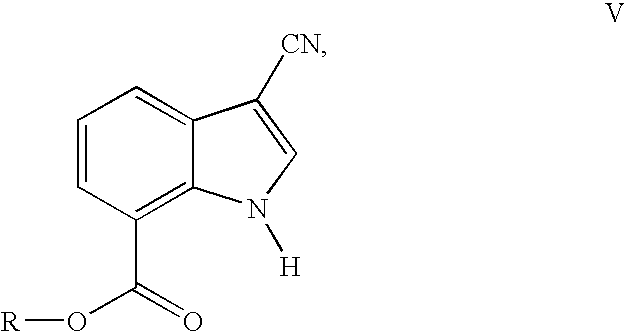
- in which R has one of the meanings indicated above,
- (4) the ester of the formula V is saponified to give 3-cyano-1H-indole-7-carboxylic acid,
- (5) the 3-cyano-1H-indole-7-carboxylic acid is reacted with 1-[2-(4-fluoro-phenyl)ethyl]piperazine or salts thereof to give the compound of the formula I, and
- (6) the resultant base of the formula I is converted into one of its salts by treatment with an acid.
The substituent R in the formulae II to VI is an alkyl group having from 1 to 6 carbon atoms or an arylalkyl group.
The alkyl group preferably has 1, 2, 3 or 4 carbon atoms and is therefore, for example, methyl, ethyl, n-propyl, isopropyl, n-butyl, sec-butyl or tert-butyl, furthermore also pentyl, 1-, 2- or 3-methylbutyl, 1,1-, 1,2- or 2,2-dimethylpropyl, 1-ethylpropyl, hexyl, 1-, 2-, 3- or 4-methylpentyl, 1,1-, 1,2-, 1,3-, 2,2-, 2,3- or 3,3-dimethylbutyl, 1- or 2-ethylbutyl, 1-ethyl-1-methylpropyl, 1-ethyl-2-methylpropyl, 1,1,2- or 1,2,2-trimethylpropyl, furthermore trifluoromethyl or pentafluoroethyl.
Arylalkyl is alternatively —(CH2)o—Ar, where Ar is preferably phenyl or naphthyl, and o can be 0, 1 or 2. Arylalkyl is, in particular, benzyl, phenylethyl or naphthylmethyl, particularly preferably benzyl.
- R is preferably methyl or ethyl, particularly preferably ethyl.
The indole esters of the formula II are commercially available or can be prepared by known synthetic methods. The preparation can, for example, be carried out starting from 3-methyl-2-nitrobenzoic acid, which is commercially available, by the following reactions:
- (1) esterification of 3-methyl-2-nitrobenzoic acid,
- (2) reaction with an N,N-dimethylformamide acetal to give a 3-(2-dimethylaminovinyl)-2-nitrobenzoic acid ester, and
- (3) subsequent palladium-catalysed ring closure reaction to give the indole ester of the formula II.
Suitable indole esters of the formula II are, in particular, methyl 1H-indole-7-carboxylate, ethyl 1H-indole-7-carboxylate, tert-butyl 1H-indole-7-carboxylate and benzyl 1H-indole-7-carboxylate. The synthesis according to the invention is particularly preferably carried out using ethyl 1H-indole-7-carboxylate.
Suitable N,N-dimethylformamide acetals are, for example, N,N-dimethylformamide bis[2-(trimethylsilyl)ethyl]acetal, N,N-dimethylformamide dibenzyl acetal, N,N-dimethylformamide dibutyl acetal, N,N-dimethylformamide di-tert-butyl acetal, N,N-dimethylformamide diethyl acetal, N,N-dimethylformamide diisopropyl acetal, N,N-dimethylformamide dimethyl acetal, N,N-dimethylformamide dineopentyl acetal, N,N-dimethylformamide dipropyl acetal and N,N-dimethylformamide ethylene acetal. Particular preference is given to N,N-dimethylformamide diethyl acetal and N,N-dimethylformamide dimethyl acetal.
The palladium-catalysed cyclisation reaction is carried out analogously to the method of Leimgruber-Batcho [Clark R. D. et al, Heterocycles, 1984, 22, 195-221, Batcho D. et al, Organic Synthesis, 1985, 63, 214-225].
The reaction conditions selected are known from the literature. However, it is also possible to use other processes known from the literature, which are not explained in greater detail here, for the preparation of compounds of the formula II (lit.: Houben-Weyl, Methoden der Organ. Chemie [Methods of Organic Chemistry], Georg-Thieme-Verlag, Stuttgart).
The formylation of a compound of the formula II to give a formyl ester of the formula III, in which R has one of the meanings indicated above, is carried out analogously to the method of Vilsmeyer-Haack [Jutz C. et al., Iminium Salts in Organic Chemistry Part I, New York, John Wiley & Sons Inc., 1976, pp. 234 ff, pp. 237 ff]. The reaction is preferably carried out in an aprotic polar solvent and at reaction temperatures between 0° and 50° and with heating to from 100° to 130° C. Particularly preferred solvents are dimethylformamide (DMF) and mixtures of DMF with aromatic hydrocarbons, such as benzene, toluene or xylene, or with further amides, such as N-methylpyrrolidone (NMP).
The formylation is particularly preferably carried out in DMF in the presence of POCl3.
Suitable formylindole esters of the formula III are, in particular, 7-methoxycarbonyl-3-indolecarboxaldehyde, 7-ethoxycarbonyl-3-indolecarboxaldehyde, 7-tert-butoxycarbonyl-3-indolecarboxaldehyde and 7-benzyloxycarbonyl-3-indolecarboxaldehyde. The synthesis according to the invention is particularly preferably carried out using 7-ethoxycarbonyl-3-indolecarboxaldehyde.
The oximation of the compounds of the formula III, as described above, is carried out under standard conditions (lit.: Kurtz P., Houben-Weyl, Methoden der Organ. Chemie [Methods of Organic Chemistry], Vol. VIII, Georg-Thieme-Verlag, Stuttgart).
The oximation is particularly preferably carried out in polar aprotic solvents, such as DMF, benzene, toluene, xylene or NMP, at temperatures between 0° and 50°, in particular at room temperature.
The preparation of the cyanoindole esters of the formula V, as described above, is carried out by treatment with acid. Suitable acids are, for example, inorganic acids, such as hydrochloric acid, sulfuric acid or phosphoric acid, or organic acids, such as formic acid, acetic acid, p-toluene-sulfonic acid or methanesulfonic acid. The reaction is particularly preferably carried out in high-boiling aprotic solvents, such as DMF or NMP, or mixtures thereof with aprotic solvents, at temperatures between 20° and 100°, in particular at 50° C.
In a particular embodiment of the process, steps (1) to (3) are carried out in situ, i.e. in a one-pot process analogously to Liebscher J. et al, Z. Chem. 1983, 23, 214-215, without the intermediates being isolated. The one-pot process gives better yields compared with the stepwise synthesis.
The saponification of the compounds of the formula V to give 3-cyano-1H-indole-7-carboxylic acid is carried out under standard conditions (lit.: Houben-Weyl, Methoden der Organ. Chemie [Methods of Organic Chemistry], Georg-Thieme-Verlag, Stuttgart).
The saponification is particularly preferably carried out using KOH in methanol at room temperature.
As an alternative to chemical saponification, the ester cleavage can also be carried out enzymatically with the aid of esterases. Suitable esterases are, for example, Bacillus sp. esterase, Bacillus stearothermophilus esterase, Candida lipolytica esterase, Mucor miehei esterase, horse liver esterase, Saccaromyces cerevisiae esterase, pig's liver esterase, Thermoanaerobium brockii esterase and pig's liver esterase isoenzyme 1. The esterases may also be employed in immobilised form. Commercial immobilised esterases are, for example, pig's liver esterase (PLE) immobilised on Eupergit® C or on oxirane-acrylic beads.
Enzymatic reactions are preferably carried out in aqueous buffer systems, but other solvents, in particular alcohols, such as ethanol, may also be present.
The reaction of 3-cyano-1H-indole-7-carboxylic acid with 1-[2-(4-fluorophenyl)ethyl]piperazine or one of the salts, in particular, with 1-[2-(4-fluorophenyl)ethyl]piperazine dihydrochloride, is carried out by methods as are known from the literature for the acylation of amines [Houben-Weyl, I.c., Volume 15/II, pages 1 to 806 (1974)]. However, it is also possible to react the compounds in the presence of an inert solvent. Examples of suitable solvents are hydrocarbons, such as benzene, toluene and xylene; ketones, such as acetone and butanone; alcohols, such as methanol, ethanol, isopropanol and n-butanol; ethers, such as tetrahydrofuran (THF) and dioxane; amides, such as dimethylformamide (DMF) or N-methylpyrrolidone; nitriles, such as acetonitrile, if desired also mixtures of these solvents with one another or mixtures with water. The addition of an acid-binding agent, for example an alkali or alkaline earth metal hydroxide, carbonate or bicarbonate or of another salt of a weak acid of the alkali or alkaline earth metals, preferably of potassium, sodium or calcium, or the addition of an organic base, such as triethylamine, dimethylaniline, pyridine or quinoline, or of an excess of a piperazine derivative, may be favourable. Depending on the conditions used, the reaction temperature is between about 0° and 150°, normally between 20° and 130°.
Instead of the 3-cyano-1H-indole-7-carboxylic acid, it is also possible to employ derivatives of this acid, preferably the preactivated carboxylic acid, or a corresponding carboxylic acid halide, a symmetrical or mixed anhydride or an active ester of 3-cyano-1H-indole-7-carboxylic acid. Radicals of this type for activation of the carboxyl group in typical acylation reactions are described in the literature (for example in the standard works, such as Houben-Weyl, Methoden der organischen Chemie [Methods of Organic Chemistry], Georg-Thieme-Verlag, Stuttgart).
Activated esters are advantageously formed in situ, for example by addition of HOBt or N-hydroxysuccinimide.
The compound 1-[2-(4-fluorophenyl)ethyl]piperazine and salts thereof are known and can be prepared by conventional processes which are known to the person skilled in the art. A description of the preparation is disclosed, for example, in DE 2855703.
A resultant base of the formula I can be converted into the associated acid-addition salt using an acid. Suitable acids for this reaction are those which give physiologically acceptable salts. Thus, it is possible to use inorganic acids, for example sulfuric acid, hydrohalic acids, such as hydrochloric acid or hydrobromic acid, phosphoric acids, such as orthophosphoric acid, nitric acid or sulfamic acid, furthermore organic acids, in detail aliphatic, alicyclic, araliphatic, aromatic or heterocyclic monobasic or polybasic carboxylic, sulfonic or sulfuric acids, such as formic acid, acetic acid, propionic acid, pivalic acid, diethylacetic acid, malonic acid, succinic acid, pimelic acid, fumaric acid, maleic acid, lactic acid, tartaric acid, malic acid, benzoic acid, salicylic acid, 2-phenylpropionic acid, citric acid, gluconic acid, ascorbic acid, nicotinic acid, isonicotinic acid, methane- or ethanesulfonic acid, ethanedisulfonic acid, 2-hydroxyethanesulfonic acid, benzenesulfonic acid, p-toluenesulfonic acid, naphthalenemono- and -disulfonic acids and laurylsulfuric acid.
In a preferred embodiment, the salt formation is carried out in a solvent mixture of acetone/water in a ratio of between 5:1 and 4:1 by precipitation using hydrochloric acid (37%). (3-Cyano-1H-indol-7-yl)[4-(4-fluorophenethyl)piperazin-1-yl]methanone, hydrochloride, is formed.
In a further embodiment of the process according to the invention, the cyanoindole ester of the formula V can be reacted directly, without prior saponification to 3-cyano-1H-indole-7-carboxylic acid, with 1-[2-(4-fluorophenyl)ethyl]piperazine or a corresponding salt by chemical or biochemical aminolysis.
The chemical aminolysis can be carried out, for example, by the method of Menger F. M. et al., J. Am. Chem. Soc. 1969, 91, 5346-9.
The biochemical aminolysis can be carried out, for example, by reaction of a compound of the formula V with 1-[2-(4-fluorophenyl)ethyl]piperazine or one of the corresponding salts in the presence of a lipase or an antibody. The biochemical aminolysis can be carried out, for example, by the method of Gotor V. et al., Bioorg. Med. Chem. 1999, 7, 2189-2197.
The invention therefore likewise relates to a process for the preparation of (3-cyano-1H-indol-7-yl)[4-(4-fluorophenethyl)piperazin-1-yl]methanone of the formula I

and salts thereof, characterised in that
- (1) an indole ester of the formula II

- in which
- R is an alkyl group having from 1 to 6 carbon atoms or arylalkyl, is formylated,
- (2) the formyl ester of the formula III

- in which R is as defined above,
- formed from (1) is reacted with hydroxylamine to give an oxime derivative of the formula IV

- in which R is as defined above,
- (3) the oxime of the formula IV is converted into a cyanoindole ester of the formula V

- in which R has one of the meanings indicated above,
- (4) the ester of the formula V is converted into the compound of the formula I by aminolysis using 1-[2-(4-fluorophenyl)ethyl]piperazine or one of the salts, and
- (5) the resultant base of the formula I is converted into one of its salts by treatment with an acid.
In a further embodiment of the process according to the invention, the compound 3-cyano-1H-indole-7-carboxylic acid can be prepared by halogenation of an indole ester of the formula II

as described above to give a compound of the formula VI

in which R is an alkyl group having from 1 to 6 carbon atoms or arylalkyl and
- Hal is Cl, Br or I, followed by cyanation.
The halogenation of the compounds of the formula II, as described above, is carried out under standard conditions (lit.: Houben-Weyl, Methoden der Organ. Chemie [Methods of Organic Chemistry], Georg-Thieme-Verlag, Stuttgart) or analogously to Heterocycles, 1986, 24, 2879-85, ibid. 1989, 29, 1663-7; J. Am. Chem. Soc. 1985, 107, 2943-5; J. Org. Chem. 1993, 58, 2058-60, or J. Chem. Soc., Perkin Trans. 1, 1989, 2009-15.
The bromination or iodination in the 3-position of the indole can likewise be carried out analogously to Bocchi et al. Synthesis 1982, 1096-1097.
Examples of suitable solvents for the halogenation are hydrocarbons, such as benzene, toluene and xylene; halogenated hydrocarbons, such as dichloromethane and chloroform; ketones, such as acetone and butanone; alcohols, such as methanol, ethanol, isopropanol and n-butanol; ethers, such as tetrahydrofuran (THF) and dioxane; amides, such as dimethylformamide (DMF) and N-methylpyrrolidone; nitriles, such as acetonitrile, and if desired mixtures of these solvents with one another.
Compounds prepared in accordance with the invention by halogenation are, for example, methyl 3-chloro-1H-indole-7-carboxylate, methyl 3-bromo-1H-indole-7-carboxylate, methyl 3-iodo-1H-indole-7-carboxylate, ethyl 3-chloro-1H-indole-7-carboxylate, ethyl 3-bromo-1H-indole-7-carboxylate, ethyl 3-iodo-1H-indole-7-carboxylate, tert-butyl 3-chloro-1H-indole-7-carboxylate, tert-butyl 3-bromo-1H-indole-7-carboxylate, tert-butyl 3-iodo-1H-indole-7-carboxylate, benzyl 3-chloro-1H-indole-7-carboxylate, benzyl 3-bromo-1H-indole-7-carboxylate and benzyl 3-iodo-1H-indole-7-carboxylate. The use of ethyl 3-bromo-1H-indole-7-carboxylate or ethyl 3-iodo-1H-indole-7-carboxylate is particularly suitable in accordance with the invention.
The substitution of the halogen group of the compounds of the formula VI by the cyano group is carried out analogously to the method of Cassar L. et al., Adv. Chem. Ser. 1974, 132, 252-73, with nickel catalysis or analogously to the method of Sakamoto T. et al, J. Chem. Soc., Perkin Trans. 1 1999, 16, 2323-2326, or Chatani N. et al, J. Org. Chem. 1986, 51, 4714-16, with palladium catalysis.
The cyano group is particularly preferably introduced with palladium catalysis.
The invention therefore likewise relates to a process for the preparation of (3-cyano-1H-indol-7-yl)[4-(4-fluorophenethyl)piperazin-1-yl]methanone of the formula I

and salts thereof, characterised in that
- (1) an indole ester of the formula II

- in which
- R is an alkyl group having from 1 to 6 carbon atoms or arylalkyl, is halogenated,
- (2) the halogen group of the ester of the formula VI

- in which R and Hal are as defined above,
- formed from (1) is converted into a cyano group, with the ester being saponified to 3-cyano-1H-indole-7-carboxylic acid at the same time,
- (3) the 3-cyano-1H-indole-7-carboxylic acid is reacted with 1-[2-(4-fluorophenyl)ethyl]piperazine or salts thereof to give the compound of the formula I, and
- (4) the resultant base of the formula I is converted into one of its salts by treatment with an acid.
A further aspect of the invention relates to compounds of the formula IV

in which R is an alkyl group having from 1 to 6 carbon atoms or arylalkyl, and salts thereof.
Alkyl and arylalkyl have one of the meanings indicated above.
Compounds of the formula IV may occur in two isomeric forms, compounds of the formulae IVa and IVb. The general formula IV covers the individual isomers of the formulae IVa and IVb as well as mixtures thereof.

in which R has one of the meanings indicated above.
Preferred compounds of the formula IV are
- methyl 3-hydroxyimino-1H-indole-7-carboxylate,
- ethyl 3-hydroxyimino-1H-indole-7-carboxylate,
- tert-butyl 3-hydroxyimino-1H-indole-7-carboxylate and
- benzyl 3-hydroxyimino-1H-indole-7-carboxylate, where both the Z- and E-forms and mixtures of these are included.
Particularly preferred compounds of the formula IV are
- ethyl (Z)-3-hydroxyimino-1H-indole-7-carboxylate,
- ethyl (E)-3-hydroxyimino-1H-indole-7-carboxylate and E/Z mixtures.
A salt of the compounds of the formula IV can be prepared by the methods described above for compounds of the formula I.
The compounds of the formula IV are valuable intermediates in the synthesis of (3-cyano-1H-indol-7-yl)[4-(4-fluorophenethyl)piperazin-1-yl]methanone and salts thereof, as described above.
A further aspect of the invention relates to compounds of the formula V

in which R is an alkyl group having from 1 to 6 carbon atoms or arylalkyl, and salts thereof.
Alkyl and arylalkyl have one of the meanings indicated above.
Preferred compounds of the formula V are
- methyl 3-cyano-1H-indole-7-carboxylate,
- ethyl 3-cyano-1H-indole-7-carboxylate,
- tert-butyl 3-cyano-1H-indole-7-carboxylate and
- benzyl 3-cyano-1H-indole-7-carboxylate, and salts thereof.
The process according to the invention is particularly preferably carried out using ethyl 3-cyano-1H-indole-7-carboxylate.
A salt of the compounds of the formula V can be prepared by the methods described above for compounds of the formula I.
The compounds of the formula V are valuable intermediates in the synthesis of (3-cyano-1H-indol-7-yl)[4-(4-fluorophenethyl )piperazin-1-yl]methanone and salts thereof, as described above.
The invention likewise relates to the compound 3-cyano-1H-indole-7-carboxylic acid and salts thereof.
A further aspect of the invention relates to compounds of the formula VI

in which R is an alkyl group having from 1 to 6 carbon atoms or arylalkyl, and
- Hal is Cl, Br or I and salts thereof.
Alkyl and arylalkyl have one of the meanings indicated above.
Preferred compounds of the formula VI are
- methyl 3-bromo-1H-indole-7-carboxylate,
- ethyl 3-bromo-1H-indole-7-carboxylate,
- tert-butyl 3-bromo-1H-indole-7-carboxylate and
- benzyl 3-bromo-1H-indole-7-carboxylate,
- methyl 3-iodo-1H-indole-7-carboxylate,
- ethyl 3-iodo-1H-indole-7-carboxylate,
- tert-butyl 3-iodo-1H-indole-7-carboxylate and
- benzyl 3-iodo-1H-indole-7-carboxylate, and salts thereof.
The process according to the invention is particularly preferably carried out using ethyl 3-bromo-1H-indole-7-carboxylate or ethyl 3-iodo-1H-indole-7-carboxylate.
A salt of the compounds of the formula VI can be prepared by the methods described above for compounds of the formula I.
The compounds of the formula VI are valuable intermediates in the synthesis of (3-cyano-1H-indol-7-yl)[4-(4-fluorophenethyl)piperazin-1-yl]methanone and salts thereof, as described above.
Even without further details, it is assumed that a person skilled in the art will be able to utilise the above description in the broadest scope. The preferred embodiments should therefore merely be regarded as descriptive disclosure which is absolutely not to be regarded as limiting in any way.
All temperature data above and below are given in ° C. In the following examples, “conventional work-up” means that water is added if necessary, the mixture is adjusted, if necessary, to a pH of between 2 and 10, depending on the constitution of the end product, the mixture is extracted with ethyl acetate or dichloromethane, the phases are separated, the organic phase is dried over sodium sulfate and evaporated, and the product is purified by chromatography on silica gel and/or by crystallisation.
2.9 ml of phosphorus oxychloride are added slowly to 7 ml of N,N-dimethylformamide in a nitrogen atmosphere (formylation solution). 5 g (0.029 mol) of methyl indole-7-carboxylate are dissolved in 7 ml of DMF and added slowly to the formylation solution, during which the temperature does not rise above 30 degrees. The mixture is then warmed at 100° for one hour. After cooling, the mixture is poured into water and neutralised using sodium hydroxide solution, and the deposited crystals are filtered off with suction. m.p. 154°. Yield 5.3 g (89.9% of theory).
5 g of methyl 3-formylindole-7-carboxylate (0.024 mol) are added to a solution of 0.03 mol of hydroxylammonium hydrochloride in dimethylformamide. The reaction mixture is heated at 125° for one hour and subjected to conventional work-up, giving 5.1 g of methyl 3-(hydroxyiminomethyl)indole-7-carboxylate.
5 g of methyl 3-(hydroxyiminomethyl)indole-7-carboxylate are suspended in 20 ml of toluene, 1 ml of sulfonyl chloride is added, and the mixture is refluxed for one hour. Evaporation and extraction with ethyl acetate give 4.5 g of methyl cyanoindole-7-carboxylate, m.p. 212°.
4.5 g (0.022 mol) of methyl cyanoindole-7-carboxylate are suspended in 100 ml of methanol, and a solution of 30 ml of sodium hydroxide solution (w=32%) in 30 ml of water is added at room temperature. Stirring over-night gives a virtually clear solution, which is filtered and evaporated. Water is added to the residue until a clear solution is formed, and the mixture is adjusted to pH=2 using concentrated hydrochloric acid with ice-cooling. The white crystals are filtered off with suction and dried for 2 hours under reduced pressure, giving 4 g of 3-cyanoindole-7-carboxylic acid (97.7% of theory); m.p. 317.5-318.5°.
5 g (0.027 mol) of 3-cyanoindole-7-carboxylic acid are dissolved in 40 ml of hot N-methylpyrrolidone, the solution is cooled to 40°, and 7.6 g (0.027 mol) of N,N-carbonyldiimidazole are added. The mixture is stirred at room temperature for a further one hour. A suspension of 1-(2-(4-fluorophenyl)ethyl)piperazine dihydrochloride in 40 ml of N-methylpyrrolidone is subsequently poured in. After 5 minutes, a clear solution is formed and just afterwards white crystals deposit. The mixture is stirred overnight at room temperature. The crystals are filtered off with suction, washed and dried, giving 5 g of 7-{4-[2-(4-fluorophenyl)ethyl]piperazin-1-carbonyl}-1H-indole-3-carbonitrile as the free base having a melting point (m.p.) of 192.0-193.5°.
The chemical names 7-{4-[2-(4-fluorophenyl)ethyl]piperazine-1-carbonyl}-1H-indole-3-carbonitrile and (3-cyano-1H-indol-7-yl)[4-(4-fluorophenethyl)-piperazin-1-yl]methanone are synonymous.
2.1 g of the free base obtained in accordance with 1.5 are heated in 50 ml of acetone, and water is added until a clear solution is formed. A mixture of 0.6 ml of hydrochloric acid (w=37%) and 1.2 ml of acetone is then stirred in. The mixture is subsequently evaporated to half the volume in a rotary evaporator. The precipitated hydrochloride is filtered off with suction, washed with acetone and diethyl ether and dried, giving 1.6 g of 7-{4-[2-(4-fluorophenyl)ethyl]piperazin-1-carbonyl}-1H-indole-3-carbonitrile, hydrochloride (69% of theory), decomposition range 314-319°.
9.1 g of phosphoryl chloride are added to 30 ml of dimethylformamide with ice cooling at a reaction temperature of 20-30°. A solution of 8 g of methyl indole-7-carboxylate in dimethylformamide is added dropwise, during which the temperature rises to 40°. After one hour at 125°, the solution is added dropwise while still hot to a solution of 6.3 g of hydroxylammonium chloride in 40 ml of dimethylformamide, and the mixture is stirred at 120° C. for a further 15 minutes. The mixture is poured into water, extracted with ethyl acetate, filtered through neutral aluminium oxide and evaporated, giving 4.5 g of methyl 3-cyanoindole-7-carboxylate having a melting range of 212-213.5° (48.9% of theory).
The further reaction is carried out analogously to Example 1.4. to 1.6.
12 g of pyridine hydrobromide perbromide are added to a solution of 5 g of ethyl indole-7-carboxylate in 50 g of pyridine. The reaction mixture is warmed to 30-50° and stirred until the conversion is complete (from about 3 to 10 hours).
Conventional work-up gives ethyl 3-bromoindole-7-carboxylate.
7 g of ethyl 3-bromoindole-7-carboxylate are dissolved in 70 g of NMP, and 4 g of CuCN are added. The mixture is heated to 100-140° C. with stirring. After 3 hours, the mixture is subjected to conventional work-up, giving 3-cyanoindole-7-carboxylic acid.
The further reaction of the 3-cyanoindole-7-carboxylic acid is carried out analogously to Example 1.5. to 1.6.
Claims (26)
1. An oxime compound of formula IV

in which
R is an alkyl group having from 1 to 6 carbon atoms or arylalkyl,
or a salt thereof.
2. A cyanoindole ester compound of formula V

in which
R is an alkyl group having from 1 to 6 carbon atoms or arylalkyl,
or a salt thereof.
3. The compound 3-Cyano-1H-indole-7-carboxylic acid or a salt thereof.
4. A compound of formula VI

in which
R is an alkyl group having from 1 to 6 carbon atoms or arylalkyl, and
Hal is Cl, Br or I,
or a salt thereof.
5. A compound of the formula

wherein
X is —CH═N—OH, CN, or Hal,
Hal is Cl, Br or I,
R is an alkyl group having from 1 to 6 carbon atoms or arylalkyl, or when X is CN, R can also be H,
or a salt thereof.
6. A compound according to claim 1 , wherein R is an alkyl group having from 1 to 6 carbon atoms.
7. A compound according to claim 2 , wherein R is an alkyl group having from 1 to 6 carbon atoms.
8. A compound according to claim 4 , wherein R is an alkyl group having from 1 to 6 carbon atoms.
9. A compound according to claim 5 , wherein R is an alkyl group having from 1 to 6 carbon atoms.
10. A compound according to claim 1 , wherein R is —(CH2)o—Ar wherein Ar is phenyl or naphthyl and o is 0, 1, or 2.
11. A compound according to claim 2 , wherein R is —(CH2)o—Ar wherein Ar is phenyl or naphthyl and o is 0, 1, or 2.
12. A compound according to claim 4 , wherein R is —(CH2)o—Ar wherein Ar is phenyl or naphthyl and o is 0, 1, or 2.
13. A compound according to claim 5 , wherein R is —(CH2)0—Ar wherein Ar is phenyl or naphthyl and o is 0, 1, or 2.
14. A compound according to claim 1 , wherein R is methyl or ethyl.
15. A compound according to claim 2 , wherein R is methyl or ethyl.
16. A compound according to claim 4 , wherein R is methyl or ethyl.
17. A compound according to claim 5 , wherein R is methyl or ethyl.
18. A compound according to claim 5 , wherein said compound is selected from:
3-cyano-1H-indole-7-carboxylic acid, methyl 3-hydroxyimino-1H-indole-7-carboxylate, ethyl 3-hydroxyimino-1H-indole-7-carboxylate, tert-butyl 3-hydroxyimino-1H-indole-7-carboxylate, benzyl 3-hydroxyimino-1H-indole-7-carboxylate, methyl 3-cyano-1H-indole-7-carboxylate, ethyl 3-cyano-1H-indole-7-carboxylate, tert-butyl 3-cyano-1H-indole-7-carboxylate, benzyl 3-cyano-1H-indole-7-carboxylate, methyl 3-bromo-1H-indole-7-carboxylate, ethyl 3-bromo-1H-indole-7-carboxylate, tert-butyl 3-bromo-1H-indole-7-carboxylate, benzyl 3-bromo-1H-indole-7-carboxylate, methyl 3-iodo-1H-indole-7-carboxylate, ethyl 3-iodo-1H-indole-7-carboxylate, tert-butyl 3-iodo-1H-indole-7-carboxylate, benzyl 3-iodo-1H-indole-7-carboxylate, and salts thereof.
19. A compound according to claim 18 , wherein said compound is selected from:
3-cyano-1H-indole-7-carboxylic acid, methyl 3-hydroxyimino-1H-indole-7-carboxylate, ethyl 3-hydroxyimino-1H-indole-7-carboxylate, tert-butyl 3-hydroxyimino-1H-indole-7-carboxylate, benzyl 3-hydroxyimino-1H-indole-7-carboxylate, methyl 3-cyano-1H-indole-7-carboxylate, ethyl 3-cyano-1H-indole-7-carboxylate, tert-butyl 3-cyano-1H-indole-7-carboxylate, benzyl 3-cyano-1H-indole-7-carboxylate, methyl 3-bromo-1H-indole-7-carboxylate, ethyl 3-bromo-1H-indole-7-carboxylate, tert-butyl 3-bromo-1H-indole-7-carboxylate, benzyl 3-bromo-1H-indole-7-carboxylate, methyl 3-iodo-1H-indole-7-carboxylate, ethyl 3-iodo-1H-indole-7-carboxylate, tert-butyl 3-iodo-1H-indole-7-carboxylate, and benzyl 3-iodo-1H-indole-7-carboxylate.
20. A process for the preparation of (3-cyano-1H-indol-7-yl)[4-(4-fluorophenethyl)piperazin-1-yl]methanone of formula I

and salts thereof, said process comprising:
(A) (1) formylating an indole ester of the formula II

in which
R is an alkyl group having from 1 to 6 carbon atoms or arylalkyl;
(2) reacting the resultant formyl ester of formula III

with hydroxylamine to give an oxime derivative of formula IV

(3) converting the oxime of formula IV into a cyanoindole ester of formula V

(4) saponifying the ester of formula V to give 3-cyano-1H-indole-7-carboxylic acid,
(5) reacting the 3-cyano-1H-indole-7-carboxylic acid with 1-[2-(4-fluoro-phenyl)ethyl]piperazine or a salt thereof to give the compound of the formula I, and
(6) optionally converting the resultant base of formula I into one of its salts by treatment with an acid; or
(B) (1) halo genating an indole ester of the formula II

in which
R is an alkyl group having from 1 to 6 carbon atoms or arylalkyl;
(2) converting the halogen of the resultant ester of formula VI

wherein Hal is Cl, Br or I, into a to form a cyano group with the ester group being saponifying at the same time to obtain 3-cyano-1H-indole-7-carboxylic acid,
(3) reacting the 3-cyano-1H-indole-7-carboxylic acid with 1-[2-(4-fluoro-phenyl)ethyl]piperazine or a salt thereof to give the compound of the formula I, and
(4) optionally converting the resultant base of formula I into one of its salts by treatment with an acid.
21. A process according to claim 20 , wherein steps (1) to (3) are carried out as a one-pot synthesis.
22. A process according to claim 20 , wherein in step (4), the ester of the formula V is converted into a compound of formula I by aminolysis using 1-[2-(4-fluorophenyl)ethyl]piperazine or a salt thereof.
23. A process according to claim 20 , wherein said 3-cyano-1H-indole-7-carboxylic acid is prepared by halogenation of an indole ester of formula II

to give a compound of the formula VI

in which
R is an alkyl group having from 1 to 6 carbon atoms or arylalkyl, and
Hal is Cl, Br or I, followed by cyanation.
24. A process according to claim 20 , wherein R is ethyl.
25. A process according to claim 20 , said 3-cyano-1H-indole-7-carboxylic acid is reacted with the dihydrochloride is 1-[2-(4-fluorophenyl)ethyl]piperazine.
26. A process according to claim 20 , wherein in step (5) the compound of formula I is the base (3-cyano-1H-indol-7-yl)[4-(4-fluorophenethyl)-piperazin-1-yl]methanone, and said base is converted into its hydrochloride in step (6).
Applications Claiming Priority (3)
| Application Number | Priority Date | Filing Date | Title |
|---|---|---|---|
| DE10102944A DE10102944A1 (en) | 2001-01-23 | 2001-01-23 | Production of 3-cyano-1H-indol-7-yl)-(4-(4-fluorophenethyl)piperazin-1-yl)-methanone useful as a selective 5-HT2A antagonist comprises use of an indolecarboxylic acid ester as the starting material |
| DE10102944.6 | 2001-01-23 | ||
| PCT/EP2001/015240 WO2002059092A1 (en) | 2001-01-23 | 2001-12-21 | Process for the preparation of (3-cyano-1h-indol-7-yl)(4-(4-fluorophenethyl)piperazin-1-yl)-methanone and salts thereof |
Publications (2)
| Publication Number | Publication Date |
|---|---|
| US20040063723A1 US20040063723A1 (en) | 2004-04-01 |
| US7312342B2 true US7312342B2 (en) | 2007-12-25 |
Family
ID=7671481
Family Applications (1)
| Application Number | Title | Priority Date | Filing Date |
|---|---|---|---|
| US10/466,991 Expired - Fee Related US7312342B2 (en) | 2001-01-23 | 2001-12-21 | Process for the preparation of (3-cyano-1h-indol-7-yl) (4-(4-fluorophenethyl) piperazin-1-yl)-methanone and salts thereof |
Country Status (29)
| Country | Link |
|---|---|
| US (1) | US7312342B2 (en) |
| EP (1) | EP1353906B1 (en) |
| JP (1) | JP4215195B2 (en) |
| KR (1) | KR100820763B1 (en) |
| CN (1) | CN1213029C (en) |
| AR (1) | AR032261A1 (en) |
| AT (1) | ATE269849T1 (en) |
| AU (1) | AU2002219220B2 (en) |
| BR (1) | BR0116816A (en) |
| CA (1) | CA2435426C (en) |
| CZ (1) | CZ20032202A3 (en) |
| DE (2) | DE10102944A1 (en) |
| DK (1) | DK1353906T3 (en) |
| EC (1) | ECSP034737A (en) |
| ES (1) | ES2223738T3 (en) |
| HU (1) | HUP0401039A3 (en) |
| IL (2) | IL157061A0 (en) |
| MX (1) | MXPA03006534A (en) |
| MY (1) | MY126252A (en) |
| NZ (1) | NZ527779A (en) |
| PL (1) | PL209416B1 (en) |
| PT (1) | PT1353906E (en) |
| RU (1) | RU2295519C2 (en) |
| SK (1) | SK286565B6 (en) |
| TR (1) | TR200402142T4 (en) |
| TW (1) | TW588044B (en) |
| UA (1) | UA74039C2 (en) |
| WO (1) | WO2002059092A1 (en) |
| ZA (1) | ZA200306540B (en) |
Families Citing this family (5)
| Publication number | Priority date | Publication date | Assignee | Title |
|---|---|---|---|---|
| DE10246357A1 (en) * | 2002-10-04 | 2004-04-15 | Merck Patent Gmbh | Medicaments for prolonging both REM and non-REM sleep, containing 5-HT-2 receptor antagonists, preferably N-(indolyl-carbonyl)-piperazine derivatives |
| DE102004047517A1 (en) * | 2004-09-28 | 2006-03-30 | Merck Patent Gmbh | Novel crystal form of (3-cyano-1H-indol-7-yl) - [4- (4-fluorophenethyl) -piperazin-1-yl] -methanone, hydrochloride |
| KR20090017569A (en) * | 2006-05-05 | 2009-02-18 | 메르크 파텐트 게엠베하 | Crystalline (3-Cyano-lH-indol-7-yl)-[4- (4-fluorophenethyl) piperazin-l-yl] methanone phosphate |
| CN101437793B (en) * | 2006-05-05 | 2012-08-22 | 默克专利股份有限公司 | Crystalline (3-cyano-1H-indol-7-yl)-[4-(4-fluorophenethyl)piperazin-1-yl]methanone phosphate |
| CN102816104B (en) * | 2012-08-30 | 2014-05-21 | 浙江大学 | 3-cyanoindole compound synthesis method |
Family Cites Families (2)
| Publication number | Priority date | Publication date | Assignee | Title |
|---|---|---|---|---|
| CH421107A (en) * | 1963-06-04 | 1966-09-30 | Sandoz Ag | Process for the preparation of new heterocyclic compounds |
| CA2084531A1 (en) * | 1991-12-19 | 1993-06-20 | David W. Smith | Antimigraine 4-pyrimidinyl and pyridinyl derivatives of indol-3yl-alkyl piperazines |
-
2001
- 2001-01-23 DE DE10102944A patent/DE10102944A1/en not_active Withdrawn
- 2001-12-21 US US10/466,991 patent/US7312342B2/en not_active Expired - Fee Related
- 2001-12-21 RU RU2003124068/04A patent/RU2295519C2/en not_active IP Right Cessation
- 2001-12-21 BR BR0116816-9A patent/BR0116816A/en not_active Application Discontinuation
- 2001-12-21 EP EP01273449A patent/EP1353906B1/en not_active Expired - Lifetime
- 2001-12-21 NZ NZ527779A patent/NZ527779A/en unknown
- 2001-12-21 CA CA002435426A patent/CA2435426C/en not_active Expired - Fee Related
- 2001-12-21 MX MXPA03006534A patent/MXPA03006534A/en active IP Right Grant
- 2001-12-21 ES ES01273449T patent/ES2223738T3/en not_active Expired - Lifetime
- 2001-12-21 TR TR2004/02142T patent/TR200402142T4/en unknown
- 2001-12-21 KR KR1020037009645A patent/KR100820763B1/en not_active Expired - Fee Related
- 2001-12-21 CZ CZ20032202A patent/CZ20032202A3/en unknown
- 2001-12-21 JP JP2002559394A patent/JP4215195B2/en not_active Expired - Fee Related
- 2001-12-21 UA UA2003076931A patent/UA74039C2/en unknown
- 2001-12-21 CN CNB018221882A patent/CN1213029C/en not_active Expired - Fee Related
- 2001-12-21 DE DE60104024T patent/DE60104024T2/en not_active Expired - Lifetime
- 2001-12-21 PT PT01273449T patent/PT1353906E/en unknown
- 2001-12-21 AU AU2002219220A patent/AU2002219220B2/en not_active Ceased
- 2001-12-21 WO PCT/EP2001/015240 patent/WO2002059092A1/en not_active Ceased
- 2001-12-21 SK SK1046-2003A patent/SK286565B6/en not_active IP Right Cessation
- 2001-12-21 HU HU0401039A patent/HUP0401039A3/en unknown
- 2001-12-21 IL IL15706101A patent/IL157061A0/en unknown
- 2001-12-21 DK DK01273449T patent/DK1353906T3/en active
- 2001-12-21 AT AT01273449T patent/ATE269849T1/en active
- 2001-12-21 PL PL364392A patent/PL209416B1/en not_active IP Right Cessation
-
2002
- 2002-01-17 TW TW091100688A patent/TW588044B/en not_active IP Right Cessation
- 2002-01-18 MY MYPI20020201A patent/MY126252A/en unknown
- 2002-01-23 AR ARP020100222A patent/AR032261A1/en unknown
-
2003
- 2003-07-22 IL IL157061A patent/IL157061A/en not_active IP Right Cessation
- 2003-08-19 EC EC2003004737A patent/ECSP034737A/en unknown
- 2003-08-21 ZA ZA200306540A patent/ZA200306540B/en unknown
Non-Patent Citations (4)
| Title |
|---|
| D. Sowmithran, K.J. Rajendra Prasad: "Heterocycles: Part 5-Synethesis of Carbazolyl-1-oxypropanolamine" Indian J. Chem. Sect. B, vol. 26, No. 1-12, 1987, pp. 277-278 XP001057373. |
| F. Santanelo et al.: "A convenient synthesis of 9-hydroxy-3, 4,5, 6-tetrahydro-1H-azepino ' 5, 4, 3-cd! indole form 7-methoxyindole" Synth. Commun. , vol. 23, No. 19, 1993, pp. 2717-2726, XP001063048. |
| S. Swaminathan et al.: "N-Mannich Bases of 3-Substituted Indoles and Alkylation with Some N-Indolylmethyltrimethylammonium Iodides" J. Org. Chem., vol. 23, 1958, pp. 707-711, XP001063047. |
| T. Owa et al.: "Discovery of Novel Antitumor Sulfonamides Targeting G1 Phase of the Cell Cycle" J. Med. Chem., vol. 42, No. 19, 1999, pp. 3789-3799, XP002193774. |
Also Published As
Similar Documents
| Publication | Publication Date | Title |
|---|---|---|
| KR100529201B1 (en) | Process for the preparation of quinoline derivative and intermediate therefor | |
| WO2000059912A1 (en) | Thienopyrimidine compounds and salts thereof and process for the preparation of the same | |
| JP4846905B2 (en) | Process for producing 3-alkanoyl- and 3-alkylindoles | |
| US7312342B2 (en) | Process for the preparation of (3-cyano-1h-indol-7-yl) (4-(4-fluorophenethyl) piperazin-1-yl)-methanone and salts thereof | |
| FI85478B (en) | FOERFARANDE FOER FRAMSTAELLNING AV TERAPEUTISKT ANVAENDBARA -KARBOLINDERIVAT. | |
| AU2002219220A1 (en) | Process for the preparation of (3-cyano-1H-indol-7-YL)(4-(4-fluorophenethyl)piperazin-1-YL)-methanone and salts thereof | |
| EP0362942B1 (en) | Benzoxazepinone process | |
| NO178373B (en) | Process for the preparation of therapeutically active ergoline derivatives | |
| Roschger et al. | Organic azides in heterocyclic synthesis, 12. Thermal cyclization of 4‐azido‐3‐formyl‐2‐quinolones to isoxazolo [4, 3‐c] quinolones | |
| HK1063182B (en) | A process for the preparation of 5-ht2a receptor antagonists and salts thereof | |
| JP2002512222A (en) | Method for producing 4-hydroxyindole, indazole and carbazole compound | |
| US20040092750A1 (en) | 2-methylindole-4-acetic acid, process for producing the same, and process for producing intermediate therefor | |
| JP2001510830A (en) | Method for preparing 1,3-diaza-spiro (4,4) non-1-en-4-one derivative and 1-cyano-1-acylaminocyclopentane intermediate | |
| HU211400B (en) | Process for producing gramine derivatives | |
| JPH07252255A (en) | 5,6,7,8-Tetrahydro-2 (1H) -oxo-1,6-naphthyridine-3-carboxylic acid derivative and salt thereof | |
| WO2006010079A2 (en) | Process for preparing naratriptan hydrochloride | |
| TW200538455A (en) | Improved process for the preparation of (ethoxymethyl)-tropane derivatives | |
| NO160613B (en) | ANALOGY PROCEDURE FOR THE PREPARATION OF THERAPEUTIC ACTIVE PYRIDAZINO (4,3-C) -ISOKINOLINE DERIVATIVES. | |
| WO1992011256A1 (en) | Process for the preparation of benzoxazinyltetrahydropyridazines | |
| JPH07215968A (en) | Method for producing azelastine | |
| JP2003506311A (en) | Method for producing toluenesulfinate | |
| TW200829592A (en) | Fluoro derivative of quinolin-2(1H)-one, process for the preparation thereof and use thereof as synthesis intermediate |
Legal Events
| Date | Code | Title | Description |
|---|---|---|---|
| AS | Assignment |
Owner name: MERCK PATENT GMBH, GERMANY Free format text: ASSIGNMENT OF ASSIGNORS INTEREST;ASSIGNORS:CRASSIER, HELENE;ECKERT, UWE;BOETTCHER, HENNING;AND OTHERS;REEL/FRAME:014654/0649;SIGNING DATES FROM 20030516 TO 20030615 |
|
| FEPP | Fee payment procedure |
Free format text: PAYOR NUMBER ASSIGNED (ORIGINAL EVENT CODE: ASPN); ENTITY STATUS OF PATENT OWNER: LARGE ENTITY |
|
| CC | Certificate of correction | ||
| REMI | Maintenance fee reminder mailed | ||
| LAPS | Lapse for failure to pay maintenance fees | ||
| STCH | Information on status: patent discontinuation |
Free format text: PATENT EXPIRED DUE TO NONPAYMENT OF MAINTENANCE FEES UNDER 37 CFR 1.362 |
|
| FP | Lapsed due to failure to pay maintenance fee |
Effective date: 20111225 |