US7304186B2 - Synthetic method and novel chemical compounds - Google Patents
Synthetic method and novel chemical compounds Download PDFInfo
- Publication number
- US7304186B2 US7304186B2 US10/956,532 US95653204A US7304186B2 US 7304186 B2 US7304186 B2 US 7304186B2 US 95653204 A US95653204 A US 95653204A US 7304186 B2 US7304186 B2 US 7304186B2
- Authority
- US
- United States
- Prior art keywords
- compound
- formula
- heteroatom
- group
- optionally including
- Prior art date
- Legal status (The legal status is an assumption and is not a legal conclusion. Google has not performed a legal analysis and makes no representation as to the accuracy of the status listed.)
- Expired - Fee Related, expires
Links
- 0 [1*][C@H]1C(=O)C=C[C@@H]1/C=C/[C@@H](O)CCCCC Chemical compound [1*][C@H]1C(=O)C=C[C@@H]1/C=C/[C@@H](O)CCCCC 0.000 description 31
- SHTCKVGIZGDTDH-LZAIMSLLSA-N C[C@H]1C=CC(=O)/C1=C/C1=CC=CC=C1 Chemical compound C[C@H]1C=CC(=O)/C1=C/C1=CC=CC=C1 SHTCKVGIZGDTDH-LZAIMSLLSA-N 0.000 description 5
- OMUPYYMWUVDNHA-UHFFFAOYSA-N CC.CC1=CCCC1=O Chemical compound CC.CC1=CCCC1=O OMUPYYMWUVDNHA-UHFFFAOYSA-N 0.000 description 2
- SHTCKVGIZGDTDH-UHFFFAOYSA-N CC1C=CC(=O)C1=CC1=CC=CC=C1 Chemical compound CC1C=CC(=O)C1=CC1=CC=CC=C1 SHTCKVGIZGDTDH-UHFFFAOYSA-N 0.000 description 2
- JJOYPTAZPWSNBA-UHFFFAOYSA-N C[Si](C)(C)C1=CC2C3C=CC(C3)C2C1=O Chemical compound C[Si](C)(C)C1=CC2C3C=CC(C3)C2C1=O JJOYPTAZPWSNBA-UHFFFAOYSA-N 0.000 description 2
- QAJVUXPIXFOBDM-DFYKVTKESA-N C#C[Si](C)(C)C.C1=C[C@H]2C=C[C@@H]1C2.C[C@H]1C=CC(=O)/C1=C/C1=CC=CC=C1.C[Cu].[C-]#[O+].[C-]#[O+].[C-]#[O+].[C-]#[O+].[C-]#[O+].[C-]#[O+].[C-]#[O+].[C-]#[O+].[Co][Co].[H][C@@]12C(=O)/C(=C/C3=CC=CC=C3)[C@@H](C)[C@]1([H])[C@H]1C=C[C@@H]2C1.[H][C@@]12C(=O)C([Si](C)(C)C)=C[C@]1([H])[C@H]1C=C[C@@H]2C1.[H][C@@]12C(=O)C([Si](C)(C)C)=C[C@]1([H])[C@H]1C=C[C@@H]2C1.[Li]C Chemical compound C#C[Si](C)(C)C.C1=C[C@H]2C=C[C@@H]1C2.C[C@H]1C=CC(=O)/C1=C/C1=CC=CC=C1.C[Cu].[C-]#[O+].[C-]#[O+].[C-]#[O+].[C-]#[O+].[C-]#[O+].[C-]#[O+].[C-]#[O+].[C-]#[O+].[Co][Co].[H][C@@]12C(=O)/C(=C/C3=CC=CC=C3)[C@@H](C)[C@]1([H])[C@H]1C=C[C@@H]2C1.[H][C@@]12C(=O)C([Si](C)(C)C)=C[C@]1([H])[C@H]1C=C[C@@H]2C1.[H][C@@]12C(=O)C([Si](C)(C)C)=C[C@]1([H])[C@H]1C=C[C@@H]2C1.[Li]C QAJVUXPIXFOBDM-DFYKVTKESA-N 0.000 description 1
- KNLPVLNLWOWGAM-SZHDXZLRSA-N CCCCCCCC[C@@H]1C=CC(=O)/C1=C/CCCCCC(=O)OC.CCCCCCCC[C@H]1C=CC(=O)/C1=C/CCCCCC(=O)OC Chemical compound CCCCCCCC[C@@H]1C=CC(=O)/C1=C/CCCCCC(=O)OC.CCCCCCCC[C@H]1C=CC(=O)/C1=C/CCCCCC(=O)OC KNLPVLNLWOWGAM-SZHDXZLRSA-N 0.000 description 1
- DBEDHCBYAQFAGV-YCFATRSMSA-N CCCCCCCC[C@H]1C=CC(=O)/C1=C/CCCCCC(=O)OC.CCCCCCCC[C@H]1C=CC(=O)/C1=C\CCCCCC(=O)OC.[H][C@@]12C(=O)/C(=C/CCCCCC(=O)OC)[C@@H](CCCCCCCC)[C@]1([H])[C@H]1C=C[C@@H]2C1 Chemical compound CCCCCCCC[C@H]1C=CC(=O)/C1=C/CCCCCC(=O)OC.CCCCCCCC[C@H]1C=CC(=O)/C1=C\CCCCCC(=O)OC.[H][C@@]12C(=O)/C(=C/CCCCCC(=O)OC)[C@@H](CCCCCCCC)[C@]1([H])[C@H]1C=C[C@@H]2C1 DBEDHCBYAQFAGV-YCFATRSMSA-N 0.000 description 1
- CNQDUYQFHPJQJE-AHQMGETHSA-N CCCCC[C@H](C)/C=C/C1=C(C(O)CCCCCC(=O)OC)C(=O)C[C@H]1C.CCCCC[C@H](O)/C=C/[C@@H]1/C(=C\CCCCCC(=O)OC)C(=O)C[C@H]1O.C[C@H]1C=CC(=O)C1 Chemical compound CCCCC[C@H](C)/C=C/C1=C(C(O)CCCCCC(=O)OC)C(=O)C[C@H]1C.CCCCC[C@H](O)/C=C/[C@@H]1/C(=C\CCCCCC(=O)OC)C(=O)C[C@H]1O.C[C@H]1C=CC(=O)C1 CNQDUYQFHPJQJE-AHQMGETHSA-N 0.000 description 1
- UMVMSQVYPRJODL-SEUIHCRWSA-N CCCCC[C@H](O)/C=C/C1C=CC(=O)/C1=C/CCCCCC(=O)O Chemical compound CCCCC[C@H](O)/C=C/C1C=CC(=O)/C1=C/CCCCCC(=O)O UMVMSQVYPRJODL-SEUIHCRWSA-N 0.000 description 1
- DYZSABOXZGHMLD-XJQYVVMOSA-N CO=C1=CCCCCC1.COC(=O)CCCCCC=O.O=C1CCCCCC1.[H][C@@]12C(=O)/C(=C/CCCCCC(=O)OC)[C@@H](CCCCCCCC)[C@]1([H])[C@H]1C=C[C@@H]2C1.[H][C@@]12C(=O)/C(=C\CCCCCC(=O)OC)[C@@H](CCCCCCCC)[C@]1([H])[C@H]1C=C[C@@H]2C1.[H][C@@]12C(=O)C([Si](C)(C)C)C[C@]1([H])[C@H]1C=C[C@@H]2C1 Chemical compound CO=C1=CCCCCC1.COC(=O)CCCCCC=O.O=C1CCCCCC1.[H][C@@]12C(=O)/C(=C/CCCCCC(=O)OC)[C@@H](CCCCCCCC)[C@]1([H])[C@H]1C=C[C@@H]2C1.[H][C@@]12C(=O)/C(=C\CCCCCC(=O)OC)[C@@H](CCCCCCCC)[C@]1([H])[C@H]1C=C[C@@H]2C1.[H][C@@]12C(=O)C([Si](C)(C)C)C[C@]1([H])[C@H]1C=C[C@@H]2C1 DYZSABOXZGHMLD-XJQYVVMOSA-N 0.000 description 1
- DWEVSEXRHAJNDO-WHISBEEPSA-L COC1=CC=C(/C=C2/C(=O)C=C[C@@H]2C)C=C1.C[Al](Cl)Cl.[H][C@@]12C(=O)/C(=C/C3=CC=C(OC)C=C3)[C@@H](C)[C@]1([H])[C@H]1C=C[C@@H]2C1.[H][C@@]12C(=O)C([Si](C)(C)C)=C[C@]1([H])[C@H]1C=C[C@@H]2C1 Chemical compound COC1=CC=C(/C=C2/C(=O)C=C[C@@H]2C)C=C1.C[Al](Cl)Cl.[H][C@@]12C(=O)/C(=C/C3=CC=C(OC)C=C3)[C@@H](C)[C@]1([H])[C@H]1C=C[C@@H]2C1.[H][C@@]12C(=O)C([Si](C)(C)C)=C[C@]1([H])[C@H]1C=C[C@@H]2C1 DWEVSEXRHAJNDO-WHISBEEPSA-L 0.000 description 1
- HTZJGKLIGIGHPX-WDLYBCEZSA-L C[Al](Cl)Cl.C[C@H]1C=CC(=O)/C1=C/C1=CC=C([N+](=O)[O-])C=C1.[H][C@@]12C(=O)/C(=C/C3=CC=CC=C3)[C@@H](C)[C@]1([H])[C@H]1C=C[C@@H]2C1.[H][C@@]12C(=O)C([Si](C)(C)C)C[C@]1([H])[C@H]1C=C[C@@H]2C1 Chemical compound C[Al](Cl)Cl.C[C@H]1C=CC(=O)/C1=C/C1=CC=C([N+](=O)[O-])C=C1.[H][C@@]12C(=O)/C(=C/C3=CC=CC=C3)[C@@H](C)[C@]1([H])[C@H]1C=C[C@@H]2C1.[H][C@@]12C(=O)C([Si](C)(C)C)C[C@]1([H])[C@H]1C=C[C@@H]2C1 HTZJGKLIGIGHPX-WDLYBCEZSA-L 0.000 description 1
- JJOYPTAZPWSNBA-FYLLDIAZSA-N [H][C@@]12C=C([Si](C)(C)C)C(=O)[C@]1([H])[C@H]1C=C[C@@H]2C1 Chemical compound [H][C@@]12C=C([Si](C)(C)C)C(=O)[C@]1([H])[C@H]1C=C[C@@H]2C1 JJOYPTAZPWSNBA-FYLLDIAZSA-N 0.000 description 1
- ZQQKWQQHEDPWGL-OUWPDFJSSA-N [H][C@]12C=C([Si](C)(C)C)C(=O)[C@@]1([H])C13C=CC2(C1)C3 Chemical compound [H][C@]12C=C([Si](C)(C)C)C(=O)[C@@]1([H])C13C=CC2(C1)C3 ZQQKWQQHEDPWGL-OUWPDFJSSA-N 0.000 description 1
Images

Classifications
-
- C—CHEMISTRY; METALLURGY
- C07—ORGANIC CHEMISTRY
- C07C—ACYCLIC OR CARBOCYCLIC COMPOUNDS
- C07C405/00—Compounds containing a five-membered ring having two side-chains in ortho position to each other, and having oxygen atoms directly attached to the ring in ortho position to one of the side-chains, one side-chain containing, not directly attached to the ring, a carbon atom having three bonds to hetero atoms with at the most one bond to halogen, and the other side-chain having oxygen atoms attached in gamma-position to the ring, e.g. prostaglandins ; Analogues or derivatives thereof
-
- A—HUMAN NECESSITIES
- A61—MEDICAL OR VETERINARY SCIENCE; HYGIENE
- A61P—SPECIFIC THERAPEUTIC ACTIVITY OF CHEMICAL COMPOUNDS OR MEDICINAL PREPARATIONS
- A61P31/00—Antiinfectives, i.e. antibiotics, antiseptics, chemotherapeutics
- A61P31/12—Antivirals
-
- C—CHEMISTRY; METALLURGY
- C07—ORGANIC CHEMISTRY
- C07C—ACYCLIC OR CARBOCYCLIC COMPOUNDS
- C07C201/00—Preparation of esters of nitric or nitrous acid or of compounds containing nitro or nitroso groups bound to a carbon skeleton
- C07C201/06—Preparation of nitro compounds
- C07C201/12—Preparation of nitro compounds by reactions not involving the formation of nitro groups
-
- C—CHEMISTRY; METALLURGY
- C07—ORGANIC CHEMISTRY
- C07C—ACYCLIC OR CARBOCYCLIC COMPOUNDS
- C07C205/00—Compounds containing nitro groups bound to a carbon skeleton
- C07C205/45—Compounds containing nitro groups bound to a carbon skeleton the carbon skeleton being further substituted by at least one doubly—bound oxygen atom, not being part of a —CHO group
-
- C—CHEMISTRY; METALLURGY
- C07—ORGANIC CHEMISTRY
- C07C—ACYCLIC OR CARBOCYCLIC COMPOUNDS
- C07C45/00—Preparation of compounds having >C = O groups bound only to carbon or hydrogen atoms; Preparation of chelates of such compounds
- C07C45/61—Preparation of compounds having >C = O groups bound only to carbon or hydrogen atoms; Preparation of chelates of such compounds by reactions not involving the formation of >C = O groups
- C07C45/65—Preparation of compounds having >C = O groups bound only to carbon or hydrogen atoms; Preparation of chelates of such compounds by reactions not involving the formation of >C = O groups by splitting-off hydrogen atoms or functional groups; by hydrogenolysis of functional groups
-
- C—CHEMISTRY; METALLURGY
- C07—ORGANIC CHEMISTRY
- C07C—ACYCLIC OR CARBOCYCLIC COMPOUNDS
- C07C45/00—Preparation of compounds having >C = O groups bound only to carbon or hydrogen atoms; Preparation of chelates of such compounds
- C07C45/61—Preparation of compounds having >C = O groups bound only to carbon or hydrogen atoms; Preparation of chelates of such compounds by reactions not involving the formation of >C = O groups
- C07C45/67—Preparation of compounds having >C = O groups bound only to carbon or hydrogen atoms; Preparation of chelates of such compounds by reactions not involving the formation of >C = O groups by isomerisation; by change of size of the carbon skeleton
- C07C45/673—Preparation of compounds having >C = O groups bound only to carbon or hydrogen atoms; Preparation of chelates of such compounds by reactions not involving the formation of >C = O groups by isomerisation; by change of size of the carbon skeleton by change of size of the carbon skeleton
-
- C—CHEMISTRY; METALLURGY
- C07—ORGANIC CHEMISTRY
- C07C—ACYCLIC OR CARBOCYCLIC COMPOUNDS
- C07C45/00—Preparation of compounds having >C = O groups bound only to carbon or hydrogen atoms; Preparation of chelates of such compounds
- C07C45/61—Preparation of compounds having >C = O groups bound only to carbon or hydrogen atoms; Preparation of chelates of such compounds by reactions not involving the formation of >C = O groups
- C07C45/67—Preparation of compounds having >C = O groups bound only to carbon or hydrogen atoms; Preparation of chelates of such compounds by reactions not involving the formation of >C = O groups by isomerisation; by change of size of the carbon skeleton
- C07C45/68—Preparation of compounds having >C = O groups bound only to carbon or hydrogen atoms; Preparation of chelates of such compounds by reactions not involving the formation of >C = O groups by isomerisation; by change of size of the carbon skeleton by increase in the number of carbon atoms
- C07C45/72—Preparation of compounds having >C = O groups bound only to carbon or hydrogen atoms; Preparation of chelates of such compounds by reactions not involving the formation of >C = O groups by isomerisation; by change of size of the carbon skeleton by increase in the number of carbon atoms by reaction of compounds containing >C = O groups with the same or other compounds containing >C = O groups
-
- C—CHEMISTRY; METALLURGY
- C07—ORGANIC CHEMISTRY
- C07C—ACYCLIC OR CARBOCYCLIC COMPOUNDS
- C07C49/00—Ketones; Ketenes; Dimeric ketenes; Ketonic chelates
- C07C49/587—Unsaturated compounds containing a keto groups being part of a ring
- C07C49/657—Unsaturated compounds containing a keto groups being part of a ring containing six-membered aromatic rings
- C07C49/683—Unsaturated compounds containing a keto groups being part of a ring containing six-membered aromatic rings having unsaturation outside the aromatic rings
-
- C—CHEMISTRY; METALLURGY
- C07—ORGANIC CHEMISTRY
- C07C—ACYCLIC OR CARBOCYCLIC COMPOUNDS
- C07C49/00—Ketones; Ketenes; Dimeric ketenes; Ketonic chelates
- C07C49/587—Unsaturated compounds containing a keto groups being part of a ring
- C07C49/753—Unsaturated compounds containing a keto groups being part of a ring containing ether groups, groups, groups, or groups
-
- C—CHEMISTRY; METALLURGY
- C07—ORGANIC CHEMISTRY
- C07C—ACYCLIC OR CARBOCYCLIC COMPOUNDS
- C07C67/00—Preparation of carboxylic acid esters
- C07C67/30—Preparation of carboxylic acid esters by modifying the acid moiety of the ester, such modification not being an introduction of an ester group
- C07C67/333—Preparation of carboxylic acid esters by modifying the acid moiety of the ester, such modification not being an introduction of an ester group by isomerisation; by change of size of the carbon skeleton
-
- C—CHEMISTRY; METALLURGY
- C07—ORGANIC CHEMISTRY
- C07C—ACYCLIC OR CARBOCYCLIC COMPOUNDS
- C07C67/00—Preparation of carboxylic acid esters
- C07C67/30—Preparation of carboxylic acid esters by modifying the acid moiety of the ester, such modification not being an introduction of an ester group
- C07C67/333—Preparation of carboxylic acid esters by modifying the acid moiety of the ester, such modification not being an introduction of an ester group by isomerisation; by change of size of the carbon skeleton
- C07C67/343—Preparation of carboxylic acid esters by modifying the acid moiety of the ester, such modification not being an introduction of an ester group by isomerisation; by change of size of the carbon skeleton by increase in the number of carbon atoms
-
- C—CHEMISTRY; METALLURGY
- C07—ORGANIC CHEMISTRY
- C07C—ACYCLIC OR CARBOCYCLIC COMPOUNDS
- C07C69/00—Esters of carboxylic acids; Esters of carbonic or haloformic acids
- C07C69/66—Esters of carboxylic acids having esterified carboxylic groups bound to acyclic carbon atoms and having any of the groups OH, O—metal, —CHO, keto, ether, acyloxy, groups, groups, or in the acid moiety
- C07C69/73—Esters of carboxylic acids having esterified carboxylic groups bound to acyclic carbon atoms and having any of the groups OH, O—metal, —CHO, keto, ether, acyloxy, groups, groups, or in the acid moiety of unsaturated acids
- C07C69/738—Esters of keto-carboxylic acids or aldehydo-carboxylic acids
-
- C—CHEMISTRY; METALLURGY
- C07—ORGANIC CHEMISTRY
- C07C—ACYCLIC OR CARBOCYCLIC COMPOUNDS
- C07C2601/00—Systems containing only non-condensed rings
- C07C2601/06—Systems containing only non-condensed rings with a five-membered ring
- C07C2601/08—Systems containing only non-condensed rings with a five-membered ring the ring being saturated
-
- C—CHEMISTRY; METALLURGY
- C07—ORGANIC CHEMISTRY
- C07C—ACYCLIC OR CARBOCYCLIC COMPOUNDS
- C07C2601/00—Systems containing only non-condensed rings
- C07C2601/06—Systems containing only non-condensed rings with a five-membered ring
- C07C2601/10—Systems containing only non-condensed rings with a five-membered ring the ring being unsaturated
-
- C—CHEMISTRY; METALLURGY
- C07—ORGANIC CHEMISTRY
- C07C—ACYCLIC OR CARBOCYCLIC COMPOUNDS
- C07C2601/00—Systems containing only non-condensed rings
- C07C2601/18—Systems containing only non-condensed rings with a ring being at least seven-membered
-
- C—CHEMISTRY; METALLURGY
- C07—ORGANIC CHEMISTRY
- C07C—ACYCLIC OR CARBOCYCLIC COMPOUNDS
- C07C2603/00—Systems containing at least three condensed rings
- C07C2603/56—Ring systems containing bridged rings
- C07C2603/58—Ring systems containing bridged rings containing three rings
- C07C2603/60—Ring systems containing bridged rings containing three rings containing at least one ring with less than six members
- C07C2603/66—Ring systems containing bridged rings containing three rings containing at least one ring with less than six members containing five-membered rings
- C07C2603/68—Dicyclopentadienes; Hydrogenated dicyclopentadienes
Definitions
- the present invention relates to a method for preparing certain prostaglandin derivatives for use in medicine and other fields.
- the present invention relates to a method for preparing prostanoid cross-conjugated dienones via a tandem conjugate addition-Peterson olefination reaction route.
- Prostaglandins were discovered almost seventy years ago, 1 but it was not until the 1960s that the area became the focus of attention for many chemists, biochemists and pharmacologists. 2 During the early years of prostaglandin research, various metabolites were identified and synthesized, including PGs containing a cyclopentenone ring system. Thus, PG-As (1) and PG-Bs (2) were formed on treatment of the corresponding PG-E with acid and base, respectively.
- PG-D 2 (3) is dehydrated to PG-J 2 (4) in vivo and in vitro, 3 and this compound, in turn, isomerizes to ⁇ 12 -PG-J 2 (5) before further dehydration furnishes ⁇ 12,14 -15-deoxy-PG-J 2 (6) (Scheme 1).
- the biological activities of PG-As and PG-J 2 received relatively scant attention initially but, in recent years, profoundly interesting properties have been revealed.
- PG-As were known to be involved in the control of renal function, hormone regulation, vaso- and bronchodilatation. 4 Moreover, evidence for anti-tumour activity of PG-As, PG-Js and the tetra-ene (6) began to accumulate. 5
- One important characteristic of the anti-cancer activity of both enone (6) and the closely related compound ⁇ 7 -PG-A (7) 6 is that they have little cross-resistance with cis-platin and adriamycin in vivo.
- the anti-tumour activity has been attributed, at least in part, to the potentiation of turnout necrosis factor- ⁇ 8 the inhibition of topoisomerase II 9 and, most recently, to the potent induction of the cytoprotective enzyme glutathione-5-transferase. 10
- R 1 —CH 2 CH ⁇ CH(CH 2 ) 3 CO 2 H
- cyclopentenone prostaglandins inhibited viral replication by induction of heat-shock protein synthesis via activation of heat shock factors (HSF), 11 and inhibition of nuclear factor (F) kappa B-dependent transcription.
- HSF heat shock factors
- F nuclear factor
- 12 A range of viruses including influenza virus, 13 poliovirus 14 and human immunodeficiency virus (HIV) 15 were inhibited due to the cytoprotective effect of the PG-As and PG-Js.
- HIV human immunodeficiency virus
- In vivo activity was demonstrated in an influenza screen. 17
- Both the activation of HSF and the down-regulation of NF-kappa B are associated with binding of the cyclopentenone PGs with the thiol groups of key proteins.
- Rheumatoid arthritis is a disease associated with massive synovial proliferation, inflammation and angiogenesis.
- ⁇ 12,14 -15-deoxy-PG-J 2 suppresses chronic inflammation of adjuvant-induced arthritis in rats.
- Part of the activity of the prostaglandin (6) may be PPAR- ⁇ independent, 25 acting through inhibition of COX-2 and hence providing a negative feedback control on the production of the pro-inflammatory PG-Es.
- That the anti-inflammatory activity of the cyclopentenone PGs is due to control of the production of pro-inflammatory primary prostaglandins by indirect action on COX-2 receives backing from other experimental evidence.
- cyclopentenone prostanoids could be good candidates for a novel class of anti-inflammatory drugs has been strongly enhanced by the recent discovery of the ability of these molecules to inhibit the IkB kinase, IKK.
- the cyclopentenone PG-A 1 , and ⁇ 12,14 -15-deoxy-PG-J 2 have been shown to be direct inhibitors of IKK, by binding to cysteine 179 in the activation loop of the ⁇ -subunit of the enzyme.
- 18 IKK is the key enzyme in triggering the activation of the pro-inflammatory transcription factor NF-kappa-B, by catalysing phosphorylation and consequent degradation sia the proteasome of the NF-kappa-B inhibitory protein InB ⁇ .
- NF-kappa-B is a critical regulator of inflammation and the immune-response, controlling the expression of a variety of pro-inflammatory and chemotactic cytokines, cytokine receptors and enzymes involved in the production of inflammatory mediators.
- NF-kappa-B also controls the expression of selected viral genes, 28 so that inhibitors of IKK and NF-kappa-B are considered to have interesting potential as novel anti-inflammatory 29 and antiviral drugs.
- PPAR- ⁇ ligands such as the didehydro-PG-D 2 (6) are potent inhibitors of angiogenesis in vitro and in vivo and this indicates that PPAR- ⁇ may be an important molecular target for small molecule inhibitors of angiogenesis.
- Other studies have focussed on PG-mediated apoptosis. For example, it was found that compound (6) inhibited the growth of human pancreatic cancer cells 31 and the growth of lung cancer cell lines through the induction of apoptosis.
- prostanoids of the J-series have unique efficacy as apoptotic agents and it has been shown that these PGs have been shown to be efficacious inhibitors of ubiquitin isopeptidase, an enzyme within the proteasome pathway. Disruption of this pathway by proteasome inhibitors can cause apoptosis.
- This recent work identifies isopeptidases as novel targets for the development of anti-neoplastic agents.
- Neuronal apoptosis associated with PPAR- ⁇ activation may contribute to the onset of certain neurodegenerative disorders including Alzheimer's disease. Non-apoptotic (autophagic) cell-death associated with S-phase arrest was observed with PG-treated prostate cancer cells.
- Noyoti's three-component coupling protocol was used to prepare 13, 14 dihydro-15-deoxy- ⁇ 7 -PG-A 1 methyl ester, 39 whose enantiomers (11, 12) are about to enter clinical trials as anti-cancer agents. 40
- FIG. 1 shows the results of a test, described in Example 6, of the effect of (-)- ⁇ 12,14 -15-deoxy-PG-J 2 on the reactivity of transcription factors.
- FIG. 2 shows the results of a test, described in Example 6, of the effect of (-)- ⁇ 12,14 -15-deoxy-PG-J 2 on the Sendai virus replication.
- R o is hydrogen or any other substituent
- R is a substituted or unsubstituted alkyl, alkenyl, alkynyl, cycloalkyl, cycloalkenyl, cycloalkynyl, aryl or aralkyl group, optionally including at least one heteroatom in its carbon skeleton, each R 6 group being the same or different, with an organometallic compound of the formula (III) R 3 M (III) wherein M is a metal ion of an organometallic complex, and reacting the conjugate addition product so obtained in situ with a compound of the formula (IV) R 4 COR 5 (IV) to form a compound of the formula (I).
- the method according to the present invention involves the use of a tandem conjugate addition-Peterson olefination sequence on a cyclic enone having a 2-silanyl substituent.
- tandem Michael/conjugate addition-Peterson olefination sequences for forming carbon-carbon single and double bonds starting from methyl 2-(trrethylsilyl)propenoate, 41, 42 methyl(1-trimethylsilyl)vinylketone, 43, 44 and ⁇ -trimethylsilylbutenolides 45 has previously been described, it is believed to be the first time that such a sequence has been successfully applied to a cyclic ketone, in order to produce a cross-conjugated product.
- n may be any integer from 0 to 100, preferably from 1 to 30, preferably from 1 to 25, preferably from 1 to 20, preferably from 1 to 15, preferably from 1 to 12, preferably from 1 to 10, and most preferably from 1 to 8.
- n 1, 2, 3 or 4, such that the enone moiety forms part of a 5, 6, 7 or 8-membered ring system, especially a 5, 6 or 8-membered ring system.
- R o may be hydrogen or any other substituent, such as, for example, hydroxyl, cyano or a halogen group, or a substituted or unsubstituted alkyl, alkenyl, alkynyl, cycloalkyl, cycloalkenyl, cycloalkynyl, aryl or aralkyl group, optionally including at least one heteroatom in its carbon skeleton.
- At least one R 0 group is preferably hydrogen and at least one R 0 group on an immediately adjacent carbon atom is preferably hydroxyl or a halogen group, such that the ring system may undergo dehydration or dehydrohalogenation, to form a double bond.
- at least two R 0 groups on two adjacent carbon atoms may together form a structure that will undergo elimination under certain conditions, such as, for example, part of a [4+2]cycloaddition product of a dienophile that is capable of participating in a Retro-Diels-Alder reaction.
- R 3 , R 4 and R 5 may be hydrogen or any substituted or unsubstituted alkyl, alkenyl, alkynyl, cycloalkyl, cycloalkenyl, cycloalkynyl, aryl or aralkyl group, optionally including at least one heteroatom in its carbon skeleton, or R 3 and R 4 together may form part of a ring structure, optionally including at least one heteroatom in its carbon skeleton.
- R 3 is an alkyl, alkenyl, aryl or aralkyl group, especially a lower alkyl or alkenyl group.
- R 3 is an alkyl, alkenyl, aryl or aralkyl group, especially a lower alkyl or alkenyl group, including at least one heteroatom in its carbon skeleton.
- the heteroatom is preferably sulphur and R 3 is most preferably a thiolate group.
- R 4 is a substituted or unsubstituted alkyl, alkenyl, aryl or aralkyl group, especially a substituted alkyl or alkenyl group.
- R 5 is hydrogen, or an alkyl or alkenyl group containing from 1 to 10, especially 1 to 3, carbon atoms.
- R 5 is hydrogen, such that the compound of the formula (IV) used to prepare the compound of the formula (I) is an aldehyde.
- R 5 is hydrogen and R 4 is an aromatic or heteroaromatic group, so that the compound of the formula (IV) is an aromatic or heteroraromatic aldehyde, such as benzaldehyde, furfurylaldehyde, pyridinecarboxaldehyde, pyrrolecarboxaldehyde, quinolinecarboxaldehyde or indolecarboxaldehyde.
- R 3 and R 4 are preferably part of a substituted alkyl or alkenyl group containing from 1 to 10 carbon atoms, and especially 2, 3 or 4 carbon atoms.
- R 3 and R 4 together form a —CH 2 CH 2 —, —CH ⁇ CH—, —CH 2 CH 2 CH 2 —, —CH 2 CH ⁇ CH—, —CH 2 CH 2 CH 2 CH 2 —, —CH 2 CH 2 CH 2 S— or —CH ⁇ CH—CH ⁇ CH— group.
- R 6 may be any substituted or unsubstituted alkyl, alkenyl, alkynyl, cycloalkyl, cycloalkenyl, cycloalkynyl, aryl or aralkyl group, optionally including at least one heteroatom in its carbon skeleton, each R 6 being the same or different.
- at least one R 6 group is an aryl or aralkyl group, such as a phenyl or benzyl group, or an alkyl group having from 1 to 8, preferably from 1 to 4, carbon atoms, such as a methyl or t-butyl group.
- At least one R 6 group is an alkoxy group having from 1 to 8, preferably from 1 to 4, carbon atoms, such as an ethoxy group.
- at least two R 6 groups are the same.
- all three R 6 groups are the same.
- the (R 6 ) 3 Si— group is a trialkylsilyl group in which all three alkyl groups are the same, such as a trimethylsilyl group.
- the (R 6 ) 3 Si— group is a trialkylsilyl group in which at least two of the three alkyl groups are the same, such as a t-butyldimethylsilyl group.
- all three R 6 groups are different from one another and from the cyclic enone forming the fourth substituent, such that the silicon atom forms a chiral centre.
- at least one R 6 group is an asymmetric chiral pool based substituent.
- R 6 is ⁇ -pinene, whose enantiomers are commercially available in homochiral form.
- the use of an asymmetric substituent in the compound of the formula II may undergo partial or total enantioselective conjugate addition and Peterson olefination, leading to some or complete enantioenrichment of the compound of formula I.
- At least one R 6 group forms a linker group, such that the compound of the formula II is linked to a solid phase, such as Wang's resin or Merrifield's resin.
- a linker group such that the compound of the formula II is linked to a solid phase, such as Wang's resin or Merrifield's resin.
- M may be any metal ion or metal atom capable of forming an organometallic complex or an organometallic compound.
- an “organometallic” compound will be defined as one in which there is a bonding interaction (ionic or covalent, localized or delocalized) between one or more carbon atoms of an organic group or molecule and a main group, transition, lanthanide, or actinide metal atom (or atoms).
- organic derivatives of the metalloids boron, silicon, germanium, arsenic, and tellurium
- M is a main group metal or metalloid, such as lithium, beryllium, magnesium, aluminium, gallium, germanium or tin, especially lithium or magnesium.
- M may be a transition metal of the first, second or third transition series, especially the first or second transition series, or may be an actinide or a lanthanide.
- M is preferably copper, zinc or cadmium.
- the invention provides a method for preparing a compound of the formula (V)
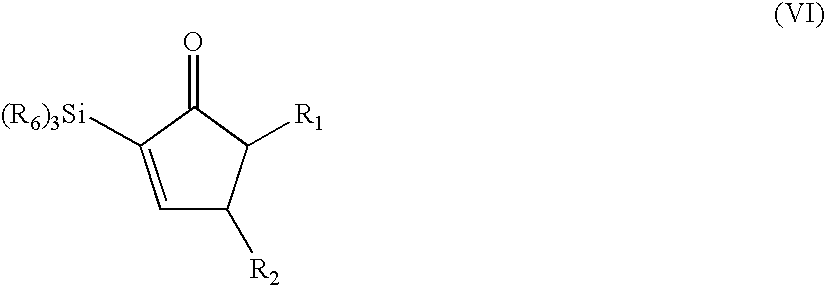
- R 1 and R 2 are each, independently, hydrogen, hydroxyl, cyano or a halogen group, or a substituted or unsubstituted alkyl, alkenyl alkynyl, cycloalkyl, cycloalkenyl, cycoalkynyl, aryl, or aralkyl group, optionally including at least one heteroatom in its carbon skeleton, or R 1 and R 2 together form part of a single or a fused ring structure, optionally including at least one heteroatom in its carbon skeleton, which comprises reacting a compound of the formula (VI)
- the invention provides an alternative synthetic route to compound (10) above, which route does not require a dehydration step in order to form the cross-conjugated enone group.
- R 1 , R 2 , R 3 , R 4 , R 5 , R 6 and M are each as previously defined above.
- R 1 is hydrogen or a substituted or unsubstituted alkyl, alkenyl or alkynyl group having from 1 to 12 carbon atoms and optionally including at least one heteroatom in its carbon skeleton.
- R 1 is preferably hydrogen.
- R 2 is preferably hydrogen, hydroxyl, cyano or a halogen group, or is a substituted or unsubstituted alkyl alkenyl or alkynyl group, having from 1 to 12 carbon atoms and optionally including at least one heteroatom in its carbon skeleton.
- R 2 is hydroxyl.
- R 2 is hydroxyl or a halogen group and R 1 is hydrogen.
- R 1 and R 2 are joined, such that the compound of the formula (V) has a bicyclic, tricyclic or polycyclic structure.
- R 1 and R 2 may form part of a [4+2]-cycloaddition product of a dienophile.
- Each of R 3 and R 4 is preferably a substituted or unsubstituted alkyl alkenyl or alkynyl group having from 1 to 12 carbon atoms, 1 to 11, 1 to 10, 1 to 9, 1 to 8, 1 to 7, 1 to 6, 1 to 5, 1 to 4, 1 to 3 or 1 to 2 carbon atoms, optionally including at least one heteroatom in its carbon skeleton.
- each of R 3 and R 4 has from 6 to 8 carbon atoms and also includes at least one heteroatom in its carbon skeleton, especially one or more oxygen atoms in the form of a hydroxyl or a carboxylate group.
- at least one of R 3 and R 4 includes a double bond within its structure.
- R 4 is —(CH 2 ) 5 COOH, —(CH 2 ) 5 COOR, —CH ⁇ CH(CH 2 ) 3 COOH, —CH ⁇ CH(CH 2 ) 3 COOR, —CH ⁇ CH—CH ⁇ CH—CH 2 —COOH or —CH ⁇ CH—CH ⁇ CH—CH 2 —COOR, where R is an alkyl group of from 1 to 3 carbon atoms, especially a methyl group.
- R 3 is —(CH 2 ) 7 CH 3 , —CH ⁇ CH—CH(OH)—C 5 H 11 , or —CH ⁇ CH—CH(OH)CH(CH 4 )C 4 H 9 .
- R 5 is preferably hydrogen or an alkyl group having from 1 to 4 carbon atoms, especially from 1 to 3 carbon atoms.
- R 5 is hydrogen, such that the compound of the formula (IV) is an aldehyde.
- R 1 is hydrogen
- R 2 is hydroxyl
- R 3 is —CH ⁇ CH—CH(OH)—C 5 H 11
- R 4 is —(CH 2 ) 5 COOMe
- R 5 is hydrogen, such that the compound of the formula (V) is a triene precursor of the formula (10), which can be readily dehydrated to form the methyl ester of ⁇ 7 -PG-A 1 (7) described above.
- R 6 is preferably a phenyl or benzyl group, or a lower alkyl group having from 1 to 4 carbon atoms, such as a methyl or t-butyl group.
- at least one R 6 group is a chiral auxiliary, such as ⁇ -pinene, or forms a linker group that serves to attach the silyl group to a solid phase, such as Merrifield's resin.
- M is preferably a lithium or magnesium ion or atom, such that the compound of the formula (III) is an organolithium or an organomagnesium compound.
- the compound of the formula (VI) is reacted with the compound of the formula (III) so that the conjugate addition reaction occurs diastereoselectively.
- the conditions of the reaction may be selected such that they provide thermodynamic or kinetic control, or the substituents on the compound of the formula (III) or the compound of the formula (VI) may be chosen such that the reaction is controlled by steric factors.
- the use of chiral auxiliaries as substituents on the silanyl group of the compound of the formula (VI) may also be of some assistance in this regard.
- the compound of the formula (VI) does not contain any chiral auxiliaries as substituents, but is chiral per se and is capable of transferring its chirality to the compound of the formula (V).
- the compound of the formula (VI) is enantiomerically pure, so that the compound of the formula (V) may be obtained in enantiomerically pure form.
- the compound of the formula (VI) preferably reacts with the compound of the formula (III) to form a conjugate addition product or enolate of the formula (VII)
- the resulting enolate (VII) may either be allowed to form the corresponding 2-silanyl cyclic ketone, or the transient ⁇ -silyl carbanion species may be trapped with a carbonyl compound to yield the corresponding ⁇ -silylalkoxide, which will undergo instantaneous elimination to form the cross-conjugated olefin.
- the stereochemistry of the exocyclic double bond may be controlled using “harder” or “softer” counter-ions on the enolate intermediate (VII).
- the metal cationic species result from the conjugate addition of the organometallic compound of the formula (III). If the compound of formula (III) is a lithium cuprate of formula (R 3 ) 2 CuLi, for example, the counter-ion is Li + . If the compound of formula (III) is a Grignard reagent of formula R 3 MgX, for example, the counterion is MgX + . However, such counterions may be exchanged. ZnCl 2 , for example, may be used to transmetallate a Li + enolate into a Zn 2+ enolate.
- the compound of the formula (III) may be any organometallic compound that will undergo conjugate addition across the 2-(trisubstituted)silylenone.
- the organometallic compound of the formula (III) is an organolithium, organocopper or organomagnesium complex, or any combination thereof, but other organometallic compounds, such as organozinc or organocadmium compounds, may be equally effective.
- the organometallic complex is a copper lithium complex of the formula (VIII) R 3 R 7 CuLi (VIII) wherein R 3 and R 7 are each, independently, as defined in claim 1 for R 3 .
- R 3 and R 7 are each, independently, as defined in claim 1 for R 3 .
- R 3 and R 7 are each, independently, an alkyl, alkenyl or alkynyl group having from 1 to 12 carbon atoms and optionally including at least one heteroatom in its carbon skeleton.
- R 3 and R 7 are the same.
- the organometallic complex is a Grignard reagent of the formula (IX) R 3 MgX (IX) wherein R 3 is as defined in claim 1 and X is a halogen group selected from fluorine, chlorine, bromine, iodine or astatine, especially bromine or iodine.
- the Grignard reagent may be used directly, but will generally be used in the presence of a suitable catalyst, such as copper (I) iodide, in order to promote conjugate rather than ketone addition.
- a suitable catalyst such as copper (I) iodide
- the inventive method preferably comprises the step of reacting a compound of the formula (X)
- the tri-substituted silanylacetylene is trimethylsilanylacetylene or t-butyldimethylsilanylacetylene.
- at least one R 6 group is a chiral auxiliary such as ⁇ -pinene, such that the compound of the formula X may undergo a stereoselective Pauson-Khand reaction with the tri-substituted silanylacetylene and CO 2 (CO) 8 .
- At least one R 6 group may form a linker group, such that the tri-substituted silanylacetylene is linked to as solid phase and the Pauson-Khand reaction may be carried out via solid phase synthesis.
- the compound of the formula (VI) may be synthesized in high yield in a single step.
- the inventive method is used for preparing a compound of the formula (XI)
- R 4 and R 3 are as defined above, which comprises preparing a compound of the formula (V) by a method as described above and then causing the compound of the formula (V) to undergo simultaneous elimination of R 1 and R 2 , in order to form the compound of the formula (XI).
- one of R 1 and R 2 is hydrogen and the other is hydroxyl and the compound of the formula (V) undergoes dehydration, to form the compound of the formula (XI).
- one of R 1 and R 2 is hydrogen and the other is a halogen group and the compound of the formula (V) undergoes dehydrohalogenation, in order to form the compound of the formula (XI).
- the compound of the formula (V) is a compound of the formula (XII)
- R 8 and R 9 are each, independently, hydrogen or a substituted or unsubstituted alkyl, alkenyl, alkynyl, cycloalkyl, cycloalkenyl, cycloalkynyl, aryl, or aralkyl group, optionally including at least one heteroatom in its carbon skeleton, or R 8 and R 9 together form part of a single or fused ring structure, optionally including at least one heteroatom in its carbon skeleton, and wherein the compound of the formula (XII) undergoes a Retro-Diels-Alder reaction to form the compound of the formula (XI).
- R 8 and R 9 together form a transannular ethylene group, such that the Retro-Diels-Alder reaction produces 1,3-cyclohexadiene in addition to the compound of the formula (I).
- R 8 and R 9 together form a methylene group, such that the Retro Diels-Alder reaction produces 1,3-cyclopentadiene in addition to the compound of the formula (XI).
- R 3 and R 4 are each, independently, hydrogen or a substituted or unsubstituted alkyl, alkenyl, alkynyl cycloalkyl, cycloalkenyl, cycloalkynyl aryl or aralkyl group, optionally including at least one heteroatom in its carbon skeleton, or R 3 and R 4 together form part of a single or a fused ring structure, optionally including at least one heteroatom in its carbon skeleton; which comprises reacting norbornadiene with trimethylsilanylacetylene and CO 2 (CO) 8 to form a compound of the formula (XIV)
- the invention provides a facile synthetic route which can be used to produce a cross-conjugated dienone compound of the formula (XIII) in good yield.
- norbornadiene is reacted with trinethylsilanylacetylene and CO 2 (CO) 8 by stirring a solution of the components in a suitable solvent at or around ambient temperature for 1 to 72 hours, preferably 1 to 48 hours, most preferably 1 to 24 hours, to form a compound of the formula (XIV).
- norbornadiene is reacted with trimethylsilanylacetylene and CO 2 (CO) 8 using flash vacuum pyrolysis.
- norbornadiene is reacted with trimethylsilanylacetylene and CO 2 (CO) 8 by heating a mixture of these compounds in a suitable solvent in a microwave for 1 to 120 minutes, preferably from 1 to 60 minutes, preferably from 1 to 30 minutes and most preferably from 1 to 10 minutes.
- the compound of the formula (XIV) may exist in the exo- or endo-configuration, depending upon whether the 5-membered cyclopentenone ring is on the same side (“exo”) or the opposite side (“endo”) as the methylene bridge of the [2.2.1]-bicycloheptene ring.
- the reaction of norbornadiene with trimethylsilanylacetylene and CO 2 (CO) 8 by stirring a solution of the components in a solvent at ambient temperature generally produces exo-form selectively, typically in a ratio of exo: endo of about 9:1.
- the reaction conditions may be controlled to favour formation of the endo-form if so desired.
- each of the exo- and endo-forms of the compound of formula (XIV) may exist in the form of enantiomers.
- the conditions for the reaction between norbornadiene, trimethylsilanylacetylene and CO 2 (CO) 8 are chosen such that the reaction occurs substantially asymmetrically.
- Each of R 3 and R 4 is preferably a substituted or unsubstituted alkyl, alkenyl or alkynyl group having from 1 to 12 carbon atoms, 1 to 11, 1 to 10, 1 to 9, 1 to 8, 1 to 7, 1 to 6, 1 to 5, 1 to 4, 1 to 3 or 1 to 2 carbon atoms, optionally including at least one heteroatom in its carbon skeleton.
- each of R 3 and R 4 has from 6 to 8 carbon atoms and also includes at least one heteroatom in its carbon skeleton, especially one or more oxygen atoms in the form of a hydroxyl or a carboxylate group.
- at least one of R 3 and R 4 includes a double bond within its structure.
- R 4 is —(CH 2 ) 5 COOH, —(CH 2 ) 5 COOR, —CH ⁇ CH(CH 2 ) 3 COOH, —CH ⁇ CH(CH 2 ) 3 COOR, —CH ⁇ CH—CH ⁇ CH—CH 2 —COOH or —CH ⁇ CH—CH ⁇ CH—CH 2 —COOR, where R is an alkyl group of from 1 to 3 carbon atoms, especially a methyl group.
- R 3 is —(CH 2 ) 7 CH 3 , —CH ⁇ CH—CH(OH)—C 5 H 11 , or —CH ⁇ CH—CH(OH)CH(CH 3 )C 4 H 9 .
- R 3 is —CH 2 —CH ⁇ CH(CH 2 ) 3 COOH and R 4 is —CH 2 CH(OH)C 5 H 11 , such that the compound of the formula (XIII) is ⁇ 12 -PG-J 2 (5) above.
- R 3 is —CH 2 —CH ⁇ CH(CH 2 ) 3 COOH and R 4 is —CH ⁇ CH—C 5 H 11 , such that the compound of the formula (XIII) is ⁇ 12,14 -15-deoxy PG-J 2 (6) as described above.
- R 3 is —C 8 H 17 and R 4 is —(CH 2 ) 5 COOMe, such that the compound of the formula (XIII) is either compound (11) above, compound (12) above or a racemic mixture thereof.
- the compound of the formula (XV) may be heated in the presence of a Lewis acid and, optionally, a dienophile, to form the compound of the formula (XIII).
- a Lewis acid enables the reaction to be carried out at low temperatures, preferably between ambient temperature and about 50° C., whilst the optional inclusion of a dienophile provides a means of trapping the reverse-coupled diene that is formed by the Retro-Diels-Alder reaction.
- the compound of the formula (XV) is heated in the presence of Me 2 AlCl or MeAlCl 2 or the like, and in the presence of maleic anhydride, to form the compound of the formula (XIII).
- a compound of the formulae (I), (V), (XI) or (XIII) obtained or obtainable by a method according to the invention in its first or second aspects.
- the compound of the formula (I) has one of the following structures:
- R 1 —CH 2 CH ⁇ CH(CH 2 ) 3 CO 2 H.
- the compound of the formula (I) has the following structure:
- the compound of the formula (I) has the following structure:
- a compound according to the invention in its third aspect for use in therapy.
- the compound is for use as anti-viral agent.
- the compound is for use in treating cancer, especially a cancer is selected from the group consisting of pancreatic cancer, prostate cancer, colorectal cancer and thyroid cancer.
- the compound is for use as an anti-inflammatory agent.
- the compound is for use in inhibiting angiogenesis.
- the compound is for use in treating atherosclerosis and/or for treating rheumatoid arthritis.
- the compound is for use as an apoptotic agent.
- the compound has the following structure
- a pharmaceutical composition comprising a compound according to the invention in its third or fourth aspects and a pharmaceutically acceptable excipient.
- Suitable pharmaceutically acceptable excipients for inclusion in the inventive compositions are well-known to those skilled in the art and include, without limitation, preserving agents, solubilising agents, stabilising agents, wetting agents, emulsifiers, sweeteners, colourants, odourants, salts (the compounds of the present invention may themselves be provided in the form of a pharmaceutically acceptable salt), buffers, coating agents or antioxidants.
- a pharmaceutical composition within the scope of the present invention may be adapted for administration by any appropriate route, for example by the oral (including buccal or sublingual), rectal, nasal, topical (including buccal, sublingual or transdermal), vaginal or parenteral (including subcutaneous, intramuscular, intravenous or intradermal) routes.
- Such a composition may be prepared by any method known in the art of pharmacy, for example by admixing one or more active ingredients with a suitable carrier.
- a method of treating a patient in need of therapy comprising administering a therapeutically effective amount of a compound according to the invention in its third or fourth aspects to said patient.
- a method of treating a patient in need of anti-viral therapy comprising administering a therapeutically effective amount of a compound according to the invention in its third or fourth aspects to said patient.
- a method of treating a patient in need of cancer therapy comprising administering a therapeutically effective amount of a compound according to the invention in its third or fourth aspects to said patient.
- a method of treating a patient in need of anti-inflammatory therapy comprising administering a therapeutically effective amount of a compound according to the invention in its third or fourth aspects to said patient.
- a method of treating a patient in need of anti-viral therapy comprising administering a therapeutically effective amount of a compound having the following structure to said patient:
- Exo-2-trimethylsilanyl-3a,4,7,7a-tetrahydro-4,7-methano-inden-1-one (3) was prepared as described in Example 1 above. Following the procedure described in Example 1 above, 3 (485 mg, 2.22 mmol, 1 eq.) in Et 2 O (10 cm 3 ) was treated with a solution of MeCuLi in Et 2 O (25 cm 3 ) generated from CuI (636 mg, 3.34 mmol, 1.5 eq.) and a 1.6 M solution of MeLi in Et 2 O (4.2 cm 3 , 6.72 mmol, 3 eq.).
- adduct (7) (220 mg, 0.746 mmol, 1 eq.) and maleic anhydride (365 mg, 3.72 mmol, 5 eq.) in dichloromethane (20 cm 3 ) was treated with a 1.0 M solution of MeAlCl 2 in hexane (0.75 cm 3 , 0.75 mmol, 1 eq.) and heated to reflux for 3.5 hours. The reaction was cooled before Et 2 O (50 cm 3 ) and 0.5 M NaOH (50 cm 3 ) were added. The resultant aqueous layer was extracted with Et 2 O (2 ⁇ 50 cm 3 ) and the combined organic extracts were dried over MgSO 4 .
- Exo-2-trimethylsilanyl-3a,4,7,7a-tetrahydro-4,7-methano-inden-1-one (3) was prepared as described in Example 1 above. Following the procedure described in Example 1 above, a solution of Me 2 CuLi in Et 2 O (25 cm 3 ), prepared from CuI (636 mg, 3.33 mmol 1.5 eq.) and a 1.6 M solution of MeLi in hexane (4.2 cm 3 , 6.72 mmol, 3.0 eq.), was treated with 3 (485 mg, 2.22 mmol, 1 eq.).
- Human lymphoblastoid Jurkat T cells were grown at 37° C. in a 5% CO 2 atmosphere in RPM1 1640 medium (GIBCO BRL, Gaithersburg, Md., United States of America) supplemented with 10% fetal calf serum (FCS, Hyclone Europe Ltd, United Kingdom), 2 mM glutamine and antibiotics according to the method described by A. Rossi et al. 48
- the test compound was stored as a 100% ethanolic stock solution (100 mM) or in dimethylsulfoxide (100 mM) and diluted to the appropriate concentration in culture medium at the time of use.
- TPA 12-O-tetradecanoylphorbol-13-acetate
- Control cells received an equal amount of control diluent.
- whole-cell extracts were prepared and subjected to analysis of DNA-binding activity by EMSA (Electrophoretic Mobility Shift Assay) for detection of HSF or NF- ⁇ B activation, according to the method described by A. Rossi et al. 48
- Monkey kidney 37RC cells were grown at 37° C. under the conditions described above for human lymphoblastoid Jurkat T cells.
- the parainfluenza Sendai virus (SV) was grown in the allantoic cavity of 10 day-old embryonated eggs.
- Viral titre was expressed in haemagglutinating units (HAU) per ml; haemagglutinin titration was carried out according to standard procedures using human 0 Rh+ erythrocytes, as described in C. Amici et al. 50 Confluent monolayers of 37RC cells were infected with SV virus (5 HAU/10 5 cells) for 1 hour at 37° C., and then treated with different concentrations of test compound.
- HAU haemagglutinating units
- Virus yield at 24 hours after infection was determined in the supernatant of infected cells by HAU titration.
- the results for ( ⁇ )- ⁇ 12,14 -15-deoxy-PG-J 2 are shown in FIG. 2 . These results show the latter to be a potent inhibitor of Sendai virus replication.
- the ID 50 (the 50% inhibitory dose/concentration) value at 24 hours and the TD 100 (the dose or concentration at which a tested compound is 100% toxic to uninfected cells, determined visually by microscopy) for both ( ⁇ )- ⁇ 12,14 -15-deoxy-PG-J 2 and for compound CTC-150 were measured and the following results were obtained.
Landscapes
- Chemical & Material Sciences (AREA)
- Organic Chemistry (AREA)
- Chemical Kinetics & Catalysis (AREA)
- Health & Medical Sciences (AREA)
- Life Sciences & Earth Sciences (AREA)
- General Chemical & Material Sciences (AREA)
- Communicable Diseases (AREA)
- Oncology (AREA)
- Virology (AREA)
- Medicinal Chemistry (AREA)
- Nuclear Medicine, Radiotherapy & Molecular Imaging (AREA)
- Pharmacology & Pharmacy (AREA)
- Animal Behavior & Ethology (AREA)
- General Health & Medical Sciences (AREA)
- Public Health (AREA)
- Veterinary Medicine (AREA)
- Organic Low-Molecular-Weight Compounds And Preparation Thereof (AREA)
Abstract
Description
| (1) | (2) |
 |
 |
| PG-A1 | R1 = –(CH2)6CO2H | PG-B1 | ||
| PG-A2 | R2 = –CH2CH═CH(CH2)3CO2H | PG-B2 | ||


wherein Ro is hydrogen or any other substituent;
R3, R4 and R5 are each, independently, hydrogen or a substituted or unsubstituted alkyl, alkenyl, alkynyl cycloalkyl, cycloalkenyl, cycloalkynyl aryl or aralkyl group, optionally including at least one heteroatom in its carbon skeleton, or R3 and R4 together form part of a single or a fused ring structure, optionally including at least one heteroatom in its carbon skeleton;
n=0 to 100; and
m=0 to (n+1),
which comprises reacting a compound of the formula (II)

wherein R is a substituted or unsubstituted alkyl, alkenyl, alkynyl, cycloalkyl, cycloalkenyl, cycloalkynyl, aryl or aralkyl group, optionally including at least one heteroatom in its carbon skeleton, each R6 group being the same or different,
with an organometallic compound of the formula (III)
R3M (III)
wherein M is a metal ion of an organometallic complex,
and reacting the conjugate addition product so obtained in situ with a compound of the formula (IV)
R4COR5 (IV)
to form a compound of the formula (I).

wherein R1 and R2 are each, independently, hydrogen, hydroxyl, cyano or a halogen group, or a substituted or unsubstituted alkyl, alkenyl alkynyl, cycloalkyl, cycloalkenyl, cycoalkynyl, aryl, or aralkyl group, optionally including at least one heteroatom in its carbon skeleton, or R1 and R2 together form part of a single or a fused ring structure, optionally including at least one heteroatom in its carbon skeleton,
which comprises reacting a compound of the formula (VI)

with an organometallic compound of the formula (III)
R3M (III)
and reacting the conjugate addition product so obtained in situ with a compound of the formula (IV)
R4COR5 (IV)
to form a compound of the formula (V).

R3R7CuLi (VIII)
wherein R3 and R7 are each, independently, as defined in claim 1 for R3. The use of such compounds in conjugate addition reactions is well documented in the chemical literature.45 Such compounds are especially preferred for selectively preparing trans-exocyclic enones. In a preferred embodiment, R3 and R7 are each, independently, an alkyl, alkenyl or alkynyl group having from 1 to 12 carbon atoms and optionally including at least one heteroatom in its carbon skeleton. Preferably, R3 and R7 are the same. In an equally preferred embodiment, the organometallic complex is a Grignard reagent of the formula (IX)
R3MgX (IX)
wherein R3 is as defined in claim 1 and X is a halogen group selected from fluorine, chlorine, bromine, iodine or astatine, especially bromine or iodine. Such Grignard reagents are preferred for preparing predominantly cis-exocyclic enones. In this case, the Grignard reagent may be used directly, but will generally be used in the presence of a suitable catalyst, such as copper (I) iodide, in order to promote conjugate rather than ketone addition. However, other catalytic agents suitable for this purpose will be known to those skilled in the art. In the foregoing embodiments, the inventive method preferably comprises the step of reacting a compound of the formula (X)

with a tri-substituted silanylacetylene and CO2(CO)8 in a Pauson-Khand reaction,46 to form the compound of the formula (VI). In a preferred embodiment, the tri-substituted silanylacetylene is trimethylsilanylacetylene or t-butyldimethylsilanylacetylene. In an equally preferred embodiment, at least one R6 group is a chiral auxiliary such as α-pinene, such that the compound of the formula X may undergo a stereoselective Pauson-Khand reaction with the tri-substituted silanylacetylene and CO2(CO)8. In an alternative embodiment, at least one R6 group may form a linker group, such that the tri-substituted silanylacetylene is linked to as solid phase and the Pauson-Khand reaction may be carried out via solid phase synthesis. Using a Pauson-Khand reaction, the compound of the formula (VI) may be synthesized in high yield in a single step. In an especially preferred embodiment, the inventive method is used for preparing a compound of the formula (XI)

wherein R4 and R3 are as defined above, which comprises preparing a compound of the formula (V) by a method as described above and then causing the compound of the formula (V) to undergo simultaneous elimination of R1 and R2, in order to form the compound of the formula (XI). In a preferred embodiment, one of R1 and R2 is hydrogen and the other is hydroxyl and the compound of the formula (V) undergoes dehydration, to form the compound of the formula (XI). In another embodiment, one of R1 and R2 is hydrogen and the other is a halogen group and the compound of the formula (V) undergoes dehydrohalogenation, in order to form the compound of the formula (XI). In an especially preferred embodiment, the compound of the formula (V) is a compound of the formula (XII)

wherein R8 and R9 are each, independently, hydrogen or a substituted or unsubstituted alkyl, alkenyl, alkynyl, cycloalkyl, cycloalkenyl, cycloalkynyl, aryl, or aralkyl group, optionally including at least one heteroatom in its carbon skeleton, or R8 and R9 together form part of a single or fused ring structure, optionally including at least one heteroatom in its carbon skeleton, and wherein the compound of the formula (XII) undergoes a Retro-Diels-Alder reaction to form the compound of the formula (XI). Preferably, R8 and R9 together form a transannular ethylene group, such that the Retro-Diels-Alder reaction produces 1,3-cyclohexadiene in addition to the compound of the formula (I). In an equally preferred embodiment, R8 and R9 together form a methylene group, such that the Retro Diels-Alder reaction produces 1,3-cyclopentadiene in addition to the compound of the formula (XI).

wherein R3 and R4 are each, independently, hydrogen or a substituted or unsubstituted alkyl, alkenyl, alkynyl cycloalkyl, cycloalkenyl, cycloalkynyl aryl or aralkyl group, optionally including at least one heteroatom in its carbon skeleton, or R3 and R4 together form part of a single or a fused ring structure, optionally including at least one heteroatom in its carbon skeleton;
which comprises reacting norbornadiene with trimethylsilanylacetylene and CO2(CO)8 to form a compound of the formula (XIV)

reacting the compound of the formula (XIV) with an organometallic compound of the formula (III)
R3M (III)
wherein M is a metal ion of an organometallic complex, and reacting the resultant conjugate addition product in situ with a compound of the formula (XV)
R4CHO (XV)
to form a compound of the formula (XVI)

and heating the compound of the formula (XVI) to form the compound of the formula (XIII).

wherein R1=—CH2CH═CH(CH2)3CO2H.


and is for use in treating viral infections.


| Compound | ID50/μM | TD100/μM | ||
| (−)-Δ12, 14-15-deoxy-PG-J2 | 3.0 | 50 | ||
| CTC-150 | 0.7 | >50 | ||
- 1. U.S. von Euler, Arch. Exp. Pathol. Pharmakol, 1934, 175, 78.
- 2. Early, chemistry-based studies are described in J. S. Bindra and R, Bindra, “Prostaglandin Synthesis”, Academic Press, New York, 1977; A. Mitra, “The Synthesis of Prostaglandins” Wiley, New York, 1977.
- 3. For example, the albumin-catalysed metabolism of PG-D2 has been studied, F. A. Fitzpatrick and M. A. Wynalda, J. Biol. Chem., 1983, 258, 11713.
- 4. B. Ashly in “Human Pharmacology—Molecular to Clinical” 3rd edn. (eds. T. M. Brody, J. Larner, K. P. Minneman and H. C. Neu), Mosby, 1994, 225.
- 5. T. Kato, M. Fukushima, S. Kurozumi and R. Noyori, Cancer Res., 1986, 46, 3538; M. Fukushima, T. Kato, S. Narumiya, Y. Mizushima, H. Sasaki, Y. Terashima, Y. Nishiyama and M. G. Santoro, Adv. Prostaglandin, Thromboxane and Leukotriene Res., 1989, 19, 415.
- 6. M. Tanikawa, K Yamada, K. Tominaga, H. Morisaki, Y. Kaneko, K. Ikeda, M. Suzuki, T. Kiho, K. Tomokiyo, K. Furuta, R. Noyori and M. Nakanishi, J. Biol Chem., 1998, 273, 18522; M. G. Santoro, E. Garaci and C. Amici, Proc. Nat. Acad. Sci., 1989, 86, 8407.
- 7. H. Sasaki and M. Fukushima, Anti-Cancer Drugs, 1994, 5, 131.
- 8. I. Vedin, J. Wasserman and S. Hammarstrom, Prostaglandins, Leukotrienes, Essential Fatty Acids, 1996, 55, 185.
- 9. K. Suzuki, F. Shono and M. Uyeda, Biosci. Biotechnol. Biochem., 1998, 62, 2073.
- 10. Y. Kawamoto, Y. Nakamura, Y. Naito, Y. Torii, T. Kumagai, T. Osawa, H. Ohigashi, K Satoh, M. Imagawa and K. Uchida, J. Biol. Chem., 2000, 275, 11291.
- 11. C. Amici, A. T. Palamara, E. Garaci and M. G. Santoro, Antiviral Res. 1992, 19, 129; F. Pica, F. Decesare and M. G. Santoro, ibid, 1993, 20, 193; M. G. Santoro, Trends in Microbiol., 1997, 5, 276.
- 12. C. Amici and M. G. Santoro, unpublished results.
- 13. G. Conti, P. Pottincasa, S. Visalli and C. Chezzi, Virus Res., 2001, 75, 43.
- 14. C. Conti, P. Mastromarino, P. Tomao, A. De Marco, F. Pica and M. G. Santoro, Antimicrobial Agents Chemother., 1996, 40, 367.
- 15. C. Rozero, A. Carattoli, A. De Marco, C. Amici, C. Giorgi and M. G. Santoro, J. Chem. Invert., 1996, 97, 1795.
- 16. G. Elia, B. Polla, A. Rossi and M. G. Santoro, Eur. J. Biochem., 1999, 264, 736; cells may also be protected against the deleterious effects of oxidized low-density lipoproteins, L. Hamel, M. Kenney, K. Clark, L. Merkel and C. Rojas, Biochem. Biophys. Res. Commun., 2000, 269, 327.
- 17. F. Pica, A. T. Palamara, A. Rossi, A. De Marco, C. Amici and M. G. Santoro, Antimicrobial Agents Chemother., 2000, 44, 200.
- 18. A. Rossi, P. Kapati, G. Natoli, T. Takahasi, Y. Chen, M. Karin and M. G. Santoro, Nature, 2000, 403, 103; D. S. Straus, G. Pascual, M. Li, J. S. Welch, M. Ricote, C. H. Hsiang, L. L. Sengchanthalangsy, G. Ghosh and C. K. Glass, Proc. Natl. Acad. Sci. USA, 2000, 97, 4844; A. Castrillo, M. J. M. Diaz-Guerra, S. Hortelano, P. Martin-Sanz and L. Bosca, Mol. Cellular Biol., 2000, 20, 1692; see also T. Koizumi, M. Negishi and A. Ichikawa, Biochem. Pharmacol., 1993, 45, 2457.
- 19. M. Sazuki, M. Mori, T. Niwa, R. Hirata, K. Furuta, T. Ishikawa and R. Noyori, J. Am. Chem. Soc., 1997, 119, 2376.
- 20. T. Koizumi, M. Negishi and A. Ichikawa, Biochem. Pharmacol, 1993, 45, 2457; J. J. P. Bogards, J. C. Venekamp and P. J. van Bladeren, Chem. Res. Toxicol, 1999, 10, 310; M. L. P. S. van Iersel, P. J. van Bladeren, N. H. P. Cnubben, J. H. Koeman and N. Smink, Biochem. Pharmacol., 1999, 57, 1383.
- 21. M. Kondo, T. Oya-Ito, T. Kumagi, T. Osawa and K. Uchida, J. Bios Chem. 2001, 276, 12076.
- 22. B. M. Forman, P. Tontonoz, J. Chen, R. P. Brun, B. M. Spiegelman and R. M. Evans, Cell, 1995, 83, 803; S. A. Kliewer, J. M. Lenhard, T. M. Willson, I. Patel, D. C. Morris and J. M. Lehmann, ibid, 1995, 83, 813.
- 23. K. Guyton, R. Bond, C. Reilly, G. Gilkeson, P. Halushka and J. Cook, J. Leukocyte Biol,. 2001, 69, 631.
- 24. M. Rocte, A. C. Li, T. M. Willson, C. J. Kelly and C. K. Glass, Nature, 1998, 391, 79; D. A. Willoughby, A. R. Moore and P. R. Colville-Nash, Nature Med., 2000, 6, 137; P. R. Colville-Nash, S. S. Qureshi, D. Willis and D. A. Willoughby, J. Immunol,. 1998, 161, 987; Y. Kitomura, J. Kakimura, Y. Matsuoka, Y. Nomura, P. J. Gebicke-Haerter and T. Taniguchi; Neurosci. Lett,. 1999, 262, 129; T. V. Petrova, K. T. Akoma and L. J. Van Eldik, Proc. Natl. Acad. Sci. USA,. 1999, 96, 4668.
- 25. A. Chawla, Y. Barak, L. Nagy, D. Liao, P. Tontonez and R. M. Evans, Nature Med 2001, 7, 48.
- 26. Y. Tsubouchi, Y. Kawahito, M. Kohno, K. Inoue, T. Hla and H. Sano, Biochem. Biophys. Res. Commun,. 2001, 283, 750.
- 27. B. Poligone and A. S. Baldwin, J. Biol. Chem,. 2001, 276, 38658.
- 28. C. Amici, G. Belardo, A. Rossi and M. G. Santoro, J. Biol. Chem,. 2001, 276, 28759.
- 29. B. H. Rovin, L. Lu and A. Cosio, J. Am. Soc. Nephrol,. 2001, 12, 1659; E. Cernuda-Morollon, E. Pineda-Molina, F. J. Canada and D. Perez-Sala, J. Biol. Chem,. 2001, 276, 35530; S. G. Harris and R. P. Phipps, Eur. J. Immunol,. 2001, 31, 1098.
- 30. X. H. Xin, S. Y. Yang, J. Kowalski and M. E. Gerritsen, J. Biol. Chem,. 1999, 274, 9116; D. Bishop-Bailey and T. Hta, ibid, 1999, 274, 17042.
- 31. G. Fibl, M. N. Wente, H. A. Reber and O. J. Hines, Biochem. Biophys. Res. Commun,. 2001, 287, 522.
- 32. Y. Tsubouchi, H. Sano, Y. Kawahito, S. Mukai, R. Yamada, M. Kohno, K Inoue, T. Hla and M. Kondo, Biochem. Biophys. Res. Commun,. 2000, 270, 400.
- 33. J. E. Mullally, P. J. Moos, K. Edes and F. A. Fitzpatrick, J. Biol. Chem,. 2001, 276, 30366.
- 34. R. Butler, S. H. Mitchell, D. J. Tindell and C. Y. F. Young, Cell Growth and Differentiation, 2000, 11, 49.
- 35. R. N. DuBois, R. Gupta, J. Brockman, B. S. Reddy, S. L. Krakow and M. A. Lazar, Carcinogenesis, 1998, 19, 49; K. Ohta, T. Endo, K. Haraguchi, J. M. Hershman and T. Onaya, J. Clin. Endocrinol. Metab,. 2001, 86, 2170.
- 36. R. Chinery, R. J. Coffey, R. Graves-Deal, S. C. Kirkland, S. C. Sanchez, W. E. Zackert, J. A. Oates and J. D. Morrow, Cancer Res,. 1999, 59, 2739.
- 37. R. Noyori and M. Suzuki, Angew. Chem. Int. Ed. 1984, 23, 847.
- 38. R. Noyori, H. Koyano, M. Mori, R Hirata, Y. Shiga, T. Kokura and M. Suzuki, Pure and Appl. Chem,. 1994, 66, 1999.
- 39. M. Suzuki, T. Kawagishi, A. Yanagisawa, T. Suzuki, N. Okamura and R. Noyori, Bull. Chem. Soc,. 1988, 61, 1299.
- 40. S. Fukushima, Y. Takeuchi, S. Kishimoto, S. Yamashita, K Uetsuki, S. Shirakawa, M. Suzuki, K. Furuta, R. Noyori, H. Sasaki Y. Kikuchi, T. Kita, T. Yamori, J. Sawada, M. Kojima, A. Hazato, S. Kurozumi and M. Fukushima, Anti-Cancer Drugs, 2001, 12, 221.
- 41. O. Tsuge, S. Kinemasa and Y. Ninomiya, Chem. Lett,. 1984, 1993.
- 42. J. Tanaka, S. Kanemasa, Y. Ninomiya and O. Tsuge, Bull. Chem. Soc. Jpn,. 1990, 63, 466.
- 43. J. Tanaka, H. Kobayashi, S. Kanemasa and O. Tsuge, Bull. Chem. Soc. Jpn,. 1989, 62, 1193.
- 44. A. R. Bassindale, I. Katampe, P. A. Kyle and P. G. Taylor, J. Chem. Soc., Perkin Trans. I, 1996, 327.
- 45. T. Ito, S. Okanoto and F. Sato, Tetrahedron Lett,. 1990, 31, 6399.
- 46. U. Khand et al., J. Chem. Soc., Perkin Trans. I, 1973, 977.
- 47. X. Verdaguer et al., J. Am. Chem. Soc,. 2000, 122, 10242.
- 48. A. Rossi et al., Proc. Natl. Acad. Sc. USA, 1997, 94: 746-750.
- 49. A. Rossi et al., J. Biol. Chem. 1998, 273: 16446-16452.
- 50. C. Amici et al., J. Virol, 1994, 68: 6890-6899.
Claims (34)

n=0 to 100; and
m=0 to (n×1),

R3M (III)
R4COR5(IV)

R3M (III)
R4COR5 (IV)
R3R7CuLi (VIII)
R3MgX (IX)


R3M (III)
R4CHO (XV)


R3M (III)
R4CHO (XV)


R3M (III)
R4CHO (XV)

R3R7CuLi (VIII).


Applications Claiming Priority (4)
| Application Number | Priority Date | Filing Date | Title |
|---|---|---|---|
| GBGB0207028.2A GB0207028D0 (en) | 2002-03-25 | 2002-03-25 | A new synthetic method and novel chemical compounds |
| GBGB0207028.2 | 2002-03-25 | ||
| WOPCT/GB03/01281 | 2003-03-25 | ||
| PCT/GB2003/001281 WO2003080552A2 (en) | 2002-03-25 | 2003-03-25 | Cyclopentenone derivatives, their preparation and use in medecime |
Publications (2)
| Publication Number | Publication Date |
|---|---|
| US20050107477A1 US20050107477A1 (en) | 2005-05-19 |
| US7304186B2 true US7304186B2 (en) | 2007-12-04 |
Family
ID=9933674
Family Applications (1)
| Application Number | Title | Priority Date | Filing Date |
|---|---|---|---|
| US10/956,532 Expired - Fee Related US7304186B2 (en) | 2002-03-25 | 2004-09-24 | Synthetic method and novel chemical compounds |
Country Status (5)
| Country | Link |
|---|---|
| US (1) | US7304186B2 (en) |
| EP (1) | EP1487772A2 (en) |
| AU (1) | AU2003217023A1 (en) |
| GB (1) | GB0207028D0 (en) |
| WO (1) | WO2003080552A2 (en) |
Families Citing this family (2)
| Publication number | Priority date | Publication date | Assignee | Title |
|---|---|---|---|---|
| GB0218261D0 (en) * | 2002-08-06 | 2002-09-11 | Charterhouse Therapeutics Ltd | Improvements in pharmaceutically useful compounds |
| CN103588654B (en) * | 2013-10-18 | 2016-06-29 | 健雄职业技术学院 | A kind of synthetic method of 3-n-butyl amine base ethyl propionate |
Family Cites Families (1)
| Publication number | Priority date | Publication date | Assignee | Title |
|---|---|---|---|---|
| JPS6147437A (en) * | 1984-08-15 | 1986-03-07 | Teijin Ltd | 5-alkylidene-2-halo-4-substituted-2-cyclopentenone and its preparation |
-
2002
- 2002-03-25 GB GBGB0207028.2A patent/GB0207028D0/en not_active Ceased
-
2003
- 2003-03-25 EP EP03712411A patent/EP1487772A2/en not_active Withdrawn
- 2003-03-25 WO PCT/GB2003/001281 patent/WO2003080552A2/en not_active Ceased
- 2003-03-25 AU AU2003217023A patent/AU2003217023A1/en not_active Abandoned
-
2004
- 2004-09-24 US US10/956,532 patent/US7304186B2/en not_active Expired - Fee Related
Non-Patent Citations (7)
| Title |
|---|
| Fukushima et al. Antitumor activity, optimum administration method and pharmacokinetics of 13,14-dihydro-15-deoxy-delta7-prostaglandin A1 methyl ester (TEI-9826) integrated in lipid microspheres (Lipo TEI-9826). Anti-Cancer Drugs, 2001, vol. 12 (3), pp. 221-234. * |
| Satoh et al. Journal of Neurochemistry. 2000, vol. 75 (3), p. 1092-1102. * |
| Satoh et al. Neurotrophic actions of novel compounds designed from cyclopentenone prostaglandins. Journal of Neuroscience, 2001, vol. 77 (1), pp. 50-62. * |
| Shih et al. Journal of Organic Chemistry. 1980, vol. 45 (22), p. 4462-4471. * |
| Suzuki et al. Journal of the American Chemical Society. 1997, vol. 119 (10) p. 2376-2385. * |
| Suzuki et al., 1997, "Delta<SUP>7</SUP>-Prostaglandin C<SUB>1</SUB>: A Primary Metabolite of Antitumor Delta<SUP>7</SUP>-Prostaglandin A<SUB>1</SUB>in the Sera," Tetrahedron53(50): 17009-17014. |
| Tanikawa et al. Journal of Biological Chemistry. 1998, vol. 273 (29), p. 18522-18527. * |
Also Published As
| Publication number | Publication date |
|---|---|
| AU2003217023A8 (en) | 2003-10-08 |
| US20050107477A1 (en) | 2005-05-19 |
| EP1487772A2 (en) | 2004-12-22 |
| WO2003080552A2 (en) | 2003-10-02 |
| AU2003217023A1 (en) | 2003-10-08 |
| GB0207028D0 (en) | 2002-05-08 |
| WO2003080552A3 (en) | 2004-01-08 |
Similar Documents
| Publication | Publication Date | Title |
|---|---|---|
| Roberts et al. | The emergence of the cyclopentenone prostaglandins as important, biologically active compounds | |
| Padwa et al. | Synthesis of the pyrrolidine ring system by radical cyclization | |
| Reich et al. | Acylsilane chemistry. Synthesis of regio-and stereoisomerically defined enol silyl ethers using acylsilanes | |
| Larson et al. | . alpha.-Silylation of lithium ester enolates | |
| CN101711231B (en) | Compounds with (substituted phenyl)-propenal moiety, their derivatives, biological activity, and uses thereof | |
| AU612449B2 (en) | New 3,5-dihydroxy carboxylic acids and derivatives thereof, a process for the preparation thereof, the use thereof as pharmaceuticals, pharmaceutical products and intermediates | |
| US20050107477A1 (en) | Synthetic method and novel chemical compounds | |
| US9562025B2 (en) | Compounds with (1E, 6E)-1,7-Bis-(3,4-dimethoxyphenyl)-4-4-distributed-hepta-1,6-diene-3,5-dione structural scaffold, their biological activity, and uses thereof | |
| Sweeney et al. | The synthesis and cytotoxic evaluation of a series of benzodioxole substituted titanocenes | |
| Hansen et al. | Preparation and alkylation of a new chiral oxazoline from L-serine | |
| WO2010041401A1 (en) | Protein phosphatase inhibitor | |
| Jankowski et al. | The reaction of trimethylsilyl ethylene oxide with α-sulfonyl anions and α, α-sulfonyl dianions. A method for stereocontrolled synthesis of (E)-and (Z)-allylic alcohols | |
| Angle et al. | Intramolecular formal [3+ 2] cycloaddition of alkenes and benzylic cations. Stereoselective synthesis of 1, 2, 3, 4, 4a, 9a-hexahydrofluorenes | |
| JP3867213B2 (en) | Method for producing ketoaldehyde | |
| WO2000063159A1 (en) | (-)-verbenone derivatives | |
| Schneider et al. | Diastereoselective conjugate additions to t-leucine-derived N-enoyl 1, 3-oxazolidin-2-ones | |
| US7759399B2 (en) | Pharmaceutical compositions | |
| US4714777A (en) | Cyclopropanone hydrate derivatives | |
| EP1537066B1 (en) | Cyclopentenone derivatives as potent activators of hsf-1 | |
| Prasad | Annulation and cycloaromatization reactions of 3-aryl (alkyl) thio-1-trimethylsiloxy-1-methoxy-1, 3-butadienes | |
| JP2621122B2 (en) | 2-Substituted-2-cyclopentenones and anticancer and osteogenesis promoters containing the same as an active ingredient | |
| Kidane | Retro-Diels-Alder routes to 4, 5 disubstituted cyclopentenones | |
| Ivchenko et al. | Reactions of cyclopentadienes with phorone | |
| Bassindale et al. | Reactions of α-trimethylsilylvinyl carbanions with carboxylic acid derivatives: the relationship between product distribution and substrate reactivity | |
| Voaden | The Use of Silicon Substituted Dienes in Organic Synthesis |
Legal Events
| Date | Code | Title | Description |
|---|---|---|---|
| AS | Assignment |
Owner name: CHARTERHOUSE THERAPEUTICS LTD., UNITED KINGDOM Free format text: ASSIGNMENT OF ASSIGNORS INTEREST;ASSIGNORS:IQBAL, MAZHAR;EVANS, PAUL;ROBERTS, STANLEY MICHAEL;REEL/FRAME:019789/0933;SIGNING DATES FROM 20041221 TO 20041223 |
|
| STCF | Information on status: patent grant |
Free format text: PATENTED CASE |
|
| AS | Assignment |
Owner name: ROSANTO PHARMACEUTICALS LTD., UNITED KINGDOM Free format text: CHANGE OF NAME;ASSIGNOR:CHARTERHOUSE THERAPEUTICS LTD.;REEL/FRAME:021669/0486 Effective date: 20051007 |
|
| AS | Assignment |
Owner name: FORTRESS CREDIT CO LLC, NEW YORK Free format text: SECURITY AGREEMENT;ASSIGNOR:YORK PHARMA PLC (PARENT COMPANY OF ROSANTO PHARMACEUTICALS LTD).;REEL/FRAME:021744/0837 Effective date: 20080930 |
|
| AS | Assignment |
Owner name: ULURU INC., TEXAS Free format text: PATENT COLLATERAL ASSIGNMENT AND SECURITY AGREEMENT;ASSIGNOR:YORK PHARMA PLC;REEL/FRAME:022494/0457 Effective date: 20090331 |
|
| FPAY | Fee payment |
Year of fee payment: 4 |
|
| AS | Assignment |
Owner name: BIOGEM S.C.A.R.L., ITALY Free format text: ASSIGNMENT OF ASSIGNORS INTEREST;ASSIGNOR:CRAWFORD HEALTHCARE HOLDINGS LIMITED;REEL/FRAME:030430/0867 Effective date: 20130327 |
|
| FPAY | Fee payment |
Year of fee payment: 8 |
|
| FEPP | Fee payment procedure |
Free format text: PAYOR NUMBER ASSIGNED (ORIGINAL EVENT CODE: ASPN); ENTITY STATUS OF PATENT OWNER: SMALL ENTITY |
|
| FEPP | Fee payment procedure |
Free format text: MAINTENANCE FEE REMINDER MAILED (ORIGINAL EVENT CODE: REM.); ENTITY STATUS OF PATENT OWNER: SMALL ENTITY |
|
| LAPS | Lapse for failure to pay maintenance fees |
Free format text: PATENT EXPIRED FOR FAILURE TO PAY MAINTENANCE FEES (ORIGINAL EVENT CODE: EXP.); ENTITY STATUS OF PATENT OWNER: SMALL ENTITY |
|
| STCH | Information on status: patent discontinuation |
Free format text: PATENT EXPIRED DUE TO NONPAYMENT OF MAINTENANCE FEES UNDER 37 CFR 1.362 |
|
| FP | Lapsed due to failure to pay maintenance fee |
Effective date: 20191204 |