US7282512B2 - Cycloalkyl ketoamides derivatives useful as cathepsin K inhibitors - Google Patents
Cycloalkyl ketoamides derivatives useful as cathepsin K inhibitors Download PDFInfo
- Publication number
- US7282512B2 US7282512B2 US10/501,636 US50163604A US7282512B2 US 7282512 B2 US7282512 B2 US 7282512B2 US 50163604 A US50163604 A US 50163604A US 7282512 B2 US7282512 B2 US 7282512B2
- Authority
- US
- United States
- Prior art keywords
- methyl
- amino
- oxo
- cyclobutyl
- pentylcarbamate
- Prior art date
- Legal status (The legal status is an assumption and is not a legal conclusion. Google has not performed a legal analysis and makes no representation as to the accuracy of the status listed.)
- Expired - Fee Related, expires
Links
- -1 Cycloalkyl ketoamides derivatives Chemical class 0.000 title abstract description 65
- 108090000625 Cathepsin K Proteins 0.000 title abstract description 27
- 239000003112 inhibitor Substances 0.000 title abstract description 20
- 102000004171 Cathepsin K Human genes 0.000 title abstract 2
- 238000000034 method Methods 0.000 claims abstract description 31
- 208000001132 Osteoporosis Diseases 0.000 claims abstract description 29
- 208000037265 diseases, disorders, signs and symptoms Diseases 0.000 claims abstract description 29
- 208000035475 disorder Diseases 0.000 claims abstract description 19
- 150000001875 compounds Chemical class 0.000 claims description 168
- 150000003839 salts Chemical class 0.000 claims description 46
- 239000012453 solvate Substances 0.000 claims description 35
- 229910052739 hydrogen Inorganic materials 0.000 claims description 33
- 125000004169 (C1-C6) alkyl group Chemical group 0.000 claims description 31
- 125000003118 aryl group Chemical group 0.000 claims description 28
- 125000001072 heteroaryl group Chemical group 0.000 claims description 26
- 125000002947 alkylene group Chemical group 0.000 claims description 25
- 239000001257 hydrogen Substances 0.000 claims description 22
- 239000008194 pharmaceutical composition Substances 0.000 claims description 20
- 241000124008 Mammalia Species 0.000 claims description 17
- 239000003795 chemical substances by application Substances 0.000 claims description 15
- 125000000623 heterocyclic group Chemical group 0.000 claims description 13
- 125000002496 methyl group Chemical group [H]C([H])([H])* 0.000 claims description 13
- UFHFLCQGNIYNRP-UHFFFAOYSA-N Hydrogen Chemical compound [H][H] UFHFLCQGNIYNRP-UHFFFAOYSA-N 0.000 claims description 12
- 125000004435 hydrogen atom Chemical group [H]* 0.000 claims description 11
- KGBCTERAMKEVON-OFNKIYASSA-N (1-benzylcyclobutyl) n-[(3s)-1,2-dioxo-1-[[(1r)-1-phenylethyl]amino]heptan-3-yl]carbamate Chemical compound N([C@@H](CCCC)C(=O)C(=O)N[C@H](C)C=1C=CC=CC=1)C(=O)OC1(CC=2C=CC=CC=2)CCC1 KGBCTERAMKEVON-OFNKIYASSA-N 0.000 claims description 8
- RGJSRHUWUYIHPA-QPPBQGQZSA-N (1-benzylcyclopentyl) n-[(3s)-1,2-dioxo-1-[[(1r)-1-phenylethyl]amino]heptan-3-yl]carbamate Chemical compound N([C@@H](CCCC)C(=O)C(=O)N[C@H](C)C=1C=CC=CC=1)C(=O)OC1(CC=2C=CC=CC=2)CCCC1 RGJSRHUWUYIHPA-QPPBQGQZSA-N 0.000 claims description 8
- CRPZBEVSSSRFRT-BVAGGSTKSA-N [1-(3-phenylpropyl)cyclobutyl]methyl n-[(3s)-1,2-dioxo-1-[[(1r)-1-phenylethyl]amino]heptan-3-yl]carbamate Chemical compound N([C@@H](CCCC)C(=O)C(=O)N[C@H](C)C=1C=CC=CC=1)C(=O)OCC1(CCCC=2C=CC=CC=2)CCC1 CRPZBEVSSSRFRT-BVAGGSTKSA-N 0.000 claims description 8
- KIBPLHFGSWCUTN-QPPBQGQZSA-N (1-benzylcyclobutyl)methyl n-[(3s)-1,2-dioxo-1-[[(1r)-1-phenylethyl]amino]heptan-3-yl]carbamate Chemical compound N([C@@H](CCCC)C(=O)C(=O)N[C@H](C)C=1C=CC=CC=1)C(=O)OCC1(CC=2C=CC=CC=2)CCC1 KIBPLHFGSWCUTN-QPPBQGQZSA-N 0.000 claims description 7
- DXCJLBSPYFTNGU-RDGATRHJSA-N (1-benzylcyclohexyl) n-[(3s)-1,2-dioxo-1-[[(1r)-1-phenylethyl]amino]heptan-3-yl]carbamate Chemical compound N([C@@H](CCCC)C(=O)C(=O)N[C@H](C)C=1C=CC=CC=1)C(=O)OC1(CC=2C=CC=CC=2)CCCCC1 DXCJLBSPYFTNGU-RDGATRHJSA-N 0.000 claims description 7
- SDWWNTQOKXLYOZ-RDGATRHJSA-N (1-benzylcyclopentyl)methyl n-[(3s)-1,2-dioxo-1-[[(1r)-1-phenylethyl]amino]heptan-3-yl]carbamate Chemical compound N([C@@H](CCCC)C(=O)C(=O)N[C@H](C)C=1C=CC=CC=1)C(=O)OCC1(CC=2C=CC=CC=2)CCCC1 SDWWNTQOKXLYOZ-RDGATRHJSA-N 0.000 claims description 7
- UOGZGYSHZGCIST-INIZCTEOSA-N [1-(1,3-benzothiazol-2-yl)cyclopentyl] n-[(3s)-1,2-dioxo-1-(1h-pyrazol-5-ylamino)heptan-3-yl]carbamate Chemical compound N([C@@H](CCCC)C(=O)C(=O)NC1=NNC=C1)C(=O)OC1(C=2SC3=CC=CC=C3N=2)CCCC1 UOGZGYSHZGCIST-INIZCTEOSA-N 0.000 claims description 7
- QTPYRNAKLBXKNP-SFHVURJKSA-N [1-(4-fluorobenzyl)cyclobutyl]methyl (1s)-1-[oxo(1h-pyrazol-5-ylamino)acetyl]pentylcarbamate Chemical compound N([C@@H](CCCC)C(=O)C(=O)NC=1NN=CC=1)C(=O)OCC1(CC=2C=CC(F)=CC=2)CCC1 QTPYRNAKLBXKNP-SFHVURJKSA-N 0.000 claims description 7
- UNYPYMCGZVQRHF-CTNGQTDRSA-N [1-[(1-methylimidazol-2-yl)sulfanylmethyl]cyclobutyl]methyl n-[(3s)-1,2-dioxo-1-[[(1r)-1-phenylethyl]amino]heptan-3-yl]carbamate Chemical compound N([C@@H](CCCC)C(=O)C(=O)N[C@H](C)C=1C=CC=CC=1)C(=O)OCC1(CSC=2N(C=CN=2)C)CCC1 UNYPYMCGZVQRHF-CTNGQTDRSA-N 0.000 claims description 7
- QECBIKAVEFXEPW-BVAGGSTKSA-N [1-[(1-phenylimidazol-2-yl)sulfanylmethyl]cyclobutyl]methyl n-[(3s)-1,2-dioxo-1-[[(1r)-1-phenylethyl]amino]heptan-3-yl]carbamate Chemical compound N([C@@H](CCCC)C(=O)C(=O)N[C@H](C)C=1C=CC=CC=1)C(=O)OCC1(CSC=2N(C=CN=2)C=2C=CC=CC=2)CCC1 QECBIKAVEFXEPW-BVAGGSTKSA-N 0.000 claims description 7
- PHOYZFBMOQWHOV-NLFFAJNJSA-N [1-[(2,6-difluorophenyl)methyl]cyclobutyl]methyl n-[(3s)-7-(methylcarbamoylamino)-1,2-dioxo-1-[[(1r)-1-phenylethyl]amino]heptan-3-yl]carbamate Chemical compound N([C@@H](CCCCNC(=O)NC)C(=O)C(=O)N[C@H](C)C=1C=CC=CC=1)C(=O)OCC1(CC=2C(=CC=CC=2F)F)CCC1 PHOYZFBMOQWHOV-NLFFAJNJSA-N 0.000 claims description 7
- YEJBZKQTALZTBW-QPPBQGQZSA-N [1-[(3-phenyl-1,2,4-thiadiazol-5-yl)oxymethyl]cyclobutyl]methyl n-[(3s)-1,2-dioxo-1-[[(1r)-1-phenylethyl]amino]heptan-3-yl]carbamate Chemical compound N([C@@H](CCCC)C(=O)C(=O)N[C@H](C)C=1C=CC=CC=1)C(=O)OCC1(COC=2SN=C(N=2)C=2C=CC=CC=2)CCC1 YEJBZKQTALZTBW-QPPBQGQZSA-N 0.000 claims description 7
- SVOHKAIEQZPTRN-NRFANRHFSA-N [1-[(4-fluorophenyl)methyl]cyclobutyl]methyl n-[(3s)-1-[(6-chloro-1h-indazol-3-yl)amino]-1,2-dioxoheptan-3-yl]carbamate Chemical compound N([C@@H](CCCC)C(=O)C(=O)NC=1C2=CC=C(Cl)C=C2NN=1)C(=O)OCC1(CC=2C=CC(F)=CC=2)CCC1 SVOHKAIEQZPTRN-NRFANRHFSA-N 0.000 claims description 7
- AAYZJXOZLLKNGZ-DEOSSOPVSA-N [1-[(4-fluorophenyl)methyl]cyclobutyl]methyl n-[(3s)-7-(dimethylsulfamoylamino)-1,2-dioxo-1-(pyridin-3-ylmethylamino)heptan-3-yl]carbamate Chemical compound N([C@@H](CCCCNS(=O)(=O)N(C)C)C(=O)C(=O)NCC=1C=NC=CC=1)C(=O)OCC1(CC=2C=CC(F)=CC=2)CCC1 AAYZJXOZLLKNGZ-DEOSSOPVSA-N 0.000 claims description 7
- ISHCEXUJASEBMO-RDGATRHJSA-N [1-[(4-phenyl-1,3-thiazol-2-yl)methyl]cyclobutyl]methyl n-[(3s)-1,2-dioxo-1-[[(1r)-1-phenylethyl]amino]heptan-3-yl]carbamate Chemical compound N([C@@H](CCCC)C(=O)C(=O)N[C@H](C)C=1C=CC=CC=1)C(=O)OCC1(CC=2SC=C(N=2)C=2C=CC=CC=2)CCC1 ISHCEXUJASEBMO-RDGATRHJSA-N 0.000 claims description 7
- XHIYFFGUTCUBCZ-OFNKIYASSA-N [1-(1,3-benzoxazol-2-ylsulfanylmethyl)cyclobutyl]methyl n-[(3s)-1,2-dioxo-1-[[(1r)-1-phenylethyl]amino]heptan-3-yl]carbamate Chemical compound N([C@@H](CCCC)C(=O)C(=O)N[C@H](C)C=1C=CC=CC=1)C(=O)OCC1(CSC=2OC3=CC=CC=C3N=2)CCC1 XHIYFFGUTCUBCZ-OFNKIYASSA-N 0.000 claims description 6
- WIGPTGWHEAHLSZ-QUCCMNQESA-N [1-(1,3-thiazol-2-yloxymethyl)cyclobutyl]methyl n-[(3s)-1,2-dioxo-1-[[(1r)-1-phenylethyl]amino]heptan-3-yl]carbamate Chemical compound N([C@@H](CCCC)C(=O)C(=O)N[C@H](C)C=1C=CC=CC=1)C(=O)OCC1(COC=2SC=CN=2)CCC1 WIGPTGWHEAHLSZ-QUCCMNQESA-N 0.000 claims description 6
- QWCHDSQGPBCANB-CTNGQTDRSA-N [1-[(4-methyl-1,3-thiazol-2-yl)methyl]cyclobutyl]methyl n-[(3s)-1,2-dioxo-1-[[(1r)-1-phenylethyl]amino]heptan-3-yl]carbamate Chemical compound N([C@@H](CCCC)C(=O)C(=O)N[C@H](C)C=1C=CC=CC=1)C(=O)OCC1(CC=2SC=C(C)N=2)CCC1 QWCHDSQGPBCANB-CTNGQTDRSA-N 0.000 claims description 6
- WDWQRVWWXNNMAD-IRLDBZIGSA-N [1-[2-(1-methylimidazol-2-yl)sulfanylethyl]cyclobutyl]methyl n-[(3s)-1,2-dioxo-1-[[(1r)-1-phenylethyl]amino]heptan-3-yl]carbamate Chemical compound N([C@@H](CCCC)C(=O)C(=O)N[C@H](C)C=1C=CC=CC=1)C(=O)OCC1(CCSC=2N(C=CN=2)C)CCC1 WDWQRVWWXNNMAD-IRLDBZIGSA-N 0.000 claims description 6
- WUDSSAUYTSZWEU-GGAORHGYSA-N [1-[3-(1-methylimidazol-2-yl)sulfanylpropyl]cyclobutyl]methyl n-[(3s)-1,2-dioxo-1-[[(1r)-1-phenylethyl]amino]heptan-3-yl]carbamate Chemical compound N([C@@H](CCCC)C(=O)C(=O)N[C@H](C)C=1C=CC=CC=1)C(=O)OCC1(CCCSC=2N(C=CN=2)C)CCC1 WUDSSAUYTSZWEU-GGAORHGYSA-N 0.000 claims description 6
- LUMLMWFOFBIUCG-BVAGGSTKSA-N [1-[[4-(4-methylphenyl)-1,3-thiazol-2-yl]oxymethyl]cyclobutyl]methyl n-[(3s)-1,2-dioxo-1-[[(1r)-1-phenylethyl]amino]heptan-3-yl]carbamate Chemical compound N([C@@H](CCCC)C(=O)C(=O)N[C@H](C)C=1C=CC=CC=1)C(=O)OCC1(COC=2SC=C(N=2)C=2C=CC(C)=CC=2)CCC1 LUMLMWFOFBIUCG-BVAGGSTKSA-N 0.000 claims description 6
- UYLMHSGBIKUUGT-GJZUVCINSA-N [1-[[5-(4-chlorophenyl)-1-methylimidazol-2-yl]sulfanylmethyl]cyclobutyl]methyl n-[(3s)-1,2-dioxo-1-[[(1r)-1-phenylethyl]amino]heptan-3-yl]carbamate Chemical compound N([C@@H](CCCC)C(=O)C(=O)N[C@H](C)C=1C=CC=CC=1)C(=O)OCC1(CSC=2N(C(C=3C=CC(Cl)=CC=3)=CN=2)C)CCC1 UYLMHSGBIKUUGT-GJZUVCINSA-N 0.000 claims description 6
- 230000037176 bone building Effects 0.000 claims description 6
- 125000002993 cycloalkylene group Chemical group 0.000 claims description 6
- 239000003085 diluting agent Substances 0.000 claims description 6
- 239000003937 drug carrier Substances 0.000 claims description 6
- 239000000546 pharmaceutical excipient Substances 0.000 claims description 6
- 125000001997 phenyl group Chemical group [H]C1=C([H])C([H])=C(*)C([H])=C1[H] 0.000 claims description 6
- SNXRDUZMGUZQEY-DHLKQENFSA-N benzyl (2s)-2-[[(3s)-3-[(1-benzylcyclopentyl)oxycarbonylamino]-2-oxoheptanoyl]amino]propanoate Chemical compound N([C@@H](CCCC)C(=O)C(=O)N[C@@H](C)C(=O)OCC=1C=CC=CC=1)C(=O)OC1(CC=2C=CC=CC=2)CCCC1 SNXRDUZMGUZQEY-DHLKQENFSA-N 0.000 claims description 5
- 125000004976 cyclobutylene group Chemical group 0.000 claims description 5
- 125000004108 n-butyl group Chemical group [H]C([H])([H])C([H])([H])C([H])([H])C([H])([H])* 0.000 claims description 5
- MYDQAEQZZKVJSL-UHFFFAOYSA-N pentyl carbamate Chemical compound CCCCCOC(N)=O MYDQAEQZZKVJSL-UHFFFAOYSA-N 0.000 claims description 5
- 206010039073 rheumatoid arthritis Diseases 0.000 claims description 5
- 125000002924 primary amino group Chemical group [H]N([H])* 0.000 claims description 4
- 125000000171 (C1-C6) haloalkyl group Chemical group 0.000 claims description 3
- 201000001320 Atherosclerosis Diseases 0.000 claims description 3
- 125000004956 cyclohexylene group Chemical group 0.000 claims description 3
- 125000004979 cyclopentylene group Chemical group 0.000 claims description 3
- 201000008482 osteoarthritis Diseases 0.000 claims description 3
- 206010020584 Hypercalcaemia of malignancy Diseases 0.000 claims description 2
- 208000030136 Marchiafava-Bignami Disease Diseases 0.000 claims description 2
- 208000029725 Metabolic bone disease Diseases 0.000 claims description 2
- 208000010191 Osteitis Deformans Diseases 0.000 claims description 2
- 208000027868 Paget disease Diseases 0.000 claims description 2
- 208000007565 gingivitis Diseases 0.000 claims description 2
- 208000008750 humoral hypercalcemia of malignancy Diseases 0.000 claims description 2
- 150000002431 hydrogen Chemical group 0.000 claims description 2
- 208000027202 mammary Paget disease Diseases 0.000 claims description 2
- 201000001245 periodontitis Diseases 0.000 claims description 2
- 125000001475 halogen functional group Chemical group 0.000 claims 3
- 238000011282 treatment Methods 0.000 abstract description 35
- 230000008416 bone turnover Effects 0.000 abstract description 5
- XEKOWRVHYACXOJ-UHFFFAOYSA-N Ethyl acetate Chemical compound CCOC(C)=O XEKOWRVHYACXOJ-UHFFFAOYSA-N 0.000 description 254
- HEDRZPFGACZZDS-MICDWDOJSA-N Trichloro(2H)methane Chemical compound [2H]C(Cl)(Cl)Cl HEDRZPFGACZZDS-MICDWDOJSA-N 0.000 description 160
- 239000000243 solution Substances 0.000 description 155
- YMWUJEATGCHHMB-UHFFFAOYSA-N Dichloromethane Chemical compound ClCCl YMWUJEATGCHHMB-UHFFFAOYSA-N 0.000 description 150
- 238000002360 preparation method Methods 0.000 description 149
- 238000005160 1H NMR spectroscopy Methods 0.000 description 142
- VLKZOEOYAKHREP-UHFFFAOYSA-N n-Hexane Chemical class CCCCCC VLKZOEOYAKHREP-UHFFFAOYSA-N 0.000 description 131
- IAZDPXIOMUYVGZ-WFGJKAKNSA-N Dimethyl sulfoxide Chemical compound [2H]C([2H])([2H])S(=O)C([2H])([2H])[2H] IAZDPXIOMUYVGZ-WFGJKAKNSA-N 0.000 description 124
- WYURNTSHIVDZCO-UHFFFAOYSA-N Tetrahydrofuran Chemical compound C1CCOC1 WYURNTSHIVDZCO-UHFFFAOYSA-N 0.000 description 103
- CSNNHWWHGAXBCP-UHFFFAOYSA-L Magnesium sulfate Chemical compound [Mg+2].[O-][S+2]([O-])([O-])[O-] CSNNHWWHGAXBCP-UHFFFAOYSA-L 0.000 description 90
- 235000019439 ethyl acetate Nutrition 0.000 description 84
- 238000004895 liquid chromatography mass spectrometry Methods 0.000 description 83
- 239000000203 mixture Chemical class 0.000 description 81
- RTZKZFJDLAIYFH-UHFFFAOYSA-N Diethyl ether Chemical compound CCOCC RTZKZFJDLAIYFH-UHFFFAOYSA-N 0.000 description 61
- 238000006243 chemical reaction Methods 0.000 description 60
- LFQSCWFLJHTTHZ-UHFFFAOYSA-N Ethanol Chemical compound CCO LFQSCWFLJHTTHZ-UHFFFAOYSA-N 0.000 description 59
- XLYOFNOQVPJJNP-UHFFFAOYSA-N water Substances O XLYOFNOQVPJJNP-UHFFFAOYSA-N 0.000 description 55
- 238000002474 experimental method Methods 0.000 description 54
- YLQBMQCUIZJEEH-UHFFFAOYSA-N Furan Chemical compound C=1C=COC=1 YLQBMQCUIZJEEH-UHFFFAOYSA-N 0.000 description 53
- 235000002639 sodium chloride Nutrition 0.000 description 53
- 239000011734 sodium Substances 0.000 description 47
- OKKJLVBELUTLKV-UHFFFAOYSA-N Methanol Chemical compound OC OKKJLVBELUTLKV-UHFFFAOYSA-N 0.000 description 45
- 229910052943 magnesium sulfate Inorganic materials 0.000 description 45
- 235000019341 magnesium sulphate Nutrition 0.000 description 45
- ZMANZCXQSJIPKH-UHFFFAOYSA-N Triethylamine Chemical compound CCN(CC)CC ZMANZCXQSJIPKH-UHFFFAOYSA-N 0.000 description 43
- CSCPPACGZOOCGX-UHFFFAOYSA-N Acetone Chemical compound CC(C)=O CSCPPACGZOOCGX-UHFFFAOYSA-N 0.000 description 42
- YXFVVABEGXRONW-UHFFFAOYSA-N Toluene Chemical compound CC1=CC=CC=C1 YXFVVABEGXRONW-UHFFFAOYSA-N 0.000 description 42
- FAPWRFPIFSIZLT-UHFFFAOYSA-M Sodium chloride Chemical compound [Na+].[Cl-] FAPWRFPIFSIZLT-UHFFFAOYSA-M 0.000 description 40
- 125000000217 alkyl group Chemical group 0.000 description 39
- 238000010898 silica gel chromatography Methods 0.000 description 34
- 102100024940 Cathepsin K Human genes 0.000 description 29
- VYPSYNLAJGMNEJ-UHFFFAOYSA-N Silicium dioxide Chemical compound O=[Si]=O VYPSYNLAJGMNEJ-UHFFFAOYSA-N 0.000 description 29
- 239000012044 organic layer Substances 0.000 description 29
- VEXZGXHMUGYJMC-UHFFFAOYSA-N Hydrochloric acid Chemical compound Cl VEXZGXHMUGYJMC-UHFFFAOYSA-N 0.000 description 28
- KRKNYBCHXYNGOX-UHFFFAOYSA-N citric acid Chemical compound OC(=O)CC(O)(C(O)=O)CC(O)=O KRKNYBCHXYNGOX-UHFFFAOYSA-N 0.000 description 27
- RPAHIRAEPZMAMV-LXKBMQFRSA-N (3s)-3-amino-2-hydroxy-n-[(1r)-1-phenylethyl]heptanamide Chemical compound CCCC[C@H](N)C(O)C(=O)N[C@H](C)C1=CC=CC=C1 RPAHIRAEPZMAMV-LXKBMQFRSA-N 0.000 description 23
- IAZDPXIOMUYVGZ-UHFFFAOYSA-N Dimethylsulphoxide Chemical compound CS(C)=O IAZDPXIOMUYVGZ-UHFFFAOYSA-N 0.000 description 23
- 239000012230 colorless oil Substances 0.000 description 20
- IJGRMHOSHXDMSA-UHFFFAOYSA-N Atomic nitrogen Chemical compound N#N IJGRMHOSHXDMSA-UHFFFAOYSA-N 0.000 description 19
- 229910052757 nitrogen Inorganic materials 0.000 description 19
- ZMXDDKWLCZADIW-UHFFFAOYSA-N N,N-Dimethylformamide Chemical compound CN(C)C=O ZMXDDKWLCZADIW-UHFFFAOYSA-N 0.000 description 18
- 239000003921 oil Substances 0.000 description 18
- 230000002829 reductive effect Effects 0.000 description 18
- 239000010410 layer Substances 0.000 description 16
- 235000019198 oils Nutrition 0.000 description 16
- 239000007787 solid Substances 0.000 description 16
- HEMHJVSKTPXQMS-UHFFFAOYSA-M Sodium hydroxide Chemical compound [OH-].[Na+] HEMHJVSKTPXQMS-UHFFFAOYSA-M 0.000 description 15
- AEBIBBWVNCPTNL-UHFFFAOYSA-N [1-(hydroxymethyl)cyclobutyl]methanol Chemical compound OCC1(CO)CCC1 AEBIBBWVNCPTNL-UHFFFAOYSA-N 0.000 description 15
- 238000003556 assay Methods 0.000 description 15
- 239000003814 drug Chemical class 0.000 description 15
- 238000002290 gas chromatography-mass spectrometry Methods 0.000 description 15
- 239000000741 silica gel Substances 0.000 description 15
- 229910002027 silica gel Inorganic materials 0.000 description 15
- 239000002904 solvent Substances 0.000 description 15
- 229920006395 saturated elastomer Polymers 0.000 description 14
- 210000004027 cell Anatomy 0.000 description 13
- 238000009472 formulation Methods 0.000 description 13
- 239000011780 sodium chloride Substances 0.000 description 13
- 238000003756 stirring Methods 0.000 description 13
- 239000000758 substrate Substances 0.000 description 13
- VHYFNPMBLIVWCW-UHFFFAOYSA-N 4-Dimethylaminopyridine Chemical compound CN(C)C1=CC=NC=C1 VHYFNPMBLIVWCW-UHFFFAOYSA-N 0.000 description 12
- AVXURJPOCDRRFD-UHFFFAOYSA-N Hydroxylamine Chemical compound ON AVXURJPOCDRRFD-UHFFFAOYSA-N 0.000 description 12
- UIIMBOGNXHQVGW-UHFFFAOYSA-M Sodium bicarbonate Chemical compound [Na+].OC([O-])=O UIIMBOGNXHQVGW-UHFFFAOYSA-M 0.000 description 12
- 210000000988 bone and bone Anatomy 0.000 description 12
- 125000001188 haloalkyl group Chemical group 0.000 description 12
- 239000012074 organic phase Substances 0.000 description 12
- 239000000843 powder Substances 0.000 description 12
- SQGYOTSLMSWVJD-UHFFFAOYSA-N silver(1+) nitrate Chemical compound [Ag+].[O-]N(=O)=O SQGYOTSLMSWVJD-UHFFFAOYSA-N 0.000 description 12
- 102000005927 Cysteine Proteases Human genes 0.000 description 11
- 108010005843 Cysteine Proteases Proteins 0.000 description 11
- UIIMBOGNXHQVGW-DEQYMQKBSA-M Sodium bicarbonate-14C Chemical class [Na+].O[14C]([O-])=O UIIMBOGNXHQVGW-DEQYMQKBSA-M 0.000 description 11
- 230000000694 effects Effects 0.000 description 11
- QTBSBXVTEAMEQO-UHFFFAOYSA-N Acetic acid Chemical compound CC(O)=O QTBSBXVTEAMEQO-UHFFFAOYSA-N 0.000 description 10
- 102000005600 Cathepsins Human genes 0.000 description 10
- 108010084457 Cathepsins Proteins 0.000 description 10
- JGFZNNIVVJXRND-UHFFFAOYSA-N N,N-Diisopropylethylamine (DIPEA) Chemical compound CCN(C(C)C)C(C)C JGFZNNIVVJXRND-UHFFFAOYSA-N 0.000 description 10
- 239000012267 brine Substances 0.000 description 10
- 201000010099 disease Diseases 0.000 description 10
- 229910052736 halogen Inorganic materials 0.000 description 10
- 150000002367 halogens Chemical group 0.000 description 10
- HPALAKNZSZLMCH-UHFFFAOYSA-M sodium;chloride;hydrate Chemical compound O.[Na+].[Cl-] HPALAKNZSZLMCH-UHFFFAOYSA-M 0.000 description 10
- 238000006467 substitution reaction Methods 0.000 description 10
- JOYFXKPLLAEFTA-JPXVTPSISA-N (1-benzylcyclohexyl)methyl n-[(3s)-2-hydroxy-7-(morpholine-4-carbonylamino)-1-oxo-1-[[(1r)-1-phenylethyl]amino]heptan-3-yl]carbamate Chemical compound C([C@@H](C(O)C(=O)N[C@H](C)C=1C=CC=CC=1)NC(=O)OCC1(CC=2C=CC=CC=2)CCCCC1)CCCNC(=O)N1CCOCC1 JOYFXKPLLAEFTA-JPXVTPSISA-N 0.000 description 9
- LMDZBCPBFSXMTL-UHFFFAOYSA-N 1-ethyl-3-(3-dimethylaminopropyl)carbodiimide Chemical compound CCN=C=NCCCN(C)C LMDZBCPBFSXMTL-UHFFFAOYSA-N 0.000 description 9
- 208000006386 Bone Resorption Diseases 0.000 description 9
- 239000004480 active ingredient Substances 0.000 description 9
- 230000024279 bone resorption Effects 0.000 description 9
- 125000000753 cycloalkyl group Chemical group 0.000 description 9
- 239000003480 eluent Substances 0.000 description 9
- 239000007788 liquid Substances 0.000 description 9
- 239000003826 tablet Substances 0.000 description 9
- ZILCDVVPPSQSHS-UHFFFAOYSA-N (1-benzylcyclohexyl)methanol Chemical compound C=1C=CC=CC=1CC1(CO)CCCCC1 ZILCDVVPPSQSHS-UHFFFAOYSA-N 0.000 description 8
- KDLHZDBZIXYQEI-UHFFFAOYSA-N Palladium Chemical compound [Pd] KDLHZDBZIXYQEI-UHFFFAOYSA-N 0.000 description 8
- YGYAWVDWMABLBF-UHFFFAOYSA-N Phosgene Chemical compound ClC(Cl)=O YGYAWVDWMABLBF-UHFFFAOYSA-N 0.000 description 8
- 125000003545 alkoxy group Chemical group 0.000 description 8
- AGEZXYOZHKGVCM-UHFFFAOYSA-N benzyl bromide Chemical compound BrCC1=CC=CC=C1 AGEZXYOZHKGVCM-UHFFFAOYSA-N 0.000 description 8
- 125000004432 carbon atom Chemical group C* 0.000 description 8
- 239000012043 crude product Substances 0.000 description 8
- 230000003389 potentiating effect Effects 0.000 description 8
- 206010065687 Bone loss Diseases 0.000 description 7
- XUJNEKJLAYXESH-REOHCLBHSA-N L-Cysteine Chemical compound SC[C@H](N)C(O)=O XUJNEKJLAYXESH-REOHCLBHSA-N 0.000 description 7
- XYVHJUXIUAARMN-QUCCMNQESA-N [1-[(2-chloropyrimidin-4-yl)oxymethyl]cyclobutyl]methyl n-[(3s)-1,2-dioxo-1-[[(1r)-1-phenylethyl]amino]heptan-3-yl]carbamate Chemical compound N([C@@H](CCCC)C(=O)C(=O)N[C@H](C)C=1C=CC=CC=1)C(=O)OCC1(COC=2N=C(Cl)N=CC=2)CCC1 XYVHJUXIUAARMN-QUCCMNQESA-N 0.000 description 7
- BSRQMYCWEZBYDT-YWEHKCAJSA-N [1-[(4-fluorophenyl)methyl]cyclobutyl]methyl n-[(3s)-7-(morpholine-4-carbonylamino)-1,2-dioxo-1-[[(1r)-1-phenylethyl]amino]heptan-3-yl]carbamate Chemical compound C([C@@H](C(=O)C(=O)N[C@H](C)C=1C=CC=CC=1)NC(=O)OCC1(CC=2C=CC(F)=CC=2)CCC1)CCCNC(=O)N1CCOCC1 BSRQMYCWEZBYDT-YWEHKCAJSA-N 0.000 description 7
- 125000004647 alkyl sulfenyl group Chemical group 0.000 description 7
- 125000004390 alkyl sulfonyl group Chemical group 0.000 description 7
- 125000004414 alkyl thio group Chemical group 0.000 description 7
- 125000004397 aminosulfonyl group Chemical group NS(=O)(=O)* 0.000 description 7
- WPYMKLBDIGXBTP-UHFFFAOYSA-N benzoic acid Chemical compound OC(=O)C1=CC=CC=C1 WPYMKLBDIGXBTP-UHFFFAOYSA-N 0.000 description 7
- 125000004093 cyano group Chemical group *C#N 0.000 description 7
- 230000008569 process Effects 0.000 description 7
- 125000001424 substituent group Chemical group 0.000 description 7
- 239000000725 suspension Substances 0.000 description 7
- 238000003786 synthesis reaction Methods 0.000 description 7
- RYHBNJHYFVUHQT-UHFFFAOYSA-N 1,4-Dioxane Chemical compound C1COCCO1 RYHBNJHYFVUHQT-UHFFFAOYSA-N 0.000 description 6
- 102000004190 Enzymes Human genes 0.000 description 6
- 108090000790 Enzymes Proteins 0.000 description 6
- WMFOQBRAJBCJND-UHFFFAOYSA-M Lithium hydroxide Chemical compound [Li+].[OH-] WMFOQBRAJBCJND-UHFFFAOYSA-M 0.000 description 6
- CBENFWSGALASAD-UHFFFAOYSA-N Ozone Chemical compound [O-][O+]=O CBENFWSGALASAD-UHFFFAOYSA-N 0.000 description 6
- VMHLLURERBWHNL-UHFFFAOYSA-M Sodium acetate Chemical compound [Na+].CC([O-])=O VMHLLURERBWHNL-UHFFFAOYSA-M 0.000 description 6
- ZFEZJCWWCISELK-RDGATRHJSA-N [1-(2-phenylethyl)cyclobutyl]methyl n-[(3s)-1,2-dioxo-1-[[(1r)-1-phenylethyl]amino]heptan-3-yl]carbamate Chemical compound N([C@@H](CCCC)C(=O)C(=O)N[C@H](C)C=1C=CC=CC=1)C(=O)OCC1(CCC=2C=CC=CC=2)CCC1 ZFEZJCWWCISELK-RDGATRHJSA-N 0.000 description 6
- UUQMIIDUANMODR-SQHAQQRYSA-N [1-(pyridin-3-ylmethyl)cyclobutyl]methyl n-[(3s)-7-(morpholine-4-carbonylamino)-1,2-dioxo-1-[[(1r)-1-phenylethyl]amino]heptan-3-yl]carbamate Chemical compound C([C@@H](C(=O)C(=O)N[C@H](C)C=1C=CC=CC=1)NC(=O)OCC1(CC=2C=NC=CC=2)CCC1)CCCNC(=O)N1CCOCC1 UUQMIIDUANMODR-SQHAQQRYSA-N 0.000 description 6
- YJURWNRCQACXAC-SQHAQQRYSA-N [1-(pyridin-4-ylmethyl)cyclobutyl]methyl n-[(3s)-7-(morpholine-4-carbonylamino)-1,2-dioxo-1-[[(1r)-1-phenylethyl]amino]heptan-3-yl]carbamate Chemical compound C([C@@H](C(=O)C(=O)N[C@H](C)C=1C=CC=CC=1)NC(=O)OCC1(CC=2C=CN=CC=2)CCC1)CCCNC(=O)N1CCOCC1 YJURWNRCQACXAC-SQHAQQRYSA-N 0.000 description 6
- FQMJWWJUAGKGFB-CTNGQTDRSA-N [1-(pyrimidin-2-ylsulfanylmethyl)cyclobutyl]methyl n-[(3s)-1,2-dioxo-1-[[(1r)-1-phenylethyl]amino]heptan-3-yl]carbamate Chemical compound N([C@@H](CCCC)C(=O)C(=O)N[C@H](C)C=1C=CC=CC=1)C(=O)OCC1(CSC=2N=CC=CN=2)CCC1 FQMJWWJUAGKGFB-CTNGQTDRSA-N 0.000 description 6
- HXMGETODTCTWHH-UHFFFAOYSA-N [1-[(4-fluorophenyl)methyl]cyclobutyl]methanol Chemical compound C=1C=C(F)C=CC=1CC1(CO)CCC1 HXMGETODTCTWHH-UHFFFAOYSA-N 0.000 description 6
- JVWGALICHYIAPB-IRLDBZIGSA-N [1-[3-(2-chloropyrimidin-4-yl)oxypropyl]cyclobutyl]methyl n-[(3s)-1,2-dioxo-1-[[(1r)-1-phenylethyl]amino]heptan-3-yl]carbamate Chemical compound N([C@@H](CCCC)C(=O)C(=O)N[C@H](C)C=1C=CC=CC=1)C(=O)OCC1(CCCOC=2N=C(Cl)N=CC=2)CCC1 JVWGALICHYIAPB-IRLDBZIGSA-N 0.000 description 6
- 125000001309 chloro group Chemical group Cl* 0.000 description 6
- NKLCNNUWBJBICK-UHFFFAOYSA-N dess–martin periodinane Chemical compound C1=CC=C2I(OC(=O)C)(OC(C)=O)(OC(C)=O)OC(=O)C2=C1 NKLCNNUWBJBICK-UHFFFAOYSA-N 0.000 description 6
- 229940088598 enzyme Drugs 0.000 description 6
- 239000000706 filtrate Substances 0.000 description 6
- 125000005843 halogen group Chemical group 0.000 description 6
- RAXXELZNTBOGNW-UHFFFAOYSA-N imidazole Natural products C1=CNC=N1 RAXXELZNTBOGNW-UHFFFAOYSA-N 0.000 description 6
- 230000005764 inhibitory process Effects 0.000 description 6
- 150000004797 ketoamides Chemical class 0.000 description 6
- 125000000449 nitro group Chemical group [O-][N+](*)=O 0.000 description 6
- 210000002997 osteoclast Anatomy 0.000 description 6
- CTSLXHKWHWQRSH-UHFFFAOYSA-N oxalyl chloride Chemical compound ClC(=O)C(Cl)=O CTSLXHKWHWQRSH-UHFFFAOYSA-N 0.000 description 6
- 125000004043 oxo group Chemical group O=* 0.000 description 6
- 125000005010 perfluoroalkyl group Chemical group 0.000 description 6
- 239000002244 precipitate Substances 0.000 description 6
- 239000000047 product Substances 0.000 description 6
- 238000000746 purification Methods 0.000 description 6
- 239000011541 reaction mixture Substances 0.000 description 6
- 229910001961 silver nitrate Inorganic materials 0.000 description 6
- 239000001632 sodium acetate Substances 0.000 description 6
- 235000017281 sodium acetate Nutrition 0.000 description 6
- 229910000030 sodium bicarbonate Inorganic materials 0.000 description 6
- 235000017557 sodium bicarbonate Nutrition 0.000 description 6
- FPGGTKZVZWFYPV-UHFFFAOYSA-M tetrabutylammonium fluoride Chemical compound [F-].CCCC[N+](CCCC)(CCCC)CCCC FPGGTKZVZWFYPV-UHFFFAOYSA-M 0.000 description 6
- 239000003039 volatile agent Substances 0.000 description 6
- POCGVCSTEVNXAX-UMSFTDKQSA-N (1-benzylcyclobutyl) n-[(3s)-1-cyano-2-oxo-1-(triphenyl-$l^{5}-phosphanylidene)heptan-3-yl]carbamate Chemical compound N([C@@H](CCCC)C(=O)C(C#N)=P(C=1C=CC=CC=1)(C=1C=CC=CC=1)C=1C=CC=CC=1)C(=O)OC1(CC=2C=CC=CC=2)CCC1 POCGVCSTEVNXAX-UMSFTDKQSA-N 0.000 description 5
- YMVWVAHCVYGEPX-DJJHXFJNSA-N (1-benzylcyclobutyl)methyl n-[(3s)-2-hydroxy-1-oxo-1-[[(1r)-1-phenylethyl]amino]heptan-3-yl]carbamate Chemical compound N([C@@H](CCCC)C(O)C(=O)N[C@H](C)C=1C=CC=CC=1)C(=O)OCC1(CC=2C=CC=CC=2)CCC1 YMVWVAHCVYGEPX-DJJHXFJNSA-N 0.000 description 5
- WEZIJILAGUXCST-OFSOJUDTSA-N (1-benzylcyclohexyl)methyl n-[(3s)-7-(morpholine-4-carbonylamino)-1,2-dioxo-1-[[(1r)-1-phenylethyl]amino]heptan-3-yl]carbamate Chemical compound C([C@@H](C(=O)C(=O)N[C@H](C)C=1C=CC=CC=1)NC(=O)OCC1(CC=2C=CC=CC=2)CCCCC1)CCCNC(=O)N1CCOCC1 WEZIJILAGUXCST-OFSOJUDTSA-N 0.000 description 5
- OMHQRUHTJWEXHD-DHUJRADRSA-N (1-benzylcyclopentyl) n-[(3s)-1-cyano-2-oxo-1-(triphenyl-$l^{5}-phosphanylidene)heptan-3-yl]carbamate Chemical compound N([C@@H](CCCC)C(=O)C(C#N)=P(C=1C=CC=CC=1)(C=1C=CC=CC=1)C=1C=CC=CC=1)C(=O)OC1(CC=2C=CC=CC=2)CCCC1 OMHQRUHTJWEXHD-DHUJRADRSA-N 0.000 description 5
- BABYACUIEWZRAV-UHFFFAOYSA-N 1-(1-benzylcyclobutyl)propan-1-ol Chemical compound C=1C=CC=CC=1CC1(C(O)CC)CCC1 BABYACUIEWZRAV-UHFFFAOYSA-N 0.000 description 5
- LQACKYFTZLTPHD-UHFFFAOYSA-N 2-[1-(phenylmethoxymethyl)cyclobutyl]ethanethioamide Chemical compound C=1C=CC=CC=1COCC1(CC(=S)N)CCC1 LQACKYFTZLTPHD-UHFFFAOYSA-N 0.000 description 5
- NLXLAEXVIDQMFP-UHFFFAOYSA-N Ammonia chloride Chemical class [NH4+].[Cl-] NLXLAEXVIDQMFP-UHFFFAOYSA-N 0.000 description 5
- 101000761509 Homo sapiens Cathepsin K Proteins 0.000 description 5
- SWUCCZFRBUFJRT-ZQLHYOEWSA-N [1-(2-phenylethyl)cyclobutyl]methyl n-[(3s)-2-hydroxy-1-oxo-1-[[(1r)-1-phenylethyl]amino]heptan-3-yl]carbamate Chemical compound N([C@@H](CCCC)C(O)C(=O)N[C@H](C)C=1C=CC=CC=1)C(=O)OCC1(CCC=2C=CC=CC=2)CCC1 SWUCCZFRBUFJRT-ZQLHYOEWSA-N 0.000 description 5
- HJRBZKZMDKHROD-CTNGQTDRSA-N [1-(pyrimidin-2-yloxymethyl)cyclobutyl]methyl n-[(3s)-1,2-dioxo-1-[[(1r)-1-phenylethyl]amino]heptan-3-yl]carbamate Chemical compound N([C@@H](CCCC)C(=O)C(=O)N[C@H](C)C=1C=CC=CC=1)C(=O)OCC1(COC=2N=CC=CN=2)CCC1 HJRBZKZMDKHROD-CTNGQTDRSA-N 0.000 description 5
- SFKFJUVMGRZHCB-CTNGQTDRSA-N [1-(thieno[3,2-d]pyrimidin-4-yloxymethyl)cyclobutyl]methyl n-[(3s)-1,2-dioxo-1-[[(1r)-1-phenylethyl]amino]heptan-3-yl]carbamate Chemical compound N([C@@H](CCCC)C(=O)C(=O)N[C@H](C)C=1C=CC=CC=1)C(=O)OCC1(COC=2C=3SC=CC=3N=CN=2)CCC1 SFKFJUVMGRZHCB-CTNGQTDRSA-N 0.000 description 5
- YJNJJXDNOMHUKI-UHFFFAOYSA-N [1-[(2-chloropyrimidin-4-yl)oxymethyl]cyclobutyl]methanol Chemical compound C=1C=NC(Cl)=NC=1OCC1(CO)CCC1 YJNJJXDNOMHUKI-UHFFFAOYSA-N 0.000 description 5
- HVVUYPRHGMANTP-VWNXMTODSA-N [1-[(2-morpholin-4-ylpyrimidin-4-yl)oxymethyl]cyclobutyl]methyl n-[(3s)-1,2-dioxo-1-[[(1r)-1-phenylethyl]amino]heptan-3-yl]carbamate Chemical compound N([C@@H](CCCC)C(=O)C(=O)N[C@H](C)C=1C=CC=CC=1)C(=O)OCC1(COC=2N=C(N=CC=2)N2CCOCC2)CCC1 HVVUYPRHGMANTP-VWNXMTODSA-N 0.000 description 5
- CDDGYMDTJDHYOE-NOZRDPDXSA-N [1-[[2-(4-methylpiperazin-1-yl)pyrimidin-4-yl]oxymethyl]cyclobutyl]methyl n-[(3s)-1,2-dioxo-1-[[(1r)-1-phenylethyl]amino]heptan-3-yl]carbamate Chemical compound N([C@@H](CCCC)C(=O)C(=O)N[C@H](C)C=1C=CC=CC=1)C(=O)OCC1(COC=2N=C(N=CC=2)N2CCN(C)CC2)CCC1 CDDGYMDTJDHYOE-NOZRDPDXSA-N 0.000 description 5
- RULLDNRLZCEIRU-OFSOJUDTSA-N [1-[[2-(4-phenylpiperazin-1-yl)pyrimidin-4-yl]oxymethyl]cyclobutyl]methyl n-[(3s)-1,2-dioxo-1-[[(1r)-1-phenylethyl]amino]heptan-3-yl]carbamate Chemical compound N([C@@H](CCCC)C(=O)C(=O)N[C@H](C)C=1C=CC=CC=1)C(=O)OCC1(COC=2N=C(N=CC=2)N2CCN(CC2)C=2C=CC=CC=2)CCC1 RULLDNRLZCEIRU-OFSOJUDTSA-N 0.000 description 5
- IWHQQBIGXLHYAK-AMGIVPHBSA-N [1-[[4-(4-chlorophenyl)pyrimidin-2-yl]sulfanylmethyl]cyclobutyl]methyl n-[(3s)-1,2-dioxo-1-[[(1r)-1-phenylethyl]amino]heptan-3-yl]carbamate Chemical compound N([C@@H](CCCC)C(=O)C(=O)N[C@H](C)C=1C=CC=CC=1)C(=O)OCC1(CSC=2N=C(C=CN=2)C=2C=CC(Cl)=CC=2)CCC1 IWHQQBIGXLHYAK-AMGIVPHBSA-N 0.000 description 5
- 150000001414 amino alcohols Chemical class 0.000 description 5
- 238000004440 column chromatography Methods 0.000 description 5
- 125000001995 cyclobutyl group Chemical group [H]C1([H])C([H])([H])C([H])(*)C1([H])[H] 0.000 description 5
- 125000001495 ethyl group Chemical group [H]C([H])([H])C([H])([H])* 0.000 description 5
- PQVSTLUFSYVLTO-UHFFFAOYSA-N ethyl n-ethoxycarbonylcarbamate Chemical compound CCOC(=O)NC(=O)OCC PQVSTLUFSYVLTO-UHFFFAOYSA-N 0.000 description 5
- 229940040692 lithium hydroxide monohydrate Drugs 0.000 description 5
- GLXDVVHUTZTUQK-UHFFFAOYSA-M lithium hydroxide monohydrate Substances [Li+].O.[OH-] GLXDVVHUTZTUQK-UHFFFAOYSA-M 0.000 description 5
- 239000012071 phase Substances 0.000 description 5
- 239000000377 silicon dioxide Substances 0.000 description 5
- VTKDSRTUIRSTCK-BHVANESWSA-N (1-benzylcyclohexyl) n-[(3s)-1-cyano-2-oxo-1-(triphenyl-$l^{5}-phosphanylidene)heptan-3-yl]carbamate Chemical compound N([C@@H](CCCC)C(=O)C(C#N)=P(C=1C=CC=CC=1)(C=1C=CC=CC=1)C=1C=CC=CC=1)C(=O)OC1(CC=2C=CC=CC=2)CCCCC1 VTKDSRTUIRSTCK-BHVANESWSA-N 0.000 description 4
- XXANSSUWWAHYBW-UHFFFAOYSA-N (1-benzylcyclopentyl)methanol Chemical compound C=1C=CC=CC=1CC1(CO)CCCC1 XXANSSUWWAHYBW-UHFFFAOYSA-N 0.000 description 4
- LQKJBZSXWLGTOR-ZQLHYOEWSA-N (1-benzylcyclopentyl)methyl n-[(3s)-2-hydroxy-1-oxo-1-[[(1r)-1-phenylethyl]amino]heptan-3-yl]carbamate Chemical compound N([C@@H](CCCC)C(O)C(=O)N[C@H](C)C=1C=CC=CC=1)C(=O)OCC1(CC=2C=CC=CC=2)CCCC1 LQKJBZSXWLGTOR-ZQLHYOEWSA-N 0.000 description 4
- MTCFGRXMJLQNBG-REOHCLBHSA-N (2S)-2-Amino-3-hydroxypropansäure Chemical compound OC[C@H](N)C(O)=O MTCFGRXMJLQNBG-REOHCLBHSA-N 0.000 description 4
- 0 *OC(=O)NC([2H])C(=O)C(=O)NC Chemical compound *OC(=O)NC([2H])C(=O)C(=O)NC 0.000 description 4
- AOJYVXGYKSAKOD-UHFFFAOYSA-N 1-(1,3-benzothiazol-2-yl)cyclopentan-1-ol Chemical compound N=1C2=CC=CC=C2SC=1C1(O)CCCC1 AOJYVXGYKSAKOD-UHFFFAOYSA-N 0.000 description 4
- ZNZISHNDYHTHKL-UHFFFAOYSA-N 1-benzylcyclopentan-1-ol Chemical compound C=1C=CC=CC=1CC1(O)CCCC1 ZNZISHNDYHTHKL-UHFFFAOYSA-N 0.000 description 4
- XLUXAKJPHJEFKL-UHFFFAOYSA-N 1-ethylcyclobutane-1-carboxylic acid Chemical compound CCC1(C(O)=O)CCC1 XLUXAKJPHJEFKL-UHFFFAOYSA-N 0.000 description 4
- PAMIQIKDUOTOBW-UHFFFAOYSA-N 1-methylpiperidine Chemical compound CN1CCCCC1 PAMIQIKDUOTOBW-UHFFFAOYSA-N 0.000 description 4
- APISVOVOJVZIBA-UHFFFAOYSA-N 2-(triphenyl-$l^{5}-phosphanylidene)acetonitrile Chemical compound C=1C=CC=CC=1P(C=1C=CC=CC=1)(=CC#N)C1=CC=CC=C1 APISVOVOJVZIBA-UHFFFAOYSA-N 0.000 description 4
- XBHGGXFINRSUAO-UHFFFAOYSA-N 3-(isocyanomethyl)pyridine Chemical compound [C-]#[N+]CC1=CC=CN=C1 XBHGGXFINRSUAO-UHFFFAOYSA-N 0.000 description 4
- YZAULLLXKGUTFW-UHFFFAOYSA-N 3-[1-[[tert-butyl(dimethyl)silyl]oxymethyl]cyclobutyl]propan-1-ol Chemical compound CC(C)(C)[Si](C)(C)OCC1(CCCO)CCC1 YZAULLLXKGUTFW-UHFFFAOYSA-N 0.000 description 4
- QUOIAHJSVOXURF-UHFFFAOYSA-N 4-phenyl-2-[[1-(phenylmethoxymethyl)cyclobutyl]methyl]-1,3-thiazole Chemical compound C=1C=CC=CC=1COCC1(CC=2SC=C(N=2)C=2C=CC=CC=2)CCC1 QUOIAHJSVOXURF-UHFFFAOYSA-N 0.000 description 4
- 108090000619 Cathepsin H Proteins 0.000 description 4
- 102000004175 Cathepsin H Human genes 0.000 description 4
- HEDRZPFGACZZDS-UHFFFAOYSA-N Chloroform Chemical compound ClC(Cl)Cl HEDRZPFGACZZDS-UHFFFAOYSA-N 0.000 description 4
- 206010028980 Neoplasm Diseases 0.000 description 4
- JUJWROOIHBZHMG-UHFFFAOYSA-N Pyridine Chemical compound C1=CC=NC=C1 JUJWROOIHBZHMG-UHFFFAOYSA-N 0.000 description 4
- MTCFGRXMJLQNBG-UHFFFAOYSA-N Serine Natural products OCC(N)C(O)=O MTCFGRXMJLQNBG-UHFFFAOYSA-N 0.000 description 4
- 102000012479 Serine Proteases Human genes 0.000 description 4
- 108010022999 Serine Proteases Proteins 0.000 description 4
- 229920002472 Starch Polymers 0.000 description 4
- DTQVDTLACAAQTR-UHFFFAOYSA-N Trifluoroacetic acid Chemical compound OC(=O)C(F)(F)F DTQVDTLACAAQTR-UHFFFAOYSA-N 0.000 description 4
- GQHDBMMPKUVXRW-NEEDMGEJSA-N [(3s)-3-[(2-methylpropan-2-yl)oxycarbonylamino]-1-oxo-1-[[(1r)-1-phenylethyl]amino]-7-(phenylmethoxycarbonylamino)heptan-2-yl] benzoate Chemical compound N([C@H](C)C=1C=CC=CC=1)C(=O)C([C@H](CCCCNC(=O)OCC=1C=CC=CC=1)NC(=O)OC(C)(C)C)OC(=O)C1=CC=CC=C1 GQHDBMMPKUVXRW-NEEDMGEJSA-N 0.000 description 4
- DURFSOSWBRQGPF-XIFFEERXSA-N [1-(1,3-benzothiazol-2-yl)cyclopentyl] n-[(3s)-1-cyano-2-oxo-1-(triphenyl-$l^{5}-phosphanylidene)heptan-3-yl]carbamate Chemical compound N([C@@H](CCCC)C(=O)C(C#N)=P(C=1C=CC=CC=1)(C=1C=CC=CC=1)C=1C=CC=CC=1)C(=O)OC1(C=2SC3=CC=CC=C3N=2)CCCC1 DURFSOSWBRQGPF-XIFFEERXSA-N 0.000 description 4
- OAZWLPKWILDFQK-UHFFFAOYSA-N [1-(1,3-benzoxazol-2-ylsulfanylmethyl)cyclobutyl]methanol Chemical compound N=1C2=CC=CC=C2OC=1SCC1(CO)CCC1 OAZWLPKWILDFQK-UHFFFAOYSA-N 0.000 description 4
- BIZQEGJVCQTLTM-UHFFFAOYSA-N [1-(1,3-thiazol-2-yloxymethyl)cyclobutyl]methanol Chemical compound N=1C=CSC=1OCC1(CO)CCC1 BIZQEGJVCQTLTM-UHFFFAOYSA-N 0.000 description 4
- WFXYPCYJTKKXCS-LGWYJFNUSA-N [1-(1,3-thiazol-2-yloxymethyl)cyclobutyl]methyl n-[(3s)-2-hydroxy-1-oxo-1-[[(1r)-1-phenylethyl]amino]heptan-3-yl]carbamate Chemical compound N([C@@H](CCCC)C(O)C(=O)N[C@H](C)C=1C=CC=CC=1)C(=O)OCC1(COC=2SC=CN=2)CCC1 WFXYPCYJTKKXCS-LGWYJFNUSA-N 0.000 description 4
- RPYZJTPAFCSBGD-UHFFFAOYSA-N [1-(2-phenylethyl)cyclobutyl]methanol Chemical compound C=1C=CC=CC=1CCC1(CO)CCC1 RPYZJTPAFCSBGD-UHFFFAOYSA-N 0.000 description 4
- ZOEMYLIQYIESKT-UHFFFAOYSA-N [1-(2-phenylmethoxyethyl)cyclobutyl]methanol Chemical compound C=1C=CC=CC=1COCCC1(CO)CCC1 ZOEMYLIQYIESKT-UHFFFAOYSA-N 0.000 description 4
- FSBHWOXIBWRDDE-UHFFFAOYSA-N [1-(3-phenylpropyl)cyclobutyl]methanol Chemical compound C=1C=CC=CC=1CCCC1(CO)CCC1 FSBHWOXIBWRDDE-UHFFFAOYSA-N 0.000 description 4
- WQWFSSXBOCSJPT-KSFIVCTKSA-N [1-(3-phenylpropyl)cyclobutyl]methyl n-[(3s)-2-hydroxy-1-oxo-1-[[(1r)-1-phenylethyl]amino]heptan-3-yl]carbamate Chemical compound N([C@@H](CCCC)C(O)C(=O)N[C@H](C)C=1C=CC=CC=1)C(=O)OCC1(CCCC=2C=CC=CC=2)CCC1 WQWFSSXBOCSJPT-KSFIVCTKSA-N 0.000 description 4
- PBOGAIMGTSWVER-UHFFFAOYSA-N [1-(phenylmethoxymethyl)cyclobutyl]methanol Chemical compound C=1C=CC=CC=1COCC1(CO)CCC1 PBOGAIMGTSWVER-UHFFFAOYSA-N 0.000 description 4
- ONISTHBRSGDWDX-BCMCQDRUSA-N [1-(pyridin-3-ylmethyl)cyclobutyl]methyl n-[(3s)-2-hydroxy-7-(morpholine-4-carbonylamino)-1-oxo-1-[[(1r)-1-phenylethyl]amino]heptan-3-yl]carbamate Chemical compound C([C@@H](C(O)C(=O)N[C@H](C)C=1C=CC=CC=1)NC(=O)OCC1(CC=2C=NC=CC=2)CCC1)CCCNC(=O)N1CCOCC1 ONISTHBRSGDWDX-BCMCQDRUSA-N 0.000 description 4
- AFQVEBMXZKMKFZ-BCMCQDRUSA-N [1-(pyridin-4-ylmethyl)cyclobutyl]methyl n-[(3s)-2-hydroxy-7-(morpholine-4-carbonylamino)-1-oxo-1-[[(1r)-1-phenylethyl]amino]heptan-3-yl]carbamate Chemical compound C([C@@H](C(O)C(=O)N[C@H](C)C=1C=CC=CC=1)NC(=O)OCC1(CC=2C=CN=CC=2)CCC1)CCCNC(=O)N1CCOCC1 AFQVEBMXZKMKFZ-BCMCQDRUSA-N 0.000 description 4
- ABUUWECQHXQEBP-UHFFFAOYSA-N [1-(pyrimidin-2-ylsulfanylmethyl)cyclobutyl]methanol Chemical compound N=1C=CC=NC=1SCC1(CO)CCC1 ABUUWECQHXQEBP-UHFFFAOYSA-N 0.000 description 4
- FJJYAOOTXYLTGJ-UHFFFAOYSA-N [1-(thieno[3,2-d]pyrimidin-4-yloxymethyl)cyclobutyl]methanol Chemical compound N=1C=NC=2C=CSC=2C=1OCC1(CO)CCC1 FJJYAOOTXYLTGJ-UHFFFAOYSA-N 0.000 description 4
- FSKBUMXDYMYOTI-UHFFFAOYSA-N [1-[(1-methylimidazol-2-yl)sulfanylmethyl]cyclobutyl]methanol Chemical compound CN1C=CN=C1SCC1(CO)CCC1 FSKBUMXDYMYOTI-UHFFFAOYSA-N 0.000 description 4
- UGVBQBPRFRQFII-DOYJUQJDSA-N [1-[(1-methylimidazol-2-yl)sulfanylmethyl]cyclobutyl]methyl n-[(3s)-2-hydroxy-1-oxo-1-[[(1r)-1-phenylethyl]amino]heptan-3-yl]carbamate Chemical compound N([C@@H](CCCC)C(O)C(=O)N[C@H](C)C=1C=CC=CC=1)C(=O)OCC1(CSC=2N(C=CN=2)C)CCC1 UGVBQBPRFRQFII-DOYJUQJDSA-N 0.000 description 4
- MRUIRRBCSGLUSA-UHFFFAOYSA-N [1-[(2,6-difluorophenyl)methyl]cyclobutyl]methanol Chemical compound FC=1C=CC=C(F)C=1CC1(CO)CCC1 MRUIRRBCSGLUSA-UHFFFAOYSA-N 0.000 description 4
- BRCRFZUTOGXHKV-ACIRKUTISA-N [1-[(2,6-difluorophenyl)methyl]cyclobutyl]methyl n-[(3s)-2-hydroxy-7-(methylcarbamoylamino)-1-oxo-1-[[(1r)-1-phenylethyl]amino]heptan-3-yl]carbamate Chemical compound N([C@@H](CCCCNC(=O)NC)C(O)C(=O)N[C@H](C)C=1C=CC=CC=1)C(=O)OCC1(CC=2C(=CC=CC=2F)F)CCC1 BRCRFZUTOGXHKV-ACIRKUTISA-N 0.000 description 4
- ANADALCAUFAUPN-XAFCGNCNSA-N [1-[(2-chloropyrimidin-4-yl)oxymethyl]cyclobutyl]methyl n-[(3s)-2-hydroxy-1-oxo-1-[[(1r)-1-phenylethyl]amino]heptan-3-yl]carbamate Chemical compound N([C@@H](CCCC)C(O)C(=O)N[C@H](C)C=1C=CC=CC=1)C(=O)OCC1(COC=2N=C(Cl)N=CC=2)CCC1 ANADALCAUFAUPN-XAFCGNCNSA-N 0.000 description 4
- PZKPDYFTKBTQJM-UHFFFAOYSA-N [1-[(2-morpholin-4-ylpyrimidin-4-yl)oxymethyl]cyclobutyl]methanol Chemical compound C=1C=NC(N2CCOCC2)=NC=1OCC1(CO)CCC1 PZKPDYFTKBTQJM-UHFFFAOYSA-N 0.000 description 4
- ZCDJAMKAQQNJDU-SAUVGFCRSA-N [1-[(2-morpholin-4-ylpyrimidin-4-yl)oxymethyl]cyclobutyl]methyl n-[(3s)-2-hydroxy-1-oxo-1-[[(1r)-1-phenylethyl]amino]heptan-3-yl]carbamate Chemical compound N([C@@H](CCCC)C(O)C(=O)N[C@H](C)C=1C=CC=CC=1)C(=O)OCC1(COC=2N=C(N=CC=2)N2CCOCC2)CCC1 ZCDJAMKAQQNJDU-SAUVGFCRSA-N 0.000 description 4
- YAEWIMCAJRJGIP-DJJHXFJNSA-N [1-[(3-phenyl-1,2,4-thiadiazol-5-yl)oxymethyl]cyclobutyl]methyl n-[(3s)-2-hydroxy-1-oxo-1-[[(1r)-1-phenylethyl]amino]heptan-3-yl]carbamate Chemical compound N([C@@H](CCCC)C(O)C(=O)N[C@H](C)C=1C=CC=CC=1)C(=O)OCC1(COC=2SN=C(N=2)C=2C=CC=CC=2)CCC1 YAEWIMCAJRJGIP-DJJHXFJNSA-N 0.000 description 4
- NBIBJNGCLHKSGN-DHUJRADRSA-N [1-[(4-fluorophenyl)methyl]cyclobutyl]methyl n-[(3s)-1-cyano-2-oxo-1-(triphenyl-$l^{5}-phosphanylidene)heptan-3-yl]carbamate Chemical compound N([C@@H](CCCC)C(=O)C(C#N)=P(C=1C=CC=CC=1)(C=1C=CC=CC=1)C=1C=CC=CC=1)C(=O)OCC1(CC=2C=CC(F)=CC=2)CCC1 NBIBJNGCLHKSGN-DHUJRADRSA-N 0.000 description 4
- VDVGSMNKYGURGX-AZKAAPSKSA-N [1-[(4-fluorophenyl)methyl]cyclobutyl]methyl n-[(3s)-2-hydroxy-7-(morpholine-4-carbonylamino)-1-oxo-1-[[(1r)-1-phenylethyl]amino]heptan-3-yl]carbamate Chemical compound C([C@@H](C(O)C(=O)N[C@H](C)C=1C=CC=CC=1)NC(=O)OCC1(CC=2C=CC(F)=CC=2)CCC1)CCCNC(=O)N1CCOCC1 VDVGSMNKYGURGX-AZKAAPSKSA-N 0.000 description 4
- MDQHFOSLLKPARA-SKCDSABHSA-N [1-[(4-fluorophenyl)methyl]cyclobutyl]methyl n-[(3s)-7-(dimethylsulfamoylamino)-2-hydroxy-1-oxo-1-(pyridin-3-ylmethylamino)heptan-3-yl]carbamate Chemical compound N([C@@H](CCCCNS(=O)(=O)N(C)C)C(O)C(=O)NCC=1C=NC=CC=1)C(=O)OCC1(CC=2C=CC(F)=CC=2)CCC1 MDQHFOSLLKPARA-SKCDSABHSA-N 0.000 description 4
- GDTZFPRHIOHHFV-UHFFFAOYSA-N [1-[(4-phenyl-1,3-thiazol-2-yl)methyl]cyclobutyl]methanol Chemical compound N=1C(C=2C=CC=CC=2)=CSC=1CC1(CO)CCC1 GDTZFPRHIOHHFV-UHFFFAOYSA-N 0.000 description 4
- DRJLELKVMHTHGW-NISFJFIFSA-N [1-[(4-phenyl-1,3-thiazol-2-yl)methyl]cyclobutyl]methyl n-[(3s)-2-hydroxy-1-oxo-1-[[(1r)-1-phenylethyl]amino]heptan-3-yl]carbamate Chemical compound N([C@@H](CCCC)C(O)C(=O)N[C@H](C)C=1C=CC=CC=1)C(=O)OCC1(CC=2SC=C(N=2)C=2C=CC=CC=2)CCC1 DRJLELKVMHTHGW-NISFJFIFSA-N 0.000 description 4
- IVOQGWZPOMFXAK-UHFFFAOYSA-N [1-[2-(1-methylimidazol-2-yl)sulfanylethyl]cyclobutyl]methanol Chemical compound CN1C=CN=C1SCCC1(CO)CCC1 IVOQGWZPOMFXAK-UHFFFAOYSA-N 0.000 description 4
- OVVYGRCEMVVDSE-UHFFFAOYSA-N [1-[3-(1-methylimidazol-2-yl)sulfanylpropyl]cyclobutyl]methanol Chemical compound CN1C=CN=C1SCCCC1(CO)CCC1 OVVYGRCEMVVDSE-UHFFFAOYSA-N 0.000 description 4
- WWLQXNUKARFZHL-UHFFFAOYSA-N [1-[3-(2-chloropyrimidin-4-yl)oxypropyl]cyclobutyl]methanol Chemical compound C=1C=NC(Cl)=NC=1OCCCC1(CO)CCC1 WWLQXNUKARFZHL-UHFFFAOYSA-N 0.000 description 4
- WEVYAHXRMPXWCK-UHFFFAOYSA-N acetonitrile Substances CC#N WEVYAHXRMPXWCK-UHFFFAOYSA-N 0.000 description 4
- 125000002252 acyl group Chemical group 0.000 description 4
- 125000004423 acyloxy group Chemical group 0.000 description 4
- 125000004453 alkoxycarbonyl group Chemical group 0.000 description 4
- 125000003435 aroyl group Chemical group 0.000 description 4
- 125000005333 aroyloxy group Chemical group 0.000 description 4
- JWWYHIBXFAIKQG-INIZCTEOSA-N benzyl n-[(5s)-5-[(2-methylpropan-2-yl)oxycarbonylamino]-6-oxohexyl]carbamate Chemical compound CC(C)(C)OC(=O)N[C@H](C=O)CCCCNC(=O)OCC1=CC=CC=C1 JWWYHIBXFAIKQG-INIZCTEOSA-N 0.000 description 4
- JSJUFKBWSSEBLA-FQCAPJHASA-N benzyl n-[(5s)-6-hydroxy-5-[(2-methylpropan-2-yl)oxycarbonylamino]-7-oxo-7-[[(1r)-1-phenylethyl]amino]heptyl]carbamate Chemical compound C([C@@H](C(O)C(=O)N[C@H](C)C=1C=CC=CC=1)NC(=O)OC(C)(C)C)CCCNC(=O)OCC1=CC=CC=C1 JSJUFKBWSSEBLA-FQCAPJHASA-N 0.000 description 4
- MLAPMZGXJGUYNO-INIZCTEOSA-N benzyl n-[(5s)-6-hydroxy-5-[(2-methylpropan-2-yl)oxycarbonylamino]hexyl]carbamate Chemical compound CC(C)(C)OC(=O)N[C@H](CO)CCCCNC(=O)OCC1=CC=CC=C1 MLAPMZGXJGUYNO-INIZCTEOSA-N 0.000 description 4
- HTZCNXWZYVXIMZ-UHFFFAOYSA-M benzyl(triethyl)azanium;chloride Chemical compound [Cl-].CC[N+](CC)(CC)CC1=CC=CC=C1 HTZCNXWZYVXIMZ-UHFFFAOYSA-M 0.000 description 4
- 239000011230 binding agent Substances 0.000 description 4
- 230000015572 biosynthetic process Effects 0.000 description 4
- 125000001246 bromo group Chemical group Br* 0.000 description 4
- 201000011510 cancer Diseases 0.000 description 4
- 239000002775 capsule Substances 0.000 description 4
- 125000003917 carbamoyl group Chemical group [H]N([H])C(*)=O 0.000 description 4
- 238000000576 coating method Methods 0.000 description 4
- 239000006071 cream Substances 0.000 description 4
- 229940079593 drug Drugs 0.000 description 4
- 238000001035 drying Methods 0.000 description 4
- 238000000921 elemental analysis Methods 0.000 description 4
- 238000005516 engineering process Methods 0.000 description 4
- UGNLNTGCSYPSIH-UHFFFAOYSA-N ethyl 1-(2-phenylmethoxyethyl)cyclobutane-1-carboxylate Chemical compound C=1C=CC=CC=1COCCC1(C(=O)OCC)CCC1 UGNLNTGCSYPSIH-UHFFFAOYSA-N 0.000 description 4
- 239000000284 extract Substances 0.000 description 4
- 125000001153 fluoro group Chemical group F* 0.000 description 4
- 239000008187 granular material Substances 0.000 description 4
- IXCSERBJSXMMFS-UHFFFAOYSA-N hydrogen chloride Substances Cl.Cl IXCSERBJSXMMFS-UHFFFAOYSA-N 0.000 description 4
- 229910000041 hydrogen chloride Inorganic materials 0.000 description 4
- 125000001449 isopropyl group Chemical group [H]C([H])([H])C([H])(*)C([H])([H])[H] 0.000 description 4
- 239000000314 lubricant Substances 0.000 description 4
- HQKMJHAJHXVSDF-UHFFFAOYSA-L magnesium stearate Chemical compound [Mg+2].CCCCCCCCCCCCCCCCCC([O-])=O.CCCCCCCCCCCCCCCCCC([O-])=O HQKMJHAJHXVSDF-UHFFFAOYSA-L 0.000 description 4
- 238000001819 mass spectrum Methods 0.000 description 4
- OKNYWKSOJHYTDF-INIZCTEOSA-N methyl (2s)-2-[(1-benzylcyclobutyl)oxycarbonylamino]hexanoate Chemical compound C=1C=CC=CC=1CC1(OC(=O)N[C@@H](CCCC)C(=O)OC)CCC1 OKNYWKSOJHYTDF-INIZCTEOSA-N 0.000 description 4
- HRZFPTJVZNNVHV-SFHVURJKSA-N methyl (2s)-2-[(1-benzylcyclohexyl)oxycarbonylamino]hexanoate Chemical compound C=1C=CC=CC=1CC1(OC(=O)N[C@@H](CCCC)C(=O)OC)CCCCC1 HRZFPTJVZNNVHV-SFHVURJKSA-N 0.000 description 4
- QICDWQGFIWBLSY-KRWDZBQOSA-N methyl (2s)-2-[(1-benzylcyclopentyl)oxycarbonylamino]hexanoate Chemical compound C=1C=CC=CC=1CC1(OC(=O)N[C@@H](CCCC)C(=O)OC)CCCC1 QICDWQGFIWBLSY-KRWDZBQOSA-N 0.000 description 4
- OMTIOUYEJQIBJC-HNNXBMFYSA-N methyl (2s)-2-[[1-(1,3-benzothiazol-2-yl)cyclopentyl]oxycarbonylamino]hexanoate Chemical compound N=1C2=CC=CC=C2SC=1C1(OC(=O)N[C@@H](CCCC)C(=O)OC)CCCC1 OMTIOUYEJQIBJC-HNNXBMFYSA-N 0.000 description 4
- QOCVCGUDJWRNBN-KRWDZBQOSA-N methyl (2s)-2-[[1-[(4-fluorophenyl)methyl]cyclobutyl]methoxycarbonylamino]hexanoate Chemical compound C=1C=C(F)C=CC=1CC1(COC(=O)N[C@@H](CCCC)C(=O)OC)CCC1 QOCVCGUDJWRNBN-KRWDZBQOSA-N 0.000 description 4
- BWRPVSCQBZLMLR-WUIYUARPSA-N n-[(5s)-5-amino-6-hydroxy-7-oxo-7-[[(1r)-1-phenylethyl]amino]heptyl]morpholine-4-carboxamide;hydrochloride Chemical compound Cl.C([C@H](N)C(O)C(=O)N[C@H](C)C=1C=CC=CC=1)CCCNC(=O)N1CCOCC1 BWRPVSCQBZLMLR-WUIYUARPSA-N 0.000 description 4
- 231100000252 nontoxic Toxicity 0.000 description 4
- 230000003000 nontoxic effect Effects 0.000 description 4
- 229910052700 potassium Inorganic materials 0.000 description 4
- 239000002002 slurry Substances 0.000 description 4
- 239000008107 starch Substances 0.000 description 4
- 235000019698 starch Nutrition 0.000 description 4
- 239000007858 starting material Substances 0.000 description 4
- AWGMCMYEKCTUAF-OEQNEYKNSA-N tert-butyl n-[(3s)-2-hydroxy-7-(methylcarbamoylamino)-1-oxo-1-[[(1r)-1-phenylethyl]amino]heptan-3-yl]carbamate Chemical compound CNC(=O)NCCCC[C@H](NC(=O)OC(C)(C)C)C(O)C(=O)N[C@H](C)C1=CC=CC=C1 AWGMCMYEKCTUAF-OEQNEYKNSA-N 0.000 description 4
- AVKCAFQFABCDBO-LGWYJFNUSA-N tert-butyl n-[(3s)-2-hydroxy-7-(morpholine-4-carbonylamino)-1-oxo-1-[[(1r)-1-phenylethyl]amino]heptan-3-yl]carbamate Chemical compound C([C@@H](C(O)C(=O)N[C@H](C)C=1C=CC=CC=1)NC(=O)OC(C)(C)C)CCCNC(=O)N1CCOCC1 AVKCAFQFABCDBO-LGWYJFNUSA-N 0.000 description 4
- DVXPWDRCNYXZBD-BHWOMJMDSA-N tert-butyl n-[(3s)-7-(dimethylsulfamoylamino)-2-hydroxy-1-oxo-1-(pyridin-3-ylmethylamino)heptan-3-yl]carbamate Chemical compound CN(C)S(=O)(=O)NCCCC[C@H](NC(=O)OC(C)(C)C)C(O)C(=O)NCC1=CC=CN=C1 DVXPWDRCNYXZBD-BHWOMJMDSA-N 0.000 description 4
- XDMIHTZMLVCAMU-UMFITKPXSA-N tert-butyl n-[(3s)-7-amino-2-hydroxy-1-oxo-1-[[(1r)-1-phenylethyl]amino]heptan-3-yl]carbamate Chemical compound NCCCC[C@H](NC(=O)OC(C)(C)C)C(O)C(=O)N[C@H](C)C1=CC=CC=C1 XDMIHTZMLVCAMU-UMFITKPXSA-N 0.000 description 4
- 229940124597 therapeutic agent Drugs 0.000 description 4
- 238000002560 therapeutic procedure Methods 0.000 description 4
- QAEDZJGFFMLHHQ-UHFFFAOYSA-N trifluoroacetic anhydride Chemical compound FC(F)(F)C(=O)OC(=O)C(F)(F)F QAEDZJGFFMLHHQ-UHFFFAOYSA-N 0.000 description 4
- RQEUFEKYXDPUSK-ZETCQYMHSA-N (1S)-1-phenylethanamine Chemical compound C[C@H](N)C1=CC=CC=C1 RQEUFEKYXDPUSK-ZETCQYMHSA-N 0.000 description 3
- YNQHRPUAZPINPX-LUCLLGGRSA-N (3s)-3-amino-2-hydroxy-7-(methylcarbamoylamino)-n-[(1r)-1-phenylethyl]heptanamide;hydrochloride Chemical compound Cl.CNC(=O)NCCCC[C@H](N)C(O)C(=O)N[C@H](C)C1=CC=CC=C1 YNQHRPUAZPINPX-LUCLLGGRSA-N 0.000 description 3
- BUFUNWSBMXZZQQ-RBUUAABPSA-N (3s)-3-amino-7-(dimethylsulfamoylamino)-2-hydroxy-n-(pyridin-3-ylmethyl)heptanamide;dihydrochloride Chemical compound Cl.Cl.CN(C)S(=O)(=O)NCCCC[C@H](N)C(O)C(=O)NCC1=CC=CN=C1 BUFUNWSBMXZZQQ-RBUUAABPSA-N 0.000 description 3
- JVVRJMXHNUAPHW-UHFFFAOYSA-N 1h-pyrazol-5-amine Chemical compound NC=1C=CNN=1 JVVRJMXHNUAPHW-UHFFFAOYSA-N 0.000 description 3
- OOVYHFBBEYCNSS-UHFFFAOYSA-N 2-[1-(phenylmethoxymethyl)cyclobutyl]acetonitrile Chemical compound C=1C=CC=CC=1COCC1(CC#N)CCC1 OOVYHFBBEYCNSS-UHFFFAOYSA-N 0.000 description 3
- UCOIASFWIXOSNK-UHFFFAOYSA-N 2-[1-[[tert-butyl(dimethyl)silyl]oxymethyl]cyclobutyl]ethanol Chemical compound CC(C)(C)[Si](C)(C)OCC1(CCO)CCC1 UCOIASFWIXOSNK-UHFFFAOYSA-N 0.000 description 3
- 239000005711 Benzoic acid Substances 0.000 description 3
- SSQZQDYDDHXEQU-YWEHKCAJSA-N CCCC[C@H](NC(=O)OCC1(COC2=NN=C(C)C=C2C2=CC=CC=C2)CCC1)C(=O)C(=O)N[C@H](C)C1=CC=CC=C1 Chemical compound CCCC[C@H](NC(=O)OCC1(COC2=NN=C(C)C=C2C2=CC=CC=C2)CCC1)C(=O)C(=O)N[C@H](C)C1=CC=CC=C1 SSQZQDYDDHXEQU-YWEHKCAJSA-N 0.000 description 3
- 239000004215 Carbon black (E152) Substances 0.000 description 3
- XTHFKEDIFFGKHM-UHFFFAOYSA-N Dimethoxyethane Chemical compound COCCOC XTHFKEDIFFGKHM-UHFFFAOYSA-N 0.000 description 3
- 108010010803 Gelatin Proteins 0.000 description 3
- PEDCQBHIVMGVHV-UHFFFAOYSA-N Glycerine Chemical compound OCC(O)CO PEDCQBHIVMGVHV-UHFFFAOYSA-N 0.000 description 3
- KFZMGEQAYNKOFK-UHFFFAOYSA-N Isopropanol Chemical compound CC(C)O KFZMGEQAYNKOFK-UHFFFAOYSA-N 0.000 description 3
- 239000004201 L-cysteine Substances 0.000 description 3
- 235000013878 L-cysteine Nutrition 0.000 description 3
- SJRJJKPEHAURKC-UHFFFAOYSA-N N-Methylmorpholine Chemical compound CN1CCOCC1 SJRJJKPEHAURKC-UHFFFAOYSA-N 0.000 description 3
- 208000030852 Parasitic disease Diseases 0.000 description 3
- ZLMJMSJWJFRBEC-UHFFFAOYSA-N Potassium Chemical compound [K] ZLMJMSJWJFRBEC-UHFFFAOYSA-N 0.000 description 3
- RWRDLPDLKQPQOW-UHFFFAOYSA-N Pyrrolidine Chemical compound C1CCNC1 RWRDLPDLKQPQOW-UHFFFAOYSA-N 0.000 description 3
- KEAYESYHFKHZAL-UHFFFAOYSA-N Sodium Chemical compound [Na] KEAYESYHFKHZAL-UHFFFAOYSA-N 0.000 description 3
- ZELOLOSFANCZJT-VXHJVMOVSA-N [(3s)-1-oxo-1-[[(1r)-1-phenylethyl]amino]-3-(phenylmethoxycarbonylamino)heptan-2-yl] benzoate Chemical compound N([C@@H](CCCC)C(OC(=O)C=1C=CC=CC=1)C(=O)N[C@H](C)C=1C=CC=CC=1)C(=O)OCC1=CC=CC=C1 ZELOLOSFANCZJT-VXHJVMOVSA-N 0.000 description 3
- LTRKJGJCKNYYHC-HHDGPCQCSA-N [1-(1,3-benzoxazol-2-ylsulfanylmethyl)cyclobutyl]methyl n-[(3s)-2-hydroxy-1-oxo-1-[[(1r)-1-phenylethyl]amino]heptan-3-yl]carbamate Chemical compound N([C@@H](CCCC)C(O)C(=O)N[C@H](C)C=1C=CC=CC=1)C(=O)OCC1(CSC=2OC3=CC=CC=C3N=2)CCC1 LTRKJGJCKNYYHC-HHDGPCQCSA-N 0.000 description 3
- DMHKUEMZFGPDCL-UHFFFAOYSA-N [1-(phenylmethoxymethyl)cyclobutyl]methyl methanesulfonate Chemical compound C=1C=CC=CC=1COCC1(COS(=O)(=O)C)CCC1 DMHKUEMZFGPDCL-UHFFFAOYSA-N 0.000 description 3
- UYXFBNCAPRPBFZ-UHFFFAOYSA-N [1-(pyridin-3-ylmethyl)cyclobutyl]methanol Chemical compound C=1C=CN=CC=1CC1(CO)CCC1 UYXFBNCAPRPBFZ-UHFFFAOYSA-N 0.000 description 3
- NKIFSULNPSYZLA-UHFFFAOYSA-N [1-(pyridin-4-ylmethyl)cyclobutyl]methanol Chemical compound C=1C=NC=CC=1CC1(CO)CCC1 NKIFSULNPSYZLA-UHFFFAOYSA-N 0.000 description 3
- OJBPWKPZYQCZPG-UHFFFAOYSA-N [1-(pyrimidin-2-yloxymethyl)cyclobutyl]methanol Chemical compound N=1C=CC=NC=1OCC1(CO)CCC1 OJBPWKPZYQCZPG-UHFFFAOYSA-N 0.000 description 3
- OYTSEBYTSGWLJM-DOYJUQJDSA-N [1-(pyrimidin-2-yloxymethyl)cyclobutyl]methyl n-[(3s)-2-hydroxy-1-oxo-1-[[(1r)-1-phenylethyl]amino]heptan-3-yl]carbamate Chemical compound N([C@@H](CCCC)C(O)C(=O)N[C@H](C)C=1C=CC=CC=1)C(=O)OCC1(COC=2N=CC=CN=2)CCC1 OYTSEBYTSGWLJM-DOYJUQJDSA-N 0.000 description 3
- BMWYCFOKCNBGMX-DOYJUQJDSA-N [1-(pyrimidin-2-ylsulfanylmethyl)cyclobutyl]methyl n-[(3s)-2-hydroxy-1-oxo-1-[[(1r)-1-phenylethyl]amino]heptan-3-yl]carbamate Chemical compound N([C@@H](CCCC)C(O)C(=O)N[C@H](C)C=1C=CC=CC=1)C(=O)OCC1(CSC=2N=CC=CN=2)CCC1 BMWYCFOKCNBGMX-DOYJUQJDSA-N 0.000 description 3
- VTXFOMPEYCJUMM-SZUFIYSYSA-N [1-(thieno[3,2-d]pyrimidin-4-yloxymethyl)cyclobutyl]methyl n-[(3s)-2-hydroxy-1-oxo-1-[[(1r)-1-phenylethyl]amino]heptan-3-yl]carbamate Chemical compound N([C@@H](CCCC)C(O)C(=O)N[C@H](C)C=1C=CC=CC=1)C(=O)OCC1(COC=2C=3SC=CC=3N=CN=2)CCC1 VTXFOMPEYCJUMM-SZUFIYSYSA-N 0.000 description 3
- HXISDJRNWBNQLR-KSFIVCTKSA-N [1-[(1-phenylimidazol-2-yl)sulfanylmethyl]cyclobutyl]methyl n-[(3s)-2-hydroxy-1-oxo-1-[[(1r)-1-phenylethyl]amino]heptan-3-yl]carbamate Chemical compound N([C@@H](CCCC)C(O)C(=O)N[C@H](C)C=1C=CC=CC=1)C(=O)OCC1(CSC=2N(C=CN=2)C=2C=CC=CC=2)CCC1 HXISDJRNWBNQLR-KSFIVCTKSA-N 0.000 description 3
- DWGQKRCBOWZFSJ-UHFFFAOYSA-N [1-[(3-phenyl-1,2,4-thiadiazol-5-yl)oxymethyl]cyclobutyl]methanol Chemical compound N=1C(C=2C=CC=CC=2)=NSC=1OCC1(CO)CCC1 DWGQKRCBOWZFSJ-UHFFFAOYSA-N 0.000 description 3
- GFWQSTXIAWKBIU-UHFFFAOYSA-N [1-[(6-methyl-4-phenylpyridazin-3-yl)oxymethyl]cyclobutyl]methanol Chemical compound C1CCC1(CO)COC=1N=NC(C)=CC=1C1=CC=CC=C1 GFWQSTXIAWKBIU-UHFFFAOYSA-N 0.000 description 3
- TVZTZPCWEGQZFV-PTCKQWLISA-N [1-[2-(1-methylimidazol-2-yl)sulfanylethyl]cyclobutyl]methyl n-[(3s)-2-hydroxy-1-oxo-1-[[(1r)-1-phenylethyl]amino]heptan-3-yl]carbamate Chemical compound N([C@@H](CCCC)C(O)C(=O)N[C@H](C)C=1C=CC=CC=1)C(=O)OCC1(CCSC=2N(C=CN=2)C)CCC1 TVZTZPCWEGQZFV-PTCKQWLISA-N 0.000 description 3
- PJFLQOMCAVZSEQ-ZZNRJTPNSA-N [1-[3-(2-chloropyrimidin-4-yl)oxypropyl]cyclobutyl]methyl n-[(3s)-2-hydroxy-1-oxo-1-[[(1r)-1-phenylethyl]amino]heptan-3-yl]carbamate Chemical compound N([C@@H](CCCC)C(O)C(=O)N[C@H](C)C=1C=CC=CC=1)C(=O)OCC1(CCCOC=2N=C(Cl)N=CC=2)CCC1 PJFLQOMCAVZSEQ-ZZNRJTPNSA-N 0.000 description 3
- XIKAEUKQIHGVGC-UHFFFAOYSA-N [1-[[2-(4-methylpiperazin-1-yl)pyrimidin-4-yl]oxymethyl]cyclobutyl]methanol Chemical compound C1CN(C)CCN1C1=NC=CC(OCC2(CO)CCC2)=N1 XIKAEUKQIHGVGC-UHFFFAOYSA-N 0.000 description 3
- IKACPJADFSPYAN-UHFFFAOYSA-N [1-[[2-(4-phenylpiperazin-1-yl)pyrimidin-4-yl]oxymethyl]cyclobutyl]methanol Chemical compound C=1C=NC(N2CCN(CC2)C=2C=CC=CC=2)=NC=1OCC1(CO)CCC1 IKACPJADFSPYAN-UHFFFAOYSA-N 0.000 description 3
- PBHHOOOUVPEPIS-UHFFFAOYSA-N [1-[[4-(4-chlorophenyl)pyrimidin-2-yl]sulfanylmethyl]cyclobutyl]methanol Chemical compound N=1C=CC(C=2C=CC(Cl)=CC=2)=NC=1SCC1(CO)CCC1 PBHHOOOUVPEPIS-UHFFFAOYSA-N 0.000 description 3
- PCLYVDZXHRMQIK-UHFFFAOYSA-N [1-[[4-(4-methylphenyl)-1,3-thiazol-2-yl]oxymethyl]cyclobutyl]methanol Chemical compound C1=CC(C)=CC=C1C1=CSC(OCC2(CO)CCC2)=N1 PCLYVDZXHRMQIK-UHFFFAOYSA-N 0.000 description 3
- ALMZXZPEUYSLFL-JNBDQXKTSA-N [1-[[4-(4-methylphenyl)-1,3-thiazol-2-yl]oxymethyl]cyclobutyl]methyl n-[(3s)-2-hydroxy-1-oxo-1-[[(1r)-1-phenylethyl]amino]heptan-3-yl]carbamate Chemical compound N([C@@H](CCCC)C(O)C(=O)N[C@H](C)C=1C=CC=CC=1)C(=O)OCC1(COC=2SC=C(N=2)C=2C=CC(C)=CC=2)CCC1 ALMZXZPEUYSLFL-JNBDQXKTSA-N 0.000 description 3
- AKVPBZQGHMXFOZ-UHFFFAOYSA-N [1-[[5-(4-chlorophenyl)-1-methylimidazol-2-yl]sulfanylmethyl]cyclobutyl]methanol Chemical compound N=1C=C(C=2C=CC(Cl)=CC=2)N(C)C=1SCC1(CO)CCC1 AKVPBZQGHMXFOZ-UHFFFAOYSA-N 0.000 description 3
- USCOIQUFPIQBMV-LPDJLZBGSA-N [1-[[5-(4-chlorophenyl)-1-methylimidazol-2-yl]sulfanylmethyl]cyclobutyl]methyl n-[(3s)-2-hydroxy-1-oxo-1-[[(1r)-1-phenylethyl]amino]heptan-3-yl]carbamate Chemical compound N([C@@H](CCCC)C(O)C(=O)N[C@H](C)C=1C=CC=CC=1)C(=O)OCC1(CSC=2N(C(C=3C=CC(Cl)=CC=3)=CN=2)C)CCC1 USCOIQUFPIQBMV-LPDJLZBGSA-N 0.000 description 3
- 239000012298 atmosphere Substances 0.000 description 3
- 150000001555 benzenes Chemical group 0.000 description 3
- 235000010233 benzoic acid Nutrition 0.000 description 3
- MVYMZCOVLGBDRV-ZDUSSCGKSA-N benzyl n-[(2s)-1-oxohexan-2-yl]carbamate Chemical compound CCCC[C@@H](C=O)NC(=O)OCC1=CC=CC=C1 MVYMZCOVLGBDRV-ZDUSSCGKSA-N 0.000 description 3
- 239000011248 coating agent Substances 0.000 description 3
- 238000002648 combination therapy Methods 0.000 description 3
- UAOMVDZJSHZZME-UHFFFAOYSA-N diisopropylamine Chemical compound CC(C)NC(C)C UAOMVDZJSHZZME-UHFFFAOYSA-N 0.000 description 3
- 239000006185 dispersion Substances 0.000 description 3
- 238000010828 elution Methods 0.000 description 3
- 230000002255 enzymatic effect Effects 0.000 description 3
- CZKRZNXZILJMBR-UHFFFAOYSA-N ethyl 1-(3-phenylmethoxypropyl)cyclobutane-1-carboxylate Chemical compound C=1C=CC=CC=1COCCCC1(C(=O)OCC)CCC1 CZKRZNXZILJMBR-UHFFFAOYSA-N 0.000 description 3
- 238000001914 filtration Methods 0.000 description 3
- 239000006260 foam Substances 0.000 description 3
- 239000008273 gelatin Substances 0.000 description 3
- 229920000159 gelatin Polymers 0.000 description 3
- 235000019322 gelatine Nutrition 0.000 description 3
- 235000011852 gelatine desserts Nutrition 0.000 description 3
- 125000004446 heteroarylalkyl group Chemical group 0.000 description 3
- 229930195733 hydrocarbon Natural products 0.000 description 3
- 208000015181 infectious disease Diseases 0.000 description 3
- 239000000543 intermediate Substances 0.000 description 3
- 239000012280 lithium aluminium hydride Substances 0.000 description 3
- SCEZYJKGDJPHQO-UHFFFAOYSA-M magnesium;methanidylbenzene;chloride Chemical compound [Mg+2].[Cl-].[CH2-]C1=CC=CC=C1 SCEZYJKGDJPHQO-UHFFFAOYSA-M 0.000 description 3
- 239000000463 material Substances 0.000 description 3
- 239000011159 matrix material Substances 0.000 description 3
- 238000002844 melting Methods 0.000 description 3
- 230000008018 melting Effects 0.000 description 3
- PMRYVIKBURPHAH-UHFFFAOYSA-N methimazole Chemical compound CN1C=CNC1=S PMRYVIKBURPHAH-UHFFFAOYSA-N 0.000 description 3
- 230000001613 neoplastic effect Effects 0.000 description 3
- QIQXTHQIDYTFRH-UHFFFAOYSA-N octadecanoic acid Chemical compound CCCCCCCCCCCCCCCCCC(O)=O QIQXTHQIDYTFRH-UHFFFAOYSA-N 0.000 description 3
- 229920000642 polymer Polymers 0.000 description 3
- 239000011591 potassium Substances 0.000 description 3
- 108090000765 processed proteins & peptides Proteins 0.000 description 3
- 125000001436 propyl group Chemical group [H]C([*])([H])C([H])([H])C([H])([H])[H] 0.000 description 3
- 125000006239 protecting group Chemical group 0.000 description 3
- 235000018102 proteins Nutrition 0.000 description 3
- 102000004169 proteins and genes Human genes 0.000 description 3
- 108090000623 proteins and genes Proteins 0.000 description 3
- 238000010992 reflux Methods 0.000 description 3
- 230000004044 response Effects 0.000 description 3
- 239000012312 sodium hydride Substances 0.000 description 3
- 229910000104 sodium hydride Inorganic materials 0.000 description 3
- 239000000126 substance Substances 0.000 description 3
- 229910052717 sulfur Inorganic materials 0.000 description 3
- 239000006188 syrup Substances 0.000 description 3
- 235000020357 syrup Nutrition 0.000 description 3
- 125000000999 tert-butyl group Chemical group [H]C([H])([H])C(*)(C([H])([H])[H])C([H])([H])[H] 0.000 description 3
- SJJHBKCICNNUSQ-UHFFFAOYSA-N tert-butyl-[[1-[3-(2-chloropyrimidin-4-yl)oxypropyl]cyclobutyl]methoxy]-dimethylsilane Chemical compound C=1C=NC(Cl)=NC=1OCCCC1(CO[Si](C)(C)C(C)(C)C)CCC1 SJJHBKCICNNUSQ-UHFFFAOYSA-N 0.000 description 3
- XBQIUEVDYBPFFB-UHFFFAOYSA-N tert-butyl-dimethyl-[[1-[2-(1-methylimidazol-2-yl)sulfanylethyl]cyclobutyl]methoxy]silane Chemical compound CN1C=CN=C1SCCC1(CO[Si](C)(C)C(C)(C)C)CCC1 XBQIUEVDYBPFFB-UHFFFAOYSA-N 0.000 description 3
- 238000011200 topical administration Methods 0.000 description 3
- 239000001993 wax Substances 0.000 description 3
- CUYPTJWKYIKPIY-UHFFFAOYSA-N (1-benzylcyclobutyl)methanol Chemical compound C=1C=CC=CC=1CC1(CO)CCC1 CUYPTJWKYIKPIY-UHFFFAOYSA-N 0.000 description 2
- SCYULBFZEHDVBN-UHFFFAOYSA-N 1,1-Dichloroethane Chemical compound CC(Cl)Cl SCYULBFZEHDVBN-UHFFFAOYSA-N 0.000 description 2
- FCEHBMOGCRZNNI-UHFFFAOYSA-N 1-benzothiophene Chemical compound C1=CC=C2SC=CC2=C1 FCEHBMOGCRZNNI-UHFFFAOYSA-N 0.000 description 2
- BTTNYQZNBZNDOR-UHFFFAOYSA-N 2,4-dichloropyrimidine Chemical compound ClC1=CC=NC(Cl)=N1 BTTNYQZNBZNDOR-UHFFFAOYSA-N 0.000 description 2
- YOETUEMZNOLGDB-UHFFFAOYSA-N 2-methylpropyl carbonochloridate Chemical compound CC(C)COC(Cl)=O YOETUEMZNOLGDB-UHFFFAOYSA-N 0.000 description 2
- HBAQYPYDRFILMT-UHFFFAOYSA-N 8-[3-(1-cyclopropylpyrazol-4-yl)-1H-pyrazolo[4,3-d]pyrimidin-5-yl]-3-methyl-3,8-diazabicyclo[3.2.1]octan-2-one Chemical class C1(CC1)N1N=CC(=C1)C1=NNC2=C1N=C(N=C2)N1C2C(N(CC1CC2)C)=O HBAQYPYDRFILMT-UHFFFAOYSA-N 0.000 description 2
- 229920001817 Agar Polymers 0.000 description 2
- 208000023275 Autoimmune disease Diseases 0.000 description 2
- FERIUCNNQQJTOY-UHFFFAOYSA-N Butyric acid Chemical compound CCCC(O)=O FERIUCNNQQJTOY-UHFFFAOYSA-N 0.000 description 2
- RWGFKTVRMDUZSP-UHFFFAOYSA-N CC(C)C1=CC=CC=C1 Chemical compound CC(C)C1=CC=CC=C1 RWGFKTVRMDUZSP-UHFFFAOYSA-N 0.000 description 2
- VTYYLEPIZMXCLO-UHFFFAOYSA-L Calcium carbonate Chemical compound [Ca+2].[O-]C([O-])=O VTYYLEPIZMXCLO-UHFFFAOYSA-L 0.000 description 2
- 229920002134 Carboxymethyl cellulose Polymers 0.000 description 2
- 101710177066 Cathepsin O Proteins 0.000 description 2
- 108090000613 Cathepsin S Proteins 0.000 description 2
- QOSSAOTZNIDXMA-UHFFFAOYSA-N Dicylcohexylcarbodiimide Chemical compound C1CCCCC1N=C=NC1CCCCC1 QOSSAOTZNIDXMA-UHFFFAOYSA-N 0.000 description 2
- WQZGKKKJIJFFOK-GASJEMHNSA-N Glucose Natural products OC[C@H]1OC(O)[C@H](O)[C@@H](O)[C@@H]1O WQZGKKKJIJFFOK-GASJEMHNSA-N 0.000 description 2
- 101000983577 Homo sapiens Cathepsin L2 Proteins 0.000 description 2
- 101000910979 Homo sapiens Cathepsin Z Proteins 0.000 description 2
- SIKJAQJRHWYJAI-UHFFFAOYSA-N Indole Chemical compound C1=CC=C2NC=CC2=C1 SIKJAQJRHWYJAI-UHFFFAOYSA-N 0.000 description 2
- 241001465754 Metazoa Species 0.000 description 2
- YNAVUWVOSKDBBP-UHFFFAOYSA-N Morpholine Chemical compound C1COCCN1 YNAVUWVOSKDBBP-UHFFFAOYSA-N 0.000 description 2
- SSQZQDYDDHXEQU-UFHPHHKVSA-N N([C@H](CCCC)C(=O)C(=O)N[C@H](C)C=1C=CC=CC=1)C(=O)OCC1(COC=2C(=CC(C)=NN=2)C=2C=CC=CC=2)CCC1 Chemical compound N([C@H](CCCC)C(=O)C(=O)N[C@H](C)C=1C=CC=CC=1)C(=O)OCC1(COC=2C(=CC(C)=NN=2)C=2C=CC=CC=2)CCC1 SSQZQDYDDHXEQU-UFHPHHKVSA-N 0.000 description 2
- 108700020796 Oncogene Proteins 0.000 description 2
- 108090000526 Papain Proteins 0.000 description 2
- 102000003982 Parathyroid hormone Human genes 0.000 description 2
- 108090000445 Parathyroid hormone Proteins 0.000 description 2
- 102000035195 Peptidases Human genes 0.000 description 2
- 108091005804 Peptidases Proteins 0.000 description 2
- NQRYJNQNLNOLGT-UHFFFAOYSA-N Piperidine Chemical compound C1CCNCC1 NQRYJNQNLNOLGT-UHFFFAOYSA-N 0.000 description 2
- 239000002202 Polyethylene glycol Substances 0.000 description 2
- 239000004365 Protease Substances 0.000 description 2
- KYQCOXFCLRTKLS-UHFFFAOYSA-N Pyrazine Chemical compound C1=CN=CC=N1 KYQCOXFCLRTKLS-UHFFFAOYSA-N 0.000 description 2
- KAESVJOAVNADME-UHFFFAOYSA-N Pyrrole Chemical compound C=1C=CNC=1 KAESVJOAVNADME-UHFFFAOYSA-N 0.000 description 2
- SMWDFEZZVXVKRB-UHFFFAOYSA-N Quinoline Chemical compound N1=CC=CC2=CC=CC=C21 SMWDFEZZVXVKRB-UHFFFAOYSA-N 0.000 description 2
- 101000983591 Rattus norvegicus Cathepsin K Proteins 0.000 description 2
- CDBYLPFSWZWCQE-UHFFFAOYSA-L Sodium Carbonate Chemical compound [Na+].[Na+].[O-]C([O-])=O CDBYLPFSWZWCQE-UHFFFAOYSA-L 0.000 description 2
- YTPLMLYBLZKORZ-UHFFFAOYSA-N Thiophene Chemical compound C=1C=CSC=1 YTPLMLYBLZKORZ-UHFFFAOYSA-N 0.000 description 2
- 241000700605 Viruses Species 0.000 description 2
- XNEFIABIHQTQDC-LURJTMIESA-N [(2s)-1-hydroxyhexan-2-yl]carbamic acid Chemical compound CCCC[C@@H](CO)NC(O)=O XNEFIABIHQTQDC-LURJTMIESA-N 0.000 description 2
- CVPBFYZVTFFJBK-UHFFFAOYSA-N [1-[(1-phenylimidazol-2-yl)sulfanylmethyl]cyclobutyl]methanol Chemical compound N=1C=CN(C=2C=CC=CC=2)C=1SCC1(CO)CCC1 CVPBFYZVTFFJBK-UHFFFAOYSA-N 0.000 description 2
- YGTINRDOVXTFEW-UHFFFAOYSA-N [1-[(4-methyl-1,3-thiazol-2-yl)methyl]cyclobutyl]methanol Chemical compound CC1=CSC(CC2(CO)CCC2)=N1 YGTINRDOVXTFEW-UHFFFAOYSA-N 0.000 description 2
- NGUAYGXAWGZXFL-SZUFIYSYSA-N [1-[(4-methyl-1,3-thiazol-2-yl)methyl]cyclobutyl]methyl n-[(3s)-2-hydroxy-1-oxo-1-[[(1r)-1-phenylethyl]amino]heptan-3-yl]carbamate Chemical compound N([C@@H](CCCC)C(O)C(=O)N[C@H](C)C=1C=CC=CC=1)C(=O)OCC1(CC=2SC=C(C)N=2)CCC1 NGUAYGXAWGZXFL-SZUFIYSYSA-N 0.000 description 2
- XZKYBBZJAZESKV-AZKAAPSKSA-N [1-[(6-methyl-4-phenylpyridazin-3-yl)oxymethyl]cyclobutyl]methyl n-[(3s)-2-hydroxy-1-oxo-1-[[(1r)-1-phenylethyl]amino]heptan-3-yl]carbamate Chemical compound N([C@@H](CCCC)C(O)C(=O)N[C@H](C)C=1C=CC=CC=1)C(=O)OCC1(COC=2C(=CC(C)=NN=2)C=2C=CC=CC=2)CCC1 XZKYBBZJAZESKV-AZKAAPSKSA-N 0.000 description 2
- NAMYVGVEZNVELA-RZVHPXSESA-N [1-[3-(1-methylimidazol-2-yl)sulfanylpropyl]cyclobutyl]methyl n-[(3s)-2-hydroxy-1-oxo-1-[[(1r)-1-phenylethyl]amino]heptan-3-yl]carbamate Chemical compound N([C@@H](CCCC)C(O)C(=O)N[C@H](C)C=1C=CC=CC=1)C(=O)OCC1(CCCSC=2N(C=CN=2)C)CCC1 NAMYVGVEZNVELA-RZVHPXSESA-N 0.000 description 2
- KDTBIOHNLMNXIQ-XYLRWGSLSA-N [1-[[2-(4-methylpiperazin-1-yl)pyrimidin-4-yl]oxymethyl]cyclobutyl]methyl n-[(3s)-2-hydroxy-1-oxo-1-[[(1r)-1-phenylethyl]amino]heptan-3-yl]carbamate Chemical compound N([C@@H](CCCC)C(O)C(=O)N[C@H](C)C=1C=CC=CC=1)C(=O)OCC1(COC=2N=C(N=CC=2)N2CCN(C)CC2)CCC1 KDTBIOHNLMNXIQ-XYLRWGSLSA-N 0.000 description 2
- 239000013543 active substance Substances 0.000 description 2
- 239000000443 aerosol Substances 0.000 description 2
- 235000010419 agar Nutrition 0.000 description 2
- IYABWNGZIDDRAK-UHFFFAOYSA-N allene Chemical group C=C=C IYABWNGZIDDRAK-UHFFFAOYSA-N 0.000 description 2
- MWPLVEDNUUSJAV-UHFFFAOYSA-N anthracene Chemical compound C1=CC=CC2=CC3=CC=CC=C3C=C21 MWPLVEDNUUSJAV-UHFFFAOYSA-N 0.000 description 2
- 239000007864 aqueous solution Substances 0.000 description 2
- 125000003710 aryl alkyl group Chemical group 0.000 description 2
- 235000012216 bentonite Nutrition 0.000 description 2
- 239000000440 bentonite Substances 0.000 description 2
- 229910000278 bentonite Inorganic materials 0.000 description 2
- SVPXDRXYRYOSEX-UHFFFAOYSA-N bentoquatam Chemical compound O.O=[Si]=O.O=[Al]O[Al]=O SVPXDRXYRYOSEX-UHFFFAOYSA-N 0.000 description 2
- IOJUPLGTWVMSFF-UHFFFAOYSA-N benzothiazole Chemical compound C1=CC=C2SC=NC2=C1 IOJUPLGTWVMSFF-UHFFFAOYSA-N 0.000 description 2
- 125000001797 benzyl group Chemical group [H]C1=C([H])C([H])=C(C([H])=C1[H])C([H])([H])* 0.000 description 2
- ZZGDDBWFXDMARY-SVBPBHIXSA-N benzyl n-[(2s)-1-[[(2s)-5-(diaminomethylideneamino)-1-[(4-methyl-2-oxochromen-7-yl)amino]-1-oxopentan-2-yl]amino]-1-oxo-3-phenylpropan-2-yl]carbamate Chemical compound C([C@@H](C(=O)N[C@@H](CCCN=C(N)N)C(=O)NC1=CC=2OC(=O)C=C(C=2C=C1)C)NC(=O)OCC=1C=CC=CC=1)C1=CC=CC=C1 ZZGDDBWFXDMARY-SVBPBHIXSA-N 0.000 description 2
- LKDCSFVLNOWWDZ-ZDUSSCGKSA-N benzyl n-[(2s)-1-hydroxyhexan-2-yl]carbamate Chemical compound CCCC[C@@H](CO)NC(=O)OCC1=CC=CC=C1 LKDCSFVLNOWWDZ-ZDUSSCGKSA-N 0.000 description 2
- WQZGKKKJIJFFOK-VFUOTHLCSA-N beta-D-glucose Chemical compound OC[C@H]1O[C@@H](O)[C@H](O)[C@@H](O)[C@@H]1O WQZGKKKJIJFFOK-VFUOTHLCSA-N 0.000 description 2
- 239000008280 blood Substances 0.000 description 2
- 210000004369 blood Anatomy 0.000 description 2
- 230000037396 body weight Effects 0.000 description 2
- ILAHWRKJUDSMFH-UHFFFAOYSA-N boron tribromide Chemical compound BrB(Br)Br ILAHWRKJUDSMFH-UHFFFAOYSA-N 0.000 description 2
- GZUXJHMPEANEGY-UHFFFAOYSA-N bromomethane Chemical compound BrC GZUXJHMPEANEGY-UHFFFAOYSA-N 0.000 description 2
- PFKFTWBEEFSNDU-UHFFFAOYSA-N carbonyldiimidazole Chemical compound C1=CN=CN1C(=O)N1C=CN=C1 PFKFTWBEEFSNDU-UHFFFAOYSA-N 0.000 description 2
- 125000003178 carboxy group Chemical group [H]OC(*)=O 0.000 description 2
- 239000001768 carboxy methyl cellulose Substances 0.000 description 2
- 235000010948 carboxy methyl cellulose Nutrition 0.000 description 2
- 239000008112 carboxymethyl-cellulose Substances 0.000 description 2
- 239000003054 catalyst Substances 0.000 description 2
- 238000000451 chemical ionisation Methods 0.000 description 2
- HVYWMOMLDIMFJA-DPAQBDIFSA-N cholesterol Chemical compound C1C=C2C[C@@H](O)CC[C@]2(C)[C@@H]2[C@@H]1[C@@H]1CC[C@H]([C@H](C)CCCC(C)C)[C@@]1(C)CC2 HVYWMOMLDIMFJA-DPAQBDIFSA-N 0.000 description 2
- 238000004587 chromatography analysis Methods 0.000 description 2
- 239000003086 colorant Substances 0.000 description 2
- 239000013078 crystal Substances 0.000 description 2
- 125000004966 cyanoalkyl group Chemical group 0.000 description 2
- SHQSVMDWKBRBGB-UHFFFAOYSA-N cyclobutanone Chemical compound O=C1CCC1 SHQSVMDWKBRBGB-UHFFFAOYSA-N 0.000 description 2
- JHIVVAPYMSGYDF-UHFFFAOYSA-N cyclohexanone Chemical compound O=C1CCCCC1 JHIVVAPYMSGYDF-UHFFFAOYSA-N 0.000 description 2
- BGTOWKSIORTVQH-UHFFFAOYSA-N cyclopentanone Chemical compound O=C1CCCC1 BGTOWKSIORTVQH-UHFFFAOYSA-N 0.000 description 2
- ZUOUZKKEUPVFJK-UHFFFAOYSA-N diphenyl Chemical compound C1=CC=CC=C1C1=CC=CC=C1 ZUOUZKKEUPVFJK-UHFFFAOYSA-N 0.000 description 2
- GUVUOGQBMYCBQP-UHFFFAOYSA-N dmpu Chemical compound CN1CCCN(C)C1=O GUVUOGQBMYCBQP-UHFFFAOYSA-N 0.000 description 2
- 238000000132 electrospray ionisation Methods 0.000 description 2
- 239000000839 emulsion Substances 0.000 description 2
- 239000006167 equilibration buffer Substances 0.000 description 2
- 239000012259 ether extract Substances 0.000 description 2
- 230000005284 excitation Effects 0.000 description 2
- 238000011049 filling Methods 0.000 description 2
- 239000012467 final product Substances 0.000 description 2
- 239000000796 flavoring agent Substances 0.000 description 2
- 235000013355 food flavoring agent Nutrition 0.000 description 2
- 239000007789 gas Substances 0.000 description 2
- 239000000499 gel Substances 0.000 description 2
- 239000008103 glucose Substances 0.000 description 2
- 125000004438 haloalkoxy group Chemical group 0.000 description 2
- 238000004128 high performance liquid chromatography Methods 0.000 description 2
- 239000004615 ingredient Substances 0.000 description 2
- 230000002401 inhibitory effect Effects 0.000 description 2
- 239000007924 injection Substances 0.000 description 2
- 238000002347 injection Methods 0.000 description 2
- 125000002346 iodo group Chemical group I* 0.000 description 2
- 125000000959 isobutyl group Chemical group [H]C([H])([H])C([H])(C([H])([H])[H])C([H])([H])* 0.000 description 2
- AWJUIBRHMBBTKR-UHFFFAOYSA-N isoquinoline Chemical compound C1=NC=CC2=CC=CC=C21 AWJUIBRHMBBTKR-UHFFFAOYSA-N 0.000 description 2
- 239000002502 liposome Substances 0.000 description 2
- DLEDOFVPSDKWEF-UHFFFAOYSA-N lithium butane Chemical class [Li+].CCC[CH2-] DLEDOFVPSDKWEF-UHFFFAOYSA-N 0.000 description 2
- ZCSHNCUQKCANBX-UHFFFAOYSA-N lithium diisopropylamide Chemical compound [Li+].CC(C)[N-]C(C)C ZCSHNCUQKCANBX-UHFFFAOYSA-N 0.000 description 2
- 235000019359 magnesium stearate Nutrition 0.000 description 2
- 230000014759 maintenance of location Effects 0.000 description 2
- 230000001404 mediated effect Effects 0.000 description 2
- 238000013160 medical therapy Methods 0.000 description 2
- 239000002609 medium Substances 0.000 description 2
- BDAGIHXWWSANSR-UHFFFAOYSA-N methanoic acid Natural products OC=O BDAGIHXWWSANSR-UHFFFAOYSA-N 0.000 description 2
- 238000002156 mixing Methods 0.000 description 2
- 125000002950 monocyclic group Chemical group 0.000 description 2
- 239000002674 ointment Substances 0.000 description 2
- 230000011164 ossification Effects 0.000 description 2
- 229910052760 oxygen Inorganic materials 0.000 description 2
- ZRSNZINYAWTAHE-UHFFFAOYSA-N p-methoxybenzaldehyde Chemical compound COC1=CC=C(C=O)C=C1 ZRSNZINYAWTAHE-UHFFFAOYSA-N 0.000 description 2
- 229940055729 papain Drugs 0.000 description 2
- 235000019834 papain Nutrition 0.000 description 2
- 239000000199 parathyroid hormone Substances 0.000 description 2
- 229960001319 parathyroid hormone Drugs 0.000 description 2
- 239000006072 paste Substances 0.000 description 2
- YNPNZTXNASCQKK-UHFFFAOYSA-N phenanthrene Chemical compound C1=CC=C2C3=CC=CC=C3C=CC2=C1 YNPNZTXNASCQKK-UHFFFAOYSA-N 0.000 description 2
- 229920001223 polyethylene glycol Polymers 0.000 description 2
- 229920001184 polypeptide Polymers 0.000 description 2
- 239000001267 polyvinylpyrrolidone Substances 0.000 description 2
- 235000013855 polyvinylpyrrolidone Nutrition 0.000 description 2
- 229920000036 polyvinylpyrrolidone Polymers 0.000 description 2
- IOLCXVTUBQKXJR-UHFFFAOYSA-M potassium bromide Chemical compound [K+].[Br-] IOLCXVTUBQKXJR-UHFFFAOYSA-M 0.000 description 2
- BWHMMNNQKKPAPP-UHFFFAOYSA-L potassium carbonate Chemical compound [K+].[K+].[O-]C([O-])=O BWHMMNNQKKPAPP-UHFFFAOYSA-L 0.000 description 2
- 239000003755 preservative agent Substances 0.000 description 2
- 230000002265 prevention Effects 0.000 description 2
- 108010028016 procathepsin K Proteins 0.000 description 2
- 102000004196 processed proteins & peptides Human genes 0.000 description 2
- IVRIRQXJSNCSPQ-UHFFFAOYSA-N propan-2-yl carbonochloridate Chemical compound CC(C)OC(Cl)=O IVRIRQXJSNCSPQ-UHFFFAOYSA-N 0.000 description 2
- 229940024999 proteolytic enzymes for treatment of wounds and ulcers Drugs 0.000 description 2
- 238000000425 proton nuclear magnetic resonance spectrum Methods 0.000 description 2
- UMJSCPRVCHMLSP-UHFFFAOYSA-N pyridine Natural products COC1=CC=CN=C1 UMJSCPRVCHMLSP-UHFFFAOYSA-N 0.000 description 2
- 238000010791 quenching Methods 0.000 description 2
- 238000007634 remodeling Methods 0.000 description 2
- 238000011160 research Methods 0.000 description 2
- 238000007789 sealing Methods 0.000 description 2
- 238000009491 slugging Methods 0.000 description 2
- 239000012279 sodium borohydride Substances 0.000 description 2
- 229910000033 sodium borohydride Inorganic materials 0.000 description 2
- 239000007921 spray Substances 0.000 description 2
- 235000000346 sugar Nutrition 0.000 description 2
- UDYFLDICVHJSOY-UHFFFAOYSA-N sulfur trioxide-pyridine complex Substances O=S(=O)=O.C1=CC=NC=C1 UDYFLDICVHJSOY-UHFFFAOYSA-N 0.000 description 2
- 210000001258 synovial membrane Anatomy 0.000 description 2
- 238000010189 synthetic method Methods 0.000 description 2
- 239000000454 talc Substances 0.000 description 2
- 229910052623 talc Inorganic materials 0.000 description 2
- 235000012222 talc Nutrition 0.000 description 2
- ILMRJRBKQSSXGY-UHFFFAOYSA-N tert-butyl(dimethyl)silicon Chemical compound C[Si](C)C(C)(C)C ILMRJRBKQSSXGY-UHFFFAOYSA-N 0.000 description 2
- 238000012360 testing method Methods 0.000 description 2
- 238000004809 thin layer chromatography Methods 0.000 description 2
- 125000003396 thiol group Chemical group [H]S* 0.000 description 2
- 150000003573 thiols Chemical class 0.000 description 2
- 210000001519 tissue Anatomy 0.000 description 2
- VZCYOOQTPOCHFL-UHFFFAOYSA-N trans-butenedioic acid Natural products OC(=O)C=CC(O)=O VZCYOOQTPOCHFL-UHFFFAOYSA-N 0.000 description 2
- 125000000025 triisopropylsilyl group Chemical group C(C)(C)[Si](C(C)C)(C(C)C)* 0.000 description 2
- RIOQSEWOXXDEQQ-UHFFFAOYSA-N triphenylphosphine Chemical compound C1=CC=CC=C1P(C=1C=CC=CC=1)C1=CC=CC=C1 RIOQSEWOXXDEQQ-UHFFFAOYSA-N 0.000 description 2
- 239000002691 unilamellar liposome Substances 0.000 description 2
- 239000003981 vehicle Substances 0.000 description 2
- FCYUPOCBNOAMHF-HFEGYEGKSA-N (1R)-1-phenylethanamine Chemical compound C[C@@H](N)c1ccccc1.C[C@@H](N)c1ccccc1 FCYUPOCBNOAMHF-HFEGYEGKSA-N 0.000 description 1
- NMYWMOZOCYAHNC-LBPRGKRZSA-N (2s)-2-(phenylmethoxycarbonylamino)hexanoic acid Chemical compound CCCC[C@@H](C(O)=O)NC(=O)OCC1=CC=CC=C1 NMYWMOZOCYAHNC-LBPRGKRZSA-N 0.000 description 1
- BDHUTRNYBGWPBL-HNNXBMFYSA-N (2s)-2-[(2-methylpropan-2-yl)oxycarbonylamino]-6-(phenylmethoxycarbonylamino)hexanoic acid Chemical compound CC(C)(C)OC(=O)N[C@H](C(O)=O)CCCCNC(=O)OCC1=CC=CC=C1 BDHUTRNYBGWPBL-HNNXBMFYSA-N 0.000 description 1
- WEVOXPYVEJEKIT-UQKRIMTDSA-N (2s)-2-amino-5-(diaminomethylideneamino)-n-naphthalen-2-ylpentanamide;hydrochloride Chemical compound Cl.C1=CC=CC2=CC(NC(=O)[C@H](CCCN=C(N)N)N)=CC=C21 WEVOXPYVEJEKIT-UQKRIMTDSA-N 0.000 description 1
- LCKLCAPXAGJHJQ-LURJTMIESA-N (2s)-2-isocyanatohexanoic acid Chemical compound CCCC[C@@H](C(O)=O)N=C=O LCKLCAPXAGJHJQ-LURJTMIESA-N 0.000 description 1
- DBCRIPRTNVOPIO-VMPREFPWSA-N (2s)-5-(diaminomethylideneamino)-n-(4-methyl-2-oxochromen-7-yl)-2-[[(2s)-3-phenyl-2-(1-phenylmethoxyethenylamino)propanoyl]amino]pentanamide Chemical compound C([C@@H](C(=O)N[C@@H](CCCNC(N)=N)C(=O)NC1=CC=2OC(=O)C=C(C=2C=C1)C)NC(=C)OCC=1C=CC=CC=1)C1=CC=CC=C1 DBCRIPRTNVOPIO-VMPREFPWSA-N 0.000 description 1
- GHOKWGTUZJEAQD-ZETCQYMHSA-N (D)-(+)-Pantothenic acid Chemical compound OCC(C)(C)[C@@H](O)C(=O)NCCC(O)=O GHOKWGTUZJEAQD-ZETCQYMHSA-N 0.000 description 1
- 125000003088 (fluoren-9-ylmethoxy)carbonyl group Chemical group 0.000 description 1
- VDFVNEFVBPFDSB-UHFFFAOYSA-N 1,3-dioxane Chemical compound C1COCOC1 VDFVNEFVBPFDSB-UHFFFAOYSA-N 0.000 description 1
- NVNPLEPBDPJYRZ-UHFFFAOYSA-N 1-(bromomethyl)-4-fluorobenzene Chemical compound FC1=CC=C(CBr)C=C1 NVNPLEPBDPJYRZ-UHFFFAOYSA-N 0.000 description 1
- VXNZUUAINFGPBY-UHFFFAOYSA-N 1-Butene Chemical group CCC=C VXNZUUAINFGPBY-UHFFFAOYSA-N 0.000 description 1
- ASOKPJOREAFHNY-UHFFFAOYSA-N 1-Hydroxybenzotriazole Chemical compound C1=CC=C2N(O)N=NC2=C1 ASOKPJOREAFHNY-UHFFFAOYSA-N 0.000 description 1
- AZUYLZMQTIKGSC-UHFFFAOYSA-N 1-[6-[4-(5-chloro-6-methyl-1H-indazol-4-yl)-5-methyl-3-(1-methylindazol-5-yl)pyrazol-1-yl]-2-azaspiro[3.3]heptan-2-yl]prop-2-en-1-one Chemical compound ClC=1C(=C2C=NNC2=CC=1C)C=1C(=NN(C=1C)C1CC2(CN(C2)C(C=C)=O)C1)C=1C=C2C=NN(C2=CC=1)C AZUYLZMQTIKGSC-UHFFFAOYSA-N 0.000 description 1
- AWNXKZVIZARMME-UHFFFAOYSA-N 1-[[5-[2-[(2-chloropyridin-4-yl)amino]pyrimidin-4-yl]-4-(cyclopropylmethyl)pyrimidin-2-yl]amino]-2-methylpropan-2-ol Chemical compound N=1C(NCC(C)(O)C)=NC=C(C=2N=C(NC=3C=C(Cl)N=CC=3)N=CC=2)C=1CC1CC1 AWNXKZVIZARMME-UHFFFAOYSA-N 0.000 description 1
- QWBPLEKQBIXWEO-UHFFFAOYSA-N 1-benzylcyclobutan-1-ol Chemical compound C=1C=CC=CC=1CC1(O)CCC1 QWBPLEKQBIXWEO-UHFFFAOYSA-N 0.000 description 1
- FELACZRZMOTSPB-UHFFFAOYSA-N 1-benzylcyclohexan-1-ol Chemical compound C=1C=CC=CC=1CC1(O)CCCCC1 FELACZRZMOTSPB-UHFFFAOYSA-N 0.000 description 1
- HMTYZDFAHVIMFD-UHFFFAOYSA-N 1-bromo-4,4,4-trifluorobutan-2-one Chemical compound FC(F)(F)CC(=O)CBr HMTYZDFAHVIMFD-UHFFFAOYSA-N 0.000 description 1
- IXPNQXFRVYWDDI-UHFFFAOYSA-N 1-methyl-2,4-dioxo-1,3-diazinane-5-carboximidamide Chemical compound CN1CC(C(N)=N)C(=O)NC1=O IXPNQXFRVYWDDI-UHFFFAOYSA-N 0.000 description 1
- 125000001637 1-naphthyl group Chemical group [H]C1=C([H])C([H])=C2C(*)=C([H])C([H])=C([H])C2=C1[H] 0.000 description 1
- BAXOFTOLAUCFNW-UHFFFAOYSA-N 1H-indazole Chemical compound C1=CC=C2C=NNC2=C1 BAXOFTOLAUCFNW-UHFFFAOYSA-N 0.000 description 1
- LSXJPJGBWSZHTM-UHFFFAOYSA-N 2-(bromomethyl)-1,3-difluorobenzene Chemical compound FC1=CC=CC(F)=C1CBr LSXJPJGBWSZHTM-UHFFFAOYSA-N 0.000 description 1
- WOXFMYVTSLAQMO-UHFFFAOYSA-N 2-Pyridinemethanamine Chemical compound NCC1=CC=CC=N1 WOXFMYVTSLAQMO-UHFFFAOYSA-N 0.000 description 1
- RXNZFHIEDZEUQM-UHFFFAOYSA-N 2-bromo-1,3-thiazole Chemical compound BrC1=NC=CS1 RXNZFHIEDZEUQM-UHFFFAOYSA-N 0.000 description 1
- FWOHDAGPWDEWIB-UHFFFAOYSA-N 2-bromoethoxymethylbenzene Chemical compound BrCCOCC1=CC=CC=C1 FWOHDAGPWDEWIB-UHFFFAOYSA-N 0.000 description 1
- ILSSCCSGGFYZNM-UHFFFAOYSA-N 2-chloro-4-(4-methylphenyl)-1,3-thiazole Chemical compound C1=CC(C)=CC=C1C1=CSC(Cl)=N1 ILSSCCSGGFYZNM-UHFFFAOYSA-N 0.000 description 1
- UNCQVRBWJWWJBF-UHFFFAOYSA-N 2-chloropyrimidine Chemical compound ClC1=NC=CC=N1 UNCQVRBWJWWJBF-UHFFFAOYSA-N 0.000 description 1
- 125000001731 2-cyanoethyl group Chemical group [H]C([H])(*)C([H])([H])C#N 0.000 description 1
- YEDUAINPPJYDJZ-UHFFFAOYSA-N 2-hydroxybenzothiazole Chemical compound C1=CC=C2SC(O)=NC2=C1 YEDUAINPPJYDJZ-UHFFFAOYSA-N 0.000 description 1
- 125000001622 2-naphthyl group Chemical group [H]C1=C([H])C([H])=C2C([H])=C(*)C([H])=C([H])C2=C1[H] 0.000 description 1
- WMPPDTMATNBGJN-UHFFFAOYSA-N 2-phenylethylbromide Chemical compound BrCCC1=CC=CC=C1 WMPPDTMATNBGJN-UHFFFAOYSA-N 0.000 description 1
- 125000006479 2-pyridyl methyl group Chemical group [H]C1=C([H])C([H])=C([H])C(=N1)C([H])([H])* 0.000 description 1
- MGADZUXDNSDTHW-UHFFFAOYSA-N 2H-pyran Chemical compound C1OC=CC=C1 MGADZUXDNSDTHW-UHFFFAOYSA-N 0.000 description 1
- CNQCWYFDIQSALX-UHFFFAOYSA-N 3-(chloromethyl)pyridine Chemical compound ClCC1=CC=CN=C1 CNQCWYFDIQSALX-UHFFFAOYSA-N 0.000 description 1
- FPQQSJJWHUJYPU-UHFFFAOYSA-N 3-(dimethylamino)propyliminomethylidene-ethylazanium;chloride Chemical compound Cl.CCN=C=NCCCN(C)C FPQQSJJWHUJYPU-UHFFFAOYSA-N 0.000 description 1
- KLDLRDSRCMJKGM-UHFFFAOYSA-N 3-[chloro-(2-oxo-1,3-oxazolidin-3-yl)phosphoryl]-1,3-oxazolidin-2-one Chemical compound C1COC(=O)N1P(=O)(Cl)N1CCOC1=O KLDLRDSRCMJKGM-UHFFFAOYSA-N 0.000 description 1
- PSUXTZLDBVEZTD-UHFFFAOYSA-N 3-bromopropoxymethylbenzene Chemical compound BrCCCOCC1=CC=CC=C1 PSUXTZLDBVEZTD-UHFFFAOYSA-N 0.000 description 1
- XMZQWZJMTBCUFT-UHFFFAOYSA-N 3-bromopropylbenzene Chemical compound BrCCCC1=CC=CC=C1 XMZQWZJMTBCUFT-UHFFFAOYSA-N 0.000 description 1
- FEWJPZIEWOKRBE-UHFFFAOYSA-M 3-carboxy-2,3-dihydroxypropanoate Chemical compound OC(=O)C(O)C(O)C([O-])=O FEWJPZIEWOKRBE-UHFFFAOYSA-M 0.000 description 1
- ALKYHXVLJMQRLQ-UHFFFAOYSA-M 3-carboxynaphthalen-2-olate Chemical compound C1=CC=C2C=C(C([O-])=O)C(O)=CC2=C1 ALKYHXVLJMQRLQ-UHFFFAOYSA-M 0.000 description 1
- KUFFSPPYYIMHDG-UHFFFAOYSA-N 3-chloro-6-methyl-4-phenylpyridazine Chemical compound N1=NC(C)=CC(C=2C=CC=CC=2)=C1Cl KUFFSPPYYIMHDG-UHFFFAOYSA-N 0.000 description 1
- NHQDETIJWKXCTC-UHFFFAOYSA-N 3-chloroperbenzoic acid Chemical compound OOC(=O)C1=CC=CC(Cl)=C1 NHQDETIJWKXCTC-UHFFFAOYSA-N 0.000 description 1
- VXEUGLRMYAXWKM-UHFFFAOYSA-N 3-phenyl-1h-imidazole-2-thione Chemical compound S=C1NC=CN1C1=CC=CC=C1 VXEUGLRMYAXWKM-UHFFFAOYSA-N 0.000 description 1
- OSWFIVFLDKOXQC-UHFFFAOYSA-N 4-(3-methoxyphenyl)aniline Chemical compound COC1=CC=CC(C=2C=CC(N)=CC=2)=C1 OSWFIVFLDKOXQC-UHFFFAOYSA-N 0.000 description 1
- RGYNOPLNIDBIGT-UHFFFAOYSA-N 4-(4-chlorophenyl)-3-methyl-1h-imidazole-2-thione Chemical compound N1C(=S)N(C)C(C=2C=CC(Cl)=CC=2)=C1 RGYNOPLNIDBIGT-UHFFFAOYSA-N 0.000 description 1
- WZIYCIBURCPKAR-UHFFFAOYSA-N 4-(chloromethyl)pyridine Chemical compound ClCC1=CC=NC=C1 WZIYCIBURCPKAR-UHFFFAOYSA-N 0.000 description 1
- TWTODSLDHCDLDR-UHFFFAOYSA-N 4-chlorothieno[3,2-d]pyrimidine Chemical compound ClC1=NC=NC2=C1SC=C2 TWTODSLDHCDLDR-UHFFFAOYSA-N 0.000 description 1
- 229960000549 4-dimethylaminophenol Drugs 0.000 description 1
- FJDVOZDQWUMILL-UHFFFAOYSA-N 5-chloro-3-phenyl-1,2,4-thiadiazole Chemical compound S1C(Cl)=NC(C=2C=CC=CC=2)=N1 FJDVOZDQWUMILL-UHFFFAOYSA-N 0.000 description 1
- TWKIWOOKHPWUIM-UHFFFAOYSA-N 6-(4-chlorophenyl)-1h-pyrimidine-2-thione Chemical compound C1=CC(Cl)=CC=C1C1=CC=NC(=S)N1 TWKIWOOKHPWUIM-UHFFFAOYSA-N 0.000 description 1
- BPTYMRSBTUERSW-UHFFFAOYSA-N 6-chloro-1h-indazol-3-amine Chemical compound ClC1=CC=C2C(N)=NNC2=C1 BPTYMRSBTUERSW-UHFFFAOYSA-N 0.000 description 1
- ZCYVEMRRCGMTRW-UHFFFAOYSA-N 7553-56-2 Chemical compound [I] ZCYVEMRRCGMTRW-UHFFFAOYSA-N 0.000 description 1
- PZASAAIJIFDWSB-CKPDSHCKSA-N 8-[(1S)-1-[8-(trifluoromethyl)-7-[4-(trifluoromethyl)cyclohexyl]oxynaphthalen-2-yl]ethyl]-8-azabicyclo[3.2.1]octane-3-carboxylic acid Chemical compound FC(F)(F)C=1C2=CC([C@@H](N3C4CCC3CC(C4)C(O)=O)C)=CC=C2C=CC=1OC1CCC(C(F)(F)F)CC1 PZASAAIJIFDWSB-CKPDSHCKSA-N 0.000 description 1
- QTBSBXVTEAMEQO-UHFFFAOYSA-M Acetate Chemical compound CC([O-])=O QTBSBXVTEAMEQO-UHFFFAOYSA-M 0.000 description 1
- 239000005995 Aluminium silicate Substances 0.000 description 1
- 206010003210 Arteriosclerosis Diseases 0.000 description 1
- 241000416162 Astragalus gummifer Species 0.000 description 1
- 208000037260 Atherosclerotic Plaque Diseases 0.000 description 1
- GUBGYTABKSRVRQ-DCSYEGIMSA-N Beta-Lactose Chemical compound OC[C@H]1O[C@@H](O[C@H]2[C@H](O)[C@@H](O)[C@H](O)O[C@@H]2CO)[C@H](O)[C@@H](O)[C@H]1O GUBGYTABKSRVRQ-DCSYEGIMSA-N 0.000 description 1
- BVKZGUZCCUSVTD-UHFFFAOYSA-M Bicarbonate Chemical compound OC([O-])=O BVKZGUZCCUSVTD-UHFFFAOYSA-M 0.000 description 1
- BTBUEUYNUDRHOZ-UHFFFAOYSA-N Borate Chemical compound [O-]B([O-])[O-] BTBUEUYNUDRHOZ-UHFFFAOYSA-N 0.000 description 1
- 108091003079 Bovine Serum Albumin Proteins 0.000 description 1
- CPELXLSAUQHCOX-UHFFFAOYSA-M Bromide Chemical compound [Br-] CPELXLSAUQHCOX-UHFFFAOYSA-M 0.000 description 1
- VALSPDSZCCSTER-MRVPVSSYSA-N C#N[C@H](C)C1=CC=CC=C1 Chemical compound C#N[C@H](C)C1=CC=CC=C1 VALSPDSZCCSTER-MRVPVSSYSA-N 0.000 description 1
- KLWWCURYBPNVGI-UHFFFAOYSA-N C.C.CC(C)(C)C Chemical compound C.C.CC(C)(C)C KLWWCURYBPNVGI-UHFFFAOYSA-N 0.000 description 1
- WBGDDYFTMMPVTN-FGOPHYMRSA-N CC(C)(C)OC(=O)N[C@@H](CCCCNC(=O)OCC1=CC=CC=C1)C(=O)O.CC(C)(C)OC(=O)N[C@H](C=O)CCCCNC(=O)OCC1=CC=CC=C1.CC(C)(C)OC(=O)N[C@H](CO)CCCCNC(=O)OCC1=CC=CC=C1.CNC(=O)C(OC(=O)C1=CC=CC=C1)[C@H](CCCCNC(=O)OCC1=CC=CC=C1)NC(=O)OC(C)(C)C Chemical compound CC(C)(C)OC(=O)N[C@@H](CCCCNC(=O)OCC1=CC=CC=C1)C(=O)O.CC(C)(C)OC(=O)N[C@H](C=O)CCCCNC(=O)OCC1=CC=CC=C1.CC(C)(C)OC(=O)N[C@H](CO)CCCCNC(=O)OCC1=CC=CC=C1.CNC(=O)C(OC(=O)C1=CC=CC=C1)[C@H](CCCCNC(=O)OCC1=CC=CC=C1)NC(=O)OC(C)(C)C WBGDDYFTMMPVTN-FGOPHYMRSA-N 0.000 description 1
- OWQJXASDECNEDB-HMTLIYDFSA-N CC(C)(C)OC(=O)N[C@@H](CCCCNC(=O)OCC1=CC=CC=C1)C(O)C(=O)NCC1=CN=CC=C1 Chemical compound CC(C)(C)OC(=O)N[C@@H](CCCCNC(=O)OCC1=CC=CC=C1)C(O)C(=O)NCC1=CN=CC=C1 OWQJXASDECNEDB-HMTLIYDFSA-N 0.000 description 1
- HNRUYMZABHRMDL-UHFFFAOYSA-N CC(C)C1=CC=CN=C1.CC(C)C1=CC=NN1.CC(C)C1=NNC2=C1C=CC=C2 Chemical compound CC(C)C1=CC=CN=C1.CC(C)C1=CC=NN1.CC(C)C1=NNC2=C1C=CC=C2 HNRUYMZABHRMDL-UHFFFAOYSA-N 0.000 description 1
- DEZORVDZUZNJGA-UHFFFAOYSA-N CC(C)C1=CC=NC=C1.CC(C)C1=CC=NC=C1.CC(C)C1=CN=CC=C1.CC(C)C1=NC2=C(C=CC=C2)O1.CC(C)C1=NC2=C(C=CC=C2)S1.CC(C)C1=NC=CC=C1.CC(C)C1=NC=CC=N1.CC(C)C1=NC=CN1.CC(C)C1=NC=CN1.CC(C)C1=NC=CS1.CC(C)C1=NC=NC2=C1SC=C2.CC(C)C1=NC=NC=C1.CC(C)C1=NC=NS1.CC(C)C1=NN=CC=C1.CC(C)N1C=CC=N1.CC(C)N1C=CN=C1 Chemical compound CC(C)C1=CC=NC=C1.CC(C)C1=CC=NC=C1.CC(C)C1=CN=CC=C1.CC(C)C1=NC2=C(C=CC=C2)O1.CC(C)C1=NC2=C(C=CC=C2)S1.CC(C)C1=NC=CC=C1.CC(C)C1=NC=CC=N1.CC(C)C1=NC=CN1.CC(C)C1=NC=CN1.CC(C)C1=NC=CS1.CC(C)C1=NC=NC2=C1SC=C2.CC(C)C1=NC=NC=C1.CC(C)C1=NC=NS1.CC(C)C1=NN=CC=C1.CC(C)N1C=CC=N1.CC(C)N1C=CN=C1 DEZORVDZUZNJGA-UHFFFAOYSA-N 0.000 description 1
- VHHVEDWBYKJGTI-UHFFFAOYSA-N CC(C)C1=CC=NC=C1.CC(C)C1=CN=CC=C1.CC(C)C1=NC2=C(C=CC=C2)O1.CC(C)C1=NC2=C(C=CC=C2)S1.CC(C)C1=NC=CC=C1.CC(C)C1=NC=CC=N1.CC(C)C1=NC=CN1.CC(C)C1=NC=CN1.CC(C)C1=NC=CS1.CC(C)C1=NC=NC2=C1SC=C2.CC(C)C1=NC=NC=C1.CC(C)C1=NC=NS1.CC(C)C1=NN=CC=C1.CC(C)N1C=CC=N1.CC(C)N1C=CN=C1 Chemical compound CC(C)C1=CC=NC=C1.CC(C)C1=CN=CC=C1.CC(C)C1=NC2=C(C=CC=C2)O1.CC(C)C1=NC2=C(C=CC=C2)S1.CC(C)C1=NC=CC=C1.CC(C)C1=NC=CC=N1.CC(C)C1=NC=CN1.CC(C)C1=NC=CN1.CC(C)C1=NC=CS1.CC(C)C1=NC=NC2=C1SC=C2.CC(C)C1=NC=NC=C1.CC(C)C1=NC=NS1.CC(C)C1=NN=CC=C1.CC(C)N1C=CC=N1.CC(C)N1C=CN=C1 VHHVEDWBYKJGTI-UHFFFAOYSA-N 0.000 description 1
- ATGYTOIHSDKQIF-UHFFFAOYSA-N CC(C)C1=NC2=C(C=CC=C2)S1.CC(C)C1=NC=CN1.CC(C)C1=NC=CN1.CC(C)C1=NC=CN1.CC(C)C1=NC=CS1.CC(C)C1=NC=NS1.CC(C)C1=OC2=C(C=CC=C2)S1.CC(C)N1C=CC=N1.CC(C)N1C=CN=C1 Chemical compound CC(C)C1=NC2=C(C=CC=C2)S1.CC(C)C1=NC=CN1.CC(C)C1=NC=CN1.CC(C)C1=NC=CN1.CC(C)C1=NC=CS1.CC(C)C1=NC=NS1.CC(C)C1=OC2=C(C=CC=C2)S1.CC(C)N1C=CC=N1.CC(C)N1C=CN=C1 ATGYTOIHSDKQIF-UHFFFAOYSA-N 0.000 description 1
- XPZVWJAVBHZPEF-NPRZASAZSA-N CCCC[C@H](N)[C@@H](O)C(=O)N[C@H](C)C1=CC=CC=C1.CCCC[C@H](N)[C@H](O)C(=O)N[C@H](C)C1=CC=CC=C1 Chemical compound CCCC[C@H](N)[C@@H](O)C(=O)N[C@H](C)C1=CC=CC=C1.CCCC[C@H](N)[C@H](O)C(=O)N[C@H](C)C1=CC=CC=C1 XPZVWJAVBHZPEF-NPRZASAZSA-N 0.000 description 1
- WWHRBTSXQVQWSV-YDFYPMEXSA-N CCCC[C@H](NC(=O)OCC1(COC2=NC(N3CCN(C4=CC=CC=C4)CC3)=NC=C2)CCC1)C(O)C(=O)N[C@H](C)C1=CC=CC=C1 Chemical compound CCCC[C@H](NC(=O)OCC1(COC2=NC(N3CCN(C4=CC=CC=C4)CC3)=NC=C2)CCC1)C(O)C(=O)N[C@H](C)C1=CC=CC=C1 WWHRBTSXQVQWSV-YDFYPMEXSA-N 0.000 description 1
- GFABKVOOSQMITM-SOHAERORSA-N CCCC[C@H](NC(=O)OCC1(CSC2=NC(C3=CC=C(Cl)C=C3)=CC=N2)CCC1)C(O)C(=O)N[C@H](C)C1=CC=CC=C1 Chemical compound CCCC[C@H](NC(=O)OCC1(CSC2=NC(C3=CC=C(Cl)C=C3)=CC=N2)CCC1)C(O)C(=O)N[C@H](C)C1=CC=CC=C1 GFABKVOOSQMITM-SOHAERORSA-N 0.000 description 1
- HFGYCGLYZDROLX-PCOOHXDNSA-N CCCC[C@H](NC(=O)OCC1=CC=CC=C1)[C@@H](OC(=O)C1=CC=CC=C1)C(=O)N[C@H](C)C1=CC=CC=C1.CCCC[C@H](NC(=O)OCC1=CC=CC=C1)[C@H](OC(=O)C1=CC=CC=C1)C(=O)N[C@H](C)C1=CC=CC=C1 Chemical compound CCCC[C@H](NC(=O)OCC1=CC=CC=C1)[C@@H](OC(=O)C1=CC=CC=C1)C(=O)N[C@H](C)C1=CC=CC=C1.CCCC[C@H](NC(=O)OCC1=CC=CC=C1)[C@H](OC(=O)C1=CC=CC=C1)C(=O)N[C@H](C)C1=CC=CC=C1 HFGYCGLYZDROLX-PCOOHXDNSA-N 0.000 description 1
- INQZNWYUFIOTLW-LSLKUGRBSA-N CN(C)S(=O)(=O)NCCCC[C@H](N)C(O)C(=O)NCC1=CN=CC=C1 Chemical compound CN(C)S(=O)(=O)NCCCC[C@H](N)C(O)C(=O)NCC1=CN=CC=C1 INQZNWYUFIOTLW-LSLKUGRBSA-N 0.000 description 1
- DBNLARQTDZPNBX-JEIKQXNFSA-N CNC(=O)NCCCC[C@H](N)C(O)C(=O)N[C@H](C)C1=CC=CC=C1.Cl Chemical compound CNC(=O)NCCCC[C@H](N)C(O)C(=O)N[C@H](C)C1=CC=CC=C1.Cl DBNLARQTDZPNBX-JEIKQXNFSA-N 0.000 description 1
- VJNGNMIKLBJJOI-OEQNEYKNSA-N C[C@@H](NC(=O)C(O)[C@@H](N)CCCCNC(=O)N1CCOCC1)C1=CC=CC=C1 Chemical compound C[C@@H](NC(=O)C(O)[C@@H](N)CCCCNC(=O)N1CCOCC1)C1=CC=CC=C1 VJNGNMIKLBJJOI-OEQNEYKNSA-N 0.000 description 1
- DCERHCFNWRGHLK-UHFFFAOYSA-N C[Si](C)C Chemical compound C[Si](C)C DCERHCFNWRGHLK-UHFFFAOYSA-N 0.000 description 1
- 102000055006 Calcitonin Human genes 0.000 description 1
- 108060001064 Calcitonin Proteins 0.000 description 1
- OKTJSMMVPCPJKN-UHFFFAOYSA-N Carbon Chemical compound [C] OKTJSMMVPCPJKN-UHFFFAOYSA-N 0.000 description 1
- BVKZGUZCCUSVTD-UHFFFAOYSA-L Carbonate Chemical compound [O-]C([O-])=O BVKZGUZCCUSVTD-UHFFFAOYSA-L 0.000 description 1
- 102000004225 Cathepsin B Human genes 0.000 description 1
- 108090000712 Cathepsin B Proteins 0.000 description 1
- 102000003902 Cathepsin C Human genes 0.000 description 1
- 108090000267 Cathepsin C Proteins 0.000 description 1
- 108090000610 Cathepsin F Proteins 0.000 description 1
- 102000004176 Cathepsin F Human genes 0.000 description 1
- 229940122156 Cathepsin K inhibitor Drugs 0.000 description 1
- 102000004172 Cathepsin L Human genes 0.000 description 1
- 108090000624 Cathepsin L Proteins 0.000 description 1
- 102100026540 Cathepsin L2 Human genes 0.000 description 1
- 102100035654 Cathepsin S Human genes 0.000 description 1
- 108010061112 Cathepsin W Proteins 0.000 description 1
- 102000011933 Cathepsin W Human genes 0.000 description 1
- 102100026657 Cathepsin Z Human genes 0.000 description 1
- 108010061117 Cathepsin Z Proteins 0.000 description 1
- VEXZGXHMUGYJMC-UHFFFAOYSA-M Chloride anion Chemical compound [Cl-] VEXZGXHMUGYJMC-UHFFFAOYSA-M 0.000 description 1
- KRKNYBCHXYNGOX-UHFFFAOYSA-K Citrate Chemical compound [O-]C(=O)CC(O)(CC([O-])=O)C([O-])=O KRKNYBCHXYNGOX-UHFFFAOYSA-K 0.000 description 1
- HZZVJAQRINQKSD-UHFFFAOYSA-N Clavulanic acid Natural products OC(=O)C1C(=CCO)OC2CC(=O)N21 HZZVJAQRINQKSD-UHFFFAOYSA-N 0.000 description 1
- FBPFZTCFMRRESA-FSIIMWSLSA-N D-Glucitol Natural products OC[C@H](O)[C@H](O)[C@@H](O)[C@H](O)CO FBPFZTCFMRRESA-FSIIMWSLSA-N 0.000 description 1
- FBPFZTCFMRRESA-KVTDHHQDSA-N D-Mannitol Chemical compound OC[C@@H](O)[C@@H](O)[C@H](O)[C@H](O)CO FBPFZTCFMRRESA-KVTDHHQDSA-N 0.000 description 1
- RGHNJXZEOKUKBD-SQOUGZDYSA-M D-gluconate Chemical compound OC[C@@H](O)[C@@H](O)[C@H](O)[C@@H](O)C([O-])=O RGHNJXZEOKUKBD-SQOUGZDYSA-M 0.000 description 1
- FEWJPZIEWOKRBE-JCYAYHJZSA-N Dextrotartaric acid Chemical compound OC(=O)[C@H](O)[C@@H](O)C(O)=O FEWJPZIEWOKRBE-JCYAYHJZSA-N 0.000 description 1
- 235000019739 Dicalciumphosphate Nutrition 0.000 description 1
- 101100224482 Drosophila melanogaster PolE1 gene Proteins 0.000 description 1
- KCXVZYZYPLLWCC-UHFFFAOYSA-N EDTA Chemical compound OC(=O)CN(CC(O)=O)CCN(CC(O)=O)CC(O)=O KCXVZYZYPLLWCC-UHFFFAOYSA-N 0.000 description 1
- 241000792859 Enema Species 0.000 description 1
- 238000005033 Fourier transform infrared spectroscopy Methods 0.000 description 1
- VZCYOOQTPOCHFL-OWOJBTEDSA-N Fumaric acid Chemical compound OC(=O)\C=C\C(O)=O VZCYOOQTPOCHFL-OWOJBTEDSA-N 0.000 description 1
- 241000237858 Gastropoda Species 0.000 description 1
- 241000206672 Gelidium Species 0.000 description 1
- CEAZRRDELHUEMR-URQXQFDESA-N Gentamicin Chemical compound O1[C@H](C(C)NC)CC[C@@H](N)[C@H]1O[C@H]1[C@H](O)[C@@H](O[C@@H]2[C@@H]([C@@H](NC)[C@@](C)(O)CO2)O)[C@H](N)C[C@@H]1N CEAZRRDELHUEMR-URQXQFDESA-N 0.000 description 1
- 229930182566 Gentamicin Natural products 0.000 description 1
- 229910004373 HOAc Inorganic materials 0.000 description 1
- 101000898449 Homo sapiens Cathepsin B Proteins 0.000 description 1
- 101000983583 Homo sapiens Procathepsin L Proteins 0.000 description 1
- CPELXLSAUQHCOX-UHFFFAOYSA-N Hydrogen bromide Chemical compound Br CPELXLSAUQHCOX-UHFFFAOYSA-N 0.000 description 1
- WHUUTDBJXJRKMK-VKHMYHEASA-N L-glutamic acid Chemical compound OC(=O)[C@@H](N)CCC(O)=O WHUUTDBJXJRKMK-VKHMYHEASA-N 0.000 description 1
- JVTAAEKCZFNVCJ-UHFFFAOYSA-M Lactate Chemical compound CC(O)C([O-])=O JVTAAEKCZFNVCJ-UHFFFAOYSA-M 0.000 description 1
- 235000010643 Leucaena leucocephala Nutrition 0.000 description 1
- 240000007472 Leucaena leucocephala Species 0.000 description 1
- 229930195725 Mannitol Natural products 0.000 description 1
- AFVFQIVMOAPDHO-UHFFFAOYSA-N Methanesulfonic acid Chemical compound CS(O)(=O)=O AFVFQIVMOAPDHO-UHFFFAOYSA-N 0.000 description 1
- 239000012359 Methanesulfonyl chloride Substances 0.000 description 1
- 229920000715 Mucilage Polymers 0.000 description 1
- XZKYBBZJAZESKV-KWPCEPOYSA-N N([C@H](CCCC)C(O)C(=O)N[C@H](C)C=1C=CC=CC=1)C(=O)OCC1(COC=2C(=CC(C)=NN=2)C=2C=CC=CC=2)CCC1 Chemical compound N([C@H](CCCC)C(O)C(=O)N[C@H](C)C=1C=CC=CC=1)C(=O)OCC1(COC=2C(=CC(C)=NN=2)C=2C=CC=CC=2)CCC1 XZKYBBZJAZESKV-KWPCEPOYSA-N 0.000 description 1
- NQTADLQHYWFPDB-UHFFFAOYSA-N N-Hydroxysuccinimide Chemical compound ON1C(=O)CCC1=O NQTADLQHYWFPDB-UHFFFAOYSA-N 0.000 description 1
- MBBZMMPHUWSWHV-BDVNFPICSA-N N-methylglucamine Chemical compound CNC[C@H](O)[C@@H](O)[C@H](O)[C@H](O)CO MBBZMMPHUWSWHV-BDVNFPICSA-N 0.000 description 1
- 150000001204 N-oxides Chemical class 0.000 description 1
- 229910002651 NO3 Inorganic materials 0.000 description 1
- UFWIBTONFRDIAS-UHFFFAOYSA-N Naphthalene Chemical group C1=CC=CC2=CC=CC=C21 UFWIBTONFRDIAS-UHFFFAOYSA-N 0.000 description 1
- NHNBFGGVMKEFGY-UHFFFAOYSA-N Nitrate Chemical compound [O-][N+]([O-])=O NHNBFGGVMKEFGY-UHFFFAOYSA-N 0.000 description 1
- REYJJPSVUYRZGE-UHFFFAOYSA-N Octadecylamine Chemical compound CCCCCCCCCCCCCCCCCCN REYJJPSVUYRZGE-UHFFFAOYSA-N 0.000 description 1
- MUBZPKHOEPUJKR-UHFFFAOYSA-N Oxalic acid Chemical compound OC(=O)C(O)=O MUBZPKHOEPUJKR-UHFFFAOYSA-N 0.000 description 1
- ZCQWOFVYLHDMMC-UHFFFAOYSA-N Oxazole Chemical compound C1=COC=N1 ZCQWOFVYLHDMMC-UHFFFAOYSA-N 0.000 description 1
- 229910019142 PO4 Inorganic materials 0.000 description 1
- PCNDJXKNXGMECE-UHFFFAOYSA-N Phenazine Natural products C1=CC=CC2=NC3=CC=CC=C3N=C21 PCNDJXKNXGMECE-UHFFFAOYSA-N 0.000 description 1
- RVGRUAULSDPKGF-UHFFFAOYSA-N Poloxamer Chemical compound C1CO1.CC1CO1 RVGRUAULSDPKGF-UHFFFAOYSA-N 0.000 description 1
- 229920003171 Poly (ethylene oxide) Polymers 0.000 description 1
- 229920001710 Polyorthoester Polymers 0.000 description 1
- 102000006270 Proton Pumps Human genes 0.000 description 1
- 108010083204 Proton Pumps Proteins 0.000 description 1
- WTKZEGDFNFYCGP-UHFFFAOYSA-N Pyrazole Chemical compound C=1C=NNC=1 WTKZEGDFNFYCGP-UHFFFAOYSA-N 0.000 description 1
- CZPWVGJYEJSRLH-UHFFFAOYSA-N Pyrimidine Chemical compound C1=CN=CN=C1 CZPWVGJYEJSRLH-UHFFFAOYSA-N 0.000 description 1
- 241000219061 Rheum Species 0.000 description 1
- 229920001800 Shellac Polymers 0.000 description 1
- BCKXLBQYZLBQEK-KVVVOXFISA-M Sodium oleate Chemical compound [Na+].CCCCCCCC\C=C/CCCCCCCC([O-])=O BCKXLBQYZLBQEK-KVVVOXFISA-M 0.000 description 1
- 241000256251 Spodoptera frugiperda Species 0.000 description 1
- 235000021355 Stearic acid Nutrition 0.000 description 1
- NINIDFKCEFEMDL-UHFFFAOYSA-N Sulfur Chemical compound [S] NINIDFKCEFEMDL-UHFFFAOYSA-N 0.000 description 1
- 239000012505 Superdex™ Substances 0.000 description 1
- 229920002253 Tannate Polymers 0.000 description 1
- YPWFISCTZQNZAU-UHFFFAOYSA-N Thiane Chemical compound C1CCSCC1 YPWFISCTZQNZAU-UHFFFAOYSA-N 0.000 description 1
- FZWLAAWBMGSTSO-UHFFFAOYSA-N Thiazole Chemical compound C1=CSC=N1 FZWLAAWBMGSTSO-UHFFFAOYSA-N 0.000 description 1
- 229920001615 Tragacanth Polymers 0.000 description 1
- 241000255993 Trichoplusia ni Species 0.000 description 1
- 238000002441 X-ray diffraction Methods 0.000 description 1
- 240000008042 Zea mays Species 0.000 description 1
- 235000005824 Zea mays ssp. parviglumis Nutrition 0.000 description 1
- 235000002017 Zea mays subsp mays Nutrition 0.000 description 1
- BHXNTDPBVPDTBV-AEFFLSMTSA-N [1-(hydroxymethyl)cyclobutyl]methyl n-[(3s)-1,2-dioxo-1-[[(1r)-1-phenylethyl]amino]heptan-3-yl]carbamate Chemical compound N([C@@H](CCCC)C(=O)C(=O)N[C@H](C)C=1C=CC=CC=1)C(=O)OCC1(CO)CCC1 BHXNTDPBVPDTBV-AEFFLSMTSA-N 0.000 description 1
- KBEMBDAVMNSMBU-UHFFFAOYSA-N [1-[[4-(trifluoromethyl)-1,3-thiazol-2-yl]methyl]cyclobutyl]methanol Chemical compound N=1C(C(F)(F)F)=CSC=1CC1(CO)CCC1 KBEMBDAVMNSMBU-UHFFFAOYSA-N 0.000 description 1
- BWVRXAMJQUZGTB-JHACWVLMSA-N [1-[[4-(trifluoromethyl)-1,3-thiazol-2-yl]methyl]cyclobutyl]methyl n-[(3s)-2-hydroxy-1-oxo-1-[[(1r)-1-phenylethyl]amino]heptan-3-yl]carbamate Chemical compound N([C@@H](CCCC)C(O)C(=O)N[C@H](C)C=1C=CC=CC=1)C(=O)OCC1(CC=2SC=C(N=2)C(F)(F)F)CCC1 BWVRXAMJQUZGTB-JHACWVLMSA-N 0.000 description 1
- GOAZELNSKXXTAM-UHFFFAOYSA-N [C-]#[N+]CC1(COCC2=CC=CC=C2)CCC1 Chemical compound [C-]#[N+]CC1(COCC2=CC=CC=C2)CCC1 GOAZELNSKXXTAM-UHFFFAOYSA-N 0.000 description 1
- 238000002835 absorbance Methods 0.000 description 1
- 238000010521 absorption reaction Methods 0.000 description 1
- 125000002777 acetyl group Chemical group [H]C([H])([H])C(*)=O 0.000 description 1
- 239000002253 acid Substances 0.000 description 1
- 230000009471 action Effects 0.000 description 1
- 230000004913 activation Effects 0.000 description 1
- 239000000654 additive Substances 0.000 description 1
- 230000000996 additive effect Effects 0.000 description 1
- 239000000853 adhesive Substances 0.000 description 1
- 239000008272 agar Substances 0.000 description 1
- 230000001476 alcoholic effect Effects 0.000 description 1
- 235000012211 aluminium silicate Nutrition 0.000 description 1
- 150000001408 amides Chemical class 0.000 description 1
- 125000000539 amino acid group Chemical group 0.000 description 1
- 125000003277 amino group Chemical group 0.000 description 1
- 235000019270 ammonium chloride Nutrition 0.000 description 1
- 239000003708 ampul Substances 0.000 description 1
- 239000003263 anabolic agent Substances 0.000 description 1
- 229940124325 anabolic agent Drugs 0.000 description 1
- 230000001195 anabolic effect Effects 0.000 description 1
- 230000000123 anti-resoprtive effect Effects 0.000 description 1
- 239000003963 antioxidant agent Substances 0.000 description 1
- 235000006708 antioxidants Nutrition 0.000 description 1
- 239000003125 aqueous solvent Substances 0.000 description 1
- 125000006615 aromatic heterocyclic group Chemical group 0.000 description 1
- 206010003246 arthritis Diseases 0.000 description 1
- 239000008122 artificial sweetener Substances 0.000 description 1
- 235000021311 artificial sweeteners Nutrition 0.000 description 1
- 125000001769 aryl amino group Chemical group 0.000 description 1
- QVGXLLKOCUKJST-UHFFFAOYSA-N atomic oxygen Chemical compound [O] QVGXLLKOCUKJST-UHFFFAOYSA-N 0.000 description 1
- RFRXIWQYSOIBDI-UHFFFAOYSA-N benzarone Chemical compound CCC=1OC2=CC=CC=C2C=1C(=O)C1=CC=C(O)C=C1 RFRXIWQYSOIBDI-UHFFFAOYSA-N 0.000 description 1
- 229940077388 benzenesulfonate Drugs 0.000 description 1
- SRSXLGNVWSONIS-UHFFFAOYSA-M benzenesulfonate Chemical compound [O-]S(=O)(=O)C1=CC=CC=C1 SRSXLGNVWSONIS-UHFFFAOYSA-M 0.000 description 1
- RLMHWGDKMJIEHH-QRPNPIFTSA-N benzyl (2s)-2-aminopropanoate;hydrochloride Chemical compound Cl.C[C@H](N)C(=O)OCC1=CC=CC=C1 RLMHWGDKMJIEHH-QRPNPIFTSA-N 0.000 description 1
- VCOVUYXJMHMVNV-FMYROPPKSA-N benzyl n-[(2s)-1-[[(2s)-1-[[(2s)-5-(diaminomethylideneamino)-1-[(4-methyl-2-oxochromen-7-yl)amino]-1-oxopentan-2-yl]amino]-3-methyl-1-oxobutan-2-yl]amino]-3-methyl-1-oxobutan-2-yl]carbamate Chemical compound N([C@@H](C(C)C)C(=O)N[C@@H](C(C)C)C(=O)N[C@@H](CCCNC(N)=N)C(=O)NC=1C=C2OC(=O)C=C(C)C2=CC=1)C(=O)OCC1=CC=CC=C1 VCOVUYXJMHMVNV-FMYROPPKSA-N 0.000 description 1
- 125000001584 benzyloxycarbonyl group Chemical group C(=O)(OCC1=CC=CC=C1)* 0.000 description 1
- 125000002619 bicyclic group Chemical group 0.000 description 1
- 229920002988 biodegradable polymer Polymers 0.000 description 1
- 239000004621 biodegradable polymer Substances 0.000 description 1
- 230000004071 biological effect Effects 0.000 description 1
- 239000004305 biphenyl Substances 0.000 description 1
- 235000010290 biphenyl Nutrition 0.000 description 1
- 239000007844 bleaching agent Substances 0.000 description 1
- 229920001400 block copolymer Polymers 0.000 description 1
- 239000002617 bone density conservation agent Substances 0.000 description 1
- 230000010072 bone remodeling Effects 0.000 description 1
- 229910052796 boron Inorganic materials 0.000 description 1
- 230000005587 bubbling Effects 0.000 description 1
- 239000000872 buffer Substances 0.000 description 1
- 239000008366 buffered solution Substances 0.000 description 1
- BBBFJLBPOGFECG-VJVYQDLKSA-N calcitonin Chemical compound N([C@H](C(=O)N[C@@H](CC(C)C)C(=O)NCC(=O)N[C@@H](CCCCN)C(=O)N[C@@H](CC(C)C)C(=O)N[C@@H](CO)C(=O)N[C@@H](CCC(N)=O)C(=O)N[C@@H](CCC(O)=O)C(=O)N[C@@H](CC(C)C)C(=O)N[C@@H](CC=1NC=NC=1)C(=O)N[C@@H](CCCCN)C(=O)N[C@@H](CC(C)C)C(=O)N[C@@H](CCC(N)=O)C(=O)N[C@@H]([C@@H](C)O)C(=O)N[C@@H](CC=1C=CC(O)=CC=1)C(=O)N1[C@@H](CCC1)C(=O)N[C@@H](CCCNC(N)=N)C(=O)N[C@@H]([C@@H](C)O)C(=O)N[C@@H](CC(N)=O)C(=O)N[C@@H]([C@@H](C)O)C(=O)NCC(=O)N[C@@H](CO)C(=O)NCC(=O)N[C@@H]([C@@H](C)O)C(=O)N1[C@@H](CCC1)C(N)=O)C(C)C)C(=O)[C@@H]1CSSC[C@H](N)C(=O)N[C@@H](CO)C(=O)N[C@@H](CC(N)=O)C(=O)N[C@@H](CC(C)C)C(=O)N[C@@H](CO)C(=O)N[C@@H]([C@@H](C)O)C(=O)N1 BBBFJLBPOGFECG-VJVYQDLKSA-N 0.000 description 1
- 229960004015 calcitonin Drugs 0.000 description 1
- 229910000019 calcium carbonate Inorganic materials 0.000 description 1
- 239000001506 calcium phosphate Substances 0.000 description 1
- CJZGTCYPCWQAJB-UHFFFAOYSA-L calcium stearate Chemical compound [Ca+2].CCCCCCCCCCCCCCCCCC([O-])=O.CCCCCCCCCCCCCCCCCC([O-])=O CJZGTCYPCWQAJB-UHFFFAOYSA-L 0.000 description 1
- 235000013539 calcium stearate Nutrition 0.000 description 1
- 239000008116 calcium stearate Substances 0.000 description 1
- MIOPJNTWMNEORI-UHFFFAOYSA-N camphorsulfonic acid Chemical compound C1CC2(CS(O)(=O)=O)C(=O)CC1C2(C)C MIOPJNTWMNEORI-UHFFFAOYSA-N 0.000 description 1
- 150000001720 carbohydrates Chemical class 0.000 description 1
- 235000014633 carbohydrates Nutrition 0.000 description 1
- 229910052799 carbon Inorganic materials 0.000 description 1
- 150000001732 carboxylic acid derivatives Chemical class 0.000 description 1
- 229940105329 carboxymethylcellulose Drugs 0.000 description 1
- 239000000969 carrier Substances 0.000 description 1
- 210000000845 cartilage Anatomy 0.000 description 1
- 230000015556 catabolic process Effects 0.000 description 1
- 230000003197 catalytic effect Effects 0.000 description 1
- 238000005341 cation exchange Methods 0.000 description 1
- 238000005119 centrifugation Methods 0.000 description 1
- 238000012512 characterization method Methods 0.000 description 1
- 238000002512 chemotherapy Methods 0.000 description 1
- 235000012000 cholesterol Nutrition 0.000 description 1
- 210000003541 chondroclast Anatomy 0.000 description 1
- 229940090805 clavulanate Drugs 0.000 description 1
- HZZVJAQRINQKSD-PBFISZAISA-N clavulanic acid Chemical compound OC(=O)[C@H]1C(=C/CO)/O[C@@H]2CC(=O)N21 HZZVJAQRINQKSD-PBFISZAISA-N 0.000 description 1
- 239000008119 colloidal silica Substances 0.000 description 1
- 230000002860 competitive effect Effects 0.000 description 1
- 239000002299 complementary DNA Substances 0.000 description 1
- 238000004590 computer program Methods 0.000 description 1
- 238000013270 controlled release Methods 0.000 description 1
- 229920001577 copolymer Polymers 0.000 description 1
- 235000005822 corn Nutrition 0.000 description 1
- GLNDAGDHSLMOKX-UHFFFAOYSA-N coumarin 120 Chemical compound C1=C(N)C=CC2=C1OC(=O)C=C2C GLNDAGDHSLMOKX-UHFFFAOYSA-N 0.000 description 1
- 230000008878 coupling Effects 0.000 description 1
- 238000010168 coupling process Methods 0.000 description 1
- 238000005859 coupling reaction Methods 0.000 description 1
- 238000002425 crystallisation Methods 0.000 description 1
- 230000008025 crystallization Effects 0.000 description 1
- 125000000582 cycloheptyl group Chemical group [H]C1([H])C([H])([H])C([H])([H])C([H])([H])C([H])(*)C([H])([H])C1([H])[H] 0.000 description 1
- 125000004977 cycloheptylene group Chemical group 0.000 description 1
- 125000000113 cyclohexyl group Chemical group [H]C1([H])C([H])([H])C([H])([H])C([H])(*)C([H])([H])C1([H])[H] 0.000 description 1
- 125000001511 cyclopentyl group Chemical group [H]C1([H])C([H])([H])C([H])([H])C([H])(*)C1([H])[H] 0.000 description 1
- 125000001559 cyclopropyl group Chemical group [H]C1([H])C([H])([H])C1([H])* 0.000 description 1
- 125000004980 cyclopropylene group Chemical group 0.000 description 1
- XUJNEKJLAYXESH-UHFFFAOYSA-N cysteine Natural products SCC(N)C(O)=O XUJNEKJLAYXESH-UHFFFAOYSA-N 0.000 description 1
- 235000018417 cysteine Nutrition 0.000 description 1
- 239000002852 cysteine proteinase inhibitor Substances 0.000 description 1
- 230000006378 damage Effects 0.000 description 1
- 238000007405 data analysis Methods 0.000 description 1
- 238000006731 degradation reaction Methods 0.000 description 1
- 230000002939 deleterious effect Effects 0.000 description 1
- NEFBYIFKOOEVPA-UHFFFAOYSA-K dicalcium phosphate Chemical compound [Ca+2].[Ca+2].[O-]P([O-])([O-])=O NEFBYIFKOOEVPA-UHFFFAOYSA-K 0.000 description 1
- 229940038472 dicalcium phosphate Drugs 0.000 description 1
- 229910000390 dicalcium phosphate Inorganic materials 0.000 description 1
- ACYGYJFTZSAZKR-UHFFFAOYSA-J dicalcium;2-[2-[bis(carboxylatomethyl)amino]ethyl-(carboxylatomethyl)amino]acetate Chemical compound [Ca+2].[Ca+2].[O-]C(=O)CN(CC([O-])=O)CCN(CC([O-])=O)CC([O-])=O ACYGYJFTZSAZKR-UHFFFAOYSA-J 0.000 description 1
- JPNJEJSZSMXWSV-UHFFFAOYSA-N diethyl cyclobutane-1,1-dicarboxylate Chemical compound CCOC(=O)C1(C(=O)OCC)CCC1 JPNJEJSZSMXWSV-UHFFFAOYSA-N 0.000 description 1
- IRDLUHRVLVEUHA-UHFFFAOYSA-N diethyl dithiophosphate Chemical compound CCOP(S)(=S)OCC IRDLUHRVLVEUHA-UHFFFAOYSA-N 0.000 description 1
- 229940043279 diisopropylamine Drugs 0.000 description 1
- 229910001873 dinitrogen Inorganic materials 0.000 description 1
- 239000001177 diphosphate Substances 0.000 description 1
- XPPKVPWEQAFLFU-UHFFFAOYSA-J diphosphate(4-) Chemical compound [O-]P([O-])(=O)OP([O-])([O-])=O XPPKVPWEQAFLFU-UHFFFAOYSA-J 0.000 description 1
- 235000011180 diphosphates Nutrition 0.000 description 1
- 239000007884 disintegrant Substances 0.000 description 1
- 239000002270 dispersing agent Substances 0.000 description 1
- VHJLVAABSRFDPM-QWWZWVQMSA-N dithiothreitol Chemical compound SC[C@@H](O)[C@H](O)CS VHJLVAABSRFDPM-QWWZWVQMSA-N 0.000 description 1
- POULHZVOKOAJMA-UHFFFAOYSA-M dodecanoate Chemical compound CCCCCCCCCCCC([O-])=O POULHZVOKOAJMA-UHFFFAOYSA-M 0.000 description 1
- 239000002552 dosage form Substances 0.000 description 1
- 238000007876 drug discovery Methods 0.000 description 1
- 239000003596 drug target Substances 0.000 description 1
- 229940009662 edetate Drugs 0.000 description 1
- 230000003246 elastolytic effect Effects 0.000 description 1
- 239000012039 electrophile Substances 0.000 description 1
- 238000002330 electrospray ionisation mass spectrometry Methods 0.000 description 1
- 229950005627 embonate Drugs 0.000 description 1
- 239000003995 emulsifying agent Substances 0.000 description 1
- 239000007920 enema Substances 0.000 description 1
- 229940079360 enema for constipation Drugs 0.000 description 1
- 210000002615 epidermis Anatomy 0.000 description 1
- 150000002148 esters Chemical class 0.000 description 1
- 229950000206 estolate Drugs 0.000 description 1
- 229940011871 estrogen Drugs 0.000 description 1
- 239000000262 estrogen Substances 0.000 description 1
- CCIVGXIOQKPBKL-UHFFFAOYSA-M ethanesulfonate Chemical compound CCS([O-])(=O)=O CCIVGXIOQKPBKL-UHFFFAOYSA-M 0.000 description 1
- UFLUNUGZKBCZRC-UHFFFAOYSA-N ethyl 1-benzylcyclobutane-1-carboxylate Chemical compound C=1C=CC=CC=1CC1(C(=O)OCC)CCC1 UFLUNUGZKBCZRC-UHFFFAOYSA-N 0.000 description 1
- 239000003889 eye drop Substances 0.000 description 1
- 229940012356 eye drops Drugs 0.000 description 1
- 238000010265 fast atom bombardment Methods 0.000 description 1
- 238000000855 fermentation Methods 0.000 description 1
- 230000004151 fermentation Effects 0.000 description 1
- 239000012091 fetal bovine serum Substances 0.000 description 1
- 239000012065 filter cake Substances 0.000 description 1
- 239000010419 fine particle Substances 0.000 description 1
- 238000003818 flash chromatography Methods 0.000 description 1
- 239000012530 fluid Substances 0.000 description 1
- 235000003599 food sweetener Nutrition 0.000 description 1
- 235000019253 formic acid Nutrition 0.000 description 1
- 229940050411 fumarate Drugs 0.000 description 1
- 229960002518 gentamicin Drugs 0.000 description 1
- 229960001731 gluceptate Drugs 0.000 description 1
- KWMLJOLKUYYJFJ-VFUOTHLCSA-N glucoheptonic acid Chemical compound OC[C@@H](O)[C@@H](O)[C@H](O)[C@@H](O)[C@@H](O)C(O)=O KWMLJOLKUYYJFJ-VFUOTHLCSA-N 0.000 description 1
- 229940050410 gluconate Drugs 0.000 description 1
- 229930195712 glutamate Natural products 0.000 description 1
- 229940049906 glutamate Drugs 0.000 description 1
- 230000003394 haemopoietic effect Effects 0.000 description 1
- 235000015220 hamburgers Nutrition 0.000 description 1
- 230000035876 healing Effects 0.000 description 1
- 125000005842 heteroatom Chemical group 0.000 description 1
- IPCSVZSSVZVIGE-UHFFFAOYSA-M hexadecanoate Chemical compound CCCCCCCCCCCCCCCC([O-])=O IPCSVZSSVZVIGE-UHFFFAOYSA-M 0.000 description 1
- 102000053907 human CTSB Human genes 0.000 description 1
- 102000049698 human CTSK Human genes 0.000 description 1
- 102000050937 human CTSL Human genes 0.000 description 1
- 102000057599 human CTSV Human genes 0.000 description 1
- XGIHQYAWBCFNPY-AZOCGYLKSA-N hydrabamine Chemical compound C([C@@H]12)CC3=CC(C(C)C)=CC=C3[C@@]2(C)CCC[C@@]1(C)CNCCNC[C@@]1(C)[C@@H]2CCC3=CC(C(C)C)=CC=C3[C@@]2(C)CCC1 XGIHQYAWBCFNPY-AZOCGYLKSA-N 0.000 description 1
- 150000002430 hydrocarbons Chemical class 0.000 description 1
- 239000000017 hydrogel Substances 0.000 description 1
- XMBWDFGMSWQBCA-UHFFFAOYSA-N hydrogen iodide Chemical compound I XMBWDFGMSWQBCA-UHFFFAOYSA-N 0.000 description 1
- QAOWNCQODCNURD-UHFFFAOYSA-M hydrogensulfate Chemical compound OS([O-])(=O)=O QAOWNCQODCNURD-UHFFFAOYSA-M 0.000 description 1
- 239000008309 hydrophilic cream Substances 0.000 description 1
- NPZTUJOABDZTLV-UHFFFAOYSA-N hydroxybenzotriazole Substances O=C1C=CC=C2NNN=C12 NPZTUJOABDZTLV-UHFFFAOYSA-N 0.000 description 1
- 229910052588 hydroxylapatite Inorganic materials 0.000 description 1
- 230000036039 immunity Effects 0.000 description 1
- PZOUSPYUWWUPPK-UHFFFAOYSA-N indole Natural products CC1=CC=CC2=C1C=CN2 PZOUSPYUWWUPPK-UHFFFAOYSA-N 0.000 description 1
- RKJUIXBNRJVNHR-UHFFFAOYSA-N indolenine Natural products C1=CC=C2CC=NC2=C1 RKJUIXBNRJVNHR-UHFFFAOYSA-N 0.000 description 1
- 208000014674 injury Diseases 0.000 description 1
- 229910052500 inorganic mineral Inorganic materials 0.000 description 1
- 230000010354 integration Effects 0.000 description 1
- 238000007918 intramuscular administration Methods 0.000 description 1
- 238000001990 intravenous administration Methods 0.000 description 1
- PNDPGZBMCMUPRI-UHFFFAOYSA-N iodine Chemical compound II PNDPGZBMCMUPRI-UHFFFAOYSA-N 0.000 description 1
- 229910052740 iodine Inorganic materials 0.000 description 1
- 239000011630 iodine Substances 0.000 description 1
- SUMDYPCJJOFFON-UHFFFAOYSA-N isethionic acid Chemical compound OCCS(O)(=O)=O SUMDYPCJJOFFON-UHFFFAOYSA-N 0.000 description 1
- 125000001972 isopentyl group Chemical group [H]C([H])([H])C([H])(C([H])([H])[H])C([H])([H])C([H])([H])* 0.000 description 1
- ZLTPDFXIESTBQG-UHFFFAOYSA-N isothiazole Chemical compound C=1C=NSC=1 ZLTPDFXIESTBQG-UHFFFAOYSA-N 0.000 description 1
- CTAPFRYPJLPFDF-UHFFFAOYSA-N isoxazole Chemical compound C=1C=NOC=1 CTAPFRYPJLPFDF-UHFFFAOYSA-N 0.000 description 1
- NLYAJNPCOHFWQQ-UHFFFAOYSA-N kaolin Chemical compound O.O.O=[Al]O[Si](=O)O[Si](=O)O[Al]=O NLYAJNPCOHFWQQ-UHFFFAOYSA-N 0.000 description 1
- 229940001447 lactate Drugs 0.000 description 1
- 229940099584 lactobionate Drugs 0.000 description 1
- JYTUSYBCFIZPBE-AMTLMPIISA-N lactobionic acid Chemical compound OC(=O)[C@H](O)[C@@H](O)[C@@H]([C@H](O)CO)O[C@@H]1O[C@H](CO)[C@H](O)[C@H](O)[C@H]1O JYTUSYBCFIZPBE-AMTLMPIISA-N 0.000 description 1
- 229940070765 laurate Drugs 0.000 description 1
- 125000005647 linker group Chemical group 0.000 description 1
- 210000005228 liver tissue Anatomy 0.000 description 1
- 239000006210 lotion Substances 0.000 description 1
- 239000007937 lozenge Substances 0.000 description 1
- 229940049920 malate Drugs 0.000 description 1
- VZCYOOQTPOCHFL-UPHRSURJSA-N maleic acid Chemical compound OC(=O)\C=C/C(O)=O VZCYOOQTPOCHFL-UPHRSURJSA-N 0.000 description 1
- BJEPYKJPYRNKOW-UHFFFAOYSA-N malic acid Chemical compound OC(=O)C(O)CC(O)=O BJEPYKJPYRNKOW-UHFFFAOYSA-N 0.000 description 1
- IWYDHOAUDWTVEP-UHFFFAOYSA-M mandelate Chemical compound [O-]C(=O)C(O)C1=CC=CC=C1 IWYDHOAUDWTVEP-UHFFFAOYSA-M 0.000 description 1
- 239000000594 mannitol Substances 0.000 description 1
- 235000010355 mannitol Nutrition 0.000 description 1
- 238000004949 mass spectrometry Methods 0.000 description 1
- 230000007246 mechanism Effects 0.000 description 1
- 239000012528 membrane Substances 0.000 description 1
- 239000001525 mentha piperita l. herb oil Substances 0.000 description 1
- 239000002207 metabolite Substances 0.000 description 1
- LULAYUGMBFYYEX-UHFFFAOYSA-N metachloroperbenzoic acid Natural products OC(=O)C1=CC=CC(Cl)=C1 LULAYUGMBFYYEX-UHFFFAOYSA-N 0.000 description 1
- QARBMVPHQWIHKH-UHFFFAOYSA-N methanesulfonyl chloride Chemical compound CS(Cl)(=O)=O QARBMVPHQWIHKH-UHFFFAOYSA-N 0.000 description 1
- FMMOVZRXLNVNBI-RGMNGODLSA-N methyl (2s)-2-aminohexanoate;hydrochloride Chemical compound Cl.CCCC[C@H](N)C(=O)OC FMMOVZRXLNVNBI-RGMNGODLSA-N 0.000 description 1
- DWDPGWHYNSMCPE-UHFFFAOYSA-N methyl 1-benzylcyclohexane-1-carboxylate Chemical compound C=1C=CC=CC=1CC1(C(=O)OC)CCCCC1 DWDPGWHYNSMCPE-UHFFFAOYSA-N 0.000 description 1
- 229940102396 methyl bromide Drugs 0.000 description 1
- 229920000609 methyl cellulose Polymers 0.000 description 1
- IIHIJFJSXPDTNO-UHFFFAOYSA-N methyl cyclopentanecarboxylate Chemical compound COC(=O)C1CCCC1 IIHIJFJSXPDTNO-UHFFFAOYSA-N 0.000 description 1
- HAMGRBXTJNITHG-UHFFFAOYSA-N methyl isocyanate Chemical compound CN=C=O HAMGRBXTJNITHG-UHFFFAOYSA-N 0.000 description 1
- LRMHVVPPGGOAJQ-UHFFFAOYSA-N methyl nitrate Chemical compound CO[N+]([O-])=O LRMHVVPPGGOAJQ-UHFFFAOYSA-N 0.000 description 1
- JZMJDSHXVKJFKW-UHFFFAOYSA-M methyl sulfate(1-) Chemical compound COS([O-])(=O)=O JZMJDSHXVKJFKW-UHFFFAOYSA-M 0.000 description 1
- 239000001923 methylcellulose Substances 0.000 description 1
- 235000010981 methylcellulose Nutrition 0.000 description 1
- 235000010755 mineral Nutrition 0.000 description 1
- 239000011707 mineral Substances 0.000 description 1
- 239000002480 mineral oil Substances 0.000 description 1
- 235000010446 mineral oil Nutrition 0.000 description 1
- 239000003607 modifier Substances 0.000 description 1
- 238000012544 monitoring process Methods 0.000 description 1
- XMWFMEYDRNJSOO-UHFFFAOYSA-N morpholine-4-carbonyl chloride Chemical compound ClC(=O)N1CCOCC1 XMWFMEYDRNJSOO-UHFFFAOYSA-N 0.000 description 1
- 125000002757 morpholinyl group Chemical group 0.000 description 1
- 239000002324 mouth wash Substances 0.000 description 1
- BXGTVNLGPMZLAZ-UHFFFAOYSA-N n'-ethylmethanediimine;hydrochloride Chemical compound Cl.CCN=C=N BXGTVNLGPMZLAZ-UHFFFAOYSA-N 0.000 description 1
- PSHKMPUSSFXUIA-UHFFFAOYSA-N n,n-dimethylpyridin-2-amine Chemical compound CN(C)C1=CC=CC=N1 PSHKMPUSSFXUIA-UHFFFAOYSA-N 0.000 description 1
- JFCHSQDLLFJHOA-UHFFFAOYSA-N n,n-dimethylsulfamoyl chloride Chemical compound CN(C)S(Cl)(=O)=O JFCHSQDLLFJHOA-UHFFFAOYSA-N 0.000 description 1
- MZRVEZGGRBJDDB-UHFFFAOYSA-N n-Butyllithium Substances [Li]CCCC MZRVEZGGRBJDDB-UHFFFAOYSA-N 0.000 description 1
- 125000000740 n-pentyl group Chemical group [H]C([H])([H])C([H])([H])C([H])([H])C([H])([H])C([H])([H])* 0.000 description 1
- JVXXKQIRGQDWOJ-UHFFFAOYSA-N naphthalene-2-carboxamide Chemical compound C1=CC=CC2=CC(C(=O)N)=CC=C21 JVXXKQIRGQDWOJ-UHFFFAOYSA-N 0.000 description 1
- 239000007923 nasal drop Substances 0.000 description 1
- 229940100662 nasal drops Drugs 0.000 description 1
- 229940097496 nasal spray Drugs 0.000 description 1
- 239000007922 nasal spray Substances 0.000 description 1
- 235000021096 natural sweeteners Nutrition 0.000 description 1
- 210000005170 neoplastic cell Anatomy 0.000 description 1
- 238000006386 neutralization reaction Methods 0.000 description 1
- OQCDKBAXFALNLD-UHFFFAOYSA-N octadecanoic acid Natural products CCCCCCCC(C)CCCCCCCCC(O)=O OQCDKBAXFALNLD-UHFFFAOYSA-N 0.000 description 1
- 239000003883 ointment base Substances 0.000 description 1
- 230000003287 optical effect Effects 0.000 description 1
- 150000002894 organic compounds Chemical class 0.000 description 1
- 230000003349 osteoarthritic effect Effects 0.000 description 1
- 210000000963 osteoblast Anatomy 0.000 description 1
- WCPAKWJPBJAGKN-UHFFFAOYSA-N oxadiazole Chemical compound C1=CON=N1 WCPAKWJPBJAGKN-UHFFFAOYSA-N 0.000 description 1
- 239000001301 oxygen Substances 0.000 description 1
- 125000004430 oxygen atom Chemical group O* 0.000 description 1
- 238000012856 packing Methods 0.000 description 1
- KDLHZDBZIXYQEI-VENIDDJXSA-N palladium-100 Chemical compound [100Pd] KDLHZDBZIXYQEI-VENIDDJXSA-N 0.000 description 1
- 125000001312 palmitoyl group Chemical group O=C([*])C([H])([H])C([H])([H])C([H])([H])C([H])([H])C([H])([H])C([H])([H])C([H])([H])C([H])([H])C([H])([H])C([H])([H])C([H])([H])C([H])([H])C([H])([H])C([H])([H])C([H])([H])[H] 0.000 description 1
- 229940014662 pantothenate Drugs 0.000 description 1
- 235000019161 pantothenic acid Nutrition 0.000 description 1
- 239000011713 pantothenic acid Substances 0.000 description 1
- 239000012188 paraffin wax Substances 0.000 description 1
- 238000007911 parenteral administration Methods 0.000 description 1
- 239000002245 particle Substances 0.000 description 1
- 239000011236 particulate material Substances 0.000 description 1
- 235000010603 pastilles Nutrition 0.000 description 1
- XYJRXVWERLGGKC-UHFFFAOYSA-D pentacalcium;hydroxide;triphosphate Chemical compound [OH-].[Ca+2].[Ca+2].[Ca+2].[Ca+2].[Ca+2].[O-]P([O-])([O-])=O.[O-]P([O-])([O-])=O.[O-]P([O-])([O-])=O XYJRXVWERLGGKC-UHFFFAOYSA-D 0.000 description 1
- 235000019477 peppermint oil Nutrition 0.000 description 1
- 239000008177 pharmaceutical agent Substances 0.000 description 1
- 230000000144 pharmacologic effect Effects 0.000 description 1
- LIGACIXOYTUXAW-UHFFFAOYSA-N phenacyl bromide Chemical compound BrCC(=O)C1=CC=CC=C1 LIGACIXOYTUXAW-UHFFFAOYSA-N 0.000 description 1
- UYWQUFXKFGHYNT-UHFFFAOYSA-N phenylmethyl ester of formic acid Natural products O=COCC1=CC=CC=C1 UYWQUFXKFGHYNT-UHFFFAOYSA-N 0.000 description 1
- YZTJYBJCZXZGCT-UHFFFAOYSA-N phenylpiperazine Chemical compound C1CNCCN1C1=CC=CC=C1 YZTJYBJCZXZGCT-UHFFFAOYSA-N 0.000 description 1
- 125000004344 phenylpropyl group Chemical group 0.000 description 1
- 239000010452 phosphate Substances 0.000 description 1
- NBIIXXVUZAFLBC-UHFFFAOYSA-K phosphate Chemical compound [O-]P([O-])([O-])=O NBIIXXVUZAFLBC-UHFFFAOYSA-K 0.000 description 1
- 150000008105 phosphatidylcholines Chemical class 0.000 description 1
- 150000003904 phospholipids Chemical class 0.000 description 1
- DHRLEVQXOMLTIM-UHFFFAOYSA-N phosphoric acid;trioxomolybdenum Chemical compound O=[Mo](=O)=O.O=[Mo](=O)=O.O=[Mo](=O)=O.O=[Mo](=O)=O.O=[Mo](=O)=O.O=[Mo](=O)=O.O=[Mo](=O)=O.O=[Mo](=O)=O.O=[Mo](=O)=O.O=[Mo](=O)=O.O=[Mo](=O)=O.O=[Mo](=O)=O.OP(O)(O)=O DHRLEVQXOMLTIM-UHFFFAOYSA-N 0.000 description 1
- 230000035790 physiological processes and functions Effects 0.000 description 1
- 125000004193 piperazinyl group Chemical group 0.000 description 1
- 229920001993 poloxamer 188 Polymers 0.000 description 1
- 229920000747 poly(lactic acid) Polymers 0.000 description 1
- 229920002721 polycyanoacrylate Polymers 0.000 description 1
- 239000004626 polylactic acid Substances 0.000 description 1
- 229920006324 polyoxymethylene Polymers 0.000 description 1
- 229910000027 potassium carbonate Inorganic materials 0.000 description 1
- NNFCIKHAZHQZJG-UHFFFAOYSA-N potassium cyanide Chemical compound [K+].N#[C-] NNFCIKHAZHQZJG-UHFFFAOYSA-N 0.000 description 1
- QPMDWIOUHQWKHV-ODZAUARKSA-M potassium;(z)-4-hydroxy-4-oxobut-2-enoate Chemical compound [K+].OC(=O)\C=C/C([O-])=O QPMDWIOUHQWKHV-ODZAUARKSA-M 0.000 description 1
- 230000002335 preservative effect Effects 0.000 description 1
- 238000003825 pressing Methods 0.000 description 1
- 230000002035 prolonged effect Effects 0.000 description 1
- 239000011253 protective coating Substances 0.000 description 1
- 238000001742 protein purification Methods 0.000 description 1
- PBMFSQRYOILNGV-UHFFFAOYSA-N pyridazine Chemical compound C1=CC=NN=C1 PBMFSQRYOILNGV-UHFFFAOYSA-N 0.000 description 1
- HBCQSNAFLVXVAY-UHFFFAOYSA-N pyrimidine-2-thiol Chemical compound SC1=NC=CC=N1 HBCQSNAFLVXVAY-UHFFFAOYSA-N 0.000 description 1
- 230000000171 quenching effect Effects 0.000 description 1
- 230000001105 regulatory effect Effects 0.000 description 1
- 230000002441 reversible effect Effects 0.000 description 1
- 230000022932 ruffle assembly Effects 0.000 description 1
- 235000019204 saccharin Nutrition 0.000 description 1
- CVHZOJJKTDOEJC-UHFFFAOYSA-N saccharin Chemical compound C1=CC=C2C(=O)NS(=O)(=O)C2=C1 CVHZOJJKTDOEJC-UHFFFAOYSA-N 0.000 description 1
- 229940081974 saccharin Drugs 0.000 description 1
- 239000000901 saccharin and its Na,K and Ca salt Substances 0.000 description 1
- 239000012047 saturated solution Substances 0.000 description 1
- 238000013341 scale-up Methods 0.000 description 1
- 238000012163 sequencing technique Methods 0.000 description 1
- 239000012679 serum free medium Substances 0.000 description 1
- 239000004208 shellac Substances 0.000 description 1
- 229940113147 shellac Drugs 0.000 description 1
- ZLGIYFNHBLSMPS-ATJNOEHPSA-N shellac Chemical compound OCCCCCC(O)C(O)CCCCCCCC(O)=O.C1C23[C@H](C(O)=O)CCC2[C@](C)(CO)[C@@H]1C(C(O)=O)=C[C@@H]3O ZLGIYFNHBLSMPS-ATJNOEHPSA-N 0.000 description 1
- 235000013874 shellac Nutrition 0.000 description 1
- 210000003491 skin Anatomy 0.000 description 1
- 235000010413 sodium alginate Nutrition 0.000 description 1
- 239000000661 sodium alginate Substances 0.000 description 1
- 229940005550 sodium alginate Drugs 0.000 description 1
- WXMKPNITSTVMEF-UHFFFAOYSA-M sodium benzoate Chemical compound [Na+].[O-]C(=O)C1=CC=CC=C1 WXMKPNITSTVMEF-UHFFFAOYSA-M 0.000 description 1
- 239000004299 sodium benzoate Substances 0.000 description 1
- 235000010234 sodium benzoate Nutrition 0.000 description 1
- 229910000029 sodium carbonate Inorganic materials 0.000 description 1
- 238000002415 sodium dodecyl sulfate polyacrylamide gel electrophoresis Methods 0.000 description 1
- RYYKJJJTJZKILX-UHFFFAOYSA-M sodium octadecanoate Chemical compound [Na+].CCCCCCCCCCCCCCCCCC([O-])=O RYYKJJJTJZKILX-UHFFFAOYSA-M 0.000 description 1
- ABBQHOQBGMUPJH-UHFFFAOYSA-N sodium;2-hydroxybenzoic acid Chemical compound [Na+].OC(=O)C1=CC=CC=C1O ABBQHOQBGMUPJH-UHFFFAOYSA-N 0.000 description 1
- 239000008259 solid foam Substances 0.000 description 1
- 239000000600 sorbitol Substances 0.000 description 1
- 238000001228 spectrum Methods 0.000 description 1
- 238000012289 standard assay Methods 0.000 description 1
- 238000010561 standard procedure Methods 0.000 description 1
- 239000008117 stearic acid Substances 0.000 description 1
- 230000000707 stereoselective effect Effects 0.000 description 1
- 238000007920 subcutaneous administration Methods 0.000 description 1
- KDYFGRWQOYBRFD-UHFFFAOYSA-L succinate(2-) Chemical compound [O-]C(=O)CCC([O-])=O KDYFGRWQOYBRFD-UHFFFAOYSA-L 0.000 description 1
- 150000008163 sugars Chemical class 0.000 description 1
- PXQLVRUNWNTZOS-UHFFFAOYSA-N sulfanyl Chemical compound [SH] PXQLVRUNWNTZOS-UHFFFAOYSA-N 0.000 description 1
- 125000004646 sulfenyl group Chemical group S(*)* 0.000 description 1
- 125000000472 sulfonyl group Chemical group *S(*)(=O)=O 0.000 description 1
- 239000011593 sulfur Substances 0.000 description 1
- XTQHKBHJIVJGKJ-UHFFFAOYSA-N sulfur monoxide Chemical class S=O XTQHKBHJIVJGKJ-UHFFFAOYSA-N 0.000 description 1
- 229910052815 sulfur oxide Inorganic materials 0.000 description 1
- 239000000829 suppository Substances 0.000 description 1
- 230000001629 suppression Effects 0.000 description 1
- 239000000375 suspending agent Substances 0.000 description 1
- 239000003765 sweetening agent Substances 0.000 description 1
- 230000002195 synergetic effect Effects 0.000 description 1
- 229940095064 tartrate Drugs 0.000 description 1
- 229950002757 teoclate Drugs 0.000 description 1
- DHHKPEUQJIEKOA-UHFFFAOYSA-N tert-butyl 2-[6-(nitromethyl)-6-bicyclo[3.2.0]hept-3-enyl]acetate Chemical compound C1C=CC2C(CC(=O)OC(C)(C)C)(C[N+]([O-])=O)CC21 DHHKPEUQJIEKOA-UHFFFAOYSA-N 0.000 description 1
- QKSQWQOAUQFORH-UHFFFAOYSA-N tert-butyl n-[(2-methylpropan-2-yl)oxycarbonylimino]carbamate Chemical compound CC(C)(C)OC(=O)N=NC(=O)OC(C)(C)C QKSQWQOAUQFORH-UHFFFAOYSA-N 0.000 description 1
- BCNZYOJHNLTNEZ-UHFFFAOYSA-N tert-butyldimethylsilyl chloride Chemical compound CC(C)(C)[Si](C)(C)Cl BCNZYOJHNLTNEZ-UHFFFAOYSA-N 0.000 description 1
- 125000005931 tert-butyloxycarbonyl group Chemical group [H]C([H])([H])C(OC(*)=O)(C([H])([H])[H])C([H])([H])[H] 0.000 description 1
- RAOIDOHSFRTOEL-UHFFFAOYSA-N tetrahydrothiophene Chemical compound C1CCSC1 RAOIDOHSFRTOEL-UHFFFAOYSA-N 0.000 description 1
- 150000003536 tetrazoles Chemical class 0.000 description 1
- 230000001225 therapeutic effect Effects 0.000 description 1
- VLLMWSRANPNYQX-UHFFFAOYSA-N thiadiazole Chemical compound C1=CSN=N1.C1=CSN=N1 VLLMWSRANPNYQX-UHFFFAOYSA-N 0.000 description 1
- 239000002562 thickening agent Substances 0.000 description 1
- 229930192474 thiophene Natural products 0.000 description 1
- 230000036962 time dependent Effects 0.000 description 1
- JOXIMZWYDAKGHI-UHFFFAOYSA-N toluene-4-sulfonic acid Chemical compound CC1=CC=C(S(O)(=O)=O)C=C1 JOXIMZWYDAKGHI-UHFFFAOYSA-N 0.000 description 1
- 229940100611 topical cream Drugs 0.000 description 1
- 230000000699 topical effect Effects 0.000 description 1
- 229940100615 topical ointment Drugs 0.000 description 1
- 235000010487 tragacanth Nutrition 0.000 description 1
- 239000000196 tragacanth Substances 0.000 description 1
- 229940116362 tragacanth Drugs 0.000 description 1
- 230000008733 trauma Effects 0.000 description 1
- 150000003852 triazoles Chemical class 0.000 description 1
- 125000002023 trifluoromethyl group Chemical group FC(F)(F)* 0.000 description 1
- GETQZCLCWQTVFV-UHFFFAOYSA-N trimethylamine Chemical compound CN(C)C GETQZCLCWQTVFV-UHFFFAOYSA-N 0.000 description 1
- 125000000026 trimethylsilyl group Chemical group [H]C([H])([H])[Si]([*])(C([H])([H])[H])C([H])([H])[H] 0.000 description 1
- 241000701447 unidentified baculovirus Species 0.000 description 1
- 210000000689 upper leg Anatomy 0.000 description 1
- 238000005292 vacuum distillation Methods 0.000 description 1
- 229940070710 valerate Drugs 0.000 description 1
- NQPDZGIKBAWPEJ-UHFFFAOYSA-N valeric acid Chemical compound CCCCC(O)=O NQPDZGIKBAWPEJ-UHFFFAOYSA-N 0.000 description 1
- 239000008215 water for injection Substances 0.000 description 1
- 238000009736 wetting Methods 0.000 description 1
- 239000000230 xanthan gum Substances 0.000 description 1
- 235000010493 xanthan gum Nutrition 0.000 description 1
- 229920001285 xanthan gum Polymers 0.000 description 1
- 229940082509 xanthan gum Drugs 0.000 description 1
- 229930195724 β-lactose Natural products 0.000 description 1
- PAPBSGBWRJIAAV-UHFFFAOYSA-N ε-Caprolactone Chemical compound O=C1CCCCCO1 PAPBSGBWRJIAAV-UHFFFAOYSA-N 0.000 description 1
Classifications
-
- C—CHEMISTRY; METALLURGY
- C07—ORGANIC CHEMISTRY
- C07D—HETEROCYCLIC COMPOUNDS
- C07D213/00—Heterocyclic compounds containing six-membered rings, not condensed with other rings, with one nitrogen atom as the only ring hetero atom and three or more double bonds between ring members or between ring members and non-ring members
- C07D213/02—Heterocyclic compounds containing six-membered rings, not condensed with other rings, with one nitrogen atom as the only ring hetero atom and three or more double bonds between ring members or between ring members and non-ring members having three double bonds between ring members or between ring members and non-ring members
- C07D213/04—Heterocyclic compounds containing six-membered rings, not condensed with other rings, with one nitrogen atom as the only ring hetero atom and three or more double bonds between ring members or between ring members and non-ring members having three double bonds between ring members or between ring members and non-ring members having no bond between the ring nitrogen atom and a non-ring member or having only hydrogen or carbon atoms directly attached to the ring nitrogen atom
- C07D213/24—Heterocyclic compounds containing six-membered rings, not condensed with other rings, with one nitrogen atom as the only ring hetero atom and three or more double bonds between ring members or between ring members and non-ring members having three double bonds between ring members or between ring members and non-ring members having no bond between the ring nitrogen atom and a non-ring member or having only hydrogen or carbon atoms directly attached to the ring nitrogen atom with substituted hydrocarbon radicals attached to ring carbon atoms
- C07D213/28—Radicals substituted by singly-bound oxygen or sulphur atoms
- C07D213/30—Oxygen atoms
-
- A—HUMAN NECESSITIES
- A61—MEDICAL OR VETERINARY SCIENCE; HYGIENE
- A61P—SPECIFIC THERAPEUTIC ACTIVITY OF CHEMICAL COMPOUNDS OR MEDICINAL PREPARATIONS
- A61P19/00—Drugs for skeletal disorders
-
- A—HUMAN NECESSITIES
- A61—MEDICAL OR VETERINARY SCIENCE; HYGIENE
- A61P—SPECIFIC THERAPEUTIC ACTIVITY OF CHEMICAL COMPOUNDS OR MEDICINAL PREPARATIONS
- A61P19/00—Drugs for skeletal disorders
- A61P19/08—Drugs for skeletal disorders for bone diseases, e.g. rachitism, Paget's disease
-
- A—HUMAN NECESSITIES
- A61—MEDICAL OR VETERINARY SCIENCE; HYGIENE
- A61P—SPECIFIC THERAPEUTIC ACTIVITY OF CHEMICAL COMPOUNDS OR MEDICINAL PREPARATIONS
- A61P19/00—Drugs for skeletal disorders
- A61P19/08—Drugs for skeletal disorders for bone diseases, e.g. rachitism, Paget's disease
- A61P19/10—Drugs for skeletal disorders for bone diseases, e.g. rachitism, Paget's disease for osteoporosis
-
- A—HUMAN NECESSITIES
- A61—MEDICAL OR VETERINARY SCIENCE; HYGIENE
- A61P—SPECIFIC THERAPEUTIC ACTIVITY OF CHEMICAL COMPOUNDS OR MEDICINAL PREPARATIONS
- A61P43/00—Drugs for specific purposes, not provided for in groups A61P1/00-A61P41/00
-
- C—CHEMISTRY; METALLURGY
- C07—ORGANIC CHEMISTRY
- C07C—ACYCLIC OR CARBOCYCLIC COMPOUNDS
- C07C271/00—Derivatives of carbamic acids, i.e. compounds containing any of the groups, the nitrogen atom not being part of nitro or nitroso groups
- C07C271/06—Esters of carbamic acids
- C07C271/08—Esters of carbamic acids having oxygen atoms of carbamate groups bound to acyclic carbon atoms
- C07C271/10—Esters of carbamic acids having oxygen atoms of carbamate groups bound to acyclic carbon atoms with the nitrogen atoms of the carbamate groups bound to hydrogen atoms or to acyclic carbon atoms
- C07C271/22—Esters of carbamic acids having oxygen atoms of carbamate groups bound to acyclic carbon atoms with the nitrogen atoms of the carbamate groups bound to hydrogen atoms or to acyclic carbon atoms to carbon atoms of hydrocarbon radicals substituted by carboxyl groups
-
- C—CHEMISTRY; METALLURGY
- C07—ORGANIC CHEMISTRY
- C07C—ACYCLIC OR CARBOCYCLIC COMPOUNDS
- C07C271/00—Derivatives of carbamic acids, i.e. compounds containing any of the groups, the nitrogen atom not being part of nitro or nitroso groups
- C07C271/06—Esters of carbamic acids
- C07C271/32—Esters of carbamic acids having oxygen atoms of carbamate groups bound to carbon atoms of rings other than six-membered aromatic rings
- C07C271/34—Esters of carbamic acids having oxygen atoms of carbamate groups bound to carbon atoms of rings other than six-membered aromatic rings with the nitrogen atoms of the carbamate groups bound to hydrogen atoms or to acyclic carbon atoms
-
- C—CHEMISTRY; METALLURGY
- C07—ORGANIC CHEMISTRY
- C07C—ACYCLIC OR CARBOCYCLIC COMPOUNDS
- C07C275/00—Derivatives of urea, i.e. compounds containing any of the groups, the nitrogen atoms not being part of nitro or nitroso groups
- C07C275/04—Derivatives of urea, i.e. compounds containing any of the groups, the nitrogen atoms not being part of nitro or nitroso groups having nitrogen atoms of urea groups bound to acyclic carbon atoms
- C07C275/06—Derivatives of urea, i.e. compounds containing any of the groups, the nitrogen atoms not being part of nitro or nitroso groups having nitrogen atoms of urea groups bound to acyclic carbon atoms of an acyclic and saturated carbon skeleton
- C07C275/16—Derivatives of urea, i.e. compounds containing any of the groups, the nitrogen atoms not being part of nitro or nitroso groups having nitrogen atoms of urea groups bound to acyclic carbon atoms of an acyclic and saturated carbon skeleton being further substituted by carboxyl groups
-
- C—CHEMISTRY; METALLURGY
- C07—ORGANIC CHEMISTRY
- C07D—HETEROCYCLIC COMPOUNDS
- C07D213/00—Heterocyclic compounds containing six-membered rings, not condensed with other rings, with one nitrogen atom as the only ring hetero atom and three or more double bonds between ring members or between ring members and non-ring members
- C07D213/02—Heterocyclic compounds containing six-membered rings, not condensed with other rings, with one nitrogen atom as the only ring hetero atom and three or more double bonds between ring members or between ring members and non-ring members having three double bonds between ring members or between ring members and non-ring members
- C07D213/04—Heterocyclic compounds containing six-membered rings, not condensed with other rings, with one nitrogen atom as the only ring hetero atom and three or more double bonds between ring members or between ring members and non-ring members having three double bonds between ring members or between ring members and non-ring members having no bond between the ring nitrogen atom and a non-ring member or having only hydrogen or carbon atoms directly attached to the ring nitrogen atom
- C07D213/24—Heterocyclic compounds containing six-membered rings, not condensed with other rings, with one nitrogen atom as the only ring hetero atom and three or more double bonds between ring members or between ring members and non-ring members having three double bonds between ring members or between ring members and non-ring members having no bond between the ring nitrogen atom and a non-ring member or having only hydrogen or carbon atoms directly attached to the ring nitrogen atom with substituted hydrocarbon radicals attached to ring carbon atoms
- C07D213/36—Radicals substituted by singly-bound nitrogen atoms
- C07D213/40—Acylated substituent nitrogen atom
-
- C—CHEMISTRY; METALLURGY
- C07—ORGANIC CHEMISTRY
- C07D—HETEROCYCLIC COMPOUNDS
- C07D231/00—Heterocyclic compounds containing 1,2-diazole or hydrogenated 1,2-diazole rings
- C07D231/02—Heterocyclic compounds containing 1,2-diazole or hydrogenated 1,2-diazole rings not condensed with other rings
- C07D231/10—Heterocyclic compounds containing 1,2-diazole or hydrogenated 1,2-diazole rings not condensed with other rings having two or three double bonds between ring members or between ring members and non-ring members
- C07D231/14—Heterocyclic compounds containing 1,2-diazole or hydrogenated 1,2-diazole rings not condensed with other rings having two or three double bonds between ring members or between ring members and non-ring members with hetero atoms or with carbon atoms having three bonds to hetero atoms with at the most one bond to halogen, e.g. ester or nitrile radicals, directly attached to ring carbon atoms
- C07D231/38—Nitrogen atoms
- C07D231/40—Acylated on said nitrogen atom
-
- C—CHEMISTRY; METALLURGY
- C07—ORGANIC CHEMISTRY
- C07D—HETEROCYCLIC COMPOUNDS
- C07D233/00—Heterocyclic compounds containing 1,3-diazole or hydrogenated 1,3-diazole rings, not condensed with other rings
- C07D233/54—Heterocyclic compounds containing 1,3-diazole or hydrogenated 1,3-diazole rings, not condensed with other rings having two double bonds between ring members or between ring members and non-ring members
- C07D233/66—Heterocyclic compounds containing 1,3-diazole or hydrogenated 1,3-diazole rings, not condensed with other rings having two double bonds between ring members or between ring members and non-ring members with hetero atoms or with carbon atoms having three bonds to hetero atoms with at the most one bond to halogen, e.g. ester or nitrile radicals, directly attached to ring carbon atoms
- C07D233/84—Sulfur atoms
-
- C—CHEMISTRY; METALLURGY
- C07—ORGANIC CHEMISTRY
- C07D—HETEROCYCLIC COMPOUNDS
- C07D237/00—Heterocyclic compounds containing 1,2-diazine or hydrogenated 1,2-diazine rings
- C07D237/02—Heterocyclic compounds containing 1,2-diazine or hydrogenated 1,2-diazine rings not condensed with other rings
- C07D237/06—Heterocyclic compounds containing 1,2-diazine or hydrogenated 1,2-diazine rings not condensed with other rings having three double bonds between ring members or between ring members and non-ring members
- C07D237/10—Heterocyclic compounds containing 1,2-diazine or hydrogenated 1,2-diazine rings not condensed with other rings having three double bonds between ring members or between ring members and non-ring members with hetero atoms or with carbon atoms having three bonds to hetero atoms with at the most one bond to halogen, e.g. ester or nitrile radicals, directly attached to ring carbon atoms
- C07D237/14—Oxygen atoms
-
- C—CHEMISTRY; METALLURGY
- C07—ORGANIC CHEMISTRY
- C07D—HETEROCYCLIC COMPOUNDS
- C07D239/00—Heterocyclic compounds containing 1,3-diazine or hydrogenated 1,3-diazine rings
- C07D239/02—Heterocyclic compounds containing 1,3-diazine or hydrogenated 1,3-diazine rings not condensed with other rings
- C07D239/24—Heterocyclic compounds containing 1,3-diazine or hydrogenated 1,3-diazine rings not condensed with other rings having three or more double bonds between ring members or between ring members and non-ring members
- C07D239/28—Heterocyclic compounds containing 1,3-diazine or hydrogenated 1,3-diazine rings not condensed with other rings having three or more double bonds between ring members or between ring members and non-ring members with hetero atoms or with carbon atoms having three bonds to hetero atoms with at the most one bond to halogen, directly attached to ring carbon atoms
- C07D239/32—One oxygen, sulfur or nitrogen atom
- C07D239/34—One oxygen atom
-
- C—CHEMISTRY; METALLURGY
- C07—ORGANIC CHEMISTRY
- C07D—HETEROCYCLIC COMPOUNDS
- C07D239/00—Heterocyclic compounds containing 1,3-diazine or hydrogenated 1,3-diazine rings
- C07D239/02—Heterocyclic compounds containing 1,3-diazine or hydrogenated 1,3-diazine rings not condensed with other rings
- C07D239/24—Heterocyclic compounds containing 1,3-diazine or hydrogenated 1,3-diazine rings not condensed with other rings having three or more double bonds between ring members or between ring members and non-ring members
- C07D239/28—Heterocyclic compounds containing 1,3-diazine or hydrogenated 1,3-diazine rings not condensed with other rings having three or more double bonds between ring members or between ring members and non-ring members with hetero atoms or with carbon atoms having three bonds to hetero atoms with at the most one bond to halogen, directly attached to ring carbon atoms
- C07D239/32—One oxygen, sulfur or nitrogen atom
- C07D239/38—One sulfur atom
-
- C—CHEMISTRY; METALLURGY
- C07—ORGANIC CHEMISTRY
- C07D—HETEROCYCLIC COMPOUNDS
- C07D239/00—Heterocyclic compounds containing 1,3-diazine or hydrogenated 1,3-diazine rings
- C07D239/02—Heterocyclic compounds containing 1,3-diazine or hydrogenated 1,3-diazine rings not condensed with other rings
- C07D239/24—Heterocyclic compounds containing 1,3-diazine or hydrogenated 1,3-diazine rings not condensed with other rings having three or more double bonds between ring members or between ring members and non-ring members
- C07D239/28—Heterocyclic compounds containing 1,3-diazine or hydrogenated 1,3-diazine rings not condensed with other rings having three or more double bonds between ring members or between ring members and non-ring members with hetero atoms or with carbon atoms having three bonds to hetero atoms with at the most one bond to halogen, directly attached to ring carbon atoms
- C07D239/32—One oxygen, sulfur or nitrogen atom
- C07D239/42—One nitrogen atom
-
- C—CHEMISTRY; METALLURGY
- C07—ORGANIC CHEMISTRY
- C07D—HETEROCYCLIC COMPOUNDS
- C07D263/00—Heterocyclic compounds containing 1,3-oxazole or hydrogenated 1,3-oxazole rings
- C07D263/52—Heterocyclic compounds containing 1,3-oxazole or hydrogenated 1,3-oxazole rings condensed with carbocyclic rings or ring systems
- C07D263/54—Benzoxazoles; Hydrogenated benzoxazoles
- C07D263/58—Benzoxazoles; Hydrogenated benzoxazoles with hetero atoms or with carbon atoms having three bonds to hetero atoms with at the most one bond to halogen, e.g. ester or nitrile radicals, directly attached in position 2
-
- C—CHEMISTRY; METALLURGY
- C07—ORGANIC CHEMISTRY
- C07D—HETEROCYCLIC COMPOUNDS
- C07D277/00—Heterocyclic compounds containing 1,3-thiazole or hydrogenated 1,3-thiazole rings
- C07D277/02—Heterocyclic compounds containing 1,3-thiazole or hydrogenated 1,3-thiazole rings not condensed with other rings
- C07D277/20—Heterocyclic compounds containing 1,3-thiazole or hydrogenated 1,3-thiazole rings not condensed with other rings having two or three double bonds between ring members or between ring members and non-ring members
- C07D277/22—Heterocyclic compounds containing 1,3-thiazole or hydrogenated 1,3-thiazole rings not condensed with other rings having two or three double bonds between ring members or between ring members and non-ring members with only hydrogen atoms, hydrocarbon or substituted hydrocarbon radicals, directly attached to ring carbon atoms
- C07D277/24—Radicals substituted by oxygen atoms
-
- C—CHEMISTRY; METALLURGY
- C07—ORGANIC CHEMISTRY
- C07D—HETEROCYCLIC COMPOUNDS
- C07D277/00—Heterocyclic compounds containing 1,3-thiazole or hydrogenated 1,3-thiazole rings
- C07D277/02—Heterocyclic compounds containing 1,3-thiazole or hydrogenated 1,3-thiazole rings not condensed with other rings
- C07D277/20—Heterocyclic compounds containing 1,3-thiazole or hydrogenated 1,3-thiazole rings not condensed with other rings having two or three double bonds between ring members or between ring members and non-ring members
- C07D277/32—Heterocyclic compounds containing 1,3-thiazole or hydrogenated 1,3-thiazole rings not condensed with other rings having two or three double bonds between ring members or between ring members and non-ring members with hetero atoms or with carbon atoms having three bonds to hetero atoms with at the most one bond to halogen, e.g. ester or nitrile radicals, directly attached to ring carbon atoms
- C07D277/34—Oxygen atoms
-
- C—CHEMISTRY; METALLURGY
- C07—ORGANIC CHEMISTRY
- C07D—HETEROCYCLIC COMPOUNDS
- C07D285/00—Heterocyclic compounds containing rings having nitrogen and sulfur atoms as the only ring hetero atoms, not provided for by groups C07D275/00 - C07D283/00
- C07D285/01—Five-membered rings
- C07D285/02—Thiadiazoles; Hydrogenated thiadiazoles
- C07D285/04—Thiadiazoles; Hydrogenated thiadiazoles not condensed with other rings
- C07D285/08—1,2,4-Thiadiazoles; Hydrogenated 1,2,4-thiadiazoles
-
- C—CHEMISTRY; METALLURGY
- C07—ORGANIC CHEMISTRY
- C07D—HETEROCYCLIC COMPOUNDS
- C07D295/00—Heterocyclic compounds containing polymethylene-imine rings with at least five ring members, 3-azabicyclo [3.2.2] nonane, piperazine, morpholine or thiomorpholine rings, having only hydrogen atoms directly attached to the ring carbon atoms
- C07D295/16—Heterocyclic compounds containing polymethylene-imine rings with at least five ring members, 3-azabicyclo [3.2.2] nonane, piperazine, morpholine or thiomorpholine rings, having only hydrogen atoms directly attached to the ring carbon atoms acylated on ring nitrogen atoms
- C07D295/20—Heterocyclic compounds containing polymethylene-imine rings with at least five ring members, 3-azabicyclo [3.2.2] nonane, piperazine, morpholine or thiomorpholine rings, having only hydrogen atoms directly attached to the ring carbon atoms acylated on ring nitrogen atoms by radicals derived from carbonic acid, or sulfur or nitrogen analogues thereof
- C07D295/215—Radicals derived from nitrogen analogues of carbonic acid
-
- C—CHEMISTRY; METALLURGY
- C07—ORGANIC CHEMISTRY
- C07D—HETEROCYCLIC COMPOUNDS
- C07D417/00—Heterocyclic compounds containing two or more hetero rings, at least one ring having nitrogen and sulfur atoms as the only ring hetero atoms, not provided for by group C07D415/00
- C07D417/02—Heterocyclic compounds containing two or more hetero rings, at least one ring having nitrogen and sulfur atoms as the only ring hetero atoms, not provided for by group C07D415/00 containing two hetero rings
- C07D417/12—Heterocyclic compounds containing two or more hetero rings, at least one ring having nitrogen and sulfur atoms as the only ring hetero atoms, not provided for by group C07D415/00 containing two hetero rings linked by a chain containing hetero atoms as chain links
-
- C—CHEMISTRY; METALLURGY
- C07—ORGANIC CHEMISTRY
- C07D—HETEROCYCLIC COMPOUNDS
- C07D495/00—Heterocyclic compounds containing in the condensed system at least one hetero ring having sulfur atoms as the only ring hetero atoms
- C07D495/02—Heterocyclic compounds containing in the condensed system at least one hetero ring having sulfur atoms as the only ring hetero atoms in which the condensed system contains two hetero rings
- C07D495/04—Ortho-condensed systems
-
- C—CHEMISTRY; METALLURGY
- C07—ORGANIC CHEMISTRY
- C07C—ACYCLIC OR CARBOCYCLIC COMPOUNDS
- C07C2601/00—Systems containing only non-condensed rings
- C07C2601/04—Systems containing only non-condensed rings with a four-membered ring
-
- C—CHEMISTRY; METALLURGY
- C07—ORGANIC CHEMISTRY
- C07C—ACYCLIC OR CARBOCYCLIC COMPOUNDS
- C07C2601/00—Systems containing only non-condensed rings
- C07C2601/06—Systems containing only non-condensed rings with a five-membered ring
- C07C2601/08—Systems containing only non-condensed rings with a five-membered ring the ring being saturated
-
- C—CHEMISTRY; METALLURGY
- C07—ORGANIC CHEMISTRY
- C07C—ACYCLIC OR CARBOCYCLIC COMPOUNDS
- C07C2601/00—Systems containing only non-condensed rings
- C07C2601/12—Systems containing only non-condensed rings with a six-membered ring
- C07C2601/14—The ring being saturated
Definitions
- the present invention relates to cycloalkyl substituted ketoamide derivatives, compositions and medicaments containing the same, as well as processes for the preparation and use of such compounds, compositions and medicaments.
- ketoamide derivatives are inhibitors of serine and cysteine proteases.
- ketoamide derivatives are inhibitors of cysteine proteases of the papain superfamily.
- the ketoamides of the present invention are inhibitors of cathepsin family cysteine proteases such as cathepsin K.
- ketoamide derivatives are useful in the treatment of diseases associated with serine and cysteine protease activity, more particularly, in the treatment of diseases associated with cathepsin family cysteine proteases, for instance in the treatment of diseases associated with cathepsin K activity.
- Osteoclasts are multinuclear cells of hematopoietic lineage, which function in the process of bone resorption.
- bone resorption proceeds as follows: The osteoclasts adhere to a bone surface and form a tight sealing zone. This activity is followed by extensive membrane ruffling on the surface of the osteoclasts. Such action creates an enclosed extracellular compartment on the bone surface that is acidified by proton pumps in the ruffled membrane and into which the osteoclast secretes proteolytic enzymes. The low pH of the compartment dissolves hydroxyapatite crystals at the bone surface, while the proteolytic enzymes digest the protein matrix. In this way a resorption pit is formed.
- osteoblasts remodel the bone; that is, deposit a new protein matrix, which is subsequently mineralized at this zone.
- Osteoporosis is characterized by reduced bone mass and disruptions in the microarchitecture of the bone. These characteristics may lead to fractures, which can result from a minimal amount of trauma. Typical sites of fractures include vertebral bodies, distal radius, and the proximal femur. However, because those suffering from osteoporosis have general skeletal weakness, fractures may occur at other sites.
- osteoporosis is characterized by an increase in bone resorption with respect to bone remodeling
- therapeutic agents that suppress bone resorption would be expected to provide a suitable treatment for osteoporosis.
- Administration of estrogens or calcitonin has been the bone resorption suppression treatment typically employed.
- these treatments do not always achieve the desired effect Consequently, there is a continuing need for therapeutic agents which can attentuate bone resorption in a subject in need of such attenuation.
- Cathepsin K which has also been called cathepsin O, cathepsin O2, and cathepsin X, is a member of the cysteine cathepsin family of enzymes, which are part of the papain superfamily of cysteine proteases.
- Other distinct cysteine protease cathepsins designated cathepsin B, cathepsin C, cathepsin F, cathepsin H, cathepsin L, cathepsin O, cathepsin S, cathepsin V (also called L2), cathepsin W, & cathepsin Z (also called cathepsin X), have also been described in the literature.
- Cathepsin K polypeptide and the cDNA encoding such polypeptide have been disclosed in U.S. Pat. No. 5,501,969.
- a crystal structure for cathepsin K has also been disclosed in PCT Patent Application WO 97/16177, published May 9, 1997. It has been reported that cathepsin K is abundantly expressed in osteoclasts under normal conditions and may be the major cysteine protease present in these cells. (See Tezuka, et al., J. Biol. Chem., 1994, 269, 1106; Inaoka, et al, Biochem. Biophys. Res.
- cathepsin K This abundant selective expression of cathepsin K in osteoclasts suggests that this enzyme is essential for bone resorption. Thus, selective inhibition of cathepsin K may provide an effective treatment for diseases of excessive bone loss, such as osteoporosis.
- cathepsin K may also be useful in treating other diseases.
- diseases include autoimmune diseases such as rheumatoid arthritis, osteoarthritis, neoplastic diseases, parasitic diseases, and atherosclerosis.
- cathepsin K is expressed in the synovium and synovial bone destruction sites of patients with rheumatoid arthritis (see Votta, B. J. et al.; J. Bone Miner. Res . 1997, 12, 1396; Hummel, K. M. et al., J. Rheumatol . 1998, 25, 1887; Nakagawa, T. Y. et al., Immunity 1999, 10, 207; Otsuka, T.
- Cathepsin K levels are elevated in chondroclasts of osteoarthritic synovium (See Dodds, R. A. et al., Arthritis Rheum . 1999, 42, 1588; Lang, A. et al., J. Rheumatol . 2000, 27, 1970).
- Neoplastic cells also have been shown to express cathepsin K (see Littlewood-Evans, A. J.
- ketoamide derivatives which are inhibitors of serine and cysteine protease activities, more particularly, cathepsin family cysteine protease activities, and most particularly, cathepsin K activity.
- ketoamide derivatives are useful in the treatment of disorders associated with serine and cysteine protease activity, including osteoporosis, Paget's disease, hypercalcemia of malignancy, metabolic bone disease, osteoarthritis, rheumatoid arthritis, periodontitis, gingivitis, atherosclerosis, and neoplastic diseases associated with cathepsin K activity.
- A is the group defined by (Q 3 )-(Q 2 ) n -(Q 1 )-(Q) m -, wherein
- X is C(R′)(R′′), wherein R′ is hydrogen or C 1 -C 6 alkyl, R′′ is hydrogen and C 1 -C 6 alkyl, and p is 0, 1, or 2,
- X 1 is C(O)OCH 2 , wherein q is 0 or 1, and
- X 2 is aryl, heteroaryl, or heterocyclyl
- R 1 is halo, C 1 -C 6 alkyl, aryl, heterocyclyl, or C 1 -C 6 haloalkyl;
- R 2 is hydrogen or C 1 -C 6 alkyl
- R 3 is hydrogen, C 1 -C 6 alkyl, —C(O)R 4 , or —S(O) 2 NR 5 R 6 ;
- R 4 is heterocyclyl, —NR 5 R 6 , and
- R 5 and R 6 are independently selected from hydrogen or C 1 -C 6 alkyl.
- a pharmaceutical composition comprising: a therapeutically effective amount of a compound of formula (I), or a salt, solvate, or a physiologically functional derivative thereof and one or more of pharmaceutically acceptable carriers, diluents and excipients.
- a method of treating a disorder in a mammal comprising: administering to said mammal a therapeutically effective amount of a compound of formula (I) or a salt, solvate or a physiologically functional derivative thereof.
- a compound of formula (I), or a salt, solvate, or a physiologically functional derivative thereof for use in therapy is provided.
- a compound of formula (I), or a salt, solvate, or a physiologically functional derivative thereof in the preparation of a medicament for use in the treatment of a disorder characterized by bone loss.
- a method of treating osteoporosis comprising: administering to said mammal a therapeutically effective amount of a compound of formula (I), or a salt, solvate or physiologically functional derivative thereof.
- a method of treating osteoporosis comprising: administering to said mammal therapeutically effective amounts of (i) a compound of formula (I), or a salt, solvate or physiologically functional derivative thereof and (ii) at least one bone building agent.
- the term “effective amount” means that amount of a drug or pharmaceutical agent that will elicit the biological or medical response of a tissue, system, animal or human that is being sought, for instance, by a researcher or clinician.
- therapeutically effective amount means any amount which, as compared to a corresponding subject who has not received such amount, results in improved treatment, healing, prevention, or amelioration of a disease, disorder, or side effect, or a decrease in the rate of advancement of a disease or disorder.
- the term also includes within its scope amounts effective to enhance normal physiological function.
- lower refers to a group having between one and six carbons.
- alkyl refers to a straight or branched chain hydrocarbon having from one to twelve carbon atoms, optionally substituted with substituents selected from the group consisting of lower alkyl, lower alkoxy, lower alkylsulfanyl, lower alkylsulfenyl, lower alkylsulfonyl, oxo, mercapto, amino optionally substituted by alkyl, carboxy, carbamoyl optionally substituted by alkyl, aminosulfonyl optionally substituted by alkyl, nitro, or lower perfluoroalkyl, multiple degrees of substitution being allowed.
- Examples of “alkyl” as used herein include, but are not limited to, n-butyl, n-pentyl, isobutyl, isopropyl, and the like.
- C 1 -C 2 alkyl and “C 1 -C 6 alkyl” refer to an alkyl group, as defined above, which contains at least 1, and at most 2 or 6, carbon atoms.
- Examples of “C 1 -C 2 alkyl” and “C 1 -C 6 alkyl” groups useful in the present invention include, but are not limited to, methyl, ethyl, propyl, isopropyl, isobutyl, n-butyl, tert-butyl, and isopentyl.
- alkylene refers to a straight or branched chain divalent hydrocarbon radical having from one to ten carbon atoms, optionally substituted with substituents selected from the group which includes lower alkyl, lower alkoxy, lower alkylsulfanyl, lower alkylsulfenyl, lower alkylsulfonyl, oxo, hydroxy, mercapto, amino optionally substituted by alkyl, carboxy, carbamoyl optionally substituted by alkyl, aminosulfonyl optionally substituted by alkyl, nitro, cyano, halogen and lower perfluoroalkyl, multiple degrees of substitution being allowed.
- Examples of “alkylene” as used herein include, but are not limited to, methylene, ethylene, n-propylene, n-butylene, and the like.
- C 1 -C 3 alkylene and “C 1 -C 4 alkylene” refer to an alkylene group, as defined above, which contains at least 1, and at most 3 or 4, carbon atoms respectively.
- Examples of “C 1 -C 3 alkylene” groups useful in the present invention include, but are not limited to, methylene, ethylene, and n-propylene.
- halogen refers to fluoro (—F), chloro (—Cl), bromo (—Br), or iodine (—I).
- haloalkyl refers to an alkyl group, as defined herein, substituted with at least one halo, halo being as defined herein.
- branched or straight chained “haloalkyl” groups useful in the present invention include, but are not limited to, methyl, ethyl, propyl, isopropyl, n-butyl, and t-butyl substituted independently with one or more halogens, e.g., fluoro, chloro, bromo and iodo.
- C 1 -C 2 haloalkyl and “C 1 -C 3 haloalkyl” refer to haloalkyl as defined above containing at least 1, and at most 2 or 3 carbon atoms substituted with at least one halogen, halogen being as defined herein.
- Examples of branched or straight chained “C 1 -C 2 haloalkyl” and “C 1 -C 3 haloalkyl” groups useful in the present invention include, but are not limited to methyl, ethyl, propyl, and isopropyl, substituted independently with one or more halogens, e.g., fluoro, chloro, bromo, and iodo.
- C 3 -C 7 cycloalkyl refers to a non-aromatic cyclic divalent hydrocarbon radical having from three to seven carbon atoms.
- Exemplary “C 3 -C 7 cycloalkylene” groups include, but are not limited to cyclopropylene, cyclobutylene, cyclopentylene, cyclohexylene, and cycloheptylene.
- C 3 -C 7 cycloalkylene refers to a non-aromatic cyclic hydrocarbon ring having from three to seven carbon atoms.
- Exemplary “C 3 -C 7 cycloalkyl” groups include, but are not limited to cyclopropyl, cyclobutyl, cyclopentyl, cyclohexyl, and cycloheptyl.
- aryl refers to an optionally substituted benzene ring or to an optionally substituted benzene ring system fused to one or more optionally substituted benzene rings to form, for example, anthracene, phenanthrene, or napthalene ring systems.
- Exemplary optional substituents include lower alkyl, C 3 -C 7 cycloalkyl, lower haloalkyl, lower alkoxy, lower alkylsulfanyl, lower alkylsulfenyl, lower alkylsulfonyl, oxo, hydroxy, mercapto, amino optionally substituted by alkyl, carboxy, tetrazolyl, carbamoyl optionally substituted by alkyl, aminosulfonyl optionally substituted by alkyl, acyl, aroyl, heteroaroyl, acyloxy, aroyloxy, heteroaroyloxy, alkoxycarbonyl, nitro, cyano, halogen, lower perfluoroalkyl, heteroaryl, or aryl, multiple degrees of substitution being allowed.
- aryl include, but are not limited to, phenyl, 2-naphthyl, 1-naphthyl, and biphenyl, as well as
- aralkyl refers to an aryl or heteroaryl group, as defined herein, attached through a lower alkylene linker, wherein the lower alkylene is as defined herein.
- examples of “aralkyl” include, but are not limited to benzyl, phenylpropyl, 2-pyridylmethyl, 3-isoxazolylmethyl, 5-methyl-3-isoxazolylmethyl, and 2-imidazoyly ethyl.
- arylamino refers to an aryl or heteroaryl group, as defined herein, attached through an amino group —NR′—, wherein R′ is as defined herein.
- heteroaryl refers to a monocyclic five to seven membered aromatic ring, or to a fused bicyclic aromatic ring system comprising two of such monocyclic five to seven membered aromatic rings.
- These heteroaryl rings contain one or more nitrogen, sulfur, and/or oxygen atoms, where N-oxides and sulfur oxides and dioxides are permissible heteroatom substitutions and may be optionally substituted with up to three members selected from a group consisting of lower alkyl, lower haloalkyl, C 3 -C 7 cycloalkyl, lower alkoxy, lower alkylsulfanyl, lower alkylsulfenyl, lower alkylsulfonyl, oxo, hydroxy, mercapto, amino optionally substituted by alkyl, carboxy, tetrazolyl, carbamoyl optionally substituted by alkyl, aminosulfonyl optionally substituted by alkyl, acyl,
- heteroaryl groups used herein include furan, thiophene, pyrrole, imidazole, pyrazole, triazole, tetrazole, thiazole, oxazole, isoxazole, oxadiazole, thiadiazole, isothiazole, pyridine, pyridazine, pyrazine, pyrimidine, quinoline, isoquinoline, benzofuran, benzothiophene, indole, indazole, and substituted versions thereof.
- heterocyclic or the term “heterocyclyl” refers to a three to twelve-membered non-aromatic heterocyclic ring being saturated or having one or more degrees of unsaturation containing one or more heteroatomic substitutions selected from S, S(O), S(O) 2 , O, or N, optionally substituted with substituents selected from the group consisting of lower alkyl, lower haloalkyl, lower alkoxy, lower alkylsulfanyl, lower alkylsulfenyl, lower alkylsulfonyl, oxo, hydroxy, mercapto, amino optionally substituted by alkyl, carboxy, carbamoyl optionally substituted by alkyl, aminosulfonyl optionally substituted by alkyl, nitro, cyano, halogen, or lower perfluoroalkyl, multiple degrees of substitution being allowed.
- Such a ring may be optionally fused to one or more of another “heterocyclic” ring(s) or cycloalkyl ring(s).
- heterocyclic include, but are not limited to, tetrahydrofuran, pyran, 1,4-dioxane, 1,3-dioxane, piperidine, pyrrolidine, morpholine, tetrahydrothiopyran, tetrahydrothiophene, and the like.
- heteroarylalkyl refers to a heteroaryl group as described above substituted with an alkyl group containing the specified number of carbon atoms.
- the “heteroarylalkyl” group may be optionally substituted with up to three members selected from a group consisting of lower alkyl, lower alkoxy, lower alkylsulfanyl, lower alkylsulfenyl, lower alkylsulfonyl, oxo, hydroxy, mercapto, amino optionally substituted by alkyl, carboxy, tetrazolyl, carbamoyl optionally substituted by alkyl, aminosulfonyl optionally substituted by alkyl, acyl, aroyl, heteroaroyl, acyloxy, aroyloxy, heteroaroyloxy, alkoxycarbonyl, nitro, cyano, halogen, lower perfluoroalkyl, heteroaryl, or aryl, multiple degrees of substitution
- alkoxy refers to the group R a O—, where R a is alkyl as defined above and the term “C 1 -C 2 alkoxy” refers to the group R a O—, where R a is C 1 -C 2 alkyl.
- haloalkoxy refers to the group R a O—, where R a is haloalkyl as defined above and the term “C 1 -C 2 haloalkoxy” refers to the group R a O—, where R a is C 1 -C 2 haloalkyl as defined above.
- aralkoxy refers to the group R b R a O—, where R a is alkylene and R b is aryl, both as defined above.
- alkylsulfanyl refers to the group R a S—, where R a is alkyl as defined above.
- alkylsulfenyl refers to the group R a S(O)—, where R a is alkyl as defined above.
- alkylsulfonyl refers to the group R a S(O) 2 —, where R a is alkyl as defined above.
- oxo refers to the group ⁇ O
- mercapto refers to the group —SH.
- cyano refers to the group —CN.
- cyanoalkyl refers to the group —R a CN wherein R a is C 1 -C 3 alkylene as defined above.
- exemplary “cyanoalkyl” groups useful in the present invention include, but are not limited to cyanomethyl, cyanoethyl, and cyanopropyl.
- aminosulfonyl refers to the group —S(O) 2 NH 2 .
- carbamoyl refers to the group —C(O)NH 2 .
- sulfanyl shall refer to the group —S—.
- sulfenyl shall refer to the group —S(O)—.
- sulfonyl shall refer to the group —S(O) 2 —.
- acyl refers to the group R a C(O)—, where R a is alkyl, cycloalkyl, or heterocyclyl as defined herein.
- aroyl refers to the group R a C(O)—, where R a is aryl as defined herein.
- heteroaroyl refers to the group R a C(O)—, where R a is heteroaryl as defined herein.
- alkoxycarbonyl refers to the group R a OC(O)—, where R a is alkyl as defined herein.
- acyloxy refers to the group R a C(O)O—, where R a is alkyl, cycloalkyl, or heterocyclyl as defined herein.
- aroyloxy refers to the group R a C(O)O—, where R a is aryl as defined herein.
- heteroaroyloxy refers to the group R a C(O)O—, where R a is heteroaryl as defined herein.
- the term “optionally” means that the subsequently described event(s) may or may not occur, and includes both event(s) that occur, and events that do not occur.
- physiologically functional derivative refers to any pharmaceutically acceptable derivative of a compound of the present invention; for example, an ester or an amide, which upon administration to a mammal is capable of providing (directly for indirectly) a compound of the present invention or an active metabolite thereof.
- physiologically functional derivatives are clear to those skilled in the art, without undue experimentation, and with reference to the teaching of Burger's Medicinal Chemistry And Drug Discovery, 5 th Edition, Vol 1: Principles and Practice, which is incorporated herein by reference to the extent that it teaches physiologically functional derivatives.
- solvate refers to a complex of variable stoichiometry formed by a solute (in this invention, a compound of formula (I)), or a salt or physiologically functional derivative thereof) and a solvent
- solvents for the purpose of the invention may not interfere with the biological activity of the solute.
- suitable solvents include, but are not limited to water, methanol, ethanol, and acetic acid.
- the solvent used is a pharmaceutically acceptable solvent.
- suitable pharmaceutically acceptable solvents include water, ethanol, and acetic acid. Most preferably the solvent used is water.
- the compounds of formula (I) have the ability to crystallize in more than one form, a characteristic known as polymorphism, and it is understood that such polymorphic forms (“polymorphs”) are within the scope of formula (I).
- Polymorphism generally can occur as a response to changes in temperature or pressure or both and can also result from variations in the crystallization process. Polymorphs can be distinguished by various physical characteristics known in the art, such as x-ray diffraction patterns, solubility, and melting point.
- substituted refers to substitution with the named substituent or substituents, multiple degrees of substitution being allowed unless otherwise stated.
- Certain of the compounds described herein may contain one or more chiral centers, or may otherwise be capable of existing as multiple stereoisomers.
- the compounds of this invention include mixtures of stereoisomers as well as purified enantiomers or enantiomerically or diastereomerically enriched mixtures.
- Also included within the scope of the invention are the individual isomers of the compounds represented by formula (I) above as well as any wholly or partially equilibrated mixtures thereof.
- the present invention also covers the individual isomers of the compounds represented by the formulas above as mixtures with isomers thereof in which one or more chiral centers are inverted.
- A is the group defined by (Q 3 )—(Q 2 ) n —(Q 1 )—(Q) m —.
- n is 0 and A is (Q 3 )—(Q 1 )—(Q) m —.
- m is 0 and A is (Q 3 )—(Q 2 ) n —(Q 1 )—.
- m and n are both 0 and A is (Q 3 )—(Q 1 )—.
- Q is CH 2 and m is 0, 1, or 2, preferably m is 0 or 1, more preferably m is 1.
- Q 1 is C 3 -C 7 cycloalkylene.
- Q 1 is selected from the group cyclobutylene, cyclopentylene or cyclohexylene, preferably cyclobutylene.
- Q 2 is C 1 -C 3 alkylene and n is 0 or 1, preferably n is 1.
- Q 2 is OR, wherein R is C 1 -C 3 alkylene and n is 1.
- Q 2 is SR, wherein R is C 1 -C 3 alkylene and n is 1.
- Q 2 is N(R′)R, where R′ is hydrogen or C 1 -C 6 alkyl, R is C 1 -C 3 alkylene and n is 1.
- Q 3 is aryl or aryl substituted with at least one independently selected R 1 group.
- Q 3 is phenyl or phenyl substituted with at least one independently selected R 1 group wherein R 1 is halo, preferably fluoro or chloro, or C 1 -C 6 alkyl, preferably methyl.
- Q 3 is heteroaryl or heteroaryl substituted with at least one independently selected R 1 .
- Q 3 is selected from the group
- heteroaryl group is substituted with at least one independently selected R 1 , wherein R 1 is halo, preferably chloro, C 1 -C 6 alkyl, preferably methyl, aryl, preferably phenyl, heterocyclyl, preferably piperazinyl or morpholinyl, or C 1 -C 6 haloalkyl, preferably trifluoromethyl.
- R 1 is halo, preferably chloro, C 1 -C 6 alkyl, preferably methyl, aryl, preferably phenyl, heterocyclyl, preferably piperazinyl or morpholinyl, or C 1 -C 6 haloalkyl, preferably trifluoromethyl.
- D is C 1 -C 6 alkyl or C 1 -C 6 alkyl substituted with —NR 2 R 3 , wherein R 2 is hydrogen and R 3 is —C(O)R 4 or —S(O) 2 NR 5 R 6 .
- D is C 1 -C 6 alkyl.
- D is n-butyl.
- Z is the group defined by —(X) p —(X 1 ) q —(X 2 ).
- p is 0 and Z is —(X 1 ) q —X 2 .
- p is 1 and Z is the group defined by —(X)—(X 1 ) q —X 2 .
- q is 0 and Z is the group defined by —(X) p —X 2 .
- X is C(R′)(R′′), wherein R′ is hydrogen or C 1 -C 6 alkyl, R′′ is hydrogen and C 1 -C 6 alkyl, and p is 0, 1, or 2.
- X is C(H)(R′′) where R′′ is hydrogen and p is 0, 1, or 2, preferably p is 0 or 1, more preferably p is 0.
- X is C(H)(R′′) where R′′ is —CH 3 and p is 1.
- X 1 is C(O)OCH 2 , wherein q is 1. In a preferred embodiment, X 1 is C(O)OCH 2 , wherein q is 0.
- X 2 is aryl. In a preferred embodiment X 2 is
- X 2 is heteroaryl or heterocyclyl. In a preferred embodiment X 2 is selected from the group
- the salts of the present invention are pharmaceutically acceptable salts.
- Salts encompassed within the term “pharmaceutically acceptable salts” refer to non-toxic salts of the compounds of this invention.
- Salts of the compounds of the present invention may comprise acid addition salts derived from a nitrogen on a substituent in the compound of formula (I).
- Representative salts include the following salts: acetate, benzenesulfonate, benzoate, bicarbonate, bisulfate, bitartrate, borate, bromide, calcium edetate, camsylate, carbonate, chloride, clavulanate, citrate, dihydrochloride, edetate, edisylate, estolate, esylate, fumarate, gluceptate, gluconate, glutamate, glycollylarsanilate, hexylresorcinate, hydrabamine, hydrobromide, hydrochloride, hydroxynaphthoate, iodide, isethionate, lactate, lactobionate, laurate, malate, maleate, mandelate, mesylate, methylbromide, methylnitrate, methylsulfate, monopotassium maleate, mucate, napsylate, nitrate, N-methylglucamine, oxa
- compositions which include therapeutically effective amounts of compounds of the formula (I) and salts, solvates and physiological functional derivatives thereof, and one or more pharmaceutically acceptable carriers, diluents, or excipients.
- the compounds of the formula (I) and salts, solvates and physiologically functional derivatives thereof, are as described above.
- the carrier(s), diluent(s) or excipient(s) must be acceptable in the sense of being compatible with the other ingredients of the formulation and not deleterious to the recipient thereof.
- a process for the preparation of a pharmaceutical formulation including admixing a compound of the formula (I), or salts, solvates and physiological functional derivatives thereof, with one or more pharmaceutically acceptable carriers, diluents or excipients.
- compositions may be presented in unit dose forms containing a predetermined amount of active ingredient per unit dose.
- a unit may contain, for example, 0.5 mg to 1 g, preferably 1 mg to 700 mg, of a compound of the formula (I) depending on the condition being treated, the route of administration and the age, weight and condition of the patient.
- Preferred unit dosage formulations are those containing a daily dose or sub-dose, as herein above recited, or an appropriate fraction thereof, of an active ingredient.
- such pharmaceutical formulations may be prepared by any of the methods well known in the pharmacy art.
- compositions may be adapted for administration by any appropriate route, for example by the oral (including buccal or sublingual), rectal, nasal, topical (including buccal, sublingual or transdermal), vaginal or parenteral (including subcutaneous, intramuscular, intravenous or intradermal) route.
- Such formulations may be prepared by any method known in the art of pharmacy, for example by bringing into association the active ingredient with the carrier(s) or excipient(s).
- compositions adapted for oral administration may be presented as discrete units such as capsules or tablets; powders or granules; solutions or suspensions in aqueous or non-aqueous liquids; edible foams or whips; or oil-in-water liquid emulsions or water-in-oil liquid emulsions.
- the active drug component can be combined with an oral, non-toxic pharmaceutically acceptable inert carrier such as ethanol, glycerol, water, and the like.
- an oral, non-toxic pharmaceutically acceptable inert carrier such as ethanol, glycerol, water, and the like.
- Powders are prepared by comminuting the compound to a suitable fine size and mixing with a similarly comminuted pharmaceutical carrier such as an edible carbohydrate, as, for example, starch or mannitol. Flavoring, preservative, dispersing and coloring agent can also be present.
- Capsules are made by preparing a powder mixture as described above, and filling formed gelatin sheaths.
- Glidants and lubricants such as colloidal silica, talc, magnesium stearate, calcium stearate or solid polyethylene glycol can be added to the powder mixture before the filling operation.
- a disintegrating or solubilizing agent such as agar-agar, calcium carbonate or sodium carbonate can also be added to improve the availability of the medicament when the capsule is ingested.
- suitable binders include starch, gelatin, natural sugars such as glucose or beta-lactose, corn sweeteners, natural and synthetic gums such as acacia, tragacanth or sodium alginate, carboxymethylcellulose, polyethylene glycol, waxes and the like.
- Lubricants used in these dosage forms include sodium oleate, sodium stearate, magnesium stearate, sodium benzoate, sodium acetate, sodium chloride, and the like.
- Disintegrators include, without limitation, starch, methyl cellulose, agar, bentonite, xanthan gum and the like.
- Tablets are formulated, for example, by preparing a powder mixture, granulating or slugging, adding a lubricant and disintegrant, and pressing into tablets.
- a powder mixture is prepared by mixing the compound, suitably comminuted, with a diluent or base as described above, and optionally, with a binder such as carboxymethylcellulose, an aliginate, gelatin, or polyvinyl pyrrolidone, a solution retardant such as paraffin, a resorption accelerator such as a quaternary salt and/or an absorption agent such as bentonite, kaolin or dicalcium phosphate.
- a binder such as carboxymethylcellulose, an aliginate, gelatin, or polyvinyl pyrrolidone
- a solution retardant such as paraffin
- a resorption accelerator such as a quaternary salt
- an absorption agent such as bentonite, kaolin or dicalcium phosphate.
- the powder mixture can be granulated by wetting with a binder such as syrup, starch paste, acadia mucilage or solutions of cellulosic or polymeric materials, and forcing through a screen.
- a binder such as syrup, starch paste, acadia mucilage or solutions of cellulosic or polymeric materials
- the powder mixture can be run through the tablet machine and the result is imperfectly formed slugs broken into granules.
- the granules can be lubricated to prevent sticking to the tablet forming dies by means of the addition of stearic acid, a stearate salt, talc or mineral oil.
- the lubricated mixture is then compressed into tablets.
- the compounds of the present invention can also be combined with a free flowing inert carrier and compressed into tablets directly without going through the granulating or slugging steps.
- a clear or opaque protective coating consisting of a sealing coat of shellac, a coating of sugar or polymeric material and
- Oral fluids such as solution, syrups and elixirs can be prepared in dosage unit form so that a given quantity contains a predetermined amount of the compound.
- Syrups can be prepared by dissolving the compound in a suitably flavored aqueous solution, while elixirs are prepared through the use of a non-toxic alcoholic vehicle.
- Suspensions can be formulated by dispersing the compound in a non-toxic vehicle.
- Solubilizers and emulsifiers such as ethoxylated isostearyl alcohols and polyoxy ethylene sorbitol ethers, preservatives; flavor additives such as peppermint oil, or natural sweeteners, saccharin, or other artificial sweeteners; and the like can also be added.
- dosage unit formulations for oral administration can be microencapsulated.
- the formulation can also be prepared to prolong or sustain the release as for example by coating or embedding particulate material in polymers, wax or the like.
- the compounds of formula (I) and salts, solvates and physiological functional derivatives thereof can also be administered in the form of liposome delivery systems, such as small unilamellar vesicles, large unilamellar vesicles and multilamellar vesicles.
- liposomes can be formed from a variety of phospholipids, such as cholesterol, stearylamine or phosphatidylcholines.
- the compounds of formula (I) and salts, solvates and physiologically functional derivatives thereof may also be delivered by the use of monoclonal antibodies as individual carriers to which the compound molecules are coupled.
- the compounds may also be coupled with soluble polymers as targetable drug carriers.
- Such polymers can include polyvinylpyrrolidone, pyran copolymer, polyhydroxypropylmethacrylamide-phenol, polyhydroxyethylaspartamidephenol, or polyethyleneoxidepolylysine substituted with palmitoyl residues.
- the compounds may be coupled to a class of biodegradable polymers useful in achieving controlled release of a drug; for example, polylactic acid, polepsilon caprolactone, polyhydroxy butyric acid, polyorthoesters, polyacetals, polydihydropyrans, polycyanoacrylates, and cross-linked or amphipathic block copolymers of hydrogels.
- biodegradable polymers useful in achieving controlled release of a drug
- compositions adapted for transdermal administration may be presented as discrete patches intended to remain in intimate contact with the epidermis of the recipient for a prolonged period of time.
- the active ingredient may be delivered from the patch by iontophoresis as generally described in Pharmaceutical Research, 3(6), 318 (1986).
- compositions adapted for topical administration may be formulated as ointments, creams, suspensions, lotions, powders, solutions, pastes, gels, sprays, aerosols, or oils.
- the formulations are preferably applied as a topical ointment or cream.
- the active ingredient may be employed with either a paraffinic or a water-miscible ointment base.
- the active ingredient may be formulated in a cream with an oil-in-water cream base or a water-in-oil base.
- compositions adapted for topical administrations to the eye include eye drops wherein the active ingredient is dissolved or suspended in a suitable carrier, especially an aqueous solvent.
- compositions adapted for topical administration in the mouth include lozenges, pastilles, and mouth washes.
- compositions adapted for rectal administration may be presented as suppositories or as enemas.
- compositions adapted for nasal administration wherein the carrier is a solid include a coarse powder having a particle size for example in the range 20 to 500 microns, which is administered in the manner in which snuff is taken, i.e., by rapid inhalation through the nasal passage from a container of the powder held close up to the nose.
- Suitable formulations wherein the carrier is a liquid, for administration as a nasal spray or as nasal drops, include aqueous or oil solutions of the active ingredient.
- Fine particle dusts or mists which may be generated by means of various types of metered, dose pressurised aerosols, nebulizers, or insufflators.
- compositions adapted for vaginal administration may be presented as pessaries, tampons, creams, gels, pastes, foams, or spray formulations.
- compositions adapted for parenteral administration include aqueous and non-aqueous sterile injection solutions which may contain anti-oxidants, buffers, bacteriostats, and solutes that render the formulation isotonic with the blood of the intended recipient; and aqueous and non-aqueous sterile suspensions which may include suspending agents and thickening agents.
- the formulations may be presented in unit-dose or multi-dose containers, for example sealed ampules and vials, and may be stored in a freeze-dried (lyophilized) condition requiring only the addition of the sterile liquid carrier, for example water for injections, immediately prior to use.
- Extemporaneous injection solutions and suspensions may be prepared from sterile powders, granules, and tablets.
- formulations may include other agents conventional in the art having regard to the type of formulation in question, for example those suitable for oral administration may include flavouring agents.
- a therapeutically effective amount of a compound of the present invention will depend upon a number of factors including, for example, the age and weight of the animal, the precise condition requiring treatment and its severity, the nature of the formulation, and the route of administration, and will ultimately be at the discretion of the attendant physician or veterinarian.
- an effective amount of a compound of formula (I) for the treatment of osteoporosis will generally be in the range of 0.1 to 100 mg/kg body weight of recipient (mammal) per day and more usually in the range of 1 to 10 mg/kg body weight per day.
- the actual amount per day would usually be from 70 to 700 mg and this amount may be given in a single dose per day or more usually in a number (such as two, three, four, five or six) of sub-doses per day such that the total daily dose is the same.
- An effective amount of a salt or solvate, or physiologically functional derivative thereof may be determined as a proportion of the effective amount of the compound of formula (I) per se. It is envisaged that similar dosages would be appropriate for treatment of the other conditions referred to above.
- Combination therapies according to the present invention thus comprise the administration of at least one compound of formula (I) or a pharmaceutically acceptable salt or solvate thereof, or a physiologically functional derivative thereof, and the use of at least one other osteoporosis treatment method.
- combination therapies according to the present invention comprise the administration of at least one compound of formula (I) or a pharmaceutically acceptable salt or solvate thereof, or a physiologically functional derivative thereof, and at least one other osteoporosis treatment agent, preferably a bone building agent, such as parathyroid hormone.
- the compound(s) of formula (I) and the other pharmaceutically active agent(s) may be administered together or separately and, when administered separately, this may occur simultaneously or sequentially in any order.
- the amounts of the compound(s) of formula (I) and the other pharmaceutically active agent(s) and the relative timings of administration will be selected in order to achieve the desired combined therapeutic effect
- the administration in combination of a compound of formula (I) or salts, solvates, or physiologically functional derivatives thereof with other osteoporosis treatment agents may be in combination in accordance with the invention by administration concomitantly in (1) a unitary pharmaceutical composition including both compounds or (2) separate pharmaceutical compositions each including one of the compounds.
- the combination may be administered separately in a sequential manner wherein one osteoporosis treatment agent is administered first and the other second or vice versa. Such sequential administration may be close in time or remote in time.
- a preferred additional osteoporosis treatment agent is a bone building (anabolic) agent such as parathyroid hormone.
- Bone building agents can lead to increases in parameters such as bone mineral density greater than those than can be achieved with anti-resorptive agents.
- anabolic agents can increase trabecular connectivity leading to greater structural integrity of the bone.
- a combination therapy composed of a bone forming agent with an anti-resorptive drug such as a cathepsin K inhibitor could provide even greater efficacy than treatment with either agent alone.
- the present invention is directed to methods of regulating, modulating, or inhibiting cathepsin K for the prevention and/or treatment of disorders related to enhanced bone turnover, which can ultimately lead to fracture.
- the compounds of the present invention can also be used in the treatment of osteoporosis.
- the compounds of the present invention can be used to provide additive or synergistic effects with existing osteoporosis therapies.
- the present invention thus also provides compounds of formula (I) and pharmaceutically acceptable salts or solvates thereof, or physiologically functional derivatives thereof, for use in medical therapy, and particularly in the treatment of disorders mediated by enhanced bone turnover which can ultimately leading to fracture.
- the present invention also provides compounds of formula (I) and pharmaceutically acceptable salts or solvates thereof, or physiologically functional derivatives thereof, for use in medical therapy, and particularly in the treatment of disorders characterized by bone loss or characterized by excessive cartilage or matrix degradation.
- the compounds of the present invention are also useful in the treatment of one or more diseases afflicting mammals that are characterized by potential involvement of cathepsin K in autoimmune diseases such as rheumatoid arthritis, osteoathritis, neoplastic disdeases, parasitic diseases, and atherosclerosisis.
- a further aspect of the invention provides a method of treatment of a mammal suffering from a disorder mediated by enhanced bone turnover that can ultimately lead to fracture, which includes administering to said subject an effective amount of a compound of formula (I) or a pharmaceutically acceptable salt, solvate, or a physiologically functional derivative thereof.
- a further aspect of the invention provides a method of treatment of a mammal suffering from a disorder characterized by bone loss, which includes administering to said subject an effective amount of a compound of formula (I) or a pharmaceutically acceptable salt, solvate, or a physiologically functional derivative thereof.
- the disorder is osteoporosis.
- a further aspect of the invention provides a method of treatment of a mammal suffering from osteoporosis, which includes administering to said subject an effective amount of a compound of formula (I) or a pharmaceutically acceptable salt or solvate thereof, or a physiologically functional derivative thereof.
- a further aspect of the present invention provides the use of a compound of formula (I), or a pharmaceutically acceptable salt or solvate thereof, or a physiologically functional derivative thereof, in the preparation of a medicament for the treatment of a disorder characterized by enhanced bone turnover that can ultimately lead to fracture.
- the disorder is osteoporosis.
- a further aspect of the present invention provides the use of a compound of formula (I), or a pharmaceutically acceptable salt or solvate thereof, or a physiologically functional derivative thereof, in the preparation of a medicament for the treatment of a disorder characterized by bone loss.
- the disorder is osteoporosis.
- a further aspect of the present invention provides the use of a compound of formula (I), or a pharmaceutically acceptable salt or solvate thereof, or a physiologically functional derivative thereof, in the preparation of a medicament for the treatment of osteoporosis.
- the mammal requiring treatment with a compound of the present invention is typically a human being.
- therapeutically effective amounts of the compounds of formula (I) or salts, solvates or physiologically derived derivatives thereof and at least one bone building agent may be administered in combination to a mammal for treatment of osteoporosis.
- the compounds of this invention may be made by a variety of methods, including standard synthetic methods. Any previously defined variable will continue to have the previously defined meaning unless otherwise indicated. Illustrative general synthetic methods are set out below and then specific compounds of the invention are prepared in the working Examples.
- the present invention includes all possible stereoisomers and includes not only racemic compounds but the individual enantiomers as well.
- a compound When a compound is desired as a single enantiomer, it may be obtained by stereospecific synthesis or by resolution of the final product or any convenient intermediate. Resolution of the final product, an intermediate, or a starting material may be effected by any suitable method known in the art. See, for example, Stereochemistry of Organic Compounds by E. L. Eliel, S. H. Wilen, and L. N. Mander (Wiley-Interscience, 1994).
- ⁇ L microliters
- psi pounds per square inch
- T r retention time
- RP reverse phase
- TEA triethylamine
- TFA trifluoroacetic acid
- TFAA trifluoroacetic anhydride
- THF tetrahydrofuran
- DME (1,2-dimethoxyethane); DCM (dichloromethane);
- DCE dichloroethane
- DMF N,N-dimethylformamide
- DMPU N,N′-dimethylpropyleneurea
- CDI 1,1-carbonyldiimidazole
- IBCF isobutyl chloroformate
- HOAc acetic acid
- HOSu N-hydroxysuccinimide
- HOBT 1-hydroxybenzotriazole
- mCPBA metal-chloroperbenzoic acid
- EDC ethylcarbodiimide hydrochloride
- DCC (dicyclohexylcarbodiimide); CBZ (benzyloxycarbonyl);
- TIPS triisopropylsilyl
- TBS t-butyldimethylsilyl
- BOP bis(2-oxo-3-oxazolidinyl)phosphinic chloride
- TBAF tetra-n-butylammonium fluoride
- MS mass spectra
- MS-AX505HA JOEL JMS-AX505HA
- JOEL SX-102 or a SCIEX-APIiii spectrometer
- high resolution MS were obtained using a JOEL SX-102A spectrometer.
- All mass spectra were taken under electrospray ionization (ESI), chemical ionization (CI), electron impact (EI) or by fast atom bombardment (FAB) methods.
- ESI electrospray ionization
- CI chemical ionization
- EI electron impact
- FAB fast atom bombardment
- IR Infrared
- Ozone was bubbled through a solution of 402.0 mg (667.0 ⁇ mol) of 1-benzylcyclobutyl (1S)-1-[cyano(triphenylphosphoranylidene)acetyl]pentylcarbamate in 13 mL of dichloromethane at ⁇ 78° C. for 15 min.
- the solution was purged with nitrogen for 5 min, then 86.0 ⁇ L (667.0 ⁇ mol) of (S)- ⁇ -methylbenzylamine was added and the solution was stirred at ⁇ 78° C. for 15 min.
- the solution was concentrated and 5 mL of a 1 M solution of silver nitrate in tetrahydrofuran:water (4:1) was added and the mixture was stirred for 16 h at room temperature.
- Ozone was bubbled through a solution of 304.6 mg (493.9 ⁇ mol) of 1-benzylcyclopentyl(1S)-1-[cyano(triphenylphosphoranylidene)acetyl]pentylcarbamate in 10 mL of dichloromethane at ⁇ 78° C. for 15 min.
- the solution was purged with nitrogen for 5 min, then 63.7 ⁇ L (493.9 ⁇ mol) of (S)- ⁇ -methylbenzylamine was added and the solution was stirred at ⁇ 78° C. for 15 min.
- the solution was concentrated and 5 mL of a 1 M solution of silver nitrate in tetrahydrofuran:water (4:1) was added and the mixture was stirred for 16 h at room temperature.
- Ozone was bubbled through a solution of 205.1 mg (332.6 ⁇ mol) of 1-benzylcyclopentyl(1S)-1-[cyano(triphenylphosphoranylidene)acetyl]pentylcarbamate in 7 mL of dichloromethane at ⁇ 78° C. for 15 min.
- the solution was purged with nitrogen for 5 min, then 71.7 mg (332.6 ⁇ mol) of benzyl(2S)-2-aminopropanoate hydrochloride and 58.2 mL (332.6 mmol) of diisopropylethylamine were added and the solution was stirred at ⁇ 78° C. for 15 min.
- the solution was concentrated and 5 mL of a 1 M solution of silver nitrate in tetrahydrofuran:water (4:1) was added and the mixture was stirred for 19 h at room temperature.
- the solution was extracted with ethyl acetate.
- the organic layer was washed with 10% citric acid, followed by saturated sodium bicarbonate, and saturated sodium chloride.
- the organic layer was dried over magnesium sulfate, filtered, and concentrated.
- Ozone was bubbled through a solution of 393.0 mg (623.0 ⁇ mol) of 1-benzylcyclohexyl (1S)-1-[cyano(triphenylphosphoranylidene)acetyl]pentylcarbamate in 12 mL of dichloromethane at ⁇ 78° C. for 15 min.
- the solution was purged with nitrogen for 5 min, then 80.3 ⁇ L (623.0 ⁇ mol) of (S)- ⁇ -methylbenzylamine was added and the solution was stirred at ⁇ 78° C. for 15 min.
- the solution was concentrated and 5 mL of a 1 M solution of silver nitrate in tetrahydrofuran:water (4:1) was added and the mixture was stirred for 66 h at room temperature.
- the solution was extracted with ethyl acetate.
- the organic layer was washed with 10% citric acid, followed by saturated sodium bicarbonate, and saturated sodium chloride.
- the organic layer was dried over magnesium sulfate, filtered, and concentrated.
- [1-(2-Phenylethyl)cyclobutyl]methyl(1S)-1-(1-hydroxy-2-oxo-2- ⁇ [(1R)-1-phenylethyl]amino ⁇ ethyl)pentylcarbamate was prepared as in example 5 g except that [1-(2-phenylethyl)cyclobutyl]methanol was substituted for ethyl (1-benzylcyclobutyl)methanol.
- [1-(3-Phenylpropyl)cyclobutyl]methanol was prepared as in example 5f except that 1-bromo-3-phenylpropane was substituted for benzyl bromide.
- [1-(3-Phenylpropyl)cyclobutyl]methyl(1S)-1-(1-hydroxy-2-oxo-2- ⁇ [(1R)-1-phenylethyl]amino ⁇ ethyl)pentylcarbamate was prepared as in example 5g except that [1-(3-phenylpropyl)cyclobutyl]methanol was substituted for ethyl (1-benzylcyclobutyl)methanol.
- [1-(3-phenylpropyl)cyclobutyl]methyl(1S)-1-(oxo ⁇ [(1R)-1-phenylethyl]amino ⁇ acetyl)pentylcarbamate was prepared as in example 6c except that [1-(3-phenylpropyl)cyclobutyl]methyl(1S)-1-(1-hydroxy-2-oxo-2- ⁇ [(1R)-1-phenylethyl]amino ⁇ ethyl)pentylcarbamate was substituted for [1-(2-phenylethyl)cyclobutyl]methyl(1S)-1-(1-hydroxy-2-oxo-2- ⁇ [(1R)-1-phenylethyl]amino ⁇ ethyl)pentylcarbamate.
- the filtrate was then added dropwise to a stirred solution of 11.35 g (300.0 mmol) of sodium borohydride in 500 mL of 0° C. water. The cold bath was removed, and the resulting mixture was stirred for 18 h. It was then diluted with 800 mL of ethyl acetate and 300 mL of saturated aqueous sodium bicarbonate. The two layers were separated, the aqueous layer was extracted with two 250 mL aliquots of ethyl acetate, and the extracts were combined with the original ethyl acetate layer.
- the aqeous layer was back-extracted with two 100 mL portions of ethyl acetate.
- the extracts were then combined with the original ethyl acetate layer, washed with three 200 mL aliquots of saturated aqueous sodium bicarbonate, followed by 100 mL of saturated aqueous sodium chloride, and dried over magnesium sulfate.
- [1-(4-Fluorobenzyl)cyclobutyl]methanol was prepared as in example 5f except that 4-fluorobenzyl bromide was substituted for benzyl bromide.
- [1-(4-Fluorobenzyl)cyclobutyl]methyl(1S)-1-(1-hydroxy-2-oxo-2- ⁇ [(1R)-1-phenylethyl]amino ⁇ ethyl)-5-[(4-morpholinylcarbonyl)amino]pentylcarbamate was prepared as in example 9i except that [1-(4-fluorobenzyl)cyclobutyl]methanol was substituted for (1-benzylcyclohexyl)methanol.
- [1-(2,6-Difluorobenzyl)cyclobutyl]methanol was prepared as in example 5f except that 2,6-difluorobenzyl bromide was substituted for benzyl bromide.
- the resulting carboxylic acid was dissolved in 50 mL of dichloromethane before 630 mg (2.1 mmol) of (triphenylphosphoranylidene) acetonitrile was added. The mixture was cooled to 0° C. before a catalytic amount of N,N-dimethylaminopyridine was added followed by 400 mg (2.1 mmol) of 1-(3-dimethylaminopropyl)-3-ethylcarbodiimide hydrochloride. The reaction was allowed to warm to room temperature and stirred for 18 h.
- the solid was dissolved in 100 mL of dioxane before 100 mL of water was added followed by 1.05 g (25 mmol) of lithium hydroxide monohydrate. The mixture was heated briefly to promote homogeneity and then stirred at room temperature for 18 h. The mixture was extracted with ethyl acetate and dried over magnesium sulfate before being concentrated under reduced pressure.
- the wash was concentrated under reduced pressure to leave 5.6 g of an oil.
- the material was split and 1.81 g (4.9 mmol) of the oil was dissolved in 20 mL of tetrahydrofuran.
- To the solution was added 0.75 mL (5.4 mmol) of triethylamine and 0.56 mL (5.2 mmol) of dimethylsulfamoyl chloride.
- the reaction was stirred at room temperature for 18 h, heated to reflux for 5 h, and stirred at room temperature for 72 h.
- the title compound was prepared using the same experimental procedure as in example 20b starting with [1-( ⁇ [2-(4-methyl-1-piperazinyl)-4-pyrimidinyl]oxy ⁇ methyl)cyclobutyl]methanol as the alcohol component and (3S)-3-amino-2-hydroxy-N-[(1R)-1-phenylethyl]heptanamide as the aminoalcohol component.
- the title compound was prepared using the same experimental procedure as in example 20b using [1-( ⁇ [2-(4-morpholinyl)-4-pyrimidinyl]oxy ⁇ methyl)cyclobutyl]methanol as the alcohol component and (3S)-3-amino-2-hydroxy-N-[(1R)-1-phenylethyl]heptanamide as the aminoalcohol component.
- the title compound was prepared using the same experimental procedure as in example 20b with ⁇ 1-[(2-pyrimidinylsulfanyl)methyl]cyclobutyl ⁇ methanol as the alcohol component and (3S)-3-amino-2-hydroxy-N-[(1R)-1-phenylethyl]heptanamide as the aminoalcohol component.
- the title compound was prepared using the same experimental procedure as in example 20b with ⁇ 1-[(1,3-benzoxazol-2-ylsulfanyl)methyl]cyclobutyl ⁇ methanol as the alcohol component and (3S)-3-amino-2-hydroxy-N-[(1R)-1-phenylethyl]heptanamide as the amino alcohol component.
- the title compound was prepared using the same experimenta; procedure as in example 20b using ⁇ 1-[(1,3-thiazol-2-yloxy)methyl]cyclobutyl ⁇ methanol as the alcohol component and (3S)-3-amino-2-hydroxy-N-[(1R)-1-phenylethyl]heptanamide as the aminoalcohol component.
- the title compound was prepared using the same experimental procedure as in example 20b using (1- ⁇ [(3-phenyl-1,2,4-thiadiazol-5-yl)oxy]methyl ⁇ cyclobutyl)methanol as the alcohol component and (3S)-3-amino-2-hydroxy-N-[(1R)-1-phenylethyl]heptanamide as the aminoalcohol component.
- the title compound was prepared using the same experimental procedure as in example 20b using [1-( ⁇ [2-(4-phenyl-1-piperazinyl)-4-pyrimidinyl]oxy ⁇ methyl)cyclobutyl]methanol as the alcohol component and (3S)-3-amino-2-hydroxy-N-[(1R)-1-phenylethyl]heptanamide as the aminoalcohol component.
- the title compound was prepared using the same experimental procedure as in example 20b using (1- ⁇ [(1-phenyl-1H-imidazol-2-yl)sulfanyl]methyl ⁇ cyclobutyl)methanol as the alcohol component and (3S)-3-amino-2-hydroxy-N-[(1R)-1-phenylethyl]heptanamide as the aminoalcohol component.
- the title compound was prepared using the same experimental procedure as in example 23c using (1- ⁇ [(1-phenyl-1H-imidazol-2-yl)sulfanyl]methyl ⁇ cyclobutyl)methyl (1S)-1-(1-hydroxy-2-oxo-2- ⁇ [(1R)-1-phenylethyl]amino ⁇ ethyl)pentylcarbamate as the starting alcohol component.
- the title compound was prepared using the same experimental procedure as in example 20b using ⁇ 1-[(thieno[3,2-d]pyrimidin-4-yloxy)methyl]cyclobutyl ⁇ methanol as the alcohol component and (3S)-3-amino-2-hydroxy-N-[(1R)-1-phenylethyl]heptanamide as the aminoalcohol component.
- the title compound was prepared using the same experimental procedure as in example 20b from ⁇ 1-[(2-pyrimidinyloxy)methyl]cyclobutyl ⁇ methanol as the alcohol component and (3S)-3-amino-2-hydroxy-N-[(1R)-1-phenylethyl]heptanamide as the aminoalcohol component.
- the title compound was prepared using the same experimental procedure as in example 20b from [1-( ⁇ [4-(4-methylphenyl)-1,3-thiazol-2-yl]oxy ⁇ methyl)cyclobutyl]methanol as the alcohol component and (3S)-3-amino-2-hydroxy-N-[(1R)-1-phenylethyl]heptanamide as the amino alcohol component.
- the title compound was prepared using the same experimental procedure as in example 20b from (1- ⁇ [(6-methyl-4-phenyl-3-pyridazinyl)oxy]methyl ⁇ cyclobutyl) methanol as the alcohol component and (3S)-3-amino-2-hydroxy-N-[(1R)-1-phenylethyl]heptanamide as the aminoalcohol component.
- the title compound was prepared using the same experimental procedure as in example 23c from (1- ⁇ [(6-methyl-4-phenyl-3-pyridazinyl)oxy]methyl ⁇ cyclobutyl)methyl (1S)-1-(1-hydroxy-2-oxo-2- ⁇ [(1R)-1-phenylethyl]amino ⁇ ethyl)pentylcarbamate as the alcohol component.
- the title compound was prepared using the same experimental procedure as in example 20b from [1-( ⁇ [4-(4-chlorophenyl)-2-pyrimidinyl]sulfanyl ⁇ methyl) cyclobutyl]methanol as the alcohol component and (3S)-3-amino-2-hydroxy-N-[(1R)-1-phenylethyl]heptanamide as the aminoalcohol component.
- the title compound was prepared using the same experimental procedure as in example 20b from [1-( ⁇ [5-(4-chlorophenyl)-1-methyl-1H-imidazol-2-yl]sulfanyl ⁇ methyl)cyclobutyl]methanol as the alcohol component and (3S)-3-amino-2-hydroxy-N-[(1R)-1-phenylethyl]heptanamide as the aminoalcohol component.
- the title compound was prepared using the same experimental procedure as in example 23c from [1-( ⁇ [5-(4-chlorophenyl)-1-methyl-1H-imidazol-2-yl]sulfanyl ⁇ methyl)cyclobutyl]methyl (1S)-1-(1-hydroxy-2-oxo-2- ⁇ [(1R)-1-phenylethyl]amino ⁇ ethyl)pentylcarbamate as the alcohol component.
- the title compound was prepared using the same experimental procedure as in example 23c from (1- ⁇ [4-(trifluoromethyl)-1,3-thiazol-2yl]methyl ⁇ cyclobutyl)methyl(1S)-1-(1-hydroxy-2-oxo-2- ⁇ [(1R)-1-phenylethyl]amino ⁇ ethyl)pentylcarbamate as the alcohol component.
Landscapes
- Organic Chemistry (AREA)
- Chemical & Material Sciences (AREA)
- Health & Medical Sciences (AREA)
- Physical Education & Sports Medicine (AREA)
- General Health & Medical Sciences (AREA)
- Bioinformatics & Cheminformatics (AREA)
- Medicinal Chemistry (AREA)
- Nuclear Medicine, Radiotherapy & Molecular Imaging (AREA)
- Chemical Kinetics & Catalysis (AREA)
- Pharmacology & Pharmacy (AREA)
- Life Sciences & Earth Sciences (AREA)
- Animal Behavior & Ethology (AREA)
- Engineering & Computer Science (AREA)
- Public Health (AREA)
- Veterinary Medicine (AREA)
- General Chemical & Material Sciences (AREA)
- Orthopedic Medicine & Surgery (AREA)
- Rheumatology (AREA)
- Pharmaceuticals Containing Other Organic And Inorganic Compounds (AREA)
- Thiazole And Isothizaole Compounds (AREA)
- Pyridine Compounds (AREA)
- Heterocyclic Carbon Compounds Containing A Hetero Ring Having Oxygen Or Sulfur (AREA)
- Nitrogen- Or Sulfur-Containing Heterocyclic Ring Compounds With Rings Of Six Or More Members (AREA)
- Heterocyclic Carbon Compounds Containing A Hetero Ring Having Nitrogen And Oxygen As The Only Ring Hetero Atoms (AREA)
- Plural Heterocyclic Compounds (AREA)
- Acyclic And Carbocyclic Compounds In Medicinal Compositions (AREA)
- Organic Low-Molecular-Weight Compounds And Preparation Thereof (AREA)
Abstract
Cycloalkyl ketoamide derivatives, which are useful as cathepsin K inhibitors are described herein. The described invention also includes methods of making such cycloalkyl ketoamide derivatives as well as methods of using the same in the treatment of disorders, including osteoporosis, associated with enhanced bone turnover which can ultimately lead to fracture.
Description
This application is filed pursuant to 35 U.S.C. § 371 as a United States National Phase Application of International Application No. PCT/US03/01271 filed Jan. 15, 2003. which claims priority from US 60/349,812 filed Jan. 17, 2002.
The present invention relates to cycloalkyl substituted ketoamide derivatives, compositions and medicaments containing the same, as well as processes for the preparation and use of such compounds, compositions and medicaments. Such ketoamide derivatives are inhibitors of serine and cysteine proteases. Particularly, such ketoamide derivatives are inhibitors of cysteine proteases of the papain superfamily. More particularly, the ketoamides of the present invention are inhibitors of cathepsin family cysteine proteases such as cathepsin K. Such ketoamide derivatives are useful in the treatment of diseases associated with serine and cysteine protease activity, more particularly, in the treatment of diseases associated with cathepsin family cysteine proteases, for instance in the treatment of diseases associated with cathepsin K activity.
Osteoclasts are multinuclear cells of hematopoietic lineage, which function in the process of bone resorption. Typically, bone resorption proceeds as follows: The osteoclasts adhere to a bone surface and form a tight sealing zone. This activity is followed by extensive membrane ruffling on the surface of the osteoclasts. Such action creates an enclosed extracellular compartment on the bone surface that is acidified by proton pumps in the ruffled membrane and into which the osteoclast secretes proteolytic enzymes. The low pH of the compartment dissolves hydroxyapatite crystals at the bone surface, while the proteolytic enzymes digest the protein matrix. In this way a resorption pit is formed. At the completion of this cycle osteoblasts remodel the bone; that is, deposit a new protein matrix, which is subsequently mineralized at this zone.
Normally, a balance exists between the processes of bone resorption and new bone formation during remodeling. This normal balance of bone resorption and bone formation may be disrupted resulting in a net loss of bone in each cycle of remodeling. Such net bone loss may lead to osteoporosis. Osteoporosis is characterized by reduced bone mass and disruptions in the microarchitecture of the bone. These characteristics may lead to fractures, which can result from a minimal amount of trauma. Typical sites of fractures include vertebral bodies, distal radius, and the proximal femur. However, because those suffering from osteoporosis have general skeletal weakness, fractures may occur at other sites.
Since osteoporosis is characterized by an increase in bone resorption with respect to bone remodeling, therapeutic agents that suppress bone resorption would be expected to provide a suitable treatment for osteoporosis. Administration of estrogens or calcitonin has been the bone resorption suppression treatment typically employed. However, these treatments do not always achieve the desired effect Consequently, there is a continuing need for therapeutic agents which can attentuate bone resorption in a subject in need of such attenuation.
Cathepsin K, which has also been called cathepsin O, cathepsin O2, and cathepsin X, is a member of the cysteine cathepsin family of enzymes, which are part of the papain superfamily of cysteine proteases. Other distinct cysteine protease cathepsins, designated cathepsin B, cathepsin C, cathepsin F, cathepsin H, cathepsin L, cathepsin O, cathepsin S, cathepsin V (also called L2), cathepsin W, & cathepsin Z (also called cathepsin X), have also been described in the literature. Cathepsin K polypeptide and the cDNA encoding such polypeptide have been disclosed in U.S. Pat. No. 5,501,969. A crystal structure for cathepsin K has also been disclosed in PCT Patent Application WO 97/16177, published May 9, 1997. It has been reported that cathepsin K is abundantly expressed in osteoclasts under normal conditions and may be the major cysteine protease present in these cells. (See Tezuka, et al., J. Biol. Chem., 1994, 269, 1106; Inaoka, et al, Biochem. Biophys. Res. Commun., 1995, 206, 89; and Shi, et al., FEBS Lett., 1995, 357,129.) This abundant selective expression of cathepsin K in osteoclasts suggests that this enzyme is essential for bone resorption. Thus, selective inhibition of cathepsin K may provide an effective treatment for diseases of excessive bone loss, such as osteoporosis.
The selective inhibition of cathepsin K may also be useful in treating other diseases. Such disorders include autoimmune diseases such as rheumatoid arthritis, osteoarthritis, neoplastic diseases, parasitic diseases, and atherosclerosis. For instance, cathepsin K is expressed in the synovium and synovial bone destruction sites of patients with rheumatoid arthritis (see Votta, B. J. et al.; J. Bone Miner. Res. 1997, 12, 1396; Hummel, K. M. et al., J. Rheumatol. 1998, 25, 1887; Nakagawa, T. Y. et al., Immunity 1999, 10, 207; Otsuka, T. et al., S. J. Antibiot 1999, 52, 542; Li, Z. et al, Biochemistry 2000, 39, 529; Diaz, A. et al, Mol. Med. 2000, 6, 648; Moran, M. T. et al., Blood 2000, 96, 1969). Cathepsin K levels are elevated in chondroclasts of osteoarthritic synovium (See Dodds, R. A. et al., Arthritis Rheum. 1999, 42, 1588; Lang, A. et al., J. Rheumatol. 2000, 27, 1970). Neoplastic cells also have been shown to express cathepsin K (see Littlewood-Evans, A. J. et al, J. A. Cancer Res. 1997, 57, 5386; Komarova, E. A., et al., Oncogene 1998, 17, 1089; Santamaria, I., et al., Cancer Res. 1998, 58, 1624; Blagosklonny, M. V. et al., Oncogene 1999, 18, 6460; Kirschke, H. et al., Eur. J. Cancer 2000, 36, 787; Zhu, D.-M. et al., Clin. Cancer Res. 2000, 6, 2064). Cysteine protease inhibitors have been suggested as chemotherapy for parasitic diseases (see McKerrow, J. H. Int. J. Parasitol. 1999, 29, 833; Selzer, P. M. et al., Proc. Natl. Acad. Sci. U.S.A. 1999, 96, 11015; Caffrey, C. R. et al, Curr. Drug Targets 2000, 1, 155; Du, X. et al., Chem. Biol. 2000, 7, 733; Hanspal, M. Biochim. Biophys. Acta 2000, 1493, 242; Werbovetz, K. A. Curr. Med. Chem. 2000, 7, 835). Elastolytic cathepsins S and K are shown to be expressed in human atheroma (see Sukhova, G. K. et al., J. Clin. Invest. 1998, 102, 576-583; Parks, W. C. J. Clin. Invest. 1999, 104, 1167; Shi, G.-P. et al., J. Clin. Invest 1999, 104, 1191; Cao, H. et al., J. Hum. Genet. 2000, 45, 94).
The present inventors have now discovered novel cycloalkyl substituted ketoamide derivative compounds, which are inhibitors of serine and cysteine protease activities, more particularly, cathepsin family cysteine protease activities, and most particularly, cathepsin K activity. Such ketoamide derivatives are useful in the treatment of disorders associated with serine and cysteine protease activity, including osteoporosis, Paget's disease, hypercalcemia of malignancy, metabolic bone disease, osteoarthritis, rheumatoid arthritis, periodontitis, gingivitis, atherosclerosis, and neoplastic diseases associated with cathepsin K activity.
In a first aspect of the present invention, there is provided a compound of Formula (I):

or a salt, solvate, or physiologically functional derivative thereof:
wherein
A is the group defined by (Q3)-(Q2)n-(Q1)-(Q)m-, wherein
- Q is CH2 and m is 0, 1, or 2
- Q1 is C3-C7 cycloalkylene;
- Q2 is C1-C3 alkylene and n is 0 or 1, or
- Q2 is OR, where R is C1-C3 alkylene and n is 1, or
- Q2 is SR, where R is C1-C3 alkylene and n is 1; or
- Q2 is N(R′)R, where R′ is hydrogen or C1-C6 alkyl, R is C1-C3 alkylene and n is 1; and
- Q3 is aryl, heteroaryl, or aryl or heteroaryl substituted with at least one independently selected R1 group;
D is C1-C6 alkyl or C1-C6 alkyl substituted with —NR2R3;
Z is the group defined by —(X)p—(X1)q—(X2), wherein
X is C(R′)(R″), wherein R′ is hydrogen or C1-C6 alkyl, R″ is hydrogen and C1-C6 alkyl, and p is 0, 1, or 2,
X1 is C(O)OCH2, wherein q is 0 or 1, and
X2 is aryl, heteroaryl, or heterocyclyl;
R1 is halo, C1-C6 alkyl, aryl, heterocyclyl, or C1-C6 haloalkyl;
R2 is hydrogen or C1-C6 alkyl;
R3 is hydrogen, C1-C6 alkyl, —C(O)R4, or —S(O)2NR5R6;
R4 is heterocyclyl, —NR5R6, and
R5 and R6 are independently selected from hydrogen or C1-C6 alkyl.
In a second aspect of the present invention, there is provided a pharmaceutical composition comprising: a therapeutically effective amount of a compound of formula (I), or a salt, solvate, or a physiologically functional derivative thereof and one or more of pharmaceutically acceptable carriers, diluents and excipients.
In a third aspect of the present invention, there is provided a method of treating a disorder in a mammal, said disorder being characterized by bone loss, comprising: administering to said mammal a therapeutically effective amount of a compound of formula (I) or a salt, solvate or a physiologically functional derivative thereof.
In a fourth aspect of the present invention, there is provided a compound of formula (I), or a salt, solvate, or a physiologically functional derivative thereof for use in therapy.
In a fifth aspect of the present invention, there is provided the use of a compound of formula (I), or a salt, solvate, or a physiologically functional derivative thereof in the preparation of a medicament for use in the treatment of a disorder characterized by bone loss.
In a sixth aspect of the present invention, there is provided a method of treating osteoporosis comprising: administering to said mammal a therapeutically effective amount of a compound of formula (I), or a salt, solvate or physiologically functional derivative thereof.
In an seventh aspect of the present invention, there is provided a method of treating osteoporosis comprising: administering to said mammal therapeutically effective amounts of (i) a compound of formula (I), or a salt, solvate or physiologically functional derivative thereof and (ii) at least one bone building agent.
As used herein, the term “effective amount” means that amount of a drug or pharmaceutical agent that will elicit the biological or medical response of a tissue, system, animal or human that is being sought, for instance, by a researcher or clinician. Furthermore, the term “therapeutically effective amount” means any amount which, as compared to a corresponding subject who has not received such amount, results in improved treatment, healing, prevention, or amelioration of a disease, disorder, or side effect, or a decrease in the rate of advancement of a disease or disorder. The term also includes within its scope amounts effective to enhance normal physiological function.
As used herein, the term “lower” refers to a group having between one and six carbons.
As used herein, the term “alkyl” refers to a straight or branched chain hydrocarbon having from one to twelve carbon atoms, optionally substituted with substituents selected from the group consisting of lower alkyl, lower alkoxy, lower alkylsulfanyl, lower alkylsulfenyl, lower alkylsulfonyl, oxo, mercapto, amino optionally substituted by alkyl, carboxy, carbamoyl optionally substituted by alkyl, aminosulfonyl optionally substituted by alkyl, nitro, or lower perfluoroalkyl, multiple degrees of substitution being allowed. Examples of “alkyl” as used herein include, but are not limited to, n-butyl, n-pentyl, isobutyl, isopropyl, and the like.
As used herein, the terms “C1-C2 alkyl” and “C1-C6 alkyl” refer to an alkyl group, as defined above, which contains at least 1, and at most 2 or 6, carbon atoms. Examples of “C1-C2 alkyl” and “C1-C6 alkyl” groups useful in the present invention include, but are not limited to, methyl, ethyl, propyl, isopropyl, isobutyl, n-butyl, tert-butyl, and isopentyl.
As used herein, the term “alkylene” refers to a straight or branched chain divalent hydrocarbon radical having from one to ten carbon atoms, optionally substituted with substituents selected from the group which includes lower alkyl, lower alkoxy, lower alkylsulfanyl, lower alkylsulfenyl, lower alkylsulfonyl, oxo, hydroxy, mercapto, amino optionally substituted by alkyl, carboxy, carbamoyl optionally substituted by alkyl, aminosulfonyl optionally substituted by alkyl, nitro, cyano, halogen and lower perfluoroalkyl, multiple degrees of substitution being allowed. Examples of “alkylene” as used herein include, but are not limited to, methylene, ethylene, n-propylene, n-butylene, and the like.
As used herein, the terms “C1-C3 alkylene” and “C1-C4 alkylene” refer to an alkylene group, as defined above, which contains at least 1, and at most 3 or 4, carbon atoms respectively. Examples of “C1-C3 alkylene” groups useful in the present invention include, but are not limited to, methylene, ethylene, and n-propylene.
As used herein, the term “halogen” or “halo” refers to fluoro (—F), chloro (—Cl), bromo (—Br), or iodine (—I).
As used herein, the term “haloalkyl” refers to an alkyl group, as defined herein, substituted with at least one halo, halo being as defined herein. Examples of branched or straight chained “haloalkyl” groups useful in the present invention include, but are not limited to, methyl, ethyl, propyl, isopropyl, n-butyl, and t-butyl substituted independently with one or more halogens, e.g., fluoro, chloro, bromo and iodo.
As used herein, the terms “C1-C2 haloalkyl” and “C1-C3 haloalkyl” refer to haloalkyl as defined above containing at least 1, and at most 2 or 3 carbon atoms substituted with at least one halogen, halogen being as defined herein. Examples of branched or straight chained “C1-C2 haloalkyl” and “C1-C3 haloalkyl” groups useful in the present invention include, but are not limited to methyl, ethyl, propyl, and isopropyl, substituted independently with one or more halogens, e.g., fluoro, chloro, bromo, and iodo.
As used herein, the term “C3-C7 cycloalkyl” refers to a non-aromatic cyclic divalent hydrocarbon radical having from three to seven carbon atoms. Exemplary “C3-C7 cycloalkylene” groups include, but are not limited to cyclopropylene, cyclobutylene, cyclopentylene, cyclohexylene, and cycloheptylene.
As used herein, the term “C3-C7 cycloalkylene” refers to a non-aromatic cyclic hydrocarbon ring having from three to seven carbon atoms. Exemplary “C3-C7 cycloalkyl” groups include, but are not limited to cyclopropyl, cyclobutyl, cyclopentyl, cyclohexyl, and cycloheptyl.
As used herein, the term “aryl” refers to an optionally substituted benzene ring or to an optionally substituted benzene ring system fused to one or more optionally substituted benzene rings to form, for example, anthracene, phenanthrene, or napthalene ring systems. Exemplary optional substituents include lower alkyl, C3-C7 cycloalkyl, lower haloalkyl, lower alkoxy, lower alkylsulfanyl, lower alkylsulfenyl, lower alkylsulfonyl, oxo, hydroxy, mercapto, amino optionally substituted by alkyl, carboxy, tetrazolyl, carbamoyl optionally substituted by alkyl, aminosulfonyl optionally substituted by alkyl, acyl, aroyl, heteroaroyl, acyloxy, aroyloxy, heteroaroyloxy, alkoxycarbonyl, nitro, cyano, halogen, lower perfluoroalkyl, heteroaryl, or aryl, multiple degrees of substitution being allowed. Examples of “aryl” groups include, but are not limited to, phenyl, 2-naphthyl, 1-naphthyl, and biphenyl, as well as substituted derivatives thereof.
As used herein, the term “aralkyl” refers to an aryl or heteroaryl group, as defined herein, attached through a lower alkylene linker, wherein the lower alkylene is as defined herein. Examples of “aralkyl” include, but are not limited to benzyl, phenylpropyl, 2-pyridylmethyl, 3-isoxazolylmethyl, 5-methyl-3-isoxazolylmethyl, and 2-imidazoyly ethyl.
As used herein, the term “arylamino” refers to an aryl or heteroaryl group, as defined herein, attached through an amino group —NR′—, wherein R′ is as defined herein.
As used herein, the term “heteroaryl” refers to a monocyclic five to seven membered aromatic ring, or to a fused bicyclic aromatic ring system comprising two of such monocyclic five to seven membered aromatic rings. These heteroaryl rings contain one or more nitrogen, sulfur, and/or oxygen atoms, where N-oxides and sulfur oxides and dioxides are permissible heteroatom substitutions and may be optionally substituted with up to three members selected from a group consisting of lower alkyl, lower haloalkyl, C3-C7 cycloalkyl, lower alkoxy, lower alkylsulfanyl, lower alkylsulfenyl, lower alkylsulfonyl, oxo, hydroxy, mercapto, amino optionally substituted by alkyl, carboxy, tetrazolyl, carbamoyl optionally substituted by alkyl, aminosulfonyl optionally substituted by alkyl, acyl, aroyl, heteroaroyl, acyloxy, aroyloxy, heteroaroyloxy, alkoxycarbonyl, nitro, cyano, halogen, lower perfluoroalkyl, heteroaryl, or aryl, multiple degrees of substitution being allowed. Examples of “heteroaryl” groups used herein include furan, thiophene, pyrrole, imidazole, pyrazole, triazole, tetrazole, thiazole, oxazole, isoxazole, oxadiazole, thiadiazole, isothiazole, pyridine, pyridazine, pyrazine, pyrimidine, quinoline, isoquinoline, benzofuran, benzothiophene, indole, indazole, and substituted versions thereof.
As used herein, the term “heterocyclic” or the term “heterocyclyl” refers to a three to twelve-membered non-aromatic heterocyclic ring being saturated or having one or more degrees of unsaturation containing one or more heteroatomic substitutions selected from S, S(O), S(O)2, O, or N, optionally substituted with substituents selected from the group consisting of lower alkyl, lower haloalkyl, lower alkoxy, lower alkylsulfanyl, lower alkylsulfenyl, lower alkylsulfonyl, oxo, hydroxy, mercapto, amino optionally substituted by alkyl, carboxy, carbamoyl optionally substituted by alkyl, aminosulfonyl optionally substituted by alkyl, nitro, cyano, halogen, or lower perfluoroalkyl, multiple degrees of substitution being allowed. Such a ring may be optionally fused to one or more of another “heterocyclic” ring(s) or cycloalkyl ring(s). Examples of “heterocyclic” include, but are not limited to, tetrahydrofuran, pyran, 1,4-dioxane, 1,3-dioxane, piperidine, pyrrolidine, morpholine, tetrahydrothiopyran, tetrahydrothiophene, and the like.
As used herein the term “heteroarylalkyl” refers to a heteroaryl group as described above substituted with an alkyl group containing the specified number of carbon atoms. The “heteroarylalkyl” group may be optionally substituted with up to three members selected from a group consisting of lower alkyl, lower alkoxy, lower alkylsulfanyl, lower alkylsulfenyl, lower alkylsulfonyl, oxo, hydroxy, mercapto, amino optionally substituted by alkyl, carboxy, tetrazolyl, carbamoyl optionally substituted by alkyl, aminosulfonyl optionally substituted by alkyl, acyl, aroyl, heteroaroyl, acyloxy, aroyloxy, heteroaroyloxy, alkoxycarbonyl, nitro, cyano, halogen, lower perfluoroalkyl, heteroaryl, or aryl, multiple degrees of substitution being allowed. An example of a “heteroarylalkyl” as used herein includes, but is not limited to, 4-pyridinylmethyl.
As used herein, the term “alkoxy” refers to the group RaO—, where Ra is alkyl as defined above and the term “C1-C2 alkoxy” refers to the group RaO—, where Ra is C1-C2 alkyl.
As used herein, the term “haloalkoxy” refers to the group RaO—, where Ra is haloalkyl as defined above and the term “C1-C2 haloalkoxy” refers to the group RaO—, where Ra is C1-C2 haloalkyl as defined above.
As used herein the term “aralkoxy” refers to the group RbRaO—, where Ra is alkylene and Rb is aryl, both as defined above.
As used herein, the term “alkylsulfanyl” refers to the group RaS—, where Ra is alkyl as defined above.
As used herein, the term “alkylsulfenyl” refers to the group RaS(O)—, where Ra is alkyl as defined above.
As used herein, the term “alkylsulfonyl” refers to the group RaS(O)2—, where Ra is alkyl as defined above.
As used herein, the term “oxo” refers to the group ═O
As used herein, the term “mercapto” refers to the group —SH.
As used herein, the term “carboxy” refers to the group —COOH.
As used herein, the term “cyano” refers to the group —CN.
As used herein the term “cyanoalkyl” refers to the group —RaCN wherein Ra is C1-C3 alkylene as defined above. Exemplary “cyanoalkyl” groups useful in the present invention include, but are not limited to cyanomethyl, cyanoethyl, and cyanopropyl.
As used herein, the term “aminosulfonyl” refers to the group —S(O)2NH2.
As used herein, the term “carbamoyl” refers to the group —C(O)NH2.
As used herein, the term “sulfanyl” shall refer to the group —S—.
As used herein, the term “sulfenyl” shall refer to the group —S(O)—.
As used herein, the term “sulfonyl” shall refer to the group —S(O)2—.
As used herein, the term “acyl” refers to the group RaC(O)—, where Ra is alkyl, cycloalkyl, or heterocyclyl as defined herein.
As used herein, the term “aroyl” refers to the group RaC(O)—, where Ra is aryl as defined herein.
As used herein, the term “heteroaroyl” refers to the group RaC(O)—, where Ra is heteroaryl as defined herein.
As used herein, the term “alkoxycarbonyl” refers to the group RaOC(O)—, where Ra is alkyl as defined herein.
As used herein, the term “acyloxy” refers to the group RaC(O)O—, where Ra is alkyl, cycloalkyl, or heterocyclyl as defined herein.
As used herein, the term “aroyloxy” refers to the group RaC(O)O—, where Ra is aryl as defined herein.
As used herein, the term “heteroaroyloxy” refers to the group RaC(O)O—, where Ra is heteroaryl as defined herein.
As used herein, the term “optionally” means that the subsequently described event(s) may or may not occur, and includes both event(s) that occur, and events that do not occur.
As used herein, the term “physiologically functional derivative” refers to any pharmaceutically acceptable derivative of a compound of the present invention; for example, an ester or an amide, which upon administration to a mammal is capable of providing (directly for indirectly) a compound of the present invention or an active metabolite thereof. Such derivatives are clear to those skilled in the art, without undue experimentation, and with reference to the teaching of Burger's Medicinal Chemistry And Drug Discovery, 5th Edition, Vol 1: Principles and Practice, which is incorporated herein by reference to the extent that it teaches physiologically functional derivatives.
As used herein, the term “solvate” refers to a complex of variable stoichiometry formed by a solute (in this invention, a compound of formula (I)), or a salt or physiologically functional derivative thereof) and a solvent Such solvents for the purpose of the invention may not interfere with the biological activity of the solute. Examples of suitable solvents include, but are not limited to water, methanol, ethanol, and acetic acid. Preferably the solvent used is a pharmaceutically acceptable solvent. Examples of suitable pharmaceutically acceptable solvents include water, ethanol, and acetic acid. Most preferably the solvent used is water.
The compounds of formula (I) have the ability to crystallize in more than one form, a characteristic known as polymorphism, and it is understood that such polymorphic forms (“polymorphs”) are within the scope of formula (I). Polymorphism generally can occur as a response to changes in temperature or pressure or both and can also result from variations in the crystallization process. Polymorphs can be distinguished by various physical characteristics known in the art, such as x-ray diffraction patterns, solubility, and melting point.
As used herein, the term “substituted” refers to substitution with the named substituent or substituents, multiple degrees of substitution being allowed unless otherwise stated.
Certain of the compounds described herein may contain one or more chiral centers, or may otherwise be capable of existing as multiple stereoisomers. The compounds of this invention include mixtures of stereoisomers as well as purified enantiomers or enantiomerically or diastereomerically enriched mixtures. Also included within the scope of the invention are the individual isomers of the compounds represented by formula (I) above as well as any wholly or partially equilibrated mixtures thereof. The present invention also covers the individual isomers of the compounds represented by the formulas above as mixtures with isomers thereof in which one or more chiral centers are inverted.
It is to be understood that the following embodiments refer to compounds within the scope of formula (I) as defined above unless specifically limited by the definition of the formula or specifically limited otherwise. It is also understood that the embodiments of the present invention described herein, including uses and compositions, are applicable to formula (I).
As recited above A is the group defined by (Q3)—(Q2)n—(Q1)—(Q)m—. In one embodiment, n is 0 and A is (Q3)—(Q1)—(Q)m—. In another embodiment, m is 0 and A is (Q3)—(Q2)n—(Q1)—. In a further embodiment, m and n are both 0 and A is (Q3)—(Q1)—.
In one embodiment, Q is CH2 and m is 0, 1, or 2, preferably m is 0 or 1, more preferably m is 1.
In one embodiment Q1 is C3-C7 cycloalkylene. In a preferred embodiment Q1 is selected from the group cyclobutylene, cyclopentylene or cyclohexylene, preferably cyclobutylene.
In one embodiment, Q2 is C1-C3 alkylene and n is 0 or 1, preferably n is 1. In another embodiment, Q2 is OR, wherein R is C1-C3 alkylene and n is 1. In a further embodiment, Q2 is SR, wherein R is C1-C3 alkylene and n is 1. In an additional embodiment, Q2 is N(R′)R, where R′ is hydrogen or C1-C6 alkyl, R is C1-C3 alkylene and n is 1.
In one embodiment Q3 is aryl or aryl substituted with at least one independently selected R1 group. In a preferred embodiment, Q3 is phenyl or phenyl substituted with at least one independently selected R1 group wherein R1 is halo, preferably fluoro or chloro, or C1-C6 alkyl, preferably methyl.
In one embodiment Q3 is heteroaryl or heteroaryl substituted with at least one independently selected R1. In a preferred embodiment Q3 is selected from the group

wherein such heteroaryl group is substituted with at least one independently selected R1, wherein R1 is halo, preferably chloro, C1-C6 alkyl, preferably methyl, aryl, preferably phenyl, heterocyclyl, preferably piperazinyl or morpholinyl, or C1-C6 haloalkyl, preferably trifluoromethyl.
It is understood that Q3 as well as X2 below are attached to the indicated linking group of Formula (I) through the bond of Q3 and X2 having an unfilled valence and being indicated by

The appropriate attachments are further illustrated in the working examples recited below.
In one embodiment, D is C1-C6 alkyl or C1-C6 alkyl substituted with —NR2R3, wherein R2 is hydrogen and R3 is —C(O)R4 or —S(O)2NR5R6. In a preferred embodiment, D is C1-C6 alkyl. In a more preferred embodiment, D is n-butyl.
As recited above Z is the group defined by —(X)p—(X1)q—(X2). In one embodiment, p is 0 and Z is —(X1)q—X2. In another embodiment, p is 1 and Z is the group defined by —(X)—(X1)q—X2. In another embodiment, q is 0 and Z is the group defined by —(X)p—X2.
In one embodiment, X is C(R′)(R″), wherein R′ is hydrogen or C1-C6 alkyl, R″ is hydrogen and C1-C6 alkyl, and p is 0, 1, or 2. In another embodiment, X is C(H)(R″) where R″ is hydrogen and p is 0, 1, or 2, preferably p is 0 or 1, more preferably p is 0. In a preferred embodiment, X is C(H)(R″) where R″ is —CH3 and p is 1.
In one embodiment, X1 is C(O)OCH2, wherein q is 1. In a preferred embodiment, X1 is C(O)OCH2, wherein q is 0.
In one embodiment, X2 is aryl. In a preferred embodiment X2 is

In one embodiment X2 is heteroaryl or heterocyclyl. In a preferred embodiment X2 is selected from the group

or substituted derivatives thereof.
Specific examples of compounds of the present invention include the following:
1-benzylcyclobutyl(1S)-1-(oxo{[(1R)-1-phenylethyl]amino}acetyl)pentylcarbamate;
1-benzylcyclopentyl(1S)-1-(oxo{[(1R)-1-phenylethyl]amino}acetyl)pentylcarbamate;
benzyl(2S)-2-{[(3S)-3-({[(1-benzylcyclopentyl)oxy]carbonyl}amino)-2-oxoheptanoyl]amino}propanoate;
1-benzylcyclohexyl(1S)-1-(oxo{[(1R)-1-phenylethyl]amino}acetyl)pentylcarbamate;
(1-Benzylcyclobutyl)methyl(1S)-1-(oxo{[(1R)-1-phenylethyl]amino}acetyl) pentyl carbamate;
[1-(2-Phenylethyl)cyclobutyl]methyl(1S)-1-(oxo{[(1R)-1-phenylethyl]amino}acetyl) pentylcarbamate;
[1-(3-Phenylpropyl)cyclobutyl]methyl(1S)-1-(oxo{[(1R)-1-phenylethyl]amino}acetyl) pentylcarbamate;
(1-Benzylcyclopentyl)methyl(1S)-1-(oxo{[(1R)-1-phenylethyl]amino}acetyl)pentylcarbamate;
(1-benzylcyclohexyl)methyl(1S)-5-[(4-morpholinylcarbonyl)amino]-1-(oxo{[(1R)-1-phenylethyl]amino}acetyl)pentylcarbamate;
[1-(4-Fluorobenzyl)cyclobutyl]methyl(1S)-5-[(4-morpholinylcarbonyl)amino]-1-(oxo{[(1R)-1-phenylethyl]amino}acetyl)pentylcarbamate;
[1-(4-Pyridinylmethyl)cyclobutyl]methyl(1S)-5-[(4-morpholinylcarbonyl)amino]-1-(oxo{[(1R)-1-phenylethyl]amino}acetyl)pentylcarbamate;
[1-(3-pyridinylmethyl)cyclobutyl]methyl(1S)-5-[(4-morpholinylcarbonyl)amino]-1-(oxo{[(1R)-1-phenylethyl]amino}acetyl)pentylcarbamate;
[1-(2,6-difluorobenzyl)cyclobutyl]methyl(1S)-5-{[(methylamino)carbonyl]amino}1-(oxo{[(1R)-1-phenylethyl]amino}acetyl)pentylcarbamate;
[1-(4-Fluorobenzyl)cyclobutyl]methyl(1S)-1-[oxo(1H-pyrazol-5-ylamino)acetyl]pentylcarbamate;
[1-(4-fluorobenzyl)cyclobutyl]methyl(1S)-1-[[(6-chloro-1H-indazol-3-yl)amino](oxo)acetyl]pentylcarbamate;
[1-(4-fluorobenzyl)cyclobutyl]methyl(1S)-5-{[(dimethylamino)sulfonyl]amino}-1-{oxo[(3-pyridinylmethyl)amino]acetyl}pentylcarbamate;
1-(1,3-Benzothiazol-2-yl)cyclopentyl(1S)-1-[oxo(1H-pyrazol-3-ylamino)acetyl]pentylcarbamate;
{1-[(4-phenyl-1,3-thiazol-2-yl)methyl]cyclobutyl}methyl(1S)-1-(oxo{[(1R)-1-phenylethyl]amino}acetyl)pentylcarbamate;
(1-{[(1-methyl-1H-imidazol-2-yl)sulfanyl]methyl}cyclobutyl)methyl(1S)-1-(oxo{[(1R)-1-phenylethyl]amino}acetyl)pentylcarbamate;
(1-{[(2-chloro-4-pyrimidinyl)oxy]methyl}cyclobutyl)methyl(1S)-1-(oxo{[(1R)-1-phenylethyl]amino}acetyl)pentylcarbamate;
[1-({[2-(4-methyl-1-piperazinyl)-4-pyrimidinyl]oxy}methyl)cyclobutyl]methyl(1S)-1-(oxo{[(1R)-1-phenylethyl]amino}acetyl)pentylcarbamate;
[1-({[2-(4-morpholinyl)-4-pyrimidinyl]oxy}methyl)cyclobutyl]methyl(1S)-1-(oxo{[(1R)-1-phenylethyl]amino}acetyl)pentylcarbamate;
{1-[(2-pyrimidinylsulfanyl)methyl]cyclobutyl}methyl(1S)-1-(oxo{[(1R)-1-phenylethyl]amino}acetyl)pentylcarbamate;
{1-[(1,3-benzoxazol-2-ylsulfanyl)methyl]cyclobutyl}methyl(1S)-1-(oxo{[(1R)-1-phenylethyl]amino}acetyl)pentylcarbamate;
{1-[(1,3-thiazol-2-yloxy)methyl]cyclobutyl}methyl(1S)-1-(oxo{[(1R)-1-phenylethyl]amino}acetyl)pentylcarbamate;
(1-{[(3-phenyl-1,2,4-thiadiazol-5-yl)oxy]methyl}cyclobutyl)methyl(1S)-1-(oxo{[(1R)-1-phenylethyl]amino}acetyl)pentylcarbamate;
[1-({[2-(4-phenyl-1-piperazinyl)-4-pyrimidinyl]oxy}methyl)cyclobutyl]methyl(1S)-1-(oxo{[(1R)-1-phenylethyl]amino}acetyl)pentylcarbamate;
(1-{[(1-phenyl-1H-imidazol-2-yl)sulfanyl]methyl}cyclobutyl)methyl(1S)-1-(oxo{[(1R)-1-phenylethyl]amino}acetyl)pentylcarbamate;
{1-[(thieno[3,2-d]pyrimidin-4-yloxy)methyl]cyclobutyl}methyl(1S)-1-(oxo{[(1R)-1-phenylethyl]amino}acetyl)pentylcarbamate;
{1-[(2-pyrimidinyloxy)methyl]cyclobutyl}methyl(1S)-1-(oxo{[(1R)-1-phenylethyl]amino}acetyl)pentylcarbamate;
[1-({[4-(4-methylphenyl)-1,3-thiazol-2-yl]oxy}methyl)cyclobutyl]methyl(1S)-1-(oxo{[(1R)-1-phenylethyl]amino}acetyl)pentylcarbamate;
[1-(hydroxymethyl)cyclobutyl]methyl(1S)-1-(oxo{[(1R)-1-phenylethyl]amino}acetyl)pentylcarbamate;
[1-({[4-(4-chlorophenyl)-2-pyrimidinyl]sulfanyl}methyl)cyclobutyl]methyl(1S)-1-(oxo{[(1R)-1-phenylethyl]amino}acetyl)pentylcarbamate;
[1-({[5-(4-chlorophenyl)-1-methyl-1H-imidazol-2-yl]sulfanyl}methyl)cyclobutyl]methyl(1S)-1-(oxo{[(1R)-1-phenylethyl]amino}acetyl)pentylcarbamate;
{1-[(4-methyl-1,3-thiazol-2-yl)methyl]cyclobutyl}methyl(1S)-1-(oxo{[(1R)-1-phenylethyl]amino}acetyl)pentylcarbamate;
(1-{2-[(1-methyl-1H-imidazol-2-yl)sulfanyl]ethyl}cyclobutyl)methyl(1S)-1-(oxo{[(1R)-1-phenylethyl]amino}acetyl)pentylcarbamate;
(1-{3-[(1-methyl-1H-imidazol-2-yl)sulfanyl]propyl}cyclobutyl)methyl(1S)-1-(oxo{[(1R)-1-phenylethyl]amino}acetyl)pentylcarbamate; and
(1-{3-[(2-chloro-4-pyrimidinyl)oxy]propyl}cyclobutyl)methyl(1S)-1-(oxo{[(1R)-1-phenylethyl]amino}acetyl)pentylcarbamate;
or a salt, solvate, or physiologically functional derivative thereof.
Typically, the salts of the present invention are pharmaceutically acceptable salts. Salts encompassed within the term “pharmaceutically acceptable salts” refer to non-toxic salts of the compounds of this invention. Salts of the compounds of the present invention may comprise acid addition salts derived from a nitrogen on a substituent in the compound of formula (I). Representative salts include the following salts: acetate, benzenesulfonate, benzoate, bicarbonate, bisulfate, bitartrate, borate, bromide, calcium edetate, camsylate, carbonate, chloride, clavulanate, citrate, dihydrochloride, edetate, edisylate, estolate, esylate, fumarate, gluceptate, gluconate, glutamate, glycollylarsanilate, hexylresorcinate, hydrabamine, hydrobromide, hydrochloride, hydroxynaphthoate, iodide, isethionate, lactate, lactobionate, laurate, malate, maleate, mandelate, mesylate, methylbromide, methylnitrate, methylsulfate, monopotassium maleate, mucate, napsylate, nitrate, N-methylglucamine, oxalate, pamoate (embonate), palmitate, pantothenate, phosphate/diphosphate, polygalacturonate, potassium, salicylate, sodium, stearate, subacetate, succinate, tannate, tartrate, teoclate, tosylate, triethiodide, trimethylammonium, and valerate. Other salts, which are not pharmaceutically acceptable, may be useful in the preparation of compounds of this invention and these form a further aspect of the invention.
While it is possible that, for use in therapy, therapeutically effective amounts of a compound of formula (I), as well as salts, solvates and physiological functional derivatives thereof, may be administered as the raw chemical, it is possible to present the active ingredient as a pharmaceutical composition. Accordingly, the invention further provides pharmaceutical compositions, which include therapeutically effective amounts of compounds of the formula (I) and salts, solvates and physiological functional derivatives thereof, and one or more pharmaceutically acceptable carriers, diluents, or excipients. The compounds of the formula (I) and salts, solvates and physiologically functional derivatives thereof, are as described above. The carrier(s), diluent(s) or excipient(s) must be acceptable in the sense of being compatible with the other ingredients of the formulation and not deleterious to the recipient thereof. In accordance with another aspect of the invention there is also provided a process for the preparation of a pharmaceutical formulation including admixing a compound of the formula (I), or salts, solvates and physiological functional derivatives thereof, with one or more pharmaceutically acceptable carriers, diluents or excipients.
Pharmaceutical formulations may be presented in unit dose forms containing a predetermined amount of active ingredient per unit dose. Such a unit may contain, for example, 0.5 mg to 1 g, preferably 1 mg to 700 mg, of a compound of the formula (I) depending on the condition being treated, the route of administration and the age, weight and condition of the patient. Preferred unit dosage formulations are those containing a daily dose or sub-dose, as herein above recited, or an appropriate fraction thereof, of an active ingredient. Furthermore, such pharmaceutical formulations may be prepared by any of the methods well known in the pharmacy art.
Pharmaceutical formulations may be adapted for administration by any appropriate route, for example by the oral (including buccal or sublingual), rectal, nasal, topical (including buccal, sublingual or transdermal), vaginal or parenteral (including subcutaneous, intramuscular, intravenous or intradermal) route. Such formulations may be prepared by any method known in the art of pharmacy, for example by bringing into association the active ingredient with the carrier(s) or excipient(s).
Pharmaceutical formulations adapted for oral administration may be presented as discrete units such as capsules or tablets; powders or granules; solutions or suspensions in aqueous or non-aqueous liquids; edible foams or whips; or oil-in-water liquid emulsions or water-in-oil liquid emulsions.
For instance, for oral administration in the form of a tablet or capsule, the active drug component can be combined with an oral, non-toxic pharmaceutically acceptable inert carrier such as ethanol, glycerol, water, and the like. Powders are prepared by comminuting the compound to a suitable fine size and mixing with a similarly comminuted pharmaceutical carrier such as an edible carbohydrate, as, for example, starch or mannitol. Flavoring, preservative, dispersing and coloring agent can also be present.
Capsules are made by preparing a powder mixture as described above, and filling formed gelatin sheaths. Glidants and lubricants such as colloidal silica, talc, magnesium stearate, calcium stearate or solid polyethylene glycol can be added to the powder mixture before the filling operation. A disintegrating or solubilizing agent such as agar-agar, calcium carbonate or sodium carbonate can also be added to improve the availability of the medicament when the capsule is ingested.
Moreover, when desired or necessary, suitable binders, lubricants, disintegrating agents, and coloring agents can also be incorporated into the mixture. Suitable binders include starch, gelatin, natural sugars such as glucose or beta-lactose, corn sweeteners, natural and synthetic gums such as acacia, tragacanth or sodium alginate, carboxymethylcellulose, polyethylene glycol, waxes and the like. Lubricants used in these dosage forms include sodium oleate, sodium stearate, magnesium stearate, sodium benzoate, sodium acetate, sodium chloride, and the like. Disintegrators include, without limitation, starch, methyl cellulose, agar, bentonite, xanthan gum and the like. Tablets are formulated, for example, by preparing a powder mixture, granulating or slugging, adding a lubricant and disintegrant, and pressing into tablets. A powder mixture is prepared by mixing the compound, suitably comminuted, with a diluent or base as described above, and optionally, with a binder such as carboxymethylcellulose, an aliginate, gelatin, or polyvinyl pyrrolidone, a solution retardant such as paraffin, a resorption accelerator such as a quaternary salt and/or an absorption agent such as bentonite, kaolin or dicalcium phosphate. The powder mixture can be granulated by wetting with a binder such as syrup, starch paste, acadia mucilage or solutions of cellulosic or polymeric materials, and forcing through a screen. As an alternative to granulating, the powder mixture can be run through the tablet machine and the result is imperfectly formed slugs broken into granules. The granules can be lubricated to prevent sticking to the tablet forming dies by means of the addition of stearic acid, a stearate salt, talc or mineral oil. The lubricated mixture is then compressed into tablets. The compounds of the present invention can also be combined with a free flowing inert carrier and compressed into tablets directly without going through the granulating or slugging steps. A clear or opaque protective coating consisting of a sealing coat of shellac, a coating of sugar or polymeric material and a polish coating of wax can be provided. Dyestuffs can be added to these coatings to distinguish different unit dosages.
Oral fluids such as solution, syrups and elixirs can be prepared in dosage unit form so that a given quantity contains a predetermined amount of the compound. Syrups can be prepared by dissolving the compound in a suitably flavored aqueous solution, while elixirs are prepared through the use of a non-toxic alcoholic vehicle. Suspensions can be formulated by dispersing the compound in a non-toxic vehicle. Solubilizers and emulsifiers such as ethoxylated isostearyl alcohols and polyoxy ethylene sorbitol ethers, preservatives; flavor additives such as peppermint oil, or natural sweeteners, saccharin, or other artificial sweeteners; and the like can also be added.
Where appropriate, dosage unit formulations for oral administration can be microencapsulated. The formulation can also be prepared to prolong or sustain the release as for example by coating or embedding particulate material in polymers, wax or the like.
The compounds of formula (I) and salts, solvates and physiological functional derivatives thereof, can also be administered in the form of liposome delivery systems, such as small unilamellar vesicles, large unilamellar vesicles and multilamellar vesicles. Liposomes can be formed from a variety of phospholipids, such as cholesterol, stearylamine or phosphatidylcholines.
The compounds of formula (I) and salts, solvates and physiologically functional derivatives thereof may also be delivered by the use of monoclonal antibodies as individual carriers to which the compound molecules are coupled. The compounds may also be coupled with soluble polymers as targetable drug carriers. Such polymers can include polyvinylpyrrolidone, pyran copolymer, polyhydroxypropylmethacrylamide-phenol, polyhydroxyethylaspartamidephenol, or polyethyleneoxidepolylysine substituted with palmitoyl residues. Furthermore, the compounds may be coupled to a class of biodegradable polymers useful in achieving controlled release of a drug; for example, polylactic acid, polepsilon caprolactone, polyhydroxy butyric acid, polyorthoesters, polyacetals, polydihydropyrans, polycyanoacrylates, and cross-linked or amphipathic block copolymers of hydrogels.
Pharmaceutical formulations adapted for transdermal administration may be presented as discrete patches intended to remain in intimate contact with the epidermis of the recipient for a prolonged period of time. For example, the active ingredient may be delivered from the patch by iontophoresis as generally described in Pharmaceutical Research, 3(6), 318 (1986).
Pharmaceutical formulations adapted for topical administration may be formulated as ointments, creams, suspensions, lotions, powders, solutions, pastes, gels, sprays, aerosols, or oils.
For treatments of the eye or other external tissues, for example mouth and skin, the formulations are preferably applied as a topical ointment or cream. When formulated in an ointment, the active ingredient may be employed with either a paraffinic or a water-miscible ointment base. Alternatively, the active ingredient may be formulated in a cream with an oil-in-water cream base or a water-in-oil base.
Pharmaceutical formulations adapted for topical administrations to the eye include eye drops wherein the active ingredient is dissolved or suspended in a suitable carrier, especially an aqueous solvent.
Pharmaceutical formulations adapted for topical administration in the mouth include lozenges, pastilles, and mouth washes.
Pharmaceutical formulations adapted for rectal administration may be presented as suppositories or as enemas.
Pharmaceutical formulations adapted for nasal administration wherein the carrier is a solid include a coarse powder having a particle size for example in the range 20 to 500 microns, which is administered in the manner in which snuff is taken, i.e., by rapid inhalation through the nasal passage from a container of the powder held close up to the nose. Suitable formulations wherein the carrier is a liquid, for administration as a nasal spray or as nasal drops, include aqueous or oil solutions of the active ingredient.
Pharmaceutical formulations adapted for administration by inhalation include fine particle dusts or mists, which may be generated by means of various types of metered, dose pressurised aerosols, nebulizers, or insufflators.
Pharmaceutical formulations adapted for vaginal administration may be presented as pessaries, tampons, creams, gels, pastes, foams, or spray formulations.
Pharmaceutical formulations adapted for parenteral administration include aqueous and non-aqueous sterile injection solutions which may contain anti-oxidants, buffers, bacteriostats, and solutes that render the formulation isotonic with the blood of the intended recipient; and aqueous and non-aqueous sterile suspensions which may include suspending agents and thickening agents. The formulations may be presented in unit-dose or multi-dose containers, for example sealed ampules and vials, and may be stored in a freeze-dried (lyophilized) condition requiring only the addition of the sterile liquid carrier, for example water for injections, immediately prior to use. Extemporaneous injection solutions and suspensions may be prepared from sterile powders, granules, and tablets.
It should be understood that in addition to the ingredients particularly mentioned above, the formulations may include other agents conventional in the art having regard to the type of formulation in question, for example those suitable for oral administration may include flavouring agents.
A therapeutically effective amount of a compound of the present invention will depend upon a number of factors including, for example, the age and weight of the animal, the precise condition requiring treatment and its severity, the nature of the formulation, and the route of administration, and will ultimately be at the discretion of the attendant physician or veterinarian. However, an effective amount of a compound of formula (I) for the treatment of osteoporosis will generally be in the range of 0.1 to 100 mg/kg body weight of recipient (mammal) per day and more usually in the range of 1 to 10 mg/kg body weight per day. Thus, for a 70 kg adult mammal, the actual amount per day would usually be from 70 to 700 mg and this amount may be given in a single dose per day or more usually in a number (such as two, three, four, five or six) of sub-doses per day such that the total daily dose is the same. An effective amount of a salt or solvate, or physiologically functional derivative thereof, may be determined as a proportion of the effective amount of the compound of formula (I) per se. It is envisaged that similar dosages would be appropriate for treatment of the other conditions referred to above.
The compounds of the present invention and their salts and solvates, and physiologically functional derivatives thereof, may be employed alone or in combination with other therapeutic agents for the treatment of the above-mentioned conditions. In particular, in osteoporosis therapy, combination with other osteoporosis therapeutic agents is envisaged. Combination therapies according to the present invention thus comprise the administration of at least one compound of formula (I) or a pharmaceutically acceptable salt or solvate thereof, or a physiologically functional derivative thereof, and the use of at least one other osteoporosis treatment method. Preferably, combination therapies according to the present invention comprise the administration of at least one compound of formula (I) or a pharmaceutically acceptable salt or solvate thereof, or a physiologically functional derivative thereof, and at least one other osteoporosis treatment agent, preferably a bone building agent, such as parathyroid hormone. The compound(s) of formula (I) and the other pharmaceutically active agent(s) may be administered together or separately and, when administered separately, this may occur simultaneously or sequentially in any order. The amounts of the compound(s) of formula (I) and the other pharmaceutically active agent(s) and the relative timings of administration will be selected in order to achieve the desired combined therapeutic effect The administration in combination of a compound of formula (I) or salts, solvates, or physiologically functional derivatives thereof with other osteoporosis treatment agents may be in combination in accordance with the invention by administration concomitantly in (1) a unitary pharmaceutical composition including both compounds or (2) separate pharmaceutical compositions each including one of the compounds. Alternatively, the combination may be administered separately in a sequential manner wherein one osteoporosis treatment agent is administered first and the other second or vice versa. Such sequential administration may be close in time or remote in time.
A preferred additional osteoporosis treatment agent is a bone building (anabolic) agent such as parathyroid hormone. Bone building agents can lead to increases in parameters such as bone mineral density greater than those than can be achieved with anti-resorptive agents. In some cases, such anabolic agents can increase trabecular connectivity leading to greater structural integrity of the bone. A combination therapy composed of a bone forming agent with an anti-resorptive drug such as a cathepsin K inhibitor could provide even greater efficacy than treatment with either agent alone.
The present invention is directed to methods of regulating, modulating, or inhibiting cathepsin K for the prevention and/or treatment of disorders related to enhanced bone turnover, which can ultimately lead to fracture. In particular, the compounds of the present invention can also be used in the treatment of osteoporosis. Furthermore, the compounds of the present invention can be used to provide additive or synergistic effects with existing osteoporosis therapies.
The present invention thus also provides compounds of formula (I) and pharmaceutically acceptable salts or solvates thereof, or physiologically functional derivatives thereof, for use in medical therapy, and particularly in the treatment of disorders mediated by enhanced bone turnover which can ultimately leading to fracture.
The present invention also provides compounds of formula (I) and pharmaceutically acceptable salts or solvates thereof, or physiologically functional derivatives thereof, for use in medical therapy, and particularly in the treatment of disorders characterized by bone loss or characterized by excessive cartilage or matrix degradation.
The compounds of the present invention are also useful in the treatment of one or more diseases afflicting mammals that are characterized by potential involvement of cathepsin K in autoimmune diseases such as rheumatoid arthritis, osteoathritis, neoplastic disdeases, parasitic diseases, and atherosclerosisis.
A further aspect of the invention provides a method of treatment of a mammal suffering from a disorder mediated by enhanced bone turnover that can ultimately lead to fracture, which includes administering to said subject an effective amount of a compound of formula (I) or a pharmaceutically acceptable salt, solvate, or a physiologically functional derivative thereof.
A further aspect of the invention provides a method of treatment of a mammal suffering from a disorder characterized by bone loss, which includes administering to said subject an effective amount of a compound of formula (I) or a pharmaceutically acceptable salt, solvate, or a physiologically functional derivative thereof. In a preferred embodiment, the disorder is osteoporosis.
A further aspect of the invention provides a method of treatment of a mammal suffering from osteoporosis, which includes administering to said subject an effective amount of a compound of formula (I) or a pharmaceutically acceptable salt or solvate thereof, or a physiologically functional derivative thereof.
A further aspect of the present invention provides the use of a compound of formula (I), or a pharmaceutically acceptable salt or solvate thereof, or a physiologically functional derivative thereof, in the preparation of a medicament for the treatment of a disorder characterized by enhanced bone turnover that can ultimately lead to fracture. In a preferred embodiment, the disorder is osteoporosis.
A further aspect of the present invention provides the use of a compound of formula (I), or a pharmaceutically acceptable salt or solvate thereof, or a physiologically functional derivative thereof, in the preparation of a medicament for the treatment of a disorder characterized by bone loss. In a preferred embodiment, the disorder is osteoporosis.
A further aspect of the present invention provides the use of a compound of formula (I), or a pharmaceutically acceptable salt or solvate thereof, or a physiologically functional derivative thereof, in the preparation of a medicament for the treatment of osteoporosis.
The mammal requiring treatment with a compound of the present invention is typically a human being.
In another embodiment, therapeutically effective amounts of the compounds of formula (I) or salts, solvates or physiologically derived derivatives thereof and at least one bone building agent may be administered in combination to a mammal for treatment of osteoporosis.
The compounds of this invention may be made by a variety of methods, including standard synthetic methods. Any previously defined variable will continue to have the previously defined meaning unless otherwise indicated. Illustrative general synthetic methods are set out below and then specific compounds of the invention are prepared in the working Examples.
Compounds of general formula (I) may be prepared by methods known in the art of organic synthesis as set forth in part by the following synthetic schemes. It is also recognized that in all of the schemes described below, it is well understood that protecting groups for sensitive or reactive groups are employed where necessary in accordance with general principles of synthetic chemistry. Protecting groups are manipulated according to standard methods of organic synthesis (T. W. Green and P. G. M. Wuts (1991) Protecting Groups in Organic Synthesis, John Wiley & Sons). These groups are removed at a convenient stage of the compound synthesis using methods that are readily apparent to those skilled in the art. The selection of processes as well as the reaction conditions and order of their execution shall be consistent with the preparation of compounds of formula (I). Those skilled in the art will recognize if a stereocenter exists in compounds of formula (I). Accordingly, the present invention includes all possible stereoisomers and includes not only racemic compounds but the individual enantiomers as well. When a compound is desired as a single enantiomer, it may be obtained by stereospecific synthesis or by resolution of the final product or any convenient intermediate. Resolution of the final product, an intermediate, or a starting material may be effected by any suitable method known in the art. See, for example, Stereochemistry of Organic Compounds by E. L. Eliel, S. H. Wilen, and L. N. Mander (Wiley-Interscience, 1994).
Compounds of formula (I), can be prepared according to the synthetic sequences shown in Schemes I, II, and III which are further detailed in the Examples section following.


Certain embodiments of the present invention will now be illustrated by way of example only. The physical data given for the compounds exemplified is consistent with the assigned structure of those compounds.
As used herein the symbols and conventions used in these processes, schemes and examples are consistent with those used in the contemporary scientific literature, for example, the Journal of the American Chemical Society or the Journal of Biological Chemistry. Standard single-letter or three-letter abbreviations are generally used to designate amino acid residues, which are assumed to be in the L-configuration unless otherwise noted. Unless otherwise noted, all starting materials were obtained from commercial suppliers and used without further purification. Specifically, the following abbreviations may be used in the examples and throughout the specification:
g (grams); mg (milligrams);
L (liters); mL (milliliters);
μL (microliters); psi (pounds per square inch);
M (molar); mM (millimolar);
h (hour(s)); Hz (Hertz);
MHz (megahertz); mol (moles);
mmol (millimoles); RT (room temperature);
min (minutes); d (day(s));
mp (melting point); TLC (thin layer chromatography);
Tr (retention time); RP (reverse phase);
MeOH (methanol); i-PrOH (isopropanol);
TEA (triethylamine); TFA (trifluoroacetic acid);
TFAA (trifluoroacetic anhydride); THF (tetrahydrofuran);
DMSO (dimethylsulfoxide); EtOAc (ethyl acetate);
DME (1,2-dimethoxyethane); DCM (dichloromethane);
DCE (dichloroethane); DMF (N,N-dimethylformamide);
DMPU (N,N′-dimethylpropyleneurea); CDI (1,1-carbonyldiimidazole);
IBCF (isobutyl chloroformate); HOAc (acetic acid);
HOSu (N-hydroxysuccinimide); HOBT (1-hydroxybenzotriazole);
mCPBA (meta-chloroperbenzoic acid; EDC (ethylcarbodiimide hydrochloride);
BOC (tert-butyloxycarbonyl); FMOC (9-fluorenylmethoxycarbonyl);
DCC (dicyclohexylcarbodiimide); CBZ (benzyloxycarbonyl);
Ac (acetyl); atm (atmosphere);
TMSE (2-(trimethylsilyl)ethyl); TMS (trimethylsilyl);
TIPS (triisopropylsilyl); TBS (t-butyldimethylsilyl);
DMAP (4-dimethylaminopyridine); Me (methyl);
HPLC (high pressure liquid chromatography);
BOP (bis(2-oxo-3-oxazolidinyl)phosphinic chloride);
TBAF (tetra-n-butylammonium fluoride);
Et (ethyl); tBu (tert-butyl).
All references to ether are to diethyl ether; brine refers to a saturated aqueous solution of NaCl. Unless otherwise indicated, all temperatures are expressed in ° C. (degrees Centigrade). All reactions were conducted under an inert atmosphere at room temperature unless otherwise noted.
1H NMR spectra were recorded on a Varian VXR-300, a Varian Unity-300, a Varian Unity-400 instrument, or a General Electric QE-300. Chemical shifts are expressed in parts per million (ppm, δ units). Coupling constants are in units of hertz (Hz). Splitting patterns describe apparent multiplicities and are designated as s (singlet), d (doublet), t (triplet), q (quartet), qnt (quintet), m (multiplet), br (broad).
Low-resolution mass spectra (MS) were recorded on a JOEL JMS-AX505HA, JOEL SX-102, or a SCIEX-APIiii spectrometer; high resolution MS were obtained using a JOEL SX-102A spectrometer. All mass spectra were taken under electrospray ionization (ESI), chemical ionization (CI), electron impact (EI) or by fast atom bombardment (FAB) methods. Infrared (IR) spectra were obtained on a Nicolet 510 FT-IR spectrometer using a 1-mm NaCl cell. All reactions were monitored by thin-layer chromatography on 0.25 mm E. Merck silica gel plates (60F-254), visualized with UV light, 5% ethanolic phosphomolybdic acid, iodine, iodoplatinate(potassium), permanganate(potassium), or p-anisaldehyde solution. Flash column chromatography was performed on silica gel (230-400 mesh, Merck). Optical rotations were obtained using a Perkin Elmer Model 241 Polarimeter. Melting points were determined using a Mel-Temp II apparatus and are uncorrected.
The following examples describe the syntheses of compounds of Formula (I) and (II) as well as intermediates particularly useful in the synthesis of compounds of Formula (I) and (II):
1-Benzylcyclobutyl (1S)-1-(oxo{[(1R)-1-phenylethyl]amino}acetyl)pentylcarbamate


To 25.00 g (137.62 mmol) of methyl(2S)-2-aminohexanoate hydrochloride in 458 mL of dichloromethane at 0° C. was added 44.52 mL (550.49 mmol) of pyridine. Then, 85.57 mL (165.14 mmol) of a 1.93 M solution of phosgene in toluene was added to the solution and the mixture was stirred at 0° C. for 3 h. The solution was poured into 1N hydrochloric acid at 0° C. and extracted with dichloromethane. The organic layer was washed with 1N hydrochloric acid and saturated sodium chloride. The organic layer was dried over magnesium sulfate, filtered, and concentrated. The residue was purified by vacuum distillation at 80° C. @ 2 torr to give 21.32 g (91%) of methyl(2S)-2-isocyanatohexanoate. Rf=0.46 (1:4 ethyl acetate:hexanes); 1H NMR (300 MHz, DMSO-d6)δ 4.37 (dd, J=7 Hz, J=5 Hz, 1H), 3.73 (s, 3H), 1.78-1.60 (m, 2H), 1.36-1.16 (m, 4H), 0.85 (t, J=7 Hz, 3H); ES-MS m/z 172 (M+H).

To 3.00 g (42.80 mmol) of cyclobutanone in 143 mL of tetrahydrofuran at 0° C. was added 51.36 mL (51.36 mmol) of a 1 M solution of benzyl magnesium chloride in diethyl ether and the mixture was allowed to warm to RT and stirred for 20 h. The reaction was quenched with methanol, followed by water. The mixture was extracted with ethyl acetate. The organic layer was washed with saturated sodium chloride. The organic layer was dried over magnesium sulfate, filtered, and concentrated to give 6.52 g (94%) of 1-benzylcyclobutanol. Then, 1.90 g (11.69 mmol) of the compound was dissolved in 12 mL of toluene and 2.00 g (11.69 mmol) of methyl(2S)-2-isocyanatohexanoate was added. The mixture was heated at 85° C. for 3 d. The solution was concentrated and the residue was purified by silica gel column chromatography eluting with an ethyl acetate:hexanes solution (1:6) to give 2.44 g (63%) of methyl (2S)-2-({[(1-benzylcyclobutyl)oxy]carbonyl}amino)hexanoate. Rf=0.30 (1:4 ethyl acetate:hexanes); 1H NMR (300 MHz, DMSO-d6) δ 7.48 (d, J=8 Hz, 1H), 7.29-7.13 (m, 5H), 4.02-3.94 (m, 1H), 3.64 (s, 3H), 3.16 (ABq, JAB=16 Hz, Δ84 AB=12 Hz, 2H), 2.22-2.02 (m, 4H), 1.82-1.44 (m, 4H), 1.36-1.18 (m, 4H), 0.86 (t, J=7 Hz, 3H).

To 2.44 g (7.32 mmol) of methyl(2S)-2-({[(1-benzylcyclobutyl)oxy]carbonyl}amino)hexanoate in 24 mL of tetrahydrofuran:water (1:1) was added 429.9 mg (10.24 mmol) of lithium hydroxide monohydrate and the mixture was stirred at room temperature for 4 h. The solution was concentrated and extracted with diethyl ether. The aqueous layer was acidified with 1 N hydrochloric acid and extracted with diethyl ether. The organic layer was dried over magnesium sulfate, filtered, and concentrated. The residue was dissolver in 36 mL of dichloromethane, then 44.7 mg (365.9 μmol) of 4-dimethylaminopyridine was added. To this solution was added 2.31 g (7.68 mmol) of (triphenylphosphoranylidene)acetonitrile, followed by 1.55 g (8.05 mmol) of 1-ethyl-3-(3-dimethyl-aminopropyl)carbodiimide, and the mixture was stirred at room temperature for 17 h. Water was added to the solution and it was extracted with ethyl acetate. The organic layer was washed with 10% citric acid, followed by saturated sodium bicarbonate, and saturated sodium chloride. The organic layer was dried over magnesium sulfate, filtered, and concentrated. The residue was purified by silica gel column chromatography eluting with an ethyl acetate:hexanes solution (1:1) to give 3.25 g (74%) of 1-benzylcyclobutyl(1S)-1-[cyano(triphenylphosphoranylidene)acetyl]pentylcarbamate. Rf=0.25 (1:1 ethyl acetate:hexanes); 1H NMR (300 MHz, DMSO-d6) δ 7.75-7.66 (m, 3H), 7.64-7.54 (m, 12H), 7.20-7.14 (m, 5H), 7.03 (d, J=8 Hz, 1H), 4.55-4.50 (m, 1H), 3.21 (m, 2H), 2.24-2.16 (m, 2H), 2.14-2.06 (m, 2H), 1.80-1.70 (m, 2H), 1.70-1.60 (m, 1H), 1.60-1.46 (m, 1H), 1.42-1.24 (m, 4H), 0.89 (t, J=7 Hz, 3H); ES-LCMS m/z 603 (M+H).

Ozone was bubbled through a solution of 402.0 mg (667.0 μmol) of 1-benzylcyclobutyl (1S)-1-[cyano(triphenylphosphoranylidene)acetyl]pentylcarbamate in 13 mL of dichloromethane at −78° C. for 15 min. The solution was purged with nitrogen for 5 min, then 86.0 μL (667.0 μmol) of (S)-α-methylbenzylamine was added and the solution was stirred at −78° C. for 15 min. The solution was concentrated and 5 mL of a 1 M solution of silver nitrate in tetrahydrofuran:water (4:1) was added and the mixture was stirred for 16 h at room temperature. The solution was extracted with ethyl acetate. The organic layer was washed with 10% citric acid, followed by saturated sodium bicarbonate, and saturated sodium chloride. The organic layer was dried over magnesium sulfate, filtered, and concentrated. The residue was purified by silica gel column chromatography eluting with an acetone:hexanes solution (1:3) to give 30.2 mg (10%) of 1-benzylcyclobutyl(1S)-1-(oxo{[(1R)-1-phenylethyl]amino}acetyl)pentylcarbamate. Rf=0.24 (1:4 acetone:hexanes); 1H NMR (300 MHz, DMSO-d6) δ 9.20 (d, J=8 Hz, 1H), 7.46 (d, J=7 Hz, 1H), 7.34-7.09 (m, 10H), 4.98 (p, J=8 Hz, 1H), 4.80-4.72 (m, 1H), 3.15 (s, 2H), 2.22-2.02 (m, 4H), 1.80-1.54 (m, 3H), 1.42 (d, J=7 Hz, 3H), 1.42-1.14 (m, 5H), 0.81 (t, J=7 Hz, 3H); HRMS C27H34N2O4+Na m/z 473.2416 (M+Na)Cal; 473.2423 (M+Na)Obs.
1-Benzylcyclopentyl(1S)-1-(oxo{[(1R)-1-phenylethyl]amino}acetyl)pentylcarbamate


To 2.85 g (33.88 mmol) of cyclobutanone in 170 mL of tetrahydrofuran at 0° C. was added 25.41 mL (50.82 mmol) of a 2 M solution of benzyl magnesium chloride in tetrahydrofuran and the mixture was allowed to warm to RT and stirred for 17 h. The reaction was quenched with ice, then acidified with 1 N hydrochloric acid. The mixture was extracted with ethyl acetate. The organic layer was washed with saturated sodium chloride. The organic layer was dried over magnesium sulfate, filtered, and concentrated. The residue was purified by silica gel column chromatography eluting with an ethyl acetate:hexanes solution (1:6) to give 3.14 g (53%) of 1-benzylcyclopentanol. 1H NMR (300 MHz, DMSO-d6) δ 7.27-7.19 (m, 5H), 4.19 (s, 1H), 2.78 (s, 2H), 1.69 (br m, 2H), 1.51 (br m, 6H); ES-LCMS m/z 176 (M+H).

To 840.8 mg (4.77 mmol) of 1-benzylcyclopentanol in 2.4 mL of toluene was added 816.7 mg (4.77 mmol) of methyl(2S)-2-isocyanatohexanoate. The mixture was heated at 85° C. for 4 d. The solution was concentrated and the residue was purified by silica gel column chromatography eluting with an ethyl acetate:hexanes solution (1:4) to give 1.31 g (79%) of methyl(2S)-2-({[(1-benzylcyclopentyl)oxy]carbonyl}amino)hexanoate. Rf=0.31 (1:4 ethyl acetate:hexanes); 1H NMR (300 MHz, DMSO-d6) δ 7.37 (d, J=8 Hz, 1H), 7.27-7.06 (m, 5H), 4.00 (m, 1H), 3.64 (s, 3H), 3.19 (ABq, JAB=14 Hz, ΔνAB=9 Hz, 2H), 1.96-1.78 (m, 2H), 1.76-1.38 (m, 8H), 1.36-1.14 (m, 4H), 0.86 (t, J=7 Hz, 3H); ES-LCMS m/z 370 (M+Na).

To 1.31 g (3.77 mmol) of methyl(2S)-2-({[(1-benzylcyclopentyl)oxy]carbonyl}amino)hexanoate in 12 mL of tetrahydrofuran:water (1:1) was added 221.5 mg (5.28 mmol) of lithium hydroxide monohydrate and the mixture was stirred at room temperature for 4 h. The solution was concentrated and extracted with ethyl acetate. The aqueous layer was acidified with 1 N hydrochloric acid and extracted with ethyl acetate. The organic layer was dried over magnesium sulfate, filtered, and concentrated. The residue was dissolved in 19 mL of dichloromethane, then 23.0 mg (188.5 μmol) of 4-dimethylaminopyridine was added. To this solution was added 1.19 g (3.96 mmol) of (triphenylphosphoranylidene)acetonitrile, followed by 799.2 mg (4.15 mmol) of 1-ethyl-3-(3-dimethyl-aminopropyl)carbodiimide, and the mixture was stirred at room temperature for 19 h. Water was added to the solution and it was extracted with ethyl acetate. The organic layer was washed with 10% citric acid, followed by saturated sodium bicarbonate, and saturated sodium chloride. The organic layer was dried over magnesium sulfate, filtered, and concentrated. The residue was purified by silica gel column chromatography eluting with an ethyl acetate:hexanes solution (1:1) to give 789.8 mg (34%) of 1-benzylcyclopentyl(1S)-1-[cyano(triphenylphosphoranylidene)acetyl]pentylcarbamate. Rf=0.31 (1:1 ethyl acetate:hexanes); 1H NMR (300 MHz, DMSO-d6) δ 7.76-7.66 (m, 3H), 7.64-7.54 (m, 12H), 7.20-7.14 (m, 5H), 6.90 (d, J=8 Hz, 1H), 4.58-4.50 (m, 1H), 3.24 (ABq, JAB=14 Hz, ΔνAB=31 Hz, 2H), 1.88-1.66 (m, 4H), 1.64-1.44 (m, 6H),1.42-1.14 (m, 4H), 0.89 (t, J=7 Hz, 3H); ES-LCMS m/z 617 (M+H).

Ozone was bubbled through a solution of 304.6 mg (493.9 μmol) of 1-benzylcyclopentyl(1S)-1-[cyano(triphenylphosphoranylidene)acetyl]pentylcarbamate in 10 mL of dichloromethane at −78° C. for 15 min. The solution was purged with nitrogen for 5 min, then 63.7 μL (493.9 μmol) of (S)-α-methylbenzylamine was added and the solution was stirred at −78° C. for 15 min. The solution was concentrated and 5 mL of a 1 M solution of silver nitrate in tetrahydrofuran:water (4:1) was added and the mixture was stirred for 16 h at room temperature. The solution was extracted with ethyl acetate. The organic layer was washed with 10% citric acid, followed by saturated sodium bicarbonate, and saturated sodium chloride. The organic layer was dried over magnesium sulfate, filtered, and concentrated. The residue was purified by silica gel column chromatography eluting with an ethyl acetate:hexanes solution (1:4) to give 33.4 mg (15%) of 1-benzylcyclopentyl(1S)-1-(oxo{[(1R)-1-phenylethyl]amino}acetyl)pentylcarbamate. Rf=0.23 (1:4 ethyl acetate:hexanes); 1H NMR (300 MHz, DMSO-d6) δ 9.19 (d, J=8 Hz, 1H), 8.31-7.11 (m, 11H), 4.98 (p, J=8 Hz, 1H), 4.82-4.74 (m, 1H), 3.18 (s, 2H), 1.94-1.80 (m, 2H), 1.78-1.54 (m, 6H), 1.42 (d, J=7 Hz, 3H), 1.40-1.16 (m, 6H), 0.81 (t, J=7 Hz, 3H); HRMS C28H36N2O4+Na m/z 487.2573 (M+Na)Cal; 487.2568 (M+Na)Obs.
Benzyl (2S)-2-{[(3S)-3-({[(1-benzylcyclopentyl)oxy]carbonyl}amino)-2-oxoheptanoyl]amino}propanoate

Ozone was bubbled through a solution of 205.1 mg (332.6 μmol) of 1-benzylcyclopentyl(1S)-1-[cyano(triphenylphosphoranylidene)acetyl]pentylcarbamate in 7 mL of dichloromethane at −78° C. for 15 min. The solution was purged with nitrogen for 5 min, then 71.7 mg (332.6 μmol) of benzyl(2S)-2-aminopropanoate hydrochloride and 58.2 mL (332.6 mmol) of diisopropylethylamine were added and the solution was stirred at −78° C. for 15 min. The solution was concentrated and 5 mL of a 1 M solution of silver nitrate in tetrahydrofuran:water (4:1) was added and the mixture was stirred for 19 h at room temperature. The solution was extracted with ethyl acetate. The organic layer was washed with 10% citric acid, followed by saturated sodium bicarbonate, and saturated sodium chloride. The organic layer was dried over magnesium sulfate, filtered, and concentrated. The residue was purified by silica gel column chromatography eluting with an acetone:hexanes solution (1:3) to give 29.5 mg (11%) of benzyl (2S)-2-{[(3S)-3-({[(1-benzylcyclopentyl)oxy]carbonyl}amino)-2-oxoheptanoyl]amino}propanoate. Rf=0.19 (1:4 acetone:hexanes); 1H NMR (400 MHz, DMSO-d6) δ 9.17 (d, J=7 Hz, 1H), 7.38-7.08 (m, 1 H), 5.13 (s, 2H), 4.81 (m, 1H), 4.40 (p, J=8 Hz, 1H), 3.18 (ABq, JAB=14 Hz, ΔνAB=8 Hz, 2H), 1.94-1.82 (m, 2H), 1.78-1.54 (m, 6H), 1.48-1.18 (m, 6H), 1.36 (d, J=7 Hz, 3H), 0.86 (t, J=7 Hz, 3H); HRMS C30H38N2O6+Na m/z 545.2628 (M+Na)Cal; 545.2605 (M+Na)Obs.
1-Benzylcyclohexyl(1S)-1-(oxo{[(1R)-1-phenylethyl]amino}acetyl)pentylcarbamate


To 3.00 g (30.57 mmol) of cyclohexanone in 102 mL of tetrahydrofuran at 0° C. was added 36.68 mL (36.68 mmol) of a 1 M solution of benzyl magnesium chloride in diethyl ether and the mixture was allowed to warm to RT and stirred for 17 h. The reaction was quenched with methanol, followed by water. The mixture was extracted with ethyl acetate. The organic layer was washed with saturated sodium chloride. The organic layer was dried over magnesium sulfate, filtered, and concentrated to give 3.84 g (66%) of 1-benzylcyclohexanol. Then, 2.23 g (11.69 mmol) of the compound was dissolved in 5.8 mL of toluene and 2.00 g (11.69 mmol) of methyl(2S)-2-isocyanatohexanoate was added. The mixture was heated at 85° C. for 12 d. The solution was concentrated and the residue was purified by silica gel column chromatography eluting with an ethyl acetate:hexanes solution (1:6) to give 1.90 g (45%) of methyl(2S)-2-({[(1-benzylcyclohexyl)oxy]carbonyl}amino)hexanoate. Rf=0.39 (1:4 ethyl acetate:hexanes); 1H NMR (300 MHz, DMSO-d6) δ 7.36 (d, J=8 Hz, 1H), 7.25-7.10 (m, 5H), 4.02-3.97 (m, 1H), 3.65 (s, 3H), 3.12 (s, 2H), 1.72-1.06 (m, 16H), 0.87 (t, J=7 Hz, 3H).

To 1.90 g (5.26 mmol) of methyl(2S)-2-({[(1-benzylcyclohexyl)oxy]carbonyl}amino)hexanoate in 18 mL of tetrahydrofuran:water (1:1) was added 308.8 mg (7.36 mmol) of lithium hydroxide monohydrate and the mixture was stirred at room temperature for 4 h. The solution was concentrated and extracted with diethyl ether. The aqueous layer was acidified with 1 N hydrochloric acid and extracted with diethyl ether. The organic layer was dried over magnesium sulfate, filtered, and concentrated. The residue was dissolved in 15 mL of dichloromethane, then 19.0 mg (155.4 μmol) of 4-dimethylaminopyridine was added. To this solution was added 983.4 mg (3.26 mmol) of (triphenylphosphoranylidene)acetonitrile, followed by 658.8 mg (3.42 mmol) of 1-ethyl-3-(3-dimethyl-aminopropyl)carbodiimide, and the mixture was stirred at room temperature for 16 h. Water was added to the solution and it was extracted with ethyl acetate. The organic layer was washed with 10% citric acid, followed by saturated sodium bicarbonate, and saturated sodium chloride. The organic layer was dried over magnesium sulfate, filtered, and concentrated. The residue was purified by silica gel column chromatography eluting with an ethyl acetate:hexanes solution (1:1) to give 1.29 g (39%) of 1-benzylcyclohexyl(1S)-1-[cyano(triphenylphosphoranylidene)acetyl]pentylcarbamate. Rf=0.32 (1:1 ethyl acetate:hexanes); 1H NMR (300 MHz, DMSO-d6) δ 7.74-7.70 (m, 3H), 7.62-7.50 (m, 12H), 7.22-7.12 (m, 5H), 6.90 (d, J=8 Hz, 1H), 4.60-4.52 (m, 1H), 3.23 (ABq, JAB=13 Hz, ΔνAB=40 Hz, 2H), 2.19 (d, J=13 Hz, 1H), 1.95 (d, J=16 Hz, 1H), 1.86-1.68 (m, 1H), 1.60-1.10 (m, 13H), 0.90 (t, J=7 Hz, 3H).

Ozone was bubbled through a solution of 393.0 mg (623.0 μmol) of 1-benzylcyclohexyl (1S)-1-[cyano(triphenylphosphoranylidene)acetyl]pentylcarbamate in 12 mL of dichloromethane at −78° C. for 15 min. The solution was purged with nitrogen for 5 min, then 80.3 μL (623.0 μmol) of (S)-α-methylbenzylamine was added and the solution was stirred at −78° C. for 15 min. The solution was concentrated and 5 mL of a 1 M solution of silver nitrate in tetrahydrofuran:water (4:1) was added and the mixture was stirred for 66 h at room temperature. The solution was extracted with ethyl acetate. The organic layer was washed with 10% citric acid, followed by saturated sodium bicarbonate, and saturated sodium chloride. The organic layer was dried over magnesium sulfate, filtered, and concentrated. The residue was purified by silica gel column chromatography eluting with an ethyl acetate:hexanes solution (1:4) to give 115.6 mg (39%) of 1-benzylcyclohexyl(1S)-1-(oxo{[(1R)-1-phenylethyl]amino}acetyl)pentylcarbamate. Rf=0.30 (1:4 ethyl acetate:hexanes); 1H NMR (300 MHz, DMSO-d6) δ 9.18 (d, J=8 Hz, 1H), 7.36-7.06 (m, 11H), 4.98 (p, J=8 Hz, 1H), 4.82-4.74 (m, 1H), 3.10 (s, 2H), 2.01 (d, J=12 Hz, 2H), 1.80-1.10 (m, 14H), 1.42 (d, J=7 Hz, 3H), 0.82 (t, J=7 Hz, 3H); HRMS C29H38N2O4+Na m/z 501.2729 (M+Na)Cal; 501.2711 (M+Na)Obs.
(1-Benzylcyclobutyl)methyl(1S)-1-(oxo{[(1R)-1-phenylethyl]amino}acetyl)pentylcarbamate


A solution of 95.0 mL (95.0 mmol) of 1 M isopropylchloroformate in toluene was added dropwise to a solution of 13.2 mL (95.0 mmol) of triethylamine and 25.16 g (95.0 mmol) of (2S)-2-{[(benzyloxy)carbonyl]amino}hexanoic acid in 200 mL of anhydrous tetrahydrofuran at 0° C. under nitrogen. After 2 h, the resulting mixture was filtered directly into a solution of 7.2 g (190 mmol) of sodium borohydride in 200 mL of water. The resulting mixture was stirred for 18 h, and then extracted with ethyl acetate. The extract was washed with saturated aqueous sodium bicarbonate, dried over magnesium sulfate, and concentrated under vacuum. The oily solid was further purified by column chromatography on silica gel, eluting with 4:6 ethyl acetate:hexane to afford 9.63 g (40%) of (1S)-1-(hydroxymethyl)pentylcarbamate. 1H NMR (300 MHz, DMSO-d6) δ 7.37 (m, 5H), 6.97 (d, J=9 Hz, 1H), 5.03 (s, 2H), 4.62 (bs, 1H), 3.46-3.23 (m under water peak, 3H), 1.53 (m, 1H), 1.26 (m, 5H), 0.87 (t, J=6 Hz, 3H); ES-LCMS m/z 274 (M+Na).

A solution of 16.38 g (103 mmol) of sulfur trioxide pyridine complex in 130 mL of dimethylsulfoxide was added to a solution of 8.64 g (34.4 mmol) of (1S)-1-(hydroxymethyl)pentylcarbamate) and 14.4 mL (103 mmol) of triethylamine in 130 mL of dichloromethane at −10° C. After 1 h, the cold bath was removed, and the reaction mixture was stirred for 18 h. It was then poured slowly into a mixture of ice and saturated aqueous sodium chloride. The resulting mixture was extracted with ether. The ether extracts were then washed with 5% aqueous citric acid, and saturated aqueous sodium chloride. After drying over magnesium sulfate, volatiles were removed under vacuum to afford 7.27 g (85%) of benzyl (1S)-1-formylpentylcarbamate. 1H NMR (400 MHz, DMSO-d6) δ 9.41 (s, 1H), 7.66 (d, J=8 Hz, 1H), 7.33-7.28 (m, 5H), 5.00 (s, 2H), 3.85 (m, 1H), 1.65 (m, 1H), 1.40 (m, 1H), 1.27-1.18 (m, 4H), 0.79 (m, 3H). ES-LCMS m/z 248 (M−H).

50 mL of 50% (w/w) aqueous sodium hydroxide was added to a solution of 17.5 mL (136 mmol) of (1R)-1-phenylethanamine, 10.8 mL (136 mmol) of chloroform, and 0.5 g (2.2 mmol) of benzyltriethylammonium chloride in 50 mL of dichloromethane. The resulting mixture was stirred for 3 h, and was then diluted with 100 mL of water and extracted with three 150 mL portions of dichloromethane. The combined extracts were washed with 50 mL portions of water and saturated aqueous sodium chloride, dried over magnesium sulfate, and concentrated under vacuum to afford a dark liquid, which was further purified by column chromatography on silica gel. Elution with dichloromethane afforded 9.86 g (55%) of (1R)-α-methylbenzylisonitrile. 1H NMR (400 MHz, DMSO-d6) δ 7.38-7.36 (m, 4H), 7.32 (m, 1H), 5.08 (m, 1H), 1.53 (m, 3H).

To a solution of 7.27 g (29 mmol) of benzyl (1S)-1-formylpentylcarbamate in 300 ml. of dichloromethane was added 3.8 g (29 mmol) of (1R)-α-methylbenzylisonitrile and 3.54 g (29 mmol) of benzoic acid. The reaction was stirred at room temperature for 48 h and diluted with a copious amount of hexanes. The precipitate was collected by filtration and the wash filtered through a silica plug with 1:9 ethyl ether:dichloromethane. The wash was concentrated and the residue was combined with the collected precipitate to afford 8.7 g (60%) of (2S)-2-{[(benzyloxy)carbonyl]amino}-1-({[(1R)-1-phenylethyl]amino}carbonyl)hexyl benzoate. 1H NMR (400 MHz, DMSO-d6) δ 8.60 (d, J=8 Hz, 1H), 8.05 (d, J=7 Hz, 2H), 7.62 (t, J=8 Hz, 1H), 7.47 (t, J=8 Hz, 2H), 7.31-7.07 (m, 11H), 4.96 (m, 3H), 4.85 (qnt, J=7 Hz, 1H), 4.06 (m, 1H), 1.45-1.05 (m, 9H), 0.73 (t, J=7 Hz, 3H). ES-LCMS m/z 525 (M+Na).

A mixture of 8.75 g (17.4 mmol) of (2S)-2-{[(benzyloxy)carbonyl]amino}-1-({[(1R)-1-phenylethyl]amino}carbonyl)hexyl benzoate and 6.97 g (174 mmol) of sodium hydroxide in 175 mL of dioxane and 75 mL of water was heated to reflux for 3 h and then let cool to room temperature. The reaction was diluted with 100 mL of water and extracted with ethyl acetate. The combined ethyl acetate layers were dried over potassium carbonate and concentrated to afford 4.38 g (95%) of (3S)-3-amino-2-hydroxy-N-[(1R)-1-phenylethyl]heptanamide as a white solid. 1H NMR (300 MHz, DMSO-d6) δ 8.08 (d, J=8 Hz, 1H), 7.39-7.20 (m, 5H), 4.99 (m, 1H), 4.51 (bs, 1H), 3.71 (d, J=3 Hz, 1H), 2.81 (m, 1H), 1.50-1.05 (m, 9H), 0.87 (t, 3H). ES-LCMS m/z 265 (M+H).

To a −78° C. solution of 2.8 mL (20.0 mmol) of diisopropylamine in 40 mL of dry tetrahydrofuran was added 13.75 mL (22 mmol) of 1.6 M n-butyllithium in hexanes. The reaction was let warm to 0° C. and then cooled to −78° C. A solution of 2.7 mL (20 mmol) of ethyl cyclobutanecarboxylate in 10 mL of tetrahydrofuran was added dropwise and the reaction let warm to 0° C. The reaction was stirred for 15 min before being cooled to −78° C. To the solution was added 3.1 mL (26 mmol) of benzyl bromide dropwise and the reaction stirred for 15 min before being let warm to room temperature and stirred overnight. The reaction was quenched with water and extracted with ethyl acetate. The organic phase was washed with saturated ammonium chloride, washed with brine, dried over magnesium sulfate, and concentrated under reduced pressure to afford 5.24 g of crude ethyl 1-benzylcyclobutanecarboxylate. The crude product was dissolved in 100 mL of tetrahydrofuran and cooled to 0° C. To this solution was added dropwise 14.1 mL (14.1 mmol) of 1M lithium aluminum hydride in tetrahydrofuran. The reaction was stirred for 1 h before being carefully quenched with brine. The mixture was filtered through a celite plug and the filter cake washed with ethyl acetate. The filtrate was washed with brine, dried over magnesium sulfate, and concentrated under reduced pressure to afford 1.6 g (45%) of ethyl (1-benzylcyclobutyl)methanol. 1H NMR (300 MHz, DMSO-d6) δ 7.18-7.34 (m, 5H), 4.63 (t, J=5 Hz, 1H), 3.24-3.25 (d, J=5H, 2H), 2.71 (s, 2H), 1.66-1.79 (m, 6H).

To a solution of 100 mg (0.57 mmol) of ethyl (1-benzylcyclobutyl)methanol in 3 mL of tetrahydrofuran was added 0.68 mL (1.31 mmol) of 1.93 M phosgene in toluene in one portion. The reaction was stirred overnight at room temperature. The mixture was concentrated under vacuum. The remaining oil was dissolved in 1 mL tetrahydrofuran and added to a solution of 136 mg (0.516 mmol) of (3S)-3-amino-2-hydroxy-N-[(1R)-1-phenylethyl]heptanamide and 0.079 mL (0.568 mmol) of triethylamine in 5 mL tetrahydrofuran. The reaction was stirred at room temperature for 3 h, diluted with ethyl acetate, and washed with 1M hydrochloric acid. The organic phase was washed with brine, dried over magnesium sulfate, and concentrated under reduced pressure to afford 240 mg (99%) of (1-benzylcyclobutyl)methyl(1S)-1-(1-hydroxy-2-oxo-2-{[(1R)-1-phenylethyl]amino}ethyl)pentylcarbamate. 1H NMR (300 MHz, DMSO-d6) δ 8.07 (d, J=9 Hz, 1H), 7.17-7.36 (m, 10H), 6.57 (d, J=9 Hz, 1H), 5.57 (d, J=6 Hz, 1H), 4.90-5.02 (m, 1H), 3.89-3.94 (m, 1H), 3.75-3.84 (m, 3H), 2.77 (s, 2H), 1.70-1.93 (m, 6H), 1.25-1.53 (m, 9H), 0.88 (t, J=7 Hz, 3H). ES-LCMS m/z 489 (M+Na).

To a solution of 240 mg (0.51 mmol) of (1-benzylcyclobutyl)methyl(1S)-1-(1-hydroxy-2-oxo-2-{[(1R)-1-phenylethyl]amino}ethyl)pentylcarbamate in 2 mL of dichloromethane at 0° C. was added 1 mg of 2,2,6,6-tetramethyl-1-piperidinyloxy free radical and 5 mg of potassium bromide. A solution of 30 mg of sodium bicarbonate in 2.5 mL of household bleach was added and the reaction stirred for 30 min. The reaction was extracted with ethyl acetate and and washed 0.5 N hydrochloric acid. The organic phase was washed with saturated sodium bicarbonate, washed with brine, dried over magnesium sulfate, and concentrated under vacuum. The product was purified by silica chromatography eluting with 2.5:7.5 acetone:hexanes to afford 128 mg (53%) of (1-benzylcyclobutyl)methyl(1S)-1-(oxo{[(1R)-1-phenylethyl]amino}acetyl)pentylcarbamate. M.P.=96-98° C. Elemental analysis: Theory; C=72.39%, H=7.81%, N=6.03%. Found; C=72.14%, H=7.81%, N=5.99%. 1H NMR (300 MHz, 80° C., DMSO-d6) δ 8.83 (d, J=8 Hz, 1H), 7.19-7.38 (m, 11H), 5.02 (qnt, J=7 Hz, 1H), 4.85 (m, 1H), 3.83 (s, 2H), 2.79 (s, 1H), 1.67-1.89 (m, 7H), 1.51-1.60 (m, 1H), 1.47 (d, J=7 Hz, 3H), 1.25-1.40 (m, 4H), 0.86 (t, J=7 Hz, 3H). ES-LCMS m/z 487 (M+Na). HRMS C28H36N2O4 m/z 487.2573 (M+Na)Cal; 487.2552 (M+Na)Obs.
[1-(2-Phenylethyl)cyclobutyl]methyl(1S)-1-(oxo{[(1R)-1-phenylethyl]amino}acetyl)pentylcarbamate


[1-(2-Phenylethyl)cyclobutyl]methanol was prepared as in example 5f except that (2-bromoethyl)benzene was substituted for benzyl bromide. 1H NMR (300 MHz, DMSO-d6) δ 7.17-7.38 (m, 5H), 4.59 (t, J=5 Hz, 1H), 3.41 (d, J=5 Hz, 2H), 2.50 under DMSO peak (m, 2H), 1.66-1.81 (m, 8H).

[1-(2-Phenylethyl)cyclobutyl]methyl(1S)-1-(1-hydroxy-2-oxo-2-{[(1R)-1-phenylethyl]amino}ethyl)pentylcarbamate was prepared as in example 5 g except that [1-(2-phenylethyl)cyclobutyl]methanol was substituted for ethyl (1-benzylcyclobutyl)methanol. 1H NMR (400 MHz, DMSO-d6) δ 7.98 (d, J=8 Hz, 1H), 7.10-7.25 (m, 10H), 6.41 (d, J=9 Hz, 1H), 5.46 (d, J=6 Hz, 1H), 4.86 (m, 1H), 4.00 (d, J=11 Hz, 1H), 3.87 (d, J=11 Hz, 1H), 3.82 (m, 1H), 3.75 (m, 1H), 1.63-1.77 (m, 8H), 1.20-1.45 (m, 10H), 0.77(t, J=7 Hz, 3H). ES-LCMS m/z 503 (M+Na).

To a solution of 75 mg (0.16 mmol) of [1-(2-phenylethyl)cyclobutyl]methyl(1S)-1-(1-hydroxy-2-oxo-2-{[(1R)-1-phenylethyl]amino}ethyl)pentylcarbamate in 1 mL of dichloromethane was added 67 mg (0.78 mmol) of sodium bicarbonate and 330 mg (0.78 mmol) of Dess-Martin periodinane. The reaction was stirred at room temperature for 3.5 h. The reaction was poured onto a silica gel column and eluted with 2.5:7.5 acetone:hexanes. Fractions containing product were concentrated to leave 74 mg of a clear oil. The oil was triturated in hexanes and the resulting white precipitate collected by filtration and air dried to afford 36 mg (48%) of [1-(2-phenylethyl)cyclobutyl]methyl(1S)-1-(oxo{[(1R)-1-phenylethyl]amino}acetyl)pentylcarbamate. M.P.=86-88° C. Elemental analysis: Theory; C=72.77%, H=8.00%, N=5.85%. Found; C=72.70%, H=7.98%, N=5.84%. 1H NMR (400 MHz, DMSO-d6) δ 9.12 (d, J=8 Hz, 1H), 7.50 (d, J=8 Hz, 1H), 7.11-7.26 (m, 10H), 4.91 (m, 1H, 4.73 (m, 1H), 3.96 (s, 2H), 1.56-1.82 (m, 10H), 1.12-1.37 (m, 9H), 0.73 (t, J=7 Hz, 3H). ES-LCMS m/z 501 (M+Na). HRMS C29H38N2O4 m/z 501.2729 (M+Na)Cal; 501.2709 (M+Na)Obs.
[1-(3-Phenylpropyl)cyclobutyl]methyl(1S)-1-(oxo{[(1R)-1-phenylethyl]amino}acetyl)pentylcarbamate


[1-(3-Phenylpropyl)cyclobutyl]methanol was prepared as in example 5f except that 1-bromo-3-phenylpropane was substituted for benzyl bromide. 1H NMR (300 MHz, DMSO-d6) δ 7.18-7.32 (m, 5H), 4.49 (bs, 1H), 3.31 (s, 2H), 2.57 (t, J=7 Hz, 2H), 1.46-1.77 (m, 10H).

[1-(3-Phenylpropyl)cyclobutyl]methyl(1S)-1-(1-hydroxy-2-oxo-2-{[(1R)-1-phenylethyl]amino}ethyl)pentylcarbamate was prepared as in example 5g except that [1-(3-phenylpropyl)cyclobutyl]methanol was substituted for ethyl (1-benzylcyclobutyl)methanol. 1H NMR (400 MHz, DMSO-d6) δ 7.98 (d, J=8 Hz, 1H), 7.10-7.25 (m, 10H), 6.34 (d, J=9 Hz, 1H), 5.45 (d, J=6 Hz, 1H), 4.88 (qnt, J=8 Hz, 1H), 3.69-3.91 (m, 4H), 2.48 (m, 2H), 1.41-1.63 (m, 6H), 1.19-1.45 (m, 13H), 0.79 (t, J=7 Hz, 3H). ES-LCMS m/z 517 (M+Na).

[1-(3-phenylpropyl)cyclobutyl]methyl(1S)-1-(oxo{[(1R)-1-phenylethyl]amino}acetyl)pentylcarbamate was prepared as in example 6c except that [1-(3-phenylpropyl)cyclobutyl]methyl(1S)-1-(1-hydroxy-2-oxo-2-{[(1R)-1-phenylethyl]amino}ethyl)pentylcarbamate was substituted for [1-(2-phenylethyl)cyclobutyl]methyl(1S)-1-(1-hydroxy-2-oxo-2-{[(1R)-1-phenylethyl]amino}ethyl)pentylcarbamate. M.P.=91-93° C. Elemental analysis: Theory; C=73.14%, H=8.18%, N=5.69%. Found; C=72.81%, H=8.22%, N=5.82%. 1H NMR (400 MHz, DMSO-d6) δ 9.10 (d, J=8 Hz, 1H), 7.45 (d, J=8 Hz, 1H), 7.11-7.26 (m, 10H), 4.91 (qnt, J=8 Hz, 1H), 4.70 (m, 1H), 3.85 (s, 2H), 2.50 (m, 2H), 1.55-1.74 (m, 6H), 1.13-1.45 (m, 13H), 0.74 (t, J=7 Hz, 13H). ES-LCMS m/z 515 (M+Na). HRMS C30H40N2O4 m/z 515.2886 (M+Na)Cal; 515.2891 (M+Na)Obs.
(1-Benzylcyclopentyl)methyl(1S)-1-(oxo{[(1R)-1-phenylethyl]amino}acetyl)pentylcarbamate


(1-Benzylcyclopentyl)methanol was prepared as in example 5g except that methyl cyclopentanecarboxylate was substituted for ethyl cyclobutanecarboxylate. 1H NMR (300 MHz, DMSO-d6) δ 7.19-7.30 (m, 5H), 4.64 (t, J=5 Hz, 1H), 3.10 (d, J=5 Hz, 2H), 2.62 (s, 2H), 1.15-1.56 (m, 4H), 1.32-1.38 (m, 4H).

(1-Benzylcyclopentyl)methyl(1S)-1-(1-hydroxy-2-oxo-2-{[(1R)-1-phenylethyl]amino}ethyl)pentylcarbamate was prepared as in example 5f except that (1-benzylcyclopentyl)methanol was substituted for (1-benzylcyclobutyl)methanol. 1H NMR (300 MHz, DMSO-d6) δ 8.07 (d, J=8 Hz, 1H), 7.17-7.36 (m, 10H), 6.59 (d, J=9 Hz, 1H), 5.60 (d, J=7 Hz, 1H), 4.96 (qnt, J=7 Hz, 1H), 3.92 (bs, 1H), 3.82 (m, 1H), 3.54-3.68 (m, 2H), 2.66 (m, 2H), 1.30-1.60 (m, 17H), 0.89 (t, J=6 Hz, 3H). ES-LCMS m/z 503 (M+Na).

(1-Benzylcyclopentyl)methyl(1S)-1-(oxo{[(1R)-1-phenylethyl]amino}acetyl)pentylcarbamate was prepared as in example 6c except that (1-benzylcyclopentyl)methyl(1S)-1-(1-hydroxy-2-oxo-2-{[(1R)-1-phenylethyl]amino}ethyl)pentylcarbamate was substituted for (1-benzylcyclobutyl)methyl(1S)-1-(1-hydroxy-2-oxo-2-{[(1R)-1-phenylethyl]amino}ethyl)pentylcarbamate. M.P.=108-110° C. Elemental analysis: Theory; C=72.77%, H=8.00%, N=5.85%. Found; C=72.62%, H=8.00%, N=5.84%. 1H NMR (300 MHz, 80° C., DMSO-d6) δ 8.82 (d, J=8 Hz, 1H), 7.19-7.39 (m, 11H), 5.02 (qnt, J=7 Hz, 1H), 4.86 (m, 1H), 3.69 (d, J=3 Hz, 2H), 2.69 (s, 2H), 1.20-1.65 (m, 17H), 0.87 (t, J=7 Hz, 3H). ES-LCMS m/z 501 (M+Na). HRMS C29H38N2O4 m/z 501.2729 (M+Na)Cal; 501.2731 (M+Na)Obs.
(1-Benzylcyclohexyl)methyl(1S)-5-[(4-morpholinylcarbonyl)amino]-1-(oxo{[(1R)-1-phenylethy]amino}acetyl)pentylcarbamate


A solution of 150.0 mL (150.0 mmol) of 1 M isopropylchloroformate in toluene was added dropwise to a solution of 20.9 mL (150.0 mmol) of triethylamine and 57.06 g (150.0 mmol) of (2S)-6-{[(benzyloxy)carbonyl]amino}-2-[(tert-butoxycarbonyl)amino]hexanoic acid in 500 mL of anhydrous tetrahydrofuran at 0° C. After 2 h, the resulting mixture was filtered to remove solids, rinsing with 100 mL of anhydrous tetrahydrofuran. The filtrate was then added dropwise to a stirred solution of 11.35 g (300.0 mmol) of sodium borohydride in 500 mL of 0° C. water. The cold bath was removed, and the resulting mixture was stirred for 18 h. It was then diluted with 800 mL of ethyl acetate and 300 mL of saturated aqueous sodium bicarbonate. The two layers were separated, the aqueous layer was extracted with two 250 mL aliquots of ethyl acetate, and the extracts were combined with the original ethyl acetate layer. The combined ethyl acetate phase was washed with three 100 ml portions of saturated aqueous sodium bicarbonate, dried over magnesium sulfate, and concentrated under vacuum. The yellow oil was further purified by column chromatography on silica gel, eluting with 4:1 ethyl acetate:hexane to afford 37.70 g (68%) of benzyl (5S)-5-{[t-butyloxycarbonyl]amino}-6-hydroxyhexylcarbamate. 1H NMR (300 MHz, DMSO-d6) δ 7.43-7.30 (m, 5H), 7.25 (t, J=5 Hz, 1H), 6.45 (d, J=8 Hz, 1H), 5.02 (s, 2H), 4.57 (br s, 1H), 3.35-3.29 (m overlapping water peak, 2H), 3.26-3.16 (m, 1H), 3.04-2.93 (m, 2H), 1.39 (s, 9H), 1.57-1.16 (m, 6H). ES-LCMS m/z 389 (M+Na).

A solution of 53.0 g (333 mmol) of sulfur trioxide pyridine complex in 300 mL of dimethylsulfoxide was added to a solution of 8.64 g (34.4 mmol) of benzyl (5S)-5-{[t-butyloxycarbonyl]amino}-6-hydroxyhexylcarbamate and 14.4 mL (103 mmol) of triethylamine in 130 mL of dichloromethane at 0° C. The cold bath was removed, and the reaction mixture was stirred for 23 h. It was then poured slowly into a mixture of ice and 1 L of saturated aqueous sodium chloride. The resulting mixture was extracted with three 600 mL portions of ether. The ether extracts were then combined, washed with three 150 mL portions of saturated aqueous sodium chloride, and concentrated to 1.2 L. The concentrated ether phase was further washed with three 200 mL aliquots of 5% aqueous citric acid, and a 200 mL portion of saturated aqueous sodium chloride. After drying over magnesium sulfate, volatiles were removed under vacuum to afford 37.58 g (93%) of (2S)-6-{[(benzyloxy)carbonyl]amino}-2-[(tert-butoxycarbonyl)amino]hexanal. 1H NMR (300 MHz, DMSO-d6) δ 9.44 (s, 1H), 7.46-7.23 (m, 6H), 5.02 (s, 2H), 3.85-3.75 (m, 1H), 3.07-2.93 (m, 2H), 1.77-1.60 (m, 1H), 1.56-1.23 (m, 5H), 1.41 (s, 9H).

A solution of 9.6 g (73 mmol) of (1R)-α-methylbenzylisonitrile in 200 mL of dichloromethane was added to a solution of 355 mL (73.0 mmol) of 0.206 M (2S)-6-{[(benzyloxy)carbonyl]amino}-2-[(tert-butoxycarbonyl)amino]hexanal in dichloromethane. Then, 8.9 g (73 mL) of benzoic acid was added, and the resulting solution was stirred at room temperature for 18 h. Volatiles were then removed under vacuum, and the resulting yellow solid was further purified by column chromatography on silica gel. Elution with a gradient of 5-15% ether in dichloromethane afforded an oil, which was precipitated from hot ether with hexane to provide 28.03 g (62%) of (2S)-6-{[(benzyloxy)carbonyl]amino}-2-[(tert-butoxycarbonyl)amino]-1-({[(1R)-1-phenylethyl]amino}carbonyl)hexyl benzoate as a white solid, after drying under vacuum. 1H NMR (300 MHz, DMSO-d6) δ 8.67 (d, J=8 Hz) and 8.58 (d, J=8 Hz) total 1H; 8.15 (d, J=7 Hz), 8.09 (d, J=8 Hz), and 7.97 (d, J=7 Hz) total 2H; 7.72-7.67 (m, 1H); 7.68-7.60 (m, 2H); 7.44-7.18 (m, 10H); 6.86 (d, J=10 Hz, 1H); 5.08-4.89 (m, 3H); 4.11-3.98 (m, 1H); 3.04-2.89 (m, 2H); 1.50-1.13 (m, 18H). ES-LCMS m/z 618 (M+H).

28.0 g (45.0 mmol) of (2S)-6-{[(Benzyloxy)carbonyl]amino}-2-[(tert-butoxycarbonyl)amino]-1-({[(1R)-1-phenylethyl]amino}carbonyl)hexyl benzoate was dissolved in 200 mL of dioxane, and a solution of 2.47 g (174 mmol) of lithium hydroxide in 100 mL of water was added. The resulting mixture was stirred for 24 h at room temperature. It was then diluted with 500 mL of ethyl acetate, and washed with 300 mL of 1N hydrochloric acid. The aqeous layer was back-extracted with two 100 mL portions of ethyl acetate. The extracts were then combined with the original ethyl acetate layer, washed with three 200 mL aliquots of saturated aqueous sodium bicarbonate, followed by 100 mL of saturated aqueous sodium chloride, and dried over magnesium sulfate. Volatiles were then removed under vacuum to afford 25.61 g (quantitative crude yield) of tert-butyl (1S)-5-{[(benzyloxy)carbonyl]amino}-1-(1-hydroxy-2-oxo-2-{[(1R)-1-phenylethyl]amino}ethyl)pentylcarbamate as a waxy light yellow solid. 1H NMR (300 MHz, DMSO-d6) δ 7.98-7.88 (m, 1H); 7.68-7.63 (m) and 7.49-7.42 (m) total 1H; 7.35-7.10 (m, 10H); 6.31 (d, J=9 Hz) and 6.02 (d, J=9 Hz) total 1H; 5.62-5.53 (br s) and 5.53-5.42 (br s) total 1H; 4.94 (s, 2H), 4.91-4.83 (m, 1H); 3.87 (br s) and 3.79 (br s) total 1H; 3.72-3.58 (m, 1H); 2.99-2.76 (m, 2H); 1.47-1.10 (m, 18H). ES-LCMS m/z 514 (M+H).

A slurry of 1.5 g of 10 wt % palladium on carbon in 3 mL of water was added to a solution of 15.28 g (29.70 mmol) of tert-butyl (1S)-5-{[(benzyloxy)carbonyl]amino}-1-(1-hydroxy-2-oxo-2-{[(1R)-1-phenylethyl]amino}ethyl)pentylcarbamate in 200 mL of ethanol. The resulting slurry was stirred vigorously under 45 psi of hydrogen gas at 50° C. for 18 h. The catalyst was then filtered off, rinsing with 400 mL of ethanol. Concentration of the filtrate under vacuum afforded 10.52 g (93%) of tert-butyl (1S)-5-amino-1-(1-hydroxy-2-oxo-2-{[(1R)-1-phenylethyl]amino}ethyl)pentylcarbamate as a colorless oil that crystallized upon standing under vacuum. 1H NMR (300 MHz, DMSO-d6) δ 8.15 (d, J=8 Hz) and 8.08 (d, J=8 Hz) total 1H; 7.90-7.87 (m, ca 1H); 7.87-7.28 (m, 4H); 7.25-7.20 (m, 1H); 6.51 (d, J=9 Hz) and 6.17 (d, J=9 Hz) total 1H; 4.99-4.92 (m, 1H); 3.96 (d, J=4 Hz) and 3.90 (d, J=3 Hz) total 1H; 3.80-3.69 (m, 1H); 2.68-2.64 (m) and 2.53-2.57 (m) total 1H; 1.53-1.23 (m, 18H). ES-LCMS m/z 380 (M+H).

To a slurry of 1.04 g (2.7 mmol) of tert-butyl (1S)-5-amino-1-(1-hydroxy-2-oxo-2-{[(1R)-1-phenylethyl]amino}ethyl)pentylcarbamate and 0.38 mL (2.7 mmol) of trietylamine in 45 mL of dioxane was added 0.24 mL (2.7 mmol) of 4-morpholinecarbonyl chloride. The flask was heated with a heat gun until the mixture became homogeneous and was stirred at room temperature for 5 d. The reaction was concentrated under reduced pressure and the residue was purified by silica gel chromatography eluting with 6:4 acetone:hexanes to afford 1.05 g (78%) of tert-butyl (1S)-1-(1-hydroxy-2-oxo-2-{[(1R)-1-phenylethyl]amino}ethyl)-5-[(4-morpholinylcarbonyl)amino]pentylcarbamate. 1H NMR (400 MHz, DMSO-d6) δ 7.95 (m, 1H), 7.27 (m, 4H), 7.16 (m, 1H), 6.41 (m, 1H), 6.01 (d, J=9 Hz, 1H), 5.47 (d, J=6 Hz, 1H), 4.87 (qnt, J=7 Hz, 1H), 3.80 (dd, J=3 Hz, J=6 Hz, 1H), 3.65 (m, 1H), 3.46 (t, J=5 Hz, 4H), 3.16 (t, J=5 Hz, 4H), 2.93 (q, J=6 Hz, 2H), 1.13-1.44 (m, 18H). ES-LCMS m/z 493 (M+H).

(1-Benzylcyclohexyl)methanol was prepared as in example 5f except that methyl 1-benzylcyclohexanecarboxylate was substituted for ethyl cyclobutanecarboxylate. 1H NMR (300 MHz, DMSO-d6) δ 7.12-7.28 (m, 5H), 4.46 (t, J=5 Hz, 1H), 3.06 (d, J=5 Hz, 2H), 2.55 (s, 2H), 1.10-1.55 (m, 10H).

A solution of 830 mg (1.7 mmol) of tert-butyl (1S)-1-(1-hydroxy-2-oxo-2-{[(1R)-1-phenylethyl]amino}ethyl)-5-[(4-morpholinylcarbonyl)amino]pentylcarbamate in 100 mL of ethyl acetate was bubbled with hydrogen chloride gas for 5 min and the reaction allowed to stir for 10 min before being conentrated under reduced pressure to afford 720 mg (>99%) of N-((5S)-5-amino-6-hydroxy-7-oxo-7-{[(1R)-1-phenylethyl]amino}heptyl)-4-morpholinecarboxamide hydrochloride. 1H NMR (300 MHz, DMSO-d6) δ 8.46 (d, J=8 Hz, 1H), 7.97 (m, 1H), 7.82 (m, 2H), 7.31 (m, 4H), 7.22 (m, 1H), 6.50 (m, 1H), 4.94 (qnt, 1H), 3.83 under water peak (m, 2H), 3.50 (t, J=5 Hz, 4H), 3.22 (t, J=5 Hz, 4H), 2.98 (m, 2H), 1.20-1.61 (m, 9H). ES-LCMS m/z 393 (M+H).

To a solution of 63 mg (0.31 mmol) of (1-benzylcyclohexyl)methanol in 1 mL of tetrahydrofuran was added 0.32 mL (0.62 mmol) of 1.93 M phosgene in toluene. The reaction was stirred at room temperature for 18 h, quenched with a stream of nitrogen gas for 5 min, and concentrated under reduced pressure. The resulting liquid was added to a solution of 133 mg (0.31 mmol) of N-((5S)-5-amino-6-hydroxy-7-oxo-7-{[(1R)-1-phenylethyl]amino}heptyl)-4-morpholinecarboxamide hydrochloride and 0.095 mL (0.68 mmol) of triethylamine in 2 mL of methanol. The reaction was stirred at room temperature for 24 h and concentrated under reduced pressure. The residue was purified by silica chromatography eluting with 6:4 acetone:hexanes to afford 110 mg (57%) of (1-benzylcyclohexyl)methyl(1S)-1-(1-hydroxy-2-oxo-2-{[(1R)-1-phenylethyl]amino}ethyl)-5-[(4-morpholinylcarbonyl)amino]pentylcarbamate. 1H NMR (400 MHz, DMSO-d6) δ 7.96 (m, 1H), 7.06-7.29 (m, 10H), 6.53 (d, J=9 Hz, 1H), 6.41 (m, 1H), 5.56-5.75 (m, 1H), 4.88 (qnt, J=7 Hz, 1H), 3.88 (m, 1H), 3.73 (m, 1H), 3.51 (m, 2H), 3.45 (t, J=4 Hz, 4H), 3.16 (t, J=4 Hz, 4H), 2.96 (m, 2H), 2.57 (s, 2H), 1.17-1.54 (m, 19H). ES-LCMS m/z 645 (M+Na).

To a −60° C. solution of 0.034 mL (0.39 mmol) of oxalyl chloride in 1 mL of dichloromethane was added 0.055 mL (0.78 mmol) of dimethylsulfoxide, dropwise. A solution of 110 mg (0.177 mmol) of (1-benzylcyclohexyl)methyl(1S)-1-(1-hydroxy-2-oxo-2-{[(1R)-1-phenylethyl]amino}ethyl)-5-[(4-morpholinylcarbonyl)amino]pentylcarbamate in 1 mL of dichloromethane was added dropwise and the reaction stirred for 10 min before 0.12 mL (0.89 mmol) of triethylamine was added dropwise. The reaction was let warm to room temperature and stirred for 15 min before being applied directly to a silica gel column eluting with 3:7 acetone:dichloromethane to afford 90 mg (82%) of (1-benzylcyclohexyl)methyl(1S)-5-[(4-morpholinylcarbonyl)amino]-1-(oxo{[(1R)-1-phenylethyl]amino}acetyl)pentylcarbamate. 1H NMR (300 MHz, 80° C., DMSO-d6) δ 8.91 (m, 1H), 7.15-7.38 (m, 11H), 6.30 (m, 1H) 5.01 (qnt, J=7 Hz, 1H), 4.85 (m, 1H), 3.63-3.72 (m, 2H), 3.54 (t, J=5 Hz, 4H), 3.26 (t, J=5 Hz, 4H), 3.04 (m, 2H), 2.66 (s, 2H), 1.316-1.714 (m, 19H). ES-LCMS m/z 643 (M+Na). HRMS C35H48N4O6 m/z 621.3652 (M+H)Cal; 621.3641 (M+Na)Obs.
[1-(4-Fluorobenzyl)cyclobutyl]methyl(1S)-5-[(4-morpholinylcarbonyl)amino]-1-(oxo{[(1R)-1-phenylethyl]amino}acetyl)pentylcarbamate


[1-(4-Fluorobenzyl)cyclobutyl]methanol was prepared as in example 5f except that 4-fluorobenzyl bromide was substituted for benzyl bromide. 1H NMR (300 MHz, DMSO-d6) δ 7.20 (m, 2H), 7.06 (t, J=9 Hz, 2H), 4.61 (t, J=5 Hz, 1H), 3.19 (d, J=5 Hz, 2H), 2.67 (s, 2H), 1.62-1.75 (m, 6H).

[1-(4-Fluorobenzyl)cyclobutyl]methyl(1S)-1-(1-hydroxy-2-oxo-2-{[(1R)-1-phenylethyl]amino}ethyl)-5-[(4-morpholinylcarbonyl)amino]pentylcarbamate was prepared as in example 9i except that [1-(4-fluorobenzyl)cyclobutyl]methanol was substituted for (1-benzylcyclohexyl)methanol. 1H NMR (300 MHz, DMSO-d6) δ 7.98 (m, 1H), 7.21-7.28 (m, 4H), 7.12-718 (m, 3H), 7.02 (q, J=8 Hz, 2H), 6.51 (d, J=9 Hz, 1H), 6.42 (m, 1H), 5.53 (m, 1H), 4.88 (qnt, J=7 Hz, 1H), 3.84 (bs, 1H), 3.64-3.77 (m, 3H), 3.45 (t, J=5 Hz, 4H), 3.16 (t, J=5 Hz, 4H), 2.95 (m, 2H), 2.69 (s, 2H), 1.60-1.85 (m, 6H), 1.15-1.50 (m, 9H). ES-LCMS m/z 635 (M+Na).

[1-(4-Fluorobenzyl)cyclobutyl]methyl(1S)-5-[(4-morpholinylcarbonyl)amino]-1-(oxo{[(1R)-1-phenylethyl]amino}acetyl)pentylcarbamate was prepared as in example 9j except that [1-(4-fluorobenzyl)cyclobutyl]methyl(1S)-1-(1-hydroxy-2-oxo-2-{[(1R)-1-phenylethyl]amino}ethyl)-5-[(4-morpholinylcarbonyl)amino]pentylcarbamate was substituted for (1-benzylcyclohexyl)methyl(1S)-1-(1-hydroxy-2-oxo-2-{[(1R)-1-phenylethyl]amino}ethyl)-5-[(4-morpholinylcarbonyl)amino]pentylcarbamate. 1H NMR (300 MHz, 80° C., DMSO-d6) δ 8.90 (d, J=7 Hz, 1H), 7.07-7.38 (m, 10H), 6.28 (m, 1H), 5.01 (qnt, J=7 Hz, 1H), 4.83 (m, 1H), 3.81 (s, 2H), 3.54 (m, 4H), 3.26 (m, 4H), 3.04 (m, 2H), 2.77 (s, 2H), 1.80-1.90 (m, 6H), 1.19-1.48 (m, 9H). ES-LCMS m/z 633 (M+Na). HRMS C33H43N4O6F1 m/z 633.3064 (M+Na)Cal; 633.3072 (M+Na)Obs.
[1-(4-Pyridinylmethyl)cyclobutyl]methyl(1S)-5-[(4-morpholinylcarbonyl)amino]-1-(oxo{[(1R)-1-phenylethyl]amino}acetyl)pentylcarbamate


[1-(4-Pyridinylmethyl)cyclobutyl]methanol was prepared as in example 5f except that 4-picolyl chloride was substituted for benzyl bromide. 1H NMR (300 MHz, DMSO-d6) δ 8.46 (d, J=6 Hz, 2H), 7.23 (d, J=6 Hz, 2H), 4.74 (t, J=5 Hz, 1H), 3.24 (d, J=5 Hz, 2H), 2.74 (s, 2H), 1.67-1.85 (m, 6H).

[1-(4-Pyridinylmethyl)cyclobutyl]methyl(1S)-1-(1-hydroxy-2-oxo-2-{[(1R)-1-phenylethyl]amino}ethyl)-5-[(4-morpholinylcarbonyl)amino]pentylcarbamate was prepared as in example 9i except that[1-(4-pyridinylmethyl)cyclobutyl]methanol was substituted for (1-benzylcyclohexyl)methanol. Product was carried forward without purification or characterization.

[1-(4-Pyridinylmethyl)cyclobutyl]methyl(1S)-5-[(4-morpholinylcarbonyl)amino]-1-(oxo{[(1R)-1-phenylethyl]amino}acetyl)pentylcarbamate was prepared as in example 9j except that [1-(4-pyridinylmethyl)cyclobutyl]methyl(1S)-1-(1-hydroxy-2-oxo-2-{[(1R)-1-phenylethyl]amino}ethyl)-5-[(4-morpholinylcarbonyl)amino]pentylcarbamate was substituted for (1-benzylcyclohexyl)methyl(1S)-1-(1-hydroxy-2-oxo-2-{[(1R)-1-phenylethyl]amino}ethyl)-5-[(4-morpholinylcarbonyl)amino]pentylcarbamate. 1H NMR (300 MHz, 80° C., DMSO-d6) δ 8.92 (m, 1 H), 8.49 (m, 2H), 7.20-7.36 (m, 8H), 6.31 (m, 1H), 5.01 (qnt, J=7 Hz, 1H), 4.82 (m, 1H), 3.78 (s, 2H), 3.53 (t, J=5 Hz, 4H), 3.24 (t, J=5 Hz, 4H), 3.01 (m, 2H), 2.80 (s, 2H), 1.83-1.90 (m, 6H), 1.42-1.48 (m, 9H). ES-LCMS m/z 594 (M+H). HRMS C32H43N5O6 m/z 594.3291 (M+H)Cal; 594.3279 (M+Na)Obs.
[1-(3-Pyridinylmethyl)cyclobutyl]methyl(1S)-5-[(4-morpholinylcarbonyl)amino]-1-(oxo{[(1R)-1-phenylethyl]amino}acetyl)pentylcarbamate


[1-(3-Pyridinylmethyl)cyclobutyl]methanol was prepared as in example 5f except that 3-picolyl chloride was substituted for benzyl bromide. 1H NMR (300 MHz, DMSO-d6) δ 8.42 (bs, 2H), 7.62 (d, J=8 Hz, 1H), 7.31 (dd, J=5 Hz, J=8 Hz, 1H), 4.72 (t, J=5 Hz, 1H), 3.22 (d, J=5 Hz, 2H), 2.73 (s, 2H), 1.65-1.81 (m, 6H).

[1-(3-Pyridinylmethyl)cyclobutyl]methyl(1S)-1-(1-hydroxy-2-oxo-2-{[(1R)-1-phenylethyl]amino}ethyl)-5-[(4-morpholinylcarbonyl)amino]pentylcarbamate was prepared as in example 9i except that[1-(3-pyridinylmethyl)cyclobutyl]methanol was substituted for (1-benzylcyclohexyl)methanol. 1H NMR (300 MHz, DMSO-d6) δ 8.35 (s, 2H), 7.96 (d, J=8 Hz, 1H), 7.53 (d, J=8 Hz, 1H), 7.21-7.29 (m, 5H), 7.15 (t, J=7 Hz, 1H), 6.54 (d, J=9 Hz, 1H), 6.43 (m, 1H), 5.55 (d, J=6 Hz, 1H), 4.88 (qnt, J=7 Hz, 1H), 3.85 (dd, J=3 Hz, J=6 Hz, 1H), 3.66-3.77 (m, 3H), 3.45 (t, J=5 Hz, 4H), 3.16 (t, J=5 Hz, 4H), 2.95 (m, 2H), 2.71 (s, 2H), 1.63-1.87 (m, 6H), 1.15-1.50 (m, 9H). ES-LCMS m/z 596 (M+H).

[1-(3-Pyridinylmethyl)cyclobutyl]methyl(1S)-5-[(4-morpholinylcarbonyl)amino]-1-(oxo{[(1R)-1-phenylethyl]amino}acetyl)pentylcarbamate was prepared as in example 9j except that [1-(3-pyridinylmethyl)cyclobutyl]methyl(1S)-1-(1-hydroxy-2-oxo-2-{[(1R)-1-phenylethyl]amino}ethyl)-5-[(4-morpholinylcarbonyl)amino]pentylcarbamate was substituted for (1-benzylcyclohexyl)methyl(1S)-1-(1-hydroxy-2-oxo-2-{[(1R)-1-phenylethyl]amino}ethyl)-5-[(4-morpholinylcarbonyl)amino]pentylcarbamate. ES-LCMS m/z 616 (M+Na). Retention time=2.94 min. LC-MS results obtained using a Phenomenex max RP 50×2 MM column with 4 u packing eluted at 0.8 mL/min with a 5 minute gradient from 85% water: 15% methanol to 100% methanol. The mobile phase contained a 0.1% formic acid modifier. HRMS C32H43N5O6 m/z 594.3292 (M+Na)Cal; 594.3279 (M+Na)Obs.
[1-(2,6-Difluorobenzyl)cyclobutyl]methyl(1S)-5-{[(methylamino)carbonyl]amino}-1-(oxo{[(1R)-1-phenylethyl]amino}acetyl)pentylcarbamate


0.472 mL (8.00 mmol) of methylisocyanate was added to a slurry of 3.03 g (8.00 mmol) of tert-butyl (1S)-5-amino-1-1-(1-hydroxy-2-oxo-2-{[(1R)-1-phenylethyl]amino}ethyl)pentylcarbamate at 0° C. in 60 mL of anhydrous tetrahydrofuran under nitrogen. The mixture was stirred at 0° C. for 1 h, during which time all solids dissolved. The cold bath was then removed, and the solution was stirred overnight. Volatiles were removed under vacuum, and the resulting foam was further purified by column chromatography on silica gel. Elution with a gradient from 50% to 75% acetone in hexane afforded 3.00 g (86%) of tert-butyl (1S)-1-(1-hydroxy-2-oxo-2-{[(1R)-1-phenylethyl]amino}ethyl)-5-{[(methylamino)carbonyl]amino}pentylcarbamate as a white solid after drying under vacuum. 1H NMR (300 MHz, DMSO-d6) δ 8.06-8.01 (m, 1H); 7.38-7.18 (m, 5H); 6.40 (d, J=10 Hz) and 6.08 (d, J=9 Hz) total 1H; 5.86-5.75 (m, 1H); 5.71-5.51 (m, 2H); 5.01-4.91 (m, 1H); 3.94 (br s) and 3.87 (br s) total 1H; 3.79-3.64 (m, 1H); 3.01-2.81 (m, 2H); 2.54 (d, J=5 Hz, 3H); 1.52-1.16 (m, 18H). ES-LCMS m/z 437 (M+H).

A solution of 2.86 g (6.55 mmol) of tert-butyl (1S)-1-(1-hydroxy-2-oxo-2-{[(1R)-1-phenylethyl]amino}ethyl)-5-{[(methylamino)carbonyl]amino}pentylcarbamate in 200 mL of ethyl acetate and 50 mL of methanol was cooled to 0° C., and saturated with hydrogen chloride by bubbling anhydrous hydrogen chloride through it for 7 min. The resulting solution was stirred for 1.5 h. Volatiles were then removed, and the resulting oil was dried further under vacuum to afford 2.74 g (quantitative yield) of (3S)-3-amino-2-hydroxy-7-{[(methylamino)carbonyl]amino}-N-[(1R)-1-phenylethyl]heptanamide hydrochloride as a solid foam containing ethanol (0.53 eq based on integration of signals in the 1H NMR spectrum). 1H NMR (300 MHz, DMSO-d6) δ 8.56 (d, J=8 Hz) and 8.45 (d, J=8 Hz) total 1H; 8.14 (br s) and 7.95 (br s) total 3H; 7.39-7.18 (m, 5H); 7.16-6.50 (br s, ca 3H); 5.02-4.91 (m, 1H); 4.30 (br s) and 4.09 (d, J=5 Hz) total 1H; 3.38-3.17 (m, 1H); 3.02-2.82 (m, 2H); 2.55 (s, 3H); 1.63-1.15 (m, 6H); 1.44 (s, 3H). ES-LCMS m/z 337 (M+H).

[1-(2,6-Difluorobenzyl)cyclobutyl]methanol was prepared as in example 5f except that 2,6-difluorobenzyl bromide was substituted for benzyl bromide. 1H NMR (300 MHz, DMSO-d6) δ 7.30-7.41 (m, 1H), 7.00-7.16 (m, 2H), 4.76 (t, J=5 Hz, 1H), 3.39 (d, J=2H), 2.72 (s, 2H), 1.54-1.80 (m, 6H).

[1-(2,6-Difluorobenzyl)cyclobutyl]methyl(1S)-1-(1-hydroxy-2-oxo-2-{[(1R)-1-phenylethyl]amino}ethyl)-5-{[(methylamino)carbonyl]amino}pentylcarbamate was prepared as in example 9i except that [1-(2,6-difluorobenzyl)cyclobutyl]methanol was substituted for (1-benzylcyclohexyl)methanol, and (3S)-3-amino-2-hydroxy-7-{[(methylamino)carbonyl]amino}-N-[(1R)-1-phenylethyl]heptanamide hydrochloride was substituted for N-((5S)-5-amino-6-hydroxy-7-oxo-7-{[(1R)-1-phenylethyl]amino}heptyl)-4-morpholinecarboxamide hydrochloride. 1H NMR (300 MHz, DMSO-d6) δ 8.06 (m, 1H), 7.01-7.45 (m, 8H), 6.43 (d, J=8 Hz, 1H), 5.83 (m, 1H), 5.60 (m, 2H), 4.94 (m, 1H), 3.70-4.00 (m, 4H), 3.35 under water peak (m, 3H), 2.65-3.00 (m, 4H), 1.60-1.85 (m, 6H), 1.10-1.50 (m, 9H). ES-LCMS m/z 573 (M−H).

[1-(2,6-Difluorobenzyl)cyclobutyl]methyl(1S)-5-{[(methylamino)carbonyl]amino}-1-(oxo{[(1R)-1-phenylethyl]amino}acetyl)pentylcarbamate was prepared as in example 9j except that [1-(2,6-difluorobenzyl)cyclobutyl]methyl(1S)-1-(1-hydroxy-2-oxo-2-{[(1R)-1-phenylethyl]amino}ethyl)-5-{[(methylamino)carbonyl]amino}pentylcarbamate was substituted for (1-benzylcyclohexyl)methyl(1S)-1-(1-hydroxy-2-oxo-2-{[(1R)-1-phenylethyl]amino}ethyl)-5-[(4-morpholinylcarbonyl)amino]pentylcarbamate. 1H NMR (300 MHz, DMSO-d6) δ 9.19 (m, 1H), 7.58 (m, 1H), 7.05-7.43 (m, 8H), 5.86 (m, 1H), 5.65 (m, 1H), 4.98 (m, 1H), 4.76 (m, 1H), 3.95 (m, 2H). 3.25 under water peak (m, 3H), 2.96 (m, 2H), 2.78 (s, 2H), 1.60-1.90 (m, 6H), 1.25-1.50 (m, 9H). ES-LCMS m/z 571 (M−H).
[1-(4-Fluorobenzyl)cyclobutyl]methyl(1S)-1-[oxo(1H-pyrazol-5-ylamino)acetyl]pentylcarbamate


To a solution of 430 mg (2.2 mmol) of [1-(4-fluorobenzyl)cyclobutyl]methanol in 10 mL of tetrahydrofuran was added 2.4 mL (4.65 mmol) of 1.93 M phosgene in toluene and the reaction stirred for 18 h at room temperature. The solution was concentrated and the resulting liquid added to a suspension of 380 mg (2.1 mmol) of methyl(2S-2-aminohexanoate and 1.09 mL (6.3 mmol) of N,N-diisopropylethylamine in 10 mL of dioxane. The mixture was stirred at room temperature for 5 h before being diluted with water and extracted with ethyl acetate. The combined ethyl acetate layers were washed with water, dried over magnesium sulfate, and concentrated to give 760 mg (99%) of methyl(2S)-2-[({[1-(4-fluorobenzyl)cyclobutyl]methoxy}carbonyl)amino]hexanoate. 1H NMR (300 MHz, DMSO-d6) δ 7.67 (d, J=8 Hz, 1H), 7.07-7.25 (m, 4H), 4.00 (m, 1H), 3.77 (s, 2H), 3.65 (s, 3H), 2.77 (s, 2H), 1.60-1.94 (m, 8H), 1.20-1.40 (m, 4H), 0.88 (t, J=7 Hz, 3H).

To a solution of 760 mg (2.1 mmol) of methyl(2S)-2-[({[1-(4-fluorobenzyl)cyclobutyl]methoxy}carbonyl)amino]hexanoate in 5 mL of tetrahydrofuran was added a solution of 105 mg (2.5 mmol) of lithium hydroxide monohydrate in 5 mL of water. The reaction was heated briefly to promote homogeneity and then let stir at room temperature for 18 h. The reaction was diluted with water, acidified with iced 1M hydrochloric acid, extracted with ethyl acetate, dried over magnesium sulfate, and concentrated under reduced pressure. The resulting carboxylic acid was dissolved in 50 mL of dichloromethane before 630 mg (2.1 mmol) of (triphenylphosphoranylidene) acetonitrile was added. The mixture was cooled to 0° C. before a catalytic amount of N,N-dimethylaminopyridine was added followed by 400 mg (2.1 mmol) of 1-(3-dimethylaminopropyl)-3-ethylcarbodiimide hydrochloride. The reaction was allowed to warm to room temperature and stirred for 18 h. The mixture was concentrated under reduced pressure and the residue was purified by silica gel chromatography eluting with 1:9 ethyl acetate:dichloromethane to afford 400 mg (300%) of [1-(4-fluorobenzyl)cyclobutyl]methyl(1S)-1-[cyano(triphenylphosphoranylidene)acetyl]pentylcarbamate. 1H NMR (300 MHz, DMSO-d6) δ 7.75 (m, 3H), 7.50-7.68 (m, 12H), 7.22 (m, 3H), 7.01 (t, J=9 Hz, 2H), 4.56 (m, 1H), 3.81 (dd, J=11 Hz, J=39 Hz, 2H), 2.77 (s, 2H), 1.70-1.95 (m, 7H), 1.61 (m, 1H), 1.38 (m, 4H), 0.92 (t, J=7 Hz, 3H). ES-LCMS m/z 635 (M+H).

A −78° C. solution of 200 mg (0.32 mmol) of [1-(4-fluorobenzyl)cyclobutyl]methyl(1S)-1-[cyano(triphenylphosphoranylidene)acetyl]pentylcarbamate in 10 mL of dichloromethane was treated with a stream of ozone for 15 min before being purged with a stream of nitrogen for 5 min. To the reaction was added a solution of 26 mg (0.32 mmol) of 3-aminopyrazole in 1 mL of dichloromethane. The reaction was stirred for 30 min and concentrated under reduced pressure. The residue was dissolved in 5 mL of a 1M solution of silver nitrate in 4:1 tetrahydrofuran:water. The reacton was stirred at room temperature for 18 h and diluted with water. The mixture was extracted with dichloromethane, dried over magnesium sulfate, and concentrated. The residue was purified by silica gel chromatography eluting with 3.5:6.5 acetone:hexanes to afford 30 mg (21%) of [1-(4-fluorobenzyl)cyclobutyl]methyl(1S)-1-[oxo(1H-pyrazol-5-ylamino)acetyl]pentylcarbamate. 1H NMR (300 MHz, 80° C., DMSO-d6) δ 7.65 (s, 1H), 7.42 (s, 1H), 7.22 (t, J=6 Hz, 2H), 7.08 (t, J=9 Hz, 2H), 6.54 (s, 1H), 4.93 (m, 1H), 3.82 (s, 2H), 2.78 (s, 2H), 1.70-1.95 (m, 2H), 1.61 (m, 2H), 1.38 (m, 4H), 0.91 (t, J=7 Hz, 3H). ES-LCMS m/z 467 (M+Na). HRMS C23H29N4O4F1 m/z 467.2071 (M+Na)Cal; 467.2073 (M+Na)Obs.
[1-(4-fluorobenzyl)cyclobutyl]methyl(1S)-1-[[(6-chloro-1H-indazol-3-yl)amino](oxo)acetyl]pentylcarbamate


[1-(4-Fluorobenzyl)cyclobutyl]methyl(1S)-1-[[(6-chloro-1H-indazol-3-yl)amino](oxo)acetyl]pentylcarbamate was prepared as in example 14c except that 3-amino-6-chloroindazole was substituted for 3-aminopyrazole. 1H NMR (300 MHz, DMSO-d6) δ 13.07 (s, 1H), 11.17 (s, 1H), 7.80 (m, 2H), 7.61 (s, 1H), 7.02-7.28 (m, 4H), 6.55 (m, 1H), 4.90 (m, 1H), 3.80 (s, 2H), 2.79 (s, 2H), 1.57-1.98 (m, 8H), 1.40 (m, 4H),0.91 (t, J=7 Hz, 3H). ES-LCMS m/z 529 (M+Na).
[1-(4-Fluorobenzyl)cyclobutyl]methyl(1S)-5-{[(dimethylamino)sulfonyl]amino}-1-{oxo[(3-pyridinylmethyl)amino]acetyl}pentylcarbamate


To a solution of 25 g (230 mmol) of 2-(aminomethyl) pyridine, 0.85 g of benzyltriethylammonium chloride, and 18.34 mL (230 mmol) of chloroform in 85 mL dichloromethane was added 85 mL 50% sodium hydroxide, dropwise. The mixture was stirred a total of 3 h and was diluted with water. The precipitate was filtered off and the filtrate extracted with dichloromethane. To the solution was added decolorizing carbon and magnesium sulfate. The mixture was filtered through celite and then through a silica plug, eluting with dichloromethane. The initial filtrate was discarded and the silica plug washed with ethyl acetate. The ethyl acetate wash was concentrated under reduced pressure to leave 3.8 g (14%) of 3-pyridinylmethyl isocyanide. 1H NMR (300 MHz, DMSO-d6) δ 8.62 (m, 2H), 7.85 (d, J=8 Hz, 1H), 7.49 (dd, J=5 Hz, J=8 Hz, 1H), 4.96 (s, 2H).

To a solution of 10.8 g (29.8 mmol) of benzyl (5S)-5-[(tert-butoxycarbonyl)amino]-6-oxohexyl carbamate in 300 mL of dichloromethane was added 3.52 g (29.8 mmol) of 3-pyridinylmethyl isocyanide followed by 7.3 g (59.7 mmol) of benzoic acid. The reaction was stirred at room temperature for 18 h and concentrated to 100 mL The solution was added to a silica gel column and eluted with 2:8 acetone:dichloromethane to afford 11.64 g of a white solid. The solid was dissolved in 100 mL of dioxane before 100 mL of water was added followed by 1.05 g (25 mmol) of lithium hydroxide monohydrate. The mixture was heated briefly to promote homogeneity and then stirred at room temperature for 18 h. The mixture was extracted with ethyl acetate and dried over magnesium sulfate before being concentrated under reduced pressure. The residue was purified by silica gel chromatography eluting with 1:9 ethanol:ethyl acetate to afford 8.32 g (56%) of benzyl (5S)-5-[(tert-butoxycarbonyl)amino]-6,7-dioxo-7-[(3-pyridinylmethyl)amino]heptyl carbamate. 1H NMR (300 MHz, DMSO-d6) δ 8.46 (m, 3H), 7.65 (d, J=7 Hz, 1H), 7.20-7.42 (m, 7H), (6.45 (d, J=9 Hz) and 6.05 (d, J=9 Hz), 1H), (5.72 (d, J=6 Hz) and 5.67 (d, J=6 Hz), 1H), 5.02 (s, 2H), 4.30 (m, 2H), 3.91-4.00 (m, 1H), 3.75 (m, 2H), 1.05-1.55 (m, 15H).

To a solution of 7.32 g (15 mmol) of benzyl (5S)-5-[(tert-butoxycarbonyl)amino]-6,7-dioxo-7-[(3-pyridinylmethyl)amino]heptyl carbamate in 200 mL of ethanol was added 500 mg of 10 wt % palladium on carbon and the mixture hydrogenated under 40 psi of hydrogen gas for 18 h. A precipitate was observed. To the reaction was added 500 mg of 10 wt % palladium on carbon and 100 mL of methanol to dissolve the precipitate. The mixture was hydrogenated under 40 psi hydrogen gas for 18 h before the catalyst was filtered off over celite. The wash was concentrated under reduced pressure to leave 5.6 g of an oil. The material was split and 1.81 g (4.9 mmol) of the oil was dissolved in 20 mL of tetrahydrofuran. To the solution was added 0.75 mL (5.4 mmol) of triethylamine and 0.56 mL (5.2 mmol) of dimethylsulfamoyl chloride. The reaction was stirred at room temperature for 18 h, heated to reflux for 5 h, and stirred at room temperature for 72 h. The mixture was concentrated under reduced pressure and the residue was purified by silica gel chromatography eluting with 7.5:2.5 acetone:hexanes to afford 1.13 g (48%) of tert-butyl (1S)-5-{[(dimethylamino)sulfonyl]amino}-1-{1-hydroxy-2-oxo-2-[(3-pyridinylmethyl)amino]ethyl}pentylcarbamate. 1H NMR (300 MHz, DMSO-d6) δ 8.46 (m, 3H), 7.66 (m, 1H), 7.34 (m, 1H), 7.12 (m, 1H), (6.46 (d, J=9 Hz) and 6.06 (d, J=9 Hz), 1H), (5.73 (d, J=6 Hz) and 5.68 (d, J=6 Hz), 1H), 4.32 (m, 2H), 3.91-4.01 (m, 1H), 3.70-3.85 (m, 1H), 2.84 (m, 2H), 2.66 (s, 6H), 1.05-1.55 (m, 15H).

A 0° C. solution of 1.13 g (2.4 mmol) of tert-butyl (1S)-5-{[(dimethylamino)sulfonyl]amino}-1-{1-hydroxy-2-oxo-2-[(3-pyridinylmethyl)amino]ethyl}pentylcarbamate in 100 mL of ethyl acetate was bubbled with hydrogen chloride gas for 5 min and stirred at room temperature for 30 min before being concentrated under reduced pressure to afford 1.06 g (>99%) of (3S)-3-amino-7-{[(dimethylamino)sulfonyl]amino}-2-hydroxy-N-(3-pyridinylmethyl)heptanamide dihydrochloride. 1H NMR (300 MHz, DMSO-d6) δ 8.92 (t, J=6 Hz, 1H), 8.76 (m, 2H), 8.09 (bs, 1H), 7.87 (m, 2H), 7.17 (m, 1H), 6.68 (m, 1H), 4.46 (m, 2H), (4.32 (d, J=3 Hz) and 4.18 (d, J=3 Hz), 1H), 3.37 (m, 1H), 2.83 (m, 2H), 2.67 (s, 6H), 1.25-1.60 (m, 6H). ES-LCMS m/z 374 (M+H).

To 110 mg (0.57 mmol) of [1-(4-fluorobenzyl)cyclobutyl]methanol in 2 mL of tetrahydrofuran was added 0.59 mL (1.1 mmol) of 1.93 M phosgene in toluene and the reaction stirred at room temperature overnight. The mixture was concentrated under reduced pressure and added to a solution of 250 mg (0.57 mmol) of (3S)-3-amino-7-{[(dimethylamino)sulfonyl]amino}-2-hydroxy-N-(3-pyridinylmethyl)heptanamide dihydrochloride and 0.28 mL of triethylamine in 4 mL of tetrahydrofuran. The mixture was filtered through a frit and the wash concentrated under reduced pressure. The residue was purified by silica gel chromatography eluting with 7:3 acetone:hexanes to leave 200 mg (59%) of [1-(4-fluorobenzyl)cyclobutyl]methyl(1S)-5-{[(dimethylamino)sulfonyl]amino}-1-{1-hydroxy-2-oxo-2-[(3-pyridinylmethyl)amino]ethyl}pentylcarbamate. 1H NMR (300 MHz, DMSO-d6) δ 8.38-8.55 (m, 2H), 7.65 (m, 1H), 6.7.00-7.40 (m, 7H), 6.55 (d, J=9 Hz, 1H), (5.83 (d, J=6 Hz) and 5.72 (J=6 Hz), 1H), 4.31 (m, 2H), 4.00 (m, 1H), 3.71-3.88 (m, 2H), 3.42 under water peak (m, 2H), 2.74-2.90 (m, 3H), 2.66 (s, 6H), 1.70-1.95 (m, 6H), 1.25-1.59 (m, 6H). ES-LCMS m/z 594 (M+H).

[1-(4-Fluorobenzyl)cyclobutyl]methyl(1S)-5-{[(dimethylamino)sulfonyl]amino}-1-{oxo[(3-pyridinylmethyl)amino]acetyl}pentylcarbamate was prepared as in example 9j except that [1-(4-fluorobenzyl)cyclobutyl]methyl(1S)-5-{[(dimethylamino)sulfonyl]amino}-1-{1-hydroxy-2-oxo-2-[(3-pyridinylmethyl)amino]ethyl}pentylcarbamate was substituted for (1-benzylcyclohexyl)methyl(1S)-1-(1-hydroxy-2-oxo-2-{[(1R)-1-phenylethyl]amino}ethyl)-5-[(4-morpholinylcarbonyl)amino]pentylcarbamate. 1H NMR (300 MHz, 80° C., DMSO-d6) δ 9.07 (m, 1H), 8.52 (s, 1H), 8.47 (d, J=5 Hz, 1H), 7.68 (d, J=8 Hz, 1H), 7.33 (m, 1H), 7.21 (m, 2H), 7.08 (t, J=9 Hz, 2H), 6.82 (m, 1H), 4.85 (m, 1H), 4.40 (d, J=6 Hz, 2H), 3.81 (s, 2H), 3.10 under water peak (m, 2H), 2.92 (m, 2H), 2.70 (s, 6H), 1.70-1.95 (m, 6H), 1.37-1.65 (m, 6H). ES-LCMS m/z 592 (M+H).
1-(1,3-Benzothiazol-2-yl)cyclopentyl(1S)-1-[oxo(1H-pyrazol-3-ylamino)acetyl]pentylcarbamate


To a solution of 2 mL (18.3 mmol) of benzothiazole in 20 mL of tetrahydrofuran was added 11.4 mL (18.2 mmol) of 1.6 M n-BuLi at −78° C. After 45 min, 1.6 mL (18.1 mmol) of cyclopentanone was added at the same temperature. The reaction was let warm to room temperature over 1 h. Water was added to quench the reaction and the mixture was extracted with ether (3×). The ether layer was washed with brine (3×) and dried over magnesium sulfate. After removal of solvent, purification by silica gel column chromatography eluting with hexane:ethyl acetate (4:1) gave 2.8 g (71%) of 1-(1,3-benzothiazol-2-yl)cyclopentanol as a yellow solid. 1H NMR (300 MHz, CDCl3) δ 8.02 (d, J=8 Hz, 1H), 7.92 (d, J=8 Hz, 1H), 7.51 (t, J=8 Hz, 1H), 7.41 (t, J=8 Hz, 1H), 2.25 (m, 4H), 2.00 (m, 4H).

1.7 g (9.9 mmol) of (2S)-2-isocyanatohexanoate and 2.0 g (9.1 mmol) of 1-(1,3-benzothiazol-2-yl)cyclopentanol were dissolved in 5 mL of dry toluene and heated at 80° C. for 4 d. After removal of solvent, purification by silica gel column chromatography eluting with hexane:ethyl acetate (2:1) gave 3.5 g of methyl(2S)-2-[({[1-(1,3-benzothiazol-2-yl)cyclopentyl]oxy}carbonyl)amino]hexanoate as a yellow liquid, quantitatively. 1H NMR (300 MHz, CDCl3) δ 8.02 (d, J=8 Hz, 1H), 7.86 (d, J=8 Hz, 1H), 7.47 (t, J=8 Hz, 1H), 7.37 (t, J=8 Hz, 1H), 5.42 (d J=8 Hz, 1H), 4.30 (m, 1H), 3.76 (s, 3H), 2.50 (m, 2H), 1.67-2.08 (m, 6H), 1.30 (m, 6H), 0.92 (t, J=8 Hz, 3H).

3.5 g (9 mmol) of methyl(2S)-2-[({[1-(1,3-benzothiazol-2-yl)cyclopentyl]oxy}carbonyl)amino] hexanoate was dissolved in 12 mL of tetrahydrofuran and 12 mL (12 mmol) of 1 M lithium hydroxide was added. The reaction was stirred at room temperature overnight. Water was added and the solution was acidified with 1 N hydrochloric acid to pH=3. The solution was extracted with ether (3×). The ether layer was washed with brine and dried over magnesium sulfate. After removal of solvent, the residue was dissolved in 20 mL of dichloromethane, and 2.23 g (11.6 mmol) of 1-(3-dimethylaminopropyl)-3-ethylcarbodiimide, 110 mg (0.9 mmol) of 4-dimethylaminopyridine and 2.8 g (9.3 mmol) of triphenylphosphenarylidene-acetonitrile were added. The reaction was stirred at room temperature overnight. More dichloromethane was added and the organic layer was washed with brine (3×) and dried over magnesium sulfate. After removal of solvent, purification by silica gel column chromatography eluting with hexane:ethyl acetate (1:1) gave 2.6 g (44%) of 1-(1,3-benzothiazol-2-yl)cyclopentyl(1S)-1-[cyano(triphenylphosphoranylidene)acetyl]pentylcarbamate as a solid. 1H NMR (300 Hz CDCl3) δ 8.03 (d, J=8 Hz, 1H), 7.8 (d, J=8 Hz, 1H), 7.38-7.7 (m, 16H), 7.36 (t, J=8 Hz, 1H). 5.62 (d, J=8 Hz, 1H), 4.83 (m, 1H), 2.46-2.60 (m, 4H), 1.90-2.09 (m, 4H), 1.73 (m, 2H), 1.28-1.43 (m, 4H), 0.91 (t, J=7 Hz, 3H).

660 mg (1 mmol) of 1-(1,3-benzothiazol-2-yl)cyclopentyl(1S)-1-[cyano(triphenylphosphoranylidene)acetyl]pentylcarbamate was dissolved in 25 mL of dichloromethane and ozone was passed through the solution at −78° C. for 15 min. The reaction was quenched with N2 for 5 min before 79 mg (0.95 mmol) of 3-aminopyrazole in 4 mL of tetrahydrofuran was added. The reaction was allowed to warm to room temperature over 1 h. Solvent was removed and the residue was redissolved in 5 mL of tetrahydrofuran. 1 mL of 1 M silver nitrate in water was added and the reaction was stirred at room temperature overnight. Water was added and the mixture was extracted with ether (4×). The ether layer was washed with brine (3×) and dried over magnesium sulfate. After removal of solvent, purification by silica gel column chromatography eluting with hexane:ethyl acetate (1:2) gave 150 mg (32%) of 1-(1,3-benzothiazol-2-yl)cyclopentyl(1S)-1-[oxo(1H-pyrazol-3-ylamino)acetyl]pentylcarbamate as a solid. 1H-NMR (400 MHz CDCl3) δ 7.87 (d, J=8 Hz, 1H), 7.66 (d, J=8 Hz, 1H), 7.42 (s, 1H), 7.36 (t, J=8 Hz, 1H), 7.22 (m, 2H), 6.78 (s, 1H), 4.96 (br, 1H), 2.45 (m, 4H), 1.86 (m, 4H), 1.30 (m, 6H), 0.88 (t, J=8 Hz, 3H). ES-LCMS m/z 469 (M+H). C23H27N3O4S: 0.34 EtOAc: 0.13 H2O: Anal C 58.3%, H 5.93%, N 13.95%; Calcd C, 58.3%, H, 6.02%, N, 13.95%.
{1-[(4-phenyl-1,3-thiazol-2-yl)methyl]cyclobutyl}methyl(1S)-1-(oxo{[(1R)-1-phenylethyl]amino}acetyl)pentylcarbamate


To a solution of 10.0 g (50.0 mmol) of diethyl 1,1-cyclobutane dicarboxylate in 200 ml of diethyl ether cooled to 0° C. was added a 1.0 M solution of lithium aluminum hydride in 200 mL of tetrahydrofuran over 15 min. The reaction was then warmed to room temperature and left to stir for 3 h. 200 mL of a 20% sodium hydroxide solution was then added, followed by addition of diethyl ether. The organic layer was isolated, dried with magnesium sulfate, and concentrated under vacuum to give a yellow oil, which was purified by silica gel chromatography using ethyl acetate as the eluent to afford 5.5 g (95%) of [1-(hydroxymethyl)cyclobutyl]methanol as a colorless oil. 1H NMR (300 MHz, CDCl3) δ 3.73 (s, 4H), 2.81 (br s, 2H), 2.02-1.89 (m, 4H), 1.78 (t, J=8 Hz, 2H).

To a solution of 8.0 g (69 mmol) of [1-(hydroxymethyl)cyclobutyl]methanol in 120 ml of a 1:1 mixture of tetrahydrofuran:N,N-dimethylformamide was added 3.30 g (69 mmol) of a 60% dispersion of sodium hydride in oil and the contents stirred for 30 min. 8.6 mL (72.4 mmol) of benzyl bromide was then added and the contents stirred for 2 h. The reaction was quenched with aqueous ammonium chloride followed by the addition of diethyl ether. The organic phase was isolated, dried using magnesium sulfate, and concentrated under vacuum to afford the crude product which was purified by silica gel chromatography using ethyl acetate:hexane (3:7) as the eluent to afford 12.0 g (86%) of {1-[(benzyloxy)methyl]cyclobutyl}methanol as a colorless oil. 1H NMR (300 MHz, CDCl3) δ 7.33-7.25 (m, 5H), 4.49 (s, 2H), 3.66 (d, J=6 Hz, 2H), 3.52 (s, 2H), 2.53 (t, J=6 Hz, 1H), 1.91-1.73 (m, 6H). GC-MS m/z 207 (M+H).

To a solution of 12.0 g (59.0 mmol) of {1-[(benzyloxy)methyl]cyclobutyl}methanol in 180 mL of dichloromethane was added 9.93 ml (70.8 mmol) of triethylamine at 0° C. followed by the addition of 5.02 mL (64.9 mmol) of methanesulfonyl chloride. After stirring for 2 h, saturated sodium chloride solution was added. The organic phase was isolated, dried using magnesium sulfate, and concentrated under vacuum to afford the crude product, which was used directly in the next step. 1H NMR (300 MHz, CDCl3) δ 7.39-7.32 (m, 5H), 4.57 (s, 2H), 4.30 (s, 2H), 3.52 (s, 2H), 2.98 (s, 3H), 1.95 (m, 6H).

To a solution of 16.75 g (59.0 mmol) of {1-[(benzyloxy)methyl]cyclobutyl}methyl methanesulfonate in 150 mL of N,N-dimethylformamide and 15 mL of water was added 4.97 g (88.5 mmol) of potassium cyanide and the contents heated at 130° C. for 5 h. The reaction mixture was cooled, diluted with ether and water, and the layers separated. The organic phase was dried using magnesium sulfate and concentrated under vacuum to afford the crude product, which was purified by silica gel chromatography using ethyl acetate/hexane (1:3) as the eluent to afford 8.0 g (88%) of {1-[(benzyloxy)methyl]cyclobutyl}acetonitrile as a colorless oil. 1H NMR (300 MHz, CDCl3). 1H NMR (300 MHz, CDCl3) δ 7.43-7.29 (m, 5H), 4.59 (s, 2H), 3.5 (s, 2H), 2.6 (s, 2H), 2.08-1.92 (m, 6H).

To a solution of 9.7 g (45 mmol) of {1-[(benzyloxy)methyl]cyclobutyl}acetonitrile in 100 mL of tetrahydrofuran and 10 mL of water was added 15.13 mL (90.2 mmol) of diethyldithiophosphate and the contents heated at reflux for 16 h. Ethyl acetate and water were added, and the layers separated. The organic phase was dried using magnesium sulfate and concentrated under vacuum to afford the crude product, which was purified by silica gel chromatography using ethyl acetate:hexane (2:8) as the eluent to afford 8.0 g (71%) of 2-{1-[(benzyloxy)methyl]cyclobutyl}ethanethioamide as a colorless oil. 1H NMR (300 MHz, CDCl3) δ 8.00 (br s, 2H), 7.39-7.30 (m, 5H), 4.59 (s, 2H), 3.58 (s, 2H), 3.09 (s, 2H), 2.14-1.87 (m, 6H).

To a solution of 0.5 g (2.01 mmol) of 2-{1-[(benzyloxy)methyl]cyclobutyl}ethanethioamide in 10 mL of acetonitrile was added 0.39 g (2.01 mmol) of phenacyl bromide and the contents stirred at room temperature for 3 h. The mixture was concentrated under vacuum and the residue was purified by silica gel chromatography using ethyl acetate:hexane (2:8) as the eluent to afford 0.68 g (97%) of 2-({1-[(benzyloxy)methyl]cyclobutyl}methyl)-4-phenyl-1,3-thiazole as a colorless oil. 1H NMR (300 MHz, CDCl3) δ 8.02 (s, 1H), 7.96-7.30 (m, 5H), 4.60 (s, 2H), 3.50 (s, 2H), 3.35 (s, 2H), 2.13-1.95 (m, 6H).

To a solution of 0.7 g (2.0 mmol) of 2-({1-[(benzyloxy)methyl]cyclobutyl}methyl)-4-phenyl-1,3-thiazole in 15 mL of dichloromethane was added a 1.0 M solution of 2.2 mL (2.2 mmol) of boron tribromide and the contents stirred at room temperature for 16 h. After quenching with 10 mL of methanol, the contents were concentrated under vacuum and the residue was purified by silica gel chromatography using ethyl acetate:hexane (1:9) as the eluent to afford 0.16 g (31%) of {1-[(4-phenyl-1,3-thiazol-2-yl)methyl]cyclobutyl}methanol as a colorless oil. 1H NMR (300 MHz, CDCl3) δ 4.13 (t, J=7 Hz, 1H), 3.66 (d, J=6 Hz, 2H), 3.3 (s, 2H), 2.08-1.94 (m, 6H). GC-MS m/z 260 (M+H).

To a solution of 0.16 g (0.63 mmol) of {1-[(4-phenyl-1,3-thiazol-2-yl)methyl]cyclobutyl}methanol in 2 mL of dichloromethane (cooled to 0° C. was added a 1.0 M solution of 0.94 mL (1.41 mmol) of phosgene in toluene and the contents stirred for 16 h. The reaction mixture was concentrated and the residue was dissolved in 3 mL of tetrahydrofuran and added to a 0° C. solution of 0.165 g (0.63 mmol) of (3S)-3-amino-2-hydroxy-N-[(1R)-1-phenylethyl]heptanamide and 0.325 mL (1.89 mmol) of N,N-diisopropylethylamine in 2 mL of tetrahydrofuran. After stirring for 7 h, 30 mL of ethyl acetate and 20 mL of saturated sodium chloride were added. The organic phase was isolated, dried using magnesium sulfate, and concentrated under vacuum to afford the crude product, which was purified by silica gel chromatography using ethyl acetate:hexane (1:1) as the eluent to afford 0.34 g (98%) of {1-[(4-phenyl-1,3-thiazol-2-yl)methyl]cyclobutyl}methyl(1S)-1-(1-hydroxy-2-oxo-2-{[(1R)-1-phenylethyl]amino}ethyl)pentylcarbamate as a colorless oil. 1H NMR (300 MHz, CDCl3) δ 7.90, 7.92 (2s, 1H), 7.46-7.18 (m, 10 H), 5.61 (d, J=9 Hz, 1H), 5.14-5.01 (m, 2H), 4.19-4.06 (m, 4H), 3.88 (m, 1H), 3.23 (s, 2H), 2.21-1.50 (m, 10 H), 1.46 (d, J=7 Hz, 3H), 1.37-1.27 (m, 2H), 0.94 (m, 3H). LC-MS m/z 550 (M+H).

To a solution of 0.2 g (0.364 mmol) of {1-[(4-phenyl-1,3-thiazol-2-yl)methyl]cyclobutyl}methyl (1S)-1-(1-hydroxy-2-oxo-2-{[(1R)-1-phenylethyl]amino}ethyl)pentylcarbamate in 3 mL of dichloromethane cooled to −60° C. was added 0.079 mL (0.91 mmol) of oxalyl chloride and—0.129 mL (1.82 mmol) od dimethylsulfoxide, followed by the addition of 0.204 mL (1.45 mmol) of triethylamine. After stirring for 15 min, the reaction was warmed to room temperature and applied directly to a silica gel column using ethyl acetate:hexane (3:7) as the eluent to afford 0.19 g (96%) of {1-[(4-phenyl-1,3-thiazol-2-yl)methyl]cyclobutyl}methyl (1S)-1-(oxo{[(1R)-1-phenylethyl]amino}acetyl)pentylcarbamate as a colorless oil. 1H NMR (300 MHz, DMSO-d6) δ 9.21 (d, J=8 Hz, 1H), 7.98 (m, 3H), 7.64 (d, J=8 Hz, 1H), 7.25-7.23 (m, 8 H), 4.96-5.01 (m, 1H), 4.80 (m, 1H), 4.01 (s, 2H), 3.30 (s, 2H), 2.12-1.64 (m, 10 H), 1.42 (d, J=7 Hz, 3H), 1.29-1.21 (m, 2H), 0.82 (t, J=7 Hz, 3H). LC-MS m/z 548 (M+H).
(1-{[(1-methyl-1H-imidazol-2-yl)sulfanyl]methyl}cyclobutyl)methyl (1S)-1-(oxo{[(1R)-1-phenylethyl]amino}acetyl)pentylcarbamate


To a solution of 1.0 g (8.6 mmol) of [1-(hydroxymethyl)cyclobutyl]methanol in 20 mL of dichloromethane was added 2.48 g (9.48 mmol) of triphenylphosphine and 2.18 g (9.48 mmol) of di-tertbutylazodicarboxylate. After 5 min of stirring, 1.03 g (9.05 mmol) of 1-methyl-2-mercaptoimidazole was added as a solid. After stirring for 2 h, the reaction was concentrated under vacuum and the residue was purified using silica gel chromatography eluting with ethyl acetate:hexane (3:7) to afford 1.3 g (71%) of (1-{[(1-methyl-1H-imidazol-2-yl)sulfanyl]methyl}cyclobutyl)methanol as a yellow oil. 1H NMR (300 MHz, CDCl3) δ 6.95 (s, 1H), 6.87 (s, 1H), 6.54 (br s, 1H), 3.62 (s, 2H), 3.56 (s, 3H), 3.43 (s, 2H), 1.98-1.75 (m, 6H).

To a solution of 0.132 g (0.625 mmol) of (1-{[(1-methyl-1H-imidazol-2-yl)sulfanyl]methyl}cyclobutyl) methanol in 2 mL of dichloromethane cooled to 0° C. was added a 1.0 M solution of 0.94 mL (1.41 mmol) of phosgene in toluene and the contents were stirred for 16 h. The reaction mixture was concentrated and the residue was dissolved in 3 mL of tetrahydrofuran, and added to a 0° C. solution of 0.165 g (0.63 mmol) of (3S)-3-amino-2-hydroxy-N-[(1R)-1-phenylethyl]heptanamide and 0.325 mL (1.89 mmol) of N,N-diisopropylethylamine in 2 mL of tetrahydrofuran. After stirring for 6 h, 30 mL of ethyl acetate and 20 mL of saturated sodium chloride was added. The organic phase was isolated, dried using magnesium sulfate, and concentrated under vacuum to afford the crude product which was purified by silica gel chromatography eluting with ethyl acetate to afford 0.220 g (70%) of (1-{[(1-methyl-1H-imidazol-2-yl)sulfanyl]methyl}cyclobutyl)methyl (1S)-1-(1-hydroxy-2-oxo-2-{[(1R)-1-phenylethyl]amino}ethyl)pentylcarbamate as a colorless oil. 1H NMR (300 MHz, CDCl3)) δ 7.63-7.52 (m, 1H), 7.41 (m, 1H), 7.39-7.15 (m, 5H), 6.91, 6.98 (2s, 1H), 6.03 (br s, 1H), 5.69 (m, 1H), 5.19-5.11 (m, 1H), 4.18-3.95 (m, 4H), 3.61, 3.63 (2s, 2H), 3.28 (m, 2H), 2.21-1.61 (m, 10H), 1.60-1.16 (m, 5H), 0.90 (m, 3H). LC-MS m/z 503 (M+H).

To a solution of 0.182 g (0.364 mmol) of (1-{[(1-methyl-1H-imidazol-2-yl)sulfanyl]methyl}cyclobutyl) methyl (1S)-1-(1-hydroxy-2-oxo-2-{[(1R)-1-phenylethyl]amino}ethyl)pentylcarbamate in 3 mL of dichloromethane cooled to −60° C. was added 0.079 mL (0.91 mmol) of oxalyl chloride and 0.129 ml (1.82 mmol) of dimethylsulfoxide, followed by 0.204 mL (1.45 mmol) of triethylamine. After stirring for 15 min, the reaction was warmed to room temperature and applied directly to a silica gel column eluting with ethyl acetate to afford 0.052 g (29%) of (1-{[(1-methyl-1H-imidazol-2-yl)sulfanyl]methyl}cyclobutyl)methyl (1S)-1-(oxo{[(1R)-1-phenylethyl]amino}acetyl)pentylcarbamate as a colorless oil. 1H NMR (300 MHz, CDCl3) δ 7.41-7.30 (m, 6H), 7.17 (d, J=8 Hz, 1H), 6.98 (s, 1H), 5.41 (m, 1H), 5.23-5.11 (m, 2H), 4.16 (s, 2H), 3.58 (s, 3H), 3.36 (s, 2H), 2.07-1.89 (m, 6H), 1.48-1.16 (m, 6H), 1.56 (d, J=7 Hz, 3H), 0.89 (t, J=7 Hz, 3H). LC-MS m/z 501 (M+H).
(1-{[(2-chloro-4-pyrimidinyl)oxy]methyl}cyclobutyl)methyl(1S)-1-(oxo{[(1R)-1-phenylethyl]amino}acetyl)pentylcarbamate


To a solution of 1.00 g (8.62 mmol) of [1-(hydroxymethyl)cyclobutyl]methanol in 20 ml of (1:1) tetrahydrofuran:dimethylforamide was added a 60% dispersion of 0.413 g (8.62 mmol) of sodium hydride in oil. The reaction was stirred for 15 min and 1.28 g (8.62 mmol) of 2,4-dichloropyrimidine was added. After stirring for 2 h, the reaction was concentrated under vacuum and the residue was purified using silica gel chromatography eluting with ethyl acetate:hexane (4:6) to afford 0.9 g (51%) of (1-{[(2-chloro-4-pyrimidinyl)oxy]methyl}cyclobutyl)methanol as a colorless oil. 1H NMR (300 MHz, CDCl3) δ 8.32 (d, J=6 Hz, 1H), 6.69 (d, J=7 Hz, 1H), 4.51 (s, 2H), 3.67 (s, 2H), 2.35 (br s, 1H), 2.05-1.87 (m, 6H).

To a solution of 0.106 g (0.05 mmol) of (1-{[(2-chloro-4-pyrimidinyl)oxy]methyl}cyclobutyl)methanol in 2 mL of dichloromethane cooled to 0° C. was added a 1.0 M solution of 0.937 mL (0.75 mmol) of phosgene in toluene and the contents stirred for 16 h. The reaction mixture was concentrated and the residue was dissolved in 4 mL of tetrahydrofuran and added to a 0° C. solution of 0.132 g (0.50 mmol) of (3S)-3-amino-2-hydroxy-N-[(1R)-1-phenylethyl]heptanamide and 0.259 mL (1.5 mmol) of N,N-diisopropylethylamine in 2 mL of tetrahydrofuran. After stirring for 5 h, ethyl acetate and saturated sodium chloride were added. The organic phase was isolated, dried using magnesium sulfate, concentrated under vacuum, and the residue was purified by silica gel chromatography eluting with ethyl acetate:hexane (7:3) to afford 0.215 g (89%) of (1-{[(2-chloro-4-pyrimidinyl)oxy]methyl}cyclobutyl)methyl (1S)-1-(1-hydroxy-2-oxo-2-{[(1R)-1-phenylethyl]amino}ethyl)pentylcarbamate as a colorless oil. 1H NMR (300 MHz, CDCl3) δ 8.29 (d, J=6 Hz, 1H), 7.32-7.10 (m, 6H), 6.67 (d, J=6 Hz, 1H), 5.61-5.53 (m, 1H), 5.13-5.08 (m, 1H), 4.79, 4.89 (2d, J=5, 6 Hz, 1H), 4.36, 4.39 (2s, 2H), 4.38-4.18 (m, 3H), 3.84 (m, 1H), 2.07-1.50 (m, 10 H), 1.47-1.26 (m, 5H), 0.88 (m, 3H). LC-MS m/z 519 (M+H).

To a solution of 0.150 g (0.289 mmol) of (1-{[(2-chloro-4-pyrimidinyl)oxy]methyl}cyclobutyl)methyl (1S)-1-(1-hydroxy-2-oxo-2-{[(1R)-1-phenylethyl]amino}ethyl)pentylcarbamate in 2.0 mL of dichloromethane was added 0.031 g (0.375 mmol) of sodium bicarbonate followed by the addition of 0.159 g (0.375 mmol) of Dess-Martin periodinane. The reaction was stirred for 15 min and then poured directly onto a column of silica gel eluting with ethyl acetate:hexane (1:1) to afford 0.1 g (67%) of (1-{[(2-chloro-4-pyrimidinyl)oxy]methyl}cyclobutyl)methyl (1S)-1-(oxo{[(1R)-1-phenylethyl]amino}acetyl)pentylcarbamate as a colorless oil. 1H NMR (300 MHz, CDCl3) δ 8.31 (m, 6 Hz, 1H), 7.41-7.29 (m, 5H), 7.13 (d, J=7 Hz, 1H), 6.69 (d, J=6 Hz, 1H), 5.29 (d, J=7 Hz, 1H), 5.18-5.08 (m, 2H), 4.41 (s, 2H), 4.20 (s, 2H), 2.07-1.71 (m, 7H), 1.56 (d, J=7 Hz, 3H), 1.26-1.32 (m, 5H), 0.88 (t, J=6 Hz, 3H). LC-MS m/z 517 (M+H).
[1-({[2-(4-methyl-1-piperazinyl)-4-pyrimidinyl]oxy}methyl)cyclobutyl]methyl (1S)-1-(oxo{[(1R)-1-phenylethyl]amino}acetyl)pentylcarbamate


To a solution of 0.5 g (2.19 mmol) of (1-{[(2-chloro-4-pyrimidinyl)oxy]methyl}cyclobutyl)methyl (1S)-1-(oxo{[(1R)-1-phenylethyl]amino}acetyl)pentylcarbamate in 5.0 mL of N,N-dimethylformamide was added 0.36 mL (3.28 mmol) of N-methylpiperidine and the contents heated at 90° C. for 3 h. The reaction was concentrated under vacuum and taken directly to the next step. 1H NMR (300 MHz, CDCl3) δ 8.05 (d, J=6 Hz, 1H), 5.97 (d, J=6 Hz, 1H), 4.41 (s, 2H), 3.81 (t, J=5 Hz, 4H), 3.63 (s, 2H), 2.45 (t, J=5 Hz, 4H), 2.35 (s, 3H), 1.97-1.91 (m, 6H).

The title compound was prepared using the same experimental procedure as in example 20b starting with [1-({[2-(4-methyl-1-piperazinyl)-4-pyrimidinyl]oxy}methyl)cyclobutyl]methanol as the alcohol component and (3S)-3-amino-2-hydroxy-N-[(1R)-1-phenylethyl]heptanamide as the aminoalcohol component. 1H NMR (300 MHz, CDCl3) δ 8.02 (d, J=6 Hz, 1H), 7.34-7.20 (m, 5H), 5.97 (d, J=6 Hz, 1H), 5.63 (d, J=8 Hz, 1H), 5.06 (m, 1H), 4.26 (s, 2H), 4.21-4.07 (m, 3H), 3.83 (m, 4H), 2.49 (m, 4H), 2.35 (s, 3H), 2.06-1.94 (m, 6H), 1.70-1.22 (m, 12 H), 0.89 (m, 3H). LC-MS m/z 583 (M+H).

The title compound was prepared using the same experimental procedure as in example 20c using [1-({2-(4-methyl-1-piperazinyl)-4-pyrimidinyl]oxy}methyl)cyclobutyl]methyl(1S)-1-(1-hydroxy-2-oxo-2-{[(1R)-1-phenylethyl]amino}ethyl)pentylcarbamate as the starting material. 1H NMR (300 MHz, CDCl3) δ 8.61 (m, 1H), 8.10 (m, 1H), 7.36-7.33 (m, 5H), 7.26 (d, J=7 Hz,1H), 6.07 (d, J=5 Hz, 1H), 5.01 (m, 1H), 4.20 (m, 1H), 4.07 (m, 1H), 3.76 (m, 4H), 2.43 (m, 4H), 2.28 (s, 3H), 2.15-1.90 (m, 6H), 1.49 (d, J=8 Hz, 3H), 1.38-1.11 (m, 9H), 0.84 (t, J=7 Hz, 3H). LC-MS m/z 581 (M+H).
[1-({[2-(4-morpholinyl)-4-pyrimidinyl]oxy}methyl)cyclobutyl]methyl (1S)-1-(oxo{[(1R)-1-phenylethyl]amino}acetyl)pentylcarbamate


[1-({[2-(4-morpholinyl)-4-pyrimidinyl]oxy}methyl)cyclobutyl]methanol was prepared using the same experimental procedure as in example 21a using N-methylmorpholine instead of N-methylpiperidine. 1H NMR (300 MHz, CDCl3) δ 8.04 (d, J=6 Hz, 1H), 5.99 (d, J=6 Hz, 1H), 4.38 (s, 2H), 3.75 (m, 4H), 3.62 (s, 2H), 2.15 (m, 4H), 1.95-1.89 (m, 6H).

The title compound was prepared using the same experimental procedure as in example 20b using [1-({[2-(4-morpholinyl)-4-pyrimidinyl]oxy}methyl)cyclobutyl]methanol as the alcohol component and (3S)-3-amino-2-hydroxy-N-[(1R)-1-phenylethyl]heptanamide as the aminoalcohol component. 1H NMR (300 MHz, CDCl3) δ 8.06 (d, J=6 Hz, 1H), 7.37-7.25 (m, 5H), 7.13 (d, J=8 Hz, 1H), 6.01 (d, J=6 Hz, 1H), 5.56 (d, J=9 Hz, 1H), 5.12-5.07 (m, 1H), 4.91 (d, J=4 Hz, 1H), 4.32-4.09 (m, 5H), 3.79 (m, 5H), 2.07-1.49 (m, 12H), 1.46 (d, J=7 Hz, 3H), 1.36-1.27 (m, 4H), 0.91 (m, 3H). LC-MS m/z 570 (M+H).

The title compound was prepared using the same experimental procedure as in example 20c using [1-({[2-(4-morpholinyl)-4-pyrimidinyl]oxy}methyl)cyclobutyl]methyl (1S)-1-(1-hydroxy-2-oxo-2-{[(1R)-1-phenylethyl]amino}ethyl)pentylcarbamate as the starting material. 1H NMR (300 MHz, CDCl3) δ 8.07 (d, J=6 Hz, 1H), 7.38-7.29 (m, 5H), 7.12 (d, J=8 Hz, 1H), 6.03 (d, J=6 Hz, 1H), 5.08-5.33 (m, 3H), 4.29 (s, 2H), 4.20 (s, 2H), 3.81 (m, 8H), 2.11-1.96 (m, 8H), 1.56 (d, J=7 Hz, 3H), 1.31-1.26 (m, 4H), 0.88 (br s, 3H). LC-MS m/z 568 (M+H).
{1-[(2-pyrimidinylsulfanyl)methyl]cyclobutyl}methyl (1S)-1-(oxo{[(1R)-1-phenylethyl]amino}acetyl)pentylcarbamate


{1-[(2-Pyrimidinylsulfanyl)methyl]cyclobutyl}methanol was prepared using the same experimental procedure as in example 19a using 2-mercaptopyrimidine instead of 1-methyl-2-mercapto imidazole as the thiol component. 1H NMR (300 MHz, CDCl3) δ 8.51 (d, J=5 Hz, 2H), 7.01 (t, J=5 Hz, 1H), 4.39 (t, J=7 Hz, 1H), 3.55 (d, J=7 Hz, 2H), 3.43 (s, 2H), 2.06-1.82 (m, 6H). GC-MS m/z 211 (M+H).

The title compound was prepared using the same experimental procedure as in example 20b with {1-[(2-pyrimidinylsulfanyl)methyl]cyclobutyl}methanol as the alcohol component and (3S)-3-amino-2-hydroxy-N-[(1R)-1-phenylethyl]heptanamide as the aminoalcohol component. 1H NMR (300 MHz, CDCl3) δ 8.50 (d, J=5 Hz, 2H), 7.37-7.25 (m 5H), 7.15 (d, J=8 Hz, 1H), 6.95 (t, J=5 Hz, 1H), 5.56 (d, J=9 Hz, 1H), 5.09 (m, 1H), 4.96 (d, J=6 Hz, 1H), 4.20-4.06 (m, 3H), 3.86 (m, 1H), 3.49 (s, 2H), 2.07-1.73 (m, 6H), 1.83-1.61 (m, 2H), 1.48 (d, J=7 Hz, 3H), 1.37-1.26 (m, 4H), 0.92 (m, 3H). LC-MS m/z 501 (M+H).

To a solution of 0.135 g (0.27 mmol) of {1-[(2-pyrimidinylsulfanyl)methyl]cyclobutyl}methyl (1S)-1-(1-hydroxy-2-oxo-2-{[(1R)-1-phenylethyl]amino}ethyl)pentylcarbamate in 2.0 mL of dichloromethane was added 0.031 g (0.375 mmol) of sodium bicarbonate followed by the addition of 0.137 g (0.32 mmol) of Dess-Martin periodinane. The reaction was stirred for 15 min and poured directly onto a silica gel column eluting with ethyl acetate:hexane (3:7) as the eluent to afford 0.094 g (70%) of {1-[(2-pyrimidinylsulfanyl)methyl]cyclobutyl}methyl (1S)-1-(oxo{[(1R)-1-phenylethyl]amino}acetyl)pentylcarbamate as a colorless oil. 1H NMR (300 MHz, CDCl3) δ 8.43 (d, J=5 Hz, 2H), 7.31-7.08 (m, 6H), 6.88 (t, J=5 Hz, 1H), 5.25 (d, J=7 Hz, 1H), 4.89-5.20 (m, 2H), 4.08 (s, 2H), 3.43 (s, 2H), 2.03-1.80 (m, 6H), 1.79-1.42 (m, 5H), 1.41-1.25 (m, 4H), 0.81 (br s, 3H). LC-MS m/z 499 (M+H).
{1-[(1,3-benzoxazol-2-ylsulfanyl)methyl]cyclobutyl}methyl (1S)-1-(oxo{[(1R)-1-phenylethyl]amino}acetyl)pentylcarbamate


The title compound was prepared using the same experimental procedure as in example 19a using {1-[(1,3-benzoxazol-2-ylsulfanyl)methyl]cyclobutyl}methanol as the thiol component. 1H NMR (300 MHz, CDCl3) δ 7.67-7.25 (m, 4H), 3.61 (s, 2H), 3.46 (br s, 1H), 3.35 (s, 2H), 1.54-1.31 (m, 6H). GC-MS m/z 250 (M+H).

The title compound was prepared using the same experimental procedure as in example 20b with {1-[(1,3-benzoxazol-2-ylsulfanyl)methyl]cyclobutyl}methanol as the alcohol component and (3S)-3-amino-2-hydroxy-N-[(1R)-1-phenylethyl]heptanamide as the amino alcohol component. 1H NMR (300 MHz, CDCl3) δ 7.60 (d, J=7 Hz, 1H), 7.45 (d, J=7 Hz, 1H), 7.44-7.24 (m, 7H), 7.16 (d, J=8 Hz, 1H), 5.62 (m, 1H), 5.14 (m, 1H), 4.80 (br s,1H), 4.36-4.09 (m, 3H), 3.87 (m, 1H), 3.63 (s, 2H), 2.02-1.68 (m, 8H), 1.63-1.26 (m, 7H), 0.92 (m, 3H). LC-MS m/z 540 (M+H).

The title compound was prepared using the same experimental procedure as in example 20c with {1-[(1,3-benzoxazol-2-ylsulfanyl)methyl]cyclobutyl}methyl (1S)-1-(1-hydroxy-2-oxo-2-{[(1R)-1-phenylethyl]amino}ethyl)pentylcarbamate as the starting alcohol. 1H NMR (300 MHz, CDCl3) δ 7.53 (d, J=7 Hz, 1H), 7.37 (d, J=8 Hz, 1H), 7.31-7.07 (m, 7H), 5.26 (d, J=7 Hz, 1H), 5.07-4.98 (m, 3H), 4.12 (s, 2H), 3.58 (s, 2H), 2.03-1.81 (m, 6H), 1.48 (d, J=6 Hz, 3H), 1.42-1.23 (m, 6H), 0.80 (t, J=6 Hz, 3H). LC-MS m/z 538 (M+H).


To a solution of 0.5 g (4.31 mmol) of [1-(hydroxymethyl)cyclobutyl]methanol in 15 mL of N,N-dimethylformamide:tetrahydrofuran (1:1), was added a 60% dispersion of 0.165 g (4.31 mmol) sodium hydride in oil. After stirring for 15 min, 0.71 g (4.31 mmol) of 2-bromothiazole was added and the contents refluxed for 3 h. A saturated solution of sodium bicarbonate was added followed by ethyl acetate. The organic phase was isolated, dried with magnesium sulfate and concentrated under vacuum. The crude product was purified by silica gel chromatography eluting with ethyl acetate:hexane (4:6) to afford 0.340 g (40%) of {1-[(1,3-thiazol-2-yloxy)methyl]cyclobutyl}methanol as a colorless oil. 1H NMR (300 MHz, CDCl3) δ 7.05 (d, J=4 Hz, 1H), 6.64 (d, J=4 Hz, 1H), 4.51 (s, 2H), 3.59 (s, 2H), 2.03-1.72 (m, 6H). GC-MS m/z 200 (M+H).

The title compound was prepared using the same experimenta; procedure as in example 20b using {1-[(1,3-thiazol-2-yloxy)methyl]cyclobutyl}methanol as the alcohol component and (3S)-3-amino-2-hydroxy-N-[(1R)-1-phenylethyl]heptanamide as the aminoalcohol component. 1H NMR (300 MHz, CDCl3) δ 8.25 (d, J=6 Hz, 1H), 7.34-7.26 (m, 5H), 6.63 (d, J=6 Hz, 1H), 5.44 (m, 1H), 5.07 (m, 1H), 4.94 (d, J=8 Hz, 1H), 4.54 (d, J=5 Hz, 1H), 4.37-4.18 (m, 5H), 3.74 (m, 1H), 1.47 (d, J=7 Hz, 3H), 1.42-0.91 (m, 12 H), 0.81 (m, 3H). LC-MS m/z 490 (M+H).

The title compound was prepared using the same experimental procedure as in example 23c using {1-[(1,3-thiazol-2-yloxy)methyl]cyclobutyl}methyl (1S)-1-(1-hydroxy-2-oxo-2-{[(1R)-1-phenylethyl]amino}ethyl)pentylcarbamate as the starting alcohol. 1H NMR (300 MHz, CDCl3) δ 7.35-7.26 (m, 6H), 7.11 (s, 1H), 6.67 (s, 1H), 5.27-5.08 (m, 3H), 4.40 (s, 2H), 4.18 (s, 2H), 1.98-1.81 (m, 6H), 1.65 (m, 2H), 1.53 (d , J=6 Hz, 3H), 1.42-1.21 (m, 4H), 0.85 (br s, 3H). LC-MS m/z 488 (M+H).
(1-{[(3-phenyl-1,2,4-thiadiazol-5-yl)oxy]methyl}cyclobutyl)methyl (1S)-1-(oxo{[(1R)-1-phenylethyl]amino}acetyl)pentylcarbamate


The title compound was prepared using the same experimental procedure as in example 25a from [1-(hydroxymethyl)cyclobutyl]methanol and 5-chloro-3-phenyl-1,2,4-thiadiazole. 1H NMR (300 MHz, CDCl3) δ 8.10 (m, 2H), 7.39 (m, 3H), 4.63 (s, 2H), 3.62 (d, J=6 Hz, 2H), 2.71 (t, J=6 Hz, 1H), 1.88-1.97 (m, 6H). GC-MS m/z 277 (M+H).

The title compound was prepared using the same experimental procedure as in example 20b using (1-{[(3-phenyl-1,2,4-thiadiazol-5-yl)oxy]methyl}cyclobutyl)methanol as the alcohol component and (3S)-3-amino-2-hydroxy-N-[(1R)-1-phenylethyl]heptanamide as the aminoalcohol component. 1H NMR (300 MHz, CDCl3) δ 8.23 (m, 2H), 7.48-7.26 (m, 8H), 7.13 (d, J=8 Hz, 1H), 5.63 (m, 1H), 5.07 (m, 1H), 4.78 (d, J=6 Hz, 1H), 4.57 (s, 2H), 4.27-4.10 (m, 3H), 3.85 (m, 1H), 2.09-1.80 (m, 6H), 1.47 (d, J=7 Hz, 3H), 1.32-1.25 (m, 6H), 0.94 (m, 3H). LC-MS m/z 567 (M+H).

The title compound was prepared using the same experimental procedure as in example 23c using (1-{[(3-phenyl-1,2,4-thiadiazol-5-yl)oxy]methyl}cyclobutyl)methyl (1S)-1-(1-hydroxy-2-oxo-2-{[(1R)-1-phenylethyl]amino}ethyl)pentylcarbamate as the starting alcohol. 1H NMR (300 MHz, CDCl3) δ 8.23 (m, 2H), 7.49-7.29 (m, 8H), 7.12 (d, J=8 Hz, 1H), 5.34-5.10 (m, 3H), 4.60 (s, 2H), 4.26 (s, 2H), 2.08-1.99 (m, 6H), 1.55 (d, J=7 Hz, 3H), 1.34-1.24 (m, 6H), 0.88 (br s, 3H). LC-MS m/z 565 (M+H).
[1-({[2-(4-phenyl-1-piperazinyl)-4-pyrimidinyl]oxy}methyl)cyclobutyl]methyl (1S)-1-(oxo{[(1R)-1-phenylethyl]amino}acetyl)pentylcarbamate


The title compound was prepared from (1-{[(2-chloro-4-pyrimidinyl)oxy]methyl}cyclobutyl)methanol using the same experimental procedure as in example 21a using 1-phenylpiperazine. 1H NMR (300 MHz, CDCl3) δ 8.01 (d, J=6 Hz, 1H), 7.21 (m, 2H), 6.92-6.82 (m, 3H), 5.93 (d, J=6 Hz, 1H), 4.37 (s, 2H), 3.90 (m, 4H), 3.58 (s, 2H), 3.18 (m, 4H), 2.54 (br s, 1H).

The title compound was prepared using the same experimental procedure as in example 20b using [1-({[2-(4-phenyl-1-piperazinyl)-4-pyrimidinyl]oxy}methyl)cyclobutyl]methanol as the alcohol component and (3S)-3-amino-2-hydroxy-N-[(1R)-1-phenylethyl]heptanamide as the aminoalcohol component. 1H NMR (300 MHz, CDCl3) δ 8.09 (d, J=6 Hz, 1H), 7.35-6.90 (m, 11H), 6.03 (d, J=6 Hz, 1H), 5.15-5.06 (m, 2H), 4.98 (br s, 1H), 4.46-4.12 (m, 5H), 4.01 (m, 4H), 3.98 (m, 1H), 3.28 (m, 4H), 2.08-1.61 (m, 8H), 1.51 (d, J=7 Hz, 3H), 1.32-1.27 (m, 4H), 0.88 (m, 3H). LC-MS m/z 645 (M+H).

The title compound was prepared using the same experimental procedure as in example 23c using [1-({[2-(4-phenyl-1-piperazinyl)-4-pyrimidinyl]oxy}methyl) cyclobutyl]methyl (1S)-1-(1-hydroxy-2-oxo-2-{[(1R)-1-phenylethyl]amino}ethyl) pentylcarbamate as the alcohol component. 1H NMR (300 MHz, CDCl3) δ 8.10 (d, J=6 Hz, 1H), 7.41-7.30 (m, 8H), 7.14-6.90 (m, 3H), 6.04 (d, J=6 Hz, 1H), 5.32-5.08 (m, 3H), 4.33 (s, 2H), 4.22 (s, 2H), 4.0 (t, J=5 Hz, 4H), 3.28 (t, J=5 Hz, 4H), 2.12-1.98 (m, 7H), 1.96 (m, 4H), 1.33-1.27 (m, 4H), 0.89 (t, J=6 Hz, 3H). LC-MS m/z 643 (M+H).
(1-{[(1-phenyl-1H-imidazol-2-yl)sulfanyl]methyl}cyclobutyl)methyl (1S)-1-(oxo{[(1R)-1-phenylethyl]amino}acetyl)pentylcarbamate


The title compound was prepared using the same experimental procedure as in example 19a using [1-(hydroxymethyl)cyclobutyl]methanol and 1-phenyl-1H-imidazole-2-thiol. 1H NMR (300 MHz, CDCl3) δ 7.50-7.07 (m, 7H), 3.63 (s, 2H), 3.40 (s, 2H), 1.93-1.69 (m, 6H). GC-MS m/z 275 (M+H).

The title compound was prepared using the same experimental procedure as in example 20b using (1-{[(1-phenyl-1H-imidazol-2-yl)sulfanyl]methyl}cyclobutyl)methanol as the alcohol component and (3S)-3-amino-2-hydroxy-N-[(1R)-1-phenylethyl]heptanamide as the aminoalcohol component. 1H NMR (300 MHz, CDCl3) δ 7.50-7.06 (m, 13 H), 5.55 (br s, 1H), 5.20-5.09 (m, 2H), 4.10 (br s, 1H), 4.02-3.87 (m, 3H), 3.30 (s, 2H), 2.04-1.79 (m, 6H), 1.50-1.25 (m, 9H), 0.79 (m, 3H). LC-MS m/z 565 (M+H).

The title compound was prepared using the same experimental procedure as in example 23c using (1-{[(1-phenyl-1H-imidazol-2-yl)sulfanyl]methyl}cyclobutyl)methyl (1S)-1-(1-hydroxy-2-oxo-2-{[(1R)-1-phenylethyl]amino}ethyl)pentylcarbamate as the starting alcohol component. 1H NMR (300 MHz, CDCl3) δ 7.50-7.06 (m, 13 H), 5.46 (m, 1H), 5.15-5.05 (m, 2H), 4.0 (s, 2H), 3.47 (s, 2H), 2.08-1.65 (m, 6H), 1.52 (d, J=7 Hz, 3H), 1.39-0.92 (m, 6H), 0.85 (t, J=7 Hz, 3H). LC-MS m/z 563 (M+H).
{1-[(thieno[3,2-d]pyrimidin-4-yloxy)methyl]cyclobutyl}methyl (1S)-1-(oxo{[(1R)-1-phenylethyl]amino}acetyl)pentylcarbamate


The title compound was prepared using the same experimental procedure as in example 25a using [1-(hydroxymethyl)cyclobutyl]methanol and 4-chlorothieno[3,2-d]pyrimidine. 1H NMR (300 MHz, CDCl3) δ 8.70 (s, 1H), 7.87 (d, J=5 Hz, 1H), 7.49 (d, J=5 Hz, 1H), 4.69 (s, 2H), 3.61 (d, J=6 Hz, 2H), 3.36 (t, J=6 Hz, 1H), 2.01-1.82 (m, 6H). GC-MS m/z 251 (M+H).

The title compound was prepared using the same experimental procedure as in example 20b using {1-[(thieno[3,2-d]pyrimidin-4-yloxy)methyl]cyclobutyl}methanol as the alcohol component and (3S)-3-amino-2-hydroxy-N-[(1R)-1-phenylethyl]heptanamide as the aminoalcohol component. 1H NMR (300 MHz, CDCl3) δ 8.71 (s, 1H), 7.82 (m, 1H), 7.52-7.09 (m, 7H), 5.11-5.04 (m, 2H), 4.83 (m, 1H), 4.54 (s, 2H), 4.36-4.10 (m, 3H), 3.79 (m, 1H), 2.03-1.88 (m, 6H), 1.83-1.23 (m, 9H), 0.82 (m, 3H). LC-MS m/z 541 (M+H).

The title compound was prepared using the same experimental procedure as in example 23c using {1-[(thieno[3,2-d]pyrimidin-4-yloxy)methyl]cyclobutyl}methyl (1S)-1-(1-hydroxy-2-oxo-2-{[(1R)-1-phenylethyl]amino}ethyl)pentylcarbamate as the starting alcohol component. 1H NMR (300 MHz, CDCl3) δ 8.75 (s, 1H), 7.83 (d, J=6 Hz, 1H), 7.51 (d, J=5 Hz, 1H), 7.41-7.12 (m, 6H), 5.29 (d, J=8 Hz, 1H), 5.14-5.03 (m, 2H), 4.59 (s, 2H), 4.23 (s, 2H), 2.08-1.68 (m, 6H), 1.65-1.51 (m, 5H), 1.39-1.27 (m, 4H), 0.83 (t, J=6 Hz, 3H). LC-MS m/z 539 (M+H).
{1-[(2-pyrimidinyloxy)methyl]cyclobutyl}methyl (1S)-1-(oxo {[(1R)-1-phenylethyl]amino}acetyl)pentylcarbamate


The title compound was prepared using the same experimental procedure as in example 25a from [1-(hydroxymethyl)cyclobutyl]methanol and 2-chloropyrimidine. 1H NMR (300 MHz, CDCl3) δ 8.50-8.47 (m, 2H), 6.95-6.89 (m, 1H), 4.48 (s, 2H), 3.63 (d, J=6 Hz, 2H), 3.02 (t, J=6 Hz, 1H), 2.01-1.78 (m, 6H). GC-MS m/z 195 (M+H).

The title compound was prepared using the same experimental procedure as in example 20b from {1-[(2-pyrimidinyloxy)methyl]cyclobutyl}methanol as the alcohol component and (3S)-3-amino-2-hydroxy-N-[(1R)-1-phenylethyl]heptanamide as the aminoalcohol component. 1H NMR (300 MHz, CDCl3) δ 8.46 (m, 2H), 7.26 (m, 6H), 6.92-6.72 (m, 1H), 5.29 (m, 1H), 5.05 (m, 2H), 4.51 (s, 2H), 4.46-3.94 (m, 3H), 3.83 (m, 1H), 2.03-1.80 (m, 8H), 1.48-1.23 (m, 7H), 0.82 (m, 3H). LC-MS m/z 485 (M+H).

The title compound was prepared using the same experimental procedure as in example 23c from {1-[(2-pyrimidinyloxy)methyl]cyclobutyl}methyl (1S)-1-(1-hydroxy-2-oxo-2-{[(1R)-1-phenylethyl]amino}ethyl)pentylcarbamate as the alcohol component. 1H NMR (300 MHz, CDCl3) δ 8.50 (d, J=5 Hz, 2H), 7.37-7.26 (m, 5H), 7.08 (d, J=7 Hz, 1H), 6.91 (t, J=5 Hz, 1H), 5.25 (d, J=8 Hz, 1H), 5.11-5.04 (m, 2H), 4.35 (s, 2H), 4.24 (s, 2H), 2.00-1.94 (m, 6H), 1.52 (d, J=7 Hz, 3H), 1.36-1.27 (m, 6H), 0.82 (t, J=7 Hz, 3H). LC-MS m/z 487 (M+H).
[1-({[4-(4-methylphenyl)-1,3-thiazol-2-yl]oxy}methyl)cyclobutyl]methyl (1S)-1-(oxo{[(1R)-1-phenylethyl]amino}acetyl)pentylcarbamate


The title compound was prepared using the same experimental procedure as in example 25a from [1-(hydroxymethyl)cyclobutyl]methanol and 2-chloro-4-(4-methylphenyl)-1,3-thiazole. 1H NMR (300 MHz, CDCl3) δ 7.61 (d, J=8 Hz, 2H), 7.16 (d, J=8 Hz, 2H), 6.78 (s, 1H), 4.62 (s, 2H), 3.77 (t, J=7 Hz, 1H), 3.60 (d, J=7 Hz, 2H), 2.35 (s, 3H), 2.04-1.90 (m, 6H). GC-MS m/z 290 (M+H).

The title compound was prepared using the same experimental procedure as in example 20b from [1-({[4-(4-methylphenyl)-1,3-thiazol-2-yl]oxy}methyl)cyclobutyl]methanol as the alcohol component and (3S)-3-amino-2-hydroxy-N-[(1R)-1-phenylethyl]heptanamide as the amino alcohol component. 1H NMR (300 MHz, CDCl3) δ 7.69 (m, 2H), 7.33-7.01 (m, 7H), 6.79 (m, 2H), 5.06-4.99 (m, 3H), 4.44 (m, 2H), 4.21-4.12 (m, 3H) 3.81 (m, 1H), 2.37 (s, 3H), 2.05-1.73 (m, 6H), 1.68-1.24 (m, 9H), 0.83 (m, 3H). LC-MS m/z 580 (M+H).

The title compound was prepared using the same experimental procedure as in example 23c from [1-({[4-(4-methylphenyl)-1,3-thiazol-2-yl]oxy}methyl)cyclobutyl]methyl (1S)-1-(1-hydroxy-2-oxo-2-{[(1R)-1-phenylethyl]amino}ethyl)pentylcarbamate as the alcohol component. 1H NMR (300 MHz, CDCl3) δ 7.70 (d, J=8 Hz, 2H), 7.34-7.18 (m, 7H), 7.08 (d, J=7 Hz, 1H), 6.79(s, 1H), 5.26 (d, J=8 Hz, 1H), 5.16-5.40 (m, 2H), 4.49 (s, 2H), 4.21 (s, 2H), 2.36 (s, 3H), 2.03-1.93 (m, 6H), 1.37-1.29 (m, 4H), 1.52 (m, 5H), 0.84 (t, J=6 Hz, 3H). LC-MS 578 (M+H).
(1-{[(6-methyl-4-phenylpyridazin-3-yl)oxy]methyl}cyclobutyl)methyl (1R)-1-(oxo{[(1R)-1-phenylethyl]amino}acetyl)pentylcarbamate


The title compound was prepared using the same experimental procedure as in example 25a from [1-(hydroxymethyl)cyclobutyl]methanol and 3-chloro-6-methyl-4-phenylpyridazine. 1H NMR (300 MHz, CDCl3) δ 7.58-7.25 (m, 6H), 4.64 (s, 2H), 3.59 (d, J=6 Hz, 2H), 3.05 (t, J=7 Hz, 1H), 2.63 (s, 3H), 2.00-1.73 (m, 6H). GC-MS m/z 285 (M+H).

The title compound was prepared using the same experimental procedure as in example 20b from (1-{[(6-methyl-4-phenyl-3-pyridazinyl)oxy]methyl}cyclobutyl) methanol as the alcohol component and (3S)-3-amino-2-hydroxy-N-[(1R)-1-phenylethyl]heptanamide as the aminoalcohol component. 1H NMR (300 MHz, CDCl3) δ 7.54-7.22 (m, 12H), 6.12 (m, 1H), 5.22-4.99 (m, 2H), 4.54 (m, 1H), 4.23-3.89 (m, 4H), 2.84 (br s, 1H), 2.59 (m, 3H), 2.04-1.90 (m, 6H), 1.50-1.23 (m, 9H), 0.79 (m, 3H). LC-MS m/z 575 (M+H).

The title compound was prepared using the same experimental procedure as in example 23c from (1-{[(6-methyl-4-phenyl-3-pyridazinyl)oxy]methyl}cyclobutyl)methyl (1S)-1-(1-hydroxy-2-oxo-2-{[(1R)-1-phenylethyl]amino}ethyl)pentylcarbamate as the alcohol component. 1H NMR (300 MHz, CDCl3) δ 7.58-7.14 (m, 12H), 5.19-5.06 (m, 3H), 4.53 (s, 2H), 4.12 (s, 2H), 2.65 (s, 3H), 2.03-1.92 (m, 6H), 1.53 (m, 2H), 1.52 (d, J=7 Hz, 3H), 1.41-1.28 (m, 4H), 0.83 (br s, 3H). LC-MS m/z 573 (M+H).
[1-({[4-(4-chloro phenyl)-2-pyrimidinyl]sulfanyl}methyl)cyclobutyl]methyl (1S)-1-(oxo{[(1R)-1-phenylethyl]amino}acetyl)pentylcarbamate


The title compound was prepared using the same experimental procedure as in example 19a from [1-(hydroxymethyl)cyclobutyl]methanol and 4-(4-chlorophenyl)-2-pyrimidinethiol. 1H NMR (300 MHz, CDCl3) δ 8.49 (d, J=5 Hz, 1H), 7.95 (d, J=9 Hz, 2H), 7.44 (d, J=9 Hz, 2H), 7.32 (d, J=6 Hz, 1H), 4.18 (t, J=7 Hz, 1H), 3.54(d, J=7 Hz, 2H), 3.47 (s, 2H), 2.03-1.69 (m, 6H). GC-MS m/z 320 (M+H).
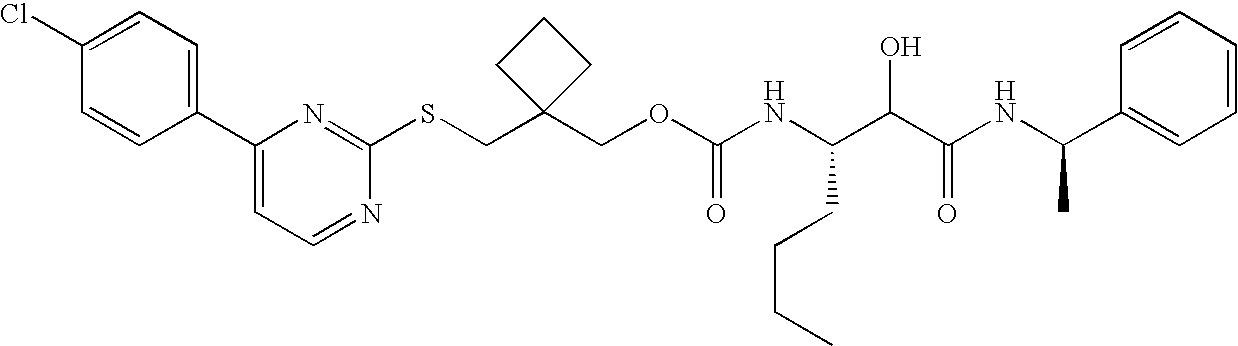
The title compound was prepared using the same experimental procedure as in example 20b from [1-({[4-(4-chlorophenyl)-2-pyrimidinyl]sulfanyl}methyl) cyclobutyl]methanol as the alcohol component and (3S)-3-amino-2-hydroxy-N-[(1R)-1-phenylethyl]heptanamide as the aminoalcohol component. 1H NMR (300 MHz, CDCl3) δ 8.50 (d, J=5 Hz, 1H), 7.99 (d, J=8 Hz, 2H), 7.44 (d, J=8 Hz, 2H), 7.30-7.15 (m, 7H), 5.10-4.93 (m, 3H), 4.15 (m, 3H), 3.80 (m, 1H), 3.52 (s, 2H), 2.04-1.91 (m, 6H), 1.82-1.23 (m, 9H), 0.82 (m, 3H). LC-MS m/z 611 (M+H).

The title compound was prepared using the same experimental procedure as in example 23c from [1-({[4-(4-chlorophenyl)-2-pyrimidinyl]sulfanyl}methyl) cyclobutyl]methyl (1S)-1-(1-hydroxy-2-oxo-2-{[(1R)-1-phenylethyl]amino}ethyl) pentylcarbamate as the alcohol component. 1H NMR (300 MHz, CDCl3) δ 8.52 (d, J=5 Hz, 1H), 8.02 (d, J=8 Hz, 2H), 7.45 (d, J=8 Hz, 2H), 7.34-7.25 (m, 6H), 7.09 (d, J=7 Hz, 1H), 5.24-5.04 (m, 3H), 4.17 (s, 2H), 3.55 (s, 2H), 2.03-1.95 (m, 6H), 1.56 (m, 2H), 1.52 (d, J=7 Hz, 3H), 1.38-1.28 (m, 4H), 0.84 (t, J=6 Hz, 3H). LC-MS m/z 609 (M+H).
[1-({[5-(4-chlorophenyl)-1-methyl-1H-imidazol-2-yl]sulfanyl}methyl)cyclobutyl]methyl (1S)-1-(oxo{[(1R)-1-phenylethyl]amino}acetyl)pentylcarbamate


The title compound was prepared using the same experimental procedure as in example 19a from [1-(hydroxymethyl)cyclobutyl]methanol and 5-(4-chlorophenyl)-1-methyl-1H-imidazole-2-thiol. 1H NMR (300 MHz, CDCl3) δ 7.41-7.25 (m, 5H), 3.62 (s, 2H), 3.49 (s, 3H), 3.46 (s, 2H), 2.04-1.63 (m, 6H).

The title compound was prepared using the same experimental procedure as in example 20b from [1-({[5-(4-chlorophenyl)-1-methyl-1H-imidazol-2-yl]sulfanyl}methyl)cyclobutyl]methanol as the alcohol component and (3S)-3-amino-2-hydroxy-N-[(1R)-1-phenylethyl]heptanamide as the aminoalcohol component. 1H NMR (300 MHz, CDCl3) δ 7.41-7.20 (m, 10 H), 7.02 (s, 1H), 5.33 (d, J=8 Hz, 1H), 5.12-5.05 (m, 2H), 4.30 (s, 1H), 4.17-4.04 (m, 3H), 3.89 (m, 2H), 3.55 (s, 2H), 3.32, 3.38 (2s, 2H), 2.03-1.88 (m, 6H), 1.55-1.22 (m, 9H), 0.82 (m, 3H). LC-MS m/z 613 (M+H).

The title compound was prepared using the same experimental procedure as in example 23c from [1-({[5-(4-chlorophenyl)-1-methyl-1H-imidazol-2-yl]sulfanyl}methyl)cyclobutyl]methyl (1S)-1-(1-hydroxy-2-oxo-2-{[(1R)-1-phenylethyl]amino}ethyl)pentylcarbamate as the alcohol component. 1H NMR (300 MHz, CDCl3) δ 7.41-7.11 (m, 11H), 7.08 (s, 1H), 5.40 (m, 1H), 5.09 (m, 2H), 4.12 (s, 2H), 3.54 (s, 3H), 3.45 (s, 2H), 2.08-1.90 (m, 6H), 1.55-1.29 (m, 9H), 0.87 (t, J=7 Hz, 3H). LC-MS m/z 611 (M+H).
{1-[(4-methyl-1,3-thiazol-2-yl)methyl]cyclobutyl}methyl (1S)-1-(oxo{[(1R)-1-phenylethyl]amino}acetyl)pentylcarbamate


The title compound was prepared using the same experimental procedure as in examples 18f and 18g from 2-{1-[(benzyloxy)methyl]cyclobutyl}ethanethioamide and 1-bromo-4,4,4-trifluoro-2-butanone. 1H NMR (300 MHz, CDCl3) δ 7.25 (s, 1H), 3.35 (s, 2H), 2.82 (br s, 2H), 2.02-1.91 (m, 6H).

The title compound was prepared using the same experimental procedure as in example 18h from (1-{[4-(trifluoromethyl)-1,3-thiazol-2-yl]methyl}cyclobutyl)methanol. 1H NMR (300 MHz, CDCl3) δ 7.34-7.13 (m, 6H), 5.16-5.09 (m, 1H), 4.84 (m, 1H), 4.24-4.12 (m, 2H), 3.82 (m, 1H), 3.60 (m, 1H), 3.34 (s, 2H), 2.82 (s, 2H), 2.02-1.92 (m, 6H), 1.65 (m, 2H), 1.49 (d, J=7 Hz, 3H), 1.47-1.27 (m, 4H), 0.85 (m, 3H). LC-MS m/z 542 (M+H).

The title compound was prepared using the same experimental procedure as in example 23c from (1-{[4-(trifluoromethyl)-1,3-thiazol-2yl]methyl}cyclobutyl)methyl(1S)-1-(1-hydroxy-2-oxo-2-{[(1R)-1-phenylethyl]amino}ethyl)pentylcarbamate as the alcohol component. 1H NMR (300 MHz, CDCl3) δ 7.35-7.11 (m, 7H), 5.33 (m, 1H), 5.12-5.05 (m, 2H), 4.15 (s, 2H), 2.82 (s, 2H), 2.04-1.92 (m, 6H), 1.61 (m, 2H), 1.53 (d, J=7 Hz, 3H), 1.42-1.31 (m, 4H), 0.86 (br s, 3H). LC-MS m/z 540 (M+H).
(1-{2-[(1-methyl-1H-imidazol-2-yl)sulfanyl]ethyl}cyclobutyl)methyl (1S)-1-(oxo{[(1R)-1-phenylethyl]amino}acetyl)pentylcarbamate


A solution of 3.0 g (23 mmol) of ethyl cyclobutanecarboxylate in 10 mL of tetrahydrofuran was added to a −78° C. solution of 25.74 mmol of lithium diisopropylamide in 45 ml tetrahydrofuran. The reaction was warmed to 0° C. over 15 min and then cooled to −78° C., followed by the addition of 3.64 mL (25.74 mmol) of benzyl 2-bromoethyl ether in 10 mL of tetrahydrofuran. The reaction was gradually warmed to room temperature over 16 h and then quenched with 20 mL of saturated ammonium chloride. The reaction was concentrated and ethyl acetate was added. The organic layer was isolated, dried with magnesium sulfate, and concentrated under vacuum to afford an oil, which was purified by silica gel chromatography eluting with ethyl acetate:hexane (2:8) to afford 4.3 g (70%) of ethyl 1-[2-(benzyloxy)ethyl]cyclobutanecarboxylate as a colorless oil. 1H NMR (300 MHz, CDCl3) δ 7.31-7.22 (m, 5H), 4.01 (q, J=7 Hz, 2H), 4.40 (s, 2H), 2.40 (t, J=7 Hz, 2H), 1.92-1.84 (m, 6H), 1.14 (t, J=7 Hz, 3H). GC-MS m/z 263 (M+H).

To a solution of 2.0 g (7.63 mmol) of ethyl 1-[2-(benzyloxy)ethyl]cyclobutanecarboxylate in 20 mL of diethyl ether at 0° C. was added a 1.0 M solution of 15.9 mL (15.9 mmol) of lithium aluminum hydride in tetrahydrofuran and the contents stirred for 2 h. The reaction was quenched with 20 ml of 20% sodium hydroxide solution. After filtration, the organic phase was isolated, dried with magnesium sulfate, and concentrated under vacuum to afford 1.6 g (95%) of {1-[2-(benzyloxy)ethyl]cyclobutyl}methanol as a colorless oil. 1H NMR (300 MHz, CDCl3) δ 7.41-7.30 (m, 5H), 4.54 (s, 2H), 3.55 (t, J=6 Hz, 2H), 2.03-1.83 (m, 8H).

To a solution of 1.6 g (7.27 mmol) of {1-[2-(benzyloxy)ethyl]cyclobutyl}methanol in 16 mL of dichloromethane was added 1.20 g (7.99 mmol) of t-butyldimethylsilyl chloride and 0.98 g (14.54 mmol) of imidazole and the contents stirred for 16 h. Saturated ammonium chloride was added and the layers separated. The organic layer was dried with magnesium sulfate and concentrated under vacuum. To the crude silyl alcohol was added 20 mL of methanol and 0.24 g of 10 wt % palladium on carbon. The reaction was stirred under an atmosphere of hydrogen for 16 h. The contents were filtered and the filtrate was concentrated under vacuum to afford 1.71 g (97%) of 2-[1-({[tert-butyl(dimethyl)silyl]oxy}methyl)cyclobutyl]ethanol as a colorless oil. 1H NMR (300 MHz, CDCl3) δ 3.57 (s, 2H), 3.55 (t, J=6 Hz, 2H), 1.87-1.59 (m, 8H), 0.87 (2, 9H), 0.05 (s, 6H).

The title compound was prepared using the same experimental procedure as in example 19a using 2-[1-({[tert-butyl(dimethyl)silyl]oxy}methyl)cyclobutyl]ethanol and 1-methyl-1H-imidazole-2-thiol. 1H NMR (300 MHz, CDCl3) δ 7.22 (s, 1H), 7.01 (s, 1H), 3.58 (s, 3H), 3.43 (s, 2H), 1.85-1.73 (m, 6H), 2.91 (t, J=6 Hz, 2H), 1.48 (s, 9H), 1.21 (t, J=4 Hz, 2H), 0.04 (s, 6H). GC-MS m/z 341 (M+H).

To 1.39 g (4.1 mmol) of 2-({2-[1-({[tert-butyl(dimethyl)silyl]oxy}methyl)cyclobutyl]ethyl}sulfanyl)-1-methyl-1H-imidazole in 10 mL of tetrahydrofuran was added a 1.0 M solution of 4.92 mL (5.33 mmol) of tetrabutylammonium fluoride in tetrahydrofuran and the contents stirred for 16 h. The reaction was concentrated and the residue was poured directly onto a column of silica gel eluting with ethyl acetate:hexane to afford 0.57 g (62%) of (1-{2-[(1-methyl-1H-imidazol-2-yl)sulfanyl]ethyl}cyclobutyl)methanol as a colorless oil. 1H NMR (300 MHz, CDCl3) δ 6.94 (s, 1H), 6.82 (s, 1H), 5.30 (br s, 1H), 3.66 (s, 2H), 3.47 (s, 3H), 2.94 (m, 2H),1.99-1.64 (m, 8H).

The title compound was prepared using the same experimental procedure as in example 20b from (1-{2-[(1-methyl-1H-imidazol-2-yl)sulfanyl]ethyl}cyclobutyl) methanol as the alcohol component and (3S)-3-amino-2-hydroxy-N-[(1R)-1-phenylethyl]heptanamide as the amino alcohol component. 1H NMR (300 MHz, CDCl3) δ 8.24 (m, 1H), 7.35-7.23 (m, 5H), 7.02 (s, 1H), 6.93, 6.90 (2s, 1H), 5.67 (m, 1H), 5.16 (m, 2H), 4.22-3.74 (m, 4H), 3.65 (s, 3H), 2.95 (m, 2H), 2.03-1.79 (m, 8H), 1.49 (d, J=7 Hz, 3H), 1.36-1.27 (m, 6H), 0.91 (m, 3H). LC-MS m/z 517 (M+H).

The title compound was prepared using the same experimental procedure as in example 23c from (1-{2-[(1-methyl-1H-imidazol-2-yl)sulfanyl]ethyl}cyclobutyl)methyl (1S)-1-(1-hydroxy-2-oxo-2-{[(1R)-1-phenylethyl]amino}ethyl)pentylcarbamate as the alcohol component. 1H NMR (300 MHz, CDCl3) δ 7.44-7.33 (m, 6H), 7.30 (s, 1H), 7.14 (s 1H), 5.11 (d, J=7 Hz, 1H), 5.09 (m, 2H), 4.07 (s, 2H), 3.76 (s, 3H), 3.02 (s, 2H), 2.03-1.85 (m, 10H), 1.56 (d, J=7 Hz, 3H), 1.52-1.27 (m, 4H), 0.87 (t, J=7 Hz, 3H). LC-MS m/z 515 (M+H).
(1-{3-[(1-methyl-1H-imidazol-2-yl)sulfanyl]propyl}cyclobutyl)methyl (1S)-1-(oxo{[(1R)-1-phenylethyl]amino}acetyl)pentylcarbamate


The title compound was prepared using the same experimental procedure as in example 36a using benzyl 3-bromopropyl ether as the electrophile. 1H NMR (300 MHz, CDCl3) δ 7.38-7.30 (m, 5H), 4.53 (s, 2H), 4.14 (t, J=7 Hz, 2H), 3.48 (t, J=6 Hz, 2H), 2.49-2.43 (m, 2H), 2.08-1.72 (m, 6H), 1.53 (m, 2H), 1.27 (t, J=7 Hz, 3H).

The title compound was prepared from ethyl 1-[3-(benzyloxy)propyl]cyclobutanecarboxylate using the same experimental procedure as in examples 36b and 36c. 1H NMR (300 MHz, CDCl3) δ 3.62 (s, 2H), 3.46 (s, 2H), 1.84-1.41 (m, 11H), 0.88 (s, 9H), 0.03 (s, 6H).

The title compound was prepared from 3-[1-({[tert-butyl(dimethyl)silyl]oxy}methyl)cyclobutyl]-1-propanol using the same experimental procedure as in examples 36d and 36e. 1H NMR (300 MHz, CDCl3) δ 7.30 (s, 1H), 7.07 (s, 1H), 3.91 (br ss, 1H), 3.69 (s, 3H), 3.55 (s, 2H), 2.91 (t, J=7 Hz, 2H), 1.91-1.70 (m, 8H), 1.58-1.46 (m, 2H).

The title compound was prepared using the same experimental procedure as in example 20b from (1-{3-[(1-methyl-1H-imidazol-2-yl)sulfanyl]propyl}cyclobutyl) methanol as the alcohol component and (3S)-3-amino-2-hydroxy-N-[(1R)-1-phenylethyl]heptanamide as the amino alcohol component. 1H NMR (300 MHz, CDCl3) δ 7.49-7.05 (m, 6H), 6.99 (s, 1H), 6.91 (s, 1H), 5.64 (m, 1H), 5.12 (m, 1H), 4.14, (m, 4H), 3.95 (m, 1H), 3.62, 3.64 (2s, 3H), 3.25 (m, 2H), 2.08-1.71 (m, 12H), 1.49 (d, J=7 Hz, 3H), 1.41-1.32 (m, 4H), 1.29 (m, 3H). LC-MS m/z 531 (M+H).

The title compound was prepared using the same experimental procedure as in example 23c using (1-{3-[(1-methyl-1H-imidazol-2-yl)sulfanyl]propyl}cyclobutyl) methyl (1S)-1-(1-hydroxy-2-oxo-2-{[(1R)-1-phenylethyl]amino}ethyl)pentylcarbamate as the alcohol component. 1H NMR (300 MHz, CDCl3) δ 7.12-7.45 (m, 7H), 6.99 (s, 1H), 5.56-5.33 (m, 2H), 5.16 (m, 1H), 4.01 (s, 2H), 3.67 (s, 3H), 3.01 (s, 2H), 2.08-1.89 (m, 7H), 1.85-1.61 (m, 12H), 0.87 (m, 3H). LC-MS m/z 529 (M+H).
(1-{3-[(2-chloro-4-pyrimidinyl)oxy]propyl}cyclobutyl)methyl (1S)-1-(oxo{[(1R)-1-phenylethyl]amino}acetyl)pentylcarbamate


The title compound was prepared from 3-[1-({[tert-butyl(dimethyl)silyl]oxy}methyl)cyclobutyl]-1-propanol and 2,4-dichloropyrimidine using the same experimental procedure as in example 25a. 1H NMR (300 MHz, CDCl3) δ 8.23 (d, J=6 Hz, 1H), 6.59 (d, J=6 Hz, 1H), 4.33 (t, J=6 Hz, 2H), 3.44 (s, 2H), 1.81-1.51 (m, 8H), 1.21 (m, 2H), 0.84 (s, 9H), −0.002 (s, 6H). GC-MS m/z 371 (M+H).

The title compound was prepared from 4-{3-[1-({[tert-butyl(dimethyl)silyl]oxy}methyl)cyclobutyl]propoxy}-2-chloropyrimidine using the same experimental procedure as in example 36e to afford (1-{3-[(2-chloro-4-pyrimidinyl)oxy]propyl}cyclobutyl)methanol. 1H NMR (300 MHz, CDCl3) δ 8.31 (d, J=6 Hz, 1H), 6.69 (d, J=6 Hz, 1H), 4.43 (t, J=6 Hz, 2H), 3.61 (s, 2H), 1.98-1.46 (m, 10H).

The title compound was prepared using the same experimental procedure as in example 20b from (1-{3-[(2-chloro-4-pyrimidinyl)oxy]propyl}cyclobutyl)methanol as the alcohol component and (3S)-3-amino-2-hydroxy-N-[(1R)-1-phenylethyl]heptanamide as the amino alcohol component. 1H NMR (300 MHz, CDCl3) δ 8.30 (d, J=6 Hz, 1H), 7.38-7.17 (m, 6H), 6.69 (d, J=6 Hz, 1H), 5.62 (d, J=9 Hz, 1H), 5.33 (m, 1H), 4.98 (d, J=6 Hz, 1H), 4.40 (m, 2H), 4.15-3.86 (m, 3H), 1.89-1.58 (m, 8H), 1.52 (d, J=7 Hz, 3H), 1.39 (m, 2H), 0.92 (m, 3H). LC-MS m/z 547 (M+H).

The title compound was prepared using the same experimental procedure as in example 23c using (1-{3-[(2-chloro-4-pyrimidinyl)oxy]propyl}cyclobutyl)methyl (1S)-1-(1-hydroxy-2-oxo-2-{[(1R)-1-phenylethyl]amino}ethyl)pentylcarbamate as the alcohol component. 1H NMR (300 MHz, CDCl3) δ 8.32 (d, J=6 Hz, 1H), 7.41-7.29 (m, 5H), 7.17 (d, J=8 Hz, 1H), 6.70 (d, J=6 Hz, 1H), 5.32 (d, J=8 Hz, 1H), 5.19 (m, 2H), 4.42 (t, J=6 Hz, 1H), 4.08 (s, 2H), 1.94-1.61 (m, 8H), 1.59 (d, J=7 Hz, 3H), 1.37 (m, 2H), 0.92 (t, J=7 Hz, 3H). LC-MS m/z 545 (M+H).
The compounds of the present invention elicit important and measurable pharmacological responses. Each of the compounds exemplified in the Examples section bind with high affinity (IC50<10 μM) to the cathepsin K enzyme, as described by the cathepsin K assay recited below.
All assays for cathepsin K were carried out with human and rat recombinant enzyme. Assays for cathepsins S & V were also carried out with human recombinant enzyme. Assays for human cathepsins B, H, and L were carried out with enzyme, purchased from Athens Research and Technology, Inc., prepared from human liver tissue. Standard assay conditions for the determination of kinetic constants used a fluorogenic peptide substrate, typically (5S,8S)-13-amino-5-benzyl-13-imino-3-methylene-N-(4-methyl-2-oxo-2H-chromen-7-yl)-6-oxo-1-phenyl-2-oxa-4,7,12-triazatridecane-8-carboxamide (Cbz-Phe-Arg-AMC), and were determined in 100 mM sodium acetate at pH 5.5 containing 10 mM dithiothreitol and 120 mM sodium chloride. A stock substrate solution of Cbz-Phe-Arg-AMC was prepared at a concentration of 50 mM in dimethyl sulfoxide. This substrate was diluted into the assay for a final substrate concentration of 10 μM in the rat cathepsin K, human cathepsin K, and human cathepsin B assays; a final substrate concentration of 5 μM in the human cathepsin L assay; and a final substrate concentration of 2 μM in the human cathepsin V assay.
A stock substrate solution of benzyl (1S)-1-{[((1S)-1-{[((1S)-4-{[amino(imino)methyl]amino}-1-{[(4-methyl-2-oxo-2H-chromen-7-yl)amino]carbonyl}butyl)amino]carbonyl}-2-methylpropyl)amino]carbonyl}-2-methylpropylcarbamate (Cbz-Val-Val-Arg-AMC) was prepared at a concentration of 10 mM in dimethyl sulfoxide. This substrate was diluted into the assay for a final substrate concentration of 10 μM in the human cathepsin S assay.
A stock substrate solution of (2S)-2-amino-5-{[amino(imino)methyl]amino}-N-(2-naphthyl)pentanamide hydrochloride (L-Arg-β-naphthalamide.HCl) was prepared at a concentration of 10 mM in dimethyl sulfoxide. This substrate was diluted into the assay for a final substrate concentration of 50 μM in the cathepsin H assay.
All assays contained 10% dimethyl sulfoxide. Independent experiments found that this level of dimethyl sulfoxide had no effect on kinetic enzymatic constants. All assays were conducted at 30° C. Product fluorescence (excitation at 360 nm; emission at 440 nm, (except cathepsin H which used excitation at 340 nm; emission at 420 nm)) was monitored with a PerSeptive Biosystems Cytofluor II fluorescence plate reader. Product progress curves were generated over 2.3 h monitoring the formation of 7-amino-4-methylcoumarin product (or β-naphthalamide for cathepsin H).
Human and Rat Cathepsin K:
Scale-Up and Fermentation: The method of O'Reilly et al. (1994) was used for baculovirus expression with the following details. Two liters of Spodoptera frugiperda (Sf-9) cells (ATCC) were grown in Grace's Supplemented medium (Life Technologies) supplemented with 2 g/L glucose, 10% fetal bovine serum (HyClone) and 0.1% pluronic F-68 (Life Technologies). Cells were grown in a 6 L shake flask at 150 RPM at 28° C. for 24 h to a density of 106 cells/mL, and then infected at a multiplicity of infection (MOI) of 0.1. The cells continued to grow for 72 h post-infection, before the virus was harvested by centrifugation at 1400×g for 30 min. Virus was titered as described (Summers and Smith, 1987).
One and one-half liters of Trichoplusia ni (T. ni) High Five (™) cells [JRH Biosciences, Woodland, Calif. (adapted to suspension and serum-free medium)] grown in Excell 405 (™) medium (JRH Biosciences) with 50 ug/mL gentamicin (Life Technologies) were added to a 15 L stirred tank reactor (Quark Enterprises, Inc) at a density of ˜0.5×10⁶ cells/mL The cells were grown for 24 h at 28° C., 50 RPM, and 50% dissolved oxygen. Cells were then infected at a density of ˜106 cells/mL with an MOI of 1 and grown for 48 h post-infection. Media were separated from cells at a rate of 1 L/min using the Centritech 100 (™) continuous-flow centrifuge (DuPont) operating at 200×g.
Protein Purification: Media (human and rat) were filtered through a Whatman 3 filter, and then loaded onto a 25 mL Poros HS II (26 mm×47 mm) cation exchange column equilibrated in 25 mM sodium acetate at pH 5.5 (equilibration buffer). The column was washed until the absorbance reached the baseline value, and then the protein was eluted with a linear gradient from 0-2 M sodium chloride in the equilibration buffer. Column fractions were analyzed by SDS-PAGE, N-terminal sequencing, and mass spectrometry. Fractions containing the proform of cathepsin K were pooled and frozen at −80° C. The proform was concentrated in an Amicon Centriprep 10 and fractionated with a Superdex 75 column (26 mm×600 mm, Pharmacia) equilibrated in 400 mM sodium chloride, 25 mM sodium acetate at pH 5.5.
Cathepsin K Activation: The proform of cathepsin K was converted to mature cathepsin K by brief exposure to pH 4 in the presence of 5 mM L-cysteine. Typically, 5 mM L-cysteine was added to 10 mL of approximately 1 mg/mL procathepsin K. One mL of this solution was diluted ten-fold into 450 mM sodium acetate at pH 4.0 containing 5 mM L-cysteine. This solution was reacted at 23° C. for 2 min before neutralization with 2 mL 1.8 M sodium acetate at pH 6.0. The neutralized sample was added to the remaining 9 mL of procathepsin K. The mixture was incubated at 4° C. for 2-3 days. The activated cathepsin K was chromatographed on a Poros HS II column as described above.
Inhibition Studies
Potential inhibitors were evaluated using the progress curve method. Assays were carried out in the presence of variable concentrations of test compound. Reactions were initiated by addition of buffered solutions of inhibitor and substrate to enzyme. Data analysis was conducted according to one of two procedures depending on the appearance of the progress curves in the presence of inhibitors. For those compounds whose progress curves were linear, the enzymatic activity (RATE) was plotted against the concentration of test compound, including inhibitor concentration of zero ([I]=0), and the IC50 determined from a fit of equation 1 to the data,
RATE=V max/(1+([I]/IC50)) (1)
where Vmax is the best fit estimate of the maximal enzymatic activity. Ki values were calculated from IC50 values using equation 2 assuming a competitive model.
RATE=V max/(1+([I]/IC50)) (1)
where Vmax is the best fit estimate of the maximal enzymatic activity. Ki values were calculated from IC50 values using equation 2 assuming a competitive model.
For those compounds whose progress curves showed downward curvature characteristic of time-dependent inhibition, the data from individual sets was analyzed using the computer program DynaFit (Kuzmic, P. Anal. Biochem. 1996, 237, 260-273) to give Ki values according to the following kinetic mechanism:
E+S ES
ES
ES→E+P
E→EX
E+IEI
E+S
ES→E+P
E→EX
E+I
| TABLE 1 |
| Inhibition of Cathepsin K (Ki in nM) |
| Cathepsin Inhibitory Activity |
| Example | hcatK Ki | ||
| 1 | ++ | ||
| 2 | +++ | ||
| 3 | +++ | ||
| 4 | ++ | ||
| 5 | ++++ | ||
| 6 | +++ | ||
| 7 | +++ | ||
| 8 | +++ | ||
| 9 | +++ | ||
| 10 | +++ | ||
| 11 | ++++ | ||
| 12 | ++ | ||
| 13 | +++ | ||
| 14 | +++++ | ||
| 15 | +++++ | ||
| 16 | +++ | ||
| 17 | ++++ | ||
| 18 | ++++ | ||
| 19 | +++ | ||
| 20 | ++ | ||
| 21 | +++ | ||
| 22 | +++ | ||
| 23 | +++ | ||
| 24 | +++ | ||
| 25 | +++ | ||
| 26 | +++ | ||
| 27 | +++ | ||
| 28 | +++ | ||
| 29 | +++ | ||
| 30 | ++ | ||
| 31 | ++ | ||
| 32 | +++ | ||
| 33 | ++++ | ||
| 34 | ++ | ||
| 35 | ++++ | ||
| 36 | + | ||
| 37 | + | ||
| 38 | + | ||
| + Inhibitors (>1000 nM) | |||
| ++ Potent inhibitors (1000-100 nM) | |||
| +++ More potent inhibitors (100-10 nM) | |||
| ++++ Even more potent inhibitors (10-1 nM) | |||
| +++++ Most potent inhibitors (<1 nM) | |||
| TABLE 2 |
| Inhibition of Cathepsins (Ki in nM) |
| Ex- |
| am- | hCat B | hCat H | hCat K | rCat K | hCat L | hCat S | hCat V |
| ple | Ki | Ki | Ki | Ki | Ki | Ki | Ki |
| 3 | + | + | +++ | + | + | ++ | + |
| 15 | ++ | ++ | +++++ | +++ | +++ | ++++ | ++++ |
| 17 | + | + | ++++ | +++ | +++ | +++ | +++ |
| + Inhibitors (>1000 nM) | |||||||
| ++ Potent inhibitors (1000-100 nM) | |||||||
| +++ More potent inhibitors (100-10 nM) | |||||||
| ++++ Even more potent inhibitors (10-1 nM) | |||||||
| +++++ Most potent inhibitors (<1 nM) | |||||||
Claims (33)
1. A compound of Formula (I):

or a salt or solvate thereof:
wherein
A is the group defined by (Q3)—(Q2)n—(Q1)—(Q)m—, wherein
Q is CH2 and m is 0, 1, or 2
Q1 is C3-C7 cycloalkylene;
Q2 is C1-C3 alkylene and n is 0 or 1, or
Q2 is OR, where R is C1-C3 alkylene and n is 1,
Q2 is SR, where R is C1-C3 alkylene and n is 1; or
Q2 is N(R′)R, where R′ is hydrogen or C1-C6 alkyl, R is C1-C3 alkylene and n is 1; and
Q3 is aryl, heteroaryl, or aryl or heteroaryl substituted with at least one independently selected R1 group, wherein said heteroaryl is selected from the group consisting of

D is C1-C6 alkyl or C1-C6 alkyl substituted with —NR2R3;
Z is the group defined by —(X)p—(X1)q—(X2), wherein
X is C(R′)(R″), wherein R′ is hydrogen or C1-C6 alkyl, R″ is hydrogen and C1-C6 alkyl, and p is 0, 1, or 2,
X1 is C(O)OCH2, wherein q is 0 or 1, and
X2 is aryl, heteroaryl, or heterocyclyl wherein said heteroaryl or heterocyclyl is selected from:

R1 is halo, C1-C6 alkyl, aryl, or C1-C6 haloalkyl;
R2 is hydrogen or C1-C6 alkyl;
R3 is hydrogen, C1-C6 alkyl, —C(O)R4, or —S(O)2NR5R6;
R4 is —NR5R6, and
R5 and R6 are independently selected from hydrogen or C1-C6 alkyl.
2. A compound as claimed in claim 1 , wherein Q is CH2 and m is 0, 1, or 2.
3. A compound as claimed in claim 1 , wherein Q is CH2 and m is 0 or 1.
4. A compound as claimed in claim 1 , wherein Q is CH2 and m is 1.
5. A compound as claimed in claim 1 , wherein Q1 is C3-C7 cycloalkylene.
6. A compound as claimed in claim 1 , wherein Q1 is selected from the group cyclobutylene, cyclopentylene or cyclohexylene.
7. A compound as claimed in claim 1 , wherein Q1 is cyclobutylene.
8. A compound as claimed in claim 1 , wherein Q2 is C1-C3 alkylene and n is 0 or 1.
9. A compound as claimed in claim 1 , wherein Q2 is C1-C3 alkylene and n is 1.
10. A compound as claimed in claim 1 , wherein Q2 is OR, wherein R is C1-C3 alkylene and n is 1.
11. A compound as claimed in claim 1 , wherein Q2 is SR, wherein R is C1-C3 alkylene and n is 1.
12. A compound as claimed in claim 1 , wherein Q3 is aryl or aryl substituted with at least one independently selected R1 group.
13. A compound as claimed in claim 1 , wherein Q3 is phenyl or phenyl substituted with at least one independently selected R1 group wherein R1 is halo or C1-C6 alkyl.
14. A compound as claimed in claim 13 , wherein R1 is halo.
15. A compound as claimed in claim 13 , wherein R1 is C1-C6 alkyl.
16. A compound as claimed in claim 1 , wherein Q3 is heteroaryl or heteroaryl substituted with at least one independently selected R1, wherein said heteroaryl is selected from the group consisting of

17. A compound as claimed in claim 1 , wherein D is C1-C6 alkyl.
18. A compound as claimed in claim 1 , wherein D is n-butyl.
19. A compound as claimed in claim 1 , wherein X is C(H)(R″) wherein R″ is hydrogen and p is 0, 1, or 2.
20. A compound as claimed in claim 1 , wherein X is C(R′)(R″) where R″ is hydrogen and p is 0, 1, or 2.
21. A compound as claimed in claim 1 , wherein X is C(H)(R″) where R″ is hydrogen and p is 0 or 1.
22. A compound as claimed in claim 1 , wherein X is C(H)(R″) where R″ is hydrogen and p is 0.
23. A compound as claimed in claim 1 , wherein X is C(H)(R″) where R″ is —CH3 and p is 1.
24. A compound as claimed in claim 1 , wherein X1 is C(O)OCH2, wherein q is 1.
25. A compound as claimed in claim 1 , wherein X1 is C(O)OCH2, wherein q is 0.
26. A compound as claimed in claim 1 , wherein X2 is aryl.
27. A compound as claimed in claim 1 , wherein X2 is

28. A compound as claimed in claim 1 , wherein X2 is selected from the group

or substituted derivatives thereof.
29. A compound selected from the group consisting of:
1-benzylcyclobutyl (1S)-1-(oxo{[(1R)-1-phenylethyl]amino}acetyl)pentylcarbamate;
1-benzylcyclopentyl (1S)-1-(oxo{[(1R)-1-phenylethyl]amino}acetyl)pentylcarbamate;
benzyl(2S)-2-{[(3S)-3-({[(1-benzylcyclopentyl)oxy]carbonyl}amino)-2-oxoheptanoyl]amino}propanoate;
1-benzylcyclohexyl (1S)-1-(oxo{[(1R)-1-phenylethyl]amino}acetyl)pentylcarbamate;
(1-Benzylcyclobutyl)methyl(1S)-1-(oxo{[(1R)-1-phenylethyl]amino}acetyl) pentyl carbamate;
[1-(2-Phenylethyl)cyclobutyl]methyl (1S)-1-(oxo{[(1R)-1-phenylethyl]amino}acetyl) pentylcarbamate;
[1-(3-Phenylpropyl)cyclobutyl]methyl (1S)-1-(oxo{[(1R)-1-phenylethyl]amino}acetyl) pentylcarbamate;
(1-Benzylcyclopentyl)methyl (1S)-1-(oxo{[(1R)-1-phenylethyl]amino}acetyl) pentyl carbamate;
[1-(2,6-difluorobenzyl)cyclobutyl]methyl (1S)-5-{[(methylamino)carbonyl]amino}-1-(oxo{[(1R)-1-phenylethyl]amino}acetyl)pentylcarbamate;
[1-(4-Fluorobenzyl)cyclobutyl]methyl (1S)-1-[oxo(1H-pyrazol-5-ylamino)acetyl]pentylcarbamate;
[1-(4-fluorobenzyl)cyclobutyl]methyl (1S)-1-[[(6-chloro-1H-indazol-3-yl)amino](oxo) acetyl]pentylcarbamate;
[1-(4-fluorobenzyl)cyclobutyl]methyl (1S)-5-{[(dimethylamino)sulfonyl]amino}-1-{oxo[(3-pyridinylmethyl)amino]acetyl}pentylcarbamate;
1-(1,3-Benzothiazol-2-yl)cyclopentyl (1S)-1-[oxo(1H-pyrazol-3-ylamino)acetyl]pentylcarbamate;
{1-[(4-phenyl-1,3-thiazol-2-yl)methyl]cyclobutyl}methyl (1S)-1-(oxo{[(1R)-1-phenylethyl]amino}acetyl)pentylcarbamate;
(1-{[(1-methyl-1H-imidazol-2-yl)sulfanyl]methyl}cyclobutyl)methyl (1S)-1-(oxo{[(1R)-1-phenylethyl]amino}acetyl)pentylcarbamate;
{1-[(1,3-benzoxazol-2-ylsulfanyl)methyl]cyclobutyl}methyl (1S)-1-(oxo{[(1R)-1-phenylethyl]amino}acetyl)pentylcarbamate;
{1-[(1,3-thiazol-2-yloxy)methyl]cyclobutyl}methyl (1S)-1-(oxo{[(1R)-1-phenylethyl]amino}acetyl)pentylcarbamate;
(1-{[(3-phenyl-1,2,4-thiadiazol-5-yl)oxy]methyl}cyclobutyl)methyl (1S)-1-(oxo{[(1R)-1-phenylethyl]amino}acetyl)pentylcarbamate;
(1-{[(1-phenyl-1H-imidazol-2-yl)sulfanyl]methyl}cyclobutyl)methyl (1S)-1-(oxo{[(1R)-1-phenylethyl]amino}acetyl)pentylcarbamate;
[1-({[4-(4-methylphenyl)-1,3-thiazol-2-yl]oxy}methyl)cyclobutyl]methyl (1S)-1-(oxo{[(1R)-1-phenylethyl]amino}acetyl)pentylcarbamate;
[1-({[5-(4-chlorophenyl)-1-methyl-1H-imidazol-2-yl]sulfanyl}methyl) cyclobutyl]methyl (1S)-1-(oxo{[(1R)-1-phenylethyl]amino}acetyl)pentylcarbamate;
{1-[(4-methyl-1,3-thiazol-2-yl)methyl]cyclobutyl}methyl (1S)-1-(oxo{[(1R)-1-phenylethyl]amino}acetyl)pentylcarbamate;
(1-{2-[(1-methyl-1H-imidazol-2-yl)sulfanyl]ethyl}cyclobutyl)methyl (1S)-1-(oxo{[(1R)-1-phenylethyl]amino}acetyl)pentylcarbamate; and
(1-{3-[(1-methyl-1H-imidazol-2-yl)sulfanyl]propyl}cyclobutyl)methyl (1S)-1-(oxo{[(1R)-1-phenylethyl]amino}acetyl)pentylcarbamate;
or a salt, or solvate thereof.
30. A pharmaceutical composition comprising a therapeutically effective amount of a compound as claimed in claim 1 , or a salt or solvate thereof and one or more of pharmaceutically acceptable carriers, diluents and excipients.
31. A method of treating a disorder selected from osteoporosis, Paget's disease, hypercalcemia of malignancy, metabolic bone disease, osteoarthritis, rheumatoid arthritis, periodontitis, gingivitis, and atherosclerosis in a mammal, comprising: administering to said mammal a therapeutically effective amount of a compound as claimed in claim 1 or a salt or solvate thereof.
32. A method of treating osteoporosis, comprising: administering to said mammal a therapeutically effective amount of a compound as claimed in claim 1 or a salt or solvate thereof.
33. A method of treating osteoporosis, comprising: administering to said mammal therapeutically effective amounts of (i) a compound as claimed in claim 1 , or a salt or solvate thereof and (ii) at least one bone building agent.
Priority Applications (2)
| Application Number | Priority Date | Filing Date | Title |
|---|---|---|---|
| US10/501,636 US7282512B2 (en) | 2002-01-17 | 2003-01-15 | Cycloalkyl ketoamides derivatives useful as cathepsin K inhibitors |
| US11/848,290 US20080058333A1 (en) | 2002-01-17 | 2007-08-31 | Cycloalkyl ketoamides derivatives useful as cathepsin k inhibitors |
Applications Claiming Priority (3)
| Application Number | Priority Date | Filing Date | Title |
|---|---|---|---|
| US34981202P | 2002-01-17 | 2002-01-17 | |
| US10/501,636 US7282512B2 (en) | 2002-01-17 | 2003-01-15 | Cycloalkyl ketoamides derivatives useful as cathepsin K inhibitors |
| PCT/US2003/001271 WO2003062192A1 (en) | 2002-01-17 | 2003-01-15 | Cycloalkyl ketoamides derivatives useful as cathepsin k inhibitors |
Related Child Applications (1)
| Application Number | Title | Priority Date | Filing Date |
|---|---|---|---|
| US11/848,290 Division US20080058333A1 (en) | 2002-01-17 | 2007-08-31 | Cycloalkyl ketoamides derivatives useful as cathepsin k inhibitors |
Publications (2)
| Publication Number | Publication Date |
|---|---|
| US20050054819A1 US20050054819A1 (en) | 2005-03-10 |
| US7282512B2 true US7282512B2 (en) | 2007-10-16 |
Family
ID=27613321
Family Applications (2)
| Application Number | Title | Priority Date | Filing Date |
|---|---|---|---|
| US10/501,636 Expired - Fee Related US7282512B2 (en) | 2002-01-17 | 2003-01-15 | Cycloalkyl ketoamides derivatives useful as cathepsin K inhibitors |
| US11/848,290 Abandoned US20080058333A1 (en) | 2002-01-17 | 2007-08-31 | Cycloalkyl ketoamides derivatives useful as cathepsin k inhibitors |
Family Applications After (1)
| Application Number | Title | Priority Date | Filing Date |
|---|---|---|---|
| US11/848,290 Abandoned US20080058333A1 (en) | 2002-01-17 | 2007-08-31 | Cycloalkyl ketoamides derivatives useful as cathepsin k inhibitors |
Country Status (4)
| Country | Link |
|---|---|
| US (2) | US7282512B2 (en) |
| EP (1) | EP1465862A1 (en) |
| JP (1) | JP2005515254A (en) |
| WO (1) | WO2003062192A1 (en) |
Cited By (1)
| Publication number | Priority date | Publication date | Assignee | Title |
|---|---|---|---|---|
| US20080058333A1 (en) * | 2002-01-17 | 2008-03-06 | Catalano John G | Cycloalkyl ketoamides derivatives useful as cathepsin k inhibitors |
Families Citing this family (41)
| Publication number | Priority date | Publication date | Assignee | Title |
|---|---|---|---|---|
| AU2003262140A1 (en) | 2002-04-10 | 2003-10-27 | Smithkline Beecham Corporation | Derivatives of 1-(oxoaminoacetyl) pentylcarbamate as cathepsin k inhibitors for the treatment of bone loss |
| AU2006242475B2 (en) | 2005-05-02 | 2011-07-07 | Merck Sharp & Dohme Corp. | HCV NS3 protease inhibitors |
| TWI387603B (en) | 2005-07-20 | 2013-03-01 | Merck Sharp & Dohme | Hcv ns3 protease inhibitors |
| BRPI0614205A2 (en) | 2005-08-01 | 2016-11-22 | Merck & Co Inc | compound, pharmaceutical composition and compound use |
| AR059898A1 (en) | 2006-03-15 | 2008-05-07 | Janssen Pharmaceutica Nv | DERIVATIVES OF 3-CIANO-PIRIDONA 1,4-DISUSTITUTED AND ITS USE AS ALLOSTERIC MODULATORS OF MGLUR2 RECEIVERS |
| GB0609492D0 (en) | 2006-05-15 | 2006-06-21 | Angeletti P Ist Richerche Bio | Therapeutic agents |
| CA2652600A1 (en) * | 2006-05-22 | 2007-11-29 | Velcura Therapeutics, Inc. | Use of cathepsin k antagonists in bone production |
| GB0612423D0 (en) | 2006-06-23 | 2006-08-02 | Angeletti P Ist Richerche Bio | Therapeutic agents |
| JP2010507656A (en) | 2006-10-24 | 2010-03-11 | メルク エンド カムパニー インコーポレーテッド | HCV NS3 protease inhibitor |
| US8138164B2 (en) | 2006-10-24 | 2012-03-20 | Merck Sharp & Dohme Corp. | HCV NS3 protease inhibitors |
| CN101583372A (en) | 2006-10-24 | 2009-11-18 | 默克公司 | HCV NS3 protease inhibitors |
| AU2007318164B2 (en) | 2006-10-27 | 2013-02-07 | Merck Sharp & Dohme Corp. | HCV NS3 protease inhibitors |
| WO2008057209A1 (en) | 2006-10-27 | 2008-05-15 | Merck & Co., Inc. | Hcv ns3 protease inhibitors |
| GB0625345D0 (en) | 2006-12-20 | 2007-01-31 | Angeletti P Ist Richerche Bio | Therapeutic compounds |
| CN103224506A (en) | 2006-12-20 | 2013-07-31 | P.安杰莱蒂分子生物学研究所 | Antiviral indoles |
| GB0625349D0 (en) | 2006-12-20 | 2007-01-31 | Angeletti P Ist Richerche Bio | Therapeutic compounds |
| TW200900065A (en) | 2007-03-07 | 2009-01-01 | Janssen Pharmaceutica Nv | 3-cyano-4-(4-pyridinyloxy-phenyl)-pyridin-2-one derivatives |
| TW200845978A (en) | 2007-03-07 | 2008-12-01 | Janssen Pharmaceutica Nv | 3-cyano-4-(4-tetrahydropyran-phenyl)-pyridin-2-one derivatives |
| AU2008277440A1 (en) | 2007-07-17 | 2009-01-22 | Istituto Di Ricerche Di Biologia Molecolare P. Angeletti Spa | Macrocyclic indole derivatives for the treatment of hepatitis C infections |
| AU2008277377B2 (en) | 2007-07-19 | 2013-08-01 | Msd Italia S.R.L. | Macrocyclic compounds as antiviral agents |
| PL2200985T3 (en) | 2007-09-14 | 2011-12-30 | Ortho Mcneil Janssen Pharmaceuticals Inc | 1,3-disubstituted 4-(aryl-x-phenyl)-1h-pyridin-2-ones |
| CN101801930B (en) | 2007-09-14 | 2013-01-30 | 奥梅-杨森制药有限公司 | 1,3-disubstituted-4-phenyl-1 h-pyridin-2-ones |
| SI2203439T1 (en) | 2007-09-14 | 2011-05-31 | Ortho Mcneil Janssen Pharm | 1',3'-disubstituted-4-phenyl-3,4,5,6-tetrahydro-2h, 1'h-y1, 4' bipyridinyl-2'-ones |
| CN101861316B (en) | 2007-11-14 | 2013-08-21 | 奥梅-杨森制药有限公司 | Imidazo[1,2-a]pyridine derivatives and their use as positive allosteric modulators of the MGLUR2 receptor |
| AU2009241445A1 (en) | 2008-04-28 | 2009-11-05 | Merck Sharp & Dohme Corp. | HCV NS3 protease inhibitors |
| PT2540350E (en) | 2008-07-22 | 2014-08-27 | Merck Sharp & Dohme | Combinations of a macrocyclic quinoxaline compound which is an hcv ns3 protease inhibitor with other hcv agents |
| EP2344470B1 (en) | 2008-09-02 | 2013-11-06 | Janssen Pharmaceuticals, Inc. | 3-azabicyclo[3.1.0]hexyl derivatives as modulators of metabotropic glutamate receptors |
| WO2010043396A1 (en) | 2008-10-16 | 2010-04-22 | Ortho-Mcneil-Janssen Pharmaceuticals, Inc. | Indole and benzomorpholine derivatives as modulators of metabotropic glutamate receptors |
| JP5690277B2 (en) | 2008-11-28 | 2015-03-25 | ジャンセン ファーマシューティカルズ, インコーポレイテッド. | Indole and benzoxazine derivatives as modulators of metabotropic glutamate receptors |
| CN102300871A (en) | 2008-12-19 | 2011-12-28 | 吉里德科学公司 | Hcv ns3 protease inhibitors |
| MY153913A (en) | 2009-05-12 | 2015-04-15 | Janssen Pharmaceuticals Inc | 7-aryl-1,2,4-triazolo[4,3-a]pyridine derivatives and their use as positive allosteric modulators of mglur2 receptors |
| CN102439008B (en) | 2009-05-12 | 2015-04-29 | 杨森制药有限公司 | 1,2,4-Triazolo[4,3-A]pyridine derivatives and their use for the treatment or prevention of neurological and psychiatric disorders |
| BRPI1010831A2 (en) | 2009-05-12 | 2016-04-05 | Addex Pharmaceuticals Sa | 1,2,4-triazolo [4,3-a] pyridine derivatives and their as positive allosteric modulators of mglur2 receptors |
| US8828930B2 (en) | 2009-07-30 | 2014-09-09 | Merck Sharp & Dohme Corp. | Hepatitis C virus NS3 protease inhibitors |
| ES2536433T3 (en) | 2010-11-08 | 2015-05-25 | Janssen Pharmaceuticals, Inc. | 1,2,4-Triazolo [4,3-a] pyridine derivatives and their use as positive allosteric modulators of mGluR2 receptors |
| AU2011328203B2 (en) | 2010-11-08 | 2015-03-19 | Janssen Pharmaceuticals, Inc. | 1,2,4-triazolo[4,3-a]pyridine derivatives and their use as positive allosteric modulators of mGluR2 receptors |
| US9271967B2 (en) | 2010-11-08 | 2016-03-01 | Janssen Pharmaceuticals, Inc. | 1,2,4-triazolo[4,3-a]pyridine derivatives and their use as positive allosteric modulators of mGluR2 receptors |
| JO3368B1 (en) | 2013-06-04 | 2019-03-13 | Janssen Pharmaceutica Nv | 6, 7- dihydropyrazolu [5,1-a] pyrazine-4 (5 hands) -on compounds and their use as negative excretory regulators of Miglore 2 receptors. |
| JO3367B1 (en) | 2013-09-06 | 2019-03-13 | Janssen Pharmaceutica Nv | 1,2,4-TRIAZOLO[4,3-a]PYRIDINE COMPOUNDS AND THEIR USE AS POSITIVE ALLOSTERIC MODULATORS OF MGLUR2 RECEPTORS |
| ME03518B (en) | 2014-01-21 | 2020-04-20 | Janssen Pharmaceutica Nv | COMBINATIONS INCLUDING POSITIVE ALOSTERIC MODULATORS OR ORTHOSTERIC AGONISTS OF METABOTROPIC GLUTAMATERGIC RECEPTOR SUBTYPE 2 AND THEIR APPLICATIONS |
| MX386697B (en) | 2014-01-21 | 2025-03-19 | Janssen Pharmaceutica Nv | Combinations comprising positive allosteric modulators or orthosteric agonists of metabotropic glutamatergic receptor subtype 2 and their use |
Citations (82)
| Publication number | Priority date | Publication date | Assignee | Title |
|---|---|---|---|---|
| JPH02281640A (en) | 1989-04-21 | 1990-11-19 | Toshiba Corp | Insertion head for semiconductor device manufacturing |
| WO1992011850A2 (en) | 1990-12-28 | 1992-07-23 | Cortex Pharmaceuticals, Inc. | Use of calpain inhibitors in the inhibition and treatment of neurodegeneration |
| WO1992012140A1 (en) | 1990-12-28 | 1992-07-23 | Georgia Tech Research Corporation | Peptides ketoamides, ketoacids, and ketoesters |
| EP0520427A1 (en) | 1991-06-25 | 1992-12-30 | Mitsubishi Chemical Corporation | Cyclopropenone derivatives |
| EP0525420A1 (en) | 1991-07-01 | 1993-02-03 | Mitsubishi Chemical Corporation | Pseudopeptides and dipeptides characterised by a substituted methyl ketone moiety at the C-terminus as thiol protease inhibitors |
| EP0535928A2 (en) | 1991-10-04 | 1993-04-07 | Shionogi Seiyaku Kabushiki Kaisha | Process for producing intermediates for use in production of alkoxyiminoacetamides |
| WO1993024634A1 (en) | 1992-05-29 | 1993-12-09 | Board Of Regents, The University Of Texas System | Dipeptidyl peptidase-i, cloning it, and therapeutic agents containing inhibitors thereof |
| WO1994000095A2 (en) | 1992-06-24 | 1994-01-06 | Cortex Pharmaceuticals, Inc. | Use of calpain inhibitors in the inhibition and treatment of medical conditions associated with increased calpain activity |
| WO1994008941A1 (en) | 1992-10-16 | 1994-04-28 | Corvas International, Inc. | Arginine keto-amide enzyme inhibitors |
| EP0603873A1 (en) | 1992-12-25 | 1994-06-29 | Mitsubishi Chemical Corporation | Aminoketone derivatives |
| JPH06192199A (en) | 1992-12-25 | 1994-07-12 | Mitsubishi Kasei Corp | Ketone derivative |
| EP0611756A2 (en) | 1993-02-19 | 1994-08-24 | Takeda Chemical Industries, Ltd. | Alcohol or aldehyde derivatives as cathepsin L inhibitor and bone resorption inhibitor |
| WO1994021673A1 (en) | 1993-03-25 | 1994-09-29 | Corvas International, Inc. | Alpha-ketoamide derivatives as inhibitors of thrombosis |
| WO1995000535A1 (en) | 1993-06-24 | 1995-01-05 | Alkermes, Incorporated | Optically pure calpain inhibitor compounds |
| JPH07115985A (en) | 1993-10-26 | 1995-05-09 | Asahi Chem Ind Co Ltd | Physiologically active substance am 4299, its production and use thereof |
| US5444042A (en) | 1990-12-28 | 1995-08-22 | Cortex Pharmaceuticals | Method of treatment of neurodegeneration with calpain inhibitors |
| US5501969A (en) | 1994-03-08 | 1996-03-26 | Human Genome Sciences, Inc. | Human osteoclast-derived cathepsin |
| WO1996010014A1 (en) | 1994-09-27 | 1996-04-04 | Takeda Chemical Industries, Ltd. | Aldehyde derivatives as upsteine protease inhibitors |
| US5514694A (en) | 1992-09-21 | 1996-05-07 | Georgia Tech Research Corp | Peptidyl ketoamides |
| WO1996016079A2 (en) | 1994-11-24 | 1996-05-30 | Takeda Chemical Industries, Ltd | Alpha-ketoamide derivatives as cathepsin l inhibitor |
| WO1996032408A1 (en) | 1995-03-31 | 1996-10-17 | Synphar Laboratories, Inc. | Novel 4-substituted-3-peptidyl-azetidin-2-one derivatives useful as cysteine proteinase inhibitor |
| WO1996040647A1 (en) | 1995-06-07 | 1996-12-19 | Prototek, Inc. | α-(1,3-DICARBONYLENOL ETHER) METHYL KETONES AS CYSTEINE PROTEASE INHIBITORS |
| US5610297A (en) | 1991-12-27 | 1997-03-11 | Georgia Tech Research Corp. | Peptides ketoamides |
| WO1997016177A1 (en) | 1995-10-30 | 1997-05-09 | Smithkline Beecham Corporation | Method of inhibiting cathepsin k |
| WO1997016433A1 (en) | 1995-10-30 | 1997-05-09 | Smithkline Beecham Corporation | Protease inhibitors |
| EP0812916A2 (en) | 1996-06-14 | 1997-12-17 | Smithkline Beecham Corporation | Cathepsin k gene |
| WO1997047642A1 (en) | 1996-06-14 | 1997-12-18 | Smithkline Beecham Corporation | Cathepsin k gene |
| WO1997049668A1 (en) | 1996-06-13 | 1997-12-31 | Smithkline Beecham Corporation | Inhibitiors of cysteine protease |
| WO1998005336A1 (en) | 1996-08-08 | 1998-02-12 | Smithkline Beecham Corporation | Inhibitors of cysteine protease |
| WO1998008802A1 (en) | 1996-08-28 | 1998-03-05 | Smithkline Beecham Corporation | Inhibitors of cysteine protease |
| US5763576A (en) | 1995-10-06 | 1998-06-09 | Georgia Tech Research Corp. | Tetrapeptide α-ketoamides |
| WO1998046559A1 (en) | 1997-04-16 | 1998-10-22 | Arqule, Inc. | SYNTHESIS AND USE OF α-KETOAMIDE DERIVATIVES AND ARRAYS |
| WO1998046582A1 (en) | 1997-04-15 | 1998-10-22 | Smithkline Beecham Corporation | Protease inhibitors |
| WO1998048190A1 (en) | 1997-04-21 | 1998-10-29 | Rockford Powertrain, Inc. | Continuously variable fan drive clutch |
| WO1998048799A1 (en) | 1997-04-29 | 1998-11-05 | Smithkline Beecham Corporation | Protease inhibitors |
| WO1998050342A1 (en) | 1997-05-08 | 1998-11-12 | Smithkline Beecham Corporation | Protease inhibitors |
| WO1998050534A1 (en) | 1997-05-08 | 1998-11-12 | Smithkline Beecham Corporation | Protease inhibitors |
| US5861298A (en) | 1996-06-17 | 1999-01-19 | Smithkline Beecham Corporation | Cathepsin K gene |
| WO1999011640A1 (en) | 1997-09-04 | 1999-03-11 | Nippon Chemiphar Co., Ltd. | Epoxysuccinamide derivatives |
| WO1999011637A1 (en) | 1997-09-04 | 1999-03-11 | Smithkline Beecham Corporation | Protease inhibitors |
| WO1999017778A1 (en) | 1997-10-07 | 1999-04-15 | Cephalon Inc. | α-KETOAMIDE MULTICATALYTIC PROTEASE INHIBITORS |
| WO1999017790A1 (en) | 1997-10-07 | 1999-04-15 | Cephalon Inc. | PEPTIDE-CONTAINING α-KETOAMIDE CYSTEINE AND SERINE PROTEASE INHIBITORS |
| WO1999017775A1 (en) | 1997-10-07 | 1999-04-15 | Cephalon Inc. | QUINOLINE-CONTAINING α-KETOAMIDE CYSTEINE AND SERINE PROTEASE INHIBITORS |
| WO1999024460A2 (en) | 1997-11-05 | 1999-05-20 | Novartis Ag | Dipeptide nitriles |
| WO1999037666A1 (en) | 1998-01-26 | 1999-07-29 | Cv Therapeutics, Inc. | α-KETOAMIDE INHIBITORS OF 20S PROTEASOME |
| JPH11228526A (en) | 1998-02-20 | 1999-08-24 | Taiho Yakuhin Kogyo Kk | Peptide derivative and pharmaceutically acceptable salt thereof, production method thereof and use thereof |
| US5948777A (en) * | 1997-03-18 | 1999-09-07 | Smithkline Beecham Corporation | Cannabinoid receptor agonists |
| US5948886A (en) | 1996-11-20 | 1999-09-07 | Hoechst Marion Roussel, Inc. | Acylated enol derivatives of α-ketoesters and α-ketoamides |
| JPH11246436A (en) | 1998-03-04 | 1999-09-14 | Kanebo Ltd | Connective tissue disease medicine and peptide derivative |
| JPH11263783A (en) | 1998-01-09 | 1999-09-28 | Taisho Pharmaceut Co Ltd | Epoxy succinic acid derivative |
| WO1999053039A1 (en) | 1998-04-09 | 1999-10-21 | Smithkline Beecham Corporation | Treatment of parasitic diseases by inhibition of cysteine proteases of the papain superfamily |
| WO1999054305A1 (en) | 1998-04-20 | 1999-10-28 | Basf Aktiengesellschaft | Heterocyclically substituted amides used as calpain inhibitors |
| WO1999054320A1 (en) | 1998-04-20 | 1999-10-28 | Basf Aktiengesellschaft | Novel heterocyclically substituted amides with cysteine protease-inhibiting effect |
| WO1999054317A1 (en) | 1998-04-23 | 1999-10-28 | Cortech Inc. | Cysteine protease inhibitors |
| WO1999054310A2 (en) | 1998-04-20 | 1999-10-28 | Basf Aktiengesellschaft | New substituted amides, their production and their use |
| WO1999059526A2 (en) | 1998-05-21 | 1999-11-25 | Smithkline Beecham Corporation | Protease inhibitors |
| WO1999059570A1 (en) | 1998-05-21 | 1999-11-25 | Smithkline Beecham Corporation | Protease inhibitors |
| WO1999061423A1 (en) | 1998-05-25 | 1999-12-02 | Basf Aktiengesellschaft | New heterocyclically substituted amides, their production and their use |
| WO1999064399A1 (en) | 1998-06-12 | 1999-12-16 | Smithkline Beecham Corporation | Protease inhibitors |
| WO1999066925A1 (en) | 1998-06-24 | 1999-12-29 | Smithkline Beecham Corporation | Protease inhibitors |
| WO2000001666A1 (en) | 1998-07-02 | 2000-01-13 | Idun Pharmaceuticals, Inc. | C-TERMINAL MODIFIED OXAMYL DIPEPTIDES AS INHIBITORS OF THE ICE/ced-3 FAMILY OF CYSTEINE PROTEASES |
| WO2000016767A1 (en) | 1998-09-22 | 2000-03-30 | Cephalon, Inc. | Hydroxamate-containing cysteine and serine protease inhibitors |
| WO2000018725A1 (en) | 1998-09-30 | 2000-04-06 | The Procter & Gamble Company | 2-substituted ketoamides |
| WO2000018358A2 (en) | 1998-09-30 | 2000-04-06 | The Procter & Gamble Company | Method of treating hair loss using ketoamides |
| WO2000024704A1 (en) | 1998-10-23 | 2000-05-04 | Senju Pharmaceutical Co., Ltd. | Process for producing peptidyl aldehydes |
| WO2000029408A1 (en) | 1998-11-13 | 2000-05-25 | Smithkline Beecham P.L.C. | Morpholino-ethoxybenzofuran protease inhibitors |
| EP1008592A2 (en) | 1998-11-12 | 2000-06-14 | Fujirebio Kabushiki Kaisha | Cyclic amide derivatives which inhibit cathepsin K |
| WO2000051998A1 (en) | 1999-03-02 | 2000-09-08 | Boehringer Ingelheim Pharmaceuticals, Inc. | Compounds useful as reversible inhibitors of cathepsin s |
| WO2000054769A1 (en) | 1999-03-16 | 2000-09-21 | Smithkline Beecham Corporation | Protease inhibitors |
| WO2000055124A2 (en) | 1999-03-15 | 2000-09-21 | Axys Pharmaceuticals, Inc. | Novel compounds and compositions as protease inhibitors |
| WO2000055144A1 (en) | 1999-03-15 | 2000-09-21 | Axys Pharmaceuticals, Inc. | Amine derivatives as protease inhibitors |
| WO2000058296A1 (en) | 1999-03-31 | 2000-10-05 | Smithkline Beecham Corporation | Protease inhibitors |
| WO2000059881A1 (en) | 1999-04-06 | 2000-10-12 | Naeja Pharmaceutical Inc | Substituted azetidin-2-ones as cysteine protease inhibitors |
| US6143931A (en) | 1997-04-16 | 2000-11-07 | Arqule, Inc. | Synthesis and use of α-ketoamide derivatives and arrays |
| WO2000078794A1 (en) | 1999-06-22 | 2000-12-28 | Merck & Co., Inc. | Cysteinyl protease inhibitors |
| JP2001011037A (en) | 1999-07-01 | 2001-01-16 | Kissei Pharmaceut Co Ltd | Cycloalkanecarboxylic acid amide derivative |
| WO2001009169A2 (en) | 1999-07-31 | 2001-02-08 | Naeja Pharmaceutical Inc | Cysteine protease inhibitors |
| US6235929B1 (en) | 1991-12-27 | 2001-05-22 | Georgia Tech Research Corporation | Tripeptide α-ketoamides |
| US6291505B1 (en) * | 1998-08-07 | 2001-09-18 | Chiron Corporation | Estrogen receptor modulators |
| US6436925B1 (en) | 1998-04-20 | 2002-08-20 | Abbott Laboratories | Substituted benzamides, their production and their use as cysteine protease inhibitors |
| US6448254B1 (en) | 1998-04-20 | 2002-09-10 | Abbott Laboratories | Substituted amides, their production and their use |
| US20050043368A1 (en) * | 2001-10-09 | 2005-02-24 | Deaton David Norman | Propylcarbamate derivatives as inhibitors of serine and cysteine proteases |
Family Cites Families (1)
| Publication number | Priority date | Publication date | Assignee | Title |
|---|---|---|---|---|
| EP1465862A1 (en) * | 2002-01-17 | 2004-10-13 | SmithKline Beecham Corporation | Cycloalkyl ketoamides derivatives useful as cathepsin k inhibitors |
-
2003
- 2003-01-15 EP EP03703836A patent/EP1465862A1/en not_active Withdrawn
- 2003-01-15 US US10/501,636 patent/US7282512B2/en not_active Expired - Fee Related
- 2003-01-15 WO PCT/US2003/001271 patent/WO2003062192A1/en not_active Ceased
- 2003-01-15 JP JP2003562076A patent/JP2005515254A/en active Pending
-
2007
- 2007-08-31 US US11/848,290 patent/US20080058333A1/en not_active Abandoned
Patent Citations (84)
| Publication number | Priority date | Publication date | Assignee | Title |
|---|---|---|---|---|
| JPH02281640A (en) | 1989-04-21 | 1990-11-19 | Toshiba Corp | Insertion head for semiconductor device manufacturing |
| WO1992011850A2 (en) | 1990-12-28 | 1992-07-23 | Cortex Pharmaceuticals, Inc. | Use of calpain inhibitors in the inhibition and treatment of neurodegeneration |
| WO1992012140A1 (en) | 1990-12-28 | 1992-07-23 | Georgia Tech Research Corporation | Peptides ketoamides, ketoacids, and ketoesters |
| US5444042A (en) | 1990-12-28 | 1995-08-22 | Cortex Pharmaceuticals | Method of treatment of neurodegeneration with calpain inhibitors |
| EP0520427A1 (en) | 1991-06-25 | 1992-12-30 | Mitsubishi Chemical Corporation | Cyclopropenone derivatives |
| EP0525420A1 (en) | 1991-07-01 | 1993-02-03 | Mitsubishi Chemical Corporation | Pseudopeptides and dipeptides characterised by a substituted methyl ketone moiety at the C-terminus as thiol protease inhibitors |
| EP0535928A2 (en) | 1991-10-04 | 1993-04-07 | Shionogi Seiyaku Kabushiki Kaisha | Process for producing intermediates for use in production of alkoxyiminoacetamides |
| US6235929B1 (en) | 1991-12-27 | 2001-05-22 | Georgia Tech Research Corporation | Tripeptide α-ketoamides |
| US5650508A (en) | 1991-12-27 | 1997-07-22 | Georgia Tech Research Corporation | Peptide ketoamides |
| US5610297A (en) | 1991-12-27 | 1997-03-11 | Georgia Tech Research Corp. | Peptides ketoamides |
| WO1993024634A1 (en) | 1992-05-29 | 1993-12-09 | Board Of Regents, The University Of Texas System | Dipeptidyl peptidase-i, cloning it, and therapeutic agents containing inhibitors thereof |
| WO1994000095A2 (en) | 1992-06-24 | 1994-01-06 | Cortex Pharmaceuticals, Inc. | Use of calpain inhibitors in the inhibition and treatment of medical conditions associated with increased calpain activity |
| US5514694A (en) | 1992-09-21 | 1996-05-07 | Georgia Tech Research Corp | Peptidyl ketoamides |
| WO1994008941A1 (en) | 1992-10-16 | 1994-04-28 | Corvas International, Inc. | Arginine keto-amide enzyme inhibitors |
| EP0603873A1 (en) | 1992-12-25 | 1994-06-29 | Mitsubishi Chemical Corporation | Aminoketone derivatives |
| JPH06192199A (en) | 1992-12-25 | 1994-07-12 | Mitsubishi Kasei Corp | Ketone derivative |
| EP0611756A2 (en) | 1993-02-19 | 1994-08-24 | Takeda Chemical Industries, Ltd. | Alcohol or aldehyde derivatives as cathepsin L inhibitor and bone resorption inhibitor |
| WO1994021673A1 (en) | 1993-03-25 | 1994-09-29 | Corvas International, Inc. | Alpha-ketoamide derivatives as inhibitors of thrombosis |
| US5670479A (en) | 1993-03-25 | 1997-09-23 | Corvas International, Inc. | α-ketoamide derivatives as inhibitors of thrombosis |
| WO1995000535A1 (en) | 1993-06-24 | 1995-01-05 | Alkermes, Incorporated | Optically pure calpain inhibitor compounds |
| JPH07115985A (en) | 1993-10-26 | 1995-05-09 | Asahi Chem Ind Co Ltd | Physiologically active substance am 4299, its production and use thereof |
| US5501969A (en) | 1994-03-08 | 1996-03-26 | Human Genome Sciences, Inc. | Human osteoclast-derived cathepsin |
| WO1996010014A1 (en) | 1994-09-27 | 1996-04-04 | Takeda Chemical Industries, Ltd. | Aldehyde derivatives as upsteine protease inhibitors |
| WO1996016079A2 (en) | 1994-11-24 | 1996-05-30 | Takeda Chemical Industries, Ltd | Alpha-ketoamide derivatives as cathepsin l inhibitor |
| WO1996032408A1 (en) | 1995-03-31 | 1996-10-17 | Synphar Laboratories, Inc. | Novel 4-substituted-3-peptidyl-azetidin-2-one derivatives useful as cysteine proteinase inhibitor |
| WO1996040647A1 (en) | 1995-06-07 | 1996-12-19 | Prototek, Inc. | α-(1,3-DICARBONYLENOL ETHER) METHYL KETONES AS CYSTEINE PROTEASE INHIBITORS |
| US5763576A (en) | 1995-10-06 | 1998-06-09 | Georgia Tech Research Corp. | Tetrapeptide α-ketoamides |
| WO1997016433A1 (en) | 1995-10-30 | 1997-05-09 | Smithkline Beecham Corporation | Protease inhibitors |
| WO1997016177A1 (en) | 1995-10-30 | 1997-05-09 | Smithkline Beecham Corporation | Method of inhibiting cathepsin k |
| WO1997049668A1 (en) | 1996-06-13 | 1997-12-31 | Smithkline Beecham Corporation | Inhibitiors of cysteine protease |
| EP0812916A2 (en) | 1996-06-14 | 1997-12-17 | Smithkline Beecham Corporation | Cathepsin k gene |
| WO1997047642A1 (en) | 1996-06-14 | 1997-12-18 | Smithkline Beecham Corporation | Cathepsin k gene |
| US5861298A (en) | 1996-06-17 | 1999-01-19 | Smithkline Beecham Corporation | Cathepsin K gene |
| WO1998005336A1 (en) | 1996-08-08 | 1998-02-12 | Smithkline Beecham Corporation | Inhibitors of cysteine protease |
| WO1998008802A1 (en) | 1996-08-28 | 1998-03-05 | Smithkline Beecham Corporation | Inhibitors of cysteine protease |
| US5948886A (en) | 1996-11-20 | 1999-09-07 | Hoechst Marion Roussel, Inc. | Acylated enol derivatives of α-ketoesters and α-ketoamides |
| US5948777A (en) * | 1997-03-18 | 1999-09-07 | Smithkline Beecham Corporation | Cannabinoid receptor agonists |
| WO1998046582A1 (en) | 1997-04-15 | 1998-10-22 | Smithkline Beecham Corporation | Protease inhibitors |
| WO1998046559A1 (en) | 1997-04-16 | 1998-10-22 | Arqule, Inc. | SYNTHESIS AND USE OF α-KETOAMIDE DERIVATIVES AND ARRAYS |
| US6143931A (en) | 1997-04-16 | 2000-11-07 | Arqule, Inc. | Synthesis and use of α-ketoamide derivatives and arrays |
| WO1998048190A1 (en) | 1997-04-21 | 1998-10-29 | Rockford Powertrain, Inc. | Continuously variable fan drive clutch |
| WO1998048799A1 (en) | 1997-04-29 | 1998-11-05 | Smithkline Beecham Corporation | Protease inhibitors |
| WO1998050342A1 (en) | 1997-05-08 | 1998-11-12 | Smithkline Beecham Corporation | Protease inhibitors |
| WO1998050534A1 (en) | 1997-05-08 | 1998-11-12 | Smithkline Beecham Corporation | Protease inhibitors |
| WO1999011640A1 (en) | 1997-09-04 | 1999-03-11 | Nippon Chemiphar Co., Ltd. | Epoxysuccinamide derivatives |
| WO1999011637A1 (en) | 1997-09-04 | 1999-03-11 | Smithkline Beecham Corporation | Protease inhibitors |
| WO1999017778A1 (en) | 1997-10-07 | 1999-04-15 | Cephalon Inc. | α-KETOAMIDE MULTICATALYTIC PROTEASE INHIBITORS |
| WO1999017775A1 (en) | 1997-10-07 | 1999-04-15 | Cephalon Inc. | QUINOLINE-CONTAINING α-KETOAMIDE CYSTEINE AND SERINE PROTEASE INHIBITORS |
| WO1999017790A1 (en) | 1997-10-07 | 1999-04-15 | Cephalon Inc. | PEPTIDE-CONTAINING α-KETOAMIDE CYSTEINE AND SERINE PROTEASE INHIBITORS |
| WO1999024460A2 (en) | 1997-11-05 | 1999-05-20 | Novartis Ag | Dipeptide nitriles |
| JPH11263783A (en) | 1998-01-09 | 1999-09-28 | Taisho Pharmaceut Co Ltd | Epoxy succinic acid derivative |
| WO1999037666A1 (en) | 1998-01-26 | 1999-07-29 | Cv Therapeutics, Inc. | α-KETOAMIDE INHIBITORS OF 20S PROTEASOME |
| JPH11228526A (en) | 1998-02-20 | 1999-08-24 | Taiho Yakuhin Kogyo Kk | Peptide derivative and pharmaceutically acceptable salt thereof, production method thereof and use thereof |
| JPH11246436A (en) | 1998-03-04 | 1999-09-14 | Kanebo Ltd | Connective tissue disease medicine and peptide derivative |
| WO1999053039A1 (en) | 1998-04-09 | 1999-10-21 | Smithkline Beecham Corporation | Treatment of parasitic diseases by inhibition of cysteine proteases of the papain superfamily |
| WO1999054305A1 (en) | 1998-04-20 | 1999-10-28 | Basf Aktiengesellschaft | Heterocyclically substituted amides used as calpain inhibitors |
| WO1999054310A2 (en) | 1998-04-20 | 1999-10-28 | Basf Aktiengesellschaft | New substituted amides, their production and their use |
| WO1999054320A1 (en) | 1998-04-20 | 1999-10-28 | Basf Aktiengesellschaft | Novel heterocyclically substituted amides with cysteine protease-inhibiting effect |
| US6436925B1 (en) | 1998-04-20 | 2002-08-20 | Abbott Laboratories | Substituted benzamides, their production and their use as cysteine protease inhibitors |
| US6448254B1 (en) | 1998-04-20 | 2002-09-10 | Abbott Laboratories | Substituted amides, their production and their use |
| WO1999054317A1 (en) | 1998-04-23 | 1999-10-28 | Cortech Inc. | Cysteine protease inhibitors |
| WO1999059526A2 (en) | 1998-05-21 | 1999-11-25 | Smithkline Beecham Corporation | Protease inhibitors |
| WO1999059570A1 (en) | 1998-05-21 | 1999-11-25 | Smithkline Beecham Corporation | Protease inhibitors |
| WO1999061423A1 (en) | 1998-05-25 | 1999-12-02 | Basf Aktiengesellschaft | New heterocyclically substituted amides, their production and their use |
| WO1999064399A1 (en) | 1998-06-12 | 1999-12-16 | Smithkline Beecham Corporation | Protease inhibitors |
| WO1999066925A1 (en) | 1998-06-24 | 1999-12-29 | Smithkline Beecham Corporation | Protease inhibitors |
| WO2000001666A1 (en) | 1998-07-02 | 2000-01-13 | Idun Pharmaceuticals, Inc. | C-TERMINAL MODIFIED OXAMYL DIPEPTIDES AS INHIBITORS OF THE ICE/ced-3 FAMILY OF CYSTEINE PROTEASES |
| US6291505B1 (en) * | 1998-08-07 | 2001-09-18 | Chiron Corporation | Estrogen receptor modulators |
| WO2000016767A1 (en) | 1998-09-22 | 2000-03-30 | Cephalon, Inc. | Hydroxamate-containing cysteine and serine protease inhibitors |
| WO2000018358A2 (en) | 1998-09-30 | 2000-04-06 | The Procter & Gamble Company | Method of treating hair loss using ketoamides |
| WO2000018725A1 (en) | 1998-09-30 | 2000-04-06 | The Procter & Gamble Company | 2-substituted ketoamides |
| WO2000024704A1 (en) | 1998-10-23 | 2000-05-04 | Senju Pharmaceutical Co., Ltd. | Process for producing peptidyl aldehydes |
| EP1008592A2 (en) | 1998-11-12 | 2000-06-14 | Fujirebio Kabushiki Kaisha | Cyclic amide derivatives which inhibit cathepsin K |
| WO2000029408A1 (en) | 1998-11-13 | 2000-05-25 | Smithkline Beecham P.L.C. | Morpholino-ethoxybenzofuran protease inhibitors |
| WO2000051998A1 (en) | 1999-03-02 | 2000-09-08 | Boehringer Ingelheim Pharmaceuticals, Inc. | Compounds useful as reversible inhibitors of cathepsin s |
| WO2000055124A2 (en) | 1999-03-15 | 2000-09-21 | Axys Pharmaceuticals, Inc. | Novel compounds and compositions as protease inhibitors |
| WO2000055144A1 (en) | 1999-03-15 | 2000-09-21 | Axys Pharmaceuticals, Inc. | Amine derivatives as protease inhibitors |
| WO2000054769A1 (en) | 1999-03-16 | 2000-09-21 | Smithkline Beecham Corporation | Protease inhibitors |
| WO2000058296A1 (en) | 1999-03-31 | 2000-10-05 | Smithkline Beecham Corporation | Protease inhibitors |
| WO2000059881A1 (en) | 1999-04-06 | 2000-10-12 | Naeja Pharmaceutical Inc | Substituted azetidin-2-ones as cysteine protease inhibitors |
| WO2000078794A1 (en) | 1999-06-22 | 2000-12-28 | Merck & Co., Inc. | Cysteinyl protease inhibitors |
| JP2001011037A (en) | 1999-07-01 | 2001-01-16 | Kissei Pharmaceut Co Ltd | Cycloalkanecarboxylic acid amide derivative |
| WO2001009169A2 (en) | 1999-07-31 | 2001-02-08 | Naeja Pharmaceutical Inc | Cysteine protease inhibitors |
| US20050043368A1 (en) * | 2001-10-09 | 2005-02-24 | Deaton David Norman | Propylcarbamate derivatives as inhibitors of serine and cysteine proteases |
Non-Patent Citations (4)
| Title |
|---|
| Inaoka et al., "Molecular Cloning of Human cDNA for Cathepsin K: Novel Cysteine Proteinase Predominately Expressed in Bone," Biochem. Biophys. Res. Commun., 1995, vol. 206, p. 89. |
| Lalonde, J.M. et al., "Use a Papain as a Model for the Structure-Based Design of Cathepsin K Inhibitors: Crystal Structures of Two Papain-Inhibitor Complexes Demonstrate Binding to S-Subsites," Journal of Medicinal Chemistry, vol. 41, 1998, pp. 4567-4576. |
| Shi, et al., "Molecular cloning of human cathepsin I, a novel endoproteinase asn homologue of rabbit OC2," FEBS Letters, 1995, vol. 357, p. 129. |
| Tezuka et al., "Molecular Cloning of a Possible Cystein Proteinase Predominantly Expressed in Osteoclasts," J. Biol. Chem., 1994, vol. 269, pp. 1106-1109. |
Cited By (1)
| Publication number | Priority date | Publication date | Assignee | Title |
|---|---|---|---|---|
| US20080058333A1 (en) * | 2002-01-17 | 2008-03-06 | Catalano John G | Cycloalkyl ketoamides derivatives useful as cathepsin k inhibitors |
Also Published As
| Publication number | Publication date |
|---|---|
| JP2005515254A (en) | 2005-05-26 |
| WO2003062192A1 (en) | 2003-07-31 |
| US20050054819A1 (en) | 2005-03-10 |
| US20080058333A1 (en) | 2008-03-06 |
| EP1465862A1 (en) | 2004-10-13 |
Similar Documents
| Publication | Publication Date | Title |
|---|---|---|
| US7282512B2 (en) | Cycloalkyl ketoamides derivatives useful as cathepsin K inhibitors | |
| JP3916064B2 (en) | Diacid-substituted heteroaryl derivatives as matrix metalloproteinase inhibitors | |
| US11059794B2 (en) | Heterocyclic compounds useful as dual ATX/CA inhibitors | |
| KR100848491B1 (en) | 2-thiazolidine derivatives having a betaamino group, pharmaceutically acceptable salts thereof and preparation method thereof | |
| US20050107616A1 (en) | Alpha-ketoamide derivatives as cathepsin k inhibitors | |
| JP4978464B2 (en) | Thiazole derivatives having VAP-1 inhibitor activity | |
| US20190241554A1 (en) | 1,3 di-substituted cyclobutane or azetidine derivatives as hematopoietic prostaglandin d synthase inhibitors | |
| AU2019200228B2 (en) | Trifluoromethyl alcohols as modulators of RORyt | |
| PL215132B1 (en) | Aryl carbonyl derivatives as therapeutic agents | |
| KR20100098683A (en) | Peptidyl nitriles and use thereof as dipeptidyl peptidase i inhibitors | |
| JP2002539192A (en) | Novel compounds and compositions as protease inhibitors | |
| KR20010042535A (en) | Treatment of Parasitic Diseases by Inhibition of Cysteine Proteases of the Papain Superfamily | |
| JP2008508188A5 (en) | ||
| TW200303207A (en) | Amide derivatives as therapeutic agents | |
| US20050288336A1 (en) | Cysteine protease inhibitors | |
| JP5760006B2 (en) | Substituted benzothiazole derivatives and substituted benzoxazole derivatives useful as inhibitors of DPP-1 | |
| US7402606B2 (en) | Derivatives of 1-(oxoaminoacetyl) pentylcarbamate as cathepsin K inhibitors for the treatment of bone loss | |
| US7288541B2 (en) | Propylcarbamate derivatives as inhibitors of serine and cysteine proteases | |
| US8268996B2 (en) | Compounds and compositions as cathepsin S inhibitors | |
| KR20060023544A (en) | Benzamide Nitrile Derivatives | |
| US20250171414A1 (en) | Compound serving as masp-2 inhibitor, pharmaceutical composition, preparation method therefor, and use thereof | |
| US20050130959A1 (en) | Inhibitors of cathepsin S | |
| CN1209352C (en) | Hydrazine derivatives | |
| EP0589445A1 (en) | Renin Inhibiting N-(2-Amino-2-oxoethyl)Butanediamide Derivatives | |
| US20250092030A1 (en) | Enhancers of particulate guanylyl cyclase receptor a |
Legal Events
| Date | Code | Title | Description |
|---|---|---|---|
| AS | Assignment |
Owner name: SMITHKLINE BEECHAM CORPORATION, PENNSYLVANIA Free format text: ASSIGNMENT OF ASSIGNORS INTEREST;ASSIGNORS:CATALANO, JOHN GEORGE;DEATON, DAVID NORMAN;MILLER, AARON BAYNE;AND OTHERS;REEL/FRAME:013448/0498 Effective date: 20030116 |
|
| REMI | Maintenance fee reminder mailed | ||
| LAPS | Lapse for failure to pay maintenance fees | ||
| STCH | Information on status: patent discontinuation |
Free format text: PATENT EXPIRED DUE TO NONPAYMENT OF MAINTENANCE FEES UNDER 37 CFR 1.362 |
|
| FP | Lapsed due to failure to pay maintenance fee |
Effective date: 20111016 |