US7282501B2 - Modulators of peroxisome proliferator activated receptors (PPAR) - Google Patents
Modulators of peroxisome proliferator activated receptors (PPAR) Download PDFInfo
- Publication number
- US7282501B2 US7282501B2 US10/477,405 US47740503A US7282501B2 US 7282501 B2 US7282501 B2 US 7282501B2 US 47740503 A US47740503 A US 47740503A US 7282501 B2 US7282501 B2 US 7282501B2
- Authority
- US
- United States
- Prior art keywords
- phenyl
- methyl
- ethoxy
- compound
- propionic acid
- Prior art date
- Legal status (The legal status is an assumption and is not a legal conclusion. Google has not performed a legal analysis and makes no representation as to the accuracy of the status listed.)
- Expired - Fee Related, expires
Links
- 102000003728 Peroxisome Proliferator-Activated Receptors Human genes 0.000 title description 24
- 108090000029 Peroxisome Proliferator-Activated Receptors Proteins 0.000 title description 24
- 150000001875 compounds Chemical class 0.000 claims abstract description 415
- 150000003839 salts Chemical class 0.000 claims abstract description 53
- 239000012453 solvate Substances 0.000 claims abstract description 23
- 150000004677 hydrates Chemical class 0.000 claims abstract description 8
- XBDQKXXYIPTUBI-UHFFFAOYSA-N dimethylselenoniopropionate Natural products CCC(O)=O XBDQKXXYIPTUBI-UHFFFAOYSA-N 0.000 claims description 125
- -1 C(O)-aryl Chemical group 0.000 claims description 114
- 229940095574 propionic acid Drugs 0.000 claims description 93
- 125000003118 aryl group Chemical group 0.000 claims description 55
- 125000001072 heteroaryl group Chemical group 0.000 claims description 55
- 239000001257 hydrogen Substances 0.000 claims description 51
- 229910052739 hydrogen Inorganic materials 0.000 claims description 51
- 125000000592 heterocycloalkyl group Chemical group 0.000 claims description 34
- 125000000753 cycloalkyl group Chemical group 0.000 claims description 32
- 235000019260 propionic acid Nutrition 0.000 claims description 32
- 125000002496 methyl group Chemical group [H]C([H])([H])* 0.000 claims description 31
- 125000000217 alkyl group Chemical group 0.000 claims description 27
- 125000001301 ethoxy group Chemical group [H]C([H])([H])C([H])([H])O* 0.000 claims description 27
- 125000001997 phenyl group Chemical group [H]C1=C([H])C([H])=C(*)C([H])=C1[H] 0.000 claims description 26
- IUVKMZGDUIUOCP-BTNSXGMBSA-N quinbolone Chemical compound O([C@H]1CC[C@H]2[C@H]3[C@@H]([C@]4(C=CC(=O)C=C4CC3)C)CC[C@@]21C)C1=CCCC1 IUVKMZGDUIUOCP-BTNSXGMBSA-N 0.000 claims description 25
- 125000001424 substituent group Chemical group 0.000 claims description 25
- UFHFLCQGNIYNRP-UHFFFAOYSA-N Hydrogen Chemical compound [H][H] UFHFLCQGNIYNRP-UHFFFAOYSA-N 0.000 claims description 24
- 125000004169 (C1-C6) alkyl group Chemical group 0.000 claims description 18
- 125000004104 aryloxy group Chemical group 0.000 claims description 18
- 125000004191 (C1-C6) alkoxy group Chemical group 0.000 claims description 17
- 125000004435 hydrogen atom Chemical group [H]* 0.000 claims description 17
- 125000005843 halogen group Chemical group 0.000 claims description 16
- 125000000008 (C1-C10) alkyl group Chemical group 0.000 claims description 14
- 229910052760 oxygen Inorganic materials 0.000 claims description 14
- 239000008194 pharmaceutical composition Substances 0.000 claims description 12
- 150000002431 hydrogen Chemical class 0.000 claims description 11
- 125000004438 haloalkoxy group Chemical group 0.000 claims description 9
- 125000001188 haloalkyl group Chemical group 0.000 claims description 9
- 239000003937 drug carrier Substances 0.000 claims description 8
- 125000000449 nitro group Chemical group [O-][N+](*)=O 0.000 claims description 8
- 239000001301 oxygen Substances 0.000 claims description 8
- 125000001797 benzyl group Chemical group [H]C1=C([H])C([H])=C(C([H])=C1[H])C([H])([H])* 0.000 claims description 7
- 125000004093 cyano group Chemical group *C#N 0.000 claims description 7
- 229910052717 sulfur Inorganic materials 0.000 claims description 7
- QVGXLLKOCUKJST-UHFFFAOYSA-N atomic oxygen Chemical compound [O] QVGXLLKOCUKJST-UHFFFAOYSA-N 0.000 claims description 6
- 125000005842 heteroatom Chemical group 0.000 claims description 6
- 125000002887 hydroxy group Chemical group [H]O* 0.000 claims description 6
- 125000000951 phenoxy group Chemical group [H]C1=C([H])C([H])=C(O*)C([H])=C1[H] 0.000 claims description 6
- 125000000171 (C1-C6) haloalkyl group Chemical group 0.000 claims description 5
- 125000003545 alkoxy group Chemical group 0.000 claims description 5
- 125000001624 naphthyl group Chemical group 0.000 claims description 5
- JALWUGFCUFQZTH-UHFFFAOYSA-N 3-[2-(benzylcarbamoyl)-4-[2-[5-methyl-2-(4-phenylphenyl)-1,3-oxazol-4-yl]ethoxy]phenyl]propanoic acid Chemical compound CC=1OC(C=2C=CC(=CC=2)C=2C=CC=CC=2)=NC=1CCOC(C=1)=CC=C(CCC(O)=O)C=1C(=O)NCC1=CC=CC=C1 JALWUGFCUFQZTH-UHFFFAOYSA-N 0.000 claims description 4
- ZTECTSKDCKUOQS-UHFFFAOYSA-N 3-[2-(cyclohexylcarbamoyloxymethyl)-4-[2-[5-methyl-2-(4-morpholin-4-ylphenyl)-1,3-oxazol-4-yl]ethoxy]phenyl]propanoic acid Chemical compound CC=1OC(C=2C=CC(=CC=2)N2CCOCC2)=NC=1CCOC(C=1)=CC=C(CCC(O)=O)C=1COC(=O)NC1CCCCC1 ZTECTSKDCKUOQS-UHFFFAOYSA-N 0.000 claims description 4
- OHFPDOSIVCZCTH-UHFFFAOYSA-N 3-[2-[[(2,5-dichlorothiophene-3-carbonyl)amino]methyl]-4-[2-[5-methyl-2-(4-phenylphenyl)-1,3-oxazol-4-yl]ethoxy]phenyl]propanoic acid Chemical compound CC=1OC(C=2C=CC(=CC=2)C=2C=CC=CC=2)=NC=1CCOC(C=1)=CC=C(CCC(O)=O)C=1CNC(=O)C=1C=C(Cl)SC=1Cl OHFPDOSIVCZCTH-UHFFFAOYSA-N 0.000 claims description 4
- 125000002023 trifluoromethyl group Chemical group FC(F)(F)* 0.000 claims description 4
- 125000004400 (C1-C12) alkyl group Chemical group 0.000 claims description 3
- TZEGHNGUQGGWGV-UHFFFAOYSA-N 3-[2-(benzylcarbamoyl)-4-[2-(5-methyl-2-phenyl-1,3-oxazol-4-yl)ethoxy]phenyl]propanoic acid Chemical compound CC=1OC(C=2C=CC=CC=2)=NC=1CCOC(C=1)=CC=C(CCC(O)=O)C=1C(=O)NCC1=CC=CC=C1 TZEGHNGUQGGWGV-UHFFFAOYSA-N 0.000 claims description 3
- KVNJOZOOPXYKSO-UHFFFAOYSA-N 3-[2-(cyclohexylcarbamoyloxymethyl)-4-[2-(5-methyl-2-phenyl-1,3-oxazol-4-yl)ethoxy]phenyl]propanoic acid Chemical compound CC=1OC(C=2C=CC=CC=2)=NC=1CCOC(C=1)=CC=C(CCC(O)=O)C=1COC(=O)NC1CCCCC1 KVNJOZOOPXYKSO-UHFFFAOYSA-N 0.000 claims description 3
- LOYKHXIYFDPWDK-UHFFFAOYSA-N 3-[2-cyano-4-[2-[5-methyl-2-(4-phenoxyphenyl)-1,3-oxazol-4-yl]ethoxy]phenyl]propanoic acid Chemical compound CC=1OC(C=2C=CC(OC=3C=CC=CC=3)=CC=2)=NC=1CCOC1=CC=C(CCC(O)=O)C(C#N)=C1 LOYKHXIYFDPWDK-UHFFFAOYSA-N 0.000 claims description 3
- GGPOECYGNUTMGR-UHFFFAOYSA-N 3-[4-[2-(5-methyl-2-phenyl-1,3-oxazol-4-yl)ethoxy]-2-[(thiophene-2-carbonylamino)methyl]phenyl]propanoic acid Chemical compound CC=1OC(C=2C=CC=CC=2)=NC=1CCOC(C=1)=CC=C(CCC(O)=O)C=1CNC(=O)C1=CC=CS1 GGPOECYGNUTMGR-UHFFFAOYSA-N 0.000 claims description 3
- HJWPTBXYLHNCPY-UHFFFAOYSA-N 3-[4-[2-[5-methyl-2-(4-phenylphenyl)-1,3-oxazol-4-yl]ethoxy]-2-[[4-(trifluoromethyl)phenoxy]methyl]phenyl]propanoic acid Chemical compound CC=1OC(C=2C=CC(=CC=2)C=2C=CC=CC=2)=NC=1CCOC(C=1)=CC=C(CCC(O)=O)C=1COC1=CC=C(C(F)(F)F)C=C1 HJWPTBXYLHNCPY-UHFFFAOYSA-N 0.000 claims description 3
- DPDLABUKMOWVEA-UHFFFAOYSA-N 3-[4-[2-[5-methyl-2-(4-pyridin-2-yloxyphenyl)-1,3-oxazol-4-yl]ethoxy]-2-[(propan-2-yloxycarbonylamino)methyl]phenyl]propanoic acid Chemical compound C1=C(CCC(O)=O)C(CNC(=O)OC(C)C)=CC(OCCC2=C(OC(=N2)C=2C=CC(OC=3N=CC=CC=3)=CC=2)C)=C1 DPDLABUKMOWVEA-UHFFFAOYSA-N 0.000 claims description 3
- RAHZWNYVWXNFOC-UHFFFAOYSA-N Sulphur dioxide Chemical compound O=S=O RAHZWNYVWXNFOC-UHFFFAOYSA-N 0.000 claims description 3
- 125000002877 alkyl aryl group Chemical group 0.000 claims description 3
- MEVHDGPOCPCRQF-UHFFFAOYSA-N 3-[2-(1-amino-2-oxo-2-propan-2-yloxyethyl)-4-[2-(5-methoxy-2-phenyl-1,3-oxazol-4-yl)ethoxy]phenyl]propanoic acid Chemical compound COC=1OC(C=2C=CC=CC=2)=NC=1CCOC1=CC=C(CCC(O)=O)C(C(N)C(=O)OC(C)C)=C1 MEVHDGPOCPCRQF-UHFFFAOYSA-N 0.000 claims description 2
- VJVDQEIULTXSER-UHFFFAOYSA-N 3-[2-(1-amino-2-oxo-2-propan-2-yloxyethyl)-4-[2-(5-methyl-2-phenyl-1,3-oxazol-4-yl)ethoxy]phenyl]propanoic acid Chemical compound C1=C(CCC(O)=O)C(C(N)C(=O)OC(C)C)=CC(OCCC2=C(OC(=N2)C=2C=CC=CC=2)C)=C1 VJVDQEIULTXSER-UHFFFAOYSA-N 0.000 claims description 2
- CORDCZYEXKQZCX-UHFFFAOYSA-N 3-[2-(1-amino-2-oxo-2-propan-2-yloxyethyl)-4-[2-[5-methyl-2-(4-morpholin-4-ylphenyl)-1,3-oxazol-4-yl]ethoxy]phenyl]propanoic acid Chemical compound C1=C(CCC(O)=O)C(C(N)C(=O)OC(C)C)=CC(OCCC2=C(OC(=N2)C=2C=CC(=CC=2)N2CCOCC2)C)=C1 CORDCZYEXKQZCX-UHFFFAOYSA-N 0.000 claims description 2
- VHLISADPRZEOIM-UHFFFAOYSA-N 3-[2-(1-amino-2-oxo-2-propan-2-yloxyethyl)-4-[2-[5-methyl-2-(4-pyrazin-2-ylphenyl)-1,3-oxazol-4-yl]ethoxy]phenyl]propanoic acid Chemical compound C1=C(CCC(O)=O)C(C(N)C(=O)OC(C)C)=CC(OCCC2=C(OC(=N2)C=2C=CC(=CC=2)C=2N=CC=NC=2)C)=C1 VHLISADPRZEOIM-UHFFFAOYSA-N 0.000 claims description 2
- RLNWIQGAAPXVQG-UHFFFAOYSA-N 3-[2-(1-amino-2-oxo-2-propan-2-yloxyethyl)-4-[2-[5-methyl-2-(4-pyrimidin-2-ylphenyl)-1,3-oxazol-4-yl]ethoxy]phenyl]propanoic acid Chemical compound C1=C(CCC(O)=O)C(C(N)C(=O)OC(C)C)=CC(OCCC2=C(OC(=N2)C=2C=CC(=CC=2)C=2N=CC=CN=2)C)=C1 RLNWIQGAAPXVQG-UHFFFAOYSA-N 0.000 claims description 2
- JETQGEZRYNRPLI-UHFFFAOYSA-N 3-[2-(1-amino-2-oxo-2-propan-2-yloxyethyl)-4-[2-[5-methyl-2-[3-(oxan-4-yloxy)phenyl]-1,3-oxazol-4-yl]ethoxy]phenyl]propanoic acid Chemical compound C1=C(CCC(O)=O)C(C(N)C(=O)OC(C)C)=CC(OCCC2=C(OC(=N2)C=2C=C(OC3CCOCC3)C=CC=2)C)=C1 JETQGEZRYNRPLI-UHFFFAOYSA-N 0.000 claims description 2
- KNBZMMDTDPNRDW-UHFFFAOYSA-N 3-[2-(1-amino-2-oxo-2-propan-2-yloxyethyl)-4-[2-[5-methyl-2-[4-(pyridine-2-carbonylamino)phenyl]-1,3-oxazol-4-yl]ethoxy]phenyl]propanoic acid Chemical compound C1=C(CCC(O)=O)C(C(N)C(=O)OC(C)C)=CC(OCCC2=C(OC(=N2)C=2C=CC(NC(=O)C=3N=CC=CC=3)=CC=2)C)=C1 KNBZMMDTDPNRDW-UHFFFAOYSA-N 0.000 claims description 2
- FLNUGWWOQXJOLT-UHFFFAOYSA-N 3-[2-(1-amino-2-oxo-3,3-diphenylpropyl)-4-[2-(5-methyl-2-phenyl-1,3-oxazol-4-yl)ethoxy]phenyl]propanoic acid Chemical compound CC=1OC(C=2C=CC=CC=2)=NC=1CCOC(C=1)=CC=C(CCC(O)=O)C=1C(N)C(=O)C(C=1C=CC=CC=1)C1=CC=CC=C1 FLNUGWWOQXJOLT-UHFFFAOYSA-N 0.000 claims description 2
- ZRYZVXPRZGCZMJ-UHFFFAOYSA-N 3-[2-(cyclohexylcarbamoyloxymethyl)-4-[2-[5-methyl-2-(4-phenoxyphenyl)-1,3-oxazol-4-yl]ethoxy]phenyl]propanoic acid Chemical compound CC=1OC(C=2C=CC(OC=3C=CC=CC=3)=CC=2)=NC=1CCOC(C=1)=CC=C(CCC(O)=O)C=1COC(=O)NC1CCCCC1 ZRYZVXPRZGCZMJ-UHFFFAOYSA-N 0.000 claims description 2
- GVGPNZRHAVTPMK-UHFFFAOYSA-N 3-[2-(cyclohexylcarbamoyloxymethyl)-4-[2-[5-methyl-2-(4-phenylphenyl)-1,3-oxazol-4-yl]ethoxy]phenyl]propanoic acid Chemical compound CC=1OC(C=2C=CC(=CC=2)C=2C=CC=CC=2)=NC=1CCOC(C=1)=CC=C(CCC(O)=O)C=1COC(=O)NC1CCCCC1 GVGPNZRHAVTPMK-UHFFFAOYSA-N 0.000 claims description 2
- ACLWFNOOUISHGY-UHFFFAOYSA-N 3-[2-[(1,3-dioxoisoindol-2-yl)methyl]-4-[2-[5-methyl-2-(3-phenylphenyl)-1,3-oxazol-4-yl]ethoxy]phenyl]propanoic acid Chemical compound N=1C(CCOC=2C=C(CN3C(C4=CC=CC=C4C3=O)=O)C(CCC(O)=O)=CC=2)=C(C)OC=1C(C=1)=CC=CC=1C1=CC=CC=C1 ACLWFNOOUISHGY-UHFFFAOYSA-N 0.000 claims description 2
- UAUUUDIMARGKMI-UHFFFAOYSA-N 3-[2-[(3-methylbutanoylamino)methyl]-4-[2-[5-methyl-2-(4-phenylphenyl)-1,3-oxazol-4-yl]ethoxy]phenyl]propanoic acid Chemical compound C1=C(CCC(O)=O)C(CNC(=O)CC(C)C)=CC(OCCC2=C(OC(=N2)C=2C=CC(=CC=2)C=2C=CC=CC=2)C)=C1 UAUUUDIMARGKMI-UHFFFAOYSA-N 0.000 claims description 2
- PGTMOTCTHNXTLU-UHFFFAOYSA-N 3-[2-[(butanoylamino)methyl]-4-[2-(5-methyl-2-phenyl-1,3-oxazol-4-yl)ethoxy]phenyl]propanoic acid Chemical compound C1=C(CCC(O)=O)C(CNC(=O)CCC)=CC(OCCC2=C(OC(=N2)C=2C=CC=CC=2)C)=C1 PGTMOTCTHNXTLU-UHFFFAOYSA-N 0.000 claims description 2
- UAGLAFNWMRBLAH-UHFFFAOYSA-N 3-[2-[(cyclobutanecarbonylamino)methyl]-4-[2-(5-methyl-2-phenyl-1,3-oxazol-4-yl)ethoxy]phenyl]propanoic acid Chemical compound CC=1OC(C=2C=CC=CC=2)=NC=1CCOC(C=1)=CC=C(CCC(O)=O)C=1CNC(=O)C1CCC1 UAGLAFNWMRBLAH-UHFFFAOYSA-N 0.000 claims description 2
- DRFQIWIRRPUDJA-UHFFFAOYSA-N 3-[2-[(cyclopentanecarbonylamino)methyl]-4-[2-(5-methyl-2-phenyl-1,3-oxazol-4-yl)ethoxy]phenyl]propanoic acid Chemical compound CC=1OC(C=2C=CC=CC=2)=NC=1CCOC(C=1)=CC=C(CCC(O)=O)C=1CNC(=O)C1CCCC1 DRFQIWIRRPUDJA-UHFFFAOYSA-N 0.000 claims description 2
- BDAGCUNOPJYNCU-UHFFFAOYSA-N 3-[2-[[(2-cyclopropylacetyl)amino]methyl]-4-[2-(5-methyl-2-phenyl-1,3-oxazol-4-yl)ethoxy]phenyl]propanoic acid Chemical compound CC=1OC(C=2C=CC=CC=2)=NC=1CCOC(C=1)=CC=C(CCC(O)=O)C=1CNC(=O)CC1CC1 BDAGCUNOPJYNCU-UHFFFAOYSA-N 0.000 claims description 2
- WWIKJQGRWXLNKL-UHFFFAOYSA-N 3-[2-cyano-4-[2-[5-methyl-2-(4-phenylphenyl)-1,3-oxazol-4-yl]ethoxy]phenyl]propanoic acid Chemical compound CC=1OC(C=2C=CC(=CC=2)C=2C=CC=CC=2)=NC=1CCOC1=CC=C(CCC(O)=O)C(C#N)=C1 WWIKJQGRWXLNKL-UHFFFAOYSA-N 0.000 claims description 2
- MRGIWPIBAZMYJF-UHFFFAOYSA-N 3-[4-[2-(5-methyl-2-phenyl-1,3-oxazol-4-yl)ethoxy]-2-[(pyridine-2-carbonylamino)methyl]phenyl]propanoic acid Chemical compound CC=1OC(C=2C=CC=CC=2)=NC=1CCOC(C=1)=CC=C(CCC(O)=O)C=1CNC(=O)C1=CC=CC=N1 MRGIWPIBAZMYJF-UHFFFAOYSA-N 0.000 claims description 2
- OXGTUXUMYAJJOY-UHFFFAOYSA-N 3-[4-[2-(5-methyl-2-phenyl-1,3-oxazol-4-yl)ethoxy]-2-[2-(propan-2-yloxycarbonylamino)ethyl]phenyl]propanoic acid Chemical compound C1=C(CCC(O)=O)C(CCNC(=O)OC(C)C)=CC(OCCC2=C(OC(=N2)C=2C=CC=CC=2)C)=C1 OXGTUXUMYAJJOY-UHFFFAOYSA-N 0.000 claims description 2
- ANJTWQPHKAKQTH-UHFFFAOYSA-N 3-[4-[2-(5-methyl-2-phenyl-1,3-oxazol-4-yl)ethoxy]-2-[[(2,4,5-trifluorobenzoyl)amino]methyl]phenyl]propanoic acid Chemical compound CC=1OC(C=2C=CC=CC=2)=NC=1CCOC(C=1)=CC=C(CCC(O)=O)C=1CNC(=O)C1=CC(F)=C(F)C=C1F ANJTWQPHKAKQTH-UHFFFAOYSA-N 0.000 claims description 2
- GNSOTJAXVJENKF-UHFFFAOYSA-N 3-[4-[2-(5-methyl-2-phenyl-1,3-oxazol-4-yl)ethoxy]-2-[[(2-methylpropan-2-yl)oxycarbonylamino]methyl]phenyl]propanoic acid Chemical compound CC=1OC(C=2C=CC=CC=2)=NC=1CCOC1=CC=C(CCC(O)=O)C(CNC(=O)OC(C)(C)C)=C1 GNSOTJAXVJENKF-UHFFFAOYSA-N 0.000 claims description 2
- MDYUOPSFVYLQRT-UHFFFAOYSA-N 3-[4-[2-(5-methyl-2-phenyl-1,3-oxazol-4-yl)ethoxy]-2-[[(2-phenoxyacetyl)amino]methyl]phenyl]propanoic acid Chemical compound CC=1OC(C=2C=CC=CC=2)=NC=1CCOC(C=1)=CC=C(CCC(O)=O)C=1CNC(=O)COC1=CC=CC=C1 MDYUOPSFVYLQRT-UHFFFAOYSA-N 0.000 claims description 2
- QLZAMMQCUXFOTM-UHFFFAOYSA-N 3-[4-[2-[5-methyl-2-(4-phenylphenyl)-1,3-oxazol-4-yl]ethoxy]-2-[(propan-2-yloxycarbonylamino)methyl]phenyl]propanoic acid Chemical compound C1=C(CCC(O)=O)C(CNC(=O)OC(C)C)=CC(OCCC2=C(OC(=N2)C=2C=CC(=CC=2)C=2C=CC=CC=2)C)=C1 QLZAMMQCUXFOTM-UHFFFAOYSA-N 0.000 claims description 2
- SDWWYCSQMDMYRR-UHFFFAOYSA-N 3-[2-(1-amino-2-cyclopentyloxy-2-oxoethyl)-4-[2-[5-methyl-2-(4-phenylphenyl)-1,3-oxazol-4-yl]ethoxy]phenyl]propanoic acid Chemical compound CC=1OC(C=2C=CC(=CC=2)C=2C=CC=CC=2)=NC=1CCOC(C=1)=CC=C(CCC(O)=O)C=1C(N)C(=O)OC1CCCC1 SDWWYCSQMDMYRR-UHFFFAOYSA-N 0.000 claims 1
- DYRQHBADGXMDQD-UHFFFAOYSA-N 3-[2-(1-amino-2-oxo-2-propan-2-yloxyethyl)-4-[2-[2-(4-anilinophenyl)-5-methyl-1,3-oxazol-4-yl]ethoxy]phenyl]propanoic acid Chemical compound C1=C(CCC(O)=O)C(C(N)C(=O)OC(C)C)=CC(OCCC2=C(OC(=N2)C=2C=CC(NC=3C=CC=CC=3)=CC=2)C)=C1 DYRQHBADGXMDQD-UHFFFAOYSA-N 0.000 claims 1
- AUOJOXYAPBXJQD-UHFFFAOYSA-N 3-[2-(1-amino-2-oxo-2-propan-2-yloxyethyl)-4-[2-[2-[3-(cyclohexylcarbamoyl)phenyl]-5-methyl-1,3-oxazol-4-yl]ethoxy]phenyl]propanoic acid Chemical compound C1=C(CCC(O)=O)C(C(N)C(=O)OC(C)C)=CC(OCCC2=C(OC(=N2)C=2C=C(C=CC=2)C(=O)NC2CCCCC2)C)=C1 AUOJOXYAPBXJQD-UHFFFAOYSA-N 0.000 claims 1
- DYZDKMDOAPJKIL-UHFFFAOYSA-N 3-[2-(1-amino-2-oxo-2-propan-2-yloxyethyl)-4-[2-[5-methyl-2-(2-phenoxyphenyl)-1,3-oxazol-4-yl]ethoxy]phenyl]propanoic acid Chemical compound C1=C(CCC(O)=O)C(C(N)C(=O)OC(C)C)=CC(OCCC2=C(OC(=N2)C=2C(=CC=CC=2)OC=2C=CC=CC=2)C)=C1 DYZDKMDOAPJKIL-UHFFFAOYSA-N 0.000 claims 1
- QOWPDHPMHOTRNQ-UHFFFAOYSA-N 3-[2-(1-amino-2-oxo-2-propan-2-yloxyethyl)-4-[2-[5-methyl-2-(3-phenoxyphenyl)-1,3-oxazol-4-yl]ethoxy]phenyl]propanoic acid Chemical compound C1=C(CCC(O)=O)C(C(N)C(=O)OC(C)C)=CC(OCCC2=C(OC(=N2)C=2C=C(OC=3C=CC=CC=3)C=CC=2)C)=C1 QOWPDHPMHOTRNQ-UHFFFAOYSA-N 0.000 claims 1
- ADJVFCDTRQDWOP-UHFFFAOYSA-N 3-[2-(1-amino-2-oxo-2-propan-2-yloxyethyl)-4-[2-[5-methyl-2-(4-propan-2-yloxyphenyl)-1,3-oxazol-4-yl]ethoxy]phenyl]propanoic acid Chemical compound C1=C(CCC(O)=O)C(C(N)C(=O)OC(C)C)=CC(OCCC2=C(OC(=N2)C=2C=CC(OC(C)C)=CC=2)C)=C1 ADJVFCDTRQDWOP-UHFFFAOYSA-N 0.000 claims 1
- HLPJTSCDNGESKM-UHFFFAOYSA-N 3-[2-(1-amino-2-oxo-2-propan-2-yloxyethyl)-4-[2-[5-methyl-2-(4-pyrimidin-2-yloxyphenyl)-1,3-oxazol-4-yl]ethoxy]phenyl]propanoic acid Chemical compound C1=C(CCC(O)=O)C(C(N)C(=O)OC(C)C)=CC(OCCC2=C(OC(=N2)C=2C=CC(OC=3N=CC=CN=3)=CC=2)C)=C1 HLPJTSCDNGESKM-UHFFFAOYSA-N 0.000 claims 1
- CXQITSPWOWVJRH-UHFFFAOYSA-N 3-[2-(1-amino-2-oxo-2-propan-2-yloxyethyl)-4-[2-[5-methyl-2-(6-phenoxypyridin-3-yl)-1,3-oxazol-4-yl]ethoxy]phenyl]propanoic acid Chemical compound C1=C(CCC(O)=O)C(C(N)C(=O)OC(C)C)=CC(OCCC2=C(OC(=N2)C=2C=NC(OC=3C=CC=CC=3)=CC=2)C)=C1 CXQITSPWOWVJRH-UHFFFAOYSA-N 0.000 claims 1
- AFPMYGBKPYOLMR-UHFFFAOYSA-N 3-[2-(benzylcarbamoyl)-4-[2-[5-methyl-2-(4-phenoxyphenyl)-1,3-oxazol-4-yl]ethoxy]phenyl]propanoic acid Chemical compound CC=1OC(C=2C=CC(OC=3C=CC=CC=3)=CC=2)=NC=1CCOC(C=1)=CC=C(CCC(O)=O)C=1C(=O)NCC1=CC=CC=C1 AFPMYGBKPYOLMR-UHFFFAOYSA-N 0.000 claims 1
- DGUXDQZRUVESNV-UHFFFAOYSA-N 3-[2-[(cyclobutyloxycarbonylamino)methyl]-4-[2-[5-methyl-2-(4-phenylphenyl)-1,3-oxazol-4-yl]ethoxy]phenyl]propanoic acid Chemical compound CC=1OC(C=2C=CC(=CC=2)C=2C=CC=CC=2)=NC=1CCOC(C=1)=CC=C(CCC(O)=O)C=1CNC(=O)OC1CCC1 DGUXDQZRUVESNV-UHFFFAOYSA-N 0.000 claims 1
- NSDKTTHWKVPKFZ-UHFFFAOYSA-N 3-[2-[1-amino-2-(2-methylpropoxy)-2-oxoethyl]-4-[2-[5-methyl-2-(4-phenylphenyl)-1,3-oxazol-4-yl]ethoxy]phenyl]propanoic acid Chemical compound C1=C(CCC(O)=O)C(C(N)C(=O)OCC(C)C)=CC(OCCC2=C(OC(=N2)C=2C=CC(=CC=2)C=2C=CC=CC=2)C)=C1 NSDKTTHWKVPKFZ-UHFFFAOYSA-N 0.000 claims 1
- FJVDMSJDIFAKCI-UHFFFAOYSA-N 3-[2-[1-amino-2-(cyclopropylmethoxy)-2-oxoethyl]-4-[2-[5-methyl-2-(4-phenylphenyl)-1,3-oxazol-4-yl]ethoxy]phenyl]propanoic acid Chemical compound CC=1OC(C=2C=CC(=CC=2)C=2C=CC=CC=2)=NC=1CCOC(C=1)=CC=C(CCC(O)=O)C=1C(N)C(=O)OCC1CC1 FJVDMSJDIFAKCI-UHFFFAOYSA-N 0.000 claims 1
- YHWQNSVEMURSJQ-UHFFFAOYSA-N 3-[2-[[(2,4-difluorobenzoyl)amino]methyl]-4-[2-(5-methyl-2-phenyl-1,3-oxazol-4-yl)ethoxy]phenyl]propanoic acid Chemical compound CC=1OC(C=2C=CC=CC=2)=NC=1CCOC(C=1)=CC=C(CCC(O)=O)C=1CNC(=O)C1=CC=C(F)C=C1F YHWQNSVEMURSJQ-UHFFFAOYSA-N 0.000 claims 1
- LRNOQUMOPYIMPM-UHFFFAOYSA-N 3-[2-[[(3-methoxybenzoyl)amino]methyl]-4-[2-(5-methyl-2-phenyl-1,3-oxazol-4-yl)ethoxy]phenyl]propanoic acid Chemical compound COC1=CC=CC(C(=O)NCC=2C(=CC=C(OCCC3=C(OC(=N3)C=3C=CC=CC=3)C)C=2)CCC(O)=O)=C1 LRNOQUMOPYIMPM-UHFFFAOYSA-N 0.000 claims 1
- FUTRFISBYXLQDO-UHFFFAOYSA-N 3-[4-[2-(5-methyl-2-phenyl-1,3-oxazol-4-yl)ethoxy]-2-(phenylmethoxycarbonylaminomethyl)phenyl]propanoic acid Chemical compound CC=1OC(C=2C=CC=CC=2)=NC=1CCOC(C=1)=CC=C(CCC(O)=O)C=1CNC(=O)OCC1=CC=CC=C1 FUTRFISBYXLQDO-UHFFFAOYSA-N 0.000 claims 1
- JLIZSSHZVLLKQF-UHFFFAOYSA-N 3-[4-[2-(5-methyl-2-phenyl-1,3-oxazol-4-yl)ethoxy]-2-[(phenylcarbamoylamino)methyl]phenyl]propanoic acid Chemical compound CC=1OC(C=2C=CC=CC=2)=NC=1CCOC(C=1)=CC=C(CCC(O)=O)C=1CNC(=O)NC1=CC=CC=C1 JLIZSSHZVLLKQF-UHFFFAOYSA-N 0.000 claims 1
- ZRHYAYAONNNJOG-UHFFFAOYSA-N 3-[4-[2-(5-methyl-2-phenyl-1,3-oxazol-4-yl)ethoxy]-2-[[(2-phenylbenzoyl)amino]methyl]phenyl]propanoic acid Chemical compound CC=1OC(C=2C=CC=CC=2)=NC=1CCOC(C=1)=CC=C(CCC(O)=O)C=1CNC(=O)C1=CC=CC=C1C1=CC=CC=C1 ZRHYAYAONNNJOG-UHFFFAOYSA-N 0.000 claims 1
- BYLOCMGNMUZWSF-UHFFFAOYSA-N 3-[4-[2-[5-methoxy-2-(4-phenylphenyl)-1,3-oxazol-4-yl]ethoxy]-2-[(propan-2-yloxycarbonylamino)methyl]phenyl]propanoic acid Chemical compound COC=1OC(C=2C=CC(=CC=2)C=2C=CC=CC=2)=NC=1CCOC1=CC=C(CCC(O)=O)C(CNC(=O)OC(C)C)=C1 BYLOCMGNMUZWSF-UHFFFAOYSA-N 0.000 claims 1
- FSDPKVICKZTSGT-UHFFFAOYSA-N 3-[4-[2-[5-methyl-2-(4-phenylphenyl)-1,3-oxazol-4-yl]ethoxy]-2-[2-(propan-2-yloxycarbonylamino)ethyl]phenyl]propanoic acid Chemical compound C1=C(CCC(O)=O)C(CCNC(=O)OC(C)C)=CC(OCCC2=C(OC(=N2)C=2C=CC(=CC=2)C=2C=CC=CC=2)C)=C1 FSDPKVICKZTSGT-UHFFFAOYSA-N 0.000 claims 1
- BGCPLWWYPZAURQ-UHFFFAOYSA-N 5-[[5-chloro-2-(2,2,6,6-tetramethylmorpholin-4-yl)pyrimidin-4-yl]amino]-3-(3-hydroxy-3-methylbutyl)-1-methylbenzimidazol-2-one Chemical compound ClC=1C(=NC(=NC=1)N1CC(OC(C1)(C)C)(C)C)NC1=CC2=C(N(C(N2CCC(C)(C)O)=O)C)C=C1 BGCPLWWYPZAURQ-UHFFFAOYSA-N 0.000 claims 1
- 125000004043 oxo group Chemical group O=* 0.000 claims 1
- 208000037265 diseases, disorders, signs and symptoms Diseases 0.000 abstract description 27
- 208000001072 type 2 diabetes mellitus Diseases 0.000 abstract description 25
- 208000011580 syndromic disease Diseases 0.000 abstract description 12
- 208000024172 Cardiovascular disease Diseases 0.000 abstract description 11
- 208000008589 Obesity Diseases 0.000 abstract description 10
- 235000020824 obesity Nutrition 0.000 abstract description 10
- 206010020772 Hypertension Diseases 0.000 abstract description 8
- 201000001421 hyperglycemia Diseases 0.000 abstract description 8
- 208000031226 Hyperlipidaemia Diseases 0.000 abstract description 7
- 206010003210 Arteriosclerosis Diseases 0.000 abstract description 6
- 208000011775 arteriosclerosis disease Diseases 0.000 abstract description 6
- XEKOWRVHYACXOJ-UHFFFAOYSA-N Ethyl acetate Chemical compound CCOC(C)=O XEKOWRVHYACXOJ-UHFFFAOYSA-N 0.000 description 351
- YMWUJEATGCHHMB-UHFFFAOYSA-N Dichloromethane Chemical compound ClCCl YMWUJEATGCHHMB-UHFFFAOYSA-N 0.000 description 206
- HEDRZPFGACZZDS-MICDWDOJSA-N Trichloro(2H)methane Chemical compound [2H]C(Cl)(Cl)Cl HEDRZPFGACZZDS-MICDWDOJSA-N 0.000 description 186
- 239000000203 mixture Substances 0.000 description 186
- 235000019439 ethyl acetate Nutrition 0.000 description 161
- VLKZOEOYAKHREP-UHFFFAOYSA-N n-Hexane Chemical class CCCCCC VLKZOEOYAKHREP-UHFFFAOYSA-N 0.000 description 158
- 239000000243 solution Substances 0.000 description 153
- XLYOFNOQVPJJNP-UHFFFAOYSA-N water Chemical compound O XLYOFNOQVPJJNP-UHFFFAOYSA-N 0.000 description 116
- 238000005160 1H NMR spectroscopy Methods 0.000 description 101
- 238000000034 method Methods 0.000 description 91
- 239000012044 organic layer Substances 0.000 description 90
- 229910001868 water Inorganic materials 0.000 description 89
- 238000006243 chemical reaction Methods 0.000 description 84
- OKKJLVBELUTLKV-UHFFFAOYSA-N Methanol Chemical compound OC OKKJLVBELUTLKV-UHFFFAOYSA-N 0.000 description 81
- 239000011541 reaction mixture Substances 0.000 description 73
- ZMXDDKWLCZADIW-UHFFFAOYSA-N N,N-Dimethylformamide Chemical compound CN(C)C=O ZMXDDKWLCZADIW-UHFFFAOYSA-N 0.000 description 72
- LFQSCWFLJHTTHZ-UHFFFAOYSA-N Ethanol Chemical compound CCO LFQSCWFLJHTTHZ-UHFFFAOYSA-N 0.000 description 69
- 239000007787 solid Substances 0.000 description 69
- ZMANZCXQSJIPKH-UHFFFAOYSA-N Triethylamine Chemical compound CCN(CC)CC ZMANZCXQSJIPKH-UHFFFAOYSA-N 0.000 description 67
- NOESYZHRGYRDHS-UHFFFAOYSA-N insulin Chemical compound N1C(=O)C(NC(=O)C(CCC(N)=O)NC(=O)C(CCC(O)=O)NC(=O)C(C(C)C)NC(=O)C(NC(=O)CN)C(C)CC)CSSCC(C(NC(CO)C(=O)NC(CC(C)C)C(=O)NC(CC=2C=CC(O)=CC=2)C(=O)NC(CCC(N)=O)C(=O)NC(CC(C)C)C(=O)NC(CCC(O)=O)C(=O)NC(CC(N)=O)C(=O)NC(CC=2C=CC(O)=CC=2)C(=O)NC(CSSCC(NC(=O)C(C(C)C)NC(=O)C(CC(C)C)NC(=O)C(CC=2C=CC(O)=CC=2)NC(=O)C(CC(C)C)NC(=O)C(C)NC(=O)C(CCC(O)=O)NC(=O)C(C(C)C)NC(=O)C(CC(C)C)NC(=O)C(CC=2NC=NC=2)NC(=O)C(CO)NC(=O)CNC2=O)C(=O)NCC(=O)NC(CCC(O)=O)C(=O)NC(CCCNC(N)=N)C(=O)NCC(=O)NC(CC=3C=CC=CC=3)C(=O)NC(CC=3C=CC=CC=3)C(=O)NC(CC=3C=CC(O)=CC=3)C(=O)NC(C(C)O)C(=O)N3C(CCC3)C(=O)NC(CCCCN)C(=O)NC(C)C(O)=O)C(=O)NC(CC(N)=O)C(O)=O)=O)NC(=O)C(C(C)CC)NC(=O)C(CO)NC(=O)C(C(C)O)NC(=O)C1CSSCC2NC(=O)C(CC(C)C)NC(=O)C(NC(=O)C(CCC(N)=O)NC(=O)C(CC(N)=O)NC(=O)C(NC(=O)C(N)CC=1C=CC=CC=1)C(C)C)CC1=CN=CN1 NOESYZHRGYRDHS-UHFFFAOYSA-N 0.000 description 66
- YXFVVABEGXRONW-UHFFFAOYSA-N Toluene Chemical compound CC1=CC=CC=C1 YXFVVABEGXRONW-UHFFFAOYSA-N 0.000 description 63
- 239000003921 oil Substances 0.000 description 58
- 235000019198 oils Nutrition 0.000 description 58
- CSNNHWWHGAXBCP-UHFFFAOYSA-L Magnesium sulfate Chemical compound [Mg+2].[O-][S+2]([O-])([O-])[O-] CSNNHWWHGAXBCP-UHFFFAOYSA-L 0.000 description 56
- 238000010898 silica gel chromatography Methods 0.000 description 54
- 235000002639 sodium chloride Nutrition 0.000 description 54
- 238000002360 preparation method Methods 0.000 description 52
- 239000012267 brine Substances 0.000 description 50
- HPALAKNZSZLMCH-UHFFFAOYSA-M sodium;chloride;hydrate Chemical compound O.[Na+].[Cl-] HPALAKNZSZLMCH-UHFFFAOYSA-M 0.000 description 50
- HEMHJVSKTPXQMS-UHFFFAOYSA-M Sodium hydroxide Chemical compound [OH-].[Na+] HEMHJVSKTPXQMS-UHFFFAOYSA-M 0.000 description 48
- KDLHZDBZIXYQEI-UHFFFAOYSA-N Palladium Chemical compound [Pd] KDLHZDBZIXYQEI-UHFFFAOYSA-N 0.000 description 39
- 239000000543 intermediate Substances 0.000 description 37
- DTQVDTLACAAQTR-UHFFFAOYSA-N trifluoroacetic acid Substances OC(=O)C(F)(F)F DTQVDTLACAAQTR-UHFFFAOYSA-N 0.000 description 37
- VEXZGXHMUGYJMC-UHFFFAOYSA-N Hydrochloric acid Chemical compound Cl VEXZGXHMUGYJMC-UHFFFAOYSA-N 0.000 description 35
- HVYWMOMLDIMFJA-DPAQBDIFSA-N cholesterol Chemical compound C1C=C2C[C@@H](O)CC[C@]2(C)[C@@H]2[C@@H]1[C@@H]1CC[C@H]([C@H](C)CCCC(C)C)[C@@]1(C)CC2 HVYWMOMLDIMFJA-DPAQBDIFSA-N 0.000 description 35
- WYURNTSHIVDZCO-UHFFFAOYSA-N tetrahydrofuran Substances C1CCOC1 WYURNTSHIVDZCO-UHFFFAOYSA-N 0.000 description 34
- 102000004877 Insulin Human genes 0.000 description 33
- 108090001061 Insulin Proteins 0.000 description 33
- ISWSIDIOOBJBQZ-UHFFFAOYSA-N Phenol Chemical compound OC1=CC=CC=C1 ISWSIDIOOBJBQZ-UHFFFAOYSA-N 0.000 description 33
- 229940125396 insulin Drugs 0.000 description 33
- 239000012043 crude product Substances 0.000 description 32
- 238000011282 treatment Methods 0.000 description 31
- 239000004480 active ingredient Substances 0.000 description 30
- WEVYAHXRMPXWCK-UHFFFAOYSA-N Acetonitrile Chemical compound CC#N WEVYAHXRMPXWCK-UHFFFAOYSA-N 0.000 description 28
- 229910052943 magnesium sulfate Inorganic materials 0.000 description 28
- RTZKZFJDLAIYFH-UHFFFAOYSA-N ether Substances CCOCC RTZKZFJDLAIYFH-UHFFFAOYSA-N 0.000 description 27
- 238000004587 chromatography analysis Methods 0.000 description 26
- VYPSYNLAJGMNEJ-UHFFFAOYSA-N Silicium dioxide Chemical compound O=[Si]=O VYPSYNLAJGMNEJ-UHFFFAOYSA-N 0.000 description 25
- 239000008103 glucose Substances 0.000 description 25
- 238000010561 standard procedure Methods 0.000 description 25
- WQZGKKKJIJFFOK-GASJEMHNSA-N Glucose Natural products OC[C@H]1OC(O)[C@H](O)[C@@H](O)[C@@H]1O WQZGKKKJIJFFOK-GASJEMHNSA-N 0.000 description 24
- BWHMMNNQKKPAPP-UHFFFAOYSA-L potassium carbonate Chemical compound [K+].[K+].[O-]C([O-])=O BWHMMNNQKKPAPP-UHFFFAOYSA-L 0.000 description 24
- QTBSBXVTEAMEQO-UHFFFAOYSA-N Acetic acid Chemical compound CC(O)=O QTBSBXVTEAMEQO-UHFFFAOYSA-N 0.000 description 23
- 150000002148 esters Chemical class 0.000 description 21
- 229940086542 triethylamine Drugs 0.000 description 21
- IJGRMHOSHXDMSA-UHFFFAOYSA-N Atomic nitrogen Chemical compound N#N IJGRMHOSHXDMSA-UHFFFAOYSA-N 0.000 description 20
- 108010016731 PPAR gamma Proteins 0.000 description 20
- 102100038825 Peroxisome proliferator-activated receptor gamma Human genes 0.000 description 20
- UIIMBOGNXHQVGW-UHFFFAOYSA-M Sodium bicarbonate Chemical compound [Na+].OC([O-])=O UIIMBOGNXHQVGW-UHFFFAOYSA-M 0.000 description 20
- 125000001931 aliphatic group Chemical group 0.000 description 20
- 201000010099 disease Diseases 0.000 description 20
- 239000000047 product Substances 0.000 description 20
- 239000002002 slurry Substances 0.000 description 20
- 239000003826 tablet Substances 0.000 description 20
- 239000000463 material Substances 0.000 description 19
- IAZDPXIOMUYVGZ-WFGJKAKNSA-N Dimethyl sulfoxide Chemical compound [2H]C([2H])([2H])S(=O)C([2H])([2H])[2H] IAZDPXIOMUYVGZ-WFGJKAKNSA-N 0.000 description 17
- 238000009472 formulation Methods 0.000 description 17
- 239000012299 nitrogen atmosphere Substances 0.000 description 17
- 102000023984 PPAR alpha Human genes 0.000 description 16
- 108091008725 peroxisome proliferator-activated receptors alpha Proteins 0.000 description 16
- 239000000725 suspension Substances 0.000 description 16
- 125000000999 tert-butyl group Chemical group [H]C([H])([H])C(*)(C([H])([H])[H])C([H])([H])[H] 0.000 description 16
- 241000124008 Mammalia Species 0.000 description 15
- FJDQFPXHSGXQBY-UHFFFAOYSA-L caesium carbonate Chemical compound [Cs+].[Cs+].[O-]C([O-])=O FJDQFPXHSGXQBY-UHFFFAOYSA-L 0.000 description 15
- 239000002775 capsule Substances 0.000 description 15
- 235000012000 cholesterol Nutrition 0.000 description 15
- 230000007062 hydrolysis Effects 0.000 description 15
- 238000006460 hydrolysis reaction Methods 0.000 description 15
- 241001465754 Metazoa Species 0.000 description 14
- IMNFDUFMRHMDMM-UHFFFAOYSA-N N-Heptane Chemical compound CCCCCCC IMNFDUFMRHMDMM-UHFFFAOYSA-N 0.000 description 14
- 125000004432 carbon atom Chemical group C* 0.000 description 14
- 238000005859 coupling reaction Methods 0.000 description 14
- 206010012601 diabetes mellitus Diseases 0.000 description 14
- 238000002330 electrospray ionisation mass spectrometry Methods 0.000 description 14
- 239000010410 layer Substances 0.000 description 14
- HQKMJHAJHXVSDF-UHFFFAOYSA-L magnesium stearate Chemical compound [Mg+2].CCCCCCCCCCCCCCCCCC([O-])=O.CCCCCCCCCCCCCCCCCC([O-])=O HQKMJHAJHXVSDF-UHFFFAOYSA-L 0.000 description 14
- RIOQSEWOXXDEQQ-UHFFFAOYSA-N triphenylphosphine Chemical compound C1=CC=CC=C1P(C=1C=CC=CC=1)C1=CC=CC=C1 RIOQSEWOXXDEQQ-UHFFFAOYSA-N 0.000 description 14
- 238000010931 ester hydrolysis Methods 0.000 description 13
- 229910052757 nitrogen Inorganic materials 0.000 description 13
- 238000000524 positive electrospray ionisation mass spectrometry Methods 0.000 description 13
- 238000000746 purification Methods 0.000 description 13
- 239000002904 solvent Substances 0.000 description 13
- 150000003626 triacylglycerols Chemical class 0.000 description 13
- 206010022489 Insulin Resistance Diseases 0.000 description 12
- JUJWROOIHBZHMG-UHFFFAOYSA-N Pyridine Chemical compound C1=CC=NC=C1 JUJWROOIHBZHMG-UHFFFAOYSA-N 0.000 description 12
- 229920002472 Starch Polymers 0.000 description 12
- RDOXTESZEPMUJZ-UHFFFAOYSA-N anisole Chemical compound COC1=CC=CC=C1 RDOXTESZEPMUJZ-UHFFFAOYSA-N 0.000 description 12
- 239000002585 base Substances 0.000 description 12
- 210000004369 blood Anatomy 0.000 description 12
- 239000008280 blood Substances 0.000 description 12
- 229910000024 caesium carbonate Inorganic materials 0.000 description 12
- 239000003054 catalyst Substances 0.000 description 12
- 239000003814 drug Substances 0.000 description 12
- 229910000027 potassium carbonate Inorganic materials 0.000 description 12
- 238000010992 reflux Methods 0.000 description 12
- 229910000104 sodium hydride Inorganic materials 0.000 description 12
- 235000019698 starch Nutrition 0.000 description 12
- VZGDMQKNWNREIO-UHFFFAOYSA-N tetrachloromethane Chemical compound ClC(Cl)(Cl)Cl VZGDMQKNWNREIO-UHFFFAOYSA-N 0.000 description 12
- 238000010511 deprotection reaction Methods 0.000 description 11
- 239000000706 filtrate Substances 0.000 description 11
- 230000009467 reduction Effects 0.000 description 11
- 210000002966 serum Anatomy 0.000 description 11
- MFRIHAYPQRLWNB-UHFFFAOYSA-N sodium tert-butoxide Chemical compound [Na+].CC(C)(C)[O-] MFRIHAYPQRLWNB-UHFFFAOYSA-N 0.000 description 11
- 239000008107 starch Substances 0.000 description 11
- CDBYLPFSWZWCQE-UHFFFAOYSA-L Sodium Carbonate Chemical compound [Na+].[Na+].[O-]C([O-])=O CDBYLPFSWZWCQE-UHFFFAOYSA-L 0.000 description 10
- 230000015572 biosynthetic process Effects 0.000 description 10
- 239000003795 chemical substances by application Substances 0.000 description 10
- YJVFFLUZDVXJQI-UHFFFAOYSA-L palladium(ii) acetate Chemical compound [Pd+2].CC([O-])=O.CC([O-])=O YJVFFLUZDVXJQI-UHFFFAOYSA-L 0.000 description 10
- 239000000843 powder Substances 0.000 description 10
- 238000003756 stirring Methods 0.000 description 10
- 125000003107 substituted aryl group Chemical group 0.000 description 10
- WFDIJRYMOXRFFG-UHFFFAOYSA-N Acetic anhydride Chemical compound CC(=O)OC(C)=O WFDIJRYMOXRFFG-UHFFFAOYSA-N 0.000 description 9
- CSCPPACGZOOCGX-UHFFFAOYSA-N Acetone Chemical compound CC(C)=O CSCPPACGZOOCGX-UHFFFAOYSA-N 0.000 description 9
- 241000699670 Mus sp. Species 0.000 description 9
- DNIAPMSPPWPWGF-UHFFFAOYSA-N Propylene glycol Chemical compound CC(O)CO DNIAPMSPPWPWGF-UHFFFAOYSA-N 0.000 description 9
- 239000000556 agonist Substances 0.000 description 9
- 150000001412 amines Chemical class 0.000 description 9
- 239000012280 lithium aluminium hydride Substances 0.000 description 9
- 229910052763 palladium Inorganic materials 0.000 description 9
- 230000002829 reductive effect Effects 0.000 description 9
- OPPMSMWYBAOAPR-UHFFFAOYSA-N tert-butyl 3-[2-(aminomethyl)-4-hydroxyphenyl]propanoate Chemical compound CC(C)(C)OC(=O)CCC1=CC=C(O)C=C1CN OPPMSMWYBAOAPR-UHFFFAOYSA-N 0.000 description 9
- SGJAKZIZXOHBHM-UHFFFAOYSA-N tert-butyl 3-[4-hydroxy-2-[(propan-2-yloxycarbonylamino)methyl]phenyl]propanoate Chemical compound CC(C)OC(=O)NCC1=CC(O)=CC=C1CCC(=O)OC(C)(C)C SGJAKZIZXOHBHM-UHFFFAOYSA-N 0.000 description 9
- RYHBNJHYFVUHQT-UHFFFAOYSA-N 1,4-Dioxane Chemical compound C1COCCO1 RYHBNJHYFVUHQT-UHFFFAOYSA-N 0.000 description 8
- VHYFNPMBLIVWCW-UHFFFAOYSA-N 4-Dimethylaminopyridine Chemical compound CN(C)C1=CC=NC=C1 VHYFNPMBLIVWCW-UHFFFAOYSA-N 0.000 description 8
- HEDRZPFGACZZDS-UHFFFAOYSA-N Chloroform Chemical compound ClC(Cl)Cl HEDRZPFGACZZDS-UHFFFAOYSA-N 0.000 description 8
- 108010010234 HDL Lipoproteins Proteins 0.000 description 8
- 102000015779 HDL Lipoproteins Human genes 0.000 description 8
- YNAVUWVOSKDBBP-UHFFFAOYSA-N Morpholine Chemical compound C1COCCN1 YNAVUWVOSKDBBP-UHFFFAOYSA-N 0.000 description 8
- FAPWRFPIFSIZLT-UHFFFAOYSA-M Sodium chloride Chemical compound [Na+].[Cl-] FAPWRFPIFSIZLT-UHFFFAOYSA-M 0.000 description 8
- 229960000583 acetic acid Drugs 0.000 description 8
- 239000002253 acid Substances 0.000 description 8
- WQZGKKKJIJFFOK-VFUOTHLCSA-N beta-D-glucose Chemical compound OC[C@H]1O[C@@H](O)[C@H](O)[C@@H](O)[C@@H]1O WQZGKKKJIJFFOK-VFUOTHLCSA-N 0.000 description 8
- 230000027455 binding Effects 0.000 description 8
- 238000001816 cooling Methods 0.000 description 8
- 239000013058 crude material Substances 0.000 description 8
- CNXMDTWQWLGCPE-UHFFFAOYSA-N ditert-butyl-(2-phenylphenyl)phosphane Chemical group CC(C)(C)P(C(C)(C)C)C1=CC=CC=C1C1=CC=CC=C1 CNXMDTWQWLGCPE-UHFFFAOYSA-N 0.000 description 8
- 229940125753 fibrate Drugs 0.000 description 8
- 150000004820 halides Chemical class 0.000 description 8
- 239000007788 liquid Substances 0.000 description 8
- 239000004533 oil dispersion Substances 0.000 description 8
- 125000003145 oxazol-4-yl group Chemical group O1C=NC(=C1)* 0.000 description 8
- 102000005962 receptors Human genes 0.000 description 8
- 108020003175 receptors Proteins 0.000 description 8
- 239000000741 silica gel Substances 0.000 description 8
- 229910002027 silica gel Inorganic materials 0.000 description 8
- AKHNMLFCWUSKQB-UHFFFAOYSA-L sodium thiosulfate Chemical compound [Na+].[Na+].[O-]S([O-])(=O)=S AKHNMLFCWUSKQB-UHFFFAOYSA-L 0.000 description 8
- DYHSDKLCOJIUFX-UHFFFAOYSA-N tert-butoxycarbonyl anhydride Chemical compound CC(C)(C)OC(=O)OC(=O)OC(C)(C)C DYHSDKLCOJIUFX-UHFFFAOYSA-N 0.000 description 8
- LHRUHZGZFXZKRI-UHFFFAOYSA-N tert-butyl 3-[2-(aminomethyl)-4-[2-(5-methyl-2-phenyl-1,3-oxazol-4-yl)ethoxy]phenyl]propanoate Chemical compound CC=1OC(C=2C=CC=CC=2)=NC=1CCOC1=CC=C(CCC(=O)OC(C)(C)C)C(CN)=C1 LHRUHZGZFXZKRI-UHFFFAOYSA-N 0.000 description 8
- IAVREABSGIHHMO-UHFFFAOYSA-N 3-hydroxybenzaldehyde Chemical compound OC1=CC=CC(C=O)=C1 IAVREABSGIHHMO-UHFFFAOYSA-N 0.000 description 7
- NLXLAEXVIDQMFP-UHFFFAOYSA-N Ammonia chloride Chemical class [NH4+].[Cl-] NLXLAEXVIDQMFP-UHFFFAOYSA-N 0.000 description 7
- ZCQWOFVYLHDMMC-UHFFFAOYSA-N Oxazole Chemical compound C1=COC=N1 ZCQWOFVYLHDMMC-UHFFFAOYSA-N 0.000 description 7
- 229940100389 Sulfonylurea Drugs 0.000 description 7
- 229940123464 Thiazolidinedione Drugs 0.000 description 7
- 239000013543 active substance Substances 0.000 description 7
- 238000004458 analytical method Methods 0.000 description 7
- 150000001732 carboxylic acid derivatives Chemical class 0.000 description 7
- 230000008878 coupling Effects 0.000 description 7
- 238000010168 coupling process Methods 0.000 description 7
- 239000013078 crystal Substances 0.000 description 7
- 238000002425 crystallisation Methods 0.000 description 7
- 230000008025 crystallization Effects 0.000 description 7
- 230000000694 effects Effects 0.000 description 7
- 238000004128 high performance liquid chromatography Methods 0.000 description 7
- 235000019359 magnesium stearate Nutrition 0.000 description 7
- 239000000523 sample Substances 0.000 description 7
- 238000003786 synthesis reaction Methods 0.000 description 7
- FPGGTKZVZWFYPV-UHFFFAOYSA-M tetrabutylammonium fluoride Chemical compound [F-].CCCC[N+](CCCC)(CCCC)CCCC FPGGTKZVZWFYPV-UHFFFAOYSA-M 0.000 description 7
- 150000001467 thiazolidinediones Chemical class 0.000 description 7
- 239000003981 vehicle Substances 0.000 description 7
- SWWBMHIMADRNIK-VKHMYHEASA-N (3s)-3-azaniumyl-4-methoxy-4-oxobutanoate Chemical compound COC(=O)[C@@H]([NH3+])CC([O-])=O SWWBMHIMADRNIK-VKHMYHEASA-N 0.000 description 6
- XKYUFTRQMNAIME-UHFFFAOYSA-N 2-[5-methyl-2-(4-phenylphenyl)-1,3-oxazol-4-yl]ethyl 4-methylbenzenesulfonate Chemical compound CC=1OC(C=2C=CC(=CC=2)C=2C=CC=CC=2)=NC=1CCOS(=O)(=O)C1=CC=C(C)C=C1 XKYUFTRQMNAIME-UHFFFAOYSA-N 0.000 description 6
- BKOOMYPCSUNDGP-UHFFFAOYSA-N 2-methylbut-2-ene Chemical compound CC=C(C)C BKOOMYPCSUNDGP-UHFFFAOYSA-N 0.000 description 6
- 229940123208 Biguanide Drugs 0.000 description 6
- 208000032928 Dyslipidaemia Diseases 0.000 description 6
- PEDCQBHIVMGVHV-UHFFFAOYSA-N Glycerine Chemical compound OCC(O)CO PEDCQBHIVMGVHV-UHFFFAOYSA-N 0.000 description 6
- 229940121710 HMGCoA reductase inhibitor Drugs 0.000 description 6
- 241000282412 Homo Species 0.000 description 6
- 208000035150 Hypercholesterolemia Diseases 0.000 description 6
- 208000017170 Lipid metabolism disease Diseases 0.000 description 6
- JGFZNNIVVJXRND-UHFFFAOYSA-N N,N-Diisopropylethylamine (DIPEA) Chemical compound CCN(C(C)C)C(C)C JGFZNNIVVJXRND-UHFFFAOYSA-N 0.000 description 6
- PCLIMKBDDGJMGD-UHFFFAOYSA-N N-bromosuccinimide Chemical compound BrN1C(=O)CCC1=O PCLIMKBDDGJMGD-UHFFFAOYSA-N 0.000 description 6
- KWYUFKZDYYNOTN-UHFFFAOYSA-M Potassium hydroxide Chemical compound [OH-].[K+] KWYUFKZDYYNOTN-UHFFFAOYSA-M 0.000 description 6
- QAOWNCQODCNURD-UHFFFAOYSA-N Sulfuric acid Chemical compound OS(O)(=O)=O QAOWNCQODCNURD-UHFFFAOYSA-N 0.000 description 6
- DKGAVHZHDRPRBM-UHFFFAOYSA-N Tert-Butanol Chemical compound CC(C)(C)O DKGAVHZHDRPRBM-UHFFFAOYSA-N 0.000 description 6
- 150000004283 biguanides Chemical class 0.000 description 6
- 239000001768 carboxy methyl cellulose Substances 0.000 description 6
- 239000003153 chemical reaction reagent Substances 0.000 description 6
- 239000010779 crude oil Substances 0.000 description 6
- 235000014113 dietary fatty acids Nutrition 0.000 description 6
- ZUOUZKKEUPVFJK-UHFFFAOYSA-N diphenyl Chemical compound C1=CC=CC=C1C1=CC=CC=C1 ZUOUZKKEUPVFJK-UHFFFAOYSA-N 0.000 description 6
- 208000035475 disorder Diseases 0.000 description 6
- 239000002552 dosage form Substances 0.000 description 6
- 239000000194 fatty acid Substances 0.000 description 6
- 229930195729 fatty acid Natural products 0.000 description 6
- 150000004665 fatty acids Chemical class 0.000 description 6
- 229960002297 fenofibrate Drugs 0.000 description 6
- YMTINGFKWWXKFG-UHFFFAOYSA-N fenofibrate Chemical compound C1=CC(OC(C)(C)C(=O)OC(C)C)=CC=C1C(=O)C1=CC=C(Cl)C=C1 YMTINGFKWWXKFG-UHFFFAOYSA-N 0.000 description 6
- 238000001914 filtration Methods 0.000 description 6
- 239000002471 hydroxymethylglutaryl coenzyme A reductase inhibitor Substances 0.000 description 6
- 210000004185 liver Anatomy 0.000 description 6
- 239000002609 medium Substances 0.000 description 6
- UZKWTJUDCOPSNM-UHFFFAOYSA-N methoxybenzene Substances CCCCOC=C UZKWTJUDCOPSNM-UHFFFAOYSA-N 0.000 description 6
- 125000006239 protecting group Chemical group 0.000 description 6
- UMJSCPRVCHMLSP-UHFFFAOYSA-N pyridine Natural products COC1=CC=CN=C1 UMJSCPRVCHMLSP-UHFFFAOYSA-N 0.000 description 6
- 229920006395 saturated elastomer Polymers 0.000 description 6
- 239000006188 syrup Substances 0.000 description 6
- 235000020357 syrup Nutrition 0.000 description 6
- KLDBHOUDSAJDIP-UHFFFAOYSA-N tert-butyl 3-[4-[2-[2-(4-bromophenyl)-5-methyl-1,3-oxazol-4-yl]ethoxy]-2-[(propan-2-yloxycarbonylamino)methyl]phenyl]propanoate Chemical compound C1=C(CCC(=O)OC(C)(C)C)C(CNC(=O)OC(C)C)=CC(OCCC2=C(OC(=N2)C=2C=CC(Br)=CC=2)C)=C1 KLDBHOUDSAJDIP-UHFFFAOYSA-N 0.000 description 6
- KVYVJLDEFNOOHN-UHFFFAOYSA-N tert-butyl 3-[4-[2-[2-(4-hydroxyphenyl)-5-methyl-1,3-oxazol-4-yl]ethoxy]-2-[(propan-2-yloxycarbonylamino)methyl]phenyl]propanoate Chemical compound C1=C(CCC(=O)OC(C)(C)C)C(CNC(=O)OC(C)C)=CC(OCCC2=C(OC(=N2)C=2C=CC(O)=CC=2)C)=C1 KVYVJLDEFNOOHN-UHFFFAOYSA-N 0.000 description 6
- JOXIMZWYDAKGHI-UHFFFAOYSA-N toluene-4-sulfonic acid Chemical compound CC1=CC=C(S(O)(=O)=O)C=C1 JOXIMZWYDAKGHI-UHFFFAOYSA-N 0.000 description 6
- QGNITQXBLBMGSS-UHFFFAOYSA-N 2-(5-methyl-2-phenyl-1,3-oxazol-4-yl)ethyl 4-methylbenzenesulfonate Chemical compound CC=1OC(C=2C=CC=CC=2)=NC=1CCOS(=O)(=O)C1=CC=C(C)C=C1 QGNITQXBLBMGSS-UHFFFAOYSA-N 0.000 description 5
- NGNBDVOYPDDBFK-UHFFFAOYSA-N 2-[2,4-di(pentan-2-yl)phenoxy]acetyl chloride Chemical compound CCCC(C)C1=CC=C(OCC(Cl)=O)C(C(C)CCC)=C1 NGNBDVOYPDDBFK-UHFFFAOYSA-N 0.000 description 5
- SCRQAWQJSSKCFN-UHFFFAOYSA-N 2-bromo-5-hydroxybenzaldehyde Chemical compound OC1=CC=C(Br)C(C=O)=C1 SCRQAWQJSSKCFN-UHFFFAOYSA-N 0.000 description 5
- 229940122355 Insulin sensitizer Drugs 0.000 description 5
- 108010007622 LDL Lipoproteins Proteins 0.000 description 5
- 102000007330 LDL Lipoproteins Human genes 0.000 description 5
- 108010015181 PPAR delta Proteins 0.000 description 5
- 206010067584 Type 1 diabetes mellitus Diseases 0.000 description 5
- 150000001242 acetic acid derivatives Chemical class 0.000 description 5
- 230000002378 acidificating effect Effects 0.000 description 5
- 210000000577 adipose tissue Anatomy 0.000 description 5
- 150000001299 aldehydes Chemical class 0.000 description 5
- 239000003529 anticholesteremic agent Substances 0.000 description 5
- AGEZXYOZHKGVCM-UHFFFAOYSA-N benzyl bromide Chemical compound BrCC1=CC=CC=C1 AGEZXYOZHKGVCM-UHFFFAOYSA-N 0.000 description 5
- 210000004027 cell Anatomy 0.000 description 5
- 239000012230 colorless oil Substances 0.000 description 5
- 208000006575 hypertriglyceridemia Diseases 0.000 description 5
- 238000002347 injection Methods 0.000 description 5
- 239000007924 injection Substances 0.000 description 5
- 230000004048 modification Effects 0.000 description 5
- 238000012986 modification Methods 0.000 description 5
- 239000003960 organic solvent Substances 0.000 description 5
- 229920001223 polyethylene glycol Polymers 0.000 description 5
- 235000011181 potassium carbonates Nutrition 0.000 description 5
- 125000002924 primary amino group Chemical group [H]N([H])* 0.000 description 5
- 238000007363 ring formation reaction Methods 0.000 description 5
- 239000011734 sodium Substances 0.000 description 5
- 229910000029 sodium carbonate Inorganic materials 0.000 description 5
- 239000000454 talc Substances 0.000 description 5
- 229910052623 talc Inorganic materials 0.000 description 5
- 235000012222 talc Nutrition 0.000 description 5
- VRGYGYJZJARDKC-UHFFFAOYSA-N tert-butyl 3-(2-formyl-4-hydroxyphenyl)prop-2-enoate Chemical compound CC(C)(C)OC(=O)C=CC1=CC=C(O)C=C1C=O VRGYGYJZJARDKC-UHFFFAOYSA-N 0.000 description 5
- 229940124597 therapeutic agent Drugs 0.000 description 5
- HBAQYPYDRFILMT-UHFFFAOYSA-N 8-[3-(1-cyclopropylpyrazol-4-yl)-1H-pyrazolo[4,3-d]pyrimidin-5-yl]-3-methyl-3,8-diazabicyclo[3.2.1]octan-2-one Chemical class C1(CC1)N1N=CC(=C1)C1=NNC2=C1N=C(N=C2)N1C2C(N(CC1CC2)C)=O HBAQYPYDRFILMT-UHFFFAOYSA-N 0.000 description 4
- 229940077274 Alpha glucosidase inhibitor Drugs 0.000 description 4
- QGZKDVFQNNGYKY-UHFFFAOYSA-N Ammonia Chemical compound N QGZKDVFQNNGYKY-UHFFFAOYSA-N 0.000 description 4
- 208000000103 Anorexia Nervosa Diseases 0.000 description 4
- BSYNRYMUTXBXSQ-UHFFFAOYSA-N Aspirin Chemical compound CC(=O)OC1=CC=CC=C1C(O)=O BSYNRYMUTXBXSQ-UHFFFAOYSA-N 0.000 description 4
- 206010006550 Bulimia nervosa Diseases 0.000 description 4
- VTYYLEPIZMXCLO-UHFFFAOYSA-L Calcium carbonate Chemical compound [Ca+2].[O-]C([O-])=O VTYYLEPIZMXCLO-UHFFFAOYSA-L 0.000 description 4
- OKKJLVBELUTLKV-MZCSYVLQSA-N Deuterated methanol Chemical compound [2H]OC([2H])([2H])[2H] OKKJLVBELUTLKV-MZCSYVLQSA-N 0.000 description 4
- 206010070901 Diabetic dyslipidaemia Diseases 0.000 description 4
- 239000004131 EU approved raising agent Substances 0.000 description 4
- 108010010803 Gelatin Proteins 0.000 description 4
- 229910004373 HOAc Inorganic materials 0.000 description 4
- 206010019280 Heart failures Diseases 0.000 description 4
- WMFOQBRAJBCJND-UHFFFAOYSA-M Lithium hydroxide Chemical compound [Li+].[OH-] WMFOQBRAJBCJND-UHFFFAOYSA-M 0.000 description 4
- 235000019502 Orange oil Nutrition 0.000 description 4
- 239000002202 Polyethylene glycol Substances 0.000 description 4
- SMWDFEZZVXVKRB-UHFFFAOYSA-N Quinoline Chemical compound N1=CC=CC2=CC=CC=C21 SMWDFEZZVXVKRB-UHFFFAOYSA-N 0.000 description 4
- FZWLAAWBMGSTSO-UHFFFAOYSA-N Thiazole Chemical compound C1=CSC=N1 FZWLAAWBMGSTSO-UHFFFAOYSA-N 0.000 description 4
- 229960001138 acetylsalicylic acid Drugs 0.000 description 4
- 239000000443 aerosol Substances 0.000 description 4
- 125000003342 alkenyl group Chemical group 0.000 description 4
- 150000001350 alkyl halides Chemical class 0.000 description 4
- 125000000304 alkynyl group Chemical group 0.000 description 4
- 239000003888 alpha glucosidase inhibitor Substances 0.000 description 4
- 229940024606 amino acid Drugs 0.000 description 4
- 235000001014 amino acid Nutrition 0.000 description 4
- 150000001413 amino acids Chemical class 0.000 description 4
- 208000022531 anorexia Diseases 0.000 description 4
- 239000003524 antilipemic agent Substances 0.000 description 4
- 238000003556 assay Methods 0.000 description 4
- WPYMKLBDIGXBTP-UHFFFAOYSA-N benzoic acid Chemical compound OC(=O)C1=CC=CC=C1 WPYMKLBDIGXBTP-UHFFFAOYSA-N 0.000 description 4
- WGQKYBSKWIADBV-UHFFFAOYSA-N benzylamine Chemical compound NCC1=CC=CC=C1 WGQKYBSKWIADBV-UHFFFAOYSA-N 0.000 description 4
- 239000011230 binding agent Substances 0.000 description 4
- 230000037396 body weight Effects 0.000 description 4
- 206010061428 decreased appetite Diseases 0.000 description 4
- XSXHWVKGUXMUQE-UHFFFAOYSA-N dioxoosmium Chemical compound O=[Os]=O XSXHWVKGUXMUQE-UHFFFAOYSA-N 0.000 description 4
- 239000008298 dragée Substances 0.000 description 4
- 239000000839 emulsion Substances 0.000 description 4
- 150000002081 enamines Chemical class 0.000 description 4
- IOLQWGVDEFWYNP-UHFFFAOYSA-N ethyl 2-bromo-2-methylpropanoate Chemical compound CCOC(=O)C(C)(C)Br IOLQWGVDEFWYNP-UHFFFAOYSA-N 0.000 description 4
- 239000000796 flavoring agent Substances 0.000 description 4
- 239000006260 foam Substances 0.000 description 4
- 239000000499 gel Substances 0.000 description 4
- 239000008273 gelatin Substances 0.000 description 4
- 229920000159 gelatin Polymers 0.000 description 4
- 235000019322 gelatine Nutrition 0.000 description 4
- 235000011852 gelatine desserts Nutrition 0.000 description 4
- 239000008187 granular material Substances 0.000 description 4
- 150000003840 hydrochlorides Chemical class 0.000 description 4
- 238000005984 hydrogenation reaction Methods 0.000 description 4
- 239000004615 ingredient Substances 0.000 description 4
- INQOMBQAUSQDDS-UHFFFAOYSA-N iodomethane Chemical compound IC INQOMBQAUSQDDS-UHFFFAOYSA-N 0.000 description 4
- 239000003446 ligand Substances 0.000 description 4
- 239000000314 lubricant Substances 0.000 description 4
- 238000004519 manufacturing process Methods 0.000 description 4
- 230000001404 mediated effect Effects 0.000 description 4
- PVNIIMVLHYAWGP-UHFFFAOYSA-N nicotinic acid Natural products OC(=O)C1=CC=CN=C1 PVNIIMVLHYAWGP-UHFFFAOYSA-N 0.000 description 4
- 238000010534 nucleophilic substitution reaction Methods 0.000 description 4
- 239000010502 orange oil Substances 0.000 description 4
- 239000000546 pharmaceutical excipient Substances 0.000 description 4
- XHXFXVLFKHQFAL-UHFFFAOYSA-N phosphoryl trichloride Chemical compound ClP(Cl)(Cl)=O XHXFXVLFKHQFAL-UHFFFAOYSA-N 0.000 description 4
- 239000001267 polyvinylpyrrolidone Substances 0.000 description 4
- 229920000036 polyvinylpyrrolidone Polymers 0.000 description 4
- 235000013855 polyvinylpyrrolidone Nutrition 0.000 description 4
- 239000013641 positive control Substances 0.000 description 4
- 239000002244 precipitate Substances 0.000 description 4
- 230000002265 prevention Effects 0.000 description 4
- 238000004007 reversed phase HPLC Methods 0.000 description 4
- 229910000030 sodium bicarbonate Inorganic materials 0.000 description 4
- AJPJDKMHJJGVTQ-UHFFFAOYSA-M sodium dihydrogen phosphate Chemical compound [Na+].OP(O)([O-])=O AJPJDKMHJJGVTQ-UHFFFAOYSA-M 0.000 description 4
- JQWHASGSAFIOCM-UHFFFAOYSA-M sodium periodate Chemical compound [Na+].[O-]I(=O)(=O)=O JQWHASGSAFIOCM-UHFFFAOYSA-M 0.000 description 4
- 229910000162 sodium phosphate Inorganic materials 0.000 description 4
- 239000007858 starting material Substances 0.000 description 4
- 238000003860 storage Methods 0.000 description 4
- KPDZOGPSEXWHOX-UHFFFAOYSA-N tert-butyl 3-[4-[tert-butyl(diphenyl)silyl]oxy-2-(hydroxymethyl)phenyl]propanoate Chemical compound C1=C(CO)C(CCC(=O)OC(C)(C)C)=CC=C1O[Si](C(C)(C)C)(C=1C=CC=CC=1)C1=CC=CC=C1 KPDZOGPSEXWHOX-UHFFFAOYSA-N 0.000 description 4
- 238000012360 testing method Methods 0.000 description 4
- 238000004809 thin layer chromatography Methods 0.000 description 4
- 210000001519 tissue Anatomy 0.000 description 4
- 229940088594 vitamin Drugs 0.000 description 4
- 235000013343 vitamin Nutrition 0.000 description 4
- 239000011782 vitamin Substances 0.000 description 4
- 229930003231 vitamin Natural products 0.000 description 4
- PJUPKRYGDFTMTM-UHFFFAOYSA-N 1-hydroxybenzotriazole;hydrate Chemical compound O.C1=CC=C2N(O)N=NC2=C1 PJUPKRYGDFTMTM-UHFFFAOYSA-N 0.000 description 3
- SGHQKGYEIKXIFL-UHFFFAOYSA-N 2-(4-bromophenyl)-4,5-dimethyl-3-oxido-1,3-oxazol-3-ium Chemical compound CC1=C(C)OC(C=2C=CC(Br)=CC=2)=[N+]1[O-] SGHQKGYEIKXIFL-UHFFFAOYSA-N 0.000 description 3
- YCYUPLRLPILKKX-UHFFFAOYSA-N 2-(4-bromophenyl)-5-methyl-4-(2-phenylmethoxyethyl)-1,3-oxazole Chemical compound CC=1OC(C=2C=CC(Br)=CC=2)=NC=1CCOCC1=CC=CC=C1 YCYUPLRLPILKKX-UHFFFAOYSA-N 0.000 description 3
- IJTHKFAWHIJTNV-UHFFFAOYSA-N 2-[2-[(ethoxycarbonylamino)methyl]-4-[2-(5-methyl-2-phenyl-1,3-oxazol-4-yl)ethoxy]phenoxy]-2-methylpropanoic acid Chemical compound C1=C(OC(C)(C)C(O)=O)C(CNC(=O)OCC)=CC(OCCC2=C(OC(=N2)C=2C=CC=CC=2)C)=C1 IJTHKFAWHIJTNV-UHFFFAOYSA-N 0.000 description 3
- WHRMPNICHTVCNY-UHFFFAOYSA-N 2-[3-[(2-methylpropan-2-yl)oxy]-3-oxoprop-1-enyl]-5-phenylmethoxybenzoic acid Chemical compound C1=C(C(O)=O)C(C=CC(=O)OC(C)(C)C)=CC=C1OCC1=CC=CC=C1 WHRMPNICHTVCNY-UHFFFAOYSA-N 0.000 description 3
- DEXDUOZVSKJPKY-UHFFFAOYSA-N 2-[5-methyl-3-(4-phenylphenyl)pyrazol-1-yl]ethanol Chemical compound OCCN1C(C)=CC(C=2C=CC(=CC=2)C=2C=CC=CC=2)=N1 DEXDUOZVSKJPKY-UHFFFAOYSA-N 0.000 description 3
- PJOGDFONGBJVTN-UHFFFAOYSA-N 3-[4-[2-[5-methyl-2-(4-pyrazin-2-ylphenyl)-1,3-oxazol-4-yl]ethoxy]-2-[(propan-2-yloxycarbonylamino)methyl]phenyl]propanoic acid Chemical compound C1=C(CCC(O)=O)C(CNC(=O)OC(C)C)=CC(OCCC2=C(OC(=N2)C=2C=CC(=CC=2)C=2N=CC=NC=2)C)=C1 PJOGDFONGBJVTN-UHFFFAOYSA-N 0.000 description 3
- 229960000549 4-dimethylaminophenol Drugs 0.000 description 3
- YYROPELSRYBVMQ-UHFFFAOYSA-N 4-toluenesulfonyl chloride Chemical compound CC1=CC=C(S(Cl)(=O)=O)C=C1 YYROPELSRYBVMQ-UHFFFAOYSA-N 0.000 description 3
- 102000004539 Acyl-CoA Oxidase Human genes 0.000 description 3
- 108020001558 Acyl-CoA oxidase Proteins 0.000 description 3
- USFZMSVCRYTOJT-UHFFFAOYSA-N Ammonium acetate Chemical compound N.CC(O)=O USFZMSVCRYTOJT-UHFFFAOYSA-N 0.000 description 3
- 239000005695 Ammonium acetate Substances 0.000 description 3
- 208000032841 Bulimia Diseases 0.000 description 3
- OKTJSMMVPCPJKN-UHFFFAOYSA-N Carbon Chemical compound [C] OKTJSMMVPCPJKN-UHFFFAOYSA-N 0.000 description 3
- 229920002134 Carboxymethyl cellulose Polymers 0.000 description 3
- VOPWNXZWBYDODV-UHFFFAOYSA-N Chlorodifluoromethane Chemical compound FC(F)Cl VOPWNXZWBYDODV-UHFFFAOYSA-N 0.000 description 3
- IAZDPXIOMUYVGZ-UHFFFAOYSA-N Dimethylsulphoxide Chemical compound CS(C)=O IAZDPXIOMUYVGZ-UHFFFAOYSA-N 0.000 description 3
- 102100039556 Galectin-4 Human genes 0.000 description 3
- 108010023302 HDL Cholesterol Proteins 0.000 description 3
- 101000608765 Homo sapiens Galectin-4 Proteins 0.000 description 3
- MHAJPDPJQMAIIY-UHFFFAOYSA-N Hydrogen peroxide Chemical compound OO MHAJPDPJQMAIIY-UHFFFAOYSA-N 0.000 description 3
- 206010061218 Inflammation Diseases 0.000 description 3
- 208000022559 Inflammatory bowel disease Diseases 0.000 description 3
- GUBGYTABKSRVRQ-QKKXKWKRSA-N Lactose Natural products OC[C@H]1O[C@@H](O[C@H]2[C@H](O)[C@@H](O)C(O)O[C@@H]2CO)[C@H](O)[C@@H](O)[C@H]1O GUBGYTABKSRVRQ-QKKXKWKRSA-N 0.000 description 3
- 102000004895 Lipoproteins Human genes 0.000 description 3
- 108090001030 Lipoproteins Proteins 0.000 description 3
- 241000699666 Mus <mouse, genus> Species 0.000 description 3
- 108020005497 Nuclear hormone receptor Proteins 0.000 description 3
- MUBZPKHOEPUJKR-UHFFFAOYSA-N Oxalic acid Chemical compound OC(=O)C(O)=O MUBZPKHOEPUJKR-UHFFFAOYSA-N 0.000 description 3
- RWRDLPDLKQPQOW-UHFFFAOYSA-N Pyrrolidine Chemical compound C1CCNC1 RWRDLPDLKQPQOW-UHFFFAOYSA-N 0.000 description 3
- 238000002835 absorbance Methods 0.000 description 3
- DPXJVFZANSGRMM-UHFFFAOYSA-N acetic acid;2,3,4,5,6-pentahydroxyhexanal;sodium Chemical compound [Na].CC(O)=O.OCC(O)C(O)C(O)C(O)C=O DPXJVFZANSGRMM-UHFFFAOYSA-N 0.000 description 3
- 239000002404 acyltransferase inhibitor Substances 0.000 description 3
- FHMGAVGAGKYMEI-UHFFFAOYSA-N aminomethyl 3-phenylpropanoate Chemical compound NCOC(=O)CCC1=CC=CC=C1 FHMGAVGAGKYMEI-UHFFFAOYSA-N 0.000 description 3
- 125000004202 aminomethyl group Chemical group [H]N([H])C([H])([H])* 0.000 description 3
- 235000019257 ammonium acetate Nutrition 0.000 description 3
- 229940043376 ammonium acetate Drugs 0.000 description 3
- 230000003579 anti-obesity Effects 0.000 description 3
- 150000001502 aryl halides Chemical class 0.000 description 3
- 239000012298 atmosphere Substances 0.000 description 3
- 230000008901 benefit Effects 0.000 description 3
- 239000004305 biphenyl Substances 0.000 description 3
- 235000010290 biphenyl Nutrition 0.000 description 3
- 229910052794 bromium Inorganic materials 0.000 description 3
- BTANRVKWQNVYAZ-UHFFFAOYSA-N butan-2-ol Chemical compound CCC(C)O BTANRVKWQNVYAZ-UHFFFAOYSA-N 0.000 description 3
- 229910052799 carbon Inorganic materials 0.000 description 3
- 235000010948 carboxy methyl cellulose Nutrition 0.000 description 3
- 125000002843 carboxylic acid group Chemical group 0.000 description 3
- 239000008112 carboxymethyl-cellulose Substances 0.000 description 3
- 229940105329 carboxymethylcellulose Drugs 0.000 description 3
- 238000005119 centrifugation Methods 0.000 description 3
- 238000000576 coating method Methods 0.000 description 3
- 238000002648 combination therapy Methods 0.000 description 3
- 238000009833 condensation Methods 0.000 description 3
- 230000005494 condensation Effects 0.000 description 3
- 125000001511 cyclopentyl group Chemical group [H]C1([H])C([H])([H])C([H])([H])C([H])(*)C1([H])[H] 0.000 description 3
- PXBRQCKWGAHEHS-UHFFFAOYSA-N dichlorodifluoromethane Chemical compound FC(F)(Cl)Cl PXBRQCKWGAHEHS-UHFFFAOYSA-N 0.000 description 3
- 239000003085 diluting agent Substances 0.000 description 3
- 239000006196 drop Substances 0.000 description 3
- 229940079593 drug Drugs 0.000 description 3
- SZCXXWFDCRZEIM-UHFFFAOYSA-N ethyl 2-[2-(aminomethyl)-4-[2-(5-methyl-2-phenyl-1,3-oxazol-4-yl)ethoxy]phenoxy]-2-methylpropanoate Chemical compound C1=C(CN)C(OC(C)(C)C(=O)OCC)=CC=C1OCCC1=C(C)OC(C=2C=CC=CC=2)=N1 SZCXXWFDCRZEIM-UHFFFAOYSA-N 0.000 description 3
- 125000001495 ethyl group Chemical group [H]C([H])([H])C([H])([H])* 0.000 description 3
- 235000013305 food Nutrition 0.000 description 3
- 235000003599 food sweetener Nutrition 0.000 description 3
- 230000006870 function Effects 0.000 description 3
- 239000007789 gas Substances 0.000 description 3
- 230000002641 glycemic effect Effects 0.000 description 3
- 239000005457 ice water Substances 0.000 description 3
- 230000004054 inflammatory process Effects 0.000 description 3
- 239000003112 inhibitor Substances 0.000 description 3
- 208000014674 injury Diseases 0.000 description 3
- 239000012948 isocyanate Substances 0.000 description 3
- 150000002513 isocyanates Chemical class 0.000 description 3
- 239000008101 lactose Substances 0.000 description 3
- 150000002632 lipids Chemical class 0.000 description 3
- 238000004811 liquid chromatography Methods 0.000 description 3
- 125000006574 non-aromatic ring group Chemical group 0.000 description 3
- 231100000252 nontoxic Toxicity 0.000 description 3
- 230000003000 nontoxic effect Effects 0.000 description 3
- 108020004017 nuclear receptors Proteins 0.000 description 3
- 238000007254 oxidation reaction Methods 0.000 description 3
- 229940096701 plain lipid modifying drug hmg coa reductase inhibitors Drugs 0.000 description 3
- NLKNQRATVPKPDG-UHFFFAOYSA-M potassium iodide Chemical compound [K+].[I-] NLKNQRATVPKPDG-UHFFFAOYSA-M 0.000 description 3
- 239000003755 preservative agent Substances 0.000 description 3
- 239000000651 prodrug Substances 0.000 description 3
- 229940002612 prodrug Drugs 0.000 description 3
- IVRIRQXJSNCSPQ-UHFFFAOYSA-N propan-2-yl carbonochloridate Chemical compound CC(C)OC(Cl)=O IVRIRQXJSNCSPQ-UHFFFAOYSA-N 0.000 description 3
- FVSKHRXBFJPNKK-UHFFFAOYSA-N propionitrile Chemical compound CCC#N FVSKHRXBFJPNKK-UHFFFAOYSA-N 0.000 description 3
- 229910052708 sodium Inorganic materials 0.000 description 3
- 239000012279 sodium borohydride Substances 0.000 description 3
- 229910000033 sodium borohydride Inorganic materials 0.000 description 3
- 235000019812 sodium carboxymethyl cellulose Nutrition 0.000 description 3
- 229920001027 sodium carboxymethylcellulose Polymers 0.000 description 3
- UKLNMMHNWFDKNT-UHFFFAOYSA-M sodium chlorite Chemical compound [Na+].[O-]Cl=O UKLNMMHNWFDKNT-UHFFFAOYSA-M 0.000 description 3
- 239000007921 spray Substances 0.000 description 3
- 239000003381 stabilizer Substances 0.000 description 3
- 230000004936 stimulating effect Effects 0.000 description 3
- 239000000126 substance Substances 0.000 description 3
- 235000000346 sugar Nutrition 0.000 description 3
- 239000000375 suspending agent Substances 0.000 description 3
- 239000003765 sweetening agent Substances 0.000 description 3
- YWHSBFDUAFYCSZ-UHFFFAOYSA-N tert-butyl 3-[2-(bromomethyl)-4-[2-(5-methyl-2-phenyl-1,3-oxazol-4-yl)ethoxy]phenyl]propanoate Chemical compound CC=1OC(C=2C=CC=CC=2)=NC=1CCOC1=CC=C(CCC(=O)OC(C)(C)C)C(CBr)=C1 YWHSBFDUAFYCSZ-UHFFFAOYSA-N 0.000 description 3
- KFBYQEUIDJSOEJ-UHFFFAOYSA-N tert-butyl 3-[2-[(1,3-dioxoisoindol-2-yl)methyl]-4-hydroxyphenyl]propanoate Chemical compound CC(C)(C)OC(=O)CCC1=CC=C(O)C=C1CN1C(=O)C2=CC=CC=C2C1=O KFBYQEUIDJSOEJ-UHFFFAOYSA-N 0.000 description 3
- NGAUPTCQRVRLGS-UHFFFAOYSA-N tert-butyl 3-[2-[[(2,5-dichlorothiophene-3-carbonyl)amino]methyl]-4-hydroxyphenyl]propanoate Chemical compound CC(C)(C)OC(=O)CCC1=CC=C(O)C=C1CNC(=O)C1=C(Cl)SC(Cl)=C1 NGAUPTCQRVRLGS-UHFFFAOYSA-N 0.000 description 3
- VOSYOGAHVACBIQ-UHFFFAOYSA-N tert-butyl 3-[2-formyl-4-[2-(5-methyl-2-phenyl-1,3-oxazol-4-yl)ethoxy]phenyl]prop-2-enoate Chemical compound CC=1OC(C=2C=CC=CC=2)=NC=1CCOC1=CC=C(C=CC(=O)OC(C)(C)C)C(C=O)=C1 VOSYOGAHVACBIQ-UHFFFAOYSA-N 0.000 description 3
- ISXSCDLOGDJUNJ-UHFFFAOYSA-N tert-butyl prop-2-enoate Chemical compound CC(C)(C)OC(=O)C=C ISXSCDLOGDJUNJ-UHFFFAOYSA-N 0.000 description 3
- 230000001225 therapeutic effect Effects 0.000 description 3
- UFTFJSFQGQCHQW-UHFFFAOYSA-N triformin Chemical compound O=COCC(OC=O)COC=O UFTFJSFQGQCHQW-UHFFFAOYSA-N 0.000 description 3
- LWIHDJKSTIGBAC-UHFFFAOYSA-K tripotassium phosphate Chemical compound [K+].[K+].[K+].[O-]P([O-])([O-])=O LWIHDJKSTIGBAC-UHFFFAOYSA-K 0.000 description 3
- 229910000404 tripotassium phosphate Inorganic materials 0.000 description 3
- 210000003462 vein Anatomy 0.000 description 3
- CYPYTURSJDMMMP-WVCUSYJESA-N (1e,4e)-1,5-diphenylpenta-1,4-dien-3-one;palladium Chemical compound [Pd].[Pd].C=1C=CC=CC=1\C=C\C(=O)\C=C\C1=CC=CC=C1.C=1C=CC=CC=1\C=C\C(=O)\C=C\C1=CC=CC=C1.C=1C=CC=CC=1\C=C\C(=O)\C=C\C1=CC=CC=C1 CYPYTURSJDMMMP-WVCUSYJESA-N 0.000 description 2
- NWZSZGALRFJKBT-KNIFDHDWSA-N (2s)-2,6-diaminohexanoic acid;(2s)-2-hydroxybutanedioic acid Chemical compound OC(=O)[C@@H](O)CC(O)=O.NCCCC[C@H](N)C(O)=O NWZSZGALRFJKBT-KNIFDHDWSA-N 0.000 description 2
- CPCOCRAPKAYFCL-UHFFFAOYSA-N (4-bromo-3-methylphenoxy)-tert-butyl-dimethylsilane Chemical compound CC1=CC(O[Si](C)(C)C(C)(C)C)=CC=C1Br CPCOCRAPKAYFCL-UHFFFAOYSA-N 0.000 description 2
- KZPYGQFFRCFCPP-UHFFFAOYSA-N 1,1'-bis(diphenylphosphino)ferrocene Chemical compound [Fe+2].C1=CC=C[C-]1P(C=1C=CC=CC=1)C1=CC=CC=C1.C1=CC=C[C-]1P(C=1C=CC=CC=1)C1=CC=CC=C1 KZPYGQFFRCFCPP-UHFFFAOYSA-N 0.000 description 2
- UQVMRZZSACTQPC-UHFFFAOYSA-N 1-(3-bromopropoxy)-4-phenylbenzene Chemical group C1=CC(OCCCBr)=CC=C1C1=CC=CC=C1 UQVMRZZSACTQPC-UHFFFAOYSA-N 0.000 description 2
- FPIRBHDGWMWJEP-UHFFFAOYSA-N 1-hydroxy-7-azabenzotriazole Chemical compound C1=CN=C2N(O)N=NC2=C1 FPIRBHDGWMWJEP-UHFFFAOYSA-N 0.000 description 2
- IXPNQXFRVYWDDI-UHFFFAOYSA-N 1-methyl-2,4-dioxo-1,3-diazinane-5-carboximidamide Chemical compound CN1CC(C(N)=N)C(=O)NC1=O IXPNQXFRVYWDDI-UHFFFAOYSA-N 0.000 description 2
- FBUUZRITKBLZJX-UHFFFAOYSA-N 2,5-dichlorothiophene-3-carboxylic acid Chemical compound OC(=O)C=1C=C(Cl)SC=1Cl FBUUZRITKBLZJX-UHFFFAOYSA-N 0.000 description 2
- GRJNMAKBSXBEEH-UHFFFAOYSA-N 2-(2-bromo-5-phenylmethoxyphenyl)ethanamine Chemical compound C1=C(Br)C(CCN)=CC(OCC=2C=CC=CC=2)=C1 GRJNMAKBSXBEEH-UHFFFAOYSA-N 0.000 description 2
- OZAIFHULBGXAKX-UHFFFAOYSA-N 2-(2-cyanopropan-2-yldiazenyl)-2-methylpropanenitrile Chemical compound N#CC(C)(C)N=NC(C)(C)C#N OZAIFHULBGXAKX-UHFFFAOYSA-N 0.000 description 2
- XZYODPVLUHGGHG-UHFFFAOYSA-N 2-(3-ethoxybuta-1,3-dienyl)-5-hydroxybenzonitrile Chemical compound CCOC(=C)C=CC1=CC=C(O)C=C1C#N XZYODPVLUHGGHG-UHFFFAOYSA-N 0.000 description 2
- VUUGKSBHZXJBFD-UHFFFAOYSA-N 2-(5-methyl-2-naphthalen-2-yl-1,3-oxazol-4-yl)ethanol Chemical compound OCCC1=C(C)OC(C=2C=C3C=CC=CC3=CC=2)=N1 VUUGKSBHZXJBFD-UHFFFAOYSA-N 0.000 description 2
- WSUWPFKLFSRXNX-UHFFFAOYSA-N 2-(5-methyl-3-phenylpyrazol-1-yl)ethanol Chemical compound OCCN1C(C)=CC(C=2C=CC=CC=2)=N1 WSUWPFKLFSRXNX-UHFFFAOYSA-N 0.000 description 2
- XNWFRZJHXBZDAG-UHFFFAOYSA-N 2-METHOXYETHANOL Chemical compound COCCO XNWFRZJHXBZDAG-UHFFFAOYSA-N 0.000 description 2
- NGTUSIYNIDXKED-UHFFFAOYSA-N 2-[2-(1-ethoxy-2-methyl-1-oxopropan-2-yl)oxy-5-phenylmethoxyphenyl]acetic acid Chemical compound C1=C(CC(O)=O)C(OC(C)(C)C(=O)OCC)=CC=C1OCC1=CC=CC=C1 NGTUSIYNIDXKED-UHFFFAOYSA-N 0.000 description 2
- FCVXIPPJDZQRCK-UHFFFAOYSA-N 2-[2-(4-bromophenyl)-5-methyl-1,3-oxazol-4-yl]acetic acid Chemical compound OC(=O)CC1=C(C)OC(C=2C=CC(Br)=CC=2)=N1 FCVXIPPJDZQRCK-UHFFFAOYSA-N 0.000 description 2
- SBNVFWXTMCXMBN-UHFFFAOYSA-N 2-[2-(4-bromophenyl)-5-methyl-1,3-oxazol-4-yl]ethanol Chemical compound OCCC1=C(C)OC(C=2C=CC(Br)=CC=2)=N1 SBNVFWXTMCXMBN-UHFFFAOYSA-N 0.000 description 2
- DBFDBECMYRYJSC-UHFFFAOYSA-N 2-[5-(3-methoxy-3-oxopropyl)-2-phenylmethoxyphenyl]acetic acid Chemical compound OC(=O)CC1=CC(CCC(=O)OC)=CC=C1OCC1=CC=CC=C1 DBFDBECMYRYJSC-UHFFFAOYSA-N 0.000 description 2
- CVCAMPCJPLHLFL-UHFFFAOYSA-N 2-[5-methyl-2-(3-phenylphenyl)-1,3-oxazol-4-yl]ethyl 4-methylbenzenesulfonate Chemical compound CC=1OC(C=2C=C(C=CC=2)C=2C=CC=CC=2)=NC=1CCOS(=O)(=O)C1=CC=C(C)C=C1 CVCAMPCJPLHLFL-UHFFFAOYSA-N 0.000 description 2
- GOBFCGPFGNRLPP-UHFFFAOYSA-N 2-[5-methyl-2-(4-morpholin-4-ylphenyl)-1,3-oxazol-4-yl]ethyl 4-methylbenzenesulfonate Chemical compound CC=1OC(C=2C=CC(=CC=2)N2CCOCC2)=NC=1CCOS(=O)(=O)C1=CC=C(C)C=C1 GOBFCGPFGNRLPP-UHFFFAOYSA-N 0.000 description 2
- ORFPPMZGVNUEBU-UHFFFAOYSA-N 2-[5-methyl-2-(4-nitrophenyl)-1,3-oxazol-4-yl]ethyl 4-methyl-3-nitrobenzenesulfonate Chemical compound CC=1OC(C=2C=CC(=CC=2)[N+]([O-])=O)=NC=1CCOS(=O)(=O)C1=CC=C(C)C([N+]([O-])=O)=C1 ORFPPMZGVNUEBU-UHFFFAOYSA-N 0.000 description 2
- JVJLVIPJIHVLFG-UHFFFAOYSA-N 2-[5-methyl-2-(4-phenoxyphenyl)-1,3-oxazol-4-yl]ethyl 4-methylbenzenesulfonate Chemical compound CC=1OC(C=2C=CC(OC=3C=CC=CC=3)=CC=2)=NC=1CCOS(=O)(=O)C1=CC=C(C)C=C1 JVJLVIPJIHVLFG-UHFFFAOYSA-N 0.000 description 2
- 125000000022 2-aminoethyl group Chemical group [H]C([*])([H])C([H])([H])N([H])[H] 0.000 description 2
- IXJNUEMHAJZKFW-UHFFFAOYSA-N 2-bromo-5-hydroxybenzonitrile Chemical compound OC1=CC=C(Br)C(C#N)=C1 IXJNUEMHAJZKFW-UHFFFAOYSA-N 0.000 description 2
- NUBOCIQJROMWLP-UHFFFAOYSA-N 2-bromo-5-phenylmethoxybenzaldehyde Chemical compound C1=C(C=O)C(Br)=CC=C1OCC1=CC=CC=C1 NUBOCIQJROMWLP-UHFFFAOYSA-N 0.000 description 2
- BEKKCSDYAJRKPM-UHFFFAOYSA-N 3-[2-(cyclohexylcarbamoyloxymethyl)-4-[2-(5-methyl-2-morpholin-4-yl-1,3-thiazol-4-yl)ethoxy]phenyl]propanoic acid Chemical compound CC=1SC(N2CCOCC2)=NC=1CCOC(C=1)=CC=C(CCC(O)=O)C=1COC(=O)NC1CCCCC1 BEKKCSDYAJRKPM-UHFFFAOYSA-N 0.000 description 2
- YSLRWROOFSNGBJ-UHFFFAOYSA-N 3-[2-(cyclohexylcarbamoyloxymethyl)-4-[3-(4-phenylphenoxy)propoxy]phenyl]propanoic acid Chemical compound C1=C(COC(=O)NC2CCCCC2)C(CCC(=O)O)=CC=C1OCCCOC(C=C1)=CC=C1C1=CC=CC=C1 YSLRWROOFSNGBJ-UHFFFAOYSA-N 0.000 description 2
- WOYXVNBXXYPUSD-UHFFFAOYSA-N 3-[2-(methoxymethyl)-4-[2-(5-methyl-2-phenyl-1,3-oxazol-4-yl)ethoxy]phenyl]propanoic acid Chemical compound C1=C(CCC(O)=O)C(COC)=CC(OCCC2=C(OC(=N2)C=2C=CC=CC=2)C)=C1 WOYXVNBXXYPUSD-UHFFFAOYSA-N 0.000 description 2
- IZGQUAOUPGKIEU-UHFFFAOYSA-N 3-[2-[[ethyl(propan-2-yloxycarbonyl)amino]methyl]-4-[2-[5-methyl-2-(4-phenylphenyl)-1,3-oxazol-4-yl]ethoxy]phenyl]propanoic acid Chemical compound C1=C(CCC(O)=O)C(CN(CC)C(=O)OC(C)C)=CC(OCCC2=C(OC(=N2)C=2C=CC(=CC=2)C=2C=CC=CC=2)C)=C1 IZGQUAOUPGKIEU-UHFFFAOYSA-N 0.000 description 2
- COBURDKCEDQIGV-UHFFFAOYSA-N 3-[4-[2-(2-cyclohexyl-5-methyl-1,3-oxazol-4-yl)ethoxy]-2-(phenylmethoxymethyl)phenyl]propanoic acid Chemical compound CC=1OC(C2CCCCC2)=NC=1CCOC(C=1)=CC=C(CCC(O)=O)C=1COCC1=CC=CC=C1 COBURDKCEDQIGV-UHFFFAOYSA-N 0.000 description 2
- IACIAFCVQNZHDL-UHFFFAOYSA-N 3-[4-[2-(5-methyl-2-morpholin-4-yl-1,3-thiazol-4-yl)ethoxy]-2-[(propan-2-yloxycarbonylamino)methyl]phenyl]propanoic acid Chemical compound C1=C(CCC(O)=O)C(CNC(=O)OC(C)C)=CC(OCCC2=C(SC(=N2)N2CCOCC2)C)=C1 IACIAFCVQNZHDL-UHFFFAOYSA-N 0.000 description 2
- VMSYERCKYWRHFC-UHFFFAOYSA-N 3-[4-[2-[2-(4-carbamoylphenyl)-5-methyl-1,3-oxazol-4-yl]ethoxy]-2-[(propan-2-yloxycarbonylamino)methyl]phenyl]propanoic acid Chemical compound C1=C(CCC(O)=O)C(CNC(=O)OC(C)C)=CC(OCCC2=C(OC(=N2)C=2C=CC(=CC=2)C(N)=O)C)=C1 VMSYERCKYWRHFC-UHFFFAOYSA-N 0.000 description 2
- TXXIOPLTZIHGRI-UHFFFAOYSA-N 3-[4-[2-[2-[3-(cyclohexylcarbamoyl)phenyl]-5-methyl-1,3-oxazol-4-yl]ethoxy]-2-[(propan-2-yloxycarbonylamino)methyl]phenyl]propanoic acid Chemical compound C1=C(CCC(O)=O)C(CNC(=O)OC(C)C)=CC(OCCC2=C(OC(=N2)C=2C=C(C=CC=2)C(=O)NC2CCCCC2)C)=C1 TXXIOPLTZIHGRI-UHFFFAOYSA-N 0.000 description 2
- VYWSUYXTGWWFGS-UHFFFAOYSA-N 3-[4-[2-[2-[4-(butanoylamino)phenyl]-5-methyl-1,3-oxazol-4-yl]ethoxy]-2-[(propan-2-yloxycarbonylamino)methyl]phenyl]propanoic acid Chemical compound C1=CC(NC(=O)CCC)=CC=C1C1=NC(CCOC=2C=C(CNC(=O)OC(C)C)C(CCC(O)=O)=CC=2)=C(C)O1 VYWSUYXTGWWFGS-UHFFFAOYSA-N 0.000 description 2
- ZJTYQYDSXSVGKQ-UHFFFAOYSA-N 3-[4-[2-[2-[4-[(3-fluorobenzoyl)amino]phenyl]-5-methyl-1,3-oxazol-4-yl]ethoxy]-2-[(propan-2-yloxycarbonylamino)methyl]phenyl]propanoic acid Chemical compound C1=C(CCC(O)=O)C(CNC(=O)OC(C)C)=CC(OCCC2=C(OC(=N2)C=2C=CC(NC(=O)C=3C=C(F)C=CC=3)=CC=2)C)=C1 ZJTYQYDSXSVGKQ-UHFFFAOYSA-N 0.000 description 2
- ZVCRPPZISXZRAF-UHFFFAOYSA-N 3-[4-[2-[5-methyl-2-(4-morpholin-4-ylphenyl)-1,3-oxazol-4-yl]ethoxy]-2-[2-(propan-2-yloxycarbonylamino)ethyl]phenyl]propanoic acid Chemical compound C1=C(CCC(O)=O)C(CCNC(=O)OC(C)C)=CC(OCCC2=C(OC(=N2)C=2C=CC(=CC=2)N2CCOCC2)C)=C1 ZVCRPPZISXZRAF-UHFFFAOYSA-N 0.000 description 2
- XJBXNCRMJYIUMS-UHFFFAOYSA-N 3-[4-[2-[5-methyl-2-(4-pyridin-3-ylphenyl)-1,3-oxazol-4-yl]ethoxy]-2-[(propan-2-yloxycarbonylamino)methyl]phenyl]propanoic acid Chemical compound C1=C(CCC(O)=O)C(CNC(=O)OC(C)C)=CC(OCCC2=C(OC(=N2)C=2C=CC(=CC=2)C=2C=NC=CC=2)C)=C1 XJBXNCRMJYIUMS-UHFFFAOYSA-N 0.000 description 2
- WCTKTANZZAYNPM-UHFFFAOYSA-N 3-[4-[2-[5-methyl-2-(6-phenoxypyridin-3-yl)-1,3-oxazol-4-yl]ethoxy]-2-(3-oxo-3-propan-2-yloxypropyl)phenyl]propanoic acid Chemical compound C1=C(CCC(O)=O)C(CCC(=O)OC(C)C)=CC(OCCC2=C(OC(=N2)C=2C=NC(OC=3C=CC=CC=3)=CC=2)C)=C1 WCTKTANZZAYNPM-UHFFFAOYSA-N 0.000 description 2
- IKYPCUMQKXXMCN-UHFFFAOYSA-N 3-[4-[2-[5-methyl-2-[4-(4,4,5,5-tetramethyl-1,3,2-dioxaborolan-2-yl)phenyl]-1,3-oxazol-4-yl]ethoxy]-2-[(propan-2-yloxycarbonylamino)methyl]phenyl]propanoic acid Chemical compound C1=C(CCC(O)=O)C(CNC(=O)OC(C)C)=CC(OCCC2=C(OC(=N2)C=2C=CC(=CC=2)B2OC(C)(C)C(C)(C)O2)C)=C1 IKYPCUMQKXXMCN-UHFFFAOYSA-N 0.000 description 2
- WRXRPIPEQUIRJA-UHFFFAOYSA-N 3-[4-[3-(4-benzoylphenoxy)propoxy]-2-(cyclohexylcarbamoyloxymethyl)phenyl]propanoic acid Chemical compound C1=C(COC(=O)NC2CCCCC2)C(CCC(=O)O)=CC=C1OCCCOC(C=C1)=CC=C1C(=O)C1=CC=CC=C1 WRXRPIPEQUIRJA-UHFFFAOYSA-N 0.000 description 2
- BAYGVMXZJBFEMB-UHFFFAOYSA-N 4-(trifluoromethyl)phenol Chemical compound OC1=CC=C(C(F)(F)F)C=C1 BAYGVMXZJBFEMB-UHFFFAOYSA-N 0.000 description 2
- OQXPZOFGITUPBJ-UHFFFAOYSA-N 4-methoxy-4-oxo-2-(3-phenylpropanoylamino)butanoic acid Chemical compound COC(=O)CC(C(O)=O)NC(=O)CCC1=CC=CC=C1 OQXPZOFGITUPBJ-UHFFFAOYSA-N 0.000 description 2
- ZIXVELGJRWNZAM-UHFFFAOYSA-N 5-bromo-5-(2-nitroethenyl)-2-phenylmethoxycyclohexa-1,3-diene Chemical compound C(C1=CC=CC=C1)OC=1C=CC(CC=1)(C=C[N+](=O)[O-])Br ZIXVELGJRWNZAM-UHFFFAOYSA-N 0.000 description 2
- JUVGRIGQUUCSGI-UHFFFAOYSA-N 5-methyl-2-(4-phenoxyphenyl)-4-(2-phenylmethoxyethyl)-1,3-oxazole Chemical compound CC=1OC(C=2C=CC(OC=3C=CC=CC=3)=CC=2)=NC=1CCOCC1=CC=CC=C1 JUVGRIGQUUCSGI-UHFFFAOYSA-N 0.000 description 2
- QRGMAWITANWBEJ-UHFFFAOYSA-N 5-methyl-3-(4-phenylphenyl)-1h-pyrazole Chemical compound N1N=C(C)C=C1C1=CC=C(C=2C=CC=CC=2)C=C1 QRGMAWITANWBEJ-UHFFFAOYSA-N 0.000 description 2
- QHRSESMSOJZMCO-UHFFFAOYSA-N 5-methyl-3-phenyl-1h-pyrazole Chemical compound N1C(C)=CC(C=2C=CC=CC=2)=N1 QHRSESMSOJZMCO-UHFFFAOYSA-N 0.000 description 2
- OSRYUVXCTNUGRM-UHFFFAOYSA-N 6-phenylpyridine-3-carbonitrile Chemical compound N1=CC(C#N)=CC=C1C1=CC=CC=C1 OSRYUVXCTNUGRM-UHFFFAOYSA-N 0.000 description 2
- 208000024827 Alzheimer disease Diseases 0.000 description 2
- VHUUQVKOLVNVRT-UHFFFAOYSA-N Ammonium hydroxide Chemical compound [NH4+].[OH-] VHUUQVKOLVNVRT-UHFFFAOYSA-N 0.000 description 2
- 239000005711 Benzoic acid Substances 0.000 description 2
- CPELXLSAUQHCOX-UHFFFAOYSA-M Bromide Chemical compound [Br-] CPELXLSAUQHCOX-UHFFFAOYSA-M 0.000 description 2
- WKBOTKDWSSQWDR-UHFFFAOYSA-N Bromine atom Chemical compound [Br] WKBOTKDWSSQWDR-UHFFFAOYSA-N 0.000 description 2
- CURLTUGMZLYLDI-UHFFFAOYSA-N Carbon dioxide Chemical compound O=C=O CURLTUGMZLYLDI-UHFFFAOYSA-N 0.000 description 2
- 208000017667 Chronic Disease Diseases 0.000 description 2
- FBPFZTCFMRRESA-FSIIMWSLSA-N D-Glucitol Natural products OC[C@H](O)[C@H](O)[C@@H](O)[C@H](O)CO FBPFZTCFMRRESA-FSIIMWSLSA-N 0.000 description 2
- FBPFZTCFMRRESA-JGWLITMVSA-N D-glucitol Chemical compound OC[C@H](O)[C@@H](O)[C@H](O)[C@H](O)CO FBPFZTCFMRRESA-JGWLITMVSA-N 0.000 description 2
- 206010014486 Elevated triglycerides Diseases 0.000 description 2
- JIGUQPWFLRLWPJ-UHFFFAOYSA-N Ethyl acrylate Chemical compound CCOC(=O)C=C JIGUQPWFLRLWPJ-UHFFFAOYSA-N 0.000 description 2
- KMTRUDSVKNLOMY-UHFFFAOYSA-N Ethylene carbonate Chemical compound O=C1OCCO1 KMTRUDSVKNLOMY-UHFFFAOYSA-N 0.000 description 2
- LYCAIKOWRPUZTN-UHFFFAOYSA-N Ethylene glycol Chemical compound OCCO LYCAIKOWRPUZTN-UHFFFAOYSA-N 0.000 description 2
- 208000018522 Gastrointestinal disease Diseases 0.000 description 2
- HEMJJKBWTPKOJG-UHFFFAOYSA-N Gemfibrozil Chemical compound CC1=CC=C(C)C(OCCCC(C)(C)C(O)=O)=C1 HEMJJKBWTPKOJG-UHFFFAOYSA-N 0.000 description 2
- 206010018429 Glucose tolerance impaired Diseases 0.000 description 2
- 241000463109 Haloprofundus marisrubri Species 0.000 description 2
- WTDHULULXKLSOZ-UHFFFAOYSA-N Hydroxylamine hydrochloride Chemical compound Cl.ON WTDHULULXKLSOZ-UHFFFAOYSA-N 0.000 description 2
- 206010021000 Hypoglycaemic coma Diseases 0.000 description 2
- 208000031773 Insulin resistance syndrome Diseases 0.000 description 2
- PIWKPBJCKXDKJR-UHFFFAOYSA-N Isoflurane Chemical compound FC(F)OC(Cl)C(F)(F)F PIWKPBJCKXDKJR-UHFFFAOYSA-N 0.000 description 2
- KFZMGEQAYNKOFK-UHFFFAOYSA-N Isopropanol Chemical compound CC(C)O KFZMGEQAYNKOFK-UHFFFAOYSA-N 0.000 description 2
- COLNVLDHVKWLRT-QMMMGPOBSA-N L-phenylalanine Chemical compound OC(=O)[C@@H](N)CC1=CC=CC=C1 COLNVLDHVKWLRT-QMMMGPOBSA-N 0.000 description 2
- 238000008214 LDL Cholesterol Methods 0.000 description 2
- 240000007472 Leucaena leucocephala Species 0.000 description 2
- 235000010643 Leucaena leucocephala Nutrition 0.000 description 2
- 239000012359 Methanesulfonyl chloride Substances 0.000 description 2
- BAPJBEWLBFYGME-UHFFFAOYSA-N Methyl acrylate Chemical compound COC(=O)C=C BAPJBEWLBFYGME-UHFFFAOYSA-N 0.000 description 2
- BAVYZALUXZFZLV-UHFFFAOYSA-N Methylamine Chemical compound NC BAVYZALUXZFZLV-UHFFFAOYSA-N 0.000 description 2
- 229920000168 Microcrystalline cellulose Polymers 0.000 description 2
- 241000699660 Mus musculus Species 0.000 description 2
- SJRJJKPEHAURKC-UHFFFAOYSA-N N-Methylmorpholine Chemical compound CN1CCOCC1 SJRJJKPEHAURKC-UHFFFAOYSA-N 0.000 description 2
- AFBPFSWMIHJQDM-UHFFFAOYSA-N N-methylaniline Chemical compound CNC1=CC=CC=C1 AFBPFSWMIHJQDM-UHFFFAOYSA-N 0.000 description 2
- LFTLOKWAGJYHHR-UHFFFAOYSA-N N-methylmorpholine N-oxide Chemical compound CN1(=O)CCOCC1 LFTLOKWAGJYHHR-UHFFFAOYSA-N 0.000 description 2
- 102000000536 PPAR gamma Human genes 0.000 description 2
- 108010044210 PPAR-beta Proteins 0.000 description 2
- 108091008767 PPARγ2 Proteins 0.000 description 2
- 229940080774 Peroxisome proliferator-activated receptor gamma agonist Drugs 0.000 description 2
- XYFCBTPGUUZFHI-UHFFFAOYSA-N Phosphine Chemical compound P XYFCBTPGUUZFHI-UHFFFAOYSA-N 0.000 description 2
- GLUUGHFHXGJENI-UHFFFAOYSA-N Piperazine Chemical compound C1CNCCN1 GLUUGHFHXGJENI-UHFFFAOYSA-N 0.000 description 2
- NQRYJNQNLNOLGT-UHFFFAOYSA-N Piperidine Chemical compound C1CCNCC1 NQRYJNQNLNOLGT-UHFFFAOYSA-N 0.000 description 2
- 241000183024 Populus tremula Species 0.000 description 2
- 201000004681 Psoriasis Diseases 0.000 description 2
- LOUPRKONTZGTKE-WZBLMQSHSA-N Quinine Chemical compound C([C@H]([C@H](C1)C=C)C2)C[N@@]1[C@@H]2[C@H](O)C1=CC=NC2=CC=C(OC)C=C21 LOUPRKONTZGTKE-WZBLMQSHSA-N 0.000 description 2
- 108010038912 Retinoid X Receptors Proteins 0.000 description 2
- 102000034527 Retinoid X Receptors Human genes 0.000 description 2
- 101100379247 Salmo trutta apoa1 gene Proteins 0.000 description 2
- DWAQJAXMDSEUJJ-UHFFFAOYSA-M Sodium bisulfite Chemical compound [Na+].OS([O-])=O DWAQJAXMDSEUJJ-UHFFFAOYSA-M 0.000 description 2
- 235000021355 Stearic acid Nutrition 0.000 description 2
- CZMRCDWAGMRECN-UGDNZRGBSA-N Sucrose Chemical compound O[C@H]1[C@H](O)[C@@H](CO)O[C@@]1(CO)O[C@@H]1[C@H](O)[C@@H](O)[C@H](O)[C@@H](CO)O1 CZMRCDWAGMRECN-UGDNZRGBSA-N 0.000 description 2
- 229930006000 Sucrose Natural products 0.000 description 2
- NINIDFKCEFEMDL-UHFFFAOYSA-N Sulfur Chemical compound [S] NINIDFKCEFEMDL-UHFFFAOYSA-N 0.000 description 2
- 238000006069 Suzuki reaction reaction Methods 0.000 description 2
- FEWJPZIEWOKRBE-UHFFFAOYSA-N Tartaric Acid Chemical class [H+].[H+].[O-]C(=O)C(O)C(O)C([O-])=O FEWJPZIEWOKRBE-UHFFFAOYSA-N 0.000 description 2
- GWEVSGVZZGPLCZ-UHFFFAOYSA-N Titan oxide Chemical compound O=[Ti]=O GWEVSGVZZGPLCZ-UHFFFAOYSA-N 0.000 description 2
- JLRGJRBPOGGCBT-UHFFFAOYSA-N Tolbutamide Chemical compound CCCCNC(=O)NS(=O)(=O)C1=CC=C(C)C=C1 JLRGJRBPOGGCBT-UHFFFAOYSA-N 0.000 description 2
- OKJPEAGHQZHRQV-UHFFFAOYSA-N Triiodomethane Natural products IC(I)I OKJPEAGHQZHRQV-UHFFFAOYSA-N 0.000 description 2
- 208000027418 Wounds and injury Diseases 0.000 description 2
- 240000008042 Zea mays Species 0.000 description 2
- 235000002017 Zea mays subsp mays Nutrition 0.000 description 2
- HGVRXTRYAYBQSK-UHFFFAOYSA-N [4-bromo-3-(bromomethyl)phenoxy]-tert-butyl-dimethylsilane Chemical compound CC(C)(C)[Si](C)(C)OC1=CC=C(Br)C(CBr)=C1 HGVRXTRYAYBQSK-UHFFFAOYSA-N 0.000 description 2
- BMKJFJQPOGPMSK-UHFFFAOYSA-N acetic acid;tert-butyl 3-[2-(aminomethyl)-4-[2-(5-methyl-2-phenyl-1,3-oxazol-4-yl)ethoxy]phenyl]propanoate Chemical compound CC(O)=O.CC=1OC(C=2C=CC=CC=2)=NC=1CCOC1=CC=C(CCC(=O)OC(C)(C)C)C(CN)=C1 BMKJFJQPOGPMSK-UHFFFAOYSA-N 0.000 description 2
- 238000005903 acid hydrolysis reaction Methods 0.000 description 2
- 230000004913 activation Effects 0.000 description 2
- 230000029936 alkylation Effects 0.000 description 2
- 238000005804 alkylation reaction Methods 0.000 description 2
- 238000010640 amide synthesis reaction Methods 0.000 description 2
- 125000004103 aminoalkyl group Chemical group 0.000 description 2
- 235000019270 ammonium chloride Nutrition 0.000 description 2
- 150000003863 ammonium salts Chemical class 0.000 description 2
- 239000012491 analyte Substances 0.000 description 2
- 239000003472 antidiabetic agent Substances 0.000 description 2
- 239000007864 aqueous solution Substances 0.000 description 2
- 150000004982 aromatic amines Chemical class 0.000 description 2
- 150000001543 aryl boronic acids Chemical class 0.000 description 2
- 210000000227 basophil cell of anterior lobe of hypophysis Anatomy 0.000 description 2
- 235000010233 benzoic acid Nutrition 0.000 description 2
- PASDCCFISLVPSO-UHFFFAOYSA-N benzoyl chloride Chemical compound ClC(=O)C1=CC=CC=C1 PASDCCFISLVPSO-UHFFFAOYSA-N 0.000 description 2
- 125000002619 bicyclic group Chemical group 0.000 description 2
- MUALRAIOVNYAIW-UHFFFAOYSA-N binap Chemical compound C1=CC=CC=C1P(C=1C(=C2C=CC=CC2=CC=1)C=1C2=CC=CC=C2C=CC=1P(C=1C=CC=CC=1)C=1C=CC=CC=1)C1=CC=CC=C1 MUALRAIOVNYAIW-UHFFFAOYSA-N 0.000 description 2
- IPWKHHSGDUIRAH-UHFFFAOYSA-N bis(pinacolato)diboron Chemical compound O1C(C)(C)C(C)(C)OB1B1OC(C)(C)C(C)(C)O1 IPWKHHSGDUIRAH-UHFFFAOYSA-N 0.000 description 2
- UORVGPXVDQYIDP-UHFFFAOYSA-N borane Chemical compound B UORVGPXVDQYIDP-UHFFFAOYSA-N 0.000 description 2
- GDTBXPJZTBHREO-UHFFFAOYSA-N bromine Substances BrBr GDTBXPJZTBHREO-UHFFFAOYSA-N 0.000 description 2
- 239000000872 buffer Substances 0.000 description 2
- 244000309464 bull Species 0.000 description 2
- 229910000019 calcium carbonate Inorganic materials 0.000 description 2
- OSGAYBCDTDRGGQ-UHFFFAOYSA-L calcium sulfate Chemical compound [Ca+2].[O-]S([O-])(=O)=O OSGAYBCDTDRGGQ-UHFFFAOYSA-L 0.000 description 2
- 150000004657 carbamic acid derivatives Chemical class 0.000 description 2
- 125000002837 carbocyclic group Chemical group 0.000 description 2
- 239000011203 carbon fibre reinforced carbon Substances 0.000 description 2
- 230000006315 carbonylation Effects 0.000 description 2
- 238000005810 carbonylation reaction Methods 0.000 description 2
- 150000003857 carboxamides Chemical class 0.000 description 2
- 150000001735 carboxylic acids Chemical class 0.000 description 2
- 238000012754 cardiac puncture Methods 0.000 description 2
- 239000000969 carrier Substances 0.000 description 2
- 235000010980 cellulose Nutrition 0.000 description 2
- 229920002678 cellulose Polymers 0.000 description 2
- 239000001913 cellulose Substances 0.000 description 2
- 230000008859 change Effects 0.000 description 2
- 239000003638 chemical reducing agent Substances 0.000 description 2
- 229960001214 clofibrate Drugs 0.000 description 2
- KNHUKKLJHYUCFP-UHFFFAOYSA-N clofibrate Chemical compound CCOC(=O)C(C)(C)OC1=CC=C(Cl)C=C1 KNHUKKLJHYUCFP-UHFFFAOYSA-N 0.000 description 2
- 239000002299 complementary DNA Substances 0.000 description 2
- 238000006482 condensation reaction Methods 0.000 description 2
- 208000029078 coronary artery disease Diseases 0.000 description 2
- 125000004122 cyclic group Chemical group 0.000 description 2
- 125000000113 cyclohexyl group Chemical group [H]C1([H])C([H])([H])C([H])([H])C([H])(*)C([H])([H])C1([H])[H] 0.000 description 2
- KQWGXHWJMSMDJJ-UHFFFAOYSA-N cyclohexyl isocyanate Chemical compound O=C=NC1CCCCC1 KQWGXHWJMSMDJJ-UHFFFAOYSA-N 0.000 description 2
- PAFZNILMFXTMIY-UHFFFAOYSA-N cyclohexylamine Chemical compound NC1CCCCC1 PAFZNILMFXTMIY-UHFFFAOYSA-N 0.000 description 2
- NXQGGXCHGDYOHB-UHFFFAOYSA-L cyclopenta-1,4-dien-1-yl(diphenyl)phosphane;dichloropalladium;iron(2+) Chemical compound [Fe+2].Cl[Pd]Cl.[CH-]1C=CC(P(C=2C=CC=CC=2)C=2C=CC=CC=2)=C1.[CH-]1C=CC(P(C=2C=CC=CC=2)C=2C=CC=CC=2)=C1 NXQGGXCHGDYOHB-UHFFFAOYSA-L 0.000 description 2
- 125000001559 cyclopropyl group Chemical group [H]C1([H])C([H])([H])C1([H])* 0.000 description 2
- 230000006378 damage Effects 0.000 description 2
- 239000012024 dehydrating agents Substances 0.000 description 2
- 230000001419 dependent effect Effects 0.000 description 2
- 238000001514 detection method Methods 0.000 description 2
- 238000011161 development Methods 0.000 description 2
- 235000005911 diet Nutrition 0.000 description 2
- 230000037213 diet Effects 0.000 description 2
- FAMRKDQNMBBFBR-BQYQJAHWSA-N diethyl azodicarboxylate Substances CCOC(=O)\N=N\C(=O)OCC FAMRKDQNMBBFBR-BQYQJAHWSA-N 0.000 description 2
- 208000010643 digestive system disease Diseases 0.000 description 2
- BYHXBBOSJKPUJL-BYPYZUCNSA-N dimethyl (2s)-2-aminobutanedioate Chemical compound COC(=O)C[C@H](N)C(=O)OC BYHXBBOSJKPUJL-BYPYZUCNSA-N 0.000 description 2
- JAGPKJXEMSRCQL-UHFFFAOYSA-N dimethyl 2-benzamidobutanedioate Chemical compound COC(=O)CC(C(=O)OC)NC(=O)C1=CC=CC=C1 JAGPKJXEMSRCQL-UHFFFAOYSA-N 0.000 description 2
- 239000006185 dispersion Substances 0.000 description 2
- 230000002255 enzymatic effect Effects 0.000 description 2
- 201000010063 epididymitis Diseases 0.000 description 2
- 230000032050 esterification Effects 0.000 description 2
- 238000005886 esterification reaction Methods 0.000 description 2
- VUPMMGFDFRPPDE-UHFFFAOYSA-N ethyl 2-(2-formyl-4-phenylmethoxyphenoxy)-2-methylpropanoate Chemical compound C1=C(C=O)C(OC(C)(C)C(=O)OCC)=CC=C1OCC1=CC=CC=C1 VUPMMGFDFRPPDE-UHFFFAOYSA-N 0.000 description 2
- IFOFSEVMOAAGAP-UHFFFAOYSA-N ethyl 2-[2-(hydroxymethyl)-4-[2-(5-methyl-2-phenyl-1,3-oxazol-4-yl)ethoxy]phenoxy]-2-methylpropanoate Chemical compound C1=C(CO)C(OC(C)(C)C(=O)OCC)=CC=C1OCCC1=C(C)OC(C=2C=CC=CC=2)=N1 IFOFSEVMOAAGAP-UHFFFAOYSA-N 0.000 description 2
- HBUCOJJHCABBQI-UHFFFAOYSA-N ethyl 2-[4-hydroxy-2-(hydroxymethyl)phenoxy]-2-methylpropanoate Chemical compound CCOC(=O)C(C)(C)OC1=CC=C(O)C=C1CO HBUCOJJHCABBQI-UHFFFAOYSA-N 0.000 description 2
- VQBMJMUYGQSCRJ-UHFFFAOYSA-N ethyl 2-methyl-2-(4-phenylmethoxy-2-prop-2-enylphenoxy)propanoate Chemical compound C1=C(CC=C)C(OC(C)(C)C(=O)OCC)=CC=C1OCC1=CC=CC=C1 VQBMJMUYGQSCRJ-UHFFFAOYSA-N 0.000 description 2
- 238000011156 evaluation Methods 0.000 description 2
- 238000002474 experimental method Methods 0.000 description 2
- 239000010685 fatty oil Substances 0.000 description 2
- 239000000945 filler Substances 0.000 description 2
- 238000003818 flash chromatography Methods 0.000 description 2
- 235000019634 flavors Nutrition 0.000 description 2
- 239000011888 foil Substances 0.000 description 2
- 235000013355 food flavoring agent Nutrition 0.000 description 2
- 230000037406 food intake Effects 0.000 description 2
- 235000012631 food intake Nutrition 0.000 description 2
- ZHNUHDYFZUAESO-UHFFFAOYSA-N formamide Substances NC=O ZHNUHDYFZUAESO-UHFFFAOYSA-N 0.000 description 2
- 125000000524 functional group Chemical group 0.000 description 2
- 238000001030 gas--liquid chromatography Methods 0.000 description 2
- 208000018685 gastrointestinal system disease Diseases 0.000 description 2
- 239000007903 gelatin capsule Substances 0.000 description 2
- 229960003627 gemfibrozil Drugs 0.000 description 2
- 239000012362 glacial acetic acid Substances 0.000 description 2
- 239000011521 glass Substances 0.000 description 2
- IKDUDTNKRLTJSI-UHFFFAOYSA-N hydrazine monohydrate Substances O.NN IKDUDTNKRLTJSI-UHFFFAOYSA-N 0.000 description 2
- 150000002430 hydrocarbons Chemical group 0.000 description 2
- NPZTUJOABDZTLV-UHFFFAOYSA-N hydroxybenzotriazole Substances O=C1C=CC=C2NNN=C12 NPZTUJOABDZTLV-UHFFFAOYSA-N 0.000 description 2
- 230000003345 hyperglycaemic effect Effects 0.000 description 2
- 238000000338 in vitro Methods 0.000 description 2
- 150000007529 inorganic bases Chemical class 0.000 description 2
- 238000007918 intramuscular administration Methods 0.000 description 2
- 238000001990 intravenous administration Methods 0.000 description 2
- 208000028867 ischemia Diseases 0.000 description 2
- NONOKGVFTBWRLD-UHFFFAOYSA-N isocyanatosulfanylimino(oxo)methane Chemical compound O=C=NSN=C=O NONOKGVFTBWRLD-UHFFFAOYSA-N 0.000 description 2
- 229960002725 isoflurane Drugs 0.000 description 2
- JMMWKPVZQRWMSS-UHFFFAOYSA-N isopropanol acetate Natural products CC(C)OC(C)=O JMMWKPVZQRWMSS-UHFFFAOYSA-N 0.000 description 2
- 229940011051 isopropyl acetate Drugs 0.000 description 2
- 125000001449 isopropyl group Chemical group [H]C([H])([H])C([H])(*)C([H])([H])[H] 0.000 description 2
- AWJUIBRHMBBTKR-UHFFFAOYSA-N isoquinoline Chemical compound C1=NC=CC2=CC=CC=C21 AWJUIBRHMBBTKR-UHFFFAOYSA-N 0.000 description 2
- GWYFCOCPABKNJV-UHFFFAOYSA-M isovalerate Chemical compound CC(C)CC([O-])=O GWYFCOCPABKNJV-UHFFFAOYSA-M 0.000 description 2
- 230000037356 lipid metabolism Effects 0.000 description 2
- KWGKDLIKAYFUFQ-UHFFFAOYSA-M lithium chloride Chemical compound [Li+].[Cl-] KWGKDLIKAYFUFQ-UHFFFAOYSA-M 0.000 description 2
- 239000007937 lozenge Substances 0.000 description 2
- 229960003105 metformin Drugs 0.000 description 2
- XZWYZXLIPXDOLR-UHFFFAOYSA-N metformin Chemical compound CN(C)C(=N)NC(N)=N XZWYZXLIPXDOLR-UHFFFAOYSA-N 0.000 description 2
- QARBMVPHQWIHKH-UHFFFAOYSA-N methanesulfonyl chloride Chemical compound CS(Cl)(=O)=O QARBMVPHQWIHKH-UHFFFAOYSA-N 0.000 description 2
- MRONEOXUDPCZDI-UHFFFAOYSA-N methyl 3-[4-[2-[5-methyl-2-(4-phenylphenyl)-1,3-oxazol-4-yl]ethoxy]-2-[(propan-2-yloxycarbonylamino)methyl]phenyl]propanoate Chemical compound C1=C(CNC(=O)OC(C)C)C(CCC(=O)OC)=CC=C1OCCC1=C(C)OC(C=2C=CC(=CC=2)C=2C=CC=CC=2)=N1 MRONEOXUDPCZDI-UHFFFAOYSA-N 0.000 description 2
- MBFPKWLOVCVIDP-UHFFFAOYSA-N methyl 3-[4-hydroxy-2-[(propan-2-yloxycarbonylamino)methyl]phenyl]propanoate Chemical compound COC(=O)CCC1=CC=C(O)C=C1CNC(=O)OC(C)C MBFPKWLOVCVIDP-UHFFFAOYSA-N 0.000 description 2
- AJBJUOKGQFBKFL-UHFFFAOYSA-N methyl 3-[4-hydroxy-2-[2-(propan-2-yloxycarbonylamino)ethyl]phenyl]propanoate Chemical compound COC(=O)CCC1=CC=C(O)C=C1CCNC(=O)OC(C)C AJBJUOKGQFBKFL-UHFFFAOYSA-N 0.000 description 2
- WWZMMRYFTRUWHX-UHFFFAOYSA-N methyl 4-oxo-3-(3-phenylpropanoylamino)pentanoate Chemical compound COC(=O)CC(C(C)=O)NC(=O)CCC1=CC=CC=C1 WWZMMRYFTRUWHX-UHFFFAOYSA-N 0.000 description 2
- 229920000609 methyl cellulose Polymers 0.000 description 2
- 239000001923 methylcellulose Substances 0.000 description 2
- 235000010981 methylcellulose Nutrition 0.000 description 2
- 229940016286 microcrystalline cellulose Drugs 0.000 description 2
- 235000019813 microcrystalline cellulose Nutrition 0.000 description 2
- 239000008108 microcrystalline cellulose Substances 0.000 description 2
- 238000002156 mixing Methods 0.000 description 2
- 125000002950 monocyclic group Chemical group 0.000 description 2
- 210000003205 muscle Anatomy 0.000 description 2
- 125000004108 n-butyl group Chemical group [H]C([H])([H])C([H])([H])C([H])([H])C([H])([H])* 0.000 description 2
- KJCYAJQQOPGDBJ-UHFFFAOYSA-N n-methyl-4-[5-methyl-4-(2-phenylmethoxyethyl)-1,3-oxazol-2-yl]-n-phenylaniline Chemical compound C=1C=C(C=2OC(C)=C(CCOCC=3C=CC=CC=3)N=2)C=CC=1N(C)C1=CC=CC=C1 KJCYAJQQOPGDBJ-UHFFFAOYSA-N 0.000 description 2
- 125000004123 n-propyl group Chemical group [H]C([H])([H])C([H])([H])C([H])([H])* 0.000 description 2
- 229960003512 nicotinic acid Drugs 0.000 description 2
- 235000001968 nicotinic acid Nutrition 0.000 description 2
- 239000011664 nicotinic acid Substances 0.000 description 2
- QIQXTHQIDYTFRH-UHFFFAOYSA-N octadecanoic acid Chemical compound CCCCCCCCCCCCCCCCCC(O)=O QIQXTHQIDYTFRH-UHFFFAOYSA-N 0.000 description 2
- OQCDKBAXFALNLD-UHFFFAOYSA-N octadecanoic acid Natural products CCCCCCCC(C)CCCCCCCCC(O)=O OQCDKBAXFALNLD-UHFFFAOYSA-N 0.000 description 2
- 238000003305 oral gavage Methods 0.000 description 2
- 239000012074 organic phase Substances 0.000 description 2
- CTSLXHKWHWQRSH-UHFFFAOYSA-N oxalyl chloride Chemical compound ClC(=O)C(Cl)=O CTSLXHKWHWQRSH-UHFFFAOYSA-N 0.000 description 2
- 125000002971 oxazolyl group Chemical group 0.000 description 2
- NFHFRUOZVGFOOS-UHFFFAOYSA-N palladium;triphenylphosphane Chemical compound [Pd].C1=CC=CC=C1P(C=1C=CC=CC=1)C1=CC=CC=C1.C1=CC=CC=C1P(C=1C=CC=CC=1)C1=CC=CC=C1.C1=CC=CC=C1P(C=1C=CC=CC=1)C1=CC=CC=C1.C1=CC=CC=C1P(C=1C=CC=CC=1)C1=CC=CC=C1 NFHFRUOZVGFOOS-UHFFFAOYSA-N 0.000 description 2
- PNJWIWWMYCMZRO-UHFFFAOYSA-N pent‐4‐en‐2‐one Natural products CC(=O)CC=C PNJWIWWMYCMZRO-UHFFFAOYSA-N 0.000 description 2
- 239000003614 peroxisome proliferator Substances 0.000 description 2
- 239000000825 pharmaceutical preparation Substances 0.000 description 2
- 229960003243 phenformin Drugs 0.000 description 2
- ICFJFFQQTFMIBG-UHFFFAOYSA-N phenformin Chemical compound NC(=N)NC(=N)NCCC1=CC=CC=C1 ICFJFFQQTFMIBG-UHFFFAOYSA-N 0.000 description 2
- HXITXNWTGFUOAU-UHFFFAOYSA-N phenylboronic acid Chemical compound OB(O)C1=CC=CC=C1 HXITXNWTGFUOAU-UHFFFAOYSA-N 0.000 description 2
- 239000006187 pill Substances 0.000 description 2
- HYAFETHFCAUJAY-UHFFFAOYSA-N pioglitazone Chemical compound N1=CC(CC)=CC=C1CCOC(C=C1)=CC=C1CC1C(=O)NC(=O)S1 HYAFETHFCAUJAY-UHFFFAOYSA-N 0.000 description 2
- 239000013612 plasmid Substances 0.000 description 2
- 235000010482 polyoxyethylene sorbitan monooleate Nutrition 0.000 description 2
- 229920000053 polysorbate 80 Polymers 0.000 description 2
- SCVFZCLFOSHCOH-UHFFFAOYSA-M potassium acetate Chemical compound [K+].CC([O-])=O SCVFZCLFOSHCOH-UHFFFAOYSA-M 0.000 description 2
- FGIUAXJPYTZDNR-UHFFFAOYSA-N potassium nitrate Chemical compound [K+].[O-][N+]([O-])=O FGIUAXJPYTZDNR-UHFFFAOYSA-N 0.000 description 2
- FYRHIOVKTDQVFC-UHFFFAOYSA-M potassium phthalimide Chemical compound [K+].C1=CC=C2C(=O)[N-]C(=O)C2=C1 FYRHIOVKTDQVFC-UHFFFAOYSA-M 0.000 description 2
- 230000002335 preservative effect Effects 0.000 description 2
- BDERNNFJNOPAEC-UHFFFAOYSA-N propan-1-ol Chemical compound CCCO BDERNNFJNOPAEC-UHFFFAOYSA-N 0.000 description 2
- VVWRJUBEIPHGQF-MDZDMXLPSA-N propan-2-yl (ne)-n-propan-2-yloxycarbonyliminocarbamate Chemical compound CC(C)OC(=O)\N=N\C(=O)OC(C)C VVWRJUBEIPHGQF-MDZDMXLPSA-N 0.000 description 2
- 239000003380 propellant Substances 0.000 description 2
- 238000011321 prophylaxis Methods 0.000 description 2
- 125000001436 propyl group Chemical group [H]C([*])([H])C([H])([H])C([H])([H])[H] 0.000 description 2
- 102000004169 proteins and genes Human genes 0.000 description 2
- 108090000623 proteins and genes Proteins 0.000 description 2
- UBQKCCHYAOITMY-UHFFFAOYSA-N pyridin-2-ol Chemical compound OC1=CC=CC=N1 UBQKCCHYAOITMY-UHFFFAOYSA-N 0.000 description 2
- 125000000714 pyrimidinyl group Chemical group 0.000 description 2
- 238000001953 recrystallisation Methods 0.000 description 2
- 230000004044 response Effects 0.000 description 2
- 206010039073 rheumatoid arthritis Diseases 0.000 description 2
- 238000002821 scintillation proximity assay Methods 0.000 description 2
- 125000002914 sec-butyl group Chemical group [H]C([H])([H])C([H])([H])C([H])(*)C([H])([H])[H] 0.000 description 2
- 230000035945 sensitivity Effects 0.000 description 2
- 238000000926 separation method Methods 0.000 description 2
- 239000000377 silicon dioxide Substances 0.000 description 2
- 235000010413 sodium alginate Nutrition 0.000 description 2
- 239000000661 sodium alginate Substances 0.000 description 2
- 229940005550 sodium alginate Drugs 0.000 description 2
- 229960002218 sodium chlorite Drugs 0.000 description 2
- 239000000600 sorbitol Substances 0.000 description 2
- 241000894007 species Species 0.000 description 2
- 239000008117 stearic acid Substances 0.000 description 2
- 239000008223 sterile water Substances 0.000 description 2
- 239000005720 sucrose Substances 0.000 description 2
- 239000011593 sulfur Substances 0.000 description 2
- YBBRCQOCSYXUOC-UHFFFAOYSA-N sulfuryl dichloride Chemical class ClS(Cl)(=O)=O YBBRCQOCSYXUOC-UHFFFAOYSA-N 0.000 description 2
- 239000006228 supernatant Substances 0.000 description 2
- 239000000829 suppository Substances 0.000 description 2
- 208000024891 symptom Diseases 0.000 description 2
- BTHRIVCFGMGSSY-UHFFFAOYSA-N tert-butyl 3-(2-formyl-4-phenylmethoxyphenyl)prop-2-enoate Chemical compound C1=C(C=O)C(C=CC(=O)OC(C)(C)C)=CC=C1OCC1=CC=CC=C1 BTHRIVCFGMGSSY-UHFFFAOYSA-N 0.000 description 2
- VYICIMAYGXBFHJ-UHFFFAOYSA-N tert-butyl 3-[2-(aminomethyl)-4-hydroxyphenyl]propanoate;oxalic acid Chemical compound OC(=O)C(O)=O.CC(C)(C)OC(=O)CCC1=CC=C(O)C=C1CN VYICIMAYGXBFHJ-UHFFFAOYSA-N 0.000 description 2
- UNEWMRDZGIAGIF-UHFFFAOYSA-N tert-butyl 3-[2-(benzylcarbamoyl)-4-phenylmethoxyphenyl]prop-2-enoate Chemical compound C1=C(C(=O)NCC=2C=CC=CC=2)C(C=CC(=O)OC(C)(C)C)=CC=C1OCC1=CC=CC=C1 UNEWMRDZGIAGIF-UHFFFAOYSA-N 0.000 description 2
- LMANIHDNHODFER-UHFFFAOYSA-N tert-butyl 3-[2-(bromomethyl)-4-[tert-butyl(diphenyl)silyl]oxyphenyl]propanoate Chemical compound C1=C(CBr)C(CCC(=O)OC(C)(C)C)=CC=C1O[Si](C(C)(C)C)(C=1C=CC=CC=1)C1=CC=CC=C1 LMANIHDNHODFER-UHFFFAOYSA-N 0.000 description 2
- QOUKDGOYVIBHEQ-UHFFFAOYSA-N tert-butyl 3-[2-(cyclohexylcarbamoyloxymethyl)-4-[3-(4-phenylphenoxy)propoxy]phenyl]propanoate Chemical compound C1=C(COC(=O)NC2CCCCC2)C(CCC(=O)OC(C)(C)C)=CC=C1OCCCOC(C=C1)=CC=C1C1=CC=CC=C1 QOUKDGOYVIBHEQ-UHFFFAOYSA-N 0.000 description 2
- FRPOORIFERPFCM-UHFFFAOYSA-N tert-butyl 3-[2-(cyclohexylcarbamoyloxymethyl)-4-hydroxyphenyl]propanoate Chemical compound CC(C)(C)OC(=O)CCC1=CC=C(O)C=C1COC(=O)NC1CCCCC1 FRPOORIFERPFCM-UHFFFAOYSA-N 0.000 description 2
- UZPIJDKZJPGYGC-UHFFFAOYSA-N tert-butyl 3-[2-(hydroxymethyl)-4-[2-(5-methyl-2-phenyl-1,3-oxazol-4-yl)ethoxy]phenyl]propanoate Chemical compound CC=1OC(C=2C=CC=CC=2)=NC=1CCOC1=CC=C(CCC(=O)OC(C)(C)C)C(CO)=C1 UZPIJDKZJPGYGC-UHFFFAOYSA-N 0.000 description 2
- VXYWVLGVMCYASM-UHFFFAOYSA-N tert-butyl 3-[2-(methoxymethyl)-4-[2-(5-methyl-2-phenyl-1,3-oxazol-4-yl)ethoxy]phenyl]propanoate Chemical compound C1=C(CCC(=O)OC(C)(C)C)C(COC)=CC(OCCC2=C(OC(=N2)C=2C=CC=CC=2)C)=C1 VXYWVLGVMCYASM-UHFFFAOYSA-N 0.000 description 2
- QAPLVALKWNDXNP-UHFFFAOYSA-N tert-butyl 3-[2-[(1,3-dioxoisoindol-2-yl)methyl]-4-[2-(5-methyl-2-phenyl-1,3-oxazol-4-yl)ethoxy]phenyl]propanoate Chemical compound N=1C(CCOC=2C=C(CN3C(C4=CC=CC=C4C3=O)=O)C(CCC(=O)OC(C)(C)C)=CC=2)=C(C)OC=1C1=CC=CC=C1 QAPLVALKWNDXNP-UHFFFAOYSA-N 0.000 description 2
- QRLWHYNVWSYMAQ-UHFFFAOYSA-N tert-butyl 3-[2-[[(2,5-dichlorothiophene-3-carbonyl)amino]methyl]-4-[2-[5-methyl-2-(4-phenylphenyl)-1,3-oxazol-4-yl]ethoxy]phenyl]propanoate Chemical compound CC=1OC(C=2C=CC(=CC=2)C=2C=CC=CC=2)=NC=1CCOC(C=1)=CC=C(CCC(=O)OC(C)(C)C)C=1CNC(=O)C=1C=C(Cl)SC=1Cl QRLWHYNVWSYMAQ-UHFFFAOYSA-N 0.000 description 2
- PYQHDAIWCQUMLK-UHFFFAOYSA-N tert-butyl 3-[4-[2-(5-methyl-2-morpholin-4-yl-1,3-thiazol-4-yl)ethoxy]-2-[(propan-2-yloxycarbonylamino)methyl]phenyl]propanoate Chemical compound C1=C(CCC(=O)OC(C)(C)C)C(CNC(=O)OC(C)C)=CC(OCCC2=C(SC(=N2)N2CCOCC2)C)=C1 PYQHDAIWCQUMLK-UHFFFAOYSA-N 0.000 description 2
- BKSAZZURPAMDQL-UHFFFAOYSA-N tert-butyl 3-[4-[2-(5-methyl-2-phenyl-1,3-oxazol-4-yl)ethoxy]-2-[[(2,2,2-trifluoroacetyl)amino]methyl]phenyl]propanoate Chemical compound CC=1OC(C=2C=CC=CC=2)=NC=1CCOC1=CC=C(CCC(=O)OC(C)(C)C)C(CNC(=O)C(F)(F)F)=C1 BKSAZZURPAMDQL-UHFFFAOYSA-N 0.000 description 2
- MKMCYPHQYUMKJQ-UHFFFAOYSA-N tert-butyl 3-[4-[2-(5-methyl-2-phenyl-1,3-oxazol-4-yl)ethoxy]-2-[[methyl-(2,2,2-trifluoroacetyl)amino]methyl]phenyl]propanoate Chemical compound C1=C(CCC(=O)OC(C)(C)C)C(CN(C)C(=O)C(F)(F)F)=CC(OCCC2=C(OC(=N2)C=2C=CC=CC=2)C)=C1 MKMCYPHQYUMKJQ-UHFFFAOYSA-N 0.000 description 2
- UZHZWZWWVOZNIR-UHFFFAOYSA-N tert-butyl 3-[4-[2-[2-(4-aminophenyl)-5-methyl-1,3-oxazol-4-yl]ethoxy]-2-[(propan-2-yloxycarbonylamino)methyl]phenyl]propanoate Chemical compound C1=C(CCC(=O)OC(C)(C)C)C(CNC(=O)OC(C)C)=CC(OCCC2=C(OC(=N2)C=2C=CC(N)=CC=2)C)=C1 UZHZWZWWVOZNIR-UHFFFAOYSA-N 0.000 description 2
- YWOODGXQASITFU-UHFFFAOYSA-N tert-butyl 3-[4-[2-[2-(4-bromophenyl)-5-methyl-1,3-oxazol-4-yl]ethoxy]-2-(cyclohexylcarbamoyloxymethyl)phenyl]propanoate Chemical compound CC=1OC(C=2C=CC(Br)=CC=2)=NC=1CCOC(C=1)=CC=C(CCC(=O)OC(C)(C)C)C=1COC(=O)NC1CCCCC1 YWOODGXQASITFU-UHFFFAOYSA-N 0.000 description 2
- DIRSKSCPQASSJM-UHFFFAOYSA-N tert-butyl 3-[4-[2-[5-methyl-2-(4-nitrophenyl)-1,3-oxazol-4-yl]ethoxy]-2-[(propan-2-yloxycarbonylamino)methyl]phenyl]propanoate Chemical compound C1=C(CCC(=O)OC(C)(C)C)C(CNC(=O)OC(C)C)=CC(OCCC2=C(OC(=N2)C=2C=CC(=CC=2)[N+]([O-])=O)C)=C1 DIRSKSCPQASSJM-UHFFFAOYSA-N 0.000 description 2
- LLTZUDGEPRMNHW-UHFFFAOYSA-N tert-butyl 3-[4-[3-(4-benzoylphenoxy)propoxy]-2-(cyclohexylcarbamoyloxymethyl)phenyl]propanoate Chemical compound C1=C(COC(=O)NC2CCCCC2)C(CCC(=O)OC(C)(C)C)=CC=C1OCCCOC(C=C1)=CC=C1C(=O)C1=CC=CC=C1 LLTZUDGEPRMNHW-UHFFFAOYSA-N 0.000 description 2
- LFELJWOKMRHCNA-UHFFFAOYSA-N tert-butyl 3-[4-[tert-butyl(diphenyl)silyl]oxy-2-(phenylmethoxymethyl)phenyl]propanoate Chemical compound C1=C(COCC=2C=CC=CC=2)C(CCC(=O)OC(C)(C)C)=CC=C1O[Si](C(C)(C)C)(C=1C=CC=CC=1)C1=CC=CC=C1 LFELJWOKMRHCNA-UHFFFAOYSA-N 0.000 description 2
- QZTVBUWFGUKEPQ-UHFFFAOYSA-N tert-butyl 3-[4-[tert-butyl(diphenyl)silyl]oxy-2-[[4-(trifluoromethyl)phenoxy]methyl]phenyl]propanoate Chemical compound C1=C(COC=2C=CC(=CC=2)C(F)(F)F)C(CCC(=O)OC(C)(C)C)=CC=C1O[Si](C(C)(C)C)(C=1C=CC=CC=1)C1=CC=CC=C1 QZTVBUWFGUKEPQ-UHFFFAOYSA-N 0.000 description 2
- ILTHQSYUQYKMDA-UHFFFAOYSA-N tert-butyl 3-[4-[tert-butyl(diphenyl)silyl]oxy-2-formylphenyl]prop-2-enoate Chemical compound C1=C(C=O)C(C=CC(=O)OC(C)(C)C)=CC=C1O[Si](C(C)(C)C)(C=1C=CC=CC=1)C1=CC=CC=C1 ILTHQSYUQYKMDA-UHFFFAOYSA-N 0.000 description 2
- FZNYTVKQEDQJER-UHFFFAOYSA-N tert-butyl 3-[4-hydroxy-2-(phenylmethoxymethyl)phenyl]propanoate Chemical compound CC(C)(C)OC(=O)CCC1=CC=C(O)C=C1COCC1=CC=CC=C1 FZNYTVKQEDQJER-UHFFFAOYSA-N 0.000 description 2
- HJUGFYREWKUQJT-UHFFFAOYSA-N tetrabromomethane Chemical compound BrC(Br)(Br)Br HJUGFYREWKUQJT-UHFFFAOYSA-N 0.000 description 2
- 125000001544 thienyl group Chemical group 0.000 description 2
- 229960005371 tolbutamide Drugs 0.000 description 2
- 238000011830 transgenic mouse model Methods 0.000 description 2
- AQRLNPVMDITEJU-UHFFFAOYSA-N triethylsilane Chemical compound CC[SiH](CC)CC AQRLNPVMDITEJU-UHFFFAOYSA-N 0.000 description 2
- QAEDZJGFFMLHHQ-UHFFFAOYSA-N trifluoroacetic anhydride Chemical compound FC(F)(F)C(=O)OC(=O)C(F)(F)F QAEDZJGFFMLHHQ-UHFFFAOYSA-N 0.000 description 2
- GETQZCLCWQTVFV-UHFFFAOYSA-N trimethylamine Chemical compound CN(C)C GETQZCLCWQTVFV-UHFFFAOYSA-N 0.000 description 2
- COIOYMYWGDAQPM-UHFFFAOYSA-N tris(2-methylphenyl)phosphane Chemical compound CC1=CC=CC=C1P(C=1C(=CC=CC=1)C)C1=CC=CC=C1C COIOYMYWGDAQPM-UHFFFAOYSA-N 0.000 description 2
- GXPHKUHSUJUWKP-UHFFFAOYSA-N troglitazone Chemical compound C1CC=2C(C)=C(O)C(C)=C(C)C=2OC1(C)COC(C=C1)=CC=C1CC1SC(=O)NC1=O GXPHKUHSUJUWKP-UHFFFAOYSA-N 0.000 description 2
- 229960001641 troglitazone Drugs 0.000 description 2
- GXPHKUHSUJUWKP-NTKDMRAZSA-N troglitazone Natural products C([C@@]1(OC=2C(C)=C(C(=C(C)C=2CC1)O)C)C)OC(C=C1)=CC=C1C[C@H]1SC(=O)NC1=O GXPHKUHSUJUWKP-NTKDMRAZSA-N 0.000 description 2
- 125000000391 vinyl group Chemical group [H]C([*])=C([H])[H] 0.000 description 2
- 238000010792 warming Methods 0.000 description 2
- 238000005303 weighing Methods 0.000 description 2
- DBGIVFWFUFKIQN-VIFPVBQESA-N (+)-Fenfluramine Chemical compound CCN[C@@H](C)CC1=CC=CC(C(F)(F)F)=C1 DBGIVFWFUFKIQN-VIFPVBQESA-N 0.000 description 1
- DBGIVFWFUFKIQN-UHFFFAOYSA-N (+-)-Fenfluramine Chemical compound CCNC(C)CC1=CC=CC(C(F)(F)F)=C1 DBGIVFWFUFKIQN-UHFFFAOYSA-N 0.000 description 1
- XFQNWPYGEGCIMF-HCUGAJCMSA-N (1e,4e)-1,5-diphenylpenta-1,4-dien-3-one;palladium Chemical compound [Pd].[Pd].[Pd].[Pd].C=1C=CC=CC=1\C=C\C(=O)\C=C\C1=CC=CC=C1.C=1C=CC=CC=1\C=C\C(=O)\C=C\C1=CC=CC=C1.C=1C=CC=CC=1\C=C\C(=O)\C=C\C1=CC=CC=C1.C=1C=CC=CC=1\C=C\C(=O)\C=C\C1=CC=CC=C1.C=1C=CC=CC=1\C=C\C(=O)\C=C\C1=CC=CC=C1.C=1C=CC=CC=1\C=C\C(=O)\C=C\C1=CC=CC=C1 XFQNWPYGEGCIMF-HCUGAJCMSA-N 0.000 description 1
- SOCAXRLFGRNEPK-IFZYUDKTSA-N (1r,3s,5r)-2-n-[1-carbamoyl-5-(cyanomethoxy)indol-3-yl]-3-n-[(3-chloro-2-fluorophenyl)methyl]-2-azabicyclo[3.1.0]hexane-2,3-dicarboxamide Chemical compound O=C([C@@H]1C[C@H]2C[C@H]2N1C(=O)NC1=CN(C2=CC=C(OCC#N)C=C21)C(=O)N)NCC1=CC=CC(Cl)=C1F SOCAXRLFGRNEPK-IFZYUDKTSA-N 0.000 description 1
- PCTMTFRHKVHKIS-BMFZQQSSSA-N (1s,3r,4e,6e,8e,10e,12e,14e,16e,18s,19r,20r,21s,25r,27r,30r,31r,33s,35r,37s,38r)-3-[(2r,3s,4s,5s,6r)-4-amino-3,5-dihydroxy-6-methyloxan-2-yl]oxy-19,25,27,30,31,33,35,37-octahydroxy-18,20,21-trimethyl-23-oxo-22,39-dioxabicyclo[33.3.1]nonatriaconta-4,6,8,10 Chemical compound C1C=C2C[C@@H](OS(O)(=O)=O)CC[C@]2(C)[C@@H]2[C@@H]1[C@@H]1CC[C@H]([C@H](C)CCCC(C)C)[C@@]1(C)CC2.O[C@H]1[C@@H](N)[C@H](O)[C@@H](C)O[C@H]1O[C@H]1/C=C/C=C/C=C/C=C/C=C/C=C/C=C/[C@H](C)[C@@H](O)[C@@H](C)[C@H](C)OC(=O)C[C@H](O)C[C@H](O)CC[C@@H](O)[C@H](O)C[C@H](O)C[C@](O)(C[C@H](O)[C@H]2C(O)=O)O[C@H]2C1 PCTMTFRHKVHKIS-BMFZQQSSSA-N 0.000 description 1
- XUFXOAAUWZOOIT-SXARVLRPSA-N (2R,3R,4R,5S,6R)-5-[[(2R,3R,4R,5S,6R)-5-[[(2R,3R,4S,5S,6R)-3,4-dihydroxy-6-methyl-5-[[(1S,4R,5S,6S)-4,5,6-trihydroxy-3-(hydroxymethyl)-1-cyclohex-2-enyl]amino]-2-oxanyl]oxy]-3,4-dihydroxy-6-(hydroxymethyl)-2-oxanyl]oxy]-6-(hydroxymethyl)oxane-2,3,4-triol Chemical compound O([C@H]1O[C@H](CO)[C@H]([C@@H]([C@H]1O)O)O[C@H]1O[C@@H]([C@H]([C@H](O)[C@H]1O)N[C@@H]1[C@@H]([C@@H](O)[C@H](O)C(CO)=C1)O)C)[C@@H]1[C@@H](CO)O[C@@H](O)[C@H](O)[C@H]1O XUFXOAAUWZOOIT-SXARVLRPSA-N 0.000 description 1
- LNAZSHAWQACDHT-XIYTZBAFSA-N (2r,3r,4s,5r,6s)-4,5-dimethoxy-2-(methoxymethyl)-3-[(2s,3r,4s,5r,6r)-3,4,5-trimethoxy-6-(methoxymethyl)oxan-2-yl]oxy-6-[(2r,3r,4s,5r,6r)-4,5,6-trimethoxy-2-(methoxymethyl)oxan-3-yl]oxyoxane Chemical compound CO[C@@H]1[C@@H](OC)[C@H](OC)[C@@H](COC)O[C@H]1O[C@H]1[C@H](OC)[C@@H](OC)[C@H](O[C@H]2[C@@H]([C@@H](OC)[C@H](OC)O[C@@H]2COC)OC)O[C@@H]1COC LNAZSHAWQACDHT-XIYTZBAFSA-N 0.000 description 1
- ZGGHKIMDNBDHJB-NRFPMOEYSA-M (3R,5S)-fluvastatin sodium Chemical compound [Na+].C12=CC=CC=C2N(C(C)C)C(\C=C\[C@@H](O)C[C@@H](O)CC([O-])=O)=C1C1=CC=C(F)C=C1 ZGGHKIMDNBDHJB-NRFPMOEYSA-M 0.000 description 1
- SWWBMHIMADRNIK-VKHMYHEASA-M (3s)-3-amino-4-methoxy-4-oxobutanoate Chemical compound COC(=O)[C@@H](N)CC([O-])=O SWWBMHIMADRNIK-VKHMYHEASA-M 0.000 description 1
- HGRWHBQLRXWSLV-DEOSSOPVSA-N (4s)-3'-(3,6-dihydro-2h-pyran-5-yl)-1'-fluoro-7'-(3-fluoropyridin-2-yl)spiro[5h-1,3-oxazole-4,5'-chromeno[2,3-c]pyridine]-2-amine Chemical compound C1OC(N)=N[C@]21C1=CC(C=3COCCC=3)=NC(F)=C1OC1=CC=C(C=3C(=CC=CN=3)F)C=C12 HGRWHBQLRXWSLV-DEOSSOPVSA-N 0.000 description 1
- RWIUTHWKQHRQNP-ZDVGBALWSA-N (9e,12e)-n-(1-phenylethyl)octadeca-9,12-dienamide Chemical compound CCCCC\C=C\C\C=C\CCCCCCCC(=O)NC(C)C1=CC=CC=C1 RWIUTHWKQHRQNP-ZDVGBALWSA-N 0.000 description 1
- 125000004178 (C1-C4) alkyl group Chemical group 0.000 description 1
- 125000004767 (C1-C4) haloalkoxy group Chemical group 0.000 description 1
- 125000004765 (C1-C4) haloalkyl group Chemical group 0.000 description 1
- 125000000229 (C1-C4)alkoxy group Chemical group 0.000 description 1
- 125000004737 (C1-C6) haloalkoxy group Chemical group 0.000 description 1
- PEZNEXFPRSOYPL-UHFFFAOYSA-N (bis(trifluoroacetoxy)iodo)benzene Chemical compound FC(F)(F)C(=O)OI(OC(=O)C(F)(F)F)C1=CC=CC=C1 PEZNEXFPRSOYPL-UHFFFAOYSA-N 0.000 description 1
- 125000003088 (fluoren-9-ylmethoxy)carbonyl group Chemical group 0.000 description 1
- SCYULBFZEHDVBN-UHFFFAOYSA-N 1,1-Dichloroethane Chemical compound CC(Cl)Cl SCYULBFZEHDVBN-UHFFFAOYSA-N 0.000 description 1
- APQIUTYORBAGEZ-UHFFFAOYSA-N 1,1-dibromoethane Chemical compound CC(Br)Br APQIUTYORBAGEZ-UHFFFAOYSA-N 0.000 description 1
- WSLDOOZREJYCGB-UHFFFAOYSA-N 1,2-Dichloroethane Chemical compound ClCCCl WSLDOOZREJYCGB-UHFFFAOYSA-N 0.000 description 1
- DDMOUSALMHHKOS-UHFFFAOYSA-N 1,2-dichloro-1,1,2,2-tetrafluoroethane Chemical compound FC(F)(Cl)C(F)(F)Cl DDMOUSALMHHKOS-UHFFFAOYSA-N 0.000 description 1
- QACMXJJLQXUOPQ-UHFFFAOYSA-N 1,2-dichloroethane;3-(ethyliminomethylideneamino)-n,n-dimethylpropan-1-amine Chemical compound ClCCCl.CCN=C=NCCCN(C)C QACMXJJLQXUOPQ-UHFFFAOYSA-N 0.000 description 1
- GYFDNIRENHZKGR-UHFFFAOYSA-N 1-(2,5-dichlorothiophen-3-yl)ethanone Chemical compound CC(=O)C=1C=C(Cl)SC=1Cl GYFDNIRENHZKGR-UHFFFAOYSA-N 0.000 description 1
- GDMWUJMWHJJRKQ-UHFFFAOYSA-N 1-(2-bromo-5-phenylmethoxyphenyl)-2-nitroethanol Chemical compound C1=C(Br)C(C(C[N+]([O-])=O)O)=CC(OCC=2C=CC=CC=2)=C1 GDMWUJMWHJJRKQ-UHFFFAOYSA-N 0.000 description 1
- HLJWTNRBNSLEPU-UHFFFAOYSA-N 1-(2-bromoethoxy)-3-phenylbenzene Chemical group BrCCOC1=CC=CC(C=2C=CC=CC=2)=C1 HLJWTNRBNSLEPU-UHFFFAOYSA-N 0.000 description 1
- DHBGFBFDCPJARX-UHFFFAOYSA-N 1-(2-bromoethoxy)-4-phenoxybenzene Chemical compound C1=CC(OCCBr)=CC=C1OC1=CC=CC=C1 DHBGFBFDCPJARX-UHFFFAOYSA-N 0.000 description 1
- SHPOBFSATHCBSG-UHFFFAOYSA-N 1-(4-bromobutoxy)-3-phenylbenzene Chemical group BrCCCCOC1=CC=CC(C=2C=CC=CC=2)=C1 SHPOBFSATHCBSG-UHFFFAOYSA-N 0.000 description 1
- TZWHGMOBHDECOQ-UHFFFAOYSA-N 1-(4-bromobutoxy)-4-phenoxybenzene Chemical compound C1=CC(OCCCCBr)=CC=C1OC1=CC=CC=C1 TZWHGMOBHDECOQ-UHFFFAOYSA-N 0.000 description 1
- QOEWVFWSRDCCPU-UHFFFAOYSA-N 1-(4-bromobutoxy)-4-phenylbenzene Chemical group C1=CC(OCCCCBr)=CC=C1C1=CC=CC=C1 QOEWVFWSRDCCPU-UHFFFAOYSA-N 0.000 description 1
- MICMHFIQSAMEJG-UHFFFAOYSA-N 1-bromopyrrolidine-2,5-dione Chemical compound BrN1C(=O)CCC1=O.BrN1C(=O)CCC1=O MICMHFIQSAMEJG-UHFFFAOYSA-N 0.000 description 1
- SHCFCJUJGBRSPO-UHFFFAOYSA-N 1-cyclohexylcyclohexan-1-amine Chemical compound C1CCCCC1C1(N)CCCCC1 SHCFCJUJGBRSPO-UHFFFAOYSA-N 0.000 description 1
- JZUMPNUYDJBTNO-UHFFFAOYSA-N 1-hydroxybenzotriazole;hydrate Chemical compound O.C1=CC=C2N(O)N=NC2=C1.C1=CC=C2N(O)N=NC2=C1 JZUMPNUYDJBTNO-UHFFFAOYSA-N 0.000 description 1
- CVBUKMMMRLOKQR-UHFFFAOYSA-N 1-phenylbutane-1,3-dione Chemical compound CC(=O)CC(=O)C1=CC=CC=C1 CVBUKMMMRLOKQR-UHFFFAOYSA-N 0.000 description 1
- 238000001644 13C nuclear magnetic resonance spectroscopy Methods 0.000 description 1
- HEWZVZIVELJPQZ-UHFFFAOYSA-N 2,2-dimethoxypropane Chemical compound COC(C)(C)OC HEWZVZIVELJPQZ-UHFFFAOYSA-N 0.000 description 1
- VIWYWRSFQRIVPI-UHFFFAOYSA-N 2,4-ditert-butyl-5-nitrophenol Chemical compound CC(C)(C)C1=CC(C(C)(C)C)=C([N+]([O-])=O)C=C1O VIWYWRSFQRIVPI-UHFFFAOYSA-N 0.000 description 1
- ORTOIUYGGQSINR-UHFFFAOYSA-N 2-(1-methyl-4-phenylimidazol-2-yl)ethanol Chemical compound N1=C(CCO)N(C)C=C1C1=CC=CC=C1 ORTOIUYGGQSINR-UHFFFAOYSA-N 0.000 description 1
- FQJLCDGWMGGMNG-UHFFFAOYSA-N 2-(2-benzyl-5-methyl-1,3-oxazol-4-yl)ethanol Chemical compound OCCC1=C(C)OC(CC=2C=CC=CC=2)=N1 FQJLCDGWMGGMNG-UHFFFAOYSA-N 0.000 description 1
- HTNSQJGMEIOQKV-UHFFFAOYSA-N 2-(2-bromoethoxy)-6-methoxynaphthalene Chemical compound C1=C(OCCBr)C=CC2=CC(OC)=CC=C21 HTNSQJGMEIOQKV-UHFFFAOYSA-N 0.000 description 1
- GDHMDXZIPQXVCU-UHFFFAOYSA-N 2-(2-cyclohexyl-5-methyl-1,3-oxazol-4-yl)ethanol Chemical compound OCCC1=C(C)OC(C2CCCCC2)=N1 GDHMDXZIPQXVCU-UHFFFAOYSA-N 0.000 description 1
- UDOCPGVPSFTVBA-UHFFFAOYSA-N 2-(2-cyclohexyl-5-methyl-1,3-oxazol-4-yl)ethyl 4-methylbenzenesulfonate Chemical compound CC=1OC(C2CCCCC2)=NC=1CCOS(=O)(=O)C1=CC=C(C)C=C1 UDOCPGVPSFTVBA-UHFFFAOYSA-N 0.000 description 1
- JKCMNVBHGLYPSK-UHFFFAOYSA-N 2-(3-ethoxybut-3-enyl)-5-hydroxybenzonitrile Chemical compound CCOC(=C)CCC1=CC=C(O)C=C1C#N JKCMNVBHGLYPSK-UHFFFAOYSA-N 0.000 description 1
- JSTXBEGLPSXEEC-UHFFFAOYSA-N 2-(4-bromobutoxy)-6-methoxynaphthalene Chemical compound C1=C(OCCCCBr)C=CC2=CC(OC)=CC=C21 JSTXBEGLPSXEEC-UHFFFAOYSA-N 0.000 description 1
- LFWWGOVVMHFOKV-UHFFFAOYSA-N 2-(5-methyl-2-phenyl-1,3-thiazol-4-yl)ethanol Chemical compound OCCC1=C(C)SC(C=2C=CC=CC=2)=N1 LFWWGOVVMHFOKV-UHFFFAOYSA-N 0.000 description 1
- ZHZFRBCGENPVGT-UHFFFAOYSA-N 2-(5-methyl-2-thiophen-2-yl-1,3-oxazol-4-yl)ethyl 4-methylbenzenesulfonate Chemical compound CC=1OC(C=2SC=CC=2)=NC=1CCOS(=O)(=O)C1=CC=C(C)C=C1 ZHZFRBCGENPVGT-UHFFFAOYSA-N 0.000 description 1
- GPDAMSAKPREUBZ-UHFFFAOYSA-N 2-(5-methyl-3-naphthalen-1-ylpyrazol-1-yl)ethanol Chemical compound OCCN1C(C)=CC(C=2C3=CC=CC=C3C=CC=2)=N1 GPDAMSAKPREUBZ-UHFFFAOYSA-N 0.000 description 1
- CMDWABFVDRMKOU-UHFFFAOYSA-N 2-(5-methyl-3-naphthalen-2-ylpyrazol-1-yl)ethanol Chemical compound OCCN1C(C)=CC(C=2C=C3C=CC=CC3=CC=2)=N1 CMDWABFVDRMKOU-UHFFFAOYSA-N 0.000 description 1
- HZAXFHJVJLSVMW-UHFFFAOYSA-N 2-Aminoethan-1-ol Chemical compound NCCO HZAXFHJVJLSVMW-UHFFFAOYSA-N 0.000 description 1
- DAUJYNQJBKUXMC-UHFFFAOYSA-N 2-[2-(1-benzothiophen-2-yl)-5-methyl-1,3-oxazol-4-yl]ethanol Chemical compound OCCC1=C(C)OC(C=2SC3=CC=CC=C3C=2)=N1 DAUJYNQJBKUXMC-UHFFFAOYSA-N 0.000 description 1
- QBGXJOWXKYYYMZ-UHFFFAOYSA-N 2-[2-(2-bromophenyl)-5-methyl-1,3-oxazol-4-yl]ethanol Chemical compound OCCC1=C(C)OC(C=2C(=CC=CC=2)Br)=N1 QBGXJOWXKYYYMZ-UHFFFAOYSA-N 0.000 description 1
- IFZLDHGXXPGFFK-UHFFFAOYSA-N 2-[2-(3-bromophenyl)-5-methyl-1,3-oxazol-4-yl]ethanol Chemical compound OCCC1=C(C)OC(C=2C=C(Br)C=CC=2)=N1 IFZLDHGXXPGFFK-UHFFFAOYSA-N 0.000 description 1
- PIPMIWBXCPFVRR-UHFFFAOYSA-N 2-[2-(4-bromophenyl)-5-methyl-1,3-oxazol-4-yl]ethyl 4-methylbenzenesulfonate Chemical compound CC=1OC(C=2C=CC(Br)=CC=2)=NC=1CCOS(=O)(=O)C1=CC=C(C)C=C1 PIPMIWBXCPFVRR-UHFFFAOYSA-N 0.000 description 1
- UJKVTZSKHSQXCW-UHFFFAOYSA-N 2-[2-(4-butoxyphenyl)-5-methyl-1,3-oxazol-4-yl]ethanol Chemical compound C1=CC(OCCCC)=CC=C1C1=NC(CCO)=C(C)O1 UJKVTZSKHSQXCW-UHFFFAOYSA-N 0.000 description 1
- ZAGWWSFCCVRJTF-UHFFFAOYSA-N 2-[2-(4-butoxyphenyl)-5-methyl-1,3-oxazol-4-yl]ethyl 4-methylbenzenesulfonate Chemical compound C1=CC(OCCCC)=CC=C1C1=NC(CCOS(=O)(=O)C=2C=CC(C)=CC=2)=C(C)O1 ZAGWWSFCCVRJTF-UHFFFAOYSA-N 0.000 description 1
- XEBLTOLNHASQOA-UHFFFAOYSA-N 2-[2-(cyclohexylcarbamoyloxymethyl)-4-[2-(5-methyl-2-phenyl-1,3-oxazol-4-yl)ethoxy]phenoxy]-2-methylpropanoic acid Chemical compound CC=1OC(C=2C=CC=CC=2)=NC=1CCOC(C=1)=CC=C(OC(C)(C)C(O)=O)C=1COC(=O)NC1CCCCC1 XEBLTOLNHASQOA-UHFFFAOYSA-N 0.000 description 1
- JPNBENCGCPDWQP-UHFFFAOYSA-N 2-[2-(methoxymethyl)-4-[2-(5-methyl-2-phenyl-1,3-oxazol-4-yl)ethoxy]phenoxy]-2-methylpropanoic acid Chemical compound C1=C(OC(C)(C)C(O)=O)C(COC)=CC(OCCC2=C(OC(=N2)C=2C=CC=CC=2)C)=C1 JPNBENCGCPDWQP-UHFFFAOYSA-N 0.000 description 1
- SMJVFKWCIRTIJV-UHFFFAOYSA-N 2-[2-[(butanoylamino)methyl]-4-[2-(5-methyl-2-phenyl-1,3-oxazol-4-yl)ethoxy]phenoxy]-2-methylpropanoic acid Chemical compound C1=C(OC(C)(C)C(O)=O)C(CNC(=O)CCC)=CC(OCCC2=C(OC(=N2)C=2C=CC=CC=2)C)=C1 SMJVFKWCIRTIJV-UHFFFAOYSA-N 0.000 description 1
- RGBBWKROMCBWRT-UHFFFAOYSA-N 2-[2-[(cyclobutanecarbonylamino)methyl]-4-[2-(5-methyl-2-phenyl-1,3-oxazol-4-yl)ethoxy]phenoxy]-2-methylpropanoic acid Chemical compound CC=1OC(C=2C=CC=CC=2)=NC=1CCOC(C=1)=CC=C(OC(C)(C)C(O)=O)C=1CNC(=O)C1CCC1 RGBBWKROMCBWRT-UHFFFAOYSA-N 0.000 description 1
- PJNZCYTXXZIERT-UHFFFAOYSA-N 2-[2-[(cyclobutanecarbonylamino)methyl]-4-[2-(5-methyl-2-phenyl-1,3-oxazol-4-yl)ethoxy]phenoxy]acetic acid Chemical compound CC=1OC(C=2C=CC=CC=2)=NC=1CCOC(C=1)=CC=C(OCC(O)=O)C=1CNC(=O)C1CCC1 PJNZCYTXXZIERT-UHFFFAOYSA-N 0.000 description 1
- NMRDOKLJWYYVPA-UHFFFAOYSA-N 2-[2-[[(2,5-dichlorothiophene-3-carbonyl)amino]methyl]-4-[2-(5-methyl-2-phenyl-1,3-oxazol-4-yl)ethoxy]phenoxy]-2-methylpropanoic acid Chemical compound CC=1OC(C=2C=CC=CC=2)=NC=1CCOC(C=1)=CC=C(OC(C)(C)C(O)=O)C=1CNC(=O)C=1C=C(Cl)SC=1Cl NMRDOKLJWYYVPA-UHFFFAOYSA-N 0.000 description 1
- QDGPNHIEORDVCF-UHFFFAOYSA-N 2-[3-(4-bromophenyl)-5-methylpyrazol-1-yl]ethanol Chemical compound OCCN1C(C)=CC(C=2C=CC(Br)=CC=2)=N1 QDGPNHIEORDVCF-UHFFFAOYSA-N 0.000 description 1
- ABTCDRMGLLHSPM-UHFFFAOYSA-N 2-[4-[2-(5-methyl-2-phenyl-1,3-oxazol-4-yl)ethoxy]-2-(phenylmethoxycarbonylaminomethyl)phenoxy]acetic acid Chemical compound CC=1OC(C=2C=CC=CC=2)=NC=1CCOC(C=1)=CC=C(OCC(O)=O)C=1CNC(=O)OCC1=CC=CC=C1 ABTCDRMGLLHSPM-UHFFFAOYSA-N 0.000 description 1
- RODCINGYJWXEJJ-UHFFFAOYSA-N 2-[4-[2-(5-methyl-2-phenyl-1,3-oxazol-4-yl)ethoxy]-2-[[(2-methylpropan-2-yl)oxycarbonylamino]methyl]phenoxy]acetic acid Chemical compound CC=1OC(C=2C=CC=CC=2)=NC=1CCOC1=CC=C(OCC(O)=O)C(CNC(=O)OC(C)(C)C)=C1 RODCINGYJWXEJJ-UHFFFAOYSA-N 0.000 description 1
- SPAWKPYTBYUFTB-UHFFFAOYSA-N 2-[5-methoxy-2-(4-phenylphenyl)-1,3-oxazol-4-yl]ethanol Chemical compound OCCC1=C(OC)OC(C=2C=CC(=CC=2)C=2C=CC=CC=2)=N1 SPAWKPYTBYUFTB-UHFFFAOYSA-N 0.000 description 1
- AWNAQNMFXFMEEL-UHFFFAOYSA-N 2-[5-methyl-2-(1-methylcyclohexyl)-1,3-oxazol-4-yl]ethanol Chemical compound OCCC1=C(C)OC(C2(C)CCCCC2)=N1 AWNAQNMFXFMEEL-UHFFFAOYSA-N 0.000 description 1
- YOBYITOGZDOXEV-UHFFFAOYSA-N 2-[5-methyl-2-(1-methylcyclohexyl)-1,3-oxazol-4-yl]ethyl 4-methylbenzenesulfonate Chemical compound CC=1OC(C2(C)CCCCC2)=NC=1CCOS(=O)(=O)C1=CC=C(C)C=C1 YOBYITOGZDOXEV-UHFFFAOYSA-N 0.000 description 1
- FCZWKCUGEUATRA-UHFFFAOYSA-N 2-[5-methyl-2-(4-phenylmethoxyphenyl)-1,3-oxazol-4-yl]ethanol Chemical compound OCCC1=C(C)OC(C=2C=CC(OCC=3C=CC=CC=3)=CC=2)=N1 FCZWKCUGEUATRA-UHFFFAOYSA-N 0.000 description 1
- QGRQOPJNQYESQC-UHFFFAOYSA-N 2-[5-methyl-2-(4-phenylphenyl)-1,3-thiazol-4-yl]ethanol Chemical compound OCCC1=C(C)SC(C=2C=CC(=CC=2)C=2C=CC=CC=2)=N1 QGRQOPJNQYESQC-UHFFFAOYSA-N 0.000 description 1
- YUTSMUFWTLIJJQ-UHFFFAOYSA-N 2-[5-methyl-2-(5-phenylpyridin-3-yl)-1,3-thiazol-4-yl]ethanol Chemical compound OCCC1=C(C)SC(C=2C=C(C=NC=2)C=2C=CC=CC=2)=N1 YUTSMUFWTLIJJQ-UHFFFAOYSA-N 0.000 description 1
- BXMIFVCXOMBNNP-UHFFFAOYSA-N 2-[5-methyl-2-(oxan-4-yl)-1,3-oxazol-4-yl]ethanol Chemical compound OCCC1=C(C)OC(C2CCOCC2)=N1 BXMIFVCXOMBNNP-UHFFFAOYSA-N 0.000 description 1
- YQJVDHCKDUXZBW-UHFFFAOYSA-N 2-[5-methyl-2-[4-(n-methylanilino)phenyl]-1,3-oxazol-4-yl]ethanol Chemical compound C=1C=C(C=2OC(C)=C(CCO)N=2)C=CC=1N(C)C1=CC=CC=C1 YQJVDHCKDUXZBW-UHFFFAOYSA-N 0.000 description 1
- RQAAVWJHGJNBDJ-UHFFFAOYSA-N 2-[5-methyl-2-[4-(n-methylanilino)phenyl]-1,3-oxazol-4-yl]ethyl 4-methylbenzenesulfonate Chemical compound C=1C=C(C=2OC(C)=C(CCOS(=O)(=O)C=3C=CC(C)=CC=3)N=2)C=CC=1N(C)C1=CC=CC=C1 RQAAVWJHGJNBDJ-UHFFFAOYSA-N 0.000 description 1
- BQYBIZJTLUWSLE-UHFFFAOYSA-N 2-[5-methyl-2-[4-(trifluoromethyl)phenyl]-1,3-oxazol-4-yl]ethanol Chemical compound OCCC1=C(C)OC(C=2C=CC(=CC=2)C(F)(F)F)=N1 BQYBIZJTLUWSLE-UHFFFAOYSA-N 0.000 description 1
- OCDNPABRWDBNLF-UHFFFAOYSA-N 2-[5-methyl-2-[4-(trifluoromethyl)phenyl]-1,3-oxazol-4-yl]ethyl 4-methylbenzenesulfonate Chemical compound CC=1OC(C=2C=CC(=CC=2)C(F)(F)F)=NC=1CCOS(=O)(=O)C1=CC=C(C)C=C1 OCDNPABRWDBNLF-UHFFFAOYSA-N 0.000 description 1
- VLZSRYVWUJKBIC-UHFFFAOYSA-N 2-[[2-bromo-5-[tert-butyl(dimethyl)silyl]oxyphenyl]methyl]isoindole-1,3-dione Chemical compound CC(C)(C)[Si](C)(C)OC1=CC=C(Br)C(CN2C(C3=CC=CC=C3C2=O)=O)=C1 VLZSRYVWUJKBIC-UHFFFAOYSA-N 0.000 description 1
- ICHHJRXKUDPECB-UHFFFAOYSA-N 2-aminoethyl 3-phenylpropanoate Chemical compound NCCOC(=O)CCC1=CC=CC=C1 ICHHJRXKUDPECB-UHFFFAOYSA-N 0.000 description 1
- YTVQIZRDLKWECQ-UHFFFAOYSA-N 2-benzoylcyclohexan-1-one Chemical compound C=1C=CC=CC=1C(=O)C1CCCCC1=O YTVQIZRDLKWECQ-UHFFFAOYSA-N 0.000 description 1
- QJGWKGGEOHIAAC-UHFFFAOYSA-N 2-bromo-3-oxopentanoic acid Chemical compound CCC(=O)C(Br)C(O)=O QJGWKGGEOHIAAC-UHFFFAOYSA-N 0.000 description 1
- NDOPHXWIAZIXPR-UHFFFAOYSA-N 2-bromobenzaldehyde Chemical compound BrC1=CC=CC=C1C=O NDOPHXWIAZIXPR-UHFFFAOYSA-N 0.000 description 1
- IMRWILPUOVGIMU-UHFFFAOYSA-N 2-bromopyridine Chemical compound BrC1=CC=CC=N1 IMRWILPUOVGIMU-UHFFFAOYSA-N 0.000 description 1
- 125000004974 2-butenyl group Chemical group C(C=CC)* 0.000 description 1
- BSQLQMLFTHJVKS-UHFFFAOYSA-N 2-chloro-1,3-benzothiazole Chemical compound C1=CC=C2SC(Cl)=NC2=C1 BSQLQMLFTHJVKS-UHFFFAOYSA-N 0.000 description 1
- GELVZYOEQVJIRR-UHFFFAOYSA-N 2-chloropyrazine Chemical compound ClC1=CN=CC=N1 GELVZYOEQVJIRR-UHFFFAOYSA-N 0.000 description 1
- UNCQVRBWJWWJBF-UHFFFAOYSA-N 2-chloropyrimidine Chemical compound ClC1=NC=CC=N1 UNCQVRBWJWWJBF-UHFFFAOYSA-N 0.000 description 1
- QIQZAISWDRNIFG-UHFFFAOYSA-N 2-hydroxy-5-phenylmethoxybenzaldehyde Chemical compound C1=C(C=O)C(O)=CC=C1OCC1=CC=CC=C1 QIQZAISWDRNIFG-UHFFFAOYSA-N 0.000 description 1
- GSLTVFIVJMCNBH-UHFFFAOYSA-N 2-isocyanatopropane Chemical compound CC(C)N=C=O GSLTVFIVJMCNBH-UHFFFAOYSA-N 0.000 description 1
- PJGRWERWZGEXKL-UHFFFAOYSA-N 2-methyl-2-[4-[2-(5-methyl-2-phenyl-1,3-oxazol-4-yl)ethoxy]-2-(phenylmethoxymethyl)phenoxy]propanoic acid Chemical compound CC=1OC(C=2C=CC=CC=2)=NC=1CCOC(C=1)=CC=C(OC(C)(C)C(O)=O)C=1COCC1=CC=CC=C1 PJGRWERWZGEXKL-UHFFFAOYSA-N 0.000 description 1
- AGGPLXNWVAGIBW-UHFFFAOYSA-N 2-methyl-2-[4-[2-(5-methyl-2-phenyl-1,3-oxazol-4-yl)ethoxy]-2-[[(2-methylpropan-2-yl)oxycarbonylamino]methyl]phenoxy]propanoic acid Chemical compound CC=1OC(C=2C=CC=CC=2)=NC=1CCOC1=CC=C(OC(C)(C)C(O)=O)C(CNC(=O)OC(C)(C)C)=C1 AGGPLXNWVAGIBW-UHFFFAOYSA-N 0.000 description 1
- ILPUOPPYSQEBNJ-UHFFFAOYSA-N 2-methyl-2-phenoxypropanoic acid Chemical class OC(=O)C(C)(C)OC1=CC=CC=C1 ILPUOPPYSQEBNJ-UHFFFAOYSA-N 0.000 description 1
- YOETUEMZNOLGDB-UHFFFAOYSA-N 2-methylpropyl carbonochloridate Chemical compound CC(C)COC(Cl)=O YOETUEMZNOLGDB-UHFFFAOYSA-N 0.000 description 1
- BRIFVTYYOOJQMC-UHFFFAOYSA-N 2-oxido-4,5-dihydro-1,2-oxazol-2-ium Chemical compound [O-][N+]1=CCCO1 BRIFVTYYOOJQMC-UHFFFAOYSA-N 0.000 description 1
- ZNGINKJHQQQORD-UHFFFAOYSA-N 2-trimethylsilylethanol Chemical compound C[Si](C)(C)CCO ZNGINKJHQQQORD-UHFFFAOYSA-N 0.000 description 1
- YNEZFQYMWZBRFD-UHFFFAOYSA-N 2-trimethylsilylethyl 2-[3-[(2-methylpropan-2-yl)oxy]-3-oxoprop-1-enyl]-5-phenylmethoxybenzoate Chemical compound C1=C(C(=O)OCC[Si](C)(C)C)C(C=CC(=O)OC(C)(C)C)=CC=C1OCC1=CC=CC=C1 YNEZFQYMWZBRFD-UHFFFAOYSA-N 0.000 description 1
- XKVBOZIIHQWAFF-UHFFFAOYSA-N 3-[2-(1-amino-2-oxo-2-propan-2-yloxyethyl)-4-[2-(5-methyl-2-morpholin-4-yl-1,3-thiazol-4-yl)ethoxy]phenyl]propanoic acid Chemical compound C1=C(CCC(O)=O)C(C(N)C(=O)OC(C)C)=CC(OCCC2=C(SC(=N2)N2CCOCC2)C)=C1 XKVBOZIIHQWAFF-UHFFFAOYSA-N 0.000 description 1
- ALSFCYWYLVTWOG-UHFFFAOYSA-N 3-[2-(1-amino-2-oxo-2-propan-2-yloxyethyl)-4-[2-[5-methyl-2-(4-phenoxyphenyl)-1,3-oxazol-4-yl]ethoxy]phenyl]propanoic acid Chemical compound C1=C(CCC(O)=O)C(C(N)C(=O)OC(C)C)=CC(OCCC2=C(OC(=N2)C=2C=CC(OC=3C=CC=CC=3)=CC=2)C)=C1 ALSFCYWYLVTWOG-UHFFFAOYSA-N 0.000 description 1
- COBKHDNJWLAIBT-UHFFFAOYSA-N 3-[2-(1-amino-2-oxo-2-propan-2-yloxyethyl)-4-[2-[5-methyl-2-(4-piperidin-1-ylphenyl)-1,3-oxazol-4-yl]ethoxy]phenyl]propanoic acid Chemical compound C1=C(CCC(O)=O)C(C(N)C(=O)OC(C)C)=CC(OCCC2=C(OC(=N2)C=2C=CC(=CC=2)N2CCCCC2)C)=C1 COBKHDNJWLAIBT-UHFFFAOYSA-N 0.000 description 1
- UHMCBQRZFWOMDA-UHFFFAOYSA-N 3-[2-(1-amino-2-oxo-2-propan-2-yloxyethyl)-4-[2-[5-methyl-2-(6-phenoxypyridin-3-yl)-1,3-thiazol-4-yl]ethoxy]phenyl]propanoic acid Chemical compound C1=C(CCC(O)=O)C(C(N)C(=O)OC(C)C)=CC(OCCC2=C(SC(=N2)C=2C=NC(OC=3C=CC=CC=3)=CC=2)C)=C1 UHMCBQRZFWOMDA-UHFFFAOYSA-N 0.000 description 1
- KLUQLQJXVVDSIS-UHFFFAOYSA-N 3-[2-(1-amino-2-oxo-2-propan-2-yloxyethyl)-4-[2-[5-methyl-2-(6-phenylpyridin-3-yl)-1,3-thiazol-4-yl]ethoxy]phenyl]propanoic acid Chemical compound C1=C(CCC(O)=O)C(C(N)C(=O)OC(C)C)=CC(OCCC2=C(SC(=N2)C=2C=NC(=CC=2)C=2C=CC=CC=2)C)=C1 KLUQLQJXVVDSIS-UHFFFAOYSA-N 0.000 description 1
- KJYOVTGZYZLOGI-UHFFFAOYSA-N 3-[2-(1-amino-2-oxo-2-propan-2-yloxyethyl)-4-[2-[5-methyl-2-[4-(2h-pyrimidin-1-yloxy)phenyl]-1,3-oxazol-4-yl]ethoxy]phenyl]propanoic acid Chemical compound C1=C(CCC(O)=O)C(C(N)C(=O)OC(C)C)=CC(OCCC2=C(OC(=N2)C=2C=CC(ON3C=CC=NC3)=CC=2)C)=C1 KJYOVTGZYZLOGI-UHFFFAOYSA-N 0.000 description 1
- XWFBHFLXPBLQOE-UHFFFAOYSA-N 3-[2-(1-amino-2-oxo-2-propan-2-yloxyethyl)-4-[2-[5-methyl-3-(4-phenylphenyl)pyrazol-1-yl]ethoxy]phenyl]propanoic acid Chemical compound C1=C(CCC(O)=O)C(C(N)C(=O)OC(C)C)=CC(OCCN2C(=CC(=N2)C=2C=CC(=CC=2)C=2C=CC=CC=2)C)=C1 XWFBHFLXPBLQOE-UHFFFAOYSA-N 0.000 description 1
- CUMVDTWUFVOCCQ-UHFFFAOYSA-N 3-[2-(2-amino-3-oxo-3-propan-2-yloxypropyl)-4-[2-(5-methyl-2-morpholin-4-yl-1,3-thiazol-4-yl)ethoxy]phenyl]propanoic acid Chemical compound C1=C(CCC(O)=O)C(CC(N)C(=O)OC(C)C)=CC(OCCC2=C(SC(=N2)N2CCOCC2)C)=C1 CUMVDTWUFVOCCQ-UHFFFAOYSA-N 0.000 description 1
- KBXSKJFQEFIRDW-UHFFFAOYSA-N 3-[2-(2-amino-3-oxo-3-propan-2-yloxypropyl)-4-[2-[5-methyl-2-(3-phenylphenyl)-1,3-oxazol-4-yl]ethoxy]phenyl]propanoic acid Chemical compound C1=C(CCC(O)=O)C(CC(N)C(=O)OC(C)C)=CC(OCCC2=C(OC(=N2)C=2C=C(C=CC=2)C=2C=CC=CC=2)C)=C1 KBXSKJFQEFIRDW-UHFFFAOYSA-N 0.000 description 1
- RCTOHAYDCKTNOZ-UHFFFAOYSA-N 3-[2-(2-amino-3-oxo-3-propan-2-yloxypropyl)-4-[2-[5-methyl-2-(4-phenylphenyl)-1,3-oxazol-4-yl]ethoxy]phenyl]propanoic acid Chemical compound C1=C(CCC(O)=O)C(CC(N)C(=O)OC(C)C)=CC(OCCC2=C(OC(=N2)C=2C=CC(=CC=2)C=2C=CC=CC=2)C)=C1 RCTOHAYDCKTNOZ-UHFFFAOYSA-N 0.000 description 1
- JBEUPFBFXGQMFZ-UHFFFAOYSA-N 3-[2-(2-benzamidoethyl)-4-[2-(5-methyl-2-phenyl-1,3-oxazol-4-yl)ethoxy]phenyl]propanoic acid Chemical compound CC=1OC(C=2C=CC=CC=2)=NC=1CCOC(C=1)=CC=C(CCC(O)=O)C=1CCNC(=O)C1=CC=CC=C1 JBEUPFBFXGQMFZ-UHFFFAOYSA-N 0.000 description 1
- GZDUGTQZGFZZGK-UHFFFAOYSA-N 3-[2-(3-methylbutoxymethyl)-4-[2-(5-methyl-2-phenyl-1,3-oxazol-4-yl)ethoxy]phenyl]propanoic acid Chemical compound C1=C(CCC(O)=O)C(COCCC(C)C)=CC(OCCC2=C(OC(=N2)C=2C=CC=CC=2)C)=C1 GZDUGTQZGFZZGK-UHFFFAOYSA-N 0.000 description 1
- AHVHEQUOCSEGTA-UHFFFAOYSA-N 3-[2-(aminomethyl)-4-hydroxyphenyl]propanoic acid Chemical compound NCC1=CC(O)=CC=C1CCC(O)=O AHVHEQUOCSEGTA-UHFFFAOYSA-N 0.000 description 1
- BMJRKNGSIBNQLI-UHFFFAOYSA-N 3-[2-(benzamidomethyl)-4-[3-(4-phenylphenoxy)propoxy]phenyl]propanoic acid Chemical compound C1=C(CNC(=O)C=2C=CC=CC=2)C(CCC(=O)O)=CC=C1OCCCOC(C=C1)=CC=C1C1=CC=CC=C1 BMJRKNGSIBNQLI-UHFFFAOYSA-N 0.000 description 1
- VRKFPNTXIBCUGW-UHFFFAOYSA-N 3-[2-(benzenesulfonylmethyl)-4-[2-(5-methyl-2-phenyl-1,3-oxazol-4-yl)ethoxy]phenyl]propanoic acid Chemical compound CC=1OC(C=2C=CC=CC=2)=NC=1CCOC(C=1)=CC=C(CCC(O)=O)C=1CS(=O)(=O)C1=CC=CC=C1 VRKFPNTXIBCUGW-UHFFFAOYSA-N 0.000 description 1
- WLHNWJGHVFMXRW-UHFFFAOYSA-N 3-[2-(benzoylcarbamoyl)-4-[2-[5-methyl-2-(4-phenylphenyl)-1,3-oxazol-4-yl]ethoxy]phenyl]propanoic acid Chemical compound CC=1OC(C=2C=CC(=CC=2)C=2C=CC=CC=2)=NC=1CCOC(C=1)=CC=C(CCC(O)=O)C=1C(=O)NC(=O)C1=CC=CC=C1 WLHNWJGHVFMXRW-UHFFFAOYSA-N 0.000 description 1
- QAKNXZCGHYYGJF-UHFFFAOYSA-N 3-[2-(benzylcarbamoyl)-4-[2-[5-methyl-2-(3-phenylphenyl)-1,3-oxazol-4-yl]ethoxy]phenyl]propanoic acid Chemical compound CC=1OC(C=2C=C(C=CC=2)C=2C=CC=CC=2)=NC=1CCOC(C=1)=CC=C(CCC(O)=O)C=1C(=O)NCC1=CC=CC=C1 QAKNXZCGHYYGJF-UHFFFAOYSA-N 0.000 description 1
- ITBUEVOHWHZDLV-UHFFFAOYSA-N 3-[2-(benzylcarbamoyloxymethyl)-4-[2-(5-methyl-2-phenyl-1,3-oxazol-4-yl)ethoxy]phenyl]propanoic acid Chemical compound CC=1OC(C=2C=CC=CC=2)=NC=1CCOC(C=1)=CC=C(CCC(O)=O)C=1COC(=O)NCC1=CC=CC=C1 ITBUEVOHWHZDLV-UHFFFAOYSA-N 0.000 description 1
- IHALLGGDNWXGII-UHFFFAOYSA-N 3-[2-(butan-2-yloxymethyl)-4-[2-(5-methyl-2-phenyl-1,3-oxazol-4-yl)ethoxy]phenyl]propanoic acid Chemical compound C1=C(CCC(O)=O)C(COC(C)CC)=CC(OCCC2=C(OC(=N2)C=2C=CC=CC=2)C)=C1 IHALLGGDNWXGII-UHFFFAOYSA-N 0.000 description 1
- PMMHCWIFKSKRMN-UHFFFAOYSA-N 3-[2-(cyclohexylcarbamoyloxy)-3-methyl-4-[2-[5-methyl-2-(4-phenylphenyl)-1,3-oxazol-4-yl]ethoxy]phenyl]propanoic acid Chemical compound CC=1OC(C=2C=CC(=CC=2)C=2C=CC=CC=2)=NC=1CCOC(C=1C)=CC=C(CCC(O)=O)C=1OC(=O)NC1CCCCC1 PMMHCWIFKSKRMN-UHFFFAOYSA-N 0.000 description 1
- VLSHCTWROMVKJD-UHFFFAOYSA-N 3-[2-(cyclohexylcarbamoyloxymethyl)-4-[2-(2-phenyl-1,3-oxazol-4-yl)ethoxy]phenyl]propanoic acid Chemical compound C1=C(COC(=O)NC2CCCCC2)C(CCC(=O)O)=CC=C1OCCC(N=1)=COC=1C1=CC=CC=C1 VLSHCTWROMVKJD-UHFFFAOYSA-N 0.000 description 1
- JVKNCCUHNHRYPC-UHFFFAOYSA-N 3-[2-(cyclohexylcarbamoyloxymethyl)-4-[2-[5-methyl-2-(3-phenylphenyl)-1,3-oxazol-4-yl]ethoxy]phenyl]propanoic acid Chemical compound CC=1OC(C=2C=C(C=CC=2)C=2C=CC=CC=2)=NC=1CCOC(C=1)=CC=C(CCC(O)=O)C=1COC(=O)NC1CCCCC1 JVKNCCUHNHRYPC-UHFFFAOYSA-N 0.000 description 1
- NNFKVKBURGKKMQ-UHFFFAOYSA-N 3-[2-(cyclohexylcarbamoyloxymethyl)-4-[2-[5-methyl-2-[4-(n-methylanilino)phenyl]-1,3-oxazol-4-yl]ethoxy]phenyl]propanoic acid Chemical compound C=1C=C(C=2OC(C)=C(CCOC=3C=C(COC(=O)NC4CCCCC4)C(CCC(O)=O)=CC=3)N=2)C=CC=1N(C)C1=CC=CC=C1 NNFKVKBURGKKMQ-UHFFFAOYSA-N 0.000 description 1
- UGVKQRXIBOGLDX-UHFFFAOYSA-N 3-[2-(cyclohexylmethoxymethyl)-4-[2-(5-methyl-2-phenyl-1,3-oxazol-4-yl)ethoxy]phenyl]propanoic acid Chemical compound CC=1OC(C=2C=CC=CC=2)=NC=1CCOC(C=1)=CC=C(CCC(O)=O)C=1COCC1CCCCC1 UGVKQRXIBOGLDX-UHFFFAOYSA-N 0.000 description 1
- BHHOUANKLPNZPG-UHFFFAOYSA-N 3-[2-(cyclohexyloxymethyl)-4-[2-(5-methyl-2-phenyl-1,3-oxazol-4-yl)ethoxy]phenyl]propanoic acid Chemical compound CC=1OC(C=2C=CC=CC=2)=NC=1CCOC(C=1)=CC=C(CCC(O)=O)C=1COC1CCCCC1 BHHOUANKLPNZPG-UHFFFAOYSA-N 0.000 description 1
- PSKCNFGMOMLGKX-UHFFFAOYSA-N 3-[2-(cyclopentylcarbamoyloxymethyl)-4-[2-(2-phenyl-1,3-oxazol-4-yl)ethoxy]phenyl]propanoic acid Chemical compound C1=C(COC(=O)NC2CCCC2)C(CCC(=O)O)=CC=C1OCCC(N=1)=COC=1C1=CC=CC=C1 PSKCNFGMOMLGKX-UHFFFAOYSA-N 0.000 description 1
- XNDRHEPRANIGHT-UHFFFAOYSA-N 3-[2-(ethoxymethyl)-4-[2-(5-methyl-2-phenyl-1,3-oxazol-4-yl)ethoxy]phenyl]propanoic acid Chemical compound C1=C(CCC(O)=O)C(COCC)=CC(OCCC2=C(OC(=N2)C=2C=CC=CC=2)C)=C1 XNDRHEPRANIGHT-UHFFFAOYSA-N 0.000 description 1
- VXJSZRDWONHHJK-UHFFFAOYSA-N 3-[2-[(1,3-benzothiazol-2-ylamino)methyl]-4-[2-(5-methyl-2-phenyl-1,3-oxazol-4-yl)ethoxy]phenyl]propanoic acid Chemical compound N=1C(CCOC=2C=C(CNC=3SC4=CC=CC=C4N=3)C(CCC(O)=O)=CC=2)=C(C)OC=1C1=CC=CC=C1 VXJSZRDWONHHJK-UHFFFAOYSA-N 0.000 description 1
- VMUYBDWYHPQDGC-UHFFFAOYSA-N 3-[2-[(2-benzoylanilino)methyl]-4-[2-(5-methyl-2-phenyl-1,3-oxazol-4-yl)ethoxy]phenyl]propanoic acid Chemical compound CC=1OC(C=2C=CC=CC=2)=NC=1CCOC(C=1)=CC=C(CCC(O)=O)C=1CNC1=CC=CC=C1C(=O)C1=CC=CC=C1 VMUYBDWYHPQDGC-UHFFFAOYSA-N 0.000 description 1
- GWFUGZZNKZOTOQ-UHFFFAOYSA-N 3-[2-[(2-fluorophenoxy)methyl]-4-[2-(5-methyl-2-phenyl-1,3-oxazol-4-yl)ethoxy]phenyl]propanoic acid Chemical compound CC=1OC(C=2C=CC=CC=2)=NC=1CCOC(C=1)=CC=C(CCC(O)=O)C=1COC1=CC=CC=C1F GWFUGZZNKZOTOQ-UHFFFAOYSA-N 0.000 description 1
- OAHKYZYORVFJCZ-UHFFFAOYSA-N 3-[2-[(2-methylphenoxy)methyl]-4-[2-(5-methyl-2-phenyl-1,3-oxazol-4-yl)ethoxy]phenyl]propanoic acid Chemical compound CC=1OC(C=2C=CC=CC=2)=NC=1CCOC(C=1)=CC=C(CCC(O)=O)C=1COC1=CC=CC=C1C OAHKYZYORVFJCZ-UHFFFAOYSA-N 0.000 description 1
- KHOTYCWJFMYKFT-UHFFFAOYSA-N 3-[2-[(3-fluorophenoxy)methyl]-4-[2-(5-methyl-2-phenyl-1,3-oxazol-4-yl)ethoxy]phenyl]propanoic acid Chemical compound CC=1OC(C=2C=CC=CC=2)=NC=1CCOC(C=1)=CC=C(CCC(O)=O)C=1COC1=CC=CC(F)=C1 KHOTYCWJFMYKFT-UHFFFAOYSA-N 0.000 description 1
- IUMQBJCLWOYLOF-UHFFFAOYSA-N 3-[2-[(3-methylphenoxy)methyl]-4-[2-(5-methyl-2-phenyl-1,3-oxazol-4-yl)ethoxy]phenyl]propanoic acid Chemical compound CC=1OC(C=2C=CC=CC=2)=NC=1CCOC(C=1)=CC=C(CCC(O)=O)C=1COC1=CC=CC(C)=C1 IUMQBJCLWOYLOF-UHFFFAOYSA-N 0.000 description 1
- VYMKKNCATQFONR-UHFFFAOYSA-N 3-[2-[(4-fluorophenoxy)methyl]-4-[2-(5-methyl-2-phenyl-1,3-oxazol-4-yl)ethoxy]phenyl]propanoic acid Chemical compound CC=1OC(C=2C=CC=CC=2)=NC=1CCOC(C=1)=CC=C(CCC(O)=O)C=1COC1=CC=C(F)C=C1 VYMKKNCATQFONR-UHFFFAOYSA-N 0.000 description 1
- SPVMVZXRFPLHEG-UHFFFAOYSA-N 3-[2-[(4-methoxy-n-(4-methoxyphenyl)anilino)methyl]-4-[2-(5-methyl-2-phenyl-1,3-oxazol-4-yl)ethoxy]phenyl]propanoic acid Chemical compound C1=CC(OC)=CC=C1N(C=1C=CC(OC)=CC=1)CC1=CC(OCCC2=C(OC(=N2)C=2C=CC=CC=2)C)=CC=C1CCC(O)=O SPVMVZXRFPLHEG-UHFFFAOYSA-N 0.000 description 1
- TXHLZHCYNLEKLE-UHFFFAOYSA-N 3-[2-[(4-methoxyphenoxy)methyl]-4-[2-(5-methyl-2-phenyl-1,3-oxazol-4-yl)ethoxy]phenyl]propanoic acid Chemical compound C1=CC(OC)=CC=C1OCC1=CC(OCCC2=C(OC(=N2)C=2C=CC=CC=2)C)=CC=C1CCC(O)=O TXHLZHCYNLEKLE-UHFFFAOYSA-N 0.000 description 1
- GPEOQDVARVKLQY-UHFFFAOYSA-N 3-[2-[(4-methylphenoxy)methyl]-4-[2-(5-methyl-2-phenyl-1,3-oxazol-4-yl)ethoxy]phenyl]propanoic acid Chemical compound CC=1OC(C=2C=CC=CC=2)=NC=1CCOC(C=1)=CC=C(CCC(O)=O)C=1COC1=CC=C(C)C=C1 GPEOQDVARVKLQY-UHFFFAOYSA-N 0.000 description 1
- CVZZNTGQQLVTEW-UHFFFAOYSA-N 3-[2-[(4-tert-butylphenyl)methoxymethyl]-4-[2-(5-methyl-2-phenyl-1,3-oxazol-4-yl)ethoxy]phenyl]propanoic acid Chemical compound CC=1OC(C=2C=CC=CC=2)=NC=1CCOC(C=1)=CC=C(CCC(O)=O)C=1COCC1=CC=C(C(C)(C)C)C=C1 CVZZNTGQQLVTEW-UHFFFAOYSA-N 0.000 description 1
- FGTBQKOXSZTGND-UHFFFAOYSA-N 3-[2-[1-amino-2-(2-methylpropoxy)-2-oxoethyl]-4-[2-(5-methyl-2-morpholin-4-yl-1,3-thiazol-4-yl)ethoxy]phenyl]propanoic acid Chemical compound C1=C(CCC(O)=O)C(C(N)C(=O)OCC(C)C)=CC(OCCC2=C(SC(=N2)N2CCOCC2)C)=C1 FGTBQKOXSZTGND-UHFFFAOYSA-N 0.000 description 1
- PSZDXCZCMAIZIJ-UHFFFAOYSA-N 3-[2-[1-amino-2-(cyclopropylmethoxy)-2-oxoethyl]-4-[2-[5-methyl-3-(4-phenylphenyl)-2h-1,3-oxazol-4-yl]ethoxy]phenyl]propanoic acid Chemical compound C=1C=C(C=2C=CC=CC=2)C=CC=1N1COC(C)=C1CCOC(C=1)=CC=C(CCC(O)=O)C=1C(N)C(=O)OCC1CC1 PSZDXCZCMAIZIJ-UHFFFAOYSA-N 0.000 description 1
- GIPWEHYOKTVJJW-UHFFFAOYSA-N 3-[2-[2-(butylsulfonylamino)ethyl]-4-[2-(5-methyl-2-phenyl-1,3-oxazol-4-yl)ethoxy]phenyl]propanoic acid Chemical compound C1=C(CCC(O)=O)C(CCNS(=O)(=O)CCCC)=CC(OCCC2=C(OC(=N2)C=2C=CC=CC=2)C)=C1 GIPWEHYOKTVJJW-UHFFFAOYSA-N 0.000 description 1
- VIBMPZCEGAPIPP-UHFFFAOYSA-N 3-[2-[2-(cyclobutanecarbonylamino)ethyl]-4-[2-(5-methyl-2-phenyl-1,3-oxazol-4-yl)ethoxy]phenyl]propanoic acid Chemical compound CC=1OC(C=2C=CC=CC=2)=NC=1CCOC(C=1)=CC=C(CCC(O)=O)C=1CCNC(=O)C1CCC1 VIBMPZCEGAPIPP-UHFFFAOYSA-N 0.000 description 1
- IERZZMAUWNMONE-UHFFFAOYSA-N 3-[2-[2-[(2,5-dichlorothiophene-3-carbonyl)amino]ethyl]-4-[2-(5-methyl-2-phenyl-1,3-oxazol-4-yl)ethoxy]phenyl]propanoic acid Chemical compound CC=1OC(C=2C=CC=CC=2)=NC=1CCOC(C=1)=CC=C(CCC(O)=O)C=1CCNC(=O)C=1C=C(Cl)SC=1Cl IERZZMAUWNMONE-UHFFFAOYSA-N 0.000 description 1
- MWDZUPMWXANCPI-UHFFFAOYSA-N 3-[2-[[(2,5-dichlorothiophene-3-carbonyl)-methylamino]methyl]-4-[2-(5-methyl-2-phenyl-1,3-oxazol-4-yl)ethoxy]phenyl]propanoic acid Chemical compound C1=C(Cl)SC(Cl)=C1C(=O)N(C)CC(C(=CC=1)CCC(O)=O)=CC=1OCCC(=C(O1)C)N=C1C1=CC=CC=C1 MWDZUPMWXANCPI-UHFFFAOYSA-N 0.000 description 1
- GQEOZTUVEYCJCX-UHFFFAOYSA-N 3-[2-[[butanoyl(methyl)amino]methyl]-4-[2-(5-methyl-2-phenyl-1,3-oxazol-4-yl)ethoxy]phenyl]propanoic acid Chemical compound C1=C(CCC(O)=O)C(CN(C)C(=O)CCC)=CC(OCCC2=C(OC(=N2)C=2C=CC=CC=2)C)=C1 GQEOZTUVEYCJCX-UHFFFAOYSA-N 0.000 description 1
- YSLXIALJZQCERJ-UHFFFAOYSA-N 3-[2-[[cyclobutanecarbonyl(methyl)amino]methyl]-4-[2-(5-methyl-2-phenyl-1,3-oxazol-4-yl)ethoxy]phenyl]propanoic acid Chemical compound C1CCC1C(=O)N(C)CC(C(=CC=1)CCC(O)=O)=CC=1OCCC(=C(O1)C)N=C1C1=CC=CC=C1 YSLXIALJZQCERJ-UHFFFAOYSA-N 0.000 description 1
- FKBVMFSHEMZHKO-UHFFFAOYSA-N 3-[2-[[methyl(phenylmethoxycarbonyl)amino]methyl]-4-[2-(5-methyl-2-phenyl-1,3-oxazol-4-yl)ethoxy]phenyl]propanoic acid Chemical compound C=1C=CC=CC=1COC(=O)N(C)CC(C(=CC=1)CCC(O)=O)=CC=1OCCC(=C(O1)C)N=C1C1=CC=CC=C1 FKBVMFSHEMZHKO-UHFFFAOYSA-N 0.000 description 1
- MDFRMJILHOZRLW-UHFFFAOYSA-N 3-[2-[[methyl(propan-2-yloxycarbonyl)amino]methyl]-4-[2-(5-methyl-2-pyridin-4-yl-1,3-thiazol-4-yl)ethoxy]phenyl]propanoic acid Chemical compound C1=C(CCC(O)=O)C(CN(C)C(=O)OC(C)C)=CC(OCCC2=C(SC(=N2)C=2C=CN=CC=2)C)=C1 MDFRMJILHOZRLW-UHFFFAOYSA-N 0.000 description 1
- RNQGWSGJCKIKLY-UHFFFAOYSA-N 3-[2-[[methyl(propan-2-yloxycarbonyl)amino]methyl]-4-[2-[5-methyl-2-(3-pyridin-3-ylphenyl)-1,3-oxazol-4-yl]ethoxy]phenyl]propanoic acid Chemical compound C1=C(CCC(O)=O)C(CN(C)C(=O)OC(C)C)=CC(OCCC2=C(OC(=N2)C=2C=C(C=CC=2)C=2C=NC=CC=2)C)=C1 RNQGWSGJCKIKLY-UHFFFAOYSA-N 0.000 description 1
- LAAUAJIJKPKPMW-UHFFFAOYSA-N 3-[2-[[methyl(propan-2-yloxycarbonyl)amino]methyl]-4-[2-[5-methyl-2-[4-(trifluoromethyl)phenyl]-1,3-oxazol-4-yl]ethoxy]phenyl]propanoic acid Chemical compound C1=C(CCC(O)=O)C(CN(C)C(=O)OC(C)C)=CC(OCCC2=C(OC(=N2)C=2C=CC(=CC=2)C(F)(F)F)C)=C1 LAAUAJIJKPKPMW-UHFFFAOYSA-N 0.000 description 1
- SZWWNPJCEOUDLS-UHFFFAOYSA-N 3-[2-benzyl-3-carbamoyl-4-[2-[5-methyl-2-(1-methylcyclohexyl)-1,3-oxazol-4-yl]ethoxy]phenyl]propanoic acid Chemical compound CC=1OC(C2(C)CCCCC2)=NC=1CCOC(C=1C(N)=O)=CC=C(CCC(O)=O)C=1CC1=CC=CC=C1 SZWWNPJCEOUDLS-UHFFFAOYSA-N 0.000 description 1
- MLNUEWJFDKWQHP-UHFFFAOYSA-N 3-[2-cyano-4-[2-(5-methyl-2-morpholin-4-yl-1,3-thiazol-4-yl)ethoxy]phenyl]propanoic acid Chemical compound CC=1SC(N2CCOCC2)=NC=1CCOC1=CC=C(CCC(O)=O)C(C#N)=C1 MLNUEWJFDKWQHP-UHFFFAOYSA-N 0.000 description 1
- ZZTRBQPYOYXEHX-UHFFFAOYSA-N 3-[2-cyano-4-[2-(5-methyl-2-phenyl-1,3-thiazol-4-yl)ethoxy]phenyl]propanoic acid Chemical compound CC=1SC(C=2C=CC=CC=2)=NC=1CCOC1=CC=C(CCC(O)=O)C(C#N)=C1 ZZTRBQPYOYXEHX-UHFFFAOYSA-N 0.000 description 1
- LVJLNLJIUSKRLZ-UHFFFAOYSA-N 3-[2-cyano-4-[2-(5-methyl-3-phenylpyrazol-1-yl)ethoxy]phenyl]propanoic acid Chemical compound CC1=CC(C=2C=CC=CC=2)=NN1CCOC1=CC=C(CCC(O)=O)C(C#N)=C1 LVJLNLJIUSKRLZ-UHFFFAOYSA-N 0.000 description 1
- QUZARUHQOBETED-UHFFFAOYSA-N 3-[2-cyano-4-[2-[5-methyl-2-(3-phenylphenyl)-1,3-oxazol-4-yl]ethoxy]phenyl]propanoic acid Chemical compound CC=1OC(C=2C=C(C=CC=2)C=2C=CC=CC=2)=NC=1CCOC1=CC=C(CCC(O)=O)C(C#N)=C1 QUZARUHQOBETED-UHFFFAOYSA-N 0.000 description 1
- NXEXCUJNMXMDAI-UHFFFAOYSA-N 3-[2-cyano-4-[2-[5-methyl-2-(6-phenylpyridin-3-yl)-1,3-thiazol-4-yl]ethoxy]phenyl]propanoic acid Chemical compound CC=1SC(C=2C=NC(=CC=2)C=2C=CC=CC=2)=NC=1CCOC1=CC=C(CCC(O)=O)C(C#N)=C1 NXEXCUJNMXMDAI-UHFFFAOYSA-N 0.000 description 1
- RHQVHTPSKYOFKO-UHFFFAOYSA-N 3-[2-cyano-4-[3-(4-phenylphenoxy)propoxy]phenyl]propanoic acid Chemical compound C1=C(C#N)C(CCC(=O)O)=CC=C1OCCCOC1=CC=C(C=2C=CC=CC=2)C=C1 RHQVHTPSKYOFKO-UHFFFAOYSA-N 0.000 description 1
- AQAXZJCDOZROCJ-UHFFFAOYSA-N 3-[3-[[(2,5-dichlorothiophene-3-carbonyl)amino]methyl]-4-[2-(5-methyl-2-phenyl-1,3-oxazol-4-yl)ethoxy]phenyl]propanoic acid Chemical compound CC=1OC(C=2C=CC=CC=2)=NC=1CCOC1=CC=C(CCC(O)=O)C=C1CNC(=O)C=1C=C(Cl)SC=1Cl AQAXZJCDOZROCJ-UHFFFAOYSA-N 0.000 description 1
- UBXVLBWLODIHIX-UHFFFAOYSA-N 3-[4-[2-(1-methyl-4-phenylimidazol-2-yl)ethoxy]-2-[(propan-2-yloxycarbonylamino)methyl]phenyl]propanoic acid Chemical compound C1=C(CCC(O)=O)C(CNC(=O)OC(C)C)=CC(OCCC=2N(C=C(N=2)C=2C=CC=CC=2)C)=C1 UBXVLBWLODIHIX-UHFFFAOYSA-N 0.000 description 1
- IPHBLZDSQWTUJM-UHFFFAOYSA-N 3-[4-[2-(2-cyclohexyl-5-methyl-1,3-oxazol-4-yl)ethoxy]-2-(phenoxymethyl)phenyl]propanoic acid Chemical compound CC=1OC(C2CCCCC2)=NC=1CCOC(C=1)=CC=C(CCC(O)=O)C=1COC1=CC=CC=C1 IPHBLZDSQWTUJM-UHFFFAOYSA-N 0.000 description 1
- BVTOZFBWQJOYBJ-UHFFFAOYSA-N 3-[4-[2-(2-cyclohexyl-5-methyl-1,3-oxazol-4-yl)ethoxy]-2-[[(2-oxo-2-propan-2-yloxyethyl)amino]methyl]phenyl]propanoic acid Chemical compound C1=C(CCC(O)=O)C(CNCC(=O)OC(C)C)=CC(OCCC2=C(OC(=N2)C2CCCCC2)C)=C1 BVTOZFBWQJOYBJ-UHFFFAOYSA-N 0.000 description 1
- CJUYGMSMGWZRHJ-UHFFFAOYSA-N 3-[4-[2-(2-cyclohexyl-5-methyl-1,3-oxazol-4-yl)ethoxy]-2-[[4-(trifluoromethyl)phenoxy]methyl]phenyl]propanoic acid Chemical compound CC=1OC(C2CCCCC2)=NC=1CCOC(C=1)=CC=C(CCC(O)=O)C=1COC1=CC=C(C(F)(F)F)C=C1 CJUYGMSMGWZRHJ-UHFFFAOYSA-N 0.000 description 1
- CBJAEXZFWCTMTJ-UHFFFAOYSA-N 3-[4-[2-(5-methyl-2-morpholin-4-yl-1,3-thiazol-4-yl)ethoxy]-2-(phenylmethoxymethyl)phenyl]propanoic acid Chemical compound CC=1SC(N2CCOCC2)=NC=1CCOC(C=1)=CC=C(CCC(O)=O)C=1COCC1=CC=CC=C1 CBJAEXZFWCTMTJ-UHFFFAOYSA-N 0.000 description 1
- CSDPHUKQZAPFRB-UHFFFAOYSA-N 3-[4-[2-(5-methyl-2-morpholin-4-yl-1,3-thiazol-4-yl)ethoxy]-2-[[(2-oxo-2-propan-2-yloxyethyl)amino]methyl]phenyl]propanoic acid Chemical compound C1=C(CCC(O)=O)C(CNCC(=O)OC(C)C)=CC(OCCC2=C(SC(=N2)N2CCOCC2)C)=C1 CSDPHUKQZAPFRB-UHFFFAOYSA-N 0.000 description 1
- LANCYUDUIJLWQP-UHFFFAOYSA-N 3-[4-[2-(5-methyl-2-morpholin-4-yl-1,3-thiazol-4-yl)ethoxy]-2-[[4-(trifluoromethyl)phenoxy]methyl]phenyl]propanoic acid Chemical compound CC=1SC(N2CCOCC2)=NC=1CCOC(C=1)=CC=C(CCC(O)=O)C=1COC1=CC=C(C(F)(F)F)C=C1 LANCYUDUIJLWQP-UHFFFAOYSA-N 0.000 description 1
- QEZLEGWQHQOGJH-UHFFFAOYSA-N 3-[4-[2-(5-methyl-2-naphthalen-2-yl-1,3-oxazol-4-yl)ethoxy]-2-[(propan-2-yloxycarbonylamino)methyl]phenyl]propanoic acid Chemical compound C1=C(CCC(O)=O)C(CNC(=O)OC(C)C)=CC(OCCC2=C(OC(=N2)C=2C=C3C=CC=CC3=CC=2)C)=C1 QEZLEGWQHQOGJH-UHFFFAOYSA-N 0.000 description 1
- ZZOHGNROTXABGS-UHFFFAOYSA-N 3-[4-[2-(5-methyl-2-phenyl-1,3-oxazol-4-yl)ethoxy]-2-(2-methylpropoxymethyl)phenyl]propanoic acid Chemical compound C1=C(CCC(O)=O)C(COCC(C)C)=CC(OCCC2=C(OC(=N2)C=2C=CC=CC=2)C)=C1 ZZOHGNROTXABGS-UHFFFAOYSA-N 0.000 description 1
- WJXSUWLGIDXIIG-UHFFFAOYSA-N 3-[4-[2-(5-methyl-2-phenyl-1,3-oxazol-4-yl)ethoxy]-2-(morpholine-4-carbonyloxymethyl)phenyl]propanoic acid Chemical compound CC=1OC(C=2C=CC=CC=2)=NC=1CCOC(C=1)=CC=C(CCC(O)=O)C=1COC(=O)N1CCOCC1 WJXSUWLGIDXIIG-UHFFFAOYSA-N 0.000 description 1
- PCCKKJNMMNRWGU-UHFFFAOYSA-N 3-[4-[2-(5-methyl-2-phenyl-1,3-oxazol-4-yl)ethoxy]-2-(phenylmethoxymethyl)phenyl]propanoic acid Chemical compound CC=1OC(C=2C=CC=CC=2)=NC=1CCOC(C=1)=CC=C(CCC(O)=O)C=1COCC1=CC=CC=C1 PCCKKJNMMNRWGU-UHFFFAOYSA-N 0.000 description 1
- HWUWDGPYEAPYCE-UHFFFAOYSA-N 3-[4-[2-(5-methyl-2-phenyl-1,3-oxazol-4-yl)ethoxy]-2-(phenylsulfanylmethyl)phenyl]propanoic acid Chemical compound CC=1OC(C=2C=CC=CC=2)=NC=1CCOC(C=1)=CC=C(CCC(O)=O)C=1CSC1=CC=CC=C1 HWUWDGPYEAPYCE-UHFFFAOYSA-N 0.000 description 1
- NMZBRRUKEIUHIV-UHFFFAOYSA-N 3-[4-[2-(5-methyl-2-phenyl-1,3-oxazol-4-yl)ethoxy]-2-(propan-2-ylcarbamoyloxymethyl)phenyl]propanoic acid Chemical compound C1=C(CCC(O)=O)C(COC(=O)NC(C)C)=CC(OCCC2=C(OC(=N2)C=2C=CC=CC=2)C)=C1 NMZBRRUKEIUHIV-UHFFFAOYSA-N 0.000 description 1
- YHMIUHWVVYJRBL-UHFFFAOYSA-N 3-[4-[2-(5-methyl-2-phenyl-1,3-oxazol-4-yl)ethoxy]-2-(propan-2-yloxymethyl)phenyl]propanoic acid Chemical compound C1=C(CCC(O)=O)C(COC(C)C)=CC(OCCC2=C(OC(=N2)C=2C=CC=CC=2)C)=C1 YHMIUHWVVYJRBL-UHFFFAOYSA-N 0.000 description 1
- QQVXUUUKHSXCHF-UHFFFAOYSA-N 3-[4-[2-(5-methyl-2-phenyl-1,3-oxazol-4-yl)ethoxy]-2-[(2-phenylphenoxy)methyl]phenyl]propanoic acid Chemical compound CC=1OC(C=2C=CC=CC=2)=NC=1CCOC(C=1)=CC=C(CCC(O)=O)C=1COC1=CC=CC=C1C1=CC=CC=C1 QQVXUUUKHSXCHF-UHFFFAOYSA-N 0.000 description 1
- YDVHXMKQHMVUHZ-UHFFFAOYSA-N 3-[4-[2-(5-methyl-2-phenyl-1,3-oxazol-4-yl)ethoxy]-2-[(4-methylsulfonylanilino)methyl]phenyl]propanoic acid Chemical compound CC=1OC(C=2C=CC=CC=2)=NC=1CCOC(C=1)=CC=C(CCC(O)=O)C=1CNC1=CC=C(S(C)(=O)=O)C=C1 YDVHXMKQHMVUHZ-UHFFFAOYSA-N 0.000 description 1
- XFGAINAOTYIWGK-UHFFFAOYSA-N 3-[4-[2-(5-methyl-2-phenyl-1,3-oxazol-4-yl)ethoxy]-2-[(4-phenylphenoxy)methyl]phenyl]propanoic acid Chemical compound CC=1OC(C=2C=CC=CC=2)=NC=1CCOC(C=1)=CC=C(CCC(O)=O)C=1COC(C=C1)=CC=C1C1=CC=CC=C1 XFGAINAOTYIWGK-UHFFFAOYSA-N 0.000 description 1
- NRLQACGFYVYLQA-UHFFFAOYSA-N 3-[4-[2-(5-methyl-2-phenyl-1,3-oxazol-4-yl)ethoxy]-2-[(4-propanoylanilino)methyl]phenyl]propanoic acid Chemical compound C1=CC(C(=O)CC)=CC=C1NCC1=CC(OCCC2=C(OC(=N2)C=2C=CC=CC=2)C)=CC=C1CCC(O)=O NRLQACGFYVYLQA-UHFFFAOYSA-N 0.000 description 1
- YFWVHYHHTJSKDX-UHFFFAOYSA-N 3-[4-[2-(5-methyl-2-phenyl-1,3-oxazol-4-yl)ethoxy]-2-[(pyridin-2-ylamino)methyl]phenyl]propanoic acid Chemical compound CC=1OC(C=2C=CC=CC=2)=NC=1CCOC(C=1)=CC=C(CCC(O)=O)C=1CNC1=CC=CC=N1 YFWVHYHHTJSKDX-UHFFFAOYSA-N 0.000 description 1
- LDKQGNYXCQZEHH-UHFFFAOYSA-N 3-[4-[2-(5-methyl-2-phenyl-1,3-oxazol-4-yl)ethoxy]-2-[(pyrimidin-2-ylamino)methyl]phenyl]propanoic acid Chemical compound CC=1OC(C=2C=CC=CC=2)=NC=1CCOC(C=1)=CC=C(CCC(O)=O)C=1CNC1=NC=CC=N1 LDKQGNYXCQZEHH-UHFFFAOYSA-N 0.000 description 1
- ARWDEVXCDSPCQK-UHFFFAOYSA-N 3-[4-[2-(5-methyl-2-phenyl-1,3-oxazol-4-yl)ethoxy]-2-[2-(2-methylpropoxycarbonylamino)ethyl]phenyl]propanoic acid Chemical compound C1=C(CCC(O)=O)C(CCNC(=O)OCC(C)C)=CC(OCCC2=C(OC(=N2)C=2C=CC=CC=2)C)=C1 ARWDEVXCDSPCQK-UHFFFAOYSA-N 0.000 description 1
- MZJIEMPPKRPZPX-UHFFFAOYSA-N 3-[4-[2-(5-methyl-2-phenyl-1,3-oxazol-4-yl)ethoxy]-2-[2-(phenylmethoxycarbonylamino)ethyl]phenyl]propanoic acid Chemical compound CC=1OC(C=2C=CC=CC=2)=NC=1CCOC(C=1)=CC=C(CCC(O)=O)C=1CCNC(=O)OCC1=CC=CC=C1 MZJIEMPPKRPZPX-UHFFFAOYSA-N 0.000 description 1
- PBVGJOLAHPOKPD-UHFFFAOYSA-N 3-[4-[2-(5-methyl-2-phenyl-1,3-oxazol-4-yl)ethoxy]-2-[2-(pyridine-2-carbonylamino)ethyl]phenyl]propanoic acid Chemical compound CC=1OC(C=2C=CC=CC=2)=NC=1CCOC(C=1)=CC=C(CCC(O)=O)C=1CCNC(=O)C1=CC=CC=N1 PBVGJOLAHPOKPD-UHFFFAOYSA-N 0.000 description 1
- QWIXGXXBSHUJDN-UHFFFAOYSA-N 3-[4-[2-(5-methyl-2-phenyl-1,3-oxazol-4-yl)ethoxy]-2-[2-[(2-phenylacetyl)amino]ethyl]phenyl]propanoic acid Chemical compound CC=1OC(C=2C=CC=CC=2)=NC=1CCOC(C=1)=CC=C(CCC(O)=O)C=1CCNC(=O)CC1=CC=CC=C1 QWIXGXXBSHUJDN-UHFFFAOYSA-N 0.000 description 1
- ATEWTPXAGNFNCB-UHFFFAOYSA-N 3-[4-[2-(5-methyl-2-phenyl-1,3-oxazol-4-yl)ethoxy]-2-[[(2-methylsulfanylpyrimidin-4-yl)amino]methyl]phenyl]propanoic acid Chemical compound CSC1=NC=CC(NCC=2C(=CC=C(OCCC3=C(OC(=N3)C=3C=CC=CC=3)C)C=2)CCC(O)=O)=N1 ATEWTPXAGNFNCB-UHFFFAOYSA-N 0.000 description 1
- FMAWQDSHVULJNT-UHFFFAOYSA-N 3-[4-[2-(5-methyl-2-phenyl-1,3-oxazol-4-yl)ethoxy]-2-[[(2-oxo-2-propan-2-yloxyethyl)amino]methyl]phenyl]propanoic acid Chemical compound C1=C(CCC(O)=O)C(CNCC(=O)OC(C)C)=CC(OCCC2=C(OC(=N2)C=2C=CC=CC=2)C)=C1 FMAWQDSHVULJNT-UHFFFAOYSA-N 0.000 description 1
- GJGQXZUPWVNKKN-UHFFFAOYSA-N 3-[4-[2-(5-methyl-2-phenyl-1,3-oxazol-4-yl)ethoxy]-2-[[4-(trifluoromethyl)anilino]methyl]phenyl]propanoic acid Chemical compound CC=1OC(C=2C=CC=CC=2)=NC=1CCOC(C=1)=CC=C(CCC(O)=O)C=1CNC1=CC=C(C(F)(F)F)C=C1 GJGQXZUPWVNKKN-UHFFFAOYSA-N 0.000 description 1
- AUFCIEXKSLHDAV-UHFFFAOYSA-N 3-[4-[2-(5-methyl-2-phenyl-1,3-oxazol-4-yl)ethoxy]-2-[[4-(trifluoromethyl)phenoxy]methyl]phenyl]propanoic acid Chemical compound CC=1OC(C=2C=CC=CC=2)=NC=1CCOC(C=1)=CC=C(CCC(O)=O)C=1COC1=CC=C(C(F)(F)F)C=C1 AUFCIEXKSLHDAV-UHFFFAOYSA-N 0.000 description 1
- POEXMYKKVOLYAM-UHFFFAOYSA-N 3-[4-[2-(5-methyl-2-phenyl-1,3-thiazol-4-yl)ethoxy]-2-[[(2-oxo-2-propan-2-yloxyethyl)amino]methyl]phenyl]propanoic acid Chemical compound C1=C(CCC(O)=O)C(CNCC(=O)OC(C)C)=CC(OCCC2=C(SC(=N2)C=2C=CC=CC=2)C)=C1 POEXMYKKVOLYAM-UHFFFAOYSA-N 0.000 description 1
- HAHXHEFKVNODHD-UHFFFAOYSA-N 3-[4-[2-(5-methyl-2-pyridin-2-yl-1,3-thiazol-4-yl)ethoxy]-2-[2-(propan-2-yloxycarbonylamino)ethyl]phenyl]propanoic acid Chemical compound C1=C(CCC(O)=O)C(CCNC(=O)OC(C)C)=CC(OCCC2=C(SC(=N2)C=2N=CC=CC=2)C)=C1 HAHXHEFKVNODHD-UHFFFAOYSA-N 0.000 description 1
- ZHLPJDJQXFAMAH-UHFFFAOYSA-N 3-[4-[2-(5-methyl-3-naphthalen-1-ylpyrazol-1-yl)ethoxy]-2-[(propan-2-yloxycarbonylamino)methyl]phenyl]propanoic acid Chemical compound C1=C(CCC(O)=O)C(CNC(=O)OC(C)C)=CC(OCCN2C(=CC(=N2)C=2C3=CC=CC=C3C=CC=2)C)=C1 ZHLPJDJQXFAMAH-UHFFFAOYSA-N 0.000 description 1
- KCMMBEUPBFECRP-UHFFFAOYSA-N 3-[4-[2-(5-methyl-3-naphthalen-2-ylpyrazol-1-yl)ethoxy]-2-[(propan-2-yloxycarbonylamino)methyl]phenyl]propanoic acid Chemical compound C1=C(CCC(O)=O)C(CNC(=O)OC(C)C)=CC(OCCN2C(=CC(=N2)C=2C=C3C=CC=CC3=CC=2)C)=C1 KCMMBEUPBFECRP-UHFFFAOYSA-N 0.000 description 1
- CWADZEAZCQVJGJ-UHFFFAOYSA-N 3-[4-[2-(5-methyl-3-naphthalen-2-ylpyrazol-1-yl)ethoxy]-2-[(pyridine-2-carbonylamino)methyl]phenyl]propanoic acid;hydrochloride Chemical compound Cl.CC1=CC(C=2C=C3C=CC=CC3=CC=2)=NN1CCOC(C=1)=CC=C(CCC(O)=O)C=1CNC(=O)C1=CC=CC=N1 CWADZEAZCQVJGJ-UHFFFAOYSA-N 0.000 description 1
- VTJPWNJNIFCQPA-UHFFFAOYSA-N 3-[4-[2-(5-methyl-3-phenylpyrazol-1-yl)ethoxy]-2-[(propan-2-yloxycarbonylamino)methyl]phenyl]propanoic acid Chemical compound C1=C(CCC(O)=O)C(CNC(=O)OC(C)C)=CC(OCCN2C(=CC(=N2)C=2C=CC=CC=2)C)=C1 VTJPWNJNIFCQPA-UHFFFAOYSA-N 0.000 description 1
- QJXMVQIXTAZYSE-UHFFFAOYSA-N 3-[4-[2-(5-methyl-3-phenylpyrazol-1-yl)ethoxy]-2-[2-(propan-2-yloxycarbonylamino)ethyl]phenyl]propanoic acid Chemical compound C1=C(CCC(O)=O)C(CCNC(=O)OC(C)C)=CC(OCCN2C(=CC(=N2)C=2C=CC=CC=2)C)=C1 QJXMVQIXTAZYSE-UHFFFAOYSA-N 0.000 description 1
- UQEQUIOSWNWJAQ-UHFFFAOYSA-N 3-[4-[2-(5-methyl-3-phenylpyrazol-1-yl)ethoxy]-2-[[methyl(propan-2-yloxycarbonyl)amino]methyl]phenyl]propanoic acid Chemical compound C1=C(CCC(O)=O)C(CN(C)C(=O)OC(C)C)=CC(OCCN2C(=CC(=N2)C=2C=CC=CC=2)C)=C1 UQEQUIOSWNWJAQ-UHFFFAOYSA-N 0.000 description 1
- YEJRRYNWBVGHED-UHFFFAOYSA-N 3-[4-[2-[2-(2-bromophenyl)-5-methyl-1,3-oxazol-4-yl]ethoxy]-2-[(propan-2-yloxycarbonylamino)methyl]phenyl]propanoic acid Chemical compound C1=C(CCC(O)=O)C(CNC(=O)OC(C)C)=CC(OCCC2=C(OC(=N2)C=2C(=CC=CC=2)Br)C)=C1 YEJRRYNWBVGHED-UHFFFAOYSA-N 0.000 description 1
- AQDXFWBDEDANIR-UHFFFAOYSA-N 3-[4-[2-[2-(3-bromophenyl)-5-methyl-1,3-oxazol-4-yl]ethoxy]-2-[[(2-oxo-2-propan-2-yloxyethyl)amino]methyl]phenyl]propanoic acid Chemical compound C1=C(CCC(O)=O)C(CNCC(=O)OC(C)C)=CC(OCCC2=C(OC(=N2)C=2C=C(Br)C=CC=2)C)=C1 AQDXFWBDEDANIR-UHFFFAOYSA-N 0.000 description 1
- UVHFNSGGYUSQPJ-UHFFFAOYSA-N 3-[4-[2-[2-(3-butoxyphenyl)-5-methyl-1,3-oxazol-4-yl]ethoxy]-2-[(propan-2-yloxycarbonylamino)methyl]phenyl]propanoic acid Chemical compound CCCCOC1=CC=CC(C=2OC(C)=C(CCOC=3C=C(CNC(=O)OC(C)C)C(CCC(O)=O)=CC=3)N=2)=C1 UVHFNSGGYUSQPJ-UHFFFAOYSA-N 0.000 description 1
- WBMUTYAOTNSJQV-UHFFFAOYSA-N 3-[4-[2-[2-(3-cyclohexyloxyphenyl)-5-methyl-1,3-oxazol-4-yl]ethoxy]-2-[(propan-2-yloxycarbonylamino)methyl]phenyl]propanoic acid Chemical compound C1=C(CCC(O)=O)C(CNC(=O)OC(C)C)=CC(OCCC2=C(OC(=N2)C=2C=C(OC3CCCCC3)C=CC=2)C)=C1 WBMUTYAOTNSJQV-UHFFFAOYSA-N 0.000 description 1
- OBKMEAIHWHPZFD-UHFFFAOYSA-N 3-[4-[2-[2-(3-cyclopentyloxyphenyl)-5-methyl-1,3-oxazol-4-yl]ethoxy]-2-[(propan-2-yloxycarbonylamino)methyl]phenyl]propanoic acid Chemical compound C1=C(CCC(O)=O)C(CNC(=O)OC(C)C)=CC(OCCC2=C(OC(=N2)C=2C=C(OC3CCCC3)C=CC=2)C)=C1 OBKMEAIHWHPZFD-UHFFFAOYSA-N 0.000 description 1
- XGUBBYKDRQEDNI-UHFFFAOYSA-N 3-[4-[2-[2-(3-ethoxyphenyl)-5-methyl-1,3-oxazol-4-yl]ethoxy]-2-[(propan-2-yloxycarbonylamino)methyl]phenyl]propanoic acid Chemical compound CCOC1=CC=CC(C=2OC(C)=C(CCOC=3C=C(CNC(=O)OC(C)C)C(CCC(O)=O)=CC=3)N=2)=C1 XGUBBYKDRQEDNI-UHFFFAOYSA-N 0.000 description 1
- XHQNCDATEQLEMV-UHFFFAOYSA-N 3-[4-[2-[2-(3-hydroxyphenyl)-5-methyl-1,3-oxazol-4-yl]ethoxy]-2-[(propan-2-yloxycarbonylamino)methyl]phenyl]propanoic acid Chemical compound C1=C(CCC(O)=O)C(CNC(=O)OC(C)C)=CC(OCCC2=C(OC(=N2)C=2C=C(O)C=CC=2)C)=C1 XHQNCDATEQLEMV-UHFFFAOYSA-N 0.000 description 1
- ONBXPGGOFORLPI-UHFFFAOYSA-N 3-[4-[2-[2-(4-acetamidophenyl)-5-methyl-1,3-oxazol-4-yl]ethoxy]-2-[(propan-2-yloxycarbonylamino)methyl]phenyl]propanoic acid Chemical compound C1=C(CCC(O)=O)C(CNC(=O)OC(C)C)=CC(OCCC2=C(OC(=N2)C=2C=CC(NC(C)=O)=CC=2)C)=C1 ONBXPGGOFORLPI-UHFFFAOYSA-N 0.000 description 1
- JTGFSDAHIGOTHQ-UHFFFAOYSA-N 3-[4-[2-[2-(4-acetamidophenyl)-5-methyl-1,3-oxazol-4-yl]ethoxy]-2-[(pyridine-2-carbonylamino)methyl]phenyl]propanoic acid Chemical compound C1=CC(NC(=O)C)=CC=C1C1=NC(CCOC=2C=C(CNC(=O)C=3N=CC=CC=3)C(CCC(O)=O)=CC=2)=C(C)O1 JTGFSDAHIGOTHQ-UHFFFAOYSA-N 0.000 description 1
- XDIVULRYJWULHR-UHFFFAOYSA-N 3-[4-[2-[2-(4-aminophenyl)-5-methyl-1,3-oxazol-4-yl]ethoxy]-2-[(propan-2-yloxycarbonylamino)methyl]phenyl]propanoic acid Chemical compound C1=C(CCC(O)=O)C(CNC(=O)OC(C)C)=CC(OCCC2=C(OC(=N2)C=2C=CC(N)=CC=2)C)=C1 XDIVULRYJWULHR-UHFFFAOYSA-N 0.000 description 1
- KBAZXMFPBKQDJN-UHFFFAOYSA-N 3-[4-[2-[2-(4-aminophenyl)-5-methyl-1,3-oxazol-4-yl]ethoxy]-2-[(pyridine-2-carbonylamino)methyl]phenyl]propanoic acid Chemical compound CC=1OC(C=2C=CC(N)=CC=2)=NC=1CCOC(C=1)=CC=C(CCC(O)=O)C=1CNC(=O)C1=CC=CC=N1 KBAZXMFPBKQDJN-UHFFFAOYSA-N 0.000 description 1
- DKZGVPVUMAWSDT-UHFFFAOYSA-N 3-[4-[2-[2-(4-anilinophenyl)-5-methyl-1,3-oxazol-4-yl]ethoxy]-2-(cyclohexylcarbamoyloxymethyl)phenyl]propanoic acid Chemical compound CC=1OC(C=2C=CC(NC=3C=CC=CC=3)=CC=2)=NC=1CCOC(C=1)=CC=C(CCC(O)=O)C=1COC(=O)NC1CCCCC1 DKZGVPVUMAWSDT-UHFFFAOYSA-N 0.000 description 1
- IQBOAEQBADTMQR-UHFFFAOYSA-N 3-[4-[2-[2-(4-anilinophenyl)-5-methyl-1,3-oxazol-4-yl]ethoxy]-2-[2-(propan-2-yloxycarbonylamino)ethyl]phenyl]propanoic acid Chemical compound C1=C(CCC(O)=O)C(CCNC(=O)OC(C)C)=CC(OCCC2=C(OC(=N2)C=2C=CC(NC=3C=CC=CC=3)=CC=2)C)=C1 IQBOAEQBADTMQR-UHFFFAOYSA-N 0.000 description 1
- FBXFVXMSENARME-UHFFFAOYSA-N 3-[4-[2-[2-(4-benzamidophenyl)-5-methyl-1,3-oxazol-4-yl]ethoxy]-2-[(propan-2-yloxycarbonylamino)methyl]phenyl]propanoic acid Chemical compound C1=C(CCC(O)=O)C(CNC(=O)OC(C)C)=CC(OCCC2=C(OC(=N2)C=2C=CC(NC(=O)C=3C=CC=CC=3)=CC=2)C)=C1 FBXFVXMSENARME-UHFFFAOYSA-N 0.000 description 1
- HVAXYEMQGKMRLP-UHFFFAOYSA-N 3-[4-[2-[2-(4-benzamidophenyl)-5-methyl-1,3-oxazol-4-yl]ethoxy]-2-[(pyridine-2-carbonylamino)methyl]phenyl]propanoic acid Chemical compound CC=1OC(C=2C=CC(NC(=O)C=3C=CC=CC=3)=CC=2)=NC=1CCOC(C=1)=CC=C(CCC(O)=O)C=1CNC(=O)C1=CC=CC=N1 HVAXYEMQGKMRLP-UHFFFAOYSA-N 0.000 description 1
- IIUVWJBHIFCHBS-UHFFFAOYSA-N 3-[4-[2-[2-(4-bromophenyl)-5-methyl-1,3-oxazol-4-yl]ethoxy]-2-[[(2-oxo-2-propan-2-yloxyethyl)amino]methyl]phenyl]propanoic acid Chemical compound C1=C(CCC(O)=O)C(CNCC(=O)OC(C)C)=CC(OCCC2=C(OC(=N2)C=2C=CC(Br)=CC=2)C)=C1 IIUVWJBHIFCHBS-UHFFFAOYSA-N 0.000 description 1
- HAIOESUYMULMJU-UHFFFAOYSA-N 3-[4-[2-[2-(4-bromophenyl)-5-methyl-1,3-oxazol-4-yl]ethoxy]-2-cyanophenyl]propanoic acid Chemical compound CC=1OC(C=2C=CC(Br)=CC=2)=NC=1CCOC1=CC=C(CCC(O)=O)C(C#N)=C1 HAIOESUYMULMJU-UHFFFAOYSA-N 0.000 description 1
- OAWYMJZHSVRNJN-UHFFFAOYSA-N 3-[4-[2-[2-(4-butoxyphenyl)-5-methyl-1,3-oxazol-4-yl]ethoxy]-2-(phenylmethoxymethyl)phenyl]propanoic acid Chemical compound C1=CC(OCCCC)=CC=C1C1=NC(CCOC=2C=C(COCC=3C=CC=CC=3)C(CCC(O)=O)=CC=2)=C(C)O1 OAWYMJZHSVRNJN-UHFFFAOYSA-N 0.000 description 1
- BTJYLLJNVNTLSN-UHFFFAOYSA-N 3-[4-[2-[2-(4-butoxyphenyl)-5-methyl-1,3-oxazol-4-yl]ethoxy]-2-[[methyl(propan-2-yloxycarbonyl)amino]methyl]phenyl]propanoic acid Chemical compound C1=CC(OCCCC)=CC=C1C1=NC(CCOC=2C=C(CN(C)C(=O)OC(C)C)C(CCC(O)=O)=CC=2)=C(C)O1 BTJYLLJNVNTLSN-UHFFFAOYSA-N 0.000 description 1
- VXBKWNOYPHCGRV-UHFFFAOYSA-N 3-[4-[2-[2-(4-butoxyphenyl)-5-methyl-1,3-oxazol-4-yl]ethoxy]-2-cyanophenyl]propanoic acid Chemical compound C1=CC(OCCCC)=CC=C1C1=NC(CCOC=2C=C(C(CCC(O)=O)=CC=2)C#N)=C(C)O1 VXBKWNOYPHCGRV-UHFFFAOYSA-N 0.000 description 1
- IAEZEVGDBNCRRX-UHFFFAOYSA-N 3-[4-[2-[2-(4-cyclohexyloxyphenyl)-5-methyl-1,3-oxazol-4-yl]ethoxy]-2-[(propan-2-yloxycarbonylamino)methyl]phenyl]propanoic acid Chemical compound C1=C(CCC(O)=O)C(CNC(=O)OC(C)C)=CC(OCCC2=C(OC(=N2)C=2C=CC(OC3CCCCC3)=CC=2)C)=C1 IAEZEVGDBNCRRX-UHFFFAOYSA-N 0.000 description 1
- OPCRYLHVTPGZIL-UHFFFAOYSA-N 3-[4-[2-[2-(4-cyclopentyloxyphenyl)-5-methyl-1,3-oxazol-4-yl]ethoxy]-2-[(propan-2-yloxycarbonylamino)methyl]phenyl]propanoic acid Chemical compound C1=C(CCC(O)=O)C(CNC(=O)OC(C)C)=CC(OCCC2=C(OC(=N2)C=2C=CC(OC3CCCC3)=CC=2)C)=C1 OPCRYLHVTPGZIL-UHFFFAOYSA-N 0.000 description 1
- VEGBORSTJKBFEM-UHFFFAOYSA-N 3-[4-[2-[2-(4-ethoxyphenyl)-5-methyl-1,3-oxazol-4-yl]ethoxy]-2-[(propan-2-yloxycarbonylamino)methyl]phenyl]propanoic acid Chemical compound C1=CC(OCC)=CC=C1C1=NC(CCOC=2C=C(CNC(=O)OC(C)C)C(CCC(O)=O)=CC=2)=C(C)O1 VEGBORSTJKBFEM-UHFFFAOYSA-N 0.000 description 1
- AMZPQRMNHRULGU-UHFFFAOYSA-N 3-[4-[2-[2-(4-hydroxyphenyl)-5-methyl-1,3-oxazol-4-yl]ethoxy]-2-[(propan-2-yloxycarbonylamino)methyl]phenyl]propanoic acid Chemical compound C1=C(CCC(O)=O)C(CNC(=O)OC(C)C)=CC(OCCC2=C(OC(=N2)C=2C=CC(O)=CC=2)C)=C1 AMZPQRMNHRULGU-UHFFFAOYSA-N 0.000 description 1
- FYHWCDDLFIZMQZ-UHFFFAOYSA-N 3-[4-[2-[2-[3-(2-methoxyphenyl)phenyl]-5-methyl-1,3-oxazol-4-yl]ethoxy]-2-[(propan-2-yloxycarbonylamino)methyl]phenyl]propanoic acid Chemical compound COC1=CC=CC=C1C1=CC=CC(C=2OC(C)=C(CCOC=3C=C(CNC(=O)OC(C)C)C(CCC(O)=O)=CC=3)N=2)=C1 FYHWCDDLFIZMQZ-UHFFFAOYSA-N 0.000 description 1
- QWAIMTLOTAPIKG-UHFFFAOYSA-N 3-[4-[2-[2-[3-(3-fluorophenyl)phenyl]-5-methyl-1,3-oxazol-4-yl]ethoxy]-2-[(propan-2-yloxycarbonylamino)methyl]phenyl]propanoic acid Chemical compound C1=C(CCC(O)=O)C(CNC(=O)OC(C)C)=CC(OCCC2=C(OC(=N2)C=2C=C(C=CC=2)C=2C=C(F)C=CC=2)C)=C1 QWAIMTLOTAPIKG-UHFFFAOYSA-N 0.000 description 1
- SYAJRBKRTXTODA-UHFFFAOYSA-N 3-[4-[2-[2-[3-(3-methoxyphenyl)phenyl]-5-methyl-1,3-oxazol-4-yl]ethoxy]-2-[(propan-2-yloxycarbonylamino)methyl]phenyl]propanoic acid Chemical compound COC1=CC=CC(C=2C=C(C=CC=2)C=2OC(C)=C(CCOC=3C=C(CNC(=O)OC(C)C)C(CCC(O)=O)=CC=3)N=2)=C1 SYAJRBKRTXTODA-UHFFFAOYSA-N 0.000 description 1
- WEFVZHNQYQPIPS-UHFFFAOYSA-N 3-[4-[2-[2-[3-(4-fluorophenyl)phenyl]-5-methyl-1,3-oxazol-4-yl]ethoxy]-2-[(propan-2-yloxycarbonylamino)methyl]phenyl]propanoic acid Chemical compound C1=C(CCC(O)=O)C(CNC(=O)OC(C)C)=CC(OCCC2=C(OC(=N2)C=2C=C(C=CC=2)C=2C=CC(F)=CC=2)C)=C1 WEFVZHNQYQPIPS-UHFFFAOYSA-N 0.000 description 1
- KIZBEYWSXQUHII-UHFFFAOYSA-N 3-[4-[2-[2-[3-(cyclobutylcarbamoyl)phenyl]-5-methyl-1,3-oxazol-4-yl]ethoxy]-2-[(propan-2-yloxycarbonylamino)methyl]phenyl]propanoic acid Chemical compound C1=C(CCC(O)=O)C(CNC(=O)OC(C)C)=CC(OCCC2=C(OC(=N2)C=2C=C(C=CC=2)C(=O)NC2CCC2)C)=C1 KIZBEYWSXQUHII-UHFFFAOYSA-N 0.000 description 1
- IKNDIPSOGWUELD-UHFFFAOYSA-N 3-[4-[2-[2-[3-[3-(dimethylamino)propoxy]phenyl]-5-methyl-1,3-oxazol-4-yl]ethoxy]-2-[(propan-2-yloxycarbonylamino)methyl]phenyl]propanoic acid Chemical compound C1=C(CCC(O)=O)C(CNC(=O)OC(C)C)=CC(OCCC2=C(OC(=N2)C=2C=C(OCCCN(C)C)C=CC=2)C)=C1 IKNDIPSOGWUELD-UHFFFAOYSA-N 0.000 description 1
- DDLVLNJMWGTRHO-UHFFFAOYSA-N 3-[4-[2-[2-[4-(2-fluorophenyl)phenyl]-5-methyl-1,3-oxazol-4-yl]ethoxy]-2-[(propan-2-yloxycarbonylamino)methyl]phenyl]propanoic acid Chemical compound C1=C(CCC(O)=O)C(CNC(=O)OC(C)C)=CC(OCCC2=C(OC(=N2)C=2C=CC(=CC=2)C=2C(=CC=CC=2)F)C)=C1 DDLVLNJMWGTRHO-UHFFFAOYSA-N 0.000 description 1
- RSNUSHQECIKKTC-UHFFFAOYSA-N 3-[4-[2-[2-[4-(3,4-difluorophenoxy)phenyl]-5-methyl-1,3-oxazol-4-yl]ethoxy]-2-[(propan-2-yloxycarbonylamino)methyl]phenyl]propanoic acid Chemical compound C1=C(CCC(O)=O)C(CNC(=O)OC(C)C)=CC(OCCC2=C(OC(=N2)C=2C=CC(OC=3C=C(F)C(F)=CC=3)=CC=2)C)=C1 RSNUSHQECIKKTC-UHFFFAOYSA-N 0.000 description 1
- TXTCCXABXQIQEQ-UHFFFAOYSA-N 3-[4-[2-[2-[4-(3,5-difluoroanilino)phenyl]-5-methyl-1,3-oxazol-4-yl]ethoxy]-2-[(propan-2-yloxycarbonylamino)methyl]phenyl]propanoic acid Chemical compound C1=C(CCC(O)=O)C(CNC(=O)OC(C)C)=CC(OCCC2=C(OC(=N2)C=2C=CC(NC=3C=C(F)C=C(F)C=3)=CC=2)C)=C1 TXTCCXABXQIQEQ-UHFFFAOYSA-N 0.000 description 1
- MXDJRLVQJZNAAY-UHFFFAOYSA-N 3-[4-[2-[2-[4-(3-fluorophenyl)phenyl]-5-methyl-1,3-oxazol-4-yl]ethoxy]-2-[(propan-2-yloxycarbonylamino)methyl]phenyl]propanoic acid Chemical compound C1=C(CCC(O)=O)C(CNC(=O)OC(C)C)=CC(OCCC2=C(OC(=N2)C=2C=CC(=CC=2)C=2C=C(F)C=CC=2)C)=C1 MXDJRLVQJZNAAY-UHFFFAOYSA-N 0.000 description 1
- AGYBNSOVYKPGLB-UHFFFAOYSA-N 3-[4-[2-[2-[4-(3-methoxyphenyl)phenyl]-5-methyl-1,3-oxazol-4-yl]ethoxy]-2-[(propan-2-yloxycarbonylamino)methyl]phenyl]propanoic acid Chemical compound COC1=CC=CC(C=2C=CC(=CC=2)C=2OC(C)=C(CCOC=3C=C(CNC(=O)OC(C)C)C(CCC(O)=O)=CC=3)N=2)=C1 AGYBNSOVYKPGLB-UHFFFAOYSA-N 0.000 description 1
- RFZUVGQEUNJAJH-UHFFFAOYSA-N 3-[4-[2-[2-[4-(4-acetylphenoxy)phenyl]-5-methyl-1,3-oxazol-4-yl]ethoxy]-2-[(propan-2-yloxycarbonylamino)methyl]phenyl]propanoic acid Chemical compound C1=C(CCC(O)=O)C(CNC(=O)OC(C)C)=CC(OCCC2=C(OC(=N2)C=2C=CC(OC=3C=CC(=CC=3)C(C)=O)=CC=2)C)=C1 RFZUVGQEUNJAJH-UHFFFAOYSA-N 0.000 description 1
- HVACHZOGPXGCAM-UHFFFAOYSA-N 3-[4-[2-[2-[4-(4-cyanoanilino)phenyl]-5-methyl-1,3-oxazol-4-yl]ethoxy]-2-[(propan-2-yloxycarbonylamino)methyl]phenyl]propanoic acid Chemical compound C1=C(CCC(O)=O)C(CNC(=O)OC(C)C)=CC(OCCC2=C(OC(=N2)C=2C=CC(NC=3C=CC(=CC=3)C#N)=CC=2)C)=C1 HVACHZOGPXGCAM-UHFFFAOYSA-N 0.000 description 1
- LRRPRMYWFGRHCN-UHFFFAOYSA-N 3-[4-[2-[2-[4-(4-cyanophenoxy)phenyl]-5-methyl-1,3-oxazol-4-yl]ethoxy]-2-[(propan-2-yloxycarbonylamino)methyl]phenyl]propanoic acid Chemical compound C1=C(CCC(O)=O)C(CNC(=O)OC(C)C)=CC(OCCC2=C(OC(=N2)C=2C=CC(OC=3C=CC(=CC=3)C#N)=CC=2)C)=C1 LRRPRMYWFGRHCN-UHFFFAOYSA-N 0.000 description 1
- BNRYSZSMSMWIDH-UHFFFAOYSA-N 3-[4-[2-[2-[4-(4-fluorophenoxy)phenyl]-5-methyl-1,3-oxazol-4-yl]ethoxy]-2-[(propan-2-yloxycarbonylamino)methyl]phenyl]propanoic acid Chemical compound C1=C(CCC(O)=O)C(CNC(=O)OC(C)C)=CC(OCCC2=C(OC(=N2)C=2C=CC(OC=3C=CC(F)=CC=3)=CC=2)C)=C1 BNRYSZSMSMWIDH-UHFFFAOYSA-N 0.000 description 1
- RDFQAIBOYQAAGK-UHFFFAOYSA-N 3-[4-[2-[2-[4-(4-fluorophenyl)phenyl]-5-methyl-1,3-oxazol-4-yl]ethoxy]-2-[(propan-2-yloxycarbonylamino)methyl]phenyl]propanoic acid Chemical compound C1=C(CCC(O)=O)C(CNC(=O)OC(C)C)=CC(OCCC2=C(OC(=N2)C=2C=CC(=CC=2)C=2C=CC(F)=CC=2)C)=C1 RDFQAIBOYQAAGK-UHFFFAOYSA-N 0.000 description 1
- ZBBJFJQRPJZUQM-UHFFFAOYSA-N 3-[4-[2-[2-[4-(4-methoxyanilino)phenyl]-5-methyl-1,3-oxazol-4-yl]ethoxy]-2-[(propan-2-yloxycarbonylamino)methyl]phenyl]propanoic acid Chemical compound C1=CC(OC)=CC=C1NC1=CC=C(C=2OC(C)=C(CCOC=3C=C(CNC(=O)OC(C)C)C(CCC(O)=O)=CC=3)N=2)C=C1 ZBBJFJQRPJZUQM-UHFFFAOYSA-N 0.000 description 1
- BLXONLKGGICNJN-UHFFFAOYSA-N 3-[4-[2-[2-[4-(4-methoxyphenyl)phenyl]-5-methyl-1,3-oxazol-4-yl]ethoxy]-2-[(propan-2-yloxycarbonylamino)methyl]phenyl]propanoic acid Chemical compound C1=CC(OC)=CC=C1C1=CC=C(C=2OC(C)=C(CCOC=3C=C(CNC(=O)OC(C)C)C(CCC(O)=O)=CC=3)N=2)C=C1 BLXONLKGGICNJN-UHFFFAOYSA-N 0.000 description 1
- AGUFFYYAGAOURA-UHFFFAOYSA-N 3-[4-[2-[2-[4-(4-methoxypyridin-2-yl)phenyl]-5-methyl-1,3-oxazol-4-yl]ethoxy]-2-[(propan-2-yloxycarbonylamino)methyl]phenyl]propanoic acid Chemical compound COC1=CC=NC(C=2C=CC(=CC=2)C=2OC(C)=C(CCOC=3C=C(CNC(=O)OC(C)C)C(CCC(O)=O)=CC=3)N=2)=C1 AGUFFYYAGAOURA-UHFFFAOYSA-N 0.000 description 1
- UTZITTRTFSWZMB-UHFFFAOYSA-N 3-[4-[2-[2-[4-(5-cyanopyridin-2-yl)phenyl]-5-methyl-1,3-oxazol-4-yl]ethoxy]-2-[(propan-2-yloxycarbonylamino)methyl]phenyl]propanoic acid Chemical compound C1=C(CCC(O)=O)C(CNC(=O)OC(C)C)=CC(OCCC2=C(OC(=N2)C=2C=CC(=CC=2)C=2N=CC(=CC=2)C#N)C)=C1 UTZITTRTFSWZMB-UHFFFAOYSA-N 0.000 description 1
- SSYYGUCGVPRSIQ-UHFFFAOYSA-N 3-[4-[2-[2-[4-(6-methoxypyridin-2-yl)phenyl]-5-methyl-1,3-oxazol-4-yl]ethoxy]-2-[(propan-2-yloxycarbonylamino)methyl]phenyl]propanoic acid Chemical compound COC1=CC=CC(C=2C=CC(=CC=2)C=2OC(C)=C(CCOC=3C=C(CNC(=O)OC(C)C)C(CCC(O)=O)=CC=3)N=2)=N1 SSYYGUCGVPRSIQ-UHFFFAOYSA-N 0.000 description 1
- NKLRAMHQNNHRQO-UHFFFAOYSA-N 3-[4-[2-[2-[4-(6-methoxypyridin-3-yl)phenyl]-5-methyl-1,3-oxazol-4-yl]ethoxy]-2-[(propan-2-yloxycarbonylamino)methyl]phenyl]propanoic acid Chemical compound C1=NC(OC)=CC=C1C1=CC=C(C=2OC(C)=C(CCOC=3C=C(CNC(=O)OC(C)C)C(CCC(O)=O)=CC=3)N=2)C=C1 NKLRAMHQNNHRQO-UHFFFAOYSA-N 0.000 description 1
- XTNHUFZPLWUIJH-UHFFFAOYSA-N 3-[4-[2-[2-[4-(butylsulfonylamino)phenyl]-5-methyl-1,3-oxazol-4-yl]ethoxy]-2-[(pyridine-2-carbonylamino)methyl]phenyl]propanoic acid Chemical compound C1=CC(NS(=O)(=O)CCCC)=CC=C1C1=NC(CCOC=2C=C(CNC(=O)C=3N=CC=CC=3)C(CCC(O)=O)=CC=2)=C(C)O1 XTNHUFZPLWUIJH-UHFFFAOYSA-N 0.000 description 1
- CXSFOBUNYGEPMQ-UHFFFAOYSA-N 3-[4-[2-[2-[4-(cyclobutanecarbonylamino)phenyl]-5-methyl-1,3-oxazol-4-yl]ethoxy]-2-[(propan-2-yloxycarbonylamino)methyl]phenyl]propanoic acid Chemical compound C1=C(CCC(O)=O)C(CNC(=O)OC(C)C)=CC(OCCC2=C(OC(=N2)C=2C=CC(NC(=O)C3CCC3)=CC=2)C)=C1 CXSFOBUNYGEPMQ-UHFFFAOYSA-N 0.000 description 1
- OXAWTHYQIBTSML-UHFFFAOYSA-N 3-[4-[2-[2-[4-(cyclobutylcarbamoyl)phenyl]-5-methyl-1,3-oxazol-4-yl]ethoxy]-2-[(propan-2-yloxycarbonylamino)methyl]phenyl]propanoic acid Chemical compound C1=C(CCC(O)=O)C(CNC(=O)OC(C)C)=CC(OCCC2=C(OC(=N2)C=2C=CC(=CC=2)C(=O)NC2CCC2)C)=C1 OXAWTHYQIBTSML-UHFFFAOYSA-N 0.000 description 1
- QNUNZNFPFGDFKC-UHFFFAOYSA-N 3-[4-[2-[2-[4-(cyclohexylcarbamoyl)phenyl]-5-methyl-1,3-oxazol-4-yl]ethoxy]-2-[(propan-2-yloxycarbonylamino)methyl]phenyl]propanoic acid Chemical compound C1=C(CCC(O)=O)C(CNC(=O)OC(C)C)=CC(OCCC2=C(OC(=N2)C=2C=CC(=CC=2)C(=O)NC2CCCCC2)C)=C1 QNUNZNFPFGDFKC-UHFFFAOYSA-N 0.000 description 1
- HQLSZTMQWOZZNY-UHFFFAOYSA-N 3-[4-[2-[2-[4-(diethylamino)phenyl]-5-methyl-1,3-oxazol-4-yl]ethoxy]-2-[(propan-2-yloxycarbonylamino)methyl]phenyl]propanoic acid Chemical compound C1=CC(N(CC)CC)=CC=C1C1=NC(CCOC=2C=C(CNC(=O)OC(C)C)C(CCC(O)=O)=CC=2)=C(C)O1 HQLSZTMQWOZZNY-UHFFFAOYSA-N 0.000 description 1
- UCFFHZMWJYRTOU-UHFFFAOYSA-N 3-[4-[2-[2-[4-(furan-2-carbonylamino)phenyl]-5-methyl-1,3-oxazol-4-yl]ethoxy]-2-[(propan-2-yloxycarbonylamino)methyl]phenyl]propanoic acid Chemical compound C1=C(CCC(O)=O)C(CNC(=O)OC(C)C)=CC(OCCC2=C(OC(=N2)C=2C=CC(NC(=O)C=3OC=CC=3)=CC=2)C)=C1 UCFFHZMWJYRTOU-UHFFFAOYSA-N 0.000 description 1
- AQIWHKRTHRYFLZ-UHFFFAOYSA-N 3-[4-[2-[2-[4-[(2,5-dichlorothiophene-3-carbonyl)amino]phenyl]-5-methyl-1,3-oxazol-4-yl]ethoxy]-2-[(propan-2-yloxycarbonylamino)methyl]phenyl]propanoic acid Chemical compound C1=C(CCC(O)=O)C(CNC(=O)OC(C)C)=CC(OCCC2=C(OC(=N2)C=2C=CC(NC(=O)C3=C(SC(Cl)=C3)Cl)=CC=2)C)=C1 AQIWHKRTHRYFLZ-UHFFFAOYSA-N 0.000 description 1
- SPKCTFOMQHTVFM-UHFFFAOYSA-N 3-[4-[2-[2-[4-[(2,5-dichlorothiophene-3-carbonyl)amino]phenyl]-5-methyl-1,3-oxazol-4-yl]ethoxy]-2-[(pyridine-2-carbonylamino)methyl]phenyl]propanoic acid Chemical compound CC=1OC(C=2C=CC(NC(=O)C3=C(SC(Cl)=C3)Cl)=CC=2)=NC=1CCOC(C=1)=CC=C(CCC(O)=O)C=1CNC(=O)C1=CC=CC=N1 SPKCTFOMQHTVFM-UHFFFAOYSA-N 0.000 description 1
- RGCMWZHPPXIZAU-UHFFFAOYSA-N 3-[4-[2-[2-[4-[(3,4-difluorobenzoyl)amino]phenyl]-5-methyl-1,3-oxazol-4-yl]ethoxy]-2-[(propan-2-yloxycarbonylamino)methyl]phenyl]propanoic acid Chemical compound C1=C(CCC(O)=O)C(CNC(=O)OC(C)C)=CC(OCCC2=C(OC(=N2)C=2C=CC(NC(=O)C=3C=C(F)C(F)=CC=3)=CC=2)C)=C1 RGCMWZHPPXIZAU-UHFFFAOYSA-N 0.000 description 1
- OQDQDYIVOTTYGE-UHFFFAOYSA-N 3-[4-[2-[2-[4-[(3,5-difluorobenzoyl)amino]phenyl]-5-methyl-1,3-oxazol-4-yl]ethoxy]-2-[(propan-2-yloxycarbonylamino)methyl]phenyl]propanoic acid Chemical compound C1=C(CCC(O)=O)C(CNC(=O)OC(C)C)=CC(OCCC2=C(OC(=N2)C=2C=CC(NC(=O)C=3C=C(F)C=C(F)C=3)=CC=2)C)=C1 OQDQDYIVOTTYGE-UHFFFAOYSA-N 0.000 description 1
- ICXLYGUHBYZFHE-UHFFFAOYSA-N 3-[4-[2-[2-[4-[(3,5-dimethoxybenzoyl)amino]phenyl]-5-methyl-1,3-oxazol-4-yl]ethoxy]-2-[(propan-2-yloxycarbonylamino)methyl]phenyl]propanoic acid Chemical compound COC1=CC(OC)=CC(C(=O)NC=2C=CC(=CC=2)C=2OC(C)=C(CCOC=3C=C(CNC(=O)OC(C)C)C(CCC(O)=O)=CC=3)N=2)=C1 ICXLYGUHBYZFHE-UHFFFAOYSA-N 0.000 description 1
- LJYGWIQIKWOXPR-UHFFFAOYSA-N 3-[4-[2-[2-[4-[(4-fluorobenzoyl)amino]phenyl]-5-methyl-1,3-oxazol-4-yl]ethoxy]-2-[(propan-2-yloxycarbonylamino)methyl]phenyl]propanoic acid Chemical compound C1=C(CCC(O)=O)C(CNC(=O)OC(C)C)=CC(OCCC2=C(OC(=N2)C=2C=CC(NC(=O)C=3C=CC(F)=CC=3)=CC=2)C)=C1 LJYGWIQIKWOXPR-UHFFFAOYSA-N 0.000 description 1
- HNOOGZSYRSCHCH-UHFFFAOYSA-N 3-[4-[2-[2-[4-[(4-methoxybenzoyl)amino]phenyl]-5-methyl-1,3-oxazol-4-yl]ethoxy]-2-[(propan-2-yloxycarbonylamino)methyl]phenyl]propanoic acid Chemical compound C1=CC(OC)=CC=C1C(=O)NC1=CC=C(C=2OC(C)=C(CCOC=3C=C(CNC(=O)OC(C)C)C(CCC(O)=O)=CC=3)N=2)C=C1 HNOOGZSYRSCHCH-UHFFFAOYSA-N 0.000 description 1
- XRRUHZDEFHJJEW-UHFFFAOYSA-N 3-[4-[2-[2-[4-[(4-methoxybenzoyl)amino]phenyl]-5-methyl-1,3-oxazol-4-yl]ethoxy]-2-[(pyridine-2-carbonylamino)methyl]phenyl]propanoic acid Chemical compound C1=CC(OC)=CC=C1C(=O)NC1=CC=C(C=2OC(C)=C(CCOC=3C=C(CNC(=O)C=4N=CC=CC=4)C(CCC(O)=O)=CC=3)N=2)C=C1 XRRUHZDEFHJJEW-UHFFFAOYSA-N 0.000 description 1
- XJXWYTNOSAMXQP-UHFFFAOYSA-N 3-[4-[2-[2-[4-[2-(dimethylamino)ethoxy]phenyl]-5-methyl-1,3-oxazol-4-yl]ethoxy]-2-[(propan-2-yloxycarbonylamino)methyl]phenyl]propanoic acid Chemical compound C1=C(CCC(O)=O)C(CNC(=O)OC(C)C)=CC(OCCC2=C(OC(=N2)C=2C=CC(OCCN(C)C)=CC=2)C)=C1 XJXWYTNOSAMXQP-UHFFFAOYSA-N 0.000 description 1
- GNJPYMSHSWLUBV-UHFFFAOYSA-N 3-[4-[2-[2-[4-[3-(dimethylamino)propoxy]phenyl]-5-methyl-1,3-oxazol-4-yl]ethoxy]-2-[(propan-2-yloxycarbonylamino)methyl]phenyl]propanoic acid Chemical compound C1=C(CCC(O)=O)C(CNC(=O)OC(C)C)=CC(OCCC2=C(OC(=N2)C=2C=CC(OCCCN(C)C)=CC=2)C)=C1 GNJPYMSHSWLUBV-UHFFFAOYSA-N 0.000 description 1
- YWFDCFSRVDQZTF-UHFFFAOYSA-N 3-[4-[2-[2-[4-[bis(butylsulfonyl)amino]phenyl]-5-methyl-1,3-oxazol-4-yl]ethoxy]-2-[(pyridine-2-carbonylamino)methyl]phenyl]propanoic acid Chemical compound C1=CC(N(S(=O)(=O)CCCC)S(=O)(=O)CCCC)=CC=C1C1=NC(CCOC=2C=C(CNC(=O)C=3N=CC=CC=3)C(CCC(O)=O)=CC=2)=C(C)O1 YWFDCFSRVDQZTF-UHFFFAOYSA-N 0.000 description 1
- QLTMREZEKUKGGQ-UHFFFAOYSA-N 3-[4-[2-[3-(4-bromophenyl)-5-methylpyrazol-1-yl]ethoxy]-2-[(propan-2-yloxycarbonylamino)methyl]phenyl]propanoic acid Chemical compound C1=C(CCC(O)=O)C(CNC(=O)OC(C)C)=CC(OCCN2C(=CC(=N2)C=2C=CC(Br)=CC=2)C)=C1 QLTMREZEKUKGGQ-UHFFFAOYSA-N 0.000 description 1
- ILIJHIZEYXSAIY-UHFFFAOYSA-N 3-[4-[2-[3-(4-bromophenyl)-5-methylpyrazol-1-yl]ethoxy]-2-[[methyl(propan-2-yloxycarbonyl)amino]methyl]phenyl]propanoic acid Chemical compound C1=C(CCC(O)=O)C(CN(C)C(=O)OC(C)C)=CC(OCCN2C(=CC(=N2)C=2C=CC(Br)=CC=2)C)=C1 ILIJHIZEYXSAIY-UHFFFAOYSA-N 0.000 description 1
- ZMCMEXGQOCIDRX-UHFFFAOYSA-N 3-[4-[2-[3-[4-(2-fluorophenyl)phenyl]-5-methylpyrazol-1-yl]ethoxy]-2-[(propan-2-yloxycarbonylamino)methyl]phenyl]propanoic acid Chemical compound C1=C(CCC(O)=O)C(CNC(=O)OC(C)C)=CC(OCCN2C(=CC(=N2)C=2C=CC(=CC=2)C=2C(=CC=CC=2)F)C)=C1 ZMCMEXGQOCIDRX-UHFFFAOYSA-N 0.000 description 1
- DSHOVJFCXQQYTA-UHFFFAOYSA-N 3-[4-[2-[3-[4-(3-methoxyphenyl)phenyl]-5-methylpyrazol-1-yl]ethoxy]-2-[(propan-2-yloxycarbonylamino)methyl]phenyl]propanoic acid Chemical compound COC1=CC=CC(C=2C=CC(=CC=2)C2=NN(CCOC=3C=C(CNC(=O)OC(C)C)C(CCC(O)=O)=CC=3)C(C)=C2)=C1 DSHOVJFCXQQYTA-UHFFFAOYSA-N 0.000 description 1
- CVGSSXTUVATJOZ-UHFFFAOYSA-N 3-[4-[2-[3-[4-(4-fluorophenyl)phenyl]-5-methylpyrazol-1-yl]ethoxy]-2-[(propan-2-yloxycarbonylamino)methyl]phenyl]propanoic acid Chemical compound C1=C(CCC(O)=O)C(CNC(=O)OC(C)C)=CC(OCCN2C(=CC(=N2)C=2C=CC(=CC=2)C=2C=CC(F)=CC=2)C)=C1 CVGSSXTUVATJOZ-UHFFFAOYSA-N 0.000 description 1
- JWUDBMOIRZXHLD-UHFFFAOYSA-N 3-[4-[2-[3-[4-(4-methoxyphenyl)phenyl]-5-methylpyrazol-1-yl]ethoxy]-2-[(propan-2-yloxycarbonylamino)methyl]phenyl]propanoic acid Chemical compound C1=CC(OC)=CC=C1C1=CC=C(C2=NN(CCOC=3C=C(CNC(=O)OC(C)C)C(CCC(O)=O)=CC=3)C(C)=C2)C=C1 JWUDBMOIRZXHLD-UHFFFAOYSA-N 0.000 description 1
- VYWDFGZTDZYWEV-UHFFFAOYSA-N 3-[4-[2-[3-methyl-5-(4-phenylphenyl)pyrazol-1-yl]ethoxy]-2-[(propan-2-yloxycarbonylamino)methyl]phenyl]propanoic acid Chemical compound C1=C(CCC(O)=O)C(CNC(=O)OC(C)C)=CC(OCCN2C(=CC(C)=N2)C=2C=CC(=CC=2)C=2C=CC=CC=2)=C1 VYWDFGZTDZYWEV-UHFFFAOYSA-N 0.000 description 1
- LUUMJEVCKGSCMP-UHFFFAOYSA-N 3-[4-[2-[4-(2-carboxyethyl)-3-[(propan-2-yloxycarbonylamino)methyl]phenoxy]ethyl]-5-methyl-1,3-oxazol-2-yl]benzoic acid Chemical compound C1=C(CCC(O)=O)C(CNC(=O)OC(C)C)=CC(OCCC2=C(OC(=N2)C=2C=C(C=CC=2)C(O)=O)C)=C1 LUUMJEVCKGSCMP-UHFFFAOYSA-N 0.000 description 1
- SHTFNCXVUDSPFS-UHFFFAOYSA-N 3-[4-[2-[5-methyl-2-(1-methylcyclohexyl)-1,3-oxazol-4-yl]ethoxy]-2-[[(2-oxo-2-propan-2-yloxyethyl)amino]methyl]phenyl]propanoic acid Chemical compound C1=C(CCC(O)=O)C(CNCC(=O)OC(C)C)=CC(OCCC2=C(OC(=N2)C2(C)CCCCC2)C)=C1 SHTFNCXVUDSPFS-UHFFFAOYSA-N 0.000 description 1
- LRDGNKRCPXCECF-UHFFFAOYSA-N 3-[4-[2-[5-methyl-2-(2-phenoxyphenyl)-1,3-oxazol-4-yl]ethoxy]-2-[(propan-2-yloxycarbonylamino)methyl]phenyl]propanoic acid Chemical compound C1=C(CCC(O)=O)C(CNC(=O)OC(C)C)=CC(OCCC2=C(OC(=N2)C=2C(=CC=CC=2)OC=2C=CC=CC=2)C)=C1 LRDGNKRCPXCECF-UHFFFAOYSA-N 0.000 description 1
- RPECNRGDRMWODC-UHFFFAOYSA-N 3-[4-[2-[5-methyl-2-(2-phenylethyl)-1,3-oxazol-4-yl]ethoxy]-2-[[(2-oxo-2-propan-2-yloxyethyl)amino]methyl]phenyl]propanoic acid Chemical compound C1=C(CCC(O)=O)C(CNCC(=O)OC(C)C)=CC(OCCC2=C(OC(CCC=3C=CC=CC=3)=N2)C)=C1 RPECNRGDRMWODC-UHFFFAOYSA-N 0.000 description 1
- QVKYPZIMPXSYPV-UHFFFAOYSA-N 3-[4-[2-[5-methyl-2-(2-phenylphenyl)-1,3-oxazol-4-yl]ethoxy]-2-[(propan-2-yloxycarbonylamino)methyl]phenyl]propanoic acid Chemical compound C1=C(CCC(O)=O)C(CNC(=O)OC(C)C)=CC(OCCC2=C(OC(=N2)C=2C(=CC=CC=2)C=2C=CC=CC=2)C)=C1 QVKYPZIMPXSYPV-UHFFFAOYSA-N 0.000 description 1
- QKKHXLNHUPXNNB-UHFFFAOYSA-N 3-[4-[2-[5-methyl-2-(3-morpholin-4-ylphenyl)-1,3-oxazol-4-yl]ethoxy]-2-[(propan-2-yloxycarbonylamino)methyl]phenyl]propanoic acid Chemical compound C1=C(CCC(O)=O)C(CNC(=O)OC(C)C)=CC(OCCC2=C(OC(=N2)C=2C=C(C=CC=2)N2CCOCC2)C)=C1 QKKHXLNHUPXNNB-UHFFFAOYSA-N 0.000 description 1
- FPPLRFDIMUSIOJ-UHFFFAOYSA-N 3-[4-[2-[5-methyl-2-(3-phenoxyphenyl)-1,3-oxazol-4-yl]ethoxy]-2-[(propan-2-yloxycarbonylamino)methyl]phenyl]propanoic acid Chemical compound C1=C(CCC(O)=O)C(CNC(=O)OC(C)C)=CC(OCCC2=C(OC(=N2)C=2C=C(OC=3C=CC=CC=3)C=CC=2)C)=C1 FPPLRFDIMUSIOJ-UHFFFAOYSA-N 0.000 description 1
- KVYFJRYIBOTCAM-UHFFFAOYSA-N 3-[4-[2-[5-methyl-2-(3-phenylphenyl)-1,3-oxazol-4-yl]ethoxy]-2-(phenylmethoxymethyl)phenyl]propanoic acid Chemical compound CC=1OC(C=2C=C(C=CC=2)C=2C=CC=CC=2)=NC=1CCOC(C=1)=CC=C(CCC(O)=O)C=1COCC1=CC=CC=C1 KVYFJRYIBOTCAM-UHFFFAOYSA-N 0.000 description 1
- LNUCMCGQBPWWGI-UHFFFAOYSA-N 3-[4-[2-[5-methyl-2-(3-phenylphenyl)-1,3-oxazol-4-yl]ethoxy]-2-[[(2-oxo-2-propan-2-yloxyethyl)amino]methyl]phenyl]propanoic acid Chemical compound C1=C(CCC(O)=O)C(CNCC(=O)OC(C)C)=CC(OCCC2=C(OC(=N2)C=2C=C(C=CC=2)C=2C=CC=CC=2)C)=C1 LNUCMCGQBPWWGI-UHFFFAOYSA-N 0.000 description 1
- WDKNGKWKRVCFSJ-UHFFFAOYSA-N 3-[4-[2-[5-methyl-2-(3-phenylphenyl)-1,3-oxazol-4-yl]ethoxy]-2-[[4-(trifluoromethyl)phenoxy]methyl]phenyl]propanoic acid Chemical compound CC=1OC(C=2C=C(C=CC=2)C=2C=CC=CC=2)=NC=1CCOC(C=1)=CC=C(CCC(O)=O)C=1COC1=CC=C(C(F)(F)F)C=C1 WDKNGKWKRVCFSJ-UHFFFAOYSA-N 0.000 description 1
- WYWQYYLCYRQBHM-UHFFFAOYSA-N 3-[4-[2-[5-methyl-2-(3-phenylphenyl)-1,3-oxazol-4-yl]ethoxy]-2-[[methyl(propan-2-yloxycarbonyl)amino]methyl]phenyl]propanoic acid Chemical compound C1=C(CCC(O)=O)C(CN(C)C(=O)OC(C)C)=CC(OCCC2=C(OC(=N2)C=2C=C(C=CC=2)C=2C=CC=CC=2)C)=C1 WYWQYYLCYRQBHM-UHFFFAOYSA-N 0.000 description 1
- NLHQCJLQJDQJSZ-UHFFFAOYSA-N 3-[4-[2-[5-methyl-2-(3-phenylphenyl)-1,3-oxazol-4-yl]ethoxy]-2-[[methyl(pyridine-2-carbonyl)amino]methyl]phenyl]propanoic acid Chemical compound C=1C=CC=NC=1C(=O)N(C)CC(C(=CC=1)CCC(O)=O)=CC=1OCCC(=C(O1)C)N=C1C(C=1)=CC=CC=1C1=CC=CC=C1 NLHQCJLQJDQJSZ-UHFFFAOYSA-N 0.000 description 1
- ITWXUTCWWQDRCC-UHFFFAOYSA-N 3-[4-[2-[5-methyl-2-(3-piperidin-1-ylphenyl)-1,3-oxazol-4-yl]ethoxy]-2-[(propan-2-yloxycarbonylamino)methyl]phenyl]propanoic acid Chemical compound C1=C(CCC(O)=O)C(CNC(=O)OC(C)C)=CC(OCCC2=C(OC(=N2)C=2C=C(C=CC=2)N2CCCCC2)C)=C1 ITWXUTCWWQDRCC-UHFFFAOYSA-N 0.000 description 1
- DCBFOUMTQXUJNU-UHFFFAOYSA-N 3-[4-[2-[5-methyl-2-(3-piperidin-4-yloxyphenyl)-1,3-oxazol-4-yl]ethoxy]-2-[(propan-2-yloxycarbonylamino)methyl]phenyl]propanoic acid Chemical compound C1=C(CCC(O)=O)C(CNC(=O)OC(C)C)=CC(OCCC2=C(OC(=N2)C=2C=C(OC3CCNCC3)C=CC=2)C)=C1 DCBFOUMTQXUJNU-UHFFFAOYSA-N 0.000 description 1
- GJNUNWTWLDAXHJ-UHFFFAOYSA-N 3-[4-[2-[5-methyl-2-(3-propan-2-yloxyphenyl)-1,3-oxazol-4-yl]ethoxy]-2-[(propan-2-yloxycarbonylamino)methyl]phenyl]propanoic acid Chemical compound C1=C(CCC(O)=O)C(CNC(=O)OC(C)C)=CC(OCCC2=C(OC(=N2)C=2C=C(OC(C)C)C=CC=2)C)=C1 GJNUNWTWLDAXHJ-UHFFFAOYSA-N 0.000 description 1
- ZESZADLJLVPSBQ-UHFFFAOYSA-N 3-[4-[2-[5-methyl-2-(3-propoxyphenyl)-1,3-oxazol-4-yl]ethoxy]-2-[(propan-2-yloxycarbonylamino)methyl]phenyl]propanoic acid Chemical compound CCCOC1=CC=CC(C=2OC(C)=C(CCOC=3C=C(CNC(=O)OC(C)C)C(CCC(O)=O)=CC=3)N=2)=C1 ZESZADLJLVPSBQ-UHFFFAOYSA-N 0.000 description 1
- HLLILONZSNXVCZ-UHFFFAOYSA-N 3-[4-[2-[5-methyl-2-(3-pyridin-3-ylphenyl)-1,3-oxazol-4-yl]ethoxy]-2-[(propan-2-yloxycarbonylamino)methyl]phenyl]propanoic acid Chemical compound C1=C(CCC(O)=O)C(CNC(=O)OC(C)C)=CC(OCCC2=C(OC(=N2)C=2C=C(C=CC=2)C=2C=NC=CC=2)C)=C1 HLLILONZSNXVCZ-UHFFFAOYSA-N 0.000 description 1
- KOQWQNBDHMRLJL-UHFFFAOYSA-N 3-[4-[2-[5-methyl-2-(4-morpholin-4-ylphenyl)-1,3-oxazol-4-yl]ethoxy]-2-[(propan-2-yloxycarbonylamino)methyl]phenyl]propanoic acid Chemical compound C1=C(CCC(O)=O)C(CNC(=O)OC(C)C)=CC(OCCC2=C(OC(=N2)C=2C=CC(=CC=2)N2CCOCC2)C)=C1 KOQWQNBDHMRLJL-UHFFFAOYSA-N 0.000 description 1
- IQUKHHMDOOYEQK-UHFFFAOYSA-N 3-[4-[2-[5-methyl-2-(4-phenoxyphenyl)-1,3-oxazol-4-yl]ethoxy]-2-(phenylmethoxymethyl)phenyl]propanoic acid Chemical compound CC=1OC(C=2C=CC(OC=3C=CC=CC=3)=CC=2)=NC=1CCOC(C=1)=CC=C(CCC(O)=O)C=1COCC1=CC=CC=C1 IQUKHHMDOOYEQK-UHFFFAOYSA-N 0.000 description 1
- MAINKGNWZLMMRF-UHFFFAOYSA-N 3-[4-[2-[5-methyl-2-(4-phenoxyphenyl)-1,3-oxazol-4-yl]ethoxy]-2-[(propan-2-yloxycarbonylamino)methyl]phenyl]propanoic acid Chemical compound C1=C(CCC(O)=O)C(CNC(=O)OC(C)C)=CC(OCCC2=C(OC(=N2)C=2C=CC(OC=3C=CC=CC=3)=CC=2)C)=C1 MAINKGNWZLMMRF-UHFFFAOYSA-N 0.000 description 1
- BDLNPKPZFKPATF-UHFFFAOYSA-N 3-[4-[2-[5-methyl-2-(4-phenoxyphenyl)-1,3-oxazol-4-yl]ethoxy]-2-[[4-(trifluoromethyl)phenoxy]methyl]phenyl]propanoic acid Chemical compound CC=1OC(C=2C=CC(OC=3C=CC=CC=3)=CC=2)=NC=1CCOC(C=1)=CC=C(CCC(O)=O)C=1COC1=CC=C(C(F)(F)F)C=C1 BDLNPKPZFKPATF-UHFFFAOYSA-N 0.000 description 1
- UUAGEDLXJSERQQ-UHFFFAOYSA-N 3-[4-[2-[5-methyl-2-(4-phenylphenyl)-1,3-oxazol-4-yl]ethoxy]-2-(phenylmethoxymethyl)phenyl]propanoic acid Chemical compound CC=1OC(C=2C=CC(=CC=2)C=2C=CC=CC=2)=NC=1CCOC(C=1)=CC=C(CCC(O)=O)C=1COCC1=CC=CC=C1 UUAGEDLXJSERQQ-UHFFFAOYSA-N 0.000 description 1
- WUFBMNBNBWBEGV-UHFFFAOYSA-N 3-[4-[2-[5-methyl-2-(4-phenylphenyl)-1,3-oxazol-4-yl]ethoxy]-2-[(2-methylpropoxycarbonylamino)methyl]phenyl]propanoic acid Chemical compound C1=C(CCC(O)=O)C(CNC(=O)OCC(C)C)=CC(OCCC2=C(OC(=N2)C=2C=CC(=CC=2)C=2C=CC=CC=2)C)=C1 WUFBMNBNBWBEGV-UHFFFAOYSA-N 0.000 description 1
- HEHUVUWWVOEJCR-UHFFFAOYSA-N 3-[4-[2-[5-methyl-2-(4-phenylphenyl)-1,3-oxazol-4-yl]ethoxy]-2-[[methyl(propan-2-yloxycarbonyl)amino]methyl]phenyl]propanoic acid Chemical compound C1=C(CCC(O)=O)C(CN(C)C(=O)OC(C)C)=CC(OCCC2=C(OC(=N2)C=2C=CC(=CC=2)C=2C=CC=CC=2)C)=C1 HEHUVUWWVOEJCR-UHFFFAOYSA-N 0.000 description 1
- WGYGTCFAAOULLU-UHFFFAOYSA-N 3-[4-[2-[5-methyl-2-(4-phenylphenyl)-1,3-thiazol-4-yl]ethoxy]-2-[[(2-oxo-2-propan-2-yloxyethyl)amino]methyl]phenyl]propanoic acid Chemical compound C1=C(CCC(O)=O)C(CNCC(=O)OC(C)C)=CC(OCCC2=C(SC(=N2)C=2C=CC(=CC=2)C=2C=CC=CC=2)C)=C1 WGYGTCFAAOULLU-UHFFFAOYSA-N 0.000 description 1
- QCHMDOCQDNGMRX-UHFFFAOYSA-N 3-[4-[2-[5-methyl-2-(4-phenylphenyl)-3h-1,2-oxazol-4-yl]ethoxy]-2-[2-(propan-2-yloxycarbonylamino)ethyl]phenyl]propanoic acid Chemical compound C1=C(CCC(O)=O)C(CCNC(=O)OC(C)C)=CC(OCCC=2CN(OC=2C)C=2C=CC(=CC=2)C=2C=CC=CC=2)=C1 QCHMDOCQDNGMRX-UHFFFAOYSA-N 0.000 description 1
- VCJVGPDOHDXAON-UHFFFAOYSA-N 3-[4-[2-[5-methyl-2-(4-piperidin-1-ylphenyl)-1,3-oxazol-4-yl]ethoxy]-2-[(propan-2-yloxycarbonylamino)methyl]phenyl]propanoic acid Chemical compound C1=C(CCC(O)=O)C(CNC(=O)OC(C)C)=CC(OCCC2=C(OC(=N2)C=2C=CC(=CC=2)N2CCCCC2)C)=C1 VCJVGPDOHDXAON-UHFFFAOYSA-N 0.000 description 1
- WEHDLCFOTIHHOV-UHFFFAOYSA-N 3-[4-[2-[5-methyl-2-(4-piperidin-4-yloxyphenyl)-1,3-oxazol-4-yl]ethoxy]-2-[(propan-2-yloxycarbonylamino)methyl]phenyl]propanoic acid Chemical compound C1=C(CCC(O)=O)C(CNC(=O)OC(C)C)=CC(OCCC2=C(OC(=N2)C=2C=CC(OC3CCNCC3)=CC=2)C)=C1 WEHDLCFOTIHHOV-UHFFFAOYSA-N 0.000 description 1
- ODZZAULAPQJVLT-UHFFFAOYSA-N 3-[4-[2-[5-methyl-2-(4-propan-2-yloxyphenyl)-1,3-oxazol-4-yl]ethoxy]-2-[(propan-2-yloxycarbonylamino)methyl]phenyl]propanoic acid Chemical compound C1=C(CCC(O)=O)C(CNC(=O)OC(C)C)=CC(OCCC2=C(OC(=N2)C=2C=CC(OC(C)C)=CC=2)C)=C1 ODZZAULAPQJVLT-UHFFFAOYSA-N 0.000 description 1
- GHFNFKRCFGYZJL-UHFFFAOYSA-N 3-[4-[2-[5-methyl-2-(4-propoxyphenyl)-1,3-oxazol-4-yl]ethoxy]-2-[(propan-2-yloxycarbonylamino)methyl]phenyl]propanoic acid Chemical compound C1=CC(OCCC)=CC=C1C1=NC(CCOC=2C=C(CNC(=O)OC(C)C)C(CCC(O)=O)=CC=2)=C(C)O1 GHFNFKRCFGYZJL-UHFFFAOYSA-N 0.000 description 1
- HTJONXFLGZZDNX-UHFFFAOYSA-N 3-[4-[2-[5-methyl-2-(4-pyridin-2-ylphenyl)-1,3-oxazol-4-yl]ethoxy]-2-[(propan-2-yloxycarbonylamino)methyl]phenyl]propanoic acid Chemical compound C1=C(CCC(O)=O)C(CNC(=O)OC(C)C)=CC(OCCC2=C(OC(=N2)C=2C=CC(=CC=2)C=2N=CC=CC=2)C)=C1 HTJONXFLGZZDNX-UHFFFAOYSA-N 0.000 description 1
- SGGDQJUCJDJWIM-UHFFFAOYSA-N 3-[4-[2-[5-methyl-2-(4-pyridin-3-yloxyphenyl)-1,3-oxazol-4-yl]ethoxy]-2-[(propan-2-yloxycarbonylamino)methyl]phenyl]propanoic acid Chemical compound C1=C(CCC(O)=O)C(CNC(=O)OC(C)C)=CC(OCCC2=C(OC(=N2)C=2C=CC(OC=3C=NC=CC=3)=CC=2)C)=C1 SGGDQJUCJDJWIM-UHFFFAOYSA-N 0.000 description 1
- VIVOPSPUQHADMH-UHFFFAOYSA-N 3-[4-[2-[5-methyl-2-(4-pyridin-4-yloxyphenyl)-1,3-oxazol-4-yl]ethoxy]-2-[(propan-2-yloxycarbonylamino)methyl]phenyl]propanoic acid Chemical compound C1=C(CCC(O)=O)C(CNC(=O)OC(C)C)=CC(OCCC2=C(OC(=N2)C=2C=CC(OC=3C=CN=CC=3)=CC=2)C)=C1 VIVOPSPUQHADMH-UHFFFAOYSA-N 0.000 description 1
- UNXWNOIEPUNFTB-UHFFFAOYSA-N 3-[4-[2-[5-methyl-2-(4-pyridin-4-ylphenyl)-1,3-oxazol-4-yl]ethoxy]-2-[(propan-2-yloxycarbonylamino)methyl]phenyl]propanoic acid Chemical compound C1=C(CCC(O)=O)C(CNC(=O)OC(C)C)=CC(OCCC2=C(OC(=N2)C=2C=CC(=CC=2)C=2C=CN=CC=2)C)=C1 UNXWNOIEPUNFTB-UHFFFAOYSA-N 0.000 description 1
- UIYNYFUWSDXIPJ-UHFFFAOYSA-N 3-[4-[2-[5-methyl-2-(4-pyrimidin-2-yloxyphenyl)-1,3-oxazol-4-yl]ethoxy]-2-[(propan-2-yloxycarbonylamino)methyl]phenyl]propanoic acid Chemical compound C1=C(CCC(O)=O)C(CNC(=O)OC(C)C)=CC(OCCC2=C(OC(=N2)C=2C=CC(OC=3N=CC=CN=3)=CC=2)C)=C1 UIYNYFUWSDXIPJ-UHFFFAOYSA-N 0.000 description 1
- NTXHMSZOGJFPTJ-UHFFFAOYSA-N 3-[4-[2-[5-methyl-2-(4-pyrimidin-2-ylphenyl)-1,3-oxazol-4-yl]ethoxy]-2-[(propan-2-yloxycarbonylamino)methyl]phenyl]propanoic acid Chemical compound C1=C(CCC(O)=O)C(CNC(=O)OC(C)C)=CC(OCCC2=C(OC(=N2)C=2C=CC(=CC=2)C=2N=CC=CN=2)C)=C1 NTXHMSZOGJFPTJ-UHFFFAOYSA-N 0.000 description 1
- LMIBJHXBMANBGQ-UHFFFAOYSA-N 3-[4-[2-[5-methyl-2-(4-quinolin-4-ylphenyl)-1,3-oxazol-4-yl]ethoxy]-2-[(propan-2-yloxycarbonylamino)methyl]phenyl]propanoic acid Chemical compound C1=C(CCC(O)=O)C(CNC(=O)OC(C)C)=CC(OCCC2=C(OC(=N2)C=2C=CC(=CC=2)C=2C3=CC=CC=C3N=CC=2)C)=C1 LMIBJHXBMANBGQ-UHFFFAOYSA-N 0.000 description 1
- FEMIFXHTJPMUSY-UHFFFAOYSA-N 3-[4-[2-[5-methyl-2-[3-(1-methylpiperidin-4-yl)oxyphenyl]-1,3-oxazol-4-yl]ethoxy]-2-[(propan-2-yloxycarbonylamino)methyl]phenyl]propanoic acid Chemical compound C1=C(CCC(O)=O)C(CNC(=O)OC(C)C)=CC(OCCC2=C(OC(=N2)C=2C=C(OC3CCN(C)CC3)C=CC=2)C)=C1 FEMIFXHTJPMUSY-UHFFFAOYSA-N 0.000 description 1
- DQJQTSVVKUWYKP-UHFFFAOYSA-N 3-[4-[2-[5-methyl-2-[3-(2-methylpropylcarbamoyl)phenyl]-1,3-oxazol-4-yl]ethoxy]-2-[(propan-2-yloxycarbonylamino)methyl]phenyl]propanoic acid Chemical compound CC(C)CNC(=O)C1=CC=CC(C=2OC(C)=C(CCOC=3C=C(CNC(=O)OC(C)C)C(CCC(O)=O)=CC=3)N=2)=C1 DQJQTSVVKUWYKP-UHFFFAOYSA-N 0.000 description 1
- UDESVRLYCPVNJC-UHFFFAOYSA-N 3-[4-[2-[5-methyl-2-[3-(methylcarbamoyl)phenyl]-1,3-oxazol-4-yl]ethoxy]-2-[(propan-2-yloxycarbonylamino)methyl]phenyl]propanoic acid Chemical compound CNC(=O)C1=CC=CC(C=2OC(C)=C(CCOC=3C=C(CNC(=O)OC(C)C)C(CCC(O)=O)=CC=3)N=2)=C1 UDESVRLYCPVNJC-UHFFFAOYSA-N 0.000 description 1
- PBIVMDBDFMBPHN-UHFFFAOYSA-N 3-[4-[2-[5-methyl-2-[3-(morpholine-4-carbonyl)phenyl]-1,3-oxazol-4-yl]ethoxy]-2-[(propan-2-yloxycarbonylamino)methyl]phenyl]propanoic acid Chemical compound C1=C(CCC(O)=O)C(CNC(=O)OC(C)C)=CC(OCCC2=C(OC(=N2)C=2C=C(C=CC=2)C(=O)N2CCOCC2)C)=C1 PBIVMDBDFMBPHN-UHFFFAOYSA-N 0.000 description 1
- VFIIYQUJMALXTG-UHFFFAOYSA-N 3-[4-[2-[5-methyl-2-[3-(oxan-4-yloxy)phenyl]-1,3-oxazol-4-yl]ethoxy]-2-[(propan-2-yloxycarbonylamino)methyl]phenyl]propanoic acid Chemical compound C1=C(CCC(O)=O)C(CNC(=O)OC(C)C)=CC(OCCC2=C(OC(=N2)C=2C=C(OC3CCOCC3)C=CC=2)C)=C1 VFIIYQUJMALXTG-UHFFFAOYSA-N 0.000 description 1
- BLSOEINZVDUPLK-UHFFFAOYSA-N 3-[4-[2-[5-methyl-2-[3-(phenylcarbamoyl)phenyl]-1,3-oxazol-4-yl]ethoxy]-2-[(propan-2-yloxycarbonylamino)methyl]phenyl]propanoic acid Chemical compound C1=C(CCC(O)=O)C(CNC(=O)OC(C)C)=CC(OCCC2=C(OC(=N2)C=2C=C(C=CC=2)C(=O)NC=2C=CC=CC=2)C)=C1 BLSOEINZVDUPLK-UHFFFAOYSA-N 0.000 description 1
- CULNBVZZSGEAPW-UHFFFAOYSA-N 3-[4-[2-[5-methyl-2-[3-(propylcarbamoyl)phenyl]-1,3-oxazol-4-yl]ethoxy]-2-[(propan-2-yloxycarbonylamino)methyl]phenyl]propanoic acid Chemical compound CCCNC(=O)C1=CC=CC(C=2OC(C)=C(CCOC=3C=C(CNC(=O)OC(C)C)C(CCC(O)=O)=CC=3)N=2)=C1 CULNBVZZSGEAPW-UHFFFAOYSA-N 0.000 description 1
- DTURTCFPKFPKTB-UHFFFAOYSA-N 3-[4-[2-[5-methyl-2-[3-[2-(trifluoromethyl)phenyl]phenyl]-1,3-oxazol-4-yl]ethoxy]-2-[(propan-2-yloxycarbonylamino)methyl]phenyl]propanoic acid Chemical compound C1=C(CCC(O)=O)C(CNC(=O)OC(C)C)=CC(OCCC2=C(OC(=N2)C=2C=C(C=CC=2)C=2C(=CC=CC=2)C(F)(F)F)C)=C1 DTURTCFPKFPKTB-UHFFFAOYSA-N 0.000 description 1
- VOSAWXXHLHUWCP-UHFFFAOYSA-N 3-[4-[2-[5-methyl-2-[3-[3-(trifluoromethyl)phenyl]phenyl]-1,3-oxazol-4-yl]ethoxy]-2-[(propan-2-yloxycarbonylamino)methyl]phenyl]propanoic acid Chemical compound C1=C(CCC(O)=O)C(CNC(=O)OC(C)C)=CC(OCCC2=C(OC(=N2)C=2C=C(C=CC=2)C=2C=C(C=CC=2)C(F)(F)F)C)=C1 VOSAWXXHLHUWCP-UHFFFAOYSA-N 0.000 description 1
- ZRNLEEMQQLKKAI-UHFFFAOYSA-N 3-[4-[2-[5-methyl-2-[3-[4-(trifluoromethyl)phenyl]phenyl]-1,3-oxazol-4-yl]ethoxy]-2-[(propan-2-yloxycarbonylamino)methyl]phenyl]propanoic acid Chemical compound C1=C(CCC(O)=O)C(CNC(=O)OC(C)C)=CC(OCCC2=C(OC(=N2)C=2C=C(C=CC=2)C=2C=CC(=CC=2)C(F)(F)F)C)=C1 ZRNLEEMQQLKKAI-UHFFFAOYSA-N 0.000 description 1
- DRCOTYZHZWGXNL-UHFFFAOYSA-N 3-[4-[2-[5-methyl-2-[4-(1-methylpiperidin-4-yl)oxyphenyl]-1,3-oxazol-4-yl]ethoxy]-2-[(propan-2-yloxycarbonylamino)methyl]phenyl]propanoic acid Chemical compound C1=C(CCC(O)=O)C(CNC(=O)OC(C)C)=CC(OCCC2=C(OC(=N2)C=2C=CC(OC3CCN(C)CC3)=CC=2)C)=C1 DRCOTYZHZWGXNL-UHFFFAOYSA-N 0.000 description 1
- HFWQMOFHNZDSRP-UHFFFAOYSA-N 3-[4-[2-[5-methyl-2-[4-(2-methylpropoxycarbonylamino)phenyl]-1,3-oxazol-4-yl]ethoxy]-2-[(pyridine-2-carbonylamino)methyl]phenyl]propanoic acid Chemical compound C1=CC(NC(=O)OCC(C)C)=CC=C1C1=NC(CCOC=2C=C(CNC(=O)C=3N=CC=CC=3)C(CCC(O)=O)=CC=2)=C(C)O1 HFWQMOFHNZDSRP-UHFFFAOYSA-N 0.000 description 1
- KCMSPKPYAGTWEM-UHFFFAOYSA-N 3-[4-[2-[5-methyl-2-[4-(3-methylphenoxy)phenyl]-1,3-oxazol-4-yl]ethoxy]-2-[(propan-2-yloxycarbonylamino)methyl]phenyl]propanoic acid Chemical compound C1=C(CCC(O)=O)C(CNC(=O)OC(C)C)=CC(OCCC2=C(OC(=N2)C=2C=CC(OC=3C=C(C)C=CC=3)=CC=2)C)=C1 KCMSPKPYAGTWEM-UHFFFAOYSA-N 0.000 description 1
- FRHZVSQOGQANCV-UHFFFAOYSA-N 3-[4-[2-[5-methyl-2-[4-(3-methylpyridin-2-yl)phenyl]-1,3-oxazol-4-yl]ethoxy]-2-[(propan-2-yloxycarbonylamino)methyl]phenyl]propanoic acid Chemical compound C1=C(CCC(O)=O)C(CNC(=O)OC(C)C)=CC(OCCC2=C(OC(=N2)C=2C=CC(=CC=2)C=2C(=CC=CN=2)C)C)=C1 FRHZVSQOGQANCV-UHFFFAOYSA-N 0.000 description 1
- ZOTNRZPYKCGBGH-UHFFFAOYSA-N 3-[4-[2-[5-methyl-2-[4-(4-methylanilino)phenyl]-1,3-oxazol-4-yl]ethoxy]-2-[(propan-2-yloxycarbonylamino)methyl]phenyl]propanoic acid Chemical compound C1=C(CCC(O)=O)C(CNC(=O)OC(C)C)=CC(OCCC2=C(OC(=N2)C=2C=CC(NC=3C=CC(C)=CC=3)=CC=2)C)=C1 ZOTNRZPYKCGBGH-UHFFFAOYSA-N 0.000 description 1
- NMTCUWROMYSHHW-UHFFFAOYSA-N 3-[4-[2-[5-methyl-2-[4-(4-methylpyridin-2-yl)phenyl]-1,3-oxazol-4-yl]ethoxy]-2-[(propan-2-yloxycarbonylamino)methyl]phenyl]propanoic acid Chemical compound C1=C(CCC(O)=O)C(CNC(=O)OC(C)C)=CC(OCCC2=C(OC(=N2)C=2C=CC(=CC=2)C=2N=CC=C(C)C=2)C)=C1 NMTCUWROMYSHHW-UHFFFAOYSA-N 0.000 description 1
- IBZJOYDVWZZPFH-UHFFFAOYSA-N 3-[4-[2-[5-methyl-2-[4-(5-methylpyridin-2-yl)phenyl]-1,3-oxazol-4-yl]ethoxy]-2-[(propan-2-yloxycarbonylamino)methyl]phenyl]propanoic acid Chemical compound C1=C(CCC(O)=O)C(CNC(=O)OC(C)C)=CC(OCCC2=C(OC(=N2)C=2C=CC(=CC=2)C=2N=CC(C)=CC=2)C)=C1 IBZJOYDVWZZPFH-UHFFFAOYSA-N 0.000 description 1
- QQZYDVNEUHEOMJ-UHFFFAOYSA-N 3-[4-[2-[5-methyl-2-[4-(6-methylpyridin-2-yl)phenyl]-1,3-oxazol-4-yl]ethoxy]-2-[(propan-2-yloxycarbonylamino)methyl]phenyl]propanoic acid Chemical compound C1=C(CCC(O)=O)C(CNC(=O)OC(C)C)=CC(OCCC2=C(OC(=N2)C=2C=CC(=CC=2)C=2N=C(C)C=CC=2)C)=C1 QQZYDVNEUHEOMJ-UHFFFAOYSA-N 0.000 description 1
- KNOFRNBUXNELBK-UHFFFAOYSA-N 3-[4-[2-[5-methyl-2-[4-(morpholin-4-ylamino)phenyl]-1,3-oxazol-4-yl]ethoxy]-2-[(propan-2-yloxycarbonylamino)methyl]phenyl]propanoic acid Chemical compound C1=C(CCC(O)=O)C(CNC(=O)OC(C)C)=CC(OCCC2=C(OC(=N2)C=2C=CC(NN3CCOCC3)=CC=2)C)=C1 KNOFRNBUXNELBK-UHFFFAOYSA-N 0.000 description 1
- ZMHBONNJFGRBFU-UHFFFAOYSA-N 3-[4-[2-[5-methyl-2-[4-(n-methylanilino)phenyl]-1,3-oxazol-4-yl]ethoxy]-2-[2-(propan-2-yloxycarbonylamino)ethyl]phenyl]propanoic acid Chemical compound C1=C(CCC(O)=O)C(CCNC(=O)OC(C)C)=CC(OCCC2=C(OC(=N2)C=2C=CC(=CC=2)N(C)C=2C=CC=CC=2)C)=C1 ZMHBONNJFGRBFU-UHFFFAOYSA-N 0.000 description 1
- OYFUTLSTGRMWPP-UHFFFAOYSA-N 3-[4-[2-[5-methyl-2-[4-(oxan-4-yloxy)phenyl]-1,3-oxazol-4-yl]ethoxy]-2-[(propan-2-yloxycarbonylamino)methyl]phenyl]propanoic acid Chemical compound C1=C(CCC(O)=O)C(CNC(=O)OC(C)C)=CC(OCCC2=C(OC(=N2)C=2C=CC(OC3CCOCC3)=CC=2)C)=C1 OYFUTLSTGRMWPP-UHFFFAOYSA-N 0.000 description 1
- FYUKUCYZTDORGB-UHFFFAOYSA-N 3-[4-[2-[5-methyl-2-[4-(phenylcarbamoyl)phenyl]-1,3-oxazol-4-yl]ethoxy]-2-[(propan-2-yloxycarbonylamino)methyl]phenyl]propanoic acid Chemical compound C1=C(CCC(O)=O)C(CNC(=O)OC(C)C)=CC(OCCC2=C(OC(=N2)C=2C=CC(=CC=2)C(=O)NC=2C=CC=CC=2)C)=C1 FYUKUCYZTDORGB-UHFFFAOYSA-N 0.000 description 1
- BHUVMDHSNXPBKC-UHFFFAOYSA-N 3-[4-[2-[5-methyl-2-[4-(propylcarbamoyl)phenyl]-1,3-oxazol-4-yl]ethoxy]-2-[(propan-2-yloxycarbonylamino)methyl]phenyl]propanoic acid Chemical compound C1=CC(C(=O)NCCC)=CC=C1C1=NC(CCOC=2C=C(CNC(=O)OC(C)C)C(CCC(O)=O)=CC=2)=C(C)O1 BHUVMDHSNXPBKC-UHFFFAOYSA-N 0.000 description 1
- QIEGEYDYPIZJGV-UHFFFAOYSA-N 3-[4-[2-[5-methyl-2-[4-(pyridin-3-ylcarbamoyl)phenyl]-1,3-oxazol-4-yl]ethoxy]-2-[(propan-2-yloxycarbonylamino)methyl]phenyl]propanoic acid Chemical compound C1=C(CCC(O)=O)C(CNC(=O)OC(C)C)=CC(OCCC2=C(OC(=N2)C=2C=CC(=CC=2)C(=O)NC=2C=NC=CC=2)C)=C1 QIEGEYDYPIZJGV-UHFFFAOYSA-N 0.000 description 1
- ALVNKBSELPQPFN-UHFFFAOYSA-N 3-[4-[2-[5-methyl-2-[4-(pyridine-2-carbonylamino)phenyl]-1,3-oxazol-4-yl]ethoxy]-2-[(propan-2-yloxycarbonylamino)methyl]phenyl]propanoic acid Chemical compound C1=C(CCC(O)=O)C(CNC(=O)OC(C)C)=CC(OCCC2=C(OC(=N2)C=2C=CC(NC(=O)C=3N=CC=CC=3)=CC=2)C)=C1 ALVNKBSELPQPFN-UHFFFAOYSA-N 0.000 description 1
- ZAWRIPVPFDQHFZ-UHFFFAOYSA-N 3-[4-[2-[5-methyl-2-[4-(pyridine-3-carbonylamino)phenyl]-1,3-oxazol-4-yl]ethoxy]-2-[(propan-2-yloxycarbonylamino)methyl]phenyl]propanoic acid Chemical compound C1=C(CCC(O)=O)C(CNC(=O)OC(C)C)=CC(OCCC2=C(OC(=N2)C=2C=CC(NC(=O)C=3C=NC=CC=3)=CC=2)C)=C1 ZAWRIPVPFDQHFZ-UHFFFAOYSA-N 0.000 description 1
- BBZYKSVKIXVAFM-UHFFFAOYSA-N 3-[4-[2-[5-methyl-2-[4-(pyridine-3-carbonylamino)phenyl]-1,3-oxazol-4-yl]ethoxy]-2-[(pyridine-2-carbonylamino)methyl]phenyl]propanoic acid Chemical compound CC=1OC(C=2C=CC(NC(=O)C=3C=NC=CC=3)=CC=2)=NC=1CCOC(C=1)=CC=C(CCC(O)=O)C=1CNC(=O)C1=CC=CC=N1 BBZYKSVKIXVAFM-UHFFFAOYSA-N 0.000 description 1
- KIUGXMDVNBFNKB-UHFFFAOYSA-N 3-[4-[2-[5-methyl-2-[4-(pyrrolidine-1-carbonyl)phenyl]-1,3-oxazol-4-yl]ethoxy]-2-[(propan-2-yloxycarbonylamino)methyl]phenyl]propanoic acid Chemical compound C1=C(CCC(O)=O)C(CNC(=O)OC(C)C)=CC(OCCC2=C(OC(=N2)C=2C=CC(=CC=2)C(=O)N2CCCC2)C)=C1 KIUGXMDVNBFNKB-UHFFFAOYSA-N 0.000 description 1
- UCCUTWODONOYOD-UHFFFAOYSA-N 3-[4-[2-[5-methyl-2-[4-(trifluoromethyl)phenyl]-1,3-oxazol-4-yl]ethoxy]-2-(phenylmethoxymethyl)phenyl]propanoic acid Chemical compound CC=1OC(C=2C=CC(=CC=2)C(F)(F)F)=NC=1CCOC(C=1)=CC=C(CCC(O)=O)C=1COCC1=CC=CC=C1 UCCUTWODONOYOD-UHFFFAOYSA-N 0.000 description 1
- WMBVAUROOBDXPT-UHFFFAOYSA-N 3-[4-[2-[5-methyl-2-[4-[2-(trifluoromethyl)phenyl]phenyl]-1,3-oxazol-4-yl]ethoxy]-2-[(propan-2-yloxycarbonylamino)methyl]phenyl]propanoic acid Chemical compound C1=C(CCC(O)=O)C(CNC(=O)OC(C)C)=CC(OCCC2=C(OC(=N2)C=2C=CC(=CC=2)C=2C(=CC=CC=2)C(F)(F)F)C)=C1 WMBVAUROOBDXPT-UHFFFAOYSA-N 0.000 description 1
- GTJJAGFRIXNHPE-UHFFFAOYSA-N 3-[4-[2-[5-methyl-2-[4-[3-(trifluoromethyl)phenyl]phenyl]-1,3-oxazol-4-yl]ethoxy]-2-[(propan-2-yloxycarbonylamino)methyl]phenyl]propanoic acid Chemical compound C1=C(CCC(O)=O)C(CNC(=O)OC(C)C)=CC(OCCC2=C(OC(=N2)C=2C=CC(=CC=2)C=2C=C(C=CC=2)C(F)(F)F)C)=C1 GTJJAGFRIXNHPE-UHFFFAOYSA-N 0.000 description 1
- AGOFDSFQZCKRMG-UHFFFAOYSA-N 3-[4-[2-[5-methyl-2-[4-[4-(trifluoromethyl)phenoxy]phenyl]-1,3-oxazol-4-yl]ethoxy]-2-[(propan-2-yloxycarbonylamino)methyl]phenyl]propanoic acid Chemical compound C1=C(CCC(O)=O)C(CNC(=O)OC(C)C)=CC(OCCC2=C(OC(=N2)C=2C=CC(OC=3C=CC(=CC=3)C(F)(F)F)=CC=2)C)=C1 AGOFDSFQZCKRMG-UHFFFAOYSA-N 0.000 description 1
- USMVMGDOKDVDHH-UHFFFAOYSA-N 3-[4-[2-[5-methyl-2-[4-[4-(trifluoromethyl)phenyl]phenyl]-1,3-oxazol-4-yl]ethoxy]-2-[(propan-2-yloxycarbonylamino)methyl]phenyl]propanoic acid Chemical compound C1=C(CCC(O)=O)C(CNC(=O)OC(C)C)=CC(OCCC2=C(OC(=N2)C=2C=CC(=CC=2)C=2C=CC(=CC=2)C(F)(F)F)C)=C1 USMVMGDOKDVDHH-UHFFFAOYSA-N 0.000 description 1
- QWAYWGHLQBXQOI-UHFFFAOYSA-N 3-[4-[2-[5-methyl-2-[4-[4-(trifluoromethyl)pyridin-2-yl]phenyl]-1,3-oxazol-4-yl]ethoxy]-2-[(propan-2-yloxycarbonylamino)methyl]phenyl]propanoic acid Chemical compound C1=C(CCC(O)=O)C(CNC(=O)OC(C)C)=CC(OCCC2=C(OC(=N2)C=2C=CC(=CC=2)C=2N=CC=C(C=2)C(F)(F)F)C)=C1 QWAYWGHLQBXQOI-UHFFFAOYSA-N 0.000 description 1
- KSZLGCUNCSZFHP-UHFFFAOYSA-N 3-[4-[2-[5-methyl-2-[4-[5-(trifluoromethyl)pyridin-2-yl]phenyl]-1,3-oxazol-4-yl]ethoxy]-2-[(propan-2-yloxycarbonylamino)methyl]phenyl]propanoic acid Chemical compound C1=C(CCC(O)=O)C(CNC(=O)OC(C)C)=CC(OCCC2=C(OC(=N2)C=2C=CC(=CC=2)C=2N=CC(=CC=2)C(F)(F)F)C)=C1 KSZLGCUNCSZFHP-UHFFFAOYSA-N 0.000 description 1
- HTKRNTVGNZDCRZ-UHFFFAOYSA-N 3-[4-[2-[5-methyl-3-(4-phenylphenyl)pyrazol-1-yl]ethoxy]-2-[(pyridine-2-carbonylamino)methyl]phenyl]propanoic acid;2,2,2-trifluoroacetic acid Chemical compound OC(=O)C(F)(F)F.CC1=CC(C=2C=CC(=CC=2)C=2C=CC=CC=2)=NN1CCOC(C=1)=CC=C(CCC(O)=O)C=1CNC(=O)C1=CC=CC=N1 HTKRNTVGNZDCRZ-UHFFFAOYSA-N 0.000 description 1
- FBYWZQRTHFWRLK-UHFFFAOYSA-N 3-[4-[2-[5-methyl-3-(4-phenylphenyl)pyrazol-1-yl]ethoxy]-2-[[methyl(propan-2-yloxycarbonyl)amino]methyl]phenyl]propanoic acid Chemical compound C1=C(CCC(O)=O)C(CN(C)C(=O)OC(C)C)=CC(OCCN2C(=CC(=N2)C=2C=CC(=CC=2)C=2C=CC=CC=2)C)=C1 FBYWZQRTHFWRLK-UHFFFAOYSA-N 0.000 description 1
- JWGQXSZHXUHXBD-UHFFFAOYSA-N 3-[4-[2-[5-methyl-3-(4-pyridin-3-ylphenyl)pyrazol-1-yl]ethoxy]-2-[(propan-2-yloxycarbonylamino)methyl]phenyl]propanoic acid;hydrochloride Chemical compound Cl.C1=C(CCC(O)=O)C(CNC(=O)OC(C)C)=CC(OCCN2C(=CC(=N2)C=2C=CC(=CC=2)C=2C=NC=CC=2)C)=C1 JWGQXSZHXUHXBD-UHFFFAOYSA-N 0.000 description 1
- YAYITBMJSKEFPZ-UHFFFAOYSA-N 3-[4-[2-[5-methyl-3-(4-pyridin-4-ylphenyl)pyrazol-1-yl]ethoxy]-2-[(propan-2-yloxycarbonylamino)methyl]phenyl]propanoic acid;hydrochloride Chemical compound Cl.C1=C(CCC(O)=O)C(CNC(=O)OC(C)C)=CC(OCCN2C(=CC(=N2)C=2C=CC(=CC=2)C=2C=CN=CC=2)C)=C1 YAYITBMJSKEFPZ-UHFFFAOYSA-N 0.000 description 1
- VKHASCUPWZMWTG-UHFFFAOYSA-N 3-[4-[2-[5-methyl-3-[4-(2-methylphenyl)phenyl]pyrazol-1-yl]ethoxy]-2-[(propan-2-yloxycarbonylamino)methyl]phenyl]propanoic acid Chemical compound C1=C(CCC(O)=O)C(CNC(=O)OC(C)C)=CC(OCCN2C(=CC(=N2)C=2C=CC(=CC=2)C=2C(=CC=CC=2)C)C)=C1 VKHASCUPWZMWTG-UHFFFAOYSA-N 0.000 description 1
- CDXGNWGFOLISRY-UHFFFAOYSA-N 3-[4-[3-(4-phenylphenoxy)propoxy]-2-[(pyridine-2-carbonylamino)methyl]phenyl]propanoic acid Chemical compound C1=C(CNC(=O)C=2N=CC=CC=2)C(CCC(=O)O)=CC=C1OCCCOC(C=C1)=CC=C1C1=CC=CC=C1 CDXGNWGFOLISRY-UHFFFAOYSA-N 0.000 description 1
- RFRAGKALHUNBKS-UHFFFAOYSA-N 3-[4-[4-[2-[4-(2-carboxyethyl)-3-[(propan-2-yloxycarbonylamino)methyl]phenoxy]ethyl]-5-methyl-1,3-oxazol-2-yl]phenyl]benzoic acid Chemical compound C1=C(CCC(O)=O)C(CNC(=O)OC(C)C)=CC(OCCC2=C(OC(=N2)C=2C=CC(=CC=2)C=2C=C(C=CC=2)C(O)=O)C)=C1 RFRAGKALHUNBKS-UHFFFAOYSA-N 0.000 description 1
- SKEJXTZZFVGSSG-UHFFFAOYSA-N 3-[4-[[4-methyl-2-[4-(trifluoromethyl)phenyl]-1,3-thiazol-5-yl]methoxy]-2-[[4-(trifluoromethyl)phenoxy]methyl]phenyl]propanoic acid Chemical compound CC=1N=C(C=2C=CC(=CC=2)C(F)(F)F)SC=1COC(C=1)=CC=C(CCC(O)=O)C=1COC1=CC=C(C(F)(F)F)C=C1 SKEJXTZZFVGSSG-UHFFFAOYSA-N 0.000 description 1
- SYVNVEGIRVXRQH-UHFFFAOYSA-N 3-fluorobenzoyl chloride Chemical compound FC1=CC=CC(C(Cl)=O)=C1 SYVNVEGIRVXRQH-UHFFFAOYSA-N 0.000 description 1
- SGHBRHKBCLLVCI-UHFFFAOYSA-N 3-hydroxybenzonitrile Chemical compound OC1=CC=CC(C#N)=C1 SGHBRHKBCLLVCI-UHFFFAOYSA-N 0.000 description 1
- MCBHAIMUCYXEPF-UHFFFAOYSA-N 3-phenyl-1-benzofuran-6-ol Chemical compound C=1OC2=CC(O)=CC=C2C=1C1=CC=CC=C1 MCBHAIMUCYXEPF-UHFFFAOYSA-N 0.000 description 1
- MVQVNTPHUGQQHK-UHFFFAOYSA-N 3-pyridinemethanol Chemical compound OCC1=CC=CN=C1 MVQVNTPHUGQQHK-UHFFFAOYSA-N 0.000 description 1
- IYTJRMRETHPZAC-UHFFFAOYSA-N 4,4-dibenzylpiperidine Chemical compound C1CNCCC1(CC=1C=CC=CC=1)CC1=CC=CC=C1 IYTJRMRETHPZAC-UHFFFAOYSA-N 0.000 description 1
- PDLYWWYRJMIKCI-UHFFFAOYSA-N 4-[4-[2-[3-(1-amino-2-oxo-2-propan-2-yloxyethyl)-4-[3-[(2-methylpropan-2-yl)oxy]-3-oxopropyl]phenoxy]ethyl]-5-methyl-1,3-oxazol-2-yl]benzoic acid Chemical compound C1=C(CCC(=O)OC(C)(C)C)C(C(N)C(=O)OC(C)C)=CC(OCCC2=C(OC(=N2)C=2C=CC(=CC=2)C(O)=O)C)=C1 PDLYWWYRJMIKCI-UHFFFAOYSA-N 0.000 description 1
- SYDCCMPQVQRZJE-UHFFFAOYSA-N 4-[4-[2-[4-(2-carboxyethyl)-3-[(propan-2-yloxycarbonylamino)methyl]phenoxy]ethyl]-5-methyl-1,3-oxazol-2-yl]benzoic acid Chemical compound C1=C(CCC(O)=O)C(CNC(=O)OC(C)C)=CC(OCCC2=C(OC(=N2)C=2C=CC(=CC=2)C(O)=O)C)=C1 SYDCCMPQVQRZJE-UHFFFAOYSA-N 0.000 description 1
- XCFIXTZUIIZEHV-UHFFFAOYSA-N 4-[4-[4-[2-[4-(2-carboxyethyl)-3-[(propan-2-yloxycarbonylamino)methyl]phenoxy]ethyl]-5-methyl-1,3-oxazol-2-yl]phenyl]benzoic acid Chemical compound C1=C(CCC(O)=O)C(CNC(=O)OC(C)C)=CC(OCCC2=C(OC(=N2)C=2C=CC(=CC=2)C=2C=CC(=CC=2)C(O)=O)C)=C1 XCFIXTZUIIZEHV-UHFFFAOYSA-N 0.000 description 1
- DNLWVQXTUMNZFA-UHFFFAOYSA-N 4-[5-methyl-4-[2-[4-[3-[(2-methylpropan-2-yl)oxy]-3-oxopropyl]-3-[(propan-2-yloxycarbonylamino)methyl]phenoxy]ethyl]-1,3-oxazol-2-yl]benzoic acid Chemical compound C1=C(CCC(=O)OC(C)(C)C)C(CNC(=O)OC(C)C)=CC(OCCC2=C(OC(=N2)C=2C=CC(=CC=2)C(O)=O)C)=C1 DNLWVQXTUMNZFA-UHFFFAOYSA-N 0.000 description 1
- GPOQODYGMUTOQL-UHFFFAOYSA-N 4-bromo-3-methylphenol Chemical compound CC1=CC(O)=CC=C1Br GPOQODYGMUTOQL-UHFFFAOYSA-N 0.000 description 1
- ZRYZBQLXDKPBDU-UHFFFAOYSA-N 4-bromobenzaldehyde Chemical compound BrC1=CC=C(C=O)C=C1 ZRYZBQLXDKPBDU-UHFFFAOYSA-N 0.000 description 1
- KRZCOLNOCZKSDF-UHFFFAOYSA-N 4-fluoroaniline Chemical compound NC1=CC=C(F)C=C1 KRZCOLNOCZKSDF-UHFFFAOYSA-N 0.000 description 1
- ISDBWOPVZKNQDW-UHFFFAOYSA-N 4-phenylbenzaldehyde Chemical compound C1=CC(C=O)=CC=C1C1=CC=CC=C1 ISDBWOPVZKNQDW-UHFFFAOYSA-N 0.000 description 1
- OTDIEZPDMZBEEF-UHFFFAOYSA-N 4-phenylmethoxy-2-prop-2-enylphenol Chemical compound C1=C(CC=C)C(O)=CC=C1OCC1=CC=CC=C1 OTDIEZPDMZBEEF-UHFFFAOYSA-N 0.000 description 1
- NKOHRVBBQISBSB-UHFFFAOYSA-N 5-[(4-hydroxyphenyl)methyl]-1,3-thiazolidine-2,4-dione Chemical compound C1=CC(O)=CC=C1CC1C(=O)NC(=O)S1 NKOHRVBBQISBSB-UHFFFAOYSA-N 0.000 description 1
- MVDXXGIBARMXSA-PYUWXLGESA-N 5-[[(2r)-2-benzyl-3,4-dihydro-2h-chromen-6-yl]methyl]-1,3-thiazolidine-2,4-dione Chemical compound S1C(=O)NC(=O)C1CC1=CC=C(O[C@@H](CC=2C=CC=CC=2)CC2)C2=C1 MVDXXGIBARMXSA-PYUWXLGESA-N 0.000 description 1
- UJPVUTRYEPIDFE-UHFFFAOYSA-N 5-methyl-3-naphthalen-1-yl-1h-pyrazole Chemical compound N1N=C(C)C=C1C1=CC=CC2=CC=CC=C12 UJPVUTRYEPIDFE-UHFFFAOYSA-N 0.000 description 1
- WCNNOCMRBLVGRU-UHFFFAOYSA-N 5-methyl-3-naphthalen-2-yl-1h-pyrazole Chemical compound N1N=C(C)C=C1C1=CC=C(C=CC=C2)C2=C1 WCNNOCMRBLVGRU-UHFFFAOYSA-N 0.000 description 1
- SPBBGVHPTYVTTN-UHFFFAOYSA-N 6-(2-bromoethoxy)-3-phenyl-1-benzofuran Chemical compound C=1OC2=CC(OCCBr)=CC=C2C=1C1=CC=CC=C1 SPBBGVHPTYVTTN-UHFFFAOYSA-N 0.000 description 1
- GWXYOYGTPUYEIK-UHFFFAOYSA-N 6-(4-bromobutoxy)-3-phenyl-1-benzofuran Chemical compound C=1OC2=CC(OCCCCBr)=CC=C2C=1C1=CC=CC=C1 GWXYOYGTPUYEIK-UHFFFAOYSA-N 0.000 description 1
- UAWMVMPAYRWUFX-UHFFFAOYSA-N 6-Chloronicotinic acid Chemical compound OC(=O)C1=CC=C(Cl)N=C1 UAWMVMPAYRWUFX-UHFFFAOYSA-N 0.000 description 1
- ORIQLMBUPMABDV-UHFFFAOYSA-N 6-chloropyridine-3-carbonitrile Chemical compound ClC1=CC=C(C#N)C=N1 ORIQLMBUPMABDV-UHFFFAOYSA-N 0.000 description 1
- WWPKRXOOVICNJY-UHFFFAOYSA-N 6-methoxynaphthalen-2-ol Chemical compound C1=C(O)C=CC2=CC(OC)=CC=C21 WWPKRXOOVICNJY-UHFFFAOYSA-N 0.000 description 1
- SRSKLDPPATUKHN-UHFFFAOYSA-N 6-phenylpyridine-3-carbothioamide Chemical compound N1=CC(C(=S)N)=CC=C1C1=CC=CC=C1 SRSKLDPPATUKHN-UHFFFAOYSA-N 0.000 description 1
- UNQYAAAWKOOBFQ-UHFFFAOYSA-N 7-[(4-chlorophenyl)methyl]-8-[4-chloro-3-(trifluoromethoxy)phenoxy]-1-(3-hydroxypropyl)-3-methylpurine-2,6-dione Chemical compound C=1C=C(Cl)C=CC=1CN1C=2C(=O)N(CCCO)C(=O)N(C)C=2N=C1OC1=CC=C(Cl)C(OC(F)(F)F)=C1 UNQYAAAWKOOBFQ-UHFFFAOYSA-N 0.000 description 1
- 101150071783 APOA1 gene Proteins 0.000 description 1
- 244000215068 Acacia senegal Species 0.000 description 1
- QTBSBXVTEAMEQO-UHFFFAOYSA-M Acetate Chemical compound CC([O-])=O QTBSBXVTEAMEQO-UHFFFAOYSA-M 0.000 description 1
- 229920001817 Agar Polymers 0.000 description 1
- QGZKDVFQNNGYKY-UHFFFAOYSA-O Ammonium Chemical compound [NH4+] QGZKDVFQNNGYKY-UHFFFAOYSA-O 0.000 description 1
- 239000004475 Arginine Substances 0.000 description 1
- 241000416162 Astragalus gummifer Species 0.000 description 1
- GUBGYTABKSRVRQ-DCSYEGIMSA-N Beta-Lactose Chemical compound OC[C@H]1O[C@@H](O[C@H]2[C@H](O)[C@@H](O)[C@H](O)O[C@@H]2CO)[C@H](O)[C@@H](O)[C@H]1O GUBGYTABKSRVRQ-DCSYEGIMSA-N 0.000 description 1
- 241000283690 Bos taurus Species 0.000 description 1
- 241000167854 Bourreria succulenta Species 0.000 description 1
- OYPRJOBELJOOCE-UHFFFAOYSA-N Calcium Chemical compound [Ca] OYPRJOBELJOOCE-UHFFFAOYSA-N 0.000 description 1
- 241000282472 Canis lupus familiaris Species 0.000 description 1
- KXDHJXZQYSOELW-UHFFFAOYSA-M Carbamate Chemical compound NC([O-])=O KXDHJXZQYSOELW-UHFFFAOYSA-M 0.000 description 1
- OKTJSMMVPCPJKN-NJFSPNSNSA-N Carbon-14 Chemical compound [14C] OKTJSMMVPCPJKN-NJFSPNSNSA-N 0.000 description 1
- PTHCMJGKKRQCBF-UHFFFAOYSA-N Cellulose, microcrystalline Chemical compound OC1C(O)C(OC)OC(CO)C1OC1C(O)C(O)C(OC)C(CO)O1 PTHCMJGKKRQCBF-UHFFFAOYSA-N 0.000 description 1
- 241000282693 Cercopithecidae Species 0.000 description 1
- RKWGIWYCVPQPMF-UHFFFAOYSA-N Chloropropamide Chemical compound CCCNC(=O)NS(=O)(=O)C1=CC=C(Cl)C=C1 RKWGIWYCVPQPMF-UHFFFAOYSA-N 0.000 description 1
- 229920001268 Cholestyramine Polymers 0.000 description 1
- 235000001258 Cinchona calisaya Nutrition 0.000 description 1
- KPSRODZRAIWAKH-JTQLQIEISA-N Ciprofibrate Natural products C1=CC(OC(C)(C)C(O)=O)=CC=C1[C@H]1C(Cl)(Cl)C1 KPSRODZRAIWAKH-JTQLQIEISA-N 0.000 description 1
- 206010053567 Coagulopathies Diseases 0.000 description 1
- 229920002911 Colestipol Polymers 0.000 description 1
- 208000011231 Crohn disease Diseases 0.000 description 1
- XFXPMWWXUTWYJX-UHFFFAOYSA-N Cyanide Chemical compound N#[C-] XFXPMWWXUTWYJX-UHFFFAOYSA-N 0.000 description 1
- FBPFZTCFMRRESA-KVTDHHQDSA-N D-Mannitol Chemical compound OC[C@@H](O)[C@@H](O)[C@H](O)[C@H](O)CO FBPFZTCFMRRESA-KVTDHHQDSA-N 0.000 description 1
- 108020004414 DNA Proteins 0.000 description 1
- 230000004568 DNA-binding Effects 0.000 description 1
- 229920002307 Dextran Polymers 0.000 description 1
- 239000004338 Dichlorodifluoromethane Substances 0.000 description 1
- 101100321992 Drosophila melanogaster ABCD gene Proteins 0.000 description 1
- 208000017701 Endocrine disease Diseases 0.000 description 1
- 241000283086 Equidae Species 0.000 description 1
- 241000282326 Felis catus Species 0.000 description 1
- WSFSSNUMVMOOMR-UHFFFAOYSA-N Formaldehyde Chemical compound O=C WSFSSNUMVMOOMR-UHFFFAOYSA-N 0.000 description 1
- 208000034826 Genetic Predisposition to Disease Diseases 0.000 description 1
- WHUUTDBJXJRKMK-UHFFFAOYSA-N Glutamic acid Natural products OC(=O)C(N)CCC(O)=O WHUUTDBJXJRKMK-UHFFFAOYSA-N 0.000 description 1
- 229920002527 Glycogen Polymers 0.000 description 1
- 241000282575 Gorilla Species 0.000 description 1
- 229920000084 Gum arabic Polymers 0.000 description 1
- 239000007821 HATU Substances 0.000 description 1
- 229910004039 HBF4 Inorganic materials 0.000 description 1
- 101001093899 Homo sapiens Retinoic acid receptor RXR-alpha Proteins 0.000 description 1
- CPELXLSAUQHCOX-UHFFFAOYSA-N Hydrogen bromide Chemical class Br CPELXLSAUQHCOX-UHFFFAOYSA-N 0.000 description 1
- AVXURJPOCDRRFD-UHFFFAOYSA-N Hydroxylamine Chemical compound ON AVXURJPOCDRRFD-UHFFFAOYSA-N 0.000 description 1
- 238000004566 IR spectroscopy Methods 0.000 description 1
- DGAQECJNVWCQMB-PUAWFVPOSA-M Ilexoside XXIX Chemical compound C[C@@H]1CC[C@@]2(CC[C@@]3(C(=CC[C@H]4[C@]3(CC[C@@H]5[C@@]4(CC[C@@H](C5(C)C)OS(=O)(=O)[O-])C)C)[C@@H]2[C@]1(C)O)C)C(=O)O[C@H]6[C@@H]([C@H]([C@@H]([C@H](O6)CO)O)O)O.[Na+] DGAQECJNVWCQMB-PUAWFVPOSA-M 0.000 description 1
- 206010061216 Infarction Diseases 0.000 description 1
- 101150046735 LEPR gene Proteins 0.000 description 1
- 101150063827 LEPROT gene Proteins 0.000 description 1
- WHXSMMKQMYFTQS-UHFFFAOYSA-N Lithium Chemical compound [Li] WHXSMMKQMYFTQS-UHFFFAOYSA-N 0.000 description 1
- 108060001084 Luciferase Proteins 0.000 description 1
- 239000005089 Luciferase Substances 0.000 description 1
- KDXKERNSBIXSRK-UHFFFAOYSA-N Lysine Natural products NCCCCC(N)C(O)=O KDXKERNSBIXSRK-UHFFFAOYSA-N 0.000 description 1
- 239000004472 Lysine Substances 0.000 description 1
- FYYHWMGAXLPEAU-UHFFFAOYSA-N Magnesium Chemical compound [Mg] FYYHWMGAXLPEAU-UHFFFAOYSA-N 0.000 description 1
- 229930195725 Mannitol Natural products 0.000 description 1
- BZLVMXJERCGZMT-UHFFFAOYSA-N Methyl tert-butyl ether Chemical compound COC(C)(C)C BZLVMXJERCGZMT-UHFFFAOYSA-N 0.000 description 1
- PCZOHLXUXFIOCF-UHFFFAOYSA-N Monacolin X Natural products C12C(OC(=O)C(C)CC)CC(C)C=C2C=CC(C)C1CCC1CC(O)CC(=O)O1 PCZOHLXUXFIOCF-UHFFFAOYSA-N 0.000 description 1
- MBBZMMPHUWSWHV-BDVNFPICSA-N N-methylglucamine Chemical compound CNC[C@H](O)[C@@H](O)[C@H](O)[C@H](O)CO MBBZMMPHUWSWHV-BDVNFPICSA-N 0.000 description 1
- PAYRUJLWNCNPSJ-UHFFFAOYSA-N N-phenyl amine Natural products NC1=CC=CC=C1 PAYRUJLWNCNPSJ-UHFFFAOYSA-N 0.000 description 1
- 229910017912 NH2OH Inorganic materials 0.000 description 1
- 238000005481 NMR spectroscopy Methods 0.000 description 1
- 229910002651 NO3 Inorganic materials 0.000 description 1
- 229910019093 NaOCl Inorganic materials 0.000 description 1
- 108090000189 Neuropeptides Proteins 0.000 description 1
- 102000003797 Neuropeptides Human genes 0.000 description 1
- 108091028043 Nucleic acid sequence Proteins 0.000 description 1
- 229910019142 PO4 Inorganic materials 0.000 description 1
- 229910019213 POCl3 Inorganic materials 0.000 description 1
- 108091008768 PPARγ1 Proteins 0.000 description 1
- 241000282579 Pan Species 0.000 description 1
- 229910002666 PdCl2 Inorganic materials 0.000 description 1
- 241001494479 Pecora Species 0.000 description 1
- 101710117029 Peroxisome proliferator-activated receptor delta Proteins 0.000 description 1
- 102100038824 Peroxisome proliferator-activated receptor delta Human genes 0.000 description 1
- ZLMJMSJWJFRBEC-UHFFFAOYSA-N Potassium Chemical compound [K] ZLMJMSJWJFRBEC-UHFFFAOYSA-N 0.000 description 1
- TUZYXOIXSAXUGO-UHFFFAOYSA-N Pravastatin Natural products C1=CC(C)C(CCC(O)CC(O)CC(O)=O)C2C(OC(=O)C(C)CC)CC(O)C=C21 TUZYXOIXSAXUGO-UHFFFAOYSA-N 0.000 description 1
- WTKZEGDFNFYCGP-UHFFFAOYSA-N Pyrazole Chemical compound C=1C=NNC=1 WTKZEGDFNFYCGP-UHFFFAOYSA-N 0.000 description 1
- 241000700159 Rattus Species 0.000 description 1
- 108091027981 Response element Proteins 0.000 description 1
- 102100035178 Retinoic acid receptor RXR-alpha Human genes 0.000 description 1
- 241000283984 Rodentia Species 0.000 description 1
- YASAKCUCGLMORW-UHFFFAOYSA-N Rosiglitazone Chemical compound C=1C=CC=NC=1N(C)CCOC(C=C1)=CC=C1CC1SC(=O)NC1=O YASAKCUCGLMORW-UHFFFAOYSA-N 0.000 description 1
- RYMZZMVNJRMUDD-UHFFFAOYSA-N SJ000286063 Natural products C12C(OC(=O)C(C)(C)CC)CC(C)C=C2C=CC(C)C1CCC1CC(O)CC(=O)O1 RYMZZMVNJRMUDD-UHFFFAOYSA-N 0.000 description 1
- 229910005948 SO2Cl Inorganic materials 0.000 description 1
- 229920001800 Shellac Polymers 0.000 description 1
- KEAYESYHFKHZAL-UHFFFAOYSA-N Sodium Chemical compound [Na] KEAYESYHFKHZAL-UHFFFAOYSA-N 0.000 description 1
- VMHLLURERBWHNL-UHFFFAOYSA-M Sodium acetate Chemical compound [Na+].CC([O-])=O VMHLLURERBWHNL-UHFFFAOYSA-M 0.000 description 1
- UIIMBOGNXHQVGW-DEQYMQKBSA-M Sodium bicarbonate-14C Chemical compound [Na+].O[14C]([O-])=O UIIMBOGNXHQVGW-DEQYMQKBSA-M 0.000 description 1
- BCKXLBQYZLBQEK-KVVVOXFISA-M Sodium oleate Chemical compound [Na+].CCCCCCCC\C=C/CCCCCCCC([O-])=O BCKXLBQYZLBQEK-KVVVOXFISA-M 0.000 description 1
- 229920002125 Sokalan® Polymers 0.000 description 1
- 102000001494 Sterol O-Acyltransferase Human genes 0.000 description 1
- 108010054082 Sterol O-acyltransferase Proteins 0.000 description 1
- 241000282898 Sus scrofa Species 0.000 description 1
- 229920001615 Tragacanth Polymers 0.000 description 1
- 102000040945 Transcription factor Human genes 0.000 description 1
- 108091023040 Transcription factor Proteins 0.000 description 1
- GSEJCLTVZPLZKY-UHFFFAOYSA-N Triethanolamine Chemical compound OCCN(CCO)CCO GSEJCLTVZPLZKY-UHFFFAOYSA-N 0.000 description 1
- YZCKVEUIGOORGS-NJFSPNSNSA-N Tritium Chemical compound [3H] YZCKVEUIGOORGS-NJFSPNSNSA-N 0.000 description 1
- 108010062497 VLDL Lipoproteins Proteins 0.000 description 1
- 241000269370 Xenopus <genus> Species 0.000 description 1
- 235000005824 Zea mays ssp. parviglumis Nutrition 0.000 description 1
- 235000016383 Zea mays subsp huehuetenangensis Nutrition 0.000 description 1
- JVVXZOOGOGPDRZ-SLFFLAALSA-N [(1R,4aS,10aR)-1,4a-dimethyl-7-propan-2-yl-2,3,4,9,10,10a-hexahydrophenanthren-1-yl]methanamine Chemical compound NC[C@]1(C)CCC[C@]2(C)C3=CC=C(C(C)C)C=C3CC[C@H]21 JVVXZOOGOGPDRZ-SLFFLAALSA-N 0.000 description 1
- ZDNRXWREQFDOLK-UHFFFAOYSA-N [4-(3-bromopropoxy)phenyl]-phenylmethanone Chemical compound C1=CC(OCCCBr)=CC=C1C(=O)C1=CC=CC=C1 ZDNRXWREQFDOLK-UHFFFAOYSA-N 0.000 description 1
- 230000002159 abnormal effect Effects 0.000 description 1
- 235000010489 acacia gum Nutrition 0.000 description 1
- 239000000205 acacia gum Substances 0.000 description 1
- 229960002632 acarbose Drugs 0.000 description 1
- XUFXOAAUWZOOIT-UHFFFAOYSA-N acarviostatin I01 Natural products OC1C(O)C(NC2C(C(O)C(O)C(CO)=C2)O)C(C)OC1OC(C(C1O)O)C(CO)OC1OC1C(CO)OC(O)C(O)C1O XUFXOAAUWZOOIT-UHFFFAOYSA-N 0.000 description 1
- VGZSUPCWNCWDAN-UHFFFAOYSA-N acetohexamide Chemical compound C1=CC(C(=O)C)=CC=C1S(=O)(=O)NC(=O)NC1CCCCC1 VGZSUPCWNCWDAN-UHFFFAOYSA-N 0.000 description 1
- 229960001466 acetohexamide Drugs 0.000 description 1
- 150000007513 acids Chemical class 0.000 description 1
- 230000009471 action Effects 0.000 description 1
- 230000003213 activating effect Effects 0.000 description 1
- 239000012042 active reagent Substances 0.000 description 1
- 230000001154 acute effect Effects 0.000 description 1
- 125000005073 adamantyl group Chemical group C12(CC3CC(CC(C1)C3)C2)* 0.000 description 1
- 210000001789 adipocyte Anatomy 0.000 description 1
- 239000002671 adjuvant Substances 0.000 description 1
- 239000000048 adrenergic agonist Substances 0.000 description 1
- 229940126157 adrenergic receptor agonist Drugs 0.000 description 1
- 239000008272 agar Substances 0.000 description 1
- 235000010419 agar Nutrition 0.000 description 1
- 238000013019 agitation Methods 0.000 description 1
- 235000010443 alginic acid Nutrition 0.000 description 1
- 239000000783 alginic acid Substances 0.000 description 1
- 229920000615 alginic acid Polymers 0.000 description 1
- 229960001126 alginic acid Drugs 0.000 description 1
- 150000004781 alginic acids Chemical class 0.000 description 1
- 229910052783 alkali metal Inorganic materials 0.000 description 1
- 150000008044 alkali metal hydroxides Chemical class 0.000 description 1
- 229910052784 alkaline earth metal Inorganic materials 0.000 description 1
- 150000003973 alkyl amines Chemical class 0.000 description 1
- HSFWRNGVRCDJHI-UHFFFAOYSA-N alpha-acetylene Natural products C#C HSFWRNGVRCDJHI-UHFFFAOYSA-N 0.000 description 1
- 229910052782 aluminium Inorganic materials 0.000 description 1
- XAGFODPZIPBFFR-UHFFFAOYSA-N aluminium Chemical compound [Al] XAGFODPZIPBFFR-UHFFFAOYSA-N 0.000 description 1
- 150000001408 amides Chemical class 0.000 description 1
- 125000006242 amine protecting group Chemical group 0.000 description 1
- HOPRXXXSABQWAV-UHFFFAOYSA-N anhydrous collidine Natural products CC1=CC=NC(C)=C1C HOPRXXXSABQWAV-UHFFFAOYSA-N 0.000 description 1
- 125000002178 anthracenyl group Chemical group C1(=CC=CC2=CC3=CC=CC=C3C=C12)* 0.000 description 1
- 229940127226 anticholesterol agent Drugs 0.000 description 1
- 229940125708 antidiabetic agent Drugs 0.000 description 1
- 238000013459 approach Methods 0.000 description 1
- 239000012062 aqueous buffer Substances 0.000 description 1
- 239000008346 aqueous phase Substances 0.000 description 1
- 239000008135 aqueous vehicle Substances 0.000 description 1
- 238000010936 aqueous wash Methods 0.000 description 1
- ODKSFYDXXFIFQN-UHFFFAOYSA-N arginine Natural products OC(=O)C(N)CCCNC(N)=N ODKSFYDXXFIFQN-UHFFFAOYSA-N 0.000 description 1
- 150000008378 aryl ethers Chemical class 0.000 description 1
- 238000011914 asymmetric synthesis Methods 0.000 description 1
- 230000003143 atherosclerotic effect Effects 0.000 description 1
- 238000010533 azeotropic distillation Methods 0.000 description 1
- 230000004888 barrier function Effects 0.000 description 1
- UPABQMWFWCMOFV-UHFFFAOYSA-N benethamine Chemical compound C=1C=CC=CC=1CNCCC1=CC=CC=C1 UPABQMWFWCMOFV-UHFFFAOYSA-N 0.000 description 1
- 239000000440 bentonite Substances 0.000 description 1
- 229910000278 bentonite Inorganic materials 0.000 description 1
- 235000012216 bentonite Nutrition 0.000 description 1
- SVPXDRXYRYOSEX-UHFFFAOYSA-N bentoquatam Chemical compound O.O=[Si]=O.O=[Al]O[Al]=O SVPXDRXYRYOSEX-UHFFFAOYSA-N 0.000 description 1
- 125000000499 benzofuranyl group Chemical group O1C(=CC2=C1C=CC=C2)* 0.000 description 1
- 150000001558 benzoic acid derivatives Chemical class 0.000 description 1
- 125000004196 benzothienyl group Chemical group S1C(=CC2=C1C=CC=C2)* 0.000 description 1
- 125000003354 benzotriazolyl group Chemical group N1N=NC2=C1C=CC=C2* 0.000 description 1
- 125000004541 benzoxazolyl group Chemical group O1C(=NC2=C1C=CC=C2)* 0.000 description 1
- 125000001584 benzyloxycarbonyl group Chemical group C(=O)(OCC1=CC=CC=C1)* 0.000 description 1
- 229940076810 beta sitosterol Drugs 0.000 description 1
- LGJMUZUPVCAVPU-UHFFFAOYSA-N beta-Sitostanol Natural products C1CC2CC(O)CCC2(C)C2C1C1CCC(C(C)CCC(CC)C(C)C)C1(C)CC2 LGJMUZUPVCAVPU-UHFFFAOYSA-N 0.000 description 1
- NJKOMDUNNDKEAI-UHFFFAOYSA-N beta-sitosterol Natural products CCC(CCC(C)C1CCC2(C)C3CC=C4CC(O)CCC4C3CCC12C)C(C)C NJKOMDUNNDKEAI-UHFFFAOYSA-N 0.000 description 1
- 229960000516 bezafibrate Drugs 0.000 description 1
- IIBYAHWJQTYFKB-UHFFFAOYSA-N bezafibrate Chemical compound C1=CC(OC(C)(C)C(O)=O)=CC=C1CCNC(=O)C1=CC=C(Cl)C=C1 IIBYAHWJQTYFKB-UHFFFAOYSA-N 0.000 description 1
- 239000007844 bleaching agent Substances 0.000 description 1
- 208000015294 blood coagulation disease Diseases 0.000 description 1
- 229910000085 borane Inorganic materials 0.000 description 1
- 230000031709 bromination Effects 0.000 description 1
- 238000005893 bromination reaction Methods 0.000 description 1
- 125000001246 bromo group Chemical group Br* 0.000 description 1
- 230000005587 bubbling Effects 0.000 description 1
- 125000004369 butenyl group Chemical group C(=CCC)* 0.000 description 1
- 239000011575 calcium Substances 0.000 description 1
- 229910052791 calcium Inorganic materials 0.000 description 1
- AXCZMVOFGPJBDE-UHFFFAOYSA-L calcium dihydroxide Chemical compound [OH-].[OH-].[Ca+2] AXCZMVOFGPJBDE-UHFFFAOYSA-L 0.000 description 1
- 239000000920 calcium hydroxide Substances 0.000 description 1
- 229910001861 calcium hydroxide Inorganic materials 0.000 description 1
- 239000001506 calcium phosphate Substances 0.000 description 1
- 229910000389 calcium phosphate Inorganic materials 0.000 description 1
- 235000011010 calcium phosphates Nutrition 0.000 description 1
- 235000013877 carbamide Nutrition 0.000 description 1
- 125000003917 carbamoyl group Chemical group [H]N([H])C(*)=O 0.000 description 1
- 230000023852 carbohydrate metabolic process Effects 0.000 description 1
- 235000021256 carbohydrate metabolism Nutrition 0.000 description 1
- 150000001722 carbon compounds Chemical class 0.000 description 1
- 239000001569 carbon dioxide Substances 0.000 description 1
- 229910002092 carbon dioxide Inorganic materials 0.000 description 1
- 229960004424 carbon dioxide Drugs 0.000 description 1
- 125000003178 carboxy group Chemical group [H]OC(*)=O 0.000 description 1
- 125000002057 carboxymethyl group Chemical group [H]OC(=O)C([H])([H])[*] 0.000 description 1
- 230000004700 cellular uptake Effects 0.000 description 1
- GPUADMRJQVPIAS-QCVDVZFFSA-M cerivastatin sodium Chemical compound [Na+].COCC1=C(C(C)C)N=C(C(C)C)C(\C=C\[C@@H](O)C[C@@H](O)CC([O-])=O)=C1C1=CC=C(F)C=C1 GPUADMRJQVPIAS-QCVDVZFFSA-M 0.000 description 1
- 150000005829 chemical entities Chemical class 0.000 description 1
- 235000019693 cherries Nutrition 0.000 description 1
- 239000007958 cherry flavor Substances 0.000 description 1
- FZFAMSAMCHXGEF-UHFFFAOYSA-N chloro formate Chemical compound ClOC=O FZFAMSAMCHXGEF-UHFFFAOYSA-N 0.000 description 1
- 125000001309 chloro group Chemical group Cl* 0.000 description 1
- AOGYCOYQMAVAFD-UHFFFAOYSA-N chlorocarbonic acid Chemical class OC(Cl)=O AOGYCOYQMAVAFD-UHFFFAOYSA-N 0.000 description 1
- 229960001761 chlorpropamide Drugs 0.000 description 1
- 230000001906 cholesterol absorption Effects 0.000 description 1
- LOUPRKONTZGTKE-UHFFFAOYSA-N cinchonine Natural products C1C(C(C2)C=C)CCN2C1C(O)C1=CC=NC2=CC=C(OC)C=C21 LOUPRKONTZGTKE-UHFFFAOYSA-N 0.000 description 1
- 125000000259 cinnolinyl group Chemical group N1=NC(=CC2=CC=CC=C12)* 0.000 description 1
- 229960002174 ciprofibrate Drugs 0.000 description 1
- KPSRODZRAIWAKH-UHFFFAOYSA-N ciprofibrate Chemical compound C1=CC(OC(C)(C)C(O)=O)=CC=C1C1C(Cl)(Cl)C1 KPSRODZRAIWAKH-UHFFFAOYSA-N 0.000 description 1
- 150000001860 citric acid derivatives Chemical class 0.000 description 1
- 238000003776 cleavage reaction Methods 0.000 description 1
- 229910052681 coesite Inorganic materials 0.000 description 1
- GMRWGQCZJGVHKL-UHFFFAOYSA-N colestipol Chemical compound ClCC1CO1.NCCNCCNCCNCCN GMRWGQCZJGVHKL-UHFFFAOYSA-N 0.000 description 1
- 229960002604 colestipol Drugs 0.000 description 1
- UTBIMNXEDGNJFE-UHFFFAOYSA-N collidine Natural products CC1=CC=C(C)C(C)=N1 UTBIMNXEDGNJFE-UHFFFAOYSA-N 0.000 description 1
- 238000004440 column chromatography Methods 0.000 description 1
- 238000011284 combination treatment Methods 0.000 description 1
- 238000011109 contamination Methods 0.000 description 1
- 235000005822 corn Nutrition 0.000 description 1
- 229910052906 cristobalite Inorganic materials 0.000 description 1
- 238000005520 cutting process Methods 0.000 description 1
- YSIBQIHCRKWNRM-UHFFFAOYSA-N cyano 3-phenylpropanoate Chemical class N#COC(=O)CCC1=CC=CC=C1 YSIBQIHCRKWNRM-UHFFFAOYSA-N 0.000 description 1
- 125000001995 cyclobutyl group Chemical group [H]C1([H])C([H])([H])C([H])(*)C1([H])[H] 0.000 description 1
- 125000000582 cycloheptyl group Chemical group [H]C1([H])C([H])([H])C([H])([H])C([H])([H])C([H])(*)C([H])([H])C1([H])[H] 0.000 description 1
- DEZRYPDIMOWBDS-UHFFFAOYSA-N dcm dichloromethane Chemical compound ClCCl.ClCCl DEZRYPDIMOWBDS-UHFFFAOYSA-N 0.000 description 1
- 238000006114 decarboxylation reaction Methods 0.000 description 1
- 230000003247 decreasing effect Effects 0.000 description 1
- 230000002939 deleterious effect Effects 0.000 description 1
- 229960004597 dexfenfluramine Drugs 0.000 description 1
- 229960002086 dextran Drugs 0.000 description 1
- FSEUPUDHEBLWJY-HWKANZROSA-N diacetylmonoxime Chemical compound CC(=O)C(\C)=N\O FSEUPUDHEBLWJY-HWKANZROSA-N 0.000 description 1
- 125000004985 dialkyl amino alkyl group Chemical group 0.000 description 1
- MHDVGSVTJDSBDK-UHFFFAOYSA-N dibenzyl ether Chemical compound C=1C=CC=CC=1COCC1=CC=CC=C1 MHDVGSVTJDSBDK-UHFFFAOYSA-N 0.000 description 1
- 235000019404 dichlorodifluoromethane Nutrition 0.000 description 1
- 229940042935 dichlorodifluoromethane Drugs 0.000 description 1
- 229940087091 dichlorotetrafluoroethane Drugs 0.000 description 1
- LCSNDSFWVKMJCT-UHFFFAOYSA-N dicyclohexyl-(2-phenylphenyl)phosphane Chemical group C1CCCCC1P(C=1C(=CC=CC=1)C=1C=CC=CC=1)C1CCCCC1 LCSNDSFWVKMJCT-UHFFFAOYSA-N 0.000 description 1
- 235000018823 dietary intake Nutrition 0.000 description 1
- ZBCBWPMODOFKDW-UHFFFAOYSA-N diethanolamine Chemical compound OCCNCCO ZBCBWPMODOFKDW-UHFFFAOYSA-N 0.000 description 1
- 238000000113 differential scanning calorimetry Methods 0.000 description 1
- 230000004069 differentiation Effects 0.000 description 1
- IJKVHSBPTUYDLN-UHFFFAOYSA-N dihydroxy(oxo)silane Chemical compound O[Si](O)=O IJKVHSBPTUYDLN-UHFFFAOYSA-N 0.000 description 1
- UXGNZZKBCMGWAZ-UHFFFAOYSA-N dimethylformamide dmf Chemical compound CN(C)C=O.CN(C)C=O UXGNZZKBCMGWAZ-UHFFFAOYSA-N 0.000 description 1
- 229910001873 dinitrogen Inorganic materials 0.000 description 1
- 230000006806 disease prevention Effects 0.000 description 1
- 239000002270 dispersing agent Substances 0.000 description 1
- 239000002612 dispersion medium Substances 0.000 description 1
- 238000006073 displacement reaction Methods 0.000 description 1
- CETRZFQIITUQQL-UHFFFAOYSA-N dmso dimethylsulfoxide Chemical compound CS(C)=O.CS(C)=O CETRZFQIITUQQL-UHFFFAOYSA-N 0.000 description 1
- 231100000673 dose–response relationship Toxicity 0.000 description 1
- 238000012377 drug delivery Methods 0.000 description 1
- 229940112141 dry powder inhaler Drugs 0.000 description 1
- 238000010828 elution Methods 0.000 description 1
- 230000001804 emulsifying effect Effects 0.000 description 1
- 230000002124 endocrine Effects 0.000 description 1
- 210000002889 endothelial cell Anatomy 0.000 description 1
- 238000005516 engineering process Methods 0.000 description 1
- 229950002375 englitazone Drugs 0.000 description 1
- ONIPTZJEXKVXGO-UHFFFAOYSA-N ethyl 2-[2-(2-amino-2-oxoethyl)-4-phenylmethoxyphenoxy]-2-methylpropanoate Chemical compound C1=C(CC(N)=O)C(OC(C)(C)C(=O)OCC)=CC=C1OCC1=CC=CC=C1 ONIPTZJEXKVXGO-UHFFFAOYSA-N 0.000 description 1
- FCZCIXQGZOUIDN-UHFFFAOYSA-N ethyl 2-diethoxyphosphinothioyloxyacetate Chemical compound CCOC(=O)COP(=S)(OCC)OCC FCZCIXQGZOUIDN-UHFFFAOYSA-N 0.000 description 1
- YXIMJEYLVPKMBL-UHFFFAOYSA-N ethyl 2-methyl-2-[4-[2-(5-methyl-2-phenyl-1,3-oxazol-4-yl)ethoxy]-2-[[(2-methylpropan-2-yl)oxycarbonylamino]methyl]phenoxy]propanoate Chemical compound C1=C(CNC(=O)OC(C)(C)C)C(OC(C)(C)C(=O)OCC)=CC=C1OCCC1=C(C)OC(C=2C=CC=CC=2)=N1 YXIMJEYLVPKMBL-UHFFFAOYSA-N 0.000 description 1
- KSWGETMKLJIUIN-UHFFFAOYSA-N ethyl 3-[2-(cyclohexylcarbamoyloxymethyl)-4-[2-(2-phenyl-1,3-oxazol-4-yl)ethoxy]phenyl]propanoate Chemical compound C1=C(COC(=O)NC2CCCCC2)C(CCC(=O)OCC)=CC=C1OCCC(N=1)=COC=1C1=CC=CC=C1 KSWGETMKLJIUIN-UHFFFAOYSA-N 0.000 description 1
- RIFGWPKJUGCATF-UHFFFAOYSA-N ethyl chloroformate Chemical compound CCOC(Cl)=O RIFGWPKJUGCATF-UHFFFAOYSA-N 0.000 description 1
- FAMRKDQNMBBFBR-UHFFFAOYSA-N ethyl n-ethoxycarbonyliminocarbamate Chemical compound CCOC(=O)N=NC(=O)OCC FAMRKDQNMBBFBR-UHFFFAOYSA-N 0.000 description 1
- 125000002534 ethynyl group Chemical group [H]C#C* 0.000 description 1
- OJCSPXHYDFONPU-UHFFFAOYSA-N etoac etoac Chemical compound CCOC(C)=O.CCOC(C)=O OJCSPXHYDFONPU-UHFFFAOYSA-N 0.000 description 1
- 229960003501 etofibrate Drugs 0.000 description 1
- XXRVYAFBUDSLJX-UHFFFAOYSA-N etofibrate Chemical compound C=1C=CN=CC=1C(=O)OCCOC(=O)C(C)(C)OC1=CC=C(Cl)C=C1 XXRVYAFBUDSLJX-UHFFFAOYSA-N 0.000 description 1
- 238000001704 evaporation Methods 0.000 description 1
- 230000008020 evaporation Effects 0.000 description 1
- 230000007717 exclusion Effects 0.000 description 1
- 239000003889 eye drop Substances 0.000 description 1
- 229960001582 fenfluramine Drugs 0.000 description 1
- MQOBSOSZFYZQOK-UHFFFAOYSA-N fenofibric acid Chemical class C1=CC(OC(C)(C)C(O)=O)=CC=C1C(=O)C1=CC=C(Cl)C=C1 MQOBSOSZFYZQOK-UHFFFAOYSA-N 0.000 description 1
- 238000011049 filling Methods 0.000 description 1
- 239000012467 final product Substances 0.000 description 1
- 239000012530 fluid Substances 0.000 description 1
- 125000001153 fluoro group Chemical group F* 0.000 description 1
- 238000011010 flushing procedure Methods 0.000 description 1
- 229960003765 fluvastatin Drugs 0.000 description 1
- 235000010855 food raising agent Nutrition 0.000 description 1
- 125000002485 formyl group Chemical group [H]C(*)=O 0.000 description 1
- 239000012458 free base Substances 0.000 description 1
- VZCYOOQTPOCHFL-OWOJBTEDSA-L fumarate(2-) Chemical class [O-]C(=O)\C=C\C([O-])=O VZCYOOQTPOCHFL-OWOJBTEDSA-L 0.000 description 1
- 238000007306 functionalization reaction Methods 0.000 description 1
- 125000002541 furyl group Chemical group 0.000 description 1
- 238000004817 gas chromatography Methods 0.000 description 1
- ZJJXGWJIGJFDTL-UHFFFAOYSA-N glipizide Chemical compound C1=NC(C)=CN=C1C(=O)NCCC1=CC=C(S(=O)(=O)NC(=O)NC2CCCCC2)C=C1 ZJJXGWJIGJFDTL-UHFFFAOYSA-N 0.000 description 1
- 229960001381 glipizide Drugs 0.000 description 1
- 230000009229 glucose formation Effects 0.000 description 1
- 230000004153 glucose metabolism Effects 0.000 description 1
- 230000004190 glucose uptake Effects 0.000 description 1
- 235000013922 glutamic acid Nutrition 0.000 description 1
- 239000004220 glutamic acid Substances 0.000 description 1
- 229940096919 glycogen Drugs 0.000 description 1
- 238000000227 grinding Methods 0.000 description 1
- 230000036433 growing body Effects 0.000 description 1
- 230000012010 growth Effects 0.000 description 1
- 125000003106 haloaryl group Chemical group 0.000 description 1
- 208000019622 heart disease Diseases 0.000 description 1
- 238000010438 heat treatment Methods 0.000 description 1
- 231100000304 hepatotoxicity Toxicity 0.000 description 1
- 125000004051 hexyl group Chemical group [H]C([H])([H])C([H])([H])C([H])([H])C([H])([H])C([H])([H])C([H])([H])* 0.000 description 1
- 235000009200 high fat diet Nutrition 0.000 description 1
- WGCNASOHLSPBMP-UHFFFAOYSA-N hydroxyacetaldehyde Natural products OCC=O WGCNASOHLSPBMP-UHFFFAOYSA-N 0.000 description 1
- 229940126904 hypoglycaemic agent Drugs 0.000 description 1
- 230000002218 hypoglycaemic effect Effects 0.000 description 1
- 229940121380 ileal bile acid transporter inhibitor Drugs 0.000 description 1
- 125000002883 imidazolyl group Chemical group 0.000 description 1
- 230000001771 impaired effect Effects 0.000 description 1
- 230000001976 improved effect Effects 0.000 description 1
- 239000012535 impurity Substances 0.000 description 1
- 238000000099 in vitro assay Methods 0.000 description 1
- 230000007574 infarction Effects 0.000 description 1
- 238000001802 infusion Methods 0.000 description 1
- 238000011221 initial treatment Methods 0.000 description 1
- 229910052500 inorganic mineral Inorganic materials 0.000 description 1
- 230000000968 intestinal effect Effects 0.000 description 1
- 238000007912 intraperitoneal administration Methods 0.000 description 1
- 238000007913 intrathecal administration Methods 0.000 description 1
- 238000007914 intraventricular administration Methods 0.000 description 1
- 125000002346 iodo group Chemical group I* 0.000 description 1
- HVTICUPFWKNHNG-UHFFFAOYSA-N iodoethane Chemical compound CCI HVTICUPFWKNHNG-UHFFFAOYSA-N 0.000 description 1
- 125000000959 isobutyl group Chemical group [H]C([H])([H])C([H])(C([H])([H])[H])C([H])([H])* 0.000 description 1
- 238000002955 isolation Methods 0.000 description 1
- FZWBNHMXJMCXLU-BLAUPYHCSA-N isomaltotriose Chemical compound O[C@@H]1[C@@H](O)[C@H](O)[C@@H](CO)O[C@@H]1OC[C@@H]1[C@@H](O)[C@H](O)[C@@H](O)[C@@H](OC[C@@H](O)[C@@H](O)[C@H](O)[C@@H](O)C=O)O1 FZWBNHMXJMCXLU-BLAUPYHCSA-N 0.000 description 1
- 125000001972 isopentyl group Chemical group [H]C([H])([H])C([H])(C([H])([H])[H])C([H])([H])C([H])([H])* 0.000 description 1
- FMKOJHQHASLBPH-UHFFFAOYSA-N isopropyl iodide Chemical compound CC(C)I FMKOJHQHASLBPH-UHFFFAOYSA-N 0.000 description 1
- 150000002540 isothiocyanates Chemical class 0.000 description 1
- 125000000842 isoxazolyl group Chemical group 0.000 description 1
- 150000002576 ketones Chemical class 0.000 description 1
- 239000004922 lacquer Substances 0.000 description 1
- XMGQYMWWDOXHJM-UHFFFAOYSA-N limonene Chemical compound CC(=C)C1CCC(C)=CC1 XMGQYMWWDOXHJM-UHFFFAOYSA-N 0.000 description 1
- 230000004130 lipolysis Effects 0.000 description 1
- 239000002502 liposome Substances 0.000 description 1
- 239000012669 liquid formulation Substances 0.000 description 1
- 239000011344 liquid material Substances 0.000 description 1
- 229940057995 liquid paraffin Drugs 0.000 description 1
- 229910052744 lithium Inorganic materials 0.000 description 1
- 210000005229 liver cell Anatomy 0.000 description 1
- 210000005228 liver tissue Anatomy 0.000 description 1
- 230000007056 liver toxicity Effects 0.000 description 1
- 150000004668 long chain fatty acids Chemical class 0.000 description 1
- 229960004844 lovastatin Drugs 0.000 description 1
- PCZOHLXUXFIOCF-BXMDZJJMSA-N lovastatin Chemical compound C([C@H]1[C@@H](C)C=CC2=C[C@H](C)C[C@@H]([C@H]12)OC(=O)[C@@H](C)CC)C[C@@H]1C[C@@H](O)CC(=O)O1 PCZOHLXUXFIOCF-BXMDZJJMSA-N 0.000 description 1
- QLJODMDSTUBWDW-UHFFFAOYSA-N lovastatin hydroxy acid Natural products C1=CC(C)C(CCC(O)CC(O)CC(O)=O)C2C(OC(=O)C(C)CC)CC(C)C=C21 QLJODMDSTUBWDW-UHFFFAOYSA-N 0.000 description 1
- 239000011777 magnesium Substances 0.000 description 1
- 229910052749 magnesium Inorganic materials 0.000 description 1
- 235000009973 maize Nutrition 0.000 description 1
- 150000002688 maleic acid derivatives Chemical class 0.000 description 1
- 239000000594 mannitol Substances 0.000 description 1
- 235000010355 mannitol Nutrition 0.000 description 1
- 238000004949 mass spectrometry Methods 0.000 description 1
- 230000007246 mechanism Effects 0.000 description 1
- 150000004667 medium chain fatty acids Chemical class 0.000 description 1
- 229950008446 melinamide Drugs 0.000 description 1
- 238000002844 melting Methods 0.000 description 1
- 230000008018 melting Effects 0.000 description 1
- 230000002503 metabolic effect Effects 0.000 description 1
- 239000002207 metabolite Substances 0.000 description 1
- 229910052751 metal Inorganic materials 0.000 description 1
- 239000002184 metal Substances 0.000 description 1
- AFVFQIVMOAPDHO-UHFFFAOYSA-M methanesulfonate group Chemical class CS(=O)(=O)[O-] AFVFQIVMOAPDHO-UHFFFAOYSA-M 0.000 description 1
- IZDROVVXIHRYMH-UHFFFAOYSA-N methanesulfonic anhydride Chemical compound CS(=O)(=O)OS(C)(=O)=O IZDROVVXIHRYMH-UHFFFAOYSA-N 0.000 description 1
- IDVDTNDUXYNAMS-UHFFFAOYSA-N methyl 2-[5-methyl-2-(2-phenylethyl)-1,3-oxazol-4-yl]acetate Chemical compound O1C(C)=C(CC(=O)OC)N=C1CCC1=CC=CC=C1 IDVDTNDUXYNAMS-UHFFFAOYSA-N 0.000 description 1
- GOQBSBGQMOUCLP-UHFFFAOYSA-N methyl 2-[5-methyl-2-(6-phenylpyridin-3-yl)-1,3-thiazol-4-yl]acetate Chemical compound S1C(C)=C(CC(=O)OC)N=C1C1=CC=C(C=2C=CC=CC=2)N=C1 GOQBSBGQMOUCLP-UHFFFAOYSA-N 0.000 description 1
- CYBSWLSYBRBGAV-UHFFFAOYSA-N methyl 3-(4-phenylmethoxy-3-prop-2-enylphenyl)propanoate Chemical compound C=CCC1=CC(CCC(=O)OC)=CC=C1OCC1=CC=CC=C1 CYBSWLSYBRBGAV-UHFFFAOYSA-N 0.000 description 1
- JTJAFVKCSNDPFZ-UHFFFAOYSA-N methyl 3-[3-(2-amino-2-oxoethyl)-4-phenylmethoxyphenyl]propanoate Chemical compound NC(=O)CC1=CC(CCC(=O)OC)=CC=C1OCC1=CC=CC=C1 JTJAFVKCSNDPFZ-UHFFFAOYSA-N 0.000 description 1
- MQXVWWKDSRVGRY-UHFFFAOYSA-N methyl 3-[3-[[(2-methylpropan-2-yl)oxycarbonylamino]methyl]-4-phenylmethoxyphenyl]propanoate Chemical compound CC(C)(C)OC(=O)NCC1=CC(CCC(=O)OC)=CC=C1OCC1=CC=CC=C1 MQXVWWKDSRVGRY-UHFFFAOYSA-N 0.000 description 1
- NSBUBNARJMZBNW-UHFFFAOYSA-N methyl 3-[4-[2-[5-methyl-2-(4-morpholin-4-ylphenyl)-1,3-oxazol-4-yl]ethoxy]-2-[2-(propan-2-yloxycarbonylamino)ethyl]phenyl]propanoate Chemical compound C1=C(CCNC(=O)OC(C)C)C(CCC(=O)OC)=CC=C1OCCC1=C(C)OC(C=2C=CC(=CC=2)N2CCOCC2)=N1 NSBUBNARJMZBNW-UHFFFAOYSA-N 0.000 description 1
- LMZHWNDCUXKINA-UHFFFAOYSA-N methyl 3-[4-hydroxy-2-[2-[(2-methylpropan-2-yl)oxycarbonylamino]ethyl]phenyl]propanoate Chemical compound COC(=O)CCC1=CC=C(O)C=C1CCNC(=O)OC(C)(C)C LMZHWNDCUXKINA-UHFFFAOYSA-N 0.000 description 1
- DSIRTWYDLKBRMK-UHFFFAOYSA-N methyl 3-[4-hydroxy-2-[[(2-methylpropan-2-yl)oxycarbonylamino]methyl]phenyl]propanoate Chemical compound COC(=O)CCC1=CC=C(O)C=C1CNC(=O)OC(C)(C)C DSIRTWYDLKBRMK-UHFFFAOYSA-N 0.000 description 1
- KFBFMXPFMXHVMM-UHFFFAOYSA-N methyl 4-[4-[2-[3-(1-amino-2-oxo-2-propan-2-yloxyethyl)-4-[3-[(2-methylpropan-2-yl)oxy]-3-oxopropyl]phenoxy]ethyl]-5-methyl-1,3-oxazol-2-yl]benzoate Chemical compound C1=CC(C(=O)OC)=CC=C1C1=NC(CCOC=2C=C(C(CCC(=O)OC(C)(C)C)=CC=2)C(N)C(=O)OC(C)C)=C(C)O1 KFBFMXPFMXHVMM-UHFFFAOYSA-N 0.000 description 1
- FNDNEPPMSUCOOQ-UHFFFAOYSA-N methyl 4-[5-methyl-4-[2-[4-[3-[(2-methylpropan-2-yl)oxy]-3-oxopropyl]-3-[(propan-2-yloxycarbonylamino)methyl]phenoxy]ethyl]-1,3-oxazol-2-yl]benzoate Chemical compound C1=CC(C(=O)OC)=CC=C1C1=NC(CCOC=2C=C(CNC(=O)OC(C)C)C(CCC(=O)OC(C)(C)C)=CC=2)=C(C)O1 FNDNEPPMSUCOOQ-UHFFFAOYSA-N 0.000 description 1
- HCBQTGAZENNMLM-UHFFFAOYSA-N methyl 4-bromo-3-oxopentanoate Chemical compound COC(=O)CC(=O)C(C)Br HCBQTGAZENNMLM-UHFFFAOYSA-N 0.000 description 1
- 150000004702 methyl esters Chemical class 0.000 description 1
- 235000010270 methyl p-hydroxybenzoate Nutrition 0.000 description 1
- 238000007069 methylation reaction Methods 0.000 description 1
- 125000004170 methylsulfonyl group Chemical group [H]C([H])([H])S(*)(=O)=O 0.000 description 1
- 244000005700 microbiome Species 0.000 description 1
- 235000010755 mineral Nutrition 0.000 description 1
- 239000011707 mineral Substances 0.000 description 1
- 230000000116 mitigating effect Effects 0.000 description 1
- MKQLBNJQQZRQJU-UHFFFAOYSA-N morpholin-4-amine Chemical compound NN1CCOCC1 MKQLBNJQQZRQJU-UHFFFAOYSA-N 0.000 description 1
- 210000000663 muscle cell Anatomy 0.000 description 1
- 208000010125 myocardial infarction Diseases 0.000 description 1
- KVKFRMCSXWQSNT-UHFFFAOYSA-N n,n'-dimethylethane-1,2-diamine Chemical compound CNCCNC KVKFRMCSXWQSNT-UHFFFAOYSA-N 0.000 description 1
- PSHKMPUSSFXUIA-UHFFFAOYSA-N n,n-dimethylpyridin-2-amine Chemical compound CN(C)C1=CC=CC=N1 PSHKMPUSSFXUIA-UHFFFAOYSA-N 0.000 description 1
- PEECTLLHENGOKU-UHFFFAOYSA-N n,n-dimethylpyridin-4-amine Chemical compound CN(C)C1=CC=NC=C1.CN(C)C1=CC=NC=C1 PEECTLLHENGOKU-UHFFFAOYSA-N 0.000 description 1
- VKNLYGFEJWHUHB-UHFFFAOYSA-N n-(1-diethoxyphosphorylpropan-2-ylideneamino)-4-methylbenzenesulfonamide Chemical compound CCOP(=O)(OCC)CC(C)=NNS(=O)(=O)C1=CC=C(C)C=C1 VKNLYGFEJWHUHB-UHFFFAOYSA-N 0.000 description 1
- VFBILHPIHUPBPZ-UHFFFAOYSA-N n-[[2-[4-(difluoromethoxy)-3-propan-2-yloxyphenyl]-1,3-oxazol-4-yl]methyl]-2-ethoxybenzamide Chemical compound CCOC1=CC=CC=C1C(=O)NCC1=COC(C=2C=C(OC(C)C)C(OC(F)F)=CC=2)=N1 VFBILHPIHUPBPZ-UHFFFAOYSA-N 0.000 description 1
- DOWVMJFBDGWVML-UHFFFAOYSA-N n-cyclohexyl-n-methyl-4-(1-oxidopyridin-1-ium-3-yl)imidazole-1-carboxamide Chemical compound C1=NC(C=2C=[N+]([O-])C=CC=2)=CN1C(=O)N(C)C1CCCCC1 DOWVMJFBDGWVML-UHFFFAOYSA-N 0.000 description 1
- WOOWBQQQJXZGIE-UHFFFAOYSA-N n-ethyl-n-propan-2-ylpropan-2-amine Chemical compound CCN(C(C)C)C(C)C.CCN(C(C)C)C(C)C WOOWBQQQJXZGIE-UHFFFAOYSA-N 0.000 description 1
- PKWDZWYVIHVNKS-UHFFFAOYSA-N netoglitazone Chemical compound FC1=CC=CC=C1COC1=CC=C(C=C(CC2C(NC(=O)S2)=O)C=C2)C2=C1 PKWDZWYVIHVNKS-UHFFFAOYSA-N 0.000 description 1
- 238000006386 neutralization reaction Methods 0.000 description 1
- 125000000627 niacin group Chemical group 0.000 description 1
- 229960004738 nicotinyl alcohol Drugs 0.000 description 1
- 150000002823 nitrates Chemical class 0.000 description 1
- QJGQUHMNIGDVPM-UHFFFAOYSA-N nitrogen group Chemical group [N] QJGQUHMNIGDVPM-UHFFFAOYSA-N 0.000 description 1
- LYGJENNIWJXYER-UHFFFAOYSA-N nitromethane Chemical compound C[N+]([O-])=O LYGJENNIWJXYER-UHFFFAOYSA-N 0.000 description 1
- 238000010606 normalization Methods 0.000 description 1
- 102000006255 nuclear receptors Human genes 0.000 description 1
- 230000000269 nucleophilic effect Effects 0.000 description 1
- 238000007344 nucleophilic reaction Methods 0.000 description 1
- 239000002674 ointment Substances 0.000 description 1
- 239000007968 orange flavor Substances 0.000 description 1
- 150000007524 organic acids Chemical class 0.000 description 1
- 150000007530 organic bases Chemical class 0.000 description 1
- 239000003791 organic solvent mixture Substances 0.000 description 1
- AHLBNYSZXLDEJQ-FWEHEUNISA-N orlistat Chemical compound CCCCCCCCCCC[C@H](OC(=O)[C@H](CC(C)C)NC=O)C[C@@H]1OC(=O)[C@H]1CCCCCC AHLBNYSZXLDEJQ-FWEHEUNISA-N 0.000 description 1
- 229960001243 orlistat Drugs 0.000 description 1
- 201000008968 osteosarcoma Diseases 0.000 description 1
- 235000006408 oxalic acid Nutrition 0.000 description 1
- LMYJGUNNJIDROI-UHFFFAOYSA-N oxan-4-ol Chemical compound OC1CCOCC1 LMYJGUNNJIDROI-UHFFFAOYSA-N 0.000 description 1
- 150000002916 oxazoles Chemical class 0.000 description 1
- 230000003647 oxidation Effects 0.000 description 1
- 150000002923 oximes Chemical class 0.000 description 1
- LXNAVEXFUKBNMK-UHFFFAOYSA-N palladium(II) acetate Substances [Pd].CC(O)=O.CC(O)=O LXNAVEXFUKBNMK-UHFFFAOYSA-N 0.000 description 1
- PIBWKRNGBLPSSY-UHFFFAOYSA-L palladium(II) chloride Chemical compound Cl[Pd]Cl PIBWKRNGBLPSSY-UHFFFAOYSA-L 0.000 description 1
- 210000000496 pancreas Anatomy 0.000 description 1
- QULYNCCPRWKEMF-UHFFFAOYSA-N parachlorobenzotrifluoride Chemical compound FC(F)(F)C1=CC=C(Cl)C=C1 QULYNCCPRWKEMF-UHFFFAOYSA-N 0.000 description 1
- 239000006072 paste Substances 0.000 description 1
- 230000001575 pathological effect Effects 0.000 description 1
- 125000002255 pentenyl group Chemical group C(=CCCC)* 0.000 description 1
- 125000001147 pentyl group Chemical group C(CCCC)* 0.000 description 1
- 210000002824 peroxisome Anatomy 0.000 description 1
- 239000002307 peroxisome proliferator activated receptor agonist Substances 0.000 description 1
- 239000008177 pharmaceutical agent Substances 0.000 description 1
- 230000000144 pharmacologic effect Effects 0.000 description 1
- 150000002989 phenols Chemical class 0.000 description 1
- COLNVLDHVKWLRT-UHFFFAOYSA-N phenylalanine Natural products OC(=O)C(N)CC1=CC=CC=C1 COLNVLDHVKWLRT-UHFFFAOYSA-N 0.000 description 1
- 125000000843 phenylene group Chemical group C1(=C(C=CC=C1)*)* 0.000 description 1
- UYWQUFXKFGHYNT-UHFFFAOYSA-N phenylmethyl ester of formic acid Natural products O=COCC1=CC=CC=C1 UYWQUFXKFGHYNT-UHFFFAOYSA-N 0.000 description 1
- 239000010452 phosphate Substances 0.000 description 1
- NBIIXXVUZAFLBC-UHFFFAOYSA-K phosphate Chemical compound [O-]P([O-])([O-])=O NBIIXXVUZAFLBC-UHFFFAOYSA-K 0.000 description 1
- 150000003904 phospholipids Chemical class 0.000 description 1
- 229910000073 phosphorus hydride Inorganic materials 0.000 description 1
- 125000000612 phthaloyl group Chemical group C(C=1C(C(=O)*)=CC=CC1)(=O)* 0.000 description 1
- 230000035479 physiological effects, processes and functions Effects 0.000 description 1
- 230000035790 physiological processes and functions Effects 0.000 description 1
- 239000002504 physiological saline solution Substances 0.000 description 1
- 239000000049 pigment Substances 0.000 description 1
- 229960005095 pioglitazone Drugs 0.000 description 1
- 230000036470 plasma concentration Effects 0.000 description 1
- 239000004014 plasticizer Substances 0.000 description 1
- 230000004983 pleiotropic effect Effects 0.000 description 1
- 125000003367 polycyclic group Chemical group 0.000 description 1
- 229920005862 polyol Polymers 0.000 description 1
- 150000003077 polyols Chemical class 0.000 description 1
- 229910052700 potassium Inorganic materials 0.000 description 1
- 239000011591 potassium Substances 0.000 description 1
- 235000011056 potassium acetate Nutrition 0.000 description 1
- 239000011736 potassium bicarbonate Substances 0.000 description 1
- 235000015497 potassium bicarbonate Nutrition 0.000 description 1
- 229910000028 potassium bicarbonate Inorganic materials 0.000 description 1
- NNFCIKHAZHQZJG-UHFFFAOYSA-N potassium cyanide Chemical compound [K+].N#[C-] NNFCIKHAZHQZJG-UHFFFAOYSA-N 0.000 description 1
- TYJJADVDDVDEDZ-UHFFFAOYSA-M potassium hydrogencarbonate Chemical compound [K+].OC([O-])=O TYJJADVDDVDEDZ-UHFFFAOYSA-M 0.000 description 1
- 239000004323 potassium nitrate Substances 0.000 description 1
- 235000010333 potassium nitrate Nutrition 0.000 description 1
- 238000000634 powder X-ray diffraction Methods 0.000 description 1
- 229960002965 pravastatin Drugs 0.000 description 1
- TUZYXOIXSAXUGO-PZAWKZKUSA-N pravastatin Chemical compound C1=C[C@H](C)[C@H](CC[C@@H](O)C[C@@H](O)CC(O)=O)[C@H]2[C@@H](OC(=O)[C@@H](C)CC)C[C@H](O)C=C21 TUZYXOIXSAXUGO-PZAWKZKUSA-N 0.000 description 1
- FYPMFJGVHOHGLL-UHFFFAOYSA-N probucol Chemical compound C=1C(C(C)(C)C)=C(O)C(C(C)(C)C)=CC=1SC(C)(C)SC1=CC(C(C)(C)C)=C(O)C(C(C)(C)C)=C1 FYPMFJGVHOHGLL-UHFFFAOYSA-N 0.000 description 1
- 229960003912 probucol Drugs 0.000 description 1
- 230000008569 process Effects 0.000 description 1
- 238000012545 processing Methods 0.000 description 1
- 230000035755 proliferation Effects 0.000 description 1
- 230000001737 promoting effect Effects 0.000 description 1
- VVWRJUBEIPHGQF-UHFFFAOYSA-N propan-2-yl n-propan-2-yloxycarbonyliminocarbamate Chemical compound CC(C)OC(=O)N=NC(=O)OC(C)C VVWRJUBEIPHGQF-UHFFFAOYSA-N 0.000 description 1
- 125000004368 propenyl group Chemical group C(=CC)* 0.000 description 1
- 235000010232 propyl p-hydroxybenzoate Nutrition 0.000 description 1
- 150000003176 prostaglandin J2 derivatives Chemical class 0.000 description 1
- 230000004224 protection Effects 0.000 description 1
- 235000018102 proteins Nutrition 0.000 description 1
- 238000010926 purge Methods 0.000 description 1
- 239000008213 purified water Substances 0.000 description 1
- 125000000561 purinyl group Chemical group N1=C(N=C2N=CNC2=C1)* 0.000 description 1
- NIPZZXUFJPQHNH-UHFFFAOYSA-N pyrazine-2-carboxylic acid Chemical compound OC(=O)C1=CN=CC=N1 NIPZZXUFJPQHNH-UHFFFAOYSA-N 0.000 description 1
- 125000003373 pyrazinyl group Chemical group 0.000 description 1
- 150000003217 pyrazoles Chemical class 0.000 description 1
- ABMYEXAYWZJVOV-UHFFFAOYSA-N pyridin-3-ylboronic acid Chemical compound OB(O)C1=CC=CN=C1 ABMYEXAYWZJVOV-UHFFFAOYSA-N 0.000 description 1
- 125000004076 pyridyl group Chemical group 0.000 description 1
- 125000000168 pyrrolyl group Chemical group 0.000 description 1
- 239000013062 quality control Sample Substances 0.000 description 1
- 238000003908 quality control method Methods 0.000 description 1
- 229960000948 quinine Drugs 0.000 description 1
- 150000003254 radicals Chemical class 0.000 description 1
- 239000002287 radioligand Substances 0.000 description 1
- 230000008707 rearrangement Effects 0.000 description 1
- 230000003893 regulation of appetite Effects 0.000 description 1
- 230000001105 regulatory effect Effects 0.000 description 1
- 230000004043 responsiveness Effects 0.000 description 1
- 239000011369 resultant mixture Substances 0.000 description 1
- 230000000717 retained effect Effects 0.000 description 1
- 238000002390 rotary evaporation Methods 0.000 description 1
- 230000007017 scission Effects 0.000 description 1
- 150000003335 secondary amines Chemical class 0.000 description 1
- 230000028327 secretion Effects 0.000 description 1
- 230000000276 sedentary effect Effects 0.000 description 1
- 239000012056 semi-solid material Substances 0.000 description 1
- 239000004208 shellac Substances 0.000 description 1
- ZLGIYFNHBLSMPS-ATJNOEHPSA-N shellac Chemical compound OCCCCCC(O)C(O)CCCCCCCC(O)=O.C1C23[C@H](C(O)=O)CCC2[C@](C)(CO)[C@@H]1C(C(O)=O)=C[C@@H]3O ZLGIYFNHBLSMPS-ATJNOEHPSA-N 0.000 description 1
- 229940113147 shellac Drugs 0.000 description 1
- 235000013874 shellac Nutrition 0.000 description 1
- 125000003808 silyl group Chemical group [H][Si]([H])([H])[*] 0.000 description 1
- 229960002855 simvastatin Drugs 0.000 description 1
- RYMZZMVNJRMUDD-HGQWONQESA-N simvastatin Chemical compound C([C@H]1[C@@H](C)C=CC2=C[C@H](C)C[C@@H]([C@H]12)OC(=O)C(C)(C)CC)C[C@@H]1C[C@@H](O)CC(=O)O1 RYMZZMVNJRMUDD-HGQWONQESA-N 0.000 description 1
- KZJWDPNRJALLNS-VJSFXXLFSA-N sitosterol Chemical compound C1C=C2C[C@@H](O)CC[C@]2(C)[C@@H]2[C@@H]1[C@@H]1CC[C@H]([C@H](C)CC[C@@H](CC)C(C)C)[C@@]1(C)CC2 KZJWDPNRJALLNS-VJSFXXLFSA-N 0.000 description 1
- 229950005143 sitosterol Drugs 0.000 description 1
- 210000002027 skeletal muscle Anatomy 0.000 description 1
- 238000010583 slow cooling Methods 0.000 description 1
- 239000001632 sodium acetate Substances 0.000 description 1
- 235000017281 sodium acetate Nutrition 0.000 description 1
- WXMKPNITSTVMEF-UHFFFAOYSA-M sodium benzoate Chemical compound [Na+].[O-]C(=O)C1=CC=CC=C1 WXMKPNITSTVMEF-UHFFFAOYSA-M 0.000 description 1
- 239000004299 sodium benzoate Substances 0.000 description 1
- 235000010234 sodium benzoate Nutrition 0.000 description 1
- WRIKHQLVHPKCJU-UHFFFAOYSA-N sodium bis(trimethylsilyl)amide Chemical compound C[Si](C)(C)N([Na])[Si](C)(C)C WRIKHQLVHPKCJU-UHFFFAOYSA-N 0.000 description 1
- 239000011780 sodium chloride Substances 0.000 description 1
- 239000012312 sodium hydride Substances 0.000 description 1
- SUKJFIGYRHOWBL-UHFFFAOYSA-N sodium hypochlorite Chemical compound [Na+].Cl[O-] SUKJFIGYRHOWBL-UHFFFAOYSA-N 0.000 description 1
- RYYKJJJTJZKILX-UHFFFAOYSA-M sodium octadecanoate Chemical compound [Na+].CCCCCCCCCCCCCCCCCC([O-])=O RYYKJJJTJZKILX-UHFFFAOYSA-M 0.000 description 1
- 239000007901 soft capsule Substances 0.000 description 1
- 239000012439 solid excipient Substances 0.000 description 1
- 239000011877 solvent mixture Substances 0.000 description 1
- 230000000087 stabilizing effect Effects 0.000 description 1
- 229910001220 stainless steel Inorganic materials 0.000 description 1
- 239000010935 stainless steel Substances 0.000 description 1
- 239000012258 stirred mixture Substances 0.000 description 1
- 229910052682 stishovite Inorganic materials 0.000 description 1
- 238000007920 subcutaneous administration Methods 0.000 description 1
- 238000006467 substitution reaction Methods 0.000 description 1
- 239000000758 substrate Substances 0.000 description 1
- 150000003890 succinate salts Chemical class 0.000 description 1
- 150000008163 sugars Chemical class 0.000 description 1
- 229940124530 sulfonamide Drugs 0.000 description 1
- 150000003456 sulfonamides Chemical class 0.000 description 1
- 150000003461 sulfonyl halides Chemical class 0.000 description 1
- YROXIXLRRCOBKF-UHFFFAOYSA-N sulfonylurea Chemical class OC(=N)N=S(=O)=O YROXIXLRRCOBKF-UHFFFAOYSA-N 0.000 description 1
- 150000003467 sulfuric acid derivatives Chemical class 0.000 description 1
- 238000001356 surgical procedure Methods 0.000 description 1
- GFYHSKONPJXCDE-UHFFFAOYSA-N sym-collidine Natural products CC1=CN=C(C)C(C)=C1 GFYHSKONPJXCDE-UHFFFAOYSA-N 0.000 description 1
- 239000008399 tap water Substances 0.000 description 1
- 235000020679 tap water Nutrition 0.000 description 1
- 238000002626 targeted therapy Methods 0.000 description 1
- 150000003892 tartrate salts Chemical class 0.000 description 1
- NIFYEXBHVGWUAF-UHFFFAOYSA-N tert-butyl 3-[2-(benzamidomethyl)-4-hydroxyphenyl]propanoate Chemical compound CC(C)(C)OC(=O)CCC1=CC=C(O)C=C1CNC(=O)C1=CC=CC=C1 NIFYEXBHVGWUAF-UHFFFAOYSA-N 0.000 description 1
- RMLGAXTWJSKMIN-UHFFFAOYSA-N tert-butyl 3-[2-(benzylcarbamoyl)-4-hydroxyphenyl]propanoate Chemical compound CC(C)(C)OC(=O)CCC1=CC=C(O)C=C1C(=O)NCC1=CC=CC=C1 RMLGAXTWJSKMIN-UHFFFAOYSA-N 0.000 description 1
- WQJUWHKVAHVVHT-UHFFFAOYSA-N tert-butyl 3-[2-(benzylcarbamoyloxymethyl)-4-[2-(5-methyl-2-phenyl-1,3-oxazol-4-yl)ethoxy]phenyl]propanoate Chemical compound CC=1OC(C=2C=CC=CC=2)=NC=1CCOC(C=1)=CC=C(CCC(=O)OC(C)(C)C)C=1COC(=O)NCC1=CC=CC=C1 WQJUWHKVAHVVHT-UHFFFAOYSA-N 0.000 description 1
- ISALYIBGFVBFNQ-UHFFFAOYSA-N tert-butyl 3-[2-(cyclohexylcarbamoyloxymethyl)-4-[2-(5-methyl-2-morpholin-4-yl-1,3-thiazol-4-yl)ethoxy]phenyl]propanoate Chemical compound CC=1SC(N2CCOCC2)=NC=1CCOC(C=1)=CC=C(CCC(=O)OC(C)(C)C)C=1COC(=O)NC1CCCCC1 ISALYIBGFVBFNQ-UHFFFAOYSA-N 0.000 description 1
- XSOPXKFNDFPQDB-UHFFFAOYSA-N tert-butyl 3-[2-(cyclohexylcarbamoyloxymethyl)-4-[2-(5-methyl-2-phenyl-1,3-oxazol-4-yl)ethoxy]phenyl]propanoate Chemical compound CC=1OC(C=2C=CC=CC=2)=NC=1CCOC(C=1)=CC=C(CCC(=O)OC(C)(C)C)C=1COC(=O)NC1CCCCC1 XSOPXKFNDFPQDB-UHFFFAOYSA-N 0.000 description 1
- BZRZMRSJDAOEFK-UHFFFAOYSA-N tert-butyl 3-[2-(cyclohexylcarbamoyloxymethyl)-4-[2-[5-methyl-2-(3-phenylphenyl)-1,3-oxazol-4-yl]ethoxy]phenyl]propanoate Chemical compound CC=1OC(C=2C=C(C=CC=2)C=2C=CC=CC=2)=NC=1CCOC(C=1)=CC=C(CCC(=O)OC(C)(C)C)C=1COC(=O)NC1CCCCC1 BZRZMRSJDAOEFK-UHFFFAOYSA-N 0.000 description 1
- HNVMGEYKBDMHLP-UHFFFAOYSA-N tert-butyl 3-[2-(cyclohexylcarbamoyloxymethyl)-4-[2-[5-methyl-2-(4-morpholin-4-ylphenyl)-1,3-oxazol-4-yl]ethoxy]phenyl]propanoate Chemical compound CC=1OC(C=2C=CC(=CC=2)N2CCOCC2)=NC=1CCOC(C=1)=CC=C(CCC(=O)OC(C)(C)C)C=1COC(=O)NC1CCCCC1 HNVMGEYKBDMHLP-UHFFFAOYSA-N 0.000 description 1
- ASVQIVUBMDZWKF-UHFFFAOYSA-N tert-butyl 3-[2-(cyclohexylcarbamoyloxymethyl)-4-[2-[5-methyl-2-(4-phenoxyphenyl)-1,3-oxazol-4-yl]ethoxy]phenyl]propanoate Chemical compound CC=1OC(C=2C=CC(OC=3C=CC=CC=3)=CC=2)=NC=1CCOC(C=1)=CC=C(CCC(=O)OC(C)(C)C)C=1COC(=O)NC1CCCCC1 ASVQIVUBMDZWKF-UHFFFAOYSA-N 0.000 description 1
- BMFNNJIZPVTDBE-UHFFFAOYSA-N tert-butyl 3-[2-(cyclohexylcarbamoyloxymethyl)-4-[2-[5-methyl-2-(4-phenylphenyl)-1,3-oxazol-4-yl]ethoxy]phenyl]propanoate Chemical compound CC=1OC(C=2C=CC(=CC=2)C=2C=CC=CC=2)=NC=1CCOC(C=1)=CC=C(CCC(=O)OC(C)(C)C)C=1COC(=O)NC1CCCCC1 BMFNNJIZPVTDBE-UHFFFAOYSA-N 0.000 description 1
- ZYWZLCVBRWUZPN-UHFFFAOYSA-N tert-butyl 3-[2-(ethoxymethyl)-4-[2-(5-methyl-2-phenyl-1,3-oxazol-4-yl)ethoxy]phenyl]propanoate Chemical compound C1=C(CCC(=O)OC(C)(C)C)C(COCC)=CC(OCCC2=C(OC(=N2)C=2C=CC=CC=2)C)=C1 ZYWZLCVBRWUZPN-UHFFFAOYSA-N 0.000 description 1
- BHBHZORFZYRFJX-UHFFFAOYSA-N tert-butyl 3-[2-(hydroxymethyl)-4-[2-(2-phenyl-1,3-oxazol-4-yl)ethoxy]phenyl]propanoate Chemical compound C1=C(CO)C(CCC(=O)OC(C)(C)C)=CC=C1OCCC1=COC(C=2C=CC=CC=2)=N1 BHBHZORFZYRFJX-UHFFFAOYSA-N 0.000 description 1
- HVXDRHNIAFKHNH-UHFFFAOYSA-N tert-butyl 3-[2-(methylaminomethyl)-4-[2-(5-methyl-2-phenyl-1,3-oxazol-4-yl)ethoxy]phenyl]propanoate Chemical compound C1=C(CCC(=O)OC(C)(C)C)C(CNC)=CC(OCCC2=C(OC(=N2)C=2C=CC=CC=2)C)=C1 HVXDRHNIAFKHNH-UHFFFAOYSA-N 0.000 description 1
- JPEWROJBKLUEGV-UHFFFAOYSA-N tert-butyl 3-[2-[(4-tert-butylphenyl)methoxymethyl]-4-[2-(5-methyl-2-phenyl-1,3-oxazol-4-yl)ethoxy]phenyl]propanoate Chemical compound CC=1OC(C=2C=CC=CC=2)=NC=1CCOC(C=1)=CC=C(CCC(=O)OC(C)(C)C)C=1COCC1=CC=C(C(C)(C)C)C=C1 JPEWROJBKLUEGV-UHFFFAOYSA-N 0.000 description 1
- OUEPRESFDRPTFV-UHFFFAOYSA-N tert-butyl 3-[2-[(cyclobutanecarbonylamino)methyl]-4-hydroxyphenyl]propanoate Chemical compound CC(C)(C)OC(=O)CCC1=CC=C(O)C=C1CNC(=O)C1CCC1 OUEPRESFDRPTFV-UHFFFAOYSA-N 0.000 description 1
- FFHXTZOPHPPHCE-UHFFFAOYSA-N tert-butyl 3-[2-[(cyclobutyloxycarbonylamino)methyl]-4-hydroxyphenyl]propanoate Chemical compound CC(C)(C)OC(=O)CCC1=CC=C(O)C=C1CNC(=O)OC1CCC1 FFHXTZOPHPPHCE-UHFFFAOYSA-N 0.000 description 1
- YJLUPIVVOFNIED-UHFFFAOYSA-N tert-butyl 3-[2-[(cyclopentyloxycarbonylamino)methyl]-4-hydroxyphenyl]propanoate Chemical compound CC(C)(C)OC(=O)CCC1=CC=C(O)C=C1CNC(=O)OC1CCCC1 YJLUPIVVOFNIED-UHFFFAOYSA-N 0.000 description 1
- URJFHPQOPQFUGJ-UHFFFAOYSA-N tert-butyl 3-[2-[(cyclopropylmethoxycarbonylamino)methyl]-4-hydroxyphenyl]propanoate Chemical compound CC(C)(C)OC(=O)CCC1=CC=C(O)C=C1CNC(=O)OCC1CC1 URJFHPQOPQFUGJ-UHFFFAOYSA-N 0.000 description 1
- QYCRAEFZOOSOCB-UHFFFAOYSA-N tert-butyl 3-[2-formyl-4-[2-(2-phenyl-1,3-oxazol-4-yl)ethoxy]phenyl]propanoate Chemical compound C1=C(C=O)C(CCC(=O)OC(C)(C)C)=CC=C1OCCC1=COC(C=2C=CC=CC=2)=N1 QYCRAEFZOOSOCB-UHFFFAOYSA-N 0.000 description 1
- BXPNKWQOFOZLSK-UHFFFAOYSA-N tert-butyl 3-[4-[2-(5-methyl-2-phenyl-1,3-oxazol-4-yl)ethoxy]-2-(phenylmethoxymethyl)phenyl]propanoate Chemical compound CC=1OC(C=2C=CC=CC=2)=NC=1CCOC(C=1)=CC=C(CCC(=O)OC(C)(C)C)C=1COCC1=CC=CC=C1 BXPNKWQOFOZLSK-UHFFFAOYSA-N 0.000 description 1
- BXWOAYFLUADKNR-UHFFFAOYSA-N tert-butyl 3-[4-[2-(5-methyl-2-phenyl-1,3-oxazol-4-yl)ethoxy]-2-(propan-2-ylcarbamoyloxymethyl)phenyl]propanoate Chemical compound C1=C(CCC(=O)OC(C)(C)C)C(COC(=O)NC(C)C)=CC(OCCC2=C(OC(=N2)C=2C=CC=CC=2)C)=C1 BXWOAYFLUADKNR-UHFFFAOYSA-N 0.000 description 1
- YWBIMDZJDUSQMY-UHFFFAOYSA-N tert-butyl 3-[4-[2-(5-methyl-2-phenyl-1,3-oxazol-4-yl)ethoxy]-2-[(4-phenylphenyl)methoxymethyl]phenyl]propanoate Chemical compound CC=1OC(C=2C=CC=CC=2)=NC=1CCOC(C=1)=CC=C(CCC(=O)OC(C)(C)C)C=1COCC(C=C1)=CC=C1C1=CC=CC=C1 YWBIMDZJDUSQMY-UHFFFAOYSA-N 0.000 description 1
- NQKPBJQCUXWTML-UHFFFAOYSA-N tert-butyl 3-[4-[2-[2-(2-bromophenyl)-5-methyl-1,3-oxazol-4-yl]ethoxy]-2-[(propan-2-yloxycarbonylamino)methyl]phenyl]propanoate Chemical compound C1=C(CCC(=O)OC(C)(C)C)C(CNC(=O)OC(C)C)=CC(OCCC2=C(OC(=N2)C=2C(=CC=CC=2)Br)C)=C1 NQKPBJQCUXWTML-UHFFFAOYSA-N 0.000 description 1
- HMHHQXFRMVNHPF-UHFFFAOYSA-N tert-butyl 3-[4-[2-[2-(3-bromophenyl)-5-methyl-1,3-oxazol-4-yl]ethoxy]-2-[(propan-2-yloxycarbonylamino)methyl]phenyl]propanoate Chemical compound C1=C(CCC(=O)OC(C)(C)C)C(CNC(=O)OC(C)C)=CC(OCCC2=C(OC(=N2)C=2C=C(Br)C=CC=2)C)=C1 HMHHQXFRMVNHPF-UHFFFAOYSA-N 0.000 description 1
- JQPNNKPTCVTXLN-UHFFFAOYSA-N tert-butyl 3-[4-[2-[2-(3-hydroxyphenyl)-5-methyl-1,3-oxazol-4-yl]ethoxy]-2-[(propan-2-yloxycarbonylamino)methyl]phenyl]propanoate Chemical compound C1=C(CCC(=O)OC(C)(C)C)C(CNC(=O)OC(C)C)=CC(OCCC2=C(OC(=N2)C=2C=C(O)C=CC=2)C)=C1 JQPNNKPTCVTXLN-UHFFFAOYSA-N 0.000 description 1
- YXJOTMNAXATFFG-UHFFFAOYSA-N tert-butyl 3-[4-[2-[3-(4-bromophenyl)-5-methylpyrazol-1-yl]ethoxy]-2-[(propan-2-yloxycarbonylamino)methyl]phenyl]propanoate Chemical compound C1=C(CCC(=O)OC(C)(C)C)C(CNC(=O)OC(C)C)=CC(OCCN2C(=CC(=N2)C=2C=CC(Br)=CC=2)C)=C1 YXJOTMNAXATFFG-UHFFFAOYSA-N 0.000 description 1
- AIVLQZIPGFLQMA-UHFFFAOYSA-N tert-butyl 3-[4-[2-[5-methyl-2-(3-pyridin-3-ylphenyl)-1,3-oxazol-4-yl]ethoxy]-2-[(propan-2-yloxycarbonylamino)methyl]phenyl]propanoate Chemical compound C1=C(CCC(=O)OC(C)(C)C)C(CNC(=O)OC(C)C)=CC(OCCC2=C(OC(=N2)C=2C=C(C=CC=2)C=2C=NC=CC=2)C)=C1 AIVLQZIPGFLQMA-UHFFFAOYSA-N 0.000 description 1
- MKFVMQFMMSCXRA-UHFFFAOYSA-N tert-butyl 3-[4-[2-[5-methyl-2-(4-phenoxyphenyl)-1,3-oxazol-4-yl]ethoxy]-2-[(propan-2-yloxycarbonylamino)methyl]phenyl]propanoate Chemical compound C1=C(CCC(=O)OC(C)(C)C)C(CNC(=O)OC(C)C)=CC(OCCC2=C(OC(=N2)C=2C=CC(OC=3C=CC=CC=3)=CC=2)C)=C1 MKFVMQFMMSCXRA-UHFFFAOYSA-N 0.000 description 1
- IXXQAPVUWGHKAJ-UHFFFAOYSA-N tert-butyl 3-[4-[2-[5-methyl-2-(4-propan-2-yloxyphenyl)-1,3-oxazol-4-yl]ethoxy]-2-[(propan-2-yloxycarbonylamino)methyl]phenyl]propanoate Chemical compound C1=C(CCC(=O)OC(C)(C)C)C(CNC(=O)OC(C)C)=CC(OCCC2=C(OC(=N2)C=2C=CC(OC(C)C)=CC=2)C)=C1 IXXQAPVUWGHKAJ-UHFFFAOYSA-N 0.000 description 1
- LCWKPFWKWNZGLZ-UHFFFAOYSA-N tert-butyl 3-[4-[2-[5-methyl-2-(4-pyridin-3-ylphenyl)-1,3-oxazol-4-yl]ethoxy]-2-[(propan-2-yloxycarbonylamino)methyl]phenyl]propanoate Chemical compound C1=C(CCC(=O)OC(C)(C)C)C(CNC(=O)OC(C)C)=CC(OCCC2=C(OC(=N2)C=2C=CC(=CC=2)C=2C=NC=CC=2)C)=C1 LCWKPFWKWNZGLZ-UHFFFAOYSA-N 0.000 description 1
- GJTSOVIPTZGYRX-UHFFFAOYSA-N tert-butyl 3-[4-[2-[5-methyl-2-[4-(4,4,5,5-tetramethyl-1,3,2-dioxaborolan-2-yl)phenyl]-1,3-oxazol-4-yl]ethoxy]-2-[(propan-2-yloxycarbonylamino)methyl]phenyl]propanoate Chemical compound C1=C(CCC(=O)OC(C)(C)C)C(CNC(=O)OC(C)C)=CC(OCCC2=C(OC(=N2)C=2C=CC(=CC=2)B2OC(C)(C)C(C)(C)O2)C)=C1 GJTSOVIPTZGYRX-UHFFFAOYSA-N 0.000 description 1
- CZEQSUDCYHMGSC-UHFFFAOYSA-N tert-butyl 3-[4-[2-[5-methyl-2-[4-(oxan-4-yloxy)phenyl]-1,3-oxazol-4-yl]ethoxy]-2-[(propan-2-yloxycarbonylamino)methyl]phenyl]propanoate Chemical compound C1=C(CCC(=O)OC(C)(C)C)C(CNC(=O)OC(C)C)=CC(OCCC2=C(OC(=N2)C=2C=CC(OC3CCOCC3)=CC=2)C)=C1 CZEQSUDCYHMGSC-UHFFFAOYSA-N 0.000 description 1
- JVXZEBZLCKBUNU-UHFFFAOYSA-N tert-butyl 3-[4-[tert-butyl(diphenyl)silyl]oxy-2-(cyclohexylcarbamoyloxymethyl)phenyl]propanoate Chemical compound C1=C(COC(=O)NC2CCCCC2)C(CCC(=O)OC(C)(C)C)=CC=C1O[Si](C(C)(C)C)(C=1C=CC=CC=1)C1=CC=CC=C1 JVXZEBZLCKBUNU-UHFFFAOYSA-N 0.000 description 1
- KIHZDNFCWNOQOB-UHFFFAOYSA-N tert-butyl 3-[4-hydroxy-2-(hydroxyiminomethyl)phenyl]prop-2-enoate Chemical compound CC(C)(C)OC(=O)C=CC1=CC=C(O)C=C1C=NO KIHZDNFCWNOQOB-UHFFFAOYSA-N 0.000 description 1
- NYDVHPCQQYCVSL-UHFFFAOYSA-N tert-butyl 3-[4-hydroxy-2-[(2-methylpropoxycarbonylamino)methyl]phenyl]propanoate Chemical compound CC(C)COC(=O)NCC1=CC(O)=CC=C1CCC(=O)OC(C)(C)C NYDVHPCQQYCVSL-UHFFFAOYSA-N 0.000 description 1
- OGBUHGUYFXNSNH-UHFFFAOYSA-N tert-butyl 3-[4-hydroxy-2-[(propan-2-ylcarbamoylamino)methyl]phenyl]propanoate Chemical compound CC(C)NC(=O)NCC1=CC(O)=CC=C1CCC(=O)OC(C)(C)C OGBUHGUYFXNSNH-UHFFFAOYSA-N 0.000 description 1
- NOPQXEQKAJCKEF-UHFFFAOYSA-N tert-butyl 3-[4-hydroxy-2-[(pyrazine-2-carbonylamino)methyl]phenyl]propanoate Chemical compound CC(C)(C)OC(=O)CCC1=CC=C(O)C=C1CNC(=O)C1=CN=CC=N1 NOPQXEQKAJCKEF-UHFFFAOYSA-N 0.000 description 1
- YICVASYZSFEZMT-UHFFFAOYSA-N tert-butyl 3-[4-hydroxy-2-[(pyridine-2-carbonylamino)methyl]phenyl]propanoate Chemical compound CC(C)(C)OC(=O)CCC1=CC=C(O)C=C1CNC(=O)C1=CC=CC=N1 YICVASYZSFEZMT-UHFFFAOYSA-N 0.000 description 1
- XMAFPGUIUKJAAW-UHFFFAOYSA-N tert-butyl 3-[4-hydroxy-2-[[4-(trifluoromethyl)phenoxy]methyl]phenyl]propanoate Chemical compound CC(C)(C)OC(=O)CCC1=CC=C(O)C=C1COC1=CC=C(C(F)(F)F)C=C1 XMAFPGUIUKJAAW-UHFFFAOYSA-N 0.000 description 1
- UQUUNORSWOYBOX-UHFFFAOYSA-N tert-butyl 3-[4-hydroxy-2-[[methyl(propan-2-yloxycarbonyl)amino]methyl]phenyl]propanoate Chemical compound CC(C)OC(=O)N(C)CC1=CC(O)=CC=C1CCC(=O)OC(C)(C)C UQUUNORSWOYBOX-UHFFFAOYSA-N 0.000 description 1
- HLDBQMPZIAMEIN-UHFFFAOYSA-N tert-butyl 3-[5-hydroxy-2-[(propan-2-yloxycarbonylamino)methyl]phenyl]propanoate Chemical compound CC(C)OC(=O)NCC1=CC=C(O)C=C1CCC(=O)OC(C)(C)C HLDBQMPZIAMEIN-UHFFFAOYSA-N 0.000 description 1
- DISIUXJRYRLXKZ-UHFFFAOYSA-N tert-butyl 3-[5-hydroxy-2-[[methyl(propan-2-yloxycarbonyl)amino]methyl]phenyl]propanoate Chemical compound CC(C)OC(=O)N(C)CC1=CC=C(O)C=C1CCC(=O)OC(C)(C)C DISIUXJRYRLXKZ-UHFFFAOYSA-N 0.000 description 1
- LCWNGPAZZZRVOR-UHFFFAOYSA-N tert-butyl 3-[5-hydroxy-2-[[methyl(pyridine-2-carbonyl)amino]methyl]phenyl]propanoate Chemical compound C=1C=CC=NC=1C(=O)N(C)CC1=CC=C(O)C=C1CCC(=O)OC(C)(C)C LCWNGPAZZZRVOR-UHFFFAOYSA-N 0.000 description 1
- GXTFLZHQKGQNML-UHFFFAOYSA-N tert-butyl 3-[5-phenylmethoxy-2-[(propan-2-yloxycarbonylamino)methyl]phenyl]propanoate Chemical compound C1=C(CCC(=O)OC(C)(C)C)C(CNC(=O)OC(C)C)=CC=C1OCC1=CC=CC=C1 GXTFLZHQKGQNML-UHFFFAOYSA-N 0.000 description 1
- UUFOJYGIGPZXGA-UHFFFAOYSA-N tert-butyl 4-[5-methyl-4-[2-(4-methylphenyl)sulfonyloxyethyl]-1,3-thiazol-2-yl]piperazine-1-carboxylate Chemical compound CC=1SC(N2CCN(CC2)C(=O)OC(C)(C)C)=NC=1CCOS(=O)(=O)C1=CC=C(C)C=C1 UUFOJYGIGPZXGA-UHFFFAOYSA-N 0.000 description 1
- MHYGQXWCZAYSLJ-UHFFFAOYSA-N tert-butyl-chloro-diphenylsilane Chemical compound C=1C=CC=CC=1[Si](Cl)(C(C)(C)C)C1=CC=CC=C1 MHYGQXWCZAYSLJ-UHFFFAOYSA-N 0.000 description 1
- BCNZYOJHNLTNEZ-UHFFFAOYSA-N tert-butyldimethylsilyl chloride Chemical compound CC(C)(C)[Si](C)(C)Cl BCNZYOJHNLTNEZ-UHFFFAOYSA-N 0.000 description 1
- 125000001981 tert-butyldimethylsilyl group Chemical group [H]C([H])([H])[Si]([H])(C([H])([H])[H])[*]C(C([H])([H])[H])(C([H])([H])[H])C([H])([H])[H] 0.000 description 1
- WHRNULOCNSKMGB-UHFFFAOYSA-N tetrahydrofuran thf Chemical compound C1CCOC1.C1CCOC1 WHRNULOCNSKMGB-UHFFFAOYSA-N 0.000 description 1
- WROMPOXWARCANT-UHFFFAOYSA-N tfa trifluoroacetic acid Chemical compound OC(=O)C(F)(F)F.OC(=O)C(F)(F)F WROMPOXWARCANT-UHFFFAOYSA-N 0.000 description 1
- 238000002560 therapeutic procedure Methods 0.000 description 1
- 125000004495 thiazol-4-yl group Chemical group S1C=NC(=C1)* 0.000 description 1
- 125000000335 thiazolyl group Chemical group 0.000 description 1
- YUKQRDCYNOVPGJ-UHFFFAOYSA-N thioacetamide Chemical compound CC(N)=S YUKQRDCYNOVPGJ-UHFFFAOYSA-N 0.000 description 1
- DLFVBJFMPXGRIB-UHFFFAOYSA-N thioacetamide Natural products CC(N)=O DLFVBJFMPXGRIB-UHFFFAOYSA-N 0.000 description 1
- BRNULMACUQOKMR-UHFFFAOYSA-N thiomorpholine Chemical compound C1CSCCN1 BRNULMACUQOKMR-UHFFFAOYSA-N 0.000 description 1
- 150000003585 thioureas Chemical class 0.000 description 1
- 239000004408 titanium dioxide Substances 0.000 description 1
- OUDSBRTVNLOZBN-UHFFFAOYSA-N tolazamide Chemical compound C1=CC(C)=CC=C1S(=O)(=O)NC(=O)NN1CCCCCC1 OUDSBRTVNLOZBN-UHFFFAOYSA-N 0.000 description 1
- 229960002277 tolazamide Drugs 0.000 description 1
- 125000003944 tolyl group Chemical group 0.000 description 1
- 230000000699 topical effect Effects 0.000 description 1
- 235000010487 tragacanth Nutrition 0.000 description 1
- 239000000196 tragacanth Substances 0.000 description 1
- 229940116362 tragacanth Drugs 0.000 description 1
- 230000002103 transcriptional effect Effects 0.000 description 1
- 238000005809 transesterification reaction Methods 0.000 description 1
- 230000009466 transformation Effects 0.000 description 1
- 230000009261 transgenic effect Effects 0.000 description 1
- 230000001052 transient effect Effects 0.000 description 1
- 230000008733 trauma Effects 0.000 description 1
- QORWJWZARLRLPR-UHFFFAOYSA-H tricalcium bis(phosphate) Chemical compound [Ca+2].[Ca+2].[Ca+2].[O-]P([O-])([O-])=O.[O-]P([O-])([O-])=O QORWJWZARLRLPR-UHFFFAOYSA-H 0.000 description 1
- CYRMSUTZVYGINF-UHFFFAOYSA-N trichlorofluoromethane Chemical compound FC(Cl)(Cl)Cl CYRMSUTZVYGINF-UHFFFAOYSA-N 0.000 description 1
- 229940029284 trichlorofluoromethane Drugs 0.000 description 1
- 229910052905 tridymite Inorganic materials 0.000 description 1
- 125000004044 trifluoroacetyl group Chemical group FC(C(=O)*)(F)F 0.000 description 1
- 125000000876 trifluoromethoxy group Chemical group FC(F)(F)O* 0.000 description 1
- 239000013638 trimer Substances 0.000 description 1
- 229910052722 tritium Inorganic materials 0.000 description 1
- 238000001665 trituration Methods 0.000 description 1
- 238000011144 upstream manufacturing Methods 0.000 description 1
- 150000003672 ureas Chemical class 0.000 description 1
- 238000003828 vacuum filtration Methods 0.000 description 1
- 235000015112 vegetable and seed oil Nutrition 0.000 description 1
- 239000008158 vegetable oil Substances 0.000 description 1
- 229920002554 vinyl polymer Polymers 0.000 description 1
- 239000003039 volatile agent Substances 0.000 description 1
- 239000001993 wax Substances 0.000 description 1
- 230000004584 weight gain Effects 0.000 description 1
- 235000019786 weight gain Nutrition 0.000 description 1
- 239000000080 wetting agent Substances 0.000 description 1
- 239000000230 xanthan gum Substances 0.000 description 1
- 235000010493 xanthan gum Nutrition 0.000 description 1
- 229920001285 xanthan gum Polymers 0.000 description 1
- 229940082509 xanthan gum Drugs 0.000 description 1
- 229930195724 β-lactose Natural products 0.000 description 1
Classifications
-
- C—CHEMISTRY; METALLURGY
- C07—ORGANIC CHEMISTRY
- C07D—HETEROCYCLIC COMPOUNDS
- C07D209/00—Heterocyclic compounds containing five-membered rings, condensed with other rings, with one nitrogen atom as the only ring hetero atom
- C07D209/02—Heterocyclic compounds containing five-membered rings, condensed with other rings, with one nitrogen atom as the only ring hetero atom condensed with one carbocyclic ring
- C07D209/44—Iso-indoles; Hydrogenated iso-indoles
- C07D209/48—Iso-indoles; Hydrogenated iso-indoles with oxygen atoms in positions 1 and 3, e.g. phthalimide
-
- A—HUMAN NECESSITIES
- A61—MEDICAL OR VETERINARY SCIENCE; HYGIENE
- A61P—SPECIFIC THERAPEUTIC ACTIVITY OF CHEMICAL COMPOUNDS OR MEDICINAL PREPARATIONS
- A61P25/00—Drugs for disorders of the nervous system
-
- A—HUMAN NECESSITIES
- A61—MEDICAL OR VETERINARY SCIENCE; HYGIENE
- A61P—SPECIFIC THERAPEUTIC ACTIVITY OF CHEMICAL COMPOUNDS OR MEDICINAL PREPARATIONS
- A61P3/00—Drugs for disorders of the metabolism
- A61P3/02—Nutrients, e.g. vitamins, minerals
-
- A—HUMAN NECESSITIES
- A61—MEDICAL OR VETERINARY SCIENCE; HYGIENE
- A61P—SPECIFIC THERAPEUTIC ACTIVITY OF CHEMICAL COMPOUNDS OR MEDICINAL PREPARATIONS
- A61P3/00—Drugs for disorders of the metabolism
- A61P3/04—Anorexiants; Antiobesity agents
-
- A—HUMAN NECESSITIES
- A61—MEDICAL OR VETERINARY SCIENCE; HYGIENE
- A61P—SPECIFIC THERAPEUTIC ACTIVITY OF CHEMICAL COMPOUNDS OR MEDICINAL PREPARATIONS
- A61P3/00—Drugs for disorders of the metabolism
- A61P3/06—Antihyperlipidemics
-
- A—HUMAN NECESSITIES
- A61—MEDICAL OR VETERINARY SCIENCE; HYGIENE
- A61P—SPECIFIC THERAPEUTIC ACTIVITY OF CHEMICAL COMPOUNDS OR MEDICINAL PREPARATIONS
- A61P3/00—Drugs for disorders of the metabolism
- A61P3/08—Drugs for disorders of the metabolism for glucose homeostasis
- A61P3/10—Drugs for disorders of the metabolism for glucose homeostasis for hyperglycaemia, e.g. antidiabetics
-
- A—HUMAN NECESSITIES
- A61—MEDICAL OR VETERINARY SCIENCE; HYGIENE
- A61P—SPECIFIC THERAPEUTIC ACTIVITY OF CHEMICAL COMPOUNDS OR MEDICINAL PREPARATIONS
- A61P43/00—Drugs for specific purposes, not provided for in groups A61P1/00-A61P41/00
-
- A—HUMAN NECESSITIES
- A61—MEDICAL OR VETERINARY SCIENCE; HYGIENE
- A61P—SPECIFIC THERAPEUTIC ACTIVITY OF CHEMICAL COMPOUNDS OR MEDICINAL PREPARATIONS
- A61P9/00—Drugs for disorders of the cardiovascular system
-
- A—HUMAN NECESSITIES
- A61—MEDICAL OR VETERINARY SCIENCE; HYGIENE
- A61P—SPECIFIC THERAPEUTIC ACTIVITY OF CHEMICAL COMPOUNDS OR MEDICINAL PREPARATIONS
- A61P9/00—Drugs for disorders of the cardiovascular system
- A61P9/04—Inotropic agents, i.e. stimulants of cardiac contraction; Drugs for heart failure
-
- A—HUMAN NECESSITIES
- A61—MEDICAL OR VETERINARY SCIENCE; HYGIENE
- A61P—SPECIFIC THERAPEUTIC ACTIVITY OF CHEMICAL COMPOUNDS OR MEDICINAL PREPARATIONS
- A61P9/00—Drugs for disorders of the cardiovascular system
- A61P9/10—Drugs for disorders of the cardiovascular system for treating ischaemic or atherosclerotic diseases, e.g. antianginal drugs, coronary vasodilators, drugs for myocardial infarction, retinopathy, cerebrovascula insufficiency, renal arteriosclerosis
-
- A—HUMAN NECESSITIES
- A61—MEDICAL OR VETERINARY SCIENCE; HYGIENE
- A61P—SPECIFIC THERAPEUTIC ACTIVITY OF CHEMICAL COMPOUNDS OR MEDICINAL PREPARATIONS
- A61P9/00—Drugs for disorders of the cardiovascular system
- A61P9/12—Antihypertensives
-
- C—CHEMISTRY; METALLURGY
- C07—ORGANIC CHEMISTRY
- C07C—ACYCLIC OR CARBOCYCLIC COMPOUNDS
- C07C233/00—Carboxylic acid amides
- C07C233/57—Carboxylic acid amides having carbon atoms of carboxamide groups bound to carbon atoms of rings other than six-membered aromatic rings
- C07C233/63—Carboxylic acid amides having carbon atoms of carboxamide groups bound to carbon atoms of rings other than six-membered aromatic rings having the nitrogen atom of at least one of the carboxamide groups bound to a carbon atom of a hydrocarbon radical substituted by carboxyl groups
-
- C—CHEMISTRY; METALLURGY
- C07—ORGANIC CHEMISTRY
- C07C—ACYCLIC OR CARBOCYCLIC COMPOUNDS
- C07C233/00—Carboxylic acid amides
- C07C233/64—Carboxylic acid amides having carbon atoms of carboxamide groups bound to carbon atoms of six-membered aromatic rings
- C07C233/81—Carboxylic acid amides having carbon atoms of carboxamide groups bound to carbon atoms of six-membered aromatic rings having the nitrogen atom of at least one of the carboxamide groups bound to a carbon atom of a hydrocarbon radical substituted by carboxyl groups
- C07C233/82—Carboxylic acid amides having carbon atoms of carboxamide groups bound to carbon atoms of six-membered aromatic rings having the nitrogen atom of at least one of the carboxamide groups bound to a carbon atom of a hydrocarbon radical substituted by carboxyl groups with the substituted hydrocarbon radical bound to the nitrogen atom of the carboxamide group by an acyclic carbon atom
- C07C233/87—Carboxylic acid amides having carbon atoms of carboxamide groups bound to carbon atoms of six-membered aromatic rings having the nitrogen atom of at least one of the carboxamide groups bound to a carbon atom of a hydrocarbon radical substituted by carboxyl groups with the substituted hydrocarbon radical bound to the nitrogen atom of the carboxamide group by an acyclic carbon atom of a carbon skeleton containing six-membered aromatic rings
-
- C—CHEMISTRY; METALLURGY
- C07—ORGANIC CHEMISTRY
- C07C—ACYCLIC OR CARBOCYCLIC COMPOUNDS
- C07C255/00—Carboxylic acid nitriles
- C07C255/49—Carboxylic acid nitriles having cyano groups bound to carbon atoms of six-membered aromatic rings of a carbon skeleton
- C07C255/57—Carboxylic acid nitriles having cyano groups bound to carbon atoms of six-membered aromatic rings of a carbon skeleton containing cyano groups and carboxyl groups, other than cyano groups, bound to the carbon skeleton
-
- C—CHEMISTRY; METALLURGY
- C07—ORGANIC CHEMISTRY
- C07C—ACYCLIC OR CARBOCYCLIC COMPOUNDS
- C07C271/00—Derivatives of carbamic acids, i.e. compounds containing any of the groups, the nitrogen atom not being part of nitro or nitroso groups
- C07C271/06—Esters of carbamic acids
- C07C271/08—Esters of carbamic acids having oxygen atoms of carbamate groups bound to acyclic carbon atoms
- C07C271/10—Esters of carbamic acids having oxygen atoms of carbamate groups bound to acyclic carbon atoms with the nitrogen atoms of the carbamate groups bound to hydrogen atoms or to acyclic carbon atoms
- C07C271/22—Esters of carbamic acids having oxygen atoms of carbamate groups bound to acyclic carbon atoms with the nitrogen atoms of the carbamate groups bound to hydrogen atoms or to acyclic carbon atoms to carbon atoms of hydrocarbon radicals substituted by carboxyl groups
-
- C—CHEMISTRY; METALLURGY
- C07—ORGANIC CHEMISTRY
- C07C—ACYCLIC OR CARBOCYCLIC COMPOUNDS
- C07C271/00—Derivatives of carbamic acids, i.e. compounds containing any of the groups, the nitrogen atom not being part of nitro or nitroso groups
- C07C271/06—Esters of carbamic acids
- C07C271/08—Esters of carbamic acids having oxygen atoms of carbamate groups bound to acyclic carbon atoms
- C07C271/24—Esters of carbamic acids having oxygen atoms of carbamate groups bound to acyclic carbon atoms with the nitrogen atom of at least one of the carbamate groups bound to a carbon atom of a ring other than a six-membered aromatic ring
-
- C—CHEMISTRY; METALLURGY
- C07—ORGANIC CHEMISTRY
- C07D—HETEROCYCLIC COMPOUNDS
- C07D213/00—Heterocyclic compounds containing six-membered rings, not condensed with other rings, with one nitrogen atom as the only ring hetero atom and three or more double bonds between ring members or between ring members and non-ring members
- C07D213/02—Heterocyclic compounds containing six-membered rings, not condensed with other rings, with one nitrogen atom as the only ring hetero atom and three or more double bonds between ring members or between ring members and non-ring members having three double bonds between ring members or between ring members and non-ring members
- C07D213/04—Heterocyclic compounds containing six-membered rings, not condensed with other rings, with one nitrogen atom as the only ring hetero atom and three or more double bonds between ring members or between ring members and non-ring members having three double bonds between ring members or between ring members and non-ring members having no bond between the ring nitrogen atom and a non-ring member or having only hydrogen or carbon atoms directly attached to the ring nitrogen atom
- C07D213/60—Heterocyclic compounds containing six-membered rings, not condensed with other rings, with one nitrogen atom as the only ring hetero atom and three or more double bonds between ring members or between ring members and non-ring members having three double bonds between ring members or between ring members and non-ring members having no bond between the ring nitrogen atom and a non-ring member or having only hydrogen or carbon atoms directly attached to the ring nitrogen atom with hetero atoms or with carbon atoms having three bonds to hetero atoms with at the most one bond to halogen, e.g. ester or nitrile radicals, directly attached to ring carbon atoms
- C07D213/78—Carbon atoms having three bonds to hetero atoms, with at the most one bond to halogen, e.g. ester or nitrile radicals
- C07D213/81—Amides; Imides
-
- C—CHEMISTRY; METALLURGY
- C07—ORGANIC CHEMISTRY
- C07D—HETEROCYCLIC COMPOUNDS
- C07D231/00—Heterocyclic compounds containing 1,2-diazole or hydrogenated 1,2-diazole rings
- C07D231/02—Heterocyclic compounds containing 1,2-diazole or hydrogenated 1,2-diazole rings not condensed with other rings
- C07D231/10—Heterocyclic compounds containing 1,2-diazole or hydrogenated 1,2-diazole rings not condensed with other rings having two or three double bonds between ring members or between ring members and non-ring members
- C07D231/12—Heterocyclic compounds containing 1,2-diazole or hydrogenated 1,2-diazole rings not condensed with other rings having two or three double bonds between ring members or between ring members and non-ring members with only hydrogen atoms, hydrocarbon or substituted hydrocarbon radicals, directly attached to ring carbon atoms
-
- C—CHEMISTRY; METALLURGY
- C07—ORGANIC CHEMISTRY
- C07D—HETEROCYCLIC COMPOUNDS
- C07D239/00—Heterocyclic compounds containing 1,3-diazine or hydrogenated 1,3-diazine rings
- C07D239/02—Heterocyclic compounds containing 1,3-diazine or hydrogenated 1,3-diazine rings not condensed with other rings
- C07D239/24—Heterocyclic compounds containing 1,3-diazine or hydrogenated 1,3-diazine rings not condensed with other rings having three or more double bonds between ring members or between ring members and non-ring members
- C07D239/28—Heterocyclic compounds containing 1,3-diazine or hydrogenated 1,3-diazine rings not condensed with other rings having three or more double bonds between ring members or between ring members and non-ring members with hetero atoms or with carbon atoms having three bonds to hetero atoms with at the most one bond to halogen, directly attached to ring carbon atoms
-
- C—CHEMISTRY; METALLURGY
- C07—ORGANIC CHEMISTRY
- C07D—HETEROCYCLIC COMPOUNDS
- C07D263/00—Heterocyclic compounds containing 1,3-oxazole or hydrogenated 1,3-oxazole rings
- C07D263/02—Heterocyclic compounds containing 1,3-oxazole or hydrogenated 1,3-oxazole rings not condensed with other rings
- C07D263/30—Heterocyclic compounds containing 1,3-oxazole or hydrogenated 1,3-oxazole rings not condensed with other rings having two or three double bonds between ring members or between ring members and non-ring members
- C07D263/32—Heterocyclic compounds containing 1,3-oxazole or hydrogenated 1,3-oxazole rings not condensed with other rings having two or three double bonds between ring members or between ring members and non-ring members with only hydrogen atoms, hydrocarbon or substituted hydrocarbon radicals, directly attached to ring carbon atoms
-
- C—CHEMISTRY; METALLURGY
- C07—ORGANIC CHEMISTRY
- C07D—HETEROCYCLIC COMPOUNDS
- C07D277/00—Heterocyclic compounds containing 1,3-thiazole or hydrogenated 1,3-thiazole rings
- C07D277/02—Heterocyclic compounds containing 1,3-thiazole or hydrogenated 1,3-thiazole rings not condensed with other rings
- C07D277/20—Heterocyclic compounds containing 1,3-thiazole or hydrogenated 1,3-thiazole rings not condensed with other rings having two or three double bonds between ring members or between ring members and non-ring members
- C07D277/22—Heterocyclic compounds containing 1,3-thiazole or hydrogenated 1,3-thiazole rings not condensed with other rings having two or three double bonds between ring members or between ring members and non-ring members with only hydrogen atoms, hydrocarbon or substituted hydrocarbon radicals, directly attached to ring carbon atoms
- C07D277/28—Radicals substituted by nitrogen atoms
-
- C—CHEMISTRY; METALLURGY
- C07—ORGANIC CHEMISTRY
- C07D—HETEROCYCLIC COMPOUNDS
- C07D277/00—Heterocyclic compounds containing 1,3-thiazole or hydrogenated 1,3-thiazole rings
- C07D277/02—Heterocyclic compounds containing 1,3-thiazole or hydrogenated 1,3-thiazole rings not condensed with other rings
- C07D277/20—Heterocyclic compounds containing 1,3-thiazole or hydrogenated 1,3-thiazole rings not condensed with other rings having two or three double bonds between ring members or between ring members and non-ring members
- C07D277/32—Heterocyclic compounds containing 1,3-thiazole or hydrogenated 1,3-thiazole rings not condensed with other rings having two or three double bonds between ring members or between ring members and non-ring members with hetero atoms or with carbon atoms having three bonds to hetero atoms with at the most one bond to halogen, e.g. ester or nitrile radicals, directly attached to ring carbon atoms
- C07D277/38—Nitrogen atoms
- C07D277/42—Amino or imino radicals substituted by hydrocarbon or substituted hydrocarbon radicals
-
- C—CHEMISTRY; METALLURGY
- C07—ORGANIC CHEMISTRY
- C07D—HETEROCYCLIC COMPOUNDS
- C07D307/00—Heterocyclic compounds containing five-membered rings having one oxygen atom as the only ring hetero atom
- C07D307/77—Heterocyclic compounds containing five-membered rings having one oxygen atom as the only ring hetero atom ortho- or peri-condensed with carbocyclic rings or ring systems
- C07D307/78—Benzo [b] furans; Hydrogenated benzo [b] furans
- C07D307/79—Benzo [b] furans; Hydrogenated benzo [b] furans with only hydrogen atoms, hydrocarbon or substituted hydrocarbon radicals, directly attached to carbon atoms of the hetero ring
-
- C—CHEMISTRY; METALLURGY
- C07—ORGANIC CHEMISTRY
- C07D—HETEROCYCLIC COMPOUNDS
- C07D333/00—Heterocyclic compounds containing five-membered rings having one sulfur atom as the only ring hetero atom
- C07D333/02—Heterocyclic compounds containing five-membered rings having one sulfur atom as the only ring hetero atom not condensed with other rings
- C07D333/04—Heterocyclic compounds containing five-membered rings having one sulfur atom as the only ring hetero atom not condensed with other rings not substituted on the ring sulphur atom
- C07D333/26—Heterocyclic compounds containing five-membered rings having one sulfur atom as the only ring hetero atom not condensed with other rings not substituted on the ring sulphur atom with hetero atoms or with carbon atoms having three bonds to hetero atoms with at the most one bond to halogen, e.g. ester or nitrile radicals, directly attached to ring carbon atoms
- C07D333/28—Halogen atoms
-
- C—CHEMISTRY; METALLURGY
- C07—ORGANIC CHEMISTRY
- C07D—HETEROCYCLIC COMPOUNDS
- C07D401/00—Heterocyclic compounds containing two or more hetero rings, having nitrogen atoms as the only ring hetero atoms, at least one ring being a six-membered ring with only one nitrogen atom
- C07D401/02—Heterocyclic compounds containing two or more hetero rings, having nitrogen atoms as the only ring hetero atoms, at least one ring being a six-membered ring with only one nitrogen atom containing two hetero rings
- C07D401/06—Heterocyclic compounds containing two or more hetero rings, having nitrogen atoms as the only ring hetero atoms, at least one ring being a six-membered ring with only one nitrogen atom containing two hetero rings linked by a carbon chain containing only aliphatic carbon atoms
-
- C—CHEMISTRY; METALLURGY
- C07—ORGANIC CHEMISTRY
- C07D—HETEROCYCLIC COMPOUNDS
- C07D409/00—Heterocyclic compounds containing two or more hetero rings, at least one ring having sulfur atoms as the only ring hetero atoms
- C07D409/02—Heterocyclic compounds containing two or more hetero rings, at least one ring having sulfur atoms as the only ring hetero atoms containing two hetero rings
- C07D409/12—Heterocyclic compounds containing two or more hetero rings, at least one ring having sulfur atoms as the only ring hetero atoms containing two hetero rings linked by a chain containing hetero atoms as chain links
-
- C—CHEMISTRY; METALLURGY
- C07—ORGANIC CHEMISTRY
- C07D—HETEROCYCLIC COMPOUNDS
- C07D413/00—Heterocyclic compounds containing two or more hetero rings, at least one ring having nitrogen and oxygen atoms as the only ring hetero atoms
- C07D413/02—Heterocyclic compounds containing two or more hetero rings, at least one ring having nitrogen and oxygen atoms as the only ring hetero atoms containing two hetero rings
- C07D413/04—Heterocyclic compounds containing two or more hetero rings, at least one ring having nitrogen and oxygen atoms as the only ring hetero atoms containing two hetero rings directly linked by a ring-member-to-ring-member bond
-
- C—CHEMISTRY; METALLURGY
- C07—ORGANIC CHEMISTRY
- C07D—HETEROCYCLIC COMPOUNDS
- C07D413/00—Heterocyclic compounds containing two or more hetero rings, at least one ring having nitrogen and oxygen atoms as the only ring hetero atoms
- C07D413/02—Heterocyclic compounds containing two or more hetero rings, at least one ring having nitrogen and oxygen atoms as the only ring hetero atoms containing two hetero rings
- C07D413/06—Heterocyclic compounds containing two or more hetero rings, at least one ring having nitrogen and oxygen atoms as the only ring hetero atoms containing two hetero rings linked by a carbon chain containing only aliphatic carbon atoms
-
- C—CHEMISTRY; METALLURGY
- C07—ORGANIC CHEMISTRY
- C07D—HETEROCYCLIC COMPOUNDS
- C07D413/00—Heterocyclic compounds containing two or more hetero rings, at least one ring having nitrogen and oxygen atoms as the only ring hetero atoms
- C07D413/02—Heterocyclic compounds containing two or more hetero rings, at least one ring having nitrogen and oxygen atoms as the only ring hetero atoms containing two hetero rings
- C07D413/12—Heterocyclic compounds containing two or more hetero rings, at least one ring having nitrogen and oxygen atoms as the only ring hetero atoms containing two hetero rings linked by a chain containing hetero atoms as chain links
-
- C—CHEMISTRY; METALLURGY
- C07—ORGANIC CHEMISTRY
- C07D—HETEROCYCLIC COMPOUNDS
- C07D413/00—Heterocyclic compounds containing two or more hetero rings, at least one ring having nitrogen and oxygen atoms as the only ring hetero atoms
- C07D413/14—Heterocyclic compounds containing two or more hetero rings, at least one ring having nitrogen and oxygen atoms as the only ring hetero atoms containing three or more hetero rings
-
- C—CHEMISTRY; METALLURGY
- C07—ORGANIC CHEMISTRY
- C07D—HETEROCYCLIC COMPOUNDS
- C07D417/00—Heterocyclic compounds containing two or more hetero rings, at least one ring having nitrogen and sulfur atoms as the only ring hetero atoms, not provided for by group C07D415/00
- C07D417/02—Heterocyclic compounds containing two or more hetero rings, at least one ring having nitrogen and sulfur atoms as the only ring hetero atoms, not provided for by group C07D415/00 containing two hetero rings
- C07D417/04—Heterocyclic compounds containing two or more hetero rings, at least one ring having nitrogen and sulfur atoms as the only ring hetero atoms, not provided for by group C07D415/00 containing two hetero rings directly linked by a ring-member-to-ring-member bond
-
- C—CHEMISTRY; METALLURGY
- C07—ORGANIC CHEMISTRY
- C07D—HETEROCYCLIC COMPOUNDS
- C07D417/00—Heterocyclic compounds containing two or more hetero rings, at least one ring having nitrogen and sulfur atoms as the only ring hetero atoms, not provided for by group C07D415/00
- C07D417/02—Heterocyclic compounds containing two or more hetero rings, at least one ring having nitrogen and sulfur atoms as the only ring hetero atoms, not provided for by group C07D415/00 containing two hetero rings
- C07D417/12—Heterocyclic compounds containing two or more hetero rings, at least one ring having nitrogen and sulfur atoms as the only ring hetero atoms, not provided for by group C07D415/00 containing two hetero rings linked by a chain containing hetero atoms as chain links
-
- C—CHEMISTRY; METALLURGY
- C07—ORGANIC CHEMISTRY
- C07D—HETEROCYCLIC COMPOUNDS
- C07D417/00—Heterocyclic compounds containing two or more hetero rings, at least one ring having nitrogen and sulfur atoms as the only ring hetero atoms, not provided for by group C07D415/00
- C07D417/14—Heterocyclic compounds containing two or more hetero rings, at least one ring having nitrogen and sulfur atoms as the only ring hetero atoms, not provided for by group C07D415/00 containing three or more hetero rings
-
- C—CHEMISTRY; METALLURGY
- C07—ORGANIC CHEMISTRY
- C07D—HETEROCYCLIC COMPOUNDS
- C07D495/00—Heterocyclic compounds containing in the condensed system at least one hetero ring having sulfur atoms as the only ring hetero atoms
- C07D495/02—Heterocyclic compounds containing in the condensed system at least one hetero ring having sulfur atoms as the only ring hetero atoms in which the condensed system contains two hetero rings
- C07D495/04—Ortho-condensed systems
-
- C—CHEMISTRY; METALLURGY
- C07—ORGANIC CHEMISTRY
- C07C—ACYCLIC OR CARBOCYCLIC COMPOUNDS
- C07C2601/00—Systems containing only non-condensed rings
- C07C2601/04—Systems containing only non-condensed rings with a four-membered ring
-
- C—CHEMISTRY; METALLURGY
- C07—ORGANIC CHEMISTRY
- C07C—ACYCLIC OR CARBOCYCLIC COMPOUNDS
- C07C2601/00—Systems containing only non-condensed rings
- C07C2601/12—Systems containing only non-condensed rings with a six-membered ring
- C07C2601/14—The ring being saturated
Definitions
- the present invention relates to a compound of peroxisome proliferator activated receptor (PPAR) agonists, which are useful for the treatment and/or prevention of disorders modulated by a PPAR.
- PPAR peroxisome proliferator activated receptor
- the peroxisome proliferator activated receptors are members of the nuclear receptor gene family that are activated by fatty acids and fatty acid metabolites.
- the PPARs belong to the subset of nuclear receptors that function as heterodimers with the 9-cis retinoic acid receptor (RXR).
- RXR 9-cis retinoic acid receptor
- PPAR ⁇ is the main subtype in the liver and has facilitated analysis of the mechanism by which peroxisome proliferators exert their pleiotropic effects. PPAR ⁇ is activated by a number of medium and long-chain fatty acids, and it is involved in stimulating ⁇ -oxidation of fatty acids. PPAR ⁇ is also involved with the activity of fibrates and fatty acids in rodents and humans.
- Fibric acid derivatives such as clofibrate, fenofibrate, bezafibrate, ciprofibrate, beclofibrate and etofibrate, as well as gemfibrozil, produce a substantial reduction in plasma triglycerides along with moderate reduction in low-density lipoprotein (LDL) cholesterol, and they are used particularly for the treatment of hypertriglyceridemia.
- LDL low-density lipoprotein
- PPAR ⁇ is the main subtype in adipose tissue and involved in activating the program of adipocyte differentiation. PPAR ⁇ is not involved in stimulating peroxisome proliferation in the liver. There are two isomers of PPAR ⁇ : PPAR ⁇ 1 and PPAR ⁇ 2, which differ only in that PPAR ⁇ 2 contains an additional 28 amino acids present at the amino terminus. The DNA sequences for the PPAR ⁇ receptors are described in Elbrecht, et al., BBRC 224;431-437 (1996).
- prostaglandin J 2 derivatives have been identified as natural ligands for PPAR ⁇ , which also binds the anti-diabetic agents thiazolidinediones with high affinity.
- the physiological functions of PPAR ⁇ and PPAR ⁇ in lipid and carbohydrate metabolism were uncovered once it was recognized that they were the receptors for the fibrate and glitazone drugs, repectively.
- PPAR ⁇ and PPAR ⁇ receptors have been implicated in diabetes mellitus, cardiovascular disease, obesity, and gastrointestinal disease, such as inflammatory bowel disease and other inflammation related illnesses.
- inflammation related illnesses include, but are not limited to Alzheimer's disease, Crohn's disease, rheumatoid arthritis, psoriasis, and ischemia reprofusion injury.
- PPAR ⁇ also referred to as PPAR ⁇ and NUC1
- PPAR ⁇ and NUC1 The human nuclear receptor gene PPAR ⁇ (hPPAR ⁇ ) has been cloned from a human osteosarcoma cell cDNA library and is fully described in A. Schmidt et al., Molecular Endocrinology, 6:1634-1641 (1992).
- Diabetes is a disease in which a mammal's ability to regulate glucose levels in the blood is impaired because the mammal has a reduced ability to convert glucose to glycogen for storage in muscle and liver cells. In Type I diabetes, this reduced ability to store glucose is caused by reduced insulin production.
- Type II Diabetes or “non-insulin dependent diabetes mellitus” (NIDDM) is the form of diabetes, which is due to a profound resistance to insulin stimulating or regulatory effect on glucose and lipid metabolism in the main insulin-sensitive tissues, muscle, liver and adipose tissue. This resistance to insulin responsiveness results in insufficient insulin activation of glucose uptake, oxidation and storage in muscle and inadequate insulin repression of lipolysis in adipose tissue and of glucose production and secretion in liver.
- Hyperinsulemia is associated with hypertension and elevated body weight. Since insulin is involved in promoting the cellular uptake of glucose, amino acids and triglycerides from the blood by insulin sensitive cells, insulin insensitivity can result in elevated levels of triglycerides and LDL (known as the “bad” cholesterol) which are risk factors in cardiovascular diseases.
- LDL low-density lipoprotein
- the constellation of symptoms which includes hyperinsulemia combined with hypertension, elevated body weight, elevated triglycerides and elevated LDL is known as Syndrome X.
- Hyperlipidemia is a condition which is characterized by an abnormal increase in serum lipids, such as cholesterol, triglycerides and phospholipids. These lipids do not circulate freely in solution in plasma, but are bound to proteins and transported as macromolecular complexes called lipoproteins.
- hyperlipidemia characterized by the existence of elevated LDL cholesterol levels.
- the initial treatment for hypercholesterolemia is often a diet low in fat and cholesterol coupled with appropriate physical exercise. Drug intervention is initiated if LDL-lowering goals are not met by diet and exercise alone. It is desirable to lower elevated levels of LDL cholesterol and increase levels of HDL cholesterol. Generally, it has been found that increased levels of HDL are associated with lower risk for coronary heart disease (CHD).
- CHD coronary heart disease
- An example of an HDL raising agent is nicotinic acid, but the quantities needed to achieve HDL elevation are associated with undesirable effects, such as flushing.
- thiazolidinediones e.g. U.S. Pat. Nos. 5,089,514; 4,342,771; 4,367,234; 4,340,605; and 5,306,726, have emerged as effective anidiabetic agents that have been shown to increase the sensitivity of insulin sensitive tissues, such as skeletal muscle, liver and adipose, to insulin. Increasing insulin sensitivity rather than the amount of insulin in the blood reduces the likelihood of hypoglycemic coma. Although thiazolidinediones have been shown to increase insulin sensitivity by binding to PPAR ⁇ receptors, this treatment also produces unwanted side effects such as weight gain and, for troglitazone, liver toxicity.
- the present invention relates to compound of novel peroxisome proliferator activated receptor agonists having a structural formula I,
- the compounds of the present invention are useful in the treatment or prevention of diseases or condition relates to hyperglycemia, dyslipidemia, Type II diabetes, Type I diabetes, hypertriglyceridemia, syndrome X, insulin resistance, heart failure, diabetic dyslipidemia, hyperlipidemia, hypercholesteremia, hypertension, obesity, anorexia bulimia, anorexia nervosa, cardiovascular disease and other diseases where insulin resistance is a component.
- the present invention also relates to pharmaceutical compositions which comprising at least one compound of the present invention, or a pharmaceutically acceptable salt, solvate, hydrate thereof and a pharmaceutically acceptable carrier.
- pharmaceutical compositions which comprising at least one compound of the present invention, or a pharmaceutically acceptable salt, solvate, hydrate thereof and a pharmaceutically acceptable carrier.
- pharmaceutical compositions which include a pharmaceutical composition containing additional therapeutic agent as well as at least one compound of the present invention, or a pharmaceutically acceptable salt, solvate, hydrate thereof and a pharmaceutically acceptable carrier.
- the present invention relates to a method of modulating a peroxisome proliferator activated receptor by contacting the receptor with at least one compound of Formula I, and pharmaceutically acceptable salts, solvates and hydrates thereof.
- the compounds of the present invention are directed to peroxisome proliferator activated receptor (PPAR) agonists, which are useful for the treatment and/or prevention of disorders modulated by a PPAR.
- PPAR peroxisome proliferator activated receptor
- the substituent Y 1 of the compound represented by a formula Ia includes
- substituted group includes the substituents recited above and as defined in the embodiment.
- Y 1a is selected from the group consisting of: aryl, heteroaryl, cycloalkyl, heterocycloalkyl, aryloxy,
- a preferred embodiment of the present invention is a compound represented by the following structural formula,
- E is O or S.
- Another preferred embodiment of the present invention is a compound represented by the following structural formula,
- Another preferred embodiment of the present invention is a compound represented by the following structural formula,
- Another preferred embodiment of the present invention is a compound represented by the following structural formula,
- Another preferred embodiment of the present invention is a compound represented by the following structural formula,
- each R 5 is independently hydrogen or methyl.
- Another preferred embodiment of the present invention is a compound represented by the following structural formula,
- Another preferred embodiment of the present invention is a compound represented by the following structural formula,
- Another preferred embodiment of the present invention is a compound represented by the following structural formula,
- Another preferred embodiment of the present invention is a compound represented by the following structural formula,
- Another preferred embodiment of the present invention is a compound represented by the following structural formula,
- Y 1a is optionally substituted phenyl, naphthyl,
- Z is a bond, oxygen, —NH—, —N(CH 3 )—, —NHC(O)— or —C(O)NH—.
- Another preferred embodiment of the present invention is a compound represented by the following structural formula,
- Y 1a is optionally substituted phenyl, naphthyl or
- Z is a bond, oxygen, —NH—, —N(CH 3 )—, —NHC(O)— or —C(O)NH—.
- Another preferred embodiment of the present invention is a compound represented by the following structural formula,
- Y 1a is optionally substituted aryl, heteroaryl, heterocycloalkyl, heteroaryl-Z-heterocycloalkyl or heteroaryl-Z-aryl.
- Another preferred embodiment of the present invention is a compound represented by the following structural formula,
- Another preferred embodiment of the present invention is a compound represented by the following structural formula,
- Another preferred embodiment of the present invention is a compound represented by the following structural formula,
- Y 1a is hydrogen, aryl, heteroaryl, or aryloxy; q is 1 or 2; and n 1 is 2, 3, or 4.
- Another preferred embodiment of the present invention is a compound represented by the following structural formula,
- Y 1a is hydrogen, aryl, heteroaryl or aryloxy; q is 1 or 2; and n 1 is 2, 3, or 4.
- a preferred compound is a compound represented by the following structural formula,
- a preferred compound is a compound represented by the following structural formula,
- compositions comprising a pharmaceutically acceptable carrier and at least one compound of the present invention or a pharmaceutically acceptable salt, solvate or hydrate thereof.
- a pharmaceutical composition comprising: (1) a compound of formula I according to Claim 1 or a pharmaceutically acceptable salt, solvate, hydrate or stereoisomer thereof; (2) a second therapeutic agent selected from the group consisting of insulin sensitizers, sulfonylureas, biguanides, thiazolidinediones, ⁇ -glucosidase inhibitors, insulin secretogogues, insulin, antihyperlipidemic agents, plasma HDL-raising agents, HMG-CoA reductase inhibitors, statins, acryl CoA:cholestrol acyltransferase inhibitors, antiobesity compounds, antihypercholesterolemic agents, fibrates, vitamins and aspirin; and (3) a pharmaceutically acceptable carrier.
- a second therapeutic agent selected from the group consisting of insulin sensitizers, sulfonylureas, biguanides, thiazolidinediones, ⁇ -glucosidase inhibitors, insulin secretogogues
- Also encompassed by the present invention is a method of modulating a peroxisome proliferator activated receptor (PPAR), comprising the step of contacting the receptor with at least one compound of the present invention or a pharmaceutically acceptable salt, solvate or hydrate thereof.
- the peroxisome proliferator activated receptor is an alpha-receptor or a gamma-receptor.
- Also encompassed by the present invention is a method for treating or preventing a peroxisome proliferator activated receptor-gamma mediated disease or condition comprising the step of administering a compound of Formula I or Formula Ia.
- Also encompassed by the present invention is a method for lowering blood-glucose comprising the step of administering an effective amount of a compound of formula I or formula Ia.
- Also encompassed by the present invention is a method of treating or preventing disease or condition selected from the group consisting of hyperglycemia, dyslipidemia, Type II diabetes, Type I diabetes, hypertriglyceridemia, syndrome X, insulin resistance, heart failure, diabetic dyslipidemia, hyperlipidemia, hypercholesteremia, hypertension, obesity, anorexia bulimia, anorexia nervosa, cardiovascular disease and other diseases where insulin resistance is a component, comprising the step of administering an effective amount of a compound of formula I or formula Ia.
- Also encompassed by the present invention is a method of treating or preventing diabetes mellitus in a mammal comprising the step of administering to a mammal a therapeutically effective amount of at least one compound of formula I or formula Ia.
- Also encompassed by the present invention is a method of treating or preventing cardiovascular disease in a mammal comprising the step of administering to a mammal a therapeutically effective amount of at least one compound of formula I or formula Ia, or a pharmaceutically acceptable salt, solvate, hydrate or stereoisomer thereof.
- Also encompassed by the present invention is a method of treating or preventing syndrome X in a mammal, comprising the step of administering to the mammal a therapeutically effective amount of at least one compound of formula I or formula Ia, or a pharmaceutically acceptable salt, solvate, hydrate or stereoisomer thereof.
- Also encompassed by the present invention is a method of treating or preventing disease or condition selected from the group consisting of hyperglycemia, dyslipidemia, Type II diabetes, Type I diabetes, hypertriglyceridemia, syndrome X, insulin resistance, heart failure, diabetic dyslipidemia, hyperlipidemia, hypercholesteremia, hypertension, obesity, anorexia bulimia, anorexia nervosa, cardiovascular disease and other diseases where insulin resistance is a component, comprising the step of administering an effective amount of a compound of formula I or Ia, and an effective amount of second therapeutic agent selected from the group consisting of insulin sensitizers, sulfonylureas, biguanides, thiazolidinediones, ⁇ -glucosidase inhibitors, insulin secretogogues, insulin, antihyperlipidemic agents, plasma HDL-raising agents, HMG-CoA reductase inhibitors, statins, acryl CoA:cholestrol acyltransferase inhibitors
- Also encompassed by the present invention is use of a compound of formula I or formula Ia and pharmaceutically acceptable salt, solvate, hydrate or stereoisomer thereof, for the manufacture of a medicament for the treatment of a condition modulated by a PPAR.
- An embodiment of the present invention also includes the compounds having a structural formula II to IX as shown below. These compounds are within the scope of the compound represented by a structural Formula Ia.
- the substituent Y 1 of these compound includes
- Y 18 is (C 1 -C 6 ) straight or branched alkyl
- Y 18 is (C 1 -C 6 ) straight or branched alkyl.
- aliphatic or “aliphatic group” is a non-aromatic, consisting solely of carbon and hydrogen and may optionally contain one or more units of saturation, e.g., double and/or triple bonds (also refer herein as “alkenyl” and “alkynyl”).
- An aliphatic or aliphatic group may be straight chained, branched (also refer herein as “alkyl”) or cyclic (also refer herein as “cycloalkyl). When straight chained or branched, an aliphatic group typically contains between about 1 and about 10 carbon atoms, more typically between about 1 and about 6 carbon atoms.
- an aliphatic typically contains between about 3 and about 10 carbon atoms, more typically between about 3 and about 7 carbon atoms.
- Aliphatics are preferably C 1 -C 10 straight chained or branched alkyl groups (i.e. completely saturated aliphatic groups), more preferably C 1 -C 6 straight chained or branched alkyl groups. Examples include, but are not limited to methyl, ethyl, propyl, n-propyl, iso-propyl, n-butyl, sec-butyl, and tert-butyl. Additional examples include, but are not limited to, cyclopropyl, cyclopentyl, cyclohexyl, cyclopentyl, cyclohexylyl and the like.
- alkyl refers to those alkyl groups of a designated number of carbon atoms of either a straight or branched saturated configuration.
- alkyl include, but are not limited to, methyl, ethyl, n-propyl, isopropyl, n-butyl, isobutyl, sec-butyl and tert-butyl, pentyl, hexyl, isopentyl and the like.
- Alkyl as defined above may be optionally substituted with a designated number of substituents as set forth in the embodiment recited above.
- alkenyl means hydrocarbon chain of a specified number of carbon atoms of either a straight or branched configuration and having at least one carbon-carbon double bond, which may occur at any point along the chain, such as ethenyl, propenyl, butenyl, pentenyl, vinyl, alkyl, 2-butenyl and the like. Alkenyl as defined above may be optionally substituted with designated number of substituents as set forth in the embodiment recited above.
- alkynyl means hydrocarbon chain of a specified number of carbon atoms of either a straight or branched configuration and having at least one carbon-carbon triple bond, which may occur at any point along the chain.
- Example of alkynyl is acetylene.
- Alkynyl as defined above may be optionally substituted with designated number of substituents as set forth in the embodiment recited above.
- cycloalkyl refers to a saturated or partially saturated carbocycle containing one or more rings of from 3 to 12 carbon atoms.
- Examples of cycloalkyl includes, but are not limited to cyclopropyl, cyclobutyl, cyclopentyl, cyclohexyl and cycloheptyl, and the like.
- Cycloalkyl as defined above also includes a tricycle, such as adamantyl. Cycloalkyl as defined above may be optionally substituted with a designated number of substituents as set forth in the embodiment recited above.
- halo refers to fluoro, chloro, bromo and iodo.
- haloalkyl is a C 1 -C 6 alkyl group, which is substituted with one or more halo atoms selected from F, Br, Cl and I.
- An example of a haloalkyl group is trifluoromethyl.
- alkoxy represents an alkyl group of indicated number of carbon atoms attached through an oxygen bridge, such as methoxy, ethoxy, propoxy, isopropoxy, butoxy, tert-butoxy, pentoxy, and the like. Alkoxy as defined above may be optionally substituted with a designated number of substituents as set forth in the embodiment recited above.
- haloalkyloxy represents a C 1 -C 6 haloalkyl group attached through an oxygen bridge, such as OCF 3 .
- the “haloalkyloxy” as defined above may be optionally substituted with a designated number of substituents as set forth in the embodiment recited above.
- aryl includes carbocyclic aromatic ring systems (e.g. phenyl), fused polycyclic aromatic ring systems (e.g. naphthyl and anthracenyl) and aromatic ring systems fused to carbocyclic non-aromatic ring systems (e.g., 1,2,3,4-tetrahydronaphthyl).
- Aryl as defined above may be optionally substituted with a designated number of substituents as set forth in the embodiment recited above.
- heteroaryl group is an aromatic ring system having at least one heteroatom such as nitrogen, sulfur or oxygen and includes monocyclic, bicyclic or tricyclic aromatic ring of 5- to 14-carbon atoms containing one or more heteroatoms selected from O, N, or S.
- the “heteroaryl” as defined above may be optionally substituted with a designated number of substituents as set forth in the embodiment recited above.
- heteroaryl examples include furanyl, thienyl (also referred to herein as “thiophenyl”) thiazolyl, imidazolyl, isoxazoyl, oxazoyl, pyrazoyl, pyrrolyl, pyrazinyl, pyridyl, pyrimidyl, pyrimidinyl and purinyl, cinnolinyl, benzofuranyl, benzothienyl, benzotriazolyl, benzoxazolyl, quinoline, isoxazolyl, isoquinoline and the like.
- heterocycloalkyl refers to a non-aromatic ring which contains one or more oxygen, nitrogen or sulfur and includes a monocyclic, bicyclic or tricyclic non-aromatic ring of 5 to 14 carbon atoms containing one or more heteroatoms selected from O, N or S.
- the “heterocycloalkyl” as defined above may be optionally substituted with a designated number of substituents as set forth in the embodiment recited above.
- Examples of heterocycloalkyl include, but are not limited to, morpholine, piperidine, piperazine, pyrrolidine, and thiomorpholine.
- the preferred heterocycloalkyl group is morpholine.
- aryl-C 1 -C 4 -alkyl group is an aryl substituent that is linked to a compound by an alkyl group having from one to four carbon atoms.
- a heteroaryl-C 1 -C 4 -alkyl group is a heteroaryl substituent that is linked to a compound by an alkyl group having from one to four carbon atoms.
- a cycloalkyl-C 1 -C 4 -alkyl group is a cycloalkyl substituent that is linked to a compound by an alkyl group having from one to four carbon atoms.
- An aminoalkyl group is an alkyl group having from one to six carbon atoms, which is substituted with at least one amine represented by NR 12 R 12 where each R 12 is independently a C 1 -C 6 alkyl or both R 12 taken together with the nitrogen to which they are attached form a five or six membered heterocycloalkyl.
- substituents for alkyl, alkenyl, cycloalkyl, aryl, heteroaryl and heterocycloalkyl also include halo, carboxyl, C 1 -C 6 alkyl, C 1 -C 6 alkoxy, C 1 -C 6 haloalkyl, C 1 -C 6 haloalkoxy, nitro, cyano, CHO, hydroxyl, C 1 -C 6 alkanoic acid and —C(O)NR 13 R 13 where each R 13 is independently hydrogen or a C 1 -C 6 alkyl.
- Substituents for thiophen-2,5-diyl and phenylene include H, C 1 -C 4 alkyl, C 1 -C 4 alkoxy, C 1 -C 4 haloalkyl and C 1 -C 4 haloalkoxy.
- active ingredient means the compounds generically described by formula I as well as the salts, solvates and prodrugs of such compounds.
- compositions of the present invention are prepared by procedures known in the art using well-known and readily available ingredients.
- Preventing refers to reducing the likelihood that the recipient will incur or develop any of the pathological conditions described herein.
- Treating refers to mediating a disease or condition, and preventing or mitigating its further progression or ameliorate the symptoms associated with the disease or condition.
- “Pharmaceutically-effective amount” means that amount of a compound of the present invention, or of its salt, solvate, hydrate or prodrug thereof that will elicit the biological or medical response of a tissue, system or mammal. Such an amount can be administered prophylactically to a patient thought to be susceptible to development of a disease or condition. Such amount when administered prophylactically to a patient can also be effective to prevent or lessen the severity of the mediated condition. Such an amount is intended to include an amount, which is sufficient to modulate a PPAR receptor such as a PPAR ⁇ or PPAR ⁇ receptor to mediate a disease or condition.
- Conditions mediated by PPAR ⁇ or PPAR ⁇ receptors include, for example, diabetes mellitus, cardiovascular disease, Syndrome X, obesity and gastrointestinal disease. Additional conditions associated with the modulation of a PPAR receptor include inflammation related conditions which include, for example, IBD (inflammatory bowel disease), rheumatoid arthritis, psoriasis, Alzheimer's disease, Chrohn's disease and ischemia reprofusion injury (stroke and miocardial infarction).
- IBD inflammatory bowel disease
- psoriasis psoriasis
- Alzheimer's disease Chrohn's disease
- ischemia reprofusion injury stroke and miocardial infarction
- a “mammal” is an individual animal that is a member of the taxonomic class Mammalia.
- the class Mammalia includes humans, monkeys, chimpanzees, gorillas, cattle, swine, horses, sheep, dogs, cats, mice, rats and the like.
- a human to whom the compounds and compositions of the present invention are administered has a disease or condition in which control blood glucose levels are not adequately controlled without medical intervention, but wherein there is endogenous insulin present in the human's blood.
- Non-insulin dependent diabetes mellitus is a chronic disease or condition characterized by the presence of insulin in the blood, even at levels above normal, but resistance or lack of sensitivity to insulin action at the tissues.
- the present invention includes all possible stereoisomers and geometric isomers of formula I including racemic compounds and the optically active isomers.
- the compounds of Formula I and Formula Ia contain one or more chiral centers and exist in different optically active forms.
- compounds of formula I contain one chiral center, the compounds exist in two enantiomeric forms and the present invention includes both enantiomers and mixtures of enantiomers, such as racemic mixtures.
- Resolution of the final product, an intermediate or a starting material may be effected by any suitable method known in the art, for example by formation of diastereoisomeric salts which may be separated by crystallization; formation of diastereoisomeric derivatives or complexes which may be separated by crystallization and gas-liquid or liquid chromatography; selective reaction of one enantiomer with an enantiomer-specific reagent such as enzymatic esterification; and gas-liquid or liquid chromatography in a chiral environment such as on a chiral support, for example silica with a bound chiral ligand or in the presence of a chiral solvent. See also Sterochemistry of Carbon Compounds by E. L.
- a compound of Formula I or Formula Ia When a compound of Formula I or Formula Ia has more than one chiral substituents, it may exist in diastereoisomeric forms.
- the diastereoisomeric pairs may be separated by methods known to those skilled in the art, for example chromatography or crystallization and the individual enantiomers within each pair may be separated as described above.
- the present invention includes each diastereoisomer of compounds of formula I and mixtures thereof.
- Certain compounds of formula I or Ia may exist in different stable conformational forms which may be separable. Torsional asymmetry due to restricted rotation about an asymmetric single bond, for example because of steric hindrance or ring strain, may permit separation of different conformers.
- the present invention includes each conformational isomer of compounds of formula I and Ia and mixtures thereof.
- Certain compound of formula I or Ia may exist in zwitterionic form, and the present invention includes each zwitterionic form of compounds of formula I or Ia and mixtures thereof.
- Certain compounds of formula I or Ia and their salts may exist in more than one crystal form.
- Polymorphs of compounds of formula I form part of the present invention and may be prepared by crystallization of a compound of formula I or Ia under different conditions, such as using different solvents or different solvent mixtures for recrystallization; crystallization at different temperatures; and various modes of cooling ranging from very fast to very slow cooling during crystallization.
- Polymorphs may also be obtained by heating or melting a compound of Formula I or Formula Ia followed by gradual or fast cooling.
- the presence of polymorphs may be determined by solid probe NMR spectroscopy, IR spectroscopy, differential scanning calorimetry, powder X-ray diffraction or other available techniques.
- Certain compounds of formula I or Ia and their salts may exist in more than one crystal form, and the present invention includes each crystal form and mixtures thereof.
- Certain compounds of formula I or Ia and their salts may also exist in the form of solvates, for example hydrates, and the present invention includes each solvate and mixtures thereof.
- “Pharmaceutically-acceptable salt” refers to salts of the compounds of formula I or Ia which are substantially non-toxic to mammals.
- Typical pharmaceutically acceptable salts include those salts prepared by reaction of the compounds of the present invention with a mineral, organic acid: an organic base or inorganic base. Such salts are known as base addition salts, respectively. It should be recognized that the particular counterion forming a part of any salt of the present invention is not of a critical nature so long as the salt as a whole is pharmaceutically acceptable and the counterion does not contribute undesired qualities to the salt as a whole.
- a compound of formula I or Ia forms salts with pharmaceutically acceptable bases.
- base addition salts include metal salts such as aluminum; alkali metal salts such as lithium, sodium or potassium; and alkaline earth metal salts such as calcium, magnesium, ammonium, or substituted ammonium salts.
- substituted ammonium salts include, for instance, those with lower alkylamines such as trimethylamine and triethylamine; hydroxyalkylamines such as 2-hydroxyethylamine, bis-(2-hydroxyethyl)-amine or tri-(2-hydroxyethyl)-amine; cycloalkylamines such as bicyclohexylamine or dibenzylpiperidine, N-benzyl- ⁇ -phenethylamine, dehydroabietylamine, N,N′-bisdehydro-abietylamine, glucamine, N-piperazine methylglucamine; bases of the pyridine type such as pyridine, collidine, quinine or quinoline; and salts of basic amino acids such as lysine and arginine.
- lower alkylamines such as trimethylamine and triethylamine
- hydroxyalkylamines such as 2-hydroxyethylamine, bis-(2-hydroxyethyl)-amine or
- inorganic bases include, without limitation, sodium hydroxide, potassium hydroxide, potassium carbonate, sodium carbonate, sodium bicarbonate, potassium bicarbonate, calcium hydroxide, calcium carbonate, and the like.
- Compounds of formula I or Ia which are substituted with a basic group, may exist as salts with pharmaceutically acceptable acids.
- the present invention includes such salts.
- Examples of such salts include hydrochlorides, hydrobromides, sulfates, methanesulfonates, nitrates, maleates, acetates, citrates, fumarates, tartrates [e.g. (+)-tartrates, ( ⁇ )-tartrates or mixtures thereof including racemic mixtures], succinates, benzoates and salts with amino acids such as glutamic acid.
- These salts may be prepared by methods known to those skilled in the art.
- Certain compounds of formula I or Ia and their salts may also exist in the form of solvates, for example hydrates, and the present invention includes each solvate and mixtures thereof.
- the compounds of present invention which bind to and activate the PPARs, lower one or more of glucose, insulin, triglycerides, fatty acids and/or cholesterol, and are therefore useful for the treatment and/or prevention of hyperglycemia, dyslipidemia and in particular Type II diabetes as well as other diseases including syndrome X, Type I diabetes, hypertriglyceridemia, insulin resistance, diabetic dyslipidemia, hyperlipidemia, hypercholesteremia, heart failure, coagaulopathy, hypertension, and cardiovascular diseases, especially arteriosclerosis.
- these compounds are indicated to be useful for the regulation of appetite and food intake in subjects suffering from disorders such as obesity, anorexia bulimia and anorexia nervosa.
- the compounds and compositions of the present invention are also useful to treat acute or transient disorders in insulin sensitivity, which sometimes occurs following a surgery, trauma, myocardial infarction and the like.
- the compounds and compositions of the present invention are also useful for lowering serum triglyceride levels. Elevated triglyceride level, whether caused by genetic predisposition or by a high fat diet, is a risk factor for the development of heart disease, stroke, and circulatory system disorders and diseases. The physician of ordinary skill will know how to identify humans who can benefit from administration of the compounds and compositions of the present invention.
- the present invention further provides a method for the treatment and/or prophylaxis of hyperglycemia in a human or non-human mammal which comprises administering an effective, non-toxic amount of a compound of formula I, or a tautomeric form thereof and/or a pharmaceutically acceptable salt thereof and/or a pharmaceutically acceptable solvate thereof to a hyperglycemic human or non-human mammal in need thereof.
- the compounds of the present invention are useful as therapeutic substances in preventing or treating Syndrome X, diabetes mellitus and related endocrine and cardiovascular disorders and diseases in human or non-human animals.
- the present invention also relates to the use of a compound of formula I as described above for the manufacture of a medicament for treating a PPAR ⁇ or PPAR ⁇ mediated condition, separately or in combination.
- a therapeutically effective amount of a compound of formula I can be used for the preparation of a medicament useful for treating Syndrome X, diabetes, treating obesity, lowering tryglyceride levels, raising the plasma level of high density lipoprotein, and for treating, preventing or reducing the risk of developing arteriosclerosis, and for preventing or reducing the risk of having a first or subsequent atherosclerotic disease event in mammals, particularly in humans.
- a therapeutically effective amount of a compound of formula I of the present invention typically reduces serum glucose levels, more specifically HbA1c, of a patient by about 0.7% or more; typically reduces serum triglyceride levels of a patient by about 20% or more; and increases serum HDL levels in a patient.
- HDL levels can be increased by about 30% or more.
- an effective amount of a compound of formula I and a therapeutically effective amount of one or more active agents selected from antihyperlipidemic agent, plasma HDL-raising agents, antihypercholesterolemic agents, fibrates, vitamins, aspirin, insulin secretogogues, insulin and the like can be used together for the preparation of a medicament useful for the above described treatments.
- compositions containing the compound of formula I or the salts thereof may be provided in dosage unit form, preferably each dosage unit containing from about 1 to about 500 mg. It is understood that the amount of the compounds or compounds of formula I that will be administered is determined by a physician considering of all the relevant circumstances.
- Syndrome X includes pre-diabetic insulin resistance syndrome and the resulting complications thereof, insulin resistance, non-insulin dependent diabetes, dyslipidemia, hyperglycemia obesity, coagulopathy, hypertension and other complications associated with diabetes.
- the methods and treatments mentioned herein include the above and encompass the treatment and/or prophylaxis of any one of or any combination of the following: pre-diabetic insulin resistance syndrome, the resulting complications thereof, insulin resistance, Type II or non-insulin dependent diabetes, dyslipidemia, hyperglycemia, obesity and the complications associated with diabetes including cardiovascular disease, especially arteriosclerosis.
- compositions are formulated and administered in the same general manner as detailed herein.
- the compounds of the present invention may be used effectively alone or in combination with one or more additional active agents depending on the desired target therapy.
- Combination therapy includes administration of a single pharmaceutical dosage composition, which contains a compound of formula I and one or more additional active agents, as well as administration of a compound of formula I and each active agent in its own separate pharmaceutical dosage formulation.
- a compound of formula I or thereof and an insulin secretogogue such as biguanides, thiazolidinediones, sulfonylureas, insulin or ⁇ -glucosidose inhibitors can be administered to the patient together in a single oral dosage composition such as a tablet or capsule, or each agent administered in separate oral dosage formulations.
- a compound of formula I and one or more additional active agents can be administered at essentially the same time, i.e., concurrently or at separately staggered times, i.e., sequentially; combination therapy is understood to include all these regimens.
- An example of combination treatment or prevention of arteriosclerosis may involve administration of a compound of formula I or salts thereof in combination with one or more of second active therapeutic agents: antihyperlipidemic agents; plasma HDL-raising agents; antihypercholesterolemic agents, fibrates, vitamins, aspirin and the like.
- second active therapeutic agents antihyperlipidemic agents; plasma HDL-raising agents; antihypercholesterolemic agents, fibrates, vitamins, aspirin and the like.
- the compounds of formula I can be administered in combination with more than one additional active agent.
- combination therapy can be seen in treating diabetes and related disorders wherein the compounds of formula I or salts thereof can be effectively used in combination with second active therapeutic, such as sulfonylureas, biguanides, thiazolidinediones, ⁇ -glucosidase inhibitors, other insulin secretogogues, insulin as well as the active agents discussed above for treating arteriosclerosis.
- second active therapeutic such as sulfonylureas, biguanides, thiazolidinediones, ⁇ -glucosidase inhibitors, other insulin secretogogues, insulin as well as the active agents discussed above for treating arteriosclerosis.
- second therapeutic agents are insulin sensitizers, PPAR ⁇ agonists, glitazones, troglitazone, pioglitazone, englitazone, MCC-555, BRL 49653, biguanides, metformin, phenformin, insulin, insulin minetics, sufonylureas, tolbutamide, glipizide, alpha-glucosidase inhibitors, acarbose, cholesterol lowering agent, HMG-CoA reductase inhibitors, lovastatin, simvastatin, pravastatin, fluvastatin, atrovastatin, rivastatin, other statins, sequestrates, cholestyramine, colestipol, dialkylaminoalkyl derivatives of a cross-linked dextran, nicotinyl alcohol, nicotinic acid: a nicotinic acid salt, PPAR ⁇ agonists, fenofibric acid
- the compounds of the present invention and the pharmaceutically acceptable salts, solvates and hydrates thereof have valuable pharmacological properties and can be used in pharmaceutical compositions containing a therapeutically effective amount of a compound of the present invention, or pharmaceutically acceptable salts, esters or prodrugs thereof, in combination with one or more pharmaceutically acceptable excipients.
- Excipients are inert substances such as, without limitation carriers, diluents, fillers, flavoring agents, sweeteners, lubricants, solubilizers, suspending agents, wetting agents, binders, disintegrating agents, encapsulating material and other conventional adjuvants. Proper formulation is dependent upon the route of administration chosen.
- Pharmaceutical compositions typically contain from about 1 to about 99 weight percent of the active ingredient, which is a compound of the present invention.
- the pharmaceutical formulation is in unit dosage form.
- a “unit dosage form” is a physically discrete unit containing a unit dose suitable for administration in human subjects or other mammals.
- a unit dosage form can be a capsule or tablet, or a number of capsules or tablets.
- a “unit dose” is a predetermined quantity of the active compound of the present invention, calculated to produce the desired therapeutic effect, in association with one or more pharmaceutically acceptable excipients.
- the quantity of active ingredient in a unit dose may be varied or adjusted from about 0.1 to about 1000 milligrams or more according to the particular treatment involved.
- the dosage regimen utilizing the compounds of the present invention is selected by one of ordinary skill in the medical or veterinary arts considering various factors, such as without limitation, the species, age, weight, sex, medical condition of the recipient, the severity of the condition to be treated, the route of administration, the level of metabolic and excretory function of the recipient, the dosage form employed, the particular compound and salt thereof employed, and the like.
- the compounds of the present invention are administered in a single daily dose, or the total daily dose may be administered in divided doses of two, three or more times per day. Where delivery is via transdermal forms, administration is continuous.
- Suitable routes of administration of pharmaceutical compositions of the present invention include, for example, oral, eye drop, rectal, transmucosal, topical or intestinal administration; parenteral delivery (bolus or infusion), including intramuscular, subcutaneous, intramedullary injections, as well as intrathecal, direct intraven-tricular, intravenous, intraperitoneal, intranasal, or intraocular injections.
- parenteral delivery bolus or infusion
- intramuscular, subcutaneous, intramedullary injections as well as intrathecal, direct intraven-tricular, intravenous, intraperitoneal, intranasal, or intraocular injections.
- the compounds of the present invention can also be administered in a targeted drug delivery system, such as in a liposome coated with endothelial cell-specific antibody.
- the compounds of the present invention can be formulated readily by combining the active compounds with pharmaceutically acceptable carriers well known in the art.
- Such carriers enable the compounds of the present invention to be formulated as tablets, pills, powders, sachets, granules, dragees, capsules, liquids, elixirs, tinctures, gels, emulsions, syrups, slurries, suspensions and the like, for oral ingestion by a patient to be treated.
- Pharmaceutical preparations for oral use can be obtained by combining the active compound with a solid excipient, optionally grinding a resulting mixture, and processing the mixture of granules, after adding suitable auxiliaries, if desired, to obtain tablets or dragee cores.
- the active ingredient may be combined with an oral, non-toxic, pharmaceutically-acceptable carrier, such as, without limitation, lactose, starch, sucrose, glucose, methyl cellulose, calcium carbonate, calcium phosphate, calcium sulfate, sodium carbonate, mannitol, sorbitol, and the like; together with, optionally, disintegrating agents, such as, without limitation, cross-linked polyvinyl pyrrolidone, maize, starch, methyl cellulose, agar, bentonite, xanthan gum, alginic acid: or a salt thereof such as sodium alginate, and the like; and, optionally, binding agents, for example, without limitation, gelatin, acacia, natural sugars, beta-lactose, corn sweeteners, natural and synthetic gums, acacia, tragacanth, sodium alginate, carboxymethyl-cellulose, polyethylene glycol, waxes, and the like; and, optionally
- Solid form formulations include powders, tablets and capsules.
- a solid carrier can be one or more substances, which may also act as flavoring agents, lubricants, solubilisers, suspending agents, binders, tablet disintegrating agents and encapsulating material.
- the carrier is a finely divided solid which is in admixture with the finely divided active ingredient.
- the active ingredient is mixed with a carrier having the necessary binding properties in suitable proportions and compacted in the shape and size desired.
- tablets may be coated with shellac, sugar or both.
- a syrup or elixir may contain, in addition to the active ingredient, sucrose as a sweetening agent, methyl and propylparabens as preservatives, a dye and a flavoring such as cherry or orange flavor.
- Sterile liquid formulations include suspensions, emulsions, syrups, and elixirs.
- the active ingredient can be dissolved or suspended in a pharmaceutically acceptable carrier, such as sterile water, sterile organic solvent, or a mixture of both sterile water and sterile organic solvent.
- the active ingredient can also be dissolved in a suitable organic solvent, for example, aqueous propylene glycol.
- a suitable organic solvent for example, aqueous propylene glycol.
- Other compositions can be made by dispersing the finely divided active ingredient in aqueous starch or sodium carboxymethyl cellulose solution or in a suitable oil.
- Dragee cores are provided with suitable coatings.
- suitable coatings For this purpose, concentrated sugar solutions may be used, which may optionally contain gum arabic, talc, polyvinyl pyrrolidone, carbopol gel, polyethylene glycol, and/or titanium dioxide, lacquer solutions, and suitable organic solvents or solvent mixtures.
- Dyestuffs or pigments may be added to the tablets or dragee coatings for identification or to characterize different combinations of active compound doses.
- compositions which can be used orally include push-fit capsules made of gelatin, as well as soft, sealed capsules made of gelatin and a plasticizer, such as glycerol or sorbitol.
- the push-fit capsules can contain the active ingredients in admixture with filler such as lactose, binders such as starches, and/or lubricants such as talc or magnesium stearate and, optionally, stabilizers.
- the active compounds may be dissolved or suspended in suitable liquids, such as fatty oils, liquid paraffin, or liquid polyethylene glycols.
- stabilizers may be added.
- compositions for oral administration should be in dosages suitable for such administration.
- Particularly suitable compositions for oral administration are unit dosage forms such as tablets and capsules.
- the compounds of the present invention or salts thereof can be combined with sterile aqueous or organic media to form injectable solutions or suspensions.
- Formulations for injection may be presented in unit dosage form, such as in ampoules or in multi-dose containers, with an added preservative.
- the compositions may take such forms as suspensions, solutions or emulsions in oily or aqueous vehicles, and may contain formulatory agents such as suspending, stabilizing and/or dispersing agents.
- the pharmaceutical forms suitable for injectable use include sterile aqueous solutions or dispersions and sterile powders for the extemporaneous preparation of sterile injectable solutions or dispersions. In all cases, the form must be sterile and must be fluid to the extent that each syringability exists.
- the carrier can be solvent or dispersion medium containing, for example, water, preferably in physiologically compatible buffers such as Hanks' solution, Ringer's solution, or physiological saline buffer, ethanol, polyol (e.g. glycerol, propylene glycol and liquid polyethylene glycol), propylene glycol and liquid polyethylene glycol), suitable mixtures thereof, and vegetable oils. Under ordinary conditions of storage and use, these preparations contain a preservative to prevent the growth of microorganisms.
- physiologically compatible buffers such as Hanks' solution, Ringer's solution, or physiological saline buffer, ethanol, polyol (e.g. glycerol, propylene glycol and liquid polyethylene glycol), propylene glycol and liquid polyethylene glycol), suitable mixtures thereof, and vegetable oils.
- the injectable solutions prepared in this manner can then be administered intravenously, intraperitoneally, subcutaneously, or intramuscularly, with intramuscular administration being preferred in humans.
- penetrants appropriate to the barrier to be permeated are used in the formulation. Such penetrants are generally known in the art.
- the active compounds can also be administered intranasally as, for example, liquid drops or spray.
- compositions may take the form of tablets or lozenges formulated in a conventional manner.
- the compounds for use according to the present invention are conveniently delivered in the form of a dry powder inhaler, or an aerosol spray presentation from pressurized packs or a nebuliser, with the use of a suitable propellant, e.g., dichlorodifluoromethane, trichlorofluoromethane, dichlorotetrafluoroethane, carbon dioxide or other suitable gas.
- a suitable propellant e.g., dichlorodifluoromethane, trichlorofluoromethane, dichlorotetrafluoroethane, carbon dioxide or other suitable gas.
- the dosage unit may be determined by providing a valve to deliver a metered amount.
- Capsules and cartridges of gelatin for use in an inhaler or insufflator may be formulated containing a powder mix of the compound and a suitable powder base such as lactose or starch.
- compositions of the present invention can be manufactured in a manner that is itself known, e.g., by means of conventional mixing, dissolving, granulating, dragee-making, levigating, emulsifying, encapsulating, entrapping or lyophilizing processes.
- the active ingredient will usually be admixed with a carrier, or diluted by a carrier, or enclosed within a carrier which may be in the form of a capsule, sachet, paper or other container.
- a carrier which may be in the form of a capsule, sachet, paper or other container.
- the carrier serves as a diluent, it may be a solid, lyophilized solid or paste, semi-solid, or liquid material which acts as a vehicle, or can be in the form of tablets, pills, powders, lozenges, elixirs, suspensions, emulsions, solutions, syrups, aerosols (as a solid or in a liquid medium), or ointment, containing for example up to 10% by weight of the active compound.
- the compounds of the present invention are preferably formulated prior to administration.
- Active Ingredient refers to a compound of the present invention according to formula I and/or la or salts thereof.
- Hard gelatin capsules are prepared using the following ingredients:
- Quantity (mg/tablet) Active Ingredient 250 Cellulose, microcrystalline 400 Silicon dioxide, fumed 10 Stearic acid 5 Total 665 mg The components are blended and compressed to form tablets each weighing 665 mg.
- Formulation 3 An aerosol solution is prepared containing the following components:
- Active Ingredient 60 mg Starch 45 mg Microcrystalline cellulose 35 mg Polyvinylpyrrolidone (as 10% solution in water) 4 mg Sodium carboxymethyl starch 4.5 mg Magnesium stearate 0.5 mg Talc 1 mg Total 150 mg
- the Active Ingredient, starch and cellulose are passed through a No. 45 mesh U.S. sieve and mixed thoroughly.
- the aqueous solution containing polyvinylpyrrolidone is mixed with the resultant powder, and the mixture then is passed through a No. 14 mesh U.S. sieve.
- the granules so produced are dried at 50° C. and passed through a No. 18 mesh U.S. sieve.
- the sodium carboxymethyl starch, magnesium stearate and talc, previously passed through a No. 60 mesh U.S. sieve, are then added to the granules which, after mixing, are compressed on a tablet machine to yield tablets each weighing 150 mg.
- the Active Ingredient, cellulose, starch, and magnesium stearate are blended, passed through a No. 45 mesh U.S. sieve, and filled into hard gelatin capsules in 200 mg quantities.
- Formulation 6 Suppositories, each containing 225 mg of Active Ingredient, are made as follows:
- the Active Ingredient is passed through a No. 60 mesh U.S. sieve and suspended in the saturated fatty acid glycerides previously melted using the minimum heat necessary. The mixture is then poured into a suppository mold of nominal 2 g capacities and allowed to cool.
- Formulation 7 Suspensions each containing 50 mg of Active Ingredient per 5 ml dose are made as follows:
- the Active Ingredient is passed through a No. 45 mesh U.S. sieve and mixed with the sodium carboxymethyl cellulose and syrup to form a smooth paste.
- the benzoic acid solution, flavor and color are diluted with a portion of the water and added, with stirring. Sufficient water is then added to produce the required volume.
- Formulation 8 An intravenous formulation may be prepared as follows:
- Active Ingredient 100 mg Isotonic saline 1,000 ml
- the solution of the above materials generally is administered intravenously to a subject at a rate of 1 ml per minute.
- the compound is radiolabelled, such as with carbon-14 or tritiated.
- Said radiolabelled or tritiated compounds are useful as reference standards for in vitro assays to identify new PPAR ⁇ and PPAR ⁇ agonists.
- the in vitro potency of compounds in modulating PPAR ⁇ , PPAR ⁇ and PPAR ⁇ receptors are determined by the procedures detailed below.
- DNA-dependent binding is carried out using Scintillation Proximity Assay (SPA) technology with PPAR receptors.
- SPA Scintillation Proximity Assay
- Tritium-labeled PPAR ⁇ and PPAR ⁇ agonists are used as radioligands for generating displacement curves and IC 50 values with compounds of the present invention.
- Cotransfection assays are carried out in CV-1 cells.
- the reporter plasmid contains an acylCoA oxidase (AOX) PPRE and TK promoter upstream of the luciferase reporter cDNA.
- AOX acylCoA oxidase
- PPARs and RXR ⁇ are constitutively expressed using plasmids containing the CMV promoter. Since for PPAR ⁇ and PPAR ⁇ , interference by endogenous PPAR ⁇ in CV-1 cells is an issue, in order to eliminate such interference, a GAL4 chimeric system is used in which the DNA binding domain of the transfected PPAR is replaced by that of GAL4, and the GAL4 response element is utilized in place of the AOX PPRE. Cotransfection efficacy is determined relative to PPAR ⁇ agonist and PPAR ⁇ agonist reference molecules. Efficacies are determined by computer fit to a concentration-response curve, or in some cases at a single high concentration of agonist (10 ⁇ M).
- a typical range for concentration determination is from 1 nM to 10 ⁇ M.
- concentration determination is from 1 nM to 10 ⁇ M.
- similar assays are carried out using appropriate ligands, receptors, reporter constructs and etc. for that particular receptor.
- mice Five to six week old male mice, transgenic for human apoAI [C57Bl/6-tgn(apoa1)1rub, Jackson Laboratory, Bar Harbor, Me.] are housed five per cage (10′′ ⁇ 20′′ ⁇ 8′′ with aspen chip bedding) with food (Purina 5001) and water available at all times. After an acclimation period of 2 weeks, animals are individually identified by ear notches, weighed and assigned to groups based on body weight. Beginning the following morning, mice are dosed daily by oral gavage for 7 days using a 20 gauge, 11 ⁇ 2′′ curved disposable feeding needle.
- mice Prior to termination on day 7, mice are weighed and dosed. Three hours after dosing, animals are anesthetized by inhalation of isoflurane (2-4%) and blood obtained via cardiac puncture (0.7-1.0 ml). Whole blood is transferred to serum separator tubes (Vacutainer SST), chilled on ice and permitted to clot. Serum is obtained after centrifugation at 4° C.
- FPLC fast protein liquid chromatography
- the animals dosed with vehicle have average triglycerides values of about 60 to 80 mg/dl, which are reduced by the positive control fenofibrate (33-58 mg/dl with a mean reduction of 37%).
- the animals dosed with vehicle have average total serum cholesterol values of about 140 to 180 mg/dl, which are increased by fenofibrate (about 190 to 280 mg/dl with a mean elevation of 41%).
- pooled sera from vehicle-treated hu apoAI transgenic mice have a high-density lipoprotein cholesterol (HDLc) peak area which ranges from 47 v-sec to 62 v-sec.
- Fenofibrate increases the amount of HDLc (68-96 v-sec with a mean percent increase of 48%).
- Test compounds evaluated in terms of percent increase in the area under the curve. Representative compounds of the present invention are tested using the above methods or substantially similar methods.
- mice Five week old male diabetic (db/db) mice [C57BlKs/j-m +/+ Lepr(db), Jackson Laboratory, Bar Harbor, Me.] or lean littermates (db+) are housed 6 per cage (10′′ ⁇ 20′′ ⁇ 8′′ with aspen chip bedding) with food (Purina 5015) and water available at all times. After an acclimation period of 2 weeks, animals are individually identified by ear notches, weighed and bled via the tail vein for determination of initial glucose levels.
- Blood is collected (100 ⁇ l) from unfasted animals by wrapping each mouse in a towel, cutting the tip of the tail with a scalpel, and milking blood from the tail into a heparinized capillary tube balanced on the edge of the bench. Sample is discharged into a heparinized microtainer with gel separator (VWR) and retained on ice. Plasma is obtained after centrifugation at 4° C. and glucose is measured immediately. Remaining plasma is frozen until the completion of the experiment, and glucose and triglycerides are assayed in all samples. Animals are grouped based on initial glucose levels and body weights. Beginning the following morning, mice are dosed daily by oral gavage for 7 days using a 20 gauge, 11 ⁇ 2′′ curved disposable feeding needle.
- VWR gel separator
- mice are weighed and bled (tail vein) for about 3 hours after dosing. Twenty-four hours after the 7 th dose (i.e., day 8), animals are bled again (tail vein). Samples obtained from conscious animals on days 0, 7 and 8 are assayed for glucose. After 24 hour bleed, animals are weighed and dosed for the final time. Three hours after dosing on day 8, animals are anesthetized by inhalation of isoflurane, and blood obtained is via cardiac puncture (0.5-0.7 ml).
- Whole blood is transferred to serum separator tubes, chilled on ice and permitted to clot. Serum is obtained after centrifugation at 4° C. and frozen until analysis for compound levels. After sacrifice by cervical dislocation, the liver, heart and epididymal fat pads are excised and weighed.
- the animals dosed with vehicle have average triglycerides values of about 170 to 230 mg/dl, which are reduced by the positive PPAR ⁇ control (about 70 to 120 mg/dl with a mean reduction of 50%).
- Male db/db mice are hyperglycemic (average glucose of about 680 to 730 mg/dl on the 7 th day of treatment), while lean animals have average glucose levels between about 190 and 230 mg/dl.
- Treatment with the positive control agent reduces glucose significantly (about 350 to 550 mg/dl with a mean decrease towards normalization of 56%).
- Glucose is measured calorimetrically by using commercially purchased reagents (Sigma #315-500). According to the manufacturers, the procedures are modified from published work (McGowan et al. Clin Chem, 20:470-5 (1974) and Keston, A. Specific colorimetric enzymatic analytical reagents for glucose. Abstract of papers 129th Meeting ACS, 31C (1956).); and depend on the release of a mole of hydrogen peroxide for each mole of analyte coupled with a color reaction first described by Trinder (Trinder, P. Ann Clin Biochem, 6:24 (1969)). The absorbance of the dye produced is linearly related to the analyte in the sample.
- the assays are further modified for use in a 96 well format.
- Standards (Sigma #339-11, Sigma #16-11, and Sigma #CC0534 for glucose, triglycerides and total cholesterol, respectively), quality control plasma (Sigma # A2034), and samples (2 or 5 ⁇ l/well) are measured in duplicate using 200 ⁇ l of reagent. An additional aliquot of sample, pipetted to a third well and diluted in 200 ⁇ l water, provided a blank for each specimen.
- Plates are incubated at room temperature (18, 15, and 10 minutes for glucose, triglycerides and total cholesterol, respectively) on a plate shaker and absorbance read at 500 nm (glucose and total cholesterol) or 540 nm (triglycerides) on a plate reader. Sample absorbance is compared to a standard curve (100-800, 10-500, and 100-400 mg/dl for glucose, triglycerides and total cholesterol, respectively). Values for the quality control sample are consistently within the expected range and the coefficient of variation for samples is below 10%. All samples from an experiment are assayed at the same time to minimize inter-assay variability.
- Serum lipoproteins are separated and cholesterol is quantitated with an in-line detection system.
- Sample is applied to a Superose® 6 HR 10/30-size exclusion column (Amersham Pharmacia Biotech) and eluted with phosphate buffered saline-EDTA at 0.5 ml/min.
- Cholesterol reagent (Roche Diagnostics Chol/HP 704036) at 0.16 ml/min is mixed with the column effluent through a T-connection, and the mixture is passed through a 15 m ⁇ 0.5 mm id knitted tubing reactor immersed in a 37° C. water bath.
- the colored product produced in the presence of cholesterol is monitored in the flow stream at 505 nm, and the analog voltage from the monitor is converted to a digital signal for collection and analysis.
- the change in voltage corresponding to change in cholesterol concentration is plotted against time, and the area under the curve corresponding to the elution of VLDL, LDL and HDL is calculated (Perkin Elmer Turbochrome software).
- the compounds of the present invention can be prepared according to the procedures of the following schemes and examples, which may further illustrate details for the preparation of the compounds of the present invention.
- the compounds illustrated in the schemes and examples are, however, not to be construed as forming the only genus that is considered as the present invention.
- the compounds of the present invention in general, may be prepared according to the Reaction Schemes described below.
- the terms “Tail” and “Head” are used as their concept is illustrated below.
- the compounds of the present invention in general, can be divided into Tail and Head regions where a nucleophilic headpiece is coupled with an electrophilic tailpiece. These regions can be further modified as shown in the following reaction schemes.
- an intermediate oxazole tailpiece can be prepared by a condensation of dionemonoxime (1) with aldehyde (2) such as bromobenzaldehyde in the presence of acid such as hydrochloric acid or acetic acid to give an oxazole n-oxide compound (3).
- aldehyde (2) such as bromobenzaldehyde
- acid such as hydrochloric acid or acetic acid
- the oxazole n-oxide is then treated with phosphorous oxychloride in an organic solvent to form chloromethyl substituted-oxazole (4).
- Compound (4) is further treated with a cyanide to form cyanomethyl oxazole compound (5).
- the cyano group of compound (5) is converted to a carboxylic acid group by treatment with an alkali metal hydroxide such as NaOH to form carboxymethyl substituted oxazole (6), which is further treated with a carboxylic acid reducing agent, such as borane or lithium aluminum hydride (LAH) to form compound (7).
- Compound (7) can be converted to oxazolyl sulfonyl ester (8) in the presence of a base by treatment with a sulfonyl halide or sulfonyl anhydride (R 3 SO 2 Cl or (R 3 SO 2 ) 2 O), such as tosyl anhydride, mesyl anhydride, tosyl chloride or mesyl chloride.
- an intermediate of oxazole tailpiece can be prepared as shown in Reaction Scheme 3.
- Acid chloride (9) is reacted with L-aspartic acid dimethyl ester (10) to give amide compound (11), which undergoes cyclization to form an oxazole ring (12) by treatment with a dehydrating agent such as P 2 O 5 .
- the ester compound (12) is reduced by treating with LAH to give alcohol (13), which is then converted to oxazolyl sulfonyl ester (8a) as described above in Reaction Scheme 2.
- Reaction Scheme 5 Another route to an intermediate of the oxazole tailpiece is shown in Reaction Scheme 5.
- the oxazole compound (17) can undergo a coupling reaction in the presence of palladium catalyst with an aryl boronic acid, aryl alcohol or aryl amine followed by deprotection to yield the corresponding compound (18).
- Compound (18) is then converted to oxazolyl sulfonyl ester (19) as described above in Reaction Scheme 2.
- an intermediate thiazole tailpiece can be prepared by the condensation of compound (20) with bromo alkyl ester (21) in the presence of 1,4-dioxane followed by cyclization to give thiazole compound (22).
- the thiazole (22) then undergoes an ester reduction to give alcohol (13), which is further converted to thiazole sulfonyl ester (8) as described above in Reaction Scheme 2.
- an intermediate pyrazole tailpiece can be prepared by the condensation of arylaldehyde (25) with compound (26) in the presence of base followed by cyclization to give pyrazole compound (27).
- Compound (27) is treated with ethylene carbonate in the presence of base such as NaH to give alkylated compound (28), which is then converted to pyrazole sulfonyl ester (29) as described above in Reaction Scheme 2.
- Reaction Scheme 8 shows the preparation of arylether bromide by a nucleophilic substitution reaction of an aryl alcohol with a dibromide in the presence of a base.
- Reaction Scheme 9 shows the synthetic route to prepare aminomethyldihydrocinnamate headpiece.
- 3-Hydroxybenzaldehyde (29) is reacted with bromine to give 2-bromo-5-hydroxybenzaldehyde (30), which is then coupled to t-butylacrylate to give the compound (31).
- Compound (31) is treated with NH 2 OH to give oxime (32), which undergoes hydrogenation to give aminomethyldihydrocinnamate (33).
- oxime (32) which undergoes hydrogenation to give aminomethyldihydrocinnamate (33).
- Various functional groups (Z 2 ) can be introduced at the aminomethyl portion of compound (33) to afford compound (34).
- aminomethyl portion of the headpiece compound (34) can be further modified.
- Phenol (34) is protected with a protecting group such as a benzyl group to give compound (35).
- Compound (35) undergoes a nucleophilic substitution reaction with an alkyl halide (RX) under basic conditions followed by a deprotection to give phenol compound (36).
- Reaction Scheme 11 illustrates a transesterification reaction of the compound as shown above.
- the tert-butyl ester can be cleaved under acidic conditions such as TFA.
- the corresponding carboxylic acid group can be re-esterified with an appropriate alcohol, such as methanol in the presence of an acid such as H 2 SO 4 .
- headpiece and tailpiece can be modified to introduce various functional groups.
- the protecting group (TBS) is first attached to the phenol of compound (37) and then radical bromination followed by alkylation with potassium phthalimide yields compound (38).
- Compound (38) undergoes a Heck coupling reaction with tert-butyl acrylate in the presence of palladium catalyst and then deprotection of silyl group followed by hydrogenation to give compound (39).
- Compound (39) is coupled with a tailpiece and removal of phthaloyl group yields compound (40). After neutralization, the amino function of (40) can be modified to give (41). Easter hydrolysis under acidic conditions gives (42).
- Path B compound (42) can be obtained by coupling headpiece (43) with a tailpiece to give compound (41) followed by ester hydrolysis.
- Reaction Scheme 13 shows a synthesis for meta-substituted aminomethyldihydrocinnamates.
- a protecting group such as benzyl is attached to the phenol of compound (44) to give protected compound (45).
- Compound (45) undergoes glycol formation followed by cleavage and oxidation reactions to give carboxylic acid compound (46), which is then converted to amide compound (47).
- Compound (47) undergoes a rearrangement and subsequent amine protection with Boc anhydride followed by deprotection of benzyl ether to afford phenol (48).
- Compound (48) is coupled with a tailpiece followed by deprotection to give the intermediate, which then undergoes further modification at the aminomethyl portion of the compound followed by hydrolysis to give compound (49).
- Reaction Scheme 14 shows the synthetic route to prepare aminoethyldihydrocinnamate headpiece.
- a protecting group such as benzyl is attached to aryl alcohol of compound (50) to give protected compound (51), which is then converted to nitro-olefin compound (52).
- Compound (52) undergoes reduction of the nitro-olefin by treatment with LAH followed by introduction of an amine protecting group such as Boc to give compound (53).
- Compound (53) undergoes a coupling reaction with methyl acrylate in the presence of a palladium catalyst followed by deprotection of phenol group to give the phenol compound (54).
- Compound (54) is then coupled with a tailpiece followed by deprotection of Boc group to give the intermediate compound, which then can undergo further modification at the aminoethyl portion of the compound followed by hydrolysis to give compound (55).
- compound (57) is deprotected followed by modification at the aminoethyl portion of the compound to give compound (56).
- Compound (56) can be coupled with a tailpiece followed by ester hydrolysis to afford compound (55).
- Reaction Scheme 15 shows a synthetic route to prepare aminomethylfibrate compounds. The reaction is carried out by following a substantially similar synthetic route as described in Reaction Scheme 13.
- Reaction Scheme 16 shows the synthetic routes to carboxamidodihydrocinnamates by Path A or Path B.
- Path A allows for rapic amide variation and Path B for tailpiece variation.
- the protecting group such as benzyl is attached to the phenol of compound (58) to give protected compound (59).
- Compound (59) is oxidized to give carboxylic acid compound (60), which then undergoes esterification followed by deprotection of the phenol to give compound (61).
- Compound (61) is coupled with a tailpiece followed by deprotection of carboxylic acid group to give compound (62), which then undergoes amide formation followed by ester hydrolysis to afford compound (63).
- compound (64) can undergo an amide formation followed by reduction and deprotection of phenol group to give compound (65).
- Compound (65) then can be coupled with a tailpiece followed by ester hydrolysis to yield compound (63).
- Cyanodihydrocinnamates can be prepared as shown in Reaction Scheme 17.
- Compound (66) is brominated with a brominating agent such as NBS to give compound (67), which is then undergoes a Heck coupling reaction with ethyl acrylate in the presence of palladium catalyst followed by hydrogenation to give compound (68).
- Compound (68) is coupled with a tailpiece followed by ester hydrolysis to yield carboxylic acid compound (69).
- Alkoxydihydrocinnamates can be prepared as shown in Reaction Scheme 18.
- route (a) compound (31) is coupled with a tailpiece to give compound (70), which then undergoes sequential reduction of double bond and aldehyde to give alcohol compound (71).
- Compound (71) undergoes the condensation reaction with an isocyanate or thioisocyanate, alkyl halide or arylic halide followed by ester hydrolysis to give compound (72).
- compound (71) can be converted to the corresponding halide (73) using a carbon tetrahalide and triphenylphosphine.
- a nucleophilic substitution reaction followed by ester hydrolysis affords compound (74).
- the protecting group such as TBDPSi is attached to the aryl alcohol of compound (75) to give compound (76), which then undergoes a similar reaction sequence as described in route (a) to give phenol (77).
- compound (76) can undergo the condensation reaction with Z 3 -X followed by deprotection to afford phenol (78).
- Phenol compounds (77) and (78) can be taken separately to final compounds by reaction with a tailpiece followed by acid hydrolysis.
- Reaction Scheme 19 illustrates a synthetic route to prepare alkoxyalkylfibrate compounds.
- Compound (79) is reacted with ethyl 2-bromoisobutyrate in the presence of base to give compound (80).
- the phenol of compound (80) is deprotected followed by aldehyde reduction in the presence of a reducing agent such as NaBH 4 to give compound (81).
- Phenol (81) then can undergo reaction with Z 3 -X followed by hydrolysis to give alkoxyalkylfibrate compound (82).
- phenol compound (81) can be converted to the corresponding halide (83) using a carbon tetrahalide and triphenylphosphine.
- Treatment of compound (83) with ArZ 4 H followed by ester hydrolysis affords compound (84).
- Reaction Scheme 20 illustrates the synthetic routes to compounds with modified tailpieces.
- Oxazole compound (85) can undergo a coupling reaction with an arylboronic, aryl alcohol, aryl amine or secondary amine in the presence of palladium catalyst to give modified tailpiece compound (86).
- compound (85) undergoes a coupling reaction with pinacol diborane in the presence of palladium catalyst to give compound (87), which then is further coupled with arylhalide to give biaryl compound (88).
- the compound (87) can be oxidized to give phenol (89), which is then coupled with arylhalide in the presence of palladium catalyst to give aryl-aryloxy compound (90) as shown in route (a).
- compound (89) can undergo a nucleophilic reaction with an alkyl halide or alcohol as shown in route (b) to form ether compound (91).
- Reaction Scheme 21 shows a synthetic route to modify the tailpiece of the present compounds.
- the oxazole tailpiece compound (92) undergoes carbonylation to give carboxylic acid compound (93), which is converted to the acid chloride followed by reaction with an amine to form amide compound (94).
- modified compound (94) is achieved by palladium catalyzed carbonylation to form an intermediate hydroxypyridine ester followed by a reaction with amine to form amide compound.
- Reaction Scheme 22 shows a synthetic route to modify the tailpiece of the present compounds.
- Compound oxazolyl sulfonyl ester (95) is nitrated to give compound (96), which then undergoes a coupling reaction with a headpiece to give compound (97).
- the nitro group of the phenyl ring is reduced to give aniline compound, which is modified to give compound (99).
- Reaction Scheme 23 shows a synthetic route to modify the headpiece of the present compounds.
- the headpiece compound (100) can be modified by coupling with arylhalide (Ar—X) in the presence of palladium catalyst followed by ester hydrolysis to give the compound (101).
- compound (100) can be reacted with Z 2 -X in the presence of base to give the modified aminomethyl compound (102).
- route (a) compound (102) can undergo nucleophilic substitution at the amine followed by ester hydrolysis to give acid compound (105).
- route (b) with Z 2 as a trifluoro acetyl group alkylation under basic conditions followed by aqueous base hydrolysis gives secondary amine compound (104). Subsequent functionalization of the amine with Z 2 -X followed by acid hydrolysis affords compound (105).
- Step A 4,5-Dimethyl-2-(4-bromophenyl)-oxazole oxide
- Step B 2-(4-Bromophenyl-4-(chloromethyl)-5-methyloxazole
- Step F Toluene-4-sulfonic acid 2-(2-biphenyl-4-yl-5-methyl-oxazol-4-yl)ethyl ester
- Step B 4-Oxo-3-(3-phenyl-propionylamino)-pentanoic acid methyl ester
- Step C (5-Methyl-2-phenethyl-oxazol-4-yl)-acetic acid methyl ester
- Step D (5-Methyl-2-phenethyl-oxazol-4-yl)-acetic acid
- BH 3 -THF complex 49 mL of a 1.0 M solution in THF was added dropwise via addition funnel over 50 min to a solution of (5-methyl-2-phenethyl-oxazol-4-yl)-acetic acid (5.05 g, 20.6 mmol) in THF (35 mL).
- the reaction mixture was stirred at ambient temperature for 3 h, and then quenched with MeOH (12 mL). After heating at 50° C. for 2 h, the reaction mixture was cooled to ambient temperature, and then partitioned between CH 2 Cl 2 and 1N NaOH.
- Step F Toluene-4-sulfonic acid 2-(5-methyl-2-phenethyl-oxazol-4-yl)-ethyl ester
- Step A 3-[2-(6-Chloro-pyridin-3-yl)-5-methyl-oxazole-4-yl]-acetic acid methyl ester
- Step B 3-[2-(6-Chloro-pyridin-3-yl)-5-methyl-oxazole-4-yl]-ethanol
- Step C Toluene-4-sulfonic acid 2-[2-(6-chloro-pyridn-3-yl)-5-methyl-oxaxol-4-yl]-ethyl ester
- Step A 4-(2-Benzyloxy-ethyl)-2-(4-bromo-phenyl)-5-methyl-oxazole
- Step B ⁇ 4-[4-(2-Benzyloxy-ethyl)-5-methyl-oxazol-2-yl]-phenyl ⁇ -methyl-phenyl-amine
- Step C 2- ⁇ 5-Methyl-2-[4-(methyl-phenyl-amino)-phenyl]-oxazol-4-yl ⁇ -ethanol
- Step D Toluene-4-sulfonic acid 2- ⁇ 5-methyl-2-[4-(methyl-phenyl-amino)-phenyl]-oxazol-4-yl ⁇ -ethyl ester
- Step A 4-(2-Benzyloxy-ethyl)-5-methyl-2-(4-phenoxy-phenyl)-oxazole
- Step B Toluene-4-sulfonic acid 2-[5-methyl-2-(4-phenoxy-phenyl)-oxazol-4-yl]-ethyl ester
- Steps C to D 4-(2-benzyloxy-ethyl)-5-methyl-2-(4-phenoxy-phenyl)-oxazole was converted into the title compound.
- Step B 3-(5-Methoxy-2-phenyl-oxazol-4-yl)-acetic acid methyl ester
- Step D Toluene-4-sulfonic acid 2-(5-methoxy-2-phenyl-oxazol-4-yl)-ethyl ester
- Step C [5-Methyl-2-(6-phenyl-pyridin-3-yl)-thiazol-4-yl]-acetic acid methyl ester
- Step E Toluene-4-sulponic acid 2-[5-methyl-2-(6-phenyl-pyridin-3-yl)thiazol-4-yl]ethyl ester
- Step B 2-(5-Methyl-3-phenyl-pyrazol-1-yl)-ethanol
- Step E 2-(5-methyl-3-phenyl-pyrazol-1-yl)-ethanol was converted into the title compound.
- MS (ESI) m/z 357 (M+H) + .
- Step B 2-(3-Biphenyl-4-yl-5-methyl-pyrazol-1-yl)-ethanol
- Step B 3-(2-Formyl-4-hydroxy-phenyl)-acrylic acid tert-butyl ester
- Step C 3-[4-Hydroxy-2-(hydroxyimino-methyl)-phenyl]-acrylic acid tert-butyl ester
- Step D 3-(2-Aminomethyl-4-hydroxy-phenyl)-propionic acid tert-butyl ester
- Step B 3-(2- ⁇ [(2,5-dichloro-thiophene-3-carbonyl)-amino]-methyl ⁇ -4-hydroxy-phenyl)-propionic acid tert-butyl ester
- Step B (4-Bromo-3-bromomethyl-phenoxy)-tert-butyl-dimethyl-silane
- Step C 2-[2-Bromo-5-(tert-butyl-dimethyl-silanyloxy)-benzyl]-isoindole-1,3-dione
- Step D 3-[2-(1,3-Dioxo-1,3-dihydro-isoindol-2-ylmethyl)-4-hydroxy-phenyl]-acrylic acid tert-butyl ester
- Step E 3-[2-(1,3-Dioxo-1,3-dihydro-isoindol-2-ylmethyl)-4-hydroxy-phenyl]-propionic acid tert-butyl ester
- Step A 3-[5-Benzyloxy-2-(isopropoxycarbonylamino-methyl)-phenyl]-propionic acid tert-butyl ester
- Step B 3- ⁇ 5-Hydroxy-2-[(isopropoxycarbonyl-methyl-amino)-methyl]-phenyl ⁇ -propionic acid tert-butyl ester
- This amine (0.1 mmol, 0.1 M in CH 2 Cl 2 ) and carboxylic acid chloride, chloroformate, sulfonyl chloride, isocyanate, or thioisocyanate (1 eq), and triethylamine (0.2 mL) were placed in a 1 dram vial.
- the vials were capped and shaken for 18 h.
- DMF (0.5 mL) was added to incomplete reaction mixtures, and the vials were shaken for 2 h.
- Brine (1 mL) was added, and the mixtures were transferred to a ChemElute cartridge and eluted with CH 2 Cl 2 . The solvent was removed under a stream of N 2 .
- Step A 3- ⁇ 2-(1,3-Dioxo-1,3-dihydro-isoindol-2-ylmethyl)-4-[2-(5-methyl-2-phenyl-oxazol-4-yl)-ethoxy]-phenyl ⁇ -propionic acid tert-butyl ester
- Step B 3- ⁇ 2-Aminomethyl-4-[2-(5-methyl-2-phenyl-oxazol-4-yl)-ethoxy]-phenyl ⁇ -propionic acid tert-butyl ester: acetic acid salt
- Examples 2-230 are prepared by following a substantially similar procedure as described in Example 1 and General Procedures I and II.
- Step A 3-(4-[2-(2-Biphenyl-4-yl-5-methyl-oxazol-4-yl)-ethoxy]-2- ⁇ [(2,5-dichloro-thiophene-3-carbonyl)-amino]-methyl ⁇ -phenyl)-propionic acid tert-butyl ester
- Step B 3-(4-[2-(2-Biphenyl-4-yl-5-methyl-oxazol-4-yl)-ethoxy]-2- ⁇ [(2,5-dichloro-thiophene-3-carbonyl)-amino]-methyl ⁇ -phenyl)-propionic acid
- Examples 232-318 are prepared by following a substantially similar procedure as described in Example 231 and Standard coupling procedure A and Standard hydrolysis procedures C to E.
- Step A ⁇ 4-[2-(5-Methyl-2-(4-phenyl)phenyl-oxazol-4-yl)-ethoxy]-2-(isopropylcarbamate)methyl ⁇ -propionic acid tert-butyl ester
- Step B ⁇ 4-[2-(5-Methyl-2-(4-phenyl)phenyl-oxazol-4-yl)-ethoxy]-2-(isopropylcarbamate)methyl ⁇ -propionic acid
- Step A 3- ⁇ 2-(Isopropoxycarbonylamino-methyl)-4-[2-(5-methyl-2-morpholin-4-yl-thiazol-4-yl)-ethoxy]-phenyl ⁇ -propionic acid tert-butyl ester
- Step B 3- ⁇ 2-(Isopropoxycarbonylaminomethyl)-4-[2-(5-methyl-2-morpholin-4-yl-thiazol-4-yl)ethoxy]-phenyl ⁇ propionic acid
- Step A 3-(2-(2-Isopropoxycarbonyl-ethyl)-4- ⁇ 2-[5-methyl-2-(6-chloro-pyridin-3-yl)-oxazol-4-yl]ethoxy ⁇ -phenyl)-propionic acid t-butyl ester
- Step B 3-(2-(2-Isopropoxycarbonyl-ethyl)-4- ⁇ 2-[5-methyl-2-(6-phenoxy-pyridin-3-yl)-oxazol-4-yl]ethoxy ⁇ -phenyl)-propionic acid
- Examples 323 to 333 are prepared by following a substantially similar procedure as described in Example 322.
- Examples 336 to 337 are prepared by following a substantially similar procedure as described in Example 335.
- This ester (225 mg, 0.375 mmol) was dissolved in THF (15 mL) and treated with 1N HCl (1 mL). The mixture was heated at reflux for 7 h, cooled, and concentrated. The residue was azeotroped twice with acetonitrile and dried in a vacuum oven to give the title compound, isolated as the HCl salt (140 mg, 64%).
- Step A 3-[2-(Isopropoxycarbonylamino-methyl)-4-(2- ⁇ 5-methyl-2-[4-(4,4,5,5-tetramethyl-[1,3,2]dioxaborolan-2-yl)-phenyl]-oxazol-4-yl ⁇ -ethoxy)-phenyl]-propionic acid
- Step B 3-(2-(Isopropoxycarbonylamino-methyl)-4- ⁇ 2-[5-methyl-2-(4-pyrazin-2-yl-phenyl)-oxazol-4-yl]-ethoxy ⁇ -phenyl)-propionic acid
- the reaction mixture was stirred at 100° C. under a stream of N 2 for about 12 h.
- the reaction mixture was diluted with ethyl acetate (200 mL) and washed with saturated NaCl (100 mL) and water (100 mL).
- the organic layer was filtered through Celite, dried (Na 2 SO 4 ), filtered, and concentrated.
- the crude product (1.2 g) was purified by radial chromatography (10-70% EtOAc/hexanes) to give the intermediate ester (0.312 g): MS (ES) m/z 601 (M+H) + .
- the ester was dissolved in of 4M HCl/dioxane (10 mL).
- Examples 369 to 382 are prepared by following a substantially similar procedure as described in Example 368.
Landscapes
- Organic Chemistry (AREA)
- Chemical & Material Sciences (AREA)
- Health & Medical Sciences (AREA)
- Bioinformatics & Cheminformatics (AREA)
- Engineering & Computer Science (AREA)
- General Chemical & Material Sciences (AREA)
- Nuclear Medicine, Radiotherapy & Molecular Imaging (AREA)
- Veterinary Medicine (AREA)
- Public Health (AREA)
- Chemical Kinetics & Catalysis (AREA)
- General Health & Medical Sciences (AREA)
- Medicinal Chemistry (AREA)
- Animal Behavior & Ethology (AREA)
- Life Sciences & Earth Sciences (AREA)
- Pharmacology & Pharmacy (AREA)
- Diabetes (AREA)
- Cardiology (AREA)
- Hematology (AREA)
- Heart & Thoracic Surgery (AREA)
- Obesity (AREA)
- Urology & Nephrology (AREA)
- Neurology (AREA)
- Emergency Medicine (AREA)
- Vascular Medicine (AREA)
- Hospice & Palliative Care (AREA)
- Nutrition Science (AREA)
- Biomedical Technology (AREA)
- Endocrinology (AREA)
- Neurosurgery (AREA)
- Child & Adolescent Psychology (AREA)
- Pharmaceuticals Containing Other Organic And Inorganic Compounds (AREA)
- Steroid Compounds (AREA)
- Acyclic And Carbocyclic Compounds In Medicinal Compositions (AREA)
- Heterocyclic Carbon Compounds Containing A Hetero Ring Having Nitrogen And Oxygen As The Only Ring Hetero Atoms (AREA)
- Organic Low-Molecular-Weight Compounds And Preparation Thereof (AREA)
- Thiazole And Isothizaole Compounds (AREA)
- Furan Compounds (AREA)
- Heterocyclic Compounds Containing Sulfur Atoms (AREA)
- Heterocyclic Carbon Compounds Containing A Hetero Ring Having Oxygen Or Sulfur (AREA)
- Pyridine Compounds (AREA)
Abstract
The present invention is directed to a compound of formula I, and pharmaceutically acceptable salts, solvates, hydrates or stereoisomer thereof, which are useful in treating Syndrome X, Type II diabetes, hyperglycemia, hyperlipidemia, obesity, coagaulopathy, hypertension, arteriosclerosis, and other disorders related to Syndrome X as well as cardiovascular diseases.
Description
This is the national stage application under 35 USC 371 for PCT/US02/15143, filed May 24, 2002, which claims the benefit of U.S. Provisional Application Ser. No. 60/296,701, filed Jun. 7, 2001.
The present invention relates to a compound of peroxisome proliferator activated receptor (PPAR) agonists, which are useful for the treatment and/or prevention of disorders modulated by a PPAR.
The peroxisome proliferator activated receptors (PPARs) are members of the nuclear receptor gene family that are activated by fatty acids and fatty acid metabolites. The PPARs belong to the subset of nuclear receptors that function as heterodimers with the 9-cis retinoic acid receptor (RXR). Three subtypes, designated PPARα, PPARγ and PPARδ, are found in species ranging from Xenopus to humans.
PPARα is the main subtype in the liver and has facilitated analysis of the mechanism by which peroxisome proliferators exert their pleiotropic effects. PPARα is activated by a number of medium and long-chain fatty acids, and it is involved in stimulating β-oxidation of fatty acids. PPARα is also involved with the activity of fibrates and fatty acids in rodents and humans. Fibric acid derivatives such as clofibrate, fenofibrate, bezafibrate, ciprofibrate, beclofibrate and etofibrate, as well as gemfibrozil, produce a substantial reduction in plasma triglycerides along with moderate reduction in low-density lipoprotein (LDL) cholesterol, and they are used particularly for the treatment of hypertriglyceridemia.
PPARγ is the main subtype in adipose tissue and involved in activating the program of adipocyte differentiation. PPARγ is not involved in stimulating peroxisome proliferation in the liver. There are two isomers of PPARγ: PPARγ1 and PPARγ2, which differ only in that PPARγ2 contains an additional 28 amino acids present at the amino terminus. The DNA sequences for the PPARγ receptors are described in Elbrecht, et al., BBRC 224;431-437 (1996). Although peroxisome proliferators, including the fibrates and fatty acids, activate the transcriptional activity of PPAR's, only prostaglandin J2 derivatives have been identified as natural ligands for PPARγ, which also binds the anti-diabetic agents thiazolidinediones with high affinity. The physiological functions of PPARα and PPARγ in lipid and carbohydrate metabolism were uncovered once it was recognized that they were the receptors for the fibrate and glitazone drugs, repectively.
PPARα and PPARγ receptors have been implicated in diabetes mellitus, cardiovascular disease, obesity, and gastrointestinal disease, such as inflammatory bowel disease and other inflammation related illnesses. Such inflammation related illnesses include, but are not limited to Alzheimer's disease, Crohn's disease, rheumatoid arthritis, psoriasis, and ischemia reprofusion injury.
By contrast, PPARδ (also referred to as PPARβ and NUC1) is not reported to be receptor for any known class of drug molecules, and its role in mammalian physiology has remained undefined. The human nuclear receptor gene PPARδ (hPPARδ) has been cloned from a human osteosarcoma cell cDNA library and is fully described in A. Schmidt et al., Molecular Endocrinology, 6:1634-1641 (1992).
Diabetes is a disease in which a mammal's ability to regulate glucose levels in the blood is impaired because the mammal has a reduced ability to convert glucose to glycogen for storage in muscle and liver cells. In Type I diabetes, this reduced ability to store glucose is caused by reduced insulin production. “Type II Diabetes” or “non-insulin dependent diabetes mellitus” (NIDDM) is the form of diabetes, which is due to a profound resistance to insulin stimulating or regulatory effect on glucose and lipid metabolism in the main insulin-sensitive tissues, muscle, liver and adipose tissue. This resistance to insulin responsiveness results in insufficient insulin activation of glucose uptake, oxidation and storage in muscle and inadequate insulin repression of lipolysis in adipose tissue and of glucose production and secretion in liver. When these cells become desensitized to insulin, the body tries to compensate by producing abnormally high levels of insulin and hyperinsulemia results. Hyperinsulemia is associated with hypertension and elevated body weight. Since insulin is involved in promoting the cellular uptake of glucose, amino acids and triglycerides from the blood by insulin sensitive cells, insulin insensitivity can result in elevated levels of triglycerides and LDL (known as the “bad” cholesterol) which are risk factors in cardiovascular diseases. The constellation of symptoms which includes hyperinsulemia combined with hypertension, elevated body weight, elevated triglycerides and elevated LDL is known as Syndrome X.
Hyperlipidemia is a condition which is characterized by an abnormal increase in serum lipids, such as cholesterol, triglycerides and phospholipids. These lipids do not circulate freely in solution in plasma, but are bound to proteins and transported as macromolecular complexes called lipoproteins. One form of hyperlipidemia is hypercholesterolemia, characterized by the existence of elevated LDL cholesterol levels. The initial treatment for hypercholesterolemia is often a diet low in fat and cholesterol coupled with appropriate physical exercise. Drug intervention is initiated if LDL-lowering goals are not met by diet and exercise alone. It is desirable to lower elevated levels of LDL cholesterol and increase levels of HDL cholesterol. Generally, it has been found that increased levels of HDL are associated with lower risk for coronary heart disease (CHD). See Gordon, et al., Am. J. Med., 62, 707-714 (1977); Stampfer, et al., N. England J. Med., 325, 373-381 (1991); and Kannel, et al., Ann. Internal Med., 90, 85-91 (1979). An example of an HDL raising agent is nicotinic acid, but the quantities needed to achieve HDL elevation are associated with undesirable effects, such as flushing.
There are several treatments currently available for treating diabetes mellitus but these treatments still remain unsatisfactory and have limitations. While physical exercise and reduction in dietary intake of calories will improve the diabetic condition, compliance with this approach can be poor because of sedentary lifestyles and excess food consumption, in particular high fat-containing food. Therefore, treatment with hypoglycemics, such as sulfonylureas (e.g., chlorpropamide, tolbutamide, tolazamide and acetohexamide) and biguanides (e.g. phenformin and metformin) are often necessary as the disease progresses. Sulfonylureas stimulate the β cells of the pancreas to secrete more insulin as the disease progresses. However, the response of the β cells eventually fails and treatment with insulin injections is necessary. In addition, both sulfonylurea treatment and insulin injection have the life threatening side effect of hypoglycemic coma, and thus patients using these treatments must carefully control dosage.
It has been well established that improved glycemic control in patients with diabetes (Type I and Type II) is accompanied by decreased microvasclular complications (DCCT and UKPDS). Due to difficulty in maintaining adequate glycemic control over time in patients with Type II diabetes, the use of insulin sensitizers in the therapy of Type II diabetes is growing. There is also a growing body of evidence that PPARγ agonist, insulin sensitizer, may have benefits in the treatment of Type II diabetes beyond their effects in improving glycemic control.
In the last decade a class of compounds known as thiazolidinediones (e.g. U.S. Pat. Nos. 5,089,514; 4,342,771; 4,367,234; 4,340,605; and 5,306,726) have emerged as effective anidiabetic agents that have been shown to increase the sensitivity of insulin sensitive tissues, such as skeletal muscle, liver and adipose, to insulin. Increasing insulin sensitivity rather than the amount of insulin in the blood reduces the likelihood of hypoglycemic coma. Although thiazolidinediones have been shown to increase insulin sensitivity by binding to PPARγ receptors, this treatment also produces unwanted side effects such as weight gain and, for troglitazone, liver toxicity.
In view of the above, there exists a need for new pharmaceutical agents which modulate these receptors to prevent, treat and/or alleviate these diseases or conditions while ameliorating side effects of current treatments.
The present invention relates to compound of novel peroxisome proliferator activated receptor agonists having a structural formula I,

and pharmaceutically acceptable salts, solvates, hydrates or stereoisomers thereof, wherein:
- n1 is 2, 3, 4 or 5;
- V is a bond or O;
- X is CH2 or O;
- p is 0 or 1;
- m is 1-4;
- Y1 is:

wherein,

is: aryl or heteroaryl,
-
- wherein aryl and heteroaryl are optionally substituted with one or more groups independently selected from the group consisting of:
- hydrogen, C1-C6 alkyl, C1-C6 alkoxy, halo, haloalkyl and haloalkyloxy;
- Y1a is: hydrogen,
- (C0-C3)alkyl-aryl,
- C(O)-aryl,
- heteroaryl,
- cycloalkyl,
- heterocycloalkyl,
- aryloxy,
- NR5(CH2)mOR5,
- aryl-Z-aryl,
- aryl-Z-heteroaryl,
- aryl-Z-cycloalkyl,
- aryl-Z-heterocycloalkyl,
- heteroaryl-Z-aryl,
- heteroaryl-Z-heterocycloalkyl or
- heterocycloalkyl-Z-aryl,
- wherein aryl, cycloalkyl, aryloxy, heteroaryl, and heterocycloalkyl are optionally substituted with one or more substituents independently selected from the group consisting of:
- halo,
- hydroxyl,
- nitro,
- cyano,
- C1-C6 alkyl,
- C1-C6 alkoxy optionally substituted with N(R5)2,
- haloalkyl,
- N(R5)2,
- N[C(O)R5]2,
- N[S(O)2R5]2,
- NR5S(O)2R5,
- NR5C(O)R5,
- NR5C(O)OR5,
- C(O)N(R5)2,
- C(O)OR5 and
- C(O)R5;
- Z is: a bond,
- -oxygen-
- —C(O)NR5—
- —NR5C(O)—,
- —NR5C(O)O—,
- —C(O)—,
- —NR5—,
- —[O]p(CH2)m—,
- —(CH2)m[O]p—,
- —NR5(CH2)m— or
- —(CH2)mNR5—;
- Y2 and Y3 are each independently:
- hydrogen,
- C1-C6 alkyl or
- C1-C6 alkoxy;
- Y4 is: (C1-C3)alkyl-NR5C(O)—(C0-C5)alkyl-Y7,
- (C1-C3)alkyl-NR5C(O)—(C2-C5)alkenyl-Y7,
- (C1-C3)alkyl-NR5C(O)—(C2-C5)alkynyl-Y7;
- (C1-C3)alkyl-NR5C(O)O—(C0-C5)alkyl-Y7,
- (C1-C3)alkyl-NR5C(O)NR5—(C0-C5)alkyl-Y7,
- (C1-C3)alkyl-NR5C(S)NR5—(C0-C5)alkyl-Y7,
- (C0-C3)alkyl-C(O)NR5—(C0-C5)alkyl-Y7,
- (C1-3)alkyl-OC(O)NY10Y11,
- (C1-C3)alkyl-NY10Y11,
- (C1-C3)alkyl-O—(C0-C5)alkyl-Y7,
- (C1-C3)alkyl-S—(C0-C5)alkyl-Y7 or
- CN;
- Y7 is: hydrogen,
- aryl,
- heteroaryl,
- C1-C12 alkyl,
- C1-C6 alkoxy,
- cycloalkyl,
- heterocycloalkyl,
- aryloxy,
- C(O)-heteroaryl or
- SR6,
- wherein alkyl, aryl, aryloxy, alkoxy, heteroaryl, cycloalkyl, and heterocycloalkyl are optionally substituted with one or more groups independently selected from R7:
- Y10 and Y11 are each independently:
- hydrogen,
- aryl,
- heteroaryl,
- C1-C10alkyl,
- cycloalkyl,
- SO2(R6); or
- Y10 and Y11 together are a 5- to 10-membered heterocycloalkyl ring or heterocycloalkyl ring fused with aryl, and the heterocycloalkyl ring optionally containing one or more heteroatoms selected from N, O or S; and wherein, aryl, heteroaryl, heterocycloalkyl and alkyl are optionally substituted with one or more substituents independently selected from R7;
- R5 is: hydrogen or C1-C6 alkyl;
- R6 is: hydrogen,
- C1-C10 alkyl,
- cycloalkyl,
- aryl, or
- heteroaryl,
- wherein alkyl, cycloalkyl, aryl and heteroaryl are optionally substituted with one or more substituents independently selected from R7;
- R7 is: halo,
- nitro,
- oxo,
- cyano,
- hydroxyl,
- benzyl,
- phenyl,
- phenoxy,
- heteroaryl,
- C(O)R6,
- C1-C10 alkyl,
- C1-C6 alkoxy,
- C1-C6 haloalkyl,
- C1-C6 haloalkyloxy,
- O(CH2)m-phenyl,
- (CH2)mOC(O)-aryl,
- C(O)OR5,
- S(O)2R5,
- S(O)2N(R5)2,
- SR5 or
- N(R5)2,
- wherein phenyl and phenoxy are optionally substituted with one or more groups independently selected from halo or trifluoromethyl.
The compounds of the present invention are useful in the treatment or prevention of diseases or condition relates to hyperglycemia, dyslipidemia, Type II diabetes, Type I diabetes, hypertriglyceridemia, syndrome X, insulin resistance, heart failure, diabetic dyslipidemia, hyperlipidemia, hypercholesteremia, hypertension, obesity, anorexia bulimia, anorexia nervosa, cardiovascular disease and other diseases where insulin resistance is a component.
In one embodiment, the present invention also relates to pharmaceutical compositions which comprising at least one compound of the present invention, or a pharmaceutically acceptable salt, solvate, hydrate thereof and a pharmaceutically acceptable carrier. Within the scope of this invention also include a pharmaceutical composition containing additional therapeutic agent as well as at least one compound of the present invention, or a pharmaceutically acceptable salt, solvate, hydrate thereof and a pharmaceutically acceptable carrier.
In another embodiment, the present invention relates to a method of modulating a peroxisome proliferator activated receptor by contacting the receptor with at least one compound of Formula I, and pharmaceutically acceptable salts, solvates and hydrates thereof.
The compounds of the present invention are directed to peroxisome proliferator activated receptor (PPAR) agonists, which are useful for the treatment and/or prevention of disorders modulated by a PPAR.
An embodiment of the present invention is a compound of structural formula I:

and pharmaceutically acceptable salts, solvates, hydrates or stereoisomers thereof, wherein:
- n1 is 2, 3, 4 or 5;
- V is a bond or O;
- X is CH2 or O;
- p is 0 or 1;
- m is 1-4;
- Y1 is:

wherein,

is: aryl or heteroaryl,
-
- wherein aryl and heteroaryl are optionally substituted with one or more groups independently selected from the group consisting of:
- hydrogen, C1-C6 alkyl, C1-C6 alkoxy, halo, haloalkyl and haloalkyloxy;
- Y1a is: hydrogen,
- (C0-C3)alkyl-aryl,
- C(O)-aryl,
- heteroaryl,
- cycloalkyl,
- heterocycloalkyl,
- aryloxy,
- NR5(CH2)mOR5,
- aryl-Z-aryl,
- aryl-Z-heteroaryl,
- aryl-Z-cycloalkyl,
- aryl-Z-heterocycloalkyl,
- heteroaryl-Z-aryl,
- heteroaryl-Z-heterocycloalkyl or
- heterocycloalkyl-Z-aryl,
- wherein aryl, cycloalkyl, aryloxy, heteroaryl, and heterocycloalkyl are optionally substituted with one or more substituents independently selected from the group consisting of:
- halo,
- hydroxyl,
- nitro,
- cyano,
- C1-C6 alkyl,
- C1-C6 alkoxy optionally substituted with N(R5)2,
- haloalkyl,
- N(R5)2,
- N[C(O)R5]2,
- N[S(O)2R5]2,
- NR5S(O)2R5,
- NR5C(O)R5,
- NR5C(O)OR5,
- C(O)N(R5)2,
- C(O)OR5 and
- C(O)R5;
- Z is: a bond,
- -oxygen-
- —C(O)NR5—
- —NR5C(O)—,
- —NR5C(O)O—,
- —C(O)—,
- —NR5—,
- —[O]p(CH2)m—,
- —(CH2)m[O]p—,
- —NR5(CH2)m— or
- —(CH2)mNR5—;
- Y2 and Y3 are each independently:
- hydrogen,
- C1-C6 alkyl or
- C1-C6 alkoxy;
- Y4 is: (C1-C3)alkyl-NR5C(O)—(C0-C5)alkyl-Y7,
- (C1-C3)alkyl-NR5C(O)—(C2-C5)alkenyl-Y7,
- (C1-C3)alkyl-NR5C(O)—(C2-C5)alkynyl-Y7;
- (C1-C3)alkyl-NR5C(O)O—(C0-C5)alkyl-Y7,
- (C1-C3)alkyl-NR5C(O)NR5—(C0-C5)alkyl-Y7,
- (C1-C3)alkyl-NR5C(S)NR5—(C0-C5)alkyl-Y7,
- (C0-C3)alkyl-C(O)NR5—(C0-C5)alkyl-Y7,
- (C1-C3)alkyl-OC(O)NY10Y11,
- (C1-C3)alkyl-NY10Y11,
- (C1-C3)alkyl-O—(C0-C5)alkyl-Y7,
- (C1-C3)alkyl-S—(C0-C5)alkyl-Y7 or
- CN;
- Y7 is: hydrogen,
- aryl,
- heteroaryl,
- C1-C12 alkyl,
- C1-C6 alkoxy,
- cycloalkyl,
- heterocycloalkyl,
- aryloxy,
- C(O)-heteroaryl or
- SR6,
- wherein alkyl, aryl, aryloxy, alkoxy, heteroaryl, cycloalkyl, and heterocycloalkyl are optionally substituted with one or more groups independently selected from R7:
- Y10 and Y11 are each independently:
- hydrogen,
- aryl,
- heteroaryl,
- C1-C10 alkyl,
- cycloalkyl,
- SO2(R6); or
- Y10 and Y11 together are a 5- to 10-membered heterocycloalkyl ring or heterocycloalkyl ring fused with aryl, and the heterocycloalkyl ring optionally containing one or more heteroatoms selected from N, O or S; and wherein, aryl, heteroaryl, heterocycloalkyl and alkyl are optionally substituted with one or more substituents independently selected from R7;
- R5 is: hydrogen or C1-C6 alkyl;
- R6 is: hydrogen,
- C1-C10 alkyl,
- cycloalkyl,
- aryl, or
- heteroaryl,
- wherein alkyl, cycloalkyl, aryl and heteroaryl are optionally substituted with one or more substituents independently selected from R7;
- R7 is: halo,
- nitro,
- oxo,
- cyano,
- hydroxyl,
- benzyl,
- phenyl,
- phenoxy,
- heteroaryl,
- C(O)R6,
- C1-C10 alkyl,
- C1-C6 alkoxy,
- C1-C6 haloalkyl,
- C1-C6 haloalkyloxy,
- O(CH2)m-phenyl,
- (CH2)mOC(O)-aryl,
- C(O)OR5,
- S(O)2R5,
- S(O)2N(R5)2,
- SR5 or
- N(R5)2,
- wherein phenyl and phenoxy are optionally substituted with one or more groups independently selected from halo or trifluoromethyl.
An embodiment of the present invention also include a compound represented by the structural Formula Ia:

or a pharmaceutically acceptable salt, hydrate or solvate thereof, wherein:
- Y1 is an unsubstituted or substituted group selected from the group consisting of:
aryl, heteroaryl, cycloalkyl, heterocycloalkyl, aryl-C1-C4 alkyl, heteroaryl-C1-C4 alkyl, cycloalkyl-C1-C4 alkyl, and t-butyl; - Y2 is selected from the group consisting of:
H, C1-C10 alkyl, cycloalkyl, (C1-C10 alkyl)-Y5, O—Y6; - Y5 is selected from the group consisting of:
an aryl, substituted aryl group, —COR4, —COOR4, —CONR6R7, —CSR4, and —C(S)NR6R7; - Y6 is selected from the group consisting of:
an aliphatic group, a substituted aliphatic group, an aryl, substituted aryl group, —COR4, —COOR4, —CONR6R7, —CSR4, and —C(S)NR6R7; - R4, R6 and R7 are each independently selected from the group consisting of:
H, an aliphatic group, a substituted aliphatic group, an aryl group and a substituted aryl group; - Y3 is selected from the group consisting of:
H, aliphatic, substituted aliphatic, aryl, substituted aryl, heteroaryl, substituted heteroaryl, and (C1-C10 alkyl)-R8; R8 is selected from the group consisting of aryl, substituted aryl, heteroaryl, and substituted heteroaryl; and - R5 is selected from the group consisting of:
H, aliphatic group, a substituted aliphatic group, heteroaryl, substituted heteroaryl, an aryl, a substituted aryl, and (C1-C10 alkyl)-R9; - R9 is selected from the group consisting of:
aryl, substituted aryl, heteroaryl, and substituted heteroaryl, aminoalkyl, and cycloalkyl; - V is a bond or O;
- X is CH2 or O;
- Y4 is selected from the group consisting of:
—(C1-C3)alkyl-O—W—Y7, —C(O)NY8Y9, —(C1-C3)alkyl-NY10Y11, and —(C1-C3)alkylN(Y13)W—(C0-C5)alkyl-Y14; - W is selected from the group consisting of:
a bond, —CONY12, —C(O)—, —OCH2—, C1-C6 alkyl, —CO2—, —CHOY15—, —CSNY16 and —SO2—; - Y7 is selected from the group consisting of:
aryl, substituted aryl, heteroaryl, substituted heteroaryl, aliphatic, branched aliphatic and substituted (C1-C10)alkyl; - Y8, Y9, Y10, Y11, Y12, Y13, Y14, Y15, and Y16 are each independently selected from the group consisting of:
aryl, substituted aryl, heteroaryl, substituted heteroaryl, aliphatic, branched aliphatic and substituted (C1-C10)alkyl; and n1 are 2, 3, 4 or 5.
The substituent Y1 of the compound represented by a formula Ia includes

where Y1a and

are defined above in formula I, and substituted group includes the substituents recited above and as defined in the embodiment.
The compound of present invention as recited above, wherein Y1a is selected from the group consisting of: aryl, heteroaryl, cycloalkyl, heterocycloalkyl, aryloxy,

A preferred embodiment of the present invention is a compound represented by the following structural formula,

wherein E is O or S.
Another preferred embodiment of the present invention is a compound represented by the following structural formula,

wherein q is 1 or 2; and each R5 is independently hydrogen or methyl.
Another preferred embodiment of the present invention is a compound represented by the following structural formula,

wherein q is 1 or 2; and each R5 is independently hydrogen or methyl.
Another preferred embodiment of the present invention is a compound represented by the following structural formula,

wherein q is 1 or 2; and each R5 is independently hydrogen or methyl.
Another preferred embodiment of the present invention is a compound represented by the following structural formula,

wherein q is 0 or 1; and each R5 is independently hydrogen or methyl.
Another preferred embodiment of the present invention is a compound represented by the following structural formula,

wherein q is 1 or 2; and each R5 is independently hydrogen or methyl.
Another preferred embodiment of the present invention is a compound represented by the following structural formula,

wherein q is 1 or 2; and each R5 is independently hydrogen or methyl.
Another preferred embodiment of the present invention is a compound represented by the following structural formula,

wherein q is 1 or 2; and each R5 is independently hydrogen or methyl.
Another preferred embodiment of the present invention is a compound represented by the following structural formula,

wherein q is 1 or 2; and each R5, Y2 and Y3 are independently hydrogen or methyl.
Another preferred embodiment of the present invention is a compound represented by the following structural formula,

wherein Y1a is optionally substituted phenyl, naphthyl,

and Z is a bond, oxygen, —NH—, —N(CH3)—, —NHC(O)— or —C(O)NH—.
Another preferred embodiment of the present invention is a compound represented by the following structural formula,

wherein Y1a is optionally substituted phenyl, naphthyl or

and Z is a bond, oxygen, —NH—, —N(CH3)—, —NHC(O)— or —C(O)NH—.
Another preferred embodiment of the present invention is a compound represented by the following structural formula,

wherein Y1a is optionally substituted aryl, heteroaryl, heterocycloalkyl, heteroaryl-Z-heterocycloalkyl or heteroaryl-Z-aryl.
Another preferred embodiment of the present invention is a compound represented by the following structural formula,

wherein q is 1 or 2; and each R5 is independently hydrogen or methyl.
Another preferred embodiment of the present invention is a compound represented by the following structural formula,

wherein q is 1 or 2; and each R5 is independently hydrogen or methyl.
Another preferred embodiment of the present invention is a compound represented by the following structural formula,

wherein, Y1a is hydrogen, aryl, heteroaryl, or aryloxy; q is 1 or 2; and n1 is 2, 3, or 4.
Another preferred embodiment of the present invention is a compound represented by the following structural formula,

wherein, Y1a is hydrogen, aryl, heteroaryl or aryloxy; q is 1 or 2; and n1 is 2, 3, or 4.
A preferred compound is a compound represented by the following structural formula,

A preferred compound is a compound represented by the following structural formula,

More preferred compounds of the present invention are listed below:
| No. | Compound | name |
| 1 |
 |
3-{2-(Diphenylacetyl-aminomethyl)-4-[2-(5-methyl-2-phenyloxazol-4-yl)ethoxy]phenyl}propionic acid |
| 2 |
 |
3-{2-[(2-Cyclopropylacetylamino)methyl]-4-[2-(5-methyl-2-phenyloxazol-4-yl)ethoxy]phenyl}propionic acid |
| 3 |
 |
3-{2-[(3-Methoxybenzoylamino)methyl]-4-[2-(5-methyl-2-phenyloxazol-04-yl)ethoxy]phenyl} propionic acid |
| 4 |
 |
3-{2-{[Biphenyl-2-carbonyl)amino]methyl}-4-[2-(5-methyl-2-phenyloxazol-4-yl)ethoxy]phenyl}propionic acid |
| 5 |
 |
3-(4-[2-(2-Biphenyl-4-yl-5-methyloxazol-4-yl)ethoxy]-2-{[(2,5-dichlorothiophene-3-carbonyl)amino]methyl}phenyl)propionic acid |
| 6 |
 |
3-{2-(Isopropoxycarbonyl-aminomethyl)-4-[2-(5-methyl-2-phenyloxazol-4-yl)ethoxy]phenyl} propionic acid |
| 7 |
 |
3-{2-(1,3-Dioxo-1,3-dihydroisoindol-2-ylmethyl)-4-[2-(5-methyl-2-phenyloxazol-4-yl)ethoxy]phenyl} propionic acid |
| 8 |
 |
3-{4-0[2-(5-Methyl-2-phenyloxazol-4-yl)ethoxy]-2-[(3-phenylureido)methyl] phenyl}propionic acid |
| 9 |
 |
3-[4-[2-(2-Biphenyl-4-yl-5-methyloxazol-4-yl)ethoxy]-2-(isopropoxycarbonylaminomethyl)phenyl] propionic acid |
| 10 |
 |
3-{2-(Isopropoxycarbonyl-aminomethyl)-4-[2-(5-methyl-2-morpholin-4-ylthiazol-4-yl)ethoxy]phenyl} propionic acid |
| 11 |
 |
3-{2-(Benzoylaminomethyl)-4-[3-(biphenyl-4-yloxy)propoxy]phenyl} propionic acid |
| 12 |
 |
3-(4-[3-(Biphenyl-4-yloxy)propoxy]-2-{[(pyridine-2-carbonyl)amino]methyl}phenyl)propionic acid |
| 13 |
 |
3-{2-Benzylcarbamoyl-4-[2-(5-methyl-2-phenyloxazol-4-yl)ethoxy]phenyl} propionic acid |
| 14 |
 |
3-{2-Benzoylcarbamoyl-4-[2-(2-biphenyl-4-yl-5-methyloxazol-4-yl)ethoxy]phenyl} propionic acid |
| 15 |
 |
3-{4-[2-(2-Biphenyl-4-yl-5-methyloxazol-4-yl)ethoxy]-2-cyanophenyl} propionic acid |
| 16 |
 |
3-[4-[2-(2-Biphenyl-3-yl-5-methyloxazol-4-yl)ethoxy]-2-(1,3-dioxo-1,3-dihydroisoindol-2-ylmethyl)phenyl] propionic acid |
| 17 |
 |
3-{2-(2-Isopropoxycarbonyyl-aminoethyl)-4-[2-(5-methyl-2-phenyloxazol-4-yl)ethoxy]phenyl} propionic acid |
| 18 |
 |
3-(2-(Isopropoxycarbonyl-aminomethyl)-4-{2-[5-methyl-2-(4-phenoxyphenyl)oxazol-4-yl]ethoxy}phenyl) propionic acid |
| 19 |
 |
3-(2-(Isopropoxycarbonyl-aminomethyl)-4-p{2-[5-methyl-2-(3-phenoxyphenyl)oxazol-4-yl]ethoxy}phenyl) propionic acid |
| 20 |
 |
3-(2-(Isopropoxycarbonyl-aminomethyl)-4-{2-[5-methyl-2-(6-phenylpyridin-3-yl)thiazol-4-yl]ethoxy}phenyl) propionic acid |
| 21 |
 |
3-[4-[2-(2-Biphenyl-4-yl-5-methylisoxazol-4-yl)ethoxy]-2-(2-isopropoxycarbonylaminoethyl)phenyl] propionic acid |
| 22 |
 |
3-[4-[2-(2-Biphenyl-4-yl-5-methyloxazol-4-yl)ethoxy]-2-(isobutoxycarbonylaminomethyl)phenyl] propionic acid |
| 23 |
 |
3-[4-[2-(2-Biphenyl-4-yl-5-methyloxazol-4-yl)ethoxy]-2-(cyclopentyloxycarbonyl-aminomethyl)phenyl] propionicacid |
| 24 |
 |
3-(2-Isopropoxycarbonyl-aminomethyl)-4-{2-[2-(4-isopropoxyphenyl)-5-methyloxazol-4-yl]ethoxy}phenyl) propionic acid |
| 25 |
 |
3-(2-Benzylcarbamoyl-4-{2-[5-meethyl-2-(4-phenoxyphenyl)oxazol-4-yl]ethoxy}phenyl)propionic acid |
| 26 |
 |
3-(2-(Isopropoxycarbonyl-aminomethyl)-4-{2-[5-methyl-2-(4-morpholin-4-ylphenyl)oxazol-4-yl]ethoxy}phenyl) propionicacid |
| 27 |
 |
3-(2-(Isopropoxycarbonyl-aminomethyl)-4-{2-[5-methyl-2-(4-piperidin-1-ylphenyl)oxazol-4-yl]ethoxy}phenyl) propionic acid |
| 28 |
 |
3-(2-(Isopropoxycarbonyl-aminomethyl)-4-{2-[5-methyl-2-(4-pyrimidin-2-ylphenyl)oxazol-4-yl]ethoxy}phenyl) propionic acid |
| 29 |
 |
3-(2-(Isopropoxycarbonyl-aminomethyl)-4-{2-[5-methyl-2-(4-pyrazin-2-ylphenyl)oxazol-4-yl]ethoxy}phenyl) propionic acid |
| 30 |
 |
3-(2-(Isopropoxycarbonyl-aminomethyl)-4-{2-[5-methyl-2-(6-phenoxypyridin-3-yl)thiazol-4-yl]ethoxy}phenyl) propionic acid |
| 31 |
 |
3-{2-Cyclohexylcarbamoyl-oxymethyl-4-[2-(5-methyl-2-phenyloxazol-4-yl)ethoxy]phenyl}propionic acid |
| 32 |
 |
3-(2-Isopropoxycarbonyl-aminomethyl)-4-{2-[5-methyl-2-(4-phenylaminophenyl)oxazol-4-yl]ethoxy}phenyl) propionic acid |
| 33 |
 |
3-(4-{2-[5-Methyl-2-(6-phenylpyridin-3-yl)thiazol-4-yl]ethoxy}-2-{[(pyridin-2-carbonyl)amino]meethyl}phenyl)propionic acid HCl salt |
| 34 |
 |
3-{4-[2-(2-Biphenyl-4-yl-5-methyloxazol-4-yl)ethoxy]-2-[(3-methylbutyrylamino)methyl]phenyl} propionic acid |
| 35 |
 |
3-{2-(Isopropoxycarbonyl-aminomethyl)-4-[2-(5-methoxy-2-phenyloxazol-4-yl)ethoxy]phenyl} propionic acid |
| 36 |
 |
3-(2-Isopropoxycarbonyl-aminomethyl)-4-{2-[5-methyl-2-(6-phenoxypyridin-3-yl)oxazol-4-yl]ethoxy}phenyl) propionic acid |
| 37 |
 |
3-{4-[2-(2-Biphenyl-4-yl-5-methyloxazol-4-yl)ethoxy]-2-cyclohexylcarbamoyloxy-methylphenyl} propionic acid |
| 38 |
 |
3-{2-Cyclohexylcarbamoyl-oxymethyl-4-[2-(5-methyl-2-morpholin-4-ylthiazol-4-yl)ethoxy]phenyl} propionic acid |
| 39 |
 |
3-(2-Cyclohexylcarbamoyl-oxymethyl-4-{2-[5-methyl-2-(4-phenoxxyphenyl)oxazol-4-yl]ethoxy}phenyl) propionic acid |
| 40 |
 |
3-(2-Cyclohexylcarbamoyl-oxymethyl-4-{2-[5-meethyl-2-(4-morpholin-4-ylphenyl)oxazol-4-yl]ethoxy}phenyl) propionic acid |
| 41 |
 |
3-[2-(Isopropoxycarbonyl-aminomethyl)-4-(2-{5-methyl-2-[3-(tetrahydropyran-4-yloxy)phenyl]oxazol-4-yl}ethoxy)phenyl] propionic acid |
| 42 |
 |
3-[4-[2-(3-Biphenyl-4-yl-5-methyloxazol-4-yl)ethoxy]-2-(cyclopropylmethoxycarbonyl-aminomethyl)phenyl] propionic acid |
| 43 |
 |
3-{2-(Cyclopropylmethoxy-carbonylaminomethyl)-4-[2-(5-methyl-2-morpholin-4-ylthiazol-4-yl)ethoxy]phenyl} propionic acidHCl salt |
| 44 |
 |
3-[4-[2-(2-Biphenyl-4-yl-5-methyloxazol-4-yl)ethoxy]-2-(cyclobutylcarbonyl-aminomethyl)phenyl]propionicacid HCl salt |
| 45 |
 |
3-{2-(Cyclobutoxycarbonyl-aminomethyl)-4-[2-(5-methyl-2-morpholin-4-ylthiazol-4-yl)ethoxy]phenyl} propionic acidHCl salt |
| 46 |
 |
3-[4-{2-[2-(4-Butyrylaminophenyl)-5-methyloxazol-4-yl]ethoxy}-2-(isopropoxycarbonylaminomethyl)phenyl] propionic acid |
| 47 |
 |
3-{2-(Isopropoxycarbonyl- amino-methyl)-4-[2-(5-methyl-2-{4-[(pyridine-2-carbonyl)-amino]-phenyl}-oxazol-4-yl)-ethoxy]-phenyl}-propionic acid |
| 48 |
 |
3-(4-[2-(2-Biphenyl-4-yl-5-methyloxazol-4-yl)ethoxy]-2-{[(pyrazine-2-carbonyl)amino]meethyl}phenyl) propionicacid |
| 49 |
 |
3-[4-{2-[2-(3-Cyclohexylcarbamoylphenyl)-5-methyloxazol-4-yl]ethoxy}-2-(isopropoxycarbonylaminomethyl)phenyl] propionic acid |
| 50 |
 |
3-(2-Isopropoxycarbonyl-aminomethyl)-4-{2-[5-methyl-2-(2-phenoxyphenyl)oxazol-4-yl]ethoxy}phenyl) propionic acid |
| 51 |
 |
3-(2-Cyano-4-{2-[5-methyl-2-(4-phenoxy-phenyl)-oxazol-4-yl]-ethoxy}-phenyl) propionic acid |
| 52 |
 |
3-[2-(Isopropoxycarbonyl-aminomethyl)-4-(2-{5-methyl-2-[4-(pyridin-2-yloxy)phenyl]oxazol-4-yl}ethoxy)phenyl] propionic acid |
| 53 |
 |
3-[4-[2-(2-Biphenyl-4-yl-5-methyloxazol-4-yl)ethoxy]-2-(4-trifluoromethylphenoxymethyl)phenyl] propionic acid |
| 54 |
 |
3-{2-(Isobutoxycarbonyl-aminomethyl)-4-[2-(5-methyl-2-morpholin-4-ylthiazol-4-yl)ethoxy]phenyl} propionic acid |
| 55 |
 |
3-[2-(Isopropoxycarbonyl-aminomethyl)-4-(2-{5-methyl-2-[4-(pyrimidin-3-yloxy) phenyl]oxazol-4-yl}ethoxy)phenyl]propionic acid |
| 56 |
 |
3-[4-[2-(2-Biphenyl-4-yl-5-methoxyoxazol-4-yl)ethoxy]-2-(isopropoxycarbonylaminomethyl)phenyl] propionic acid |
| 57 |
 |
3-(4-[2-(5-Methyl-2-phenyl-oxazol-4-yl)-ethoxy]-2-{[(pyridine-2-carbonyl)-amino]-methyl}-phenyl)-propionic acid |
| 58 |
 |
3-{4-[2-(5-Methyl-2-phenyl-oxazol-4-yl)-ethoxy]-2-[(2,4,5-trifluoro-benzoylamino)-methyl]-phenyl}-propionic acid |
| 59 |
 |
3-{2-[(2,4-Difluoro-benzoylamino)-methyl]-04-[2-(5-methyl-2-phenyl-oxazol-4-yl)-ethoxy]-phenyl}-propionic acid |
| 60 |
 |
3-(4-[2-(5-Methyl-2-phenyl-oxazol-4-yl)-ethoxy]-2-{[(thiophene-2-carbonyl)-amino]-methyl}-phenyl)-propionic acid |
| 61 |
 |
3-(4-[2-(5-Methyl-2-phenyl-oxazol-4-yl)-ethoxy]-2-{[(thiophene-2-carbonyl)-amino]-methyl}-phenyl)-propionic acid |
| 62 |
 |
3-{2-(Butyrylamino-methyl)-4-[2-(5-methyl-2-phenyl-oxazol-4-yl)-ethoxy]-phenyl}-propionic acid |
| 63 |
 |
3-{2-[(Cyclobutanecarbonyl-amino)-methyl]-4-[2-(5-methyl-2-phenyl-oxazol-4-yl)-ethoxy]-phenyl}-propionic acid |
| 64 |
 |
3-{21-(Benzyloxycarbonylamino-meethyl)-4-[2-(5-methyl-2-phenyl-oxazol-4-yl)-ethoxy]-phenyl}-propionic acid |
| 65 |
 |
3-{2-(tert-Butoxycarbonylamino-methyl)-4-[2-(5-methyl-2-phenyl-oxazol-4-yl)-ethoxy]-phenyl}-propionic acid |
| 66 |
 |
3-{4-[2-(5-Methyl-2-phenyl-oxazol-4-yl)-ethoxy]-2-[(2-phenoxy-acetylamino)-methyl]-phenyl}-propionic acid |
| 67 |
 |
3-{2-[(Cyclopentanecarbonyl-amino)-methyl]-4-[2-(5-methyl-2-phenyl-oxazol-4-yl)-ethoxy]-phenyl}-propionic acid |
Also encompassed by the present invention is a pharmaceutical composition, comprising a pharmaceutically acceptable carrier and at least one compound of the present invention or a pharmaceutically acceptable salt, solvate or hydrate thereof.
Also encompassed by the present invention is a pharmaceutical composition comprising: (1) a compound of formula I according to Claim 1 or a pharmaceutically acceptable salt, solvate, hydrate or stereoisomer thereof; (2) a second therapeutic agent selected from the group consisting of insulin sensitizers, sulfonylureas, biguanides, thiazolidinediones, α-glucosidase inhibitors, insulin secretogogues, insulin, antihyperlipidemic agents, plasma HDL-raising agents, HMG-CoA reductase inhibitors, statins, acryl CoA:cholestrol acyltransferase inhibitors, antiobesity compounds, antihypercholesterolemic agents, fibrates, vitamins and aspirin; and (3) a pharmaceutically acceptable carrier.
Also encompassed by the present invention is a method of modulating a peroxisome proliferator activated receptor (PPAR), comprising the step of contacting the receptor with at least one compound of the present invention or a pharmaceutically acceptable salt, solvate or hydrate thereof. The peroxisome proliferator activated receptor is an alpha-receptor or a gamma-receptor.
Also encompassed by the present invention is a method for treating or preventing a peroxisome proliferator activated receptor-gamma mediated disease or condition comprising the step of administering a compound of Formula I or Formula Ia.
Also encompassed by the present invention is a method for lowering blood-glucose comprising the step of administering an effective amount of a compound of formula I or formula Ia.
Also encompassed by the present invention is a method of treating or preventing disease or condition selected from the group consisting of hyperglycemia, dyslipidemia, Type II diabetes, Type I diabetes, hypertriglyceridemia, syndrome X, insulin resistance, heart failure, diabetic dyslipidemia, hyperlipidemia, hypercholesteremia, hypertension, obesity, anorexia bulimia, anorexia nervosa, cardiovascular disease and other diseases where insulin resistance is a component, comprising the step of administering an effective amount of a compound of formula I or formula Ia.
Also encompassed by the present invention is a method of treating or preventing diabetes mellitus in a mammal comprising the step of administering to a mammal a therapeutically effective amount of at least one compound of formula I or formula Ia.
Also encompassed by the present invention is a method of treating or preventing cardiovascular disease in a mammal comprising the step of administering to a mammal a therapeutically effective amount of at least one compound of formula I or formula Ia, or a pharmaceutically acceptable salt, solvate, hydrate or stereoisomer thereof.
Also encompassed by the present invention is a method of treating or preventing syndrome X in a mammal, comprising the step of administering to the mammal a therapeutically effective amount of at least one compound of formula I or formula Ia, or a pharmaceutically acceptable salt, solvate, hydrate or stereoisomer thereof.
Also encompassed by the present invention is a method of treating or preventing disease or condition selected from the group consisting of hyperglycemia, dyslipidemia, Type II diabetes, Type I diabetes, hypertriglyceridemia, syndrome X, insulin resistance, heart failure, diabetic dyslipidemia, hyperlipidemia, hypercholesteremia, hypertension, obesity, anorexia bulimia, anorexia nervosa, cardiovascular disease and other diseases where insulin resistance is a component, comprising the step of administering an effective amount of a compound of formula I or Ia, and an effective amount of second therapeutic agent selected from the group consisting of insulin sensitizers, sulfonylureas, biguanides, thiazolidinediones, α-glucosidase inhibitors, insulin secretogogues, insulin, antihyperlipidemic agents, plasma HDL-raising agents, HMG-CoA reductase inhibitors, statins, acryl CoA:cholestrol acyltransferase inhibitors, antiobesity compounds, antihypercholesterolemic agents, fibrates, vitamins and aspirin.
Also encompassed by the present invention is use of a compound of formula I or formula Ia and pharmaceutically acceptable salt, solvate, hydrate or stereoisomer thereof, for the manufacture of a medicament for the treatment of a condition modulated by a PPAR.
An embodiment of the present invention also includes the compounds having a structural formula II to IX as shown below. These compounds are within the scope of the compound represented by a structural Formula Ia. The substituent Y1 of these compound includes

where Y1a and

are defined above in formula I, and substituted groups includes substituents recited above and as defined in the embodiment herein.


wherein Y18 is (C1-C6) straight or branched alkyl; and

wherein Y18 is (C1-C6) straight or branched alkyl.
The terms used to describe the instant invention have the following meanings.
As used herein, the term “aliphatic” or “aliphatic group” is a non-aromatic, consisting solely of carbon and hydrogen and may optionally contain one or more units of saturation, e.g., double and/or triple bonds (also refer herein as “alkenyl” and “alkynyl”). An aliphatic or aliphatic group may be straight chained, branched (also refer herein as “alkyl”) or cyclic (also refer herein as “cycloalkyl). When straight chained or branched, an aliphatic group typically contains between about 1 and about 10 carbon atoms, more typically between about 1 and about 6 carbon atoms. When cyclic, an aliphatic typically contains between about 3 and about 10 carbon atoms, more typically between about 3 and about 7 carbon atoms. Aliphatics are preferably C1-C10 straight chained or branched alkyl groups (i.e. completely saturated aliphatic groups), more preferably C1-C6 straight chained or branched alkyl groups. Examples include, but are not limited to methyl, ethyl, propyl, n-propyl, iso-propyl, n-butyl, sec-butyl, and tert-butyl. Additional examples include, but are not limited to, cyclopropyl, cyclopentyl, cyclohexyl, cyclopentyl, cyclohexylyl and the like.
The term “alkyl,” unless otherwise indicated, refers to those alkyl groups of a designated number of carbon atoms of either a straight or branched saturated configuration. Examples of “alkyl” include, but are not limited to, methyl, ethyl, n-propyl, isopropyl, n-butyl, isobutyl, sec-butyl and tert-butyl, pentyl, hexyl, isopentyl and the like. Alkyl as defined above may be optionally substituted with a designated number of substituents as set forth in the embodiment recited above.
The term “alkenyl” means hydrocarbon chain of a specified number of carbon atoms of either a straight or branched configuration and having at least one carbon-carbon double bond, which may occur at any point along the chain, such as ethenyl, propenyl, butenyl, pentenyl, vinyl, alkyl, 2-butenyl and the like. Alkenyl as defined above may be optionally substituted with designated number of substituents as set forth in the embodiment recited above.
The term “alkynyl” means hydrocarbon chain of a specified number of carbon atoms of either a straight or branched configuration and having at least one carbon-carbon triple bond, which may occur at any point along the chain. Example of alkynyl is acetylene. Alkynyl as defined above may be optionally substituted with designated number of substituents as set forth in the embodiment recited above.
The term “cycloalkyl” refers to a saturated or partially saturated carbocycle containing one or more rings of from 3 to 12 carbon atoms. Examples of cycloalkyl includes, but are not limited to cyclopropyl, cyclobutyl, cyclopentyl, cyclohexyl and cycloheptyl, and the like. Cycloalkyl as defined above also includes a tricycle, such as adamantyl. Cycloalkyl as defined above may be optionally substituted with a designated number of substituents as set forth in the embodiment recited above.
The term “halo” refers to fluoro, chloro, bromo and iodo.
The term “haloalkyl” is a C1-C6 alkyl group, which is substituted with one or more halo atoms selected from F, Br, Cl and I. An example of a haloalkyl group is trifluoromethyl.
The term “alkoxy” represents an alkyl group of indicated number of carbon atoms attached through an oxygen bridge, such as methoxy, ethoxy, propoxy, isopropoxy, butoxy, tert-butoxy, pentoxy, and the like. Alkoxy as defined above may be optionally substituted with a designated number of substituents as set forth in the embodiment recited above.
The term “haloalkyloxy” represents a C1-C6 haloalkyl group attached through an oxygen bridge, such as OCF3. The “haloalkyloxy” as defined above may be optionally substituted with a designated number of substituents as set forth in the embodiment recited above.
The term “aryl” includes carbocyclic aromatic ring systems (e.g. phenyl), fused polycyclic aromatic ring systems (e.g. naphthyl and anthracenyl) and aromatic ring systems fused to carbocyclic non-aromatic ring systems (e.g., 1,2,3,4-tetrahydronaphthyl). “Aryl” as defined above may be optionally substituted with a designated number of substituents as set forth in the embodiment recited above.
The term “heteroaryl” group, as used herein, is an aromatic ring system having at least one heteroatom such as nitrogen, sulfur or oxygen and includes monocyclic, bicyclic or tricyclic aromatic ring of 5- to 14-carbon atoms containing one or more heteroatoms selected from O, N, or S. The “heteroaryl” as defined above may be optionally substituted with a designated number of substituents as set forth in the embodiment recited above. Examples of heteroaryl are, but are not limited to, furanyl, thienyl (also referred to herein as “thiophenyl”) thiazolyl, imidazolyl, isoxazoyl, oxazoyl, pyrazoyl, pyrrolyl, pyrazinyl, pyridyl, pyrimidyl, pyrimidinyl and purinyl, cinnolinyl, benzofuranyl, benzothienyl, benzotriazolyl, benzoxazolyl, quinoline, isoxazolyl, isoquinoline and the like.
The term “heterocycloalkyl” refers to a non-aromatic ring which contains one or more oxygen, nitrogen or sulfur and includes a monocyclic, bicyclic or tricyclic non-aromatic ring of 5 to 14 carbon atoms containing one or more heteroatoms selected from O, N or S. The “heterocycloalkyl” as defined above may be optionally substituted with a designated number of substituents as set forth in the embodiment recited above. Examples of heterocycloalkyl include, but are not limited to, morpholine, piperidine, piperazine, pyrrolidine, and thiomorpholine. The preferred heterocycloalkyl group is morpholine.
An aryl-C1-C4-alkyl group, as used herein, is an aryl substituent that is linked to a compound by an alkyl group having from one to four carbon atoms.
A heteroaryl-C1-C4-alkyl group, as used herein, is a heteroaryl substituent that is linked to a compound by an alkyl group having from one to four carbon atoms.
A cycloalkyl-C1-C4-alkyl group, as used herein, is a cycloalkyl substituent that is linked to a compound by an alkyl group having from one to four carbon atoms.
An aminoalkyl group is an alkyl group having from one to six carbon atoms, which is substituted with at least one amine represented by NR12R12 where each R12 is independently a C1-C6 alkyl or both R12 taken together with the nitrogen to which they are attached form a five or six membered heterocycloalkyl.
Unless otherwise indicated, substituents for alkyl, alkenyl, cycloalkyl, aryl, heteroaryl and heterocycloalkyl also include halo, carboxyl, C1-C6 alkyl, C1-C6 alkoxy, C1-C6 haloalkyl, C1-C6 haloalkoxy, nitro, cyano, CHO, hydroxyl, C1-C6 alkanoic acid and —C(O)NR13R13 where each R13 is independently hydrogen or a C1-C6 alkyl.
Substituents for thiophen-2,5-diyl and phenylene include H, C1-C4 alkyl, C1-C4 alkoxy, C1-C4 haloalkyl and C1-C4 haloalkoxy.
The term “active ingredient” means the compounds generically described by formula I as well as the salts, solvates and prodrugs of such compounds.
The term “pharmaceutically acceptable” means that the carrier, diluents, excipients and salt must be compatible with the other ingredients of the composition, and not deleterious to the recipient thereof. Pharmaceutical compositions of the present invention are prepared by procedures known in the art using well-known and readily available ingredients.
“Preventing” refers to reducing the likelihood that the recipient will incur or develop any of the pathological conditions described herein.
“Treating” refers to mediating a disease or condition, and preventing or mitigating its further progression or ameliorate the symptoms associated with the disease or condition.
“Pharmaceutically-effective amount” means that amount of a compound of the present invention, or of its salt, solvate, hydrate or prodrug thereof that will elicit the biological or medical response of a tissue, system or mammal. Such an amount can be administered prophylactically to a patient thought to be susceptible to development of a disease or condition. Such amount when administered prophylactically to a patient can also be effective to prevent or lessen the severity of the mediated condition. Such an amount is intended to include an amount, which is sufficient to modulate a PPAR receptor such as a PPARα or PPARγ receptor to mediate a disease or condition. Conditions mediated by PPARα or PPARγ receptors include, for example, diabetes mellitus, cardiovascular disease, Syndrome X, obesity and gastrointestinal disease. Additional conditions associated with the modulation of a PPAR receptor include inflammation related conditions which include, for example, IBD (inflammatory bowel disease), rheumatoid arthritis, psoriasis, Alzheimer's disease, Chrohn's disease and ischemia reprofusion injury (stroke and miocardial infarction).
A “mammal” is an individual animal that is a member of the taxonomic class Mammalia. The class Mammalia includes humans, monkeys, chimpanzees, gorillas, cattle, swine, horses, sheep, dogs, cats, mice, rats and the like.
Administration to a human is most preferred. A human to whom the compounds and compositions of the present invention are administered has a disease or condition in which control blood glucose levels are not adequately controlled without medical intervention, but wherein there is endogenous insulin present in the human's blood. Non-insulin dependent diabetes mellitus (NIDDM) is a chronic disease or condition characterized by the presence of insulin in the blood, even at levels above normal, but resistance or lack of sensitivity to insulin action at the tissues.
Those skilled in the art will recognize that sterocenters exist in compound of Formula I and Formula Ia. Accordingly, the present invention includes all possible stereoisomers and geometric isomers of formula I including racemic compounds and the optically active isomers.
The compounds of Formula I and Formula Ia contain one or more chiral centers and exist in different optically active forms. When compounds of formula I contain one chiral center, the compounds exist in two enantiomeric forms and the present invention includes both enantiomers and mixtures of enantiomers, such as racemic mixtures. Resolution of the final product, an intermediate or a starting material may be effected by any suitable method known in the art, for example by formation of diastereoisomeric salts which may be separated by crystallization; formation of diastereoisomeric derivatives or complexes which may be separated by crystallization and gas-liquid or liquid chromatography; selective reaction of one enantiomer with an enantiomer-specific reagent such as enzymatic esterification; and gas-liquid or liquid chromatography in a chiral environment such as on a chiral support, for example silica with a bound chiral ligand or in the presence of a chiral solvent. See also Sterochemistry of Carbon Compounds by E. L. Eliel (Mcgraw Hill, 1962) and Tables of Resolving Agents by S. H. Wilen. It will be appreciated that where the desired enantiomer is converted into another chemical entity by one of the separation procedures described above, a further step is required to liberate the desired enantiomeric form. Alternatively, specific enantiomers may be synthesized by asymmetric synthesis using optically active reagents, substrates, catalysts or solvents, or by converting one enantiomer into the other by asymmetric transformation. In a more preferred embodiment, the compounds of the present invention are S-enantiomers.
When a compound of Formula I or Formula Ia has more than one chiral substituents, it may exist in diastereoisomeric forms. The diastereoisomeric pairs may be separated by methods known to those skilled in the art, for example chromatography or crystallization and the individual enantiomers within each pair may be separated as described above. The present invention includes each diastereoisomer of compounds of formula I and mixtures thereof.
Certain compounds of formula I or Ia may exist in different stable conformational forms which may be separable. Torsional asymmetry due to restricted rotation about an asymmetric single bond, for example because of steric hindrance or ring strain, may permit separation of different conformers. The present invention includes each conformational isomer of compounds of formula I and Ia and mixtures thereof.
Certain compound of formula I or Ia may exist in zwitterionic form, and the present invention includes each zwitterionic form of compounds of formula I or Ia and mixtures thereof.
Certain compounds of formula I or Ia and their salts may exist in more than one crystal form. Polymorphs of compounds of formula I form part of the present invention and may be prepared by crystallization of a compound of formula I or Ia under different conditions, such as using different solvents or different solvent mixtures for recrystallization; crystallization at different temperatures; and various modes of cooling ranging from very fast to very slow cooling during crystallization. Polymorphs may also be obtained by heating or melting a compound of Formula I or Formula Ia followed by gradual or fast cooling. The presence of polymorphs may be determined by solid probe NMR spectroscopy, IR spectroscopy, differential scanning calorimetry, powder X-ray diffraction or other available techniques.
Certain compounds of formula I or Ia and their salts may exist in more than one crystal form, and the present invention includes each crystal form and mixtures thereof.
Certain compounds of formula I or Ia and their salts may also exist in the form of solvates, for example hydrates, and the present invention includes each solvate and mixtures thereof.
“Pharmaceutically-acceptable salt” refers to salts of the compounds of formula I or Ia which are substantially non-toxic to mammals. Typical pharmaceutically acceptable salts include those salts prepared by reaction of the compounds of the present invention with a mineral, organic acid: an organic base or inorganic base. Such salts are known as base addition salts, respectively. It should be recognized that the particular counterion forming a part of any salt of the present invention is not of a critical nature so long as the salt as a whole is pharmaceutically acceptable and the counterion does not contribute undesired qualities to the salt as a whole.
By virtue of its acidic moiety, a compound of formula I or Ia forms salts with pharmaceutically acceptable bases. Some examples of base addition salts include metal salts such as aluminum; alkali metal salts such as lithium, sodium or potassium; and alkaline earth metal salts such as calcium, magnesium, ammonium, or substituted ammonium salts. Examples of substituted ammonium salts include, for instance, those with lower alkylamines such as trimethylamine and triethylamine; hydroxyalkylamines such as 2-hydroxyethylamine, bis-(2-hydroxyethyl)-amine or tri-(2-hydroxyethyl)-amine; cycloalkylamines such as bicyclohexylamine or dibenzylpiperidine, N-benzyl-β-phenethylamine, dehydroabietylamine, N,N′-bisdehydro-abietylamine, glucamine, N-piperazine methylglucamine; bases of the pyridine type such as pyridine, collidine, quinine or quinoline; and salts of basic amino acids such as lysine and arginine.
Examples of inorganic bases include, without limitation, sodium hydroxide, potassium hydroxide, potassium carbonate, sodium carbonate, sodium bicarbonate, potassium bicarbonate, calcium hydroxide, calcium carbonate, and the like.
Compounds of formula I or Ia, which are substituted with a basic group, may exist as salts with pharmaceutically acceptable acids. The present invention includes such salts. Examples of such salts include hydrochlorides, hydrobromides, sulfates, methanesulfonates, nitrates, maleates, acetates, citrates, fumarates, tartrates [e.g. (+)-tartrates, (−)-tartrates or mixtures thereof including racemic mixtures], succinates, benzoates and salts with amino acids such as glutamic acid. These salts may be prepared by methods known to those skilled in the art.
Certain compounds of formula I or Ia and their salts may also exist in the form of solvates, for example hydrates, and the present invention includes each solvate and mixtures thereof.
The compounds of present invention, which bind to and activate the PPARs, lower one or more of glucose, insulin, triglycerides, fatty acids and/or cholesterol, and are therefore useful for the treatment and/or prevention of hyperglycemia, dyslipidemia and in particular Type II diabetes as well as other diseases including syndrome X, Type I diabetes, hypertriglyceridemia, insulin resistance, diabetic dyslipidemia, hyperlipidemia, hypercholesteremia, heart failure, coagaulopathy, hypertension, and cardiovascular diseases, especially arteriosclerosis. In addition, these compounds are indicated to be useful for the regulation of appetite and food intake in subjects suffering from disorders such as obesity, anorexia bulimia and anorexia nervosa.
The compounds and compositions of the present invention are also useful to treat acute or transient disorders in insulin sensitivity, which sometimes occurs following a surgery, trauma, myocardial infarction and the like. The compounds and compositions of the present invention are also useful for lowering serum triglyceride levels. Elevated triglyceride level, whether caused by genetic predisposition or by a high fat diet, is a risk factor for the development of heart disease, stroke, and circulatory system disorders and diseases. The physician of ordinary skill will know how to identify humans who can benefit from administration of the compounds and compositions of the present invention.
The present invention further provides a method for the treatment and/or prophylaxis of hyperglycemia in a human or non-human mammal which comprises administering an effective, non-toxic amount of a compound of formula I, or a tautomeric form thereof and/or a pharmaceutically acceptable salt thereof and/or a pharmaceutically acceptable solvate thereof to a hyperglycemic human or non-human mammal in need thereof.
The compounds of the present invention are useful as therapeutic substances in preventing or treating Syndrome X, diabetes mellitus and related endocrine and cardiovascular disorders and diseases in human or non-human animals.
The present invention also relates to the use of a compound of formula I as described above for the manufacture of a medicament for treating a PPARα or PPARγ mediated condition, separately or in combination.
A therapeutically effective amount of a compound of formula I can be used for the preparation of a medicament useful for treating Syndrome X, diabetes, treating obesity, lowering tryglyceride levels, raising the plasma level of high density lipoprotein, and for treating, preventing or reducing the risk of developing arteriosclerosis, and for preventing or reducing the risk of having a first or subsequent atherosclerotic disease event in mammals, particularly in humans. In general, a therapeutically effective amount of a compound of formula I of the present invention typically reduces serum glucose levels, more specifically HbA1c, of a patient by about 0.7% or more; typically reduces serum triglyceride levels of a patient by about 20% or more; and increases serum HDL levels in a patient. Preferably, HDL levels can be increased by about 30% or more.
Additionally, an effective amount of a compound of formula I and a therapeutically effective amount of one or more active agents selected from antihyperlipidemic agent, plasma HDL-raising agents, antihypercholesterolemic agents, fibrates, vitamins, aspirin, insulin secretogogues, insulin and the like can be used together for the preparation of a medicament useful for the above described treatments.
Advantageously, compositions containing the compound of formula I or the salts thereof may be provided in dosage unit form, preferably each dosage unit containing from about 1 to about 500 mg. It is understood that the amount of the compounds or compounds of formula I that will be administered is determined by a physician considering of all the relevant circumstances.
Syndrome X includes pre-diabetic insulin resistance syndrome and the resulting complications thereof, insulin resistance, non-insulin dependent diabetes, dyslipidemia, hyperglycemia obesity, coagulopathy, hypertension and other complications associated with diabetes. The methods and treatments mentioned herein include the above and encompass the treatment and/or prophylaxis of any one of or any combination of the following: pre-diabetic insulin resistance syndrome, the resulting complications thereof, insulin resistance, Type II or non-insulin dependent diabetes, dyslipidemia, hyperglycemia, obesity and the complications associated with diabetes including cardiovascular disease, especially arteriosclerosis.
The compositions are formulated and administered in the same general manner as detailed herein. The compounds of the present invention may be used effectively alone or in combination with one or more additional active agents depending on the desired target therapy. Combination therapy includes administration of a single pharmaceutical dosage composition, which contains a compound of formula I and one or more additional active agents, as well as administration of a compound of formula I and each active agent in its own separate pharmaceutical dosage formulation. For example, a compound of formula I or thereof and an insulin secretogogue such as biguanides, thiazolidinediones, sulfonylureas, insulin or α-glucosidose inhibitors can be administered to the patient together in a single oral dosage composition such as a tablet or capsule, or each agent administered in separate oral dosage formulations. Where separate dosage formulations are used, a compound of formula I and one or more additional active agents can be administered at essentially the same time, i.e., concurrently or at separately staggered times, i.e., sequentially; combination therapy is understood to include all these regimens.
An example of combination treatment or prevention of arteriosclerosis may involve administration of a compound of formula I or salts thereof in combination with one or more of second active therapeutic agents: antihyperlipidemic agents; plasma HDL-raising agents; antihypercholesterolemic agents, fibrates, vitamins, aspirin and the like. As noted above, the compounds of formula I can be administered in combination with more than one additional active agent.
Another example of combination therapy can be seen in treating diabetes and related disorders wherein the compounds of formula I or salts thereof can be effectively used in combination with second active therapeutic, such as sulfonylureas, biguanides, thiazolidinediones, α-glucosidase inhibitors, other insulin secretogogues, insulin as well as the active agents discussed above for treating arteriosclerosis.
The examples of second therapeutic agents are insulin sensitizers, PPARγ agonists, glitazones, troglitazone, pioglitazone, englitazone, MCC-555, BRL 49653, biguanides, metformin, phenformin, insulin, insulin minetics, sufonylureas, tolbutamide, glipizide, alpha-glucosidase inhibitors, acarbose, cholesterol lowering agent, HMG-CoA reductase inhibitors, lovastatin, simvastatin, pravastatin, fluvastatin, atrovastatin, rivastatin, other statins, sequestrates, cholestyramine, colestipol, dialkylaminoalkyl derivatives of a cross-linked dextran, nicotinyl alcohol, nicotinic acid: a nicotinic acid salt, PPARα agonists, fenofibric acid derivatives, gemfibrozil, clofibrate, fenofibrate, benzafibrate, inhibitors of cholesterol absorption, beta-sitosterol, acryl CoA:cholesterol acyltransferase inhibitors, melinamide, probucol, PPARδ agonists, antiobesity compounds, fenfluramine, dexfenfluramine, phentiramine, sulbitramine, orlistat, neuropeptide Y5 inhibitors, β3 adrenergic receptor agonists, and ileal bile acid transporter inhibitors.
The compounds of the present invention and the pharmaceutically acceptable salts, solvates and hydrates thereof have valuable pharmacological properties and can be used in pharmaceutical compositions containing a therapeutically effective amount of a compound of the present invention, or pharmaceutically acceptable salts, esters or prodrugs thereof, in combination with one or more pharmaceutically acceptable excipients. Excipients are inert substances such as, without limitation carriers, diluents, fillers, flavoring agents, sweeteners, lubricants, solubilizers, suspending agents, wetting agents, binders, disintegrating agents, encapsulating material and other conventional adjuvants. Proper formulation is dependent upon the route of administration chosen. Pharmaceutical compositions typically contain from about 1 to about 99 weight percent of the active ingredient, which is a compound of the present invention.
Preferably, the pharmaceutical formulation is in unit dosage form. A “unit dosage form” is a physically discrete unit containing a unit dose suitable for administration in human subjects or other mammals. For example, a unit dosage form can be a capsule or tablet, or a number of capsules or tablets. A “unit dose” is a predetermined quantity of the active compound of the present invention, calculated to produce the desired therapeutic effect, in association with one or more pharmaceutically acceptable excipients. The quantity of active ingredient in a unit dose may be varied or adjusted from about 0.1 to about 1000 milligrams or more according to the particular treatment involved.
The dosage regimen utilizing the compounds of the present invention is selected by one of ordinary skill in the medical or veterinary arts considering various factors, such as without limitation, the species, age, weight, sex, medical condition of the recipient, the severity of the condition to be treated, the route of administration, the level of metabolic and excretory function of the recipient, the dosage form employed, the particular compound and salt thereof employed, and the like.
Preferably, the compounds of the present invention are administered in a single daily dose, or the total daily dose may be administered in divided doses of two, three or more times per day. Where delivery is via transdermal forms, administration is continuous.
Suitable routes of administration of pharmaceutical compositions of the present invention include, for example, oral, eye drop, rectal, transmucosal, topical or intestinal administration; parenteral delivery (bolus or infusion), including intramuscular, subcutaneous, intramedullary injections, as well as intrathecal, direct intraven-tricular, intravenous, intraperitoneal, intranasal, or intraocular injections. The compounds of the present invention can also be administered in a targeted drug delivery system, such as in a liposome coated with endothelial cell-specific antibody.
For oral administration, the compounds of the present invention can be formulated readily by combining the active compounds with pharmaceutically acceptable carriers well known in the art. Such carriers enable the compounds of the present invention to be formulated as tablets, pills, powders, sachets, granules, dragees, capsules, liquids, elixirs, tinctures, gels, emulsions, syrups, slurries, suspensions and the like, for oral ingestion by a patient to be treated. Pharmaceutical preparations for oral use can be obtained by combining the active compound with a solid excipient, optionally grinding a resulting mixture, and processing the mixture of granules, after adding suitable auxiliaries, if desired, to obtain tablets or dragee cores.
For oral administration in the form of a tablet or capsule, the active ingredient may be combined with an oral, non-toxic, pharmaceutically-acceptable carrier, such as, without limitation, lactose, starch, sucrose, glucose, methyl cellulose, calcium carbonate, calcium phosphate, calcium sulfate, sodium carbonate, mannitol, sorbitol, and the like; together with, optionally, disintegrating agents, such as, without limitation, cross-linked polyvinyl pyrrolidone, maize, starch, methyl cellulose, agar, bentonite, xanthan gum, alginic acid: or a salt thereof such as sodium alginate, and the like; and, optionally, binding agents, for example, without limitation, gelatin, acacia, natural sugars, beta-lactose, corn sweeteners, natural and synthetic gums, acacia, tragacanth, sodium alginate, carboxymethyl-cellulose, polyethylene glycol, waxes, and the like; and, optionally, lubricating agents, for example, without limitation, magnesium stearate, sodium stearate, stearic acid: sodium oleate, sodium benzoate, sodium acetate, sodium chloride, talc, and the like. When a dosage unit form is a capsule, it may contain, in addition to materials of the above type, a liquid carrier such as a fatty oil.
Solid form formulations include powders, tablets and capsules. A solid carrier can be one or more substances, which may also act as flavoring agents, lubricants, solubilisers, suspending agents, binders, tablet disintegrating agents and encapsulating material.
In powders, the carrier is a finely divided solid which is in admixture with the finely divided active ingredient. In tablets, the active ingredient is mixed with a carrier having the necessary binding properties in suitable proportions and compacted in the shape and size desired.
Various other materials may be present as coatings or to modify the physical form of the dosage unit. For instance, tablets may be coated with shellac, sugar or both. A syrup or elixir may contain, in addition to the active ingredient, sucrose as a sweetening agent, methyl and propylparabens as preservatives, a dye and a flavoring such as cherry or orange flavor.
Sterile liquid formulations include suspensions, emulsions, syrups, and elixirs. The active ingredient can be dissolved or suspended in a pharmaceutically acceptable carrier, such as sterile water, sterile organic solvent, or a mixture of both sterile water and sterile organic solvent.
The active ingredient can also be dissolved in a suitable organic solvent, for example, aqueous propylene glycol. Other compositions can be made by dispersing the finely divided active ingredient in aqueous starch or sodium carboxymethyl cellulose solution or in a suitable oil.
Dragee cores are provided with suitable coatings. For this purpose, concentrated sugar solutions may be used, which may optionally contain gum arabic, talc, polyvinyl pyrrolidone, carbopol gel, polyethylene glycol, and/or titanium dioxide, lacquer solutions, and suitable organic solvents or solvent mixtures. Dyestuffs or pigments may be added to the tablets or dragee coatings for identification or to characterize different combinations of active compound doses.
Pharmaceutical preparations which can be used orally include push-fit capsules made of gelatin, as well as soft, sealed capsules made of gelatin and a plasticizer, such as glycerol or sorbitol. The push-fit capsules can contain the active ingredients in admixture with filler such as lactose, binders such as starches, and/or lubricants such as talc or magnesium stearate and, optionally, stabilizers. In soft capsules, the active compounds may be dissolved or suspended in suitable liquids, such as fatty oils, liquid paraffin, or liquid polyethylene glycols. In addition, stabilizers may be added.
All formulations for oral administration should be in dosages suitable for such administration. Particularly suitable compositions for oral administration are unit dosage forms such as tablets and capsules.
For parental administration the compounds of the present invention or salts thereof can be combined with sterile aqueous or organic media to form injectable solutions or suspensions. Formulations for injection may be presented in unit dosage form, such as in ampoules or in multi-dose containers, with an added preservative. The compositions may take such forms as suspensions, solutions or emulsions in oily or aqueous vehicles, and may contain formulatory agents such as suspending, stabilizing and/or dispersing agents. The pharmaceutical forms suitable for injectable use include sterile aqueous solutions or dispersions and sterile powders for the extemporaneous preparation of sterile injectable solutions or dispersions. In all cases, the form must be sterile and must be fluid to the extent that each syringability exists. It must be stable under the conditions of manufacture and storage and must be preserved against any contamination. The carrier can be solvent or dispersion medium containing, for example, water, preferably in physiologically compatible buffers such as Hanks' solution, Ringer's solution, or physiological saline buffer, ethanol, polyol (e.g. glycerol, propylene glycol and liquid polyethylene glycol), propylene glycol and liquid polyethylene glycol), suitable mixtures thereof, and vegetable oils. Under ordinary conditions of storage and use, these preparations contain a preservative to prevent the growth of microorganisms.
The injectable solutions prepared in this manner can then be administered intravenously, intraperitoneally, subcutaneously, or intramuscularly, with intramuscular administration being preferred in humans.
For transmucosal administration, penetrants appropriate to the barrier to be permeated are used in the formulation. Such penetrants are generally known in the art. The active compounds can also be administered intranasally as, for example, liquid drops or spray.
For buccal administration, the compositions may take the form of tablets or lozenges formulated in a conventional manner.
For administration by inhalation, the compounds for use according to the present invention are conveniently delivered in the form of a dry powder inhaler, or an aerosol spray presentation from pressurized packs or a nebuliser, with the use of a suitable propellant, e.g., dichlorodifluoromethane, trichlorofluoromethane, dichlorotetrafluoroethane, carbon dioxide or other suitable gas. In the case of pressurized aerosol the dosage unit may be determined by providing a valve to deliver a metered amount. Capsules and cartridges of gelatin for use in an inhaler or insufflator may be formulated containing a powder mix of the compound and a suitable powder base such as lactose or starch.
Pharmaceutical compositions of the present invention can be manufactured in a manner that is itself known, e.g., by means of conventional mixing, dissolving, granulating, dragee-making, levigating, emulsifying, encapsulating, entrapping or lyophilizing processes.
In making the compositions of the present invention, the active ingredient will usually be admixed with a carrier, or diluted by a carrier, or enclosed within a carrier which may be in the form of a capsule, sachet, paper or other container. When the carrier serves as a diluent, it may be a solid, lyophilized solid or paste, semi-solid, or liquid material which acts as a vehicle, or can be in the form of tablets, pills, powders, lozenges, elixirs, suspensions, emulsions, solutions, syrups, aerosols (as a solid or in a liquid medium), or ointment, containing for example up to 10% by weight of the active compound. The compounds of the present invention are preferably formulated prior to administration.
The following pharmaceutical formulations 1 through 8 are illustrative only and are not intended to limit the scope of the invention in any way. “Active Ingredient” refers to a compound of the present invention according to formula I and/or la or salts thereof.
Formulation 1
Hard gelatin capsules are prepared using the following ingredients:
| Quantity | ||
| (mg/capsule) | ||
| Active Ingredient | 250 | ||
| Starch, dried | 200 | ||
| Magnesium stearate | 10 | ||
| Total | 460 mg | ||
Formulation 2
A tablet is prepared using the ingredients below:
| Quantity | ||
| (mg/tablet) | ||
| Active Ingredient | 250 | ||
| Cellulose, microcrystalline | 400 | ||
| Silicon dioxide, fumed | 10 | ||
| Stearic acid | 5 | ||
| Total | 665 mg | ||
The components are blended and compressed to form tablets each weighing 665 mg.
Formulation 3
An aerosol solution is prepared containing the following components:
| Weight | ||
| Active Ingredient | 0.25 | ||
| Ethanol | 25.75 | ||
| Propellant 22 (chlorodifluoromethane) | 74.00 | ||
| Total | 100.00 | ||
The Active Ingredient is mixed with ethanol and the mixture added to a portion of the propellant 22, cooled to 30° C. and transferred to a filling device. The required amount is then fed to a stainless steel container and diluted with the remainder of the propellant. The valve units are then fitted to the container.
Formulation 4
Tablets, each containing 60 mg of Active ingredient, are made as follows:
| Active Ingredient | 60 | mg | ||
| Starch | 45 | mg | ||
| Microcrystalline cellulose | 35 | mg | ||
| Polyvinylpyrrolidone (as 10% solution in water) | 4 | mg | ||
| Sodium carboxymethyl starch | 4.5 | mg | ||
| Magnesium stearate | 0.5 | mg | ||
| Talc | 1 | mg | ||
| Total | 150 | mg | ||
The Active Ingredient, starch and cellulose are passed through a No. 45 mesh U.S. sieve and mixed thoroughly. The aqueous solution containing polyvinylpyrrolidone is mixed with the resultant powder, and the mixture then is passed through a No. 14 mesh U.S. sieve. The granules so produced are dried at 50° C. and passed through a No. 18 mesh U.S. sieve. The sodium carboxymethyl starch, magnesium stearate and talc, previously passed through a No. 60 mesh U.S. sieve, are then added to the granules which, after mixing, are compressed on a tablet machine to yield tablets each weighing 150 mg.
Formulation 5
Capsules, each containing 80 mg of Active Ingredient, are made as follows:
| Active Ingredient | 80 | mg | ||
| Starch | 59 | mg | ||
| Microcrystalline cellulose | 59 | mg | ||
| Magnesium stearate | 2 | mg | ||
| Total | 200 | mg | ||
The Active Ingredient, cellulose, starch, and magnesium stearate are blended, passed through a No. 45 mesh U.S. sieve, and filled into hard gelatin capsules in 200 mg quantities.
Formulation 6
Suppositories, each containing 225 mg of Active Ingredient, are made as follows:
| Active Ingredient | 225 mg | ||
| Saturated fatty acid glycerides | 2,000 mg | ||
| Total | 2,225 mg | ||
The Active Ingredient is passed through a No. 60 mesh U.S. sieve and suspended in the saturated fatty acid glycerides previously melted using the minimum heat necessary. The mixture is then poured into a suppository mold of nominal 2 g capacities and allowed to cool.
Formulation 7
Suspensions each containing 50 mg of Active Ingredient per 5 ml dose are made as follows:
| Active Ingredient | 50 | mg | ||
| Sodium carboxymethyl cellulose | 50 | mg | ||
| Syrup | 1.25 | ml | ||
| Benzoic acid solution | 0.10 | ml | ||
| Flavor | q.v. | |
| Color | q.v. |
| Purified water to total | 5 | ml | ||
The Active Ingredient is passed through a No. 45 mesh U.S. sieve and mixed with the sodium carboxymethyl cellulose and syrup to form a smooth paste. The benzoic acid solution, flavor and color are diluted with a portion of the water and added, with stirring. Sufficient water is then added to produce the required volume.
Formulation 8
An intravenous formulation may be prepared as follows:
| Active Ingredient | 100 mg | ||
| Isotonic saline | 1,000 ml | ||
The solution of the above materials generally is administered intravenously to a subject at a rate of 1 ml per minute.
In yet another embodiment of the present invention, the compound is radiolabelled, such as with carbon-14 or tritiated. Said radiolabelled or tritiated compounds are useful as reference standards for in vitro assays to identify new PPARα and PPARγ agonists.
Binding and Cotransfection Studies
The in vitro potency of compounds in modulating PPARγ, PPARα and PPARδ receptors are determined by the procedures detailed below. DNA-dependent binding (ABCD binding) is carried out using Scintillation Proximity Assay (SPA) technology with PPAR receptors. Tritium-labeled PPARα and PPARγ agonists are used as radioligands for generating displacement curves and IC50 values with compounds of the present invention. Cotransfection assays are carried out in CV-1 cells. The reporter plasmid contains an acylCoA oxidase (AOX) PPRE and TK promoter upstream of the luciferase reporter cDNA. Appropriate PPARs and RXRα are constitutively expressed using plasmids containing the CMV promoter. Since for PPARα and PPARβ, interference by endogenous PPARγ in CV-1 cells is an issue, in order to eliminate such interference, a GAL4 chimeric system is used in which the DNA binding domain of the transfected PPAR is replaced by that of GAL4, and the GAL4 response element is utilized in place of the AOX PPRE. Cotransfection efficacy is determined relative to PPARα agonist and PPARγ agonist reference molecules. Efficacies are determined by computer fit to a concentration-response curve, or in some cases at a single high concentration of agonist (10 μM). A typical range for concentration determination (IC50) is from 1 nM to 10 μM. For binding or cotransfection studies with receptors other than PPARs, similar assays are carried out using appropriate ligands, receptors, reporter constructs and etc. for that particular receptor.
These studies are carried out to evaluate the ability of compounds of the present invention to bind to and/or activate various nuclear transcription factors, particularly huPPARα (“hu” indicates “human”), huPPARγ and huPPARδ. These studies provide in-vitro data concerning efficacy and selectivity of compounds of the present invention. Furthermore, binding and cotransfection data for compounds of the present invention are compared with corresponding data for reference compounds that act on either huPPARα or huPPARγ. The typical range of concentration for binding is from 1 nM to 10 μM. The concentration of test compound required to effect 50% maximal activation of PPARα (IC50α) and PPARγ (IC50γ) is determined.
Evaluation of Triglyceride and Cholesterol Level in HuapoAI Transgenic Mice
Five to six week old male mice, transgenic for human apoAI [C57Bl/6-tgn(apoa1)1rub, Jackson Laboratory, Bar Harbor, Me.] are housed five per cage (10″×20″×8″ with aspen chip bedding) with food (Purina 5001) and water available at all times. After an acclimation period of 2 weeks, animals are individually identified by ear notches, weighed and assigned to groups based on body weight. Beginning the following morning, mice are dosed daily by oral gavage for 7 days using a 20 gauge, 1½″ curved disposable feeding needle. Treatments are test compounds (30 mg/kg), a positive control (fenofibrate, 100 mg/kg) or vehicle [1% carboxymethylcellulose (w/v)/0.25% Tween80 (w/v); 0.2 ml/mouse]. Prior to termination on day 7, mice are weighed and dosed. Three hours after dosing, animals are anesthetized by inhalation of isoflurane (2-4%) and blood obtained via cardiac puncture (0.7-1.0 ml). Whole blood is transferred to serum separator tubes (Vacutainer SST), chilled on ice and permitted to clot. Serum is obtained after centrifugation at 4° C. and frozen until analysis for triglycerides, total cholesterol, compound levels and serum lipoprotein profile by fast protein liquid chromatography (FPLC) coupled to an inline detection system. After sacrifice by cervical dislocation, the liver, heart and epididymal fat pads are excised and weighed.
The animals dosed with vehicle have average triglycerides values of about 60 to 80 mg/dl, which are reduced by the positive control fenofibrate (33-58 mg/dl with a mean reduction of 37%). The animals dosed with vehicle have average total serum cholesterol values of about 140 to 180 mg/dl, which are increased by fenofibrate (about 190 to 280 mg/dl with a mean elevation of 41%). When subject to FPLC analysis, pooled sera from vehicle-treated hu apoAI transgenic mice have a high-density lipoprotein cholesterol (HDLc) peak area which ranges from 47 v-sec to 62 v-sec. Fenofibrate increases the amount of HDLc (68-96 v-sec with a mean percent increase of 48%). Test compounds evaluated in terms of percent increase in the area under the curve. Representative compounds of the present invention are tested using the above methods or substantially similar methods.
Evaluation of Glucose Levels in db/db Mice
Five week old male diabetic (db/db) mice [C57BlKs/j-m +/+ Lepr(db), Jackson Laboratory, Bar Harbor, Me.] or lean littermates (db+) are housed 6 per cage (10″×20″×8″ with aspen chip bedding) with food (Purina 5015) and water available at all times. After an acclimation period of 2 weeks, animals are individually identified by ear notches, weighed and bled via the tail vein for determination of initial glucose levels. Blood is collected (100 μl) from unfasted animals by wrapping each mouse in a towel, cutting the tip of the tail with a scalpel, and milking blood from the tail into a heparinized capillary tube balanced on the edge of the bench. Sample is discharged into a heparinized microtainer with gel separator (VWR) and retained on ice. Plasma is obtained after centrifugation at 4° C. and glucose is measured immediately. Remaining plasma is frozen until the completion of the experiment, and glucose and triglycerides are assayed in all samples. Animals are grouped based on initial glucose levels and body weights. Beginning the following morning, mice are dosed daily by oral gavage for 7 days using a 20 gauge, 1½″ curved disposable feeding needle. Treatments are test compounds (30 mg/kg), a positive control agent (30 mg/kg) or vehicle [1% carboxymethylcellulose (w/v)/0.25% Tween80 (w/v); 0.3 ml/mouse]. On day 7, mice are weighed and bled (tail vein) for about 3 hours after dosing. Twenty-four hours after the 7th dose (i.e., day 8), animals are bled again (tail vein). Samples obtained from conscious animals on days 0, 7 and 8 are assayed for glucose. After 24 hour bleed, animals are weighed and dosed for the final time. Three hours after dosing on day 8, animals are anesthetized by inhalation of isoflurane, and blood obtained is via cardiac puncture (0.5-0.7 ml). Whole blood is transferred to serum separator tubes, chilled on ice and permitted to clot. Serum is obtained after centrifugation at 4° C. and frozen until analysis for compound levels. After sacrifice by cervical dislocation, the liver, heart and epididymal fat pads are excised and weighed.
The animals dosed with vehicle have average triglycerides values of about 170 to 230 mg/dl, which are reduced by the positive PPARγ control (about 70 to 120 mg/dl with a mean reduction of 50%). Male db/db mice are hyperglycemic (average glucose of about 680 to 730 mg/dl on the 7th day of treatment), while lean animals have average glucose levels between about 190 and 230 mg/dl. Treatment with the positive control agent reduces glucose significantly (about 350 to 550 mg/dl with a mean decrease towards normalization of 56%).
Glucose is measured calorimetrically by using commercially purchased reagents (Sigma #315-500). According to the manufacturers, the procedures are modified from published work (McGowan et al. Clin Chem, 20:470-5 (1974) and Keston, A. Specific colorimetric enzymatic analytical reagents for glucose. Abstract of papers 129th Meeting ACS, 31C (1956).); and depend on the release of a mole of hydrogen peroxide for each mole of analyte coupled with a color reaction first described by Trinder (Trinder, P. Ann Clin Biochem, 6:24 (1969)). The absorbance of the dye produced is linearly related to the analyte in the sample. The assays are further modified for use in a 96 well format. Standards (Sigma #339-11, Sigma #16-11, and Sigma #CC0534 for glucose, triglycerides and total cholesterol, respectively), quality control plasma (Sigma # A2034), and samples (2 or 5 μl/well) are measured in duplicate using 200 μl of reagent. An additional aliquot of sample, pipetted to a third well and diluted in 200 μl water, provided a blank for each specimen. Plates are incubated at room temperature (18, 15, and 10 minutes for glucose, triglycerides and total cholesterol, respectively) on a plate shaker and absorbance read at 500 nm (glucose and total cholesterol) or 540 nm (triglycerides) on a plate reader. Sample absorbance is compared to a standard curve (100-800, 10-500, and 100-400 mg/dl for glucose, triglycerides and total cholesterol, respectively). Values for the quality control sample are consistently within the expected range and the coefficient of variation for samples is below 10%. All samples from an experiment are assayed at the same time to minimize inter-assay variability.
Serum lipoproteins are separated and cholesterol is quantitated with an in-line detection system. Sample is applied to a Superose® 6 HR 10/30-size exclusion column (Amersham Pharmacia Biotech) and eluted with phosphate buffered saline-EDTA at 0.5 ml/min. Cholesterol reagent (Roche Diagnostics Chol/HP 704036) at 0.16 ml/min is mixed with the column effluent through a T-connection, and the mixture is passed through a 15 m×0.5 mm id knitted tubing reactor immersed in a 37° C. water bath. The colored product produced in the presence of cholesterol is monitored in the flow stream at 505 nm, and the analog voltage from the monitor is converted to a digital signal for collection and analysis. The change in voltage corresponding to change in cholesterol concentration is plotted against time, and the area under the curve corresponding to the elution of VLDL, LDL and HDL is calculated (Perkin Elmer Turbochrome software).
The compounds of the present invention can be prepared according to the procedures of the following schemes and examples, which may further illustrate details for the preparation of the compounds of the present invention. The compounds illustrated in the schemes and examples are, however, not to be construed as forming the only genus that is considered as the present invention.
General Reaction Scheme:
The compounds of the present invention, in general, may be prepared according to the Reaction Schemes described below. When describing various aspects of the present compounds, the terms “Tail” and “Head” are used as their concept is illustrated below.

Reaction Scheme 1:
Tail-Z1+HO-Head′→Tail-Head
- Z1=leaving group
- Head′=modified headpiece to show OH substitution
As shown in Reaction Scheme I, the compounds of the present invention, in general, can be divided into Tail and Head regions where a nucleophilic headpiece is coupled with an electrophilic tailpiece. These regions can be further modified as shown in the following reaction schemes.

- R1 is H, C1-C6 alkyl, C1-C6 alkoxy, halo, haloalkyl or haloalkoxy;
- R2 is Y1a;
- R3 is alkyl (methyl) or tolyl.
As shown in Reaction Scheme 2, an intermediate oxazole tailpiece can be prepared by a condensation of dionemonoxime (1) with aldehyde (2) such as bromobenzaldehyde in the presence of acid such as hydrochloric acid or acetic acid to give an oxazole n-oxide compound (3). The oxazole n-oxide is then treated with phosphorous oxychloride in an organic solvent to form chloromethyl substituted-oxazole (4). Compound (4) is further treated with a cyanide to form cyanomethyl oxazole compound (5). The cyano group of compound (5) is converted to a carboxylic acid group by treatment with an alkali metal hydroxide such as NaOH to form carboxymethyl substituted oxazole (6), which is further treated with a carboxylic acid reducing agent, such as borane or lithium aluminum hydride (LAH) to form compound (7). Compound (7) can be converted to oxazolyl sulfonyl ester (8) in the presence of a base by treatment with a sulfonyl halide or sulfonyl anhydride (R3SO2Cl or (R3SO2)2O), such as tosyl anhydride, mesyl anhydride, tosyl chloride or mesyl chloride.

Alternatively, an intermediate of oxazole tailpiece can be prepared as shown in Reaction Scheme 3. Acid chloride (9) is reacted with L-aspartic acid dimethyl ester (10) to give amide compound (11), which undergoes cyclization to form an oxazole ring (12) by treatment with a dehydrating agent such as P2O5. The ester compound (12) is reduced by treating with LAH to give alcohol (13), which is then converted to oxazolyl sulfonyl ester (8a) as described above in Reaction Scheme 2.

Another route to an intermediate of oxazole tailpiece is shown in Reaction Scheme 4. Acid chloride (9) and L-aspartic acid monomethyl ester (10) are reacted to give amide compound (11), which is further reacted to give ketone (14). The ketone compound undergoes a cyclization in the presence of dehydrating agent such as POCl3 or H2SO4/acetic anhydride to form oxazole ring (15). Compound (15) undergoes reduction to give alcohol (16), which is then converted to oxazolyl sulfonyl ester (8) as described above in Reaction Scheme 2.

Another route to an intermediate of the oxazole tailpiece is shown in Reaction Scheme 5. The oxazole compound (17) can undergo a coupling reaction in the presence of palladium catalyst with an aryl boronic acid, aryl alcohol or aryl amine followed by deprotection to yield the corresponding compound (18). Compound (18) is then converted to oxazolyl sulfonyl ester (19) as described above in Reaction Scheme 2.

As shown in Reaction Scheme 6, an intermediate thiazole tailpiece can be prepared by the condensation of compound (20) with bromo alkyl ester (21) in the presence of 1,4-dioxane followed by cyclization to give thiazole compound (22). The thiazole (22) then undergoes an ester reduction to give alcohol (13), which is further converted to thiazole sulfonyl ester (8) as described above in Reaction Scheme 2.

As shown in Reaction Scheme 7, an intermediate pyrazole tailpiece can be prepared by the condensation of arylaldehyde (25) with compound (26) in the presence of base followed by cyclization to give pyrazole compound (27). Compound (27) is treated with ethylene carbonate in the presence of base such as NaH to give alkylated compound (28), which is then converted to pyrazole sulfonyl ester (29) as described above in Reaction Scheme 2.

Reaction Scheme 8 shows the preparation of arylether bromide by a nucleophilic substitution reaction of an aryl alcohol with a dibromide in the presence of a base.

Reaction Scheme 9 shows the synthetic route to prepare aminomethyldihydrocinnamate headpiece. 3-Hydroxybenzaldehyde (29) is reacted with bromine to give 2-bromo-5-hydroxybenzaldehyde (30), which is then coupled to t-butylacrylate to give the compound (31). Compound (31) is treated with NH2OH to give oxime (32), which undergoes hydrogenation to give aminomethyldihydrocinnamate (33). Various functional groups (Z2) can be introduced at the aminomethyl portion of compound (33) to afford compound (34).

As shown in Reaction Scheme 10, aminomethyl portion of the headpiece compound (34) can be further modified. Phenol (34) is protected with a protecting group such as a benzyl group to give compound (35). Compound (35) undergoes a nucleophilic substitution reaction with an alkyl halide (RX) under basic conditions followed by a deprotection to give phenol compound (36).

Reaction Scheme 11 illustrates a transesterification reaction of the compound as shown above. The tert-butyl ester can be cleaved under acidic conditions such as TFA. The corresponding carboxylic acid group can be re-esterified with an appropriate alcohol, such as methanol in the presence of an acid such as H2SO4.

As shown in Reaction Scheme 12, headpiece and tailpiece can be modified to introduce various functional groups. In Path A, the protecting group (TBS) is first attached to the phenol of compound (37) and then radical bromination followed by alkylation with potassium phthalimide yields compound (38). Compound (38) undergoes a Heck coupling reaction with tert-butyl acrylate in the presence of palladium catalyst and then deprotection of silyl group followed by hydrogenation to give compound (39). Compound (39) is coupled with a tailpiece and removal of phthaloyl group yields compound (40). After neutralization, the amino function of (40) can be modified to give (41). Easter hydrolysis under acidic conditions gives (42). Alternatively, as shown in Path B, compound (42) can be obtained by coupling headpiece (43) with a tailpiece to give compound (41) followed by ester hydrolysis.

Reaction Scheme 13 shows a synthesis for meta-substituted aminomethyldihydrocinnamates. A protecting group such as benzyl is attached to the phenol of compound (44) to give protected compound (45). Compound (45) undergoes glycol formation followed by cleavage and oxidation reactions to give carboxylic acid compound (46), which is then converted to amide compound (47). Compound (47) undergoes a rearrangement and subsequent amine protection with Boc anhydride followed by deprotection of benzyl ether to afford phenol (48). Compound (48) is coupled with a tailpiece followed by deprotection to give the intermediate, which then undergoes further modification at the aminomethyl portion of the compound followed by hydrolysis to give compound (49).

Reaction Scheme 14 shows the synthetic route to prepare aminoethyldihydrocinnamate headpiece. A protecting group such as benzyl is attached to aryl alcohol of compound (50) to give protected compound (51), which is then converted to nitro-olefin compound (52). Compound (52) undergoes reduction of the nitro-olefin by treatment with LAH followed by introduction of an amine protecting group such as Boc to give compound (53). Compound (53) undergoes a coupling reaction with methyl acrylate in the presence of a palladium catalyst followed by deprotection of phenol group to give the phenol compound (54). Compound (54) is then coupled with a tailpiece followed by deprotection of Boc group to give the intermediate compound, which then can undergo further modification at the aminoethyl portion of the compound followed by hydrolysis to give compound (55). Alternatively, compound (57) is deprotected followed by modification at the aminoethyl portion of the compound to give compound (56). Compound (56) can be coupled with a tailpiece followed by ester hydrolysis to afford compound (55).

Reaction Scheme 15 shows a synthetic route to prepare aminomethylfibrate compounds. The reaction is carried out by following a substantially similar synthetic route as described in Reaction Scheme 13.

Reaction Scheme 16 shows the synthetic routes to carboxamidodihydrocinnamates by Path A or Path B. Path A allows for rapic amide variation and Path B for tailpiece variation. In path A, the protecting group such as benzyl is attached to the phenol of compound (58) to give protected compound (59). Compound (59) is oxidized to give carboxylic acid compound (60), which then undergoes esterification followed by deprotection of the phenol to give compound (61). Compound (61) is coupled with a tailpiece followed by deprotection of carboxylic acid group to give compound (62), which then undergoes amide formation followed by ester hydrolysis to afford compound (63). Alternatively as shown in path B, compound (64) can undergo an amide formation followed by reduction and deprotection of phenol group to give compound (65). Compound (65) then can be coupled with a tailpiece followed by ester hydrolysis to yield compound (63).

Cyanodihydrocinnamates can be prepared as shown in Reaction Scheme 17. Compound (66) is brominated with a brominating agent such as NBS to give compound (67), which is then undergoes a Heck coupling reaction with ethyl acrylate in the presence of palladium catalyst followed by hydrogenation to give compound (68). Compound (68) is coupled with a tailpiece followed by ester hydrolysis to yield carboxylic acid compound (69).

Alkoxydihydrocinnamates can be prepared as shown in Reaction Scheme 18. In route (a), compound (31) is coupled with a tailpiece to give compound (70), which then undergoes sequential reduction of double bond and aldehyde to give alcohol compound (71). Compound (71) undergoes the condensation reaction with an isocyanate or thioisocyanate, alkyl halide or arylic halide followed by ester hydrolysis to give compound (72). Alternatively, compound (71) can be converted to the corresponding halide (73) using a carbon tetrahalide and triphenylphosphine. A nucleophilic substitution reaction followed by ester hydrolysis affords compound (74).
In route (b), the protecting group such as TBDPSi is attached to the aryl alcohol of compound (75) to give compound (76), which then undergoes a similar reaction sequence as described in route (a) to give phenol (77). Alternatively, compound (76) can undergo the condensation reaction with Z3-X followed by deprotection to afford phenol (78). Phenol compounds (77) and (78) can be taken separately to final compounds by reaction with a tailpiece followed by acid hydrolysis.

Reaction Scheme 19 illustrates a synthetic route to prepare alkoxyalkylfibrate compounds. Compound (79) is reacted with ethyl 2-bromoisobutyrate in the presence of base to give compound (80). The phenol of compound (80) is deprotected followed by aldehyde reduction in the presence of a reducing agent such as NaBH4 to give compound (81). Phenol (81) then can undergo reaction with Z3-X followed by hydrolysis to give alkoxyalkylfibrate compound (82). Alternatively, phenol compound (81) can be converted to the corresponding halide (83) using a carbon tetrahalide and triphenylphosphine. Treatment of compound (83) with ArZ4H followed by ester hydrolysis affords compound (84).

Reaction Scheme 20 illustrates the synthetic routes to compounds with modified tailpieces. Oxazole compound (85) can undergo a coupling reaction with an arylboronic, aryl alcohol, aryl amine or secondary amine in the presence of palladium catalyst to give modified tailpiece compound (86). Alternatively, compound (85) undergoes a coupling reaction with pinacol diborane in the presence of palladium catalyst to give compound (87), which then is further coupled with arylhalide to give biaryl compound (88). Alternatively, the compound (87) can be oxidized to give phenol (89), which is then coupled with arylhalide in the presence of palladium catalyst to give aryl-aryloxy compound (90) as shown in route (a). Alternatively, compound (89) can undergo a nucleophilic reaction with an alkyl halide or alcohol as shown in route (b) to form ether compound (91).

Reaction Scheme 21 shows a synthetic route to modify the tailpiece of the present compounds. In route (a), the oxazole tailpiece compound (92) undergoes carbonylation to give carboxylic acid compound (93), which is converted to the acid chloride followed by reaction with an amine to form amide compound (94). Similarly in route (b), modified compound (94) is achieved by palladium catalyzed carbonylation to form an intermediate hydroxypyridine ester followed by a reaction with amine to form amide compound.

Reaction Scheme 22 shows a synthetic route to modify the tailpiece of the present compounds. Compound oxazolyl sulfonyl ester (95) is nitrated to give compound (96), which then undergoes a coupling reaction with a headpiece to give compound (97). The nitro group of the phenyl ring is reduced to give aniline compound, which is modified to give compound (99).

Reaction Scheme 23 shows a synthetic route to modify the headpiece of the present compounds. The headpiece compound (100) can be modified by coupling with arylhalide (Ar—X) in the presence of palladium catalyst followed by ester hydrolysis to give the compound (101). Alternatively, compound (100) can be reacted with Z2-X in the presence of base to give the modified aminomethyl compound (102). In route (a), compound (102) can undergo nucleophilic substitution at the amine followed by ester hydrolysis to give acid compound (105). Alternatively, by route (b) with Z2 as a trifluoro acetyl group, alkylation under basic conditions followed by aqueous base hydrolysis gives secondary amine compound (104). Subsequent functionalization of the amine with Z2-X followed by acid hydrolysis affords compound (105).

An alternative synthetic route to oxazole tailpiece is shown in Reaction Scheme 24. Carboxylic acid (106) is condensed with 2-bromo-3-oxopentanoate (preferably methyl ester) (107) to give ketoester (108). The latter is converted to an intermediate enamine (109) by treatment with anhydrous ammonium acetate. Subsequent cyclization of compound (109) in acetic acid in the presence of anhydrous ammonium acetate gives compound (110). The use of anhydrous ammonium acetate obtained by azeotropic evaporation with ethanol eliminates water in the reaction, which causes decarboxylation of compound (110). Additionally, some of the water liberated in the reaction is removed at the enamine stage. These modifications along with a simplified isolation procedure lead to higher yields of oxazole (110).
In the Schemes, Preparations and Examples below, various reagent symbols and abbreviations have the following meanings:
| BINAP | 2,2′-Bis(diphenylphosphino)-1,1′-binaphthyl |
| Boc | t-butoxycarbonyl |
| CBZ | benzyloxycarbonyl |
| DCM | dichloromethane |
| DEAD | diethyl azodicarboxylate |
| DI | deionized |
| DIAD | diisopropyl azodicarboxylate |
| DIPEA | diisopropylethylamine |
| DMAP | 4-dimethylamino pyridine |
| DMF | N,N-dimethylformamide |
| DMSO | dimethylsulfoxide |
| eq. (equiv) | equivalent(s) |
| EDC | 1-(3-dimethylaminopropyl)-3-ethylcarbodiimide HCl |
| ESI-MS | electron spray ion-mass spectroscopy |
| Et | ethyl |
| EtOAc | ethyl acetate |
| FMOC | 9-Flurorenylmethyl carbamate |
| HATU | O-(7-azabenzotriazol-1-yl)-N,N,N′,N′-tetramethyluronium |
| hexafluorophosphate | |
| HOAc | acetic acid |
| HOAT: | 1-hydroxy-7-azabenzotriazole |
| HOBT | 1-hydroxybenzotriazole hydrate |
| HPLC | high performance liquid chromatography |
| HRMS | high resolution mass |
| h | hour(s) |
| LRMS | low resolution mass |
| LAH | lithium aluminum hydride |
| Me | methyl |
| Ms | methanesulfonyl |
| NBS | N-bromosuccinimide |
| Pd2(dba)3 | tris(dibenzylideneacetone) dipalladium(0) |
| Ph | phenyl |
| Phe | phenylalanine |
| Pr | propyl |
| r.t. | room temperature |
| TBAF | tetrabutylammonium fluoride |
| TBS | tertbutyldimethylsilyl |
| TFA | trifluoroacetic acid |
| TEA | triethylamine |
| THF | tetrahydrofuran |
| TLC | thin-layer chromatography |
The following standard procedures (A) to (E) are used for preparing the compounds of the present invention as illustrated in Examples below.
Standard Procedure (A): Coupling Aryl Alcohol Headpieces with Bromide or Tosylate Tailpieces
3-[2-(1,3-dioxo-1,3-dihydro-isoindol-2-ylmethyl)-4-hydroxy-phenyl]-propionic acid tert-butyl ester (67.9 g, 0.178 mol), toluene-4-sulfonic acid 2-(5-methyl-2-phenyl-oxazol-4-yl)-ethyl ester (76.6 g, 0.214 mol) and DMF (680 mL). Cesium carbonate (75.4 g, 0.231 mol) was added, and the reaction mixture was heated at 55° C. for 18 h. After cooling, ethyl acetate (890 mL) and DI water (1200 mL) were added, the mixture was agitated, and the layers were seperated. The aqueous layer was back-extracted with ethyl acetate (740 mL). The organic layers were combined and washed with 1N NaOH (375 mL) then saturated NaCl solution (2×375 mL). The organic solution was dried (Na2SO4), filtered, and concentrated to an oil (107 g).
Standard Procedure (B): Mitsunobu Coupling of Aryl Alcohol Headpieces with Alcohol Tailpieces
A mixture of 2-(5-methyl-2-naphthalen-2-yl-oxazol-4-yl)-ethanol (12 mg, 0.442 mmol, 1 equiv), 3-[4-hydroxy-2-(isopropoxycarbonylamino-methyl)-phenyl]-propionic acid tert-butyl ester (150 mg, 0.445 mmol, 1.00 equiv), and triphenylphosphine (116 mg, 0.442 mmol, 1.00 equiv) in toluene (10 mL) at room temperature was treated with diisopropyl azodicarboxylate (90 μL, 92 mg, 0.46 mmol, 1.0 equiv) over a period of about 3 minutes. The mixture was stirred for about 23 hours and concentrated. The crude material was purified by silica gel chromatography.
Standard Procedure (C): Ester Hydrolysis Under Acidic Conditions
A solution of tert-butyl ester-containing compound (0.5 mmol) in CH2Cl2 (6 mL) was treated with 90% trifluoroacetic acid/water (3 mL) and stirred at ambient temperature for about 3 hours and then concentrated to give the corresponding carboxylic acid compound. The crude material was purified by silica gel chromatography if necessary.
Standard Procedure (D): Ester Hydrolysis Under Acidic Conditions
A mixture of tert-butyl ester-containing compound (0.2 mmol) in 4 M HCl in 1,4-dioxane (5 mL) was stirred at ambient temperature for about 16 hours and concentrated to give the corresponding carboxylic acid compound. The crude material was purified by silica gel chromatography if necessary.
Standard Procedure (E): Ester Hydrolysis Under Basic Conditions
A solution of ester (0.25 mmol) in MeOH (3 mL) and THF (1.5 mL) was treated with 2N NaOH (1 mL) and heated at 55° C. for about 2 hours. The mixture was cooled and concentrated. The residue was partitioned between CH2Cl2 (10 mL), brine (5 mL) and 5N HCl (1 mL). The organic layer was dried (Na2SO4) and concentrated. The crude material was purified by silica gel chromatography if necessary.

Step A: 4,5-Dimethyl-2-(4-bromophenyl)-oxazole oxide
A solution of 2,3-butanedione monooxime (50 g, 0.49 mol) and 4-bromo-benzaldehyde (101 g, 0.54 mol) in acetic acid (500 mL) was cooled to 0° C. and then gaseous HCl was bubbled through the solution for 35 min while the reaction was stirred in an ice bath. Diethyl ether (500 mL) was added to the reaction to precipitate the product, and the resultant slurry was stirred 45 min at 0° C. before being filtered. The solids were rinsed with Et2O (50 mL), taken up in water (1 L), and conc. NH4OH (60 mL) was added to the slurry. This mixture was extracted with CHCl3. The organic layer was dried (MgSO4) and concentrated to give 97.4 g (74%) of 4,5-dimethyl-2-(4-bromophenyl)-oxazole oxide as a white solid. This compound should be used directly within 24-48 h. 1H NMR (500 MHz, CDCl3) 8.34 (d, J=9.0 Hz, 2H), 7.61 (d, J=9.0 Hz, 2H), 2.35 (s, 3H), 2.20 (s, 3H); 13C (125 MHz, CDCl3) 142.1, 131.9, 129.5, 126.3, 124.1, 122.2, 11.1, 6.2; IR (KBr) 1685, 1529, 1418, 1377, 1233, 1165 cm−1; UV (EtOH)max 307 nm (24371); HRMS (TOF) m/z calculated for C11H11 79BrNO2: 267.997, found 267.9951.
Step B: 2-(4-Bromophenyl-4-(chloromethyl)-5-methyloxazole
A solution of 4,5-dimethyl-2-(4-bromophenyl)-oxazole oxide (96.6 g, 0.36 mol) in CHCl3 (0.90 L) was treated dropwise with phosphorous oxychloride (61.1 g, 0.40 mol) allowing the reaction to exotherm and then was stirred at reflux for 30 min. The reaction was cooled to room temperature and washed with water (2×1 L). The combined aqueous washes were back extracted with CH2Cl2 (2×400 mL). The organic layers were dried (MgSO4) and concentrated to give crude product that was recrystallized from hot hexanes (300 mL), decanting the hot supernatant away from a dark oily material. The remaining dark oil was agitated in additional hot hexanes (200 mL), and the combined supernatants were cooled to 0° C. The product was isolated by filtration as a lime-green powder (74.2 g, 72%): Rf=0.39 in 20% ethyl acetate/hexanes. 1H NMR (500 MHz, CDCl3) 7.88-7.86 (m, 2H), 7.59-7.56 (m, 2H), 4.54 (s, 2H), 2.42 (s, 3H); 13C (125 MHz, CDCl3) 159.2, 146.9, 133.2, 132.0, 127.6, 126.1, 124.7, 37.1, 11.5; IR (KBr) 2970, 1633, 1599, 1481, 1401, 1258, 1117, 1008 cm−1; UV (EtOH)max 281 nm (21349); HRMS (FAB) m/z calculated for C11H10 79BrClNO: 285.9634, found 285.9641; Anal. Calculated for C11H9ClBrNO: C, 46.11; H, 3.17; N, 4.89; Cl, 12.37; Br, 27.88. Found C, 46.28; H, 3.07; N, 4.81; Cl, 12.36; Br, 27.88.
Step C: 2-(4-Bromophenyl)-5-methyl-4-oxazoleacetic acid
To a solution of 2-(4-bromophenyl-4-(chloromethyl)-5-methyloxazole (64.8 g, 0.23 mol) in DMF (400 mL) was added powdered potassium cyanide (22.1 g, 0.34 mol) and potassium iodide (28.6 g, 0.17 mol), and the resultant mixture was heated to 85° C. for 3.5 h. The reaction mixture was cooled to room temperature. Potassium carbonate (5 g) was dissolved in water (800 mL) and added dropwise to the reaction to precipitate 2-(4-bromophenyl-4-(cyanomethyl)-5-methyloxazole (stir vigorously 15 min following addition) which was isolated by filtration and washed with water (2×400 mL). The crude 2-(4-bromophenyl-4-(cyanomethyl)-5-methyloxazole was used in the next step without purification. 1H NMR (300 MHz, CDCl3) 7.85 (m, 2H), 7.58 (m, 2H), 3.64 (s, 3H), 2.43 (s, 3H).
The crude 2-(4-bromophenyl-4-(cyanomethyl)-5-methyloxazole (assume 0.22 mol) was combined with 2-methoxyethanol (630 mL) and 85% solid KOH (74.6 g, 1.33 mol) in water (360 mL) was added to the reaction. The mixture was heated to reflux for 3 h, cooled, quenched with 2 M HCl (500 mL), and extracted with CH2Cl2. The organic layer was dried (MgSO4) and concentrated, using toluene to remove residual 2-methoxyethanol azeotropically. The crude product (57.3 g) was recrystallized from toluene (450 mL) to give 39.8 g (60%) of 2-(4-bromophenyl)-5-methyl-4-oxazoleacetic acid as an off-white powder. Rf=0.23 in 10% MeOH/CH2Cl2; 1H NMR (500 MHz, CDCl3) 9.00 (br s, 1H), 7.85-7.83 (m, 2H), 7.58-7.56 (m, 2H), 3.62 (s, 3H), 2.36 (s, 3H); 13C (125 MHz, CDCl3) 173.8, 159.0, 146.2, 132.0, 129.1, 127.6, 125.9, 124.7, 31.5, 10.2; IR (CHCl3) 2923, 1699, 1641, 1481, 1428, 1306, 1234, 1010, 829, 727 cm−1; UV (EtOH)max 288 nm (19626).
Step D: 2-(4-Bromophenyl)-5-methyl-4-oxazoleethanol

A solution of 2-(4-bromophenyl)-5-methyl-4-oxazoleacetic acid (39.1 g, 0.13 mol) in dry THF (175 mL) was treated dropwise with borane/THF complex (227 mL of a 1.0 M solution in THF, 1.3 mol) over 2 h at about 35° C. After stirring 2 h at room temperature under N2, the reaction was quenched with slow addition of methanol (60 mL) and stirred overnight at room temperature. The reaction was diluted with 1 N NaOH (50 mL) and extracted with CH2Cl2 (2×200 mL). The organic layer was washed with H2O (3×100 mL), dried (MgSO4), and concentrated. The crude product (38.7 g) was recrystallized from toluene (200 mL, wash solid with cold hexanes) to give 26.9 g (72%) of 2-(4-bromophenyl)-5-methyl-4-oxazoleethanol as a white powder. Rf=0.37 in 10% MeOH/CH2Cl2. 1H NMR (500 MHz, CDCl3) 7.84-7.82 (m, 2H), 7.57-7.55 (m, 2H), 3.91 (q, J=5.5 Hz, 2H), 3.14 (t, J=6 Hz, OH), 2.72 (t, J=5.5 Hz, 2H), 2.33 (s, 3H); 13C (125 MHz, CDCl3) 158.7, 144.5, 134.2, 131.9, 127.4, 126.4, 124.3, 61.8, 28.1, 10.1; IR (KBr) 3293, 2948, 1642, 15985, 1480, 1472, 1401, 1053, 1003, 836, 734 cm−1; UV (EtOH) max 290 nm (20860); Anal. Calculated for C12H12BrNO2: C, 51.09; H, 4.29; N, 4.96; Br, 28.32. Found C, 51.31; H, 4.06; N, 4.90; Br, 28.19.
Step E: 2-(Biphenyl-4-yl-5-methyl-oxazol-4-yl)ethanol

2-(4-Bromophenyl)-5-methyl-4-oxazoleethanol (10.0 g, 35.0 mmol) and phenylboronic acid (4.5 g, 38.0 mmol) were dissolved in n-propanol (120 mL) before adding triphenylphosphine (165.2 mg, 0.63 mmol), palladium acetate (46 mg, 2.1 mmol), and Na2CO3 (4.5 g, 42 mmol dissolved in 30 mL distilled H2O). The solution was heated at reflux and stirred for 1.5 h. After cooling to ambient temperature, the mixture was concentrated and then partitioned between CH2Cl2 (100 mL) and 1N NaOH (100 mL). The aqueous phase was extracted with CH2Cl2 (2×50 mL). The combined organic phases were dried (MgSO4) and concentrated under reduced pressure to provide 2-(4-biphenyl)-5-methyl-4-oxazoleethanol (9.5 g, 97% yield) as a white solid which was used directly without further purification. 1H NMR (500 MHz, CDCl3) 8.01 (d, 2H), 7.77-7.50 (m, 4H), 7.46 (m, 2H), 7.38 (m, 1H), 3.91 (q, J=5.5 Hz, 2H), 3.18 (t, J=6 Hz, OH), 2.72 (t, J=5.5 Hz, 2H), 2.33 (s, 3H).
Step F: Toluene-4-sulfonic acid 2-(2-biphenyl-4-yl-5-methyl-oxazol-4-yl)ethyl ester
To a solution of 2-(biphenyl-4-yl-5-methyl-oxazol-4-yl)ethanol (15.8 g, 56.6 mmol) in CH2Cl2 (250 mL) at room temperature under N2 was added pyridine (14.7 g, 185 mmol, 15.0 mL), DMAP (2.03 g, 16.6 mmol), and then tosyl anhydride (24.57 g, 75.2 mmol) portion wise. The reaction exothermed to 32° C. and was stirred 30 min before additional tosyl anhydride (2.3 g) was added. The mixture was diluted with CH2Cl2 (100 mL) and stirred vigorously with 1N HCl (150 mL) for 15 min. The organic phase was dried (MgSO4) and filtered through a pad of silica gel (100 mL, packed with CH2Cl2). The silica gel was eluted with ethyl acetate (100 mL), and the solution was concentrated to give toluene-4-sulfonic acid 2-(2-biphenyl-4-yl-5-methyl-oxazol-4-yl)ethyl ester as a white solid (23.3 g, 95%). Rf=0.51 in 60% ethyl acetate/hexanes. 1H NMR (400 MHz, CDCl3) 7.97 (d, 2H), 7.70 (d, 2H), 7.66 (t, 2H), 7.65 (d, 2H), 7.51 (t, 1H), 7.42 (d, 2H), 7.24 (d, 2H), 4.37 (t, 2H), 2.88 (t, 2H), 2.37 (s, 3H), 2.26 (s, 3H).

The title compound was prepared from 2-(4-bromophenyl)-5-methyl-4-oxazoleethanol according to Procedure 1, Step F: MS (ESI) m/z 436.0 (M+H)+.
The following intermediate compounds are prepared by a substantially similar manner as described in Preparations 1 and 2.

1H NMR (300 MHz, d6-DMSO) δ 7.99 (s, 1H), 7.88 (d, J=7.7 Hz, 1H), 7.64 (d, J=7.7 Hz, 1H), 7.44 (t, J=7.7 Hz, 1H), 4.61 (t, J=5.5 Hz, OH), 3.63 (q, J=5.5 Hz, 2H), 2.60 (t, J=6.6 Hz, 2H), 2.32 (s, 3H);

1H NMR (400 MHz, CDCl3) δ 8.01 (t, J=1.6 Hz, 1H) 7.80 (dt, J=7.6 Hz, J=1.6 Hz, 1H), 7.66 (d, J=8.4 Hz, 2H), 7.53 (dt, J=7.6 Hz, J=1.6 Hz, 1H), 7.30 (t, J=7.6 Hz, 1H), 7.19 (d, J=8.4 Hz, 2H), 4.30 (t, J=6.4 Hz, 2H), 2.82 (t, J=6.4 Hz, 2H), 2.31 (s, 3H), 2.24 (s, 3H); MS (ESI) m/z 436.0 (M+H)+.

1H NMR (300 MHz, CDCl3) δ 7.99 (s, 1H), 7.80 (d, J=8.0 Hz, 1H), 7.64 (d, 8.0 Hz, 1H), 7.51 (d, J=9.0 Hz, 1H), 7.30 (t, J=8.0 Hz, 1H), 7.20 (d, J=9.0 Hz, 1H), 4.30 (t, J=7.0 Hz, 2H), 2.80 (t, J=7.0 Hz, 2H), 2.30 (s, 3H), 2.23 (s, 3H).

1H NMR (500 MHz, CDCl3): δ 7.54 (m, 1H), 7.33 (m, 1H), 7.03 (m, 1H), 3.87 (t, J=5.8 Hz, 2H), 3.5 (s, 1H), 2.67 (t, J=5.8 Hz, 2H), 2.25 (s, 3H)

1H NMR (400 MHz, CDCl3): δ 7.67 (d, J=8.3 Hz, 2H), 7.51 (dd, J=3.8, 1.4 Hz, 1H), 7.37 (dd, J=4.9, 1.2 Hz, 1H), 7.21 (d, J=7.9 Hz, 2H), 7.08 (dd, J=4.8, 3.5 Hz, 1H), 4.28 (t, J=6.3 Hz, 2H), 2.80 (t, J=6.3 Hz, 2H), 2.28 (s, 3H), 2.26 (s, 3H); mp 107-109° C.

1H NMR (500 MHz, CDCl3) δ 7.91 (d, 2H, J=8.60 Hz), 7.45-34 (m, 5H), 7.02 (d, 2H, J=8.60 Hz), 5.11 (s, 2H), 3.91 (t, 2H, J=5.7 Hz), 2.71 (t, 2H, J=5.7 Hz), 2.31 (s, 3H); MS (ES+) Calculated for C19H20NO3: Found m/e 310 (M+1, 100%).

1H NMR (500 MHz, CDCl3) δ 7.80-7.78 (m, 2H), 7.67-7.65 (m, 2H), 7.45-7.34 (m, 5H), 7.25-7.17 (m, 2H), 7.02-6.99 (m, 2H), 5.12 (s, 2H), 4.29 (t, 2H, J=6.45 Hz), 2.80 (t, 2H, J=6.45 Hz), 2.27 (s, 3H), 2.22 (s, 3H); HRMS (ES+) m/z exact mass calculated for C26H26NO5S 464.1532, found 464.1531; Anal. Calculated for C26H21NO5S: C, 67.37; H, 5.44; N, 3.02. Found C, 66.59; H, 5.33; N, 3.06.

Step A: 2-(3-Phenyl-propionylamino)-succinic acid 4-methyl ester

Methyl L-aspartate (15.0 g, 0.082 mol), DI water (245 mL), acetone (20 mL), and Na2CO3 (30.8 g, 0.286 mol) were combined and cooled the solution to 5° C. The compound 3-phenyl-propionyl chloride (13.3 mL, 0.089 mol) was added dropwise via addition funnel over 10 min. The reaction was allowed to warm to ambient temperature and stir for 2 h. Conc. HCl (50 mL) was added to the thick slurry until the pH was ≦4.0. The reaction mixture was extracted with CH2Cl2 (3×100 mL). The combined organic layers were washed with water, dried (MgSO4), filtered, and concentrated. The clear, colorless oil was used without further purification. 1H NMR (400 MHz, CDCl3) δ 7.92 (br s, 1H), 7.28-7.17 (m, 5H), 6.57 (d, J=7.6 Hz, 1H), 4.87 (m, 1H), 3.67 (s, 3H), 2.96 (t, J=7.6 Hz, 2H), 2.89 (A of ABX, JAB=17.6 Hz, JAX=4.8 Hz, 1H), 2.88 (B of ABX, JBA=17.6 Hz, JBX=4.0 Hz, 1H), 2.69 (t, J=7.6 Hz, 2H); MS (EI+) 280 (M+H), 302 (M+H+Na).
Step B: 4-Oxo-3-(3-phenyl-propionylamino)-pentanoic acid methyl ester

2-(3-Phenyl-propionylamino)-succinic acid 4-methyl ester (10 g, 36 mmol), pyridine (50 mL) and acetic anhydride (45 mL) were combined in a 500 mL flask. The reaction mixture was heated at 90° C. for 2 h and then cooled to ambient temperature. After concentrating the reaction mixture under reduced pressure, DI water was added (100 mL). The reaction mixture was partitioned between water and CH2Cl2 (200 mL). The organic phase was washed with 1N HCl (50 mL), dried (MgSO4), filtered, and concentrated. The material was used without further purification. 1H NMR (400 MHz, CDCl3) δ 7.31-7.20 (m, 5H), 6.79 (br d, J=7.6 Hz, 1H), 4.72 (X of ABX, 1H), 3.65 (s, 3H), 3.01-2.93 (m, 3H), 2.71-2.62 (m, 3H), 2.11 (s, 3H); MS (EI) 278.1 (M+H).
Step C: (5-Methyl-2-phenethyl-oxazol-4-yl)-acetic acid methyl ester

In a 100 mL flask, 4-oxo-3-(3-phenyl-propionylamino)-pentanoic acid methyl ester (10 g, 36 mmol) and acetic anhydride (28 mL) were combined. Following addition of concentrated H2SO4 (1 mL), the solution was heated to 90° C. for 30 min and cooled to ambient temperature. The reaction was slowly diluted with DI water (30 mL, potential exotherm). The reaction mixture was partitioned between CH2Cl2 (150 mL) and water (150 mL). The organic phase was washed with DI water, 10% NaHCO3 (aq), brine (150 mL), and then was dried (MgSO4) and concentrated to a brown oil. The residue was purified by column chromatography (600 mL SiO2, 35% EtOAc/hexanes) to provide the desired product (3.25 g) as a pale yellow oil. 1H NMR (400 MHz, CDCl3) δ 7.33-7.20 (m, 5H), 3.72 (s, 3H), 3.47 (s, 2H), 3.08-2.96 (m, 4H), 2.24 (s, 3H); MS (EI+) 260 (M+H).
Step D: (5-Methyl-2-phenethyl-oxazol-4-yl)-acetic acid

(5-Methyl-2-phenethyl-oxazol-4-yl)-acetic acid methyl ester (8.75 g, 33.8 mmol), in MeOH (120 mL) was treated with 5N NaOH (40 mL), and then the solution was warmed to 40° C. After 40 min, the reaction mixture was concentrated. The residue was suspended in water (75 ml) and acidified to pH=1 with 5N HCl. The mixture was extracted with EtOAc (2×), dried (MgSO4), and concentrated to provide 5.25 g (63%) of the product as an off-white solid. 1H NMR (400 MHz, CDCl3)  1H NMR (400 MHz, CDCl3) δ 7.33-7.20 (m, 5H), 3.52 (s, 2H), 3.06-3.03 (m, 4H), 2.24 (s, 3H).
Step E: 2-(5-Methyl-2-phenethyl-oxazol-4-yl)-ethanol
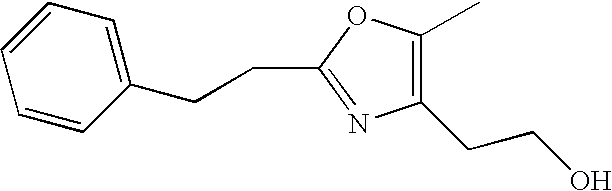
BH3-THF complex (49 mL of a 1.0 M solution in THF) was added dropwise via addition funnel over 50 min to a solution of (5-methyl-2-phenethyl-oxazol-4-yl)-acetic acid (5.05 g, 20.6 mmol) in THF (35 mL). The reaction mixture was stirred at ambient temperature for 3 h, and then quenched with MeOH (12 mL). After heating at 50° C. for 2 h, the reaction mixture was cooled to ambient temperature, and then partitioned between CH2Cl2 and 1N NaOH. The organic phase was washed with brine (1×50 mL), dried over MgSO4 and concentrated to obtain a residue, which was purified by column chromatography (500 mL SiO2, 35% EtOAc/hexanes) to provide 3.99 g (84%) of the desired product as a clear, colorless oil. 1H NMR (400 MHz, CDCl3) δ 7.33-7.20 (m, 5H), 3.84 (q, J=5.6 Hz, 2H), 3.06-2.67 (m, 4H), 2.62 (t, J=5.6 Hz, 2H), 2.22 (s, 3H); MS (EI+) 232.19 (M+H); 254.15 (M+H+Na).
Step F: Toluene-4-sulfonic acid 2-(5-methyl-2-phenethyl-oxazol-4-yl)-ethyl ester
A solution of 2-(5-methyl-2-phenethyl-oxazol-4-yl)-ethanol (1.2 g, 5.19 mmol) in CH2Cl2 at 0° C. was treated with pyridine (1.64 g, 20.7 mmol, 1.68 mL), DMAP (190 mg, 1.56 mmol), and tosyl anhydride (2.2 g, 6.75 mmol). The reaction was warmed to ambient temperature and, after 90 min, the solution was filtered through a pad of silica gel (rinsed with CH2Cl2). The product was used without further purification. 1H NMR (400 MHz, CDCl3) δ 7.73 (d, J=8.4 Hz, 2H), 7.31-7.17 (m, 7H), 4.21 (t, J=6.8 Hz, 2H), 3.01-2.88 (m, 4H), 2.75 (t, J=6.8 Hz, 2H), 2.43 (s, 3H), 2.19 (s, 3H).
The following intermediate compounds are prepared by a substantially similar manner as described in Preparations 3.

1H NMR (400 MHz, CDCl3) δ3.73 (t, J=6.8 Hz, 2H), 2.58 (tt, J=11.6, 3.6 Hz, 1H), 2.54 (t, J=6.8 Hz, 2H), 2.13 (s, 3H), 1.93-1.89 (m, 2H), 1.74 (dt, J=12.8, 3.6 Hz, 2H), 1.67-1.62 (m, 1H), 1.41 (qd, J=12.0, 3.2 Hz, 1H), 1.33-1.17 (m, 4H); MS (EI+) 210.1 (M+H).

1H NMR (400 MHz, CDCl3) δ7.67 (d, J=8.4 Hz, 2H), 7.27 (d, J=8.4 Hz, 2H), 4.16 (t, J=6.8 Hz, 2H), 2.70 (t, J=6.8 Hz, 2H), 2.56 (tt, J=11.6, 3.6 Hz, 1H), 2.39 (s, 3H), 2.13 (s, 3H), 1.93-1.89 (m, 2H), 1.74 (dt, J=12.8, 3.6 Hz, 2H), 1.67-1.62 (m, 1H), 1.41 (qd, J=12.0, 3.2 Hz, 1H), 1.33-1.17 (m, 4H); MS (EI+) 364.1 (M+H)+.

MS (EI+) 224.1 (M+H)+.

1H NMR (400 MHz, CDCl3) δ 7.73 (d, J=8.4 Hz, 2H), 7.30 (t, J=8.4 Hz, 2H), 4.12 (t, J=6.6 Hz, 2H), 2.76 (t, J=6.6 Hz, 2H), 2.42 (s, 3H), 2.17 (s, 3H), 2.61-2.02 (m, 2H), 1.56-1.30 (m, 8H), 1.19 (s, 3H); MS (EI) 378.2 (M+H)+.

MS (EI) 212.2 (M+H)+.

MS (EI) 366.2 (M+H)+.

MS (EI) 218.0 (M+H)+.

MS (EI) 372.1 (M+H)+.

1H NMR (CDCl3) δ 7.81 (m, 3H), 7.38 (m, 2H), 3.94 (m, 2H), 3.07 (br s, 1H), 2.73 (t, 2H, J=6 Hz), 2.34 (s, 3H); 13C NMR (CDCl3) δ 155.9, 145.0, 140.5, 139.8, 134.5, 129.9, 125.9, 125.1, 124.7, 123.7, 122.7, 61.9, 28.5, 10.4; MS (EI) 260.1 (M+H)+.

1H NMR (CDCl3) δ 7.85 (m, 1H), 7.84 (m, 1H), 7.75 (s, 1H), 7.67 (d, 2H, J=8 Hz), 7.39 (m, 2H), 7.21 (m, 2H), 4.31 (t, 2H, J=2 Hz), 2.83 (t, 2H, J=6 Hz), 2.32 (s, 3H), 2.19 (s, 3H).

HRMS Calcd for C16H16NO2: m/z 254.1181. Found: 254.1167.

MS (EI) 272 (M+H)+.

MS (EI) 426 (M+H)+; mp 110.2° C.

MS (EI) 276 (M+H)+.

MS (EI) 430 (M+H)+; mp 84.9° C.

MS (EI) 282.1 (M+H)+.

MS (EI) 438.1 (M+H)+.

Step A: 3-[2-(6-Chloro-pyridin-3-yl)-5-methyl-oxazole-4-yl]-acetic acid methyl ester

According to Preparation 3, Steps A to C, 6-chloronicotinic acid was converted into the title compound. MS (ESI) m/z 267 (M+H)+.
Step B: 3-[2-(6-Chloro-pyridin-3-yl)-5-methyl-oxazole-4-yl]-ethanol
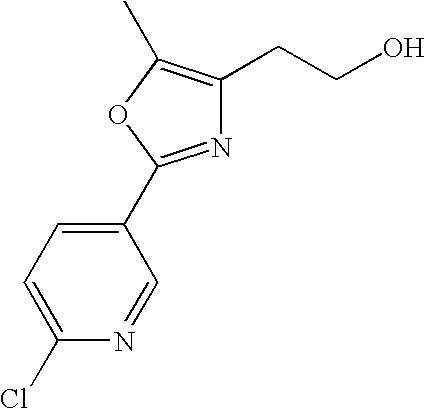
A solution of 3-[2-(6-chloro-pyridin-3-yl)-5-methyl-oxazole-4-yl]-acetic acid methyl ester (500 mg, 1.88 mmol) in THF (20 mL) at 0° C. was treated LAH (90 mg, 2.3 mmol). The reaction mixture was stirred for 1 h and was quenched with water (0.1 mL), 15% NaOH (0.1 mL), and water (0.3 mL). The mixture was filtered through Celite and concentrated to give the title alcohol which as used in the next step without further purification. MS (ESI) m/z 239 (M+H)+.
Step C: Toluene-4-sulfonic acid 2-[2-(6-chloro-pyridn-3-yl)-5-methyl-oxaxol-4-yl]-ethyl ester
A solution of crude 3-[2-(6-chloro-pyridin-3-yl)-5-methyl-oxazole-4-yl]-ethanol (1.88 mmol max) in CH2Cl2 (10 mL) was treated with para-toluenesulfonyl chloride (0.4 g, 2.3 mmol), DMAP (40 mg), and triethylamine (0.4 mL, 2.82 mmol). The reaction mixture was stirred at ambient temperature overnight and was diluted with CH2Cl2 (20 mL). The mixture was washed with water, and the organic layer was dried (MgSO4), filtered, and concentrated. The crude product was purified by silica gel chromatography (hexanes/EtOAc 10/1 to 2/1) to afford the title compound (295 mg, 40% over two steps). MS (ESI) m/z 393 (M+H)+.

Step A: 4-(2-Benzyloxy-ethyl)-2-(4-bromo-phenyl)-5-methyl-oxazole

A solution of 2-[2-(4-bromo-phenyl)-5-methyl-oxazol-4-yl]-ethanol (3.17 g, 11.2 mmol) in DMF (25 mL) was treated with NaH (0.67 g, 60% oil dispersion) at 0° C. and stirred for 5 min. Benzyl bromide (2.90 g, 16.9 mmol) was added, and the resulting mixture was stirred at room temperature for 3 h. The reaction was quenched with water, and the mixture was extracted with EtOAc (2×150 mL). The combined organics were dried (Na2SO4), concentrated, and purified by silica gel chromatography column (10% EtOAc/hexanes) to yield the title compound as an oil (2.50 g, 60%).
Step B: {4-[4-(2-Benzyloxy-ethyl)-5-methyl-oxazol-2-yl]-phenyl}-methyl-phenyl-amine

A solution of 4-(2-benzyloxy-ethyl)-2-(4-bromo-phenyl)-5-methyl-oxazole (200 mg, 0.538 mmol) in toluene (5.0 mL) in a seal tube under nitrogen gas flow was treated with Pd(OAc)2 (50 mg), 2-(di-t-butylphosphino)biphenyl (20 mg), N-methyl aniline (115 mg, 1.08 mmol), and sodium t-butoxide (104 mg, 1.08 mmol). The tube was sealed and heated at 105° C. for 14 h. The mixture was cooled and purified directly by silica gel column chromatography (30-50% EtOAc/hexanes) to yield the title compound (195 mg, 91%). MS (ESI) m/z 399.3 (M+H)+.
Step C: 2-{5-Methyl-2-[4-(methyl-phenyl-amino)-phenyl]-oxazol-4-yl}-ethanol

A solution of {4-[4-(2-benzyloxy-ethyl)-5-methyl-oxazol-2-yl]-phenyl}-methyl-phenyl-amine (195 mg, 0.490 mmol) in THF (2 mL) and EtOH (10 mL) was treated a slurry of Pd/C (200 mg) in EtOH (2 mL). The resulting mixture was treated with hydrogen under balloon pressure for 14 h and filtered through a pad of Celite. The filtrate was concentrated, and crude product was purified by silica gel chromatography column (50% EtOAc/hexanes) to yield the title compound (91 mg, 60%).
Step D: Toluene-4-sulfonic acid 2-{5-methyl-2-[4-(methyl-phenyl-amino)-phenyl]-oxazol-4-yl}-ethyl ester
A solution of 2-{5-methyl-2-[4-(methyl-phenyl-amino)-phenyl]-oxazol-4-yl}-ethanol (91 mg, 0.30 mmol) in CH2Cl2 (4.0 mL) was treated with para-toluenesulfonyl chloride (68 mg, 0.36 mmol), triethyl amine (0.20 mL) and a few crystals of DMAP. The resulting mixture was stirred at room temperature for 14 h and was quenched with water (0.2 mL). The mixture was purified directly by silica gel column chromatography (40% EtOAc/hexanes) to yield the title compound (120 mg, 83%). MS (ESI) m/z 463.1 (M+H)+.
The following intermediate compounds are prepared by a substantially similar manner as described in Preparation 5.

MS (ESI) m/z 449.1 (M+H)+.

MS (ESI) m/z 443.1 (M+H)+.

Step A: 4-(2-Benzyloxy-ethyl)-5-methyl-2-(4-phenoxy-phenyl)-oxazole

A mixture of 4-(2-benzyloxy-ethyl)-2-(4-bromo-phenyl)-5-methyl-oxazole (0.025 mol, 9.2 g), phenol (0.03 mol, 2.8 g), K3PO4 (0.05 mol, 10.6 g), 2-(di-tert-butylphosphino)biphenyl (1.8 mmol, 0.54 g) and Pd(OAc)2 (1.2 mmol, 0.28 g) in toluene (350 mL) was degassed with nitrogen and heated at 100° C. for 18 h. Additional Pd(OAc)2 (0.5 g) and phosphine ligand (1.0 g) were added, and the mixture was heated 5 h at 100° C. The reaction was concentrated and purified directly by silica gel chromatography (4/1 hexanes/ethyl acetate) to give the title compound (7.6 g).
Step B: Toluene-4-sulfonic acid 2-[5-methyl-2-(4-phenoxy-phenyl)-oxazol-4-yl]-ethyl ester
According to Preparation 5, Steps C to D, 4-(2-benzyloxy-ethyl)-5-methyl-2-(4-phenoxy-phenyl)-oxazole was converted into the title compound. 1HNMR (400 MHz, CDCl3) δ 7.81 (d, 2H, J=9.1 Hz), 7.67 (d, 21, J=8.2 Hz), 7.37 (t, 2H, J=8.2 Hz), 7.15 (m, 3H), 7.12 (m, 4H), 4.39 (t, 2H, J=6.4 Hz), 2.81 (t, 2H, 6.4 Hz), 2.30 (s, 3H), 2.25 (s, 3H).

A mixture of potassium nitrate (3.0 g, 30 mmol, 2.7 equiv) and sulfuric acid (10 mL, 18 g, 94 mmol, 17 equiv) was cooled to 0° C. Toluene-4-sulfonic acid 2-(5-methyl-2-phenyl-oxazol-4-yl)-ethyl ester (4.00 g, 11.2 mmol, 1 equiv) was added and the ice bath was removed. The reaction mixture was heated with a heat gun until the tosylate dissolved. After 30 min, the solution was poured into H2O (100 mL) and extracted with EtOAc (100 mL). The organic layer was dried (Na2SO4) and concentrated (75° C.) to an orange oil (4.41 g). The crude product was purified by silica gel flash chromatography (30-50% EtOAc/hexanes) to give the title compound as a yellow solid (3.64 g, 73%). MS (ESI) m/z 447 (M+H)+.

Step A: 2-Benzoylamino-succinic acid dimethyl ester

A mixture of benzoyl chloride (3.20 mL, 27.7 mmol), L-aspartic acid dimethyl ester (5.0 g, 25.2 mmol) and triethyl amine (5.3 mL, 38 mmol) in CH2Cl2 (50 mL) was stirred at ambient temperature for 2 h and diluted with water. The organic layer was dried (MgSO4), filtered, and concentrated. The residue was purified by silica gel chromatography (hexanes/EtOAc 1/1) to afford a white solid (5.3 g, 79%). MS (ESI) m/z 266 (M+H)+.
Step B: 3-(5-Methoxy-2-phenyl-oxazol-4-yl)-acetic acid methyl ester

A mixture of 2-benzoylamino-succinic acid dimethyl ester (5.3 g, 20 mmol) in 1,2-dichloroethane (15 mL) was treated with P2O5(5.3 g, 30 mmol) and Celite (3.2 g) and was heated at 85° C. for 2 h. The solvent was decanted and concentrated. The residue was dissolved in CH2Cl2 and washed with saturated aqueous NaHCO3. The organic layer was dried (MgSO4), filtered, and concentrated. The residue was purified by silica gel chromatography (hexanes/EtOAc 10/1 to 3/1) to afford the title compound (2.9 g, 59%). MS (ESI) m/z 247 (M+H)+.
Step C: 3-(5-Methoxy-2-phenyl-oxazol-4-yl)-ethanol

A suspension of LAH (0.56 g, 14.1 mmol) in THF (100 mL) at −78° C. was treated dropwise with a solution of 3-(5-methoxy-2-phenyl-oxazol-4-yl)-acetic acid methyl ester (2.9 g, 11.7 mmol) in THF (100 mL). After the addition was completed, the reaction mixture was warmed up to ambient temperature, cooled to −20° C., and quenched with H2O (0.8 mL), 15% NaOH (0.8 mL), and H2O (2.4 mL). The mixture was filtered through Celite and concentrated to the title compound as an oil. MS (ESI) m/z 220.3 (M+H)+.
Step D: Toluene-4-sulfonic acid 2-(5-methoxy-2-phenyl-oxazol-4-yl)-ethyl ester
A solution of crude 3-(5-methoxy-2-phenyl-oxazol-4-yl)-ethanol (11.7 mmol max) in CH2Cl2 (100 mL) was treated with para-toluenesulfonyl chloride (2.7 g, 14.0 mmol), DMAP (100 mg), and triethylamine (2.5 mL, 17.6 mmol). The reaction mixture was stirred at ambient temperature for 16 h and was washed with water. The organic layer was dried (MgSO4), filtered, and concentrated. The residue was purified by silica gel chromatography (hexanes/EtOAc, 10/1 to 1/1) to afford the title compound (2.0 g, 46% over two steps). MS (ESI) m/z 374 (M+H)+.
The following intermediate compounds are prepared by a substantially similar manner as described in Preparation 8.

MS (ESI) m/z 296.0 (M+H)+.

MS (ESI) m/z 450.1 (M+H)+.

Step A: 2-Phenyl-5-cyanopyridine

5-Cyano-2-chloropyridine (5.0 g, 36.1 mmol), phenylboronic acid (6.6 g, 54 mmol), tetrakis(triphenylphosphine)palladium (0) (0.5 g), and aqueous Na2CO3 (7.6 g), in toluene (100 mL) were heated at 90° C. for 16 h. The mixture was diluted with EtOAc and washed with H2O. The organic layer was dried (MgSO4), filtered, and concentrated. The residue was purified by silica gel chromatography (hexanes/EtOAc 2/1) to afford the title compound (6.1 g, 94%). MS (ESI) m/z 181 (M+H)+.
Step B

A mixture of 2-phenyl-5-cyanopyridine (6.0 g, 33 mmol) and thioacetamide (4.0 g, 53 mmol) in 4N HCl in 1,4-dioxane (50 mL) was heated at 98° C. for 20 h. The reaction mixture was cooled and poured into aqueous saturated NaHCO3. The precipitate was collected, washed with water, and dried under vacuum (60° C.) to afford the title compound as a yellow solid (7.0 g, 99%).
Step C: [5-Methyl-2-(6-phenyl-pyridin-3-yl)-thiazol-4-yl]-acetic acid methyl ester

A mixture of 6-phenyl-thionicotinamide (7.0 g) and 4-bromo-3-oxo-pentanoic acid methyl ester (9.15 g, 35 mmol) in 1,4-dioxane (30 mL) was heated at reflux for 4 h. The reaction mixture was cooled, poured into aqueous saturated NaHCO3, and extracted with CH2Cl2. The organic layer was dried (MgSO4), filtered, and concentrated. The residue was purified by silica gel chromatography (hexanes/EtOAc, 2/1) to afford the title compound (6.0 g, 56%). MS (ESI) m/z 325 (M+H)+.
Step D: [5-Methyl-2-(6-phenyl-pyridin-3-yl)-thiazol-4-yl]-ethanol

A solution of [5-methyl-2-(6-phenyl-pyridin-3-yl)-thiazol-4-yl]-acetic acid methyl ester (6.0 g, 18.5 mmol) in THF (500 mL) was added dropwise to a suspension of LAH (0.90 g, 22.2 mmol) in THF (300 mL) at −78° C. After the addition was completed, the reaction mixture was allowed to warm to ambient temperature, cooled to −20° C., and quenched sequentially with H2O (1.1 mL), 15% NaOH (1.1 mL), and H2O (3.3 mL). The mixture was filtered through Celite, and the filtrated was concentrated to give the title compound as an oil that was used directly in the next step.
Step E: Toluene-4-sulponic acid 2-[5-methyl-2-(6-phenyl-pyridin-3-yl)thiazol-4-yl]ethyl ester
A mixture of [5-methyl-2-(6-phenyl-pyridin-3-yl)-thiazol-4-yl]-ethanol (18.5 mmol max), para-toluenesulfonyl chloride (3.89 g, 20.5 mmol), DMAP (500 mg), and triethylamine (4.0 mL, 28.0 mmol) in CH2Cl2 (300 mL) was stirred at ambient temperature for 2.5 h. The reaction mixture was diluted with water, and the organic layer was separated, dried (MgSO4), filtered, and concentrated. The residue was purified by silica gel chromatography (hexanes/EtOAc, 10/1 to 1/1) to afford the title compound as a solid (2.0 g, 46% over two steps). MS (ESI) m/z 451 (M+H)+.
The following intermediate compounds are prepared by a substantially similar manner as described in Preparation 9.

MS (ESI) m/z 297 (M+H)+.

MS (ESI) m/z 451 (M+H)+.

1HNMR 400 MHz (CDCl3) 8.52 (2, 1H), 8.03 (d, 1H, J=6.9 Hz), 7.63 (d, 2H, J=8.6 Hz), 7.42 (t, 2H, J=7.7 Hz), 7.2 (m, 5H), 6.91 (1H, d, J=7.7 Hz), 4.37 (t, 2H, J=6.3 Hz), 3.02 (t, 2H, J=6.3 Hz), 2.39 (s, 3H), 2.28 (s, 3H).

1HNMR 400 MHz (CDCl3) 8.51 (s, 1H), 7.82 (d, 1H, J=8.5 Hz), 7.63 (d, 2H, J=7.8 Hz), 7.19 (d, 2 h, J=7.8 Hz), 6.61 (d, 1H, J=8.5 Hz), 4.37 (t, 2H, J=6.5 Hz), 3.82 (t, 2H, J=5.2 Hz), 3.58 (t, 2H, J=5.2 Hz), 2.99 (t, 2H, J=6.5 Hz), 2.35 (s, 3H), 2.27 (s, 3H).

MS (ESI) m/z 482 (M+H)+.

MS (ESI) m/z 396.1 (M+H)+.

MS (ESI) m/z 458.1 (M+H)+.

MS (ESI) m/z 220 (M+H)+.

MS (ESI) m/z 374 (M+H)+.

MS (ESI) m/z 296 (M+H)+.

MS (ESI) m/z 450 (M+H)+.

MS (ESI) m/z 375.1 (M+H)+.

MS (ESI) m/z 375.1 (M+H)+.

MS (ESI) m/z 375 (M+H)+, MS (ESI) m/z 383.1 (M+H)+.

MS (ESI) m/z 371 (M+H)+.

Step A: 5-Methyl-3-phenyl-1H-pyrazole

Hydrazine hydrate (9.0 mL, 99 mmol, 35 wt. % in H2O; 0.64 equiv) was added to a solution of benzoylacetone (25.00 g, 154.1 mmol, 1 equiv) in ethanol (250 mL). After stirring 14 h, more hydrazine hydrate (8.0 mL, 88 mmol, 0.57 equiv) was added. After 2 h, the reaction solution was concentrated (95° C.) to give the title compound as a white solid (24.31 g, 99.7%). HRMS Calculated for C10H11N2: m/z 159.0922. Found: 159.0917.
Step B: 2-(5-Methyl-3-phenyl-pyrazol-1-yl)-ethanol

Sodium hydride (2.5 g, 1.5 g NaH, 62 mmol, 1.1 equiv) was added over a period of 3 min to a solution of 5-methyl-3-phenyl-1H-pyrazole (9.00 g, 56.9 mmol, 1 equiv) in DMF (90 mL) cooled to 0° C. in an ice bath. After stirring 15 min, ethylene carbonate (7.6 mL, 10 g, 110 mmol, 2.0 equiv) was added. The bath was removed, and the reaction mixture was stirred for 15 h. The mixture was treated with 4 M aq K2CO3 (90 mL), heated at reflux for 5 h, and diluted with H2O (200 mL). After allowing the hot mixture to cool for 15 min, more H2O (100 mL) and then hexanes (100 mL) were added. The mixture was shaken vigorously and then allowed to separate. Crystals formed and stayed with the top organic layer. The aqueous layer was separated, and the crystals were collected by vacuum filtration and washed with hexanes (2×50 mL). The crystals were dissolved in Et2O/EtOAc (1:1; 200 mL), and the solution was dried (Na2SO4), filtered, and concentrated (75° C.) to give the title compound as an off-white crystalline solid (6.86 g, 59.6%). HRMS Calculated for C12H15N2O: m/z 203.1184. Found: 203.1168.
Step C: Toluene-4-sulfonic acid 2-(5-methyl-3-phenyl-pyrazol-1-yl)-ethyl ester
According to Preparation 9, Step E, 2-(5-methyl-3-phenyl-pyrazol-1-yl)-ethanol was converted into the title compound. MS (ESI) m/z 357 (M+H)+.

Step A: 5-Biphenyl-4-yl-3-methyl-1H-pyrazole

To a stirred mixture of NaH (1.98 g, 0.049 mol, 60% oil dispersion) in dry THF (30 mL) was added a suspension of diethoxyphosphorylacetone tosyl hydrazone (8.97 g, 0.024 mol; N Almirante Syn. Lett. 1999, 302.) in a mixture of THF (35 mL) and DMF (5.0 mL) dropwise over 15 min. The yellow suspension was stirred at 0-5° C. for 30 min and was treated with a 4-biphenyl carboxaldehyde (3.10 g, 0.0169 mol) in dry THF (30 mL) at 0-5° C. over 15 min. The orange solution was heated and stirred at reflux for 4 h and stirred at ambient temperature overnight. The mixture was poured into 5% aq. NaH2PO4 (350 mL) and extracted with EtOAc (2×200 mL). The organic layers were combined, washed with brine, dried (MgSO4), filtered, and concentrated to a yellow semi-solid. This material was triturated with hot EtOAc (20 mL) and filtered. The solid was washed with EtOAc (2×10 mL) and dried under high vacuum to give the title compound (2.61 g, 47%): HRMS Calculated for C16H15N2: m/z 235.1235. Found: 235.1230.
Step B: 2-(3-Biphenyl-4-yl-5-methyl-pyrazol-1-yl)-ethanol
The title compound was prepared from 5-biphenyl-4-yl-3-methyl-1H-pyrazole according to the Preparation 10, Step B. HRMS Calculated for C18H19N2O: m/z 279.1497. Found: 279.1496.
The following intermediate compounds are prepared by a substantially similar manner as described in Preparations 10 and 11.

HRMS Calculated for C12H14BrN2O: m/z 281.0289. Found: 281.0288.

HRMS Calculated for C14H12N2: m/z 208.1001. Found: 208.0981.

HRMS Calculated for C16H17N2O: m/z 253.1341. Found: 253.1339.

Anal Calculated for C14H12N2: C, 80.74; H, 5.81; N, 13.45. Found: C, 80.93; H, 5.70; N, 13.42. mp 115-117° C.


To a solution of 6-methoxynaphthalen-2-ol (1.07 g, 6.14 mmol) in DMF (4 mL) were added cesium carbonate (3.11 g, 9.55 mmol) and dibromoethane (2.5 mL, 29 mmol). The mixture was stirred and heated at 55° C. for 48 h. The reaction mixture was cooled, filtered, diluted with EtOAc, and washed with brine (2×30 mL). The organic layer was dried (Na2SO4) and concentrated. The crude product was purified using radial chromatography (2:98 to 25:75 EtOAc:Hex) to give the title compound as a white solid (0.52 g, 30%): 1H NMR (400 MHz, CDCl3) δ 3.61 (t, J=6.1 Hz, 2H), 3.82 (s, 3H), 4.30 (t, J=6.4 Hz, 2H), 7.01-7.08 (m, 4H), 7.56 (dd, J=12.0, 9.0 Hz, 2H).
The following intermediate compounds are prepared by a substantially similar manner as described in Preparation 12.

The above compound is prepared from 3-phenylbenzofuran-6-ol (see Bull. Soc. Chim. Fr., 942 (1962)). 1H NMR (400 MHz, CDCl3) δ 3.60 (t, J=6.4 Hz, 2H), 4.28 (t, J=6.4 Hz, 2H), 6.88 (dd, J=8.8, 2.4 Hz, 1H), 7.00 (d, J=2.4 Hz, 1H), 7.26-7.30 (m, 1H), 7.36-7.44 (m, 2H), 7.52-7.56 (m, 2H), 7.63 (d, J=9.8 Hz, 2H).

1H NMR (400 MHz, CDCl3) δ 3.55 (t, J=6.4 Hz, 2H), 4.19 (t, J=6.1 Hz, 2H), 6.80-6.90 (m, 6H), 6.96 (t, J=7.3 Hz, 1H), 7.17-7.24 (m, 2H).
4-(3-Bromoethoxy)biphenyl: MS (ESI) m/z 295 (M+NH3)+.
3-(2-Bromoethoxy)biphenyl: 1H NMR (400 MHz, CDCl3) δ 3.58 (t, J=6.4 Hz, 2H), 4.27 (t, J=6.4 Hz, 2H), 6.81 (dd, J=8.3, 2.4 Hz, 1H), 6.90 (d, J=8.8 Hz, 1H), 7.13 (dd, J=7.8, 1.0 Hz, 1H), 7.26-7.33 (m, 2H), 7.34-7.37 (m, 2H), 7.43-7.50 (m, 2H).
6-(4-Bromopropoxy)-3-phenylbenzofuran: 1H NMR (400 MHz, CDCl3) δ 2.26-2.33 (m, 2H), 3.57 (t, J=6.4 Hz, 2H), 4.11 (t, J=5.9 Hz, 2H), 6.89 (dd, J=8.6, 2.2 Hz, 1H), 7.01 (d, J=2.0 Hz, 1H), 7.29 (t, J=7.6 Hz, 1H), 7.40 (t, J=7.6 Hz, 2H), 7.56 (d, J=6.8 Hz, 2H), 7.57-7.65 (m, 2H).
2-(4-Bromopropoxy)-6-methoxynaphthalene: 1H NMR (400 MHz, CDCl3) δ 2.29 (t, J=6.1 Hz, 2H), 3.56 (t, J=6.4 Hz, 2H), 3.81 (4.11 (t, J=5.9 Hz, 2H), 7.01-7.14 (m, 4H), 7.52-7.57 (m, 2H).
3-(4-Bromopropoxy)biphenyl: 1H NMR (400 MHz, CDCl3) δ 2.27 (t, J=6.1 Hz, 2H), 3.55 (t, J=6.6 Hz, 2H), 4.09 (t, J=5.9 Hz, 2H), 6.81 (dd, J=2.9, 1.0 Hz, 1H), 7.05 (t, J=2.0 Hz, 1H), 7.07 (t, J=2.0 Hz, 1H), 7.22-7.24 (m, 2H), 7.26-7.37 (m, 2H), 7.43-7.52 (m, 3H).

1H-NMR (200.15 MHz, CDCl3): δ7.57-7.29 (m, 7H), 6.98 (dd, 2H, J=6.72, 1.88), 4.15 (t, 2H, J=5.92), 3.62 (t, 2H, J=6.44), 2.34 (qn, 2H, J=5.92).
4-(3-Bromoproxy)-1-phenoxybenzene: 1H-NMR (300 MHz, CDCl3): δ 7.3(2H, m), 7.1(2H, m), 7.0(2H, m), 6.9(2H, m), 4.1(2H, m); 3.6(2H, m); 2.3(2H, m).

1H NMR (400 MHz, CDCl3) 61.88-1.97 (m, 2H), 1.99-2.10 (m, 2H), 3.41-3.48 (m, 2H), 3.81 (s, 3H), 4.00 (t, J=5.9 Hz, 2H), 7.00-7.05 (m, 3H), 7.13-7.19 (m, 1H), 7.54 (t, J=8.1 Hz, 2H).

1H NMR (400 MHz, CDCl3) δ 1.90-1.98 (m, 2H), 2.01-2.04 (m, 2H), 3.41-3.44 (m, 2H), 3.94-3.99 (m, 2H), 6.83-6.91 (m, 1H), 6.96-6.97 (m, 1H), 7.27-7.29 (m, 1H), 7.36-7.43 (m, 2H), 7.53-7.62 (m, 4H).

1H NMR (400 MHz, CDCl3) δ 2.03 (t, J=6.8 Hz, 2H), 3.42 (t, J=6.6 Hz, 2H), 3.96 (t, J=6.5 Hz, 2H), 6.87 (d, J=7.8 Hz, 2H), 7.17-7.23 (m, 3H), 7.32 (t, J=7.6 Hz, 1H), 7.42-7.47 (m, 4H).

1H NMR (400 MHz, CDCl3) δ 1.86-1.95 (m, 2H), 1.96-2.05 (m, 2H), 2.42 (t, J=6.6 Hz, 2H), 3.98 (t, J=6.1 Hz, 2H), 6.79 (dd, J=7.3, 2.0 Hz, 1H), 7.03-7.11 (m, 1H), 7.26 (t, J=7.8 Hz, 2H), 7.35 (t, J=7.8 Hz, 2H), 7.42-7.51 (m, 2H).

1H NMR (400 MHz, CDCl3) δ 1.83-2.03 (m, 2H), 1.96-2.03 (m, 2H), 3.41 (t, J=6.6 Hz, 2H), 3.90 (t, J=6.5 Hz, 2H), 6.76-6.78 (m, 2H), 6.79-6.90 (m, 4H), 6.94-6.97 (m, 1H), 7.19-7.23 (m, 2H).

Step A: 2-Bromo-5-hydroxybenzaldehyde

To a suspension of 3-hydroxybenzaldehyde (1 kg, 8.2 mol) in CH2Cl2 (10 L) was added a solution of bromine (1.3 kg, 8.2 mol) in CH2Cl2 (620 mL) over 1 h. After stirring for about 22 h, the solids were isolated by filtration, washed with CH2Cl2 (4 L), and dried under vacuum to afford of 2-bromo-5-hydroxybenzaldehyde as a tan solid (1.05 kg, 63%).
Step B: 3-(2-Formyl-4-hydroxy-phenyl)-acrylic acid tert-butyl ester

To a solution of 2-bromo-5-hydroxybenzaldehyde (200 g, 1.0 mole) in propionitrile (6 L) under N2 was added tri-o-tolyl phosphine (75.4 g, 0.25 mol) and diisopropylethylamine (350 mL, 260 g, 2.0 mol). The solution was degassed and purged with N2 three times. To this solution was added tert-butylacrylate (440 mL, 385 g, 3.0 mol) and palladium acetate trimer (27.8 g, 0.12 mol). The mixture was degassed three times and heated to 80° C. over 30 min. After 30 min, the reaction was cooled to ambient temperature and filtered. The solids were washed with acetonitrile. The filtrate was transferred to a separatory funnel with acetonitrile (4 L total) and was extracted with hexanes (4×5 L). The propionitrile/acetonitrile layer was concentrated by rotary evaporation. The residue was dissolved in toluene (4 L) and washed successively with 1N HCl (1 L), water (1 L), and brine (1 L). The organic layer was dried (Na2SO4), filtered, and concentrated to afford crude product as a wet brown solid (293 g). The crude product was dissolved in CH2Cl2 (600 mL) with stirring. To this solution was added hexanes (1.8 L) over ˜2 h, and the resulting slurry was stirred at ambient temperature for 1 h. The slurry was cooled in an ice water bath and stirred for 1 h. The product was isolated by filtration, washed with hexanes, and dried under vacuum to afford the product as a tan solid (199.5 g, 80.6%).
Step C: 3-[4-Hydroxy-2-(hydroxyimino-methyl)-phenyl]-acrylic acid tert-butyl ester

A slurry of hydroxylamine hydrochloride (8.33 g, 0.12 mol), pyridine (9.49 g, 0.12 mol), and ethanol (100 mL) was stirred at ambient temperature for 30 min. 3-(2-Formyl-4-hydroxy-phenyl)-acrylic acid tert-butyl ester (14.90 g, 0.06 mol) was added followed by an ethanol (49 mL) rinse. The resulting brown solution was stirred at ambient temperature for 16 h and concentrated. The residue was suspended in water (150 mL) and extracted with ethyl acetate (3×100 mL). The combined organic layers were washed with saturated NaCl solution (2×100 mL), dried (Na2SO4), and filtered through a plug of silica gel to remove trace polar impurities. The filtrate was concentrated to give crude product (16.04 g). A 13.56 g sample of the crude material was crystallized from heptane (70 mL) and ethyl acetate (80 mL) to the title compound (7.41 g, 55%), mp 146-149° C. 1H NMR (CD3OD): δ 1.53 (s, 9H), 4.83 (s, 2H), 6.15-6.23 (d, 1H), 6.82-6.87 (dd, 1H), 7.10-7.12 (d, 1H), 7.52-7.55 (d, 1H), 7.98-8.03 (d, 1H), 8.37 (s, 1H). MS (ES+) m/z 286.1 ([M+Na]+). MS (ES−) m/z 262.2 ([M−H]−). Anal. Calculated for C14H17NO4: C: 63.8658; H: 6.5081; N: 5.3198. Found: C: 63.71; H: 6.38; N: 5.51.
Step D: 3-(2-Aminomethyl-4-hydroxy-phenyl)-propionic acid tert-butyl ester
A solution of 3-[4-hydroxy-2-(hydroxyimino-methyl)-phenyl]-acrylic acid tert-butyl ester (0.50 g, 1.9 mmol) in ethanol (50 mL) was treated with 10% palladium on carbon (0.25 g). The resulting suspension was treated with hydrogen using a Parr shaker apparatus at ambient temperature and 50 psi for 16 h. The reaction mixture was filtered through Celite, rinsed with ethanol (20 mL), and concentrated. The residue was dissolved in ethyl acetate (50 mL) and washed with 10% K2CO3 solution (2×25 mL) and 1N NaOH (2×25 mL). The organic layer was dried (Na2SO4), filtered, and concentrated. The residue was crystallized from isopropyl acetate to give the title compound (0.14 g, 40%), mp 154-157° C. 1H NMR (CD3OD): δ 1.37 (s, 9H), 2.44-2.50 (t, 2H), 2.80-2.85 (t, 2H), 3.75 (s, 2H), 4.83 (s, 3H), 6.57-6.63 (dd, 1H), 6.75-6.77 (d, 1H), 6.95-7.00 (d, 1H). MS (ES+) m/z 252.1 ([M+H]+). MS (ES−) m/z 250.2 ([M−H]−). Anal. Calculated for C14H21NO3: C: 66.9069; H: 8.4222; N: 5.5731. Found: C: 66.57; H: 8.29; N: 5.60.

Alternative to the crystallization of 3-(2-Aminomethyl-4-hydroxy-phenyl)-propionic acid tert-butyl ester from isopropyl acetate. The crude tert-butyl-3-[2-(aminomethyl)-4-hydroxyphenyl]propanoate (0.50 g, 0.002 mol) was dissolved in refluxing ethyl acetate (10 mL). A solution of oxalic acid (0.18 g, 0.002 mol) dissolved in ethyl acetate (5 mL) was added and produced a precipitate immediately. The resulting slurry was cooled to 0° C. and filtered. The isolated product was slurred in ethanol (5 mL), cooled to 0° C., and filtered to give 3-(2-aminomethyl-4-hydroxy-phenyl)-propionic acid tert-butyl ester ethandioate (2:1) (0.41 g, 69%). mp 188-190° C. 1H NMR (DMSO-d6): δ 1.36 (s, 18H), 2.39-2.45 (t, 4H), 2.47-2.52 (m, 4H), 2.70-2.76 (t, 4H), 3.83 (s, 4H), 6.61-6.65 (dd, 2H), 6.77-6.82 (d, 2H), 6.97-7.01 (d, 2H). MS (ES+) m/z 252.1 ([M+H]+). MS (ES−) m/z 250.2 ([M−H]−). Anal. Calculated for C30H44N2O10: C: 60.80; H: 7.48; N: 4.73. Found: C: 60.79; H: 7.51; N: 4.81.

A solution of 3-(2-aminomethyl-4-hydroxy-phenyl)-propionic acid tert-butyl ester (1.00 g, 3.98 mmol) in CH2Cl2 (10 mL) was treated with water (12 drops) then TFA (10 mL). The solution was stirred at ambient temperature for 6.5 h and concentrated. The residue was diluted with 2,2-dimethoxypropane (40 mL), conc. HCl (4 mL), and then MeOH (10 mL). The solution was stirred for 18 h and concentrated to 3-(2-aminomethyl-4-hydroxy-phenyl)-propionic acid: HCl salt as a tan solid. MS (ES−) m/z 208 [M−1].
The solid was diluted with THF (20 mL) and saturated aq. NaHCO3 solution (12 mL) and was treated with di-tert-butyl dicarbonate (1.09 g, 5.00 mmol). The mixture was stirred for 3 h and concentrated, and the residue was partitioned between EtOAc (75 mL) and 1N HCl (30 ml). The organic layer was dried (Na2SO4), and concentrated to give the title compound (1.16 g, 94%). MS (ES−) m/z 308 [M−1].

A slurry of 3-(2-aminomethyl-4-hydroxy-phenyl)-propionic acid tert-butyl ester (75.4 g, 0.3 mol) in CH2Cl2 (900 mL) at 1° C. was treated with triethylamine (60.7 g, 0.6 mol). Isopropyl chloroformate (300 mL, 0.3 mol, 1M in toluene) was added while maintaining the temperature less than 12° C. The resulting solution was stirred 16 h at ambient temperature. After 16 h, additional isopropyl chloroformate (15 mL, 0.015 mol, 1.0M in toluene) was added, and the reaction was stirred for 1 h. The reaction mixture was washed with 1N HCl (2×200 mL) and saturated NaHCO3 solution (2×200 mL). The organic layer was dried (Na2SO4) and concentrated. The residue was purified by filtration through Merck silica gel 62 (750 grams, CH2Cl2/MeOH 100/0 to 96/4) to give the title compound (95.48 g, 94.3%). 1H NMR (300 MHz, CDCl3): δ 1.20-1.24 (d, 6H), 1.40 (s, 9H), 2.46-2.52 (t, 2H), 2.81-2.86 (t, 2H), 4.294.32 (d, 2H), 4.86-4.97 (m, 1H), 5.19-5.28 (m, 1H), 6.67-6.72 (dd, 2H), 6.76 (s, 1H), 6.97-7.00 (d, 1H). MS (ES−) m/z 336.1 [M−H]−.
The following intermediate compounds are prepared by a substantially similar manner as described in Preparation 16.

MS (ES−) m/z 350 [M−H]−.

HRMS Calculated for C19H26NO5: m/z 348.1811. Found: 348.1817.

HRMS Calculated for C19H26NO5: m/z 348.1811. Found: 348.1817.

MS (ES−) m/z 362 [M−H]−.

A solution of 3-[4-hydroxy-2-(isopropoxycarbonylamino-methyl)-phenyl]-propionic acid tert-butyl ester (3.0 mmol, 1.0 g) in CH2Cl2 (10 mL) was treated with 90% CF3CO2H/H2O (20 mL) at ambient temperature. The mixture was stirred for 3 h and concentrated. The residue was dissolved in MeOH (20 mL), treated with conc. H2SO4 (1 mL), and heated at reflux for 14 h. The mixture was cooled and concentrated. The residue was dissolved in water/ethyl acetate and neutralized with K2CO3. The organic layer was dried (Na2SO4), and concentrated to give the title compound (0.76 g, 86%). HRMS Calculated for C15H22NO5: m/z 296.1498. Found: 296.1504.

A slurry of 3-(2-aminomethyl-4-hydroxy-phenyl)-propionic acid tert-butyl ester (2.24 g, 8.91 mmol) in CH2Cl2 (30 mL) was treated with isopropyl isocyanate (1.1 mL, 11 mmol). The reaction mixture was diluted with water, the CH2Cl2 was removed under reduced pressure, and the aqueous layer was extracted with EtOAc. The organic layer was dried (MgSO4) and concentrated to the title compound as a white solid (2.6 g, 87%). MS (ES+) m/z 337 [M+H]+.
Preparation 19

Step A: 2,5-Dichloro-thiophene-3-carboxylic acid

A mixture of the 1-(2,5-dichloro-thiophen-3-yl)-ethanone (10 g, 51.26 mmol) and 9.5% NaOCl (150 mL, 230 mmol, 4.5 eq., commercial bleach) was treated with 5N NaOH (1 mL, 5 mmol, 0.1 eq.). The mixture was stirred vigorously and heated to 55° C. The internal temperature was monitored closely and heat was removed to control the exotherm. After 6 h at 61° C., starting material was completely consumed. The mixture was cooled to 0° C. and carefully quenched with 20% aq. NaHSO3 solution (20 mL). At 0° C., 6M HCl (12 mL) was added to adjust the pH to 1.5. The mixture was extracted with EtOAc (300 mL and 3×50 mL). The combined organic layers were washed with brine (200 mL), dried (Na2SO4), and concentrated to a white solid (8.8 g).
Step B: 3-(2-{[(2,5-dichloro-thiophene-3-carbonyl)-amino]-methyl}-4-hydroxy-phenyl)-propionic acid tert-butyl ester
A solution of the 2,5-dichloro-thiophene-3-carboxylic acid (12.9 g, 65.5 mmol) and 4-methylmorpholine (7.17 mL, 65.2 mmol) in dry THF (400 mL) was cooled to −15° C. Isobutyl chloroformate (8.46 mL, 65.2 mmol) was added. The mixture was stirred 3 min and triethylamine (9.1 mL, 65 mmol) was added. A solution of 3-(2-aminomethyl-4-hydroxy-phenyl)-propionic acid tert-butyl ester (16.4 g, 65.3 mmol) in DMF (130 mL) pre-cooled to −15° C. was added via cannula over 15 min. After stirring 1 h, TLC indicated complete reaction. The reaction mixture was allowed to warm to ambient temperature. Solids were removed by filtration and washed with THF (100 mL). The filtrate was diluted with Et2O (500 mL) and washed with water (250 mL) then brine (150 mL). The organic layer was dried (Na2SO4) and concentrated. The crude brown oil was purified by silica gel chromatography (hexanes/EtOAc 2/1) and recrystallization (toluene) to afford the title compound as a white crystalline solid (22.3 g, 79.6%). MS (ES+) m/z 430.1 [M+H]+.

To a solution of pyrazine-2-carboxylic acid (0.570 g, 4.60 mmol) in CH2Cl2 (50 mL) was added EDC (0.960 g, 5.01 mmol) and HOBt (0.620 g, 4.60 mmol) at room temperature. The mixture was stirred for 10 min, and 3-(2-aminomethyl-4-hydroxy-phenyl)-propionic acid tert-butyl ester (1.05 g, 4.18 mmol) was added. The reaction mixture was stirred for 18 h at room temperature, treated with water (50 mL), and extracted with CH2Cl2 (2×50 mL). The combined organic layers were dried (Na2SO4), concentrated, and purified by silica gel chromatography (EtOAc/hexanes, 1:1 to 1:0) to obtain the title compound (1.05 g, 70%). 1H NMR (400 MHz, CDCl3): δ 1.40 (s, 9H), 2.52 (t, 2H, J=7.6 Hz), 2.91 (t, 2H, J=7.6 Hz), 4.66 (d, 2H, J=6.4 Hz), 6.73 (dd, 1H, J=2.9, 7.8 Hz), 6.83 (d, 1H, J=2.4 Hz), 7.07 (d, 1H, J=8.3 Hz), 8.17 (br s, 1H), 8.49 (dd, 1H, J=1.5, 2.4 Hz), 8.73 (d, 1H, J=2.4 Hz), 9.41 (d, 1H, J=1.5 Hz). MS (ES) m/z 356.1 ([M−H]−).
The following intermediate compounds are prepared by a substantially similar manner as described in Preparation 20.

1H-NMR(CDCl3): 1.40 (s, 9H), 2.51 (t, J=7.6 Hz, 2H), 2.91 (t, J=7.6 Hz, 2H), 4.64 (d, J=5.9 Hz, 2H), 6.72 (d, J=7.8 Hz, 1H), 6.85 (s, 1H), 7.06 (d, J=8.2 Hz, 1H), 7.41 (t, J=7.6 Hz, 1H), 7.84 (t, J=7.0 Hz, 1H), 8.20 (d, J=7.4 Hz, 1H), 8.38 (br s, 1H), 8.50 (d, J=3.5 Hz, 1H); MS (ES) m/z 348 (M+H).

A slurry of 3-(2-aminomethyl-4-hydroxy-phenyl)-propionic acid tert-butyl ester (0.36 g, 1.43 mmol) in CH2Cl2 (10 mL) was cooled in an ice-water bath and treated with triethyl amine (0.40 mL, 0.28 mmol) then dropwise with benzoyl chloride (0.18 mL, 1.55 mmol). The resulting solution was stirred 30 min, and the cooling bath was removed. After 30 min, the solution was concentrated, and the residue was partitioned between EtOAc (50 mL) and 1N HCl (10 mL). The organic layer was washed with brine (10 mL), dried (Na2SO4), and concentrated to a solid. The crude mixture was purified by radial chromatography (hexanes:EtOAc 3:1 to 2:1) to give the title compound as a white solid (325 mg, 64%): 1H NMR (400 MHz, CDCl3) 1.26 (s, 9H), 2.54 (t, J=7.1 Hz, 2H), 2.81 (t, J=6.8 Hz, 2H), 4.55 (d, J=2H), 6.68 (dd, J=8.3, 2.4 Hz, 1H), 6.86 (d, J=2.9 Hz, 1H), 6.96 (d, J=8.3 Hz, 1H), 7.25-7.29 (m, 2H), 7.34-7.37 (m, 1H), 7.49 (br s, 1H), 7.16-7.79 (m, 2H); MS (ES) m/z 356.2 (M+H).
The following intermediate compound is prepared by a substantially similar manner as described in Preparation 21.

MS (ESI) m/z 334.2 (M+H)+.

Step A: (4-Bromo-3-methyl-phenoxy)-tert-butyl-dimethyl-silane

A 12 L flask was charged with 4-bromo-3-methyl phenol (428 g, 2.29 mol), CH2Cl2 (7.5 L), triethylamine (480 mL, 3.45 mol), and tert-butyldimethylsilyl chloride (324 g, 2.15 mol). To the solution was added 4-dimethylaminopyridine (15.0 g, 0.123 mol). The reaction mixture was stirred at ambient temperature overnight. The reaction was washed with saturated ammonium chloride (2.2 L) and then DI water (0.9 L). The organic layer was dried (Na2SO4), filtered, and concentrated to crude product (699 g). This material was purified by silica gel chromatography (heptane) to give the title compound (637 g, 98.5%).
Step B: (4-Bromo-3-bromomethyl-phenoxy)-tert-butyl-dimethyl-silane

(4-Bromo-3-methyl-phenoxy)-tert-butyl-dimethyl-silane (255 g, 0.846 mol), dichloroethane (2.5 L), N-bromosuccinimide (165 g, 0.927 mol) and 2,2′-azobisisobutyronitrile (19.0 g, 0.116 mol) were combined in a 5 L flask. The mixture was degassed by evacuating and purging with N2 (5×). The reaction mixture was heated to 47° C., and the heat was shut off. An exotherm to 76° C. occurred. GC analysis showed 6.5% unreacted starting material. The heat was applied again, and the reaction was held at reflux (83° C.) for 15 min. After cooling to 8° C., heptane (1.0 L) was added. The resulting slurry was stirred at 4° C. for 30 min and filtered. The filtrate was evaporated to dryness. The residue was treated with heptane (1 L), placed in the freezer overnight, and filtered. The filtrate was concentrated to the title compound (326 g, 101%).
Step C: 2-[2-Bromo-5-(tert-butyl-dimethyl-silanyloxy)-benzyl]-isoindole-1,3-dione

A 12 L flask was charged with (4-bromo-3-bromomethyl-phenoxy)-tert-butyl-dimethyl-silane (568 g 1.49 mol), DMF (3.1 L), and potassium phthalimide (316 g 1.71 mol). An exotherm to 34° C. occurred. After 40 min, the reaction mixture was cooled to 18° C. Ether (6.2 L) and DI water (4.9 L) were added, and the layers were separated. The organic layer was washed with saturated NaCl solution (2 L), dried (Na2SO4), filtered, and concentrated. The residue was recrystallized from heptane (1.5 L) to give the title compound (454 g, 68%).
Step D: 3-[2-(1,3-Dioxo-1,3-dihydro-isoindol-2-ylmethyl)-4-hydroxy-phenyl]-acrylic acid tert-butyl ester

A 12 L flask was charged with 2-[2-bromo-5-(tert-butyl-dimethyl-silanyloxy)-benzyl]-isoindole-1,3-dione (461 g, 1.03 mol), propionitrile (7 L), tri-ortho-tolyl phosphine (76.0 g, 0.250 mol) and diisopropyl ethyl amine (365 mL, 2.10 mol). The reaction mixture was degassed/purged with N2 (3×), and tert-butyl acrylate (465 mL, 3.17 mol) was added. After degassing/purging one time, palladium (II) acetate (28.0 g, 0.125 mol) was added. The stirred mixture was degassed/purged with N2 three times and heated to 95° C. for 20 h. The mixture was filtered through a hyflo cake, washed with acetonitrile, and concentrated to a brown oil (841 g). The residue was dissolved in THF (3.5 L), and tetrabutylammonium fluoride (TBAF, 650 mL, 0.65 mol, 1M in THF) was added. After 1 h, additional TBAF (95 mL) was added. The mixture was rotated on the rotary evaporator for 10 min and was concentrated to crude product (987 g). This material was purified by silica gel chromatography (toluene/ethyl acetate, 100/0 to 75/25) to give the title compound (340 g, 86.8%).
Step E: 3-[2-(1,3-Dioxo-1,3-dihydro-isoindol-2-ylmethyl)-4-hydroxy-phenyl]-propionic acid tert-butyl ester
A 1 gallon autoclave was charged with 3-[2-(1,3-dioxo-1,3-dihydro-isoindol-2-ylmethyl)-4-hydroxy-phenyl]-acrylic acid tert-butyl ester (196 g, 0.517 mol), ethyl acetate (2.6 L) and 5% palladium on carbon (75 g). The autoclave was kept at 25° C. under 60 psi of hydrogen for 21 h. The temperature of the reaction was increased to 40° C., and the pressure was increased to 75 psi for 5 h. The mixture was filtered through a pad of hyflo and concentrated to the title compound (186 g, 94.4%): MS (ESI) m/z 380.2 (M−H)−.

Step A: 3-[5-Benzyloxy-2-(isopropoxycarbonylamino-methyl)-phenyl]-propionic acid tert-butyl ester

To a solution of 3-[5-hydroxy-2-(isopropoxycarbonylamino-methyl)-phenyl]-propionic acid tert-butyl ester (14.8 mmol) in DMF (100 mL) was added Cs2CO3 (29.6 mmol) and benzyl bromide (16.3 mmol). The reaction mixture was stirred overnight at ambient temperature and diluted with EtOAc (200 mL). The mixture was washed with brine (100 mL) and water (100 mL). The organic layer was dried (Na2SO4) and concentrated to a yellow oil (6.8 g). MS [ES] m/z 428 (M+H)+.
Step B: 3-{5-Hydroxy-2-[(isopropoxycarbonyl-methyl-amino)-methyl]-phenyl}-propionic acid tert-butyl ester
To a solution of 3-[5-benzyloxy-2-(isopropoxycarbonylamino-methyl)-phenyl]-propionic acid tert-butyl ester (6.3 g, 0.015 mol) in DMF (100 mL) was added NaH (29.4 mmol, 60% oil dispersion). The reaction mixture was stirred at 0° C. for 15 min, treated with methyl iodide (4.18 g, 29.4 mmol), and stirred overnight under N2 at ambient temperature. The mixture was concentrated and triturated with hexanes (200 mL). The residue was diluted with EtOAc (200 mL), and the solution was washed with water (200 mL) and brine (200 mL), dried (Na2SO4), and concentrated to a yellow oil (5.2 g). The material was dissolved in EtOAc (100 mL), and 5% Pd/C (0.725 g) was added. The reaction mixture was shaken under a hydrogen atmosphere in a Parr apparatus at 60 psi overnight at 40° C. The mixture was filtered and concentrated to give the title compound (2.1 g). MS [ES] m/z 352 (M+H)+.
The following intermediate compound is prepared by a substantially similar manner as described in Preparation 23.

MS [ES] m/z 371 (M+H)+.
The following General Procedures are used to prepare the compounds of present invention as illustrated below.

3-{2-Aminomethyl-4-[2-(5-methyl-2-phenyl-oxazol-4-yl)-ethoxy]-phenyl}-propionic acid tert-butyl ester: acetic acid salt (704 mg, 1.4 mmol) was dissolved in CH2Cl2 (25 mL) and washed with saturated NaHCO3 solution (15 mL). The organic layer was dried (NaSO4), filtered, and concentrated to 3-{2-aminomethyl-4-[2-(5-methyl-2-phenyl-oxazol-4-yl)-ethoxy]-phenyl}-propionic acid tert-butyl ester (636 mg, 1.4 mmol). This amine (0.11 mmol, 0.1 M in CH2Cl2) was added to a carboxylic acid (1.4 eq) in a 1 dram vial. N-Hydroxybenzotriazole hydrate (1.4 eq, 0.17 M in CH2Cl2/DMF 10/1; HOBt) and EDC (1.4 eq, 0.18 M CH2Cl2) were added, and the vials were capped and shaken for 18 h. DMF (0.5 mL) and triethylamine (0.5 mL) were added and the vials were shaken for 72 h. Brine (1 mL) was added, and the mixtures were transferred to a ChemElute cartridge and eluted with CH2Cl2. The solvent was removed under a stream of N2. The residue was treated with a mixture of CH2Cl2/TFA/water 60/35/5 (1 mL), agitated briefly, and allowed to stand at ambient temperature for 2 h. The solvent was removed under a stream of N2. The residue was treated with 10% CCl4/CH2Cl2 (1 mL) and concentrated under a stream of N2 (2×). The crude products were dried under vacuum and purified by mass-directed HPLC.

3-{2-Aminomethyl-4-[2-(5-methyl-2-phenyl-oxazol-4-yl)-ethoxy]-phenyl}-propionic acid tert-butyl ester: acetic acid salt (720 mg, 1.4 mmol) was dissolved in CH2Cl2 (25 mL) and washed with saturated NaHCO3 solution (15 mL). The organic layer was dried (NaSO4), filtered, and concentrated to 3-{2-aminomethyl-4-[2-(5-methyl-2-phenyl-oxazol-4-yl)-ethoxy]-phenyl}-propionic acid tert-butyl ester (586 mg, 92%). This amine (0.1 mmol, 0.1 M in CH2Cl2) and carboxylic acid chloride, chloroformate, sulfonyl chloride, isocyanate, or thioisocyanate (1 eq), and triethylamine (0.2 mL) were placed in a 1 dram vial. The vials were capped and shaken for 18 h. DMF (0.5 mL) was added to incomplete reaction mixtures, and the vials were shaken for 2 h. Brine (1 mL) was added, and the mixtures were transferred to a ChemElute cartridge and eluted with CH2Cl2. The solvent was removed under a stream of N2. The residue was treated with a mixture of CH2Cl2/TFA/water 60/35/5 (1 mL), agitated briefly, and allowed to stand at ambient temperature for 2 h. The solvent was removed under a stream of N2. The residue was treated with 10% CCl4/CH2Cl2 (1 mL) and concentrated under a stream of N2 (2×). The crude products were dried under vacuum and purified by mass-directed HPLC.

Step A: 3-{2-(1,3-Dioxo-1,3-dihydro-isoindol-2-ylmethyl)-4-[2-(5-methyl-2-phenyl-oxazol-4-yl)-ethoxy]-phenyl}-propionic acid tert-butyl ester

A 2 L 3-neck flask was charged with 3-[2-(1,3-dioxo-1,3-dihydro-isoindol-2-ylmethyl)-4-hydroxy-phenyl]-propionic acid tert-butyl ester (67.9 g, 0.178 mol), toluene-4-sulfonic acid 2-(5-methyl-2-phenyl-oxazol-4-yl)-ethyl ester (76.6 g, 0.214 mol) and DMF (680 mL). Cesium carbonate (75.4 g, 0.231 mol) was added, and the reaction mixture was heated at 55° C. for 18 h. After cooling, ethyl acetate (890 mL) and DI water (1200 mL) were added, the mixture was agitated, and the layers were separated. The aqueous layer was back-extracted with ethyl acetate (740 mL). The organic layers were combined and washed with 1N NaOH (375 mL) then saturated NaCl solution (2×375 mL). The organic solution was dried (Na2SO4), filtered, and concentrated to an oil (107 g). The crude oil was dissolved in toluene (50 mL), and heptane was added (˜100 mL) until cloudiness remained even with agitation. The mixture was warmed to 50° C. on a rotary evaporator to yield a solution. Seed crystals were added, and rotation was continued at ambient temperature overnight. The product slurry was placed in the freezer overnight and filtered. The title compound was dried in a vacuum oven at 35° C. (71.4 g, 70.8%).
Step B: 3-{2-Aminomethyl-4-[2-(5-methyl-2-phenyl-oxazol-4-yl)-ethoxy]-phenyl}-propionic acid tert-butyl ester: acetic acid salt

A 3 L 3-neck flask was charged with 3-{2-(1,3-dioxo-1,3-dihydro-isoindol-2-ylmethyl)-4-[2-(5-methyl-2-phenyl-oxazol-4-yl)-ethoxy]-phenyl}-propionic acid tert-butyl ester (71.0 g, 0.125 mol) and isopropanol (IPA, 1.35 L). After warming to 40° C. and adding IPA (250 mL), a solution was still not obtained. After cooling to <30° C., sodium borohydride (25.6 g, 0.677 mol) was added carefully in portions. Tap water was added to the bath, and the reaction was allowed to stir overnight. A spatula was used to break up the solids in the thick slurry, and IPA (200 mL) was added. Glacial acetic acid (130 mL, 2.27 mol) was added dropwise over 2 h. The reaction mixture was heated at reflux for 10 h, allowed to cool over the weekend, and concentrated to crude product (237 g). CH2Cl2 (100 mL) was added to give a thick gel which was poured onto a column of silica gel 60 equilibrated with CH2Cl2. Methanol was used to help dissolve the crude material. Eluting with CH2Cl2/MeOH (1/1) gave the product mixture (182 g). Ethyl acetate (200 mL) was added, and a precipitate formed. The mixture was heated to 40° C., and the solution was cooled to 0° C. The pure product was filtered, washed with heptane/EtOAc (1:1, 2×100 mL), and dried to yield a white fluffy solid (35.4 g, 57%). The filtrate was concentrated (116 g) and purified again by silica gel chromatography (CH2Cl2/MeOH 100/0 to 80/20) to give additional product as an amber oil (13.9 g, 22%).
Examples 2-230 are prepared by following a substantially similar procedure as described in Example 1 and General Procedures I and II.
| MS | General | ||
| No | Compounds | (ES+) | Procedure |
| 2 |
 |
515.5FIA | II |
| 3 |
 |
513.5FIA | I |
| 4 |
 |
514.4FIA | II |
| 5 |
 |
535.2FIA | II |
| 6 |
 |
501.3FIA | II |
| 7 |
 |
557.1FIA | II |
| 8 |
 |
505.3 | II |
| 9 |
 |
491.3 | I |
| 10 |
 |
493.3 | I |
| 11 |
 |
451.2 | I |
| 12 |
 |
451.2 | II |
| 13 |
 |
463.3 | II |
| 14 |
 |
505.3 | II |
| 15 |
 |
521.6 | II |
| 16 |
 |
531.6 | II |
| 17 |
 |
575.7 | II |
| 18 |
 |
621.6 | II |
| 19 |
 |
559.8 | II |
| 20 |
 |
543.7 | II |
| 21 |
 |
555.4 | II |
| 22 |
 |
525.2 | II |
| 23 |
 |
529.3 | II |
| 24 |
 |
515.3 | II |
| 25 |
 |
510.6 | II |
| 26 |
 |
543.7 | II |
| 27 |
 |
539.3 | II |
| 28 |
 |
569.4 | II |
| 29 |
 |
571.3 | II |
| 30 |
 |
513.4 | II |
| 31 |
 |
619.4 | II |
| 32 |
 |
539.3 | II |
| 33 |
 |
543.4 | II |
| 34 |
 |
571.3 | II |
| 35 |
 |
589.2 | II |
| 36 |
 |
577.3 | II |
| 37 |
 |
529.7 | I |
| 38 |
 |
505.3 | I |
| 39 |
 |
525.2 | I |
| 40 |
 |
549.3 | I |
| 41 |
 |
491.3 | I |
| 42 |
 |
521.3 | I |
| 43 |
 |
489.3 | I |
| 44 |
 |
485.3 | I |
| 45 |
 |
505.3 | I |
| 46 |
 |
505.3 | I |
| 47 |
 |
505.3 | I |
| 48 |
 |
491.3 | I |
| 49 |
 |
571.2 | I |
| 50 |
 |
597.4 | I |
| 51 |
 |
505.3 | I |
| 52 |
 |
499.3 | I |
| 53 |
 |
533.3 | I |
| 54 |
 |
547.3 | I |
| 55 |
 |
547.3 | I |
| 56 |
 |
575 | I |
| 57 |
 |
575 | I |
| 58 |
 |
591 | I |
| 59 |
 |
521 | I |
| 60 |
 |
591 | I |
| 61 |
 |
477.2 | I |
| 62 |
 |
465 | I |
| 63 |
 |
491 | I |
| 64 |
 |
519 | I |
| 65 |
 |
541 | I |
| 66 |
 |
493 | I |
| 67 |
 |
541 | I |
| 68 |
 |
554 | I |
| 69 |
 |
507 | I |
| 70 |
 |
527 | I |
| 71 |
 |
463 | I |
| 72 |
 |
521 | I |
| 73 |
 |
554 | I |
| 74 |
 |
520 | I |
| 75 |
 |
545 | I |
| 76 |
 |
503 | I |
| 77 |
 |
554 | I |
| 78 |
 |
503 | I |
| 79 |
 |
553 | I |
| 80 |
 |
545 | I |
| 81 |
 |
499 | I |
| 82 |
 |
515.2 | I |
| 83 |
 |
545.3 | I |
| 84 |
 |
554 | I |
| 85 |
 |
515 | I |
| 86 |
 |
554 | I |
| 87 |
 |
554 | I |
| 88 |
 |
598 | I |
| 89 |
 |
499 | I |
| 90 |
 |
555 | I |
| 91 |
 |
529 | I |
| 92 |
 |
465 | I |
| 93 |
 |
533 | I |
| 94 |
 |
465 | I |
| 95 |
 |
538 | I |
| 96 |
 |
499 | I |
| 97 |
 |
479 | I |
| 98 |
 |
521 | I |
| 99 |
 |
538 | I |
| 100 |
 |
521 | I |
| 101 |
 |
553 | I |
| 102 |
 |
538 | I |
| 103 |
 |
513 | I |
| 104 |
 |
513 | I |
| 105 |
 |
503 | I |
| 106 |
 |
527 | I |
| 107 |
 |
513 | I |
| 108 |
 |
513 | I |
| 109 |
 |
513 | I |
| 110 |
 |
521 | I |
| 111 |
 |
513 | I |
| 112 |
 |
535 | I |
| 113 |
 |
545 | I |
| 114 |
 |
545 | I |
| 115 |
 |
527 | I |
| 116 |
 |
555 | I |
| 117 |
 |
541 | I |
| 118 |
 |
538 | I |
| 119 |
 |
564 | I |
| 120 |
 |
577 | I |
| 121 |
 |
569 | I |
| 122 |
 |
564 | I |
| 123 |
 |
575 | I |
| 124 |
 |
587 | I |
| 125 |
 |
587 | I |
| 126 |
 |
575 | I |
| 127 |
 |
491 | I |
| 128 |
 |
564 | I |
| 129 |
 |
538 | I |
| 130 |
 |
560 | I |
| 131 |
 |
575 | I |
| 132 |
 |
621 | I |
| 133 |
 |
527 | I |
| 134 |
 |
569 | I |
| 135 |
 |
571 | I |
| 136 |
 |
571 | I |
| 137 |
 |
597 | I |
| 138 |
 |
569 | I |
| 139 |
 |
621 | I |
| 140 |
 |
571 | I |
| 141 |
 |
594 | I |
| 142 |
 |
476 | I |
| 143 |
 |
617 | I |
| 144 |
 |
500 | I |
| 145 |
 |
469 | I |
| 146 |
 |
561 | I |
| 147 |
 |
509 | I |
| 148 |
 |
521 | I |
| 149 |
 |
577 | I |
| 150 |
 |
589 | I |
| 151 |
 |
561 | I |
| 152 |
 |
595 | I |
| 153 |
 |
575 | I |
| 154 |
 |
599 | I |
| 155 |
 |
566 | I |
| 156 |
 |
599 | I |
| 157 |
 |
543 | I |
| 158 |
 |
650 | I |
| 159 |
 |
619 | I |
| 160 |
 |
615 | I |
| 161 |
 |
437.2 | I |
| 162 |
 |
571.2 | I |
| 163 |
 |
see text | I |
| 164 |
 |
493.2 | II |
| 165 |
 |
483.2 | II |
| 166 |
 |
551.2 | II |
| 167 |
 |
467.2 | II |
| 168 |
 |
481.2 | II |
| 169 |
 |
501.2 | II |
| 170 |
 |
439.2 | II |
| 171 |
 |
481.3 | II |
| 172 |
 |
453.2 | II |
| 173 |
 |
565.4 | II |
| 174 |
 |
535.2 | II |
| 175 |
 |
475.2 | I |
| 176 |
 |
536.2 | I |
| 177 |
 |
524.2 | I |
| 178 |
 |
487.2 | I |
| 179 |
 |
479.2 | I |
| 180 |
 |
486.2 | I |
| 181 |
 |
486.2 | I |
| 182 |
 |
474.2 | I |
| 183 |
 |
486.2 | I |
| 184 |
 |
512 | I |
| 185 |
 |
512.2 | I |
| 186 |
 |
568.1 | I |
| 187 |
 |
556.1 | I |
| 188 |
 |
574.1 | I |
| 189 |
 |
574.1 | I |
| 190 |
 |
559.1 | I |
| 191 |
 |
487.3 | II |
| 192 |
 |
473.0 | II |
| 193 |
 |
487.3 | II |
| 194 |
 |
521.3 | II |
| 195 |
 |
527.2 | II |
| 196 |
 |
466.3 | II |
| 197 |
 |
528.3 | II |
| 198 |
 |
534.3 | II |
| 199 |
 |
480.3 | II |
| 200 |
 |
535.2 | II |
| 201 |
 |
611.1 | II |
| 202 |
 |
539.2 | II |
| 203 |
 |
539.1 | II |
| 204 |
 |
557.1 | II |
| 205 |
 |
557.1 | II |
| 206 |
 |
500.2 | II |
| 207 |
 |
550.2 | II |
| 208 |
 |
592.2 | II |
| 209 |
 |
516.1 | II |
| 210 |
 |
575.1 | II |
| 211 |
 |
539.2 | II |
| 212 |
 |
529 | II |
| 213 |
 |
467.3 | II |
| 214 |
 |
495.3 | II |
| 215 |
 |
761.2(FIA) | II |
| 216 |
 |
661.1(FIA) | II |
| 217 |
 |
459.4(FIA) | II |
| 218 |
 |
682 | II |
| 219 |
 |
423 | I |
| 220 |
 |
569 | I |
| 221 |
 |
552 | II |
| 222 |
 |
480 | II |
| 223 |
 |
751 | II |
| 224 |
 |
829 | II |
| 225 |
 |
589 | II |
| 226 |
 |
697 | II |
| 227 |
 |
733 | II |
| 228 |
 |
733 | II |
| 229 |
 |
733 | II |
| 230 |
 |
494.1 | II |

Step A: 3-(4-[2-(2-Biphenyl-4-yl-5-methyl-oxazol-4-yl)-ethoxy]-2-{[(2,5-dichloro-thiophene-3-carbonyl)-amino]-methyl}-phenyl)-propionic acid tert-butyl ester

A mixture of 3-(2-{[(2,5-dichloro-thiophene-3-carbonyl)-amino]-methyl}-4-hydroxy-phenyl)-propionic acid tert-butyl ester (280 mg, 0.651 mmol) and toluene-4-sulfonic acid 2-(2-biphenyl-4-yl-5-methyl-oxazol-4-yl)-ethyl ester (498 mg, 1.15 mmol), were reacted according to Standard procedure A to give, after radial chromatography (hexanes/EtOAc 98:2 to 90:10), the title compound as a white solid (367 mg, 82%). 1H NMR (400 MHz, CDCl3): 1.36 (s, 9H), 2.37 (s, 3H), 2.55 (t, 2H, J=7.3 Hz), 2.87 (t, 2H, J=7.3 Hz), 2.96 (t, 2H, J=6.6 Hz), 4.22 (t, 2H, J=6.8 Hz), 4.58 (d, 2H, J=5.4 Hz), 6.80 (dd, 1H, J=8.3 Hz, J=2.4 Hz), 6.88 (d, 1H, J=2.9 Hz), 6.97 (t, 1H, J=5.9 Hz), 7.10 (d, 1H, J=8.8 Hz), 7.13 (s, 1H), 7.36 (t, 1H, J=7.3 Hz), 7.45 (t, 2H, J=7.8 Hz), 7.63 (d, 2H, J=8.3 Hz), 7.65 (d, 2H, J=6.3 Hz), 8.02 (d, 2H, J=7.8 Hz). MS (ES) m/e 691.2 [M+1].
Step B: 3-(4-[2-(2-Biphenyl-4-yl-5-methyl-oxazol-4-yl)-ethoxy]-2-{[(2,5-dichloro-thiophene-3-carbonyl)-amino]-methyl}-phenyl)-propionic acid
A solution of the 3-(4-[2-(2-biphenyl-4-yl-5-methyl-oxazol-4-yl)-ethoxy]-2-{[(2,5-dichloro-thiophene-3-carbonyl)-amino]-methyl}-phenyl)-propionic acid tert-butyl ester (367 mg, 0.531 mmol) in CH2Cl2 (20 mL) was treated with anisole (2.0 mL) then TFA (6.0 mL). The mixture was stirred at room temperature for 2 h and concentrated. The residue was co-evaporated with CCl4 three times, dried under vacuum, triturated with ether, and filtered to obtain the title compound as a white solid (301 mg, 73%). 1H NMR (400 MHz, DMSO-d6): δ 2.25 (s, 3H), 2.38 (t, 2H, J=8.3 Hz), 2.71 (t, 2H, J=7.3 Hz), 2.82 (t, 2H, J=6.3 Hz), 4.07 (t, 2H, J=6.6 Hz), 4.28 (d, 2H, J=4.9 Hz), 6.68 (d, 1H, J=9.3 Hz), 6.77 (s, 1H), 7.00 (d, 1H, J=8.3 Hz), 7.24 (s, 1H), 7.29 (t, 1H, J=5.9 Hz), 7.39 (t, 2H, J=7.8 Hz), 7.63 (t, 2H, J=7.8 Hz), 7.71 (d, 2H, J=8.3 Hz), 7.88 (d, 2H, J=8.3 Hz), 8.69 (t, 2H, J=5.9 Hz). MS (ES) m/e 635.1 [M+1].
Examples 232-318 are prepared by following a substantially similar procedure as described in Example 231 and Standard coupling procedure A and Standard hydrolysis procedures C to E.
| No. | Compounds | MS (ES+) |
| 232 |
 |
481.3 |
| 233 |
 |
500.3 |
| 234 |
 |
514.3 |
| 235 |
 |
495.3 |
| 236 |
 |
475.1 |
| 237 |
 |
494.3 |
| 238 |
 |
542.2 |
| 239 |
 |
523.3 |
| 240 |
 |
480.3 |
| 241 |
 |
499.2 |
| 242 |
 |
503 |
| 243 |
 |
484 |
| 244 |
 |
524.4 |
| 245 |
 |
586.3 |
| 246 |
 |
567.3 |
| 247 |
 |
505.3 |
| 248 |
 |
559.2 |
| 249 |
 |
483.2 |
| 250 |
 |
487.3 |
| 251 |
 |
578.3 |
| 252 |
 |
502.2 |
| 253 |
 |
503.3 |
| 254 |
 |
587.2 |
| 255 |
 |
587.2 |
| 256 |
 |
545/547 |
| 257 |
 |
545/547 |
| 258 |
 |
535 |
| 259 |
 |
560 |
| 260 |
 |
579 |
| 261 |
 |
484 |
| 262 |
 |
539 |
| 263 |
 |
484 |
| 264 |
 |
569 |
| 265 |
 |
560 |
| 266 |
 |
576.1 |
| 267 |
 |
558.4 |
| 268 |
 |
557.2 |
| 269 |
 |
542 |
| 270 |
 |
481.3 |
| 271 |
 |
543.2 |
| 272 |
 |
561.3 |
| 273 |
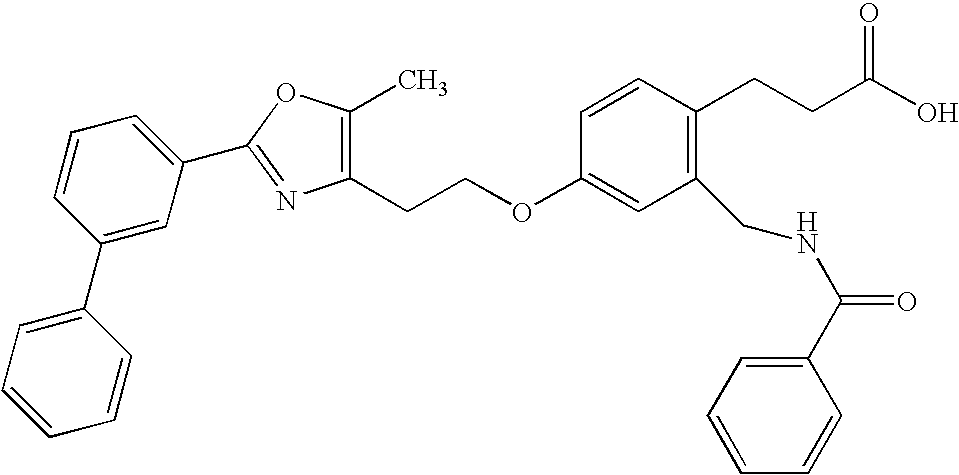 |
561.3 |
| 274 |
 |
491.3 |
| 275 |
 |
491.2 |
| 276 |
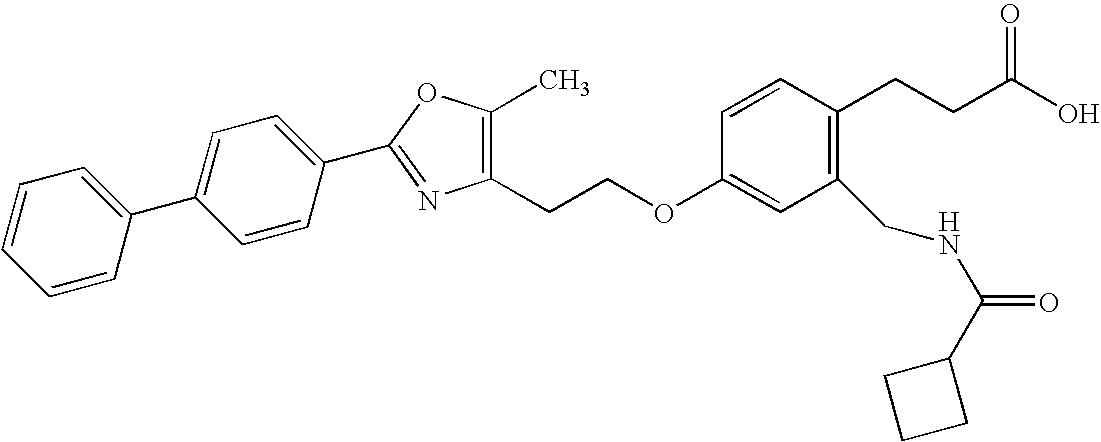 |
539.3 |
| 278 |
 |
539.3 |
| 279 |
 |
469.3 |
| 280 |
 |
469.3 |
| 281 |
 |
488.1 |
| 282 |
 |
473.3 |
| 283 |
 |
473.2 |
| 284 |
 |
562.2 |
| 285 |
 |
562.3 |
| 286 |
 |
492.2 |
| 287 |
 |
492.2 |
| 288 |
 |
511.2 |
| 289 |
 |
635.2 |
| 290 |
 |
565.2 |
| 291 |
 |
565 |
| 292 |
 |
511 |
| 293 |
 |
517 |
| 294 |
 |
517 |
| 295 |
 |
536 |
| 296 |
 |
531 |
| 297 |
 |
572.2 |
| 298 |
 |
541 |
| 299 |
 |
483 |
| 300 |
 |
502 |
| 301 |
 |
551.2770(HRMS) |
| 302 |
 |
504.2171(HRMS) |
| 303 |
 |
550.2 |
| 304 |
 |
554 |
| 305 |
 |
557.2 |
| 306 |
 |
490.2 |
| 307 |
 |
555.2426(HRMS) |
| 308 |
 |
571.2436(HRMS) |
| 309 |
 |
585.2595(HRMS) |
| 310 |
 |
551.2753(HRMS) |
| 311 |
 |
504.2144(HRMS) |
| 312 |
 |
563.2 |
| 313 |
 |
579.2 |
| 314 |
 |
572.2 |
| 315 |
 |
495.2 |
| 316 |
 |
512.2 |
| 317 |
 |
506.2 |
| 318 |
 |
1H NMR |
1H NMR data for Example 318: (400 MHz, CDCl3): d 6.98 (1H, d, J=7.9 Hz), 6.71 (1H, s), 6.68 (1H, d, J=7.9 Hz), 4.97 (1H, m), 4.86 (2H, m), 4.31 (2H, bs), 4.08 (2H, t, J=6.5 Hz), 3.45 (4H, m), 3.27 (4H, m), 2.86 (4H, m), 2.55 (2H, bs), 2.18 (3H, s), 1.42 (9H, s), 1.16 (6H, d, J=7.2 Hz).

Step A: {4-[2-(5-Methyl-2-(4-phenyl)phenyl-oxazol-4-yl)-ethoxy]-2-(isopropylcarbamate)methyl}-propionic acid tert-butyl ester

3-[4-hydroxy-2-(isopropoxycarbonylamino-methyl)-phenyl]-propionic acid tert-butyl ester (258 mg, 0.763 mmol) and toluene-4-sulfonic acid 2-(2-biphenyl-4-yl-5-methyl-oxazol-4-yl)-ethyl ester (654 mg, 1.51 mmol) were reacted according to Standard procedure A. Purification by radial chromatography (CH2Cl2/EtOAc 98/2 to 90/10) gave the title compound in quantitative yield. 1H NMR (400 MHz, CDCl3): δ 1.14 (d, 6H, J=5.9 Hz), 1.31 (s, 9H), 2.30 (s, 3H), 2.39 (t, 2H, J=7.6 Hz), 2.89 (t, 2H, J=6.6 Hz), 4.14 (t, 2H, J=6.6 Hz), 4.25 (d, 2H, J=5.4 Hz), 4.85 (heptet, 1H, J=5.8 Hz), 6.67 (dd, 1H, J=8.3 Hz, J=2.4 Hz), 6.75 (d, 1H, J=2.4 Hz), 6.99 (d, 1H, J=8.3 Hz), 7.26-7.30 (m, 1H), 7.37 (t, 2H, J=7.6 Hz), 7.53-7.58 (m, 4H), 7.95 (d, 2H, J=8.3 Hz). MS (ES) m/e 599.4 [M+1].
Step B: {4-[2-(5-Methyl-2-(4-phenyl)phenyl-oxazol-4-yl)-ethoxy]-2-(isopropylcarbamate)methyl}-propionic acid
A solution of {4-[2-(5-methyl-2-(4-phenyl)phenyl-oxazol-4-yl)-ethoxy]-2-(isopropylcarbamate)methyl}-propionic acid (414 mg, 0.763 mmol) in CH2Cl2 (10 mL) was treated with anisole (1.0 mL) then trifluoroacetic acid (TFA, 3.0 mL). The solution was stirred at room temperature for 2 h and concentrated. The residue was co-evaporated with CCl4 twice, dried under vacuum, triturated with ether, and filtered to obtain the title compound as a white solid (287 mg, 69%). 1H NMR (400 MHz, CDCl3) 1.11 (d, 6H, J=5.9 Hz), 2.28 (s, 3H), 2.46 (t, 2H, J=7.6 Hz), 2.79 (t, 2H, J=7.6 Hz), 2.86 (t, 2H, J=6.6 Hz), 4.11 (t, 2H, J=6.8 Hz), 4.24 (d, 2H, J=5.4 Hz), 4.82 (heptet, 1H, J=6.1 Hz), 5.05 (bs, 1H), 6.66 (dd, 1H, J=2.4, 8.3 Hz), 6.73 (d, 1H, J=2.4 Hz), 6.99 (d, 1H, J=8.3 Hz), 7.24-7.28 (m, 1H), 7.35 (t, 2H, J=7.6 Hz), 7.51-7.56 (m, 4H), 7.98 (d, 2H, J=8.3 Hz). MS (ES) m/e 543.1 [M+1].

Step A: 3-{2-(Isopropoxycarbonylamino-methyl)-4-[2-(5-methyl-2-morpholin-4-yl-thiazol-4-yl)-ethoxy]-phenyl}-propionic acid tert-butyl ester

3-[4-hydroxy-2-(isopropoxycarbonylamino-methyl)-phenyl]-propionic acid tert-butyl ester (272 mg, 0.806 mmol) and toluene-4-sulfonic acid 2-(5-methyl-2-morpholin-4-yl-thiazol-4-yl)-ethyl ester (522 mg, 1.36 mmol) were reacted according to Standard procedure A. Purification using radial chromatography (CH2Cl2/EtOAc 98:2 to 75:25) gave the title compound as a white solid (387 mg, 98%). 1H NMR (400 MHz, CDCl3) δ 1.14 (d, 6H, J=5.9 Hz), 1.32 (s, 9H), 2.16 (s, 3H), 2.39 (t, 2H, J=7.6 Hz), 2.77 (t, 2H, J=7.6 Hz), 2.84 (t, 2H, J=7.1 Hz), 3.28 (t, 4H, J=4.9 Hz), 3.70 (t, 4H, J=4.9 Hz), 4.08 (t, 2H, J=7.1 Hz), 4.25 (d, 2H, J=5.4 Hz), 4.83 (heptet, 1H, J=4.9 Hz), 6.66 (dd, 1H, J=2.4, 8.3 Hz), 6.72 (d, 1H, J=2.4 Hz), 6.98 (d, 1H, J=8.3 Hz). MS (ES) m/e 548.3 [M+1].
Step B: 3-{2-(Isopropoxycarbonylaminomethyl)-4-[2-(5-methyl-2-morpholin-4-yl-thiazol-4-yl)ethoxy]-phenyl}propionic acid
A solution of 3-{2-(isopropoxycarbonylamino-methyl)-4-[2-(5-methyl-2-morpholin-4-yl-thiazol-4-yl)-ethoxy]-phenyl}-propionic acid tert-butyl ester (387 mg, 0.706 mmol) in CH2Cl2 (10 mL) was treated with anisole (1 mL) then TFA (3 mL). The solution was stirred at room temperature for 2 h and concentrated. The residue was co-evaporated with CCl4 twice, dried under vacuum, triturated with ether, and filtered to obtain the title compound as a white solid (236 mg, 60%), isolated as the trifluoracetic acid salt: 1H NMR (400 MHz, CDCl3) δ 1.12 (d, 6H, J=6.4 Hz), 2.16 (s, 3H), 2.47 (t, 2H, J=7.6 Hz), 2.79 (t, 2H, J=7.6 Hz), 2.87 (t, 2H, J=6.4 Hz), 3.35 (t, 4H, J=4.9 Hz), 3.70 (t, 4H, J=4.9 Hz), 4.07 (t, 2H, J=6.6 Hz), 4.23 (d, 2H, J=5.4 Hz), 4.82 (heptet, 1H, J=6.1 Hz), 5.07 (bs, 1H), 6.63 (dd, 1H, J=2.7, 8.6 Hz), 6.69 (d, 1H, J=2.9 Hz), 6.98 (d, 1H, J=8.3 Hz). MS (ES) m/e 492.1 [M+1].

Step A: 3-(2-(2-Isopropoxycarbonyl-ethyl)-4-{2-[5-methyl-2-(6-chloro-pyridin-3-yl)-oxazol-4-yl]ethoxy}-phenyl)-propionic acid t-butyl ester

Toluene-4-sulfonic acid 2-[2-(6-chloro-pyridn-3-yl)-5-methyl-oxaxol-4-yl]-ethyl ester tosylate (290 mg, 0.74 mmol) and 3-[4-hydroxy-2-(2-isopropoxycarbonyl-ethyl)-phenyl]-propionic acid t-butyl ester (274 mg, 0.81 mmol) were converted to the title compound (183 mg, 44%) according to Standard procedure A. MS (ESI) m/z 559 (M+H)+.
Step B: 3-(2-(2-Isopropoxycarbonyl-ethyl)-4-{2-[5-methyl-2-(6-phenoxy-pyridin-3-yl)-oxazol-4-yl]ethoxy}-phenyl)-propionic acid
To a suspension of NaH (20 mg, 0.48 mmol) in DMF (10 mL) at ambient temperature was added phenol (45 mg, 0.48 mmol). The mixture was stirred at 60° C. for 20 min, and 3-(2-(2-isopropoxycarbonyl-ethyl)-4-{2-[5-methyl-2-(6-chloro-pyridin-3-yl)-oxazol-4-yl]ethoxy}-phenyl)-propionic acid t-butyl ester (180 mg, 0.32 mmol) was added. The resulting mixture was stirred at 60° C. overnight, cooled, diluted with EtOAc, and washed with water/brine (4×). The organic layer was dried (MgSO4), filtered and concentrated. The residue was purified by silica gel chromatography (hexanes/EtOAc 3/1 to 1/1) to afford the intermediate ester as an oil (60 mg, 30%). The title compound was generated using Standard hydrolysis procedure C. MS (ESI) m/z 560 (M+H)+. 1H NMR (CDCl3, 250 MHz) δ 1.25 (d, J=0.5 Hz, 6H), 2.42 (s, 3H), 2.65 (m, 2H), 2.96 (m, 4H), 4.38 (m, 2H), 4.18 (m, 2H), 4.38 (m, 1H), 5.00 (m, 2H), 6.82 (m, 3H), 6.96 (m, 1H), 7.12 (m, 1H), 7.20 (m, 2H), 7.45 (m, 2H), 8.28 (m, 1H), 8.80 (m, 1H).

The title compound was prepared from 3-[4-hydroxy-2-(isopropoxycarbonyl-amino-methyl)-phenyl]-propionic acid tert-butyl ester (Prep 16) and 2-(3-biphenyl-4-yl-5-methyl-pyrazol-1-yl)-ethanol (Prep 11) using Standard coupling procedure B followed by Standard hydrolysis procedure C. MS [ES] m/e 542 (M+1)+.
The following Examples 323 to 333 are prepared by following a substantially similar procedure as described in Example 322.

HRMS Calculated for C26H32N3O5: m/z 466.2342. Found: 466.2331.

HRMS Calculated for C28H30N4O4: m/z 486.2267. Found: 486.2233.

HRMS Calculated for C32H36N3O5: m/z 542.2655. Found: 542.2678.

HRMS Calculated for C30H39BrN3O5: m/z 600.2073. Found: 600.2064;

HRMS Calculated for C26H31BrN3O5: m/z 544.1447. Found: 544.1456.

The above compound is prepared by using Standard hydrolysis procedure D. HRMS Calculated for C32H31N4O4: m/z 535.2345. Found: 535.2343.

HRMS Calculated for C30H34N3O5: m/z 516.2498. Found: 516.2485.

HRMS Calculated for C30H34N3O5: m/z 516.2498. Found: 516.2529.

HRMS Calculated for C30H33N2O6: m/z 517.2339. Found: 517.2328.

HRMS Calculated for C33H38N3O5: m/z 556.2811. Found: 556.2819.

HRMS Calculated for C27H33BrN3O5: m/z 558.1604. Found: 558.1608.

The title compound was prepared from 3-[4-hydroxy-2-(isopropoxycarbonyl-amino-methyl)-phenyl]-propionic acid tert-butyl ester (Prep 16) and 2-(1-Methyl-4-phenyl-1H-imidazol-2-yl)-ethanol (J. Med. Chem. 1998, 41(25), 5037-5054) using Standard coupling procedure B followed by Standard hydrolysis procedure D affording an off-white finely-crystalline solid. HRMS Calculated for C26H31N3O5: m/z 466.2342. Found: 466.2355.

Toluene-4-sulfonic acid 2-[2-(4-bromo-phenyl)-5-methyl-oxazol-4-yl]-ethyl ester (5.06 g, 11.6 mmol) and 3-[4-hydroxy-2-(isopropoxycarbonylamino-methyl)-phenyl]-propionic acid tert-butyl ester (3.01 g, 8.92 mmol) were coupled using Standard procedure A to give the title compound as a white solid (3.41 g, 64%). MS [ES] m/z 601.603 (M+H).
The following Examples 336 to 337 are prepared by following a substantially similar procedure as described in Example 335.

MS [ES] m/z 601.603 (M+H).


Suzuki Coupling Using Aryl Boronic Acids: A mixture of 3-[4-{2-[2-(4-bromo-phenyl)-5-methyl-oxazol-4-yl]-ethoxy}-2-(isopropoxycarbonylamino-methyl)-phenyl]-propionic acid tert-butyl ester (450 mg, 0.75 mmol), 3-pyridineboronic acid (120 mg, 0.97 mmol), triphenylphosphine (6 mg, 0.024 mmol), 2M aqueous sodium carbonate (3 mL) in n-propanol (15 mL) was sparged with nitrogen for 5 min. Palladium acetate (2 mg, 0.008 mmol) was added, and the reaction was heated to reflux under a blanket of nitrogen for 4 h. The reaction mixture was concentrated and then partitioned between water/EtOAc. The organic layer was dried (MgSO4) and concentrated to crude product (290 mg). This material was purified by silica gel column chromatography to yield 3-(2-(isopropoxycarbonylamino-methyl)-4-{2-[5-methyl-2-(4-pyridin-3-yl-phenyl)-oxazol-4-yl]-ethoxy}-phenyl)-propionic acid tert-butyl ester was obtained as a white solid (230 mg, 51%). 1H NMR (CDCl3) δ1.25 (d, 6H), 1.42 (s, 9H), 2.42 (s, 3H), 2.51 (t, 2H), 2.89 (t, 2H), 3.05 (t, 2H), 4.26 (t, 2H), 4.36 (d, 2H), 4.96 (m, 2H), 6.78 (dd, 1H), 6.87 (d, 1H), 7.21 (d, 1H), 7.47 (dd, 1H), 7.67 (d, 2H), 8.00 (dt, 1H), 8.12 (d, 2H), 8.65 (dd, 1H), 8.94 (s, 1H). MS [EI+] m/z 600 (M+H).
This ester (225 mg, 0.375 mmol) was dissolved in THF (15 mL) and treated with 1N HCl (1 mL). The mixture was heated at reflux for 7 h, cooled, and concentrated. The residue was azeotroped twice with acetonitrile and dried in a vacuum oven to give the title compound, isolated as the HCl salt (140 mg, 64%). 1H NMR (DMSO-d6) δ1.15 (d, 6H), 2.41 (s, 3H), 2.45 (t, 2H), 2.76 (t, 2H), 2.95 (t, 2H), 4.17 (overlapping t and d, 4H), 4.75 q, 1H), 6.77 (m, 2H), 7.07 (dd, 1H), 7.55 (t, 1H), 8.02 (m, 4H), 8.73 (d, 1H), 8.85 (d, 1H), 9.25 (s, 1H). MS [EI+] m/z 544 (M+H).
The following Examples 339 to 367 are prepared by following a substantially similar procedure as described in Example 338

MS (ES) m/z 544 (M+1).

MS (ES) m/z 544 (M+1).

MS (ES) m/z 544 (M+1).

MS (ES) m/z 544 (M+1).

MS (ES) m/z 559 (M+1).

MS (ES) m/z 609 (M+1).

MS (ES) m/z 609 (M+1).

MS (ES) m/z 571 (M+1).

1H-NMR (DMSO-d6) δ 1.16 (d, 6H), 2.39 (s, 3H), 2.45 (t, 2H), 2.76 (t, 2H), 2.95 (t, 2H), 3.85 s, 3H), 4.17 (m, 4H), 4.77 (m, 1H), 6.74-7.55 (m, 7H, 7.83 (d, 2H), 7.99 (d, 2H).

MS (ES) m/z 559 (M+1).

MS (ES) m/z 546 (M+1).

1H-NMR (DMSO-d6) δ 1.15 (d, 6H), 2.40 (s, 3H), 2.45 (t, 2H), 2.79 (t, 2H), 2.96 (t, 2H), 4.17 (m, 4H), 4.75 (m, 1H), 6.77 (m, 2H), 7.08 (d, 1H), 7.53 (m, 1H), 7.66 (m, 1H), 7.83-8.05 (m, ES), 8.20 (s, 1H).

1H-NMR (DMSO-d6) δ 1.14 (d, 6H), 2.40 (s, 3H), 2.45 (t, 2H), 2.67 (t, 2H), 2.95 (t, 2H), 4.16 (m, 4H), 4.74 (m, 1H), 6.77 (m, 2H), 7.09 d, 1H), 7.47-8.20 (m, 8H).

1H-NMR (DMSO-d6) δ 1.13 (d, 6H), 2.36 (s, 3H), 2.44 (t, 2H), 2.77 (t, 2H), 2.93 (t, 2H), 4.15 (m, 4H), 4.74 (m, 1H), 6.76 (m, 2H), 7.06 (d, 1H), 7.40-8.00 (m, 8H).

MS (ES) m/z 573 (M+1).

1H-NMR (DMSO-d6) δ 1.13 (d, 6H), 2.40 (s, 2H), 2.45 (t, 2H), 2.78 (t, 2H), 2.93 (t, 2H), 3.80 (s, 3H), 4.16 (m, 4H), 4.75 (m, 1H), 6.76 (m, 2H), 7.07 (m, 2H), 7.16 (d, 1H), 7.32-8.05 (m, 6H).

MS (ES) m/z 559 (M+1).

1H-NMR (CDCl3) δ 1.25 (d, 6H), 2.41 (s, 3H), 2.65 (t, 2H), 2.95 (t, 2H), 3.01 (t, 2H), 4.24 (t, 2H), 4.38 (br d, 2H), 4.96 (m, 1H), 5.03 (br s, 1H), 6.78 (dd, 1H), 6.84 (d, 1H), 7.19-7.55 (m, 6H), 7.65 (dd, 2H), 8.06 dd, 2H).

MS (ES) m/z 561 (M+1).

MS (ES) m/z 543.2 (M+1)+.

The above compound is prepared after an additional hydrolysis step using Standard procedure E. MS (ES) m/z 587.3 (M+1)+.

The above compound is prepared after an additional hydrolysis step using Standard procedure E. MS (ES) m/z 587.2 (M+1)+.

HRMS Calculated for C31H35N4O5: m/z 543.2607. Found: 543.2614.

HRMS Calculated for C31H35N4O5: m/z 543.2607. Found: 543.2612.

HRMS Calculated for C28H35FN3O5: m/z 560.2561. Found: 560.2575.

HRMS Calculated for C33H38N3O6: m/z 572.2761. Found: 572.2752.

HRMS Calculated for C33H38N3O6: m/z 572.2761. Found: 572.2776.

HRMS Calculated for C32H35FN4O5: m/z 560.2561. Found: 560.2540.

HRMS Calculated for C33H38N3O5: m/z 556.2811. Found: 556.2802.

Step A: 3-[2-(Isopropoxycarbonylamino-methyl)-4-(2-{5-methyl-2-[4-(4,4,5,5-tetramethyl-[1,3,2]dioxaborolan-2-yl)-phenyl]-oxazol-4-yl}-ethoxy)-phenyl]-propionic acid

A solution of 3-[4-{2-[2-(4-bromo-phenyl)-5-methyl-oxazol-4-yl]-ethoxy}-2-(isopropoxycarbonylamino-methyl)-phenyl]-propionic acid tert-butyl ester (4.00 g, 6.65 mmol) in DMSO (50 mL) was treated with bis(pinacolato)diborane (2.20 g, 8.64 mmol) and potassium acetate (1.96 g, 19.95 mmol). The solution was sparged with nitrogen for 10 min, Pd(dppf)Cl2 (980 mg, 1.20 mmol; 1:1 complex with CH2Cl2) was added, and the reaction mixture was heated at 80° C. for 4 h. The mixture was partitioned between water and ethyl acetate. The organic layer was dried (MgSO4), filtered, and concentrated. Purification by silica gel chromatography (9:1 hexanes:ethyl acetate) yielded the title compound as a yellow oil (2.81 g). 1H NMR (300 MHz CDCl3) δ 1.25 (d, 6H), 1.26 (s, 9H), 1.37 (s, 12H), 2.40 (s, 3H), 2.51 (t, 2H), 2.88 (t, 2H), 2.98 (t, 2H), 4.26 (t, 2H), 4.35 (d, 2H), 4.97 (br m, 2H), 6.77 (dd, 1H), 6.85 (d, 1H), 7.10 (d, 1H), 7.87 (d, 2H), 7.99 (d, 2H). MS [EI+] 649 (M+H).
Step B: 3-(2-(Isopropoxycarbonylamino-methyl)-4-{2-[5-methyl-2-(4-pyrazin-2-yl-phenyl)-oxazol-4-yl]-ethoxy}-phenyl)-propionic acid
Suzuki coupling using haloaryl compounds: 3-[2-(Isopropoxycarbonylamino-methyl)-4-(2-{5-methyl-2-[4-(4,4,5,5-tetramethyl-[1,3,2]-dioxaborolan-2-yl)-phenyl]-oxazol-4-yl}-ethoxy)-phenyl]-propionic acid (500 g, 0.771 mmol), CsF (258 g, 1.69 mmol), PdCl2(dppf) (0.057 g, 0.07 mmol), and 2-chloropyrazine (0.0971 g, 0.85 mmol) were added to a 3-neck flask and were dissolved in anhydrous dioxane (25 mL). The reaction mixture was stirred at 100° C. under a stream of N2 for about 12 h. The reaction mixture was diluted with ethyl acetate (200 mL) and washed with saturated NaCl (100 mL) and water (100 mL). The organic layer was filtered through Celite, dried (Na2SO4), filtered, and concentrated. The crude product (1.2 g) was purified by radial chromatography (10-70% EtOAc/hexanes) to give the intermediate ester (0.312 g): MS (ES) m/z 601 (M+H)+. The ester was dissolved in of 4M HCl/dioxane (10 mL). The mixture was stirred N2 for 16 h and concentrated to give the title compound (305 mg, 72%): MS (ES) m/z 545 (M+H)+. Anal. Calculated for C, 66.16%; H, 5.92%; N, 10.29%. Found C, 65.97%; H, 6.07%; N, 10.45%.
The following Examples 369 to 382 are prepared by following a substantially similar procedure as described in Example 368.

MS (ES) m/z 544 (M+1).

MS (ES) m/z 558 (M+1).

MS (ES) m/z 558 (M+1).

MS (ES) m/z 492 (M+1).

MS (ES) m/z 558 (M+1).

MS (ES) m/z 612 (M+1).

MS (ES) m/z 612 (M+1).

MS (ES) m/z 574 (M+1).

MS (ES) m/z 574 (M+1).

MS (ES) m/z 594 (M+1).

MS (ES) m/z 545 (M+1).

MS (ES) m/z 574 (M+1).

MS (ES) m/z 569 (M+1).

MS (ES) m/z 545 (M+H)+. Anal. Calculated for C, 66.16%; H, 5.92%; N, 10.29%. Found C, 65.87%; H, 6.17%; N, 10.53%.

3-[4-{2-[2-(4-bromo-phenyl)-5-methoxy-oxazol-4-yl]-ethoxy}-2-(isopropoxy-carbonylamino-methyl)-propionic acid tert-butyl ester (0.10 g, 0.17 mmol) was dissolved in DME (5 mL) in a sealed tube apparatus. N2 was bubbled through the solution, and 4-fluoroaniline (24 mg, 0.20 mmol), 2-(di-t-butylphosphino)-biphenyl (20 mg), Pd2(dba)3 (10 mg), and K3PO4 (50 mg, 0.24 mmol) were added. The tube was sealed and heated at 100° C. for 16 h. The reaction mixture was cooled, diluted with EtOAc, and washed with water. The organic layer was dried (MgSO4), filtered, and concentrated. The residue was purified using silica gel chromatography (hexanes/EtOAc 2/1 to 1/1). Using the Standard hydrolysis procedure C, this material was converted into the title compound as an oil (25 mg): MS (ESI) m/z 594 (M+H)+.
The following Examples 384 to 387 are prepared by following a substantially similar procedure as described in Example 383.

MS (ES) m/z 583 (M+1).

MS (ES) m/z 594 (M+1).

MS (ES) m/z 572 (M+J).

MS (ES) m/z 588 (M+1).

3-[4-{2-[2-(3-bromo-phenyl)-5-methoxy-oxazol-4-yl]-ethoxy}-2-(isopropoxy-carbonylamino-methyl)-propionic acid tert-butyl ester (0.10 g, 0.17 mmol) was dissolved in toluene (5 mL) in a sealed tube apparatus. N2 was bubbled through the solution, and benzylamine (46 μL, 0.42 mmol), 2-(dicyclohexylphosphino)-biphenyl (12 mg), Pd2(dba)3 (16 mg) and t-BuONa (23 mg, 0.24 mmol) were added. The tube was sealed and heated at 100° C. for 16 h. The reaction mixture was cooled, diluted with EtOAc, and washed with water. The organic layer was dried (MgSO4), filtered, and concentrated. The residue was purified using silica gel chromatography (hexanes/EtOAc 2/1 to 1/1). Using the Standard hydrolysis procedure C, this material was converted into the corresponding carboxylic acid; the title compound was isolated as the HCl salt by treatment with 1M HCl in ether (15 mg). MS (ES) m/z 572 (M+H)+.

The above compound is prepared by following a substantially similar procedure as described in Example 390 except that the reaction is carried out in DME at 80° C. MS (ES) m/z 538.2 (M+H)+.

A solution of 3-[4-{2-[2-(4-bromo-phenyl)-5-methyl-oxazol-4-yl]-ethoxy}-2-(isopropoxycarbonylamino-methyl)-phenyl]-propionic acid tert-butyl ester (60 mg, 0.100 mmol) in toluene (3.0 mL) in a sealed tube apparatus under a flow of N2 was treated with Pd(OAc)2 (5 mg), 2-(di-t-butylphosphino)biphenyl (10 mg), morpholine (17 mg, 0.20 mmol), and sodium t-butoxide (19 mg, 0.200 mmol). The tube was sealed and heated at 105° C. for 14 h. The mixture was cooled and purified directly using silica gel chromatography (30-50% EtOAc/hexanes) to yield the intermediate ester. A solution of ester in TFA (1.0 ml)/CH2Cl2 (1.5 ml)/H2O (0.1 mL) and stirred 14 h and concentrated. The residue was and purified using silica gel chromatography (hexanes/EtOAc/HOAc, 5/5/0.02) to afford the title compound (36 mg, 65%): MS (ESI) m/z 552.3 (M+H)+.
The following Examples 393 to 395 are prepared by following a substantially similar procedure as described in Example 392.

MS (ESI) m/z 552.2 (M+H)+.

MS (ESI) m/z 550.3 (M+H)+.

MS (ESI) m/z 550.3 (M+H)+.

A solution of 3-[4-{2-[2-(4-bromo-phenyl)-5-methyl-oxazol-4-yl]-ethoxy}-2-(isopropoxycarbonylamino-methyl)-phenyl]-propionic acid tert-butyl ester (120 mg, 0.200 mmol) in toluene (2.0 mL) in a sealed tube under a flow of N2 was treated Pd2(dba)3 (10 mg), 2-(di-t-butylphosphino)biphenyl (10 mg), N-aminomorpholine (29 mg, 0.28 mmol), and sodium t-butoxide (38 mg, 0.40 mmol). The tube was sealed and heated at 100° C. for 60 min. The mixture was cooled and purified using silica gel chromatography (5-10% MeOH/EtOAc) to yield the title compound directly (22 mg, 21%): MS (ESI) m/z 567.3 (M+H)+.

A mixture of 3-[4-{2-[2-(4-bromo-phenyl)-5-methyl-oxazol-4-yl]-ethoxy}-2-(isopropoxycarbonylamino-methyl)-phenyl]-propionic acid tert-butyl ester (0.44 mmol, 0.24 g), phenol (0.53 mmol, 0.050 g), K3PO4 (0.88 mmol, 0.19 g), 2-(di-t-butylphosphino)biphenyl (0.066 mmol, 0.020 g), and Pd(OAc)2 (0.044 mmol, 0.010 g) in toluene (7 mL) was degassed under vacuum and backfilled with nitrogen (3×) and heated at 110° C. for 18 h. Additional Pd(OAc)2 (10 mg) and 2-(di-t-butylphosphino)biphenyl (20 mg) were added to ensure complete reaction, and the mixture was heated 5 h. Upon cooling, the mixture was placed directly onto a silica gel column and eluted with 30%-50% EtOAc/hexanes to give 3-(2-(isopropoxycarbonylamino-methyl)-4-{2-[5-methyl-2-(4-phenoxy-phenyl)-oxazol-4-yl]-ethoxy}-phenyl)-propionic acid tert-butyl ester (0.11 g).
The tert-butyl ester (0.18 mmol, 0.11 g) was dissolved in CH2Cl2 (3 mL), and 90% TFA/water (5 mL) was added. The mixture was stirred for 3 h and concentrated. The residue was purified by silica gel chromatography (50% ethyl acetate/hexanes) to give an oil. Trituration with Et2O gave the title compound as a white solid (90 mg, 90%): 1H NMR (250 MHz, CDCl3) δ 8.11 (d, 2H, J=8.8 Hz), 7.56 (t, 2H, J=7.9 Hz), 7.37-7.20 (m, 6H), 7.0-6.93 (m, 2H), 5.11 (heptet, 1H, J=6.3 Hz), 4.53 (d, 2H, J=5.1 Hz), 4.38 (t, 2H, J=6.7 Hz), 3.12 (q, 4H, J=7.3 Hz), 2.80 (t, 2H, J=7.6 Hz), 2.54 (s, 3H), 1.41 (d, 6H, J=6.3 Hz).
The following Examples 398 to 405 are prepared by following a substantially similar procedure as described in Examples 396 and 397.

MS (ESI) m/z 559.2 (M+H)+.

MS (ESI) 559 (M+H)+. Anal Calculated for C32H34N2O7: C, 68.8; H, 6.1; N, 5.0. Found: C, 67.9; H, 6.2; N, 5.3.

MS (ES) m/z 584.

MS (ES) m/z 627 (M+1).

MS (ES) m/z 577 (M+1).

MS (ES) m/z 595 (M+1).

MS (ES) m/z 573 (M+1).

MS (ES) m/z 601 (M+1).

According to the procedure in Organic Synthesis, vol. V, p. 918, a solution of 3-[2-(isopropoxycarbonylamino-methyl)-4-(2-{5-methyl-2-[4-(4,4,5,5-tetramethyl-[1,3,2]dioxaborolan-2-yl)-phenyl]-oxazol-4-yl}-ethoxy)-phenyl]-propionic acid tert-butyl ester (1.4 g, 2.16 mmol, Example 368, Step A) in THF (8 mL) was treated with glacial acetic acid (194 mg, 3.24 mmol) at 0° C. A solution of 30% H2O2 in water (4.75 mL) was diluted with H2O (1 mL) and added to the reaction mixture. The mixture was warmed to room temperature and treated with 1M aqueous Na2S2O3 solution (50 mL). The THF was removed under vacuum and the aqueous phase was extracted with ethyl acetate. The organic layer was washed with 1M Na2S2O3 (2×50 mL), dried (MgSO4), filtered, and concentrated to an oil containing (1.21 g). Purification using silica gel chromatography (1:1 ηεξανεσ:ετηψλ acetate) yielded the title compound as a white solid (1.10 g, 95%). 1H NMR (300 MHz CDCl3) δ 1.15 (d, 6H), 1.19 (s, 9H), 2.26 (s, 3H), 2.39 (t, 2H), 2.75 (t, 2H), 2.85 (t, 2H), 4.10 (t, 2H), 4.28 (d, 2H), 4.85 (m, 1H), 5.01 (br d, 1H), 6.63 (dd, 1H), 6.74 (m, 3H), 6.96 (d, 1 h), 7.70 (d, 2H); MS [EI+] m/z 539 (M+H).

The above compound is prepared by following a substantially similar procedure as described in Example 406. MS [EI+] m/z 539 (M+H).
The following Examples 408 to 409 are prepared by following a substantially similar procedure as described in Example 406 and the corresponding carboxylic acids are obtained from Standard hydrolysis procedure C:

MS (ES) m/z 483 (M+1).

MS (ES) m/z 483 (M+1).

A solution of 3-[4-{2-[2-(4-hydroxy-phenyl)-5-methyl-oxazol-4-yl]-ethoxy}-2-(isopropoxycarbonylamino-methyl)-phenyl]-propionic acid tert-butyl ester (300 mg, 0.557 mmol, Example 406) in ethanol (20 mL) was treated with 2-iodopropane (473 mg, 2.78 mmol) and K2CO3 (231 mg, 1.67 mmol) and was heated at reflux overnight. The reaction mixture was cooled and concentrated. The residue was diluted with H2O and ethyl acetate. The layers were separated, and the aqueous layer was extracted with ethyl acetate (2×). The combined organic layers were dried (MgSO4), filtered, and concentrated to yield an oil. Purification using silica gel chromatography (3:1 hexane:ethyl acetate) yielded 3-(2-(isopropoxycarbonylamino-methyl)-4-{2-[2-(4-isopropoxy-phenyl)-5-methyl-oxazol-4-yl]-ethoxy}-phenyl)-propionic acid tert-butyl ester as a yellow oil (210 mg). 1H NMR (300 MHz CDCl3) δ 1.28 (d, 6H), 1.40 (d, 6H), 1.45 (s, 9H), 2.38 (s, 3H), 2.53 (t, 2H), 2.91 (t, 2H), 2.99 (t, 2H), 4.25 (t, 2H), 4.39 (d, 2H), 4.66 (m, 1H), 5.00 (br m, 2H), 6.80 (dd, 1H), 6.87 (d, 1H), 6.95 (d, 2H), 7.13 (d, 1H), 7.95 (d, 2H) MS [ES] 581 (M+H).
This ester was converted to the title compound according to Standard Procedure C; a white solid (134 mg). 1H NMR (300 MHz CDCl3) δ 1.15 (d, 6H), 1.29 (d, 6H), 2.31 (s, 3H), 2.53 (t, 2H), 2.82 (t, 2H), 2.97 (t, 2H), 4.15 (t, 2H), 4.26 (d, 2H), 4.55 (m, 1H), 4.84 (m, 1H), 4.99 (br s, 1H), 6.68 (dd, 1H), 6.73 (d, 1H), 6.87 (d, 2H), 7.00 (d, 1H), 7.90 (d, 2H) MS [ES] m/z 525 (M+H).
The following Examples 411 to 422 are prepared by following a substantially similar procedure as described in Example 410.

MS (ES) m/z 525 (M+1).

MS (ES) m/z 511 (M+1).
MS (ES) m/z 497 (M+1).
MS (ES) m/z 497 (M+1)

MS (ES) m/z 511 (M+1).

MS (ES) m/z 525 (M+1).

MS (ES) m/z 525 (M+1).

MS (ES) m/z 539 (M+1).

MS (ES) m/z 551 (M+1).

MS (ES) m/z 565 (M+1).

MS (ES) m/z 551 (M+1).

MS (ES) m/z 565 (M+1).

A mixture of 3-[4-{2-[2-(4-hydroxy-phenyl)-5-methyl-oxazol-4-yl]-ethoxy}-2-(isopropoxycarbonylamino-methyl)-phenyl]-propionic acid tert-butyl ester (120 mg, 0.223 mmol, Example 406), tetrahydro-pyran-4-ol (22.7 mg, 0.223 mmol), triphenylphosphine (58.4 mg, 0.223 mmol) and toluene (10 mL) was treated dropwise with DIAD (45 mg, 0.223 mmol). The mixture was stirred under N2 at ambient temperature for 16 h and concentrated. The crude product was purified by radial chromatography (10-70% EtOAc/hexanes) to give 3-[2-(isopropoxycarbonylamino-methyl)-4-(2-{5-methyl-2-[4-(tetrahydro-pyran-4-yloxy)-phenyl]-oxazol-4-yl}-ethoxy)-phenyl]-propionic acid tert-butyl ester. The ester product was dissolved 4M HCl/dioxane (5 mL), stirred for 16 h and concentrated to give the title compound: MS [ES] m/z 525 (M+H).
The following Examples 424 to 431 are prepared by following a substantially similar procedure as described in Example 423.

MS (ES) m/z 580 (M+1).

MS (ES) m/z 567 (M+1).

MS (ES) m/z 580 (M+1).

MS (ES) m/z 566 (M+1).

MS (ES) m/z 568 (M+1).

MS (ES) m/z 566 (M+1).

MS (ES) m/z 554 (M+1).

MS (ES) m/z 568 (M+1).

3-[4-{2-[2-(4-hydroxy-phenyl)-5-methyl-oxazol-4-yl]-ethoxy}-2-(isopropoxy-carbonylamino-methyl)-phenyl]-propionic acid tert-butyl ester (Example 406) was reacted with 2-bromopyridine by the procedure in Example 397 to give the title compound. MS (ES) m/z 560 (M+1).
The following Examples 433 to 435 are prepared by following a substantially similar procedure as described in Example 432.

MS (ES) m/z 560 (M+1).

MS (ES) m/z 560 (M+1).

MS (ES) m/z 561 (M+1).

Step A: 4-(4-{2-[4-(2-tert-Butoxycarbonyl-ethyl)-3-(isopropoxycarbonylamino-methyl)-phenoxy]-ethyl}-5-methyl-oxazol-2-yl)-benzoic acid methyl ester

A mixture of 3-[4-{2-[2-(4-bromo-phenyl)-5-methoxy-oxazol-4-yl]-ethoxy}-2-(isopropoxy-carbonylamino-methyl-phenyl)-propionic acid tert-butyl ester (0.25 g, 0.42 mmol), 1,1′-bis(diphenylphosphino)-ferrocene palladium (II) chloride (50 mg), MeOH (0.1 mL) and triethylamine (0.12 mL, 0.66 mmol) in acetonitrile (2 mL) was stirred and heated at 70° C. under CO gas (balloon) for 16 h. The reaction mixture was cooled and concentrated. The residue was purified by silica gel chromatography (hexanes/EtOAc, 5/1 to 1/1) to afford a the title compound as a white solid (0.12 g, 50%): MS (ESI) m/z 581 (M+H)+.

A solution of 4-(4-{2-[4-(2-tert-Butoxycarbonyl-ethyl)-3-(isopropoxycarbonyl-amino-methyl)-phenoxy]-ethyl}-5-methyl-oxazol-2-yl)-benzoic acid methyl ester (100 mg, 0.17 mmol) in methanol (2 mL) was treated with 1.5 N aqueous LiOH (1.0 mL) and stirred at ambient temperature for 3 h. The reaction mixture was acidified with 1N HCl and extracted with CH2Cl2. The organic layer was dried (MgSO4), concentrated, and purified by silica gel chromatography (hexanes/EtOAc, 1/1 to 0/1) to afford the title compound (55 mg, 57%). MS (ESI) m/z 567 (M+H)+.
Step C: 3-(2-(Isopropoxycarbonylamino-methyl)-4-{2-[5-methyl-2-(4-carbamoyl-phenyl)-oxazol-4yl]-ethoxy}-phenyl)-propionic acid
A solution of 4-(4-{2-[4-(2-tert-Butoxycarbonyl-ethyl)-3-(isopropoxycarbonyl-amino-methyl)-phenoxy]-ethyl}-5-methyl-oxazol-2-yl)-benzoic acid (40 mg, 0.07 mmol) in CH2Cl2 (2 mL) was treated with oxalyl chloride (1.0 μL, 0.12 mmol) and one drop of DMF. The reaction mixture was stirred at ambient temperature for 30 min, concentrated, and co-evaporated with toluene. The residue was dissolved in CH2Cl2 (2 mL) and was added to a flask charged with 2.0 M methylamine in THF (2M, 0.04 mL) and triethylamine (20 μL, 0.12 mmol). The mixture was stirred at ambient temperature for 16 h, diluted with CH2Cl2 (10 mL), and washed with H2O. The organic layer was dried (MgSO4), concentrated, and purified by silica gel chromatography (hexanes/EtOAc, 3:1 to 0:1) to afford the intermediate tert-butyl ester. The ester was converted to the acid by Standard procedure C; purification by mass directed HPLC yielded the title compound. MS (ESI) m/z 524 (M+H)+.
The following Examples 437 to 448 are prepared by following a substantially similar procedure as described in Example 436.

MS (ES) m/z 524 (M+1).

MS (ES) m/z 552 (M+1).

MS (ES) m/z 564 (M+1).

MS (ES) m/z 566 (M+1).

MS (ES) m/z 586 (M+1).

MS (ES) m/z 580 (M+1).

MS (ES) m/z 552 (M+1).

MS (ES) m/z 564 (M+1).

MS (ES) m/z 592 (M+1).

MS (ES) m/z 586 (M+1).

MS (ES) m/z 587 (M+1).

MS (ES) m/z 564 (M+1).

4-(4-{2-[4-(2-tert-Butoxycarbonyl-ethyl)-3-(isopropoxycarbonylamino-methyl)-phenoxy]-ethyl}-5-methyl-oxazol-2-yl)-benzoic acid (50 mg, 0.09 mmol, Example 436, Step B) was converted to the title compound using Standard Procedure C (40 mg, 95%): MS (ESI) m/z 525 (M+H)+.

The above compound is prepared by following a substantially similar procedure as described in Example 449. MS (ESI) m/z 525 (M+H)+.

A solution of 3-[4-{2-[2-(4-bromo-phenyl)-5-methoxy-oxazol-4-yl]-ethoxy}-2-(isopropoxy-carbonylamino-methyl)-propionic acid tert-butyl ester (230 mg, 0.38 mmol) in acetonitrile (20 ml) in a dry 3-neck flask was treated with 2-hydroxypyridine (44 mg, 0.46 mmol) and 1,1′-bis(diphenylphosphino)-ferrocene palladium (II) chloride (47 mg, 0.057 mmol). The mixture was stirred for about 5 minutes under N2, and triethylamine (58 mg, 0.57 mmol) was added dropwise. CO gas was bubbled through the mixture, and the reaction was heated at 70° C. for 4 h. The CO bubbling was replaced by a balloon filled with CO, and the reaction was stirred an additional 16 h. The mixture was cooled and partitioned equally into 2 flasks. One portion was treated with cyclohexylamine (46 mg, 0.46 mmol) and triethylamine (58 mg, 0.57 mmol). The mixture was stirred at 70° C. for 16 h, cooled, filtered through Celite, and concentrated to a brown solid (196 mg). The solid was purified by radial chromatography (10-70% EtOAc/hexanes) to give the penultimate tert-butyl ester (78 mg; MS (ESI) m/z 648.6 (M+H)+). The ester was converted to the title compound by Standard procedure D (72 mg, 64%). MS (ESI) m/z 592.0 (M+H)+.

Step A: 3-(2-(Isopropoxycarbonylamino-methyl)-4-{2-[5-methyl-2-(4-nitro-phenyl)-oxazol-4-yl]-ethoxy}-phenyl)-propionic acid tert-butyl ester

4-Methyl-3-nitro-benzenesulfonic acid 2-[5-methyl-2-(4-nitro-phenyl)-oxazol-4-yl]-ethyl ester (Preparation 7) and 3-[4-hydroxy-2-(isopropoxycarbonylamino-methyl)-phenyl]-propionic acid tert-butyl ester were coupled by Standard procedure A to give the title compound.
Step B: 3-[4-{2-[2-(4-Amino-phenyl)-5-methyl-oxazol-4-yl]-ethoxy}-2-(isopropoxycarbonylamino-methyl)-phenyl]-propionic acid tert-butyl ester

A mixture of 3-(2-(isopropoxycarbonylamino-methyl)-4-{2-[5-methyl-2-(4-nitro-phenyl)-oxazol-4-yl]-ethoxy}-phenyl)-propionic acid tert-butyl ester (207 mg, 0.365 mmol) and 10% Pd—C (27 mg) in EtOAc (20 mL) was stirred under H2 (1 atm) for 18 h. The reaction mixture was filtered through Celite and concentrated (75° C.) to give the title compound as a colorless oil (196 mg, 100%): MS (ESI) m/z 538 (M+H)+.
Step C: 3-[4-(2-{2-[4-(3-Fluoro-benzoylamino)-phenyl]-5-methyl-oxazol-4-yl}-ethoxy)-2-(isopropoxycarbonylamino-methyl)-phenyl]-propionic acid
3-Fluorobenzoyl chloride (31 mg, 0.20 mmol, 1.8 equiv) was added to a solution of 3-[4-{2-[2-(4-amino-phenyl)-5-methyl-oxazol-4-yl]-ethoxy}-2-(isopropoxycarbonyl-amino-methyl)-phenyl]-propionic acid tert-butyl ester (58 mg, 0.11 mmol, 1 equiv) and triethylamine (30 μL, 22 mg, 0.22 mmol, 2.0 equiv) in CH2Cl2 (5 mL). After 16 h, the reaction solution was washed with 1 M aqueous HCl (5 mL) and saturated aq NaHCO3 (5 mL). The organic layer was dried (MgSO4) and concentrated (75° C.) to the intermediate ester as a light yellow oil. The oil was diluted with 4 M HCl in 1,4-dioxane (5 mL), stirred for 64 h, and concentrated to give the title compound (73 mg, 110%). HRMS Calculated for C33H35FN3O7: m/z 604.2459. Found: 604.2453.
The following Examples 453 to 475 are prepared by following a substantially similar procedure as described in Examples 451 and 452.

HRMS Calculated for C33H35FN3O7: m/z 604.2459. Found: 604.2454.

HRMS Calculated for C33H34F2N3O7: m/z 622.2365. Found: 622.2352.

HRMS Calculated for C33H34F2N3O7: m/z 622.2365. Found: 622.2382.

MS (ES) m/z 543 (M+1).

MS (ES) m/z 501 (M+1).

MS (ES) m/z 601 (M+1).

MS (ES) m/z 482 (M+1).

MS (ES) m/z 586 (M+1).

MS (ES) m/z 661 (M+1).

MS (ES) m/z 635 (M+1).

MS (ES) m/z 606 (M+1).

MS (ES) m/z 680 (M+1).

MS (ES) m/z 741 (M+1).

MS (ES) m/z 621 (M+1).

MS (ES) m/z 524 (M+1).

MS (ES) m/z 552 (M+1).

MS (ES) m/z 564 (M+1).

MS (ES) m/z 616 (M+1).

MS (ES) m/z 646 (M+1).

MS (ES) m/z 587 (M+1).

MS (ES) m/z 661 (M+1).

MS (ES) m/z 587 (M+1).

MS (ES) m/z 576 (M+1).

A solution of 3-{2-Aminomethyl-4-[2-(5-methyl-2-phenyl-oxazol-4-yl)-ethoxy]-phenyl}-propionic acid tert-butyl ester: acetic acid salt (0.40 mmol, 0.20 g, Example 1 Step B) in DMF (2 mL) was treated with K2CO3 (1.0 mmol, 0.14 g) and 2-chloropyrimidine (1.2 mmol, 0.14 g). The mixture was heated at 60° C. for 18 h, cooled, diluted with water (50 mL, and extracted with EtOAc (3×15 mL). The combined organic layers were dried (Na2SO4), concentrated and purified by silica gel chromatography to give the tert-butyl ester intermediate. This material was converted into the title compound (80 mg) using Standard procedure C. MS (ESI) m/z 459.2 (M+H)+.

The above compound is prepared by following a substantially similar procedure as described in Example 476. MS (ESI) m/z 505.1 (M+H)+.

A solution of 3-{2-aminomethyl-4-[2-(5-methyl-2-phenyl-oxazol-4-yl)-ethoxy]-phenyl}-propionic acid tert-butyl ester acetic acid salt (150 mg, 0.302 mmol; Example 1 Step B) and 2-chloro-benzothiazole (154 mg, 0.907 mmol) in toluene (5 mL) was treated with K2CO3 (42 mg). The suspension was heated at 110° C. for 48 h and concentrated. The residue was purified by silica gel chromatography (25-50% EtOAc/hexanes) to afford the tert-butyl ester intermediate (15 mg). This material was converted into the title compound (80 mg) using Standard procedure C. The intermediate was treated with TFA (0.25 ml)/CH2Cl2 (1.0 ml)/H2O (0.1 mL), stirred for 3 h, and concentrated. The residue was dissolved in CH2Cl2 (10 ml), washed with aqueous buffer (pH=7), dried (Na2SO4), and concentrated to afford the title compound (12 mg, 8%). MS (ESI) m/z 514.3 (M+H)+.

A solution of 3-{2-aminomethyl-4-[2-(5-methyl-2-phenyl-oxazol-4-yl)-ethoxy]-phenyl}-propionic acid tert-butyl ester acetic acid salt (290 mg, 0.665 mmol, Example 1, Step B) and 2-benzoyl-cyclohexanone (161 mg, 0.797 mmol) in anisole (20 mL) was treated with a slurry of Pd/C (60 mg) in anisole (2 mL). The mixture was refluxed at 200° C. with azeotropic removal of water for 2 h and cooled to room temperature. The catalyst was filtered and a fresh slurry of Pd/C (60 mg) in anisole was added. The mixture was heated at 110° C. for 72 h and filtered through a pad of Celite. The filtrate was concentrated, purified by silica gel chromatography-(25% EtOAc/hexanes) to afford a mixture of starting material and desired tert butyl ester intermediate. The mixture was treated with TFA (1.0 ml)/CH2Cl2 (1.0 ml)/H2O (0.1 mL), stirred for 3 h, and concentrated. The residue was and purified using silica gel chromatography (MeOH/EtOAc 1/9) to give the title compound (38 mg, 10%). MS (ESI) m/z 561.3 (M+H)+.

A solution of 3-{2-aminomethyl-4-[2-(5-methyl-2-phenyl-oxazol-4-yl)-ethoxy]-phenyl}-propionic acid tert-butyl ester (174 mg, 0.40 mmol, Example 1 and Procedure 1) in toluene (5.0 mL) in a sealed tube apparatus under a flow of N2 was added Pd(OAc)2 (15 mg), 2-(di-t-butylphosphino)biphenyl (10 mg), sodium t-butoxide (54 mg, 0.56 mmol) and 4-trifluoromethylchlorobenzene (29 mg, 0.16 mmol). The tube was sealed and heated at 110° C. for 14 b. The reaction mixture was cooled, quenched with water (1.0 mL), and extracted with EtOAc (2×15 mL). The combined organics were concentrated and purified using silica gel chromatography column (10-50% EtOAc/hexanes) to yield the tert-butyl ester intermediate (80 mg). This material was converted into the title compound (40 mg, 48%) using Standard procedure C. MS (ESI) m/z 525.4 (M+H)+.
The following Examples 481 to 484 are prepared by following a substantially similar procedure as described in Examples 478 to 480.

MS (ESI) m/z 535.1 (M+H)+.

MS (ESI) m/z 513.2 (M+H)+.

MS (ESI) m/z 593.3 (M+H)+.

MS (ESI) m/z 458.2 (M+H)+.

Step A: 3-{4-[2-(5-Methyl-2-phenyl-oxazol-4-yl)-ethoxy]-2-[(2,2,2-trifluoro-acetylamino)-methyl]-phenyl}-propionic acid tert-butyl ester

3-{2-Aminomethyl-4-[2-(5-methyl-2-phenyl-oxazol-4-yl)-ethoxy]-phenyl}-propionic acid tert-butyl ester: acetic acid salt (894 mg, 1.80 mmol) was dissolved in CH2Cl2 (25 mL) and washed with saturated NaHCO3 solution (15 mL). The organic layer was dried (NaSO4), filtered, and concentrated to a yellow oil (681 mg). The crude amine was dissolved in CH2Cl2 (25 mL) and treated with trifluoroacetic anhydride (0.66 mL, 4.7 mmol) then pyridine (0.37 mL, 4.6 mmol). The reaction mixture was stirred at ambient temperature for 4 h and concentrated. The residue was partitioned between EtOAc and 1N HCl, and the organic layer was washed with saturated NaHCO3 solution then brine. The organic layer was dried (Na2SO4) and concentrated to give a pale yellow solid (839 mg, 88%).
Step B: 3-(4-[2-(5-Methyl-2-phenyl-oxazol-4-yl)-ethoxy]-2-{[methyl-(2,2,2-trifluoro-acetyl)-amino]-methyl}-phenyl)-propionic acid tert-butyl ester

A solution of 3-{4-[2-(5-methyl-2-phenyl-oxazol-4-yl)-ethoxy]-2-[(2,2,2-trifluoro-acetylamino)-methyl]-phenyl}-propionic acid tert-butyl ester (151 mg, 0.28 mmol) in dry DMF (10 mL) was cooled in an ice bath and treated with NaH (22 mg, 0.55 mmol, 60% oil dispersion). After the reaction mixture was stirred for 25 min, iodomethane (0.15 mL, 3.0 mmol) was added, and the reaction was allowed to warm to ambient temperature gradually. After 4 h, more iodomethane (0.10 mL, 2 mmol) was added. The mixture was stirred overnight and was partitioned between EtOAc and aqueous LiCl solution. The organic layer was washed with brine, dried (Na2SO4), and concentrated. The residue was purified by silica gel radial chromatography (CH2Cl2/EtOAc 100/0 to 95/5) to give the title compound (111 mg, 73%).
Step C: 3-{2-Methylaminomethyl-4-[2-(5-methyl-2-phenyl-oxazol-4-yl)-ethoxy]-phenyl}-propionic acid tert-butyl ester

A solution of 3-(4-[2-(5-methyl-2-phenyl-oxazol-4-yl)-ethoxy]-2-{[methyl-(2,2,2-trifluoro-acetyl)-amino]-methyl}-phenyl)-propionic acid tert-butyl ester (111 mg, 0.20 mmol) in methanol (5 mL) and THF (5 mL) was treated with 2N NaOH (1.0 mL, 2.0 mmol) and heated at 55° C. for 1 h. The reaction mixture was cooled, concentrated, neutralized with 1N HCl and extracted into EtOAc. The organic layer was washed with saturated NaHCO3 solution and brine, dried (Na2SO4), and concentrated. The residue was purified by silica gel radial chromatography (CH2Cl2/methanol 95/5 to 90/10) to the title compound (37 mg, 42%). MS (ES) m/z 451.3 [M+1].
Step D: 3-{2-{[(2,5-Dichloro-thiophene-3-carbonyl)-methyl-amino]-methyl}-4-[2-(5-methyl-2-phenyl-oxazol-4-yl)-ethoxy]-phenyl}-propionic acid tert butyl ester

A solution of 3-{2-methylaminomethyl-4-[2-(5-methyl-2-phenyl-oxazol-4-yl)-ethoxy]-phenyl}-propionic acid tert-butyl ester (37 mg, 0.083 mmol) in CH2Cl2 (5 mL) was treated with triethylamine (0.035 mL, 0.25 mmol) then 2,5-dichloro-thiophene-3-carbonyl chloride (0.054 mL, 0.25 mmol) and stirred at ambient temperature overnight. The mixture was diluted with EtOAc (25 mL) and washed with brine (3×10 mL). The organic layer was dried (Na2SO4) and concentrated to the title compound (50 mg, 96%). MS (ES) m/z 629, 631 [M+1].
Step E: 3-{2-{[(2,5-Dichloro-thiophene-3-carbonyl)-methyl-amino]-methyl}-4-[2-(5-methyl-2-phenyl-oxazol-4-yl)-ethoxy]-phenyl}-propionic acid
A solution of 3-{2-{[(2,5-dichloro-thiophene-3-carbonyl)-methyl-amino]-methyl}-4-[2-(5-methyl-2-phenyl-oxazol-4-yl)-ethoxy]-phenyl}-propionic acid tert butyl ester (50 mg, 0.079 mmol) in CH2Cl2 (2 mL) was treated with anisole (1.0 mL) then TFA (0.6 mL). The solution was stirred at ambient temperature 2 h, and more TFA (1.0 mL) was added. After 15 min, the reaction was concentrated and co-evaporated with CCl4 (3×). The residue was triturated with hexanes to yield a foam (43 mg, 95%). 1H NMR (400 MHz, CDCl3) δ 2.36 (s, 3H), 2.48 (t, 0.6H, J=7.8 Hz), 2.58 (t, 1.4H, J=7.8 Hz), 2.72 (t, 0.6H, J=7.8 Hz), 2.84 (s, 2H), 2.90 (t, 1.4H, J=7.8 Hz), 2.93 (s, 1H), 2.98 (brs, 2H), 4.17 (t, 2H, J=6.4 Hz), 4.47 (s, 0.6H), 4.71 (s, 1.4H), 6.61 (brs, 0.3H), 6.71-6.76 (m, 2H), 6.79 (s, 0.7H), 7.04 (d, 0.3H, J=8.3 Hz), 7.08 (d, 0.7H, J=8.3 Hz), 7.41-7.43 (m, 3H), 7.94 (brs, 2H).
The following Examples 486 to 488 are prepared by following a substantially similar procedure as described in Example 485.

MS (ES) m/z 465 (M+1).

MS (ES) m/z 477 (M+1).

MS (ES) m/z 529 (M+1).

3-{4-Hydroxy-2-[(isopropoxycarbonyl-methyl-amino)-methyl]-phenyl}-propionic acid tert-butyl ester (500 mg, 1.4 mmol; Preparation 22) and toluene-4-sulfonic acid 2-(2-biphenyl-3-yl-5-methyl-oxazol-4-yl)ethyl ester (617 mg, 1.4 mmol; Preparation 1/2) were coupled using Standard procedure A to give the penultimate tert-butyl ester. This ester was converted to the title compound using Standard procedure D (326 mg): MS (ESI) m/z 557 (M+H)+.
The following Examples 490 to 501 are prepared by following a substantially similar procedure as described in Example 489.

MS (ES) m/z 560 (M+1).

MS (ES) m/z 577 (M+1).

MS (ES) m/z 487 (M+1).

MS (ES) m/z 506 (M+1).

MS (ES) m/z 560 (M+1).

MS (ES) m/z 497 (M+1).

MS (ES) m/z 573 (M+1).

MS (ES) m/z 501 (M+1).

MS (ES) m/z 509 (M+1).

MS (ES) m/z 481 (M+1).

MS (ES) m/z 576 (M+1).

MS (ES) m/z 546 (M+1).

Step A: 3-[4-[2-(2-Biphenyl-4-yl-5-methyl-oxazol-4-yl)-ethoxy]-2-(isopropoxycarbonylamino-methyl)-phenyl]-propionic acid methyl ester

3-[4-Hydroxy-2-(isopropoxycarbonylamino-methyl)-phenyl]-propionic acid methyl ester (Preparation 17) and toluene-4-sulfonic acid 2-(2-biphenyl-4-yl-5-methyl-oxazol-4-yl)ethyl ester (Preparation 1) were combined according to Standard procedure A to give the title compound.
Step B: 3-(4-[2-(2-Biphenyl-4-yl-5-methyl-oxazol-4-yl)-ethoxy]-2-[(ethyl-isopropoxycarbonyl-amino)-methyl]-phenyl)-propionic acid
A solution of 3-[4-[2-(2-biphenyl-4-yl-5-methyl-oxazol-4-yl)-ethoxy]-2-(isopropoxycarbonylamino-methyl)-phenyl]-propionic acid methyl ester (200 mg, 0.36 mmol) in DMF (15 mL) was treated with sodium bis(trimethylsilyl)amide (132 mg, 0.719 mmol). Ethyl iodide (112 mg, 0.719 mmol) was added, and the reaction mixture was stirred overnight at room temperature under N2. The mixture was diluted with EtOAc (100 mL) and washed with brine (100 mL), then water (100 mL). The organic layer was dried (MgSO4) and concentrated to the penultimate ester as white solid (179 mg). The material was dissolved in EtOH (20 mL), treated with 5N NaOH (20 mL), and stirred at room temperature overnight. The mixture was acidified with 1N HCl (10 mL) and extracted with EtOAc (50 mL). The organics were dried (MgSO4) and concentrated to give a white solid (201 mg). MS [EI+] m/z 571 (M+H)+. Anal. Calculated for C34H38N2O6: C, 71.6; H, 6.7; N, 4.9. Found: C, 70.8; H, 6.8; N, 5.0.
The following Examples 503 to 504 are prepared by following a substantially similar procedure as described in Example 502.

MS [EI+] m/z 557 (M+H)+. Anal. Calculated for C33H36N2O6: C, 71.2; H, 6.5; N, 5.0. Found: C, 70.6; H, 6.6; N, 5.1.

MS [EI+] m/z 480.1 (M+H)+.

N-Methylation of carbamates: In a small screw cap vial was placed 3-(2(isopropoxycarbonylamino-methyl)-4-{2-[5-methyl-2-(3-pyridin-3-yl-phenyl)-oxazol-4-yl]-ethoxy}-phenyl)-propionic acid tert-butyl ester (0.5 mmol). A 1/1 mixture of CHCl3/TFA (1.6 mL) was added followed by 37% HCHO (50 μL). The reaction mixture was shaken at ambient temperature for 0.5 h and triethylsilane (110 μL, 0.7 mmol) was added. The mixture was shaken for another 0.5 h and was concentrated. The product mixture was purified using mass guided reverse-phase HPLC to afford the title compound (85%). MS [EI+] m/z 571 (M+H)+.
The following Examples 506 to 509 are prepared by following a substantially similar procedure as described in Example 505.

MS (ES) m/z 549 (M+H)+.

MS (ES) m/z 553 (M+H)+.

MS (ES) m/z 558 (M+H)+.

MS (ES) m/z 498 (M+H)+.

Step, A: 3-(3-Allyl-4-benzyloxy-phenyl)-propionic acid methyl ester

A solution of 3-(3-allyl-4-hydroxy-phenyl)-propionic acid methyl ester (20.5 g, 93.0 mmol; Brown G R, et al. Bioorg. and Med. Chem. Lett. 1997, 7, 597) in DMF (50 mL) was treated with Cs2CO3 (32.6 g, 100 mmol) then benzyl bromide (12.8 mL, 108 mmol) and heated at 55° C. for 16 h. Cs2CO3 (16.3 g, 50 mmol) and benzyl bromide (6.4 mL, 54 mmol) were added. The mixture was stirred at 55° C. for 23 h, cooled, and partitioned between EtOAc (250 mL) and water (100 mL). The organic layer was washed with brine (75 mL). The combined aqueous layers were back-extracted with EtOAc (100 mL). The combined organic layers were dried (Na2SO4), and concentrated. The residue was purified by silica gel column chromatography (CH2Cl2/hexanes 1/1 to 100/0) to the title compound (27.0 g, 93%).
Step B: 3-(4-Benzyloxy-3-carboxymethyl-phenyl)-propionic acid methyl ester

A solution of 3-(3-allyl-4-benzyloxy-phenyl)-propionic acid methyl ester (25.0 g, 80.5 mmol) in acetone (300 mL) and water (30 mL) was treated with 4-methyl-morpholine 4-oxide (12.96 g, 95.8 mmol) then osmium (IV) oxide (5 chips). The flask was covered with foil and stirred 20 h. The solution was diluted with EtOAc (1 L) and washed with 1N Na2S2O3 (2×150 mL) and brine (125 mL). The organic layer was concentrated to a yellow oil (28.9 g). The oil was dissolved in THF (190 mL) and water (125 mL), and sodium periodate (49.0 g, 229 mmol) was added. THF (190 mL) and water (125 mL) were added. The thick white slurry was stirred for 2 h and filtered. The filtrate was extracted with EtOAc (1 L). The organic layer was washed successively with brine, 1N Na2S2O3, and brine (150 mL each) and was concentrated to an orange oil (25.3 g). The oil was diluted with tert-butanol (400 mL) and 2-methyl-2-butene (100 mL) and was cooled in an ice bath. The mixture was treated with sodium chlorite (68 g, 0.76 mol), and a solution of NaH2PO4 (68 g, 0.49 mol) in water (250 mL) was added over 5 min. After 15 min, the ice bath was removed. The mixture was stirred for 2 h and was partitioned between EtOAc (1 L) and water (125 mL). The organic layer was washed with 1N Na2S2O3 (125 mL) and brine (125 mL), dried (NaSO4), and concentrated to the title compound as a tan solid (31.4 g, 119%). This material was used in subsequent reactions without further purification.

3-(4-Benzyloxy-3-carboxymethyl-phenyl)-propionic acid methyl ester (80.5 mmol), ammonium chloride (7.75 g, 145 mmol), EDC (27.7 g, 144 mmol), and N-hydroxybenzotriazole hydrate (19.6 g, 145 mmol) were combined in a flask and diluted with DMF (320 mL). Ethyl-diisopropyl-amine (51 mL, 293 mmol) was added. The solution was stirred for 20 h and partitioned between EtOAc (1.2 L) and 1N HCl (250 mL). The organic layer was washed with saturated NaHCO3 solution (200 mL) and brine (200 mL), dried (NaSO4), and concentrated. The crude product was slurred with ethyl ether and filtered to give the title compound (15.9 g, 60%).
Step C: 3-[4-Benzyloxy-3-(tert-butoxycarbonylamino-methyl)-phenyl]-propionic acid methyl ester

3-(4-benzyloxy-3-carbamoylmethyl-phenyl)-propionic acid methyl ester (15.9 g, 48.6 mmol) was dissolved in CH3CN (850 mL) and DMF (8 mL) with warming. Water was added, the solution was cooled to ambient temperature, and [bis(trifluoroacetoxy)iodo]benzene (31.32 g, 72.8 mmol) was added. After 30 min, pyridine (8.2 mL) was added, and the solution was stirred for 17 h. Triethylamine (28 mL, 200 mmol) and di-tert-butyl dicarbonate (16.0 g, 73.3 mmol) were added. The mixture was stirred for 2.5 h and was concentrated. The residue was partitioned between EtOAc (1 L) and brine (150 mL). The organic layer was washed with ice-cold 1N HCl (150 mL), saturated NaHCO3 solution (150 mL) and brine (100 mL); dried (NaSO4); and concentrated. The residue was purified by silica gel column chromatography (CH2Cl2/EtOAc 100/0 to 95/5) to a yellow oil (11.0 g, 57%).
Step D: 3-[3-(tert-Butoxycarbonylamino-methyl)-4-hydroxy-phenyl]-propionic acid methyl ester

A solution of 3-[4-benzyloxy-3-(tert-butoxycarbonylamino-methyl)-phenyl]-propionic acid methyl ester (8.50 g, 21.3 mmol) in THF (100 mL) was treated with 5% Pd-on-carbon (1.1 g) and shaken under a hydrogen atmosphere (60 psi) at ambient temperature for 6 h. The mixture was filtered through Celite and concentrated to a pale yellow solid (5.63 g, 85%).
Step E: 3-{3-(tert-Butoxycarbonylamino-methyl)-4-[2-(5-methyl-2-phenyl-oxazol-4-yl)-ethoxy]-phenyl}-propionic acid methyl ester

3-[3-(tert-Butoxycarbonylamino-methyl)-4-hydroxy-phenyl]-propionic acid methyl ester (5.50 g, 17.8 mmol), toluene-4-sulfonic acid 2-(5-methyl-2-phenyl-oxazol-4-yl)-ethyl ester (7.93 g, 22.2 mmol) and Cs2CO3 (7.23 g, 22.2 mmol) were suspended in DMF (40 mL) and stirred at 55° C. for 18 h. Additional toluene-4-sulfonic acid 2-(5-methyl-2-phenyl-oxazol-4-yl)-ethyl ester (3.00 g, 8.39 mmol) and Cs2CO3 (2.73 g, 8.39 mmol) were added and stirring was continued for 22 h. The reaction mixture was cooled and partitioned between EtOAc (125 mL) and water (50 mL). The organic layer was washed with brine (50 mL), dried (NaSO4), and concentrated. The residue was purified by silica gel column chromatography (CH2Cl2/EtOAc 97/3 to 80/20) to give pure product (3.33 g, 38%) and slightly impure product (7.08 g).
Step F: 3-{3-Aminomethyl-4-[2-(5-methyl-2-phenyl-oxazol-4-yl)-ethoxy]-phenyl}-propionic acid methyl ester: trifluoroacetic acid salt

A solution of 3-{3-(tert-butoxycarbonylamino-methyl)-4-[2-(5-methyl-2-phenyl-oxazol-4-yl)-ethoxy]-phenyl}-propionic acid methyl ester (3.33 g, 6.73 mmol) in CH2Cl2 (24 mL) was treated at ambient temperature with TFA (10 mL) and stirred for 3 h. The solution was concentrated and co-evaporated with CCl4 (3×) to yield the title compound as a foam (4.13 g, quantitative)
Step G: 3-{3-{[(2,5-Dichloro-thiophene-3-carbonyl)-amino]-methyl}-4-[2-(5-methyl-2-phenyl-oxazol-4-yl)-ethoxy]-phenyl}-propionic acid
General Parallel Synthesis Procedure: 3-{3-Aminomethyl-4-[2-(5-methyl-2-phenyl-oxazol-4-yl)-ethoxy]-phenyl}-propionic acid methyl ester: trifluoroacetic acid salt (565 mg, 1.1 mmol) was dissolved in CH2Cl2 (25 mL) and washed with saturated NaHCO3 solution (15 mL). The organic layer was dried (NaSO4), filtered, and concentrated to 3-{3-aminomethyl-4-[2-(5-methyl-2-phenyl-oxazol-4-yl)-ethoxy]-phenyl}-propionic acid methyl ester (368 mg, 0.93 mmol, 84%). A portion of this free base (26 mg, 0.071 mmol) in CH2Cl2 (0.5 mL) was treated with triethylamine (0.075 mL, 0.54 mmol) then 2,5-dichloro-thiophene-3-carbonyl chloride (0.049 mL, 0.22 mmol). The reaction mixture was shaken overnight and dimethylethylenediamine (0.15 mL, 1.4 mmol) was added. The reaction mixture was shaken for 2 h and passed through an SCX column (1 g, equilibrated with 2 mL MeOH then 2 mL MeOH/CH2Cl2 1/1). The methyl ester-amide product was eluted with MeOH/CH2Cl2 (1:1, 10 mL) and concentrated. The residue was dissolved in THF (2 mL) and MeOH (2 mL) and treated with 5N NaOH (1 mL). The solution was heated at 55° C. for 2.5 h, cooled, and acidified with 5N HCl (1.5 mL). The mixture was transferred to a ChemElute cartridge and eluted with CH2Cl2. The solvent was removed under a stream of N2. The crude product was dried under vacuum and purified by mass-directed HPLC to give the title compound as a foam (9.9 mg, 26%).) MS (ESI) m/z 559.1 (M+H)+.
Examples 511 to 543 are prepared by following a substantially similar procedure as described in Example 510.
| No. | Compounds | MS (ES+) |
| 511 |
 |
541.3 |
| 512 |
 |
463.3 |
| 513 |
 |
559.1 |
| 514 |
 |
513.3 |
| 515 |
 |
499.3 |
| 516 |
 |
485.3 |
| 517 |
 |
515.3 |
| 518 |
 |
481.3 |
| 519 |
 |
493.3 |
| 520 |
 |
486.2 |
| 521 |
 |
487.2 |
| 522 |
 |
475.2 |
| 523 |
 |
535.2 |
| 524 |
 |
536.2 |
| 525 |
 |
499.2 |
| 526 |
 |
515.2 |
| 527 |
 |
477.3 |
| 528 |
 |
463.3 |
| 529 |
 |
543.2 |
| 530 |
 |
505.3 |
| 531 |
 |
525.2 |
| 532 |
 |
491.2 |
| 533 |
 |
547.3 |
| 534 |
 |
521.3 |
| 535 |
 |
505.3 |
| 536 |
 |
547.3 |
| 537 |
 |
505.3 |
| 538 |
 |
505.3 |
| 539 |
 |
491.3 |
| 540 |
 |
505.3 |
| 541 |
 |
525.2 |
| 542 |
 |
521.2 |
| 543 |
 |
527.1 |

Step A: 5-Benzyloxy-2-bromo-(2-nitrovinyl)benzene
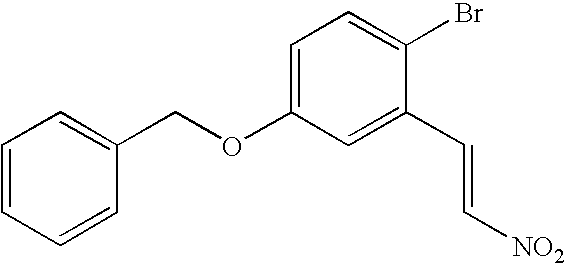
A solution of 2-bromo-5-hydroxy-benzaldehyde (5.99 g, 29.8 mmol, Preparation 13 Step A) in DMF (50 mL) was treated with benzyl bromide (7.65 g, 44.7 mmol) and Cs2CO3 (15.1 g, 44.7 mmol). The resulting mixture was heated at 80° C. for 60 min and was quenched with water (200 mL). The mixture was extracted with EtOAc (2×100 mL), dried (Na2SO4), and concentrated to a residue, which was purified on silica gel chromatography (hexanes/EtOAc 9/1) to afford 5-benzyloxy-2-bromo-benzaldehyde as white solid in quantitative yield.
A solution of nitromethane (2.02 mL, 37.3 mmol) in ethanol (10 mL) was treated with 10N NaOH (3.0 mL) at ambient temperature. A white solid precipitated immediately, and a solution of 5-benzyloxy-2-bromo-benzaldehyde (8.67 g, 29.8 mmol) in CH2Cl2 (50 mL) was added. The reaction mixture was stirred for 18 h and quenched with water (100 mL). The mixture was extracted with CH2Cl2 (2×50 mL), dried (Na2SO4), and concentrated to a residue, which was then purified by silica gel chromatography (hexanes/EtOAc 8/2) to afford 1-(5-benzyloxy-2-bromo-phenyl)-2-nitro-ethanol as yellow oil.
This intermediate was dissolved in CH2Cl2 (150 mL) and cooled to 0° C. Methanesulfonyl chloride (2.55 mL, 60.0 mmol) was added, and the mixture was stirred for 15 min. Triethylamine (8.41 mL) was added, and the mixture was stirred for 60 min. The reaction was quenched with water (200 mL) and extracted with CH2Cl2 (150 mL). The organic layer was dried (Na2SO4) and concentrated. The residue was purified by silica gel chromatography (hexanes/EtOAc 8/2) to afford the title compound (8.60 g, 86%). 1H NMR (400 MHz, CDCl3): δ 5.04 (s, 2H), 6.93 (dd, 1H, J=2.7 Hz, 9.0 Hz), 7.11 (d, 1H, J=3.2 Hz), 7.34-7.37 (m, 5H), 7.48 (d, 1H, J=13.7 Hz), 7.51 (d, 1H, J=9.0 Hz), 8.28 (d, 1H, J=13.7 Hz).
Step B: 2-(5-Benzyloxy-2-bromo-phenyl)-ethylamine
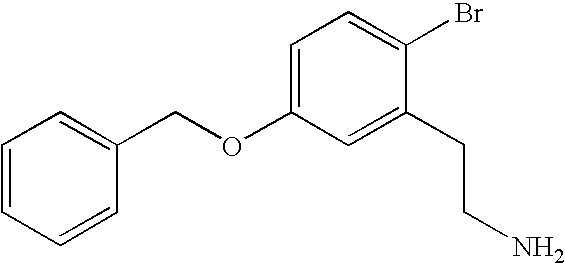
To a solution of 5-benzyloxy-2-bromo-(2-nitrovinyl)benzene (8.60 g, 25.6 mmol) in THF (100 mL) at −78° C. was added LAH (4.1 g, 102 mmol) portion wise over 30 min. The reaction mixture was allowed to warm gradually to ambient temperature. After 18 h, the mixture was carefully quenched with water (4 mL), 2N NaOH (4 mL), and water (12 mL), successively. The slurry was filtered and the precipitate was washed with CH2Cl2 (3×150 mL), dried (Na2SO4), and concentrated. The residue was purified by silica gel chromatography (EtOAc, then CH2Cl2/MeOH/NH4OH 10/1/0.01) to afford the title compound as an oil (3.36 g, 43%). 1H NMR (400 MHz, CDCl3): δ 2.84 (t, 2H, J=6.7 Hz), 2.96 (t, 2H, J=6.7 Hz), 5.03 (s, 2H), 6.71 (dd, 1H, J=2.7 Hz, 8.6 Hz), 6.86 (d, 1H, J=2.4 Hz), 7.33-7.43 (m, 6H).
Step C: 2-(5-Benzyloxy-2-bromo-phenyl)-ethyl]-carbamic acid tert-butyl ester

A solution of 2-(5-benzyloxy-2-bromo-phenyl)-ethylamine (3.36 g, 10.97 mmol) in CH2Cl2 (50 mL) at 0° C. was treated with Et3N (3.08 mL, 21.9 mmol) and di-tert-butyl dicarbonate (2.87 g, 13.2 mmol). The mixture was stirred for 2 h while being allowed to warm gradually to ambient temperature and was concentrated. The residue was purified by silica gel chromatography (EtOAc/hexanes, 65:35) to afford the title compound as an oil (4.45 g, 100%). 1H NMR (400 MHz, CDCl3): δ 1.44 (s, 9H), 2.90 (t, 2H, J=6.7 Hz), 3.39 (dt, 2H, J=6.3 Hz, 6.7 Hz), 5.02 (s, 2H), 6.72 (dd, 1H, J=3.1 Hz, 8.6 Hz), 6.87 (br s, 1H), 7.33-7.43 (m, 6H).
Step D: 3-[4-Benzyloxy-2-(2-tert-butoxycarbonylamino-ethyl)-phenyl]-acrylic acid methyl ester

A solution of 2-(5-benzyloxy-2-bromo-phenyl)-ethyl]-carbamic acid tert-butyl ester (4.40 g, 10.8 mmol) in propionitrile (100 mL) was degassed (vacuum/Ar purge, 3×). Tri-ortho-tolylphosphine (0.660 g, 2.17 mmol), methyl acrylate (2.93 mL, 32.5 mmol), and diisopropylethyl amine (3.76 mL, 21.6 mmol) were added. The mixture was de-gassed (vacuum/Ar purge, 3×). Pd(OAc)2 (242 mg, 1.08 mmol) was added, and the reaction mixture was degassed again. The mixture was stirred at 95° C. for 18 h and concentrated to a residue, which was purified by silica gel chromatography (EtOAc/hexanes, 7/3) to afford the title compound (4.15 g, 93%). 1H NMR (400 MHz, CDCl3) (major isomer): δ 1.43 (s, 9H), 2.94 (t, 2H, J=6.8 Hz), 3.33 (dt, 2H, J=6.3 Hz, 6.8 Hz), 3.79 (s, 3H), 5.08 (s, 2H), 6.28 (d, 1H, J=15.6 Hz), 6.84 (br s, 1H), 6.86 (d, 1H, J=8.3 Hz), 7.34-7.43 (m, 5H), 7.55 (d, 1H, J=8.3 Hz), 7.91 (d, 1H, J=15.6 Hz).
Step E: 3-[2-(2-tert-Butoxycarbonylamino-ethyl)-4-hydroxy-phenyl]-propionic acid methyl ester

To a solution of 3-[4-benzyloxy-2-(2-tert-butoxycarbonylamino-ethyl)-phenyl]-acrylic acid methyl ester (4.15 g, 10.1 mmol) in THF (100 mL) and MeOH (10 mL) was added 5% Pd—C (200 mg) in THF (10 mL). The resulting suspension was treated with hydrogen under balloon pressure for 18 h. The mixture was filtered through a pad of Celite and concentrated. The residue was purified by silica gel chromatography (EtOAc/hexanes, 6/4) to afford the title compound (1.20 g, 34%). 1H NMR (400 MHz, CDCl3): δ 1.44 (s, 9H), 2.57 (t, 2H, J=7.8 Hz), 2.77 (t, 2H, J=7.3 Hz), 2.88 (t, 2H, J=7.8 Hz), 3.33 (br s, 2H), 3.68 (s, 3H), 6.65 (br s, 1H), 6.67 (d, 1H, J=8.3 Hz), 7.02 (d, 1H, J=8.3 Hz). MS (ES+) m/z 324.1 [M+H]+.
Step F: 3-{2-(2-tert-Butoxycarbonylamino-ethyl)-4-[2-(5-methyl-2-phenyl-oxazol-4-yl)-ethoxy]-phenyl}-propionic acid methyl ester

To a solution of 3-[2-(2-tert-butoxycarbonylamino-ethyl)-4-hydroxy-phenyl]-propionic acid methyl ester (0.807 g, 2.50 mmol) and toluene-4-sulfonic acid 2-(5-methyl-2-phenyl-oxazol-4-yl)-ethyl ester (1.34 g, 3.74 mmol) in DMF (5 mL) was added Cs2CO3 (1.22 g, 3.74 mmol). The suspension was stirred at 65° C. for 48 h, quenched with H2O (200 mL), and extracted with EtOAc (3×100 mL). The combined organics were dried (Na2SO4) and concentrated to a residue, which was purified on silica gel chromatography (hexanes/EtOAc 9/1 to 8/2 to 6/4) to afford the title compound as a colorless oil (0.90 g, 71%). 1H NMR (400 MHz, CDCl3): δ 1.42 (s, 9H), 2.37 (s, 3H), 2.54 (t, 2H, J=7.8 Hz), 2.77 (t, 2H, J=7.8 Hz), 2.88 (t, 2H, J=6.8 Hz), 2.96 (t, 2H, J=6.8 Hz), 3.33 (˜dt, 2H, J=6.8 Hz), 3.65 (s, 3H), 4.20 (t, 2H, J=6.8 Hz), 6.70 (br s, 1H), 6.72 (d, 1H, J=8.3 Hz), 7.05 (d, 1H, J=8.3 Hz), 7.39-7.44 (m, 3H), 7.95-7.98 (m, 2H). MS (ES+) m/z [M+H]+.
Step G: 3-{2-(2-Amino-ethyl)-4-[2-(5-methyl-2-phenyl-oxazol-4-yl)-ethoxy]-phenyl}-propionic acid methyl ester

A solution of 3-{2-(2-tert-butoxycarbonylamino-ethyl)-4-[2-(5-methyl-2-phenyl-oxazol-4-yl)-ethoxy]-phenyl}-propionic acid methyl ester (0.90 g, 1.77 mmol) in CH2Cl2 (10 mL) at 0° C. was treated with TFA (5.0 mL) and water (0.2 mL). The resulting solution was allowed to warm gradually to ambient temperature. After 18 h, the mixture was concentrated. The residue was partitioned between CH2Cl2 (30 mL) and 5N NaOH (2 mL), and the aqueous layer was extracted with CH2Cl2 (3×30 mL). The combined organics were dried (K2CO3) and concentrated to a residue, which was purified by silica gel chromatography (CH2Cl2/MeOH/NH4OH, 8/2/0.05) to afford the title compound as a colorless oil (0.42 g, 58%). 1H NMR (400 MHz, CDCl3): δ 2.34 (s, 3H), 2.52 (t, 2H, J=7.8 Hz), 2.81 (t, 2H, J=7.8 Hz), 2.91 (t, 4H, J=6.4 Hz), 3.06 (t, 2H, J=7.3 Hz), 3.60 (s, 3H), 4.20 (t, 2H, J=6.8 Hz), 6.68 (br s, 1H), 6.71 (d, 1H, J=8.3 Hz), 7.01 (d, 1H, J=8.3 Hz), 7.37-7.39 (m, 3H), 7.89-7.92 (m, 2H).
Step H: 3-{2-(2-Isopropoxycarbonylamino-ethyl)-4-[2-(5-methyl-2-phenyl-oxazol-4-yl)-ethoxy]-phenyl}-propionic acid

A solution of 3-{2-(2-amino-ethyl)-4-[2-(5-methyl-2-phenyl-oxazol-4-yl)-ethoxy]-phenyl}-propionic acid methyl ester (26 mg, 0.064 mmol) in CH2Cl2 (2 mL) at 0° C. was treated with TEA (0.2 mL) and isopropyl chloroformate (0.13 mL, 1.0 M in ether). The resulting mixture was allowed to warm gradually to ambient temperature. After 2 h, the mixture was concentrated to a residue, which was purified by silica gel chromatography (hexanes/EtOAc 7/3) to afford the isopropyl carbamate as a colorless oil. 1H NMR (400 MHz, CDCl3): δ 1.19 (d, 6H, J=5.9 Hz), 2.42 (s, 3H), 2.54 (t, 2H, J=7.8 Hz), 2.79 (t, 2H, J=6.8 Hz), 2.89 (t, 2H, J=7.8 Hz), 3.05 (br s, 2H), 3.38 (br s, 2H), 3.60 (s, 3H), 4.26 (t, 2H, J=6.8 Hz), 4.68 (br s, 1H), 4.89 (q, 1H, J=6.4 Hz), 6.70 (br s, 1H), 6.71 (d, 1H, J=8.3 Hz), 7.05 (d, 1H, J=8.3 Hz), 7.47 (m, 3H), 8.10 (m, 2H).
This compound was dissolved in THF (1.0 mL) and MeOH (0.5 mL). The solution was treated with 2N NaOH (0.32 mL) and heated at 60° C. for 60 min. The reaction mixture was concentrated, neutralized with 2N HCl (0.40 mL), and extracted with EtOAc (3×5 mL). The combined organics were dried (Na2SO4), and concentrated to a residue, which was purified by silica gel chromatography (hexanes/EtOAc 9/1, then EtOAc/MeOH 95/5) to afford the title compound as a white solid (12 mg, 32% over two steps). 1H NMR (400 MHz, CDCl3): δ 1.17 (d, 6H, J=5.9 Hz), 2.36 (s, 3H), 2.52 (br s, 2H), 2.79 (t, 2H, J=6.8 Hz), 2.89 (t, 2H, J=7.8 Hz), 2.93 (t, 2H, J=6.8 Hz), 3.31 (br s, 2H), 4.16 (t, 2H, J=6.8 Hz), 4.68 (br s, 1H), 4.89 (q, 1H, J=6.4 Hz), 6.67 (br s, 1H), 6.71 (d, 1H, J=8.3 Hz), 7.05 (d, 1H, J=8.3 Hz), 7.47 (m, 3H), 8.10 (m, 2H). MS [ES] m/z 481.4 (M+1).
The following Examples 545 to 552 are prepared by following a substantially similar procedure as described in Example 544.

MS [ES] m/z 515.3 (M+1).

MS [ES] m/z 500.3 (M+1).

MS [ES−] m/z 573.0 (M−1).

MS [ES] m/z 513.2 (M+1).

MS [ES] m/z 477.1 (M+1).

MS [ES] m/z 499.3 (M+1).

MS [ES] m/z 495.3 (M+1).

MS [ES] m/z 529.0 (M+1).

Step A: 3-[4-Hydroxy-2-(2-isopropoxycarbonylamino-ethyl)-phenyl]-propionic acid methyl ester

A solution of 3-[2-(2-tert-butoxycarbonylamino-ethyl)-4-hydroxy-phenyl]-propionic acid methyl ester (282 mg, 0.876 mmol; Example 544, Step E) in CH2Cl2 (10 mL) at ambient temperature was treated with TFA (5.0 mL), stirred for 60 min, and concentrated. The residue in CH2Cl2 (10 mL) was treated with triethyl amine (2.0 mL) and iso-propyl chloroformate (0.97 mL, 1.0 M in toluene). The reaction mixture was stirred at ambient temperature for 16 h and concentrated. The crude material was purified using silica gel chromatography (50% EtOAc/hexanes) to yield the title compound (180 mg, 67%).
Step B: 3-(2-(2-Isopropoxycarbonylamino-ethyl)-4-{2-[5-methyl-2-(4-morpholin-4-yl-phenyl)-oxazol-4-yl]-ethoxy}-phenyl)-propionic acid
A solution of toluene-4-sulfonic acid 2-[5-methyl-2-(4-morpholin-4-yl-phenyl)-oxazol-4-yl]-ethyl ester (44 mg, 0.10 mmol; Preparation 5) and 3-[4-hydroxy-2-(2-isopropoxycarbonylamino-ethyl)-phenyl]-propionic acid methyl ester (31 mg, 0.10 mmol) in DMF (1.0 mL) was treated with K2CO3 (30 mg). The resulting suspension was stirred at 65° C. for 16 h and diluted with water (10 mL). The mixture was extracted with EtOAc (3×10 mL). The combined organic layers were dried (Na2SO4), concentrated, and purified using silica gel chromatography (50% EtOAc/hexanes to yield 3-(2-(2-isopropoxycarbonylamino-ethyl)-4-{2-[5-methyl-2-(4-morpholin-4-yl-phenyl)-oxazol-4-yl]-ethoxy}-phenyl)-propionic acid methyl ester.
This ester intermediate was dissolved in THF (0.6 mL) and MeOH (0.4 mL) and treated with aqueous 2M LiOH (1.0 mL, 2.0 mmol). The mixture was stirred for 16 h at ambient temperature, neutralized with HCl (1.0 mL, 2.0 M), and concentrated. The residue was extracted with EtOAc (3×5 mL). The combined organic layers were dried (Na2SO4), concentrated, and purified using silica gel chromatography column (hexanes/EtOAc/HOAc, 5/5/0.02) to afford the title compound (10 mg, 18%). MS (ES+) m/z 566.2 (M+H)+.
The following Examples 554 to 560 are prepared by following a substantially similar procedure as described in Example 553.

MS [ES] m/z 557.5 (M+1).

MS [ES] m/z 557.2 (M+1).

MS [ES] m/z 506.2 (M+1).

MS [ES] m/z 498.3 (M+1).

MS [ES] m/z 480.3 (M+1).

MS [ES] m/z 572.2 (M+1).

MS [ES] m/z 586.2 (M+1).

Step A: 2-(2-Allyl-4-benzyloxy-phenoxy)-2-methyl-propionic acid ethyl ester

2-Allyl-4-benzyloxy-phenol (WO 9728137 A1 19970807, Adams et al.) (6.04 g, 25.1 mmol) in dry DMF (75 mL) was cooled in an ice bath and treated with NaH (1.78 g, 44.5 mmol, 60% oil dispersion). After 30 min, the red reaction mixture was treated over 5 min with ethyl bromoisobutyrate (7.4 mL, 50 mmol). The cold bath was removed after 5 min. The reaction was stirred 20 min and placed in an oil bath (T=85° C.). After 18 h, the mixture was cooled and partitioned between brine (75 mL) and ether (200 mL). The organic layer was washed with brine (50 mL), dried (Na2SO4), and concentrated to a brown oil (12 g). The crude product was purified by flash chromatography using hexanes:ethyl acetate (100:0 to 5:1) to give the desired product (8.47 g, 95%).
Step B: 2-(4-Benzyloxy-2-carboxymethyl-phenoxy)-2-methyl-propionic acid ethyl ester

A solution of 2-(2-allyl-4-benzyloxy-phenoxy)-2-methyl-propionic acid ethyl ester (8.07 g, 22.8 mmol) in acetone (85 mL) and water (8.5 mL) was treated with 4-methyl-morpholine 4-oxide (3.68 g, 27.2 mmol) then osmium (IV) oxide (2 chips). The flask was covered with foil and stirred 5 h. The solution was diluted with EtOAc (600 mL) and washed with 1N Na2S2O3 (2×75 mL) and brine (75 mL). The organic layer was concentrated to a tan oil (8.74 g). The oil was dissolved in THF (54 mL) and water (36 mL), and sodium periodate (15.4 g, 72.0 mmol) was added. THF (54 mL) and water (36 mL) were added. The thick white slurry was stirred for 3 h and filtered. The filtrate was extracted with EtOAc (500 mL). The organic layer was washed successively with brine, 1N Na2S2O3, and brine (75 mL each) and was concentrated to an orange oil (7.65 g). The oil was diluted with tert-butanol (180 mL) and 2-methyl-2-butene (60 mL) and was cooled in an ice bath. The mixture was treated with sodium chlorite (19 g, 0.21 mol), and a solution of NaH2PO4 (19 g, 0.14 mol) in water (120 mL) was added over 5 min. After 15 min, the ice bath was removed. The mixture was stirred for 2 h and was partitioned between EtOAc (500 mL) and water (50 mL). The organic layer was washed with 1N Na2S2O3 (75 mL) and brine (75 mL), dried (NaSO4), and concentrated to the title compound as a pale yellow solid (6.52 g, 77%). This material was used in subsequent reactions without further purification.
Step C: 2-(4-Benzyloxy-2-carbamoylmethyl-phenoxy)-2-methyl-propionic acid ethyl ester

2-(4-Benzyloxy-2-carboxymethyl-phenoxy)-2-methyl-propionic acid ethyl ester (500 mg, 1.34 mmol), ammonium chloride (108 mg, 2.02 mmol), EDC (3.86 mg, 2.01 mmol), and N-hydroxybenzotriazole hydrate (272 mg, 2.01 mmol) were combined in a flask and diluted with DMF (5 mL). Ethyl diisopropyl amine (0.70 mL, 4.0 mmol) was added. The solution was stirred for 18 h and partitioned between EtOAc (25 mL) and 1N HCl (10 mL). The organic layer was washed with saturated NaHCO3 solution (10 mL) then brine (10 mL), dried (Na2SO4), and concentrated. The crude product was purified by radial chromatography (hexanes/EtOAc 1/2 to 1/4) to give the title compound (430 mg, 86%).
Step D: 2-[4-Benzyloxy-2-(tert-butoxycarbonylamino-methyl)-phenoxy]-2-methyl-propionic acid ethyl ester

2-(4-Benzyloxy-2-carbamoylmethyl-phenoxy)-2-methyl-propionic acid ethyl-ester (430 mg, 1.16 mmol) was dissolved in CH3CN (4.5 mL) and water (4.5 mL), and [bis(trifluoroacetoxy)iodo]benzene (745 mg, 1.73 mmol) was added. After 10 min, pyridine (0.19 mL, 2.3 mmol) was added, and the solution was stirred for 17 h. Triethylamine (0.60 mL, 4.3 mmol) and di-tert-butyl dicarbonate (506 mg, 2.32 mmol) were added. The mixture was stirred for 1 h and was concentrated. The residue was partitioned between ether (50 mL) and brine (15 mL). The organic layer was washed with ice-cold 1N HCl, saturated NaHCO3 solution, and brine (15 mL each); dried (NaSO4); and concentrated. The residue was purified by silica gel column chromatography (hexanes/EtOAc 4/1 to 3/2) to a yellow oil (345 g, 67%).
Step E: 2-[2-(tert-Butoxycarbonylamino-methyl)-4-hydroxy-phenoxy]-2-methyl-propionic acid ethyl ester

A solution of 2-[4-benzyloxy-2-(tert-butoxycarbonylamino-methyl)-phenoxy]-2-methyl-propionic acid ethyl ester (0.38 g, 0.86 mmol) in THF (15 mL) was treated with 5% Pd-on-carbon (47 mg) and shaken under a hydrogen atmosphere (60 psi) at ambient temperature for 18 h. The mixture was filtered through Celite and concentrated. The crude product was purified by radial chromatography (hexanes/EtOAc 2.5/1) to give the title compound (208 mg g, 69%).
Step F: 2-{2-(tert-Butoxycarbonylamino-methyl)-4-[2-(5-methyl-2-phenyl-oxazol-4-yl)-ethoxy]-phenoxy}-2-methyl-propionic acid
2-[2-(tert-Butoxycarbonylamino-methyl)-4-hydroxy-phenoxy]-2-methyl-propionic acid ethyl ester (200 mg, 0.566 mmol), toluene-4-sulfonic acid 2-(5-methyl-2-phenyl-oxazol-4-yl)-ethyl ester (245 mg, 686 mmol) and Cs2CO3 (185 mg, 0.567 mmol) were suspended in DMF (5 mL) and stirred at 55° C. for 39 h. The reaction mixture was cooled and partitioned between Et2O (50 mL) and water (10 mL). The organic layer was washed with brine (10 mL), dried (NaSO4), and concentrated. The residue was purified by radial chromatography (hexanes/EtOAc 4/1) to give an oil (280 mg). A solution of the product in MeOH (6 mL) and THF (3 mL) was treated with 2.5N aqueous NaOH solution (2 mL) and heated at 55° C. for 2 h. The mixture was cooled and concentrated. Ice chips were added (˜5) and the mixture was acidified using 5N aqueous HCL solution (2 mL). The reaction mixture was partitioned between EtOAc (30 mL) and brine (15 mL). The organic layer was washed with brine (2×10 mL), dried (NaSO4), and concentrated. The residue was purified by silica gel column chromatography (hexanes/EtOAc/HOAc 3/2/0 to 3/2/0.05) to give the title compound as a white foam (156 mg, 54%). MS (ES−) m/z 509.1 [M−H]−. Anal. Calcd. For C28H34N2O7: C, 65.88; H, 6.71; N, 5.49. Found: C, 65.67; H, 6.79; N, 5.52.

The above compound is prepared by following a substantially similar procedure as described in Example 561. MS [ES] m/z 483.2 (M+1).

Step A: 2-{2-Aminomethyl-4-[2-(5-methyl-2-phenyl-oxazol-4-yl)-ethoxy]-phenoxy}-2-methyl-propionic acid ethyl ester: trifluoroacetic acid salt

A solution of 2-{2-(tert-butoxycarbonylamino-methyl)-4-[2-(5-methyl-2-phenyl-oxazol-4-yl)-ethoxy]-phenoxy}-2-methyl-propionic acid ethyl ester (350 mg, 0.650 mmol) in CH2Cl2 (10 mL) was treated at ambient temperature with TFA (4 mL) and stirred for 2.5 h. The solution was concentrated and co-evaporated with CCl4 (3×) to yield the title compound as a foam (381 mg, quantitative).
Step B: 2-{2-(Ethoxycarbonylamino-methyl)-4-[2-(5-methyl-2-phenyl-oxazol-4-yl)-ethoxy]-phenoxy}-2-methyl-propionic acid
General Parallel Synthesis Procedure: 2-{2-Aminomethyl-4-[2-(5-methyl-2-phenyl-oxazol-4-yl)-ethoxy]-phenoxy}-2-methyl-propionic acid ethyl ester: trifluoroacetic acid salt (381 mg, 0.650 mmol max.) was dissolved in CH2Cl2 (25 mL) and washed with saturated NaHCO3 solution (15 mL). The organic layer was dried (NaSO4), filtered, and concentrated to 2-{2-aminomethyl-4-[2-(5-methyl-2-phenyl-oxazol-4-yl)-ethoxy]-phenoxy}-2-methyl-propionic acid ethyl ester (245 mg, 0.59 mmol, 86%). A portion of this free base (13 mg, 0.030 mmol) in CH2Cl2 (0.8 mL) was treated with triethylamine (0.050 mL, 0.36 mmol) then ethyl chloroformate (0.020 mL, 0.21 mmol). The reaction mixture was shaken overnight and dimethylethylenediamine (0.050 mL, 0.47 mmol) was added. The reaction mixture was shaken for 2 h, diluted with MeOH (0.5 mL), and passed through an SCX column (1 g, equilibrated with 4 mL MeOH/CH2Cl2 1/1). The methyl ester-amide product was eluted with MeOH/CH2Cl2 (1:1, 8 mL) and concentrated. The residue was dissolved in THF (1 mL) and EtOH (1 mL) and treated with 2N NaOH (0.5 mL). The solution was heated at 45° C. for 45 min, cooled, concentrated, and acidified with 1N HCl (2.5 mL). The mixture was diluted with diluted with CH2Cl2 (0.5 mL), transferred to a 3-mL ChemElute cartridge, and eluted with CH2Cl2 (8 mL). The solvent was removed under a stream of N2. The crude product was dried under vacuum and purified by mass-directed HPLC to give a foam (2.7 mg, 19%). %). MS (ES+) m/z 483.5 [M+H]+.
The following Examples 564 to 570 are prepared by following a substantially similar procedure as described in Example 563.

MS [ES] m/z 517.2 (M+1).

MS [ES] m/z 561.1 (M+1).

MS [ES] m/z 465.2 (M+1).

MS [ES] 481 m/z (M+1).

MS [ES] m/z 481 (M+1).

MS [ES] m/z 483 (M+1).

MS [ES] m/z 493 (M+1).

Step A: 2-Bromo-5-hydroxy-benzonitrile

To a stirred solution of 3-cyanophenol (2.00 g, 18.0 mmol) in anhydrous acetonitrile (20 mL) under N2 at −30° C. was added dropwise 54% HBF4.Et2O (2.48 mL, 18.0 mmol). The temperature was maintained below −20° C. during addition. To this stirred solution was added NBS (3.27 g, 18.0 mmol) portion wise keeping the temperature below −10° C. After the addition was complete, the solution was allowed to warm to 19° C. The reaction mixture was diluted with 38% NaHSO3 (10 mL) and extracted with MTBE (2×25 mL). The organic layer was washed with H2O (2×25 mL) and brine (25 mL), dried (MgSO4), filtered, and concentrated to give a white solid (3.15 g). Purification of a portion of this product (1.0 g) by radial chromatography (30% EtOAc/hexane) gave 0.51 g of the title compound as a white solid. mp 183-184° C. Anal. Calculated for C7H4BrNO: C, 42.46; H, 2.04; N, 7.07. Found: C, 42.44; H, 1.93; N, 6.90.
Step B: 2-(3-Ethoxy-buta-1,3-dienyl)-5-hydroxy-benzonitrile

To a stirred solution of 2-bromo-5-hydroxy-benzonitrile (1.4 g, 7.1 mmol), ethyl acrylate (2.12 g, 21.2 mmol), palladium(II) acetate (0.159 g, 7.0 mmol), diisopropylethylamine (0.82 g, 14.1 mmol), and tri-ortho-tolylphosphine (0.430 g, 14.1 mmol) was added propionitrile (50 mL). The reaction was stirred overnight at 80° C. under a stream of N2. The mixture was cooled, filtered, and concentrated. The crude material (3.0 g) was purified by radial chromatography (10-70% EtOAc/hexanes) to give the title compound as a white solid (1.1 g). MS [EI] m/z 216 (M+H)+.
Step C: 2-(3-Ethoxy-but-3-enyl)-5-hydroxy-benzonitrile

To a solution of 2-(3-ethoxy-buta-1,3-dienyl)-5-hydroxy-benzonitrile (600 mg) in EtOAc (50 mL) was added 5% Pd/C (0.3 g). The reaction was exposed to hydrogen gas in a Parr apparatus at 60 psi overnight at ambient temperature. The reaction mixture was filtered and concentrated to give the title compound (410 mg). MS [EI] m/z 218 (M+H)+.
Step D: 3-(2-Cyano-4-{2-[5-methyl-2-(4-phenoxyphenyl)oxazol-4-yl]ethoxy}phenyl)propionic acid
A mixture of 2-(3-ethoxy-but-3-enyl)-5-hydroxy-benzonitrile (220 mg, 1.00 mmol), toluene-4-sulfonic acid 2-[5-methyl-2-(4-phenoxy-phenyl)-oxazol-4-yl]-ethyl ester (450 mg, 1.00 mmol; Preparation 6), and CsCO3 (978 mg, 3.00 mmol) in DMF (10 mL) was stirred overnight at 60° C. under an N2. The mixture was cooled, diluted with EtOAc (20 mL) and washed with brine (20 mL). The organic layer was dried (Na2SO4) and concentrated. The product mixture was purified by radial chromatography (10-70% EtOAc/hexanes) to give 3-(2-cyano-4-{2-[5-methyl-2-(4-phenoxyphenyl)oxazol-4-yl]ethoxy}phenyl)propionic acid ethyl ester (201 mg). A solution of this ester in EtOH (10 mL) and 5N NaOH (10 mL) was heated at 70° C. overnight, concentrated, acidified with 1N HCl, and extracted with EtOAc. The organic layer dried (Na2SO4) and concentrated to give the title compound (192 mg); MS [ES] m/z 469 (M+1).
The following Examples 572 to 573 and 575 to 581 are prepared by following a substantially similar procedure as described in Example 571.

MS [ES] m/z 453 (M+1).

MS [ES] m/z 402 (M+1).

MS [ES] m/z 456 (M+1).

MS [ES] m/z 453 (M+1).

MS [ES] m/z 402 (M+1).

MS [ES] m/z 376 (M+1).

MS [ES] m/z 449 (M+1).

MS [ES] m/z 470 (M+1).

MS [ES] m/z 393 (M+1).

Step A: 3-(4-Benzyloxy-2-formyl-phenyl)-acrylic acid tert-butyl ester

To a solution of 3-(2-formyl-4-hydroxy-phenyl)-acrylic acid tert-butyl ester (4.97 g, 20.0 mmol) in DMF (40 mL) was added benzyl bromide (2.85 mL, 24.0 mmol) and Cs2CO3 (7.82 g, 24.0 mmol). The suspension was stirred at 80° C. for 30 min, and TLC indicated the reaction was complete. The mixture was quenched with H2O (500 mL) and extracted with EtOAc (2×100 mL). The combined organics were dried (Na2SO4) and concentrated to a residue, which was purified by silica gel chromatography (hexanes/EtOAc 9/1) to afford the title compound as yellow solid (6.70 g, 99%).
Step B: 5-Benzyloxy-2-(2-tert-butoxycarbonyl-vinyl)-benzoic acid

A solution of 3-(4-benzyloxy-2-formyl-phenyl)-acrylic acid tert-butyl ester (6.70 g, 19.8 mmol) in tert-butanol (150 mL) was treated with 2-methyl-2-butene (50 mL) and cooled to 0° C. A solution of NaClO2 (17.0 g, 188 mmol) and NaH2PO4 (17.0 g, 142 mmol) in H2O (200 mL) was added, and the mixture was stirred at 0° C. for 15 min. The ice bath was removed, and the mixture was stirred at room temperature for 2 h. The organic layer was separated, and the aqueous layer was extracted with EtOAc (2×100 mL). The combined organic layers were dried (Na2SO4) and concentrated. The residue was purified using silica gel chromatography (hexanes/EtOAc 9/1 to 0/10) to afford the title compound as white solid (6.78 g, 96%). 1H NMR (400 MHz, CDCl3): δ 1.52 (s, 9H), 5.12 (s, 2H), 6.20 (d, 1H, J=16.2 Hz), 7.13 (dd, 1H, J=3.6, 9.0 Hz), 7.34-7.45 (m, 5H), 7.58 (d, 1H, J=8.8 Hz), 7.64 (d, 1H, J=2.4 Hz), 8.41 (d, 1H, J=16.2 Hz).
Step C: 5-Benzyloxy-2-(2-tert-butoxycarbonyl-vinyl)-benzoic acid 2-trimethylsilanyl-ethyl ester

To a solution of 5-benzyloxy-2-(2-tert-butoxycarbonyl-vinyl)-benzoic acid (5.50 g, 15.5 mmol) in CH2Cl2 (100 mL) was added 2-trimethylsilyl-ethanol (3.67 g, 31.0 mmol), EDC (5.36 g, 27.9 mmol), and DMAP (3.67 g, 31.0 mmol). The resulting mixture was stirred at room temperature for 12 h, washed with aqueous NH4Cl (150 mL), and extracted with CH2Cl2 (100 mL). The combined organics were dried (Na2SO4) and concentrated. The residue was purified using silica gel chromatography (hexanes/EtOAc 9/1) to afford the title compound as an oil (5.90 g, 84%). 1H NMR (400 MHz, CDCl3): δ 0.07 (s, 9H), 1.14 (t, 2H, J=8.8 Hz), 1.52 (s, 9H), 4.41 (t, 2H, J=8.8 Hz), 5.10 (s, 2H), 6.20 (d, 1H, J=15.6 Hz), 7.13 (dd, 1H, J=3.0, 8.3 Hz), 7.34-7.44 (m, 5H), 7.50 (d, 1H, J=3.0 Hz), 7.53 (d, 1H, J=8.8 Hz), 8.41 (d, 1H, J=16.1 Hz).
Step D: 2-(2-tert-Butoxycarbonyl-ethyl)-5-hydroxy-benzoic acid 2-trimethylsilanyl-ethyl ester

A solution of 5-benzyloxy-2-(2-tert-butoxycarbonyl-vinyl)-benzoic acid 2-trimethylsilanyl-ethyl ester (6.20 g, 13.6 mmol) in EtOH (95 mL) was treated with Pd/C (5%, 0.775 g). The resulting suspension was treated with hydrogen at 60 psi for 6 h at room temperature. The catalyst was filtered through a pad of Celite, and the filtrate was concentrated to an oil (4.30 g, 86%). 1H NMR (400 MHz, CDCl3): δ 0.07 (s, 9H), 0.96 (t, 1H, J=8.8 Hz), 1.12 (t, 1H, J=8.8 Hz), 1.40 (s, 9H), 2.52 (t, 1H, J=7.8 Hz), 3.13 (t, 1H, J=7.8 Hz), 3.73 (t, 1H, J=8.5 Hz), 4.36 (t, 1H, J=8.5 Hz), 5.00 (br s, 1H), 6.88 (dd, 1H, J=2.4, 8.3 Hz), 7.14 (d, 1H, J=8.3 Hz), 7.35 (d, 1H, J=2.4 Hz).
Step E: 2-(2-tert-Butoxycarbonyl-ethyl)-5-[2-(5-methyl-2-phenyl-oxazol-4-yl)-ethoxy]-benzoic acid 2-trimethylsilanyl-ethyl ester

To a solution of 2-(2-tert-butoxycarbonyl-ethyl)-5-hydroxy-benzoic acid 2-trimethylsilanyl-ethyl ester (4.30 g, 11.7 mmol) and toluene-4-sulfonic acid 2-(5-methyl-2-phenyl-oxazol-4-yl)-ethyl ester (4.61 g, 12.9 mmol) in DMF (30 mL) was added Cs2CO3 (4.59 g, 14.1 mmol). The suspension was stirred at 55° C. for 12 h. The reaction mixture was quenched with H2O (200 mL) and extracted with EtOAc (3×100 mL). The combined organics were dried (Na2SO4) and concentrated to a residue, which was purified using silica gel chromatography (hexanes/EtOAc 9/1 to 8/2) to afford the title compound as a colorless oil (5.04 g, 78%). 1H NMR (400 MHz, CDCl3): δ 0.06 (s, 9H), 1.11 (t, 2H, J=8.8 Hz), 1.40 (s, 9H), 2.36 (s, 3H), 2.51 (t, 1H, J=7.8 Hz), 2.97 (t, 2H, J=6.8 Hz), 3.12 (t, 1H, J=7.8 Hz), 4.24 (t, 2H, J=6.8 Hz), 4.35 (t, 2H, J=8.8 Hz), 6.88 (dd, 1H, J=3.0, 8.3 Hz), 7.15 (d, 1H, J=8.3 Hz), 7.37-7.44 (m, 4H), 7.97 (d, 2H, J=7.8 Hz).
Step F: 2-(2-tert-Butoxycarbonyl-ethyl)-5-[2-(5-methyl-2-phenyl-oxazol-4-yl)-ethoxy]-benzoic acid

A solution of 2-(2-tert-butoxycarbonyl-ethyl)-5-[2-(5-methyl-2-phenyl-oxazol-4-yl)-ethoxy]-benzoic acid 2-trimethylsilanylethyl ester (5.04 g, 9.13 mmol) in THF (100 mL) was treated with TBAF (20 mL, 1.0 M) at room temperature for 1 h. The reaction mixture was concentrated and purified using silica gel chromatography (hexanes/EtOAc 1/1) to afford the title compound as a colorless oil (4.04 g, 98%). 1H NMR (400 MHz, CDCl3): δ 1.38 (s, 9H), 2.37 (s, 3H), 2.55 (t, 2H, J=7.3 Hz), 2.98 (t, 2H, J=6.5 Hz), 3.15 (t, 2H, J=7.3 Hz), 4.26 (t, 2H, J=6.5 Hz), 4.35 (t, 2H, J=8.8 Hz), 6.99 (dd, 1H, J=2.9, 8.8 Hz), 7.18 (d, 1H, J=8.3 Hz), 7.38-7.43 (m, 3H), 7.49 (d, 1H, J=2.9 Hz), 7.97 (d, 2H, J=7.8 Hz). MS (ES) m/z 522.3 [M+H]+.
Step G: 3-{2-Benzylcarbamoyl-4-[2-(5-methyl-2-phenyl-oxazol-4-yl)-ethoxy]-phenyl}-propionic acid
To a solution of 2-(2-tert-butoxycarbonyl-ethyl)-5-[2-(5-methyl-2-phenyl-oxazol-4-yl)-ethoxy]-benzoic acid (93 mg, 0.200 mmol) in CH2Cl2 (2 mL) was added benzylamine (52 mg g, 0.49 mmol), EDC (54 mg, 0.28 mmol), triethylamine (0.057 ml, 0.40 mmol), and DMAP (catalyst). The resulting mixture was stirred at room temperature for 12 h and washed with aqueous NH4Cl (2 mL). The organic layer was purified using a silica gel column (Sep-Pak column, 10 g; hexanes/EtOAc 1/1) to afford the tert-butyl ester intermediate. The ester was treated a mixture of CH2Cl2 (1.0 mL), TFA (0.8 mL), and water (0.1 mL) at room temperature for 2 h. The reaction mixture was concentrated and dried under vacuum to afford the title product as a white solid (35 mg, 36%). 1H NMR (400 MHz, CDCl3): δ 2.32 (s, 3H), 2.59 (t, 2H, J=7.3 Hz), 2.88-2.98 (m, 4H, J=6.5 Hz), 4.16 (t, 2H, J=6.5 Hz), 4.52 (s, 2H), 6.83 (dd, 1H, J=2.6, 8.4 Hz), 6.87 (d, 1H, J=2.4 Hz), 7.10 (d, 1H, J=8.3 Hz), 7.20-7.30 (m, 3H), 7.37-7.40 (m, 3H), 7.88-7.91(m, 2H). MS (ES) m/z 485.2 [M+H]+, m/z 483.4 [M−H]−.

Step A: 3-(2-Benzylaminocarbonyl-4-benzyloxy-phenyl)-acrylic acid tert-butyl ester

To a solution of 5-benzyloxy-2-(2-tert-butoxycarbonyl-vinyl)-benzoic acid (1.45 g, 4.09 mmol) in CH2Cl2 (40 mL) was added benzylamine (0.613 g, 5.73 mmol), EDC (1.254 g, 6.54 mmol), and DMAP (1.00 g, 8.18 mmol). The resulting mixture was stirred at room temperature for 12 h, washed with aqueous NH4Cl (50 mL), and extracted with CH2Cl2 (2×50 mL). The combined organic layers were dried (Na2SO4) and concentrated. The residue was then purified using silica gel chromatography (hexanes/EtOAc 8/2) to afford the title compound as an oil (720 mg, 40%). 1H NMR (400 MHz, CDCl3): δ 1.52 (s, 9H), 4.63 (d, 2H, J=5.5 Hz), 5.09 (s, 2H), 5.97 (br s, 1H), 6.22 (d, 1H, J=15.6 Hz), 7.01 (dd, 1H, J=2.7, 8.6 Hz), 7.10 (d, 1H, J=2.8 Hz), 7.28-7.42 (m, 10H), 7.55 (d, 1H, J=9.0 Hz), 7.88 (d, 1H, J=16.0 Hz).

A solution of 3-(2-benzylaminocarbonyl-4-benzyloxy-phenyl)-acrylic acid tert-butyl ester (720 mg, 1.625 mmol) in EtOH (15 mL) and THF (5 mL) was treated with Pd/C (5%, 70 mg). The resulting suspension was treated with hydrogen using a balloon for 4 h at room temperature. The catalyst was filtered through a pad of celite and the filtrate was concentrated to an oil (450 mg, 78%). 1H NMR (400 MHz, CDCl3): δ 1.34 (s, 9H), 2.56 (t, 2H, J=7.0 Hz), 2.90 (t, 2H, J=7.0 Hz), 4.59 (d, 1H, J=5.9 Hz), 6.74 (dd, 1H, J=2.7, 8.2 Hz), 6.89 (d, 1H, J=2.7 Hz), 7.01 (d, 1H, J=8.2 Hz), 7.25-7.36 (m, 5H). MS (ES) m/z 356.2 [M+H]+, m/z 354.0 [M−H]−.
Step C: 3-{2-Benzylcarbamoyl-4-[2-(2-biphenyl-4-yl-5-methyl-oxazol-4-yl)-ethoxy]-phenyl}-propionic acid
To a solution of 3-(2-benzylaminocarbonyl-4-hydroxy-phenyl)-propionic acid tert-butyl ester (50 mg, 0.140 mmol) and toluene-4-sulfonic acid 2-(5-methyl-2-(4-phenylphenyl)-oxazol-4-yl)-ethyl ester (73 mg, 0.168 mmol) in DMF (1.0 mL) was added K2CO3 (100 mg, 0.724 mmol). The suspension was stirred at 65° C. for 12 h. The reaction mixture was quenched with H2O (10 mL) and extracted with EtOAc (3×10 mL). The combined organic layers were dried (Na2SO4) and concentrated to a residue, which was purified using silica gel chromatography (hexanes/EtOAc 7/3) to afford the tert-butyl ester intermediate as an oil. The ester was treated a mixture of CH2Cl2 (1.0 mL), TFA (0.8 mL) and water (0.1 mL) at room temperature for 2 h. The reaction mixture was concentrated and dried under vacuum to afford the title product as a white solid (37 mg, 47%). 1H NMR (400 MHz, CDCl3): δ 2.36 (s, 3H), 2.59 (t, 2H, J=7.3 Hz), 2.94 (t, 4H, J=7.2 Hz), 4.20 (t, 2H, J=6.5 Hz), 4.55 (s, 2H), 6.85 (dd, 1H, J=2.9, 8.2 Hz), 6.90 (d, 1H, J=2.4 Hz), 7.12 (d, 1H, J=8.6 Hz), 7.20-7.36 (m, 6H), 7.42 (t, 2H, J=7.4 Hz), 7.59 (d, 2H, J=8.6 Hz), 7.64 (d, 2H, J=8.2 Hz), 8.00 (d, 2H, J=8.6 Hz). MS (ES) m/z 561.3 [M+H]+, m/z 559.5 [M−H]−.
Examples 584 to 643 are prepared by following a substantially similar procedure as described in Examples 582 and 583. Examples 584 to 628 are prepared by following a substantially similar procedure as described in Example 582. Examples 629 to 643 are prepared by following a substantially similar procedure as described in Example 583.
| MS | |||
| No. | Compounds | Name | (ES+) |
| 584 |
 |
3-{4-[2-(5-Methyl-2-phe-nyl-oxazol-4-yl)-eth-oxy]-2-phenyl-carba-moyl-phenyl}-pro-pionic acid | 471.2 |
| 585 |
 |
3-{2-Benzyl-carbamoyl-4-[2-(5-meth-yl-2-phenyl-oxa-zol-4-yl)-ethoxy]-phe-nyl}-propionic acid | 485.2 |
| 586 |
 |
3-{2-(3,4-Dichloro-benzyl-carbamoyl)-4-[2-(5-meth-yl-2-phenyl-oxazol-4-yl)-eth-oxy]-phenyl}-pro-pionic acid | 553 |
| 587 |
 |
3-{2-(4-Methoxy-benzyl-carbamoyl)-4-[2-(5-meth-yl-2-phenyl-oxazol-4-yl)-eth-oxy]-phenyl}-pro-pionic acid | 515.2 |
| 588 |
 |
3-{2-[(Biphenyl-3-ylmeth-yl)-carbamoyl]-4-[2-(5-meth-yl-2-phenyl-oxa-zol-4-yl)-ethoxy]-phe-nyl}-propionic acid | 561.2 |
| 589 |
 |
3-{4-[2-(5-Methyl-2-phe-nyl-oxazol-4-yl)-eth-oxy]-2-phenethyl-carba-moyl-phenyl}-pro-pionic acid | 499.3 |
| 590 |
 |
3-[4-[2-(5-Methyl-2-phe-nyl-oxazol-4-yl)-eth-oxy]-2-(3-phenyl-propyl-carbamoyl)-phenyl]-pro-pionic acid | 513.3 |
| 591 |
 |
3-{4-[2-(5-Methyl-2-phe-nyl-oxazol-4-yl)-eth-oxy]-2-[(thiophen-2-ylmeth-yl)-carbamoyl]-phe-nyl}-propionic acid | 491.2 |
| 592 |
 |
3-{2-Hexyl-carbamoyl-4-[2-(5-meth-yl-2-phenyl-oxa-zol-4-yl)-ethoxy]-phe-nyl}-propionic acid | 479.3 |
| 593 |
 |
3-{2-Methyl-carbamoyl-4-[2-(5-meth-yl-2-phenyl-oxa-zol-4-yl)-ethoxy]-phe-nyl}-propionic acid | 409.1 |
| 594 |
 |
3-{2-Butyl-carbamoyl-4-[2-(5-meth-yl-2-phenyl-oxa-zol-4-yl)-ethoxy]-phe-nyl}-propionic acid | 451.1 |
| 595 |
 |
3-{2-Isopropyl-carbamoyl-4-[2-(5-meth-yl-2-phenyl-oxa-zol-4-yl)-ethoxy]-phe-nyl}-propionic acid | 437.2 |
| 596 |
 |
3-{2-(Cyclohexylmethyl-carba-moyl)-4-[2-(5-meth-yl-2-phenyl-oxazol-4-yl)-eth-oxy]-phenyl}-pro-pionic acid | 491.2 |
| 597 |
 |
3-{2-tert-Butyl-carbamoyl-4-[2-(5-meth-yl-2-phenyl-oxa-zol-4-yl)-ethoxy]-phe-nyl}-propionic acid | 451.2 |
| 598 |
 |
3-{2-Carbamoyl-4-[2-(5-meth-yl-2-phenyl-oxazol-4-yl)-eth-oxy]-phenyl}-pro-propionic acid | 395.1 |
| 599 |
 |
3-{2-(2-Fluoro-benzyl-carbamoyl)-4-[2-(5-meth-yl-2-phenyl-oxazol-4-yl)-eth-oxy]-phenyl}-pro-pionic acid | 503.1 |
| 600 |
 |
3-{2-(2-Chloro-benzyl-carbamoyl)-4-[2-(5-meth-yl-2-phenyl-oxazol-4-yl)-eth-oxy]-phenyl}-pro-pionic acid | 519.1 |
| 601 |
 |
3-{2-(2,4-Dichloro-benzyl-carbamoyl)-4-[2-(5-meth-yl-2-phenyl-oxazol-4-yl)-eth-oxy]-phenyl}-pro-pionic acid | 553 |
| 602 |
 |
3-{2-(2-Methoxy-benzyl-carbamoyl)-4-[2-(5-meth-yl-2-phenyl-oxazol-4-yl)-eth-oxy]-phenyl}-pro-propionic acid | 515.1 |
| 603 |
 |
3-{2-(Indan-1-yl-carbamoyl)-4-[2-(5-meth-yl-2-phenyl-oxazol-4-yl)-eth-oxy]-phenyl}-pro-pionic acid | 511.1 |
| 604 |
 |
3-{2-(3-Fluoro-benzyl-carbamoyl)-4-[2-(5-meth-yl-2-phenyl-oxazol-4-yl)-eth-oxy]-phenyl}-pro-pionic acid | 503.1 |
| 605 |
 |
3-[4-[2-(5-Methyl-2-phe-nyl-oxazol-4-yl)-eth-oxy]-2-(4-trifluorometh-yl-benzylcarbamoyl)-phe-nyl]-propionic acid | 553 |
| 606 |
 |
3-{2-(3-Methyl-benzyl-carbamoyl)-4-[2-(5-meth-yl-2-phenyl-oxazol-4-yl)-eth-oxy]-phenyl}-pro-pionic acid | 499.1 |
| 607 |
 |
3-{2-(4-Fluoro-benzyl-carbamoyl)-4-[2-(5-meth-yl-2-phenyl-oxazol-4-yl)-eth-oxy]-phenyl}-pro-pionic acid | 503.1 |
| 608 |
 |
3-{4-[2-(5-Methyl-2-phe-nyl-oxazol-4-yl)-eth-oxy]-2-[(naphthalen-1-yl-methyl)-carbamoyl]-phe-nyl}-propionic acid | 535.1 |
| 609 |
 |
3-{2-(4-Methanesulfonyl-benzyl-carbamoyl)-4-[2-(5-meth-yl-2-phenyl-oxazol-4-yl)-eth-oxy]-phenyl}-pro-propionic acid | 563.1 |
| 610 |
 |
3-[4-[2-(5-Methyl-2-phe-nyl-oxazol-4-yl)-eth-oxy]-2-(2-trifluoro-methyl-benzylcarbamoyl)-phe-nyl]-propionic acid | 553.1 |
| 611 |
 |
3-{2-(4-Nitro-benzyl-carbamoyl)-4-[2-(5-meth-yl-2-phenyl-oxazol-4-yl)-eth-oxy]-phenyl}-pro-pionic acid | 530.1 |
| 612 |
 |
3-[4-[2-(5-Methyl-2-phe-nyl-oxazol-4-yl)-eth-oxy]-2-(4-sulfamoyl-benzyl-carbamoyl)-phenyl]-pro-pionic acid | 564.1 |
| 613 |
 |
3-{2-(3,5-Dimethyl-benzylcarbamoyl)-4-[2-(5-meth-yl-2-phenyl-oxazol-4-yl)-eth-oxy]-phenyl}-pro-pionic acid | 513.2 |
| 614 |
 |
3-{2-(4-tert-Butyl-benzyl-carbamoyl)-4-[2-(5-meth-yl-2-phenyl-oxazol-4-yl)-eth-oxy]-phenyl}-pro-pionic acid | 541.2 |
| 615 |
 |
3-{2-(2-Methyl-benzyl-carbamoyl)-4-[2-(5-meth-yl-2-phenyl-oxazol-4-yl)-eth-oxy]-phenyl}-pro-propionic acid | 499.2 |
| 616 |
 |
3-{4-[2-(5-Methyl-2-phe-nyl-oxazol-4-yl)-eth-oxy]-2-[(pyridin-4-yl-methyl)-carbamoyl]-phe-nyl}-propionic acid | 486.2 |
| 617 |
 |
3-{2-(3-Methoxy-benzylcarbamoyl)-4-[2-(5-meth-yl-2-phenyl-oxazol-4-yl)-eth-oxy]-phenyl}-pro-pionic acid | 515.2 |
| 618 |
 |
3-[4-[2-(5-Methyl-2-phe-nyl-oxazol-4-yl)-eth-oxy]-2-(3-trifluorometh-yl-benzylcarbamoyl)-phe-nyl]-propionic acid | 553.1 |
| 619 |
 |
3-{2-(3,5-Bis-trifluorometh-yl-benzyl-carba-moyl)-4-[2-(5-meth-yl-2-phenyl-oxa-zol-4-yl)-ethoxy]-phe-nyl}-propionic acid | 621.1 |
| 620 |
 |
3-{2-(3-Chloro-benzylcarbamoyl)-4-[2-(5-meth-yl-2-phenyl-oxazol-4-yl)-eth-oxy]-phenyl}-pro-pionic acid | 519.1 |
| 621 |
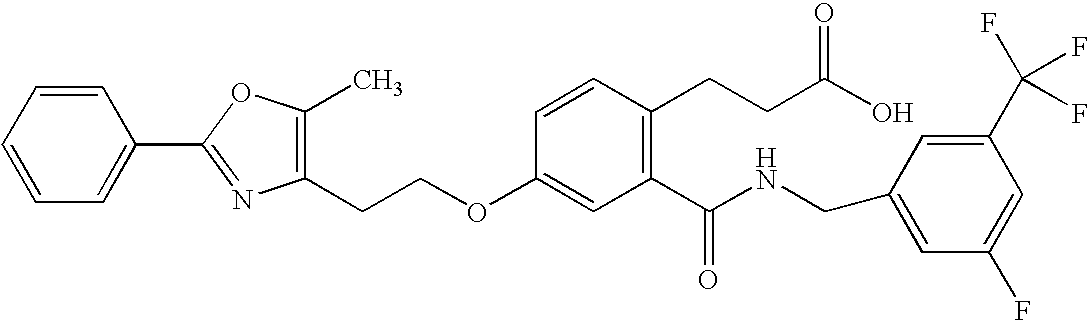 |
3-{2-(3-Fluoro-5-trifluorometh-yl-benzylcarbamoyl)-4-[2-(5-meth-yl-2-phenyl-oxa-zol-4-yl)-ethoxy]-phe-nyl}-propionic acid | 571.1 |
| 622 |
 |
3-{2-(3,5-Difluoro-benzyl-carbamoyl)-4-[2-(5-meth-yl-2-phenyl-oxazol-4-yl)-eth-oxy]-phenyl}-pro-pionic acid | 521.1 |
| 623 |
 |
3-{2-(3,5-Dichloro-benzyl-carbamoyl)-4-[2-(5-meth-yl-2-phenyl-oxazol-4-yl)-eth-oxy]-phenyl}-pro-pionic acid | 553 |
| 624 |
 |
(R)-3-[4-[2-(5-Methyl-2-phe-nyl-oxazol-4-yl)-eth-oxy]-2-(1-phenyl-eth-ylcarbamoyl)-phenyl]-pro-pionic acid | 499.2 |
| 625 |
 |
3-{2-(Benzyl-ethyl-car-bamoyl)-4-[2-(5-meth-yl-2-phenyl-oxazol-4-yl)-eth-oxy]-phenyl}-pro-pionic acid | 513.2 |
| 626 |
 |
3-{2-(Benzyl-methyl-car-bamoyl)-4-[2-(5-meth-yl-2-phenyl-oxazol-4-yl)-eth-oxy]-phenyl}-pro-pionic acid | 499.2 |
| 627 |
 |
(S)-3-{2-[(Carboxy-phenyl-meth-yl)carbamoyl]-4-[2-(5-meth-yl-2-phenyl-oxa-zol-4-yl)-ethoxy]-phe-nyl}-propionic acid | 529.1 |
| 628 |
 |
(S)-3-[4-[2-(5-Methyl-2-phe-nyl-oxazol-4-yl)-eth-oxy]-2-(1-phenyl-eth-ylcarbamoyl)-phenyl]-pro-pionic acid | 499.2 |
| 629 |
 |
3-{2-Benzylcarbamoyl-4-[2-(2-bi-phenyl-3-yl-5-meth-yl-oxazol-4-yl)-eth-oxy]-phenyl}-propionicacid | 561.3 |
| 630 |
 |
3-{2-Benzylcarbamoyl-4-[2-(2-bi-phenyl-4-yl-5-meth-yl-oxazol-4-yl)-eth-oxy]-phenyl}-propionicacid | 561.3 |
| 631 |
 |
3-{2-Benzyl-carbamoyl-4-[2-(2-cyclo-hexyl-5-methyl-oxa-zol-4-yl)-ethoxy]-phe-nyl}-propionic acid | 491.3 |
| 632 |
 |
3-(2-Benzyl-carbamoyl-4-{2-[5-meth-yl-2-(1-methyl-cyclo-hexyl)-oxazol-4-yl]-eth-oxy}-phenyl)-propionicacid | 505.4 |
| 633 |
 |
3-{2-Benzyl-carbamoyl-4-[2-(5-meth-yl-2-morpholin-4-yl-thia-zol-4-yl)-ethoxy]-phe-nyl}-propionic acid | 510.3 |
| 634 |
 |
(R)-3-[4-[2-(2-Bi-phenyl-4-yl-5-meth-yl-oxazol-4-yl)-eth-oxy]-2-(1-phenyl-eth-ylcarbamoyl)-phenyl]-pro-pionic acid | 575.3 |
| 635 |
 |
(R)-3-[4-[2-(2-Bi-phenyl-3-yl-5-meth-yl-oxazol-4-yl)-eth-oxy]-2-(1-phenyl-eth-ylcarbamoyl)-phenyl]-pro-pionic acid | 575.3 |
| 636 |
 |
(R)-3-[4-[2-(5-Methyl-2-mor-pholin-4-yl-thiazol-4-yl)-eth-oxy]-2-(1-phenyleth-ylcarbamoyl)-phenyl]-pro-pionic acid | 524.2 |
| 637 |
 |
3-[4-[2-(2-Biphenyl-4-yl-5-meth-yl-oxazol-4-yl)-eth-oxy]-2-(3,5-difluoro-ben-zylcarbamoyl)-phenyl]-pro-pionic acid | 597.3 |
| 638 |
 |
3-[4-[2-(2-Biphenyl-3-yl-5-meth-yl-oxazol-4-yl)-eth-oxy]-2-(3,5-difluoro-ben-zylcarbamoyl)-phenyl]-pro-pionic acid | 597.3 |
| 639 |
 |
3-{2-(3,5-Difluoro-ben-zylcarbamoyl)-4-[2-(5-meth-yl-2-morpholin-4-yl-thia-zol-4-yl)-ethoxy]-phe-nyl}-propionic acid | 546.1 |
| 640 |
 |
3-{2-(3,5-Difluoro-ben-zylcarbamoyl)-4-[2-(5-meth-yl-2-phenyl-thiazol-4-yl)-eth-oxy]-phenyl}-pro-pionic acid | 537.1 |
| 641 |
 |
3-(2-Benzyl-carbamoyl-4-{2-[5-meth-yl-2-(4-phe-noxy-phenyl)-oxazol-4-yl]-eth-oxy}-phenyl)-pro-pionic acid | 577.3 |
| 642 |
 |
3-[2-Benzyl-carbamoyl-4-(2-{5-meth-yl-2-[4-(methyl-phe-nyl-amino)-phenyl]-oxa-zol-4-yl}-ethoxy)-phe-nyl]-propionic acid | 590.2 |
| 643 |
 |
3-(2-Benzyl-carbamoyl-4-{2-[5-meth-yl-2-(4-phenyl-amino-phenyl)-oxa-zol-4-yl]-ethoxy}-phe-nyl)-propionic acid | 576.2 |

Step A: 3-{2-Formyl-4-[2-(5-methyl-2-phenyloxazol-4-yl)ethoxy]phenyl}acrylic acid tert-butyl ester

A flame-dried 100 mL round bottomed flask was charged with toluene-4-sulfonic acid 2-(5-methyl-2-phenyloxazol-4-yl)ethyl ester (3.74 g, 10.5 mmol), 3-(2-formyl-4-hydroxyphenyl)acrylic acid tert-butyl ester (2.0 g, 8.05 mmol), and anhydrous DMF (40 mL). Cesium carbonate (3.94 g, 12.1 mmol) was added, and the reaction was heated to 55° C. under a nitrogen atmosphere for 18 h. The volatiles were removed in vacuo, and the crude residue was dissolved in EtOAc (250 mL). The organic layer was washed with brine (2×), dried (Na2SO4), and concentrated to a yellow oil (1.70 g, 49%). 1H NMR (400 MHz, CDCl3) δ 1.54 (s, 9H), 2.38 (s, 3H), 3.01 (t, J=6.6 Hz, 2H), 4.34 (t, J=6.6 Hz, 2H), 6.24 (d, J=15.6 Hz, 1H), 7.12 (dd, J=8.8, 2.9 Hz, 1H), 7.38 (d, J=2.9 Hz, 1H), 7.40-7.45 (m, 3H), 7.58 (d, J=8.8 Hz, 1H), 7.98 (dd, J=6.4, 2.0 Hz, 2H), 8.33 (d, J=15.6 Hz, 1H), 10.3 (s, 1H). MS (ES) m/e 434 (M+1).
Step B: 3-{2-Formyl-4-[2-(5-methyl-2-phenyloxazol-4-yl)ethoxy]phenyl}acrylic acid tert-butyl ester
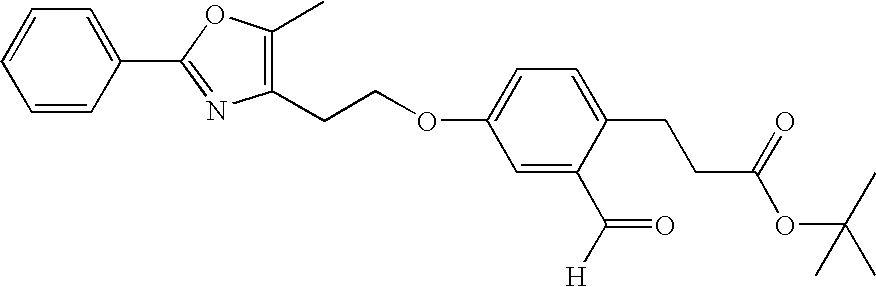
A 100 mL round bottomed flask was charged with 3-{2-formyl-4-[2-(5-methyl-2-phenyloxazol-4-yl)-ethoxy]phenyl}acrylic acid tert-butyl ester (1.69 g, 3.90 mmol), THF (40 mL), and then 10% Pd/C catalyst (0.17 g). The reaction was stirred vigorously under a hydrogen atmosphere at one atmosphere for 18 h. The mixture was filtered through Celite and concentrated to a yellow solid (1.70 g, quantitative). 1H NMR (400 MHz, CDCl3) δ 1.39 (d, J=4.9 Hz, 9H), 2.37 (d, J=2.9 Hz, 3H), 2.51 (t, J=7.6 Hz, 2H), 2.99 (t, J=6.6 Hz, 2H), 3.23 (t, J=7.1 Hz, 2H), 4.29 (t, J=6.6 Hz, 2H), 7.04-7.10 (m, 1H), 7.21 (d, J=8.3 Hz, 1H), 7.34 (d, J=2.4 Hz, 1H), 7.38-7.45 (m, 3H), 7.97 (dd, J=7.3, 2.0 Hz, 2H), 10.2 (s, 1H). MS (ES) m/e 436 (M+1).
Step C: 3-{2-Hydroxymethyl-4-[2-(2-phenyl-oxazol-4-yl)ethoxy]phenyl}propionic acid tert-butyl ester

A 100 mL round bottomed flask was charged with 3-{2-formyl-4-[2-(2-phenyloxazol-4-yl)ethoxy]phenyl}propionic acid tert-butyl ester (1.82 g, 4.18 mmol) and absolute ethanol (20 mL). The stirring solution was cooled in an ice/ethanol bath and treated with sodium borohydride (0.31 g, 8.36 mmol). The cold bath was removed, and the mixture was stirred at ambient temperature under a nitrogen atmosphere for 2 h. The reaction mixture was poured into EtOAc (100 mL) and ice water (100 mL). The organic layer was washed with brine, dried (Na2SO4), and concentrated to a yellow oil (1.62 g, 88%). 1H NMR (400 MHz, CDCl3) δ 1.38 (s, 9H), 2.37 (s, 3H), 2.54 (t, J=7.6 Hz, 2H), 2.88 (t, J=7.6 Hz, 2H), 2.97 (t, J=6.6 Hz, 2H), 4.23 (t, J=6.6 Hz, 2H), 4.66 (s, 2H), 6.78 (dd, J=8.3, 2.9 Hz, 1H), 6.94 (d, J=2.4 Hz, 1H), 7.09 (d, J=8.3 Hz, 1H), 7.38-7.45 (m, 3H), 7.97 (dd, J=8.1, 1.7 Hz, 2H). MS (ES) m/e 438 (M+1).
Step D: 3-{2-Cyclopentylcarbamoyloxymethyl-4-[2-(2-phenyloxazol-4-yl)ethoxy]phenyl}-propionic acid tert-butyl ester

A 15 mL round bottomed flask was charged with 3-{2-hydroxymethyl-4-[2-(2-phenyloxazol-4-yl)ethoxy]phenyl}propionic acid tert-butyl ester (0.10 g, 0.23 mmol), cyclopentylisocyanate (0.15 mL, 1.38 mmol), and anhydrous CH2Cl2 (0.75 mL). A 1.0 M HCl solution in ether (0.115 mL, 0.115 mmol) was added, and the reaction mixture was stirred at ambient temperature under a nitrogen atmosphere for 24 h. The reaction mixture was diluted with CH2Cl2, (30 mL), washed with brine, dried (Na2SO4), and concentrated to an oil. The crude product was purified using radial chromatography (EtOAc:hexanes 10:90 to 35:65) to a colorless oil (0.105 g, 83%). 1H NMR (400 MHz, CDCl3) 1.42 (s, 9H), 1.56-1.65 (m, 4H), 1.94-2.04 (m, 2H), 2.37 (s, 3H), 2.46 (t, J=7.6 Hz, 2H), 2.87 (t, J=8.1 Hz, 2H), 2.96 (t, J=6.6 Hz, 2H), 3.97 (br s, 1H), 4.22 (t, J=6.6 Hz, 2H), 4.76 (br s, 1H), 5.07 (s, 2H), 6.90 (dd, J=8.3, 2.4 Hz, 1H), 6.89 (s, 1H), 7.10 (d, J=8.8 Hz, 1H), 7.40-7.45 (m, 3H), 7.96-7.98 (m, 2H). MS (ES) m/e 549 (M+1).
Step E: 3-{2-Cyclopentylcarbamoyloxymethyl-4-[2-(2-phenyloxazol-4-yl)ethoxy]phenyl}-propionic acid
A 15 mL round bottom flask was charged with 3-{2-cyclopentylcarbamoyloxymethyl-4-[2-(2-phenyloxazol-4-yl)ethoxy]phenyl}propionic acid tert-butyl ester (0.097 g, 0.18 mmol), CH2Cl2 (1.2 mL), and then trifluoroacetic acid (1.2 mL). The solution was stirred at ambient temperature under a nitrogen atmosphere for 4 h and was concentrated. The residue was purified using radial chromatography (MeOH:CH2Cl2 2:98 to 10:90) to give a white solid (0.085 g, 93%). 1H NMR (400 MHz, CDCl3) δ 1.37 (br s, 2H), 1.63 (br s, 4H), 1.93-2.05 (m, 2H), 2.39 (s, 3H), 2.64 (br s, 2H), 2.91-3.18 (m, 4H), 3.99 (br s, 1H), 4.21 (s, 2H), 4.87 (br s, 1H), 5.10 (br s, 2H), 6.80 (s, 1H), 6.89 (s, 1H), 7.00-7.25 (br s, 1H), 7.36-7.52 (m, 3H), 7.95 (s, 2H). MS (ES) m/e 493 (M+1).
The following Examples 645 to 651 are prepared by following a substantially similar procedure as described in Example 644.
MS (ES) m/e 523 (M+1).

1H NMR (400 MHz, CDCl3) δ 1.13 (d, J=5.4 Hz, 6H), 2.37 (s, 3H), 2.61 (t, J=7.8 Hz, 2H), 2.92-2.98 (m, 4H), 3.80 (br s, 1H), 4.21 (t, J=6.6 Hz, 2H), 4.66 (br s, 1H), 5.08 (s, 2H), 6.81 (dd, J=8.6, 2.7 Hz, 1H), 6.90 (s, 1H), 7.11 (d, J=8.3 Hz, 1H), 7.41-7.44 (m, 3H), 7.97 (dd, J=4.4, 2.9 Hz, 2H). MS (ES) m/e 467 (M+1).
MS (ES) m/e 571 (M+1).

1H NMR (400 MHz, CDCl3) 2.37 (s, 3H), 2.60 (t, J=7 Hz, 2H), 2.92-2.97 (m, 4H), 4.20 (t, J=7 Hz, 2H), 4.36 (d, J=5.9 Hz, 2H), 5.13 (s, 2H), 5.18 (br s, 1H), 6.80 (d, J=8.3 Hz, 1H), 6.91 (s, 1H), 7.10 (d, J=8.3 Hz, 1H), 7.24-7.30 (m, 5H), 7.42 (s, 3H), 7.97 (s, 2H). MS (ES) m/e 515 (M+1).

MS (ES) m/e 495 (M+1).
MS (ES) m/e 563 (M+1)

1H NMR (400 MHz, CDCl3) 1.08-1.18 (m 3H), 1.21-1.42 (m, 2H), 1.57 (br s, 1H), 1.66-1.70 (m, 2H), 1.90 (br s, 2H), 2.40 (s, 3H), 2.61 (t, J=7.7 Hz, 2H), 2.94 (t, J=7.8 Hz, 2H), 3.01 (t, J=6.4 Hz, 2H), 3.48 (br s, 1H), 4.22 (t, J=6.4 Hz, 2H), 4.74 (br s, 1H), 5.07 (s, 2H), 6.79-6.89 (m, 1H), 6.90 (s, 1H), 7.11 (d, J=8.3 Hz, 1H), 7.44-7.46 (m, 3H), 7.98 (dd, J=6.7, 2.8 Hz, 2H). MS (ES) m/e 507 (M+1).

Step A: 3-[4-(tert-Butyldiphenylsilanyloxy)-2-formylphenyl]acrylic acid tert-butyl ester

A flame-dried 200 mL round bottomed flask was charged with 3-(2-formyl-4-hydroxyphenyl)acrylic acid tert-butyl ester (10.0 g, 40.3 mmol), tert-butylchlorodiphenylsilane (12.6 mL, 48.3 mmol), and dry CH2Cl2 (150 mL). Triethylamine (11.2 mL, 80 mmol) and N,N-dimethylaminopyridine (1.0 g, 1.0 mmol) were added, and the mixture was stirred at ambient temperature under a nitrogen atmosphere for 16 h. The reaction mixture was diluted with additional CH2Cl2, washed with brine (2×), dried (Na2SO4), and concentrated to an oil. The crude product was purified using the Biotage medium pressure chromatography system (EtOAc:hexanes 5:95) to give a pale yellow oil (18.3 g, 93%). 1H NMR (400 MHz, CDCl3) δ 1.12 (s, 9H), 1.51 (d, J=15.1 Hz, 9H), 6.15 (d, J=5.1 Hz, 1H), 6.87 (dd, J=8.6, 2.7 Hz, 1H), 7.34-7.47 (m, 7H), 7.68-7.73 (m, 5H), 8.28 (d, J=15.6 Hz, 1H), 10.1 (s, 1H). MS (ES) m/e 487 (M+1).
Step B: 3-[4-(tert-Butyldiphenylsilanyloxy)-2-hydroxymethylphenyl]propionic acid tert-butyl ester

A 500 mL Parr hydrogenation bottle was charged with 3-[4-(tert-butyldiphenylsilanyloxy)-2-formylphenyl]acrylic acid tert-butyl ester (18.3 g, 37.6 mmol), THF (60 mL), and methanol (120 mL). Triethylamine (2 mL) and then 5% Pd/C (5.9 g) were added. The mixture was shaken with hydrogen at 60 psi pressure for 48 h. The mixture was filtered through Celite and concentrated to an oil. This oil was purified using the Biotage medium pressure chromatography (EtOAc:hexanes 15:85) to a pale yellow oil (12.8 g, 69%). 1H NMR (400 MHz, CDCl3) δ 1.09 (s, 9H), 1.35 (s, 9H), 2.49 (t, J=7.6 Hz, 2H), 2.83 (t, J=7.6 Hz, 2H), 4.55 (s, 2H), 6.56 (dd, J=8.3, 2.4 Hz, 1H), 6.83 (d, J=2.9 Hz, 1H), 6.87 (d, J=8.3 Hz, 1H), 7.33-7.44 (m, 6H), 7.70 (dd, J=7.8, 1.5 Hz, 4H). MS (ES) m/e 508 (M+NH4).
Step C: 3-[4-(tert-Butyldiphenylsilanyloxy)-2-cyclohexylcarbamoyloxymethylphenyl]propionic acid tert-butyl ester

A 100 mL round bottomed flask under N2 were charged with 3-[4-(tert-butyldiphenylsilanyloxy)-2-hydroxymethylphenyl]propionic acid tert-butyl ester (3.0 g, 6.11 mmol), cyclohexylisocyanate (4.7 mL, 36.7 mmol), and anhydrous CH2Cl2 (25 mL). A 1.0 M HCl solution in ether (3.06 mL, 3.06 mmol) was added, and the reaction mixture was stirred at ambient temperature under a nitrogen atmosphere for 16 h. The mixture was diluted with CH2Cl2 (100 mL), washed with brine, dried (Na2SO4), and concentrated to a brown oil. This crude oil was purified using the Biotage medium pressure chromatography system (EtOAc:hexanes 5:95) to a colorless oil (3.1 g, 82%). 1H NMR (400 MHz, CDCl3) 1.08-1.24 (m, 1H), 1.26-1.40 (m, 11H), 1.56-1.62 (m, 2H), 1.68-1.72 (m, 2H), 2.41 (t, J=8.3 Hz, 2H), 2.80 (t, J=7.8 Hz, 2H), 3.47 (br s, 1H), 4.56 (br s, 1H), 4.95 (s, 2H), 6.57 (dd, J=8.3, 2.7 Hz, 1H), 6.80 (s, 1H), 6.87 (d, J=8.6 Hz, 1H), 7.33-7.44 (m, 6H), 7.69-7.72 (m, 4H). MS (ES) m/e 616 (M+1).
Step D: 3-(2-Cyclohexylcarbamoyloxymethyl-4-hydroxyphenyl)propionic acid tert-butyl ester

A 500 mL round bottomed flask was charged with 3-[4-(tert-butyldiphenylsilanyloxy)-2-cyclohexylcarbamoyloxymethylphenyl]propionic acid tert-butyl ester (3.1 g, 5.03 mmol) and anhydrous THF (180 mL). Tetrabutylammonium fluoride (15.1 mL, 15.1 mmol, 1.0M in THF) was added, and the reaction mixture was stirred at ambient temperature under a nitrogen atmosphere for 4 h. The mixture was concentrated, and the residue was diluted with EtOAc (100 mL), washed with brine, dried over (Na2SO4), and concentrated to give an oil. This crude oil was purified using the Biotage medium pressure chromatography system (EtOAc:hexanes 10:90 to 50:50) to a colorless oil (1.67 g, 88%). 1H NMR (400 MHz, CDCl3) δ 1.04-1.19 (m, 3H), 1.24-1.38 (m, 2H), 1.42 (s, 9H), 1.57-1.62 (m, 1H), 1.66-1.71 (m, 2H), 1.91-2.05 (m, 2H), 2.47 (t, J=7.8 Hz, 2H), 2.88 (t, J=7.8 Hz, 2H), 3.48-3.50 (m, 1H), 4.77-4.78 (m, 1H), 5.07 (s, 2H), 5.40 (s, 1H), 6.73 (dd, J=8.3, 2.9 Hz, 1H), 6.84 (d, J=2.4 Hz, 1H), 7.07 (d, J=8.3 Hz, 1H). MS (ES) m/e 378 (M+1).
Step E: 3-{2-Cyclohexylcarbamoyloxymethyl-4-[2-(5-methyl-2-phenyloxazol-4-yl)ethoxy]phenyl}propionic acid tert-butyl ester

A 40 mL Carousel tube was charged with 3-(2-cyclohexylcarbamoyloxymethyl-4-hydroxyphenyl)propionic acid tert-butyl ester (0.10 g, 0.26 mmol) in anhydrous DMF (1.0 mL). Toluene-4-sulfonic acid 2-(5-methyl-2-phenyloxazol-4-yl)ethyl ester (0.104 g, 0.292 mmol) and cesium carbonate (0.13 g, 0.40 mmol) were added. The mixture was stirred and heated at 55° C. under a nitrogen atmosphere for 30 h and was concentrated. The residue was diluted with EtOAc (50 mL) and washed twice with brine (2×), dried (Na2SO4), and concentrated. The crude residue was purified using radial chromatography (EtOAc: CH2Cl2 2:98 to 5:95) to give a white solid (0.085 g, 57%). 1H NMR (400 MHz, CDCl3) 1.07-1.19 (m, 3H), 1.24-1.38 (m, 2H), 1.42 (s, 9H), 1.56-1.60 (m, 1H), 1.67-1.70 (m, 2H), 1.91-1.93 (m, 2H), 2.37 (s, 3H), 2.46 (t, J=7.8 Hz, 2H), 2.88 (t, J=7.8 Hz, 2H), 2.96 (t, J=7.8 Hz, 2H), 3.48-3.50 (m, 1H), 4.22 (t, J=6.8 Hz, 2H), 4.69-4.71 (m, 1H), 5.07 (s, 2H), 6.80 (dd, J=8.3, 2.4 Hz, 1H), 6.90 (d, J=2.4 Hz, 1H), 7.10 (d, J=8.3 Hz, 1H), 7.39-7.45 (m, 3H), 7.98 (dd, J=4.2, 2.2 Hz, 2H). MS (ES) m/e 563 (M+1).
Step F: 3-{2-Cyclohexylcarbamoyloxymethyl-4-[2-(5-methyl-2-phenyloxazol-4-yl)ethoxy]phenyl}propionic acid
A 25 mL round bottomed flask was charged with 3-{2-cyclohexylcarbamoyloxymethyl-4-[2-(5-methyl-2-phenyloxazol-4-yl)ethoxy]phenyl}-propionic acid tert-butyl ester (0.080 g, 0.14 mmol) and CH2Cl2 (2 mL). Trifluoroacetic acid (2 mL) was added, and the solution was stirred at ambient temperature under a nitrogen atmosphere for 1.5 h. The solution was concentrated to give a white solid (0.068 g, 94%). 1H NMR (400 MHz, CDCl3) 1.08-1.18 (m 3H), 1.21-1.42 (m, 2H), 1.57 (br s, 1H), 1.66-1.70 (m, 2H), 1.90 (br s, 2H), 2.40 (s, 3H), 2.61 (t, J=7.7 Hz, 2H), 2.94 (t, J=7.8 Hz, 2H), 3.01 (t, J=6.4 Hz, 2H), 3.48 (br s, 1H), 4.22 (t, J=6.4 Hz, 2H), 4.74 (br s, 1H), 5.07 (s, 2H), 6.79-6.89 (m, 1H), 6.90 (s, 1H), 7.11 (d, J=8.3 Hz, 1H), 7.44-7.46 (m, 3H), 7.98 (dd, J=6.7, 2.8 Hz, 2H). MS (ES) m/e 507 (M+1).
The following Examples 653 to 661 are prepared by following a substantially similar procedure as described in Example 652.

MS (ES) m/e 639 (M+1).

1H NMR (400 MHz, CDCl3) 1.14-1.25 (m, 3H), 1.31-1.34 (m, 2H), 1.56-1.66 (m, 1H), 1.69-1.70 (m, 2H), 1.89 (br s, 2H), 2.46 (s, 3H), 2.62 (t, J=7.6 Hz, 2H), 2.93 (t, J=7.8 Hz, 2H), 3.11 (t, J=5.9 Hz, 2H), 3.47 (br s, 1H), 4.24 (t, J=5.9 Hz, 2H), 4.83 (br s, 1H), 5.08 (s, 2H), 6.80 (d, J=6.8 Hz, 1H), 6.90 (d, J=2.9 Hz, 1H), 7.11 (d, J=8.3 Hz, 1H), 7.41 (d, J=7.3 Hz, 1H), 7.48 (t, J=7.6 Hz, 2H), 7.64 (d, J=7.3 Hz, 2H), 7.74 (d, J=8.3 Hz, 2H), 8.09 (d, J=8.3 Hz, 2H). MS (ES) m/e 583 (M+1).
MS (ES) m/e 639 (M+1)
1H NMR (400 MHz, CDCl3) 1.26-1.41 (m, 3H), 1.44-1.56 (m, 2H), 1.75 (br s, 1H), 1.84-1.88 (m, 2H), 2.08-2.10 (m, 2H), 2.63 (s, 3H), 2.80 (t, J=7.8 Hz, 2H), 3.12 (t, J=7.9 Hz, 2H), 3.27 (t, J=6.1 Hz, 2H), 3.66 (br s, 4.42 (t, J=6.1 Hz, 2H), 4.97 (br s, 1H), 5.27 (s, 2H), 7.04 (d, J=6.4 Hz, 1H), 7.08 (d, J=2.4 Hz, 1H), 7.30 (d, J=8.3 Hz, 1H), 7.55-7.76 (m, 4H), 7.85-7.86 (m, 2H), 7.92 (d, J=7.8 Hz, 1H), 8.15 (d, J=7.8 Hz, 1H), 8.44 (d, J=1.5 Hz, 1H). MS (ES) m/e 583 (M+1).
MS (ES) m/e 588 (M+1)
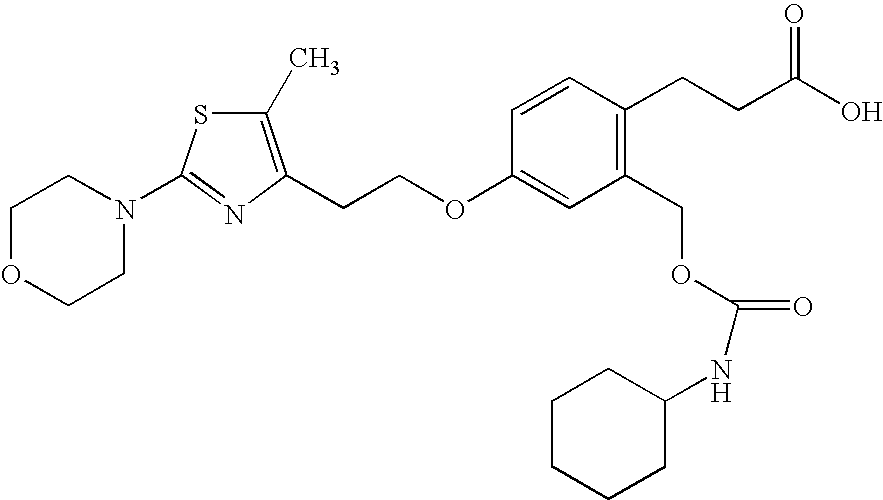
1H NMR (400 MHz, CDCl3) 1.11-1.37 (m, 5H), 1.57-1.61 (m, 1H), 1.68-1.72 (m, 2H), 1.90-1.93 (m, 2H), 2.29 (s, 3H), 2.58 (t, J=7.8 Hz, 2H), 2.90 (t, J=7.6 Hz, 2H), 3.06 (t, J=5.1 Hz, 2H), 3.47-3.50 (m, 1H), 3.66 (t, J=4.6 Hz, 4H), 3.85 (t, J=4.9 Hz, 4H), 4.20 (t, J=5.4 Hz, 2H), 5.06 (s, 2H), 6.74 (d, J=8.3 Hz, 1H), 6.86 (s, 1H), 7.08 (d, J=8.3 Hz, 1H). MS (ES) m/e 532 (M+1).
MS (ES) m/e 655 (M+1)

1H NMR (400 MHz, CDCl3) 1.15-1.24 (m, 3H), 1.26-1.34 (m, 2H), 1.57 (br s, 1H), 1.67-1.70 (m, 2H), 1.90 (br s, 2H), 2.43 (s, 3H), 2.61 (t, 7.6 Hz, 2H), 2.93 (t, J=7.3 Hz, 2H), 3.08 (t, J=5.6 Hz, 2H), 3.47-3.52 (m, 1H), 4.22 (t, J=5.6 Hz, 1H), 4.84 (br s, 1H, 1H), 6.79 (d, 2.4 Hz, 1H), 6.88 (d, J=2.4 Hz, 1H), 7.00-7.12 (m, 5H), 7.21 (t, J=7.6 Hz, 1H), 7.41 (t, J=7.8 Hz, 2H), 7.99 (d, 8.8 Hz, 2H). MS (ES) m/e 599 (M+1).

MS (ES) m/e 641 (M+1).

Step A: 3-(2-Cyclohexylcarbamoyloxymethyl-4-{2-[5-methyl-2-(4-morpholin-4-ylphenyl)oxazol-4-yl]ethoxy}phenyl)propionic acid tert-butyl ester

A 1 mL microvial under a nitrogen atmosphere was charged with 3-(4-{2-[2-(4-bromophenyl)-5-methyloxazol-4-yl]ethoxy}-2-cyclohexylcarbamoyloxymethylphenyl)-propionic acid tert-butyl ester (0.30 g, 0.468 mmol; Example 39), anhydrous toluene (0.5 mL), and then morpholine (0.053 mL, 0.61 mmol). Tris(dibenzylideneacetone)-dipalladium(0) (0.004 g, 0.0044 mmol), 2-(di-tert-butylphosphine)biphenyl (0.006 g, 0.020 mmol), and sodium tert-butoxide (0.063 g, 0.655 mmol) were added sequentially. The mixture was stirred at ambient temperature under a nitrogen atmosphere for 5 h and was poured into EtOAc (50 mL). The organic layer was washed with brine (2×), dried (Na2SO4), and concentrated to a dark yellow oil. This crude product was purified using radial chromatography (EtOAc:hexanes 15:85 to 50:50) to give a yellow oil (0.058 g, 19%). 1H NMR (400 MHz, CDCl3) 1.07-1.18 (m, 3H), 1.29-1.40 (m, 1H), 1.42 (s, 9H), 1.52-1.70 (m, 4H), 1.91-1.93 (m, 2H), 2.34 (s, 3H), 2.46 (t, J=8.1 Hz, 2H), 2.87 (t, J=7.8 Hz, 2H), 2.94 (t, J=6.8 Hz, 2H), 3.24 (t, J=4.9 Hz, 4H), 3.48-3.50 (m, 1H), 3.86 (t, J=4.9 Hz, 4H), 4.20 (t, J=6.6 Hz, 2H), 5.07 (s, 2H), 6.79 (dd, J=8.6, 2.7 Hz, 1H), 6.85-6.93 (m, 3H), 7.09 (d, J=8.3 Hz, 1H), 7.87 (dd, J=11.5, 2.7 Hz, 2H). MS (ES) m/e 648 (M+1).
Step B: 3-(2-Cyclohexylcarbamoyloxymethyl-4-{2-[5-methyl-2-(4-morpholin-4-ylphenyl)oxazol-4-yl]ethoxy}phenyl)propionic acid
A 15 mL round bottomed flask was charged with 3-(2-cyclohexylcarbamoyloxymethyl-4-{2-[5-methyl-2-(4-morpholin-4-ylphenyl)oxazol-4-yl]ethoxy}phenyl)propionic acid (0.058 g, 0.09 mmol) and CH2Cl2 (1 mL). Trifluoroacetic acid (0.5 mL) was added, and the solution was stirred at ambient temperature under a nitrogen atmosphere for 1.5 h. The mixture was concentrated to give a yellow solid (0.052 g, 98%). 1H NMR (400 MHz, CDCl3) 1.03-1.11 (m, 3H), 1.18-1.30 (m, 2H), 1.45-1.50 (m, 1H), 1.60-1.63 (m, 2H), 1.82-1.85 (m, 2H), 2.38 (s, 3H), 2.52 (t, J=7.6 Hz, 2H), 2.84 (t, J=7.6 Hz, 2H), 3.04 (t, J=5.6 Hz, 2H), 3.30 (t, J=4.9 Hz, 4H), 3.39 (br s, 1H), 3.80 (t, J=4.9 Hz, 4H), 4.17 (t, J=5.9 Hz, 2H), 4.86 (br s, 1H), 4.99 (s, 2H), 6.70 (d, J=8.3 Hz, 1H), 6.81 (d, J=2.4 Hz, 1H), 7.03 (d, J=8.3 Hz, 1H), 7.90 (d, J=9.3 Hz, 2H). MS (ES) m/e 592 (M+1).
The following Examples 663 to 664 are prepared by following a substantially similar procedure as described in Example 662.

1H NMR (400 MHz, CDCl3) 1.11-1.42 (m, 5H), 1.56 (br s, 1H), 1.66-1.69 (m, 2H), 1.89-1.92 (m, 2H), 2.38 (s, 3H), 2.60 (t, J=7 Hz, 2H), 2.91 (t, J=7 Hz, 2H), 3.03 (t, J=5.6 Hz, 2H), 4.22 (t, J=6.1 Hz, 2H), 4.86 (br s, 1H), 5.06 (s, 2H), 6.78 (d, J=7.8 Hz, 1H), 6.89 (s, 1H), 7.04-7.10 (m, 4H), 7.16 (d, J=7.8 Hz, 2H), 7.34 (t, J=7.8 Hz, 2H), 7.88 (d, J=8.3 Hz, 2H). MS (ES) m/e 598 (M+1).

1H NMR (400 MHz, CDCl3) 1.02-1.35 (m, 5H), 1.56(br s, 1H), 1.67-1.70 (m, 2H), 1.89 (br s, 2H), 2.41 (s, 3H), 2.60 (t, J=7 Hz, 2H), 2.91 (t, J=7 Hz, 2H), 3.09 (t, J=7 Hz, 2H), 3.39 (s, 3H), 3.47 (br s, 1H), 4.24 (t, J=7 Hz, 2H), 4.95 (br s, 1H), 5.06 (s, 2H), 6.81 (d, J=8.3 Hz, 2H), 6.89 (s, 1H), 7.09 (d, J=7.8 Hz, 1H), 7.23 (t, J=7.6 Hz, 3H), 7.43 (t, J=7.8 Hz, 3H), 7.87 (d, J=8.8 Hz, 2H). MS (ES) m/e 612 (M+1).

Step A: 3-{2-Methoxymethyl-4-[2-(5-methyl-2-phenyloxazol-4-yl)ethoxy]phenyl}propionic acid tert-butyl ester

A 15 mL round bottomed flask was charged with 3-{2-hydroxymethyl-4-[2-(5-methyl-2-phenyloxazol-4-yl)ethoxy]phenyl}propionic acid tert-butyl ester (0.10 g, 0.23 mmol) and methyl iodide (0.21 mL, 2.3 mmol) in anhydrous DMF (1 mL) under a nitrogen atmosphere. The mixture was cooled in an ice bath and treated in one portion with NaH (0.018 g, 0.25 mmol, 60% oil dispersion). The reaction mixture was stirred for 2 h, concentrated, and diluted with EtOAc (40 mL). The organic layer was washed with brine (2×), dried (Na2SO4), and concentrated. The crude product was purified using radial chromatography (EtOAc:hexanes 10:90 to 25:75) to give a yellow oil (0.060 g, 58%). MS (ES) m/e 648 (M+1).
Step B: 3-{2-Methoxymethyl-4-[2-(5-methyl-2-phenyloxazol-4-yl)ethoxy]phenyl}propionic acid
A 15 mL round bottomed flask was charged 3-{2-methoxymethyl-4-[2-(5-methyl-2-phenyloxazol-4-yl)ethoxy]phenyl}propionic acid tert-butyl ester (0.060 g, 0.13 mmol), CH2Cl2 (1.2 mL), and then trifluoroacetic acid (0.6 mL). The solution was stirred at ambient temperature under a nitrogen atmosphere for 16 h and was concentrated. The residue was diluted with CH2Cl2 (30 mL) and washed with brine. The organic layer was dried (Na2SO4), filtered, and concentrated to give a white solid (0.046 g, 89%). MS (ES) m/e 648 (M+1).
The following Examples 666 to 673 are prepared by following a substantially similar procedure as described in Example 665.
MS (ES) m/e 528 (M+1)

MS (ES) m/e 472 (M+1).
MS (ES) m/e 466 (M+1)

MS (ES) m/e 410 (M+1).
MS (ES) m/e 584 (M+1)

MS (ES) m/e 410 (M+1).
MS (ES) m/e 604 (M+1)

MS (ES) m/e 410 (M+1).

Step A: 3-{2-Bromomethyl-4-[2-(5-methyl-2-phenyloxazol-4-yl)ethoxy]phenyl}propionic acid tert-butyl ester

A 100 mL round bottomed flask was charged with 3-{2-hydroxymethyl-4-[2-(5-methyl-2-phenyloxazol-4-yl)ethoxy]phenyl}propionic acid tert-butyl ester (1.0 g, 2.29 mmol), anhydrous THF (25 mL), and then triphenylphosphine (1.20 g, 4.57 mmol) and CBr4 (1.52 g, 4.57 mmol). The yellow mixture was stirred at ambient temperature under a nitrogen atmosphere for 1 h and was poured into EtOAc (100 mL). The organic layer was washed with brine, dried (Na2SO4), and concentrated. The crude product was purified using radial chromatography (EtOAc:hexanes 15:85 to 25:75) to give a colorless oil (0.95 g, 83%). MS (ES) m/e 501 (M+1).
Step B: 3-{2-sec-Butoxymethyl]4-[2-(5-methyl-2-phenyloxazol-4-yl)ethoxy]phenyl}propionic acid
A flame-dried 15 mL round bottomed flask was charged with 2-butanol (0.92 mL, 1.0 mmol), anhydrous DMF (1 mL), and then NaH (0.013 g, 0.2 mmol, 60% oil dispersion). The reaction mixture was cooled in an ice bath for 15 min, and 3-{2-bromomethyl-4-[2-(5-methyl-2-phenyloxazol-4-yl)ethoxy]phenyl}propionic acid tert-butyl ester ((0.050 g, 0.10 mmol) in anhydrous DMF (0.5 mL) was added. The reaction mixture was stirred under a nitrogen atmosphere for 2 h. A product mixture of free acid and tert-butyl ester formed. The reaction was poured into EtOAc (40 mL), washed with brine (3×), dried (Na2SO4), and concentrated. The crude oil was then dissolved directly in CH2Cl2 (1 mL) and treated with TFA (1.5 mL). The solution was stirred at ambient temperature for 16 h and concentrated. The crude product residue was purified using radial chromatography (EtOAc:hexanes 15:85 to 1:1) to give a yellow oil (0.012 g, 27%). MS (ES) m/e 438 (M+1).
The following Examples 675 to 680 are prepared by following a substantially similar procedure as described in Example 674.

MS (ES) m/e 424 (M+1).

MS (ES) m/e 464 (M+1).

MS (ES) m/e 438 (M+1).

MS (ES) m/e 478 (M+1).

MS (ES) m/e 534 (M+1).

MS (ES) m/e 452 (M+1).

General procedure for parallel synthesis using the DynaVac Carousel apparatus. A 50 mL glass tube with screw cap and nitrogen inlet was charged with 3-{2-bromomethyl-4-[2-(5-methyl-2-phenyloxazol-4-yl)ethoxy]phenyl}propionic acid tert-butyl ester (0.040 g, 0.080 mmol), 4-trifluoromethylphenol (0.019 g 0.12 mmol), anhydrous DMF (0.5 mL), and then cesium carbonate (0.039 g, 0.12 mmol). The mixture was stirred at ambient temperature for 16 h. MS analysis of the reaction indicated formation of the intermediate ester product [MS (ES) m/e 582 (M+1)]. The reaction mixture was poured into ether (30 mL). The organic layer was washed with brine (2×), dried (Na2SO4), and concentrated. The residue was diluted with CH2Cl2 (1 mL) and trifluroacetic acid (0.25 mL) was added. The mixture was stirred at ambient temperature for 1.5 h and was concentrated. The crude product mixture was purified by mass-directed reverse phase HPLC to provide the title compound (0.045 g, 64%). MS (ES) m/e 526 (M+1).
The following Examples 682 to 691 are prepared by following a substantially similar procedure as described in Example 681.

MS (ES) m/e 476 (M+1).

MS (ES) m/e 476 (M+1).

MS (ES) m/e 476 (M+1).

MS (ES) m/e 472 (M+1).

MS (ES) m/e 472 (M+1).

MS (ES) m/e 472 (M+1).

MS (ES) m/e 488 (M+1).

MS (ES) m/e 534 (M+1).

MS (ES) m/e 474 (M+1).

MS (ES) m/e 506 (M+1).

Step A: 3-[2-Bromomethyl-4-(tert-butyldiphenylsilanyloxy)phenyl]propionic acid tert-butyl ester

A 200 mL round bottomed flask was charged with 3-[4-(tert-butyldiphenylsilanyloxy)-2-hydroxymethylphenyl]propionic acid tert-butyl ester (3.03 g, 6.18 mmol), anhydrous THF (75 mL), and then triphenylphosphine (3.24 g, 12.4 mmol) and CBr4 (4.10 g, 12.4 mmol). The yellow mixture was stirred at ambient temperature under a nitrogen atmosphere for 1 h and was concentrated. The residue was diluted with EtOAc (500 mL). The organic layer was washed with brine (2×), dried (Na2SO4), and concentrated to a solid. The crude product was purified using a Biotage medium pressure chromatography system (EtOAc:hexanes 10:90) to give a yellow oil (2.95 g, 86%), MS (ES) m/e 572 (M+NH4).
Step B: 3-[4-(tert-Butyldiphenylsilanyloxy)-2-(4-trifluoromethylphenoxymethyl)phenyl]-propionic acid tert-butyl ester

A 50 mL round bottomed flask was charged with 3-[2-bromomethyl-4-(tert-butyldiphenylsilanyloxy)phenyl]propionic acid tert-butyl ester (1.0 g, 1.81 mmol), anhydrous DMF (10 mL), and then 4-trifluoromethylphenol (0.44 g, 2.7 mmol) and cesium carbonate (0.88 g, 2.7 mmol). The reaction mixture was stirred at ambient temperature under a nitrogen atmosphere for 18 h and concentrated. The residue was diluted with EtOAc (100 mL). The organic layer was washed with brine (2×), dried (Na2SO4), and concentrated to a yellow oil. The crude residue was purified using radial (EtOAc:hexanes 15:85 to 50:50) to give a yellow oil (0.66 g, 58%). MS (ES) m/e 635 (M+1).
Step C: 3-[4-Hydroxy-2-(4-trifluoromethylphenoxymethyl)phenyl]propionic acid tert-butyl ester

A 100 mL round bottomed flask was charged with 3-[4-(tert-butyldiphenylsilanyloxy)-2-(4-trifluoromethylphenoxymethyl)phenyl]propionic acid tert-butyl ester (0.65 g, 1.02 mmol), anhydrous THF (40 mL), and then tetrabutylammonium fluoride (3.1 mL, 3.1 mmol, 1.0 M in THF). The reaction was stirred under a nitrogen atmosphere for 1.5 h and was concentrated. The residue was diluted with EtOAc (100 mL). The organic layer was washed with brine (2×), dried (Na2SO4), and concentrated to an orange oil. The crude oil was purified using radial chromatography (EtOAc:hexanes 15:85) to give a white solid (0.31 g, 77%). MS (ES) m/e 395 (M−1).
Step D: 3-[4-[2-(2-Biphenyl-4-yl-5-methyloxazol-4-yl)ethoxy]-2-(4-trifluoromethylphenoxy-methyl)-phenyl]-propionic acid
General procedure for parallel synthesis using, the DynaVac Carousel apparatus: A 50 mL glass tube with screw cap and nitrogen inlet was charged with 3-[4-hydroxy-2-(4-trifluoromethylphenoxymethyl)phenyl]propionic acid tert-butyl ester (0.050 g, 0.146 mmol), toluene-4-sulfonic acid 2-(2-biphenyl-4-yl-5-methyloxazol-4-yl)ethyl ester (0.078 g, 0.18 mmol), anhydrous DMF (0.5 mL), and then cesium carbonate (0.072 g, 0.22 mmol). The mixture was stirred at ambient temperature for 16 h. MS analysis of the reaction indicated formation of the ester intermediate MS (ES) m/e 658 (M+1). The reaction mixture was poured into ether (30 mL). The organic layer was washed with brine (2×), dried (Na2SO4), and concentrated. The crude residue was diluted with CH2Cl2 (2 mL) and then trifluoroacetic acid (1 mL). The mixture was stirred at ambient temperature for 2 h and concentrated under a stream of N2. The crude product was purified by mass-directed reverse phase HPLC to provide the title compound (0.053 g, 71%). 1H NMR (250 MHz, CDCl3) 2.41 (s, 3H), 2.70 (t, J=7.7 Hz, 2H), 2.95-3.05 (m, 4H), 4.28 (t, J=6.6 Hz, 2H), 5.09 (s, 2H), 6.90 (dd, J=8.5, 2.8 Hz, 1H), 7.01 (d, J=2.6 Hz, 1H), 7.06 (d, J=8.6 Hz, 2H), 7.21 (d, J=8.5 Hz, 1H), 7.41-7.72 (m, 9H), 8.07 (d, J=8.4 Hz, 2H). MS (ES) m/e 602 (M+1).
The following Examples 693 to 697 are prepared by following a substantially similar procedure as described in Example 692.

MS (ES) m/e 532 (M+1).

MS (ES) m/e 551 (M+1).

MS (ES) m/e 602 (M+1).

MS (ES) m/e 618 (M+1).
MS (ES) m/e 596 (M+1)

Step A: 3-[2-Benzyloxymethyl-4-(tert-butyl-diphenyl-silanyloxy)-phenyl]-propionic acid tert-butyl ester

A 100 mL round bottomed flask was charged with 3-[4-(tert-butyldiphenylsilanyloxy)-2-hydroxymethylphenyl]propionic acid tert-butyl ester (1.52 g, 3.10 mmol), anhydrous DMF (15 mL), and then benzyl bromide (1.84 mL, 15.5 mmol) under a nitrogen atmosphere. The solution was cooled to −10° C., and NaH (0.124 g, 3.10 mmol, 60% oil dispersion) was added. The mixture was stirred for 5 h, and was poured into EtOAc (150 mL). The organic layer was washed with brine (2×), dried (Na2SO4), and concentrated to a brown oil. The crude oil was purified using radial chromatography (EtOAc:hexanes 2:98 to 5:95) to give a pale yellow oil (1.04 g, 58%). MS (ES) m/e 598 (M+NH4).
Step B: 3-(2-Benzyloxymethyl-4-hydroxy-phenyl)-propionic acid tert-butyl ester

A 250 mL round bottomed flask was charged with 3-[2-benzyloxymethyl-4-(tert-butyl-diphenyl-silanyloxy)-phenyl]-propionic acid tert-butyl ester (1.03 g, 1.77 mmol), anhydrous THF (60 mL), and then tetrabutylammonium fluoride (5.3 mL, 5.3 mmol, 1.0 M in THF). The reaction mixture was stirred under a nitrogen atmosphere for 1 h, concentrated, and diluted with EtOAc (100 mL). The organic layer was washed with brine (2×), dried (Na2SO4), and concentrated to give an oil. The crude oil was purified using radial chromatography (EtOAc:hexanes 10:90 to 50:50) to give a white solid (0.52 g, 86%). MS (ES) m/e 343 (M−1).
Step C: 3-{2-Benzyloxymethyl-4-[2-(2-cyclohexyl-5-methyl-oxazol-4-yl)-ethoxy]-phenyl}-propionic acid
General procedure for the parallel synthesis of analogs using the DynaVac Carousel apparatus: A 50 mL glass tube with screw cap and nitrogen inlet was charged with 3-(2-benzyloxymethyl-4-hydroxy-phenyl)-propionic acid tert-butyl ester (0.050 g, 0.146 mmol), toluene-4-sulfonic acid 2-(2-biphenyl-4-yl-5-methyloxazol-4-yl)ethyl ester (0.078 g, 0.18 mmol), anhydrous DMF (0.5 mL), and then cesium carbonate (0.072 g, 0.22 mmol). The mixture was stirred at ambient temperature for 16 h. MS analysis of the reaction indicated that the intermediate ester was formed, MS (ES) m/e 534 (M+1). The crude reaction was poured into ether (30 mL), and washed with brine (2×), dried (Na2SO4), and concentrated in vacuo. The crude residue was dissolved in CH2Cl2 (2 mL) and trifluoroacetic acid was added (1.0 mL). The reaction mixture was stirred at ambient temperature for 2 h and was concentrated under a stream of N2. The crude product was purified by mass-directed reverse phase HPLC to provide 0.053 g (71%) of 3-{4-[2-(2-Cyclohexyl-5-methyloxazol-4-yl)ethoxy]-2-phenoxymethylphenyl}propionic acid. MS (ES) m/e 478 (M+1).
The following Examples 699 to 704 are prepared by following a substantially similar procedure as described in Example 698.

MS (ES) m/e 497 (M+1).

MS (ES) m/e 548 (M+1).

MS (ES) m/e 548 (M+1).

MS (ES) m/e 564 (M+1).

MS (ES) m/e 544 (M+1).

MS (ES) m/e 540 (M+1).

Step A: 3-{4-[3-(Biphenyl-4-yloxy)-propoxy]-2-cyclohexylcarbamoyloxymethyl-phenyl}-propionic acid tert-butyl ester

A mixture of 3-(2-cyclohexylcarbamoyloxymethyl-4-hydroxy-phenyl)-propionic acid tert-butyl ester (50 mg, 0.13 mmol; Example 652 Step D), 4-(3-bromo-propoxy)-biphenyl (58 mg, 0.2 mmol; Tetrahedron 1994, 50, 3427, and potassium carbonate (53 mg, 0.39 mmol) in acetonitrile (6 mL) was heated at 80° C. overnight. Ethyl acetate (20 mL) and H2O (20 mL) were added. The organic layer was separated, and the aqueous layer was extracted with ethyl acetate (3×). The combined organic layers were dried (MgSO4), filtered, and concentrated. The crude mixture was purified by silica gel column chromatography (hexane/ethyl acetate 4/1) to give the title compound (50 mg, 65%). 1H-NMR (300 MHz, CDCl3): δ 7.54 (m, 4H), 7.42 (t, 2H, J=7.6), 7.32 (d, 1H, J=8.4), 7.12 (d, 1H, J=8.3), 6.99 (d, 2H, J=8.7), 6.93 (d, 1H, J=2.2), 6.82 (dd, 1H, J=8.4, 2.7), 5.09 (s, 2H), 4.74 (d, 1H, J=7.5), 4.18 (m, 4H), 3.56-3.42 (m, 1H), 2.90 (t, 2H, J=7.8), 2.48 (t, 2H, J=7.8), 2.28 (qn, 2H, J=6.0), 1.95-1.88 (m, 2H), 1.75-1.08 (m, 8H), 1.44 (s, 9H).
Step B: 3-{4-[3-(Biphenyl-4-yloxy)-propoxy]-2-cyclohexylcarbamoyloxymethyl-phenyl}-propionic acid
Trifluoroacetic acid (0.032 mL, 0.42 mmol) was added to a solution of 3-{4-[3-(biphenyl-4-yloxy)-propoxy]-2-cyclohexylcarbamoyloxymethyl-phenyl}-propionic acid tert-butyl ester (50 mg, 0.085 mmol) in CH2Cl2 (5 mL) at room temperature. The reaction mixture was stirred overnight and concentrated under vacuum to give the title compound (41 mg, 90%). 1H-NMR (200 MHz, CDCl3): δ 9.4 (br s, 1H), 7.58-7.49 (m, 4H), 7.42 (m, 2H), 7.32 (m, 1H), 7.13 (d, 1H, J=8.3), 7.00-6.93 (m, 3H), 6.84 (dd, 1H, J=7.8, 2.7), 5.11 (s, 2H), 4.76 (br s, 1H), 4.17 (m, 4H), 3.57-3.35 (m, 1H), 2.95 (t, 2H, J=7.8), 2.63 (t, 2H, J=7.8), 2.27 (qn, 2H, J=6.0), 1.99-1.05 (m, 10H).

Step A: 3-{4-[3-(4-Benzoyl-phenoxy)-propoxy]-2-cyclohexylcarbamoyloxymethyl-phenyl}-propionic acid tert-butyl ester

A mixture of 3-(2-cyclohexylcarbamoyloxymethyl-4-hydroxy-phenyl)-propionic acid tert-butyl ester (50 mg, 0.13 mmol; Example 652 Step D), [4-(3-bromo-propoxy)-phenyl]-phenyl-methanone (64 mg, 0.2 mmol, Bull Chem. Soc. Jpn. 1990, 63, 1342) and potassium carbonate (53 mg, 0.39 mmol) in acetonitrile (6 mL) was heated at 80° C. overnight. Ethyl acetate (20 mL) and H2O (20 mL) were added. The organic layer was separated, and the aqueous layer was extracted with ethyl acetate (3×). The combined organic layers were dried (MgSO4), filtered, and concentrated. The crude mixture was purified by silica gel column chromatography (hexane/ethyl acetate 4/1) to give the title compound (50 mg, 62%). 1H-NMR (300 MHz, CDCl3): δ 7.74 (d, 2H, J=8.5), 7.68 (d, 2H, J=7.7), 7.48 (d, 1H, J=8.4), 7.40 (m, 2H), 7.05 (d, 1H, J=8.5), 6.90 (d, 2H, J=8.6), 6.85 (s, 1H), 6.74 (dd, 1H, J=8.5, 2.2), 5.04 (s, 2H), 4.68 (d, 1H, J=7.3), 4.17 (t, 2H, J=5.9), 4.09 (t, 2H, J=5.9), 3.43 (m, 1H), 2.82 (t, 2H, J=7.8), 2.40 (t, 2H, J=7.8), 2.21 (qn, 2H, J=5.9), 1.85 (m, 2H), 1.67-1.02 (m, 8H), 1.36 (s, 9H).
Step B: 3-{4-[3-(4-Benzoyl-phenoxy)-propoxy]-2-cyclohexylcarbamoyloxymethyl-phenyl}-propionic acid
Trifluoroacetic acid (0.031 mL, 0.4 mmol) was added to a solution of 3-{4-[3-(4-benzoyl-phenoxy)-propoxy]-2-cyclohexylcarbamoyloxymethyl-phenyl}-propionic acid tert-butyl ester (50 mg, 0.08 mmol) in CH2Cl2 (5 mL) at room temperature. The reaction mixture was stirred overnight and concentrated under vacuum to give the title compound. (39 mg, 88%). 1H-NMR (200 MHz, CDCl3): δ 7.83-7.72 (m, 4H), 7.57-7.43 (m, 3H), 7.12 (d, 1H, J=8.6), 6.98-82 (m, 4H), 5.10 (s, 2H), 4.82 (br s, 1H), 4.23 (t, 2H, J=5.9), 4.15 (t, 2H, J=5.9), 3.57-3.36 (m, 1H), 2.94 (m, 2H), 2.62 (m, 2H), 2.28 (qn, 2H, J=5.9), 1.98-1.02 (m, 10H).

Step A: 2-(4-Benzyloxy-2-formyl-phenoxy)-2-methyl-propionic acid ethyl ester

5-Benzyloxy-2-hydroxy-benzaldehyde (Kappe, T.; Witoszynskyj, T. Arch. Pharm., 1975, 308 (5), 339-346) (169 g, 741 mmol), ethyl bromoisobutyrate (164 mL, 1.11 mol), and cesium carbonate (240 g, 741 mmol) in dry DMF (600 mL) were heated at 80° C. for 15 h. Additional cesium carbonate (5 g) and ethyl bromoisobutyrate (20 mL) were added, and the reaction mixture was heated for 6 h. The reaction mixture was cooled, diluted with EtOAc (4 L), and washed with water (3×2 L). The organic layer was dried (Na2SO4) and concentrated to a brown oil. The crude product was recrystallized from EtOAc (150 mL) with hexanes until turbid to give the title compound as a pale yellow solid (210 g, 83%): mp 65° C.; 1H NMR (400 MHz, CDCl3) δ 1.24 (t, 3H, J=7.1 Hz), 1.62 (s, 6H), 4.23 (q, 2H, J=7.1 Hz), 6.81 (d, 1H, J=8.8 Hz), 7.10 (dd, 1H, J=4.6, 9.0 Hz), 7.30-7.43 (m, 6H); MS (ES) m/e 343.1 [M+1].
Step B: 2-(4-Hydroxy-2-hydroxymethyl-phenoxy)-2-methyl-propionic acid ethyl ester

2-(4-Benzyloxy-2-formyl-phenoxy)-2-methyl-propionic acid ethyl ester (185 g, 540 mmol) in ethanol (700 mL) was treated with 10% Pd/C (205 g) and hydrogen (60 psi) at 50° C. for 2 d. The mixture was filtered through Celite, washed with ethanol (1.5 L), and concentrated. The residue was recrystallized from EtOAc/hexanes to give the title compound (116 g). 1H NMR (400 MHz, CDCl3) δ 1.26 (t, 3H, J=7.3 Hz), 1.52 (s, 6H), 2.14 (s, 3H), 4.23 (q, 2H, J=7.3 Hz), 4.59 (brs, 2H), 6.61-6.68 (m, 2H), 6.77 (d, 1H, J=2.8 Hz).
Step C: 2-{2-hydroxymethyl-4-[2-(5-methyl-2-phenyloxazol-4-yl)ethoxy]phenoxy}-2-methylpropionic acid ethyl ester

A 25 mL round bottomed flask under a nitrogen atmosphere was charged with toluene-4-sulfonic acid 2-(5-methyl-2-phenyloxazol-4-yl)ethyl ester (0.77 g, 2.17 mmol), 2-(4-hydroxy-2-hydroxymethylphenoxy)-2-methylpropionic acid ethyl ester (0.5 g, 1.97 mmol), and absolute ethanol (10 mL). Potassium carbonate (0.54 g, 3.94 mmol, 325 mesh) was added, and the reaction was heated to 80° C. for 12 h. The mixture was concentrated and the crude residue was diluted with EtOAc (75 mL). The organic layer was washed with brine (2×), dried (Na2SO4), and concentrated to an oil. The crude product was purified using radial chromatography (EtOAc:Hex 5:95 to 35:65) to give a colorless oil (0.17 g, 20%). MS (ES) m/e 452 (M+1).
Step D: 2-{2-Methoxymethyl-4-[2-(5-methyl-2-phenyloxazol-4-yl)ethoxy]phenoxy}-2-methylpropionic acid ethyl ester

A 15 mL round bottomed flask under a nitrogen atmosphere were charged with 2-{2-hydroxymethyl-4-[2-(5-methyl-2-phenyloxazol-4-yl)ethoxy]phenoxy}-2-methylpropionic acid ethyl ester (0.075 g, 0.17 mmol), anhydrous DMF (1 mL), and then methyl iodide (0.16 mL, 1.7 mmol). The solution was cooled in an ice bath and was treated with NaH (0.014 g, 0.34 mmol, 60% oil dispersion). The mixture was stirred for 2 h, poured into EtOAc (6 mL) and brine (10 mL), and acidified using dilute sulfuric acid. The organic layer was separated, dried (Na2SO4), and concentrated to an oil. The crude product was purified using radial chromatography (EtOAc:Hex 15:85) to give a colorless oil (0.039 g, 51%). MS (ES) m/e 454 (M+1).
Step E: 2-{2-Methoxymethyl-4-[2-(5-methyl-2-phenyloxazol-4-yl)ethoxy]phenoxy}-2-methylpropionic acid
A 25 mL round bottomed flask was charged with 2-{2-methoxymethyl-4-[2-(5-methyl-2-phenyloxazol-4-yl)ethoxy]phenoxy}-2-methylpropionic acid ethyl ester (0.039 g, 0.087 mmol), ethanol (2 mL), and then aqueous 2N NaOH (0.22 mL, 0.44 mmol). The solution was heated at 55° C. for 1 h. The mixture was concentrated, acidified using 5% H2SO4 (1.5 mL), and partitioned between CH2Cl2 (15 mL) and brine (15 mL). The organic layer was dried (Na2SO4), filtered, and concentrated and to give a white solid (0.024 g, 66%). MS (ES) m/e 426 (M+1).

The above compound is prepared by following a substantially similar procedure as described in Example 708. MS (ES) m/e 502 (M+1).

Step A: 3-{2-Cyclohexylcarbamoyloxymethyl-4-[2-(2-phenyloxazol-4-yl)ethoxy]phenyl}-propionic acid ethyl ester

A 15 mL round bottomed flask under N2 was charged 2-{2-hydroxymethyl-4-[2-(5-methyl-2-phenyloxazol-4-yl)ethoxy]phenoxy}-2-methylpropionic acid ethyl ester (0.075 g, 0.17 mmol), cyclohexylisocyanate (0.13 mL, 1.0 mmol), anhydrous CH2Cl2 (0.5 mL), and then 1.0 N HCl in ether (0.086 mL, 0.086 mmol). The reaction mixture was stirred at ambient temperature for 18 h and was diluted with CH2Cl2 (10 mL). The organic layer was washed with brine, dried (Na2SO4) and concentrated to give 0.10 g of a crude oil, which was used directly in the next step. MS (ES) m/e 564 (M+1).
Step B: 3-{2-Cyclohexylcarbamoyloxymethyl-4-[2-(2-phenyloxazol-4-yl)ethoxy]phenyl}-propionic acid
To a 15 mL round bottomed flask was charged with 3-{2-cyclohexylcarbamoyloxymethyl-4-[2-(2-phenyloxazol-4-yl)ethoxy]phenyl}propionic acid ethyl ester (0.10 g, 0.17 mmol), ethanol (2 mL), and then 2N NaOH (0.48 mL, 0.96 mmol). The solution was heated at 55° C. for 2 h. The mixture was concentrated, acidified using 5% H2SO4 (1.5 mL), and partitioned between CH2Cl2 (15 mL) and brine (15 mL). The organic layer was dried (Na2SO4), filtered, and concentrated and was concentrated. The crude residue was submitted for mass-directed HPLC purification to give a white solid (0.058 g, 63%). MS (ES) m/e 537 (M+1).
The following Examples 711 to 713 are prepared by following a substantially similar procedure as described in Example 710.

MS (ES) m/e 497 (M+1).

MS (ES) m/e 545 (M+1).

MS (ES) m/e 563 (M+1).

Step A: 2-{2-Bromomethyl-4-[2-(5-methyl-2-phenyl-oxazol-4-yl)-ethoxy]-phenoxy}-2-methyl-propionic acid ethyl ester

A 100 mL round bottomed flask was charged with 2-{2-hydroxymethyl-4-[2-(5-methyl-2-phenyl-oxazol-4-yl)-ethoxy]-phenoxy}-2-methyl-propionic acid ethyl ester (1.0 g, 2.25 mmol), dissolved in anhydrous THF (75 mL), and then of triphenylphosphine (1.18 g, 4.50 mmol) and CBr4 (1.49 g, 4.50 mmol). The mixture was stirred at ambient temperature under a nitrogen atmosphere for 1 h and was poured into EtOAc (135 mL). The organic layer was washed with brine (50 mL), dried (Na2SO4), and concentrated. The crude product was purified using radial chromatography (EtOAc:hexanes 15:85) to give a the title compound as a colorless oil (0.95 g, 76%).
Step B: 2-Methyl-2-{4-[2-(5-methyl-2-phenyl-oxazol-4-yl)-ethoxy]-2-m-tolyloxymethylphenoxy}-propionic acid
General procedure for the parallel synthesis of analogs using the DynaVac Carousel apparatus: A 50 mL glass tube with screw cap and nitrogen inlet was charged with 2-{2-bromomethyl-4-[2-(5-methyl-2-phenyloxazol-4-yl)ethoxy]phenoxy}-2-methyl-propionic acid ethyl ester (0.040 g, 0.080 mmol), m-cresol (0.012 mL, 0.12 mmol), absolute ethanol (1 mL), and then potassium carbonate (0.022 g, 0.16 mmol; 325 mesh). The mixture was heated to 80° C. for 4 h. MS analysis of the reaction indicated that 2-methyl-2-{4-[2-(5-methyl-2-phenyloxazol-4-yl)ethoxy]-2-m-tolyloxymethylphenoxy}-propionic acid ethyl ester: MS (ES) m/e 530 (M+1) had formed. The reaction mixture was treated with 2N NaOH (0.4 mL), heated at 55° C. for 3 h, cooled, and concentrated. The residue was treated with 5N HCl (0.75 mL) and CH2Cl2 (1 mL) and was poured onto a 3-mL ChemElute cartridge to remove the aqueous layer. The cartridge was washed with CH2Cl2, and the solvent was removed in vacuo. The crude residue was purified by mass-directed reverse phase HPLC to provide the title compound (0.032 g, 38%). MS (ES) m/e 502 (M+1).
The following Examples 715 to 723 are prepared by following a substantially similar procedure as described in Example 714.
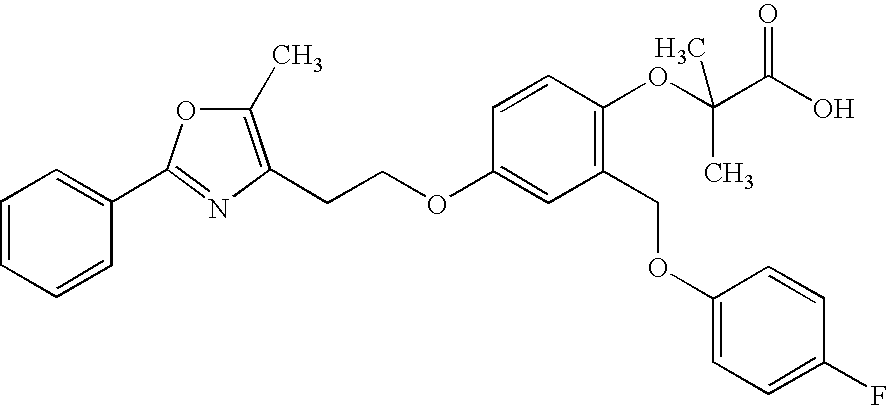
MS (ES) m/e 506 (M+1).

MS (ES) m/e 506 (M+1).

MS (ES) m/e 506 (M+1).

MS (ES) m/e 502 (M+1).

MS (ES) m/e 502 (M+1).

MS (ES) m/e 518 (M+1).

MS (ES) m/e 556 (M+1).

MS (ES) m/e 564 (M+1).

MS (ES) m/e 564 (M+1).

A solution of 4-(3-bromo-propoxy)-biphenyl (291 mg, 1.00 mmol; Preparation 12) and 3-[2-(benzoylamino-methyl)-4-hydroxy-phenyl]-propionic acid tert-butyl ester (320 mg, 0.90 mmol; Preparation 21) in DMF (5 mL) was treated with K2CO3 (100 mg) and heated at 60° C. for 48 h. The reaction mixture was diluted with water (50 mL) and extracted with EtOAc (3×20 mL). The combined organics were dried (Na2SO4), concentrated, and purified using silica gel chromatography (10-30% EtOAc/hexanes) to give 3-{2-(benzoylaminomethyl)-4-[3-(biphenyl-4-yloxy)propoxy]phenyl}propionic acid tert-butyl ester (450 mg). This material was treated with a mixture of CH2Cl2 (1.0 mL)/TFA (0.8 mL)/water (0.1 mL) at ambient temperature for 2 h. The reaction mixture was concentrated and dried under vacuum to afford the title product as a white solid (380 mg, 75%). MS (ES) m/e 510.1 (M+1).
The following Examples 725 to 757 are prepared by following a substantially similar procedure as described in Example 724.

MS [ES] m/z 512 (M+1).

MS [ES] m/z 536 (M+1).

MS [ES] m/z 500 (M+1).

MS [ES] m/z 490 (M+1).

MS [ES] m/z 473 (M+1).

MS [ES] m/z 497 (M+1).

MS [ES] m/z 497 (M+1).

MS [ES] m/z 501 (M+1).

MS [ES] m/z 537 (M+1).

MS [ES] m/z 501 (M+1).

MS [ES] m/z 524 (M+1).

MS [ES] m/z 524 (M+1).

MS [ES] m/z 540 (M+1).

MS [ES] m/z 564 (M+1).

MS [ES] m/z 522 (M+1).

MS [ES] m/z 546 (M+1).

MS [ES] m/z 525 (M+1).

MS [ES] m/z 541 (M+1).

MS [ES] m/z 565 (M+1).

MS [ES] m/z 529 (M+1).

MS [ES] m/z 599 (M+1).

MS [ES] m/z 510 (M+1).

MS [ES] m/z 492 (M+1).

MS [ES] m/z 511 (M+1).

MS [ES] m/z 511 (M+1).

MS [ES] m/z 515 (M+1).

MS [ES] m/z 585 (M+1).

MS [ES] m/z 625 (M+1).

MS [ES] m/z 536 (M+1).

MS [ES] m/z 492 (M+1).

MS [ES] m/z 526 (M+1).

MS [ES] m/z 508 (M+1).

MS [ES] m/z 527 (M+1).

Step 1: 4-Bromo-3-oxo-pentanoic acid methyl ester

A solution of bromine (28.3 g, 0.177 mol) in chloroform (30 mL) was added dropwise over 2 h to a solution of methyl propionylacetate (23.5 g, 0.177 mol) in chloroform (155 mL) at 0-5° C. The mixture was stirred for 30 min, and the cooling bath was removed. The mixture was stirred for 18 h, and ice water (200 mL) was added. The organic layer was collected and washed with cold water (2×200 mL), 10% aqueous sodium thiosulfate (2×200 mL) and brine (200 mL). The filtered solution was dried (Na2SO4) and concentrated to 36.5 g of the title compound as a clear liquid.
Step 2: Biphenyl-4-carboxylic acid 3-methoxycarbonyl-1-methyl-2-oxo-propyl ester

A mixture of biphenyl-4-carboxylic acid (800 g, 4.03 mol) in acetone (4.6 L) was treated with triethylamine (0.6 L, 4.3 mol, 1.07 eq) dropwise over 13 min while maintaining the temperature at 15-30° C. 4-Bromo-3-oxo-pentanoic acid methyl ester (880 g, 4.21 mol, 1.04 eq) was added dropwise over 21 min at 15-30° C. The mixture was stirred overnight at room temperature. Water (9.6 L) was added dropwise over 85 minutes at 15-30° C. The mixture was stirred for 2 h. The precipitated product was collected by filtration and washed twice with water (1 L). The product was dried under vacuum at 50° C. to afford 1291 g (98% yield, 96% HPLC purity) of the title compound.
Step 3: Biphenyl-4-carboxylic acid 2-amino-3-methoxycarbonyl-1-methyl-allyl ester

A mixture of biphenyl-4-carboxylic acid 3-methoxycarbonyl-1-methyl-2-oxo-propyl ester (1275 g, 3.9 mol, 1 eq) and ammonium acetate (640 g, 8.3 mol) in ethanol (10 L) was heated with stirring at 70-75° C. until the keto ester compound is completely consumed (1-2 h). The mixture was then kept at 0-5° C. for 1.5 h. The precipitated solid was collected by filtration and washed with hexanes (2.5 L). The product was dried overnight under vacuum at 50° C. to obtain 1244 g (90% yield, 98% HPLC purity) of the title compound.
Step 4: (2-Biphenyl-4-yl-5-methyl-oxazol-4-yl)-acetic acid methyl ester
A mixture of biphenyl-4-carboxylic acid 2-amino-3-methoxycarbonyl-1-methyl-allyl ester (566 g, 1.74 mol, 1 eq) and ammonium acetate (283 g, 3.67 mol) in glacial acetic acid (11.3 L) was heated at reflux for 2 h, cooled, and concentrated. The residue was coevaporated with toluene (2×2.5 L) and EtOAc (2.5 L). The mixture was diluted with EtOAc (6.6 L) and transferred with EtOAc (2.2 L) to a bottom outlet separation flask. The mixture was washed twice with water (2.2 L), saturated aqueous NaHCO3 (1.1 L), and brine (2×2.2 L). The organic layer was dried (Na2SO4, 550 g), filtered with the aid of EtOAc (1.1 L), and concentrated. The residue was dissolved in isopropanol (2 L) at 50° C. and allowed to cool overnight at room temperature. The mixture was kept at 0° C. to 5° C. for 1 h. The precipitated solid was broken up and collected by filtration. The solid was washed with cold isopropanol (4×0.55 L) and dried overnight in a vacuum oven at 50° C. to yield 428 g of the title compound (72% from Step 2).
Claims (18)
1. A compound of formula I,

and pharmaceutically acceptable salts, solvates, hydrates or stereoisomers thereof, wherein:
n1 is 2, 3, 4 or 5;
V is a bond or O;
X is CH2 or O;
p is 0 or 1;
m is 1-4;
Y1 is:

wherein,

is: 1-3-oxazolyl,
wherein 1-3-oxazolyl is optionally substituted with one or more groups independently selected from the group consisting of:
hydrogen, C1-C6 alkyl, C1-C6 alkoxy, halo, haloalkyl and haloalkyloxy;
Y1a is: hydrogen,
(C0-C3)alkyl-aryl,
C(O)-aryl,
heteroaryl,
cycloalkyl,
heterocycloalkyl,
aryloxy,
NR5(CH2)mOR5,
aryl-Z-aryl,
aryl-Z-heteroaryl,
aryl-Z-cycloalkyl,
aryl-Z-heterocycloalkyl,
heteroaryl-Z-aryl,
heteroaryl-Z-heterocycloalkyl or
heterocycloalkyl-Z-aryl,
wherein aryl, cycloalkyl, aryloxy, heteroaryl, and heterocycloalkyl are optionally substituted with one or more substituents independently selected from the group consisting of:
halo,
hydroxyl,
nitro,
cyano,
C1-C6 alkyl,
C1-C6 alkoxy optionally substituted with N(R5)2,
haloalkyl,
N(R5)2,
N[C(O)R5]2,
N[S(O)2R5]2,
NR5S(O)2R5,
NR5C(O)R5,
NR5C(O)OR5,
C(O)N(R5)2,
C(O)OR5 and
C(O)R5;
Z is: a bond,
-oxygen-
—C(O)NR5—
—NR5C(O)—,
—NR5C(O)O—,
—C(O)—,
—NR5—,
—[O]p(CH2)m—,
—(CH2)m[O]p—,
—NR5(CH2)m— or
—(CH2)m NR5—;
Y2 and Y3 are each independently:
hydrogen,
C1-C6 alkyl or
C1-C6 alkoxy;
Y4 is: (C1-C3)alkyl-NR5C(O)—(C0-C5)alkyl-Y7,
(C1-C3)alkyl-NR5C(O—(C2-C5)alkenyl-Y7,
(C1-C3)alkyl-NR5C(O—(C2-C5)alkynyl-Y7;
(C1-C3)alkyl-NR5C(O)O—(C0-C5)alkyl-Y7,
(C1-C3)alkyl-NR5C(O)NR5—(C0-C5)alkyl-Y7,
(C1-C3)alkyl-NR5C(S)NR5—(C0-C5)alkyl-Y7,
(C0-C3)alkyl—C(O)NR5—(C0-C5)alkyl-Y7,
(C1-C3)alkyl-OC(O)NY10Y11,
(C1-C3)alkyl-NY10Y11,
(C1-C3)alkyl-O—(C0-C5)alkyl-Y7,
(C1-C3)alkyl-S—(C0-C5)alkyl-Y7 or
CN;
Y7 is: hydrogen,
aryl,
heteroaryl,
C1-C12 alkyl,
C1-C6 alkoxy,
cycloalkyl,
heterocycloalkyl,
aryloxy,
C(O)-heteroaryl or
SR6,
wherein alkyl, aryl, aryloxy, alkoxy, heteroaryl, cycloalkyl, and heterocycloalkyl are optionally substituted with one or more groups independently selected from R7:
Y10 and Y11 are each independently:
hydrogen,
aryl,
heteroaryl,
C1-C10 alkyl,
cycloalkyl,
SO2(R6); or
Y10 and Y11 together are a 5- to 10-membered heterocycloalkyl ring or heterocycloalkyl ring fused with aryl, and the heterocycloalkyl ring optionally containing one or more heteroatoms selected from N, O or S; and wherein,
aryl, heteroaryl, heterocycloalkyl and alkyl are optionally substituted with one or more substituents independently selected from R7;
R5 is: hydrogen or C1-C6 alkyl;
R6 is: hydrogen,
C1-C10 alkyl,
cycloalkyl,
aryl, or
heteroaryl,
wherein alkyl, cycloalkyl, aryl and heteroaryl are optionally substituted with one or more substituents independently selected from R7;
R7 is: halo,
nitro,
oxo,
cyano,
hydroxyl,
benzyl,
phenyl,
phenoxy,
heteroaryl,
C(O)R6,
C1-C10 alkyl,
C1-C6 alkoxy,
C1-C6 haloalkyl,
C1-C6 haloalkyloxy,
O(CH2)m-phenyl,
(CH2)mOC(O-aryl,
C(O)OR5,
S(O)2R5,
S(O)2N(R5)2,
SR5 or
N(R5)2,
wherein phenyl and phenoxy are optionally substituted with one or more groups independently selected from halo or trifluoromethyl.
2. The compound of claim 1 , wherein Y1a is selected from the group consisting of: aryl, heteroaryl, cycloalkyl, heterocycloalkyl, aryloxy,

3. The compound of claim 1 , wherein the compound is represented by the following structural formula,

wherein E is O.
4. The compound of claim 3 wherein the compound is represented by the following structural formula,

wherein q is 1 or 2; and each R5 is independently hydrogen or methyl.
5. The compound of claim 3 wherein the compound is represented by the following structural formula,

wherein q is 1 or 2; and each R5 is independently hydrogen or methyl.
6. The compound of claim 3 wherein the compound is represented by the following structural formula,

wherein q is 1 or 2; and each R5 is independently hydrogen or methyl.
7. The compound of claim 3 wherein the compound is represented by the following structural formula,

wherein q is 0 or 1; and each R5 is independently hydrogen or methyl.
8. The compound of claim 3 wherein the compound is represented by the following structural formula,

wherein q is 1 or 2; and each R5 is independently hydrogen or methyl.
9. The compound of claim 3 wherein the compound is represented by the following structural formula,

wherein q is 1 or 2; and each R5 is independently hydrogen or methyl.
10. The compound of claim 3 wherein the compound is represented by the following structural formula,

wherein q is 1 or 2; and each R5 is independently hydrogen or methyl.
11. The compound of claim 3 wherein the compound is represented by the following structural Formula,

wherein q is 1 or 2; and each R5, Y2 and Y3 are independently hydrogen or methyl.
12. The compound of claim 3 represented by the following structural formula,

wherein Y1a is optionally substituted phenyl, naphthyl,

and Z is a bond, oxygen, —NH—, —N(CH3)—, —NHC(O)— or —C(O)NH—.
13. The compound of claim 3 represented by the following structural formula,

wherein Y1a is optionally substituted phenyl, naphthyl or
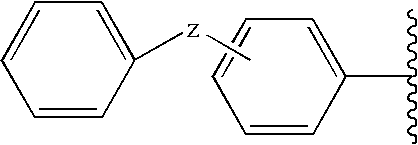
and Z is a bond, oxygen, —NH—, —N(CH3)—, —NHC(O)— or —C(O)NH—.
14. The compound of claim 1 represented by the following structural formula,

wherein,
Y1a is hydrogen, aryl, heteroaryl, or aryloxy; q is 1 or 2; and n1 is 2, 3, or 4.
15. The compound of claim 1 represented by the following structural formula,

wherein,
Y1a is hydrogen, aryl, heteroaryl or aryloxy; q is 1 or 2; and n1 is 2, 3, or 4.
16. The compound of claim 1 represented by a following structural formula,

17. A compound selected from the group consisting of:


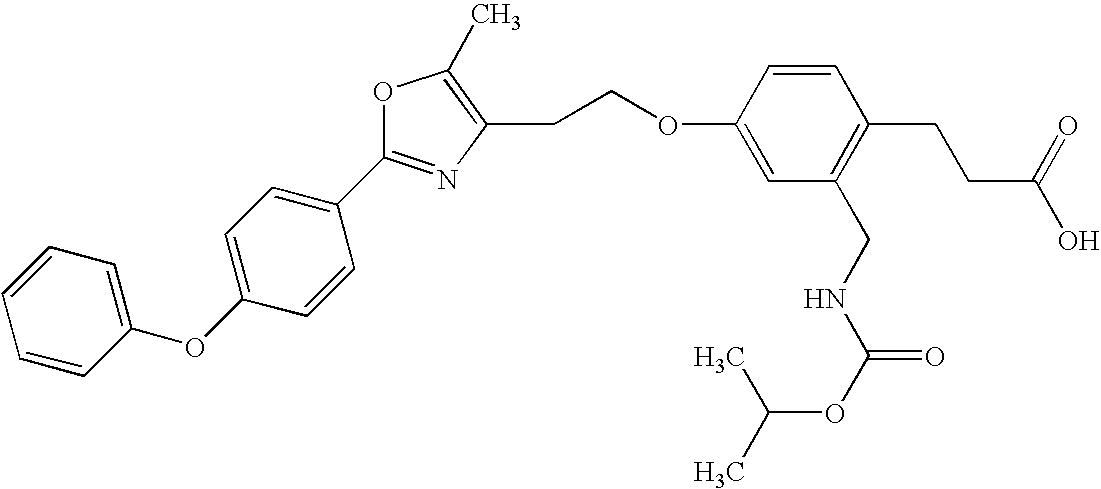


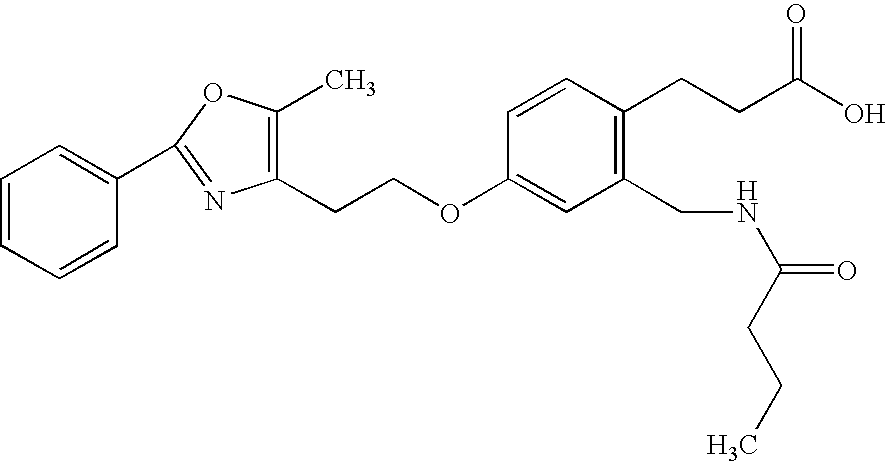


18. A pharmaceutical composition comprising a pharmaceutically acceptable carrier and a compound of claim 1 or a pharmaceutically acceptable salt, solvate or hydrate thereof.
Priority Applications (2)
| Application Number | Priority Date | Filing Date | Title |
|---|---|---|---|
| US10/477,405 US7282501B2 (en) | 2001-06-07 | 2002-05-24 | Modulators of peroxisome proliferator activated receptors (PPAR) |
| US11/866,568 US20080167310A1 (en) | 2001-06-07 | 2007-10-03 | Modulators of peroxisome proliferator activated receptors (ppar) |
Applications Claiming Priority (3)
| Application Number | Priority Date | Filing Date | Title |
|---|---|---|---|
| US29670101P | 2001-06-07 | 2001-06-07 | |
| PCT/US2002/015143 WO2002100403A1 (en) | 2001-06-07 | 2002-05-24 | Modulators of peroxisome proliferator activated receptors (ppar) |
| US10/477,405 US7282501B2 (en) | 2001-06-07 | 2002-05-24 | Modulators of peroxisome proliferator activated receptors (PPAR) |
Related Child Applications (1)
| Application Number | Title | Priority Date | Filing Date |
|---|---|---|---|
| US11/866,568 Division US20080167310A1 (en) | 2001-06-07 | 2007-10-03 | Modulators of peroxisome proliferator activated receptors (ppar) |
Publications (2)
| Publication Number | Publication Date |
|---|---|
| US20050075378A1 US20050075378A1 (en) | 2005-04-07 |
| US7282501B2 true US7282501B2 (en) | 2007-10-16 |
Family
ID=23143173
Family Applications (2)
| Application Number | Title | Priority Date | Filing Date |
|---|---|---|---|
| US10/477,405 Expired - Fee Related US7282501B2 (en) | 2001-06-07 | 2002-05-24 | Modulators of peroxisome proliferator activated receptors (PPAR) |
| US11/866,568 Abandoned US20080167310A1 (en) | 2001-06-07 | 2007-10-03 | Modulators of peroxisome proliferator activated receptors (ppar) |
Family Applications After (1)
| Application Number | Title | Priority Date | Filing Date |
|---|---|---|---|
| US11/866,568 Abandoned US20080167310A1 (en) | 2001-06-07 | 2007-10-03 | Modulators of peroxisome proliferator activated receptors (ppar) |
Country Status (22)
| Country | Link |
|---|---|
| US (2) | US7282501B2 (en) |
| EP (1) | EP1401434B1 (en) |
| JP (1) | JP2005502600A (en) |
| KR (1) | KR20040030658A (en) |
| CN (1) | CN1578659A (en) |
| AT (1) | ATE345128T1 (en) |
| BR (1) | BR0210167A (en) |
| CA (1) | CA2448552A1 (en) |
| CZ (1) | CZ20033328A3 (en) |
| DE (1) | DE60216094T2 (en) |
| EA (1) | EA200400011A1 (en) |
| EC (1) | ECSP034878A (en) |
| ES (1) | ES2275887T3 (en) |
| HR (1) | HRP20031002A2 (en) |
| HU (1) | HUP0400268A2 (en) |
| IL (1) | IL159002A0 (en) |
| MX (1) | MXPA03010903A (en) |
| NO (1) | NO20035367D0 (en) |
| PL (1) | PL367077A1 (en) |
| SK (1) | SK14922003A3 (en) |
| WO (1) | WO2002100403A1 (en) |
| ZA (1) | ZA200309059B (en) |
Families Citing this family (53)
| Publication number | Priority date | Publication date | Assignee | Title |
|---|---|---|---|---|
| CN101284773A (en) * | 2001-08-09 | 2008-10-15 | 小野药品工业株式会社 | Carboxylic acid derivative compounds and drugs comprising these compounds as the active ingredient |
| US20030207924A1 (en) * | 2002-03-07 | 2003-11-06 | Xue-Min Cheng | Compounds that modulate PPAR activity and methods of preparation |
| US6833380B2 (en) | 2002-03-07 | 2004-12-21 | Warner-Lambert Company, Llc | Compounds that modulate PPAR activity and methods of preparation |
| US6867224B2 (en) | 2002-03-07 | 2005-03-15 | Warner-Lambert Company | Compounds that modulate PPAR activity and methods of preparation |
| US6875780B2 (en) | 2002-04-05 | 2005-04-05 | Warner-Lambert Company | Compounds that modulate PPAR activity and methods for their preparation |
| US6716842B2 (en) * | 2002-04-05 | 2004-04-06 | Warner-Lambert Company, Llc | Antidiabetic agents |
| JP2005035966A (en) * | 2002-09-06 | 2005-02-10 | Takeda Chem Ind Ltd | Furan or thiophene derivative and its pharmaceutical use |
| AU2003261935A1 (en) * | 2002-09-06 | 2004-03-29 | Takeda Pharmaceutical Company Limited | Furan or thiophene derivative and medicinal use thereof |
| US6653334B1 (en) * | 2002-12-27 | 2003-11-25 | Kowa Co., Ltd. | Benzoxazole compound and pharmaceutical composition containing the same |
| US7396850B2 (en) | 2003-01-06 | 2008-07-08 | Eli Lilly And Company | Pyrazole derivative as PPAR modulator |
| RU2335490C2 (en) | 2003-02-07 | 2008-10-10 | Оно Фармасьютикал Ко., Лтд. | Carboxylic acid compounds, pharmaceutical composition based on them, method of treatment, and application |
| DE10308351A1 (en) * | 2003-02-27 | 2004-11-25 | Aventis Pharma Deutschland Gmbh | 1,3-substituted cycloalkyl derivatives having acidic, usually heterocyclic groups, processes for their preparation and their use as medicaments |
| DE10308355A1 (en) * | 2003-02-27 | 2004-12-23 | Aventis Pharma Deutschland Gmbh | Aryl-cycloalkyl-substituted alkanoic acid derivatives, process for their preparation and their use as medicaments |
| US7244763B2 (en) | 2003-04-17 | 2007-07-17 | Warner Lambert Company Llc | Compounds that modulate PPAR activity and methods of preparation |
| EP1660428A1 (en) * | 2003-08-20 | 2006-05-31 | Eli Lilly And Company | Ppar modulators |
| AU2004291259A1 (en) * | 2003-11-05 | 2005-06-02 | F. Hoffmann-La Roche Ag | Heteroaryl derivatives as PPAR activators |
| DE10351859A1 (en) * | 2003-11-06 | 2005-06-09 | Beiersdorf Ag | Cosmetic and/or dermatological oil/water emulsions with viscosity within specified range, used as sprayable cosmetic preparation and textile impregnant, contain microcrystalline cellulose, xanthan gum and optionally repellent |
| CA2558585C (en) | 2004-02-27 | 2010-10-12 | Amgen Inc. | Compounds, pharmaceutical compositions and methods for use in treating metabolic disorders |
| JP2007223901A (en) * | 2004-03-24 | 2007-09-06 | Takeda Chem Ind Ltd | Heterocyclic compound and use thereof |
| EP1731513A4 (en) * | 2004-03-30 | 2007-10-31 | Daiichi Seiyaku Co | Phenoxyacetic acid derivative and medicine containing the same |
| EP1734963A4 (en) | 2004-04-02 | 2008-06-18 | Merck & Co Inc | METHOD FOR TREATING MEN WITH METABOLIC AND ANTHROPOMETRIC DISORDERS |
| CN100436430C (en) * | 2004-05-24 | 2008-11-26 | 北京摩力克科技有限公司 | Alkanoyl-substituted tyrosine derivatives as hPPARα and hPPARγ agonists |
| CN100344618C (en) | 2004-05-24 | 2007-10-24 | 北京摩力克科技有限公司 | N-benzyl acryloyl substituted tyrosine derivatives as hPPAR alpha and hPPAR gamma agonist |
| WO2006004040A1 (en) | 2004-07-01 | 2006-01-12 | Daiichi Asubio Pharma Co., Ltd. | Thienopyrazole derivative having pde7 inhibitory activity |
| JP2007284352A (en) * | 2004-08-05 | 2007-11-01 | Dai Ichi Seiyaku Co Ltd | Pyrazole derivative |
| WO2006052566A2 (en) * | 2004-11-03 | 2006-05-18 | Arena Pharmaceuticals, Inc. | Gpr41 and modulators thereof for the treatment of insulin-related disorders |
| JPWO2006057448A1 (en) * | 2004-11-26 | 2008-06-05 | 武田薬品工業株式会社 | Arylalkanoic acid derivatives |
| DE102004060227B3 (en) * | 2004-12-15 | 2006-07-20 | Sanofi-Aventis Deutschland Gmbh | Process for the preparation of oxazoles by condensation of aromatic aldehydes with α-ketoximes to N-oxides and subsequent reaction with activated acid derivatives |
| US7465804B2 (en) | 2005-05-20 | 2008-12-16 | Amgen Inc. | Compounds, pharmaceutical compositions and methods for their use in treating metabolic disorders |
| EP1924546A1 (en) | 2005-09-14 | 2008-05-28 | Amgen, Inc | Conformationally constrained 3- (4-hydroxy-phenyl) - substituted-propanoic acids useful for treating metabolic disorders |
| JP2008303145A (en) * | 2005-09-22 | 2008-12-18 | Takeda Chem Ind Ltd | Cardiotonic comprising grk inhibitor |
| AU2007209981B2 (en) * | 2006-02-01 | 2011-11-24 | Merck Sharp & Dohme Corp. | Potassium channel inhibitors |
| JP2009526868A (en) | 2006-02-15 | 2009-07-23 | アボット・ラボラトリーズ | Novel acetyl-CoA carboxylase (ACC) inhibitors and their use in diabetes, obesity and metabolic syndrome |
| CN101484433A (en) | 2006-02-15 | 2009-07-15 | 艾博特公司 | Novel acetyl-coA carboxylase (ACC) inhibitors and their use in diabetes, obesity and metabolic syndrome |
| CN101054372B (en) * | 2006-04-11 | 2010-10-13 | 中国科学院上海药物研究所 | Pyrimidine-substituted phenylpropionic acid derivative compound, its preparation method and use in treating polycystic kidney disease |
| KR101130380B1 (en) * | 2006-06-13 | 2012-04-23 | 상하이 인스티튜트 오브 마테리아 메디카 차이니즈 아카데미 오브 싸이언시즈 | Heterocyclic non-nucleoside compounds, their preparation, pharmaceutical composition and their use as antiviral agents |
| CA2662242C (en) | 2006-09-07 | 2012-06-12 | Amgen Inc. | Benzo-fused compounds for use in treating metabolic disorders |
| EP2064193A1 (en) | 2006-09-07 | 2009-06-03 | Amgen, Inc | Heterocyclic gpr40 modulators |
| AU2008241490B2 (en) | 2007-04-16 | 2011-07-21 | Amgen Inc. | Substituted biphenyl phenoxy-, thiophenyl- and aminophenylpropanoic acid GPR40 modulators |
| US8030354B2 (en) | 2007-10-10 | 2011-10-04 | Amgen Inc. | Substituted biphenyl GPR40 modulators |
| WO2009111056A1 (en) | 2008-03-06 | 2009-09-11 | Amgen Inc. | Conformationally constrained carboxylic acid derivatives useful for treating metabolic disorders |
| AU2009303475B2 (en) | 2008-10-15 | 2012-09-13 | Amgen Inc. | Spirocyclic GPR40 modulators |
| WO2012027331A1 (en) | 2010-08-27 | 2012-03-01 | Ironwood Pharmaceuticals, Inc. | Compositions and methods for treating or preventing metabolic syndrome and related diseases and disorders |
| AU2011313853A1 (en) * | 2010-10-11 | 2013-05-02 | Auckland Uniservices Limited | Substituted benzamides and their uses |
| KR101942752B1 (en) * | 2012-11-05 | 2019-01-28 | 주식회사 엘지화학 | Thioaryl derivatives as gpr120 agonists |
| WO2016057322A1 (en) | 2014-10-08 | 2016-04-14 | Salk Institute For Biological Studies | Ppar agonists and methods of use thereof |
| US10188627B2 (en) | 2014-10-08 | 2019-01-29 | Mitobridge, Inc. | PPAR agonists, compounds, pharmaceutical compositions, and methods of use thereof |
| CN105237389B (en) * | 2015-10-28 | 2017-09-15 | 成都丽凯手性技术有限公司 | A kind of method that use p-Coumaric Acid prepares hypolipidemic ciprofibrate |
| KR102627711B1 (en) | 2015-12-22 | 2024-01-22 | 수미토모 케미칼 컴퍼니 리미티드 | Method for Preparing Benzoxazole Compounds |
| WO2018011230A1 (en) * | 2016-07-13 | 2018-01-18 | Universite D'aix-Marseille | Peroxisome proliferator-activated receptor gamma agonists, method of preparation and uses thereof |
| JP6931456B2 (en) * | 2017-04-03 | 2021-09-08 | 川崎化成工業株式会社 | Photopolymerization sensitizer containing 2-haloalkoxy-6-substituted oxynaphthalene compound and 2-haloalkoxy-6-substituted oxynaphthalene compound |
| JP7211358B2 (en) * | 2017-05-22 | 2023-01-24 | 小野薬品工業株式会社 | EP4 antagonist |
| WO2021161218A1 (en) * | 2020-02-11 | 2021-08-19 | Inorbit Therapeutics Ab | Sulfinic acid and sulfonic acid compounds for use in modulating peroxisome proliferator-activated receptors |
Citations (14)
| Publication number | Priority date | Publication date | Assignee | Title |
|---|---|---|---|---|
| US5089514A (en) | 1990-06-14 | 1992-02-18 | Pfizer Inc. | 3-coxazolyl [phenyl, chromanyl or benzofuranyl]-2-hydroxypropionic acid derivatives and analogs as hypoglycemic agents |
| US5232945A (en) | 1992-07-20 | 1993-08-03 | Pfizer Inc. | 3-aryl-2-hydroxypropionic acid derivatives and analogs as antihypertensives |
| WO1997028115A1 (en) | 1996-02-02 | 1997-08-07 | Merck & Co., Inc. | Antidiabetic agents |
| WO1997031907A1 (en) | 1996-02-28 | 1997-09-04 | Glaxo Group Limited | Substituted 4-hydroxy-phenylalcanoic acid derivatives with agonist activity to ppar-gamma |
| US5902726A (en) | 1994-12-23 | 1999-05-11 | Glaxo Wellcome Inc. | Activators of the nuclear orphan receptor peroxisome proliferator-activated receptor gamma |
| EP0930229A2 (en) | 1998-01-20 | 1999-07-21 | Hexcel Corporation | Retrofit centerline luggage bin assemblies compatible with existing aircraft bin supports |
| WO1999046232A1 (en) | 1998-03-10 | 1999-09-16 | Ono Pharmaceutical Co., Ltd. | Carboxylic acid derivatives and drugs containing the same as the active ingredient |
| WO2001000566A2 (en) | 1999-06-25 | 2001-01-04 | The Institutes For Pharmaceutical Discovery, Llc | Substituted phenoxyacetic acids |
| WO2001016120A1 (en) | 1999-08-27 | 2001-03-08 | Eli Lilly And Company | Biaryl-oxa(thia)zole derivatives and their use as ppars modulators |
| GB2359082A (en) | 2000-01-11 | 2001-08-15 | Kotobuki Pharmaceutical Compan | Antidiabetic ether and amide compounds |
| WO2002016332A1 (en) | 2000-08-23 | 2002-02-28 | Eli Lilly And Company | Oxazolyl-arylpropionic acid derivatives and their use as ppar agonists |
| WO2002018355A1 (en) | 2000-08-23 | 2002-03-07 | Eli Lilly And Company | Oxazolyl-aryloxyacetic acid derivatives and their use as ppar agonists |
| EP1216980A1 (en) | 1999-10-01 | 2002-06-26 | Eisai Co., Ltd. | Carboxylic acid derivatives and drugs containing the same |
| WO2002100813A2 (en) | 2001-06-07 | 2002-12-19 | Eli Lilly And Company | Modulators of peroxisome proliferator activated receptors |
Family Cites Families (1)
| Publication number | Priority date | Publication date | Assignee | Title |
|---|---|---|---|---|
| JP2002515865A (en) * | 1996-02-02 | 2002-05-28 | メルク エンド カンパニー インコーポレーテッド | Antidiabetic drugs |
-
2002
- 2002-05-24 HR HR20031002A patent/HRP20031002A2/en not_active Application Discontinuation
- 2002-05-24 HU HU0400268A patent/HUP0400268A2/en unknown
- 2002-05-24 ES ES02746380T patent/ES2275887T3/en not_active Expired - Lifetime
- 2002-05-24 JP JP2003503224A patent/JP2005502600A/en active Pending
- 2002-05-24 SK SK1492-2003A patent/SK14922003A3/en unknown
- 2002-05-24 CZ CZ20033328A patent/CZ20033328A3/en unknown
- 2002-05-24 CA CA002448552A patent/CA2448552A1/en not_active Abandoned
- 2002-05-24 IL IL15900202A patent/IL159002A0/en unknown
- 2002-05-24 MX MXPA03010903A patent/MXPA03010903A/en unknown
- 2002-05-24 EA EA200400011A patent/EA200400011A1/en unknown
- 2002-05-24 BR BR0210167-0A patent/BR0210167A/en not_active IP Right Cessation
- 2002-05-24 WO PCT/US2002/015143 patent/WO2002100403A1/en not_active Ceased
- 2002-05-24 KR KR10-2003-7016048A patent/KR20040030658A/en not_active Withdrawn
- 2002-05-24 PL PL02367077A patent/PL367077A1/en not_active Application Discontinuation
- 2002-05-24 CN CNA028154533A patent/CN1578659A/en active Pending
- 2002-05-24 EP EP02746380A patent/EP1401434B1/en not_active Expired - Lifetime
- 2002-05-24 DE DE60216094T patent/DE60216094T2/en not_active Expired - Fee Related
- 2002-05-24 AT AT02746380T patent/ATE345128T1/en not_active IP Right Cessation
- 2002-05-24 US US10/477,405 patent/US7282501B2/en not_active Expired - Fee Related
-
2003
- 2003-11-20 ZA ZA200309059A patent/ZA200309059B/en unknown
- 2003-12-02 NO NO20035367A patent/NO20035367D0/en not_active Application Discontinuation
- 2003-12-05 EC EC2003004878A patent/ECSP034878A/en unknown
-
2007
- 2007-10-03 US US11/866,568 patent/US20080167310A1/en not_active Abandoned
Patent Citations (17)
| Publication number | Priority date | Publication date | Assignee | Title |
|---|---|---|---|---|
| US5306726A (en) | 1990-06-14 | 1994-04-26 | Pfizer Inc. | 3-aryl-2-hydroxypropionic acid derivatives and analogs as hypoglycemic agents |
| US5089514A (en) | 1990-06-14 | 1992-02-18 | Pfizer Inc. | 3-coxazolyl [phenyl, chromanyl or benzofuranyl]-2-hydroxypropionic acid derivatives and analogs as hypoglycemic agents |
| US5232945A (en) | 1992-07-20 | 1993-08-03 | Pfizer Inc. | 3-aryl-2-hydroxypropionic acid derivatives and analogs as antihypertensives |
| US5994554A (en) | 1994-12-23 | 1999-11-30 | Glaxo Wellcome Inc. | Activators of the nuclear orphan receptor peroxisome proliferator-activated receptor gamma |
| US5902726A (en) | 1994-12-23 | 1999-05-11 | Glaxo Wellcome Inc. | Activators of the nuclear orphan receptor peroxisome proliferator-activated receptor gamma |
| WO1997028115A1 (en) | 1996-02-02 | 1997-08-07 | Merck & Co., Inc. | Antidiabetic agents |
| WO1997031907A1 (en) | 1996-02-28 | 1997-09-04 | Glaxo Group Limited | Substituted 4-hydroxy-phenylalcanoic acid derivatives with agonist activity to ppar-gamma |
| EP0930229A2 (en) | 1998-01-20 | 1999-07-21 | Hexcel Corporation | Retrofit centerline luggage bin assemblies compatible with existing aircraft bin supports |
| WO1999046232A1 (en) | 1998-03-10 | 1999-09-16 | Ono Pharmaceutical Co., Ltd. | Carboxylic acid derivatives and drugs containing the same as the active ingredient |
| WO2001000566A2 (en) | 1999-06-25 | 2001-01-04 | The Institutes For Pharmaceutical Discovery, Llc | Substituted phenoxyacetic acids |
| WO2001016120A1 (en) | 1999-08-27 | 2001-03-08 | Eli Lilly And Company | Biaryl-oxa(thia)zole derivatives and their use as ppars modulators |
| EP1216980A1 (en) | 1999-10-01 | 2002-06-26 | Eisai Co., Ltd. | Carboxylic acid derivatives and drugs containing the same |
| GB2359082A (en) | 2000-01-11 | 2001-08-15 | Kotobuki Pharmaceutical Compan | Antidiabetic ether and amide compounds |
| WO2002016332A1 (en) | 2000-08-23 | 2002-02-28 | Eli Lilly And Company | Oxazolyl-arylpropionic acid derivatives and their use as ppar agonists |
| WO2002018355A1 (en) | 2000-08-23 | 2002-03-07 | Eli Lilly And Company | Oxazolyl-aryloxyacetic acid derivatives and their use as ppar agonists |
| US6982278B2 (en) * | 2000-08-23 | 2006-01-03 | Eli Lilly And Company | Oxazolyl-aryloxyacetic acid derivatives and their use as ppar agonists |
| WO2002100813A2 (en) | 2001-06-07 | 2002-12-19 | Eli Lilly And Company | Modulators of peroxisome proliferator activated receptors |
Non-Patent Citations (9)
| Title |
|---|
| Bright, S.W., et. al.: "Competitive Particle Concentration Fluorescence Immunoassays for Measuring Anti-Diabetic Drug Levels in Mouse Plasma"; Journal of Immunological Methods, vol. 207, No. 1, Aug. 22, 1997, pp. 23-31. |
| Brooks, D., et al.: "Design and Synthesis of 2-methyl-2-{4-'2-'5-methyl-2-aryloxazol-4-yl)ethoxylphenoxy}propionic acids: A New Class of Dual PPARAlpha/Gamma Agonists"; Journal of Medicinal Chemistry, vol. 44, No. 13, Jun. 21, 2001, pp. 2061-2064. |
| Cobb, J. E., et al.: "N-(2-Benzoylphenyl)-L-Tyrosine PPARGamma Agonists. 3. Structure-Activity Relationship and Optimization of the N-Aryl Substituent"; Journal of Medicinal Chemistry, vol. 41, No. 25, Dec. 3, 1998, pp. 5055-5069. |
| Malamas, M.S., et al.: "Azole Phenoxy Hydroxyureas as Selective and Orally Active Inhibitors fo 5-Lipoxygenase"; Journal of Medicinal Chemistry, vol. 39, No. 1, Jan. 5, 1996, pp. 237-245. |
| Merguro, K., et al.: "Studies on Antidiabetic Agents. VII. Synthesis and Hypoglycemic Activity fo 4-Oxazoleacetic Acid Derivatives"; Chemical & Pharmaceutical Bulletin, vol. 34, No. 7, 1986, pp. 2840-2851. |
| Murugesan, N., et al.: "Biphenylsulfonamide Endothelin Receptor Antogonists 2. Discovery of 4'-oxazoly-lbiphenylsulfonamides as a New Class of Poent, Highly Selective ET(A) Antagonists"; Journal of Medicinal Chemistry, vol. 43, No. 16, Aug. 10, 2000, pp. 3111-3117. |
| Obach R. S., Drug-drug interactions: An important negative attribute in drugs, Drugs of Today, 39(5), 301-38, (2003). * |
| Sarges, R., et al.: "Glucose Transport-Enhancing and Hypoglycemic Activity of 2-Methyl-2-Phenoxy-3-Phenylpropanoic Acids"; Journal of Medicinal Chemistry, vol. 39, No. 24, Nov. 22, 1996, pp. 4783-4803. |
| Shinkai, H. et al.: "Isoxazolidine-3,5-dione and Noncyclic 1,3-dicarbonyl Compounds as Hypoglycemic Agents"; Journal of Medicinal Chemistry, vol. 41, No. 11, May 21, 1998, pp. 1927-1933. |
Also Published As
| Publication number | Publication date |
|---|---|
| MXPA03010903A (en) | 2004-02-17 |
| US20080167310A1 (en) | 2008-07-10 |
| EP1401434B1 (en) | 2006-11-15 |
| JP2005502600A (en) | 2005-01-27 |
| CA2448552A1 (en) | 2002-12-19 |
| ATE345128T1 (en) | 2006-12-15 |
| EA200400011A1 (en) | 2004-06-24 |
| DE60216094T2 (en) | 2007-06-06 |
| ECSP034878A (en) | 2004-01-28 |
| SK14922003A3 (en) | 2005-04-01 |
| ZA200309059B (en) | 2005-08-10 |
| BR0210167A (en) | 2004-04-06 |
| HRP20031002A2 (en) | 2004-06-30 |
| WO2002100403A1 (en) | 2002-12-19 |
| CZ20033328A3 (en) | 2004-06-16 |
| PL367077A1 (en) | 2005-02-21 |
| ES2275887T3 (en) | 2007-06-16 |
| CN1578659A (en) | 2005-02-09 |
| KR20040030658A (en) | 2004-04-09 |
| IL159002A0 (en) | 2004-05-12 |
| EP1401434A1 (en) | 2004-03-31 |
| NO20035367D0 (en) | 2003-12-02 |
| US20050075378A1 (en) | 2005-04-07 |
| DE60216094D1 (en) | 2006-12-28 |
| HUP0400268A2 (en) | 2004-07-28 |
Similar Documents
| Publication | Publication Date | Title |
|---|---|---|
| US7282501B2 (en) | Modulators of peroxisome proliferator activated receptors (PPAR) | |
| US6610696B2 (en) | Modulators of peroxisome proliferator activated receptors | |
| US6982278B2 (en) | Oxazolyl-aryloxyacetic acid derivatives and their use as ppar agonists | |
| US20070082907A1 (en) | Peroxisome proliferator activated receptor modulators | |
| US7655641B2 (en) | Sulfonamide derivatives as PPAR modulators | |
| KR100462730B1 (en) | Substituted 4-Hydroxy-Phenylalcanoic Acid Derivatives with Agonist Activity to PPAR-Gamma | |
| US6930120B2 (en) | Oxazolyl-arylproplonic acid derivatives and their use as ppar agonists | |
| US20080207685A1 (en) | Heterocyclic Compounds As Modulators Of Peroxisome Proliferator Activated Receptors, Useful For The Treatment And/Or Prevention Of Disorders Modulated By A Ppar | |
| WO2002016332A1 (en) | Oxazolyl-arylpropionic acid derivatives and their use as ppar agonists | |
| AU2002316105A1 (en) | Modulators of peroxisome proliferator activated receptors (PPAR) |
Legal Events
| Date | Code | Title | Description |
|---|---|---|---|
| AS | Assignment |
Owner name: ELI LILLY AND COMPANY, INDIANA Free format text: ASSIGNMENT OF ASSIGNORS INTEREST;ASSIGNOR:GONZALEZ-GARCIA, MARIA ROSARIO;REEL/FRAME:015411/0439 Effective date: 20031217 |
|
| REMI | Maintenance fee reminder mailed | ||
| LAPS | Lapse for failure to pay maintenance fees | ||
| STCH | Information on status: patent discontinuation |
Free format text: PATENT EXPIRED DUE TO NONPAYMENT OF MAINTENANCE FEES UNDER 37 CFR 1.362 |
|
| FP | Lapsed due to failure to pay maintenance fee |
Effective date: 20111016 |