US7238816B2 - Preparation of epothilone derivatives - Google Patents
Preparation of epothilone derivatives Download PDFInfo
- Publication number
- US7238816B2 US7238816B2 US11/400,682 US40068206A US7238816B2 US 7238816 B2 US7238816 B2 US 7238816B2 US 40068206 A US40068206 A US 40068206A US 7238816 B2 US7238816 B2 US 7238816B2
- Authority
- US
- United States
- Prior art keywords
- formula
- methyl
- hydrogen
- phenyl
- trifluoromethyl
- Prior art date
- Legal status (The legal status is an assumption and is not a legal conclusion. Google has not performed a legal analysis and makes no representation as to the accuracy of the status listed.)
- Active
Links
- 0 [3*]/C1=C/C[C@@H](C(C)=O)OC(=O)C[C@H](C)C(C)(C)C(=O)[C@H](C)[C@@H](C)[C@@H](C)/C=C/C1 Chemical compound [3*]/C1=C/C[C@@H](C(C)=O)OC(=O)C[C@H](C)C(C)(C)C(=O)[C@H](C)[C@@H](C)[C@@H](C)/C=C/C1 0.000 description 14
- MVFQEUPKILKDLL-TWXHHNPVSA-N C=CC/C(C)=C\C[C@H](O)C(C)=O.C=CC/C(C)=C\C[C@H](OC(=O)C[C@H](O[Si](C)(C)C(C)(C)C)C(C)(C)C(=O)[C@H](C)[C@@H](O[Si](C)(C)C(C)(C)C)[C@@H](C)C=C)C(C)=O.C=C[C@H](C)[C@H](O[Si](C)(C)C(C)(C)C)[C@@H](C)C(=O)C(C)(C)[C@H](CC(=O)O)O[Si](C)(C)C(C)(C)C Chemical compound C=CC/C(C)=C\C[C@H](O)C(C)=O.C=CC/C(C)=C\C[C@H](OC(=O)C[C@H](O[Si](C)(C)C(C)(C)C)C(C)(C)C(=O)[C@H](C)[C@@H](O[Si](C)(C)C(C)(C)C)[C@@H](C)C=C)C(C)=O.C=C[C@H](C)[C@H](O[Si](C)(C)C(C)(C)C)[C@@H](C)C(=O)C(C)(C)[C@H](CC(=O)O)O[Si](C)(C)C(C)(C)C MVFQEUPKILKDLL-TWXHHNPVSA-N 0.000 description 1
- XEWNBKPRNHTFLJ-MKYCAZIMSA-L C=CC/C(C)=C\C[C@H](OC(=O)C[C@H](C)C(C)(C)C(=O)[C@H](C)[C@@H](O[Si](C)(C)C(C)(C)C)[C@@H](C)C=C)C(C)=O.CC(=O)[C@@H]1C/C=C(/C)C/C=C/[C@H](C)[C@H](O[Si](C)(C)C(C)(C)C)[C@@H](C)C(=O)C(C)(C)[C@@H](C)CC(=O)O1.CC1=CC(C)=C(N2CCN(C3=C(C)C=C(C)C=C3C)C2[Ru](Cl)(Cl)(=CC2=CC=CC=C2)[PH](C2CCCCC2)(C2CCCCC2)C2CCCCC2)C(C)=C1 Chemical compound C=CC/C(C)=C\C[C@H](OC(=O)C[C@H](C)C(C)(C)C(=O)[C@H](C)[C@@H](O[Si](C)(C)C(C)(C)C)[C@@H](C)C=C)C(C)=O.CC(=O)[C@@H]1C/C=C(/C)C/C=C/[C@H](C)[C@H](O[Si](C)(C)C(C)(C)C)[C@@H](C)C(=O)C(C)(C)[C@@H](C)CC(=O)O1.CC1=CC(C)=C(N2CCN(C3=C(C)C=C(C)C=C3C)C2[Ru](Cl)(Cl)(=CC2=CC=CC=C2)[PH](C2CCCCC2)(C2CCCCC2)C2CCCCC2)C(C)=C1 XEWNBKPRNHTFLJ-MKYCAZIMSA-L 0.000 description 1
- LIPSKGJFYMWSRN-UHFFFAOYSA-L CC1=CC(C)=C(N2C=CN(C3=C(C)C=C(C)C=C3C)C2[Ru](Cl)(Cl)(=C2C=C(C3=CC=CC=C3)C3=CC=CC=C32)[PH](C2=CC=CC=C2)(C2=CC=CC=C2)C2=CC=CC=C2)C(C)=C1 Chemical compound CC1=CC(C)=C(N2C=CN(C3=C(C)C=C(C)C=C3C)C2[Ru](Cl)(Cl)(=C2C=C(C3=CC=CC=C3)C3=CC=CC=C32)[PH](C2=CC=CC=C2)(C2=CC=CC=C2)C2=CC=CC=C2)C(C)=C1 LIPSKGJFYMWSRN-UHFFFAOYSA-L 0.000 description 1
- BJKSJARACQIFCY-UHFFFAOYSA-L CC1=CC(C)=C(N2C=CN(C3=C(C)C=C(C)C=C3C)C2[Ru](Cl)(Cl)(=C2C=C(C3=CC=CC=C3)C3=CC=CC=C32)[PH](C2CCCCC2)(C2CCCCC2)C2CCCCC2)C(C)=C1 Chemical compound CC1=CC(C)=C(N2C=CN(C3=C(C)C=C(C)C=C3C)C2[Ru](Cl)(Cl)(=C2C=C(C3=CC=CC=C3)C3=CC=CC=C32)[PH](C2CCCCC2)(C2CCCCC2)C2CCCCC2)C(C)=C1 BJKSJARACQIFCY-UHFFFAOYSA-L 0.000 description 1
- WSNZNSHMXFVUFD-UHFFFAOYSA-L CC1=CC(C)=C(N2CCN(C3=C(C)C=C(C)C=C3C)C2[Ru](Cl)(Cl)(=C2C=C(C3=CC=CC=C3)C3=CC=CC=C32)[PH](C2CCCCC2)(C2CCCCC2)C2CCCCC2)C(C)=C1 Chemical compound CC1=CC(C)=C(N2CCN(C3=C(C)C=C(C)C=C3C)C2[Ru](Cl)(Cl)(=C2C=C(C3=CC=CC=C3)C3=CC=CC=C32)[PH](C2CCCCC2)(C2CCCCC2)C2CCCCC2)C(C)=C1 WSNZNSHMXFVUFD-UHFFFAOYSA-L 0.000 description 1
- FSFWPWILDNMVDV-UHFFFAOYSA-L CC1=CC(C)=C(N2CCN(C3=C(C)C=C(C)C=C3C)C2[Ru](Cl)(Cl)(=CC2=CC=CC=C2)[PH](C2CCCCC2)(C2CCCCC2)C2CCCCC2)C(C)=C1 Chemical compound CC1=CC(C)=C(N2CCN(C3=C(C)C=C(C)C=C3C)C2[Ru](Cl)(Cl)(=CC2=CC=CC=C2)[PH](C2CCCCC2)(C2CCCCC2)C2CCCCC2)C(C)=C1 FSFWPWILDNMVDV-UHFFFAOYSA-L 0.000 description 1
- XAYAKDZVINDZGB-BMVMHAJPSA-N CC1=NC(/C=C(\C)[C@@H]2C/C=C(/C)C/C=C/[C@H](C)[C@H](O)[C@@H](C)C(=O)C(C)(C)[C@@H](O)CC(=O)O2)=CS1 Chemical compound CC1=NC(/C=C(\C)[C@@H]2C/C=C(/C)C/C=C/[C@H](C)[C@H](O)[C@@H](C)C(=O)C(C)(C)[C@@H](O)CC(=O)O2)=CS1 XAYAKDZVINDZGB-BMVMHAJPSA-N 0.000 description 1
- JEEOZKGYSUUAAU-UHFFFAOYSA-N CCC1=CSC(C)=N1.Cl Chemical compound CCC1=CSC(C)=N1.Cl JEEOZKGYSUUAAU-UHFFFAOYSA-N 0.000 description 1
- GMUOLESMBOWFAO-UHFFFAOYSA-L CCCN1CCN(CCC)C1[Ru](Cl)(Cl)(=CC1=CC=CC=C1)[PH](C1CCCCC1)(C1CCCCC1)C1CCCCC1 Chemical compound CCCN1CCN(CCC)C1[Ru](Cl)(Cl)(=CC1=CC=CC=C1)[PH](C1CCCCC1)(C1CCCCC1)C1CCCCC1 GMUOLESMBOWFAO-UHFFFAOYSA-L 0.000 description 1
Classifications
-
- B—PERFORMING OPERATIONS; TRANSPORTING
- B01—PHYSICAL OR CHEMICAL PROCESSES OR APPARATUS IN GENERAL
- B01J—CHEMICAL OR PHYSICAL PROCESSES, e.g. CATALYSIS OR COLLOID CHEMISTRY; THEIR RELEVANT APPARATUS
- B01J31/00—Catalysts comprising hydrides, coordination complexes or organic compounds
- B01J31/16—Catalysts comprising hydrides, coordination complexes or organic compounds containing coordination complexes
- B01J31/24—Phosphines, i.e. phosphorus bonded to only carbon atoms, or to both carbon and hydrogen atoms, including e.g. sp2-hybridised phosphorus compounds such as phosphabenzene, phosphole or anionic phospholide ligands
- B01J31/2404—Cyclic ligands, including e.g. non-condensed polycyclic ligands, the phosphine-P atom being a ring member or a substituent on the ring
-
- A—HUMAN NECESSITIES
- A61—MEDICAL OR VETERINARY SCIENCE; HYGIENE
- A61P—SPECIFIC THERAPEUTIC ACTIVITY OF CHEMICAL COMPOUNDS OR MEDICINAL PREPARATIONS
- A61P29/00—Non-central analgesic, antipyretic or antiinflammatory agents, e.g. antirheumatic agents; Non-steroidal antiinflammatory drugs [NSAID]
-
- A—HUMAN NECESSITIES
- A61—MEDICAL OR VETERINARY SCIENCE; HYGIENE
- A61P—SPECIFIC THERAPEUTIC ACTIVITY OF CHEMICAL COMPOUNDS OR MEDICINAL PREPARATIONS
- A61P35/00—Antineoplastic agents
-
- A—HUMAN NECESSITIES
- A61—MEDICAL OR VETERINARY SCIENCE; HYGIENE
- A61P—SPECIFIC THERAPEUTIC ACTIVITY OF CHEMICAL COMPOUNDS OR MEDICINAL PREPARATIONS
- A61P37/00—Drugs for immunological or allergic disorders
- A61P37/02—Immunomodulators
- A61P37/06—Immunosuppressants, e.g. drugs for graft rejection
-
- B—PERFORMING OPERATIONS; TRANSPORTING
- B01—PHYSICAL OR CHEMICAL PROCESSES OR APPARATUS IN GENERAL
- B01J—CHEMICAL OR PHYSICAL PROCESSES, e.g. CATALYSIS OR COLLOID CHEMISTRY; THEIR RELEVANT APPARATUS
- B01J31/00—Catalysts comprising hydrides, coordination complexes or organic compounds
- B01J31/16—Catalysts comprising hydrides, coordination complexes or organic compounds containing coordination complexes
- B01J31/22—Organic complexes
- B01J31/2265—Carbenes or carbynes, i.e.(image)
-
- B—PERFORMING OPERATIONS; TRANSPORTING
- B01—PHYSICAL OR CHEMICAL PROCESSES OR APPARATUS IN GENERAL
- B01J—CHEMICAL OR PHYSICAL PROCESSES, e.g. CATALYSIS OR COLLOID CHEMISTRY; THEIR RELEVANT APPARATUS
- B01J31/00—Catalysts comprising hydrides, coordination complexes or organic compounds
- B01J31/16—Catalysts comprising hydrides, coordination complexes or organic compounds containing coordination complexes
- B01J31/22—Organic complexes
- B01J31/2265—Carbenes or carbynes, i.e.(image)
- B01J31/2269—Heterocyclic carbenes
- B01J31/2273—Heterocyclic carbenes with only nitrogen as heteroatomic ring members, e.g. 1,3-diarylimidazoline-2-ylidenes
-
- C—CHEMISTRY; METALLURGY
- C07—ORGANIC CHEMISTRY
- C07D—HETEROCYCLIC COMPOUNDS
- C07D313/00—Heterocyclic compounds containing rings of more than six members having one oxygen atom as the only ring hetero atom
-
- C—CHEMISTRY; METALLURGY
- C07—ORGANIC CHEMISTRY
- C07D—HETEROCYCLIC COMPOUNDS
- C07D417/00—Heterocyclic compounds containing two or more hetero rings, at least one ring having nitrogen and sulfur atoms as the only ring hetero atoms, not provided for by group C07D415/00
- C07D417/02—Heterocyclic compounds containing two or more hetero rings, at least one ring having nitrogen and sulfur atoms as the only ring hetero atoms, not provided for by group C07D415/00 containing two hetero rings
- C07D417/06—Heterocyclic compounds containing two or more hetero rings, at least one ring having nitrogen and sulfur atoms as the only ring hetero atoms, not provided for by group C07D415/00 containing two hetero rings linked by a carbon chain containing only aliphatic carbon atoms
-
- B—PERFORMING OPERATIONS; TRANSPORTING
- B01—PHYSICAL OR CHEMICAL PROCESSES OR APPARATUS IN GENERAL
- B01J—CHEMICAL OR PHYSICAL PROCESSES, e.g. CATALYSIS OR COLLOID CHEMISTRY; THEIR RELEVANT APPARATUS
- B01J2231/00—Catalytic reactions performed with catalysts classified in B01J31/00
- B01J2231/50—Redistribution or isomerisation reactions of C-C, C=C or C-C triple bonds
- B01J2231/54—Metathesis reactions, e.g. olefin metathesis
- B01J2231/543—Metathesis reactions, e.g. olefin metathesis alkene metathesis
-
- B—PERFORMING OPERATIONS; TRANSPORTING
- B01—PHYSICAL OR CHEMICAL PROCESSES OR APPARATUS IN GENERAL
- B01J—CHEMICAL OR PHYSICAL PROCESSES, e.g. CATALYSIS OR COLLOID CHEMISTRY; THEIR RELEVANT APPARATUS
- B01J2531/00—Additional information regarding catalytic systems classified in B01J31/00
- B01J2531/80—Complexes comprising metals of Group VIII as the central metal
- B01J2531/82—Metals of the platinum group
- B01J2531/821—Ruthenium
-
- Y—GENERAL TAGGING OF NEW TECHNOLOGICAL DEVELOPMENTS; GENERAL TAGGING OF CROSS-SECTIONAL TECHNOLOGIES SPANNING OVER SEVERAL SECTIONS OF THE IPC; TECHNICAL SUBJECTS COVERED BY FORMER USPC CROSS-REFERENCE ART COLLECTIONS [XRACs] AND DIGESTS
- Y02—TECHNOLOGIES OR APPLICATIONS FOR MITIGATION OR ADAPTATION AGAINST CLIMATE CHANGE
- Y02P—CLIMATE CHANGE MITIGATION TECHNOLOGIES IN THE PRODUCTION OR PROCESSING OF GOODS
- Y02P20/00—Technologies relating to chemical industry
- Y02P20/50—Improvements relating to the production of bulk chemicals
- Y02P20/55—Design of synthesis routes, e.g. reducing the use of auxiliary or protecting groups
Definitions
- the present invention is concerned with a novel process for the preparation of epothilone derivatives which can be used for the preparation of 9,10-dehydro-12,13-desoxyepothilone derivatives.
- R 3 is methyl or trifluoromethyl, inhibit the growth of tumor cells and are therefore promising candidates for novel anticancer agents (see Danishefsky et al., J. Am. Chem. Soc . 2003, 125, 2899–2901; and International Patent Application Publication No. WO 2004/018478 A2).
- the objective of the present invention was to further improve the selectivity and the yield of the cyclization process.
- the present invention relates to a novel process for the preparation of an epothilone derivative of formula I:
- R 1 , R 2 and R 3 are defined above,
- epothilone derivatives of formula I can be used for the preparation of 9,10-dehydro-12,13-desoxyepothilone derivatives of the formula IV:
- R 3 is methyl or trifluoromethyl.
- protecting group as used herein in the context of R 1 and R 2 means a hydroxy protecting group.
- Suitable hydroxy protecting groups are: (a) tri lower alkyl silyl groups selected from the group consisting of trimethyl silyl (TMS), triethyl silyl (TES), tert-butyl dimethyl silyl (TBS), triisopropyl silyl (TIPS), tert-butyl diphenyl silyl (TBDPS), and diethyl isopropyl silyl (DEIPS), preferably triethyl silyl (TES) and tert-butyl dimethyl silyl (TBS); (b) alkoxyalkyl groups selected from the group consisting of methoxymethyl (MOM), (2-methoxyethoxy)methyl (MEM), benzyloxymethyl (BOM) and beta-(trimethylsilyl)-ethoxymethyl (SEM); or (c) acyl groups selected from the group consisting of acety
- Preferred hydroxy protecting groups are tri lower alkyl silyl groups selected from the group consisting of trimethyl silyl (TMS), triethyl silyl (TES), tert-butyl dimethyl silyl (TBS), triisopropyl silyl (TIPS), tert-butyl diphenyl silyl (TBDPS), and diethyl isopropyl silyl (DEIPS), with triethyl silyl (TES) and tert-butyl dimethyl silyl (TBS) being especially preferred.
- TMS trimethyl silyl
- TES triethyl silyl
- TBS triisopropyl silyl
- TPS tert-butyl diphenyl silyl
- DEIPS diethyl isopropyl silyl
- lower alkyl refers to a branched or straight-chain monovalent alkyl radical of one to six carbon atoms, and in preferred embodiments the lower alkyl one to four carbon atoms.
- Examples of lower alkyls include methyl, ethyl, n-propyl, isopropyl, n-butyl, s-butyl, isobutyl, t-butyl, n-pentyl, 3-methylbutyl, n-hexyl, 2-ethylbutyl and the like.
- the process of the present invention comprises the cyclization of an olefin-precursor of the formula II:
- This cyclization reaction which is known as “ring closing metathesis” reaction can preferably be performed with a Ruthenium catalyst of formula III, wherein A is a single or a double bond, R 4 is 2,4,6-trimethylphenyl or 2,6-diisopropylphenyl, and R 5 is cyclohexyl or phenyl.
- A is a double bond.
- R 4 is 2,4,6-trimethylphenyl and R 5 is cyclohexyl.
- R 4 is 2,4,6-trimethylphenyl and R 5 is phenyl.
- A is a single bond, R 4 is 2,4,6-trimethylphenyl and R 5 is cyclohexyl.
- A is a double bond, R 4 is 2,6-diisopropylphenyl and R 5 is cyclohexyl.
- the cyclization is performed in the presence of a Ruthenium catalyst of formula III wherein A signifies a double bond, R 4 is 2,4,6-trimethylphenyl and R 5 is cyclohexyl; or the cyclization is performed in the presence of a Ruthenium catalyst of formula III wherein A signifies a single bond, R 4 is 2,4,6-trimethylphenyl and R 5 is cyclohexyl.
- reaction conditions used are conditions that a person skilled in the art would commonly apply for ring closure metathesis reactions.
- the reaction is preferably performed in a suitable organic solvent wherein said solvent is selected from the group consisting of toluene, methylene chloride, benzene and mesitylene.
- the organic solvent is toluene.
- the reaction temperature is preferably selected in the range of 20° C. and 165° C., more preferably in the range of 80° C. and 120° C., and most preferably in the range of 100° C. and 110° C.
- the amount of catalyst used in the process of the present invention is preferably in the range of 0.1 to 15 mol % relative to substrate, more preferably in the range of 1 to 5 mol % relative to substrate.
- the olefin-precursor of formula I can be prepared according to Danishefsky et al., J. Am. Chem. Soc . 2003, 125, 2899–2901 or U.S. Patent Application Publication No. 2004/0053910 A1 by following scheme 2:
- the Ruthenium catalysts of formula III can be prepared according to S. P. Nolan, Organometallics 1999, 18, 5416–5419, by following scheme 3:
- the present invention relates to the use of the process as defined herein before for the preparation of desoxyepothilone derivatives of the formula IV:
- R 3 is methyl or trifluoromethyl.
- the reaction with the Wittig reagent can be carried out under basic conditions, e.g. by using a base such as n-butyl lithium (N-BuLi) or potassium hexamethyldisilazane (KHMDS) in a polar solvent like tetrahydrofurane in a temperature range from ⁇ 78° C. up to room temperature.
- a base such as n-butyl lithium (N-BuLi) or potassium hexamethyldisilazane (KHMDS) in a polar solvent like tetrahydrofurane in a temperature range from ⁇ 78° C. up to room temperature.
- the deprotection of the protecting groups is carried out under acidic or slightly basic conditions.
- the deprotection is carried out under acidic conditions.
- silyl ethers can be cleaved by HF in pyridine.
- Ether groups such as methoxymethyl (MOM) can be cleaved by using concentrated HCl in methanol.
- slightly basic conditions such as K 2 CO 3 in aqueous methanol (for acetyl groups) or pyridine (for ⁇ -chloroacetyl groups) or NaOH in aqueous methanol (for benzoyl groups) can be applied.
- the present invention relates to the process as defined above, wherein a compound of formula I is converted into a desoxyepothilone derivative of the formula IV:
- R 3 is methyl or trifluoromethyl
- this process can be used for the preparation of the desoxyepothilone derivative of the formula VI:
- the present invention relates to the use of the Ruthenium catalyst of formula III:
- the desoxyepothilone derivatives of formula IV inhibit the growth of tumor cells and are therefore promising candidates for novel anticancer agents. They especially inhibit the growth of multidrug resistant cancer cell lines. They are preferably useful in treatment of solid tumors. Furthermore, the desoxyepthilone derivatives of formula IV may also be useful for treating and preventing any proliferative disease, autoimmune diseases such as rheumatoid arthritis and infections.
- Another embodiment of the present invention is a compound of formula (IV) or a salt or ester thereof made by a process described above.
- Another embodiment of the present invention is a compound of formula (IV) or a salt or ester thereof made by a process described above wherein R 3 is methyl.
- Another embodiment of the present invention is a compound of formula (IV) or a salt or ester thereof made by a process described above wherein R 3 is trifluoromethyl.
- Another embodiment of the present invention is a compound of formula (I) or a salt or ester thereof made by a process described above.
- Another embodiment of the present invention is a compound of formula (I) or a salt or ester thereof made by a process described above wherein R 1 is hydrogen.
- Another embodiment of the present invention is a compound of formula (I) or a salt or ester thereof made by a process described above wherein R 1 is a protecting group.
- Another embodiment of the present invention is a compound of formula (I) or a salt or ester thereof made by a process described above wherein R 2 is hydrogen.
- Another embodiment of the present invention is a compound of formula (I) or a salt or ester thereof made by a process described above wherein R 2 is a protecting group.
- Another embodiment of the present invention is a compound of formula (I) or a salt or ester thereof made by a process described above wherein R 3 is methyl.
- Another embodiment of the present invention is a compound of formula (I) or a salt or ester thereof made by a process described above wherein R 3 is trifluoromethyl.
- Another embodiment of the present invention is a compound of formula (I) or a salt or ester thereof made by a process described above wherein R 1 is hydrogen and R 2 is hydrogen.
- Patent Application Publication No: 2004/0053910 A1 in 10 ml dichloromethane, 188.8 mg (1.51 mmol) of 4-dimethylamino-pyridine and 296.0 mg (1.51 mmol) 1-(3-dimethyl-aminopropyl)-3-ethylcarbodiimide hydrochloride were added.
- a solution of 473.0 mg (0.95 mmol) of (3S,6R,7S,8S)-3,7-bis-(tert-butyl-dimethyl-silanyloxy)-4,4,4,6,8-tetramethyl-5-oxo-dec-9-enoic acid prepared in analogy to S. J.
Landscapes
- Chemical & Material Sciences (AREA)
- Organic Chemistry (AREA)
- Health & Medical Sciences (AREA)
- Chemical Kinetics & Catalysis (AREA)
- Engineering & Computer Science (AREA)
- Materials Engineering (AREA)
- Inorganic Chemistry (AREA)
- General Chemical & Material Sciences (AREA)
- Pharmacology & Pharmacy (AREA)
- Animal Behavior & Ethology (AREA)
- General Health & Medical Sciences (AREA)
- Public Health (AREA)
- Veterinary Medicine (AREA)
- Medicinal Chemistry (AREA)
- Nuclear Medicine, Radiotherapy & Molecular Imaging (AREA)
- Life Sciences & Earth Sciences (AREA)
- Immunology (AREA)
- Bioinformatics & Cheminformatics (AREA)
- Transplantation (AREA)
- Pain & Pain Management (AREA)
- Rheumatology (AREA)
- Pharmaceuticals Containing Other Organic And Inorganic Compounds (AREA)
- Plural Heterocyclic Compounds (AREA)
- Heterocyclic Carbon Compounds Containing A Hetero Ring Having Oxygen Or Sulfur (AREA)
- Low-Molecular Organic Synthesis Reactions Using Catalysts (AREA)
Abstract

wherein R1 and R2 independently from each other represent hydrogen or protecting groups and R3 is methyl or trifluoromethyl, which are useful precursors in the synthesis of the desoxyepothilone derivatives of the formula IV:

wherein R3 is methyl or trifluoromethyl.
Description

wherein R3 is methyl or trifluoromethyl, inhibit the growth of tumor cells and are therefore promising candidates for novel anticancer agents (see Danishefsky et al., J. Am. Chem. Soc. 2003, 125, 2899–2901; and International Patent Application Publication No. WO 2004/018478 A2).


-
- R1 is hydrogen or a protecting group;
- R2 is hydrogen or a protecting group; and
- R3 is methyl or trifluoromethyl;
comprising reacting an olefin-precursor compound of formula II:


-
- A is a single or a double bond,
- R4 is phenyl optionally substituted by one to five lower alkyl groups, and
- R5 is cyclohexyl or phenyl.


-
- R1 is hydrogen or a protecting group;
- R2 is hydrogen or a protecting group; and
- R3 is methyl or trifluoromethyl;
in the presence of an organic solvent and a Ruthenium (Ru) catalyst of the formula III:

-
- A is a single or a double bond,
- R4 is phenyl optionally substituted by one to five lower alkyl groups, and
- R5 is cyclohexyl or phenyl.


under basic conditions, followed by chemically removing the protecting groups of the resulting product.

which is 9,10-dehydroepothilone D or 9,10-dehydro-12,13-desoxyepothilone B.

-
- A is a single or a double bond,
- R4 is phenyl optionally substituted by one to five lower alkyl groups, and
- R1 is cyclohexyl or phenyl,
for the preparation of epothilone derivatives of the formula I:

-
- R1 is hydrogen or a protecting group;
- R2 is hydrogen or a protecting group; and
- R3 is methyl or trifluoromethyl.
- r.t.=room temperature,
- ImH2Mes=1,3-bis-(2,4,6-trimethylphenyl)-2-imidazolidinylidene,
- ImMes=1,3-bis-(2,4,6-trimethylphenyl)-2-imidazolylidene,
- ImH2Pr=1,3-bis-(2,6-diisopropylphenyl)-2-imidazolidinylidene,
- RCM=ring closing metathesis.
| Catalyst Structure | Chemical Name |
 |
[RuCl2(PCy3)(ImH2Mes)(benzylidene)]CAS No. 246047-72-3 |
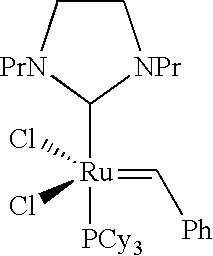 |
[RuCl2(PCy3)(ImH2Pr)(benzylidene)]CAS No. 373640-75-6 |
 |
[RuCl2(PCy3)(ImH2Mes)(3-phenyl-indenylidene)]CAS No. 536724-67-1 |
 |
[RuCl2(PCy3)(ImMes)(3-phenyl-indenylidene)]CAS No. 254972-49-1 |
 |
[RuCl2(PPh3)(ImMes)(3-phenyl-indenylidene)]CAS No. 254972-47-9 |
Claims (7)


Applications Claiming Priority (2)
| Application Number | Priority Date | Filing Date | Title |
|---|---|---|---|
| EP05103218 | 2005-04-21 | ||
| EP05103218.3 | 2005-04-21 |
Publications (2)
| Publication Number | Publication Date |
|---|---|
| US20060241156A1 US20060241156A1 (en) | 2006-10-26 |
| US7238816B2 true US7238816B2 (en) | 2007-07-03 |
Family
ID=36790866
Family Applications (1)
| Application Number | Title | Priority Date | Filing Date |
|---|---|---|---|
| US11/400,682 Active US7238816B2 (en) | 2005-04-21 | 2006-04-07 | Preparation of epothilone derivatives |
Country Status (12)
| Country | Link |
|---|---|
| US (1) | US7238816B2 (en) |
| EP (1) | EP1874752A1 (en) |
| JP (1) | JP2008538368A (en) |
| KR (1) | KR20070113307A (en) |
| CN (1) | CN101160302A (en) |
| AU (1) | AU2006237296A1 (en) |
| BR (1) | BRPI0609934A2 (en) |
| CA (1) | CA2604257A1 (en) |
| IL (1) | IL186457A0 (en) |
| MX (1) | MX2007012880A (en) |
| TW (1) | TW200714595A (en) |
| WO (1) | WO2006111491A1 (en) |
Cited By (1)
| Publication number | Priority date | Publication date | Assignee | Title |
|---|---|---|---|---|
| US20150217283A1 (en) * | 2012-08-16 | 2015-08-06 | Apeiron Synthesis S.A. | Novel metal complexes, especially the ruthenium complexes, and use thereof |
Families Citing this family (1)
| Publication number | Priority date | Publication date | Assignee | Title |
|---|---|---|---|---|
| WO2009112077A1 (en) * | 2008-03-13 | 2009-09-17 | F. Hoffmann-La Roche Ag | Process for the preparation of epothilone precursor compounds |
Citations (2)
| Publication number | Priority date | Publication date | Assignee | Title |
|---|---|---|---|---|
| WO2004018478A2 (en) | 2002-08-23 | 2004-03-04 | Sloan-Kettering Institute For Cancer Research | Synthesis of epothilones, intermediates thereto, analogues and uses thereof |
| US20040053910A1 (en) | 2002-08-23 | 2004-03-18 | Danishefsky Samuel J. | Synthesis of epothilones, intermediates thereto and analogues thereof |
-
2006
- 2006-04-07 US US11/400,682 patent/US7238816B2/en active Active
- 2006-04-11 CA CA002604257A patent/CA2604257A1/en not_active Abandoned
- 2006-04-11 EP EP06743281A patent/EP1874752A1/en not_active Withdrawn
- 2006-04-11 MX MX2007012880A patent/MX2007012880A/en active IP Right Grant
- 2006-04-11 CN CNA2006800127449A patent/CN101160302A/en active Pending
- 2006-04-11 BR BRPI0609934-3A patent/BRPI0609934A2/en not_active IP Right Cessation
- 2006-04-11 AU AU2006237296A patent/AU2006237296A1/en not_active Abandoned
- 2006-04-11 JP JP2008507052A patent/JP2008538368A/en active Pending
- 2006-04-11 WO PCT/EP2006/061527 patent/WO2006111491A1/en not_active Ceased
- 2006-04-11 KR KR1020077024115A patent/KR20070113307A/en not_active Ceased
- 2006-04-18 TW TW095113828A patent/TW200714595A/en unknown
-
2007
- 2007-10-07 IL IL186457A patent/IL186457A0/en unknown
Patent Citations (2)
| Publication number | Priority date | Publication date | Assignee | Title |
|---|---|---|---|---|
| WO2004018478A2 (en) | 2002-08-23 | 2004-03-04 | Sloan-Kettering Institute For Cancer Research | Synthesis of epothilones, intermediates thereto, analogues and uses thereof |
| US20040053910A1 (en) | 2002-08-23 | 2004-03-18 | Danishefsky Samuel J. | Synthesis of epothilones, intermediates thereto and analogues thereof |
Non-Patent Citations (4)
| Title |
|---|
| Danishefsky et al., J. Am. Chem. Soc., 125, pp. 2899-2901 (2003). |
| Fuerstner, A. et al, J. Org. Chem., vol. 65:7, (2000) pp. 2204-2207 XP002395456. |
| Mol, J.C., Adv. Synth. Catal., 344, pp. 671-677 (2002). |
| Nolan et al., Organometallics, 18, pp. 5416-5419 (1999). |
Cited By (2)
| Publication number | Priority date | Publication date | Assignee | Title |
|---|---|---|---|---|
| US20150217283A1 (en) * | 2012-08-16 | 2015-08-06 | Apeiron Synthesis S.A. | Novel metal complexes, especially the ruthenium complexes, and use thereof |
| US9221042B2 (en) * | 2012-08-16 | 2015-12-29 | Apeiron Synthesis S.A. | Metal complexes, especially the ruthenium complexes, and use thereof |
Also Published As
| Publication number | Publication date |
|---|---|
| IL186457A0 (en) | 2008-01-20 |
| BRPI0609934A2 (en) | 2010-05-11 |
| WO2006111491A1 (en) | 2006-10-26 |
| TW200714595A (en) | 2007-04-16 |
| CN101160302A (en) | 2008-04-09 |
| US20060241156A1 (en) | 2006-10-26 |
| KR20070113307A (en) | 2007-11-28 |
| MX2007012880A (en) | 2007-12-10 |
| JP2008538368A (en) | 2008-10-23 |
| CA2604257A1 (en) | 2006-10-26 |
| EP1874752A1 (en) | 2008-01-09 |
| AU2006237296A1 (en) | 2006-10-26 |
Similar Documents
| Publication | Publication Date | Title |
|---|---|---|
| JP5619724B2 (en) | Ruthenium olefin metathesis catalyst having N-heterocyclic carbene ligand with substituted skeleton | |
| EP0218138B1 (en) | New catalysts process for their production and their use for effecting metathesis of olefins | |
| Altmann et al. | The Total Synthesis and Biological Assessment of trans‐Epothilone A | |
| WO2014134281A1 (en) | Biosynthesis of cannabinoids | |
| Saito et al. | Mixed Crossed Aldol Condensation between Conjugated Esters and Aldehydes Using Aluminum Tris (2, 6‐diphenylphenoxide) | |
| KR20100127822A (en) | New Ruthenium Complexes as Catalysts for Metathesis Reactions | |
| KR101461682B1 (en) | A novel ruthenium complex as a catalyst for metathesis reaction | |
| US9108996B2 (en) | Ruthenium-based metathesis catalysts and precursors for their preparation | |
| CA2473075A1 (en) | Process for the manufacture of hmg-coa reductase inhibitory mevalonic acid derivatives | |
| Mazur et al. | Formylation of a metathesis-derived ansa [4]-ferrocene: a simple route to anticancer organometallics | |
| CN102516152B (en) | Alpha-difluoro carbonyl substituted chiral tert-alcohol compound, its synthetic method and application thereof | |
| US7238816B2 (en) | Preparation of epothilone derivatives | |
| CN107602559B (en) | A method for the synthesis of chiral three-membered carbocyclic nucleosides by asymmetric cyclopropanation initiated by Michael addition | |
| US20150299236A1 (en) | Z-selective metathesis catalysts | |
| CN114369119B (en) | Artemisinin-piperazine-phosphoramide nitrogen mustard hybrid as well as preparation method and application thereof | |
| US7960589B2 (en) | Synthesis of sphingosines and their derivatives | |
| US20090253904A1 (en) | Process for the Preparation of a Tetrahydro-1H-Azepines | |
| WO2017197670A1 (en) | Method for synthesizing 1,2-dimethylene cyclobutane chiral compound | |
| Hong et al. | The reactions of 4, 6-dimethyl-2-mercaptopyrimidine with dimetallic compounds: diiron nonacarbonyl and cyclopentadienylmolybedenum tricarbonyl dimer | |
| Kumar et al. | Synthesis of novel 2-Thioxothiazolidin-4-one and Thiazolidine-2, 4-dione derivatives as potential anticancer agents | |
| CN110240600A (en) | A method for synthesizing chiral cis carbocyclic N3-purine nucleosides | |
| Voss et al. | Unusual carbamate-directed CH-activation at an annulated ferrocenophane framework | |
| WO2009112077A1 (en) | Process for the preparation of epothilone precursor compounds | |
| CN117229181A (en) | Preparation method of methylsulfonylamino chalcone derivative | |
| JP2021515760A (en) | Method |
Legal Events
| Date | Code | Title | Description |
|---|---|---|---|
| AS | Assignment |
Owner name: F. HOFFMANN-LA ROCHE AG, A SWISS COMPANY, SWITZERL Free format text: ASSIGNMENT OF ASSIGNORS INTEREST;ASSIGNORS:PUENTENER, KURT;SCALONE, MICHELANGELO;REEL/FRAME:019067/0808 Effective date: 20060320 Owner name: HOFFMANN-LA ROCHE INC., NEW JERSEY Free format text: ASSIGNMENT OF ASSIGNORS INTEREST;ASSIGNOR:F. HOFFMANN-LA ROCHE AG;REEL/FRAME:019067/0766 Effective date: 20060322 |
|
| STCF | Information on status: patent grant |
Free format text: PATENTED CASE |
|
| AS | Assignment |
Owner name: KOSAN BIOSCIENCES, INC., NEW JERSEY Free format text: ASSIGNMENT OF ASSIGNORS INTEREST;ASSIGNOR:HOFFMANN-LA ROCHE INC.;REEL/FRAME:022868/0033 Effective date: 20090616 |
|
| FPAY | Fee payment |
Year of fee payment: 4 |
|
| FPAY | Fee payment |
Year of fee payment: 8 |
|
| MAFP | Maintenance fee payment |
Free format text: PAYMENT OF MAINTENANCE FEE, 12TH YEAR, LARGE ENTITY (ORIGINAL EVENT CODE: M1553); ENTITY STATUS OF PATENT OWNER: LARGE ENTITY Year of fee payment: 12 |