US7231086B2 - Knowledge-based hierarchical method for detecting regions of interest - Google Patents
Knowledge-based hierarchical method for detecting regions of interest Download PDFInfo
- Publication number
- US7231086B2 US7231086B2 US10/142,175 US14217502A US7231086B2 US 7231086 B2 US7231086 B2 US 7231086B2 US 14217502 A US14217502 A US 14217502A US 7231086 B2 US7231086 B2 US 7231086B2
- Authority
- US
- United States
- Prior art keywords
- interest
- under consideration
- image under
- region
- detecting
- Prior art date
- Legal status (The legal status is an assumption and is not a legal conclusion. Google has not performed a legal analysis and makes no representation as to the accuracy of the status listed.)
- Expired - Fee Related, expires
Links
Images




Classifications
-
- G—PHYSICS
- G06—COMPUTING OR CALCULATING; COUNTING
- G06V—IMAGE OR VIDEO RECOGNITION OR UNDERSTANDING
- G06V10/00—Arrangements for image or video recognition or understanding
- G06V10/20—Image preprocessing
- G06V10/25—Determination of region of interest [ROI] or a volume of interest [VOI]
Definitions
- the present invention relates to the field of image processing and, more particularly, to detecting regions of interests (ROIs) in images.
- ROIs regions of interests
- Detecting ROIs in images is a common step in many image processing systems.
- Conventional digital image recognition systems detect ROIs by typically using some knowledge of a prototype.
- an image is composed of many objects that can be defined by pixels.
- a group of pixels is called a region.
- a target is an object of interest.
- a prototype contains information about a type of target.
- a DIRS may detect a region in an image that matches the prototype.
- DIRSs may have different phases to more efficiently process information from an image, such as: a segmentation phase, a feature extraction phase and a classification phase.
- the function of the segmentation and feature extraction phases are to reduce the volume of data.
- the feature extraction phase some of the significant characteristics of each target are measured and taken together to form a vector.
- the image can be converted into a series of targets, each described by a vector.
- each target is found and is isolated from the rest of the information in the image.
- the segmentation phase identifies the features to differentiate different prototypes, uses the detection algorithm to group pixels with similar features, and uses a merging algorithm to group regions of the image. Because these issues may impact the efficiency and effectiveness of a DIRS, the segmentation phase can affect the functionality of the entire process.
- the algorithms used in the segmentation phase are typically applied to an entire image to reduce the data dimension for subsequent processing purposes. Pixels with similar optical characteristics, such as color and intensity, are grouped together and separated from the others. Particular regions can then be chosen based upon features such as size and shape, and forwarded to successive processing units.
- Sophisticated algorithms have been proposed to address some of these segmentation issues. However, the computational complexity associated with these algorithms may prohibit them from use in real-time applications.
- One solution is to quickly detect regions that may correspond to objects, and then apply dedicated algorithms to those regions.
- Another solution is to first transform the image, and then cluster the image to detect the ROIs.
- Yet another solution is to first threshold the image, and then take every “blob” as one region.
- the present invention is a knowledge-based multi-resolution method for detecting ROIs in images.
- the present invention makes use of prior knowledge about targets using prototype information which can contain size and shape information about an object as well as object size information calculated from the imaging sensor parameters.
- the present invention can detect ROIs and then apply segmentation to those ROIs.
- the present invention reduces the computational complexity of detecting ROIs and can provide quality ROI detection performance with poor-quality imagery.
- the excellent detection performance can greatly improve the performance of subsequent processing techniques such as compression, segmentation, and recognition.
- the present invention can comprise four primary steps.
- Prior knowledge typically consists of information about the general types of targets and information about the sensor which captured the image, in particular, the pixel resolution of the image.
- the ROCs are fused from different prototype groups to make consolidated ROCs.
- Fourth, each consolidated ROC is extended if necessary and is assigned an area in the image to make an ROI.
- the present invention has several advantages over conventional methods.
- the use of prior knowledge in the present invention can be used for grouping prototypes, choosing features and the use of more efficient and simpler algorithms.
- the present invention also utilizes multi-resolution that allows for detecting groups of prototypes on the minimal resolution in which the prototypes are barely detectable which reduces the volume of data to be processed.
- the use of multi-resolution with different groups of prototypes reduces the risk of errors made in any one resolution from proliferating to other resolutions.
- the present invention solves many of the problems of conventional methods because of its use of prior knowledge and multi-resolutions.
- the present invention is not bound to detecting ROIs by symmetrical shapes like rectangles.
- the present invention may detect ROIs with irregular shapes (i.e. any shape and any positioning) that conform to the shape of the target.
- FIG. 1 is an example of a method in accordance with the present invention.
- FIG. 2 is a schematic diagram illustrating a method in accordance with the present invention.
- FIGS. 3( a )-( b ) shows a splitting function useful in the present invention
- FIGS. 5( a )-( c ) shows an area extension function useful in the present invention.
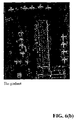
- FIGS. 6( a )-( l ) shows a series of images illustrating the progressive results using an embodiment of the present invention.
- prior knowledge consists of general information about the targets (i.e. as prototypes) and information about the sensor generating the image.
- the target is typically a type of object that may be found in the image.
- the prior knowledge does not need precise information about the target, such as exact dimensions or colors, but general size and shape information should suffice.
- the present invention allows for the target to be loosely defined. Thus, in the present invention, a user can easily change the type of target of interest by simply modifying the prior knowledge.
- These prototypes may be further classified into groups with similar optical properties and sizes.
- the sensor can be any device for generating, copying, recording, etc. an image such as video camera, a satellite, etc.
- the prior knowledge typically would know the pixel resolution of the image generated by the sensor. Accordingly, the present invention can determine approximately how many pixels correlates to a specific unit of measurement. For example, because of prior knowledge a system using the present invention would know that in a certain image 15 pixels would equal 10 feet. This allows the present invention to have a reference point when reviewing objects in images of different resolutions.
- Function D(x) is the definition domain of variable x; function N(X) is the number of elements in set X.
- the underlying grid G of I can be 8-connected or 4-connected, or others.
- the task is usually to automatically detect specific objects within an image. Therefore, without loss of generality, the present invention preferably assumes that the shape and size of the prototype, the resolution of the image, and other physical information is available to be used. With the size of the prototypes and the resolution of the image, the present invention can further calculate the size of the targets in the image.
- the “size” of a prototype refers to the largest projection that the prototype renders along any direction.
- ptt i there is a threshold value associated with each prototype, ptt i , denoted by S exp (ptt i ). Any object should have size (in pixels) no less than this to ensure reasonable detection and recognition.
- D ( t i ) ⁇ D ( I ) (4a) D ( t i ) ⁇ D ( t j ) 0 , ⁇ i ⁇ j (4b)
- the objective of the present invention is therefore the following: ⁇ 1 ⁇ i ⁇ N ( t ), ⁇ 1 ⁇ j ⁇ N ( roi ), such that D (t i ) ⁇ D ( roi i ) (6a) If D ( t i ) ⁇ D ( roi j ), then there is no k ⁇ i , such that D ( t k ) ⁇ D ( roi
- the prototypes Prior to any processing procedure on image I, the prototypes are preferably first classified into groups, each with similar optical characteristics and size.
- the prototype groups, ptt i , 1 ⁇ i ⁇ N(ptt), are defined and specified in Equation (1).
- a series of detection algorithms may be used to detect the reproductions of the prototypes in the image.
- Each detection algorithm can focus on one group of prototypes, e.g., g i , and does not care about any other prototypes, e.g., p j ⁇ g i .
- the performance of the present invention is typically enhanced over conventional methods that use a big complex detection algorithm focusing on all prototypes, because, i) it is easier to choose dominant features for a subset of prototypes than all prototypes; ii) the number of reproductions corresponding to the prototypes of interest is smaller, and it is easier to determine the features, and iii) each group of prototypes can be detected at its lowest resolution for enhanced computation speed.
- a detection algorithm is designed.
- the detection algorithms for different prototype groups can be different. Some or all of the following procedures may be taken to render some of the parameters required for use in the present invention.
- the features can be anything differentiating targets from non-targets, such as color, intensity, texture, edge, etc.
- Classifier the choice of classifier is subject to the available knowledge of the prototypes g i . For example, if plenty of training data is available, artificial neural networks are good choices, while if standard presentations of the prototypes are available, template matching can be used.
- the parameters may include (a) high level features (as contrast to optical features) not mentioned before, such as compactness, moments, etc., of the prototypes, and (b) the modified values for aforementioned parameters.
- An example of case (b) is, in an application, the resolution of the image may be 100 ⁇ 10 cm/pixel instead of exactly 100 cm/pixel. The noise of the image can make the reproduction larger or smaller. Therefore the maximal and minimal size of the targets should be modified to
- Wavelet transformation is used to down-sample the image to different scales. Because the results of wavelet transformation can also be used in compression, which is a successive operation in many applications, the computational load added would be low.
- multiple images may be produced at different resolutions (i.e. down-sampled) to be processed later by the present invention.
- a down-sampled image may require less computation than the original image. For example, a down-sampled image at 1 ⁇ 8th the resolution of the original image may require 1/64 less computations than if performed on the original image.
- objects of a similar size are typically processed from the same down-sampled image.
- the resolution used for a specific group is the lowest resolution in which all of the prototypes for that group are just detectable (e.g. the minimum size required to distinguish the shape of the prototype).
- the number of down-sampled images i.e. levels
- Table 1 there are two down-sampled images in addition to the original image.
- the prototypes of group g 1 (consisting of the triangle and pentagon) were grouped together because of their common optical feature, texture, and similar size.
- prototype groups g 2 , g 3 , and g 4 were grouped together because of a common optical feature and similar size.
- Further processing of prototype groups g 1 and g 3 in this embodiment will be done using the down-sampled image at scale 1 .
- further processing of prototype group g 4 will be done using down-sampled image at scale 2
- FIG. 2 The structure of the algorithm used in FIG. 1 is shown in FIG. 2 . From knowledge 210 , the present invention forms four prototype groups 220 . An original image 200 is down-sampled by wavelet transformation to form three multi-resolution images 230 .
- the system extracts the optical features that distinguish a prototype group g i .
- as many objects as possible are identified and extracted.
- the extracted features are dichotomized using thresholding, namely the image will be labeled with “1” for target pixels with the identified features, and “0” for non-target pixels.
- the system further examines the connected components with labels of “1”.
- such connected components are referred to as “regions”, and “removing a region” refers to labeling the corresponding pixels to “0”.
- the size of the regions labeled with “1” may exceed S b max (g i ).
- the present invention can split these regions by removing the pixels in the “weakest branch position” until all the sub-regions are equal to or smaller than S b max (g i ).
- a branch position/pixel is typically one that has more than two disjoint sets of pixels belonging to the other regions in its neighborhood, and it is weak if the number of pixels belonging to the same region in its neighborhood is small.
- the weakest branch pixels of one region are removed.
- FIG. 3 is an example where a region may be split at its weakest branch position. Splitting can be repeated until all regions are not larger than the expected region size for a particular resolution.
- targets may be merged.
- the merging process can be done by grouping neighboring regions under the constraints that the resulted new region is smaller than S b max (g i ) and the new region has a higher probability resembling a prototype.
- the merge is a two-step test. First, each region is checked to determine if it can be combined with a neighboring region and not exceed the expected target size for that particular resolution. If two or more regions can be combined in such a manner, the present invention can then determine if the ratio of the length to the total area is in the prescribed range, as determined by the prior knowledge. If so, the regions can be merged and treated as one object.
- edge is taken as the “basic feature.” In other words, the preferred embodiment will typically rely on edges when it does not have any specific information of the targets' optical characteristics.
- a Gaussian filter is convolved with the image.
- the system calculates the gradient by using a Sobel operator. In other embodiments, other operators such as Prewitt, Roberts, etc., may also be used.
- the gradient is binarized by thresholding.
- a threshold typically is predefined manually. However, this threshold is not critical, because a higher threshold, which renders under-segmentation, can be compensated by the merging operation, while a lower threshold will be compensated by the splitting operation.
- An ROC detected under one resolution for a given prototype group g i is designed to correspond to one prototype in g i . However, it may also correspond to portions or concatenations of prototypes other than those in g i . In other words, one pixel in the image may be occupied by several ROCs for different prototype groups. Therefore, in the present invention, an arbitrator may be used to eliminate redundant regions. The arbitration process may result in a voting procedure using all scales for a series of newly consolidated ROCs. An example of the consolidated ROCs is shown in FIG. 1 and also in FIG. 2 as consolidated ROC 250 . In the preferred embodiment, the two voting criteria are: i) no two ROCs should overlap one other; and ii) the total area of the consolidated ROCs should occupy the most number of pixels in the image.
- Finding a series of consolidated ROCs is subject to the two criteria i) and ii). It is a non-linear optimization problem. The computation required to find the global optimal solution is prohibitive. Therefore, a simplified algorithm is used to find a local optimal solution. In this algorithm, the ROCs are processed in sequence. An unconsolidated ROC, roc 0 , is considered a valid ROC only if its pixels are more than the sum of the currently consolidated ROCs, roc i , 1 ⁇ i ⁇ N, that overlap with roc 0 . After roc 0 being declared the newly consolidated ROC, the overlapping ROCs, roc i , 1 ⁇ i ⁇ N, are removed.
- ROCs corresponding to small prototypes preferably have a higher priority when consolidating.
- the algorithm used in the preferred embodiment is shown in Table 2.
- Step 1 Represent all the ROCs in the same resolution. Sort the ROCs in ascending sequence according to the sizes of their corresponding prototypes. Put this sequence in A 1 . Set A 0 to an empty set.
- Step 2 Suppose roc 0 is the first ROC in A I . Then roc 0 corresponds to the smallest prototype in A I . Find out all the ROCs in A 0 that overlap with roc 0 , e.g., roc I , 1 ⁇ i ⁇ N.
- Step 3 If the pixels in roc 0 are more than the sum of pixels in roc I , 1 ⁇ i ⁇ N, then remove roc i , 1 ⁇ i ⁇ N from A 0 and move roc 0 from A I to A 0 ; otherwise remove roc 0 from A I .
- Step 4 If A I is empty, stop the program; otherwise goto step 2.
- the consolidated ROCs correspond to the reproductions of all prototypes in this image and are used as “hints” to find the complete targets.
- the present invention integrates the pixels that are outside of the consolidated ROCs (roc i , 1 ⁇ i ⁇ N(roc)) but that also correspond to the targets. Dilation is not used in the preferred embodiment because it may merge regions from adjacent objects before merging all the pixels in the same object.
- a probability-based membership function is used. An example of the membership function is shown in FIG. 4 .
- the size of the smallest rectangle is S rec , which contains the roc, with size of w ⁇ h (width times height).
- the maximum dimension of its associating prototype group is S. Therefore, S ⁇ w and S ⁇ h.
- S pad which shares the same center as S rec .
- the width and the height of S pad are (2S ⁇ w) and (2S ⁇ h), respectively.
- S rec S pad and membership can be seen in FIG. 4 .
- a pixel is assigned to the ROC that has the biggest membership value.
- the newly extended regions from the consolidated ROCs, which also include the ROCs, are referred to as ROIs.
- this membership which is defined on 2-D space, can be approximated by memberships defined on 1-D space.
- FIG. 5 An example of extending two ROCs to two ROIs is shown in FIG. 5 .
- FIG. 5( a ) illustrates, the use of a rectangular box would not provide the best description of this non-rectangular object because expansion may result in overlapping ROIs.
- the area extension shown in FIGS. 5( b ) and 5 ( c ) result in ROIs that are expanded without overlap because they conform more closely to the natural shape of the object.
- the present invention may produce several, one, or no ROIs depending on the content of the original image and the prototype information.
- Each ROI typically has one target and will conform to the shape of that target. Likewise, the target is usually completely enclosed within the ROI.
- the ROI can then be used further according to the needs of the relevant implementation.
- FIG. 6 illustrates an embodiment of the present invention on an image.
- FIG. 6( a ) there are three targets (three prototypes) of interest. All of them are planes, but with different sizes and shapes. These prototypes are divided into two groups. In this example, edge is the optical feature used to distinguish these planes.
- FIG. 6 is summarized in
- the active regions whose sizes are within [S b min (g 1 ), S b max (g 1 )], are shown in gray bounding boxes.
- 6(g) The regions of candidate. The inactive regions have already been removed. There are 66 ROC for prototype group 1. Group 2 6(h) Same as group 1. 6(i) Same as group 1. 6(j) Same as group 1. There are 41 ROC for prototype group 2. 6(k) The consolidated ROCs. There are 82 consolidated ROCs. 6(l) The regions of interest.
- feature detection can be accomplished by other optical characteristics such as color or intensity, texture, etc.
- the present invention can be used in various applications where detection of objects is needed especially when the quality of the original image is poor such as infrared images, medical imaging, satellite imaging, etc.
- the present invention may verify and improve the accuracy of ROI detection after performing the split and merge operations before proceeding with further processing by using supervisory information (orthogonal to the characteristics used in feature detection and the split and merge operations). For example, it may be possible to use the “average width” to determine if the ROI contains a certain object, where “average width” is defined as the ratio of the area of the object to the length of the boundary. Alternatively, an embodiment of the present invention can use the ratio of the number of pixels in the target's boundary to the number of pixels inside the target's smallest bounding box.
Landscapes
- Engineering & Computer Science (AREA)
- Physics & Mathematics (AREA)
- General Physics & Mathematics (AREA)
- Multimedia (AREA)
- Theoretical Computer Science (AREA)
- Image Analysis (AREA)
Abstract
Description
In the present invention, the task is usually to automatically detect specific objects within an image. Therefore, without loss of generality, the present invention preferably assumes that the shape and size of the prototype, the resolution of the image, and other physical information is available to be used. With the size of the prototypes and the resolution of the image, the present invention can further calculate the size of the targets in the image. For example, a B-52H with physical size of 49 meters×56 meters (length times wingspan), in an image of resolution 0.5 meters/pixel, occupies 98 pixels×112 pixels in the image. With the size and resolution information, the present invention can derive the size of the prototypes at any down-sampled scale, i.e., Si(pttj), i=1,2, . . . ,L, j=1,2, . . . ,N(ptt). The size of thejth prototype at the ith scale satisfies
S i(ptt j)=S 0(ptt j)/2i . (2)
and the minimal size is
Every object in I is a potential target, ti, 1≦i≦N(t). Assume that the targets are not overlapping, but can be touching. Then,
D(t i)⊂ D(I) (4a)
D(t i)∩D(t j)=0, ∀i≠j (4b)
The expected outcome of the present invention is a series of ROIs, roii, 1≦i≦N(roi), which satisfy the following constraints:
D(roi i)⊂ D(I) (5a)
D(roi i)∩D(roi j)=0, ∀i≠j (5b)
The objective of the present invention is therefore the following:
∀1≦i≦N(t),∃1≦j≦N(roi), such that D(ti)⊂ D(roi i) (6a)
If D(t i)⊂ D(roi j), then there is no k≠i, such that D(t k)⊂ D(roi i) 6b)
where δ is related to the accuracy of the resolution and the noise level. In the following, without confusion, the modified parameters follow the same convention as the original parameters. For example, Si max(gj) is in fact
| TABLE 1 | ||||
| Prototype group | g1 | g2 | g3 | g4 |
| Prototypes | Triangle, | Star | Octagon | Circle, |
| Pentagon | Bar | |||
| Feature | texture | black | white | |
| Scale | ||||
| 1 | 0 | 1 | 2 | |
| TABLE 2 |
| An algorithm for multi-voting. |
| Step 1: Represent all the ROCs in the same resolution. Sort the ROCs in |
| ascending sequence according to the sizes of their corresponding |
| prototypes. Put this sequence in A1. Set A0 to an empty set. |
| Step 2: Suppose roc0 is the first ROC in AI. Then roc0 corresponds to |
| the smallest prototype in AI. Find out all the ROCs in A0 that overlap with |
| roc0, e.g., rocI, 1 ≦ i ≦ N. |
| Step 3: If the pixels in roc0 are more than the sum of pixels in rocI, |
| 1 ≦ i ≦ N, then remove roci, 1 ≦ i ≦ N from A0 and move roc0 |
| from AI to A0; otherwise remove roc0 from AI. |
| Step 4: If AI is empty, stop the program; otherwise goto |
where DIS {(x, y), roci} is the minimal distance between a pixel at (x, y) and all the pixels in roci.
| TABLE 3 | |
| FIG. | Description |
| 6(a) | Original gray image with 8 bit/pixel, and with size of | |
| 1216 * 1404. | ||
| 6(b) | The gradient is quantized to [0, 255] for better visual | |
| effect. | ||
| 6(c) | The thresholded gradient image where white pixels are of | |
| interest. | ||
| 6(d) | The initial regions which are derived from the edge | |
| image. Each region is shown in gray bounding box. | ||
| There are 240 initial regions. | ||
| |
6(e) | The regions after split. Some regions that are unlikely to |
| correspond to this group of prototypes are eliminated | ||
| before split. Then the survived regions are split until all | ||
| the resulted regions are smaller than Sb max (g1). | ||
| The resulted regions are shown in white and with gray | ||
| bounding boxes, while the eliminated are shown in white | ||
| without bounding boxes. | ||
| 6(f) | The regions after merging. The active regions, whose | |
| sizes are within [Sb min (g1), Sb max (g1)], | ||
| are shown in gray bounding boxes. | ||
| 6(g) | The regions of candidate. The inactive regions have | |
| already been removed. There are 66 ROC for | ||
| group | ||
| 1. | ||
| |
6(h) | Same as |
| 6(i) | Same as |
|
| 6(j) | Same as | |
| group | ||
| 2. | ||
| 6(k) | The consolidated ROCs. There are 82 consolidated | |
| ROCs. | ||
| 6(l) | The regions of interest. | |
Claims (25)
Priority Applications (1)
| Application Number | Priority Date | Filing Date | Title |
|---|---|---|---|
| US10/142,175 US7231086B2 (en) | 2002-05-09 | 2002-05-09 | Knowledge-based hierarchical method for detecting regions of interest |
Applications Claiming Priority (1)
| Application Number | Priority Date | Filing Date | Title |
|---|---|---|---|
| US10/142,175 US7231086B2 (en) | 2002-05-09 | 2002-05-09 | Knowledge-based hierarchical method for detecting regions of interest |
Publications (2)
| Publication Number | Publication Date |
|---|---|
| US20030210818A1 US20030210818A1 (en) | 2003-11-13 |
| US7231086B2 true US7231086B2 (en) | 2007-06-12 |
Family
ID=29399822
Family Applications (1)
| Application Number | Title | Priority Date | Filing Date |
|---|---|---|---|
| US10/142,175 Expired - Fee Related US7231086B2 (en) | 2002-05-09 | 2002-05-09 | Knowledge-based hierarchical method for detecting regions of interest |
Country Status (1)
| Country | Link |
|---|---|
| US (1) | US7231086B2 (en) |
Cited By (5)
| Publication number | Priority date | Publication date | Assignee | Title |
|---|---|---|---|---|
| US20060104532A1 (en) * | 2004-11-12 | 2006-05-18 | Giuseppe Messina | Digital image processing method |
| US20130096884A1 (en) * | 2010-08-19 | 2013-04-18 | Bae Systems Plc | Sensor data processing |
| US9418283B1 (en) * | 2014-08-20 | 2016-08-16 | Amazon Technologies, Inc. | Image processing using multiple aspect ratios |
| US9576196B1 (en) | 2014-08-20 | 2017-02-21 | Amazon Technologies, Inc. | Leveraging image context for improved glyph classification |
| US10783610B2 (en) * | 2015-12-14 | 2020-09-22 | Motion Metrics International Corp. | Method and apparatus for identifying fragmented material portions within an image |
Families Citing this family (5)
| Publication number | Priority date | Publication date | Assignee | Title |
|---|---|---|---|---|
| US20070031038A1 (en) * | 2005-08-03 | 2007-02-08 | Honeywell International Inc. | Boolean complement methods and systems for video image processing a region of interest |
| US7778445B2 (en) * | 2006-06-07 | 2010-08-17 | Honeywell International Inc. | Method and system for the detection of removed objects in video images |
| JP5257958B2 (en) * | 2011-06-01 | 2013-08-07 | 株式会社日立メディコ | Image display device, image display system, and image display method |
| KR20140112774A (en) * | 2013-03-14 | 2014-09-24 | 삼성전자주식회사 | Image editing method, machine-readable storage medium and terminal |
| JP6832155B2 (en) * | 2016-12-28 | 2021-02-24 | ソニーセミコンダクタソリューションズ株式会社 | Image processing equipment, image processing method, and image processing system |
Citations (7)
| Publication number | Priority date | Publication date | Assignee | Title |
|---|---|---|---|---|
| US5887081A (en) * | 1995-12-07 | 1999-03-23 | Ncr Corporation | Method for fast image identification and categorization of multimedia data |
| US20030161523A1 (en) * | 2002-02-22 | 2003-08-28 | International Business Machines Corporation | MICR-based optical character recognition system and method |
| US6614928B1 (en) * | 1999-12-21 | 2003-09-02 | Electronics And Telecommunications Research Institute | Automatic parcel volume capture system and volume capture method using parcel image recognition |
| US6678404B1 (en) * | 2000-10-31 | 2004-01-13 | Shih-Jong J. Lee | Automatic referencing for computer vision applications |
| US6801665B1 (en) * | 1998-09-15 | 2004-10-05 | University Of Maryland | Method and apparatus for compressing and decompressing images |
| US6804403B1 (en) * | 1998-07-15 | 2004-10-12 | Digital Accelerator Corporation | Region-based scalable image coding |
| US6816627B2 (en) * | 2001-04-12 | 2004-11-09 | Lockheed Martin Corporation | System for morphological image fusion and change detection |
-
2002
- 2002-05-09 US US10/142,175 patent/US7231086B2/en not_active Expired - Fee Related
Patent Citations (7)
| Publication number | Priority date | Publication date | Assignee | Title |
|---|---|---|---|---|
| US5887081A (en) * | 1995-12-07 | 1999-03-23 | Ncr Corporation | Method for fast image identification and categorization of multimedia data |
| US6804403B1 (en) * | 1998-07-15 | 2004-10-12 | Digital Accelerator Corporation | Region-based scalable image coding |
| US6801665B1 (en) * | 1998-09-15 | 2004-10-05 | University Of Maryland | Method and apparatus for compressing and decompressing images |
| US6614928B1 (en) * | 1999-12-21 | 2003-09-02 | Electronics And Telecommunications Research Institute | Automatic parcel volume capture system and volume capture method using parcel image recognition |
| US6678404B1 (en) * | 2000-10-31 | 2004-01-13 | Shih-Jong J. Lee | Automatic referencing for computer vision applications |
| US6816627B2 (en) * | 2001-04-12 | 2004-11-09 | Lockheed Martin Corporation | System for morphological image fusion and change detection |
| US20030161523A1 (en) * | 2002-02-22 | 2003-08-28 | International Business Machines Corporation | MICR-based optical character recognition system and method |
Non-Patent Citations (20)
| Title |
|---|
| A. Mohan, C. Papageorgiou, and T. Poggio, "Example-Based Object Detection in Images by Components," IEEE Trans. Pattern Analysis and Machine Intelligence, vol. 23, No. 4, pp. 349-361, Apr. 2001. |
| B. Sahiner, H.-P. Chan, N. Petrick, D. Wei, M.A. Helvie, D.D. Adler, and M.M. Goodsitt, "Classification of Mass and Normal Breast Tissue: A Convolution Neural Network Classifier with Spatial Domain and Texture Images," IEEE Trans. Medical Imaging, vol. 15, No. 5, pp. 598-610, Oct. 1996. |
| C.M. Privitera and L.W. Stark, "Algorithms for Defining Visual Regions-of-Interest: Comparison with Eye Fixations," IEEE Trans. Pattern Analysis and Machine Intelligence, vol. 22, No. 9, pp. 970-982, Sep. 2000. |
| Christoyianni, E. Dermatas, and G. Kokkinakis, "Automatic Detection of Abnormal Tissue in Mammography," Proc. 2001 IEEE Intl. Conf. on Image Processing, vol. 2, pp. 877-880, Thessaloniki, Greece, 2001. |
| E. Klotz, W.A. Kalender, and T. Sandor, "Automated Definition and Evaluation of Anatomical ROI's for Bone Mineral Determination by QCT," IEEE Trans. Medical Imaging, vol. 8, No. 4, pp. 371-376, Dec. 1989. |
| E. Pietka, A. Gertych, S. Pospiech, F. Cao, and H.K. Huang, "Computer-Assisted Bone Age Assessment: Image Preprocessing and Epiphyseal/Metaphyseal ROI Extraction," IEEE Trans. Image Processing, vol. 20, No. 8, pp. 715-729, Aug. 2001. |
| E. Pietka, L. Kaabi, M.L. Kuo, and H.K. Huang, "Feature Extraction in Carpal-Bone Analysis," IEEE Trans. Medical Imaging, vol. 12, No. 1, pp. 44-49, Mar. 1993. |
| E.V.R.D. Bella, G.T. Gullberg, A.B. Barclay, and R.L. Eisner, "Automated Region Selection for Analysis of Dynamic Cardiac SPECT Data," IEEE Trans. Nuclear Science, vol. 44, No. 3, pp. 1355-1361, Jun. 1997. |
| H. Lin, J. Si, and G. Abousleman, "Knowledge-Based Hierarchical Region-of-Interest Detection," Proc. IEEE Int'l Conf. Accoustics, Speech and Signal Processing, vol. 4, pp. 3628-3631, Orlando, Florida, May 13-17, 2002. |
| J. Li, J.Z. Wang, R.M. Gray, and G. Wiederhold, "Multiresolution Object-of-Interest Detection for Images with Low Depth of Field," Proc. Int'l Conf. Image Analysis and Processing, pp. 32-37, Venice, Italy, 1999. |
| J.K. Kim and H.W. Park, "Statistical Textural Features for Detection of Microcalcifications in Digitized Mammograms," IEEE Trans. Medical Imaging, vol. 18, No. 3, pp. 231-238, Mar. 1999. |
| J.L. Solka, D.J. Marchette, B.C. Wallet, V.L. Irwin, and G.W. Rogers, "Identification of Man-Made Regions in Unmanned Aerial Vehicle Imagery and Videos," IEEE Trans. Pattern Analysis and Machine Intelligence, vol. 20, No. 8, pp. 852-857, Aug. 1998. |
| Jouan, J. Verdenet, J.C. Cardot, M. Baud, and J. Duvernoy, "Automated Detection of the Left Ventricular Region of Interest by Means of the Extraction of Typical Behaviors in Cardiac Radionuclide Angiographies," IEEE Trans. Medical Imaging, vol. 9, No. 1, pp. 5-10, Mar. 1990. |
| M. Antonini, M. Barlaud, P. Mathieu, and I. Daubechies, "Image Coding Using Wavelet Transform," IEEE Trans. Image Processing, vol. 1, No. 2, pp. 205-220, Apr. 1992. |
| M.N. Gurcan, Y. Yardimci, A.E. Cetin, and R. Ansari, "Detection of Microcalcifications in Mammograms Using Higher Order Statistics," IEEE Signal Processing Letters, vol. 4, No. 8, pp. 213-216, Aug. 1997. |
| Marshall, David, "Edge Detection," http://www.cs.cf.ac.uk/Dave/Vision<SUB>-</SUB>lecture/node24.html, 1997. * |
| N.R. pal, T.C. Cahoon, J.C. Bezdek, and K. Pal, "A New Approach to Target Recognition for LADAR Data," IEEE Trans. Fuzzy Systems, vol. 9, No. 1, pp. 44-52, Feb. 2001. |
| T. Zhang, J. Peng, and Z. Li, "An Adpative Image Segmentation Method with Visual Nonlinearity Characteristics," IEEE Trans. on Systems, Man, and Cybernetics-Part B: Cybernetics, vol. 26, No. 4, pp. 619-627, Aug. 1996. |
| T.M. Stough and C.E. Brodley, "Focusing Attention on Objects of Interest Using Multiple Matched Filters," IEEE Trans. Image Processing, vol. 10, No. 3, pp. 419-426, Mar. 2001. |
| W.E. Polakowski, D.A. Cournoyer, S.K. Rogers, M.P. DeSimio, D.W. Ruck, J.W. Hoffmeister, and R.A. Raines, "Computer-Aided Breast Cancer Detection and Diagnosis of Masses Using Difference of Gaussians and Derivative-Based Feature Saliency," IEEE Trans. Medical Imaging, vol. 16, No. 6, pp. 811-819, Dec. 1997. |
Cited By (7)
| Publication number | Priority date | Publication date | Assignee | Title |
|---|---|---|---|---|
| US20060104532A1 (en) * | 2004-11-12 | 2006-05-18 | Giuseppe Messina | Digital image processing method |
| US7689060B2 (en) * | 2004-11-12 | 2010-03-30 | Stmicroelectronics Srl | Digital image processing method transforming a matrix representation of pixels into a vector representation |
| US20130096884A1 (en) * | 2010-08-19 | 2013-04-18 | Bae Systems Plc | Sensor data processing |
| US9342483B2 (en) * | 2010-08-19 | 2016-05-17 | Bae Systems Plc | Sensor data processing |
| US9418283B1 (en) * | 2014-08-20 | 2016-08-16 | Amazon Technologies, Inc. | Image processing using multiple aspect ratios |
| US9576196B1 (en) | 2014-08-20 | 2017-02-21 | Amazon Technologies, Inc. | Leveraging image context for improved glyph classification |
| US10783610B2 (en) * | 2015-12-14 | 2020-09-22 | Motion Metrics International Corp. | Method and apparatus for identifying fragmented material portions within an image |
Also Published As
| Publication number | Publication date |
|---|---|
| US20030210818A1 (en) | 2003-11-13 |
Similar Documents
| Publication | Publication Date | Title |
|---|---|---|
| CN112686812B (en) | Bank card tilt correction detection method, device, readable storage medium and terminal | |
| Chen et al. | A double-threshold image binarization method based on edge detector | |
| Clark et al. | Recognising text in real scenes | |
| EP1693783B1 (en) | Fast method of object detection by statistical template matching | |
| CN107103317A (en) | Fuzzy license plate image recognition algorithm based on image co-registration and blind deconvolution | |
| Cohen et al. | Robust text and drawing segmentation algorithm for historical documents | |
| CN117218672A (en) | A method and system for medical record text recognition based on deep learning | |
| Kruthi et al. | Offline signature verification using support vector machine | |
| CN108960221B (en) | Bank card identification method and device based on image | |
| CN110288040B (en) | Image similarity judging method and device based on topology verification | |
| US20030210818A1 (en) | Knowledge-based hierarchical method for detecting regions of interest | |
| Mukherjee et al. | Enhancement of image resolution by binarization | |
| JP6377214B2 (en) | Text detection method and apparatus | |
| CN116310834B (en) | A fine-grained target detection method based on structural prior and multi-scale feature fusion | |
| Liu et al. | A simple and fast text localization algorithm for indoor mobile robot navigation | |
| Thilagavathy et al. | Fuzzy based edge enhanced text detection algorithm using MSER | |
| Brunnström et al. | On scale and resolution in active analysis of local image structure | |
| RU2859717C1 (en) | Method for recognising filled state of pre-localised checkbox in image using fast discrete approximation algorithm of radon transform | |
| Wadhawan et al. | Automated Recognition of Text in images: A survey | |
| CN121563979B (en) | A Semiconductor Wafer Visual Inspection Method Based on Interactive Feature Learning | |
| Ye et al. | Model-based character extraction from complex backgrounds | |
| Shabana et al. | Text detection and recognition in natural images | |
| Fu | Automatic license plate recognition using neural network and signal processing | |
| Carrera García et al. | Automatic detection of vehicles in outdoor parking lots from zenith perspective using neural networks | |
| García et al. | Automatic detection of vehicles in outdoor parking lots from zenith perspective using neural networks |
Legal Events
| Date | Code | Title | Description |
|---|---|---|---|
| AS | Assignment |
Owner name: GENERAL DYNAMICS DECISION SYSTEMS, INC., ARIZONA Free format text: ASSIGNMENT OF ASSIGNORS INTEREST;ASSIGNORS:ABOUSLEMAN, GLEN P.;LIN, HUIBAO;SI, JENNIE;REEL/FRAME:013360/0716;SIGNING DATES FROM 20020806 TO 20020921 |
|
| AS | Assignment |
Owner name: GENERAL DYNAMICS C4 SYSTEMS, INC., VIRGINIA Free format text: MERGER;ASSIGNOR:GENERAL DYNAMICS DECISION SYSTEMS, INC.;REEL/FRAME:018806/0928 Effective date: 20041217 |
|
| STCF | Information on status: patent grant |
Free format text: PATENTED CASE |
|
| CC | Certificate of correction | ||
| FEPP | Fee payment procedure |
Free format text: PAYOR NUMBER ASSIGNED (ORIGINAL EVENT CODE: ASPN); ENTITY STATUS OF PATENT OWNER: LARGE ENTITY |
|
| FPAY | Fee payment |
Year of fee payment: 4 |
|
| FPAY | Fee payment |
Year of fee payment: 8 |
|
| AS | Assignment |
Owner name: GENERAL DYNAMICS ADVANCED INFORMATION SYSTEMS, INC Free format text: MERGER;ASSIGNOR:GENERAL DYNAMICS C4 SYSTEMS, INC.;REEL/FRAME:039117/0063 Effective date: 20151209 Owner name: GENERAL DYNAMICS MISSION SYSTEMS, INC, VIRGINIA Free format text: MERGER AND CHANGE OF NAME;ASSIGNORS:GENERAL DYNAMICS MISSION SYSTEMS, LLC;GENERAL DYNAMICS ADVANCED INFORMATION SYSTEMS, INC.;REEL/FRAME:039117/0839 Effective date: 20151209 |
|
| AS | Assignment |
Owner name: GENERAL DYNAMICS ADVANCED INFORMATION SYSTEMS, INC Free format text: MERGER;ASSIGNOR:GENERAL DYNAMICS C4 SYSTEMS, INC.;REEL/FRAME:039269/0007 Effective date: 20151209 Owner name: GENERAL DYNAMICS MISSION SYSTEMS, INC., VIRGINIA Free format text: MERGER;ASSIGNOR:GENERAL DYNAMICS ADVANCED INFORMATION SYSTEMS, INC.;REEL/FRAME:039269/0131 Effective date: 20151209 |
|
| FEPP | Fee payment procedure |
Free format text: MAINTENANCE FEE REMINDER MAILED (ORIGINAL EVENT CODE: REM.); ENTITY STATUS OF PATENT OWNER: LARGE ENTITY |
|
| LAPS | Lapse for failure to pay maintenance fees |
Free format text: PATENT EXPIRED FOR FAILURE TO PAY MAINTENANCE FEES (ORIGINAL EVENT CODE: EXP.); ENTITY STATUS OF PATENT OWNER: LARGE ENTITY |
|
| STCH | Information on status: patent discontinuation |
Free format text: PATENT EXPIRED DUE TO NONPAYMENT OF MAINTENANCE FEES UNDER 37 CFR 1.362 |
|
| FP | Lapsed due to failure to pay maintenance fee |
Effective date: 20190612 |