US7223779B2 - Azasugar derivative and drug containing the same as the active ingredient - Google Patents
Azasugar derivative and drug containing the same as the active ingredient Download PDFInfo
- Publication number
- US7223779B2 US7223779B2 US10/504,777 US50477705A US7223779B2 US 7223779 B2 US7223779 B2 US 7223779B2 US 50477705 A US50477705 A US 50477705A US 7223779 B2 US7223779 B2 US 7223779B2
- Authority
- US
- United States
- Prior art keywords
- compound
- group
- added
- ethyl acetate
- dissolved
- Prior art date
- Legal status (The legal status is an assumption and is not a legal conclusion. Google has not performed a legal analysis and makes no representation as to the accuracy of the status listed.)
- Expired - Fee Related, expires
Links
- 239000004480 active ingredient Substances 0.000 title claims abstract description 5
- 239000003814 drug Substances 0.000 title abstract description 10
- 229940079593 drug Drugs 0.000 title abstract description 6
- 150000001875 compounds Chemical class 0.000 claims description 249
- 239000000203 mixture Substances 0.000 claims description 76
- 125000002887 hydroxy group Chemical group [H]O* 0.000 claims description 21
- 125000003545 alkoxy group Chemical group 0.000 claims description 10
- 125000001997 phenyl group Chemical group [H]C1=C([H])C([H])=C(*)C([H])=C1[H] 0.000 claims description 10
- 150000003839 salts Chemical class 0.000 claims description 10
- 125000001424 substituent group Chemical group 0.000 claims description 8
- 125000000951 phenoxy group Chemical group [H]C1=C([H])C([H])=C(O*)C([H])=C1[H] 0.000 claims description 6
- 125000000229 (C1-C4)alkoxy group Chemical group 0.000 claims description 5
- 125000004209 (C1-C8) alkyl group Chemical group 0.000 claims description 5
- 125000004414 alkyl thio group Chemical group 0.000 claims description 5
- 125000003277 amino group Chemical group 0.000 claims description 5
- 125000005843 halogen group Chemical group 0.000 claims description 5
- 125000004435 hydrogen atom Chemical group [H]* 0.000 claims description 5
- 201000010099 disease Diseases 0.000 abstract description 4
- 208000037265 diseases, disorders, signs and symptoms Diseases 0.000 abstract description 4
- 238000011282 treatment Methods 0.000 abstract description 2
- XEKOWRVHYACXOJ-UHFFFAOYSA-N Ethyl acetate Chemical compound CCOC(C)=O XEKOWRVHYACXOJ-UHFFFAOYSA-N 0.000 description 264
- OKKJLVBELUTLKV-UHFFFAOYSA-N Methanol Chemical compound OC OKKJLVBELUTLKV-UHFFFAOYSA-N 0.000 description 138
- 239000000243 solution Substances 0.000 description 104
- HEDRZPFGACZZDS-MICDWDOJSA-N Trichloro(2H)methane Chemical compound [2H]C(Cl)(Cl)Cl HEDRZPFGACZZDS-MICDWDOJSA-N 0.000 description 94
- CSNNHWWHGAXBCP-UHFFFAOYSA-L Magnesium sulfate Chemical compound [Mg+2].[O-][S+2]([O-])([O-])[O-] CSNNHWWHGAXBCP-UHFFFAOYSA-L 0.000 description 86
- 230000002829 reductive effect Effects 0.000 description 72
- 238000006243 chemical reaction Methods 0.000 description 64
- 238000005160 1H NMR spectroscopy Methods 0.000 description 60
- VLKZOEOYAKHREP-UHFFFAOYSA-N n-Hexane Chemical compound CCCCCC VLKZOEOYAKHREP-UHFFFAOYSA-N 0.000 description 56
- ZMXDDKWLCZADIW-UHFFFAOYSA-N N,N-Dimethylformamide Chemical compound CN(C)C=O ZMXDDKWLCZADIW-UHFFFAOYSA-N 0.000 description 51
- 239000002904 solvent Substances 0.000 description 50
- YMWUJEATGCHHMB-UHFFFAOYSA-N Dichloromethane Chemical compound ClCCl YMWUJEATGCHHMB-UHFFFAOYSA-N 0.000 description 45
- VYPSYNLAJGMNEJ-UHFFFAOYSA-N Silicium dioxide Chemical compound O=[Si]=O VYPSYNLAJGMNEJ-UHFFFAOYSA-N 0.000 description 45
- 238000004440 column chromatography Methods 0.000 description 45
- 239000002609 medium Substances 0.000 description 45
- 239000000741 silica gel Substances 0.000 description 45
- 229910002027 silica gel Inorganic materials 0.000 description 45
- 229910052943 magnesium sulfate Inorganic materials 0.000 description 43
- 235000019341 magnesium sulphate Nutrition 0.000 description 43
- 238000003756 stirring Methods 0.000 description 42
- XLYOFNOQVPJJNP-UHFFFAOYSA-N water Substances O XLYOFNOQVPJJNP-UHFFFAOYSA-N 0.000 description 38
- FAPWRFPIFSIZLT-UHFFFAOYSA-M Sodium chloride Chemical class [Na+].[Cl-] FAPWRFPIFSIZLT-UHFFFAOYSA-M 0.000 description 37
- 238000002360 preparation method Methods 0.000 description 36
- 238000005406 washing Methods 0.000 description 33
- HEDRZPFGACZZDS-UHFFFAOYSA-N Chloroform Chemical compound ClC(Cl)Cl HEDRZPFGACZZDS-UHFFFAOYSA-N 0.000 description 32
- 238000012360 testing method Methods 0.000 description 30
- VEXZGXHMUGYJMC-UHFFFAOYSA-N Hydrochloric acid Chemical compound Cl VEXZGXHMUGYJMC-UHFFFAOYSA-N 0.000 description 28
- 238000001914 filtration Methods 0.000 description 28
- KRKNYBCHXYNGOX-UHFFFAOYSA-N citric acid Chemical compound OC(=O)CC(O)(C(O)=O)CC(O)=O KRKNYBCHXYNGOX-UHFFFAOYSA-N 0.000 description 27
- 239000012044 organic layer Substances 0.000 description 27
- IAZDPXIOMUYVGZ-WFGJKAKNSA-N Dimethyl sulfoxide Chemical compound [2H]C([2H])([2H])S(=O)C([2H])([2H])[2H] IAZDPXIOMUYVGZ-WFGJKAKNSA-N 0.000 description 26
- 239000000706 filtrate Substances 0.000 description 26
- 239000006188 syrup Substances 0.000 description 25
- 235000020357 syrup Nutrition 0.000 description 25
- WEVYAHXRMPXWCK-UHFFFAOYSA-N Acetonitrile Chemical compound CC#N WEVYAHXRMPXWCK-UHFFFAOYSA-N 0.000 description 21
- HEMHJVSKTPXQMS-UHFFFAOYSA-M Sodium hydroxide Chemical compound [OH-].[Na+] HEMHJVSKTPXQMS-UHFFFAOYSA-M 0.000 description 21
- ZMANZCXQSJIPKH-UHFFFAOYSA-N Triethylamine Chemical compound CCN(CC)CC ZMANZCXQSJIPKH-UHFFFAOYSA-N 0.000 description 21
- WMVDNUCSMVWHEP-XRXFAXGQSA-N (3ar,4r,7r,7ar)-7-hydroxy-5-(4-methoxyphenyl)sulfonyl-2,2-dimethyl-n-phenylmethoxy-4,6,7,7a-tetrahydro-3ah-[1,3]dioxolo[4,5-c]pyridine-4-carboxamide Chemical compound C1=CC(OC)=CC=C1S(=O)(=O)N1[C@@H](C(=O)NOCC=2C=CC=CC=2)[C@H]2OC(C)(C)O[C@@H]2[C@H](O)C1 WMVDNUCSMVWHEP-XRXFAXGQSA-N 0.000 description 18
- KDLHZDBZIXYQEI-UHFFFAOYSA-N Palladium on carbon Substances [Pd] KDLHZDBZIXYQEI-UHFFFAOYSA-N 0.000 description 18
- WQDUMFSSJAZKTM-UHFFFAOYSA-N Sodium methoxide Chemical compound [Na+].[O-]C WQDUMFSSJAZKTM-UHFFFAOYSA-N 0.000 description 18
- WYURNTSHIVDZCO-UHFFFAOYSA-N Tetrahydrofuran Chemical compound C1CCOC1 WYURNTSHIVDZCO-UHFFFAOYSA-N 0.000 description 18
- UIIMBOGNXHQVGW-UHFFFAOYSA-M Sodium bicarbonate Chemical class [Na+].OC([O-])=O UIIMBOGNXHQVGW-UHFFFAOYSA-M 0.000 description 16
- 238000000034 method Methods 0.000 description 16
- NWUYHJFMYQTDRP-UHFFFAOYSA-N 1,2-bis(ethenyl)benzene;1-ethenyl-2-ethylbenzene;styrene Chemical compound C=CC1=CC=CC=C1.CCC1=CC=CC=C1C=C.C=CC1=CC=CC=C1C=C NWUYHJFMYQTDRP-UHFFFAOYSA-N 0.000 description 15
- 239000003729 cation exchange resin Substances 0.000 description 15
- 125000005879 dioxolanyl group Chemical group 0.000 description 15
- -1 2-ethoxyethoxy group Chemical group 0.000 description 14
- VHYFNPMBLIVWCW-UHFFFAOYSA-N 4-Dimethylaminopyridine Chemical compound CN(C)C1=CC=NC=C1 VHYFNPMBLIVWCW-UHFFFAOYSA-N 0.000 description 14
- 239000002198 insoluble material Substances 0.000 description 14
- XDTMQSROBMDMFD-UHFFFAOYSA-N Cyclohexane Chemical compound C1CCCCC1 XDTMQSROBMDMFD-UHFFFAOYSA-N 0.000 description 13
- UFHFLCQGNIYNRP-UHFFFAOYSA-N Hydrogen Chemical compound [H][H] UFHFLCQGNIYNRP-UHFFFAOYSA-N 0.000 description 13
- 239000003054 catalyst Substances 0.000 description 13
- JUJWROOIHBZHMG-UHFFFAOYSA-N Pyridine Chemical compound C1=CC=NC=C1 JUJWROOIHBZHMG-UHFFFAOYSA-N 0.000 description 12
- KJIFKLIQANRMOU-UHFFFAOYSA-N oxidanium;4-methylbenzenesulfonate Chemical compound O.CC1=CC=C(S(O)(=O)=O)C=C1 KJIFKLIQANRMOU-UHFFFAOYSA-N 0.000 description 12
- WJKHJLXJJJATHN-UHFFFAOYSA-N triflic anhydride Chemical compound FC(F)(F)S(=O)(=O)OS(=O)(=O)C(F)(F)F WJKHJLXJJJATHN-UHFFFAOYSA-N 0.000 description 12
- IAZDPXIOMUYVGZ-UHFFFAOYSA-N Dimethylsulphoxide Chemical compound CS(C)=O IAZDPXIOMUYVGZ-UHFFFAOYSA-N 0.000 description 11
- JGFZNNIVVJXRND-UHFFFAOYSA-N N,N-Diisopropylethylamine (DIPEA) Chemical compound CCN(C(C)C)C(C)C JGFZNNIVVJXRND-UHFFFAOYSA-N 0.000 description 11
- CSCPPACGZOOCGX-UHFFFAOYSA-N acetone Substances CC(C)=O CSCPPACGZOOCGX-UHFFFAOYSA-N 0.000 description 11
- 239000008187 granular material Substances 0.000 description 11
- 229910052739 hydrogen Inorganic materials 0.000 description 11
- 239000001257 hydrogen Substances 0.000 description 11
- 210000002510 keratinocyte Anatomy 0.000 description 11
- FPQQSJJWHUJYPU-UHFFFAOYSA-N 3-(dimethylamino)propyliminomethylidene-ethylazanium;chloride Chemical compound Cl.CCN=C=NCCCN(C)C FPQQSJJWHUJYPU-UHFFFAOYSA-N 0.000 description 10
- BWHMMNNQKKPAPP-UHFFFAOYSA-L potassium carbonate Chemical compound [K+].[K+].[O-]C([O-])=O BWHMMNNQKKPAPP-UHFFFAOYSA-L 0.000 description 10
- 239000000843 powder Substances 0.000 description 10
- RIOQSEWOXXDEQQ-UHFFFAOYSA-N triphenylphosphine Chemical compound C1=CC=CC=C1P(C=1C=CC=CC=1)C1=CC=CC=C1 RIOQSEWOXXDEQQ-UHFFFAOYSA-N 0.000 description 10
- QWOJMRHUQHTCJG-UHFFFAOYSA-N CC([CH2-])=O Chemical group CC([CH2-])=O QWOJMRHUQHTCJG-UHFFFAOYSA-N 0.000 description 9
- MUBZPKHOEPUJKR-UHFFFAOYSA-N Oxalic acid Chemical compound OC(=O)C(O)=O MUBZPKHOEPUJKR-UHFFFAOYSA-N 0.000 description 9
- 206010052428 Wound Diseases 0.000 description 9
- 208000027418 Wounds and injury Diseases 0.000 description 9
- 0 [1*]C1=CC=C(S(=O)(=O)N2CC(O)C(O)C(O)[C@@H]2C(=O)NO)C=C1 Chemical compound [1*]C1=CC=C(S(=O)(=O)N2CC(O)C(O)C(O)[C@@H]2C(=O)NO)C=C1 0.000 description 9
- 239000002253 acid Substances 0.000 description 9
- NPZTUJOABDZTLV-UHFFFAOYSA-N hydroxybenzotriazole Substances O=C1C=CC=C2NNN=C12 NPZTUJOABDZTLV-UHFFFAOYSA-N 0.000 description 9
- NEAQRZUHTPSBBM-UHFFFAOYSA-N 2-hydroxy-3,3-dimethyl-7-nitro-4h-isoquinolin-1-one Chemical compound C1=C([N+]([O-])=O)C=C2C(=O)N(O)C(C)(C)CC2=C1 NEAQRZUHTPSBBM-UHFFFAOYSA-N 0.000 description 8
- RTZKZFJDLAIYFH-UHFFFAOYSA-N Diethyl ether Chemical compound CCOCC RTZKZFJDLAIYFH-UHFFFAOYSA-N 0.000 description 8
- 238000007796 conventional method Methods 0.000 description 8
- HQKMJHAJHXVSDF-UHFFFAOYSA-L magnesium stearate Chemical compound [Mg+2].CCCCCCCCCCCCCCCCCC([O-])=O.CCCCCCCCCCCCCCCCCC([O-])=O HQKMJHAJHXVSDF-UHFFFAOYSA-L 0.000 description 8
- 239000007758 minimum essential medium Substances 0.000 description 8
- HYDZPXNVHXJHBG-UHFFFAOYSA-N o-benzylhydroxylamine;hydron;chloride Chemical compound Cl.NOCC1=CC=CC=C1 HYDZPXNVHXJHBG-UHFFFAOYSA-N 0.000 description 8
- KDIHUIFFAMLKHZ-QBPKDAKJSA-N (2r,3r,4r,5r)-3,4,5-trihydroxy-1-(4-phenoxyphenyl)sulfonylpiperidine-2-carboxylic acid Chemical compound OC(=O)[C@H]1[C@@H](O)[C@H](O)[C@H](O)CN1S(=O)(=O)C(C=C1)=CC=C1OC1=CC=CC=C1 KDIHUIFFAMLKHZ-QBPKDAKJSA-N 0.000 description 7
- RYHBNJHYFVUHQT-UHFFFAOYSA-N 1,4-Dioxane Chemical compound C1COCCO1 RYHBNJHYFVUHQT-UHFFFAOYSA-N 0.000 description 7
- MEKOFIRRDATTAG-UHFFFAOYSA-N 2,2,5,8-tetramethyl-3,4-dihydrochromen-6-ol Chemical compound C1CC(C)(C)OC2=C1C(C)=C(O)C=C2C MEKOFIRRDATTAG-UHFFFAOYSA-N 0.000 description 7
- 239000012298 atmosphere Substances 0.000 description 7
- 125000001797 benzyl group Chemical group [H]C1=C([H])C([H])=C(C([H])=C1[H])C([H])([H])* 0.000 description 7
- QARBMVPHQWIHKH-UHFFFAOYSA-N methanesulfonyl chloride Chemical compound CS(Cl)(=O)=O QARBMVPHQWIHKH-UHFFFAOYSA-N 0.000 description 7
- 238000010898 silica gel chromatography Methods 0.000 description 7
- XEZNGIUYQVAUSS-UHFFFAOYSA-N 18-crown-6 Chemical compound C1COCCOCCOCCOCCOCCO1 XEZNGIUYQVAUSS-UHFFFAOYSA-N 0.000 description 6
- 229960000549 4-dimethylaminophenol Drugs 0.000 description 6
- QTBSBXVTEAMEQO-UHFFFAOYSA-N Acetic acid Chemical compound CC(O)=O QTBSBXVTEAMEQO-UHFFFAOYSA-N 0.000 description 6
- 239000012359 Methanesulfonyl chloride Substances 0.000 description 6
- 125000002777 acetyl group Chemical group [H]C([H])([H])C(*)=O 0.000 description 6
- 125000000956 methoxy group Chemical group [H]C([H])([H])O* 0.000 description 6
- 125000006239 protecting group Chemical group 0.000 description 6
- UMJSCPRVCHMLSP-UHFFFAOYSA-N pyridine Natural products COC1=CC=CN=C1 UMJSCPRVCHMLSP-UHFFFAOYSA-N 0.000 description 6
- 239000011734 sodium Substances 0.000 description 6
- 239000007858 starting material Substances 0.000 description 6
- FPGGTKZVZWFYPV-UHFFFAOYSA-M tetrabutylammonium fluoride Chemical compound [F-].CCCC[N+](CCCC)(CCCC)CCCC FPGGTKZVZWFYPV-UHFFFAOYSA-M 0.000 description 6
- 229920002261 Corn starch Polymers 0.000 description 5
- 102000018710 Heparin-binding EGF-like Growth Factor Human genes 0.000 description 5
- 101800001649 Heparin-binding EGF-like growth factor Proteins 0.000 description 5
- 229920002153 Hydroxypropyl cellulose Polymers 0.000 description 5
- ZOAIGCHJWKDIPJ-UHFFFAOYSA-M caesium acetate Chemical compound [Cs+].CC([O-])=O ZOAIGCHJWKDIPJ-UHFFFAOYSA-M 0.000 description 5
- 210000004027 cell Anatomy 0.000 description 5
- 238000001816 cooling Methods 0.000 description 5
- 239000008120 corn starch Substances 0.000 description 5
- 229940099112 cornstarch Drugs 0.000 description 5
- FAMRKDQNMBBFBR-BQYQJAHWSA-N diethyl azodicarboxylate Substances CCOC(=O)\N=N\C(=O)OCC FAMRKDQNMBBFBR-BQYQJAHWSA-N 0.000 description 5
- 239000001863 hydroxypropyl cellulose Substances 0.000 description 5
- 235000010977 hydroxypropyl cellulose Nutrition 0.000 description 5
- 239000012442 inert solvent Substances 0.000 description 5
- 239000007924 injection Substances 0.000 description 5
- 238000002347 injection Methods 0.000 description 5
- 239000012188 paraffin wax Substances 0.000 description 5
- 229910000027 potassium carbonate Inorganic materials 0.000 description 5
- 239000003826 tablet Substances 0.000 description 5
- LFQSCWFLJHTTHZ-UHFFFAOYSA-N Ethanol Chemical compound CCO LFQSCWFLJHTTHZ-UHFFFAOYSA-N 0.000 description 4
- LYCAIKOWRPUZTN-UHFFFAOYSA-N Ethylene glycol Chemical compound OCCO LYCAIKOWRPUZTN-UHFFFAOYSA-N 0.000 description 4
- WSFSSNUMVMOOMR-UHFFFAOYSA-N Formaldehyde Chemical compound O=C WSFSSNUMVMOOMR-UHFFFAOYSA-N 0.000 description 4
- GUBGYTABKSRVRQ-QKKXKWKRSA-N Lactose Natural products OC[C@H]1O[C@@H](O[C@H]2[C@H](O)[C@@H](O)C(O)O[C@@H]2CO)[C@H](O)[C@@H](O)[C@H]1O GUBGYTABKSRVRQ-QKKXKWKRSA-N 0.000 description 4
- 241000699670 Mus sp. Species 0.000 description 4
- CDBYLPFSWZWCQE-UHFFFAOYSA-L Sodium Carbonate Chemical compound [Na+].[Na+].[O-]C([O-])=O CDBYLPFSWZWCQE-UHFFFAOYSA-L 0.000 description 4
- 238000002835 absorbance Methods 0.000 description 4
- 239000002775 capsule Substances 0.000 description 4
- 239000003795 chemical substances by application Substances 0.000 description 4
- 239000012228 culture supernatant Substances 0.000 description 4
- 238000007327 hydrogenolysis reaction Methods 0.000 description 4
- 239000004615 ingredient Substances 0.000 description 4
- 239000008101 lactose Substances 0.000 description 4
- 235000019359 magnesium stearate Nutrition 0.000 description 4
- LVCDXCQFSONNDO-UHFFFAOYSA-N n-benzylhydroxylamine Chemical compound ONCC1=CC=CC=C1 LVCDXCQFSONNDO-UHFFFAOYSA-N 0.000 description 4
- 239000002674 ointment Substances 0.000 description 4
- BASFCYQUMIYNBI-UHFFFAOYSA-N platinum Chemical compound [Pt] BASFCYQUMIYNBI-UHFFFAOYSA-N 0.000 description 4
- 239000011343 solid material Substances 0.000 description 4
- 239000011877 solvent mixture Substances 0.000 description 4
- 210000001519 tissue Anatomy 0.000 description 4
- FABJTKDLHAAFNV-SYQHCUMBSA-N (3as,4r,7r,7ar)-n,7-dihydroxy-5-(4-methoxyphenyl)sulfonyl-2,2-dimethyl-4,6,7,7a-tetrahydro-3ah-[1,3]dioxolo[4,5-c]pyridine-4-carboxamide Chemical compound C1=CC(OC)=CC=C1S(=O)(=O)N1[C@@H](C(=O)NO)[C@@H]2OC(C)(C)O[C@@H]2[C@H](O)C1 FABJTKDLHAAFNV-SYQHCUMBSA-N 0.000 description 3
- WMVDNUCSMVWHEP-CGXNFDGLSA-N (3as,4r,7r,7as)-7-hydroxy-5-(4-methoxyphenyl)sulfonyl-2,2-dimethyl-n-phenylmethoxy-4,6,7,7a-tetrahydro-3ah-[1,3]dioxolo[4,5-c]pyridine-4-carboxamide Chemical compound C1=CC(OC)=CC=C1S(=O)(=O)N1[C@@H](C(=O)NOCC=2C=CC=CC=2)[C@@H]2OC(C)(C)O[C@H]2[C@H](O)C1 WMVDNUCSMVWHEP-CGXNFDGLSA-N 0.000 description 3
- NASBFDXPPREDKI-OLKYXYMISA-N (3as,6r,7r,7as)-5-[4-(2-ethoxyethoxy)phenyl]sulfonyl-7-hydroxy-2,2-dimethyl-n-phenylmethoxy-4,6,7,7a-tetrahydro-3ah-[1,3]dioxolo[4,5-c]pyridine-6-carboxamide Chemical compound C1=CC(OCCOCC)=CC=C1S(=O)(=O)N1[C@@H](C(=O)NOCC=2C=CC=CC=2)[C@@H](O)[C@@H]2OC(C)(C)O[C@H]2C1 NASBFDXPPREDKI-OLKYXYMISA-N 0.000 description 3
- GGHXWKNDGDLGDN-BKKFENPESA-N (3as,6r,7r,7as)-7-hydroxy-2,2-dimethyl-5-(4-phenoxyphenyl)sulfonyl-n-phenylmethoxy-4,6,7,7a-tetrahydro-3ah-[1,3]dioxolo[4,5-c]pyridine-6-carboxamide Chemical compound O=C([C@@H]1N(C[C@@H]2OC(O[C@H]2[C@@H]1O)(C)C)S(=O)(=O)C=1C=CC(OC=2C=CC=CC=2)=CC=1)NOCC1=CC=CC=C1 GGHXWKNDGDLGDN-BKKFENPESA-N 0.000 description 3
- IJGGCGYPOFLNMC-DOIPELPJSA-N (3as,6r,7r,7as)-7-hydroxy-5-(4-methoxyphenyl)sulfonyl-2,2-dimethyl-n-phenylmethoxy-4,6,7,7a-tetrahydro-3ah-[1,3]dioxolo[4,5-c]pyridine-6-carboxamide Chemical compound C1=CC(OC)=CC=C1S(=O)(=O)N1[C@@H](C(=O)NOCC=2C=CC=CC=2)[C@@H](O)[C@@H]2OC(C)(C)O[C@H]2C1 IJGGCGYPOFLNMC-DOIPELPJSA-N 0.000 description 3
- WFDIJRYMOXRFFG-UHFFFAOYSA-N Acetic anhydride Chemical compound CC(=O)OC(C)=O WFDIJRYMOXRFFG-UHFFFAOYSA-N 0.000 description 3
- 102000002260 Alkaline Phosphatase Human genes 0.000 description 3
- 108020004774 Alkaline Phosphatase Proteins 0.000 description 3
- QOSSAOTZNIDXMA-UHFFFAOYSA-N Dicylcohexylcarbodiimide Chemical compound C1CCCCC1N=C=NC1CCCCC1 QOSSAOTZNIDXMA-UHFFFAOYSA-N 0.000 description 3
- 102000004190 Enzymes Human genes 0.000 description 3
- 108090000790 Enzymes Proteins 0.000 description 3
- WMFOQBRAJBCJND-UHFFFAOYSA-M Lithium hydroxide Chemical compound [Li+].[OH-] WMFOQBRAJBCJND-UHFFFAOYSA-M 0.000 description 3
- JKUQJOONYSPTLG-IKDMVZCSSA-N O=C(NO)[C@H]1C(O)C(O)C(O)CN1S(=O)(=O)[Ar] Chemical compound O=C(NO)[C@H]1C(O)C(O)C(O)CN1S(=O)(=O)[Ar] JKUQJOONYSPTLG-IKDMVZCSSA-N 0.000 description 3
- QQKLITBVWVOMAX-SSGKUCQKSA-N [(3ar,4r,7r,7ar)-5-(4-methoxyphenyl)sulfonyl-2,2-dimethyl-4-(phenylmethoxycarbamoyl)-4,6,7,7a-tetrahydro-3ah-[1,3]dioxolo[4,5-c]pyridin-7-yl] acetate Chemical compound C1=CC(OC)=CC=C1S(=O)(=O)N1[C@@H](C(=O)NOCC=2C=CC=CC=2)[C@H]2OC(C)(C)O[C@@H]2[C@H](OC(C)=O)C1 QQKLITBVWVOMAX-SSGKUCQKSA-N 0.000 description 3
- JLCHNBRGUPQWKF-UHFFFAOYSA-J [OH-].[C+4].[OH-].[OH-].[OH-] Chemical compound [OH-].[C+4].[OH-].[OH-].[OH-] JLCHNBRGUPQWKF-UHFFFAOYSA-J 0.000 description 3
- 239000007864 aqueous solution Substances 0.000 description 3
- 150000001732 carboxylic acid derivatives Chemical class 0.000 description 3
- 238000009833 condensation Methods 0.000 description 3
- 230000005494 condensation Effects 0.000 description 3
- 238000007865 diluting Methods 0.000 description 3
- 125000001301 ethoxy group Chemical group [H]C([H])([H])C([H])([H])O* 0.000 description 3
- 238000011049 filling Methods 0.000 description 3
- 238000009472 formulation Methods 0.000 description 3
- 125000000524 functional group Chemical group 0.000 description 3
- 238000004128 high performance liquid chromatography Methods 0.000 description 3
- 230000002401 inhibitory effect Effects 0.000 description 3
- UKVIEHSSVKSQBA-UHFFFAOYSA-N methane;palladium Chemical compound C.[Pd] UKVIEHSSVKSQBA-UHFFFAOYSA-N 0.000 description 3
- AHLHFLHJZLOMAY-BSDSXHPESA-N methyl (3ar,4r,7s,7ar)-5-[4-(2-ethoxyethoxy)phenyl]sulfonyl-7-hydroxy-2,2-dimethyl-4,6,7,7a-tetrahydro-3ah-[1,3]dioxolo[4,5-c]pyridine-4-carboxylate Chemical compound C1=CC(OCCOCC)=CC=C1S(=O)(=O)N1[C@@H](C(=O)OC)[C@H]2OC(C)(C)O[C@@H]2[C@@H](O)C1 AHLHFLHJZLOMAY-BSDSXHPESA-N 0.000 description 3
- RSOFTURKXLPIPC-XGUBFFRZSA-N methyl (3as,4r,7s,7as)-7-hydroxy-5-(4-methoxyphenyl)sulfonyl-2,2-dimethyl-4,6,7,7a-tetrahydro-3ah-[1,3]dioxolo[4,5-c]pyridine-4-carboxylate Chemical compound C([C@H](O)[C@@H]1OC(C)(C)O[C@H]1[C@@H]1C(=O)OC)N1S(=O)(=O)C1=CC=C(OC)C=C1 RSOFTURKXLPIPC-XGUBFFRZSA-N 0.000 description 3
- 230000003472 neutralizing effect Effects 0.000 description 3
- 238000010534 nucleophilic substitution reaction Methods 0.000 description 3
- 235000006408 oxalic acid Nutrition 0.000 description 3
- 229910052763 palladium Inorganic materials 0.000 description 3
- 239000002243 precursor Substances 0.000 description 3
- AAHFRWRQQDVWPX-UHFFFAOYSA-N prop-2-ene-1-sulfonyl chloride Chemical compound ClS(=O)(=O)CC=C AAHFRWRQQDVWPX-UHFFFAOYSA-N 0.000 description 3
- 210000003491 skin Anatomy 0.000 description 3
- 239000007901 soft capsule Substances 0.000 description 3
- 239000007787 solid Substances 0.000 description 3
- 238000005063 solubilization Methods 0.000 description 3
- 230000007928 solubilization Effects 0.000 description 3
- 239000000829 suppository Substances 0.000 description 3
- 125000001981 tert-butyldimethylsilyl group Chemical group [H]C([H])([H])[Si]([H])(C([H])([H])[H])[*]C(C([H])([H])[H])(C([H])([H])[H])C([H])([H])[H] 0.000 description 3
- 238000010998 test method Methods 0.000 description 3
- 125000001412 tetrahydropyranyl group Chemical group 0.000 description 3
- KPZSTOVTJYRDIO-UHFFFAOYSA-K trichlorocerium;heptahydrate Chemical compound O.O.O.O.O.O.O.Cl[Ce](Cl)Cl KPZSTOVTJYRDIO-UHFFFAOYSA-K 0.000 description 3
- JGULEEBJGSIIFM-GBJTYRQASA-N (2R,3R,4R,5S)-1-[4-(2-ethoxyethoxy)phenyl]sulfonyl-3,4,5-trihydroxypiperidine-2-carboxylic acid Chemical compound C1=CC(OCCOCC)=CC=C1S(=O)(=O)N1[C@@H](C(O)=O)[C@@H](O)[C@H](O)[C@@H](O)C1 JGULEEBJGSIIFM-GBJTYRQASA-N 0.000 description 2
- WPSFECRWGJEQIF-MOUTVQLLSA-N (2r,3r,4r,5r)-3,4,5-trihydroxy-1-(4-phenoxyphenyl)sulfonyl-n-phenylmethoxypiperidine-2-carboxamide Chemical compound O=C([C@@H]1N(C[C@H]([C@H]([C@@H]1O)O)O)S(=O)(=O)C=1C=CC(OC=2C=CC=CC=2)=CC=1)NOCC1=CC=CC=C1 WPSFECRWGJEQIF-MOUTVQLLSA-N 0.000 description 2
- KCMUZJIZMLIFHX-DXBBTUNJSA-N (2r,3r,4r,5s)-1-[4-(2-ethoxyethoxy)phenyl]sulfonyl-3,4,5-trihydroxy-n-phenylmethoxypiperidine-2-carboxamide Chemical compound C1=CC(OCCOCC)=CC=C1S(=O)(=O)N1[C@@H](C(=O)NOCC=2C=CC=CC=2)[C@@H](O)[C@H](O)[C@@H](O)C1 KCMUZJIZMLIFHX-DXBBTUNJSA-N 0.000 description 2
- SHCQZMYBMLEJCA-WJFTUGDTSA-N (2r,3r,4r,5s)-3,4,5-trihydroxy-1-(4-methoxyphenyl)sulfonyl-n-phenylmethoxypiperidine-2-carboxamide Chemical compound C1=CC(OC)=CC=C1S(=O)(=O)N1[C@@H](C(=O)NOCC=2C=CC=CC=2)[C@@H](O)[C@H](O)[C@@H](O)C1 SHCQZMYBMLEJCA-WJFTUGDTSA-N 0.000 description 2
- ZZGHACMNILFIEE-IRCOFANPSA-N (2r,3r,4r,5s)-3,4,5-trihydroxy-1-(4-methoxyphenyl)sulfonylpiperidine-2-carboxylic acid Chemical compound C1=CC(OC)=CC=C1S(=O)(=O)N1[C@@H](C(O)=O)[C@@H](O)[C@H](O)[C@@H](O)C1 ZZGHACMNILFIEE-IRCOFANPSA-N 0.000 description 2
- WPSFECRWGJEQIF-OLKYXYMISA-N (2r,3r,4r,5s)-3,4,5-trihydroxy-1-(4-phenoxyphenyl)sulfonyl-n-phenylmethoxypiperidine-2-carboxamide Chemical compound O=C([C@@H]1N(C[C@@H]([C@H]([C@@H]1O)O)O)S(=O)(=O)C=1C=CC(OC=2C=CC=CC=2)=CC=1)NOCC1=CC=CC=C1 WPSFECRWGJEQIF-OLKYXYMISA-N 0.000 description 2
- KDIHUIFFAMLKHZ-YLFCFFPRSA-N (2r,3r,4r,5s)-3,4,5-trihydroxy-1-(4-phenoxyphenyl)sulfonylpiperidine-2-carboxylic acid Chemical compound OC(=O)[C@H]1[C@@H](O)[C@H](O)[C@@H](O)CN1S(=O)(=O)C(C=C1)=CC=C1OC1=CC=CC=C1 KDIHUIFFAMLKHZ-YLFCFFPRSA-N 0.000 description 2
- SHCQZMYBMLEJCA-MANSERQUSA-N (2r,3s,4r,5s)-3,4,5-trihydroxy-1-(4-methoxyphenyl)sulfonyl-n-phenylmethoxypiperidine-2-carboxamide Chemical compound C1=CC(OC)=CC=C1S(=O)(=O)N1[C@@H](C(=O)NOCC=2C=CC=CC=2)[C@H](O)[C@H](O)[C@@H](O)C1 SHCQZMYBMLEJCA-MANSERQUSA-N 0.000 description 2
- ZZGHACMNILFIEE-QCNOEVLYSA-N (2r,3s,4r,5s)-3,4,5-trihydroxy-1-(4-methoxyphenyl)sulfonylpiperidine-2-carboxylic acid Chemical compound C1=CC(OC)=CC=C1S(=O)(=O)N1[C@@H](C(O)=O)[C@H](O)[C@H](O)[C@@H](O)C1 ZZGHACMNILFIEE-QCNOEVLYSA-N 0.000 description 2
- WWZUFKHAEVWBEN-VEYUFSJPSA-N (3ar,4r,7r,7ar)-7-hydroxy-2,2-dimethyl-5-(4-phenoxyphenyl)sulfonyl-n-phenylmethoxy-4,6,7,7a-tetrahydro-3ah-[1,3]dioxolo[4,5-c]pyridine-4-carboxamide Chemical compound N1([C@H]([C@@H]2[C@@H]([C@@H](C1)O)OC(O2)(C)C)C(=O)NOCC=1C=CC=CC=1)S(=O)(=O)C(C=C1)=CC=C1OC1=CC=CC=C1 WWZUFKHAEVWBEN-VEYUFSJPSA-N 0.000 description 2
- WMVDNUCSMVWHEP-NCYKPQTJSA-N (3as,4r,7r,7ar)-7-hydroxy-5-(4-methoxyphenyl)sulfonyl-2,2-dimethyl-n-phenylmethoxy-4,6,7,7a-tetrahydro-3ah-[1,3]dioxolo[4,5-c]pyridine-4-carboxamide Chemical compound C1=CC(OC)=CC=C1S(=O)(=O)N1[C@@H](C(=O)NOCC=2C=CC=CC=2)[C@@H]2OC(C)(C)O[C@@H]2[C@H](O)C1 WMVDNUCSMVWHEP-NCYKPQTJSA-N 0.000 description 2
- IJGGCGYPOFLNMC-JSXRDJHFSA-N (3as,6r,7s,7as)-7-hydroxy-5-(4-methoxyphenyl)sulfonyl-2,2-dimethyl-n-phenylmethoxy-4,6,7,7a-tetrahydro-3ah-[1,3]dioxolo[4,5-c]pyridine-6-carboxamide Chemical compound C1=CC(OC)=CC=C1S(=O)(=O)N1[C@@H](C(=O)NOCC=2C=CC=CC=2)[C@H](O)[C@@H]2OC(C)(C)O[C@H]2C1 IJGGCGYPOFLNMC-JSXRDJHFSA-N 0.000 description 2
- QIZPONOMFWAPRR-UHFFFAOYSA-N 4-phenoxybenzenesulfonyl chloride Chemical compound C1=CC(S(=O)(=O)Cl)=CC=C1OC1=CC=CC=C1 QIZPONOMFWAPRR-UHFFFAOYSA-N 0.000 description 2
- 238000011725 BALB/c mouse Methods 0.000 description 2
- QFOHBWFCKVYLES-UHFFFAOYSA-N Butylparaben Chemical compound CCCCOC(=O)C1=CC=C(O)C=C1 QFOHBWFCKVYLES-UHFFFAOYSA-N 0.000 description 2
- BQJRZSSVQSXMSV-YLFCFFPRSA-N COC(=O)[C@H](NS(=O)(=O)C1=CC=C(OC)C=C1)[C@H]1OC(C)(C)O[C@@H]1[C@@H]1COC(C)(C)O1 Chemical compound COC(=O)[C@H](NS(=O)(=O)C1=CC=C(OC)C=C1)[C@H]1OC(C)(C)O[C@@H]1[C@@H]1COC(C)(C)O1 BQJRZSSVQSXMSV-YLFCFFPRSA-N 0.000 description 2
- WWZKQHOCKIZLMA-UHFFFAOYSA-N Caprylic acid Natural products CCCCCCCC(O)=O WWZKQHOCKIZLMA-UHFFFAOYSA-N 0.000 description 2
- UNXHWFMMPAWVPI-QWWZWVQMSA-N D-threitol Chemical compound OC[C@@H](O)[C@H](O)CO UNXHWFMMPAWVPI-QWWZWVQMSA-N 0.000 description 2
- UNXHWFMMPAWVPI-UHFFFAOYSA-N Erythritol Natural products OCC(O)C(O)CO UNXHWFMMPAWVPI-UHFFFAOYSA-N 0.000 description 2
- PEDCQBHIVMGVHV-UHFFFAOYSA-N Glycerine Chemical compound OCC(O)CO PEDCQBHIVMGVHV-UHFFFAOYSA-N 0.000 description 2
- UNXHWFMMPAWVPI-IMJSIDKUSA-N L-threitol Chemical compound OC[C@H](O)[C@@H](O)CO UNXHWFMMPAWVPI-IMJSIDKUSA-N 0.000 description 2
- TWRXJAOTZQYOKJ-UHFFFAOYSA-L Magnesium chloride Chemical compound [Mg+2].[Cl-].[Cl-] TWRXJAOTZQYOKJ-UHFFFAOYSA-L 0.000 description 2
- 229920000168 Microcrystalline cellulose Polymers 0.000 description 2
- 241000699666 Mus <mouse, genus> Species 0.000 description 2
- PXIPVTKHYLBLMZ-UHFFFAOYSA-N Sodium azide Chemical compound [Na+].[N-]=[N+]=[N-] PXIPVTKHYLBLMZ-UHFFFAOYSA-N 0.000 description 2
- 125000003668 acetyloxy group Chemical group [H]C([H])([H])C(=O)O[*] 0.000 description 2
- 238000005904 alkaline hydrolysis reaction Methods 0.000 description 2
- IVRMZWNICZWHMI-UHFFFAOYSA-N azide group Chemical group [N-]=[N+]=[N-] IVRMZWNICZWHMI-UHFFFAOYSA-N 0.000 description 2
- GYSWFPKUVDKCIK-MANSERQUSA-N benzyl (2r,3s,4r,5s)-3,4,5-trihydroxy-1-(4-methoxyphenyl)sulfonylpiperidine-2-carboxylate Chemical compound C1=CC(OC)=CC=C1S(=O)(=O)N1[C@@H](C(=O)OCC=2C=CC=CC=2)[C@H](O)[C@H](O)[C@@H](O)C1 GYSWFPKUVDKCIK-MANSERQUSA-N 0.000 description 2
- XOHAHUTULNHVCU-ODAXIHTASA-N benzyl (3as,4r,7r,7ar)-7-acetyloxy-5-(4-methoxyphenyl)sulfonyl-2,2-dimethyl-4,6,7,7a-tetrahydro-3ah-[1,3]dioxolo[4,5-c]pyridine-4-carboxylate Chemical compound C1=CC(OC)=CC=C1S(=O)(=O)N1[C@@H](C(=O)OCC=2C=CC=CC=2)[C@@H]2OC(C)(C)O[C@@H]2[C@H](OC(C)=O)C1 XOHAHUTULNHVCU-ODAXIHTASA-N 0.000 description 2
- OFYIBNDIUOTWGR-BQJUDKOJSA-N benzyl (3as,4r,7s,7ar)-7-hydroxy-5-(4-methoxyphenyl)sulfonyl-2,2-dimethyl-4,6,7,7a-tetrahydro-3ah-[1,3]dioxolo[4,5-c]pyridine-4-carboxylate Chemical compound C1=CC(OC)=CC=C1S(=O)(=O)N1[C@@H](C(=O)OCC=2C=CC=CC=2)[C@@H]2OC(C)(C)O[C@@H]2[C@@H](O)C1 OFYIBNDIUOTWGR-BQJUDKOJSA-N 0.000 description 2
- GONOPSZTUGRENK-UHFFFAOYSA-N benzyl(trichloro)silane Chemical compound Cl[Si](Cl)(Cl)CC1=CC=CC=C1 GONOPSZTUGRENK-UHFFFAOYSA-N 0.000 description 2
- 125000000051 benzyloxy group Chemical group [H]C1=C([H])C([H])=C(C([H])=C1[H])C([H])([H])O* 0.000 description 2
- 125000001584 benzyloxycarbonyl group Chemical group C(=O)(OCC1=CC=CC=C1)* 0.000 description 2
- 230000015572 biosynthetic process Effects 0.000 description 2
- 125000003178 carboxy group Chemical group [H]OC(*)=O 0.000 description 2
- 238000010511 deprotection reaction Methods 0.000 description 2
- LOKCTEFSRHRXRJ-UHFFFAOYSA-I dipotassium trisodium dihydrogen phosphate hydrogen phosphate dichloride Chemical compound P(=O)(O)(O)[O-].[K+].P(=O)(O)([O-])[O-].[Na+].[Na+].[Cl-].[K+].[Cl-].[Na+] LOKCTEFSRHRXRJ-UHFFFAOYSA-I 0.000 description 2
- 239000000839 emulsion Substances 0.000 description 2
- 150000002148 esters Chemical class 0.000 description 2
- 150000002332 glycine derivatives Chemical class 0.000 description 2
- 239000007902 hard capsule Substances 0.000 description 2
- WGCNASOHLSPBMP-UHFFFAOYSA-N hydroxyacetaldehyde Natural products OCC=O WGCNASOHLSPBMP-UHFFFAOYSA-N 0.000 description 2
- 206010020718 hyperplasia Diseases 0.000 description 2
- 239000000543 intermediate Substances 0.000 description 2
- 238000004898 kneading Methods 0.000 description 2
- 239000010410 layer Substances 0.000 description 2
- 150000002632 lipids Chemical class 0.000 description 2
- 229940057995 liquid paraffin Drugs 0.000 description 2
- 239000012528 membrane Substances 0.000 description 2
- LKTHPQYKWQGOBD-UAFMIMERSA-N methyl (3ar,4r,7r,7ar)-7-hydroxy-2,2-dimethyl-5-(4-phenoxyphenyl)sulfonyl-4,6,7,7a-tetrahydro-3ah-[1,3]dioxolo[4,5-c]pyridine-4-carboxylate Chemical compound C([C@@H](O)[C@H]1OC(C)(C)O[C@@H]1[C@@H]1C(=O)OC)N1S(=O)(=O)C(C=C1)=CC=C1OC1=CC=CC=C1 LKTHPQYKWQGOBD-UAFMIMERSA-N 0.000 description 2
- LKTHPQYKWQGOBD-MTQWCTHYSA-N methyl (3ar,4r,7s,7ar)-7-hydroxy-2,2-dimethyl-5-(4-phenoxyphenyl)sulfonyl-4,6,7,7a-tetrahydro-3ah-[1,3]dioxolo[4,5-c]pyridine-4-carboxylate Chemical compound C([C@H](O)[C@H]1OC(C)(C)O[C@@H]1[C@@H]1C(=O)OC)N1S(=O)(=O)C(C=C1)=CC=C1OC1=CC=CC=C1 LKTHPQYKWQGOBD-MTQWCTHYSA-N 0.000 description 2
- RSOFTURKXLPIPC-GBJTYRQASA-N methyl (3ar,4r,7s,7ar)-7-hydroxy-5-(4-methoxyphenyl)sulfonyl-2,2-dimethyl-4,6,7,7a-tetrahydro-3ah-[1,3]dioxolo[4,5-c]pyridine-4-carboxylate Chemical compound C([C@H](O)[C@H]1OC(C)(C)O[C@@H]1[C@@H]1C(=O)OC)N1S(=O)(=O)C1=CC=C(OC)C=C1 RSOFTURKXLPIPC-GBJTYRQASA-N 0.000 description 2
- RSOFTURKXLPIPC-KBXIAJHMSA-N methyl (3as,4r,7r,7as)-7-hydroxy-5-(4-methoxyphenyl)sulfonyl-2,2-dimethyl-4,6,7,7a-tetrahydro-3ah-[1,3]dioxolo[4,5-c]pyridine-4-carboxylate Chemical compound C([C@@H](O)[C@@H]1OC(C)(C)O[C@H]1[C@@H]1C(=O)OC)N1S(=O)(=O)C1=CC=C(OC)C=C1 RSOFTURKXLPIPC-KBXIAJHMSA-N 0.000 description 2
- 235000019813 microcrystalline cellulose Nutrition 0.000 description 2
- 239000008108 microcrystalline cellulose Substances 0.000 description 2
- 229940016286 microcrystalline cellulose Drugs 0.000 description 2
- 238000002156 mixing Methods 0.000 description 2
- FUZZWVXGSFPDMH-UHFFFAOYSA-N n-hexanoic acid Natural products CCCCCC(O)=O FUZZWVXGSFPDMH-UHFFFAOYSA-N 0.000 description 2
- 239000000546 pharmaceutical excipient Substances 0.000 description 2
- 239000000825 pharmaceutical preparation Substances 0.000 description 2
- 239000002953 phosphate buffered saline Substances 0.000 description 2
- 125000003386 piperidinyl group Chemical group 0.000 description 2
- 229910052697 platinum Inorganic materials 0.000 description 2
- 238000000746 purification Methods 0.000 description 2
- 238000007789 sealing Methods 0.000 description 2
- 229910000029 sodium carbonate Inorganic materials 0.000 description 2
- 239000011780 sodium chloride Substances 0.000 description 2
- 238000003786 synthesis reaction Methods 0.000 description 2
- 125000002827 triflate group Chemical group FC(S(=O)(=O)O*)(F)F 0.000 description 2
- 235000015112 vegetable and seed oil Nutrition 0.000 description 2
- 239000008158 vegetable oil Substances 0.000 description 2
- 239000003981 vehicle Substances 0.000 description 2
- WMVDNUCSMVWHEP-DOIPELPJSA-N (3ar,4r,7s,7ar)-7-hydroxy-5-(4-methoxyphenyl)sulfonyl-2,2-dimethyl-n-phenylmethoxy-4,6,7,7a-tetrahydro-3ah-[1,3]dioxolo[4,5-c]pyridine-4-carboxamide Chemical compound C1=CC(OC)=CC=C1S(=O)(=O)N1[C@@H](C(=O)NOCC=2C=CC=CC=2)[C@H]2OC(C)(C)O[C@@H]2[C@@H](O)C1 WMVDNUCSMVWHEP-DOIPELPJSA-N 0.000 description 1
- MZOFCQQQCNRIBI-VMXHOPILSA-N (3s)-4-[[(2s)-1-[[(2s)-1-[[(1s)-1-carboxy-2-hydroxyethyl]amino]-4-methyl-1-oxopentan-2-yl]amino]-5-(diaminomethylideneamino)-1-oxopentan-2-yl]amino]-3-[[2-[[(2s)-2,6-diaminohexanoyl]amino]acetyl]amino]-4-oxobutanoic acid Chemical compound OC[C@@H](C(O)=O)NC(=O)[C@H](CC(C)C)NC(=O)[C@H](CCCN=C(N)N)NC(=O)[C@H](CC(O)=O)NC(=O)CNC(=O)[C@@H](N)CCCCN MZOFCQQQCNRIBI-VMXHOPILSA-N 0.000 description 1
- PHOQVHQSTUBQQK-KLVWXMOXSA-N (3s,4r,5r,6s)-3,4,5-trihydroxy-6-(hydroxymethyl)oxan-2-one Chemical compound OC[C@@H]1OC(=O)[C@@H](O)[C@H](O)[C@H]1O PHOQVHQSTUBQQK-KLVWXMOXSA-N 0.000 description 1
- MIOPJNTWMNEORI-GMSGAONNSA-N (S)-camphorsulfonic acid Chemical compound C1C[C@@]2(CS(O)(=O)=O)C(=O)C[C@@H]1C2(C)C MIOPJNTWMNEORI-GMSGAONNSA-N 0.000 description 1
- ASOKPJOREAFHNY-UHFFFAOYSA-N 1-Hydroxybenzotriazole Chemical compound C1=CC=C2N(O)N=NC2=C1 ASOKPJOREAFHNY-UHFFFAOYSA-N 0.000 description 1
- FXEDIXLHKQINFP-UHFFFAOYSA-N 12-O-tetradecanoylphorbol-13-acetate Natural products CCCCCCCCCCCCCC(=O)OC1CC2(O)C(C=C(CO)CC3(O)C2C=C(C)C3=O)C4C(C)(C)C14OC(=O)C FXEDIXLHKQINFP-UHFFFAOYSA-N 0.000 description 1
- HEWZVZIVELJPQZ-UHFFFAOYSA-N 2,2-dimethoxypropane Chemical compound COC(C)(C)OC HEWZVZIVELJPQZ-UHFFFAOYSA-N 0.000 description 1
- KJPYBXNRJJZNRP-UHFFFAOYSA-N 4-(2-ethoxyethoxy)benzenesulfonyl chloride Chemical compound CCOCCOC1=CC=C(S(Cl)(=O)=O)C=C1 KJPYBXNRJJZNRP-UHFFFAOYSA-N 0.000 description 1
- XZKIHKMTEMTJQX-UHFFFAOYSA-N 4-Nitrophenyl Phosphate Chemical compound OP(O)(=O)OC1=CC=C([N+]([O-])=O)C=C1 XZKIHKMTEMTJQX-UHFFFAOYSA-N 0.000 description 1
- DTJVECUKADWGMO-UHFFFAOYSA-N 4-methoxybenzenesulfonyl chloride Chemical compound COC1=CC=C(S(Cl)(=O)=O)C=C1 DTJVECUKADWGMO-UHFFFAOYSA-N 0.000 description 1
- 102100036601 Aggrecan core protein Human genes 0.000 description 1
- 108010067219 Aggrecans Proteins 0.000 description 1
- 102100024321 Alkaline phosphatase, placental type Human genes 0.000 description 1
- IJGRMHOSHXDMSA-UHFFFAOYSA-N Atomic nitrogen Chemical group N#N IJGRMHOSHXDMSA-UHFFFAOYSA-N 0.000 description 1
- LSNNMFCWUKXFEE-UHFFFAOYSA-M Bisulfite Chemical compound OS([O-])=O LSNNMFCWUKXFEE-UHFFFAOYSA-M 0.000 description 1
- DGBRRWNHUBDIKR-HZSPNIEDSA-N CC(C)(O[C@H]1CN(C2)S(c(cc3)ccc3OC)(=O)=O)O[C@@H]1[C@@H]2O Chemical compound CC(C)(O[C@H]1CN(C2)S(c(cc3)ccc3OC)(=O)=O)O[C@@H]1[C@@H]2O DGBRRWNHUBDIKR-HZSPNIEDSA-N 0.000 description 1
- OUKZORXBSCVVDS-BDXAJBSDSA-N CC(C)N1C[C@@H](O)[C@@H](O)[C@@H](O)[C@@H]1C(=O)NO.CC(C)N1C[C@@H](O)[C@@H](O)[C@H](O)[C@@H]1C(=O)NO.CC(C)N1C[C@@H](O)[C@H](O)[C@@H](O)[C@@H]1C(=O)NO.CC(C)N1C[C@@H](O)[C@H](O)[C@H](O)[C@@H]1C(=O)NO.CC(C)N1C[C@H](O)[C@@H](O)[C@@H](O)[C@@H]1C(=O)NO.CC(C)N1C[C@H](O)[C@@H](O)[C@H](O)[C@@H]1C(=O)NO.CC(C)N1C[C@H](O)[C@H](O)[C@@H](O)[C@@H]1C(=O)NO.CC(C)N1C[C@H](O)[C@H](O)[C@H](O)[C@@H]1C(=O)NO Chemical compound CC(C)N1C[C@@H](O)[C@@H](O)[C@@H](O)[C@@H]1C(=O)NO.CC(C)N1C[C@@H](O)[C@@H](O)[C@H](O)[C@@H]1C(=O)NO.CC(C)N1C[C@@H](O)[C@H](O)[C@@H](O)[C@@H]1C(=O)NO.CC(C)N1C[C@@H](O)[C@H](O)[C@H](O)[C@@H]1C(=O)NO.CC(C)N1C[C@H](O)[C@@H](O)[C@@H](O)[C@@H]1C(=O)NO.CC(C)N1C[C@H](O)[C@@H](O)[C@H](O)[C@@H]1C(=O)NO.CC(C)N1C[C@H](O)[C@H](O)[C@@H](O)[C@@H]1C(=O)NO.CC(C)N1C[C@H](O)[C@H](O)[C@H](O)[C@@H]1C(=O)NO OUKZORXBSCVVDS-BDXAJBSDSA-N 0.000 description 1
- AHSZJHCTCQGTRY-GBJTYRQASA-N CCOCCOC1=CC=C(S(=O)(=O)N2C[C@H](O)[C@@H](O)[C@H](O)[C@@H]2C(=O)NO)C=C1 Chemical compound CCOCCOC1=CC=C(S(=O)(=O)N2C[C@H](O)[C@@H](O)[C@H](O)[C@@H]2C(=O)NO)C=C1 AHSZJHCTCQGTRY-GBJTYRQASA-N 0.000 description 1
- KIWMUIASDFKZPL-BSDSXHPESA-N CCOCCOC1=CC=C(S(=O)(=O)N[C@@H](C(=O)OC)[C@H]2OC(C)(C)O[C@@H]2[C@@H](O)CO)C=C1 Chemical compound CCOCCOC1=CC=C(S(=O)(=O)N[C@@H](C(=O)OC)[C@H]2OC(C)(C)O[C@@H]2[C@@H](O)CO)C=C1 KIWMUIASDFKZPL-BSDSXHPESA-N 0.000 description 1
- OSFXWOPHICGGPI-WJFTUGDTSA-N CCOCCOC1=CC=C(S(=O)(=O)N[C@@H](C(=O)OC)[C@H]2OC(C)(C)O[C@@H]2[C@@H](O)COS(C)(=O)=O)C=C1 Chemical compound CCOCCOC1=CC=C(S(=O)(=O)N[C@@H](C(=O)OC)[C@H]2OC(C)(C)O[C@@H]2[C@@H](O)COS(C)(=O)=O)C=C1 OSFXWOPHICGGPI-WJFTUGDTSA-N 0.000 description 1
- AMOIJIVYJCYKBW-MTQWCTHYSA-N CCOCCOC1=CC=C(S(=O)(=O)N[C@@H](C(=O)OC)[C@H]2OC(C)(C)O[C@@H]2[C@@H]2COC(C)(C)O2)C=C1 Chemical compound CCOCCOC1=CC=C(S(=O)(=O)N[C@@H](C(=O)OC)[C@H]2OC(C)(C)O[C@@H]2[C@@H]2COC(C)(C)O2)C=C1 AMOIJIVYJCYKBW-MTQWCTHYSA-N 0.000 description 1
- CHXJGIPSUNBIQE-KATARQTJSA-N COC(=O)[C@@H](O)[C@@H]1OC(C)(C)O[C@H]1[C@H]1COC(C)(C)O1 Chemical compound COC(=O)[C@@H](O)[C@@H]1OC(C)(C)O[C@H]1[C@H]1COC(C)(C)O1 CHXJGIPSUNBIQE-KATARQTJSA-N 0.000 description 1
- RHJASJWXECMSDY-KXNHARMFSA-N COC(=O)[C@@H](OC(C)=O)[C@@H]1OC(C)(C)O[C@H]1[C@H]1COC(C)(C)O1 Chemical compound COC(=O)[C@@H](OC(C)=O)[C@@H]1OC(C)(C)O[C@H]1[C@H]1COC(C)(C)O1 RHJASJWXECMSDY-KXNHARMFSA-N 0.000 description 1
- OSYLXNVUWMQXEX-IMSYWVGJSA-N COC(=O)[C@H](N=[N+]=[N-])[C@@H]1OC(C)(C)O[C@H]1[C@H]1COC(C)(C)O1 Chemical compound COC(=O)[C@H](N=[N+]=[N-])[C@@H]1OC(C)(C)O[C@H]1[C@H]1COC(C)(C)O1 OSYLXNVUWMQXEX-IMSYWVGJSA-N 0.000 description 1
- NJMNRSRBQATARI-XGUBFFRZSA-N COC(=O)[C@H](NS(=O)(=O)C1=CC=C(OC)C=C1)[C@@H]1OC(C)(C)O[C@H]1[C@@H](O)CO Chemical compound COC(=O)[C@H](NS(=O)(=O)C1=CC=C(OC)C=C1)[C@@H]1OC(C)(C)O[C@H]1[C@@H](O)CO NJMNRSRBQATARI-XGUBFFRZSA-N 0.000 description 1
- XWGBORBAPTXQDJ-FZKCQIBNSA-N COC(=O)[C@H](NS(=O)(=O)C1=CC=C(OC)C=C1)[C@@H]1OC(C)(C)O[C@H]1[C@@H](O)COS(C)(=O)=O Chemical compound COC(=O)[C@H](NS(=O)(=O)C1=CC=C(OC)C=C1)[C@@H]1OC(C)(C)O[C@H]1[C@@H](O)COS(C)(=O)=O XWGBORBAPTXQDJ-FZKCQIBNSA-N 0.000 description 1
- NJMNRSRBQATARI-KBXIAJHMSA-N COC(=O)[C@H](NS(=O)(=O)C1=CC=C(OC)C=C1)[C@@H]1OC(C)(C)O[C@H]1[C@H](O)CO Chemical compound COC(=O)[C@H](NS(=O)(=O)C1=CC=C(OC)C=C1)[C@@H]1OC(C)(C)O[C@H]1[C@H](O)CO NJMNRSRBQATARI-KBXIAJHMSA-N 0.000 description 1
- XWGBORBAPTXQDJ-WCVJEAGWSA-N COC(=O)[C@H](NS(=O)(=O)C1=CC=C(OC)C=C1)[C@@H]1OC(C)(C)O[C@H]1[C@H](O)COS(C)(=O)=O Chemical compound COC(=O)[C@H](NS(=O)(=O)C1=CC=C(OC)C=C1)[C@@H]1OC(C)(C)O[C@H]1[C@H](O)COS(C)(=O)=O XWGBORBAPTXQDJ-WCVJEAGWSA-N 0.000 description 1
- BQJRZSSVQSXMSV-NCOADZHNSA-N COC(=O)[C@H](NS(=O)(=O)C1=CC=C(OC)C=C1)[C@@H]1OC(C)(C)O[C@H]1[C@H]1COC(C)(C)O1 Chemical compound COC(=O)[C@H](NS(=O)(=O)C1=CC=C(OC)C=C1)[C@@H]1OC(C)(C)O[C@H]1[C@H]1COC(C)(C)O1 BQJRZSSVQSXMSV-NCOADZHNSA-N 0.000 description 1
- NJMNRSRBQATARI-GBJTYRQASA-N COC(=O)[C@H](NS(=O)(=O)C1=CC=C(OC)C=C1)[C@H]1OC(C)(C)O[C@@H]1[C@@H](O)CO Chemical compound COC(=O)[C@H](NS(=O)(=O)C1=CC=C(OC)C=C1)[C@H]1OC(C)(C)O[C@@H]1[C@@H](O)CO NJMNRSRBQATARI-GBJTYRQASA-N 0.000 description 1
- XWGBORBAPTXQDJ-ZJIFWQFVSA-N COC(=O)[C@H](NS(=O)(=O)C1=CC=C(OC)C=C1)[C@H]1OC(C)(C)O[C@@H]1[C@@H](O)COS(C)(=O)=O Chemical compound COC(=O)[C@H](NS(=O)(=O)C1=CC=C(OC)C=C1)[C@H]1OC(C)(C)O[C@@H]1[C@@H](O)COS(C)(=O)=O XWGBORBAPTXQDJ-ZJIFWQFVSA-N 0.000 description 1
- UBQKNFPSTRATBR-MTQWCTHYSA-N COC(=O)[C@H](NS(=O)(=O)C1=CC=C(OC2=CC=CC=C2)C=C1)[C@H]1OC(C)(C)O[C@@H]1[C@@H](O)CO Chemical compound COC(=O)[C@H](NS(=O)(=O)C1=CC=C(OC2=CC=CC=C2)C=C1)[C@H]1OC(C)(C)O[C@@H]1[C@@H](O)CO UBQKNFPSTRATBR-MTQWCTHYSA-N 0.000 description 1
- IVRGSMGHIXUDAV-DOIPELPJSA-N COC(=O)[C@H](NS(=O)(=O)C1=CC=C(OC2=CC=CC=C2)C=C1)[C@H]1OC(C)(C)O[C@@H]1[C@@H](O)COS(C)(=O)=O Chemical compound COC(=O)[C@H](NS(=O)(=O)C1=CC=C(OC2=CC=CC=C2)C=C1)[C@H]1OC(C)(C)O[C@@H]1[C@@H](O)COS(C)(=O)=O IVRGSMGHIXUDAV-DOIPELPJSA-N 0.000 description 1
- YVGLLGWEUQEHAA-DXBBTUNJSA-N COC(=O)[C@H](NS(=O)(=O)C1=CC=C(OC2=CC=CC=C2)C=C1)[C@H]1OC(C)(C)O[C@@H]1[C@@H]1COC(C)(C)O1 Chemical compound COC(=O)[C@H](NS(=O)(=O)C1=CC=C(OC2=CC=CC=C2)C=C1)[C@H]1OC(C)(C)O[C@@H]1[C@@H]1COC(C)(C)O1 YVGLLGWEUQEHAA-DXBBTUNJSA-N 0.000 description 1
- UBQKNFPSTRATBR-UAFMIMERSA-N COC(=O)[C@H](NS(=O)(=O)C1=CC=C(OC2=CC=CC=C2)C=C1)[C@H]1OC(C)(C)O[C@@H]1[C@H](O)CO Chemical compound COC(=O)[C@H](NS(=O)(=O)C1=CC=C(OC2=CC=CC=C2)C=C1)[C@H]1OC(C)(C)O[C@@H]1[C@H](O)CO UBQKNFPSTRATBR-UAFMIMERSA-N 0.000 description 1
- IVRGSMGHIXUDAV-XRXFAXGQSA-N COC(=O)[C@H](NS(=O)(=O)C1=CC=C(OC2=CC=CC=C2)C=C1)[C@H]1OC(C)(C)O[C@@H]1[C@H](O)COS(C)(=O)=O Chemical compound COC(=O)[C@H](NS(=O)(=O)C1=CC=C(OC2=CC=CC=C2)C=C1)[C@H]1OC(C)(C)O[C@@H]1[C@H](O)COS(C)(=O)=O IVRGSMGHIXUDAV-XRXFAXGQSA-N 0.000 description 1
- YVGLLGWEUQEHAA-GXRSIYKFSA-N COC(=O)[C@H](NS(=O)(=O)C1=CC=C(OC2=CC=CC=C2)C=C1)[C@H]1OC(C)(C)O[C@@H]1[C@H]1COC(C)(C)O1 Chemical compound COC(=O)[C@H](NS(=O)(=O)C1=CC=C(OC2=CC=CC=C2)C=C1)[C@H]1OC(C)(C)O[C@@H]1[C@H]1COC(C)(C)O1 YVGLLGWEUQEHAA-GXRSIYKFSA-N 0.000 description 1
- WQJKXCKVDIKBEU-AFXVXQJMSA-N COC1=CC=C(S(=O)(=O)N2C[C@@H]3OC(C)(C)O[C@H]3[C@@H](OC(C)=O)[C@@H]2C(=O)NOCC2=CC=CC=C2)C=C1 Chemical compound COC1=CC=C(S(=O)(=O)N2C[C@@H]3OC(C)(C)O[C@H]3[C@@H](OC(C)=O)[C@@H]2C(=O)NOCC2=CC=CC=C2)C=C1 WQJKXCKVDIKBEU-AFXVXQJMSA-N 0.000 description 1
- AOWPQVZLJAPEDV-AFXVXQJMSA-N COC1=CC=C(S(=O)(=O)N2C[C@@H]3OC(C)(C)O[C@H]3[C@@H](OC(C)=O)[C@@H]2C(=O)OCC2=CC=CC=C2)C=C1 Chemical compound COC1=CC=C(S(=O)(=O)N2C[C@@H]3OC(C)(C)O[C@H]3[C@@H](OC(C)=O)[C@@H]2C(=O)OCC2=CC=CC=C2)C=C1 AOWPQVZLJAPEDV-AFXVXQJMSA-N 0.000 description 1
- UMCNPJVQZMNKPX-IQPFPUIDSA-N COC1=CC=C(S(=O)(=O)N2C[C@@H]3OC(C)(C)O[C@H]3[C@@H](OC3CCCCO3)[C@@H]2C(=O)OCC2=CC=CC=C2)C=C1 Chemical compound COC1=CC=C(S(=O)(=O)N2C[C@@H]3OC(C)(C)O[C@H]3[C@@H](OC3CCCCO3)[C@@H]2C(=O)OCC2=CC=CC=C2)C=C1 UMCNPJVQZMNKPX-IQPFPUIDSA-N 0.000 description 1
- SSQXFNKOLMHXPO-QCNOEVLYSA-N COC1=CC=C(S(=O)(=O)N2C[C@H](O)[C@@H](O)[C@@H](O)[C@@H]2C(=O)NO)C=C1 Chemical compound COC1=CC=C(S(=O)(=O)N2C[C@H](O)[C@@H](O)[C@@H](O)[C@@H]2C(=O)NO)C=C1 SSQXFNKOLMHXPO-QCNOEVLYSA-N 0.000 description 1
- SSQXFNKOLMHXPO-IRCOFANPSA-N COC1=CC=C(S(=O)(=O)N2C[C@H](O)[C@@H](O)[C@H](O)[C@@H]2C(=O)NO)C=C1 Chemical compound COC1=CC=C(S(=O)(=O)N2C[C@H](O)[C@@H](O)[C@H](O)[C@@H]2C(=O)NO)C=C1 SSQXFNKOLMHXPO-IRCOFANPSA-N 0.000 description 1
- WMVDNUCSMVWHEP-BQJUDKOJSA-N COC1=CC=C(S(=O)(=O)N2C[C@H](O)[C@H]3OC(C)(C)O[C@H]3[C@@H]2C(=O)NOCC2=CC=CC=C2)C=C1 Chemical compound COC1=CC=C(S(=O)(=O)N2C[C@H](O)[C@H]3OC(C)(C)O[C@H]3[C@@H]2C(=O)NOCC2=CC=CC=C2)C=C1 WMVDNUCSMVWHEP-BQJUDKOJSA-N 0.000 description 1
- BAMQTSGFFCIXAT-RLFLVIJISA-N COC1=CC=C(S(=O)(=O)NC(C(=O)OCC2=CC=CC=C2)[C@H](OC(C)=O)[C@@H]2OC(C)(C)O[C@H]2CO[Si](C)(C)C(C)(C)C)C=C1 Chemical compound COC1=CC=C(S(=O)(=O)NC(C(=O)OCC2=CC=CC=C2)[C@H](OC(C)=O)[C@@H]2OC(C)(C)O[C@H]2CO[Si](C)(C)C(C)(C)C)C=C1 BAMQTSGFFCIXAT-RLFLVIJISA-N 0.000 description 1
- JDQYORUAGUOAPJ-GGCJYYRASA-N COC1=CC=C(S(=O)(=O)NC(C(=O)OCC2=CC=CC=C2)[C@H](OC2CCCCO2)[C@@H]2OC(C)(C)O[C@H]2CO)C=C1 Chemical compound COC1=CC=C(S(=O)(=O)NC(C(=O)OCC2=CC=CC=C2)[C@H](OC2CCCCO2)[C@@H]2OC(C)(C)O[C@H]2CO)C=C1 JDQYORUAGUOAPJ-GGCJYYRASA-N 0.000 description 1
- CXPXILJAGATLNT-UPDVVOIBSA-N COC1=CC=C(S(=O)(=O)NC(C(=O)OCC2=CC=CC=C2)[C@H](OC2CCCCO2)[C@@H]2OC(C)(C)O[C@H]2CO[Si](C)(C)C(C)(C)C)C=C1 Chemical compound COC1=CC=C(S(=O)(=O)NC(C(=O)OCC2=CC=CC=C2)[C@H](OC2CCCCO2)[C@@H]2OC(C)(C)O[C@H]2CO[Si](C)(C)C(C)(C)C)C=C1 CXPXILJAGATLNT-UPDVVOIBSA-N 0.000 description 1
- BHVBLQIWUFFGTH-AFXVXQJMSA-N COC1=CC=C(S(=O)(=O)N[C@@H](C(=O)OCC2=CC=CC=C2)[C@H](OC(C)=O)[C@@H]2OC(C)(C)O[C@H]2CO)C=C1 Chemical compound COC1=CC=C(S(=O)(=O)N[C@@H](C(=O)OCC2=CC=CC=C2)[C@H](OC(C)=O)[C@@H]2OC(C)(C)O[C@H]2CO)C=C1 BHVBLQIWUFFGTH-AFXVXQJMSA-N 0.000 description 1
- OKTJSMMVPCPJKN-UHFFFAOYSA-N Carbon Chemical compound [C] OKTJSMMVPCPJKN-UHFFFAOYSA-N 0.000 description 1
- 239000004215 Carbon black (E152) Substances 0.000 description 1
- 108060005980 Collagenase Proteins 0.000 description 1
- 102000029816 Collagenase Human genes 0.000 description 1
- SXZYCXMUPBBULW-LECHCGJUSA-N D-(-)-Gulono-gamma-lactone Chemical compound OC[C@@H](O)[C@@H]1OC(=O)[C@H](O)[C@@H]1O SXZYCXMUPBBULW-LECHCGJUSA-N 0.000 description 1
- FBPFZTCFMRRESA-FSIIMWSLSA-N D-Glucitol Natural products OC[C@H](O)[C@H](O)[C@@H](O)[C@H](O)CO FBPFZTCFMRRESA-FSIIMWSLSA-N 0.000 description 1
- BUDQDWGNQVEFAC-UHFFFAOYSA-N Dihydropyran Chemical compound C1COC=CC1 BUDQDWGNQVEFAC-UHFFFAOYSA-N 0.000 description 1
- 102000001301 EGF receptor Human genes 0.000 description 1
- 108060006698 EGF receptor Proteins 0.000 description 1
- 102000009024 Epidermal Growth Factor Human genes 0.000 description 1
- 201000008808 Fibrosarcoma Diseases 0.000 description 1
- 108010026132 Gelatinases Proteins 0.000 description 1
- 102000013382 Gelatinases Human genes 0.000 description 1
- SXZYCXMUPBBULW-SKNVOMKLSA-N L-gulono-1,4-lactone Chemical compound OC[C@H](O)[C@H]1OC(=O)[C@@H](O)[C@H]1O SXZYCXMUPBBULW-SKNVOMKLSA-N 0.000 description 1
- 108010000684 Matrix Metalloproteinases Proteins 0.000 description 1
- 102000002274 Matrix Metalloproteinases Human genes 0.000 description 1
- 241001465754 Metazoa Species 0.000 description 1
- 238000006751 Mitsunobu reaction Methods 0.000 description 1
- WLWNRAWQDZRXMB-YLFCFFPRSA-N O=C(NO)[C@H]1[C@@H](O)[C@H](O)[C@@H](O)CN1S(=O)(=O)C1=CC=C(OC2=CC=CC=C2)C=C1 Chemical compound O=C(NO)[C@H]1[C@@H](O)[C@H](O)[C@@H](O)CN1S(=O)(=O)C1=CC=C(OC2=CC=CC=C2)C=C1 WLWNRAWQDZRXMB-YLFCFFPRSA-N 0.000 description 1
- WLWNRAWQDZRXMB-QBPKDAKJSA-N O=C(NO)[C@H]1[C@@H](O)[C@H](O)[C@H](O)CN1S(=O)(=O)C1=CC=C(OC2=CC=CC=C2)C=C1 Chemical compound O=C(NO)[C@H]1[C@@H](O)[C@H](O)[C@H](O)CN1S(=O)(=O)C1=CC=C(OC2=CC=CC=C2)C=C1 WLWNRAWQDZRXMB-QBPKDAKJSA-N 0.000 description 1
- BELBBZDIHDAJOR-UHFFFAOYSA-N Phenolsulfonephthalein Chemical compound C1=CC(O)=CC=C1C1(C=2C=CC(O)=CC=2)C2=CC=CC=C2S(=O)(=O)O1 BELBBZDIHDAJOR-UHFFFAOYSA-N 0.000 description 1
- 206010072170 Skin wound Diseases 0.000 description 1
- 229920002472 Starch Polymers 0.000 description 1
- 229930006000 Sucrose Natural products 0.000 description 1
- CZMRCDWAGMRECN-UGDNZRGBSA-N Sucrose Chemical compound O[C@H]1[C@H](O)[C@@H](CO)O[C@@]1(CO)O[C@@H]1[C@H](O)[C@@H](O)[C@H](O)[C@@H](CO)O1 CZMRCDWAGMRECN-UGDNZRGBSA-N 0.000 description 1
- 108060008682 Tumor Necrosis Factor Proteins 0.000 description 1
- 102000000852 Tumor Necrosis Factor-alpha Human genes 0.000 description 1
- 102100031988 Tumor necrosis factor ligand superfamily member 6 Human genes 0.000 description 1
- 108050002568 Tumor necrosis factor ligand superfamily member 6 Proteins 0.000 description 1
- FLFMNNNNERQIIB-JSXRDJHFSA-N [(3ar,4r,7s,7ar)-5-(4-methoxyphenyl)sulfonyl-2,2-dimethyl-4-(phenylmethoxycarbamoyl)-4,6,7,7a-tetrahydro-3ah-[1,3]dioxolo[4,5-c]pyridin-7-yl] trifluoromethanesulfonate Chemical compound C1=CC(OC)=CC=C1S(=O)(=O)N1[C@@H](C(=O)NOCC=2C=CC=CC=2)[C@H]2OC(C)(C)O[C@H]2[C@@H](OS(=O)(=O)C(F)(F)F)C1 FLFMNNNNERQIIB-JSXRDJHFSA-N 0.000 description 1
- WQJKXCKVDIKBEU-BJESRGMDSA-N [(3as,6r,7s,7as)-5-(4-methoxyphenyl)sulfonyl-2,2-dimethyl-6-(phenylmethoxycarbamoyl)-4,6,7,7a-tetrahydro-3ah-[1,3]dioxolo[4,5-c]pyridin-7-yl] acetate Chemical compound C1=CC(OC)=CC=C1S(=O)(=O)N1[C@@H](C(=O)NOCC=2C=CC=CC=2)[C@H](OC(C)=O)[C@H]2OC(C)(C)O[C@H]2C1 WQJKXCKVDIKBEU-BJESRGMDSA-N 0.000 description 1
- DPXJVFZANSGRMM-UHFFFAOYSA-N acetic acid;2,3,4,5,6-pentahydroxyhexanal;sodium Chemical compound [Na].CC(O)=O.OCC(O)C(O)C(O)C(O)C=O DPXJVFZANSGRMM-UHFFFAOYSA-N 0.000 description 1
- 239000003377 acid catalyst Substances 0.000 description 1
- 239000003708 ampul Substances 0.000 description 1
- 125000004429 atom Chemical group 0.000 description 1
- UMCNPJVQZMNKPX-ABXVRLLESA-N benzyl (3as,6r,7s,7as)-5-(4-methoxyphenyl)sulfonyl-2,2-dimethyl-7-(oxan-2-yloxy)-4,6,7,7a-tetrahydro-3ah-[1,3]dioxolo[4,5-c]pyridine-6-carboxylate Chemical compound C1=CC(OC)=CC=C1S(=O)(=O)N1[C@@H](C(=O)OCC=2C=CC=CC=2)[C@H](OC2OCCCC2)[C@H]2OC(C)(C)O[C@H]2C1 UMCNPJVQZMNKPX-ABXVRLLESA-N 0.000 description 1
- AOWPQVZLJAPEDV-BJESRGMDSA-N benzyl (3as,6r,7s,7as)-7-acetyloxy-5-(4-methoxyphenyl)sulfonyl-2,2-dimethyl-4,6,7,7a-tetrahydro-3ah-[1,3]dioxolo[4,5-c]pyridine-6-carboxylate Chemical compound C1=CC(OC)=CC=C1S(=O)(=O)N1[C@@H](C(=O)OCC=2C=CC=CC=2)[C@H](OC(C)=O)[C@H]2OC(C)(C)O[C@H]2C1 AOWPQVZLJAPEDV-BJESRGMDSA-N 0.000 description 1
- 239000000872 buffer Substances 0.000 description 1
- 229940067596 butylparaben Drugs 0.000 description 1
- 229910052799 carbon Inorganic materials 0.000 description 1
- 239000001768 carboxy methyl cellulose Substances 0.000 description 1
- 210000000170 cell membrane Anatomy 0.000 description 1
- 239000006285 cell suspension Substances 0.000 description 1
- 239000001913 cellulose Substances 0.000 description 1
- 229920002678 cellulose Polymers 0.000 description 1
- 235000010980 cellulose Nutrition 0.000 description 1
- 238000004587 chromatography analysis Methods 0.000 description 1
- 238000003776 cleavage reaction Methods 0.000 description 1
- 238000006482 condensation reaction Methods 0.000 description 1
- 239000006071 cream Substances 0.000 description 1
- 238000003381 deacetylation reaction Methods 0.000 description 1
- 230000000593 degrading effect Effects 0.000 description 1
- 238000011161 development Methods 0.000 description 1
- ZBCBWPMODOFKDW-UHFFFAOYSA-N diethanolamine Chemical compound OCCNCCO ZBCBWPMODOFKDW-UHFFFAOYSA-N 0.000 description 1
- 229910001873 dinitrogen Inorganic materials 0.000 description 1
- 239000006185 dispersion Substances 0.000 description 1
- 239000012153 distilled water Substances 0.000 description 1
- 239000002552 dosage form Substances 0.000 description 1
- 239000003937 drug carrier Substances 0.000 description 1
- 230000000694 effects Effects 0.000 description 1
- 239000003995 emulsifying agent Substances 0.000 description 1
- 230000001804 emulsifying effect Effects 0.000 description 1
- 229940125532 enzyme inhibitor Drugs 0.000 description 1
- 239000002532 enzyme inhibitor Substances 0.000 description 1
- 230000036566 epidermal hyperplasia Effects 0.000 description 1
- 238000006345 epimerization reaction Methods 0.000 description 1
- FAMRKDQNMBBFBR-UHFFFAOYSA-N ethyl n-ethoxycarbonyliminocarbamate Chemical compound CCOC(=O)N=NC(=O)OCC FAMRKDQNMBBFBR-UHFFFAOYSA-N 0.000 description 1
- 108020001507 fusion proteins Proteins 0.000 description 1
- 102000037865 fusion proteins Human genes 0.000 description 1
- 235000011187 glycerol Nutrition 0.000 description 1
- 239000003102 growth factor Substances 0.000 description 1
- 238000010438 heat treatment Methods 0.000 description 1
- 229930195733 hydrocarbon Natural products 0.000 description 1
- 150000002430 hydrocarbons Chemical class 0.000 description 1
- XLYOFNOQVPJJNP-UHFFFAOYSA-M hydroxide Chemical compound [OH-] XLYOFNOQVPJJNP-UHFFFAOYSA-M 0.000 description 1
- 238000011532 immunohistochemical staining Methods 0.000 description 1
- 238000011534 incubation Methods 0.000 description 1
- 239000003112 inhibitor Substances 0.000 description 1
- 230000005764 inhibitory process Effects 0.000 description 1
- 238000003402 intramolecular cyclocondensation reaction Methods 0.000 description 1
- 239000003446 ligand Substances 0.000 description 1
- 239000006210 lotion Substances 0.000 description 1
- 229910001629 magnesium chloride Inorganic materials 0.000 description 1
- 238000005259 measurement Methods 0.000 description 1
- 238000002844 melting Methods 0.000 description 1
- 230000008018 melting Effects 0.000 description 1
- 229910052751 metal Inorganic materials 0.000 description 1
- 239000002184 metal Substances 0.000 description 1
- 229940125956 metalloenzyme inhibitor Drugs 0.000 description 1
- YXNPCFUJVWMMGL-BSDSXHPESA-N methyl (3as,6r,7r,7as)-5-[4-(2-ethoxyethoxy)phenyl]sulfonyl-7-hydroxy-2,2-dimethyl-4,6,7,7a-tetrahydro-3ah-[1,3]dioxolo[4,5-c]pyridine-6-carboxylate Chemical compound C1=CC(OCCOCC)=CC=C1S(=O)(=O)N1[C@@H](C(=O)OC)[C@@H](O)[C@@H]2OC(C)(C)O[C@H]2C1 YXNPCFUJVWMMGL-BSDSXHPESA-N 0.000 description 1
- LFDSCDSXNXDQPP-MTQWCTHYSA-N methyl (3as,6r,7r,7as)-7-hydroxy-2,2-dimethyl-5-(4-phenoxyphenyl)sulfonyl-4,6,7,7a-tetrahydro-3ah-[1,3]dioxolo[4,5-c]pyridine-6-carboxylate Chemical compound C([C@@H]1OC(C)(C)O[C@H]1[C@H](O)[C@@H]1C(=O)OC)N1S(=O)(=O)C(C=C1)=CC=C1OC1=CC=CC=C1 LFDSCDSXNXDQPP-MTQWCTHYSA-N 0.000 description 1
- JHAFIKFWQWDDCY-GBJTYRQASA-N methyl (3as,6r,7r,7as)-7-hydroxy-5-(4-methoxyphenyl)sulfonyl-2,2-dimethyl-4,6,7,7a-tetrahydro-3ah-[1,3]dioxolo[4,5-c]pyridine-6-carboxylate Chemical compound C([C@@H]1OC(C)(C)O[C@H]1[C@H](O)[C@@H]1C(=O)OC)N1S(=O)(=O)C1=CC=C(OC)C=C1 JHAFIKFWQWDDCY-GBJTYRQASA-N 0.000 description 1
- 125000004170 methylsulfonyl group Chemical group [H]C([H])([H])S(*)(=O)=O 0.000 description 1
- 239000004570 mortar (masonry) Substances 0.000 description 1
- 230000007935 neutral effect Effects 0.000 description 1
- XYEOALKITRFCJJ-UHFFFAOYSA-N o-benzylhydroxylamine Chemical compound NOCC1=CC=CC=C1 XYEOALKITRFCJJ-UHFFFAOYSA-N 0.000 description 1
- NXJCBFBQEVOTOW-UHFFFAOYSA-L palladium(2+);dihydroxide Chemical compound O[Pd]O NXJCBFBQEVOTOW-UHFFFAOYSA-L 0.000 description 1
- 238000007911 parenteral administration Methods 0.000 description 1
- 230000036961 partial effect Effects 0.000 description 1
- 229960003531 phenolsulfonphthalein Drugs 0.000 description 1
- PHEDXBVPIONUQT-RGYGYFBISA-N phorbol 13-acetate 12-myristate Chemical compound C([C@]1(O)C(=O)C(C)=C[C@H]1[C@@]1(O)[C@H](C)[C@H]2OC(=O)CCCCCCCCCCCCC)C(CO)=C[C@H]1[C@H]1[C@]2(OC(C)=O)C1(C)C PHEDXBVPIONUQT-RGYGYFBISA-N 0.000 description 1
- 239000002504 physiological saline solution Substances 0.000 description 1
- 108010031345 placental alkaline phosphatase Proteins 0.000 description 1
- 239000003755 preservative agent Substances 0.000 description 1
- 230000002335 preservative effect Effects 0.000 description 1
- 108090000765 processed proteins & peptides Proteins 0.000 description 1
- 239000000047 product Substances 0.000 description 1
- 230000035755 proliferation Effects 0.000 description 1
- 102000004169 proteins and genes Human genes 0.000 description 1
- 108090000623 proteins and genes Proteins 0.000 description 1
- 238000007388 punch biopsy Methods 0.000 description 1
- 239000000376 reactant Substances 0.000 description 1
- 238000007363 ring formation reaction Methods 0.000 description 1
- 230000007017 scission Effects 0.000 description 1
- 238000000926 separation method Methods 0.000 description 1
- 229910000030 sodium bicarbonate Inorganic materials 0.000 description 1
- 235000017557 sodium bicarbonate Nutrition 0.000 description 1
- 235000019812 sodium carboxymethyl cellulose Nutrition 0.000 description 1
- 229920001027 sodium carboxymethylcellulose Polymers 0.000 description 1
- 230000003381 solubilizing effect Effects 0.000 description 1
- 239000000600 sorbitol Substances 0.000 description 1
- 239000007921 spray Substances 0.000 description 1
- 239000008107 starch Substances 0.000 description 1
- 235000019698 starch Nutrition 0.000 description 1
- 108091007196 stromelysin Proteins 0.000 description 1
- 239000000126 substance Substances 0.000 description 1
- 239000000758 substrate Substances 0.000 description 1
- 239000005720 sucrose Substances 0.000 description 1
- 239000000454 talc Substances 0.000 description 1
- 229910052623 talc Inorganic materials 0.000 description 1
- 235000012222 talc Nutrition 0.000 description 1
- 125000000999 tert-butyl group Chemical group [H]C([H])([H])C(*)(C([H])([H])[H])C([H])([H])[H] 0.000 description 1
- YLQBMQCUIZJEEH-UHFFFAOYSA-N tetrahydrofuran Natural products C=1C=COC=1 YLQBMQCUIZJEEH-UHFFFAOYSA-N 0.000 description 1
- 125000003039 tetrahydroisoquinolinyl group Chemical group C1(NCCC2=CC=CC=C12)* 0.000 description 1
- 229940099259 vaseline Drugs 0.000 description 1
- 230000029663 wound healing Effects 0.000 description 1
Images


Classifications
-
- C—CHEMISTRY; METALLURGY
- C07—ORGANIC CHEMISTRY
- C07D—HETEROCYCLIC COMPOUNDS
- C07D491/00—Heterocyclic compounds containing in the condensed ring system both one or more rings having oxygen atoms as the only ring hetero atoms and one or more rings having nitrogen atoms as the only ring hetero atoms, not provided for by groups C07D451/00 - C07D459/00, C07D463/00, C07D477/00 or C07D489/00
- C07D491/02—Heterocyclic compounds containing in the condensed ring system both one or more rings having oxygen atoms as the only ring hetero atoms and one or more rings having nitrogen atoms as the only ring hetero atoms, not provided for by groups C07D451/00 - C07D459/00, C07D463/00, C07D477/00 or C07D489/00 in which the condensed system contains two hetero rings
- C07D491/04—Ortho-condensed systems
-
- A—HUMAN NECESSITIES
- A61—MEDICAL OR VETERINARY SCIENCE; HYGIENE
- A61K—PREPARATIONS FOR MEDICAL, DENTAL OR TOILETRY PURPOSES
- A61K31/00—Medicinal preparations containing organic active ingredients
- A61K31/33—Heterocyclic compounds
- A61K31/395—Heterocyclic compounds having nitrogen as a ring hetero atom, e.g. guanethidine or rifamycins
- A61K31/435—Heterocyclic compounds having nitrogen as a ring hetero atom, e.g. guanethidine or rifamycins having six-membered rings with one nitrogen as the only ring hetero atom
- A61K31/44—Non condensed pyridines; Hydrogenated derivatives thereof
- A61K31/445—Non condensed piperidines, e.g. piperocaine
-
- A—HUMAN NECESSITIES
- A61—MEDICAL OR VETERINARY SCIENCE; HYGIENE
- A61P—SPECIFIC THERAPEUTIC ACTIVITY OF CHEMICAL COMPOUNDS OR MEDICINAL PREPARATIONS
- A61P17/00—Drugs for dermatological disorders
-
- A—HUMAN NECESSITIES
- A61—MEDICAL OR VETERINARY SCIENCE; HYGIENE
- A61P—SPECIFIC THERAPEUTIC ACTIVITY OF CHEMICAL COMPOUNDS OR MEDICINAL PREPARATIONS
- A61P17/00—Drugs for dermatological disorders
- A61P17/02—Drugs for dermatological disorders for treating wounds, ulcers, burns, scars, keloids, or the like
-
- A—HUMAN NECESSITIES
- A61—MEDICAL OR VETERINARY SCIENCE; HYGIENE
- A61P—SPECIFIC THERAPEUTIC ACTIVITY OF CHEMICAL COMPOUNDS OR MEDICINAL PREPARATIONS
- A61P43/00—Drugs for specific purposes, not provided for in groups A61P1/00-A61P41/00
-
- C—CHEMISTRY; METALLURGY
- C07—ORGANIC CHEMISTRY
- C07D—HETEROCYCLIC COMPOUNDS
- C07D211/00—Heterocyclic compounds containing hydrogenated pyridine rings, not condensed with other rings
- C07D211/92—Heterocyclic compounds containing hydrogenated pyridine rings, not condensed with other rings with a hetero atom directly attached to the ring nitrogen atom
- C07D211/96—Sulfur atom
Definitions
- the compound (A) of the present invention can be prepared from a compound (IIA) or (IIB):
- the substituent includes, for example, a halogen atom, a hydroxyl group, an amino group, a C 1 –C 8 alkyl group, a phenyl group, a phenoxy group, a C 1 –C 8 alkoxy group (said C 1 –C 8 alkoxy group may be substituted with a C 1 –C 4 alkoxy group or a C 1 –C 4 alkylthio group) or a heteroallyloxy group.
- a halogen atom a hydroxyl group, an amino group, a C 1 –C 8 alkyl group, a phenyl group, a phenoxy group, a C 1 –C 8 alkoxy group (said C 1 –C 8 alkoxy group may be substituted with a C 1 –C 4 alkoxy group or a C 1 –C 4 alkylthio group) or a heteroallyloxy group.
- a compound (IVe) as a (3S,4S,5R) isomer of the compound (IV) may be used so as to obtain the stereoisomer (Ie) and a compound (IVg) as a (3R,4R,5S) isomer of the compound (IV) may be used so as to obtain the stereoisomer (Ig) (the numbering is based on hexanoic acid).
- the compound (IVe) or (IVg) can be derived from the reaction between a glycine derivative and L-threitol or D-threitol respectively.
- the pharmaceutical preparations for oral administration include solid preparations such as tablets, granules, powders, fine granules and hard capsules, and solutions such as syrups and soft capsules. These preparations can be prepared by a conventional method. For example, tablets, granules, powders or fine granules are prepared by mixing the above compound or pharmaceutically acceptable salt thereof with a conventional pharmaceutically acceptable carrier, such as lactose, starch, crystalline cellulose, magnesium stearate, hydroxypropyl cellulose, talc, etc., and the hard capsules can be prepared by filling the above fine granules or powders into suitable capsules.
- a conventional pharmaceutically acceptable carrier such as lactose, starch, crystalline cellulose, magnesium stearate, hydroxypropyl cellulose, talc, etc.
Landscapes
- Chemical & Material Sciences (AREA)
- Organic Chemistry (AREA)
- Health & Medical Sciences (AREA)
- Life Sciences & Earth Sciences (AREA)
- Veterinary Medicine (AREA)
- Public Health (AREA)
- General Health & Medical Sciences (AREA)
- Medicinal Chemistry (AREA)
- Animal Behavior & Ethology (AREA)
- Pharmacology & Pharmacy (AREA)
- General Chemical & Material Sciences (AREA)
- Nuclear Medicine, Radiotherapy & Molecular Imaging (AREA)
- Engineering & Computer Science (AREA)
- Chemical Kinetics & Catalysis (AREA)
- Bioinformatics & Cheminformatics (AREA)
- Dermatology (AREA)
- Epidemiology (AREA)
- Pharmaceuticals Containing Other Organic And Inorganic Compounds (AREA)
- Nitrogen Condensed Heterocyclic Rings (AREA)
- Hydrogenated Pyridines (AREA)
- Nitrogen And Oxygen Or Sulfur-Condensed Heterocyclic Ring Systems (AREA)
- Cosmetics (AREA)
Abstract
A novel azasugar derivative, and a drug containing the same as an active ingredient are disclosed. The drug is useful for treatment of keratinocyte-proliferative diseases.
Description
The present invention relates to a novel hydroxamic acid compound having an azasugar structure and, more particularly, to an azasugar derivative represented by the following general formula (A):

wherein Ar represents a phenyl group which may have a substituent at the p-position, or the following general formula (I):

wherein R1 represents a hydrogen atom, a halogen atom, a hydroxyl group, an amino group, a C1–C8 alkyl group, a phenyl group, a phenoxy group, a C1–C8 alkoxy group (said C1–C8 alkoxy group may be substituted with a C1–C4 alkoxy group or a C1–C4 alkylthio group) or a heteroallyloxy group, or a pharmaceutically acceptable salt thereof, and a drug containing the same as an active ingredient.
Also the present invention is related to a compound which is useful as an intermediate for preparation of the above compound (A) and is represented by the following formula (IIA) or (IIB):

wherein Ar represents a phenyl group which may have a substituent at the p-position, CO—R2 represents a hydroxamic acid equivalent, and OR3 represents a hydroxyl group equivalent.
Taking notice of high coordinative ability to metal atoms, various hydroxamic acid compounds have been developed as a metalloenzyme inhibitor. Although peptide-based compounds have mostly been developed (see, for example, WO94/02447 and WO90/05719), various compounds containing sulfonic acid amide in a partial structure have recently been published and, for example, European Patent Publication (EP1081137) discloses a compound having the same N-sulfonylpiperidine-2-hydroxamic acid structure as that of the compound of the present invention as an aggrecan degrading enzyme inhibitor.
For a metalloenzyme as a target of inhibition, for example, MMP (WO90/05716) such as collagenases, stromelysins and gelatinases, TNF-α producing enzyme (WO 94/10990) and Fas ligand solubilization enzyme (WO 97/09066) have become of major interest in view of the development of medicaments.
It is known that EGF family growth factors are syntheszied as membrane-bound proteins as precursors which are broken into a soluble form by action of the metalloenzyme, and thus the resulting soluble ligand binds to EGF receptors. In case of HB-EGF among them, the solubilization process plays an important role in the proliferation of keratinocytes (WO 01/70269). Said publication discloses that a hydroxamic acid derivative having a tetrahydroisoquinoline skeleton inhibits a solubilizing enzyme of HB-EGF and is useful as a remedy for keratinocyte-proliferative diseases.
An object of the present invention is to provide a novel remedy for keratinocyte-proliferative diseases.
The present inventors have intensively studied and found that a hydroxamic acid compound having an azasugar structure represented by the above general formula (A) inhibits solubilization of HB-EGF and is useful as a remedy for keratinocyte-proliferative diseases, and thus the present invention has been completed.
The present invention will now be described in detail.
The present invention is directed to a compound represented by the general formula (A):

wherein Ar represents a phenyl group which may have a substituent at the p-position, or a pharmaceutically acceptable salt thereof. The substituent as used herein includes, for example, a halogen atom, a hydroxyl group, an amino group, a C1–C8 alkyl group, a phenyl group, a phenoxy group, a C1–C8 alkoxy group (said C1–C8 alkoxy group may be substituted with a C1–C4 alkoxy group or a C1–C4 alkylthio group), or a heteroallyloxy group. Among these substituents, a methoxy group, a 2-ethoxyethoxy group or a phenoxy group is particularly preferable.
The compound (A) of the present invention can be prepared from a compound (IIA) or (IIB):

wherein Ar represents a phenyl group which may have a substituent at the p-position, CO—R2 represents a hydroxamic acid equivalent, and OR3 represents a hydroxyl group equivalent, by the method described hereinafter.
Similar to the above, the substituent includes, for example, a halogen atom, a hydroxyl group, an amino group, a C1–C8 alkyl group, a phenyl group, a phenoxy group, a C1–C8 alkoxy group (said C1–C8 alkoxy group may be substituted with a C1–C4 alkoxy group or a C1–C4 alkylthio group) or a heteroallyloxy group.
Furthermore, the hydroxamic acid equivalent as used herein means a monovalent atomic group CONHOH itself and a functional group which can be chemically converted into said atomic group CONHOH by a conventional method, and R2 includes, for example, a methoxy group, an ethoxy group, or a benzyloxyamino group. Since said benzyloxyamino group can be easily introduced by the condensation reaction between carboxylic acid and benzyloxyamine, the hydroxamic acid equivalent includes a carboxyl group and various esters which can be easily converted into a carboxyl group. Therefore carboxylic acid protected with various carboxylprotective groups is included and R2 includes, for example, a benzyloxy group and a tert-butyloxy group, in addition to the methoxy group, the ethoxy group and the benzyloxyamino group.
The hydroxyl group equivalent as used herein means a hydroxyl group itself and a functional group which can be chemically converted into a hydroxyl group by a conventional method, and R3 means a hydrogen atom, and alcohol protective group such as acetyl group, benzyl group, tert-butyl group, and tetrahydropyranyl group.
Among the compound (IIA) or (IIB), a compound represented by the following formula (IIIA) or (IIIB):

wherein R1 represents a hydrogen atom, a halogen atom, a hydroxyl group, an amino group, a C1–C8 alkyl group, a phenyl group, a phenoxy group, a C1–C8 alkoxy group (said C1–C8 alkoxy group may be substituted with a C1–C4 alkoxy group or a C1–C4 alkylthio group) or a heteroallyloxy group, R4 represents a hydrogen atom or an acetyl group, and R5 represents a benzyloxyamino group, a benzyloxy group, a methoxy group or an ethoxy group, is particularly preferably used.
The compound of the general formula (A) includes all stereoisomers represented by the following formula:
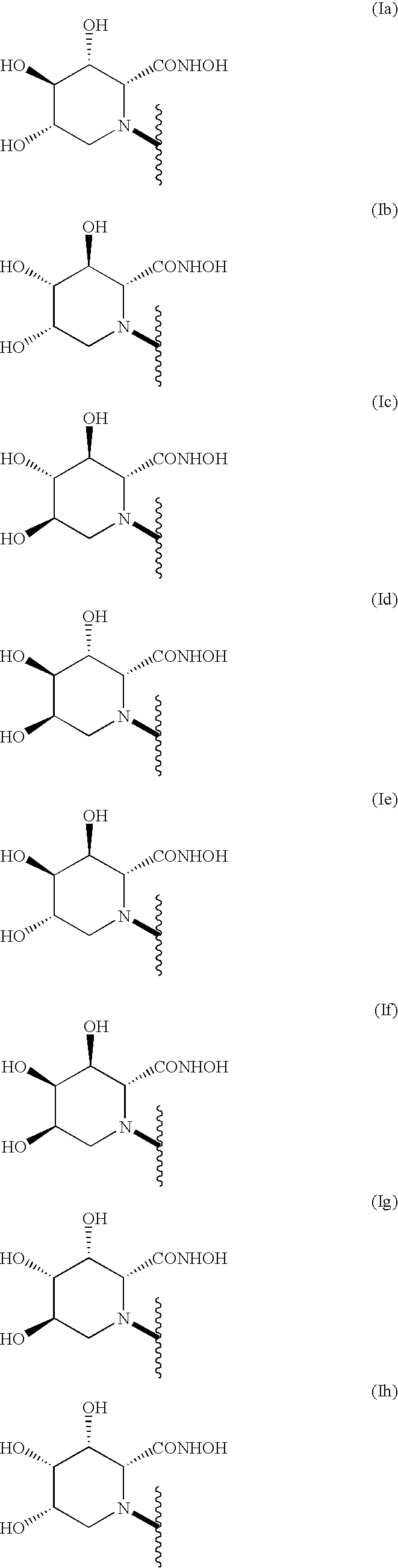
or a mixture thereof, and the compound (Id) is particularly preferable.
Similarly, the compound (IIA) or (IIB) and the compound (IIIA) or (IIIB) respectively include corresponding eight kinds of stereoisomers or a mixture thereof. Abbreviations and symbols used in the following descriptions mean as follows.
- Ac: Acetyl group
- AcOCs: Cesium acetate
- Bn: Benzyl group
- DEAD: Diethyl azodicarboxylate
- DIEA: Diisopropylethylamine
- DMF: N,N-dimethylformamide
- DMP: 2,2-Dimethoxypropane
- DMAP: 4-Dimethylaminopyridine
- DCC: Dicyclohexylcarbodiimide
- WSC: 1-Ethyl-3-(dimethylaminopropyl)carbodiimide hydrochloride
- HOBt: 1-Hydroxy-1H-benzotriazole
- HPLC: High-performance liquid chromatography
- THF: Tetrahydrofuran
- TBAF: 1.0M THF solution of tetrabutylammonium fluoride
- Pd—C: Palladium-carbon
- Pd(OH)2/C: Palladium hydroxide-carbon
- PPh3: Triphenylphosphine
- NaOMe: Sodium methylate
- NH2OBn: Benzylhydroxylamine hydrochloride
- 18-Crown-6: 18-Crown-6
- MsCl: Mesyl chloride
- Tf2O: Trifluoromethanesulfonic anhydride
The compound (A) of the present invention can be prepared by the method described below.
1. Preparation of Stereoisomers (Ie) and (Ig) of Compound (I):
For example as shown in the following scheme (Scheme 1):

(wherein TBDMS represents a tert-butyldimethylsilyl group and R1 is as defined above), stereoisomers (Ie) and (Ig) can be prepared by deprotecting a compound (IV) obtained by reacting D- or L-threitol with a glycine derivative [see Tetrahedron Letters, Vol. 38, No. 46, 8009–8012 (1997)] and performing the ring closure reaction to obtain a precursor (IIIA-1), followed by deprotection and chemical conversion of a functional group.
First, a protective group (TBDMS) of a primary hydroxyl group of the compound (IV) [see Tetrahedron Letters, Vol. 38, No. 46, 8009–8012 (1997)] is deprotected to obtain a compound (V). The reaction is usually conducted by adding TBAF in an inert solvent such as THF and stirring at 0° C. to room temperature for 30 minutes to 2 hours.
Then, the compound (V) is cyclized by the Mitsunobu reaction to obtain a compound (IIIA-1). The reaction can be conducted for example by adding triphenylphosphine and DEAD in an inert solvent such as THF and stirring at 0° C. to room temperature for 30 minutes to 4 hours. In this case, since a mixture derived from epimerization of asymmetric carbon at the α-position of the benzyloxycarbonyl group of the compound (IIIA-1) may appear, the compound (IIIA-1) is subjected to the following reaction after separation and purification by various chromatography means such as HPLC. Alternatively, the compound (IIIA-1) may be subjected to the following reaction in the form of a mixture and may be separated and purified in any stage.
The resulting precursor (IIIA-1) can be converted into the objective stereoisomers (Ie) or (Ig) by converting a benzyloxycarbonyl group into a benzyloxyaminocarbonyl group and performing deprotection of each group.
First, a benzyl ester moiety of the compound (IIIA-1) is cleaved and removed by hydrogenolysis, followed by condensation with benzylhydroxylamine to obtain a compound (IIIA-2). The hydrogenolysis is usually conducted by optionally adding water in ethyl acetate, lower alcohol such as methanol, or 1,4-dioxane, and stirring in the presence of a catalyst such as 10% palladium-carbon, 20% palladium hydroxide-carbon or platinum under a hydrogen gas flow or pressure at room temperature to 60° C. for 1 to 5 hours. The following condensation is usually conducted by using a condensing agent such as DCC or WSC and stirring at 0° C. to room temperature for 2 to 24 hours in the presence of an optional auxiliary condensing agent such as HOBt. The molar ratios of the reactants are 0.8 to 1.5 mols of benzylhydroxylamine, 1.0 to 1.5 mol of the condensing agent and 1.0 to 1.5 mol of the auxiliary condensing agent based on 1 mol of the carboxylic acid compound.
Then, each protective group of the compound (IIIA-2) is cleaved and removed to obtain the objective compound. The acetyl group, the acetonide group and the benzyl group may be cleaved and removed by a conventional method. For example, the deacetylation reaction is usually conducted by adding 28% NaOMe in a lower alcohol such as methanol and stirring at 0° C. to room temperature for 1 to 6 hours. For example, the acetonide group is cleaved and removed by optionally adding water in a solvent such as methanol in the presence of a cation exchange resin and reacting at room temperature to 50° C. for 2 to 24 hours. The benzyl group can be cleaved and removed by hydrogenolysis in the same manner as described above.
In Scheme 1, a compound (IVe) as a (3S,4S,5R) isomer of the compound (IV) may be used so as to obtain the stereoisomer (Ie) and a compound (IVg) as a (3R,4R,5S) isomer of the compound (IV) may be used so as to obtain the stereoisomer (Ig) (the numbering is based on hexanoic acid). The compound (IVe) or (IVg) can be derived from the reaction between a glycine derivative and L-threitol or D-threitol respectively.
2. Preparation of Stereoisomers (If) and (Ih) of Compound (I):
For example as shown in the following scheme (Scheme 2):

(wherein THP represents a tetrahydropyranyl group and R1 is as defined above), stereoisomers (If) and (Ih) can be prepared by protecting hydroxyl groups at the 3- and 4-positions of the stereoisomer (Ie) or (Ig) with an acetonide group and performing steric inversion of a hydroxyl group at the 5-position (the numbering is based on the piperidine ring).
First, protective groups (tetrahydropyranyl group and acetonide group) of a compound (IIIA-3), which can be synthesized in the same manner as in case of the compound (IIIA-1) shown in Scheme 1, are cleaved and removed to obtain a compound (VI). In the reaction, according to the method using the cation exchange resin used in the cleavage of the above acetonide group, both protective groups can be simultaneously cleaved and removed.
Then, acetonidation of the compound (VI) is conducted to obtain a compound (IIIB-1). The reaction can be conducted by adding a 5- to 15-fold amount of DMP in an inert solvent such as DMF in the presence of an acid catalyst such as p-toluenesulfonic acid monohydrate or camphor-10-sulfonic acid and reacting at room temperature to 80° C. for 2 to 24 hours.
A hydroxyl group of the compound (IIIB-1) is converted into a triflate group and then steric inversion is caused by the SN2 nucleophilic substitution reaction to obtain a compound (IIIB-2). The reaction for preparation of a triflate compound is usually conducted by adding trifluoromethanesulfonic anhydride in a solvent such as methylene chloride in the presence of a base such as triethylamine or pyridine at −60 to 0° C. and stirring at the same temperature for 30 minutes to 2 hours. In this case, the resulting triflate compound is subjected to the following reaction immediately after the completion of the reaction without being purified, or can be subjected to the following reaction immediately after purification by silica gel column chromatography. The following SN2 nucleophilic substitution reaction can be conducted by adding cesium acetate in a solvent such as acetonitrile in the presence of 18-Crown-6 and stirring at 0° C. to room temperature for 1 to 24 hours.
A benzyl ester moiety of the compound (IIIB-2) is cleaved and removed by hydrogenolysis, followed by condensation with benzylhydroxylamine to obtain a compound (IIIB-3). Subsequently, the respective protective groups, for example, an acetyl group, an acetonide group and a benzyl group of the compound (IIIB-3) are cleaved and removed in any order to obtain the objective stereoisomer (If) or (Ih). The reaction conditions are the same as in Scheme 1.
3. Preparation of Stereoisomers (Ia), (Ib), (Ic) and (Id) of Compound (I):
Stereoisomers (Ia), (Ib), (Ic) and (Id) can be prepared through the following scheme (Scheme 3):

(wherein R1 is as defined above).
First, an azide group of a compound (VII) [see Synthesis, No. 9, 1305–1309 (2000)] is reduced, followed by reaction with allylsulfonyl chloride (VIII) to obtain a compound (IX). For example the reduction of the azide group can be conducted by optionally adding water in ethyl acetate, lower alcohol or 1,4-dioxane, and stirring in the presence of a catalyst such as 10% palladium-carbon, 20% palladium hydroxide-carbon or platinum under a hydrogen gas flow or pressure at room temperature to 60° C. The following reaction with allylsulfonyl chloride (VIII) is usually conducted in an inert solvent such as DMF in the presence of a base such as DMAP by stirring at 0° C. to room temperature for 1 to 24 hours.
Then, a terminal acetonide group of the compound (IX) is selectively cleaved and removed. The reaction is usually conducted by optionally adding water in a solvent such as methanol in the presence of a cation exchange resin and stirring at room temperature to 50° C. for 5 hours to 4 days. Alternatively, the objective compound (X) can also be obtained by stirring in acetonitrile at room temperature for 0.5 to 2 hours using cerium chloride heptahydrate and oxalic acid.
Then, a primary hydroxyl group of the compound (X) is selectively converted into a mesyl group. The reaction is conducted by stirring in a solvent such as methylene chloride in the presence of a base such as triethylamine or DIEA at low temperature preferably ranging from −60 to −20° C. for 30 minutes to 5 hours using 0.95 to 1.05 mol of mesyl chloride to obtain the objective compound (XI).
Then, a compound (IIIB-4) is obtained by the intramolecular ring closure reaction of the compound (XI). The reaction is usually conducted in an inert solvent such as DMF in the presence of a base such as potassium carbonate or triethylamine at room temperature to 100° C., and preferably 40 to 60° C. for 1 to 5 hours to obtain the objective compound (IIIB-4).
An ester moiety of the compound (IIIB-4) is converted into corresponding carboxylic acid by alkaline hydrolysis, which is then condensed with benzylhydroxylamine without being purified to obtain a compound (IIIB-5). The alkaline hydrolysis is usually conducted by stirring in a lower alcohol such as methanol at 0 to 60° C. for 1 to 5 hours using an aqueous sodium hydroxide or lithium hydroxide solution, and preferably an aqueous 1N solution of the hydroxide. Subsequently, an acetonide group and a benzyl group are cleaved and removed to obtain a compound (Ia), (Ib), (Ic) or (Id). These reactions may be conducted in the same manner as in Scheme 1 or 2.
In Scheme 3, a compound (VIIa) as a (3R,4S,5S) isomer of the compound (VII) may be used so as to obtain the stereoisomer (Ia), a compound (VIIb) as a (3S,4R,5S) isomer of the compound (VII) may be used so as to obtain the stereoisomer (Ib), a compound (VIIc) as a (3S,4R,5R) isomer of the compound (VII) may be used so as to obtain the stereoisomer (Ic), and a compound (VIId) as a (3R,4S,5R) isomer of the compound (VII) may be used so as to obtain the stereoisomer (Id) (the numbering is based on hexanoic acid). The compound (VIIa) can be prepared from L-gulono-1,4-lactone, the compound (VIIb) can be prepared from L-glucono-1,5-lactone, the compound (VIIc) can be prepared from D-gulono-1,4-lactone, and the compound (VIId) can be prepared from D-manno-1,4-lactone [Synthesis, 9, 1305–1309 (2000)].
4. Another Method for Preparation of Stereoisomer (Id) of Compound (I):
According to the following scheme (Scheme 4)

(wherein R1 is as defined above), the stereoisomer (Id) can also be prepared by protecting hydroxyl groups at the 3- and 4-positions of the stereoisomer (Ia) and performing steric inversion of a hydroxyl group at the 5-position (the numbering is based on the piperidine ring).
First, a compound (IIIB-7) is obtained by steric inversion of a free hydroxyl group of a compound (IIIB-6) [one of the compound (IIIB-5) in Scheme 3]. Specifically, said hydroxyl group is converted into a triflate group and then the SN2 nucleophilic substitution reaction due to acetoxy ions is conducted. The reaction conditions are the same as in Scheme 2.
Subsequently, the respective protective groups, for example, an acetyl group, an acetonide group and a benzyl group of the compound (IIIB-7) are cleaved and removed in any order to obtain the objective stereoisomer (Id). The reaction conditions are the same as in Scheme 1.
These compounds can be orally or parenterally administered to human.
The pharmaceutical preparations for oral administration include solid preparations such as tablets, granules, powders, fine granules and hard capsules, and solutions such as syrups and soft capsules. These preparations can be prepared by a conventional method. For example, tablets, granules, powders or fine granules are prepared by mixing the above compound or pharmaceutically acceptable salt thereof with a conventional pharmaceutically acceptable carrier, such as lactose, starch, crystalline cellulose, magnesium stearate, hydroxypropyl cellulose, talc, etc., and the hard capsules can be prepared by filling the above fine granules or powders into suitable capsules. Besides, the syrups are prepared by dissolving or suspending the above compound or pharmaceutically acceptable salt thereof in an aqueous solution containing sucrose, carboxycellulose, etc., and the soft capsules are prepared by dissolving or suspending the compound or pharmaceutically acceptable salt thereof in lipid excipients (for example, vegetable oils, oily emulsion, glycol, etc.) and then filling the resultant into soft capsules.
The pharmaceutical preparations suitable for parenteral administration include injections and further percutaneous preparations (ointment, lotion or cream preparation), suppositories (for example, suppository for rectal administration, suppository for vaginal administration), and nasal preparation (for example, spray preparation). These preparations can be prepared by a conventional method. For example, the injections can be prepared by dissolving or emulsifying the compound or pharmaceutically acceptable salt thereof in physiological saline or a lipid excipient (for example, vegetable oil, oily emulsion, glycol, etc.) and then filling in an ampoule or vial with sealing under sterile condition. Ointment preparation is prepared by mixing the above compound or pharmaceutically acceptable salt thereof with a base such as vaseline, paraffin or glycerin, and optionally adding an emulsifier or a preservative by a conventional method.
The dosage of the drug of the present invention may vary depending on the dosage forms, ages, sexes, weights or conditions of the patients, but it is usually in the range of 0.1–600 mg/kg weight/day, and preferably 10–200 mg/kg weight/day of the active ingredient, which is administered once a day or divided into 2 to 4 dosage units.
1. Test Compound
Compound a: Example 2
Compound b: Example 3
Compound c: Example 4
Compound d: Example 1
Compound e: Example 5
2. Test Method
Human fibrosarcoma HT-1080 transfectant expressing fusion protein of HB-EGF and human placental alkaline phosphatase (AP) were used for following tests.
The cultured transfectant was treated with Trypsin-EDTA solution, and suspended in Minimum Essential Medium without phenol red; supplemented with 10% FCS(hereinafter referred to as MEM) at the concentration of 1.0×10⁵ cells/ml. Each 0.2 ml of the cell suspension was dispensed into individual wells of 96 well microplate, and incubated overnight in a CO2 incubator at 37° C. After the incubation, the culture supernatant was removed by suction and the wells were washed with 0.2 ml/well of phosphate buffered saline. The cells were pretreated with 0.1 ml/well of the test compound solution [prepared by diluting a 1 mM or 0.1 mM dimethyl sulfoxide (hereinafter referred to as DMSO) solution with DMSO and further diluting 100 times with MEM to necessary consentration] for 30 min in a CO2 incubator at 37° C. Then the culture supernatant was removed by suction and cells were treated with 0.2 ml/well of TPA solution (120 μM of DMSO solution was diluted to 60 nM with MEM) containing the same concentration of the compound as pretreatment for 60 min in a CO2 incubator at 37° C. The cells pretreated with MEM and incubated with only the TPA solution containing no test compound were used as control.
After these treatments, each 0.1 ml of culture supernatant collected from each well and 0.1 ml of MEM as background were transferred to individual wells of new 96 well microplate and incubated at 65° C. for 10 min after plate sealing to inactivate endogenous AP in MEM and cells. 0.1 ml of the substrate solution (prepared by diluting an aqueous 100 mg/ml p-nitrophenyl phosphate solution prepared previously 100 times with 0.01% magnesium chloride/1 M diethanolamine before use) for AP was added to each well and incubated for 120 minutes at room temperature in the dark. The absorbance at a wavelength of 405 nm of each well was measured using a microplate reader. The IC50 (μM) values of the test compounds were calculated by determining the concentration of the test compounds required to exhibit 50% of the absorbance, a difference between absorbance of the well containing only MEM as background and absorbance of the culture supernatant in case of adding only TPA being 100.
3. Test Results
The test results are shown in Table 1.
| TABLE 1 | |||
| Test compounds | IC50 (μM) | ||
| Compound a | 0.61 | ||
| Compound b | 0.45 | ||
| Compound c | 0.35 | ||
| Compound d | 1.6 | ||
| Compound e | 0.34 | ||
1. Test Compound
Compound c (Example 4):
2. Test Method
After backs of male BALB/c mice were shaved, 10 μL of a TPA-acetone solution (0.1 mM) was applied to the dorsal skin surface in an area of about 1 cm2. In the medicine-treated group, a volume of 20 μL of a solution prepared by dissolving the test compound in acetone was applied to the same area 5 minutes, 24 hours and 48 hours after TPA application. In the non-treated group, only TPA was applied. In the control group, acetone was applied instead of the TPA-acetone solution.
The mice were sacrificed and the skin tissues were excised 72 hours after TPA application. Then the tissues were fixed with formalin, the vertical sections including the center of the TPA- or acetone-treated area were prepared and embedded in paraffin according to the conventional method. And they were stained by hematoxylin-eosin after removing paraffin. The epidermal thickness was measured using a microscope.
The epidermal thickness of the group treated with TPA and the test compounds (the treated group) was compared with those of the non-treated group and the control group, and thus hyperplasia inhibitory activity of the test compounds was examined.
3. Test Results
The test results are shown in FIG. 1 . In FIG. 1 , the numeral in the ordinate represents the epidermal thickness (μm). A bar graph of TPA (−) represents the epidermal thickness of the control group and a bar graph of TPA represents the epidermal thickness of the non-treated group. The respective bar graphs of 1, 10 and 100 denote the epidermal thickness of the group wherein the test compound is administered at a dose of 1, 10 and 100 (μg/wound) of each test compound. A significance test of the treated group relative to the non-treated group was conducted by the Dunnett's method. The results are indicated by the symbol * or ** (* p<0.05, ** p<0.01). A longitudinal bar represents standard error.
1. Test Compound
Compound c (Example 4):
2. Test Method
Wound healing model was prepared in accordance with the method described by Tsuboi, et al. (J. Dermatol., 19, 673–675 (1992)). After backs of male BALB/c mice were shaved, two full-thickness round wounds (6 mm diameter) were prepared on the back of each mouse using a punch biopsy instrument. In medicine-treated group, immediately after the operation, a test compound suspended in 0.01M phosphate-buffered saline containing 1.5% sodium carboxymethyl cellulose (vehicle) was applied to each wound in a volume of 50 μL/wound. From the following day, the compound was repeatedly applied to each wound once a day for 7 days. In the control group, vehicle solution only was applied in the same manner. Eight days after the operation, mice were sacrificed and skin tissues containing wound area were removed. The tissues were fixed with a 10% neutral buffer formalin solution for one day and embedded in paraffin according to the conventional method. The cross-sections were made perpendicularly to the anterior-posterior axis. Keratinocytes in the specimen were stained by immuno histochemical staining method with an anti-keratin antibody after removing paraffin. Measurements of wound size (mm) and re-epithelialization of keratinocytes (mm) were performed by using an image-analyzing software. Re-epithelialization rate(%) of keratinocytes was calculated as follows with regard to each animal.
Re-epithelialization rate (%) of Keratinocytes=[(Re-epithelialization of Keratinocytes)/(Wound Size)]×100
3. Test Results
Re-epithelialization rate (%) of Keratinocytes=[(Re-epithelialization of Keratinocytes)/(Wound Size)]×100
3. Test Results
The test results are shown in FIG. 2 . In FIG. 2 , the numeral in the ordinate represents re-epithelialization rate (%) of keratinocytes. Black four bar graphs denote re-epithelialization rate (%) of keratinocytes of the treated group and the numeral at the bottom represents a dose (μg/wound) of each test compound. The bar graph of control represents re-epithelialization rate (%) of keratinocytes of the control group. A significance test of the treated group relative to the control group was conducted by the Dunnett's method. The results are indicated by the symbol ** (** p<0.01). A longitudinal bar represents standard error.
The present invention will now be described in more detail by way of examples. The intermediates described in Examples 6 to 9 can be converted into a final compound (I) in the same manner as in Examples 1 to 5.

A known compound (IVa) [compound of the general formula (IV) wherein R1 is a methoxy group and an acetoxy group at the 3-position is a hydroxyl group, 20.0 g] was dissolved in pyridine (80 mL) and acetic anhydride (40 mL) was added, and then the mixture was stirred at room temperature for 3 hours. Methanol (20 mL) was added and, after stirring for 5 minutes, the solvent was concentrated under reduced pressure. After the resulting residue was dissolved in ethyl acetate (300 mL) and washed with 2.5% citric acid (×2) and water, the organic layer was dried over magnesium sulfate and the solvent was distilled off under reduced pressure. The resulting residue was purified by silica gel medium pressure column chromatography (ethyl acetate:cyclohexane=1:5→1:4) to obtain the titled compound (16.2 g) as a syrup.
1H-NMR(CDCl3) δ: 0.07 (s), 0.10 (s), 0.85–1.0 (m), 1.2–1.4 (m), 1.44 (s), 1.96 (s), 2.07 (s), 3.5–4.0 (m), 4.1–4.2 (m), 4.40 (dd, J=1.9, 10.7 Hz), 4.48 (dd, J=2.6, 8.9 Hz), 4.8–5.3 (m), 5.56 (d, J=9.0 Hz), 6.8–6.9 (m), 7.1–7.45 (m), 7.7–7.8 (m).

The above compound (1) (16.0 g) was dissolved in THF (200 mL) and acetic acid (4.06 g) was added and also TBAF (67.2 mL) was added under ice-cool stirring, and then the mixture was stirred at room temperature for 1.5 hours. To the reaction solution was added ethyl acetate (300 mL) and, after washing with water and saturated saline, the solution was dried over magnesium sulfate and the solvent was distilled off under reduced pressure. The resulting residue was purified by silica gel medium pressure column chromatography (ethyl acetate:cyclohexane=1:3→1:2→1:1→3:2→2:1) to obtain the titled compound (4.17 g) as a syrup.
1H-NMR(CDCl3) δ: 1.22 (s, 3H), 1.36 (s, 3H), 2.07 (s, 3H), 3.5–3.7 (m, 1H), 3.75–3.9 (m, 1H), 3.86 (s, 3H), 3.9–4.2 (m, 2H), 4.47 (dd, 1H, J=2.7, 8.9 Hz), 4.90 (d, 1H, J=12.2 Hz), 5.09 (d, 1H, J=12.2 Hz), 5.14 (dd, 1H, J=2.6, 8.8 Hz), 5.55 (d, 1H, J=8.8 Hz), 6.89 (d, 2H, J=8.9 Hz), 7.2–7.4 (m, 5H), 7.73 (d, 2H, J=8.9 Hz).

The above compound (2) (4.1 g) was dissolved in THF (50 mL) and triphenylphosphine (3.0 g) was added and, after ice cooling, DEAD (2.0 g) was added and the mixture was stirred at room temperature for 40 minutes. To the reaction solution was added ethyl acetate (150 mL) and, after washing with saturated saline, the solution was dried over magnesium sulfate and the solvent was distilled off under reduced pressure. The resulting residue was purified by silica gel medium pressure column chromatography (ethyl acetate:n-hexane=1:3) to obtain the titled compound (2.7 g) as a syrup.
1H-NMR(CDCl3) δ: 1.35 (s, 3H), 1.41 (s, 3H), 2.13 (s, 3H), 3.15 (dd, 1H, J=11.1, 11.9 Hz), 3.27 (dd, 1H, J=2.5, 9.3 Hz), 3.86 (s, 3H), 3.9–4.0 (m, 1H), 4.15–4.25 (m, 1H), 5.12 (d, 1H, J=12.0 Hz), 5.18 (d, 1H, J=12.0 Hz), 5.2–5.25 (m, 1H), 5.81 (t, 1H, J=2.5 Hz), 6.88 (d, 2H, J=9.0 Hz), 7.25–7.4 (m, 5H), 7.71 (d, 2H, J=9.0 Hz).

The above compound (3) (2.7 g) was dissolved in ethyl acetate (50 mL) and 10% Pd—C (270 mg) was added, and then the mixture was stirred under a hydrogen atmosphere at room temperature for one hour. The catalyst was removed by filtration and the filtrate was concentrated under reduced pressure. The resulting residue was dissolved in DMF (30 mL) and WSC (1.3 g) and HOBt (913 mg) were added. Subsequently, benzylhydroxylamine hydrochloride (1.08 g) and DIEA (873 mg) were added, followed by stirring at room temperature for 3 hours. Furthermore, WSC (299 mg), HOBt (211 mg), benzylhydroxylamine hydrochloride (248 mg) and DIEA (202 mg) were added, followed by stirring for 45 minutes. To the reaction solution was added ethyl acetate (200 mL) and, after washing in turn with 0.5N hydrochloric acid, aqueous saturated sodium hydrogencarbonate solution and saturated saline, the solution was dried over magnesium sulfate and the solvent was distilled off under reduced pressure. The resulting residue was purified by silica gel medium pressure column chromatography (ethyl acetate:n-hexane=1:3→1:2→2:3) to obtain the titled compound (2.08 g) as a syrup.
1H-NMR(CDCl3) δ: 1.37 (s, 3H), 1.41 (s, 3H), 1.88 (s, 3H), 3.0–3.2 (m, 1H), 3.5–3.7 (m, 2H), 3.89 (s, 3H), 4.2–4.3 (m, 1H), 4.73 (bs, 1H), 4.89 (d, 1H, J=11 Hz), 4.96 (d, 1H, J=11 Hz), 5.71 (t, 1H, J=2.1 Hz), 6.98 (d, 1H, J=9.0 Hz), 7.42 (s, 5H), 7.71 (d, 2H, J=9.0 Hz).

The above compound (4) (1.85 g) was dissolved in methanol (25 mL) and 28% NaOMe (668 mg) was added, and then the mixture was stirred at room temperature for 2 hours. Furthermore, 28% NaOMe (334 mg) was added and, after stirring at room temperature for 3 hours, the reaction solution was mixed with ethyl acetate (150 mL) and then washed with 0.5N hydrochloric acid and saturated saline. The organic layer was dried over magnesium sulfate and the solvent was distilled off under reduced pressure, and then the resulting residue was purified by silica gel medium pressure column chromatography (ethyl acetate:cyclohexane=2:3) to obtain the titled compound (1.36 g) as a syrup.
1H-NMR(CDCl3) δ: 1.32 (s, 3H), 1.39 (s, 3H), 3.02 (dd, 1H, J=10.9, 12.8 Hz), 3.3–3.55 (m, 2H), 3.88 (s, 3H), 4.07 (dd, 1H, J=4.1, 12.8 Hz), 4.75–5.05 (m, 4H), 6.96 (d, 2H, J=9.1 Hz), 7.3–7.5 (m, 5H), 7.80 (d, 2H, J=9.1 Hz), 9.17 (s, 1H).

The above compound (5) (1.1 g) was dissolved in methanol (25 mL) and a cation exchange resin (Muromac, 3.0 g) was added, and then the mixture was stirred overnight at room temperature. The insoluble material was removed by filtration and the filtrate was concentrated under reduced pressure. The resulting residue was purified by silica gel medium pressure column chromatography (chloroform:methanol=20:1) to obtain the titled compound (974 mg) as a syrup.
1H-NMR(DMSO-d6) δ: 3.16 (d, 1H, J=5.0 Hz), 3.4–3.7 (m, 2H), 3.81 (s, 3H), 4.27 (d, 1H, J=2.1 Hz), 4.68 (s, 2H), 4.86 (d, 1H, J=5.4 Hz), 4.94 (d, 1H, J=4.5 Hz), 5.05 (d, 1H, J=3.8 Hz), 7.07 (d, 2H, J=8.9 Hz), 7.25–7.5 (m, 5H), 7.71 (d, 2H, J=8.9 Hz), 11.5 (s, 1H).

The above compound (6) (316 mg) was dissolved in methanol (25 mL) and 10% Pd—C (40 mg) was added, and then the mixture was stirred under a hydrogen atmosphere at room temperature for 2 hours. The catalyst was removed by filtration and the filtrate was concentrated under reduced pressure to obtain the titled compound (242 mg) as a colorless powder.
1H-NMR(DMSO-d6) δ: 3.25–3.7 (m, 5H), 3.83 (s, 3H), 4.34 (d, 1H, J=2.0 Hz), 4.7–5.2 (m, 3H), 7.05 (d, 2H, J=8.9 Hz), 7.72 (d, 2H, J=8.9 Hz), 8.88 (s, 1H), 10.86 (s, 1H). TOF-Mass: 385 (M+Na).

A known compound [(2R,4′S,4″S,5′R)-azide-(2′,2′,2″,2″-tetramethyl-[4′,4″]bis[[1,3]dioxolanyl]-5′-yl)-acetic acid methyl ester, 18.7 g] was dissolved in ethyl acetate (180 mL) and 10% Pd—C (3.0 g) was added, and then the mixture was stirred under a hydrogen pressure at room temperature for 4 hours. The catalyst was removed by filtration and the filtrate was concentrated under reduced pressure. The resulting residue was dissolved in DMF (160 mL) and DMAP (8.7 g) and p-methoxybenzenesulfonyl chloride (14.7 g) were added, followed by stirring at room temperature for 12 hours. To the reaction solution was added ethyl acetate (500 mL) and, after washing in turn with 1N hydrochloric acid, water and saturated saline, the organic layer was dried over magnesium sulfate and the solvent was distilled off under reduced pressure. The resulting residue was purified by silica gel medium pressure column chromatography (ethyl acetate:n-hexane=2:3) to obtain the titled compound (22.0 g) as a syrup.
1H-NMR(CDCl3) δ: 1.37 (s, 3H), 1.39 (s, 3H), 1.42 (s, 3H), 1.43 (s, 3H), 3.56 (s, 3H), 3.86 (s, 3H), 3.85–4.3 (m, 6H), 5.36 (d, 1H, J=10.1 Hz), 6.96 (d, 2H, J=9.0 Hz), 7.76 (d, 2H, J=9.0 Hz).

The above compound (1) (18.9 g) was dissolved in 90% aqueous methanol (450 mL) and a cation exchange resin (Muromac, 16.1 g) was added, and then the mixture was stirred at room temperature for 3 days. The insoluble material was removed by filtration and the filtrate was concentrated under reduced pressure. The resulting residue was purified by silica gel medium pressure column chromatography (ethyl acetate:n-hexane=2:3→chloroform:methanol=40:1) to obtain the titled compound (10.5 g), and a starting material (6.9 g) was recovered.
1H-NMR(CDCl3) δ: 1.37 (s, 3H), 1.42 (s, 3H), 3.56 (s, 3H), 3.7–3.8 (m, 3H), 3.86 (s, 3H), 3.99 (dd, 1H, J=1.6, 9.7 Hz), 4.20 (dd, 1H, J=2.0, 8.4 Hz), 4.39 (dd, 1H, J=1.7, 8.4 Hz), 5.53 (d, 1H, J=9.8 Hz), 6.95 (d, 2H, J=9.0 Hz), 7.75 (d, 2H, J=9.0 Hz).

The above compound (2) (3.3 g) was dissolved in methylene chloride (50 mL) and triethylamine (1.11 mL) was added and, after cooling to −40° C., mesyl chloride (0.62 mL)/methylene chloride (3 mL) was slowly added dropwise and the mixture was stirred at the same temperature for 50 minutes. The reaction solution was washed with saturated saline and the organic layer was dried over magnesium sulfate, and then the solvent was distilled off under reduced pressure. The resulting residue was purified by silica gel medium pressure column chromatography (ethyl acetate:n-hexane=1:2→2:3→1:1) to obtain the titled compound (1.74 g).
1H-NMR(CDCl3) δ: 1.38 (s, 3H), 1.43 (s, 3H), 2.60 (d, 1H, J=8.0 Hz), 3.14 (s, 3H), 3.58 (s, 3H), 3.87 (s, 3H), 3.95–4.1 (m, 2H), 4.25–4.5 (m, 4H), 5.42 (d, 1H, J=9.6 Hz), 6.97 (d, 2H, J=9.0 Hz), 7.76 (d, 2H, J=9.0 Hz).

The above compound (3) (4.6 g) was dissolved in DMF (150 mL) and potassium carbonate (1.54 g) was added, and then the mixture was stirred at 45° C. for 1.5 hours. To the reaction solution was added ethyl acetate (300 mL) and, after washing with water (×2) and saturated saline, the organic layer was dried over magnesium sulfate and the solvent was distilled off under reduced pressure. The resulting residue was purified by silica gel medium pressure column chromatography (ethyl acetate:n-hexane=2:3→1:1) to obtain the titled compound (3.1 g) as a syrup.
1H-NMR(CDCl3) δ: 1.35 (s, 3H), 1.45 (s, 3H), 2.41 (d, 1H, J=4.1 Hz), 3.25 (dd, 1H, J=9.6, 12.0 Hz), 3.58 (s, 3H), 3.5–3.65 (m, 1H), 3.7–3.8 (m, 1H), 3.88 (s, 3H), 3.9–4.2 (m, 2H), 5.06 (d, 1H, J=6.1 Hz), 6.98 (d, 2H, J=9.0 Hz), 7.70 (d, 2H, J=9.0 Hz).

The above compound (4) (780 mg) was dissolved in methanol (15 mL) and a cation exchange resin (Muromac, 5.0 g) was added, and then the mixture was stirred at room temperature for 6.5 hours. The insoluble material was removed by filtration and the filtrate was concentrated under reduced pressure. The resulting residue was dissolved in DMF (30 mL) and DMP (1.8 g) and p-toluenesulfonic acid monohydrate (20 mg) were added, followed by stirring at room temperature for 5 hours and further stirring at 50° C. for one hour. To the reaction solution was added ethyl acetate (150 mL) and, after washing in turn with an aqueous saturated sodium hydrogencarbonate solution, water and saturated saline, the solution was dried over magnesium sulfate and the solvent was distilled off under reduced pressure. The resulting residue was purified by silica gel medium pressure column chromatography (ethyl acetate:n-hexane=2:3→1:1) to obtain a mixture (620 mg) of the -titled compound and the above compound (4).
The above mixture (5-1) (620 mg) was dissolved in methanol (30 mL) and an aqueous 1N sodium hydroxide solution (8.5 mL) was added, and then the mixture was stirred at room temperature for 5 hours. To the reaction solution was added water (50 mL) and, after washing with ether, the aqueous layer was acidified with an aqueous 10% citric acid solution and then extracted with ethyl acetate. The organic layer was washed with water and saturated saline, dried over magnesium sulfate, and then the solvent was distilled off under reduced pressure. The resulting residue was dissolved in DMF (30 mL) and WSC (431 mg) and HOBt (344 mg) were added. Subsequently, benzylhydroxylamine hydrochloride (359 mg) and DIEA (291 mg) were added, followed by stirring overnight at room temperature. To the reaction solution was added ethyl acetate (100 mL) and, after washing in turn with an aqueous 10% citric acid solution, an aqueous saturated sodium hydrogencarbonate solution, water and saturated saline, the solution was dried over magnesium sulfate and the solvent was distilled off under reduced pressure. The resulting, residue was purified by silica gel medium pressure column chromatography (ethyl acetate:cyclohexane=2:3→1:1) and the precipitated solid material was collected by filtration to obtain the titled compound (98 mg).
1H-NMR(CDCl3) δ: 1.36 (s, 3H), 1.41 (s, 3H), 2.9–3.2 (m, 2H), 3.55–3.75 (m, 2H), 3.88 (s, 3H), 4.1–4.25 (m, 2H), 4.68 (d, 1H, J=4.3 Hz), 6.98 (d, 2H, J=9.0 Hz), 7.73 (d, 2H, J=9.0 Hz), 9.1 (s, 1H).

The above compound (5-2) (100 mg) was dissolved in a solvent mixture of 1,4-dioxane/methanol (5–15 mL) and a cation exchange resin (Muromac, 2.5 g) was added, and then the mixture was stirred at room temperature for 14 hours. The insoluble material was removed by filtration and the filtrate was concentrated under reduced pressure. The resulting residue was purified by silica gel medium pressure column chromatography (chloroform:methanol=20:1→10:1) to obtain the titled compound (88 mg).
1H-NMR(DMSO-d6+D2O) δ: 3.0–3.25 (m, 1H), 3.28 (dd, 1H, J=6.7, 9.4 Hz), 3.41 (t, 1H, J=11.1 Hz), 3.81 (s, 3H), 4.17 (d, 1H, J=6.8 Hz), 4.49 (d, 1H, J=10.6 Hz), 4.57 (d, 1H, J=10.6 Hz), 7.07 (d, 2H, J=8.9 Hz), 7.25–7.45 (m, 5H), 7.67 (d, 2H, J=8.9 Hz).

The above compound (6) (88 mg) was dissolved in methanol (12 mL) and 10% Pd—C (20 mg) was added, and the mixture was stirred under a hydrogen atmosphere at room temperature for 2 hours. After the catalyst was removed by filtration and the filtrate was concentrated under reduced pressure, the resulting residue was freeze-dried to obtain the titled compound (60 mg) as a colorless amorphous.
1H-NMR(DMSO-d6) δ: 3.0–3.7 (m, 5H), 3.84 (s, 3H), 4.20 (d, 1H, J=5.3 Hz), 7.09 (d, 2H, J=9.0 Hz), 7.67 (d, 2H, J=9.0 Hz), 8.82 (bs, 1H), 10.67 (s, 1H). TOF-Mass: 385 (M+Na), 401 (M+K).

A known compound [(2R,4′S,4″S,5′R)-azide-(2′,2′,2″,2″-tetramethyl-[4′,4″]bis[[1,3]dioxolanyl]-5′-yl)-acetic acid methyl ester, 30.6 g] was dissolved in ethyl acetate (360 mL) and 10% Pd—C (5.3 g) was added, and then the mixture was stirred under a hydrogen pressure at room temperature for 4 hours. The catalyst was removed by filtration and the filtrate was concentrated under reduced pressure. The resulting residue was dissolved in DMF (180 mL) and DMAP (14.2 g) was added and also p-ethoxyethoxybenzenesulfonyl chloride (26.3 g) was added under ice-cool stirring, followed by stirring at room temperature for 2 hours. To the reaction solution was added ethyl acetate (500 mL) and, after washing in turn with 1N hydrochloric acid, an aqueous saturated sodium hydrogencarbonate solution, water and saturated saline, the organic layer was dried over magnesium sulfate and the solvent was distilled off under reduced pressure. The resulting residue was purified by silica gel medium pressure column chromatography (ethyl acetate:n-hexane=35:65→2:3) to obtain the titled compound (35.5 g) as a syrup.
1H-NMR(CDCl3) δ: ••25 (t, 3H, J=7.0 Hz), 1.37 (s, 3H), 1.39 (s, 3H), 1.43 (s, 3H), 1.44 (s, 3H), 3.57 (s, 3H), 3.61 (q, 2H, J=7.0 Hz), 3.75–3.85 (m, 2H), 3.85–4.0 (m, 2H), 4.05–4.3 (m, 6H), 5.36 (d, 1H, J=10.0 Hz), 6.99 (d, 2H, J=9.0 Hz), 7.75 (d, 2H, J=9.0 Hz).

The above compound (1) (35.1 g) was dissolved in 90% aqueous methanol (800 mL) and a cation exchange resin (Muromac, 29.8 g) was added, and then the mixture was stirred at room temperature for 4 days. The insoluble material was removed by filtration and the filtrate was concentrated under reduced pressure. The resulting residue was purified by silica gel medium pressure column chromatography (ethyl acetate:n-hexane=2:3→1:1→chloroform:methanol=25:1) to obtain the titled compound (18.2 g), and a starting material (8.0 g) was recovered.
1H-NMR(CDCl3) δ: 1.25(t, 3H, J=7.0 Hz), 1.38 (s, 3H), 1.47 (s, 3H), 2.3 (bs, 1H), 2.66 (d, 1H, J=6.7 Hz), 3.5–3.7 (m, 5H), 3.7–3.85 (m, 5H), 3.97 (d, 1H, J=8.4 Hz), 4.1–4.25 (m, 3H), 4.40 (dd, 1H, J=1.7, 8.5 Hz), 5.46 (d, 1H, J=9.5 Hz), 6.99 (d, 2H, J=9.0 Hz), 7.75 (d, 2H, J=9.0 Hz).

The above compound (2) (18.2 g) was dissolved in methylene chloride (300 mL) and triethylamine (4.25 g) was added and, after cooling to −60° C., mesyl chloride (4.59 g)/methylene chloride (30 mL) was slowly added dropwise and the mixture was stirred at the same temperature for 50 minutes. After the reaction solution was washed with saturated saline and the organic layer was dried over magnesium sulfate, the solvent was distilled off under reduced pressure. The resulting residue was purified by silica gel medium pressure column chromatography (ethyl acetate:cyclohexane=2:3→1:1→3:2) to obtain the titled compound (13.0 g).
1H-NMR(CDCl3) δ: 1.25 (t, 3H, J=7.0 Hz), 1.38 (s, 3H), 1.43 (s, 3H), 2.60 (d, 1H, J=8.0 Hz), 3.14 (s, 3H), 3.58 (q, 2H, J=7.1 Hz), 3.75–3.85 (m, 2H), 3.96 (dd, 1H, J=1.7, 9.5 Hz), 3.9–4.4 (m, 8H), 5.43 (d, 1H, J=9.5 Hz), 6.99 (d, 2H, J=9.0 Hz), 7.75 (d, 2H, J=9.0 Hz).

The above compound (3) (10.4 g) was dissolved in DMF (200 mL) and potassium carbonate (3.1 g) was added, and then the mixture was stirred at 50° C. for one hour. To the reaction solution was added ethyl acetate (500 mL) and, after washing with water (×2) and saturated saline, the organic layer was dried over magnesium sulfate and the solvent was distilled off under reduced pressure. The resulting residue was purified by silica gel medium pressure column chromatography (ethyl acetate:n-hexane=2:3→1:1) to obtain the titled compound (7.3 g) as a syrup.
1H-NMR(CDCl3) δ: 1.25 (t, 3H, J=7.0 Hz), 1.35 (s, 3H), 1.45 (s, 3H), 3.25 (dd, 1H, J=9.7, 12.1 Hz), 3.5–3.85 (m, 9H), 3.85–4.25 (m, 4H), 5.05 (d, 1H, J=6.1 Hz), 6.99 (d, 2H, J=9.0 Hz), 7.69 (d, 2H, J=9.0 Hz).

The above compound (4) (2.0 g) was dissolved in methanol (35 mL) and a cation exchange resin (Muromac, 8.0 g) was added, and then the mixture was stirred overnight at room temperature. The insoluble material was removed by filtration and the filtrate was concentrated under reduced pressure. The resulting residue was dissolved in DMF (15 mL) and DMP (2.7 g) and p-toluenesulfonic acid monohydrate (10 mg) were added and, after stirring overnight at room temperature, the mixture was stirred at 50° C. for one hour. To the reaction solution was added ethyl acetate (150 mL) and, after washing in turn with an aqueous saturated sodium hydrogencarbonate solution, water and saturated saline, the solution was dried over magnesium sulfate and the solvent was distilled off under reduced pressure. The resulting residue was purified by silica gel medium pressure column chromatography (ethyl acetate:n-hexane=2:3→1:1) to obtain a mixture (817 mg) of the titled compound and the above compound (4).
1H-NMR(CDCl3) δ: 1.25 (t, J=7.1 Hz), 1.26 (t, J=7.2 Hz), 1.35 (s), 1.43 (s), 1.45 (s), 3.07 (d, J=5.8 Hz), 3.25 (dd, J=9.7, 12.0 Hz), 3.55 (s), 3.58 (s), 3.6–3.8 (m), 3.8–4.25 (m), 4.95 (d, J=6.6 Hz), 5.05 (d, J=6.1 Hz), 7.0 (d, 2H, J=9.0 Hz), 7.69 (d, 2H, J=9.0 Hz).
The above mixture (5-1) (817 mg) was dissolved in a solvent mixture of methanol/1,4-dioxane (5–15 mL) and an aqueous 1N sodium hydroxide solution (5 mL) was added, followed by stirring at room temperature for one hour and 20 minutes. The reaction solution was neutralized with an aqueous 5% citric acid solution and then extracted with ethyl acetate. After the organic layer was washed with water and saturated saline and dried over magnesium sulfate, the solvent was distilled off under reduced pressure. The resulting residue was dissolved in DMF (10 mL) and WSC (238 mg) and HOBt (190 mg) were added. Subsequently, benzylhydroxylamine hydrochloride (198 mg) and DIEA (160 mg) were added, followed by stirring overnight at room temperature. To the reaction solution was added ethyl acetate (100 mL) and, after washing in turn with an aqueous 10% citric acid solution, an aqueous saturated sodium hydrogencarbonate solution, water and saturated saline, the organic layer was dried over magnesium sulfate and the solvent was distilled off under reduced pressure. To the resulting residue was added ether/ethyl acetate (5:1) and the precipitated solid material was collected by filtration to obtain the titled compound (98 mg).
1H-NMR(CDCl3) δ: 1.25 (t, J=7.0 Hz), 1.36 (s, 3H), 1.40 (s, 3H), 2.9–3.2 (m, 2H), 3.5–3.7 (m, 4H), 3.75–3.85 (m, 2H), 4.1–4.25 (m, 4H), 4.68 (d, 1H, J=4.2 Hz), 4.88 (d, 1H, J=11.0 Hz), 4.94 (d, 1H, J=11.0 Hz), 7.01 (d, 2H, J=9.0 Hz), 7.4 (s, 5H), 7.71 (d, 2H, J=9.0 Hz), 9.10 (s, 1H).

The above compound (5-2) (5.0 g) was dissolved in methanol (130 mL) and a cation exchange resin (Muromac, 23.4 g) was added, and then the mixture was stirred overnight at room temperature. The insoluble material was removed by filtration and the filtrate was concentrated under reduced pressure. The resulting residue was purified by silica gel medium pressure column chromatography (chloroform:methanol=20:1→10:1) to obtain the titled compound (4.3 g).
1H-NMR(DMSO-d6) δ: 1.1 (t, 3H, J=7.0 Hz), 3.0–3.2 (m, 1H), 3.25–3.3 (m, 1H), 3.35–3.75 (m, 7H), 4.54 (d, 1H, J=10.6 Hz), 4.61 (d, 1H, J=10.6 Hz), 4.98 (d, 1H, J=4.7 Hz), 5.13 (d, 1H, J=4.7 Hz), 5.44 (d, 1H, J=4.6 Hz), 7.11 (d, 2H, J=8.9 Hz), 7.35 (s, 5H), 7.69 (d, 2H, J=8.9 Hz), 11.31 (s, 1H).

The above compound (6) (1.66 g) was dissolved in methanol (70 mL) and 10% Pd—C (350 mg) was added, and then the mixture was stirred under a hydrogen atmosphere at 40° C. for one hour. The catalyst was removed by filtration and the filtrate was concentrated under reduced pressure. The resulting residue was purified by silica gel medium pressure column chromatography (chloroform:methanol=10:1→5:1) to obtain the titled compound (815 mg) as a colorless powder.
1H-NMR(DMSO-d6) δ: 1.13 (t, 3H, J=7.0 Hz), 3.0–3.3 (m, 3H), 3.50 (q, 2H, J=7.0 Hz), 3.35–3.7 (m, 2H), 3.7–3.75 (m, 2H), 4.1–4.25 (m, 3H), 4.90 (d, 1H, J=4.9 Hz), 5.07 (d, 1H, J=4.7 Hz), 5.35 (d, 1H, J=4.5 Hz), 7.09 (d, 2H, J=8.9 Hz), 7.66 (d, 2H, J=8.9 Hz), 8.82 (d, 1H, J=1.95 Hz), 10.67 (d, 1H, J=1.95 Hz).
TOF-Mass: 443 (M+Na), 459 (M+K).
[α]D 4.0° [c=0.1, MeOH]

A known compound [(2R,4′S,4″S,5′R)-azide-(2′,2′,2″,2″-tetramethyl-[4′,4″]bis[[1,3]dioxolanyl]-5′-yl)-acetic acid methyl ester, 22.4 g] was dissolved in ethyl acetate (200 mL) and 10% Pd—C (2.2 g) was added, and then the mixture was stirred under a hydrogen pressure at room temperature for 4.5 hours. The catalyst was removed by filtration and the filtrate was concentrated under reduced pressure. The resulting residue was dissolved in DMF (250 mL) and DMAP (10.4 g) was added and also p-phenoxybenzenesulfonyl chloride (20.0 g) was added, followed by stirring at room temperature for 2.5 hours. To the reaction solution was added ethyl acetate (500 mL) and, after washing in turn with 1N hydrochloric acid, water and saturated saline, the organic layer was dried over magnesium sulfate and the solvent was distilled off under reduced pressure. The resulting residue was purified by silica gel medium pressure column chromatography (ethyl acetate:n-hexane=1:3→1:2) to obtain the titled compound (30.1 g) as syrup.
1H-NMR(CDCl3) δ: 1.39 (s, 3H), 1.40 (s, 3H), 1.44 (s, 3H), 1.45 (s, 3H), 3.62 (s, 3H), 3.9–4.3 (m, 6H), 5.39 (d, 1H, J=10.1 Hz), 7.0–7.15 (m, 4H), 7.2–7.3 (m, 1H), 7.3–7.5 (m, 2H), 7.79 (d, 2H, J=9.1 Hz).

The above compound (1) (19.4 g) was dissolved in acetonitrile (230 mL) and cerium (III) chloride heptahydrate (27.7 g) and oxalic acid (167 mg) were added, and then the mixture was stirred at room temperature for 30 minutes. After neutralizing with sodium carbonate, the insoluble material was removed by filtration and washed with ethyl acetate. The filtrate and the washing were combined and concentrated under reduced pressure, and then the resulting residue was purified by silica gel medium pressure column chromatography (ethyl acetate:n-hexane=1:1→3:2→2:1) to obtain the titled compound (8.8 g), and a starting material (7.9 g) was recovered.
1H-NMR(CDCl3) δ: 1.40 (s, 3H), 2.15–2.25 (m, 1H), 2.61 (d, 1H, J=8.0 Hz), 3.63 (s, 3H), 3.7–3.85 (m, 3H), 4.00 (dd, 1H, J=1.7, 9.8 Hz), 4.23 (dd, 1H, J=2.4, 8.4 Hz), 4.43 (dd, 1H, J=1.7, 8.5 Hz), 5.46 (d, 1H, J=9.8 Hz), 7.0–7.15 (m, 4H), 7.2–7.3 (m, 1H), 7.35–7.5 (m, 2H), 7.78 (d, 2H, J=8.9 Hz).

The above compound (2) (20.0 g) was dissolved in methylene chloride (180 mL) and triethylamine (4.47 g) were added and, after cooling to −40° C., mesyl chloride (4.80 g)/methylene chloride (40 mL) was slowly added dropwise and the mixture was stirred at the same temperature for 40 minutes. The reaction solution was washed with water and an aqueous saturated sodium hydrogencarbonate solution and the organic layer was dried over magnesium sulfate, and then the solvent was distilled off under reduced pressure. The resulting residue was purified by silica gel medium pressure column chromatography (ethyl acetate:n-hexane=1:3→1:2 1:1) to obtain the titled compound (14.1 g).
1H-NMR(CDCl3) δ: 1.39 (s, 3H), 1.44 (s, 3H), 2.57 (d, 1H, J=7.9 Hz), 3.13 (s, 3H), 3.61 (s, 3H), 3.9–4.1 (m, 2H), 4.2–4.5 (m, 4H), 5.44 (d, 1H, J=9.5 Hz), 6.95–7.15 (m, 4H), 7.15–7.35 (m, 1H), 7.35–7.5 (m, 2H), 7.77 (d, 2H, J=9.0 Hz).

The above compound (3) (17.5 g) was dissolved in DMF (300 mL) and potassium carbonate (5.2 g) was added, and then the mixture was stirred at 50° C. for one hour and 20 minutes. To the reaction solution was added ethyl acetate (500 mL) and, after washing with water and saturated saline (×3), the organic layer was dried over magnesium sulfate and the solvent was distilled off under reduced pressure. The resulting residue was purified by silica gel medium pressure column chromatography (ethyl acetate:n-hexane=2:3) to obtain the titled compound (11.4 g) as a syrup.
1H-NMR(CDCl3) δ: 1.37 (s, 3H), 1.47 (s, 3H), 2.20 (d, 1H, J=4.1 Hz), 3.28 (dd, 1H, J=9.5, 11.9 Hz), 3.55–3.6 (m, 1H), 3.74 (t, 1H, J=9.2 Hz), 3.9–4.2 (m, 3H), 5.08 (d, 1H, J=6 Hz), 7.0–7.2 (m, 4H), 7.2–7.3 (m, 1H), 7.35–7.5 (m, 2H), 7.73 (d, 2H, J=9.0 Hz).

The above compound (4) (11.4 g) was dissolved in methanol (150 mL) and a cation exchange resin (Muromac, 25.0 g) was added, and then the mixture was stirred overnight at room temperature. The insoluble material was removed by filtration and the filtrate was concentrated under reduced pressure. The precipitated solid material was dissolved in DMF (200 mL) and DMP(20.8 g) and p-toluenesulfonic acid monohydrate (450 mg) were added and, after stirring overnight at room temperature, the mixture was stirred at 50° C. for 2 hours. To the reaction solution was added sodium hydrogencarbonate and the solvent was distilled off under reduced pressure. The resulting residue was purified by silica gel medium pressure column chromatography (ethyl acetate:n-hexane=2:3) to obtain a mixture(6.5 g) of the titled compound and the above compound (4).
The above mixture (5-1) (12.7 g) was dissolved in a solvent mixture of methanol/1,4-dioxane (30–150 mL) and an aqueous 1N sodium hydroxide solution (30 mL) was added, and then the mixture was stirred at room temperature for one hour. The reaction solution was mixed with 1N hydrochloric acid and then extracted with ethyl acetate. After the organic layer was washed with water and saturated saline and dried over magnesium sulfate, the solvent was distilled off under reduced pressure. The resulting residue was dissolved in DMF (260 mL) and WSC (10.3 g) and HOBt (8.3 g) were added. Subsequently, benzylhydroxylamine hydrochloride (8.6 g) and DIEA (7.0 g) were added, followed by stirring overnight at room temperature. To the reaction solution was added ethyl acetate (500 mL) and, after washing in turn with an aqueous 10% citric acid solution, an aqueous saturated sodium hydrogencarbonate solution, water and saturated saline, the organic layer was dried over magnesium sulfate and the solvent was distilled off under reduced pressure. To the resulting residue was added ether/ethyl acetate (5:1) and the precipitated solid material was collected by filtration to obtain the titled compound (1.28 g).
1H-NMR(CDCl3) δ: 1.40 (s, 3H), 1.43 (s, 3H), 3.0–3.25 (m, 2H), 3.6–3.8 (m, 2H), 4.02 (d, 1H, J=7.9 Hz), 4.17 (dd, 1H, J=3.9, 11.4 Hz), 4.71 (d, 1H, J=5.1 Hz), 4.89 (d, 1H, J=11.1 Hz), 4.95 (d, 1H, J=11.3 Hz), 7.0–7.15 (m, 3H), 7.25–7.3 (m, 3H), 7.35–7.5 (m, 6H), 7.74 (d, 2H, J=9.0 Hz), 9.07 (s, 1H).

The above compound (5-2) (1.5 g) was dissolved in methanol (30 mL) and a cation exchange resin (Muromac, 3.4 g) was added, and then the mixture was stirred overnight at room temperature. The insoluble material was removed by filtration and the filtrate was concentrated under reduced pressure. The resulting residue was purified by silica gel medium pressure column chromatography (chloroform:methanol=20:1→10:1) to obtain the titled compound (1.1 g).
1H-NMR(DMSO-d6) δ: 3.1–3.25 (m, 1H), 3.35–3.5 (m, 3H), 4.19 (d, 1H, J=6.8 Hz), 4.53 (d, 1H, J=10.5 Hz), 4.61 (d, 1H, J=10.5 Hz), 5.01 (d, 1H, J=4.9 Hz), 5.17 (d, 1H, J=4.8 Hz), 5.49 (d, 1H, J=4.6 Hz), 7.0–7.15 (m, 4H), 7.15–7.3 (m, 1H), 7.3–7.5 (m, 7H), 7.75 (d, 2H, J=8.9 Hz), 11.32 (s, 1H).

The above compound (6) (1.68 g) was dissolved in methanol (70 mL) and 10% Pd—C (350 mg) was added, and then the mixture was stirred under a hydrogen atmosphere at 40° C. for 2 hours. The catalyst was removed by filtration and the filtrate was concentrated under reduced pressure. The resulting residue was purified by silica gel medium pressure column chromatography (chloroform:methanol=20:1→9:1. 4:1) to obtain the titled compound (951 mg) as a colorless powder.
1H-NMR(DMSO-d6) δ: 3.0–3.7 (m, 5H), 4.20 (d, 1H, J=6.7 Hz), 4.93 (d, 1H, J=4.9 Hz), 5.11 (d, 1H, J=4.7 Hz), 5.39 (d, 1H, J=4.5 Hz), 7.0–7.25 (m, 4H), 7.25–7.35 (m, 1H), 7.4–7.55 (m, 2H), 7.73 (d, 2H, J=9.0 Hz), 8.83 (d, 1H, J=1.9 Hz), 10.66 (d, 1H, J=1.9 Hz).
TOF-Mass: 447 (M+Na), 463 (M+K).
[α]D 5.9° (c=0.1, MeOH)

A known compound [(2R,4′S,4″R,5′R)-azide-(2′,2′,2″,2″-tetramethyl-[4′,4″]bis[[1,3]dioxolanyl]-5′-yl)-acetic acid methyl ester, 30.1 g] was dissolved in ethyl acetate (300 mL) and 10% Pd—C (4.3 g) was added, and then the mixture was stirred under a hydrogen pressure at 40° C. for 4 hours. The catalyst was removed by filtration and the filtrate was concentrated under reduced pressure. The resulting residue was dissolved in DMF (390 mL) and DMAP (18.1 g) and p-phenoxybenzenesulfonyl chloride (34.5 g) were added, followed by stirring overnight at room temperature. To the reaction solution was added ethyl acetate (700 mL) and, after washing in turn with 1N hydrochloric acid, an aqueous saturated sodium hydrogencarbonate solution, water and saturated saline, the organic layer was dried over magnesium sulfate and the solvent was distilled off under reduced pressure. The resulting residue was purified by silica gel medium pressure column chromatography (ethyl acetate:n-hexane=1:3→2:3) to obtain the titled compound (38.3 g).
1H-NMR(CDCl3) δ: 1.33 (s, 3H), 1.37 (s, 3H), 1.40 (s, 3H), 1.48 (s, 3H), 3.57 (s, 3H), 3.85–4.3 (m, 6H), 5.46 (d, 1H, J=10.5 Hz), 6.95–7.1 (m, 4H), 7.15–7.3 (m, 1H), 7.35–7.5 (m, 2H), 7.7–7.85 (m, 2H).

The above compound (1) (25.8 g) was dissolved in acetonitrile (300 mL) and cerium (III) chloride heptahydrate (36.9 g) and oxalic acid (223 mg) were added, and then the mixture was stirred at room temperature for 70 minutes. After neutralizing with sodium carbonate, the insoluble material was removed by filtration and washed with ethyl acetate. The filtrate and the washing were combined and concentrated under reduced pressure, and then the resulting residue was purified by silica gel medium pressure column chromatography (ethyl acetate:n-hexane=2:3→3:1) to obtainthe titled compound (16.0 g), and a starting material (7.0 g) was recovered.
1H-NMR(CDCl3) δ: 1.35 (s, 3H), 1.42 (s, 3H), 2.61 (bs, 1H), 3.61 (s, 3H), 3.65–3.95 (m, 3H), 4.05–4.25 (m, 1H), 4.25–4.4 (m, 2H), 5.46 (d, 1H, J=8.6 Hz), 6.95–7.1 (m, 4H), 7.15–7.3 (m, 1H), 7.3–7.5 (m, 2H), 7.7–7.85 (m, 2H).

The compound (25.0 g) obtained in accordance with the procedure described in above (2) was dissolved in methylene chloride (430 mL) and triethylamine (5.79 g) was added and, after cooling to −40° C., mesyl chloride (6.25 g)/methylene chloride (20 mL) was slowly added dropwise and the mixture was stirred at the same temperature for one hour. The reaction solution was washed with water and the organic layer was dried over magnesium sulfate, and then the solvent was distilled off under reduced pressure. The resulting residue was purified by silica gel medium pressure column chromatography (ethyl acetate:cyclohexane=35:65→2:3→1:1) to obtain the titled compound (13.5 g).
1H-NMR(CDCl3) δ: 1.34 (s, 3H), 1.41 (s, 3H), 2.91 (d, 1H, J=6.5 Hz), 3.13 (s, 3H), 3.61 (s, 3H), 3.85–4.0 (m, 1H), 4.05–4.28 (m, 2H), 4.28–4.4 (m, 2H), 4.54 (dd, 1H, J=2.5, 11.1 Hz), 5.47 (d, 1H, J=9.5 Hz), 6.95–7.1 (m, 4H), 7.15–7.3 (m, 1H), 7.35–7.5 (m, 2H), 7.7–7.85 (m, 2H).

The above compound (3) (13.5 g) was dissolved in DMF (320 mL) and potassium carbonate (4.0 g) was added, and then the mixture was stirred at 45° C. for one hour and 10 minutes. To the reaction solution was added ethyl acetate (500 mL) and, after washing with water and saturated saline (×2), the organic layer was dried over magnesium sulfate and the solvent was distilled off under reduced pressure. The resulting residue was purified by silica gel medium pressure column chromatography (ethyl acetate:cyclohexane=2:3) to obtain the titled compound (10.3 g).
1H-NMR(CDCl3) δ: 1.35 (s, 3H), 1.44 (s, 3H), 2.23 (s, 1H), 3.65 (s, 3H), 3.65–3.75 (m, 1H), 3.82 (dd, 1H, J=2.5, 9.8 Hz), 4.0–4.2 (m, 2H), 4.3–4.4 (m, 1H), 5.05 (d, 1H, J=6.3 Hz), 6.95–7.1 (m, 4H), 7.15–7.25 (m, 1H), 7.35–7.45 (m, 2H), 7.7–7.8 (m, 2H).
(5) (3aR,4R,7R,7aR)-7-hydroxy-2,2-dimethyl-5-(4′-phenoxybenzenesulfonyl)-hexahydro-[1,3]dioxolo[4,5-c]pyridine-4-carboxylic Acid Benzyloxyamide

The above compound (4) (10.2 g) was dissolved in a solvent mixture of methanol/1,4-dioxane (30–150 mL) and an aqueous 1N sodium hydroxide solution (55 mL) was added, and then the mixture was stirred at room temperature for one hour and 10 minutes. The reaction solution was neutralized with an aqueous 5% citric acid solution and then extracted with ethyl acetate. The organic layer was washed with water and saturated saline and dried over magnesium sulfate, and then the solvent was distilled off under reduced pressure. The resulting residue was dissolved in DMF (200 mL) and WSC (5.48 g) and HOBt (3.86 g) were added. Subsequently, benzylhydroxylamine hydrochloride (4.56 g) and a DMF (50 mL) solution of DIEA (3.70 g) were added, followed by stirring at room temperature for 2 hours and 30 minutes. To the reaction solution was added ethyl acetate (500 mL) and, after washing in turn with 0.5N hydrochloric acid, an aqueous saturated sodium hydrogencarbonate solution, water and saturated saline, the organic layer was dried over magnesium sulfate and the solvent was distilled off under reduced pressure. The resulting residue was purified by silica gel medium pressure column chromatography (ethyl acetate:cyclohexane=1:1) to obtain the titled compound (8.9 g) as a colorless powder.
1H-NMR(CDCl3) δ: 1.28 (s, 3H), 1.42(s, 3H), 2.39 (s, 1H), 3.39 (d, 1H, J=14.5 Hz), 3.61 (d, 1H, J=9.1 Hz), 4.05–4.25 (m, 1H), 4.28 (s, 1H), 4.83 (d, 1H, J=11.2 Hz), 4.92 (d, 1H, J=11.2 Hz), 5.07 (d, 1H, J=5.4 Hz), 6.95–7.1 (m, 4H), 7.15–7.25 (m, 1H), 7.3–7.5 (m, 7H), 7.8–7.9 (m, 2H), 8.94 (s, 1H).
(6) (2R,3R,4R,5R)-3,4,5-trihydroxy-1-(4′-phenoxybenzenesulfonyl)-piperidine-2-carboxylic Acid Benzyloxyamide:

The above compound (5) (8.68 g) was dissolved in methanol (350 mL) and a cation exchange resin (Muromac, 19.0 g) was added, and then the mixture was stirred overnight at room temperature. The insoluble material was removed by filtration and the filtrate was concentrated under reduced pressure. The resulting residue was purified by silica gel medium pressure column chromatography (chloroform:methanol=1:0→30:1→20:1→10:1) to obtain the titled compound (7.35 g) as a colorless powder.
1H-NMR(DMSO-d6) δ: 3.65–3.90 (m, 5H), 4.15 (d, 1H, J=6.1 Hz), 4.52 (d, 1H, J=10.5 Hz), 4.59 (d, 1H, J=10.5 Hz), 4.65–4.75 (m, 2H), 5.26 (d, 1H, J=4.3 Hz), 6.95–7.1 (m, 4H), 7.15–7.25 (m, 1H), 7.3–7.45 (m, 7H), 7.78 (d, 2H, J=8.8 Hz), 11.2 (s, 1H).

The above compound (6) (6.0 g) was dissolved in methanol (180 mL) and 10% Pd—C (1.3 g) was added, and then the mixture was stirred under a hydrogen atmosphere at 45° C. for 2 hours and 30 minutes. The catalyst was removed by filtration and the filtrate was concentrated under reduced pressure. The resulting residue was purified by silica gel medium pressure column chromatography (chloroform:methanol=20:1→10:1→5:1) to obtain the titled compound (3.76 g) as a colorless powder.
Melting point: 103.5–112° C.
1H-NMR(DMSO-d6) δ: 3.5–3.95 (m, 5H), 4.13 (d, 1H, J=6.5 Hz), 4.55–4.7 (m, 2H), 5.16 (d, 1H, J=4.3 Hz), 7.04 (d, 2H, J=8.8 Hz), 7.14 (d, 2H, J=7.6 Hz), 7.25 (t, 1H, J=7.3 Hz), 7.4–7.55 (m, 2H), 7.78 (d, 2H, J=8.8 Hz), 8.76 (s, 1H), 10.56 (s, 1H).
TOF-Mass: 425(M+H),447(M+Na),453 (M+K).
[α]D 36° (c=0.1, MeOH)

A known compound (IVa) [compound of the general formula (IV) wherein R1 is a methoxy group and an acetoxy group at the 3-position is a hydroxyl group, 21 g] was dissolved in methylene chloride (150 mL) and dihydropyran (5.79 g) and p-toluenesulfonic acid monohydrate (200 mg) were added, and then the mixture was stirred at room temperature for 2.5 hours. To the reaction solution was added chloroform (50 mL) and, after washing with saturated saline, the solution was dried over magnesium sulfate and the solvent was distilled off under reduced pressure. The resulting residue was purified by silica gel medium pressure column chromatography (ethyl acetate:n-hexane=1:7→1:6→1:5→1:4) to obtain the titled compound (16.7 g) as a syrup.
1H-NMR(CDCl3) δ: 0.01–0.06 (m), 0.8–1.0 (m), 1.2–1.8 (m), 3.0–3.25 (m), 3.5–4.2 (m), 4.2–4.65 (m), 4.8–5.15 (m), 5.37 (d, J=10.7 Hz), 5.49 (d, J=8.6 Hz), 5.54 (d, J=9.9 Hz), 6.60 (d, J=10.5 Hz), 6.8–6.95 (m), 7.2–7.4 (m), 7.7–7.85 (m).

The above compound (1) (16.7 g) was dissolved in THF (200 mL) and acetic acid (3.9 g) and TBAF (64.8 mL) were added, and then the mixture was stirred overnight at room temperature. The reaction solution was concentrated under reduced pressure and ethyl acetate (100 mL) was added and, after washing with water, the solution was dried over magnesium sulfate and the solvent was distilled off under reduced pressure. The resulting residue was purified by silica gel medium pressure column chromatography (ethyl acetate:cyclohexane=1:1→2:1) to obtain the titled compound (12.9 g) as a syrup.
1H-NMR(CDCl3) δ: 1.1–1.6 (m), 3.0–3.3 (m), 3.5–4.0 (m), 4.0–4.25 (m), 4.25–4.65 (m), 4.9–5.2 (m), 5.37 (d, J=10.8 Hz), 5.49 (d, J=8.1 Hz), 5.57 (d, J=9.8 Hz), 6.57 (d, J=10.4 Hz), 6.8–7.0 (m), 7.2–7.4 (m), 7.7–7.85 (m).

The above compound (2) (12.8 g) was dissolved in THF (200 mL) and triphenylphosphine (13.9 g) and DEAD (8.95 g) were added, and then the mixture was stirred at room temperature for 1.25 hours. To the reaction solution was added ethyl acetate (150 mL) and, after washing with water, the solution was dried over magnesium sulfate and the solvent was distilled off under reduced pressure. The resulting residue was purified by silica gel medium pressure column chromatography (ethyl acetate:cyclohexane=1:3) to obtain the titled compound (10.7 g) as a syrup.
1H-NMR(CDCl3) δ: 1.2–1.5 (m, 6H), 1.5–2.0 (m, 6H), 3.15–3.3 (m, 2H), 3.5–3.7 (m, 1H), 3.75–4.2 (m, 3H), 3.86 (s, 3H), 4.75–4.85 (m, 1H), 4.9–4.95 (m, 1H), 5.0–5.3 (m, 3H), 6.8–6.95 (m, 2H), 7.25–7.5 (m, 5H), 7.7–7.9 (m, 2H).

The above compound (3) (10.6 g) was dissolved in methanol (110 mL) and a cation exchange resin (Muromac, 50 g) was added, and then the mixture was stirred overnight at room temperature. The insoluble material was removed by filtration and the filtrate was concentrated under reduced pressure. The resulting residue was purified by silica gel medium pressure column chromatography (chloroform:methanol 50:1→30:1→10:1) to obtain the titled compound (7.4 g) as a syrup.
1H-NMR(CDCl3) δ: 2.95 (t, 1H, J=11.1 Hz), 3.3–3.6 (m, 2H), 3.7–4.0 (m, 4H), 3.82 (s, 3H), 4.53 (bs, 1H), 4.9–5.2 (m, 3H), 6.82 (d, 2H, J=8.9 Hz), 7.2–7.4 (m, 5H), 7.73 (d, 2H, J=8.9 Hz).

The above compound (4) (7.4 g) was dissolved in DMF (80 mL) and DMP (17.6 g) and p-toluenesulfonic acid monohydrate (70 mg) were added, and then the mixture was stirred overnight at room temperature and further stirred at 60° C. for 1.5 hours. To the reaction solution was added ethyl acetate (150 mL) and, after washing with an aqueous saturated sodium hydrogencarbonate solution and saturated saline (×3), the organic layer was dried over magnesium sulfate and the solvent was distilled off under reduced pressure. The resulting residue was purified by silica gel medium pressure column chromatography (ethyl acetate:cyclohexane=1:3→1:2→1:1) to obtain the titled compound (6.3 g) as a syrup.
1H-NMR(CDCl3) δ: 1.77 (s, 3H), 1.28 (s, 3H), 3.03 (d, 1H, J=6.3 Hz), 3.30 (dd, 1H, J=3.1, 12.1 Hz), 3.3–3.5 (m, 1H), 3.75–3.85 (m, 1H), 3.86 (s, 3H), 4.08 (dd, 1H, J=2.0, 5.7 Hz), 4.73 (dd, 1H, J=1.8, 6.8 Hz), 4.96 (d, 1H, J=1.8 Hz), 5.19 (d, 1H, J=12.2 Hz), 5.26 (d, 1H, J=12.2 Hz), 6.92 (d, 2H, J=9.0 Hz), 7.4 (s, 5H), 7.78 (d, 2H, J=9.0 Hz).

The above compound (5) (4.1 g) was dissolved in methylene chloride/pyridine (60–10 mL) and trifluoromethanesulfonic anhydride (2.89 mL) was adding under stirring at −20° C., and then the mixture was stirred at the same temperature for 30 minutes. To the reaction solution was added chloroform (50 mL) and, after washing with 1N hydrochloric acid and saline, the solution was dried over magnesium sulfate and the solvent was distilled off under reduced pressure. The resulting residue was purified by silica gel column chromatography (ethyl acetate:n-hexane 1:1) to obtain a compound, which was dissolved in acetonitrile (60 mL) and cesium acetate (1.77 g) and 18-Crown-6 (3.05 g) were added, followed by stirring at room temperature for 2 hours. To the reaction solution was added ethyl acetate (100 mL) and, after washing with saturated saline, the solution was dried over magnesium sulfate and the solvent was distilled off under reduced pressure. The resulting residue was purified by silica gel column chromatography (ethyl acetate:cyclohexane=1:4→1:3) to obtain the titled compound (791 mg) as a syrup.
1H-NMR(CDCl3) δ: 1.18 (s, 3H), 1.33 (s, 3H), 1.93 (s, 3H), 3.26 (dd, 1H, J=5.9, 12.5 Hz), 3.67 (dd, 1H, J=4.3, 13.0 Hz), 3.87 (s, 3H), 4.15–4.25 (m, 1H), 4.8–4.9 (m, 2H), 5.14 (d, 1H, J=1.8 Hz), 5.23 (d, 1H, J=12.4 Hz), 5.28 (d, 1H, J=12.4 Hz), 6.93 (d, 2H, J=9.0 Hz), 7.3–7.5 (m, 5H), 7.84 (d, 2H, J=9.0 Hz).

The above compound (6) (730 mg) was dissolved in methanol (10 mL) and 28% NaOMe (132 mg) was added, and then the mixture was stirred at room temperature for one hour. Furthermore, 28% NaOMe (132 mg) was added and, after stirring at room temperature for one hour, the reaction solution was mixed with ethyl acetate (100 mL) and then washed with 1N hydrochloric acid and saturated saline. The organic layer was dried over magnesium sulfate and the solvent was distilled off under reduced pressure, and then the resulting residue was purified by silica gel medium pressure column chromatography (ethyl acetate:n-hexane=1:1) to obtain the titled compound (587 mg) as an amorphous.
1H-NMR(CDCl3) δ: 0.93 (s, 3H), 1.23 (s, 3H), 3.10 (dd, 1H, J=2.4, 11.8 Hz), 3.29 (d, 1H, J=6.6 Hz), 3.45–3.55 (m, 1H), 3.7–3.8 (m, 1H), 3.90 (s, 3H), 4.1–4.2 (m, 1H), 4.6 (d, 1H, J=2 Hz), 4.74 (dd, 1H, J=2.0, 7.3 Hz), 4.99 (s, 2H), 7.01 (d, 2H, J=9 Hz), 7.35–7.55 (m, 5H), 7.77 (d, 2H, J=9 Hz), 9.36 (s, 1H).

The above compound (7) (278 mg) was dissolved in ethyl acetate (15 mL) and 10% Pd—C (38 mg) was added, and then the mixture was stirred under a hydrogen atmosphere room temperature for 2 hours. The catalyst was removed by filtration and the filtrate was concentrated under reduced pressure. The resulting residue was purified by silica gel medium pressure column chromatography (chloroform:methanol=50:1→30:1→10:1) and then freeze-dried to obtain the titled compound (205 mg) as a colorless amorphous.
1H-NMR(DMSO-d6) δ: 0.99 (s, 3H), 1.18 (s, 3H), 3.20 (dd, 1H, J=2.1, 10.8 Hz), 3.25–3.45 (m, 2H), 3.80 (s, 3H), 3.92 (t, 1H, J=5.3 Hz), 4.28 (d, 1H, J=6.2 Hz), 4.53 (s, 1H), 5.92 (d, 1H, J=6.6 Hz), 7.14 (d, 2H, J=9.0 Hz), 7.75 (d, 2H, J=9.0 Hz), 9.28 (s, 1H), 11.12 (s, 1H).
TOF-Mass: 425 (M+Na), 441 (M+K).

The compound (1.5 g) of Example 2 (4) was dissolved in methanol (30 mL) and an aqueous 1N sodium hydroxide solution (9.5 mL) was added, and then the mixture was stirred at room temperature for one hour. Furthermore, an aqueous sodium hydroxide (4 mL) and 1,4-dioxane (4 mL) were added, followed by stirring for one hour. To the reaction solution was added water (50 mL) and, after washing with ether, the aqueous layer was acidified with an aqueous 10% citric acid solution and extracted with ethyl acetate. The organic layer was washed with water and saturated saline and dried over magnesium sulfate, and then the solvent was distilled off under reduced pressure. The resulting residue was dissolved in DMF (35 mL) and WSC (932 mg) and HOBt (744 mg) were added. Subsequently, benzylhydroxylamine hydrochloride (776 mg) and DIEA (628 mg) were added, followed by stirring overnight at room temperature. To the reaction solution was added ethyl acetate (150 mL) and, after washing in turn with an aqueous 10% citric acid solution, an aqueous saturated sodium hydrogencarbonate solution, water and saturated saline, the organic layer was dried over magnesium sulfate and the solvent was distilled off under reduced pressure. The resulting residue was purified by silica gel medium pressure column chromatography (ethyl acetate:cyclohexane=2:3→1:1) to obtain the titled compound (910 mg).
1H-NMR(CDCl3) δ: 1.23 (s, 3H), 1.42 (s, 3H), 2.35 (d, 1H, J=4.6 Hz), 2.9 (dd, 1H, J=9.8, 12.1 Hz), 3.4–3.55 (m, 1H), 3.59 (dd, 1H, J=5.6, 9.6 Hz), 3.75–4.0 (m, 2H), 3.87 (s, 3H), 4.1 (d, 1H, J=14.3 Hz), 4.14 (d, 1H, J=14.3 Hz), 5.04 (d, 1H, J=5.2 Hz), 6.98 (d, 2H, J=9.0 Hz), 7.38 (s, 5H), 7.85 (d, 2H, J=9.0 Hz), 8.97 (s, 1H).

The above compound (1) (1.0 g) was dissolved in pyridine (10 mL) and trifluoromethanesulfonic anhydride (0.4 mL) was added under stirring at −20° C., and then the mixture was stirred at the same temperature for 2 hours. To the reaction solution was added ethyl acetate (50 mL) and, after washing in turn with dilute hydrochloric acid, an aqueous saturated sodium hydrogencarbonate solution and saline, the solution was dried over magnesium sulfate and the solvent was distilled off under reduced pressure. The resulting residue was purified by silica gel column chromatography (ethyl acetate:n-hexane=1:3→1:2) to obtain the titled compound (670 mg).
1H-NMR(DMSO-d6) δ: 1.18 (s, 3H), 1.41 (s, 3H), 3.82 (s, 3H), 3.75–3.85 (m, 2H), 4.23 (d, 1H, J=5.4, 12 Hz), 4.33 (t, 1H, J=9 Hz), 4.56 (d, 1H, J=12 Hz), 4.62 (d, 1H, J=6 Hz), 4.67 (d, 1H, J=12 Hz), 5.3–5.35 (m, 1H), 7.1–7.2 (m, 2H), 7.3–7.5 (m, 5H), 7.75–7.8 (m, 2H), 11.67 (s, 1H).
The above compound (2-1) (670 mg) was dissolved in acetonitrile (30 mL) and cesium acetate (0.5 g) and 18-Crown-6 (1.4 g) were added, and then the mixture was stirred at room temperature for 16 hours, To the reaction solution was added ethyl acetate (100 mL) and, after washing in turn with dilute hydrochloric acid, an aqueous saturated sodium hydrogencarbonate solution and saturated saline, the solution was dried over magnesium sulfate and the solvent was distilled off under reduced pressure. The resulting residue was purified by silica gel column chromatography (ethyl acetate:n-hexane=1:3→1:1) to obtain the titled compound (161 mg).
1H-NMR(DMSO-d6) δ: 1.26 (s, 3H), 1.33 (s, 3H), 3.82 (s, 3H), 3.75–3.95 (m, 3H), 4.24 (dd, 1H, J=3, 10.2 Hz), 4.63 (d, 1H, J=10.8 Hz), 4.72 (d, 1H, J=10.8 Hz), 4.75 (d, 1H, J=6.6 Hz), 5.35–5.4 (m, 1H), 7.1–7.2 (m, 2H), 7.3–7.45 (m, 5H), 7.7–7.75 (m, 2H), 11.55 (s, 1H).

The above compound (2-2) (100 mg) was dissolved in methanol (2 mL) and 28% sodium methoxide (18 mg) was added, and then the mixture was stirred at room temperature for 2 hours. After neutralizing with a cation exchange resin, the insoluble material was removed by filtration and the filtrate was concentrated under reduced pressure. The resulting residue was purified by silica gel column chromatography (ethyl acetate:n-hexane=1:2→1:1→2:1) to obtain the titled compound (69 mg).
1H-NMR(CDCl3) δ: 1.43 (s, 3H), 1.53 (s, 3H), 3.36 (d, 1H, J=14.4 Hz), 3.5–3.65 (m, 1H), 3.86 (s, 3H), 3.8–3.9 (m, 2H), 4.1–4.2 (m, 1H), 4.27 (bs, 1H), 4.86 (d, 1H, J=11.4 Hz), 4.93 (d, 1H, J=11.4 Hz), 5.08 (bs, 1H), 6.9–7.0 (m, 2H), 7.3–7.4 (m, 5H), 7.8–7.9 (m, 2H), 8.88 (s, 1H).

Using a known compound [(2R,4′S,4″R,5′S)-azide-(2′,2′,2″,2″-tetramethyl-[41,4″]bis[[1,3]dioxolanyl]-5′-yl)-acetic acid methyl ester, 11.7 g], the titled compound (11.9 g) was obtained as a colorless solid in the same manner as in Example 2 (1).
1H-NMR(CDCl3) δ: 1.28 (s, 3H), 1.33 (s, 3H), 1.36 (s, 3H), 1.46 (s, 3H), 3.55 (s, 3H), 3.87 (s, 3H), 3.8–4.0 (m, 3H), 4.05–4.25 (m, 3H), 5.58 (d, 1H, J=7.9 Hz), 6.95 (d, 2H, J=8.9 Hz), 7.78 (d, 2H, J=8.9 Hz).

Using the above compound (1) (14.7 g), the titled compound (7.1 g) was obtained in the same manner as in Example 2 (2), and a starting material (4.3 g) was recovered.
1H-NMR(CDCl3) δ: 1.32 (s, 3H), 1.36 (s, 3H), 1.9 (bs, 1H), 3.54 (s, 3H), 3.65–3.8 (m, 2H), 3.86 (s, 3H), 3.8–4.05 (m, 1H), 4.12 (d, 1H, J=5.8 Hz), 4.25–4.34 (m, 1H), 6.97 (d, 2H, J=9.0 Hz), 7.79 (d, 2H, J=9.0 Hz).

Using the above compound (2) (7.06 g), the titled compound (2.6 g) was obtained in the same manner as in Example 2 (3).
1H-NMR(CDCl3) δ: 1.30 (s, 3H), 1.35 (s, 3H), 3.12 (s, 3H), 3.57 (s, 3H), 3.87 (s, 3H), 3.9–4.0 (m, 2H), 4.0–4.2 (m, 1H), 4.2–4.35 (m, 2H), 4.45–4.55 (m, 1H), 6.98 (d, 2H, J=9.0 Hz), 7.78 (d, 2H, J=9.0 Hz).

Using the above compound (3) (2.47 g), the titled compound (1.01 g) was obtained as a syrup in the same manner as in Example 2 (4).
1H-NMR(CDCl3) δ: 1.44 (s, 3H), 1.46 (s, 3H), 2.375 (d, 1H, J=1.4 Hz), 3.23 (dd, 1H, J=5.1, 14.7 Hz), 3.46 (dd, 1H, J=4.5, 9.8 Hz), 3.75 (s, 3H), 3.8–3.9 (m, 1H), 3.88 (s, 3H), 4.1–4.2 (m, 1H), 4.35–4.4 (m, 1H), 4.41 (d, 1H, J=8.7 Hz), 6.99 (d, 2H, J=9.0 Hz), 7.80 (d, 2H, J=9.0 Hz).

A compound [(2R,4′S,4″R,5′R)-hydroxy-(2′,2′,2″,2″-tetramethyl-[4′,4″]bis[[1,3]dioxolanyl]-5′-yl)-acetic acid methyl ester, see Helvetica Chimica Acta, Vol.71, pages 609–618 (1988), 30 g] was dissolved in methylene chloride/pyridine (350–39 mL) and trifluoromethanesulfonic anhydride/methylene chloride (20–10 mL) was added under stirring at −20° C., and then the mixture was stirred at the same temperature for one hour. To the reaction solution was added chloroform (50 mL) and, after washing with water, the solution was dried over magnesium sulfate and the solvent was distilled off under reduced pressure. The resulting residue was purified by silica gel column chromatography (ethyl acetate:n-hexane=1:3) to obtain a compound, which was dissolved in acetonitrile (130 mL) and cesium acetate (4.89 g) and 18-Crown-6 (8.45 g) were added, followed by stirring at room temperature for one hour. To the reaction solution was added ethyl acetate (200 mL) and, after washing with water and saturated saline, the solution was dried over magnesium sulfate and the solvent was distilled off under reduced pressure. The resulting residue was purified by silica gel medium pressure column chromatography (ethyl acetate:n-hexane=1:3) to obtain the titled compound (9.0 g) as a syrup.
1H-NMR(CDCl3) δ: 1.41 (s, 3H), 1.46 (s, 3H), 1.47 (s, 3H), 1.48 (s, 3H), 2.24 (s, 3H), 3.83 (s, 3H), 3.93 (dd, 1H, J=6.7, 8.4 Hz), 4.05–4.2 (m, 2H), 4.5–4.65 (m, 1H), 4.50 (dd, 1H, J=5.3, 7.8 Hz), 5.16 (d, 1H, J=3.1 Hz).

The compound above (1) (9.0 g) was dissolved in methanol (45 mL) and 28% NaOMe (2.61 mL) was added, and then the mixture was stirred at room temperature for 3 hours and 40 minutes. The reaction solution was mixed with ethyl acetate (200 mL) and then washed with 1N hydrochloric acid and saturated saline. The organic layer was dried over magnesium sulfate and the solvent was distilled off under reduced pressure, and then the resulting residue was purified by silica gel medium pressure column chromatography (ethyl acetate:n-hexane=1:3→3:7) to obtain the titled compound (3.0 g) as a syrup.
1H-NMR(CDCl3) δ: 1.41 (s, 3H), 1.42 (s, 3H), 1.43 (s, 3H), 2.0–2.15 (m, 1H), 3.7–4.0 (m, 3H), 3.81 (s, 3H), 4.0–4.15 (m, 1H), 4.38 (dd, 1H, J=5.3, 7.5 Hz).

The above compound (2) (3.0 g) was dissolved in methylene chloride/pyridine (50–4 mL) and trifluoromethanesulfonic anhydride (2.0 mL) was added under stirring at −30° C., and then the mixture was stirred at the same temperature for one hour. The reaction solution was mixed with chloroform (50 mL) and then washed with 1N hydrochloric acid and saturated saline. The organic layer was dried over magnesium sulfate and the solvent was distilled off under reduced pressure. Then, the resulting residue was dissolved in DMF (30 mL) and sodium azide (1.21 g) were added, followed by stirring at room temperature for 2.5 hours. To the reaction solution was added ethyl acetate (50 mL) and, after washing with 1N hydrochloric acid and saturated saline, the solution was dried over magnesium sulfate and the solvent was distilled off under reduced pressure. The resulting residue was purified by silica gel medium pressure column chromatography (ethyl acetate:n-hexane=1:3) to obtain the titled compound (2.89 g) as a syrup.
1H-NMR(CDCl3) δ: 1.37 (s, 3H), 1.43 (s, 6H), 1.44 (s, 3H), 3.83 (s, 3H), 3.85–3.95 (m, 1H), 4.0–4.23 (m, 5H), 4.40 (dd, 1H, J=4.8, 7.2 Hz).

Using the above compound (3) (18.8 g), the titled compound (27.4 g) was obtained as a colorless solid in the same manner as in Example 2 (1).
1H-NMR(CDCl3) δ: 1.32 (s, 3H), 1.378 (s, 3H), 1.382 (s, 3H), 1.44 (s, 3H), 3.50 (s, 3H), 3.87 (s, 3H), 3.85–4.10 (m, 5H), 4.20–4.25 (m, 1H), 5.38 (d, 1H, J=9.5 Hz), 6.97 (d, 2H, J=9.0 Hz), 7.76 (d, 2H, J=9.0 Hz).

Using the above compound (4) (19.8 g), the titled compound (11.6 g) was obtained in the same manner as in Example 4 (2), and a starting material (2.6 g) was recovered.
1H-NMR(CDCl3) δ: 1.35 (s, 3H), 1.38 (s, 3H), 3.49 (s, 3H), 3.7–3.8 (m, 3H), 3.86 (s, 3H), 3.85–4.25 (m, 3H), 6.97 (d, 2H, J=9.0 Hz), 7.76 (d, 2H, J=9.0 Hz).

Using the above compound (5) (11.1 g), the titled compound (7.6 g) was obtained in the same manner as in Example 2 (3).
1H-NMR(CDCl3) δ: 1.35 (s, 3H), 1.39 (s, 3H), 2.71 (d, 1H, J=8.0 Hz), 3.13 (s, 3H), 3.51 (s, 3H), 3.87 (s, 3H), 3.9–4.4 (m, 6H), 5.60 (d, 1H, J=9.9 Hz), 6.98 (d, 2H, J=9.0 Hz), 7.77 (d, 2H, J=9.0 Hz).

Using the above compound (6) (7.5 g), the titled compound (6.05 g) was obtained as a syrup in the same manner as in Example 2 (4).
1H-NMR(CDCl3) δ: 1.44 (s, 6H), 2.74 (d, 1H, J=7.2 Hz), 3.26 (dd, 1H, J=2.8, 14.9 Hz), 3.45–3.75 (m, 3H), 3.80 (s, 3H), 3.88 (s, 3H), 3.95–4.1 (m, 1H), 4.33 (d, 1H, J=8.9 Hz), 6.99 (d, 2H, J=9.0 Hz), 7.84 (d, 2H, J=9.0 Hz).

Using the above compound (7) (350 mg), the titled compound (114 mg) was obtained in the same manner as in Example 7 (1).
1H-NMR(CDCl3) δ: 1.35 (s, 3H), 1.41 (s, 3H), 2.57 (d, 1H, J=7.7 Hz), 3.32 (dd, 1H, J=7.3, 10.2 Hz), 3.48 (d, 1H, J=2.8 Hz), 3.87 (s, 3H), 3.85 (dd, 1H, J=8.8, 10.3 Hz), 3.9–4.0 (m, 1H), 4.27 (d, 1H, J=8.5 Hz), 4.93 (d, 1H, J=11.0 Hz), 4.99 (d, 1H, J=10.9 Hz), 6.99 (d, 2H, J=9.0 Hz), 7.3–7.5 (m, 5H), 7.84 (d, 2H, J=9.0 Hz), 8.86 (s, 1H).
Preparation of Tablets
Tablets each containing 100 mg of (2R,3R,4R,5R)-3,4,5-trihydroxy-1-(4′-phenoxybenzenesulfonyl)-piperidine-2-carboxylic acid hydroxamide (compound e) of Example 5 are obtained by the following procedure.
| [Formulation] |
| Ingredients | Amount | ||
| Active principle (Compound e) | 100 | Parts by weight | ||
| Cornstarch | 46 | Parts by weight | ||
| Microcrystalline cellulose | 98 | Parts by weight | ||
| Hydroxypropyl cellulose | 2 | Parts by weight | ||
| Magnesium stearate | 4 | Parts by weight | ||
[Procedure]
An active principle, cornstarch and microcrystalline cellulose are mixed and to the mixture is added hydroxypropyl cellulose dissolved in 50 parts by weight of water, followed by sufficient kneading. The kneaded mixture is passed through a sieve to granulate, dried, mixed with magnesium stearate and then compressed into tablets of 250 mg each.
Preparation of Granules
Granules containing (2R,3R,4R,5R)-3,4,5-trihydroxy-1-(4′-phenoxybenzenesulfonyl)-piperidine-2-carboxylic acid hydroxamide (compound e) of Example 5 are obtained by the following procedure.
| [Formulation] |
| Ingredients | Amount | ||
| Active principle (Compound e) | 200 Parts by weight | ||
| Lactose | 185 Parts by weight | ||
| Cornstarch | 109 Parts by weight | ||
| Hydroxypropyl cellulose | 6 Parts by weight | ||
[Procedure]
An active principle, lactose and cornstarch are mixed and to the mixture is added hydroxypropyl cellulose dissolved in 120 parts by weight of water, followed by sufficient kneading. The kneaded mixture is passed through a 20 mesh sieve to granulate, dried and then size-adjusted to obtain granules containing 200 mg of an active principle per 500 mg of granule.
Preparation of Capsules
Capsules each containing 100 mg of (2R,3R,4R,5R)-3,4,5-trihydroxy-1-(4′-phenoxybenzenesulfonyl)-piperidine-2-carboxylic acid hydroxamide (compound e) of Example 5 are obtained by the following procedure.
| [Formulation] |
| Ingredients | Amount | ||
| Active principle (Compound e) | 100 Parts by weight | ||
| Lactose | 35 Parts by | ||
| Cornstarch | |||
| 60 Parts by | |||
| Magnesium stearate | |||
| 5 Parts by weight | |||
[Procedure]
The above ingredients are well mixed and 200 mg each of the powder mixture is encapsulated to obtain capsules.
Preparation of Injections
A mixture of 0.5 parts by weight of (2R,3R,4R,5R)-3,4,5-trihydroxy-1-(4′-phenoxybenzenesulfonyl)-piperidine-2-carboxylic acid hydroxamide (compound e) of Example 5 and 5 parts by weight of sorbitol are dissolved in distilled water for injection to obtain 100 parts by weight of the aqueous solution. The aqueous solution is filtered through a membrane filter. 5 g each of the filtrate is poured into an ample substituted by nitrogen gas. The ample are sealed and then sterilized by heating at 120° C. for 15 minutes to obtain injection containing 25 mg of the compound (e) per ample.
Preparation of Ointments
1.0 parts by weight of (2R,3R,4R,5R)-3,4,5-trihydroxy-1-(4′-phenoxybenzenesulfonyl)-piperidine-2-carboxylic acid hydroxamide (compound e) and 0.1 parts by weight of butyl paraben are dispersed in 5.0 parts by weight of light liquid paraffin. The mixture is milled in a mortar and sieved through a 200 mesh screen. This product is mixed with 5.0 parts by weight of liquid paraffin and the mixture is mixed with 88.9 parts by weight of gelled hydrocarbon warmed at about 60° C. to take a homogenous dispersion whereupon oily ointment is obtained.
The drugs of the present invention suppress the release of HB-EGF from cell membrane stimulated with 12-O-tetradecanoylphorbol-13-acetate (hereinafter referred to as TPA)(see, Test example 1). They also suppress not only epidermal hyperplasia in mice induced by the application of TPA on their back, but re-epithelialization of keratinocytes mouse skin wound model (see, Test Examples 2 and 3). Severe side effects were not noted in these Test Examples using mice. Thus, the medicine according to the present invention is useful as a keratinocyte-proliferation inhibitor.
Claims (3)
1. A compound represented by the following formula:

wherein Ar represents a phenyl group which may have a substituent at the p-position, or a pharmaceutically acceptable salt thereof.
2. A compound represented by the general formula (I):

wherein R1 represents a hydrogen atom, a halogen atom, a hydroxyl group, an amino group, a C1–C8 alkyl group, a phenyl group, a phenoxy group, a C1–C8 alkoxy group (said C1–C8 alkoxy group may be substituted with a C1–C4 alkoxy group or a C1–C4 alkylthio group) or a heteroallyloxy group, or a pharmaceutically acceptable salt thereof.
3. A composition comprising the compound or pharmaceutically acceptable salt thereof according to claim 1 or 2 as an active ingredient.
Applications Claiming Priority (3)
| Application Number | Priority Date | Filing Date | Title |
|---|---|---|---|
| JP2002186479 | 2002-06-26 | ||
| JP2002-186479 | 2002-06-26 | ||
| PCT/JP2003/008112 WO2004002959A1 (en) | 2002-06-26 | 2003-06-26 | Novel azasugar derivative and drug containing the same as the active ingredient |
Publications (2)
| Publication Number | Publication Date |
|---|---|
| US20050154017A1 US20050154017A1 (en) | 2005-07-14 |
| US7223779B2 true US7223779B2 (en) | 2007-05-29 |
Family
ID=29996770
Family Applications (2)
| Application Number | Title | Priority Date | Filing Date |
|---|---|---|---|
| US10/504,777 Expired - Fee Related US7223779B2 (en) | 2002-06-26 | 2003-06-26 | Azasugar derivative and drug containing the same as the active ingredient |
| US10/919,475 Abandoned US20050137221A1 (en) | 2002-06-26 | 2004-08-17 | Novel azasugar derivative and drug containing the same as the active ingredient |
Family Applications After (1)
| Application Number | Title | Priority Date | Filing Date |
|---|---|---|---|
| US10/919,475 Abandoned US20050137221A1 (en) | 2002-06-26 | 2004-08-17 | Novel azasugar derivative and drug containing the same as the active ingredient |
Country Status (10)
| Country | Link |
|---|---|
| US (2) | US7223779B2 (en) |
| EP (1) | EP1516872A4 (en) |
| JP (1) | JP4565996B2 (en) |
| KR (1) | KR20050013616A (en) |
| CN (1) | CN1325473C (en) |
| AU (1) | AU2003243980A1 (en) |
| CA (1) | CA2494249A1 (en) |
| MX (1) | MXPA04012932A (en) |
| RU (1) | RU2005101762A (en) |
| WO (1) | WO2004002959A1 (en) |
Families Citing this family (2)
| Publication number | Priority date | Publication date | Assignee | Title |
|---|---|---|---|---|
| US20110046199A1 (en) * | 2008-01-17 | 2011-02-24 | Purdue Research Foundation | Small molecule inhibitors of hiv proteases |
| CN104870422B (en) | 2012-10-31 | 2019-03-15 | 富士胶片富山化学株式会社 | Amine derivatives or their salts |
Citations (1)
| Publication number | Priority date | Publication date | Assignee | Title |
|---|---|---|---|---|
| WO2004060875A1 (en) | 2002-12-26 | 2004-07-22 | Carna Biosciences Inc. | Alkynyl-substituted azasugar derivative and drug containing the same as the active ingredient |
Family Cites Families (5)
| Publication number | Priority date | Publication date | Assignee | Title |
|---|---|---|---|---|
| EP0350012A3 (en) * | 1988-07-08 | 1990-09-05 | Meiji Seika Kaisha Ltd. | Antiviral composition |
| UA59453C2 (en) * | 1998-08-12 | 2003-09-15 | Пфайзер Продактс Інк. | HYDROXYPIPECOLATE HYDROXAMIC ACID DERIVATIVES AS matrix metalloproteinase inhibitors |
| EP1081137A1 (en) * | 1999-08-12 | 2001-03-07 | Pfizer Products Inc. | Selective inhibitors of aggrecanase in osteoarthritis treatment |
| US20030229113A1 (en) * | 2000-03-24 | 2003-12-11 | Koji Hashimoto | Keratinocyte growth inhibitors and hydroxamic acid derivatives |
| JP7209456B2 (en) * | 2016-08-08 | 2023-01-20 | ソニーグループ株式会社 | BASE STATION DEVICE, TERMINAL DEVICE, COMMUNICATION METHOD, AND PROGRAM |
-
2003
- 2003-06-26 AU AU2003243980A patent/AU2003243980A1/en not_active Abandoned
- 2003-06-26 MX MXPA04012932A patent/MXPA04012932A/en unknown
- 2003-06-26 WO PCT/JP2003/008112 patent/WO2004002959A1/en not_active Ceased
- 2003-06-26 EP EP03736257A patent/EP1516872A4/en not_active Withdrawn
- 2003-06-26 KR KR10-2004-7021043A patent/KR20050013616A/en not_active Withdrawn
- 2003-06-26 CA CA002494249A patent/CA2494249A1/en not_active Abandoned
- 2003-06-26 JP JP2004517293A patent/JP4565996B2/en not_active Expired - Fee Related
- 2003-06-26 RU RU2005101762/04A patent/RU2005101762A/en not_active Application Discontinuation
- 2003-06-26 CN CNB038150190A patent/CN1325473C/en not_active Expired - Fee Related
- 2003-06-26 US US10/504,777 patent/US7223779B2/en not_active Expired - Fee Related
-
2004
- 2004-08-17 US US10/919,475 patent/US20050137221A1/en not_active Abandoned
Patent Citations (1)
| Publication number | Priority date | Publication date | Assignee | Title |
|---|---|---|---|---|
| WO2004060875A1 (en) | 2002-12-26 | 2004-07-22 | Carna Biosciences Inc. | Alkynyl-substituted azasugar derivative and drug containing the same as the active ingredient |
Non-Patent Citations (5)
| Title |
|---|
| Chinese Office Action dated Apr. 28, 2006, issued in corresponding Chinese patent application No. 038150190. |
| Koulocheri et. al., "Asymmetric synthesis of (2R, 3S)-h-hydroxypipecolic acid sigma-lactam derivatives", Tetrahdron 58 (2002), pp. 6665-6671. * |
| Roland Grandel et al., A Short Synthesis of Azasugars via Aldol Reaction of Chelated Amino Acid Ester Enolates, Tetrahedron Letters, vol. 38, 1997, pp. 8009-8012, No. 46, Elsevier Science Ltd., Great Britain. |
| Supplementary European Search Report dated Jun. 22, 2006, issued in corresponding European patent application No. 03736257.1. |
| Uli Kazmaier et al.; European Journal of Organic Chemistry, Chemical abstracts, vol. 129, No. 9, pp. 1833-1840, 1998. Cited in the enclosed international search report. |
Also Published As
| Publication number | Publication date |
|---|---|
| KR20050013616A (en) | 2005-02-04 |
| EP1516872A1 (en) | 2005-03-23 |
| US20050154017A1 (en) | 2005-07-14 |
| CA2494249A1 (en) | 2004-01-08 |
| EP1516872A4 (en) | 2006-07-26 |
| WO2004002959A1 (en) | 2004-01-08 |
| CN1325473C (en) | 2007-07-11 |
| MXPA04012932A (en) | 2005-06-03 |
| JP4565996B2 (en) | 2010-10-20 |
| US20050137221A1 (en) | 2005-06-23 |
| RU2005101762A (en) | 2005-07-10 |
| JPWO2004002959A1 (en) | 2005-10-27 |
| CN1662500A (en) | 2005-08-31 |
| AU2003243980A1 (en) | 2004-01-19 |
Similar Documents
| Publication | Publication Date | Title |
|---|---|---|
| ES3012663T3 (en) | Glp-1r receptor agonist compound and use thereof | |
| JP2807093B2 (en) | Amino acid derivatives | |
| US5217994A (en) | Method of inhibiting osteoclast-mediated bone resorption by administration of aminoalkyl-substituted phenyl derivatives | |
| US20090131363A1 (en) | Deuterated darunavir | |
| JP4808380B2 (en) | Carbamate esters as HIV protease inhibitors | |
| JP2018145201A (en) | Modulator of cell adhesion | |
| HUP0102752A2 (en) | Substituted anilide compounds | |
| WO2024088409A1 (en) | Nitrogen-containing heterocyclic compounds and pharmaceutically acceptable salts thereof, preparation method therefor, and the use thereof | |
| KR20000035923A (en) | Heterocyclic metalloprotease inhibitors | |
| KR20000035918A (en) | 1,3-diheterocyclic metalloprotease inhibitors | |
| KR20090118965A (en) | Oligomeric-Protease Inhibitor Conjugates | |
| SK9672000A3 (en) | Prodrugs of aspartyl protease inhibitors | |
| EP0594602A1 (en) | Topically active ocular thiadiazole sulfonamide carbonic anhydrase inhibitors | |
| RU2422439C2 (en) | Hydrochloride salt of 5-[3-(3-hydroxyphenoxy)azetidin-1-yl]-5-methyl-2,2-diphenylhexanamide | |
| SK20199A3 (en) | Ether muscarinic antagonists | |
| JPH07503703A (en) | Substituted phenserine and phenylcarbamate of (-)-ezeroline, (-)-N1-norezeroline and (-)-N1-benzylnorezeroline: use as specific acetylcholinesterase inhibitors | |
| RU2456271C2 (en) | Synthesis and methods of using pyroglutamic acid derivatives | |
| US7223779B2 (en) | Azasugar derivative and drug containing the same as the active ingredient | |
| US6747149B2 (en) | Glucamine salts for treating hepatitis virus infections | |
| JP2025533123A (en) | Method for preparing carbamate derivatives | |
| US20030229113A1 (en) | Keratinocyte growth inhibitors and hydroxamic acid derivatives | |
| KR100429117B1 (en) | The ester of the selected soluble hydroxyl-containing indolocarbazole | |
| US20080318966A1 (en) | Sinomenine Derivatives and Preparation and Uses Thereof | |
| US20070082922A1 (en) | Huperzine a prodrugs and uses thereof | |
| AU2003232711A1 (en) | Pharmaceutical combination |
Legal Events
| Date | Code | Title | Description |
|---|---|---|---|
| FEPP | Fee payment procedure |
Free format text: PAYOR NUMBER ASSIGNED (ORIGINAL EVENT CODE: ASPN); ENTITY STATUS OF PATENT OWNER: LARGE ENTITY |
|
| AS | Assignment |
Owner name: CARNA BIOSCIENCES INC., JAPAN Free format text: ASSIGNMENT OF ASSIGNORS INTEREST;ASSIGNORS:TSUKIDA, TAKAHIRO;MORIYAMA, HIDEKI;YOKOTA, KOICHI;AND OTHERS;REEL/FRAME:019136/0034;SIGNING DATES FROM 20070207 TO 20070323 |
|
| REMI | Maintenance fee reminder mailed | ||
| LAPS | Lapse for failure to pay maintenance fees | ||
| STCH | Information on status: patent discontinuation |
Free format text: PATENT EXPIRED DUE TO NONPAYMENT OF MAINTENANCE FEES UNDER 37 CFR 1.362 |
|
| FP | Lapsed due to failure to pay maintenance fee |
Effective date: 20110529 |