US7217892B2 - Multifunction key assembly - Google Patents
Multifunction key assembly Download PDFInfo
- Publication number
- US7217892B2 US7217892B2 US11/212,745 US21274505A US7217892B2 US 7217892 B2 US7217892 B2 US 7217892B2 US 21274505 A US21274505 A US 21274505A US 7217892 B2 US7217892 B2 US 7217892B2
- Authority
- US
- United States
- Prior art keywords
- major
- minor
- switches
- switch
- key cap
- Prior art date
- Legal status (The legal status is an assumption and is not a legal conclusion. Google has not performed a legal analysis and makes no representation as to the accuracy of the status listed.)
- Expired - Lifetime, expires
Links
Images



Classifications
-
- H—ELECTRICITY
- H01—ELECTRIC ELEMENTS
- H01H—ELECTRIC SWITCHES; RELAYS; SELECTORS; EMERGENCY PROTECTIVE DEVICES
- H01H25/00—Switches with compound movement of handle or other operating part
- H01H25/002—Switches with compound movement of handle or other operating part having an operating member rectilinearly slidable in different directions
-
- H—ELECTRICITY
- H01—ELECTRIC ELEMENTS
- H01H—ELECTRIC SWITCHES; RELAYS; SELECTORS; EMERGENCY PROTECTIVE DEVICES
- H01H13/00—Switches having rectilinearly-movable operating part or parts adapted for pushing or pulling in one direction only, e.g. push-button switch
- H01H13/70—Switches having rectilinearly-movable operating part or parts adapted for pushing or pulling in one direction only, e.g. push-button switch having a plurality of operating members associated with different sets of contacts, e.g. keyboard
- H01H13/702—Switches having rectilinearly-movable operating part or parts adapted for pushing or pulling in one direction only, e.g. push-button switch having a plurality of operating members associated with different sets of contacts, e.g. keyboard with contacts carried by or formed from layers in a multilayer structure, e.g. membrane switches
- H01H13/705—Switches having rectilinearly-movable operating part or parts adapted for pushing or pulling in one direction only, e.g. push-button switch having a plurality of operating members associated with different sets of contacts, e.g. keyboard with contacts carried by or formed from layers in a multilayer structure, e.g. membrane switches characterised by construction, mounting or arrangement of operating parts, e.g. push-buttons or keys
- H01H13/7057—Switches having rectilinearly-movable operating part or parts adapted for pushing or pulling in one direction only, e.g. push-button switch having a plurality of operating members associated with different sets of contacts, e.g. keyboard with contacts carried by or formed from layers in a multilayer structure, e.g. membrane switches characterised by construction, mounting or arrangement of operating parts, e.g. push-buttons or keys characterised by the arrangement of operating parts in relation to each other, e.g. pre-assembled groups of keys
-
- H—ELECTRICITY
- H01—ELECTRIC ELEMENTS
- H01H—ELECTRIC SWITCHES; RELAYS; SELECTORS; EMERGENCY PROTECTIVE DEVICES
- H01H2221/00—Actuators
- H01H2221/008—Actuators other then push button
- H01H2221/012—Joy stick type
-
- H—ELECTRICITY
- H01—ELECTRIC ELEMENTS
- H01H—ELECTRIC SWITCHES; RELAYS; SELECTORS; EMERGENCY PROTECTIVE DEVICES
- H01H2221/00—Actuators
- H01H2221/008—Actuators other then push button
- H01H2221/014—Slide selector
-
- H—ELECTRICITY
- H01—ELECTRIC ELEMENTS
- H01H—ELECTRIC SWITCHES; RELAYS; SELECTORS; EMERGENCY PROTECTIVE DEVICES
- H01H25/00—Switches with compound movement of handle or other operating part
- H01H25/04—Operating part movable angularly in more than one plane, e.g. joystick
- H01H25/041—Operating part movable angularly in more than one plane, e.g. joystick having a generally flat operating member depressible at different locations to operate different controls
Definitions
- the present invention relates to a multifunction key assembly for an electronic device.
- U.S. Pat. No. 6,441,753 discloses a multifunction key assembly for electronic devices.
- the multifunction key assembly has a button member having an upper contoured surface defining nine key regions, which in a preferred embodiment, are arranged in a manner consistent with the one through nine keys of a conventional telephone keypad with the central key region representing the five key of a telephone keypad and each perimeter key region represents the remaining keys.
- An auxiliary button may be representative of the zero key.
- each key region may serve multiple functions.
- the five key region may operate as a conventional zero key upon a double-click. This option is suggested, but its implementation is not described. Whatever the case, the numeral zero cannot be entered through the principal mode of operation and therefore every time a zero that has to be entered will disrupt the smooth flow of data input.
- a multifunction key assembly comprising:
- first-major switch two major switches, a first-major switch, a second-major switch, and four first-minor switches, all of the switches being electrically connected to each other,
- a single key cap mechanically coupled to the two major switches, the single key cap being capable of selectively activating any one of the four first-minor switches and of selectively activating the two major switches either separately or simultaneously, together with any one of the first-minor switches, whereby, a total of twelve possible distinct output signals can be outputted from the multifunction key assembly, four distinct output signals being obtained when the first-major switch is activated together with any one of the four first-minor switches, four further distinct output signals being obtained when the second-major switch is activated together with any one of the four first-minor switches, and four yet further distinct output signals being obtained when the first and second-major switches are simultaneously activated together with any one of the four first-minor switches.
- the multifunction key assembly may be located external to, located in, or partially located in, an electronic device and the output signals may be used as input data to the electronic device.
- the output signals will be electric signals, which may be transformed into other types of signals.
- the key cap is activated by moving it from a major non-active position to a major active position, the key cap being moveable from the major non-active position to the major active position by vertically depressing at least a portion of the key cap, wherein in the major non-active position both major switches are in an electrically off-state and wherein in a major active position at least one of the major switches is in an electrically on-state, there being a total of three major active positions, a first-major active position corresponding to one of the major switches being in an electrically on-state, a second-major active position corresponding to the other one of the major switches being in an electrically on-state and a third major active position corresponding to the two major switches being simultaneously in an electrically on-state.
- depressing at least a portion of the key cap defines a direction, which direction is referred to herein as the vertical direction.
- the key cap is horizontally displaceable in two mutually perpendicular directions to any one of four minor active positions.
- the two mutually perpendicular directions are termed North-South and East-West and the four minor active positions are, in clockwise direction, North, East, South and West.
- the two mutually perpendicular directions are coplanar and perpendicular to the vertical direction in which the at least a portion of the key cap is depressed.
- a specific distinct output signal of the twelve possible distinct output signals is outputted by the multifunction key assembly.
- each major switch comprises a major base and a major stem extending therefrom and wherein the keycap is coupled to the major stem of each major switch.
- the key cap has a centrally located rod extending from a lower surface thereof and passing between the four first-minor switches, and a given minor active position of the four minor active positions is obtained by the rod urging the minor stem of a given first-minor switch of the four first-minor switches towards its minor base until its electrical state is changed from an off-state to an on-state, thereby activating the given first-minor switch.
- the multifunction key assembly further comprises a first guide member having two throughgoing guide grooves perpendicular to each other forming a cross-shaped aperture, through which the rod passes, the first guide member being located between the key cap and the four first-minor switches.
- the multifunction key assembly further comprises four second-minor switches electrically connected to each other and to all the other switches, wherein the major stem of the first-major switch passes between the four first-minor switches and the major stem of the second-major switch passes between the four second-minor switches, wherein a given minor active position of the four minor active positions is obtained by the major stem of the first-major switch urging the minor stem of a given first-minor switch of the four first-minor switches towards its minor base until its electrical state is changed from an off-state to an on-state, thereby activating the given first-minor switch, and by the stem of the second-major switch urging the minor stem of a given second-minor switch of the four second-minor switches towards its minor base until its electrical state is changed from an off-state to an on-state, thereby activating the given second-minor switch.
- the multifunction key assembly further comprises exactly two guide members, each guide member having two throughgoing guide grooves perpendicular to each other forming a cross-shaped aperture, wherein the major stem of the first-major switch passes through the cross shaped aperture of a first of the guide members and the major stem of the second-major switch passes through the cross shaped aperture of a second of the guide members, the first guide member being located between the key cap and the four first-minor switches, and the second guide member being located between the key cap and the four second-minor switches.
- step (c) can be carried out before step (b).
- the method comprises the further step of:
- a cellular telephone comprising:
- a multifunction key assembly comprising:
- the single key cap being capable of selectively activating each one of the four first-minor switches and of selectively activating the two major switches either separately or simultaneously, together with any one of the first-minor switches, whereby a total of twelve possible distinct output signals can be outputted from the multifunction key assembly.
- the display screen is located on a front surface of the casing and the key cap is located on a side surface of the casing.
- FIG. 1 is a perspective view of a typical cellular telephone with a multifunction key assembly according to the present invention
- FIG. 2 is a top perspective view of a multifunction key assembly module according to the present invention.
- FIG. 3 is a partially exploded top perspective view of the multifunction key assembly module of FIG. 2 , in accordance with a first embodiment of the present invention
- FIG. 4 is a fully exploded view of the multifunction key assembly module of FIG. 3 ;
- FIG. 5 is a partially exploded top perspective view of the multifunction key assembly module of FIG. 2 , in accordance with a second embodiment of the present invention
- FIG. 6 is a fully exploded view of the multifunction key assembly module of FIG. 5 ;
- FIG. 7 is a top view of the multifunction key assembly module of FIG. 2 with key cap in a major non-active position;
- FIG. 8 is a top view of the multifunction key assembly module of FIG. 2 , in accordance with the first embodiment, with key cap removed, showing where the major stem of the key cap would be located (dashed line) if the key cap was not removed;
- FIG. 9 is a top view of the multifunction key assembly module of FIG. 2 , in accordance with the second embodiment, with key cap removed;
- FIG. 10A is a side view of the multifunction key assembly module of FIG. 2 with key cap in a major non-active position;
- FIG. 10B is a side view of the multifunction key assembly module of FIG. 2 with key cap in a first-major active position;
- FIG. 10C is a side view of the multifunction key assembly module of FIG. 2 with key cap in a second-major active position;
- FIG. 10D is a side view of the multifunction key assembly module of FIG. 2 with key cap in a third-major active position;
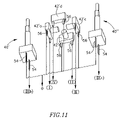
- FIG. 11 is an illustrative view of one possible arrangement of the electrical wiring of the multifunction key assembly in accordance with the first embodiment
- FIG. 12 is an illustrative view of one possible arrangement of the electrical wiring of the multifunction key assembly in accordance with the second embodiment
- FIG. 1 showing a typical electronic device 20 in accordance with the present invention.
- a non-binding example of such an electronic device 20 as illustrated in FIG. 1 is a cellular telephone.
- the electronic device 20 comprises a casing 22 , a display screen 24 on a front surface 25 of the casing 22 , a multifunction key assembly 26 in accordance with the present invention having a key cap 28 , a loudspeaker 30 , an earphone 32 , a microphone 34 and auxiliary keys 36 .
- Noticeably missing is the conventional keypad for inputting data to the electronic device 20 .
- the multifunction key assembly 26 of the present invention is much smaller than the conventional keypad and therefore may be positioned within the electronic device 20 in such a manner that the key cap 28 is located on a side surface 37 of the casing 22 of the electronic device 20 , thereby freeing the great majority of space of the front surface 25 for the display screen 24 , as shown in FIG. 1 .
- the multifunction key assembly 26 can be incorporated in the electronic device 20 as an integral part thereof, or it may be manufactured as a separate module and conveniently inserted and removed therefrom as required.
- the multifunction key assembly 26 in the form of a module is shown in FIG. 2 .
- the multifunction key assembly 26 in the form of a module has a housing 38 , within which all the members of the multifunction key assembly 26 are located, apart from the key cap 28 . It will be appreciated that if the multifunction key assembly 26 is not a separate module but is incorporated in the electronic device 20 as an integral part thereof, then the housing 38 of the multifunction key assembly 26 may be a part of the casing 22 of the electronic device 20 .
- the multifunction key assembly 26 in accordance with a first embodiment of the present invention, comprises two major switches 40 , which will be referred to individually as first and second-major switches 40 ′, 40 ′′, four first-minor switches 42 ′, which will be referred to individually as first, second, third and fourth first-minor switches 42 ′ a , 42 ′ b , 42 ′ c , 42 ′ d and a first guide member 44 ′.
- Both the major and first-minor switches 40 , 42 ′ are electrical switches and may be push button switches.
- Each major switch 40 has a major stem 46 extending from a major base 48 and each first-minor switch 42 ′ has a minor stem 50 extending from a minor base 52 .
- the major stem 46 of each major switch 40 has a longitudinal axis A, defining a longitudinal direction of the major switch 40 .
- Extending from the major base 48 of each major switch 40 are two electrically conducting major leads 54 .
- extending from the minor base 52 of each first-minor switch 40 are two electrically conducting minor leads 56 .
- the key cap 28 has opposing upper and lower surfaces 58 , 60 and has a generally elongated oval or elliptical shape having a long dimension D defining a longitudinal axis L of the key cap 28 .
- Two push knobs 62 ( 62 ′, 62 ′′) project from the upper surface 58 of the key cap 28 at ends of the key cap 28 , that is, at extremities of the long dimension D of the key cap 28 .
- two opposing elongated projections 64 project from the upper surface 58 , extending adjacent long edges 66 of the key cap 28 on opposite sides of the longitudinal axis L.
- the end of each major stem 46 distal the major base 48 is retained in a corresponding bore (not seen) in the lower surface 60 of the key cap 28 , thereby mechanically connecting the key cap 28 to the major switches 40 .
- the first guide member 44 ′ has two throughgoing guide grooves 68 , 70 perpendicular to each other forming a cross-shaped aperture 72 .
- One of the guide grooves 68 is aligned with the longitudinal axis L of the key cap 28 and will be referred to herein as the longitudinal guide groove.
- the other guide groove 70 is perpendicular to the longitudinal axis L of the key cap 28 and will be referred to herein as the transverse guide groove.
- the key cap 28 has a centrally located rod 74 extending from its lower surface 60 in a direction generally parallel to the major stems 46 and generally perpendicular to the minor stems 50 .
- the first guide member 44 ′ is located between the first-minor switches 42 ′ and the key cap 28 , with the rod 74 of the key cap 28 passing through the cross-shaped aperture 72 of the first guide member 44 ′ and between all four of the first-minor switches 42 ′.
- the multifunction key assembly 26 in accordance with the second embodiment of the present invention, comprises two major switches 40 ( 40 ′, 40 ′′), four first-minor switches 42 ′ ( 42 ′ a , 42 ′ b , 42 ′ c , 42 ′ d ), four similar or identical second-minor switches 42 ′′ ( 42 ′′a, 42 ′′b, 42 ′′c, 42 ′′d) and first and second guide members 44 ′, 44 ′′.
- the key cap 28 is not provided with a rod.
- the first guide member 44 ′ is located between the first-minor switches 42 ′ and the key cap 28 , with the major stem 46 of the first-major switch 40 ′ passing between all four of the first-minor switches 42 ′ and through the cross-shaped aperture 72 of the first guide member 44 ′.
- the second guide member 44 ′′ is located between the second-minor switches 42 ′′ and the key cap 28 , with the major stem 46 of the second-major switch 40 ′′ passing between all four of the second-minor switches 42 ′′ and through the cross-shaped aperture 72 of the second guide member 44 ′′.
- each major stem 46 distal the major base 48 is retained in a corresponding bore (not seen) in the lower surface 60 of the key cap 28 , thereby mechanically connecting the key cap 28 to the major switches 40 ′, 40 ′′.
- the key cap 28 can be moved in various directions by applying an external force to it.
- an external force is applied to the key cap 28 by an operator placing a thumb on the upper surface 60 of the key cap 28 , or on one of the push knobs 62 ′, 62 ′′ and then either depressing the key cap 28 and displacing it “vertically” by applying a force to the key cap 28 in the longitudinal direction of the major switches 40 ′, 40 ′′, or displacing the key cap 28 “horizontally” by applying a force to the key cap 28 in a direction perpendicular to the longitudinal direction of the major switches 40 ′, 40 ′′.
- both vertical and horizontal forces can be applied simultaneously.
- the major stems 46 are preferably resilient to allow sufficient horizontal displacement of the key cap 28 .
- FIGS. 7 to 9 and FIGS. 10A to 10D Attention is now referred additionally to FIGS. 7 to 9 and FIGS. 10A to 10D . If no vertical force is applied to the key cap 28 , then the key cap 28 is said to be in a non-major active state ( FIG. 10A ). If no external force at all is applied to the key cap 28 , then the key cap 28 is un-displaced horizontally ( FIGS. 7 to 9 ) and un-displaced vertically ( FIG. 10A ) and is said to be in its rest position. Since the rod 74 is affixed to the key cap 28 and therefore with the key cap 28 removed the rod 74 is not in the housing, it is shown by a dashed line in FIG. 8 , representing where the rod 74 would be positioned if the key cap 28 was not removed.
- the rod 74 is constrained to move horizontally in the guide grooves 68 , 70 ( FIG. 8 ), and in the second embodiment, the major stems 46 are constrained to move horizontally in the guide grooves 68 , 70 ( FIG. 9 ). Therefore, horizontal displacement of the key cap 28 is constrained to longitudinal and transverse movement, corresponding to movement of the rod 74 (first embodiment) or the major stems 46 (second embodiment) in the longitudinal and transverse guide grooves 68 , 70 , in the longitudinal and transverse directions L 1 , L 2 and H 1 , H 2 respectively. In other words, the key cap 28 can be displaced horizontally in two mutually perpendicular directions to four horizontal displacement directions L 1 , L 2 , H 1 , H 2 .
- a first-major active position ( FIG. 10B ) is obtained by displacing a first end of the key cap 28 vertically, that is, by depressing the first of the push knobs 62 ′ so that only the major stem 46 of the first-major switch 40 ′ is displaced vertically as it is urged towards its major base 48 thereby changing the electrical state of the of the first-major switch 40 ′ from an off-state (electrically non-conducting) to an on-state (electrically conducting).
- a second-major active position ( FIG. 10C ) is obtained by displacing a second end of the key cap 28 vertically, that is, by depressing the second push knob 62 ′′ so that only the major stem 46 of the second-major switch 40 ′′ is displaced vertically as it is urged towards its major base 48 thereby changing the electrical state of the second-major switch 40 ′′ from an off-state to an on-state.
- a third major active position ( FIG. 10C ) is obtained by displacing a second end of the key cap 28 vertically, that is, by depressing the second push knob 62 ′′ so that only the major stem 46 of the second-major switch 40 ′′ is displaced vertically as it is urged towards its major base 48 thereby changing the electrical state of the second-major switch 40 ′′ from an off-state to an on-state.
- a third major active position ( FIG.
- a “major active position” of the key cap 28 is defined as an on-state of at least one of the major switches 40 ′, 40 ′′.
- a “minor active position” is defined herein as an on-state (electrically conducting) of at least one of the minor switches 42 ′ ( 42 ′ a , 42 ′ b , 42 ′ c , 42 ′ d ), 42 ′′ ( 42 ′′a, 42 ′′b, 42 ′′c, 42 ′′d).
- the stem 46 of the first-major switch 40 ′ that applies force to the minor stem 50 of a particular first-minor switch 42 ′ and the stem 46 of the second-major switch 40 ′′ that applies force to the minor stem 50 of a particular second-minor switch 42 ′′.
- a distinct output signal is obtained for each combination of a given major active position and a particular minor active position.
- the elongated projections 64 serve to prevent the operator's thumb from slipping when displacing the key cap 28 horizontally or when the operator's thumb is at a location between the two push knobs 62 . Since there are three major active positions ( FIG. 10B , FIG. 10C and FIG. 10D ) and four minor active positions, corresponding to the four horizontal displacement directions L 1 , L 2 , H 1 , H 2 of the key cap and the ensuing activation of a particular minor switch 42 ′, 42 ′′, a total of twelve distinct output signals can be obtained.
- the four output signals for the numerals 1, 2, 3 and 4, defining a first set of outputs may be obtained using the first-major active position ( FIG. 10B ) along with the first, second, third and fourth minor active positions, respectively; the four output signals for the numerals 5, 6, 7 and 8, defining a second set of outputs, may be obtained using the second-major active position ( FIG. 10B )
- FIG. 11 showing an illustrative view of one possible arrangement for the electrical wiring of the multifunction key assembly 26 in accordance with the first embodiment that will enable the multifunction key assembly 26 to provide the output signals mentioned above.
- the two major switches 40 ′, 40 ′′ and the four first-minor switches 42 ′ ( 42 ′ a , 42 ′ b , 42 ′ c , 42 ′ d ) are electrically connected to each other, with one of the electrically conducting major leads 54 of each major switch 40 ′, 40 ′′ and one of the electrically conducting minor leads 56 of each first-minor switch 40 ′ being electrically common, and the other electrically conducting major lead 54 of each major switch 40 ′, 40 ′′ and the other electrically conducting minor lead 56 of each first-minor switch 40 ′ being electrically common and grounded.
- the output signals for the first, second, third and fourth minor active positions are denoted by (I), (II), (III) and (IV), respectively, and the output signals for the first and second-major active positions are denoted by (IXb) and (IXc), respectively.
- the output signal for the numeral 1 from the first set of outputs is given symbolically by the combination (IXb)+(I), that is, the first push knob 62 ′ is depressed, so that the first-major switch 40 ′ is in an on-state, as shown in FIG. 10B and the key cap 28 is in the first-minor active position.
- the output signal for the numeral 5, from the second set of outputs is given symbolically by the combination (IXc)+(I), that is, the second push knob 62 ′′ is depressed, so that second-major switch 40 ′′ is in an on-state, as shown in FIG. 10C and the key cap 28 is in the first-minor active position.
- both major switches 40 ′, 40 ′′ have to be in an on-state, that is, both push knobs 62 have to be depressed, as shown in FIG. 10D .
- the output signal for the numeral 9 is given symbolically by the combination (IXb)+(IXc)+(I).
- the key cap 28 may be “double-clicked” before it is displaced in the manner described above.
- one or more of the auxiliary keys 36 may be actuated. Therefore, a large amount of information such as numerals, letters, symbols, functions, etc. can be outputted from the multifunction key assembly 26 .
- FIG. 12 showing an illustrative view of one possible arrangement for the electrical wiring of the multifunction key assembly 26 in accordance with the second embodiment that will enable the multifunction key assembly 26 to provide the same output signals as those obtained for the first embodiment.
- the two major switches 40 ′, 40 ′′, the four first-minor switches 42 ′ ( 42 ′ a , 42 ′ b , 42 ′ c , 42 ′ d ) and the four second-minor switches 42 ′′ ( 42 ′′ a , 42 ′′ b , 42 ′′ c , 42 ′′ d ) are electrically connected to each other, with one of the electrically conducting major leads 54 of each major switch 40 ′, 40 ′′ and one of the electrically conducting minor leads 56 of each first-minor switch 42 ′ and each second-minor switch 42 ′′ being electrically common, and the other electrically conducting major lead 54 of each major switch 40 ′, 40 ′′ and the other electrically conducting minor lead 56 of each first-minor switch 40 and each
- the twelve distinct output signals are obtained from the multifunction key assembly 26 of the second embodiment, by applying the same set of operations to the key cap 28 as described for the first embodiment.
- the output signal for the numeral 1 from the first set of outputs is given symbolically by the combination (IXb)+(I), that is, the first push knob 62 ′ is depressed, so that the first-major switch 40 ′ is in an on-state, as shown in FIG. 10B and the key cap 28 is in the first-minor active position.
- the only difference between the first and second embodiments being that in the first embodiment, it is the rod 74 of the key cap 28 that applies force to the minor stem 50 of a particular first-minor switch 42 ′ to obtain a particular minor active position of the key cap 28 .
- the stem 46 of the first-major switch 40 ′ that applies force to the minor stem 50 of a particular first-minor switch 42 ′
- the stem 46 of the second-major switch 40 ′′ that applies force to the minor stem 50 of a particular second-minor switch 42 ′′ to obtain a particular minor active position of the key cap 28 .
Landscapes
- Switch Cases, Indication, And Locking (AREA)
Abstract
Description
(c) horizontally displacing the key cap from a minor non-active position to a minor active position by displacing the key cap in one of two mutually perpendicular directions to one of four minor active positions, wherein in the minor non-active position all four first-minor switches are in an electrically off-state and wherein in a minor active position one of the first-minor switches is in an electrically on-state, thereby providing the one of the twelve distinct output signals.
-
- 1. It facilitates the miniaturization of electronic devices in general and cellular telephones in particular;
- 2. It enables the use of larger display screens;
- 3. The multifunction key is operated by a single key cap. The single key cap may be operated by the thumb of one hand of an operator. The single key cap is simple to operate. Twelve distinct output signals can be obtained by displacing the key cap horizontally in two mutually perpendicular directions (North-South, East-West) in combination with depressing the key cap at three different regions thereof.
Claims (14)
Priority Applications (1)
| Application Number | Priority Date | Filing Date | Title |
|---|---|---|---|
| US11/212,745 US7217892B2 (en) | 2005-08-29 | 2005-08-29 | Multifunction key assembly |
Applications Claiming Priority (1)
| Application Number | Priority Date | Filing Date | Title |
|---|---|---|---|
| US11/212,745 US7217892B2 (en) | 2005-08-29 | 2005-08-29 | Multifunction key assembly |
Publications (2)
| Publication Number | Publication Date |
|---|---|
| US20070045088A1 US20070045088A1 (en) | 2007-03-01 |
| US7217892B2 true US7217892B2 (en) | 2007-05-15 |
Family
ID=37802497
Family Applications (1)
| Application Number | Title | Priority Date | Filing Date |
|---|---|---|---|
| US11/212,745 Expired - Lifetime US7217892B2 (en) | 2005-08-29 | 2005-08-29 | Multifunction key assembly |
Country Status (1)
| Country | Link |
|---|---|
| US (1) | US7217892B2 (en) |
Cited By (1)
| Publication number | Priority date | Publication date | Assignee | Title |
|---|---|---|---|---|
| US20100302167A1 (en) * | 2009-05-28 | 2010-12-02 | Hideki Nohechi | Terminal device |
Families Citing this family (1)
| Publication number | Priority date | Publication date | Assignee | Title |
|---|---|---|---|---|
| JP5643034B2 (en) * | 2010-09-10 | 2014-12-17 | パナソニック株式会社 | Switch unit, vehicle switch unit |
Citations (8)
| Publication number | Priority date | Publication date | Assignee | Title |
|---|---|---|---|---|
| JPH10269902A (en) | 1997-03-27 | 1998-10-09 | Alps Electric Co Ltd | Multi-directional input device |
| US6162999A (en) * | 1997-11-10 | 2000-12-19 | Matsushita Electric Industrial Co., Ltd. | Multi-directional operating switch |
| US6344618B1 (en) * | 1999-06-10 | 2002-02-05 | Matsushita Electric Industrial Co., Ltd. | Multi-directional operating switch and multi-directional operating device using the same |
| US20020104743A1 (en) | 2000-10-31 | 2002-08-08 | Hosiden Corporation | Slide switch |
| US6441753B1 (en) | 2000-10-25 | 2002-08-27 | Motorola, Inc. | Multi-function key assembly for an electronic device |
| US6635832B1 (en) * | 1998-09-28 | 2003-10-21 | Leopold Kostal Gmbh & Co. Kg | Electrical switch |
| US6765165B1 (en) * | 2003-12-20 | 2004-07-20 | Lear Corporation | Electric switch |
| US6897391B2 (en) * | 2001-08-24 | 2005-05-24 | Lear Corporation | Electric membrane switch with seven contact positions |
-
2005
- 2005-08-29 US US11/212,745 patent/US7217892B2/en not_active Expired - Lifetime
Patent Citations (8)
| Publication number | Priority date | Publication date | Assignee | Title |
|---|---|---|---|---|
| JPH10269902A (en) | 1997-03-27 | 1998-10-09 | Alps Electric Co Ltd | Multi-directional input device |
| US6162999A (en) * | 1997-11-10 | 2000-12-19 | Matsushita Electric Industrial Co., Ltd. | Multi-directional operating switch |
| US6635832B1 (en) * | 1998-09-28 | 2003-10-21 | Leopold Kostal Gmbh & Co. Kg | Electrical switch |
| US6344618B1 (en) * | 1999-06-10 | 2002-02-05 | Matsushita Electric Industrial Co., Ltd. | Multi-directional operating switch and multi-directional operating device using the same |
| US6441753B1 (en) | 2000-10-25 | 2002-08-27 | Motorola, Inc. | Multi-function key assembly for an electronic device |
| US20020104743A1 (en) | 2000-10-31 | 2002-08-08 | Hosiden Corporation | Slide switch |
| US6897391B2 (en) * | 2001-08-24 | 2005-05-24 | Lear Corporation | Electric membrane switch with seven contact positions |
| US6765165B1 (en) * | 2003-12-20 | 2004-07-20 | Lear Corporation | Electric switch |
Non-Patent Citations (1)
| Title |
|---|
| International Search Report, PCT/IL2006/000970, dated Dec. 13, 2006. |
Cited By (2)
| Publication number | Priority date | Publication date | Assignee | Title |
|---|---|---|---|---|
| US20100302167A1 (en) * | 2009-05-28 | 2010-12-02 | Hideki Nohechi | Terminal device |
| US8581124B2 (en) * | 2009-05-28 | 2013-11-12 | Sony Corporation | Terminal device |
Also Published As
| Publication number | Publication date |
|---|---|
| US20070045088A1 (en) | 2007-03-01 |
Similar Documents
| Publication | Publication Date | Title |
|---|---|---|
| US7107018B2 (en) | Communication device having multiple keypads | |
| CA2077184A1 (en) | Multi-status multi-functional data processing key and key array | |
| US7291793B2 (en) | Multifunction key assembly | |
| US7217892B2 (en) | Multifunction key assembly | |
| EP1920450B1 (en) | Multifunction key assembly | |
| TWI356627B (en) | Multifunction key assembly | |
| KR100429983B1 (en) | Character input method for mobile communication device using remote controller | |
| US20050163307A1 (en) | Telephone keypad arrangement | |
| JP2000276982A (en) | Rubber switch | |
| US20060250370A1 (en) | Method and related apparatus for inputting characters | |
| JP2009105634A (en) | Communication terminal device | |
| JPH07288057A (en) | Switch device |
Legal Events
| Date | Code | Title | Description |
|---|---|---|---|
| AS | Assignment |
Owner name: HECHT, GIL, ISRAEL Free format text: ASSIGNMENT OF ASSIGNORS INTEREST;ASSIGNOR:HECHT, GIL;REEL/FRAME:016841/0667 Effective date: 20050828 Owner name: ISCAR LTD., ISRAEL Free format text: ASSIGNMENT OF ASSIGNORS INTEREST;ASSIGNOR:HECHT, GIL;REEL/FRAME:016841/0667 Effective date: 20050828 |
|
| AS | Assignment |
Owner name: NEW ISCAR LTD., ISRAEL Free format text: ASSIGNMENT OF ASSIGNORS INTEREST;ASSIGNOR:ISCAR LTD.;REEL/FRAME:017946/0623 Effective date: 20060706 |
|
| AS | Assignment |
Owner name: ISCAR LTD., ISRAEL Free format text: CHANGE OF NAME;ASSIGNOR:NEW ISCAR LTD.;REEL/FRAME:018075/0253 Effective date: 20060706 |
|
| STCF | Information on status: patent grant |
Free format text: PATENTED CASE |
|
| FPAY | Fee payment |
Year of fee payment: 4 |
|
| FEPP | Fee payment procedure |
Free format text: PAT HOLDER CLAIMS SMALL ENTITY STATUS, ENTITY STATUS SET TO SMALL (ORIGINAL EVENT CODE: LTOS); ENTITY STATUS OF PATENT OWNER: SMALL ENTITY |
|
| AS | Assignment |
Owner name: HECHT, GIL, ISRAEL Free format text: ASSIGNMENT OF ASSIGNORS INTEREST;ASSIGNOR:ISCAR, LTD.;REEL/FRAME:025755/0700 Effective date: 20101103 |
|
| FPAY | Fee payment |
Year of fee payment: 8 |
|
| MAFP | Maintenance fee payment |
Free format text: PAYMENT OF MAINTENANCE FEE, 12TH YR, SMALL ENTITY (ORIGINAL EVENT CODE: M2553); ENTITY STATUS OF PATENT OWNER: SMALL ENTITY Year of fee payment: 12 |