US7217714B1 - CCR5 modulators - Google Patents
CCR5 modulators Download PDFInfo
- Publication number
- US7217714B1 US7217714B1 US09/451,826 US45182699A US7217714B1 US 7217714 B1 US7217714 B1 US 7217714B1 US 45182699 A US45182699 A US 45182699A US 7217714 B1 US7217714 B1 US 7217714B1
- Authority
- US
- United States
- Prior art keywords
- piperidinyl
- phenylpropyl
- oxadiazol
- benzyl
- cyclobutanecarboxamide
- Prior art date
- Legal status (The legal status is an assumption and is not a legal conclusion. Google has not performed a legal analysis and makes no representation as to the accuracy of the status listed.)
- Expired - Fee Related
Links
- 102100035875 C-C chemokine receptor type 5 Human genes 0.000 title description 48
- 101710149870 C-C chemokine receptor type 5 Proteins 0.000 title description 48
- 150000001875 compounds Chemical class 0.000 claims abstract description 485
- 239000008194 pharmaceutical composition Substances 0.000 claims abstract description 11
- 230000036961 partial effect Effects 0.000 claims description 116
- 125000001424 substituent group Chemical group 0.000 claims description 101
- 125000004178 (C1-C4) alkyl group Chemical group 0.000 claims description 67
- -1 isoxazolyl thiazolyl Chemical group 0.000 claims description 63
- 125000001997 phenyl group Chemical group [H]C1=C([H])C([H])=C(*)C([H])=C1[H] 0.000 claims description 44
- 125000000217 alkyl group Chemical group 0.000 claims description 41
- 125000000623 heterocyclic group Chemical group 0.000 claims description 39
- 239000001257 hydrogen Substances 0.000 claims description 37
- 229910052739 hydrogen Inorganic materials 0.000 claims description 37
- 125000006526 (C1-C2) alkyl group Chemical group 0.000 claims description 32
- UFHFLCQGNIYNRP-UHFFFAOYSA-N Hydrogen Chemical compound [H][H] UFHFLCQGNIYNRP-UHFFFAOYSA-N 0.000 claims description 30
- 229910052757 nitrogen Inorganic materials 0.000 claims description 28
- 150000003839 salts Chemical class 0.000 claims description 22
- 125000003545 alkoxy group Chemical group 0.000 claims description 21
- 125000000753 cycloalkyl group Chemical group 0.000 claims description 20
- 125000002496 methyl group Chemical group [H]C([H])([H])* 0.000 claims description 20
- 125000000229 (C1-C4)alkoxy group Chemical group 0.000 claims description 19
- 125000004093 cyano group Chemical group *C#N 0.000 claims description 19
- 125000006536 (C1-C2)alkoxy group Chemical group 0.000 claims description 18
- 125000003342 alkenyl group Chemical group 0.000 claims description 18
- 125000004448 alkyl carbonyl group Chemical group 0.000 claims description 17
- 125000001309 chloro group Chemical group Cl* 0.000 claims description 17
- 125000000118 dimethyl group Chemical group [H]C([H])([H])* 0.000 claims description 17
- 125000004433 nitrogen atom Chemical group N* 0.000 claims description 16
- 125000000956 methoxy group Chemical group [H]C([H])([H])O* 0.000 claims description 15
- 125000002971 oxazolyl group Chemical group 0.000 claims description 15
- 125000004453 alkoxycarbonyl group Chemical group 0.000 claims description 14
- 125000005196 alkyl carbonyloxy group Chemical group 0.000 claims description 14
- 125000001715 oxadiazolyl group Chemical group 0.000 claims description 14
- 229910052760 oxygen Inorganic materials 0.000 claims description 14
- 229910052717 sulfur Inorganic materials 0.000 claims description 14
- 229910052799 carbon Inorganic materials 0.000 claims description 13
- 125000001425 triazolyl group Chemical group 0.000 claims description 13
- 125000004432 carbon atom Chemical group C* 0.000 claims description 12
- 125000001786 isothiazolyl group Chemical group 0.000 claims description 12
- 125000000842 isoxazolyl group Chemical group 0.000 claims description 12
- 125000004076 pyridyl group Chemical group 0.000 claims description 12
- 125000001113 thiadiazolyl group Chemical group 0.000 claims description 12
- 125000000714 pyrimidinyl group Chemical group 0.000 claims description 11
- 125000000335 thiazolyl group Chemical group 0.000 claims description 11
- 125000002023 trifluoromethyl group Chemical group FC(F)(F)* 0.000 claims description 11
- 125000003373 pyrazinyl group Chemical group 0.000 claims description 10
- 125000003226 pyrazolyl group Chemical group 0.000 claims description 10
- 125000001797 benzyl group Chemical group [H]C1=C([H])C([H])=C(C([H])=C1[H])C([H])([H])* 0.000 claims description 9
- 125000002883 imidazolyl group Chemical group 0.000 claims description 9
- 125000000168 pyrrolyl group Chemical group 0.000 claims description 9
- 125000002757 morpholinyl group Chemical group 0.000 claims description 8
- 125000002098 pyridazinyl group Chemical group 0.000 claims description 8
- 125000006274 (C1-C3)alkoxy group Chemical group 0.000 claims description 7
- 125000001544 thienyl group Chemical group 0.000 claims description 7
- 125000002393 azetidinyl group Chemical group 0.000 claims description 6
- 125000003785 benzimidazolyl group Chemical group N1=C(NC2=C1C=CC=C2)* 0.000 claims description 6
- 125000001041 indolyl group Chemical group 0.000 claims description 6
- 125000002943 quinolinyl group Chemical group N1=C(C=CC2=CC=CC=C12)* 0.000 claims description 6
- 125000002183 isoquinolinyl group Chemical group C1(=NC=CC2=CC=CC=C12)* 0.000 claims description 5
- 125000003566 oxetanyl group Chemical group 0.000 claims description 5
- 125000004193 piperazinyl group Chemical group 0.000 claims description 5
- 125000000719 pyrrolidinyl group Chemical group 0.000 claims description 5
- 125000002294 quinazolinyl group Chemical group N1=C(N=CC2=CC=CC=C12)* 0.000 claims description 5
- 125000003718 tetrahydrofuranyl group Chemical group 0.000 claims description 5
- 125000001412 tetrahydropyranyl group Chemical group 0.000 claims description 5
- 125000004169 (C1-C6) alkyl group Chemical group 0.000 claims description 4
- VGGSQFUCUMXWEO-UHFFFAOYSA-N Ethene Chemical compound C=C VGGSQFUCUMXWEO-UHFFFAOYSA-N 0.000 claims description 4
- 239000005977 Ethylene Substances 0.000 claims description 4
- 125000004541 benzoxazolyl group Chemical group O1C(=NC2=C1C=CC=C2)* 0.000 claims description 4
- MFNYBOWJWGPXFM-UHFFFAOYSA-N cyclobutanecarboxamide Chemical compound NC(=O)C1CCC1 MFNYBOWJWGPXFM-UHFFFAOYSA-N 0.000 claims description 4
- 125000001495 ethyl group Chemical group [H]C([H])([H])C([H])([H])* 0.000 claims description 4
- 125000002541 furyl group Chemical group 0.000 claims description 4
- 239000000546 pharmaceutical excipient Substances 0.000 claims description 4
- 125000002924 primary amino group Chemical group [H]N([H])* 0.000 claims description 4
- 125000005913 (C3-C6) cycloalkyl group Chemical group 0.000 claims description 3
- 125000005955 1H-indazolyl group Chemical group 0.000 claims description 3
- 125000000882 C2-C6 alkenyl group Chemical group 0.000 claims description 3
- 125000003601 C2-C6 alkynyl group Chemical group 0.000 claims description 3
- 125000004603 benzisoxazolyl group Chemical group O1N=C(C2=C1C=CC=C2)* 0.000 claims description 3
- 125000001164 benzothiazolyl group Chemical group S1C(=NC2=C1C=CC=C2)* 0.000 claims description 3
- 125000004196 benzothienyl group Chemical group S1C(=CC2=C1C=CC=C2)* 0.000 claims description 3
- 125000001995 cyclobutyl group Chemical group [H]C1([H])C([H])([H])C([H])(*)C1([H])[H] 0.000 claims description 3
- 125000001559 cyclopropyl group Chemical group [H]C1([H])C([H])([H])C1([H])* 0.000 claims description 3
- 125000003387 indolinyl group Chemical group N1(CCC2=CC=CC=C12)* 0.000 claims description 3
- 125000001449 isopropyl group Chemical group [H]C([H])([H])C([H])(*)C([H])([H])[H] 0.000 claims description 3
- 125000004592 phthalazinyl group Chemical group C1(=NN=CC2=CC=CC=C12)* 0.000 claims description 3
- 125000004309 pyranyl group Chemical group O1C(C=CC=C1)* 0.000 claims description 3
- 125000001567 quinoxalinyl group Chemical group N1=C(C=NC2=CC=CC=C12)* 0.000 claims description 3
- 125000000999 tert-butyl group Chemical group [H]C([H])([H])C(*)(C([H])([H])[H])C([H])([H])[H] 0.000 claims description 3
- OFMOEYCLVQUAAH-MHZLTWQESA-N 1-acetamido-n-[(1s)-3-[4-(3-benzyl-1,2,4-oxadiazol-5-yl)piperidin-1-yl]-1-phenylpropyl]cyclopentane-1-carboxamide Chemical compound N([C@@H](CCN1CCC(CC1)C=1ON=C(CC=2C=CC=CC=2)N=1)C=1C=CC=CC=1)C(=O)C1(NC(=O)C)CCCC1 OFMOEYCLVQUAAH-MHZLTWQESA-N 0.000 claims description 2
- QFHSYMOLFCOPOA-SANMLTNESA-N 1-acetyl-n-[(1s)-3-[4-(3-benzyl-1,2,4-oxadiazol-5-yl)piperidin-1-yl]-1-phenylpropyl]azetidine-3-carboxamide Chemical compound C1N(C(=O)C)CC1C(=O)N[C@H](C=1C=CC=CC=1)CCN1CCC(C=2ON=C(CC=3C=CC=CC=3)N=2)CC1 QFHSYMOLFCOPOA-SANMLTNESA-N 0.000 claims description 2
- HXPAOXNZEXMLAA-MHZLTWQESA-N 1-acetyl-n-[(1s)-3-[4-[3-[[4-(methanesulfonamido)phenyl]methyl]-1,2,4-oxadiazol-5-yl]piperidin-1-yl]-1-phenylpropyl]azetidine-3-carboxamide Chemical compound C1N(C(=O)C)CC1C(=O)N[C@H](C=1C=CC=CC=1)CCN1CCC(C=2ON=C(CC=3C=CC(NS(C)(=O)=O)=CC=3)N=2)CC1 HXPAOXNZEXMLAA-MHZLTWQESA-N 0.000 claims description 2
- JFDHGLXKHKOOSA-SANMLTNESA-N 2-cyclopropyl-n-[(1s)-3-[4-[3-[[4-(methanesulfonamido)phenyl]methyl]-1,2,4-oxadiazol-5-yl]piperidin-1-yl]-1-phenylpropyl]acetamide Chemical compound C1=CC(NS(=O)(=O)C)=CC=C1CC1=NOC(C2CCN(CC[C@H](NC(=O)CC3CC3)C=3C=CC=CC=3)CC2)=N1 JFDHGLXKHKOOSA-SANMLTNESA-N 0.000 claims description 2
- CHPMPCYCZBWGRA-QHCPKHFHSA-N 3,3,3-trifluoro-n-[(1s)-3-[4-[3-[[4-(methanesulfonamido)phenyl]methyl]-1,2,4-oxadiazol-5-yl]piperidin-1-yl]-1-phenylpropyl]propanamide Chemical compound C1=CC(NS(=O)(=O)C)=CC=C1CC1=NOC(C2CCN(CC[C@H](NC(=O)CC(F)(F)F)C=3C=CC=CC=3)CC2)=N1 CHPMPCYCZBWGRA-QHCPKHFHSA-N 0.000 claims description 2
- 125000006637 cyclobutyl carbonyl group Chemical group 0.000 claims description 2
- 125000000113 cyclohexyl group Chemical group [H]C1([H])C([H])([H])C([H])([H])C([H])(*)C([H])([H])C1([H])[H] 0.000 claims description 2
- 125000001511 cyclopentyl group Chemical group [H]C1([H])C([H])([H])C([H])([H])C([H])(*)C1([H])[H] 0.000 claims description 2
- 125000004851 cyclopentylmethyl group Chemical group C1(CCCC1)C* 0.000 claims description 2
- 125000004186 cyclopropylmethyl group Chemical group [H]C([H])(*)C1([H])C([H])([H])C1([H])[H] 0.000 claims description 2
- 239000003085 diluting agent Substances 0.000 claims description 2
- FGDVGHLGDKLGLH-SANMLTNESA-N ethyl 4-(3-benzyl-1,2,4-oxadiazol-5-yl)-1-[(3s)-3-(cyclobutanecarbonylamino)-3-phenylpropyl]piperidine-4-carboxylate Chemical compound N([C@@H](CCN1CCC(CC1)(C(=O)OCC)C=1ON=C(CC=2C=CC=CC=2)N=1)C=1C=CC=CC=1)C(=O)C1CCC1 FGDVGHLGDKLGLH-SANMLTNESA-N 0.000 claims description 2
- 125000001570 methylene group Chemical group [H]C([H])([*:1])[*:2] 0.000 claims description 2
- LQESQOGKWZYEGA-DEOSSOPVSA-N n-[(1s)-1-phenyl-3-[4-[3-(pyridin-2-ylmethyl)-1,2,4-oxadiazol-5-yl]piperidin-1-yl]propyl]cyclobutanecarboxamide Chemical compound C([C@H](NC(=O)C1CCC1)C=1C=CC=CC=1)CN(CC1)CCC1C(ON=1)=NC=1CC1=CC=CC=N1 LQESQOGKWZYEGA-DEOSSOPVSA-N 0.000 claims description 2
- RTGHHAAINNCIJX-DEOSSOPVSA-N n-[(1s)-1-phenyl-3-[4-[3-(pyridin-4-ylmethyl)-1,2,4-oxadiazol-5-yl]piperidin-1-yl]propyl]cyclobutanecarboxamide Chemical compound C([C@H](NC(=O)C1CCC1)C=1C=CC=CC=1)CN(CC1)CCC1C(ON=1)=NC=1CC1=CC=NC=C1 RTGHHAAINNCIJX-DEOSSOPVSA-N 0.000 claims description 2
- DJWZWTQGQULMLW-VWLOTQADSA-N n-[(1s)-1-phenyl-3-[4-[3-[[4-(trifluoromethyl)phenyl]methyl]-1,2,4-oxadiazol-5-yl]piperidin-1-yl]propyl]cyclobutanecarboxamide Chemical compound C1=CC(C(F)(F)F)=CC=C1CC1=NOC(C2CCN(CC[C@H](NC(=O)C3CCC3)C=3C=CC=CC=3)CC2)=N1 DJWZWTQGQULMLW-VWLOTQADSA-N 0.000 claims description 2
- NLIUYDARAPVIAI-VWLOTQADSA-N n-[(1s)-3-[4-(3-benzyl-1,2,4-oxadiazol-5-yl)-4-cyanopiperidin-1-yl]-1-phenylpropyl]cyclobutanecarboxamide Chemical compound C([C@H](NC(=O)C1CCC1)C=1C=CC=CC=1)CN(CC1)CCC1(C#N)C(ON=1)=NC=1CC1=CC=CC=C1 NLIUYDARAPVIAI-VWLOTQADSA-N 0.000 claims description 2
- WQPJASBOJFGUAL-VWLOTQADSA-N n-[(1s)-3-[4-(3-benzyl-1,2,4-oxadiazol-5-yl)piperidin-1-yl]-1-(3-fluorophenyl)propyl]-2-cyclopropylacetamide Chemical compound FC1=CC=CC([C@H](CCN2CCC(CC2)C=2ON=C(CC=3C=CC=CC=3)N=2)NC(=O)CC2CC2)=C1 WQPJASBOJFGUAL-VWLOTQADSA-N 0.000 claims description 2
- XSWFUEQAQWKUFP-VWLOTQADSA-N n-[(1s)-3-[4-(3-benzyl-1,2,4-oxadiazol-5-yl)piperidin-1-yl]-1-(3-fluorophenyl)propyl]cyclobutanecarboxamide Chemical compound FC1=CC=CC([C@H](CCN2CCC(CC2)C=2ON=C(CC=3C=CC=CC=3)N=2)NC(=O)C2CCC2)=C1 XSWFUEQAQWKUFP-VWLOTQADSA-N 0.000 claims description 2
- URDSLQZCRIMVLW-VWLOTQADSA-N n-[(1s)-3-[4-(3-benzyl-1,2,4-oxadiazol-5-yl)piperidin-1-yl]-1-phenylpropyl]-1-methoxycyclobutane-1-carboxamide Chemical compound N([C@@H](CCN1CCC(CC1)C=1ON=C(CC=2C=CC=CC=2)N=1)C=1C=CC=CC=1)C(=O)C1(OC)CCC1 URDSLQZCRIMVLW-VWLOTQADSA-N 0.000 claims description 2
- QYAVGLXXFMQEDK-VWLOTQADSA-N n-[(1s)-3-[4-(3-benzyl-1,2,4-oxadiazol-5-yl)piperidin-1-yl]-1-phenylpropyl]cyclobutanecarboxamide Chemical compound C([C@H](NC(=O)C1CCC1)C=1C=CC=CC=1)CN(CC1)CCC1C(ON=1)=NC=1CC1=CC=CC=C1 QYAVGLXXFMQEDK-VWLOTQADSA-N 0.000 claims description 2
- DMLWUZBEVFKJHU-DEOSSOPVSA-N n-[(1s)-3-[4-[3-(1,3-benzodioxol-5-ylmethyl)-1,2,4-oxadiazol-5-yl]piperidin-1-yl]-1-phenylpropyl]cyclobutanecarboxamide Chemical compound C1([C@H](CCN2CCC(CC2)C=2ON=C(CC=3C=C4OCOC4=CC=3)N=2)NC(=O)C2CCC2)=CC=CC=C1 DMLWUZBEVFKJHU-DEOSSOPVSA-N 0.000 claims description 2
- FMNCYTUOWSABQY-SANMLTNESA-N n-[(1s)-3-[4-[3-(1-benzofuran-5-ylmethyl)-1,2,4-oxadiazol-5-yl]piperidin-1-yl]-1-phenylpropyl]cyclobutanecarboxamide Chemical compound C1([C@H](CCN2CCC(CC2)C=2ON=C(CC=3C=C4C=COC4=CC=3)N=2)NC(=O)C2CCC2)=CC=CC=C1 FMNCYTUOWSABQY-SANMLTNESA-N 0.000 claims description 2
- OESQJOGKDGFTBW-VWLOTQADSA-N n-[(1s)-3-[4-[3-[(2,5-difluorophenyl)methyl]-1,2,4-oxadiazol-5-yl]piperidin-1-yl]-1-phenylpropyl]cyclobutanecarboxamide Chemical compound FC1=CC=C(F)C(CC=2N=C(ON=2)C2CCN(CC[C@H](NC(=O)C3CCC3)C=3C=CC=CC=3)CC2)=C1 OESQJOGKDGFTBW-VWLOTQADSA-N 0.000 claims description 2
- QDNKZAGIFQFAQW-VWLOTQADSA-N n-[(1s)-3-[4-[3-[(2,6-difluorophenyl)methyl]-1,2,4-oxadiazol-5-yl]piperidin-1-yl]-1-phenylpropyl]cyclobutanecarboxamide Chemical compound FC1=CC=CC(F)=C1CC1=NOC(C2CCN(CC[C@H](NC(=O)C3CCC3)C=3C=CC=CC=3)CC2)=N1 QDNKZAGIFQFAQW-VWLOTQADSA-N 0.000 claims description 2
- JTKIKYGEJCWGBA-VWLOTQADSA-N n-[(1s)-3-[4-[3-[(3,5-difluorophenyl)methyl]-1,2,4-oxadiazol-5-yl]piperidin-1-yl]-1-phenylpropyl]cyclobutanecarboxamide Chemical compound FC1=CC(F)=CC(CC=2N=C(ON=2)C2CCN(CC[C@H](NC(=O)C3CCC3)C=3C=CC=CC=3)CC2)=C1 JTKIKYGEJCWGBA-VWLOTQADSA-N 0.000 claims description 2
- MJCOAHJAYRRNMW-VWLOTQADSA-N n-[(1s)-3-[4-[3-[(3-chlorophenyl)methyl]-1,2,4-oxadiazol-5-yl]piperidin-1-yl]-1-phenylpropyl]cyclobutanecarboxamide Chemical compound ClC1=CC=CC(CC=2N=C(ON=2)C2CCN(CC[C@H](NC(=O)C3CCC3)C=3C=CC=CC=3)CC2)=C1 MJCOAHJAYRRNMW-VWLOTQADSA-N 0.000 claims description 2
- QFDRZUVSIHPJIF-SANMLTNESA-N n-[(1s)-3-[4-[3-[(4-methylphenyl)methyl]-1,2,4-oxadiazol-5-yl]piperidin-1-yl]-1-phenylpropyl]cyclobutanecarboxamide Chemical compound C1=CC(C)=CC=C1CC1=NOC(C2CCN(CC[C@H](NC(=O)C3CCC3)C=3C=CC=CC=3)CC2)=N1 QFDRZUVSIHPJIF-SANMLTNESA-N 0.000 claims description 2
- PGEHNYUEZUMREH-VWLOTQADSA-N n-[(1s)-3-[4-[3-[[2-(methanesulfonamido)phenyl]methyl]-1,2,4-oxadiazol-5-yl]piperidin-1-yl]-1-phenylpropyl]cyclobutanecarboxamide Chemical compound CS(=O)(=O)NC1=CC=CC=C1CC1=NOC(C2CCN(CC[C@H](NC(=O)C3CCC3)C=3C=CC=CC=3)CC2)=N1 PGEHNYUEZUMREH-VWLOTQADSA-N 0.000 claims description 2
- QTQTXBNPHZZABV-SANMLTNESA-N n-[(1s)-3-[4-[3-[[3-(methanesulfonamido)phenyl]methyl]-1,2,4-oxadiazol-5-yl]piperidin-1-yl]-1-phenylpropyl]cyclobutanecarboxamide Chemical compound CS(=O)(=O)NC1=CC=CC(CC=2N=C(ON=2)C2CCN(CC[C@H](NC(=O)C3CCC3)C=3C=CC=CC=3)CC2)=C1 QTQTXBNPHZZABV-SANMLTNESA-N 0.000 claims description 2
- HMPARKNWIWFBFT-SANMLTNESA-N n-[(1s)-3-[4-[3-[[4-(methanesulfonamido)phenyl]methyl]-1,2,4-oxadiazol-5-yl]piperidin-1-yl]-1-phenylpropyl]cyclobutanecarboxamide Chemical compound C1=CC(NS(=O)(=O)C)=CC=C1CC1=NOC(C2CCN(CC[C@H](NC(=O)C3CCC3)C=3C=CC=CC=3)CC2)=N1 HMPARKNWIWFBFT-SANMLTNESA-N 0.000 claims description 2
- JRCVLGDHPSOOND-MHZLTWQESA-N n-[(1s)-3-[4-[3-[[4-(methanesulfonamido)phenyl]methyl]-1,2,4-oxadiazol-5-yl]piperidin-1-yl]-1-phenylpropyl]oxane-4-carboxamide Chemical compound C1=CC(NS(=O)(=O)C)=CC=C1CC1=NOC(C2CCN(CC[C@H](NC(=O)C3CCOCC3)C=3C=CC=CC=3)CC2)=N1 JRCVLGDHPSOOND-MHZLTWQESA-N 0.000 claims description 2
- ACZOKWULQUZSGC-UHFFFAOYSA-N n-[1-phenyl-3-[4-(3-phenyl-1,2,4-oxadiazol-5-yl)piperidin-1-yl]propyl]cyclobutanecarboxamide Chemical compound C1CCC1C(=O)NC(C=1C=CC=CC=1)CCN(CC1)CCC1C(ON=1)=NC=1C1=CC=CC=C1 ACZOKWULQUZSGC-UHFFFAOYSA-N 0.000 claims description 2
- QJJBGJCPVNIDQZ-UHFFFAOYSA-N n-[3-[4-(3-methyl-1,2,4-oxadiazol-5-yl)piperidin-1-yl]-1-phenylpropyl]cyclobutanecarboxamide Chemical compound CC1=NOC(C2CCN(CCC(NC(=O)C3CCC3)C=3C=CC=CC=3)CC2)=N1 QJJBGJCPVNIDQZ-UHFFFAOYSA-N 0.000 claims description 2
- 125000004430 oxygen atom Chemical group O* 0.000 claims description 2
- 125000001436 propyl group Chemical group [H]C([*])([H])C([H])([H])C([H])([H])[H] 0.000 claims description 2
- 125000001153 fluoro group Chemical group F* 0.000 claims 8
- NQRYJNQNLNOLGT-UHFFFAOYSA-N Piperidine Chemical compound C1CCNCC1 NQRYJNQNLNOLGT-UHFFFAOYSA-N 0.000 claims 4
- 125000006656 (C2-C4) alkenyl group Chemical group 0.000 claims 2
- 125000004043 oxo group Chemical group O=* 0.000 claims 2
- BSNVIOWZGURDSN-VWLOTQADSA-N 1-[(3s)-3-(cyclobutanecarbonylamino)-3-phenylpropyl]-4-[3-[(4-fluorophenyl)methyl]-1,2,4-oxadiazol-5-yl]-n-methylpiperidine-4-carboxamide Chemical compound N([C@@H](CCN1CCC(CC1)(C(=O)NC)C=1ON=C(CC=2C=CC(F)=CC=2)N=1)C=1C=CC=CC=1)C(=O)C1CCC1 BSNVIOWZGURDSN-VWLOTQADSA-N 0.000 claims 1
- AUCSKVOUXKXEJI-MHZLTWQESA-N 1-acetyl-n-[(1s)-3-[4-(3-benzyl-1,2,4-triazol-1-yl)piperidin-1-yl]-1-phenylpropyl]azetidine-3-carboxamide Chemical compound C1N(C(=O)C)CC1C(=O)N[C@H](C=1C=CC=CC=1)CCN1CCC(N2N=C(CC=3C=CC=CC=3)N=C2)CC1 AUCSKVOUXKXEJI-MHZLTWQESA-N 0.000 claims 1
- LPAXMSWGSXSNEF-NDEPHWFRSA-N 1-acetyl-n-[(1s)-3-[4-(3-benzyl-5-methyl-1,2,4-triazol-1-yl)piperidin-1-yl]-1-phenylpropyl]azetidine-3-carboxamide Chemical compound C1N(C(=O)C)CC1C(=O)N[C@H](C=1C=CC=CC=1)CCN1CCC(N2C(=NC(CC=3C=CC=CC=3)=N2)C)CC1 LPAXMSWGSXSNEF-NDEPHWFRSA-N 0.000 claims 1
- VVSBCPXJWZHUIT-MHZLTWQESA-N 1-acetyl-n-[(1s)-3-[4-[3-[(4-fluorophenyl)methyl]-1,2,4-triazol-1-yl]piperidin-1-yl]-1-phenylpropyl]azetidine-3-carboxamide Chemical compound C1N(C(=O)C)CC1C(=O)N[C@H](C=1C=CC=CC=1)CCN1CCC(N2N=C(CC=3C=CC(F)=CC=3)N=C2)CC1 VVSBCPXJWZHUIT-MHZLTWQESA-N 0.000 claims 1
- BPNYEWDWYSQXHE-SANMLTNESA-N 1-acetyl-n-[(1s)-3-[4-cyano-4-[3-[(4-fluorophenyl)methyl]-1,2,4-oxadiazol-5-yl]piperidin-1-yl]-1-phenylpropyl]azetidine-3-carboxamide Chemical compound C1N(C(=O)C)CC1C(=O)N[C@H](C=1C=CC=CC=1)CCN1CCC(C=2ON=C(CC=3C=CC(F)=CC=3)N=2)(C#N)CC1 BPNYEWDWYSQXHE-SANMLTNESA-N 0.000 claims 1
- YCTMBKMREFCPTB-SANMLTNESA-N 1-amino-n-[(1s)-3-[4-(3-benzyl-1,2,4-triazol-1-yl)piperidin-1-yl]-1-phenylpropyl]cyclopentane-1-carboxamide Chemical compound N([C@@H](CCN1CCC(CC1)N1N=C(CC=2C=CC=CC=2)N=C1)C=1C=CC=CC=1)C(=O)C1(N)CCCC1 YCTMBKMREFCPTB-SANMLTNESA-N 0.000 claims 1
- AXKKNCYAJWOIPI-MHZLTWQESA-N 1-amino-n-[(1s)-3-[4-(3-benzyl-5-methyl-1,2,4-triazol-1-yl)piperidin-1-yl]-1-phenylpropyl]cyclopentane-1-carboxamide Chemical compound N=1N(C2CCN(CC[C@H](NC(=O)C3(N)CCCC3)C=3C=CC=CC=3)CC2)C(C)=NC=1CC1=CC=CC=C1 AXKKNCYAJWOIPI-MHZLTWQESA-N 0.000 claims 1
- KQGKPSVMHDNUGP-MHZLTWQESA-N 2-cyclopropyl-n-[(1s)-3-[4-[3-[[4-(methanesulfonamido)phenyl]methyl]-1,2,4-triazol-1-yl]piperidin-1-yl]-1-phenylpropyl]acetamide Chemical compound C1=CC(NS(=O)(=O)C)=CC=C1CC1=NN(C2CCN(CC[C@H](NC(=O)CC3CC3)C=3C=CC=CC=3)CC2)C=N1 KQGKPSVMHDNUGP-MHZLTWQESA-N 0.000 claims 1
- AAWCZPAOUJTICR-QFIPXVFZSA-N 3,3,3-trifluoro-n-[(1s)-3-[4-[3-[(4-fluorophenyl)methyl]-1,2,4-oxadiazol-5-yl]piperidin-1-yl]-1-phenylpropyl]propanamide Chemical compound C1=CC(F)=CC=C1CC1=NOC(C2CCN(CC[C@H](NC(=O)CC(F)(F)F)C=3C=CC=CC=3)CC2)=N1 AAWCZPAOUJTICR-QFIPXVFZSA-N 0.000 claims 1
- VCBDAFCWKMVEDI-DEOSSOPVSA-N 3,3,3-trifluoro-n-[(1s)-3-[4-[3-[[4-(methanesulfonamido)phenyl]methyl]-1,2,4-triazol-1-yl]piperidin-1-yl]-1-phenylpropyl]propanamide Chemical compound C1=CC(NS(=O)(=O)C)=CC=C1CC1=NN(C2CCN(CC[C@H](NC(=O)CC(F)(F)F)C=3C=CC=CC=3)CC2)C=N1 VCBDAFCWKMVEDI-DEOSSOPVSA-N 0.000 claims 1
- PNGMIYBIVIWSJH-QHCPKHFHSA-N 4-[[1-[1-[(3s)-3-phenyl-3-(3,3,3-trifluoropropanoylamino)propyl]piperidin-4-yl]-1,2,4-triazol-3-yl]methyl]benzamide Chemical compound C1=CC(C(=O)N)=CC=C1CC1=NN(C2CCN(CC[C@H](NC(=O)CC(F)(F)F)C=3C=CC=CC=3)CC2)C=N1 PNGMIYBIVIWSJH-QHCPKHFHSA-N 0.000 claims 1
- KFDUABDKDCIITO-VWLOTQADSA-N 4-[[5-[1-[(3s)-3-(cyclobutanecarbonylamino)-3-phenylpropyl]piperidin-4-yl]-1,2,4-oxadiazol-3-yl]methyl]benzamide Chemical compound C1=CC(C(=O)N)=CC=C1CC1=NOC(C2CCN(CC[C@H](NC(=O)C3CCC3)C=3C=CC=CC=3)CC2)=N1 KFDUABDKDCIITO-VWLOTQADSA-N 0.000 claims 1
- NINIDFKCEFEMDL-UHFFFAOYSA-N Sulfur Chemical group [S] NINIDFKCEFEMDL-UHFFFAOYSA-N 0.000 claims 1
- KXDAEFPNCMNJSK-UHFFFAOYSA-N benzene carboxamide Natural products NC(=O)C1=CC=CC=C1 KXDAEFPNCMNJSK-UHFFFAOYSA-N 0.000 claims 1
- MOHMEGZTWSKUIO-VWLOTQADSA-N n-[(1s)-1-phenyl-3-[4-[3-[[4-(trifluoromethoxy)phenyl]methyl]-1,2,4-oxadiazol-5-yl]piperidin-1-yl]propyl]cyclobutanecarboxamide Chemical compound C1=CC(OC(F)(F)F)=CC=C1CC1=NOC(C2CCN(CC[C@H](NC(=O)C3CCC3)C=3C=CC=CC=3)CC2)=N1 MOHMEGZTWSKUIO-VWLOTQADSA-N 0.000 claims 1
- LKYJJULDTXIAIB-SANMLTNESA-N n-[(1s)-3-[4-(3-benzyl-1,2,4-oxadiazol-5-yl)piperidin-1-yl]-1-phenylpropyl]oxane-4-carboxamide Chemical compound C([C@H](NC(=O)C1CCOCC1)C=1C=CC=CC=1)CN(CC1)CCC1C(ON=1)=NC=1CC1=CC=CC=C1 LKYJJULDTXIAIB-SANMLTNESA-N 0.000 claims 1
- SNFRZVMBDNNQAC-MHZLTWQESA-N n-[(1s)-3-[4-(3-benzyl-1,2,4-triazol-1-yl)piperidin-1-yl]-1-phenylpropyl]-1-propanoylazetidine-3-carboxamide Chemical compound C1N(C(=O)CC)CC1C(=O)N[C@H](C=1C=CC=CC=1)CCN1CCC(N2N=C(CC=3C=CC=CC=3)N=C2)CC1 SNFRZVMBDNNQAC-MHZLTWQESA-N 0.000 claims 1
- HJIFNRLOZKIKIM-SANMLTNESA-N n-[(1s)-3-[4-(3-benzyl-1,2,4-triazol-1-yl)piperidin-1-yl]-1-phenylpropyl]cyclobutanecarboxamide Chemical compound C([C@H](NC(=O)C1CCC1)C=1C=CC=CC=1)CN(CC1)CCC1N(N=1)C=NC=1CC1=CC=CC=C1 HJIFNRLOZKIKIM-SANMLTNESA-N 0.000 claims 1
- IGZIYEKMZDQZAW-MHZLTWQESA-N n-[(1s)-3-[4-(3-benzyl-1,2,4-triazol-1-yl)piperidin-1-yl]-1-phenylpropyl]oxane-4-carboxamide Chemical compound C([C@H](NC(=O)C1CCOCC1)C=1C=CC=CC=1)CN(CC1)CCC1N(N=1)C=NC=1CC1=CC=CC=C1 IGZIYEKMZDQZAW-MHZLTWQESA-N 0.000 claims 1
- VREAHNHGPJTQSG-JKGBFCRXSA-N n-[(1s)-3-[4-(3-benzyl-1,2,4-triazol-1-yl)piperidin-1-yl]-1-phenylpropyl]oxolane-3-carboxamide Chemical compound C([C@H](NC(=O)C1COCC1)C=1C=CC=CC=1)CN(CC1)CCC1N(N=1)C=NC=1CC1=CC=CC=C1 VREAHNHGPJTQSG-JKGBFCRXSA-N 0.000 claims 1
- ZVFJBHTUSHYHKW-GPNIZQGCSA-N n-[(1s)-3-[4-(3-benzyl-5-methyl-1,2,4-triazol-1-yl)piperidin-1-yl]-1-phenylpropyl]oxolane-3-carboxamide Chemical compound N=1N(C2CCN(CC[C@H](NC(=O)C3COCC3)C=3C=CC=CC=3)CC2)C(C)=NC=1CC1=CC=CC=C1 ZVFJBHTUSHYHKW-GPNIZQGCSA-N 0.000 claims 1
- RYABNTCCFFMRSK-MHZLTWQESA-N n-[(1s)-3-[4-(3-benzyl-5-methyl-1,2,4-triazol-4-yl)piperidin-1-yl]-1-phenylpropyl]cyclobutanecarboxamide Chemical compound C1CN(CC[C@H](NC(=O)C2CCC2)C=2C=CC=CC=2)CCC1N1C(C)=NN=C1CC1=CC=CC=C1 RYABNTCCFFMRSK-MHZLTWQESA-N 0.000 claims 1
- LKDHPSKAANCOIF-SANMLTNESA-N n-[(1s)-3-[4-(5-benzyl-1-methyl-1,2,4-triazol-3-yl)piperidin-1-yl]-1-phenylpropyl]cyclobutanecarboxamide Chemical compound CN1N=C(C2CCN(CC[C@H](NC(=O)C3CCC3)C=3C=CC=CC=3)CC2)N=C1CC1=CC=CC=C1 LKDHPSKAANCOIF-SANMLTNESA-N 0.000 claims 1
- HARJVSVCHMBZOH-SANMLTNESA-N n-[(1s)-3-[4-(5-benzyl-2-methyl-1,2,4-triazol-3-yl)piperidin-1-yl]-1-phenylpropyl]cyclobutanecarboxamide Chemical compound N1=C(C2CCN(CC[C@H](NC(=O)C3CCC3)C=3C=CC=CC=3)CC2)N(C)N=C1CC1=CC=CC=C1 HARJVSVCHMBZOH-SANMLTNESA-N 0.000 claims 1
- ILRLGJAQLZEMBZ-SANMLTNESA-N n-[(1s)-3-[4-(5-benzyl-4-methyl-1,2,4-triazol-3-yl)piperidin-1-yl]-1-phenylpropyl]cyclobutanecarboxamide Chemical compound N=1N=C(C2CCN(CC[C@H](NC(=O)C3CCC3)C=3C=CC=CC=3)CC2)N(C)C=1CC1=CC=CC=C1 ILRLGJAQLZEMBZ-SANMLTNESA-N 0.000 claims 1
- XGBLMCPTKZDOSF-QHCPKHFHSA-N n-[(1s)-3-[4-[3-(morpholin-4-ylmethyl)-1,2,4-oxadiazol-5-yl]piperidin-1-yl]-1-phenylpropyl]cyclobutanecarboxamide Chemical compound C([C@H](NC(=O)C1CCC1)C=1C=CC=CC=1)CN(CC1)CCC1C(ON=1)=NC=1CN1CCOCC1 XGBLMCPTKZDOSF-QHCPKHFHSA-N 0.000 claims 1
- DBBCXKJSNFDBHF-VWLOTQADSA-N n-[(1s)-3-[4-[3-[(4-acetylpiperazin-1-yl)methyl]-1,2,4-oxadiazol-5-yl]piperidin-1-yl]-1-phenylpropyl]cyclobutanecarboxamide Chemical compound C1CN(C(=O)C)CCN1CC1=NOC(C2CCN(CC[C@H](NC(=O)C3CCC3)C=3C=CC=CC=3)CC2)=N1 DBBCXKJSNFDBHF-VWLOTQADSA-N 0.000 claims 1
- SZSDGOIMCWQVOU-DEOSSOPVSA-N n-[(1s)-3-[4-[3-[(4-fluorophenyl)methyl]-1,2,4-oxadiazol-5-yl]-4-(methoxymethyl)piperidin-1-yl]-1-phenylpropyl]acetamide Chemical compound C1([C@@H](NC(C)=O)CCN2CCC(CC2)(COC)C=2ON=C(CC=3C=CC(F)=CC=3)N=2)=CC=CC=C1 SZSDGOIMCWQVOU-DEOSSOPVSA-N 0.000 claims 1
- ZMOSSMLTPKOTCQ-SANMLTNESA-N n-[(1s)-3-[4-[3-[(4-fluorophenyl)methyl]-1,2,4-oxadiazol-5-yl]piperidin-1-yl]-1-phenylpropyl]oxane-4-carboxamide Chemical compound C1=CC(F)=CC=C1CC1=NOC(C2CCN(CC[C@H](NC(=O)C3CCOCC3)C=3C=CC=CC=3)CC2)=N1 ZMOSSMLTPKOTCQ-SANMLTNESA-N 0.000 claims 1
- NGGJCQCYZDSDFQ-MHZLTWQESA-N n-[(1s)-3-[4-[3-[(4-fluorophenyl)methyl]-1,2,4-triazol-1-yl]piperidin-1-yl]-1-phenylpropyl]-1-propanoylazetidine-3-carboxamide Chemical compound C1N(C(=O)CC)CC1C(=O)N[C@H](C=1C=CC=CC=1)CCN1CCC(N2N=C(CC=3C=CC(F)=CC=3)N=C2)CC1 NGGJCQCYZDSDFQ-MHZLTWQESA-N 0.000 claims 1
- YBSQQBKTQPXQKO-DEOSSOPVSA-N n-[(1s)-3-[4-[3-[(4-fluorophenyl)methyl]-1,2,4-triazol-1-yl]piperidin-1-yl]-1-phenylpropyl]-2-methoxyacetamide Chemical compound C([C@H](NC(=O)COC)C=1C=CC=CC=1)CN(CC1)CCC1N(N=1)C=NC=1CC1=CC=C(F)C=C1 YBSQQBKTQPXQKO-DEOSSOPVSA-N 0.000 claims 1
- YXBYUXARDWFTTE-VWLOTQADSA-N n-[(1s)-3-[4-[3-[(4-fluorophenyl)methyl]-1,2,4-triazol-1-yl]piperidin-1-yl]-1-phenylpropyl]-3-methoxypropanamide Chemical compound C([C@H](NC(=O)CCOC)C=1C=CC=CC=1)CN(CC1)CCC1N(N=1)C=NC=1CC1=CC=C(F)C=C1 YXBYUXARDWFTTE-VWLOTQADSA-N 0.000 claims 1
- VQYRMPZOXFQVOP-NDEPHWFRSA-N n-[(1s)-3-[4-[3-[[4-(methanesulfonamido)phenyl]methyl]-1,2,4-triazol-1-yl]piperidin-1-yl]-1-phenylpropyl]oxane-4-carboxamide Chemical compound C1=CC(NS(=O)(=O)C)=CC=C1CC1=NN(C2CCN(CC[C@H](NC(=O)C3CCOCC3)C=3C=CC=CC=3)CC2)C=N1 VQYRMPZOXFQVOP-NDEPHWFRSA-N 0.000 claims 1
- MTHNAOMOISJIEU-VWLOTQADSA-N n-[(1s)-3-[4-cyano-4-[3-[(4-fluorophenyl)methyl]-1,2,4-oxadiazol-5-yl]piperidin-1-yl]-1-phenylpropyl]-2-cyclopropylacetamide Chemical compound C1=CC(F)=CC=C1CC1=NOC(C2(CCN(CC[C@H](NC(=O)CC3CC3)C=3C=CC=CC=3)CC2)C#N)=N1 MTHNAOMOISJIEU-VWLOTQADSA-N 0.000 claims 1
- PNXJYEQLVWOQLR-QFIPXVFZSA-N n-[(1s)-3-[4-cyano-4-[3-[(4-fluorophenyl)methyl]-1,2,4-oxadiazol-5-yl]piperidin-1-yl]-1-phenylpropyl]-3,3,3-trifluoropropanamide Chemical compound C1=CC(F)=CC=C1CC1=NOC(C2(CCN(CC[C@H](NC(=O)CC(F)(F)F)C=3C=CC=CC=3)CC2)C#N)=N1 PNXJYEQLVWOQLR-QFIPXVFZSA-N 0.000 claims 1
- LQKUPQCGVSANJK-SANMLTNESA-N n-[(1s)-3-[4-cyano-4-[3-[(4-fluorophenyl)methyl]-1,2,4-oxadiazol-5-yl]piperidin-1-yl]-1-phenylpropyl]oxane-4-carboxamide Chemical compound C1=CC(F)=CC=C1CC1=NOC(C2(CCN(CC[C@H](NC(=O)C3CCOCC3)C=3C=CC=CC=3)CC2)C#N)=N1 LQKUPQCGVSANJK-SANMLTNESA-N 0.000 claims 1
- YXFJXHDCNONXMY-UHFFFAOYSA-N n-[1,1-diphenyl-3-[4-(1,2,4-triazol-4-yl)piperidin-1-yl]propyl]cyclobutanecarboxamide Chemical compound C1CCC1C(=O)NC(C=1C=CC=CC=1)(C=1C=CC=CC=1)CCN(CC1)CCC1N1C=NN=C1 YXFJXHDCNONXMY-UHFFFAOYSA-N 0.000 claims 1
- BNUDGISXPWXIPC-UHFFFAOYSA-N n-[1-phenyl-3-[4-(5-phenyl-1,2,4-oxadiazol-3-yl)piperidin-1-yl]propyl]cyclobutanecarboxamide Chemical compound C1CCC1C(=O)NC(C=1C=CC=CC=1)CCN(CC1)CCC1C(N=1)=NOC=1C1=CC=CC=C1 BNUDGISXPWXIPC-UHFFFAOYSA-N 0.000 claims 1
- FDTMUNQSBJNIKR-UHFFFAOYSA-N n-[1-phenyl-3-[4-(5-phenyl-1,3,4-oxadiazol-2-yl)piperidin-1-yl]propyl]cyclobutanecarboxamide Chemical compound C1CCC1C(=O)NC(C=1C=CC=CC=1)CCN(CC1)CCC1C(O1)=NN=C1C1=CC=CC=C1 FDTMUNQSBJNIKR-UHFFFAOYSA-N 0.000 claims 1
- IBDCOCXDJHTUHA-UHFFFAOYSA-N n-[3-[4-(1-methyl-1,2,4-triazol-3-yl)piperidin-1-yl]-1-phenylpropyl]cyclobutanecarboxamide Chemical compound CN1C=NC(C2CCN(CCC(NC(=O)C3CCC3)C=3C=CC=CC=3)CC2)=N1 IBDCOCXDJHTUHA-UHFFFAOYSA-N 0.000 claims 1
- XIIMLQNTNWEIHO-UHFFFAOYSA-N n-[3-[4-(2-methyl-1,2,4-triazol-3-yl)piperidin-1-yl]-1-phenylpropyl]cyclobutanecarboxamide Chemical compound CN1N=CN=C1C1CCN(CCC(NC(=O)C2CCC2)C=2C=CC=CC=2)CC1 XIIMLQNTNWEIHO-UHFFFAOYSA-N 0.000 claims 1
- SRYGGSYASXWGOY-UHFFFAOYSA-N n-[3-[4-(3,5-dimethyl-1,2,4-triazol-4-yl)piperidin-1-yl]-1-phenylpropyl]cyclobutanecarboxamide Chemical compound CC1=NN=C(C)N1C1CCN(CCC(NC(=O)C2CCC2)C=2C=CC=CC=2)CC1 SRYGGSYASXWGOY-UHFFFAOYSA-N 0.000 claims 1
- QYAVGLXXFMQEDK-UHFFFAOYSA-N n-[3-[4-(3-benzyl-1,2,4-oxadiazol-5-yl)piperidin-1-yl]-1-phenylpropyl]cyclobutanecarboxamide Chemical compound C1CCC1C(=O)NC(C=1C=CC=CC=1)CCN(CC1)CCC1C(ON=1)=NC=1CC1=CC=CC=C1 QYAVGLXXFMQEDK-UHFFFAOYSA-N 0.000 claims 1
- WEQODXBTPSTLAA-UHFFFAOYSA-N n-[3-[4-(3-methyl-5-phenyl-1,2,4-triazol-4-yl)piperidin-1-yl]-1-phenylpropyl]cyclobutanecarboxamide Chemical compound C1CN(CCC(NC(=O)C2CCC2)C=2C=CC=CC=2)CCC1N1C(C)=NN=C1C1=CC=CC=C1 WEQODXBTPSTLAA-UHFFFAOYSA-N 0.000 claims 1
- WJRHWKLKYSTKDD-UHFFFAOYSA-N n-[3-[4-(5-benzyl-1,2,4-oxadiazol-3-yl)piperidin-1-yl]-1-phenylpropyl]cyclobutanecarboxamide Chemical compound C1CCC1C(=O)NC(C=1C=CC=CC=1)CCN(CC1)CCC1C(N=1)=NOC=1CC1=CC=CC=C1 WJRHWKLKYSTKDD-UHFFFAOYSA-N 0.000 claims 1
- LYDZBDHEQMCWHM-UHFFFAOYSA-N n-[3-[4-(5-benzyl-1,3,4-oxadiazol-2-yl)piperidin-1-yl]-1-phenylpropyl]cyclobutanecarboxamide Chemical compound C1CCC1C(=O)NC(C=1C=CC=CC=1)CCN(CC1)CCC1C(O1)=NN=C1CC1=CC=CC=C1 LYDZBDHEQMCWHM-UHFFFAOYSA-N 0.000 claims 1
- UOXDZJHIXYNMQM-UHFFFAOYSA-N n-[3-[4-(5-benzyl-1h-1,2,4-triazol-3-yl)piperidin-1-yl]-1-phenylpropyl]cyclobutanecarboxamide Chemical compound C1CCC1C(=O)NC(C=1C=CC=CC=1)CCN(CC1)CCC1C(N=1)=NNC=1CC1=CC=CC=C1 UOXDZJHIXYNMQM-UHFFFAOYSA-N 0.000 claims 1
- VOLKYJGHYYEMMU-UHFFFAOYSA-N n-[3-[4-(5-methyl-1,2,4-oxadiazol-3-yl)piperidin-1-yl]-1-phenylpropyl]cyclobutanecarboxamide Chemical compound O1C(C)=NC(C2CCN(CCC(NC(=O)C3CCC3)C=3C=CC=CC=3)CC2)=N1 VOLKYJGHYYEMMU-UHFFFAOYSA-N 0.000 claims 1
- FVPXGSUSCFRWGP-UHFFFAOYSA-N n-[3-[4-(5-methyl-1,3,4-oxadiazol-2-yl)piperidin-1-yl]-1-phenylpropyl]cyclobutanecarboxamide Chemical compound O1C(C)=NN=C1C1CCN(CCC(NC(=O)C2CCC2)C=2C=CC=CC=2)CC1 FVPXGSUSCFRWGP-UHFFFAOYSA-N 0.000 claims 1
- DLHAASGZLSZXSC-UHFFFAOYSA-N n-[3-[4-[3-(4-methoxyphenyl)-1,2,4-oxadiazol-5-yl]piperidin-1-yl]-1-phenylpropyl]cyclobutanecarboxamide Chemical compound C1=CC(OC)=CC=C1C1=NOC(C2CCN(CCC(NC(=O)C3CCC3)C=3C=CC=CC=3)CC2)=N1 DLHAASGZLSZXSC-UHFFFAOYSA-N 0.000 claims 1
- 238000000034 method Methods 0.000 abstract description 131
- 238000011282 treatment Methods 0.000 abstract description 46
- 230000000694 effects Effects 0.000 abstract description 20
- 102000019034 Chemokines Human genes 0.000 abstract description 19
- 108010012236 Chemokines Proteins 0.000 abstract description 19
- YMWUJEATGCHHMB-UHFFFAOYSA-N Dichloromethane Chemical compound ClCCl YMWUJEATGCHHMB-UHFFFAOYSA-N 0.000 description 667
- 238000002360 preparation method Methods 0.000 description 376
- HEDRZPFGACZZDS-MICDWDOJSA-N Trichloro(2H)methane Chemical compound [2H]C(Cl)(Cl)Cl HEDRZPFGACZZDS-MICDWDOJSA-N 0.000 description 308
- OKKJLVBELUTLKV-UHFFFAOYSA-N Methanol Chemical compound OC OKKJLVBELUTLKV-UHFFFAOYSA-N 0.000 description 299
- 239000000243 solution Substances 0.000 description 209
- 230000002829 reductive effect Effects 0.000 description 192
- 238000005160 1H NMR spectroscopy Methods 0.000 description 188
- CSNNHWWHGAXBCP-UHFFFAOYSA-L Magnesium sulfate Chemical compound [Mg+2].[O-][S+2]([O-])([O-])[O-] CSNNHWWHGAXBCP-UHFFFAOYSA-L 0.000 description 176
- XEKOWRVHYACXOJ-UHFFFAOYSA-N Ethyl acetate Chemical compound CCOC(C)=O XEKOWRVHYACXOJ-UHFFFAOYSA-N 0.000 description 111
- 239000003921 oil Substances 0.000 description 111
- 235000019198 oils Nutrition 0.000 description 111
- 239000002904 solvent Substances 0.000 description 104
- CDBYLPFSWZWCQE-UHFFFAOYSA-L Sodium Carbonate Chemical compound [Na+].[Na+].[O-]C([O-])=O CDBYLPFSWZWCQE-UHFFFAOYSA-L 0.000 description 90
- QGZKDVFQNNGYKY-UHFFFAOYSA-N ammonia Natural products N QGZKDVFQNNGYKY-UHFFFAOYSA-N 0.000 description 89
- 229910052943 magnesium sulfate Inorganic materials 0.000 description 88
- VYPSYNLAJGMNEJ-UHFFFAOYSA-N Silicium dioxide Chemical compound O=[Si]=O VYPSYNLAJGMNEJ-UHFFFAOYSA-N 0.000 description 80
- QTBSBXVTEAMEQO-UHFFFAOYSA-N Acetic acid Chemical compound CC(O)=O QTBSBXVTEAMEQO-UHFFFAOYSA-N 0.000 description 75
- 239000000741 silica gel Substances 0.000 description 68
- 229910002027 silica gel Inorganic materials 0.000 description 68
- 239000007787 solid Substances 0.000 description 68
- 239000000203 mixture Substances 0.000 description 67
- 238000006243 chemical reaction Methods 0.000 description 65
- WEVYAHXRMPXWCK-UHFFFAOYSA-N Acetonitrile Chemical compound CC#N WEVYAHXRMPXWCK-UHFFFAOYSA-N 0.000 description 63
- XLYOFNOQVPJJNP-UHFFFAOYSA-N water Substances O XLYOFNOQVPJJNP-UHFFFAOYSA-N 0.000 description 63
- 238000004440 column chromatography Methods 0.000 description 61
- 239000011541 reaction mixture Substances 0.000 description 54
- VEXZGXHMUGYJMC-UHFFFAOYSA-N Hydrochloric acid Chemical compound Cl VEXZGXHMUGYJMC-UHFFFAOYSA-N 0.000 description 53
- DTQVDTLACAAQTR-UHFFFAOYSA-N Trifluoroacetic acid Chemical compound OC(=O)C(F)(F)F DTQVDTLACAAQTR-UHFFFAOYSA-N 0.000 description 51
- OKKJLVBELUTLKV-MZCSYVLQSA-N Deuterated methanol Chemical compound [2H]OC([2H])([2H])[2H] OKKJLVBELUTLKV-MZCSYVLQSA-N 0.000 description 50
- LFQSCWFLJHTTHZ-UHFFFAOYSA-N Ethanol Chemical compound CCO LFQSCWFLJHTTHZ-UHFFFAOYSA-N 0.000 description 50
- 239000012267 brine Substances 0.000 description 46
- HPALAKNZSZLMCH-UHFFFAOYSA-M sodium;chloride;hydrate Chemical compound O.[Na+].[Cl-] HPALAKNZSZLMCH-UHFFFAOYSA-M 0.000 description 46
- 241000725303 Human immunodeficiency virus Species 0.000 description 45
- 229910021529 ammonia Inorganic materials 0.000 description 44
- RTZKZFJDLAIYFH-UHFFFAOYSA-N Diethyl ether Chemical compound CCOCC RTZKZFJDLAIYFH-UHFFFAOYSA-N 0.000 description 42
- YXFVVABEGXRONW-UHFFFAOYSA-N Toluene Chemical compound CC1=CC=CC=C1 YXFVVABEGXRONW-UHFFFAOYSA-N 0.000 description 42
- ZMANZCXQSJIPKH-UHFFFAOYSA-N Triethylamine Chemical compound CCN(CC)CC ZMANZCXQSJIPKH-UHFFFAOYSA-N 0.000 description 42
- 238000010992 reflux Methods 0.000 description 42
- 229920006395 saturated elastomer Polymers 0.000 description 39
- 229910000029 sodium carbonate Inorganic materials 0.000 description 39
- WYURNTSHIVDZCO-UHFFFAOYSA-N Tetrahydrofuran Chemical compound C1CCOC1 WYURNTSHIVDZCO-UHFFFAOYSA-N 0.000 description 38
- KRKNYBCHXYNGOX-UHFFFAOYSA-N citric acid Chemical compound OC(=O)CC(O)(C(O)=O)CC(O)=O KRKNYBCHXYNGOX-UHFFFAOYSA-N 0.000 description 33
- WTDHULULXKLSOZ-UHFFFAOYSA-N Hydroxylamine hydrochloride Chemical compound Cl.ON WTDHULULXKLSOZ-UHFFFAOYSA-N 0.000 description 30
- HEMHJVSKTPXQMS-UHFFFAOYSA-M Sodium hydroxide Chemical compound [OH-].[Na+] HEMHJVSKTPXQMS-UHFFFAOYSA-M 0.000 description 30
- 239000012044 organic layer Substances 0.000 description 28
- 239000010410 layer Substances 0.000 description 27
- 229960000583 acetic acid Drugs 0.000 description 26
- JGFZNNIVVJXRND-UHFFFAOYSA-N N,N-Diisopropylethylamine (DIPEA) Chemical compound CCN(C(C)C)C(C)C JGFZNNIVVJXRND-UHFFFAOYSA-N 0.000 description 25
- 239000000284 extract Substances 0.000 description 22
- IJGRMHOSHXDMSA-UHFFFAOYSA-N Atomic nitrogen Chemical compound N#N IJGRMHOSHXDMSA-UHFFFAOYSA-N 0.000 description 21
- 239000004480 active ingredient Substances 0.000 description 21
- 208000015181 infectious disease Diseases 0.000 description 21
- VLKZOEOYAKHREP-UHFFFAOYSA-N n-Hexane Chemical compound CCCCCC VLKZOEOYAKHREP-UHFFFAOYSA-N 0.000 description 21
- 239000012321 sodium triacetoxyborohydride Substances 0.000 description 21
- RYHBNJHYFVUHQT-UHFFFAOYSA-N 1,4-Dioxane Chemical compound C1COCCO1 RYHBNJHYFVUHQT-UHFFFAOYSA-N 0.000 description 20
- FPQQSJJWHUJYPU-UHFFFAOYSA-N 3-(dimethylamino)propyliminomethylidene-ethylazanium;chloride Chemical compound Cl.CCN=C=NCCCN(C)C FPQQSJJWHUJYPU-UHFFFAOYSA-N 0.000 description 20
- OFBQJSOFQDEBGM-UHFFFAOYSA-N Pentane Chemical compound CCCCC OFBQJSOFQDEBGM-UHFFFAOYSA-N 0.000 description 20
- 239000006260 foam Substances 0.000 description 20
- UIIMBOGNXHQVGW-UHFFFAOYSA-M Sodium bicarbonate Chemical compound [Na+].OC([O-])=O UIIMBOGNXHQVGW-UHFFFAOYSA-M 0.000 description 19
- 229910002092 carbon dioxide Inorganic materials 0.000 description 19
- YLQBMQCUIZJEEH-UHFFFAOYSA-N tetrahydrofuran Natural products C=1C=COC=1 YLQBMQCUIZJEEH-UHFFFAOYSA-N 0.000 description 19
- 102000009410 Chemokine receptor Human genes 0.000 description 18
- 108050000299 Chemokine receptor Proteins 0.000 description 18
- 230000015572 biosynthetic process Effects 0.000 description 18
- 208000030507 AIDS Diseases 0.000 description 17
- 210000004027 cell Anatomy 0.000 description 17
- PXBRQCKWGAHEHS-UHFFFAOYSA-N dichlorodifluoromethane Chemical compound FC(F)(Cl)Cl PXBRQCKWGAHEHS-UHFFFAOYSA-N 0.000 description 17
- 230000002265 prevention Effects 0.000 description 17
- 238000003786 synthesis reaction Methods 0.000 description 17
- 208000031886 HIV Infections Diseases 0.000 description 16
- 239000002253 acid Substances 0.000 description 16
- 150000001412 amines Chemical class 0.000 description 16
- 239000003795 chemical substances by application Substances 0.000 description 16
- 239000000706 filtrate Substances 0.000 description 16
- 230000008878 coupling Effects 0.000 description 15
- 238000010168 coupling process Methods 0.000 description 15
- 238000005859 coupling reaction Methods 0.000 description 15
- 239000003814 drug Substances 0.000 description 15
- QJGQUHMNIGDVPM-UHFFFAOYSA-N nitrogen group Chemical group [N] QJGQUHMNIGDVPM-UHFFFAOYSA-N 0.000 description 15
- 239000000725 suspension Substances 0.000 description 14
- DYHSDKLCOJIUFX-UHFFFAOYSA-N tert-butoxycarbonyl anhydride Chemical compound CC(C)(C)OC(=O)OC(=O)OC(C)(C)C DYHSDKLCOJIUFX-UHFFFAOYSA-N 0.000 description 14
- 125000006272 (C3-C7) cycloalkyl group Chemical group 0.000 description 13
- 108010017088 CCR5 Receptors Proteins 0.000 description 13
- 102000004274 CCR5 Receptors Human genes 0.000 description 13
- 208000037357 HIV infectious disease Diseases 0.000 description 13
- 208000033519 human immunodeficiency virus infectious disease Diseases 0.000 description 13
- 102000005962 receptors Human genes 0.000 description 13
- 108020003175 receptors Proteins 0.000 description 13
- ZMXDDKWLCZADIW-UHFFFAOYSA-N N,N-Dimethylformamide Chemical compound CN(C)C=O ZMXDDKWLCZADIW-UHFFFAOYSA-N 0.000 description 12
- SJRJJKPEHAURKC-UHFFFAOYSA-N N-Methylmorpholine Chemical compound CN1CCOCC1 SJRJJKPEHAURKC-UHFFFAOYSA-N 0.000 description 12
- 241000700605 Viruses Species 0.000 description 12
- 125000002911 monocyclic heterocycle group Chemical group 0.000 description 12
- 239000000047 product Substances 0.000 description 12
- OAKJQQAXSVQMHS-UHFFFAOYSA-N Hydrazine Chemical compound NN OAKJQQAXSVQMHS-UHFFFAOYSA-N 0.000 description 10
- 239000002585 base Substances 0.000 description 10
- 239000003112 inhibitor Substances 0.000 description 10
- 238000003756 stirring Methods 0.000 description 10
- 229940124597 therapeutic agent Drugs 0.000 description 10
- 238000002560 therapeutic procedure Methods 0.000 description 10
- 201000010099 disease Diseases 0.000 description 9
- 208000037265 diseases, disorders, signs and symptoms Diseases 0.000 description 9
- IXCSERBJSXMMFS-UHFFFAOYSA-N hydrogen chloride Substances Cl.Cl IXCSERBJSXMMFS-UHFFFAOYSA-N 0.000 description 9
- 229910000041 hydrogen chloride Inorganic materials 0.000 description 9
- 239000003446 ligand Substances 0.000 description 9
- 230000001404 mediated effect Effects 0.000 description 9
- 238000002953 preparative HPLC Methods 0.000 description 9
- 229910000030 sodium bicarbonate Inorganic materials 0.000 description 9
- 235000017557 sodium bicarbonate Nutrition 0.000 description 9
- 125000004399 C1-C4 alkenyl group Chemical group 0.000 description 8
- 230000027455 binding Effects 0.000 description 8
- 230000004071 biological effect Effects 0.000 description 8
- 102100036011 T-cell surface glycoprotein CD4 Human genes 0.000 description 7
- 239000005557 antagonist Substances 0.000 description 7
- SFZULDYEOVSIKM-UHFFFAOYSA-N chembl321317 Chemical compound C1=CC(C(=N)NO)=CC=C1C1=CC=C(C=2C=CC(=CC=2)C(=N)NO)O1 SFZULDYEOVSIKM-UHFFFAOYSA-N 0.000 description 7
- 239000012043 crude product Substances 0.000 description 7
- 230000001419 dependent effect Effects 0.000 description 7
- 125000004435 hydrogen atom Chemical group [H]* 0.000 description 7
- 125000004356 hydroxy functional group Chemical group O* 0.000 description 7
- 125000006239 protecting group Chemical group 0.000 description 7
- 230000010076 replication Effects 0.000 description 7
- 125000001273 sulfonato group Chemical group [O-]S(*)(=O)=O 0.000 description 7
- 150000003512 tertiary amines Chemical class 0.000 description 7
- 210000001519 tissue Anatomy 0.000 description 7
- VHYFNPMBLIVWCW-UHFFFAOYSA-N 4-Dimethylaminopyridine Chemical compound CN(C)C1=CC=NC=C1 VHYFNPMBLIVWCW-UHFFFAOYSA-N 0.000 description 6
- WFDIJRYMOXRFFG-UHFFFAOYSA-N Acetic anhydride Chemical compound CC(=O)OC(C)=O WFDIJRYMOXRFFG-UHFFFAOYSA-N 0.000 description 6
- CSCPPACGZOOCGX-UHFFFAOYSA-N Acetone Chemical compound CC(C)=O CSCPPACGZOOCGX-UHFFFAOYSA-N 0.000 description 6
- 102100031650 C-X-C chemokine receptor type 4 Human genes 0.000 description 6
- 102000001902 CC Chemokines Human genes 0.000 description 6
- 108010040471 CC Chemokines Proteins 0.000 description 6
- 108700012434 CCL3 Proteins 0.000 description 6
- 102000000013 Chemokine CCL3 Human genes 0.000 description 6
- 241000713772 Human immunodeficiency virus 1 Species 0.000 description 6
- BAVYZALUXZFZLV-UHFFFAOYSA-N Methylamine Chemical compound NC BAVYZALUXZFZLV-UHFFFAOYSA-N 0.000 description 6
- MZRVEZGGRBJDDB-UHFFFAOYSA-N N-Butyllithium Chemical compound [Li]CCCC MZRVEZGGRBJDDB-UHFFFAOYSA-N 0.000 description 6
- DNIAPMSPPWPWGF-UHFFFAOYSA-N Propylene glycol Chemical compound CC(O)CO DNIAPMSPPWPWGF-UHFFFAOYSA-N 0.000 description 6
- 238000010521 absorption reaction Methods 0.000 description 6
- VZTDIZULWFCMLS-UHFFFAOYSA-N ammonium formate Chemical compound [NH4+].[O-]C=O VZTDIZULWFCMLS-UHFFFAOYSA-N 0.000 description 6
- PFKFTWBEEFSNDU-UHFFFAOYSA-N carbonyldiimidazole Chemical compound C1=CN=CN1C(=O)N1C=CN=C1 PFKFTWBEEFSNDU-UHFFFAOYSA-N 0.000 description 6
- 239000007789 gas Substances 0.000 description 6
- 230000014509 gene expression Effects 0.000 description 6
- 238000000338 in vitro Methods 0.000 description 6
- 238000005580 one pot reaction Methods 0.000 description 6
- NXJCBFBQEVOTOW-UHFFFAOYSA-L palladium(2+);dihydroxide Chemical compound O[Pd]O NXJCBFBQEVOTOW-UHFFFAOYSA-L 0.000 description 6
- 230000008569 process Effects 0.000 description 6
- 108090000623 proteins and genes Proteins 0.000 description 6
- 239000000377 silicon dioxide Substances 0.000 description 6
- 125000003831 tetrazolyl group Chemical group 0.000 description 6
- 230000001225 therapeutic effect Effects 0.000 description 6
- 125000004306 triazinyl group Chemical group 0.000 description 6
- 241001430294 unidentified retrovirus Species 0.000 description 6
- 102000001326 Chemokine CCL4 Human genes 0.000 description 5
- 108010055165 Chemokine CCL4 Proteins 0.000 description 5
- 102100034349 Integrase Human genes 0.000 description 5
- GUBGYTABKSRVRQ-QKKXKWKRSA-N Lactose Natural products OC[C@H]1O[C@@H](O[C@H]2[C@H](O)[C@@H](O)C(O)O[C@@H]2CO)[C@H](O)[C@@H](O)[C@H]1O GUBGYTABKSRVRQ-QKKXKWKRSA-N 0.000 description 5
- 241001465754 Metazoa Species 0.000 description 5
- 150000001299 aldehydes Chemical class 0.000 description 5
- 235000001014 amino acid Nutrition 0.000 description 5
- 229940024606 amino acid Drugs 0.000 description 5
- 150000001413 amino acids Chemical class 0.000 description 5
- 239000007864 aqueous solution Substances 0.000 description 5
- AZWXAPCAJCYGIA-UHFFFAOYSA-N bis(2-methylpropyl)alumane Chemical compound CC(C)C[AlH]CC(C)C AZWXAPCAJCYGIA-UHFFFAOYSA-N 0.000 description 5
- 210000004369 blood Anatomy 0.000 description 5
- 239000008280 blood Substances 0.000 description 5
- 230000037396 body weight Effects 0.000 description 5
- 239000003054 catalyst Substances 0.000 description 5
- SIPUZPBQZHNSDW-UHFFFAOYSA-N diisobutylaluminium hydride Substances CC(C)C[Al]CC(C)C SIPUZPBQZHNSDW-UHFFFAOYSA-N 0.000 description 5
- 239000002552 dosage form Substances 0.000 description 5
- 238000010828 elution Methods 0.000 description 5
- 238000001914 filtration Methods 0.000 description 5
- 238000009472 formulation Methods 0.000 description 5
- 230000004927 fusion Effects 0.000 description 5
- 208000027866 inflammatory disease Diseases 0.000 description 5
- 239000000137 peptide hydrolase inhibitor Substances 0.000 description 5
- 235000018102 proteins Nutrition 0.000 description 5
- 102000004169 proteins and genes Human genes 0.000 description 5
- 238000005932 reductive alkylation reaction Methods 0.000 description 5
- 230000004044 response Effects 0.000 description 5
- 239000003419 rna directed dna polymerase inhibitor Substances 0.000 description 5
- JWOHBPPVVDQMKB-UHFFFAOYSA-N 1-[(2-methylpropan-2-yl)oxycarbonyl]piperidine-4-carboxylic acid Chemical compound CC(C)(C)OC(=O)N1CCC(C(O)=O)CC1 JWOHBPPVVDQMKB-UHFFFAOYSA-N 0.000 description 4
- PJUPKRYGDFTMTM-UHFFFAOYSA-N 1-hydroxybenzotriazole;hydrate Chemical compound O.C1=CC=C2N(O)N=NC2=C1 PJUPKRYGDFTMTM-UHFFFAOYSA-N 0.000 description 4
- 101710091045 Envelope protein Proteins 0.000 description 4
- 101000922348 Homo sapiens C-X-C chemokine receptor type 4 Proteins 0.000 description 4
- AVXURJPOCDRRFD-UHFFFAOYSA-N Hydroxylamine Chemical compound ON AVXURJPOCDRRFD-UHFFFAOYSA-N 0.000 description 4
- LRHPLDYGYMQRHN-UHFFFAOYSA-N N-Butanol Chemical compound CCCCO LRHPLDYGYMQRHN-UHFFFAOYSA-N 0.000 description 4
- SECXISVLQFMRJM-UHFFFAOYSA-N N-Methylpyrrolidone Chemical compound CN1CCCC1=O SECXISVLQFMRJM-UHFFFAOYSA-N 0.000 description 4
- 101710188315 Protein X Proteins 0.000 description 4
- WQDUMFSSJAZKTM-UHFFFAOYSA-N Sodium methoxide Chemical compound [Na+].[O-]C WQDUMFSSJAZKTM-UHFFFAOYSA-N 0.000 description 4
- 239000013543 active substance Substances 0.000 description 4
- 239000000443 aerosol Substances 0.000 description 4
- 230000008484 agonism Effects 0.000 description 4
- 230000008485 antagonism Effects 0.000 description 4
- 238000003556 assay Methods 0.000 description 4
- WPYMKLBDIGXBTP-UHFFFAOYSA-N benzoic acid Chemical compound OC(=O)C1=CC=CC=C1 WPYMKLBDIGXBTP-UHFFFAOYSA-N 0.000 description 4
- 210000000170 cell membrane Anatomy 0.000 description 4
- 125000004122 cyclic group Chemical group 0.000 description 4
- 229940079593 drug Drugs 0.000 description 4
- 230000006870 function Effects 0.000 description 4
- NPZTUJOABDZTLV-UHFFFAOYSA-N hydroxybenzotriazole Substances O=C1C=CC=C2NNN=C12 NPZTUJOABDZTLV-UHFFFAOYSA-N 0.000 description 4
- 238000007726 management method Methods 0.000 description 4
- 230000007246 mechanism Effects 0.000 description 4
- UKWHYYKOEPRTIC-UHFFFAOYSA-N mercury(ii) oxide Chemical compound [Hg]=O UKWHYYKOEPRTIC-UHFFFAOYSA-N 0.000 description 4
- 210000001616 monocyte Anatomy 0.000 description 4
- 150000002825 nitriles Chemical class 0.000 description 4
- CTSLXHKWHWQRSH-UHFFFAOYSA-N oxalyl chloride Chemical compound ClC(=O)C(Cl)=O CTSLXHKWHWQRSH-UHFFFAOYSA-N 0.000 description 4
- 230000001717 pathogenic effect Effects 0.000 description 4
- BWHMMNNQKKPAPP-UHFFFAOYSA-L potassium carbonate Chemical compound [K+].[K+].[O-]C([O-])=O BWHMMNNQKKPAPP-UHFFFAOYSA-L 0.000 description 4
- 239000000843 powder Substances 0.000 description 4
- 239000000126 substance Substances 0.000 description 4
- JOXIMZWYDAKGHI-UHFFFAOYSA-N toluene-4-sulfonic acid Chemical compound CC1=CC=C(S(O)(=O)=O)C=C1 JOXIMZWYDAKGHI-UHFFFAOYSA-N 0.000 description 4
- 230000003612 virological effect Effects 0.000 description 4
- NDQXKKFRNOPRDW-UHFFFAOYSA-N 1,1,1-triethoxyethane Chemical compound CCOC(C)(OCC)OCC NDQXKKFRNOPRDW-UHFFFAOYSA-N 0.000 description 3
- KYVBNYUBXIEUFW-UHFFFAOYSA-N 1,1,3,3-tetramethylguanidine Chemical compound CN(C)C(=N)N(C)C KYVBNYUBXIEUFW-UHFFFAOYSA-N 0.000 description 3
- MWFMGBPGAXYFAR-UHFFFAOYSA-N 2-hydroxy-2-methylpropanenitrile Chemical compound CC(C)(O)C#N MWFMGBPGAXYFAR-UHFFFAOYSA-N 0.000 description 3
- QCQCHGYLTSGIGX-GHXANHINSA-N 4-[[(3ar,5ar,5br,7ar,9s,11ar,11br,13as)-5a,5b,8,8,11a-pentamethyl-3a-[(5-methylpyridine-3-carbonyl)amino]-2-oxo-1-propan-2-yl-4,5,6,7,7a,9,10,11,11b,12,13,13a-dodecahydro-3h-cyclopenta[a]chrysen-9-yl]oxy]-2,2-dimethyl-4-oxobutanoic acid Chemical compound N([C@@]12CC[C@@]3(C)[C@]4(C)CC[C@H]5C(C)(C)[C@@H](OC(=O)CC(C)(C)C(O)=O)CC[C@]5(C)[C@H]4CC[C@@H]3C1=C(C(C2)=O)C(C)C)C(=O)C1=CN=CC(C)=C1 QCQCHGYLTSGIGX-GHXANHINSA-N 0.000 description 3
- 208000035473 Communicable disease Diseases 0.000 description 3
- 206010061218 Inflammation Diseases 0.000 description 3
- MBBZMMPHUWSWHV-BDVNFPICSA-N N-methylglucamine Chemical compound CNC[C@H](O)[C@@H](O)[C@H](O)[C@H](O)CO MBBZMMPHUWSWHV-BDVNFPICSA-N 0.000 description 3
- KDLHZDBZIXYQEI-UHFFFAOYSA-N Palladium Chemical compound [Pd] KDLHZDBZIXYQEI-UHFFFAOYSA-N 0.000 description 3
- KEAYESYHFKHZAL-UHFFFAOYSA-N Sodium Chemical compound [Na] KEAYESYHFKHZAL-UHFFFAOYSA-N 0.000 description 3
- 229920002472 Starch Polymers 0.000 description 3
- 210000001744 T-lymphocyte Anatomy 0.000 description 3
- LINDOXZENKYESA-UHFFFAOYSA-N TMG Natural products CNC(N)=NC LINDOXZENKYESA-UHFFFAOYSA-N 0.000 description 3
- 239000000556 agonist Substances 0.000 description 3
- 230000001476 alcoholic effect Effects 0.000 description 3
- 125000000304 alkynyl group Chemical group 0.000 description 3
- 125000003118 aryl group Chemical group 0.000 description 3
- SRSXLGNVWSONIS-UHFFFAOYSA-M benzenesulfonate Chemical compound [O-]S(=O)(=O)C1=CC=CC=C1 SRSXLGNVWSONIS-UHFFFAOYSA-M 0.000 description 3
- 239000002775 capsule Substances 0.000 description 3
- QOPVNWQGBQYBBP-UHFFFAOYSA-N chloroethyl chloroformate Chemical compound CC(Cl)OC(Cl)=O QOPVNWQGBQYBBP-UHFFFAOYSA-N 0.000 description 3
- JFWMYCVMQSLLOO-UHFFFAOYSA-N cyclobutanecarbonyl chloride Chemical compound ClC(=O)C1CCC1 JFWMYCVMQSLLOO-UHFFFAOYSA-N 0.000 description 3
- 238000010511 deprotection reaction Methods 0.000 description 3
- UAOMVDZJSHZZME-UHFFFAOYSA-N diisopropylamine Chemical compound CC(C)NC(C)C UAOMVDZJSHZZME-UHFFFAOYSA-N 0.000 description 3
- 125000002147 dimethylamino group Chemical group [H]C([H])([H])N(*)C([H])([H])[H] 0.000 description 3
- 229940042399 direct acting antivirals protease inhibitors Drugs 0.000 description 3
- CEIPQQODRKXDSB-UHFFFAOYSA-N ethyl 3-(6-hydroxynaphthalen-2-yl)-1H-indazole-5-carboximidate dihydrochloride Chemical compound Cl.Cl.C1=C(O)C=CC2=CC(C3=NNC4=CC=C(C=C43)C(=N)OCC)=CC=C21 CEIPQQODRKXDSB-UHFFFAOYSA-N 0.000 description 3
- 238000011156 evaluation Methods 0.000 description 3
- 230000029142 excretion Effects 0.000 description 3
- 238000004108 freeze drying Methods 0.000 description 3
- 239000012362 glacial acetic acid Substances 0.000 description 3
- 230000002757 inflammatory effect Effects 0.000 description 3
- 230000004054 inflammatory process Effects 0.000 description 3
- SUMDYPCJJOFFON-UHFFFAOYSA-N isethionic acid Chemical compound OCCS(O)(=O)=O SUMDYPCJJOFFON-UHFFFAOYSA-N 0.000 description 3
- 239000008101 lactose Substances 0.000 description 3
- CFHGBZLNZZVTAY-UHFFFAOYSA-N lawesson's reagent Chemical compound C1=CC(OC)=CC=C1P1(=S)SP(=S)(C=2C=CC(OC)=CC=2)S1 CFHGBZLNZZVTAY-UHFFFAOYSA-N 0.000 description 3
- 210000000265 leukocyte Anatomy 0.000 description 3
- 238000004519 manufacturing process Methods 0.000 description 3
- VNWKTOKETHGBQD-UHFFFAOYSA-N methane Natural products C VNWKTOKETHGBQD-UHFFFAOYSA-N 0.000 description 3
- 125000000325 methylidene group Chemical group [H]C([H])=* 0.000 description 3
- 239000002480 mineral oil Substances 0.000 description 3
- 235000010446 mineral oil Nutrition 0.000 description 3
- 239000002674 ointment Substances 0.000 description 3
- 235000019271 petrolatum Nutrition 0.000 description 3
- 238000007363 ring formation reaction Methods 0.000 description 3
- 239000012312 sodium hydride Substances 0.000 description 3
- 229910000104 sodium hydride Inorganic materials 0.000 description 3
- 239000008107 starch Substances 0.000 description 3
- 235000019698 starch Nutrition 0.000 description 3
- 208000011580 syndromic disease Diseases 0.000 description 3
- VZCYOOQTPOCHFL-UHFFFAOYSA-N trans-butenedioic acid Natural products OC(=O)C=CC(O)=O VZCYOOQTPOCHFL-UHFFFAOYSA-N 0.000 description 3
- GKASDNZWUGIAMG-UHFFFAOYSA-N triethyl orthoformate Chemical compound CCOC(OCC)OCC GKASDNZWUGIAMG-UHFFFAOYSA-N 0.000 description 3
- LENZDBCJOHFCAS-UHFFFAOYSA-N tris Chemical compound OCC(N)(CO)CO LENZDBCJOHFCAS-UHFFFAOYSA-N 0.000 description 3
- 230000007502 viral entry Effects 0.000 description 3
- NWZSZGALRFJKBT-KNIFDHDWSA-N (2s)-2,6-diaminohexanoic acid;(2s)-2-hydroxybutanedioic acid Chemical compound OC(=O)[C@@H](O)CC(O)=O.NCCCC[C@H](N)C(O)=O NWZSZGALRFJKBT-KNIFDHDWSA-N 0.000 description 2
- LVGUZGTVOIAKKC-UHFFFAOYSA-N 1,1,1,2-tetrafluoroethane Chemical compound FCC(F)(F)F LVGUZGTVOIAKKC-UHFFFAOYSA-N 0.000 description 2
- YUBDLZGUSSWQSS-UHFFFAOYSA-N 1-benzylpiperidin-4-amine Chemical compound C1CC(N)CCN1CC1=CC=CC=C1 YUBDLZGUSSWQSS-UHFFFAOYSA-N 0.000 description 2
- XSGMGAINOILNJR-UHFFFAOYSA-N 2-(9h-fluoren-9-ylmethoxycarbonylamino)-3-methyl-3-tritylsulfanylbutanoic acid Chemical compound C12=CC=CC=C2C2=CC=CC=C2C1COC(=O)NC(C(O)=O)C(C)(C)SC(C=1C=CC=CC=1)(C=1C=CC=CC=1)C1=CC=CC=C1 XSGMGAINOILNJR-UHFFFAOYSA-N 0.000 description 2
- NGNBDVOYPDDBFK-UHFFFAOYSA-N 2-[2,4-di(pentan-2-yl)phenoxy]acetyl chloride Chemical compound CCCC(C)C1=CC=C(OCC(Cl)=O)C(C(C)CCC)=C1 NGNBDVOYPDDBFK-UHFFFAOYSA-N 0.000 description 2
- KVVDRQDTODKIJD-UHFFFAOYSA-N 2-cyclopropylacetic acid Chemical compound OC(=O)CC1CC1 KVVDRQDTODKIJD-UHFFFAOYSA-N 0.000 description 2
- IPOVOSHRRIJKBR-UHFFFAOYSA-N 2-ethylpropanedioyl dichloride Chemical compound CCC(C(Cl)=O)C(Cl)=O IPOVOSHRRIJKBR-UHFFFAOYSA-N 0.000 description 2
- NJRXVEJTAYWCQJ-UHFFFAOYSA-L 2-mercaptosuccinate Chemical compound OC(=O)CC([S-])C([O-])=O NJRXVEJTAYWCQJ-UHFFFAOYSA-L 0.000 description 2
- VMZCDNSFRSVYKQ-UHFFFAOYSA-N 2-phenylacetyl chloride Chemical compound ClC(=O)CC1=CC=CC=C1 VMZCDNSFRSVYKQ-UHFFFAOYSA-N 0.000 description 2
- 206010001513 AIDS related complex Diseases 0.000 description 2
- QTBSBXVTEAMEQO-UHFFFAOYSA-M Acetate Chemical compound CC([O-])=O QTBSBXVTEAMEQO-UHFFFAOYSA-M 0.000 description 2
- 206010001052 Acute respiratory distress syndrome Diseases 0.000 description 2
- GUBGYTABKSRVRQ-XLOQQCSPSA-N Alpha-Lactose Chemical compound O[C@@H]1[C@@H](O)[C@@H](O)[C@@H](CO)O[C@H]1O[C@@H]1[C@@H](CO)O[C@H](O)[C@H](O)[C@H]1O GUBGYTABKSRVRQ-XLOQQCSPSA-N 0.000 description 2
- NLXLAEXVIDQMFP-UHFFFAOYSA-N Ammonia chloride Chemical class [NH4+].[Cl-] NLXLAEXVIDQMFP-UHFFFAOYSA-N 0.000 description 2
- VHUUQVKOLVNVRT-UHFFFAOYSA-N Ammonium hydroxide Chemical compound [NH4+].[OH-] VHUUQVKOLVNVRT-UHFFFAOYSA-N 0.000 description 2
- 102100024167 C-C chemokine receptor type 3 Human genes 0.000 description 2
- 101710149862 C-C chemokine receptor type 3 Proteins 0.000 description 2
- 102100036305 C-C chemokine receptor type 8 Human genes 0.000 description 2
- 101710082513 C-X-C chemokine receptor type 4 Proteins 0.000 description 2
- 102100025618 C-X-C chemokine receptor type 6 Human genes 0.000 description 2
- 108010041397 CD4 Antigens Proteins 0.000 description 2
- 102100039196 CX3C chemokine receptor 1 Human genes 0.000 description 2
- OYPRJOBELJOOCE-UHFFFAOYSA-N Calcium Chemical compound [Ca] OYPRJOBELJOOCE-UHFFFAOYSA-N 0.000 description 2
- VTYYLEPIZMXCLO-UHFFFAOYSA-L Calcium carbonate Chemical compound [Ca+2].[O-]C([O-])=O VTYYLEPIZMXCLO-UHFFFAOYSA-L 0.000 description 2
- CURLTUGMZLYLDI-UHFFFAOYSA-N Carbon dioxide Chemical compound O=C=O CURLTUGMZLYLDI-UHFFFAOYSA-N 0.000 description 2
- 102000000844 Cell Surface Receptors Human genes 0.000 description 2
- 108010001857 Cell Surface Receptors Proteins 0.000 description 2
- HEDRZPFGACZZDS-UHFFFAOYSA-N Chloroform Chemical compound ClC(Cl)Cl HEDRZPFGACZZDS-UHFFFAOYSA-N 0.000 description 2
- KRKNYBCHXYNGOX-UHFFFAOYSA-K Citrate Chemical compound [O-]C(=O)CC(O)(CC([O-])=O)C([O-])=O KRKNYBCHXYNGOX-UHFFFAOYSA-K 0.000 description 2
- RGHNJXZEOKUKBD-SQOUGZDYSA-M D-gluconate Chemical compound OC[C@@H](O)[C@@H](O)[C@H](O)[C@@H](O)C([O-])=O RGHNJXZEOKUKBD-SQOUGZDYSA-M 0.000 description 2
- FEWJPZIEWOKRBE-JCYAYHJZSA-N Dextrotartaric acid Chemical compound OC(=O)[C@H](O)[C@@H](O)C(O)=O FEWJPZIEWOKRBE-JCYAYHJZSA-N 0.000 description 2
- 102000004190 Enzymes Human genes 0.000 description 2
- 108090000790 Enzymes Proteins 0.000 description 2
- VZCYOOQTPOCHFL-OWOJBTEDSA-N Fumaric acid Chemical compound OC(=O)\C=C\C(O)=O VZCYOOQTPOCHFL-OWOJBTEDSA-N 0.000 description 2
- 108010010803 Gelatin Proteins 0.000 description 2
- PEDCQBHIVMGVHV-UHFFFAOYSA-N Glycerine Chemical compound OCC(O)CO PEDCQBHIVMGVHV-UHFFFAOYSA-N 0.000 description 2
- DHMQDGOQFOQNFH-UHFFFAOYSA-N Glycine Chemical compound NCC(O)=O DHMQDGOQFOQNFH-UHFFFAOYSA-N 0.000 description 2
- 241000282412 Homo Species 0.000 description 2
- 101000716063 Homo sapiens C-C chemokine receptor type 8 Proteins 0.000 description 2
- CPELXLSAUQHCOX-UHFFFAOYSA-N Hydrogen bromide Chemical compound Br CPELXLSAUQHCOX-UHFFFAOYSA-N 0.000 description 2
- 102000014150 Interferons Human genes 0.000 description 2
- 108010050904 Interferons Proteins 0.000 description 2
- 102000009571 Macrophage Inflammatory Proteins Human genes 0.000 description 2
- 108010009474 Macrophage Inflammatory Proteins Proteins 0.000 description 2
- 241000124008 Mammalia Species 0.000 description 2
- ZSXGLVDWWRXATF-UHFFFAOYSA-N N,N-dimethylformamide dimethyl acetal Chemical compound COC(OC)N(C)C ZSXGLVDWWRXATF-UHFFFAOYSA-N 0.000 description 2
- QIAFMBKCNZACKA-UHFFFAOYSA-N N-benzoylglycine Chemical compound OC(=O)CNC(=O)C1=CC=CC=C1 QIAFMBKCNZACKA-UHFFFAOYSA-N 0.000 description 2
- 229910002651 NO3 Inorganic materials 0.000 description 2
- NHNBFGGVMKEFGY-UHFFFAOYSA-N Nitrate Chemical compound [O-][N+]([O-])=O NHNBFGGVMKEFGY-UHFFFAOYSA-N 0.000 description 2
- 229940122313 Nucleoside reverse transcriptase inhibitor Drugs 0.000 description 2
- 239000004264 Petrolatum Substances 0.000 description 2
- 229940124158 Protease/peptidase inhibitor Drugs 0.000 description 2
- 208000013616 Respiratory Distress Syndrome Diseases 0.000 description 2
- 206010038997 Retroviral infections Diseases 0.000 description 2
- FAPWRFPIFSIZLT-UHFFFAOYSA-M Sodium chloride Chemical compound [Na+].[Cl-] FAPWRFPIFSIZLT-UHFFFAOYSA-M 0.000 description 2
- QAOWNCQODCNURD-UHFFFAOYSA-L Sulfate Chemical compound [O-]S([O-])(=O)=O QAOWNCQODCNURD-UHFFFAOYSA-L 0.000 description 2
- RAHZWNYVWXNFOC-UHFFFAOYSA-N Sulphur dioxide Chemical compound O=S=O RAHZWNYVWXNFOC-UHFFFAOYSA-N 0.000 description 2
- 101800001690 Transmembrane protein gp41 Proteins 0.000 description 2
- DTQVDTLACAAQTR-UHFFFAOYSA-M Trifluoroacetate Chemical compound [O-]C(=O)C(F)(F)F DTQVDTLACAAQTR-UHFFFAOYSA-M 0.000 description 2
- 230000009471 action Effects 0.000 description 2
- 230000004913 activation Effects 0.000 description 2
- 150000001263 acyl chlorides Chemical class 0.000 description 2
- 208000011341 adult acute respiratory distress syndrome Diseases 0.000 description 2
- 201000000028 adult respiratory distress syndrome Diseases 0.000 description 2
- 235000010443 alginic acid Nutrition 0.000 description 2
- 229920000615 alginic acid Polymers 0.000 description 2
- 125000005119 alkyl cycloalkyl group Chemical group 0.000 description 2
- 239000002168 alkylating agent Substances 0.000 description 2
- 229940100198 alkylating agent Drugs 0.000 description 2
- 150000003862 amino acid derivatives Chemical class 0.000 description 2
- 235000011114 ammonium hydroxide Nutrition 0.000 description 2
- 230000036436 anti-hiv Effects 0.000 description 2
- 238000011225 antiretroviral therapy Methods 0.000 description 2
- 239000008346 aqueous phase Substances 0.000 description 2
- QVGXLLKOCUKJST-UHFFFAOYSA-N atomic oxygen Chemical group [O] QVGXLLKOCUKJST-UHFFFAOYSA-N 0.000 description 2
- 125000002785 azepinyl group Chemical group 0.000 description 2
- GFZWHAAOIVMHOI-UHFFFAOYSA-N azetidine-3-carboxylic acid Chemical compound OC(=O)C1CNC1 GFZWHAAOIVMHOI-UHFFFAOYSA-N 0.000 description 2
- 230000009286 beneficial effect Effects 0.000 description 2
- 125000000499 benzofuranyl group Chemical group O1C(=CC2=C1C=CC=C2)* 0.000 description 2
- WGQKYBSKWIADBV-UHFFFAOYSA-N benzylamine Chemical compound NCC1=CC=CC=C1 WGQKYBSKWIADBV-UHFFFAOYSA-N 0.000 description 2
- 125000002619 bicyclic group Chemical group 0.000 description 2
- 150000001649 bromium compounds Chemical class 0.000 description 2
- 206010006451 bronchitis Diseases 0.000 description 2
- 239000011575 calcium Substances 0.000 description 2
- 229910052791 calcium Inorganic materials 0.000 description 2
- 150000001718 carbodiimides Chemical class 0.000 description 2
- 238000009903 catalytic hydrogenation reaction Methods 0.000 description 2
- 210000003169 central nervous system Anatomy 0.000 description 2
- 239000003638 chemical reducing agent Substances 0.000 description 2
- 239000012141 concentrate Substances 0.000 description 2
- 239000006071 cream Substances 0.000 description 2
- 239000013058 crude material Substances 0.000 description 2
- MLIREBYILWEBDM-UHFFFAOYSA-N cyanoacetic acid Chemical compound OC(=O)CC#N MLIREBYILWEBDM-UHFFFAOYSA-N 0.000 description 2
- JBDSSBMEKXHSJF-UHFFFAOYSA-N cyclopentanecarboxylic acid Chemical compound OC(=O)C1CCCC1 JBDSSBMEKXHSJF-UHFFFAOYSA-N 0.000 description 2
- 125000000151 cysteine group Chemical group N[C@@H](CS)C(=O)* 0.000 description 2
- 230000006378 damage Effects 0.000 description 2
- WHBIGIKBNXZKFE-UHFFFAOYSA-N delavirdine Chemical compound CC(C)NC1=CC=CN=C1N1CCN(C(=O)C=2NC3=CC=C(NS(C)(=O)=O)C=C3C=2)CC1 WHBIGIKBNXZKFE-UHFFFAOYSA-N 0.000 description 2
- 238000011161 development Methods 0.000 description 2
- 239000006185 dispersion Substances 0.000 description 2
- 125000003438 dodecyl group Chemical group [H]C([H])([H])C([H])([H])C([H])([H])C([H])([H])C([H])([H])C([H])([H])C([H])([H])C([H])([H])C([H])([H])C([H])([H])C([H])([H])C([H])([H])* 0.000 description 2
- AEOCXXJPGCBFJA-UHFFFAOYSA-N ethionamide Chemical compound CCC1=CC(C(N)=S)=CC=N1 AEOCXXJPGCBFJA-UHFFFAOYSA-N 0.000 description 2
- OREKVJOKMUMFKI-UHFFFAOYSA-N ethyl 1-benzyl-4-(3-benzyl-1,2,4-oxadiazol-5-yl)piperidine-4-carboxylate Chemical compound C1CC(C(=O)OCC)(C=2ON=C(CC=3C=CC=CC=3)N=2)CCN1CC1=CC=CC=C1 OREKVJOKMUMFKI-UHFFFAOYSA-N 0.000 description 2
- FCZCIXQGZOUIDN-UHFFFAOYSA-N ethyl 2-diethoxyphosphinothioyloxyacetate Chemical compound CCOC(=O)COP(=S)(OCC)OCC FCZCIXQGZOUIDN-UHFFFAOYSA-N 0.000 description 2
- RIFGWPKJUGCATF-UHFFFAOYSA-N ethyl chloroformate Chemical compound CCOC(Cl)=O RIFGWPKJUGCATF-UHFFFAOYSA-N 0.000 description 2
- 239000000796 flavoring agent Substances 0.000 description 2
- 125000000524 functional group Chemical group 0.000 description 2
- 239000008273 gelatin Substances 0.000 description 2
- 229920000159 gelatin Polymers 0.000 description 2
- 235000019322 gelatine Nutrition 0.000 description 2
- 235000011852 gelatine desserts Nutrition 0.000 description 2
- 229940050410 gluconate Drugs 0.000 description 2
- 238000010438 heat treatment Methods 0.000 description 2
- IKDUDTNKRLTJSI-UHFFFAOYSA-N hydrazine monohydrate Substances O.NN IKDUDTNKRLTJSI-UHFFFAOYSA-N 0.000 description 2
- 239000002955 immunomodulating agent Substances 0.000 description 2
- 229940121354 immunomodulator Drugs 0.000 description 2
- 230000000977 initiatory effect Effects 0.000 description 2
- 229940079322 interferon Drugs 0.000 description 2
- 230000003834 intracellular effect Effects 0.000 description 2
- 238000011835 investigation Methods 0.000 description 2
- 150000004694 iodide salts Chemical class 0.000 description 2
- JNODQFNWMXFMEV-UHFFFAOYSA-N latrepirdine Chemical compound C1N(C)CCC2=C1C1=CC(C)=CC=C1N2CCC1=CC=C(C)N=C1 JNODQFNWMXFMEV-UHFFFAOYSA-N 0.000 description 2
- 239000006210 lotion Substances 0.000 description 2
- 239000000314 lubricant Substances 0.000 description 2
- 210000004698 lymphocyte Anatomy 0.000 description 2
- HQKMJHAJHXVSDF-UHFFFAOYSA-L magnesium stearate Chemical compound [Mg+2].CCCCCCCCCCCCCCCCCC([O-])=O.CCCCCCCCCCCCCCCCCC([O-])=O HQKMJHAJHXVSDF-UHFFFAOYSA-L 0.000 description 2
- IWYDHOAUDWTVEP-UHFFFAOYSA-M mandelate Chemical compound [O-]C(=O)C(O)C1=CC=CC=C1 IWYDHOAUDWTVEP-UHFFFAOYSA-M 0.000 description 2
- 229960003194 meglumine Drugs 0.000 description 2
- 230000004060 metabolic process Effects 0.000 description 2
- HDZGCSFEDULWCS-UHFFFAOYSA-N monomethylhydrazine Chemical compound CNN HDZGCSFEDULWCS-UHFFFAOYSA-N 0.000 description 2
- 210000004877 mucosa Anatomy 0.000 description 2
- 230000035772 mutation Effects 0.000 description 2
- FTNFEHXDETWERN-UHFFFAOYSA-N n-[bis(aziridin-1-yl)phosphoryl]-2,6-dimethyl-5-[(4-propan-2-yloxyphenyl)methyl]pyrimidin-4-amine Chemical compound C1=CC(OC(C)C)=CC=C1CC1=C(C)N=C(C)N=C1NP(=O)(N1CC1)N1CC1 FTNFEHXDETWERN-UHFFFAOYSA-N 0.000 description 2
- XHXVAJHZTIXQQD-UHFFFAOYSA-N n-[bis(aziridin-1-yl)phosphoryl]-5-[(4-butoxyphenyl)methyl]-2,6-dimethylpyrimidin-4-amine Chemical compound C1=CC(OCCCC)=CC=C1CC1=C(C)N=C(C)N=C1NP(=O)(N1CC1)N1CC1 XHXVAJHZTIXQQD-UHFFFAOYSA-N 0.000 description 2
- NQDJXKOVJZTUJA-UHFFFAOYSA-N nevirapine Chemical compound C12=NC=CC=C2C(=O)NC=2C(C)=CC=NC=2N1C1CC1 NQDJXKOVJZTUJA-UHFFFAOYSA-N 0.000 description 2
- XITQUSLLOSKDTB-UHFFFAOYSA-N nitrofen Chemical compound C1=CC([N+](=O)[O-])=CC=C1OC1=CC=C(Cl)C=C1Cl XITQUSLLOSKDTB-UHFFFAOYSA-N 0.000 description 2
- QIQXTHQIDYTFRH-UHFFFAOYSA-N octadecanoic acid Chemical compound CCCCCCCCCCCCCCCCCC(O)=O QIQXTHQIDYTFRH-UHFFFAOYSA-N 0.000 description 2
- 229940049964 oleate Drugs 0.000 description 2
- ZQPPMHVWECSIRJ-KTKRTIGZSA-N oleic acid Chemical compound CCCCCCCC\C=C/CCCCCCCC(O)=O ZQPPMHVWECSIRJ-KTKRTIGZSA-N 0.000 description 2
- 239000006186 oral dosage form Substances 0.000 description 2
- 125000000160 oxazolidinyl group Chemical group 0.000 description 2
- 230000001575 pathological effect Effects 0.000 description 2
- 125000001151 peptidyl group Chemical group 0.000 description 2
- 210000005105 peripheral blood lymphocyte Anatomy 0.000 description 2
- 229940066842 petrolatum Drugs 0.000 description 2
- WLJVXDMOQOGPHL-UHFFFAOYSA-N phenylacetic acid Chemical compound OC(=O)CC1=CC=CC=C1 WLJVXDMOQOGPHL-UHFFFAOYSA-N 0.000 description 2
- SUSQOBVLVYHIEX-UHFFFAOYSA-N phenylacetonitrile Chemical compound N#CCC1=CC=CC=C1 SUSQOBVLVYHIEX-UHFFFAOYSA-N 0.000 description 2
- UEZVMMHDMIWARA-UHFFFAOYSA-M phosphonate Chemical compound [O-]P(=O)=O UEZVMMHDMIWARA-UHFFFAOYSA-M 0.000 description 2
- 125000003386 piperidinyl group Chemical group 0.000 description 2
- 229950010765 pivalate Drugs 0.000 description 2
- IUGYQRQAERSCNH-UHFFFAOYSA-N pivalic acid Chemical compound CC(C)(C)C(O)=O IUGYQRQAERSCNH-UHFFFAOYSA-N 0.000 description 2
- YIQPUIGJQJDJOS-UHFFFAOYSA-N plerixafor Chemical compound C=1C=C(CN2CCNCCCNCCNCCC2)C=CC=1CN1CCCNCCNCCCNCC1 YIQPUIGJQJDJOS-UHFFFAOYSA-N 0.000 description 2
- 229960002169 plerixafor Drugs 0.000 description 2
- 229920001223 polyethylene glycol Polymers 0.000 description 2
- 229910000027 potassium carbonate Inorganic materials 0.000 description 2
- 239000002244 precipitate Substances 0.000 description 2
- 239000003380 propellant Substances 0.000 description 2
- 239000000376 reactant Substances 0.000 description 2
- 238000001953 recrystallisation Methods 0.000 description 2
- 230000009467 reduction Effects 0.000 description 2
- 238000006722 reduction reaction Methods 0.000 description 2
- 230000001105 regulatory effect Effects 0.000 description 2
- MOODSJOROWROTO-UHFFFAOYSA-N salicylsulfuric acid Chemical compound OC(=O)C1=CC=CC=C1OS(O)(=O)=O MOODSJOROWROTO-UHFFFAOYSA-N 0.000 description 2
- 238000009097 single-agent therapy Methods 0.000 description 2
- 150000003384 small molecules Chemical class 0.000 description 2
- 239000011780 sodium chloride Substances 0.000 description 2
- LPXPTNMVRIOKMN-UHFFFAOYSA-M sodium nitrite Chemical compound [Na+].[O-]N=O LPXPTNMVRIOKMN-UHFFFAOYSA-M 0.000 description 2
- 239000001488 sodium phosphate Substances 0.000 description 2
- 229910000162 sodium phosphate Inorganic materials 0.000 description 2
- GEHJYWRUCIMESM-UHFFFAOYSA-L sodium sulfite Chemical compound [Na+].[Na+].[O-]S([O-])=O GEHJYWRUCIMESM-UHFFFAOYSA-L 0.000 description 2
- 229940071103 sulfosalicylate Drugs 0.000 description 2
- 239000006228 supernatant Substances 0.000 description 2
- 229940095064 tartrate Drugs 0.000 description 2
- JRMUNVKIHCOMHV-UHFFFAOYSA-M tetrabutylammonium bromide Chemical compound [Br-].CCCC[N+](CCCC)(CCCC)CCCC JRMUNVKIHCOMHV-UHFFFAOYSA-M 0.000 description 2
- 125000001984 thiazolidinyl group Chemical group 0.000 description 2
- 125000004568 thiomorpholinyl group Chemical group 0.000 description 2
- QAEDZJGFFMLHHQ-UHFFFAOYSA-N trifluoroacetic anhydride Chemical compound FC(F)(F)C(=O)OC(=O)C(F)(F)F QAEDZJGFFMLHHQ-UHFFFAOYSA-N 0.000 description 2
- 239000013638 trimer Substances 0.000 description 2
- 229960000281 trometamol Drugs 0.000 description 2
- LSPHULWDVZXLIL-UHFFFAOYSA-N (+/-)-Camphoric acid Chemical compound CC1(C)C(C(O)=O)CCC1(C)C(O)=O LSPHULWDVZXLIL-UHFFFAOYSA-N 0.000 description 1
- ZYZHMSJNPCYUTB-CYBMUJFWSA-N (1r)-n-benzyl-1-phenylethanamine Chemical compound N([C@H](C)C=1C=CC=CC=1)CC1=CC=CC=C1 ZYZHMSJNPCYUTB-CYBMUJFWSA-N 0.000 description 1
- UAKOVTGKDDEZIS-IBGZPJMESA-N (1s)-3-[3-(3-benzyl-1,2,4-oxadiazol-5-yl)azetidin-1-yl]-1-phenylpropan-1-amine Chemical compound C([C@H](N)C=1C=CC=CC=1)CN(C1)CC1C(ON=1)=NC=1CC1=CC=CC=C1 UAKOVTGKDDEZIS-IBGZPJMESA-N 0.000 description 1
- FQFYDAOTUGFLHK-NRFANRHFSA-N (1s)-3-[4-(3-benzyl-1,2,4-oxadiazol-5-yl)piperidin-1-yl]-1-phenylpropan-1-amine Chemical compound C([C@H](N)C=1C=CC=CC=1)CN(CC1)CCC1C(ON=1)=NC=1CC1=CC=CC=C1 FQFYDAOTUGFLHK-NRFANRHFSA-N 0.000 description 1
- FHPIMCGZXSYNMO-QHCPKHFHSA-N (1s)-3-[4-(3-benzyl-5-methyl-1,2,4-triazol-1-yl)piperidin-1-yl]-1-phenylpropan-1-amine Chemical compound N=1N(C2CCN(CC[C@H](N)C=3C=CC=CC=3)CC2)C(C)=NC=1CC1=CC=CC=C1 FHPIMCGZXSYNMO-QHCPKHFHSA-N 0.000 description 1
- SDUZQWXGXHFOSI-QFIPXVFZSA-N (1s)-3-[4-[3-[(4-fluorophenyl)methyl]-1,2,4-oxadiazol-5-yl]-4-(methoxymethyl)piperidin-1-yl]-1-phenylpropan-1-amine Chemical compound C1([C@@H](N)CCN2CCC(CC2)(COC)C=2ON=C(CC=3C=CC(F)=CC=3)N=2)=CC=CC=C1 SDUZQWXGXHFOSI-QFIPXVFZSA-N 0.000 description 1
- ATRNJXWWQGONCD-NRFANRHFSA-N (1s)-3-[4-[3-[(4-fluorophenyl)methyl]-1,2,4-oxadiazol-5-yl]piperidin-1-yl]-1-phenylpropan-1-amine Chemical compound C([C@H](N)C=1C=CC=CC=1)CN(CC1)CCC1C(ON=1)=NC=1CC1=CC=C(F)C=C1 ATRNJXWWQGONCD-NRFANRHFSA-N 0.000 description 1
- CUFQBQOBLVLKRF-RZDMPUFOSA-N (4r)-3-[(2s,3s)-2-hydroxy-3-[(3-hydroxy-2-methylbenzoyl)amino]-4-phenylbutanoyl]-5,5-dimethyl-n-[(2-methylphenyl)methyl]-1,3-thiazolidine-4-carboxamide Chemical compound CC1=CC=CC=C1CNC(=O)[C@@H]1C(C)(C)SCN1C(=O)[C@@H](O)[C@@H](NC(=O)C=1C(=C(O)C=CC=1)C)CC1=CC=CC=C1 CUFQBQOBLVLKRF-RZDMPUFOSA-N 0.000 description 1
- 125000006273 (C1-C3) alkyl group Chemical group 0.000 description 1
- GWKIPRVERALPRD-ZDUSSCGKSA-N (s)-4-isopropoxycarbonyl-6-methoxy-3-methylthiomethyl-3,4-dihydroquinoxalin-2(1h)-thione Chemical compound N1C(=S)[C@H](CSC)N(C(=O)OC(C)C)C2=CC(OC)=CC=C21 GWKIPRVERALPRD-ZDUSSCGKSA-N 0.000 description 1
- UOCLXMDMGBRAIB-UHFFFAOYSA-N 1,1,1-trichloroethane Chemical compound CC(Cl)(Cl)Cl UOCLXMDMGBRAIB-UHFFFAOYSA-N 0.000 description 1
- 150000000178 1,2,4-triazoles Chemical class 0.000 description 1
- DDMOUSALMHHKOS-UHFFFAOYSA-N 1,2-dichloro-1,1,2,2-tetrafluoroethane Chemical compound FC(F)(Cl)C(F)(F)Cl DDMOUSALMHHKOS-UHFFFAOYSA-N 0.000 description 1
- VRAJWAGCJIXJHQ-WCQYABFASA-N 1-(5-bromopyridin-2-yl)-3-[(1r,2r)-2-(6-fluoro-2-hydroxy-3-propanoylphenyl)cyclopropyl]urea Chemical compound CCC(=O)C1=CC=C(F)C([C@@H]2[C@@H](C2)NC(=O)NC=2N=CC(Br)=CC=2)=C1O VRAJWAGCJIXJHQ-WCQYABFASA-N 0.000 description 1
- NKPHEWJJTGPRSL-GXTWGEPZSA-N 1-(5-cyanopyridin-2-yl)-3-[(1r,2r)-2-(6-fluoro-2-hydroxy-3-propanoylphenyl)cyclopropyl]urea Chemical compound CCC(=O)C1=CC=C(F)C([C@@H]2[C@@H](C2)NC(=O)NC=2N=CC(=CC=2)C#N)=C1O NKPHEWJJTGPRSL-GXTWGEPZSA-N 0.000 description 1
- NCADHSLPNSTDMJ-UHFFFAOYSA-N 1-[(2-methylpropan-2-yl)oxycarbonyl]azetidine-3-carboxylic acid Chemical compound CC(C)(C)OC(=O)N1CC(C(O)=O)C1 NCADHSLPNSTDMJ-UHFFFAOYSA-N 0.000 description 1
- YBZCSKVLXBOFSL-UHFFFAOYSA-N 1-[(2-methylpropan-2-yl)oxycarbonylamino]cyclopentane-1-carboxylic acid Chemical compound CC(C)(C)OC(=O)NC1(C(O)=O)CCCC1 YBZCSKVLXBOFSL-UHFFFAOYSA-N 0.000 description 1
- LZENKZHDZXCPCO-NRFANRHFSA-N 1-[(3s)-3-amino-3-phenylpropyl]-4-[3-[(4-fluorophenyl)methyl]-1,2,4-oxadiazol-5-yl]piperidine-4-carbonitrile Chemical compound C([C@H](N)C=1C=CC=CC=1)CN(CC1)CCC1(C#N)C(ON=1)=NC=1CC1=CC=C(F)C=C1 LZENKZHDZXCPCO-NRFANRHFSA-N 0.000 description 1
- VLOZFQJTAXANDZ-UHFFFAOYSA-N 1-[4-(3-benzyl-1,2,4-oxadiazol-5-yl)piperidin-1-yl]-2,2,2-trifluoroethanone Chemical compound C1CN(C(=O)C(F)(F)F)CCC1C1=NC(CC=2C=CC=CC=2)=NO1 VLOZFQJTAXANDZ-UHFFFAOYSA-N 0.000 description 1
- WMLJYVSRHSZWQY-UHFFFAOYSA-N 1-acetamidocyclopentane-1-carboxylic acid Chemical compound CC(=O)NC1(C(O)=O)CCCC1 WMLJYVSRHSZWQY-UHFFFAOYSA-N 0.000 description 1
- YFWJZEMJJMOQAC-UHFFFAOYSA-N 1-acetylazetidine-3-carboxylic acid Chemical compound CC(=O)N1CC(C(O)=O)C1 YFWJZEMJJMOQAC-UHFFFAOYSA-N 0.000 description 1
- NILQLFBWTXNUOE-UHFFFAOYSA-N 1-aminocyclopentanecarboxylic acid Chemical compound OC(=O)C1(N)CCCC1 NILQLFBWTXNUOE-UHFFFAOYSA-N 0.000 description 1
- ZUNHJNQDVSDQRU-UHFFFAOYSA-N 1-benzyl-4-(1,2,4-triazol-4-yl)piperidine Chemical compound C=1C=CC=CC=1CN(CC1)CCC1N1C=NN=C1 ZUNHJNQDVSDQRU-UHFFFAOYSA-N 0.000 description 1
- RWPHUHNYHMJJMI-UHFFFAOYSA-N 1-benzyl-4-(1-methyl-1,2,4-triazol-3-yl)piperidine Chemical compound CN1C=NC(C2CCN(CC=3C=CC=CC=3)CC2)=N1 RWPHUHNYHMJJMI-UHFFFAOYSA-N 0.000 description 1
- BOGIWZAIICTRLH-UHFFFAOYSA-N 1-benzyl-4-(2-methyl-1,2,4-triazol-3-yl)piperidine Chemical compound CN1N=CN=C1C1CCN(CC=2C=CC=CC=2)CC1 BOGIWZAIICTRLH-UHFFFAOYSA-N 0.000 description 1
- AOKWKTBXLHHQQP-UHFFFAOYSA-N 1-benzyl-4-(3,5-dimethyl-1,2,4-triazol-4-yl)piperidine Chemical compound CC1=NN=C(C)N1C1CCN(CC=2C=CC=CC=2)CC1 AOKWKTBXLHHQQP-UHFFFAOYSA-N 0.000 description 1
- HGSBWHMQICIUOU-UHFFFAOYSA-N 1-benzyl-4-(3-benzyl-1,2,4-oxadiazol-5-yl)piperidine-4-carbonitrile Chemical compound C1CC(C#N)(C=2ON=C(CC=3C=CC=CC=3)N=2)CCN1CC1=CC=CC=C1 HGSBWHMQICIUOU-UHFFFAOYSA-N 0.000 description 1
- FEYHUFVTSDDTRW-UHFFFAOYSA-N 1-benzyl-4-(5-benzyl-4-methyl-1,2,4-triazol-3-yl)piperidine Chemical compound N=1N=C(C2CCN(CC=3C=CC=CC=3)CC2)N(C)C=1CC1=CC=CC=C1 FEYHUFVTSDDTRW-UHFFFAOYSA-N 0.000 description 1
- YYRQBWOYYXCRSX-UHFFFAOYSA-N 1-benzyl-4-[3-[(4-fluorophenyl)methyl]-1,2,4-oxadiazol-5-yl]piperidine-4-carbonitrile Chemical compound C1=CC(F)=CC=C1CC1=NOC(C2(CCN(CC=3C=CC=CC=3)CC2)C#N)=N1 YYRQBWOYYXCRSX-UHFFFAOYSA-N 0.000 description 1
- MKQRPOKJNOOUIN-UHFFFAOYSA-N 1-benzyl-n-methylpiperidine-4-carboxamide Chemical compound C1CC(C(=O)NC)CCN1CC1=CC=CC=C1 MKQRPOKJNOOUIN-UHFFFAOYSA-N 0.000 description 1
- ZMVSVQMWFTZSJQ-UHFFFAOYSA-N 1-benzylpiperidine-4-carboxylic acid Chemical compound C1CC(C(=O)O)CCN1CC1=CC=CC=C1 ZMVSVQMWFTZSJQ-UHFFFAOYSA-N 0.000 description 1
- VUQPJRPDRDVQMN-UHFFFAOYSA-N 1-chlorooctadecane Chemical class CCCCCCCCCCCCCCCCCCCl VUQPJRPDRDVQMN-UHFFFAOYSA-N 0.000 description 1
- WGMHMVLZFAJNOT-UHFFFAOYSA-N 1-ethoxyethylideneazanium;chloride Chemical compound [Cl-].CCOC(C)=[NH2+] WGMHMVLZFAJNOT-UHFFFAOYSA-N 0.000 description 1
- LMDZBCPBFSXMTL-UHFFFAOYSA-N 1-ethyl-3-(3-dimethylaminopropyl)carbodiimide Chemical compound CCN=C=NCCCN(C)C LMDZBCPBFSXMTL-UHFFFAOYSA-N 0.000 description 1
- XCBNHDSVRQZWLH-UHFFFAOYSA-N 1-hydroxycyclobutane-1-carboxylic acid Chemical compound OC(=O)C1(O)CCC1 XCBNHDSVRQZWLH-UHFFFAOYSA-N 0.000 description 1
- ZKGYKYOWKFMUGF-UHFFFAOYSA-N 1-methoxycyclobutane-1-carboxylic acid Chemical compound COC1(C(O)=O)CCC1 ZKGYKYOWKFMUGF-UHFFFAOYSA-N 0.000 description 1
- PKDPUENCROCRCH-UHFFFAOYSA-N 1-piperazin-1-ylethanone Chemical compound CC(=O)N1CCNCC1 PKDPUENCROCRCH-UHFFFAOYSA-N 0.000 description 1
- ZKRDQLBHUZNPGZ-UHFFFAOYSA-N 1-tert-butyl-3-nitrobenzene Chemical compound CC(C)(C)C1=CC=CC([N+]([O-])=O)=C1 ZKRDQLBHUZNPGZ-UHFFFAOYSA-N 0.000 description 1
- LHVJSDFNMHTNKM-UHFFFAOYSA-N 2,2,2-trifluoro-1-[4-(3-methyl-1,2,4-oxadiazol-5-yl)piperidin-1-yl]ethanone Chemical compound CC1=NOC(C2CCN(CC2)C(=O)C(F)(F)F)=N1 LHVJSDFNMHTNKM-UHFFFAOYSA-N 0.000 description 1
- AVBWYVSWDDWPQJ-UHFFFAOYSA-N 2,2,2-trifluoro-1-[4-(3-phenyl-1,2,4-oxadiazol-5-yl)piperidin-1-yl]ethanone Chemical compound C1CN(C(=O)C(F)(F)F)CCC1C1=NC(C=2C=CC=CC=2)=NO1 AVBWYVSWDDWPQJ-UHFFFAOYSA-N 0.000 description 1
- JOIBFUYKGAMUQD-UHFFFAOYSA-N 2,2,2-trifluoro-1-[4-[3-(4-methoxyphenyl)-1,2,4-oxadiazol-5-yl]piperidin-1-yl]ethanone Chemical compound C1=CC(OC)=CC=C1C1=NOC(C2CCN(CC2)C(=O)C(F)(F)F)=N1 JOIBFUYKGAMUQD-UHFFFAOYSA-N 0.000 description 1
- MTOPWQGATGWIKS-UHFFFAOYSA-N 2,2,2-trifluoro-1-[4-[3-[(4-fluorophenyl)methyl]-1,2,4-oxadiazol-5-yl]piperidin-1-yl]ethanone Chemical compound C1=CC(F)=CC=C1CC1=NOC(C2CCN(CC2)C(=O)C(F)(F)F)=N1 MTOPWQGATGWIKS-UHFFFAOYSA-N 0.000 description 1
- RYABFFHYWJMLAU-UHFFFAOYSA-N 2-(1-benzofuran-5-yl)-n'-hydroxyethanimidamide Chemical compound ON=C(N)CC1=CC=C2OC=CC2=C1 RYABFFHYWJMLAU-UHFFFAOYSA-N 0.000 description 1
- LAUKCBLGPOGMJR-UHFFFAOYSA-N 2-(1-benzofuran-5-yl)acetonitrile Chemical compound N#CCC1=CC=C2OC=CC2=C1 LAUKCBLGPOGMJR-UHFFFAOYSA-N 0.000 description 1
- YIZRGZCXUWSHLN-UHFFFAOYSA-N 2-(3-aminophenyl)acetonitrile Chemical compound NC1=CC=CC(CC#N)=C1 YIZRGZCXUWSHLN-UHFFFAOYSA-N 0.000 description 1
- LXUAMTRFNLOQKD-UHFFFAOYSA-N 2-(3-benzyl-1,2,4-oxadiazol-5-yl)acetonitrile Chemical compound O1C(CC#N)=NC(CC=2C=CC=CC=2)=N1 LXUAMTRFNLOQKD-UHFFFAOYSA-N 0.000 description 1
- WAVKEPUFQMUGBP-UHFFFAOYSA-N 2-(3-nitrophenyl)acetonitrile Chemical compound [O-][N+](=O)C1=CC=CC(CC#N)=C1 WAVKEPUFQMUGBP-UHFFFAOYSA-N 0.000 description 1
- IEJDZGDFCZAFEU-UHFFFAOYSA-N 2-(4-acetylpiperazin-1-yl)-n'-hydroxyethanimidamide Chemical compound CC(=O)N1CCN(C\C(N)=N\O)CC1 IEJDZGDFCZAFEU-UHFFFAOYSA-N 0.000 description 1
- ZIWMVSSFCVHWIU-UHFFFAOYSA-N 2-(4-acetylpiperazin-1-yl)acetonitrile Chemical compound CC(=O)N1CCN(CC#N)CC1 ZIWMVSSFCVHWIU-UHFFFAOYSA-N 0.000 description 1
- YCWRFIYBUQBHJI-UHFFFAOYSA-N 2-(4-aminophenyl)acetonitrile Chemical compound NC1=CC=C(CC#N)C=C1 YCWRFIYBUQBHJI-UHFFFAOYSA-N 0.000 description 1
- MLNLOCIMTRRCHX-UHFFFAOYSA-N 2-(4-chlorophenyl)-n'-hydroxyethanimidamide Chemical compound ON=C(N)CC1=CC=C(Cl)C=C1 MLNLOCIMTRRCHX-UHFFFAOYSA-N 0.000 description 1
- RNHKXHKUKJXLAU-UHFFFAOYSA-N 2-(4-methylphenyl)acetonitrile Chemical compound CC1=CC=C(CC#N)C=C1 RNHKXHKUKJXLAU-UHFFFAOYSA-N 0.000 description 1
- JDYLDUDVFUSPCU-UHFFFAOYSA-N 2-[3-[(4-fluorophenyl)methyl]-1,2,4-oxadiazol-5-yl]acetonitrile Chemical compound C1=CC(F)=CC=C1CC1=NOC(CC#N)=N1 JDYLDUDVFUSPCU-UHFFFAOYSA-N 0.000 description 1
- 102100027324 2-hydroxyacyl-CoA lyase 1 Human genes 0.000 description 1
- RGHPCLZJAFCTIK-UHFFFAOYSA-N 2-methylpyrrolidine Chemical compound CC1CCCN1 RGHPCLZJAFCTIK-UHFFFAOYSA-N 0.000 description 1
- 229940080296 2-naphthalenesulfonate Drugs 0.000 description 1
- LEACJMVNYZDSKR-UHFFFAOYSA-N 2-octyldodecan-1-ol Chemical compound CCCCCCCCCCC(CO)CCCCCCCC LEACJMVNYZDSKR-UHFFFAOYSA-N 0.000 description 1
- HGVYYGIMDHYGFJ-UHFFFAOYSA-N 2-phenyl-5-piperidin-4-yl-1,3,4-oxadiazole Chemical compound C1CNCCC1C1=NN=C(C=2C=CC=CC=2)O1 HGVYYGIMDHYGFJ-UHFFFAOYSA-N 0.000 description 1
- KNSLGPATJQAECH-UHFFFAOYSA-N 2-phenylacetamide;hydrochloride Chemical compound Cl.NC(=O)CC1=CC=CC=C1 KNSLGPATJQAECH-UHFFFAOYSA-N 0.000 description 1
- WMPPDTMATNBGJN-UHFFFAOYSA-N 2-phenylethylbromide Chemical compound BrCCC1=CC=CC=C1 WMPPDTMATNBGJN-UHFFFAOYSA-N 0.000 description 1
- 125000003903 2-propenyl group Chemical group [H]C([*])([H])C([H])=C([H])[H] 0.000 description 1
- KSNKQSPJFRQSEI-UHFFFAOYSA-N 3,3,3-trifluoropropanoic acid Chemical compound OC(=O)CC(F)(F)F KSNKQSPJFRQSEI-UHFFFAOYSA-N 0.000 description 1
- UGOKGICLGOQAFS-UHFFFAOYSA-N 3-(4-methoxyphenyl)-5-piperidin-4-yl-1,2,4-oxadiazole Chemical compound C1=CC(OC)=CC=C1C1=NOC(C2CCNCC2)=N1 UGOKGICLGOQAFS-UHFFFAOYSA-N 0.000 description 1
- UMHPWOVPACYGPY-UHFFFAOYSA-N 3-(cyanomethyl)benzenesulfonamide Chemical compound NS(=O)(=O)C1=CC=CC(CC#N)=C1 UMHPWOVPACYGPY-UHFFFAOYSA-N 0.000 description 1
- DATIHVJZEPOWPT-UHFFFAOYSA-N 3-(cyanomethyl)benzoic acid Chemical compound OC(=O)C1=CC=CC(CC#N)=C1 DATIHVJZEPOWPT-UHFFFAOYSA-N 0.000 description 1
- MTOGPZVWNYUYGK-UHFFFAOYSA-N 3-[(4-fluorophenyl)methyl]-5-[4-(methoxymethyl)piperidin-4-yl]-1,2,4-oxadiazole Chemical compound N=1C(CC=2C=CC(F)=CC=2)=NOC=1C1(COC)CCNCC1 MTOGPZVWNYUYGK-UHFFFAOYSA-N 0.000 description 1
- QIDGMJYADBGLCE-UHFFFAOYSA-N 3-[(4-fluorophenyl)methyl]-5-piperidin-4-yl-1,2,4-oxadiazole Chemical compound C1=CC(F)=CC=C1CC1=NOC(C2CCNCC2)=N1 QIDGMJYADBGLCE-UHFFFAOYSA-N 0.000 description 1
- UTYKMUCGVBVBQZ-VWLOTQADSA-N 3-[[5-[1-[(3s)-3-(cyclobutanecarbonylamino)-3-phenylpropyl]piperidin-4-yl]-1,2,4-oxadiazol-3-yl]methyl]benzamide Chemical compound NC(=O)C1=CC=CC(CC=2N=C(ON=2)C2CCN(CC[C@H](NC(=O)C3CCC3)C=3C=CC=CC=3)CC2)=C1 UTYKMUCGVBVBQZ-VWLOTQADSA-N 0.000 description 1
- UJOYFRCOTPUKAK-UHFFFAOYSA-N 3-ammonio-3-phenylpropanoate Chemical compound [O-]C(=O)CC([NH3+])C1=CC=CC=C1 UJOYFRCOTPUKAK-UHFFFAOYSA-N 0.000 description 1
- NKAWZEXAFWZNLV-UHFFFAOYSA-N 3-benzyl-5-piperidin-4-yl-1,2,4-oxadiazole Chemical compound C=1C=CC=CC=1CC(N=1)=NOC=1C1CCNCC1 NKAWZEXAFWZNLV-UHFFFAOYSA-N 0.000 description 1
- FEWJPZIEWOKRBE-UHFFFAOYSA-M 3-carboxy-2,3-dihydroxypropanoate Chemical compound OC(=O)C(O)C(O)C([O-])=O FEWJPZIEWOKRBE-UHFFFAOYSA-M 0.000 description 1
- ZRPLANDPDWYOMZ-UHFFFAOYSA-N 3-cyclopentylpropionic acid Chemical compound OC(=O)CCC1CCCC1 ZRPLANDPDWYOMZ-UHFFFAOYSA-N 0.000 description 1
- PIKNVEVCWAAOMJ-UHFFFAOYSA-N 3-fluorobenzaldehyde Chemical compound FC1=CC=CC(C=O)=C1 PIKNVEVCWAAOMJ-UHFFFAOYSA-N 0.000 description 1
- AXFMQUPVIHSGJT-UHFFFAOYSA-N 3-o-[(1-amino-2-phenylethylidene)amino] 1-o-ethyl propanedioate Chemical compound CCOC(=O)CC(=O)ON=C(N)CC1=CC=CC=C1 AXFMQUPVIHSGJT-UHFFFAOYSA-N 0.000 description 1
- FRSNRGPKFYZBJA-UHFFFAOYSA-N 3-phenyl-5-piperidin-4-yl-1,2,4-oxadiazole Chemical compound C1CNCCC1C1=NC(C=2C=CC=CC=2)=NO1 FRSNRGPKFYZBJA-UHFFFAOYSA-N 0.000 description 1
- XMIIGOLPHOKFCH-UHFFFAOYSA-M 3-phenylpropionate Chemical compound [O-]C(=O)CCC1=CC=CC=C1 XMIIGOLPHOKFCH-UHFFFAOYSA-M 0.000 description 1
- BBVLSXSQSFFLQL-UHFFFAOYSA-N 4-(3-benzyl-1,2,4-oxadiazol-5-yl)piperidine-4-carbonitrile Chemical compound N=1C(CC=2C=CC=CC=2)=NOC=1C1(C#N)CCNCC1 BBVLSXSQSFFLQL-UHFFFAOYSA-N 0.000 description 1
- BYYQZONONXPRPU-UHFFFAOYSA-N 4-(3-benzyl-1,2,4-triazol-1-yl)piperidine Chemical compound C=1C=CC=CC=1CC(=N1)N=CN1C1CCNCC1 BYYQZONONXPRPU-UHFFFAOYSA-N 0.000 description 1
- KPBVLDPLGFSTLM-UHFFFAOYSA-N 4-(3-benzyl-5-methyl-1,2,4-triazol-1-yl)piperidine Chemical compound N=1N(C2CCNCC2)C(C)=NC=1CC1=CC=CC=C1 KPBVLDPLGFSTLM-UHFFFAOYSA-N 0.000 description 1
- WANWKMMOHKQMIO-UHFFFAOYSA-N 4-(3-benzyl-5-methyl-1,2,4-triazol-4-yl)piperidine Chemical compound C1CNCCC1N1C(C)=NN=C1CC1=CC=CC=C1 WANWKMMOHKQMIO-UHFFFAOYSA-N 0.000 description 1
- KYBNVONFYDZCDZ-UHFFFAOYSA-N 4-(3-methyl-5-phenyl-1,2,4-triazol-4-yl)piperidine Chemical compound C1CNCCC1N1C(C)=NN=C1C1=CC=CC=C1 KYBNVONFYDZCDZ-UHFFFAOYSA-N 0.000 description 1
- YMYRTSCAUQDTOR-UHFFFAOYSA-N 4-(5-benzyl-1h-1,2,4-triazol-3-yl)piperidine;2,2,2-trifluoroacetic acid Chemical compound OC(=O)C(F)(F)F.C=1C=CC=CC=1CC(NN=1)=NC=1C1CCNCC1 YMYRTSCAUQDTOR-UHFFFAOYSA-N 0.000 description 1
- WVKSPKMUCUWFBD-UHFFFAOYSA-N 4-(5-benzyl-4-methyl-1,2,4-triazol-3-yl)piperidine Chemical compound N=1N=C(C2CCNCC2)N(C)C=1CC1=CC=CC=C1 WVKSPKMUCUWFBD-UHFFFAOYSA-N 0.000 description 1
- KBUKNUOQYOMHHU-UHFFFAOYSA-N 4-(cyanomethyl)benzamide Chemical compound NC(=O)C1=CC=C(CC#N)C=C1 KBUKNUOQYOMHHU-UHFFFAOYSA-N 0.000 description 1
- KMDZAPVMOLFJLY-UHFFFAOYSA-N 4-(cyanomethyl)benzenesulfonamide Chemical compound NS(=O)(=O)C1=CC=C(CC#N)C=C1 KMDZAPVMOLFJLY-UHFFFAOYSA-N 0.000 description 1
- RSGBXCFAYHOKQZ-UHFFFAOYSA-N 4-(cyanomethyl)benzoic acid Chemical compound OC(=O)C1=CC=C(CC#N)C=C1 RSGBXCFAYHOKQZ-UHFFFAOYSA-N 0.000 description 1
- ANDWZAKFRDMSAF-UHFFFAOYSA-N 4-(methoxymethylidene)oxane Chemical compound COC=C1CCOCC1 ANDWZAKFRDMSAF-UHFFFAOYSA-N 0.000 description 1
- LBTWNSSZSTVORZ-UHFFFAOYSA-N 4-[3-[(4-fluorophenyl)methyl]-1,2,4-oxadiazol-5-yl]-n-methylpiperidine-4-carboxamide Chemical compound N=1C(CC=2C=CC(F)=CC=2)=NOC=1C1(C(=O)NC)CCNCC1 LBTWNSSZSTVORZ-UHFFFAOYSA-N 0.000 description 1
- RFANEFRIIKJBNW-UHFFFAOYSA-N 4-[3-[(4-fluorophenyl)methyl]-1,2,4-oxadiazol-5-yl]piperidine-4-carbonitrile Chemical compound C1=CC(F)=CC=C1CC1=NOC(C2(CCNCC2)C#N)=N1 RFANEFRIIKJBNW-UHFFFAOYSA-N 0.000 description 1
- NXPBIVZIJISGNF-SKCDSABHSA-N 4-[[5-[1-[(3s)-3-(cyclobutanecarbonylamino)-3-phenylpropyl]piperidin-2-yl]-1,2,4-oxadiazol-3-yl]methyl]benzamide Chemical compound C1=CC(C(=O)N)=CC=C1CC1=NOC(C2N(CCCC2)CC[C@H](NC(=O)C2CCC2)C=2C=CC=CC=2)=N1 NXPBIVZIJISGNF-SKCDSABHSA-N 0.000 description 1
- DMAOHWJLXMVCCH-UHFFFAOYSA-N 5-[1-benzyl-4-(methoxymethyl)piperidin-4-yl]-3-[(4-fluorophenyl)methyl]-1,2,4-oxadiazole Chemical compound C1CC(COC)(C=2ON=C(CC=3C=CC(F)=CC=3)N=2)CCN1CC1=CC=CC=C1 DMAOHWJLXMVCCH-UHFFFAOYSA-N 0.000 description 1
- ZPNGKRXVCMUARH-UHFFFAOYSA-N 5-methyl-3-piperidin-4-yl-1,2,4-oxadiazole;hydrochloride Chemical compound Cl.O1C(C)=NC(C2CCNCC2)=N1 ZPNGKRXVCMUARH-UHFFFAOYSA-N 0.000 description 1
- FHVDTGUDJYJELY-UHFFFAOYSA-N 6-{[2-carboxy-4,5-dihydroxy-6-(phosphanyloxy)oxan-3-yl]oxy}-4,5-dihydroxy-3-phosphanyloxane-2-carboxylic acid Chemical compound O1C(C(O)=O)C(P)C(O)C(O)C1OC1C(C(O)=O)OC(OP)C(O)C1O FHVDTGUDJYJELY-UHFFFAOYSA-N 0.000 description 1
- 239000004475 Arginine Substances 0.000 description 1
- 239000005711 Benzoic acid Substances 0.000 description 1
- 206010006458 Bronchitis chronic Diseases 0.000 description 1
- FERIUCNNQQJTOY-UHFFFAOYSA-M Butyrate Chemical compound CCCC([O-])=O FERIUCNNQQJTOY-UHFFFAOYSA-M 0.000 description 1
- FERIUCNNQQJTOY-UHFFFAOYSA-N Butyric acid Natural products CCCC(O)=O FERIUCNNQQJTOY-UHFFFAOYSA-N 0.000 description 1
- 102100031172 C-C chemokine receptor type 1 Human genes 0.000 description 1
- 101710149814 C-C chemokine receptor type 1 Proteins 0.000 description 1
- 102100021943 C-C motif chemokine 2 Human genes 0.000 description 1
- 101710155857 C-C motif chemokine 2 Proteins 0.000 description 1
- NKBHCIWZVPOROK-GHRIWEEISA-N C1CC(C(=O)/N=C/N(C)C)CCN1CC1=CC=CC=C1 Chemical compound C1CC(C(=O)/N=C/N(C)C)CCN1CC1=CC=CC=C1 NKBHCIWZVPOROK-GHRIWEEISA-N 0.000 description 1
- 108091008927 CC chemokine receptors Proteins 0.000 description 1
- 108700011778 CCR5 Proteins 0.000 description 1
- 101150017501 CCR5 gene Proteins 0.000 description 1
- 108010036239 CD4-IgG(2) Proteins 0.000 description 1
- QAGYKUNXZHXKMR-UHFFFAOYSA-N CPD000469186 Natural products CC1=C(O)C=CC=C1C(=O)NC(C(O)CN1C(CC2CCCCC2C1)C(=O)NC(C)(C)C)CSC1=CC=CC=C1 QAGYKUNXZHXKMR-UHFFFAOYSA-N 0.000 description 1
- 108090000835 CX3C Chemokine Receptor 1 Proteins 0.000 description 1
- 108050006947 CXC Chemokine Proteins 0.000 description 1
- 102000019388 CXC chemokine Human genes 0.000 description 1
- 108010061304 CXCR6 Receptors Proteins 0.000 description 1
- 102100021198 Chemerin-like receptor 2 Human genes 0.000 description 1
- 102000004003 Chemokine CCL11 Human genes 0.000 description 1
- 108010082548 Chemokine CCL11 Proteins 0.000 description 1
- VEXZGXHMUGYJMC-UHFFFAOYSA-M Chloride anion Chemical compound [Cl-] VEXZGXHMUGYJMC-UHFFFAOYSA-M 0.000 description 1
- RENMDAKOXSCIGH-UHFFFAOYSA-N Chloroacetonitrile Chemical compound ClCC#N RENMDAKOXSCIGH-UHFFFAOYSA-N 0.000 description 1
- 208000006545 Chronic Obstructive Pulmonary Disease Diseases 0.000 description 1
- 206010009137 Chronic sinusitis Diseases 0.000 description 1
- 229910021591 Copper(I) chloride Inorganic materials 0.000 description 1
- 201000003883 Cystic fibrosis Diseases 0.000 description 1
- 235000019739 Dicalciumphosphate Nutrition 0.000 description 1
- 239000004338 Dichlorodifluoromethane Substances 0.000 description 1
- XBPCUCUWBYBCDP-UHFFFAOYSA-N Dicyclohexylamine Chemical compound C1CCCCC1NC1CCCCC1 XBPCUCUWBYBCDP-UHFFFAOYSA-N 0.000 description 1
- BXZVVICBKDXVGW-NKWVEPMBSA-N Didanosine Chemical compound O1[C@H](CO)CC[C@@H]1N1C(NC=NC2=O)=C2N=C1 BXZVVICBKDXVGW-NKWVEPMBSA-N 0.000 description 1
- QXNVGIXVLWOKEQ-UHFFFAOYSA-N Disodium Chemical compound [Na][Na] QXNVGIXVLWOKEQ-UHFFFAOYSA-N 0.000 description 1
- SNRUBQQJIBEYMU-UHFFFAOYSA-N Dodecane Natural products CCCCCCCCCCCC SNRUBQQJIBEYMU-UHFFFAOYSA-N 0.000 description 1
- 239000004150 EU approved colour Substances 0.000 description 1
- XPOQHMRABVBWPR-UHFFFAOYSA-N Efavirenz Natural products O1C(=O)NC2=CC=C(Cl)C=C2C1(C(F)(F)F)C#CC1CC1 XPOQHMRABVBWPR-UHFFFAOYSA-N 0.000 description 1
- 206010014561 Emphysema Diseases 0.000 description 1
- 101710121417 Envelope glycoprotein Proteins 0.000 description 1
- 102000034286 G proteins Human genes 0.000 description 1
- 108091006027 G proteins Proteins 0.000 description 1
- 102100023416 G-protein coupled receptor 15 Human genes 0.000 description 1
- 230000005526 G1 to G0 transition Effects 0.000 description 1
- 108091000058 GTP-Binding Proteins 0.000 description 1
- WQZGKKKJIJFFOK-GASJEMHNSA-N Glucose Natural products OC[C@H]1OC(O)[C@H](O)[C@@H](O)[C@@H]1O WQZGKKKJIJFFOK-GASJEMHNSA-N 0.000 description 1
- 239000004471 Glycine Substances 0.000 description 1
- 102100039620 Granulocyte-macrophage colony-stimulating factor Human genes 0.000 description 1
- 108010010369 HIV Protease Proteins 0.000 description 1
- 108010078851 HIV Reverse Transcriptase Proteins 0.000 description 1
- 239000004705 High-molecular-weight polyethylene Substances 0.000 description 1
- 101001009252 Homo sapiens 2-hydroxyacyl-CoA lyase 1 Proteins 0.000 description 1
- 101000856683 Homo sapiens C-X-C chemokine receptor type 6 Proteins 0.000 description 1
- 101000746022 Homo sapiens CX3C chemokine receptor 1 Proteins 0.000 description 1
- 101000750094 Homo sapiens Chemerin-like receptor 2 Proteins 0.000 description 1
- 101000829794 Homo sapiens G-protein coupled receptor 15 Proteins 0.000 description 1
- VSNHCAURESNICA-UHFFFAOYSA-N Hydroxyurea Chemical compound NC(=O)NO VSNHCAURESNICA-UHFFFAOYSA-N 0.000 description 1
- DGAQECJNVWCQMB-PUAWFVPOSA-M Ilexoside XXIX Chemical compound C[C@@H]1CC[C@@]2(CC[C@@]3(C(=CC[C@H]4[C@]3(CC[C@@H]5[C@@]4(CC[C@@H](C5(C)C)OS(=O)(=O)[O-])C)C)[C@@H]2[C@]1(C)O)C)C(=O)O[C@H]6[C@@H]([C@H]([C@@H]([C@H](O6)CO)O)O)O.[Na+] DGAQECJNVWCQMB-PUAWFVPOSA-M 0.000 description 1
- 206010061598 Immunodeficiency Diseases 0.000 description 1
- 102000000588 Interleukin-2 Human genes 0.000 description 1
- 108010002350 Interleukin-2 Proteins 0.000 description 1
- KJHKTHWMRKYKJE-SUGCFTRWSA-N Kaletra Chemical compound N1([C@@H](C(C)C)C(=O)N[C@H](C[C@H](O)[C@H](CC=2C=CC=CC=2)NC(=O)COC=2C(=CC=CC=2C)C)CC=2C=CC=CC=2)CCCNC1=O KJHKTHWMRKYKJE-SUGCFTRWSA-N 0.000 description 1
- CKLJMWTZIZZHCS-REOHCLBHSA-N L-aspartic acid Chemical compound OC(=O)[C@@H](N)CC(O)=O CKLJMWTZIZZHCS-REOHCLBHSA-N 0.000 description 1
- JVTAAEKCZFNVCJ-UHFFFAOYSA-M Lactate Chemical compound CC(O)C([O-])=O JVTAAEKCZFNVCJ-UHFFFAOYSA-M 0.000 description 1
- 235000010643 Leucaena leucocephala Nutrition 0.000 description 1
- 240000007472 Leucaena leucocephala Species 0.000 description 1
- KDXKERNSBIXSRK-UHFFFAOYSA-N Lysine Natural products NCCCCC(N)C(O)=O KDXKERNSBIXSRK-UHFFFAOYSA-N 0.000 description 1
- 239000004472 Lysine Substances 0.000 description 1
- FYYHWMGAXLPEAU-UHFFFAOYSA-N Magnesium Chemical compound [Mg] FYYHWMGAXLPEAU-UHFFFAOYSA-N 0.000 description 1
- 240000003183 Manihot esculenta Species 0.000 description 1
- 235000016735 Manihot esculenta subsp esculenta Nutrition 0.000 description 1
- AFVFQIVMOAPDHO-UHFFFAOYSA-N Methanesulfonic acid Chemical compound CS(O)(=O)=O AFVFQIVMOAPDHO-UHFFFAOYSA-N 0.000 description 1
- 229920000168 Microcrystalline cellulose Polymers 0.000 description 1
- 102000014962 Monocyte Chemoattractant Proteins Human genes 0.000 description 1
- 108010064136 Monocyte Chemoattractant Proteins Proteins 0.000 description 1
- KWYHDKDOAIKMQN-UHFFFAOYSA-N N,N,N',N'-tetramethylethylenediamine Chemical compound CN(C)CCN(C)C KWYHDKDOAIKMQN-UHFFFAOYSA-N 0.000 description 1
- 208000012266 Needlestick injury Diseases 0.000 description 1
- 206010028980 Neoplasm Diseases 0.000 description 1
- 206010029301 Neurological disorders of the eye Diseases 0.000 description 1
- PVNIIMVLHYAWGP-UHFFFAOYSA-N Niacin Chemical compound OC(=O)C1=CC=CN=C1 PVNIIMVLHYAWGP-UHFFFAOYSA-N 0.000 description 1
- 208000001388 Opportunistic Infections Diseases 0.000 description 1
- 235000019502 Orange oil Nutrition 0.000 description 1
- MUBZPKHOEPUJKR-UHFFFAOYSA-N Oxalic acid Chemical compound OC(=O)C(O)=O MUBZPKHOEPUJKR-UHFFFAOYSA-N 0.000 description 1
- 239000002202 Polyethylene glycol Substances 0.000 description 1
- 229920001214 Polysorbate 60 Polymers 0.000 description 1
- ZLMJMSJWJFRBEC-UHFFFAOYSA-N Potassium Chemical compound [K] ZLMJMSJWJFRBEC-UHFFFAOYSA-N 0.000 description 1
- XBDQKXXYIPTUBI-UHFFFAOYSA-M Propionate Chemical compound CCC([O-])=O XBDQKXXYIPTUBI-UHFFFAOYSA-M 0.000 description 1
- NCDNCNXCDXHOMX-UHFFFAOYSA-N Ritonavir Natural products C=1C=CC=CC=1CC(NC(=O)OCC=1SC=NC=1)C(O)CC(CC=1C=CC=CC=1)NC(=O)C(C(C)C)NC(=O)N(C)CC1=CSC(C(C)C)=N1 NCDNCNXCDXHOMX-UHFFFAOYSA-N 0.000 description 1
- UIIMBOGNXHQVGW-DEQYMQKBSA-M Sodium bicarbonate-14C Chemical compound [Na+].O[14C]([O-])=O UIIMBOGNXHQVGW-DEQYMQKBSA-M 0.000 description 1
- DBMJMQXJHONAFJ-UHFFFAOYSA-M Sodium laurylsulphate Chemical compound [Na+].CCCCCCCCCCCCOS([O-])(=O)=O DBMJMQXJHONAFJ-UHFFFAOYSA-M 0.000 description 1
- 244000061456 Solanum tuberosum Species 0.000 description 1
- 235000002595 Solanum tuberosum Nutrition 0.000 description 1
- HVUMOYIDDBPOLL-XWVZOOPGSA-N Sorbitan monostearate Chemical compound CCCCCCCCCCCCCCCCCC(=O)OC[C@@H](O)[C@H]1OC[C@H](O)[C@H]1O HVUMOYIDDBPOLL-XWVZOOPGSA-N 0.000 description 1
- 239000004147 Sorbitan trioleate Substances 0.000 description 1
- PRXRUNOAOLTIEF-ADSICKODSA-N Sorbitan trioleate Chemical compound CCCCCCCC\C=C/CCCCCCCC(=O)OC[C@@H](OC(=O)CCCCCCC\C=C/CCCCCCCC)[C@H]1OC[C@H](O)[C@H]1OC(=O)CCCCCCC\C=C/CCCCCCCC PRXRUNOAOLTIEF-ADSICKODSA-N 0.000 description 1
- XNKLLVCARDGLGL-JGVFFNPUSA-N Stavudine Chemical compound O=C1NC(=O)C(C)=CN1[C@H]1C=C[C@@H](CO)O1 XNKLLVCARDGLGL-JGVFFNPUSA-N 0.000 description 1
- 102100021669 Stromal cell-derived factor 1 Human genes 0.000 description 1
- 101710088580 Stromal cell-derived factor 1 Proteins 0.000 description 1
- 229930006000 Sucrose Natural products 0.000 description 1
- CZMRCDWAGMRECN-UGDNZRGBSA-N Sucrose Chemical compound O[C@H]1[C@H](O)[C@@H](CO)O[C@@]1(CO)O[C@@H]1[C@H](O)[C@@H](O)[C@H](O)[C@@H](CO)O1 CZMRCDWAGMRECN-UGDNZRGBSA-N 0.000 description 1
- ZWZUFQPXYVYAFO-UHFFFAOYSA-N Tert-butyl (triphenylphosphoranylidene)acetate Chemical compound C=1C=CC=CC=1P(C=1C=CC=CC=1)(=CC(=O)OC(C)(C)C)C1=CC=CC=C1 ZWZUFQPXYVYAFO-UHFFFAOYSA-N 0.000 description 1
- ZMZDMBWJUHKJPS-UHFFFAOYSA-M Thiocyanate anion Chemical compound [S-]C#N ZMZDMBWJUHKJPS-UHFFFAOYSA-M 0.000 description 1
- SUJUHGSWHZTSEU-UHFFFAOYSA-N Tipranavir Natural products C1C(O)=C(C(CC)C=2C=C(NS(=O)(=O)C=3N=CC(=CC=3)C(F)(F)F)C=CC=2)C(=O)OC1(CCC)CCC1=CC=CC=C1 SUJUHGSWHZTSEU-UHFFFAOYSA-N 0.000 description 1
- OKJPEAGHQZHRQV-UHFFFAOYSA-N Triiodomethane Natural products IC(I)I OKJPEAGHQZHRQV-UHFFFAOYSA-N 0.000 description 1
- 101150044134 US28 gene Proteins 0.000 description 1
- 206010058874 Viraemia Diseases 0.000 description 1
- 108010003533 Viral Envelope Proteins Proteins 0.000 description 1
- 208000036142 Viral infection Diseases 0.000 description 1
- 206010047700 Vomiting Diseases 0.000 description 1
- WREGKURFCTUGRC-POYBYMJQSA-N Zalcitabine Chemical compound O=C1N=C(N)C=CN1[C@@H]1O[C@H](CO)CC1 WREGKURFCTUGRC-POYBYMJQSA-N 0.000 description 1
- 240000008042 Zea mays Species 0.000 description 1
- 235000005824 Zea mays ssp. parviglumis Nutrition 0.000 description 1
- 235000002017 Zea mays subsp mays Nutrition 0.000 description 1
- IBHARWXWOCPXCR-WELGVCPWSA-N [(2s,3s,5r)-3-azido-5-(5-methyl-2,4-dioxopyrimidin-1-yl)oxolan-2-yl]methyl (2-decoxy-3-dodecylsulfanylpropyl) hydrogen phosphate Chemical compound C1[C@H](N=[N+]=[N-])[C@@H](COP(O)(=O)OCC(CSCCCCCCCCCCCC)OCCCCCCCCCC)O[C@H]1N1C(=O)NC(=O)C(C)=C1 IBHARWXWOCPXCR-WELGVCPWSA-N 0.000 description 1
- CFALKSIQGJVORU-UHFFFAOYSA-N [(z)-(1-amino-2-phenylethylidene)amino] 2-cyanoacetate Chemical compound N#CCC(=O)ON=C(N)CC1=CC=CC=C1 CFALKSIQGJVORU-UHFFFAOYSA-N 0.000 description 1
- DAOGCCDHUPMJMJ-UHFFFAOYSA-N [(z)-[1-amino-2-(4-fluorophenyl)ethylidene]amino] 2-cyanoacetate Chemical compound N#CCC(=O)ON=C(N)CC1=CC=C(F)C=C1 DAOGCCDHUPMJMJ-UHFFFAOYSA-N 0.000 description 1
- ZONGPQSDGXCJGF-UHFFFAOYSA-N [1-benzyl-4-[3-[(4-fluorophenyl)methyl]-1,2,4-oxadiazol-5-yl]piperidin-4-yl]methanol Chemical compound C1CC(CO)(C=2ON=C(CC=3C=CC(F)=CC=3)N=2)CCN1CC1=CC=CC=C1 ZONGPQSDGXCJGF-UHFFFAOYSA-N 0.000 description 1
- 229960004748 abacavir Drugs 0.000 description 1
- MCGSCOLBFJQGHM-SCZZXKLOSA-N abacavir Chemical compound C=12N=CN([C@H]3C=C[C@@H](CO)C3)C2=NC(N)=NC=1NC1CC1 MCGSCOLBFJQGHM-SCZZXKLOSA-N 0.000 description 1
- OFLXLNCGODUUOT-UHFFFAOYSA-N acetohydrazide Chemical compound C\C(O)=N\N OFLXLNCGODUUOT-UHFFFAOYSA-N 0.000 description 1
- 239000003377 acid catalyst Substances 0.000 description 1
- 150000007513 acids Chemical class 0.000 description 1
- WOZSCQDILHKSGG-UHFFFAOYSA-N adefovir depivoxil Chemical compound N1=CN=C2N(CCOCP(=O)(OCOC(=O)C(C)(C)C)OCOC(=O)C(C)(C)C)C=NC2=C1N WOZSCQDILHKSGG-UHFFFAOYSA-N 0.000 description 1
- 229960003205 adefovir dipivoxil Drugs 0.000 description 1
- WNLRTRBMVRJNCN-UHFFFAOYSA-L adipate(2-) Chemical compound [O-]C(=O)CCCCC([O-])=O WNLRTRBMVRJNCN-UHFFFAOYSA-L 0.000 description 1
- 230000002411 adverse Effects 0.000 description 1
- 229940072056 alginate Drugs 0.000 description 1
- 239000000783 alginic acid Substances 0.000 description 1
- 229960001126 alginic acid Drugs 0.000 description 1
- 150000004781 alginic acids Chemical class 0.000 description 1
- 229910052783 alkali metal Inorganic materials 0.000 description 1
- 229910052784 alkaline earth metal Inorganic materials 0.000 description 1
- 125000005907 alkyl ester group Chemical group 0.000 description 1
- 150000001350 alkyl halides Chemical class 0.000 description 1
- 230000029936 alkylation Effects 0.000 description 1
- 238000005804 alkylation reaction Methods 0.000 description 1
- AWUCVROLDVIAJX-UHFFFAOYSA-N alpha-glycerophosphate Natural products OCC(O)COP(O)(O)=O AWUCVROLDVIAJX-UHFFFAOYSA-N 0.000 description 1
- 150000001408 amides Chemical group 0.000 description 1
- 150000003863 ammonium salts Chemical class 0.000 description 1
- 229960001830 amprenavir Drugs 0.000 description 1
- YMARZQAQMVYCKC-OEMFJLHTSA-N amprenavir Chemical compound C([C@@H]([C@H](O)CN(CC(C)C)S(=O)(=O)C=1C=CC(N)=CC=1)NC(=O)O[C@@H]1COCC1)C1=CC=CC=C1 YMARZQAQMVYCKC-OEMFJLHTSA-N 0.000 description 1
- 150000001448 anilines Chemical class 0.000 description 1
- 238000010171 animal model Methods 0.000 description 1
- 230000003042 antagnostic effect Effects 0.000 description 1
- 239000002259 anti human immunodeficiency virus agent Substances 0.000 description 1
- 230000002924 anti-infective effect Effects 0.000 description 1
- 230000003110 anti-inflammatory effect Effects 0.000 description 1
- 230000000840 anti-viral effect Effects 0.000 description 1
- 229960005475 antiinfective agent Drugs 0.000 description 1
- 239000003443 antiviral agent Substances 0.000 description 1
- 229940121357 antivirals Drugs 0.000 description 1
- 239000007900 aqueous suspension Substances 0.000 description 1
- ODKSFYDXXFIFQN-UHFFFAOYSA-N arginine Natural products OC(=O)C(N)CCCNC(N)=N ODKSFYDXXFIFQN-UHFFFAOYSA-N 0.000 description 1
- 229940009098 aspartate Drugs 0.000 description 1
- 208000006673 asthma Diseases 0.000 description 1
- 238000011914 asymmetric synthesis Methods 0.000 description 1
- 239000012298 atmosphere Substances 0.000 description 1
- 125000004429 atom Chemical group 0.000 description 1
- 210000003651 basophil Anatomy 0.000 description 1
- MXOQNVMDKHLYCZ-UHFFFAOYSA-N benzamidoxime Chemical compound ON=C(N)C1=CC=CC=C1 MXOQNVMDKHLYCZ-UHFFFAOYSA-N 0.000 description 1
- 229940077388 benzenesulfonate Drugs 0.000 description 1
- 229940050390 benzoate Drugs 0.000 description 1
- 235000010233 benzoic acid Nutrition 0.000 description 1
- 125000003354 benzotriazolyl group Chemical group N1N=NC2=C1C=CC=C2* 0.000 description 1
- FQXNDMNLGCWIFL-VWLOTQADSA-N benzyl 1-[(3s)-3-(cyclobutanecarbonylamino)-3-phenylpropyl]piperidine-4-carboxylate Chemical compound C([C@H](NC(=O)C1CCC1)C=1C=CC=CC=1)CN(CC1)CCC1C(=O)OCC1=CC=CC=C1 FQXNDMNLGCWIFL-VWLOTQADSA-N 0.000 description 1
- IOVIGPVQODASOW-DEOSSOPVSA-N benzyl 1-[(3s)-3-[(2-methylpropan-2-yl)oxycarbonylamino]-3-phenylpropyl]piperidine-4-carboxylate Chemical compound C([C@H](NC(=O)OC(C)(C)C)C=1C=CC=CC=1)CN(CC1)CCC1C(=O)OCC1=CC=CC=C1 IOVIGPVQODASOW-DEOSSOPVSA-N 0.000 description 1
- BSYLXKNZZOEFHN-NRFANRHFSA-N benzyl 1-[(3s)-3-amino-3-phenylpropyl]piperidine-4-carboxylate Chemical compound C([C@H](N)C=1C=CC=CC=1)CN(CC1)CCC1C(=O)OCC1=CC=CC=C1 BSYLXKNZZOEFHN-NRFANRHFSA-N 0.000 description 1
- HNBICTHFJXARJD-UHFFFAOYSA-N benzyl 4-(3-benzyl-1,2,4-triazol-1-yl)piperidine-1-carboxylate Chemical compound C1CC(N2N=C(CC=3C=CC=CC=3)N=C2)CCN1C(=O)OCC1=CC=CC=C1 HNBICTHFJXARJD-UHFFFAOYSA-N 0.000 description 1
- QALVIZXPGUALGP-UHFFFAOYSA-N benzyl 4-(3-benzyl-5-methyl-1,2,4-triazol-1-yl)piperidine-1-carboxylate Chemical compound N=1N(C2CCN(CC2)C(=O)OCC=2C=CC=CC=2)C(C)=NC=1CC1=CC=CC=C1 QALVIZXPGUALGP-UHFFFAOYSA-N 0.000 description 1
- KCELIGHSCQKNIR-UHFFFAOYSA-N benzyl 4-[2-[(2-methylpropan-2-yl)oxycarbonyl]hydrazinyl]piperidine-1-carboxylate Chemical compound C1CC(NNC(=O)OC(C)(C)C)CCN1C(=O)OCC1=CC=CC=C1 KCELIGHSCQKNIR-UHFFFAOYSA-N 0.000 description 1
- DWGHTTWFCWLICZ-UHFFFAOYSA-N benzyl 4-hydrazinylpiperidine-1-carboxylate Chemical compound C1CC(NN)CCN1C(=O)OCC1=CC=CC=C1 DWGHTTWFCWLICZ-UHFFFAOYSA-N 0.000 description 1
- VZOVOHRDLOYBJX-UHFFFAOYSA-N benzyl 4-oxopiperidine-1-carboxylate Chemical compound C1CC(=O)CCN1C(=O)OCC1=CC=CC=C1 VZOVOHRDLOYBJX-UHFFFAOYSA-N 0.000 description 1
- KCXMKQUNVWSEMD-UHFFFAOYSA-N benzyl chloride Chemical compound ClCC1=CC=CC=C1 KCXMKQUNVWSEMD-UHFFFAOYSA-N 0.000 description 1
- 229940073608 benzyl chloride Drugs 0.000 description 1
- BLBHAAHASZMYPI-UHFFFAOYSA-N benzyl piperidine-4-carboxylate Chemical compound C1CNCCC1C(=O)OCC1=CC=CC=C1 BLBHAAHASZMYPI-UHFFFAOYSA-N 0.000 description 1
- AZRWNJFEUSHORT-UHFFFAOYSA-N benzyl-bis(2-chloroethyl)azanium;chloride Chemical compound [Cl-].ClCC[NH+](CCCl)CC1=CC=CC=C1 AZRWNJFEUSHORT-UHFFFAOYSA-N 0.000 description 1
- WQZGKKKJIJFFOK-VFUOTHLCSA-N beta-D-glucose Chemical compound OC[C@H]1O[C@@H](O)[C@H](O)[C@@H](O)[C@@H]1O WQZGKKKJIJFFOK-VFUOTHLCSA-N 0.000 description 1
- XMIIGOLPHOKFCH-UHFFFAOYSA-N beta-phenylpropanoic acid Natural products OC(=O)CCC1=CC=CC=C1 XMIIGOLPHOKFCH-UHFFFAOYSA-N 0.000 description 1
- 239000011230 binding agent Substances 0.000 description 1
- 230000005540 biological transmission Effects 0.000 description 1
- 230000036983 biotransformation Effects 0.000 description 1
- 210000001124 body fluid Anatomy 0.000 description 1
- 239000010839 body fluid Substances 0.000 description 1
- 244000309464 bull Species 0.000 description 1
- 229910000019 calcium carbonate Inorganic materials 0.000 description 1
- 239000001506 calcium phosphate Substances 0.000 description 1
- MIOPJNTWMNEORI-UHFFFAOYSA-N camphorsulfonic acid Chemical compound C1CC2(CS(O)(=O)=O)C(=O)CC1C2(C)C MIOPJNTWMNEORI-UHFFFAOYSA-N 0.000 description 1
- 125000001951 carbamoylamino group Chemical group C(N)(=O)N* 0.000 description 1
- 239000001569 carbon dioxide Substances 0.000 description 1
- 150000001728 carbonyl compounds Chemical class 0.000 description 1
- 125000002915 carbonyl group Chemical group [*:2]C([*:1])=O 0.000 description 1
- 125000003178 carboxy group Chemical group [H]OC(*)=O 0.000 description 1
- 150000001732 carboxylic acid derivatives Chemical class 0.000 description 1
- 230000001413 cellular effect Effects 0.000 description 1
- 229940081733 cetearyl alcohol Drugs 0.000 description 1
- 239000003153 chemical reaction reagent Substances 0.000 description 1
- 239000002556 chemokine receptor agonist Substances 0.000 description 1
- 239000002559 chemokine receptor antagonist Substances 0.000 description 1
- 239000005482 chemotactic factor Substances 0.000 description 1
- 238000004587 chromatography analysis Methods 0.000 description 1
- 208000007451 chronic bronchitis Diseases 0.000 description 1
- 208000027157 chronic rhinosinusitis Diseases 0.000 description 1
- 238000004040 coloring Methods 0.000 description 1
- 239000012230 colorless oil Substances 0.000 description 1
- 238000002648 combination therapy Methods 0.000 description 1
- 230000009137 competitive binding Effects 0.000 description 1
- 230000006957 competitive inhibition Effects 0.000 description 1
- 230000000295 complement effect Effects 0.000 description 1
- 230000001010 compromised effect Effects 0.000 description 1
- 238000009833 condensation Methods 0.000 description 1
- 230000005494 condensation Effects 0.000 description 1
- 238000012790 confirmation Methods 0.000 description 1
- 230000008602 contraction Effects 0.000 description 1
- 238000013270 controlled release Methods 0.000 description 1
- 238000007796 conventional method Methods 0.000 description 1
- 238000001816 cooling Methods 0.000 description 1
- OXBLHERUFWYNTN-UHFFFAOYSA-M copper(I) chloride Chemical compound [Cu]Cl OXBLHERUFWYNTN-UHFFFAOYSA-M 0.000 description 1
- 235000005822 corn Nutrition 0.000 description 1
- 239000013078 crystal Substances 0.000 description 1
- TXWOGHSRPAYOML-UHFFFAOYSA-N cyclobutanecarboxylic acid Chemical compound OC(=O)C1CCC1 TXWOGHSRPAYOML-UHFFFAOYSA-N 0.000 description 1
- 125000002704 decyl group Chemical group [H]C([H])([H])C([H])([H])C([H])([H])C([H])([H])C([H])([H])C([H])([H])C([H])([H])C([H])([H])C([H])([H])C([H])([H])* 0.000 description 1
- 230000007850 degeneration Effects 0.000 description 1
- 229960005319 delavirdine Drugs 0.000 description 1
- 210000004443 dendritic cell Anatomy 0.000 description 1
- 239000007933 dermal patch Substances 0.000 description 1
- NEFBYIFKOOEVPA-UHFFFAOYSA-K dicalcium phosphate Chemical compound [Ca+2].[Ca+2].[O-]P([O-])([O-])=O NEFBYIFKOOEVPA-UHFFFAOYSA-K 0.000 description 1
- 229940038472 dicalcium phosphate Drugs 0.000 description 1
- 229910000390 dicalcium phosphate Inorganic materials 0.000 description 1
- 235000019404 dichlorodifluoromethane Nutrition 0.000 description 1
- 229940042935 dichlorodifluoromethane Drugs 0.000 description 1
- 229940087091 dichlorotetrafluoroethane Drugs 0.000 description 1
- 229960002656 didanosine Drugs 0.000 description 1
- 235000005911 diet Nutrition 0.000 description 1
- 230000037213 diet Effects 0.000 description 1
- 125000004177 diethyl group Chemical group [H]C([H])([H])C([H])([H])* 0.000 description 1
- 102000038379 digestive enzymes Human genes 0.000 description 1
- 108091007734 digestive enzymes Proteins 0.000 description 1
- 229940043279 diisopropylamine Drugs 0.000 description 1
- VDALIBWXVQVFGZ-UHFFFAOYSA-N dimethyl-[[4-[[3-(4-methylphenyl)-8,9-dihydro-7h-benzo[7]annulene-6-carbonyl]amino]phenyl]methyl]-(oxan-4-yl)azanium;chloride Chemical compound [Cl-].C1=CC(C)=CC=C1C1=CC=C(CCCC(=C2)C(=O)NC=3C=CC(C[N+](C)(C)C4CCOCC4)=CC=3)C2=C1 VDALIBWXVQVFGZ-UHFFFAOYSA-N 0.000 description 1
- GAFRWLVTHPVQGK-UHFFFAOYSA-N dipentyl sulfate Chemical class CCCCCOS(=O)(=O)OCCCCC GAFRWLVTHPVQGK-UHFFFAOYSA-N 0.000 description 1
- 239000001177 diphosphate Substances 0.000 description 1
- XPPKVPWEQAFLFU-UHFFFAOYSA-J diphosphate(4-) Chemical compound [O-]P([O-])(=O)OP([O-])([O-])=O XPPKVPWEQAFLFU-UHFFFAOYSA-J 0.000 description 1
- 235000011180 diphosphates Nutrition 0.000 description 1
- 231100000676 disease causative agent Toxicity 0.000 description 1
- 239000007884 disintegrant Substances 0.000 description 1
- 238000009826 distribution Methods 0.000 description 1
- 239000003937 drug carrier Substances 0.000 description 1
- 239000000890 drug combination Substances 0.000 description 1
- 229940112141 dry powder inhaler Drugs 0.000 description 1
- 238000010410 dusting Methods 0.000 description 1
- 239000000975 dye Substances 0.000 description 1
- XPOQHMRABVBWPR-ZDUSSCGKSA-N efavirenz Chemical compound C([C@]1(C2=CC(Cl)=CC=C2NC(=O)O1)C(F)(F)F)#CC1CC1 XPOQHMRABVBWPR-ZDUSSCGKSA-N 0.000 description 1
- 229960003804 efavirenz Drugs 0.000 description 1
- MLILORUFDVLTSP-UHFFFAOYSA-N emivirine Chemical compound O=C1NC(=O)N(COCC)C(CC=2C=CC=CC=2)=C1C(C)C MLILORUFDVLTSP-UHFFFAOYSA-N 0.000 description 1
- 239000003995 emulsifying agent Substances 0.000 description 1
- 230000001804 emulsifying effect Effects 0.000 description 1
- 239000008387 emulsifying waxe Substances 0.000 description 1
- 239000006274 endogenous ligand Substances 0.000 description 1
- 210000003979 eosinophil Anatomy 0.000 description 1
- 150000002148 esters Chemical class 0.000 description 1
- CCIVGXIOQKPBKL-UHFFFAOYSA-M ethanesulfonate Chemical compound CCS([O-])(=O)=O CCIVGXIOQKPBKL-UHFFFAOYSA-M 0.000 description 1
- 125000001301 ethoxy group Chemical group [H]C([H])([H])C([H])([H])O* 0.000 description 1
- ZKQFHRVKCYFVCN-UHFFFAOYSA-N ethoxyethane;hexane Chemical compound CCOCC.CCCCCC ZKQFHRVKCYFVCN-UHFFFAOYSA-N 0.000 description 1
- MDKXBBPLEGPIRI-UHFFFAOYSA-N ethoxyethane;methanol Chemical compound OC.CCOCC MDKXBBPLEGPIRI-UHFFFAOYSA-N 0.000 description 1
- JSBXEGSGXHGONC-UHFFFAOYSA-N ethyl 1-benzyl-4-[3-[(4-fluorophenyl)methyl]-1,2,4-oxadiazol-5-yl]piperidine-4-carboxylate Chemical compound C1CC(C(=O)OCC)(C=2ON=C(CC=3C=CC(F)=CC=3)N=2)CCN1CC1=CC=CC=C1 JSBXEGSGXHGONC-UHFFFAOYSA-N 0.000 description 1
- SLMFEPBZDHRLKY-UHFFFAOYSA-N ethyl 2-(3-benzyl-1,2,4-oxadiazol-5-yl)acetate Chemical compound O1C(CC(=O)OCC)=NC(CC=2C=CC=CC=2)=N1 SLMFEPBZDHRLKY-UHFFFAOYSA-N 0.000 description 1
- UBDXBRQLZXYEEZ-UHFFFAOYSA-N ethyl 2-[5-[(4-fluorophenyl)methyl]-1,2,4-oxadiazol-3-yl]acetate Chemical compound CCOC(=O)CC1=NOC(CC=2C=CC(F)=CC=2)=N1 UBDXBRQLZXYEEZ-UHFFFAOYSA-N 0.000 description 1
- WOSCONIPQYKXMP-UHFFFAOYSA-N ethyl 2-phenylethanimidate Chemical compound CCOC(=N)CC1=CC=CC=C1 WOSCONIPQYKXMP-UHFFFAOYSA-N 0.000 description 1
- MNGRBQRKDNDITH-UHFFFAOYSA-N ethyl 4-(3-benzyl-1,2,4-oxadiazol-5-yl)piperidine-4-carboxylate Chemical compound N=1C(CC=2C=CC=CC=2)=NOC=1C1(C(=O)OCC)CCNCC1 MNGRBQRKDNDITH-UHFFFAOYSA-N 0.000 description 1
- MODZVIMSNXSQIH-UHFFFAOYSA-N ethyl benzenecarboximidate;hydron;chloride Chemical compound Cl.CCOC(=N)C1=CC=CC=C1 MODZVIMSNXSQIH-UHFFFAOYSA-N 0.000 description 1
- 125000004494 ethyl ester group Chemical group 0.000 description 1
- RUJPPJYDHHAEEK-UHFFFAOYSA-N ethyl piperidine-4-carboxylate Chemical compound CCOC(=O)C1CCNCC1 RUJPPJYDHHAEEK-UHFFFAOYSA-N 0.000 description 1
- 125000000816 ethylene group Chemical group [H]C([H])([*:1])C([H])([H])[*:2] 0.000 description 1
- 238000001704 evaporation Methods 0.000 description 1
- 230000008020 evaporation Effects 0.000 description 1
- 238000002474 experimental method Methods 0.000 description 1
- LLYJISDUHFXOHK-GOCONZMPSA-N ferroptocide Chemical compound C[C@@H]1CC[C@@]23C[C@@H](C(=O)[C@]2([C@@]1([C@@H](C[C@H]([C@@H]3C)C4=CCN5C(=O)N(C(=O)N5C4)C6=CC=CC=C6)OC(=O)CCl)C)O)O LLYJISDUHFXOHK-GOCONZMPSA-N 0.000 description 1
- 210000003754 fetus Anatomy 0.000 description 1
- 239000000945 filler Substances 0.000 description 1
- 239000012025 fluorinating agent Substances 0.000 description 1
- 235000013305 food Nutrition 0.000 description 1
- 235000013355 food flavoring agent Nutrition 0.000 description 1
- 230000037406 food intake Effects 0.000 description 1
- 235000003599 food sweetener Nutrition 0.000 description 1
- 125000002485 formyl group Chemical group [H]C(*)=O 0.000 description 1
- 229950011117 fozivudine tidoxil Drugs 0.000 description 1
- 230000002496 gastric effect Effects 0.000 description 1
- 239000007903 gelatin capsule Substances 0.000 description 1
- 238000003205 genotyping method Methods 0.000 description 1
- 239000003365 glass fiber Substances 0.000 description 1
- 239000008103 glucose Substances 0.000 description 1
- 235000011187 glycerol Nutrition 0.000 description 1
- 238000005469 granulation Methods 0.000 description 1
- 230000003179 granulation Effects 0.000 description 1
- 125000005843 halogen group Chemical group 0.000 description 1
- 230000036541 health Effects 0.000 description 1
- MNWFXJYAOYHMED-UHFFFAOYSA-N heptanoic acid Chemical compound CCCCCCC(O)=O MNWFXJYAOYHMED-UHFFFAOYSA-N 0.000 description 1
- FUZZWVXGSFPDMH-UHFFFAOYSA-N hexanoic acid Chemical compound CCCCCC(O)=O FUZZWVXGSFPDMH-UHFFFAOYSA-N 0.000 description 1
- 238000004128 high performance liquid chromatography Methods 0.000 description 1
- 229940042795 hydrazides for tuberculosis treatment Drugs 0.000 description 1
- 150000005828 hydrofluoroalkanes Chemical class 0.000 description 1
- XMBWDFGMSWQBCA-UHFFFAOYSA-N hydrogen iodide Chemical compound I XMBWDFGMSWQBCA-UHFFFAOYSA-N 0.000 description 1
- ZMZDMBWJUHKJPS-UHFFFAOYSA-N hydrogen thiocyanate Natural products SC#N ZMZDMBWJUHKJPS-UHFFFAOYSA-N 0.000 description 1
- QAOWNCQODCNURD-UHFFFAOYSA-M hydrogensulfate Chemical compound OS([O-])(=O)=O QAOWNCQODCNURD-UHFFFAOYSA-M 0.000 description 1
- 230000007062 hydrolysis Effects 0.000 description 1
- 238000006460 hydrolysis reaction Methods 0.000 description 1
- 229960001330 hydroxycarbamide Drugs 0.000 description 1
- 239000005457 ice water Substances 0.000 description 1
- 125000002636 imidazolinyl group Chemical group 0.000 description 1
- 210000000987 immune system Anatomy 0.000 description 1
- 238000000099 in vitro assay Methods 0.000 description 1
- 238000001727 in vivo Methods 0.000 description 1
- 238000005462 in vivo assay Methods 0.000 description 1
- 238000011065 in-situ storage Methods 0.000 description 1
- CBVCZFGXHXORBI-PXQQMZJSSA-N indinavir Chemical compound C([C@H](N(CC1)C[C@@H](O)C[C@@H](CC=2C=CC=CC=2)C(=O)N[C@H]2C3=CC=CC=C3C[C@H]2O)C(=O)NC(C)(C)C)N1CC1=CC=CN=C1 CBVCZFGXHXORBI-PXQQMZJSSA-N 0.000 description 1
- 229960001936 indinavir Drugs 0.000 description 1
- 230000002458 infectious effect Effects 0.000 description 1
- 238000001802 infusion Methods 0.000 description 1
- 230000002401 inhibitory effect Effects 0.000 description 1
- 238000002347 injection Methods 0.000 description 1
- 239000007924 injection Substances 0.000 description 1
- 229940124524 integrase inhibitor Drugs 0.000 description 1
- 239000002850 integrase inhibitor Substances 0.000 description 1
- 239000013067 intermediate product Substances 0.000 description 1
- 230000000968 intestinal effect Effects 0.000 description 1
- INQOMBQAUSQDDS-UHFFFAOYSA-N iodomethane Chemical compound IC INQOMBQAUSQDDS-UHFFFAOYSA-N 0.000 description 1
- 230000001788 irregular Effects 0.000 description 1
- 230000007794 irritation Effects 0.000 description 1
- 125000000904 isoindolyl group Chemical group C=1(NC=C2C=CC=CC12)* 0.000 description 1
- SRJOCJYGOFTFLH-UHFFFAOYSA-N isonipecotic acid Chemical compound OC(=O)C1CCNCC1 SRJOCJYGOFTFLH-UHFFFAOYSA-N 0.000 description 1
- QHDRKFYEGYYIIK-UHFFFAOYSA-N isovaleronitrile Chemical compound CC(C)CC#N QHDRKFYEGYYIIK-UHFFFAOYSA-N 0.000 description 1
- 229940099584 lactobionate Drugs 0.000 description 1
- JYTUSYBCFIZPBE-AMTLMPIISA-N lactobionic acid Chemical compound OC(=O)[C@H](O)[C@@H](O)[C@@H]([C@H](O)CO)O[C@@H]1O[C@H](CO)[C@H](O)[C@H](O)[C@H]1O JYTUSYBCFIZPBE-AMTLMPIISA-N 0.000 description 1
- 229960001627 lamivudine Drugs 0.000 description 1
- JTEGQNOMFQHVDC-NKWVEPMBSA-N lamivudine Chemical compound O=C1N=C(N)C=CN1[C@H]1O[C@@H](CO)SC1 JTEGQNOMFQHVDC-NKWVEPMBSA-N 0.000 description 1
- 150000002632 lipids Chemical class 0.000 description 1
- 239000007788 liquid Substances 0.000 description 1
- 229940057995 liquid paraffin Drugs 0.000 description 1
- 210000004185 liver Anatomy 0.000 description 1
- 230000033001 locomotion Effects 0.000 description 1
- 210000004324 lymphatic system Anatomy 0.000 description 1
- 239000011777 magnesium Substances 0.000 description 1
- 229910052749 magnesium Inorganic materials 0.000 description 1
- 235000019359 magnesium stearate Nutrition 0.000 description 1
- 238000012423 maintenance Methods 0.000 description 1
- VZCYOOQTPOCHFL-UPHRSURJSA-N maleic acid Chemical compound OC(=O)\C=C/C(O)=O VZCYOOQTPOCHFL-UPHRSURJSA-N 0.000 description 1
- 230000008774 maternal effect Effects 0.000 description 1
- 238000002844 melting Methods 0.000 description 1
- 230000008018 melting Effects 0.000 description 1
- 230000034217 membrane fusion Effects 0.000 description 1
- 229940101209 mercuric oxide Drugs 0.000 description 1
- 230000002503 metabolic effect Effects 0.000 description 1
- 239000002207 metabolite Substances 0.000 description 1
- QARBMVPHQWIHKH-UHFFFAOYSA-N methanesulfonyl chloride Chemical compound CS(Cl)(=O)=O QARBMVPHQWIHKH-UHFFFAOYSA-N 0.000 description 1
- SJFNDMHZXCUXSA-UHFFFAOYSA-M methoxymethyl(triphenyl)phosphanium;chloride Chemical compound [Cl-].C=1C=CC=CC=1[P+](C=1C=CC=CC=1)(COC)C1=CC=CC=C1 SJFNDMHZXCUXSA-UHFFFAOYSA-M 0.000 description 1
- RZWKMEPHTUARJQ-LBPRGKRZSA-N methyl (3s)-3-(3-fluorophenyl)-3-[(2-methylpropan-2-yl)oxycarbonylamino]propanoate Chemical compound CC(C)(C)OC(=O)N[C@@H](CC(=O)OC)C1=CC=CC(F)=C1 RZWKMEPHTUARJQ-LBPRGKRZSA-N 0.000 description 1
- DERXSPMWJAGZTL-ZDUSSCGKSA-N methyl (3s)-3-(cyclobutanecarbonylamino)-3-phenylpropanoate Chemical compound N([C@@H](CC(=O)OC)C=1C=CC=CC=1)C(=O)C1CCC1 DERXSPMWJAGZTL-ZDUSSCGKSA-N 0.000 description 1
- OCQYRBSHPIUCTQ-LBPRGKRZSA-N methyl (3s)-3-[(2-methylpropan-2-yl)oxycarbonylamino]-3-phenylpropanoate Chemical compound CC(C)(C)OC(=O)N[C@@H](CC(=O)OC)C1=CC=CC=C1 OCQYRBSHPIUCTQ-LBPRGKRZSA-N 0.000 description 1
- NZGXGJORNZGEJV-VIFPVBQESA-N methyl (3s)-3-amino-3-(3-fluorophenyl)propanoate Chemical compound COC(=O)C[C@H](N)C1=CC=CC(F)=C1 NZGXGJORNZGEJV-VIFPVBQESA-N 0.000 description 1
- XKIOBYHZFPTKCZ-VIFPVBQESA-N methyl (3s)-3-amino-3-phenylpropanoate Chemical compound COC(=O)C[C@H](N)C1=CC=CC=C1 XKIOBYHZFPTKCZ-VIFPVBQESA-N 0.000 description 1
- ZSRCGGBALFGALF-VOTSOKGWSA-N methyl (e)-3-[4-(bromomethyl)phenyl]prop-2-enoate Chemical compound COC(=O)\C=C\C1=CC=C(CBr)C=C1 ZSRCGGBALFGALF-VOTSOKGWSA-N 0.000 description 1
- YUHSMQQNPRLEEJ-UHFFFAOYSA-N methyl 3-(bromomethyl)benzoate Chemical compound COC(=O)C1=CC=CC(CBr)=C1 YUHSMQQNPRLEEJ-UHFFFAOYSA-N 0.000 description 1
- XSNUGLQVCGENEM-UHFFFAOYSA-N methyl 3-(cyanomethyl)benzoate Chemical compound COC(=O)C1=CC=CC(CC#N)=C1 XSNUGLQVCGENEM-UHFFFAOYSA-N 0.000 description 1
- DERXSPMWJAGZTL-UHFFFAOYSA-N methyl 3-(cyclobutanecarbonylamino)-3-phenylpropanoate Chemical compound C=1C=CC=CC=1C(CC(=O)OC)NC(=O)C1CCC1 DERXSPMWJAGZTL-UHFFFAOYSA-N 0.000 description 1
- GYKTZBZYSKZYDB-UHFFFAOYSA-N methyl 3-amino-3-phenylpropanoate;hydrochloride Chemical compound Cl.COC(=O)CC(N)C1=CC=CC=C1 GYKTZBZYSKZYDB-UHFFFAOYSA-N 0.000 description 1
- MTDQDWQMOPSLRM-UHFFFAOYSA-N methyl 4-(2-imino-2-methoxyethyl)benzoate Chemical compound COC(=N)CC1=CC=C(C(=O)OC)C=C1 MTDQDWQMOPSLRM-UHFFFAOYSA-N 0.000 description 1
- NLWBJPPMPLPZIE-UHFFFAOYSA-N methyl 4-(bromomethyl)benzoate Chemical compound COC(=O)C1=CC=C(CBr)C=C1 NLWBJPPMPLPZIE-UHFFFAOYSA-N 0.000 description 1
- XRZGMNGGCZTNGE-UHFFFAOYSA-N methyl 4-(cyanomethyl)benzoate Chemical compound COC(=O)C1=CC=C(CC#N)C=C1 XRZGMNGGCZTNGE-UHFFFAOYSA-N 0.000 description 1
- VUQUOGPMUUJORT-UHFFFAOYSA-N methyl 4-methylbenzenesulfonate Chemical compound COS(=O)(=O)C1=CC=C(C)C=C1 VUQUOGPMUUJORT-UHFFFAOYSA-N 0.000 description 1
- 125000004458 methylaminocarbonyl group Chemical group [H]N(C(*)=O)C([H])([H])[H] 0.000 description 1
- MGJXBDMLVWIYOQ-UHFFFAOYSA-N methylazanide Chemical compound [NH-]C MGJXBDMLVWIYOQ-UHFFFAOYSA-N 0.000 description 1
- 239000008108 microcrystalline cellulose Substances 0.000 description 1
- 229940016286 microcrystalline cellulose Drugs 0.000 description 1
- 235000019813 microcrystalline cellulose Nutrition 0.000 description 1
- 150000007522 mineralic acids Chemical class 0.000 description 1
- 230000004048 modification Effects 0.000 description 1
- 238000012986 modification Methods 0.000 description 1
- 125000002950 monocyclic group Chemical group 0.000 description 1
- 125000001421 myristyl group Chemical group [H]C([*])([H])C([H])([H])C([H])([H])C([H])([H])C([H])([H])C([H])([H])C([H])([H])C([H])([H])C([H])([H])C([H])([H])C([H])([H])C([H])([H])C([H])([H])C([H])([H])[H] 0.000 description 1
- AYTAYKXVFZPRAF-KQQUZDAGSA-N n'-[(e)-dimethylaminomethylideneamino]-n,n-dimethylmethanimidamide Chemical compound CN(C)\C=N\N=C\N(C)C AYTAYKXVFZPRAF-KQQUZDAGSA-N 0.000 description 1
- VLFMZFZQYOAQSE-UHFFFAOYSA-N n'-hydroxy-2-(3-sulfamoylphenyl)ethanimidamide Chemical compound NS(=O)(=O)C1=CC=CC(CC(=N)NO)=C1 VLFMZFZQYOAQSE-UHFFFAOYSA-N 0.000 description 1
- KQJMWYSYFJGTOC-UHFFFAOYSA-N n'-hydroxy-2-(4-sulfamoylphenyl)ethanimidamide Chemical compound NS(=O)(=O)C1=CC=C(CC(=N)NO)C=C1 KQJMWYSYFJGTOC-UHFFFAOYSA-N 0.000 description 1
- UGFRKJFFNWIUTB-UHFFFAOYSA-N n'-hydroxy-2-[3-(methanesulfonamido)phenyl]ethanimidamide Chemical compound CS(=O)(=O)NC1=CC=CC(CC(=N)NO)=C1 UGFRKJFFNWIUTB-UHFFFAOYSA-N 0.000 description 1
- QPSFNZJGLHDENP-UHFFFAOYSA-N n'-hydroxy-2-[4-(trifluoromethyl)phenyl]ethanimidamide Chemical compound ON=C(N)CC1=CC=C(C(F)(F)F)C=C1 QPSFNZJGLHDENP-UHFFFAOYSA-N 0.000 description 1
- FVYBAJYRRIYNBN-UHFFFAOYSA-N n'-hydroxy-2-phenylethanimidamide Chemical compound ON=C(N)CC1=CC=CC=C1 FVYBAJYRRIYNBN-UHFFFAOYSA-N 0.000 description 1
- PXMSSPLOGAKGEO-UHFFFAOYSA-N n'-hydroxy-2-pyridin-2-ylethanimidamide Chemical compound ON=C(N)CC1=CC=CC=N1 PXMSSPLOGAKGEO-UHFFFAOYSA-N 0.000 description 1
- ZEONASHSZKLJGT-UHFFFAOYSA-N n'-hydroxy-2-pyridin-3-ylethanimidamide Chemical compound ON=C(N)CC1=CC=CN=C1 ZEONASHSZKLJGT-UHFFFAOYSA-N 0.000 description 1
- VBLBLKXTGWSMPM-UHFFFAOYSA-N n'-hydroxy-2-pyridin-4-ylethanimidamide Chemical compound ON=C(N)CC1=CC=NC=C1 VBLBLKXTGWSMPM-UHFFFAOYSA-N 0.000 description 1
- WVALRFKCJCIVBR-UHFFFAOYSA-N n'-hydroxy-4-methoxybenzenecarboximidamide Chemical compound COC1=CC=C(C(N)=NO)C=C1 WVALRFKCJCIVBR-UHFFFAOYSA-N 0.000 description 1
- AEXITZJSLGALNH-UHFFFAOYSA-N n'-hydroxyethanimidamide Chemical compound CC(N)=NO AEXITZJSLGALNH-UHFFFAOYSA-N 0.000 description 1
- OKDQKPLMQBXTNH-UHFFFAOYSA-N n,n-dimethyl-2h-pyridin-1-amine Chemical compound CN(C)N1CC=CC=C1 OKDQKPLMQBXTNH-UHFFFAOYSA-N 0.000 description 1
- PXKZVCOKJFOTQY-UHFFFAOYSA-N n-(1-benzylpiperidin-4-yl)acetamide Chemical compound C1CC(NC(=O)C)CCN1CC1=CC=CC=C1 PXKZVCOKJFOTQY-UHFFFAOYSA-N 0.000 description 1
- QSNCZSFNOARIDF-UHFFFAOYSA-N n-(3-oxo-1-phenylpropyl)cyclobutanecarboxamide Chemical compound C=1C=CC=CC=1C(CC=O)NC(=O)C1CCC1 QSNCZSFNOARIDF-UHFFFAOYSA-N 0.000 description 1
- QRCVEDJGTNLBAL-DEOSSOPVSA-N n-[(1s)-1-phenyl-3-[4-[3-(pyridin-3-ylmethyl)-1,2,4-oxadiazol-5-yl]piperidin-1-yl]propyl]cyclobutanecarboxamide Chemical compound C([C@H](NC(=O)C1CCC1)C=1C=CC=CC=1)CN(CC1)CCC1C(ON=1)=NC=1CC1=CC=CN=C1 QRCVEDJGTNLBAL-DEOSSOPVSA-N 0.000 description 1
- ZJHGQVULPGIICA-SANMLTNESA-N n-[(1s)-3-[4-(3-benzyl-5-methyl-1,2,4-triazol-1-yl)piperidin-1-yl]-1-phenylpropyl]azetidine-3-carboxamide Chemical compound N=1N(C2CCN(CC[C@H](NC(=O)C3CNC3)C=3C=CC=CC=3)CC2)C(C)=NC=1CC1=CC=CC=C1 ZJHGQVULPGIICA-SANMLTNESA-N 0.000 description 1
- QSNCZSFNOARIDF-ZDUSSCGKSA-N n-[(1s)-3-oxo-1-phenylpropyl]cyclobutanecarboxamide Chemical compound N([C@@H](CC=O)C=1C=CC=CC=1)C(=O)C1CCC1 QSNCZSFNOARIDF-ZDUSSCGKSA-N 0.000 description 1
- ZJWZGGZHVJECQN-UHFFFAOYSA-N n-[1-phenyl-3-[4-(1,2,4-triazol-4-yl)piperidin-1-yl]propyl]cyclobutanecarboxamide Chemical compound C1CCC1C(=O)NC(C=1C=CC=CC=1)CCN(CC1)CCC1N1C=NN=C1 ZJWZGGZHVJECQN-UHFFFAOYSA-N 0.000 description 1
- IABBFZUIRINZBY-UHFFFAOYSA-N n-[4-(cyanomethyl)phenyl]methanesulfonamide Chemical compound CS(=O)(=O)NC1=CC=C(CC#N)C=C1 IABBFZUIRINZBY-UHFFFAOYSA-N 0.000 description 1
- YABQPOPIWVOOBN-UHFFFAOYSA-N n-[4-[(5-piperidin-4-yl-1,2,4-oxadiazol-3-yl)methyl]phenyl]methanesulfonamide;hydrochloride Chemical compound Cl.C1=CC(NS(=O)(=O)C)=CC=C1CC1=NOC(C2CCNCC2)=N1 YABQPOPIWVOOBN-UHFFFAOYSA-N 0.000 description 1
- NXWQFCMQHHDIGW-UHFFFAOYSA-N n-[4-[[1-[1-(1-phenylmethoxyethenyl)piperidin-4-yl]-1,2,4-triazol-3-yl]methyl]phenyl]methanesulfonamide Chemical compound C1=CC(NS(=O)(=O)C)=CC=C1CC1=NN(C2CCN(CC2)C(=C)OCC=2C=CC=CC=2)C=N1 NXWQFCMQHHDIGW-UHFFFAOYSA-N 0.000 description 1
- RJKRQGMMCLMLNM-FTBISJDPSA-N n-[4-[[5-[1-[(3s)-3-amino-3-phenylpropyl]piperidin-4-yl]-1,2,4-oxadiazol-3-yl]methyl]phenyl]methanesulfonamide;hydrochloride Chemical compound Cl.C1=CC(NS(=O)(=O)C)=CC=C1CC1=NOC(C2CCN(CC[C@H](N)C=3C=CC=CC=3)CC2)=N1 RJKRQGMMCLMLNM-FTBISJDPSA-N 0.000 description 1
- KKXCMMIWHOYQCM-UHFFFAOYSA-N n-benzylpiperidine-4-carboxamide Chemical compound C1CNCCC1C(=O)NCC1=CC=CC=C1 KKXCMMIWHOYQCM-UHFFFAOYSA-N 0.000 description 1
- KVBGVZZKJNLNJU-UHFFFAOYSA-M naphthalene-2-sulfonate Chemical compound C1=CC=CC2=CC(S(=O)(=O)[O-])=CC=C21 KVBGVZZKJNLNJU-UHFFFAOYSA-M 0.000 description 1
- 210000000822 natural killer cell Anatomy 0.000 description 1
- 229960000884 nelfinavir Drugs 0.000 description 1
- QAGYKUNXZHXKMR-HKWSIXNMSA-N nelfinavir Chemical compound CC1=C(O)C=CC=C1C(=O)N[C@H]([C@H](O)CN1[C@@H](C[C@@H]2CCCC[C@@H]2C1)C(=O)NC(C)(C)C)CSC1=CC=CC=C1 QAGYKUNXZHXKMR-HKWSIXNMSA-N 0.000 description 1
- 210000000440 neutrophil Anatomy 0.000 description 1
- 229960000689 nevirapine Drugs 0.000 description 1
- 239000002547 new drug Substances 0.000 description 1
- 235000001968 nicotinic acid Nutrition 0.000 description 1
- 239000011664 nicotinic acid Substances 0.000 description 1
- 150000002826 nitrites Chemical class 0.000 description 1
- ODUCDPQEXGNKDN-UHFFFAOYSA-N nitroxyl Chemical compound O=N ODUCDPQEXGNKDN-UHFFFAOYSA-N 0.000 description 1
- 229940042402 non-nucleoside reverse transcriptase inhibitor Drugs 0.000 description 1
- 239000002726 nonnucleoside reverse transcriptase inhibitor Substances 0.000 description 1
- 239000002777 nucleoside Substances 0.000 description 1
- 150000003833 nucleoside derivatives Chemical class 0.000 description 1
- 239000002773 nucleotide Substances 0.000 description 1
- 125000003729 nucleotide group Chemical group 0.000 description 1
- 230000000474 nursing effect Effects 0.000 description 1
- GLDOVTGHNKAZLK-UHFFFAOYSA-N octadecan-1-ol Chemical compound CCCCCCCCCCCCCCCCCCO GLDOVTGHNKAZLK-UHFFFAOYSA-N 0.000 description 1
- 229940006093 opthalmologic coloring agent diagnostic Drugs 0.000 description 1
- 239000010502 orange oil Substances 0.000 description 1
- 210000000056 organ Anatomy 0.000 description 1
- 150000007524 organic acids Chemical class 0.000 description 1
- 150000007530 organic bases Chemical class 0.000 description 1
- 239000012074 organic phase Substances 0.000 description 1
- 150000002905 orthoesters Chemical class 0.000 description 1
- JMJRYTGVHCAYCT-UHFFFAOYSA-N oxan-4-one Chemical compound O=C1CCOCC1 JMJRYTGVHCAYCT-UHFFFAOYSA-N 0.000 description 1
- AVPKHOTUOHDTLW-UHFFFAOYSA-N oxane-4-carboxylic acid Chemical compound OC(=O)C1CCOCC1 AVPKHOTUOHDTLW-UHFFFAOYSA-N 0.000 description 1
- 239000001301 oxygen Substances 0.000 description 1
- 238000007911 parenteral administration Methods 0.000 description 1
- 244000052769 pathogen Species 0.000 description 1
- 230000007170 pathology Effects 0.000 description 1
- 230000007310 pathophysiology Effects 0.000 description 1
- 230000037361 pathway Effects 0.000 description 1
- 230000035515 penetration Effects 0.000 description 1
- 210000001428 peripheral nervous system Anatomy 0.000 description 1
- JRKICGRDRMAZLK-UHFFFAOYSA-L peroxydisulfate Chemical compound [O-]S(=O)(=O)OOS([O-])(=O)=O JRKICGRDRMAZLK-UHFFFAOYSA-L 0.000 description 1
- 239000008024 pharmaceutical diluent Substances 0.000 description 1
- 229940124531 pharmaceutical excipient Drugs 0.000 description 1
- 230000003285 pharmacodynamic effect Effects 0.000 description 1
- 239000012071 phase Substances 0.000 description 1
- GQAOAEZHNFTLFF-UHFFFAOYSA-N phenyl acetimidate Chemical compound CC(=N)OC1=CC=CC=C1 GQAOAEZHNFTLFF-UHFFFAOYSA-N 0.000 description 1
- 229960003424 phenylacetic acid Drugs 0.000 description 1
- 239000003279 phenylacetic acid Substances 0.000 description 1
- 230000035790 physiological processes and functions Effects 0.000 description 1
- 229940075930 picrate Drugs 0.000 description 1
- OXNIZHLAWKMVMX-UHFFFAOYSA-M picrate anion Chemical compound [O-]C1=C([N+]([O-])=O)C=C([N+]([O-])=O)C=C1[N+]([O-])=O OXNIZHLAWKMVMX-UHFFFAOYSA-M 0.000 description 1
- BCIIMDOZSUCSEN-UHFFFAOYSA-N piperidin-4-amine Chemical class NC1CCNCC1 BCIIMDOZSUCSEN-UHFFFAOYSA-N 0.000 description 1
- 239000001818 polyoxyethylene sorbitan monostearate Substances 0.000 description 1
- 235000010989 polyoxyethylene sorbitan monostearate Nutrition 0.000 description 1
- 229920002503 polyoxyethylene-polyoxypropylene Polymers 0.000 description 1
- 229940113124 polysorbate 60 Drugs 0.000 description 1
- 239000001267 polyvinylpyrrolidone Substances 0.000 description 1
- 229920000036 polyvinylpyrrolidone Polymers 0.000 description 1
- 235000013855 polyvinylpyrrolidone Nutrition 0.000 description 1
- 229910052700 potassium Inorganic materials 0.000 description 1
- 239000011591 potassium Substances 0.000 description 1
- LPNYRYFBWFDTMA-UHFFFAOYSA-N potassium tert-butoxide Chemical compound [K+].CC(C)(C)[O-] LPNYRYFBWFDTMA-UHFFFAOYSA-N 0.000 description 1
- 230000003389 potentiating effect Effects 0.000 description 1
- 239000003755 preservative agent Substances 0.000 description 1
- 230000002335 preservative effect Effects 0.000 description 1
- 239000000651 prodrug Chemical class 0.000 description 1
- 229940002612 prodrug Drugs 0.000 description 1
- 230000000750 progressive effect Effects 0.000 description 1
- 230000035755 proliferation Effects 0.000 description 1
- 125000004368 propenyl group Chemical group C(=CC)* 0.000 description 1
- 230000000069 prophylactic effect Effects 0.000 description 1
- 238000011321 prophylaxis Methods 0.000 description 1
- 125000002572 propoxy group Chemical group [*]OC([H])([H])C(C([H])([H])[H])([H])[H] 0.000 description 1
- 235000013772 propylene glycol Nutrition 0.000 description 1
- 238000000159 protein binding assay Methods 0.000 description 1
- 239000003586 protic polar solvent Substances 0.000 description 1
- 238000000746 purification Methods 0.000 description 1
- 125000002755 pyrazolinyl group Chemical group 0.000 description 1
- 229940044551 receptor antagonist Drugs 0.000 description 1
- 239000002464 receptor antagonist Substances 0.000 description 1
- 229940075993 receptor modulator Drugs 0.000 description 1
- 108010043277 recombinant soluble CD4 Proteins 0.000 description 1
- 230000027425 release of sequestered calcium ion into cytosol Effects 0.000 description 1
- 208000023504 respiratory system disease Diseases 0.000 description 1
- 239000011369 resultant mixture Substances 0.000 description 1
- 230000001177 retroviral effect Effects 0.000 description 1
- 206010039083 rhinitis Diseases 0.000 description 1
- 229960000311 ritonavir Drugs 0.000 description 1
- NCDNCNXCDXHOMX-XGKFQTDJSA-N ritonavir Chemical compound N([C@@H](C(C)C)C(=O)N[C@H](C[C@H](O)[C@H](CC=1C=CC=CC=1)NC(=O)OCC=1SC=NC=1)CC=1C=CC=CC=1)C(=O)N(C)CC1=CSC(C(C)C)=N1 NCDNCNXCDXHOMX-XGKFQTDJSA-N 0.000 description 1
- 229960001852 saquinavir Drugs 0.000 description 1
- QWAXKHKRTORLEM-UGJKXSETSA-N saquinavir Chemical compound C([C@@H]([C@H](O)CN1C[C@H]2CCCC[C@H]2C[C@H]1C(=O)NC(C)(C)C)NC(=O)[C@H](CC(N)=O)NC(=O)C=1N=C2C=CC=CC2=CC=1)C1=CC=CC=C1 QWAXKHKRTORLEM-UGJKXSETSA-N 0.000 description 1
- 108010038379 sargramostim Proteins 0.000 description 1
- 229960002530 sargramostim Drugs 0.000 description 1
- 238000012216 screening Methods 0.000 description 1
- 238000007423 screening assay Methods 0.000 description 1
- 230000001568 sexual effect Effects 0.000 description 1
- 102000034285 signal transducing proteins Human genes 0.000 description 1
- 108091006024 signal transducing proteins Proteins 0.000 description 1
- 230000019491 signal transduction Effects 0.000 description 1
- 230000011664 signaling Effects 0.000 description 1
- 150000004760 silicates Chemical class 0.000 description 1
- 238000004088 simulation Methods 0.000 description 1
- AWUCVROLDVIAJX-GSVOUGTGSA-N sn-glycerol 3-phosphate Chemical compound OC[C@@H](O)COP(O)(O)=O AWUCVROLDVIAJX-GSVOUGTGSA-N 0.000 description 1
- 239000011734 sodium Substances 0.000 description 1
- 229910052708 sodium Inorganic materials 0.000 description 1
- 239000012279 sodium borohydride Substances 0.000 description 1
- 229910000033 sodium borohydride Inorganic materials 0.000 description 1
- 239000001509 sodium citrate Substances 0.000 description 1
- NLJMYIDDQXHKNR-UHFFFAOYSA-K sodium citrate Chemical compound O.O.[Na+].[Na+].[Na+].[O-]C(=O)CC(O)(CC([O-])=O)C([O-])=O NLJMYIDDQXHKNR-UHFFFAOYSA-K 0.000 description 1
- 235000019333 sodium laurylsulphate Nutrition 0.000 description 1
- 235000010288 sodium nitrite Nutrition 0.000 description 1
- 235000010265 sodium sulphite Nutrition 0.000 description 1
- ABBQHOQBGMUPJH-UHFFFAOYSA-N sodium;2-hydroxybenzoic acid Chemical compound [Na+].OC(=O)C1=CC=CC=C1O ABBQHOQBGMUPJH-UHFFFAOYSA-N 0.000 description 1
- YHTJXNDDGZXEJD-UQIIZPHYSA-M sodium;4-[[1-[1-[(3s)-3-[(2-methylpropan-2-yl)oxycarbonylamino]-3-phenylpropyl]piperidin-4-yl]-1,2,4-triazol-3-yl]methyl]benzoate Chemical compound [Na+].C([C@H](NC(=O)OC(C)(C)C)C=1C=CC=CC=1)CN(CC1)CCC1N(N=1)C=NC=1CC1=CC=C(C([O-])=O)C=C1 YHTJXNDDGZXEJD-UQIIZPHYSA-M 0.000 description 1
- 239000007909 solid dosage form Substances 0.000 description 1
- 239000008247 solid mixture Substances 0.000 description 1
- 239000001587 sorbitan monostearate Substances 0.000 description 1
- 235000011076 sorbitan monostearate Nutrition 0.000 description 1
- 229940035048 sorbitan monostearate Drugs 0.000 description 1
- 235000019337 sorbitan trioleate Nutrition 0.000 description 1
- 229960000391 sorbitan trioleate Drugs 0.000 description 1
- 238000001179 sorption measurement Methods 0.000 description 1
- 241000894007 species Species 0.000 description 1
- 239000007921 spray Substances 0.000 description 1
- 229960001203 stavudine Drugs 0.000 description 1
- KDYFGRWQOYBRFD-UHFFFAOYSA-L succinate(2-) Chemical compound [O-]C(=O)CCC([O-])=O KDYFGRWQOYBRFD-UHFFFAOYSA-L 0.000 description 1
- 239000005720 sucrose Substances 0.000 description 1
- 125000005420 sulfonamido group Chemical group S(=O)(=O)(N*)* 0.000 description 1
- 125000004434 sulfur atom Chemical group 0.000 description 1
- 239000004291 sulphur dioxide Substances 0.000 description 1
- 235000010269 sulphur dioxide Nutrition 0.000 description 1
- 239000013589 supplement Substances 0.000 description 1
- 239000000829 suppository Substances 0.000 description 1
- 239000000375 suspending agent Substances 0.000 description 1
- 239000003765 sweetening agent Substances 0.000 description 1
- 239000000454 talc Substances 0.000 description 1
- 229910052623 talc Inorganic materials 0.000 description 1
- 235000012222 talc Nutrition 0.000 description 1
- 229950002920 talviraline Drugs 0.000 description 1
- VCMJCVGFSROFHV-WZGZYPNHSA-N tenofovir disoproxil fumarate Chemical compound OC(=O)\C=C\C(O)=O.N1=CN=C2N(C[C@@H](C)OCP(=O)(OCOC(=O)OC(C)C)OCOC(=O)OC(C)C)C=NC2=C1N VCMJCVGFSROFHV-WZGZYPNHSA-N 0.000 description 1
- BLWAGTINCIXPSB-RLWLMLJZSA-N tert-butyl (3s)-3-[benzyl-[(1r)-1-phenylethyl]amino]-3-(3-fluorophenyl)propanoate Chemical compound N([C@H](C)C=1C=CC=CC=1)([C@@H](CC(=O)OC(C)(C)C)C=1C=C(F)C=CC=1)CC1=CC=CC=C1 BLWAGTINCIXPSB-RLWLMLJZSA-N 0.000 description 1
- XFFKMTJDBOVLFY-UHFFFAOYSA-N tert-butyl 3-(3-benzyl-1,2,4-oxadiazol-5-yl)azetidine-1-carboxylate Chemical compound C1N(C(=O)OC(C)(C)C)CC1C1=NC(CC=2C=CC=CC=2)=NO1 XFFKMTJDBOVLFY-UHFFFAOYSA-N 0.000 description 1
- TYYCBAISLMKLMT-UHFFFAOYSA-N tert-butyl 3-amino-3-phenylpropanoate Chemical compound CC(C)(C)OC(=O)CC(N)C1=CC=CC=C1 TYYCBAISLMKLMT-UHFFFAOYSA-N 0.000 description 1
- VBRPVLMJDKSXFS-UHFFFAOYSA-N tert-butyl 4-(3-methyl-1,2,4-oxadiazol-5-yl)piperidine-1-carboxylate Chemical compound CC1=NOC(C2CCN(CC2)C(=O)OC(C)(C)C)=N1 VBRPVLMJDKSXFS-UHFFFAOYSA-N 0.000 description 1
- MCBQMWKYDHOONN-UHFFFAOYSA-N tert-butyl 4-(5-benzyl-1,3,4-oxadiazol-2-yl)piperidine-1-carboxylate Chemical compound C1CN(C(=O)OC(C)(C)C)CCC1C(O1)=NN=C1CC1=CC=CC=C1 MCBQMWKYDHOONN-UHFFFAOYSA-N 0.000 description 1
- IAJGBPCHTIBKSG-UHFFFAOYSA-N tert-butyl 4-(5-benzyl-1-methyl-1,2,4-triazol-3-yl)piperidine-1-carboxylate Chemical compound CN1N=C(C2CCN(CC2)C(=O)OC(C)(C)C)N=C1CC1=CC=CC=C1 IAJGBPCHTIBKSG-UHFFFAOYSA-N 0.000 description 1
- OOSVMQSFMYDWFQ-UHFFFAOYSA-N tert-butyl 4-(5-benzyl-1h-1,2,4-triazol-3-yl)piperidine-1-carboxylate Chemical compound C1CN(C(=O)OC(C)(C)C)CCC1C1=NNC(CC=2C=CC=CC=2)=N1 OOSVMQSFMYDWFQ-UHFFFAOYSA-N 0.000 description 1
- ITRKRVBZAWBSCY-UHFFFAOYSA-N tert-butyl 4-(5-methyl-1,3,4-oxadiazol-2-yl)piperidine-1-carboxylate Chemical compound O1C(C)=NN=C1C1CCN(C(=O)OC(C)(C)C)CC1 ITRKRVBZAWBSCY-UHFFFAOYSA-N 0.000 description 1
- KRFMLZFLQRQWIN-UHFFFAOYSA-N tert-butyl 4-(5-phenyl-1,3,4-oxadiazol-2-yl)piperidine-1-carboxylate Chemical compound C1CN(C(=O)OC(C)(C)C)CCC1C1=NN=C(C=2C=CC=CC=2)O1 KRFMLZFLQRQWIN-UHFFFAOYSA-N 0.000 description 1
- UGYBDTMVFYCPLM-UHFFFAOYSA-N tert-butyl 4-(c-ethoxycarbonimidoyl)piperidine-1-carboxylate Chemical compound CCOC(=N)C1CCN(C(=O)OC(C)(C)C)CC1 UGYBDTMVFYCPLM-UHFFFAOYSA-N 0.000 description 1
- JLIKTOWFNQDEME-UHFFFAOYSA-N tert-butyl 4-(hydrazinecarbonyl)piperidine-1-carboxylate Chemical compound CC(C)(C)OC(=O)N1CCC(C(=O)NN)CC1 JLIKTOWFNQDEME-UHFFFAOYSA-N 0.000 description 1
- YFNQSIRESVFMRB-UHFFFAOYSA-N tert-butyl 4-(n'-benzoyloxycarbamimidoyl)piperidine-1-carboxylate Chemical compound C1CN(C(=O)OC(C)(C)C)CCC1C(N)=NOC(=O)C1=CC=CC=C1 YFNQSIRESVFMRB-UHFFFAOYSA-N 0.000 description 1
- GPJLSIVULOSTFW-UHFFFAOYSA-N tert-butyl 4-[(z)-n'-(2-phenylacetyl)oxycarbamimidoyl]piperidine-1-carboxylate Chemical compound C1CN(C(=O)OC(C)(C)C)CCC1C(N)=NOC(=O)CC1=CC=CC=C1 GPJLSIVULOSTFW-UHFFFAOYSA-N 0.000 description 1
- KMBRLTGPGNMNIY-UHFFFAOYSA-N tert-butyl 4-[(z)-n'-hydroxycarbamimidoyl]piperidine-1-carboxylate Chemical compound CC(C)(C)OC(=O)N1CCC(C(\N)=N\O)CC1 KMBRLTGPGNMNIY-UHFFFAOYSA-N 0.000 description 1
- MLWSUHMQBZWYHS-UHFFFAOYSA-N tert-butyl 4-[3-(1,3-benzodioxol-5-ylmethyl)-1,2,4-oxadiazol-5-yl]piperidine-1-carboxylate Chemical compound C1CN(C(=O)OC(C)(C)C)CCC1C1=NC(CC=2C=C3OCOC3=CC=2)=NO1 MLWSUHMQBZWYHS-UHFFFAOYSA-N 0.000 description 1
- OYDSVWRRUOVARI-UHFFFAOYSA-N tert-butyl 4-[3-(1-benzofuran-5-ylmethyl)-1,2,4-oxadiazol-5-yl]piperidine-1-carboxylate Chemical compound C1CN(C(=O)OC(C)(C)C)CCC1C1=NC(CC=2C=C3C=COC3=CC=2)=NO1 OYDSVWRRUOVARI-UHFFFAOYSA-N 0.000 description 1
- BPTDUWUQBKJNOQ-UHFFFAOYSA-N tert-butyl 4-[3-(2-methylpropyl)-1,2,4-oxadiazol-5-yl]piperidine-1-carboxylate Chemical compound CC(C)CC1=NOC(C2CCN(CC2)C(=O)OC(C)(C)C)=N1 BPTDUWUQBKJNOQ-UHFFFAOYSA-N 0.000 description 1
- RGOKJEXQESDQMG-UHFFFAOYSA-N tert-butyl 4-[3-[(2,5-difluorophenyl)methyl]-1,2,4-oxadiazol-5-yl]piperidine-1-carboxylate Chemical compound C1CN(C(=O)OC(C)(C)C)CCC1C1=NC(CC=2C(=CC=C(F)C=2)F)=NO1 RGOKJEXQESDQMG-UHFFFAOYSA-N 0.000 description 1
- QDLUWPVOVYGGER-UHFFFAOYSA-N tert-butyl 4-[3-[(2,6-difluorophenyl)methyl]-1,2,4-oxadiazol-5-yl]piperidine-1-carboxylate Chemical compound C1CN(C(=O)OC(C)(C)C)CCC1C1=NC(CC=2C(=CC=CC=2F)F)=NO1 QDLUWPVOVYGGER-UHFFFAOYSA-N 0.000 description 1
- MGSPVWGGTZYMPE-UHFFFAOYSA-N tert-butyl 4-[3-[(3,5-difluorophenyl)methyl]-1,2,4-oxadiazol-5-yl]piperidine-1-carboxylate Chemical compound C1CN(C(=O)OC(C)(C)C)CCC1C1=NC(CC=2C=C(F)C=C(F)C=2)=NO1 MGSPVWGGTZYMPE-UHFFFAOYSA-N 0.000 description 1
- ZIQODIFQDXITIG-UHFFFAOYSA-N tert-butyl 4-[3-[(4-chlorophenyl)methyl]-1,2,4-oxadiazol-5-yl]piperidine-1-carboxylate Chemical compound C1CN(C(=O)OC(C)(C)C)CCC1C1=NC(CC=2C=CC(Cl)=CC=2)=NO1 ZIQODIFQDXITIG-UHFFFAOYSA-N 0.000 description 1
- FKXBXBALFWLRNC-UHFFFAOYSA-N tert-butyl 4-[3-[(4-methylphenyl)methyl]-1,2,4-oxadiazol-5-yl]piperidine-1-carboxylate Chemical compound C1=CC(C)=CC=C1CC1=NOC(C2CCN(CC2)C(=O)OC(C)(C)C)=N1 FKXBXBALFWLRNC-UHFFFAOYSA-N 0.000 description 1
- GFXCRQSBFRDGSP-UHFFFAOYSA-N tert-butyl 4-[3-[[4-(methanesulfonamido)phenyl]methyl]-1,2,4-oxadiazol-5-yl]piperidine-1-carboxylate Chemical compound C1CN(C(=O)OC(C)(C)C)CCC1C1=NC(CC=2C=CC(NS(C)(=O)=O)=CC=2)=NO1 GFXCRQSBFRDGSP-UHFFFAOYSA-N 0.000 description 1
- HZNIGSIYDXZFLI-UHFFFAOYSA-N tert-butyl 4-[3-[[4-(trifluoromethoxy)phenyl]methyl]-1,2,4-oxadiazol-5-yl]piperidine-1-carboxylate Chemical compound C1CN(C(=O)OC(C)(C)C)CCC1C1=NC(CC=2C=CC(OC(F)(F)F)=CC=2)=NO1 HZNIGSIYDXZFLI-UHFFFAOYSA-N 0.000 description 1
- ORNNWOJFCCKZOI-UHFFFAOYSA-N tert-butyl 4-[3-[[4-(trifluoromethyl)phenyl]methyl]-1,2,4-oxadiazol-5-yl]piperidine-1-carboxylate Chemical compound C1CN(C(=O)OC(C)(C)C)CCC1C1=NC(CC=2C=CC(=CC=2)C(F)(F)F)=NO1 ORNNWOJFCCKZOI-UHFFFAOYSA-N 0.000 description 1
- YHFUWPUJUMZXBD-UHFFFAOYSA-N tert-butyl 4-carbamoylpiperidine-1-carboxylate Chemical compound CC(C)(C)OC(=O)N1CCC(C(N)=O)CC1 YHFUWPUJUMZXBD-UHFFFAOYSA-N 0.000 description 1
- UQADQTBQNVARAP-UHFFFAOYSA-N tert-butyl 4-cyanopiperidine-1-carboxylate Chemical compound CC(C)(C)OC(=O)N1CCC(C#N)CC1 UQADQTBQNVARAP-UHFFFAOYSA-N 0.000 description 1
- CEKQBBZOTWNKLA-SANMLTNESA-N tert-butyl N-[(1S)-3-[4-[3-[[4-(methanesulfonamido)phenyl]methyl]-1,2,4-triazol-1-yl]piperidin-1-yl]-1-phenylpropyl]carbamate Chemical compound C(C)(C)(C)OC(N[C@@H](CCN1CCC(CC1)N1N=C(N=C1)CC1=CC=C(C=C1)NS(=O)(=O)C)C1=CC=CC=C1)=O CEKQBBZOTWNKLA-SANMLTNESA-N 0.000 description 1
- NBRKLOOSMBRFMH-UHFFFAOYSA-N tert-butyl chloride Chemical class CC(C)(C)Cl NBRKLOOSMBRFMH-UHFFFAOYSA-N 0.000 description 1
- OQTWRICWRDSNAB-QFIPXVFZSA-N tert-butyl n-[(1s)-3-[3-(3-benzyl-1,2,4-oxadiazol-5-yl)azetidin-1-yl]-1-phenylpropyl]carbamate Chemical compound C([C@H](NC(=O)OC(C)(C)C)C=1C=CC=CC=1)CN(C1)CC1C(ON=1)=NC=1CC1=CC=CC=C1 OQTWRICWRDSNAB-QFIPXVFZSA-N 0.000 description 1
- JGEGWLIBDZGYKF-DEOSSOPVSA-N tert-butyl n-[(1s)-3-[4-(3-benzyl-1,2,4-oxadiazol-5-yl)piperidin-1-yl]-1-phenylpropyl]carbamate Chemical compound C([C@H](NC(=O)OC(C)(C)C)C=1C=CC=CC=1)CN(CC1)CCC1C(ON=1)=NC=1CC1=CC=CC=C1 JGEGWLIBDZGYKF-DEOSSOPVSA-N 0.000 description 1
- SLQDPPNYLUUNAU-VWLOTQADSA-N tert-butyl n-[(1s)-3-[4-[3-[(4-fluorophenyl)methyl]-1,2,4-oxadiazol-5-yl]-4-(methoxymethyl)piperidin-1-yl]-1-phenylpropyl]carbamate Chemical compound C1([C@@H](NC(=O)OC(C)(C)C)CCN2CCC(CC2)(COC)C=2ON=C(CC=3C=CC(F)=CC=3)N=2)=CC=CC=C1 SLQDPPNYLUUNAU-VWLOTQADSA-N 0.000 description 1
- NLCNYYUUPHLQMW-DEOSSOPVSA-N tert-butyl n-[(1s)-3-[4-[3-[(4-fluorophenyl)methyl]-1,2,4-oxadiazol-5-yl]piperidin-1-yl]-1-phenylpropyl]carbamate Chemical compound C([C@H](NC(=O)OC(C)(C)C)C=1C=CC=CC=1)CN(CC1)CCC1C(ON=1)=NC=1CC1=CC=C(F)C=C1 NLCNYYUUPHLQMW-DEOSSOPVSA-N 0.000 description 1
- FEXFBHDRXAHKMW-VWLOTQADSA-N tert-butyl n-[(1s)-3-[4-[3-[[4-(methanesulfonamido)phenyl]methyl]-1,2,4-oxadiazol-5-yl]piperidin-1-yl]-1-phenylpropyl]carbamate Chemical compound C([C@H](NC(=O)OC(C)(C)C)C=1C=CC=CC=1)CN(CC1)CCC1C(ON=1)=NC=1CC1=CC=C(NS(C)(=O)=O)C=C1 FEXFBHDRXAHKMW-VWLOTQADSA-N 0.000 description 1
- TYWPFMGFWBWKIO-DEOSSOPVSA-N tert-butyl n-[(1s)-3-[4-cyano-4-[3-[(4-fluorophenyl)methyl]-1,2,4-oxadiazol-5-yl]piperidin-1-yl]-1-phenylpropyl]carbamate Chemical compound C([C@H](NC(=O)OC(C)(C)C)C=1C=CC=CC=1)CN(CC1)CCC1(C#N)C(ON=1)=NC=1CC1=CC=C(F)C=C1 TYWPFMGFWBWKIO-DEOSSOPVSA-N 0.000 description 1
- ZGPCDZZHEWGTEU-LBPRGKRZSA-N tert-butyl n-[(1s)-3-oxo-1-phenylpropyl]carbamate Chemical compound CC(C)(C)OC(=O)N[C@@H](CC=O)C1=CC=CC=C1 ZGPCDZZHEWGTEU-LBPRGKRZSA-N 0.000 description 1
- DKACXUFSLUYRFU-UHFFFAOYSA-N tert-butyl n-aminocarbamate Chemical compound CC(C)(C)OC(=O)NN DKACXUFSLUYRFU-UHFFFAOYSA-N 0.000 description 1
- RQCNHUCCQJMSRG-UHFFFAOYSA-N tert-butyl piperidine-1-carboxylate Chemical class CC(C)(C)OC(=O)N1CCCCC1 RQCNHUCCQJMSRG-UHFFFAOYSA-N 0.000 description 1
- MHXBHWLGRWOABW-UHFFFAOYSA-N tetradecyl octadecanoate Chemical compound CCCCCCCCCCCCCCCCCC(=O)OCCCCCCCCCCCCCC MHXBHWLGRWOABW-UHFFFAOYSA-N 0.000 description 1
- 238000011287 therapeutic dose Methods 0.000 description 1
- 238000011285 therapeutic regimen Methods 0.000 description 1
- GZNAASVAJNXPPW-UHFFFAOYSA-M tin(4+) chloride dihydrate Chemical compound O.O.[Cl-].[Sn+4] GZNAASVAJNXPPW-UHFFFAOYSA-M 0.000 description 1
- FWPIDFUJEMBDLS-UHFFFAOYSA-L tin(II) chloride dihydrate Substances O.O.Cl[Sn]Cl FWPIDFUJEMBDLS-UHFFFAOYSA-L 0.000 description 1
- 229960000838 tipranavir Drugs 0.000 description 1
- SUJUHGSWHZTSEU-FYBSXPHGSA-N tipranavir Chemical compound C([C@@]1(CCC)OC(=O)C([C@H](CC)C=2C=C(NS(=O)(=O)C=3N=CC(=CC=3)C(F)(F)F)C=CC=2)=C(O)C1)CC1=CC=CC=C1 SUJUHGSWHZTSEU-FYBSXPHGSA-N 0.000 description 1
- 238000012546 transfer Methods 0.000 description 1
- 230000009466 transformation Effects 0.000 description 1
- 238000000844 transformation Methods 0.000 description 1
- CYRMSUTZVYGINF-UHFFFAOYSA-N trichlorofluoromethane Chemical compound FC(Cl)(Cl)Cl CYRMSUTZVYGINF-UHFFFAOYSA-N 0.000 description 1
- 229940029284 trichlorofluoromethane Drugs 0.000 description 1
- RYFMWSXOAZQYPI-UHFFFAOYSA-K trisodium phosphate Chemical compound [Na+].[Na+].[Na+].[O-]P([O-])([O-])=O RYFMWSXOAZQYPI-UHFFFAOYSA-K 0.000 description 1
- 238000001665 trituration Methods 0.000 description 1
- ZDPHROOEEOARMN-UHFFFAOYSA-N undecanoic acid Chemical compound CCCCCCCCCCC(O)=O ZDPHROOEEOARMN-UHFFFAOYSA-N 0.000 description 1
- 229960005486 vaccine Drugs 0.000 description 1
- 230000009385 viral infection Effects 0.000 description 1
- 230000006490 viral transcription Effects 0.000 description 1
- 238000005406 washing Methods 0.000 description 1
- 239000003871 white petrolatum Substances 0.000 description 1
- 229960000523 zalcitabine Drugs 0.000 description 1
- 229960002555 zidovudine Drugs 0.000 description 1
- HBOMLICNUCNMMY-XLPZGREQSA-N zidovudine Chemical compound O=C1NC(=O)C(C)=CN1[C@@H]1O[C@H](CO)[C@@H](N=[N+]=[N-])C1 HBOMLICNUCNMMY-XLPZGREQSA-N 0.000 description 1
Classifications
-
- C—CHEMISTRY; METALLURGY
- C07—ORGANIC CHEMISTRY
- C07D—HETEROCYCLIC COMPOUNDS
- C07D451/00—Heterocyclic compounds containing 8-azabicyclo [3.2.1] octane, 9-azabicyclo [3.3.1] nonane, or 3-oxa-9-azatricyclo [3.3.1.0<2,4>] nonane ring systems, e.g. tropane or granatane alkaloids, scopolamine; Cyclic acetals thereof
- C07D451/02—Heterocyclic compounds containing 8-azabicyclo [3.2.1] octane, 9-azabicyclo [3.3.1] nonane, or 3-oxa-9-azatricyclo [3.3.1.0<2,4>] nonane ring systems, e.g. tropane or granatane alkaloids, scopolamine; Cyclic acetals thereof containing not further condensed 8-azabicyclo [3.2.1] octane or 3-oxa-9-azatricyclo [3.3.1.0<2,4>] nonane ring systems, e.g. tropane; Cyclic acetals thereof
-
- A—HUMAN NECESSITIES
- A61—MEDICAL OR VETERINARY SCIENCE; HYGIENE
- A61K—PREPARATIONS FOR MEDICAL, DENTAL OR TOILETRY PURPOSES
- A61K45/00—Medicinal preparations containing active ingredients not provided for in groups A61K31/00 - A61K41/00
- A61K45/06—Mixtures of active ingredients without chemical characterisation, e.g. antiphlogistics and cardiaca
-
- A—HUMAN NECESSITIES
- A61—MEDICAL OR VETERINARY SCIENCE; HYGIENE
- A61P—SPECIFIC THERAPEUTIC ACTIVITY OF CHEMICAL COMPOUNDS OR MEDICINAL PREPARATIONS
- A61P11/00—Drugs for disorders of the respiratory system
-
- A—HUMAN NECESSITIES
- A61—MEDICAL OR VETERINARY SCIENCE; HYGIENE
- A61P—SPECIFIC THERAPEUTIC ACTIVITY OF CHEMICAL COMPOUNDS OR MEDICINAL PREPARATIONS
- A61P11/00—Drugs for disorders of the respiratory system
- A61P11/06—Antiasthmatics
-
- A—HUMAN NECESSITIES
- A61—MEDICAL OR VETERINARY SCIENCE; HYGIENE
- A61P—SPECIFIC THERAPEUTIC ACTIVITY OF CHEMICAL COMPOUNDS OR MEDICINAL PREPARATIONS
- A61P27/00—Drugs for disorders of the senses
-
- A—HUMAN NECESSITIES
- A61—MEDICAL OR VETERINARY SCIENCE; HYGIENE
- A61P—SPECIFIC THERAPEUTIC ACTIVITY OF CHEMICAL COMPOUNDS OR MEDICINAL PREPARATIONS
- A61P29/00—Non-central analgesic, antipyretic or antiinflammatory agents, e.g. antirheumatic agents; Non-steroidal antiinflammatory drugs [NSAID]
-
- A—HUMAN NECESSITIES
- A61—MEDICAL OR VETERINARY SCIENCE; HYGIENE
- A61P—SPECIFIC THERAPEUTIC ACTIVITY OF CHEMICAL COMPOUNDS OR MEDICINAL PREPARATIONS
- A61P31/00—Antiinfectives, i.e. antibiotics, antiseptics, chemotherapeutics
-
- A—HUMAN NECESSITIES
- A61—MEDICAL OR VETERINARY SCIENCE; HYGIENE
- A61P—SPECIFIC THERAPEUTIC ACTIVITY OF CHEMICAL COMPOUNDS OR MEDICINAL PREPARATIONS
- A61P31/00—Antiinfectives, i.e. antibiotics, antiseptics, chemotherapeutics
- A61P31/12—Antivirals
- A61P31/14—Antivirals for RNA viruses
-
- A—HUMAN NECESSITIES
- A61—MEDICAL OR VETERINARY SCIENCE; HYGIENE
- A61P—SPECIFIC THERAPEUTIC ACTIVITY OF CHEMICAL COMPOUNDS OR MEDICINAL PREPARATIONS
- A61P31/00—Antiinfectives, i.e. antibiotics, antiseptics, chemotherapeutics
- A61P31/12—Antivirals
- A61P31/14—Antivirals for RNA viruses
- A61P31/18—Antivirals for RNA viruses for HIV
-
- A—HUMAN NECESSITIES
- A61—MEDICAL OR VETERINARY SCIENCE; HYGIENE
- A61P—SPECIFIC THERAPEUTIC ACTIVITY OF CHEMICAL COMPOUNDS OR MEDICINAL PREPARATIONS
- A61P43/00—Drugs for specific purposes, not provided for in groups A61P1/00-A61P41/00
-
- C—CHEMISTRY; METALLURGY
- C07—ORGANIC CHEMISTRY
- C07D—HETEROCYCLIC COMPOUNDS
- C07D207/00—Heterocyclic compounds containing five-membered rings not condensed with other rings, with one nitrogen atom as the only ring hetero atom
- C07D207/02—Heterocyclic compounds containing five-membered rings not condensed with other rings, with one nitrogen atom as the only ring hetero atom with only hydrogen or carbon atoms directly attached to the ring nitrogen atom
- C07D207/04—Heterocyclic compounds containing five-membered rings not condensed with other rings, with one nitrogen atom as the only ring hetero atom with only hydrogen or carbon atoms directly attached to the ring nitrogen atom having no double bonds between ring members or between ring members and non-ring members
- C07D207/10—Heterocyclic compounds containing five-membered rings not condensed with other rings, with one nitrogen atom as the only ring hetero atom with only hydrogen or carbon atoms directly attached to the ring nitrogen atom having no double bonds between ring members or between ring members and non-ring members with hetero atoms or with carbon atoms having three bonds to hetero atoms with at the most one bond to halogen, e.g. ester or nitrile radicals, directly attached to ring carbon atoms
- C07D207/14—Nitrogen atoms not forming part of a nitro radical
-
- C—CHEMISTRY; METALLURGY
- C07—ORGANIC CHEMISTRY
- C07D—HETEROCYCLIC COMPOUNDS
- C07D211/00—Heterocyclic compounds containing hydrogenated pyridine rings, not condensed with other rings
- C07D211/04—Heterocyclic compounds containing hydrogenated pyridine rings, not condensed with other rings with only hydrogen or carbon atoms directly attached to the ring nitrogen atom
- C07D211/06—Heterocyclic compounds containing hydrogenated pyridine rings, not condensed with other rings with only hydrogen or carbon atoms directly attached to the ring nitrogen atom having no double bonds between ring members or between ring members and non-ring members
- C07D211/36—Heterocyclic compounds containing hydrogenated pyridine rings, not condensed with other rings with only hydrogen or carbon atoms directly attached to the ring nitrogen atom having no double bonds between ring members or between ring members and non-ring members with hetero atoms or with carbon atoms having three bonds to hetero atoms with at the most one bond to halogen, e.g. ester or nitrile radicals, directly attached to ring carbon atoms
- C07D211/56—Nitrogen atoms
- C07D211/58—Nitrogen atoms attached in position 4
-
- C—CHEMISTRY; METALLURGY
- C07—ORGANIC CHEMISTRY
- C07D—HETEROCYCLIC COMPOUNDS
- C07D401/00—Heterocyclic compounds containing two or more hetero rings, having nitrogen atoms as the only ring hetero atoms, at least one ring being a six-membered ring with only one nitrogen atom
- C07D401/02—Heterocyclic compounds containing two or more hetero rings, having nitrogen atoms as the only ring hetero atoms, at least one ring being a six-membered ring with only one nitrogen atom containing two hetero rings
- C07D401/04—Heterocyclic compounds containing two or more hetero rings, having nitrogen atoms as the only ring hetero atoms, at least one ring being a six-membered ring with only one nitrogen atom containing two hetero rings directly linked by a ring-member-to-ring-member bond
-
- C—CHEMISTRY; METALLURGY
- C07—ORGANIC CHEMISTRY
- C07D—HETEROCYCLIC COMPOUNDS
- C07D401/00—Heterocyclic compounds containing two or more hetero rings, having nitrogen atoms as the only ring hetero atoms, at least one ring being a six-membered ring with only one nitrogen atom
- C07D401/02—Heterocyclic compounds containing two or more hetero rings, having nitrogen atoms as the only ring hetero atoms, at least one ring being a six-membered ring with only one nitrogen atom containing two hetero rings
- C07D401/12—Heterocyclic compounds containing two or more hetero rings, having nitrogen atoms as the only ring hetero atoms, at least one ring being a six-membered ring with only one nitrogen atom containing two hetero rings linked by a chain containing hetero atoms as chain links
-
- C—CHEMISTRY; METALLURGY
- C07—ORGANIC CHEMISTRY
- C07D—HETEROCYCLIC COMPOUNDS
- C07D401/00—Heterocyclic compounds containing two or more hetero rings, having nitrogen atoms as the only ring hetero atoms, at least one ring being a six-membered ring with only one nitrogen atom
- C07D401/14—Heterocyclic compounds containing two or more hetero rings, having nitrogen atoms as the only ring hetero atoms, at least one ring being a six-membered ring with only one nitrogen atom containing three or more hetero rings
-
- C—CHEMISTRY; METALLURGY
- C07—ORGANIC CHEMISTRY
- C07D—HETEROCYCLIC COMPOUNDS
- C07D403/00—Heterocyclic compounds containing two or more hetero rings, having nitrogen atoms as the only ring hetero atoms, not provided for by group C07D401/00
- C07D403/02—Heterocyclic compounds containing two or more hetero rings, having nitrogen atoms as the only ring hetero atoms, not provided for by group C07D401/00 containing two hetero rings
- C07D403/04—Heterocyclic compounds containing two or more hetero rings, having nitrogen atoms as the only ring hetero atoms, not provided for by group C07D401/00 containing two hetero rings directly linked by a ring-member-to-ring-member bond
-
- C—CHEMISTRY; METALLURGY
- C07—ORGANIC CHEMISTRY
- C07D—HETEROCYCLIC COMPOUNDS
- C07D405/00—Heterocyclic compounds containing both one or more hetero rings having oxygen atoms as the only ring hetero atoms, and one or more rings having nitrogen as the only ring hetero atom
- C07D405/02—Heterocyclic compounds containing both one or more hetero rings having oxygen atoms as the only ring hetero atoms, and one or more rings having nitrogen as the only ring hetero atom containing two hetero rings
- C07D405/12—Heterocyclic compounds containing both one or more hetero rings having oxygen atoms as the only ring hetero atoms, and one or more rings having nitrogen as the only ring hetero atom containing two hetero rings linked by a chain containing hetero atoms as chain links
-
- C—CHEMISTRY; METALLURGY
- C07—ORGANIC CHEMISTRY
- C07D—HETEROCYCLIC COMPOUNDS
- C07D405/00—Heterocyclic compounds containing both one or more hetero rings having oxygen atoms as the only ring hetero atoms, and one or more rings having nitrogen as the only ring hetero atom
- C07D405/14—Heterocyclic compounds containing both one or more hetero rings having oxygen atoms as the only ring hetero atoms, and one or more rings having nitrogen as the only ring hetero atom containing three or more hetero rings
-
- C—CHEMISTRY; METALLURGY
- C07—ORGANIC CHEMISTRY
- C07D—HETEROCYCLIC COMPOUNDS
- C07D413/00—Heterocyclic compounds containing two or more hetero rings, at least one ring having nitrogen and oxygen atoms as the only ring hetero atoms
- C07D413/02—Heterocyclic compounds containing two or more hetero rings, at least one ring having nitrogen and oxygen atoms as the only ring hetero atoms containing two hetero rings
- C07D413/04—Heterocyclic compounds containing two or more hetero rings, at least one ring having nitrogen and oxygen atoms as the only ring hetero atoms containing two hetero rings directly linked by a ring-member-to-ring-member bond
-
- C—CHEMISTRY; METALLURGY
- C07—ORGANIC CHEMISTRY
- C07D—HETEROCYCLIC COMPOUNDS
- C07D413/00—Heterocyclic compounds containing two or more hetero rings, at least one ring having nitrogen and oxygen atoms as the only ring hetero atoms
- C07D413/14—Heterocyclic compounds containing two or more hetero rings, at least one ring having nitrogen and oxygen atoms as the only ring hetero atoms containing three or more hetero rings
-
- C—CHEMISTRY; METALLURGY
- C07—ORGANIC CHEMISTRY
- C07D—HETEROCYCLIC COMPOUNDS
- C07D451/00—Heterocyclic compounds containing 8-azabicyclo [3.2.1] octane, 9-azabicyclo [3.3.1] nonane, or 3-oxa-9-azatricyclo [3.3.1.0<2,4>] nonane ring systems, e.g. tropane or granatane alkaloids, scopolamine; Cyclic acetals thereof
- C07D451/02—Heterocyclic compounds containing 8-azabicyclo [3.2.1] octane, 9-azabicyclo [3.3.1] nonane, or 3-oxa-9-azatricyclo [3.3.1.0<2,4>] nonane ring systems, e.g. tropane or granatane alkaloids, scopolamine; Cyclic acetals thereof containing not further condensed 8-azabicyclo [3.2.1] octane or 3-oxa-9-azatricyclo [3.3.1.0<2,4>] nonane ring systems, e.g. tropane; Cyclic acetals thereof
- C07D451/04—Heterocyclic compounds containing 8-azabicyclo [3.2.1] octane, 9-azabicyclo [3.3.1] nonane, or 3-oxa-9-azatricyclo [3.3.1.0<2,4>] nonane ring systems, e.g. tropane or granatane alkaloids, scopolamine; Cyclic acetals thereof containing not further condensed 8-azabicyclo [3.2.1] octane or 3-oxa-9-azatricyclo [3.3.1.0<2,4>] nonane ring systems, e.g. tropane; Cyclic acetals thereof with hetero atoms directly attached in position 3 of the 8-azabicyclo [3.2.1] octane or in position 7 of the 3-oxa-9-azatricyclo [3.3.1.0<2,4>] nonane ring system
-
- C—CHEMISTRY; METALLURGY
- C07—ORGANIC CHEMISTRY
- C07D—HETEROCYCLIC COMPOUNDS
- C07D513/00—Heterocyclic compounds containing in the condensed system at least one hetero ring having nitrogen and sulfur atoms as the only ring hetero atoms, not provided for in groups C07D463/00, C07D477/00 or C07D499/00 - C07D507/00
- C07D513/02—Heterocyclic compounds containing in the condensed system at least one hetero ring having nitrogen and sulfur atoms as the only ring hetero atoms, not provided for in groups C07D463/00, C07D477/00 or C07D499/00 - C07D507/00 in which the condensed system contains two hetero rings
- C07D513/08—Bridged systems
Definitions
- This invention relates to new chemical compounds. These compounds find particular but not exclusive use as pharmaceuticals, especially as CCR5 modulators.
- This invention also relates to formulations or dosage forms including these compounds, to use of these compounds in manufacture of pharmaceutical formulations or dosage forms and methods of treatment, especially treatment of anti-inflammatory diseases and conditions and in the treatment and prevention of HIV-1 and genetically related retroviral infections.
- the compounds of the present invention are modulators, especially antagonists, of the activity of chemokine CCR5 receptors, particularly those which occur on the surfaces of certain cells within the human body.
- Modulators of CCR5 receptor may be useful in the treatment and prevention of various inflammatory diseases and conditions, and in the treatment and prevention of infection by HIV-1 and genetically related retroviruses.
- chemokine is a contraction of “chemotactic cytokines”.
- the chemokines comprise a large family of proteins which have in common important structural features and which have the ability to attract leukocytes.
- leukocyte chemotactic factors chemokines play an indispensable role in the attraction of leukocytes to various tissues of the body, a process which is essential for both inflammation and the body's response to infection.
- agents which are active in modulating, preferably antagonizing, the activity of chemokines and their receptors are useful in the therapeutic treatment of such inflammatory and infectious diseases.
- CCR5 The chemokine receptor CCR5 is of particular importance in the context of treating inflammatory and infectious diseases.
- CCR5 is a receptor for chemokines, especially for the macrophage inflammatory proteins (MIP) designated MIP-1 ⁇ and MIP-1 ⁇ , and for a protein which is regulated upon activation and is normal T-cell expressed and secreted (RANTES).
- MIP macrophage inflammatory proteins
- RANTES normal T-cell expressed and secreted
- the present invention relates to compounds which may be conveniently considered to have four independently variable regions, reading from the left-hand side to right-hand side of said compound: R egion ⁇ , R egion ⁇ , R egion ⁇ , and R egion ⁇ , of Formula (I): [R egion ⁇ ] ⁇ [R egion ⁇ ] ⁇ [R egion ⁇ ] ⁇ [R egion ⁇ ] (I)
- the compounds of the present invention may be selective CCR5 receptor antagonists and are non-peptidyl in structure.
- the compounds as exemplified by Formula (I) may contain one or more stereogenic centers and the present invention includes the recited compounds in both their separated and their unseparated forms.
- the separated forms can be obtained by conventional means, e.g., by asymmetric synthesis, by using high performance liquid chromatography employing a chiral stationary phase, or by chemical resolution via the formation of suitable salts or derivatives.
- the separate optically active forms of the compositions of the present invention, as well as reacemic mixtures thereof will usually vary with respect to their biological properties because of the chirality-dependent conformation of the active site of an enzyme, receptor, etc.
- each major group in each Region is set out with a single dash (“-”), and each successive subdivision within each said group is set out in turn with two, three, etc. dashes as required.
- [R egion ⁇ ] is selected from the group consisting of:
- Aryl heterocyclyl substituent components comprising:
- R 12 a and R 12 b are as defined above, except that all of the above-recited substituents are selected independently of their selection above; and the symbol: “*” indicates the point of attachment of the moiety A to the other, remaining portions of partial Formula (2.0.0);
- [R egion ⁇ ] is an alkyl bridging element of partial Formula (3.0.0):
- [R egion ⁇ ] is an aza-monocyclic moiety of partial Formula (4.0.0):
- [R egion ⁇ ] is a (substituted)-heterocyclyl moiety selected from the group consisting of:
- This invention also provides pharmaceutical formulations and dosage forms including as an active ingredient a compound of Formula I.
- Use of a compound of Formula I in manufacture of a formulation or dosage form and methods of treatment are also provided.
- R egion ⁇ is at the left-hand end of the CCR5 receptor modulator of the present invention.
- the region designated as R egion ⁇ may comprise a moiety selected from several different classes of substituent components, all of which, however, are contemplated to be, and are preferably isosteres of each other.
- the first class of R egion ⁇ substituent components are heterocyclyl phenylmethylene moieties as described further below.
- a preferred group of heterocyclyl phenylmethylene moiety embodiments comprises the group consisting of hetero-phenylmethylene moieties of partial Formula (1.0.0),
- the substituent R 5 is a member independently selected from the group consisting of a direct bond; —O—; —C( ⁇ O)—; —NR 4 —; and —S( ⁇ O) p —; where
- R 4 is hydrogen or (C 1 –C 2 )alkyl.
- the substituent R 6 is a member independently selected from the group consisting of hydrogen; (C 1- C 2 )alkyl; (C 1- C 2 )alkoxy; —C( ⁇ O)NH 2 ; —CN; and —OH. Most preferably R 6 is hydrogen and there is no substituent at this position.
- Substituents R 7 and R 8 are present once or twice or not at all, as indicated by their representation as: “(R 7 ) m ” and “(R 8 ) m ”, where m is defined as being an integer selected from 0, 1, and 2. In the most preferred embodiments of the present invention, m is 0, although in alternative embodiments m is 1.
- the substituents R 7 and R 8 comprise —F; —Cl; —CO 2 R 4 ; —OH; —CN; —CONR 4 a R 4 b ; —NR 4 a R 4 b —; —NR 4 a C( ⁇ O)R 4 b ; —NR 4 a C( ⁇ O)OR 4 b ; —NR 4 a S( ⁇ O) p R 4 b ; —S( ⁇ O) p NR 4 a R 4 b ; (C 1- C 4 )alkyl including dimethyl, and (C 1- C 4 )alkoxy wherein said alkyl and alkoxy are each independently substituted with 0 to 3 substituents independently selected from —F and —Cl; (C 1- C 2 )alkoxycarbonyl; (C 1- C 2 )alkylcarbonyl; and (C 1- C 2 )alkylcarbonyloxy.
- R 4 a and R 4 b are selected from hydrogen and (C 1- C 2 )alkyl.
- the more preferred substituent choices for R 7 and R 8 are that they are absent or that they are —F or Cl.
- R 5 as defined by Formula (1.0.0) is preferably a direct bond.
- the moiety R 5 may alternatively be selected from —O—; —C( ⁇ O)—; —NR 4 — where R 4 is hydrogen or (C 1 –C 2 )alkyl; and —S( ⁇ O) p —.
- substituent R 12 a is determined by the subscript “j”, which is an integer independently selected from 0, 1, and 2. Where j is 0, accordingly, the substituent R 12 a will be absent Where j is 1 or 2, there may be one or two substituents R 12 a present, and these may be attached to any available carbon atom in partial Formula (1.0.0).
- R 12 a is a member independently selected from the group consisting of hydrogen; —F; —Cl; —CO 2 R 4 where R 4 is hydrogen or (C 1- C 2 )alkyl as already defined above; -oxo; —OH; —CN; —NH 2 ; —NH(C 1 –C 2 )alkyl; —N(C 1 –C 2 ) 2 dialkyl; —CF 3 ; (C 1- C 4 )alkyl; (C 2- C 4 )alkenyl; (C 1- C 4 )alkoxy; (C 3- C 7 )cycloalkyl; and phenyl; wherein said alkyl, alkenyl, alkoxy, cycloalkyl and phenyl groups are substituted with 0 to 2 substituents R 9 wherein R 9 is a member independently selected from the group consisting of —F; —Cl; —CO 2 R 4 where R 4 is hydrogen or (C 1- C 2 )alkyl
- R 12 a is present and consists of an alkyl, alkenyl, alkoxy, cycloalkyl or phenyl group, it may optionally be mono- or di-substituted in turn by a further substituent R 9 , which is independently selected from the above-recited groups.
- R 9 which is independently selected from the above-recited groups.
- the substituent —CF 3 is a preferred definition of R 9 in the compounds of partial Formula (1.0.0).
- the R 12 b substituent is attached directly to the nitrogen atom of the heterocyclic group depicted in partial Formula (1.0.0), and its presence is determined by the subscript “j”, which is an integer independently selected from 0, 1, and 2. Where j is 0, accordingly, the substituent R 12 b is absent. In that case that the nitrogen atom is attached by a covalent double bond to an adjacent atom in the heterocyclic group depicted in partial Formula (1.0.0). Where j is 1 or 2, there will be one or two substituents R 12 b attached to the nitrogen atom of the heterocyclic group depicted in partial Formula (1.0.0). Where two such R 12 b substituents are attached, the nitrogen atom is in quaternary form.
- the substituent R 12 b is independently selected from the group consisting of hydrogen; (C 1- C 4 )alkyl; (C 2- C 4 )alkenyl; (C 1- C 2 )alkoxy; (C 3- C 7 )cycloalkyl; and phenyl; wherein said alkyl, alkenyl, alkoxy, cycloalkyl and phenyl are substituted with 0 to 2 substituents R 9 wherein R 9 has the same meaning as in R 9 defined above, except that it is selected independently therefrom.
- heterocyclic group represents a monocyclic heterocyclic group, or a bicyclic benzo-fused ring system containing said heterocyclic group wherein said heterocyclic group contains a total of 5- or 6-members of which one or two of said members is nitrogen, the presence of the optional second nitrogen atom being represented by: “[N]”; wherein said heterocyclic group or ring system is selected from the group consisting of pyrrolyl; pyrazolyl; imidazolyl; pyridinyl; pyrazinyl; pyrimidinyl; pyridazinyl; piperazinyl; indolyl; indazolinyl; benzimidazolyl; quinolinyl; iso-quinolinyl; and quinazolinyl.
- N-containing heterocyclic moieties of partial Formula (1.0.0) result in some of the following preferred embodiments of R egion ⁇ , represented by partial Formulas (1.0.4) through (1.0.10), inclusive:
- a further group of N-containing heterocyclic phenylmethylene moieties (under A.2 comprises several subgeneric groups within partial Formula (1.1.0):
- R 13 a is a member selected from the group consisting of hydrogen; F; Cl; —CO 2 R 4 ; oxo; —OH; CN; NH 2 ; NH(C 1 –C 2 )alkyl; N(C 1- C 2 ) 2 dialkyl; —CF 3 ; (C 1- C 4 )alkyl; (C 2- C 4 )alkenyl; (C 1- C 2 )alkoxy; (C 3- C 7 )cycloalkyl; and phenyl; wherein said alkyl, alkenyl, alkoxy, cycloalkyl and phenyl are substituted with 0 to 2 substituents R 11 wherein R 11 is a member independently selected from the group consisting of F; Cl; —CO 2 R 4 ; —OH; —CN; —CONR 4 a R 4 b ; —NR 4 a R 4 b ; —NR 4 a C( ⁇ O)R 4 b ; —NR
- the heterocyclic group may be selected from the group consisting of oxazolyl; oxazolidinyl; isoxazolyl; thiazolyl; thiazolidinyl; isothiazolyl: morpholinyl and thiamorpholinyl.
- Moieties of partial Formula (1.1.0) containing the group of partial Formula (1.1.1) result in the following preferred embodiments of R egion ⁇ , represented by partial Formulas (1.1.3) through (1.1.9):
- heterocyclic group may selected from the group consisting of triazolyl; triazinyl; tetrazolyl; oxadiazolyl; and thiadiazolyl.
- R egion ⁇ are represented by partial Formulas (1.1.20) through (1.1.24), inclusive:
- R egion ⁇ moeities are (substituted)-amido-aryl or -heterocyclyl moieties which may be independently selected from several groups, as described in more detail below.
- the first such class of (substituted)-amido-aryl or -heterocyclyl moieties of R egion ⁇ are those in which the amido-aryl or -heterocyclyl portion of the group is substituted by alkyl-, alkenyl-, or alkynyl, as represented by partial Formula (2.0.0)
- the moiety A in partial Formula (2.0.0) is a member independently selected from the group consisting of several different classes of moieties, as discussed below.
- the first class represented by partial Formula (2.0.3) is a preferred embodiment of this invention
- R 7 ; R 8 and m are as defined in the partial formulas further above, except that all of the above-recited substituents are selected independently of their selection in said partial formulas further above; and the symbol: “*” indicates the point of attachment of the moiety A to the other, remaining portions of partial Formula (2.0.0).
- Partial Formula (2.0.4) is:
- Said heterocyclic group may be selected from the group consisting of oxazolyl; isoxazolyl; thiazolyl; and isothiazolyl; triazolyl; triazinyl; tetrazolyl; oxadiazolyl; and thiadiazolyl.
- R 13 a and R 13 b and the subscript “j” which determines their presence, are as defined in the partial formulas further above, except that “j” is 0 or 1 and all of the above-recited substituents are selected independently of their selection in said partial formulas further above; and the symbol: “*” indicates the point of attachment of the moiety A to the other, remaining portions of partial Formula (2.0.0).
- R 5 a is selected from a direct bond; C( ⁇ O)—; and —S( ⁇ O) 2 —.
- R 5 a is a direct bond. It is provided, however, that where R 5 a is —CO— or —SO 2 —, the divalent moiety W 1 is defined to additionally include the meaning of being a direct bond.
- R 27 is a member selected from the group consisting of (C 1- C 6 )alkyl; (C 2- C 6 )alkenyl; and (C 2- C 6 )alkynyl; wherein said alkyl, alkenyl, and alkynyl groups comprising R 27 may be substituted with 0 to 3 substituents R 28 where R 28 is selected from the group consisting of F; Cl; oxo; hydroxy; (C 1- C 2 )alkyl; (C 1- C 3 )alkoxy; —C( ⁇ O)OR 29 ; C( ⁇ O)(C 1 –C 4 )alkyl; —S( ⁇ O) 2 (C 1 –C 4 )alkyl; —C( ⁇ O)NR 29 R 30 ; —NR 29 R 30 ; —NR 29 C( ⁇ O)R 30 ; —NR 29 C( ⁇ O)OR 30 ; —NR 29 S( ⁇ O) 2 R 30 ; and —S(S( ⁇ O) 2
- the moiety W 1 is a member independently selected from the group consisting of divalent moieties of partial Formulas (2.0.6) through (2.0.16), inclusive:
- R 25 and R 26 are each independently a member selected from the group consisting of hydrogen; (C 1- C 2 )alkyl substituted by 0 or 1 substituent independently selected from F and OH; and (C 1- C 2 )alkoxy.
- the bridging element —N(R 4 )—W 1 — may alternatively constitute or contain several different functionalities.
- the first and most preferred of these is an amide functionality, which may be represented as: —NR 4 —C( ⁇ O)—.
- Other functionality types include sulfonamido and ureido moieties within the scope of partial Formulas (2.0.6) through (2.0.16).
- R 27 Preferred alkyl and alkenyl groups
- R 27 include: methyl; ethyl; isopropyl; t-butyl; and propenyl (allyl). These alkyl and alkenyl groups may be substituted by 0 to 3 substituents R 28 . It is preferred that where a substituent is present that it be a single substituent independently selected from F; Cl; OH; CF 3 ; CH 3 ; OCH 3 ; CN; NHCH 3 ; N(CH 3 ) 2 ; NHCOCH 3 ; NCH 3 (COCH 3 ) and NH 2 . Consequently, groups of partial Formula (2.0.0) which are preferred embodiments of the present invention constituting R egion ⁇ include the following moieties of partial Formulas (2.0.30) through (2.0.36), inclusive:
- the second class of (substituted)-amido-aryl moieties comprising R egion ⁇ are those in which the amido-aryl portion of the group is substituted by -(cycloalkyl) or -alkyl(cycloalkyl), as represented by partial Formula (2.1.0).
- A; W 1 ; the symbol “*” and R 4 ; R 5 a ; R 6 ; and m, R 7 and R 8 in the further definition of A; have the same meaning as set out in the partial formulas further above, except that all of the above-recited substituents are selected independently of their selection further above.
- R 32 is a member independently selected from the group consisting of ——(CH 2 ) n- (C 3- C 7 )cycloalkyl, where n is an integer selected from 0, 1, and 2; in the event n is 0, then the ⁇ -carbon atom of said (C 3- C 7 )cycloalkyl may be substituted by (C 1- C 4 )alkyl or phenyl, where said alkyl or phenyl may be substituted by 1, or 2 of CH 3 , OCH 3 , OH or NH 2 ; and in the event that n is 1 or 2, the resulting methylene or ethylene group may be substituted by of F; Cl; CN; NH 2 ; N(CH 3 ) 2 ; OH; OCH 3 ; (C 1- C 4 )alkyl; or phenyl.
- cycloalkyl and alkylcycloalkyl groups within the scope of R 32 include cyclopropyl, cyclobutyl, cyclopentyl, cyclohexyl; cyclopropylmethyl; cyclobutylethyl; cyclopentylpropmethyl; and cyclopentylmethyl. More preferred single substituents for these cycloalkyl and alkylcycloalkyl groups include F, Cl, and CN, especially OH; OCH 3 ; and NH 2 . Accordingly, groups of partial Formula (2.1.0) which are preferred embodiments of R egion ⁇ include partial Formulas (2.1.3) through (2.1.10).
- the third class of (substituted)-amido-aryl moieties of R egion ⁇ are those in which the amido-aryl portion of the group is substituted by aryl- and heterocyclyl-substituted-amido-aryl moieties of partial Formula (2.2.0).
- the moiety R 35 may be selected from the group consisting of phenyl; furyl; tetrahydropyranyl; tetrahydrofuranyl; oxetanyl; thienyl; pyrrolyl; pyrrolidinyl; oxazolyl; isoxazolyl; thiazolyl; isothiazolyl; imidazolyl; imidazolinyl; pyrazolyl; pyrazolinyl; oxadiazolyl; thiadiazolyl; G: triazolyl; pyridyl; pyrazinyl; pyridazinyl; piperazinyl; pyrimidinyl; pyranyl; azetidinyl; morpholinyl; parathiazinyl; indolyl; isoindolyl; 3H-indolyl; indolinyl; benzo[b]furanyl; 2;3-di
- R 35 Preferred meanings of R 35 are phenyl; pyrrolyl; oxazolyl; imidazolyl; pyridinyl; pyrimidinyl; triazolyl; indolyl; benzimidazolyl; benzotriazolyl; quinolinyl; thienyl; furfuryl; benzofuranyl; thiazolyl; oxazolyl; isoxazolyl; oxadiazolyl; and benzoxazolyl; and benzoxadiazolyl. Most preferred are tetrahydropyranyl; oxetanyl; azetidinyl and tetrahydrofuranyl.
- Group R 35 may be substituted by 3 substituents R 28 where R 28 has the same meaning as defined above but selected independently.
- aryl and heterocyclyl groups falling within the scope of R 35 include phenyl; pyrrolyl; imidazolyl; pyridyl; oxazolyl; furyl; and benzofuranyl.
- Preferred single or double substituents for these groups include —CN; —F; Cl; —CONH 2 ; —CH 3 ; —CF 3 ; and —OCH 3 .
- groups of partial Formula (2.2.0) which are preferred embodiments of R egion ⁇ include partial Formulas (2.2.3) through (2.2.14)
- [R egion ⁇ ] comprises a bridging element between R egion ⁇ described above and R egion ⁇ described below.
- the alkyl bridging element of R egion ⁇ comprises a moiety of partial Formula (3.0.0):
- Substituents R 40 and R 41 are both independently selected from the group consisting of hydrogen; (C 1 –C 2 ) alkyl including dimethyl; hydroxy; and (C 1 –C 3 ) alkoxy; provided that only one of R 40 and R 41 may be (C 1 –C 3 ) alkoxy or hydroxy, the other one of R 40 or R 41 being selected from hydrogen and (C 1 –C 2 ) alkyl including dimethyl.
- R 40 and R 41 may be hydrogen; methyl; ethyl; dimethyl, i.e., two methyl groups joined to the single carbon atom to which R 40 or R 41 is attached; hydroxy; methoxy; ethoxy; or propoxy.
- alkyl bridging element of partial Formula (3.0.0) include the following moieties of partial Formulas (3.0.1) through (3.0.7), inclusive:
- both R 40 and R 41 are hydrogen, and the alkyl bridging element of partial Formula (3.0.0) is unsubstituted ethylene.
- the alkyl bridging element of partial Formula (3.0.0) is unsubstituted ethylene.
- a single methyl, hydroxy, or methoxy substituent may be present, resulting in alkyl bridging elements such as those of partial Formulas (3.0.8) through (3.0.10):
- [R egion ⁇ ] comprises a member selected from the group consisting of a moiety of partial Formula (4.0.0):
- partial Formula (4.0.0) constituting a part of partial Formula (4.0.0) represents a monocyclic heterocyclic group containing a total of from 4- to 7-members of which one said member is nitrogen, wherein said heterocyclic group is a member independently selected from the group consisting essentially of azetidinyl; pyrrolidinyl; piperidinyl; and azepinyl, which may also be referred to as homopiperidinyl.
- the moieties of partial Formula (4.0.0) which define R egion ⁇ then, there is included the following groups represented by partial Formulas (4.0.2) through (4.0.5):
- R 45 is absent or is a member independently selected from the group consisting essentially of (C 1- C 4 )alkyl including dimethyl; (C 3- C 6 )cycloalkyl; (C 1- C 4 )alkoxy; (C 1 –C 2 )alkoxy(C 1 –C 2 )alkyl; —CF 3 ; —CO 2 R 4 where R 4 is as defined further above; oxo; —OH; —CN; —C( ⁇ O)NR 4 a R 4 b ; —NR 4 a R 4 b ; —NR 4 a C( ⁇ O)R 4 b ; —NR 4 a C( ⁇ O)OR 4 b ; —NR 4 a S( ⁇ O) p R 4 b ; —S( ⁇ O) p NR 4 a R 4 b where R 4 a and R 4 b are
- the substituent R 45 is attached to a single carbon atom of the above-above-described heterocyclic group. It will be further understood that where R 45 is defined as (C 1 )alkyl, the methyl substituent may occur twice on a single carbon atom of the heterocyclic group, i.e., be a dimethyl substituent.
- the substituent group R 46 is absent or is a member independently selected from the group consisting essentially of hydrogen; (C 1- C 4 )alkyl substituted by 0 or 1 substituent independently selected from (C 1- C 2 )alkoxy and —CO 2 R 4 where R 4 is as defined further above; and ⁇ O. It will be appreciated that in the case where substituent R 46 is selected to be other than absent, that it will result in said nitrogen atom and said moiety of partial Formula (4.0.0) being in quaternary form. However, generally the quaternary forms of the compounds of the present invention are less preferred than their non-quaternary counterparts, although the skilled artisan can readily foresee that some particular embodiment may have more advantageous properties in its quaternary form than in its non-quaternary form.
- R egion ⁇ constitutes the right-hand end of the compounds of Formula (I) and is attached directly to R egion ⁇ described above.
- R egion ⁇ of the compounds of Formula (I) comprises two subclasses of (substituted)-heterocyclyl moieties.
- the first subclass of such heterocyclyl moieties is selected from those of partial Formula (5.3.0):
- R 90 a and R 90 b are independently selected from the group consisting of hydrogen, —(C 1- C 2 )alkylcarbonyl; —(C 1- C 4 )alkyl; —(CH 2 ) n- (C 3- C 7 )cycloalkyl; —(C 2- C 3 )alkenyl; —(CH 2 ) n- (phenyl); and —(CH 2 ) n- (HET 1 ), where n is an integer selected from 0, 1, and 2.
- j has the same meaning as above, but is selected independently. It is more preferred that j is 0, in which case the R 90 b substituent is absent. However, preferred embodiments of the present invention also include those wherein j is 1 and R 90 b is methyl.
- the heterocyclyl group HET 1 may be selected from the group consisting of thienyl; oxazolyl; isoxazolyl; thiazolyl; isothiazolyl; pyrazolyl; oxadiazolyl; thiadiazolyl; triazolyl; pyridyl; pyrazinyl; pyridazinyl; pyrimidinyl; parathiazinyl; morpholinyl.
- alkyl, alkenyl, cycloalkyl, phenyl, and heterocyclyl groups are optionally substituted with up to 3 substituents R 91 independently selected from the group consisting of F; Cl; —C( ⁇ O)OR 93 ; -oxo; —H; —CN; C( ⁇ O)(C 1 –C 4 )alkyl; S( ⁇ O) 2 (C 1 –C 4 )alkyl; —CONR 93 R 94 ; —NR 93 R 94 —; —NR 93 C( ⁇ O)R 94 ; —NR 93 C( ⁇ O)OR 94 ; —NR 93 S( ⁇ O) 2 R 94 ; —S( ⁇ O) 2 NR 93 R 94 ; (C 1- C 4 )alkyl including dimethyl, and (C 1- C 4 )alkoxy each substituted with 1 to 3 substituents independently selected from F and Cl; (C 1- C
- the heterocyclyic group which constitutes a part of the moiety of partial Formula (5.3.0), may be a five membered monocyclic group containing two or more of N, O or S, for example oxazolyl; isoxazolyl; thiazolyl; isothiazolyl; triazolyl; triazinyl; tetrazolyl; oxadiazolyl; and thiadiazolyl.
- Preferred embodiments include Formulas (5.3.5) through (5.3.9):
- the second subclass of moieties (under C.2.) defining R egion ⁇ may be selected from those of partial Formula (5.4.0):
- R 90 a and R 90 b have the same meaning as defined above, but are selected independently.
- the heterocyclic group may be the same as in Formula 5.3.0 except that the nitrogen atom is the point of attachment Accordingly, Formulas (5.4.5) through (5.4.8) result:
- R egion ⁇ are represented by partial Formulas (5.4.10) through (5.4.17):
- the compounds of the present invention may be utilized in the form of acids, esters, or other chemical derivatives. It is also within the scope of the present invention to utilize those compounds in the form of pharmaceutically acceptable salts derived from various organic and inorganic acids and bases in accordance with procedures well known in the art.
- pharmaceutically acceptable salt as used herein is intended to mean an active ingredient comprising a compound of Formula (I) utilized in the form of a salt thereof, especially where said salt form confers on said active ingredient improved pharmacokinetic properties as compared to the free form of said active ingredient or other previously disclosed salt form.
- a pharmaceutically acceptable salt form of said active ingredient may also initially confer a desirable pharmacokinetic property on said active ingredient which it did not previously possess, and may even positively affect the pharmacodynamics of said active ingredient with respect to its therapeutic activity in the body.
- the pharmacokinetic properties of said active ingredient which may be favorably affected include, e.g., the manner in which said active ingredient is transported across cell membranes, which in turn may directly and positively affect the absorption, distribution, biotransformation or excretion of said active ingredient. While the route of administration of the pharmaceutical composition is important and various anatomical, physiological and pathological factors can critically affect bioavailability, the solubility of said active ingredient is usually dependent upon the character of the particular salt form thereof which it utilized. Further, an aqueous solution may provide the most rapid absorption of an active ingredient into the body of a patient being treated, while lipid solutions and suspensions, as well as solid dosage forms, may result in less rapid absorption.
- Oral ingestion of said active ingredient is the most preferred route of administration for reasons of safety, convenience, and economy, but absorption of such an oral dosage form can be adversely affected by physical characteristics such as polarity, emesis caused by irritation of the gastrointestinal mucosa, destruction by digestive enzymes and low pH, irregular absorption or propulsion in the presence of food or other drugs, and metabolism by enzymes of the mucosa, the intestinal flora, or the liver.
- Formulation of said active ingredient into different pharmaceutically acceptable salt forms may be effective in overcoming or alleviating one or more of the above-recited problems encountered with absorption of oral dosage forms.
- Well-known pharmaceutically acceptable salts include, but are not limited to acetate, adipate, alginate, aspartate, benzoate, benzenesulfonate, besylate, bisulfate, butyrate, citrate, camphorate, camphorsulfonate, cyclopentanepropionate, digluconate, dodecysulfate, ethanesulfonate, fumarate, glucoheptanoate, gluconate, glycerophosphate, hemisuccinate, hemisulfate, heptanoate, hexanoate, hippurate, hydrochloride, hydrobromide, hydroiodide, 2-hydroxyethanesulfonate, isethionate, lactate, lactobionate, maleate, mandelate, methanesulfonate, 2-naphthalenesulfonate, nicotinate, nitrate, oxalate,
- Base salts of the compounds of the present invention include, but are not limited to ammonium salts; alkali metal salts such as sodium and potassium; alkaline earth metal salts such as calcium and magnesium; salts with organic bases such as dicyclohexylamine, meglumine, N-methyl-D-glucamine, tris-(hydroxymethyl)-methylamine (tromethamine), and salts with amino acids such as arginine, lysine, etc.
- Compounds of the present invention which comprise basic nitrogen-containing groups may be quaternized with such agents as (C 1 –C 4 ) alkyl halides, e.g., methyl, ethyl, iso-propyl and tert-butyl chlorides, bromides and iodides; di(C 1 –C 4 ) alkyl sulfate, e.g., dimethyl, diethyl and diamyl sulfates; (C 10 –C 18 ) alkyl halides, e.g., decyl, dodecyl, lauryl, myristyl and stearyl chlorides, bromides and iodides; and aryl-(C 1 –C 4 ) alkyl halides, e.g., benzyl chloride and phenethyl bromide.
- Such salts permit the preparation of both water-soluble and oil-soluble compounds of the present invention.
- those which are preferred include, but are not limited to acetate, besylate, citrate, fumarate, gluconate, hemisuccinate, hippurate, hydrochloride, hydrobromide, isethionate, mandelate, meglumine, nitrate, oleate, phosphonate, pivalate, sodium phosphate, stearate, sulfate, sulfosalicylate, tartrate, thiomalate, tosylate, and tromethamine.
- salts forms are included within the scope of the present invention where a compound of the present invention contains more than one group capable of forming such pharmaceutically acceptable salts.
- Examples of typical multiple salt forms include, but are not limited to bitartrate, diacetate, difumarate, dimeglumine, diphosphate, disodium, and trihydrochloride.
- the compounds of this invention can be administered alone but will generally be administered in admixture with one or more suitable pharmaceutical excipients, diluents or carriers selected with regard to the intended route of administration and standard pharmaceutical practice.
- the compounds of the formula (I) can be administered orally or sublingually in the form of tablets, capsules, ovules, elixirs, solutions or suspensions, which may contain flavouring or colouring agents, for immediate or controlled release applications.
- Such tablets may contain excipients such as microcrystalline cellulose, lactose, sodium citrate, calcium carbonate, dicalcium phosphate and glycine, disintegrants such as starch (preferably corn, potato or tapioca starch), alginic acid and certain complex silicates, and granulation binders such as polyvinylpyrrolidone, sucrose, gelatin and acacia. Additionally, lubricating agents such as magnesium stearate, sodium lauryl sulfate and talc may be included.
- excipients such as microcrystalline cellulose, lactose, sodium citrate, calcium carbonate, dicalcium phosphate and glycine
- disintegrants such as starch (preferably corn, potato or tapioca starch), alginic acid and certain complex silicates, and granulation binders such as polyvinylpyrrolidone, sucrose, gelatin and acacia.
- lubricating agents such as magnesium stearate, sodium lauryl
- Solid compositions of a similar type may also be employed as fillers in gelatin capsules.
- Preferred excipients in this regard include lactose or milk sugar as well as high molecular weight polyethylene glycols.
- the compounds of the formula (I) may be combined with various sweetening or flavouring agents, colouring matter or dyes, with emulsifying and/or suspending agents and with diluents such as water, ethanol, propylene glycol and glycerin, and combinations thereof.
- the compounds of the formula (I) can also be injected parenterally, for example, intravenously, intraperitoneally, intrathecally, intraventricularly, intrasternally, intracranially, intramuscularly or subcutaneously, or they may be administered by infusion techniques. They are best used in the form of a sterile aqueous solution which may contain other substances, for example, enough salts or glucose to make the solution isotonic with blood.
- aqueous solutions should be suitably buffered (preferably to a pH of from 3 to 9), if necessary.
- suitable parenteral formulations under sterile conditions is readily accomplished by standard pharmaceutical techniques well known to those skilled in the art
- the daily dosage level of the compounds of the formula (I) will usually be from 1 microgram/kg to 25 mg/kg (in single or divided doses).
- tablets or capsules of the compound of the formula (I) may contain from 0.05 mg to 1.0 g of active compound for administration singly or two or more at a time, as appropriate.
- the physician in any event will determine the actual dosage which will be most suitable for any individual patient and it will vary with the age, weight and response of the particular patient.
- the above dosages are exemplary of the average case. There can, of course, be individual instances where higher or lower dosage ranges are merited and such are within the scope of this invention.
- the compounds of formula (I) can also be administered intranasally or by inhalation and are conveniently delivered in the form of a dry powder inhaler or an aerosol spray presentation from a pressurised container or a nebuliser with the use of a suitable propellant, eg dichlorodifluoromethane, trichlorofluoromethane, dichlorotetrafluoroethane, a hydrofluoroalkane such as 1,1,1,2-tetrafluorethane (HFA 134a), carbon dioxide or other suitable gas.
- a suitable propellant eg dichlorodifluoromethane, trichlorofluoromethane, dichlorotetrafluoroethane, a hydrofluoroalkane such as 1,1,1,2-tetrafluorethane (HFA 134a), carbon dioxide or other suitable gas.
- the dosage unit may be determined by providing a valve to deliver a metered amount.
- the pressurised container or nebuliser may contain a solution or suspension of the active compound, eg using a mixture of ethanol and the propellant as the solvent, which may additional contain a lubricant, eg sorbitan trioleate.
- a lubricant eg sorbitan trioleate.
- Capsules and cartridges made, for example, from gelatin) for use in an inhaler or insufflator may be formulated to contain a powder mix of a compound of the formula (I) and a suitable powder base such as lactose or starch.
- Aerosol or dry powder formulations are preferably arranged so that each metered dose or “puff” contains from 20 ⁇ g to 20 mg of a compound of the formula (I) for delivery to the patient.
- the overall daily dose with an aerosol will be in the range of from 20 ⁇ g to 20 mg which may be administered in a single dose or, more usually, in divided doses throughout the day.
- the compounds of the formula (I) can be administered in the form of a suppository or pessary, or they may be applied topically in the form of a lotion, solution, cream, ointment or dusting powder.
- the compounds of the formula (I) may also be transdermally administered by the use of a skin patch. They may also be administered by the ocular route, particularly for treating neurological disorders of the eye.
- the compounds can be formulated as micronised suspensions in isotonic, pH adjusted, sterile saline, or, preferably, as solutions in isotonic, pH adjusted, sterile saline, optionally in combination with a preservative such as benzylalkonium chloride.
- they may be formulated in an ointment such as petrolatum.
- the compounds of the formula (I) can be formulated as a suitable ointment containing the active compound suspended or dissolved in, for example, a mixture with one or more of the following: mineral oil, liquid petrolatum, white petrolatum, propylene glycol, polyoxyethylene polyoxypropylene compound, emulsifying wax and water.
- they can be formulated as a suitable lotion or cream, suspended or dissolved in, for example, a mixture of one or more of the following: mineral oil, sorbitan monostearate, a polyethylene glycol, liquid paraffin, polysorbate 60, cetyl esters wax, cetearyl alcohol, 2-octyldodecanol, benyl alcohol and water.
- the compounds of Formula (I) are described herein as possessing biological activity such that they are able to modulate CCR5 chemokine receptor activity and consequent or associated pathogenic processes subsequently mediated by the CCR5 receptor and its ligands.
- modulate CCR5 chemokine receptor activity as used herein is intended to refer to manipulation of the basic physiological processes and agencies which involve CCR5 chemokine receptors and their ligands. Included within the scope of this intended meaning are all types and subtypes of CCR5 receptors, in whatever tissues of a particular patient they are found, and in or on whatever components of the cells comprising those tissues they may be located. Most commonly, CCR5 receptors are situated on the cell membranes of particular cell types such as monocytes.
- CCR5 receptors participate in and define, along with various endogenous ligands to which they are naturally bound, signaling pathways which control important cellular and tissue functions by means of the influence which they exert on the movement of agents such as the chemokines, into and out of those cells and tissues.
- CCR5 receptors and their ligands may be modulated in a number of ways, and the scope of the present invention is not limited in that regard to any particular existing or hypothesized pathway or process.
- synthetically derived modulators introduced into a patient being treated, such as the compounds of Formula (I) described herein.
- These exogenous agents may modulate CCR5 receptor activity by such well known mechanisms as competitive binding in which the natural ligands are displaced and their inherent functions disrupted.
- the present invention is not limited to any such specific mechanism or mode of action.
- modulation as used herein is intended to encompass preferably antagonism, but also agonism, partial antagonism and/or partial agonism.
- therapeutically effective amount means the amount of the subject compound that will elicit the biological or medical response of a tissue, system, animal or human that is being sought.
- patient in this specification refers particularly to humans. However the compounds, methods and pharmaceutical compositions of the present invention may be used in the treatment of animals.
- CCR5 chemokine receptor modulating activities and specificities of the compounds of Formula (I) according to the present invention may be determined using in vitro and in vivo assays which are described in detail further below.
- the desirable biological activity of the compounds of Formula (I) may also be improved by appending thereto appropriate functionalities which enhance existing biological properties of the compound, improve the selectivity of the compound for the existing biological activities, or add to the existing biological activities further desirable biological activities.
- modifications are known in the art and include those which increase biological penetration into a given biological system, e.g., blood, the lymphatic system, and central nervous system; increase oral availability; increase solubility to allow administration by injection; alter metabolism; and alter the rate of excretion of the compound of Formula (I).
- the dosage and dose rate of the compounds of Formula (I) effective for treating or preventing diseases and conditions in a patient which are mediated by or associated with modulation of CCR5 chemokine receptor activity as described herein, as well as for favorably affecting the outcome thereof in said patient, in accordance with the methods of treatment of the present invention comprising administering to said patient a therapeutically effective amount of a compound of Formula (I), will depend on a variety of factors such as the nature of the active ingredient, the size of the patient, the goal of the treatment, the nature of the pathology being treated, the specific pharmaceutical composition used, the concurrent treatments that the patient may be subject to, and the observations and conclusions of the treating physician.
- the effective therapeutic dose of a compound of Formula (I) which will be administered to a patient will be between about 10 ⁇ g (0.01 mg)/kg and about 60.0 mg/kg of body weight per day, preferably between about 100 ⁇ g (0.1 mg)/kg and about 10 mg/kg of body weight per day, more preferably between about 1.0 mg/kg and about 6.0 mg/kg of body weight per day, and most preferably between about 2.0 mg/kg and about 4.0 mg/kg of body weight per day of the active ingredient of Formula (I).
- compositions which contain, in addition to a compound of the present invention as active ingredient, additional therapeutic agents and active ingredients.
- additional therapeutic agents and active ingredients may be used in the treatment and prevention of any of the diseases or conditions mediated by or associated with CCR5 chemokine receptor modulation, particularly infection by human immunodeficiency virus, HIV.
- CCR5 chemokine receptor modulation particularly infection by human immunodeficiency virus, HIV.
- the use of such combinations of therapeutic agents is especially pertinent with respect to the treatment and prevention of infection and multiplication within a patient in need of treatment or one at risk of becoming such a patient, of the human immunodeficiency virus, HIV, and related pathogenic retroviruses.
- the ability of such retroviral pathogens to evolve within a relatively short period of time into strains resistant to any monotherapy which has been administered to said patent is well known in the technical literature.
- supplementary therapeutic agents used for the purpose of auxiliary treatment include drugs which, instead of directly treating or preventing a disease or condition mediated by or associated with CCR5 chemokine receptor modulation, treat diseases or conditions which directly result from or indirectly accompany the basic or underlying CCR5 chemokine receptor modulated disease or condition.
- the basic CCR5 chemokine receptor modulated disease or condition is HIV infection and multiplication
- Other active agents may be used with the compounds of Formula (I), e.g., in order to provide immune simulation or to treat pain and inflammation which accompany the initial and fundamental HIV infection.
- the methods of treatment and pharmaceutical compositions of the present invention may employ the compounds of Formula (I) in the form of monotherapy, but said methods and compositions may also be used in the form of multiple therapy in which one or more compounds of Formula (I) are coadministered in combination with one or more known therapeutic agents such as those described in detail further herein.
- the present invention also provides methods of treatment in which said pharmaceutical compositions are administered to a patient.
- Such methods relate to treating or preventing a disease or condition by modulating CCR5 chemokine receptor activity and consequent or associated pathogenic processes subsequently mediated by the CCR5 receptor and the active ligands with which it interacts or is bound.
- CCR5 and the other chemotactic cytokine, i.e., chemokine, receptors play a key role in the control of a number of processes which take place in the bodies of animals.
- Chemokine receptors of which more than forty different species divided into four families are presently known to exist, are proteins having a number of structural features in common, which act through chemical signaling.
- CXC one amino acid
- CC CC chemokines
- the chemokines bind specific cell-surface receptors belonging to the family of G-protein-coupled seven-transmembrane-domain proteins called “chemokine receptors”, named in accordance with the class of chemokines which they bind, followed by “R” and a number.
- CCR5 is a C-C chemokine receptor. See Horuk, Trends Pharm. Sci., 15,159–165 (1994) for further details. CCR5 thus belongs to the ⁇ -chemokine receptor family, which is currently known to contain eight members, CCR1 through CCR8.
- the CC type of chemokine receptor interacts with various signaling proteins, including the monocyte chemoattractant proteins, MCP-1, -2, -3, 4, and -5; eotaxin-1; macrophage inflammatory proteins MIP-1 ⁇ , and MIP-1 ⁇ ; and those regulated upon activation which are normal T-cell expressed and secreted, RANTES.
- the CCR5 type of chemokine receptor in particular is known to interact with MIP-1 ⁇ , MIP-1 ⁇ ; and RANTES in monocytes, activated T cells, dendritic cells, and natural killer cells. These ⁇ -chemokines do not act on neutrophils but rather attract monocytes, eosinophils, basophils, and lymphocytes with varying degrees of selectivity.
- the present invention relates to compounds of Formula (I) which are useful in treating or preventing HIV infection, and to methods of treatment and pharmaceutical compositions containing such compounds as the active ingredient.
- HIV refers to human immunodeficiency virus (HIV), which is the etiological agent of AIDS (acquired immune deficiency syndrome), a disease that results in progressive destruction of the immune system and degeneration of the central and peripheral nervous system.
- HIV replication inhibitors are currently used as therapeutic or prophylactic agents against AIDS, and numerous others are presently under investigation.
- CCR5 chemokine receptor
- CXCR-4 chemokine receptor
- the principal cofactor for entry mediated by the envelope glycoproteins of primary macrophage-tropic strains of HIV-1 is CCR5, which as already mentioned, is a receptor for the ⁇ -chemokines RANTES, MIP-1 ⁇ and MIP-1 ⁇ . See Deng, et al., Nature, 381, 661–666 (1996) for a further description of CCR5 mediated HIV entry.
- HIV attaches to the CD4 molecule on cells through a region of its envelope protein, gp120, and gp120 is part of a multi-subunit complex, most likely a trimer of gp160, i.e., gp120+gp41. It is believed that the CD4 binding site on the gp120 of HIV interacts with the CD4 molecule on the cell surface, triggering conformational changes across the trimer, which allow it to bind to another cell-surface receptor, such as CCR5. This in turn enables gp41 to induce fusion with the cell membrane, and entry of the viral core into the cell.
- macrophage-tropic HIV and SIV envelope proteins have been shown to induce a signal through CCR5 on CD4+ cells, which may enhance the replication of the virus. See Weissman, et al., Nature, 389, 981–985 (1997) for a description of this phenomenon. Further, it has been shown that a complex of gp120 and soluble CD4 interacts specifically with CCR5 and inhibits the binding of the natural CCR5 ligands, as described in Wu, et al., Nature, 384, 179–183 (1996); and Trkola, et al., Nature, 384, 184–187 (1996).
- CCR5 or CXCR-4 chemokine receptors, or structurally related molecules, have also been described as supporting HIV-1 env-mediated membrane fusion or viral entry in vitro. These include CCR2b, CCR3, BOB/GPR15, Bonzo/STRL33/TYMSTR, GPR1, CCR8, US28, V28/CX3CR1, LTB-4, and APJ.
- CCR3 can be used efficiently by a significant fraction of HIV-1 isolates in vitro, provided that this protein is over-expressed in transfected cells. Nevertheless, consistent evidence indicates that anti-HIV drugs targeted to chemokine receptors may not be compromised by this variability.
- RANTES, MIP-1 ⁇ , MIP-1 ⁇ , SDF-1 have been shown to suppress replication of primary HIV isolates.
- a derivative of RANTES, (AOP)-RANTES is a sub-nanomolar antagonist of CCR5 function in monocytes.
- Monoclonal antibodies to CCR5 have been reported to block infection of cells by HIV in vitro.
- a small molecule antagonist of CXCR4, identified as AMD3100 has been reported to inhibit infection of susceptible cultures by CXCR4 dependent primary and lab-adapted HIV viruses while another small molecule called TAK 779 blocks entry of CCR5-tropic strains (Baba, et al.
- the present invention is directed to the compounds of Formula (I) which inhibit the entry of human immunodeficiency virus into target cells and are therefore of value in the prevention and/or treatment of infection by HIV, as well as the prevention and/or treatment of the resulting acquired immune deficiency syndrome (AIDS).
- Evidence can be produced which is probative of the fact that the compounds of Formula (I) described herein inhibit viral entry through selective blockade of CCR5 dependent fusion.
- the present invention also relates to pharmaceutical compositions containing the compounds of Formula (I) as an active ingredient, as well as to the corresponding method of use of the compounds of Formula (I) as stand-alone agents, or in conjunction with other agents for the prevention and treatment of infection by HIV and resulting AIDS.
- the utility of the compounds of Formula (I) of the present invention as inhibitors of HIV infection may be demonstrated by any one or more methodologies known in the art, such as the HIV microculture assays described in Dimitrov et al., J. Clin. Microbiol. 28, 734–737 (1990)), and the pseudotyped HIV reporter assay described in Connor et al., Virology 206 (2) 935–44 (1995).
- specific compounds of Formula (I) disclosed herein as preferred embodiments are shown to inhibit p24 production following replication of laboratory-adapted and primary HIV strains in primary blood lymphocytes (PBLs) and clonal cell-lines known to support replication of both CCR5 and CXCR4 tropic viruses, e.g., PM-1 and MOLT4-clone 8. It is also noted that only those viral strains known to use CCR5 are shown to be inhibited, whereas replication of CXCR4 tropic viruses is shown to be unaffected, indicating that compounds of Formula (I) disclosed herein are able to prevent viral entry through selective blockade of CCR5 dependent fusion.
- compounds of Formula (I) are shown to inhibit entry of chimeric HIV reporter viruses pseudotyped with envelope from a CCR5 dependent strain (ADA).
- compounds of Formula (I) are shown to inhibit infection of primary cells by HIV isolated from infected patient blood. Further confirmation of this anti-HIV mechanism is provided by experiments outlined below.
- Cell lines expressing the receptor of interest include those naturally expressing the receptor, such as PM-1, or IL-2 stimulated peripheral blood lymphocytes (PBL), or a cell engineered to express a recombinant receptor, such as CHO, 300.19, L1.2 or HEK-293.
- the compounds of Formula (I) disclosed herein are shown to have activity in preventing binding of all known chemokine ligands to CCR5 in the above-mentioned binding assays.
- the compounds of Formula (I) disclosed herein are shown to prevent intracellular calcium mobilization in response to endogenous agonists, which is consistent with their functioning as CCR5 antagonists.
- compounds of Formula (I) which are shown to be antagonists are preferred to compounds of Formula (I) which are shown to be agonists.
- the present invention in one of its preferred embodiments is directed to the use of the compounds of Formula (I) disclosed herein for the prevention or treatment of infection by a retrovirus, in particular, the human immunodeficiency virus (HIV) and the treatment and/or delaying of the onset of consequent pathological conditions, including but no limited to AIDS.
- a retrovirus in particular, the human immunodeficiency virus (HIV)
- HIV human immunodeficiency virus
- the expressions “treating or preventing AIDS”, and “preventing or treating infection by HIV” as used herein are intended to mean the treatment of a wide range of states of HIV infection: AIDS, ARC (AIDS related complex), both symptomatic and asymptomatic, and actual or potential exposure to HIV.
- the compounds of Formula (I) are useful in treating infection by HIV after suspected past exposure to HIV by, e.g., blood transfusion, organ transplant, exchange of body fluids, sexual intercourse, bites, needle stick, or exposure to patient blood.
- a compound of Formula (I) may be used for the prevention of infection by HIV and the prevention of AIDS, such as in pre-or post-coital prophylaxis or in the prevention of maternal transmission of the HIV virus to a fetus or a child, whether at the time of birth, during the period of nursing, or in any other manner as above-described.
- a compound of Formula (I) may be used in a method of inhibiting the binding of human immunodeficiency virus to a chemokine receptor such as CCR5, which comprises contacting the target cell with a therapeutically effective amount of a compound of Formula (I) which is effective to inhibit the binding of the virus to the chemokine receptor.
- the subject treated by these preferred methods of the present invention is a mammal, preferably a human, male or female, in whom modulation of chemokine receptor activity is desired and contemplated to be efficacious.
- modulation as used herein is intended to encompass preferably antagonism, but also agonism, partial antagonism and/or partial agonism.
- therapeutically effective amount as used herein is intended to mean the amount of a compound of Formula (I) as disclosed herein that will elicit the biological or medical response of a tissue, system, or animal, especially human that is being sought.
- a compound of Formula (I) may be used to evaluate putative retrovirus, especially HIV, mutants considered to be resistant to anti-HIV therapeutic agents, including the compounds of Formula (I) disclosed herein.
- Mutant viruses may be isolated from in vitro cultures by methods known in the art, but may also be isolated from in vivo animal infection models which have been disclosed in the art. More significantly, mutant viruses may be isolated from samples of patients undergoing treatment, whether optimal or sub-optimal, comprising administration of a compound of Formula (I), or any combination thereof with other known or to-be-discovered therapeutic agents.
- mutant viruses or their components, particularly their envelope proteins may be used for several advantageous purposes, including but not limited to the following: (1) the evaluation and/or development of novel chemokine modulators or other agents having improved activity against such mutant viruses; and (ii) the development of diagnostics capable of assisting physicians or other clinicians in the choice of a therapeutic regimen and/or outcome prediction for a patient.
- compounds of Formula (I) disclosed herein are used as tools for determining the co-receptor affinity of retroviruses including HIV and SIV, or their components, especially their envelope proteins.
- This affinity data can be used for several advantageous purposes, including but not limited to phenotyping a given viral population, e.g. prior to administration of anti-retroviral therapy.
- the affinity data may also be used to predict the progression and outcome of the infection by the virus population involved.
- a compound of Formula (I) is used in the preparation and execution of screening assays for compounds which modulate the activity of chemokine, especially CCR5 receptors.
- compounds of Formula (I) as disclosed herein are useful for isolating receptor mutants, which can then be made into screening tools for the discovery of even more potent compounds, following procedures well known in the art.
- the compounds of Formula (I) are useful in establishing or characterizing the binding sites of other ligands, including compounds other than those of Formula (I) and viral envelope proteins, to chemokine receptors, e.g., by competitive inhibition.
- the compounds of Formula (I) are also useful for the evaluation of putative specific modulators of various chemokine receptors.
- the compounds of Formula (I) may be effectively administered, whether at periods of pre-exposure and/or post-exposure to HIV, in combination with therapeutically effective amounts of known AIDS antivirals, immunomodulators, anti-infectives, or vaccines familiar to those skilled in the art
- the scope of such combinations which include the compounds of Formula (I) is not limited to the above-recited list, but includes as well any combination with another pharmaceutically active agent which is useful for the prevention or treatment of HIV and AIDS.
- Preferred combinations of the present invention include simultaneous, or sequential treatments with a compound of Formula (I) and one or more inhibitors of HIV protease and/or inhibitors of HIV reverse transcriptase, preferably selected from the class of non-nucleoside reverse transcriptase inhibitors (NNRTI), including but not limited to nevirapine, delavirdine, and efavirenz; from among the nucleoside/nucleotide inhibitors, including but not limited to zidovudine, didanosine, zalcitabine, stavudine, lamivudine, abacavir, and adefovir dipivoxil; and from among the protease inhibitors, including but not limited to indinavir, ritonavir, saquinavir, nelfinavir, and amprenavir.
- NRTI non-nucleoside reverse transcriptase inhibitors
- agents useful in the above-described preferred embodiment combinations of the present invention include current and to-be-discovered investigational drugs from any of the above classes of inhibitors, including but not limited to FTC, PMPA, fozivudine tidoxil, talviraline, S-1153, MKC-442, MSC-204, MSH-372, DMP450, PNU-140690, ABT-378, and KNI-764.
- a compound of Formula (I) together with a supplementary therapeutic agent used for the purpose of auxiliary treatment
- said supplementary therapeutic agent comprises one or more members independently selected from the group consisting of proliferation inhibitors, e.g., hydroxyurea; immunomodulators, e.g., sargramostim, and various forms of interferon or interferon derivatives; fusion inhibitors, e.g., AMD3100, T-20, PRO-542, AD-349, BB-10010 and other chemokine receptor agonists/antagonists; integrase inhibitors, e.g., AR177; RNaseH inhibitors; inhibitors of viral transcription and RNA replication; and other agents that inhibit viral infection or improve the condition or outcome of HIV-infected individuals through different mechanisms.
- proliferation inhibitors e.g., hydroxyurea
- immunomodulators e.g., sargramostim, and various forms of interferon or interferon derivatives
- fusion inhibitors e.g., AMD3100
- Preferred methods of treatment of the present invention for the prevention of HIV infection, or treatment of aviremic and asymptomatic subjects potentially or effectively infected with HIV include but are not limited to administration of a member independently selected from the group consisting of: (i) a compound within the scope of Formula (I) as disclosed herein; (ii) one NNRTI in addition to a compound of (i); (iii) two NRTI in addition to a compound of (i); (iv) one NRTI in addition to the combination of (ii); and (v) a compound selected from the class of protease inhibitors used in place of an NRTI in combinations (iii) and (iv).
- the preferred methods of the present invention for therapy of HIV-infected individuals with detectable viremia or abnormally low CD4 counts further include as a member to be selected: (vi) treatment according to (i) above in addition to the standard recommended initial regimens for the therapy of established HIV infections, e.g., as described in Bartlett, J. G., “1998 Medical management of HIV infection”, Johns Hopkins University publishers, ISBN 0-9244-2809-0.
- standard regimens include but are not limited to an agent from the class of protease inhibitors in combination with two NRTIs; and (vii) a standard recommended initial regimens for the therapy of established HIV infections, e.g., as described in Bartlett, J.
- the preferred methods of the present invention for therapy of HIV-infected individuals that have failed antiviral therapy further include as a member to be selected: (viii) treatment according to (i) above, in addition to the standard recommended regimens for the therapy of such patients, e.g., as described in Bartlett, J.
- the compound of Formula (I) and other therapeutic active agents may be administered in terms of dosage forms either separately or in conjunction with each other, and in terms of their time of administration, either serially or simultaneously.
- the administration of one component agent may be prior to, concurrent with, or subsequent to the administration of the other component agent(s).
- the compounds of Formula (I) may be administered in accordance with a regimen of 1 to 4 times per day, preferably once or twice per day.
- the specific dose level and frequency of dosage for any particular patient may be varied and will depend upon a variety of factors including the activity of the specific compound employed, the metabolic stability and length of action of that compound, the age, body weight, general health, sex, diet, mode and time of administration, rate of excretion, drug combination, the severity of the particular condition, and the host undergoing therapy.
- the treatment of retroviral infections, and more particularly HIV may be guided by genotyping and phenotyping the virus in the course of or prior to the initiation of administration of the therapeutic agent. In this way, it is possible to optimise dosing regimens and efficacy when administering a compound of Formula (I) for the prevention or treatment of infection by a retrovirus, in particular, the human immunodeficiency virus (HIV).
- HIV human immunodeficiency virus
- the compounds of this invention may be used for treatment of respiratory disorders, including: adult respiratory distress syndrome (ARDS), bronchitis, chronic bronchitis, chronic obstructive pulmonary disease, cystic fibrosis, asthma, emphysema, rhinitis and chronic sinusitis.
- ARDS adult respiratory distress syndrome
- bronchitis chronic bronchitis
- chronic obstructive pulmonary disease cystic fibrosis
- asthma emphysema
- rhinitis chronic sinusitis
- n 0 or 1
- Compounds of formula III may be prepared by coupling the amino acid derivative of formula I with an acid chloride of formula II in the presence of a tertiary amine, such as triethylamine, in a suitable solvent, such as dichloromethane at between 0° C. and room temperature.
- Compounds of formula IV may be prepared by reduction of compounds of formula III, using a suitable reducing agent, preferably diisobutylaluminium hydride in dichloromethane at ⁇ 78° C.
- Removal of the nitrogen protecting group (where P is a protecting group, is typically, benzyl, Boc, CBz or trifluoroacetate), from the amine of formula VI, may be achieved using standard methodology, to provide the amine of formula V.
- Boc may be removed under conditions of protonolysis using hydrochloric acid or trifluoroacetic acid in a suitable solvent such as dichloromethane, methanol or tetrahydrofuran, at room temperature for between 2 and 15 hours.
- Removal of a benzyl or CBz group may be achieved under conditions of transfer catalytic hydrogenation, using a catalyst such as Pearlman's catalyst, in the presence of excess ammonium formate, in a suitable solvent such as ethanol under reflux conditions.
- a benzyl group may be removed by treatment with 1-chloroethyl chloroformate in a suitable solvent such as dichloromethane at between 0° C. and room temperature.
- a trifluoroacetate protecting group may be removed under conditions of basic hydrolysis, using an excess of a suitable base such as sodium hydroxide, in an alcoholic solvent, typically methanol or ethanol, at room temperature.
- a suitable base such as sodium hydroxide
- Compounds of the general formula VII may be prepared by the reductive alkylation of an appropriate amine of formula V, with an aldehyde, of formula IV.
- the reaction may be carried out in the presence of an excess of suitable reducing agent (e.g. sodium triacetoxyborohydride) in a protic solvent system (acetic acid in dichloromethane or 1,1,1-trichloroethane), at room temperature, for between 30 minutes and 18 hours.
- suitable reducing agent e.g. sodium triacetoxyborohydride
- protic solvent system acetic acid in dichloromethane or 1,1,1-trichloroethane
- a compound of formula VIII may be prepared in a “one-pot” procedure, by deprotection of the nitrogen protecting group from the compound of formula VI, and reacting the intermediate amine V, with the aldehyde of formula IV, under conditions of reductive alkylation, using the methods described above.
- Preparation of the compounds of formula VIII from the amino acid derivative I where P is a suitable protecting group (preferably BOC), may be achieved for example, by reaction with di-tert-butyl dicarbonate in the presence of a base such as aqueous sodium hydroxide in a suitable solvent such as tetrahydrofuran.
- Compounds of formula IX may be prepared by reduction of compounds of formula VIII, according to the method described in synthesis 1. Reductive alkylation of the amine of formula V, with the aldehyde of formula IX, according to the method described in synthesis I, may provide the compounds of formula X.
- Subsequent removal of the nitrogen protecting group may be achieved, for example using trifluoroacetic acid or hydrochloric acid in a solvent such as methanol or dichloromethane at room temperature for from 1 to 60 hours to provide the compound of formula XI.
- Compounds of general formula VII may be prepared by coupling the amine of formula XI with an acid (R1CO 2 H) using conventional amide bond forming techniques.
- the acid may be activated using a carbodiimide such as 3(3-dimethylamino-1-propyl)-1-ethylcarbodiimide, optionally in the presence of 1-hydroxybenzotriazole hydrate.
- a suitable solvent such as dichloromethane, optionally in the presence of a tertiary amine, such as triethylamine or N-ethyldiisopropylamine at about room temperature.
- Compounds of the general formula XIII may be prepared by coupling the amine of formula XI with the protected amino acid of formula XII (P is a protecting group, typically BOC) using methods previously described in synthesis II. Removal of the nitrogen protecting group, using standard methodology such as protonolysis using trifluoroacetic acid, according to the methods previously described, provides the compound of formula XIV.
- the amine of general formula XIV may be formed in a “one-pot” procedure, by coupling the amine of formula XI with the acid of formula XII, followed by deprotection of the resultant intermediate, using the methods previously described.
- Compounds of formula XV may be prepared by coupling the amine of formula XIV with an acid (R3CO 2 H), according to the methods described in synthesis II.
- Compounds of general formula XVII may be prepared by reductive alkylation of the protected amine XVI (where P2 is preferably benzyl), with the aldehyde of general formula IX (where P1 is preferably Boc), according to the methods previously described. Removal of the nitrogen protecting group, P1, using conditions previously described, provides the amine of general formula XVIII.
- Compounds of formula XIX may be prepared by coupling the amine of formula XVIII with an acid chloride (R1COCl), in the presence of a tertiary amine, such as N-ethyldiisopropylamine, in a suitable solvent, such as dichloromethane at room temperature.
- Removal of the oxygen protecting group, from the compound of formula XIX using standard methodology provides the acid of formula XX.
- removal of the benzyl group may be achieved under catalytic hydrogenation conditions using a catalyst such as palladium on charcoal, in an alcoholic solvent, preferably ethanol, at a hydrogen pressure of about 1 atm, and room temperature.
- Compounds of formula XXII may be prepared from compounds of formula XXI using conventional techniques. For example, treatment of the nitrile of formula XXI, with a 5-fold excess of hydroxylamine hydrochloride, in the presence of a 5-fold excess of base, typically sodium carbonate or sodium methoxide, in a suitable solvent such as aqueous methanol, at room temperature, may provide compounds of formula XXII.
- base typically sodium carbonate or sodium methoxide
- Compounds of formula VII may be prepared by coupling the acid of formula XX with an appropriate amidoxime of formula XXII, using conventional amide bond forming techniques, followed by in-situ cyclocondensation of the intermediate product.
- the acid may be activated using a carbodiimide such as 3-(3-dimethylamino-1-propyl)-1-ethylcarbodiimide, optionally in the presence of N-dimethylaminopyridine.
- a carbodiimide such as 3-(3-dimethylamino-1-propyl)-1-ethylcarbodiimide, optionally in the presence of N-dimethylaminopyridine.
- a solvent such as dichloromethane
- a tertiary amine such as N-methylmorpholine or N-ethyldiisopropylamine at about room temperature.
- the acid may be activated using a fluorinating agent, such as N,N,N′,N′-bis(tetramethylene)fluoroformamidinium hexafluorophosphate (J.A.C.S.
- Cyclocondensation of the resultant intermediate may subsequently be achieved by heating in an appropriate solvent such as dioxane or toluene at elevated temperature (e.g. 130° C.) for between 4 and 15 hours.
- a base such as N-ethyldiisopropylamine
- a suitable solvent such as dichloromethane
- a compound of formula VII may be formed in a “one-pot procedure”, by preparing the amidoxime of formula XXII from the nitrile of formula XXI, then coupling and cyclising the resultant intermediate with the acid of formula XX according to the methods described above.
- n is independently 0 or 1.
- Compounds of formula VI may be prepared by coupling the protected amino acid of formula XXV (where P is a protecting group, preferably trifluoroacetate) with an amidoxime of formula XXII, followed by cyclisation of the resultant intermediate.
- the acid amine coupling may be achieved using methods previously described in synthesis IV
- Cyclisation of the resultant O-acylamidoxime intermediate, of formula XXVI to afford the compound of formula VI may be achieved by heating in an appropriate solvent such as dioxane or toluene at elevated temperature (110° C.) for about 18 hours.
- the O-acylamidoxime may be isolated, and then cyclised using the methods described above.
- n independently 0 or 1
- the compound of formula XXVIII may be prepared from the protected nitrile of formula XXVII (where P is typically Boc), using standard methodology. Typically, the nitrile is treated with an excess of hydroxylamine hydrochloride in the presence of an excess of suitable base, such as sodium bicarbonate, in an appropriate solvent, (for example aqueous methanol) at reflux temperature for about 5 hours.
- suitable base such as sodium bicarbonate
- the compounds of formula VI may be prepared by coupling the amid oxime of formula XXVIII with the acid (R 4 CO 2 H), and cyclisation of the resultant intermediate, according to the methods described in synthesis V.
- Ralk C1–C6 alkyl, preferably, C1–C2.
- N independently, 0 or 1
- Preparation of the compounds of formula XXX from the amine XXIX, where P is a suitable protecting group (preferably BOC), may be achieved for example, by reaction with di-tert-butyl dicarbonate in the presence of a base such as aqueous sodium hydroxide in a suitable solvent such as dioxane or tetrahydrofuran.
- the hydrazide of formula XXXI may be prepared from the compound of formula XXX, using standard methodology. For example, the alkyl ester of formula XXIX may be treated with excess hydroxylamine, in an alcoholic solvent such as methanol, at the reflux temperature of the mixture.
- the compound of formula VI may be prepared by condensation of this hydrazide of formula XXXI with an excess of iminoether (RalkOC(NH)R4), in a suitable solvent such as ethanol, at reflux temperature for about 18 hours.
- an acyl chloride of formula XXXII may be reacted with the hydroxylamine of formula XXII in the presence of a tertiary amine, such as triethylamine or N-ethyldiisopropylamine in a suitable solvent such as dichloromethane at from about 10° C. to about room temperature.
- a tertiary amine such as triethylamine or N-ethyldiisopropylamine
- a suitable solvent such as dichloromethane
- the compound of formula XXXIV may be formed in a “one-pot” procedure, by coupling the hydroxylamine of formula XXII with the acid derivative of formula XXXII, and cyclising the resultant intermediate, according to the methods described above.
- Compounds of formula XXXVI may be prepared by reaction of the compounds of formula XXXIV, with an alkylating agent of formula XXXV (where P is a protecting group preferably benzyl, and L is a leaving group, such as halo, and preferably chloro).
- This reaction may be performed in a suitable solvent such as 2-methylpyrrolidine, in the presence of an excess of base, such as sodium hydride, additionally in the presence of a catalyst, such as tetra-n-butylammonium bromide, at elevated temperature (e.g. 60° C.).
- a suitable solvent such as 2-methylpyrrolidine
- base such as sodium hydride
- a catalyst such as tetra-n-butylammonium bromide
- Preparation of the compound of formula XXXIX from the protected amino acid of formula XXXVIII may be achieved for example, by reaction with ethyl chloroformate, in the presence of a tertiary amine, such as triethylamine, in a suitable solvent such as dichloromethane, followed by addition of aqueous ammonia, at room temperature.
- the compounds of formula XXXX may be prepared by alkylation of the compounds of formula XXXIX, using an excess of suitable alkylating agent, such as triethyloxonium hexafluorophosphate, in a solvent such as dichloromethane at room temperature.
- Compounds of formula VI may be prepared by reaction of the compounds of formula XXXX with an acylating agent, typically an acyl chloride (R4COCl), in the presence of a tertiary amine, such as triethylamine, in a suitable solvent such as toluene, at room temperature for about an hour. Reaction of the resultant intermediate with an appropriate hydrazine (R5NHNH 2 ) for between 5 and 18 hours at room temperature may provide the compound of formula VI.
- an acylating agent typically an acyl chloride (R4COCl)
- R4COCl acyl chloride
- R5NHNH 2 an appropriate hydrazine
- Compounds of formula XXXXII may be prepared by the reductive alkylation of the protected carbonyl compound of formula XXXXI (P is typically benzyl), with a protected hydrazine (P2NHNH 2 ), where P2 is preferably Boc, according to the methods described above. Subsequent removal of the nitrogen protecting group using standard methodology, such as protonolysis using trifluoroacetic acid in dichloromethane, according to the methods previously described, may provide the compound of formula XXXXIII.
- Compounds of formula XXXXIV may be prepared from the nitrile compound of formula XXI, by initial protonolysis using hydrochloric acid, in a suitable solvent such as diethyl ether, and treatment of the resultant intermediate with an alcohol, preferably methanol, at room temperature.
- the imidate of formula XXXXIV may be prepared from the corresponding bromo compound, by treatment, for example, with an excess of 1,1,3,3-tetramethylguanidine and acetone cyanohydrin in a solvent such as acetonitrile, at room temperature.
- Compounds of formula VI may be prepared by coupling the hydrazine of formula XXXXIII, with the imidate of formula XXXXIV, in a suitable solvent such as dichloromethane or methanol, and cyclising the resultant intermediate in the presence of an appropriate orthoester, typically triethylorthoacetate or triethylorthoformate, at reflux temperature.
- a suitable solvent such as dichloromethane or methanol
- the compounds of formula VI may be prepared from the compounds of formula XXXXIII in a “one-pot” procedure, by deprotection of the nitrogen group, P2, coupling the product with the imidate of formula XXXXIV, and then cyclising the intermediate, according to the methods described above.
- Compounds of formula VI may also be prepared according to one of the plethora of methods currently available. For example, the method of Lin et Al (J. Org. Chem. 44; 23; 1979; 4160), provides 1,2,4-triazoles from compounds of formula XXXIX by reaction with N,N-dimethylformamide dimethylacetal, and the appropriate hydrazine. Alternatively, treatment of the compound of formula XXXIX with Lawesson's reagent, followed by reaction of the resulting thioamide intermediate with an appropriate hydrazide according to the method of Bull et al. (WO 9732873) may also provide compounds of formula VI.
- nitrogen protected 4-piperidinamines e.g. 1-benzyl-4-piperidinamine
- N,N-dimethylformamide azine J.A.C.S. 1995; 117; 5951
- the reaction may be performed in a suitable solvent, such as toluene in the presence of an acid catalyst, such as p-toluenesulphonic acid, at room temperature for about 24 hours.
- Tetrahydro-4H-pyran-4-one (5.00 g, 50 mmol) was dissolved in tetrahydrofuran (250 ml) and cooled in an ice-water bath. To this solution was added n-butyl lithium (24 ml of a 2.5M solution in hexane, 60 mmol) and the reaction mixture was then allowed to warm to room temperature and stirred for 1 hour. This was then cooled to 0° C. and a solution of (methoxymethyl)triphenyl phosphonium chloride (25.6 g, 75 mmol) in tetrahydrofuran (10 ml) was added and the reaction stirred for 30 minutes.
- reaction mixture was then concentrated under reduced pressure and the residue triturated with diethyl ether (10 ⁇ ), decanting the supernatant each time.
- the combined supernatants were then evaporated under reduced pressure.
- the residue was purified by column chromatography on silica gel using an elution gradient of pentane:ethyl acetate (95:5 to 90:10) to provide the title compound, 1.80 g.
- n-Butyllithium (96 ml of a 2.5M solution in hexane, 240 mmol) was added dropwise to a tetrahydrofuran (400 ml) solution of diisopropylamine (34 ml, 240 mmol) at ⁇ 78° C.
- the reaction was warmed to 0° C. and a solution of cyclopentanecarboxylic acid (6.64 g, 66 mmol) in tetrahydrofuran (100 ml) was added dropwise.
- the reaction was allowed to warm to room temperature and stirred for 6 hours.
- the reaction was cooled to 10° C.
- Trifluoroacetic anhydride (32.5 g, 155 mmol) was added dropwise to a suspension of 4-piperidinecarboxylic acid (16.7 g, 130 mmol) in dichloromethane (900 ml) at 0° C. and stirred for 12 hours. The reaction mixture was washed with water and brine, dried (MgSO 4 ), filtered and evaporated under reduced pressure to afford the title compound as a white solid, 10.0 g.
- N-Methylmorpholine (0.32 ml, 2.92 mmol)
- 4-dimethylaminopyridine (81 mg, 0.66 mmol)
- 1-(3-dimethylaminopropyl)-3-ethylcarbodiimide hydrochloride (306 mg, 1.59 mmol) were added to a suspension the title compound from preparation 20 (299 mg, 1.33 mmol) and N-hydroxy-4-methoxybenzamidine [Chem. Ber., (1889), 22, 2791] (268 mg, 1.33 mmol) in dichloromethane (20 ml), and the reaction stirred at room temperature for 40 minutes.
- the reaction mixture was washed with 1M citric acid solution, saturated aqueous sodium bicarbonate solution, water and brine, dried (MgSO 4 ), filtered and evaporated under reduced pressure to afford the title compound as a yellow foam, 320 mg.
- N-methylmorpholine (1.08 ml, 9.86 mmol)
- benzoic acid (1.10 g, 9.04 mmol)
- 4-dimethylaminopyridine (502 mg, 4.11 mmol)
- 1-(3-dimethylaminopropyl)-3-ethylcarbodiimide hydrochloride (1.89 g, 9.86 mmol) were added to a solution of the title compound of preparation 28 (2.009, 8.22 mmol) in dichloromethane (100 ml), and the reaction stirred at room temperature for 16 hours.
- the mixture was washed with 1M citric acid solution, saturated aqueous sodium bicarbonate solution, water and brine, dried (MgSO 4 ), filtered and evaporated under reduced pressure to afford the title compound as a white foam, 1.84 g.
- Glacial acetic acid (0.67 ml, 11.7 mmol)
- 1-(3-dimethyl aminopropyl)-3-ethylcarbodiimide hydrochloride (2.46 g, 12.8 mmol)
- 4-dimethylaminopyridine (635 mg, 5.54 mmol)
- N-methylmorpholine (1.41 ml, 12.8 mmol) were added to a solution of the title compound of preparation 28 (2.60 g, 10.7 mmol) in dichloromethane (100 ml) and the reaction stirred at room temperature for one hour.
- the title compound was prepared by a similar method to preparation 40 from the title compound of preparation 35.
- the crude product was basified with 0.88 ammonia and purified by column chromatography on silica gel using a solvent gradient of dichloromethane:methanol:0.88 ammonia (95:5:1 to 90:10:1) to afford the title compound as an oil, 300 mg.
- Methanesulphonyl chloride (3.22 ml, 41.6 mmol) was added dropwise to a solution of 4-aminobenzylcyanide (5.00 g, 37.8 mmol) and triethylamine (5.79 ml, 41.6 mmol) in dichloromethane (30 ml). The reaction mixture was stirred for 1 hour and then poured onto water, the organic layer was separated, dried (MgSO 4 ), filtered and the solvent removed under reduced pressure to afford the title compound as a pale orange solid, 6.50 g.
- 1,1,3,3-Tetramethylguanidine (3.21 ml, 25.6 mmol) was added dropwise to a solution of methyl 3-bromomethylbenzoate (2.80 g, 12.2 mmol) and acetone cyanohydrin (1.59 ml, 18.3 mmol) in acetonitrile (40 ml) at room temperature. The reaction was stirred for 3 days and the solvent then removed under reduced pressure. The resulting brown oil was purified by column chromatography on silica gel using ethyl acetate:pentane (50:50) as eluant to afford the title compound as a clear oil, 1.80 g.
- Phenyl acetonitrile (20 g, 170 mmol), hydroxylamine hydrochloride (60 g, 850 mmol) and sodium carbonate (71 g, 850 mmol) were heated under reflux in methanol (300 ml) and water (300 ml) for 5 hours.
- the reaction mixture was cooled to room temperature, filtered and the filtrate was evaporated and extracted with dichloromethane (3 ⁇ ).
- the combined organic solutions were washed with water and brine, dried (MgSO 4 ), filtered and concentrated under reduced pressure to give the title compound as a white solid, 15.5 g.
- Acetylhydrazide (919 mg, 12.4 mmol) was added to a solution of the intermediate thioamide and mercuric oxide (2.44 g, 11.3 mmol) in butanol (50 ml). The reaction mixture was heated under reflux for 24 hours and then cooled and filtered through Arbocel®. The filtrate was evaporated under reduced pressure and the crude product was purified by column chromatography on silica gel using dichloromethane:methanol:0.88 ammonia (95:5:0.5) as eluant, to afford the title compound, 1.80 g.
- the title compound of preparation 119 (1.00 g, 3.00 mmol) was dissolved in ethanol (30 ml) and 20% w/w palladium hydroxide on carbon (500 mg) and ammonium formate (0.95 g, 15.0 mmol) added. The reaction was heated under reflux for 1 hour, cooled and filtered through a plug of Arbocel®. The filtrate was concentrated under reduced pressure and the crude product was purified by column chromatography on silica gel using dichloromethane:methanol:0.88 ammonia (80:20:1) as eluant to afford the title compound as a pale yellow oil, 400 mg.
- Phenylacetyl chloride (2.26 ml, 17.0 mmol) was added to a solution of the title compound of preparation 126 (4.00 g, 15.6 mmol) and triethylamine (2.5 ml, 1.60 mmol) in toluene (26 ml) and stirred at room temperature for 90 minutes. Hydrazine hydrate (0.91 ml, 19.0 mmol) was added and the reaction mixture stirred at room temperature for 15 hours. The mixture was acidified by addition of 1M citric acid solution and extracted with ethyl acetate ( ⁇ 3). The combined organic solutions were washed with brine, dried (MgSO 4 ), filtered and evaporated under reduced pressure. The residue was purified by column chromatography on silica gel using dichloromethane:methanol (99:1) as eluant to afford the title compound, 1.70 g.
- Phenylacetimidate (2.0 g, 10.8 mmol) and the title compound OT preparation 132 (3.1 g, 10.8 mmol) were stirred in dichloromethane (100 ml) at room temperature for 1 hour. The solvent was removed under reduced pressure and the residue was heated under reflux for 2 hours in triethyl orthoformate (50 ml). The solvent was removed under reduced pressure. The residue was dissolved in ethyl acetate and washed with water ( ⁇ 2). The organic layer was dried (MgSO 4 ), filtered and evaporated under reduced pressure to give an oil which quickly crystallised on standing. The residue was purified by recrystallization from ethyl acetate to afford the title compound as a white solid, 1.73 g.
- the title compound of preparation 131 (1.90 g, 9.04 mmol) was stirred at room temperature in diethyl ether methanol (100 ml, 4:1) while hydrogen chloride gas was bubbled through the solution until saturated. The mixture was stirred for 16 hours and the solvents were removed under reduced pressure. The residue was basified with saturated sodium carbonate solution and extracted with dichloromethane ( ⁇ 3). The combined organic solutions were dried (MgSO 4 ), filtered and evaporated under reduced pressure.
Landscapes
- Chemical & Material Sciences (AREA)
- Organic Chemistry (AREA)
- Health & Medical Sciences (AREA)
- Life Sciences & Earth Sciences (AREA)
- Veterinary Medicine (AREA)
- Public Health (AREA)
- General Health & Medical Sciences (AREA)
- Medicinal Chemistry (AREA)
- Animal Behavior & Ethology (AREA)
- Pharmacology & Pharmacy (AREA)
- General Chemical & Material Sciences (AREA)
- Nuclear Medicine, Radiotherapy & Molecular Imaging (AREA)
- Chemical Kinetics & Catalysis (AREA)
- Bioinformatics & Cheminformatics (AREA)
- Engineering & Computer Science (AREA)
- Virology (AREA)
- Pulmonology (AREA)
- Communicable Diseases (AREA)
- Oncology (AREA)
- Molecular Biology (AREA)
- Rheumatology (AREA)
- AIDS & HIV (AREA)
- Pain & Pain Management (AREA)
- Epidemiology (AREA)
- Tropical Medicine & Parasitology (AREA)
- Pharmaceuticals Containing Other Organic And Inorganic Compounds (AREA)
- Plural Heterocyclic Compounds (AREA)
- Hydrogenated Pyridines (AREA)
- Medicines That Contain Protein Lipid Enzymes And Other Medicines (AREA)
- Investigating Or Analysing Biological Materials (AREA)
- Acyclic And Carbocyclic Compounds In Medicinal Compositions (AREA)
- Compression, Expansion, Code Conversion, And Decoders (AREA)
- Measuring Pulse, Heart Rate, Blood Pressure Or Blood Flow (AREA)
- Measurement And Recording Of Electrical Phenomena And Electrical Characteristics Of The Living Body (AREA)
Abstract
Compounds of Formula 1
[Region α]−[Region β]−[Region γ]−[Region δ] (I)
which are useful as modulators of chemokine activity. The invention also provides pharmaceutical formulations and methods of treatment using these compounds.
[Region α]−[Region β]−[Region γ]−[Region δ] (I)
which are useful as modulators of chemokine activity. The invention also provides pharmaceutical formulations and methods of treatment using these compounds.
Description
This application claims priority under 35 U.S.C. §119 of Great Britain applications 9828420.1 and 9922009.7, filed respectively on Dec. 23, 1998 and Sep. 18, 1999, the texts of which are hereby incorporated by reference herein in their entireties.
This invention relates to new chemical compounds. These compounds find particular but not exclusive use as pharmaceuticals, especially as CCR5 modulators.
This invention also relates to formulations or dosage forms including these compounds, to use of these compounds in manufacture of pharmaceutical formulations or dosage forms and methods of treatment, especially treatment of anti-inflammatory diseases and conditions and in the treatment and prevention of HIV-1 and genetically related retroviral infections.
The compounds of the present invention are modulators, especially antagonists, of the activity of chemokine CCR5 receptors, particularly those which occur on the surfaces of certain cells within the human body. Modulators of CCR5 receptor may be useful in the treatment and prevention of various inflammatory diseases and conditions, and in the treatment and prevention of infection by HIV-1 and genetically related retroviruses.
The name “chemokine”, is a contraction of “chemotactic cytokines”. The chemokines comprise a large family of proteins which have in common important structural features and which have the ability to attract leukocytes. As leukocyte chemotactic factors, chemokines play an indispensable role in the attraction of leukocytes to various tissues of the body, a process which is essential for both inflammation and the body's response to infection. Because chemokines and their receptors are central to the pathophysiology of inflammatory and infectious diseases, agents which are active in modulating, preferably antagonizing, the activity of chemokines and their receptors, are useful in the therapeutic treatment of such inflammatory and infectious diseases.
The chemokine receptor CCR5 is of particular importance in the context of treating inflammatory and infectious diseases. CCR5 is a receptor for chemokines, especially for the macrophage inflammatory proteins (MIP) designated MIP-1α and MIP-1β, and for a protein which is regulated upon activation and is normal T-cell expressed and secreted (RANTES). The relationship between modulators, especially antagonists of CCR5 activity and therapeutic usefulness in treating inflammation and HIV infection, and the manner in which such a relationship may be demonstrated, is explained in more detail further below.
There is ongoing in the art a substantial investigation of different classes of modulators of chemokine receptor activity, especially that of the CCR5 chemokine receptor. A representative disclosure is Mills et al WO 98/25617 relating to substituted aryl piperazines as modulators of chemokine receptor activity. However, the compositions described therein are not the same as, nor suggestive of those of the present invention. Further disclosures are: WO 98/025605; WO 98/025604; WO 98/002151; WO 98/004554; and WO 97/024325.
The present invention relates to compounds which may be conveniently considered to have four independently variable regions, reading from the left-hand side to right-hand side of said compound: Region α, Region β, Region γ, and Regionδ, of Formula (I):
[Region α]−[Region β]−[Region γ]−[Region δ] (I)
[Region α]−[Region β]−[Region γ]−[Region δ] (I)
and pharmaceutically acceptable salts and prodrug derivatives thereof. The compounds of the present invention may be selective CCR5 receptor antagonists and are non-peptidyl in structure.
The compounds as exemplified by Formula (I) may contain one or more stereogenic centers and the present invention includes the recited compounds in both their separated and their unseparated forms. The separated forms can be obtained by conventional means, e.g., by asymmetric synthesis, by using high performance liquid chromatography employing a chiral stationary phase, or by chemical resolution via the formation of suitable salts or derivatives. It will be understood that the separate optically active forms of the compositions of the present invention, as well as reacemic mixtures thereof, will usually vary with respect to their biological properties because of the chirality-dependent conformation of the active site of an enzyme, receptor, etc.
The description which follows provides details of the particular moieties which comprise each of said Regions. In order to present said details in an orderly and space-saving fashion, each major group in each Region is set out with a single dash (“-”), and each successive subdivision within each said group is set out in turn with two, three, etc. dashes as required.
In this specification and claims a reference to a range or class of groups for example (C1–C3)alkyl is to be understood as an express disclosure and reference of each member of the range or class, including isomers.
According to the present invention there is provided a compound of Formula (I);
[Region α]−[Region β]−[Region γ]−[Region δ] (I)
[Region α]−[Region β]−[Region γ]−[Region δ] (I)
wherein
[Region α] is selected from the group consisting of:
A. Aryl heterocyclyl substituent components comprising:
-
- 1. hetero-phenylmethylene moieties of partial Formula (1.0.0):

-
- wherein: the symbol “*” indicates the point of attachment of the moiety of partial Formula (1.0.0) to Region β, as hereinafter defined;
- R5 is a member selected from the group consisting of a direct bond; —O—; —C(═O)—; —NR4—; and —S(═O)p—; where:
- R4 is hydrogen or (C1-C2)alkyl;
- R6 is a member selected from the group consisting of hydrogen; (C1-C2)alkyl; (C1-C2)alkoxy; —CN; —OH; and —C(═O)NH2;
- j is an integer selected from 0, 1, and 2;
- m is an integer selected from 0, 1, and 2;
- R7 and R8 are each a member selected from the group consisting of —F; —Cl; —CO2R4; —OH; —CN; —CON R4 aR4 b; —NR4 aR4 b; —NR4 aC(═O)R4 b; —NR4 aC(═O)OR4 b; —NR4 aS(═O)pR4 b; —S(═O)pNR4 aR4 b; (C1-C4)alkyl, and (C1-C4)alkoxy wherein said alkyl and alkoxy are each substituted with 0 to 3 substituents independently selected from F and Cl; (C1-C2)alkoxycarbonyl; (C1-C2)alkylcarbonyl; and (C1-C2)alkylcarbonyloxy; where:
- p is an integer selected from 0, 1, and 2;
- R4 a and R4 b are each independently selected from hydrogen and (C1-C2)alkyl;
- the moiety represented by partial Formula (1.0.1):

-
- in partial Formula (1.0.0) represents a monocyclic heterocyclic group, or a bicyclic benzo-fused ring system containing said heterocyclic group wherein said heterocyclic group contains a total of 5 or 6 members of which one or two of said members is nitrogen, the presence of the optional second nitrogen atom being represented by: “[N]”; wherein said heterocyclic group or ring system are selected from the group consisting of pyrrolyl; pyrazolyl; imidazolyl; pyridinyl; pyrazinyl; pyrimidinyl; pyridazinyl; piperazinyl; indolyl; indazolinyl; benzimidazolyl; quinolinyl; iso-quinolinyl; and quinazolinyl; wherein:
- R12 a is a member selected from the group consisting of hydrogen; F; Cl; —CO2R4; oxo; —OH; CN; NH2; NH(C1–C2)alkyl; N(C1–C2)2dialkyl; —CF3; (C1-C4)alkyl; (C2-C4)alkenyl; (C1-C4)alkoxy; (C3-C7)cycloalkyl; and phenyl; wherein said alkyl, alkenyl, alkoxy, cycloalkyl and phenyl are substituted with 0 to 2 substituents R9 where:
- R9 is a member independently selected from the group consisting of F; Cl; —CO2R4; —OH; cyano; —CONR4 aR4 b; —NR4 aR4 b—; —NR4 aC(═O)R4 b; —NR4 aC(═O)OR4 b; —NR4 aS(═O)pR4 b; —S(═O)pNR4 aR4 b; (C1-C4)alkyl including dimethyl, and (C1-C4)alkoxy wherein said alkyl and alkoxy are each independently substituted with 0 to 3 substituents independently selected from F and Cl; (C1-C2)alkoxycarbonyl; (C1-C2)alkylcarbonyl; and (C1-C2)alkylcarbonyloxy; and
- R12 b is absent or is a member selected from the group consisting of hydrogen; (C1-C4)alkyl; (C2-C4)alkenyl; (C1-C2)alkoxy; (C3-C7)cycloalkyl; and phenyl; wherein said alkyl, alkenyl, alkoxy, cycloalkyl and phenyl are substituted with 0 to 2 substituents R9 wherein R9 has the same meaning as above, except that it is selected independently selected therefrom; and
- 2. hetero-phenylmethylene moieties of partial Formula (1.1.0):

-
- wherein: the symbol “*”; R5; R6; R7; R8; j and m are as defined further above, except that all of the above-recited substituents are selected independently of their selection above;
- the moiety represented by partial Formula (1.1.1):

in partial Formula (1.1.0) represents:
-
- a. a monocyclic heterocyclic group containing a total of 5 or 6 members of which one said member is nitrogen and Q is selected from O and S where said S may optionally be in the sulfonate form, —S(═O)2; wherein said heterocyclic group is selected from the group consisting of oxazolyl; oxazolidinyl; isoxazolyl; thiazolyl; thiazolidinyl; isothiazolyl; morpholinyl; and thiomorpholinyl; or
- b. a monocyclic heterocyclic group containing a total of 5- or 6-member s of which two said members are nitrogen and a third or fourth said member is independently selected from N, O, and S where said S may optionally be in the sulfonate form, —S(═O)2; wherein said heterocyclic group is selected from the group consisting of triazolyl; triazinyl; tetrazolyl; oxadiazolyl; thiadiazolyl; and
- R13 a is selected from the group consisting of hydrogen; F; Cl; —CO2R4; oxo; —OH; CN; NH2; NH(C1–C2)alkyl; N(C1–C2)2dialkyl; —CF3; (C1-C4)alkyl; (C2-C4)alkenyl; (C1-C2)alkoxy; (C3-C7)cycloalkyl; and phenyl; wherein said alkyl, alkenyl, alkoxy, cycloalkyl and phenyl are substituted with 0 to 2 substituents R11 where:
- R11 is a member selected from the group consisting of F; Cl; —CO2R4; —OH; —CN; —CONR4 aR4 b; —NR4 aR4 b; —NR4 aC(═O)R4 b; —NR4 aC(═O)OR4 b; —NR4 aS(═O)pR4 b; —S(═O)pNR4 aR4 b; (C1-C4)alkyl including dimethyl, and (C1-C4)alkoxy wherein said alkyl and alkoxy are each independently substituted with 0 to 3 substituents independently selected from F and Cl; (C1-C2)alkoxycarbonyl; (C1-C2)alkylcarbonyl; and (C1-C2)alkylcarbonyloxy; and
- R13 b is a member selected from the group consisting of hydrogen; (C1-C4)alkyl; (C2-C4)alkenyl; (C1-C2)alkoxy; (C3-C7)cycloalkyl; C(═O)(C1-C4)alkyl; S(═O)2(C1-C4)alkyl; and phenyl; wherein said alkyl, alkenyl, alkoxy, cycloalkyl and phenyl are substituted with 0 to 2 substituents R11 wherein R11 has the same meaning as in above, except that it is selected independently;
B. a (substituted)-amido-aryl or -heterocyclyl moiety selected from the group consisting of - 1. alkyl-, alkenyl-, and alkynyl-substituted-amido-aryl moieties of partial Formula (2.0.0):

-
- wherein: the symbol “*”; R4 and R6; are as defined above, except that all of the above-recited substituents are selected independently of their selection above;
- A is a member selected from the group consisting of:
- 1. the moiety of partial Formula (2.0.3)

-
- wherein: the symbol R7; R8 and m are as defined above, except that all of the above-recited substituents are selected independently of their selection above; and the symbol: “*” indicates the point of attachment of the moiety A to the, remaining portions of partial Formula (2.0.0);
- 2. the moiety of partial Formula (2.0.4)

which represents a monocyclic heterocyclic group, selected from the group consisting of pyrrolyl; pyrazolyl; imidazolyl; pyridinyl; pyrazinyl; pyrimidinyl; wherein: the symbol R12 a and R12 b are as defined above, except that all of the above-recited substituents are selected independently of their selection above; and the symbol: “*” indicates the point of attachment of the moiety A to the other, remaining portions of partial Formula (2.0.0);
-
- 3. the moiety of partial Formula (2.0.5)

which represents
-
- a. a monocyclic heteroaromatic group containing a total of 5-members of which one said member is nitrogen and Q is selected from O and S where said S may optionally be in the sulfonate form, —S(═O)2; selected from the group consisting of oxazolyl; isoxazolyl; thiazoyl; and iso-thiazolyl; or
- b. a monocyclic heterocyclic group containing a total of 5- or 6-members of which two said members are nitrogen and a third or fourth said member is independently selected from N, O, and S where said S may optionally be in the sulfonate form, —S(═O)2; selected from the group consisting of triazolyl; triazinyl; tetrazolyl; oxadiazolyl; and thiadiazolyl; and
- wherein: the R13 a, R13 b and j are as defined above, except that all of the above-recited substituents are selected independently of their selection above; and the symbol: “*” indicates the point of attachment of the moiety A to the other, remaining portions of partial Formula (2.0.2);
- R5 a is a member selected from the group consisting of a direct bond; —C(═O)—; and —S(═O)2—;
- W1 is (1.) a direct bond; (2.) in the case where R5 a is —C(═O)— or —S(═O)2, W1 is a direct bond or —(C1–C3)alkylene- wherein any single carbon atom thereof is substituted by 0 to 2 substituents R23 where R23 is a member selected from the group consisting of —F; —Cl; —CO2R4; —OH; CN; (C1–C4)alkoxy; (C3–C7)cycloalkyl; and phenyl; wherein said alkoxy, cycloalkyl, and phenyl are substituted with 0 to 2 substituents R11, wherein said R11 is as defined above, except that all of the above-recited substituents are selected independently of their selection above; or (3.) is a member independently selected from the group consisting of the moieties of partial Formulas (2.0.6) through (2.0.16), inclusive:

-
- wherein: the symbol: “→” indicates the point of attachment of the moiety W1 to the nitrogen atom in partial Formula (2.0.0), and the symbol: “*” indicates the point of attachment of the moiety W1 to the other, remaining portions of partial Formula (2.0.0); and R4 is as defined further above, but selected on an independent basis;
- R24 is selected from the group consisting of hydrogen and (C1–C4)alkyl; and
- R25 and R25 are each selected from the group consisting of —OH; (C1-C2)alkyl substituted by 0 to 3 substituents selected from F; and OH; and (C1-C2)alkoxy; and
- R27 is selected from the group consisting of (C1-C6)alkyl; (C2-C6)alkenyl; and (C2-C6)alkynyl; wherein said alkyl, alkenyl, and alkynyl groups comprising R27 are substituted with 0 to 3 substituents R28 where:
- R28 is selected from the group consisting of phenyl; F or Cl; oxo; hydroxy; (C1-C2)alkyl; (C1-C3)alkoxy; —C(═O)OR29; —C(═O)(C1–C4)alkyl; —S(═O)2(C1–C4)alkyl; —C(═O)NR29R30; —NR29R30; —NR29C(═O)R30; —NR29C(═O)OR30; —NR29S(═O)pR30; and —S(═O)2NR29R30, where:
- R29 and R30 are each a member independently selected from the group consisting of hydrogen and (C1-C4)alkyl substituted by 0 to 3 substituents selected from the group consisting of F and Cl;
- 2. cycloalkyl-substituted-amido-aryl moieties of partial Formula (2.1.0):

-
- wherein: A; W1; the symbol “*”; R4; R5 a; and R6 have the same meaning as set out above, except that all of the above-recited substituents are selected independently of their selection above; and
- R32 is a member selected from the group consisting of —(CH2)n-(C3-C7)cycloalkyl, where n is an integer selected from 0, 1, and 2; in the event n is 0, then the α-carbon atom of said (C3-C7)cycloalkyl is substituted by 0 or 1 (C1-C4)alkyl or phenyl, where said alkyl or phenyl are substituted by 0, 1, or 2 of CH3, OCH3, OH or NH2; and in the event that n is 1 or 2, the resulting methylene or ethylene is substituted by 0 or 1 of F; NH2; N(CH3)2; OH; OCH3; (C1-C4)alkyl; or phenyl; where said alkyl and phenyl are substituted by 0, 1, or 2 of CH3, OCH3, OH, and NH2; and further wherein said (C3-C7)cycloalkyl is substituted by 0 to 3 substituents R28 where R28 is as defined further above, but selected independently
- 3. aryl and heterocyclic-substituted-amido-aryl moieties of partial Formula (2.2.0):

-
- wherein: A; W1; the symbol: “*”; R4; R5 a; and R6 have the same meaning as set out above, except that all of the above-recited substituents are selected independently of their selection above; and
- R35 is selected from the group consisting of phenyl; furyl; tetrahydrofuranyl; tetrahydropyranyl; oxetanyl; thienyl; pyrrolyl; pyrrolidinyl; oxazolyl; isoxazolyl; thiazolyl; isothiazolyl; imidazolyl; pyrazolyl; oxadiazolyl; thiadiazolyl; triazolyl; pyridyl; pyrazinyl; pyridazinyl; piperazinyl; pyrimidinyl; pyranyl; azetidinyl; morpholinyl; parathiazinyl; indolyl; indolinyl; benzo[b]furanyl; 2;3-dihydrobenzofuranyl; benzothienyl; 1H-indazolyl; benzimidazolyl; benzoxazolyl; benzisoxazolyl; benzthiazolyl; quinolinyl; isoquinolinyl; phthalazinyl; quinazolinyl; and quinoxalinyl; wherein (1.) said group R35 may be substituted upon any one or more carbon atoms thereof by 0 to 3 substituents R28 where R28 is as defined above, except that it is selected independently; (2.) said group R35 is substituted with respect to any one or more nitrogen atoms thereof that is not a point of attachment of said aryl or heterocyclic moiety, by 0 to 3 substituents R13 b where R13 b is as defined above, except that it is selected independently; and (3.) said group R35 with respect to any sulfur atom thereof that is not a point of attachment of said heterocyclic moiety, is substituted by 0 or 2 oxygen atoms;
[Region β] is an alkyl bridging element of partial Formula (3.0.0):

wherein:
-
- “*” is a symbol which represents the point of attachment of the moiety of partial Formula (3.0.0) to Region α;
- “→” is a symbol which represents the point of attachment of the moiety of partial Formula (3.0.0) to Region γ;
- R40 and R41 are both selected from the group consisting of hydrogen; (C1–C2) alkyl including dimethyl; hydroxy; and (C1–C3) alkoxy;
[Region γ] is an aza-monocyclic moiety of partial Formula (4.0.0):

wherein:
-
- “*” is a symbol which represents the point of attachment of the moiety of partial Formula (4.0.0) to Region β of the compound of Formula (I);
- “*→*” is a symbol representing a covalent bond attaching any carbon atom of said aza-monocyclic moiety of partial Formula (4.0.0) to Region δ;
- the moiety of partial Formula (4.0.1):

-
- in partial Formula (4.0.0) represents a monocyclic heterocyclic group containing a total of from 4- to 7-members of which one said member is nitrogen, wherein said heterocyclic group is a member independently selected from the group consisting essentially of azetidinyl; pyrrolidinyl; piperidinyl; and azepinyl;
- R45 is absent or is a member independently selected from the group consisting essentially of (C1-C4)alkyl including dimethyl; (C3-C6)cycloalkyl; (C1-C4)alkoxy; (C1–C2)alkoxy(C1–C2)alkyl; CF3; —CO2R4 where R4 is as defined further above; oxo; —OH; cyano; —C(═O)NR4 aR4 b; —NR4 aR4 b; —NR4 aC(═O)R4 b; —NR4 aC(═O)OR4 b; —NR4 aS(═O)pR4 b; —S(═O)pNR4 aR4 b; (C1-C2)alkoxycarbonyl; (C1-C2)alkylcarbonyl; (C1-C2)alkylcarbonyloxy; and (C1-C2)alkoxy(C1-C2)alkyl; it being understood that in the moiety of partial Formula (4.0.0) R45 is a substituent attached to a single carbon atom thereof; where:
- R4 a and R4 b are each independently selected from hydrogen and (C1-C2)alkyl;
- R46 is absent or is a member independently selected from the group consisting essentially of hydrogen; and (C1-C4)alkyl substituted by 0 or 1 substituent independently selected from (C1-C2)alkoxy and —CO2R4 where R4 is as defined further above; and ; it being understood that in the case where substituent R46 is chosen to be other than absent, that it results in said nitrogen atom and said moiety of partial Formula (4.0.0) being in quaternary form;

[Region δ] is a (substituted)-heterocyclyl moiety selected from the group consisting of:
-
- 1. a heterocyclyl moiety of partial Formula (5.3.0):

-
- wherein: the symbol: “*” indicates the point of attachment of partial Formula (5.3.0) to Region γ; Q is N, O or S and
- partial Formula (5.3.0) represents:
- a. a monocyclic heterocyclic group containing a total of 5-members of which one said member is nitrogen and a second said member is selected from O and S where said S may optionally be in the sulfonate form, wherein said heterocyclic group is selected from the group consisting of oxazolyl; isoxazolyl; thiazolyl; and isothiazolyl; or
- b. a monocyclic heterocyclic group containing a total of 5-members of which two said members are nitrogen and a third or fourth said member is independently selected from N, O, and S where said S may optionally be in the sulfonate form, —S(═O)2; wherein said heterocyclic group is independently selected from the group consisting of triazolyl; triazinyl; tetrazolyl; oxadiazolyl; and thiadiazolyl; and
- R90 a and R90 b are each a member independently selected from the group consisting of hydrogen, —(C1-C2)alkylcarbonyl; —(C1-C4)alkyl; —CH2)n-(C3-C7)cycloalkyl; —(C2-C3)alkenyl; —(CH2)n-(phenyl); and —(CH2)n-(HET1), where n is an integer independently selected from 0, 1, and 2; wherein said (C1-C4)alkyl, alkenyl, cycloalkyl, phenyl, and HET1 groups are independently substituted with 0 to 3 substituents R91, where:
- j has the same meaning as set forth above, but is selected on an independent basis therefrom;
- HET1 is a heterocyclyl group selected from the group consisting of thienyl; oxazolyl; isoxazolyl; thiazolyl; isothiazolyl; pyrazolyl; oxadiazolyl; thiadiazolyl; triazolyl; pyridyl; pyrazinyl; pyridazinyl; pyrimidinyl; parathiazinyl; and morpholinyl; where:
- R91 is selected from the group consisting of —F; —Cl; —CO2R4; -oxo; —OH; —CN; —CONR93R94; —NR93R94; C(═O)(C1-C4)alkyl; —NR93C(═O)R94; —NR93C(═O)OR94; —NR93S(═O)R94; —S(═O)NR93R94; (C1-C4)alkyl, and (C1-C4)alkoxy wherein said alkyl and alkoxy are each independently substituted with 0 to 3 substituents independently selected from F and Cl; (C1-C2)alkoxycarbonyl; (C1-C2)alkylcarbonyl; and (C1-C2)alkylcarbonyloxy; wherein:
- R93 and R94 are each a member independently selected from the group consisting of hydrogen; and (C1-C2)alkyl; and
- 2. a heterocyclyl moiety of partial Formula (5.4.0):

-
- wherein: R90 a; R90 b; and j have the same meanings as set out above, but are selected independently.
Attention is drawn to our copending applications nos P60162WO and P60191WO.
An important aspect of the present invention is the limitation to Region δ. The copending cases relate to alternative limitations of Formula (I).
This invention also provides pharmaceutical formulations and dosage forms including as an active ingredient a compound of Formula I. Use of a compound of Formula I in manufacture of a formulation or dosage form and methods of treatment are also provided.
[Region α] is at the left-hand end of the CCR5 receptor modulator of the present invention. The region designated as Region α may comprise a moiety selected from several different classes of substituent components, all of which, however, are contemplated to be, and are preferably isosteres of each other.
The first class of Region α substituent components (under A.) are heterocyclyl phenylmethylene moieties as described further below. A preferred group of heterocyclyl phenylmethylene moiety embodiments (under A.1.) comprises the group consisting of hetero-phenylmethylene moieties of partial Formula (1.0.0),

The substituent R5 is a member independently selected from the group consisting of a direct bond; —O—; —C(═O)—; —NR4—; and —S(═O)p—; where
R4 is hydrogen or (C1–C2)alkyl.
The substituent R6 is a member independently selected from the group consisting of hydrogen; (C1-C2)alkyl; (C1-C2)alkoxy; —C(═O)NH2; —CN; and —OH. Most preferably R6 is hydrogen and there is no substituent at this position.
Included within the partial Formula (1.0.0) are position isomer variations thereof that are not shown, but that arise where the optional substituents R7 and R8 are different. Substituents R7 and R8 are present once or twice or not at all, as indicated by their representation as: “(R7)m” and “(R8)m”, where m is defined as being an integer selected from 0, 1, and 2. In the most preferred embodiments of the present invention, m is 0, although in alternative embodiments m is 1.
The substituents R7 and R8 comprise —F; —Cl; —CO2R4; —OH; —CN; —CONR4 aR4 b; —NR4 aR4 b—; —NR4 aC(═O)R4 b; —NR4 aC(═O)OR4 b; —NR4 aS(═O)pR4 b; —S(═O)pNR4 aR4 b; (C1-C4)alkyl including dimethyl, and (C1-C4)alkoxy wherein said alkyl and alkoxy are each independently substituted with 0 to 3 substituents independently selected from —F and —Cl; (C1-C2)alkoxycarbonyl; (C1-C2)alkylcarbonyl; and (C1-C2)alkylcarbonyloxy. The substituents R4 a and R4 b, in turn, are selected from hydrogen and (C1-C2)alkyl. With regard to the R7 and R8 substituent groups, it is preferred that they are absent (m=0); or that if they are present, that they be methyl; cyclopropyl, cyclobutyl; methoxy; —COOH; —OH; —F; —Cl; —COO(C1-C2)alkyl; or —CF3. Of these choices, the more preferred substituent choices for R7 and R8 are that they are absent or that they are —F or Cl.
R5 as defined by Formula (1.0.0) is preferably a direct bond. The moiety R5 may alternatively be selected from —O—; —C(═O)—; —NR4— where R4 is hydrogen or (C1–C2)alkyl; and —S(═O)p—.
In partial Formula (1.0.0), the presence of substituent R12 a is determined by the subscript “j”, which is an integer independently selected from 0, 1, and 2. Where j is 0, accordingly, the substituent R12 a will be absent Where j is 1 or 2, there may be one or two substituents R12 a present, and these may be attached to any available carbon atom in partial Formula (1.0.0).
R12 a is a member independently selected from the group consisting of hydrogen; —F; —Cl; —CO2R4 where R4 is hydrogen or (C1-C2)alkyl as already defined above; -oxo; —OH; —CN; —NH2; —NH(C1–C2)alkyl; —N(C1–C2)2dialkyl; —CF3; (C1-C4)alkyl; (C2-C4)alkenyl; (C1-C4)alkoxy; (C3-C7)cycloalkyl; and phenyl; wherein said alkyl, alkenyl, alkoxy, cycloalkyl and phenyl groups are substituted with 0 to 2 substituents R9 wherein R9 is a member independently selected from the group consisting of —F; —Cl; —CO2R4 where R4 is hydrogen or (C1-C2)alkyl; —OH; cyano; —CONR4 aR4 b; —NR4 aR4 b; —NR4 aC(═O)R4 b; —NR4 aC(═O)OR4 b; —NR4 aS(═O)pR4 b; —S(═O)pNR4 aR4 b; (C1-C4)alkyl including dimethyl, and (C1-C4)alkoxy wherein said alkyl and alkoxy are each independently substituted with 0 to 3 substituents independently selected from F and Cl; (C1-C2)alkoxycarbonyl; (C1-C2)alkylcarbonyl; and (C1-C2)alkylcarbonyloxy.
Where a R12 a substituent is present and consists of an alkyl, alkenyl, alkoxy, cycloalkyl or phenyl group, it may optionally be mono- or di-substituted in turn by a further substituent R9, which is independently selected from the above-recited groups. This includes in particular (C1-C4)alkyl substituted with 1 to 3 substituents independently selected from F and Cl. Accordingly, the substituent —CF3 is a preferred definition of R9 in the compounds of partial Formula (1.0.0).
The R12 b substituent is attached directly to the nitrogen atom of the heterocyclic group depicted in partial Formula (1.0.0), and its presence is determined by the subscript “j”, which is an integer independently selected from 0, 1, and 2. Where j is 0, accordingly, the substituent R12 b is absent. In that case that the nitrogen atom is attached by a covalent double bond to an adjacent atom in the heterocyclic group depicted in partial Formula (1.0.0). Where j is 1 or 2, there will be one or two substituents R12 b attached to the nitrogen atom of the heterocyclic group depicted in partial Formula (1.0.0). Where two such R12 b substituents are attached, the nitrogen atom is in quaternary form. The substituent R12 b is independently selected from the group consisting of hydrogen; (C1-C4)alkyl; (C2-C4)alkenyl; (C1-C2)alkoxy; (C3-C7)cycloalkyl; and phenyl; wherein said alkyl, alkenyl, alkoxy, cycloalkyl and phenyl are substituted with 0 to 2 substituents R9 wherein R9 has the same meaning as in R9 defined above, except that it is selected independently therefrom.
The group represented by partial Formula (1.0.1):

represents a monocyclic heterocyclic group, or a bicyclic benzo-fused ring system containing said heterocyclic group wherein said heterocyclic group contains a total of 5- or 6-members of which one or two of said members is nitrogen, the presence of the optional second nitrogen atom being represented by: “[N]”; wherein said heterocyclic group or ring system is selected from the group consisting of pyrrolyl; pyrazolyl; imidazolyl; pyridinyl; pyrazinyl; pyrimidinyl; pyridazinyl; piperazinyl; indolyl; indazolinyl; benzimidazolyl; quinolinyl; iso-quinolinyl; and quinazolinyl.
N-containing heterocyclic moieties of partial Formula (1.0.0) result in some of the following preferred embodiments of Region α, represented by partial Formulas (1.0.4) through (1.0.10), inclusive:


A further group of N-containing heterocyclic phenylmethylene moieties (under A.2 comprises several subgeneric groups within partial Formula (1.1.0):

where the symbol “*” and R5; R6; R7; R8; j and m are as defined above;
and R13 a is a member selected from the group consisting of hydrogen; F; Cl; —CO2R4; oxo; —OH; CN; NH2; NH(C1–C2)alkyl; N(C1-C2)2dialkyl; —CF3; (C1-C4)alkyl; (C2-C4)alkenyl; (C1-C2)alkoxy; (C3-C7)cycloalkyl; and phenyl; wherein said alkyl, alkenyl, alkoxy, cycloalkyl and phenyl are substituted with 0 to 2 substituents R11 wherein R11 is a member independently selected from the group consisting of F; Cl; —CO2R4; —OH; —CN; —CONR4 aR4 b; —NR4 aR4 b; —NR4 aC(═O)R4 b; —NR4 aC(═O)OR4 b; —NR4 aS(═O)pR4 b; —S(═O)pNR4 aR4 b; (C1-C4)alkyl including dimethyl, and (C1-C4)alkoxy wherein said alkyl and alkoxy are each independently substituted with 0, to 3 substituents independently selected from F and Cl; (C1-C2)alkoxycarbonyl; (C1-C2)alkylcarbonyl; and (C1-C2)alkylcarbonyloxy; and R13 b is selected from the group consisting of hydrogen; (C1-C4)alkyl; (C2-C4)alkenyl; (C1-C2)alkoxy; (C3-C7)cycloalkyl; C(═O)(C1–C4)alkyl; S(═O)2(C1–C4)alkyl; and phenyl; wherein said alkyl, alkenyl, alkoxy, cycloalkyl and phenyl are substituted with 0 to 2 substituents R11 wherein R11 has the same meaning as in above, except that it is independently selected therefrom.
The moiety of partial Formula (1.1.1):

represents, inter alia, a monocyclic heterocyclic group containing a total of 5-members of which one said member is nitrogen and Q is selected from O and S
The heterocyclic group may be selected from the group consisting of oxazolyl; oxazolidinyl; isoxazolyl; thiazolyl; thiazolidinyl; isothiazolyl: morpholinyl and thiamorpholinyl.
Moieties of partial Formula (1.1.0) containing the group of partial Formula (1.1.1) result in the following preferred embodiments of Region α, represented by partial Formulas (1.1.3) through (1.1.9):


In alternative preferred embodiments the heterocyclic group may selected from the group consisting of triazolyl; triazinyl; tetrazolyl; oxadiazolyl; and thiadiazolyl.
Further preferred embodiments of Region α, are represented by partial Formulas (1.1.20) through (1.1.24), inclusive:

Another class of which Region α moeities (under B) are (substituted)-amido-aryl or -heterocyclyl moieties which may be independently selected from several groups, as described in more detail below.
The first such class of (substituted)-amido-aryl or -heterocyclyl moieties of Region α are those in which the amido-aryl or -heterocyclyl portion of the group is substituted by alkyl-, alkenyl-, or alkynyl, as represented by partial Formula (2.0.0)

where the symbol “*” and R4 and R6; and m, R7 and R8 in the further definition of A; are as defined in the partial formulas above, except that all of the above-recited substituents are selected independently.
The moiety A in partial Formula (2.0.0) is a member independently selected from the group consisting of several different classes of moieties, as discussed below. The first class represented by partial Formula (2.0.3) is a preferred embodiment of this invention

wherein the symbols R7; R8 and m are as defined in the partial formulas further above, except that all of the above-recited substituents are selected independently of their selection in said partial formulas further above; and the symbol: “*” indicates the point of attachment of the moiety A to the other, remaining portions of partial Formula (2.0.0).
Further embodiments of moiety A are depicted by partial Formulas (2.0.4) and (2.0.5). Partial Formula (2.0.4) is:

which represents a monocyclic heterocyclic group, selected from the group consisting of pyrrolyl; pyrazolyl; imidazolyl; pyridinyl; pyrazinyl; and pyrimidinyl. It is noted that in the moiety of partial Formula (2.0.3), the symbols R12 a and R12 b, and the subscript “j” which determines their presence, are as defined in the partial formulas further above, except that “j” is 0 or 1 and all of the above-recited substituents are selected independently of their selection further above; and the symbol: “*” indicates the point of attachment of the moiety A to the other, remaining portions of partial Formula (2.0.0).
Further embodiments of moiety A are depicted by partial Formula (2.0.5)

which represents a monocyclic heteroaromatic group containing a total of 5-members of which one said member is nitrogen and Q is selected from O and S where said S may optionally be in the sulfonate form, —S(═O)2. Said heterocyclic group may be selected from the group consisting of oxazolyl; isoxazolyl; thiazolyl; and isothiazolyl; triazolyl; triazinyl; tetrazolyl; oxadiazolyl; and thiadiazolyl. It is noted that the symbols R13 a and R13 b, and the subscript “j” which determines their presence, are as defined in the partial formulas further above, except that “j” is 0 or 1 and all of the above-recited substituents are selected independently of their selection in said partial formulas further above; and the symbol: “*” indicates the point of attachment of the moiety A to the other, remaining portions of partial Formula (2.0.0).
The group R5 a is selected from a direct bond; C(═O)—; and —S(═O)2—. In preferred embodiments of the present invention R5 a is a direct bond. It is provided, however, that where R5 a is —CO— or —SO2—, the divalent moiety W1 is defined to additionally include the meaning of being a direct bond.
In partial Formula (2.0.0), R27 is a member selected from the group consisting of (C1-C6)alkyl; (C2-C6)alkenyl; and (C2-C6)alkynyl; wherein said alkyl, alkenyl, and alkynyl groups comprising R27 may be substituted with 0 to 3 substituents R28 where R28 is selected from the group consisting of F; Cl; oxo; hydroxy; (C1-C2)alkyl; (C1-C3)alkoxy; —C(═O)OR29; C(═O)(C1–C4)alkyl; —S(═O)2(C1–C4)alkyl; —C(═O)NR29R30; —NR29R30; —NR29C(═O)R30; —NR29C(═O)OR30; —NR29S(═O)2R30; and —S(═O)2NR29R30, where R29 and R30 are independently selected from hydrogen and (C1-C4)alkyl.
The moiety W1 is a member independently selected from the group consisting of divalent moieties of partial Formulas (2.0.6) through (2.0.16), inclusive:

where the symbol: “→” indicates the point of attachment of the moiety W1 to the nitrogen atom in partial Formula (2.0.0), and the symbol: “*” indicates the point of attachment of the moiety W1 to the moiety R27 which represents the remaining portions of partial Formula (2.0.0); and R25 and R26 are each independently a member selected from the group consisting of hydrogen; (C1-C2)alkyl substituted by 0 or 1 substituent independently selected from F and OH; and (C1-C2)alkoxy.
The bridging element —N(R4)—W1— may alternatively constitute or contain several different functionalities. The first and most preferred of these is an amide functionality, which may be represented as: —NR4—C(═O)—. Other functionality types include sulfonamido and ureido moieties within the scope of partial Formulas (2.0.6) through (2.0.16).
Preferred alkyl and alkenyl groups R27 include: methyl; ethyl; isopropyl; t-butyl; and propenyl (allyl). These alkyl and alkenyl groups may be substituted by 0 to 3 substituents R28. It is preferred that where a substituent is present that it be a single substituent independently selected from F; Cl; OH; CF3; CH3; OCH3; CN; NHCH3; N(CH3)2; NHCOCH3; NCH3(COCH3) and NH2. Consequently, groups of partial Formula (2.0.0) which are preferred embodiments of the present invention constituting Region α include the following moieties of partial Formulas (2.0.30) through (2.0.36), inclusive:

The second class of (substituted)-amido-aryl moieties comprising Region α are those in which the amido-aryl portion of the group is substituted by -(cycloalkyl) or -alkyl(cycloalkyl), as represented by partial Formula (2.1.0).

where; A; W1; the symbol “*” and R4; R5 a; R6; and m, R7 and R8 in the further definition of A; have the same meaning as set out in the partial formulas further above, except that all of the above-recited substituents are selected independently of their selection further above. R32 is a member independently selected from the group consisting of ——(CH2)n-(C3-C7)cycloalkyl, where n is an integer selected from 0, 1, and 2; in the event n is 0, then the α-carbon atom of said (C3-C7)cycloalkyl may be substituted by (C1-C4)alkyl or phenyl, where said alkyl or phenyl may be substituted by 1, or 2 of CH3, OCH3, OH or NH2; and in the event that n is 1 or 2, the resulting methylene or ethylene group may be substituted by of F; Cl; CN; NH2; N(CH3)2; OH; OCH3; (C1-C4)alkyl; or phenyl. It will also be further noted that the basic (C3-C7)cycloalkyl group comprising R32 may also be substituted by 0 to 3 substituents R28 where R28 has the same meaning as defined further above with respect to substituents for group R27 under partial Formula (2.0.0), but independently selected therefrom.
Representative cycloalkyl and alkylcycloalkyl groups within the scope of R32 include cyclopropyl, cyclobutyl, cyclopentyl, cyclohexyl; cyclopropylmethyl; cyclobutylethyl; cyclopentylpropmethyl; and cyclopentylmethyl. More preferred single substituents for these cycloalkyl and alkylcycloalkyl groups include F, Cl, and CN, especially OH; OCH3; and NH2. Accordingly, groups of partial Formula (2.1.0) which are preferred embodiments of Region α include partial Formulas (2.1.3) through (2.1.10).


The third class of (substituted)-amido-aryl moieties of Region α are those in which the amido-aryl portion of the group is substituted by aryl- and heterocyclyl-substituted-amido-aryl moieties of partial Formula (2.2.0).

where A; W1; the symbol “*” and R4; R5 a; R6; and m, R7 and R8 in the definition of A; have the same meaning as set out above, except that all of the above-recited substituents are selected independently.
The moiety R35 may be selected from the group consisting of phenyl; furyl; tetrahydropyranyl; tetrahydrofuranyl; oxetanyl; thienyl; pyrrolyl; pyrrolidinyl; oxazolyl; isoxazolyl; thiazolyl; isothiazolyl; imidazolyl; imidazolinyl; pyrazolyl; pyrazolinyl; oxadiazolyl; thiadiazolyl; G: triazolyl; pyridyl; pyrazinyl; pyridazinyl; piperazinyl; pyrimidinyl; pyranyl; azetidinyl; morpholinyl; parathiazinyl; indolyl; isoindolyl; 3H-indolyl; indolinyl; benzo[b]furanyl; 2;3-dihydrobenzofuranyl; benzothienyl; 1H-indazolyl; benzimidazolyl; benzoxazolyl; benzisoxazolyl; benzthiazolyl; benzoxdiazolyl; quinolinyl; isoquinolinyl; phthalazinyl; quinazolinyl; and quinoxalinyl.
Preferred meanings of R35 are phenyl; pyrrolyl; oxazolyl; imidazolyl; pyridinyl; pyrimidinyl; triazolyl; indolyl; benzimidazolyl; benzotriazolyl; quinolinyl; thienyl; furfuryl; benzofuranyl; thiazolyl; oxazolyl; isoxazolyl; oxadiazolyl; and benzoxazolyl; and benzoxadiazolyl. Most preferred are tetrahydropyranyl; oxetanyl; azetidinyl and tetrahydrofuranyl. Group R35 may be substituted by 3 substituents R28 where R28 has the same meaning as defined above but selected independently.
Alternative aryl and heterocyclyl groups falling within the scope of R35 include phenyl; pyrrolyl; imidazolyl; pyridyl; oxazolyl; furyl; and benzofuranyl. Preferred single or double substituents for these groups include —CN; —F; Cl; —CONH2; —CH3; —CF3; and —OCH3.
Accordingly, groups of partial Formula (2.2.0) which are preferred embodiments of Region α include partial Formulas (2.2.3) through (2.2.14)


[Region β] comprises a bridging element between Region α described above and Region γ described below.
The alkyl bridging element of Region β comprises a moiety of partial Formula (3.0.0):

where the symbol “*” represents the point of attachment of the alkyl bridging element moiety of partial Formula (3.0.0) to Region α of the modulator compound of Formula (I); and the symbol “→” represents the point of attachment of the alkyl bridging element moiety of partial Formula (3.0.0) to Region γ of the modulator compound of Formula (I). Substituents R40 and R41 are both independently selected from the group consisting of hydrogen; (C1–C2) alkyl including dimethyl; hydroxy; and (C1–C3) alkoxy; provided that only one of R40 and R41 may be (C1–C3) alkoxy or hydroxy, the other one of R40 or R41 being selected from hydrogen and (C1–C2) alkyl including dimethyl.
Accordingly, R40 and R41 may be hydrogen; methyl; ethyl; dimethyl, i.e., two methyl groups joined to the single carbon atom to which R40 or R41 is attached; hydroxy; methoxy; ethoxy; or propoxy.
Some representative embodiments of the alkyl bridging element of partial Formula (3.0.0) include the following moieties of partial Formulas (3.0.1) through (3.0.7), inclusive:

In the most preferred embodiments of the modulator compounds of the present invention, both R40 and R41 are hydrogen, and the alkyl bridging element of partial Formula (3.0.0) is unsubstituted ethylene. In preferred embodiments a single methyl, hydroxy, or methoxy substituent may be present, resulting in alkyl bridging elements such as those of partial Formulas (3.0.8) through (3.0.10):

[Region γ] comprises a member selected from the group consisting of a moiety of partial Formula (4.0.0):

where “*” is a symbol representing the point of attachment of the aza-monocyclic moiety of partial Formula (4.0.0) to Region β; and “→” is a symbol representing the point of attachment to Region δ. It will be noted that in the moieties of partial Formula (4.0.0) the nitrogen atom covalently bonds said heterocyclic moieties to Region β.
The heterocyclic moiety of partial Formula (4.0.1):

constituting a part of partial Formula (4.0.0) represents a monocyclic heterocyclic group containing a total of from 4- to 7-members of which one said member is nitrogen, wherein said heterocyclic group is a member independently selected from the group consisting essentially of azetidinyl; pyrrolidinyl; piperidinyl; and azepinyl, which may also be referred to as homopiperidinyl. With respect to the moieties of partial Formula (4.0.0) which define Region χ then, there is included the following groups represented by partial Formulas (4.0.2) through (4.0.5):

The above-defined moieties of partial Formula (4.0.0) are optionally mono-substituted by R45 where R45 is absent or is a member independently selected from the group consisting essentially of (C1-C4)alkyl including dimethyl; (C3-C6)cycloalkyl; (C1-C4)alkoxy; (C1–C2)alkoxy(C1–C2)alkyl; —CF3; —CO2R4 where R4 is as defined further above; oxo; —OH; —CN; —C(═O)NR4 aR4 b; —NR4 aR4 b; —NR4 aC(═O)R4 b; —NR4 aC(═O)OR4 b; —NR4 aS(═O)pR4 b; —S(═O)pNR4 aR4 b where R4 a and R4 b are are each independently selected from hydrogen; (C1-C2)alkyl; (C1-C2)alkoxycarbonyl; (C1-C2)alkylcarbonyl; (C1-C2)alkylcarbonyloxy; and (C1-C2)alkoxy(C1-C2)alkyl. It will be understood that in the moieties of partial Formula (4.0.0), the substituent R45 is attached to a single carbon atom of the above-above-described heterocyclic group. It will be further understood that where R45 is defined as (C1)alkyl, the methyl substituent may occur twice on a single carbon atom of the heterocyclic group, i.e., be a dimethyl substituent.
The substituent group R46 is absent or is a member independently selected from the group consisting essentially of hydrogen; (C1-C4)alkyl substituted by 0 or 1 substituent independently selected from (C1-C2)alkoxy and —CO2R4 where R4 is as defined further above; and →O. It will be appreciated that in the case where substituent R46 is selected to be other than absent, that it will result in said nitrogen atom and said moiety of partial Formula (4.0.0) being in quaternary form. However, generally the quaternary forms of the compounds of the present invention are less preferred than their non-quaternary counterparts, although the skilled artisan can readily foresee that some particular embodiment may have more advantageous properties in its quaternary form than in its non-quaternary form.
Although it is preferred that the moieties of partial Formula (4.0.0) remain unsubstituted, i.e., that R45 be absent, some examples of substituted moieties which are included within the scope of preferred embodiments of the present invention are those depicted in partial Formulas (4.0.6) through (4.0.13), inclusive:

[Region δ] constitutes the right-hand end of the compounds of Formula (I) and is attached directly to Region γ described above. Region δ of the compounds of Formula (I) comprises two subclasses of (substituted)-heterocyclyl moieties.
The first subclass of such heterocyclyl moieties is selected from those of partial Formula (5.3.0):

where the symbol: “*” indicates the point of attachment of partial Formula (5.3.0) to Region γ; Q is N, O or S; and R90 a and R90 b, are independently selected from the group consisting of hydrogen, —(C1-C2)alkylcarbonyl; —(C1-C4)alkyl; —(CH2)n-(C3-C7)cycloalkyl; —(C2-C3)alkenyl; —(CH2)n-(phenyl); and —(CH2)n-(HET1), where n is an integer selected from 0, 1, and 2. Further, j has the same meaning as above, but is selected independently. It is more preferred that j is 0, in which case the R90 b substituent is absent. However, preferred embodiments of the present invention also include those wherein j is 1 and R90 b is methyl.
The heterocyclyl group HET1 may be selected from the group consisting of thienyl; oxazolyl; isoxazolyl; thiazolyl; isothiazolyl; pyrazolyl; oxadiazolyl; thiadiazolyl; triazolyl; pyridyl; pyrazinyl; pyridazinyl; pyrimidinyl; parathiazinyl; morpholinyl.
The above-mentioned alkyl, alkenyl, cycloalkyl, phenyl, and heterocyclyl groups are optionally substituted with up to 3 substituents R91 independently selected from the group consisting of F; Cl; —C(═O)OR93; -oxo; —H; —CN; C(═O)(C1–C4)alkyl; S(═O)2(C1–C4)alkyl; —CONR93R94; —NR93R94—; —NR93C(═O)R94; —NR93C(═O)OR94; —NR93S(═O)2R94; —S(═O)2NR93R94; (C1-C4)alkyl including dimethyl, and (C1-C4)alkoxy each substituted with 1 to 3 substituents independently selected from F and Cl; (C1-C2)alkoxycarbonyl; (C1-C2)alkylcarbonyl; and (C1-C2)alkylcarbonyloxy, where R93 and R94 are each a member independently selected from the group consisting of hydrogen; and (C1-C2)alkyl.
The heterocyclyic group which constitutes a part of the moiety of partial Formula (5.3.0), may be a five membered monocyclic group containing two or more of N, O or S, for example oxazolyl; isoxazolyl; thiazolyl; isothiazolyl; triazolyl; triazinyl; tetrazolyl; oxadiazolyl; and thiadiazolyl.
Preferred embodiments include Formulas (5.3.5) through (5.3.9):

Accordingly, the following are preferred embodiments of the compounds of the present invention comprising moieties defining Region δ in accordance with partial Formula (5.3.0), as represented by partial Formulas (5.3.15) through (5.3.26):


The second subclass of moieties (under C.2.) defining Region δ may be selected from those of partial Formula (5.4.0):

where Q, R90 a and R90 b have the same meaning as defined above, but are selected independently.
The heterocyclic group may be the same as in Formula 5.3.0 except that the nitrogen atom is the point of attachment Accordingly, Formulas (5.4.5) through (5.4.8) result:

The following preferred embodiments of Region δ are represented by partial Formulas (5.4.10) through (5.4.17):

The compounds of the present invention may be utilized in the form of acids, esters, or other chemical derivatives. It is also within the scope of the present invention to utilize those compounds in the form of pharmaceutically acceptable salts derived from various organic and inorganic acids and bases in accordance with procedures well known in the art. The expression “pharmaceutically acceptable salt” as used herein is intended to mean an active ingredient comprising a compound of Formula (I) utilized in the form of a salt thereof, especially where said salt form confers on said active ingredient improved pharmacokinetic properties as compared to the free form of said active ingredient or other previously disclosed salt form.
A pharmaceutically acceptable salt form of said active ingredient may also initially confer a desirable pharmacokinetic property on said active ingredient which it did not previously possess, and may even positively affect the pharmacodynamics of said active ingredient with respect to its therapeutic activity in the body.
The pharmacokinetic properties of said active ingredient which may be favorably affected include, e.g., the manner in which said active ingredient is transported across cell membranes, which in turn may directly and positively affect the absorption, distribution, biotransformation or excretion of said active ingredient. While the route of administration of the pharmaceutical composition is important and various anatomical, physiological and pathological factors can critically affect bioavailability, the solubility of said active ingredient is usually dependent upon the character of the particular salt form thereof which it utilized. Further, an aqueous solution may provide the most rapid absorption of an active ingredient into the body of a patient being treated, while lipid solutions and suspensions, as well as solid dosage forms, may result in less rapid absorption. Oral ingestion of said active ingredient is the most preferred route of administration for reasons of safety, convenience, and economy, but absorption of such an oral dosage form can be adversely affected by physical characteristics such as polarity, emesis caused by irritation of the gastrointestinal mucosa, destruction by digestive enzymes and low pH, irregular absorption or propulsion in the presence of food or other drugs, and metabolism by enzymes of the mucosa, the intestinal flora, or the liver. Formulation of said active ingredient into different pharmaceutically acceptable salt forms may be effective in overcoming or alleviating one or more of the above-recited problems encountered with absorption of oral dosage forms.
Well-known pharmaceutically acceptable salts include, but are not limited to acetate, adipate, alginate, aspartate, benzoate, benzenesulfonate, besylate, bisulfate, butyrate, citrate, camphorate, camphorsulfonate, cyclopentanepropionate, digluconate, dodecysulfate, ethanesulfonate, fumarate, glucoheptanoate, gluconate, glycerophosphate, hemisuccinate, hemisulfate, heptanoate, hexanoate, hippurate, hydrochloride, hydrobromide, hydroiodide, 2-hydroxyethanesulfonate, isethionate, lactate, lactobionate, maleate, mandelate, methanesulfonate, 2-naphthalenesulfonate, nicotinate, nitrate, oxalate, oleate, pamoate, pectinate, persulfate, 3-phenylpropionate, phosphonate, picrate, pivalate, propionate, salicylate, sodium phosphate, stearate, succinate, sulfate, sulfosalicylate, tartrate, thiocyanate, thiomalate, tosylate, and undecanoate.
Base salts of the compounds of the present invention include, but are not limited to ammonium salts; alkali metal salts such as sodium and potassium; alkaline earth metal salts such as calcium and magnesium; salts with organic bases such as dicyclohexylamine, meglumine, N-methyl-D-glucamine, tris-(hydroxymethyl)-methylamine (tromethamine), and salts with amino acids such as arginine, lysine, etc. Compounds of the present invention which comprise basic nitrogen-containing groups may be quaternized with such agents as (C1–C4) alkyl halides, e.g., methyl, ethyl, iso-propyl and tert-butyl chlorides, bromides and iodides; di(C1–C4) alkyl sulfate, e.g., dimethyl, diethyl and diamyl sulfates; (C10–C18) alkyl halides, e.g., decyl, dodecyl, lauryl, myristyl and stearyl chlorides, bromides and iodides; and aryl-(C1–C4) alkyl halides, e.g., benzyl chloride and phenethyl bromide. Such salts permit the preparation of both water-soluble and oil-soluble compounds of the present invention.
Among the above-recited pharmaceutical salts those which are preferred include, but are not limited to acetate, besylate, citrate, fumarate, gluconate, hemisuccinate, hippurate, hydrochloride, hydrobromide, isethionate, mandelate, meglumine, nitrate, oleate, phosphonate, pivalate, sodium phosphate, stearate, sulfate, sulfosalicylate, tartrate, thiomalate, tosylate, and tromethamine.
Multiple salts forms are included within the scope of the present invention where a compound of the present invention contains more than one group capable of forming such pharmaceutically acceptable salts. Examples of typical multiple salt forms include, but are not limited to bitartrate, diacetate, difumarate, dimeglumine, diphosphate, disodium, and trihydrochloride.
The compounds of this invention can be administered alone but will generally be administered in admixture with one or more suitable pharmaceutical excipients, diluents or carriers selected with regard to the intended route of administration and standard pharmaceutical practice.
For example, the compounds of the formula (I) can be administered orally or sublingually in the form of tablets, capsules, ovules, elixirs, solutions or suspensions, which may contain flavouring or colouring agents, for immediate or controlled release applications.
Such tablets may contain excipients such as microcrystalline cellulose, lactose, sodium citrate, calcium carbonate, dicalcium phosphate and glycine, disintegrants such as starch (preferably corn, potato or tapioca starch), alginic acid and certain complex silicates, and granulation binders such as polyvinylpyrrolidone, sucrose, gelatin and acacia. Additionally, lubricating agents such as magnesium stearate, sodium lauryl sulfate and talc may be included.
Solid compositions of a similar type may also be employed as fillers in gelatin capsules. Preferred excipients in this regard include lactose or milk sugar as well as high molecular weight polyethylene glycols. For aqueous suspensions and/or elixirs, the compounds of the formula (I) may be combined with various sweetening or flavouring agents, colouring matter or dyes, with emulsifying and/or suspending agents and with diluents such as water, ethanol, propylene glycol and glycerin, and combinations thereof.
The compounds of the formula (I) can also be injected parenterally, for example, intravenously, intraperitoneally, intrathecally, intraventricularly, intrasternally, intracranially, intramuscularly or subcutaneously, or they may be administered by infusion techniques. They are best used in the form of a sterile aqueous solution which may contain other substances, for example, enough salts or glucose to make the solution isotonic with blood. The aqueous solutions should be suitably buffered (preferably to a pH of from 3 to 9), if necessary. The preparation of suitable parenteral formulations under sterile conditions is readily accomplished by standard pharmaceutical techniques well known to those skilled in the art
For oral and parenteral administration to human patients, the daily dosage level of the compounds of the formula (I) will usually be from 1 microgram/kg to 25 mg/kg (in single or divided doses).
Thus tablets or capsules of the compound of the formula (I) may contain from 0.05 mg to 1.0 g of active compound for administration singly or two or more at a time, as appropriate. The physician in any event will determine the actual dosage which will be most suitable for any individual patient and it will vary with the age, weight and response of the particular patient. The above dosages are exemplary of the average case. There can, of course, be individual instances where higher or lower dosage ranges are merited and such are within the scope of this invention.
The compounds of formula (I) can also be administered intranasally or by inhalation and are conveniently delivered in the form of a dry powder inhaler or an aerosol spray presentation from a pressurised container or a nebuliser with the use of a suitable propellant, eg dichlorodifluoromethane, trichlorofluoromethane, dichlorotetrafluoroethane, a hydrofluoroalkane such as 1,1,1,2-tetrafluorethane (HFA 134a), carbon dioxide or other suitable gas. In the case of a pressurised aerosol, the dosage unit may be determined by providing a valve to deliver a metered amount. The pressurised container or nebuliser may contain a solution or suspension of the active compound, eg using a mixture of ethanol and the propellant as the solvent, which may additional contain a lubricant, eg sorbitan trioleate. Capsules and cartridges (made, for example, from gelatin) for use in an inhaler or insufflator may be formulated to contain a powder mix of a compound of the formula (I) and a suitable powder base such as lactose or starch.
Aerosol or dry powder formulations are preferably arranged so that each metered dose or “puff” contains from 20 μg to 20 mg of a compound of the formula (I) for delivery to the patient. The overall daily dose with an aerosol will be in the range of from 20 μg to 20 mg which may be administered in a single dose or, more usually, in divided doses throughout the day.
Alternatively, the compounds of the formula (I) can be administered in the form of a suppository or pessary, or they may be applied topically in the form of a lotion, solution, cream, ointment or dusting powder. The compounds of the formula (I) may also be transdermally administered by the use of a skin patch. They may also be administered by the ocular route, particularly for treating neurological disorders of the eye.
For ophthalmic use, the compounds can be formulated as micronised suspensions in isotonic, pH adjusted, sterile saline, or, preferably, as solutions in isotonic, pH adjusted, sterile saline, optionally in combination with a preservative such as benzylalkonium chloride. Alternatively, they may be formulated in an ointment such as petrolatum.
For application topically to the skin, the compounds of the formula (I) can be formulated as a suitable ointment containing the active compound suspended or dissolved in, for example, a mixture with one or more of the following: mineral oil, liquid petrolatum, white petrolatum, propylene glycol, polyoxyethylene polyoxypropylene compound, emulsifying wax and water. Alternatively, they can be formulated as a suitable lotion or cream, suspended or dissolved in, for example, a mixture of one or more of the following: mineral oil, sorbitan monostearate, a polyethylene glycol, liquid paraffin, polysorbate 60, cetyl esters wax, cetearyl alcohol, 2-octyldodecanol, benyl alcohol and water.
The compounds of Formula (I) are described herein as possessing biological activity such that they are able to modulate CCR5 chemokine receptor activity and consequent or associated pathogenic processes subsequently mediated by the CCR5 receptor and its ligands. The expression “modulate CCR5 chemokine receptor activity” as used herein is intended to refer to manipulation of the basic physiological processes and agencies which involve CCR5 chemokine receptors and their ligands. Included within the scope of this intended meaning are all types and subtypes of CCR5 receptors, in whatever tissues of a particular patient they are found, and in or on whatever components of the cells comprising those tissues they may be located. Most commonly, CCR5 receptors are situated on the cell membranes of particular cell types such as monocytes. CCR5 receptors participate in and define, along with various endogenous ligands to which they are naturally bound, signaling pathways which control important cellular and tissue functions by means of the influence which they exert on the movement of agents such as the chemokines, into and out of those cells and tissues.
The basic functioning of the CCR5 receptors and their ligands may be modulated in a number of ways, and the scope of the present invention is not limited in that regard to any particular existing or hypothesized pathway or process. Thus, included within the intended meaning of modulation of CCR5 chemokine receptor activity, is the use of synthetically derived modulators introduced into a patient being treated, such as the compounds of Formula (I) described herein. These exogenous agents may modulate CCR5 receptor activity by such well known mechanisms as competitive binding in which the natural ligands are displaced and their inherent functions disrupted. However, the present invention is not limited to any such specific mechanism or mode of action. Thus, “modulation” as used herein is intended to encompass preferably antagonism, but also agonism, partial antagonism and/or partial agonism. Correspondingly, the term “therapeutically effective amount” means the amount of the subject compound that will elicit the biological or medical response of a tissue, system, animal or human that is being sought.
The term “patient” in this specification refers particularly to humans. However the compounds, methods and pharmaceutical compositions of the present invention may be used in the treatment of animals.
Further included within the scope of the present invention are metabolites or residues of the compounds of Formula (I) which possess biological activity such that they are able to modulate CCR5 chemokine receptor activity and consequent or associated pathogenic processes subsequently mediated by the CCR5 receptor and its ligands. Once synthesized, the CCR5 chemokine receptor modulating activities and specificities of the compounds of Formula (I) according to the present invention may be determined using in vitro and in vivo assays which are described in detail further below.
The desirable biological activity of the compounds of Formula (I) may also be improved by appending thereto appropriate functionalities which enhance existing biological properties of the compound, improve the selectivity of the compound for the existing biological activities, or add to the existing biological activities further desirable biological activities. Such modifications are known in the art and include those which increase biological penetration into a given biological system, e.g., blood, the lymphatic system, and central nervous system; increase oral availability; increase solubility to allow administration by injection; alter metabolism; and alter the rate of excretion of the compound of Formula (I).
The dosage and dose rate of the compounds of Formula (I) effective for treating or preventing diseases and conditions in a patient which are mediated by or associated with modulation of CCR5 chemokine receptor activity as described herein, as well as for favorably affecting the outcome thereof in said patient, in accordance with the methods of treatment of the present invention comprising administering to said patient a therapeutically effective amount of a compound of Formula (I), will depend on a variety of factors such as the nature of the active ingredient, the size of the patient, the goal of the treatment, the nature of the pathology being treated, the specific pharmaceutical composition used, the concurrent treatments that the patient may be subject to, and the observations and conclusions of the treating physician.
Generally, however, the effective therapeutic dose of a compound of Formula (I) which will be administered to a patient will be between about 10 μg (0.01 mg)/kg and about 60.0 mg/kg of body weight per day, preferably between about 100 μg (0.1 mg)/kg and about 10 mg/kg of body weight per day, more preferably between about 1.0 mg/kg and about 6.0 mg/kg of body weight per day, and most preferably between about 2.0 mg/kg and about 4.0 mg/kg of body weight per day of the active ingredient of Formula (I).
Included within the scope of the present invention are embodiments comprising coadministration of, and compositions which contain, in addition to a compound of the present invention as active ingredient, additional therapeutic agents and active ingredients. Such multiple drug regimens, often referred to as combination therapy, may be used in the treatment and prevention of any of the diseases or conditions mediated by or associated with CCR5 chemokine receptor modulation, particularly infection by human immunodeficiency virus, HIV. The use of such combinations of therapeutic agents is especially pertinent with respect to the treatment and prevention of infection and multiplication within a patient in need of treatment or one at risk of becoming such a patient, of the human immunodeficiency virus, HIV, and related pathogenic retroviruses. The ability of such retroviral pathogens to evolve within a relatively short period of time into strains resistant to any monotherapy which has been administered to said patent is well known in the technical literature.
In addition to the requirement of therapeutic efficacy which may necessitate the use of active agents in addition to the CCR5 chemokine receptor modulating compounds of Formula (I), there may be additional rationales which compel or highly recommend the use of combinations of drugs involving active ingredients which represent adjunct therapy, i.e., which complement and supplement the function performed by the CCR5 chemokine receptor modulating compounds of the present invention. Such supplementary therapeutic agents used for the purpose of auxiliary treatment include drugs which, instead of directly treating or preventing a disease or condition mediated by or associated with CCR5 chemokine receptor modulation, treat diseases or conditions which directly result from or indirectly accompany the basic or underlying CCR5 chemokine receptor modulated disease or condition. For example, where the basic CCR5 chemokine receptor modulated disease or condition is HIV infection and multiplication, it may be necessary or at least desirable to treat opportunistic infections, neoplasms, and other conditions which occur as the result of the immune-compromised state of the patient being treated. Other active agents may be used with the compounds of Formula (I), e.g., in order to provide immune simulation or to treat pain and inflammation which accompany the initial and fundamental HIV infection.
Thus, the methods of treatment and pharmaceutical compositions of the present invention may employ the compounds of Formula (I) in the form of monotherapy, but said methods and compositions may also be used in the form of multiple therapy in which one or more compounds of Formula (I) are coadministered in combination with one or more known therapeutic agents such as those described in detail further herein.
The present invention also provides methods of treatment in which said pharmaceutical compositions are administered to a patient. Such methods relate to treating or preventing a disease or condition by modulating CCR5 chemokine receptor activity and consequent or associated pathogenic processes subsequently mediated by the CCR5 receptor and the active ligands with which it interacts or is bound. CCR5 and the other chemotactic cytokine, i.e., chemokine, receptors, play a key role in the control of a number of processes which take place in the bodies of animals. Chemokine receptors, of which more than forty different species divided into four families are presently known to exist, are proteins having a number of structural features in common, which act through chemical signaling. In the a family of chemokines, one amino acid (X) separates the first two cysteine residues, while in the β-chemokines the first two cysteine residues are adjacent to each other (C-C). Accordingly, these two families are identified as CXC and CC chemokines, respectively. The chemokines bind specific cell-surface receptors belonging to the family of G-protein-coupled seven-transmembrane-domain proteins called “chemokine receptors”, named in accordance with the class of chemokines which they bind, followed by “R” and a number. Thus, “CCR5” is a C-C chemokine receptor. See Horuk, Trends Pharm. Sci., 15,159–165 (1994) for further details. CCR5 thus belongs to the β-chemokine receptor family, which is currently known to contain eight members, CCR1 through CCR8.
The CC type of chemokine receptor interacts with various signaling proteins, including the monocyte chemoattractant proteins, MCP-1, -2, -3, 4, and -5; eotaxin-1; macrophage inflammatory proteins MIP-1α, and MIP-1β; and those regulated upon activation which are normal T-cell expressed and secreted, RANTES. The CCR5 type of chemokine receptor in particular is known to interact with MIP-1α, MIP-1β; and RANTES in monocytes, activated T cells, dendritic cells, and natural killer cells. These β-chemokines do not act on neutrophils but rather attract monocytes, eosinophils, basophils, and lymphocytes with varying degrees of selectivity.
The present invention relates to compounds of Formula (I) which are useful in treating or preventing HIV infection, and to methods of treatment and pharmaceutical compositions containing such compounds as the active ingredient. It will be understood that the term ‘HIV’ as used herein refers to human immunodeficiency virus (HIV), which is the etiological agent of AIDS (acquired immune deficiency syndrome), a disease that results in progressive destruction of the immune system and degeneration of the central and peripheral nervous system. Several HIV replication inhibitors are currently used as therapeutic or prophylactic agents against AIDS, and numerous others are presently under investigation.
In addition to cell-surface CD4, it has recently been shown that for entry into target cells, human immunodeficiency viruses require a chemokine receptor, CCR5 and CXCR-4 among others, as well as the virus's primary receptor CD4. The principal cofactor for entry mediated by the envelope glycoproteins of primary macrophage-tropic strains of HIV-1 is CCR5, which as already mentioned, is a receptor for the β-chemokines RANTES, MIP-1α and MIP-1β. See Deng, et al., Nature, 381, 661–666 (1996) for a further description of CCR5 mediated HIV entry.
HIV attaches to the CD4 molecule on cells through a region of its envelope protein, gp120, and gp120 is part of a multi-subunit complex, most likely a trimer of gp160, i.e., gp120+gp41. It is believed that the CD4 binding site on the gp120 of HIV interacts with the CD4 molecule on the cell surface, triggering conformational changes across the trimer, which allow it to bind to another cell-surface receptor, such as CCR5. This in turn enables gp41 to induce fusion with the cell membrane, and entry of the viral core into the cell. In addition, macrophage-tropic HIV and SIV envelope proteins have been shown to induce a signal through CCR5 on CD4+ cells, which may enhance the replication of the virus. See Weissman, et al., Nature, 389, 981–985 (1997) for a description of this phenomenon. Further, it has been shown that a complex of gp120 and soluble CD4 interacts specifically with CCR5 and inhibits the binding of the natural CCR5 ligands, as described in Wu, et al., Nature, 384, 179–183 (1996); and Trkola, et al., Nature, 384, 184–187 (1996). It has further been demonstrated that β-chemokines and related molecules, e.g., (AOP)—RANTES, prevent HIV fusion to the cell membrane and subsequent infection, both in vitro, as described in Dragic, et al., Nature, 381, 667–673 (1996), and in animal models. Finally, absence of CCR5 appears to confer protection from HIV-1 infection, as described in Nature, 382, 668–669 (1996). In particular, an inherited frame-shifting mutation in the CCR5 gene, Δ32, has been shown to abolish functional expression of the gene in vitro, and individuals homozygous for the mutation are apparently not susceptible to HIV infection, while at the same time they do not seem to be immunocompromised by this variant Furthermore, those heterozygote individuals that have been infected by HIV progress more slowly to full-blown clinical AIDS. In addition to validating the role of CCR5 in the infectious cycle of HIV, the above observations suggest that CCR5 is dispensable in the adult organism.
Although most HIV-1 isolates studied to date utilize CCR5 or CXCR-4, at least nine other chemokine receptors, or structurally related molecules, have also been described as supporting HIV-1 env-mediated membrane fusion or viral entry in vitro. These include CCR2b, CCR3, BOB/GPR15, Bonzo/STRL33/TYMSTR, GPR1, CCR8, US28, V28/CX3CR1, LTB-4, and APJ. There is good evidence that CCR3 can be used efficiently by a significant fraction of HIV-1 isolates in vitro, provided that this protein is over-expressed in transfected cells. Nevertheless, consistent evidence indicates that anti-HIV drugs targeted to chemokine receptors may not be compromised by this variability. Indeed, the chemokines RANTES, MIP-1α, MIP-1β, SDF-1 have been shown to suppress replication of primary HIV isolates. A derivative of RANTES, (AOP)-RANTES, is a sub-nanomolar antagonist of CCR5 function in monocytes. Monoclonal antibodies to CCR5 have been reported to block infection of cells by HIV in vitro. A small molecule antagonist of CXCR4, identified as AMD3100, has been reported to inhibit infection of susceptible cultures by CXCR4 dependent primary and lab-adapted HIV viruses while another small molecule called TAK 779 blocks entry of CCR5-tropic strains (Baba, et al. PNAS, 96 (10), 5698–5703 (1999); In addition, the majority of primary strains from early and late disease stages utilize CCR5 exclusively or in addition to other chemokine receptors, indicating that CCR5 dependent infection may play an essential role in the initiation and maintenance of productive HIV infection in a host. Accordingly, an agent which blocks CCR5 in patients including mammals, and especially humans who possess normal chemokine receptors, can reasonably be expected to prevent infection in healthy individuals and slow or halt viral progression in infected patients.
Accordingly, the present invention is directed to the compounds of Formula (I) which inhibit the entry of human immunodeficiency virus into target cells and are therefore of value in the prevention and/or treatment of infection by HIV, as well as the prevention and/or treatment of the resulting acquired immune deficiency syndrome (AIDS). Evidence can be produced which is probative of the fact that the compounds of Formula (I) described herein inhibit viral entry through selective blockade of CCR5 dependent fusion. Consequently, the present invention also relates to pharmaceutical compositions containing the compounds of Formula (I) as an active ingredient, as well as to the corresponding method of use of the compounds of Formula (I) as stand-alone agents, or in conjunction with other agents for the prevention and treatment of infection by HIV and resulting AIDS.
The utility of the compounds of Formula (I) of the present invention as inhibitors of HIV infection may be demonstrated by any one or more methodologies known in the art, such as the HIV microculture assays described in Dimitrov et al., J. Clin. Microbiol. 28, 734–737 (1990)), and the pseudotyped HIV reporter assay described in Connor et al., Virology 206 (2) 935–44 (1995). In particular, specific compounds of Formula (I) disclosed herein as preferred embodiments are shown to inhibit p24 production following replication of laboratory-adapted and primary HIV strains in primary blood lymphocytes (PBLs) and clonal cell-lines known to support replication of both CCR5 and CXCR4 tropic viruses, e.g., PM-1 and MOLT4-clone 8. It is also noted that only those viral strains known to use CCR5 are shown to be inhibited, whereas replication of CXCR4 tropic viruses is shown to be unaffected, indicating that compounds of Formula (I) disclosed herein are able to prevent viral entry through selective blockade of CCR5 dependent fusion. Furthermore, compounds of Formula (I) are shown to inhibit entry of chimeric HIV reporter viruses pseudotyped with envelope from a CCR5 dependent strain (ADA). Finally, compounds of Formula (I) are shown to inhibit infection of primary cells by HIV isolated from infected patient blood. Further confirmation of this anti-HIV mechanism is provided by experiments outlined below.
The ability of the compounds of Formula (I) to modulate chemokine receptor activity is demonstrated by methodology known in the art, such as the assay for CCR5 binding following procedures disclosed in Combadiere et al., J. Leukoc. Biol. 60, 147–52 (1996); and/or intracellular calcium mobilisation assays as described by the same authors. Cell lines expressing the receptor of interest include those naturally expressing the receptor, such as PM-1, or IL-2 stimulated peripheral blood lymphocytes (PBL), or a cell engineered to express a recombinant receptor, such as CHO, 300.19, L1.2 or HEK-293. In particular, the compounds of Formula (I) disclosed herein are shown to have activity in preventing binding of all known chemokine ligands to CCR5 in the above-mentioned binding assays. In addition, the compounds of Formula (I) disclosed herein are shown to prevent intracellular calcium mobilization in response to endogenous agonists, which is consistent with their functioning as CCR5 antagonists. For the treatment of infection by HIV and the prevention and/or treatment of the resulting acquired immune deficiency syndrome (AIDS), compounds of Formula (I) which are shown to be antagonists are preferred to compounds of Formula (I) which are shown to be agonists.
The present invention in one of its preferred embodiments is directed to the use of the compounds of Formula (I) disclosed herein for the prevention or treatment of infection by a retrovirus, in particular, the human immunodeficiency virus (HIV) and the treatment and/or delaying of the onset of consequent pathological conditions, including but no limited to AIDS. The expressions “treating or preventing AIDS”, and “preventing or treating infection by HIV” as used herein are intended to mean the treatment of a wide range of states of HIV infection: AIDS, ARC (AIDS related complex), both symptomatic and asymptomatic, and actual or potential exposure to HIV. The quoted expressions are not intended, however, to be limited to the recited treatments, but rather are contemplated to include all beneficial uses relating to conditions attributable to an AIDS causative agent For example, the compounds of Formula (I) are useful in treating infection by HIV after suspected past exposure to HIV by, e.g., blood transfusion, organ transplant, exchange of body fluids, sexual intercourse, bites, needle stick, or exposure to patient blood. In addition, a compound of Formula (I) may be used for the prevention of infection by HIV and the prevention of AIDS, such as in pre-or post-coital prophylaxis or in the prevention of maternal transmission of the HIV virus to a fetus or a child, whether at the time of birth, during the period of nursing, or in any other manner as above-described.
In a preferred embodiment of the present invention, a compound of Formula (I) may be used in a method of inhibiting the binding of human immunodeficiency virus to a chemokine receptor such as CCR5, which comprises contacting the target cell with a therapeutically effective amount of a compound of Formula (I) which is effective to inhibit the binding of the virus to the chemokine receptor. The subject treated by these preferred methods of the present invention is a mammal, preferably a human, male or female, in whom modulation of chemokine receptor activity is desired and contemplated to be efficacious. As already pointed out, the term “modulation” as used herein is intended to encompass preferably antagonism, but also agonism, partial antagonism and/or partial agonism. Also, the expression “therapeutically effective amount” as used herein is intended to mean the amount of a compound of Formula (I) as disclosed herein that will elicit the biological or medical response of a tissue, system, or animal, especially human that is being sought.
In another preferred embodiment of the present invention, a compound of Formula (I) may be used to evaluate putative retrovirus, especially HIV, mutants considered to be resistant to anti-HIV therapeutic agents, including the compounds of Formula (I) disclosed herein. Mutant viruses may be isolated from in vitro cultures by methods known in the art, but may also be isolated from in vivo animal infection models which have been disclosed in the art. More significantly, mutant viruses may be isolated from samples of patients undergoing treatment, whether optimal or sub-optimal, comprising administration of a compound of Formula (I), or any combination thereof with other known or to-be-discovered therapeutic agents. Such mutant viruses or their components, particularly their envelope proteins, may be used for several advantageous purposes, including but not limited to the following: (1) the evaluation and/or development of novel chemokine modulators or other agents having improved activity against such mutant viruses; and (ii) the development of diagnostics capable of assisting physicians or other clinicians in the choice of a therapeutic regimen and/or outcome prediction for a patient.
In a further preferred embodiment of the present invention, compounds of Formula (I) disclosed herein are used as tools for determining the co-receptor affinity of retroviruses including HIV and SIV, or their components, especially their envelope proteins. This affinity data can be used for several advantageous purposes, including but not limited to phenotyping a given viral population, e.g. prior to administration of anti-retroviral therapy. The affinity data may also be used to predict the progression and outcome of the infection by the virus population involved.
In another preferred embodiment of the present invention, a compound of Formula (I) is used in the preparation and execution of screening assays for compounds which modulate the activity of chemokine, especially CCR5 receptors. For example, compounds of Formula (I) as disclosed herein are useful for isolating receptor mutants, which can then be made into screening tools for the discovery of even more potent compounds, following procedures well known in the art. Furthermore, the compounds of Formula (I) are useful in establishing or characterizing the binding sites of other ligands, including compounds other than those of Formula (I) and viral envelope proteins, to chemokine receptors, e.g., by competitive inhibition. The compounds of Formula (I) are also useful for the evaluation of putative specific modulators of various chemokine receptors. As will be appreciated by the artisan, thorough evaluation of specific agonists and antagonists of the above-described chemokine receptors has been hampered by the lack of non-peptidyl, i.e., metabolically resistant compounds with high binding affinity for these receptors. Thus, the compounds of Formula (I) are useful as products which may be commercially exploited for these and other beneficial purposes.
Included within the scope of the present invention are combinations of the compounds of Formula (I) with one or more therapeutic agents useful in the prevention or treatment of AIDS. For example, the compounds of the present invention may be effectively administered, whether at periods of pre-exposure and/or post-exposure to HIV, in combination with therapeutically effective amounts of known AIDS antivirals, immunomodulators, anti-infectives, or vaccines familiar to those skilled in the art It will be understood that the scope of such combinations which include the compounds of Formula (I) is not limited to the above-recited list, but includes as well any combination with another pharmaceutically active agent which is useful for the prevention or treatment of HIV and AIDS.
Preferred combinations of the present invention include simultaneous, or sequential treatments with a compound of Formula (I) and one or more inhibitors of HIV protease and/or inhibitors of HIV reverse transcriptase, preferably selected from the class of non-nucleoside reverse transcriptase inhibitors (NNRTI), including but not limited to nevirapine, delavirdine, and efavirenz; from among the nucleoside/nucleotide inhibitors, including but not limited to zidovudine, didanosine, zalcitabine, stavudine, lamivudine, abacavir, and adefovir dipivoxil; and from among the protease inhibitors, including but not limited to indinavir, ritonavir, saquinavir, nelfinavir, and amprenavir. Other agents useful in the above-described preferred embodiment combinations of the present invention include current and to-be-discovered investigational drugs from any of the above classes of inhibitors, including but not limited to FTC, PMPA, fozivudine tidoxil, talviraline, S-1153, MKC-442, MSC-204, MSH-372, DMP450, PNU-140690, ABT-378, and KNI-764. There is also included within the scope of the preferred embodiments of the present invention, combinations of a compound of Formula (I) together with a supplementary therapeutic agent used for the purpose of auxiliary treatment, wherein said supplementary therapeutic agent comprises one or more members independently selected from the group consisting of proliferation inhibitors, e.g., hydroxyurea; immunomodulators, e.g., sargramostim, and various forms of interferon or interferon derivatives; fusion inhibitors, e.g., AMD3100, T-20, PRO-542, AD-349, BB-10010 and other chemokine receptor agonists/antagonists; integrase inhibitors, e.g., AR177; RNaseH inhibitors; inhibitors of viral transcription and RNA replication; and other agents that inhibit viral infection or improve the condition or outcome of HIV-infected individuals through different mechanisms.
Preferred methods of treatment of the present invention for the prevention of HIV infection, or treatment of aviremic and asymptomatic subjects potentially or effectively infected with HIV, include but are not limited to administration of a member independently selected from the group consisting of: (i) a compound within the scope of Formula (I) as disclosed herein; (ii) one NNRTI in addition to a compound of (i); (iii) two NRTI in addition to a compound of (i); (iv) one NRTI in addition to the combination of (ii); and (v) a compound selected from the class of protease inhibitors used in place of an NRTI in combinations (iii) and (iv).
The preferred methods of the present invention for therapy of HIV-infected individuals with detectable viremia or abnormally low CD4 counts further include as a member to be selected: (vi) treatment according to (i) above in addition to the standard recommended initial regimens for the therapy of established HIV infections, e.g., as described in Bartlett, J. G., “1998 Medical management of HIV infection”, Johns Hopkins University publishers, ISBN 0-9244-2809-0. Such standard regimens include but are not limited to an agent from the class of protease inhibitors in combination with two NRTIs; and (vii) a standard recommended initial regimens for the therapy of established HIV infections, e.g., as described in Bartlett, J. G., “1998 Medical management of HIV infection”, Johns Hopkins University publishers, ISBN 0-9244-2809-0), where either the protease inhibitor component, or one or both of the NRTIs is/are replaced by a compound within the scope of Formula (I) as disclosed herein. The preferred methods of the present invention for therapy of HIV-infected individuals that have failed antiviral therapy further include as a member to be selected: (viii) treatment according to (i) above, in addition to the standard recommended regimens for the therapy of such patients, e.g., as described in Bartlett, J. G., “1998 Medical management of HIV infection”, Johns Hopkins University publishers, ISBN 0-9244-2809-0); and (ix) a standard recommended initial regimens for the therapy of patients who have failed antiretroviral therapy, e.g., as described in Bartlett, J. G., “1998 Medical management of HIV infection”, Johns Hopkins University publishers, ISBN 0-9244-2809-0), where either one of the protease inhibitor components, or one or both of the NRTIs is/are replaced by a compound within the scope of Formula (I) as disclosed herein. In the above-described preferred embodiment combinations of the present invention, the compound of Formula (I) and other therapeutic active agents may be administered in terms of dosage forms either separately or in conjunction with each other, and in terms of their time of administration, either serially or simultaneously. Thus, the administration of one component agent may be prior to, concurrent with, or subsequent to the administration of the other component agent(s). The compounds of Formula (I) may be administered in accordance with a regimen of 1 to 4 times per day, preferably once or twice per day. The specific dose level and frequency of dosage for any particular patient may be varied and will depend upon a variety of factors including the activity of the specific compound employed, the metabolic stability and length of action of that compound, the age, body weight, general health, sex, diet, mode and time of administration, rate of excretion, drug combination, the severity of the particular condition, and the host undergoing therapy. In particular, however, the treatment of retroviral infections, and more particularly HIV, may be guided by genotyping and phenotyping the virus in the course of or prior to the initiation of administration of the therapeutic agent. In this way, it is possible to optimise dosing regimens and efficacy when administering a compound of Formula (I) for the prevention or treatment of infection by a retrovirus, in particular, the human immunodeficiency virus (HIV).
The compounds of this invention may be used for treatment of respiratory disorders, including: adult respiratory distress syndrome (ARDS), bronchitis, chronic bronchitis, chronic obstructive pulmonary disease, cystic fibrosis, asthma, emphysema, rhinitis and chronic sinusitis.
The invention is further described by means of examples, but not in any limitative sense. The following general synthetic routes were employed.

n=0 or 1
Compounds of formula III may be prepared by coupling the amino acid derivative of formula I with an acid chloride of formula II in the presence of a tertiary amine, such as triethylamine, in a suitable solvent, such as dichloromethane at between 0° C. and room temperature. Compounds of formula IV may be prepared by reduction of compounds of formula III, using a suitable reducing agent, preferably diisobutylaluminium hydride in dichloromethane at −78° C.
Removal of the nitrogen protecting group (where P is a protecting group, is typically, benzyl, Boc, CBz or trifluoroacetate), from the amine of formula VI, may be achieved using standard methodology, to provide the amine of formula V. For example, Boc may be removed under conditions of protonolysis using hydrochloric acid or trifluoroacetic acid in a suitable solvent such as dichloromethane, methanol or tetrahydrofuran, at room temperature for between 2 and 15 hours. Removal of a benzyl or CBz group may be achieved under conditions of transfer catalytic hydrogenation, using a catalyst such as Pearlman's catalyst, in the presence of excess ammonium formate, in a suitable solvent such as ethanol under reflux conditions. Alternatively, a benzyl group may be removed by treatment with 1-chloroethyl chloroformate in a suitable solvent such as dichloromethane at between 0° C. and room temperature.
A trifluoroacetate protecting group may be removed under conditions of basic hydrolysis, using an excess of a suitable base such as sodium hydroxide, in an alcoholic solvent, typically methanol or ethanol, at room temperature.
Compounds of the general formula VII may be prepared by the reductive alkylation of an appropriate amine of formula V, with an aldehyde, of formula IV. The reaction may be carried out in the presence of an excess of suitable reducing agent (e.g. sodium triacetoxyborohydride) in a protic solvent system (acetic acid in dichloromethane or 1,1,1-trichloroethane), at room temperature, for between 30 minutes and 18 hours.
Alternatively, a compound of formula VIII may be prepared in a “one-pot” procedure, by deprotection of the nitrogen protecting group from the compound of formula VI, and reacting the intermediate amine V, with the aldehyde of formula IV, under conditions of reductive alkylation, using the methods described above.
When a compound of formula I, is required as a single enantiomer, it may be obtained according to the method of Davies et al. (J. Chem. Soc. Perk. Trans. I; 9; 1994; 1129).

Preparation of the compounds of formula VIII from the amino acid derivative I where P is a suitable protecting group (preferably BOC), may be achieved for example, by reaction with di-tert-butyl dicarbonate in the presence of a base such as aqueous sodium hydroxide in a suitable solvent such as tetrahydrofuran. Compounds of formula IX may be prepared by reduction of compounds of formula VIII, according to the method described in synthesis 1. Reductive alkylation of the amine of formula V, with the aldehyde of formula IX, according to the method described in synthesis I, may provide the compounds of formula X.
Subsequent removal of the nitrogen protecting group may be achieved, for example using trifluoroacetic acid or hydrochloric acid in a solvent such as methanol or dichloromethane at room temperature for from 1 to 60 hours to provide the compound of formula XI. Compounds of general formula VII may be prepared by coupling the amine of formula XI with an acid (R1CO2H) using conventional amide bond forming techniques. For example, the acid may be activated using a carbodiimide such as 3(3-dimethylamino-1-propyl)-1-ethylcarbodiimide, optionally in the presence of 1-hydroxybenzotriazole hydrate. These reactions may be performed in a suitable solvent such as dichloromethane, optionally in the presence of a tertiary amine, such as triethylamine or N-ethyldiisopropylamine at about room temperature.

Compounds of the general formula XIII may be prepared by coupling the amine of formula XI with the protected amino acid of formula XII (P is a protecting group, typically BOC) using methods previously described in synthesis II. Removal of the nitrogen protecting group, using standard methodology such as protonolysis using trifluoroacetic acid, according to the methods previously described, provides the compound of formula XIV.
Alternatively, the amine of general formula XIV may be formed in a “one-pot” procedure, by coupling the amine of formula XI with the acid of formula XII, followed by deprotection of the resultant intermediate, using the methods previously described.
Compounds of formula XV may be prepared by coupling the amine of formula XIV with an acid (R3CO2H), according to the methods described in synthesis II.

Compounds of general formula XVII may be prepared by reductive alkylation of the protected amine XVI (where P2 is preferably benzyl), with the aldehyde of general formula IX (where P1 is preferably Boc), according to the methods previously described. Removal of the nitrogen protecting group, P1, using conditions previously described, provides the amine of general formula XVIII. Compounds of formula XIX may be prepared by coupling the amine of formula XVIII with an acid chloride (R1COCl), in the presence of a tertiary amine, such as N-ethyldiisopropylamine, in a suitable solvent, such as dichloromethane at room temperature. Removal of the oxygen protecting group, from the compound of formula XIX using standard methodology provides the acid of formula XX. Typically removal of the benzyl group may be achieved under catalytic hydrogenation conditions using a catalyst such as palladium on charcoal, in an alcoholic solvent, preferably ethanol, at a hydrogen pressure of about 1 atm, and room temperature.
Compounds of formula XXII may be prepared from compounds of formula XXI using conventional techniques. For example, treatment of the nitrile of formula XXI, with a 5-fold excess of hydroxylamine hydrochloride, in the presence of a 5-fold excess of base, typically sodium carbonate or sodium methoxide, in a suitable solvent such as aqueous methanol, at room temperature, may provide compounds of formula XXII.
Compounds of formula VII may be prepared by coupling the acid of formula XX with an appropriate amidoxime of formula XXII, using conventional amide bond forming techniques, followed by in-situ cyclocondensation of the intermediate product.
For example, the acid may be activated using a carbodiimide such as 3-(3-dimethylamino-1-propyl)-1-ethylcarbodiimide, optionally in the presence of N-dimethylaminopyridine. These reactions may be performed in a solvent such as dichloromethane, optionally in the presence of a tertiary amine, such as N-methylmorpholine or N-ethyldiisopropylamine at about room temperature. Alternatively, the acid may be activated using a fluorinating agent, such as N,N,N′,N′-bis(tetramethylene)fluoroformamidinium hexafluorophosphate (J.A.C.S. 1995; 117(19); 5401) in the presence of a base such as N-ethyldiisopropylamine in a suitable solvent such as dichloromethane at room temperature. Cyclocondensation of the resultant intermediate may subsequently be achieved by heating in an appropriate solvent such as dioxane or toluene at elevated temperature (e.g. 130° C.) for between 4 and 15 hours.
Alternatively, a compound of formula VII may be formed in a “one-pot procedure”, by preparing the amidoxime of formula XXII from the nitrile of formula XXI, then coupling and cyclising the resultant intermediate with the acid of formula XX according to the methods described above.

n is independently 0 or 1.
Compounds of formula VI may be prepared by coupling the protected amino acid of formula XXV (where P is a protecting group, preferably trifluoroacetate) with an amidoxime of formula XXII, followed by cyclisation of the resultant intermediate. The acid amine coupling may be achieved using methods previously described in synthesis IV, Cyclisation of the resultant O-acylamidoxime intermediate, of formula XXVI to afford the compound of formula VI, may be achieved by heating in an appropriate solvent such as dioxane or toluene at elevated temperature (110° C.) for about 18 hours.
Alternatively, in a variation of this “one-pot” procedure, the O-acylamidoxime may be isolated, and then cyclised using the methods described above.

n=independently 0 or 1
The compound of formula XXVIII may be prepared from the protected nitrile of formula XXVII (where P is typically Boc), using standard methodology. Typically, the nitrile is treated with an excess of hydroxylamine hydrochloride in the presence of an excess of suitable base, such as sodium bicarbonate, in an appropriate solvent, (for example aqueous methanol) at reflux temperature for about 5 hours. The compounds of formula VI may be prepared by coupling the amid oxime of formula XXVIII with the acid (R4CO2H), and cyclisation of the resultant intermediate, according to the methods described in synthesis V.

Ralk=C1–C6 alkyl, preferably, C1–C2.
N=independently, 0 or 1
Preparation of the compounds of formula XXX from the amine XXIX, where P is a suitable protecting group (preferably BOC), may be achieved for example, by reaction with di-tert-butyl dicarbonate in the presence of a base such as aqueous sodium hydroxide in a suitable solvent such as dioxane or tetrahydrofuran. The hydrazide of formula XXXI may be prepared from the compound of formula XXX, using standard methodology. For example, the alkyl ester of formula XXIX may be treated with excess hydroxylamine, in an alcoholic solvent such as methanol, at the reflux temperature of the mixture. The compound of formula VI may be prepared by condensation of this hydrazide of formula XXXI with an excess of iminoether (RalkOC(NH)R4), in a suitable solvent such as ethanol, at reflux temperature for about 18 hours.

Compounds of general formula XXXIII may be prepared by coupling the hydroxylamine of formula XXII with an acid (Z=OH) or acid derivative (e.g. Z=Cl) of formula XXXII (Y is a carboxylic acid derived functional group, e.g. CO2Et, CN) using conventional amide bond forming techniques, as described above.
Alternatively an acyl chloride of formula XXXII may be reacted with the hydroxylamine of formula XXII in the presence of a tertiary amine, such as triethylamine or N-ethyldiisopropylamine in a suitable solvent such as dichloromethane at from about 10° C. to about room temperature.
Cyclocondensation of the compounds of formula XXXIII, according to the methods described in synthesis V, may provide the compound of formula XXXIV.
In a further variation, the compound of formula XXXIV may be formed in a “one-pot” procedure, by coupling the hydroxylamine of formula XXII with the acid derivative of formula XXXII, and cyclising the resultant intermediate, according to the methods described above. Compounds of formula XXXVI may be prepared by reaction of the compounds of formula XXXIV, with an alkylating agent of formula XXXV (where P is a protecting group preferably benzyl, and L is a leaving group, such as halo, and preferably chloro). This reaction may be performed in a suitable solvent such as 2-methylpyrrolidine, in the presence of an excess of base, such as sodium hydride, additionally in the presence of a catalyst, such as tetra-n-butylammonium bromide, at elevated temperature (e.g. 60° C.).
Compounds of formula XXXVII may be prepared by functional group transformations, form compounds of formula XXXVI, using standard methodology. For example, the methylamide (Y′=CONHMe) may be prepared from the corresponding ethyl ester of formula XXXVI, by treatment with methylamine in a solvent such as tetrahydrofuran, in a sealed vessel at elevated temperature (e.g. 100° C.).

Preparation of the compound of formula XXXIX from the protected amino acid of formula XXXVIII (where P is a suitable protecting group, preferably Boc), may be achieved for example, by reaction with ethyl chloroformate, in the presence of a tertiary amine, such as triethylamine, in a suitable solvent such as dichloromethane, followed by addition of aqueous ammonia, at room temperature. The compounds of formula XXXX, may be prepared by alkylation of the compounds of formula XXXIX, using an excess of suitable alkylating agent, such as triethyloxonium hexafluorophosphate, in a solvent such as dichloromethane at room temperature. Compounds of formula VI may be prepared by reaction of the compounds of formula XXXX with an acylating agent, typically an acyl chloride (R4COCl), in the presence of a tertiary amine, such as triethylamine, in a suitable solvent such as toluene, at room temperature for about an hour. Reaction of the resultant intermediate with an appropriate hydrazine (R5NHNH2) for between 5 and 18 hours at room temperature may provide the compound of formula VI.

Compounds of formula XXXXII may be prepared by the reductive alkylation of the protected carbonyl compound of formula XXXXI (P is typically benzyl), with a protected hydrazine (P2NHNH2), where P2 is preferably Boc, according to the methods described above. Subsequent removal of the nitrogen protecting group using standard methodology, such as protonolysis using trifluoroacetic acid in dichloromethane, according to the methods previously described, may provide the compound of formula XXXXIII.
Compounds of formula XXXXIV may be prepared from the nitrile compound of formula XXI, by initial protonolysis using hydrochloric acid, in a suitable solvent such as diethyl ether, and treatment of the resultant intermediate with an alcohol, preferably methanol, at room temperature.
Alternatively, the imidate of formula XXXXIV may be prepared from the corresponding bromo compound, by treatment, for example, with an excess of 1,1,3,3-tetramethylguanidine and acetone cyanohydrin in a solvent such as acetonitrile, at room temperature.
Compounds of formula VI, may be prepared by coupling the hydrazine of formula XXXXIII, with the imidate of formula XXXXIV, in a suitable solvent such as dichloromethane or methanol, and cyclising the resultant intermediate in the presence of an appropriate orthoester, typically triethylorthoacetate or triethylorthoformate, at reflux temperature.
Alternatively, the compounds of formula VI may be prepared from the compounds of formula XXXXIII in a “one-pot” procedure, by deprotection of the nitrogen group, P2, coupling the product with the imidate of formula XXXXIV, and then cyclising the intermediate, according to the methods described above.
Compounds of formula VI may also be prepared according to one of the plethora of methods currently available. For example, the method of Lin et Al (J. Org. Chem. 44; 23; 1979; 4160), provides 1,2,4-triazoles from compounds of formula XXXIX by reaction with N,N-dimethylformamide dimethylacetal, and the appropriate hydrazine. Alternatively, treatment of the compound of formula XXXIX with Lawesson's reagent, followed by reaction of the resulting thioamide intermediate with an appropriate hydrazide according to the method of Bull et al. (WO 9732873) may also provide compounds of formula VI.
In a further variation, nitrogen protected 4-piperidinamines (e.g. 1-benzyl-4-piperidinamine), may be treated with N,N-dimethylformamide azine (J.A.C.S. 1995; 117; 5951), to provide compounds of formula VI. The reaction may be performed in a suitable solvent, such as toluene in the presence of an acid catalyst, such as p-toluenesulphonic acid, at room temperature for about 24 hours.

3-Phenyl-β-alanine (13.0 g, 78.8 mmol) was dissolved in methanolic hydrochloric acid (200 ml, 2.25M). The reaction was heated under reflux for 18 hours, then the cooled mixture was concentrated under reduced pressure to afford the title compound as a yellow oil, 16.9 g.
1H-NMR (400 MHz, CD3OD): δ [ppm] 3.00–3.19 (2H, m), 3.72 (3H, s), 4.74 (1H, t), 7.48 (5H, s)

Cyclobutanecarbonyl chloride (6.91 ml, 86.7 mmol) was added dropwise to a solution of the title compound of preparation 1 (16.9 g, 78.8 mmol) and triethylamine (24.2 ml, 173.4 mmol) in dichloromethane (200 ml) at 0° C. The reaction mixture was stirred for 56 hours at room temperature after which time the mixture was washed with water then brine, dried (MgSO4), filtered and the solvent removed under reduced pressure to afford the title compound as a yellow oil, 20.8 g.
1H-NMR (400 MHz, CDCl3): δ [ppm] 2.00–2.10 (2H, m), 2.10–2.35 (4H, m), 2.80–3.00 (2H, m), 3.03 (1H, m), 3.62 (3H, s), 5.42 (1H, m), 6.50 (1H, d), 7.25–7.35 (5H, m)
LRMS: m/z 262 (MH+)

Diisobutylaluminium hydride (42.1 ml of a 1.0M solution in dichloromethane, 42.1 mmol) was added dropwise to a solution of the title compound of preparation 2 (5.0 g, 19.1 mmol) in dichloromethane (100 ml) at −78° C. The reaction mixture was stirred at this temperature for an hour, then methanol (5 ml) pre-cooled to −78° C. was added. The mixture was warmed to room temperature and washed with 2M hydrochloric acid, water, brine, dried (MgSO4), filtered and the solvent evaporated under reduced pressure to afford the title compound as a yellow oil, 3.3 g.
1H-NMR (400 MHz, CDCl3): δ [ppm] 1.81–2.35 (6H, m), 2.90–3.10 (3H, m), 5.50 (1H, m), 6.00 (1H, br d), 7.23–7.39 (5H, m), 9.75 (1H, m)
LRMS: m/z 232 (MH+)

A solution of tert-butyl (3S)-3-amino-3-phenylpropanoate (5.04 g, 22.9 mmol) in 2.25M methanolic hydrochloric acid (100 ml) was heated under reflux for 2 hours. The mixture was cooled to room temperature, basified with saturated sodium carbonate solution to pH 8 and the phases separated. The aqueous layer was extracted with dichloromethane (4×), the combined organic solutions were washed with brine, dried (MgSO4), filtered and evaporated under reduced pressure to afford the title compound 3.97 g.
1H-NMR (400 MHz, CDCl3): δ [ppm] 1.70 (2H, s), 2.66 (2H, d), 3.68 (3H, s), 4.43 (1H, t), 7.25–7.40 (5H, m)
LRMS: m/z 180.3 (MH+).

The title compound from preparation 4 (5.38 g, 30 mmol) and di-tert-butyl dicarbonate (8.72 g, 40 mmol) in tetrahydrofuran (50 ml) and 2N sodium hydroxide solution (25 ml) were stirred at room temperature for 2 hours. The reaction mixture was diluted with ethyl acetate, the layers separated and the aqueous phase extracted with ethyl acetate (2×). The combined organic solutions were washed with water, brine, dried (MgSO4), filtered and evaporated under reduced pressure to afford the title compound as a white solid, 8.39 g.
1H NMR (400 MHz, CDCl3): δ [ppm] 1.41 (9H, s), 2.84 (2H, m), 3.61 (3H, s), 5.10 (1H, bs), 5.41 (1H, bs), 7.22–7.36 (5H, m)
LRMS: m/z 279.7 (MH+)

Obtained from the title compound of preparation 4 and cyclobutanecarbonyl chloride as a brown solid in 82% yield using a similar procedure to that in preparation 2.
1H-NMR (300 MHz, CDCl3): δ [ppm] 1.81–2.06 (2H, m), 2.10–2.40 (5H, m), 2.82–3.08 (2H, m), 3.62 (3H, s), 5.42 (1H, m), 6.42 (1H, d), 7.22–7.38 (5H, m)

Diisobutylaluminium hydride (1M in dichloromethane, 60 ml, 60 mmol) was cooled to −78° C. and added dropwise to a solution of the title compound from preparation 5 (8.39 g, 30 mmol) in dichloromethane (150 ml) at −78° C. The reaction was stirred for 90 minutes, then methanol (pre-cooled to −78° C.) (40 ml) was added. The mixture was allowed to warm to room temperature and poured into 2M hydrochloric acid (200 ml). The layers were separated and the aqueous phase extracted with dichloromethane (2×). The combined organic layers were dried (MgSO4), filtered and evaporated under reduced pressure to afford the title compound as a white solid, 6.72 g.
1H NMR (400 MHz, CDCl3): δ [ppm] 1.42 (9H, s), 2.86–3.00 (2H, m), 5.06 (1H, bs), 5.20 (1H, bs), 7.22–7.38 (5H, m), 9.75 (1H, s)
LRMS: m/z 250.1 (MH+)

Obtained from the title compound of preparation 6 as a brown oil in 82% yield using a similar procedure to that in preparation 7.
1H-NMR (300 MHz, CDCl3): δ [ppm] 1.81–2.35 (6H, m), 2.90–3.10 (3H, m), 5.53 (1H, m), 5.98 (1H, br d), 7.23–7.39 (5H, m), 9.78 (1H, m)

To a solution of 3-fluorobenzaldehyde (10.0 g, 80 mmol) in tetrahydrofuran (350 ml) was added tert-butyl-2-(triphenylphosphoranylidene)acetate (27.6 g, 73 mmol) in 1 g portions over 30 minutes. Upon the final addition, the mixture was heated under reflux for 10 minutes. The solvent was removed under reduced pressure and the solid residue was triturated with pentane (×2). The pentane extracts were combined and evaporated under reduced pressure. The residue was purified by filtration though a plug of silica gel using diethyl ether:hexane (1:2) as eluant to afford the title compound as a colourless oil, 16.2 g.
1H NMR (400 MHz, CDCl3): δ [ppm] 1.52 (9H, s), 6.32–639 (1H, d), 7.00–7.06 (1H, m), 7.16–7.21 (1H, m), 7.26–7.29 (1H, m), 7.29–7.37 (1H, m), 7.48–7.55 (1H, d)

To a solution of (1R)-N-benzyl-1-phenyl-1-ethanamine (23.1 g, 109 mmol) in tetrahydrofuran (100 ml) at −10° C. was added n-butyl lithium (66 ml of a 1.6M solution in hexane, 105 mmol) dropwise. The purple solution was stirred for 15 minutes, cooled to −78° C. and a solution of the title compound of preparation 9 (18.6 g, 84 mmol) in tetrahydrofuran (100 ml) added dropwise. After stirring for 30 minutes the mixture was quenched with saturated ammonium chloride solution (100 ml) and stirred to room temperature. The mixture was extracted with diethyl ether (×2) and the combined organic layers were dried (MgSO4), filtered and evaporated under reduced pressure. The residue was dissolved in diethyl ether and washed with 1 M citric acid (×2) then water, dried (MgSO4), filtered and evaporated under reduced pressure. The pale yellow oily residue was purified by column chromatography on silica gel using a gradient elution of diethyl ether hexane (0:100 to 5:95) to afford the title compound as a colourless oil, 23.0 g.
1H NMR (400 MHz, CDCl3): δ [ppm] 1.19–1.32 (3H, m), 1.23 (9H, s), 2.42–2.52 (2H, m), 3.68 (2H, s), 3.90–4.00 (1H, m), 4.354.42 (1H, m), 6.89–6.97 (1H, m), 7.10–7.35 (11H, m), 7.35–7.42 (2H, m)
LRMS: m/z 434.5 (MH+)

A mixture of the title compound of preparation 10 (23.0 g, 53 mmol), ammonium formate (33.5 g, 531 mmol) and 20% palladium hydroxide on carbon (12.5 g) were heated under reflux in ethanol for 30 minutes (500 ml). The reaction was cooled and filtered through Arbocel® and the filtrate evaporated under reduced pressure. The residue (16.3 g, 68 mmol) was heated under reflux for 1 hour in methanolic hydrochloric acid (100 ml, 2.25M). The mixture was evaporated under reduced pressure and the resulting solid triturated with ethyl acetate to afford the title compound as a white solid, 4.40 g.
1H NMR (400 MHz, CD3OD): δ [ppm] 3.00–3.16 (2H, m), 3.71 (3H, s), 4.74–4.81 (1H, m), 7.13–7.23 (1H, m), 7.24–7.34 (2H, m), 7.44–7.53 (1H, m)
LRMS: m/z 198.2 (MH+)

To a suspension of the title compound of preparation 11 (3.81 g, 16.3 mmol) in tetrahydrofuran (50 ml) was added di-tert-butyl dicarbonate (4.26 g, 19.5 mmol) and 2M aqueous sodium hydroxide (20 ml). The mixture was stirred for 16 hours at room temperature. The mixture was diluted with water and extracted with diethyl ether (×3), the combined organic solutions were dried (MgSO4), filtered and evaporated under reduced pressure. The residue was purified by recrystallisation from hexane to afford the title compound as a white solid, 4.10 g.
1H NMR (400 MHz, CHCl3): δ [ppm] 1.40 (9H, s), 2.76–2.89 (2H, m), 3.63 (3H, m), 5.01–5.13 (1H, m), 5.42–5.65 (1H, bs), 6.90–6.97 (1H, m), 6.97–7.02 (1H, m), 7.03–7.10 (1H, m), 7.26–7.32 (1H, m)

Di-tert-butyl dicarbonate (3.02 g, 13.8 mmol) was added to a suspension of 3-azetidine carboxylic acid (1.00 g, 10.0 mmol) and potassium carbonate (1.80 g, 13.0 mmol) in water (18 ml) and dioxane (18 ml) at 0° C. and allowed to warm to room temperature. The reaction was stirred for 15 hours and concentrated under reduced pressure. The residue was acidified to pH 4 by the addition of 1M citric acid solution and extracted with dichloromethane (×3). The combined organic solutions were washed with water and brine, dried (MgSO4), filtered and evaporated under reduced pressure to afford the title compound as a white solid, 2.10 g.
1H NMR (400 MHz, CDCl3): δ [ppm] 1.44 (9H, s), 3.38 (1H, m), 4.14 (4H, d)

3-Azetidine carboxylic acid (2.25 g, 22.2 mmol) and acetic anhydride (80 ml) were heated gently until all of the acid had dissolved. The reaction was stirred at room temperature for 18 hours and then the acetic anhydride was removed under reduced pressure. Water was added and evaporated under reduced pressure. The residue was dissolved in hot ethyl acetate and filtered whilst hot and the filtrate was evaporated under reduced pressure to afford the title compound as a white solid, 1.54 g.
1H NMR (400 MHz, CD3OD): δ [ppm] 1.84 (3H, s), 3.37–3.50 (1H, m), 4.004.09 (1H, m), 4.124.18 (1H, m), 4.234.41 (2H, m)
LRMS: m/z 142.1 (MH+)

1-Aminocyclopentanecarboxylic acid (1.00 g, 7.74 mmol), di-tert-butyl dicarbonate (3.85 g, 17.6 mmol) and potassium carbonate (2.28 g, 16.5 mmol) were stirred together for 16 hours at room temperature in dioxane (20 ml) and water (20 ml). The solvents were removed under reduced pressure and the residue acidified with 1M citric acid solution and extracted with dichloromethane (×3). The organic solutions were dried (MgSO4), filtered and evaporated under reduced pressure to yield an oil which crystallized on standing, this was triturated with hexane to afford the title compound as a white solid, 1.26 g.
1H NMR (400 MHz, CDCl3): δ [ppm] 1.4 (9H, s), 1.74–1.81 (4H, m), 1.85–1.97 (2H, m), 2.20–2.32 (2H, m).

Tetrahydro-4H-pyran-4-one (5.00 g, 50 mmol) was dissolved in tetrahydrofuran (250 ml) and cooled in an ice-water bath. To this solution was added n-butyl lithium (24 ml of a 2.5M solution in hexane, 60 mmol) and the reaction mixture was then allowed to warm to room temperature and stirred for 1 hour. This was then cooled to 0° C. and a solution of (methoxymethyl)triphenyl phosphonium chloride (25.6 g, 75 mmol) in tetrahydrofuran (10 ml) was added and the reaction stirred for 30 minutes. The reaction mixture was then concentrated under reduced pressure and the residue triturated with diethyl ether (10×), decanting the supernatant each time. The combined supernatants were then evaporated under reduced pressure. The residue was purified by column chromatography on silica gel using an elution gradient of pentane:ethyl acetate (95:5 to 90:10) to provide the title compound, 1.80 g.
1H NMR (300 MHz, CDCl3): δ [ppm] 2.05 (2H, t), 2.30 (2H, t), 3.50 (3H, s), 3.60 (4H, m), 5.80 (1H, s).
LRMS: m/z 146 (MNH4 +)

To a stirred solution of the title compound of preparation 16 (1.80 g, 14.0 mmol) in acetone (30 ml) was added 1 M hydrochloric acid (1 ml) at room temperature and the mixture stirred for 3 hours. The solution was then diluted with additional acetone and Jones' reagent added until the solution became permanently brown. The reaction mixture was then evaporated under reduced pressure and the residue purified by column chromatography on silica gel using ethyl acetate:pentane (75:25) as eluant to afford the title compound as a white solid, 1.18 g.
1H NMR (400 MHz, CDCl3): δ [Ppm] 1.85 (4H, m), 2.55 (1H, m), 3.45 (2H, m), 3.99 (2H, m), 11.10 (1H, bs)
LRMS: m/z 129 (M−H−)

n-Butyllithium (96 ml of a 2.5M solution in hexane, 240 mmol) was added dropwise to a tetrahydrofuran (400 ml) solution of diisopropylamine (34 ml, 240 mmol) at −78° C. The reaction was warmed to 0° C. and a solution of cyclopentanecarboxylic acid (6.64 g, 66 mmol) in tetrahydrofuran (100 ml) was added dropwise. The reaction was allowed to warm to room temperature and stirred for 6 hours. The reaction was cooled to 10° C. and oxygen bubbled through for 15 minutes and stirred for 1 hour, 10% aqueous sodium sulphite was then added in one portion and the reaction warmed to room temperature. The reaction was diluted with water (200 ml) and extracted with ether (5×). The combined organic solutions were dried (MgSO4), filtered and evaporated under reduced pressure to afford the title compound as a white solid, 1.16 g.
1H NMR (300 MHz, CDCl3): δ[ppm] 1.98 (2H, m), 2.34 (2H, m), 2.56 (2H, m), 6.35 (1H, bs)
LRMS: m/z 231 (2M−H−)

Sodium hydride (60% dispersion in oil, 1.20 g, 30 mmol) was added in one portion to a tetrahydrofuran (100 ml) solution of the title compound of preparation 18 (1.16 g, 10 mmol) and iodomethane (1.86 ml, 30 mmol) at 0° C. The reaction was allowed to warm to room temperature and stirred for 5 days. The solvent was removed under reduced pressure and 2M hydrochloric acid (100 ml) added. The aqueous mixture was extracted with diethyl ether (3×) and the combined organic solutions dried (MgSO4), filtered and evaporated under reduced pressure to afford a clear oil. The oil was purified by column chromatography on silica gel using dichloromethane:methanol:acetic acid (90:10:1) as eluant to afford the title compound as an orange solid, 1.11 g.
1H NMR (300 MHz, CDCl3): ε[ppm] 1.98 (2H, m), 2.28 (2H, m), 2.54 (2H, m), 3.38 (3H, s)

Trifluoroacetic anhydride (32.5 g, 155 mmol) was added dropwise to a suspension of 4-piperidinecarboxylic acid (16.7 g, 130 mmol) in dichloromethane (900 ml) at 0° C. and stirred for 12 hours. The reaction mixture was washed with water and brine, dried (MgSO4), filtered and evaporated under reduced pressure to afford the title compound as a white solid, 10.0 g.
1H NMR (300 MHz, CDCl3): δ[ppm] 1.80 (2H, m), 2.05 (2H, m), 2.65 (1H, m), 2.80 (1H, m), 3.10 (1H, m), 3.30 (1H, m), 3.95 (1H, m), 4.30 (1H, m)
LRMS: m/z 224 (M−H−)

The title compound from preparation 20 (1.00 g, 4.44 mmol) was added to a solution of N-hydroxy-acetamidine (362 mg, 4.88 mmol) [Chem. Ber., (1884), 17, 2746] and 1-(3-dimethyl aminopropyl)-3-ethylcarbodiimide hydrochloride (1.02 g, 5.33 mmol) in dichloromethane (20 ml) and the reaction stirred at room temperature for 18 hours. The mixture was then washed with water and brine, dried (MgSO4), filtered and evaporated under reduced pressure to afford a clear oil. This intermediate was dissolved in toluene (30 ml) and heated under reflux with continuous removal of water for 18 hours. The cooled solution was evaporated under reduced pressure and the residue purified by column chromatography on silica gel using ethyl acetate:hexane (50:50) as eluant to afford the title compound as an oil, 580 mg.
1H-NMR (300 MHz, CDCl3): δ [ppm] 1.88–2.05 (2H, m), 2.20 (2H, m), 2.40 (3H, s), 3.13–3.48 (3H, m), 4.01 (1H, d), 4.37 (1H, m)

Obtained from the title compound of preparation 20 and N-hydroxybenzenecarboximidamide [Tetrahedron, (1997), 53(5), 1787–1796] as a brown oil in 82% yield using a similar procedure to that in preparation 21.
1H-NMR (300 MHz, CDCl3): δ [ppm] 2.04 (2H, m), 2.26 (2H, m), 3.20–3.51 (3H, m), 4.08 (1H, m), 4.20 (1H, m), 7.49 (3H, m), 8.09 (2H, m)
LRMS: m/z 343 (MNH4 +)

N-Methylmorpholine (0.32 ml, 2.92 mmol), 4-dimethylaminopyridine (81 mg, 0.66 mmol) and 1-(3-dimethylaminopropyl)-3-ethylcarbodiimide hydrochloride (306 mg, 1.59 mmol) were added to a suspension the title compound from preparation 20 (299 mg, 1.33 mmol) and N-hydroxy-4-methoxybenzamidine [Chem. Ber., (1889), 22, 2791] (268 mg, 1.33 mmol) in dichloromethane (20 ml), and the reaction stirred at room temperature for 40 minutes. The reaction mixture was washed with 1M citric acid solution, saturated aqueous sodium bicarbonate solution, water and brine, dried (MgSO4), filtered and evaporated under reduced pressure to afford the title compound as a yellow foam, 320 mg.
1H-NMR (300 MHz, CDCl3): δ [ppm] 1.94 (2H, m), 2.11 (2H, m), 2.88 (1H, m), 3.16 (1H, m), 3.35 (1H, m), 3.61 (3H, s), 4.02 (1H, m), 4.37 (1H, m), 4.99 (2H, s), 6.94 (2H, d), 7.64 (2H, d)
LRMS: m/z 391 (MNH4 +)

A solution of the title compound of preparation 23 (317 mg, 0.85 mmol) in toluene (65 ml) was heated under reflux with continuous removal of water for 18 hours, and the cooled mixture concentrated under reduced pressure. The residue was purified by column chromatography on silica gel, using an elution gradient of pentane:dichloromethane:methanol:0.88 ammonia (50:50:0:0 to 0:98:1:0.3) to afford the title compound, as a clear oil, 197 mg.
1H-NMR (300 MHz, CDCl3): δ [ppm] 1.98–2.15 (2H, m), 2.26 (2H, m), 3.22–3.52 (3H, m), 3.88 (3H, s), 4.06 (1H, m), 4.39 (1H, m), 7.00 (2H, d), 8.01 (2H, d)
LRMS: m/z 356 (MH+)

Obtained from the title compounds of preparations 20 and 56 as an oil in 11% yield using a similar procedure to that in preparation 21.
1H-NMR (300 MHz, CDCl3): δ [ppm] 1.81–2.02 (2H, m), 2.18 (2H, m), 3.09–3.42 (3H, m), 3.944.08 (3H, m), 4.36 (1H, m), 7.31 (5H, m)
LRMS: m/z 357 (MH+)

1 M Sodium hydroxide solution (50 ml, 50.0 mmol) was added to a solution of ethyl 4-piperidinecarboxylate (10.0 g, 63.6 mmol) and di-tert-butyl dicarbonate (16.7 g, 76.3 mmol) in dioxane (50 ml). The reaction mixture was stirred at room temperature for 3 hours, the solvent was evaporated under reduced pressure and the residue acidified with 2M hydrochloric acid. The aqueous solution was extracted with ethyl acetate (×3), the combined organic extracts were washed with brine, dried (MgSO4), filtered and evaporated under reduced pressure to afford the title compound as a colourless oil, 16.7 g.
1H-NMR (300 MHz, CDCl3): δ [ppm] 1.23 (3H, t), 1.47 (9H, s), 1.58–1.71 (2H, m), 1.83 (2H, m), 2.45 (1H, m), 2.78–2.88 (2H, m), 4.09 (2H, m), 4.15 (2H, q)
LRMS: m/z 258 (MH+)

Hydrazine hydrate (5 ml) was added to a solution of the title compound of preparation 26 (4.96 g, 19.3 mmol) in methanol (50 ml) and the reaction heated under reflux for 48 hours. The cooled mixture was evaporated under reduced pressure, and the residue purified by column chromatography on silica gel using ethyl acetate:methanol (95:5) as eluant to afford the title compound as a white crystalline solid, 3.72 g.
1H-NMR (300 MHz, CDCl3): δ [ppm] 1.40–1.58 (9H, bs), 1.60–1.85 (4H, m), 2.20–2.33 (1H, m), 2.62–2.85 (2H, m), 4.15 (2H, m)
LRMS: m/z 243 (MH+)

A mixture of tert-butyl 4-cyano-1-piperidinecarboxylate (2.69 g, 12.8 mmol), hydroxylamine hydrochloride (4.45 g, 64 mmol) and sodium carbonate (6.78 g, 64 mmol) in water (40 ml) and methanol (40 ml) was heated under reflux for 5 hours. The cooled mixture was concentrated under reduced pressure and the remaining aqueous solution extracted with ethyl acetate (3×). The combined organic extracts were washed with water and brine, dried (MgSO4), filtered and evaporated under reduced pressure to afford the title compound as a white solid, 2.60 g.
1H-NMR (300 MHz, CDCl3): δ [ppm] 1.38–1.62 (11H, m), 1.80 (2H, m), 2.26 (2H, m), 2.76 (2H, m), 4.16 (2H, m), 4.58 (2H, s)

N-methylmorpholine (1.08 ml, 9.86 mmol), benzoic acid (1.10 g, 9.04 mmol), 4-dimethylaminopyridine (502 mg, 4.11 mmol) and 1-(3-dimethylaminopropyl)-3-ethylcarbodiimide hydrochloride (1.89 g, 9.86 mmol) were added to a solution of the title compound of preparation 28 (2.009, 8.22 mmol) in dichloromethane (100 ml), and the reaction stirred at room temperature for 16 hours. The mixture was washed with 1M citric acid solution, saturated aqueous sodium bicarbonate solution, water and brine, dried (MgSO4), filtered and evaporated under reduced pressure to afford the title compound as a white foam, 1.84 g.
1H-NMR (300 MHz, CDCl3): ε [ppm] 1.46 (9H, s), 1.57–1.72 (2H, m), 1.94 (2H, m), 2.60 (1H, m), 2.78 (2H, m), 4.23 (2H, m), 4.80 (2H, s), 7.46 (2H, m), 7.58 (1H, m), 8.02 (2H, d)

Obtained from the title compound of preparation 28 and phenylacetic acid as a white foam in 69% yield using a similar procedure to that in preparation 29.
1H-NMR (300 MHz, CDCl3) δ [ppm] 1.45 (9H, s), 1.55 (2H, m), 1.82 (2H, m), 2.44 (1H, m), 2.72 (2H, m), 3.78 (2H, s), 4.19 (2H, m), 4.51 (2H, s), 7.31 (5H, m)

Glacial acetic acid (0.67 ml, 11.7 mmol), 1-(3-dimethyl aminopropyl)-3-ethylcarbodiimide hydrochloride (2.46 g, 12.8 mmol), 4-dimethylaminopyridine (635 mg, 5.54 mmol) and N-methylmorpholine (1.41 ml, 12.8 mmol) were added to a solution of the title compound of preparation 28 (2.60 g, 10.7 mmol) in dichloromethane (100 ml) and the reaction stirred at room temperature for one hour. The reaction was washed with 1M citric acid solution, aqueous saturated sodium bicarbonate solution, water, dried (MgSO4), filtered and evaporated under reduced pressure to give a yellow oil. A solution of this product in toluene (30 ml) was heated under reflux for 24 hours, then cooled. The solution was evaporated under reduced pressure and the residue purified by column chromatography on silica gel, using ethyl acetate:pentane (50:50) as eluant to afford the title compound as a clear oil, 1.10 g.
1H-NMR (300 MHz, CDCl3): δ [ppm] 1.47 (9H, s), 1.66–1.81 (2H, m), 1.98 (2H, m), 2.58 (3H, s), 2.92 (3H, m), 4.12 (2H, m)
LRMS: m/z 268 (MH)+
The compounds of the following tabulated preparations:

were prepared from the corresponding amidoxime esters using similar methods to that described in preparation 24.
| Preparation | R | Data |
| 321 |  | 1H-NMR(300MHz, CDCl3): δ[ppm]1.49(9H, s), 1.80–1.96(2H, m), 2.07(2H, m), 2.92–3.10(3H, m), 4.18(2H,m), 7.46–7.61(3H, m), 8.16(2H, d)LRMS: m/z 330(MH)+ |
| 331 |  | 1H-NMR(300MHz, CDCl3): δ[ppm]1.46(9H, s), 1.68–1.83(2H, m), 2.00(2H, m), 2.94(3H, m), 4.14(2H, m),4.20(2H, s), 7.18–7.38(5H, m)LRMS: m/z 344(MH)+ |
| 1= isolated without column chromatography | ||
Preparation 34

Ethyl acetimidate hydrochloride (2.35 g, 119.0 mmol) was added to a solution of the title compound of preparation 27 (1.83 g, 7.60 mmol) in ethanol (30 ml). The reaction mixture was heated under reflux for 18 hours and then cooled, filtered and the filtrate evaporated under reduced pressure. The residue was purified by column chromatography on silica gel using an elution gradient of dichloromethane:methanol:0.88 ammonia (99:1:0.1 to 95:5:0.0.5) to afford the title compound as a clear oil (1.62 g).
1H-NMR (300 MHz, CDCl3): δ [ppm] 1.45 (9H, s), 1.70–1.85 (3H, m), 2.04 (2H, m), 2.50 (3H, s), 2.92–3.06 (2H, m), 4.08 (2H, m)
LRMS: m/z 290 (MH+)

Obtained from the title compound of preparation 27 and ethylbenzimidate hydrochloride as a white solid in 69% yield using a similar procedure to that in preparation 34.
LRMS: m/z 330 (MH+)

Obtained from the five compound of preparation 27 and ethyl 2-phenylacetimidate as an oil in 99% yield using a similar procedure to that in preparation 34.
1H-NMR (300 MHz, CDCl3): δ [ppm] 1.45 (9H, s), 1.68–1.82 (2H, m), 2.00 (2H, m), 2.84–3.06 (3H, m), 4.0114.19 (4H, m), 7.22–7.40 (5H, m)

A mixture of the title compound of preparation 22, (520 mg, 1.60 mmol), and sodium hydroxide (96 mg, 2.40 mmol) in ethanol (10 ml) was stirred at room temperature for 2 hours. The reaction was evaporated under reduced pressure and the residue triturated with ethyl acetate and dichloromethane. The suspension was filtered, and the filtrate evaporated under reduced pressure to afford the title compound as a white solid, 340 mg.
1H-NMR (300 MHz, CD3OD): δ [ppm] 1.78–1.92 (3H, m), 2.13 (2H, m), 2.77 (2H, t), 3.02–3.35 (3H, m), 7.48 (3H, m), 8.04 (2H, m)
LRMS: m/z 230 (MH+)

Obtained from the title compound of preparation 24 in quantitative yield using a similar procedure to that in preparation 37, except the product was isolated without trituration.
LRMS: m/z 260 (MH+)

Obtained from the title compound of preparation 25 as an oil in 99% yield using a similar procedure to that in preparation 37.
1H NMR (300 MHz, CDCl3): ε [ppm] 1.80 (2H, m), 2.05 (2H, m), 2.75 (2H, m), 3.05 (1H, m), 3.15 (2H, m), 4.05 (2H, s), 7.35 (5H, m)
LRMS: m/z 244 (MH+)

Hydrogen chloride gas was bubbled through an ice-cold solution of the title compound of preparation 31 (1.10 g, 4.12 mmol) in dichloromethane (30 ml) for 30 minutes. The reaction mixture was evaporated under reduced pressure and the resulting solid triturated with ether. The solid was filtered and dried to afford the title compound as a white solid, 670 mg.
1H-NMR (300 MHz, CD3OD): δ [ppm] 1.95–2.08 (2H, m), 2.25 (2H, m), 2.58 (3H, s), 3.19 (3H, m), 3.44 (2H, m)
LRMS: m/z 168 (MH+)
The compounds of the following tabulated preparations:

were prepared from the corresponding tert-butyl piperidinecarboxylates, using similar methods to that described in preparation 40.
| Prep- | ||
| ara- | ||
| tion | R | Data |
| 1 |
 |
1H-NMR(300MHz, CD3OD):δ[ppm] 2.03–2.19(2H, m),2.35(2H, m), 3.15–3.29(4H,m), 3.52(2H, m), 7.55–7.71(3H, m), 8.14(2H, m)LRMS: m/z 230(MH+) |
| 2 |
 |
1H-NMR(300MHz, CD3OD):δ[ppm] 1.92–2.10(2H, m),2.28(2H, m), 3.09–3.30(3H,m), 3.44(3H, m), 4.24(2H, s),7.22–7.39(5H, m)LRMS: m/z 244(MH+) |
| 3 |
 |
LRMS: m/z 168(MH+) |
| 4 |
 |
1H-NMR(300MHz, CD3OD):1.87–2.17(3H, m), 2.34(1H,m), 3.01–3.23(2H, m), 3.31–3.50(4H, m), 3.64(1H, m),4.25(1H, s), 7.29(5H, m) |

The title compound was prepared by a similar method to preparation 40 from the title compound of preparation 35. The crude product was basified with 0.88 ammonia and purified by column chromatography on silica gel using a solvent gradient of dichloromethane:methanol:0.88 ammonia (95:5:1 to 90:10:1) to afford the title compound as an oil, 300 mg.
1H-NMR (300 MHz, CDCl3): δ [ppm] 1.66–1.95 (3H, m), 2.47 (2H, d), 2.78 (2H, t), 3.02–3.24 (3H, m), 7.43 (3H, m), 8.00 (2H, m)
LRMS: m/z 230 (MH+)

3-Nitrophenylacetonitrile (6.87 g, 42 mmol) and tin(II)chloride dihydrate (50 g, 220 mmol) in ethyl acetate (125 ml) were stirred at room temperature for 72 hours. The reaction was diluted with ethyl acetate and saturated aqueous sodium bicarbonate solution was added. The resulting precipitate was filtered off and the filtrate extracted with ethyl acetate (3×). The combined organic solutions were dried (MgSO4), filtered and evaporated under reduced pressure to afford the title compound as a pale yellow oil, 5.33 g.
1H NMR (400 MHz, CDCl3): δ [ppm] 3.59 (2H, s), 3.78 (2H, bs), 6.576.63 (3H, m), 7.09–7.15 (1H, m)
LRMS: m/z 132 (MH+)

Methanesulphonyl chloride (3.22 ml, 41.6 mmol) was added dropwise to a solution of 4-aminobenzylcyanide (5.00 g, 37.8 mmol) and triethylamine (5.79 ml, 41.6 mmol) in dichloromethane (30 ml). The reaction mixture was stirred for 1 hour and then poured onto water, the organic layer was separated, dried (MgSO4), filtered and the solvent removed under reduced pressure to afford the title compound as a pale orange solid, 6.50 g.
1H NMR (400 MHz, CDCl3): δ [ppm] 3.05 (3H, s), 3.79 (2H, s), 6.60 (1H, s), 7.21 (2H, d), 7.35 (2H, d)
LRMS: m/z 228 (MNH4 +)
The compounds of the following tabulated preparations:

were prepared from the corresponding anilines, using similar methods to that described in preparation 47
| PREP- | |||
| ARA- | |||
| TION | R | YIELD | DATA |
| 48 |
 |
88% | 1H NMR(400MHz, CDCl3):δ[ppm] 3.08(3H, s), 3.99(2H,s), 6.30(1H, s), 7.31(3H, m),7.55(1H, dd)LRMS: m/z 228(MNH4 +) |
| 49 |
 |
84% | 1H NMR(400MHz, CDCl3):δ[ppm] 3.10(3H, s), 3.71(2H,s), 7.10–7.18(1H, m), 7.21(1H, s), 7.32–7.40(3H, m)LRMS: m/z 228.2(MNH4 +) |

A solution of the title compound of preparation 46 (5.00 g, 37.8 mmol) in concentrated hydrochloric acid (13 ml) and glacial acetic acid (38 ml) was cooled to 0° C. and sodium nitrite (2.80 g, 40.5 mmol) in water (4 ml) was added dropwise. Once the addition was complete a suspension of copper(I)chloride (1.50 g, 15.0 mmol) and sulphur dioxide (10.0 g) in glacial acetic acid (30 ml) was added and the reaction stirred for 1 hour at 0° C. The reaction was poured onto ice and the yellow solid collected by filtration, dissolved in 0.88 ammonia (30 ml) and stirred for 1 hour. The title compound was collected by filtration as a yellow solid and dried under vacuum, 5.80 g.
1H NMR (300 MHz, DMSOd6): δ [ppm] 4.18 (2H, s), 7.34 (2H, br s), 7.58 (2H, m), 7.78 (2H, m)
LRMS: m/z 214 (MNH4 +)

1,1,3,3-Tetramethylguanidine (3.21 ml, 25.6 mmol) was added dropwise to a solution of methyl 3-bromomethylbenzoate (2.80 g, 12.2 mmol) and acetone cyanohydrin (1.59 ml, 18.3 mmol) in acetonitrile (40 ml) at room temperature. The reaction was stirred for 3 days and the solvent then removed under reduced pressure. The resulting brown oil was purified by column chromatography on silica gel using ethyl acetate:pentane (50:50) as eluant to afford the title compound as a clear oil, 1.80 g.
1H NMR (300 MHz, CDCl3): δ [ppm] 3.79 (2H, s), 3.93 (3H, s), 7.48 (1H, dd), 7.58 (1H, d), 8.02 (2H, m)
LRMS: m/z 198 (MNa+)

Sodium hydroxide (822 mg, 20.6 mmol) was added in one portion to a solution of the title compound of preparation 51 (1.80 g, 10.3 mmol) in tetrahydrofuran (6 ml) and water (2 ml) at room temperature. The reaction was stirred for 5 hours and then poured onto 2M hydrochloric acid (20 ml) and the aqueous extracted with dichloromethane (3×). The combined organic extracts were dried (MgSO4), filtered and the solvent evaporated under reduced pressure to give the title compound as a white solid, 1.45 g.
1H NMR (300 MHz, CDCl3): δ [ppm] 3.79 (2H, s), 7.48 (1H, dd), 7.61 (1H, d), 8.03 (2H, m)
LRMS: m/z 160 (M−H−)

Obtained from methyl 4-bromomethyl)benzoate as a yellow solid in 77% yield using a similar procedure to that in preparation 51.
1H NMR (400 MHz, CDCl3): δ [ppm] 3.80 (2H, s), 3.93 (3H, s), 7.20 (2H, d), 8.17 (2H, d)

Obtained from the title compound of preparation 53 as a yellow solid in 97% yield using a similar procedure to that in preparation 52.
1H NMR (400 MHz, CD3OD): δ [ppm] 3.98 (2H, s), 7.49 (2H, d), 8.02 (2H, d)
LRMS: m/z 160.0 (MH−)

The title compound of preparation 54 (9.66 g, 60 mmol), was dissolved in dichloromethane (250 ml) and cooled to 0° C. Oxalyl chloride (5.34 ml, 61 mmol), was added followed by the dropwise addition of N,N-dimethylformamide (0.25 ml). The reaction was stirred at room temperature for 2 hours and then evaporated under reduced pressure to afford a yellow solid. This residue was dissolved in tetrahydrofuran (100 ml) and 0.88 ammonia (5 ml) added dropwise. After stirring for a further 10 minutes the resulting precipitate was filtered off to afford the title compound as a white solid, 6.74 g.
1H NMR (400 MHz, CD3OD): δ [ppm] 3.97 (2H, s), 7.48 (2H, d), 7.89 (2H, d)
LRMS: m/z 161.1 (MH+)

Phenyl acetonitrile (20 g, 170 mmol), hydroxylamine hydrochloride (60 g, 850 mmol) and sodium carbonate (71 g, 850 mmol) were heated under reflux in methanol (300 ml) and water (300 ml) for 5 hours. The reaction mixture was cooled to room temperature, filtered and the filtrate was evaporated and extracted with dichloromethane (3×). The combined organic solutions were washed with water and brine, dried (MgSO4), filtered and concentrated under reduced pressure to give the title compound as a white solid, 15.5 g.
1H NMR (300 MHz, CDCl3): δ [ppm] 3.70 (2H, s), 7.30 (5H, m)
LRMS: m/z 151 (MH+)
The compounds of the following tabulated preparations:

were prepared from the corresponding commercial nitrites, using similar methods to that described in preparation 56.
| PREP- | |||
| ARA- | |||
| TION | R | YIELD | DATA |
| 57 |
 |
90% | 1H NMR(300MHz, CDCl3):δ[ppm] 3.43(2H, s), 4.47(2H, s),7.01(2H, m), 7.24(2H, m)8.14(1H, s)LRMS: m/z 169.0(MH+) |
| 58 |
 |
48% | 1H NMR(300MHz, DMSOd6):δ[ppm] 2.30(4H, m), 2.80(2H,s), 3.55(4H, m), 5.2(2H, bs),8.95(1H, s) |
| 59 |
 |
91% | 1H NMR(400MHz, CDCl3):δ[ppm] 1.60(1H, s),3.46(2H, s), 4.56(2H, s),6.80–7.18(3H, m)LRMS: m/z 187.2(MH+) |
| 60 |
 |
61% | 1H NMR(400MHz, CDCl3):δ[ppm] 1.60(1H, s), 3.42(2H,s), 4.46(2H, s), 6.80(2H, m),7.10–7.30(1H, m)LRMS: m/z 187.3(MH+) |
| 61 |
 |
58% | 1H NMR(400MHz, CDCl3):δ[ppm] 1.66(1H, s), 3.54(2H,s), 4.60(2H, s), 6.90(2H, m),7.10(1H, m)LRMS: m/z 187.2(MH+) |
| 62 |
 |
36% | 1H NMR(400MHz, DMSOd6):δ[ppm] 3.12(2H, s), 5.32(2H,s), 5.94(2H, s), 6.71(1H, d),6.75–6.85(2H, m), 8.85(1H, s)LRMS: m/z 195.0(MH+) |
| 63 |
 |
68% | 1H NMR(400MHz, CD3OD):δ[ppm] 3.40(2H, s), 7.20(2H,m), 7.40(2H, m)LRMS: m/z 235.1(MH+) |

Obtained from 4-(cyanomethyl)benzenesulphonamide [J. Med. Chem., (1965), 8, 548] and hydroxylamine hydrochloride as a solid in 7% yield using a similar procedure to that in preparation 56.
1H NMR (400 MHz, CD3OD): δ [ppm] 3.42 (2H, s), 3.60 (1H, s), 7.46 (2H, m), 7.81 (2H, d)
LRMS: m/z 230 (MH+)

Obtained from the title compound of preparation 50 and hydroxylamine hydrochloride as a solid in 52% yield using a similar procedure to that in preparation 56.
1H NMR (300 MHz, DMSOd6): δ [ppm] 5.43 (2H, s), 7.21 (2H, s), 7.45 (2H, m), 7.62 (1H, m), 7.71 (1H, s), 8.95 (1H, s)
LRMS: m/z 230 (MH+)

Obtained from the title compound of preparation 49 and hydroxylamine hydrochloride as a solid in 21% yield using a similar procedure to that in preparation 56.
1H NMR (400 MHz, CD3OD): δ [ppm] 2.93 (3H, s), 3.38 (2H, s), 7.03–7.12 (2H, m), 7.19 (1H, s), 7.30 (1H, m)
LRMS: m/z 243.9 (MH+)

Obtained from 2-(1-benzofuran-5-yl)acetonitrile [Chim. Ther. (1972), 7(4), 337] and hydroxylamine hydrochloride as a solid in 31% yield using a similar procedure to that in preparation 56.
1H NMR (400 MHz, CD3OD): δ [ppm] 3.50 (2H, s), 6.80 (1H, d), 7.25 (1H, d), 7.40 (1H, d), 7.50 (1H, s), 7.70 (1H, s)
LRMS: m/z 191.2 (MH+)

Chloroacetonitrile (14.7 ml, 234 mmol) was added slowly to a well stirred suspension of sodium carbonate (32 g, 300 mmol) and acetylpiperazine (30 g, 230 mmol) in toluene (200 ml). The mixture was heated under reflux for 3 hours. The reaction was cooled, filtered and the filtrate evaporated under reduced pressure. The resulting solid was recrystallised from ethyl acetate to afford the title compound as a yellow solid, 18.6 g.
1H NMR (400 MHz, CDCl3): δ [ppm] 2.09 (3H, s), 2.58 (4H, m), 3.51 (4H, m), 3.67 (2H, m)

Sodium methoxide (6.6 g, 67 mmol) was added to the title compound of preparation 68 (18.6 g, 111 mmol) and hydroxylamine hydrochloride (8.5 g, 122 mmol) in methanol (200 ml). The mixture was heated under reflux for 15 hours. The reaction was cooled to room temperature and filtered. The filtrate was evaporated under reduced pressure to afford the title compound as a white solid, 23.8 g.
1H NMR (400 MHz, CD3OD): δ [ppm] 2.07 (3H, s), 2.43 (4H, m), 2.95 (2H, s), 3.59 (4H, m)
LRMS: m/z 223 (MNa+)

1-(tert-Butoxycarbonyl)-4-piperidinecarboxylic acid (250 mg, 1.09 mmol) in dichloromethane (5 ml) was treated with diisopropylethylamine (0.28 ml, 2.70 mmol). Bis(tetramethylene)fluoroformamidinium hexafluorophosphate (413 mg, 1.31 mmol) in dichloromethane (5 ml) was added and the solution stirred at room temperature for 1 hour. The title compound of preparation 63 (307 mg, 1.31 mmol) and diisopropylethylamine (0.23 ml, 1.09 mmol) in dichloromethane (2 ml) were added, the resulting solution was stirred at room temperature for 16 hours, then heated to 50° C. to concentrate the solution. Dioxane (10 ml) was added and the solution heated to 120° C. for 3 hours. The reaction was cooled to room temperature, diluted with ethyl acetate, washed with saturated aqueous sodium bicarbonate solution and 1M citric acid solution. The combined organic solutions were dried (MgSO4), filtered and evaporated under reduced pressure. The residue was purified by column chromatography on silica gel, using ethyl acetate: pentane (25:75) as eluant to afford the title compound as an oil, 306 mg.
1H NMR (400 MHz, CDCl3): δ [ppm] 1.41 (9H, s), 1.80 (2H, m), 2.02 (2H, m), 2.94 (2H, m), 3.12 (1H, m), 4.08 (2H, s), 4.16 (2H, m), 7.15 (2H, d), 7.35 (2H, d)
LRMS: m/z 427.4 (MH+)

Obtained from the title compound of preparation 67 as a clear oil in 43% yield using a similar procedure to that in preparation 70.
1H NMR (400 MHz, CDCl3): δ [ppm] 1.41 (9H, s), 1.86 (2H, m), 2.04 (2H, m), 2.95 (2H, m), 3.05 (1H, m), 4.05 (2H, bm), 4.10 (2H, s), 7.10–7.50 (5H, m)
LRMS: m/z 383.4 (MH+)

Obtained from (4-chlorophenyl)acetamidoxime [Bioorg. Med. Chem. Lett. (1996), 6(7), 833] as a clear oil in 63% yield using a similar procedure to that in preparation 70.
1H NMR (400 MHz, CDCl3): δ [ppm] 1.45 (9H, s), 1.84 (2H, m), 2.02 (2H, m), 2.95 (2H, m), 3.05 (1H, m), 4.02 (2H, s), 4.16 (2H, m), 7.25 (4H, m)
LRMS: m/z 395.1 (MNH4 +)

Isovaleronitrile (14.1 g, 170 mmol) and hydroxylamine hydrochloride (60 g, 850 mmol) were heated under reflux in methanol (300 ml) and water (300 ml) for 5 hours. The reaction mixture was cooled to room temperature, solid sodium carbonate added cautiously and the mixture filtered. The filtrate was concentrated under reduced pressure and extracted with dichloromethane (3×). The combined organic solutions were washed with water and brine, dried (MgSO4), filtered and concentrated under reduced pressure to give a white solid, 15.5 g. In a separate flask 1-(tert-butoxycarbonyl)4-piperidinecarboxylic acid (250 mg, 1.09 mmol) in dichloromethane (5 ml) was treated with diisopropylethylamine (0.28 ml, 2.70 mmol). Bis(tetramethylene)fluoroformamidinium hexafluorophosphate (413 mg, 1.31 mmol) in dichloromethane (5 ml) was added to the solution and stirred at room temperature for 1 hour. A portion of the intermediate white solid (150 mg, 1.31 mmol) and diisopropylethylamine (0.23 ml, 1.09 mmol) in dichloromethane (2 ml) were added, the resulting solution was stirred at room temperature for 16 hours, then heated to 50° C. to concentrate the solution. Dioxane (10 ml) was added and the solution heated to 120° C. for 3 hours. The reaction was cooled to room temperature, diluted with ethyl acetate, washed with saturated aqueous sodium bicarbonate solution and 1M citric acid solution. The combined organic solutions were dried (MgSO4), filtered and evaporated under reduced pressure. The residue was purified by column chromatography on silica gel, using ethyl acetate: pentane (25:75) as eluant to afford the title compound as an oil, 209 mg.
1H NMR (400 MHz, CDCl3): δ [ppm] 0.91 (6H, d), 1.25 (9H, s), 1.84 (2H, m), 2.05 (3H, m), 2.54 (2H, d), 2.98 (2H, m), 3.05 (1H, m), 4.07 (2H, m)
LRMS: m/z 309.9 (MH+)

Obtained from the title compound of preparation 59 as a clear oil in 34% yield using a similar procedure to that in preparation 70.
1H NMR (400 MHz, CDCl3): δ [ppm] 1.45 (9H, s), 1.76–1.84 (2H, m), 2.02 (2H, m), 2.94 (2H, m), 3.06 (1H, m), 4.06–4.12 (4H, m), 6.90–7.06 (3H, m)
LRMS: m/z 380.7 (MH+)

Obtained from the title compound of preparation 60 as a clear oil in 24% yield using a similar procedure to that in preparation 70.
1H NMR (400 MHz, CDCl3): δ [ppm] 1.44 (9H, s), 1.75–1.84 (2H, m), 2.03 (2H, m), 2.96 (2H, t), 3.06 (1H, m), 4.00 (2H, s), 4.06 (2H, m), 6.70 (1H, m), 6.82 (2H, m)
LRMS: m/z 380.0 (MH+)

Obtained from the tide compound of preparation 61 as a clear oil in 39% yield using a similar procedure to that in preparation 70.
1H NMR (400 MHz, CDCl3): δ [ppm] 1.47 (9H, s), 1.76–1.84 (2H, m), 2.02 (2H, m), 2.94 (2H, m), 3.06 (1H, m), 4.00–4.14 (4H, m), 6.94 (2H, m), 7.23 (1H, m)
LRMS: m/z 380.0 (MH+)

Obtained from 4-methylbenzylcyanide as an oil in 60% yield using a similar procedure to that in preparation 73.
1H NMR (400 MHz, CDCl3): δ [ppm] 1.45 (9H, s), 1.76–1.84 (2H, m), 2.02 (2H, m), 2.34 (3H, s), 2.93 (2H, t), 3.05 (1H, m), 4.00 (2H, s), 4.05 (2H, m), 7.11 (2H, d), 7.20 (2H, d)
LRMS: m/z 358.1 (MH+)

Obtained from (4-trifluoromethylphenyl)acetamidoxime [Bioorg. Med. Chem. Lett. (1996), 6(7), 833] as a clear oil in 49% yield using a similar procedure to that in preparation 70.
1H NMR (400 MHz, CDCl3): δ [ppm] 1.44 (9H, s), 1.72–1.86 (2H, m), 2.03 (2H, m), 2.92 (2H, t), 3.03 (1H, m), 4.00–4.12 (4H, m), 7.43 (2H, d), 7.58 (2H, d)
LRMS: m/z 411.8 (MH+)

Obtained from the title compound of preparation 62 as a clear oil in 73% yield using a similar procedure to that in preparation 70.
1H NMR (400 MHz, CDCl3): δ [ppm] 1.45 (9H, s), 1.70–1.84 (4H, m), 2.03 (2H, m), 2.93 (2H, t), 3.03 (1H, m), 3.95 (2H, s), 4.05 (2H, m), 6.704.82 (3H, m)

Sodium triacetoxyborohydride (1.28 g, 6.02 mmol) was added to a solution of the title compounds of preparation 7 (1.00 g, 4.01 mmol) and preparation 39 (1.07 g, 4.41 mmol) in dichloromethane/acetic acid (40 ml, 10% solution). The reaction mixture was stirred for 30 minutes after which time the solution was basified using saturated sodium carbonate and the product was extracted with dichloromethane (×3). The combined organic extracts were dried (MgSO4), filtered and the solvent evaporated under reduced pressure to give a brown oil. This was purified by column chromatography on silica gel using dichloromethane:methanol:0.88 ammonia (95:5:0.5) as eluant to afford the title compound as an oil, 1.04 g.
1H NMR (400 MHz, CDCl3): δ[ppm] 1.40 (9H, bs), 1.90–2.10 (7H, m), 2.30 (2H, m), 2.85 (2H, m), 2.98 (1H, m), 4.15 (2H, s), 4.80 (1H, bs), 6.50 (1H, bs), 7.30 (10H, m)
LRMS: m/z 477 (MH+)
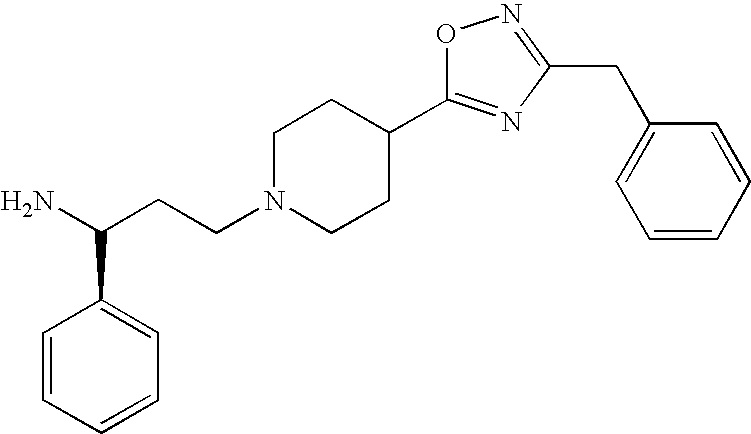
To a stirred solution of the title compound of preparation 80 (560 mg, 1.17 mmol) in dichloromethane (10 ml) at 0° C. was added trifluoroacetic acid (5 ml). The reaction was allowed to warm to room temperature and stirred for 90 minutes. The mixture was then concentrated, basified with saturated sodium carbonate and extracted with dichloromethane (3×). The combined organic solutions were washed with brine, dried (MgSO4), filtered and concentrated to give the title compound as a yellow oil, 314 mg.
1H NMR (400 MHz, CDCl3): δ [ppm] 1.90 (2H, m), 2.05 (4H, m), 2.40 (4H, m), 2.85 (2H, m), 2.95 (1H, m), 3.99 (3H, m), 4.05 (2H, s), 7.30 (10H, m)
LRMS: m/z 377 (MH+)

The title compound of preparation 47 (10.0 g, 47 mmol), hydroxylamine hydrochloride (16.5 g, 238 mmol) and sodium carbonate (25 g, 238 mmol) were heated under reflux in methanol (200 ml) and water (200 ml) for 5 hours. The reaction mixture was cooled to room temperature, filtered and the filtrate was evaporated and extracted with dichloromethane (3×). The combined organic solutions were washed with water and brine, dried (MgSO4), filtered and concentrated under reduced pressure to give a white solid, 8.0 g. A portion of this amidoxime (5.00 g, 20.6 mmol), 1-(tert-butoxycarbonyl)-4-piperidine carboxylic acid (5.18 g, 22.6 mmol) and 1-(3-dimethylaminopropyl)-3-ethyl-carbodiimide hydrochloride (4.71 g, 24.6 mmol) were stirred in dichloromethane (100 ml) for 2 hours. The solvent was removed under reduced pressure and the brown oil dissolved in dioxane (50 ml) and heated under reflux for 5 hours. The solvent was removed under reduced pressure and the residue dissolved in ethyl acetate (200 ml) washed with water and brine, dried (MgSO4), filtered and concentrated under reduced pressure. The tide compound was purified by column chromatography on silica gel using dichloromethane:methanol:0.88 ammonia (95:5:0.5) as eluant to afford the title compound as a yellow foam, 3.40 g.
1H NMR (300 MHz, CDCl3): δ [ppm] 1.41 (9H, s), 1.78 (2H, m), 2.01 (2H, m), 2.83–3.05 (5H, m), 4.03–4.19 (5H, m), 6.40 (1H, m), 7.18 (2H, d), 7.31 (2H, d)
LRMS: m/z 459 (MNa+)

The title compound of preparation 82 (3.20 g, 7.33 mmol) was dissolved in methanolic hydrochloric acid (100 ml, 2.5M) and stirred at room temperature for 2 hours. The solvent was removed under reduced pressure to afford the title compound as a white solid, 2.50 g.
1H NMR (300 MHz, D2O): δ [ppm] 1.85 (2H, dd), 2.21 (2H, d), 2.98 (3H, s), 3.05 (2H, dd), 3.38 (4H, m), 4.00 (2H, s), 7.18 (2H, d), 7.24 (2H, d)
LRMS: m/z 337 (MH+)

Obtained from the title compounds of preparations 20 and 57 as an oil in 15% yield using a similar procedure to that in preparation 21.
1H NMR (400 MHz, CDCl3): δ [ppm] 1.80 (2H, m), 2.20 (2H, m), 3.15–3.40 (3H, m), 4.00 (2H, s), 7.00 (2H, m), 7.30 (2H, m)

Obtained from the title compound of preparation 84 as an oil in 75% yield using a similar procedure to that in preparation 37.
1H NMR (400 MHz, CDCl3): δ [ppm] 1.80 (2H, m), 2.10 (2H, dd), 2.80 (2H, m), 3.05 (1H, m), 3.20 (2H, m), 4.00 (2H, s), 7.00 (2H, m), 7.25 (2H, m)
LRMS: m/z 262 (MH+)

Obtained from the title compounds of preparations 13 and 56 as an oil in 72% yield using a similar procedure to that in preparation 21.
1H NMR (400 MHz, CDCl3): δ [ppm] 1.45 (9H, s), 3.95 (1H, m), 4.08 (2H, s), 4.20 (2H, m), 4.30 (2H, t), 7.25 (1H, m), 7.35 (4H, m)
LRMS: m/z 338 (MNa+)

Obtained from the title compound of preparation 86 as an oil in 72% yield using a similar procedure to that in preparation 81.
1H NMR (400 MHz, CDCl3): δ [ppm] 3.92 (2H, m), 4.06 (4H, m), 4.13 (1H, m), 7.25 (1H, m), 7.35 (4H, m)
LRMS: m/z 216 (MH+)

Sodium triacetoxyborohydride (1.28 g, 6.02 mmol) was added to a solution of the title compounds of preparation 7 (1.00 g, 4.01 mmol) and preparation 83 (1.65 g, 4.41 mmol) in dichloromethane/acetic acid (40 ml, 10% solution). The reaction mixture was stirred for 30 minutes after which time the solution was basified using saturated sodium carbonate and the product was extracted with dichloromethane (×3). The combined organic extracts were dried (MgSO4), filtered and the solvent evaporated under reduced pressure to give a brown oil. This was purified by column chromatography on silica gel using dichloromethane:methanol:0.88 ammonia (95:5:0.5) as eluant to afford the title compound as a white foam, 1.30 g.
1H NMR (300 MHz, CDCl3): δ [ppm] 1.41 (9H, s), 1.80–2.19 (10H, m), 2.30 (2H, m), 2.80–3.01 (5H, m), 4.02 (2H, s), 4.75 (1H, bs), 6.38 (1H, bs), 7.15–7.40 (9H, m)
LRMS: m/z 570 (MH+)

Obtained from the title compounds of preparations 7 and 85 as an oil in 81% yield using a similar procedure to that in preparation 80.
1H NMR (400 MHz, CDCl3): δ [ppm] 1.30 (9H, bs), 1.70 (1H, m), 1.80–2.00 (4H, m), 2.20 (2H, m), 2.80 (2H, m), 2.90 (1H, m), 3.95 (2H, s), 4.70 (1H, bs), 6.60 (1H, bs), 6.90 (2H, m), 7.10 (1H, m), 7.15–7.25 (8H, m)
LRMS: m/z 495 (MH+)

Obtained from the title compounds of preparations 7 and 87 as an oil in 64% yield using a similar procedure to that in preparation 80.
1H NMR (400 MHz, CDCl3): δ [ppm] 1.40 (9H, bs), 1.79 (2H, m), 2.45 (2H, m), 3.31 (2H, m), 3.67 (2H, m), 3.84 (1H, m), 4.05 (2H, m), 4.3–4.5 (1H, m), 5.62 (1H, bs), 7.25 (3H, m), 7.35 (7H, m)
LRMS: m/z 449 (MH+)

The title compound of preparation 88 (1.20 g, 2.10 mmol) was dissolved in methanolic hydrochloric acid (30 ml, 2.5M) and stirred at room temperature for 2 hours. The solvent was removed under reduced pressure to afford the title compound as a white solid, 1.04 g.
1H NMR (300 MHz, D2O): δ [ppm] 1.95 (2H, m), 2.23 (2H, m), 2.40 (2H, m), 2.71 (1H, m), 2.91–3.10 (6H, m), 3.25 (1H, m), 3.48 (2H, m), 4.03 (2H, s), 4.38 (1H, t), 7.15 (2H, d), 7.23 (2H, d), 7.40 (5H, m)
LRMS: m/z 470 (MH+)

Obtained from the title compound of preparation 89 as an oil in 81% yield using a similar procedure to that in preparation 81.
1H NMR (400 MHz, CDCl3): δ [ppm] 1.90 (4H, m), 2.05 (4H, m), 2.40 (2H, m), 2.50 (2H, bs), 2.85 (2H, m), 2.98 (1H, m), 4.00 (3H, m), 7.00 (2H, m), 7.30 (7H, m)
LRMS: m/z 395 (MH+)

Obtained from the title compound of preparation 90 as an oil in 92% yield using a similar procedure to that in preparation 81.
1H NMR (3/400 MHz, CDCl3): δ [ppm] 1.60 (2H, m), 2.51 (2H, m), 3.53 (2H, t), 3.68 (2H, m), 3.87 (1H, m), 3.98 (1H, m), 4.06 (3H, m), 4.35–4.55 (1H, m), 7.2–7.36 (10H, m)
LRMS: m/z 349 (MH+)

A solution of ethyl malonyl chloride (3.30 ml, 24 mmol) in dichloromethane (5 ml) was added dropwise to a stirred solution of the title compound of preparation 56 (3.34 g, 22 mmol) and diisopropylethylamine (4.27 ml, 24 mmol) in dichloromethane (45 ml) at 10° C. The reaction mixture was stirred and warmed to room temperature over 1 hour, then washed with brine, evaporated under reduced pressure and purified by column chromatography on silica gel using dichloromethane:methanol (97:3) as eluant to afford the title compound as a foam, 1.15 g.
1H NMR (300 MHz, CDCl3): δ [ppm] 1.25 (3H, t), 3.48 (2H, s), 3.57 (2H, s), 4.19 (2H, q), 4.84 (2H, bs), 7.26 (5H, m)
LRMS: m/z 265 (MH+)

To a stirred solution of the title compound of preparation 56 (12.3 g, 82 mmol) in dichloromethane (100 ml) was added cyanoacetic acid (6.97 g, 82 mmol) and 3-ethyl-1-(3-dimethylaminopropyl)-carbodiimide hydrochloride (15.7 g, 82 mmol). The reaction mixture was stirred for 96 hours at room temperature, then partitioned between dichloromethane and water. The organic layer was separated, washed with brine, dried (MgSO4), filtered and evaporated under reduced pressure. The resulting solid was triturated with ether to afford the title compound as a pale yellow solid, 1.71 g.
1H NMR (300 MHz, CDCl3+DMSOd6): δ [ppm] 3.47 (2H, s), 3.59, (2H, s), 5.16 (2H, bs), 7.25 (5H, m)
LRMS: m/z 218 (MH+)

Obtained from the title compound of preparation 57 as an orange solid in 28% yield using a similar procedure to that in preparation 95.
1H NMR (300 MHz, CDCl3): δ [ppm] 3.38 (2H, s), 3.57 (2H, s), 5.40 (2H, s), 6.88 (2H, m), 7.17 (2H, m)
LRMS: m/z 236.1 (MH+)

A solution of the title compound of preparation 94 (8.09 g, 30 mmol) in dioxane (110 ml) was heated under reflux for 4 hours. The solvent was evaporated under reduced pressure and the residual oil purified by column chromatography on silica gel using dichloromethane:methanol (95:5) as eluant, to afford the title compound as an oil, 4.85 g.
1H NMR (300 MHz, CDCl3): δ [ppm] 1.24 (3H, t), 3.95 (2H, s), 4.08 (2H, s), 4.22 (2H, q), 7.26 (5H, m)
LRMS: m/z 247 (MH+)

A solution of ethyl malonyl chloride (15 ml, 110 mmol) in dichloromethane (50 ml) was added dropwise to a stirred suspension of the title compound of preparation 57 (16.0 g, 100 mmol) and diisopropylethylamine (20 ml, 110 mmol) in dichloromethane (150 ml) with ice-bath cooling. The reactants were stirred at ambient temperature overnight then washed with water and concentrated to a gum.
This gum was dissolved in dioxane (150 ml) and heated under reflux for 12 hours. Pre-adsorption silica was added to the cooled solution which was concentrated and purified by column chromatography on silica gel using dichloromethane:methanol (95:5) as eluant to provide the title compound as an oil, 22.8 g.
1H NMR (300 MHz, CDCl3): δ [ppm] 1.26 (3H, t), 3.93 (2H, s), 4.07 (2H, s), 4.22 (2H, q), 7.00 (2H, m), 7.28 (2H, m)
LRMS: m/z 265.0 (MH+)

Obtained from the title compound of preparation 95 as an oil in residual dioxane using a similar procedure to that in preparation 97.
1H NMR (300 MHz, CDCl3): δ [ppm] 3.70 (dioxan), 3.99 (2H, s), 4.11 (2H, s), 7.32 (5H, m)

Obtained from the title compound of preparation 96 as an oil in 59% yield using a similar procedure to that in preparation 97.
1H NMR (300 MHz, CDCl3): δ [ppm] 4.02 (2H, s), 4.08 (2H, s), 7.03 (2H, m), 7.28 (2H, m)

A solution of the title compound of preparation 97 (4.85 g, 19.7 mmol) in 1-methylpyrrolidin-2-one (10 ml) was added to a stirred suspension of sodium hydride (60% dispersion in mineral oil, 2.40 g, 60 mmol) in 1-methylpyrrolidin-2-one (30 ml). The reaction mixture was stirred for 45 minutes at room temperature before bis-(2-chloroethyl)benzylamine hydrochloride (5.00 g, 18.6 mmol) and tetra-n-butylammonium bromide (0.509, 1.5 mmol) were added. The reaction mixture was stirred for 24 hours at 60° C., then cooled and partitioned between ethyl acetate and water. The layers were separated and the organic phase washed with brine (3×). The organic extract was separated, pre-adsorbed on silica gel and purified by column chromatography on silica gel using dichloromethane:methanol (95:5) as eluant to provide the title compound as an oil, 4.76 g.
1H NMR (300 MHz, CDCl3): δ [ppm] 1.16 (3H, t), 2.32 (8H, m), 3.42 (2H, s), 4.08 (2H, s), 4.17 (2H, q), 7.26 (10H, m)
LRMS: m/z 406 (MH+)

Obtained from the title compound of preparation 98 as an oil in 22% yield using a similar procedure to that in preparation 101.
1H NMR (300 MHz, CDCl3): δ [ppm] 1.18 (3H, t), 2.32 (6H, m), 2.58 (2H, m), 3.41 (2H, s), 4.06 (2H, s), 4.15 (2H, q), 7.00 (2H, m), 7.28 (7H, m)
LRMS: m/z 424.1 (MH+)

Obtained from the title compound of preparation 99 as an oil in 10% yield using a similar procedure to that in preparation 101.
1H NMR (300 MHz, CDCl3): δ [ppm] 2.26 (4H, m), 2.49 (2H, m), 2.92 (2H, m), 3.56 (2H, s), 4.08 (2H, s), 7.26 (10H, m)
LRMS: m/z 359 (MH+)

Obtained from the title compound of preparation 100 as an oil in 22% yield using a similar procedure to that in preparation 101.
1H NMR (300 MHz, CDCl3): δ [ppm] 2.24 (4H, m), 2.49 (2H, m), 2.92 (2H, m), 3.57 (2H, s), 4.04 (2H, s), 6.88 (2H, t), 7.25 (7H, m)
LRMS: m/z 377.3 (MH+)

A solution of the title compound of preparation 102 (1.50 g, 3.50 mmol) and methylamine (20 ml of a 2M solution in tetrahydrofuran, 40 mmol) in ethanol (20 ml) was stirred in an autoclave at 100° C. for 5 hours. The solution was cooled, concentrated under reduced pressure and purified by column chromatography on silica gel using dichloromethane:methanol (95:5) as eluant, to provide the title compound as an oil, 295 mg.
1H NMR (300 MHz, CDCl3): δ [ppm] 2.07 (2H, m), 2.36 (4H, m), 2.73 (5H, m), 3.40 (2H, s), 4.06 (2H, s), 5.88 (1H, s), 7.00 (2H, m), 7.26 (7H, m)
LRMS: m/z 409.1 (MH+)

A solution of 1-chloroethylchloroformate (0.28 ml, 2.6 mmol) in dichloromethane (1 ml) was added to a solution of the title compound of preparation 101 (820 mg, 2 mmol) in dichloromethane (9 ml) at 0° C. The reaction mixture was stirred for 3 hours at room temperature, then the solvent evaporated and the residual oil dissolved in methanol (10 ml). The solution was heated under reflux for 1 hour. The solution was cooled, pre-adsorbed on silica gel, concentrated under reduced pressure and chromatographed on silica gel using dichloromethane:methanol:0.88 ammonia (95:5:0.5) as eluant, to provide the title compound as an oil 195 mg.
1H NMR (300 MHz, CDCl3): δ [ppm] 1.18 (3H, t), 2.57 (4H, m), 3.06 (2H, m), 3.24 (2H, m), 3.46 (1H, s), 4.06 (2H, s), 4.18 (2H, q), 7.27 (5H, m)
LRMS: m/z 316 (MH+)

Obtained from the title compound of preparation 103 as an oil in 59% yield using a similar procedure to that in preparation 106.
1H NMR (300 MHz, CDCl3): δ [ppm] 2.34 (4H, m), 3.21 (4H, m), 4.08 (2H, s), 7.26 (5H, m)
LRMS: m/z 269 (MH+)

Obtained from the title compound of preparation 104 as an oil in 44% yield using a similar procedure to that in preparation 106.
1H NMR (300 MHz, CDCl3): δ [ppm] 2.50 (4H, m), 3.26 (2H, m), 3.42 (2H, m), 4.06 (2H, s), 7.02 (2H, m), 7.27 (2H, m)
LRMS: m/z 287.2 (MH+)

Obtained from the title compound of preparation 105 as an oil in 68% yield using a similar procedure to that in preparation 106.
1H NMR (300 MHz, CDCl3): δ [ppm] 2.21 (2H, m), 2.36 (2H, m), 2.62 (2H, m), 2.74 (3H, d), 3.03 (2H, m), 4.04 (2H, s), 5.88 (1H, s), 7.00 (2H, m), 7.26 (2H, m)
LRMS: m/z 319.1 (MH+)

Obtained from the title compounds of preparations 7 and 108 as an oil in 54% yield using a similar procedure to that in preparation 80.
1H NMR (300 MHz, CDCl3): δ [ppm] 1.28 (9H, s), 1.94 (2H, m), 2.38 (8H, m), 2.90 (2H, m), 4.06 (2H, s), 4.78 (1H, s), 5.85 (1H, s), 7.02 (2H, m), 7.27 (7H, m)
LRMS: m/z 520.3 (MH+)

Obtained from the title compound of preparation 110 as an oil in 68% yield using a similar procedure to that in preparation 81.
1H NMR (300 MHz, CDCl3): δ [ppm] 1.85 (1H, m), 2.00 (1H, m), 2.38 (8H, m), 2.85 (1H, m), 3.02 (1H, m), 4.04 (3H, m), 7.02 (2H, m), 7.27 (7H, m)
LRMS: m/z 420.2 (MH+)

Obtained from the title compound of preparation 7 and benzyl 4-piperidinecarboxylate as an oil in 67% yield using a similar procedure to that in preparation 80.
1H NMR (400 MHz, CDCl3): δ [ppm] 1.33 (9H, s), 1.60–2.12 (11H, m), 2.64–3.00 (2H, m), 4.75 (1H, s), 5.10 (2H, s), 6.55 (1H, s), 7.10–7.45 (10H, m)
LRMS: m/z 453.3 (MH+)

Obtained from the title compound of preparation 112 as an oil in 88% yield using a similar procedure to that in preparation 81.
1H NMR (400 MHz, CDCl3): δ [ppm] 1.60–2.05 (10H, m), 2.25–2.44 (3H, m), 2.86 (2H, m), 3.97 (1H, m), 5.14 (2H, s), 7.23–7.43 (10H, m)
LRMS: m/z 353.3 (MH+)

A solution of the title compound of preparation 113 (10.3 g, 29.2 mmol) in dichloromethane (200 ml) was treated with diisopropylethylamine (5.72 ml, 32.1 mmol) and cyclobutanecarbonylchloride (3.66 ml, 32.1 mmol). The mixture was stirred at room temperature under nitrogen for 18 hours then diluted with sodium carbonate solution and extracted with dichloromethane (2×). The combined organic extracts were washed with brine, dried (MgSO4), filtered and evaporated under reduced pressure. The residue was purified by column chromatography on silica gel using dichloromethane:methanol (99:1) as eluant to afford the title compound, 4.63 g.
1H NMR (400 MHz, CDCl3): δ [ppm] 1.77–2.45 (16H, m), 2.80 (1H, m), 2.98–3.18 (2H, m), 5.11–5.26 (3H, m), 5.14 (2H, s), 7.18–7.45 (10H, m)
LRMS: m/z 435.3 (MH+)

A solution the title compound of preparation 114 (7.63 g, 17.6 mmol) in ethanol (300 ml) was hydrogenated at 1 atmosphere for 12 hours at room temperature using 10% palladium on carbon as a catalyst (700 mg). The catalyst was removed by filtration through a glass-fibre filter, then the solvent was evaporated under reduced pressure to give the title compound as a white crystalline solid, 6.04 g.
1H NMR (400 MHz, CD3OD): δ [ppm] 1.16 (1H, m), 1.75–2.40 (13H, m), 2.75–3.05 (4H, m), 3.12 (1H, m), 3.23–3.45 (3H, m), 4.94 (1H, m), 7.23–7.46 (5H, m)
LRMS: m/z 345.0 (MH+)

1-Benzyl-4-piperidinamine (617 mg, 3.25 mmol) was added to a solution of N′-[(E)-(dimethylamino)methylidene]-N,N-dimethylhydrazonoformamide (550 mg, 3.90 mmol) [J. Am. Chem. Soc, (1995), 117(22), 5951] and p-toluenesulphonic acid (62 mg, 0.33 mmol) in toluene (30 ml). The reaction mixture was stirred for 24 hours at room temperature and the solvent evaporated under reduced pressure. The residue was purified by column chromatography on silica gel using dichloromethane:methanol:0.88 ammonia (95:5:0.5) as eluant to afford the title compound as a white solid, 560 mg.
1H-NMR (300 MHz, CDCl3): δ [ppm] 1.92–2.21 (6H, m), 3.03 (2H, d), 3.55 (2H, s), 4.04 (1H, m), 7.13–7.36 (5H, m), 8.21 (2H, s)

Lawessons reagent (11.69 g, 28.9 mmol) was added to a solution of N-(1-benzyl-4-piperidinyl)acetamide (6.1 g, 26.3 mmol) [J. Med. Chem, (1996), 39(19), 3769] in tetrahydrofuran (100 ml). The reaction mixture was stirred at room temperature for 18 hours, and then evaporated under reduced pressure. The residue was purified by column chromatography on silica gel using dichloromethane:methanol:0.88 ammonia (93:7:0.3) as eluant, to give a yellow oil, 2.8 g.
Acetylhydrazide (919 mg, 12.4 mmol) was added to a solution of the intermediate thioamide and mercuric oxide (2.44 g, 11.3 mmol) in butanol (50 ml). The reaction mixture was heated under reflux for 24 hours and then cooled and filtered through Arbocel®. The filtrate was evaporated under reduced pressure and the crude product was purified by column chromatography on silica gel using dichloromethane:methanol:0.88 ammonia (95:5:0.5) as eluant, to afford the title compound, 1.80 g.
LRMS: m/z 271 (MH+)
The compounds of the following tabulated preparations:

were prepared from the corresponding hydrazides, using similar methods to that described in preparation 117.
| PREPA- | |||
| RATION | R | YIELD | DATA |
| 118 |
 |
38% | 1H NMR(300MHz, CDCl3): δ[ppm]1.78(2H, t), 1.95(1H, dd), 2.00(1H, dd),2.08(2H, m), 2.50(3H, s), 2.81(2H, d),3.41(2H, s), 3.78(1H, m), 4.18(2H, s),7.15–7.39(10H, m)LRMS: m/z 348(MH+) |
| 119 |
 |
29% | 1H NMR(300MHz, CDCl3): δ[ppm]1.78(2H, d), 1.95(2H, t), 2.20(2H, m),2.63(3H, s), 2.93(2H, d), 3.48(2H, s),4.18(1H, m), 7.20(5H, m), 7.40(4H, m),7.75(1H, d)LRMS: m/z 333(MH+) |

The title compound of preparation 119 (1.00 g, 3.00 mmol) was dissolved in ethanol (30 ml) and 20% w/w palladium hydroxide on carbon (500 mg) and ammonium formate (0.95 g, 15.0 mmol) added. The reaction was heated under reflux for 1 hour, cooled and filtered through a plug of Arbocel®. The filtrate was concentrated under reduced pressure and the crude product was purified by column chromatography on silica gel using dichloromethane:methanol:0.88 ammonia (80:20:1) as eluant to afford the title compound as a pale yellow oil, 400 mg.
1H NMR (300 MHz, CDCl3): δ [ppm] 1.78 (2H, d), 2.10 (1H, dd), 2.18 (1H, dd), 2.60 (2H, m), 2.63 (3H, s), 3.20 (2H, d), 4.10 (1H, m), 7.50 (5H, m)
LRMS: m/z 243 (MH+)

Obtained from the title compound of preparation 118 as an oil in 66% yield using a similar procedure to that in preparation 120.
1H NMR (400 MHz, CDCl3): δ [ppm] 1.20–1.23 (1H, m), 1.35–1.41 (1H, m), 1.80–2.00 (4H, m), 2.38–2.48 (1H, m), 2.51 (2H, s), 3.02–3.10 (1H, m), 3.46 (3H, m), 3.60–3.72 (1H, m), 4.20 (1H, s), 7.15–7.35 (5H, m)
LRMS: m/z 257.2 (MH+)

A mixture of N-benzyl-4-piperidinecarboxamide (2.49 g, 11.4 mmol) [J.A.C.S. (1977), 99(6), 1858] and dimethylformamide dimethylacetal (10 ml) was heated to 170° C., allowing continuous removal of solvent, and the mixture stirred for 10 minutes. The reaction was then cooled to 120° C. and stirred for 90 minutes, followed by a further 18 hours at room temperature. The resulting crystals were filtered off and washed with pentane to afford the title compound as a white crystalline solid, 1.75 g.
1H-NMR (300 MHz, CDCl3): δ [ppm]1.55 (2H, m), 1.75 (2H, d), 1.93 (2H, t), 2.16 (1H, m), 2.74 (2H, d), 2.94 (3H, s), 3.08 (3H, s), 3.40 (2H, s), 7.20–7.32 (5H, m), 8.33 (1H, s)
LRMS: m/z 274 (MH+)

The title compound from preparation 122 (1.89 g, 6.91 mmol) was added to a solution of methyl hydrazine (0.4 ml, 7.60 mmol) in acetic acid (20 ml). The reaction mixture was heated to 92° C. for 4 hours and the solvent was evaporated under reduced pressure. The residue was basified using sodium hydrogen carbonate and the product extracted with ethyl acetate (×4). The combined organic extracts were washed with brine, dried (MgSO4), filtered and evaporated under reduced pressure to afford the title compounds as an oil, 2.74 g.
1H-NMR (300 MHz, CDCl3): δ [ppm] 1.81–2.26 (6H, m), 2.88–3.06 (3H, m), 3.50–3.65 (2H, d), 3.85 (2H, d), 7.21–7.40 (5H, m), 7.79–7.92 (2H, 2xs)
LRMS: m/z 274 (MH+)

Ethyl chloroformate (4.6 ml, 48.3 mmol) was added slowly to a solution of 1-(tert-butoxycarbonyl)4-piperidinecarboxylic acid (10 g, 43.6 mmol) in dichloromethane (100 ml) stirred at 0° C. Triethylamine (7.6 ml, 52.3 mmol) was added with stirring over two minutes. 0.88 Ammonia solution (40 ml) was added and the mixture allowed to warm to room temperature with stirring. The mixture was washed with water, 1M citric acid solution and brine, dried (MgSO4), filtered and evaporated under reduced pressure gave the title compound as white solid, 8.94 g.
1H NMR (300 MHz, CDCl3): δ [ppm] 1.43 (9H, m), 1.64 (2H, m), 1.83 (2H, m), 2.30 (1H, m), 2.78 (2H, t), 4.16 (2H, d), 5.4 (2H, bs)
LRMS: m/z 251 (MNa+)

A solution of the title compound of preparation 125 (2.80 g, 12.2 mmol) in dichloromethane (30 ml) was added slowly to triethyloxonium hexafluorophosphate (3.30 g, 13.3 mmol) in dichloromethane (20 ml) at room temperature and the resultant mixture stirred at room temperature overnight. The mixture was basified with sodium hydrogen carbonate solution and then extracted with dichloromethane (×2). The combined organic solutions were dried (MgSO4), filtered and evaporated under reduced pressure to afford the title compound as a thick yellow oil, 2.90 g.
1H NMR (400 MHz, CDCl3): δ [ppm] 1.26 (3H, m), 1.43 (9H, s), 1.64 (2H, d), 2.31 (1H, m), 2.75 (4H, m), 4.10 (4H, m)
LRMS: m/z 257 (MH+)

Phenylacetyl chloride (2.26 ml, 17.0 mmol) was added to a solution of the title compound of preparation 126 (4.00 g, 15.6 mmol) and triethylamine (2.5 ml, 1.60 mmol) in toluene (26 ml) and stirred at room temperature for 90 minutes. Hydrazine hydrate (0.91 ml, 19.0 mmol) was added and the reaction mixture stirred at room temperature for 15 hours. The mixture was acidified by addition of 1M citric acid solution and extracted with ethyl acetate (×3). The combined organic solutions were washed with brine, dried (MgSO4), filtered and evaporated under reduced pressure. The residue was purified by column chromatography on silica gel using dichloromethane:methanol (99:1) as eluant to afford the title compound, 1.70 g.
1H NMR (400 MHz, CDCl3): δ [ppm] 1.34 (9H, s), 1.75 (2H, m), 2.00 (2H, d), 2.90 (3H, m), 4.12 (4H, m), 7.30 (5H, m)
LRMS: m/z 343 (MH+)

A solution of the title compound of preparation 126 (2.90 g, 11.3 mmol) and triethylamine (1.7 ml, 12.3 mmol) in toluene (20 ml) was treated with phenylacetyl chloride (1.6 ml, 12.1 mmol) and stirred at room temperature for 1 hour. Methyl hydrazine (0.66 ml, 12.5 mmol) was added dropwise and the mixture stirred at room temperature for 5 hours. The mixture was acidified by addition of 1M citric acid solution and extracted with ethyl acetate (×3). The combined organic solutions were washed with brine, dried (MgSO4), filtered and concentrated under reduced pressure to give a yellow oil. Purification of this residue by column chromatography on silica gel using dichloromethane: methanol (99:1) as eluant afforded the title compound, 1.10 g.
1H NMR (400 MHz, CDCl3): δ [ppm] 1.41 (9H, s), 1.72–1.85 (2H, m), 2.00 (2H, m), 2.83 (3H, m), 3.62 (3H, s), 4.10 (2H, s), 4.15 (2H, m), 7.15 (2H, d), 7.24–7.35 (3H, m)
LRMS: m/z 357 (MH+)

A solution of the title compound of preparation 127 (530 mg, 1.50 mmol) in dichloromethane (5 ml) at 0° C. was treated with trifluoroacetic acid (1 ml) and stirred at room temperature for 3 hours. The mixture was concentrated under reduced pressure, toluene (20 ml) added and removed under reduced pressure to afford the title compound as a yellow oil, 1.09 g.
1H NMR (400 MHz, CD3OD): δ [ppm] 2.03 (2H, m), 2.25 (2H, m), 3.20 (3H, m), 3.50 (2H, m), 4.20 (2H, m), 7.30 (5H, m)
LRMS: m/z 243 (MH+)

Obtained from the title compound of preparation 128 as an oil in 46% yield using a similar procedure to that in preparation 81.
1H NMR (400 MHz, CDCl3): δ [ppm] 1.72–1.85 (2H, m), 2.05 (2H, m), 2.76 (2H, t), 2.83 (1H, m), 3.17 (2H, m), 3.60 (3H, s), 4.05 (2H, s), 7.15 (2H, d), 7.21–7.35 (3H, m)
LRMS: m/z 258 (MH+)

Benzyl 4-oxo-1-piperidinecarboxylate (10.0 g, 42.9 mmol), tert-butyl-1-hydrazinecarboxylate (5.70 g, 42.9 mmol) and sodium triacetoxyborohydride (13.6 g, 64.1 mmol) were stirred together for 4 hours at room temperature in dichloromethane/acetic acid (40 ml, 10% solution). The solvents were evaporated under reduced pressure. The residue was basified with saturated sodium carbonate solution and extracted with ethyl acetate. The combined organic solutions were dried (MgSO4), filtered and evaporated under reduced pressure to yield the title compound as a colourless gum, 14.2 g.
1H NMR (400 MHz, CDCl3): δ [ppm] 1.23–1.39 (2H, m), 1.45 (9H, s), 1.71–1.87 (2H, m), 2.89–3.08 (3H, m), 3.61–3.69 (1H, m), 3.87–3.97 (1H, m), 3.97–4.10 (2H, m), 5.68–5.81 (1H, bs), 5.94–6.06 (1H, bs), 7.26–7.39 (5H, m)
LRMS: m/z 350.0 (MH+)

The title compound of preparation 131 (1.00 g, 37.8 mmol) in dichloromethane (250 ml) was stirred at 0° C. while trifluoroacetic acid (30 ml, 390 mmol) was added. The mixture was stirred for 16 hours and allowed to warm to room temperature. The solvents were removed under reduced pressure. The residue was basified with saturated sodium carbonate solution and extracted with dichloromethane (×4). The combined organic solutions were dried (MgSO4), filtered and evaporated under reduced pressure. The residue was purified by column chromatography on silica gel using an eluant of dichloromethane:methanol:0.88 ammonia (95:5:0.5) to afford the title compound as a colourless gum, 4.25 g.
1H NMR (400 MHz, CDCl3): δ [ppm] 1.23–1.35 (2H, m), 1.81–1.94 (2H, m), 2.61–2.71 (1H, m), 2.86–3.00 (2H, m), 4.00–4.24 (2H, m), 5.11 (2H, s), 7.26–7.37 (5H, m)
LRMS: m/z 250.1 (MH+)

Phenylacetimidate (2.0 g, 10.8 mmol) and the title compound OT preparation 132 (3.1 g, 10.8 mmol) were stirred in dichloromethane (100 ml) at room temperature for 1 hour. The solvent was removed under reduced pressure and the residue was heated under reflux for 2 hours in triethyl orthoformate (50 ml). The solvent was removed under reduced pressure. The residue was dissolved in ethyl acetate and washed with water (×2). The organic layer was dried (MgSO4), filtered and evaporated under reduced pressure to give an oil which quickly crystallised on standing. The residue was purified by recrystallization from ethyl acetate to afford the title compound as a white solid, 1.73 g.
1H NMR (400 MHz, CD3OD): δ [ppm] 1.87–2.00 (2H, m), 2.03–2.16 (2H, m), 2.94–3.15 (2H, m), 4.00 (2H, s), 4.20–4.29 (2H, m), 4.40–4.50 (1H, m), 5.13 (2H, s), 7.13–7.19 (1H, m), 7.19–7.40 (9H, m)
LRMS: m/z 377.2 (MH+)

Obtained from the title compound of preparation 133 as an oil in 88% yield using a similar procedure to that in preparation 120.
1H NMR (400 MHz, CDCl3): δ [ppm] 1.68–1.94 (2H, m), 2.10–2.20 (2H, m), 2.71–2.81 (2H, m), 3.20–3.29 (2H, m), 4.06 (2H, s), 4.16–4.26 (1H, m), 7.16–7.23 (1H, m), 7.23–7.35 (4H, m), 7.97 (1H, s)

To a solution of methyl 4-(bromomethyl)benzoate (5.00 g, 21.8 mmol) and acetone cyanohydrin (3 ml, 32.7 mmol) stirring at room temperature in acetonitrile (200 ml) was added 1,1,3,3-tetramethylguanidine (5.8 ml, 45.8 mmol) and the mixture stirred for 16 hours. The solvent was removed under reduced pressure. The residue was triturated with diethyl ether (×3), filtered and the filtrate evaporated under reduced pressure. The residue was purified by filtering through a pad of silica, eluting with diethyl ether to afford a colorless oil, 4.0 g. The oil was dissolved in 200 ml of diethyl ether and gaseous hydrogen chloride was bubbled though the solution until saturated while stirring at 0° C. Methanol (1.5 ml, 37.2 mmol) was added and the mixture stirred for 1 hour. The solvents were removed under reduced pressure and the residue was basified using saturated sodium carbonate solution and extracted with dichloromethane (×3). The combined organic solutions were dried (MgSO4), filtered and evaporated under reduced pressure to afford the title compound as a colourless oil, 4.20 g.
1H NMR (400 MHz, CDCl3): δ [ppm] 3.60 (2H, s), 3.74 (3H, s), 3.92 (3H, s), 7.26–7.32 (2H, d), 8.00–8.06 (2H, d)
LRMS: m/z 208.1 (MH+)

The title compound of preparation 132 (3.50 g, 14.04 mmol) and the title compound of preparation 135 (2.90 g, 14.04 mmol) were stirred together for 1 hour at room temperature methanol (50 ml). The solvent was removed under reduced pressure. The residue was dissolved in triethylorthoformate (50 ml) and heated under reflux for 3 hours. The solvent was removed under reduced pressure and the residue purified by column chromatography on silica gel using an eluant of dichloromethane:methanol:0.88 ammonia (95:5:0.5). The residue (4.00 g, 9.18 mmol), ammonium formate (4.00 g, 82.49 mmol) and 20% w/w palladium hydroxide on carbon (400 mg) were heated under reflux for 30 minutes in ethanol (100 ml). The mixture was filtered through Arbocel® and the filtrate evaporated under reduced pressure.
The residue (2.50 g, 8.32 mmol), the title compound of preparation 7 (2.00 g, 8.32 mmol) and sodium triacetoxyborohydride (2.50 g, 12.48 mmol) were stirred at room temperature for 1 hour in dichloromethane:acetic acid (30 ml, 10%). The solvents were evaporated under reduced pressure and the residue was basified with saturated sodium carbonate solution and extracted with dichloromethane (×3). The combined organic solutions were dried (MgSO4), filtered and evaporated under reduced pressure. The residue was purified by column chromatography on silica gel using dichloromethane:methanol:0.88 ammonia (98:2:0.25) as eluant to give a foam, 2.50 g. The residue (1.00 g, 1.87 mmol) and sodium hydroxide (150 mg, 3.74 mmol) was stirred for 2 hours at 50° C. in a mixture of dioxane:water (5:1). The solvents were removed under reduced pressure to afford a white solid, 993 mg.
LRMS: m/z 520.1 (MH+)

The title compound of preparation 131 (1.90 g, 9.04 mmol) was stirred at room temperature in diethyl ether methanol (100 ml, 4:1) while hydrogen chloride gas was bubbled through the solution until saturated. The mixture was stirred for 16 hours and the solvents were removed under reduced pressure. The residue was basified with saturated sodium carbonate solution and extracted with dichloromethane (×3). The combined organic solutions were dried (MgSO4), filtered and evaporated under reduced pressure.
In a separate flask the title compound of preparation 47 (1.00 g, 4.76 mmol) was dissolved in 20 ml of diethyl ether and gaseous hydrogen chloride was bubbled though the solution until saturated while stirring at 0° C. Methanol (1.5 ml, 37.2 mmol) was added and the mixture stirred for 1 hour. The solvents were removed under reduced pressure and the residue was basified using saturated sodium carbonate solution and extracted with dichloromethane (×3). The combined organic solutions were dried (MgSO4), filtered and evaporated under reduced pressure. The crude hydrazine (595 mg, 2.46 mmol) and the intermediate amidoxime (600 mg, 2.41 mmol) were stirred together at room temperature for 3 hours in 40 ml of methanol. The solvent was removed under reduced pressure. The residue was dissolved in triethyl orthoacetate (30 ml) and heated under reflux for 30 minutes. The solvent was removed under reduced pressure. The residue was purified by column chromatography on silica gel using dichloromethane:methanol:0.88 ammonia (95:5:0.5) as eluant to afford the title compound as a foam, 560 mg.
1H NMR (400 MHz, CD3OD): δ [ppm] 1.68–2.00 (2H, m), 2.05–2.15 (2H, m), 2.90 (3H, s), 2.97–3.11 (2H, m), 3.99 (2H, s), 4.21–4.31 (2H, m), 4.404.50 (1H, m), 5.15 (2H, s), 7.11–7.16 (2H, d), 7.16–7.26 (2H, d), 7.30–7.39 (4H, m), 8.35 (1H, s)
LRMS: m/z 492.1 (MNH4 +)

The title compound of preparation 137 (500 mg, 1.06 mmol), ammonium formate (500 mg, 7.93 mmol) and 20% w/w palladium hydroxide on carbon (50 mg) were heated under reflux in ethanol (20 ml) until gas evolution ceased. The mixture was filtered through Arbocel® and the filtrate evaporated under reduced pressure. The residue was purified by column chromatography on silica gel using gradient elution of dichloromethane:methanol:0.88 ammonia (90:10:1 to 80:20:4). The residue (300 mg, 0.89 mmol) and the title compound of preparation 7 (222 mg, 0.88 mmol) and sodium triacetoxyborohydride (285 mg, 1.34 mmol) were stirred together at room temperature for 30 minutes in a mixture of dichloromethane:acetic acid (30 ml, 10%). The solvents were removed under reduced pressure and the residue was basified with saturated sodium carbonate solution and extracted with ethyl acetate (3×). The combined organic solutions were dried (MgSO4), filtered and evaporated under reduced pressure to afford the title compound as a white solid, 407 mg.
1H NMR (400 MHz, CDCl3): δ [ppm] 1.31–1.48 (9H, m), 1.48–1.60 (2H, m), 1.77–1.90 (1H, m), 1.90–2.23 (4H, m), 2.26–2.44 (2H, m), 2.95 (3H, s), 3.02–3.10 (1H, m), 3.66–3.74 (1H, m), 4.03 (2H, s), 4.06–4.16 (1H, m), 4.74–5.02 (2H, m), 6.16–6.26 (1H, m), 6.35–6.44 (1H, m), 7.10–7.15 (2H, d), 7.19–7.37 (7H, m), 7.00 (1H, s)

Hydrogen chloride gas was bubbled through a solution of the title compound of preparation 131 (3.00 g, 8.59 mmol) in methanol (50 ml), at 0° C., for 1 hour. The solvent was removed under reduced pressure and the residue dissolved in dichloromethane (50 ml) and triethylamine (2.51 ml, 18.00 mmol) and phenylacetimidate hydrochloride (1.59 g, 8.59 mmol) added. The reaction was stirred at room temperature for 1 hour and the solvent removed under reduced pressure, the residue was dissolved in triethyl orthoacetate (20 ml) and heated under reflux for 12 hours. The reaction was cooled, the solvent removed under reduced pressure and the resulting brown oil was purified by column chromatography on silica gel using dichloromethane:methanol:0.88 ammonia (95:5:0.5) as eluant to afford the title compound as a pale yellow oil, 2.20 g.
1H NMR (300 MHz, CDCl3): δ [ppm] 1.83 (2H, d), 2.08 (1H, dd), 2.20 (1H, dd), 2.40 (3H, s), 2.85 (2H, m), 3.95 (2H, s), 4.10 (1H, m), 4.38 (2H, m), 5.18 (2H, m), 7.05–7.39 (10H, m)
LRMS: m/z 391 (MH+)

Obtained from the title compound of preparation 139 as an oil in 100% yield using a similar procedure to that in preparation 120.
1H NMR (300 MHz, CDCl3): δ [ppm] 2.03–2.38 (4H, m), 2.41 (3H, s), 3.01 (2H, m), 3.43 (2H, m), 4.01 (2H, s), 4.23 (1H, m), 7.18 (5H, m), 8.43 (1H, s)
LRMS: m/z 257 (MH+)

Obtained from the title compounds of preparations 7 and 140 as an oil in 59% yield using a similar procedure to that in preparation 80.
1H NMR (400 MHz, CDCl3): δ [ppm] 1.41 (9H, s), 1.85 (4H, m), 2.05 (4H, m), 2.38 (4H, m), 2.41 (3H, s), 2.98 (1H, d), 3.14 (1H, d), 4.00 (2H, s), 4.81 (1H, s), 7.28 (10H, m)
LRMS: m/z 491 (MH+)

The title compound of preparation 141 (1.70 g, 3.50 mmol) was dissolved in methanolic hydrochloric acid (30 ml, 2.5M) and stirred at room temperature for 2 hours. The solvent was removed under reduced pressure and saturated sodium carbonate added. The aqueous was extracted with dichloromethane (3×), the combined organic solutions were dried (MgSO4), filtered and the solvent removed under reduced pressure to afford the title compound as a clear oil, 1.40 g.
1H NMR (300 MHz, CDCl3): δ [ppm] 1.68–1.91 (6H, m), 1.98–2.18 (3H, m), 2.21 (2H, m), 2.38 (4H, m), 3.13 (2H, m), 3.89–4.03 (4H, m), 7.18–7.41 (10H, m)
LRMS: m/z 390 (MH+)

1-(3-Dimethylaminopropyl)-3-ethyl-carbodiimide hydrochloride (177 mg, 0.93 mmol) was added to a stirred solution of the title compound of preparation 13 (186 mg, 0.93 mmol) and the title compound of preparation 142 (300 mg, 0.76 mmol) in dichloromethane (20 ml). After 1 hour trifluoroacetic acid (5 ml) was added and the reaction stirred for 12 hours. The solvent was removed under reduced pressure and the resulting oil was loaded directly onto a column of silica and eluted with dichloromethane:methanol:0.88 ammonia (95:5:0.5) to afford the title compound as a white foam, 200 mg.
1H NMR (300 MHz, CDCl3): δ [ppm] 1.78–2.40 (15H, m), 2.96 (1H, d), 3.12 (1H, d), 3.39 (2H, m), 3.66–4.02 (6H, m), 5.06 (1H, dd), 7.08–7.19 (9H, m), 8.03 (1H, d)
LRMS: m/z 473 (MH+)

N-Benzyl 4-piperidinecarboxylic acid (5.00 g, 22.8 mmol), 1-(3-dimethylaminopropyl)-3-ethyl-carbodiimide hydrochloride (5.25 g, 27.4 mmol) and 1-hydroxybenzotriazole hydrate (3.84 g, 25.1 mmol) were added to a solution of methylamine (11.4 ml of a 2.0M solution in tetrahydrofuran, 22.8 mmol) in dichloromethane (100 ml). The mixture was stirred for 1 hour at room temperature, then partitioned between dichloromethane and water. The organic layer was separated and washed with brine, dried (MgSO4), filtered and evaporated under reduced pressure to furnish a pale yellow solid, 3.50 g.
1H NMR (300 MHz, CDCl3): δ [ppm] 1.78 (3H, m), 2.05 (3H, m), 2.79 (3H, d), 2.98 (3H, m), 3.50 (2H, s), 7.21 (m, 5H)
LRMS: m/z 233 (MH+)

Lawesson's reagent (6.76 g, 16.7 mmol) was added in one portion to a solution of the title compound of preparation 144 (3.50 g, 15.2 mmol) in toluene (100 ml) and the mixture stirred at room temperature overnight The reaction mixture was filtered through a short plug of silica gel washing with dichloromethane (100 ml) and the solvent removed under reduced pressure to furnish a yellow foam, 5.00 g. The foam was dissolved in n-butanol (100 ml) and mercury(II)oxide (4.81 g, 22.2 mmol) and phenylacetic hydrazide (3.02 g, 20.2 mmol) added. The reaction was heated under reflux for 12 hours, cooled, filtered through a plug of Arbocel® and the solvent removed under reduced pressure. The crude product was purified by column chromatography on silica gel using dichloromethane:methanol:0.88 ammonia (95:5:0.5) as eluant to afford the title compound as a pale yellow oil, 0.85 g.
1H NMR (300 MHz, CDCl3): δ [ppm] 1.60–2.20 (6H, m), 2.80–3.00 (3H, m), 3.28 (3H, s), 3.58 (2H, m), 4.19 (2H, m), 7.19–7.40 (10H, m)
LRMS: m/z 347 (MH+)

Obtained from the title compound of preparation 145 as an oil in 41% yield using a similar procedure to that in preparation 120.
1H NMR (300 MHz, CDCl3): δ [ppm] 1.95 (4H, m), 2.20–2.60 (4H, br m), 2.80 (3H, m), 3.31 (2H, m), 4.20 (2H, s), 7.10–7.40 (5H, m)
LRMS: m/z 257 (MH+)

Sodium borohydride (160 mg, 4.20 mmol) was added to a stirred solution of the title compound of preparation 102 (1.35 g, 3.53 mmol) in methanol (15 ml) and the reactants stirred at ambient temperature for 2 hours. The methanol was evaporated under reduced pressure and the residue partitioned between dichloromethane and water. The organic extract was separated, concentrated under reduced pressure and the residue purified by column chromatography on silica gel using dichloromethane:methanol:0.88 ammonia (90:10:1) as eluant, to afford the title compound as an oil, 860 mg.
1H NMR (300 MHz, CDCl3): δ (ppm] 1.79 (2H, m), 2.23 (4H, m), 2.65 (2H, m), 3.46 (2H, s), 3.74 (2H, s), 4.05 (2H, s), 7.02 (2H, m), 7.26 (7H, m)
LRMS m/z 382.4 (MH+)

To a stirred solution of the title compound of preparation 147 (495 mg, 1.31 mmol) in dry acetonitrile (8 ml) was added potassium tert-butoxide (184 mg, 1.56 mmol) and methyl tosylate (296 mg, 1.56 mmol) and the solution stirred at ambient temperature for 5 days. The solution was partitioned between ethyl acetate and water. The organic layer was separated, concentrated under reduced pressure and purified by column chromatography on silica gel using methanol:dichloromethane (95:5) as eluant, to afford the title compound as an oil 270 mg.
1H NMR (300 MHz, CDCl3): δ [ppm] 1.82 (2H, m), 2.05 (2H, m), 2.50 (2H, m), 2.70 (2H, m), 3.22 (3H, s), 3.42 (2H, s), 3.52 (2H, s), 4.04 (2H, s), 7.02 (2H, m), 7.26 (7H, m)
LRMS m/z 396.5 (MH+)

1-Chloroethyl chloroformate (0.96 ml, 0.87 mmol) was added to a solution of the title compound of preparation 148 (265 mg, 0.67 mmol) in dichloromethane (5 ml). The reaction mixture was stirred for 24 hours at ambient temperature, then concentrated under reduced pressure. The residual oil was dissolved in methanol (5 ml) and the reaction mixture heated under reflux for 2 hours. Silica gel was added to the cooled solution, which was concentrated under reduced pressure and purified by column chromatography on silica gel using dichloromethane:methanol:0.88 ammonia (95:5:0.5) as eluant, to afford the title compound as a gum, 160 mg.
1H NMR (300 MHz, CDCl3): δ [ppm] 2.01 (2H, m), 2.39 (2H, m), 2.81 (2H, m), 3.24 (5H, m), 3.53 (2H, s), 4.05 (2H, s), 7.02 (2H, m), 7.26 (2H, m)
LRMS m/z 306 (MH+)

Obtained from the tide compounds of preparations 7 and 149 as an oil in 93% yield using a similar procedure to that in preparation 80.
1H NMR (300 MHz, CDCl3): δ [ppm] 1.28 (9H, s), 1.87 (6H, m), 2.28 (4H, m), 2.66 (1H, m), 2.78 (1H, m), 3.22 (3H, s), 3.49 (2H, s), 4.04 (2H, s), 4.77 (1H, m), 6.72 (1H, m), 6.98 (2H, t), 7.25 (7H, m)
LRMS: m/z 539.6 (MH+)

Obtained from the title compound of preparation 150 as an oil in 98% yield using a similar procedure to that in preparation 81.
LRMS: m/z 439.7 (MH+)

The title compounds of preparation 39 (200 mg, 0.82 mmol) and preparation 8 (285 mg, 1.23 mmol) were stirred together with sodium triacetoxyborohydride (209 mg, 0.98 mmol) in dichloromethane:acetic acid (10 ml, 10%) for 4 hours at room temperature. Saturated aqueous sodium bicarbonate solution was added and the product extracted with dichloromethane (3×). The combined organic layers were washed with water and brine, dried (MgSO4), filtered and the solvent evaporated under reduced pressure. The product was purified by chromatography on silica gel using ethyl acetate:methanol (95:5) as eluant, then dissolved in diethyl ether saturated with hydrogen chloride gas. Evaporation to dryness provided the title compound as the hydrochloride salt, 60 mg.
Found C, 64.68; H, 7.26; N, 10.51%
C28H34N4O2; 1HCl; 1.4H2O requires C, 64.64; H, 7.32; N, 10.77%
1H NMR (400 MHz, CDCl3): δ [ppm] 1.78–2.20 (13H, m), 2.20–2.40 (3H, m), 2.81–2.95 (2H, m), 2.95–3.00 (2H, m), 4.05 (2H, s), 5.10 (1H, m), 7.17–7.25 (2H, m), 7.25–7.35 (7H, m), 7.45–7.55 (1H, m)
LRMS: m/z 459 (MH+)
[α]D: −45.6 (c=0.34, methanol)

The title compound of preparation 116 (560 mg, 2.31 mmol) was dissolved in ethanol (20 ml) and 20% w/w palladium hydroxide on carbon (500 mg) and ammonium formate (728 mg, 11.5 mmol) added. The reaction was heated under reflux for 1 hour, cooled and filtered through a plug of Arbocel®. The filtrate was concentrated under reduced pressure and the resulting oil and the title compound of preparation 3 were used to prepare the title compound using a similar method to example 1. The reaction mixture was purified by column chromatography on silica gel using dichloromethane:methanol:0.88 ammonia (95:5:0.5) as eluant to afford the title compound as a white foam, 50 mg.
Found C, 66.90; H, 7.92; N, 18.68%
C21H29N5O; 0.5H2O; requires C, 66.64; H, 7.95; N, 19.06%
1H-NMR (300 MHz, CDCl3): δ [ppm] 1.82–2.45 (17H, m), 2.95–3.12 (3H, m), 4.05 (1H, m), 5.13 (1H, m), 7.21–7.40 (5H, m), 8.21 (2H, m)
LRMS: m/z 368 (MH+)
The compounds of the following tabulated examples with the general formula:

were prepared using a similar method to example 2 from the title compound of preparation 3 and the corresponding benzylamine.
| EXAM- | |||
| PLE | R | YIELD | DATA |
| 31 |
 |
9% | Found C, 52.96; H, 7.16;N, 13.01%C22H31N5O; HCl; 1.1CH2Cl2;0.8H2O requires C, 52.77;H, 6.86; N, 13.32%1H-NMR(400MHz, CDCl3):δ[ppm] 1.75–2.46(16H, m),2.75(1H, m), 2.95–3.20(3H, m),3.85(3H, s), 5.12(1H, m),7.19–7.40(5H, m), 7.60(1H, d),7.81(1H, s).LRMS: m/z 382(MH+) |
| 41 |
 |
10% | Found C, 53.42; H, 7.10;N, 13.57%C22H31N5O; HCl; CH2Cl2;0.8H2O requires C, 53.40;H, 6.94; N, 13.54%1H-NMR(400MHz, CDCl3):δ[ppm] 1.76–2.43(16H, m),2.79(1H, m), 2.88(1H, d),3.08(2H, m), 3.83(3H, s),5.48(1H, m), 7.15–7.35(5H, m),7.92(1H, s), 8.06(1H, d)LRMS: m/z 382(MH+) |
| 5 |
 |
4% | 1H-NMR(300MHz, CDCl3):δ[ppm] 1.80–2.40(16H, m),2.50(6H, s), 3.00(1H, t),3.12(2H, d), 3.83(1H, m),5.12(1H, m), 6.55(1H, d),7.23–7.39(5H, m) |
| 1= Product obtained as the hydrochloride salt | |||

A mixture of the title compound of preparation 21 (566 mg, 2.27 mmol) and sodium hydroxide (136 mg, 3.41 mmol) in ethanol (20 ml) was stirred for 2 hours at room temperature and the solvent evaporated under reduced pressure. This intermediate and the title compound of preparation 3 were then used to prepare the title compound using a similar method to example 1. The reaction mixture was purified by column chromatography on silica gel using dichloromethane:methanol:0.88 ammonia (98:2:0.25). The product was dissolved in methanolic hydrochloric acid (3 ml, 2.5M), and the solvent evaporated under reduced pressure to afford the title compound, 85 mg.
Found C, 62.16; H, 7.53; N, 12.19%
C22H30N4O2; HCl; 0.6MeOH; requires C, 61.69; H, 7.70; N, 12.73%
1H NMR (300 MHz, CDCl3): δ [ppm] 1.80–2.45 (16H, m), 3.06–3.40 (6H, m), 3.62–3.80 (2H, m), 5.00 (1H, dd), 7.20–7.40 (5H, m)
LRMS: m/z 383 (MH+)

The title compounds of preparations 3 and 37 were used to prepare the title compound using a similar method to example 1. The reaction mixture was purified by column chromatography on silica gel using dichloromethane:methanol:0.88 ammonia (98:2:0.25) as eluant to afford the title compound, 218 mg.
1H NMR (300 MHz, CDCl3): δ [ppm] 1.60 (3H, s), 1.78–2.48 (14H, m), 2.93 (1H, d), 3.04 (2H, m), 5.13 (1H, m), 7.20–7.40 (5H, m), 7.50 (3H, m), 8.09 (2H, m)
LRMS: m/z 445 (MH+)
The compounds of the following tabulated examples with the general formula:

were prepared using a similar method to example 1 from the title compound of preparation 3 and the corresponding amine.
| EXAMPLE | R | YIELD | DATA |
| 81 |
 |
51% | 1H NMR(300MHz, CDCl3): δ[ppm] 1.74–2.42(9H, m), 2.48–3.20(8H,m), 3.17–3.55(2H, m), 3.68(1H, m), 4.06(2H, d), 4.97(1H, s), 7.20–7.40(10H, m),8.98(1H, m)LRMS: 459(MH+) |
| 9 |
 |
32% | 1H NMR(300MHz, CD3OD): δ[ppm] 1.80–2.58(14H, m), 3.04–3.84(4H,m), 3.88(3H, s), 4.96–5.06(1H, m), 7.08(2H, d), 7.22–7.46(5H, m), 7.98(2H, d)LRMS: m/z 476(MH+) |
| 10 |
 |
5% | 1H NMR(300MHz, CD3OD): δ[ppm] 1.80–2.40(15H, m), 2.58(3H, s),3.03–3.24(5H, m), 3.89(1H, m), 4.97(1H,m), 7.25–7.40(5H, m)LRMS: m/z 383.3(MH+)Melting point [° C.]: >60 (softensto gum) |
| 111 |
 |
30% | 1H NMR(300MHz, CD3OD): δ[ppm] 1.78–1.92(1H, m), 1.92–2.05(1H,m), 2.05–2.45(11H, m), 3.10–3.55(6H,m), 3.40–3.62(1H, m), 3.62–3.80(1H, m),7.20–7.45(5H, m), 7.52–7.69(3H, m),8.05–8.18(2H, m)LRMS: m/z 445.2(MH+) |
| 121 |
 |
35% | Found C, 62.23; H, 7.26; N, 10.15%.C28H34N4O2; 1HCl; 2.5H2O requiresC, 62.23; H, 7.46; N, 10.37%.1H NMR(300MHz, CD3OD): δ[ppm] 1.78–2.40(12H, m), 3.04–3.38(6H,m), 3.58–3.75(2H, m), 4.20–4.35(2H, m),4.92–5.11(1H, m), 7.21–7.45(10H, m)LRMS: m/z 459.2(MH+) |
| 13 |
 |
67% | 1H NMR(300MHz, CDCl3): δ[ppm] 1.76–2.62(16H, m), 2.53(3H, s),2.83–3.15(4H, m), 5.18(1H, m), 7.20–7.38(5H, m), 7.52(1H, d)LRMS: m/z 384(MH+) |
| 141 |
 |
95% | 1H NMR(300MHz, CD3OD): δ[ppm] 1.82–2.34(9H, m), 2.52(2H, d),3.07–3.83(10H, m), 5.01(1H, m), 7.27–7.42(5H, m), 7.60(3H, m), 8.06(2H, m)LRMS: m/z 445(MH+) |
| 15 |
 |
8% | 1H NMR(300MHz, CD3OD): δ[ppm] 1.78–2.38(14H, m), 2.92–3.22(5H,m), 3.56–3.78(3H, m), 4.19–4.25(1H, m),7.12 7.58(10, m)LRMS: m/z 459.2(MH+) |
| 1= Product obtained as the hydrochloride salt | |||

Diisobutylaluminium hydride (42.1 ml of a 1.0M solution in dichloromethane, 42.1 mmol) was added dropwise to a solution of the title compound of preparation 12 (5.7 g, 19.1 mmol) in dichloromethane (100 ml) at −78° C. The reaction mixture was stirred at this temperature for 1 hour, then methanol (5 ml) pre-cooled to −78° C. was added. The mixture was warmed to room temperature and washed with 2M hydrochloric acid, water and brine, dried (MgSO4), filtered and the solvent evaporated under reduced pressure to afford the aldehyde as a yellow oil, 3.3 g. From this oil (485 mg, 1.81 mmol), the title compound of preparation 39 (420 mg, 1.81 mmol) and sodium triacetoxyborohydride (578 mg, 2.73 mmol) were stirred together for 72 hours at room temperature in dichloromethane:acetic acid (30 ml, 10%). The solvents were evaporated under reduced pressure. The residue was dissolved in ethyl acetate and washed with saturated aqueous sodium carbonate solution then water. The organic layer was dried (MgSO4), filtered and evaporated under reduced pressure. The residue (700 mg, 1.42 mmol) was stirred for 1 hour at room temperature in dichloromethane (14 ml) and trifluoroacetic acid (14 ml). The solvents were evaporated under reduced pressure. The residue was basified with saturated aqueous sodium bicarbonate solution and extracted with dichloromethane (3×). The combined organic layers were dried (MgSO4), filtered and evaporated under reduced pressure. The residue was purified by column chromatography on silica gel using dichlorormethane:methanol:0.88 ammonia (97:3:0.3) as eluant A portion of the residue (100 mg, 0.25 mmol), 2-cyclopropylacetic acid (28 mg, 0.28 mmol), 1-hydroxybenzotriazole hydrate (41 mg, 0.3 mmol), 1-(3-dimethylaminopropyl)-3-ethyl-carbodiimide hydrochloride (63 mg, 0.33 mmol) and triethylamine (46 μl, 0.33 mmol) were stirred for 2 hours at room temperature in dichloromethane (20 ml). The solvent was evaporated under reduced pressure. The residue was dissolved in ethyl acetate and washed with water. The organic layer was dried (MgSO4), filtered and evaporated. The residue was purified by column chromatography on silica gel using dichloromethane:methanol:0.88 ammonia (98:2:0.25) as eluant to afford the title compound as an oil, 97 mg.
1H NMR (400 MHz, CDCl3): δ [ppm] 0.16–0.23 (2H, m), 0.58–0.65 (2H, m), 0.97–1.08 (1H, m), 1.81–1.97 (3H, m), 1.97–2.23 (7H, m), 2.23–2.40 (2H, m), 2.82–2.95 (2H, m), 2.95–3.05 (1H, m), 4.05 (2H, s), 5.08–5.16 (1H, m), 6.89–7.00 (2H, m), 7.00–7.06 (1H, d), 7.23–7.35 (6H, m), 7.63–7.71 (1H, m)
LRMS: m/z 477.3 (MH+)

The title compound of preparation 77 (200 mg, 0.56 mmol) in dichloromethane (10 ml) was treated with trifluoroacetic acid (4 ml). The solution was stirred at room temperature for 12 hours. The solvent was evaporated under reduced pressure and the residue was partitioned between saturated aqueous sodium carbonate solution and dichloromethane. The aqueous layer was extracted with dichloromethane (2×). The combined organic layers were dried (MgSO4), filtered and evaporated under reduced pressure. The residue obtained (131 mg, 0.51 mmol), the title compound of preparation 8 (130 mg, 0.56 mmol) and sodium triacetoxyborohydride (162 mg, 0.76 mmol) were stirred in dichloromethane:acetic acid (20 ml, 10%) at room temperature for 3 days. The reaction mixture was basified with saturated aqueous sodium carbonate solution. The aqueous layer was extracted with dichloromethane (2×) and the combined organic extracts washed with brine, dried (MgSO4), filtered and evaporated under reduced pressure. The residue was purified by preparative HPCL (phenomonex magellenC18 (2) aqueous TFA 0.1%:acetonitrile 1:19–19:1) to afford the title compound, 38 mg.
1H NMR (400 MHz, CDCl3): δ [ppm] 1.71–2.60 (16H, m), 2.61–2.82 (1H, m), 2.81–3.25 (4H, m), 3.32–3.83 (2H, m), 4.02 (2H, s), 4.95 (1H, s), 6.75 (1H, m), 7.15–7.47 (9H, m)
LRMS: m/z 473.3 (MH+)

The title compound of preparation 78 (221 mg, 0.54 mmol) in dichloromethane (10 ml) was treated with trifluoroacetic acid (4 ml). The solution was stirred at room temperature for 12 hours. The solvent was evaporated under reduced pressure and the residue was partitioned between saturated aqueous sodium carbonate solution and dichloromethane. The aqueous layer was extracted with dichloromethane (2×). The combined organic layers were dried (MgSO4), filtered and evaporated under reduced pressure. The residue obtained (164 mg, 0.53 mmol), the title compound of preparation 8 (134 mg, 0.58 mmol) and sodium triacetoxyborohydride (168 mg, 0.70 mmol) were stirred in dichloromethane:acetic acid (20 ml, 10%) at room temperature for 3 days. The reaction mixture was basified with saturated aqueous sodium carbonate solution. The aqueous layer was extracted with dichloromethane (2×) and the combined organic extracts washed with brine, dried (MgSO4), filtered and evaporated under reduced pressure. The residue was purified by preparative HPLC (phenomonex magellenC18 (2) aqueous TFA 0.1%:acetonitrile 1:19–19:1) to afford the title compound, 40 mg.
1H NMR (400 MHz, CDCl3): δ [ppm] 1.462.61 (13H, m), 2.61–3.25 (5H, m), 3.45 (1H, m), 3.72 (1H, m), 4.13 (2H, s), 4.95 (1H, m), 6.65 (1H, m), 7.13–7.45 (7H, m), 7.42 (1H, d), 7.58 (1H, d)
LRMS: m/z 527.4 (MH+)

The title compound of preparation 79 (258 mg, 0.67 mmol) in dichloromethane (10 ml) was treated with trifluoroacetic acid (4 ml). The solution was stirred at room temperature for 12 hours. The solvent was evaporated under reduced pressure and the residue was partitioned between saturated aqueous sodium carbonate solution and dichloromethane. The aqueous layer was extracted with dichloromethane (2×). The combined organic layers were dried (MgSO4), filtered and evaporated under reduced pressure. The residue obtained (175 mg, 0.44 mmol), the title compound of preparation 8 (113 mg, 0.49 mmol) and sodium triacetoxyborohydride (141 mg, 0.66 mmol) were stirred in dichloromethane:acetic acid (20 ml, 10%) at room temperature for 3 days. The reaction mixture was basified with saturated aqueous sodium carbonate solution. The aqueous layer was extracted with dichloromethane (2×) and the combined organic extracts washed with brine, dried (MgSO4), filtered and evaporated under reduced pressure. The residue was purified by preparative HPLC (phenomonex magellenC18 (2) aqueous TFA 0.1%:acetonitrile 1:19–19:1) to afford the title compound, 31 mg.
1H NMR (400 MHz, CDCl3): δ [ppm] 1.74–3.35 (18H, m), 3.46 (1H, m), 3.70 (1H, m), 3.96 (2H, s), 4.90 (1H, m), 4.95 (1H, m), 5.95 (2H, s), 6.65–6.85 (3H, m), 7.25–7.51 (5H, m)
LRMS: m/z 503.4 (MH+)

The title compound of preparation 75 (100 mg, 0.26 mmol) in dichloromethane (10 ml) was treated with trifluoroacetic acid (4 ml). The solution was stirred at room temperature for 12 hours. The solvent was evaporated under reduced pressure and the residue was partitioned between saturated aqueous sodium carbonate solution and dichloromethane. The aqueous layer was extracted with dichloromethane (2×). The combined organic layers were dried (MgSO4), filtered and evaporated under reduced pressure. The residue obtained (69 mg, 0.25 mmol), the title compound of preparation 8 (63 mg, 0.27 mmol) and sodium triacetoxyborohydride (79 mg, 0.37 mmol) were stirred in dichloromethane:acetic acid (20 ml, 10%) at room temperature for 3 days. The reaction mixture was basified with saturated aqueous sodium carbonate solution. The aqueous layer was extracted with dichloromethane (2×) and the combined organic extracts washed with brine, dried (MgSO4), filtered and evaporated under reduced pressure. The residue was purified by preparative HPLC (phenomonex magellenC18 (2) aqueous TFA 0.1%:acetonitrile 1:19–19:1) to afford the title compound, 39 mg.
1H NMR (400 MHz, CDCl3): δ [ppm] 1.74–3.35 (18H, m), 3.45 (1H, m), 3.70 (1H, m), 4.04 (2H, s), 4.93 (1H, m), 6.65–0.91 (3H, m), 7.23–7.45 (6H, m)
LRMS: m/z 495.0 (MH+)

Diisobutylaluminium hydride (42.1 ml of a 1.0M solution in dichloromethane, 42.1 mmol) was added dropwise to a solution of the title compound of preparation 12 (5.7 g, 19.1 mmol) in dichloromethane (100 ml) at −78° C. The reaction mixture was stirred at 78° C. for an hour, then methanol (5 ml) pre-cooled to −78° C. was added. The mixture was warmed to room temperature and washed with 2M hydrochloric acid, water and brine, dried (MgSO4), filtered and the solvent evaporated under reduced pressure to afford the title compound as a yellow oil, 3.3 g. From this oil (485 mg, 1.81 mmol), the title compound of preparation 39 (420 mg, 1.81 mmol) and sodium triacetoxyborohydride (578 mg, 2.73 mmol) were stirred together for 72 hours at room temperature in dichloromethane:acetic acid (30 ml, 10%). The solvents were evaporated under reduced pressure. The residue was dissolved in ethyl acetate and washed with saturated aqueous sodium carbonate solution then water. The organic layer was dried (MgSO4), filtered and evaporated under reduced pressure. The residue (700 mg, 1.42 mmol) was stirred for 1 hour at room temperature in dichloromethane (14 ml) and trifluoroacetic acid (14 ml). The solvents were evaporated under reduced pressure. The residue was basified with saturated aqueous sodium carbonate solution and extracted with dichloromethane (3×). The combined organic layers were dried (MgSO4), filtered and evaporated under reduced pressure. The residue was purified by column chromatography on silica gel using dichlorormethane:methanol:0.88 ammonia (97:3:0.3) as eluant A portion of the residue (100 mg, 0.25 mmol), cyclobutanecarboxylic acid (28 mg, 0.28 mmol), 1-hydroxybenzotriazole hydrate (41 mg, 0.3 mmol), 1-(3-dimethylaminopropyl)-3-ethyl-carbodiimide hydrochloride (63 mg, 0.33 mmol) and triethylamine (46 μl, 0.33 mmol) were stirred for 2 hours at room temperature in dichloromethane (20 ml). The solvent was evaporated under reduced pressure. The residue was dissolved in ethyl acetate and washed with water. The organic layer was dried (MgSO4), filtered and evaporated. The residue was purified by column chromatography on silica gel using dichloromethane:methanol:0.88 ammonia (98:2:0.25) as eluant to afford the title compound as a gum which solidified on standing, 108 mg.
Found C, 70.26; H, 7.00; N, 11.66%
C28H33FN4O2; 0.1H2O requires C, 70.30; H, 7.00; N, 11.71%
1H NMR (400 MHz, CDCl3): δ [ppm] 1.31–2.44 (14H, m), 2.80–3.10 (5H, m), 4.02–4.15 (3H, m), 5.06–5.18 (1H, m), 6.84–7.03 (4H, m), 7.18–7.42 (5H, m), 7.71–7.84 (1H, m)
LRMS: m/z 477.3 (MH+)

The title compound of preparation 47 (6.50 g, 30.9 mmol), hydroxylamine hydrochloride (10.7 g, 154 mmol) and sodium carbonate (16.3 g, 154 mmol) in methanol (100 ml) and water (100 ml) were heated under reflux for 5 hours. The reaction was cooled, filtered and the methanol evaporated under reduced pressure. The remaining aqueous layer was extracted with dichloromethane (3×) and the combined organic layers were dried (MgSO4), filtered and the solvent evaporated under reduced pressure to furnish a pale orange solid. The solid and carbonyldiimidazole (158 mg, 0.97 mmol) were then added to a solution of carbonyldiimidazole (158 mg, 0.97 mmol) and the title compound of preparation 115 in DMF (2 ml) which had been stirred at room temperature for 1 hour. The reaction was heated at 115° C. for 6 hours cooled to room temperature and the solvent evaporated under reduced pressure. The resulting brown oil was purified by column chromatography on silica gel using dichloromethane:methanol:0.88 ammonia (95:5:0.5) as eluant to afford the title compound as a pale orange oil that was freeze dried from water/acetonitrile to furnish a pale orange foam, 43 mg.
Found C, 62.23; H, 6.82; N, 12.60%
C29H37N5SO4; 0.3H2O requires C, 62.52; H, 6.80; N, 12.57%
1H NMR (400 MHz, CDCl3): δ [ppm] 1.78–2.40 (18H, m), 2.80–3.05 (7H, m), 4.03 (2H, s), 5.08 (1H, dd), 7.15–7.45 (9H, m)
LRMS: m/z 552 (MH+)
[α]D −32.6 (c=1.97, MeOH)

The title compound of preparation 55 (7.00 g, 43.8 mmol), hydroxylamine hydrochloride (15.2 g, 218 mmol) and sodium carbonate (23.1 g, 218 mmol) in methanol (100 ml) and water (100 ml) were heated under reflux for 5 hours. The reaction was cooled, filtered and the methanol evaporated under reduced pressure. The remaining aqueous layer was extracted with dichloromethane (3×) and the combined organic layers were dried (MgSO4), filtered and the solvent evaporated under reduced pressure to furnish a pale orange solid. The solid and carbonyldiimidazole (158 mg, 0.97 mmol) were then added to a solution of carbonyldiimidazole (158 mg, 0.97 mmol) and the title compound of preparation 115 in DMF (2 ml) which had been stirred at room temperature for 1 hour. The reaction was heated at 115° C. for 6 hours allowed to cool to room temperature and the solvent evaporated under reduced pressure. The resulting brown oil was purified by column chromatography on silica gel using dichloromethane:methanol:0.88 ammonia (95:5:0.5) as eluant to afford the title compound as a clear oil that was freeze dried from water/acetonitrile to furnish a white solid, 12 mg.
1H NMR (400 MHz, CDCl3): δ [ppm] 1.78–2.40 (17H, m), 2.80–3.05 (4H, m), 4.03 (2H, s), 5.08 (1H, dd), 5.58 (1H, br s), 6.01 (1H, br s), 7.15–7.30 (5H, m), 7.40 (2H, d), 7.75 (2H, d)
LRMS: m/z 502 (MH+)

The title compound of preparation 74 (142 mg, 0.37 mmol) in dichloromethane (10 ml) was treated with trifluoroacetic acid (4 ml) and the solution stirred at room temperature for 12 hours. The solvent was evaporated under reduced pressure and the residue was partitioned between saturated aqueous sodium carbonate solution and dichloromethane. The aqueous layer was extracted with dichloromethane (2×). The combined organic layers were dried (MgSO4), filtered and evaporated under reduced pressure. The residue obtained (107 mg, 0.38 mmol), the title compound of preparation 8 (97 mg, 0.42 mmol) and sodium triacetoxyborohydride (122 mg, 0.59 mmol) were stirred in dichloromethane:acetic acid (20 ml, 10%) at room temperature for 3 days. The reaction mixture was basified with saturated aqueous sodium carbonate solution. The aqueous layer was extracted with dichloromethane (2×) and the combined organic extracts washed with brine, dried (MgSO4), filtered and evaporated under reduced pressure. The residue was purified by preparative HPLC (phenomonex magellenC18 (2) aqueous TFA 0.1%:acetonitrile 1:19–19:1) to afford the title compound, 9 mg.
1H NMR (400 MHz, CDCl3): δ [ppm] 1.43–2.05 (4H, m), 2.05–2.41 (8H, m), 2.50 (1H, bs), 2.66–2.83 (1H, m), 2.85–3.36 (4H, m), 3.45 (1H, m), 3.70 (1H, bs), 4.08 (2H, s), 4.95 (1H, s), 6.70 (1H, bs), 6.93–7.14 (2H, m), 7.27–7.41 (6H, m)
LRMS: m/z 495.1 (MH+)

The title compound of preparation 76 (163 mg, 0.43 mmol) in dichloromethane (10 ml) was treated with trifluoroacetic acid (4 ml) and the solution stirred at room temperature for 12 hours. The solvent was evaporated under reduced pressure and the residue was partitioned between saturated aqueous sodium carbonate solution and dichloromethane. The aqueous layer was extracted with dichloromethane (2×). The combined organic layers were dried (MgSO4), filtered and evaporated under reduced pressure. The residue obtained (118 mg, 0.42 mmol), the title compound of preparation 8 (107 mg, 0.47 mmol) and sodium triacetoxyborohydride (143 mg, 0.63 mmol) were stirred in dichloromethane:acetic acid (20 ml, 10%) at room temperature for 3 days. The reaction mixture was basified with saturated aqueous sodium carbonate solution. The aqueous layer was extracted with dichloromethane (2×) and the combined organic extracts washed with brine, dried (MgSO4), filtered and evaporated under reduced pressure. The residue was purified by preparative HPLC (phenomonex magellenC18 (2) aqueous TFA 0.1%:acetonitrile 1:19–19:1) to afford the title compound, 10 mg.
1H NMR (400 MHz, CDCl3): δ [ppm] 1.33–2.05 (4H, m), 2.05–2.45 (8H, m), 2.41–2.82 (2H, m), 2.86–3.25 (4H, m), 3.35–3.87 (2H, m), 4.15 (2H, s), 4.95 (1H, s), 6.85 (1H, m), 6.95 (2H, m), 7.23–7.45 (6H, m)
LRMS: m/z 495.1 (MH+)

A solution of the title compound of preparation 115 (300 mg, 0.87 mmol) in dichloromethane (20 ml) was treated with diisopropylethylamine (0.36 ml, 2.09 mmol) and bis(tetramethylene)fluoroformamidinium hexafluorophosphate (331 mg, 1.05 mmol). After 1 hour N′-hydroxy-2-(3-pyridinyl)ethanimidamide [WO 9600720] (171 mg, 1.13 mmol) was added and stirring continued for 12 hours. The reaction was diluted with dioxane (30 ml) then heated at 120° C. for 4 hours. The cooled mixture was diluted with dichloromethane (100 ml) and washed with saturated aqueous sodium carbonate solution and brine, dried (MgSO4), filtered and evaporated under reduced pressure. The crude product was purified by column chromatography on silica gel using dichloromethane:methanol:0.88 ammonia (94.5:5:0.5) as eluant. The resultant oil was dissolved in dichloromethane (10 ml), treated with 1M hydrochloric acid in dioxane (4 ml) and evaporated under reduced pressure. Freeze drying from water/acetonitrile gave the title compound as a yellow solid, 191 mg.
Found C, 51.85; H, 7.06; N, 11.02%
C27H33N5O2; 5H2O; 2HCl requires C, 52.09; H, 7.29; N, 11.25%
1H NMR (400 MHz, DMSOd6): δ [ppm] 1.70 (1H, m), 1.86 (1H, m), 1.92–2.14 (10H, m), 2.91–3.17 (5H, m), 3.28–4.02 (2H and H2O), 4.36 (2H, s), 4.83 (1H, m), 7.22 (1H, m), 7.30 (3H, m), 7.94 (1H, m), 8.24 (1H, d), 8.41 (1H, d), 8.78 (1H, d), 8.88 (1H, s)
LRMS: m/z 460.2 (MH+)

A solution of the title compound of preparation 115 (300 mg, 0.87 mmol) in dichloromethane (20 ml) was treated with diisopropylethylamine (0.36 ml, 2.09 mmol) and bis(tetramethylene)fluoroformamidinium hexafluorophosphate (331 mg, 1.05 mmol). After 1 hour N′-hydroxy-2(4-pyridinyl)ethanimidamide [WO 9600720] (171 mg, 1.13 mmol) was added and stirring continued for 12 hours. The reaction was diluted with dioxane (30 ml) then heated at 120° C. for 4 hours. The cooled mixture was diluted with dichloromethane (100 ml) and washed with saturated aqueous sodium carbonate solution and brine, dried (MgSO4), filtered and evaporated under reduced pressure. The crude product was purified by column chromatography on silica gel using dichloromethane:methanol:0.88 ammonia (94.5:5:0.5) as eluant. Freeze-drying from water/acetonitrile gave the title compound as a yellow foam, 121 mg.
1H NMR (400 MHz, CDCl3): δ [Ppm] 1.75–2.20 (12H, m), 2.20–2.40 (4H, m), 2.80–3.10 (4H, m), 4.05 (2H, s), 5.14 (1H, m), 7.16–7.37 (8H, m), 8.57 (1H, d)
LRMS: m/z 460.2 (MH+)

The title compound of preparation 48 (5.60 g, 28.5 mmol), hydroxylamine hydrochloride (9.9 g, 142 mmol) and sodium carbonate (15.1 g, 142 mmol) in methanol (100 ml) and water (100 ml) were heated under reflux for 5 hours. The reaction was cooled, filtered and the methanol evaporated under reduced pressure. The remaining aqueous was extracted with dichloromethane (3×) and the combined organic layers dried (MgSO4), filtered evaporated under reduced pressure to furnish a red solid. The solid and carbonyldiimidazole (158 mg, 0.97 mmol) were then added to a solution of carbonyldiimidazole (158 mg, 0.97 mmol) and the title compound of preparation 115 in DMF (2 ml) which had been stirred at room temperature for 1 hour. The reaction was heated at 115° C. for 6 hours cooled to room temperature and the solvent evaporated under reduced pressure, the resulting brown oil was purified by column chromatography on silica gel using dichloromethane:methanol:0.88 ammonia (95:5:0.5) as eluant to afford the title compound as a clear oil that was freeze dried from water/acetonitrile to furnish a white solid, 24 mg.
Found C, 62.83; H, 6.84; N, 12.95%
C29H37N5SO4; 0.1H2O requires C, 62.93; H, 6.77; N, 12.65%
1H NMR (300 MHz, CDCl3): δ [ppm] 1.80–2.40 (17H, m), 2.80–3.05 (4H, m), 3.11 (3H, s), 4.08 (2H, s), 5.05 (1H, dd), 7.15–7.45 (8H, m), 7.60 (1H, d), 9.73 (1H, bs)
LRMS: m/z 552 (MH+)
[α]D −31.0 (c=1.16, MeOH)

A solution of the title compound of preparation 115 (300 mg, 0.87 mmol) in dichloromethane (20 ml) was treated with diisopropylethylamine (0.36 ml, 2.09 mmol) and bis(tetramethylene)fluoroformamidinium hexafluorophosphate (331 mg, 1.05 mmol). After 1 hour N-hydroxy-2-(2-pyridinyl)ethanimidamide [WO 9600720] (171 mg, 1.13 mmol) was added and stirring continued for 12 hours. The reaction was diluted with dioxane (30 ml) then heated at 120° C. for 4 hours. The cooled mixture was diluted with dichloromethane (100 ml) and washed with saturated aqueous sodium carbonate solution and brine, dried (MgSO4), filtered and evaporated under reduced pressure. The crude product was purified by column chromatography on silica gel using dichloromethane:methanol:0.88 ammonia (94.5:5:0.5) as eluant. The resulting oil was dissolved in dichloromethane (10 ml), treated with 1 M hydrochloric acid in dioxane (4 ml) and evaporated under reduced pressure. Freeze-drying from water/acetonitrile gave the title compound as a green gum, 95 mg.
Found C, 52.25; H, 6.97; N, 11.14%
C27H33N5O2; 4.9H2O; 2HCl requires C, 52.24; H, 7.27; N, 11.28%
1H NMR (400 MHz, DMSOD6): δ [ppm] 1.72 (1H, m); 1.86 (1H, m); 1.9–2.1 (10H, m); 2.9–3.1 (5H, m); 3.2–4.0 (2H and H2O); 4.45 (2H, s); 4.83 (1H, m); 7.23 (1H, m); 7.30 (3H, m); 7.65 (1H, t); 7.70 (1H, d); 8.15 (1H, t); 8.23 (1H, d); 8.67 (1H, d)
LRMS: m/z 460.2 (MH+)

The title compound of preparation 73 (305 mg, 0.98 mmol) in dichloromethane (10 ml) was treated with trifluoroacetic acid (4 ml) and solution stirred at room temperature for 12 hours. The solvent was evaporated under reduced pressure and the residue was partitioned between saturated aqueous sodium carbonate solution and dichloromethane. The aqueous layer was extracted with dichloromethane (2×). The combined organic layers were dried (MgSO4), filtered and evaporated under reduced pressure. The residue obtained (161 mg, 0.76 mmol), the title compound of preparation 8 (213 mg, 0.923 mmol) and sodium triacetoxyborohydride (244 mg, 1.15 mmol) were stirred in dichloromethane:acetic acid (20 ml, 10%) at room temperature for 2 weeks. The reaction mixture was basified with saturated aqueous sodium carbonate solution. The aqueous layer was extracted with dichloromethane (2×) and the combined organic extracts washed with brine, dried (MgSO4), filtered and evaporated under reduced pressure. The residue was purified by preparative HPLC (phenomonex magellenC18 (2) aqueous TFA 0.1%:acetonitrile 1:19–19:1) to afford the title compound, 52 mg.
1H NMR (400 MHz, CDCl3): δ [ppm] 0.95 (6H, d), 1.80–2.20 (13H, m), 2.22–2.40 (4H, m), 2.60 (2H, d), 2.90 (2H, m), 3.05 (2H, m), 5.10 (1H, m), 7.20 (3H, d), 7.30 (2H, m), 7.50 (1H, d)
LRMS: m/z 425 (MH+)

The title compound of preparation 72 (260 mg, 0.68 mmol) in dichloromethane (10 ml) was treated with trifluoroacetic acid (4 ml) and the solution stirred at room temperature for 12 hours. The solvent was evaporated under reduced pressure and the residue was partitioned between saturated aqueous sodium carbonate solution and dichloromethane. The aqueous layer was extracted with dichloromethane (2×). The combined organic layers were dried (MgSO4), filtered and evaporated under reduced pressure. The residue obtained (145 mg, 0.52 mmol), the title compound of preparation 8 (145 mg, 0.62 mmol) and sodium triacetoxyborohydride (166 mg, 0.78 mmol) were stirred in dichloromethane:acetic acid (20 ml, 10%) at room temperature for 2 weeks. The reaction mixture was basified with saturated aqueous sodium carbonate solution. The aqueous layer was extracted with dichloromethane (2×) and the combined organic extracts washed with brine, dried (MgSO4), filtered and evaporated under reduced pressure. The residue was purified by preparative HPLC (phenomonex magellenC18 (2) aqueous TFA 0.1%:acetonitrile 1:19–19:1) to afford the title compound, 9 mg.
1H NMR (400 MHz, CDCl3): δ [ppm] 1.82–2.00 (4H, m), 2.00–2.22 (8H, m), 2.25–2.32 (4H, m), 3.00 (4H, m), 4.02 (2H, s), 5.05 (1H, m), 7.20–7.35 (9H, m), 7.38 (1H, d)
LRMS: m/z 494 (MH+)

The title compound of preparation 71 (176 mg, 0.45 mmol) in dichloromethane (10 ml) was treated with trifluoroacetic acid (4 ml) and the solution stirred at room temperature for 12 hours. The solvent was evaporated under reduced pressure and the residue was partitioned between saturated aqueous sodium carbonate solution and dichloromethane and the aqueous layer extracted with dichloromethane (2×). The combined organic layers were dried (MgSO4), filtered and evaporated under reduced pressure. The residue obtained (130 mg, 0.45 mmol), the title compound of preparation 8 (127 mg, 0.55 mmol) and sodium triacetoxyborohydride (146 mg, 0.68 mmol) were stirred in dichloromethane:acetic acid (20 ml, 10%) at room temperature for 2 weeks. The reaction mixture was basified with saturated aqueous sodium carbonate solution. The aqueous layer was extracted with dichloromethane (2×) and the combined organic extracts washed with brine, dried (MgSO4), filtered and evaporated under reduced pressure. The residue was purified by preparative HPLC (phenomonex magellenC18 (2) aqueous TFA 0.1%:acetonitrile 1:19–19:1) to afford the title compound, 44 mg.
1H NMR (400 MHz, CDCl3): δ [ppm] 1.82–2.00 (5H, m), 2.00 (2H, s), 2.05–2.30 (8H, m), 2.40 (2H, m), 2.90 (2H, m), 3.05 (1H, m), 4.10 (2H, s), 5.05 (1H, m), 5.25 (1H, bs), 6.70 (1H, s), 7.20 (3H, m), 7.30 (2H, m), 7.40 (1H, d), 7.42 (1H, d), 7.58 (2H, d)
LRMS: m/z 499 (MH+)

The title compound of preparation 70 (306 mg, 0.71 mmol) in dichloromethane (10 ml) was treated with trifluoroacetic acid (4 ml) and the solution stirred at room temperature for 12 hours. The solvent was evaporated under reduced pressure and the residue was partitioned between saturated aqueous sodium carbonate solution and dichloromethane and the aqueous layer extracted with dichloromethane (2×). The combined organic layers were dried (MgSO4), filtered and evaporated under reduced pressure. The residue obtained (204 mg, 0.62 mmol), the title compound of preparation 8 (173 mg, 0.74 mmol) and sodium triacetoxyborohydride (198 mg, 0.93 mmol) were stirred in dichloromethane:acetic acid (20 ml, 10%) at room temperature for 2 weeks. The reaction mixture was basified with saturated aqueous sodium carbonate solution. The aqueous layer was extracted with dichloromethane (2×) and the combined organic extracts washed with brine, dried (MgSO4), filtered and evaporated under reduced pressure. The residue was purified by preparative HPLC (phenomonex magellenC18 (2) aqueous TFA 0.1%:acetonitrile 1:19–19:1) to afford the title compound, 38 mg.
1H NMR (400 MHz, CDCl3): δ [ppm] 1.81–2.30 (14H, m), 2.40 (2H, m), 2.92 (2H, m), 3.05 (2H, m), 4.05 (2H, s), 5.05 (2H, m), 7.18 (2H, d), 7.22 (3H, m), 7.32 (4H, m)
LRMS: m/z 543 (MH+)

To a solution of the title compound of preparation 66 (220 mg, 0.91 mmol) in dichloromethane (10 ml) was added the title compound of preparation 115 (340 mg, 0.99 mmol), 1-(3-dimethylaminopropyl)-3-ethyl-carbodiimide hydrochloride (210 mg, 1.09 mmol) and triethylamine (1.08 ml, 7.12 mmol). The reaction was stirred at room temperature for 18 hours then water was added and the layers separated. The organic layer was washed with brine, dried (MgSO4) and evaporated under reduced pressure. Toluene (25 ml) was added and the solution was heated under reflux for 5 hours. The reaction mixture was cooled and evaporated under reduced pressure. The crude material was purified by column chromatography on silica gel using dichloromethane:methanol:0.88 ammonia (95:5:0.5) as eluant to afford the title compound as a brown oil. This was freeze dried from water/acetonitrile to give the title compound as a brown foam, 100 mg.
Found C, 62.37; H, 6.92; N, 12.29%
C29H37H5O4S; 0.4H2O requires C, 62.32; H, 6.82; N, 12.53%
1H NMR (400 MHz, CDCl3): δ [ppm] 1.79–1.99 (5H, m), 2.00–2.19 (8H, m), 2.20–2.40 (4H, m), 2.82–3.09 (7H, m), 3.42 (1H, m), 4.02 (2H, s), 5.09–5.17 (1H, m), 7.10–7.41 (9H, m)
LRMS: m/z 552.1 (MH+)
[α]D −45.3 (c=2.12, methanol)

1-(3-Dimethylaminopropyl)-3-ethyl-carbodiimide hydrochloride (49 mg, 0.25 mmol) was added to a stirred solution of 3,3,3-trifluoropropionic acid (29 mg, 0.23 mmol) and the title compound of preparation 91 (100 mg, 0.21 mmol) in dichloromethane (10 ml). After 1 hour the reaction mixture was loaded directly onto a column of silica and eluted with dichloromethane: methanol:0.88 ammonia (95:5:0.5) to afford the title compound as a white foam, 55 mg.
1H NMR (300 MHz, CDCl3): δ [ppm] 1.73–2.35 (12H, m), 2.81–3.18 (8H, m), 4.03 (2H, s), 5.12 (1H, dd), 7.05–7.19 (8H, m), 8.34 (1H, d)
LRMS: m/z 580 (MH+)

1-(3-Dimethylaminopropyl)-3-ethyl-carbodiimide hydrochloride (49 mg, 0.25 mmol) was added to a stirred solution of cyclopropylacetic acid (24 mg, 0.23 mmol) and the title compound of preparation 91 (100 mg, 0.21 mmol) in dichloromethane (10 ml). After 1 hour the reaction mixture was loaded directly onto a column of silica and eluted with dichloromethane:methanol:0.88 ammonia (95:5:0.5) to afford the title compound as a white foam, 75 mg.
Found C, 62.06; H, 6.83; N, 12.49%
C29H37N5SO4; 0.5H2O requires C, 62.12; H, 6.83; N, 12.49%
1H NMR (300 MHz, CDCl3): δ [ppm] 0.20 (2H, m), 0.58 (2H, m), 1.01 (1H, m), 1.81–2.00 (3H, m), 2.03–2.19 (7H, m), 2.21–2.43 (2H, m), 2.98 (6H, m), 4.02 (2H, s), 5.11 (1H, dd), 7.09–7.38 (9H, m)
LRMS: m/z 552 (MH+)
[α]D −90.0 (C=1.00, MeOH)

1-(3-Dimethylaminopropyl)-3-ethyl-carbodiimide hydrochloride (49 mg, 0.25 mmol) was added to a stirred solution of the title compound of preparation 17 (30 mg, 0.23 mmol) and the title compound of preparation 91 (100 mg, 0.21 mmol) in dichlorometnane (10 ml). After 1 hour the reaction mixture was loaded directly onto a column of silica and eluted with dichloromethane:methanol:0.88 ammonia (95:5:0.5) to afford the title compound as a white foam, 45 mg.
Found C, 59.39; H, 6.73; N, 11.21%
C30H39N5SO5; 1.5H2O requires C, 59.19; H, 6.95; N, 11.50%
1H NMR (300 MHz, CDCl3): δ [ppm] 1.71–2.15 (14H, m), 2.18–2.50 (3H, m), 2.84–3.12 (6H, m), 3.38 (2H, m), 3.89–4.09 (4H, m), 5.09 (1H, dd), 7.09–7.39 (8H, m), 7.81 (1H, d)
LRMS: m/z 582 (MH+)

To a solution of the title compound of preparation 91 (100 mg, 0.21 mmol) in dichloromethane (3 ml) was added the title compound of preparation 14 (35 mg, 0.23 mmol) and 1-(3-dimethylaminopropyl)-3-ethyl-carbodiimide hydrochloride (50 mg, 0.25 mmol). The reaction was stirred at room temperature for 1 hour. The crude material was purified by column chromatography on silica gel, using dichloromethane:methanol:0.88 ammonia (90:10:1) as eluant to afford the title compound as a white foam, 102 mg.
Found C, 59.51; H, 6.59; N, 13.71%
C30H38N6O5; 0.6H2O requires C, 59.51; H, 6.53; N, 13.88%
1H NMR (400 MHz, CDCl3): δ [ppm] 1.69–2.20 (10H, m), 1.88 (3H, s), 2.25–2.35 (1H, m), 2.38–2.49 (1H, m), 2.81–3.10 (6H, m), 3.18–3.23 (1H, m), 4.05 (2H, s), 4.104.20 (3H, m), 4.384.45 (1H, m), 5.10–5.19 (1H, m), 7.17–7.38 (8H, m), 8.02–8.10 (0.5H, m), 8.30–8.39 (0.5H, m)
LRMS: m/z 595.2 (MH+)
[α]D: −33.2 (c=1.93, methanol)

The title compound of preparation 81 (77 mg, 0.20 mmol), the title compound of preparation 17 (26 mg, 0.20 mmol) and 1-(3-dimethylaminopropyl)-3-ethylcarbodiimide hydrochloride (51 mg, 0.26 mmol) were stirred in dichloromethane (10 ml) at room temperature for 2 hours. The reaction mixture was then washed with brine (2×), dried (MgSO4), filtered and concentrated under reduced pressure. The residue was purified by column chromatography on silica gel using dichlormethane:methanol (95:5) as eluant to afford the title compound as a white solid, 57 mg.
Found C, 69.85; H, 7.45; N. 11.11%
C29H3N4O3; 1H2O, requires C, 71.30; H, 7.40; N, 11.50%
1H NMR (400 MHz, CDCl3): δ [ppm] 1.80–2.10 (12H, m), 2.20–2.40 (3H, m), 2.90 (2H, m), 3.05 (1H, d), 3.40 (2H, m), 4.00 (2H, m), 4.05 (2H, s), 5.10 (1H, m), 7.20–7.35 (10H, m), 7.90 (1H, d)
LRMS: m/z 489 (MH+)
[α]D −32 (c=1.0, MeOH)

The title compound of preparation 81 (58 mg, 0.15 mmol), the title compound of preparation 14 (33 mg, 0.23 mmol) and 1-(3-dimethylaminopropyl)-3-ethylcarbodiimide hydrochloride (44 mg, 0.23 mmol) were stirred in dichloromethane (10 ml) at room temperature for 2 hours. The reaction mixture was then washed with brine (2×), dried (MgSO4), filtered and concentrated under reduced pressure. The residue was purified by column chromatography on silica gel using dichlormethane:methanol (95:5) as eluant to afford the title compound as a white solid, 23 mg.
Found: C, 66.88; H, 7.25; N, 13.45%
C29H35N5O3; 1H2O requires C, 69.44; H, 7.03; N, 13.96%
1H NMR (400 MHz, CDCl3): δ [ppm] 1.85 (3H, s), 1.90–2.40 (10H, m), 2.90–3.00 (2H, m), 3.20 (1H, m), 4.05 (2H, s), 4.18 (4H, m), 4.40 (1H, m), 5.15 (1H, m), 7.20–7.35 (10H, m), 8.00–8.15 (1H, dd)
LRMS: m/z 502 (MH+)
[α]D −42 (c=1.00, MeOH)

The title compound of preparation 81 (58 mg, 0.15 mmol), 1-(acetylamino)cyclopentanecarboxylic acid [Bull. Soc. Chim. Fr., (1965), 2942] (26 mg, 0.15 mmol) and 1-(3-dimethylaminopropyl)-3-ethylcarbodiimide hydrochloride (38 mg, 0.20 mmol) were stirred in dichloromethane (10 ml) at room temperature for 2 hours. The reaction mixture was then washed with brine (2×), dried (MgSO4), filtered, then concentrated under reduced pressure. The residue was purified by column chromatography on silica gel using dichloromethane:methanol (98:2) as eluant to afford the title compound as a white solid 42 mg.
Found C, 68.37; H, 7.49; N, 12.78%
C31H39N5O3; 1H2O requires C, 70.30; H, 7.42; N, 13.2%
1H NMR (400 MHz, CDCl3): δ [ppm] 1.90 (3H, s), 1.95–2.10 (14H, m), 2.30–2.35 (4H, m), 2.90 (2H, m), 2.95 (1H, m), 4.02 (2H, s), 5.05 (1H, m), 5.90 (1H, s), 7.20–7.30 (10H, m), 8.15 (1H, d)
LRMS: m/z 530 (MH+)
[α]D −36 (c 1.0, MeOH)

The title compound of preparation 81 (58 mg, 0.15 mmol), the title compound of preparation 19 (20 mg, 0.15 mmol) and 1-(3-dimethylaminopropyl)-3-ethylcarbodiimide hydrochloride (38 mg, 0.20 mmol) were stirred together in dichloromethane (10 ml) at room temperature for 2 hours. The reaction mixture was then washed with brine (2×), dried (MgSO4), filtered and evaporated under reduced pressure. The residue was purified by column chromatography on silica gel using dichloromethane:methanol (99:1) as eluant to afford the title compound as a yellow oil, 31 mg.
1H NMR (400 MHz, CDCl3): δ [ppm] 1.75–2.40 (16H, m), 2.85–2.95 (3H, m), 3.20 (3H, s), 4.05 (2H, s), 5.10 (1H, m), 7.20–7.35 (10H, m), 8.00 (1H, d)
LRMS: m/z 489.2 (MH+)

Oxalyl chloride (0.86 ml, 9.90 mmol) was added dropwise to a solution of the title compound of preparation 52 (1.45 g, 9.00 mmol) in dichloromethane (20 ml) and dimethylformamide (3 drops) at 0° C. The reaction was allowed to warm to room temperature and stirred for 12 hours then 0.88 ammonia (1 ml) was added cautiously, the solvent was evaporated under reduced pressure to furnish a yellow solid. The yellow solid was dissolved in methanol (30 ml) and water (30 ml) and hydroxylamine hydrochloride (3.15 g, 45.0 mmol) and sodium carbonate (4.77 g, 45.0 mmol) added. The reaction was heated under reflux for 5 hours, then cooled, filtered and the solvent evaporated under reduced pressure to give a yellow oil. The yellow oil was dissolved in dioxane (10 ml) and the title compound from preparation 115 (344 mg, 1.00 mmol) and 1-(3-dimethylaminopropyl)-3-ethyl-carbodiimide hydrochloride (210 mg, 1.10 mmol) were added and the reaction heated under reflux for 12 hours. The reaction was cooled and the solvent evaporated under reduced pressure. The resulting brown oil was purified by column chromatography on silica gel using dichloromethane:methanol:0.88 ammonia (95:5:0.5) as eluant to afford the title compound as a white foam, 16 mg.
1H NMR (300 MHz, CDCl3): δ [ppm] 1.83–2.41 (16H, m), 2.80–3.09 (5H, m), 4.15 (2H, s), 5.08 (1H, dd), 5.71 (1H, bs), 6.18 (1H, bs), 7.19–7.58 (7H, m), 7.71 (1H, d), 7.80 (1H, s)
LRMS: m/z 502 (MH+)

A suspension of the title compound of preparation 106 (195 mg, 0.62 mmol), the title compound of preparation 8 (215 mg, 0.93 mmol) and sodium triacetoxyborohydride (207 mg, 0.93 mmol) were stirred for 18 hours in dichloromethane:acetic acid (10 ml, 10%) at room temperature, then washed with saturated aqueous sodium carbonate solution. The organic extract was separated, pre-adsorbed on silica gel, concentrated and purified by column chromatography on silica gel using ethyl acetate as eluant to afford the title compound as an oil, 170 mg.
1H NMR (300 MHz, CDCl3): δ [ppm] 1.16 (3H, t), 2.18 (19H, m) 3.00 (1H, m), 4.06 (2H, s), 4.15 (2H, q), 5.10 (1H, m), 7.24 (10H, m)
LRMS: m/z 531 (MH+)

Sodium triacetoxyborohydride (294 mg, 1.32 mmol) was added to a solution of the title compound of preparation 107 (236 mg, 0.88 mmol) and the title compound of preparation 8 (305 mg, 1.32 mmol) in dichloromethane:acetic acid (10 ml, 10%). The reaction mixture was stirred for 18 hours at room temperature, then partitioned between dichloromethane and saturated aqueous sodium carbonate solution. The organic extract was separated, concentrated under reduced pressure and purified by column chromatography on silica gel using dichloromethane:methanol (95:5) as eluant to afford the title compound as a foam, 150 mg.
1H NMR (300 MHz, CDCl3): δ [ppm] 1.93 (6H, m), 2.30 (9H, m), 2.93 (4H, m), 4.09 (2H, s), 5.10 (1H, dd), 6.48 (1H, d), 7.26 (10H, m)
LRMS: m/z 484.2 (MH+)
[α]D −38 (c=1, methanol)

The title compound of preparation 115 (400 mg, 1.16 mmol), the title compound of preparation 65 (320 mg, 1.39 mmol) and 1-(3-dimethylaminopropyl)-3-ethyl-carbodiimide hydrochloride (267 mg, 11.39 mmol) were stirred in dioxane (30 ml) at room temperature for 1 hour. The reaction was then heated under reflux for 12 hours, cooled and the solvent evaporated under reduced pressure. The resulting brown oil was dissolved in ethyl acetate (100 ml) and washed with water, brine, dried (MgSO4), filtered and the solvent evaporated under reduced pressure. The resulting brown oil was purified by column chromatography on silica gel using dichloromethane:methanol:0.88 ammonia (95:5:0.5) as eluant to afford the title compound as a foam, 250 mg.
Found C, 61.33; H, 6.56; N, 12.93%
C28H35N5SO4; 0.5H2O requires C, 61.52; H, 6.64; N, 12.81%
1H NMR (300 MHz, CDCl3): δ [ppm] 1.78–2.41 (16H, m), 2.80–3.10 (5H, m), 4.18 (2H, s), 4.89 (2H, bs), 5.09 (1H, dd), 7.18–7.40 (5H, m), 7.42 (1H, m), 7.58 (1H, d), 7.81 (1H, d), 7.91 (1H, s)
LRMS: m/z 538 (MH+)

Sodium triacetoxyborohydride (159 mg, 0.71 mmol) was added to a solution of the title compound of preparation 109 (153 mg, 0.48 mmol) and the title compound of preparation 8 (164 mg, 0.71 mmol) in dichloromethane:acetic acid (10 ml, 10%). The reaction mixture was stirred for 18 hours at room temperature, then partitioned between dichloromethane and saturated aqueous sodium carbonate solution. The organic extract was separated, concentrated and purified by column chromatography on silica gel using dichloromethane:methanol (95:5) as eluant to afford the title compound as a foam, 60 mg.
1H NMR (300 MHz, CDCl3): δ [ppm] 1.41–2.53 (18H, m), 2.6–2.9 (4H, m), 3.02 (1H, q), 4.04 (2H, s), 5.12 (1H, dd), 5.88 (1H, s), 7.00 (2H, m), 7.26 (7H, m)
LRMS: m/z 534.5 (MH+)
[α]D −28 (c=1, methanol)

The title compound of preparation 92 (150 mg, 0.38 mmol), the title compound of preparation 17 (59 mg, 0.45 mmol) and 1-(3-dimethylaminopropyl)-3-ethylcarbodiimide hydrochloride (87 mg, 0.45 mmol) were stirred together in dichloromethane (10 ml) at room temperature for 2 hours. The reaction mixture was then washed with brine (2×), dried (MgSO4), filtered and concentrated under reduced pressure. The residue was purified by column chromatography on silica gel using dichloromethane:methanol (98:2) as eluant to afford the title compound as a white solid, 113 mg.
Found C, 67.77; H, 6.99; N, 10.84%
C29H35N4O3F; 0.5H2O requires C, 67.55; H, 7.04; N, 10.87%
1H NMR (400 MHz, CDCl3): δ [ppm] 1.80–2.10 (11H, m), 2.20–2.40 (4H, m), 2.90 (2H, m), 3.05 (1H, m), 3.40 (2H, t), 3.98 (2H, m), 4.00 (2H, s), 5.10 (1H, m), 7.00 (2H, m), 7.18–7.30 (7H, m), 7.90 (1H, d)
LRMS: m/z 507 (MH+)
[α]D −30.6 (c=1.0, MeOH)

The title compound of preparation 92 (15 mg, 0.38 mmol), 3,3,3-trifluoropropionic acid (58 mg, 0.45 mmol) and 1-(3-dimethylaminopropyl)-3-ethylcarbodiimide hydrochloride (87 mg, 0.45 mmol) were stirred together in dichloromethane (10 ml) at room temperature for 2 hours. The reaction mixture was then washed with brine (2×), dried (MgSO4), filtered and concentrated under reduced pressure. The residue was purified by column chromatography on silica gel using dichloromethane:methanol (95:5) as eluant to afford the title compound as an oil, 100 mg.
1H NMR (400 MHz, CDCl3): δ [ppm] 1.80–2.00 (3H, m), 2.00–2.20 (5H, m), 2.28 (1H, m), 2.40 (1H, m), 2.82–2.99 (2H, m), 3.00 (3H, m), 4.00 (2H, s), 5.18 (1H, dd), 7.00 (2H, m), 7.20–7.35 (7H, m), 8.40 (1H, d).
LRMS: m/z 505 (MH+)

1(3-Dimethylaminopropyl)-3-ethyl-carbodiimide hydrochloride (190 mg, 0.91 mmol) was added to a solution of triethylamine (0.15 ml, 0.93 mmol) and the title compound of preparation 115 (300 mg, 0.91 mmol) in dichloromethane (30 ml) and the mixture stirred for 10 minutes. The title compound of preparation 58 (140 mg, 0.88 mmol) was added and the mixture stirred for 2 hours, then concentrated under reduced pressure. The residue was dissolved in dioxane (30 ml) and heated under reflux for 15 hours. The mixture was concentrated under reduced pressure and the residue taken up in saturated aqueous sodium carbonate solution and extracted with ethyl acetate (3×). The combined organic layers were washed with brine, dried (MgSO4), filtered and evaporated under reduced pressure. The residue was purified by column chromatography on silica gel using dichloromethane:methanol:0.88 ammonia (97:3:0.3) as eluant to afford the title compound as a white foam, 40 mg.
Found C, 64.92; H, 8.05; N, 14.68%
C26H37N5O3; 0.75H2O, requires C, 64.91; H, 8.07; N, 14.56%
1H NMR (400 MHz, CDCl3): δ [ppm] 1.81–2.42 (16H, m), 2.60 (4H, m), 2.84–3.08 (4H, m), 3.67 (2H, s), 3.75 (4H, m), 5.12 (2H, m), 7.20–7.25 (2H, m), 7.30–7.37 (3H, m)
LRMS: m/z 469 (MH+)

To a stirred solution of the title compound of preparation 111 (68 mg, 0.16 mmol) in dichloromethane (2 ml) was added the title compound of preparation 17 (25 mg, 0.19 mmol) and 1-(3-dimethylaminopropyl)-3-ethyl-carbodiimide (36 mg, 0.19 mmol). The reaction mixture was stirred for 2 hours at room temperature, then partitioned between dichloromethane and water. The organic extract was separated, concentrated under reduced pressure and the residue purified by column chromatography on silica gel using dichloromethane:methanol (90:10) as eluant to afford the title compound as a white foam, 31 mg.
1H NMR (300 MHz, CDCl3+DMSOd6): δ [ppm] 0.85 (1H, m), 1.54 (4H, m), 1.74 (2H, m), 1.98 (2H, m), 2.33 (6H, m), 2.94 (2H, m), 3.38 (2H, m), 3.97 (2H, m), 4.06 (2H, s), 5.09 (1H, dd), 6.73 (1H, d), 7.03 (2H, m), 7.26 (7H, m)
LRMS: m/z 532.6 (MH+)

To a stirred solution of the title compound of preparation 111 (68 mg, 0.16 mmol) in dichloromethane (2 m[) was added cyclopropaneacetic acid (19 mg, 0.19 mmol) and 1-(3-dimethylaminopropyl)-3-ethyl-carbodiimide (36 mg, 0.19 mmol). The reaction mixture was stirred for 2 hours at room temperature, then partitioned between dichloromethane and water. The organic extract was separated, concentrated under reduced pressure and the residue purified by column chromatography on silica gel using dichloromethane:methanol (90:10) as eluant to afford the title compound as a white foam, 35 mg.
1H NMR (300 MHz, CDCl3+DMSOd6): δ [ppm] 0.18 (2H, m), 0.59 (2H, m), 0.90 (1H, m), 2.22 (12H, m), 2.90 (2H, m), 4.04 (2H, s), 5.12 (1H, dd), 6.58 (1H, d), 7.02 (2H, m), 7.26 (7H, m)
LRMS: m/z 502.6 (MH+)

To a stirred solution of the title compound of preparation 111 (68 mg, 0.16 mmol) in dichloromethane (2 ml) was added the title compound of preparation 14 (27 mg, 0.19 mmol) and 1(3-dimethylaminopropyl)-3-ethyl-carbodiimide (36 mg, 0.19 mmol). The reaction mixture was stirred for 2 hours at room temperature, then partitioned between dichloromethane and water. The organic extract was separated, concentrated under reduced pressure and the residue purified by column chromatography on silica gel using dichloromethane:methanol (90:10) as eluant to afford the title compound as a white foam, 33 mg.
1H NMR (300 MHz, CDCl3+DMSOd6): δ [ppm] 1.23 (2H, m), 1.83 (2H, m), 2.00 (3H, s), 2.38 (7H, m), 2.90 (2H, m), 3.08 (1H, m), 4.04 (2H, s), 4.12 (2H, m), 4.38 (1H, m), 5.12 (1H, dd), 7.02 (2H, m), 7.23 (7H, m)
LRMS: m/z 545.6 (MH+)

To a stirred solution of the title compound of preparation 111 (68 mg, 0.16 mmol) in dichloromethane (2 ml) was added 3,3,3-trifluoropropionic acid (24 mg, 0.19 mmol) and 1-(3-dimethylaminopropyl-3-ethyl-carbodiimide (36 mg, 0.19 mmol). The reaction mixture was stirred for 2 hours at room temperature, then partitioned between dichloromethane and water. The organic extract was separated, concentrated under reduced pressure and the residue purified by column chromatography on silica gel using dichloromethane:methanol (90:10) as eluant to afford the title compound as a white foam, 39 mg.
1H NMR (300 MHz, CDCl3): δ [ppm] 2.00 (2H, m), 2.38 (8H, m), 2.94 (2H, m), 3.05 (2H, q), 4.06 (2H, s), 5.18 (1H, dd), 7.02 (2H, m), 7.26 (7H, m)
LRMS: m/z 530.6 (MH+)

A solution of the title compound of preparation 64 (175 mg, 0.77 mmol), the title compound of preparation 115 (290 mg, 0.85 mmol) and 1-(3-dimethylaminopropyl)-3-ethyl-carbodiimide hydrochloride (176 mg, 0.92 mmol) in dioxane (25 ml) was stirred for 72 hours at room temperature and then heated under reflux for 5 hours. The mixture was cooled and evaporated under reduced pressure. The residue was purified by column chromatography on silica gel using dichloromethane:methanol:0.88 ammonia (95:5:0.5) as eluant to afford the title compound as a white solid, 10 mg.
Found C, 61.78; H, 6.74; N, 12.62%
C27H35N5SO4; 0.1CH2Cl2 requires C, 61.80; H, 6.50; N, 12.82%
1H NMR (400 MHz, CDCl3): δ [ppm]: 1.18–1.22 (1H, m), 1.78–1.98 (5H, m), 2.00–2.19 (7H, m), 2.20–2.40 (4H, m), 2.82–3.09 (4H, m), 3.42–3.51 (1H, m), 4.10 (2H, m), 5.02–5.19 (2H, m), 7.18–7.28 (5H, m), 7.46 (2H, d), 7.86 (2H, d)
LRMS: m/z 538.5 (MH+)

The title compound of preparation 93 (150 mg, 0.43 mmol) was added to a solution of tetrahydro-3-furoic acid (50 μl, 0.50 mmol) and 1-(3-dimethylaminopropyl-3-ethylcarbodiimide hydrochloride (100 mg, 0.52 mmol) in dichloromethane and stirred for 4 hours. The mixture was basified by the addition of saturated aqueous sodium carbonate solution and extracted with ethyl acetate (3×). The combined organic layers were washed with brine, dried (MgSO4), filtered and evaporated under reduced pressure. The residue was purified by column chromatography on silica gel using dichloromethane:methanol:0.88 ammonia (95:5:0.5) as eluant to afford the title compound as a white foam, 90 mg.
Found C, 68.57; H, 6.86; N, 12.33%
C26H30N4O3; 0.5H2O requires C, 68.55; H, 6.86; N, 12.30%
1H NMR (400 MHz, CDCl3): δ [ppm] 1.76 (1H, m), 1.84 (1H, m), 2.13 (2H, m), 2.47 (1H, m), 2.52 (1H, m), 2.95 (1H, m), 3.45 (2H, m), 3.63 (2H, m), 3.82 (2H, m), 3.90 (3H, m), 4.11 (2H, s), 5.12 (1H, dd), 7.2–7.36 (10H, m), 7.70 (1H, m)
LRMS: m/z 447 (MH+)

1-(3-Dimethylaminopropyl)-3-ethyl-carbodiimide hydrochloride (305 mg, 1.61 mmol) was added to a solution of triethylamine (0.22 ml, 1.63 mmol) and the title compound of preparation 115 (500 mg, 1.45 mmol) in dichloromethane (25 ml) and stirred for 10 minutes. The title compound of preparation 69 (350 mg, 1.81 mmol) was added and the mixture stirred for 2 hours then the mixture was concentrated under reduced pressure. The residue was dissolved in dioxane (25 ml) and heated under reflux for 15 hours. The mixture was concentrated under reduced pressure and the residue taken up in saturated aqueous sodium carbonate solution and extracted with ethyl acetate (3×). The combined organic layers were washed with brine, dried (MgSO4), filtered and evaporated under reduced pressure. The residue was purified by column chromatography on silica gel using dichloromethane:methanol:0.88 ammonia (97:3:0.3) as eluant to afford the title compound as a white foam, 45 mg.
Found C, 63.49; H. 8.10; N, 15.90%
C28H40N6O3; 1H2O requires C, 63.85; H, 8.04; N, 15.96%
1H NMR (400 MHz, CDCl3): δ [ppm] 1.8–2.2 (16H, m), 2.2–2.4 (4H, m), 2.54 (4H, m), 2.85–3.05 (4H, m), 3.51 (2H, m), 3.59 (2H, m), 3.62 (1H, s), 5.12 (1H, dd), 7.2–7.35 (2H, m), 7.37 (4H, m)
LRMS: m/z 510 (MH+)

The title compound of preparation 93 (150 mg, 0.43 mmol) was added to a solution of tetrahydro-3-furoic acid (50 μl, 0.52 mmol) and 1-(3-dimethylaminopropyl)3-ethylcarbodiimide hydrochloride (100 mg, 0.52 mmol) in dichloromethane and stirred for 4 hours. The mixture was basified by the addition of saturated aqueous sodium bicarbonate solution and extracted with ethyl acetate (3×). The combined organic layers were washed with brine, dried, (MgSO4), filtered and evaporated under reduced pressure. The residue was purified by column chromatography on silica gel using dichloromethane:methanol:0.88 ammonia (95:5:0.5) as eluant to afford the title compound, 90 mg.
Found C, 68.57; H, 6.86; N, 12.33%
C26H30N4O3; 0.5H2O requires C, 68.55; H, 6.86; N, 12.30%
1H NMR (400 MHz, CDCl3): δ [ppm] 1.76 (1H, m), 1.84 (1H, m), 2.13 (2H, m), 2.47 (1H, m), 2.52 (1H, m), 2.95 (1H, m), 3.45 (2H, q), 3.63 (2H, q), 3.82 (2H, m), 3.90 (3H, m), 4.11 (2H, s), 5.12 (1H, q), 7.2–7.36 (10H, m), 7.70 (1H, m)
LRMS: m/z 447 (MH+)

To a stirred solution of the title compound of preparation 151 (88 mg, 0.2 mmol) was added acetyl chloride (16 μl, 0.22 mmol) and triethylamine (31 μl, 0.22 mmol). The reaction mixture was stirred for 2 hours at room temperature, concentrated under reduced pressure and the residue purified by column chromatography on silica gel using dichloromethane:methanol (90:10) as eluant to afford the title compound as a white foam, 45 mg.
1H NMR (300 MHz, CDCl3): δ [ppm] 1.94 (9H, m), 2.31 (4H, m), 2.68 (1H, O m), 2.84 (1H, m), 3.22 (3H, s), 3.52 (2H, s), 4.04 (2H, u), 5.09 (1H, q), 6.99 (2H, t), 7.26 (7H, m), 7.64 (1H, m)
LRMS: m/z 481.3 (MH+)

Sodium triacetoxyborohydride (525 mg, 2.47 mmol) was added to a solution of the title compounds of preparation 120 (400 mg, 1.65 mmol) and preparation 3 (419 mg, 1.82 mmol) in dichloromethane/acetic acid (90 ml, 10% solution). The reaction mixture was stirred for 30 minutes after which time the solution was basified using saturated aqueous sodium carbonate solution and the product extracted using dichloromethane (3×). The combined organic extracts were dried (MgSO4), filtered and the solvent evaporated under reduced pressure to give a brown oil. This was purified by column chromatography on silica gel using dichloromethane:methanol:0.88 ammonia (98:2:0.3) as eluant to afford the title compound as a white foam that was freeze dried from water/acetonitrile to afford a white solid, 130 mg.
Found C, 71.54; H, 7.77; N, 14.88%
C28H35N5O; 0.6H2O requires C, 71.80; H, 7.79; N, 14.95%
1H NMR (400 MHz, CDCl3): δ [ppm] 1.78–2.00 (8H, m), 2.06 (3H, m), 2.18–2.20 (5H, m), 2.61 (3H, s), 2.98 (3H, m), 4.01 (1H, m), 5.09 (1H, dd), 6.58 (1H, d), 7.18–7.30 (5H, m), 7.40–7.48 (5H, m)
LRMS: m/z 458 (MH+)

The title compound of preparation 121 (500 mg, 1.95 mmol) and the title compound of preparation 8 (902 mg, 3.91 mmol) were dissolved in dichloromethane (20 ml) and stirred for 5 minutes. Sodium triacetoxyborohydride (620 mg, 2.93 mmol) was then added and the mixture was stirred for a further 2 hours. The mixture was washed with saturated aqueous sodium bicarbonate solution, water and brine, dried (MgSO4), filtered and evaporated under reduced pressure. The residue was purified by column chromatography on silica gel using dichloromethane:methanol:0.88 ammonia (95:5:0.5) as eluant to afford the title compound as a white foam, 330 mg.
Found C, 71.70; H, 8.11; N, 14.35%
C29H37N5O; 0.8H2O requires C, 71.66; H, 8.00; N, 14.41%
1H NMR (400 MHz, CDCl3): δ [ppm] 1.29–1.42 (2H, m), 1.60–2.09 (9H, m), 2.10–2.18 (2H, m), 2.20–2.31 (3H, m), 2.53 (3H, s), 2.82–3.01 (3H, m), 3.70–3.82 (1H, m), 4.09 (2H, s), 5.00–5.10 (1H, m), 6.50–0.58 (1H, m), 7.17–7.38 (10H, m)
LRMS: m/z 473 (MH+)
[α]D −34.3 (c=2.00, methanol)

Sodium triacetoxyborohydride (318 mg, 1.50 mmol) was added to a solution of the title compounds of preparation 146 (256 mg, 1.00 mmol) and preparation 8 (231 mg, 1.00 mmol) in dichloromethane:acetic acid (10 ml, 10% solution). The reaction mixture was stirred for 30 minutes after which time the solution was basified using saturated aqueous sodium carbonate solution and the product was extracted using dichloromethane (3×). The combined organic extracts were dried (MgSO4), filtered and the solvent evaporated under reduced pressure to give a brown oil. This was purified by column chromatography on silica gel using dichloromethane:methanol:0.88 ammonia (95:5:0.5) as eluant to afford the title compound as a white foam, 70 mg.
Found C, 71.91; H, 7.78; N, 14.04%
C29H37N5O; 0.8H2O requires C, 71.66; H, 8.00; N, 14.41%
1H NMR (400 MHz, CDCl3): δ [ppm] 1.78–2.40 (17H, m), 2.59 (1H, m), 2.89–3.17 (3H, m), 3.30 (3H, s), 4.20 (2H, m), 5.18 (1H, dd), 7.16–7.40 (9H, m), 7.63 (1H, d)
LRMS: m/z 472 (MH+)

Sodium triacetoxyborohydride (190 mg, 0.92 mmol) was added to a solution of the title compound of preparation 134 (220 mg, 0.61 mmol) and the title compound of preparation 8 (200 mg, 0.82 mmol) in dichloromethane:acetic acid (20 ml, 10% solution) and stirred at room temperature for 15 hours. The mixture was basified by the addition of saturated aqueous sodium carbonate solution and extracted with dichloromethane (3×). The combined organic extracts were washed with brine and dried (MgSO4), filtered and solvent evaporated under reduced pressure. The residue was purified by column chromatography on silica gel using dichloromethane:methanol:0.88 ammonia (97:3:0.3) as eluant This gave a brown oil which was further purified by column chromatography on silica gel using toluene:ethyl acetate:diethylamine (90:10:1) as eluant to afford the title compound as a white solid, 106 mg.
Found C, 72.01; H, 7.81; N, 14.72%
C28H35N5O; 0.5H2O requires C, 72.07; H, 7.78; N, 15.01%
1H NMR (400 MHz, CDCl3): δ [ppm] 1.80–2.40 (17H, m), 3.00 (3H, m), 4.05 (2H, s), 4.10 (1H, m), 5.15 (1H, dd), 7.25–7.35 (10H, m), 8.00 (1H, s)
LRMS: m/z 458 (MH+)
[α]D −39.6 (c=0.1, methanol)

Sodium triacetoxyborohydride (290 mg, 1.40 mmol) was added to a solution of the title compound of preparation 8 (310 mg, 1.34 mmol) and the title compound of preparation 130 (230 mg, 0.93 mmol) in dichloromethane:acetic acid (10 ml, 10% solution) and stirred at room temperature for 15 hours. The reaction mixture was basified by the addition of saturated aqueous sodium bicarbonate solution and extracted with dichloromethane (3×). The combined organic layers were washed with brine, dried (MgSO4), filtered and concentrated under reduced pressure. The residue was purified by column chromatography on silica gel using toluene:ethyl acetate: diethylamine (80:20:1) as eluant to afford the title compound, 210 mg.
Found C, 70.94; H, 8.05; N, 14.28%
C29H37N5O; H2O requires C, 71.13; H, 8.03; N, 14.30%
1H NMR (400 MHz, CDCl3): δ [ppm] 1.71–2.42 (16H, m), 2.70 (1H, m), 2.80 (1H, d), 3.10 (2H, m), 3.61 (3H, s), 4.16 (2H, s), 5.10 (1H, m), 7.15–7.35 (10H, m), 8.05 (1H, bs)
LRMS: m/z 473 (MH+)
[α]D −42 (c=0.1, methanol)

Sodium triacetoxyborohydride (490 mg, 2.32 mmol) was added to a solution of the title compound of preparation 129 (1.09 g, 1.55 mmol) and the title compound of preparation 8 (717 mg, 3.01 mmol) in dichloromethane (20 ml) and stirred at room temperature for 15 hours. The mixture was basified by the addition of saturated aqueous sodium bicarbonate solution and extracted with dichloromethane (3×). The combined organic layers were dried (MgSO4), filtered and the solvent evaporated under reduced pressure. The residue was purified by column chromatography on silica gel using dichloromethane:methanol:0.88 ammonia (190:10:1) giving impure material which was further purified by preparative HPLC (phenomonex magellenC8 (2) aqueous TFA 0.1%:acetonitrile 1:19–19:1) and freeze dried from acetonitrile:water to afford the title compound as a white foam, 75 mg.
Found: C, 53.65; H, 5.48; N, 9.51%
C28H35N5O; 2CF3CO2H, 1.5; H2O requires C, 53.93; H, 5.66; N, 9.83%
1H NMR (400 MHz, CDCl3): δ [ppm] 1.77–2.00 (2H, m), 2.12–2.41 (9H, m), 2.85–2.95 (2H, m), 3.0–3.2 (4H, m), 3.40 (2H, m), 3.60 (2H, d), 4.20 (2H, m), 5.00 (1H, m), 6.40 (1H, d), 7.23–7.44 (10H, m)
LRMS: m/z 459 (MH+)

The title compound of preparation 138 (135 mg, 0.24 mmol) was stirred for 1 hour at 37° C. in a mixture of trifluoroacetic acid:dichloromethane (4 ml, 10:1). The solvents were evaporated under reduced pressure and the residue basified with saturated aqueous sodium bicarbonate solution and extracted with dichloromethane (6×). The combined organic layers were dried (MgSO4), filtered and evaporated under reduced pressure. The residue (90 mg, 0.19 mmol), the title compound of preparation 17 (25 mg, 0.19 mmol), 1-hydroxybenzotriazole hydrate (29 mg, 0.21 mmol) and 1-(3-dimethylaminopropyl)-3-ethyl-carbodiimide hydrochloride (44 mg, 0.23 mmol) were stirred together for 3 hours at room temperature in dichloromethane (5 ml). The reaction mixture was diluted with dichloromethane and washed with saturated aqueous sodium carbonate solution, then water. The organic layer was dried (MgSO4), filtered and evaporated under reduced pressure. Trituration with diethyl ether yielded a solid which was recrystallized from ethanol/isopropyl alcohol to afford the title compound as a crystalline solid, 60 mg.
Found C, 61.30; H, 6.89; N, 14.27%
C30H40N6O4S; 0.4H2O requires C, 61.29; H, 6.99; N, 14.29%
1H NMR (400 MHz, CD3OD): δ [ppm] 1.60–1.84 (4H, m), 1.90–2.03 (2H, m), 2.03–2.26 (6H, m), 2.32–2.44 (2H, m), 2.44–2.55 (1H, m), 2.89 (3H, s), 2.98–3.08 (2H, m), 3.39–3.50 (2H, m), 3.90–4.00 (2H, m), 4.08 (2H, s), 4.19–4.29 (1H, m), 4.94–5.00 (1H, m), 7.13–7.18 (2H, d), 7.19–7.26 (3H, d), 7.26–7.35 (4H, m), 8.37 (1H, s)
LRMS: m/z 581.2 (MH+)
Melting point [° C.]: 210–211

The title compound was prepared using a procedure similar to that described in example 66 from the title compound of preparation 138 and 2-cyclopropylacetic acid in a 35% yield and was recrystallised from isopropyl alcohol/ethyl acetate.
Found C, 62.45; H, 6.95; N, 15.02%
C29H38N6O3S; 0.4H2O requires C, 62.43; H, 7.0; N, 15.06%
1H NMR (400 MHz, CD3OD): δ [ppm] 0.16–0.20 (2H, m), 0.48–0.52 (2H, m), 1.00–1.08 (1H, m), 1.94–2.03 (2H, m), 2.03–2.26 (8H, m), 2.32–2.47 (2H, m), 2.90 (3H, s), 3.00–3.08 (2H, m), 4.00 (2H, s), 4.18–4.27 (1H, m), 4.94–5.00 (1H, m), 7.13–7.20 (2H, d), 7.20–7.26 (3H, m), 7.26–7.35 (4H, m), 8.35 (1H, d)
LRMS: m/z 551.2 (MH+)
Melting point [° C.]: 185–186

The title compound was prepared using a procedure similar to that described in example 66 from the title compound of preparation 138 and 3,3,3-trifluoropropionic acid in a 35% yield and was recrystallised from ethyl acetate.
Found C, 55.88; H, 5.95; N, 14.67%
C27H33F3N6O3S requires C, 56.04; H. 5.75; N, 14.52%
1H NMR (400 MHz, CD3OD): δ [ppm] 1.95–2.03 (2H, m), 2.03–2.21 (6H, m), 2.34–2.44 (3H, m), 2.90 (3H, s), 2.97–3.05 (2H, m), 3.10–3.24 (2H, m), 3.29 (1H, S), 4.00 (2H, s), 4.20–4.27 (1H, m), 4.95–5.02 (1H, m), 7.13–7.16 (2H, d), 7.20–7.26 (3H, m), 7.32–7.35 (4H, m), 8.37 (1H, s)
LRMS: m/z 579.1 (MH+)
Melting point [° C.]: 162–163

Methyl iodide (0.41 ml, 6.42 mmol) was added to a suspension of the title compound of preparation 127 (1.00 g, 2.90 mmol) and potassium carbonate (480 mg, 3.51 mmol) in acetonitrile (20 ml) and the mixture stirred at room temperature for 15 hours. The mixture was concentrated under reduced pressure and the residue taken up in water (100 ml) and extracted with dichloromethane (×3). The combined organic layers were washed with brine, dried (MgSO4), filtered and concentrated under reduced pressure. The residue was purified by column chromatography on silica gel, using dichloromethane: methanol (98:2) as eluant to afford a whits solid. Trifluoroacetic acid (2 ml) was added to a solution of the white solid in dichloromethane (10 ml) at 0° C. and the mixture was allowed to warm to room temperature for 15 hours. The mixture was evaporated under reduced pressure and the residue taken up in saturated aqueous sodium carbonate solution and extracted with dichloromethane (×3). The combined organic layers were washed with brine, dried (MgSO4), filtered and the filtrate evaporated under reduced pressure to afford a pale yellow oil. Sodium triacetoxyborohydride (420 mg, 2 mmol) was added to a solution of piperidine, acetic acid (0.10 ml, 5.70 mmol) and the title compound of preparation 8 (310 mg, 1.32 mmol) in dichloromethane (15 ml) and stirred at room temperature for 15 hours. The mixture was treated with 2M hydrochloric acid (1 ml). The mixture was basified by the addition of saturated aqueous sodium bicarbonate solution and extracted with dichloromethane (3×). The combined organic layers were dried (MgSO4), filtered and solvent evaporated under reduced pressure. The residue was purified by column chromatography on silica gel using dichloromethane: methanol:0.88 ammonia (92:8:1) as eluant giving crude material which was further purified by HPCL (phenomonex Lunac C8 and phenomonex Magellen C18 (2) using an eluant of ammonium acetate solution and acetonitrile) and freeze-dried from water/acetonitrile to afford the title compound as a white foam, 40 mg.
Found C, 71.11; H, 7.99; N, 14.18%.
C29H37N5O; 1H2O requires C, 71.13; H, 8.03; N, 14.30%
1H NMR (400 MHz, CDCl3): δ [ppm] 1.74–1.42 (16H, m), 2.63–2.72 (1H, m), 2.90–2.98 (1H, m), 3.00–3.16 (2H, m), 3.75 (3H, s), 4.02 (2H, s), 5.12 (1H, m), 7.15–7.37 (10H, m), 7.72 (1H, d)
LRMS: m/z 473 (MH+)

The title compound of preparation 136 (700 mg, 1.35 mmol), cyanuric chloride (125 mg, 0.67 mmol) and triethylamine (0.23 ml, 1.35 mmol) were stirred together at room temperature for 1 hour in acetone (30 ml). The solvent was evaporated under reduced pressure and the residue dissolved in tetrahydrofuran (10 ml) and 0.88 ammonia (10 ml) added. The solvents were evaporated under reduced pressure and the residue purified by column chromatography on silica gel using dichloromethane:methanol:0.88 ammonia (95:5:0.5) as eluant to afford a solid, 280 mg. The solid (280 mg, 0.54 mmol) was stirred for 2 hours at room temperature in a 10 ml mixture of trifluoroacetic acid:dichloromethane (1:1). The solvents were evaporated under reduced pressure and the residue basified with saturated aqueous sodium carbonate solution and extracted with dichloromethane (×6). The combined organic layers were dried (MgSO4), filtered and evaporated under reduced pressure. The residue (70 mg, 0.17 mmol), 3,3,3-trifluoropropanoic acid (21 mg, 0.17 mmol), 1-(3-dimethylaminopropyl)-3-ethyl-carbodiimide hydrochloride (35 mg, 0.18 mmol) and triethylamine (28 μl, 0.20 mmol) were stirred together for 16 hours at room temperature in dichloromethane (5 ml). The solvent was evaporated under reduced pressure and the residue dissolved in ethyl acetate and washed with saturated aqueous sodium carbonate solution, then water. The organic layer was dried (MgSO4), filtered and evaporated under reduced pressure. The residue was recrystallized from ethyl acetate/hexane to afford the title compound as a crystalline solid, 21 mg.
Found C, 60.14; H, 6.07; N, 15.44%
C27H29F3N6O2; 0.6H2O requires C, 60.12; H, 6.02; N, 15.58%
1H NMR (400 MHz, CDCl3): δ [ppm] 1.82–1.92 (1H, m), 1.92–2.26 (7H, m), 2.26–2.37 (1H, m), 2.37–2.47 (1H, m), 2.92–3.01 (1H, m), 3.01–3.16 (3H, m), 4.10 (3H, s), 5.13–5.21 (1H, m), 5.40–5.70 (1H, bs), 5.90–6.20 (1H, bs), 7.20–7.29 (3H, m), 7.29–7.37 (2H, m), 7.37–7.45 (2H, d), 7.71–7.79 (2H, d), 7.97 (1H, s), 8.03–8.10 (1H, m)
LRMS: m/z 529.3 (MH+)

1-(3-Dimethylaminopropyl)-3-ethyl-carbodiimide hydrochloride (59 mg, 0.31 mmol) was added to a stirred solution of the title compound of preparation 17 (40 mg, 0.31 mmol) and the title compound of preparation 142 (100 mg, 0.25 mmol) in dichloromethane (10 ml). After 1 hour the reaction mixture was loaded directly onto a column of silica and eluted with dichloromethane:methanol:0.88 ammonia (95:5:0.5) to afford the title compound as a white foam, 98 mg.
Found C, 69.01; H, 7.63; N, 13.27%
C30H39N5O2; 1.1H2O requires C, 69.10; H, 7.96; N, 13.43%
1H NMR (300 MHz, CDCl3): δ [ppm] 1.76–2.08 (13H, m), 2.10–2.51 (6H, m), 2.99 (1H, d), 3.20 (1H, d), 3.49 (2H, m), 3.82–4.17 (5H, m), 5.18 (1H, dd), 7.12–7.36 (9H, m), 8.20 (1H, d)
LRMS: m/z 503 (MH+)

1(3-Dimethylaminopropyl)-3-ethyl-carbodiimide hydrochloride (59 mg, 0.31 mmol) was added to a stirred solution of tetrahydro-3-furoic acid (36 mg, 0.31 mmol) and the title compound of preparation 142 (100 mg, 0.25 mmol) in dichloromethane (10 ml). After 1 hour the reaction mixture was loaded directly onto a column of silica and eluted with dichloromethane:methanol:0.88 ammonia (95:5:0.5) to afford the title compound as a white foam, 107 mg.
Found C, 67.51; H, 7.44; N, 13.40%
C29H37N5O2; 1H2O; 0.15CH2Cl2 requires C, 67.54; H, 7.64; N, 13.51%
1H NMR (300 MHz, CDCl3): δ [ppm] 1.80–1.99 (3H, m), 2.00–2.41 (14H, m), 3.00 (2H, m), 3.18 (1H, m), 3.80 (1H, m), 3.98 (5H, m), 5.17 (1H, m), 7.18–7.35 (9H, m), 8.82 (1H, d)
LRMS: m/z 488 (MH+)

1-(3-Dimethylaminopropyl)-3-ethyl-carbodiimide hydrochloride (118 mg, 0.62 mmol) was added to a stirred solution of the title compound of preparation 15 (141 mg, 0.62 mmol) and the title compound of preparation 142 (200 mg, 0.50 mmol) in dichloromethane (20 ml). After 1 hour trifluoroacetic acid (5 ml) was added and the reaction stirred for 12 hours. The solvent was evaporated under reduced pressure and the resulting oil was loaded directly onto a column of silica and eluted with dichloromethane:methanol:0.88 ammonia (95:5:0.5) to afford the title compound as a white foam, 170 mg.
Found C, 70.24; H, 8.05; N, 16.35%
C30H40N6O; 0.6H2O requires C, 70.45; H, 8.12; N, 16.43%
1H NMR (300 MHz, CDCl3): δ [ppm] 1.40 (4H, m), 1.62–2.09 (10H, m), 2.1–2.41 (9H, m), 2.98 (1H, d), 3.10 (1H, d), 3.98 (3H, m), 5.10 (1H, dd), 7.06–7.38 (10H, m), 8.95 (1H, d)
LRMS: m/z 501 (MH+)

The title compound of preparation 134 (1.17 g, 4.83 mmol), the title compound of preparation 7 (1.20 g, 4.83 mmol) and sodium triacetoxyborohydride (1.53 g, 7.24 mmol) were stirred together for 30 minutes at room temperature in dichloromethane:acetic acid (30 ml, 10%). The solvents were evaporated under reduced pressure and the residue basified with saturated aqueous sodium carbonate solution and extracted with dichloromethane (3×). The combined organic layers were dried (MgSO4), filtered and evaporated under reduced pressure. The residue (2.3 g, 4.83 mmol) was stirred for 16 hours in a mixture of dichloromethane:trifluoroacetic acid (30 ml, 5:1). The solvents were evaporated under reduced pressure and the residue basified with saturated aqueous sodium carbonate solution solution and extracted with dichloromethane (3×). The combined organic layers were dried (MgSO4), filtered and evaporated under reduced pressure. A portion of the residue (200 mg, 0.53 mmol), tetrahydro-3-furancarboxylic acid (65 mg, 0.65 mmol) and 1-(3-dimethylaminopropyl)-3-ethyl-carbodiimide hydrochloride (125 mg, 0.65 mmol) were stirred together for 1 hour at room temperature in dichloromethane (5 ml). The solvent was evaporated under reduced pressure. The residue was dissolved in ethyl acetate and washed with saturated aqueous sodium carbonate solution, then water. The organic layer was dried (MgSO4), filtered and evaporated under reduced pressure. The residue was purified by column chromatography on silica gel using dichloromethane:methanol:0.88 ammonia (95:5:0.5) as eluant to afford the title compound as a gum, 183 mg.
Found C, 69.42; H, 7.53; N. 14.46%
C28H35N5O2; 0.6H2O requires C, 69.36; H. 7.55; N, 14.49%
1H NMR (400 MHz, CDCl3): δ [ppm] 1.84–1.94 (1H, m), 2.00–2.23 (9H, m), 2.23–2.32 (1H, m), 2.32–2.44 (1H, m), 2.89–3.02 (2H, m), 3.02–3.11 (1H, m), 3.74–3.82 (1H, m), 3.90–3.97 (3H, m), 4.06 (2H, s), 4.06–4.16 (1H, m), 5.08–5.16 (1H, m), 7.16–7.37 (10H, m), 7.37–7.48 (1H, m), 7.97–8.00 (1H, m)
LRMS: m/z 475 (MH+)

The title compound was obtained using a method similar to that described for example 74 from title compounds of preparations 134, 7 and 17 in 67% yield.
Found C, 69.72; H. 7.67; N, 14.11%
C29H37N5O2; 0.6H2O requires C, 69.88; H, 7.72; N, 14.05%
1H NMR (400 MHz, CDCl3): δ [ppm] 1.78–1.92 (5H, m), 2.00–2.21 (7H, m), 2.24–2.32 (1H, m), 2.32–2.45 (2H, m), 2.95–3.06 (1H, m), 3.06–3.16 (1H, m), 3.39–3.48 (2H, m), 4.00–4.06 (4H, m), 4.06–4.19 (1H, m), 5.10–5.18 (1H, m), 7.16–7.35 (10H, m), 7.55–7.61 (1H, m), 8.00 (1H, s).
LRMS: m/z 388.4 (MH+)

The title compound of preparation 134 (1.17 g, 4.83 mmol), the title compound of preparation 7 (1.20 g, 4.83 mmol) and sodium triacetoxyborohydride (1.53 g, 7.24 mmol) were stirred together for 30 minutes at room temperature in dichloromethane:acetic acid (30 ml, 10%). The solvents were evaporated under reduced pressure and the residue basified with saturated aqueous sodium carbonate solution and extracted with dichloromethane (3×). The combined organic layers were dried (MgSO4), filtered and evaporated under reduced pressure. The residue (2.3 g, 4.83 mmol) was stirred for 16 hours in a mixture of dichloromethane:trifluoroacetic acid (30 ml, 5:1). The solvents were evaporated under reduced pressure and the residue basified with saturated aqueous sodium carbonate solution and extracted with dichloromethane (3×). The combined organic layers were dried (MgSO4), filtered and evaporated under reduced pressure. A portion of the residue (200 mg, 0.53 mmol), the title compound of preparation 15 (121 mg, 0.53 mmol) and 1-(3-dimethylaminopropyl)-3-ethyl-carbodiimide hydrochloride (125 mg, 0.65 mmol) were stirred together for 1 hour at room temperature in dichloromethane (5 ml) and then trifluoroacetic acid (5 ml) was added and the reaction stirred for 12 hours. The solvent was evaporated under reduced pressure. The residue was dissolved in ethyl acetate and washed with saturated aqueous sodium carbonate solution, then water. The organic layer was dried (MgSO4), filtered and evaporated under reduced pressure. The residue was purified by column chromatography on silica gel using dichloromethane:methanol:0.88 ammonia (95:5:0.5) as eluant to afford the title compound as a gum, 58 mg.
Found C, 69.89; H, 7.96; N, 16.94%
C29H38N6O; 0.6H2O requires C, 70.02; H. 7.94; N, 16.89%
1H NMR (400 MHz, CDCl3): δ [ppm] 1.27–1.53 (4H, m), 1.68–1.90 (4H, m), 1.90–2.40 (12H, m), 2.94–3.06 (2H, m), 4.03–4.15 (1H, m), 4.05 (2H, s), 5.03–5.11 (1H, m), 7.16–7.35 (10H, m), 7.97 (1H, s), 8.61–8.69 (1H, m)
LRMS: m/z 488 (MH+)

The title compound was obtained using a method similar to that described for example 74 from title compounds of preparations 134, 7 and 14 in 48% yield.
Found C, 67.53; H, 7.51; N, 16.66%
C29H36N6O2; 0.7H2O requires C, 67.86; H, 7.34; N, 16.37%
1H NMR (400 MHz, CDCl3): δ [ppm] 1.80–2.26 (8H, m), 1.84 (3H, s), 2.26–2.35 (1H, m), 2.35–2.45 (1H, m), 2.94–3.11 (2H, m), 3.18–3.29 (1H, m), 4.03–4.26 (4H, m), 4.06 (2H, s), 4.32–4.44 (1H, m), 5.10–5.27 (1H, m), 7.16–7.35 (10H, m), 7.60–7.65 and 7.77–7.83 (1H, m), 8.00 (1H, s)
LRMS: m/z 501.6 (MH+)

The title compound of preparation 134 (1.17 g, 4.83 mmol), the title compound of preparation 7 (1.20 g, 4.83 mmol) and sodium triacetoxyborohydride (1.53 g, 7.24 mmol) were stirred together for 30 minutes at room temperature in dichloromethane:acetic acid (30 ml, 10%). The solvents were evaporated under reduced pressure and the residue basified with saturated aqueous sodium carbonate solution and extracted with dichloromethane (3×). The combined organic layers were dried (MgSO4), filtered and evaporated under reduced pressure. The residue (2.3 g, 4.83 mmol) was stirred for 16 hours in a mixture of dichloromethane:trifluoroacetic acid (30 ml, 5:1). The solvents were evaporated under reduced pressure and the residue basified with saturated aqueous sodium carbonate solution and extracted with dichloromethane (3×). The combined organic layers were dried (MgSO4), filtered and evaporated under reduced pressure. A portion of the residue (200 mg, 0.53 mmol), the title compound of preparation 13 (106 mg, 0.53 mmol) and 1-(3-dimethylaminopropyl)-3-ethyl-carbodiimide hydrochloride (125 mg, 0.65 mmol) were stirred together for 1 hour at room temperature in dichloromethane (5 ml) and then trifluoroacetic acid (5 ml) was added and the reaction stirred for 12 hours. The solvent was evaporated under reduced pressure. The residue was dissolved in ethyl acetate and washed with saturated aqueous sodium carbonate solution, then water. The organic layer was dried (MgSO4), filtered and evaporated under reduced pressure to furnish an oil. To a solution of this oil (100 mg, 0.22 mmol) and triethylamine (36 μl, 0.26 mmol) was added propionyl chloride (20 μl, 0.24 mmol) with stirring at room temperature. The solvent was evaporated under reduced pressure. The residue was dissolved in ethyl acetate and washed with saturated aqueous sodium carbonate solution, then water. The organics were dried (MgSO4), filtered and evaporated under reduced pressure. The residue was purified by column chromatography on silica gel using dichloromethane:methanol:0.88 ammonia (98:2:0.25) as eluant to afford the title compound as a gum, 41 mg.
Found C, 66.89; H, 7.66; N, 15.75%
C30H38N6O2; 1H2O; 0.06CH2Cl2 requires C, 67.14; H, 7.52; N, 15.63%
1H NMR (400 MHz, CDCl3): δ [ppm] 1.06–1.13 (3H, t), 1.74–2.47 (12H, m), 2.94–3.13 (2H, m), 3.19–3.32 (1H, m), 4.034.26 (4H, m), 4.05 (2H, s), 4.32–4.42 (1H, m), 5.11–5.16 (1H, m), 7.18–7.37 (10H, m), 7.55–7.60 and 7.74–7.80 (1H, m), 8.02 (1H, s)
LRMS: m/z 515.3 (MH+)

1-(3-Dimethylaminopropyl)-3-ethyl-carbodiimide hydrochloride (96 mg, 0.50 mmol) was added to a stirred solution acetic acid (28 μl, 0.50 mmol) and the title compound of preparation 143 (200 mg, 0.42 mmol) in dichloromethane (10 ml). After 1 hour the reaction mixture was loaded directly onto a column of silica with dichloromethane:methanol:0.88 ammonia (95:5:0.5) as eluant to afford the title compound as a white foam, 102 mg.
Found C, 67.74; H, 7.44; N, 16.03%
C30H38N6O2; 1H2O requires C, 67.64; H, 7.57; N, 15.78%
1H NMR (300 MHz, CDCl3): δ [ppm] 1.76–2.50 (18H, m), 3.00 (1H, m), 3.18 (1H, dd), 3.30 (1H, ddd), 3.98 (3H, m), 4.18 (2H, m), 4.38 (1H, m), 5.16 (1H, dd), 7.08–7.40 (9H, m), 8.26 (0.5H, d), 8.44 (0.5H, dd)
LRMS: m/z 515 (MH+)
The following compounds have been prepared using methods similar to those described above:


Claims (13)
1. A compound of the formula
[Region α]−[Region β]−[Region γ]−[Region δ]
[Region α]−[Region β]−[Region γ]−[Region δ]
or a pharmaceutically acceptable salt thereof, wherein [Region α] is a moiety of the formula

wherein the symbol ‘*’ indicates the point of attachment of [Region α] to [Region β];
R4 is H or C1–C2alkyl;
R6 is H, C1–C2 alkyl, C1–C2 alkoxy, —CN, —OH, or —CONH2;
A is phenyl optionally substituted by up, to 4 substituents independently selected from fluoro, chloro, —CO2R4, —OH, —CN, —CONR4 aR4 b, —NR4 aR4 b, —NR4 aCOR4 b, —NR4 aCO2R4 b, —NR4 aS(O)pR4 b, —S(O)pNR4 aR4 b, C1–C4 alkyl, C1–C4 alkoxy, C1–C2 alkoxycarbonyl, C1–C2 alkylcarbonyl and C1–C2 alkylcarbonyloxy, said C1–C4 alkyl and C1–C4 alkoxy being optionally substituted by up to 3 substituents independently selected from fluoro and chloro;
p is 0, 1 or 2;
R4 a and R4 b are each independently H or C1–C2 alkyl;
R27 is:
(i) C1–C6 alkyl, C2–C6alkenyl or C2–C6 alkynyl, each optionally substituted by up to 3 substituents R28; or
(ii) —(CH2)n—(C3–C7 cycloalkyl), wherein
(a) said C3–C7 cycloalkyl is optionally substituted by up to 3 substituents R28; and
(b) n is 0, 1 or 2, wherein:
(1) where n is 0, the α-carbon of said C3–C7 cycloalkyl is optionally substituted by one substituent selected from C1–C4 alkyl and phenyl, wherein said C1–C4 alkyl and phenyl are optionally substituted by 1 or 2 substituents selected from —CH3, —OCH3, —OH and —NH2; and
(2) where n is 1 or 2, the resulting methylene or ethylene is optionally substituted by 1 substituent selected from fluoro, —NH2, —N(CH3)2, —OH, —OCH3, C1–C4 alkyl and phenyl, wherein said C1–C4 alkyl and phenyl are optionally substituted by 1 or 2 substituents selected from —CH3, —OCH3, —OH and —NH2; or
(iii), phenyl, furyl, tetrahydrofuranyl, tetrahydropyranyl, oxetanyl), thienyl, pyrrolyl, pyrrolidinyl, oxazolyl, isoxazolyl thiazolyl, isothiazolyl, imidazolyl, pyrazolyl, oxadiazolyl, thiadiazolyl, triazolyl, pyridyl, pyrazinyl, pyridazinyl, piperazinyl, pyrimidinyl, pyranyl, -azetidinyl, morpholinyl, parathiazinyl, indolyl, indolinyl, benzofuranyl 2,3-dihydrobenzofuranyl, benzothienyl, 1H-indazolyl, benzimidazolyl, benzoxazolyl, benzisoxazolyl, benzthiazolyl, quinolinyl, isoquinolinyl, phthalazinyl, quinazolinyl or quinoxalinyl, each optionally substituted:
(a) on any one or more carbon atoms by up to 3 substituents R28; or
(b) on any one or more nitrogen atoms that is not a point of attachment of said heterocyclic moiety by up to 3 substituents R13 b; or
(c) on any sulphur atom that is not a point of attachment of said heterocyclic moiety by up to 2 oxygen atoms;
R28 is phenyl, fluoro, chloro, oxo, —OH, C1–C2 alkyl, C1–C3 alkoxy, —CO2R29, —CO(C1–C4)alkyl, —SO2(C1–C4)alkyl, —CONR29R30, —NR29R30, —NR29COR30, —NR29CO2R30, —NR29S(O)pR30 or —SO2NR29R30;
R29 and R30 are each independently H or C1–C4 alkyl optionally substituted by up to 3 substituents selected from fluoro and chloro;
R13 b is H, C1–C4 alkyl, C2–C4 alkenyl, C1–C2 alkoxy, C3–C7 cycloalkyl, —CO(C1–C4)alkyl, —SO2(C1–C4)alkyl or phenyl, wherein said C1–C4 alkyl, C2–C4 alkenyl, C1–C2alkoxy, C3–C7cycloalkyl and phenyl are optionally substituted by up to 2 substituents R11;
R11 is fluoro, chloro, —CO2R4, —OH, —CN, —CONR4 aR4 b, —NR4 aR4 b, —NR4 aCOR4 b, —NR4 aCO2R4 b, —NR4 aS(O)pR4 b, —S(O)pNR4 aR4 b, C1–C4 alkyl including dimethyl, C1–C4 alkoxy, C1–C2 alkoxycarbonyl, C1–C2 alkylcarbonyl or C1–C2 alkylcarbonyloxy, wherein said C1–C4 alkyl and C1–C4 alkoxy are each optionally substituted by up to 3; substituents independently selected from fluoro and chloro;
[Region β] is an alkyl bridging element of partial formula

wherein the symbol ‘*’ indicates the point of attachment of [Region β] to [Region α] and the symbol ‘→’ indicates the point of attachment of [Region β] to [Region γ];
R40 and R41 are both H, C1–C2 alkyl including dimethyl, —OH, or C1–C3 alkoxy;
[Region γ] is piperidine being linked to [Region δ] through the ring nitrogen atom and each being linked to [Region δ] through any ring carbon atom, wherein said, piperidine is optionally substituted on a ring carbon atom by one substituent selected from C1–C4 alkyl including dimethyl, C3–C6 cycloalkyl, C1–C4 alkoxy, (C1–C2) alkoxy(C1–C2)alkyl, —CF3, —CO2R4, oxo, —OH, —CN, —CONR4 aR4 b, —NR4 aR4 b, —NR4 aCOR4 b, —NR4 aCO2R4 b, —NR4 aS(O)pR4 b, —S(O)pNR4 aR4 b, (C1–C2)alkyloxycarbonyl, (C1–C2)alkylcarbonyl, (C1–C2)alkylcarbonyloxy and optionally substituted on the ring nitrogen atom by substituent R46;
R46 is H, C1–C4 alkyl or O, wherein said C1–C4 alkyl is optionally substituted by 1 substituent selected from C1–C2 alkoxy and —CO2R4;
[Region δ] is a (substituted)-heterocyclyl moiety selected from the group consisting of:
(i) a heterocyclyl moiety of partial Formula (5.3.0):

wherein the symbol ‘*’ indicates the point of attachment of partial Formula (5.3.0) to [Region γ] and wherein Q is N, O or S; and wherein partial Formula (5.3.0) is:
is a member of the group consisting of triazoyl and oxadiazolyl,
R90 a and R90 b are each a member independently selected from the group consisting of hydrogen, —(C1-C2)alkylcarbonyl, —(C1-C4)alkyl, —(CH2)n-(C3-C7)cycloalkyl, —(C2-C3)alkenyl —(CH2)n-(phenyl), and —(CH2)n-(HET1), where n is an integer independently selected from 0, 1, and 2; wherein said (C1-C4)alkyl, alkenyl, cycloalkyl, phenyl, and HET1 groups are independently substituted with 0 to 3 substituents R91, where:
j is 0, 1 or 2;
HET1 is a heterocyclyl group selected from thienyl, oxazolyl, isoxazolyl, thiazolyl, isothiazolyl, pyrazolyl, oxadiazolyl, thiadiazolyl, triazolyl, pyridyl, pyrazinyl, pyridazinyl, pyrimidinyl, parathiazinyl, and morpholinyl, where:
R91 is selected from —F, —Cl, —CO2R4, -oxo, —OH, —C—N, —CONR93R94, —NR93R94, C(═O)(C1–C4)alkyl, —NR93C(═O)R94, —NR93C(═O)OR94, —NR93S(═O)R94, —S(═O)NR93R94, (C1-C4)alkyl, and (C1-C4)alkoxy, wherein said alkyl and alkoxy are each independently substituted with 0 to 3 substituents independently selected from F, Cl, (C1-C2)alkoxycarbonyl, (C1-C2)alkylcarbonyl, and (C1-C2)alkylcarbonyloxy;
R93 and R94 are each a member independently selected from H and (C1-C2)alkyl; and
(ii) a heterocyclyl moiety of partial Formula

wherein Q is N, O or S.
2. A compound according to claim 1 , wherein R6 is H.
3. A compound according to claim 1 , wherein A is phenyl.
4. A compound according to claim 1 , wherein R27 is methyl, ethyl, isopropyl, tert-butyl or alkyl, each optionally substituted by one substituent selected from fluoro, chloro, —OH, —CF3, methyl, methoxy, —CN, —NH2, —NH(CH3), —N(CH3)2, —NHCOCH3, and —N(CH3)COCH3.
5. A compound according to claim 1 , wherein R27 is substituted or unsubstituted cyclopropyl, cyclobutyl, cyclopentyl, cyclohexyl, cyclopropylmethyl, cyclobutylethyl, cyclopentylpropylmethyl or cyclopentylmethyl.
6. A compound according to claim 1 , wherein R27 is tetrahydropyranyl, oxetanyl, azetidinyl or tetrahydrofuranyl, each optionally substituted by up to three substituents R28.
7. A compound according to claim 1 , wherein [Region β] is unsubstituted ethylene.
8. A compound according to claim 1 , wherein R46 is absent.
9. A compound according to claim 1 , wherein the heterocycle constituting [Region γ] is unsubstituted on any ring carbon atom.
10. A compound according to claim 1 , wherein [Region δ] is selected from:

wherein the symbol ‘*’ indicates the point of attachment to [Region γ].
11. A compound according to claim 1 , wherein [Region δ] is selected from:

wherein the symbol ‘*’ indicates the point of attachment to Region γ.
12. A compound according to claim 1 , which is selected from:
N-{(1S)-3-[4-(3-Benzyl-1,2,4-oxadiazol-5-yl)-1-piperidinyl]-1-phenylpropyl}cyclobutanecarboxamide;
N-{1-Phenyl-3-[4-(4H-1,2,4-triazol-4-yl)-1-piperidinyl]-1-phenylpropyl}cyclobutanecarboxamide;
N-{3-[4-(1-Methyl-1H-1,2,4-triazol-5-yl)-1-piperidinyl]-1-phenylpropyl}cyclobutanecarboxamide;
N-{3-[4-(1-Methyl-1H-1,2,4-triazol-3-yl)-1-piperidinyl]-1-phenylpropyl}cyclobutanecarboxamide;
N-{3-[4-(3,5-Dimethyl-4H-1,2,4-triazol-4-yl)-1-piperidinyl]-1-phenylpropyl}cyclobutanecarboxamide;
N-{1-Phenyl-3-[4-(3-methyl-1,2,4-oxadiazol-5-yl)-1-piperidinyl]propyl}cyclobutanecarboxamide;
N-{1-Phenyl-3-[4-(3-phenyl-1,2,4-oxadiazol-5-yl)-1-piperidinyl]propyl}cyclobutanecarboxamide;
N-{3-[4-(3-Benzyl-1,2,4-oxadiazol-5-yl)-1-piperidinyl]-1-phenylpropyl}cyclobutanecarboxamide;
N-(3-{4-[3-(4-Methoxyphenyl)-1,2,4-oxadiazol-5-yl]-1-piperidinyl}-1-phenylpropyl)cyclobutanecarboxamide;
N-{3-[4-(5-Methyl-1,2,4-oxadiazol-3-yl)-1-piperidinyl]-1-phenylpropyl}cyclobutanecarboxamide,
N-{1-Phenyl-3-[4-(5-phenyl-1,2,4-oxadiazol-3-yl)-1-piperidinyl]propyl}cyclobutanecarboxamide;
N-{3-[4-(5-Benzyl-1,2,4-oxadiazol-3-yl)-1-piperidinyl]-1-phenylpropyl}cyclobutanecarboxamide;
N-{3-[4-(5-Methyl-1,3,4-oxadiazol-2-yl)-1-piperidinyl]-1-phenylpropyl}cyclobutanecarboxamide;
N-{1-Phenyl-3-[4-(5-phenyl-1,3,4-oxadiazol-2-yl)-1-piperidinyl]propyl}cyclobutanecarboxamide;
N-{3-[4-(5-Benzyl-1,3,4-oxadiazol-2-yl)-1-piperidinyl]-1-phenylpropyl}cyclobutanecarboxamide;
N-[(1S)-3-[4-(3-Benzyl-1,2,4-oxadiazol-5-yl)-1-piperidinyl]-1-(3-fluorophenyl)propyl]-2-cyclopropylacetamide;
N-((1S)-3-{4-[3-(4-Methylbenzyl)-1,2,4-oxadiazol-5-yl]-1-piperidinyl}-1-phenylpropyl)cyclobutanecarboxamide;
N-((1S)-3-{4-[3-(4-Trifluoromethylbenzyl)-1,2,4-oxadiazol-5-yl]-1-piperidinyl}-1-phenylpropyl)cyclobutanecarboxamide;
N-((1S)-3-{4-[3-(1,3-Benzodioxol-5-ylmethyl)-1,2,4-oxadiazol-5-yl]-1-piperidinyl}-1-phenylpropyl)cyclobutanecarboxamide;
N-((1S)-3-{4-[3-(3,5-Difluorobenzyl)-1,2,4-oxadiazol-5-yl]-1-piperidinyl}-1-phenylpropyl)cyclobutanecarboxamide;
N-[(1S)-3-[4-(3-Benzyl-1,2,4-oxadiazol-5-yl)-1-piperidinyl]-1-(3-fluorophenyl)propyl]cyclobutanecarboxamide;
N-{(1S)-3-[4-(3-{4-[(Methylsulfonyl)amino]benzyl}-1,2,4-oxadiazol-5-yl)-1-piperidinyl]-1-phenylpropyl)cyclobutanecarboxamide;
4-{[5-(1-{(3S)-3-[(Cyclobutylcarbonyl)amino]-3-phenylpropyl}-4-piperidinyl)-1,2,4-oxadiazol-3-yl]methyl}benzamide;
N-((1S)-3-{4-[3-(2,5-Difluorobenzyl)-1,2,4-oxadiazol-5-yl]-1-piperidinyl}-1-phenylpropyl)cyclobutanecarboxamide;
N-((1S)-3-{4-[3-(2,6-Difluorobenzyl)-1,2,4-oxadiazol-5-yl]-1-piperidinyl}-1-phenylpropyl)cyclobutanecarboxamide;
N-((1S)-1-Phenyl-3-{4-[3-(3-pyridinylmethyl)-1,2,4-oxadiazol-5-yl]-1-piperidinyl]propyl)cyclobutanecarboxamide;
N-((1S)-1-Phenyl-3-{4-[3-(4-pyridinylmethyl)-1,2,4-oxadiazol-5-yl]-1-piperidinyl}propyl)cyclobutanecarboxamide;
N-{(1S)-3-[4-(3-{2-[(Methylsulfonyl)amino]benzyl}-1,2,4-oxadiazol-5-yl)-1-piperidinyl]-1-phenylpropyl}cyclobutanecarboxamide;
N-((1S)-1-Phenyl-3-{4-[3-(2-pyridinylmethyl)-1,2,4-oxadiazol-5-yl]-1-piperidinyl}propyl)cyclobutanecarboxamide;
N-(1S)-3-[4-(3-Isobutyl-1,2,4-oxadiazol-5-yl)-1-piperidinyl]-1-phenylpropyl}cyclobutanecarboxamide;
N-((1S)-3-{4-[3-(3-Chlorobenzyl)-1,2,4-oxadiazol-5-yl]-1-piperidinyl}-1-phenylpropyl)cyclobutanecarboxamide;
N-((1S)-3-{4-[3-(1-Benzofuran-5-ylmethyl)-1,2,4-oxadiazol-5-yl]-1-piperidinyl}-1-phenylpropyl)cyclobutanecarboxamide;
N-[(1S)-1-Phenyl-3-(4-{3-[4-(trifluoromethoxy)benzyl]-1,2,4-oxadiazol-5-yl}-1-piperidinyl)propyl]cyclobutanecarboxamide;
N-{(1S)-3-[4-(3-{3-[(Methylsulfonyl)amino]benzyl}-1,2,4-oxadiazol-5-yl)-1-piperidinyl]-1-phenylpropyl}cyclobutanecarboxamide;
3,3,3-Trifluoro-N-{(1S)-3-[4-(3-{4-[(methylsulfonyl)amino]benzyl}-1,2,4-oxadiazol-5-yl)-1-piperidinyl]-1-phenylpropyl}propanamide;
2-Cyclopropyl-N-{(1S)-3-[4-(3-{4-[(methylsulfonyl)amino]benzyl}-1,2,4-oxadiazol-5-yl)-1-piperidinyl]-1-phenylpropyl}acetamide;
N-{(1S)-3-[4-(3-{4-[(Methylsulfonyl)amino]benzyl}-1,2,4-oxadiazol-5-yl)-1-piperidinyl]-1-phenylpropyl}tetrahydro-2H-pyran-4-carboxamide;
1-Acetyl-N-{(1S)-3-[4-(3-{4-[(methylsulfonyl)amino]benzyl}-1,2,4-oxadiazol-5-yl)-1-piperidinyl]-1-phenylpropyl}-3-azetidinecarboxamide;
N-{(1S)-3-[4-(3-Benzyl-1,2,4-oxadiazol-5-yl)-1-piperidinyl]-1-phenylpropyl}tetrahydro-2H-pyran-4-carboxamide;
1-Acetyl-N-{(1S)-3-[4-(3-benzyl-1,2,4-oxadiazol-5-yl)-1-piperidinyl]-1-phenylpropyl}-3-azetidinecarboxamide;
1-(Acetylamino)-N-{(1S)-3-[4-(3-benzyl-1,2,4-oxadiazol-5-yl)-1-piperidinyl]-1-phenylpropyl}cyclopentanecarboxamide;
N-{(1S)-3-[4-(3-Benzyl-1,2,4-oxadiazol-5-yl)-1-piperidinyl]-1-phenylpropyl}-1-methoxycyclobutanecarboxamide;
3-{[5-(1-(3S)-3-[(Cyclobutylcarbonyl)amino]-3-phenylpropyl}4-piperidinyl)-1,2,4-oxadiazol-3-yl]methyl}benzamide;
Ethyl 4-(3-benzyl-1,2,4-oxadiazol-5-yl)-1-((3S)-3-[(cyclobutylcarbonyl)amino]-3-phenylpropyl}-4-piperidinecarboxylate;
N-{(1S)-3-[4-(3-Benzyl-1,2,4-oxadiazol-5-yl)4-cyano-1-piperidinyl]-1-phenylpropyl}cyclobutanecarboxamide;
N-[(1S)-3-[4-3-[3-(Aminosulfonyl)benzyl]-1,2,4-oxadiazol-5-yl}-1-piperidinyl)-1-phenylpropyl]cyclobutanecarboxamide;
1-{(3S)-3-[(Cyclobutylcarbonyl)amino]-3-phenylpropyl}-4-[3-(4-fluorobenzyl)-1,2,4-oxadiazol-5-yl]-N-methyl-4-piperidinecarboxamide;
N-((1S)-3-{4-[3-(4-Fluorobenzyl)-1,2,4-oxadiazol-5-yl]-1-piperidinyl}-1-phenylpropyl)tetrahydro-2H-pyran-4-carboxamide;
3,3,3-Trifluoro-N-((1S)-3-{4-[3-(4-fluorobenzyl)-1,2,4-oxadiazol-5-yl]-1-piperidinyl}-1-phenylpropyl)propanamide;
N-((1S)-3-{4-[3-(4-Morpholinylmethyl)-1,2,4-oxadiazol-5-yl]-1-piperidinyl}-1-phenylpropyl)cyclobutanecarboxamide;
N-((1S)-3-{4-Cyano-4-[3-(4-fluorobenzyl)-1,2,4-oxadiazol-5-yl]-1-piperidinyl}-1-phenylpropyl)tetrahydro-2H-pyran-4-carboxamide;
N-((1S)-3-{4-Cyano-4-[3-(4-fluorobenzyl)-1,2,4-oxadiazol-5-yl]-1-piperidinyl}-1-phenylpropyl)-2-cyclopropylacetamide;
1-Acetyl-N-((1S)-3-{4-cyano-4-[3-(4-fluorobenzyl)-1,2,4-oxadiazol-5-yl]-1-piperidinyl}-1-phenylpropyl)-3-azetidinecarboxamide;
N-((1S)-3-{4-Cyano-4-[3-(4-fluorobenzyl)-1,2,4-oxadiazol-5-yl]-1-piperidinyl}-1-phenylpropyl)-3,3,3-trifluoropropanamide;
N-[(1S)-3-(4-{3-[4-(Aminosulfonyl)benzyl]-1,2,4-oxadiazol-5-yl}I—-piperidinyl)-1-phenylpropyl]cyclobutanecarboxamide;
N-{(1S)-3-[3-Benzyl-1,2,4-oxadiazol-5-yl)-1-azetidinyl]-1-phenylpropyl}tetrahydro-3-furancarboxamide;
N-[(1S)-3-(4-{3-[(4-Acetyl-1-piperazinyl)methyl]-1,2,4-oxadiazol-5-yl}-1-piperidinyl)-1-phenylpropyl]cyclobutanecarboxamide;
N-{(1S)-3-[3-Benzyl-1,2,4-oxadiazol-5-yl)-1-azetidinyl]-1-phenylpropyl}tetrahydro-3-furancarboxamide;
N-{(1S)-3-[4-[3-(4-Fluorobenzyl)-1,2,4-oxadiazol-5-yl]4-(methoxymethyl)-1-piperidinyl]-1-phenylpropyl}acetamide;
N-{3-[4-(3-Methyl-5-phenyl-4H-1,2,4-triazol-4-yl)-1-piperidinyl]-1-phenylpropyl}cyclobutanecarboxamide;
N-{(1S)-3-[4-(3-Benzyl-5-methyl-4H-1,2,4-triazol-4-yl)-1-piperidinyl]-1-phenylpropyl}cyclobutanecarboxamide;
N-{(1S)-3-[4-(5-Benzyl-4-methyl-4H-1,2,4-triazol-3-yl)-1-piperidinyl]-1-phenylpropyl}cyclobutanecarboxamide;
N-{(1S)-3-[4-(3-Benzyl-1H-1,2,4-triazol-1-yl)-1-piperidinyl]-1-phenylpropyl)-cyclobutanecarboxamide;
N-{(1S)-3-[4-(5-Benzyl-1-methyl-1H-1,2,4-triazol-3-yl)-1-piperidinyl]-1-phenylpropyl}cyclobutanecarboxamide;
N-{3-[4-(5-Benzyl-1H-1,2,4-triazol-3-yl)-1-piperidinyl]-1-phenylpropyl}cyclobutanecarboxamide;
N-{(1S)-3-[4-(3-{4-[(methylsulfonyl)amino]benzyl}-1H-1,2,4-triazol-1-yl)-1-piperidinyl]-1-phenylpropyl}tetrahydro-2H-pyran-4-carboxamide;
2-Cyclopropyl-N-{(1S)-3-[4-(3-{4-[(methylsulfonyl)amino]benzyl}-1H-1,2,4-triazol-1-yl)-1-piperidinyl]-1-phenylpropyl}acetamide;
3,3,3-Trifluoro-N-{(1S)-3-[4-(3-{4-[(methylsulfonyl)amino]benzyl}-1H-1,2,4-triazol-1-yl)-1-piperidinyl]-1-phenylpropyl}propanamide;
N-(1S)-{3-[4-(3-Benzyl-1-methyl-1H-1,2,4-triazol-5-yl)-1-piperidinyl]-1-phenylpropyl}cyclobutanecarboxamide;
4-{[1-(1-{(3S)-3-Phenyl-3-[(3,3,3-trifluoropropanoyl)amino]propyl}4-piperidinyl)-1H-1,2,4-triazol-3-yl]methyl}benzamide;
N-(1S)-3-[4-(3-Benzyl-5-methyl-1H-1,2,4-triazol-1-yl)-1-piperidinyl]-1-phenylpropyl}tetrahydro-2H-pyran-4-carboxamide;
N-{(1S)-3-[4-(3-Benzyl-5-methyl-1H-1,2,4-triazol-1-yl)-1-piperidinyl]-1-phenylpropyl}tetrahydro-3-furancarboxamide;
1-Amino-N-{(1S)-3-[4-(3-benzyl-5-methyl-1H-1,2,4-triazol-1-yl)-1-piperidinyl]-1-phenylpropyl}cyclopentanecarboxamide;
N-{(1S)-3-[4-(3-Benzyl-1H-1,2,4-triazol-1-yl)-1-piperidinyl]-1-phenylpropyl}tetrahydro-3-furancarboxamide;
N-{(1S)-3-[4-(3-Benzyl-1H-1,2,4-triazol-1-yl)-1-piperidinyl]-1-phenylpropyl}tetrahydro-2H-pyran-4-carboxamide;
1-Amino-N-{(1S)-3-[4-(3-benzyl-1H-1,2,4-triazol-1-yl)-1-piperidinyl]-1-phenylpropyl}cyclopentanecarboxamide;
1-Acetyl-N-{(1S)-3-[4-(3-benzyl-1H-1,2,4-triazol-1-yl)-1-piperidinyl]-1-phenylpropyl}-3-azetidinecarboxamide;
N-{(1S)-3-[4-(3-Benzyl-1H-1,2,4-triazol-1-yl)-1-piperidinyl]-1-phenylpropyl}-1-propionyl-3-azetidinecarboxamide;
1-Acetyl-N-{(1S)-3-[4-(3-benzyl-5-methyl-1H-1,2,4-triazol-1-yl)-1-piperidinyl]-1-phenylpropyl}-3-azetidinecarboxamide;
N-{(1S)-3-[4-(3-(4-Fluorobenzyl)-1H-1,2,4-triazol-1-yl)-1-piperidinyl]-1-phenylpropyl}-1-propionyl-3-azetidinecarboxamide;
1-Acetyl-N-{(1S)-3-[4-(3-(4-fluorobenzyl)-1H-1,2,4-triazol-1-yl)-1-piperidinyl]-1-phenylpropyl}-3-azetidinecarboxamide;
2-Methoxy-N-{(1S)-3-[4-(3-(4-fluorobenzyl)-1H-1,2,4-triazol-1-yl)-1-piperidinyl]-1-phenylpropyl}acetamide; and
3-Methoxy-N-{(1S)-3-[4-(3-(4-fluorobenzyl)-1H-1,2,4-triazol-1-yl)-1-piperidinyl]-1-phenylpropyl}propanamide;
and the pharmaceutically acceptable salts thereof.
13. A pharmaceutical composition comprising a compound of claim 1 together with a pharmaceutically acceptable excipient, diluent or carrier.
Applications Claiming Priority (2)
| Application Number | Priority Date | Filing Date | Title |
|---|---|---|---|
| GBGB9828420.1A GB9828420D0 (en) | 1998-12-23 | 1998-12-23 | CCR5 antagonists useful as anti-hiv agents |
| GBGB9922009.7A GB9922009D0 (en) | 1999-09-18 | 1999-09-18 | CCR5 Modulators |
Publications (1)
| Publication Number | Publication Date |
|---|---|
| US7217714B1 true US7217714B1 (en) | 2007-05-15 |
Family
ID=26314900
Family Applications (1)
| Application Number | Title | Priority Date | Filing Date |
|---|---|---|---|
| US09/451,826 Expired - Fee Related US7217714B1 (en) | 1998-12-23 | 1999-11-30 | CCR5 modulators |
Country Status (37)
| Country | Link |
|---|---|
| US (1) | US7217714B1 (en) |
| EP (1) | EP1140920A1 (en) |
| JP (2) | JP3522691B2 (en) |
| KR (1) | KR20010099931A (en) |
| CN (1) | CN1150192C (en) |
| AP (1) | AP2001002187A0 (en) |
| AR (2) | AR023345A1 (en) |
| AU (1) | AU769449B2 (en) |
| BG (1) | BG105709A (en) |
| BR (1) | BR9916585A (en) |
| CA (1) | CA2350573C (en) |
| CR (1) | CR6393A (en) |
| CZ (1) | CZ20012297A3 (en) |
| DZ (1) | DZ2978A1 (en) |
| EA (1) | EA200100588A1 (en) |
| EE (1) | EE200100344A (en) |
| GE (1) | GEP20043161B (en) |
| HK (1) | HK1039942B (en) |
| HN (1) | HN1999000221A (en) |
| HR (1) | HRP20010478A2 (en) |
| HU (1) | HUP0104910A3 (en) |
| ID (1) | ID29031A (en) |
| IL (1) | IL143510A0 (en) |
| IS (1) | IS5941A (en) |
| MA (1) | MA26715A1 (en) |
| NO (1) | NO20013149L (en) |
| NZ (1) | NZ511796A (en) |
| OA (1) | OA11732A (en) |
| PA (1) | PA8488101A1 (en) |
| PE (1) | PE20001371A1 (en) |
| PL (1) | PL349091A1 (en) |
| SK (1) | SK8762001A3 (en) |
| TN (1) | TNSN99253A1 (en) |
| TR (2) | TR200200938T2 (en) |
| UY (1) | UY25869A1 (en) |
| WO (1) | WO2000039125A1 (en) |
| YU (1) | YU40701A (en) |
Cited By (4)
| Publication number | Priority date | Publication date | Assignee | Title |
|---|---|---|---|---|
| US20090203737A1 (en) * | 2005-05-18 | 2009-08-13 | Stefania Gagliardi | Pyrrole Derivatives as Positive Allosteric Modulators of Metabotropic Receptors |
| US20100004284A1 (en) * | 2005-05-18 | 2010-01-07 | Addex Pharma Sa | Novel Heterocyclic Compounds as Positive Allosteric Modulators of Metabotropic Glutamate Receptors |
| US20100160629A1 (en) * | 2004-05-21 | 2010-06-24 | Takeda Pharmaceutical Company Limited | Cyclic amide derivative, and its production and use |
| US20100216726A1 (en) * | 2007-08-31 | 2010-08-26 | Purdue Pharma L.P. | Substituted-Quinoxaline-Type Piperidine Compounds and the Uses Thereof |
Families Citing this family (51)
| Publication number | Priority date | Publication date | Assignee | Title |
|---|---|---|---|---|
| US6248755B1 (en) | 1999-04-06 | 2001-06-19 | Merck & Co., Inc. | Pyrrolidine modulators of chemokine receptor activity |
| US6399619B1 (en) | 1999-04-06 | 2002-06-04 | Merck & Co., Inc. | Pyrrolidine modulators of chemokine receptor activity |
| EP1118858A3 (en) * | 2000-01-12 | 2003-07-09 | Pfizer Limited | Assay method |
| EP1526134B1 (en) * | 2000-05-26 | 2008-09-03 | Pfizer Limited | Triazolyl tropane derivatives as ccr5 modulators |
| US6511994B2 (en) | 2000-10-11 | 2003-01-28 | Merck & Co., Inc. | Modulators of CCR5 chemokine receptor activity |
| US6531484B2 (en) | 2000-10-11 | 2003-03-11 | Merck & Co., Inc. | Pyrrolidine modulators of CCR5 chemokine receptor activity |
| US6855724B2 (en) | 2002-04-08 | 2005-02-15 | Agouron Pharmaceuticals, Inc. | Tropane derivatives useful in therapy |
| US7202259B2 (en) | 2002-11-18 | 2007-04-10 | Euro-Celtique S.A. | Therapeutic agents useful for treating pain |
| WO2004050024A2 (en) | 2002-11-27 | 2004-06-17 | Incyte Corporation | 3-aminopyrrolidine derivatives as modulators of chemokine receptors |
| EP1571146A4 (en) * | 2002-12-10 | 2010-09-01 | Ono Pharmaceutical Co | Nitrogen-containing heterocyclic compounds and medicinal use thereof |
| ES2298627T3 (en) | 2002-12-13 | 2008-05-16 | Smithkline Beecham Corporation | CYCLOPROPYL COMPOUNDS AS AN CCG5 ANTAGONISTS. |
| US7332508B2 (en) | 2002-12-18 | 2008-02-19 | Novo Nordisk A/S | Substituted homopiperidine, piperidine or pyrrolidine derivatives |
| JP4736043B2 (en) | 2003-03-14 | 2011-07-27 | 小野薬品工業株式会社 | Nitrogen-containing heterocyclic derivatives and drugs containing them as active ingredients |
| EP1619193A4 (en) | 2003-04-18 | 2010-08-11 | Ono Pharmaceutical Co | Spiropiperidine compound and medicinal use thereof |
| CA2579609A1 (en) | 2003-09-10 | 2005-03-17 | Virochem Pharma Inc. | Spirohydantoin compounds and methods for the modulation of chemokine receptor activity |
| WO2005044192A2 (en) * | 2003-10-28 | 2005-05-19 | Amgen Inc. | Triazole compounds and uses related thereto |
| WO2005075455A2 (en) | 2004-01-30 | 2005-08-18 | Euro-Celtique S.A. | Methods for making 4-tetrazolyl-4-phenylpiperidine compounds |
| TW200610761A (en) * | 2004-04-23 | 2006-04-01 | Astrazeneca Ab | Chemical compounds |
| ATE382623T1 (en) | 2004-06-09 | 2008-01-15 | Hoffmann La Roche | OCTAHYDROPYRROLO(3,4-C)PYRROLE DERIVATIVES AND THEIR USE AS ANTIVIRAL AGENTS |
| SE0401656D0 (en) * | 2004-06-24 | 2004-06-24 | Astrazeneca Ab | Chemical compounds |
| WO2006004142A1 (en) * | 2004-06-30 | 2006-01-12 | Banyu Pharmaceutical Co., Ltd. | Biaryl derivatives |
| AU2005283326B2 (en) | 2004-09-13 | 2011-07-21 | Ono Pharmaceutical Co., Ltd. | Nitrogenous heterocyclic derivative and medicine containing the same as an active ingredient |
| EP1889622A4 (en) | 2005-05-31 | 2009-12-23 | Ono Pharmaceutical Co | Spiropiperidine compound and medicinal use thereof |
| US7665658B2 (en) | 2005-06-07 | 2010-02-23 | First Data Corporation | Dynamic aggregation of payment transactions |
| CA2612325A1 (en) * | 2005-06-15 | 2006-12-28 | Anormed Inc. | Chemokine receptor binding compounds |
| WO2006136917A1 (en) * | 2005-06-22 | 2006-12-28 | Pfizer Limited | Triazolylpiperidine derivatives and use thereof in therapy |
| HUP0500920A2 (en) * | 2005-10-05 | 2007-07-30 | Richter Gedeon Nyrt | Oxadiazole derivatives, process for their preparation and their use |
| EP1940781A1 (en) | 2005-10-19 | 2008-07-09 | F.Hoffmann-La Roche Ag | Phenyl-acetamide nnrt inhibitors |
| WO2007049771A1 (en) | 2005-10-28 | 2007-05-03 | Ono Pharmaceutical Co., Ltd. | Compound containing basic group and use thereof |
| PT1961744E (en) | 2005-11-18 | 2013-05-15 | Ono Pharmaceutical Co | Basic group-containing compound and use thereof |
| EP1963303A2 (en) * | 2005-12-08 | 2008-09-03 | Pfizer Limited | Chemical compounds |
| RU2008140144A (en) | 2006-03-10 | 2010-04-20 | Оно Фармасьютикал Ко., Лтд. (Jp) | NITROGEN CONTAINING HETEROCYCLIC DERIVATIVE AND PHARMACEUTICAL PRODUCT INCLUDING SUCH DERIVATIVE AS AN ACTIVE INGREDIENT |
| US8618122B2 (en) | 2006-05-16 | 2013-12-31 | Ono Pharmaceutical Co., Ltd. | Compound having acidic group which may be protected, and use thereof |
| WO2008016006A1 (en) | 2006-07-31 | 2008-02-07 | Ono Pharmaceutical Co., Ltd. | Compound having cyclic group bound thereto through spiro binding and use thereof |
| DE602007013573D1 (en) | 2006-08-16 | 2011-05-12 | Hoffmann La Roche | NON-NUCLEOSIDIC REVERSE TRANSCRIPTASE INHIBITORS |
| ES2550152T3 (en) | 2006-12-13 | 2015-11-04 | F. Hoffmann-La Roche Ag | 2- (Piperidin-4-yl) -4-phenoxy-or phenylamino-pyrimidine derivatives as non-nucleoside reverse transcriptase inhibitors |
| WO2009010480A1 (en) * | 2007-07-13 | 2009-01-22 | Euroscreen S.A. | 1-{2-[(diphenyl)amino]-ethyl}-piperidine-4-carboxylic acid benzylamide derivatives and related compounds as ccr5 agonists for the treatment of immune and inflammatory diseases |
| WO2010129351A1 (en) | 2009-04-28 | 2010-11-11 | Schepens Eye Research Institute | Method to identify and treat age-related macular degeneration |
| CN102822163B (en) | 2009-12-23 | 2016-01-20 | 艾恩伍德医药品股份有限公司 | CRTH2 modulator |
| US20130259830A1 (en) | 2010-07-12 | 2013-10-03 | Ironwood Pharmaceuticals, Inc. | Crth2 modulators |
| WO2012009137A1 (en) | 2010-07-12 | 2012-01-19 | Ironwood Pharmaceuticals, Inc. | Crth2 modulators |
| WO2013024022A1 (en) | 2011-08-12 | 2013-02-21 | INSERM (Institut National de la Santé et de la Recherche Médicale) | Methods and pharmaceutical compositions for treatment of pulmonary hypertension |
| CN103420998A (en) * | 2012-05-16 | 2013-12-04 | 苏州爱斯鹏药物研发有限责任公司 | Synthesis method of novel oxadiazoles derivative |
| CN104744451A (en) * | 2013-12-30 | 2015-07-01 | 中国科学院上海药物研究所 | 1-(3-amino propyl) substituted cyclic amine compound as well as preparation method, pharmaceutical composition and use thereof |
| CN110628021B (en) * | 2019-09-23 | 2022-03-18 | 北京理工大学 | Side chain type sulfonated polyquinoxaline and proton exchange membrane thereof |
| CN110759902B (en) * | 2019-11-01 | 2022-04-22 | 海南一龄医疗产业发展有限公司 | SET8 lysine methyltransferase inhibitor and preparation method and application thereof |
| US11629196B2 (en) | 2020-04-27 | 2023-04-18 | Incelldx, Inc. | Method of treating SARS-CoV-2-associated hypercytokinemia by administering a human monoclonal antibody (PRO-140) that inhibits CCR5/CCL5 binding interactions |
| CN113999103A (en) * | 2021-11-26 | 2022-02-01 | 八叶草健康产业研究院(厦门)有限公司 | Preparation method of alpha-hydroxy-cyclobutane carboxylic acid |
| EP4488273A1 (en) | 2023-07-06 | 2025-01-08 | Basf Se | Triazole compounds for the control of invertebrate pests |
| WO2025008249A1 (en) | 2023-07-06 | 2025-01-09 | Basf Se | Triazole compounds for the control of invertebrate pests |
| WO2025125486A1 (en) | 2023-12-14 | 2025-06-19 | Syngenta Crop Protection Ag | Process for the preparation of piperidinyl 1,2,4-oxadiazole derivatives |
Citations (12)
| Publication number | Priority date | Publication date | Assignee | Title |
|---|---|---|---|---|
| WO1993011122A1 (en) | 1991-12-05 | 1993-06-10 | John Wyeth & Brother Limited | Piperazine derivatives as 5-ht1a antagonists |
| US5444074A (en) * | 1992-04-15 | 1995-08-22 | Merck Sharp & Dohme Limited | Piperidine tachykinin receptor antagonists |
| US5489599A (en) * | 1991-01-10 | 1996-02-06 | Shell Research Limited | Piperidine derivatives |
| WO1998025605A1 (en) | 1996-12-13 | 1998-06-18 | Merck & Co., Inc. | Spiro-substituted azacycles as modulators of chemokine receptor activity |
| WO1998025604A1 (en) | 1996-12-13 | 1998-06-18 | Merck & Co., Inc. | Spiro-substituted azacycles as modulators of chemokine receptor activity |
| WO1998025617A1 (en) | 1996-12-13 | 1998-06-18 | Merck & Co., Inc. | Substituted aryl piperazines as modulators of chemokine receptor activity |
| WO1998031364A1 (en) | 1997-01-21 | 1998-07-23 | Merck & Co., Inc. | 3,3-disubstituted piperidines as modulators of chemokine receptor activity |
| US5824650A (en) | 1994-12-19 | 1998-10-20 | L'oreal | Topical composition containing a substance P antagoinst |
| WO1999004794A1 (en) | 1997-07-25 | 1999-02-04 | Merck & Co., Inc. | Cyclic amine modulators of chemokine receptor activity |
| WO1999009984A1 (en) | 1997-08-28 | 1999-03-04 | Merck & Co., Inc. | Pyrrolidine and piperidine modulators of chemokine receptor activity |
| US6511994B2 (en) * | 2000-10-11 | 2003-01-28 | Merck & Co., Inc. | Modulators of CCR5 chemokine receptor activity |
| US6586430B1 (en) * | 1998-12-23 | 2003-07-01 | Pfizer Inc. | CCR5 modulators |
Family Cites Families (9)
| Publication number | Priority date | Publication date | Assignee | Title |
|---|---|---|---|---|
| GB9310713D0 (en) * | 1993-05-24 | 1993-07-07 | Zeneca Ltd | Aryl substituted heterocycles |
| GB9502644D0 (en) * | 1995-02-10 | 1995-03-29 | Zeneca Ltd | Heterocyclic derivatives |
| GB9523526D0 (en) * | 1995-11-17 | 1996-01-17 | Zeneca Ltd | Therapeutic compounds |
| WO1997024325A1 (en) * | 1995-12-28 | 1997-07-10 | Takeda Chemical Industries, Ltd. | DIPHENYLMETHANE DERIVATIVES AS MIP-1α/RANTES RECEPTOR ANTAGONISTS |
| JP2000516210A (en) * | 1996-07-12 | 2000-12-05 | ロイコサイト,インコーポレーテッド | Chemokine receptor antagonists and methods of use |
| US6323206B1 (en) * | 1996-07-12 | 2001-11-27 | Millennium Pharmaceuticals, Inc. | Chemokine receptor antagonists and methods of use therefor |
| IL125658A0 (en) * | 1997-08-18 | 1999-04-11 | Hoffmann La Roche | Ccr-3 receptor antagonists |
| AR013669A1 (en) * | 1997-10-07 | 2001-01-10 | Smithkline Beecham Corp | COMPOUNDS AND METHODS |
| WO1999037619A1 (en) * | 1998-01-21 | 1999-07-29 | Millennium Pharmaceuticals, Inc. | Chemokine receptor antagonists and methods of use therefor |
-
1999
- 1999-11-30 US US09/451,826 patent/US7217714B1/en not_active Expired - Fee Related
- 1999-12-01 OA OA1200100160A patent/OA11732A/en unknown
- 1999-12-01 AP APAP/P/2001/002187A patent/AP2001002187A0/en unknown
- 1999-12-01 PL PL99349091A patent/PL349091A1/en not_active Application Discontinuation
- 1999-12-01 SK SK876-2001A patent/SK8762001A3/en unknown
- 1999-12-01 HR HR20010478A patent/HRP20010478A2/en not_active Application Discontinuation
- 1999-12-01 AU AU12904/00A patent/AU769449B2/en not_active Ceased
- 1999-12-01 KR KR1020017008078A patent/KR20010099931A/en not_active Ceased
- 1999-12-01 EA EA200100588A patent/EA200100588A1/en unknown
- 1999-12-01 EP EP99956267A patent/EP1140920A1/en not_active Withdrawn
- 1999-12-01 WO PCT/IB1999/001913 patent/WO2000039125A1/en not_active Ceased
- 1999-12-01 EE EEP200100344A patent/EE200100344A/en unknown
- 1999-12-01 TR TR2002/00938T patent/TR200200938T2/en unknown
- 1999-12-01 IL IL14351099A patent/IL143510A0/en unknown
- 1999-12-01 TR TR2001/01867T patent/TR200101867T2/en unknown
- 1999-12-01 GE GEAP19995957A patent/GEP20043161B/en unknown
- 1999-12-01 JP JP2000591036A patent/JP3522691B2/en not_active Expired - Fee Related
- 1999-12-01 NZ NZ511796A patent/NZ511796A/en unknown
- 1999-12-01 CA CA002350573A patent/CA2350573C/en not_active Expired - Fee Related
- 1999-12-01 HU HU0104910A patent/HUP0104910A3/en unknown
- 1999-12-01 YU YU40701A patent/YU40701A/en unknown
- 1999-12-01 CZ CZ20012297A patent/CZ20012297A3/en unknown
- 1999-12-01 HK HK02101506.3A patent/HK1039942B/en not_active IP Right Cessation
- 1999-12-01 CN CNB998149810A patent/CN1150192C/en not_active Expired - Fee Related
- 1999-12-01 BR BR9916585-6A patent/BR9916585A/en not_active Application Discontinuation
- 1999-12-01 ID IDW00200101365A patent/ID29031A/en unknown
- 1999-12-15 AR ARP990106427A patent/AR023345A1/en unknown
- 1999-12-15 PE PE1999001255A patent/PE20001371A1/en not_active Application Discontinuation
- 1999-12-21 UY UY25869A patent/UY25869A1/en unknown
- 1999-12-22 DZ DZ990278A patent/DZ2978A1/en active
- 1999-12-22 TN TNTNSN99253A patent/TNSN99253A1/en unknown
- 1999-12-22 MA MA25869A patent/MA26715A1/en unknown
- 1999-12-23 PA PA19998488101A patent/PA8488101A1/en unknown
- 1999-12-23 HN HN1999000221A patent/HN1999000221A/en unknown
- 1999-12-28 AR ARP990106792A patent/AR023363A1/en not_active Application Discontinuation
-
2001
- 2001-05-15 IS IS5941A patent/IS5941A/en unknown
- 2001-06-14 CR CR6393A patent/CR6393A/en not_active Application Discontinuation
- 2001-06-22 NO NO20013149A patent/NO20013149L/en not_active Application Discontinuation
- 2001-07-16 BG BG105709A patent/BG105709A/en unknown
-
2003
- 2003-10-20 JP JP2003358714A patent/JP2004099618A/en not_active Withdrawn
Patent Citations (13)
| Publication number | Priority date | Publication date | Assignee | Title |
|---|---|---|---|---|
| US5489599A (en) * | 1991-01-10 | 1996-02-06 | Shell Research Limited | Piperidine derivatives |
| WO1993011122A1 (en) | 1991-12-05 | 1993-06-10 | John Wyeth & Brother Limited | Piperazine derivatives as 5-ht1a antagonists |
| US5444074A (en) * | 1992-04-15 | 1995-08-22 | Merck Sharp & Dohme Limited | Piperidine tachykinin receptor antagonists |
| US5972892A (en) | 1994-12-19 | 1999-10-26 | L'oreal | Topical composition containing a substance P antagonist |
| US5824650A (en) | 1994-12-19 | 1998-10-20 | L'oreal | Topical composition containing a substance P antagoinst |
| WO1998025605A1 (en) | 1996-12-13 | 1998-06-18 | Merck & Co., Inc. | Spiro-substituted azacycles as modulators of chemokine receptor activity |
| WO1998025604A1 (en) | 1996-12-13 | 1998-06-18 | Merck & Co., Inc. | Spiro-substituted azacycles as modulators of chemokine receptor activity |
| WO1998025617A1 (en) | 1996-12-13 | 1998-06-18 | Merck & Co., Inc. | Substituted aryl piperazines as modulators of chemokine receptor activity |
| WO1998031364A1 (en) | 1997-01-21 | 1998-07-23 | Merck & Co., Inc. | 3,3-disubstituted piperidines as modulators of chemokine receptor activity |
| WO1999004794A1 (en) | 1997-07-25 | 1999-02-04 | Merck & Co., Inc. | Cyclic amine modulators of chemokine receptor activity |
| WO1999009984A1 (en) | 1997-08-28 | 1999-03-04 | Merck & Co., Inc. | Pyrrolidine and piperidine modulators of chemokine receptor activity |
| US6586430B1 (en) * | 1998-12-23 | 2003-07-01 | Pfizer Inc. | CCR5 modulators |
| US6511994B2 (en) * | 2000-10-11 | 2003-01-28 | Merck & Co., Inc. | Modulators of CCR5 chemokine receptor activity |
Non-Patent Citations (2)
| Title |
|---|
| Brown et al, Chem. Abs. vol. 68. No. 105162, "Triazoles" (1968). * |
| Lipinski et al, Chem Abs. vol. 103 No. 160451, "Pseudosymmetry omlbioisasteris in bidryl pydridyl competitive histamine H2-receptor antagonists". * |
Cited By (8)
| Publication number | Priority date | Publication date | Assignee | Title |
|---|---|---|---|---|
| US20100160629A1 (en) * | 2004-05-21 | 2010-06-24 | Takeda Pharmaceutical Company Limited | Cyclic amide derivative, and its production and use |
| US8697865B2 (en) | 2004-05-21 | 2014-04-15 | Takeda Pharmaceutical Company Limited | Cyclic amide derivative, and its production and use |
| US20090203737A1 (en) * | 2005-05-18 | 2009-08-13 | Stefania Gagliardi | Pyrrole Derivatives as Positive Allosteric Modulators of Metabotropic Receptors |
| US20100004284A1 (en) * | 2005-05-18 | 2010-01-07 | Addex Pharma Sa | Novel Heterocyclic Compounds as Positive Allosteric Modulators of Metabotropic Glutamate Receptors |
| US20100216726A1 (en) * | 2007-08-31 | 2010-08-26 | Purdue Pharma L.P. | Substituted-Quinoxaline-Type Piperidine Compounds and the Uses Thereof |
| US8846929B2 (en) | 2007-08-31 | 2014-09-30 | Purdue Pharma L.P. | Substituted-quinoxaline-type piperidine compounds and the uses thereof |
| US9278967B2 (en) | 2007-08-31 | 2016-03-08 | Purdue Pharma L.P. | Substituted-quinoxaline-type piperidine compounds and the uses thereof |
| US9527840B2 (en) | 2007-08-31 | 2016-12-27 | Purdue Pharma L.P. | Substituted-quinoxaline-type piperidine compounds and the uses thereof |
Also Published As
Similar Documents
| Publication | Publication Date | Title |
|---|---|---|
| JP3522691B2 (en) | Piperidines as CCR5 modulators | |
| US7041667B1 (en) | CCR5 modulators | |
| JP3602795B2 (en) | Azabicycloalkanes as CCR5 modulators | |
| EP1181017B1 (en) | Metalloprotease inhibitors | |
| KR101078505B1 (en) | Nitrogen-containing heterocyclic derivatives and drugs containing the same as the active ingredient | |
| KR100936854B1 (en) | Substituted Triazole Derivatives as Oxytocin Antagonists | |
| US9845319B2 (en) | Amide substituted thiazoles as modulators of RORyt | |
| IL144512A (en) | Spontaneously dispersible pharmaceutical composition, capsule comprising it and use thereof for the manufacture of medicaments for treating cancer | |
| JP2002504082A (en) | Novel substituted N-methyl-N- (4- (piperidin-1-yl) -2- (aryl) butyl) benzamides useful for the treatment of allergic diseases | |
| MXPA01006569A (en) | Piperidines as ccr5 modulators | |
| US20250353859A1 (en) | Compounds as ccr6 inhibitors | |
| CA2570318A1 (en) | Biaryl derivatives | |
| ES2362711T3 (en) | AZABICICLOALCANS AS MODULATORS OF CCR5. | |
| MXPA99012102A (en) | Aminoazacycloalkanes as ccr5 modulators |
Legal Events
| Date | Code | Title | Description |
|---|---|---|---|
| AS | Assignment |
Owner name: PFIZER INC, NEW YORK Free format text: ASSIGNMENT OF ASSIGNORS INTEREST;ASSIGNORS:ARMOUR, DUNCAN ROBERT;PRICE, DAVID ANTHONY;STAMMEN, BLANDA LUZIA CHRISTA;AND OTHERS;REEL/FRAME:010774/0496 Effective date: 20000314 |
|
| REMI | Maintenance fee reminder mailed | ||
| LAPS | Lapse for failure to pay maintenance fees | ||
| STCH | Information on status: patent discontinuation |
Free format text: PATENT EXPIRED DUE TO NONPAYMENT OF MAINTENANCE FEES UNDER 37 CFR 1.362 |
|
| FP | Lapsed due to failure to pay maintenance fee |
Effective date: 20110515 |