US7186709B2 - Dihydropyrancarboxamides and uses thereof - Google Patents
Dihydropyrancarboxamides and uses thereof Download PDFInfo
- Publication number
- US7186709B2 US7186709B2 US10/649,532 US64953203A US7186709B2 US 7186709 B2 US7186709 B2 US 7186709B2 US 64953203 A US64953203 A US 64953203A US 7186709 B2 US7186709 B2 US 7186709B2
- Authority
- US
- United States
- Prior art keywords
- aryl
- heteroaryl
- aliphatic
- heteroaliphatic
- alkyl
- Prior art date
- Legal status (The legal status is an assumption and is not a legal conclusion. Google has not performed a legal analysis and makes no representation as to the accuracy of the status listed.)
- Expired - Fee Related, expires
Links
- 0 *C1OC(C(=O)N([5*])[6*])=C([4*])C([3*])C1[2*] Chemical compound *C1OC(C(=O)N([5*])[6*])=C([4*])C([3*])C1[2*] 0.000 description 39
- VOAOPIRPEZLABH-SEEDRWDXSA-N C1=C(CN2CCNCC2)C=C2OCOC2=C1.C1CCCNCCC1.C1COCCOCCCOCNCOC1.COCCN.NCC1CC1.NCCNC1=CC=C([N+](=O)[O-])C=N1.[H][C@@]12CC(C[C@@]3([H])NCCC4=CC(OC)=C(OC)C=C43)[C@@H](CC)CN1CCC1=C2C=C(OC)C(OC)=C1 Chemical compound C1=C(CN2CCNCC2)C=C2OCOC2=C1.C1CCCNCCC1.C1COCCOCCCOCNCOC1.COCCN.NCC1CC1.NCCNC1=CC=C([N+](=O)[O-])C=N1.[H][C@@]12CC(C[C@@]3([H])NCCC4=CC(OC)=C(OC)C=C43)[C@@H](CC)CN1CCC1=C2C=C(OC)C(OC)=C1 VOAOPIRPEZLABH-SEEDRWDXSA-N 0.000 description 2
- CWOMVMKMNMSISC-UHFFFAOYSA-N C1CCN(C2CCNCC2)CC1.C1COCCN1.CC1=C(N2C(=O)C3=C(C=C(Cl)C=C3)C2=O)C=CC(N)=C1.CC1=CC2=C(C=C1)N=C(C1=CC=C(N)C=C1)S2.CNC1CCCCC1.CNCC(OC)OC.COC1=CC2=C(C=C1)NC=C2CCN.NC1CC2CCC1C2.NCC1=CC=CC=C1.NCCCN1CCCC1=O Chemical compound C1CCN(C2CCNCC2)CC1.C1COCCN1.CC1=C(N2C(=O)C3=C(C=C(Cl)C=C3)C2=O)C=CC(N)=C1.CC1=CC2=C(C=C1)N=C(C1=CC=C(N)C=C1)S2.CNC1CCCCC1.CNCC(OC)OC.COC1=CC2=C(C=C1)NC=C2CCN.NC1CC2CCC1C2.NCC1=CC=CC=C1.NCCCN1CCCC1=O CWOMVMKMNMSISC-UHFFFAOYSA-N 0.000 description 2
- YKKZSHRZWLGMGW-UHFFFAOYSA-N C=COCC1=CC(CC(C)C)=CC(CC)=C1 Chemical compound C=COCC1=CC(CC(C)C)=CC(CC)=C1 YKKZSHRZWLGMGW-UHFFFAOYSA-N 0.000 description 2
- ZBIYAFFOGXETDO-UHFFFAOYSA-N C=COCC1=CC(CC(C)C)=CC(CC)=C1.CCC1=CC=C(CC(C)C)C=C1.CCCCCC(C)C.CCCN(CCC(C)C)S(=O)(=O)C1=CC=C(OC)C=C1.CCCOCCC(C)C Chemical compound C=COCC1=CC(CC(C)C)=CC(CC)=C1.CCC1=CC=C(CC(C)C)C=C1.CCCCCC(C)C.CCCN(CCC(C)C)S(=O)(=O)C1=CC=C(OC)C=C1.CCCOCCC(C)C ZBIYAFFOGXETDO-UHFFFAOYSA-N 0.000 description 2
- UYFDSHNWXPQPNV-UHFFFAOYSA-N CC(C)C1=CC2=C(C=C1)C1=C(C=CC=C1)C2.CC(C)C1=CC=C2OCOC2=C1.CC(C)C1=CC=CC=C1.COC(=O)C1=CC=C(C(C)C)C=C1 Chemical compound CC(C)C1=CC2=C(C=C1)C1=C(C=CC=C1)C2.CC(C)C1=CC=C2OCOC2=C1.CC(C)C1=CC=CC=C1.COC(=O)C1=CC=C(C(C)C)C=C1 UYFDSHNWXPQPNV-UHFFFAOYSA-N 0.000 description 2
- WUXCLXVCCNZEON-UHFFFAOYSA-N CC(C)N(C)C1CCCCC1.CC(C)N1CCC(N2C(=O)NC3=C2C=CC=C3)CC1.CC(C)N1CCC(N2CCCCC2)CC1.CC(C)N1CCC2(CC1)C(=O)NCN2C1=CC=CC=C1.CC(C)N1CCOCC1.CC(C)NC1=CC=CC=C1N.CC(C)NC1=CC=CC=C1O.CC(C)NC1CC2CCC1C2.CC(C)NCC1=CC=CC=C1.CC(C)NCC1=NC2=C(C=CC=C2)N1.CC(C)NCCCN1CCCC1=O.CC1=C(N2C(=O)C3=C(C=C(Cl)C=C3)C2=O)C=CC(NC(C)C)=C1.CC1=CC2=C(C=C1)N=C(C1=CC=C(NC(C)C)C=C1)S2.COC(CN(C)C(C)C)OC.COC1=CC2=C(C=C1)NC=C2CCNC(C)C Chemical compound CC(C)N(C)C1CCCCC1.CC(C)N1CCC(N2C(=O)NC3=C2C=CC=C3)CC1.CC(C)N1CCC(N2CCCCC2)CC1.CC(C)N1CCC2(CC1)C(=O)NCN2C1=CC=CC=C1.CC(C)N1CCOCC1.CC(C)NC1=CC=CC=C1N.CC(C)NC1=CC=CC=C1O.CC(C)NC1CC2CCC1C2.CC(C)NCC1=CC=CC=C1.CC(C)NCC1=NC2=C(C=CC=C2)N1.CC(C)NCCCN1CCCC1=O.CC1=C(N2C(=O)C3=C(C=C(Cl)C=C3)C2=O)C=CC(NC(C)C)=C1.CC1=CC2=C(C=C1)N=C(C1=CC=C(NC(C)C)C=C1)S2.COC(CN(C)C(C)C)OC.COC1=CC2=C(C=C1)NC=C2CCNC(C)C WUXCLXVCCNZEON-UHFFFAOYSA-N 0.000 description 2
- VADSTBCGADRQKK-NYCQDSHQSA-N CC(C)N1CCCCCCC1.CC(C)N1CCN(CC2=CC=C3OCOC3=C2)CC1.CC(C)N1COCCCOCCOCCCOC1.CC(C)NCC1=CC=C(C(=O)NC2=CC=CC=C2N)C=C1.CC(C)NCC1=CC=C(F)C=C1.CC(C)NCC1CC1.CC(C)NCCCCC(=O)NC1=C(N)C=CC=C1.CC(C)NCCNC1=CC=C([N+](=O)[O-])C=N1.COCCNC(C)C.[H][C@@]12CC(C[C@]3([H])C4=CC(OC)=C(OC)C=C4CCN3C(C)C)[C@@H](CC)CN1CCC1=C2C=C(OC)C(OC)=C1 Chemical compound CC(C)N1CCCCCCC1.CC(C)N1CCN(CC2=CC=C3OCOC3=C2)CC1.CC(C)N1COCCCOCCOCCCOC1.CC(C)NCC1=CC=C(C(=O)NC2=CC=CC=C2N)C=C1.CC(C)NCC1=CC=C(F)C=C1.CC(C)NCC1CC1.CC(C)NCCCCC(=O)NC1=C(N)C=CC=C1.CC(C)NCCNC1=CC=C([N+](=O)[O-])C=N1.COCCNC(C)C.[H][C@@]12CC(C[C@]3([H])C4=CC(OC)=C(OC)C=C4CCN3C(C)C)[C@@H](CC)CN1CCC1=C2C=C(OC)C(OC)=C1 VADSTBCGADRQKK-NYCQDSHQSA-N 0.000 description 2
- NJHFIYNPWVDSJU-FRKJAYQHSA-N CCC1=CC=C(CC(C)C)C=C1.CCCCCC(C)C.CCCN(CCC(C)C)C(=O)C1=CC=NC=C1.CCCN(CCC(C)C)S(=O)(=O)C1=C(C)OC(C)=N1.CCCN(CCC(C)C)S(=O)(=O)C1=CC=C(OC)C=C1.CCCN1CCN(CCC(C)C)CC1.CCCNC(=O)C(=O)NCCC(C)C.CCCOCCC(C)C.CC[C@@H]1OC(C2=CC=CC=C2)O[C@H]1CC(C)C Chemical compound CCC1=CC=C(CC(C)C)C=C1.CCCCCC(C)C.CCCN(CCC(C)C)C(=O)C1=CC=NC=C1.CCCN(CCC(C)C)S(=O)(=O)C1=C(C)OC(C)=N1.CCCN(CCC(C)C)S(=O)(=O)C1=CC=C(OC)C=C1.CCCN1CCN(CCC(C)C)CC1.CCCNC(=O)C(=O)NCCC(C)C.CCCOCCC(C)C.CC[C@@H]1OC(C2=CC=CC=C2)O[C@H]1CC(C)C NJHFIYNPWVDSJU-FRKJAYQHSA-N 0.000 description 2
- LKPDMVGYFYYDAV-UHFFFAOYSA-N CCCCC(C)C.CCCOCCOCCC(C)C.CCCOCCOCCC(C)C Chemical compound CCCCC(C)C.CCCOCCOCCC(C)C.CCCOCCOCCC(C)C LKPDMVGYFYYDAV-UHFFFAOYSA-N 0.000 description 2
- QMACLQKAKQKVQI-SLSDLSHTSA-N CCO[C@H]1OC(C(=O)NCC2=CC=C(C)C=C2)=C[C@@H](C2=CC=CC=C2)[C@H]1CCCO Chemical compound CCO[C@H]1OC(C(=O)NCC2=CC=C(C)C=C2)=C[C@@H](C2=CC=CC=C2)[C@H]1CCCO QMACLQKAKQKVQI-SLSDLSHTSA-N 0.000 description 2
- BCZMMJWSKSSQEQ-UHFFFAOYSA-N COC1=CC=C(S(=O)(=O)N(CCO)CCO)C=C1 Chemical compound COC1=CC=C(S(=O)(=O)N(CCO)CCO)C=C1 BCZMMJWSKSSQEQ-UHFFFAOYSA-N 0.000 description 2
- VIIJUXWOAROHCE-UHFFFAOYSA-N NC1=CC=CC=C1N.NC1=CC=CC=C1O.NCC1=CC=C(C(=O)NC2=CC=CC=C2N)C=C1.NCC1=CC=C(F)C=C1.NCC1=NC2=C(C=CC=C2)N1.NCCCCC(=O)NC1=C(N)C=CC=C1.O=C1NC2=C(C=CC=C2)N1C1CCNCC1.O=C1NCN(C2=CC=CC=C2)C12CCNCC2 Chemical compound NC1=CC=CC=C1N.NC1=CC=CC=C1O.NCC1=CC=C(C(=O)NC2=CC=CC=C2N)C=C1.NCC1=CC=C(F)C=C1.NCC1=NC2=C(C=CC=C2)N1.NCCCCC(=O)NC1=C(N)C=CC=C1.O=C1NC2=C(C=CC=C2)N1C1CCNCC1.O=C1NCN(C2=CC=CC=C2)C12CCNCC2 VIIJUXWOAROHCE-UHFFFAOYSA-N 0.000 description 2
- YHMCFESJACYATA-UHFFFAOYSA-N C.C.CC(=O)N1C=C(C(C)C)C2=CC=CC=C21.CC(C)C1=CC2=C(C=C1)C1=C(C=CC=C1)C2.CC(C)C1=CC=C2OCOC2=C1.CC(C)C1=CC=CC=C1.CC(C)C1=COC2=CC=CC=C21.CC(C)C1=COC2=CC=CC=C2C1=O.CC(C)C1=CSC=C1.CC1=C(C(C)C)C(=O)N(C2=CC=CC=C2)N1C.COC(=O)C1=CC=C(C(C)C)C=C1 Chemical compound C.C.CC(=O)N1C=C(C(C)C)C2=CC=CC=C21.CC(C)C1=CC2=C(C=C1)C1=C(C=CC=C1)C2.CC(C)C1=CC=C2OCOC2=C1.CC(C)C1=CC=CC=C1.CC(C)C1=COC2=CC=CC=C21.CC(C)C1=COC2=CC=CC=C2C1=O.CC(C)C1=CSC=C1.CC1=C(C(C)C)C(=O)N(C2=CC=CC=C2)N1C.COC(=O)C1=CC=C(C(C)C)C=C1 YHMCFESJACYATA-UHFFFAOYSA-N 0.000 description 1
- NBOPNVZPGABQMM-UHFFFAOYSA-N C.CC(=O)N1C=C(C(C)C)C2=CC=CC=C21.CC(C)C1=CC2=C(C=C1)C1=C(C=CC=C1)C2.CC(C)C1=CC=C(N2CCCC2)C=C1.CC(C)C1=CC=C2OCOC2=C1.CC(C)C1=CC=CC=C1.CC(C)C1=COC2=CC=CC=C21.CC(C)C1=COC2=CC=CC=C2C1=O.CC(C)C1=CSC=C1.CC1=C(C(C)C)C(=O)N(C2=CC=CC=C2)N1C.COC(=O)C1=CC=C(C(C)C)C=C1 Chemical compound C.CC(=O)N1C=C(C(C)C)C2=CC=CC=C21.CC(C)C1=CC2=C(C=C1)C1=C(C=CC=C1)C2.CC(C)C1=CC=C(N2CCCC2)C=C1.CC(C)C1=CC=C2OCOC2=C1.CC(C)C1=CC=CC=C1.CC(C)C1=COC2=CC=CC=C21.CC(C)C1=COC2=CC=CC=C2C1=O.CC(C)C1=CSC=C1.CC1=C(C(C)C)C(=O)N(C2=CC=CC=C2)N1C.COC(=O)C1=CC=C(C(C)C)C=C1 NBOPNVZPGABQMM-UHFFFAOYSA-N 0.000 description 1
- HHONWEJZYCGOHM-UHFFFAOYSA-N C=CCOC(=O)C(=C)O[Si](C)(C)C Chemical compound C=CCOC(=O)C(=C)O[Si](C)(C)C HHONWEJZYCGOHM-UHFFFAOYSA-N 0.000 description 1
- RXKMKKCBQFRZPP-AATRIKPKSA-N C=CCOC(=O)C(=O)/C=C/C(C)C Chemical compound C=CCOC(=O)C(=O)/C=C/C(C)C RXKMKKCBQFRZPP-AATRIKPKSA-N 0.000 description 1
- HDPFQMUCQZUIFU-IXMJBHBJSA-N C=CCOC(=O)C(=O)/C=C/C(C)C.C=CCOC(=O)C(=O)/C=C/C1=CC2=C(C=C1)C1=C(C=CC=C1)C2.C=CCOC(=O)C(=O)/C=C/C1=CC=C(C(=O)OC)C=C1.C=CCOC(=O)C(=O)/C=C/C1=CC=C2OCOC2=C1.C=CCOC(=O)C(=O)/C=C/C1=CC=CC=C1.C=CCOC(=O)C(=O)/C=C/C1=CN(C(C)=O)C2=CC=CC=C12.C=CCOC(=O)C(=O)/C=C/C1=COC2=CC=CC=C12.C=CCOC(=O)C(=O)/C=C/C1=COC2=CC=CC=C2C1=O.C=CCOC(=O)C(=O)/C=C/C1=CSC=C1 Chemical compound C=CCOC(=O)C(=O)/C=C/C(C)C.C=CCOC(=O)C(=O)/C=C/C1=CC2=C(C=C1)C1=C(C=CC=C1)C2.C=CCOC(=O)C(=O)/C=C/C1=CC=C(C(=O)OC)C=C1.C=CCOC(=O)C(=O)/C=C/C1=CC=C2OCOC2=C1.C=CCOC(=O)C(=O)/C=C/C1=CC=CC=C1.C=CCOC(=O)C(=O)/C=C/C1=CN(C(C)=O)C2=CC=CC=C12.C=CCOC(=O)C(=O)/C=C/C1=COC2=CC=CC=C12.C=CCOC(=O)C(=O)/C=C/C1=COC2=CC=CC=C2C1=O.C=CCOC(=O)C(=O)/C=C/C1=CSC=C1 HDPFQMUCQZUIFU-IXMJBHBJSA-N 0.000 description 1
- XKLDZQFLDYFBJU-ZHACJKMWSA-N C=CCOC(=O)C(=O)/C=C/C1=C(C)N(C)N(C2=CC=CC=C2)C1=O Chemical compound C=CCOC(=O)C(=O)/C=C/C1=C(C)N(C)N(C2=CC=CC=C2)C1=O XKLDZQFLDYFBJU-ZHACJKMWSA-N 0.000 description 1
- OKNCXZVANHHTGT-CGPZDBSLSA-N C=CCOC(=O)C(=O)/C=C/C1=C(C)N(C)N(C2=CC=CC=C2)C1=O.C=CCOC(=O)C(=O)/C=C/C1=CC=C(N2CCCC2)C=C1.CO[C@H]1[C@H](/C=C/C(=O)C(C)=O)O[C@@H](OC)[C@H](OC)[C@@H]1OC Chemical compound C=CCOC(=O)C(=O)/C=C/C1=C(C)N(C)N(C2=CC=CC=C2)C1=O.C=CCOC(=O)C(=O)/C=C/C1=CC=C(N2CCCC2)C=C1.CO[C@H]1[C@H](/C=C/C(=O)C(C)=O)O[C@@H](OC)[C@H](OC)[C@@H]1OC OKNCXZVANHHTGT-CGPZDBSLSA-N 0.000 description 1
- OYAYTOCWCXKQJQ-CSKARUKUSA-N C=CCOC(=O)C(=O)/C=C/C1=CC2=C(C=C1)C1=C(C=CC=C1)C2 Chemical compound C=CCOC(=O)C(=O)/C=C/C1=CC2=C(C=C1)C1=C(C=CC=C1)C2 OYAYTOCWCXKQJQ-CSKARUKUSA-N 0.000 description 1
- CSFBXPODMWFTIK-RMKNXTFCSA-N C=CCOC(=O)C(=O)/C=C/C1=CC=C(OC)C=C1 Chemical compound C=CCOC(=O)C(=O)/C=C/C1=CC=C(OC)C=C1 CSFBXPODMWFTIK-RMKNXTFCSA-N 0.000 description 1
- TZFBJWLRQMIWDF-HWKANZROSA-N C=CCOC(=O)C(=O)/C=C/C1=CC=C2OCOC2=C1 Chemical compound C=CCOC(=O)C(=O)/C=C/C1=CC=C2OCOC2=C1 TZFBJWLRQMIWDF-HWKANZROSA-N 0.000 description 1
- VZNAKXSFOQRPAM-CMDGGOBGSA-N C=CCOC(=O)C(=O)/C=C/C1=CC=CC=C1 Chemical compound C=CCOC(=O)C(=O)/C=C/C1=CC=CC=C1 VZNAKXSFOQRPAM-CMDGGOBGSA-N 0.000 description 1
- PBQUFVVAGMIJNO-CMDGGOBGSA-N C=CCOC(=O)C(=O)/C=C/C1=CN(C(C)=O)C2=CC=CC=C12 Chemical compound C=CCOC(=O)C(=O)/C=C/C1=CN(C(C)=O)C2=CC=CC=C12 PBQUFVVAGMIJNO-CMDGGOBGSA-N 0.000 description 1
- LBGDQUFASRWPQK-BQYQJAHWSA-N C=CCOC(=O)C(=O)/C=C/C1=COC2=CC=CC=C12 Chemical compound C=CCOC(=O)C(=O)/C=C/C1=COC2=CC=CC=C12 LBGDQUFASRWPQK-BQYQJAHWSA-N 0.000 description 1
- RFRKVOKROVWXFV-BQYQJAHWSA-N C=CCOC(=O)C(=O)/C=C/C1=COC2=CC=CC=C2C1=O Chemical compound C=CCOC(=O)C(=O)/C=C/C1=COC2=CC=CC=C2C1=O RFRKVOKROVWXFV-BQYQJAHWSA-N 0.000 description 1
- XVFNLWQZKHCSAN-ONEGZZNKSA-N C=CCOC(=O)C(=O)/C=C/C1=CSC=C1 Chemical compound C=CCOC(=O)C(=O)/C=C/C1=CSC=C1 XVFNLWQZKHCSAN-ONEGZZNKSA-N 0.000 description 1
- GTXPJFJRNLMZBY-HXBUSHRASA-N C=CCOC(=O)C1=C[C@H](C(C)C)CC(OCCN(CCO)S(=O)(=O)C2=CC=C(OC)C=C2)O1 Chemical compound C=CCOC(=O)C1=C[C@H](C(C)C)CC(OCCN(CCO)S(=O)(=O)C2=CC=C(OC)C=C2)O1 GTXPJFJRNLMZBY-HXBUSHRASA-N 0.000 description 1
- FLQRRSSIZOTYEX-UHFKCPIBSA-N C=CCOC(=O)C1=C[C@H](C2=C(C)N(C)N(C3=CC=CC=C3)C2=O)CC(OCCN(CCO)S(=O)(=O)C2=CC=C(OC)C=C2)O1 Chemical compound C=CCOC(=O)C1=C[C@H](C2=C(C)N(C)N(C3=CC=CC=C3)C2=O)CC(OCCN(CCO)S(=O)(=O)C2=CC=C(OC)C=C2)O1 FLQRRSSIZOTYEX-UHFKCPIBSA-N 0.000 description 1
- ZVZGPOZJASYPOX-CHQVSRGASA-N C=CCOC(=O)C1=C[C@H](C2=CC=C(C(=O)OC)C=C2)CC(OCCN(CCO)S(=O)(=O)C2=CC=C(OC)C=C2)O1 Chemical compound C=CCOC(=O)C1=C[C@H](C2=CC=C(C(=O)OC)C=C2)CC(OCCN(CCO)S(=O)(=O)C2=CC=C(OC)C=C2)O1 ZVZGPOZJASYPOX-CHQVSRGASA-N 0.000 description 1
- ZPXRCQHGUDAUKL-HKIGIVDHSA-N C=CCOC(=O)C1=C[C@H](C2=CC=C3C(=C2)CC2=C3C=CC=C2)CC(OCCN(CCO)S(=O)(=O)C2=CC=C(OC)C=C2)O1 Chemical compound C=CCOC(=O)C1=C[C@H](C2=CC=C3C(=C2)CC2=C3C=CC=C2)CC(OCCN(CCO)S(=O)(=O)C2=CC=C(OC)C=C2)O1 ZPXRCQHGUDAUKL-HKIGIVDHSA-N 0.000 description 1
- KKOZQSVENTXASU-HSTJUUNISA-N C=CCOC(=O)C1=C[C@H](C2=CC=C3OCOC3=C2)CC(OCC2=CC=C(CO)C=C2)O1 Chemical compound C=CCOC(=O)C1=C[C@H](C2=CC=C3OCOC3=C2)CC(OCC2=CC=C(CO)C=C2)O1 KKOZQSVENTXASU-HSTJUUNISA-N 0.000 description 1
- ARHBDZRENFYZRK-FUKCDUGKSA-N C=CCOC(=O)C1=C[C@H](C2=CC=C3OCOC3=C2)CC(OCCCCO)O1 Chemical compound C=CCOC(=O)C1=C[C@H](C2=CC=C3OCOC3=C2)CC(OCCCCO)O1 ARHBDZRENFYZRK-FUKCDUGKSA-N 0.000 description 1
- CNOHODZVLMTCBV-DQUNLGLBSA-N C=CCOC(=O)C1=C[C@H](C2=CC=C3OCOC3=C2)CC(OCCN(CCO)S(=O)(=O)C2=CC=C(OC)C=C2)O1 Chemical compound C=CCOC(=O)C1=C[C@H](C2=CC=C3OCOC3=C2)CC(OCCN(CCO)S(=O)(=O)C2=CC=C(OC)C=C2)O1 CNOHODZVLMTCBV-DQUNLGLBSA-N 0.000 description 1
- TVDHZWVJEXDLGB-FUKCDUGKSA-N C=CCOC(=O)C1=C[C@H](C2=CC=C3OCOC3=C2)CC(OCCOCCO)O1 Chemical compound C=CCOC(=O)C1=C[C@H](C2=CC=C3OCOC3=C2)CC(OCCOCCO)O1 TVDHZWVJEXDLGB-FUKCDUGKSA-N 0.000 description 1
- ONFMWRIGFVKYHF-AHTUAUCYSA-N C=CCOC(=O)C1=C[C@H](C2=CC=C3OCOC3=C2)[C@@H](CCOCCOCCO)C(OCC)O1 Chemical compound C=CCOC(=O)C1=C[C@H](C2=CC=C3OCOC3=C2)[C@@H](CCOCCOCCO)C(OCC)O1 ONFMWRIGFVKYHF-AHTUAUCYSA-N 0.000 description 1
- ONFMWRIGFVKYHF-ZJWBFHOUSA-N C=CCOC(=O)C1=C[C@H](C2=CC=C3OCOC3=C2)[C@H](CCOCCOCCO)C(OCC)O1 Chemical compound C=CCOC(=O)C1=C[C@H](C2=CC=C3OCOC3=C2)[C@H](CCOCCOCCO)C(OCC)O1 ONFMWRIGFVKYHF-ZJWBFHOUSA-N 0.000 description 1
- AHTZAKBDHDWPFH-BWDMCYIDSA-N C=CCOC(=O)C1=C[C@H](C2=CC=CC=C2)CC(OCCN(CCO)S(=O)(=O)C2=CC=C(OC)C=C2)O1 Chemical compound C=CCOC(=O)C1=C[C@H](C2=CC=CC=C2)CC(OCCN(CCO)S(=O)(=O)C2=CC=C(OC)C=C2)O1 AHTZAKBDHDWPFH-BWDMCYIDSA-N 0.000 description 1
- QGKZZOHFEXCGJM-LGJCEAAXSA-N C=CCOC(=O)C1=C[C@H](C2=CC=CC=C2)[C@@H](CCCO)C(OCC)O1 Chemical compound C=CCOC(=O)C1=C[C@H](C2=CC=CC=C2)[C@@H](CCCO)C(OCC)O1 QGKZZOHFEXCGJM-LGJCEAAXSA-N 0.000 description 1
- QGKZZOHFEXCGJM-QJNHQHDKSA-N C=CCOC(=O)C1=C[C@H](C2=CC=CC=C2)[C@H](CCCO)C(OCC)O1 Chemical compound C=CCOC(=O)C1=C[C@H](C2=CC=CC=C2)[C@H](CCCO)C(OCC)O1 QGKZZOHFEXCGJM-QJNHQHDKSA-N 0.000 description 1
- XDPKSTFOJXBPOE-XYXHBKGXSA-N C=CCOC(=O)C1=C[C@H](C2=CCC3=C(C=CC=C3)C2=O)CC(OCCN(CCO)S(=O)(=O)C2=CC=C(OC)C=C2)O1 Chemical compound C=CCOC(=O)C1=C[C@H](C2=CCC3=C(C=CC=C3)C2=O)CC(OCCN(CCO)S(=O)(=O)C2=CC=C(OC)C=C2)O1 XDPKSTFOJXBPOE-XYXHBKGXSA-N 0.000 description 1
- ALHQSZBGLPTRBY-RBQQCVMASA-N C=CCOC(=O)C1=C[C@H](C2=CN(C(C)=O)C3=C2C=CC=C3)CC(OCCN(CCO)S(=O)(=O)C2=CC=C(OC)C=C2)O1 Chemical compound C=CCOC(=O)C1=C[C@H](C2=CN(C(C)=O)C3=C2C=CC=C3)CC(OCCN(CCO)S(=O)(=O)C2=CC=C(OC)C=C2)O1 ALHQSZBGLPTRBY-RBQQCVMASA-N 0.000 description 1
- JZHJLEMUBABCQT-RTQZMZCSSA-N C=CCOC(=O)C1=C[C@H](C2=CN(C(C)=O)C3=C2C=CC=C3)[C@H](CCCO)[C@H](OCC)O1.CCO[C@@H]1OC(C(=O)O)=C[C@H](C(C)C)[C@@H]1CCOCCOCCO.COCCNC(=O)C1=C[C@H](C(C)C)C[C@H](OCCN(CCO)S(=O)(=O)C2=CC=C(OC)C=C2)O1 Chemical compound C=CCOC(=O)C1=C[C@H](C2=CN(C(C)=O)C3=C2C=CC=C3)[C@H](CCCO)[C@H](OCC)O1.CCO[C@@H]1OC(C(=O)O)=C[C@H](C(C)C)[C@@H]1CCOCCOCCO.COCCNC(=O)C1=C[C@H](C(C)C)C[C@H](OCCN(CCO)S(=O)(=O)C2=CC=C(OC)C=C2)O1 JZHJLEMUBABCQT-RTQZMZCSSA-N 0.000 description 1
- FBDSATQZDPMVAE-SVQMELKDSA-N C=CCOC(=O)C1=C[C@H](C2=COC3=C2C=CC=C3)CC(OCCN(CCO)S(=O)(=O)C2=CC=C(OC)C=C2)O1 Chemical compound C=CCOC(=O)C1=C[C@H](C2=COC3=C2C=CC=C3)CC(OCCN(CCO)S(=O)(=O)C2=CC=C(OC)C=C2)O1 FBDSATQZDPMVAE-SVQMELKDSA-N 0.000 description 1
- JXWWLJKKDBFJPZ-HSTJUUNISA-N C=CCOC(=O)C1=C[C@H](C2=CSC=C2)CC(OCCN(CCO)S(=O)(=O)C2=CC=C(OC)C=C2)O1 Chemical compound C=CCOC(=O)C1=C[C@H](C2=CSC=C2)CC(OCCN(CCO)S(=O)(=O)C2=CC=C(OC)C=C2)O1 JXWWLJKKDBFJPZ-HSTJUUNISA-N 0.000 description 1
- ARHBDZRENFYZRK-HNAYVOBHSA-N C=CCOC(C(O[C@H](C1)OCCCCO)=C[C@@H]1c(cc1)cc2c1OCO2)=O Chemical compound C=CCOC(C(O[C@H](C1)OCCCCO)=C[C@@H]1c(cc1)cc2c1OCO2)=O ARHBDZRENFYZRK-HNAYVOBHSA-N 0.000 description 1
- XVCSADHPFPSNLE-UHFFFAOYSA-N C=COCC1=CC(CO)=CC(COC=C)=C1.C=COCCN(CCO)S(=O)(=O)C1=C(C)OC(C)=N1.C=COCCN1CCN(CCO)CC1 Chemical compound C=COCC1=CC(CO)=CC(COC=C)=C1.C=COCCN(CCO)S(=O)(=O)C1=C(C)OC(C)=N1.C=COCCN1CCN(CCO)CC1 XVCSADHPFPSNLE-UHFFFAOYSA-N 0.000 description 1
- GHTMBHVWZAFDSK-UHFFFAOYSA-N C=COCC1=CC=C(CO)C=C1 Chemical compound C=COCC1=CC=C(CO)C=C1 GHTMBHVWZAFDSK-UHFFFAOYSA-N 0.000 description 1
- QLMZETOKXKRJOV-CKWHFAFTSA-N C=COCC1=CC=C(CO)C=C1.C=COCCCCO.C=COCCN(CCCCO)S(=O)(=O)C1=CC=C(OC)C=C1.C=COCCN(CCO)C(=O)C1=CC=NC=C1.C=COCCNC(=O)C(=O)NCCO.C=COCCOCCO.C=COC[C@@H]1OC(C2=CC=CC=C2)O[C@H]1CO.CCO/C=C/CCCO.CCO/C=C/CCOCCOCCO.CCO/C=C\CCCO.CCO/C=C\CCOCCOCCO Chemical compound C=COCC1=CC=C(CO)C=C1.C=COCCCCO.C=COCCN(CCCCO)S(=O)(=O)C1=CC=C(OC)C=C1.C=COCCN(CCO)C(=O)C1=CC=NC=C1.C=COCCNC(=O)C(=O)NCCO.C=COCCOCCO.C=COC[C@@H]1OC(C2=CC=CC=C2)O[C@H]1CO.CCO/C=C/CCCO.CCO/C=C/CCOCCOCCO.CCO/C=C\CCCO.CCO/C=C\CCOCCOCCO QLMZETOKXKRJOV-CKWHFAFTSA-N 0.000 description 1
- GIXRVYNZTCPDSZ-UHFFFAOYSA-N C=COCCN(CCO)S(=O)(=O)C1=CC=C(OC)C=C1 Chemical compound C=COCCN(CCO)S(=O)(=O)C1=CC=C(OC)C=C1 GIXRVYNZTCPDSZ-UHFFFAOYSA-N 0.000 description 1
- ZQGQLGJLIXNQMU-GTQOOWBJSA-N CC(=O)N1C=C(C(C)C)C2=C1C=CC=C2.CC(C)C(C)C.CC(C)C1=CC2=C(C=C1)C1=C(C=CC=C1)C2.CC(C)C1=CC=C(N2CCCC2)C=C1.CC(C)C1=CC=C2OCOC2=C1.CC(C)C1=CC=CC=C1.CC(C)C1=COC2=C1C=CC=C2.CC(C)C1=COC2=CC=CC=C2C1=O.CC(C)C1=CSC=C1.CC1=C(C(C)C)C(=O)N(C2=CC=CC=C2)N1C.COC(=O)C1=CC=C(C(C)C)C=C1.CO[C@@H]1O[C@@H](C(C)C)[C@H](C)[C@@H](OC)[C@H]1OC Chemical compound CC(=O)N1C=C(C(C)C)C2=C1C=CC=C2.CC(C)C(C)C.CC(C)C1=CC2=C(C=C1)C1=C(C=CC=C1)C2.CC(C)C1=CC=C(N2CCCC2)C=C1.CC(C)C1=CC=C2OCOC2=C1.CC(C)C1=CC=CC=C1.CC(C)C1=COC2=C1C=CC=C2.CC(C)C1=COC2=CC=CC=C2C1=O.CC(C)C1=CSC=C1.CC1=C(C(C)C)C(=O)N(C2=CC=CC=C2)N1C.COC(=O)C1=CC=C(C(C)C)C=C1.CO[C@@H]1O[C@@H](C(C)C)[C@H](C)[C@@H](OC)[C@H]1OC ZQGQLGJLIXNQMU-GTQOOWBJSA-N 0.000 description 1
- RFMQBQGKBPXNSS-UHFFFAOYSA-N CC(C)(C)OC(=O)NCC1=CC=C(C(=O)NC2=C(N)C=CC=C2)C=C1 Chemical compound CC(C)(C)OC(=O)NCC1=CC=C(C(=O)NC2=C(N)C=CC=C2)C=C1 RFMQBQGKBPXNSS-UHFFFAOYSA-N 0.000 description 1
- OAVXDBDMPXVFAD-UHFFFAOYSA-N CC(C)(C)[Si](C)(C)OCCOCCOCCCl Chemical compound CC(C)(C)[Si](C)(C)OCCOCCOCCCl OAVXDBDMPXVFAD-UHFFFAOYSA-N 0.000 description 1
- AWWQWXUMNNKENG-HPFUHISWSA-N CC(C)[C@H]1C=C(C(=O)N2CCOCC2)OC(OCC2=CC=C(CO)C=C2)C1.CCO[C@@H]1OC(C(=O)N2CCC(=CC3=CC4=C(C=C3)OCO4)CC2)=C[C@H](C2=CC3=C(C=C2)OCO3)[C@@H]1CCOCCOCCO.CCO[C@@H]1OC(C(=O)N2CCC(N3CCCCC3)CC2)=C[C@H](C2=CC=CC=C2)[C@@H]1CCCO.CCO[C@@H]1OC(C(=O)NCCCN2CCCC2=O)=C[C@H](C2=COC3=C(C=CC=C3)C2=O)[C@@H]1CCCO.O=C(NCC1CC1)C1=C[C@H](C2=COC3=C(C=CC=C3)C2=O)CC(OCCCCO)O1 Chemical compound CC(C)[C@H]1C=C(C(=O)N2CCOCC2)OC(OCC2=CC=C(CO)C=C2)C1.CCO[C@@H]1OC(C(=O)N2CCC(=CC3=CC4=C(C=C3)OCO4)CC2)=C[C@H](C2=CC3=C(C=C2)OCO3)[C@@H]1CCOCCOCCO.CCO[C@@H]1OC(C(=O)N2CCC(N3CCCCC3)CC2)=C[C@H](C2=CC=CC=C2)[C@@H]1CCCO.CCO[C@@H]1OC(C(=O)NCCCN2CCCC2=O)=C[C@H](C2=COC3=C(C=CC=C3)C2=O)[C@@H]1CCCO.O=C(NCC1CC1)C1=C[C@H](C2=COC3=C(C=CC=C3)C2=O)CC(OCCCCO)O1 AWWQWXUMNNKENG-HPFUHISWSA-N 0.000 description 1
- IPIVTJSCIHXKOE-UHFFFAOYSA-N CC(C)c(cc1)ccc1C(OC)=O Chemical compound CC(C)c(cc1)ccc1C(OC)=O IPIVTJSCIHXKOE-UHFFFAOYSA-N 0.000 description 1
- JHUBNQSPUZXGKI-UHFFFAOYSA-N CC(C)c1ccc2OCOc2c1 Chemical compound CC(C)c1ccc2OCOc2c1 JHUBNQSPUZXGKI-UHFFFAOYSA-N 0.000 description 1
- KXBGOCWMXHWKBW-ITIQRAJASA-N CC1=C([C@H]2C=C(C(=O)N3CCC(N4C(=O)NC5=C4C=CC=C5)CC3)OC(OCCOCCO)C2)C(=O)N(C2=CC=CC=C2)N1C.CC1=CC2=C(C=C1)NC(C1=CC=C(NC(=O)C3=C[C@H](C4=C(C)N(C)N(C5=CC=CC=C5)C4=O)CC(OCCOCCO)O3)C=C1)S2.CCO[C@@H]1OC(C(=O)NC2=CC=C(N3C(=O)C4=C(C=C(Cl)C=C4)C3=O)C(C)=C2)=C[C@H](C2=COC3=C2C=CC=C3)C1CCCO Chemical compound CC1=C([C@H]2C=C(C(=O)N3CCC(N4C(=O)NC5=C4C=CC=C5)CC3)OC(OCCOCCO)C2)C(=O)N(C2=CC=CC=C2)N1C.CC1=CC2=C(C=C1)NC(C1=CC=C(NC(=O)C3=C[C@H](C4=C(C)N(C)N(C5=CC=CC=C5)C4=O)CC(OCCOCCO)O3)C=C1)S2.CCO[C@@H]1OC(C(=O)NC2=CC=C(N3C(=O)C4=C(C=C(Cl)C=C4)C3=O)C(C)=C2)=C[C@H](C2=COC3=C2C=CC=C3)C1CCCO KXBGOCWMXHWKBW-ITIQRAJASA-N 0.000 description 1
- NAZNJEIJMCOXEZ-HWRQSOOASA-N CC1=C([C@H]2C=C(C(=O)NCCCCC(=O)NC3=C(N)C=CC=C3)OC(OCCOCCO)C2)C(=O)N(C2=CC=CC=C2)N1C.CCO[C@@H]1OC(C(=O)NC2=C(O)C=CC=C2)=C[C@H](C2=CC3=C(C=C2)C2=C(C=CC=C2)C3)C1CCCO.CCO[C@@H]1OC(C(=O)NCC2=CC=C(F)C=C2)=C[C@H](C2=CSC=C2)C1CCCO.COC1=CC=C(S(=O)(=O)O(CCO)CCOC2C[C@@H](C3=CC4=C(C=C3)C3=C(C=CC=C3)C4)C=C(C(=O)NCC3=NC4=C(C=CC=C4)N3)O2)C=C1 Chemical compound CC1=C([C@H]2C=C(C(=O)NCCCCC(=O)NC3=C(N)C=CC=C3)OC(OCCOCCO)C2)C(=O)N(C2=CC=CC=C2)N1C.CCO[C@@H]1OC(C(=O)NC2=C(O)C=CC=C2)=C[C@H](C2=CC3=C(C=C2)C2=C(C=CC=C2)C3)C1CCCO.CCO[C@@H]1OC(C(=O)NCC2=CC=C(F)C=C2)=C[C@H](C2=CSC=C2)C1CCCO.COC1=CC=C(S(=O)(=O)O(CCO)CCOC2C[C@@H](C3=CC4=C(C=C3)C3=C(C=CC=C3)C4)C=C(C(=O)NCC3=NC4=C(C=CC=C4)N3)O2)C=C1 NAZNJEIJMCOXEZ-HWRQSOOASA-N 0.000 description 1
- GEOXIEOGBKDPPZ-UHFFFAOYSA-N CCCCO[Si](C)(C)C(C)(C)C Chemical compound CCCCO[Si](C)(C)C(C)(C)C GEOXIEOGBKDPPZ-UHFFFAOYSA-N 0.000 description 1
- DLXGTBDWBVXRHF-UHFFFAOYSA-N CCCC[Si](C1=CC=C(OC)C=C1)(C(C)C)C(C)C Chemical compound CCCC[Si](C1=CC=C(OC)C=C1)(C(C)C)C(C)C DLXGTBDWBVXRHF-UHFFFAOYSA-N 0.000 description 1
- OTOFMCNKBVCMHG-FNORWQNLSA-N CCO/C=C/CCCO Chemical compound CCO/C=C/CCCO OTOFMCNKBVCMHG-FNORWQNLSA-N 0.000 description 1
- OITYOTVATWLSDR-ZZXKWVIFSA-N CCO/C=C/CCOCCOCCO Chemical compound CCO/C=C/CCOCCOCCO OITYOTVATWLSDR-ZZXKWVIFSA-N 0.000 description 1
- OTOFMCNKBVCMHG-ALCCZGGFSA-N CCO/C=C\CCCO Chemical compound CCO/C=C\CCCO OTOFMCNKBVCMHG-ALCCZGGFSA-N 0.000 description 1
- OITYOTVATWLSDR-UTCJRWHESA-N CCO/C=C\CCOCCOCCO Chemical compound CCO/C=C\CCOCCOCCO OITYOTVATWLSDR-UTCJRWHESA-N 0.000 description 1
- LYVUBMJIOYOQLB-UHFFFAOYSA-N CCOC#CCCCO Chemical compound CCOC#CCCCO LYVUBMJIOYOQLB-UHFFFAOYSA-N 0.000 description 1
- VUFFVBLMUPLKPL-UHFFFAOYSA-N CCOC#CCCOCCOCCO Chemical compound CCOC#CCCOCCOCCO VUFFVBLMUPLKPL-UHFFFAOYSA-N 0.000 description 1
- IIDKSTNDMKAULT-FNPOCURWSA-N CCOC1OC(C(=O)N(C)CC(OC)OC)=C[C@H](C2=COC3=C2C=CC=C3)[C@@H]1CCCO.CCO[C@@H]1OC(C(=O)N(C)C2CCCCC2)=C[C@H](C(C)C)C1CCOCCOCCO.CCO[C@@H]1OC(C(=O)NC2CC3CCC2C3)=C[C@H](C2=CSC=C2)C1CCOCCOCCO.CCO[C@@H]1OC(C(=O)NCCC2=CNC3=C2C=C(OC)C=C3)=C[C@H](C2=COC3=C2C=CC=C3)C1CCOCCOCCO.COC1=CC=C(S(=O)(=O)N(CCO)CCOC2C[C@@H](C3=CSC=C3)C=C(C(=O)NCC3=CC=CC=C3)O2)C=C1 Chemical compound CCOC1OC(C(=O)N(C)CC(OC)OC)=C[C@H](C2=COC3=C2C=CC=C3)[C@@H]1CCCO.CCO[C@@H]1OC(C(=O)N(C)C2CCCCC2)=C[C@H](C(C)C)C1CCOCCOCCO.CCO[C@@H]1OC(C(=O)NC2CC3CCC2C3)=C[C@H](C2=CSC=C2)C1CCOCCOCCO.CCO[C@@H]1OC(C(=O)NCCC2=CNC3=C2C=C(OC)C=C3)=C[C@H](C2=COC3=C2C=CC=C3)C1CCOCCOCCO.COC1=CC=C(S(=O)(=O)N(CCO)CCOC2C[C@@H](C3=CSC=C3)C=C(C(=O)NCC3=CC=CC=C3)O2)C=C1 IIDKSTNDMKAULT-FNPOCURWSA-N 0.000 description 1
- QGKZZOHFEXCGJM-MBOZVWFJSA-N CCO[C@@H]([C@@H]1CCCO)OC(C(OCC=C)=O)=C[C@@H]1c1ccccc1 Chemical compound CCO[C@@H]([C@@H]1CCCO)OC(C(OCC=C)=O)=C[C@@H]1c1ccccc1 QGKZZOHFEXCGJM-MBOZVWFJSA-N 0.000 description 1
- GHOTWMANOGWFLB-NOLRXHOSSA-N CCO[C@@H]1OC(C(=O)N2CCC3(CC2)C(=O)NCN3C2=CC=CC=C2)=C[C@H](C2=CC=C(C(=O)OC)C=C2)[C@@H]1CCOCCOCCO.CCO[C@@H]1OC(C(=O)N2CCOCCOCCOCCOCC2)=C[C@H](C2=COC3=C2C=CC=C3)[C@@H]1CCOCCOCCO.CCO[C@@H]1OC(C(=O)NC2=C(N)C=CC=C2)=C[C@H](C2=C(C)N(C)N(C3=CC=CC=C3)C2=O)[C@@H]1CCCO.CCO[C@@H]1OC(C(=O)NCC2=CC=C(C(=O)NC3=CC=CC=C3N)C=C2)=C[C@H](C2=COC3=C2C=CC=C3)[C@@H]1CCCO Chemical compound CCO[C@@H]1OC(C(=O)N2CCC3(CC2)C(=O)NCN3C2=CC=CC=C2)=C[C@H](C2=CC=C(C(=O)OC)C=C2)[C@@H]1CCOCCOCCO.CCO[C@@H]1OC(C(=O)N2CCOCCOCCOCCOCC2)=C[C@H](C2=COC3=C2C=CC=C3)[C@@H]1CCOCCOCCO.CCO[C@@H]1OC(C(=O)NC2=C(N)C=CC=C2)=C[C@H](C2=C(C)N(C)N(C3=CC=CC=C3)C2=O)[C@@H]1CCCO.CCO[C@@H]1OC(C(=O)NCC2=CC=C(C(=O)NC3=CC=CC=C3N)C=C2)=C[C@H](C2=COC3=C2C=CC=C3)[C@@H]1CCCO GHOTWMANOGWFLB-NOLRXHOSSA-N 0.000 description 1
- MIWVMIWSBHWKKZ-MBTHMKJNSA-N CCO[C@@H]1OC(C(=O)N2CCCCCCC2)=C[C@H](C2=COC3=C2C=CC=C3)[C@@H]1CCOCCOCCO.CCO[C@@H]1OC(C(=O)NCCNC2=NC=C([N+](=O)[O-])C=C2)=C[C@H](C2=CC3=C(C=C2)C2=C(C=CC=C2)C3)[C@@H]1CCCO.[H]C1(CC2([H])CC3C4=C(C=C(OC)C(OC)=C4)CCN3CC2([H])CC)C2=C(C=C(OC)C(OC)=C2)CCC1C(=O)C1=C[C@H](C2=C(C)N(C)N(C3=CC=CC=C3)C2=O)CC(OCCN(CCO)S(C)(C)C2=CC=C(OC)C=C2)O1 Chemical compound CCO[C@@H]1OC(C(=O)N2CCCCCCC2)=C[C@H](C2=COC3=C2C=CC=C3)[C@@H]1CCOCCOCCO.CCO[C@@H]1OC(C(=O)NCCNC2=NC=C([N+](=O)[O-])C=C2)=C[C@H](C2=CC3=C(C=C2)C2=C(C=CC=C2)C3)[C@@H]1CCCO.[H]C1(CC2([H])CC3C4=C(C=C(OC)C(OC)=C4)CCN3CC2([H])CC)C2=C(C=C(OC)C(OC)=C2)CCC1C(=O)C1=C[C@H](C2=C(C)N(C)N(C3=CC=CC=C3)C2=O)CC(OCCN(CCO)S(C)(C)C2=CC=C(OC)C=C2)O1 MIWVMIWSBHWKKZ-MBTHMKJNSA-N 0.000 description 1
- JZFAYPQWPWQWRG-DPLHUUCSSA-N CCO[C@H]([C@@H]1CCCO)OC(C(NCc(cc2)ccc2F)=O)=C[C@H]1c1ccccc1 Chemical compound CCO[C@H]([C@@H]1CCCO)OC(C(NCc(cc2)ccc2F)=O)=C[C@H]1c1ccccc1 JZFAYPQWPWQWRG-DPLHUUCSSA-N 0.000 description 1
- IGMRCXHCQJOUCL-IYUHYYJQSA-N CCO[C@H]1OC(C(=O)NCCC2=CNC3=C2C=C(C)C=C3)=C[C@@H](C2=C3CC4=CC=CC=C4C3=CC=C2)[C@H]1CCOCCOCCO Chemical compound CCO[C@H]1OC(C(=O)NCCC2=CNC3=C2C=C(C)C=C3)=C[C@@H](C2=C3CC4=CC=CC=C4C3=CC=C2)[C@H]1CCOCCOCCO IGMRCXHCQJOUCL-IYUHYYJQSA-N 0.000 description 1
- GKKOPLNCCXYBSF-XKVYUHEQSA-N CCO[C@H]1OC(C(=O)NCCNC2=CC=C(C)C=N2)=C[C@@H](C2=C3CC4=CC=CC=C4C3=CC=C2)[C@@H]1CCCO Chemical compound CCO[C@H]1OC(C(=O)NCCNC2=CC=C(C)C=N2)=C[C@@H](C2=C3CC4=CC=CC=C4C3=CC=C2)[C@@H]1CCCO GKKOPLNCCXYBSF-XKVYUHEQSA-N 0.000 description 1
- DVIFJBROWABGFC-UCCXVLCOSA-N [H][C@@]12C[C@]([H])(C[C@]3([H])C4=C(C=C(OC)C(C)=C4)CCN3C(=O)C3=C[C@@H](C4=CC=C(C(=O)OC)C=C4)C[C@@H](OCC4=CC=C(CO)C=C4)O3)[C@@H](CC)CN1CCC1=CC(OC)=C(OC)C=C12 Chemical compound [H][C@@]12C[C@]([H])(C[C@]3([H])C4=C(C=C(OC)C(C)=C4)CCN3C(=O)C3=C[C@@H](C4=CC=C(C(=O)OC)C=C4)C[C@@H](OCC4=CC=C(CO)C=C4)O3)[C@@H](CC)CN1CCC1=CC(OC)=C(OC)C=C12 DVIFJBROWABGFC-UCCXVLCOSA-N 0.000 description 1
Images


Classifications
-
- C—CHEMISTRY; METALLURGY
- C07—ORGANIC CHEMISTRY
- C07D—HETEROCYCLIC COMPOUNDS
- C07D471/00—Heterocyclic compounds containing nitrogen atoms as the only ring hetero atoms in the condensed system, at least one ring being a six-membered ring with one nitrogen atom, not provided for by groups C07D451/00 - C07D463/00
- C07D471/02—Heterocyclic compounds containing nitrogen atoms as the only ring hetero atoms in the condensed system, at least one ring being a six-membered ring with one nitrogen atom, not provided for by groups C07D451/00 - C07D463/00 in which the condensed system contains two hetero rings
- C07D471/04—Ortho-condensed systems
-
- A—HUMAN NECESSITIES
- A61—MEDICAL OR VETERINARY SCIENCE; HYGIENE
- A61P—SPECIFIC THERAPEUTIC ACTIVITY OF CHEMICAL COMPOUNDS OR MEDICINAL PREPARATIONS
- A61P35/00—Antineoplastic agents
-
- C—CHEMISTRY; METALLURGY
- C07—ORGANIC CHEMISTRY
- C07D—HETEROCYCLIC COMPOUNDS
- C07D309/00—Heterocyclic compounds containing six-membered rings having one oxygen atom as the only ring hetero atom, not condensed with other rings
- C07D309/16—Heterocyclic compounds containing six-membered rings having one oxygen atom as the only ring hetero atom, not condensed with other rings having one double bond between ring members or between a ring member and a non-ring member
- C07D309/28—Heterocyclic compounds containing six-membered rings having one oxygen atom as the only ring hetero atom, not condensed with other rings having one double bond between ring members or between a ring member and a non-ring member with hetero atoms or with carbon atoms having three bonds to hetero atoms with at the most one bond to halogen, e.g. ester or nitrile radicals, directly attached to ring carbon atoms
- C07D309/30—Oxygen atoms, e.g. delta-lactones
-
- C—CHEMISTRY; METALLURGY
- C07—ORGANIC CHEMISTRY
- C07D—HETEROCYCLIC COMPOUNDS
- C07D405/00—Heterocyclic compounds containing both one or more hetero rings having oxygen atoms as the only ring hetero atoms, and one or more rings having nitrogen as the only ring hetero atom
- C07D405/02—Heterocyclic compounds containing both one or more hetero rings having oxygen atoms as the only ring hetero atoms, and one or more rings having nitrogen as the only ring hetero atom containing two hetero rings
- C07D405/04—Heterocyclic compounds containing both one or more hetero rings having oxygen atoms as the only ring hetero atoms, and one or more rings having nitrogen as the only ring hetero atom containing two hetero rings directly linked by a ring-member-to-ring-member bond
-
- C—CHEMISTRY; METALLURGY
- C07—ORGANIC CHEMISTRY
- C07D—HETEROCYCLIC COMPOUNDS
- C07D405/00—Heterocyclic compounds containing both one or more hetero rings having oxygen atoms as the only ring hetero atoms, and one or more rings having nitrogen as the only ring hetero atom
- C07D405/14—Heterocyclic compounds containing both one or more hetero rings having oxygen atoms as the only ring hetero atoms, and one or more rings having nitrogen as the only ring hetero atom containing three or more hetero rings
-
- C—CHEMISTRY; METALLURGY
- C07—ORGANIC CHEMISTRY
- C07D—HETEROCYCLIC COMPOUNDS
- C07D407/00—Heterocyclic compounds containing two or more hetero rings, at least one ring having oxygen atoms as the only ring hetero atoms, not provided for by group C07D405/00
- C07D407/02—Heterocyclic compounds containing two or more hetero rings, at least one ring having oxygen atoms as the only ring hetero atoms, not provided for by group C07D405/00 containing two hetero rings
- C07D407/04—Heterocyclic compounds containing two or more hetero rings, at least one ring having oxygen atoms as the only ring hetero atoms, not provided for by group C07D405/00 containing two hetero rings directly linked by a ring-member-to-ring-member bond
-
- C—CHEMISTRY; METALLURGY
- C07—ORGANIC CHEMISTRY
- C07D—HETEROCYCLIC COMPOUNDS
- C07D409/00—Heterocyclic compounds containing two or more hetero rings, at least one ring having sulfur atoms as the only ring hetero atoms
- C07D409/02—Heterocyclic compounds containing two or more hetero rings, at least one ring having sulfur atoms as the only ring hetero atoms containing two hetero rings
- C07D409/04—Heterocyclic compounds containing two or more hetero rings, at least one ring having sulfur atoms as the only ring hetero atoms containing two hetero rings directly linked by a ring-member-to-ring-member bond
-
- C—CHEMISTRY; METALLURGY
- C07—ORGANIC CHEMISTRY
- C07D—HETEROCYCLIC COMPOUNDS
- C07D409/00—Heterocyclic compounds containing two or more hetero rings, at least one ring having sulfur atoms as the only ring hetero atoms
- C07D409/14—Heterocyclic compounds containing two or more hetero rings, at least one ring having sulfur atoms as the only ring hetero atoms containing three or more hetero rings
-
- C—CHEMISTRY; METALLURGY
- C07—ORGANIC CHEMISTRY
- C07D—HETEROCYCLIC COMPOUNDS
- C07D413/00—Heterocyclic compounds containing two or more hetero rings, at least one ring having nitrogen and oxygen atoms as the only ring hetero atoms
- C07D413/14—Heterocyclic compounds containing two or more hetero rings, at least one ring having nitrogen and oxygen atoms as the only ring hetero atoms containing three or more hetero rings
-
- C—CHEMISTRY; METALLURGY
- C07—ORGANIC CHEMISTRY
- C07D—HETEROCYCLIC COMPOUNDS
- C07D417/00—Heterocyclic compounds containing two or more hetero rings, at least one ring having nitrogen and sulfur atoms as the only ring hetero atoms, not provided for by group C07D415/00
- C07D417/14—Heterocyclic compounds containing two or more hetero rings, at least one ring having nitrogen and sulfur atoms as the only ring hetero atoms, not provided for by group C07D415/00 containing three or more hetero rings
-
- C—CHEMISTRY; METALLURGY
- C07—ORGANIC CHEMISTRY
- C07D—HETEROCYCLIC COMPOUNDS
- C07D471/00—Heterocyclic compounds containing nitrogen atoms as the only ring hetero atoms in the condensed system, at least one ring being a six-membered ring with one nitrogen atom, not provided for by groups C07D451/00 - C07D463/00
- C07D471/02—Heterocyclic compounds containing nitrogen atoms as the only ring hetero atoms in the condensed system, at least one ring being a six-membered ring with one nitrogen atom, not provided for by groups C07D451/00 - C07D463/00 in which the condensed system contains two hetero rings
- C07D471/10—Spiro-condensed systems
Definitions
- small organic molecules that affect specific biological functions are useful as therapeutic agents and as probes of biological function.
- small molecules have helped elucidate signal transduction pathways by acting as chemical protein knockouts.
- small molecules that interact with particular biological targets and affect specific biological functions may also serve as candidates for the development of therapeutics.
- One important class of small molecules are natural products, which are small molecules obtained from nature.
- Natural products have played an important role in the development of biology and medicine, serving as pharmaceutical leads, drugs (Newman et al., Nat. Prod. Rep . 2000, 17, 215–234), and powerful reagents for studying cell biology (Schreiber, S. L. Chem. and Eng. News 1992 (October 26), 22–32). More generally, any organic compounds, whether naturally-occurring, reminiscent of natural products or artificially created (e.g., via chemical synthesis or semi-synthesis), are also of interest since they may serve as candidates for the development of therapeutics.
- novel compounds having the structure (I) are provided:
- R 1 –R 4 are each independently hydrogen or an aliphatic, heteroaliphatic, aryl, heteroaryl, alkylaryl or alkylheteroaryl moiety;
- a collection of compounds comprising two or more of the compounds of structures (I) or (II) is provided.
- the collection is provided in array format.
- the collection is provided in array format on a glass slide.
- the collection comprises at least 100 compounds.
- the collection comprises at least 1,000 compounds.
- the collection comprises at least 2,000 compounds.
- the collection comprises at least 10,000 compounds.
- R 1 and R 2 are each independently hydrogen or an aliphatic, heteroaliphatic, aryl, heteroaryl, alkylaryl or alkylheteroaryl moiety; wherein one of R 1 or R 2 is attached to a solid support;
- the method further comprises cleaving the core structure (III) from the solid support to which it is attached.
- the method further comprises subjecting the core structure (III) to one or more diversification reactions to generate one or more compounds having the structure (I):
- R 1 and R 6 are as defined above.
- the method further comprises cleaving the core structure (I) from the solid support to which it is attached.
- compositions comprising any one of the compounds described above and herein; and a pharmaceutically acceptable carrier or diluent.
- methods of treating a variety of disorders comprising administering a therapeutically effective compound or composition thereof to a subject in need thereof.
- inventive compounds are utilized to treat proliferative disorders, including, but not limited to cancer.
- This invention provides a new family of compounds with a range of biological properties.
- Compounds of this invention have biological activities relevant for the treatment of diseases including proliferative diseases such as cancer.
- Compounds of this invention include those specifically set forth above and described herein, and are illustrated in part by the various classes, subgenera and species disclosed elsewhere herein.
- inventive compounds and pharmaceutical compositions thereof may be in the form of an individual enantiomer, diastereomer or geometric isomer, or may be in the form of a mixture of stereoisomers.
- the compounds of the invention are enantiopure compounds.
- a mixtures of stereoisomers or diastereomers are provided.
- the present invention provides pharmaceutically acceptable derivatives of the inventive compounds, and methods of treating a subject using these compounds, pharmaceutical compositions thereof, or either of these in combination with one or more additional therapeutic agents.
- pharmaceutically acceptable derivative denotes any pharmaceutically acceptable salt, ester, or salt of such ester, of such compound, or any other adduct or derivative which, upon administration to a patient, is capable of providing (directly or indirectly) a compound as otherwise described herein, or a metabolite or residue thereof.
- Pharmaceutically acceptable derivatives thus include among others pro-drugs.
- a pro-drug is a derivative of a compound, usually with significantly reduced pharmacological activity, which contains an additional moiety which is susceptible to removal in vivo yielding the parent molecule as the pharmacologically active species.
- An example of a pro-drug is an ester which is cleaved in vivo to yield a compound of interest.
- Pro-drugs of a variety of compounds, and materials and methods for derivatizing the parent compounds to create the pro-drugs are known and may be adapted to the present invention. Certain exemplary pharmaceutical compositions and pharmaceutically acceptable derivatives will be discussed in more detail below.
- protecting group By the term “protecting group”, has used herein, it is meant that a particular functional moiety, e.g., O, S, or N, is temporarily blocked so that a reaction can be carried out selectively at another reactive site in a multifunctional compound.
- a protecting group reacts selectively in good yield to give a protected substrate that is stable to the projected reactions; the protecting group should be selectively removed in good yield by readily available, preferably nontoxic reagents that do not attack the other functional groups; the protecting group forms an easily separable derivative (more preferably without the generation of new stereogenic centers); and the protecting group has a minimum of additional functionality to avoid further sites of reaction.
- oxygen, sulfur, nitrogen and carbon protecting groups may be utilized.
- protecting groups are detailed herein, however, it will be appreciated that the present invention is not intended to be limited to these protecting groups; rather, a variety of additional equivalent protecting groups can be readily identified using the above criteria and utilized in the method of the present invention. Additionally, a variety of protecting groups are described in “Protective Groups in Organic Synthesis” Third Ed. Greene, T. W. and Wuts, P. G., Eds., John Wiley & Sons, New York: 1999, the entire contents of which are hereby incorporated by reference.
- the compounds described herein may be substituted with any number of substituents or functional moieties.
- substituted whether preceded by the term “optionally” or not, and substituents contained in formulas of this invention, refer to the replacement of hydrogen radicals in a given structure with the radical of a specified substituent.
- substituents When more than one position in any given structure may be substituted with more than one substituent selected from a specified group, the substituent may be either the same or different at every position unless otherwise indicated.
- substituted is contemplated to include all permissible substituents of organic compounds.
- the permissible substituents include acyclic and cyclic, branched and unbranched, carbocyclic and heterocyclic, aromatic and nonaromatic substituents of organic compounds.
- heteroatoms such as nitrogen may have hydrogen substituents and/or any permissible substituents of organic compounds described herein which satisfy the valencies of the heteroatoms.
- this invention is not intended to be limited in any manner by the permissible substituents of organic compounds.
- Combinations of substituents and variables envisioned by this invention are preferably those that result in the formation of stable compounds useful in the treatment, for example, of proliferative disorders, cancer, and wound healing, to name a few.
- stable as used herein, preferably refers to compounds which possess stability sufficient to allow manufacture and which maintain the integrity of the compound for a sufficient period of time to be detected and preferably for a sufficient period of time to be useful for the purposes detailed herein.
- aliphatic includes both saturated and unsaturated, straight chain (i.e., unbranched), branched, cyclic, or polycyclic aliphatic hydrocarbons, which are optionally substituted with one or more functional groups.
- aliphatic is intended herein to include, but is not limited to, alkyl, alkenyl, alkynyl, cycloalkyl, cycloalkenyl, and cycloalkynyl moieties.
- alkyl includes both straight, branched and cyclic alkyl groups.
- the alkyl, alkenyl and alkynyl groups employed in the invention contain 1–20 aliphatic carbon atoms. In certain other embodiments, the alkyl, alkenyl, and alkynyl groups employed in the invention contain 1–10 aliphatic carbon atoms. In still other embodiments, the alkyl, alkenyl, and alkynyl groups employed in the invention contain 1–6 aliphatic carbon atoms. In yet other embodiments, the alkyl, alkenyl, and alkynyl groups employed in the invention contain 1–4 aliphatic carbon atoms.
- Illustrative aliphatic groups thus include, but are not limited to, for example, methyl, ethyl, n-propyl, isopropyl, cyclopropyl, —CH 2 -cyclopropyl, allyl, n-butyl, sec-butyl, isobutyl, tert-butyl, cyclobutyl, —CH 2 -cyclobutyl, n-pentyl, sec-pentyl, isopentyl, tert-pentyl, cyclopentyl, —CH 2 -cyclopentyl, n-hexyl, sec-hexyl, cyclohexyl, —CH 2 -cyclohexyl moieties and the like, which again, may bear one or more substituents.
- Alkenyl groups include, but are not limited to, for example, ethenyl, propenyl, butenyl, 1-methyl-2-buten-1-yl, and the like.
- Representative alkynyl groups include, but are not limited to, ethynyl, 2-propynyl (propargyl), 1-propynyl and the like.
- alkoxy refers to an alkyl group, as previously defined, attached to the parent molecular moiety through an oxygen atom or through a sulfur atom.
- the alkyl group contains 1–20 alipahtic carbon atoms.
- the alkyl group contains 1–10 aliphatic carbon atoms.
- the alkyl group contains 1–6 aliphatic carbon atoms.
- the alkyl group contains 1–4 aliphatic carbon atoms.
- alkoxy examples include but are not limited to, methoxy, ethoxy, propoxy, isopropoxy, n-butoxy, tert-butoxy, neopentoxy and n-hexoxy.
- thioalkyl examples include, but are not limited to, methylthio, ethylthio, propylthio, isopropylthio, n-butylthio, and the like.
- alkylamino refers to a group having the structure —NHR′ wherein R′ is alkyl, as defined herein.
- the alkyl group contains 1–20 aliphatic carbon atoms.
- the alkyl group contains 1–10 aliphatic carbon atoms.
- the alkyl group contains 1–6 aliphatic carbon atoms.
- the alkyl group contains 1–4 aliphatic carbon atoms.
- alkylamino include, but are not limited to, methylamino, ethylamino, iso-propylamino and the like.
- substituents of the above-described aliphatic (and other) moieties of compounds of the invention include, but are not limited to aliphatic; heteroaliphatic; aryl; heteroaryl; alkylaryl; alkylheteroaryl; alkoxy; aryloxy; heteroalkoxy; heteroaryloxy; alkylthio; arylthio; heteroalkylthio; heteroarylthio; F; Cl; Br; I; —OH; —NO 2 ; —CN; —CF 3 ; —CH 2 CF 3 ; —CHCl 2 ; —CH 2 OH; —CH 2 CH 2 OH; —CH 2 NH 2 ; —CH 2 SO 2 CH 3 ; —C(O)R x ; —CO 2 (R x ); —CON(R x ) 2 ; —OC(O)R x ; —OCO 2 R x ; —OCON(R x )
- aryl and “heteroaryl”, as used herein, refer to stable monoor polycyclic, heterocyclic, polycyclic, and polyheterocyclic unsaturated moieties having preferably 3–14 carbon atoms, each of which may be substituted or unsubstituted.
- Substituents include, but are not limited to, any of the previously mentioned substitutents, i.e., the substituents recited for aliphatic moieties, or for other moieties as disclosed herein, resulting in the formation of a stable compound.
- aryl refers to a monoor bicyclic carbocyclic ring system having one or two aromatic rings including, but not limited to, phenyl, naphthyl, tetrahydronaphthyl, indanyl, indenyl and the like.
- heteroaryl refers to a cyclic aromatic radical having from five to ten ring atoms of which one ring atom is selected from S, O and N; zero, one or two ring atoms are additional heteroatoms independently selected from S, O and N; and the remaining ring atoms are carbon, the radical being joined to the rest of the molecule via any of the ring atoms, such as, for example, pyridyl, pyrazinyl, pyrimidinyl, pyrrolyl, pyrazolyl, imidazolyl, thiazolyl, oxazolyl, isooxazolyl, thiadiazolyl, oxadiazolyl, thiophenyl, furanyl, quinolinyl, isoquinolinyl, and the like.
- aryl and heteroaryl groups can be unsubstituted or substituted, wherein substitution includes replacement of one, two or three of the hydrogen atoms thereon independently with any one or more of the following moieties including, but not limited to: aliphatic; heteroaliphatic; aryl; heteroaryl; alkylaryl; alkylheteroaryl; alkoxy; aryloxy; heteroalkoxy; heteroaryloxy; alkylthio; arylthio; heteroalkylthio; heteroarylthio; F; Cl; Br; I; —OH; —NO 2 ; —CN; —CF 3 ; —CH 2 CF 3 ; —CHCl 2 ; —CH 2 OH; —CH 2 CH 2 OH; —CH 2 NH 2 ; —CH 2 SO 2 CH 3 ; —C(O)R x ; —CO 2 (R x ); —CON(R x );
- heteroaliphatic refers to aliphatic moieties which contain one or more oxygen, sulfur, nitrogen, phosphorous or silicon atoms, e.g., in place of carbon atoms. Heteroaliphatic moieties may be branched, unbranched or cyclic and include saturated and unsaturated heterocycles such as morpholino, pyrrolidinyl, etc.
- heteroaliphatic moieties are substituted by independent replacement of one or more of the hydrogen atoms thereon with one or more moieties including, but not limited to aliphatic; heteroaliphatic; aryl; heteroaryl; alkylaryl; alkylheteroaryl; alkoxy; aryloxy; heteroalkoxy; heteroaryloxy; alkylthio; arylthio; heteroalkylthio; heteroarylthio; F; Cl; Br; I; OH; —OH; —NO 2 ; —CN; —CF 3 ; —CH 2 CF 3 ; —CHCl 2 ; —CH 2 OH; —CH 2 CH 2 OH; —CH 2 NH 2 ; —CH 2 SO 2 CH 3 ; —CO 2 (R x ); —CON(R x ) 2 ; —OC(O)R x ; —OCO 2 R x ; —OCON(R x )
- halo and “halogen” as used herein refer to an atom selected from fluorine, chlorine, bromine and iodine.
- haloalkyl denotes an alkyl group, as defined above, having one, two, or three halogen atoms attached thereto and is exemplified by such groups as chloromethyl, bromoethyl, trifluoromethyl, and the like.
- heterocycloalkyl refers to a nonaromatic 5-, 6- or 7-membered ring or a polycyclic group, including, but not limited to a bi- or tri-cyclic group comprising fused six-membered rings having between one and three heteroatoms independently selected from oxygen, sulfur and nitrogen, wherein (i) each 5-membered ring has 0 to 1 double bonds and each 6-membered ring has 0 to 2 double bonds, (ii) the nitrogen and sulfur heteroatoms may be optionally be oxidized, (iii) the nitrogen heteroatom may optionally be quaternized, and (iv) any of the above heterocyclic rings may be fused to a benzene ring.
- heterocycles include, but are not limited to, pyrrolidinyl, pyrazolinyl, pyrazolidinyl, imidazolinyl, imidazolidinyl, piperidinyl, piperazinyl, oxazolidinyl, isoxazolidinyl, morpholinyl, thiazolidinyl, isothiazolidinyl, and tetrahydrofuryl.
- a “substituted heterocycloalkyl or heterocycle” group refers to a heterocycloalkyl or heterocycle group, as defined above, substituted by the independent replacement of one, two or three of the hydrogen atoms thereon with but are not limited to aliphatic; heteroaliphatic; aryl; heteroaryl; alkylaryl; alkylheteroaryl; alkoxy; aryloxy; heteroalkoxy; heteroaryloxy; alkylthio; arylthio; heteroalkylthio; heteroarylthio; F; Cl; Br; I; —OH; —NO 2 ; —CN; —CF 3 ; —CH 2 CF 3 ; —CHCl 2 ; —CH 2 OH; —CH 2 CH 2 OH; —CH 2 NH 2 ; —CH 2 SO 2 CH 3 ; —C(O)R x ; —CO 2 (R x );
- solid support refers to a material having a rigid or semi-rigid surface. Such materials will preferably take the form of small beads, pellets, disks, chips, dishes, multi-well plates, glass slides, wafers, or the like, although other forms may be used. In some embodiments, at least one surface of the substrate will be substantially flat.
- surface refers to any generally two-dimensional structure on a solid substrate and may have steps, ridges, kinks, terraces, and the like without ceasing to be a surface.
- polymeric support refers to a soluble or insoluble polymer to which an amino acid or other chemical moiety can be covalently bonded by reaction with a functional group of the polymeric support.
- suitable polymeric supports include soluble polymers such as polyethylene glycols or polyvinyl alcohols, as well as insoluble polymers such as polystyrene resins.
- a suitable polymeric support includes functional groups such as those described below.
- a polymeric support is termed “soluble” if a polymer, or a polymer-supported compound, is soluble under the conditions employed. However, in general, a soluble polymer can be rendered insoluble under defined conditions. Accordingly, a polymeric support can be soluble under certain conditions and insoluble under other conditions.
- linker refers to a chemical moiety utilized to attach a compound of interest to a solid support to facilitate synthesis of inventive compounds. Exemplary linkers are described in Example 2, as described herein. It will be appreciated that other linkers (including silicon-based linkers and other linkers) that are known in the art can also be employed for the synthesis of the compounds of the invention.
- FIG. 1 depicts an exemplary synthesis of the inventive dihydropyrancarboxamides.
- FIG. 2 depicts an exemplary encoded split-pool synthesis of dihydropyrancarboxamides, with the (S)-1 catalyst.
- the corresponding opposite enantiomers of compounds 7–15 are obtained when the (R)-1 catalyst is used.
- Encircled R 1 and R 2 symbols represent elements found in building blocks BB1-A-H in FIG. 3 .
- PyBOP benzotriazol-1yloxytripyrrolidinophosphonium hexafluorophosphate
- DMF N,N-dimethylformamide
- THF tetrahydrofuran.
- FIG. 3 depicts building blocks for the inventive dihydropyrancarboxamide libraries.
- FIG. 4 depicts four bright-field microscopy images of silicon-functionalized polystyrene resins that have been subjected to different washing and drying experiments as described in the text: (a) an image of “reference beads”; (b) an image of “gentle conditions”; (c) an image of “best practice” beads; (d) a magnified image of a typical broken bead found in the “damaged beads”.
- FIG. 5 depicts a graphical representation of the optimization of diazoketone tag and rhodium catalyst 5 concentration in encoding reactions.
- FIG. 6A depicts a graph of quantitative GC data for encoding test resin 6 with Tags C3C13, C3C15, C9C15, and C16C15 with various tag pre-soaking times.
- Encoding conditions 2 h reaction time after addition of Tags or catalyst 5, 25° C.
- Decoding conditions 0.25 M CAN (1:1 THF/H 2 O), 2 h, 25° C., 1 min sonication, 1 ⁇ L N,O-bis(trimethylsilyl)aceteamide (BSA). Each data point is an average of 10 identical experiments with individual beads.
- FIG. 6B depicts a graph of quantitative GC data for a time course experiment for encoding test resin 6 with Tags C3C13, C3C15, C9C15, and C16C15.
- Encoding conditions pre-soak with Tags 45 min prior to addition of catalyst 5, quench reactions by the addition of 5 ⁇ L heptylamine.
- Decoding conditions 0.24 M CAN (5:1 THF/H 2 O), 21 h, 37° C., 1 min sonication, 1 ⁇ L 1:1 BSA/decane. Each data point is an average of 10 identical experiments with individual beads.
- FIG. 6C depicts a graph of quantitative GC data for the decoding one bead of test resin 6 before compound cleavage, after compound cleavage, or from 100% of the cleaved compound.
- Encoding conditions 45 min tag pre-soak prior to addition of catalyst 5, 2 h, 25° C.
- Decoding conditions 0.25 M CAN (1:1 THF/H 2 O), 2 h, 25° C., 1 min sonication, 1 ⁇ L BSA. Each data point is an average of 10 identical experiments with individual beads.
- FIG. 6D depicts a graph of quantitative GC data for a time course experiment for decoding test resin 7.
- Decoding conditions 0.25 M CAN (1:1 THF/H 2 O), 25° C., 1 min sonication, 1 ⁇ L 1:1 BSA:decane. Each data point is an average of 10 identical experiments with individual beads.
- FIG. 6E depicts a graph of quantitative GC data for decoding test resin 7 at various temperatures. Reactions stored at room temperature, placed in a 37° C. incubator, or placed in a 60° C. oven. Decoding conditions: 0.25 M CAN (1:1 THF/H 2 O), 2 h, 1 min sonication, 1 ⁇ L 1:1 BSA:decane. Each data point is an average of 10 identical experiments with individual beads.
- FIG. 6F depicts a graph of quantitative GC data for the decoding of test resin 7 with varying CAN solution concentrations and solvent compositions. Decoding conditions: 21 h, 37° C., 1 min sonication, 1 ⁇ L 1:1 BSA:decane. Each data point is an average of 10 identical experiments with individual beads.
- FIG. 6G depicts a graph of quantitative GC data for subjection of decoding test resin 7 to various time periods of sonication after CAN cleavage.
- Decoding conditions 0.25 M CAN (1:1 THF/H 2 O), 2 h, 25° C., 1 ⁇ L 1:1 BSA:decane. Each data point is an average of 10 identical experiments with individual beads.
- FIG. 6H depicts a graph of quantitative GC data for subjection of Tag alcohols cleaved from decoding test resin 7 to various amounts of BSA/decane solutions prior to GC analyses.
- Decoding conditions 0.24 M CAN (5:1 THF/H 2 O), 21 h, 37° C., 1 min sonication. Each data point is an average of 10 identical experiments with individual beads.
- FIG. 6I depicts a graph of quantitative GC data for the decoding of test resin 7 using either our optimized decoding protocol for 500–600 ⁇ m polystyrene beads or the decoding protocol reported by the Pharmacopeia Company for 90 ⁇ m TentaGel (See Dolle, R. E.; Guo, J.; O'Brien, L.; Jin, Y.; Piznik, M.; Bowman, K. J.; Li, W.; Ehan, W. I.; Carvallaro, C.; Roughton, A. L.; Zhao, Q.; Reader, J. C.; Orlowski, M.; Jacob-Samuel, B.; Carroll, C. D. J. Comb. Chem . 2000, 2, 716–731). Each data point is an average of 10 identical experiments with individual beads.
- FIG. 7 depicts purity data determined by LC/MS for the 108 representative compounds cleaved from library 12, as described in Example 2 herein.
- FIGS. 8A–8D depicts structures of the 54 compounds cleaved from beads chosen from batches of resin exposed to the S—Cu (II) catalyst in library 12, as described in Example 2 herein. Numbers in bold refer to bead number. Except for compound 105, all structures showed agreement between GC decoding and MS data.
- FIGS. 9A and 9B depict representative examples of GC (a, b), LC (c, d), and MS (e, f) spectra from bead and stock-solution decoding (samples 12 and 48, respectively), as described in Example 2 herein.
- the single peaks in the LC spectra (c, d) correspond to these molecular ions. [The starred peak (*) in the GC traces (a, b) is an impurity frequently present with the electrophor
- FIG. 10 outlines an exemplary embodiment of the invention: a ‘one-bead, onestock solution’ technology platform directed toward chemical genetics.
- DVB divinylbenzene.
- FIG. 11 depicts an overview of exemplary library formatting and annotation screening.
- FIG. 12 depicts a bead arrayer.
- the bead arrayer is (a) attached to standard nitrogen and vacuum lines. Vacuum is applied and beads are (b) decanted onto the platform for entrainment by 384 depressions. Excess beads are recovered, leaving (c) a regular array of 384 beads with identical spacing to a standard 384-well microtiter plate.
- FIG. 13 depicts a representative reverse chemical genetic assay, as described in Example 3 herein.
- a small molecule microarray containing members of 10 was probed with purified Cy5-labeled (His)6-FKBP12.
- a Fluorescence intensity at duplicate spots (false-colored red) containing a ‘hit’ is shown compared to a rhodamine control spot (false-colored green).
- b The structure of the ‘hit’ (11) was determined by bead decoding and confirmed by LC/MS.
- FIG. 14 depicts representative forward chemical genetic assays as described in Example 3 herein.
- Human A549 cells were exposed in duplicate to stock solutions of 10.
- ‘Hits’ are those wells that scored in both replicates of a given experiment.
- Data from 48 representative wells are shown as multiplicative overlays of cytoblot results from (a) a BrdU incorporation assay, and (b) a genistein suppressor screen.
- c Structures of representative ‘hits’. Beads or stock solutions corresponding to ‘hits’ in cytoblot assays were exposed to the optimized decoding protocol described in the preceding paper in this issue. Compounds are labeled by well position in the assay plates.
- FIG. 15 depicts an exemplary inventive compound identified in an Eg5 inhibitor assay, as described in Example 3 herein.
- FIGS. 16A–16D depict LC traces from 25 inventiverelyary members (e.g., quality control compounds).
- FIGS. 17A–17C depict MS traces corresponding to the LC traces of FIGS. 16A–16D .
- FIG. 18 depicts exemplary raw data from protein-binding experiments described in Example 3.
- FIG. 18A depicts the array from “plate 0” probed with FKBP-Cy5.
- FIGS. 18B and 18C depict the array from “Plate 1” probed with FKBP-GST (red channel only).
- FIGS. 18D and 18E depict the array from “Plate 1” probed with FKBP-GST (red and green channels).
- FIG. 19 depicts exemplary raw data from BrdU Cytoblot (cell-based assay) experiments described in Example 3.
- FIGS. 19A and 19B depict replicate assays of “Plate 0” by the BrdU cytoblot assay.
- FIGS. 19C and 19D depict replicate assays of “Plate 1” by the BrdU cytoblot assay.
- FIGS. 19E and 19F depict multiplicative overlays of the replicate “Plate 0” and “Plate 1” assays depicted in FIGS. 19A–B and FIGS. 19C–D , respectively.
- FIG. 20 depicts results of an exemplary genistein suppressor assay, as described in Example 3.
- FIGS. 20A and 20B represent duplicate assays of “Plate 1”.
- FIG. 21A depicts a 384-well-plate from a BrdU incorporation inhibition assay, identifying wells containing compounds inhibiting BrdU incorporation in cells.
- FIG. 21B depicts a 384-well-plate from a Genistein suppression assay, identifying wells containing compounds than can suppress the ability of genistein to inhibit BrdU incorporation.
- FIG. 22 depicts an example of LC and MS results from “hits” generated from cytoblot assay of exemplary inventive compounds.
- FIG. 23 depicts a robotic 384 pin arrayer.
- FIG. 24 depicts small molecule printing.
- FIG. 25 depicts a small molecule microarraying robot.
- the present invention provides novel compounds of general formula (I), and methods for the synthesis thereof, which compounds are useful, for example, as DNA synthase inhibitors and Eg5 inhibitors, and thus are useful for the treatment of, for example, proliferative diseases and cancer.
- the inventive compounds are additionally useful as tools to probe biological function.
- novel dihydropyrancarboxamides having the following structure (I) are provided:
- R 1 –R 4 are each independently hydrogen or an aliphatic, heteroaliphatic, aryl, heteroaryl, aliphatic(aryl), heteroaliphatic(aryl), aliphatic(heteroaryl) or heteroaliphatic(heteroaryl) moiety;
- R 1 –R 4 are each independently hydrogen or an aliphatic, heteroaliphatic, aryl, heteroaryl, aliphatic(aryl), heteroaliphatic(aryl), aliphatic(heteroaryl) or heteroaliphatic(heteroaryl) moiety;
- compounds are provided in which the conjugated carboxylate (R 4 ) is functionalized. In still other subsets of the invention, compounds are provided in which the carbonyl is functionalized. In still other subsets of the invention, compounds are provided in which R 1 is a solid support linked through a silyl linker as described in Examples 1 and 2 herein. In still other subsets of the invention, compounds are provided in which R 2 is a solid support linked through a silyl linker as described in Examples 1 and 2 herein. In further subsets of the invention, compounds having functionalization at two or more of these sites are provided. In still other subsets of the invention, compounds having functionalization at each of these sites are provided. In certain other subsets of the invention, compounds are provided as described using the reagents detailed in Example 1.
- the inventive compounds are provided as a collection and thus may be provided as a collection of two or more of any of the compounds as detailed above or as described herein.
- the collection is provided in array format.
- the collection is provided in array format on a glass slide.
- the collection comprises at least 100 compounds.
- the collection comprises at least 1,000, 2,000 or 10,000 compounds.
- the present invention defines certain classes of compounds which are of special interest.
- one class of compounds of special interest includes those compounds of the invention as described above and in certain subclasses herein, in which R 1 is hydrogen, Z or an alkyl, heteroalkyl, aryl or heteroaryl moiety substituted with Z, wherein Z is hydrogen, —(CH 2 ) q OR Z , —(CH 2 ) q SR Z , —(CH 2 ) q N(R Z ) 2 , —(C ⁇ O)R Z , —(C ⁇ O)N(R Z ) 2 , or an aliphatic, heteroaliphatic, aryl, heteroaryl, -(aliphatic)aryl, -(aliphatic)heteroaryl, -(heteroaliphatic)aryl, or -(heteroaliphatic)heteroaryl moiety, wherein q is 0–4, and wherein each occurrence of R Z is independently hydrogen, a protecting group, a solid support unit, or an aliphatic,
- R 2 is hydrogen, Z or an alkyl, heteroalkyl, aryl or heteroaryl moiety substituted with Z, wherein Z is hydrogen, —(CH 2 ) q OR Z , —(CH 2 ) q SR Z , —(CH 2 ) q N(R Z ) 2 , —(C ⁇ O)R Z , —(C ⁇ O)N(R Z) 2 , or an aliphatic, heteroaliphatic, aryl, heteroaryl, -(aliphatic)aryl, -(aliphatic)heteroaryl, -(heteroaliphatic)aryl, or -(heteroaliphatic)heteroaryl moiety, wherein q is 0–4, and wherein each occurrence of R Z is independently hydrogen, a protecting group, a solid support unit, or an aliphatic, heteroaliphatic
- R 3 is an alkyl, heteroalkyl, aryl, heteroaryl, -(alkyl)aryl, -(alkyl)heteroaryl, -(heteroalkyl)aryl, or -(heteroalkyl)heteroaryl moiety; wherein each of the foregoing alkyl or heteroalkyl moieties may be substituted or unsubstituted, linear or branched, cyclic or acyclic, saturated or unsaturated; and wherein each of the foregoing aryl, heteroaryl, -(alkyl)aryl, -(alkyl)heteroaryl, -(heteroalkyl)aryl, or -(heteroalkyl)heteroaryl moieties may be substituted or unsubstituted.
- R 4 is hydrogen or an alkyl, heteroalkyl, aryl, heteroaryl, -(alkyl)aryl, -(alkyl)heteroaryl, -(heteroalkyl)aryl, or -(heteroalkyl)heteroaryl moiety; wherein each of the foregoing alkyl or heteroalkyl moieties may be substituted or unsubstituted, linear or branched, cyclic or acyclic, saturated or unsaturated; and wherein each of the foregoing aryl, heteroaryl, -(alkyl)aryl, -(alkyl)heteroaryl, -(heteroalkyl)aryl, or -(heteroalkyl)heteroaryl moieties may be substituted or unsubstituted.
- R 5 and R 6 are each independently hydrogen or an alkyl, heteroalkyl, aryl, heteroaryl, -(alkyl)aryl, -(alkyl)heteroaryl, -(heteroalkyl)aryl, or -(heteroalkyl)heteroaryl moiety; or wherein R 5 and R 6 , taken together, form a substituted or unsubstituted, saturated or unsaturated cyclic moiety comprising 5–12 carbon atoms, 0–5 oxygen atoms, 0–5 sulfur atoms and 1–5 nitrogen atoms; and wherein each of the foregoing alkyl or heteroalkyl moieties may be substituted or unsubstituted, linear or branched, cyclic or acyclic, saturated or unsaturated; and wherein each of the foregoing aryl, heteroaryl, -
- subclasses of each of the foregoing classes include subclasses of each of the foregoing classes in which:
- R 1 is hydrogen, lower alkyl, a substituted or unsubstituted phenyl or -(lower alkyl)phenyl moiety, —(CH 2 ) n OR z , —[(CH 2 ) n O] m R z , or —(CH 2 ) n —Ar—(CH 2 ) m OR z ; wherein n and m are each independently integers from 1–6, Ar represents a substituted or unsubstituted aryl or heteroaryl moiety, and R z is independently hydrogen, a protecting group, a solid support unit, or an aliphatic, heteroaliphatic, aryl, heteroaryl, -(aliphatic)aryl, -(aliphatic)heteroaryl, -(heteroaliphatic)aryl, or -(heteroaliphatic)heteroaryl moiety; wherein each of the for
- R 1 is —(CH 2 ) n OR z , —[(CH 2 ) n O] m R z , or —(CH 2 ) n —Ar—(CH 2 ) m OR z ; wherein n and m are each independently integers from 1–6, Ar represents a substituted or unsubstituted aryl or heteroaryl moiety, and R z is hydrogen, a protecting group or a solid support unit;
- R 1 is —(CH 2 ) n OR z , —[(CH 2 ) n O] m R z , or —(CH 2 ) n —Ar—(CH 2 ) m OR z ; wherein n and m are each independently integers from 1–6, Ar represents a substituted or unsubstituted aryl or heteroaryl moiety, and R z is a solid support unit linked to O through a silyl linker;
- R z is hydrogen, a protecting group or a solid support unit
- R z is hydrogen, a protecting group or a solid support unit
- R 2 is hydrogen, lower alkyl, a substituted or unsubstituted phenyl or -(lower alkyl)phenyl moiety, —(CH 2 ) n OR z , —[(CH 2 ) n O] m R z , —(CH 2 ) n —Ar—(CH 2 ) m OR z ; wherein n and m are each independently integers from 1–6, Ar represents a substituted or unsubstituted aryl or heteroaryl moiety, and R z is independently hydrogen, a protecting group, a solid support unit, or an aliphatic, heteroaliphatic, aryl, heteroaryl, -(aliphatic)aryl, -(aliphatic)heteroaryl, -(heteroaliphatic)aryl, or -(heteroaliphatic)heteroaryl moiety; wherein each of the fore
- R 2 is —(CH 2 ) n OR z , [(CH 2 ) n O] m R z , or —(CH 2 ) n —Ar—(CH 2 ) m OR z ; wherein n and m are each independently integers from 1–6, Ar represents a substituted or unsubstituted aryl or heteroaryl moiety, and R z is hydrogen, a protecting group or a solid support unit;
- R 2 is —(CH 2 ) n OR z , —[(CH 2 ) n O] m R z , or —(CH 2 ) n —Ar—(CH 2 ) m OR z ; wherein n and m are each independently integers from 1–6, Ar represents a substituted or unsubstituted aryl or heteroaryl moiety, and R z is a solid support unit linked to O through a silyl linker;
- R z is hydrogen, a protecting group or a solid support unit
- R 3 is substituted or unsubstituted, cyclic or acyclic, linear or branched, saturated or unsaturated alkyl or heteroalkyl, or substituted or unsubstituted aryl, heteroaryl, -(alkyl)aryl, -(alkyl)heteroaryl, -(heteroalkyl)aryl, or -(heteroalkyl)heteroaryl;
- compounds of particular interest include, among others, those which share the attributes of one or more of the foregoing subclasses. Some of those subclasses are illustrated by the following sorts of compounds:
- R 2 , R 3 , R 4 , R 5 , R 6 and R Z are as described in classes and subclasses herein; and Y is a substituted or unsubstituted, cyclic or acyclic, linear or branched, saturated or unsaturated aliphatic or heteroaliphatic moiety, or a substituted or unsubstituted aryl, heteroaryl, -(aliphatic)aryl, -(aliphatic)heteroaryl, -(heteroaliphatic)aryl, or -(heteroaliphatic)heteroaryl moiety; wherein each of the foregoing alkyl or heteroalkyl moieties may be substituted or unsubstituted, linear or branched, cyclic or acyclic, saturated or unsaturated; and wherein each of the foregoing aryl, heteroaryl, (aliphatic)aryl, -(aliphatic)heteroaryl, -(hetero
- Y is an alkyl, heteroalkyl, aryl, heteroaryl, -(alkyl)aryl, -(alkyl)heteroaryl, -(heteroalkyl)aryl, or -(heteroalkyl)heteroaryl moiety;
- R Z is hydrogen, a protecting group or a solid support unit;
- R 2 , R 3 and R 4 are each independently hydrogen or an alkyl, heteroalkyl, aryl, heteroaryl, -(alkyl)aryl, -(alkyl)heteroaryl, -(heteroalkyl)aryl, or -(heteroalkyl)heteroaryl moiety;
- R 5 and R 6 are each independently hydrogen or an alkyl, heteroalkyl, aryl, heteroaryl, -(alkyl)aryl, -(alkyl)heteroaryl, -(heteroalkyl)aryl, or -(
- R z —Y— together represents a moiety having the structure:
- R z is hydrogen, a protecting group or a solid support unit.
- R z —Y— together represents a moiety having the structure:
- R z is hydrogen, a protecting group or a solid support unit.
- R 1 , R 3 , R 4 , R 5 , R 6 and R Z are as described in classes and subclasses herein; and X is a substituted or unsubstituted, cyclic or acyclic, linear or branched, saturated or unsaturated aliphatic or heteroaliphatic moiety, or a substituted or unsubstituted aryl, heteroaryl, -(aliphatic)aryl, -(aliphatic)heteroaryl, -(heteroaliphatic)aryl, or -(heteroaliphatic)heteroaryl moiety; wherein each of the foregoing alkyl or heteroalkyl moieties may be substituted or unsubstituted, linear or branched, cyclic or acyclic, saturated or unsaturated; and wherein each of the foregoing aryl, heteroaryl, (aliphatic)aryl, -(aliphatic)heteroaryl, -(hetero
- X is an alkyl, heteroalkyl, aryl, heteroaryl, -(alkyl)aryl, -(alkyl)heteroaryl, -(heteroalkyl)aryl, or -(heteroalkyl)heteroaryl moiety;
- R Z is hydrogen, a protecting group or a solid support unit;
- R 2 , R 3 and R 4 are each independently hydrogen or an alkyl, heteroalkyl, aryl, heteroaryl, -(alkyl)aryl, -(alkyl)heteroaryl, -(heteroalkyl)aryl, or -(heteroalkyl)heteroaryl moiety;
- R 5 and R 6 are each independently hydrogen or an alkyl, heteroalkyl, aryl, heteroaryl, -(alkyl)aryl, -(alkyl)heteroaryl, -(heteroalkyl)aryl, or -(
- R z —X— together represents a moiety having the structure:
- R z is hydrogen, a protecting group or a solid support unit.
- R 1 , R 2 , R 4 , R 5 and R 6 are as described in classes and subclasses herein; and Ar is a substituted or unsubstitued aryl or heteroaryl moiety.
- R 1 and R 2 are each independently hydrogen, Z or an alkyl, heteroalkyl, aryl or heteroaryl moiety substituted with Z, wherein Z is hydrogen, —(CH 2 ) q OR Z , —(CH 2 ) q SR Z , (CH 2 ) q N(R Z ) 2 , —(C ⁇ O)R Z , —(C ⁇ O)N(R Z ) 2 , or an aliphatic, heteroaliphatic, aryl, heteroaryl, -(aliphatic)aryl, -(aliphatic)heteroaryl, -(heteroaliphatic)aryl, or -(heteroaliphatic)heteroaryl moiety, wherein q is 0–4, and wherein each occurrence of R Z is independently hydrogen, a protecting group, a solid support unit, or an aliphatic, heteroaliphatic, aryl, heteroaryl, -(aliphatic)ary
- Ar is a moiety having the structure:
- Ar is a moiety having the structure:
- R 1 , R 2 , R 3 , R 5 and R 6 are as described in classes and subclasses herein.
- R 1 and R 2 are each independently hydrogen, Z or an alkyl, heteroalkyl, aryl or heteroaryl moiety substituted with Z, wherein Z is hydrogen, —(CH 2 ) q OR Z , —(CH 2 ) q SR Z , (CH 2 ) q N(R Z ) 2 , —(C ⁇ O)R Z , —(C ⁇ O)N(R Z ) 2 , or an aliphatic, heteroaliphatic, aryl, heteroaryl, -(aliphatic)aryl, -(aliphatic)heteroaryl, -(heteroaliphatic)aryl, or -(heteroaliphatic)heteroaryl moiety, wherein q is 0–4, and wherein each occurrence of R Z is independently hydrogen, a protecting group, a solid support unit, or an aliphatic, heteroaliphatic, aryl, heteroaryl, -(aliphatic)ary
- the invention encompasses the compounds as individual isomers substantially free of other isomers and alternatively, as mixtures of various isomers, e.g., racemic mixtures of stereoisomers. Additionally, when R 1 , R 2 , R 3 , R 4 , R 5 and/or R 6 comprise a double bond, the invention encompasses both (Z) and (E) double bond isomers unless otherwise specifically designated. The invention also encompasses tautomers of specific compounds as described above. In addition to the above-mentioned compounds per se, this invention also encompasses pharmaceutically acceptable derivatives of these compounds and compositions comprising one or more compounds of the invention and one or more pharmaceutically acceptable excipients or additives.
- novel methods for the synthesis of the novel dihydropyrancarboxamides as described herein are provided.
- any available techniques can be used to make or prepare the inventive dihydropyrancarboxamides or compositions including them.
- combinatorial techniques, parallel synthesis and/or solid phase synthetic methods such as those discussed in detail below may be used.
- the inventive compounds may be prepared using any of a variety of solution phase synthetic methods known in the art (e.g., one compounds at a time).
- the method takes advantage of efficient catalytic asymmetric heterocycloaddition reactions as depicted in FIG. 2 (see, a) D. A. Evans, J. S. Johnson, E. J. Olhava, J. Am. Chem. Soc . 2000, 122, 1635–1649; b) D. A. Evans, E. J. Olhava, J. S. Johnson, J. M. Janey, Angew. Chem . 1998, 110, 3554–3557 ; Angew. Chem. Int. Ed . 1998, 37, 3372–3375; c) J. Thorhauge, M. Johannsen, K. A. Jorgensen, Angew. Chem .
- a core structure can be provided, wherein the core structure is synthesized by the method comprising:
- R 1 and R 2 are each independently hydrogen or an aliphatic, heteroaliphatic, aryl, heteroaryl, alkylaryl or alkylheteroaryl moiety; wherein one of R 1 or R 2 is attached to a solid support;
- R 1 or R 2 is attached to a solid support via a silyl linker.
- the synthetic methods may utilize a variety of protecting groups (e.g. O, S, or N protecting groups) to temporarily block a particular functional group so that a reaction can be carried out selectively at another reactive site in a multifunctional compound.
- protecting groups e.g. O, S, or N protecting groups
- One of ordinary skill in the art will recognize that, in addition to the specific protecting groups described in the Examples herein, a variety of well-known protecting groups in the art of organic synthesis can also be utilized as detailed in Greene and Wuts, Protective Groups in Organic Synthesis , Third Edition, John Wiley & Sons, New York: 1999, the entire contents of which are hereby incorporated by reference.
- the method further comprises functionalizing the core structure (III) at one or more sites to generate compounds having the structures (Ia):
- R 1 –R 6 are as defined in classes and subclasses herein; and one of R 1 or R 2 is attached to a solid support.
- the method further comprises functionalizing the core structure (III) at one or more sites to generate compounds having the structures (IIa):
- the carboxylic ester moiety can be converted, among others, to an acid halide, amide, anhydride, diketone, imide or nitrile moiety; the conjugated carboxyl moiety can be functionalized via conjugate addition and can be diversified using oxygen, sulfur, nitrogen or carbon nucleophiles, to name a few.
- the substitutents R A , R 1 , R 2 , R 3 , R 4 , R 5 and/or R 6 comprise an aryl or heteroaryl group, such aryl or heteroaryl group may be further diversified by introducing additional functionalities according to methods known in the art.
- the method further comprises cleaving the core structure (III) from the solid support to which it is attached either before or after chemical derivatization.
- the carboxylic ester —CO 2 R A can be derivatized to form the corresponding amido compound having the structure (Ia):
- R 1 and R 2 are each independently hydrogen or an aliphatic, heteroaliphatic, aryl, heteroaryl, alkylaryl or alkylheteroaryl moiety; wherein one of R 1 or R 2 is attached to a solid support;
- synthetic transformation of the carboxylic moiety —CO 2 R A is achieved by conversion of the ester moiety to the corresponding carboxylic acid, followed reaction with a suitable amine under conditions suitable to effect amide formation.
- suitable amines suitable for practicing the invention include, but are not limited to:
- conjugated carboxylate functionalization is achieved using furfuryl mercaptan, 3-(trifluoromethyl)benzyl mercaptan, 3-methyl-1-buranethiol, 4-methoxy-alpha-toluenethiol, benzyl mercaptan, 2-(tert butyldimethylsiloxy)ethylmercaptan, cyclopentanethiol, or a skip codol.
- amine nitrogen functionalization
- benzoyl chloride benzyl isocyanate, ethyl isocyanate, thiophene-2-carbonyl chloride, 3-(methylthio)propionaldehyde, undecanal, cyclopropanecarboxaldehyde, or a skip codon.
- ketone functionalization is achieved using p-toluenesulfonhydrazide, dansyl hydrazine, methoxyamine hydrochloride, o-Benzylhydroxylamine hydrochloride, Carboxymethoxylamine hemihydrochloride, p-Methoxybenzensulfonylhydrazide, 4-Nitrophenylhydrazine or a skip codon.
- reagents for amide formation are described in the examples (e.g., 2-methoxy-ethylamine), it will be appreciated that other derivatives can be utilized (e.g., 2-ethoxy-ethylamine, 2-propoxyethylamine, etc.), including, but not limited to, homologues and other similarly substituted moieties.
- additional examples are not intended to limit the scope of the invention; rather they are provided to exemplify the broad utility of the inventive scaffold in the employment of a variety of diversification reactions and reagents.
- the method further comprises cleaving the structure (Ia) from the solid support to which it is attached to give a compound having the structure (I):
- R 1 –R 4 are each independently hydrogen or an aliphatic, heteroaliphatic, aryl, heteroaryl, alkylaryl or alkylheteroaryl moiety;
- a library was synthesized on 500–600 ⁇ m high capacity polystyrene beads functionalized with a trialkylsilyl linker (See also, Scheme 1) (P. A. Clemmons, A. N. Koehler, B. K. Wagner, T. G., Sprigings, D. R. Spring, R. W. King, S. L. Schreiber, M. A. Foley, Chem. Biol . 2001, 1183–1195; see also Example 2, herein).
- disoprolyalkylsilyl-functionalized resin 1a can be activated by treatment with excess triflic acid to form 1b.
- Alcohol compound ROH can then be trapped onto the activated resin in the presence of excess 2,6-lutidine to generate the corresponding silyl ether 1c.
- the substrate may be cleaved from the solid support 1d by reaction with HF, followed by quenching of excess HF with methoxytrimethylsilane (TMSOMe), to give the desired library members.
- TMSOMe methoxytrimethylsilane
- building blocks can be selected that reacted in good yield and, as a group, possess diverse physical characteristics. Exemplary building blocks suitable for practicing the invention are depicted in FIG. 3 . One of ordinary skill in the art will appreciate that other building blocks may be used.
- the library was prepared as a triplicate copy (3 bead per library member), arrayed in 384-well plates, and detached from the solid-support with HF-pyridine. Evaporation of the cleavage cocktail and resuspension in DMF or DMSO afforded 4320 stock solutions for biological screening.
- the inventive compounds may be assayed in any of the available assays known in the art for identifying compounds having a biological activity of interest.
- the assay may be cellular or non-cellular, in vivo or in vitro, etc. Any assay format may be used to screen the inventive compounds (e.g., formats amenable to high-throughput screening).
- biological activity include, but are not limited to, binding activity or biological activity against target molecules (e.g., inhibitors of target enzymes, competitors for binding of a natural ligand to its receptor, agonists or antagonists for receptor-mediated intracellular processes, to name a few), toxicity evaluation or bioavailability assessment, etc.
- compounds of this invention were assayed for their ability to:
- compounds of this invention which are of particular interest include those which:
- the compounds of the invention may be assayed for any of a variety of biological activities (e.g., in high-throughput screening assays).
- the library members may be arrayed according to the method described in patent application Ser. No.: 09/567,910, filed May 10, 2000, which is incorporated herein by reference in its entirety, and screened for detecting binding and/or activation events occurring between members in the inventive library and biological macromolecules of interest (e.g., for identifying small molecule partners (library members) for biological macromolecules of interest).
- the partners may be compounds that bind to particular macromolecules of interest and are capable of activating or inhibiting the biological macromolecules of interest.
- the present invention provides methods, referred to herein as “small molecule printing”, for the generation of high density arrays and the resulting compositions.
- a collection of chemical compounds, or one type of compound can be “printed” onto a support to generate extremely high density arrays.
- one or more library members may be arrayed by (1) providing a solid support, wherein the solid support is functionalized with a desired chemical moiety capable of interacting with a desired chemical compound to form an attachment; (2) providing one or more solutions of the library members to be attached to the solid support; and (3) delivering the one or more solutions of the library members to the solid support, whereby an array of compounds is generated and the array has a density of at least 1000 spots per cm 2 .
- a silylation reaction can be employed to attach the library members to a glass slide.
- plain glass slides are derivatized to yield surfaces that are densely functionalized with silyl halides.
- Compounds containing hydroxyl groups e.g., library members
- the hydroxyl containing compounds readily attach to the surface through the silicon-oxygen bond formed by nucleophilic substitution on the silyl halide.
- the silyl halide is silyl chloride, bromide, or iodide.
- leaving groups on the silicon such as mesylate and tosylate are used rather than halides.
- the hydroxyl groups of the compounds to be attached are unhindered (e.g., primary alcohols). See, for example, Hergenrother et al., J. Am. Chem. Soc ., 122:7849–7850, 2000, which is incorporated herein by reference in its entirety.
- assaying the library members may be accomplished by (1) arraying the library members, as described above, with a density of at least 1000 spots per cm 2 ; (2) contacting the array with one or more types of biological macromolecules of interest; and (3) determining the interaction of specific small molecule-biological macromolecule partners.
- the arrays of compounds may be utilized in a variety of ways to enable detection of interactions between library members and biological macromolecules.
- an array of different types of chemical compounds attached to the surface is utilized and is contacted by one or a few types of biological macromolecules to determine which compounds are capable of interacting with the specific biological macromolecule(s).
- it is desirable to utilize a method for encoding each of the specific compounds so that a compound having a specific interaction can be identified.
- Specific encoding techniques have been recently reviewed and these techniques, as well as other equivalent or improved techniques, can be utilized in the present invention (see, Czarnik, A. W.
- the arrays of the present invention may comprise one type of chemical compound and a library of biological macromolecules may be contacted with this array to determine the ability of this one type of chemical compound to interact with a variety of biological macromolecules.
- the biological macromolecule of interest may comprise any biomolecule.
- the biological macromolecule of interest comprises a protein, and more preferably the array is contacted with a library of recombinant proteins of interest.
- the biological molecules of interest are provided in the form of cell lysates such as, for example, those of tumor-associated cells.
- these proteins may comprise purified proteins, pools of purified proteins, and complex mixtures such as cell lysates, and fractions thereof, to name a few.
- Examples of particularly preferred biological macromolecules to study include, but are not limited to those involved in signal transduction, dimerization, gene regulation, cell cycle and cell cycle checkpoints, and DNA damage checkpoints.
- the compounds of interest may be capable of either inactivating or activating the function of the particular biomolecule of interest.
- the inventive library may be screened to identify those library members capable of exerting an effect on an intracellular biological or chemical process.
- the screening method encompasses screening chemical compounds for their effects on chemical and/or biological systems by detecting the presence or amount of a component present or produced by the system, which component acts as a marker for the chemical or biological process of interest. Often, detection of the presence or amount of such a biological component will reveal a perturbation in an underlying biological process.
- the biological component may be a component or product of a cell signaling pathway, so that detection of the component allows the identification of test compounds that perturb the pathway.
- whole cells may be arrayed on a suitable solid support and one or more library members may be contacted with the arrayed cells under conditions suitable for at least one of the test compounds to exert an effect on an intracellular biological or chemical process.
- a ligand may then be contacted with said cells in each reaction vessel under conditions suitable for said ligand to associate intracellularly with at least one biological component whose presence or amount is indicative of said biological or chemical process.
- the presence or amount of the ligand associated with said biological component may be measured with a suitable detection method.
- the biological component is detected by means of its interaction with a binding partner ligand.
- the binding is specific.
- the binding partner ligand is an antibody.
- the library may be screened to identify compounds that effect changes in a variety of different cellular processes, including, for example, protein concentration, protein phosphorylation, methylation, acetylation, lipidation, isoprenylation, ubiquitination, second messenger concnetration, and the rate or extent of DNA synthesis.
- compounds of the invention inhibit BrdU incorporation in cells.
- BrdU (5-bromodeoxyuridine) is a thymidine analog in which the methyl group at the 5-position is replaced with bromine ( FIG. 2 a ).
- This analog is efficiently incorporated into DNA during DNA replication, and can be detected with an antibody raised specifically against this modified form.
- DNA synthesis in a cell is an indicator of growth and viability. Therefore, compounds which may affect cell growth, the cell cycle, and viability of cells may be assayed using BrdU as a signaling cellular component.
- inventive compounds are useful for the treatment of disorders associated with abnormal cell growth or cell proliferation (e.g., cancer).
- Eg5 is a kinesin-related motor essential for bipolar spindle formation in vivo.
- Mitotic kinesins are enzymes essential for assembly and function of the mitotic spindle, but are not generally part of other microtubule structures, such as nerve processes. Mitotic kinesins play essential roles during all phases of mitosis. These enzymes are “molecular motors” that translate energy released by hydrolysis of ATP into mechanical force which drives the directional movement of cellular cargoes along microtubules.
- the catalytic domain sufficient for this task is a compact structure of approximately 340 amino acids.
- kinesins organize microtubules into the bipolar structure that is the mitotic spindle. Kinesins mediate movement of chromosomes along spindle microtubules, as well as structural changes in the mitotic spindle associated with specific phases of mitosis. Experimental perturbation of mitotic kinesin function causes malformation or dysfunction of the mitotic spindle, frequently resulting in cell cycle arrest. From both the biological and enzymatic perspectives, these enzymes are attractive targets for the discovery and development of novel anti-mitotic chemotherapeutics.
- compounds of the invention exhibit genistein suppressor activity.
- Genistein (4′,5,7 trihydroxyisoflavone) is a broad-spectrum protein tyrosine kinase inhibitor that has been shown to have growth inhibitory effects against several cancers both in vitro and in vivo.
- this invention also provides pharmaceutical preparations comprising at least one of the compounds as described above and herein, optionally, though typically in combination with a pharmaceutically acceptable carrier.
- the compounds are capable of inhibiting the growth of or killing cancer cells.
- the present invention provides pharmaceutical compositions for treating cancer, preferably for preventing the recurrence of cancer, comprising a compound of the present invention disclosed herein, as an active ingredient, optionally, though typically in combination with a pharmaceutically acceptable carrier.
- compositions have been determined to have a wide range of biological activities (e.g., inhibition of Eg5 ATPase activity, FKBP12 binding, inhibition of DNA replication, genistein suppressor activity).
- pharmaceutical compositions include a compound that is useful in treating a “physiological condition,” defined herein as any biological or biochemical process that affects the health of an individual, and a pharmaceutically acceptable carrier. It will be appreciated that the inventive pharmaceutical compositions encompasses each of those compounds identified that inhibit or activate any physiological process.
- a pharmaceutically acceptable derivative includes, but is not limited to, pharmaceutically acceptable salts, esters, salts of such esters, or any other adduct or derivative which upon administration to a patient in need is capable of providing, directly or indirectly, a compound as otherwise described herein, or a metabolite or residue thereof, e.g., a prodrug.
- the term “pharmaceutically acceptable salt” refers to those salts which are, within the scope of sound medical judgment, suitable for use in contact with the tissues of humans and lower animals without undue toxicity, irritation, allergic response and the like, and are commensurate with a reasonable benefit/risk ratio.
- Pharmaceutically acceptable salts are well known in the art. For example, S. M. Berge, et al. describe pharmaceutically acceptable salts in detail in J. Pharmaceutical Sciences , 66: 1–19 (1977), incorporated herein by reference.
- the salts can be prepared in situ during the final isolation and purification of the compounds of the invention, or separately by reacting the free base function with a suitable organic acid.
- Examples of pharmaceutically acceptable, nontoxic acid addition salts are salts of an amino group formed with inorganic acids such as hydrochloric acid, hydrobromic acid, phosphoric acid, sulfuric acid and perchloric acid or with organic acids such as acetic acid, oxalic acid, maleic acid, tartaric acid, citric acid, succinic acid or malonic acid or by using other methods used in the art such as ion exchange.
- inorganic acids such as hydrochloric acid, hydrobromic acid, phosphoric acid, sulfuric acid and perchloric acid
- organic acids such as acetic acid, oxalic acid, maleic acid, tartaric acid, citric acid, succinic acid or malonic acid or by using other methods used in the art such as ion exchange.
- salts include adipate, alginate, ascorbate, aspartate, benzenesulfonate, benzoate, bisulfate, borate, butyrate, camphorate, camphorsulfonate, citrate, cyclopentanepropionate, digluconate, dodecylsulfate, ethanesulfonate, formate, fumarate, glucoheptonate, glycerophosphate, gluconate, hemisulfate, heptanoate, hexanoate, hydroiodide, 2-hydroxy-ethanesulfonate, lactobionate, lactate, laurate, lauryl sulfate, malate, maleate, malonate, methanesulfonate, 2-naphthalenesulfonate, nicotinate, nitrate, oleate, oxalate, palmitate, pamoate, pectinate,
- alkali or alkaline earth metal salts include sodium, lithium, potassium, calcium, magnesium, and the like.
- Further pharmaceutically acceptable salts include, when appropriate, nontoxic ammonium, quaternary ammonium, and amine cations formed using counterions such as halide, hydroxide, carboxylate, sulfate, phosphate, nitrate, loweralkyl sulfonate and aryl sulfonate.
- ester refers to esters which hydrolyze in vivo and include those that break down readily in the human body to leave the parent compound or a salt thereof.
- Suitable ester groups include, for example, those derived from pharmaceutically acceptable aliphatic carboxylic acids, particularly alkanoic, alkenoic, cycloalkanoic and alkanedioic acids, in which each alkyl or alkenyl moiety advantageously has not more than 6 carbon atoms.
- Examples of particular esters includes formates, acetates, propionates, butyrates, acrylates and ethylsuccinates.
- prodrugs refers to those prodrugs of the compounds of the present invention which are, within the scope of sound medical judgment, suitable for use in contact with the tissues of humans and lower animals with undue toxicity, irritation, allergic response, and the like, commensurate with a reasonable benefit/risk ratio, and effective for their intended use, as well as the zwitterionic forms, where possible, of the compounds of the invention.
- prodrug refers to compounds that are rapidly transformed in vivo to yield the parent compound of the above formula, for example by hydrolysis in blood. A thorough discussion is provided in T. Higuchi and V. Stella, Pro-drugs as Novel Delivery Systems, Vol. 14 of the A.C.S. Symposium Series, and in Edward B. Roche, ed., Bioreversible Carriers in Drug Design, American Pharmaceutical Association and Pergamon Press, 1987, both of which are incorporated herein by reference.
- the pharmaceutical compositions of the present invention additionally comprise a pharmaceutically acceptable carrier, which, as used herein, includes any and all solvents, diluents, or other liquid vehicle, dispersion or suspension aids, surface active agents, isotonic agents, thickening or emulsifying agents, preservatives, solid binders, lubricants and the like, as suited to the particular dosage form desired.
- a pharmaceutically acceptable carrier includes any and all solvents, diluents, or other liquid vehicle, dispersion or suspension aids, surface active agents, isotonic agents, thickening or emulsifying agents, preservatives, solid binders, lubricants and the like, as suited to the particular dosage form desired.
- Remington's Pharmaceutical Sciences, Fifteenth Edition, E. W. Martin (Mack Publishing Co., Easton, Pa., 1975) discloses various carriers used in formulating pharmaceutical compositions and known techniques for the preparation thereof.
- any conventional carrier medium is incompatible with the compounds of the invention, such as by producing any undesirable biological effect or otherwise interacting in a deleterious manner with any other component(s) of the pharmaceutical composition, its use is contemplated to be within the scope of this invention.
- materials which can serve as pharmaceutically acceptable carriers include, but are not limited to, sugars such as lactose, glucose and sucrose; starches such as corn starch and potato starch; cellulose and its derivatives such as sodium carboxymethyl cellulose, ethyl cellulose and cellulose acetate; powdered tragacanth; malt; gelatin; talc; excipients such as cocoa butter and suppository waxes; oils such as peanut oil, cottonseed oil; safflower oil; sesame oil; olive oil; corn oil and soybean oil; glycols; such a propylene glycol; esters such as ethyl oleate and ethyl laurate; agar; buffering agents such as magnesium hydroxide and aluminum hydroxide; alginic acid; pyrogen-free water; isotonic saline; Ringer's solution; ethyl alcohol, and phosphate buffer solutions, as well as other non-toxic compatible lubricants such as
- physiological conditions are treated or prevented in a subject such as a human, lower mammal, or other organism, by administering to the patient a therapeutically effective amount of an inventive compound or pharmaceutical composition thereof, as described in detail above, in such amounts and for such time as is necessary to achieve the desired result.
- a “therapeutically effective amount” of an inventive compound or pharmaceutical composition is that amount effective for reducing the symptoms associated with the physiological condition.
- a “therapeutically effective amount” of an inventive compound or pharmaceutical composition is that amount effective for affecting the secretory pathway of a cell.
- Other “therapeutically effective amounts” include amounts effective for inhibiting the cell cycle, e.g., inhibiting the growth of cancer cells.
- a “therapeutically effective amount” is an amount that is effective for inhibiting or activating a physiological process of interest, wherein the physiological process is related to improving the health of the individual.
- the compounds and compositions, according to the method of the present invention may be administered using any amount and any route of administration effective for obtaining the physiological result.
- therapeutically effective amount refers to a nontoxic but sufficient amount of an inventive compound to provide the desired treatment. The exact amount required will vary from subject to subject, depending on the species, age, and general condition of the subject, the severity of the physiological condition (e.g., a proliferative disorder or cancer), the particular compound, its mode of administration, and the like.
- the compounds of the invention are preferably formulated in dosage unit form for ease of administration and uniformity of dosage.
- dosage unit form refers to a physically discrete unit of compound appropriate for the patient to be treated.
- the total daily usage of the compounds and compositions of the present invention will be decided by the attending physician within the scope of sound medical judgment.
- the specific therapeutically effective dose level for any particular patient or organism will depend upon a variety of factors including the disorder being treated and the severity of the disorder; the activity of the specific compound employed; the specific composition employed; the age, body weight, general health, sex and diet of the patient; the time of administration, route of administration, and rate of excretion of the specific compound employed; the duration of the treatment; drugs used in combination or coincidental with the specific compound employed; and like factors well known in the medical arts (see Goodman and Gilman's, “The Pharmacological Basis of Therapeutics”, Tenth Edition, A. Gilman, J. Hardman and L. Limbird, eds., McGraw-Hill Press, 155–173, 2001, which is incorporated herein by reference in its entirety).
- the pharmaceutical compositions of this invention can be administered to humans and other animals orally, rectally, parenterally, intracisternally, intravaginally, intraperitoneally, topically (as by powders, ointments, or drops), bucally, as an oral or nasal spray, or the like, depending on the severity of the condition being treated.
- the compounds of the invention may be administered orally or parenterally at dosage levels of about 0.01 mg/kg to about 50 mg/kg and preferably from about 0.1 mg/kg to about 25 mg/kg, of patient body weight per day, one or more times a day, to obtain the desired therapeutic effect.
- Liquid dosage forms for oral administration include, but are not limited to, pharmaceutically acceptable emulsions, microemulsions, solutions, suspensions, syrups and elixirs.
- the liquid dosage forms may contain inert diluents commonly used in the art such as, for example, water or other solvents, solubilizing agents and emulsifiers such as ethyl alcohol, isopropyl alcohol, ethyl carbonate, ethyl acetate, benzyl alcohol, benzyl benzoate, propylene glycol, 1,3-butylene glycol, dimethylformamide, oils (in particular, cottonseed, groundnut, corn, germ, olive, castor, and sesame oils), glycerol, tetrahydrofurfuryl alcohol, polyethylene glycols and fatty acid esters of sorbitan, and mixtures thereof.
- the oral compositions can also include adjuvants such as, for example, water or other solvents, solubil
- sterile injectable aqueous or oleaginous suspensions may be formulated according to the known art using suitable dispersing or wetting agents and suspending agents.
- the sterile injectable preparation may also be a sterile injectable solution, suspension or emulsion in a nontoxic parenterally acceptable diluent or solvent, for example, as a solution in 1,3-butanediol.
- acceptable vehicles and solvents that may be employed are water, Ringer's solution, U.S.P. and isotonic sodium chloride solution.
- sterile, fixed oils are conventionally employed as a solvent or suspending medium.
- any bland fixed oil can be employed including synthetic mono- or diglycerides.
- fatty acids such as oleic acid are used in the preparation of injectables.
- the injectable formulations can be sterilized, for example, by filtration through a bacterial-retaining filter, or by incorporating sterilizing agents in the form of sterile solid compositions which can be dissolved or dispersed in sterile water or other sterile injectable medium prior to use.
- the rate of drug release can be controlled.
- biodegradable polymers include poly(orthoesters) and poly(anhydrides).
- Depot injectable formulations are also prepared by entrapping the drug in liposomes or microemulsions which are compatible with body tissues.
- compositions for rectal or vaginal administration are preferably suppositories which can be prepared by mixing the compounds of this invention with suitable non-irritating excipients or carriers such as cocoa butter, polyethylene glycol or a suppository wax which are solid at ambient temperature but liquid at body temperature and therefore melt in the rectum or vaginal cavity and release the active compound.
- suitable non-irritating excipients or carriers such as cocoa butter, polyethylene glycol or a suppository wax which are solid at ambient temperature but liquid at body temperature and therefore melt in the rectum or vaginal cavity and release the active compound.
- Solid dosage forms for oral administration include capsules, tablets, pills, powders, and granules.
- the active compound is mixed with at least one inert, pharmaceutically acceptable excipient or carrier such as sodium citrate or dicalcium phosphate and/or a) fillers or extenders such as starches, lactose, sucrose, glucose, mannitol, and silicic acid, b) binders such as, for example, carboxymethylcellulose, alginates, gelatin, polyvinylpyrrolidinone, sucrose, and acacia, c) humectants such as glycerol, d) disintegrating agents such as agar—agar, calcium carbonate, potato or tapioca starch, alginic acid, certain silicates, and sodium carbonate, e) solution retarding agents such as paraffin, f) absorption accelerators such as quaternary ammonium compounds, g) wetting agents such as, for example, cetyl alcohol and gly
- Solid compositions of a similar type may also be employed as fillers in soft and hard-filled gelatin capsules using such excipients as lactose or milk sugar as well as high molecular weight polyethylene glycols and the like.
- the solid dosage forms of tablets, dragees, capsules, pills, and granules can be prepared with coatings and shells such as enteric coatings and other coatings well known in the pharmaceutical formulating art. They may optionally contain opacifying agents and can also be of a composition that they release the active ingredient(s) only, or preferentially, in a certain part of the intestinal tract, optionally, in a delayed manner. Examples of embedding compositions which can be used include polymeric substances and waxes. Solid compositions of a similar type may also be employed as fillers in soft and hard-filled gelatin capsules using such excipients as lactose or milk sugar as well as high molecular weight polethylene glycols and the like.
- the active compounds can also be in micro-encapsulated form with one or more excipients as noted above.
- the solid dosage forms of tablets, dragees, capsules, pills, and granules can be prepared with coatings and shells such as enteric coatings, release controlling coatings and other coatings well known in the pharmaceutical formulating art.
- the active compound may be admixed with at least one inert diluent such as sucrose, lactose or starch.
- Such dosage forms may also comprise, as is normal practice, additional substances other than inert diluents, e.g., tableting lubricants and other tableting aids such a magnesium stearate and microcrystalline cellulose.
- the dosage forms may also comprise buffering agents. They may optionally contain opacifying agents and can also be of a composition that they release the active ingredient(s) only, or preferentially, in a certain part of the intestinal tract, optionally, in a delayed manner.
- buffering agents include polymeric substances and waxes.
- Dosage forms for topical or transdermal administration of a compound of this invention include ointments, pastes, creams, lotions, gels, powders, solutions, sprays, inhalants or patches.
- the active component is admixed under sterile conditions with a pharmaceutically acceptable carrier and any needed preservatives or buffers as may be required.
- Ophthalmic formulation, ear drops, and eye drops are also contemplated as being within the scope of this invention.
- the present invention contemplates the use of transdermal patches, which have the added advantage of providing controlled delivery of a compound to the body.
- Such dosage forms can be made by dissolving or dispensing the compound in the proper medium.
- Absorption enhancers can also be used to increase the flux of the compound across the skin. The rate can be controlled by either providing a rate controlling membrane or by dispersing the compound in a polymer matrix or gel.
- the invention further encompasses compounds and pharmaceutical compositions employed in combination therapies, that is, the compounds and pharmaceutical compositions can be administered concurrently with, prior to, or subsequent to, one or more other desired therapeutics or medical procedures
- the particular combination of therapies (therapeutics or procedures) to employ in a combination regimen will take into account compatibility of the desired therapeutics and/or procedures and the desired therapeutic effect to be achieved. It will also be appreciated that the therapies employed may achieve a desired effect for the same disorder, or they may achieve different effects.
- inventive compound is a chemotherapeutic agent
- a second or third chemotherapeutic agent such as cisplatin
- the inventive compound may be administered with a hormone, such as testosterone or estrogen.
- a hormone such as testosterone or estrogen.
- the pharmaceutical compositions of the present invention may further comprise other therapeutically active ingredients (e.g., chemotherapeutic and/or palliative).
- chemotherapeutic and/or palliative refers to treatment that is focused on the relief of symptoms of a disease and/or side effects of a therapeutic regimen, but is not curative.
- palliative treatment encompasses painkillers, antinausea medications and anti-sickness drugs.
- chemotherapy, radiotherapy and surgery can all be used palliatively (that is, to reduce symptoms without going for cure; e.g., for shrinking tumors and reducing pressure, bleeding, pain and other symptoms of cancer).
- the present invention also provides a pharmaceutical pack or kit comprising one or more containers filled with one or more of the ingredients of the pharmaceutical compositions of the invention, and in certain embodiments, includes an additional approved therapeutic agent for use as a combination therapy.
- an additional approved therapeutic agent for use as a combination therapy can be a notice in the form prescribed by a governmental agency regulating the manufacture, use or sale of pharmaceutical products, which notice reflects approval by the agency of manufacture, use or sale for human administration.
- the compounds of the present invention may be administered to a subject to treat or prevent cancer including, but are not limited to, adenocarcinoma, leukemia, lymphoma, melanoma, myeloma, sarcoma, and teratocarcinoma, and, in particular, cancers of the adrenal gland, bladder, bone, bone marrow, brain, breast, cervix, gall bladder, ganglia, gastrointestinal tract, heart, kidney, liver, lung, muscle, ovary, pancreas, parathyroid, penis, prostate, salivary glands, skin, spleen, testis, thymus, thyroid, and uterus, to name a few.
- cancer including, but are not limited to, adenocarcinoma, leukemia, lymphoma, melanoma, myeloma, sarcoma, and teratocarcinoma
- the compounds of the present invention may be administered to a subject to prevent or treat a proliferative disorder.
- disorders may include, but are not limited to, disorders or prolactin production; infertility including tubal disease, ovulatory defects, and endometriosis; disruptions of the estrous cycle, disruptions of the menstrual cycle, polycystic ovary syndrome, ovarian hyperstimulation syndrome, endometrial and ovarian tumors, autoimmune disorders, ectopic pregnancy, and teratogenesis; cancer of the breast, fibrocystic breast disease, and galactorrhea; and disruptions of spermatogenesis, abnormal sperm physiology, cancer of the testis, cancer of the prostate, benign prostatic hyperplasia, prostatitis, carcinoma of the male breast, and gynecomastia.
- the methods and compositions herein are not limited to cancer.
- Disease states which can be treated by the methods and compositions provided herein include, but are not limited to, cancer (further discussed below), restenosis, autoimmune disease, arthritis, graft rejection, inflammatory bowel disease, proliferation induced after medical procedures, including, but not limited to, surgery, angioplasty, and the like. It is appreciated that in some cases the cells may not be in a hyper or hypo proliferation state (abnormal state) and still require treatment. For example, during wound healing, the cells may be proliferating “normally”, but proliferation enhancement may be desired.
- cells may be in a “normal” state, but proliferation modulation may be desired to enhance a crop by directly enhancing growth of a crop, or by inhibiting the growth of a plant or organism which adversely affects the crop.
- the invention herein includes application to cells or individuals afflicted or impending affliction with any one of these disorders or states.
- compositions and methods provided herein are useful for the treatment of cancer including solid tumors such as skin, breast, brain, cervical carcinomas, testicular carcinomas, etc.
- cancers that may be treated by the compositions and methods of the invention include, but are not limited to: Cardiac: sarcoma (angiosarcoma, fibrosarcoma, rhabdomyosarcoma, liposarcoma), myxoma, rhabdomyoma, fibroma, lipoma and teratoma;
- Lung bronchogenic carcinoma (squamous cell, undifferentiated small cell, undifferentiated large cell, adenocarcinoma), alveolar (bronchiolar) carcinoma, bronchial adenoma, sarcoma, lymphoma, chondromatous hamartoma, mesothelioma;
- Gastrointestinal esophagus (squamous cell carcinoma, adeno
- the invention is by no means limited to the treatment of the above disorders, but can be used to treat any disorder that may be identified by a practicing physician and which symptoms may be decreased by the compounds of the invention.
- diagnostic assays are provided herein.
- the cellular proliferation sequences are used in the diagnostic assays. This can be done on an individual gene or corresponding polypeptide level.
- the expression profiles are used, preferably in conjunction with high throughput screening techniques to allow monitoring for expression profile genes and/or corresponding polypeptides.
- in situ hybridization of labeled cellular proliferation nucleic acid probes to tissue arrays is done. For example, arrays of tissue samples, including cellular proliferation tissue in various states and or time points and/or normal tissue, are made. In situ hybridization as is known in the art can then be done. It is understood that conventional antibody and protein localization methods can also be used in diagnostic assays herein.
- Diversity-oriented organic synthesis offers the means to change this situation, as it aims to synthesize complex and diverse small molecules efficiently (S. L. Schreiber, Science 2000, 287, 1964–1969).
- Diversity-oriented synthesis represents a versatile tool to chemical genetics, which aims to explore biology with small molecules in a systematic way (See for example, (a) T. J. Mitchison, Chem. Biol . 1994, 1, 3–6; (b) S. L. Schreiber, Bioorg. Med. Chem . 1998, 6, 1127–1152; (c) http://www-schreiber.chem.harvard.edu; and http://iccb.med.harvard.edu).
- this mode of cycloaddition was initially investigated and found to be highly selective when using the enantiomerically pure catalysts (S)- or (R)-1 [(a) D. A. Evans, J. S. Johnson, E. J. Olhava, J. Am. Chem. Soc . 2000, 122, 1635–1649; b) D. A. Evans, E. J. Olhava, J. S. Johnson, J. M. Janey, Angew. Chem . 1998, 110, 3554–3557 ; Angew. Chem. Int. Ed . 1998, 37, 3372–3375; c) J. Thorhauge, M. Johannsen, K. A. Jorgensen, Angew. Chem . 1998, 110, 2543–2546 ; Angew. Chem. Int. Ed . 1998, 37, 2404–2406].
- support-bound vinyl ethers were used, that were linked to the macrobead through either carbon or oxygen. This approach was found to be more effective with regard to effective functionalization of the cycloadduct.
- each of the vinyl ethers BB1A-N was loaded onto pools of PS macrobeads via the in situ generated silyl triflate 3 as depicted in Scheme 2.
- the ethenyl ethers BB1-A,B,G,H also yielded dihydropyrans 4 in high diastereo- and enantioselectivity (The configurations of the cycloadducts were assigned by analogy. See D. A. Evans, J. S. Johnson, E. J. Olhava, J. Am. Chem. Soc . 2000, 122, 1635-1649; and J. Thorhauge, M. Johannsen, K. A. Jorgensen, Angew. Chem . 1998, 110, 2543–2546 ; Angew. Chem. Int. Ed . 1998, 37, 2404–2406).
- Each set includes cycloadduct attached to either the C1 oxygen or C2 carbon of the dihydropyran ring.
- the two sets were carried through the remaining steps in parallel in order to provide an independent means (when coupled to mass spectrometry) to assess the ability of tags to infer the absolute configuration of library members (See Scheme 3).
- the supports were not repooled following the amide coupling, thereby reducing the number of chemical encoding steps to which the macrobeads were subjected and simplifying the decoding of library members.
- Direct structure determination by MS was successful in 83/108 cases (e.g., for 25 of the 108 samples, the molecular ion observed upon ionization corresponded to a fragment of the compound), and indirect structure inference by decoding of the chloroaromatic diazoketone tags (See for example, H. P. Nestler, P. A. Bartlett, W. C. Still J. Org. Chem . 1994, 59, 4723–4724; and H. E. Blackwell, L. Pérez, S. L. Schreiber, Angew. Chem. Int. Ed. 2001, 40(18), 3421–3425) was successful in 108/108 cases.
- the Examples described herein disclose a synthesis of the inventive library using stereochemistry as a diversity element whereby only one of two potential diastereomers (for the unsubstituted vinyl ethers) was accessed, it is to be understood that other reagents (e.g., catalyst) and/or reaction conditions may be used that would allow access to the full set of diastereomers, without departing from the scope of the invention.
- the present invention encompasses the use of catalyst systems with truly complete external control over enantioselectivity and diastereo-selectivity to allow access to stereoselective catalysis in diversity-oriented organic synthesis.
- the present invention discloses a novel approach whereby asymmetric heterocycloaddition reaction is applied to solid phase (To the best of our knowledge, this is the first report of the use of a sub-stoichiometric amount of chiral controller to perform a carbon-carbon bond forming reaction on solid phase).
- the present invention describes the generation of spatiallysegregated stock solutions from individual macrobeads, which renders the inventive compounds amenable to both phenotypic and protein-binding assays.
- their common primary hydroxyl group ensures that every compound can be robotically arrayed onto a glass microscope slide for protein-binding assays [a) G. Macbeath, A. N. Koehler, S.
- Reagents were obtained from commercial sources and used without purification.
- Reaction solvents (THF, DMF, CH 2 Cl 2 ) were obtained from J. T. Baker (HPLC grade) and purified by passage through two solvent columns prior to use.
- the CH 2 Cl 2 purification system was composed of one activated alumina (A-2) column and one supported copper redox catalyst (Q-5 reactant) column.
- the THF purification system was composed of two activated alumina (A-2) columns and the DMF purification system is composed of two activated molecular sieve columns.
- 2,2′-Isopropylidenebis[(4S)-4-t-butyl-2-oxazoline] was purchased from Aldrich, while the enantiomer, 2,2′-Isopropylidenebis[(4R)-4-t-butyl-2-oxazoline] was prepared as previously described starting for (R)-t-leucine (See D. A. Evans, G. S. Peterson, J. S. Johnson, D. M. Barnes, K. R. Campos, K. A. Woerpel, J. Org. Chem . 1998, 63, 4541–4544). Flash chromatography was performed on E. Merck 60 230–400 mesh silica gel.
- Triethylamine (9.2 mL, 66 mmol, 1.2 equiv), DMAP (0.67 g, 5.5 mmol, 0.1 equiv) and TBSCl (9.1 g, 60.5 mmol, 1.1 equiv) were dissolved in CH 2 Cl 2 (60 mL).
- the 2-chloro(ethoxyethoxy)ethanol (8.0 mL, 55.0 mmol, 1.0 equiv) was added dropwise over 5 min, then the mixture was stirred at rt for 1.5 h.
- Triethylamine (8.5 mL, 61.0 mmol, 1.2 equiv), DMAP (0.610 g, 5.0 mmol, 0.1 equiv) and TBSCl (8.4 g, 55.5 mmol, 1.1 equiv) were dissolved in CH 2 Cl 2 (50 mL).
- 3-Iodopropanol (9.4 g, 50.5 mmol, 1 equiv) was added and the mixture was allowed to stir at rt for 16 h. The cloudy mixture was then poured into H 2 O and extracted with hexane. The combined organic layers were washed with H 2 O, sat.
- Triethylamine (33 mL, 235 mmol, 1.1 equiv) was added to a solution of TMSOTf (50 g, 225 mmol, 1.05 equiv) in benzene (225 mL) and the resulting solution was cooled to 0° C. Allyl pyruvate (27.4 g, 214 mmol, 1.0 equiv) was added over 30 min and the resulting two phase mixture was stirred at 0° C. for another 2 h, then poured into ice cold H 2 O and extracted with hexane. The hexane extracts were washed with H 2 O, sat.
- the resulting mixture was vortexed gently for 16–24 h then filtered (powdered sieves pass through the filter, thus separating them from the resin beads) and washed with 4 ⁇ 1 mL ⁇ 20 min THF, then 3 ⁇ 1 mL ⁇ 15 min CH 2 Cl 2 and dried briefly.
- the resin was then transferred to an Eppendorf tube and treated with cleavage cocktail as described above, after concentration the samples were analyzed by 1 H NMR, LCMS and CSP HPLC and/or CSP SFC.
- a potion of the silyl functionalized resin 2 (1.43 meq/g, 2.10 g, 3.0 mmol) was divided into eight equal portions (262 mg, 0.375 mmol, 1.0 equiv), placed under argon in PD-10 tubes and suspended in 3 mL of 3% (vol/vol) TMSCl/CH 2 Cl 2 (in PD-10 columns). The swollen beads were allowed to stand for 30 min, then filtered (under argon) and washed with 4 ⁇ 3 mL ⁇ 2 min CH 2 Cl 2 .
- each of the vinyl ethers BB1A-H were added (0.75 mmol, 2.0 equiv) as solutions in 1 mL of CH 2 Cl 2 .
- the tubes were then allowed to stand for 2.5 h (with occasional gentle mixing) then the resin was filtered and washed with 4 ⁇ 3 mL ⁇ 2 min CH 2 Cl 2 , then 1 ⁇ 5 mL ⁇ 15 min THF, then 1 ⁇ 5 mL ⁇ 15 min CH 2 Cl 2 then the resin pools were dried, first by simple suction for 10 min, then under vacuum for 2 h and taken to the next step.
- an encoded split-pool library of 4320 dihydropyrancarboxamides (12) was synthesized featuring an R- or S-bis(oxazoline)copper (II) triflate-catalyzed heterocycloaddition reaction as a diversity-generating step.
- the three sets of BBs used in te library synthesis are shown in FIG. 3 .
- the library synthesis was based on three chemical steps: (1) loading of eight vinyl ethers onto the PS beads (4), (2) enantioselective cycloaddition with 10 ⁇ ,c-unsaturated ketoesters, followed by allyl ester deprotection, and (3) PyBOP (benzotriazole-1-yl-oxy-tris-pyrrolidino-phosphonium hexafluorophosphate)-mediated coupling (See J. Coste, D. Lenguyen, B. Castro, PyBOP: a new peptide coupling reagent devoid of toxic byproduct, Tetrahedron Lett . 1990, 31:205–208) to 25 different amines to yield support-bound dihydropyrancarboxamides (11).
- Reaction step and BB encoding were carried out twice in the library synthesis: first, after loading the eight vinyl ethers, and second, after the cycloaddition reaction with ten heterodienes.
- the tags and binary codes used for each BB are shown in Tables 5 and 6.
- the cycloaddition reaction one set of beads (10 portions) was treated with the (S)-Cu (II) catalyst, and the other ten portions were treated with the (R)-catalyst (Scheme 4). From this step onwards, these two groups of enantiomers were kept separate even though they were encoded for each enantiomer of the catalyst used. The subsequent reactions were carried out in parallel so that spatial decoding could be performed had the chemical encoding failed.
- Decoding consisted of deriving the identities of BBs 1 and 2 by GC tag analysis, adding their combined molecular weight to that of the amine corresponding to the pool of supports from which the macrobead was taken, and comparing this composite mass to the mass observed experimentally by APCI/MS.
- the structural data obtained via GC decoding were in complete agreement with the MS data obtained from the compounds' stock solutions ( FIGS. 6A–I ) for 107 of the 108 samples. Seventy of the 108 macrobeads (65%) yielded GC traces that decoded for a compound with a molecular ion identical to that expected based on the MS data.
- FIGS. 9A–B Representative GC, LC, and MS traces for a single macrobead are shown in FIGS. 9A–B .
- LC and MS traces for 25 inventive compounds (quality control compounds) are depicted in FIGS. 16 ( 16 A– 16 D) and 17 ( 17 A– 17 C).
- the successful synthesis and partial decoding of library 12 validate not only our binary encoding/decoding protocol, but also the entire synthesis platform as a reliable procedure for the generation of encoded split-pool libraries.
- the use of stock solution decoding further enables this platform as it simplifies the elucidation of structures of ‘hits’ from assays and lends itself to future automation.
- Reagents were obtained from Aldrich Chemical Co., Acros, Novabiochem, or J. T. Baker and used without further purification.
- Reaction solvents THF, Et 2 O, DMF, toluene, and CH 2 Cl 2
- the CH 2 Cl 2 and toluene purification systems were composed of one activated alumina (A-2) column and one supported copper redox catalyst (Q-5 reactant) column.
- the THF and Et 2 O purification systems were composed of two activated alumina (A-2) columns, and the DMF purification system was composed of two activated molecular sieve columns. See: Pangborn, A.
- Solid Phase Reactions Small-scale solid phase reactions (5–10 mg resin) were performed in 500 ⁇ L polypropylene Eppendorf tubes with mixing provided by a Vortex Genie-2 vortexer fitted with a 60 microtube insert.
- Large-scale solid phase reactions (>500 mg resin) were performed in silanized 50 or 100 mL fritted glass tubes equipped for vacuum filtration and N 2 bubbling. The tubes were silanized by treatment with 20% dichlorodimethylsilane/CH 2 Cl 2 for 15 min, MeOH for 15 min, followed by oven heating at 120 ° C. for at least 2 h.
- Resin samples were then transferred via spatula to 500 ⁇ L Ependorf tubes and suspended in Ar-degassed HPLC grade THF followed by pryidine and hydrogen fluoride-pyridine (Aldrich, HF(70%)/pyridine(30%)) in a ratio of 90:5:5. Samples were then sealed with parafilm and gently agitated on a vortexer for 30 min. Methoxy-trimethylsilane (TMSOMe) was added and the samples were sealed with Parafilm and placed on a vortexer for an additional 30 min. The supernatant fluid was removed, transferred to another Eppendorf tube, and concentrated in vacuo.
- TMSOMe Methoxy-trimethylsilane
- IR spectra were recorded on a Nicolet 5PC FT-IR Spectrometer or a Bruker Vector 22 Spectrometer with peaks reported in cm ⁇ 1 .
- NMR spectra were recorded on Varian Inova 500 MHz and 400 MHz instruments.
- Solid-phase NMR spectra were recorded on a Varian Inova 500 MHz equipped with a Nanoprobe (See (a) Fitch, W. L.; Detre, G.; Holmes, C. P.; Shoolery, J. N.; Keifer, P. A. J. Org. Chem . 1994, 59, 7955–7956. (b) Keifer, P. A.; Baltusis, L.; Rice, D.
- Mass spectra were obtained on JEOL AX-505H or SX-102A mass spectrometers by electron impact ionization (EI), chemical ionization (CI) with ammonia (NH 3 ), or fast atom bombardment ionization (FAB) with glycerol or 3-nitrobenzyl alcohol/sodium iodide (NBA/NaI) matrices.
- EI electron impact ionization
- CI chemical ionization
- FAB fast atom bombardment ionization
- NBA/NaI 3-nitrobenzyl alcohol/sodium iodide
- LC/MS chromatography was performed on a Waters Symmetry C18 3.5 ⁇ M, 2.1 mm ⁇ 50 mm column using a flow rate of 0.4 mL/min and a 10 min gradient of 15–100% CH 3 CN in H 2 O, constant 0.1% formic acid with 200–450 nm detection on Waters 996 photodiode array detector.
- GC/ECD data was obtained on a Hewlett Packard 6890 Gas Chromatograph fitted with a 7683 series injector and autosampler, split-splitless inlet, ⁇ -ECD detector, and a J&W DB1 15 m ⁇ 0.25 mm ⁇ 0.25 ⁇ m column.
- Chloro(4-methoxyphenyl)diisopropylsilane Diisopropyl(4methoxyphenyl)silane (47.7 g, 214 mmol, 1.0 equiv.), was taken up in CH 2 Cl 2 (700 mL). The solution was cooled to 0° C. and trichloroisocyanuric acid (16.6 g, 71.3 mmol, 0.33 equiv.) was carefully added in three equal portions, making sure that each portion had at least 7 min to react before the next was added. (Caution! Adding trichloroisocyanuric acid too rapidly results in a rapid evolution of gas and concomitant expulsion of the reaction vessel contents).
- the reaction was then heated to reflux with gentle stirring for 24 h.
- Pd(0) (880 mg, 0.76 mmol, 0.025 equiv.) was added, and the reaction was heated to reflux for another 12 h.
- the biphasic reaction mixture turned slightly green from its initial yellow color.
- the mixture was filtered, and the beads were washed repeatedly (see below). While it was unnecessary to agitate the beads during the wash cycle, it was critical to allow the beads sufficient time to absorb the washing solvent.
- the small molecule compounds of the present invention may be screened in any of a variety of biological assays.
- cell-based assays may be employed (see FIG. 11 ).
- Such cell-based assays generally involve contacting a cell with a compound and detecting any of a number of events, such as binding of the compound to the cell, initiation of a biochemical pathway or physiological change in the cell, changes in cell morphology, initiation or blockage of the cell cycle etc.
- the compounds may be arrayed in 384-well plates by a robotic 384 pin arrayer, as shown in FIG. 23 , and assayed for their ability to bind to a particular cell type present in the well. Detection can be carried out, for example, by detecting a tag that is attached to the small molecule.
- the small molecule may be detected by using a second molecule that has a tag, the second molecule specifically binding the small molecule, e.g., a tagged antibody specific to the small molecule.
- inventive compounds may be studied in such assays.
- the compounds are bound to a solid support and then contacted with a protein of interest. The presence or absence of binding between the compound and the protein is then detected.
- the protein itself is tagged with a molecule that can be detected, e.g., with a fluorescent molecule.
- the protein is detected by utilizing any immunoassay, such as the ELISA.
- a process known as small molecule printing may be utilized to screen proteins that interact with the library compounds.
- a split pool library is arrayed onto beads.
- the compounds are then cleaved from the beads and prepared in a standard stock solution, such as DMSO.
- the compounds are then arrayed onto a 384-well stock plate.
- the compounds are printed onto glass slides, e.g., a glass microscope slides, and the slides are probed with a tagged ligand, e.g., a tagged protein of interest. Binding between a compound and the ligand is then detected by any available means appropriate to the tag being utilized, e.g., via fluorescence. (See FIGS. 24 and 25 ).
- any of the general assay methods described above, as well as other assays known in the art, may identify dihydropyrancarboxamide-like molecules having certain biological properties. Described below are assays that examples of assays that were used to screen the inventive library of compounds, and that helped identify library members that exhibited certain biological activity (e.g., BdrU incorporation, Genistein suppressor activity and Eg5 inhibition).
- the inventive library is prepared by three diversity-generating steps, the first two of which were encoded with chloroaromatic tags, as described in Example 2 above. As the final diversity-generating step was not chemically encoded, the library was prepared as 54 separate portions of dry resin (9) totaling three theoretical copies of 4320 stereochemically and structurally distinct compounds (10) (see Scheme 4).
- a robotic cleavage and elution protocol ws used to deliver actual library members from the inventive library into chemical genetic assays.
- an encoded, split-pool library of 4320 dihydropyrancarboxamides (10) (an exemplary synthesis of which is described herein. See also, R. A. Stavenger, S. L. Schreiber, Asymmetric catalysis in diversity-oriented organic synthesis: enantioselective synthesis of 4320 encoded and spatially segregated dihydropyrancarboxamides, Angew. Chem. Int. Ed . 2001, 40:3417–3421).
- a method for preparing this library comprises three diversity-generating steps, the first two of which were encoded with chloroaromatic tags as described in H. E. Blackwell, L. Pérez, R. A. Stavenger, J. A. Tallarico, E. Cope-Eatough, S. L. Schreiber, M. A. Foley, “A one-bead, one-stock solution approach to chemical genetics, part 1 ”, Chem. Biol . 2001, 8:1167–1182.
- the final diversity-generating step was not chemically encoded, we acquired this library as 54 separate portions of dry resin (9) totaling three theoretical copies of 4320 stereochemically and structurally distinct compounds (10).
- DMSO was used to resuspend the ‘daughter plate’ for cell-based assays and DMF was used to resuspend the ‘daughter plate’ for small molecule printing.
- the plate containing the beads was also stored, but due to the success of stock solution decoding [H. E. Blackwell, L. Perez, S. L. Schreiber, Decoding products of diversity pathways from stock solutions derived from single polymeric macrobeads, Angew. Chem. Int. Ed. 40 (2001) 3421–3425], and the difficulties associated with maintaining positional integrity within plates of beads, formatting a ‘daughter plate’ explicitly destined for structure determination has become the standard in our library realization process.
- the library was also screened for Eg5 inhibitory activity.
- the following library member was found to inhibit Eg5 ( FIG. 15 ):
- a technology platform aimed at advancing chemical genetics was applied to the identification of novel dihydropyrancarboxamides with certain biological activities.
- the platform encompasses an optimized procedure for compound cleavage and elution from large PS beads, a novel bead arraying method, and robotic implementation of library formatting, the process by which small molecules from diversity-oriented syntheses are made accessible to chemical genetic assays.
- We validated this approach by successfully synthesizing, encoding, and formatting a split-pool library of dihydropyrancarboxamides (9). It is important to note that optimization of the library formatting process occurred independently of the development of chemistry required to synthesize the library. Rather, optimization of the formatting process used generic model compounds to establish parameters, while formatting the split-pool library used the output of the optimization as a general, or ‘best practices’, method for library realization.
- the beads were washed with CH 2 Cl 2 (3 ⁇ 2 min), then suspended in a solution of TfOH (6 eq.) in CH 2 Cl 2 for 15 min, during which time Ar was bubbled gently through the reaction via a syringe. Next, the beads were rinsed with CH 2 Cl 2 (3 ⁇ 2 min) under Ar and suspended in CH 2 Cl 2 . Freshly distilled 2,6-lutidine (8 eq.) and model alcohol 6, 7, or 8 (3 eq.) were successively added. The tube was capped and sealed to stand for 18 h at ambient temperature, after which the beads were filtered and rinsed with CH 2 Cl 2 (4 ⁇ 3 min) and dried under house vacuum.
- HF/py Commercially available HF/py (Sigma-Aldrich) is approximately a 7:3 mixture of HF and pyridine, which was buffered with additional pyridine in THF solution.
- 384-well plates were pre-wetted using a Multidrop 384 (Thermo-Labsystems) to dispense solvent.
- HF/py solutions were delivered using an Ivek multiplex controller module with linear actuator pump module (Ivek Corporation, http://www.ivek.com/) coupled to an ADM-661 automatic dispensing system with TruPath 300 controller module (Creative Automation, http://www.creativedispensing.com/), and fully contained within a Captair ductless fume hood with recirculating air filtration system (Captair LabX, http://www.erlab-dfs.com/).
- Small molecules were printed as described in P. J. Hergenrother, K. M. Depew, S. L. Schreiber, Small molecule microarrays: covalent attachment and screening of alcohol-containing small molecules on glass slides, J. Am. Chem. Soc . 122 (2000) 7849–7850, either with a microarray robot built as described by Dr. Pat O. Brown (http://cmgm.stanford.edu/pbrown/mguide/), or with an Omni-GridTM multi-axis robot (GeneMachines, http://www.genemachines.com/). Briefly, slides were activated for covalent attachment of alcohols as described previously.
- Standard microscope slides (VWR, 48300–036) were cleaned in piranha solution (70:30 v/v solution of concentrated H 2 SO 4 and 30% H 2 O 2 ) for 16 hours at room temperature. The slides were washed extensively in ddH 2 O and kept in water until use. To convert to a silyl chloride surface, the slides were removed from water and dried by centrifugation. The slides were then immersed in a solution of dry THF containing 1% SOCl 2 and 0.1% DMF. The slides were incubated in this activating solution for 4 hours at room temperature. The slides were then removed, washed briefly in THF, and then placed onto the encased microarrayer platform under argon. Small molecules were printed as described previously.
- Printing was carried out using a microarraying robot, constructed in this laboratory by Dr. James Hardwick and Dr. Jeff Tong according to directions provided by Dr. Pat Brown (http://cmgm.stanford.edu/pbrown/mguide/).
- the microarrayer typically withdraws 250 nL from a 384-well (or 96-well) plate and repetitively delivers 1 nL to defined locations on a series of activated slides.
- the pins were washed for 8 seconds in acetone and dried under vacuum for 8 seconds in between each sample.
- the arrayer was instructed to print the samples described here approximately 500 ⁇ m apart. Following printing, the slides were allowed to stand at ambient temperature for 12 hours. The slides were then washed for 2 hours in DMF, 1 hour in THF, and 1 hour in ethanol. Slides were dried by centrifugation and were at room temperature under vacuum until use.
- N-terminal His-tagged FKBP12 was expressed using the T5 expression plasmid pQE-30-FKBP12 (3757 bp) in M15[pREP4] (Qiagen) purified to homogeneity as described previously.
- a starter culture was prepared by inoculating 5 mL LB medium supplemented with 100 ⁇ g/mL sodium ampicillin and 50 ⁇ g/mL kanamycin from a single colony and grown for 16 hours at 37° C. The cells were subcultured into 500 mL of the same medium at an initial OD 600 of 0.1. The culture was grown at 37° C. up to an OD 600 of 0.8.
- the culture was cooled to room temperature and isopropyl 1-thio- ⁇ -D-galactopyranoside (IPTG) was added to a final concentration of 1 mM. After a 16 hour induction at 30° C., the cells were harvested and frozen at ⁇ 80° C. for 24 hours.
- the cell pellet was resuspended in 20 mL of PBS buffer supplemented with 10% (v/v) glycerol and a protease inhibitor cocktail mini-tablet (Boerhinger Mannheim). Cells were lysed by addition of 1 mg lysozyme per gram of wet cell pellet. The suspension was incubated on ice for 1 hour and followed by a 4 minute incubation at 37° C. with gentle mixing.
- the lysate was then kept on ice for 10 minutes.
- the lysate was clarified by centrifugation (28,000 g, 30 minutes, 4° C.) and loaded onto a column packed with 5 mL of Ni—NTA (Qiagen) that had been equilibrated in PBS.
- the column was washed with 50 mL of PBS buffer containing 10 mM imidazole. Protein bound to the column was eluted with PBS buffer containing 250 mM imidazole.
- the sample was dialyzed against PBS at 4° C.
- Cy5-labeled (His)6-FKBP12 was prepared using FluoroLinkTM monofunctional reactive dye (Amersham Pharmacia Biotech) according to the manufacturer's protocol.
- Detection of assay results was carried out using X-oMAT AR film (Kodak), and multiplicative overlays of digitally scanned replicate films were prepared using Photoshop 5.0 (Adobe Systems).
- the Multidrop 384 liquid dispenser (Labsystems) was used for all liquid additions, and a 24-channel wand (V&P Scientific) attached to a house vacuum source was used for all liquid aspirations.
- Two thousand A549 cells were seeded per well of a 384-well plate (Nalge Nunc, white, tissue culture treated) in Dulbecco's modified Eagle medium (DMEM) supplemented with 10% fetal bovine serum (FBS).
- DMEM Dulbecco's modified Eagle medium
- HBSS Hanks Buffered Salt Solution
- antibody solution consisting of 0.5 ⁇ g/mL mouse anti-BrdU (Pharmingen), diluted 1:1000 in PBSTB, and anti-mouse IgG conjugated to horseradish peroxidase (HRP; Amersham), diluted 1:2000 in PBSTB, was added to each well. After overnight incubation at 4° C., wells were washed twice in 90 ⁇ L PBS and detected with 20 ⁇ L HRP substrate solution (ECL detection; Amersham). Film (X-OMAT AR; Kodak) was placed on top of the plates in a darkroom and developed after one to five minutes with a Kodak M35A X-OMAT processor.
- HRP substrate solution ECL detection; Amersham
- Coding regions for the expression of C-terminally His 6 -tagged constructs of human Eg5 were generated by polymerase chain reaction using a pBluescript template containing full length human Eg5 [23] and the following primers: a common N-terminal primer 5′-GCAACGATTAATATGGCGTCGCAGCCAAATTCGTCTGCGAAG and specific C-teminal primers; 5′-GCAACGCTCGAGTCAGTGATGATGGTGGTGATGCTGATTCACTTCAGGCTTATTCAATAT (hEg5–367H), 5′-GCAACGCTCGAGTCAGTGATGATGGTGGTGATGCATGACTCTAAAATTTTCTTCAGAAAT (hEg5–405H), 5′-GCAACGCTCGAGTCAGTGATGATGGTGGTGATGTGTAACCCTATTCAGCTCCTCCTCAACAGC (hEg5–437H).
- Eg5 protein constructs were expressed and purified as described previously [Woehike, G., Ruby, A. K., Hart, C. L., Ly, B., Hom-Booher, N. and Vale, R. D. (1997) Microtubule interaction site of the kinesin motor. Cell. 90, 207–216].
- the Eg5 containing fractions from Superose 6 sizing chromatography were pooled, supplemented with sucrose to 10% (w/v) as a cryo-protectant, flash frozen in liquid nitrogen, and stored at ⁇ 80° C.
- the concentration of Eg5 was measured using the Edelhoch [Pace, C.
- Our typical reaction buffer contained 25 mM Potassium Chloride, 25 mM Potassium PIPES (6.90), 2 mM Magnesium Chloride, 1 mM Potassium Phosphoenol Pyruvate, 200 ⁇ M di-Potassium NADH, 1 mM Dithiothreitol, 10 ⁇ M Taxol, 9 U/ml Lactate Dehydrogenase, 1 U/ml Pyruvate Kinase and taxol-stabilized microtubules as needed.
- the assay buffer was supplemented with 1 mM MgCl 2 :ATP (1:1), 1 ⁇ M microtubules and 40 nM Eg5-367H.
- Time-points for NADH fluorescence were measured in 384 well black plates (NalgeneNUNC) by a Wallac Victor 2 1420 multilabel counter, umbelliferone filter set (excitation: 355 nm, emission: 420 nm), and the steady-state rate of fluorescence decay was calculated using a linear fit by Microsoft Excel.
- the coupling activity of the enzyme system was 100-fold greater than the Eg5 ATPase activity used in our experiments.
- BS-C-1 cells were cultured on glass coverslips as described previously [Cramer L P, Mitchison T J, Theriot J A. (1994) Actin-dependent motile forces and cell motility. Curr. Opin. Cell. Biol. 6(1), 82–6].
- AB9 Zebrafish cells [Hukreide N A, Joly L, Tsang M, et. al. (1999) Radiation hybrid mapping of the zebrafish genome. Proc. Natl. Acad. Sci. 96, 9745–9750] were grown in DMEM at 28° C. in a 5% CO 2 atmosphere on polylysine coated coverslips.
- Cells were grown to 50% confluence, rinsed with warm PBS, and incubated an additional 6 hours in growth medium supplemented with 20 mM Potassium HEPES and compound at a final DMSO concentration of 0.2%. Cells were fixed with 1% formaldehyde in 1 ⁇ Tris Buffered Saline containing 0.1% Triton X-100 as detergent. Cells were so-stained with Alexa-488-conjugated goat anti-mouse antibodies, DM-1A, a mouse antibody against ⁇ -tubulin (Sigma), and Hoechst dye. We counted mono-astral, mitotic, and interphase cells by visual inspection to calculate the percentage of monastral cells at each drug concentration.
Landscapes
- Chemical & Material Sciences (AREA)
- Organic Chemistry (AREA)
- Health & Medical Sciences (AREA)
- General Chemical & Material Sciences (AREA)
- Medicinal Chemistry (AREA)
- Nuclear Medicine, Radiotherapy & Molecular Imaging (AREA)
- Chemical Kinetics & Catalysis (AREA)
- Pharmacology & Pharmacy (AREA)
- Life Sciences & Earth Sciences (AREA)
- Animal Behavior & Ethology (AREA)
- General Health & Medical Sciences (AREA)
- Public Health (AREA)
- Veterinary Medicine (AREA)
- Pharmaceuticals Containing Other Organic And Inorganic Compounds (AREA)
Abstract

and collections of these compounds, and provides methods for the synthesis of these compounds; wherein R1–R6 are as defined herein. Additionally, the present invention provides pharmaceutical compositions and methods for treating disorders such as proliferative diseases, and cancer, to name a few.
Description

wherein R1–R4 are each independently hydrogen or an aliphatic, heteroaliphatic, aryl, heteroaryl, alkylaryl or alkylheteroaryl moiety;
- R5 and R6 are each independently hydrogen or an aliphatic, heteroaliphatic, aryl, heteroaryl, alkylaryl, or alkylheteroaryl moiety, and wherein R5 and R6, taken together, may form a cyclic aliphatic, heteroaliphatic, aliphatic(aryl), heteroaliphatic(aryl), aliphatic(heteroaryl) or heteroaliphatic(heteroaryl) moiety, or an aryl or heteroaryl moiety;
- wherein each of the foregoing aliphatic and heteroaliphatic moieties may be substituted or unsubstituted, cyclic or acyclic, saturated or unsaturated or linear or branched; and each of the foregoing aryl, heteroaryl, alkylaryl or alkylheteroaryl moieties may be substituted or unsubstituted; and
- pharmaceutically acceptable derivatives thereof.

or enantiomer thereof;
- wherein R1–R4 are each independently hydrogen or an aliphatic, heteroaliphatic, aryl, heteroaryl, alkylaryl or alkylheteroaryl moiety;
- R5 and R6 are each independently hydrogen or an aliphatic, heteroaliphatic, aryl, heteroaryl, alkylaryl, or alkylheteroaryl moiety, and wherein R5 and R6, taken together, may form a cyclic aliphatic, heteroaliphatic, aliphatic(aryl), heteroaliphatic(aryl), aliphatic(heteroaryl) or heteroaliphatic(heteroaryl) moiety, or an aryl or heteroaryl moiety;
- wherein each of the foregoing aliphatic and heteroaliphatic moieties may be substituted or unsubstituted, cyclic or acyclic, saturated or unsaturated or linear or branched; and each of the foregoing aryl, heteroaryl, alkylaryl or alkylheteroaryl moieties may be substituted or unsubstituted; and
- pharmaceutically acceptable derivatives thereof.
- providing a vinyl ether having the structure:

providing an unsaturated ketoester having the structure:

subjecting the vinyl ether and the unsaturated ketoester to suitable conditions to generate a scaffold having the core structure:

wherein R1 and R2 are each independently hydrogen or an aliphatic, heteroaliphatic, aryl, heteroaryl, alkylaryl or alkylheteroaryl moiety; wherein one of R1 or R2 is attached to a solid support;
- R3 and R4 are each independently hydrogen or an aliphatic, heteroaliphatic, aryl, heteroaryl, alkylaryl or alkylheteroaryl moiety;
- RA is hydrogen or is an aliphatic, heteroaliphatic, aryl, heteroaryl, alkylaryl, or alkylheteroaryl moiety;
- wherein each of the foregoing aliphatic and heteroaliphatic moieties may be substituted or unsubstituted, cyclic or acyclic, saturated or unsaturated or linear or branched; and each of the foregoing aryl, heteroaryl, alkylaryl or alkylheteroaryl moieties may be substituted or unsubstituted.

wherein R1 and R6 are as defined above.

wherein R1–R4 are each independently hydrogen or an aliphatic, heteroaliphatic, aryl, heteroaryl, aliphatic(aryl), heteroaliphatic(aryl), aliphatic(heteroaryl) or heteroaliphatic(heteroaryl) moiety;
- R5 and R6 are each independently hydrogen or an aliphatic, heteroaliphatic, aryl, heteroaryl, alkylaryl, or alkylheteroaryl moiety, and wherein R5 and R6, taken together, may form a cyclic aliphatic, heteroaliphatic, aliphatic(aryl), heteroaliphatic(aryl), aliphatic(heteroaryl) or heteroaliphatic(heteroaryl) moiety, or an aryl or heteroaryl moiety;
- wherein each of the foregoing aliphatic and heteroaliphatic moieties may be substituted or unsubstituted, cyclic or acyclic, saturated or unsaturated or linear or branched; and each of the foregoing aryl, heteroaryl, aliphatic(aryl), heteroaliphatic(aryl), aliphatic(heteroaryl) or heteroaliphatic(heteroaryl) moieties may be substituted or unsubstituted; and
- pharmaceutically acceptable derivatives thereof.

wherein R1–R4 are each independently hydrogen or an aliphatic, heteroaliphatic, aryl, heteroaryl, aliphatic(aryl), heteroaliphatic(aryl), aliphatic(heteroaryl) or heteroaliphatic(heteroaryl) moiety;
- R5 and R6 are each independently hydrogen or an aliphatic, heteroaliphatic, aryl, heteroaryl, alkylaryl, or alkylheteroaryl moiety, and wherein R5 and R6, taken together, may form a cyclic aliphatic, heteroaliphatic, aliphatic(aryl), heteroaliphatic(aryl), aliphatic(heteroaryl) or heteroaliphatic(heteroaryl) moiety, or an aryl or heteroaryl moiety;
- wherein each of the foregoing aliphatic and heteroaliphatic moieties may be substituted or unsubstituted, cyclic or acyclic, saturated or unsaturated or linear or branched; and each of the foregoing aryl, heteroaryl, aliphatic(aryl), heteroaliphatic(aryl), aliphatic(heteroaryl) or heteroaliphatic(heteroaryl) moieties may be substituted or unsubstituted; and
- pharmaceutically acceptable derivatives thereof.


wherein Rz is hydrogen, a protecting group or a solid support unit;

wherein Rz is hydrogen, a protecting group or a solid support unit;

wherein Rz is hydrogen, a protecting group or a solid support unit;


-
- xx) compounds as described above and herein wherein R4 is hydrogen, alkyl, or heteroalkyl;


wherein R2, R3, R4, R5, R6 and RZ are as described in classes and subclasses herein; and Y is a substituted or unsubstituted, cyclic or acyclic, linear or branched, saturated or unsaturated aliphatic or heteroaliphatic moiety, or a substituted or unsubstituted aryl, heteroaryl, -(aliphatic)aryl, -(aliphatic)heteroaryl, -(heteroaliphatic)aryl, or -(heteroaliphatic)heteroaryl moiety; wherein each of the foregoing alkyl or heteroalkyl moieties may be substituted or unsubstituted, linear or branched, cyclic or acyclic, saturated or unsaturated; and wherein each of the foregoing aryl, heteroaryl, (aliphatic)aryl, -(aliphatic)heteroaryl, -(heteroaliphatic)aryl, or -(heteroaliphatic)heteroaryl moieties may be substituted or unsubstituted.


wherein Rz is hydrogen, a protecting group or a solid support unit.

wherein Rz is hydrogen, a protecting group or a solid support unit.

wherein R1, R3, R4, R5, R6 and RZ are as described in classes and subclasses herein; and X is a substituted or unsubstituted, cyclic or acyclic, linear or branched, saturated or unsaturated aliphatic or heteroaliphatic moiety, or a substituted or unsubstituted aryl, heteroaryl, -(aliphatic)aryl, -(aliphatic)heteroaryl, -(heteroaliphatic)aryl, or -(heteroaliphatic)heteroaryl moiety; wherein each of the foregoing alkyl or heteroalkyl moieties may be substituted or unsubstituted, linear or branched, cyclic or acyclic, saturated or unsaturated; and wherein each of the foregoing aryl, heteroaryl, (aliphatic)aryl, -(aliphatic)heteroaryl, -(heteroaliphatic)aryl, or -(heteroaliphatic)heteroaryl moieties may be substituted or unsubstituted.

wherein Rz is hydrogen, a protecting group or a solid support unit.

wherein R1, R2, R4, R5 and R6 are as described in classes and subclasses herein; and Ar is a substituted or unsubstitued aryl or heteroaryl moiety.

which may further be substituted with one or more occurrences of any substitutents described in the Definitions above.

which may further be substituted with one or more occurrences of any substitutents described in the Definitions above.

wherein R1, R2, R3, R5 and R6 are as described in classes and subclasses herein.
- providing a vinyl ether having the structure:

providing an unsaturated ketoester having the structure:

subjecting the vinyl ether and the unsaturated ketoester to suitable conditions to generate a scaffold having the core structure:

wherein R1 and R2 are each independently hydrogen or an aliphatic, heteroaliphatic, aryl, heteroaryl, alkylaryl or alkylheteroaryl moiety; wherein one of R1 or R2 is attached to a solid support;
- R3 and R4 are each independently hydrogen or an aliphatic, heteroaliphatic, aryl, heteroaryl, alkylaryl or alkylheteroaryl moiety;
- RA is hydrogen or is an aliphatic, heteroaliphatic, aryl, heteroaryl, alkylaryl, or alkylheteroaryl moiety;
- wherein each of the foregoing aliphatic and heteroaliphatic moieties may be substituted or unsubstituted, cyclic or acyclic, saturated or unsaturated or linear or branched; and each of the foregoing aryl, heteroaryl, alkylaryl or alkylheteroaryl moieties may be substituted or unsubstituted.

wherein R1–R6 are as defined in classes and subclasses herein; and one of R1 or R2 is attached to a solid support.

and/or enantiomer thereof;
- wherein R1–R6 are as defined in classes and subclasses herein; and one of R1 or R2 is attached to a solid support.

wherein R1 and R2 are each independently hydrogen or an aliphatic, heteroaliphatic, aryl, heteroaryl, alkylaryl or alkylheteroaryl moiety; wherein one of R1 or R2 is attached to a solid support;
- R3 and R4 are each independently hydrogen or an aliphatic, heteroaliphatic, aryl, heteroaryl, alkylaryl or alkylheteroaryl moiety;
- R5 and R6 are each independently hydrogen or an aliphatic, heteroaliphatic, aryl, heteroaryl, alkylaryl, or alkylheteroaryl moiety, and wherein R5 and R6, taken together, may form a cyclic aliphatic, heteroaliphatic, aliphatic(aryl), heteroaliphatic(aryl), aliphatic(heteroaryl) or heteroaliphatic(heteroaryl) moiety, or an aryl or heteroaryl moiety;
- wherein each of the foregoing aliphatic and heteroaliphatic moieties may be substituted or unsubstituted, cyclic or acyclic, saturated or unsaturated or linear or branched; and each of the foregoing aryl, heteroaryl, alkylaryl or alkylheteroaryl moieties may be substituted or unsubstituted.


wherein R1–R4 are each independently hydrogen or an aliphatic, heteroaliphatic, aryl, heteroaryl, alkylaryl or alkylheteroaryl moiety;
- R5 and R6 are each independently hydrogen or an aliphatic, heteroaliphatic, aryl, heteroaryl, alkylaryl, or alkylheteroaryl moiety, and wherein R5 and R6, taken together, may form a cyclic aliphatic, heteroaliphatic, aliphatic(aryl), heteroaliphatic(aryl), aliphatic(heteroaryl) or heteroaliphatic(heteroaryl) moiety, or an aryl or heteroaryl moiety;
- wherein each of the foregoing aliphatic and heteroaliphatic moieties may be substituted or unsubstituted, cyclic or acyclic, saturated or unsaturated or linear or branched; and each of the foregoing aryl, heteroaryl, alkylaryl or alkylheteroaryl moieties may be substituted or unsubstituted.

- inhibit DNA synthesis (e.g., DNA replication);
- exhibit genistein suppressor activity;
- exhibit Eg5 inhibitory activity;
- inhibit DNA synthesis (e.g., DNA replication);
- have genistein suppressor activity;
- exhibit Eg5 inhibitory activity;
- exhibit cytotoxic or growth inhibitory effect on cancer cell lines maintained in vitro or in animal studies using a scientifically acceptable cancer cell xenograft model;
- exhibit a therapeutic profile (e.g., optimum safety and curative effect) that is comparable or superior to existing chemotherapeutic agents.


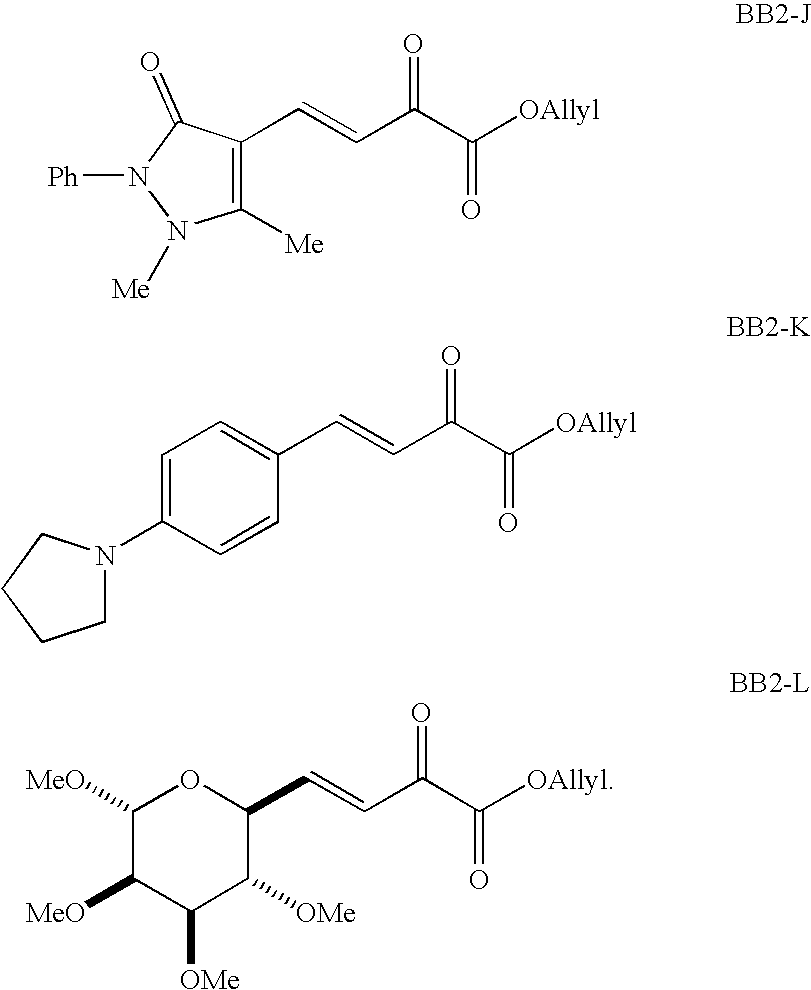


| TABLE 1 |
| Asymmetric cycloadditions of resin-bound vinyl ethers BB1.[i] |
 |
| purity, | |||||||
| BB1- | BB2- | product | %[ii] | dr[iii] | er[iv] | ||
| A | E | 7-A-E | ≧95 | ≧15/1 | ≧49/1 | ||
| B | E | 7-B-E | ≧95 | ≧15/1 | ≧24/1 | ||
| C | B | 9-C-b | ≧95 | ≧20/1 | ≧49/1 | ||
| D | B | 8-D-B | ≧95 | ≧5/1 | ≧30/1 | ||
| E | B | 9-E-B | ≧95 | ≧20/1 | ≧49/1 | ||
| F | B | 8-D-B | ≧95 | ≧10/1 | ≧30/1 | ||
| G | E | 7-G-E | ≧95 | ≧30/1 | ≧49/1 | ||
| H | E | 7-G-E | ≧95 | ≧20/1 | ≧24/1 | ||
| [i]Reactions were performed with 20 mol % of (S)-1 or (R)-1; the results presented are an average of the two runs. | |||||||
| [ii]Estimated based on 1H NMR analysis and HPLC-ESIMS. | |||||||
| [iii]Determined by 1H NMR analysis and/or CSP HPLC or CSP SFC. | |||||||
| [iv]Determined by CSP HPLC or CSP SFC. | |||||||
| TABLE 2 |
| Asymmetric cycloadditions of resin-bound vinyl ether 4-H with heterodienes.[i] |
 |
| BB2- | products | purity, %[ii] | dr[iii] | er[iv] |
| A | 10-H-A | ≧95 | ≧16/1 | ≧16/1 |
| B | 10-H-B | ≧95 | ≧20/1 | ≧24/1 |
| C | 10-H-C | ≧95 | ≧9/1 | ≧24/1 |
| D | 10-H-D | ≧95 | ≧9/1 | ≧9/1 |
| E | 10-H-E | ≧95 | ≧20/1 | ≧24/1 |
| F | 10-H-F | ≧95 | ≧25/1 | ≧24/1 |
| G | 10-H-G | ≧95 | ≧9/1 | ≧49/1 |
| H | 10-H-H | ≧95 | ≧15/1 | ≧24/1 |
| I | 10-H-I | ≧95 | ≧12/1 | ≧49/1 |
| J | 10-H-J | ≧95 | ≧9/1 | ≧49/1 |
| [i]Reactions were performed with 20 mol % of (S)-1 or (R)-1; the results presented are an average of the two runs. | ||||
| [ii]Estimated based on 1H NMR analysis and HPLC-ESIMS. | ||||
| [iii]Determined by 1H NMR analysis and/or CSP HPLC or CSP SFC. | ||||
| [iv]Determined by CSP HPLC or CSP SFC. | ||||


| TABLE 3 |
| Binary tagging scheme for first tagging step. |
| BB1- | T2B (C4Cl3) | T4B (C6Cl3) | T1A (C3Cl5) | T2A (C4Cl5) |
| A | 29.7 mg | — | — | — |
| B | — | 31.8 mg | — | — |
| C | — | — | 33.5 mg | — |
| D | — | — | — | 34.5 mg |
| E | 14.9 mg | 15.9 mg | — | — |
| F | 14.9 mg | — | 16.7 mg | — |
| G | 14.9 mg | — | — | 17.2 mg |
| H | — | 15.9 mg | 16.7 mg | — |
| TABLE 4 |
| Binary tagging scheme for second tagging step. |
| BB2- | catalyst | T3A (C5C15) | T4A (C6C15) | T5A (C7C15) | T6A (C8C15) | T7A (C9C15) |
| A | (S)-1 | 14.2 mg | — | — | — | — |
| B | (S)-1 | — | 14.5 mg | — | — | — |
| C | (S)-1 | — | — | 14.9 mg | — | — |
| D | (S)-1 | — | — | — | 15.3 mg | — |
| E | (S)-1 | — | — | — | — | 15.7 mg |
| F | (S)-1 | 7.1 mg | 7.3 mg | — | — | — |
| G | (S)-1 | 7.1 mg | — | 7.5 mg | — | — |
| H | (S)-1 | 7.1 mg | — | — | 7.6 mg | — |
| I | (S)-1 | 7.1 mg | — | — | — | 7.9 mg |
| J | (S)-1 | — | 7.3 mg | 7.5 mg | — | — |
| A | (R)-1 | — | 7.3 mg | — | 7.6 mg | — |
| B | (R)-1 | — | 7.3 mg | — | — | 7.9 mg |
| C | (R)-1 | — | — | 7.5 mg | 7.6 mg | — |
| D | (R)-1 | — | — | 7.5 mg | — | 7.9 mg |
| E | (R)-1 | — | — | — | 7.6 mh | 7.9 mg |
| F | (R)-1 | 4.7 mg | 4.8 mg | 5.0 mg | — | — |
| G | (R)-1 | 4.7 mg | 4.8 mg | — | 5.1 mg | — |
| H | (R)-1 | 4.7 mg | 4.8 mg | — | — | 5.2 mg |
| I | (R)-1 | 4.7 mg | — | 5.0 mg | 5.1 mg | — |
| J | (R)-1 | 4.7 mg | — | 5.0 mg | — | 5.2 mg |


| TABLE 5 |
| Binary codes for encoding BB1 of |
| Entry | Tag C4Cl3 | Tag C6Cl3 | Tag C3Cl5 | Tag C4Cl5 |
| BB1- |
1 | 0 | 0 | 0 |
| BB1- |
0 | 1 | 0 | 0 |
| BB1- |
0 | 0 | 1 | 0 |
| BB1- |
0 | 0 | 0 | 1 |
| BB1- |
1 | 1 | 0 | 0 |
| BB1- |
1 | 0 | 1 | 0 |
| BB1- |
1 | 0 | 0 | 1 |
| BB1- |
0 | 1 | 1 | 0 |
| TABLE 6 |
| Binary codes for encoding BB2 of |
| catalyzed by either R- or S-bis(oxazoline)copper (II) tri£ate |
| Entry | Catalyst | Tag C5C15 | Tag C6C15 | Tag C7C15 | Tag C8C15 | Tag C9C15 | |
| BB2- | S | 1 | 0 | 0 | 0 | 0 | |
| BB2- |
0 | 1 | 0 | 0 | 0 | ||
| BB2- |
0 | 0 | 1 | 0 | 0 | ||
| BB2- |
0 | 0 | 0 | 1 | 0 | ||
| BB2- |
0 | 0 | 0 | 0 | 1 | ||
| BB2- |
1 | 1 | 0 | 0 | 0 | ||
| BB2- |
1 | 0 | 1 | 0 | 0 | ||
| BB2- |
1 | 0 | 0 | 1 | 0 | ||
| BB2-I | 1 | 0 | 0 | 0 | 1 | ||
| BB2- |
0 | 1 | 1 | 0 | 0 | ||
| BB2- | R | 0 | 1 | 0 | 1 | 0 | |
| BB2- |
0 | 1 | 0 | 0 | 1 | ||
| BB2- |
0 | 0 | 1 | 1 | 0 | ||
| BB2- |
0 | 0 | 1 | 0 | 1 | ||
| BB2- |
0 | 0 | 0 | 1 | 1 | ||
| BB2- |
1 | 1 | 1 | 0 | 0 | ||
| BB2- |
1 | 1 | 0 | 1 | 0 | ||
| BB2- |
1 | 1 | 0 | 0 | 1 | ||
| BB2-I | 1 | 0 | 1 | 1 | 0 | ||
| BB2- |
1 | 0 | 1 | 0 | 1 | ||


| TABLE 5 |
| Binary decoding data from GC and LC/MS analysis of 108 beads from |
| |
| could not be correlated. |
| Bead | Tag | Tag | Tag | Tag | Tag3 | Tag | Tag | Tag | Tag | Expected | ||||
| # | 2B | 4B | 1A | 2A | A | 4A | 5A | 6A | 7A | BB1 | BB2 | BB3 | mass | Observed mass |
| 1 | 0 | 1 | 1 | 0 | 1 | 1 | 0 | 0 | 0 | H | F | A | 572 | M + H |
| 2 | 1 | 0 | 0 | 1 | 0 | 1 | 1 | 0 | 0 | G | J | A | 539 | M + H |
| 3 | 0 | 1 | 1 | 0 | 1 | 1 | 0 | 0 | 0 | H | F | B | 552 | M + H |
| 4 | 1 | 1 | 0 | 0 | 0 | 0 | 0 | 1 | 0 | B | D | B | 435 | M + H |
| 5 | 1 | 0 | 0 | 1 | 1 | 1 | 0 | 0 | 0 | G | F | C | 447 | M + H |
| 6 | 0 | 0 | 0 | 1 | 1 | 0 | 1 | 0 | 0 | D | G | C | 447 | M + H |
| 7 | 1 | 1 | 0 | 0 | 1 | 0 | 0 | 0 | 0 | E | A | D | 441 | M + H |
| 8 | 1 | 0 | 0 | 1 | 1 | 0 | 0 | 0 | 0 | G | A | D | 401 | M + H |
| 9 | 0 | 0 | 0 | 1 | 0 | 0 | 0 | 1 | 0 | D | D | E | 514 | M + H |
| 10 | 0 | 1 | 0 | 0 | 0 | 0 | 0 | 0 | 1 | C | E | E | 500 | M + H |
| 11 | 1 | 0 | 0 | 1 | 1 | 0 | 1 | 0 | 0 | G | G | F | 473 | M + H |
| 12 | 1 | 1 | 0 | 0 | 1 | 1 | 0 | 0 | 0 | E | F | F | 479 | M + H |
| 13 | 1 | 1 | 0 | 0 | 1 | 0 | 1 | 0 | 0 | E | G | G | 592 | M + H |
| 14 | 1 | 1 | 0 | 0 | 0 | 0 | 0 | 0 | 1 | E | E | G | 596 | M + H |
| 15 | 0 | 0 | 0 | 1 | 0 | 1 | 1 | 0 | 0 | D | J | H | 540 | M − EtOH |
| 16 | 1 | 0 | 0 | 0 | 1 | 0 | 0 | 1 | 0 | A | H | H | 497 | M + H |
| 17 | 0 | 1 | 0 | 0 | 1 | 1 | 0 | 0 | 0 | B | F | I | 582 | M + H |
| 18 | 0 | 0 | 0 | 1 | 1 | 0 | 1 | 0 | 0 | D | G | I | 614 | M − BB1_D |
| 19 | 0 | 1 | 0 | 0 | 0 | 1 | 1 | 0 | 0 | B | J | J | 640 | M + H |
| 20 | 0 | 0 | 1 | 0 | 0 | 1 | 1 | 0 | 0 | C | J | J | 638 | M + H |
| 21 | 1 | 0 | 0 | 0 | 0 | 0 | 0 | 1 | 0 | A | D | K | 563 | M + H |
| 22 | 0 | 0 | 1 | 0 | 1 | 0 | 1 | 0 | 0 | C | G | K | 559 | M − EtOH |
| 23 | 1 | 0 | 0 | 0 | 1 | 1 | 0 | 0 | 0 | A | F | L | 497 | M + H |
| 24 | 0 | 1 | 0 | 0 | 0 | 1 | 1 | 0 | 0 | B | J | L | 617 | M + H |
| 25 | 0 | 1 | 1 | 0 | 0 | 0 | 1 | 0 | 0 | H | C | M | 694 | M + H |
| 26 | 0 | 0 | 0 | 1 | 0 | 1 | 1 | 0 | 0 | D | J | M | 545 | M + H |
| 27 | 1 | 0 | 0 | 1 | 0 | 1 | 1 | 0 | 0 | G | J | N | 540 | M + H |
| 28 | 0 | 1 | 1 | 0 | 0 | 0 | 1 | 0 | 0 | H | C | N | 655 | M + H |
| 29 | 1 | 0 | 0 | 0 | 0 | 1 | 0 | 0 | 0 | A | B | O | 383 | M + H |
| 30 | 0 | 0 | 0 | 1 | 0 | 0 | 1 | 0 | 0 | D | C | O | 485 | M − BB1_D |
| 31 | 0 | 1 | 0 | 0 | 0 | 1 | 1 | 0 | 0 | B | J | P | 607 | M + MeOH − H2O |
| 32 | 1 | 1 | 0 | 0 | 1 | 0 | 0 | 0 | 1 | E | I | P | 637 | M + MeOH − H2O |
| 33 | 1 | 0 | 0 | 1 | 1 | 0 | 0 | 1 | 0 | G | H | Q | 644 | M + H |
| 34 | 1 | 0 | 1 | 0 | 1 | 0 | 0 | 1 | 0 | F | H | Q | 684 | M + H |
| 35 | 1 | 0 | 0 | 1 | 1 | 0 | 0 | 0 | 0 | G | A | R | 413 | M + H |
| 36 | 0 | 0 | 0 | 1 | 1 | 1 | 0 | 0 | 0 | D | F | R | 419 | M − EtOH |
| 37 | 0 | 1 | 1 | 0 | 0 | 1 | 1 | 0 | 0 | H | J | S | 1049 | M + H |
| 38 | 0 | 1 | 1 | 0 | 1 | 1 | 0 | 0 | 0 | H | F | S | 945 | M + H |
| 39 | 0 | 0 | 1 | 0 | 1 | 1 | 0 | 0 | 0 | C | F | T | 513 | M + H |
| 40 | 0 | 0 | 1 | 0 | 0 | 1 | 1 | 0 | 0 | C | J | T | 617 | M + H |
| 41 | 0 | 0 | 0 | 1 | 1 | 0 | 0 | 0 | 1 | D | I | U | 469 | M − EtOH |
| 42 | 1 | 0 | 1 | 0 | 1 | 0 | 1 | 0 | 0 | F | G | U | 515 | M − C4O2H8 |
| 43 | 0 | 0 | 0 | 1 | 0 | 0 | 1 | 0 | 0 | D | C | V | 558 | M − EtOH |
| 44 | 0 | 1 | 0 | 0 | 0 | 0 | 1 | 0 | 0 | B | C | V | 560 | M + H |
| 45 | 1 | 0 | 1 | 0 | 1 | 0 | 0 | 0 | 1 | F | I | W | 505 | M − C4O2H8 |
| 46 | 1 | 0 | 0 | 1 | 0 | 1 | 1 | 0 | 0 | G | J | W | 507 | M + H |
| 47 | 0 | 0 | 1 | 0 | 1 | 0 | 0 | 0 | 1 | C | I | X | 576 | M − EtOH |
| 48 | 1 | 0 | 1 | 0 | 0 | 0 | 0 | 0 | 1 | F | E | X | 626 | M + H |
| 49 | 1 | 0 | 0 | 0 | 1 | 0 | 0 | 0 | 1 | A | I | Y | 413 | M + H |
| 50 | 0 | 0 | 1 | 0 | 0 | 1 | 1 | 0 | 0 | C | J | Y | 469 | M + H |
| 51 | 1 | 0 | 0 | 1 | 0 | 0 | 1 | 0 | 1 | G | D | A | 487 | M + H |
| 52 | 0 | 0 | 0 | 1 | 1 | 0 | 1 | 1 | 0 | D | I | A | 463 | M − EtOH |
| 53 | 1 | 0 | 0 | 1 | 0 | 1 | 0 | 1 | 0 | G | A | B | 375 | M − H2O |
| 54 | 0 | 1 | 1 | 0 | 0 | 1 | 0 | 1 | 0 | H | A | B | 512 | M + H |
| 55 | 0 | 0 | 1 | 0 | 0 | 1 | 0 | 1 | 0 | H | A | C | 544 | M − MeOH |
| 56 | 0 | 0 | 0 | 1 | 1 | 1 | 0 | 0 | 1 | D | H | C | 488 | M + H |
| 57 | 0 | 0 | 1 | 0 | 1 | 1 | 0 | 1 | 0 | F | G | D | 515 | M − EtOH |
| 58 | 1 | 0 | 0 | 0 | 0 | 0 | 1 | 0 | 1 | A | D | D | 445 | M + H |
| 59 | 0 | 0 | 0 | 1 | 0 | 1 | 0 | 0 | 1 | D | B | E | 456 | M + H |
| 60 | 1 | 0 | 0 | 1 | 0 | 1 | 0 | 0 | 1 | G | B | E | 490 | M + H |
| 61 | 1 | 0 | 0 | 1 | 0 | 1 | 0 | 0 | 1 | G | B | F | 433 | M + H |
| 62 | 0 | 1 | 1 | 0 | 0 | 0 | 0 | 1 | 1 | H | E | F | 614 | M + H |
| 63 | 1 | 0 | 0 | 0 | 1 | 0 | 1 | 0 | 1 | A | J | G | 574 | M + H |
| 64 | 0 | 0 | 0 | 1 | 1 | 1 | 0 | 0 | 1 | D | H | G | 559 | M + H |
| 65 | 0 | 0 | 0 | 1 | 1 | 0 | 1 | 1 | 0 | D | I | H | 498 | M − EtOH |
| 66 | 0 | 0 | 1 | 0 | 1 | 0 | 1 | 0 | 1 | C | J | H | 540 | M + H |
| 67 | 0 | 1 | 0 | 0 | 0 | 1 | 0 | 0 | 1 | B | B | I | 576 | M + H |
| 68 | 0 | 1 | 1 | 0 | 0 | 0 | 0 | 1 | 1 | D | E | I | 618 | M + H |
| 69 | 1 | 0 | 0 | 1 | 1 | 1 | 0 | 1 | 0 | G | G | J | 602 | M + H |
| 70 | 1 | 0 | 0 | 1 | 0 | 1 | 0 | 1 | 0 | G | A | J | 528 | M + H |
| 71 | 1 | 1 | 0 | 0 | 0 | 0 | 1 | 0 | 1 | E | D | K | 651 | M + H |
| 72 | 1 | 0 | 1 | 0 | 0 | 0 | 0 | 1 | 1 | F | E | K | 637 | M + H |
| 73 | 1 | 0 | 1 | 0 | 1 | 1 | 1 | 0 | 0 | F | F | L | 585 | M + H |
| 74 | 1 | 0 | 0 | 1 | 0 | 0 | 0 | 1 | 1 | G | E | L | 583 | M + H |
| 75 | 1 | 0 | 1 | 0 | 1 | 1 | 0 | 0 | 1 | F | H | M | 590 | M + H |
| 76 | 1 | 0 | 1 | 0 | 0 | 0 | 0 | 1 | 1 | F | E | M | 553 | M − C4O2H8 |
| 77 | 0 | 0 | 1 | 0 | 1 | 0 | 1 | 0 | 1 | C | J | N | 506 | M + H |
| 78 | 1 | 0 | 0 | 1 | 0 | 0 | 1 | 1 | 0 | G | C | N | 518 | M + H |
| 79 | 1 | 0 | 0 | 0 | 0 | 0 | 1 | 1 | 0 | E | C | O | 559 | M + H |
| 80 | 1 | 1 | 0 | 0 | 1 | 1 | 1 | 0 | 0 | E | F | O | 477 | M + H |
| 81 | 1 | 0 | 0 | 1 | 1 | 1 | 0 | 1 | 0 | G | G | P | 569 | M + MeOH − H2O |
| 82 | 0 | 1 | 1 | 0 | 0 | 0 | 1 | 1 | 0 | H | C | P | 754 | M + H |
| 83 | 0 | 0 | 0 | 1 | 1 | 1 | 0 | 1 | 0 | D | G | Q | 569 | M − EtOH |
| 84 | 1 | 0 | 0 | 1 | 1 | 1 | 0 | 1 | 0 | G | G | Q | 603 | M − H2O |
| 85 | 1 | 0 | 0 | 0 | 1 | 0 | 1 | 1 | 0 | A | I | R | 467 | M + H |
| 86 | 0 | 0 | 1 | 0 | 0 | 0 | 0 | 1 | 1 | C | E | R | 457 | M − EtOH |
| 87 | 0 | 1 | 0 | 0 | 1 | 1 | 0 | 1 | 0 | B | G | S | 810 | M + H |
| 88 | 1 | 0 | 0 | 0 | 1 | 1 | 0 | 1 | 0 | A | G | S | 794 | M + H |
| 89 | 1 | 0 | 1 | 0 | 1 | 1 | 0 | 1 | 0 | F | G | T | 621 | M − C4O2H8 |
| 90 | 1 | 0 | 0 | 1 | 0 | 0 | 1 | 1 | 0 | G | C | T | 629 | M + H |
| 91 | 1 | 0 | 1 | 0 | 0 | 0 | 1 | 0 | 1 | F | D | U | 533 | M − C4O2H8 |
| 92 | 0 | 0 | 1 | 0 | 1 | 0 | 1 | 0 | 1 | C | J | U | 511 | M + H |
| 93 | 0 | 0 | 1 | 0 | 0 | 1 | 0 | 1 | 0 | C | A | V | 436 | M − EtOH |
| 94 | 0 | 0 | 0 | 1 | 0 | 0 | 1 | 1 | 0 | D | C | V | 558 | M + H |
| 95 | 0 | 1 | 1 | 0 | 0 | 1 | 0 | 1 | 0 | H | A | W | 500 | M + H |
| 96 | 0 | 0 | 1 | 0 | 1 | 0 | 1 | 0 | 1 | C | J | W | 473 | M + H |
| 97 | 1 | 1 | 0 | 0 | 0 | 0 | 0 | 1 | 1 | E | E | X | 626 | M + H |
| 98 | 0 | 0 | 1 | 0 | 1 | 1 | 1 | 0 | 0 | C | F | X | 514 | M + H |
| 99 | 0 | 0 | 1 | 0 | 1 | 1 | 1 | 0 | 0 | C | F | Y | 365 | M + H |
| 100 | 0 | 0 | 0 | 1 | 1 | 0 | 1 | 1 | 0 | D | I | Y | 427 | M − EtOH |
| 101 | 1 | 0 | 0 | 0 | 1 | 0 | 0 | 0 | 0 | A | A | 298 | M + Na | |
| 102 | 1 | 0 | 1 | 0 | 1 | 0 | 0 | 0 | 1 | F | I | 488 | M − EtOH | |
| 103 | 0 | 0 | 0 | 1 | 1 | 1 | 0 | 0 | 1 | D | H | 427 | M − EtOH | |
| 104 | 0 | 1 | 0 | 0 | 0 | 1 | 0 | 0 | 1 | B | B | 348 | M + H | |
| 105 | 1 | 0 | 1 | 0 | 1 | 0 | 1 | 0 | 0 | F | G | 420 | M − C4O2H8 | |
| 106 | 1 | 0 | 1 | 0 | 1 | 0 | 0 | 0 | 0 | F | A | 346 | M + Na | |
| 107 | 1 | 1 | 0 | 0 | 0 | 0 | 1 | 0 | 1 | E | D | 438 | M − EtOH | |
| 108 | 0 | 1 | 0 | 0 | 1 | 1 | 0 | 1 | 0 | B | G | 348 | M + H | |


Claims (22)


Priority Applications (2)
| Application Number | Priority Date | Filing Date | Title |
|---|---|---|---|
| US10/649,532 US7186709B2 (en) | 2002-08-27 | 2003-08-27 | Dihydropyrancarboxamides and uses thereof |
| US11/714,689 US20080070916A1 (en) | 2002-08-27 | 2007-03-06 | Dihydropyrancarboxamides and uses thereof |
Applications Claiming Priority (2)
| Application Number | Priority Date | Filing Date | Title |
|---|---|---|---|
| US40614002P | 2002-08-27 | 2002-08-27 | |
| US10/649,532 US7186709B2 (en) | 2002-08-27 | 2003-08-27 | Dihydropyrancarboxamides and uses thereof |
Related Child Applications (1)
| Application Number | Title | Priority Date | Filing Date |
|---|---|---|---|
| US11/714,689 Division US20080070916A1 (en) | 2002-08-27 | 2007-03-06 | Dihydropyrancarboxamides and uses thereof |
Publications (2)
| Publication Number | Publication Date |
|---|---|
| US20040059138A1 US20040059138A1 (en) | 2004-03-25 |
| US7186709B2 true US7186709B2 (en) | 2007-03-06 |
Family
ID=31997664
Family Applications (2)
| Application Number | Title | Priority Date | Filing Date |
|---|---|---|---|
| US10/649,532 Expired - Fee Related US7186709B2 (en) | 2002-08-27 | 2003-08-27 | Dihydropyrancarboxamides and uses thereof |
| US11/714,689 Abandoned US20080070916A1 (en) | 2002-08-27 | 2007-03-06 | Dihydropyrancarboxamides and uses thereof |
Family Applications After (1)
| Application Number | Title | Priority Date | Filing Date |
|---|---|---|---|
| US11/714,689 Abandoned US20080070916A1 (en) | 2002-08-27 | 2007-03-06 | Dihydropyrancarboxamides and uses thereof |
Country Status (1)
| Country | Link |
|---|---|
| US (2) | US7186709B2 (en) |
Families Citing this family (4)
| Publication number | Priority date | Publication date | Assignee | Title |
|---|---|---|---|---|
| CA2836915A1 (en) | 2011-05-20 | 2012-11-29 | Howard University | Emetine derivatives, prodrugs containing same, and methods of treating conditions using same |
| US9346780B2 (en) | 2012-10-12 | 2016-05-24 | Okinawa Institute Of Science And Technology School Corporation | Process for producing dihydro-2H-pyran derivatives |
| CN108929203A (en) * | 2018-08-14 | 2018-12-04 | 重庆市化工研究院 | A kind of aromatic ethenyl ether and its synthetic method and application |
| CN112920149B (en) * | 2021-01-29 | 2022-12-02 | 中山大学 | A kind of chiral dihydropyran ring derivative and its preparation method and application |
-
2003
- 2003-08-27 US US10/649,532 patent/US7186709B2/en not_active Expired - Fee Related
-
2007
- 2007-03-06 US US11/714,689 patent/US20080070916A1/en not_active Abandoned
Non-Patent Citations (52)
Also Published As
| Publication number | Publication date |
|---|---|
| US20040059138A1 (en) | 2004-03-25 |
| US20080070916A1 (en) | 2008-03-20 |
Similar Documents
| Publication | Publication Date | Title |
|---|---|---|
| AU2004206856B2 (en) | Capture compounds, collections thereof and methods for analyzing the proteome and complex compositions | |
| Hall et al. | Solution-and solid-phase strategies for the design, synthesis, and screening of libraries based on natural product templates: a comprehensive survey | |
| US20030187027A1 (en) | Dioxanes and uses thereof | |
| US9611224B2 (en) | Antiproliferative benzo [B] azepin-2-ones | |
| US6316626B1 (en) | Amine compounds and combinatorial libraries comprising same | |
| WO2021004326A1 (en) | High throughput method for constructing and screening compound library and reaction device | |
| US20020077491A1 (en) | Methods for forming combinatorial libraries combining amide bond formation with epoxide opening | |
| US20080070916A1 (en) | Dihydropyrancarboxamides and uses thereof | |
| Bogdan et al. | A high-throughput synthesis of 1, 2, 4-oxadiazole and 1, 2, 4-triazole libraries in a continuous flow reactor | |
| Kong et al. | Novel STAT3 small-molecule inhibitors identified by structure-based virtual ligand screening incorporating SH2 domain flexibility | |
| US7109377B2 (en) | Synthesis of combinatorial libraries of compounds reminiscent of natural products | |
| Su et al. | Synthesis of complex alkoxyamines using a polymer-supported N-hydroxyphthalimide | |
| JP2007511514A (en) | Immobilized N-substituted tricyclic 3-aminopyrazole for biomolecular target identification | |
| KR20050012246A (en) | Amines that inhibit a mammalian anandamide transporter, and methods of use thereof | |
| US6797819B1 (en) | Alkaloids | |
| US20040014168A1 (en) | Reagents and methods for library synthesis and screening | |
| CN117529481B (en) | Pharmaceutically acceptable salts of MOR receptor agonists, polymorphs thereof and uses thereof | |
| WO2002051775A2 (en) | Methods for forming combinatorial libraries using reductive amination | |
| JP7498667B2 (en) | Solid Support | |
| AU2006249219B2 (en) | Capture compounds, collections thereof and methods for analyzing the proteome and complex compositions | |
| Jin | Discovery of Novel Macrolide Antibiotics And Methodology Development of N-Sulfinyl Metallodienamines | |
| EP1909575A2 (en) | Substituted n-cinnamyl benzamides | |
| Lubbers | Synthetic and computational efforts toward the understanding and development of novobiocin-derived inhibitors of Hsp90 | |
| Sternson | Unbiased and biased chemical libraries for chemical genetics | |
| Wong | Discovery of small molecule probes for chemical genetics using biased and unbiased diversity-oriented organic synthesis |
Legal Events
| Date | Code | Title | Description |
|---|---|---|---|
| AS | Assignment |
Owner name: PRESIDENT AND FELLOWS OF HARVARD COLLEGE, MASSACHU Free format text: ASSIGNMENT OF ASSIGNORS INTEREST;ASSIGNOR:SCHREIBER, STUART L., AS AGENT FOR HOWARD HUGHES MEDICAL INSTITUTE (HHMI);REEL/FRAME:016440/0156 Effective date: 20040702 Owner name: PRESIDENT AND FELLOWS OF HARVARD COLLEGE, MASSACHU Free format text: ASSIGNMENT OF ASSIGNORS INTEREST;ASSIGNORS:STAVENGER, ROBERT A.;MITCHISON, TIMOTHY J.;MALIGA, ZOLTAN;REEL/FRAME:016440/0291;SIGNING DATES FROM 20040512 TO 20050314 Owner name: HOWARD HUGHES MEDICAL INSTITUTE, MARYLAND Free format text: ASSIGNMENT OF ASSIGNORS INTEREST;ASSIGNOR:SCHREIBER, STUART L.;REEL/FRAME:016440/0143 Effective date: 20040702 |
|
| STCF | Information on status: patent grant |
Free format text: PATENTED CASE |
|
| FEPP | Fee payment procedure |
Free format text: PAT HOLDER CLAIMS SMALL ENTITY STATUS, ENTITY STATUS SET TO SMALL (ORIGINAL EVENT CODE: LTOS); ENTITY STATUS OF PATENT OWNER: SMALL ENTITY |
|
| FEPP | Fee payment procedure |
Free format text: PAYOR NUMBER ASSIGNED (ORIGINAL EVENT CODE: ASPN); ENTITY STATUS OF PATENT OWNER: SMALL ENTITY Free format text: PAYER NUMBER DE-ASSIGNED (ORIGINAL EVENT CODE: RMPN); ENTITY STATUS OF PATENT OWNER: SMALL ENTITY |
|
| AS | Assignment |
Owner name: NATIONAL INSTITUTES OF HEALTH (NIH), U.S. DEPT. OF Free format text: EXECUTIVE ORDER 9424, CONFIRMATORY LICENSE;ASSIGNOR:HARVARD UNIVERSITY;REEL/FRAME:022045/0126 Effective date: 20031020 |
|
| AS | Assignment |
Owner name: PRESIDENT AND FELLOWS OF HARVARD COLLEGE, MASSACHU Free format text: ASSIGNMENT OF ASSIGNORS INTEREST;ASSIGNORS:SCHREIBER, STUART L.;STAVENGER, ROBERT A.;MITCHISON, TIMOTHY J.;AND OTHERS;REEL/FRAME:022133/0263;SIGNING DATES FROM 20040512 TO 20050314 |
|
| FPAY | Fee payment |
Year of fee payment: 4 |
|
| FPAY | Fee payment |
Year of fee payment: 8 |
|
| FEPP | Fee payment procedure |
Free format text: MAINTENANCE FEE REMINDER MAILED (ORIGINAL EVENT CODE: REM.); ENTITY STATUS OF PATENT OWNER: SMALL ENTITY |
|
| LAPS | Lapse for failure to pay maintenance fees |
Free format text: PATENT EXPIRED FOR FAILURE TO PAY MAINTENANCE FEES (ORIGINAL EVENT CODE: EXP.); ENTITY STATUS OF PATENT OWNER: SMALL ENTITY |
|
| STCH | Information on status: patent discontinuation |
Free format text: PATENT EXPIRED DUE TO NONPAYMENT OF MAINTENANCE FEES UNDER 37 CFR 1.362 |
|
| FP | Lapsed due to failure to pay maintenance fee |
Effective date: 20190306 |