US7169782B2 - Aryl substituted thiazolidinones and the use thereof - Google Patents
Aryl substituted thiazolidinones and the use thereof Download PDFInfo
- Publication number
- US7169782B2 US7169782B2 US10/195,530 US19553002A US7169782B2 US 7169782 B2 US7169782 B2 US 7169782B2 US 19553002 A US19553002 A US 19553002A US 7169782 B2 US7169782 B2 US 7169782B2
- Authority
- US
- United States
- Prior art keywords
- thiazolidin
- phenyl
- piperidinylethyl
- compound according
- alkylene chain
- Prior art date
- Legal status (The legal status is an assumption and is not a legal conclusion. Google has not performed a legal analysis and makes no representation as to the accuracy of the status listed.)
- Expired - Lifetime
Links
- 0 [1*]N1C(=O)CSC1[2*] Chemical compound [1*]N1C(=O)CSC1[2*] 0.000 description 37
- VTDIWMPYBAVEDY-UHFFFAOYSA-N CCCN1CCCCC1 Chemical compound CCCN1CCCCC1 VTDIWMPYBAVEDY-UHFFFAOYSA-N 0.000 description 24
- CTAHUMLMCVYAMV-UHFFFAOYSA-N CC1=CC(OC2=CC=CC(C(F)(F)F)=C2)=CC=C1 Chemical compound CC1=CC(OC2=CC=CC(C(F)(F)F)=C2)=CC=C1 CTAHUMLMCVYAMV-UHFFFAOYSA-N 0.000 description 11
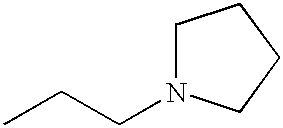
- HLNRRPIYRBBHSQ-UHFFFAOYSA-N CCCN1CCCC1 Chemical compound CCCN1CCCC1 HLNRRPIYRBBHSQ-UHFFFAOYSA-N 0.000 description 8
- KYVBUUNCHXRYOS-UHFFFAOYSA-N CC=C(C1=CC=CC=C1)C1=CC=CC=C1 Chemical compound CC=C(C1=CC=CC=C1)C1=CC=CC=C1 KYVBUUNCHXRYOS-UHFFFAOYSA-N 0.000 description 7
- PSRMVSYEWFOXGJ-UHFFFAOYSA-N CC1=CC(OC2=CC=C(Cl)C(Cl)=C2)=CC=C1 Chemical compound CC1=CC(OC2=CC=C(Cl)C(Cl)=C2)=CC=C1 PSRMVSYEWFOXGJ-UHFFFAOYSA-N 0.000 description 6
- WVBYZJPYNPYQHZ-UHFFFAOYSA-N CC.CC.CC(C)C=C(c1ccccc1)c1ccccc1 Chemical compound CC.CC.CC(C)C=C(c1ccccc1)c1ccccc1 WVBYZJPYNPYQHZ-UHFFFAOYSA-N 0.000 description 5
- ZUHZZVMEUAUWHY-UHFFFAOYSA-N CCCN(C)C Chemical compound CCCN(C)C ZUHZZVMEUAUWHY-UHFFFAOYSA-N 0.000 description 4
- AVTNZJVZWSMREN-UHFFFAOYSA-N CC1=CC(OC2=CC(Cl)=CC(Cl)=C2)=CC=C1 Chemical compound CC1=CC(OC2=CC(Cl)=CC(Cl)=C2)=CC=C1 AVTNZJVZWSMREN-UHFFFAOYSA-N 0.000 description 3
- RZMMRCXFZUHJMC-UHFFFAOYSA-N CC1=CC(OC2=CC=C(C(C)(C)C)C=C2)=CC=C1 Chemical compound CC1=CC(OC2=CC=C(C(C)(C)C)C=C2)=CC=C1 RZMMRCXFZUHJMC-UHFFFAOYSA-N 0.000 description 3
- FRQUHSBKTAMSDF-UHFFFAOYSA-N CC1=CC(OCC2=CC=CC=C2)=CC=C1 Chemical compound CC1=CC(OCC2=CC=CC=C2)=CC=C1 FRQUHSBKTAMSDF-UHFFFAOYSA-N 0.000 description 3
- PWZKIZAHIAGUMK-UHFFFAOYSA-N CC1CCN(CC2=CC=CC=C2)CC1 Chemical compound CC1CCN(CC2=CC=CC=C2)CC1 PWZKIZAHIAGUMK-UHFFFAOYSA-N 0.000 description 3
- KJZHCGQVJFNGRJ-UHFFFAOYSA-N CCC(C)(C)CN(C)C Chemical compound CCC(C)(C)CN(C)C KJZHCGQVJFNGRJ-UHFFFAOYSA-N 0.000 description 3
- NRGGMCIBEHEAIL-UHFFFAOYSA-N CCC1=CC=CC=N1 Chemical compound CCC1=CC=CC=N1 NRGGMCIBEHEAIL-UHFFFAOYSA-N 0.000 description 3
- DJEQZVQFEPKLOY-UHFFFAOYSA-N CCCCN(C)C Chemical compound CCCCN(C)C DJEQZVQFEPKLOY-UHFFFAOYSA-N 0.000 description 3
- PHLTYBSRSKCOOU-UHFFFAOYSA-N CCCCN1CCCCC1C Chemical compound CCCCN1CCCCC1C PHLTYBSRSKCOOU-UHFFFAOYSA-N 0.000 description 3
- UDONPJKEOAWFGI-UHFFFAOYSA-N CC1=CC(OC2=CC=CC=C2)=CC=C1 Chemical compound CC1=CC(OC2=CC=CC=C2)=CC=C1 UDONPJKEOAWFGI-UHFFFAOYSA-N 0.000 description 2
- YOEXNFJWWZBHJQ-UHFFFAOYSA-N CC1=CC=C(OC2=CC=C(F)C=C2)C=C1 Chemical compound CC1=CC=C(OC2=CC=C(F)C=C2)C=C1 YOEXNFJWWZBHJQ-UHFFFAOYSA-N 0.000 description 2
- MCMFEZDRQOJKMN-UHFFFAOYSA-N CCCCN1C=CN=C1 Chemical compound CCCCN1C=CN=C1 MCMFEZDRQOJKMN-UHFFFAOYSA-N 0.000 description 2
- VKDIWRUULHQWJS-UHFFFAOYSA-N CCN1C2=C(C=CC=C2)C2=C1C=CC(C)=C2 Chemical compound CCN1C2=C(C=CC=C2)C2=C1C=CC(C)=C2 VKDIWRUULHQWJS-UHFFFAOYSA-N 0.000 description 2
- QROGIFZRVHSFLM-QHHAFSJGSA-N C/C=C/C1=CC=CC=C1 Chemical compound C/C=C/C1=CC=CC=C1 QROGIFZRVHSFLM-QHHAFSJGSA-N 0.000 description 1
- GHUURDQYRGVEHX-UHFFFAOYSA-N CC#CC1=CC=CC=C1 Chemical compound CC#CC1=CC=CC=C1 GHUURDQYRGVEHX-UHFFFAOYSA-N 0.000 description 1
- QPUYECUOLPXSFR-UHFFFAOYSA-N CC1=C2C=CC=CC2=CC=C1 Chemical compound CC1=C2C=CC=CC2=CC=C1 QPUYECUOLPXSFR-UHFFFAOYSA-N 0.000 description 1
- HMZHVMPWQVXPOU-UHFFFAOYSA-N CC1=CC(OC2=CC=C(Cl)C=C2)=CC=C1 Chemical compound CC1=CC(OC2=CC=C(Cl)C=C2)=CC=C1 HMZHVMPWQVXPOU-UHFFFAOYSA-N 0.000 description 1
- XPPVKIQNPLKQKY-UHFFFAOYSA-N CC1=CC=C(C2=CC=C(Cl)C=C2)O1 Chemical compound CC1=CC=C(C2=CC=C(Cl)C=C2)O1 XPPVKIQNPLKQKY-UHFFFAOYSA-N 0.000 description 1
- YXFVVABEGXRONW-UHFFFAOYSA-N CC1=CC=CC=C1 Chemical compound CC1=CC=CC=C1 YXFVVABEGXRONW-UHFFFAOYSA-N 0.000 description 1
- ATUOYWHBWRKTHZ-UHFFFAOYSA-N CCC Chemical compound CCC ATUOYWHBWRKTHZ-UHFFFAOYSA-N 0.000 description 1
- IJDNQMDRQITEOD-UHFFFAOYSA-N CCCC Chemical compound CCCC IJDNQMDRQITEOD-UHFFFAOYSA-N 0.000 description 1
- DLMICMXXVVMDNV-UHFFFAOYSA-N CCCN(C(C)C)C(C)C Chemical compound CCCN(C(C)C)C(C)C DLMICMXXVVMDNV-UHFFFAOYSA-N 0.000 description 1
- NMILGIZTAZXMTM-UHFFFAOYSA-N CCCN1CCOCC1 Chemical compound CCCN1CCOCC1 NMILGIZTAZXMTM-UHFFFAOYSA-N 0.000 description 1
- OUMBFMLKPJUWDQ-UHFFFAOYSA-N CCCNCC1=CC=CC=C1 Chemical compound CCCNCC1=CC=CC=C1 OUMBFMLKPJUWDQ-UHFFFAOYSA-N 0.000 description 1
- NCTBMVAIKUNJFJ-UHFFFAOYSA-N COC1=CC=C(OC2=CC=CC(C)=C2)C=C1 Chemical compound COC1=CC=C(OC2=CC=CC(C)=C2)C=C1 NCTBMVAIKUNJFJ-UHFFFAOYSA-N 0.000 description 1
- CWERGRDVMFNCDR-UHFFFAOYSA-N O=C(O)CS Chemical compound O=C(O)CS CWERGRDVMFNCDR-UHFFFAOYSA-N 0.000 description 1
Classifications
-
- C—CHEMISTRY; METALLURGY
- C07—ORGANIC CHEMISTRY
- C07D—HETEROCYCLIC COMPOUNDS
- C07D231/00—Heterocyclic compounds containing 1,2-diazole or hydrogenated 1,2-diazole rings
- C07D231/02—Heterocyclic compounds containing 1,2-diazole or hydrogenated 1,2-diazole rings not condensed with other rings
- C07D231/10—Heterocyclic compounds containing 1,2-diazole or hydrogenated 1,2-diazole rings not condensed with other rings having two or three double bonds between ring members or between ring members and non-ring members
- C07D231/12—Heterocyclic compounds containing 1,2-diazole or hydrogenated 1,2-diazole rings not condensed with other rings having two or three double bonds between ring members or between ring members and non-ring members with only hydrogen atoms, hydrocarbon or substituted hydrocarbon radicals, directly attached to ring carbon atoms
-
- A—HUMAN NECESSITIES
- A61—MEDICAL OR VETERINARY SCIENCE; HYGIENE
- A61P—SPECIFIC THERAPEUTIC ACTIVITY OF CHEMICAL COMPOUNDS OR MEDICINAL PREPARATIONS
- A61P21/00—Drugs for disorders of the muscular or neuromuscular system
-
- A—HUMAN NECESSITIES
- A61—MEDICAL OR VETERINARY SCIENCE; HYGIENE
- A61P—SPECIFIC THERAPEUTIC ACTIVITY OF CHEMICAL COMPOUNDS OR MEDICINAL PREPARATIONS
- A61P23/00—Anaesthetics
- A61P23/02—Local anaesthetics
-
- A—HUMAN NECESSITIES
- A61—MEDICAL OR VETERINARY SCIENCE; HYGIENE
- A61P—SPECIFIC THERAPEUTIC ACTIVITY OF CHEMICAL COMPOUNDS OR MEDICINAL PREPARATIONS
- A61P25/00—Drugs for disorders of the nervous system
-
- A—HUMAN NECESSITIES
- A61—MEDICAL OR VETERINARY SCIENCE; HYGIENE
- A61P—SPECIFIC THERAPEUTIC ACTIVITY OF CHEMICAL COMPOUNDS OR MEDICINAL PREPARATIONS
- A61P25/00—Drugs for disorders of the nervous system
- A61P25/04—Centrally acting analgesics, e.g. opioids
-
- A—HUMAN NECESSITIES
- A61—MEDICAL OR VETERINARY SCIENCE; HYGIENE
- A61P—SPECIFIC THERAPEUTIC ACTIVITY OF CHEMICAL COMPOUNDS OR MEDICINAL PREPARATIONS
- A61P25/00—Drugs for disorders of the nervous system
- A61P25/08—Antiepileptics; Anticonvulsants
-
- A—HUMAN NECESSITIES
- A61—MEDICAL OR VETERINARY SCIENCE; HYGIENE
- A61P—SPECIFIC THERAPEUTIC ACTIVITY OF CHEMICAL COMPOUNDS OR MEDICINAL PREPARATIONS
- A61P25/00—Drugs for disorders of the nervous system
- A61P25/24—Antidepressants
-
- A—HUMAN NECESSITIES
- A61—MEDICAL OR VETERINARY SCIENCE; HYGIENE
- A61P—SPECIFIC THERAPEUTIC ACTIVITY OF CHEMICAL COMPOUNDS OR MEDICINAL PREPARATIONS
- A61P25/00—Drugs for disorders of the nervous system
- A61P25/28—Drugs for disorders of the nervous system for treating neurodegenerative disorders of the central nervous system, e.g. nootropic agents, cognition enhancers, drugs for treating Alzheimer's disease or other forms of dementia
-
- A—HUMAN NECESSITIES
- A61—MEDICAL OR VETERINARY SCIENCE; HYGIENE
- A61P—SPECIFIC THERAPEUTIC ACTIVITY OF CHEMICAL COMPOUNDS OR MEDICINAL PREPARATIONS
- A61P9/00—Drugs for disorders of the cardiovascular system
- A61P9/06—Antiarrhythmics
-
- C—CHEMISTRY; METALLURGY
- C07—ORGANIC CHEMISTRY
- C07D—HETEROCYCLIC COMPOUNDS
- C07D233/00—Heterocyclic compounds containing 1,3-diazole or hydrogenated 1,3-diazole rings, not condensed with other rings
- C07D233/54—Heterocyclic compounds containing 1,3-diazole or hydrogenated 1,3-diazole rings, not condensed with other rings having two double bonds between ring members or between ring members and non-ring members
- C07D233/56—Heterocyclic compounds containing 1,3-diazole or hydrogenated 1,3-diazole rings, not condensed with other rings having two double bonds between ring members or between ring members and non-ring members with only hydrogen atoms or radicals containing only hydrogen and carbon atoms, attached to ring carbon atoms
-
- C—CHEMISTRY; METALLURGY
- C07—ORGANIC CHEMISTRY
- C07D—HETEROCYCLIC COMPOUNDS
- C07D249/00—Heterocyclic compounds containing five-membered rings having three nitrogen atoms as the only ring hetero atoms
- C07D249/02—Heterocyclic compounds containing five-membered rings having three nitrogen atoms as the only ring hetero atoms not condensed with other rings
- C07D249/08—1,2,4-Triazoles; Hydrogenated 1,2,4-triazoles
-
- C—CHEMISTRY; METALLURGY
- C07—ORGANIC CHEMISTRY
- C07D—HETEROCYCLIC COMPOUNDS
- C07D277/00—Heterocyclic compounds containing 1,3-thiazole or hydrogenated 1,3-thiazole rings
- C07D277/02—Heterocyclic compounds containing 1,3-thiazole or hydrogenated 1,3-thiazole rings not condensed with other rings
- C07D277/08—Heterocyclic compounds containing 1,3-thiazole or hydrogenated 1,3-thiazole rings not condensed with other rings having one double bond between ring members or between a ring member and a non-ring member
- C07D277/12—Heterocyclic compounds containing 1,3-thiazole or hydrogenated 1,3-thiazole rings not condensed with other rings having one double bond between ring members or between a ring member and a non-ring member with hetero atoms or with carbon atoms having three bonds to hetero atoms with at the most one bond to halogen, e.g. ester or nitrile radicals, directly attached to ring carbon atoms
- C07D277/14—Oxygen atoms
-
- C—CHEMISTRY; METALLURGY
- C07—ORGANIC CHEMISTRY
- C07D—HETEROCYCLIC COMPOUNDS
- C07D279/00—Heterocyclic compounds containing six-membered rings having one nitrogen atom and one sulfur atom as the only ring hetero atoms
- C07D279/04—1,3-Thiazines; Hydrogenated 1,3-thiazines
- C07D279/06—1,3-Thiazines; Hydrogenated 1,3-thiazines not condensed with other rings
-
- C—CHEMISTRY; METALLURGY
- C07—ORGANIC CHEMISTRY
- C07D—HETEROCYCLIC COMPOUNDS
- C07D417/00—Heterocyclic compounds containing two or more hetero rings, at least one ring having nitrogen and sulfur atoms as the only ring hetero atoms, not provided for by group C07D415/00
- C07D417/02—Heterocyclic compounds containing two or more hetero rings, at least one ring having nitrogen and sulfur atoms as the only ring hetero atoms, not provided for by group C07D415/00 containing two hetero rings
- C07D417/04—Heterocyclic compounds containing two or more hetero rings, at least one ring having nitrogen and sulfur atoms as the only ring hetero atoms, not provided for by group C07D415/00 containing two hetero rings directly linked by a ring-member-to-ring-member bond
-
- C—CHEMISTRY; METALLURGY
- C07—ORGANIC CHEMISTRY
- C07D—HETEROCYCLIC COMPOUNDS
- C07D417/00—Heterocyclic compounds containing two or more hetero rings, at least one ring having nitrogen and sulfur atoms as the only ring hetero atoms, not provided for by group C07D415/00
- C07D417/02—Heterocyclic compounds containing two or more hetero rings, at least one ring having nitrogen and sulfur atoms as the only ring hetero atoms, not provided for by group C07D415/00 containing two hetero rings
- C07D417/06—Heterocyclic compounds containing two or more hetero rings, at least one ring having nitrogen and sulfur atoms as the only ring hetero atoms, not provided for by group C07D415/00 containing two hetero rings linked by a carbon chain containing only aliphatic carbon atoms
Definitions
- This invention is in the field of medicinal chemistry.
- the invention relates to novel aryl substituted thiazolidinones, and the discovery that these compounds are blockers of sodium (Na + ) channels.
- Several classes of therapeutically useful drugs including local anesthetics such as lidocaine and bupivacaine, antiarrhythmics such as propafenone and amioclarone, and anticonvulsants such as lamotrigine, phenytoin and carbamazepine, have been shown to share a common mechanism of action by blocking or modulating Na + channel activity (Catterall, W. A., Trends Pharmacol. Sci. 8:57–65 (1987)). Each of these agents is believed to act by interfering with the rapid influx of Na + ions.
- Na + channel blockers such as BW619C89 and lifarizine have been shown to be neuroprotective in animal models of global and focal ischemia and are presently in clinical trials (Graham et al., J. Pharmacol. Exp. Ther. 269:854–859 (1994); Brown et al., British J. Pharmacol. 115:1425–1432 (1995)).
- Na + channel blockers prevent hypoxic damage to mammalian white matter (Stys et al., J. Neurosci. 12:430–439 (1992)). Thus, they may offer advantages for treating certain types of strokes or neuronal trauma where damage to white matter tracts is prominent.
- riluzole Another example of clinical use of a Na + channel blocker is riluzole.
- This drug has been shown to prolong survival in a subset of patients with ALS (Bensimm et al., New Engl. J. Med. 330:585–591 (1994)) and has subsequently been approved by the FDA for the treatment of ALS.
- carbamazepine, lidocaine and phenytoin are occasionally used to treat neuropathic pain, such as from trigeminal neurologia, diabetic neuropathy and other forms of nerve damage (Taylor and Meldrum, Trends Pharmacol. Sci.
- the present invention is related to the discovery that aryl substituted thiazolidinones represented by Formula I act as blockers of sodium (Na + ) channels.
- Another aspect of the present invention is directed to the use of novel compounds of Formula I as blockers of sodium channels.
- the invention is also related with treating a disorder responsive to the blockade of sodium channels in a mammal suffering from excess activity of said channels by administering an effective amount of a compound of Formula I as described herein.
- One aspect of the present invention is directed to the novel aryl substituted thiazolidinones of Formula I.
- a further aspect of the present invention is to provide a method for treating, preventing or ameliorating neuronal loss following global and focal ischemia; treating, preventing or ameliorating pain including acute and chronic pain, and neuropathic pain; treating, preventing or ameliorating convulsion and neurodegenerative conditions; treating, preventing or ameliorating manic depression; using as local anesthetics and anti-arrhythmics, and treating tinnitus by administering a compound of Formula I to a mammal in need of such treatment or use.
- an aspect of the present invention is to provide a pharmaceutical composition useful for treating disorders responsive to the blockade of sodium ion channels, containing an effective amount of a compound of Formula I in a mixture with one or more pharmaceutically acceptable carriers or diluents.
- Preferred compounds are those of Formula I wherein R 1 is
- Y is ethylene or propylene.
- Preferred compounds are additionally those of Formula I wherein R 1 is
- Preferred compounds also are those of Formula I wherein R 1 is pyridyl(C 1-4 )alkyl.
- Preferred compounds are those of Formula I wherein R 1 is
- R 2 is phenoxyphenyl or benzyloxyphenyl, wherein the phenoxy moiety is optionally substituted with alkyl, halogen or haloalkyl.
- R 3 and R 4 are independently hydrogen, alkyl or alkylenylaryl, Y is an optionally substituted C 1-4 alkylene chain;
- alkylene has the meaning —(CH 2 ) m —, where m is an integer of from 1–6, preferably 2–4.
- Suitable alkylene chains include but are not limited to methylene, ethylene, propylene, butylene, pentylene and hexylene. The alkylene chain may also be optionally substituted.
- alkyl means a linear or branched C 1-10 carbon chain, preferably a C 1-6 carbon chain.
- Suitable alkyl groups include, but are not limited to, methyl, ethyl, propyl, isopropyl, butyl, isobutyl, sec-butyl, tert-butyl, 3-pentyl, hexyl and octyl groups.
- optionally substituted alkyl means replacement of one or more alkyl hydrogens with aryl or halogen.
- optionally substituted alkylene chain means replacement of an alkylene hydrogen with one or more alkyl groups, aryl groups or halogen atoms.
- optionally substituted alkylene chain will mean replacement with one or more alkyl groups or halogen atoms, preferably alkyl groups.
- aryl means a C 6-14 mono- or polycyclic aromatic ring system.
- Suitable carbocyclic aryl groups may be selected from, but are not limited to, phenyl, naphthyl, phenanthryl, anthracyl, indenyl, azulenyl, biphenyl, biphenylenyl and fluorenyl groups.
- Particularly preferred carbocyclic aryl groups are benzene and naphthalene.
- heteroaryl means 3–7 membered monocyclic, or 7–14 membered polycyclic aromatic ring systems, independently containing one or more nitrogen, oxygen or sulfur atoms.
- Suitable heteroaryl groups may be selected from, but are not limited to, indole, pyridine, carbazole imidizole furan and the like. Preferred heteroaryl groups are pyridine, carbazol, furan and imidazole.
- Non-aromatic heterocycles that are suitable for use in the present invention include, but are not limited to, pyrrolidine, piperidine and morpholine.
- Exemplary preferred compounds that may be employed in this method of invention include, without limitation:
- Particularly preferred compounds are selected from:
- the invention disclosed herein is meant to encompass all pharmaceutically acceptable salts thereof of the disclosed compounds.
- the pharmaceutically acceptable salts include, but are not limited to, metal salts such as sodium salt, potassium salt, cesium salt and the like; alkaline earth metals such as calcium salt, magnesium salt and the like; organic amine salts such as triethylamine salt, pyridine salt, picoline salt, ethanolamine salt, triethanolamine salt, dicyclohexylamine salt, N,N′-dibenzylethylenediamine salt and the like; inorganic acid salts such as hydrochloride, hydrobromide, sulfate, phosphate and the like; organic acid salts such as formate, acetate, trifluoroacetate, maleate, tartrate and the like; sulfonates such as methanesulfonate, benzenesulfonate, p-toluenesulfonate, and the like; amino acid salts such as arginate, asparg
- the invention disclosed herein is also meant to encompass the in vivo metabolic products of the disclosed compounds. Such products may result for example from the oxidation, reduction, hydrolysis, amidation, esterification and the like of the administered compound, primarily due to enzymatic processes. Accordingly, the invention includes compounds produced by a process comprising contacting a compound of this invention with a mammal for a period of time sufficient to yield a metabolic product thereof. Such products typically are identified by preparing a radiolabelled compound of the invention, administering it parenterally in a detectable dose to an animal such as rat, mouse, guinea pig, monkey, or to man, allowing sufficient time for metabolism to occur and isolating its conversion products from the urine, blood or other biological samples.
- the invention disclosed herein is also meant to encompass the disclosed compounds being isotopically-labelled by having one or more atoms replaced by an atom having a different atomic mass or mass number.
- isotopes that can be incorporated into the disclosed compounds include isotopes of hydrogen, carbon, nitrogen, oxygen, phosphorous, fluorine and chlorine, such as 2 H, 3 H, 13 C 14 C, 15 N, 18 O, 17 O, 31 P, 32 P, 35 S, 18 F, and 36 Cl, respectively.
- Some of the compounds disclosed herein may contain one or more asymmetric centers and may thus give rise to enantiomers, diastereomers, and other stereoisomeric forms.
- the present invention is also meant to encompass all such possible forms as well as their racemic and resolved forms and mixtures thereof.
- the compounds described herein contain olefinic double bonds or other centers of geometric asymmetry, and unless specified otherwise, it is intended to include both E and Z geometric isomers. All tautomers are intended to be encompassed by the present invention as well.
- stereoisomers is a general term for all isomers of individual molecules that differ only in the orientation of their atoms in space. It includes enantiomers and isomers of compounds with more than one chiral center that are not mirror images of one another (diastereomers).
- chiral center refers to a carbon atom to which four different groups are attached.
- enantiomer or “enantiomeric” refers to a molecule that is nonsuperimposeable on its mirror image and hence optically active wherein the enantiomer rotates the plane of polarized light in one direction and its mirror image rotates the plane of polarized light in the opposite direction.
- racemic refers to a mixture of equal parts of enantiomers and which is optically inactive.
- resolution refers to the separation or concentration or depletion of one of the two enantiomeric forms of a molecule.
- enantiomeric excess refers to a mixture wherein one enantiomer is present is a greater concentration than its mirror image molecule.
- the invention is also directed to a method for treating disorders responsive to the blockade of sodium channels in mammals suffering thereof.
- the thiazolidinone compounds of the invention may be used to treat humans or companion animals, such as dogs and cats. Particular preferred embodiments of the thiazolidinones of the invention for use in treating such disorders are represented as previously defined for Formula I.
- the thiazolidinones of Formula I may be prepared using methods known to those skilled in the art. Specifically, the thiazolidones of the present invention were obtained by reacting one equivalent of an aldehyde and one equivalent of amine, with one equivalent of mercapto acid in toluene. The reaction was conducted at 85° C. for about 12 hours in the presence of 4-Angstrom molecular sieves. Scheme 1 shows the method of making the thiazolidinones of the invention, wherein R 1 , R 2 and n are as previously defined.
- the resulting compounds were purified by flash column chromatography.
- the compounds of the present invention were assessed by electrophysiological assays in dissociated hippocampal neurons for sodium channel blocker activity. These compounds also could be assayed for binding to the neuronal voltage-dependent sodium channel using rat forebrain membranes and [ 3 H]BTX-B.
- Sodium channels are large transmembrane proteins that are expressed in various tissues. They are voltage sensitive channels and are responsible for the rapid increase of Na + permeability in response to depolarization associated with the action potential in many excitable cells including muscle, nerve and cardiac cells.
- One aspect of the present invention is the discovery of the mechanism of action of the compounds herein described as specific Na + channel blockers.
- these compounds are contemplated to be useful in treating or preventing neuronal loss due to focal or global ischemia, and in treating or preventing neurodegenerative disorders including ALS, anxiety, and epilepsy. They are also expected to be effective in treating, preventing or ameliorating neuropathic pain, surgical pain, chronic pain and tinnitus. The compounds are also expected to be useful as antiarrhythmics, anesthetics and antimanic depressants.
- the present invention is directed to compounds of Formula I that are blockers of voltage-sensitive sodium channels.
- those compounds having preferred sodium channel blocking properties exhibit an IC 50 of about 100 ⁇ M or less in the electrophysiological assay described herein.
- the compounds of the present invention exhibit an IC 50 of 10 ⁇ M or less.
- the compounds of the present invention exhibit an IC 50 of about 1.0 ⁇ M or less.
- Compounds of the present invention may be tested for their Na+channel blocking activity by the following binding and electrophysiological assays.
- the compounds of the present invention may be tested for in vivo anticonvulsant activity after i.v., p.o. or i.p. injection using a number of anticonvulsant tests in mice, including the maximum electroshock seizure test (MES).
- MES maximum electroshock seizure test
- Maximum electroshock seizures are induced in male NSA mice weighing between 15–20 g and male Sprague-Dawley rats weighing between 200–225 g by application of current (50 mA, 60 pulses/sec, 0.8 msec pulse width, 1 sec duration, D.C., mice; 99 mA, 125 pulses/sec, 0.8 msec pulse width, 2 sec duration, D.C., rats) using a Ugo Basile ECT device (Model 7801).
- mice are restrained by gripping the loose skin on their dorsal surface and saline-coated corneal electrodes were held lightly against the two corneae. Rats are allowed free movement on the bench top and ear-clip electrodes are used. Current is applied and animals are observed for a period of up to 30 seconds for the occurrence of a tonic hindlimb extensor response.
- a tonic seizure is defined as a hindlimb extension in excess of 90 degrees from the plane of the body. Results are treated in a quantal manner.
- mice Male Swiss Webster NIH mice (20–30 g; Harlan, San Diego, Calif.) are used in all experiments. Food is withdrawn on the day of experiment. Mice are placed in Plexiglass jars for at least 1 hour to accommodate to the environment. Following the accommodation period mice are weighed and given either the compound of interest administered i.p. or p.o., or the appropriate volume of vehicle (10% Tween-80). Fifteen minutes after the i.p. dosing, and 30 minutes after the p.o.
- dosing mice are injected with formalin (20 ⁇ L of 5% formaldehyde solution in saline) into the dorsal surface of the right hind paw. Mice are transferred to the Plexiglass jars and monitored for the amount of time spent licking or biting the injected paw. Periods of licking and biting are recorded in 5 minute intervals for 1 hour after the formalin injection. All experiments are done in a blinded manner during the light cycle. The early phase of the formalin response is measured as licking/biting between 0–5 minutes, and the late phase is measured from 15–50 minutes. Differences between vehicle and drug treated groups are analyzed by one-way analysis of variance (ANOVA). A P value ⁇ 0.05 is considered significant. Activity in blocking the acute and second phase of formalin-induced paw-licking activity is indicative that compounds are considered to be efficacious for acute and chronic pain.
- formalin 20 ⁇ L of 5% formaldehyde solution in saline
- the compounds may be tested for their potential for the treatment of chronic pain (antiallodynic and antihyperalgesic activities) in the Chung model of peripheral neuropathy.
- Male Sprague-Dawley rats weighing between 200–225 g are anesthetized with halothane (1–3% in a mixture of 70% air and 30% oxygen) and their body temperature is controlled during anesthesia through use of a homeothermic blanket.
- a 2-cm dorsal midline incision is then made at the L5 and L6 level and the para-vertibral muscle groups retracted bilaterally.
- L5 and L6 spinal nerves are then be exposed, isolated, and tightly ligated with 6-0 silk suture.
- a sham operation is performed exposing the contralateral L5 and L6 spinal nerves as a negative control.
- Rats are transferred to an elevated testing cage with a wire mesh floor and allowed to acclimate for five to ten minutes.
- a series of Semmes-Weinstein monofilaments are applied to the plantar surface of the hindpaw to determine the animal's withdrawal threshold.
- the first filament used possesses a buckling weight of 9.1 g (0.96 log value) and is applied up to five times to see if it elicited a withdrawal response. If the animal has a withdrawal response then the next lightest filament in the series is applied up to five times to determine if it can elicit a response. This procedure is repeated with subsequent less filaments until there is no response and the lightest filament that elicits a response is recorded.
- Rats are transferred to an elevated testing cage with a wire mesh floor and allowed to acclimate for five to ten minutes. A slightly blunted needle is touched to the plantar surface of the hindpaw causing a dimpling of the skin without penetrating the skin. Administration of the needle to control paws typically produces a quick flinching reaction, too short to be timed with a stopwatch and arbitrarily gives a withdrawal time of 0.5 second. The operated side paw of neuropathic animals exhibits an exaggerated withdrawal response to the blunted needle. A maximum withdrawal time of ten seconds is used as a cutoff time.
- Withdrawal times for both paws of the animals are measured three times at each time point with a five-minute recovery period between applications. The three measures are used to generate an average withdrawal time for each time point. Tactile allodynia and mechanical hyperalgesia tests are conducted concurrently.
- Oocytes at developmental stages V–VI are dissected from the ovary, wherein the oocytes are still surrounded by enveloping ovarian tissues. Oocytes are defolliculated on the day of surgery by treatment with collagenase (0.5 mg/mL Sigma Type I, or Boehringer Mannheim Type A, for 0.5–1 hr).
- Micro-injection of oocytes Defolliculated oocytes are micro-injected using a Nanoject injection system (Drummond Scientific Co., Broomall, Pa.). Injection pipettes are beveled to minimize clogging. Tip diameter of injection pipettes is 15–35 ⁇ m. Oocytes are microinjected with approximately 50 nL 1:10 ratio mixtures of cRNAs for rBIIa and beta 1 respectively.
- Electrophysiology Membrane current responses are recorded in frog Ringer solution containing 115 mM NaCl, 2 mM KCl, 1.8 mM CaCl 2 , 5 mM HEPES, pH 7.4. Electrical recordings are made using a conventional two-electrode voltage clamp (Dagan TEV-200) over periods ranging between 1–7 days following injection.
- the recording chamber is a simple gravity fed flow-through chamber (volume 100–500 mL depending on adjustment of aspirator). Oocytes are placed in the recording chamber, impaled with electrodes and continuously perfused (5–15 mL min ⁇ 1 ) with frog Ringer's solution. The tested compounds are applied by bath perfusion.
- Voltage protocols for evoking sodium channel currents The standard holding potential for whole oocyte clamp is ⁇ 120 mV. Standard current-voltage relationships are elicited by 40 ms depolarizing steps starting from ⁇ 60 mV to +50 mV in 10 mV increments. Peak currents are measured as the maximum negative current after depolarizing voltage steps. The voltage from maximum current response is noted and used for the next voltage protocol.
- the purpose is to find compounds that are state dependent modifiers of neuronal sodium channels.
- the compounds Preferably, the compounds have a low affinity for the rested/closed state of the channel, but a high affinity for the inactivated state.
- the following voltage protocol is used to measure a compounds affinity for the inactivated state. Oocytes are held at a holding potential of ⁇ 120 mV. At this membrane voltage, nearly all of the channels are in the closed state. Then a 4 second depolarization is made to the voltage where the maximum current is elicited. At the end of this depolarization, nearly all the channels are in the inactivated state. A 10 ms hyperpolarizing step is then made in order to remove some channels from the inactivated state.
- K i values Apparent inhibition constants (K i values) for antagonists are determined from single point inhibition data using the following equation (a generalized form of the Cheng-Prusoff equation) (Leff, P. and I. G. Dougall, TiPS 14:110–112 (1993)).
- K i ( FR/ 1 ⁇ FR )*[drug] Eq.2
- FR is the fractional response and is defined as sodium current elicited from the final depolarizing test pulse prior to application of the drug divided by the sodium current measured in the presence of the drug.
- [drug] is the concentration of the drug used.
- Drugs are initially made up at concentrations of 2–10 mM in DMSO. Dilutions are then made to generate a series of DMSO stocks over the range 0.3 ⁇ M to 10 mM—depending upon the potency of the compound. Working solutions are made by 1000–3000 fold dilution of stocks into Ringer.
- the compounds of the invention may be administered as part of a pharmaceutical preparation containing suitable pharmaceutically acceptable carriers comprising excipients and auxiliaries which facilitate processing of the compounds into preparations which can be used pharmaceutically.
- suitable pharmaceutically acceptable carriers comprising excipients and auxiliaries which facilitate processing of the compounds into preparations which can be used pharmaceutically.
- the preparations particularly those preparations which can be administered orally and which can be used for the preferred type of administration, such as tablets, dragees, and capsules, and also preparations which can be administered rectally, such as suppositories, as well as suitable solutions for administration by injection or orally, contain from about 0.01 to 99 percent, preferably from about 0.25 to 75 percent of active compound(s), together with the excipient.
- non-toxic pharmaceutically acceptable salts of the compounds of the present invention are also included within the scope of the present invention.
- Acid addition salts are formed by mixing a solution of the particular thiazolidinones of the present invention, with a solution of a pharmaceutically acceptable non-toxic acid such as hydrochloric acid, fumaric acid, maleic acid, succinic acid, acetic acid, citric acid, tartaric acid, carbonic acid, phosphoric acid, oxalic acid, dichloroacetic acid, and the like.
- Basic salts are formed by mixing a solution of the thiazolidinone compound of the present invention with a solution of a pharmaceutically acceptable non-toxic base such as sodium hydroxide, potassium hydroxide, choline hydroxide, sodium carbonate and the like.
- compositions of the present invention are manufactured in a manner that is itself known, for example, by means of conventional mixing, granulating, dragee-making, dissolving, or lyophilizing processes.
- pharmaceutical preparations for oral use can be obtained by combining the active compounds with solid excipients, optionally grinding the resulting mixture and processing the mixture of granules, after adding suitable auxiliaries, if desired or necessary, to obtain tablets or dragee cores.
- Suitable excipients are, in particular, fillers such as saccharides, for example lactose or sucrose, mannitol or sorbitol, cellulose preparations and/or calcium phosphates, for example tricalcium phosphate or calcium hydrogen phosphate, as well as binders such as starch paste, using, for example, maize starch, wheat starch, rice starch, potato starch, gelatin, tragacanth, methyl cellulose, hydroxypropylmethylcellulose, sodium carboxymethylcellulose, and/or polyvinyl pyrrolidone.
- fillers such as saccharides, for example lactose or sucrose, mannitol or sorbitol, cellulose preparations and/or calcium phosphates, for example tricalcium phosphate or calcium hydrogen phosphate, as well as binders such as starch paste, using, for example, maize starch, wheat starch, rice starch, potato starch, gelatin, tragacanth, methyl cellulose,
- concentrated saccharide solutions may be used, which may optionally contain gum arabic, talc, polyvinyl pyrrolidone, poly-ethylene glycol and/or titanium dioxide, lacquer solutions and suitable organic solvents or solvent mixtures.
- suitable cellulose preparations such as acetylcellulose phthalate or hydroxypropymethyl-cellulose phthalate, are used.
- Dye stuffs or pigments may be added to the tablets or dragee coatings, for example, for identification or in order to characterize combinations of active compound doses.
- Other pharmaceutical preparations which can be used orally include push-fit capsules made of gelatin, as well as soft, sealed capsules made of gelatin and a plasticizer such as glycerol or sorbitol.
- the push-fit capsules can contain the active compounds in the form of granules which may be mixed with fillers such as lactose, binders such as starches, and/or lubricants such as talc or magnesium stearate and, optionally, stabilizers.
- the active compounds are preferably dissolved or suspended in suitable liquids, such as fatty oils, or liquid paraffin.
- stabilizers may be added.
- Possible pharmaceutical preparations which can be used rectally, include, for example, suppositories, which consist of a combination of one or more of the active compounds with a suppository base.
- Suitable suppository bases are, for example, natural or synthetic triglycerides, or paraffin hydrocarbons.
- gelatin rectal capsules which consist of a combination of the active compounds with a base.
- Possible base materials include, for example, liquid triglycerides, polyethylene glycols, or paraffin hydrocarbons.
- Suitable formulations for parenteral administration include aqueous solutions of the active compounds in water-soluble form, for example, water-soluble salts and alkaline solutions.
- suspensions of the active compounds as appropriate oily injection suspensions may be administered.
- Suitable lipophilic solvents or vehicles include fatty oils, for example, sesame oil, or synthetic fatty acid esters, for example, ethyl oleate or triglycerides or polyethylene glycol-400 (the compounds are soluble in PEG-400).
- Aqueous injection suspensions may contain substances which increase the viscosity of the suspension, and include, for example, sodium carboxymethyl cellulose, sorbitol, and/or dextran.
- the suspension may also contain stabilizers.
- Ki values for compounds of the present invention are provided in Table 1 below.
Landscapes
- Chemical & Material Sciences (AREA)
- Organic Chemistry (AREA)
- Health & Medical Sciences (AREA)
- General Health & Medical Sciences (AREA)
- Veterinary Medicine (AREA)
- Public Health (AREA)
- Chemical Kinetics & Catalysis (AREA)
- General Chemical & Material Sciences (AREA)
- Medicinal Chemistry (AREA)
- Nuclear Medicine, Radiotherapy & Molecular Imaging (AREA)
- Bioinformatics & Cheminformatics (AREA)
- Pharmacology & Pharmacy (AREA)
- Life Sciences & Earth Sciences (AREA)
- Animal Behavior & Ethology (AREA)
- Engineering & Computer Science (AREA)
- Neurology (AREA)
- Neurosurgery (AREA)
- Biomedical Technology (AREA)
- Pain & Pain Management (AREA)
- Psychiatry (AREA)
- Anesthesiology (AREA)
- Heart & Thoracic Surgery (AREA)
- Cardiology (AREA)
- Hospice & Palliative Care (AREA)
- Orthopedic Medicine & Surgery (AREA)
- Physical Education & Sports Medicine (AREA)
- Pharmaceuticals Containing Other Organic And Inorganic Compounds (AREA)
- Plural Heterocyclic Compounds (AREA)
- Thiazole And Isothizaole Compounds (AREA)
- Nitrogen- Or Sulfur-Containing Heterocyclic Ring Compounds With Rings Of Six Or More Members (AREA)
Abstract

or a pharmaceutically acceptable salt, or solvate thereof, wherein R1 and R2, are defined in the specification. The invention is also directed to the use of compounds of Formula I for the treatment of neuronal damage following global and focal ischemia, for the treatment or prevention of neurodegenerative conditions such as amyotrophic lateral sclerosis (ALS), and for the treatment, prevention or amelioration of both acute or chronic pain, as antitinnitus agents, as anticonvulsants, and as antimanic depressants, as local anesthetics, as antiarrhythmics and for the treatment or prevention of diabetic neuropathy.
Description

or a pharmaceutically acceptable salt, or solvate thereof, wherein:
- n is an integer from 1 to 2;
- R1 is selected from the group consisting of:

-
- where Y is alkylene, and
- R3 and R4 are the same or different and are selected from hydrogen, alkyl, or aryl, or R3 and R4 together form an alkylene chain having 4 to 5 carbon atoms optionally interrupted by a nitrogen or oxygen;
- (ii) pyridylalkyl; and
- (iii) piperidin-4-ylalkyl, optionally substituted by alkyl, aryl or aralkyl; and
- R2 is selected from the group consisting of:
- (i) optionally substituted phenoxyphenyl;
- (ii) optionally substituted phenoxythiophenyl;
- (iii) optionally substituted benzyloxyphenyl;
- (iv) optionally substituted benzylthiophenyl;

- wherein R6 and R7 are independently hydrogen, alkyl, alkoxy, halo or haloalkyl; and p and q are independently integers from 0 to 4;

-
- wherein R8 is hydrogen, halogen or alkyl;

- wherein R9 is hydrogen or alkyl; and
- (viii) naphthalenyl.

and Y is ethylene or propylene.

- where R3 and R4 together form an alkylene chain having 4 to 5 carbon atoms;
- Y is an optionally substituted C1-6 alkylene chain; and

- where R3 and R4 are independently hydrogen, alkyl or alkenylaryl, Y is an optionally substituted C1-4 alkylene chain; and

- where R3 and R4 together form an alkylene chain having 4 to 5 carbon atoms;
- Y is an optionally substituted C1-6 alkylene chain; and


- R1 is

- where R3 and R4 together form an alkylene chain having 4 to 5 carbon atoms;
- Y is an optionally substituted C1-6 alkylene chain; and

- R1 is

- where R3 and R4 together form an alkylene chain having 4 to 5 carbon atoms;
- Y is an optionally substituted C1-6 alkylene chain; and


- where R3 and R4 together form an alkylene chain having 4 to 5 carbon atoms;
- Y is an optionally substituted C1-6 alkylene chain; and R2 is naphthalene.
-
- 3-(2-piperidinylethyl)-2-(3-phenoxyphenyl)thiazolidin-4-one;
- (±)-3-(2-piperidinylethyl)-2-(2,2-diphenylethenyl)thiazolidin-4-one;
- (+)-3-(2-piperidinylethyl)-2-(2,2-diphenylethenyl)thiazolidin-4-one;
- (−)-3-(2-piperidinylethyl)-2-(2,2-diphenylethenyl)thiazolidin-4-one;
- 3-(2-piperidinylethyl)-2-(3-(4-tert-butylphenoxy)phenyl)thiazolidin-4-one;
- 3-(2-piperidinylethyl)-2-(2,2-diphenylethenyl)thiazinidin-4-one;
- 3-(2-piperidinylethyl)-2-(2-(4-chlorophenyl)furanyl)thiazolidin-4-one;
- 3-(2-piperidinylethyl)-2-(3-(3,4-dichlorophenoxy)phenyl)thiazolidin-4-one;
- 3-(2-piperidinylethyl)-2-(3-(3-trifluoromethylphenoxy)phenyl)thiazolidin-4-one;
- 3-(2-piperidinylethyl)-2-(3-benzyloxyphenyl)thiazolidin-4-one;
- 3-(2-piperidinylethyl)-2-(3-(4-chlorophenoxy)phenyl)thiazolidin-4-one;
- 3-(2-piperidinylethyl)-2-(3-(3,5-dichlorophenoxy)phenyl)thiazolidin-4-one;
- 3-(2-piperidinylethyl)-2-(4-(4-fluorophenoxy)phenyl)thiazolidin-4-one;
- 3-(2-piperidinylethyl)-2-(3-(4-methoxyphenoxy)phenyl)thiazolidin-4-one;
- 3-(2-piperidinylethyl)-2-(N-ethylcarbozolyl)thiazolidin-4-one;
- 3-(2-piperidinylethyl)-2-naphthylthiazolidin-4-one;
- 3-(2-piperidinylethyl)-2-(2,2-diphenylethenyl)thiazolidin-4-one;
- 3-(N,N-dimethylethylamino)-2-(2,2-diphenylethenyl)thiazolidin-4-one;
- 3-(N,N-dimethylethylamino)-2-(3-(4-tert-butyl)phenoxy)phenyl)thiazolidin-4-one;
- 3-(2-pyridinylmethyl)-2-(3-(4-tert-butyl)phenoxy)phenyl)thiazolidin-4-one;
- 3-(N,N-dimethylethylamino)-2-(2,2-diphenylethenyl)thiazinidin-4-one;
- 3-(N-benzyl-4-piperidinyl)-2-(3-phenoxyphenyl)thiazolidin-4-one;
- 3-(3-imidazolylpropyl)-2-(3-benzyloxypheny)thiazolidin-4-one;
- 3-(2-pyridinylmethyl)-2-(3-(3-trifluoromethylphenoxy)phenyl)thiazolidin-4-one;
- 3-(N,N-dimethylethylamino)-2-(3-(3,5-dichlorophenoxy)phenyl)thiazolidin-4-one;
- 3-(N,N-dimethylpropylamino)-2-(3-(3,5-dichlorophenoxy)phenyl)thiazolidin-4-one;
- 3-(N-benzyl-4-piperidinyl)-2-(4-(4-fluorophenoxy)phenyl)thiazolidin-4-one;
- 3-(2-pyrrolidinylethyl)-2-(3-(3,4-dichlorophenoxy)phenyl)thiazolidin-4-one;
- 3-(2-pyrrolidinylethyl)-2-(3-(3-trifluoromethylphenoxy)phenyl)thiazolidin-4-one;
- 3-(2-pyrrolidinylethyl)-2-(N-ethylcarbozole)thiazolidin-4-one;
- 3-(2-pyrrolidinylethyl)-2-(3-benzyloxyphenyl)thiazolidin-4-one;
- 3-(N-ethylmorpholinyl)-2-(3-(3,4-dichlorophenoxy)phenyl)thiazolidin-4-one;
- 3-(N,N-dimethylethylamino)-2-(3-(3,4-dichlorophenoxy)phenyl)thiazolidin-4-one;
- 3-(N,N-dimethylethylamino)-2-(3-(3-trifluoromethylphenoxy)phenyl)thiazolidin-4-one;
- 3-(3-imidazolylpropyl)-2-(3-(3-trifluoromethylphenoxy)phenyl)thiazolidin-4-one;
- 3-(N,N-dimethylpropylamino)-2-(3-(3-trifluoromethylphenoxy)phenyl)thiazolidin-4-one;
- 3-(N-ethylbenzylamino)-2-(3-(3-trifluoromethylphenoxy)phenyl)thiazolidin-4-one;
- 3-(N,N-diisopropylethylamino)-2-(3-(3-trifluoromethylphenoxy)phenyl)thiazolidin-4-one;
- 3-(N,N-dimethyl-2,2-dimethylpropylamino)-2-(3-(3,4-dichlorophenoxy)phenyl)thiazolidin-4-one;
- 3-(2-methylpiperidinyl-N-propyl)-2-(3-(3,4-dichlorophenoxy)phenyl)thiazolidin-4-one;
- 3-(N,N-dimethyl-2,2-dimethylpropylamino)-2-(3-(3-trifluoromethylphenoxy)phenyl)thiazolidin-4-one; and
- 3-(2-methylpiperidinyl-N-propyl)-2-(3-(3-trifluoromethylphenoxy)phenyl)thiazolidin-4-one;
as well as pharmaceutically acceptable salts thereof.
-
- 3-(2-piperidinylethyl)-2-(3-phenoxyphenyl)thiazolidin-4-one;
- (±)-3-(2-piperidinylethyl)-2-(2,2-diphenylethenyl)thiazolidin-4-one;
- (+)-3-(2-piperidinylethyl)-2-(2,2-diphenylethenyl)thiazolidin-4-one;
- (−)-3-(2-piperidinylethyl)-2-(2,2-diphenylethenyl)thiazolidin-4-one;
- 3-(2-piperidinylethyl)-2-(3-(4-tert-butylphenoxy)phenyl)thiazolidin-4-one;
- 3-(2-piperidinylethyl)-2-(3-(3,4-dichlorophenoxy)phenyl)thiazolidin-4-one;
- 3-(2-piperidinylethyl)-2-(3-(3-trifluoromethylphenoxy)phenyl)thiazolidin-4-one;
- 3-(2-piperidinylethyl)-2-(3-benzyloxyphenyl)thiazolidin-4-one;
- 3-(2-piperidinylethyl)-2-(3-(4-chlorophenoxy)phenyl)thiazolidin-4-one;
- 3-(2-piperidinylethyl)-2-(3-(3,5-dichlorophenoxy)phenyl)thiazolidin-4-one;
- 3-(2-piperidinylethyl)-2-(4-(4-fluorophenoxy)phenyl)thiazolidin-4-one;
- 3-(N-benzyl-4-piperidinyl)-2-(3-phenoxyphenyl)thiazolidin-4-one;
- 3-(N-benzyl-4-piperidinyl)-2-(4-(4-fluorophenoxy)phenyl)thiazolidin-4-one;
- 3-(2-pyrrolidinylethyl)-2-(3-(3-trifluoromethylphenoxy)phenyl)thiazolidin-4-one;
- 3-(N-ethylbenzylamino)-2-(3-(3-trifluoromethylphenoxy)phenyl)thiazolidin-4-one;
- 3-(N,N-diisopropylethylamino)-2-(3-(3-trifluoromethylphenoxy)phenyl)thiazolidin-4-one;
- 3-(N,N-dimethyl-2,2-dimethylpropylamino)-2-(3-(3,4-dichlorophenoxy)phenyl)thiazolidin-4-one; and
- 3-(N,N-dimethyl-2,2-dimethylpropylamino)-2-(3-(3-trifluoromethylphenoxy)phenyl)thiazolidin-4-one;
as well as pharmaceutically acceptable salts thereof.

a) toluene, 4A molecular sieves, 85° C./12 h
K i=(FR/1−FR)*[drug] Eq.2
Where FR is the fractional response and is defined as sodium current elicited from the final depolarizing test pulse prior to application of the drug divided by the sodium current measured in the presence of the drug. [drug] is the concentration of the drug used.
 |
| Ki (oocyte) | |||
| NM | R1 | R2 | n |
| 430 |
 |
 |
1 |
| 290 |
 |
 |
1 |
| 180 |
 |
 |
1 |
| 3580 |
 |
 |
2 |
| 600 |
 |
 |
1 |
| 180 |
 |
 |
1 |
| 90 |
 |
 |
1 |
| 390 |
 |
 |
1 |
| 390 |
 |
 |
1 |
| 130 |
 |
 |
1 |
| 500 |
 |
 |
1 |
| 800 |
 |
 |
1 |
| 1120 |
 |
 |
1 |
| 330 |
 |
 |
1 |
| 760 |
 |
 |
1 |
| 11930 |
 |
 |
1 |
| 5350 |
 |
 |
1 |
| 8790 |
 |
 |
1 |
| 27310 |
 |
 |
1 |
| 18690 |
 |
 |
1 |
| 2830 |
 |
 |
1 |
| 70690 |
 |
—CH3 | 1 |
| 3480 |
 |
 |
1 |
| 2600 |
 |
 |
1 |
| 840 |
 |
 |
1 |
| 1220 |
 |
 |
1 |
| 20030 |
 |
 |
2 |
| 250 |
 |
 |
1 |
| 6550 |
 |
 |
1 |
| 3400 |
 |
 |
1 |
| 840 |
 |
 |
1 |
| 1880 |
 |
 |
1 |
| 280 |
 |
 |
1 |
| 900 |
 |
 |
1 |
| 420 |
 |
 |
1 |
| 7400 |
 |
 |
1 |
| 3430 |
 |
 |
1 |
| 810 |
 |
 |
1 |
| 720 |
 |
 |
1 |
| 710 |
 |
 |
1 |
| 1150 |
 |
 |
1 |
| 2750 |
 |
 |
1 |
| 50 |
 |
 |
1 |
| 30 |
 |
 |
1 |
| 390 |
 |
 |
1 |
| 880 |
 |
 |
1 |
| 230 |
 |
 |
1 |
| 1320 |
 |
 |
1 |
Claims (39)


R1—NH2 II
R2—CHO III

Priority Applications (2)
| Application Number | Priority Date | Filing Date | Title |
|---|---|---|---|
| US10/195,530 US7169782B2 (en) | 2001-07-16 | 2002-07-16 | Aryl substituted thiazolidinones and the use thereof |
| US10/802,765 US20040176364A1 (en) | 2001-07-16 | 2004-03-18 | Aryl substituted thiazinidinones and the use thereof |
Applications Claiming Priority (2)
| Application Number | Priority Date | Filing Date | Title |
|---|---|---|---|
| US30509901P | 2001-07-16 | 2001-07-16 | |
| US10/195,530 US7169782B2 (en) | 2001-07-16 | 2002-07-16 | Aryl substituted thiazolidinones and the use thereof |
Related Child Applications (1)
| Application Number | Title | Priority Date | Filing Date |
|---|---|---|---|
| US10/802,765 Division US20040176364A1 (en) | 2001-07-16 | 2004-03-18 | Aryl substituted thiazinidinones and the use thereof |
Publications (2)
| Publication Number | Publication Date |
|---|---|
| US20030109521A1 US20030109521A1 (en) | 2003-06-12 |
| US7169782B2 true US7169782B2 (en) | 2007-01-30 |
Family
ID=23179332
Family Applications (2)
| Application Number | Title | Priority Date | Filing Date |
|---|---|---|---|
| US10/195,530 Expired - Lifetime US7169782B2 (en) | 2001-07-16 | 2002-07-16 | Aryl substituted thiazolidinones and the use thereof |
| US10/802,765 Abandoned US20040176364A1 (en) | 2001-07-16 | 2004-03-18 | Aryl substituted thiazinidinones and the use thereof |
Family Applications After (1)
| Application Number | Title | Priority Date | Filing Date |
|---|---|---|---|
| US10/802,765 Abandoned US20040176364A1 (en) | 2001-07-16 | 2004-03-18 | Aryl substituted thiazinidinones and the use thereof |
Country Status (7)
| Country | Link |
|---|---|
| US (2) | US7169782B2 (en) |
| EP (1) | EP1417187A1 (en) |
| JP (1) | JP2004538285A (en) |
| CA (1) | CA2453633A1 (en) |
| IL (1) | IL159765A0 (en) |
| MX (1) | MXPA04000411A (en) |
| WO (1) | WO2003008398A1 (en) |
Cited By (27)
| Publication number | Priority date | Publication date | Assignee | Title |
|---|---|---|---|---|
| US9056832B2 (en) | 2010-09-17 | 2015-06-16 | Purdue Pharma L.P. | Pyridine compounds and the users thereof |
| US9120786B2 (en) | 2013-03-04 | 2015-09-01 | Purdue Pharma, L.P. | Triazine carboxamides as sodium channel blockers |
| US9133131B2 (en) | 2011-11-15 | 2015-09-15 | Purdue Pharma L.P. | Pyrimidine diol amides as sodium channel blockers |
| US9163008B2 (en) | 2011-09-02 | 2015-10-20 | Purdue Pharma, L.P. | Pyrimidines as sodium channel blockers |
| US9168255B2 (en) | 2010-10-05 | 2015-10-27 | Purdue Pharma L.P. | Quinazoline compounds as sodium channel blockers |
| US9181185B2 (en) | 2011-10-31 | 2015-11-10 | Purdue Pharma L.P. | Heteroaryl compounds as sodium channel blockers |
| US9206127B2 (en) | 2012-03-16 | 2015-12-08 | Purdue Pharm, L.P. | Substituted pyridines as sodium channel blockers |
| US9340504B2 (en) | 2013-11-21 | 2016-05-17 | Purdue Pharma L.P. | Pyridine and piperidine derivatives as novel sodium channel blockers |
| US9359330B2 (en) | 2013-08-26 | 2016-06-07 | Purdue Pharma L.P. | Substituted piperidines as sodium channel blockers |
| US9388137B2 (en) | 2011-10-31 | 2016-07-12 | Purdue Pharma L.P. | Quaternized amines as sodium channel blockers |
| US9493449B2 (en) | 2013-03-15 | 2016-11-15 | Purdue Pharma L.P. | Carboxamide derivatives and use thereof |
| US9637458B2 (en) | 2013-03-04 | 2017-05-02 | Jeffrey Lockman | Pyrimidine carboxamides as sodium channel blockers |
| US9656959B2 (en) | 2010-12-22 | 2017-05-23 | Purdue Pharma L.P. | Substituted pyridines as sodium channel blockers |
| US9695144B2 (en) | 2013-12-23 | 2017-07-04 | Purdue Pharma L.P. | Dibenzazepine derivatives and use thereof |
| US9714252B2 (en) | 2012-12-20 | 2017-07-25 | Purdue Pharma L.P. | Cyclic sulfonamides as sodium channel blockers |
| US9745287B2 (en) | 2013-12-20 | 2017-08-29 | Purdue Pharma L.P. | Pyrimidines and use thereof |
| US9765029B2 (en) | 2010-07-16 | 2017-09-19 | Purdue Pharma L.P. | Pyridine compounds as sodium channel blockers |
| US9828348B2 (en) | 2013-11-08 | 2017-11-28 | Purdue Pharma L.P. | Benzimidazole derivatives and use thereof |
| US9834543B2 (en) | 2013-12-23 | 2017-12-05 | Purdue Pharma L.P. | Indazoles and use thereof |
| US9884865B2 (en) | 2013-08-26 | 2018-02-06 | Purdue Pharma L.P. | Azaspiro[4.5] decane derivatives and use thereof |
| US9902726B2 (en) | 2013-12-30 | 2018-02-27 | Purdue Pharma L.P. | Pyridone-sulfone morphinan analogs as opioid receptor ligands |
| US9975854B2 (en) | 2014-05-06 | 2018-05-22 | Purdue Pharma L.P. | Benzomorphan analogs and use thereof |
| US10047075B2 (en) | 2014-01-24 | 2018-08-14 | Purdue Pharma L.P. | Pyridines and pyrimidines and use thereof |
| US10131666B2 (en) | 2014-06-13 | 2018-11-20 | Purdue Pharma L.P. | Heterocyclic morphinan derivatives and use thereof |
| US10202382B2 (en) | 2014-06-13 | 2019-02-12 | Purdue Pharma L.P. | Azamorphinan derivatives and use thereof |
| US10730866B2 (en) | 2014-04-07 | 2020-08-04 | Purdue Pharma L.P. | Indole derivatives and use thereof |
| US10738026B2 (en) | 2014-02-12 | 2020-08-11 | Purdue Pharma L.P. | Isoquinoline derivatives and use thereof |
Families Citing this family (10)
| Publication number | Priority date | Publication date | Assignee | Title |
|---|---|---|---|---|
| IL159765A0 (en) * | 2001-07-16 | 2004-06-20 | Euro Celtique Sa | Aryl substituted thiazolidinone derivatives and pharmaceutical compositions containing the same |
| MXPA04008901A (en) * | 2002-03-13 | 2004-11-26 | Euro Celtique Sa | Aryl substituted pyrimidines and the use thereof. |
| CA2492305A1 (en) * | 2002-07-31 | 2004-02-05 | Euro-Celtique S.A. | Aryl substituted benzimidazoles and their use as sodium channel blockers |
| US20050227974A9 (en) * | 2002-08-01 | 2005-10-13 | Euro-Celtique S.A. | Aminoalkyl-substituted aryl compounds and their use as sodium channel blockers |
| US20040152696A1 (en) * | 2002-08-01 | 2004-08-05 | Euro-Celtique S.A. | 2-substituted bicyclic benzoheterocyclic compounds and their use as sodium channel blockers |
| TW200412948A (en) * | 2002-08-23 | 2004-08-01 | Ionix Pharmaceuticals Ltd | Therapeutic compounds |
| US20120088759A1 (en) * | 2009-05-12 | 2012-04-12 | Hamed Aissaoui | Thiazolidin-4-one and [1,3]-thiazinan-4-one compounds as orexin receptor antagonists |
| CN103130793B (en) * | 2011-11-30 | 2016-09-21 | 中国人民解放军军事医学科学院毒物药物研究所 | 3-(1-Arylpiperidine-4-base)-2-aryl thiazole quinoline-4-ketone compounds, Preparation Method And The Use |
| BR112017017619A2 (en) | 2015-02-19 | 2018-05-08 | Purdue Pharma Lp | methods and compositions for decreasing gastric emptying |
| CN117050031A (en) * | 2023-07-26 | 2023-11-14 | 扬州大学 | Fluoro-thiazolidinone and its synthesis process |
Citations (16)
| Publication number | Priority date | Publication date | Assignee | Title |
|---|---|---|---|---|
| US3309377A (en) * | 1964-10-19 | 1967-03-14 | Sterling Drug Inc | 3-[(2-oxazolidinone-3-yl)-alkyl]-4-thiazolidinones and their preparation |
| US3377355A (en) | 1967-06-30 | 1968-04-09 | Sterling Drug Inc | 4-thiazolidones and oxide derivatives thereof |
| DE2259222A1 (en) | 1971-12-06 | 1973-06-20 | Ciba Geigy Ag | NEW, 1,1-DIOXOTHIAZOLIDIN-4-ONE AND THE METHOD FOR THE PREPARATION |
| EP0292305A1 (en) | 1987-05-22 | 1988-11-23 | Sumitomo Pharmaceuticals Company, Limited | Novel thiazolidin-4-one derivatives and acid addition salts thereof |
| US4933453A (en) | 1987-11-20 | 1990-06-12 | Hoechst-Roussel Pharmaceuticals Inc. | 3-[4-(1-Substituted-4-piperazinyl)butyl]-4-thiazolidinone compounds |
| US5061720A (en) | 1989-09-13 | 1991-10-29 | A. H. Robins Company, Inc. | Substituted-4-thiazolidinone derivatives |
| EP0524595A1 (en) | 1991-07-23 | 1993-01-27 | Schering Corporation | Substituted beta-lactam compounds useful as hypocholesterolemic agents and processes for the preparation thereof |
| EP0699675A2 (en) | 1994-09-01 | 1996-03-06 | Hoechst-Roussel Pharmaceuticals Incorporated | 3-(4-(1-Substituted-4-piperazinyl)butyl)-4-thiazolidinone and related compounds |
| EP0705816A1 (en) | 1993-06-23 | 1996-04-10 | Chugai Seiyaku Kabushiki Kaisha | Benzene derivative useful for ischemic diseases |
| WO1999062891A1 (en) | 1998-06-05 | 1999-12-09 | Icagen, Inc. | Potassium channel inhibitors |
| WO2000057877A1 (en) | 1999-03-26 | 2000-10-05 | Euro-Celtique S.A. | Aryl substituted pyrazoles, imidazoles, oxazoles, thiazoles and pyrroles, and the use thereof |
| WO2000063197A1 (en) | 1999-04-19 | 2000-10-26 | Sumitomo Pharmaceuticals Company, Limited | Hydroxamic acid derivative |
| US6335354B2 (en) | 2000-03-31 | 2002-01-01 | Cocensys Inc. | Aminopyridines and methods of using thereof |
| US20020006947A1 (en) | 2000-03-24 | 2002-01-17 | Hogenkamp Derk J. | Aryl substituted pyrazoles, triazoles, and tetrazoles, and the use thereof |
| US20020040025A1 (en) | 2000-03-10 | 2002-04-04 | Hogenkamp Derk J. | Aryl substituted pyridines, pyrimidines, pyrazines and triazines and the use thereof |
| US20030055088A1 (en) | 2001-09-07 | 2003-03-20 | Euro-Celtique S.A. | Aryl substituted pyridines and the use thereof |
Family Cites Families (7)
| Publication number | Priority date | Publication date | Assignee | Title |
|---|---|---|---|---|
| US55088A (en) * | 1866-05-29 | Improved buckle | ||
| US6947A (en) * | 1849-12-11 | Self-acting car-coupling | ||
| US40025A (en) * | 1863-09-22 | Improvement in wheel-vehicles | ||
| JPS5764685A (en) * | 1980-10-09 | 1982-04-19 | Kureha Chem Ind Co Ltd | 2-(substituted phenyl)-1,3-thiazin-4(3,5,6h)-one and remedy for peptic ulcer containing said compound as active component |
| IL159765A0 (en) * | 2001-07-16 | 2004-06-20 | Euro Celtique Sa | Aryl substituted thiazolidinone derivatives and pharmaceutical compositions containing the same |
| AR036873A1 (en) * | 2001-09-07 | 2004-10-13 | Euro Celtique Sa | PIRIDINAS ARIL REPLACED A, PHARMACEUTICAL COMPOSITIONS AND THE USE OF THE SAME FOR THE PREPARATION OF A MEDICINAL PRODUCT |
| MXPA04008901A (en) * | 2002-03-13 | 2004-11-26 | Euro Celtique Sa | Aryl substituted pyrimidines and the use thereof. |
-
2002
- 2002-07-16 IL IL15976502A patent/IL159765A0/en unknown
- 2002-07-16 JP JP2003513957A patent/JP2004538285A/en not_active Withdrawn
- 2002-07-16 CA CA002453633A patent/CA2453633A1/en not_active Abandoned
- 2002-07-16 EP EP02763275A patent/EP1417187A1/en not_active Withdrawn
- 2002-07-16 US US10/195,530 patent/US7169782B2/en not_active Expired - Lifetime
- 2002-07-16 MX MXPA04000411A patent/MXPA04000411A/en unknown
- 2002-07-16 WO PCT/US2002/022367 patent/WO2003008398A1/en not_active Ceased
-
2004
- 2004-03-18 US US10/802,765 patent/US20040176364A1/en not_active Abandoned
Patent Citations (19)
| Publication number | Priority date | Publication date | Assignee | Title |
|---|---|---|---|---|
| US3309377A (en) * | 1964-10-19 | 1967-03-14 | Sterling Drug Inc | 3-[(2-oxazolidinone-3-yl)-alkyl]-4-thiazolidinones and their preparation |
| US3377355A (en) | 1967-06-30 | 1968-04-09 | Sterling Drug Inc | 4-thiazolidones and oxide derivatives thereof |
| DE2259222A1 (en) | 1971-12-06 | 1973-06-20 | Ciba Geigy Ag | NEW, 1,1-DIOXOTHIAZOLIDIN-4-ONE AND THE METHOD FOR THE PREPARATION |
| GB1409898A (en) | 1971-12-06 | 1975-10-15 | Ciba Geigy Ag | 1,1-dioxidothiazolidin-4-ones and processes for their manufacture |
| EP0292305A1 (en) | 1987-05-22 | 1988-11-23 | Sumitomo Pharmaceuticals Company, Limited | Novel thiazolidin-4-one derivatives and acid addition salts thereof |
| US5229388A (en) | 1987-11-20 | 1993-07-20 | Hoechst-Roussel Pharmaceuticals Incorporated | 3-[4-(1-substituted-4-piperazinyl)butyl]-4-thiazolidinone and related compounds |
| US4933453A (en) | 1987-11-20 | 1990-06-12 | Hoechst-Roussel Pharmaceuticals Inc. | 3-[4-(1-Substituted-4-piperazinyl)butyl]-4-thiazolidinone compounds |
| US5061720A (en) | 1989-09-13 | 1991-10-29 | A. H. Robins Company, Inc. | Substituted-4-thiazolidinone derivatives |
| EP0524595A1 (en) | 1991-07-23 | 1993-01-27 | Schering Corporation | Substituted beta-lactam compounds useful as hypocholesterolemic agents and processes for the preparation thereof |
| EP0705816A1 (en) | 1993-06-23 | 1996-04-10 | Chugai Seiyaku Kabushiki Kaisha | Benzene derivative useful for ischemic diseases |
| EP0699675A2 (en) | 1994-09-01 | 1996-03-06 | Hoechst-Roussel Pharmaceuticals Incorporated | 3-(4-(1-Substituted-4-piperazinyl)butyl)-4-thiazolidinone and related compounds |
| WO1999062891A1 (en) | 1998-06-05 | 1999-12-09 | Icagen, Inc. | Potassium channel inhibitors |
| WO2000057877A1 (en) | 1999-03-26 | 2000-10-05 | Euro-Celtique S.A. | Aryl substituted pyrazoles, imidazoles, oxazoles, thiazoles and pyrroles, and the use thereof |
| US6414011B1 (en) | 1999-03-26 | 2002-07-02 | Euro-Celtique S.A. | Aryl substituted pyrazoles, and pyrroles, and the use thereof |
| WO2000063197A1 (en) | 1999-04-19 | 2000-10-26 | Sumitomo Pharmaceuticals Company, Limited | Hydroxamic acid derivative |
| US20020040025A1 (en) | 2000-03-10 | 2002-04-04 | Hogenkamp Derk J. | Aryl substituted pyridines, pyrimidines, pyrazines and triazines and the use thereof |
| US20020006947A1 (en) | 2000-03-24 | 2002-01-17 | Hogenkamp Derk J. | Aryl substituted pyrazoles, triazoles, and tetrazoles, and the use thereof |
| US6335354B2 (en) | 2000-03-31 | 2002-01-01 | Cocensys Inc. | Aminopyridines and methods of using thereof |
| US20030055088A1 (en) | 2001-09-07 | 2003-03-20 | Euro-Celtique S.A. | Aryl substituted pyridines and the use thereof |
Non-Patent Citations (54)
| Title |
|---|
| Andres Bloorganic an Medicinal Chemistry Letters 10 (2000) 715-7. * |
| Andres, C.J., et al., "4-Thiazolidinones: Novel Inhibitors of the Bacterial Enzyme MurB," Bioorg. Med. Chem. Lett. 10:715-717, Pergamon Press (2000). |
| Bartoszyk, G.D., et al., "Ralitoline: a thiazolidinone," Curr. Probl. Epilepsy 4:309-311, John Libbey (1986). |
| Bensimon, G., et al., "A Controlled Trial of Riluzole in Amyotrophic Lateral Sclerosis," New Engl. J. Med. 330:585-591, Massachusetts Medical Society (1994). |
| Bhat, A.R., et al., "Synthesis and Biological Activity of Some 3-(1,3,4-oxadiazol-2-yl)-2-aryl-4-thiazolidinones," Indian Drugs 21:129-134, Indian Drug Manufacturers' Association (1984). |
| Brown, C.M., et al., "Neuroprotective properties of lifarizine compared with those of other agents in a mouse model of focal cerebral ischaemia," British J. Pharmacol. 115:1425-1432, Stockton Press (1995). |
| Buchan, A.M., et al., "AMPA Antagonists: Do They Hold More Promise for Clinical Stroke Trials Than NMDA Antagonists?" Stroke Suppl. I 24:I-148-I-152, American Heart Association (1993). |
| Capan, G., et al., "Synthesis and Anticonvulsant Activity of New 3-[(2-furyl)carbonyl]amino-4-thiazolidinone and 2-[(2-furyl)carbonyl]hydrazono-4-thiazoline Derivatives," Il Farmaco 51:729-732, Societa Chimica Italiana (1996). |
| Catterall, W.A., "Common modes of drug action on Na<SUP>+ </SUP>channels: local anesthetics, antiarrhythmics and anticonvulsants," Trends Pharmacol. Sci. 8:57-65, Elsevier Science B.V. (1987). |
| Catterall, W.A., "Neurotoxins that Act on Voltage-Sensitive Sodium Channels in Excitable Membranes," Ann. Rev. Pharmacol. Toxicol. 20:15-43, Annual Reviews, Inc. (1980). |
| Catterall, W.A., "Structure and Function of Voltage-Sensitive Ion Channels," Science 242:50-61, American Association for the Advancement of Science (1988). |
| Cesur, N., et al., "New Acylthiosemicarbazides, Thiazolidinones, and 1,3,4-Oxadiazoles as Possible Anticonvulsants," Arch. Pharm. (Weinheim, Ger.) 325:623-624, VCH Verlagsgesellschaft mbH (1992). |
| Creveling, C.R., et al., "Batrachotoxin-Induced Depolarization and [<SUP>3</SUP>H] Batrachotoxinin-A 20alpha-Benzoate Binding in a Vesicular Preparation from Guinea Pig Cerebral Cortex," Mol. Pharmacol. 23:350-358, The American Society for Pharmacology and Experimental Therapeutics (1983). |
| Denicoff, K.D., et al., "Efficacy of Carbamazepine Compared With Other Agents: A Clinical Practice Survey," J. Clin. Psychiatry 55:70-76, Physicians Postgraduate Press (1994). |
| Donaldson, I., "Tegretol: A double blind trial in tinnitus," J. Laryngol. Otol. 95:947-951, Headley Brothers (1981). |
| El-Meligie, S., "Synthesis of Certain Thiazolidinone Derivatives as Possible Anticonvulsants," Bull. Fac. Pharm. Cairo Univ. 28:35-37, Cairo University (1990). |
| El-Shafei, A.K., and Hassan, K.M., "Synthesis of Some New N-Oxidopyridylthiazolidin-4-ones," Curr. Sci. 52:633-635, Current Science Association (1983). |
| Ergenc, N., and Capan, G., "Synthesis and Anticonvulsant Activity of New 4-Thiazolidone and 4-Thiazoline Derivatives," Il Farmaco 49:449-451, Societa Chimica Italiana (1994). |
| Fischer, W., et al., "Anticonvulsant and sodium channel blocking effects of ralitoline in different screening models," Naunyn-Schmiedeberg's Arch. Pharmacol. 346:442-452, Springer-Verlag (1992). |
| Gahane, D.R., et al., "Mannich Reaction Products of 5-Arylidene-2-phenylimino-4-thiazolidinones as Anticonvulsants," Indian J. Pharm. Sci. 60:275-279, Indian Pharmaceutical Association (1998). |
| Gaikwad, N.J., and Agrawal, S.B., "Substituted 4-Thiazolidinones as Anticonulsants VII," Indian Drugs 34:542-543, Indian Drug Manufacturers' Association (1997). |
| Gaikwad, N.J., and Shah, K., "Substituted 4-Thiazolidinones as Anticonulsants IV," Indian Drugs 26:341-342, Indian Drug Manufacturers' Association (1989). |
| Gaikwad, N.J., and Tirpude, R.N., "Substituted 4-Thiazolidinones as Anticonvulsants V," Indian Drugs 31:593-594, Indian Drug Manufacturers' Association (1994). |
| Gaikwad, N.J., et al., "Substituted 4-Thiazolidinones as Anticonvulsants," Indian Drugs 23:384-385, Indian Drug Manufacturers' Association (1986). |
| Gaikwad, N.J., et al., "Substituted 4-Thiazolidinones as Anticonvulsants. III," Indian Drugs 24:288-289, Indian Drug Manufacturers' Association (1987). |
| Graham, S.H., et al., "A Dose-Response Study of Neuroprotection Using the AMPA Antagonist NBQX in Rat Focal Cerebral Ischemia," J. Pharmacol. Exp. Ther. 276:1-4, Williams & Wilkins (1996). |
| Graham, S.H., et al., "Neuroprotective Effects of a Use-Dependent Blocker of Voltage-Dependent Sodium Channels, BW619C89, in Rat Middle Cerebral Artery Occlusion," J. Pharmacol. Exp. Ther. 269:854-859, Williams & Wilkins (1994). |
| Gupta, R.C., et al., "Biologically Active Thiazolidinone," J. Indian Chem. Soc. 55:832-834, The Indian Chemical Society (1978). |
| Hunskaar, S., et al., "Formalin test in mice, a useful technique for evaluating mild analgesics," J. Neurosci. Methods 14:69-76, Elsevier Science B.V. (1985). |
| Husain, M.I., and Amir, M., "Synthesis of some new 2-arylimino-3-[p-(3,4,5-trimethoxybenzamido)benzoylamino]-thiazolid-4-ones as possible anticonvulsant agents," Acta Pharm. Jugosl. 35:167-173, Federation of Yugoslav Pharmaceutical Association (1985). |
| International Search Report for International Patent Application No. PCT/US02/22367, mailed Oct. 9, 2002. |
| Iwasaki, Y., et al., "CNQX prevents spinal motor neuron death following sciatic nerve transection in newborn rats," J. Neurological Sci. 134:21-25, Elsevier Science B.V. (1995). |
| Koga, T., et al., "The protective effects of CP-060S on ischaemia- and reperfusion-induced arrhythmias in anaesthetized rats," Br. J. Pharmacol. 123:1409-1417, Stockton Press (1998). |
| Leff, P., and Dougall, I.G., "Further concerns over Cheng-Prusoff analysis," Trends Pharmacol. Sci. 14:110-112, Elsevier Science Publishers Ltd. (1993). |
| Loscher, W., et al., "Ralitoline: A Reevaluation of Anticonvulsant Profile and Determination of 'Active' Plasma Concentrations in Comparison with Prototype Antiepileptic Drugs in Mice," Epilepsia 32:560-568, Raven Press, Ltd. (1991). |
| Majumdar, B., et al., "An electrocochleographic study of the effects of lignocaine on patients with tinnitus," Clin. Otolaryngol. 8:175-180, Blackwell Scientific Publications (1983). |
| Mishra, S., et al., "Synthesis of 5-arylidene-2-aryl-3-(phenothiazino/benzotriazoloacetamidyl)-1,3-thiazolidine-4-ones as antiinflammatory, anticonvulsant, analgesic and antimicrobial agents," Indian. J. Chem. 36B:826-830, Council Of Scientific And Industrial Research (1997). |
| Møller, A.R., "Similarities Between Chronic Pain and Tinnitus," Am. J. Otol. 18:577-585, Lippincott-Raven (1997). |
| Ohizumi, Y., et al., "Specific Inhibition of [<SUP>3</SUP>H] Saxitoxin Binding to Skeletal Muscle Sodium Channels by Geographutoxin II, a Polypeptide Channel Blocker," J. Biol. Chem. 261:6149-6152, The American Society of Biological Chemists, Inc. (1986). |
| Omar, A., et al., "Some Novel Theophylline Thiosemicarbazide and Thiazolidinone Derivatives as Potential Anticancer and Anticonvulsant Agents," Pharmazie 34:110-111, VEB Verlag Volk und Gesundheit (1979). |
| Parmar, S.S., et al., "Substituted Thiazolidones and Their Selective Inhibition of Nicotinamide-Adenine Dinucleotide Dependent Oxidations," J. Med. Chem. 15:99-101, American Chemical Society (1972). |
| Ragab, F.A., and Sief-El-Nasr, M., "Synthesis and Anticonvulsant Activity of Some Ureido Thiazolidinone and Thiohydantoin Derivatives of Furochromones," Bull. Fac. Pharm. 30:209-213, Cairo University (1992). |
| Ragab, F.A., et al., "Synthesis and anticonvulsant activity of new thiazolidinone and thioxoimidazolidinone derivatives derived from furochromones," Pharmazie 52:926-929, Govi-Verlag Pharmazeutischer Verlag GmbH (1997). |
| Ragab, F.A., et al., "Synthesis, Anticonvulsant and Antimcrobial Activities of Certain New Furochromones," Egypt. J. Phar. Sci. 34:387-400, National Information and Documentation Center (1993). |
| Sheardown, M.J., et al., "AMPA, but not NMDA, receptor antagonism is neuroprotective in gerbil global ischaemia, even when delayed 24 h," Eur. J. Pharmacol. 236:347-353, Elsevier Science B.V. (1993). |
| Simpson, J.J., and Davies, W.E., "Recent advances in the pharmacological treatment of tinnitus," Trends Pharmacol. Sci. 20:12-18, Elsevier Science London (1999). |
| Singh, V.P., et al., "Thiazolidinones: A Review," Asian J. Chem. Rev. 3:12-21, Chemic Publishing Co. (1992). |
| Srivastava, S.K., et al., "Synthesis of 5-arylidene-2-aryl-3-(2-chlorophenothiazinoacetamidyl)-1,3-thiazolidin-4-ones as antifungal and anticonvulsant agents," J. Indian Chem. Soc. 77:104-105, The Indian Chemical Society (Feb. 2000). |
| Stys, P.K., et al., "Ionic Mechanisms of Anoxic Injury in Mammalian CNS White Matter: Role of Na<SUP>+ </SUP>Channels and Na<SUP>+</SUP>-Ca2<SUP>+ </SUP>Exchanger," J. Neurosci. 12:430-439, Society for Neuroscience (1992). |
| Taylor, C.P., and Meldrum, B.S., "Na<SUP>+ </SUP>channels as targets for neuroprotective drugs," Trends Pharmacol. Sci. 16:309-316, Elsevier Science Ltd. (1995). |
| Tonndorf, J., "The analogy between tinnitus and pain: A suggestion for a physiological basis of chronic tinnitus," Hear. Res. 28:271-275, Elsevier Science B.V. (1987). |
| Ulusoy, N., et al., "Synthesis and Anticonvulsant Activity of Some New Arylidenehydrazides and 4-Thiazolidinones," Monatsh. Chem. 127:1197-1202, Springer-Verlag (1996). |
| Woodward, R.M., et al., "Effects of Steroids on gamma-Aminobutyric Acid Receptors Expressed in Xenopus Oocytes by Poly(A)<SUP>+ </SUP>RNA from Mammalian Brain and Retina," Mol. Pharmacol. 41:89-103, Williams and Wilkins (1992). |
| Wrathall, J.R., et al., "Amelioration of Functional Deficits from Spinal Cord Trauma with Systemically Administered NBQX, an Antagonist of Non-N-methyl-D-aspartate receptors," Exp. Neurol. 137:119-126, Academic Press, Inc. (1996). |
Cited By (43)
| Publication number | Priority date | Publication date | Assignee | Title |
|---|---|---|---|---|
| US9765029B2 (en) | 2010-07-16 | 2017-09-19 | Purdue Pharma L.P. | Pyridine compounds as sodium channel blockers |
| US9611222B2 (en) | 2010-09-17 | 2017-04-04 | Purdue Pharma L.P. | Pyridine compounds and the uses thereof |
| US9056832B2 (en) | 2010-09-17 | 2015-06-16 | Purdue Pharma L.P. | Pyridine compounds and the users thereof |
| US9168255B2 (en) | 2010-10-05 | 2015-10-27 | Purdue Pharma L.P. | Quinazoline compounds as sodium channel blockers |
| US9656959B2 (en) | 2010-12-22 | 2017-05-23 | Purdue Pharma L.P. | Substituted pyridines as sodium channel blockers |
| US10059675B2 (en) | 2011-09-02 | 2018-08-28 | Purdue Pharma L.P. | Pyrimidines as sodium channel blockers |
| US9163008B2 (en) | 2011-09-02 | 2015-10-20 | Purdue Pharma, L.P. | Pyrimidines as sodium channel blockers |
| US10774050B2 (en) | 2011-09-02 | 2020-09-15 | Purdue Pharma, L.P. | Pyrimidines as sodium channel blockers |
| US9656968B2 (en) | 2011-09-02 | 2017-05-23 | Purdue Pharma L.P | Pyrimidines as sodium channel blockers |
| US9181185B2 (en) | 2011-10-31 | 2015-11-10 | Purdue Pharma L.P. | Heteroaryl compounds as sodium channel blockers |
| US9388137B2 (en) | 2011-10-31 | 2016-07-12 | Purdue Pharma L.P. | Quaternized amines as sodium channel blockers |
| US9624194B2 (en) | 2011-10-31 | 2017-04-18 | Purdue Pharma L.P. | Heteroaryl compounds as sodium channel blockers |
| US9539253B2 (en) | 2011-11-15 | 2017-01-10 | Purdue Pharma L.P. | Pyrimidine diol amides as sodium channel blockers |
| US9133131B2 (en) | 2011-11-15 | 2015-09-15 | Purdue Pharma L.P. | Pyrimidine diol amides as sodium channel blockers |
| US9718780B2 (en) | 2012-03-16 | 2017-08-01 | Purdue Pharma L.P. | Substituted pyridines as sodium channel blockers |
| US9206127B2 (en) | 2012-03-16 | 2015-12-08 | Purdue Pharm, L.P. | Substituted pyridines as sodium channel blockers |
| US9714252B2 (en) | 2012-12-20 | 2017-07-25 | Purdue Pharma L.P. | Cyclic sulfonamides as sodium channel blockers |
| US9637458B2 (en) | 2013-03-04 | 2017-05-02 | Jeffrey Lockman | Pyrimidine carboxamides as sodium channel blockers |
| US10196364B2 (en) | 2013-03-04 | 2019-02-05 | Purdue Pharma L.P. | Pyrimidine carboxamides as sodium channel blockers |
| US9120786B2 (en) | 2013-03-04 | 2015-09-01 | Purdue Pharma, L.P. | Triazine carboxamides as sodium channel blockers |
| US10000475B2 (en) | 2013-03-04 | 2018-06-19 | Purdue Pharma L.P. | Triazine carboxamides as sodium channel blockers |
| US10005768B2 (en) | 2013-03-15 | 2018-06-26 | Purdue Pharma L.P. | Carboxamide derivatives and use thereof |
| US9493449B2 (en) | 2013-03-15 | 2016-11-15 | Purdue Pharma L.P. | Carboxamide derivatives and use thereof |
| US11180502B2 (en) | 2013-08-26 | 2021-11-23 | Purdue Pharma L.P. | Azaspiro[4.5]decane derivatives and use thereof |
| US9359330B2 (en) | 2013-08-26 | 2016-06-07 | Purdue Pharma L.P. | Substituted piperidines as sodium channel blockers |
| US9884865B2 (en) | 2013-08-26 | 2018-02-06 | Purdue Pharma L.P. | Azaspiro[4.5] decane derivatives and use thereof |
| US9828348B2 (en) | 2013-11-08 | 2017-11-28 | Purdue Pharma L.P. | Benzimidazole derivatives and use thereof |
| US9975858B2 (en) | 2013-11-08 | 2018-05-22 | Purdue Pharma L.P. | Benzimidazole derivatives and use thereof |
| US9340504B2 (en) | 2013-11-21 | 2016-05-17 | Purdue Pharma L.P. | Pyridine and piperidine derivatives as novel sodium channel blockers |
| US9745287B2 (en) | 2013-12-20 | 2017-08-29 | Purdue Pharma L.P. | Pyrimidines and use thereof |
| US10125113B2 (en) | 2013-12-23 | 2018-11-13 | Purdue Pharma L.P. | Dibenzazepine derivatives and use thereof |
| US10155752B2 (en) | 2013-12-23 | 2018-12-18 | Purdue Pharma L.P. | Indazoles and use thereof |
| US9834543B2 (en) | 2013-12-23 | 2017-12-05 | Purdue Pharma L.P. | Indazoles and use thereof |
| US9695144B2 (en) | 2013-12-23 | 2017-07-04 | Purdue Pharma L.P. | Dibenzazepine derivatives and use thereof |
| US9902726B2 (en) | 2013-12-30 | 2018-02-27 | Purdue Pharma L.P. | Pyridone-sulfone morphinan analogs as opioid receptor ligands |
| US10047075B2 (en) | 2014-01-24 | 2018-08-14 | Purdue Pharma L.P. | Pyridines and pyrimidines and use thereof |
| US11401258B2 (en) | 2014-02-12 | 2022-08-02 | Purdue Pharma L.P. | Isoquinoline derivatives and use thereof |
| US10738026B2 (en) | 2014-02-12 | 2020-08-11 | Purdue Pharma L.P. | Isoquinoline derivatives and use thereof |
| US11834447B2 (en) | 2014-04-07 | 2023-12-05 | Purdue Pharma L.P. | Indole derivatives and use thereof |
| US10730866B2 (en) | 2014-04-07 | 2020-08-04 | Purdue Pharma L.P. | Indole derivatives and use thereof |
| US9975854B2 (en) | 2014-05-06 | 2018-05-22 | Purdue Pharma L.P. | Benzomorphan analogs and use thereof |
| US10131666B2 (en) | 2014-06-13 | 2018-11-20 | Purdue Pharma L.P. | Heterocyclic morphinan derivatives and use thereof |
| US10202382B2 (en) | 2014-06-13 | 2019-02-12 | Purdue Pharma L.P. | Azamorphinan derivatives and use thereof |
Also Published As
| Publication number | Publication date |
|---|---|
| EP1417187A1 (en) | 2004-05-12 |
| MXPA04000411A (en) | 2004-03-18 |
| JP2004538285A (en) | 2004-12-24 |
| WO2003008398A1 (en) | 2003-01-30 |
| IL159765A0 (en) | 2004-06-20 |
| CA2453633A1 (en) | 2003-01-30 |
| US20030109521A1 (en) | 2003-06-12 |
| US20040176364A1 (en) | 2004-09-09 |
Similar Documents
| Publication | Publication Date | Title |
|---|---|---|
| US7169782B2 (en) | Aryl substituted thiazolidinones and the use thereof | |
| US7229993B2 (en) | Aryl substituted pyrimidines and the use thereof | |
| US7022714B2 (en) | Aryl substituted benzimidazoles and their use as sodium channel blockers | |
| US20040097569A1 (en) | Aryl substituted hydantoin compounds and their use as sodium channel blockers | |
| US20040152696A1 (en) | 2-substituted bicyclic benzoheterocyclic compounds and their use as sodium channel blockers | |
| US7105549B2 (en) | Aryl substituted pyridines and the use thereof | |
| US6770661B2 (en) | Aryl substituted pyridines and their use | |
| US20050227974A9 (en) | Aminoalkyl-substituted aryl compounds and their use as sodium channel blockers | |
| AU2002327243A1 (en) | ARYL substituted thiazolidinones and the use thereof |
Legal Events
| Date | Code | Title | Description |
|---|---|---|---|
| AS | Assignment |
Owner name: EURO-CELTIQUE S.A., LUXEMBOURG Free format text: ASSIGNMENT OF ASSIGNORS INTEREST;ASSIGNORS:SUN, QUN;KYLE, DONALD J.;SIGNING DATES FROM 20020715 TO 20020716;REEL/FRAME:013327/0196 Owner name: EURO-CELTIQUE S.A., LUXEMBOURG Free format text: ASSIGNMENT OF ASSIGNORS INTEREST;ASSIGNORS:SUN, QUN;KYLE, DONALD J.;REEL/FRAME:013327/0196;SIGNING DATES FROM 20020715 TO 20020716 |
|
| AS | Assignment |
Owner name: EURO-CELTIQUE S.A., LUXEMBOURG Free format text: ASSIGNMENT OF ASSIGNORS INTEREST;ASSIGNORS:GHARAGOZLOO, PARVIZ;YANG, JI;REEL/FRAME:017567/0754;SIGNING DATES FROM 20060324 TO 20060406 Owner name: EURO-CELTIQUE S.A., LUXEMBOURG Free format text: ASSIGNMENT OF ASSIGNORS INTEREST;ASSIGNORS:GHARAGOZLOO, PARVIZ;YANG, JI;SIGNING DATES FROM 20060324 TO 20060406;REEL/FRAME:017567/0754 |
|
| STCF | Information on status: patent grant |
Free format text: PATENTED CASE |
|
| AS | Assignment |
Owner name: PURDUE PHARMA L.P., CONNECTICUT Free format text: ASSIGNMENT OF ASSIGNORS INTEREST;ASSIGNOR:EURO-CELTIQUE S.A.;REEL/FRAME:020507/0943 Effective date: 20071203 |
|
| FPAY | Fee payment |
Year of fee payment: 4 |
|
| FPAY | Fee payment |
Year of fee payment: 8 |
|
| MAFP | Maintenance fee payment |
Free format text: PAYMENT OF MAINTENANCE FEE, 12TH YEAR, LARGE ENTITY (ORIGINAL EVENT CODE: M1553) Year of fee payment: 12 |