US7115654B2 - Caspase-1 inhibitors and methods for their use - Google Patents
Caspase-1 inhibitors and methods for their use Download PDFInfo
- Publication number
- US7115654B2 US7115654B2 US10/456,458 US45645803A US7115654B2 US 7115654 B2 US7115654 B2 US 7115654B2 US 45645803 A US45645803 A US 45645803A US 7115654 B2 US7115654 B2 US 7115654B2
- Authority
- US
- United States
- Prior art keywords
- optionally substituted
- compound
- acid
- formula
- caspase
- Prior art date
- Legal status (The legal status is an assumption and is not a legal conclusion. Google has not performed a legal analysis and makes no representation as to the accuracy of the status listed.)
- Expired - Fee Related, expires
Links
- 238000000034 method Methods 0.000 title claims abstract description 55
- 108090000426 Caspase-1 Proteins 0.000 title description 45
- 102100035904 Caspase-1 Human genes 0.000 title description 44
- 239000003112 inhibitor Substances 0.000 title description 26
- 150000001875 compounds Chemical class 0.000 claims abstract description 165
- 239000000203 mixture Substances 0.000 claims abstract description 104
- 150000003839 salts Chemical class 0.000 claims abstract description 28
- 125000001072 heteroaryl group Chemical group 0.000 claims abstract description 27
- 150000002148 esters Chemical class 0.000 claims abstract description 22
- 125000003107 substituted aryl group Chemical group 0.000 claims abstract description 21
- 125000004475 heteroaralkyl group Chemical group 0.000 claims abstract description 18
- 125000003710 aryl alkyl group Chemical group 0.000 claims abstract description 17
- 150000001408 amides Chemical class 0.000 claims abstract description 13
- 239000008194 pharmaceutical composition Substances 0.000 claims abstract description 9
- -1 2,3-dihydro-benzo[b]thiophen-2-yl Chemical group 0.000 claims description 78
- 241001465754 Metazoa Species 0.000 claims description 16
- 208000037265 diseases, disorders, signs and symptoms Diseases 0.000 claims description 13
- 125000004076 pyridyl group Chemical group 0.000 claims description 8
- 125000001544 thienyl group Chemical group 0.000 claims description 8
- 201000010099 disease Diseases 0.000 claims description 7
- 125000001997 phenyl group Chemical group [H]C1=C([H])C([H])=C(*)C([H])=C1[H] 0.000 claims description 7
- 125000004435 hydrogen atom Chemical class [H]* 0.000 claims description 6
- 239000000546 pharmaceutical excipient Substances 0.000 claims description 6
- 125000001567 quinoxalinyl group Chemical group N1=C(C=NC2=CC=CC=C12)* 0.000 claims description 5
- 206010061218 Inflammation Diseases 0.000 claims description 4
- 229910052739 hydrogen Inorganic materials 0.000 claims description 4
- 230000004054 inflammatory process Effects 0.000 claims description 4
- 125000002943 quinolinyl group Chemical group N1=C(C=CC2=CC=CC=C12)* 0.000 claims description 4
- 125000003944 tolyl group Chemical group 0.000 claims description 4
- 239000001257 hydrogen Substances 0.000 claims description 3
- 125000000951 phenoxy group Chemical group [H]C1=C([H])C([H])=C(O*)C([H])=C1[H] 0.000 claims description 3
- 125000006527 (C1-C5) alkyl group Chemical group 0.000 claims description 2
- BCMCBBGGLRIHSE-UHFFFAOYSA-N 1,3-benzoxazole Chemical compound C1=CC=C2OC=NC2=C1 BCMCBBGGLRIHSE-UHFFFAOYSA-N 0.000 claims description 2
- 125000000175 2-thienyl group Chemical group S1C([*])=C([H])C([H])=C1[H] 0.000 claims description 2
- 125000003349 3-pyridyl group Chemical group N1=C([H])C([*])=C([H])C([H])=C1[H] 0.000 claims description 2
- 125000004861 4-isopropyl phenyl group Chemical group [H]C1=C([H])C(=C([H])C([H])=C1*)C([H])(C([H])([H])[H])C([H])([H])[H] 0.000 claims description 2
- 150000001350 alkyl halides Chemical class 0.000 claims description 2
- 125000005037 alkyl phenyl group Chemical group 0.000 claims description 2
- 125000000499 benzofuranyl group Chemical group O1C(=CC2=C1C=CC=C2)* 0.000 claims description 2
- 125000005872 benzooxazolyl group Chemical group 0.000 claims description 2
- 125000002768 hydroxyalkyl group Chemical group 0.000 claims description 2
- 108010027775 interleukin-1beta-converting enzyme inhibitor Proteins 0.000 claims description 2
- 125000001624 naphthyl group Chemical group 0.000 claims description 2
- 125000002971 oxazolyl group Chemical group 0.000 claims description 2
- ZMXDDKWLCZADIW-UHFFFAOYSA-N N,N-Dimethylformamide Chemical compound CN(C)C=O ZMXDDKWLCZADIW-UHFFFAOYSA-N 0.000 description 88
- 238000006243 chemical reaction Methods 0.000 description 73
- YMWUJEATGCHHMB-UHFFFAOYSA-N Dichloromethane Chemical compound ClCCl YMWUJEATGCHHMB-UHFFFAOYSA-N 0.000 description 72
- 239000011347 resin Substances 0.000 description 49
- 229920005989 resin Polymers 0.000 description 49
- 238000003786 synthesis reaction Methods 0.000 description 43
- 230000015572 biosynthetic process Effects 0.000 description 42
- 210000004027 cell Anatomy 0.000 description 41
- XEKOWRVHYACXOJ-UHFFFAOYSA-N Ethyl acetate Chemical compound CCOC(C)=O XEKOWRVHYACXOJ-UHFFFAOYSA-N 0.000 description 38
- 239000000243 solution Substances 0.000 description 35
- LFQSCWFLJHTTHZ-UHFFFAOYSA-N Ethanol Chemical compound CCO LFQSCWFLJHTTHZ-UHFFFAOYSA-N 0.000 description 30
- WYURNTSHIVDZCO-UHFFFAOYSA-N Tetrahydrofuran Chemical compound C1CCOC1 WYURNTSHIVDZCO-UHFFFAOYSA-N 0.000 description 28
- JGFZNNIVVJXRND-UHFFFAOYSA-N N,N-Diisopropylethylamine (DIPEA) Chemical compound CCN(C(C)C)C(C)C JGFZNNIVVJXRND-UHFFFAOYSA-N 0.000 description 27
- 239000002253 acid Substances 0.000 description 26
- 239000000010 aprotic solvent Substances 0.000 description 26
- 239000003153 chemical reaction reagent Substances 0.000 description 26
- 230000030833 cell death Effects 0.000 description 25
- 125000005647 linker group Chemical group 0.000 description 25
- OPVAJFQBSDUNQA-UHFFFAOYSA-N 3,4-dimethylbenzoic acid Chemical compound CC1=CC=C(C(O)=O)C=C1C OPVAJFQBSDUNQA-UHFFFAOYSA-N 0.000 description 24
- 238000002360 preparation method Methods 0.000 description 24
- NQRYJNQNLNOLGT-UHFFFAOYSA-N Piperidine Chemical compound C1CCNCC1 NQRYJNQNLNOLGT-UHFFFAOYSA-N 0.000 description 22
- FAPWRFPIFSIZLT-UHFFFAOYSA-M Sodium chloride Chemical compound [Na+].[Cl-] FAPWRFPIFSIZLT-UHFFFAOYSA-M 0.000 description 22
- 230000006907 apoptotic process Effects 0.000 description 21
- 239000002585 base Substances 0.000 description 20
- 229940123169 Caspase inhibitor Drugs 0.000 description 19
- 125000000217 alkyl group Chemical group 0.000 description 19
- 230000000694 effects Effects 0.000 description 19
- 230000005855 radiation Effects 0.000 description 19
- RTZKZFJDLAIYFH-UHFFFAOYSA-N Diethyl ether Chemical compound CCOCC RTZKZFJDLAIYFH-UHFFFAOYSA-N 0.000 description 18
- 239000002904 solvent Substances 0.000 description 18
- QTBSBXVTEAMEQO-UHFFFAOYSA-N Acetic acid Chemical compound CC(O)=O QTBSBXVTEAMEQO-UHFFFAOYSA-N 0.000 description 17
- 239000000047 product Substances 0.000 description 17
- PEDCQBHIVMGVHV-UHFFFAOYSA-N Glycerine Chemical compound OCC(O)CO PEDCQBHIVMGVHV-UHFFFAOYSA-N 0.000 description 16
- VYPSYNLAJGMNEJ-UHFFFAOYSA-N Silicium dioxide Chemical compound O=[Si]=O VYPSYNLAJGMNEJ-UHFFFAOYSA-N 0.000 description 16
- 239000000725 suspension Substances 0.000 description 16
- 235000019439 ethyl acetate Nutrition 0.000 description 14
- VLKZOEOYAKHREP-UHFFFAOYSA-N n-Hexane Chemical class CCCCCC VLKZOEOYAKHREP-UHFFFAOYSA-N 0.000 description 14
- 108090000623 proteins and genes Proteins 0.000 description 14
- 125000003118 aryl group Chemical group 0.000 description 13
- 238000000746 purification Methods 0.000 description 13
- 108010076667 Caspases Proteins 0.000 description 12
- 102000011727 Caspases Human genes 0.000 description 12
- KWYUFKZDYYNOTN-UHFFFAOYSA-M Potassium hydroxide Chemical compound [OH-].[K+] KWYUFKZDYYNOTN-UHFFFAOYSA-M 0.000 description 12
- KRKNYBCHXYNGOX-UHFFFAOYSA-N citric acid Chemical compound OC(=O)CC(O)(C(O)=O)CC(O)=O KRKNYBCHXYNGOX-UHFFFAOYSA-N 0.000 description 12
- 125000000623 heterocyclic group Chemical group 0.000 description 12
- 238000004895 liquid chromatography mass spectrometry Methods 0.000 description 12
- 230000002829 reductive effect Effects 0.000 description 12
- DTQVDTLACAAQTR-UHFFFAOYSA-N trifluoroacetic acid Substances OC(=O)C(F)(F)F DTQVDTLACAAQTR-UHFFFAOYSA-N 0.000 description 12
- XLYOFNOQVPJJNP-UHFFFAOYSA-N water Substances O XLYOFNOQVPJJNP-UHFFFAOYSA-N 0.000 description 12
- IAZDPXIOMUYVGZ-UHFFFAOYSA-N Dimethylsulphoxide Chemical compound CS(C)=O IAZDPXIOMUYVGZ-UHFFFAOYSA-N 0.000 description 11
- 239000007832 Na2SO4 Substances 0.000 description 11
- PMZURENOXWZQFD-UHFFFAOYSA-L Sodium Sulfate Chemical compound [Na+].[Na+].[O-]S([O-])(=O)=O PMZURENOXWZQFD-UHFFFAOYSA-L 0.000 description 11
- 0 [1*]*C([2*])C(=O)N[Y] Chemical compound [1*]*C([2*])C(=O)N[Y] 0.000 description 11
- 150000001412 amines Chemical class 0.000 description 11
- 102000004169 proteins and genes Human genes 0.000 description 11
- 239000011780 sodium chloride Substances 0.000 description 11
- 229910052938 sodium sulfate Inorganic materials 0.000 description 11
- 238000004809 thin layer chromatography Methods 0.000 description 11
- 101000715398 Homo sapiens Caspase-1 Proteins 0.000 description 10
- 235000018102 proteins Nutrition 0.000 description 10
- 125000001424 substituent group Chemical group 0.000 description 10
- 125000000547 substituted alkyl group Chemical group 0.000 description 10
- 210000001519 tissue Anatomy 0.000 description 10
- JKMHFZQWWAIEOD-UHFFFAOYSA-N 2-[4-(2-hydroxyethyl)piperazin-1-yl]ethanesulfonic acid Chemical compound OCC[NH+]1CCN(CCS([O-])(=O)=O)CC1 JKMHFZQWWAIEOD-UHFFFAOYSA-N 0.000 description 9
- 201000004384 Alopecia Diseases 0.000 description 9
- 239000007995 HEPES buffer Substances 0.000 description 9
- VEXZGXHMUGYJMC-UHFFFAOYSA-N Hydrochloric acid Chemical compound Cl VEXZGXHMUGYJMC-UHFFFAOYSA-N 0.000 description 9
- 206010028980 Neoplasm Diseases 0.000 description 9
- 150000001299 aldehydes Chemical group 0.000 description 9
- 201000011510 cancer Diseases 0.000 description 9
- 239000003795 chemical substances by application Substances 0.000 description 9
- 238000002512 chemotherapy Methods 0.000 description 9
- 239000002324 mouth wash Substances 0.000 description 9
- 229910052757 nitrogen Inorganic materials 0.000 description 9
- 239000008188 pellet Substances 0.000 description 9
- 125000006239 protecting group Chemical group 0.000 description 9
- 238000001959 radiotherapy Methods 0.000 description 9
- RYHBNJHYFVUHQT-UHFFFAOYSA-N 1,4-Dioxane Chemical compound C1COCCO1 RYHBNJHYFVUHQT-UHFFFAOYSA-N 0.000 description 8
- IJGRMHOSHXDMSA-UHFFFAOYSA-N Atomic nitrogen Chemical compound N#N IJGRMHOSHXDMSA-UHFFFAOYSA-N 0.000 description 8
- WMFOQBRAJBCJND-UHFFFAOYSA-M Lithium hydroxide Chemical compound [Li+].[OH-] WMFOQBRAJBCJND-UHFFFAOYSA-M 0.000 description 8
- JUJWROOIHBZHMG-UHFFFAOYSA-N Pyridine Chemical group C1=CC=NC=C1 JUJWROOIHBZHMG-UHFFFAOYSA-N 0.000 description 8
- 239000000872 buffer Substances 0.000 description 8
- 230000034994 death Effects 0.000 description 8
- 238000009472 formulation Methods 0.000 description 8
- 230000003676 hair loss Effects 0.000 description 8
- 125000005842 heteroatom Chemical group 0.000 description 8
- 238000001727 in vivo Methods 0.000 description 8
- 210000000056 organ Anatomy 0.000 description 8
- 229910052760 oxygen Inorganic materials 0.000 description 8
- 239000000651 prodrug Substances 0.000 description 8
- 229940002612 prodrug Drugs 0.000 description 8
- DMJHEIDWSIAXCS-UHFFFAOYSA-N (4-phenylmethoxyphenyl)boronic acid Chemical compound C1=CC(B(O)O)=CC=C1OCC1=CC=CC=C1 DMJHEIDWSIAXCS-UHFFFAOYSA-N 0.000 description 7
- 125000003088 (fluoren-9-ylmethoxy)carbonyl group Chemical group 0.000 description 7
- HDECRAPHCDXMIJ-UHFFFAOYSA-N 2-methylbenzenesulfonyl chloride Chemical compound CC1=CC=CC=C1S(Cl)(=O)=O HDECRAPHCDXMIJ-UHFFFAOYSA-N 0.000 description 7
- OKTJSMMVPCPJKN-UHFFFAOYSA-N Carbon Chemical compound [C] OKTJSMMVPCPJKN-UHFFFAOYSA-N 0.000 description 7
- 241000196324 Embryophyta Species 0.000 description 7
- 206010064147 Gastrointestinal inflammation Diseases 0.000 description 7
- 102000000589 Interleukin-1 Human genes 0.000 description 7
- 108010002352 Interleukin-1 Proteins 0.000 description 7
- 230000008878 coupling Effects 0.000 description 7
- 238000010168 coupling process Methods 0.000 description 7
- 238000005859 coupling reaction Methods 0.000 description 7
- 208000018925 gastrointestinal mucositis Diseases 0.000 description 7
- 210000001035 gastrointestinal tract Anatomy 0.000 description 7
- 125000002887 hydroxy group Chemical group [H]O* 0.000 description 7
- 125000002496 methyl group Chemical group [H]C([H])([H])* 0.000 description 7
- 239000003921 oil Substances 0.000 description 7
- 235000019198 oils Nutrition 0.000 description 7
- 239000012044 organic layer Substances 0.000 description 7
- 229920001223 polyethylene glycol Polymers 0.000 description 7
- 230000008569 process Effects 0.000 description 7
- 239000011541 reaction mixture Substances 0.000 description 7
- 239000000377 silicon dioxide Substances 0.000 description 7
- 210000003491 skin Anatomy 0.000 description 7
- 125000005415 substituted alkoxy group Chemical group 0.000 description 7
- 239000006228 supernatant Substances 0.000 description 7
- YLQBMQCUIZJEEH-UHFFFAOYSA-N tetrahydrofuran Natural products C=1C=COC=1 YLQBMQCUIZJEEH-UHFFFAOYSA-N 0.000 description 7
- IKHGUXGNUITLKF-UHFFFAOYSA-N Acetaldehyde Chemical compound CC=O IKHGUXGNUITLKF-UHFFFAOYSA-N 0.000 description 6
- WEVYAHXRMPXWCK-UHFFFAOYSA-N Acetonitrile Chemical compound CC#N WEVYAHXRMPXWCK-UHFFFAOYSA-N 0.000 description 6
- UHOVQNZJYSORNB-UHFFFAOYSA-N Benzene Chemical compound C1=CC=CC=C1 UHOVQNZJYSORNB-UHFFFAOYSA-N 0.000 description 6
- 101000960954 Homo sapiens Interleukin-18 Proteins 0.000 description 6
- 102100039898 Interleukin-18 Human genes 0.000 description 6
- 241000124008 Mammalia Species 0.000 description 6
- OKKJLVBELUTLKV-UHFFFAOYSA-N Methanol Chemical compound OC OKKJLVBELUTLKV-UHFFFAOYSA-N 0.000 description 6
- KDLHZDBZIXYQEI-UHFFFAOYSA-N Palladium Chemical compound [Pd] KDLHZDBZIXYQEI-UHFFFAOYSA-N 0.000 description 6
- KEAYESYHFKHZAL-UHFFFAOYSA-N Sodium Chemical compound [Na] KEAYESYHFKHZAL-UHFFFAOYSA-N 0.000 description 6
- 229920002472 Starch Polymers 0.000 description 6
- 239000002246 antineoplastic agent Substances 0.000 description 6
- 210000002798 bone marrow cell Anatomy 0.000 description 6
- 210000004556 brain Anatomy 0.000 description 6
- 238000002425 crystallisation Methods 0.000 description 6
- 125000000753 cycloalkyl group Chemical group 0.000 description 6
- 229940127089 cytotoxic agent Drugs 0.000 description 6
- UAOMVDZJSHZZME-UHFFFAOYSA-N diisopropylamine Chemical compound CC(C)NC(C)C UAOMVDZJSHZZME-UHFFFAOYSA-N 0.000 description 6
- 208000035475 disorder Diseases 0.000 description 6
- 238000001914 filtration Methods 0.000 description 6
- 210000004209 hair Anatomy 0.000 description 6
- 208000024963 hair loss Diseases 0.000 description 6
- 239000002480 mineral oil Substances 0.000 description 6
- 239000013612 plasmid Substances 0.000 description 6
- 230000002265 prevention Effects 0.000 description 6
- 238000000926 separation method Methods 0.000 description 6
- 210000004927 skin cell Anatomy 0.000 description 6
- 239000012312 sodium hydride Substances 0.000 description 6
- 229910000104 sodium hydride Inorganic materials 0.000 description 6
- 239000000126 substance Substances 0.000 description 6
- 239000002202 Polyethylene glycol Substances 0.000 description 5
- 206010040047 Sepsis Diseases 0.000 description 5
- 150000001241 acetals Chemical class 0.000 description 5
- 239000004480 active ingredient Substances 0.000 description 5
- 125000004450 alkenylene group Chemical group 0.000 description 5
- 125000002947 alkylene group Chemical group 0.000 description 5
- 239000012267 brine Substances 0.000 description 5
- 239000002775 capsule Substances 0.000 description 5
- 125000003178 carboxy group Chemical group [H]OC(*)=O 0.000 description 5
- 239000000969 carrier Substances 0.000 description 5
- 238000000576 coating method Methods 0.000 description 5
- 229910052681 coesite Inorganic materials 0.000 description 5
- 238000007796 conventional method Methods 0.000 description 5
- 229910052906 cristobalite Inorganic materials 0.000 description 5
- 238000003818 flash chromatography Methods 0.000 description 5
- 235000011187 glycerol Nutrition 0.000 description 5
- 210000002768 hair cell Anatomy 0.000 description 5
- 150000002373 hemiacetals Chemical class 0.000 description 5
- 239000000543 intermediate Substances 0.000 description 5
- 208000028867 ischemia Diseases 0.000 description 5
- 238000002955 isolation Methods 0.000 description 5
- 125000001449 isopropyl group Chemical group [H]C([H])([H])C([H])(*)C([H])([H])[H] 0.000 description 5
- 238000004519 manufacturing process Methods 0.000 description 5
- 235000010446 mineral oil Nutrition 0.000 description 5
- 239000012188 paraffin wax Substances 0.000 description 5
- 239000000825 pharmaceutical preparation Substances 0.000 description 5
- 125000002924 primary amino group Chemical group [H]N([H])* 0.000 description 5
- HPALAKNZSZLMCH-UHFFFAOYSA-M sodium;chloride;hydrate Chemical compound O.[Na+].[Cl-] HPALAKNZSZLMCH-UHFFFAOYSA-M 0.000 description 5
- 239000007787 solid Substances 0.000 description 5
- 229910052682 stishovite Inorganic materials 0.000 description 5
- 208000003265 stomatitis Diseases 0.000 description 5
- 239000000829 suppository Substances 0.000 description 5
- 229910052905 tridymite Inorganic materials 0.000 description 5
- ULTHEAFYOOPTTB-UHFFFAOYSA-N 1,4-dibromobutane Chemical compound BrCCCCBr ULTHEAFYOOPTTB-UHFFFAOYSA-N 0.000 description 4
- 235000019489 Almond oil Nutrition 0.000 description 4
- QGZKDVFQNNGYKY-UHFFFAOYSA-N Ammonia Chemical compound N QGZKDVFQNNGYKY-UHFFFAOYSA-N 0.000 description 4
- 208000003174 Brain Neoplasms Diseases 0.000 description 4
- 102100029855 Caspase-3 Human genes 0.000 description 4
- 108010010803 Gelatin Proteins 0.000 description 4
- ZRALSGWEFCBTJO-UHFFFAOYSA-N Guanidine Chemical compound NC(N)=N ZRALSGWEFCBTJO-UHFFFAOYSA-N 0.000 description 4
- SIKJAQJRHWYJAI-UHFFFAOYSA-N Indole Chemical compound C1=CC=C2NC=CC2=C1 SIKJAQJRHWYJAI-UHFFFAOYSA-N 0.000 description 4
- 102000008070 Interferon-gamma Human genes 0.000 description 4
- 108010074328 Interferon-gamma Proteins 0.000 description 4
- 206010028116 Mucosal inflammation Diseases 0.000 description 4
- 201000010927 Mucositis Diseases 0.000 description 4
- SMWDFEZZVXVKRB-UHFFFAOYSA-N Quinoline Chemical compound N1=CC=CC2=CC=CC=C21 SMWDFEZZVXVKRB-UHFFFAOYSA-N 0.000 description 4
- 241000700159 Rattus Species 0.000 description 4
- 229920002684 Sepharose Polymers 0.000 description 4
- VMHLLURERBWHNL-UHFFFAOYSA-M Sodium acetate Chemical compound [Na+].CC([O-])=O VMHLLURERBWHNL-UHFFFAOYSA-M 0.000 description 4
- YTPLMLYBLZKORZ-UHFFFAOYSA-N Thiophene Chemical compound C=1C=CSC=1 YTPLMLYBLZKORZ-UHFFFAOYSA-N 0.000 description 4
- 206010047700 Vomiting Diseases 0.000 description 4
- XLOPXKAWULMNPP-WQLSENKSSA-N [(Z)-N-(diaminomethylideneamino)-C-(4-methylphenyl)carbonimidoyl]phosphonous acid Chemical compound Cc1ccc(cc1)C(=N\N=C(N)N)\P(O)O XLOPXKAWULMNPP-WQLSENKSSA-N 0.000 description 4
- DHKHKXVYLBGOIT-UHFFFAOYSA-N acetaldehyde Diethyl Acetal Natural products CCOC(C)OCC DHKHKXVYLBGOIT-UHFFFAOYSA-N 0.000 description 4
- 125000000738 acetamido group Chemical group [H]C([H])([H])C(=O)N([H])[*] 0.000 description 4
- 239000008168 almond oil Substances 0.000 description 4
- 125000006242 amine protecting group Chemical group 0.000 description 4
- 230000003474 anti-emetic effect Effects 0.000 description 4
- 239000002111 antiemetic agent Substances 0.000 description 4
- 239000007864 aqueous solution Substances 0.000 description 4
- 125000000732 arylene group Chemical group 0.000 description 4
- 238000003556 assay Methods 0.000 description 4
- QVGXLLKOCUKJST-UHFFFAOYSA-N atomic oxygen Chemical compound [O] QVGXLLKOCUKJST-UHFFFAOYSA-N 0.000 description 4
- 230000009286 beneficial effect Effects 0.000 description 4
- FJDQFPXHSGXQBY-UHFFFAOYSA-L caesium carbonate Chemical compound [Cs+].[Cs+].[O-]C([O-])=O FJDQFPXHSGXQBY-UHFFFAOYSA-L 0.000 description 4
- 125000004432 carbon atom Chemical group C* 0.000 description 4
- 239000013078 crystal Substances 0.000 description 4
- 230000008025 crystallization Effects 0.000 description 4
- 239000008298 dragée Substances 0.000 description 4
- QSUANHXENVRFDN-UHFFFAOYSA-N ethyl 2-thiophen-2-ylacetate Chemical compound CCOC(=O)CC1=CC=CS1 QSUANHXENVRFDN-UHFFFAOYSA-N 0.000 description 4
- 230000002496 gastric effect Effects 0.000 description 4
- 239000000499 gel Substances 0.000 description 4
- 239000008273 gelatin Substances 0.000 description 4
- 229920000159 gelatin Polymers 0.000 description 4
- 235000019322 gelatine Nutrition 0.000 description 4
- 235000011852 gelatine desserts Nutrition 0.000 description 4
- 230000003779 hair growth Effects 0.000 description 4
- 229910052736 halogen Inorganic materials 0.000 description 4
- 150000002367 halogens Chemical class 0.000 description 4
- 230000036541 health Effects 0.000 description 4
- 125000005549 heteroarylene group Chemical group 0.000 description 4
- NPZTUJOABDZTLV-UHFFFAOYSA-N hydroxybenzotriazole Substances O=C1C=CC=C2NNN=C12 NPZTUJOABDZTLV-UHFFFAOYSA-N 0.000 description 4
- RAXXELZNTBOGNW-UHFFFAOYSA-N imidazole Natural products C1=CNC=N1 RAXXELZNTBOGNW-UHFFFAOYSA-N 0.000 description 4
- 229960003130 interferon gamma Drugs 0.000 description 4
- 229910052740 iodine Inorganic materials 0.000 description 4
- AWJUIBRHMBBTKR-UHFFFAOYSA-N isoquinoline Chemical compound C1=NC=CC2=CC=CC=C21 AWJUIBRHMBBTKR-UHFFFAOYSA-N 0.000 description 4
- 210000003734 kidney Anatomy 0.000 description 4
- 210000004185 liver Anatomy 0.000 description 4
- HQKMJHAJHXVSDF-UHFFFAOYSA-L magnesium stearate Chemical compound [Mg+2].CCCCCCCCCCCCCCCCCC([O-])=O.CCCCCCCCCCCCCCCCCC([O-])=O HQKMJHAJHXVSDF-UHFFFAOYSA-L 0.000 description 4
- 210000000214 mouth Anatomy 0.000 description 4
- 231100000252 nontoxic Toxicity 0.000 description 4
- 230000003000 nontoxic effect Effects 0.000 description 4
- 239000002674 ointment Substances 0.000 description 4
- 239000003960 organic solvent Substances 0.000 description 4
- 239000001301 oxygen Substances 0.000 description 4
- BWHMMNNQKKPAPP-UHFFFAOYSA-L potassium carbonate Chemical compound [K+].[K+].[O-]C([O-])=O BWHMMNNQKKPAPP-UHFFFAOYSA-L 0.000 description 4
- 239000002243 precursor Substances 0.000 description 4
- UMJSCPRVCHMLSP-UHFFFAOYSA-N pyridine Natural products COC1=CC=CN=C1 UMJSCPRVCHMLSP-UHFFFAOYSA-N 0.000 description 4
- 238000004153 renaturation Methods 0.000 description 4
- 230000037380 skin damage Effects 0.000 description 4
- 239000001632 sodium acetate Substances 0.000 description 4
- 235000017281 sodium acetate Nutrition 0.000 description 4
- 239000003381 stabilizer Substances 0.000 description 4
- 235000019698 starch Nutrition 0.000 description 4
- 239000007858 starting material Substances 0.000 description 4
- 238000003860 storage Methods 0.000 description 4
- 239000000758 substrate Substances 0.000 description 4
- 239000003826 tablet Substances 0.000 description 4
- 125000000999 tert-butyl group Chemical group [H]C([H])([H])C(*)(C([H])([H])[H])C([H])([H])[H] 0.000 description 4
- 238000012360 testing method Methods 0.000 description 4
- WMSUFWLPZLCIHP-UHFFFAOYSA-N (2,5-dioxopyrrolidin-1-yl) 9h-fluoren-9-ylmethyl carbonate Chemical compound C12=CC=CC=C2C2=CC=CC=C2C1COC(=O)ON1C(=O)CCC1=O WMSUFWLPZLCIHP-UHFFFAOYSA-N 0.000 description 3
- LOGFVTREOLYCPF-KXNHARMFSA-N (2s,3r)-2-[[(2r)-1-[(2s)-2,6-diaminohexanoyl]pyrrolidine-2-carbonyl]amino]-3-hydroxybutanoic acid Chemical compound C[C@@H](O)[C@@H](C(O)=O)NC(=O)[C@H]1CCCN1C(=O)[C@@H](N)CCCCN LOGFVTREOLYCPF-KXNHARMFSA-N 0.000 description 3
- 208000030507 AIDS Diseases 0.000 description 3
- 102000005927 Cysteine Proteases Human genes 0.000 description 3
- 108010005843 Cysteine Proteases Proteins 0.000 description 3
- 102000004127 Cytokines Human genes 0.000 description 3
- 108090000695 Cytokines Proteins 0.000 description 3
- FBPFZTCFMRRESA-FSIIMWSLSA-N D-Glucitol Natural products OC[C@H](O)[C@H](O)[C@@H](O)[C@H](O)CO FBPFZTCFMRRESA-FSIIMWSLSA-N 0.000 description 3
- FBPFZTCFMRRESA-JGWLITMVSA-N D-glucitol Chemical compound OC[C@H](O)[C@@H](O)[C@H](O)[C@H](O)CO FBPFZTCFMRRESA-JGWLITMVSA-N 0.000 description 3
- 241000792859 Enema Species 0.000 description 3
- 102000004190 Enzymes Human genes 0.000 description 3
- 108090000790 Enzymes Proteins 0.000 description 3
- 241000282412 Homo Species 0.000 description 3
- 101000793880 Homo sapiens Caspase-3 Proteins 0.000 description 3
- 102000003777 Interleukin-1 beta Human genes 0.000 description 3
- 108090000193 Interleukin-1 beta Proteins 0.000 description 3
- MUBZPKHOEPUJKR-UHFFFAOYSA-N Oxalic acid Chemical compound OC(=O)C(O)=O MUBZPKHOEPUJKR-UHFFFAOYSA-N 0.000 description 3
- ZLMJMSJWJFRBEC-UHFFFAOYSA-N Potassium Chemical compound [K] ZLMJMSJWJFRBEC-UHFFFAOYSA-N 0.000 description 3
- 206010036774 Proctitis Diseases 0.000 description 3
- OFOBLEOULBTSOW-UHFFFAOYSA-N Propanedioic acid Natural products OC(=O)CC(O)=O OFOBLEOULBTSOW-UHFFFAOYSA-N 0.000 description 3
- DNIAPMSPPWPWGF-UHFFFAOYSA-N Propylene glycol Chemical compound CC(O)CO DNIAPMSPPWPWGF-UHFFFAOYSA-N 0.000 description 3
- RWRDLPDLKQPQOW-UHFFFAOYSA-N Pyrrolidine Chemical compound C1CCNC1 RWRDLPDLKQPQOW-UHFFFAOYSA-N 0.000 description 3
- 208000017442 Retinal disease Diseases 0.000 description 3
- YXFVVABEGXRONW-UHFFFAOYSA-N Toluene Chemical compound CC1=CC=CC=C1 YXFVVABEGXRONW-UHFFFAOYSA-N 0.000 description 3
- ZMANZCXQSJIPKH-UHFFFAOYSA-N Triethylamine Chemical compound CCN(CC)CC ZMANZCXQSJIPKH-UHFFFAOYSA-N 0.000 description 3
- 125000002777 acetyl group Chemical group [H]C([H])([H])C(*)=O 0.000 description 3
- 230000001154 acute effect Effects 0.000 description 3
- 125000002252 acyl group Chemical group 0.000 description 3
- 125000003545 alkoxy group Chemical group 0.000 description 3
- 125000003277 amino group Chemical group 0.000 description 3
- 125000001797 benzyl group Chemical group [H]C1=C([H])C([H])=C(C([H])=C1[H])C([H])([H])* 0.000 description 3
- 239000011230 binding agent Substances 0.000 description 3
- 125000000484 butyl group Chemical group [H]C([*])([H])C([H])([H])C([H])([H])C([H])([H])[H] 0.000 description 3
- 239000001913 cellulose Substances 0.000 description 3
- 229920002678 cellulose Polymers 0.000 description 3
- 238000004587 chromatography analysis Methods 0.000 description 3
- 238000001816 cooling Methods 0.000 description 3
- 239000006071 cream Substances 0.000 description 3
- 125000000151 cysteine group Chemical group N[C@@H](CS)C(=O)* 0.000 description 3
- 239000003937 drug carrier Substances 0.000 description 3
- 239000007920 enema Substances 0.000 description 3
- 125000004185 ester group Chemical group 0.000 description 3
- 239000000706 filtrate Substances 0.000 description 3
- 230000006870 function Effects 0.000 description 3
- 210000003000 inclusion body Anatomy 0.000 description 3
- 230000002401 inhibitory effect Effects 0.000 description 3
- 238000002347 injection Methods 0.000 description 3
- 239000007924 injection Substances 0.000 description 3
- 238000010253 intravenous injection Methods 0.000 description 3
- 239000010410 layer Substances 0.000 description 3
- 239000007788 liquid Substances 0.000 description 3
- 239000000314 lubricant Substances 0.000 description 3
- 239000000463 material Substances 0.000 description 3
- 230000001404 mediated effect Effects 0.000 description 3
- 239000002609 medium Substances 0.000 description 3
- 229940051866 mouthwash Drugs 0.000 description 3
- 238000002703 mutagenesis Methods 0.000 description 3
- 231100000350 mutagenesis Toxicity 0.000 description 3
- 210000000653 nervous system Anatomy 0.000 description 3
- 210000003819 peripheral blood mononuclear cell Anatomy 0.000 description 3
- 235000013855 polyvinylpyrrolidone Nutrition 0.000 description 3
- 239000001267 polyvinylpyrrolidone Substances 0.000 description 3
- 229920000036 polyvinylpyrrolidone Polymers 0.000 description 3
- 239000011591 potassium Substances 0.000 description 3
- 229910052700 potassium Inorganic materials 0.000 description 3
- 230000002028 premature Effects 0.000 description 3
- 239000012264 purified product Substances 0.000 description 3
- 230000009467 reduction Effects 0.000 description 3
- 238000011160 research Methods 0.000 description 3
- 238000004007 reversed phase HPLC Methods 0.000 description 3
- 206010039073 rheumatoid arthritis Diseases 0.000 description 3
- 229920006395 saturated elastomer Polymers 0.000 description 3
- 210000004761 scalp Anatomy 0.000 description 3
- 239000012453 solvate Substances 0.000 description 3
- 239000000600 sorbitol Substances 0.000 description 3
- 239000008107 starch Substances 0.000 description 3
- 238000003756 stirring Methods 0.000 description 3
- 125000000475 sulfinyl group Chemical group [*:2]S([*:1])=O 0.000 description 3
- 125000000472 sulfonyl group Chemical group *S(*)(=O)=O 0.000 description 3
- 229910052717 sulfur Inorganic materials 0.000 description 3
- 239000000454 talc Substances 0.000 description 3
- 229910052623 talc Inorganic materials 0.000 description 3
- 235000012222 talc Nutrition 0.000 description 3
- LMBFAGIMSUYTBN-MPZNNTNKSA-N teixobactin Chemical compound C([C@H](C(=O)N[C@@H]([C@@H](C)CC)C(=O)N[C@@H](CO)C(=O)N[C@H](CCC(N)=O)C(=O)N[C@H]([C@@H](C)CC)C(=O)N[C@@H]([C@@H](C)CC)C(=O)N[C@@H](CO)C(=O)N[C@H]1C(N[C@@H](C)C(=O)N[C@@H](C[C@@H]2NC(=N)NC2)C(=O)N[C@H](C(=O)O[C@H]1C)[C@@H](C)CC)=O)NC)C1=CC=CC=C1 LMBFAGIMSUYTBN-MPZNNTNKSA-N 0.000 description 3
- CXWXQJXEFPUFDZ-UHFFFAOYSA-N tetralin Chemical compound C1=CC=C2CCCCC2=C1 CXWXQJXEFPUFDZ-UHFFFAOYSA-N 0.000 description 3
- 238000002560 therapeutic procedure Methods 0.000 description 3
- 125000005556 thienylene group Chemical group 0.000 description 3
- 230000000699 topical effect Effects 0.000 description 3
- 239000012049 topical pharmaceutical composition Substances 0.000 description 3
- 230000009466 transformation Effects 0.000 description 3
- 238000002054 transplantation Methods 0.000 description 3
- 150000003626 triacylglycerols Chemical class 0.000 description 3
- GPRLSGONYQIRFK-MNYXATJNSA-N triton Chemical compound [3H+] GPRLSGONYQIRFK-MNYXATJNSA-N 0.000 description 3
- 238000005406 washing Methods 0.000 description 3
- GVJHHUAWPYXKBD-UHFFFAOYSA-N (±)-α-Tocopherol Chemical compound OC1=C(C)C(C)=C2OC(CCCC(C)CCCC(C)CCCC(C)C)(C)CCC2=C1C GVJHHUAWPYXKBD-UHFFFAOYSA-N 0.000 description 2
- UWYZHKAOTLEWKK-UHFFFAOYSA-N 1,2,3,4-tetrahydroisoquinoline Chemical compound C1=CC=C2CNCCC2=C1 UWYZHKAOTLEWKK-UHFFFAOYSA-N 0.000 description 2
- VEFLKXRACNJHOV-UHFFFAOYSA-N 1,3-dibromopropane Chemical compound BrCCCBr VEFLKXRACNJHOV-UHFFFAOYSA-N 0.000 description 2
- HZAXFHJVJLSVMW-UHFFFAOYSA-N 2-Aminoethan-1-ol Chemical compound NCCO HZAXFHJVJLSVMW-UHFFFAOYSA-N 0.000 description 2
- QKNYBSVHEMOAJP-UHFFFAOYSA-N 2-amino-2-(hydroxymethyl)propane-1,3-diol;hydron;chloride Chemical compound Cl.OCC(N)(CO)CO QKNYBSVHEMOAJP-UHFFFAOYSA-N 0.000 description 2
- UMCMPZBLKLEWAF-BCTGSCMUSA-N 3-[(3-cholamidopropyl)dimethylammonio]propane-1-sulfonate Chemical compound C([C@H]1C[C@H]2O)[C@H](O)CC[C@]1(C)[C@@H]1[C@@H]2[C@@H]2CC[C@H]([C@@H](CCC(=O)NCCC[N+](C)(C)CCCS([O-])(=O)=O)C)[C@@]2(C)[C@@H](O)C1 UMCMPZBLKLEWAF-BCTGSCMUSA-N 0.000 description 2
- ILTITSUJYFGSGN-UHFFFAOYSA-N 4-oxo-3-[6-[[4-(quinoxalin-2-ylamino)benzoyl]amino]hexanoylamino]butanoic acid Chemical compound C1=CC(C(=O)NCCCCCC(=O)NC(CC(=O)O)C=O)=CC=C1NC1=CN=C(C=CC=C2)C2=N1 ILTITSUJYFGSGN-UHFFFAOYSA-N 0.000 description 2
- DZIZVSSVDZOQLR-UHFFFAOYSA-N 4-oxo-3-[[2-[5-[[[4-(quinoxalin-2-ylamino)benzoyl]amino]methyl]thiophen-2-yl]acetyl]amino]butanoic acid Chemical compound S1C(CC(=O)NC(CC(=O)O)C=O)=CC=C1CNC(=O)C(C=C1)=CC=C1NC1=CN=C(C=CC=C2)C2=N1 DZIZVSSVDZOQLR-UHFFFAOYSA-N 0.000 description 2
- UDXKQFUGOHHYGE-UHFFFAOYSA-N 4-oxo-3-[[6-[[4-(quinoxalin-2-ylamino)benzoyl]amino]-2-thiophen-2-ylhexanoyl]amino]butanoic acid Chemical compound C=1C=C(NC=2N=C3C=CC=CC3=NC=2)C=CC=1C(=O)NCCCCC(C(=O)NC(CC(=O)O)C=O)C1=CC=CS1 UDXKQFUGOHHYGE-UHFFFAOYSA-N 0.000 description 2
- SJXHSFSHNKFRLN-UHFFFAOYSA-N 5-chlorosulfonyl-2-hydroxybenzoic acid Chemical compound OC(=O)C1=CC(S(Cl)(=O)=O)=CC=C1O SJXHSFSHNKFRLN-UHFFFAOYSA-N 0.000 description 2
- HBAQYPYDRFILMT-UHFFFAOYSA-N 8-[3-(1-cyclopropylpyrazol-4-yl)-1H-pyrazolo[4,3-d]pyrimidin-5-yl]-3-methyl-3,8-diazabicyclo[3.2.1]octan-2-one Chemical class C1(CC1)N1N=CC(=C1)C1=NNC2=C1N=C(N=C2)N1C2C(N(CC1CC2)C)=O HBAQYPYDRFILMT-UHFFFAOYSA-N 0.000 description 2
- ZZOKVYOCRSMTSS-UHFFFAOYSA-N 9h-fluoren-9-ylmethyl carbamate Chemical group C1=CC=C2C(COC(=O)N)C3=CC=CC=C3C2=C1 ZZOKVYOCRSMTSS-UHFFFAOYSA-N 0.000 description 2
- GUBGYTABKSRVRQ-XLOQQCSPSA-N Alpha-Lactose Chemical compound O[C@@H]1[C@@H](O)[C@@H](O)[C@@H](CO)O[C@H]1O[C@@H]1[C@@H](CO)O[C@H](O)[C@H](O)[C@H]1O GUBGYTABKSRVRQ-XLOQQCSPSA-N 0.000 description 2
- 208000024827 Alzheimer disease Diseases 0.000 description 2
- QGZKDVFQNNGYKY-UHFFFAOYSA-O Ammonium Chemical compound [NH4+] QGZKDVFQNNGYKY-UHFFFAOYSA-O 0.000 description 2
- 206010003694 Atrophy Diseases 0.000 description 2
- 208000023275 Autoimmune disease Diseases 0.000 description 2
- WKBOTKDWSSQWDR-UHFFFAOYSA-N Bromine atom Chemical group [Br] WKBOTKDWSSQWDR-UHFFFAOYSA-N 0.000 description 2
- KAKZBPTYRLMSJV-UHFFFAOYSA-N Butadiene Chemical group C=CC=C KAKZBPTYRLMSJV-UHFFFAOYSA-N 0.000 description 2
- AJKVRVIBTUHKON-UHFFFAOYSA-N C.[H]C(=O)C(CC(=O)O)NC(=O)CC1=CC=C(CNC(=O)C2=CC=C(NC3=CN=C4C=CC=CC4=N3)C=C2)S1.[H]C(=O)C(CC(C)=O)NC(=O)C(CCCCNC(=O)C1=CC=C(NC2=CN=C3C=CC=CC3=N2)C=C1)C1=CC=CS1 Chemical compound C.[H]C(=O)C(CC(=O)O)NC(=O)CC1=CC=C(CNC(=O)C2=CC=C(NC3=CN=C4C=CC=CC4=N3)C=C2)S1.[H]C(=O)C(CC(C)=O)NC(=O)C(CCCCNC(=O)C1=CC=C(NC2=CN=C3C=CC=CC3=N2)C=C1)C1=CC=CS1 AJKVRVIBTUHKON-UHFFFAOYSA-N 0.000 description 2
- OYPRJOBELJOOCE-UHFFFAOYSA-N Calcium Chemical compound [Ca] OYPRJOBELJOOCE-UHFFFAOYSA-N 0.000 description 2
- VTYYLEPIZMXCLO-UHFFFAOYSA-L Calcium carbonate Chemical compound [Ca+2].[O-]C([O-])=O VTYYLEPIZMXCLO-UHFFFAOYSA-L 0.000 description 2
- 206010007559 Cardiac failure congestive Diseases 0.000 description 2
- 102000004091 Caspase-8 Human genes 0.000 description 2
- 108090000538 Caspase-8 Proteins 0.000 description 2
- ZAMOUSCENKQFHK-UHFFFAOYSA-N Chlorine atom Chemical group [Cl] ZAMOUSCENKQFHK-UHFFFAOYSA-N 0.000 description 2
- HEDRZPFGACZZDS-UHFFFAOYSA-N Chloroform Chemical compound ClC(Cl)Cl HEDRZPFGACZZDS-UHFFFAOYSA-N 0.000 description 2
- 206010056370 Congestive cardiomyopathy Diseases 0.000 description 2
- IVOMOUWHDPKRLL-KQYNXXCUSA-N Cyclic adenosine monophosphate Chemical compound C([C@H]1O2)OP(O)(=O)O[C@H]1[C@@H](O)[C@@H]2N1C(N=CN=C2N)=C2N=C1 IVOMOUWHDPKRLL-KQYNXXCUSA-N 0.000 description 2
- VZCYOOQTPOCHFL-OWOJBTEDSA-N Fumaric acid Chemical compound OC(=O)\C=C\C(O)=O VZCYOOQTPOCHFL-OWOJBTEDSA-N 0.000 description 2
- AEMRFAOFKBGASW-UHFFFAOYSA-N Glycolic acid Chemical compound OCC(O)=O AEMRFAOFKBGASW-UHFFFAOYSA-N 0.000 description 2
- 206010019280 Heart failures Diseases 0.000 description 2
- 208000023105 Huntington disease Diseases 0.000 description 2
- DGAQECJNVWCQMB-PUAWFVPOSA-M Ilexoside XXIX Chemical compound C[C@@H]1CC[C@@]2(CC[C@@]3(C(=CC[C@H]4[C@]3(CC[C@@H]5[C@@]4(CC[C@@H](C5(C)C)OS(=O)(=O)[O-])C)C)[C@@H]2[C@]1(C)O)C)C(=O)O[C@H]6[C@@H]([C@H]([C@@H]([C@H](O6)CO)O)O)O.[Na+] DGAQECJNVWCQMB-PUAWFVPOSA-M 0.000 description 2
- XEEYBQQBJWHFJM-UHFFFAOYSA-N Iron Chemical compound [Fe] XEEYBQQBJWHFJM-UHFFFAOYSA-N 0.000 description 2
- GUBGYTABKSRVRQ-QKKXKWKRSA-N Lactose Natural products OC[C@H]1O[C@@H](O[C@H]2[C@H](O)[C@@H](O)C(O)O[C@@H]2CO)[C@H](O)[C@@H](O)[C@H]1O GUBGYTABKSRVRQ-QKKXKWKRSA-N 0.000 description 2
- WHXSMMKQMYFTQS-UHFFFAOYSA-N Lithium Chemical compound [Li] WHXSMMKQMYFTQS-UHFFFAOYSA-N 0.000 description 2
- TWRXJAOTZQYOKJ-UHFFFAOYSA-L Magnesium chloride Chemical compound [Mg+2].[Cl-].[Cl-] TWRXJAOTZQYOKJ-UHFFFAOYSA-L 0.000 description 2
- 206010027202 Meningitis bacterial Diseases 0.000 description 2
- AFVFQIVMOAPDHO-UHFFFAOYSA-N Methanesulfonic acid Chemical compound CS(O)(=O)=O AFVFQIVMOAPDHO-UHFFFAOYSA-N 0.000 description 2
- CRZQGDNQQAALAY-UHFFFAOYSA-N Methyl benzeneacetate Chemical compound COC(=O)CC1=CC=CC=C1 CRZQGDNQQAALAY-UHFFFAOYSA-N 0.000 description 2
- YNAVUWVOSKDBBP-UHFFFAOYSA-N Morpholine Chemical compound C1COCCN1 YNAVUWVOSKDBBP-UHFFFAOYSA-N 0.000 description 2
- 201000003793 Myelodysplastic syndrome Diseases 0.000 description 2
- CHJJGSNFBQVOTG-UHFFFAOYSA-N N-methyl-guanidine Natural products CNC(N)=N CHJJGSNFBQVOTG-UHFFFAOYSA-N 0.000 description 2
- UFWIBTONFRDIAS-UHFFFAOYSA-N Naphthalene Chemical compound C1=CC=CC2=CC=CC=C21 UFWIBTONFRDIAS-UHFFFAOYSA-N 0.000 description 2
- 206010053159 Organ failure Diseases 0.000 description 2
- 208000018737 Parkinson disease Diseases 0.000 description 2
- NBIIXXVUZAFLBC-UHFFFAOYSA-N Phosphoric acid Chemical compound OP(O)(O)=O NBIIXXVUZAFLBC-UHFFFAOYSA-N 0.000 description 2
- 229920002565 Polyethylene Glycol 400 Polymers 0.000 description 2
- 239000004793 Polystyrene Substances 0.000 description 2
- 206010060862 Prostate cancer Diseases 0.000 description 2
- 208000000236 Prostatic Neoplasms Diseases 0.000 description 2
- KYQCOXFCLRTKLS-UHFFFAOYSA-N Pyrazine Chemical compound C1=CN=CC=N1 KYQCOXFCLRTKLS-UHFFFAOYSA-N 0.000 description 2
- WTKZEGDFNFYCGP-UHFFFAOYSA-N Pyrazole Chemical compound C=1C=NNC=1 WTKZEGDFNFYCGP-UHFFFAOYSA-N 0.000 description 2
- CZPWVGJYEJSRLH-UHFFFAOYSA-N Pyrimidine Chemical compound C1=CN=CN=C1 CZPWVGJYEJSRLH-UHFFFAOYSA-N 0.000 description 2
- KAESVJOAVNADME-UHFFFAOYSA-N Pyrrole Chemical compound C=1C=CNC=1 KAESVJOAVNADME-UHFFFAOYSA-N 0.000 description 2
- LCTONWCANYUPML-UHFFFAOYSA-N Pyruvic acid Chemical compound CC(=O)C(O)=O LCTONWCANYUPML-UHFFFAOYSA-N 0.000 description 2
- PXIPVTKHYLBLMZ-UHFFFAOYSA-N Sodium azide Chemical compound [Na+].[N-]=[N+]=[N-] PXIPVTKHYLBLMZ-UHFFFAOYSA-N 0.000 description 2
- UIIMBOGNXHQVGW-UHFFFAOYSA-M Sodium bicarbonate Chemical compound [Na+].OC([O-])=O UIIMBOGNXHQVGW-UHFFFAOYSA-M 0.000 description 2
- UIIMBOGNXHQVGW-DEQYMQKBSA-M Sodium bicarbonate-14C Chemical compound [Na+].O[14C]([O-])=O UIIMBOGNXHQVGW-DEQYMQKBSA-M 0.000 description 2
- 229930006000 Sucrose Natural products 0.000 description 2
- CZMRCDWAGMRECN-UGDNZRGBSA-N Sucrose Chemical compound O[C@H]1[C@H](O)[C@@H](CO)O[C@@]1(CO)O[C@@H]1[C@H](O)[C@@H](O)[C@H](O)[C@@H](CO)O1 CZMRCDWAGMRECN-UGDNZRGBSA-N 0.000 description 2
- NINIDFKCEFEMDL-UHFFFAOYSA-N Sulfur Chemical compound [S] NINIDFKCEFEMDL-UHFFFAOYSA-N 0.000 description 2
- QAOWNCQODCNURD-UHFFFAOYSA-N Sulfuric acid Chemical compound OS(O)(=O)=O QAOWNCQODCNURD-UHFFFAOYSA-N 0.000 description 2
- FZWLAAWBMGSTSO-UHFFFAOYSA-N Thiazole Chemical compound C1=CSC=N1 FZWLAAWBMGSTSO-UHFFFAOYSA-N 0.000 description 2
- GWEVSGVZZGPLCZ-UHFFFAOYSA-N Titan oxide Chemical compound O=[Ti]=O GWEVSGVZZGPLCZ-UHFFFAOYSA-N 0.000 description 2
- IVOMOUWHDPKRLL-UHFFFAOYSA-N UNPD107823 Natural products O1C2COP(O)(=O)OC2C(O)C1N1C(N=CN=C2N)=C2N=C1 IVOMOUWHDPKRLL-UHFFFAOYSA-N 0.000 description 2
- XSQUKJJJFZCRTK-UHFFFAOYSA-N Urea Chemical compound NC(N)=O XSQUKJJJFZCRTK-UHFFFAOYSA-N 0.000 description 2
- 208000036142 Viral infection Diseases 0.000 description 2
- GCQAIUUCOAVDOZ-UEWDXFNNSA-N [H]C(=O)[C@H](CC(=O)O)NC(=O)C(CCCCNS(=O)(=O)C1=CC(C(=O)O)=C(Cl)C=C1F)C1=CC=CS1 Chemical compound [H]C(=O)[C@H](CC(=O)O)NC(=O)C(CCCCNS(=O)(=O)C1=CC(C(=O)O)=C(Cl)C=C1F)C1=CC=CS1 GCQAIUUCOAVDOZ-UEWDXFNNSA-N 0.000 description 2
- DPXJVFZANSGRMM-UHFFFAOYSA-N acetic acid;2,3,4,5,6-pentahydroxyhexanal;sodium Chemical compound [Na].CC(O)=O.OCC(O)C(O)C(O)C(O)C=O DPXJVFZANSGRMM-UHFFFAOYSA-N 0.000 description 2
- 230000004913 activation Effects 0.000 description 2
- OIRDTQYFTABQOQ-KQYNXXCUSA-N adenosine Chemical compound C1=NC=2C(N)=NC=NC=2N1[C@@H]1O[C@H](CO)[C@@H](O)[C@H]1O OIRDTQYFTABQOQ-KQYNXXCUSA-N 0.000 description 2
- 125000004419 alkynylene group Chemical group 0.000 description 2
- 235000001014 amino acid Nutrition 0.000 description 2
- 150000001413 amino acids Chemical class 0.000 description 2
- 229910021529 ammonia Inorganic materials 0.000 description 2
- VZTDIZULWFCMLS-UHFFFAOYSA-N ammonium formate Chemical compound [NH4+].[O-]C=O VZTDIZULWFCMLS-UHFFFAOYSA-N 0.000 description 2
- 206010002026 amyotrophic lateral sclerosis Diseases 0.000 description 2
- 229940121363 anti-inflammatory agent Drugs 0.000 description 2
- 239000002260 anti-inflammatory agent Substances 0.000 description 2
- 229940125683 antiemetic agent Drugs 0.000 description 2
- 125000004104 aryloxy group Chemical group 0.000 description 2
- 239000012298 atmosphere Substances 0.000 description 2
- 230000037444 atrophy Effects 0.000 description 2
- 201000009904 bacterial meningitis Diseases 0.000 description 2
- 235000013871 bee wax Nutrition 0.000 description 2
- 239000012166 beeswax Substances 0.000 description 2
- BLFLLBZGZJTVJG-UHFFFAOYSA-N benzocaine Chemical compound CCOC(=O)C1=CC=C(N)C=C1 BLFLLBZGZJTVJG-UHFFFAOYSA-N 0.000 description 2
- WPYMKLBDIGXBTP-UHFFFAOYSA-N benzoic acid Chemical compound OC(=O)C1=CC=CC=C1 WPYMKLBDIGXBTP-UHFFFAOYSA-N 0.000 description 2
- AGEZXYOZHKGVCM-UHFFFAOYSA-N benzyl bromide Chemical compound BrCC1=CC=CC=C1 AGEZXYOZHKGVCM-UHFFFAOYSA-N 0.000 description 2
- 210000004369 blood Anatomy 0.000 description 2
- 239000008280 blood Substances 0.000 description 2
- 230000037396 body weight Effects 0.000 description 2
- 210000000481 breast Anatomy 0.000 description 2
- GDTBXPJZTBHREO-UHFFFAOYSA-N bromine Chemical group BrBr GDTBXPJZTBHREO-UHFFFAOYSA-N 0.000 description 2
- 229910052794 bromium Inorganic materials 0.000 description 2
- 229910000024 caesium carbonate Inorganic materials 0.000 description 2
- 239000011575 calcium Substances 0.000 description 2
- 229910052791 calcium Inorganic materials 0.000 description 2
- 239000001506 calcium phosphate Substances 0.000 description 2
- 150000001720 carbohydrates Chemical class 0.000 description 2
- 125000002915 carbonyl group Chemical group [*:2]C([*:1])=O 0.000 description 2
- 239000001768 carboxy methyl cellulose Substances 0.000 description 2
- 150000001732 carboxylic acid derivatives Chemical class 0.000 description 2
- 239000006285 cell suspension Substances 0.000 description 2
- 239000000460 chlorine Chemical group 0.000 description 2
- 229910052801 chlorine Inorganic materials 0.000 description 2
- DQLATGHUWYMOKM-UHFFFAOYSA-L cisplatin Chemical compound N[Pt](N)(Cl)Cl DQLATGHUWYMOKM-UHFFFAOYSA-L 0.000 description 2
- 229960004316 cisplatin Drugs 0.000 description 2
- 239000011248 coating agent Substances 0.000 description 2
- ZPUCINDJVBIVPJ-LJISPDSOSA-N cocaine Chemical compound O([C@H]1C[C@@H]2CC[C@@H](N2C)[C@H]1C(=O)OC)C(=O)C1=CC=CC=C1 ZPUCINDJVBIVPJ-LJISPDSOSA-N 0.000 description 2
- 239000003246 corticosteroid Substances 0.000 description 2
- 239000010779 crude oil Substances 0.000 description 2
- 229940095074 cyclic amp Drugs 0.000 description 2
- 125000004122 cyclic group Chemical group 0.000 description 2
- SNRCKKQHDUIRIY-UHFFFAOYSA-L cyclopenta-1,4-dien-1-yl(diphenyl)phosphane;dichloromethane;dichloropalladium;iron(2+) Chemical compound [Fe+2].ClCCl.Cl[Pd]Cl.C1=C[CH-]C(P(C=2C=CC=CC=2)C=2C=CC=CC=2)=C1.C1=C[CH-]C(P(C=2C=CC=CC=2)C=2C=CC=CC=2)=C1 SNRCKKQHDUIRIY-UHFFFAOYSA-L 0.000 description 2
- 125000001511 cyclopentyl group Chemical group [H]C1([H])C([H])([H])C([H])([H])C([H])(*)C1([H])[H] 0.000 description 2
- XUJNEKJLAYXESH-UHFFFAOYSA-N cysteine Natural products SCC(N)C(O)=O XUJNEKJLAYXESH-UHFFFAOYSA-N 0.000 description 2
- 235000018417 cysteine Nutrition 0.000 description 2
- 230000000254 damaging effect Effects 0.000 description 2
- 230000003247 decreasing effect Effects 0.000 description 2
- 238000010511 deprotection reaction Methods 0.000 description 2
- PPQREHKVAOVYBT-UHFFFAOYSA-H dialuminum;tricarbonate Chemical compound [Al+3].[Al+3].[O-]C([O-])=O.[O-]C([O-])=O.[O-]C([O-])=O PPQREHKVAOVYBT-UHFFFAOYSA-H 0.000 description 2
- 238000009792 diffusion process Methods 0.000 description 2
- 229940043279 diisopropylamine Drugs 0.000 description 2
- 201000011304 dilated cardiomyopathy 1A Diseases 0.000 description 2
- SWSQBOPZIKWTGO-UHFFFAOYSA-N dimethylaminoamidine Natural products CN(C)C(N)=N SWSQBOPZIKWTGO-UHFFFAOYSA-N 0.000 description 2
- XBDQKXXYIPTUBI-UHFFFAOYSA-N dimethylselenoniopropionate Natural products CCC(O)=O XBDQKXXYIPTUBI-UHFFFAOYSA-N 0.000 description 2
- 239000003814 drug Substances 0.000 description 2
- 239000003995 emulsifying agent Substances 0.000 description 2
- 229940095399 enema Drugs 0.000 description 2
- 239000003623 enhancer Substances 0.000 description 2
- 125000001495 ethyl group Chemical group [H]C([H])([H])C([H])([H])* 0.000 description 2
- 230000003492 excitotoxic effect Effects 0.000 description 2
- 239000000284 extract Substances 0.000 description 2
- 239000003925 fat Substances 0.000 description 2
- 239000010685 fatty oil Substances 0.000 description 2
- 239000000945 filler Substances 0.000 description 2
- NIHNNTQXNPWCJQ-UHFFFAOYSA-N fluorene Chemical compound C1=CC=C2CC3=CC=CC=C3C2=C1 NIHNNTQXNPWCJQ-UHFFFAOYSA-N 0.000 description 2
- 239000011737 fluorine Substances 0.000 description 2
- 229910052731 fluorine Inorganic materials 0.000 description 2
- 239000012458 free base Substances 0.000 description 2
- 238000001030 gas--liquid chromatography Methods 0.000 description 2
- 210000004051 gastric juice Anatomy 0.000 description 2
- 239000008187 granular material Substances 0.000 description 2
- 239000001963 growth medium Substances 0.000 description 2
- 125000005843 halogen group Chemical group 0.000 description 2
- 208000019622 heart disease Diseases 0.000 description 2
- 125000005553 heteroaryloxy group Chemical group 0.000 description 2
- 125000004051 hexyl group Chemical group [H]C([H])([H])C([H])([H])C([H])([H])C([H])([H])C([H])([H])C([H])([H])* 0.000 description 2
- 229930195733 hydrocarbon Natural products 0.000 description 2
- 150000002430 hydrocarbons Chemical class 0.000 description 2
- JYGXADMDTFJGBT-VWUMJDOOSA-N hydrocortisone Chemical compound O=C1CC[C@]2(C)[C@H]3[C@@H](O)C[C@](C)([C@@](CC4)(O)C(=O)CO)[C@@H]4[C@@H]3CCC2=C1 JYGXADMDTFJGBT-VWUMJDOOSA-N 0.000 description 2
- 230000007062 hydrolysis Effects 0.000 description 2
- 238000006460 hydrolysis reaction Methods 0.000 description 2
- 208000026278 immune system disease Diseases 0.000 description 2
- PQNFLJBBNBOBRQ-UHFFFAOYSA-N indane Chemical compound C1=CC=C2CCCC2=C1 PQNFLJBBNBOBRQ-UHFFFAOYSA-N 0.000 description 2
- PZOUSPYUWWUPPK-UHFFFAOYSA-N indole Natural products CC1=CC=CC2=C1C=CN2 PZOUSPYUWWUPPK-UHFFFAOYSA-N 0.000 description 2
- RKJUIXBNRJVNHR-UHFFFAOYSA-N indolenine Natural products C1=CC=C2CC=NC2=C1 RKJUIXBNRJVNHR-UHFFFAOYSA-N 0.000 description 2
- 230000005764 inhibitory process Effects 0.000 description 2
- 238000007918 intramuscular administration Methods 0.000 description 2
- 230000000302 ischemic effect Effects 0.000 description 2
- 239000008101 lactose Substances 0.000 description 2
- 238000004811 liquid chromatography Methods 0.000 description 2
- 229910052744 lithium Inorganic materials 0.000 description 2
- 238000011068 loading method Methods 0.000 description 2
- 239000006210 lotion Substances 0.000 description 2
- 239000007937 lozenge Substances 0.000 description 2
- 210000004072 lung Anatomy 0.000 description 2
- 235000019359 magnesium stearate Nutrition 0.000 description 2
- 238000012423 maintenance Methods 0.000 description 2
- 210000004962 mammalian cell Anatomy 0.000 description 2
- FELDDGNLXADDGC-UHFFFAOYSA-N methyl 2-bromo-2-dimethoxyphosphorylacetate Chemical compound COC(=O)C(Br)P(=O)(OC)OC FELDDGNLXADDGC-UHFFFAOYSA-N 0.000 description 2
- TTWJBBZEZQICBI-UHFFFAOYSA-N metoclopramide Chemical compound CCN(CC)CCNC(=O)C1=CC(Cl)=C(N)C=C1OC TTWJBBZEZQICBI-UHFFFAOYSA-N 0.000 description 2
- 229960004503 metoclopramide Drugs 0.000 description 2
- 238000002156 mixing Methods 0.000 description 2
- 239000012452 mother liquor Substances 0.000 description 2
- 201000006417 multiple sclerosis Diseases 0.000 description 2
- 208000010125 myocardial infarction Diseases 0.000 description 2
- 208000015122 neurodegenerative disease Diseases 0.000 description 2
- 230000016273 neuron death Effects 0.000 description 2
- 230000002611 ovarian Effects 0.000 description 2
- 125000005564 oxazolylene group Chemical group 0.000 description 2
- 229910052763 palladium Inorganic materials 0.000 description 2
- XQYZDYMELSJDRZ-UHFFFAOYSA-N papaverine Chemical compound C1=C(OC)C(OC)=CC=C1CC1=NC=CC2=CC(OC)=C(OC)C=C12 XQYZDYMELSJDRZ-UHFFFAOYSA-N 0.000 description 2
- 239000012071 phase Substances 0.000 description 2
- HXITXNWTGFUOAU-UHFFFAOYSA-N phenylboronic acid Chemical compound OB(O)C1=CC=CC=C1 HXITXNWTGFUOAU-UHFFFAOYSA-N 0.000 description 2
- 125000000843 phenylene group Chemical group C1(=C(C=CC=C1)*)* 0.000 description 2
- XNGIFLGASWRNHJ-UHFFFAOYSA-L phthalate(2-) Chemical compound [O-]C(=O)C1=CC=CC=C1C([O-])=O XNGIFLGASWRNHJ-UHFFFAOYSA-L 0.000 description 2
- 239000003880 polar aprotic solvent Substances 0.000 description 2
- 208000030761 polycystic kidney disease Diseases 0.000 description 2
- 229920002223 polystyrene Polymers 0.000 description 2
- 229910000027 potassium carbonate Inorganic materials 0.000 description 2
- 239000002244 precipitate Substances 0.000 description 2
- OZZAYJQNMKMUSD-DMISRAGPSA-N pregnenolone succinate Chemical compound C1C=C2C[C@@H](OC(=O)CCC(O)=O)CC[C@]2(C)[C@@H]2[C@@H]1[C@@H]1CC[C@H](C(=O)C)[C@@]1(C)CC2 OZZAYJQNMKMUSD-DMISRAGPSA-N 0.000 description 2
- 108090000765 processed proteins & peptides Proteins 0.000 description 2
- 238000012545 processing Methods 0.000 description 2
- 230000002035 prolonged effect Effects 0.000 description 2
- 125000001436 propyl group Chemical group [H]C([*])([H])C([H])([H])C([H])([H])[H] 0.000 description 2
- 239000003586 protic polar solvent Substances 0.000 description 2
- 125000005551 pyridylene group Chemical group 0.000 description 2
- XSCHRSMBECNVNS-UHFFFAOYSA-N quinoxaline Chemical compound N1=CC=NC2=CC=CC=C21 XSCHRSMBECNVNS-UHFFFAOYSA-N 0.000 description 2
- 238000010992 reflux Methods 0.000 description 2
- 230000001105 regulatory effect Effects 0.000 description 2
- 230000004044 response Effects 0.000 description 2
- 239000002151 riboflavin Substances 0.000 description 2
- YGSDEFSMJLZEOE-UHFFFAOYSA-N salicylic acid Chemical compound OC(=O)C1=CC=CC=C1O YGSDEFSMJLZEOE-UHFFFAOYSA-N 0.000 description 2
- 125000002914 sec-butyl group Chemical group [H]C([H])([H])C([H])([H])C([H])(*)C([H])([H])[H] 0.000 description 2
- 150000003335 secondary amines Chemical class 0.000 description 2
- 239000002453 shampoo Substances 0.000 description 2
- 239000011734 sodium Substances 0.000 description 2
- 229910052708 sodium Inorganic materials 0.000 description 2
- 235000019812 sodium carboxymethyl cellulose Nutrition 0.000 description 2
- 229920001027 sodium carboxymethylcellulose Polymers 0.000 description 2
- 238000010532 solid phase synthesis reaction Methods 0.000 description 2
- 238000000527 sonication Methods 0.000 description 2
- 238000006467 substitution reaction Methods 0.000 description 2
- 239000005720 sucrose Substances 0.000 description 2
- 239000011593 sulfur Substances 0.000 description 2
- 239000002511 suppository base Substances 0.000 description 2
- 239000004094 surface-active agent Substances 0.000 description 2
- 208000011580 syndromic disease Diseases 0.000 description 2
- 230000009885 systemic effect Effects 0.000 description 2
- XCAQIUOFDMREBA-UHFFFAOYSA-N tert-butyl n-[(2-methylpropan-2-yl)oxycarbonyl]carbamate Chemical compound CC(C)(C)OC(=O)NC(=O)OC(C)(C)C XCAQIUOFDMREBA-UHFFFAOYSA-N 0.000 description 2
- 150000003536 tetrazoles Chemical class 0.000 description 2
- 230000001225 therapeutic effect Effects 0.000 description 2
- 125000005557 thiazolylene group Chemical group 0.000 description 2
- 125000003396 thiol group Chemical group [H]S* 0.000 description 2
- 229930192474 thiophene Natural products 0.000 description 2
- JOXIMZWYDAKGHI-UHFFFAOYSA-N toluene-4-sulfonic acid Chemical compound CC1=CC=C(S(O)(=O)=O)C=C1 JOXIMZWYDAKGHI-UHFFFAOYSA-N 0.000 description 2
- VZCYOOQTPOCHFL-UHFFFAOYSA-N trans-butenedioic acid Natural products OC(=O)C=CC(O)=O VZCYOOQTPOCHFL-UHFFFAOYSA-N 0.000 description 2
- QORWJWZARLRLPR-UHFFFAOYSA-H tricalcium bis(phosphate) Chemical class [Ca+2].[Ca+2].[Ca+2].[O-]P([O-])([O-])=O.[O-]P([O-])([O-])=O QORWJWZARLRLPR-UHFFFAOYSA-H 0.000 description 2
- GETQZCLCWQTVFV-UHFFFAOYSA-N trimethylamine Chemical compound CN(C)C GETQZCLCWQTVFV-UHFFFAOYSA-N 0.000 description 2
- 238000003828 vacuum filtration Methods 0.000 description 2
- 239000008158 vegetable oil Substances 0.000 description 2
- 239000003981 vehicle Substances 0.000 description 2
- 230000009385 viral infection Effects 0.000 description 2
- 210000005253 yeast cell Anatomy 0.000 description 2
- JWZZKOKVBUJMES-UHFFFAOYSA-N (+-)-Isoprenaline Chemical compound CC(C)NCC(O)C1=CC=C(O)C(O)=C1 JWZZKOKVBUJMES-UHFFFAOYSA-N 0.000 description 1
- QYYZXEPEVBXNNA-QGZVFWFLSA-N (1R)-2-acetyl-N-[4-(1,1,1,3,3,3-hexafluoro-2-hydroxypropan-2-yl)phenyl]-5-methylsulfonyl-1,3-dihydroisoindole-1-carboxamide Chemical compound C(C)(=O)N1[C@H](C2=CC=C(C=C2C1)S(=O)(=O)C)C(=O)NC1=CC=C(C=C1)C(C(F)(F)F)(C(F)(F)F)O QYYZXEPEVBXNNA-QGZVFWFLSA-N 0.000 description 1
- AOSZTAHDEDLTLQ-AZKQZHLXSA-N (1S,2S,4R,8S,9S,11S,12R,13S,19S)-6-[(3-chlorophenyl)methyl]-12,19-difluoro-11-hydroxy-8-(2-hydroxyacetyl)-9,13-dimethyl-6-azapentacyclo[10.8.0.02,9.04,8.013,18]icosa-14,17-dien-16-one Chemical compound C([C@@H]1C[C@H]2[C@H]3[C@]([C@]4(C=CC(=O)C=C4[C@@H](F)C3)C)(F)[C@@H](O)C[C@@]2([C@@]1(C1)C(=O)CO)C)N1CC1=CC=CC(Cl)=C1 AOSZTAHDEDLTLQ-AZKQZHLXSA-N 0.000 description 1
- ABJSOROVZZKJGI-OCYUSGCXSA-N (1r,2r,4r)-2-(4-bromophenyl)-n-[(4-chlorophenyl)-(2-fluoropyridin-4-yl)methyl]-4-morpholin-4-ylcyclohexane-1-carboxamide Chemical compound C1=NC(F)=CC(C(NC(=O)[C@H]2[C@@H](C[C@@H](CC2)N2CCOCC2)C=2C=CC(Br)=CC=2)C=2C=CC(Cl)=CC=2)=C1 ABJSOROVZZKJGI-OCYUSGCXSA-N 0.000 description 1
- GLGNXYJARSMNGJ-VKTIVEEGSA-N (1s,2s,3r,4r)-3-[[5-chloro-2-[(1-ethyl-6-methoxy-2-oxo-4,5-dihydro-3h-1-benzazepin-7-yl)amino]pyrimidin-4-yl]amino]bicyclo[2.2.1]hept-5-ene-2-carboxamide Chemical compound CCN1C(=O)CCCC2=C(OC)C(NC=3N=C(C(=CN=3)Cl)N[C@H]3[C@H]([C@@]4([H])C[C@@]3(C=C4)[H])C(N)=O)=CC=C21 GLGNXYJARSMNGJ-VKTIVEEGSA-N 0.000 description 1
- SZUVGFMDDVSKSI-WIFOCOSTSA-N (1s,2s,3s,5r)-1-(carboxymethyl)-3,5-bis[(4-phenoxyphenyl)methyl-propylcarbamoyl]cyclopentane-1,2-dicarboxylic acid Chemical compound O=C([C@@H]1[C@@H]([C@](CC(O)=O)([C@H](C(=O)N(CCC)CC=2C=CC(OC=3C=CC=CC=3)=CC=2)C1)C(O)=O)C(O)=O)N(CCC)CC(C=C1)=CC=C1OC1=CC=CC=C1 SZUVGFMDDVSKSI-WIFOCOSTSA-N 0.000 description 1
- MZKCEFJOYSCYHY-UHFFFAOYSA-N (2,5-dioxopyrrolidin-3-yl) 9h-fluoren-9-ylmethyl carbonate Chemical group C12=CC=CC=C2C2=CC=CC=C2C1COC(=O)OC1CC(=O)NC1=O MZKCEFJOYSCYHY-UHFFFAOYSA-N 0.000 description 1
- QBYIENPQHBMVBV-HFEGYEGKSA-N (2R)-2-hydroxy-2-phenylacetic acid Chemical compound O[C@@H](C(O)=O)c1ccccc1.O[C@@H](C(O)=O)c1ccccc1 QBYIENPQHBMVBV-HFEGYEGKSA-N 0.000 description 1
- GHYOCDFICYLMRF-UTIIJYGPSA-N (2S,3R)-N-[(2S)-3-(cyclopenten-1-yl)-1-[(2R)-2-methyloxiran-2-yl]-1-oxopropan-2-yl]-3-hydroxy-3-(4-methoxyphenyl)-2-[[(2S)-2-[(2-morpholin-4-ylacetyl)amino]propanoyl]amino]propanamide Chemical compound C1(=CCCC1)C[C@@H](C(=O)[C@@]1(OC1)C)NC([C@H]([C@@H](C1=CC=C(C=C1)OC)O)NC([C@H](C)NC(CN1CCOCC1)=O)=O)=O GHYOCDFICYLMRF-UTIIJYGPSA-N 0.000 description 1
- IUSARDYWEPUTPN-OZBXUNDUSA-N (2r)-n-[(2s,3r)-4-[[(4s)-6-(2,2-dimethylpropyl)spiro[3,4-dihydropyrano[2,3-b]pyridine-2,1'-cyclobutane]-4-yl]amino]-3-hydroxy-1-[3-(1,3-thiazol-2-yl)phenyl]butan-2-yl]-2-methoxypropanamide Chemical compound C([C@H](NC(=O)[C@@H](C)OC)[C@H](O)CN[C@@H]1C2=CC(CC(C)(C)C)=CN=C2OC2(CCC2)C1)C(C=1)=CC=CC=1C1=NC=CS1 IUSARDYWEPUTPN-OZBXUNDUSA-N 0.000 description 1
- LNAZSHAWQACDHT-XIYTZBAFSA-N (2r,3r,4s,5r,6s)-4,5-dimethoxy-2-(methoxymethyl)-3-[(2s,3r,4s,5r,6r)-3,4,5-trimethoxy-6-(methoxymethyl)oxan-2-yl]oxy-6-[(2r,3r,4s,5r,6r)-4,5,6-trimethoxy-2-(methoxymethyl)oxan-3-yl]oxyoxane Chemical compound CO[C@@H]1[C@@H](OC)[C@H](OC)[C@@H](COC)O[C@H]1O[C@H]1[C@H](OC)[C@@H](OC)[C@H](O[C@H]2[C@@H]([C@@H](OC)[C@H](OC)O[C@@H]2COC)OC)O[C@@H]1COC LNAZSHAWQACDHT-XIYTZBAFSA-N 0.000 description 1
- WWTBZEKOSBFBEM-SPWPXUSOSA-N (2s)-2-[[2-benzyl-3-[hydroxy-[(1r)-2-phenyl-1-(phenylmethoxycarbonylamino)ethyl]phosphoryl]propanoyl]amino]-3-(1h-indol-3-yl)propanoic acid Chemical compound N([C@@H](CC=1C2=CC=CC=C2NC=1)C(=O)O)C(=O)C(CP(O)(=O)[C@H](CC=1C=CC=CC=1)NC(=O)OCC=1C=CC=CC=1)CC1=CC=CC=C1 WWTBZEKOSBFBEM-SPWPXUSOSA-N 0.000 description 1
- STBLNCCBQMHSRC-BATDWUPUSA-N (2s)-n-[(3s,4s)-5-acetyl-7-cyano-4-methyl-1-[(2-methylnaphthalen-1-yl)methyl]-2-oxo-3,4-dihydro-1,5-benzodiazepin-3-yl]-2-(methylamino)propanamide Chemical compound O=C1[C@@H](NC(=O)[C@H](C)NC)[C@H](C)N(C(C)=O)C2=CC(C#N)=CC=C2N1CC1=C(C)C=CC2=CC=CC=C12 STBLNCCBQMHSRC-BATDWUPUSA-N 0.000 description 1
- QFLWZFQWSBQYPS-AWRAUJHKSA-N (3S)-3-[[(2S)-2-[[(2S)-2-[5-[(3aS,6aR)-2-oxo-1,3,3a,4,6,6a-hexahydrothieno[3,4-d]imidazol-4-yl]pentanoylamino]-3-methylbutanoyl]amino]-3-(4-hydroxyphenyl)propanoyl]amino]-4-[1-bis(4-chlorophenoxy)phosphorylbutylamino]-4-oxobutanoic acid Chemical compound CCCC(NC(=O)[C@H](CC(O)=O)NC(=O)[C@H](Cc1ccc(O)cc1)NC(=O)[C@@H](NC(=O)CCCCC1SC[C@@H]2NC(=O)N[C@H]12)C(C)C)P(=O)(Oc1ccc(Cl)cc1)Oc1ccc(Cl)cc1 QFLWZFQWSBQYPS-AWRAUJHKSA-N 0.000 description 1
- IWZSHWBGHQBIML-ZGGLMWTQSA-N (3S,8S,10R,13S,14S,17S)-17-isoquinolin-7-yl-N,N,10,13-tetramethyl-2,3,4,7,8,9,11,12,14,15,16,17-dodecahydro-1H-cyclopenta[a]phenanthren-3-amine Chemical compound CN(C)[C@H]1CC[C@]2(C)C3CC[C@@]4(C)[C@@H](CC[C@@H]4c4ccc5ccncc5c4)[C@@H]3CC=C2C1 IWZSHWBGHQBIML-ZGGLMWTQSA-N 0.000 description 1
- IAEUFBDMVKQCLU-UHFFFAOYSA-N (4-propan-2-ylphenyl)boronic acid Chemical compound CC(C)C1=CC=C(B(O)O)C=C1 IAEUFBDMVKQCLU-UHFFFAOYSA-N 0.000 description 1
- NRIYPIBRPGAWDD-UHFFFAOYSA-N (5-methylthiophen-2-yl)boronic acid Chemical compound CC1=CC=C(B(O)O)S1 NRIYPIBRPGAWDD-UHFFFAOYSA-N 0.000 description 1
- PSBDWGZCVUAZQS-UHFFFAOYSA-N (dimethylsulfonio)acetate Chemical compound C[S+](C)CC([O-])=O PSBDWGZCVUAZQS-UHFFFAOYSA-N 0.000 description 1
- WBYWAXJHAXSJNI-VOTSOKGWSA-M .beta-Phenylacrylic acid Natural products [O-]C(=O)\C=C\C1=CC=CC=C1 WBYWAXJHAXSJNI-VOTSOKGWSA-M 0.000 description 1
- SCYULBFZEHDVBN-UHFFFAOYSA-N 1,1-Dichloroethane Chemical compound CC(Cl)Cl SCYULBFZEHDVBN-UHFFFAOYSA-N 0.000 description 1
- QBWLKDFBINPHFT-UHFFFAOYSA-L 1,3,2$l^{2}-benzodioxabismin-4-one;hydrate Chemical compound O.C1=CC=C2C(=O)O[Bi]OC2=C1 QBWLKDFBINPHFT-UHFFFAOYSA-L 0.000 description 1
- FTNJQNQLEGKTGD-UHFFFAOYSA-N 1,3-benzodioxole Chemical compound C1=CC=C2OCOC2=C1 FTNJQNQLEGKTGD-UHFFFAOYSA-N 0.000 description 1
- WJBOXEGAWJHKIM-UHFFFAOYSA-N 1,3-benzoxazole-5-carboxylic acid Chemical compound OC(=O)C1=CC=C2OC=NC2=C1 WJBOXEGAWJHKIM-UHFFFAOYSA-N 0.000 description 1
- DTOUUUZOYKYHEP-UHFFFAOYSA-N 1,3-bis(2-ethylhexyl)-5-methyl-1,3-diazinan-5-amine Chemical compound CCCCC(CC)CN1CN(CC(CC)CCCC)CC(C)(N)C1 DTOUUUZOYKYHEP-UHFFFAOYSA-N 0.000 description 1
- KQZLRWGGWXJPOS-NLFPWZOASA-N 1-[(1R)-1-(2,4-dichlorophenyl)ethyl]-6-[(4S,5R)-4-[(2S)-2-(hydroxymethyl)pyrrolidin-1-yl]-5-methylcyclohexen-1-yl]pyrazolo[3,4-b]pyrazine-3-carbonitrile Chemical compound ClC1=C(C=CC(=C1)Cl)[C@@H](C)N1N=C(C=2C1=NC(=CN=2)C1=CC[C@@H]([C@@H](C1)C)N1[C@@H](CCC1)CO)C#N KQZLRWGGWXJPOS-NLFPWZOASA-N 0.000 description 1
- WZZBNLYBHUDSHF-DHLKQENFSA-N 1-[(3s,4s)-4-[8-(2-chloro-4-pyrimidin-2-yloxyphenyl)-7-fluoro-2-methylimidazo[4,5-c]quinolin-1-yl]-3-fluoropiperidin-1-yl]-2-hydroxyethanone Chemical compound CC1=NC2=CN=C3C=C(F)C(C=4C(=CC(OC=5N=CC=CN=5)=CC=4)Cl)=CC3=C2N1[C@H]1CCN(C(=O)CO)C[C@@H]1F WZZBNLYBHUDSHF-DHLKQENFSA-N 0.000 description 1
- UNILWMWFPHPYOR-KXEYIPSPSA-M 1-[6-[2-[3-[3-[3-[2-[2-[3-[[2-[2-[[(2r)-1-[[2-[[(2r)-1-[3-[2-[2-[3-[[2-(2-amino-2-oxoethoxy)acetyl]amino]propoxy]ethoxy]ethoxy]propylamino]-3-hydroxy-1-oxopropan-2-yl]amino]-2-oxoethyl]amino]-3-[(2r)-2,3-di(hexadecanoyloxy)propyl]sulfanyl-1-oxopropan-2-yl Chemical compound O=C1C(SCCC(=O)NCCCOCCOCCOCCCNC(=O)COCC(=O)N[C@@H](CSC[C@@H](COC(=O)CCCCCCCCCCCCCCC)OC(=O)CCCCCCCCCCCCCCC)C(=O)NCC(=O)N[C@H](CO)C(=O)NCCCOCCOCCOCCCNC(=O)COCC(N)=O)CC(=O)N1CCNC(=O)CCCCCN\1C2=CC=C(S([O-])(=O)=O)C=C2CC/1=C/C=C/C=C/C1=[N+](CC)C2=CC=C(S([O-])(=O)=O)C=C2C1 UNILWMWFPHPYOR-KXEYIPSPSA-M 0.000 description 1
- PKRRNTJIHGOMRC-UHFFFAOYSA-N 1-benzofuran-2-ylboronic acid Chemical compound C1=CC=C2OC(B(O)O)=CC2=C1 PKRRNTJIHGOMRC-UHFFFAOYSA-N 0.000 description 1
- MPPPKRYCTPRNTB-UHFFFAOYSA-N 1-bromobutane Chemical compound CCCCBr MPPPKRYCTPRNTB-UHFFFAOYSA-N 0.000 description 1
- IXPNQXFRVYWDDI-UHFFFAOYSA-N 1-methyl-2,4-dioxo-1,3-diazinane-5-carboximidamide Chemical compound CN1CC(C(N)=N)C(=O)NC1=O IXPNQXFRVYWDDI-UHFFFAOYSA-N 0.000 description 1
- 125000004214 1-pyrrolidinyl group Chemical group [H]C1([H])N(*)C([H])([H])C([H])([H])C1([H])[H] 0.000 description 1
- FPIPGXGPPPQFEQ-UHFFFAOYSA-N 13-cis retinol Natural products OCC=C(C)C=CC=C(C)C=CC1=C(C)CCCC1(C)C FPIPGXGPPPQFEQ-UHFFFAOYSA-N 0.000 description 1
- HYZJCKYKOHLVJF-UHFFFAOYSA-N 1H-benzimidazole Chemical compound C1=CC=C2NC=NC2=C1 HYZJCKYKOHLVJF-UHFFFAOYSA-N 0.000 description 1
- IHPYMWDTONKSCO-UHFFFAOYSA-N 2,2'-piperazine-1,4-diylbisethanesulfonic acid Chemical compound OS(=O)(=O)CCN1CCN(CCS(O)(=O)=O)CC1 IHPYMWDTONKSCO-UHFFFAOYSA-N 0.000 description 1
- 125000004583 2,3-dihydrobenzo[b]thien-2-yl group Chemical group S1C2=C(CC1*)C=CC=C2 0.000 description 1
- SXIYEBVAQTUBOQ-UHFFFAOYSA-N 2-(2,2,2-trifluoroacetyl)-3,4-dihydro-1h-isoquinoline-7-sulfonyl chloride Chemical compound C1=C(S(Cl)(=O)=O)C=C2CN(C(=O)C(F)(F)F)CCC2=C1 SXIYEBVAQTUBOQ-UHFFFAOYSA-N 0.000 description 1
- RZWGTXHSYZGXKF-UHFFFAOYSA-N 2-(2-methylphenyl)acetic acid Chemical compound CC1=CC=CC=C1CC(O)=O RZWGTXHSYZGXKF-UHFFFAOYSA-N 0.000 description 1
- BFUUJUGQJUTPAF-UHFFFAOYSA-N 2-(3-amino-4-propoxybenzoyl)oxyethyl-diethylazanium;chloride Chemical compound [Cl-].CCCOC1=CC=C(C(=O)OCC[NH+](CC)CC)C=C1N BFUUJUGQJUTPAF-UHFFFAOYSA-N 0.000 description 1
- IMSODMZESSGVBE-UHFFFAOYSA-N 2-Oxazoline Chemical compound C1CN=CO1 IMSODMZESSGVBE-UHFFFAOYSA-N 0.000 description 1
- QOPIIRYHSQOQRN-UHFFFAOYSA-N 2-chloro-5-chlorosulfonyl-4-fluorobenzoic acid Chemical compound OC(=O)C1=CC(S(Cl)(=O)=O)=C(F)C=C1Cl QOPIIRYHSQOQRN-UHFFFAOYSA-N 0.000 description 1
- HZLCGUXUOFWCCN-UHFFFAOYSA-N 2-hydroxynonadecane-1,2,3-tricarboxylic acid Chemical compound CCCCCCCCCCCCCCCCC(C(O)=O)C(O)(C(O)=O)CC(O)=O HZLCGUXUOFWCCN-UHFFFAOYSA-N 0.000 description 1
- BKOOMYPCSUNDGP-UHFFFAOYSA-N 2-methylbut-2-ene Chemical group CC=C(C)C BKOOMYPCSUNDGP-UHFFFAOYSA-N 0.000 description 1
- UOBYKYZJUGYBDK-UHFFFAOYSA-N 2-naphthoic acid Chemical compound C1=CC=CC2=CC(C(=O)O)=CC=C21 UOBYKYZJUGYBDK-UHFFFAOYSA-N 0.000 description 1
- 125000000094 2-phenylethyl group Chemical group [H]C1=C([H])C([H])=C(C([H])=C1[H])C([H])([H])C([H])([H])* 0.000 description 1
- 125000003903 2-propenyl group Chemical group [H]C([*])([H])C([H])=C([H])[H] 0.000 description 1
- JMTMSDXUXJISAY-UHFFFAOYSA-N 2H-benzotriazol-4-ol Chemical group OC1=CC=CC2=C1N=NN2 JMTMSDXUXJISAY-UHFFFAOYSA-N 0.000 description 1
- FPQQSJJWHUJYPU-UHFFFAOYSA-N 3-(dimethylamino)propyliminomethylidene-ethylazanium;chloride Chemical compound Cl.CCN=C=NCCCN(C)C FPQQSJJWHUJYPU-UHFFFAOYSA-N 0.000 description 1
- XNPYVXFQZWSACG-UHFFFAOYSA-N 3-[[2-(1-benzofuran-2-yl)-6-[(3,4-dimethylbenzoyl)amino]hexanoyl]amino]-4-oxobutanoic acid Chemical compound C1=C(C)C(C)=CC=C1C(=O)NCCCCC(C(=O)NC(CC(O)=O)C=O)C1=CC2=CC=CC=C2O1 XNPYVXFQZWSACG-UHFFFAOYSA-N 0.000 description 1
- YSJOIZJRLITKDT-UHFFFAOYSA-N 3-[[2-(4-acetamidophenyl)-6-[(3,4-dimethylbenzoyl)amino]hexanoyl]amino]-4-oxobutanoic acid Chemical compound C1=CC(NC(=O)C)=CC=C1C(C(=O)NC(CC(O)=O)C=O)CCCCNC(=O)C1=CC=C(C)C(C)=C1 YSJOIZJRLITKDT-UHFFFAOYSA-N 0.000 description 1
- HCNSNZKNQVKMOZ-UHFFFAOYSA-N 3-[[6-(1,3-benzoxazole-5-carbonylamino)-2-phenylhexanoyl]amino]-4-oxobutanoic acid Chemical compound C=1C=C2OC=NC2=CC=1C(=O)NCCCCC(C(=O)NC(CC(=O)O)C=O)C1=CC=CC=C1 HCNSNZKNQVKMOZ-UHFFFAOYSA-N 0.000 description 1
- PHWDKKYGATTWQK-UHFFFAOYSA-N 3-[[6-(naphthalene-2-carbonylamino)-2-thiophen-2-ylhexanoyl]amino]-4-oxobutanoic acid Chemical compound C=1C=C2C=CC=CC2=CC=1C(=O)NCCCCC(C(=O)NC(CC(=O)O)C=O)C1=CC=CS1 PHWDKKYGATTWQK-UHFFFAOYSA-N 0.000 description 1
- LRIUUMLMFSBWAA-UHFFFAOYSA-N 3-[[6-[(2-methylphenyl)sulfonylamino]-2-thiophen-2-ylhexanoyl]amino]-4-oxobutanoic acid Chemical compound CC1=CC=CC=C1S(=O)(=O)NCCCCC(C(=O)NC(CC(O)=O)C=O)C1=CC=CS1 LRIUUMLMFSBWAA-UHFFFAOYSA-N 0.000 description 1
- LYUHHWFIWOECSJ-UHFFFAOYSA-N 3-[[6-[(3,4-dimethylbenzoyl)amino]-2-(4-hydroxyphenyl)hexanoyl]amino]-4-oxobutanoic acid Chemical compound C1=C(C)C(C)=CC=C1C(=O)NCCCCC(C(=O)NC(CC(O)=O)C=O)C1=CC=C(O)C=C1 LYUHHWFIWOECSJ-UHFFFAOYSA-N 0.000 description 1
- DFIWZYHEHNKENB-UHFFFAOYSA-N 3-[[6-[(3,4-dimethylbenzoyl)amino]-2-(4-propan-2-ylphenyl)hexanoyl]amino]-4-oxobutanoic acid Chemical compound C1=CC(C(C)C)=CC=C1C(C(=O)NC(CC(O)=O)C=O)CCCCNC(=O)C1=CC=C(C)C(C)=C1 DFIWZYHEHNKENB-UHFFFAOYSA-N 0.000 description 1
- AZZBGHUGIZBQDA-UHFFFAOYSA-N 3-[[6-[(3,4-dimethylbenzoyl)amino]-2-(5-methylthiophen-2-yl)hexanoyl]amino]-4-oxobutanoic acid Chemical compound S1C(C)=CC=C1C(C(=O)NC(CC(O)=O)C=O)CCCCNC(=O)C1=CC=C(C)C(C)=C1 AZZBGHUGIZBQDA-UHFFFAOYSA-N 0.000 description 1
- PHLLNPVDDZDJJS-UHFFFAOYSA-N 3-[[6-[(3,4-dimethylbenzoyl)amino]-2-pyridin-3-ylhexanoyl]amino]-4-oxobutanoic acid Chemical compound C1=C(C)C(C)=CC=C1C(=O)NCCCCC(C(=O)NC(CC(O)=O)C=O)C1=CC=CN=C1 PHLLNPVDDZDJJS-UHFFFAOYSA-N 0.000 description 1
- NMUMAYNLDXGKKR-UHFFFAOYSA-N 3-[[6-[(3,4-dimethylbenzoyl)amino]-2-thiophen-2-ylhexanoyl]amino]-4-oxobutanoic acid Chemical compound C1=C(C)C(C)=CC=C1C(=O)NCCCCC(C(=O)NC(CC(O)=O)C=O)C1=CC=CS1 NMUMAYNLDXGKKR-UHFFFAOYSA-N 0.000 description 1
- WHNMTILLUPVNLY-UHFFFAOYSA-N 3-[[6-[(3-chloro-1-benzothiophene-2-carbonyl)amino]-2-thiophen-2-ylhexanoyl]amino]-4-oxobutanoic acid Chemical compound S1C2=CC=CC=C2C(Cl)=C1C(=O)NCCCCC(C(=O)NC(CC(=O)O)C=O)C1=CC=CS1 WHNMTILLUPVNLY-UHFFFAOYSA-N 0.000 description 1
- NWCDLELBYQSYCC-UHFFFAOYSA-N 3-[[6-[(4-amino-3,5-dichlorobenzoyl)amino]-2-thiophen-2-ylhexanoyl]amino]-4-oxobutanoic acid Chemical compound C1=C(Cl)C(N)=C(Cl)C=C1C(=O)NCCCCC(C(=O)NC(CC(O)=O)C=O)C1=CC=CS1 NWCDLELBYQSYCC-UHFFFAOYSA-N 0.000 description 1
- DGGYDYFSZXCUFH-UHFFFAOYSA-N 3-[[6-[(6-morpholin-4-ylpyridine-3-carbonyl)amino]-2-thiophen-2-ylhexanoyl]amino]-4-oxobutanoic acid Chemical compound C=1C=CSC=1C(C(=O)NC(CC(=O)O)C=O)CCCCNC(=O)C(C=N1)=CC=C1N1CCOCC1 DGGYDYFSZXCUFH-UHFFFAOYSA-N 0.000 description 1
- PKHIHJAHFIPXRU-UHFFFAOYSA-N 3-[[6-[[1-(4-methylphenyl)cyclopentanecarbonyl]amino]-2-thiophen-2-ylhexanoyl]amino]-4-oxobutanoic acid Chemical compound C1=CC(C)=CC=C1C1(C(=O)NCCCCC(C(=O)NC(CC(O)=O)C=O)C=2SC=CC=2)CCCC1 PKHIHJAHFIPXRU-UHFFFAOYSA-N 0.000 description 1
- WCNQAGHAAGCFGZ-UHFFFAOYSA-N 3-[[6-[[2-(2-methylphenyl)acetyl]amino]-2-thiophen-2-ylhexanoyl]amino]-4-oxobutanoic acid Chemical compound CC1=CC=CC=C1CC(=O)NCCCCC(C(=O)NC(CC(O)=O)C=O)C1=CC=CS1 WCNQAGHAAGCFGZ-UHFFFAOYSA-N 0.000 description 1
- BMYNFMYTOJXKLE-UHFFFAOYSA-N 3-azaniumyl-2-hydroxypropanoate Chemical compound NCC(O)C(O)=O BMYNFMYTOJXKLE-UHFFFAOYSA-N 0.000 description 1
- HJTMIYKPPPYDRJ-UHFFFAOYSA-N 3-chloro-1-benzothiophene-2-carboxylic acid Chemical compound C1=CC=C2C(Cl)=C(C(=O)O)SC2=C1 HJTMIYKPPPYDRJ-UHFFFAOYSA-N 0.000 description 1
- UHXYYTSWBYTDPD-UHFFFAOYSA-N 4-amino-3,5-dichlorobenzoic acid Chemical compound NC1=C(Cl)C=C(C(O)=O)C=C1Cl UHXYYTSWBYTDPD-UHFFFAOYSA-N 0.000 description 1
- HZUZLSJJJCTTJG-UHFFFAOYSA-N 4-oxo-3-[[2-thiophen-2-yl-6-(thiophen-2-ylsulfonylamino)hexanoyl]amino]butanoic acid Chemical compound C=1C=CSC=1C(C(=O)NC(CC(=O)O)C=O)CCCCNS(=O)(=O)C1=CC=CS1 HZUZLSJJJCTTJG-UHFFFAOYSA-N 0.000 description 1
- CAEXDTYJZKCLRW-UHFFFAOYSA-N 4-oxo-3-[[2-thiophen-2-yl-6-[[2-(2,2,2-trifluoroacetyl)-3,4-dihydro-1h-isoquinolin-7-yl]sulfonylamino]hexanoyl]amino]butanoic acid Chemical compound C=1C=C2CCN(C(=O)C(F)(F)F)CC2=CC=1S(=O)(=O)NCCCCC(C(=O)NC(CC(=O)O)C=O)C1=CC=CS1 CAEXDTYJZKCLRW-UHFFFAOYSA-N 0.000 description 1
- PODZVCWIKHPAKO-UHFFFAOYSA-N 4-oxo-3-[[5-(quinoline-2-carbonylamino)-2-thiophen-2-ylpentanoyl]amino]butanoic acid Chemical compound C=1C=C2C=CC=CC2=NC=1C(=O)NCCCC(C(=O)NC(CC(=O)O)C=O)C1=CC=CS1 PODZVCWIKHPAKO-UHFFFAOYSA-N 0.000 description 1
- GPWHSXGZUCQZRC-UHFFFAOYSA-N 4-oxo-3-[[5-[(5-phenyl-1,3-oxazole-4-carbonyl)amino]-2-thiophen-2-ylpentanoyl]amino]butanoic acid Chemical compound C=1C=CSC=1C(C(=O)NC(CC(=O)O)C=O)CCCNC(=O)C=1N=COC=1C1=CC=CC=C1 GPWHSXGZUCQZRC-UHFFFAOYSA-N 0.000 description 1
- AUZDODHLIWBWKT-UHFFFAOYSA-N 4-oxo-3-[[6-(quinoxaline-6-carbonylamino)-2-thiophen-2-ylhexanoyl]amino]butanoic acid Chemical compound C=1C=C2N=CC=NC2=CC=1C(=O)NCCCCC(C(=O)NC(CC(=O)O)C=O)C1=CC=CS1 AUZDODHLIWBWKT-UHFFFAOYSA-N 0.000 description 1
- KOHVFHNGUYFQMH-UHFFFAOYSA-N 4-oxo-3-[[6-[(5-pyridin-2-ylthiophen-2-yl)sulfonylamino]-2-thiophen-2-ylhexanoyl]amino]butanoic acid Chemical compound C=1C=CSC=1C(C(=O)NC(CC(=O)O)C=O)CCCCNS(=O)(=O)C(S1)=CC=C1C1=CC=CC=N1 KOHVFHNGUYFQMH-UHFFFAOYSA-N 0.000 description 1
- 125000006618 5- to 10-membered aromatic heterocyclic group Chemical group 0.000 description 1
- FDCHPHSQGBKTRB-UHFFFAOYSA-N 5-[[6-[(1-carboxy-3-oxopropan-2-yl)amino]-6-oxo-5-phenylhexyl]sulfamoyl]-2-hydroxybenzoic acid Chemical compound C=1C=CC=CC=1C(C(=O)NC(CC(=O)O)C=O)CCCCNS(=O)(=O)C1=CC=C(O)C(C(O)=O)=C1 FDCHPHSQGBKTRB-UHFFFAOYSA-N 0.000 description 1
- GCQAIUUCOAVDOZ-UHFFFAOYSA-N 5-[[6-[(1-carboxy-3-oxopropan-2-yl)amino]-6-oxo-5-thiophen-2-ylhexyl]sulfamoyl]-2-chloro-4-fluorobenzoic acid Chemical compound C=1C=CSC=1C(C(=O)NC(CC(=O)O)C=O)CCCCNS(=O)(=O)C1=CC(C(O)=O)=C(Cl)C=C1F GCQAIUUCOAVDOZ-UHFFFAOYSA-N 0.000 description 1
- QDFWBTHASASXBN-UHFFFAOYSA-N 5-[[6-[(1-carboxy-3-oxopropan-2-yl)amino]-6-oxo-5-thiophen-2-ylhexyl]sulfamoyl]-2-hydroxybenzoic acid Chemical compound C=1C=CSC=1C(C(=O)NC(CC(=O)O)C=O)CCCCNS(=O)(=O)C1=CC=C(O)C(C(O)=O)=C1 QDFWBTHASASXBN-UHFFFAOYSA-N 0.000 description 1
- RUKDIKJSGDVSIF-UHFFFAOYSA-N 5-phenyl-1,3-oxazole-4-carboxylic acid Chemical compound N1=COC(C=2C=CC=CC=2)=C1C(=O)O RUKDIKJSGDVSIF-UHFFFAOYSA-N 0.000 description 1
- VRQUSZPUALDCOG-UHFFFAOYSA-N 6-(9h-fluoren-9-ylmethoxycarbonylamino)-2-thiophen-2-ylhexanoic acid Chemical compound C12=CC=CC=C2C2=CC=CC=C2C1COC(=O)NCCCCC(C(=O)O)C1=CC=CS1 VRQUSZPUALDCOG-UHFFFAOYSA-N 0.000 description 1
- FPCPONSZWYDXRD-UHFFFAOYSA-N 6-(9h-fluoren-9-ylmethoxycarbonylamino)hexanoic acid Chemical compound C1=CC=C2C(COC(=O)NCCCCCC(=O)O)C3=CC=CC=C3C2=C1 FPCPONSZWYDXRD-UHFFFAOYSA-N 0.000 description 1
- DXWCXUYPHZMDFL-UHFFFAOYSA-N 6-methoxypyrido[2,3-b]pyrazine Chemical compound N1=CC=NC2=NC(OC)=CC=C21 DXWCXUYPHZMDFL-UHFFFAOYSA-N 0.000 description 1
- XXDSDFLDYNISKD-UHFFFAOYSA-N 6-morpholin-4-ylpyridine-3-carboxylic acid Chemical compound N1=CC(C(=O)O)=CC=C1N1CCOCC1 XXDSDFLDYNISKD-UHFFFAOYSA-N 0.000 description 1
- ZCYVEMRRCGMTRW-UHFFFAOYSA-N 7553-56-2 Chemical group [I] ZCYVEMRRCGMTRW-UHFFFAOYSA-N 0.000 description 1
- 229930008281 A03AD01 - Papaverine Natural products 0.000 description 1
- 244000215068 Acacia senegal Species 0.000 description 1
- QTBSBXVTEAMEQO-UHFFFAOYSA-M Acetate Chemical compound CC([O-])=O QTBSBXVTEAMEQO-UHFFFAOYSA-M 0.000 description 1
- 208000009304 Acute Kidney Injury Diseases 0.000 description 1
- 229920001817 Agar Polymers 0.000 description 1
- NLXLAEXVIDQMFP-UHFFFAOYSA-N Ammonia chloride Chemical class [NH4+].[Cl-] NLXLAEXVIDQMFP-UHFFFAOYSA-N 0.000 description 1
- 241000416162 Astragalus gummifer Species 0.000 description 1
- 206010003591 Ataxia Diseases 0.000 description 1
- 239000005711 Benzoic acid Substances 0.000 description 1
- HWSISDHAHRVNMT-UHFFFAOYSA-N Bismuth subnitrate Chemical compound O[NH+]([O-])O[Bi](O[N+]([O-])=O)O[N+]([O-])=O HWSISDHAHRVNMT-UHFFFAOYSA-N 0.000 description 1
- UVKYYNLQCSMXID-CSWSSJKJSA-N BrCCCCBr.CC(=O)OCC1C2=C(C=CC=C2)C2=C1/C=C\C=C/2.CC(C)(C)OC(=O)NC(=O)OC(C)(C)C.CC1=C(C)C=C(C(=O)O)C=C1.CCOC(=O)C(CCCCN(C(=O)OC(C)(C)C)C(=O)OC(C)(C)C)C1=CC=CS1.CCOC(=O)CC1=CC=CS1.O=C(NCCCCC(C(=O)O)C1=CC=CS1)OCC1C2=C(C=CC=C2)C2=C1C=CC=C2.[H]/C(=N\NC(=O)NCCC1=CC=C(OCC(=O)NCC)C=C1)[C@H](CC(=O)OC(C)(C)C)NC(=O)C(CCCCNC(=O)C1=CC(C)=C(C)C=C1)C1=CC=CS1.[H]/C(=N\NC(=O)NCCC1=CC=C(OCC(=O)NCC)C=C1)[C@H](CC(=O)OC(C)(C)C)NC(=O)C(CCCCNC(=O)OCC1C2=C(C=CC=C2)C2=C1C=CC=C2)C1=CC=CS1.[H]/C(=N\NC(=O)NCCC1=CC=C(OCC(=O)NCC)C=C1)[C@H](CC(=O)OC(C)(C)C)NC(=O)OCC1C2=C(C=CC=C2)C2=C1C=CC=C2.[H]C(=O)[C@H](CC(=O)O)NC(=O)C(CCCCNC(=O)C1=CC(C)=C(C)C=C1)C1=CC=CS1 Chemical compound BrCCCCBr.CC(=O)OCC1C2=C(C=CC=C2)C2=C1/C=C\C=C/2.CC(C)(C)OC(=O)NC(=O)OC(C)(C)C.CC1=C(C)C=C(C(=O)O)C=C1.CCOC(=O)C(CCCCN(C(=O)OC(C)(C)C)C(=O)OC(C)(C)C)C1=CC=CS1.CCOC(=O)CC1=CC=CS1.O=C(NCCCCC(C(=O)O)C1=CC=CS1)OCC1C2=C(C=CC=C2)C2=C1C=CC=C2.[H]/C(=N\NC(=O)NCCC1=CC=C(OCC(=O)NCC)C=C1)[C@H](CC(=O)OC(C)(C)C)NC(=O)C(CCCCNC(=O)C1=CC(C)=C(C)C=C1)C1=CC=CS1.[H]/C(=N\NC(=O)NCCC1=CC=C(OCC(=O)NCC)C=C1)[C@H](CC(=O)OC(C)(C)C)NC(=O)C(CCCCNC(=O)OCC1C2=C(C=CC=C2)C2=C1C=CC=C2)C1=CC=CS1.[H]/C(=N\NC(=O)NCCC1=CC=C(OCC(=O)NCC)C=C1)[C@H](CC(=O)OC(C)(C)C)NC(=O)OCC1C2=C(C=CC=C2)C2=C1C=CC=C2.[H]C(=O)[C@H](CC(=O)O)NC(=O)C(CCCCNC(=O)C1=CC(C)=C(C)C=C1)C1=CC=CS1 UVKYYNLQCSMXID-CSWSSJKJSA-N 0.000 description 1
- 201000006474 Brain Ischemia Diseases 0.000 description 1
- CPELXLSAUQHCOX-UHFFFAOYSA-M Bromide Chemical compound [Br-] CPELXLSAUQHCOX-UHFFFAOYSA-M 0.000 description 1
- BBCVQUXXTNBFFR-PQHVFQCZSA-N C.[H]C(=O)[C@H](CC(=O)O)NC(=O)C(CCCCNC(=O)C1=CC(C)=C(C)C=C1)C1=CC=C(C(C)C)C=C1 Chemical compound C.[H]C(=O)[C@H](CC(=O)O)NC(=O)C(CCCCNC(=O)C1=CC(C)=C(C)C=C1)C1=CC=C(C(C)C)C=C1 BBCVQUXXTNBFFR-PQHVFQCZSA-N 0.000 description 1
- 239000002126 C01EB10 - Adenosine Substances 0.000 description 1
- IHGGOEAWYBAHRM-RMFMKNJASA-N CC1=CC=CC=C1S(=O)(=O)Cl.[H]/C(=N\NC(=O)NCCC1=CC=C(OCC(=O)NCC)C=C1)[C@H](CC(=O)OC(C)(C)C)NC(=O)C(CCCCNC(=O)OCC1C2=C(C=CC=C2)C2=C1C=CC=C2)C1=CC=CS1.[H]/C(=N\NC(=O)NCCC1=CC=C(OCC(=O)NCC)C=C1)[C@H](CC(=O)OC(C)(C)C)NC(=O)C(CCCCNS(=O)(=O)C1=CC=CC=C1C)C1=CC=CS1.[H]C(=O)[C@H](CC(=O)O)NC(=O)C(CCCCNS(=O)(=O)C1=CC=CC=C1C)C1=CC=CS1 Chemical compound CC1=CC=CC=C1S(=O)(=O)Cl.[H]/C(=N\NC(=O)NCCC1=CC=C(OCC(=O)NCC)C=C1)[C@H](CC(=O)OC(C)(C)C)NC(=O)C(CCCCNC(=O)OCC1C2=C(C=CC=C2)C2=C1C=CC=C2)C1=CC=CS1.[H]/C(=N\NC(=O)NCCC1=CC=C(OCC(=O)NCC)C=C1)[C@H](CC(=O)OC(C)(C)C)NC(=O)C(CCCCNS(=O)(=O)C1=CC=CC=C1C)C1=CC=CS1.[H]C(=O)[C@H](CC(=O)O)NC(=O)C(CCCCNS(=O)(=O)C1=CC=CC=C1C)C1=CC=CS1 IHGGOEAWYBAHRM-RMFMKNJASA-N 0.000 description 1
- BQXUPNKLZNSUMC-YUQWMIPFSA-N CCN(CCCCCOCC(=O)N[C@H](C(=O)N1C[C@H](O)C[C@H]1C(=O)N[C@@H](C)c1ccc(cc1)-c1scnc1C)C(C)(C)C)CCOc1ccc(cc1)C(=O)c1c(sc2cc(O)ccc12)-c1ccc(O)cc1 Chemical compound CCN(CCCCCOCC(=O)N[C@H](C(=O)N1C[C@H](O)C[C@H]1C(=O)N[C@@H](C)c1ccc(cc1)-c1scnc1C)C(C)(C)C)CCOc1ccc(cc1)C(=O)c1c(sc2cc(O)ccc12)-c1ccc(O)cc1 BQXUPNKLZNSUMC-YUQWMIPFSA-N 0.000 description 1
- CURLTUGMZLYLDI-UHFFFAOYSA-N Carbon dioxide Chemical compound O=C=O CURLTUGMZLYLDI-UHFFFAOYSA-N 0.000 description 1
- 108090000397 Caspase 3 Proteins 0.000 description 1
- 102100026549 Caspase-10 Human genes 0.000 description 1
- 102100032616 Caspase-2 Human genes 0.000 description 1
- 102100025597 Caspase-4 Human genes 0.000 description 1
- 102100038918 Caspase-6 Human genes 0.000 description 1
- 102100038902 Caspase-7 Human genes 0.000 description 1
- 102100026548 Caspase-8 Human genes 0.000 description 1
- 102000004039 Caspase-9 Human genes 0.000 description 1
- 108090000566 Caspase-9 Proteins 0.000 description 1
- LRIUUMLMFSBWAA-BHWOMJMDSA-N Cc1ccccc1S(NCCCCC(C(N[C@@H](CC(O)=O)C=O)=O)c1ccc[s]1)(=O)=O Chemical compound Cc1ccccc1S(NCCCCC(C(N[C@@H](CC(O)=O)C=O)=O)c1ccc[s]1)(=O)=O LRIUUMLMFSBWAA-BHWOMJMDSA-N 0.000 description 1
- WBYWAXJHAXSJNI-SREVYHEPSA-N Cinnamic acid Chemical compound OC(=O)\C=C/C1=CC=CC=C1 WBYWAXJHAXSJNI-SREVYHEPSA-N 0.000 description 1
- 229940126657 Compound 17 Drugs 0.000 description 1
- 229940126639 Compound 33 Drugs 0.000 description 1
- RYGMFSIKBFXOCR-UHFFFAOYSA-N Copper Chemical compound [Cu] RYGMFSIKBFXOCR-UHFFFAOYSA-N 0.000 description 1
- 229920002261 Corn starch Polymers 0.000 description 1
- PMATZTZNYRCHOR-CGLBZJNRSA-N Cyclosporin A Chemical compound CC[C@@H]1NC(=O)[C@H]([C@H](O)[C@H](C)C\C=C\C)N(C)C(=O)[C@H](C(C)C)N(C)C(=O)[C@H](CC(C)C)N(C)C(=O)[C@H](CC(C)C)N(C)C(=O)[C@@H](C)NC(=O)[C@H](C)NC(=O)[C@H](CC(C)C)N(C)C(=O)[C@H](C(C)C)NC(=O)[C@H](CC(C)C)N(C)C(=O)CN(C)C1=O PMATZTZNYRCHOR-CGLBZJNRSA-N 0.000 description 1
- 229930105110 Cyclosporin A Natural products 0.000 description 1
- 108010036949 Cyclosporine Proteins 0.000 description 1
- FBPFZTCFMRRESA-KVTDHHQDSA-N D-Mannitol Chemical compound OC[C@@H](O)[C@@H](O)[C@H](O)[C@H](O)CO FBPFZTCFMRRESA-KVTDHHQDSA-N 0.000 description 1
- 229920002307 Dextran Polymers 0.000 description 1
- FEWJPZIEWOKRBE-JCYAYHJZSA-N Dextrotartaric acid Chemical compound OC(=O)[C@H](O)[C@@H](O)C(O)=O FEWJPZIEWOKRBE-JCYAYHJZSA-N 0.000 description 1
- LCGLNKUTAGEVQW-UHFFFAOYSA-N Dimethyl ether Chemical compound COC LCGLNKUTAGEVQW-UHFFFAOYSA-N 0.000 description 1
- 206010013647 Drowning Diseases 0.000 description 1
- 206010013710 Drug interaction Diseases 0.000 description 1
- 238000002965 ELISA Methods 0.000 description 1
- LVGKNOAMLMIIKO-UHFFFAOYSA-N Elaidinsaeure-aethylester Natural products CCCCCCCCC=CCCCCCCCC(=O)OCC LVGKNOAMLMIIKO-UHFFFAOYSA-N 0.000 description 1
- 241000588724 Escherichia coli Species 0.000 description 1
- VGGSQFUCUMXWEO-UHFFFAOYSA-N Ethene Chemical compound C=C VGGSQFUCUMXWEO-UHFFFAOYSA-N 0.000 description 1
- 239000005977 Ethylene Substances 0.000 description 1
- 229920001917 Ficoll Polymers 0.000 description 1
- PXGOKWXKJXAPGV-UHFFFAOYSA-N Fluorine Chemical compound FF PXGOKWXKJXAPGV-UHFFFAOYSA-N 0.000 description 1
- 208000007882 Gastritis Diseases 0.000 description 1
- 208000010412 Glaucoma Diseases 0.000 description 1
- 206010018364 Glomerulonephritis Diseases 0.000 description 1
- 229920000084 Gum arabic Polymers 0.000 description 1
- 206010019196 Head injury Diseases 0.000 description 1
- 208000010496 Heart Arrest Diseases 0.000 description 1
- 241000238631 Hexapoda Species 0.000 description 1
- 101000983518 Homo sapiens Caspase-10 Proteins 0.000 description 1
- 101000867612 Homo sapiens Caspase-2 Proteins 0.000 description 1
- 101000933112 Homo sapiens Caspase-4 Proteins 0.000 description 1
- 101000741014 Homo sapiens Caspase-7 Proteins 0.000 description 1
- 101000983528 Homo sapiens Caspase-8 Proteins 0.000 description 1
- 101001018100 Homo sapiens Lysozyme C Proteins 0.000 description 1
- 229940119178 Interleukin 1 receptor antagonist Drugs 0.000 description 1
- 102000019223 Interleukin-1 receptor Human genes 0.000 description 1
- 108050006617 Interleukin-1 receptor Proteins 0.000 description 1
- 102000003810 Interleukin-18 Human genes 0.000 description 1
- 108090000171 Interleukin-18 Proteins 0.000 description 1
- VQTUBCCKSQIDNK-UHFFFAOYSA-N Isobutene Chemical group CC(C)=C VQTUBCCKSQIDNK-UHFFFAOYSA-N 0.000 description 1
- QNAYBMKLOCPYGJ-REOHCLBHSA-N L-alanine Chemical compound C[C@H](N)C(O)=O QNAYBMKLOCPYGJ-REOHCLBHSA-N 0.000 description 1
- NNJVILVZKWQKPM-UHFFFAOYSA-N Lidocaine Chemical compound CCN(CC)CC(=O)NC1=C(C)C=CC=C1C NNJVILVZKWQKPM-UHFFFAOYSA-N 0.000 description 1
- 102100033468 Lysozyme C Human genes 0.000 description 1
- FYYHWMGAXLPEAU-UHFFFAOYSA-N Magnesium Chemical compound [Mg] FYYHWMGAXLPEAU-UHFFFAOYSA-N 0.000 description 1
- 235000019759 Maize starch Nutrition 0.000 description 1
- 229930195725 Mannitol Natural products 0.000 description 1
- 101710089759 Melanin-concentrating hormone receptor 2 Proteins 0.000 description 1
- 241001529936 Murinae Species 0.000 description 1
- 241000699666 Mus <mouse, genus> Species 0.000 description 1
- 241000699670 Mus sp. Species 0.000 description 1
- HSHXDCVZWHOWCS-UHFFFAOYSA-N N'-hexadecylthiophene-2-carbohydrazide Chemical compound CCCCCCCCCCCCCCCCNNC(=O)c1cccs1 HSHXDCVZWHOWCS-UHFFFAOYSA-N 0.000 description 1
- OPFJDXRVMFKJJO-ZHHKINOHSA-N N-{[3-(2-benzamido-4-methyl-1,3-thiazol-5-yl)-pyrazol-5-yl]carbonyl}-G-dR-G-dD-dD-dD-NH2 Chemical compound S1C(C=2NN=C(C=2)C(=O)NCC(=O)N[C@H](CCCN=C(N)N)C(=O)NCC(=O)N[C@H](CC(O)=O)C(=O)N[C@H](CC(O)=O)C(=O)N[C@H](CC(O)=O)C(N)=O)=C(C)N=C1NC(=O)C1=CC=CC=C1 OPFJDXRVMFKJJO-ZHHKINOHSA-N 0.000 description 1
- GRYLNZFGIOXLOG-UHFFFAOYSA-N Nitric acid Chemical compound O[N+]([O-])=O GRYLNZFGIOXLOG-UHFFFAOYSA-N 0.000 description 1
- 206010030216 Oesophagitis Diseases 0.000 description 1
- 108700020796 Oncogene Proteins 0.000 description 1
- ZCQWOFVYLHDMMC-UHFFFAOYSA-N Oxazole Chemical compound C1=COC=N1 ZCQWOFVYLHDMMC-UHFFFAOYSA-N 0.000 description 1
- 239000007990 PIPES buffer Substances 0.000 description 1
- 208000037273 Pathologic Processes Diseases 0.000 description 1
- 102000035195 Peptidases Human genes 0.000 description 1
- 108091005804 Peptidases Proteins 0.000 description 1
- PCNDJXKNXGMECE-UHFFFAOYSA-N Phenazine Natural products C1=CC=CC2=NC3=CC=CC=C3N=C21 PCNDJXKNXGMECE-UHFFFAOYSA-N 0.000 description 1
- 208000024777 Prion disease Diseases 0.000 description 1
- 239000004365 Protease Substances 0.000 description 1
- 206010037660 Pyrexia Diseases 0.000 description 1
- IWYDHOAUDWTVEP-UHFFFAOYSA-N R-2-phenyl-2-hydroxyacetic acid Natural products OC(=O)C(O)C1=CC=CC=C1 IWYDHOAUDWTVEP-UHFFFAOYSA-N 0.000 description 1
- 239000012980 RPMI-1640 medium Substances 0.000 description 1
- 102000007056 Recombinant Fusion Proteins Human genes 0.000 description 1
- 108010008281 Recombinant Fusion Proteins Proteins 0.000 description 1
- 206010038357 Renal amyloidosis Diseases 0.000 description 1
- 208000033626 Renal failure acute Diseases 0.000 description 1
- 206010063837 Reperfusion injury Diseases 0.000 description 1
- 208000007014 Retinitis pigmentosa Diseases 0.000 description 1
- 229910005948 SO2Cl Inorganic materials 0.000 description 1
- 206010040070 Septic Shock Diseases 0.000 description 1
- PNUZDKCDAWUEGK-CYZMBNFOSA-N Sitafloxacin Chemical compound C([C@H]1N)N(C=2C(=C3C(C(C(C(O)=O)=CN3[C@H]3[C@H](C3)F)=O)=CC=2F)Cl)CC11CC1 PNUZDKCDAWUEGK-CYZMBNFOSA-N 0.000 description 1
- 208000021386 Sjogren Syndrome Diseases 0.000 description 1
- 235000021355 Stearic acid Nutrition 0.000 description 1
- 241000862969 Stella Species 0.000 description 1
- KDYFGRWQOYBRFD-UHFFFAOYSA-N Succinic acid Natural products OC(=O)CCC(O)=O KDYFGRWQOYBRFD-UHFFFAOYSA-N 0.000 description 1
- 210000001744 T-lymphocyte Anatomy 0.000 description 1
- FEWJPZIEWOKRBE-UHFFFAOYSA-N Tartaric acid Natural products [H+].[H+].[O-]C(=O)C(O)C(O)C([O-])=O FEWJPZIEWOKRBE-UHFFFAOYSA-N 0.000 description 1
- 206010043189 Telangiectasia Diseases 0.000 description 1
- 229920001615 Tragacanth Polymers 0.000 description 1
- 206010067584 Type 1 diabetes mellitus Diseases 0.000 description 1
- FPIPGXGPPPQFEQ-BOOMUCAASA-N Vitamin A Natural products OC/C=C(/C)\C=C\C=C(\C)/C=C/C1=C(C)CCCC1(C)C FPIPGXGPPPQFEQ-BOOMUCAASA-N 0.000 description 1
- 229930003427 Vitamin E Natural products 0.000 description 1
- 208000027418 Wounds and injury Diseases 0.000 description 1
- HCHKCACWOHOZIP-UHFFFAOYSA-N Zinc Chemical compound [Zn] HCHKCACWOHOZIP-UHFFFAOYSA-N 0.000 description 1
- LJOOWESTVASNOG-UFJKPHDISA-N [(1s,3r,4ar,7s,8s,8as)-3-hydroxy-8-[2-[(4r)-4-hydroxy-6-oxooxan-2-yl]ethyl]-7-methyl-1,2,3,4,4a,7,8,8a-octahydronaphthalen-1-yl] (2s)-2-methylbutanoate Chemical compound C([C@H]1[C@@H](C)C=C[C@H]2C[C@@H](O)C[C@@H]([C@H]12)OC(=O)[C@@H](C)CC)CC1C[C@@H](O)CC(=O)O1 LJOOWESTVASNOG-UFJKPHDISA-N 0.000 description 1
- SMEGJBVQLJJKKX-HOTMZDKISA-N [(2R,3S,4S,5R,6R)-5-acetyloxy-3,4,6-trihydroxyoxan-2-yl]methyl acetate Chemical compound CC(=O)OC[C@@H]1[C@H]([C@@H]([C@H]([C@@H](O1)O)OC(=O)C)O)O SMEGJBVQLJJKKX-HOTMZDKISA-N 0.000 description 1
- LNUFLCYMSVYYNW-ZPJMAFJPSA-N [(2r,3r,4s,5r,6r)-2-[(2r,3r,4s,5r,6r)-6-[(2r,3r,4s,5r,6r)-6-[(2r,3r,4s,5r,6r)-6-[[(3s,5s,8r,9s,10s,13r,14s,17r)-10,13-dimethyl-17-[(2r)-6-methylheptan-2-yl]-2,3,4,5,6,7,8,9,11,12,14,15,16,17-tetradecahydro-1h-cyclopenta[a]phenanthren-3-yl]oxy]-4,5-disulfo Chemical compound O([C@@H]1[C@@H](COS(O)(=O)=O)O[C@@H]([C@@H]([C@H]1OS(O)(=O)=O)OS(O)(=O)=O)O[C@@H]1[C@@H](COS(O)(=O)=O)O[C@@H]([C@@H]([C@H]1OS(O)(=O)=O)OS(O)(=O)=O)O[C@@H]1[C@@H](COS(O)(=O)=O)O[C@H]([C@@H]([C@H]1OS(O)(=O)=O)OS(O)(=O)=O)O[C@@H]1C[C@@H]2CC[C@H]3[C@@H]4CC[C@@H]([C@]4(CC[C@@H]3[C@@]2(C)CC1)C)[C@H](C)CCCC(C)C)[C@H]1O[C@H](COS(O)(=O)=O)[C@@H](OS(O)(=O)=O)[C@H](OS(O)(=O)=O)[C@H]1OS(O)(=O)=O LNUFLCYMSVYYNW-ZPJMAFJPSA-N 0.000 description 1
- YTQJSXCMWSVXQI-LURJTMIESA-N [H]C(=O)[C@H](CC(=O)O)C(C)(C)C Chemical compound [H]C(=O)[C@H](CC(=O)O)C(C)(C)C YTQJSXCMWSVXQI-LURJTMIESA-N 0.000 description 1
- PKHIHJAHFIPXRU-HMTLIYDFSA-N [H]C(=O)[C@H](CC(=O)O)NC(=O)C(CCCCNC(=O)C1(C2=CC=C(C)C=C2)CCCC1)C1=CC=CS1 Chemical compound [H]C(=O)[C@H](CC(=O)O)NC(=O)C(CCCCNC(=O)C1(C2=CC=C(C)C=C2)CCCC1)C1=CC=CS1 PKHIHJAHFIPXRU-HMTLIYDFSA-N 0.000 description 1
- WHNMTILLUPVNLY-LBAUFKAWSA-N [H]C(=O)[C@H](CC(=O)O)NC(=O)C(CCCCNC(=O)C1=C(Cl)C2=CC=CC=C2S1)C1=CC=CS1 Chemical compound [H]C(=O)[C@H](CC(=O)O)NC(=O)C(CCCCNC(=O)C1=C(Cl)C2=CC=CC=C2S1)C1=CC=CS1 WHNMTILLUPVNLY-LBAUFKAWSA-N 0.000 description 1
- XNPYVXFQZWSACG-HMTLIYDFSA-N [H]C(=O)[C@H](CC(=O)O)NC(=O)C(CCCCNC(=O)C1=CC(C)=C(C)C=C1)C1=CC2=C(C=CC=C2)O1 Chemical compound [H]C(=O)[C@H](CC(=O)O)NC(=O)C(CCCCNC(=O)C1=CC(C)=C(C)C=C1)C1=CC2=C(C=CC=C2)O1 XNPYVXFQZWSACG-HMTLIYDFSA-N 0.000 description 1
- AZZBGHUGIZBQDA-XJDOXCRVSA-N [H]C(=O)[C@H](CC(=O)O)NC(=O)C(CCCCNC(=O)C1=CC(C)=C(C)C=C1)C1=CC=C(C)S1 Chemical compound [H]C(=O)[C@H](CC(=O)O)NC(=O)C(CCCCNC(=O)C1=CC(C)=C(C)C=C1)C1=CC=C(C)S1 AZZBGHUGIZBQDA-XJDOXCRVSA-N 0.000 description 1
- YSJOIZJRLITKDT-UXMRNZNESA-N [H]C(=O)[C@H](CC(=O)O)NC(=O)C(CCCCNC(=O)C1=CC(C)=C(C)C=C1)C1=CC=C(NC(C)=O)C=C1 Chemical compound [H]C(=O)[C@H](CC(=O)O)NC(=O)C(CCCCNC(=O)C1=CC(C)=C(C)C=C1)C1=CC=C(NC(C)=O)C=C1 YSJOIZJRLITKDT-UXMRNZNESA-N 0.000 description 1
- PHLLNPVDDZDJJS-BGERDNNASA-N [H]C(=O)[C@H](CC(=O)O)NC(=O)C(CCCCNC(=O)C1=CC(C)=C(C)C=C1)C1=CN=CC=C1 Chemical compound [H]C(=O)[C@H](CC(=O)O)NC(=O)C(CCCCNC(=O)C1=CC(C)=C(C)C=C1)C1=CN=CC=C1 PHLLNPVDDZDJJS-BGERDNNASA-N 0.000 description 1
- NWCDLELBYQSYCC-LSLKUGRBSA-N [H]C(=O)[C@H](CC(=O)O)NC(=O)C(CCCCNC(=O)C1=CC(Cl)=C(N)C(Cl)=C1)C1=CC=CS1 Chemical compound [H]C(=O)[C@H](CC(=O)O)NC(=O)C(CCCCNC(=O)C1=CC(Cl)=C(N)C(Cl)=C1)C1=CC=CS1 NWCDLELBYQSYCC-LSLKUGRBSA-N 0.000 description 1
- AUZDODHLIWBWKT-BHWOMJMDSA-N [H]C(=O)[C@H](CC(=O)O)NC(=O)C(CCCCNC(=O)C1=CC2=C(C=C1)N=CC=N2)C1=CC=CS1 Chemical compound [H]C(=O)[C@H](CC(=O)O)NC(=O)C(CCCCNC(=O)C1=CC2=C(C=C1)N=CC=N2)C1=CC=CS1 AUZDODHLIWBWKT-BHWOMJMDSA-N 0.000 description 1
- PHWDKKYGATTWQK-BGERDNNASA-N [H]C(=O)[C@H](CC(=O)O)NC(=O)C(CCCCNC(=O)C1=CC2=C(C=CC=C2)C=C1)C1=CC=CS1 Chemical compound [H]C(=O)[C@H](CC(=O)O)NC(=O)C(CCCCNC(=O)C1=CC2=C(C=CC=C2)C=C1)C1=CC=CS1 PHWDKKYGATTWQK-BGERDNNASA-N 0.000 description 1
- DGGYDYFSZXCUFH-OYKVQYDMSA-N [H]C(=O)[C@H](CC(=O)O)NC(=O)C(CCCCNC(=O)C1=CC=C(N2CCOCC2)N=C1)C1=CC=CS1 Chemical compound [H]C(=O)[C@H](CC(=O)O)NC(=O)C(CCCCNC(=O)C1=CC=C(N2CCOCC2)N=C1)C1=CC=CS1 DGGYDYFSZXCUFH-OYKVQYDMSA-N 0.000 description 1
- HCNSNZKNQVKMOZ-OYKVQYDMSA-N [H]C(=O)[C@H](CC(=O)O)NC(=O)C(CCCCNC(=O)C1=CC=C2OC=NC2=C1)C1=CC=CC=C1 Chemical compound [H]C(=O)[C@H](CC(=O)O)NC(=O)C(CCCCNC(=O)C1=CC=C2OC=NC2=C1)C1=CC=CC=C1 HCNSNZKNQVKMOZ-OYKVQYDMSA-N 0.000 description 1
- WCNQAGHAAGCFGZ-OYKVQYDMSA-N [H]C(=O)[C@H](CC(=O)O)NC(=O)C(CCCCNC(=O)CC1=CC=CC=C1C)C1=CC=CS1 Chemical compound [H]C(=O)[C@H](CC(=O)O)NC(=O)C(CCCCNC(=O)CC1=CC=CC=C1C)C1=CC=CS1 WCNQAGHAAGCFGZ-OYKVQYDMSA-N 0.000 description 1
- FDCHPHSQGBKTRB-ATNAJCNCSA-N [H]C(=O)[C@H](CC(=O)O)NC(=O)C(CCCCNS(=O)(=O)C1=CC(C(=O)O)=C(O)C=C1)C1=CC=CC=C1 Chemical compound [H]C(=O)[C@H](CC(=O)O)NC(=O)C(CCCCNS(=O)(=O)C1=CC(C(=O)O)=C(O)C=C1)C1=CC=CC=C1 FDCHPHSQGBKTRB-ATNAJCNCSA-N 0.000 description 1
- QDFWBTHASASXBN-CFMCSPIPSA-N [H]C(=O)[C@H](CC(=O)O)NC(=O)C(CCCCNS(=O)(=O)C1=CC(C(=O)O)=C(O)C=C1)C1=CC=CS1 Chemical compound [H]C(=O)[C@H](CC(=O)O)NC(=O)C(CCCCNS(=O)(=O)C1=CC(C(=O)O)=C(O)C=C1)C1=CC=CS1 QDFWBTHASASXBN-CFMCSPIPSA-N 0.000 description 1
- CAEXDTYJZKCLRW-LROBGIAVSA-N [H]C(=O)[C@H](CC(=O)O)NC(=O)C(CCCCNS(=O)(=O)C1=CC2=C(C=C1)CCN(C(=O)C(F)(F)F)C2)C1=CC=CS1 Chemical compound [H]C(=O)[C@H](CC(=O)O)NC(=O)C(CCCCNS(=O)(=O)C1=CC2=C(C=C1)CCN(C(=O)C(F)(F)F)C2)C1=CC=CS1 CAEXDTYJZKCLRW-LROBGIAVSA-N 0.000 description 1
- KOHVFHNGUYFQMH-BHWOMJMDSA-N [H]C(=O)[C@H](CC(=O)O)NC(=O)C(CCCCNS(=O)(=O)C1=CC=C(C2=NC=CC=C2)S1)C1=CC=CS1 Chemical compound [H]C(=O)[C@H](CC(=O)O)NC(=O)C(CCCCNS(=O)(=O)C1=CC=C(C2=NC=CC=C2)S1)C1=CC=CS1 KOHVFHNGUYFQMH-BHWOMJMDSA-N 0.000 description 1
- HZUZLSJJJCTTJG-LSLKUGRBSA-N [H]C(=O)[C@H](CC(=O)O)NC(=O)C(CCCCNS(=O)(=O)C1=CC=CS1)C1=CC=CS1 Chemical compound [H]C(=O)[C@H](CC(=O)O)NC(=O)C(CCCCNS(=O)(=O)C1=CC=CS1)C1=CC=CS1 HZUZLSJJJCTTJG-LSLKUGRBSA-N 0.000 description 1
- GPWHSXGZUCQZRC-BHWOMJMDSA-N [H]C(=O)[C@H](CC(=O)O)NC(=O)C(CCCNC(=O)C1=C(C2=CC=CC=C2)OC=N1)C1=CC=CS1 Chemical compound [H]C(=O)[C@H](CC(=O)O)NC(=O)C(CCCNC(=O)C1=C(C2=CC=CC=C2)OC=N1)C1=CC=CS1 GPWHSXGZUCQZRC-BHWOMJMDSA-N 0.000 description 1
- PODZVCWIKHPAKO-BHWOMJMDSA-N [H]C(=O)[C@H](CC(=O)O)NC(=O)C(CCCNC(=O)C1=CC=C2C=CC=CC2=N1)C1=CC=CS1 Chemical compound [H]C(=O)[C@H](CC(=O)O)NC(=O)C(CCCNC(=O)C1=CC=C2C=CC=CC2=N1)C1=CC=CS1 PODZVCWIKHPAKO-BHWOMJMDSA-N 0.000 description 1
- SMNRFWMNPDABKZ-WVALLCKVSA-N [[(2R,3S,4R,5S)-5-(2,6-dioxo-3H-pyridin-3-yl)-3,4-dihydroxyoxolan-2-yl]methoxy-hydroxyphosphoryl] [[[(2R,3S,4S,5R,6R)-4-fluoro-3,5-dihydroxy-6-(hydroxymethyl)oxan-2-yl]oxy-hydroxyphosphoryl]oxy-hydroxyphosphoryl] hydrogen phosphate Chemical compound OC[C@H]1O[C@H](OP(O)(=O)OP(O)(=O)OP(O)(=O)OP(O)(=O)OC[C@H]2O[C@H]([C@H](O)[C@@H]2O)C2C=CC(=O)NC2=O)[C@H](O)[C@@H](F)[C@@H]1O SMNRFWMNPDABKZ-WVALLCKVSA-N 0.000 description 1
- 235000010489 acacia gum Nutrition 0.000 description 1
- 239000000205 acacia gum Substances 0.000 description 1
- 229940081735 acetylcellulose Drugs 0.000 description 1
- 239000003377 acid catalyst Substances 0.000 description 1
- 230000002378 acidificating effect Effects 0.000 description 1
- 239000012042 active reagent Substances 0.000 description 1
- 239000013543 active substance Substances 0.000 description 1
- 208000038016 acute inflammation Diseases 0.000 description 1
- 230000006022 acute inflammation Effects 0.000 description 1
- 201000011040 acute kidney failure Diseases 0.000 description 1
- 208000012998 acute renal failure Diseases 0.000 description 1
- 125000004423 acyloxy group Chemical group 0.000 description 1
- 125000005073 adamantyl group Chemical group C12(CC3CC(CC(C1)C3)C2)* 0.000 description 1
- 239000000654 additive Substances 0.000 description 1
- 229960005305 adenosine Drugs 0.000 description 1
- 230000001464 adherent effect Effects 0.000 description 1
- 239000000808 adrenergic beta-agonist Substances 0.000 description 1
- 239000008272 agar Substances 0.000 description 1
- 235000010419 agar Nutrition 0.000 description 1
- 229940040563 agaric acid Drugs 0.000 description 1
- 206010064930 age-related macular degeneration Diseases 0.000 description 1
- 230000032683 aging Effects 0.000 description 1
- 235000004279 alanine Nutrition 0.000 description 1
- 235000010443 alginic acid Nutrition 0.000 description 1
- 239000000783 alginic acid Substances 0.000 description 1
- 229920000615 alginic acid Polymers 0.000 description 1
- 229960001126 alginic acid Drugs 0.000 description 1
- 150000004781 alginic acids Chemical class 0.000 description 1
- 239000012670 alkaline solution Substances 0.000 description 1
- 125000003342 alkenyl group Chemical group 0.000 description 1
- 125000004453 alkoxycarbonyl group Chemical group 0.000 description 1
- 125000003282 alkyl amino group Chemical group 0.000 description 1
- 125000005907 alkyl ester group Chemical group 0.000 description 1
- 125000005530 alkylenedioxy group Chemical group 0.000 description 1
- 125000000304 alkynyl group Chemical group 0.000 description 1
- FPIPGXGPPPQFEQ-OVSJKPMPSA-N all-trans-retinol Chemical compound OC\C=C(/C)\C=C\C=C(/C)\C=C\C1=C(C)CCCC1(C)C FPIPGXGPPPQFEQ-OVSJKPMPSA-N 0.000 description 1
- 150000004347 all-trans-retinol derivatives Chemical class 0.000 description 1
- 231100000360 alopecia Toxicity 0.000 description 1
- BWZOPYPOZJBVLQ-UHFFFAOYSA-K aluminium glycinate Chemical compound O[Al+]O.NCC([O-])=O BWZOPYPOZJBVLQ-UHFFFAOYSA-K 0.000 description 1
- 229910000147 aluminium phosphate Inorganic materials 0.000 description 1
- 229940118662 aluminum carbonate Drugs 0.000 description 1
- 229940024546 aluminum hydroxide gel Drugs 0.000 description 1
- SEIGJEJVIMIXIU-UHFFFAOYSA-J aluminum;sodium;carbonate;dihydroxide Chemical compound [Na+].O[Al+]O.[O-]C([O-])=O SEIGJEJVIMIXIU-UHFFFAOYSA-J 0.000 description 1
- SMYKVLBUSSNXMV-UHFFFAOYSA-K aluminum;trihydroxide;hydrate Chemical compound O.[OH-].[OH-].[OH-].[Al+3] SMYKVLBUSSNXMV-UHFFFAOYSA-K 0.000 description 1
- BFNBIHQBYMNNAN-UHFFFAOYSA-N ammonium sulfate Chemical compound N.N.OS(O)(=O)=O BFNBIHQBYMNNAN-UHFFFAOYSA-N 0.000 description 1
- 229910052921 ammonium sulfate Inorganic materials 0.000 description 1
- 235000011130 ammonium sulphate Nutrition 0.000 description 1
- 230000003321 amplification Effects 0.000 description 1
- 206010068168 androgenetic alopecia Diseases 0.000 description 1
- 208000007502 anemia Diseases 0.000 description 1
- 229940069428 antacid Drugs 0.000 description 1
- 239000003159 antacid agent Substances 0.000 description 1
- NUZWLKWWNNJHPT-UHFFFAOYSA-N anthralin Chemical compound C1C2=CC=CC(O)=C2C(=O)C2=C1C=CC=C2O NUZWLKWWNNJHPT-UHFFFAOYSA-N 0.000 description 1
- 230000002424 anti-apoptotic effect Effects 0.000 description 1
- 229960005475 antiinfective agent Drugs 0.000 description 1
- 239000004599 antimicrobial Substances 0.000 description 1
- 239000003963 antioxidant agent Substances 0.000 description 1
- 235000006708 antioxidants Nutrition 0.000 description 1
- 239000011260 aqueous acid Substances 0.000 description 1
- 125000001769 aryl amino group Chemical group 0.000 description 1
- 238000011914 asymmetric synthesis Methods 0.000 description 1
- 238000005844 autocatalytic reaction Methods 0.000 description 1
- 230000001580 bacterial effect Effects 0.000 description 1
- RFRXIWQYSOIBDI-UHFFFAOYSA-N benzarone Chemical compound CCC=1OC2=CC=CC=C2C=1C(=O)C1=CC=C(O)C=C1 RFRXIWQYSOIBDI-UHFFFAOYSA-N 0.000 description 1
- 229960005274 benzocaine Drugs 0.000 description 1
- BNBQRQQYDMDJAH-UHFFFAOYSA-N benzodioxan Chemical compound C1=CC=C2OCCOC2=C1 BNBQRQQYDMDJAH-UHFFFAOYSA-N 0.000 description 1
- 235000010233 benzoic acid Nutrition 0.000 description 1
- 125000004541 benzoxazolyl group Chemical group O1C(=NC2=C1C=CC=C2)* 0.000 description 1
- 125000003236 benzoyl group Chemical group [H]C1=C([H])C([H])=C(C([H])=C1[H])C(*)=O 0.000 description 1
- 125000000051 benzyloxy group Chemical group [H]C1=C([H])C([H])=C(C([H])=C1[H])C([H])([H])O* 0.000 description 1
- 125000001584 benzyloxycarbonyl group Chemical group C(=O)(OCC1=CC=CC=C1)* 0.000 description 1
- 125000002619 bicyclic group Chemical group 0.000 description 1
- 229910052797 bismuth Inorganic materials 0.000 description 1
- JCXGWMGPZLAOME-UHFFFAOYSA-N bismuth atom Chemical compound [Bi] JCXGWMGPZLAOME-UHFFFAOYSA-N 0.000 description 1
- 229960001482 bismuth subnitrate Drugs 0.000 description 1
- 229960000782 bismuth subsalicylate Drugs 0.000 description 1
- 230000008499 blood brain barrier function Effects 0.000 description 1
- 230000036770 blood supply Effects 0.000 description 1
- 210000001218 blood-brain barrier Anatomy 0.000 description 1
- 210000001185 bone marrow Anatomy 0.000 description 1
- ZADPBFCGQRWHPN-UHFFFAOYSA-N boronic acid Chemical compound OBO ZADPBFCGQRWHPN-UHFFFAOYSA-N 0.000 description 1
- 210000005178 buccal mucosa Anatomy 0.000 description 1
- KDYFGRWQOYBRFD-NUQCWPJISA-N butanedioic acid Chemical compound O[14C](=O)CC[14C](O)=O KDYFGRWQOYBRFD-NUQCWPJISA-N 0.000 description 1
- 125000005622 butynylene group Chemical group 0.000 description 1
- 239000006227 byproduct Substances 0.000 description 1
- 229910000019 calcium carbonate Inorganic materials 0.000 description 1
- 229960003563 calcium carbonate Drugs 0.000 description 1
- FUFJGUQYACFECW-UHFFFAOYSA-L calcium hydrogenphosphate Chemical compound [Ca+2].OP([O-])([O-])=O FUFJGUQYACFECW-UHFFFAOYSA-L 0.000 description 1
- 235000011010 calcium phosphates Nutrition 0.000 description 1
- CJZGTCYPCWQAJB-UHFFFAOYSA-L calcium stearate Chemical compound [Ca+2].CCCCCCCCCCCCCCCCCC([O-])=O.CCCCCCCCCCCCCCCCCC([O-])=O CJZGTCYPCWQAJB-UHFFFAOYSA-L 0.000 description 1
- 235000013539 calcium stearate Nutrition 0.000 description 1
- 239000008116 calcium stearate Substances 0.000 description 1
- 238000004364 calculation method Methods 0.000 description 1
- 230000004611 cancer cell death Effects 0.000 description 1
- 229930003827 cannabinoid Natural products 0.000 description 1
- 239000003557 cannabinoid Substances 0.000 description 1
- 229940065144 cannabinoids Drugs 0.000 description 1
- 239000004202 carbamide Substances 0.000 description 1
- 125000003739 carbamimidoyl group Chemical group C(N)(=N)* 0.000 description 1
- 125000003917 carbamoyl group Chemical group [H]N([H])C(*)=O 0.000 description 1
- 125000002837 carbocyclic group Chemical group 0.000 description 1
- 229910052799 carbon Inorganic materials 0.000 description 1
- 150000001722 carbon compounds Chemical class 0.000 description 1
- 235000011089 carbon dioxide Nutrition 0.000 description 1
- 229960004424 carbon dioxide Drugs 0.000 description 1
- 125000005518 carboxamido group Chemical group 0.000 description 1
- 125000004181 carboxyalkyl group Chemical group 0.000 description 1
- 150000001733 carboxylic acid esters Chemical class 0.000 description 1
- 125000002843 carboxylic acid group Chemical group 0.000 description 1
- 230000003778 catagen phase Effects 0.000 description 1
- 239000003054 catalyst Substances 0.000 description 1
- 101150055276 ced-3 gene Proteins 0.000 description 1
- 238000004113 cell culture Methods 0.000 description 1
- 230000005779 cell damage Effects 0.000 description 1
- 229920002301 cellulose acetate Polymers 0.000 description 1
- 229960001927 cetylpyridinium chloride Drugs 0.000 description 1
- NFCRBQADEGXVDL-UHFFFAOYSA-M cetylpyridinium chloride monohydrate Chemical compound O.[Cl-].CCCCCCCCCCCCCCCC[N+]1=CC=CC=C1 NFCRBQADEGXVDL-UHFFFAOYSA-M 0.000 description 1
- 230000008859 change Effects 0.000 description 1
- 150000005829 chemical entities Chemical class 0.000 description 1
- 239000012829 chemotherapy agent Substances 0.000 description 1
- 239000012069 chiral reagent Substances 0.000 description 1
- 125000001309 chloro group Chemical group Cl* 0.000 description 1
- 230000001684 chronic effect Effects 0.000 description 1
- 208000037976 chronic inflammation Diseases 0.000 description 1
- 230000006020 chronic inflammation Effects 0.000 description 1
- 235000013985 cinnamic acid Nutrition 0.000 description 1
- 229930016911 cinnamic acid Natural products 0.000 description 1
- 235000015165 citric acid Nutrition 0.000 description 1
- 239000011280 coal tar Substances 0.000 description 1
- 229960003920 cocaine Drugs 0.000 description 1
- 239000003086 colorant Substances 0.000 description 1
- 238000004440 column chromatography Methods 0.000 description 1
- 229940125773 compound 10 Drugs 0.000 description 1
- 229940125797 compound 12 Drugs 0.000 description 1
- 229940126543 compound 14 Drugs 0.000 description 1
- 229940125758 compound 15 Drugs 0.000 description 1
- 229940125810 compound 20 Drugs 0.000 description 1
- 229940126086 compound 21 Drugs 0.000 description 1
- 229940126208 compound 22 Drugs 0.000 description 1
- 229940127204 compound 29 Drugs 0.000 description 1
- 229940125877 compound 31 Drugs 0.000 description 1
- 229940125878 compound 36 Drugs 0.000 description 1
- 229940125807 compound 37 Drugs 0.000 description 1
- 229940127573 compound 38 Drugs 0.000 description 1
- 238000004883 computer application Methods 0.000 description 1
- 229910052802 copper Inorganic materials 0.000 description 1
- 239000010949 copper Substances 0.000 description 1
- 239000002537 cosmetic Substances 0.000 description 1
- ZYGHJZDHTFUPRJ-UHFFFAOYSA-N coumarin Chemical compound C1=CC=C2OC(=O)C=CC2=C1 ZYGHJZDHTFUPRJ-UHFFFAOYSA-N 0.000 description 1
- 239000013058 crude material Substances 0.000 description 1
- 239000012043 crude product Substances 0.000 description 1
- 125000002993 cycloalkylene group Chemical group 0.000 description 1
- 125000001995 cyclobutyl group Chemical group [H]C1([H])C([H])([H])C([H])(*)C1([H])[H] 0.000 description 1
- 125000004956 cyclohexylene group Chemical group 0.000 description 1
- 125000004210 cyclohexylmethyl group Chemical group [H]C([H])(*)C1([H])C([H])([H])C([H])([H])C([H])([H])C([H])([H])C1([H])[H] 0.000 description 1
- 125000004979 cyclopentylene group Chemical group 0.000 description 1
- 125000001559 cyclopropyl group Chemical group [H]C1([H])C([H])([H])C1([H])* 0.000 description 1
- 230000001120 cytoprotective effect Effects 0.000 description 1
- 230000006378 damage Effects 0.000 description 1
- 230000003412 degenerative effect Effects 0.000 description 1
- 230000003111 delayed effect Effects 0.000 description 1
- 230000001419 dependent effect Effects 0.000 description 1
- 238000013461 design Methods 0.000 description 1
- 239000003599 detergent Substances 0.000 description 1
- 229960003957 dexamethasone Drugs 0.000 description 1
- UREBDLICKHMUKA-CXSFZGCWSA-N dexamethasone Chemical compound C1CC2=CC(=O)C=C[C@]2(C)[C@]2(F)[C@@H]1[C@@H]1C[C@@H](C)[C@@](C(=O)CO)(O)[C@@]1(C)C[C@@H]2O UREBDLICKHMUKA-CXSFZGCWSA-N 0.000 description 1
- 125000004663 dialkyl amino group Chemical group 0.000 description 1
- 125000005265 dialkylamine group Chemical group 0.000 description 1
- 238000000502 dialysis Methods 0.000 description 1
- 235000019700 dicalcium phosphate Nutrition 0.000 description 1
- 235000005911 diet Nutrition 0.000 description 1
- 230000037213 diet Effects 0.000 description 1
- 235000014113 dietary fatty acids Nutrition 0.000 description 1
- HPNMFZURTQLUMO-UHFFFAOYSA-N diethylamine Chemical compound CCNCC HPNMFZURTQLUMO-UHFFFAOYSA-N 0.000 description 1
- 239000003866 digestant Substances 0.000 description 1
- 125000004982 dihaloalkyl group Chemical group 0.000 description 1
- 229940015826 dihydroxyaluminum aminoacetate Drugs 0.000 description 1
- 229940015828 dihydroxyaluminum sodium carbonate Drugs 0.000 description 1
- 239000003085 diluting agent Substances 0.000 description 1
- FSBVERYRVPGNGG-UHFFFAOYSA-N dimagnesium dioxido-bis[[oxido(oxo)silyl]oxy]silane hydrate Chemical compound O.[Mg+2].[Mg+2].[O-][Si](=O)O[Si]([O-])([O-])O[Si]([O-])=O FSBVERYRVPGNGG-UHFFFAOYSA-N 0.000 description 1
- 239000006185 dispersion Substances 0.000 description 1
- 238000004821 distillation Methods 0.000 description 1
- 229960002311 dithranol Drugs 0.000 description 1
- 210000005064 dopaminergic neuron Anatomy 0.000 description 1
- 230000003291 dopaminomimetic effect Effects 0.000 description 1
- 239000002552 dosage form Substances 0.000 description 1
- KNZADIMHVBBPOA-UHFFFAOYSA-N dyclonine hydrochloride Chemical compound [Cl-].C1=CC(OCCCC)=CC=C1C(=O)CC[NH+]1CCCCC1 KNZADIMHVBBPOA-UHFFFAOYSA-N 0.000 description 1
- 229960003462 dyclonine hydrochloride Drugs 0.000 description 1
- 235000013601 eggs Nutrition 0.000 description 1
- 239000002895 emetic Substances 0.000 description 1
- 238000004993 emission spectroscopy Methods 0.000 description 1
- 230000002996 emotional effect Effects 0.000 description 1
- 229940079360 enema for constipation Drugs 0.000 description 1
- 230000002255 enzymatic effect Effects 0.000 description 1
- 210000002919 epithelial cell Anatomy 0.000 description 1
- 210000004920 epithelial cell of skin Anatomy 0.000 description 1
- 239000006167 equilibration buffer Substances 0.000 description 1
- 230000010437 erythropoiesis Effects 0.000 description 1
- CCIVGXIOQKPBKL-UHFFFAOYSA-M ethanesulfonate Chemical compound CCS([O-])(=O)=O CCIVGXIOQKPBKL-UHFFFAOYSA-M 0.000 description 1
- LJQKCYFTNDAAPC-UHFFFAOYSA-N ethanol;ethyl acetate Chemical compound CCO.CCOC(C)=O LJQKCYFTNDAAPC-UHFFFAOYSA-N 0.000 description 1
- 125000005678 ethenylene group Chemical group [H]C([*:1])=C([H])[*:2] 0.000 description 1
- 125000005677 ethinylene group Chemical group [*:2]C#C[*:1] 0.000 description 1
- LVGKNOAMLMIIKO-QXMHVHEDSA-N ethyl oleate Chemical compound CCCCCCCC\C=C/CCCCCCCC(=O)OCC LVGKNOAMLMIIKO-QXMHVHEDSA-N 0.000 description 1
- 229940093471 ethyl oleate Drugs 0.000 description 1
- LYCAIKOWRPUZTN-UHFFFAOYSA-N ethylene glycol Natural products OCCO LYCAIKOWRPUZTN-UHFFFAOYSA-N 0.000 description 1
- 231100000318 excitotoxic Toxicity 0.000 description 1
- 231100000063 excitotoxicity Toxicity 0.000 description 1
- 238000002474 experimental method Methods 0.000 description 1
- 239000013613 expression plasmid Substances 0.000 description 1
- 238000000605 extraction Methods 0.000 description 1
- 201000007891 familial visceral amyloidosis Diseases 0.000 description 1
- 239000000194 fatty acid Substances 0.000 description 1
- 229930195729 fatty acid Natural products 0.000 description 1
- 230000004720 fertilization Effects 0.000 description 1
- 230000027950 fever generation Effects 0.000 description 1
- 239000000796 flavoring agent Substances 0.000 description 1
- 125000001153 fluoro group Chemical group F* 0.000 description 1
- 125000003709 fluoroalkyl group Chemical group 0.000 description 1
- 230000037406 food intake Effects 0.000 description 1
- 235000003599 food sweetener Nutrition 0.000 description 1
- 239000012634 fragment Substances 0.000 description 1
- 238000013467 fragmentation Methods 0.000 description 1
- 238000006062 fragmentation reaction Methods 0.000 description 1
- 239000003205 fragrance Substances 0.000 description 1
- 239000012737 fresh medium Substances 0.000 description 1
- 239000001530 fumaric acid Substances 0.000 description 1
- 235000011087 fumaric acid Nutrition 0.000 description 1
- WIGCFUFOHFEKBI-UHFFFAOYSA-N gamma-tocopherol Natural products CC(C)CCCC(C)CCCC(C)CCCC1CCC2C(C)C(O)C(C)C(C)C2O1 WIGCFUFOHFEKBI-UHFFFAOYSA-N 0.000 description 1
- 238000004817 gas chromatography Methods 0.000 description 1
- PCHJSUWPFVWCPO-UHFFFAOYSA-N gold Chemical compound [Au] PCHJSUWPFVWCPO-UHFFFAOYSA-N 0.000 description 1
- 229910052737 gold Inorganic materials 0.000 description 1
- 239000010931 gold Substances 0.000 description 1
- 238000000227 grinding Methods 0.000 description 1
- 239000003102 growth factor Substances 0.000 description 1
- JAXFJECJQZDFJS-XHEPKHHKSA-N gtpl8555 Chemical compound OC(=O)C[C@H](N)C(=O)N[C@@H](CCC(O)=O)C(=O)N[C@@H](C(C)C)C(=O)N[C@@H](C(C)C)C(=O)N1CCC[C@@H]1C(=O)N[C@H](B1O[C@@]2(C)[C@H]3C[C@H](C3(C)C)C[C@H]2O1)CCC1=CC=C(F)C=C1 JAXFJECJQZDFJS-XHEPKHHKSA-N 0.000 description 1
- 210000003780 hair follicle Anatomy 0.000 description 1
- 150000004820 halides Chemical class 0.000 description 1
- 230000009931 harmful effect Effects 0.000 description 1
- 238000003306 harvesting Methods 0.000 description 1
- 230000035876 healing Effects 0.000 description 1
- 208000006454 hepatitis Diseases 0.000 description 1
- 231100000283 hepatitis Toxicity 0.000 description 1
- 125000005241 heteroarylamino group Chemical group 0.000 description 1
- 125000005844 heterocyclyloxy group Chemical group 0.000 description 1
- 239000000833 heterodimer Substances 0.000 description 1
- 229960004867 hexetidine Drugs 0.000 description 1
- 239000005556 hormone Substances 0.000 description 1
- 229940088597 hormone Drugs 0.000 description 1
- 239000003906 humectant Substances 0.000 description 1
- 150000004677 hydrates Chemical class 0.000 description 1
- 229960000890 hydrocortisone Drugs 0.000 description 1
- 239000000413 hydrolysate Substances 0.000 description 1
- WGCNASOHLSPBMP-UHFFFAOYSA-N hydroxyacetaldehyde Natural products OCC=O WGCNASOHLSPBMP-UHFFFAOYSA-N 0.000 description 1
- 125000005113 hydroxyalkoxy group Chemical group 0.000 description 1
- 239000001866 hydroxypropyl methyl cellulose Substances 0.000 description 1
- 235000010979 hydroxypropyl methyl cellulose Nutrition 0.000 description 1
- 229920003088 hydroxypropyl methyl cellulose Polymers 0.000 description 1
- MTNDZQHUAFNZQY-UHFFFAOYSA-N imidazoline Chemical compound C1CN=CN1 MTNDZQHUAFNZQY-UHFFFAOYSA-N 0.000 description 1
- 210000002865 immune cell Anatomy 0.000 description 1
- 230000008629 immune suppression Effects 0.000 description 1
- 210000000987 immune system Anatomy 0.000 description 1
- 239000012535 impurity Substances 0.000 description 1
- 238000000338 in vitro Methods 0.000 description 1
- 208000033065 inborn errors of immunity Diseases 0.000 description 1
- 125000003392 indanyl group Chemical group C1(CCC2=CC=CC=C12)* 0.000 description 1
- 238000011090 industrial biotechnology method and process Methods 0.000 description 1
- 239000012442 inert solvent Substances 0.000 description 1
- 208000027866 inflammatory disease Diseases 0.000 description 1
- 230000002757 inflammatory effect Effects 0.000 description 1
- 238000001802 infusion Methods 0.000 description 1
- 229940102223 injectable solution Drugs 0.000 description 1
- 208000014674 injury Diseases 0.000 description 1
- 150000007529 inorganic bases Chemical class 0.000 description 1
- 230000014828 interferon-gamma production Effects 0.000 description 1
- 230000019189 interleukin-1 beta production Effects 0.000 description 1
- 230000000968 intestinal effect Effects 0.000 description 1
- 238000007917 intracranial administration Methods 0.000 description 1
- 238000003402 intramolecular cyclocondensation reaction Methods 0.000 description 1
- 238000010255 intramuscular injection Methods 0.000 description 1
- 239000007927 intramuscular injection Substances 0.000 description 1
- 230000004410 intraocular pressure Effects 0.000 description 1
- 238000007912 intraperitoneal administration Methods 0.000 description 1
- 238000007913 intrathecal administration Methods 0.000 description 1
- 238000001990 intravenous administration Methods 0.000 description 1
- 239000011630 iodine Chemical group 0.000 description 1
- 239000003456 ion exchange resin Substances 0.000 description 1
- 229920003303 ion-exchange polymer Polymers 0.000 description 1
- 229910052742 iron Inorganic materials 0.000 description 1
- 125000000959 isobutyl group Chemical group [H]C([H])([H])C([H])(C([H])([H])[H])C([H])([H])* 0.000 description 1
- BPHPUYQFMNQIOC-NXRLNHOXSA-N isopropyl beta-D-thiogalactopyranoside Chemical compound CC(C)S[C@@H]1O[C@H](CO)[C@H](O)[C@H](O)[C@H]1O BPHPUYQFMNQIOC-NXRLNHOXSA-N 0.000 description 1
- JJWLVOIRVHMVIS-UHFFFAOYSA-N isopropylamine Chemical compound CC(C)N JJWLVOIRVHMVIS-UHFFFAOYSA-N 0.000 description 1
- 229940039009 isoproterenol Drugs 0.000 description 1
- 239000007951 isotonicity adjuster Substances 0.000 description 1
- CTAPFRYPJLPFDF-UHFFFAOYSA-N isoxazole Chemical compound C=1C=NOC=1 CTAPFRYPJLPFDF-UHFFFAOYSA-N 0.000 description 1
- ZLVXBBHTMQJRSX-VMGNSXQWSA-N jdtic Chemical compound C1([C@]2(C)CCN(C[C@@H]2C)C[C@H](C(C)C)NC(=O)[C@@H]2NCC3=CC(O)=CC=C3C2)=CC=CC(O)=C1 ZLVXBBHTMQJRSX-VMGNSXQWSA-N 0.000 description 1
- 125000000468 ketone group Chemical group 0.000 description 1
- 208000017169 kidney disease Diseases 0.000 description 1
- 208000037805 labour Diseases 0.000 description 1
- 239000004922 lacquer Substances 0.000 description 1
- 229960004194 lidocaine Drugs 0.000 description 1
- 239000003446 ligand Substances 0.000 description 1
- 229940057995 liquid paraffin Drugs 0.000 description 1
- 239000006194 liquid suspension Substances 0.000 description 1
- INHCSSUBVCNVSK-UHFFFAOYSA-L lithium sulfate Inorganic materials [Li+].[Li+].[O-]S([O-])(=O)=O INHCSSUBVCNVSK-UHFFFAOYSA-L 0.000 description 1
- 210000005229 liver cell Anatomy 0.000 description 1
- 239000003589 local anesthetic agent Substances 0.000 description 1
- 206010025135 lupus erythematosus Diseases 0.000 description 1
- 208000002780 macular degeneration Diseases 0.000 description 1
- 229960004018 magaldrate Drugs 0.000 description 1
- 239000011777 magnesium Substances 0.000 description 1
- 229910052749 magnesium Inorganic materials 0.000 description 1
- ZLNQQNXFFQJAID-UHFFFAOYSA-L magnesium carbonate Chemical compound [Mg+2].[O-]C([O-])=O ZLNQQNXFFQJAID-UHFFFAOYSA-L 0.000 description 1
- 239000001095 magnesium carbonate Substances 0.000 description 1
- 229910000021 magnesium carbonate Inorganic materials 0.000 description 1
- 229960001708 magnesium carbonate Drugs 0.000 description 1
- 235000014380 magnesium carbonate Nutrition 0.000 description 1
- 229910001629 magnesium chloride Inorganic materials 0.000 description 1
- VTHJTEIRLNZDEV-UHFFFAOYSA-L magnesium dihydroxide Chemical compound [OH-].[OH-].[Mg+2] VTHJTEIRLNZDEV-UHFFFAOYSA-L 0.000 description 1
- 239000000347 magnesium hydroxide Substances 0.000 description 1
- 229910001862 magnesium hydroxide Inorganic materials 0.000 description 1
- 229960000816 magnesium hydroxide Drugs 0.000 description 1
- 235000012254 magnesium hydroxide Nutrition 0.000 description 1
- 239000000395 magnesium oxide Substances 0.000 description 1
- CPLXHLVBOLITMK-UHFFFAOYSA-N magnesium oxide Inorganic materials [Mg]=O CPLXHLVBOLITMK-UHFFFAOYSA-N 0.000 description 1
- 229960000869 magnesium oxide Drugs 0.000 description 1
- 235000012245 magnesium oxide Nutrition 0.000 description 1
- GVALZJMUIHGIMD-UHFFFAOYSA-H magnesium phosphate Chemical compound [Mg+2].[Mg+2].[Mg+2].[O-]P([O-])([O-])=O.[O-]P([O-])([O-])=O GVALZJMUIHGIMD-UHFFFAOYSA-H 0.000 description 1
- 239000004137 magnesium phosphate Substances 0.000 description 1
- 229960002261 magnesium phosphate Drugs 0.000 description 1
- 229910000157 magnesium phosphate Inorganic materials 0.000 description 1
- 235000010994 magnesium phosphates Nutrition 0.000 description 1
- 159000000003 magnesium salts Chemical class 0.000 description 1
- 239000000391 magnesium silicate Substances 0.000 description 1
- 229940099273 magnesium trisilicate Drugs 0.000 description 1
- 229910000386 magnesium trisilicate Inorganic materials 0.000 description 1
- 235000019793 magnesium trisilicate Nutrition 0.000 description 1
- AXZKOIWUVFPNLO-UHFFFAOYSA-N magnesium;oxygen(2-) Chemical compound [O-2].[Mg+2] AXZKOIWUVFPNLO-UHFFFAOYSA-N 0.000 description 1
- VZCYOOQTPOCHFL-UPHRSURJSA-N maleic acid Chemical compound OC(=O)\C=C/C(O)=O VZCYOOQTPOCHFL-UPHRSURJSA-N 0.000 description 1
- 239000011976 maleic acid Substances 0.000 description 1
- 229960002510 mandelic acid Drugs 0.000 description 1
- 239000000594 mannitol Substances 0.000 description 1
- 235000010355 mannitol Nutrition 0.000 description 1
- 230000021121 meiosis Effects 0.000 description 1
- 210000004379 membrane Anatomy 0.000 description 1
- 239000012528 membrane Substances 0.000 description 1
- 229940098779 methanesulfonic acid Drugs 0.000 description 1
- 125000004184 methoxymethyl group Chemical group [H]C([H])([H])OC([H])([H])* 0.000 description 1
- 229920000609 methyl cellulose Polymers 0.000 description 1
- WBYWAXJHAXSJNI-UHFFFAOYSA-N methyl p-hydroxycinnamate Natural products OC(=O)C=CC1=CC=CC=C1 WBYWAXJHAXSJNI-UHFFFAOYSA-N 0.000 description 1
- 239000001923 methylcellulose Substances 0.000 description 1
- 235000010981 methylcellulose Nutrition 0.000 description 1
- 125000001570 methylene group Chemical group [H]C([H])([*:1])[*:2] 0.000 description 1
- 235000013336 milk Nutrition 0.000 description 1
- 239000008267 milk Substances 0.000 description 1
- 210000004080 milk Anatomy 0.000 description 1
- 150000007522 mineralic acids Chemical class 0.000 description 1
- 230000011278 mitosis Effects 0.000 description 1
- 230000000394 mitotic effect Effects 0.000 description 1
- 238000012986 modification Methods 0.000 description 1
- 230000004048 modification Effects 0.000 description 1
- 210000005087 mononuclear cell Anatomy 0.000 description 1
- 125000004573 morpholin-4-yl group Chemical group N1(CCOCC1)* 0.000 description 1
- 125000002757 morpholinyl group Chemical group 0.000 description 1
- 210000002200 mouth mucosa Anatomy 0.000 description 1
- 210000004877 mucosa Anatomy 0.000 description 1
- 230000035772 mutation Effects 0.000 description 1
- 230000002107 myocardial effect Effects 0.000 description 1
- 208000031225 myocardial ischemia Diseases 0.000 description 1
- 210000004165 myocardium Anatomy 0.000 description 1
- SYSQUGFVNFXIIT-UHFFFAOYSA-N n-[4-(1,3-benzoxazol-2-yl)phenyl]-4-nitrobenzenesulfonamide Chemical class C1=CC([N+](=O)[O-])=CC=C1S(=O)(=O)NC1=CC=C(C=2OC3=CC=CC=C3N=2)C=C1 SYSQUGFVNFXIIT-UHFFFAOYSA-N 0.000 description 1
- ANGKVUVZQVUVJO-UHFFFAOYSA-N n-[4-(4,4,5,5-tetramethyl-1,3,2-dioxaborolan-2-yl)phenyl]acetamide Chemical compound C1=CC(NC(=O)C)=CC=C1B1OC(C)(C)C(C)(C)O1 ANGKVUVZQVUVJO-UHFFFAOYSA-N 0.000 description 1
- 125000004108 n-butyl group Chemical group [H]C([H])([H])C([H])([H])C([H])([H])C([H])([H])* 0.000 description 1
- 125000004123 n-propyl group Chemical group [H]C([H])([H])C([H])([H])C([H])([H])* 0.000 description 1
- 210000000822 natural killer cell Anatomy 0.000 description 1
- 210000002569 neuron Anatomy 0.000 description 1
- 230000000324 neuroprotective effect Effects 0.000 description 1
- 229910017604 nitric acid Inorganic materials 0.000 description 1
- 125000004433 nitrogen atom Chemical group N* 0.000 description 1
- 125000002868 norbornyl group Chemical group C12(CCC(CC1)C2)* 0.000 description 1
- 238000003199 nucleic acid amplification method Methods 0.000 description 1
- 150000007523 nucleic acids Chemical class 0.000 description 1
- 102000039446 nucleic acids Human genes 0.000 description 1
- 108020004707 nucleic acids Proteins 0.000 description 1
- QIQXTHQIDYTFRH-UHFFFAOYSA-N octadecanoic acid Chemical compound CCCCCCCCCCCCCCCCCC(O)=O QIQXTHQIDYTFRH-UHFFFAOYSA-N 0.000 description 1
- OQCDKBAXFALNLD-UHFFFAOYSA-N octadecanoic acid Natural products CCCCCCCC(C)CCCCCCCCC(O)=O OQCDKBAXFALNLD-UHFFFAOYSA-N 0.000 description 1
- PIDFDZJZLOTZTM-KHVQSSSXSA-N ombitasvir Chemical compound COC(=O)N[C@@H](C(C)C)C(=O)N1CCC[C@H]1C(=O)NC1=CC=C([C@H]2N([C@@H](CC2)C=2C=CC(NC(=O)[C@H]3N(CCC3)C(=O)[C@@H](NC(=O)OC)C(C)C)=CC=2)C=2C=CC(=CC=2)C(C)(C)C)C=C1 PIDFDZJZLOTZTM-KHVQSSSXSA-N 0.000 description 1
- 230000008816 organ damage Effects 0.000 description 1
- 150000007524 organic acids Chemical class 0.000 description 1
- 235000005985 organic acids Nutrition 0.000 description 1
- 239000012074 organic phase Substances 0.000 description 1
- 238000006053 organic reaction Methods 0.000 description 1
- 239000003791 organic solvent mixture Substances 0.000 description 1
- 235000006408 oxalic acid Nutrition 0.000 description 1
- 230000003647 oxidation Effects 0.000 description 1
- 238000007254 oxidation reaction Methods 0.000 description 1
- LVSJDHGRKAEGLX-UHFFFAOYSA-N oxolane;2,2,2-trifluoroacetic acid Chemical compound C1CCOC1.OC(=O)C(F)(F)F LVSJDHGRKAEGLX-UHFFFAOYSA-N 0.000 description 1
- FJKROLUGYXJWQN-UHFFFAOYSA-N papa-hydroxy-benzoic acid Natural products OC(=O)C1=CC=C(O)C=C1 FJKROLUGYXJWQN-UHFFFAOYSA-N 0.000 description 1
- 229960001789 papaverine Drugs 0.000 description 1
- 238000007911 parenteral administration Methods 0.000 description 1
- 244000052769 pathogen Species 0.000 description 1
- 230000008506 pathogenesis Effects 0.000 description 1
- 230000009054 pathological process Effects 0.000 description 1
- 230000035515 penetration Effects 0.000 description 1
- SPPNVMTVMQOKSC-UHFFFAOYSA-A pentaaluminum decamagnesium hentriacontahydroxide disulfate hydrate Chemical compound O.[OH-].[OH-].[OH-].[OH-].[OH-].[OH-].[OH-].[OH-].[OH-].[OH-].[OH-].[OH-].[OH-].[OH-].[OH-].[OH-].[OH-].[OH-].[OH-].[OH-].[OH-].[OH-].[OH-].[OH-].[OH-].[OH-].[OH-].[OH-].[OH-].[OH-].[OH-].[Mg++].[Mg++].[Mg++].[Mg++].[Mg++].[Mg++].[Mg++].[Mg++].[Mg++].[Mg++].[Al+3].[Al+3].[Al+3].[Al+3].[Al+3].[O-]S([O-])(=O)=O.[O-]S([O-])(=O)=O SPPNVMTVMQOKSC-UHFFFAOYSA-A 0.000 description 1
- 210000001428 peripheral nervous system Anatomy 0.000 description 1
- 235000019271 petrolatum Nutrition 0.000 description 1
- 239000008177 pharmaceutical agent Substances 0.000 description 1
- 229940124531 pharmaceutical excipient Drugs 0.000 description 1
- UYWQUFXKFGHYNT-UHFFFAOYSA-N phenylmethyl ester of formic acid Natural products O=COCC1=CC=CC=C1 UYWQUFXKFGHYNT-UHFFFAOYSA-N 0.000 description 1
- 125000005633 phthalidyl group Chemical group 0.000 description 1
- 230000004962 physiological condition Effects 0.000 description 1
- 239000000049 pigment Substances 0.000 description 1
- 125000004193 piperazinyl group Chemical group 0.000 description 1
- 125000000587 piperidin-1-yl group Chemical group [H]C1([H])N(*)C([H])([H])C([H])([H])C([H])([H])C1([H])[H] 0.000 description 1
- 239000004014 plasticizer Substances 0.000 description 1
- 229940068918 polyethylene glycol 400 Drugs 0.000 description 1
- 229920001184 polypeptide Polymers 0.000 description 1
- XAEFZNCEHLXOMS-UHFFFAOYSA-M potassium benzoate Chemical compound [K+].[O-]C(=O)C1=CC=CC=C1 XAEFZNCEHLXOMS-UHFFFAOYSA-M 0.000 description 1
- 229920001592 potato starch Polymers 0.000 description 1
- 230000003389 potentiating effect Effects 0.000 description 1
- 238000004321 preservation Methods 0.000 description 1
- 239000003755 preservative agent Substances 0.000 description 1
- 150000003141 primary amines Chemical class 0.000 description 1
- 208000028529 primary immunodeficiency disease Diseases 0.000 description 1
- 102000004196 processed proteins & peptides Human genes 0.000 description 1
- IAHIMVFWYADCJJ-UHFFFAOYSA-N prop-1-enylcyclohexane Chemical group CC=CC1CCCCC1 IAHIMVFWYADCJJ-UHFFFAOYSA-N 0.000 description 1
- 229960001371 proparacaine hydrochloride Drugs 0.000 description 1
- 235000019260 propionic acid Nutrition 0.000 description 1
- 125000001501 propionyl group Chemical group O=C([*])C([H])([H])C([H])([H])[H] 0.000 description 1
- QQONPFPTGQHPMA-UHFFFAOYSA-N propylene Natural products CC=C QQONPFPTGQHPMA-UHFFFAOYSA-N 0.000 description 1
- 125000004805 propylene group Chemical group [H]C([H])([H])C([H])([*:1])C([H])([H])[*:2] 0.000 description 1
- 230000002633 protecting effect Effects 0.000 description 1
- 230000002797 proteolythic effect Effects 0.000 description 1
- 125000005550 pyrazinylene group Chemical group 0.000 description 1
- PBMFSQRYOILNGV-UHFFFAOYSA-N pyridazine Chemical compound C1=CC=NN=C1 PBMFSQRYOILNGV-UHFFFAOYSA-N 0.000 description 1
- ABMYEXAYWZJVOV-UHFFFAOYSA-N pyridin-3-ylboronic acid Chemical compound OB(O)C1=CC=CN=C1 ABMYEXAYWZJVOV-UHFFFAOYSA-N 0.000 description 1
- 125000005344 pyridylmethyl group Chemical group [H]C1=C([H])C([H])=C([H])C(=N1)C([H])([H])* 0.000 description 1
- 125000005576 pyrimidinylene group Chemical group 0.000 description 1
- 229940107700 pyruvic acid Drugs 0.000 description 1
- LOAUVZALPPNFOQ-UHFFFAOYSA-N quinaldic acid Chemical compound C1=CC=CC2=NC(C(=O)O)=CC=C21 LOAUVZALPPNFOQ-UHFFFAOYSA-N 0.000 description 1
- IUVKMZGDUIUOCP-BTNSXGMBSA-N quinbolone Chemical compound O([C@H]1CC[C@H]2[C@H]3[C@@H]([C@]4(C=CC(=O)C=C4CC3)C)CC[C@@]21C)C1=CCCC1 IUVKMZGDUIUOCP-BTNSXGMBSA-N 0.000 description 1
- JGQDBVXRYDEWGM-UHFFFAOYSA-N quinoxaline-6-carboxylic acid Chemical compound N1=CC=NC2=CC(C(=O)O)=CC=C21 JGQDBVXRYDEWGM-UHFFFAOYSA-N 0.000 description 1
- 239000000376 reactant Substances 0.000 description 1
- 239000011535 reaction buffer Substances 0.000 description 1
- 239000002464 receptor antagonist Substances 0.000 description 1
- 229940044551 receptor antagonist Drugs 0.000 description 1
- 102000005962 receptors Human genes 0.000 description 1
- 108020003175 receptors Proteins 0.000 description 1
- 238000005215 recombination Methods 0.000 description 1
- 230000006798 recombination Effects 0.000 description 1
- 238000011084 recovery Methods 0.000 description 1
- 230000010410 reperfusion Effects 0.000 description 1
- 210000001525 retina Anatomy 0.000 description 1
- 210000001116 retinal neuron Anatomy 0.000 description 1
- 230000002441 reversible effect Effects 0.000 description 1
- 229940100486 rice starch Drugs 0.000 description 1
- 238000002390 rotary evaporation Methods 0.000 description 1
- 229960004889 salicylic acid Drugs 0.000 description 1
- 239000000565 sealant Substances 0.000 description 1
- 150000003334 secondary amides Chemical class 0.000 description 1
- 230000036303 septic shock Effects 0.000 description 1
- 238000013207 serial dilution Methods 0.000 description 1
- 239000008159 sesame oil Substances 0.000 description 1
- 235000011803 sesame oil Nutrition 0.000 description 1
- 208000002491 severe combined immunodeficiency Diseases 0.000 description 1
- 230000035939 shock Effects 0.000 description 1
- 235000010413 sodium alginate Nutrition 0.000 description 1
- 239000000661 sodium alginate Substances 0.000 description 1
- 229940005550 sodium alginate Drugs 0.000 description 1
- 229910000030 sodium bicarbonate Inorganic materials 0.000 description 1
- 235000017557 sodium bicarbonate Nutrition 0.000 description 1
- PRWXGRGLHYDWPS-UHFFFAOYSA-L sodium malonate Chemical compound [Na+].[Na+].[O-]C(=O)CC([O-])=O PRWXGRGLHYDWPS-UHFFFAOYSA-L 0.000 description 1
- 239000007901 soft capsule Substances 0.000 description 1
- 239000002689 soil Substances 0.000 description 1
- 239000012439 solid excipient Substances 0.000 description 1
- 238000003746 solid phase reaction Methods 0.000 description 1
- 230000003595 spectral effect Effects 0.000 description 1
- 210000000278 spinal cord Anatomy 0.000 description 1
- 208000020431 spinal cord injury Diseases 0.000 description 1
- 238000005507 spraying Methods 0.000 description 1
- 239000008117 stearic acid Substances 0.000 description 1
- 230000035882 stress Effects 0.000 description 1
- 238000007920 subcutaneous administration Methods 0.000 description 1
- 125000005346 substituted cycloalkyl group Chemical group 0.000 description 1
- 125000000446 sulfanediyl group Chemical group *S* 0.000 description 1
- 229940117986 sulfobetaine Drugs 0.000 description 1
- YBBRCQOCSYXUOC-UHFFFAOYSA-N sulfuryl dichloride Chemical compound ClS(Cl)(=O)=O YBBRCQOCSYXUOC-UHFFFAOYSA-N 0.000 description 1
- 239000013589 supplement Substances 0.000 description 1
- 230000004083 survival effect Effects 0.000 description 1
- 239000003765 sweetening agent Substances 0.000 description 1
- 208000024891 symptom Diseases 0.000 description 1
- 239000011975 tartaric acid Substances 0.000 description 1
- 235000002906 tartaric acid Nutrition 0.000 description 1
- 208000009056 telangiectasis Diseases 0.000 description 1
- RBTVSNLYYIMMKS-UHFFFAOYSA-N tert-butyl 3-aminoazetidine-1-carboxylate;hydrochloride Chemical compound Cl.CC(C)(C)OC(=O)N1CC(N)C1 RBTVSNLYYIMMKS-UHFFFAOYSA-N 0.000 description 1
- 150000003512 tertiary amines Chemical class 0.000 description 1
- 125000003039 tetrahydroisoquinolinyl group Chemical group C1(NCCC2=CC=CC=C12)* 0.000 description 1
- 229940124597 therapeutic agent Drugs 0.000 description 1
- 230000008719 thickening Effects 0.000 description 1
- 239000002562 thickening agent Substances 0.000 description 1
- VNNLHYZDXIBHKZ-UHFFFAOYSA-N thiophene-2-sulfonyl chloride Chemical compound ClS(=O)(=O)C1=CC=CS1 VNNLHYZDXIBHKZ-UHFFFAOYSA-N 0.000 description 1
- 230000000451 tissue damage Effects 0.000 description 1
- 239000004408 titanium dioxide Substances 0.000 description 1
- 231100000331 toxic Toxicity 0.000 description 1
- 230000002588 toxic effect Effects 0.000 description 1
- 235000010487 tragacanth Nutrition 0.000 description 1
- 239000000196 tragacanth Substances 0.000 description 1
- 229940116362 tragacanth Drugs 0.000 description 1
- 238000000844 transformation Methods 0.000 description 1
- 230000001052 transient effect Effects 0.000 description 1
- 230000008736 traumatic injury Effects 0.000 description 1
- 229940078499 tricalcium phosphate Drugs 0.000 description 1
- 235000019731 tricalcium phosphate Nutrition 0.000 description 1
- 229910000391 tricalcium phosphate Inorganic materials 0.000 description 1
- 125000004044 trifluoroacetyl group Chemical group FC(C(=O)*)(F)F 0.000 description 1
- FEZBIKUBAYAZIU-UHFFFAOYSA-N trimethobenzamide Chemical compound COC1=C(OC)C(OC)=CC(C(=O)NCC=2C=CC(OCCN(C)C)=CC=2)=C1 FEZBIKUBAYAZIU-UHFFFAOYSA-N 0.000 description 1
- 229960004161 trimethobenzamide Drugs 0.000 description 1
- YFTHZRPMJXBUME-UHFFFAOYSA-N tripropylamine Chemical compound CCCN(CCC)CCC YFTHZRPMJXBUME-UHFFFAOYSA-N 0.000 description 1
- 210000004926 tubular epithelial cell Anatomy 0.000 description 1
- 201000011296 tyrosinemia Diseases 0.000 description 1
- 235000015112 vegetable and seed oil Nutrition 0.000 description 1
- 235000013311 vegetables Nutrition 0.000 description 1
- 125000000391 vinyl group Chemical group [H]C([*])=C([H])[H] 0.000 description 1
- 229920002554 vinyl polymer Polymers 0.000 description 1
- 235000019155 vitamin A Nutrition 0.000 description 1
- 239000011719 vitamin A Substances 0.000 description 1
- 235000019165 vitamin E Nutrition 0.000 description 1
- 229940046009 vitamin E Drugs 0.000 description 1
- 239000011709 vitamin E Substances 0.000 description 1
- 229940045997 vitamin a Drugs 0.000 description 1
- 239000002569 water oil cream Substances 0.000 description 1
- 229940100445 wheat starch Drugs 0.000 description 1
- 239000003871 white petrolatum Substances 0.000 description 1
- 239000011701 zinc Substances 0.000 description 1
- 229910052725 zinc Inorganic materials 0.000 description 1
- DGVVWUTYPXICAM-UHFFFAOYSA-N β‐Mercaptoethanol Chemical compound OCCS DGVVWUTYPXICAM-UHFFFAOYSA-N 0.000 description 1
Classifications
-
- C—CHEMISTRY; METALLURGY
- C07—ORGANIC CHEMISTRY
- C07D—HETEROCYCLIC COMPOUNDS
- C07D307/00—Heterocyclic compounds containing five-membered rings having one oxygen atom as the only ring hetero atom
- C07D307/77—Heterocyclic compounds containing five-membered rings having one oxygen atom as the only ring hetero atom ortho- or peri-condensed with carbocyclic rings or ring systems
- C07D307/78—Benzo [b] furans; Hydrogenated benzo [b] furans
- C07D307/79—Benzo [b] furans; Hydrogenated benzo [b] furans with only hydrogen atoms, hydrocarbon or substituted hydrocarbon radicals, directly attached to carbon atoms of the hetero ring
-
- C—CHEMISTRY; METALLURGY
- C07—ORGANIC CHEMISTRY
- C07C—ACYCLIC OR CARBOCYCLIC COMPOUNDS
- C07C237/00—Carboxylic acid amides, the carbon skeleton of the acid part being further substituted by amino groups
- C07C237/02—Carboxylic acid amides, the carbon skeleton of the acid part being further substituted by amino groups having the carbon atoms of the carboxamide groups bound to acyclic carbon atoms of the carbon skeleton
- C07C237/22—Carboxylic acid amides, the carbon skeleton of the acid part being further substituted by amino groups having the carbon atoms of the carboxamide groups bound to acyclic carbon atoms of the carbon skeleton having nitrogen atoms of amino groups bound to the carbon skeleton of the acid part, further acylated
-
- C—CHEMISTRY; METALLURGY
- C07—ORGANIC CHEMISTRY
- C07C—ACYCLIC OR CARBOCYCLIC COMPOUNDS
- C07C311/00—Amides of sulfonic acids, i.e. compounds having singly-bound oxygen atoms of sulfo groups replaced by nitrogen atoms, not being part of nitro or nitroso groups
- C07C311/22—Sulfonamides, the carbon skeleton of the acid part being further substituted by singly-bound oxygen atoms
- C07C311/29—Sulfonamides, the carbon skeleton of the acid part being further substituted by singly-bound oxygen atoms having the sulfur atom of at least one of the sulfonamide groups bound to a carbon atom of a six-membered aromatic ring
-
- C—CHEMISTRY; METALLURGY
- C07—ORGANIC CHEMISTRY
- C07D—HETEROCYCLIC COMPOUNDS
- C07D213/00—Heterocyclic compounds containing six-membered rings, not condensed with other rings, with one nitrogen atom as the only ring hetero atom and three or more double bonds between ring members or between ring members and non-ring members
- C07D213/02—Heterocyclic compounds containing six-membered rings, not condensed with other rings, with one nitrogen atom as the only ring hetero atom and three or more double bonds between ring members or between ring members and non-ring members having three double bonds between ring members or between ring members and non-ring members
- C07D213/04—Heterocyclic compounds containing six-membered rings, not condensed with other rings, with one nitrogen atom as the only ring hetero atom and three or more double bonds between ring members or between ring members and non-ring members having three double bonds between ring members or between ring members and non-ring members having no bond between the ring nitrogen atom and a non-ring member or having only hydrogen or carbon atoms directly attached to the ring nitrogen atom
- C07D213/24—Heterocyclic compounds containing six-membered rings, not condensed with other rings, with one nitrogen atom as the only ring hetero atom and three or more double bonds between ring members or between ring members and non-ring members having three double bonds between ring members or between ring members and non-ring members having no bond between the ring nitrogen atom and a non-ring member or having only hydrogen or carbon atoms directly attached to the ring nitrogen atom with substituted hydrocarbon radicals attached to ring carbon atoms
- C07D213/54—Radicals substituted by carbon atoms having three bonds to hetero atoms with at the most one bond to halogen, e.g. ester or nitrile radicals
- C07D213/56—Amides
-
- C—CHEMISTRY; METALLURGY
- C07—ORGANIC CHEMISTRY
- C07D—HETEROCYCLIC COMPOUNDS
- C07D241/00—Heterocyclic compounds containing 1,4-diazine or hydrogenated 1,4-diazine rings
- C07D241/36—Heterocyclic compounds containing 1,4-diazine or hydrogenated 1,4-diazine rings condensed with carbocyclic rings or ring systems
- C07D241/38—Heterocyclic compounds containing 1,4-diazine or hydrogenated 1,4-diazine rings condensed with carbocyclic rings or ring systems with only hydrogen or carbon atoms directly attached to the ring nitrogen atoms
- C07D241/40—Benzopyrazines
- C07D241/44—Benzopyrazines with hetero atoms or with carbon atoms having three bonds to hetero atoms with at the most one bond to halogen, e.g. ester or nitrile radicals, directly attached to carbon atoms of the hetero ring
-
- C—CHEMISTRY; METALLURGY
- C07—ORGANIC CHEMISTRY
- C07D—HETEROCYCLIC COMPOUNDS
- C07D263/00—Heterocyclic compounds containing 1,3-oxazole or hydrogenated 1,3-oxazole rings
- C07D263/52—Heterocyclic compounds containing 1,3-oxazole or hydrogenated 1,3-oxazole rings condensed with carbocyclic rings or ring systems
- C07D263/54—Benzoxazoles; Hydrogenated benzoxazoles
-
- C—CHEMISTRY; METALLURGY
- C07—ORGANIC CHEMISTRY
- C07D—HETEROCYCLIC COMPOUNDS
- C07D333/00—Heterocyclic compounds containing five-membered rings having one sulfur atom as the only ring hetero atom
- C07D333/02—Heterocyclic compounds containing five-membered rings having one sulfur atom as the only ring hetero atom not condensed with other rings
- C07D333/04—Heterocyclic compounds containing five-membered rings having one sulfur atom as the only ring hetero atom not condensed with other rings not substituted on the ring sulphur atom
- C07D333/06—Heterocyclic compounds containing five-membered rings having one sulfur atom as the only ring hetero atom not condensed with other rings not substituted on the ring sulphur atom with only hydrogen atoms, hydrocarbon or substituted hydrocarbon radicals, directly attached to the ring carbon atoms
- C07D333/24—Radicals substituted by carbon atoms having three bonds to hetero atoms with at the most one bond to halogen, e.g. ester or nitrile radicals
-
- C—CHEMISTRY; METALLURGY
- C07—ORGANIC CHEMISTRY
- C07D—HETEROCYCLIC COMPOUNDS
- C07D333/00—Heterocyclic compounds containing five-membered rings having one sulfur atom as the only ring hetero atom
- C07D333/02—Heterocyclic compounds containing five-membered rings having one sulfur atom as the only ring hetero atom not condensed with other rings
- C07D333/04—Heterocyclic compounds containing five-membered rings having one sulfur atom as the only ring hetero atom not condensed with other rings not substituted on the ring sulphur atom
- C07D333/26—Heterocyclic compounds containing five-membered rings having one sulfur atom as the only ring hetero atom not condensed with other rings not substituted on the ring sulphur atom with hetero atoms or with carbon atoms having three bonds to hetero atoms with at the most one bond to halogen, e.g. ester or nitrile radicals, directly attached to ring carbon atoms
- C07D333/30—Hetero atoms other than halogen
- C07D333/34—Sulfur atoms
-
- C—CHEMISTRY; METALLURGY
- C07—ORGANIC CHEMISTRY
- C07D—HETEROCYCLIC COMPOUNDS
- C07D409/00—Heterocyclic compounds containing two or more hetero rings, at least one ring having sulfur atoms as the only ring hetero atoms
- C07D409/02—Heterocyclic compounds containing two or more hetero rings, at least one ring having sulfur atoms as the only ring hetero atoms containing two hetero rings
- C07D409/12—Heterocyclic compounds containing two or more hetero rings, at least one ring having sulfur atoms as the only ring hetero atoms containing two hetero rings linked by a chain containing hetero atoms as chain links
-
- C—CHEMISTRY; METALLURGY
- C07—ORGANIC CHEMISTRY
- C07D—HETEROCYCLIC COMPOUNDS
- C07D409/00—Heterocyclic compounds containing two or more hetero rings, at least one ring having sulfur atoms as the only ring hetero atoms
- C07D409/14—Heterocyclic compounds containing two or more hetero rings, at least one ring having sulfur atoms as the only ring hetero atoms containing three or more hetero rings
-
- C—CHEMISTRY; METALLURGY
- C07—ORGANIC CHEMISTRY
- C07D—HETEROCYCLIC COMPOUNDS
- C07D413/00—Heterocyclic compounds containing two or more hetero rings, at least one ring having nitrogen and oxygen atoms as the only ring hetero atoms
- C07D413/02—Heterocyclic compounds containing two or more hetero rings, at least one ring having nitrogen and oxygen atoms as the only ring hetero atoms containing two hetero rings
- C07D413/12—Heterocyclic compounds containing two or more hetero rings, at least one ring having nitrogen and oxygen atoms as the only ring hetero atoms containing two hetero rings linked by a chain containing hetero atoms as chain links
Definitions
- This invention relates to compounds which are inhibitors of caspase-1 (also known as interleukin-1-B converting enzyme or ICE) and are useful in reducing or treating apoptotic cell death and/or reducing interleukin 1- ⁇ or interferon-gamma production.
- caspase-1 also known as interleukin-1-B converting enzyme or ICE
- IL-1 ⁇ Mammalian interleukin-1 ⁇ .
- IL-1 ⁇ plays an important role in various pathologic processes, including chronic and acute inflammation and autoimmune diseases.
- IL-1 ⁇ is synthesized as a cell associated precursor polypeptide (pro-IL-1 ⁇ ) that is unable to bind IL-1 receptors and is biologically inactive. By inhibiting conversion of precursor IL-1 ⁇ to mature IL-1 ⁇ , the activity of interleukin-1 can be inhibited.
- Interleukin-1 ⁇ converting enzyme is a protease responsible for the activation of interleukin-1 ⁇ (IL-1 ⁇ ).
- ICE is a substrate-specific cysteine protease that cleaves the inactive prointerleukin-1 to produce the mature IL-1.
- the genes that encode for ICE and CPP32 are members of the mammalian ICE/Ced-3 family of genes which presently includes at least twelve members: ICE, CPP32/Yama/Apopain, mICE2, ICE4, ICH1, TX/ICH-2, MCH2, MCH3, MCH4, FLICE/MACH/MCH5, ICE-LAP6 and ICE rel III.
- proteolytic activity of this family of cysteine proteases whose active site (a cysteine residue) is essential for ICE-mediated apoptosis, appears critical in mediating cell death (Miura et al., Cell 75:653–660 (1993)).
- This gene family has recently been named caspases (Alnernri et al., Cell, 87:171 (1996), and Thornberry et al., J. Biol. Chem. 272:17907–17911 (1997)) and divided into three groups according to its known functions.
- Agents that modulate IL-1 ⁇ activity have been shown to have beneficial in vivo effects.
- compounds that are interleukin-1 receptor antagonists have been shown to inhibit ischemic and excitotoxic damage in rat brains (e.g., Relton et al. (1992) Brain Research Bulletin (1992) 29:243–246).
- ICE inhibitors were shown to reduce inflammation and pyrexia in rats (Elford et al. (1995) British Journal of Pharmacology 115:601–606).
- ICE has been shown to place a role in the production of the inflammatory mediator interferon-gamma (Ghayur et al. (1997) Nature 386:619–623).
- ICE processes the inactive proform of interferon-gamma (IGIF; interleukin-18) to active IGIF, a protein that induces production of interferon-gamma by T-cells and natural killer cells.
- IGIF interferon-gamma
- Interferon-gamma has been implicated in the pathogenesis of diseases such as inflammatory disorders and septic shock. Therefore, inhibitors of caspase-1 would be expected to have beneficial effects in such disease states.
- caspase inhibitors Many potent caspase inhibitors have been prepared based on the peptide substrate structures of caspases. However, the need exists for improved caspase-1 inhibitors. These inhibitors thus can be employed as therapeutic agents to treat disease states in which regulated cell death and the cytokine activity of IL-1 or IGIF play a role. Accordingly, it is an object of the present invention to provide methods and compositions useful in the inhibition of caspase-1.
- the invention relates to the discovery that the compounds represented by Formula I and in particular Formula II or Formula III below are inhibitors of caspase-1.
- the invention also relates to the use of the compounds of the invention for treating conditions that are mediated by caspase-1 activity, such as for reducing, preventing or treating maladies in which apoptotic cell death or cytokine activity of IL-1 or IGIF is either a causative factor or a result.
- Examples of uses for the present invention include protecting the nervous system following focal ischemia and global ischemia; treating neurodegenerative disorders such as Alzheimer's disease, Huntington's Disease, prion diseases, Parkinson's Disease, multiple sclerosis, amyotrophic lateral sclerosis, ataxia, telangiectasia, and spinobulbar atrophy; treating heart disease including myocardial infarction, congestive heart failure and cardiomyopathy; treating retinal disorders; treating autoimmune disorders including lupus erythematosus, rheumatoid arthritis, type 1 diabetes, Sjogren's syndrome and glomerulonephritis; treating polycystic kidney disease and anemia/erythropoiesis; treating immune system disorders, including AIDS and SCIDS; treating or ameliorating sepsis, reducing or preventing cell, tissue and organ damage during transplantation; reducing or preventing cell line death in industrial biotechnology; reducing or preventing alopecia (hair loss); and reducing the premature death of skin cells.
- the present invention also provides preservation or storage solutions for mammalian organs or tissue, or growth media for mammalian or yeast cells, wherein an effective amount of a compound of Formula I, preferably Formula II or Formula III is included in said solutions or media in order to reduce apoptotic cell death in said organs, tissue or cells.
- the methods employ compounds represented by Formula I and particularly Formula II or Formula III:
- the invention also relates to a pharmaceutical composition containing a therapeutically effective amount of a compound of Formula I and in particular Formula II or Formula III, or a pharmaceutically acceptable salt, amide, or ester thereof admixed with at least one pharmaceutically acceptable excipient.
- a compound of the invention constitutes the active principle of the formulation.
- the compounds are combined with other active compounds, such as those that are used to treat inflammation, rheumatoid arthritis, and sepsis.
- the invention is also directed to crystalline apo-human caspase-1.
- Alkyl is intended to include linear, branched, or cyclic hydrocarbon structures and combinations thereof.
- Lower alkyl refers to alkyl groups of from 1 to 5 carbon atoms. Examples of lower alkyl groups include methyl, ethyl, propyl, isopropyl, butyl, s-and t-butyl and the like.
- Preferred alkyl groups are those of C 20 or below. More preferred alkyl groups are those of C 13 or below.
- Cycloalkyl is a subset of alkyl and includes cyclic hydrocarbon groups of from 3 to 13 carbon atoms.
- cycloalkyl groups include c-propyl, c-butyl, c-pentyl, norbornyl, adamantyl and the like.
- alkyl refers to alkanyl, alkenyl and alkynyl residues; it is intended to include cyclohexylmethyl, vinyl, allyl, isoprenyl and the like.
- Alkylene is another subset of alkyl, referring to the same residues as alkyl, but having two points of attachment.
- alkylene examples include ethylene (—CH 2 CH 2 —), propylene (—CH 2 CH 2 CH 2 —), dimethylpropylene (—CH 2 C(CH 3 ) 2 CH 2 —) and cyclohexylpropylene (—CH 2 CH 2 CH(C 6 H 13 )—).
- alkyl residue having a specific number of carbons all geometric isomers having that number of carbons are intended to be encompassed; thus, for example, “butyl” is meant to include n-butyl, sec-butyl, isobutyl and t-butyl; “propyl” includes n-propyl and isopropyl.
- Preferred alkyl groups are methyl, isopropyl and cyclopentyl.
- Alkylene when defined as —(CH 2 ) m — or —(CH 2 ) n — where m and n are an integer refers to a saturated moiety which is similar to alkyl except that it is attached to the parent structure using two bonds.
- Alkenylene and alkynylene are alkylene moieties which contain one or more double or triple bonds respectively.
- Alkoxy or alkoxyl refers to the group —O-alkyl, preferably including from 1 to 8 carbon atoms of a straight, branched, cyclic configuration and combinations thereof attached to the parent structure through an oxygen. Examples include methoxy, ethoxy, propoxy, isopropoxy, cyclopropyloxy, cyclohexyloxy and the like. Lower-alkoxy refers to groups containing one to four carbons.
- Acetal refers to a compound formed by addition of an alcohol (R′OH) to an aldehyde moiety, often with an acid catalyst. If the aldehyde reacts with one equivalent of an alcohol, a hemiacetal is formed. If the aldehyde reacts with two equivalents of an alcohol, the acetal is formed. Acetals or hemiacetals also may be formed through the intramolecular cyclization of an aldehyde with either an alcohol or carboxy group.
- Acyl refers to groups of from 1 to 8 carbon atoms of a straight, branched, cyclic configuration, saturated, unsaturated and aromatic and combinations thereof, attached to the parent structure through a carbonyl functionality.
- One or more carbons in the acyl residue may be replaced by nitrogen, oxygen or sulfur as long as the point of attachment to the parent remains at the carbonyl. Examples include acetyl, benzoyl, propionyl, isobutyryl, t-butoxycarbonyl, benzyloxycarbonyl and the like.
- Lower-acyl refers to groups containing one to four carbons.
- Amino refers to the group —NH 2 .
- Substituted amino refers to the group —NHR or —NRR where each R is independently selected from the group: optionally substituted alkyl, optionally substituted alkoxy, optionally substituted amino, optionally substituted aryl, optionally substituted heteroaryl, optionally substituted heterocyclyl, urea, acyl, carboxy, alkoxycarbonyl, sulfanyl, sulfinyl and sulfonyl, e.g., diethylamino, methylsulfonylamino, furanyl-oxy-sulfonamino.
- Preferred substituents on an amino group include quinoxalinyl, acetyl or the amino group is unsubstituted.
- Aryl and heteroaryl mean a 5- or 6-membered aromatic or heteroaromatic ring containing 0–4 heteroatoms selected from O, N, or S; a bicyclic 9- or 10-membered aromatic or heteroaromatic ring system containing 0–4 (or more) heteroatoms selected from O, N, or S; or a tricyclic 12- to 14-membered aromatic or heteroaromatic ring system containing 0–4 (or more) heteroatoms selected from O, N, or S.
- the aromatic 6- to 14-membered carbocyclic rings include those derived from, e.g., benzene, naphthalene, indane, tetralin, and fluorene and the 5- to 10-membered aromatic heterocyclic rings include those derived from, e.g., imidazole, pyridine, indole, thiophene, benzopyranone, thiazole, furan, benzimidazole, quinoline, isoquinoline, quinoxaline, pyrimidine, pyrazine, tetrazole and pyrazole.
- Arylene and heteroarylene are similar to aryl and heteroaryl except that they are attached to the parent structure using two bonds.
- Aralkyl refers to a residue in which an aryl moiety is attached to the parent structure via an alkyl residue. Examples include benzyl, phenethyl, phenylvinyl, phenylallyl and the like. Heteroaralkyl refers to a residue in which a heteroaryl moiety is attached to the parent structure via an alkyl residue. Examples include furanylmethyl, pyridylmethyl, pyrimidylethyl and the like.
- Aralkoxy refers to the group —O-aralkyl.
- heteroaralkoxy refers to the group —O-heteroaralkyl.
- Halogen or halo refers to fluorine, chlorine, bromine or iodine. Fluorine, chlorine and bromine are preferred.
- Dihaloaryl, dihaloalkyl, trihaloaryl etC. refer to aryl and alkyl substituted with a plurality of halogens, but not necessarily a plurality of the same halogen; thus 4-chloro-3-fluorophenyl is within the scope of dihaloaryl.
- Heterocycle means a cycloalkyl or aryl residue in which one to four of the carbons is replaced by a heteroatom such as oxygen, nitrogen or sulfur.
- heterocycles that fall within the scope of the invention include imidazoline, pyrrolidine, pyrazole, pyrrole, indole, quinoline, isoquinoline, tetrahydroisoquinoline, benzofuran, benzodioxan, benzodioxole (commonly referred to as methylenedioxyphenyl, when occurring as a substituent), tetrazole, morpholine, thiazole, pyridine, pyridazine, piperidine, pyrimidine, thiophene, furan, oxazole, oxazoline, isoxazole, dioxane, tetrahydrofuran and the like.
- N-heterocyclyl refers to a nitrogen-containing heterocycle as a substituent residue.
- the term heterocyclyl encompasses heteroaryl, which is a subset of heterocyclyl.
- Examples of N-heterocyclyl residues include 4-morpholinyl, 4-thiomorpholinyl, 1-piperidinyl, 1-pyrrolidinyl, 3-thiazolidinyl, piperazinyl and 4-(3,4-dihydrobenzoxazinyl).
- substituted heterocyclyl include 4-methyl-1-piperazinyl and 4-benzyl-1-piperidinyl.
- Linker refers to the distance imparted between portions of the molecule of the invention.
- L is a linker that places the R 1 moiety at a distance from the —CH(R 2 )—CO—NH—Y moiety. Such a distance is preferably about 5–25 ⁇ or 6–15 ⁇ and more preferably about 7–12 ⁇ or 8–10 ⁇ .
- optionally substituted alkyl means either “alkyl” or “substituted alkyl” as defined herein. It will be understood by those skilled in the art with respect to any group containing one or more substituents that such groups are not intended to introduce any substitution or substitution patterns (e.g., substituted alkyl includes optionally substituted cycloalkyl groups, which in turn are defined as including optionally substituted alkyl groups, potentially ad infinitum) that are sterically impractical and/or synthetically non-feasible and/or inherently unstable.
- Substituted alkoxy refers to the group —O-(substituted alkyl).
- One preferred substituted alkoxy group is “polyalkoxy” or —O-(optionally substituted alkylene)-(optionally substituted alkoxy), and includes groups such as —OCH 2 CH 2 OCH 3 , and glycol ethers such as polyethyleneglycol and —O(CH 2 CH 2 O) x CH 3 , where x is an integer of about 2–20, preferably about 2–10, and more preferably about 2–5.
- Another preferred substituted alkoxy group is hydroxyalkoxy or —OCH 2 (CH 2 ) y OH, where y is an integer of about 1–10, preferably about 1–4.
- Substituted-alkyl, aryl, heteroaryl, aralkyl, heteroaralkyl and heterocyclyl refer respectively to alkyl, aryl, heteroaryl aralkyl, heteroaralkyl, and heterocyclyl wherein one or more (up to about 5, preferably up to about 3) hydrogen atoms are replaced by a substituent independently selected from the group: optionally substituted alkyl (e.g., fluoroalkyl), optionally substituted alkoxy, alkylenedioxy (e.g., methylenedioxy), optionally substituted amino (e.g., alkylamino, dialkylamino, arylamino, and heteroarylamino), optionally substituted amidino, optionally substituted aryl (e.g., phenyl), optionally substituted aralkyl (e.g., benzyl), optionally substituted aryloxy (e.g., phenoxy), optionally substituted aralkoxy
- Sulfanyl refers to the groups: —S-(optionally substituted alkyl), —S-(optionally substituted aryl), —S-(optionally substituted heteroaryl), and —S-(optionally substituted heterocyclyl).
- Sulfinyl refers to the groups: —S(O)—H, —S(O)-(optionally substituted alkyl), —S(O)-optionally substituted aryl), —S(O)-(optionally substituted heteroaryl), and —S(O)-(optionally substituted heterocyclyl).
- Sulfonyl refers to the groups: —S(O 2 )—H, —S(O 2 )-(optionally substituted alkyl), —S(O 2 )-optionally substituted aryl), —S(O 2 )-(optionally substituted heteroaryl), —S(O 2 )-(optionally substituted heterocyclyl), —S(O 2 )-(optionally substituted alkoxy), —S(O 2 )-optionally substituted aryloxy), —S(O 2 )-(optionally substituted heteroaryloxy), and —S(O 2 )-(optionally substituted heterocyclyloxy).
- Pharmaceutically acceptable acid addition salt refers to those salts that retain the biological effectiveness of the free bases and that are not biologically or otherwise undesirable, formed with inorganic acids such as hydrochloric acid, hydrobromic acid, sulfuric acid, nitric acid, phosphoric acid and the like, and organic acids such as acetic acid, propionic acid, glycolic acid, pyruvic acid, oxalic acid, maleic acid, malonic acid, succinic acid, fumaric acid, tartaric acid, citric acid, benzoic acid, cinnamic acid, mandelic acid, methanesulfonic acid, ethanesulfonic acid, p-toluenesulfonic acid, salicylic acid and the like.
- inorganic acids such as hydrochloric acid, hydrobromic acid, sulfuric acid, nitric acid, phosphoric acid and the like
- organic acids such as acetic acid, propionic acid, glycolic acid, pyruvic acid, oxalic acid
- Pharmaceutically acceptable base addition salts include those derived from inorganic bases such as sodium, potassium, lithium, ammonium, calcium, magnesium, iron, zinc, copper, manganese, aluminum salts and the like. Particularly preferred are the ammonium, potassium, sodium, calcium, and magnesium salts.
- Salts derived from pharmaceutically acceptable organic non-toxic bases include salts of primary, secondary, and tertiary amines, substituted amines including naturally occurring substituted amines, cyclic amines and basic ion exchange resins, such as isopropylamine, trimethylamine, diethylamine, triethylamine, tripropylamine, and ethanolamine.
- esters refers to esters of compounds of the present invention which hydrolyze in vivo and include those that break down readily in the human body to leave the parent compound or a salt thereof.
- examples of pharmaceutically acceptable, non-toxic esters of the present invention include C 1 to C 6 alkyl esters and C 5 to C 7 cycloalkyl esters, although C 1 -to C 4 alkyl esters are preferred.
- Esters of the compounds of Formula I may be prepared according to conventional methods.
- Pharmaceutically acceptable, non-toxic esters of the present invention also include prodrug ester group, i.e., any of several ester-forming groups that are hydrolyzed under physiological conditions.
- prodrug ester groups examples include pivoyloxymethyl, acetoxymethyl, phthalidyl, indanyl and methoxymethyl, as well as other such groups known in the art.
- Other examples of prodrug ester groups can be found in the book “Pro-drugs as Novel Delivery Systems,” by Higuchi and Stella., V. 14 of the A.C.S. Symposium Series.
- amide refers to non-toxic amides of the present invention derived from ammonia, primary C 1 to C 6 alkyl amines and secondary C 1 to C 6 dialkyl amines.
- the amine may also be in the form of a 5- or 6-membered heterocycle containing one nitrogen atom.
- Amides derived from ammonia, C 1 to C 3 alkyl primary amides and C 1 to C 3 dialkyl secondary amides are preferred.
- Amides of the compounds of Formula I may be prepared according to conventional methods.
- Pharmaceutically acceptable carrier is a medium that is used to prepare a desired dosage form of the inventive compound.
- a pharmaceutically acceptable carrier includes solvents, diluents, or other liquid vehicles; dispersion or suspension aids; surface active agents; isotonic agents; thickening or emulsifying agents; preservatives; solid binders; lubricants; and the like.
- Remington's Pharmaceutical Sciences Fifteenth Edition, E. W. Martin (Mack Publishing Co., Easton, Pa. 1975) and Handbook of Pharmaceutical Excipients , Third Edition, A. H. Kibbe, ed. ( Amer. Pharmaceutical Assoc. 2000), both of which are incorporated herein by reference in their entireties, disclose carriers used in formulating pharmaceutical compositions and known techniques for the preparation thereof.
- Protecting group has the meaning conventionally associated with it in organic synthesis, i.e., a group that selectively blocks one or more reactive sites in a multifunctional compound such that a chemical reaction can be carried out selectively on another unprotected reactive site and such that the group can readily be removed after the selective reaction is complete.
- a variety of protecting groups are disclosed, for example, in T. H. Greene and P. G. M. Wuts, Protective Groups in Organic Synthesis , Third Edition, John Wiley & Sons, New York (1999), which is incorporated herein by reference in its entirety.
- a hydroxy protected form of the inventive compounds are those where at least one of the hydroxyl groups is protected with a hydroxy protecting group.
- keto groups in the inventive compounds and amines may similarly be protected.
- Subject or patient refers to an animal, preferably a mammal, that has been the object of treatment, observation or experiment, and most preferably refers to a human whom has been the object of treatment and/or observation.
- Therapeutically effective amount means that amount of active compound or pharmaceutical agent that elicits the biological or medicinal response in a tissue system, animal or human that is being sought by a research, veterinarian, medical doctor or other clinician, which includes alleviation of the symptoms of the disease or disorder being treated.
- the R—and S—isomers may be resolved by methods known to those skilled in the art, for example by formation of diastereoisomeric salts or complexes which may be separated, for example, by crystallisation; via formation of diastereoisomeric derivatives which may be separated, for example, by crystallisation, gas-liquid or liquid chromatography; selective reaction of one enantiomer with an enantiomer-specific reagent, for example enzymatic oxidation or reduction, followed by separation of the modified and unmodified enantiomers; or gas-liquid or liquid chromatography in a chiral environment, for example on a chiral support, such as silica with a bound chiral ligand or in the presence of a chiral solvent.
- a chiral support such as silica with a bound chiral ligand or in the presence of a chiral solvent.
- enantiomer may be synthesized by asymmetric synthesis using optically active reagents, substrates, catalysts or solvents, or by converting on enantiomer to the other by asymmetric transformation.
- the compounds of this invention may exist in various equilibrium forms, depending on conditions including choice of solvent, pH, and others known to the practitioner skilled in the art. All such forms of these compounds are expressly included in the present invention.
- the compounds of Formula I contain aldehyde and carboxylic acid groups, they may take a hemiacetal form as in Formula II as well as other acetal or hydrated forms.
- Some of the crystalline forms for the compounds may exist as polymorphs and as such are included in the present invention.
- some of the compounds may form solvates with water (i.e., hydrates) or common organic solvents, and such solvates are also encompassed within the scope of this invention.
- the present invention includes within its scope prodrugs of the compounds shown herein.
- prodrugs will be functional derivatives of the compounds that are readily convertible in vivo into the required compound.
- the term “administering” shall encompass the treatment of the various disorders described with the compounds specifically disclosed or with a compound which may not be specifically disclosed, but which converts to the specified compound in vivo after administration to a subject in need thereof.
- Conventional procedures for the selection and preparation of suitable prodrug derivatives are described, for example, in “Design of Prodrugs”, H. Bundgaard ed., Elsevier, 1985. Protected forms of the inventive compounds are included within the scope of the present invention.
- Implicit hydrogen atoms are omitted from the formulae for clarity, but should be understood to be present.
- the present invention is directed to a class of novel compounds that are inhibitors of caspase-1.
- caspase-1 By inhibiting or modulating the activity of caspase-1, but not other caspases, specific inhibition is accomplished. While not intending to be bound by any specific theory, the present invention capitalizes on the finding that perturbation of caspase-1 function reduces the production of IL-1 from prointerleukin-1 and/or the reduces the production of IGIF and frequently results in amelioration of disease states in which regulated cell death and the cytokine activity of IL-1 or IGIF play a role.
- the methods of inhibiting caspase-1 comprise contacting an inhibitor of the invention with caspase-1, particularly human caspase-1, including fragments and variants of caspase-1. In one embodiment the invention is diverted to human caspase-1 that is creptallized and which may be isolated from any inhibitor thereof.
- the present invention relates to methods employing compounds represented by compounds of Formula I and in particular compounds represented by Formula II or Formula III:
- solvent inert organic solvent or inert solvent
- solvent inert under the conditions of the reaction being described in conjunction therewith [including, for example, benzene, toluene, acetonitrile, tetrahydrofuran, dimethylformamide, chloroform, methylene chloride (or dichloromethane), diethyl ether, methanol, pyridine and the like].
- solvents used in the reactions of the present invention are inert organic solvents.
- q.s. means adding a quantity sufficient to achieve a stated function, e.g., to bring a solution to the desired volume (i.e., 100%).
- Isolation and purification of the compounds and intermediates described herein can be effected, if desired, by any suitable separation or purification procedure such as, for example, filtration, extraction, crystallization, column chromatography, thin-layer chromatography or thick-layer chromatography, or a combination of these procedures.
- suitable separation and isolation procedures can be had by reference to the examples hereinbelow. However, other equivalent separation or isolation procedures can, of course, also be used.
- Reaction Scheme I illustrates a synthesis of compounds of Formula 106, an intermediate to compounds of Formula II.
- Reaction Scheme 2 illustrates a synthesis of compounds of Formula 209 which are compounds of Formula II wherein X is —(CO)—.
- Reaction Scheme 3 illustrates a synthesis of compounds of Formula 305 which are compounds of Formula II wherein X is —(SO 2 )—.
- Reaction Scheme 4 illustrates another embodiment for a synthesis of compounds of Formula 209 which are compounds of Formula II wherein X is —(CO)—.
- the starting materials and reagents used in preparing these compounds are either available from commercial suppliers such as Aldrich Chemical Company (Milwaukee, Wis.), Bachem (Torrance, Calif.), Sigma (St. Louis, Mo.), or are prepared by methods well known to a person of ordinary skill in the art following procedures described in such references as Fieser and Fieser, Reagents for Organic Synthesis , vols. 1–17, John Wiley and Sons, New York, N.Y., 1991; Rodd, Chemistry of Carbon Compounds , vols. 1–5 and supplements, Elsevier Science Publishers, 1989; Organic Reactions , vols.
- a synthesis resin of Formula 106 is prepared according to the procedure of PCT international Publication No. WO 00/23421, pages 37–40, using aminomethylated polystyrene (80 g, 0.85 mmol/g, NovaBiochem).
- the starting materials, intermediates, and compounds of this invention may be isolated and purified using conventional techniques, including filtration, distillation, crystallization, chromatography, and the like. They may be characterized using conventional methods, including physical constants and spectral data.
- Step 1 to di-t-butyl iminodicarboxylate (the compound of Formula 101) dissolved in a polar, protic solvent (such as ethanol) is added about an equivalent of base (such as potassium hydroxide, preferably a solution of potassium hydroxide in a solvent such as ethanol), maintaining about room temperature.
- base such as potassium hydroxide, preferably a solution of potassium hydroxide in a solvent such as ethanol
- the resulting salt is isolated and purified.
- To the salt is added a suspension of about an equivalent of a dihaloalkane of Formula 102 wherein n is 0 or 1 (such as 1,4-dibromobutane) in a polar, aprotic solvent or mixture of solvents (such as dichloromethane/DMF).
- the reaction mixture is heated to about 50° C. and is stirred for from about 4 to about 12 hours. Completion of the reaction is monitored, e.g., by TLC.
- Step 4 the acid is then dissolved in a polar, aprotic solvent such as dioxane in the presence of an aqueous acid, such as 4 M hydrochloric acid.
- a polar, aprotic solvent such as dioxane
- an aqueous acid such as 4 M hydrochloric acid.
- the reaction is stirred for about an hour at room temperature.
- the reaction is monitored for removal of the Boc-protecting group, e.g., by TLC.
- the resulting free base is isolated.
- the amine group is then protected with protecting group, PG′, e.g., with an Fmoc group. More specifically, the resulting amino acid is dissolved in a polar, aprotic solvent or mixture of solvents such as 1:1 1,4-dioxane:water. To the solution is added a base, such as sodium bicarbonate, followed by Fmoc-OSu. The suspension is stirred overnight at room temperature. The product, a compound of Formula 106 is isolated and purified.
- a compound of Formula 201 is covalently linked to a suitable solid phase synthesis resin via a linker to yield, for example, a compound of Formula 203.
- a linker is illustrated, one of skill in the art will readily appreciate that others may be used.
- Step 2 the amine protecting group of a compound of Formula 203 is then removed.
- a compound of Formula 203 is treated with a base in a polar, aprotic solvent such as 20% piperidine in DMF for about 30 minutes, while maintaining the reaction at room temperature. Removal of the Fmoc-amine protecting group is monitored, e.g., by TLC. The resin is drained and washed with a polar, aprotic solvent such as DMF.
- Step 3 in a separate flask containing a compound of Formula 106 in a polar, aprotic solvent such as DMF is added an excess, preferably about 1.5 equivalents of PyBOP, followed by an excess of a base, preferably about 3 equivalents of diisopropylethylamine. The mixture is stirred at room temperature for several minutes and then added to the resin. The reaction is shaken overnight at room temperature, drained, and the resin is washed with a polar, aprotic solvent such as DMF to provide the support-bound compound of Formula 205.
- a polar, aprotic solvent such as DMF
- Step 4 the amine protecting group from a compound of Formula 205 is then removed.
- the support-bound compound of Formula 205 is treated with 20% piperidine in a polar, aprotic solvent such as DMF for about 30 min at room temperature. The resin is drained and washed.
- Step 5 in a separate vial containing an excess of an acid the formula R 1 CO 2 H (or an activated version thereof) in a polar, aprotic solvent such as DMF is added an excess of a coupling reagent, such as PyBOP, followed by a base, such as diisopropylethylamine.
- a coupling reagent such as PyBOP
- a base such as diisopropylethylamine
- Step 6 the desired product is then removed from the synthesis resin.
- the product is isolated and purified to yield a compound of Formula 209, i.e., a compound of Formula II wherein X is —(CO)—.
- Step 1 the amine protecting group from a compound of Formula 205 is removed as described above with regard to Reaction Scheme 2, Step 4.
- the support-bound compound of Formula 205 is treated with 20% piperidine in a polar, aprotic solvent such as DMF for about 30 min at room temperature. The resin is drained and washed.
- Step 2 in a separate vial containing an excess of a sulfonyl chloride of the formula R 1 SO 2 Cl in a polar, aprotic solvent such CH 2 Cl 2 is added a base such as diisopropylethylamine. The solution is added to the resin and the reaction mixture is shaken overnight at room temperature. The resin is drained and washed to provide a compound of Formula 303.
- Step 3 the desired product is then removed from the synthesis resin.
- the product is isolated and purified to yield a compound of Formula 305, i.e., a compound of Formula II wherein X is —(SO 2 )—.
- Step 1 to a suspension of sodium hydride (preferably, 60% sodium hydride in mineral oil) in a polar, aprotic solvent such as THF is added dropwise a solution of bromo-(dimethoxy-phosphoryl)-acetic acid methyl ester in a polar, aprotic solvent such as THF.
- aprotic solvent such as THF.
- the atmosphere is changed to nitrogen and after about 5 minutes at room temperature a solution of an aldehyde of Formula 401 in a polar, aprotic solvent such as THF is added dropwise.
- the reaction is monitored by TLC and LC/MS.
- the product, an ester of Formula 403, is isolated and purified.
- Step 2 to an ester of Formula 403 in a polar, aprotic solvent such as THF is added aqueous base, preferably 1.0 M aqueous LiOH. The resulting mixture is stirred at room temperature until LC/MS indicatescomplete hydrolysis ( ⁇ 5–10 hour). The free acid is isolated and used without further purification.
- aprotic solvent such as THF
- Step 3 to a mixture of the acid and an excess, preferably about 1.25 equivalents, of Cs 2 CO 3 in a polar, aprotic solvent such as DMF is added an excess, preferably about 1.25 equivalents of benzyl bromide. After about 30 minutes LC/MS indicates complete conversion to the benzyl ester which is isolated and used without purification.
- Step 4 to a solution of the benzyl ester in a polar, aprotic solvent such as dichloromethane is added a strong acid such as TFA. After 20 minutes LC/MS indicates complete deprotection of the amine which is isolated as the salt and used without further purification.
- Step 5 a mixture of about 1.5 equivalents of EDC, about 0.9 equivalents of HOBt, an excess of a base, such as diisopropylamine, and a carboxylic acid of the formula R 1 CO 2 H in a polar, aprotic solvent such as dichloromethane is stirred at room temperature. After about 25 minutes, the temperature is lowered to 0° C. and a solution of amine of Formula 405 in a polar, aprotic solvent such as dichloromethane is added slowly. After 1 h at 0° C., the product, a compound of Formula 407 is isolated and purified.
- a base such as diisopropylamine
- Step 6 a mixture of a compound of Formula 407, an excess, preferably about two equivalents of a boronic acid of Formula R 1 —B(OH) 2 , about 0.5 equivalents of Pd(dppf)Cl 2 dichloromethane complex, and aqueous base, preferably about 1 M aqueous K 2 CO 3 , in a polar, aprotic solvent such as dioxane is heated reflux until LC/MS indicates complete conversion.
- a polar, aprotic solvent such as dioxane
- Step 7 to a suspension of a compound of Formula 409 and about 0.5 equivalents of Pd/C (preferably, Degussa type E101 NE/W, 10% Pd (dry basis) on activated carbon, wet) in a polar, protic solvent such as ethanol is added ammonium formate. The resulting mixture is heated at reflux until LC/MS indicated exhaustive reduction (usually ⁇ 0.5 h). After cooling to room temperature, the product, a compound of Formula 411 is isolated and used without further purification.
- Pd/C preferably, Degussa type E101 NE/W, 10% Pd (dry basis) on activated carbon, wet
- a polar, protic solvent such as ethanol
- Step 8 the amine protecting group of a compound of Formula 205 is then removed as described above with regard to Reaction Scheme 2, Step 4.
- a compound of Formula 205 is treated with a base in a polar, aprotic solvent such as 20% piperidine in DMF for about 30 minutes, while maintaining the reaction at room temperature. Removal of the Fmoc-amine protecting group is monitored, e.g., by TLC. The resin is drained and washed with a polar, aprotic solvent such as DMF.
- the desired product is then removed from the synthesis resin by treatment with.
- the product is isolated and purified to yield a compound of Formula 209, i.e., a compound of Formula II wherein X is —(CO 2 )—.
- a compound of Formula I is contacted with a pharmaceutically acceptable acid or base to form the corresponding acid or base addition salt.
- a pharmaceutically acceptable acid addition salt of Formula I is contacted with a base to form the corresponding free base of Formula I.
- a pharmaceutically acceptable base addition salt of Formula I is contacted with an acid to form the corresponding free acid of Formula I.
- a compound of Formula I is esterified to give the corresponding compound having a carboxylic acid ester.
- a compound of Formula I is contacted with an optionally substituted amine under conditions suitable for production of the corresponding amide.
- a compound of Formula I is contacted with an alcohol to yield an acetal or hemiacetal.
- a compound of Formula I is contacted with an acid to yield a hemiacetal.
- a racemic mixture of isomers of a compound of Formula I is placed on a chromatography column and separated into (R)— and (S)— enantiomers.
- Compounds prepared by the above-described process of the invention and the products incorporating them can be identified by the presence of a detectable amount of certain novel starting materials and/or reactants. While it is well known that pharmaceuticals must meet pharmacopoeia standards before approval and/or marketing, and that synthetic reagents (such as LiOH or potassium hydroxide) or side products should not exceed the limits prescribed by pharmacopoeia standards, final compounds prepared by a process of the present invention may have minor, but detectable, amounts of such materials present, for example, at levels in the range of 95% purity with no single impurity greater than 1%. These levels can be detected, e.g., by emission spectroscopy. It is important to monitor the purity of pharmaceutical compounds for the presence of such materials, which presence is additionally disclosed as a method of detecting use of a process of the invention.
- the present invention provides a novel composition of matter or pharmaceutical formulation including a compound or pharmaceutically acceptable salt of Formula I and a detectable amount of one or more of the following:
- X is —(CO)—. In another preferred embodiment, X is —(SO 2 )—. More preferably, n is 1.
- Preferred linkers (L) of the invention place the R 1 moiety at a distance from the —CH(R 2 )—CO—NH—Y moiety of from about 5–25 ⁇ and more preferably 6–15 ⁇ and even more preferably 7–12 ⁇ or 8–10 ⁇ .
- Preferred linkers include —Z—(CH 2 ) m —Ar—(CH 2 ) n — wherein Z is —C( ⁇ O)NH—, —NHC( ⁇ O)—, or —SO 2 NH—; m and n are each 0, 1, 2, or 3; and Ar is a 5 or 6 membered arylene or heteroarylene.
- Ar is a 5 membered heteroarylene.
- Illustrative examples include furanylene, imidazolylene, oxazolylene, pyranylene, thienylene, and thiazolylene.
- Ar is a 6 membered arylene or heteroarylene.
- Illustrative examples include phenylene, pyridylene, and pyrimidylene.
- One preferred linker is —Z—CH 2 -thienylene and more preferably —C( ⁇ O)NH—CH 2 -thienylene-.
- linkers include but are not limited to:
- Particularly preferred linkers include but are not limited to:
- Alkenylene or alkynylene linkers i.e., alkylene linkers that contain one or more double or triple bonds may also be used as linkers.
- alkylene linkers i.e., alkylene linkers that contain one or more double or triple bonds
- linkers may also contain one or more heteroatoms.
- Alkenylene or alkynylene linkers may also form a linker with Z, described above.
- Preferred linkers also include 5-6 membered carbocyclic linkers that may contain one or more, preferably 1 or 2 heteroatoms such as O, N or S, such as a thienylene group.
- 5-6 membered carbocyclic groups that may contain a heteroatom include arylene, i.e., -(aryl)- such as phenylene, furylene, thienylene, pyranylene, pyrrolylene, irridiazolylene, pyrozolylene, thiazolylene, oxazolylene, pyridylene, pyrazinylene, pyrimidinylene, or pyridazinylene.
- Carbocyclic linkers may also form a linker with alkenylene and/or alkynylene and/or Z, described above.
- a carbocyclic linker may be cycloalkylene, i.e., —C 5 H 8 — or —C 6 H 10 — or that may contain one or two points of unsaturation and that may contain a heteroatom instead of a backbone carbon, such as cyclopentylene, cyclohexylene, pyrrolidinylene, pyrrolinylene, imidazolinylene, imidazol idinylene, pirazolidinylene, pirazolinylene, piperidylene, piperazinylene, or morpholinylene.
- Cycloalkylene linkers may also form a linker with Z and/or alkylene, alkenylene and/or alkynylene linkers, described above.
- R 1 is optionally substituted aryl or optionally substituted heteroaryl. Yet more preferably, R 1 is chosen from optionally substituted phenyl, optionally substituted naphthyl, optionally substituted pyridyl, optionally substituted quinolinyl, optionally substituted thienyl, optionally substituted oxazolyl, optionally substituted 2,3-dihydro-benzo[b]thien-2-yl, optionally substituted quinoxalinyl, optionally substituted tetrahydroisoquinolinyl, optionally substituted benzoxazolyl, and optionally substituted quinoxalinylamino.
- R 1 is dimethylphenyl, tolyl methyl, quinoxalinyl, tolyl cyclopentyl, morpholinylpyridyl, napthalenyl, chloro benzo[b]thienyl, amino dichlorophenyl, quinolinyl, phenyloxazolyl, tolyl, thienyl, trifluoro ace tyl tetrahydro isoquinolinyl, pyridyl thienyl, fluro chloro carboxy phenyl, hydroxy carboxy phenyl, benzooxazolyl, or quinoxalinyl amino phenyl.
- R 2 is chosen from H, optionally substituted thienyl, optionally substituted phenyl, optionally substituted pyridyl, and optionally substituted benzofuranyl.
- R 2 is selected from the group of H, thienyl, preferably 2-thienyl, alkyl thienyl, preferably 3-methyl 2-thienyl, phenoxy, preferably 4-phenoxy, phenyl, alkylphenyl, preferably 4-isopropyl phenyl, acetylaminophenyl, preferably 4-acetylaminophenyl, pyridyl, preferably 3-pyridyl, and benzooxazole.
- Preferred optional substituents include alkyl, preferably methyl and isopropyl; alkoxy, preferably carboxy; amino, preferably amino, quinoxalinylamino, or acetylamino amino; aryl, preferably phenyl, tolyl, or pyridyl; halo, preferably chloro or fluro; hydroxy; morpholinyl trifluoromethyloxo and NHAc.
- Particularly preferred substituents with respect to R 1 is methyl, carboxy, amino, quinoxalinyl amino, phenyl, tolyl, pyridyl, chloro, fluoro, hydroxy, morpholino and trifluoroacetyl, or no substituent.
- Particularly preferred substituents with respect to R 2 are methyl, isopropyl, hydroxy and NHAc, or no substituent.
- compositions of the invention find use in a variety of applications.
- the compositions of the present invention can be used to reduce or prevent cell death in the nervous system (brain, spinal cord, and peripheral nervous system) under various conditions of ischemia and excitotoxicity, including, but not limited to, focal ischemia due to stroke and global ischemia due to cardiac arrest, as well as spinal cord injury (Emery et al., J. Neurosurgery 89:911–920 (1998)).
- One particular usage is to treat the effects of oxygen deprivation which can occur during the birth of infants in high-risk labors or drowning.
- compositions can also be used to reduce or prevent cell death in the nervous system due to traumatic injury (such as head trauma), viral infection or radiation-induced nerve cell death (for example, as a side-effect of cancer radiotherapy), as well as acute bacterial meningitis (Braun et al., Nat. Med 5:298–302 (1999)).
- the compositions can also be used to reduce or prevent cell death in a range of neurodegenerative disorders, including but not limited to Alzheimer's disease (Mattson et al., Brain Res. 807:167–176 (1998)), Huntington's Disease, Parkinson's Disease, multiple sclerosis, amyotrophic lateral sclerosis, and spinobulbar atrophy.
- compositions of the invention can be tested in a rat transient focal brain ischemia model (Xue et al., Stroke 21:166 (1990)).
- the cell death inhibitors may also be used to treat or ameliorate cell death in acute bacterial meningitis (Braun et al., Nat. Med. 5:298–302 (1999)).
- compositions of the invention can be used to reduce or prevent cell death in any condition which potentially results in the death of cardiac muscle (Black et al., J. Mol. Cel. Card. 30:733–742 (1998) and Maulik et al., Free Radic. Biol. Med. 24:869–875 (1998)).
- One particular application is to reduce or prevent myocardial cell death as occurs in certain viral infections of the heart.
- mice are treated intravenously (IV) with an antiFas antibody which induces massive apoptosis in the liver and other organs, leading to generalized organ failure and death.
- IV intravenously
- This model is useful for indirectly testing the systemic bioavailability of the compositions of the invention, as well as their in vivo anti-apoptotic properties.
- compositions of the invention therefore can be used to reduce or prevent apoptosis of liver cells (Jones et al., Hepatology 27:1632–42 (1998)) such as in sepsis (Jaeschke et al., J. Immunol. 160:3480–3486 (1998)) and hereditary tyrosinemia type 1 (HT1) (Kubo et al., Prov. Natl. Acad. Sci. USA 95:9552–9557 (1998)).
- the compositions of the invention also can be used to treat hepatitis (Suzuki, Proc. Soc. Exp. Biol. Med. 217:450–454 (1998)).
- compositions of the invention can be used to reduce or prevent cell death of retinal neurons (Kermer et al., J. Neurosci. 18:4656–4662 (1998) and Miller et al., Am. J. Vet. Res. 59:149–152 (1998)) as can occur in disorders which increase intraocular pressure (such as glaucoma) or retinal disorders associated with the aging process (such as age-related macular degeneration).
- the inhibitors can also be used to treat hereditary degenerative disorders of the retina, such as retinitis pigmentosa.
- compositions of the invention can also be used to reduce or prevent cell death in the kidney.
- compositions of the invention can also be used to reduce or prevent cell death of buccal mucosa due to chronic alcohol ingestion (Slomiany et al., Biochem. Mol. Biol. Int. 45:1199–1209 (1998)).
- compositions of the invention can also be used to reduce or prevent cell death in plants (Richberg et al., Curr. Opin. Plant Biol. 1:480–485 (1998)), such as plant cell death due to pathogens (Pozo et al., Curr. Biol. 8:1129–1132 (1998) and Greenberg et al., Cell 77:551–563 (1994)).
- compositions of the invention can also be used to reduce or prevent cell death due to radiation and ultraviolet-irradiation (Sheikh et al., Oncogene 17:2555–2563 (1998)).
- compositions of the invention can also be used to reduce or prevent apoptotic death of bone marrow cells in myelodysplastic syndromes (MDS) (Mundle et al., Am. J. Hematol. 60:36–47 (1999)).
- MDS myelodysplastic syndromes
- compositions of the invention can also be used to reduce or prevent premature death of cells of the immune system, and are particularly useful in treating immune deficiency disorders, such as acquired immune deficiency syndrome (AIDS), severe combined immune deficiency syndrome (SCIDS) and related diseases.
- AIDS acquired immune deficiency syndrome
- SCIDS severe combined immune deficiency syndrome
- the compositions can also be used to treat radiation-induced immune suppression.
- Transplantation of human organs and tissues is a common treatment for organ failure.
- the donor organ or tissue is at risk for cell death since it is deprived of its normal blood supply prior to being implanted in the host.
- This ischemic state can be treated with compositions of the invention by infusion into the donor organ or tissue, or by direct addition of the compositions to the organ/tissue storage medium.
- treatment of the embryonic nigral cell suspension with Ac-YVAD-cmk, a caspase-1 inhibitor mitigated DNA fragmentation and reduced apoptosis in transplants.
- compositions of the invention may also be used to reduce or prevent cell death in the donor organ/tissue after it has been transplanted to protect it from the effects of reperfusion injury and/or effects of host immune cells which kill their targets by triggering apoptosis.
- compositions of the invention can also be used to prevent the death of human or animal sperm and eggs used in in vitro fertilization procedures. These inhibitors can be used during the harvesting process and can also be included in the storage medium.
- Mammalian cell lines, insect cells and yeast cells are commonly used to produce large amounts of recombinant proteins (such as antibodies, enzymes or hormones) for industrial or medicinal use.
- recombinant proteins such as antibodies, enzymes or hormones
- the lifespan of some of these cell lines is limited due to growth conditions, the nature of the recombinant molecule being expressed (some are toxic) and other unknown factors.
- the lifespans of industrial cell lines can be extended by including these compositions of the invention in the growth medium in a concentration range of 1–100 ⁇ M.
- compositions of the present invention can be used to treat hair loss that occurs due to various conditions, including but not limited to male-pattern baldness, radiation-induced or chemotherapy-induced hair loss, and hair loss due to emotional stress. There is also evidence that apoptosis may play a role in the loss of hair color. Therefore, it is contemplated that the compositions of the present invention can also be used in treating or preventing cases of premature graying of the hair.
- compositions of the present invention can be used to treat, reduce or prevent this type of skin damage.
- the compositions can be applied as part of a topical formulation, e.g., an ointment, to treat acute over-exposure to the sun and to prevent blistering and peeling of the skin.
- the invention relates to a method of treating, ameliorating or preventing oral mucositis, gastrointestinal mucositis, bladder mucositis, proctitis, bone marrow cell death, skin cell death and hair loss resulting from chemotherapy or radiation therapy of cancer in an animal, comprising administering to the animal in need thereof an effective amount of a composition of the present invention.
- non-cancer cells include cells of the gastrointestinal tract, skin, hair, and bone marrow cells.
- caspase inhibitors are administered to such non-cancer cells to prevent apoptosis of such cells.
- the caspase inhibitors are administered locally, e.g., to the gastrointestinal tract, mouth, skin or scalp to prevent apoptosis of the gastrointestinal, mouth, skin or hair cells but allowing for the death of the cancer cells.
- the caspase inhibitor can be applied, for example, in the form of a mouth wash or mouth rinse, in a gel, or in the form of an oral slow release lozenge to prevent activation of caspases and apoptotic cell death induced by the chemotherapeutic agent or by radiation.
- the caspase inhibitor can be applied in a form such that it is not absorbed systemically or in a form that coats the surface of the gastrointestinal tract, or a suppository formulation for the treatment of gastrointestinal mucositis.
- the capsase inhibitor may be applied as part of an enema or suppository.
- the caspase inhibitor may be applied though a bladder catheter.
- the caspase inhibitor can be applied, for example, to the scalp in the form of a hair rinse, hair gel, shampoo or hair conditioner.
- the caspase inhibitor can be applied prior to the administration of the chemotherapeutic agent or radiation, thus preventing the onset of the damaging effects of the chemotherapeutic agent or radiation to the normal cells.
- compositions within the scope of this invention include all compositions wherein the compounds of the present invention are contained in an amount which is effective to achieve its intended purpose. While individual needs vary, determination of optimal ranges of effective amounts of each component is within the skill of the art.
- the compounds may be administered to mammals, e.g., humans, orally at a dose of 0.0025 to 50 mg/kg, or an equivalent amount of the pharmaceutically acceptable salt thereof, per day of the body weight of the mammal being treated for apoptosis-mediated disorders, e.g., neuronal cell death, heart disease, retinal disorders, polycystic kidney disease, immune system disorders and sepsis.
- apoptosis-mediated disorders e.g., neuronal cell death, heart disease, retinal disorders, polycystic kidney disease, immune system disorders and sepsis.
- about 0.01 to about 10 mg/kg is orally administered to treat or prevent such disorders.
- the dose is generally about one-half of the oral dose.
- a suitable intramuscular dose would be about 0.0025 to about 25 mg/kg, and most preferably, from about 0.01 to about 5 mg/kg.
- the unit oral dose may comprise from about 0.01 to about 50 mg, preferably about 0.1 to about 10 mg of the compound.
- the unit dose may be administered one or more times daily as one or more tablets each containing from about 0.1 to about 10, conveniently about 0.25 to 50 mg of the compound or its solvates.
- the compound may be present at a concentration of about 0.01 to 100 mg per gram of carrier. In a preferred embodiment, the compound is present at a concentration of about 0.07–1.0 mg/ml, more preferably, about 0.1–0.5 mg/ml, most preferably, about 0.4 mg/ml.
- compositions of the invention are administered to cells.
- administered herein is meant administration of a therapeutically effective dose of the mitotic agents of the invention to a cell either in cell culture or in a patient.
- therapeutically effective dose herein is meant a dose that produces the effects for which it is administered. The exact dose will depend on the purpose of the treatment, and will be ascertainable by one skilled in the art using known techniques. As is known in the art, adjustments for systemic versus localized delivery, age, body weight, general health, sex, diet, time of administration, drug interaction and the severity of the condition may be necessary, and will be ascertainable with routine experimentation by those skilled in the art.
- cells herein is meant almost any cell in which mitosis or meiosis can be altered.
- a “patient” for the purposes of the present invention includes both humans and other animals, particularly mammals, and other organisms. Thus the methods are applicable to both human therapy and veterinary applications.
- the patient is a mammal, and in the most preferred embodiment the patient is human.
- the compounds of the invention may be administered as part of a pharmaceutical preparation containing suitable pharmaceutically acceptable carriers comprising excipients and auxiliaries which facilitate processing of the compounds into preparations which can be used pharmaceutically.
- suitable pharmaceutically acceptable carriers comprising excipients and auxiliaries which facilitate processing of the compounds into preparations which can be used pharmaceutically.
- the preparations particularly those preparations which can be administered orally or topically and which can be used for the preferred type of administration, such as tablets, dragees, slow release lozenges and capsules, mouth rinses and mouth washes, gels, liquid suspensions, hair rinses, hair gels, shampoos and also preparations which can be administered rectally, such as suppositories, as well as suitable solutions for administration by injection, topically or orally, contain from about 0.01 to 99 percent, preferably from about 0.25 to 75 percent of active compound(s), together with the excipient.
- the compounds of the invention can be combined with other active agents, such as those that are used to treat inflammation, rheumatoid arthritis, and sepsis.
- compositions of the invention may be administered to any animal which may experience the beneficial effects of the compounds of the invention.
- animals are mammals, e.g., humans, although the invention is not intended to be so limited.
- the caspase inhibitors and pharmaceutical compositions thereof may be administered by any means that achieve their intended purpose.
- administration may be by parenteral, subcutaneous, intravenous, intramuscular, intraperitoneal, transdermal, buccal, intrathecal, intracranial, intranasal or topical routes.
- administration may be by the oral route.
- the dosage administered will be dependent upon the age, health, and weight of the recipient, kind of concurrent treatment, if any, frequency of treatment, and the nature of the effect desired.
- the caspase inhibitors are administered locally to the tissues that are to be protected from apoptosis and separately from the chemotherapeutic agent.
- cisplatin may be administered by i.v.
- a cancer such as brain, lung, breast, liver, kidney, pancreatic, ovarian, prostatic cancer
- the caspase inhibitor administered locally to treat, ameliorate, or prevent apototic cell death in the mouth or gastrointestinal tract, such as a mouth wash for the treatment of oral mucositis; and i.v. injectable aqueous solution for the treatment of bone marrow cell death; and an oral formulation suitable for coating the gastrointestinal surfaces or an enema or suppository formulation for the treatment of gastrointestinal mucositis including proctitis.
- the caspase inhibitors may also be applied through a bladder catheter for the treatment, amelioration or prevention of bladder mucositis.
- the caspase inhibitors may be applied topically to the skin and/or scalp to treat, ameliorate or prevent apoptotic cell death of hair and skin cells.
- the chemotherapeutic agent or radiation may be applied locally to treat a localized cancer such as brain, lung, breast, liver, kidney, pancreatic, ovarian, prostatic cancer, and the caspase inhibitor administered systemically, e.g., by i.v. injection, to treat, ameliorate or prevent apoptotic cell death of the gastrointestinal tract cells, mouth epithelial cells, bone marrow cells, skin cells and hair cells.
- a caspase inhibitor that does not penetrate the blood-brain barrier can be applied, for example, systemically by i.v. injection followed by irradiation of the brain tumor. This would protect the oral mucosa from the harmful effects of radiation but the caspase inhibitor would not protect the brain tumor from the therapeutic effects of radiation.
- the caspase inhibitor can be applied prior to administration of the radiation, thus preventing the onset of the damaging effects of the radiation to the normal mucosa cells.
- compositions of the present invention are manufactured in a manner which is itself known, for example, by means of conventional mixing, granulating, dragee-making, dissolving, or lyophilizing processes.
- pharmaceutical preparations for oral use can be obtained by combining the active compounds with solid excipients, optionally grinding the resulting mixture and processing the mixture of granules, after adding suitable auxiliaries, if desired or necessary, to obtain tablets or dragee cores.
- Suitable excipients are, in particular, fillers such as saccharides, for example lactose or sucrose, mannitol or sorbitol, cellulose preparations and/or calcium phosphates, for example tricalcium phosphate or calcium hydrogen phosphate, as well as binders such as starch paste, using, for example, maize starch, wheat starch, rice starch, potato starch, gelatin, tragacanth, methyl cellulose, hydroxypropylmethylcellulose, sodium carboxymethylcellulose, and/or polyvinyl pyrrolidone.
- fillers such as saccharides, for example lactose or sucrose, mannitol or sorbitol, cellulose preparations and/or calcium phosphates, for example tricalcium phosphate or calcium hydrogen phosphate, as well as binders such as starch paste, using, for example, maize starch, wheat starch, rice starch, potato starch, gelatin, tragacanth, methyl cellulose,
- disintegrating agents may be added such as the above-mentioned starches and also carboxymethyl-starch, cross-linked polyvinyl pyrrolidone, agar, or alginic acid or a salt thereof, such as sodium alginate.
- Auxiliaries are, above all, flow-regulating agents and lubricants, for example, silica, talc, stearic acid or salts thereof, such as magnesium stearate or calcium stearate, and/or polyethylene glycol.
- Dragee cores are provided with suitable coatings which, if desired, are resistant to gastric juices.
- concentrated saccharide solutions may be used, which may optionally contain gum arabic, talc, polyvinyl pyrrolidone, polyethylene glycol and/or titanium dioxide, lacquer solutions and suitable organic solvents or solvent mixtures.
- suitable cellulose preparations such as acetylcellulose phthalate or hydroxypropymethyl-cellulose phthalate, are used.
- Dye stuffs or pigments may be added to the tablets or dragee coatings, for example, for identification or in order to characterize combinations of active compound doses.
- Other pharmaceutical preparations which can be used orally include push-fit capsules made of gelatin, as well as soft, sealed capsules made of gelatin and a plasticizer such as glycerol or sorbitol.
- the push-fit capsules can contain the active compounds in the form of granules which may be mixed with fillers such as lactose, binders such as starches, and/or lubricants such as talc or magnesium stearate and, optionally, stabilizers.
- the active compounds are preferably dissolved or suspended in suitable liquids, such as fatty oils, or liquid paraffin.
- stabilizers may be added.
- Possible pharmaceutical preparations which can be used rectally include, for example, enemas or suppositories, which consist of a combination of one or more of the active compounds with a suppository base.
- Suitable suppository bases are, for example, natural or synthetic triglycerides, or paraffin hydrocarbons.
- gelatin rectal capsules which consist of a combination of the active compounds with a base.
- Possible base materials include, for example, liquid triglycerides, polyethylene glycols, or paraffin hydrocarbons.
- Suitable formulations for parenteral administration include aqueous solutions of the active compounds in water-soluble form, for example, water-soluble salts and alkaline solutions.
- suspensions of the active compounds as appropriate oily injection suspensions may be administered.
- Suitable lipophilic solvents or vehicles include fatty oils, for example, sesame oil, or synthetic fatty acid esters, for example, ethyl oleate or triglycerides or polyethylene glycol-400 (the compounds are soluble in PEG-400).
- Aqueous injection suspensions may contain substances which increase the viscosity of the suspension include, for example, sodium carboxymethyl cellulose, sorbitol, and/or dextran.
- the suspension may also contain stabilizers.
- compounds of the invention are employed in topical and parenteral formulations and are used for the treatment of skin damage, such as that caused by exposure to high levels of radiation, including ultraviolet radiation, heat or chemicals.
- compositions may also contain one or more compounds capable of increasing cyclic-AMP levels in the skin.
- Suitable compounds include adenosine or a nucleic acid hydrolysate in an amount of about 0.1–1% and papaverine, in an amount of about 0.5–5%, both by weight based on the weight of the composition.
- ⁇ -adrenergic agonists such as isoproterenol, in an amount of about 0.1–2% or cyclic-AMP, in an amount of about 0.1–1%, again both by weight based on the weight of the composition.
- additional active ingredients which may be incorporated in the compositions of this invention include any compounds known to have a beneficial effect on skin.
- Such compounds include retinoids such as Vitamin A, in an amount of about 0.003–0.3% by weight and chromanols such as Vitamin E or a derivative thereof in an amount of about 0.1–10% by weight, both based on the weight of the composition.
- retinoids such as Vitamin A
- chromanols such as Vitamin E or a derivative thereof in an amount of about 0.1–10% by weight, both based on the weight of the composition.
- anti-inflammatory agents and keratoplastic agents may be incorporated in the cosmetic composition.
- a typical anti-inflammatory agent is a corticosteroid such as hydrocortisone or its acetate in an amount of about 0.25–5% by weight, or a corticosteroid such as dexamethasone in an amount of about 0.025–0.5% by weight, both based on the weight of the composition.
- a typical keratoplastic agent is coal tar in an amount of about 0.1–20% or anthralin in an amount of about 0.05–2% by weight, both based on the weight of the composition.
- the topical compositions of this invention are formulated preferably as oils, creams, lotions, ointments and the like by choice of appropriate carriers.
- Suitable carriers include vegetable or mineral oils, white petrolatum (white soft paraffin), branched chain fats or oils, animal fats and high molecular weight alcohol (greater than C 12 ).
- the preferred carriers are those in which the active ingredient is soluble.
- Emulsifiers, stabilizers, humectants and antioxidants may also be included as well as agents imparting color or fragrance, if desired.
- transdermal penetration enhancers can be employed in these topical formulations. Examples of such enhancers can be found in U.S. Pat. Nos. 3,989,816 and 4,444,762.
- Creams are preferably formulated from a mixture of mineral oil, self-emulsifying beeswax and water in which mixture the active ingredient, dissolved in a small amount of an oil such as almond oil, is admixed.
- a typical example of such a cream is one which includes about 40 parts water, about 20 parts beeswax, about 40 parts mineral oil and about 1 part almond oil.
- Ointments may be formulated by mixing a solution of the active ingredient in a vegetable oil such as almond oil with warm soft paraffin and allowing the mixture to cool.
- a vegetable oil such as almond oil
- warm soft paraffin A typical example of such an ointment is one which includes about 30% almond oil and about 70% white soft paraffin by weight.
- Lotions may be conveniently prepared by dissolving the active ingredient, in a suitable high molecular weight alcohol such as propylene glycol or polyethylene glycol.
- compositions may include other medicinal agents, growth factors, wound sealants, carriers, etc., that are known or apparent to those skilled in the art.
- the compositions of the invention are administered to a warm-blooded animal, such as human, already suffering from a skin damage, such as a burn, in an amount sufficient to allow the healing process to proceed more quickly than if the host were not treated. Amounts effective for this use will depend on the severity of the skin damage and the general state of health of the patient being treated. Maintenance dosages over a prolonged period of time may be adjusted as necessary. For veterinary uses, higher levels may be administered as necessary.
- compositions of the invention are administered in an amount sufficient to increase the rate of hair growth. Amounts effective for this use will depend on the extent of decreased hair growth, and the general state of health of the patient being treated. Maintenance dosages over a prolonged period of time may be adjusted as necessary. For veterinary uses, higher levels may be administered as necessary.
- the compounds When the compounds are to be administered to plants, they may be applied to the leaves and/or stems and/or flowers of the plant, e.g., by spraying.
- the compounds may be spayed in particulate form or dissolved or suspended in an appropriate carrier, e.g., in water or an oil water emulsion.
- the compounds may also be combined with the soil of the plant. In this embodiment, the compounds are taken up by the roots of the plant.
- the caspase inhibitor is formulated as part of a mouthwash for the treatment, amelioration or prevention of oral mucositis.
- mouthwashes are aqueous solutions of the caspase inhibitor which may also contain alcohol, glycerin, synthetic sweeteners and surface-active, flavoring and coloring agents. They may also contain anti-infective agents such as hexetidine and cetylpyridinium chloride.
- the mouthwashes may also contain topical anesthetics (e.g., benzocaine, cocaine, dyclonine hydrochloride, lidocaine, proparacaine hydrochloride or teracaine hydrochloride), for example, for relieving pain of radiation or chemotherapy-induced sores.
- the mouth washes may have either acidic or basic pH. See Remington's Pharmaceutical Sciences, A. R. Gennaro (ed.), Mack Publishing Company, pp. 1045, 1046, 1526 and 1965 (1990).
- the caspase inhibitor is formulated as an oral formulation which is capable of coating the gastrointestinal surfaces for the treatment, amelioration or prevention of gastrointestinal mucositis.
- gastrointestinal mucositis include esophageal mucositis, gastric mucositis, and intestinal mucositis.
- Such formulations may comprise gastric antacids such as aluminum carbonate, aluminum hydroxide gel, bismuth subnitrate, bismuth subsalicylate, calcium carbonate, dihydroxyaluminum sodium carbonate, magaldrate, magnesium carbonate, magnesium hydroxide, magnesium oxide, sodium bicarbonate, milk of bismuth, dihydroxyaluminum aminoacetate, magnesium phosphate, magnesium trisilicate and mixtures thereof.
- H 2 -receptor antagonists include without limitation H 2 -receptor antagonists, digestants, anti-emetics, adsorbants, and miscellaneous agents. See Remington's Pharmaceutical Sciences, A. R. Gennaro (ed.), Mack Publishing Company, pp. 774–778 (1990).
- Chemotherapy agents such as cisplatin and radiation therapy often induce early and late onset emesis in the patient.
- an antiemetic is coadminstered together with the caspase inhibitor to avoid emesis and retain contact of the caspase inhibitor with the gastrointestinal tract.
- antiemetics include without limitation compounds that block the dopaminergic emetic receptors such as metoclopramide and trimethobenzamide, and cannabinoids.
- Metoclopramide may be administered orally prior to and/or during chemotherapy/radiation therapy/caspase inhibitor therapy to prevent the early emesis response and then later by intranasal administration according to U.S. Pat. Nos.
- both the caspase inhibitor and the antiemetic may be coadministered to treat, ameliorate or prevent gastrointestinal mucositis.
- the caspase inhibitor may be formulated as an i.v. injectable solution for the treatment, amelioration or prevention of bone marrow cell death.
- compositions of the invention may be administered to a warm-blooded animal, such as human, already suffering from chemotherapy or radiation therapy-induced non-cancer cell death, or, more preferably, before or during therapy with chemotherapy or radiation.
- the acid was dissolved in dioxane (100 mL) and HCl (100 mL, 4 M in 1,4-dioxane) was added. After stirring for 1 h at room temperature, the solvent was removed under reduced pressure.
- Resin 3 was prepared according to the procedure of PCT international Publication No. WO 00/23421, pages 37–40, using aminomethylated polystyrene (80 g, 0.85 mmol/g, NovaBiochem). The theoretical loading of resin 3 was approximately 0.4 mmol/g and this loading level was used for all subsequent calculations. Resin 3 (35 g, ⁇ 14 mmol) was treated with 20% piperidine in DMF (200 mL) for 30 min at room temperature. The resin was drained and washed with DMF (10 ⁇ 200 mL).
- Resin 4 (300 mg, 0.12 mmol) was treated with 20% piperidine in DMF (5 mL) for 30 min at room temperature. The resin was drained and washed with DMF (10 ⁇ 5 mL). In a separate vial containing 3,4-dimethylbenzoic acid (75 mg, 0.48 mmol) in DMF (4 mL) was added PyBOP (375 mg, 0.72 mmol) followed by diisopropylethylamine (251 ⁇ L, 1.44 mmol). The activated acid solution was stirred for 5 min at room temperature and added to the resin. The reaction was shaken overnight at room temperature, drained, and washed with DMF (5 ⁇ 5 mL) followed by CH 2 Cl 2 (5 ⁇ 5 mL) to provide 5.
- the title compound 14 was prepared according to the procedure of Example 1a–e except for using 1,3-dibromopropane as a reagent instead of 1,4-dibromobutane and quinoline-2-carboxylic acid as a reagent instead of 3,4-dimethylbenzoic acid.
- ES (+) MS m/e 454 (M+H).
- Resin 4 (300 mg, 0.12 mmol) was treated with 20% piperidine in DMF (5 mL) for 30 min at room temperature. The resin was drained followed by washing with DMF (5 ⁇ 5 mL) and CH 2 Cl 2 (5 ⁇ 5 mL). In a separate vial containing o-tolylsulfonyl chloride (143 mg, 0.75 mmol) in CH 2 Cl 2 (4 mL) was added diisopropylethylamine (261 ⁇ L, 1.5 mmol). The solution was added to the resin and the reaction mixture was shaken overnight at room temperature. The resin was drained and washed with CH 2 Cl 2 (10 ⁇ 5 mL) to provide 16.
- Resin 3 400 mg, ⁇ 0.16 mmol was treated with 20% piperidine in DMF (5 mL) for 30 min at room temperature. The resin was drained and washed with DMF (10 ⁇ 5 mL). To the resin in DMF (4 mL) was added 21 (177 mg, 0.5 mmol), PyBOP (520 mg, 1.0 mmol) and diisopropylethylamine (350 ⁇ L, 4.0 mmol). The reaction mixture was shaken overnight at room temperature, drained, and then washed with DMF (5 ⁇ 5 mL) and CH 2 Cl 2 (5 ⁇ 5 mL).
- Compound 34 was prepared according to Example 17b–e except for using benzoxazole-5-carboxylic acid as a reagent instead of 3,4-dimethylbenzoic acid and phenylboronic acid as a reagent instead of 4-benzyloxybenzeneboronic acid.
- ES (+) MS m/e 452 (M+1).
- Compound 35 was prepared according to Examples 1a–c and 11a–c except for using methyl phenylacetate as a reagent instead of ethyl-2-thiopheneacetate and 5-chlorosulfonyl-2-hydroxy benzoic acid as a reagent instead of o-tolylsulfonyl chloride.
- ES (+) MS m/e 507 (M+1).
- L′ is part of the linker L that includes —C( ⁇ O)NH— in this illustration.
- the Fmoc-aldehyde resin X (approximately 0.25 mmol/g resin) was prepared using the procedure of Karanewsky et al. in WO 00/23421. A portion of this resin (300 mg, 0.075 mmol) was weighed into a vessel for solid-phase reactions. A solution (3 mL) of 20% piperidine in DMF was added, and the mixture was agitated for 30 minutes on an orbital shaker. The solvent was then removed by filtration, and the resin was washed with 3 ⁇ 4 mL DMF, then with 3 ⁇ 4 mL dichloromethane, then with 3 ⁇ 4 mL diethyl ether. The resin was dried briefly by continuing the vacuum filtration 15 minutes.
- a clevage solution consisting of THF (15 mL), acetic acid (3 mL), trifluoroacetic acid (0.75 mL), and acetaldehyde (3 mL) was freshly prepared. A 3 mL portion of this solution was added to the reaction vessel, and the vessel was tightly capped (to prevent leakage under pressure of the isobutylene liberated by the reaction), and the vessel agitated for 2 hours. The solvent was then collected by filtration, and the resin washed with dichloromethane. The combined organic solution was then concentrated by rotary evaporation followed by 30 minutes under high vacuum, yielding the free aldehyde with the t-butyl ester intact.
- the t-butyl ester was suspended in dichloromethane (1 mL), and trifluoroacetic acid (1 mL) was added. After 30 minutes, the reactions were concentrated and purified by reverse phase HPLC in acetonitrile/water, providing the desired products as the trifluoroacetate salts.
- Compound 36 was prepared starting with 302 mg resin, 54.3 mg Fmoc-6-aminohexanoic acid, 118 mg PyBoP, and 78 ⁇ L DIEA for the coupling of the linker onto the resin.
- the coupling of the tricyclic acid was accomplished using 38.1 mg of the acid, 118 mg PyBoP, and 78 ⁇ L DIEA. This procedure resulted in 11.8 mg of purified product as the TFA salt.
- Compound 37 was prepared starting with 297 mg resin, 46.5 mg linker acid, 126 mg PyBOP, and 78 ⁇ L DIEA for the coupling of the linker onto the resin.
- the synthesis of the N-Fmoc-5-aminomethyl-2-thiphenylacetic acid has been described elsewhere.
- the coupling of the tricyclic acid was accomplished using 38.4 mg of the acid, 118 mg PyBoP, and 78 ⁇ L DIEA. This procedure resulted in 12.1 mg of purified product as the TFA salt.
- Compound 38 was prepared starting with 304 mg resin, 65 mg linker acid, 121 mg PyBoP, and 78 ⁇ L DIEA for the coupling of the linker onto the resin.
- the synthesis of the N-Fmoc-6-amino-2-(2-thienyl)hexanoic acid has been previously described.
- the coupling of the tricyclic acid was accomplished using 40.3 mg of the acid, 118 mg PyBoP, and 78 ⁇ L DIEA. This procedure resulted in 7.0 mg of purified product as the TFA salt.
- caspase-1 The effectiveness of compounds against the activity of human recombinant caspase-1 (BIOMOL Research Laboratories, Inc.) was measured using fluorescent based assays. 3 nM active enzyme was added to test compounds dissolved in DMSO and incubated at room temperature for 30 minutes. The tetrapeptide substrate (Ac-Trp-Glu-His-Asp-AFC, Alexis Biochemicals) was added to a final concentration of 4 ⁇ M to initiate the reaction, bringing the final reaction volume to 50 ⁇ L.
- Preferred caspase-1 reaction buffer contained 25 mM HEPES pH 7.4, 0.1% CHAPS, 50 mM KCl and 5 mM ⁇ -mercaptoethanol ( ⁇ -ME).
- PBMC peripheral blood mononuclear cell
- IL-1 ⁇ protein levels in the supernatant were quantitated with an ELISA based assay (MAB601, monoclonal anti-human IL-1 ⁇ antibody, and BAF201, biotinylated anti-human IL-1 ⁇ antibody; both used according to R+D Systems supplied protocol).
- MAB601 monoclonal anti-human IL-1 ⁇ antibody
- BAF201 biotinylated anti-human IL-1 ⁇ antibody
- Human caspase-1 is a cysteine protease that is active as a tetramer composed of two heterodimers. Each heterodimer contains a large subunit and a small subunit, which are also referred to as p20 and p10, respectively.
- the sequence of the caspase-1 precursor is shown as SEQ ID NO:1. Residues 1–119 of SEQ ID NO:1 correspond to the propeptide region and residues 120–404 correspond to the mature chain.
- the p20 and p10, subunits corresponding to residues 120–297 of SEQ ID NO:1 (large subunit) and residues 317–404 of SEQ ID NO:1 (small subunit), respectively, can be derived from autocatalysis of either the caspase-1 precursor or caspase-1 mature chain.
- the large and small subunits of caspase-1 may each be expressed separately, and then recombined to form the tetramer.
- caspase-1 having the active site cysteine (corresponding to C285 in SEQ ID NO:1) mutated to alanine in each of the large subunits was also produced.
- the sequence of the large subunit containing the active site mutation is shown here as SEQ ID NO:2.
- Both wildtype and the C285A mutant of human caspase-1 are referred herein as “human caspase-1 ”. Mutagenesis of the large subunit, and expression and refolding of wild-type and mutant subunits are described herein.
- PCR reactions contained a pRSET expression plasmid encoding the large subunit, a forward primer (SEQ ID NO:3) and a reverse primer (SEQ ID NO:4).
- SEQ ID NO:3 a forward primer
- SEQ ID NO:4 a reverse primer
- 2 ⁇ L of the plasmid was combined in a reaction mixture with 1.25 ⁇ L of each of two primers, along with 1 ⁇ L 2.5 mM dNTPs, 5 ⁇ L 10X buffer, 39.5 ⁇ L water, and 1 ⁇ L pfu-turbo polymerase. Sequences of SEQ ID NO:3 and SEQ ID NO:4 are as shown.
- the PCR reaction was first incubated at 95° C. for 1 min, and then allowed to undergo 16 cycles of: 95° C. for 30 sec, 55° C. for 60 sec, 68° C. for 780 sec.
- the product was digested with 1 ⁇ L Dpn-1 at 37° C. for 1 hr, and 1 ⁇ L of the digested mixture was used to transform E. coli .
- the following procedure was used for the transformation.
- Ultracompetent Gold XL1-Blue cells (Stratagene) were thawed on ice, and 50 ⁇ L of cells were added to a chilled reaction tube containing the 1 ⁇ L digested DNA.
- the resulting mixture of cells and DNA was kept on ice for 30 min, subjected to heat shock for 45 sec, and then allowed to recover on ice for 2 min.
- 0.5 mL of SOC (media) was added to the tube, which was then incubated for 1 hr at 37° C.
- a portion of the transformed cells (250 ⁇ L) was spread on plates containing 100 ⁇ g/mL, and the plates were incubated overnight at 37° C. Single, isolated colonies were picked, and grown overnight in 3 mL cultures.
- Mutagenized plasmid DNA resulting from in vivo recombination and subsequent amplification, was isolated from the cells by Qiagen DNA miniprep kits. Plasmid DNA was sequenced to verify that the correct plasmid encoding the mutated large subunit of caspase-1 was obtained.
- the small subunit, large subunit, and mutated large subunit of human caspase-1 were each expressed from a separate plasmid as follows.
- a plasmid encoding a caspase-1 subunit was used to transform bacterial expression cells.
- the transformed cells were grown overnight in a small culture; subsequently, a portion of the small culture was used to inoculate a large culture of 1.5 L.
- the cells were harvested and inclusion bodies were isolated therefrom as follows. Cells were centrifuged at 5000 rpm for 15 min, washed once with 500 mL 1X PBS, and then centrifuged again.
- the cell pellet was resuspended in 20 mL of 50 mM HEPES pH 8.0, 300 mM NaCl, 1 M guanidine, 5 mM DTT. After micofluidizing the suspension 4 times, triton-x100 was added to 1% of the final volume, and mixed thoroughly. The resulting mixture was incubated on ice for 5 min, and then centrifuged at 16,000 rpm in a SS-34 rotor for 20 min.
- the pellet containing the inclusion bodies was resuspended in 25 mL of 50 mM HEPES pH 8.0, 300 mM NaCl, 1 M guanidine, 5 mM DTT, 1% triton x-100, using sonication until the pellet was completely dissolved.
- the resuspended mixture was centrifuged at 16,000 rpm for 15 min, and the pellet isolated by removal of the supernatant.
- the pellet was resuspended in 25 mL of 50 mM HEPES pH 8.0, 300 mM NaCl, 1 M guanidine, 5 mM DTT without triton x-100, using sonication until the pellet was completely dissolved.
- the resuspended mixture was centrifuged at 16,000 rpm for 15 min.
- the pellet was isolated, resuspended in the 50 mM HEPES pH 8.0, 300 mM NaCl, 1 M guanidine, 5 mM DTT without triton x-100, and centrifuged at 16,000 rpm.
- the supernatant was removed, and the pellet resuspended a final time in 10 mL 6 M guanidine, 20 mM DTT.
- the resulting 6 M guanidine suspension was sonicated until the pellet was completely dissolved, and centrifuged at 16,000 rpm for 15 min. Protein was located in the supernatant. The concentration of protein was measured, and the protein was aliquoted into 6 mg portions, which were frozen.
- the 6M guanidine-HCl-solubilized fractions of caspase-1 (6 mg of p20 and 3 mg of p10) were combined in a 100-ml beaker. After stirring the fractions vigorously for approximately 30 seconds, 50 mls of renaturation buffer was added.
- the renaturation buffer comprises: 50 mM HEPES, pH 8.0 (although HEPES or Tris-HCL at pH 7–8.5 produces comparable results); 100 mM NaCl; 10% sucrose; 0.1% CHAPS; 10 mM DTT; and inhibitor resulting in a final inhibitor concentration of 20 ⁇ M.
- the resulting solution was stirred at room temperature for 6–18 hours, spun down in a Sorvall rotor for 30 minutes at 17,000 rpm to remove precipitates, and the clear supernatent was dialyzed overnight at 4° C. in a 10-kD MWCO membrane against 4 L of buffer composed of 50 mM sodium acetate pH 5.9, 50 mM NaCl, 5% glycerol and 4 mM DTT. Following dialysis, the preparation was centrifuged and the protein was either concentrated if no further purification was warranted, or purified on an S Sepharose column as the non-proteolyzed complex.
- renaturation buffer comprises: 50 mM HEPES, pH 8.0 (although HEPES or Tris-HCL at pH 7–8.5 produces comparable results); 100 mM NaCl; 1 M non-detergent sulfobetaine 201 [NDSB-201]; 10 mM DTT; and inhibitor resulting in a final inhibitor concentration of 20 ⁇ M.
- Renatured caspase-1 was purified in a single step on an S Sepharose column.
- the protein was loaded onto a column that was preequilibrated with a buffer composed of 50 mM sodium acetate pH 5.9; 50 mM NaCl; and 5% glycerol.
- the column was washed with the equilibration buffer, and the intact caspase-1 p10/p20 complex was eluted from the column with increasing concentrations of NaCl (salt gradient between 50 and 1000 mM NaCl in a buffer containing 50 mM sodium acetate pH 5.9 and 5% glycerol).
- Protein is stored at ⁇ 80° C.
- the protein buffer composed of 50 mM sodium acetate pH 5.9, 50–100 mM sodium chloride, 4 mM DTT and 5% glycerol.
- Drops are set up on a cover slip with 1 ⁇ l each of a protein prep at 2–5 mg/ml and mother liquor containing 0.1 M PIPES pH 6.0, 2 mM magnesium chloride, 3 mM sodium azide, 10 mM DTT, 70–300 mM ammonium sulfate or lithium sulfate, and 20–30% polyethylene glycol 2000 [PEG 2000] monomethyl ether. Crystals are grown on 24-well Falcon tissue-culture plates over a reservoir containing 300 ⁇ l mother liquor by hanging-drop vapor diffusion at 4° C. Crystals appear within 12–36 hrs of setting up plates and grow to a diffraction-quality size within 1–5 days.
- Mutant caspase 1 was renatured using protocol 2 (Example 32). Crystals were produced in 1.5–2.0 M sodium malonate pH 7 and diffraction-quality crystals of apo human caspase-1 grew by hanging-drop vapor diffusion at 4° C. within a week.
Landscapes
- Chemical & Material Sciences (AREA)
- Organic Chemistry (AREA)
- Pharmaceuticals Containing Other Organic And Inorganic Compounds (AREA)
Abstract
The invention provides compounds of Formula I and derivatives thereof, pharmaceutical compositions comprising a compound of Formula I, and methods of treatment utilizing such compounds and compositions:

-
- wherein:
- R1 is chosen from optionally substituted aryl, optionally substituted aralkyl, optionally substituted heteroaryl, and optionally substituted heteroaralkyl;
- L is a linker;
- R2 is chosen from optionally substituted aryl, optionally substituted aralkyl, optionally substituted heteroaryl, and optionally substituted heteroaralkyl; and

-
- or single stereoisomers, mixtures of stereoisomers, or the pharmaceutically acceptable salts, amides, or esters thereof.
Description
This application claims priority to U.S. provisional application No. 60/386,501, filed Jun. 5, 2002, which is incorporated herein by this reference in its entirety.
This invention relates to compounds which are inhibitors of caspase-1 (also known as interleukin-1-B converting enzyme or ICE) and are useful in reducing or treating apoptotic cell death and/or reducing interleukin 1-β or interferon-gamma production.
Mammalian interleukin-1β. (IL-1β) plays an important role in various pathologic processes, including chronic and acute inflammation and autoimmune diseases. IL-1β is synthesized as a cell associated precursor polypeptide (pro-IL-1β) that is unable to bind IL-1 receptors and is biologically inactive. By inhibiting conversion of precursor IL-1β to mature IL-1β, the activity of interleukin-1 can be inhibited.
Interleukin-1β converting enzyme (ICE) is a protease responsible for the activation of interleukin-1β (IL-1β). ICE is a substrate-specific cysteine protease that cleaves the inactive prointerleukin-1 to produce the mature IL-1. The genes that encode for ICE and CPP32 are members of the mammalian ICE/Ced-3 family of genes which presently includes at least twelve members: ICE, CPP32/Yama/Apopain, mICE2, ICE4, ICH1, TX/ICH-2, MCH2, MCH3, MCH4, FLICE/MACH/MCH5, ICE-LAP6 and ICErel III. The proteolytic activity of this family of cysteine proteases, whose active site (a cysteine residue) is essential for ICE-mediated apoptosis, appears critical in mediating cell death (Miura et al., Cell 75:653–660 (1993)). This gene family has recently been named caspases (Alnernri et al., Cell, 87:171 (1996), and Thornberry et al., J. Biol. Chem. 272:17907–17911 (1997)) and divided into three groups according to its known functions.
Agents that modulate IL-1β activity have been shown to have beneficial in vivo effects. For example, compounds that are interleukin-1 receptor antagonists have been shown to inhibit ischemic and excitotoxic damage in rat brains (e.g., Relton et al. (1992) Brain Research Bulletin (1992) 29:243–246). Additionally, ICE inhibitors were shown to reduce inflammation and pyrexia in rats (Elford et al. (1995) British Journal of Pharmacology 115:601–606).
In addition to its effects on IL-1β, ICE has been shown to place a role in the production of the inflammatory mediator interferon-gamma (Ghayur et al. (1997) Nature 386:619–623). ICE processes the inactive proform of interferon-gamma (IGIF; interleukin-18) to active IGIF, a protein that induces production of interferon-gamma by T-cells and natural killer cells. Interferon-gamma has been implicated in the pathogenesis of diseases such as inflammatory disorders and septic shock. Therefore, inhibitors of caspase-1 would be expected to have beneficial effects in such disease states.
Many potent caspase inhibitors have been prepared based on the peptide substrate structures of caspases. However, the need exists for improved caspase-1 inhibitors. These inhibitors thus can be employed as therapeutic agents to treat disease states in which regulated cell death and the cytokine activity of IL-1 or IGIF play a role. Accordingly, it is an object of the present invention to provide methods and compositions useful in the inhibition of caspase-1.
The invention relates to the discovery that the compounds represented by Formula I and in particular Formula II or Formula III below are inhibitors of caspase-1. The invention also relates to the use of the compounds of the invention for treating conditions that are mediated by caspase-1 activity, such as for reducing, preventing or treating maladies in which apoptotic cell death or cytokine activity of IL-1 or IGIF is either a causative factor or a result. Examples of uses for the present invention include protecting the nervous system following focal ischemia and global ischemia; treating neurodegenerative disorders such as Alzheimer's disease, Huntington's Disease, prion diseases, Parkinson's Disease, multiple sclerosis, amyotrophic lateral sclerosis, ataxia, telangiectasia, and spinobulbar atrophy; treating heart disease including myocardial infarction, congestive heart failure and cardiomyopathy; treating retinal disorders; treating autoimmune disorders including lupus erythematosus, rheumatoid arthritis, type 1 diabetes, Sjogren's syndrome and glomerulonephritis; treating polycystic kidney disease and anemia/erythropoiesis; treating immune system disorders, including AIDS and SCIDS; treating or ameliorating sepsis, reducing or preventing cell, tissue and organ damage during transplantation; reducing or preventing cell line death in industrial biotechnology; reducing or preventing alopecia (hair loss); and reducing the premature death of skin cells. The present invention provides pharmaceutical compositions comprising a compound of Formula I, preferably Formula II or Formula III in an effective amount to reduce apoptotic cell death in an animal.
The present invention also provides preservation or storage solutions for mammalian organs or tissue, or growth media for mammalian or yeast cells, wherein an effective amount of a compound of Formula I, preferably Formula II or Formula III is included in said solutions or media in order to reduce apoptotic cell death in said organs, tissue or cells.
The methods employ compounds represented by Formula I and particularly Formula II or Formula III:

-
- wherein:
- R1 is chosen from optionally substituted aryl, optionally substituted aralkyl, optionally substituted heteroaryl, and optionally substituted heteroaralkyl;
- L is a linker;
- R2 is chosen from optionally substituted aryl, optionally substituted aralkyl, optionally substituted heteroaryl, and optionally substituted heteroaralkyl; and

-
- or single stereoisomers, mixtures of stereoisomers, or the pharmaceutically acceptable salts, amides, or esters thereof;

-
- wherein:
- R1 is chosen from optionally substituted aryl, optionally substituted aralkyl, optionally substituted heteroaryl, and optionally substituted heteroaralkyl;
- R2 is chosen from optionally substituted aryl, optionally substituted aralkyl, optionally substituted heteroaryl, and optionally substituted heteroaralkyl;
- X is —(CO)— or —(SO2)—; and
- n is 0 or 1;
- including stereoisomers, mixtures of stereoisomers, or the pharmaceutically acceptable salts, amides, or esters thereof.
The invention also relates to a pharmaceutical composition containing a therapeutically effective amount of a compound of Formula I and in particular Formula II or Formula III, or a pharmaceutically acceptable salt, amide, or ester thereof admixed with at least one pharmaceutically acceptable excipient. In one embodiment, a compound of the invention constitutes the active principle of the formulation. In another embodiment, the compounds are combined with other active compounds, such as those that are used to treat inflammation, rheumatoid arthritis, and sepsis.
The invention is also directed to crystalline apo-human caspase-1.
As used in the present specification, the following words and phrases are generally intended to have the meanings as set forth below, except to the extent that the context in which they are used indicates otherwise. The following abbreviations and terms have the indicated meanings throughout:
| Ac = | acetyl |
| AcOH = | acetic acid |
| Boc = | t-butyloxy carbonyl |
| Bn = | benzyl |
| Bu = | butyl |
| c- = | cyclo |
| DCM = | dichloromethane = methylene chloride = CH2Cl2 |
| DIEA = | N,N-diisopropylethylamine |
| DMF = | N,N-dimethylformamide |
| DMSO = | dimethyl sulfoxide |
| EDC = | 1-(3-dimethylaminopropyl)-3-ethylcarbodiimide |
| hydrochloride | |
| Et = | ethyl |
| EtOAc = | ethyl acetate |
| EtOH = | ethanol |
| Fmoc = | 9-fluorenylmethoxycarbonyl |
| Fmoc-OSu = | (9-fluorenylmethoxycarbonyloxy)succinimide |
| GC = | gas chromatography |
| h = | hour |
| HOBt = | hydroxybenzotriazole |
| Me = | methyl |
| min = | minute |
| mL = | milliliter |
| NHAc = | acetyl amino |
| Ph = | phenyl |
| PG = | protecting group |
| Py = | pyridine |
| PyBOP = | benzotriazol-1-yl-oxytripyrrolidinophosphonium hexa- |
| fluorophosphate | |
| PyBroP = | bromo-tris-pyrrolidino-phosphonium hexafluorophosphate |
| rt = | room temperature |
| sat'd = | saturated |
| s- = | secondary |
| t- = | tertiary |
| TFA = | trifluoroacetic acid |
| THF = | tetrahydrofuran |
| TLC = | thin layer chromatography |
Alkyl is intended to include linear, branched, or cyclic hydrocarbon structures and combinations thereof. Lower alkyl refers to alkyl groups of from 1 to 5 carbon atoms. Examples of lower alkyl groups include methyl, ethyl, propyl, isopropyl, butyl, s-and t-butyl and the like. Preferred alkyl groups are those of C20 or below. More preferred alkyl groups are those of C13 or below. Cycloalkyl is a subset of alkyl and includes cyclic hydrocarbon groups of from 3 to 13 carbon atoms. Examples of cycloalkyl groups include c-propyl, c-butyl, c-pentyl, norbornyl, adamantyl and the like. In this application, alkyl refers to alkanyl, alkenyl and alkynyl residues; it is intended to include cyclohexylmethyl, vinyl, allyl, isoprenyl and the like. Alkylene is another subset of alkyl, referring to the same residues as alkyl, but having two points of attachment. Examples of alkylene include ethylene (—CH2CH2—), propylene (—CH2CH2CH2—), dimethylpropylene (—CH2C(CH3)2CH2—) and cyclohexylpropylene (—CH2CH2CH(C6H13)—). When an alkyl residue having a specific number of carbons is named, all geometric isomers having that number of carbons are intended to be encompassed; thus, for example, “butyl” is meant to include n-butyl, sec-butyl, isobutyl and t-butyl; “propyl” includes n-propyl and isopropyl. Preferred alkyl groups are methyl, isopropyl and cyclopentyl.
Alkylene when defined as —(CH2)m— or —(CH2)n— where m and n are an integer refers to a saturated moiety which is similar to alkyl except that it is attached to the parent structure using two bonds. Alkenylene and alkynylene are alkylene moieties which contain one or more double or triple bonds respectively.
Alkoxy or alkoxyl refers to the group —O-alkyl, preferably including from 1 to 8 carbon atoms of a straight, branched, cyclic configuration and combinations thereof attached to the parent structure through an oxygen. Examples include methoxy, ethoxy, propoxy, isopropoxy, cyclopropyloxy, cyclohexyloxy and the like. Lower-alkoxy refers to groups containing one to four carbons.
Acetal refers to a compound formed by addition of an alcohol (R′OH) to an aldehyde moiety, often with an acid catalyst. If the aldehyde reacts with one equivalent of an alcohol, a hemiacetal is formed. If the aldehyde reacts with two equivalents of an alcohol, the acetal is formed. Acetals or hemiacetals also may be formed through the intramolecular cyclization of an aldehyde with either an alcohol or carboxy group.
Acyl refers to groups of from 1 to 8 carbon atoms of a straight, branched, cyclic configuration, saturated, unsaturated and aromatic and combinations thereof, attached to the parent structure through a carbonyl functionality. One or more carbons in the acyl residue may be replaced by nitrogen, oxygen or sulfur as long as the point of attachment to the parent remains at the carbonyl. Examples include acetyl, benzoyl, propionyl, isobutyryl, t-butoxycarbonyl, benzyloxycarbonyl and the like. Lower-acyl refers to groups containing one to four carbons.
Amino refers to the group —NH2. Substituted amino refers to the group —NHR or —NRR where each R is independently selected from the group: optionally substituted alkyl, optionally substituted alkoxy, optionally substituted amino, optionally substituted aryl, optionally substituted heteroaryl, optionally substituted heterocyclyl, urea, acyl, carboxy, alkoxycarbonyl, sulfanyl, sulfinyl and sulfonyl, e.g., diethylamino, methylsulfonylamino, furanyl-oxy-sulfonamino. Preferred substituents on an amino group include quinoxalinyl, acetyl or the amino group is unsubstituted.
Aryl and heteroaryl mean a 5- or 6-membered aromatic or heteroaromatic ring containing 0–4 heteroatoms selected from O, N, or S; a bicyclic 9- or 10-membered aromatic or heteroaromatic ring system containing 0–4 (or more) heteroatoms selected from O, N, or S; or a tricyclic 12- to 14-membered aromatic or heteroaromatic ring system containing 0–4 (or more) heteroatoms selected from O, N, or S. The aromatic 6- to 14-membered carbocyclic rings include those derived from, e.g., benzene, naphthalene, indane, tetralin, and fluorene and the 5- to 10-membered aromatic heterocyclic rings include those derived from, e.g., imidazole, pyridine, indole, thiophene, benzopyranone, thiazole, furan, benzimidazole, quinoline, isoquinoline, quinoxaline, pyrimidine, pyrazine, tetrazole and pyrazole.
Arylene and heteroarylene are similar to aryl and heteroaryl except that they are attached to the parent structure using two bonds.
Aralkyl refers to a residue in which an aryl moiety is attached to the parent structure via an alkyl residue. Examples include benzyl, phenethyl, phenylvinyl, phenylallyl and the like. Heteroaralkyl refers to a residue in which a heteroaryl moiety is attached to the parent structure via an alkyl residue. Examples include furanylmethyl, pyridylmethyl, pyrimidylethyl and the like.
Aralkoxy refers to the group —O-aralkyl. Similarly, heteroaralkoxy refers to the group —O-heteroaralkyl.
Halogen or halo refers to fluorine, chlorine, bromine or iodine. Fluorine, chlorine and bromine are preferred. Dihaloaryl, dihaloalkyl, trihaloaryl etC. refer to aryl and alkyl substituted with a plurality of halogens, but not necessarily a plurality of the same halogen; thus 4-chloro-3-fluorophenyl is within the scope of dihaloaryl.
Heterocycle means a cycloalkyl or aryl residue in which one to four of the carbons is replaced by a heteroatom such as oxygen, nitrogen or sulfur. Examples of heterocycles that fall within the scope of the invention include imidazoline, pyrrolidine, pyrazole, pyrrole, indole, quinoline, isoquinoline, tetrahydroisoquinoline, benzofuran, benzodioxan, benzodioxole (commonly referred to as methylenedioxyphenyl, when occurring as a substituent), tetrazole, morpholine, thiazole, pyridine, pyridazine, piperidine, pyrimidine, thiophene, furan, oxazole, oxazoline, isoxazole, dioxane, tetrahydrofuran and the like. “N-heterocyclyl” refers to a nitrogen-containing heterocycle as a substituent residue. The term heterocyclyl encompasses heteroaryl, which is a subset of heterocyclyl. Examples of N-heterocyclyl residues include 4-morpholinyl, 4-thiomorpholinyl, 1-piperidinyl, 1-pyrrolidinyl, 3-thiazolidinyl, piperazinyl and 4-(3,4-dihydrobenzoxazinyl). Examples of substituted heterocyclyl include 4-methyl-1-piperazinyl and 4-benzyl-1-piperidinyl.
Linker refers to the distance imparted between portions of the molecule of the invention. L is a linker that places the R1 moiety at a distance from the —CH(R2)—CO—NH—Y moiety. Such a distance is preferably about 5–25 Å or 6–15 Å and more preferably about 7–12 Åor 8–10 Å.
Optional or optionally means that the subsequently described event or circumstance may or may not occur, and that the description includes instances where said event or circumstances occurs and instances in which it does not. For example, “optionally substituted alkyl” means either “alkyl” or “substituted alkyl” as defined herein. It will be understood by those skilled in the art with respect to any group containing one or more substituents that such groups are not intended to introduce any substitution or substitution patterns (e.g., substituted alkyl includes optionally substituted cycloalkyl groups, which in turn are defined as including optionally substituted alkyl groups, potentially ad infinitum) that are sterically impractical and/or synthetically non-feasible and/or inherently unstable.
Substituted alkoxy refers to the group —O-(substituted alkyl). One preferred substituted alkoxy group is “polyalkoxy” or —O-(optionally substituted alkylene)-(optionally substituted alkoxy), and includes groups such as —OCH2CH2OCH3, and glycol ethers such as polyethyleneglycol and —O(CH2CH2O)xCH3, where x is an integer of about 2–20, preferably about 2–10, and more preferably about 2–5. Another preferred substituted alkoxy group is hydroxyalkoxy or —OCH2(CH2)yOH, where y is an integer of about 1–10, preferably about 1–4.
Substituted-alkyl, aryl, heteroaryl, aralkyl, heteroaralkyl and heterocyclyl refer respectively to alkyl, aryl, heteroaryl aralkyl, heteroaralkyl, and heterocyclyl wherein one or more (up to about 5, preferably up to about 3) hydrogen atoms are replaced by a substituent independently selected from the group: optionally substituted alkyl (e.g., fluoroalkyl), optionally substituted alkoxy, alkylenedioxy (e.g., methylenedioxy), optionally substituted amino (e.g., alkylamino, dialkylamino, arylamino, and heteroarylamino), optionally substituted amidino, optionally substituted aryl (e.g., phenyl), optionally substituted aralkyl (e.g., benzyl), optionally substituted aryloxy (e.g., phenoxy), optionally substituted aralkoxy (e.g., benzyloxy), carboxy (—COOH), carboalkoxy (i.e., acyloxy or —OOCR), carboxyalkyl (i.e., esters or —COOR), carboxamido, aminocarbonyl, benzyloxycarbonylamino (CBZ-amino), cyano, carbonyl, halogen, hydroxy, optionally substituted heteroaryl, optionally substituted heteroaralkyl, optionally substituted heteroaryloxy, optionally substituted heteroaralkoxy, nitro, sulfanyl, sulfinyl, sulfonyl, and thio.
Sulfanyl refers to the groups: —S-(optionally substituted alkyl), —S-(optionally substituted aryl), —S-(optionally substituted heteroaryl), and —S-(optionally substituted heterocyclyl).
Sulfinyl refers to the groups: —S(O)—H, —S(O)-(optionally substituted alkyl), —S(O)-optionally substituted aryl), —S(O)-(optionally substituted heteroaryl), and —S(O)-(optionally substituted heterocyclyl).
Sulfonyl refers to the groups: —S(O2)—H, —S(O2)-(optionally substituted alkyl), —S(O2)-optionally substituted aryl), —S(O2)-(optionally substituted heteroaryl), —S(O2)-(optionally substituted heterocyclyl), —S(O2)-(optionally substituted alkoxy), —S(O2)-optionally substituted aryloxy), —S(O2)-(optionally substituted heteroaryloxy), and —S(O2)-(optionally substituted heterocyclyloxy).
Pharmaceutically acceptable acid addition salt refers to those salts that retain the biological effectiveness of the free bases and that are not biologically or otherwise undesirable, formed with inorganic acids such as hydrochloric acid, hydrobromic acid, sulfuric acid, nitric acid, phosphoric acid and the like, and organic acids such as acetic acid, propionic acid, glycolic acid, pyruvic acid, oxalic acid, maleic acid, malonic acid, succinic acid, fumaric acid, tartaric acid, citric acid, benzoic acid, cinnamic acid, mandelic acid, methanesulfonic acid, ethanesulfonic acid, p-toluenesulfonic acid, salicylic acid and the like.
Pharmaceutically acceptable base addition salts include those derived from inorganic bases such as sodium, potassium, lithium, ammonium, calcium, magnesium, iron, zinc, copper, manganese, aluminum salts and the like. Particularly preferred are the ammonium, potassium, sodium, calcium, and magnesium salts. Salts derived from pharmaceutically acceptable organic non-toxic bases include salts of primary, secondary, and tertiary amines, substituted amines including naturally occurring substituted amines, cyclic amines and basic ion exchange resins, such as isopropylamine, trimethylamine, diethylamine, triethylamine, tripropylamine, and ethanolamine.
Pharmaceutically acceptable esters refers to esters of compounds of the present invention which hydrolyze in vivo and include those that break down readily in the human body to leave the parent compound or a salt thereof. Examples of pharmaceutically acceptable, non-toxic esters of the present invention include C1 to C6 alkyl esters and C5 to C7 cycloalkyl esters, although C1-to C4 alkyl esters are preferred. Esters of the compounds of Formula I may be prepared according to conventional methods. Pharmaceutically acceptable, non-toxic esters of the present invention also include prodrug ester group, i.e., any of several ester-forming groups that are hydrolyzed under physiological conditions. Examples of prodrug ester groups include pivoyloxymethyl, acetoxymethyl, phthalidyl, indanyl and methoxymethyl, as well as other such groups known in the art. Other examples of prodrug ester groups can be found in the book “Pro-drugs as Novel Delivery Systems,” by Higuchi and Stella., V. 14 of the A.C.S. Symposium Series.
Pharmaceutically acceptable amide refers to non-toxic amides of the present invention derived from ammonia, primary C1 to C6 alkyl amines and secondary C1 to C6 dialkyl amines. In the case of secondary amines, the amine may also be in the form of a 5- or 6-membered heterocycle containing one nitrogen atom. Amides derived from ammonia, C1 to C3 alkyl primary amides and C1 to C3 dialkyl secondary amides are preferred. Amides of the compounds of Formula I may be prepared according to conventional methods.
Pharmaceutically acceptable carrier is a medium that is used to prepare a desired dosage form of the inventive compound. A pharmaceutically acceptable carrier includes solvents, diluents, or other liquid vehicles; dispersion or suspension aids; surface active agents; isotonic agents; thickening or emulsifying agents; preservatives; solid binders; lubricants; and the like. Remington's Pharmaceutical Sciences, Fifteenth Edition, E. W. Martin (Mack Publishing Co., Easton, Pa. 1975) and Handbook of Pharmaceutical Excipients, Third Edition, A. H. Kibbe, ed. (Amer. Pharmaceutical Assoc. 2000), both of which are incorporated herein by reference in their entireties, disclose carriers used in formulating pharmaceutical compositions and known techniques for the preparation thereof.
Protecting group has the meaning conventionally associated with it in organic synthesis, i.e., a group that selectively blocks one or more reactive sites in a multifunctional compound such that a chemical reaction can be carried out selectively on another unprotected reactive site and such that the group can readily be removed after the selective reaction is complete. A variety of protecting groups are disclosed, for example, in T. H. Greene and P. G. M. Wuts, Protective Groups in Organic Synthesis, Third Edition, John Wiley & Sons, New York (1999), which is incorporated herein by reference in its entirety. For example, a hydroxy protected form of the inventive compounds are those where at least one of the hydroxyl groups is protected with a hydroxy protecting group. Likewise, keto groups in the inventive compounds and amines may similarly be protected.
Subject or patient refers to an animal, preferably a mammal, that has been the object of treatment, observation or experiment, and most preferably refers to a human whom has been the object of treatment and/or observation.
Therapeutically effective amount means that amount of active compound or pharmaceutical agent that elicits the biological or medicinal response in a tissue system, animal or human that is being sought by a research, veterinarian, medical doctor or other clinician, which includes alleviation of the symptoms of the disease or disorder being treated.
Many of the compounds described herein contain one or more asymmetric centers and may thus give rise to enantiomers, diastereomers, and other stereoisomeric forms that may be defined, in terms of absolute stereochemistry, as (R)— or (S)—. The present invention is meant to include all such possible isomers, including racemic mixtures, optically pure forms and intermediate mixtures. Optically active (R)— and (S)— isomers may be prepared using chiral synthons or chiral reagents, or resolved using conventional techniques.
Methods for the determination of stereochemistry and the separation of stereoisomers are well known to a person of ordinary skill in the art [see the discussion in Chapter 4 of J. March, Advanced Organic Chemistry, 4th ed., John Wiley and Sons, New York, N.Y., 1992]. When desired, the R—and S—isomers may be resolved by methods known to those skilled in the art, for example by formation of diastereoisomeric salts or complexes which may be separated, for example, by crystallisation; via formation of diastereoisomeric derivatives which may be separated, for example, by crystallisation, gas-liquid or liquid chromatography; selective reaction of one enantiomer with an enantiomer-specific reagent, for example enzymatic oxidation or reduction, followed by separation of the modified and unmodified enantiomers; or gas-liquid or liquid chromatography in a chiral environment, for example on a chiral support, such as silica with a bound chiral ligand or in the presence of a chiral solvent. It will be appreciated that where the desired enantiomer is converted into another chemical entity by one of the separation procedures described above, a further step may be required to liberate the desired enantiomeric form. Alternatively, specific enantiomer may be synthesized by asymmetric synthesis using optically active reagents, substrates, catalysts or solvents, or by converting on enantiomer to the other by asymmetric transformation.
When the compounds described herein contain olefinic double bonds or other centers of geometric asymmetry, and unless specified otherwise, it is intended that the compounds include both E and Z geometric isomers. Likewise, all tautomeric forms are also intended to be included.
It should be understood that the compounds of this invention may exist in various equilibrium forms, depending on conditions including choice of solvent, pH, and others known to the practitioner skilled in the art. All such forms of these compounds are expressly included in the present invention. In particular, as the compounds of Formula I contain aldehyde and carboxylic acid groups, they may take a hemiacetal form as in Formula II as well as other acetal or hydrated forms.
Some of the crystalline forms for the compounds may exist as polymorphs and as such are included in the present invention. In addition, some of the compounds may form solvates with water (i.e., hydrates) or common organic solvents, and such solvates are also encompassed within the scope of this invention.
The present invention includes within its scope prodrugs of the compounds shown herein. In general, such prodrugs will be functional derivatives of the compounds that are readily convertible in vivo into the required compound. Thus, in the methods of treatment of the present invention, the term “administering” shall encompass the treatment of the various disorders described with the compounds specifically disclosed or with a compound which may not be specifically disclosed, but which converts to the specified compound in vivo after administration to a subject in need thereof. Conventional procedures for the selection and preparation of suitable prodrug derivatives are described, for example, in “Design of Prodrugs”, H. Bundgaard ed., Elsevier, 1985. Protected forms of the inventive compounds are included within the scope of the present invention.
Implicit hydrogen atoms are omitted from the formulae for clarity, but should be understood to be present.
Compound of the Present Invention
The present invention is directed to a class of novel compounds that are inhibitors of caspase-1. By inhibiting or modulating the activity of caspase-1, but not other caspases, specific inhibition is accomplished. While not intending to be bound by any specific theory, the present invention capitalizes on the finding that perturbation of caspase-1 function reduces the production of IL-1 from prointerleukin-1 and/or the reduces the production of IGIF and frequently results in amelioration of disease states in which regulated cell death and the cytokine activity of IL-1 or IGIF play a role. The methods of inhibiting caspase-1 comprise contacting an inhibitor of the invention with caspase-1, particularly human caspase-1, including fragments and variants of caspase-1. In one embodiment the invention is diverted to human caspase-1 that is creptallized and which may be isolated from any inhibitor thereof.
Accordingly, the present invention relates to methods employing compounds represented by compounds of Formula I and in particular compounds represented by Formula II or Formula III:

-
- wherein:
- R1 is chosen from optionally substituted aryl, optionally substituted aralkyl, optionally substituted heteroaryl, and optionally substituted heteroaralkyl;
- L is a linker;
- R2 is chosen from optionally substituted aryl, optionally substituted aralkyl, optionally substituted heteroaryl, and optionally substituted heteroaralkyl; and

-
- or single stereoisomers, mixtures of stereoisomers, or the pharmaceutically acceptable salts, amides, or esters thereof;

-
- R1 is chosen from optionally substituted aryl, optionally substituted aralkyl, optionally substituted heteroaryl, and optionally substituted heteroaralkyl;
- R2 is chosen from optionally substituted aryl, optionally substituted aralkyl, optionally substituted heteroaryl, and optionally substituted heteroaralkyl;
- X is —(CO)— or —(SO2)—; and
- n is 0 or 1;
- including single stereoisomers, mixtures of stereoisomers, or pharmaceutically acceptable salts, esters, or amides thereof.
Synthetic Reaction Parameters
The terms “solvent”, “inert organic solvent” or “inert solvent” mean a solvent inert under the conditions of the reaction being described in conjunction therewith [including, for example, benzene, toluene, acetonitrile, tetrahydrofuran, dimethylformamide, chloroform, methylene chloride (or dichloromethane), diethyl ether, methanol, pyridine and the like]. Unless specified to the contrary, the solvents used in the reactions of the present invention are inert organic solvents.
The term “q.s.” means adding a quantity sufficient to achieve a stated function, e.g., to bring a solution to the desired volume (i.e., 100%).
Isolation and purification of the compounds and intermediates described herein can be effected, if desired, by any suitable separation or purification procedure such as, for example, filtration, extraction, crystallization, column chromatography, thin-layer chromatography or thick-layer chromatography, or a combination of these procedures. Specific illustrations of suitable separation and isolation procedures can be had by reference to the examples hereinbelow. However, other equivalent separation or isolation procedures can, of course, also be used.
Synthesis of the Compounds of Formula I and Formula II
The compounds of Formula I and Formula II are prepared by following the general procedures described in the Reaction Schemes below and as described in greater detail in the Examples.
Brief Description of Reaction Schemes
Reaction Scheme I illustrates a synthesis of compounds of Formula 106, an intermediate to compounds of Formula II.
Reaction Scheme 2 illustrates a synthesis of compounds of Formula 209 which are compounds of Formula II wherein X is —(CO)—.
Reaction Scheme 3 illustrates a synthesis of compounds of Formula 305 which are compounds of Formula II wherein X is —(SO2)—.
Reaction Scheme 4 illustrates another embodiment for a synthesis of compounds of Formula 209 which are compounds of Formula II wherein X is —(CO)—.
These schemes are merely illustrative of some methods by which the compounds of this invention can be synthesized, and various modifications to these schemes can be made and will be suggested to a person of ordinary skill in the art having regard to this disclosure. For example, although the methods shown utilize solid-phase synthesis techniques, one of ordinary skill in the art will appreciate that the compounds of the invention could be prepared using solution phase chemistries.
Starting Materials
The starting materials and reagents used in preparing these compounds are either available from commercial suppliers such as Aldrich Chemical Company (Milwaukee, Wis.), Bachem (Torrance, Calif.), Sigma (St. Louis, Mo.), or are prepared by methods well known to a person of ordinary skill in the art following procedures described in such references as Fieser and Fieser, Reagents for Organic Synthesis, vols. 1–17, John Wiley and Sons, New York, N.Y., 1991; Rodd, Chemistry of Carbon Compounds, vols. 1–5 and supplements, Elsevier Science Publishers, 1989; Organic Reactions, vols. 1–40, John Wiley and Sons, New York, N.Y., 1991; March, Advanced Organic Chemistry, 4th ed., John Wiley and Sons, New York, N.Y., 1992; and Larock, Comprehensive Organic Transformations, VCH Publishers, 1989. A synthesis resin of Formula 106 is prepared according to the procedure of PCT international Publication No. WO 00/23421, pages 37–40, using aminomethylated polystyrene (80 g, 0.85 mmol/g, NovaBiochem).
The starting materials, intermediates, and compounds of this invention may be isolated and purified using conventional techniques, including filtration, distillation, crystallization, chromatography, and the like. They may be characterized using conventional methods, including physical constants and spectral data.

Preparation of Formula 103
Referring to Reaction Scheme 1, Step 1, to di-t-butyl iminodicarboxylate (the compound of Formula 101) dissolved in a polar, protic solvent (such as ethanol) is added about an equivalent of base (such as potassium hydroxide, preferably a solution of potassium hydroxide in a solvent such as ethanol), maintaining about room temperature. The resulting salt is isolated and purified. To the salt is added a suspension of about an equivalent of a dihaloalkane of Formula 102 wherein n is 0 or 1 (such as 1,4-dibromobutane) in a polar, aprotic solvent or mixture of solvents (such as dichloromethane/DMF). The reaction mixture is heated to about 50° C. and is stirred for from about 4 to about 12 hours. Completion of the reaction is monitored, e.g., by TLC. The product, a compound of Formula 103 is isolated and purified.
Preparation of Formula 105
Referring to Reaction Scheme 1, Step 2, in a separate flask containing an ester of Formula 104 (such as ethyl-2-thiopheneacetate) in a polar, aprotic solvent such as DMF is added portionwise a slight excess, preferably about 1.1 equivalents of sodium hydride, while maintaining the reaction temperature at about 0° C. The mixture is stirred for several minutes, and a solution of about an equivalent of the compound of Formula 103 in a polar aprotic solvent such as DMF is added. The reaction is warmed to room temperature, stirred for about 60 hours. The reaction is monitored for completion, e.g., by TLC. The product is isolated and purified to yield a compound of Formula 105.
Preparation of Formula 106
Referring to Reaction Scheme 1, Step 2, in a separate flask containing an ester of Formula 104 (such as ethyl-2-thiopheneacetate) in a polar, aprotic solvent such as DMF is added portionwise a slight excess, preferably about 1.1 equivalents of sodium hydride, while maintaining the reaction temperature at about 0° C. The mixture is stirred for several minutes, and a solution of about an equivalent of the compound of Formula 103 in a polar aprotic solvent such as DMF is added. The reaction is warmed to room temperature, stirred for about 60 hours. The reaction is monitored for completion, e.g., by TLC. The product is isolated and purified to yield a compound of Formula 105.
Referring to Reaction Scheme 1, Step 4, the acid is then dissolved in a polar, aprotic solvent such as dioxane in the presence of an aqueous acid, such as 4 M hydrochloric acid. The reaction is stirred for about an hour at room temperature. The reaction is monitored for removal of the Boc-protecting group, e.g., by TLC. The resulting free base is isolated.
Referring to Reaction Scheme 1, Step 5, the amine group is then protected with protecting group, PG′, e.g., with an Fmoc group. More specifically, the resulting amino acid is dissolved in a polar, aprotic solvent or mixture of solvents such as 1:1 1,4-dioxane:water. To the solution is added a base, such as sodium bicarbonate, followed by Fmoc-OSu. The suspension is stirred overnight at room temperature. The product, a compound of Formula 106 is isolated and purified.

Preparation of Formula 203
Referring to Reaction Scheme 2, Step 1, a compound of Formula 201 is covalently linked to a suitable solid phase synthesis resin via a linker to yield, for example, a compound of Formula 203. Although one particular linker is illustrated, one of skill in the art will readily appreciate that others may be used.
Preparation of Formula 205
Referring to Reaction Scheme 2, Step 2, the amine protecting group of a compound of Formula 203 is then removed. For example, if the Fmoc group is used, then a compound of Formula 203 is treated with a base in a polar, aprotic solvent such as 20% piperidine in DMF for about 30 minutes, while maintaining the reaction at room temperature. Removal of the Fmoc-amine protecting group is monitored, e.g., by TLC. The resin is drained and washed with a polar, aprotic solvent such as DMF.
Referring to Reaction Scheme 2, Step 3, in a separate flask containing a compound of Formula 106 in a polar, aprotic solvent such as DMF is added an excess, preferably about 1.5 equivalents of PyBOP, followed by an excess of a base, preferably about 3 equivalents of diisopropylethylamine. The mixture is stirred at room temperature for several minutes and then added to the resin. The reaction is shaken overnight at room temperature, drained, and the resin is washed with a polar, aprotic solvent such as DMF to provide the support-bound compound of Formula 205.
Preparation of Formula 207
Referring to Reaction Scheme 2, Step 4, the amine protecting group from a compound of Formula 205 is then removed. For example, if the Fmoc group is used to protect the amine, the support-bound compound of Formula 205 is treated with 20% piperidine in a polar, aprotic solvent such as DMF for about 30 min at room temperature. The resin is drained and washed.
Referring to Reaction Scheme 2, Step 5, in a separate vial containing an excess of an acid the formula R1CO2H (or an activated version thereof) in a polar, aprotic solvent such as DMF is added an excess of a coupling reagent, such as PyBOP, followed by a base, such as diisopropylethylamine. The activated acid solution is stirred for about 5 min at room temperature and added to the resin. The reaction is shaken overnight at room temperature, drained, and washed to provide a compound of Formula 207.
Preparation of Formula 209
Referring to Reaction Scheme 2, Step 6, the desired product is then removed from the synthesis resin. The product is isolated and purified to yield a compound of Formula 209, i.e., a compound of Formula II wherein X is —(CO)—.

Preparation of Formula 303
Referring to Reaction Scheme 3, Step 1, the amine protecting group from a compound of Formula 205 is removed as described above with regard to Reaction Scheme 2, Step 4. For example, if the Fmoc group is used to protect the amine, the support-bound compound of Formula 205 is treated with 20% piperidine in a polar, aprotic solvent such as DMF for about 30 min at room temperature. The resin is drained and washed.
Referring to Reaction Scheme 3, Step 2, in a separate vial containing an excess of a sulfonyl chloride of the formula R1SO2Cl in a polar, aprotic solvent such CH2Cl2 is added a base such as diisopropylethylamine. The solution is added to the resin and the reaction mixture is shaken overnight at room temperature. The resin is drained and washed to provide a compound of Formula 303.
Preparation of Formula 305
Referring to Reaction Scheme 3, Step 3, the desired product is then removed from the synthesis resin. The product is isolated and purified to yield a compound of Formula 305, i.e., a compound of Formula II wherein X is —(SO2)—.

Preparation of Formula 403
Referring to Reaction Scheme 4, Step 1, to a suspension of sodium hydride (preferably, 60% sodium hydride in mineral oil) in a polar, aprotic solvent such as THF is added dropwise a solution of bromo-(dimethoxy-phosphoryl)-acetic acid methyl ester in a polar, aprotic solvent such as THF. The atmosphere is changed to nitrogen and after about 5 minutes at room temperature a solution of an aldehyde of Formula 401 in a polar, aprotic solvent such as THF is added dropwise. The reaction is monitored by TLC and LC/MS. The product, an ester of Formula 403, is isolated and purified.
Preparation of Formula 405
Referring to Reaction Scheme 4, Step 2, to an ester of Formula 403 in a polar, aprotic solvent such as THF is added aqueous base, preferably 1.0 M aqueous LiOH. The resulting mixture is stirred at room temperature until LC/MS indicatescomplete hydrolysis (˜5–10 hour). The free acid is isolated and used without further purification.
Referring to Reaction Scheme 4, Step 3, to a mixture of the acid and an excess, preferably about 1.25 equivalents, of Cs2CO3 in a polar, aprotic solvent such as DMF is added an excess, preferably about 1.25 equivalents of benzyl bromide. After about 30 minutes LC/MS indicates complete conversion to the benzyl ester which is isolated and used without purification.
Referring to Reaction Scheme 4, Step 4, to a solution of the benzyl ester in a polar, aprotic solvent such as dichloromethane is added a strong acid such as TFA. After 20 minutes LC/MS indicates complete deprotection of the amine which is isolated as the salt and used without further purification.
Preparation of Formula 407
Referring to Reaction Scheme 4, Step 5, a mixture of about 1.5 equivalents of EDC, about 0.9 equivalents of HOBt, an excess of a base, such as diisopropylamine, and a carboxylic acid of the formula R1CO2H in a polar, aprotic solvent such as dichloromethane is stirred at room temperature. After about 25 minutes, the temperature is lowered to 0° C. and a solution of amine of Formula 405 in a polar, aprotic solvent such as dichloromethane is added slowly. After 1 h at 0° C., the product, a compound of Formula 407 is isolated and purified.
Preparation of Formula 409
Referring to Reaction Scheme 4, Step 6, a mixture of a compound of Formula 407, an excess, preferably about two equivalents of a boronic acid of Formula R1—B(OH)2, about 0.5 equivalents of Pd(dppf)Cl2 dichloromethane complex, and aqueous base, preferably about 1 M aqueous K2CO3, in a polar, aprotic solvent such as dioxane is heated reflux until LC/MS indicates complete conversion. The product, an ester of Formula 409, is isolated and used without further purification.
Preparation of Formula 411
Referring to Reaction Scheme 4, Step 7, to a suspension of a compound of Formula 409 and about 0.5 equivalents of Pd/C (preferably, Degussa type E101 NE/W, 10% Pd (dry basis) on activated carbon, wet) in a polar, protic solvent such as ethanol is added ammonium formate. The resulting mixture is heated at reflux until LC/MS indicated exhaustive reduction (usually ˜0.5 h). After cooling to room temperature, the product, a compound of Formula 411 is isolated and used without further purification.
Preparation of Formula 209
Referring to Reaction Scheme 4, Step 8, the amine protecting group of a compound of Formula 205 is then removed as described above with regard to Reaction Scheme 2, Step 4. For example, if the Fmoc group is used, then a compound of Formula 205 is treated with a base in a polar, aprotic solvent such as 20% piperidine in DMF for about 30 minutes, while maintaining the reaction at room temperature. Removal of the Fmoc-amine protecting group is monitored, e.g., by TLC. The resin is drained and washed with a polar, aprotic solvent such as DMF.
In a separate flask containing a compound of Formula 411 in a polar, aprotic solvent such as DMF is added an excess, preferably about 1.5 equivalents of PyBOP, followed by an excess of a base, preferably about 3 equivalents of diisopropylethylamine. The mixture is stirred at room temperature for several minutes and then added to the resin. The reaction is shaken overnight at room temperature, drained, and the resin is washed with a polar, aprotic solvent such as DMF.
The desired product is then removed from the synthesis resin by treatment with. The product is isolated and purified to yield a compound of Formula 209, i.e., a compound of Formula II wherein X is —(CO2)—.
Preferred Processes and Last Steps
A compound of Formula I is contacted with a pharmaceutically acceptable acid or base to form the corresponding acid or base addition salt.
A pharmaceutically acceptable acid addition salt of Formula I is contacted with a base to form the corresponding free base of Formula I.
A pharmaceutically acceptable base addition salt of Formula I is contacted with an acid to form the corresponding free acid of Formula I.
A compound of Formula I is esterified to give the corresponding compound having a carboxylic acid ester.
A compound of Formula I is contacted with an optionally substituted amine under conditions suitable for production of the corresponding amide.
A compound of Formula I is contacted with an alcohol to yield an acetal or hemiacetal.
A compound of Formula I is contacted with an acid to yield a hemiacetal.
A racemic mixture of isomers of a compound of Formula I is placed on a chromatography column and separated into (R)— and (S)— enantiomers.
Compounds prepared by the above-described process of the invention and the products incorporating them (e.g., pharmaceutical formulations) can be identified by the presence of a detectable amount of certain novel starting materials and/or reactants. While it is well known that pharmaceuticals must meet pharmacopoeia standards before approval and/or marketing, and that synthetic reagents (such as LiOH or potassium hydroxide) or side products should not exceed the limits prescribed by pharmacopoeia standards, final compounds prepared by a process of the present invention may have minor, but detectable, amounts of such materials present, for example, at levels in the range of 95% purity with no single impurity greater than 1%. These levels can be detected, e.g., by emission spectroscopy. It is important to monitor the purity of pharmaceutical compounds for the presence of such materials, which presence is additionally disclosed as a method of detecting use of a process of the invention.
The present invention provides a novel composition of matter or pharmaceutical formulation including a compound or pharmaceutically acceptable salt of Formula I and a detectable amount of one or more of the following:
-
- a compound of Formula 102;
- a compound of Formula 201, or the corresponding compound wherein the protecting group, PG, has been removed;
- a compound of Formula 201, or the corresponding compound wherein the protecting groups, i.e., Boc groups, have been removed; and/or
- a lithium or potassium reagent employed in the synthesis thereof.
Preferred Compounds
When considering the compounds of Formula II and Formula III in a preferred embodiment, X is —(CO)—. In another preferred embodiment, X is —(SO2)—. More preferably, n is 1.
Preferred linkers (L) of the invention place the R1 moiety at a distance from the —CH(R2)—CO—NH—Y moiety of from about 5–25 Å and more preferably 6–15 Å and even more preferably 7–12 Å or 8–10 Å.
Preferred linkers include —Z—(CH2)m—Ar—(CH2)n— wherein Z is —C(═O)NH—, —NHC(═O)—, or —SO2NH—; m and n are each 0, 1, 2, or 3; and Ar is a 5 or 6 membered arylene or heteroarylene. In one embodiment, Ar is a 5 membered heteroarylene. Illustrative examples include furanylene, imidazolylene, oxazolylene, pyranylene, thienylene, and thiazolylene. In another embodiment, Ar is a 6 membered arylene or heteroarylene. Illustrative examples include phenylene, pyridylene, and pyrimidylene. One preferred linker is —Z—CH2-thienylene and more preferably —C(═O)NH—CH2-thienylene-.
Other suitable linkers include but are not limited to:
-
- —(CH2)m—O—(CH2)n—; —(CH2)m—NR—(CH2)n—; —(CH2)m—NRCONR—(CH2)n—; (CH 2)m—NRCOO—(CH2)n—; —(CH2)m—CONR—(CH2)n—; —(CH2)m—NRCO—(CH2)n—; —(CH2)m—NRSO2—(CH2)n—; —(CH2)m—CO—(CH2)n—; —(CH2)m—NRCONRSO2—(CH2)n—; —(CH2)m—NRCONRCO—(CH2)n—; —(CH2)m—SO2—(CH2)n—; —(CH2)m—SO2CH2CO—(CH2)n—; —(CH2)m—SO2NR—(CH2)n— and, —(CH2)m—SCH2CO—(CH2)n— where m and n are each 0, 1, 2, 3, 4 or 5 and wherein R is each independently hydrogen, C1–C5 alkyl, C1–C5 hydroxyalkyl, or C1–C5 alkylhalide. Moreover, the hydrogens of each methylene unit in the linker can be independently replaced with a suitable group such as a hydroxy, halide, or methyl.
Particularly preferred linkers include but are not limited to:
- —(CH2)m—CONR—(CH2)n—; —(CH2)m—NRCO—(CH2)n—; —(CH2)n—; and —(CH2)m—SO2NR—(CH2)n— wherein m and n are each 0, 1, 2, 3, 4, or 5, more preferably where m is 0, 1, or 2 and n is 3, 4, or 5, and preferably were R is hydrogen. For example, —SO2NH(CH2)4—, —CONH—(CH2)4—, and —CONH—(CH2)5—.
Alkenylene or alkynylene linkers, i.e., alkylene linkers that contain one or more double or triple bonds may also be used as linkers. For example, ethenylene, ethynylene, propenylene, propynylene, butenylene and butynylene may be used. Such linkers may also contain one or more heteroatoms. Alkenylene or alkynylene linkers may also form a linker with Z, described above.
Preferred linkers also include 5-6 membered carbocyclic linkers that may contain one or more, preferably 1 or 2 heteroatoms such as O, N or S, such as a thienylene group. Other examples of 5-6 membered carbocyclic groups that may contain a heteroatom include arylene, i.e., -(aryl)- such as phenylene, furylene, thienylene, pyranylene, pyrrolylene, irridiazolylene, pyrozolylene, thiazolylene, oxazolylene, pyridylene, pyrazinylene, pyrimidinylene, or pyridazinylene. Carbocyclic linkers may also form a linker with alkenylene and/or alkynylene and/or Z, described above.
In addition a carbocyclic linker may be cycloalkylene, i.e., —C5H8— or —C6H10— or that may contain one or two points of unsaturation and that may contain a heteroatom instead of a backbone carbon, such as cyclopentylene, cyclohexylene, pyrrolidinylene, pyrrolinylene, imidazolinylene, imidazol idinylene, pirazolidinylene, pirazolinylene, piperidylene, piperazinylene, or morpholinylene. Cycloalkylene linkers may also form a linker with Z and/or alkylene, alkenylene and/or alkynylene linkers, described above.
More preferably, R1 is optionally substituted aryl or optionally substituted heteroaryl. Yet more preferably, R1 is chosen from optionally substituted phenyl, optionally substituted naphthyl, optionally substituted pyridyl, optionally substituted quinolinyl, optionally substituted thienyl, optionally substituted oxazolyl, optionally substituted 2,3-dihydro-benzo[b]thien-2-yl, optionally substituted quinoxalinyl, optionally substituted tetrahydroisoquinolinyl, optionally substituted benzoxazolyl, and optionally substituted quinoxalinylamino. Preferably R1 is dimethylphenyl, tolyl methyl, quinoxalinyl, tolyl cyclopentyl, morpholinylpyridyl, napthalenyl, chloro benzo[b]thienyl, amino dichlorophenyl, quinolinyl, phenyloxazolyl, tolyl, thienyl, trifluoro ace tyl tetrahydro isoquinolinyl, pyridyl thienyl, fluro chloro carboxy phenyl, hydroxy carboxy phenyl, benzooxazolyl, or quinoxalinyl amino phenyl.
In a preferred embodiment, R2 is chosen from H, optionally substituted thienyl, optionally substituted phenyl, optionally substituted pyridyl, and optionally substituted benzofuranyl. Preferably, R2 is selected from the group of H, thienyl, preferably 2-thienyl, alkyl thienyl, preferably 3-methyl 2-thienyl, phenoxy, preferably 4-phenoxy, phenyl, alkylphenyl, preferably 4-isopropyl phenyl, acetylaminophenyl, preferably 4-acetylaminophenyl, pyridyl, preferably 3-pyridyl, and benzooxazole.
Preferred optional substituents include alkyl, preferably methyl and isopropyl; alkoxy, preferably carboxy; amino, preferably amino, quinoxalinylamino, or acetylamino amino; aryl, preferably phenyl, tolyl, or pyridyl; halo, preferably chloro or fluro; hydroxy; morpholinyl trifluoromethyloxo and NHAc. Particularly preferred substituents with respect to R1 is methyl, carboxy, amino, quinoxalinyl amino, phenyl, tolyl, pyridyl, chloro, fluoro, hydroxy, morpholino and trifluoroacetyl, or no substituent. Particularly preferred substituents with respect to R2 are methyl, isopropyl, hydroxy and NHAc, or no substituent.
Particularly preferred compounds of Formula II and Formula III include those defined in the Examples


Utility, Testing and Administration
The compositions of the invention find use in a variety of applications. The compositions of the present invention can be used to reduce or prevent cell death in the nervous system (brain, spinal cord, and peripheral nervous system) under various conditions of ischemia and excitotoxicity, including, but not limited to, focal ischemia due to stroke and global ischemia due to cardiac arrest, as well as spinal cord injury (Emery et al., J. Neurosurgery 89:911–920 (1998)). One particular usage is to treat the effects of oxygen deprivation which can occur during the birth of infants in high-risk labors or drowning. The compositions can also be used to reduce or prevent cell death in the nervous system due to traumatic injury (such as head trauma), viral infection or radiation-induced nerve cell death (for example, as a side-effect of cancer radiotherapy), as well as acute bacterial meningitis (Braun et al., Nat. Med 5:298–302 (1999)). The compositions can also be used to reduce or prevent cell death in a range of neurodegenerative disorders, including but not limited to Alzheimer's disease (Mattson et al., Brain Res. 807:167–176 (1998)), Huntington's Disease, Parkinson's Disease, multiple sclerosis, amyotrophic lateral sclerosis, and spinobulbar atrophy. The in vivo neuroprotective properties of compositions of the invention can be tested in a rat transient focal brain ischemia model (Xue et al., Stroke 21:166 (1990)). The cell death inhibitors may also be used to treat or ameliorate cell death in acute bacterial meningitis (Braun et al., Nat. Med. 5:298–302 (1999)).
The compositions of the invention can be used to reduce or prevent cell death in any condition which potentially results in the death of cardiac muscle (Black et al., J. Mol. Cel. Card. 30:733–742 (1998) and Maulik et al., Free Radic. Biol. Med. 24:869–875 (1998)). This includes myocardial infarction due to myocardial ischemia and reperfusion, congestive heart failure and cardiomyopathy. One particular application is to reduce or prevent myocardial cell death as occurs in certain viral infections of the heart.
The in vivo activity of the compositions of the invention can be tested using the “mouse liver apoptosis” model described by Rodriguez et al. (J. Exp. Med. 184:2067–2072 (1996)). In this model, mice are treated intravenously (IV) with an antiFas antibody which induces massive apoptosis in the liver and other organs, leading to generalized organ failure and death. This model is useful for indirectly testing the systemic bioavailability of the compositions of the invention, as well as their in vivo anti-apoptotic properties. The compositions of the invention therefore can be used to reduce or prevent apoptosis of liver cells (Jones et al., Hepatology 27:1632–42 (1998)) such as in sepsis (Jaeschke et al., J. Immunol. 160:3480–3486 (1998)) and hereditary tyrosinemia type 1 (HT1) (Kubo et al., Prov. Natl. Acad. Sci. USA 95:9552–9557 (1998)). The compositions of the invention also can be used to treat hepatitis (Suzuki, Proc. Soc. Exp. Biol. Med. 217:450–454 (1998)).
The compositions of the invention can be used to reduce or prevent cell death of retinal neurons (Kermer et al., J. Neurosci. 18:4656–4662 (1998) and Miller et al., Am. J. Vet. Res. 59:149–152 (1998)) as can occur in disorders which increase intraocular pressure (such as glaucoma) or retinal disorders associated with the aging process (such as age-related macular degeneration). The inhibitors can also be used to treat hereditary degenerative disorders of the retina, such as retinitis pigmentosa.
The compositions of the invention can also be used to reduce or prevent cell death in the kidney. This includes renal amyloidosis (Hiraoka et al., Nippon Jinzo Gakkai Shi. 40:276–83 (1998)), acute renal failure (Lieberthal et al., Semin. Nephrol. 18:505–518 (1998)), murine tubular epithelial cell death induced by cyclosporine A (Ortiz et al., Kidney International Supp. 68:S25–S29 (1998)) and HIV-induced nephropathy (Conaldi et al., J. Clin. Invest. 102:2041–2049 (1998)).
The compositions of the invention can also be used to reduce or prevent cell death of buccal mucosa due to chronic alcohol ingestion (Slomiany et al., Biochem. Mol. Biol. Int. 45:1199–1209 (1998)).
The compositions of the invention can also be used to reduce or prevent cell death in plants (Richberg et al., Curr. Opin. Plant Biol. 1:480–485 (1998)), such as plant cell death due to pathogens (Pozo et al., Curr. Biol. 8:1129–1132 (1998) and Greenberg et al., Cell 77:551–563 (1994)).
The compositions of the invention can also be used to reduce or prevent cell death due to radiation and ultraviolet-irradiation (Sheikh et al., Oncogene 17:2555–2563 (1998)).
The compositions of the invention can also be used to reduce or prevent apoptotic death of bone marrow cells in myelodysplastic syndromes (MDS) (Mundle et al., Am. J. Hematol. 60:36–47 (1999)).
The compositions of the invention can also be used to reduce or prevent premature death of cells of the immune system, and are particularly useful in treating immune deficiency disorders, such as acquired immune deficiency syndrome (AIDS), severe combined immune deficiency syndrome (SCIDS) and related diseases. The compositions can also be used to treat radiation-induced immune suppression.
Transplantation of human organs and tissues is a common treatment for organ failure. However, during the transplantation process, the donor organ or tissue is at risk for cell death since it is deprived of its normal blood supply prior to being implanted in the host. This ischemic state can be treated with compositions of the invention by infusion into the donor organ or tissue, or by direct addition of the compositions to the organ/tissue storage medium. For example, it was reported that treatment of the embryonic nigral cell suspension with Ac-YVAD-cmk, a caspase-1 inhibitor, mitigated DNA fragmentation and reduced apoptosis in transplants. It also increased survival of dopaminergic neurons grafted to hemiparkinsonian rats, and thereby substantially improved functional recovery (Schierle et al., Nat. Med. 5:97–100 (1999)). Compositions of the invention may also be used to reduce or prevent cell death in the donor organ/tissue after it has been transplanted to protect it from the effects of reperfusion injury and/or effects of host immune cells which kill their targets by triggering apoptosis.
The cytoprotective effects of compositions of the invention can also be used to prevent the death of human or animal sperm and eggs used in in vitro fertilization procedures. These inhibitors can be used during the harvesting process and can also be included in the storage medium.
Mammalian cell lines, insect cells and yeast cells are commonly used to produce large amounts of recombinant proteins (such as antibodies, enzymes or hormones) for industrial or medicinal use. The lifespan of some of these cell lines is limited due to growth conditions, the nature of the recombinant molecule being expressed (some are toxic) and other unknown factors. The lifespans of industrial cell lines can be extended by including these compositions of the invention in the growth medium in a concentration range of 1–100 μM.
The factors governing hair growth and loss are largely unknown. There is some evidence, however, that hair follicle regression (referred to as catagen) may be due at least partially to apoptosis. Therefore, it is contemplated that the compositions of the present invention can be used to treat hair loss that occurs due to various conditions, including but not limited to male-pattern baldness, radiation-induced or chemotherapy-induced hair loss, and hair loss due to emotional stress. There is also evidence that apoptosis may play a role in the loss of hair color. Therefore, it is contemplated that the compositions of the present invention can also be used in treating or preventing cases of premature graying of the hair.
The death of skin epithelial cells can occur after exposure to high levels of radiation, heat or chemicals. It is contemplated that the compositions of the present invention can be used to treat, reduce or prevent this type of skin damage. In one particular application, the compositions can be applied as part of a topical formulation, e.g., an ointment, to treat acute over-exposure to the sun and to prevent blistering and peeling of the skin.
The invention relates to a method of treating, ameliorating or preventing oral mucositis, gastrointestinal mucositis, bladder mucositis, proctitis, bone marrow cell death, skin cell death and hair loss resulting from chemotherapy or radiation therapy of cancer in an animal, comprising administering to the animal in need thereof an effective amount of a composition of the present invention.
When animals are treated with chemotherapeutic agents and/or radiation to kill cancer cells, an unwanted side effect is the apoptotic death of rapidly dividing non-cancer cells. Such non-cancer cells include cells of the gastrointestinal tract, skin, hair, and bone marrow cells. According to the present invention, caspase inhibitors are administered to such non-cancer cells to prevent apoptosis of such cells. In a preferred embodiment, the caspase inhibitors are administered locally, e.g., to the gastrointestinal tract, mouth, skin or scalp to prevent apoptosis of the gastrointestinal, mouth, skin or hair cells but allowing for the death of the cancer cells. Thus, in one example, it is possible to treat brain cancer with chemotherapy or radiation therapy and protect the outer skin, hair cells, gastrointestinal tract and bone marrow by local administration of a caspase inhibitor. In the case of oral mucositis, the caspase inhibitor can be applied, for example, in the form of a mouth wash or mouth rinse, in a gel, or in the form of an oral slow release lozenge to prevent activation of caspases and apoptotic cell death induced by the chemotherapeutic agent or by radiation. In the case of gastrointestinal mucositis, the caspase inhibitor can be applied in a form such that it is not absorbed systemically or in a form that coats the surface of the gastrointestinal tract, or a suppository formulation for the treatment of gastrointestinal mucositis. In the case of proctitis, the capsase inhibitor may be applied as part of an enema or suppository. In the case of bladder mucositis, the caspase inhibitor may be applied though a bladder catheter. For prevention of radiation or chemotherapy-induced hair loss, the caspase inhibitor can be applied, for example, to the scalp in the form of a hair rinse, hair gel, shampoo or hair conditioner. Importantly, the caspase inhibitor can be applied prior to the administration of the chemotherapeutic agent or radiation, thus preventing the onset of the damaging effects of the chemotherapeutic agent or radiation to the normal cells.
Compositions within the scope of this invention include all compositions wherein the compounds of the present invention are contained in an amount which is effective to achieve its intended purpose. While individual needs vary, determination of optimal ranges of effective amounts of each component is within the skill of the art. Typically, the compounds may be administered to mammals, e.g., humans, orally at a dose of 0.0025 to 50 mg/kg, or an equivalent amount of the pharmaceutically acceptable salt thereof, per day of the body weight of the mammal being treated for apoptosis-mediated disorders, e.g., neuronal cell death, heart disease, retinal disorders, polycystic kidney disease, immune system disorders and sepsis. Preferably, about 0.01 to about 10 mg/kg is orally administered to treat or prevent such disorders. For intramuscular injection, the dose is generally about one-half of the oral dose. For example, for treatment or prevention of neuronal cell death, a suitable intramuscular dose would be about 0.0025 to about 25 mg/kg, and most preferably, from about 0.01 to about 5 mg/kg.
The unit oral dose may comprise from about 0.01 to about 50 mg, preferably about 0.1 to about 10 mg of the compound. The unit dose may be administered one or more times daily as one or more tablets each containing from about 0.1 to about 10, conveniently about 0.25 to 50 mg of the compound or its solvates.
In a topical formulation, the compound may be present at a concentration of about 0.01 to 100 mg per gram of carrier. In a preferred embodiment, the compound is present at a concentration of about 0.07–1.0 mg/ml, more preferably, about 0.1–0.5 mg/ml, most preferably, about 0.4 mg/ml.
Accordingly, the compositions of the invention are administered to cells. By “administered” herein is meant administration of a therapeutically effective dose of the mitotic agents of the invention to a cell either in cell culture or in a patient. By “therapeutically effective dose” herein is meant a dose that produces the effects for which it is administered. The exact dose will depend on the purpose of the treatment, and will be ascertainable by one skilled in the art using known techniques. As is known in the art, adjustments for systemic versus localized delivery, age, body weight, general health, sex, diet, time of administration, drug interaction and the severity of the condition may be necessary, and will be ascertainable with routine experimentation by those skilled in the art. By “cells” herein is meant almost any cell in which mitosis or meiosis can be altered.
A “patient” for the purposes of the present invention includes both humans and other animals, particularly mammals, and other organisms. Thus the methods are applicable to both human therapy and veterinary applications. In the preferred embodiment the patient is a mammal, and in the most preferred embodiment the patient is human.
In addition to administering the compound as a raw chemical, the compounds of the invention may be administered as part of a pharmaceutical preparation containing suitable pharmaceutically acceptable carriers comprising excipients and auxiliaries which facilitate processing of the compounds into preparations which can be used pharmaceutically. Preferably, the preparations, particularly those preparations which can be administered orally or topically and which can be used for the preferred type of administration, such as tablets, dragees, slow release lozenges and capsules, mouth rinses and mouth washes, gels, liquid suspensions, hair rinses, hair gels, shampoos and also preparations which can be administered rectally, such as suppositories, as well as suitable solutions for administration by injection, topically or orally, contain from about 0.01 to 99 percent, preferably from about 0.25 to 75 percent of active compound(s), together with the excipient.
Moreover, the compounds of the invention can be combined with other active agents, such as those that are used to treat inflammation, rheumatoid arthritis, and sepsis.
The pharmaceutical compositions of the invention may be administered to any animal which may experience the beneficial effects of the compounds of the invention. Foremost among such animals are mammals, e.g., humans, although the invention is not intended to be so limited.
The caspase inhibitors and pharmaceutical compositions thereof may be administered by any means that achieve their intended purpose. For example, administration may be by parenteral, subcutaneous, intravenous, intramuscular, intraperitoneal, transdermal, buccal, intrathecal, intracranial, intranasal or topical routes. Alternatively, or concurrently, administration may be by the oral route. The dosage administered will be dependent upon the age, health, and weight of the recipient, kind of concurrent treatment, if any, frequency of treatment, and the nature of the effect desired. In general, the caspase inhibitors are administered locally to the tissues that are to be protected from apoptosis and separately from the chemotherapeutic agent. For example, cisplatin may be administered by i.v. injection to treat a cancer such as brain, lung, breast, liver, kidney, pancreatic, ovarian, prostatic cancer, and the caspase inhibitor administered locally to treat, ameliorate, or prevent apototic cell death in the mouth or gastrointestinal tract, such as a mouth wash for the treatment of oral mucositis; and i.v. injectable aqueous solution for the treatment of bone marrow cell death; and an oral formulation suitable for coating the gastrointestinal surfaces or an enema or suppository formulation for the treatment of gastrointestinal mucositis including proctitis. The caspase inhibitors may also be applied through a bladder catheter for the treatment, amelioration or prevention of bladder mucositis. Alternatively or concurrently, the caspase inhibitors may be applied topically to the skin and/or scalp to treat, ameliorate or prevent apoptotic cell death of hair and skin cells. In a further embodiment, the chemotherapeutic agent or radiation may be applied locally to treat a localized cancer such as brain, lung, breast, liver, kidney, pancreatic, ovarian, prostatic cancer, and the caspase inhibitor administered systemically, e.g., by i.v. injection, to treat, ameliorate or prevent apoptotic cell death of the gastrointestinal tract cells, mouth epithelial cells, bone marrow cells, skin cells and hair cells. In the case of oral mucositis in brain cancer treatment, for example, a caspase inhibitor that does not penetrate the blood-brain barrier can be applied, for example, systemically by i.v. injection followed by irradiation of the brain tumor. This would protect the oral mucosa from the harmful effects of radiation but the caspase inhibitor would not protect the brain tumor from the therapeutic effects of radiation. Importantly, the caspase inhibitor can be applied prior to administration of the radiation, thus preventing the onset of the damaging effects of the radiation to the normal mucosa cells.
The pharmaceutical preparations of the present invention are manufactured in a manner which is itself known, for example, by means of conventional mixing, granulating, dragee-making, dissolving, or lyophilizing processes. Thus, pharmaceutical preparations for oral use can be obtained by combining the active compounds with solid excipients, optionally grinding the resulting mixture and processing the mixture of granules, after adding suitable auxiliaries, if desired or necessary, to obtain tablets or dragee cores.
Suitable excipients are, in particular, fillers such as saccharides, for example lactose or sucrose, mannitol or sorbitol, cellulose preparations and/or calcium phosphates, for example tricalcium phosphate or calcium hydrogen phosphate, as well as binders such as starch paste, using, for example, maize starch, wheat starch, rice starch, potato starch, gelatin, tragacanth, methyl cellulose, hydroxypropylmethylcellulose, sodium carboxymethylcellulose, and/or polyvinyl pyrrolidone. If desired, disintegrating agents may be added such as the above-mentioned starches and also carboxymethyl-starch, cross-linked polyvinyl pyrrolidone, agar, or alginic acid or a salt thereof, such as sodium alginate. Auxiliaries are, above all, flow-regulating agents and lubricants, for example, silica, talc, stearic acid or salts thereof, such as magnesium stearate or calcium stearate, and/or polyethylene glycol. Dragee cores are provided with suitable coatings which, if desired, are resistant to gastric juices. For this purpose, concentrated saccharide solutions may be used, which may optionally contain gum arabic, talc, polyvinyl pyrrolidone, polyethylene glycol and/or titanium dioxide, lacquer solutions and suitable organic solvents or solvent mixtures. In order to produce coatings resistant to gastric juices, solutions of suitable cellulose preparations such as acetylcellulose phthalate or hydroxypropymethyl-cellulose phthalate, are used. Dye stuffs or pigments may be added to the tablets or dragee coatings, for example, for identification or in order to characterize combinations of active compound doses.
Other pharmaceutical preparations which can be used orally include push-fit capsules made of gelatin, as well as soft, sealed capsules made of gelatin and a plasticizer such as glycerol or sorbitol. The push-fit capsules can contain the active compounds in the form of granules which may be mixed with fillers such as lactose, binders such as starches, and/or lubricants such as talc or magnesium stearate and, optionally, stabilizers. In soft capsules, the active compounds are preferably dissolved or suspended in suitable liquids, such as fatty oils, or liquid paraffin. In addition, stabilizers may be added.
Possible pharmaceutical preparations which can be used rectally include, for example, enemas or suppositories, which consist of a combination of one or more of the active compounds with a suppository base. Suitable suppository bases are, for example, natural or synthetic triglycerides, or paraffin hydrocarbons. In addition, it is also possible to use gelatin rectal capsules which consist of a combination of the active compounds with a base. Possible base materials include, for example, liquid triglycerides, polyethylene glycols, or paraffin hydrocarbons.
Suitable formulations for parenteral administration include aqueous solutions of the active compounds in water-soluble form, for example, water-soluble salts and alkaline solutions. In addition, suspensions of the active compounds as appropriate oily injection suspensions may be administered. Suitable lipophilic solvents or vehicles include fatty oils, for example, sesame oil, or synthetic fatty acid esters, for example, ethyl oleate or triglycerides or polyethylene glycol-400 (the compounds are soluble in PEG-400). Aqueous injection suspensions may contain substances which increase the viscosity of the suspension include, for example, sodium carboxymethyl cellulose, sorbitol, and/or dextran. Optionally, the suspension may also contain stabilizers.
In accordance with one aspect of the present invention, compounds of the invention are employed in topical and parenteral formulations and are used for the treatment of skin damage, such as that caused by exposure to high levels of radiation, including ultraviolet radiation, heat or chemicals.
One or more additional substances which have therapeutic effects on the skin may also be incorporated in the compositions. Thus, the composition may also contain one or more compounds capable of increasing cyclic-AMP levels in the skin. Suitable compounds include adenosine or a nucleic acid hydrolysate in an amount of about 0.1–1% and papaverine, in an amount of about 0.5–5%, both by weight based on the weight of the composition. Also suitable are β-adrenergic agonists such as isoproterenol, in an amount of about 0.1–2% or cyclic-AMP, in an amount of about 0.1–1%, again both by weight based on the weight of the composition. Other suitable types of additional active ingredients which may be incorporated in the compositions of this invention include any compounds known to have a beneficial effect on skin. Such compounds include retinoids such as Vitamin A, in an amount of about 0.003–0.3% by weight and chromanols such as Vitamin E or a derivative thereof in an amount of about 0.1–10% by weight, both based on the weight of the composition. Additionally, anti-inflammatory agents and keratoplastic agents may be incorporated in the cosmetic composition. A typical anti-inflammatory agent is a corticosteroid such as hydrocortisone or its acetate in an amount of about 0.25–5% by weight, or a corticosteroid such as dexamethasone in an amount of about 0.025–0.5% by weight, both based on the weight of the composition. A typical keratoplastic agent is coal tar in an amount of about 0.1–20% or anthralin in an amount of about 0.05–2% by weight, both based on the weight of the composition.
The topical compositions of this invention are formulated preferably as oils, creams, lotions, ointments and the like by choice of appropriate carriers. Suitable carriers include vegetable or mineral oils, white petrolatum (white soft paraffin), branched chain fats or oils, animal fats and high molecular weight alcohol (greater than C12). The preferred carriers are those in which the active ingredient is soluble. Emulsifiers, stabilizers, humectants and antioxidants may also be included as well as agents imparting color or fragrance, if desired. Additionally, transdermal penetration enhancers can be employed in these topical formulations. Examples of such enhancers can be found in U.S. Pat. Nos. 3,989,816 and 4,444,762.
Creams are preferably formulated from a mixture of mineral oil, self-emulsifying beeswax and water in which mixture the active ingredient, dissolved in a small amount of an oil such as almond oil, is admixed. A typical example of such a cream is one which includes about 40 parts water, about 20 parts beeswax, about 40 parts mineral oil and about 1 part almond oil.
Ointments may be formulated by mixing a solution of the active ingredient in a vegetable oil such as almond oil with warm soft paraffin and allowing the mixture to cool. A typical example of such an ointment is one which includes about 30% almond oil and about 70% white soft paraffin by weight.
Lotions may be conveniently prepared by dissolving the active ingredient, in a suitable high molecular weight alcohol such as propylene glycol or polyethylene glycol.
In addition, these compositions may include other medicinal agents, growth factors, wound sealants, carriers, etc., that are known or apparent to those skilled in the art. The compositions of the invention are administered to a warm-blooded animal, such as human, already suffering from a skin damage, such as a burn, in an amount sufficient to allow the healing process to proceed more quickly than if the host were not treated. Amounts effective for this use will depend on the severity of the skin damage and the general state of health of the patient being treated. Maintenance dosages over a prolonged period of time may be adjusted as necessary. For veterinary uses, higher levels may be administered as necessary.
In the case of an animal suffering from decreased hair growth, the compositions of the invention are administered in an amount sufficient to increase the rate of hair growth. Amounts effective for this use will depend on the extent of decreased hair growth, and the general state of health of the patient being treated. Maintenance dosages over a prolonged period of time may be adjusted as necessary. For veterinary uses, higher levels may be administered as necessary.
When the compounds are to be administered to plants, they may be applied to the leaves and/or stems and/or flowers of the plant, e.g., by spraying. The compounds may be spayed in particulate form or dissolved or suspended in an appropriate carrier, e.g., in water or an oil water emulsion. The compounds may also be combined with the soil of the plant. In this embodiment, the compounds are taken up by the roots of the plant.
In a preferred embodiment, the caspase inhibitor is formulated as part of a mouthwash for the treatment, amelioration or prevention of oral mucositis. Such mouthwashes are aqueous solutions of the caspase inhibitor which may also contain alcohol, glycerin, synthetic sweeteners and surface-active, flavoring and coloring agents. They may also contain anti-infective agents such as hexetidine and cetylpyridinium chloride. The mouthwashes may also contain topical anesthetics (e.g., benzocaine, cocaine, dyclonine hydrochloride, lidocaine, proparacaine hydrochloride or teracaine hydrochloride), for example, for relieving pain of radiation or chemotherapy-induced sores. The mouth washes may have either acidic or basic pH. See Remington's Pharmaceutical Sciences, A. R. Gennaro (ed.), Mack Publishing Company, pp. 1045, 1046, 1526 and 1965 (1990).
In another preferred embodiment, the caspase inhibitor is formulated as an oral formulation which is capable of coating the gastrointestinal surfaces for the treatment, amelioration or prevention of gastrointestinal mucositis. Examples of gastrointestinal mucositis include esophageal mucositis, gastric mucositis, and intestinal mucositis. Such formulations may comprise gastric antacids such as aluminum carbonate, aluminum hydroxide gel, bismuth subnitrate, bismuth subsalicylate, calcium carbonate, dihydroxyaluminum sodium carbonate, magaldrate, magnesium carbonate, magnesium hydroxide, magnesium oxide, sodium bicarbonate, milk of bismuth, dihydroxyaluminum aminoacetate, magnesium phosphate, magnesium trisilicate and mixtures thereof. Other additives include without limitation H2-receptor antagonists, digestants, anti-emetics, adsorbants, and miscellaneous agents. See Remington's Pharmaceutical Sciences, A. R. Gennaro (ed.), Mack Publishing Company, pp. 774–778 (1990).
Chemotherapy agents such as cisplatin and radiation therapy often induce early and late onset emesis in the patient. Thus, in one embodiment an antiemetic is coadminstered together with the caspase inhibitor to avoid emesis and retain contact of the caspase inhibitor with the gastrointestinal tract. Examples of such antiemetics include without limitation compounds that block the dopaminergic emetic receptors such as metoclopramide and trimethobenzamide, and cannabinoids. Metoclopramide may be administered orally prior to and/or during chemotherapy/radiation therapy/caspase inhibitor therapy to prevent the early emesis response and then later by intranasal administration according to U.S. Pat. Nos. 5,760,086 and 4,536,386 to prevent delayed onset emesis. During the period after chemotherapy/radiation therapy, both the caspase inhibitor and the antiemetic may be coadministered to treat, ameliorate or prevent gastrointestinal mucositis.
In a further embodiment, the caspase inhibitor may be formulated as an i.v. injectable solution for the treatment, amelioration or prevention of bone marrow cell death.
The compositions of the invention may be administered to a warm-blooded animal, such as human, already suffering from chemotherapy or radiation therapy-induced non-cancer cell death, or, more preferably, before or during therapy with chemotherapy or radiation.
The following examples serve to more fully describe the manner of using the above-described invention, as well as to set forth the best modes contemplated for carrying out various aspects of the invention. It is understood that these examples in no way serve to limit the true scope of this invention, but rather are presented for illustrative purposes. All references cited herein are incorporated by reference in their entirety.
The following examples serve to more fully describe the manner of using the above-described invention, as well as to set forth the best modes contemplated for carrying out various aspects of the invention. It is understood that these examples in no way serve to limit the true scope of this invention, but rather are presented for illustrative purposes. All references cited herein are incorporated by reference in their entirety.

a) To di-t-butyl-iminodicarboxylate (50 g, 230 mmol) was added KOH (12.9 g, 230 mmol) in ethanol (100 mL). After stirring for 1 h at room temperature, diethyl ether was added (2×200 mL) and the resulting white precipitate was filtered, washed with diethyl ether (2×100 mL) and dried over Na2SO4. To the potassium salt as a suspension in dichloromethane/DMF (600 mL, 4:1) was added 1,4-dibromobutane (22.2 mL, 219 mL). The reaction was stirred overnight at 50° C. and the resulting mixture was filtered and washed with dichloromethane (3×150 mL). The filtrate was concentrated under reduced pressure; the residue was dissolved in EtOAc (500 mL) and washed with brine (250 mL). The organic layer was dried over Na2SO4 and concentrated under reduced pressure to give a clear oil. The crude residue was purified by flash chromatography (SiO2: 5% ethyl acetate in hexanes) to afford 52 g (65%) of the desired bromide.
In a separate flask containing ethyl-2-thiopheneacetate (22.3 mL, 148 mmol) in DMF (500 mL) at 0° C. was added portionwise sodium hydride (6.5 g, 163 mmol, 60% in mineral oil). The mixture was stirred for 10 min, and the butyl bromide was added (52 g, 148 mmol, in 100 ml DMF). The reaction was warmed to room temperature, stirred for 60 h, quenched with 1 M HCl (200 mL), and extracted with EtOAc (3×400 mL). The combined organic layer was washed with brine (1×400 mL), dried over Na2SO4, and concentrated under reduced pressure to give a black oil. The crude product was purified by flash chromatography (SiO2: 10 to 50% ethyl acetate in hexanes) to give 1 (45 g, 70%). ES (+) MS m/e=464 (M+23).
b) To 1 (45 g) in a solution of methanol and water (400 mL, 3:1) was added LiOH (5 g, 209 mmol). The reaction was stirred 1 h at room temperature then acidified using 1 M HCl (200 mL). The mixture was extracted with EtOAc (3×400 mL); the combined organic extracts were dried over Na2SO4 and concentrated under reduced pressure to provide the free acid (42 g).
The acid was dissolved in dioxane (100 mL) and HCl (100 mL, 4 M in 1,4-dioxane) was added. After stirring for 1 h at room temperature, the solvent was removed under reduced pressure.
The resulting amino acid was dissolved in a solution of 1,4-dioxane and water (500 mL, 1:1). Sodium bicarbonate (42.8 g, 510 mmol) was added, followed by Fmoc-OSu (37.8 g, 112 mmol). The tan suspension was stirred overnight at room temperature. The mixture was acidified using a 10% aqueous solution of citric acid and extracted with EtOAc (3×300 mL). The combined organic extracts were dried over Na2SO4 and concentrated under reduced pressure to give a crude yellow oil (66 g). The crude material was purified by flash chromatography (SiO2: 2% AcOH in 4:1 ethyl acetate/hexanes) to provide 2 (37.8 g, 85% over 3 steps). ES (+) MS m/e=458 (M+23).
c) Resin 3 was prepared according to the procedure of PCT international Publication No. WO 00/23421, pages 37–40, using aminomethylated polystyrene (80 g, 0.85 mmol/g, NovaBiochem). The theoretical loading of resin 3 was approximately 0.4 mmol/g and this loading level was used for all subsequent calculations. Resin 3 (35 g, ˜14 mmol) was treated with 20% piperidine in DMF (200 mL) for 30 min at room temperature. The resin was drained and washed with DMF (10×200 mL). In a separate flask containing 2 (12.3 g, 28.2 mmol) in DMF (200 mL) was added PyBOP (22.0 g, 42.3 mmol) followed by diisopropylethylamine (14.7 mL, 84.6 mmol). The mixture was stirred at room temperature for 5 min and then added to the resin. The reaction was shaken overnight at room temperature, drained, and the resin was washed with DMF (10×200 mL) to provide the support-bound intermediate 4.
d) Resin 4 (300 mg, 0.12 mmol) was treated with 20% piperidine in DMF (5 mL) for 30 min at room temperature. The resin was drained and washed with DMF (10×5 mL). In a separate vial containing 3,4-dimethylbenzoic acid (75 mg, 0.48 mmol) in DMF (4 mL) was added PyBOP (375 mg, 0.72 mmol) followed by diisopropylethylamine (251 μL, 1.44 mmol). The activated acid solution was stirred for 5 min at room temperature and added to the resin. The reaction was shaken overnight at room temperature, drained, and washed with DMF (5×5 mL) followed by CH2Cl2 (5×5 mL) to provide 5.
e) Resin 5 was treated with THF/AcOH/acetaldehyde/TFA (4 mL, 5:1:1:0.25), shaken at room temperature for 3 h, and then filtered and washed with CH2Cl2 (2×4 mL). The combined filtrate was concentrated to dryness under reduced pressure. The resulting crude residue was treated with TFA/CH2Cl2 (3 mL, 1:1). The solution was stirred at room temperature for 1 h and the solvent was removed under reduced pressure. The crude residue was purified by reverse-phase HPLC to yield 6. ES (+) MS m/e=445 (M+H).

The title compound 7 was prepared according to the procedure of Example 1d–e except for using 2-methyl-phenylacetic acid as a reagent instead of 3,4-dimethylbenzoic acid. ES (+) MS m/e=445 (M+H).

The title compound 8 was prepared according to the procedure of Example 1d–e except for using quinoxaline-6-carboxylic acid as a reagent instead of 3,4-dimethylbenzoic acid. ES (+) MS m/e=469 (M+H).

The title compound 9 was prepared according to the procedure of Example 1d–e except for using 1-(p-tolyl)-1-cyclopentanecarboxylic acid as a reagent instead of 3,4-dimethylbenzoic acid. ES (+) MS m/e=499 (M+H).

The title compound 10 was prepared according to the procedure of Example 1d–e except for using 6-morpholinonicotinic acid as a reagent instead of 3,4-dimethylbenzoic acid. ES (+) MS m/e 503 (M+H).

The title compound 11 was prepared according to the procedure of Example 1d–e except for using 2-napthoic acid as a reagent instead of 3,4-dimethylbenzoic acid. ES (+) MS m/e=467 (M+H).

The title compound 12 was prepared according to the procedure of Example 1d–e except for using 3-Chloro-benzothiophene-2-carboxylic acid as a reagent instead of 3,4-dimethylbenzoic acid. ES (+) MS m/e=507 (M+H).
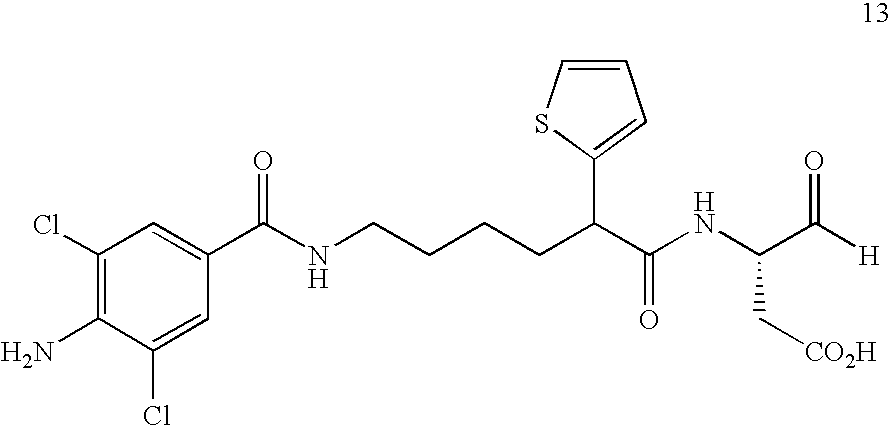
The title compound 13 was prepared according to the procedure of Example 1d–e except for using 4-amino-3,5-dichloro benzoic acid as a reagent instead of 3,4-dimethylbenzoic acid. ES (+) MS m/e=500 (M+H).

The title compound 14 was prepared according to the procedure of Example 1a–e except for using 1,3-dibromopropane as a reagent instead of 1,4-dibromobutane and quinoline-2-carboxylic acid as a reagent instead of 3,4-dimethylbenzoic acid. ES (+) MS m/e=454 (M+H).

The title compound 15 was prepared according to the procedure of Example 1a–e except for using 1,3-dibromopropane as a reagent instead of 1,4-dibromobutane and 5-phenyl-oxazole-4-carboxylic acid as a reagent instead of 3,4-dimethylbenzoic acid. ES (+) MS m/e 470 (M+H). Example 11

a) Resin 4 (300 mg, 0.12 mmol) was treated with 20% piperidine in DMF (5 mL) for 30 min at room temperature. The resin was drained followed by washing with DMF (5×5 mL) and CH2Cl2 (5×5 mL). In a separate vial containing o-tolylsulfonyl chloride (143 mg, 0.75 mmol) in CH2Cl2 (4 mL) was added diisopropylethylamine (261 μL, 1.5 mmol). The solution was added to the resin and the reaction mixture was shaken overnight at room temperature. The resin was drained and washed with CH2Cl2 (10×5 mL) to provide 16.
b) The title compound 17 was prepared according to Example 1e except for using 16 instead of 5. ES (+) MS m/e=467 (M+H).

The title compound 18 was prepared according to the procedure of Example 11a,b except for using 2-thiophenesulfonyl chloride as a reagent instead of o-tolylsulfonyl chloride. ES (+) MS m/e=459 (M+H).

The title compound 19 was prepared according to the procedure of Example 11a,b except for using 1,2,3,4-tetrahydro-2-(trifluoroacetyl)-isoquinoline-7-sulfonyl chloride as a reagent instead of o-tolylsulfonyl chloride. ES (+) MS m/e=604 (M+H).

The title compound 20 was prepared according to the procedure of Example 11a,b except for using 2-(2-pyridine)-thiophene-5-sulfonyl chloride as a reagent instead of o-tolylsulfonyl chloride. ES (+) MS m/e=535 (M+H).

The title compound 21 was prepared according to the procedure of Example 11a,b except for using 2-chloro-5-chlorosulfonyl-4-fluorobenzoic acid as a reagent instead of o-tolylsulfonyl chloride. ES (+) MS m/e=549 (M+H).

The title compound 22 was prepared according to the procedure of Example 11a,b except for using 5-chlorosulfonyl-2-hydroxy benzoic acid as a reagent instead of o-tolylsulfonyl chloride. ES (+) MS m/e 513.

a) To a suspension of sodium hydride (153 mg, 3.82 mmol, 60% in mineral oil) in THF (15 mL) was added dropwise a solution of bromo-(dimethoxy-phosphoryl)-acetic acid methyl ester (1.09 g, 4.18 mmol) in THF (5 mL). The atmosphere was changed to nitrogen and after 5 minutes at room temperature a solution of the aldehyde 231 in THF (5 mL) was added dropwise. The reaction was monitored by TLC and LC/MS; when the aldehyde had been consumed, the mixture was diluted with diethyl ether and washed with aqueous saturated ammonium chloride. The aqueous layer was extracted with diethyl ether and the combined organic phases were dried (Na2SO4) and concentrated. The crude residue was purified by flash column chromatography (SiO2: gradient 0 to 8% ethyl acetate in hexane) to yield 1.07 g (69%, ˜1:1 mixture of diastereomers by NMR) as a viscous oil. ES (+) MS m/e=446 (M+Na+). 1Carretero, J. C.; Arrayas, R. G. J. Org. Chem., 1998,63, 2993–3005.
To the ester (689 mg, 1.63 mmol) in THF (3.0 mL) was added 1.0 M aqueous LiOH (2.04 mL, 2.04 mmol). The resulting mixture was stirred at room temperature until LC/MS indicated complete hydrolysis (˜5–10 h). To the solution was added water and the pH was adjusted to 3–4 with 1 M citric acid. The mixture was extracted with ethyl acetate and the organic layer was dried (Na2SO4) and concentrated to yield 642 mg (97%) of a white solid. ES (+) MS m/e=431 (M+Na+).
To a mixture of the acid (973 mg, 2.40 mmol) and Cs2CO3 (977 mg, 3.00 mmol) in DMF (8.0 mL) was added benzyl bromide (286 μL, 2.40 mmol). After 30 minutes LC/MS indicated complete conversion to the benzyl ester. The reaction mixture was diluted with ethyl acetate/hexanes (2:3) and washed with water and brine. The organic layer was dried (Na2SO4) and concentrated to yield 1.08 g (90%) of a white solid. ES (+) MS m/e=520 (M+Na+).
To a solution of the ester (5.00 g, 10.0 mmol) in dichloromethane (20 mL) was added TFA (40 mL). After 20 minutes LC/MS indicated complete deprotection of the amine and the solvent was removed under reduced pressure. The crude oil was co-evaporated with dichloroethane (3×). Residue 24 was then dried under high vacuum and used without further purification. ES (+) MS m/e=298 (M+1).
b) A mixture of EDC (3.07 g, 16.0 mmol), HOBt (1.53 g, 10.0 mmol), diisopropylamine (4.53 mL, 2.60 mmol), and 3,4-dimethylbenzoic acid (1.65 g, 11.0 mmol) in dichloromethane (30 mL) was stirred at room temperature. After 25 minutes, the temperature was lowered to 0° C. and a solution of amine 24 (˜10.0 mmol) in dichloromethane (20 mL) was added slowly. After 1 h at 0° C. the reaction mixture was diluted with ethyl acetate and washed with 5% aqueous citric acid followed by brine. The organic layer was dried (Na2SO4) and concentrated. The crude residue was purified by flash column chromatography (SiO2: gradient 20 to 40% ethyl acetate in hexane) to yield 25 (2.92 g, 68%, ˜1:1 mixture of diastereomers) as a white solid. ES (+) MS m/e=432 (M+1).
c) A mixture of 25 (400 mg, 0.930 mmol), 4-benzyloxybenzeneboronic acid (424 mg, 1.86 mmol), Pd(dppf)Cl2 dichloromethane complex (37.2 mg, 0.0465 mmol), and 1 M aqueous K2CO3 (1.86 mL, 1.86 mmol) in dioxane was heated at 105° C. until LC/MS indicated complete conversion. After cooling to room temperature, the reaction was diluted with ethyl acetate and the phases were separated. The organic layer was dried (Na2SO4), filtered through a plug of celite, and concentrated. The ester 26 was used directly in the next step without further purification. ES (+) MS m/e=534 (M+1).
d) To a suspension of 26 (˜0.930 mmol) and Pd/C (790 mg, 0.372 mmol, Degussa type E101 NE/W, 10% Pd (dry basis) on activated-carbon, wet. Water ˜50%) in ethanol (6.2 mL) was added ammonium formate (470 mg, 7.44 mmol). The resulting mixture was heated at 70° C. until LC/MS indicated exhaustive reduction (usually ˜0.5 h). After cooling to room temperature, the mixture was filtered through a plug of celite and concentrated. The residue was dissolved in ethyl acetate and washed with aqueous 0.5 N HCl and brine. The organic layer was dried (Na2SO4) and concentrated to yield 27 (294 mg, 89% for two steps) of a crude oil that was used without further purification. ES (+) MS m/e=356 (M+1).
e) Resin 3 (400 mg, ˜0.16 mmol) was treated with 20% piperidine in DMF (5 mL) for 30 min at room temperature. The resin was drained and washed with DMF (10×5 mL). To the resin in DMF (4 mL) was added 21 (177 mg, 0.5 mmol), PyBOP (520 mg, 1.0 mmol) and diisopropylethylamine (350 μL, 4.0 mmol). The reaction mixture was shaken overnight at room temperature, drained, and then washed with DMF (5×5 mL) and CH2Cl2 (5×5 mL).
The resin was treated with THF/AcOH/acetaldehyde/TFA (4 mL, 5:1:1:0.25), shaken at room temperature for 3 h, and then filtered and washed with CH2Cl2 (2×4 mL). The combined filtrate was concentrated to dryness under reduced pressure. The resulting residue was treated with TFA/CH2Cl2 (3 mL, 1:1). The solution was stirred at room temperature for 1 h and the solvent was removed under reduced pressure. The crude residue was purified by reverse-phase HPLC to yield 28. ES (+) MS m/e=455 (M+H).

The title compound 29 was prepared according to Example 17c–e except for using 4-isopropylbenzeneboronic acid instead of 4-benzyloxybenzeneboronic acid. ES (+) MS m/e=481 (M+1).

Compound 30 was prepared according to Example 17c–e except for using pyridine-3-boronic acid instead of 4-benzyloxybenzeneboronic acid. ES (+) MS m/e=440 (M+1).

Compound 31 was prepared according to Example 17c–e except for 4′-(4,4,5,5-tetramethyl-1,3,2-dioxaborolan-2-yl)-acetanilide instead of 4-benzyloxybenzeneboronic acid. ES (+) MS m/e=496 (M+1).

Compound 32 was prepared according to Example 17c–e except for using 5-methyl-2-thiophene-boronic acid instead of 4-benzyloxybenzeneboronic acid. ES (+) MS m/e=459 (M+1).

Compound 33 was prepared according to Example 17c–e except for using 2-benzofuranboronic acid instead of 4-benzyloxybenzeneboronic acid. ES (+) MS m/e=479 (M+1).

Compound 34 was prepared according to Example 17b–e except for using benzoxazole-5-carboxylic acid as a reagent instead of 3,4-dimethylbenzoic acid and phenylboronic acid as a reagent instead of 4-benzyloxybenzeneboronic acid. ES (+) MS m/e=452 (M+1).

Compound 35 was prepared according to Examples 1a–c and 11a–c except for using methyl phenylacetate as a reagent instead of ethyl-2-thiopheneacetate and 5-chlorosulfonyl-2-hydroxy benzoic acid as a reagent instead of o-tolylsulfonyl chloride. ES (+) MS m/e=507 (M+1).

L′ is part of the linker L that includes —C(═O)NH— in this illustration.
General Procedure for Synthesis of Aspartyl Aldehyde Caspase-1 Inhibitors on Solid Support
The Fmoc-aldehyde resin X (approximately 0.25 mmol/g resin) was prepared using the procedure of Karanewsky et al. in WO 00/23421. A portion of this resin (300 mg, 0.075 mmol) was weighed into a vessel for solid-phase reactions. A solution (3 mL) of 20% piperidine in DMF was added, and the mixture was agitated for 30 minutes on an orbital shaker. The solvent was then removed by filtration, and the resin was washed with 3×4 mL DMF, then with 3×4 mL dichloromethane, then with 3×4 mL diethyl ether. The resin was dried briefly by continuing the vacuum filtration 15 minutes.
To the reaction vessel were added DMF (3 mL), the Fmoc-protected carboxylic acid linker (0.150 mmol, 2 eq), DIEA (78 μL, 0.45 mmol, 6.0 eq), and PyBoP (117 mg, 0.225 mmol, 3 eq). The vessel was capped and agitated overnight. The solvent was then removed by vacuum filtration, and the resin washed as before. The resin was then treated as before with 20% piperidine in DMF, to cleave the Fmoc protecting group from the linker, followed by filtration and washing of the resin as before.
To the vessel were then added DMF (3 mL), the P4 carboxylic acid (0.150 mmol, 2 eq), DIEA (78 mL, 0.45 mmol, 6.0 eq), and PyBoP (117 mg, 0.225 mmol, 3 eq). The vessel was then capped and agitated overnight, followed by filtration and washing of the resin as before.
A clevage solution consisting of THF (15 mL), acetic acid (3 mL), trifluoroacetic acid (0.75 mL), and acetaldehyde (3 mL) was freshly prepared. A 3 mL portion of this solution was added to the reaction vessel, and the vessel was tightly capped (to prevent leakage under pressure of the isobutylene liberated by the reaction), and the vessel agitated for 2 hours. The solvent was then collected by filtration, and the resin washed with dichloromethane. The combined organic solution was then concentrated by rotary evaporation followed by 30 minutes under high vacuum, yielding the free aldehyde with the t-butyl ester intact.
The t-butyl ester was suspended in dichloromethane (1 mL), and trifluoroacetic acid (1 mL) was added. After 30 minutes, the reactions were concentrated and purified by reverse phase HPLC in acetonitrile/water, providing the desired products as the trifluoroacetate salts.

Compound 36 was prepared starting with 302 mg resin, 54.3 mg Fmoc-6-aminohexanoic acid, 118 mg PyBoP, and 78 μL DIEA for the coupling of the linker onto the resin. The coupling of the tricyclic acid was accomplished using 38.1 mg of the acid, 118 mg PyBoP, and 78 μL DIEA. This procedure resulted in 11.8 mg of purified product as the TFA salt.

Compound 37 was prepared starting with 297 mg resin, 46.5 mg linker acid, 126 mg PyBOP, and 78 μL DIEA for the coupling of the linker onto the resin. The synthesis of the N-Fmoc-5-aminomethyl-2-thiphenylacetic acid has been described elsewhere. The coupling of the tricyclic acid was accomplished using 38.4 mg of the acid, 118 mg PyBoP, and 78 μL DIEA. This procedure resulted in 12.1 mg of purified product as the TFA salt.

Compound 38 was prepared starting with 304 mg resin, 65 mg linker acid, 121 mg PyBoP, and 78 μL DIEA for the coupling of the linker onto the resin. The synthesis of the N-Fmoc-6-amino-2-(2-thienyl)hexanoic acid has been previously described. The coupling of the tricyclic acid was accomplished using 40.3 mg of the acid, 118 mg PyBoP, and 78 μL DIEA. This procedure resulted in 7.0 mg of purified product as the TFA salt.
The effectiveness of compounds against the activity of human recombinant caspase-1 (BIOMOL Research Laboratories, Inc.) was measured using fluorescent based assays. 3 nM active enzyme was added to test compounds dissolved in DMSO and incubated at room temperature for 30 minutes. The tetrapeptide substrate (Ac-Trp-Glu-His-Asp-AFC, Alexis Biochemicals) was added to a final concentration of 4 μM to initiate the reaction, bringing the final reaction volume to 50 μL. Preferred caspase-1 reaction buffer contained 25 mM HEPES pH 7.4, 0.1% CHAPS, 50 mM KCl and 5 mM β-mercaptoethanol (β-ME). Caspase activity was monitored using Molecular Devices' Microplate Spectrofluorometer Gemini XS over 15-minutes at room temperature. IC50 values were calculated using direct fits of the data to a 4-parameter fit using the computer application SOFTmax PRO. Ki(apparent) values were calculated according to Kuzmic et al. 2000 (Analytical Biochem. 286:45–50).
Blood (obtained from the Stanford blood Bank) was diluted 1:1 in sterile PBS, mixed by inversion, and overlayed over 1 volume of Ficoll in a sterile centrifuge tube. After centrifuging at ˜400 g for 30 min at ambient temperature the peripheral blood mononuclear cell (PBMC) layer was removed and transferred to a sterile centrifuge tube. Cells were washed twice with PBS and resuspended in RPMI 1640 media containing 10% FBS (Gibco 11875-093). Mononuclear cells were counted and diluted to a final concentration of 1.2×10⁶ cells/mL. 100 μL (˜1.2×10⁵ cells) of the cell suspension was added to each well in a 96 well plate, incubated at 37° C. for 4 hr, and supernatant containing nonadherent cells removed and replaced with 170 μL fresh media. Serial dilutions of test compounds were added to the adherent cells so the final concentration of DMSO remained constant at 0.2%, and 10 μl of LPS (Sigma, L4391) immediately added to a final concentration of 0.5 ng/ml. Plates are then incubated an additional ˜18 hr at 37° C., at which point 170 μl of supernatant (containing secreted IL-1β) was removed. IL-1β protein levels in the supernatant (diluted as necessary) were quantitated with an ELISA based assay (MAB601, monoclonal anti-human IL-1β antibody, and BAF201, biotinylated anti-human IL-1β antibody; both used according to R+D Systems supplied protocol).
Human caspase-1 is a cysteine protease that is active as a tetramer composed of two heterodimers. Each heterodimer contains a large subunit and a small subunit, which are also referred to as p20 and p10, respectively. The sequence of the caspase-1 precursor is shown as SEQ ID NO:1. Residues 1–119 of SEQ ID NO:1 correspond to the propeptide region and residues 120–404 correspond to the mature chain. The p20 and p10, subunits, corresponding to residues 120–297 of SEQ ID NO:1 (large subunit) and residues 317–404 of SEQ ID NO:1 (small subunit), respectively, can be derived from autocatalysis of either the caspase-1 precursor or caspase-1 mature chain. Alternatively, as described below, the large and small subunits of caspase-1 may each be expressed separately, and then recombined to form the tetramer.
- MADKVLKEKR KLFIRSMGEG TINGLLDELL QTRVLNKEEM EKVKRENATV MDKTRALIDS VIPKGAQACQ ICITYICEED SYLAGTLGLS ADQTSGNYLN MQDSQGVLSS FPAPQAVQDN PAMPTSSGSE GNVKLCSLEE AQRIWKQKSA EIYPIMDKSS RTRLALIICN EEFDSIPRRT GAEVDITGMT MLLQNLGYSV DVKKNLTASD MTTELEAFAH RPEHKTSDST FLVFMSHGIR EGICGKKHSE QVPDILQLNA IFNMLNTKNC PSLKDKPKVI IIQACRGDSP GVVWFKDSVG VSGNLSLPTT EEFEDDAIKK AHIEKDFIAF CSSTPDNVSW RHPTMGSVFI GRLIEHMQEY ACSCDVEEIF RKVRFSFEQP DGRAQMPTTE RVTLTRCFYL FPGH SEQ ID NO:1
An inactive variant of caspase-1 having the active site cysteine (corresponding to C285 in SEQ ID NO:1) mutated to alanine in each of the large subunits was also produced. The sequence of the large subunit containing the active site mutation is shown here as SEQ ID NO:2. Both wildtype and the C285A mutant of human caspase-1 are referred herein as “human caspase-1 ”. Mutagenesis of the large subunit, and expression and refolding of wild-type and mutant subunits are described herein.
- NPAMPTSSGS EGNVKLCSLE EAQRIWKQKS AEIYPIMDKS SRTRLALIIC NEEFDSIPRR TGAEVDITGM TMLLQNLGYS VDVKKNLTAS DMTTELEAFA HRPEHKTSDS TFLVFMSHGI REGICGKKHS EQVPDILQLN AIFNMLNTKN CPSLKDKPKV IIIQAARGDS PGVVWFKD SEQ ID NO:2
The active site cysteine in the large subunit of caspase-1 was mutated by a PCR reaction performed with the Quick Change Kit from Stratagene using the manufacturer's protocol. In short, PCR reactions contained a pRSET expression plasmid encoding the large subunit, a forward primer (SEQ ID NO:3) and a reverse primer (SEQ ID NO:4). Specifically, 2 μL of the plasmid was combined in a reaction mixture with 1.25 μL of each of two primers, along with 1 μL 2.5 mM dNTPs, 5 μL 10X buffer, 39.5 μL water, and 1 μL pfu-turbo polymerase. Sequences of SEQ ID NO:3 and SEQ ID NO:4 are as shown.
- CATCATCCAGGCCGCCCGTGGTGACAGCC SEQ ID NO:3
- GGCTGTCACCACGGGCGGCCTGGATGATG SEQ ID NO:4
The PCR reaction was first incubated at 95° C. for 1 min, and then allowed to undergo 16 cycles of: 95° C. for 30 sec, 55° C. for 60 sec, 68° C. for 780 sec. After PCR, the product was digested with 1 μL Dpn-1 at 37° C. for 1 hr, and 1 μL of the digested mixture was used to transform E. coli. The following procedure was used for the transformation. Ultracompetent Gold XL1-Blue cells (Stratagene) were thawed on ice, and 50 μL of cells were added to a chilled reaction tube containing the 1 μL digested DNA. The resulting mixture of cells and DNA was kept on ice for 30 min, subjected to heat shock for 45 sec, and then allowed to recover on ice for 2 min. Next, 0.5 mL of SOC (media) was added to the tube, which was then incubated for 1 hr at 37° C. A portion of the transformed cells (250 μL) was spread on plates containing 100 μg/mL, and the plates were incubated overnight at 37° C. Single, isolated colonies were picked, and grown overnight in 3 mL cultures. Mutagenized plasmid DNA, resulting from in vivo recombination and subsequent amplification, was isolated from the cells by Qiagen DNA miniprep kits. Plasmid DNA was sequenced to verify that the correct plasmid encoding the mutated large subunit of caspase-1 was obtained.
The small subunit, large subunit, and mutated large subunit of human caspase-1 were each expressed from a separate plasmid as follows. A plasmid encoding a caspase-1 subunit was used to transform bacterial expression cells. The transformed cells were grown overnight in a small culture; subsequently, a portion of the small culture was used to inoculate a large culture of 1.5 L. The 1.5 L culture was grown until OD=1.0, at which time the cells were induced with 1 mM IPTG and allowed to grow for 3 hrs. The cells were harvested and inclusion bodies were isolated therefrom as follows. Cells were centrifuged at 5000 rpm for 15 min, washed once with 500 mL 1X PBS, and then centrifuged again. The cell pellet was resuspended in 20 mL of 50 mM HEPES pH 8.0, 300 mM NaCl, 1 M guanidine, 5 mM DTT. After micofluidizing the suspension 4 times, triton-x100 was added to 1% of the final volume, and mixed thoroughly. The resulting mixture was incubated on ice for 5 min, and then centrifuged at 16,000 rpm in a SS-34 rotor for 20 min. After removal of the supernatant, the pellet containing the inclusion bodies was resuspended in 25 mL of 50 mM HEPES pH 8.0, 300 mM NaCl, 1 M guanidine, 5 mM DTT, 1% triton x-100, using sonication until the pellet was completely dissolved. The resuspended mixture was centrifuged at 16,000 rpm for 15 min, and the pellet isolated by removal of the supernatant. Subsequently, the pellet was resuspended in 25 mL of 50 mM HEPES pH 8.0, 300 mM NaCl, 1 M guanidine, 5 mM DTT without triton x-100, using sonication until the pellet was completely dissolved. The resuspended mixture was centrifuged at 16,000 rpm for 15 min. Again, the pellet was isolated, resuspended in the 50 mM HEPES pH 8.0, 300 mM NaCl, 1 M guanidine, 5 mM DTT without triton x-100, and centrifuged at 16,000 rpm. The supernatant was removed, and the pellet resuspended a final time in 10 mL 6 M guanidine, 20 mM DTT. The resulting 6 M guanidine suspension was sonicated until the pellet was completely dissolved, and centrifuged at 16,000 rpm for 15 min. Protein was located in the supernatant. The concentration of protein was measured, and the protein was aliquoted into 6 mg portions, which were frozen.
Protocol 1.
The 6M guanidine-HCl-solubilized fractions of caspase-1 (6 mg of p20 and 3 mg of p10) were combined in a 100-ml beaker. After stirring the fractions vigorously for approximately 30 seconds, 50 mls of renaturation buffer was added. The renaturation buffer comprises: 50 mM HEPES, pH 8.0 (although HEPES or Tris-HCL at pH 7–8.5 produces comparable results); 100 mM NaCl; 10% sucrose; 0.1% CHAPS; 10 mM DTT; and inhibitor resulting in a final inhibitor concentration of 20 μM. The resulting solution was stirred at room temperature for 6–18 hours, spun down in a Sorvall rotor for 30 minutes at 17,000 rpm to remove precipitates, and the clear supernatent was dialyzed overnight at 4° C. in a 10-kD MWCO membrane against 4 L of buffer composed of 50 mM sodium acetate pH 5.9, 50 mM NaCl, 5% glycerol and 4 mM DTT. Following dialysis, the preparation was centrifuged and the protein was either concentrated if no further purification was warranted, or purified on an S Sepharose column as the non-proteolyzed complex.
Protocol 2.
This method is the same as protocol 1 except that the renaturation buffer comprises: 50 mM HEPES, pH 8.0 (although HEPES or Tris-HCL at pH 7–8.5 produces comparable results); 100 mM NaCl; 1 M non-detergent sulfobetaine 201 [NDSB-201]; 10 mM DTT; and inhibitor resulting in a final inhibitor concentration of 20 μM.
Renatured caspase-1 was purified in a single step on an S Sepharose column. The protein was loaded onto a column that was preequilibrated with a buffer composed of 50 mM sodium acetate pH 5.9; 50 mM NaCl; and 5% glycerol. The column was washed with the equilibration buffer, and the intact caspase-1 p10/p20 complex was eluted from the column with increasing concentrations of NaCl (salt gradient between 50 and 1000 mM NaCl in a buffer containing 50 mM sodium acetate pH 5.9 and 5% glycerol). Because only the complex composed of non-proteolyzed subunits binds to S Sepharose, it can be easily separated from the partially proteolyzed population of protein molecules. If excess p20 is present, p20 may also bind to S Sepharose but this does not complicate the purification because p20 elutes at a higher salt concentration than the complex.
Final purified or unpurified samples were concentrated to 2–8 mg/ml, and snap-frozen in 50-μM aliquots in dry-ice/ethanol baths. Protein is stored at −80° C. The protein buffer composed of 50 mM sodium acetate pH 5.9, 50–100 mM sodium chloride, 4 mM DTT and 5% glycerol.
Drops are set up on a cover slip with 1 μl each of a protein prep at 2–5 mg/ml and mother liquor containing 0.1 M PIPES pH 6.0, 2 mM magnesium chloride, 3 mM sodium azide, 10 mM DTT, 70–300 mM ammonium sulfate or lithium sulfate, and 20–30% polyethylene glycol 2000 [PEG 2000] monomethyl ether. Crystals are grown on 24-well Falcon tissue-culture plates over a reservoir containing 300 μl mother liquor by hanging-drop vapor diffusion at 4° C. Crystals appear within 12–36 hrs of setting up plates and grow to a diffraction-quality size within 1–5 days.
Mutant caspase 1 was renatured using protocol 2 (Example 32). Crystals were produced in 1.5–2.0 M sodium malonate pH 7 and diffraction-quality crystals of apo human caspase-1 grew by hanging-drop vapor diffusion at 4° C. within a week.
Claims (21)
1. A compound of the formula

wherein:
R1 is chosen from optionally substituted aryl, optionally substituted aralkyl, optionally substituted heteroaryl, and optionally substituted heteroaralkyl;
L is a linker selected from the group consisting of —(CH2)m—O—(CH2)n—; —(CH2)m—NR—(CH2)m—; —(CH2)m—NRCONR—(CH2)n—; (CH2)m—NRCOO—(CH2)n—; —(CH2)m—CONR—(CH2)n—; —(CH2)m—NRCO—(CH2)n—; —(CH2)m—NRSO2—(CH2)n—; —(CH2)m—CO—(CH2)n—; —(CH2)m—NRCONRSO2—(CH2)n—; —(CH2)m—NRCONRCO—(CH2)n—; —(CH2)m—SO2—(CH2)n—; —(CH2)m—SO2CH2CO—(CH2)n—; —(CH2)m—SO2NR—(CH2)n—; —(CH2)m—SCH2CO—(CH2)n— and —Z—(CH2)m—Ar—(CH2)n— where Z is —C(═O)NH—, —NHC(═O)—, or —SO2NH—, Ar is a 5 membered heroarylene, m and n are each 0, 1, 2, 3, 4, or 5, and wherein R is each independently hydrogen, C1–C5 alkyl, C1–C5 hydroxyalkyl, or C1–C5 alkylhalide;
R2 is chosen from H, optionally substituted aryl, optionally substituted aralkyl, optionally substituted heteroaryl, and optionally substituted heteroaralkyl; and
Y is

or single stereoisomers, mixtures of stereoisomers, or the pharmaceutically acceptable salts, amides, or esters thereof.
2. The compound as defined in claim 1 , wherein L is a linker that places the R1 group at a distance of about 6 Å–15 Å from the —CH(R2)—CO—NH—Y group.
3. The compound defined in claim 2 , wherein the distance is about 7 Å–12 Å.
4. The compound defined in claim 2 , where the distance is about 8 Å–10 Å.
5. The compound of claim 1 where L is —(CH2)m—CONR—(CH2)n— and m and n are each 0, 1, 2, 3, or 5.
6. The compound of claim 1 where L is —(CH2)m—NRCO—(CH2)n— and m and n are each 0, 1, 2, 3, or 5.
7. The compound of claim 1 where L is —(CH2)m—NRSO2—(CH2)n— and m and n are each 0, 1, 2, 3, or 5.
8. The compound of claim 1 where L is —(CH2)m—SO2NR—(CH2)n— and m and n are each 0, 1, 2, 3, or 5.
9. The compound of claim 1 wherein L is —Z—(CH2)m—Ar—(CH2)n— where Z is —C(═O)NH—, —NHC(═O)—, or —SO2NH—; m and n are each 0, 1, 2, or 3; and Ar is a 5 membered heroarylene.
10. The compound defined in claim 1 selected from

wherein:
R1 is chosen from optionally substituted aryl, optionally substituted aralkyl, optionally substituted heteroaryl, and optionally substituted heteroaralkyl;
R2 is chosen from H, optionally substituted aryl, optionally substituted aralkyl, optionally substituted heteroaryl, and optionally substituted heteroaralkyl;
X is —(CO)— or —(SO2)—; and
X is —(CO)— or —(SO2)—; and
n is 0 or 1;
or single stereoisomers, mixtures of stereoisomers, or the pharmaceutically acceptable salts, amides, or esters thereof.
11. The compound of claim 10 , wherein X is —(CO)—.
12. The compound of claim 10 , wherein n is 1.
13. The compound of claim 10 , wherein R1 is optionally substituted aryl or optionally substituted heteroaryl.
14. The compound of claim 11 , wherein R1 is chosen from optionally substituted phenyl, optionally substituted naphthyl, optionally substituted pyridinyl, optionally substituted quinolinyl, optionally substituted thiophenyl, optionally substituted oxazolyl, optionally substituted 2,3-dihydro-benzo[b]thiophen-2-yl, and optionally substituted quinoxalinyl.
15. The compound defined in claim 12 , where R1 is dimethylphenyl, tolyl methyl, quinoxalinyl, tolyl cyclopentyl, morpholinylpyridyl, napthalenyl, chloro benzo[b]thienyl, amino dichlorophenyl, quinolinyl, phenyloxazolyl, tolyl, thienyl, trifluoro acetyl tetrahydro isoquinolinyl, pyridyl thienyl, fluoro chloro carboxy phenyl, hydroxy carboxy phenyl, benzooxazolyl, or quinoxalinyl amino phenyl.
16. The compound of claim 14 , wherein R2 is chosen from optionally substituted thiophenyl, optionally substituted phenyl, optionally substituted pyridinyl, and optionally substituted benzofuranyl.
17. The compound of claim 16 , wherein R2 is selected from the group consisting of H, thienyl, preferably 2-thienyl, alkyl thienyl, preferably 3-methyl 2-thienyl, phenoxy, preferably 4-phenoxy, phenyl, alkylphenyl, preferably 4-isopropyl phenyl, acetylaminophenyl, preferably 4-acetylaminophenyl, pyridyl, preferably 3-pyridyl, and benzooxazole.
18. The compound of claim 1 selected from the group consisting of:


19. The compound defined in claim 18 selected from the group consisting of

20. A pharmaceutical composition comprising a therapeutically effective amount of a compound of claim 1 ; and a pharmaceutically acceptable excipient.
21. A method of treating inflammation in an animal having a disease or condition that would benefit from treatment by administration of a caspase-1 inhibitor, comprising administering to said animal a therapeutically effective amount of compound of claim 1 .
Priority Applications (1)
| Application Number | Priority Date | Filing Date | Title |
|---|---|---|---|
| US10/456,458 US7115654B2 (en) | 2002-06-05 | 2003-06-05 | Caspase-1 inhibitors and methods for their use |
Applications Claiming Priority (2)
| Application Number | Priority Date | Filing Date | Title |
|---|---|---|---|
| US38650102P | 2002-06-05 | 2002-06-05 | |
| US10/456,458 US7115654B2 (en) | 2002-06-05 | 2003-06-05 | Caspase-1 inhibitors and methods for their use |
Publications (2)
| Publication Number | Publication Date |
|---|---|
| US20040048895A1 US20040048895A1 (en) | 2004-03-11 |
| US7115654B2 true US7115654B2 (en) | 2006-10-03 |
Family
ID=29736170
Family Applications (1)
| Application Number | Title | Priority Date | Filing Date |
|---|---|---|---|
| US10/456,458 Expired - Fee Related US7115654B2 (en) | 2002-06-05 | 2003-06-05 | Caspase-1 inhibitors and methods for their use |
Country Status (3)
| Country | Link |
|---|---|
| US (1) | US7115654B2 (en) |
| AU (1) | AU2003238948A1 (en) |
| WO (1) | WO2003103599A2 (en) |
Families Citing this family (2)
| Publication number | Priority date | Publication date | Assignee | Title |
|---|---|---|---|---|
| CN102639700A (en) | 2009-09-30 | 2012-08-15 | 哈佛大学校长及研究员协会 | Methods for modulation of autophagy through the modulation of autophagy-enhancing gene products |
| US9956260B1 (en) | 2011-07-22 | 2018-05-01 | The J. David Gladstone Institutes | Treatment of HIV-1 infection and AIDS |
Citations (7)
| Publication number | Priority date | Publication date | Assignee | Title |
|---|---|---|---|---|
| WO1999056765A1 (en) | 1998-05-05 | 1999-11-11 | Warner-Lambert Company | SUCCINAMIDE INHIBITORS OF INTERLEUKIN-1β CONVERTING ENZYME |
| US6153591A (en) | 1998-03-16 | 2000-11-28 | Cytovia, Inc. | Dipeptide caspase inhibitors and the use thereof |
| US6204261B1 (en) | 1995-12-20 | 2001-03-20 | Vertex Pharmaceuticals Incorporated | Inhibitors of interleukin-1β Converting enzyme inhibitors |
| WO2002094263A2 (en) | 2001-05-23 | 2002-11-28 | Vertex Pharmaceuticals Incorporated | Caspase inhibitors and uses thereof |
| WO2003024955A2 (en) | 2001-09-18 | 2003-03-27 | Sunesis Pharmaceuticals, Inc. | Small molecule inhibitors of caspases |
| US6566338B1 (en) | 1999-10-12 | 2003-05-20 | Cytovia, Inc. | Caspase inhibitors for the treatment and prevention of chemotherapy and radiation therapy induced cell death |
| US20040048797A1 (en) * | 2002-04-19 | 2004-03-11 | Karen Miller | Regulation of TNF-alpha |
-
2003
- 2003-06-05 WO PCT/US2003/018021 patent/WO2003103599A2/en not_active Ceased
- 2003-06-05 US US10/456,458 patent/US7115654B2/en not_active Expired - Fee Related
- 2003-06-05 AU AU2003238948A patent/AU2003238948A1/en not_active Abandoned
Patent Citations (8)
| Publication number | Priority date | Publication date | Assignee | Title |
|---|---|---|---|---|
| US6204261B1 (en) | 1995-12-20 | 2001-03-20 | Vertex Pharmaceuticals Incorporated | Inhibitors of interleukin-1β Converting enzyme inhibitors |
| US6153591A (en) | 1998-03-16 | 2000-11-28 | Cytovia, Inc. | Dipeptide caspase inhibitors and the use thereof |
| WO1999056765A1 (en) | 1998-05-05 | 1999-11-11 | Warner-Lambert Company | SUCCINAMIDE INHIBITORS OF INTERLEUKIN-1β CONVERTING ENZYME |
| US6566338B1 (en) | 1999-10-12 | 2003-05-20 | Cytovia, Inc. | Caspase inhibitors for the treatment and prevention of chemotherapy and radiation therapy induced cell death |
| WO2002094263A2 (en) | 2001-05-23 | 2002-11-28 | Vertex Pharmaceuticals Incorporated | Caspase inhibitors and uses thereof |
| WO2003024955A2 (en) | 2001-09-18 | 2003-03-27 | Sunesis Pharmaceuticals, Inc. | Small molecule inhibitors of caspases |
| US6878743B2 (en) * | 2001-09-18 | 2005-04-12 | Sunesis Pharmaceuticals, Inc. | Small molecule inhibitors of caspases |
| US20040048797A1 (en) * | 2002-04-19 | 2004-03-11 | Karen Miller | Regulation of TNF-alpha |
Non-Patent Citations (7)
| Title |
|---|
| Alnerni et al., (1996) Cell, 87:171. |
| Elford et al., (1995) British Journal of Pharmacology 115:601-606. |
| Ghayur et al. (1997) Nature 386:619-623. |
| International Search Report for PCT/US03/18021, mailed on May 27, 2004, 4 pages. |
| Miura et al., (1993) Cell, 75:653-660. |
| Relton et al., (1992) Brain Research Bulletin, 29:243-246. |
| Thornberry et al., (1997) J. Biol. Chem. 272:17907-17911. |
Also Published As
| Publication number | Publication date |
|---|---|
| AU2003238948A1 (en) | 2003-12-22 |
| US20040048895A1 (en) | 2004-03-11 |
| WO2003103599A2 (en) | 2003-12-18 |
| WO2003103599A3 (en) | 2004-07-08 |
| AU2003238948A8 (en) | 2003-12-22 |
Similar Documents
| Publication | Publication Date | Title |
|---|---|---|
| ES2427166T3 (en) | Novel tricyclic heterocyclic compound | |
| US6358992B1 (en) | Method of inhibiting neoplastic cells with indole derivatives | |
| JP4676676B2 (en) | Heterocyclic dicarbamides as caspase inhibitors | |
| US6069156A (en) | Indole derivatives as cGMP-PDE inhibitors | |
| KR100438633B1 (en) | N-(3-benzofuranyl)urea derivatives | |
| JP2002541237A (en) | Caspase inhibitors and uses thereof | |
| CN100357283C (en) | Methionyl aminopeptidase inhibitor | |
| JP2002539183A (en) | Substituted 2-aminobenzamide caspase inhibitors and uses thereof | |
| CA2401358A1 (en) | Diacid-substituted heteroaryl derivatives as matrix metalloproteinase inhibitors | |
| JPS62103052A (en) | Novel hydroxamic acid | |
| JP2002506829A (en) | Apoptosis inhibitors of dipeptides and their uses | |
| JP2012111777A (en) | Pharmaceutically active sulfonyl amino acid derivative | |
| JPH10510536A (en) | 2-Substituted 1,2,5-thiadiazolidine-3-one 1,1-dioxides and compositions thereof | |
| EP0173441B1 (en) | Amino acid derivatives having anti-tumor activity and compositions containing them | |
| JPH06500085A (en) | Benzimidazole, its manufacture and use | |
| ES2353309T3 (en) | HYDRAZIDS OF THE PIRROLOPIRIDIN-2-CARBOXYL ACID AS INHIBITORS OF GLUCOGEN PHOSPHORILASE. | |
| JPH10316662A (en) | Substituted 6-and 7-aminotetrahydroisoquinolinecarboxylic acid | |
| CN115353508B (en) | 5-pyridine-1H-indazole compound, pharmaceutical composition and application | |
| US20120258960A1 (en) | Novel multifunctional peptidase inhibitors, especially for medical use | |
| JP2007501267A (en) | Novel imidazole derivatives, their production and their use as pharmaceuticals | |
| AU713863B2 (en) | Aryl acrylic acid derivatives useful as protein tyrosine phosphatase inhibitors | |
| US20080146811A1 (en) | Compounds and Methods For Treatment of Thrombosis | |
| US20040048895A1 (en) | Caspase-1 inhibitors and methods for their use | |
| CN111875615A (en) | Methoxybenzyl urea compound and application thereof | |
| JPH08505877A (en) | Fused heterocyclic glutamic acid derivatives as antiproliferative agents |
Legal Events
| Date | Code | Title | Description |
|---|---|---|---|
| AS | Assignment |
Owner name: SUNESIS PHARMACEUTICALS, INC., CALIFORNIA Free format text: ASSIGNMENT OF ASSIGNORS INTEREST;ASSIGNORS:ALLEN, DARIN;FAHR, BRUCE;OSLOB, JOHAN;AND OTHERS;REEL/FRAME:014017/0120;SIGNING DATES FROM 20030908 TO 20030909 |
|
| REMI | Maintenance fee reminder mailed | ||
| LAPS | Lapse for failure to pay maintenance fees | ||
| STCH | Information on status: patent discontinuation |
Free format text: PATENT EXPIRED DUE TO NONPAYMENT OF MAINTENANCE FEES UNDER 37 CFR 1.362 |
|
| FP | Lapsed due to failure to pay maintenance fee |
Effective date: 20101003 |