US7107502B2 - Diagnostic method for detection of multiple defects in a Level Sensitive Scan Design (LSSD) - Google Patents
Diagnostic method for detection of multiple defects in a Level Sensitive Scan Design (LSSD) Download PDFInfo
- Publication number
- US7107502B2 US7107502B2 US10/767,046 US76704604A US7107502B2 US 7107502 B2 US7107502 B2 US 7107502B2 US 76704604 A US76704604 A US 76704604A US 7107502 B2 US7107502 B2 US 7107502B2
- Authority
- US
- United States
- Prior art keywords
- scan
- scan chain
- latch
- chain circuit
- loading
- Prior art date
- Legal status (The legal status is an assumption and is not a legal conclusion. Google has not performed a legal analysis and makes no representation as to the accuracy of the status listed.)
- Expired - Fee Related, expires
Links
- 230000007547 defect Effects 0.000 title description 50
- 238000013461 design Methods 0.000 title description 12
- 238000002405 diagnostic procedure Methods 0.000 title description 5
- 238000001514 detection method Methods 0.000 title 1
- 238000000034 method Methods 0.000 claims description 65
- 238000012360 testing method Methods 0.000 claims description 46
- 238000004590 computer program Methods 0.000 claims description 5
- 230000002950 deficient Effects 0.000 claims 10
- 230000008878 coupling Effects 0.000 claims 3
- 238000010168 coupling process Methods 0.000 claims 3
- 238000005859 coupling reaction Methods 0.000 claims 3
- NEWKHUASLBMWRE-UHFFFAOYSA-N 2-methyl-6-(phenylethynyl)pyridine Chemical compound CC1=CC=CC(C#CC=2C=CC=CC=2)=N1 NEWKHUASLBMWRE-UHFFFAOYSA-N 0.000 abstract 1
- 238000010586 diagram Methods 0.000 description 13
- 230000008569 process Effects 0.000 description 7
- 230000000644 propagated effect Effects 0.000 description 5
- 238000013500 data storage Methods 0.000 description 3
- 230000007704 transition Effects 0.000 description 3
- 101100123053 Arabidopsis thaliana GSH1 gene Proteins 0.000 description 2
- 230000006870 function Effects 0.000 description 2
- 238000010998 test method Methods 0.000 description 2
- 230000004075 alteration Effects 0.000 description 1
- 239000000872 buffer Substances 0.000 description 1
- 238000006243 chemical reaction Methods 0.000 description 1
- 238000011161 development Methods 0.000 description 1
- 238000010348 incorporation Methods 0.000 description 1
- 230000010365 information processing Effects 0.000 description 1
- 238000004519 manufacturing process Methods 0.000 description 1
- 239000000463 material Substances 0.000 description 1
- 238000012986 modification Methods 0.000 description 1
- 230000004048 modification Effects 0.000 description 1
- 230000000638 stimulation Effects 0.000 description 1
- 238000006467 substitution reaction Methods 0.000 description 1
- 238000000844 transformation Methods 0.000 description 1
- 230000009466 transformation Effects 0.000 description 1
Images


Classifications
-
- G—PHYSICS
- G01—MEASURING; TESTING
- G01R—MEASURING ELECTRIC VARIABLES; MEASURING MAGNETIC VARIABLES
- G01R31/00—Arrangements for testing electric properties; Arrangements for locating electric faults; Arrangements for electrical testing characterised by what is being tested not provided for elsewhere
- G01R31/28—Testing of electronic circuits, e.g. by signal tracer
- G01R31/317—Testing of digital circuits
- G01R31/3181—Functional testing
- G01R31/3185—Reconfiguring for testing, e.g. LSSD, partitioning
- G01R31/318533—Reconfiguring for testing, e.g. LSSD, partitioning using scanning techniques, e.g. LSSD, Boundary Scan, JTAG
- G01R31/318536—Scan chain arrangements, e.g. connections, test bus, analog signals
-
- G—PHYSICS
- G01—MEASURING; TESTING
- G01R—MEASURING ELECTRIC VARIABLES; MEASURING MAGNETIC VARIABLES
- G01R31/00—Arrangements for testing electric properties; Arrangements for locating electric faults; Arrangements for electrical testing characterised by what is being tested not provided for elsewhere
- G01R31/28—Testing of electronic circuits, e.g. by signal tracer
- G01R31/317—Testing of digital circuits
- G01R31/3181—Functional testing
- G01R31/3185—Reconfiguring for testing, e.g. LSSD, partitioning
- G01R31/318533—Reconfiguring for testing, e.g. LSSD, partitioning using scanning techniques, e.g. LSSD, Boundary Scan, JTAG
- G01R31/318544—Scanning methods, algorithms and patterns
Definitions
- This invention relates to a method of diagnostic testing of digital circuitry and more specifically to testing and diagnosing scan chain failures to failing data retaining circuit elements.
- LSSD Level Sensitive Scan Design
- FIG. 1 illustrates a block diagram of an exemplary LSSD design circuit 100
- the exemplary LSSD design circuit 100 includes multiple scan chains 110 interfacing with the logic circuitry 120 .
- FIG. 2 is a block diagram of a scan chain 110 .
- the scan chain 110 generally includes a set of shift register latch blocks or data storage elements 210 connected in a series configuration.
- latch blocks 210 incorporate a design that allows data to be loaded into a shift register through an alternate data input.
- This alternate input is generally used for circuit test and stimulation and is sometimes referred to as a “scan input” since it allows a pre-defined state to be “scanned” into the sequential circuit using these register latch blocks.
- Loading a latch block with a particular value allows, for example, placing a sequential logic circuit into a desired state.
- FIG. 3 is a block diagram of a typical latch block 210 .
- the latch block 210 or shift register latch includes a pair of latches L 1 and L 2 where L 1 310 is the “master” latch and L 2 318 is the “slave” latch.
- the L 1 latch or master latch 310 has two data ports, a system input port SYS 302 and an alternate data input port SCAN 306 and may be updated by either a functional clock C 1 304 or a scan clock A 308 .
- shift register block 210 In normal operation of the shift register block 210 , data is provided on the system input port SYS 302 and this data value is selected for storage into latch L 1 310 upon a transition of the functional clock C 1 304 from low to high.
- the shift register block 210 is also able to select for storage data from the alternate data input port SCAN 306 by providing a data value on the alternate data input port SCAN 306 and then causing this value to be stored into latch L 1 310 upon a transition of the scan clock “a” 308 . Once a data value is stored in L 1 310 , this value is available, after a propagation delay, at the L 1 Output 312 .
- the logical value that is present on the L 1 Output 312 is stored into latch L 2 318 upon a transition of shift clock “b” 314 (or shift clock c 2 ) from a logical low level to a logical high level. After the L 1 Output 312 is stored into the L 2 latch or slave latch 318 that logic value is available, after a propagation delay, on the L 2 output 320 .
- a scan chain provides access to the internal parts of a chip and its function is critical in testing a chip.
- scan chain fails can be divided into two categories: DC defects and broken.
- a broken scan chain is one that will not operate under any conditions (e.g., voltage, frequency, temperature).
- a scan chain containing DC defects will only operate under certain conditions (e.g., only between 1.2V and 1.3V).
- the condition or conditions under which a scan chain operates or fails will be referred to as the “operating region” and “failing region”, respectively.
- One method provides some success in diagnosing and locating a first failed register latch in a scan chain. This method contains the steps of loading the scan chain in the operating region, and unloading the scan chain in the failing region.
- Another method provides some success in diagnosing and locating a last failed register latch in a scan chain. This method contains the steps of loading the scan chain in the failing region, and unloading the scan chain in the operating region.
- RML( 1 : 8 ) ‘00001111’. From this data, it may be diagnosed that the DC fail occurs on RML 5 408 .
- the output taken from scan output 204 is shown in block 422 after all of the input value of zero has propagated through the scan chain 400 .
- FIG. 5 To illustrate the second prior art method shown in FIG. 5 is a block diagram of an exemplary scan chain circuit with a DC defect 450 again at the output of RML 5 being scanned.
- the propagation during each of the clock cycles (i.e. cycles 1 – 8 ) across the scan chain 400 from scan input 202 is shown in block 520 .
- the scan chain is switched into the operating region and unloaded.
- the output taken from scan output 204 is shown in block 522 after all of the input value of zero has propagated through the scan chain 400 . From this data, it may be diagnosed that the DC fail occurs on RML 5 408 .
- a scan chain 600 consisting of eight latches with two DC defects 652 and 654 as shown in FIG. 6 .
- the propagation during each of the clock cycles (i.e. cycles 1 – 8 ) across the scan chain 600 from scan input 602 is shown in block 620 .
- the scan chain 600 is switched into the failing region and unloaded.
- RML( 1 : 8 ) ‘00111111’.
- the output taken from scan output 604 is shown in block 622 after all of the input value of zero has propagated through the scan chain 600 . From this data, it may be diagnosed that the DC fail occurs on RML 3 412 .
- FIG. 7 is a block diagram of an exemplary scan chain circuit with a two DC defect 652 and 654 being scanned.
- the propagation during each of the clock cycles (i.e. cycles 1 – 8 ) across the scan chain 600 from scan input 602 is shown in block 720 .
- the scan chain is switched into the operating region and unloaded.
- the output taken from scan output 604 is shown in block 722 after all of the input value of zero has propagated through the scan chain 600 . From this data, it may be diagnosed that the DC fail or fault occurs on RML 5 408 .
- An aspect of the present invention is to provide a method of testing broken or stuck-at scan chains in an integrated circuit to diagnose and locate failed shift register latches, including the steps of, placing the scan chain circuit into an operating region, loading a scan test pattern into the scan chain, placing the scan chain circuit into a failing region, applying a shift clock pulse to the L 2 latch, placing the scan chain circuit into an operating region, and unloading the scan chain.
- An aspect of the present invention is to provide a method of testing broken or stuck-at scan chains in an integrated circuit including the steps of, placing the scan chain circuit into an operating region, loading a scan test pattern into the scan chain, placing the scan chain circuit into a failing region, applying a scan clock (also called scan-in clock) pulse to the L 1 latch, placing the scan chain circuit into an operating region, applying a shift clock pulse to the L 2 latch, and unloading the scan chain.
- a scan clock also called scan-in clock
- FIG. 1 is a prior art block diagram of an exemplary Level Sensitive Scan Design (LSSD) circuit.
- LSSD Level Sensitive Scan Design
- FIG. 2 is a prior art block diagram of an exemplary scan chain circuit, which is generally comprised of a series of shift register latch blocks or data storage elements.
- FIG. 3 is a prior art block diagram of a shift register latch block or data storage element.
- FIG. 4 is a block diagram of an exemplary scan chain circuit with a DC defect at the output of RML 5 being scanned with a first prior art method.
- FIG. 5 is a block diagram of an exemplary scan chain circuit with a DC defect at the output of RML 5 being scanned with a second prior art method.
- FIG. 6 is a block diagram of an exemplary scan chain circuit with two DC defects at the outputs of RML 3 and RML 5 , respectively being scanned with a first prior art method.
- FIG. 7 is a block diagram of an exemplary scan chain circuit with two DC defects at the outputs of RML 3 and RML 5 , respectively being scanned with a second prior art method
- FIG. 8 is a flow chart showing a process for diagnosing scan chains with master or L 1 latch DC defects, according to the present invention.
- FIG. 9 is a flow chart showing a process for diagnosing scan chains with slave or L 2 latch DC defects, according to the present invention.
- FIG. 10 is a block diagram of an exemplary scan chain circuit with three DC defects at the outputs of RML 3 , RML 4 and RML 5 , respectively being scanned according to the present invention.
- FIG. 11 is an exemplary table illustrating the state of each L 1 and L 2 latch for each Latch Block RML( 1 : 8 ) where three DC defects, caused by the respective L 2 latch in a stuck at 1 condition are assumed at the outputs of RML 3 , RML 4 and RML 5 ,
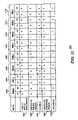
- FIG. 12 is an exemplary table illustrating the state of each L 1 and L 2 latch for each Latch Block RML( 1 : 8 ) where three DC defects, caused by the respective L 1 latch in a stuck at 1 condition are assumed at the outputs of RML 3 , RML 4 and RML 5 ,
- Methods for testing scan chains in integrated circuits to diagnose and locate failed shift register latches provide a quick and efficient way to identify multiple DC defects in a scan chain.
- Such methods may include the steps of placing the scan chain circuit into an operating region, loading a scan test pattern into the scan chain, placing the scan chain circuit into a failing region, applying a shift clock pulse to the L 2 (slave) latch, placing the scan chain circuit into an operating region, and unloading the scan chain.
- An additional step may be added to analyze the resulting data.
- Such methods may include the steps of, placing the scan chain circuit into an operating region, loading a scan test pattern into the scan chain circuit, placing the scan chain circuit into a failing region, applying a scan clock pulse to the L 1 (master) latch, placing the scan chain circuit into an operating region, applying a shift clock pulse to the L 2 latch, and unloading the scan chain.
- An additional step may be added to analyze the resulting data.
- Scan chain circuits such as those shown in FIG. 2 have been shown to be used advantageously with the present invention. Also other scan chain circuits are such as those described in the article entitled “LSSD Scan Design Enhancement for Logic Diagnostics” by author Todd Burdine, published by International Business Machines on Jul. 22, 2003 at IPCOM# 000017002D and available at online URL (www.ip.com) and is hereby incorporated by reference in its entirety.
- FIG. 8 illustrates a flow chart of a process 800 for diagnosing and locating multiple DC defects in the L 1 (master) latches of a scan chain in accordance with an embodiment of the present invention.
- the process 800 includes the steps of placing the scan chain circuit into an operating region (step S 810 ), loading a scan test pattern into the scan chain (step S 812 ), placing the scan chain circuit into a failing region (step S 814 ), applying a shift clock pulse to the L 2 (slave) latch (step S 816 ), placing the scan chain circuit into an operating region (step S 810 ), and unloading the scan chain (step S 818 ).
- An optional step S 820 is provided for analyzing the scan chain results.
- FIG. 9 shows a flow chart of a process 900 for diagnosing and locating multiple DC defects in the L 2 (slave) latches of a scan chain in accordance with an embodiment of the present invention.
- the process 900 includes the steps of placing the scan chain circuit into an operating region (step S 910 ), loading a scan test pattern into the scan chain (step S 912 ), placing the scan chain circuit into a failing region (step S 914 ), applying a scan clock pulse to the L 1 (master) latch (step S 916 ), placing the scan chain circuit into an operating region (step S 910 ), applying a shift clock pulse to the L 2 (slave) latch (step S 918 ), and unloading the scan chain (step S 920 ).
- An optional step S 922 is provided for analyzing the scan chain results.
- step S 910 and S 912 load the scan chain with all 0's in the operating region
- step S 914 and S 916 place the scan chain into a failing region and apply a single “a” or “scan-in” clock
- step S 914 and S 916 Place the scan chain in the operating region, and apply a single “b” or “shift” clock to perform a “skewed” unload of the chain.
- steps S 918 and S 910 A skewed unload is accomplished by applying an extra “b” or “shift” clock before starting an unload of the scan chain. This is shown in block 1024 .
- step S 920 applying an extra “a” or “scan-in” clock after the loading of a scan chain performs a skewed load.
- the chain is unloaded in the operating region (step S 920 ).
- the output taken from scan output 204 is shown in block 1022 after the scan test pattern has propagated through the scan chain 1000 .
- the data in RML 1 1016 is lost because of the extra “b” or “shift” clock.
- the first method tests the L 1 latches and the second method tests the L 2 latches. From this data, it can be concluded that the defect is in the L 2 latches (between the input of the next L 1 and the output of the previous L 1 ) of RML 5 1008 , RML 4 1010 and RML 3 1012 .
- This output data matches the example test faults, which occurred on the output of the L 2 latches of RML 5 1008 , RML 4 1010 and RML 3 1012 .
- FIG. 11 is a table illustrating the state of each L 1 and L 2 latch for each Latch Block RML( 1 : 8 ) where three DC defects 1152 , 1156 and 1154 caused by the respective L 2 latch in a stuck at 1 (HI) condition are assumed at the outputs of RML 5 1108 , RML 4 1110 and RML 3 1112 ,
- the scan chain 1100 is placed in an active region and L 1 and L 2 are loading with all 0's.
- the scan chain 1100 is placed in a failing region as shown in block 1122 .
- the three defects 1152 , 1156 and 1154 assumed at the output of the respective L 2 latches will now be present.
- Block 1124 illustrates the states of the L 1 and L 2 latch output after Clock A is applied while still in the failing region.
- the Clock A causes the output of the preceding L 2 latch (or scan input) to load into the next L 1 latch.
- Block 1126 illustrates the states of the L 1 and L 2 latches after the scan chain 1100 is returned to an operating region, which causes the three defects 1152 , 1156 and 1154 to no longer be asserted.
- Block 1128 illustrates that a single Clock B is applied to shift the contents of the L 1 latch output into the L 2 latch.
- block 1130 illustrates the state of the L 2 latch outputs for each Latch Block RML( 2 : 8 ) to be ‘0111000’.
- RML 1 1116 (The data in RML 1 1116 is lost because of the extra “b” or “shift” clock.) This identifies RML 5 1108 , RML 4 1110 and RML 3 1112 as the failing latch blocks with stuck at 1 fails at the L 2 latches.
- FIG. 12 is an exemplary table illustrating the state of each L 1 and L 2 latch for each Latch Block RML( 1 : 8 ) where three DC defects 1252 , 1256 and 1254 , caused by the respective L 1 latch in a stuck at 1 (HI) condition are assumed at the outputs of RML 5 1208 , RML 4 1210 and RML 3 1212 .
- the scan chain 1200 is placed in an active region and L 1 and L 2 are loading with all 0's.
- the scan chain 1200 is placed in a failing region as shown in block 1222 .
- the three defects 1252 , 1256 and 1254 assumed at the output of the respective L 1 latches will now be present.
- Block 1224 illustrates the states of the L 1 and L 2 latch output after Clock B is applied while still in the failing region.
- Block 1226 illustrates the states of the L 1 and L 2 latches after the scan chain 1200 is returned to an operating region, which causes the three defects 1252 , 1256 and 1254 to no longer be asserted.
- block 1228 illustrates the state of the L 2 latch outputs for each Latch Block RML( 1 : 8 ) to be ‘00111000’. This identifies RML 5 1108 , RML 4 1110 and RML 3 1112 as the failing latch blocks with stuck at 1 fails at the L 1 latch outputs.
- both methods described in FIGS. 8 and 9 may use a scan test value of “1” instead of “0” for loading into a scan chain. While these exemplary embodiments have loaded the chain scan with scan test patterns of either all 1's or all 0's, the scan test pattern may be any combination of 1's or 0's. Furthermore, these exemplary embodiments have illustrated scan chain circuits with eight latch blocks. There is no limitation on the number of latch blocks to be tested in a scan chain by the methods of this invention. Moreover, deterministic or algorithmic scan test patterns of 1's and 0's may be used.
- defects that occur in a scan chain are found quickly and efficiently by using a “skewed unload” of the scan chain. Further, the defects found are not limited only to a first defect of a scan chain and a last defect of a scan chain but other defects in the middle of the chain are identified as well.
- a scan clock (a) on latch 1 and a shift clock (b) on latch 2 can be applied in pairs such as ab, ab-ab, ab-ab-ab, to save time by testing the L 1 and L 2 latches in pairs.
- An embodiment of the present invention can also be embedded in a computer program product, which comprises all the features enabling the implementation of the methods described herein, and which—when loaded in a computer system—is able to carry out these methods for analyzing the scan chain.
- Computer program means or computer program in the present context means any expression, in any language, code or notation, of a set of instructions intended to cause a system having an information processing capability to perform a particular function either directly or after either or both of the following a) conversion to another language, code or, notation; and b) reproduction in a different material form.
- a computer system may include, inter alia, one or more computers and at least a computer readable medium, allowing a computer system, to read data, instructions, messages or message packets, and other computer readable information from the computer readable medium.
- the computer readable medium may include non-volatile memory, such as ROM, Flash memory, Disk drive memory, CD-ROM, and other permanent storage. Additionally, a computer readable medium may include, for example, volatile storage such as RAM, buffers, cache memory, and network circuits. Furthermore, the computer readable medium may comprise computer readable information in a transitory state medium such as a network link and/or a network interface, including a wired network or a wireless network, that allows a computer system to read such computer readable information.
Landscapes
- Engineering & Computer Science (AREA)
- General Engineering & Computer Science (AREA)
- Physics & Mathematics (AREA)
- General Physics & Mathematics (AREA)
- Tests Of Electronic Circuits (AREA)
Abstract
Examiner's permission under MPEP §608.01(q) and 37 CFR §1.125(b) is requested to submit a substitute specification and abstract. The substitute specification corrects typographical errors, grammar and formatting. No new matter has been added. The substitute specification and abstract contain no new matter to the specification of record. A marked-up version is attached along with a clean version in an appendix attached hereto.
Description
This invention relates to a method of diagnostic testing of digital circuitry and more specifically to testing and diagnosing scan chain failures to failing data retaining circuit elements.
Electronic circuits are increasingly being optimized for lower power and smaller size requirements for better incorporation into integrated circuit designs. The increase in complexity and gate count within integrated circuits also requires that electrical circuit testability be addressed in the designs of integrated circuits. One general methodology of integrated circuit testability is referred to as Level Sensitive Scan Design (LSSD). A LSSD circuit complies with a set of design rules that enhances the observability and controllability of digital circuit elements so as to enhance testability of a complex digital design circuit.
In a LSSD design, scan chains provide access and testing for the internal circuits of large-scale integrated (LSI) circuits, very large scale integrated (VLSI) circuits, and other integrated circuits. The scan chains can be configured as one long chain or multiple short chains. FIG. 1 illustrates a block diagram of an exemplary LSSD design circuit 100 The exemplary LSSD design circuit 100 includes multiple scan chains 110 interfacing with the logic circuitry 120.
These latch blocks 210 incorporate a design that allows data to be loaded into a shift register through an alternate data input. This alternate input is generally used for circuit test and stimulation and is sometimes referred to as a “scan input” since it allows a pre-defined state to be “scanned” into the sequential circuit using these register latch blocks. Loading a latch block with a particular value allows, for example, placing a sequential logic circuit into a desired state.
In normal operation of the shift register block 210, data is provided on the system input port SYS 302 and this data value is selected for storage into latch L1 310 upon a transition of the functional clock C1 304 from low to high. The shift register block 210 is also able to select for storage data from the alternate data input port SCAN 306 by providing a data value on the alternate data input port SCAN 306 and then causing this value to be stored into latch L1 310 upon a transition of the scan clock “a” 308. Once a data value is stored in L1 310, this value is available, after a propagation delay, at the L1 Output 312. The logical value that is present on the L1 Output 312 is stored into latch L2 318 upon a transition of shift clock “b” 314 (or shift clock c2) from a logical low level to a logical high level. After the L1 Output 312 is stored into the L2 latch or slave latch 318 that logic value is available, after a propagation delay, on the L2 output 320.
A scan chain provides access to the internal parts of a chip and its function is critical in testing a chip. A problem arises, however, when a scan chain fails. Often scan chain fallout occurs early in the life cycle for new chip technology development, and quickly diagnosing any scan fails is critical to improving the process so that targeted manufacturing yield levels can be achieved.
Generally, scan chain fails can be divided into two categories: DC defects and broken. A broken scan chain is one that will not operate under any conditions (e.g., voltage, frequency, temperature). A scan chain containing DC defects will only operate under certain conditions (e.g., only between 1.2V and 1.3V). The condition or conditions under which a scan chain operates or fails will be referred to as the “operating region” and “failing region”, respectively.
One method provides some success in diagnosing and locating a first failed register latch in a scan chain. This method contains the steps of loading the scan chain in the operating region, and unloading the scan chain in the failing region.
Another method provides some success in diagnosing and locating a last failed register latch in a scan chain. This method contains the steps of loading the scan chain in the failing region, and unloading the scan chain in the operating region.
To illustrate these methods, consider the following example of a scan chain 400 consisting of eight latches as shown in FIG. 4 . Assume there is a defect 450 at the output of RML5 408 that causes the chain to be stuck-at “1” in the failing region, where RML means “Register Measure Latch.” Using the first method, the scan chain 400 is loaded with all zeroes (0's) in the operating region, resulting in the value of each latch to be a zero or RML(1:8)=‘00000000’. The propagation during each of the clock cycles (i.e. cycles 1–8) across the scan chain 400 from scan input 202 is shown in block 420. Next, the scan chain 400 is switched into the failing region and unloaded. The following data is attained: RML(1:8)=‘00001111’. From this data, it may be diagnosed that the DC fail occurs on RML5 408. The output taken from scan output 204 is shown in block 422 after all of the input value of zero has propagated through the scan chain 400.
To illustrate the second prior art method shown in FIG. 5 is a block diagram of an exemplary scan chain circuit with a DC defect 450 again at the output of RML 5 being scanned. Using the second method, the scan chain 400 is loaded with all zeroes (0's) in the failing region, resulting in RML(1:8)=‘11110000’. The propagation during each of the clock cycles (i.e. cycles 1–8) across the scan chain 400 from scan input 202 is shown in block 520. Next, the scan chain is switched into the operating region and unloaded. The following data is attained: RML(1:8)=“11110000”. The output taken from scan output 204 is shown in block 522 after all of the input value of zero has propagated through the scan chain 400. From this data, it may be diagnosed that the DC fail occurs on RML5 408.
Now consider the following example of a scan chain 600 consisting of eight latches with two DC defects 652 and 654 as shown in FIG. 6 . Assume there are defects at the outputs of RML5 608 and RML3 612 that cause the chain to be stuck-at “1” in the failing region. Using the first method, the scan chain 600 is loaded with all zeroes (0's) in the operating region, resulting in the value of each latch to be a zero or RML(1:8)=‘00000000’. The propagation during each of the clock cycles (i.e. cycles 1–8) across the scan chain 600 from scan input 602 is shown in block 620. Next, the scan chain 600 is switched into the failing region and unloaded. The following data is attained: RML(1:8)=‘00111111’. The output taken from scan output 604 is shown in block 622 after all of the input value of zero has propagated through the scan chain 600. From this data, it may be diagnosed that the DC fail occurs on RML3 412.
To illustrate the second prior art method shown in FIG. 7 is a block diagram of an exemplary scan chain circuit with a two DC defect 652 and 654 being scanned. Using the second method, the scan chain is loaded with all zeroes (0's) in the failing region, which results in RML(1:8)=‘1111000’. The propagation during each of the clock cycles (i.e. cycles 1–8) across the scan chain 600 from scan input 602 is shown in block 720. Next, the scan chain is switched into the operating region and unloaded. The following data is attained: RML(1:8)=‘1111000’. The output taken from scan output 604 is shown in block 722 after all of the input value of zero has propagated through the scan chain 600. From this data, it may be diagnosed that the DC fail or fault occurs on RML5 408.
When there are multiple DC defects in a scan chain, only the first and last defect in the scan chain can be diagnosed and identified using the two mentioned methods. Although this is useful, if there are multiple defects, for example a third defect at RML 3 which is between defect 652 of RML4 and defect 654 This third defect or inner defect (inner meaning after the first and last defect of a chain) is to be detected by these prior art methods, either separately or combined. Further any multiple defects that occur between a first defect and a last defect are not detected by these prior art method either, again either separately or combined.
Accordingly, there is a need for a method to diagnose and locate all multiple DC defects in a scan chain.
Methods and system for testing scan chains in integrated circuits. This method enable fast diagnostics for locating failed shift register latches, An aspect of the present invention is to provide a method of testing broken or stuck-at scan chains in an integrated circuit to diagnose and locate failed shift register latches, including the steps of, placing the scan chain circuit into an operating region, loading a scan test pattern into the scan chain, placing the scan chain circuit into a failing region, applying a shift clock pulse to the L2 latch, placing the scan chain circuit into an operating region, and unloading the scan chain.
An aspect of the present invention is to provide a method of testing broken or stuck-at scan chains in an integrated circuit including the steps of, placing the scan chain circuit into an operating region, loading a scan test pattern into the scan chain, placing the scan chain circuit into a failing region, applying a scan clock (also called scan-in clock) pulse to the L1 latch, placing the scan chain circuit into an operating region, applying a shift clock pulse to the L2 latch, and unloading the scan chain.
The foregoing and other features and advantages of the present invention will be apparent from the following more detailed description of the embodiments of the invention, as illustrated in the accompanying drawings.
The invention will be described in detail with reference to the following drawings in which like reference numerals refer to like elements wherein:
Methods for testing scan chains in integrated circuits to diagnose and locate failed shift register latches, according to the present invention, provide a quick and efficient way to identify multiple DC defects in a scan chain.
Such methods may include the steps of placing the scan chain circuit into an operating region, loading a scan test pattern into the scan chain, placing the scan chain circuit into a failing region, applying a shift clock pulse to the L2 (slave) latch, placing the scan chain circuit into an operating region, and unloading the scan chain. An additional step may be added to analyze the resulting data.
Such methods may include the steps of, placing the scan chain circuit into an operating region, loading a scan test pattern into the scan chain circuit, placing the scan chain circuit into a failing region, applying a scan clock pulse to the L1 (master) latch, placing the scan chain circuit into an operating region, applying a shift clock pulse to the L2 latch, and unloading the scan chain. An additional step may be added to analyze the resulting data.
Scan chain circuits such as those shown in FIG. 2 have been shown to be used advantageously with the present invention. Also other scan chain circuits are such as those described in the article entitled “LSSD Scan Design Enhancement for Logic Diagnostics” by author Todd Burdine, published by International Business Machines on Jul. 22, 2003 at IPCOM# 000017002D and available at online URL (www.ip.com) and is hereby incorporated by reference in its entirety.
To illustrate the diagnostic methods of FIG. 8 and FIG. 9 , we reexamine the scan chain shown in FIG. 6 . and FIG. 7 but now with three defects 1052, 1056 and 1054 as shown in FIG. 10 . The three defects or faults 1052, 1056 and 1054 at the outputs of RML5 1008, RML4 1010 and RML3 1012 that cause the chain to be stuck-at “1” in the failing region. To diagnose all the faults in the scan chain, one may apply the diagnostic method of FIG. 8 , and load the scan chain circuit with all 0's in the operating region (steps S810 and S812). The propagation during each of the clock cycles (i.e. cycles 1–8) across the scan chain 1000 from scan input 1002 is shown in block 1020. Next, the scan chain 1000 t is placed into a failing region and apply a single “b” or “shift” clock (steps S814 and S816). Continuing further, the scan chain 1000 is placed into an operating region and then unloaded (steps S818 and S820). This method results in RML(1:8)=‘00000000’ which indicates that there are no fails in the L1 latches 310.
Next, one may apply the diagnostic method of FIG. 9 , and load the scan chain with all 0's in the operating region (steps S910 and S912), place the scan chain into a failing region and apply a single “a” or “scan-in” clock (steps S914 and S916). Place the scan chain in the operating region, and apply a single “b” or “shift” clock to perform a “skewed” unload of the chain. (steps S918 and S910). A skewed unload is accomplished by applying an extra “b” or “shift” clock before starting an unload of the scan chain. This is shown in block 1024. Similarly, applying an extra “a” or “scan-in” clock after the loading of a scan chain performs a skewed load. In this example, after the skewed unload is performed, the chain is unloaded in the operating region (step S920). The output taken from scan output 204 is shown in block 1022 after the scan test pattern has propagated through the scan chain 1000. The data scanned out will be: RML(2:8)=‘0111000’. (The data in RML1 1016 is lost because of the extra “b” or “shift” clock.) This identifies RML5 1008, RML4 1010 and RML3 1012 as the failing latch blocks with stuck at 1 fails.
The first method tests the L1 latches and the second method tests the L2 latches. From this data, it can be concluded that the defect is in the L2 latches (between the input of the next L1 and the output of the previous L1) of RML5 1008, RML4 1010 and RML3 1012. This output data matches the example test faults, which occurred on the output of the L2 latches of RML5 1008, RML4 1010 and RML3 1012. These results and the states of the L1 and L2 latches of each Latch Block RML(1:8) are more fully detailed in the tables provided by FIG. 11 and FIG. 12 .
Alternatively, to detect any stuck-at “0” defects in the latch blocks, both methods described in FIGS. 8 and 9 , may use a scan test value of “1” instead of “0” for loading into a scan chain. While these exemplary embodiments have loaded the chain scan with scan test patterns of either all 1's or all 0's, the scan test pattern may be any combination of 1's or 0's. Furthermore, these exemplary embodiments have illustrated scan chain circuits with eight latch blocks. There is no limitation on the number of latch blocks to be tested in a scan chain by the methods of this invention. Moreover, deterministic or algorithmic scan test patterns of 1's and 0's may be used. Applying the following successive sequence of ‘10000000’; ‘01000000’; ‘00100000’; ‘00010000’; ‘00001000’; ‘00000100’; ‘00000010’; ‘00000001’ of “walking” a value of 1 through the scan chain has been shown to be very useful.
It is important to note that using the present invention, multiple defects that occur in a scan chain are found quickly and efficiently by using a “skewed unload” of the scan chain. Further, the defects found are not limited only to a first defect of a scan chain and a last defect of a scan chain but other defects in the middle of the chain are identified as well.
Further, it is important to note that although a method described is for identifying multiple defects for each of the latches L1 and L2 separately, it is possible to combine the techniques described in the present invention to find defects or errors in both the L1 and L2 latches simultaneously. For example, a scan clock (a) on latch 1 and a shift clock (b) on latch 2 can be applied in pairs such as ab, ab-ab, ab-ab-ab, to save time by testing the L1 and L2 latches in pairs.
An embodiment of the present invention can also be embedded in a computer program product, which comprises all the features enabling the implementation of the methods described herein, and which—when loaded in a computer system—is able to carry out these methods for analyzing the scan chain. Computer program means or computer program in the present context means any expression, in any language, code or notation, of a set of instructions intended to cause a system having an information processing capability to perform a particular function either directly or after either or both of the following a) conversion to another language, code or, notation; and b) reproduction in a different material form.
A computer system may include, inter alia, one or more computers and at least a computer readable medium, allowing a computer system, to read data, instructions, messages or message packets, and other computer readable information from the computer readable medium. The computer readable medium may include non-volatile memory, such as ROM, Flash memory, Disk drive memory, CD-ROM, and other permanent storage. Additionally, a computer readable medium may include, for example, volatile storage such as RAM, buffers, cache memory, and network circuits. Furthermore, the computer readable medium may comprise computer readable information in a transitory state medium such as a network link and/or a network interface, including a wired network or a wireless network, that allows a computer system to read such computer readable information.
Although several embodiments of the present invention and its advantages have been described in detail, it should be understood that changes, substitutions, transformations, modifications, variations, permutations and alterations may be made therein without departing from the teachings of the present invention, the spirit and the scope of the invention being set forth by the appended claims.
Claims (22)
1. A method of identifying one or more defective shift register latches in a scan chain, the method comprising:
electrically coupling a plurality of shift register latches into a series configuration so as to form a scan chain circuit, wherein each of the shift register latches includes a first latch and a second latch connected in a master-slave configuration, wherein each of the first latch and second latch includes at least one clock input;
placing the scan chain circuit into an operating region;
loading a scan test pattern into the scan chain circuit;
placing the scan chain circuit into a failing region;
applying a shift clock pulse to the clock input of the second latch, wherein the shift clock pulse is applied while the scan chain circuit is in the failing region;
placing the scan chain circuit into an operating region;
unloading the scan chain circuit; and
identifying at least one defective shift register latch in the scan chain circuit.
2. The method of claim 1 , further comprising:
analyzing output from the scan chain circuit after the unloading.
3. The method of claim 1 , wherein the loading a scan test pattern into the scan chain circuit includes loading a scan test pattern of all zeroes.
4. The method of claim 1 , wherein the loading a scan test pattern into the scan chain circuit includes loading of all ones.
5. The method of claim 1 , wherein the loading a scan test pattern into the scan chain circuit includes loading zero and ones.
6. The method of claim 5 , wherein the loading a scan test pattern into the scan chain circuit includes loading an algorithmic scan test pattern.
7. The method of claim 1 , wherein the unloading comprises:
applying a scan clock pulse to the clock input of the first latch and a shift clock pulse to the input of the second latch, wherein the scan pulse and the shift clock pulse are applied while the scan chain circuit is in the operating region;
measuring an output of the second latch against an expected response;
recording the output;
checking whether the scan chain circuit has been completed; and
repeating the applying the scan clock pulse and the shift clock pulse, the measuring the output of the second latch, and the recording until the scan chain circuit is completed.
8. A method of identifying one or more defective shift register latches in a scan chain, the method comprising:
electrically coupling a plurality of shift register latches into a series configuration so as to form a scan chain circuit, wherein each of the shift register latches includes a first latch and a second latch connected in a master-slave configuration, wherein each of the first latch and second latch includes at least one clock input;
placing the scan chain circuit into an operating region;
loading a scan test pattern into the scan chain circuit;
placing the scan chain circuit into a failing region;
applying a scan clock pulse to the clock input of the first latch, wherein the scan clock pulse is applied while the scan chain circuit is in the failing region;
placing the scan chain circuit into an operating region;
applying a shift clock pulse to the clock input of the second latch, wherein the shift clock pulse is applied while the scan chain circuit is in the operating region;
unloading the scan chain circuit; and
identifying at least one defective shift register latch in the scan chain circuit.
9. The method of claim 8 , further comprising:
analyzing output from the scan chain circuit after the unloading the scan chain.
10. The method of claim 8 , wherein the loading a scan test pattern into the scan chain circuit includes loading a scan test pattern of all zeroes.
11. The method of claim 8 , wherein the loading a scan test pattern into the scan chain circuit includes loading a scan test pattern of all ones.
12. The method of claim 8 , wherein the loading a scan test pattern into the scan chain circuit includes loading zero and ones.
13. The method of claim 12 , wherein the loading a scan test pattern into the scan chain circuit includes loading an algorithmic scan test pattern.
14. The method of claim 8 , wherein the unloading comprises:
applying a scan clock pulse to the clock input of the first latch and a shift clock pulse to the input of the second latch, wherein the scan pulse and the shift clock pulse are applied while the scan chain circuit is in the operating region;
measuring an output of the second latch against an expected response;
recording the output;
checking whether the scan chain circuit has been completed; and
repeating the applying the scan clock pulse and the shift clock pulse, the measuring the output of the second latch, and the recording until the scan chain circuit is completed.
15. A method of identifying one or more defective shift register latches in a scan chain, the method comprising:
electrically coupling a plurality of shift register latches into a series configuration so as to form a scan chain circuit, wherein each of the shift register latches includes a first latch and a second latch connected in a master-slave configuration, wherein each of the first latch and second latch includes at least one clock input;
placing the scan chain circuit into an operating region;
loading a scan test pattern into the scan chain circuit;
placing the scan chain circuit into a failing region;
applying a scan clock pulse to the clock input of the first latch, wherein the scan clock pulse is applied while the scan chain circuit is in the failing region;
applying a shift clock pulse to the clock input of the second latch, wherein the shift clock pulse is applied while the scan chain circuit is in the failing region;
placing the scan chain circuit into an operating region;
unloading the scan circuit; and
identifying at least one defective shift register latch in the scan chain circuit.
16. The method of claim 15 , further comprising:
applying a shift clock pulse to the clock input of the second latch prior to unloading the latch.
17. The method of claim 15 , wherein the loading a scan test pattern into the scan chain circuit includes loading a scan test pattern of all zeroes.
18. The method of claim 15 , wherein the loading a scan test pattern into the scan chain circuit includes loading a scan test pattern of all ones.
19. The method of claim 15 , wherein the loading a scan test pattern into the scan chain circuit includes loading zero and ones.
20. The method of claim 19 , wherein the loading a scan test pattern into the scan chain circuit includes loading an algorithmic scan test pattern.
21. A computer program product containing programming instructions for identifying one or more defective shift register latches in a scan chain, wherein each of the shift register latches includes a first latch and a second latch connected in a master-slave configuration, wherein each of the first latch and second latch includes at least one clock input, the programming instructions comprising:
placing the scan chain circuit into an operating region;
loading a scan test pattern into the scan chain circuit;
placing the scan chain circuit into a failing region:
applying a shift clock pulse to the clock input of the second latch, wherein the shift clock pulse is applied while the scan chain circuit is in the operating region
placing the scan chain circuit into an operating region;
unloading the scan circuit; and
identifying at least one defective shift register latch in the scan chain circuit.
22. A computer program product containing programming instructions for identifying one or more defective shift register latches in a scan chain, wherein each of the shift register latches includes a first latch and a second latch connected in a master-slave configuration, wherein each of the first latch and second latch includes at least one clock input, the programming instructions comprising:
placing the scan chain circuit into an operating region;
loading a scan test pattern into the scan chain circuit;
placing the scan chain circuit into a failing region;
applying a scan lock pulse to the clock input of the first latch, wherein the scan clock pulse is applied while the scan chain circuit is in the operating region;
applying a shift clock pulse to the clock input of the second latch, wherein the shift clock pulse is applied while the scan chain circuit is in the operating region;
placing the scan chain circuit into an operating region;
unloading the scan circuit; and
identifying at least one defective shift register latch in the scan chain circuit.
Priority Applications (1)
| Application Number | Priority Date | Filing Date | Title |
|---|---|---|---|
| US10/767,046 US7107502B2 (en) | 2004-01-29 | 2004-01-29 | Diagnostic method for detection of multiple defects in a Level Sensitive Scan Design (LSSD) |
Applications Claiming Priority (1)
| Application Number | Priority Date | Filing Date | Title |
|---|---|---|---|
| US10/767,046 US7107502B2 (en) | 2004-01-29 | 2004-01-29 | Diagnostic method for detection of multiple defects in a Level Sensitive Scan Design (LSSD) |
Publications (2)
| Publication Number | Publication Date |
|---|---|
| US20050172188A1 US20050172188A1 (en) | 2005-08-04 |
| US7107502B2 true US7107502B2 (en) | 2006-09-12 |
Family
ID=34807632
Family Applications (1)
| Application Number | Title | Priority Date | Filing Date |
|---|---|---|---|
| US10/767,046 Expired - Fee Related US7107502B2 (en) | 2004-01-29 | 2004-01-29 | Diagnostic method for detection of multiple defects in a Level Sensitive Scan Design (LSSD) |
Country Status (1)
| Country | Link |
|---|---|
| US (1) | US7107502B2 (en) |
Cited By (8)
| Publication number | Priority date | Publication date | Assignee | Title |
|---|---|---|---|---|
| US20080091999A1 (en) * | 2005-06-09 | 2008-04-17 | International Business Machines Corporation | Method, apparatus, and computer program product for diagnosing a scan chain failure employing fuses coupled to the scan chain |
| US20080215943A1 (en) * | 2007-03-04 | 2008-09-04 | Ruifeng Guo | Generating test sets for diagnosing scan chain failures |
| US20090113263A1 (en) * | 2007-10-31 | 2009-04-30 | Cannon Stephen A | Methods for analyzing scan chains, and for determining numbers or locations of hold time faults in scan chains |
| US20090113265A1 (en) * | 2007-10-31 | 2009-04-30 | Inovys Corporation | Locating hold time violations in scan chains by generating patterns on ate |
| US20090210763A1 (en) * | 2008-02-16 | 2009-08-20 | International Business Machines Corporation | Automated System and Processing for Expedient Diagnosis of Broken Shift Registers Latch Chains Using JTAG |
| US20090235134A1 (en) * | 2007-03-04 | 2009-09-17 | Ruifeng Guo | Test pattern generation for diagnosing scan chain failures |
| US20120278671A1 (en) * | 2011-04-26 | 2012-11-01 | Taiwan Semiconductor Manufacturing Co., Ltd. | Circuit and method for diagnosing scan chain failures |
| US20160238656A1 (en) * | 2013-12-16 | 2016-08-18 | International Business Machines Corporation | Collecting diagnostic data from chips |
Families Citing this family (8)
| Publication number | Priority date | Publication date | Assignee | Title |
|---|---|---|---|---|
| US7089474B2 (en) * | 2004-02-27 | 2006-08-08 | International Business Machines Corporation | Method and system for providing interactive testing of integrated circuits |
| JP4286731B2 (en) * | 2004-06-30 | 2009-07-01 | 富士通株式会社 | Buffer device and buffer fault diagnosis method |
| US7234090B2 (en) * | 2004-09-02 | 2007-06-19 | International Business Machines Corporation | Method and apparatus for selective scan chain diagnostics |
| US7650547B2 (en) | 2007-02-28 | 2010-01-19 | Verigy (Singapore) Pte. Ltd. | Apparatus for locating a defect in a scan chain while testing digital logic |
| US8127186B2 (en) | 2007-02-28 | 2012-02-28 | Verigy (Singapore) Pte. Ltd. | Methods and apparatus for estimating a position of a stuck-at defect in a scan chain of a device under test |
| KR100997239B1 (en) * | 2008-03-03 | 2010-11-29 | 삼성전자주식회사 | CRUM unit, replaceable unit and image forming apparatus using same, authentication and encryption data communication method thereof |
| US8897088B2 (en) | 2013-01-30 | 2014-11-25 | Texas Instrument Incorporated | Nonvolatile logic array with built-in test result signal |
| US9429621B2 (en) * | 2015-01-27 | 2016-08-30 | International Business Machines Corporation | Implementing enhanced scan chain diagnostics via bypass multiplexing structure |
Citations (2)
| Publication number | Priority date | Publication date | Assignee | Title |
|---|---|---|---|---|
| US6442720B1 (en) * | 1999-06-04 | 2002-08-27 | International Business Machines Corporation | Technique to decrease the exposure time of infrared imaging of semiconductor chips for failure analysis |
| US20030131294A1 (en) * | 2002-01-10 | 2003-07-10 | International Business Machines Corporation | Stuck-at fault scan chain diagnostic method |
-
2004
- 2004-01-29 US US10/767,046 patent/US7107502B2/en not_active Expired - Fee Related
Patent Citations (2)
| Publication number | Priority date | Publication date | Assignee | Title |
|---|---|---|---|---|
| US6442720B1 (en) * | 1999-06-04 | 2002-08-27 | International Business Machines Corporation | Technique to decrease the exposure time of infrared imaging of semiconductor chips for failure analysis |
| US20030131294A1 (en) * | 2002-01-10 | 2003-07-10 | International Business Machines Corporation | Stuck-at fault scan chain diagnostic method |
Non-Patent Citations (1)
| Title |
|---|
| "A Technique for Fault Diagnosis of Defects in Scan Chains" by Guo et al, IEEE, paper 10.2, pp. 268-277, 2001. * |
Cited By (22)
| Publication number | Priority date | Publication date | Assignee | Title |
|---|---|---|---|---|
| US20080091999A1 (en) * | 2005-06-09 | 2008-04-17 | International Business Machines Corporation | Method, apparatus, and computer program product for diagnosing a scan chain failure employing fuses coupled to the scan chain |
| US7392449B2 (en) | 2005-06-09 | 2008-06-24 | International Business Machines Corporation | Method, apparatus, and computer program product for diagnosing a scan chain failure employing fuses coupled to the scan chain |
| US8935582B2 (en) | 2007-03-04 | 2015-01-13 | Mentor Graphics Corporation | Generating test sets for diagnosing scan chain failures |
| US8261142B2 (en) | 2007-03-04 | 2012-09-04 | Mentor Graphics Corporation | Generating test sets for diagnosing scan chain failures |
| US9977080B2 (en) | 2007-03-04 | 2018-05-22 | Mentor Graphics Corporation | Generating test sets for diagnosing scan chain failures |
| US20080215943A1 (en) * | 2007-03-04 | 2008-09-04 | Ruifeng Guo | Generating test sets for diagnosing scan chain failures |
| US20090235134A1 (en) * | 2007-03-04 | 2009-09-17 | Ruifeng Guo | Test pattern generation for diagnosing scan chain failures |
| US8661304B2 (en) | 2007-03-04 | 2014-02-25 | Mentor Graphics Corporation | Test pattern generation for diagnosing scan chain failures |
| US8316265B2 (en) * | 2007-03-04 | 2012-11-20 | Mentor Graphics Corporation | Test pattern generation for diagnosing scan chain failures |
| US7853846B2 (en) | 2007-10-31 | 2010-12-14 | Verigy (Singapore) Pte. Ltd. | Locating hold time violations in scan chains by generating patterns on ATE |
| US8010856B2 (en) * | 2007-10-31 | 2011-08-30 | Verigy (Singapore) Pte. Ltd. | Methods for analyzing scan chains, and for determining numbers or locations of hold time faults in scan chains |
| US20090113263A1 (en) * | 2007-10-31 | 2009-04-30 | Cannon Stephen A | Methods for analyzing scan chains, and for determining numbers or locations of hold time faults in scan chains |
| US20090113265A1 (en) * | 2007-10-31 | 2009-04-30 | Inovys Corporation | Locating hold time violations in scan chains by generating patterns on ate |
| US7908532B2 (en) | 2008-02-16 | 2011-03-15 | International Business Machines Corporation | Automated system and processing for expedient diagnosis of broken shift registers latch chains |
| US20090210763A1 (en) * | 2008-02-16 | 2009-08-20 | International Business Machines Corporation | Automated System and Processing for Expedient Diagnosis of Broken Shift Registers Latch Chains Using JTAG |
| US20120278671A1 (en) * | 2011-04-26 | 2012-11-01 | Taiwan Semiconductor Manufacturing Co., Ltd. | Circuit and method for diagnosing scan chain failures |
| US8566657B2 (en) * | 2011-04-26 | 2013-10-22 | Taiwan Semiconductor Manufacturing Co., Ltd. | Circuit and method for diagnosing scan chain failures |
| US9194913B2 (en) | 2011-04-26 | 2015-11-24 | Taiwan Semiconductor Manufacturing Co., Ltd. | Circuit and method for diagnosing scan chain failures |
| US9791510B2 (en) | 2011-04-26 | 2017-10-17 | Taiwan Semiconductor Manufacturing Co., Ltd. | Circuit and method for diagnosing scan chain failures |
| US10371751B2 (en) | 2011-04-26 | 2019-08-06 | Taiwan Semiconductor Manufacturing Co., Ltd. | Circuit and method for diagnosing scan chain failures |
| US20160238656A1 (en) * | 2013-12-16 | 2016-08-18 | International Business Machines Corporation | Collecting diagnostic data from chips |
| US9746516B2 (en) * | 2013-12-16 | 2017-08-29 | International Business Machines Corporation | Collecting diagnostic data from chips |
Also Published As
| Publication number | Publication date |
|---|---|
| US20050172188A1 (en) | 2005-08-04 |
Similar Documents
| Publication | Publication Date | Title |
|---|---|---|
| US7475308B2 (en) | implementing deterministic based broken scan chain diagnostics | |
| US7107502B2 (en) | Diagnostic method for detection of multiple defects in a Level Sensitive Scan Design (LSSD) | |
| US6971054B2 (en) | Method and system for determining repeatable yield detractors of integrated circuits | |
| US11156661B2 (en) | Reversible multi-bit scan cell-based scan chains for improving chain diagnostic resolution | |
| US8086924B2 (en) | Implementing diagnosis of transitional scan chain defects using logic built in self test LBIST test patterns | |
| US11073556B2 (en) | Low pin count reversible scan architecture | |
| US11408938B2 (en) | Bidirectional scan cells for single-path reversible scan chains | |
| US7392449B2 (en) | Method, apparatus, and computer program product for diagnosing a scan chain failure employing fuses coupled to the scan chain | |
| CN114667455A (en) | Universal compressor architecture for test circuits | |
| US12007438B2 (en) | Method and system for testing an integrated circuit | |
| US7752514B2 (en) | Methods and apparatus for testing a scan chain to isolate defects | |
| US11092645B2 (en) | Chain testing and diagnosis using two-dimensional scan architecture | |
| US20100019774A1 (en) | Isolation cell with test mode | |
| JP4265934B2 (en) | Scan campus circuit, logic circuit including the same, and integrated circuit test method | |
| US8065575B2 (en) | Implementing isolation of VLSI scan chain using ABIST test patterns | |
| US20020188904A1 (en) | Efficiency of fault simulation by logic backtracking | |
| Huang et al. | Using fault model relaxation to diagnose real scan chain defects | |
| US20030110431A1 (en) | Scanning an allowed value into a group of latches | |
| US20090210761A1 (en) | AC Scan Diagnostic Method and Apparatus Utilizing Functional Architecture Verification Patterns | |
| Pavani et al. | Design of programmable memory BIST using stochastic sobol sequence pattern generator | |
| Renuka | FPGA implementation of memory bists using single interface | |
| US12596150B2 (en) | X-masking for in-system deterministic test | |
| Wang et al. | A design-for-diagnosis technique for diagnosing both scan chain faults and combinational circuit faults | |
| WO2026095946A1 (en) | Scan chain diagnosis with clock control for improving diagnosis coverage | |
| WO2025183759A1 (en) | Diagnosis points for scan chain failure diagnosis using controllable inverter in scan chain shift path |
Legal Events
| Date | Code | Title | Description |
|---|---|---|---|
| AS | Assignment |
Owner name: INTERNATIONAL BUSINESS MACHINES CORPORATION, NEW Y Free format text: ASSIGNMENT OF ASSIGNORS INTEREST;ASSIGNOR:BURDINE, TODD MICHAEL;REEL/FRAME:014948/0452 Effective date: 20040120 |
|
| FEPP | Fee payment procedure |
Free format text: PAYOR NUMBER ASSIGNED (ORIGINAL EVENT CODE: ASPN); ENTITY STATUS OF PATENT OWNER: LARGE ENTITY |
|
| CC | Certificate of correction | ||
| REMI | Maintenance fee reminder mailed | ||
| LAPS | Lapse for failure to pay maintenance fees | ||
| STCH | Information on status: patent discontinuation |
Free format text: PATENT EXPIRED DUE TO NONPAYMENT OF MAINTENANCE FEES UNDER 37 CFR 1.362 |
|
| FP | Lapsed due to failure to pay maintenance fee |
Effective date: 20100912 |