US7092773B1 - Method and system for providing enhanced editing capabilities - Google Patents

Method and system for providing enhanced editing capabilities Download PDF

Info

Publication number
US7092773B1
US7092773B1 US08/936,338 US93633897A US7092773B1 US 7092773 B1 US7092773 B1 US 7092773B1 US 93633897 A US93633897 A US 93633897A US 7092773 B1 US7092773 B1 US 7092773B1
Authority
US
United States
Prior art keywords
punch
buffer
signal
media
data
Prior art date
Legal status (The legal status is an assumption and is not a legal conclusion. Google has not performed a legal analysis and makes no representation as to the accuracy of the status listed.)
Expired - Fee Related
Application number
US08/936,338
Inventor
Richard Joseph Oliver
Roger Mather Duvall
Current Assignee (The listed assignees may be inaccurate. Google has not performed a legal analysis and makes no representation or warranty as to the accuracy of the list.)
Sony Corp
Sony Pictures Entertainment Inc
Original Assignee
Sony Corp
Sony Pictures Entertainment Inc
Priority date (The priority date is an assumption and is not a legal conclusion. Google has not performed a legal analysis and makes no representation as to the accuracy of the date listed.)
Filing date
Publication date
Application filed by Sony Corp, Sony Pictures Entertainment Inc filed Critical Sony Corp
Priority to US08/936,338 priority Critical patent/US7092773B1/en
Assigned to SONY PICTURES ENTERTAINMENT, INC., SONY CORPORATION reassignment SONY PICTURES ENTERTAINMENT, INC. ASSIGNMENT OF ASSIGNORS INTEREST (SEE DOCUMENT FOR DETAILS). Assignors: DUVALL, ROGER MATHER, OLIVER, RICHARD JOSEPH
Application granted granted Critical
Publication of US7092773B1 publication Critical patent/US7092773B1/en
Anticipated expiration legal-status Critical
Expired - Fee Related legal-status Critical Current

Links

Images

Classifications

    • GPHYSICS
    • G11INFORMATION STORAGE
    • G11BINFORMATION STORAGE BASED ON RELATIVE MOVEMENT BETWEEN RECORD CARRIER AND TRANSDUCER
    • G11B27/00Editing; Indexing; Addressing; Timing or synchronising; Monitoring; Measuring tape travel
    • G11B27/02Editing, e.g. varying the order of information signals recorded on, or reproduced from, record carriers
    • G11B27/031Electronic editing of digitised analogue information signals, e.g. audio or video signals
    • G11B27/034Electronic editing of digitised analogue information signals, e.g. audio or video signals on discs
    • GPHYSICS
    • G11INFORMATION STORAGE
    • G11BINFORMATION STORAGE BASED ON RELATIVE MOVEMENT BETWEEN RECORD CARRIER AND TRANSDUCER
    • G11B2220/00Record carriers by type
    • G11B2220/20Disc-shaped record carriers
    • G11B2220/25Disc-shaped record carriers characterised in that the disc is based on a specific recording technology
    • G11B2220/2508Magnetic discs
    • G11B2220/2516Hard disks

Definitions

  • the invention relates to digital signal processing. More specifically, the invention relates to a recording technique applicable to a media stream, which provides enhanced editing features.
  • media file 1 coincides exactly with the punch in point 5 and the end of media file 1 coincides exactly with the punch out point 6 .
  • the punch in point 5 and the punch out point 6 are the points at which the recording device receives the signal to begin recording or end recording respectively.
  • a high degree of precision is required to properly time the begin and end of the rerecorded region 8 to achieve the desired effect.
  • media file 2 will need to be discarded and another attempt to record the desired segment will be required.
  • FIG. 1 is a diagram of an example of a prior art non-linear non-destructive editing technique.
  • FIG. 3 is a flow chart of buffer operation in one embodiment of the invention after steady state is reached.
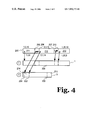
  • FIG. 4 is a diagram of editing using a media file with the record handles of one embodiment of the invention.
  • a method and system for providing enhanced editing capability is disclosed.
  • analog audio technology such as tape machines
  • most digital media recorders save data from the media input only when explicitly placed in record mode. Normally the desire is that a specific interval of media input be saved to permanent storage. However, if the system is placed in record mode any later than the start of the interval, or taken out of record mode any earlier than the end of the interval, input data near the ends of the interval will be lost.
  • This invention guarantees that media data stays in a buffer for at least a minimum amount of time after it has been received at the input, regardless of whether the system is in record mode or not.
  • the incoming media input data is designated to be permanently stored on, for example, a hard disk.
  • buffered data for the media just prior to the punch in point is also designated to be stored to permanent storage.
  • record mode punches out
  • the extra media data before the punch in point and after the punch out point are referred to as record handles.
  • the audio track does not include the record handles, but the data in the record handles can be accessed by manipulating pointers in the event list to include some, all or none of the record handles (at which point the user view will include the selected portion of the record handle(s)). In this manner, the difficulty of precisely timing the punch in and punch out points is alleviated.
  • FIG. 2 is a block diagram of a system of one embodiment of the invention.
  • One or more media input streams 11 are provided to a digital signal processor (DSP) 13 .
  • DSP digital signal processor
  • the DSP 13 continually sources the incoming media to buffer 14 .
  • Buffer 14 has portions thereof allocated to accommodate each of the incoming media streams 11 .
  • Buffer 14 is also coupled to a bus 19 .
  • a host processor 15 is directly coupled to a memory 16 and also coupled to the bus 19 .
  • a Small Computer System Interface (SCSI) controller 17 is coupled to bus 19 and to a mass storage device 20 via a SCSI bus 18 .
  • DSP's 13 are also coupled to bus 19 .
  • SCSI Small Computer System Interface
  • bus 19 is a Peripheral Compenent Interconnect (PCI) bus.
  • the mass storage device is a removable rotating magnetic disc having a SCSI port. This allows the mass storage device to be readily disconnected and exchanged for a new device thereby limiting the effect of disk space constraints.
  • the buffer 14 is comprised of 32 megabytes of random access memory (RAM). In such system if 16 media input streams and 16 media output streams exist, nominally one megabyte of the buffer will be allocated to each input stream. If the media input stream is a 16-bit audio stream, one megabyte corresponds to approximately ten seconds of audio data. Typical audio data is either 16-bit or 24-bit audio at 48 kHz. The allocated portion of buffer 14 is further broken down into a number of blocks.
  • the DSP 13 receiving the media input stream 11 adjusts the input gain, detects for overflow errors and packs the media data for storage in the buffer 14 .
  • the portion of buffer 14 allocated to a particular channel will be full and will remain full (e.g., in steady state) throughout the remainder of the recording session.
  • Host processor 15 is responsible for allocation of blocks in the buffer as well as designating blocks in the buffer to be permanently stored. Subsequent to receipt of a punch in signal, blocks of data in the buffer corresponding to a previous user settable interval (e.g., one second by default) of time are tagged for subsequent permanent storage to the mass storage device.
  • the punch in signal may be received from the user interface, over a network, or via a DSP generated interupt. Additionally, all blocks between the punch in signal and a next punch out signal will be tagged for permanent storage. Once the punch out signal is received blocks corresponding to a user settable period of time (e.g., one second by default) following the punch out signal will also be tagged for permanent storage.
  • mass storage device 20 will contain a media file having a first record handle, an intended record interval, and a second record handle.
  • the size of the blocks will likely cause more than the user set amount of data to be permanently stored.
  • the system guarantees the extra data saved will be at least one second worth of data.
  • FIG. 3 is a flow chart of buffer operation in one embodiment of the invention after steady state is reached.
  • media data is continually flowing into and being saved in the buffer.
  • the system watches for a punch in signal indicating that a record interval is commencing.
  • a recording session is a period of time that may contain one or more record intervals.
  • a record interval is the period between a punch in and a corresponding punch out.
  • a determination is made, at decision block 101 , if a punch in signal has been received. If it has, at functional block 102 , the block(s) of the buffer containing the previous one second of samples from the input stream are tagged for storage. At functional block 103 , the current block is tagged for storage.
  • a determination is made, at decision block 104 , if the block should be allocated.
  • FIG. 4 is a diagram of editing using a media file with the record handles of one embodiment of the invention.
  • the user view event list 200 is composed of three events 211 , 212 , and 213 .
  • Events 211 and 213 are from media file 1 .
  • Event 212 corresponds with rerecorded segment in 208 of media file 1 .
  • Event 212 is provided from media file 3 which has been recorded in accordance with one embodiment of the invention.
  • record handles 214 and 215 are two samples long. Nominal punch in point 202 and the nominal punch out point 203 are the default boundaries of what the user sees in the event list for the track.
  • the effective punch in point and punch out point can be moved up to three samples earlier for the punch in point or three samples later for the punch out point.
  • the default user event list would be for example 1 , 0 , 10 ; 3 , 3 , 10 ; 1 , 20 , 10 (following the format media file ID, offset, length) the user could shift the end points 206 and 207 of event 212 to be 205 and 210 with a resulting event list being 1 , 0 , 8 ; 3 , 1 , 14 ; and 1 , 22 , 8 .
  • Other shifts are of course possible. This shifts the effective punch in point of media file 3 to point 204 . While there need be no explicit shift of nominal punch out point 203 , in the above example if no record handle 215 existed, an error would be generated.

Landscapes

  • Engineering & Computer Science (AREA)
  • Multimedia (AREA)
  • Management Or Editing Of Information On Record Carriers (AREA)
  • Signal Processing For Digital Recording And Reproducing (AREA)

Abstract

A method and system for providing enhanced editing capability of media data. Media data arriving in a continuous stream is saved in a buffer. When a user enters record mode, some data received before record mode was entered is designated for permanent storage. Similarly, all data received while in record mode is designated for permanent storage. Once the user leaves record mode, additional data received after leaving record mode is also designated for permanent storage. In due course all data designated for permanent storage is stored to a mass storage device. Any data in the buffer not designated for permanent storage will be overwritten without being stored to the mass storage device. In this manner, a media file having record handles is created. The record handles permit a user to slide the nominal entry and exit from record mode to accommodate timing and synchronization errors.

Description

BACKGROUND OF INVENTION
1. Field of the Invention
The invention relates to digital signal processing. More specifically, the invention relates to a recording technique applicable to a media stream, which provides enhanced editing features.
2. Related Art
Recording of a media stream, for example an audio stream, has in the past typically been recorded on a continuous tape. At the time recording was to begin, a user would punch in and the tape would begin to record continuously until the user punched out. The subsequent punch in would take up from the point of the previous punch out. Ultimately, for editing purposes it might be desirable to rewind the tape and record over some portion of it. The result achieved might be for example, a segment of the original recording followed by a segment that was recorded over followed by more of the original recording. In this technique the original recording in the rerecorded segment is lost and cannot be recovered. Accordingly, this type of editing is known as destructive editing.
More recently, the use of computers and more particularly random access storage media in sound recording has significantly changed the format and editing possibilities available. Two such possibilities are non-linear editing and non-destructive editing. Non-linear editing amounts to the manipulation of pointers to media files. Non-destructive editing requires that all original media files be maintained. This permits edits to be undone, including a record over edit, simply by pointer manipulation. The down side to non-destructive editing is that it uses more disk space than is represented to the user. In spite of this down side, non-destructive editing has gained wide acceptance.
FIG. 1 is a diagram of an example of a prior art non-linear non-destructive editing technique. The user view of a media track is an event list. An event is a software object including a media file ID, an off-set into the media file, and a length from the offset. For example, a first media file 1 might be given ID 1. The event may then have an offset of zero, meaning it starts at the first sample of the media file 1, and a length of ten, meaning that the first ten samples beginning at the offset (here zero) will appear in the user view of the recording. Thus, referring to FIG. 1, the first media file 1 with ID 1 and a second media file 2 with ID 2 are saved to a random access medium. A user's view 10 of the track is an event list having three events of the form ID, offset, length: 1, 0, 10; 2, 0, 10 and 1, 20, 10. This assumes a length of ten samples which is artificially short for most real world applications, but nevertheless, suitable for illustration. Thus, while the random access device such as a hard disk contains media file 1 in its entirety and media file 2 in its entirety, from the user perspective the track contains the first ten samples of media file 1, followed by rerecorded region 8 containing ten samples of media file 2, which is in turn followed by the last ten samples from media file 1. The dotted lines in media file 1 delimit the rerecorded region 8 from the users perspective.
Notably, the beginning of media file 1 coincides exactly with the punch in point 5 and the end of media file 1 coincides exactly with the punch out point 6. An analogous case exists with respect to media file 2. The punch in point 5 and the punch out point 6 are the points at which the recording device receives the signal to begin recording or end recording respectively. Thus, particularly in the editing context where one is trying to record over a region of an existing track, a high degree of precision is required to properly time the begin and end of the rerecorded region 8 to achieve the desired effect. Even using nonlinear and nondestructive editing techniques if the punch in is too late or the punch out is too early, media file 2 will need to be discarded and another attempt to record the desired segment will be required.
In view of the foregoing, it would be desirable to be able to accommodate the imprecision of users punching in and punching out, thereby providing enhanced editing possibilities and improved editing efficiency.
BRIEF DESCRIPTION OF THE DRAWINGS
FIG. 1 is a diagram of an example of a prior art non-linear non-destructive editing technique.
FIG. 2 is a block diagram of a system of one embodiment of the invention.
FIG. 3 is a flow chart of buffer operation in one embodiment of the invention after steady state is reached.
FIG. 4 is a diagram of editing using a media file with the record handles of one embodiment of the invention.
SUMMARY OF THE INVENTION
A method and system for providing enhanced editing capability is disclosed. As with analog audio technology such as tape machines, most digital media recorders save data from the media input only when explicitly placed in record mode. Normally the desire is that a specific interval of media input be saved to permanent storage. However, if the system is placed in record mode any later than the start of the interval, or taken out of record mode any earlier than the end of the interval, input data near the ends of the interval will be lost. This invention guarantees that media data stays in a buffer for at least a minimum amount of time after it has been received at the input, regardless of whether the system is in record mode or not. When the user enters record mode (punches in) the incoming media input data is designated to be permanently stored on, for example, a hard disk. Additionally, buffered data for the media just prior to the punch in point is also designated to be stored to permanent storage. When the user leaves record mode (punches out) data for a predetermined period of time after punch out is also designated to be permanently stored. The extra media data before the punch in point and after the punch out point are referred to as record handles. From the users view, the audio track does not include the record handles, but the data in the record handles can be accessed by manipulating pointers in the event list to include some, all or none of the record handles (at which point the user view will include the selected portion of the record handle(s)). In this manner, the difficulty of precisely timing the punch in and punch out points is alleviated.
DETAILED DESCRIPTION OF THE INVENTION
FIG. 2 is a block diagram of a system of one embodiment of the invention. One or more media input streams 11 are provided to a digital signal processor (DSP) 13. A one to one correspondence between input streams and DSP's 13 is not required. The DSP 13 continually sources the incoming media to buffer 14. Buffer 14 has portions thereof allocated to accommodate each of the incoming media streams 11. Buffer 14 is also coupled to a bus 19. A host processor 15 is directly coupled to a memory 16 and also coupled to the bus 19. A Small Computer System Interface (SCSI) controller 17 is coupled to bus 19 and to a mass storage device 20 via a SCSI bus 18. DSP's 13 are also coupled to bus 19.
In one embodiment, bus 19 is a Peripheral Compenent Interconnect (PCI) bus. The mass storage device is a removable rotating magnetic disc having a SCSI port. This allows the mass storage device to be readily disconnected and exchanged for a new device thereby limiting the effect of disk space constraints. The buffer 14 is comprised of 32 megabytes of random access memory (RAM). In such system if 16 media input streams and 16 media output streams exist, nominally one megabyte of the buffer will be allocated to each input stream. If the media input stream is a 16-bit audio stream, one megabyte corresponds to approximately ten seconds of audio data. Typical audio data is either 16-bit or 24-bit audio at 48 kHz. The allocated portion of buffer 14 is further broken down into a number of blocks. A block is equal to a transaction size between the buffer 14 and mass storage 20 device. Because of the overhead of conducting each transaction, it is desirable to make the block size relatively large. In one embodiment, a 64 kB block size is used. For 16-bit audio at 48 kHz, this means each block contains approximately two thirds of a second of audio data. Once the allocated portion of the buffer 14 is full, a steady state condition exists wherein as each block is filled an oldest block of data in the allocated portion of buffer 14 must be reallocated to be overwritten.
The DSP 13 receiving the media input stream 11 adjusts the input gain, detects for overflow errors and packs the media data for storage in the buffer 14. In the embodiment discussed above, because while the device is on the buffer is continually receiving new data from the input channel, after approximately ten seconds the portion of buffer 14 allocated to a particular channel will be full and will remain full (e.g., in steady state) throughout the remainder of the recording session.
Host processor 15 is responsible for allocation of blocks in the buffer as well as designating blocks in the buffer to be permanently stored. Subsequent to receipt of a punch in signal, blocks of data in the buffer corresponding to a previous user settable interval (e.g., one second by default) of time are tagged for subsequent permanent storage to the mass storage device. The punch in signal may be received from the user interface, over a network, or via a DSP generated interupt. Additionally, all blocks between the punch in signal and a next punch out signal will be tagged for permanent storage. Once the punch out signal is received blocks corresponding to a user settable period of time (e.g., one second by default) following the punch out signal will also be tagged for permanent storage. In this way blocks of data before the punch in signal and data after the punch out signal will be saved to mass storage device 20 when the blocks are checked for reallocation. Thus, mass storage device 20 will contain a media file having a first record handle, an intended record interval, and a second record handle. Notably, the size of the blocks will likely cause more than the user set amount of data to be permanently stored. However, if the user has designated one second record handle, the system guarantees the extra data saved will be at least one second worth of data.
Typically each record interval is saved to its own media file. However, in some cases a user may punch in, punch out and punch back in again. If the record handles for the record intervals overlap, both intervals will be saved to a common media file and will share a common record handle between them. From the user view, the common media file appears as two events, one corresponding to each record interval.
FIG. 3 is a flow chart of buffer operation in one embodiment of the invention after steady state is reached. Throughout a recording session media data is continually flowing into and being saved in the buffer. The system watches for a punch in signal indicating that a record interval is commencing. As used herein a recording session is a period of time that may contain one or more record intervals. A record interval is the period between a punch in and a corresponding punch out. A determination is made, at decision block 101, if a punch in signal has been received. If it has, at functional block 102, the block(s) of the buffer containing the previous one second of samples from the input stream are tagged for storage. At functional block 103, the current block is tagged for storage. A determination is made, at decision block 104, if the block should be allocated.
If a block needs to be reallocated, then at decision block 105, a determination is made if the oldest block of data has been tagged for storage. If it has, at functional block 106, the block is stored to the mass storage device. Otherwise or after storage occurs, the oldest block is reallocated to be overwritten at functional block 107. A determination is then made at decision block 108 if a record interval is in progress. A record interval is deemed to be in progress if a punch in signal has been received and no corresponding punch out signal has been received. If a record interval is in progress, the reallocated block is tagged for storage at functional block 109. If the block is not full, at decision block 104, or after tagging the block for storage at functional block 109, a determination is made if a punch out signal has been received at decision block 110. If no punch out signal has been received the system returns to decision block 104. Otherwise, once the punch out signal is received, at functional block 111 the blocks containing the following one second of input data are tagged for storage.
FIG. 4 is a diagram of editing using a media file with the record handles of one embodiment of the invention. The user view event list 200 is composed of three events 211, 212, and 213. Events 211 and 213 are from media file 1. Event 212 corresponds with rerecorded segment in 208 of media file 1. Event 212 is provided from media file 3 which has been recorded in accordance with one embodiment of the invention. In this example, record handles 214 and 215 are two samples long. Nominal punch in point 202 and the nominal punch out point 203 are the default boundaries of what the user sees in the event list for the track. However, because of the record handles the effective punch in point and punch out point can be moved up to three samples earlier for the punch in point or three samples later for the punch out point. Thus, while the default user event list would be for example 1, 0, 10; 3, 3, 10; 1, 20, 10 (following the format media file ID, offset, length) the user could shift the end points 206 and 207 of event 212 to be 205 and 210 with a resulting event list being 1, 0, 8; 3, 1, 14; and 1, 22, 8. Other shifts are of course possible. This shifts the effective punch in point of media file 3 to point 204. While there need be no explicit shift of nominal punch out point 203, in the above example if no record handle 215 existed, an error would be generated.
Numerous other editing possibilities exist given the existence of the record handles. For example, if the media file record interval of media file 3 is out of sync with other tracks (not shown), a user can simply slide the effective punch in point to an earlier sample and maintain the same length thereby resyncing the tracks. Also as noted above, because the typical block size does not provide perfect granularity, there may be more extra input data actually stored to the media file than the, e.g. one second record handle. In such case, the system may either permit the user to access all stored data or restrict the user to the explicitly set record handle size. While the invention is particularly useful in an audio context, it would also be suitable for use with other continuous stream media such as, without limitation, video and Musical Instrument Digital Interface (MIDI) data. All of these options are within the scope and contemplation of the invention.
In the foregoing specification, the invention has been described with reference to specific embodiments thereof. It will, however, be evident that various modifications and changes can be made thereto without departing from the broader spirit and scope of the invention as set forth in the appended claims. The specification and drawings are, accordingly, to be regarded in an illustrative rather than a restrictive sense. Therefore, the scope of the invention should be limited only by the appended claims.

Claims (13)

1. A method comprising:
receiving a media input stream:
saving data corresponding to the media input stream in a buffer continuously during a time interval;
selecting portions of the buffer for storage in a media file on a mass storage device responsive to a punch in signal and a punch out signal, the media file comprises a first record handle before a punch in point, a second record handle between a punch out point and the end of the media file, and a record interval between the punch in point and the punch out point;
editing an event list for an audio track by inserting an event corresponding to the media file; and
adjusting an offset and a length of the event to include a portion or at least one record handle.
2. The method of claim 1 wherein in the first record handle is approximately one second of audio data preceding the punch in signal and the second record handle is approximately one second of audio data following the punch out signal.
3. The method of claim 1 further comprising allocating a portion of the buffer to each of a plurality of input channels wherein a plurality of media input streams source data to the plurality of input channels.
4. The method of claim 1 wherein selecting comprises:
tagging a buffer block filled preceding the punch in signal with a storage tag;
tagging all buffer blocks between the punch in signal and punch out signal with a storage tag; and
tagging a buffer block filled following the punch out signal with a storage tag.
5. The method of claim 4 further comprising:
checking a buffer block for a storage tag prior to reallocating the buffer block to be overwritten;
storing all contiguous buffer blocks containing a storage tag in the mass storage device as the media file; and
reallocating the buffer block to be overwritten if no storage tag exists or after the data has been stored to the media file if a storage tag exists.
6. A system comprising:
a signal processor adapted to process a media input stream;
a buffer coupled to the signal processor, the buffer adapted to continuously load data corresponding to the media input stream; and
a mass storage device coupled to the buffer, the mass storage device adapted to store a media file derived from the media input stream comprising media samples preceding a punch in signal, media samples following a punch out signal, and a plurality of media samples between the punch in signal and the punch out signal,
wherein the buffer is both loaded and unloaded in a first in first out (FIFO) manner such that, once the buffer is full, an oldest block of data in the buffer will be reallocated to be overwritten on a next load, and
wherein if the oldest block of data is tagged for storage, the oldest block will be stored to the mass storage device before being reallocated.
7. The system of claim 6 further comprises a host processor for controlling the storage of data from the buffer to the mass storage device.
8. The system of claim 6 wherein responsive to a punch in signal a data block earlier in time than the punch in signal is tagged for storage to the mass storage device.
9. The system of claim 6 wherein any block containing data from one second before punch in until one second after punch out is tagged for storage in a single media file on the mass storage device.
10. The system of claim 6 wherein the buffer is a random access memory (RAM).
11. The system of claim 10 wherein the input stream comprises up to sixteen channels and the RAM is logically allocated amongst the channels.
12. A method comprising:
receiving a media input stream;
saving data corresponding to the media input stream in a buffer continuously during a time interval; and
selecting portions of the buffer for storage in a media file on a mass storage device responsive to a punch in signal and a punch out signal, the media file comprises a first record handle before a punch in point, a second record handle between a punch out point and the end of the media file, a record interval between the punch in point and the punch out point, and input stream data before the punch in signal and after the punch out signal accessible by manipulating a pointer to allow selective shifting of effective punch in and punch out points of the media file.
13. The method of claim 12 wherein the time interval, during which the data corresponding to the media input stream is continuously saved in the buffer, starts and terminates independently of the punch in signal and the punch out signal.
US08/936,338 1997-09-24 1997-09-24 Method and system for providing enhanced editing capabilities Expired - Fee Related US7092773B1 (en)

Priority Applications (1)

Application Number Priority Date Filing Date Title
US08/936,338 US7092773B1 (en) 1997-09-24 1997-09-24 Method and system for providing enhanced editing capabilities

Applications Claiming Priority (1)

Application Number Priority Date Filing Date Title
US08/936,338 US7092773B1 (en) 1997-09-24 1997-09-24 Method and system for providing enhanced editing capabilities

Publications (1)

Publication Number Publication Date
US7092773B1 true US7092773B1 (en) 2006-08-15

Family

ID=36781860

Family Applications (1)

Application Number Title Priority Date Filing Date
US08/936,338 Expired - Fee Related US7092773B1 (en) 1997-09-24 1997-09-24 Method and system for providing enhanced editing capabilities

Country Status (1)

Country Link
US (1) US7092773B1 (en)

Cited By (3)

* Cited by examiner, † Cited by third party
Publication number Priority date Publication date Assignee Title
US20170330487A1 (en) * 2016-05-12 2017-11-16 Affera, Inc. Three-dimensional cardiac representation
US10765481B2 (en) 2016-05-11 2020-09-08 Affera, Inc. Anatomical model generation
US12268456B2 (en) 2019-01-23 2025-04-08 Affera, Inc. Systems and methods for therapy annotation

Citations (7)

* Cited by examiner, † Cited by third party
Publication number Priority date Publication date Assignee Title
US4591926A (en) * 1983-08-26 1986-05-27 Willi Studer Ag Technique for editing interleaved digital audio data
US5303218A (en) * 1991-03-13 1994-04-12 Casio Computer Co., Ltd. Digital recorder for reproducing only required parts of audio signals wherein a plurality of parts of audio signals are stored on a same track of a recording medium
US5343451A (en) * 1991-11-14 1994-08-30 Casio Computer Co., Ltd. Digital recorder
US5373493A (en) * 1991-12-27 1994-12-13 Casio Computer Co., Ltd. Apparatus for digitally recording reproducing and editing an audio signal
US5457579A (en) * 1990-07-16 1995-10-10 Matsushita Electric Industrial Co., Ltd. Apparatus for recording each editing unit of video and audio signals in an isolated area on a recording medium
US5642492A (en) * 1991-06-04 1997-06-24 Casio Computer Co., Ltd. Digital recorder employing punch-in and punch-out processes
US5926332A (en) * 1993-03-05 1999-07-20 Sony Corporation Digital sound reproducing and editing device for recording sound with fixed editing points

Patent Citations (7)

* Cited by examiner, † Cited by third party
Publication number Priority date Publication date Assignee Title
US4591926A (en) * 1983-08-26 1986-05-27 Willi Studer Ag Technique for editing interleaved digital audio data
US5457579A (en) * 1990-07-16 1995-10-10 Matsushita Electric Industrial Co., Ltd. Apparatus for recording each editing unit of video and audio signals in an isolated area on a recording medium
US5303218A (en) * 1991-03-13 1994-04-12 Casio Computer Co., Ltd. Digital recorder for reproducing only required parts of audio signals wherein a plurality of parts of audio signals are stored on a same track of a recording medium
US5642492A (en) * 1991-06-04 1997-06-24 Casio Computer Co., Ltd. Digital recorder employing punch-in and punch-out processes
US5343451A (en) * 1991-11-14 1994-08-30 Casio Computer Co., Ltd. Digital recorder
US5373493A (en) * 1991-12-27 1994-12-13 Casio Computer Co., Ltd. Apparatus for digitally recording reproducing and editing an audio signal
US5926332A (en) * 1993-03-05 1999-07-20 Sony Corporation Digital sound reproducing and editing device for recording sound with fixed editing points

Cited By (7)

* Cited by examiner, † Cited by third party
Publication number Priority date Publication date Assignee Title
US10765481B2 (en) 2016-05-11 2020-09-08 Affera, Inc. Anatomical model generation
US20170330487A1 (en) * 2016-05-12 2017-11-16 Affera, Inc. Three-dimensional cardiac representation
US10751134B2 (en) 2016-05-12 2020-08-25 Affera, Inc. Anatomical model controlling
US11728026B2 (en) * 2016-05-12 2023-08-15 Affera, Inc. Three-dimensional cardiac representation
US20230335262A1 (en) * 2016-05-12 2023-10-19 Affera, Inc. Three-dimensional cardiac representation
US12505916B2 (en) 2016-05-12 2025-12-23 Affera, Inc. Anatomical model controlling
US12268456B2 (en) 2019-01-23 2025-04-08 Affera, Inc. Systems and methods for therapy annotation

Similar Documents

Publication Publication Date Title
US5999906A (en) Sample accurate audio state update
EP1044404B1 (en) File systems supporting data sharing
US5574905A (en) Method and apparatus for multimedia editing and data recovery
JP5301154B2 (en) Multi-format time-based timeline random access for file recording and playback
EP2053609A2 (en) Data recording method, data deletion method, data display method, recording apparatus, recording medium, and program
US20040091239A1 (en) Method and apparatus for partial file delete
KR960018991A (en) How to Retrieve Continuous and Discontinuous Media Data from File System
US6130869A (en) Multiple-channel information reproducing apparatus including buffer memories assigned to channels respectively
JPH10162560A (en) Video editing method and non-linear video editing device
US7092773B1 (en) Method and system for providing enhanced editing capabilities
US6564231B1 (en) Method for managing optical disk library files in accordance with the frequency of playback requests selected simultanenously at a specified time intervals
US6516134B1 (en) Data recording/reproducing method and apparatus
US7259314B2 (en) Waveform data processing apparatus
US6965804B1 (en) Buffer management system for digital audio
US6182200B1 (en) Dense edit re-recording to reduce file fragmentation
JPH0628773A (en) Recording / reproducing method
US6047360A (en) System and method of organizing and defragmenting audio events recorded on a storage medium
KR100754188B1 (en) A recording / playback apparatus having a content file list display function and a method of displaying a content file list and a recording medium thereof
US5787496A (en) Digital signal processor having a partitioned memory with first and second address areas for receiving and storing data in sychronism with first and second sampling clocks
US6271979B1 (en) Digital data recording and reproducing apparatus having record overflow determining means
JP3213225B2 (en) Multimedia playback device
JPS6359640A (en) Log information file control system
JPH03119587A (en) Sound storing and retrieving method
JPWO1997008696A1 (en) Digital data recording and playback devices
JPH0683674A (en) Multichannel information file reproducer

Legal Events

Date Code Title Description
AS Assignment

Owner name: SONY PICTURES ENTERTAINMENT, INC., CALIFORNIA

Free format text: ASSIGNMENT OF ASSIGNORS INTEREST;ASSIGNORS:OLIVER, RICHARD JOSEPH;DUVALL, ROGER MATHER;REEL/FRAME:008733/0774

Effective date: 19970923

Owner name: SONY CORPORATION, JAPAN

Free format text: ASSIGNMENT OF ASSIGNORS INTEREST;ASSIGNORS:OLIVER, RICHARD JOSEPH;DUVALL, ROGER MATHER;REEL/FRAME:008733/0774

Effective date: 19970923

FPAY Fee payment

Year of fee payment: 4

REMI Maintenance fee reminder mailed
LAPS Lapse for failure to pay maintenance fees
STCH Information on status: patent discontinuation

Free format text: PATENT EXPIRED DUE TO NONPAYMENT OF MAINTENANCE FEES UNDER 37 CFR 1.362

FP Lapsed due to failure to pay maintenance fee

Effective date: 20140815