US7084154B2 - 2-(aminomethyl) arylamide analgesics - Google Patents
2-(aminomethyl) arylamide analgesics Download PDFInfo
- Publication number
- US7084154B2 US7084154B2 US10/364,039 US36403903A US7084154B2 US 7084154 B2 US7084154 B2 US 7084154B2 US 36403903 A US36403903 A US 36403903A US 7084154 B2 US7084154 B2 US 7084154B2
- Authority
- US
- United States
- Prior art keywords
- procedure
- solution
- methyl
- chosen
- compound according
- Prior art date
- Legal status (The legal status is an assumption and is not a legal conclusion. Google has not performed a legal analysis and makes no representation as to the accuracy of the status listed.)
- Expired - Lifetime, expires
Links
- 0 [1*]N([4*])CC1=C(C(=O)N*C)[U]=C([2*])C([3*])=C1 Chemical compound [1*]N([4*])CC1=C(C(=O)N*C)[U]=C([2*])C([3*])=C1 0.000 description 19
- SRALUOLDSSFDHH-GQCTYLIASA-N CC1=CC=C(/C=C/CCNC(=O)C2=C(CNCCC3=CC=C(O)C=C3)C=CC=C2)C=C1 Chemical compound CC1=CC=C(/C=C/CCNC(=O)C2=C(CNCCC3=CC=C(O)C=C3)C=CC=C2)C=C1 SRALUOLDSSFDHH-GQCTYLIASA-N 0.000 description 2
- HCLMFCKWJSNHFI-UHFFFAOYSA-N CC1=CC=C(CCCCNC(=O)C2=C(CNCCC3=CC=C(O)C=C3)C=CC=C2)C=C1 Chemical compound CC1=CC=C(CCCCNC(=O)C2=C(CNCCC3=CC=C(O)C=C3)C=CC=C2)C=C1 HCLMFCKWJSNHFI-UHFFFAOYSA-N 0.000 description 2
- RRGITTGLGFGTJZ-YRNVUSSQSA-N CC1C2=CC(O)=CC=C2CCN1CC1=C(C(=O)NCC/C=C/C2=CC=CC=C2)C=CC=C1 Chemical compound CC1C2=CC(O)=CC=C2CCN1CC1=C(C(=O)NCC/C=C/C2=CC=CC=C2)C=CC=C1 RRGITTGLGFGTJZ-YRNVUSSQSA-N 0.000 description 2
- SSOHKKMWPDYMSB-UHFFFAOYSA-N CCCC1CC1C Chemical compound CCCC1CC1C SSOHKKMWPDYMSB-UHFFFAOYSA-N 0.000 description 2
- WDMSEFMEAFITJY-UHFFFAOYSA-N CN(CC/C1=C/NC2=CC=CC=C21)CC1=C(C(=O)NCCCCC2=CC=CC=C2)C=CC=C1 Chemical compound CN(CC/C1=C/NC2=CC=CC=C21)CC1=C(C(=O)NCCCCC2=CC=CC=C2)C=CC=C1 WDMSEFMEAFITJY-UHFFFAOYSA-N 0.000 description 2
- IRORFLRVJUVJIZ-YRNVUSSQSA-N CN(CC1=C(C(=O)NCC/C=C/C2=CC=CC=C2)C=CC=C1)C1CCC2=CC(O)=CC=C2C1 Chemical compound CN(CC1=C(C(=O)NCC/C=C/C2=CC=CC=C2)C=CC=C1)C1CCC2=CC(O)=CC=C2C1 IRORFLRVJUVJIZ-YRNVUSSQSA-N 0.000 description 2
- CSXYUJOEZFXVOU-UHFFFAOYSA-N COC1=CC=C(CNCC2=C(C(=O)NCCCCC3=CC=CC=C3)C=CC=C2)C=C1 Chemical compound COC1=CC=C(CNCC2=C(C(=O)NCCCCC3=CC=CC=C3)C=CC=C2)C=C1 CSXYUJOEZFXVOU-UHFFFAOYSA-N 0.000 description 2
- BMXOUVDUODGBFM-UHFFFAOYSA-N N#Cc1ccc(CCN(Cc(cccc2)c2C(NCCCCc2ccccc2)=O)C2)c2c1 Chemical compound N#Cc1ccc(CCN(Cc(cccc2)c2C(NCCCCc2ccccc2)=O)C2)c2c1 BMXOUVDUODGBFM-UHFFFAOYSA-N 0.000 description 2
- OGYRRVNATDFSSB-UHFFFAOYSA-N NC(c1ccc(CCN(Cc(cccc2)c2C(NCCCCc2ccccc2)=O)C2)c2c1)=O Chemical compound NC(c1ccc(CCN(Cc(cccc2)c2C(NCCCCc2ccccc2)=O)C2)c2c1)=O OGYRRVNATDFSSB-UHFFFAOYSA-N 0.000 description 2
- WLUFALFIWPMKHH-UXBLZVDNSA-N O=C(NCC/C=C/C1=CC=CC=C1)C1=C(CN2CC3=CC(O)=CC=C3CC2CO)C=CC=C1 Chemical compound O=C(NCC/C=C/C1=CC=CC=C1)C1=C(CN2CC3=CC(O)=CC=C3CC2CO)C=CC=C1 WLUFALFIWPMKHH-UXBLZVDNSA-N 0.000 description 2
- WYMITQYOPYEXOD-HWKANZROSA-N O=C(NCC/C=C/C1=CC=NC=C1)C1=C(CNCC/C2=C/NC3=CC=C(O)C=C32)C=CC=C1 Chemical compound O=C(NCC/C=C/C1=CC=NC=C1)C1=C(CNCC/C2=C/NC3=CC=C(O)C=C32)C=CC=C1 WYMITQYOPYEXOD-HWKANZROSA-N 0.000 description 2
- DUOKUNRWCFEMTE-UHFFFAOYSA-N O=C(NCCCCC1=CC(Cl)=C(Cl)C=C1)C1=C(CN2CCC3=CC(O)=CC=C3C2)C=CC=C1 Chemical compound O=C(NCCCCC1=CC(Cl)=C(Cl)C=C1)C1=C(CN2CCC3=CC(O)=CC=C3C2)C=CC=C1 DUOKUNRWCFEMTE-UHFFFAOYSA-N 0.000 description 2
- IKHCUZQYJKOFDE-UHFFFAOYSA-N O=C(NCCCCC1=CC=C(Cl)C=C1)C1=C(CNC2CCC3=CC(O)=CC=C3C2)C=CC=C1 Chemical compound O=C(NCCCCC1=CC=C(Cl)C=C1)C1=C(CNC2CCC3=CC(O)=CC=C3C2)C=CC=C1 IKHCUZQYJKOFDE-UHFFFAOYSA-N 0.000 description 2
- KVHXBJATUOJHRE-UHFFFAOYSA-N O=C(NCCCCC1=CC=CC=C1)C1=C(CNCC/C2=C/NC3=CC=C(F)C=C32)C=CC=C1 Chemical compound O=C(NCCCCC1=CC=CC=C1)C1=C(CNCC/C2=C/NC3=CC=C(F)C=C32)C=CC=C1 KVHXBJATUOJHRE-UHFFFAOYSA-N 0.000 description 2
- LLUWKVTXJPQZQN-XHQRBAEPSA-N C#CCCC(=O)O.CC(C)(C)OC(=O)NCC/C=C\C1=CC=CC=C1.CC(C)(C)OC(=O)NCCC#CC1=CC=CC=C1.NCC/C=C\C1=CC=CC=C1.NCCC#CC1=CC=CC=C1.O=C(O)CCC#CC1=CC=CC=C1 Chemical compound C#CCCC(=O)O.CC(C)(C)OC(=O)NCC/C=C\C1=CC=CC=C1.CC(C)(C)OC(=O)NCCC#CC1=CC=CC=C1.NCC/C=C\C1=CC=CC=C1.NCCC#CC1=CC=CC=C1.O=C(O)CCC#CC1=CC=CC=C1 LLUWKVTXJPQZQN-XHQRBAEPSA-N 0.000 description 1
- PZUGUWBOVTXREG-UHFFFAOYSA-N C.C=C(C)[N+](=O)[O-].CC(CC1=CNC2=CC=C(OCC3=CC=CC=C3)C=C12)[N+](=O)[O-].CC(CO)[N+](=O)[O-].CC(N)CC1=CNC2=CC=C(OCC3=CC=CC=C3)C=C12.CC1CC2=C(CN1)NC1=CC=C(O)C=C12.CC1CC2=C(CN1)NC1=CC=C(OCC3=CC=CC=C3)C=C12 Chemical compound C.C=C(C)[N+](=O)[O-].CC(CC1=CNC2=CC=C(OCC3=CC=CC=C3)C=C12)[N+](=O)[O-].CC(CO)[N+](=O)[O-].CC(N)CC1=CNC2=CC=C(OCC3=CC=CC=C3)C=C12.CC1CC2=C(CN1)NC1=CC=C(O)C=C12.CC1CC2=C(CN1)NC1=CC=C(OCC3=CC=CC=C3)C=C12 PZUGUWBOVTXREG-UHFFFAOYSA-N 0.000 description 1
- FSDUCUGKZQMZBQ-UHFFFAOYSA-N C.CC1CC2=CC=C(O)C=C2CN1.COC1=CC=C(CC(C)=O)C=C1.COC1=CC=C(CC(C)N)C=C1.COC1=CC=C2CCNCC2=C1.OC1=CC=C2CCNCC2=C1 Chemical compound C.CC1CC2=CC=C(O)C=C2CN1.COC1=CC=C(CC(C)=O)C=C1.COC1=CC=C(CC(C)N)C=C1.COC1=CC=C2CCNCC2=C1.OC1=CC=C2CCNCC2=C1 FSDUCUGKZQMZBQ-UHFFFAOYSA-N 0.000 description 1
- YUZMZEYTCNBSBX-UHFFFAOYSA-N C.NC(=O)C1=CC=C2CCN(CC3=C(C(=O)NCCCCC4=CC=CC=C4)C=CC=C3)CC2=C1.[C-]#[N+]C1=CC=C2CCN(CC3=C(C(=O)NCCCCC4=CC=CC=C4)C=CC=C3)CC2=C1 Chemical compound C.NC(=O)C1=CC=C2CCN(CC3=C(C(=O)NCCCCC4=CC=CC=C4)C=CC=C3)CC2=C1.[C-]#[N+]C1=CC=C2CCN(CC3=C(C(=O)NCCCCC4=CC=CC=C4)C=CC=C3)CC2=C1 YUZMZEYTCNBSBX-UHFFFAOYSA-N 0.000 description 1
- LYMHQGHTXZAZTN-CAPFRKAQSA-N C/C(=C\C1=CC=CC(Cl)=C1)CCNC(=O)C1=C(CN2CCC3=CC=C(O)C=C3C2C)C=CC=C1 Chemical compound C/C(=C\C1=CC=CC(Cl)=C1)CCNC(=O)C1=C(CN2CCC3=CC=C(O)C=C3C2C)C=CC=C1 LYMHQGHTXZAZTN-CAPFRKAQSA-N 0.000 description 1
- VNJWYQMAUSHKNY-CTZXAQIWSA-N C/C(=C\C1=CC=CC=C1)CCN.COC1=CC=C(CCCCN)C=C1.NCCCCCC1=CC=CC=C1 Chemical compound C/C(=C\C1=CC=CC=C1)CCN.COC1=CC=C(CCCCN)C=C1.NCCCCCC1=CC=CC=C1 VNJWYQMAUSHKNY-CTZXAQIWSA-N 0.000 description 1
- ONIKDKWSIRTTTI-HEHNFIMWSA-N C/C(=C\C1=CC=CC=C1)CCNC(=O)C1=C(CN2CCC3=C(C2)NC2=CC=C(O)C=C23)C=CC=C1 Chemical compound C/C(=C\C1=CC=CC=C1)CCNC(=O)C1=C(CN2CCC3=C(C2)NC2=CC=C(O)C=C23)C=CC=C1 ONIKDKWSIRTTTI-HEHNFIMWSA-N 0.000 description 1
- LOGINMQOESJJET-DYTRJAOYSA-N C/C(=C\C1=CC=CC=C1)CCNC(=O)C1=C(CN2CCC3=CC=C(O)C=C3C2C)C=CC=C1 Chemical compound C/C(=C\C1=CC=CC=C1)CCNC(=O)C1=C(CN2CCC3=CC=C(O)C=C3C2C)C=CC=C1 LOGINMQOESJJET-DYTRJAOYSA-N 0.000 description 1
- OPYYWATZZPHSEC-HEHNFIMWSA-N C/C(=C\C1=CC=CC=C1)CCNC(=O)C1=C(CNCCC2=CNC3=CC(O)=CC=C23)C=CC=C1 Chemical compound C/C(=C\C1=CC=CC=C1)CCNC(=O)C1=C(CNCCC2=CNC3=CC(O)=CC=C23)C=CC=C1 OPYYWATZZPHSEC-HEHNFIMWSA-N 0.000 description 1
- XADBJEJUZSLYSO-YRNVUSSQSA-N C/C1=C(\CCNCC2=C(C(=O)NCC/C=C/C3=CC=CC=C3)C=CC=C2)C2=CC(O)=CC=C2N1 Chemical compound C/C1=C(\CCNCC2=C(C(=O)NCC/C=C/C3=CC=CC=C3)C=CC=C2)C2=CC(O)=CC=C2N1 XADBJEJUZSLYSO-YRNVUSSQSA-N 0.000 description 1
- HSOLGLSHHRHLAY-UHFFFAOYSA-N C=C1C2=CC=C(OC)C=C2CCN1C.COC1=CC=C2C(=C1)CCN=C2C.COC1=CC=C2CC(=O)N(C(=O)OCC3=CC=CC=C3)CCC2=C1.COC1=CC=C2CC(=O)NCCC2=C1.COC1=CC=CC(CCN)=C1.OC1=CC=C2CCNCCC2=C1 Chemical compound C=C1C2=CC=C(OC)C=C2CCN1C.COC1=CC=C2C(=C1)CCN=C2C.COC1=CC=C2CC(=O)N(C(=O)OCC3=CC=CC=C3)CCC2=C1.COC1=CC=C2CC(=O)NCCC2=C1.COC1=CC=CC(CCN)=C1.OC1=CC=C2CCNCCC2=C1 HSOLGLSHHRHLAY-UHFFFAOYSA-N 0.000 description 1
- BFHLGYWKUOZXMZ-UHFFFAOYSA-N C=C1CCCC2=CC(OC)=CC=C12.COC1=CC=C2C(=O)CCCC2=C1.COC1=CC=C2CC(=O)CCCC2=C1.COC1=CC=C2CC(N)CCCC2=C1.COC1=CC=C2CC(OC)(OC)CCCC2=C1 Chemical compound C=C1CCCC2=CC(OC)=CC=C12.COC1=CC=C2C(=O)CCCC2=C1.COC1=CC=C2CC(=O)CCCC2=C1.COC1=CC=C2CC(N)CCCC2=C1.COC1=CC=C2CC(OC)(OC)CCCC2=C1 BFHLGYWKUOZXMZ-UHFFFAOYSA-N 0.000 description 1
- CQXIIXCVPAQVFI-UHFFFAOYSA-N C=C1CCCC2=CC(OC)=CC=C12.COC1=CC=C2C(=O)NCCCC2=C1.OC1=CC=C2CNCCCC2=C1 Chemical compound C=C1CCCC2=CC(OC)=CC=C12.COC1=CC=C2C(=O)NCCCC2=C1.OC1=CC=C2CNCCCC2=C1 CQXIIXCVPAQVFI-UHFFFAOYSA-N 0.000 description 1
- LRIVGYCONYCTSZ-UHFFFAOYSA-N CC(=O)CC1=CC=C(O)C=C1.CC(N)CC1=CC=C(O)C=C1.COC1=CC=C2CC(N)CCC2=C1.COC1=CC=C2CCC(N)CC2=C1.NC1CCC2=C(O)C=CC=C2C1 Chemical compound CC(=O)CC1=CC=C(O)C=C1.CC(N)CC1=CC=C(O)C=C1.COC1=CC=C2CC(N)CCC2=C1.COC1=CC=C2CCC(N)CC2=C1.NC1CCC2=C(O)C=CC=C2C1 LRIVGYCONYCTSZ-UHFFFAOYSA-N 0.000 description 1
- BZTQULDHLQMSBT-UHFFFAOYSA-N CC(=O)N1CCC2=CC=C(S(=O)(=O)Cl)C=C2C1.CNS(=O)(=O)C1=CC=C2CCNCC2=C1.NS(=O)(=O)C1=CC=C2CCNCC2=C1 Chemical compound CC(=O)N1CCC2=CC=C(S(=O)(=O)Cl)C=C2C1.CNS(=O)(=O)C1=CC=C2CCNCC2=C1.NS(=O)(=O)C1=CC=C2CCNCC2=C1 BZTQULDHLQMSBT-UHFFFAOYSA-N 0.000 description 1
- FORMAZPDYZBDNR-UHFFFAOYSA-N CC(=O)NC1=CC=C(CCN)C=C1.CC(C)(C)OC(=O)NCCC1=CC=C(N)C=C1.CS(=O)(=O)NC1=CC=C(CCN)C=C1.NCCC1=CC=C(N)C=C1.NCCC1=CC=C(NC=O)C=C1 Chemical compound CC(=O)NC1=CC=C(CCN)C=C1.CC(C)(C)OC(=O)NCCC1=CC=C(N)C=C1.CS(=O)(=O)NC1=CC=C(CCN)C=C1.NCCC1=CC=C(N)C=C1.NCCC1=CC=C(NC=O)C=C1 FORMAZPDYZBDNR-UHFFFAOYSA-N 0.000 description 1
- AMBSNKJONFNPBV-UHFFFAOYSA-N CC(=O)NC1=CC=C(CCNCC2=C(C(=O)NCCCCC3=CC=CC=C3)C=CC=C2)C=C1 Chemical compound CC(=O)NC1=CC=C(CCNCC2=C(C(=O)NCCCCC3=CC=CC=C3)C=CC=C2)C=C1 AMBSNKJONFNPBV-UHFFFAOYSA-N 0.000 description 1
- GYVWDPLPUUSPTJ-UHFFFAOYSA-N CC(=O)NC1=CC=C2CCN(CC3=C(C(=O)N(CCCCC4=CC=CC=C4)C(C)C)C=CC=C3)CC2=C1.CC(C)C.CC(C)C.CC(C)N(CCCCC1=CC=CC=C1)C(=O)C1=C(CN2CCC3=CC=C(N)C=C3C2)C=CC=C1.S.S Chemical compound CC(=O)NC1=CC=C2CCN(CC3=C(C(=O)N(CCCCC4=CC=CC=C4)C(C)C)C=CC=C3)CC2=C1.CC(C)C.CC(C)C.CC(C)N(CCCCC1=CC=CC=C1)C(=O)C1=C(CN2CCC3=CC=C(N)C=C3C2)C=CC=C1.S.S GYVWDPLPUUSPTJ-UHFFFAOYSA-N 0.000 description 1
- WMYMTAOKRYXDCG-UHFFFAOYSA-N CC(=O)NC1=CC=C2CCN(CC3=C(C(=O)NCCCCC4=CC=CC=C4)C=CC=C3)CC2=C1 Chemical compound CC(=O)NC1=CC=C2CCN(CC3=C(C(=O)NCCCCC4=CC=CC=C4)C=CC=C3)CC2=C1 WMYMTAOKRYXDCG-UHFFFAOYSA-N 0.000 description 1
- HIPVYPNOYVUQCQ-UHFFFAOYSA-N CC(C)(C)OC(=O)N1CC2=CC(O)=CC=C2CC1C(=O)O.OCC1CC2=CC=C(O)C=C2CN1 Chemical compound CC(C)(C)OC(=O)N1CC2=CC(O)=CC=C2CC1C(=O)O.OCC1CC2=CC=C(O)C=C2CN1 HIPVYPNOYVUQCQ-UHFFFAOYSA-N 0.000 description 1
- BDCZRBNPAUQWMA-CCPIPYSOSA-N CC(C)C.CC(C)C.CC(C)N(CC/C=C/C1=CC=CC=C1)C(=O)C1=C(CCl)C=CC=C1.CC(C)N(CC/C=C/C1=CC=CC=C1)C(=O)C1=C(CN2CCC3=C(NC4=CC=C(O)C=C43)C2F)C=CC=C1.CFF.S.S Chemical compound CC(C)C.CC(C)C.CC(C)N(CC/C=C/C1=CC=CC=C1)C(=O)C1=C(CCl)C=CC=C1.CC(C)N(CC/C=C/C1=CC=CC=C1)C(=O)C1=C(CN2CCC3=C(NC4=CC=C(O)C=C43)C2F)C=CC=C1.CFF.S.S BDCZRBNPAUQWMA-CCPIPYSOSA-N 0.000 description 1
- RFNFOMMPJWIKIL-UHFFFAOYSA-N CC(C)C.CC(C)C.CC(C)N(CCCCC1=CC(Cl)=CC=C1)C(=O)C1=C(CCl)C=CC=C1.CC(C)N(CCCCC1=CC(Cl)=CC=C1)C(=O)C1=C(CN(C)CCC2=CNC3=CC=C(O)C=C23)C=CC=C1.S.S Chemical compound CC(C)C.CC(C)C.CC(C)N(CCCCC1=CC(Cl)=CC=C1)C(=O)C1=C(CCl)C=CC=C1.CC(C)N(CCCCC1=CC(Cl)=CC=C1)C(=O)C1=C(CN(C)CCC2=CNC3=CC=C(O)C=C23)C=CC=C1.S.S RFNFOMMPJWIKIL-UHFFFAOYSA-N 0.000 description 1
- YMPJIHXLIUQMPF-UHFFFAOYSA-N CC(C)C.CC(C)C.CC(C)N(CCCCC1=CC=CC=C1)C(=O)C1=C(CN2CCC3=CC=C(N)C=C3C2)C=CC=C1.CNC(=O)NC1=CC=C2CCN(CC3=C(C(=O)N(CCCCC4=CC=CC=C4)C(C)C)C=CC=C3)CC2=C1.S.S Chemical compound CC(C)C.CC(C)C.CC(C)N(CCCCC1=CC=CC=C1)C(=O)C1=C(CN2CCC3=CC=C(N)C=C3C2)C=CC=C1.CNC(=O)NC1=CC=C2CCN(CC3=C(C(=O)N(CCCCC4=CC=CC=C4)C(C)C)C=CC=C3)CC2=C1.S.S YMPJIHXLIUQMPF-UHFFFAOYSA-N 0.000 description 1
- YRYZQHBKQAKWBP-UHFFFAOYSA-N CC(C)[Si](OC1=CC=C2C(=C1)C1=C(CN(C(=O)OC(C)(C)C)CC1)N2C)(C(C)C)C(C)C.CC(C)[Si](OC1=CC=C2C(=C1)C1=C(CNCC1)N2C)(C(C)C)C(C)C.CC(C)[Si](OC1=CC=C2NC3=C(CCN(C(=O)OC(C)(C)C)C3)C2=C1)(C(C)C)C(C)C.CC(C)[Si](OC1=CC=C2NC3=C(CCNC3)C2=C1)(C(C)C)C(C)C.CC(C)[Si](OC1=CC=C2NC=C(CCN)C2=C1)(C(C)C)C(C)C.NCCC1CNC2=CC=C(O)C=C21 Chemical compound CC(C)[Si](OC1=CC=C2C(=C1)C1=C(CN(C(=O)OC(C)(C)C)CC1)N2C)(C(C)C)C(C)C.CC(C)[Si](OC1=CC=C2C(=C1)C1=C(CNCC1)N2C)(C(C)C)C(C)C.CC(C)[Si](OC1=CC=C2NC3=C(CCN(C(=O)OC(C)(C)C)C3)C2=C1)(C(C)C)C(C)C.CC(C)[Si](OC1=CC=C2NC3=C(CCNC3)C2=C1)(C(C)C)C(C)C.CC(C)[Si](OC1=CC=C2NC=C(CCN)C2=C1)(C(C)C)C(C)C.NCCC1CNC2=CC=C(O)C=C21 YRYZQHBKQAKWBP-UHFFFAOYSA-N 0.000 description 1
- SFJMDDFHONRBMU-UHFFFAOYSA-N CC(C/C1=C/NC2=CC=CC=C21)NCC1=C(C(=O)NCCCCC2=CC=CC=C2)C=CC=C1 Chemical compound CC(C/C1=C/NC2=CC=CC=C21)NCC1=C(C(=O)NCCCCC2=CC=CC=C2)C=CC=C1 SFJMDDFHONRBMU-UHFFFAOYSA-N 0.000 description 1
- NGWPNDCMJVDNON-UHFFFAOYSA-N CC(CC1=CC=C(O)C=C1)NCC1=C(C(=O)NCCCCC2=CC=CC=C2)C=CC=C1 Chemical compound CC(CC1=CC=C(O)C=C1)NCC1=C(C(=O)NCCCCC2=CC=CC=C2)C=CC=C1 NGWPNDCMJVDNON-UHFFFAOYSA-N 0.000 description 1
- FHFNQRYWEKNHHO-UHFFFAOYSA-N CC.CC.CCC1=CC=C(C(=O)NC)C=C1[N+](=O)[O-] Chemical compound CC.CC.CCC1=CC=C(C(=O)NC)C=C1[N+](=O)[O-] FHFNQRYWEKNHHO-UHFFFAOYSA-N 0.000 description 1
- OBUFQSJMZZHYNB-UHFFFAOYSA-N CC.CC.CNC(=O)C1=CC=C(CBr)C([N+](=O)[O-])=C1.CNC(=O)C1=CC=C(CNCCCCC2=CC=CC=C2)C([N+](=O)[O-])=C1.S.S Chemical compound CC.CC.CNC(=O)C1=CC=C(CBr)C([N+](=O)[O-])=C1.CNC(=O)C1=CC=C(CNCCCCC2=CC=CC=C2)C([N+](=O)[O-])=C1.S.S OBUFQSJMZZHYNB-UHFFFAOYSA-N 0.000 description 1
- XPINAIFAWJHOED-UHFFFAOYSA-N CC.CCC1=CC=C(OCCCC(=O)NC(C)(C)C)C=C1OC Chemical compound CC.CCC1=CC=C(OCCCC(=O)NC(C)(C)C)C=C1OC XPINAIFAWJHOED-UHFFFAOYSA-N 0.000 description 1
- WXGMFSNMDXKGGY-UHFFFAOYSA-N CC1=C(O)C=C(CCNCC2=C(C(=O)NCCCCC3=CC=CC=C3)C=CC=C2)C=C1 Chemical compound CC1=C(O)C=C(CCNCC2=C(C(=O)NCCCCC3=CC=CC=C3)C=CC=C2)C=C1 WXGMFSNMDXKGGY-UHFFFAOYSA-N 0.000 description 1
- BZBWBRINUQXSTM-UHFFFAOYSA-N CC1=C(O)C=C(CCNCC2=C(C(=O)NCCCCC3=CC=CC=C3)C=CC=C2)C=C1.COC1=C(C)C=CC(CCNCC2=C(C(=O)NCCCCC3=CC=CC=C3)C=CC=C2)=C1 Chemical compound CC1=C(O)C=C(CCNCC2=C(C(=O)NCCCCC3=CC=CC=C3)C=CC=C2)C=C1.COC1=C(C)C=CC(CCNCC2=C(C(=O)NCCCCC3=CC=CC=C3)C=CC=C2)=C1 BZBWBRINUQXSTM-UHFFFAOYSA-N 0.000 description 1
- BTGFESXKJOGAOJ-XYOKQWHBSA-N CC1=C(O)C=C2C(=C1)CCN(CC1=C(C(=O)NCC/C=C/C3=CC=CC=C3)C=CC=C1)C2C Chemical compound CC1=C(O)C=C2C(=C1)CCN(CC1=C(C(=O)NCC/C=C/C3=CC=CC=C3)C=CC=C1)C2C BTGFESXKJOGAOJ-XYOKQWHBSA-N 0.000 description 1
- WMBWLTHKXILTLQ-UHFFFAOYSA-N CC1=C(O)C=C2C(=C1)CCN(CC1=C(C(=O)NCCCCC3=CC=CC=C3)C=CC=C1)C2C Chemical compound CC1=C(O)C=C2C(=C1)CCN(CC1=C(C(=O)NCCCCC3=CC=CC=C3)C=CC=C1)C2C WMBWLTHKXILTLQ-UHFFFAOYSA-N 0.000 description 1
- IXYPJRDANCZQLL-UHFFFAOYSA-N CC1=C(O)C=C2C(=C1)CCNC2C.CC1NCCC2=CC(O)=C(O)C=C21.CCC1NCCC2=CC=C(O)C=C21 Chemical compound CC1=C(O)C=C2C(=C1)CCNC2C.CC1NCCC2=CC(O)=C(O)C=C21.CCC1NCCC2=CC=C(O)C=C21 IXYPJRDANCZQLL-UHFFFAOYSA-N 0.000 description 1
- MYYJXNLGUASXJA-UHFFFAOYSA-N CC1=C(O)C=CC(CCNCC2=C(C(=O)NCCCCC3=CC=C(Cl)C=C3)C=CC=C2)=C1 Chemical compound CC1=C(O)C=CC(CCNCC2=C(C(=O)NCCCCC3=CC=C(Cl)C=C3)C=CC=C2)=C1 MYYJXNLGUASXJA-UHFFFAOYSA-N 0.000 description 1
- JQDKUSRZHIUJPS-UHFFFAOYSA-N CC1=C(O)C=CC(CCNCC2=C(C(=O)NCCCCC3=CC=CC=C3)C=CC=C2)=C1 Chemical compound CC1=C(O)C=CC(CCNCC2=C(C(=O)NCCCCC3=CC=CC=C3)C=CC=C2)=C1 JQDKUSRZHIUJPS-UHFFFAOYSA-N 0.000 description 1
- FAUHDZQADLSTAP-UHFFFAOYSA-N CC1=C(O)C=CC(CCNCC2=C(C(=O)NCCCCC3=CC=CC=C3)C=CC=C2)=C1C Chemical compound CC1=C(O)C=CC(CCNCC2=C(C(=O)NCCCCC3=CC=CC=C3)C=CC=C2)=C1C FAUHDZQADLSTAP-UHFFFAOYSA-N 0.000 description 1
- ZNVMATRRBHPTBD-UHFFFAOYSA-N CC1=C2C(=CC=C1O)NC1=C2CCN(CC2=C(C(=O)NCCCCC3=CC=CC=C3)C=CC=C2)C1 Chemical compound CC1=C2C(=CC=C1O)NC1=C2CCN(CC2=C(C(=O)NCCCCC3=CC=CC=C3)C=CC=C2)C1 ZNVMATRRBHPTBD-UHFFFAOYSA-N 0.000 description 1
- HDZCOKOIHZNNJQ-UHFFFAOYSA-N CC1=C2N/C=C(/CCNCC3=C(C(=O)NCCCCC4=CC=CC=C4)C=CC=C3)C2=CC=C1 Chemical compound CC1=C2N/C=C(/CCNCC3=C(C(=O)NCCCCC4=CC=CC=C4)C=CC=C3)C2=CC=C1 HDZCOKOIHZNNJQ-UHFFFAOYSA-N 0.000 description 1
- JDPWJBSWENEOFS-YEUQMBKVSA-N CC1=CC(/C=C/[N+](=O)[O-])=CC(C)=C1O[Si](C)(C)C(C)(C)C.CC1=CC(C=O)=CC(C)=C1O.CC1=CC(CCN)=CC(C)=C1O[Si](C)(C)C(C)(C)C Chemical compound CC1=CC(/C=C/[N+](=O)[O-])=CC(C)=C1O[Si](C)(C)C(C)(C)C.CC1=CC(C=O)=CC(C)=C1O.CC1=CC(CCN)=CC(C)=C1O[Si](C)(C)C(C)(C)C JDPWJBSWENEOFS-YEUQMBKVSA-N 0.000 description 1
- XCVLSZKQCBYQQB-UHFFFAOYSA-N CC1=CC(C(=O)NCCCCC2=CC=CC=C2)=C(CN2CCC3=CC(O)=CC=C3C2)C=C1 Chemical compound CC1=CC(C(=O)NCCCCC2=CC=CC=C2)=C(CN2CCC3=CC(O)=CC=C3C2)C=C1 XCVLSZKQCBYQQB-UHFFFAOYSA-N 0.000 description 1
- AHUDSAYLQIDTPF-UHFFFAOYSA-N CC1=CC(C(=O)NCCCCC2=CC=CC=C2)=C(CNCCC2=CC=C(O)C=C2)C=C1 Chemical compound CC1=CC(C(=O)NCCCCC2=CC=CC=C2)=C(CNCCC2=CC=C(O)C=C2)C=C1 AHUDSAYLQIDTPF-UHFFFAOYSA-N 0.000 description 1
- WITIUIMOABPFTO-UHFFFAOYSA-N CC1=CC(CCNCC2=C(C(=O)NCCCCC3=CC=CC=C3)C=CC=C2)=CC(C)=C1O Chemical compound CC1=CC(CCNCC2=C(C(=O)NCCCCC3=CC=CC=C3)C=CC=C2)=CC(C)=C1O WITIUIMOABPFTO-UHFFFAOYSA-N 0.000 description 1
- VYVJLULWDLGHPW-UHFFFAOYSA-N CC1=CC(CN2CCC3=CC(O)=CC=C3C2)=C(C(=O)NCCCCC2=CC=CC=C2)C=C1 Chemical compound CC1=CC(CN2CCC3=CC(O)=CC=C3C2)=C(C(=O)NCCCCC2=CC=CC=C2)C=C1 VYVJLULWDLGHPW-UHFFFAOYSA-N 0.000 description 1
- RONUDZMSBOEOPA-UHFFFAOYSA-N CC1=CC(CNCCC2=CC=C(O)C=C2)=C(C(=O)NCCCCC2=CC=CC=C2)C=C1 Chemical compound CC1=CC(CNCCC2=CC=C(O)C=C2)=C(C(=O)NCCCCC2=CC=CC=C2)C=C1 RONUDZMSBOEOPA-UHFFFAOYSA-N 0.000 description 1
- YBQVMZNWKVNKFV-UHFFFAOYSA-N CC1=CC(O)=C(C)C=C1CCNCC1=C(C(=O)NCCCCC2=CC=CC=C2)C=CC=C1 Chemical compound CC1=CC(O)=C(C)C=C1CCNCC1=C(C(=O)NCCCCC2=CC=CC=C2)C=CC=C1 YBQVMZNWKVNKFV-UHFFFAOYSA-N 0.000 description 1
- VSZVJIOGTFDIGC-DEFJBYGQSA-N CC1=CC=C(/C=C/CCN)C=C1.CC1=CC=C(CCCCN)C=C1.CCC1=CC=C(/C=C/CCN)C=C1.COC1=CC=C(CCCCN)C=C1.NCC/C=C/C1=CC=CC=C1Cl.NCC/C=C/C1=CC=CN=C1.NCC/C=C/C1=CC=NC=C1.NCC/C=C\C1=CC=C(Cl)C=C1.NCCCCC1=CC(Cl)=C(Cl)C=C1.NCCCCC1=CC=C(Cl)C=C1 Chemical compound CC1=CC=C(/C=C/CCN)C=C1.CC1=CC=C(CCCCN)C=C1.CCC1=CC=C(/C=C/CCN)C=C1.COC1=CC=C(CCCCN)C=C1.NCC/C=C/C1=CC=CC=C1Cl.NCC/C=C/C1=CC=CN=C1.NCC/C=C/C1=CC=NC=C1.NCC/C=C\C1=CC=C(Cl)C=C1.NCCCCC1=CC(Cl)=C(Cl)C=C1.NCCCCC1=CC=C(Cl)C=C1 VSZVJIOGTFDIGC-DEFJBYGQSA-N 0.000 description 1
- VDZGZEUTBDDQBV-GQCTYLIASA-N CC1=CC=C(/C=C/CCNC(=O)C2=C(CN3CCC4=C(C3)NC3=CC=C(O)C=C34)C=CC=C2)C=C1 Chemical compound CC1=CC=C(/C=C/CCNC(=O)C2=C(CN3CCC4=C(C3)NC3=CC=C(O)C=C34)C=CC=C2)C=C1 VDZGZEUTBDDQBV-GQCTYLIASA-N 0.000 description 1
- NWDSYBWYYLJNEU-FNORWQNLSA-N CC1=CC=C(/C=C/CCNC(=O)C2=C(CN3CCC4=CC=C(O)C=C4C3C)C=CC=C2)C=C1 Chemical compound CC1=CC=C(/C=C/CCNC(=O)C2=C(CN3CCC4=CC=C(O)C=C4C3C)C=CC=C2)C=C1 NWDSYBWYYLJNEU-FNORWQNLSA-N 0.000 description 1
- RYSHPGDDORWKIJ-GQCTYLIASA-N CC1=CC=C(/C=C/CCNC(=O)C2=C(CNCC/C3=C/NC4=CC=C(O)C=C43)C=CC=C2)C=C1 Chemical compound CC1=CC=C(/C=C/CCNC(=O)C2=C(CNCC/C3=C/NC4=CC=C(O)C=C43)C=CC=C2)C=C1 RYSHPGDDORWKIJ-GQCTYLIASA-N 0.000 description 1
- NBEYFUBTUNAZNS-GQCTYLIASA-N CC1=CC=C(/C=C/CCNC(=O)C2=C(CNCCC3=CNC4=CC(O)=CC=C34)C=CC=C2)C=C1 Chemical compound CC1=CC=C(/C=C/CCNC(=O)C2=C(CNCCC3=CNC4=CC(O)=CC=C34)C=CC=C2)C=C1 NBEYFUBTUNAZNS-GQCTYLIASA-N 0.000 description 1
- KQSJJUGCEOJSEB-UHFFFAOYSA-N CC1=CC=C(CCCCNC(=O)C2=C(CN3CCC4=C(C3)NC3=CC=C(O)C=C34)C=CC=C2)C=C1 Chemical compound CC1=CC=C(CCCCNC(=O)C2=C(CN3CCC4=C(C3)NC3=CC=C(O)C=C34)C=CC=C2)C=C1 KQSJJUGCEOJSEB-UHFFFAOYSA-N 0.000 description 1
- PCFHTVCXOINWSN-UHFFFAOYSA-N CC1=CC=C(CCCCNC(=O)C2=C(CNCC/C3=C/NC4=CC=C(O)C=C43)C=CC=C2)C=C1 Chemical compound CC1=CC=C(CCCCNC(=O)C2=C(CNCC/C3=C/NC4=CC=C(O)C=C43)C=CC=C2)C=C1 PCFHTVCXOINWSN-UHFFFAOYSA-N 0.000 description 1
- VNJFEEJOLLUKAE-UHFFFAOYSA-N CC1=CC=C(CCCCNC(=O)C2=C(CNCCC3=CNC4=CC(O)=CC=C34)C=CC=C2)C=C1 Chemical compound CC1=CC=C(CCCCNC(=O)C2=C(CNCCC3=CNC4=CC(O)=CC=C34)C=CC=C2)C=C1 VNJFEEJOLLUKAE-UHFFFAOYSA-N 0.000 description 1
- UNDWXZWUNXQIBG-UHFFFAOYSA-N CC1=CC=C2C(=O)OC(=O)C2=C1.O=C1OC(=O)C2=CC(Cl)=C(Cl)C=C12.O=C1OC(=O)C2=CC(Cl)=CC=C12.O=C1OC(=O)C2=CC(F)=CC=C12.O=C1OC(=O)C2=CC([N+](=O)[O-])=CC=C12.O=C1OC(=O)C2=NC=CC=C12 Chemical compound CC1=CC=C2C(=O)OC(=O)C2=C1.O=C1OC(=O)C2=CC(Cl)=C(Cl)C=C12.O=C1OC(=O)C2=CC(Cl)=CC=C12.O=C1OC(=O)C2=CC(F)=CC=C12.O=C1OC(=O)C2=CC([N+](=O)[O-])=CC=C12.O=C1OC(=O)C2=NC=CC=C12 UNDWXZWUNXQIBG-UHFFFAOYSA-N 0.000 description 1
- MEZOOTXVPSWSRK-UHFFFAOYSA-N CC1=CC=C2C(CCN)=CNC2=C1.NCCC1=CNC2=CC(O)=CC=C12 Chemical compound CC1=CC=C2C(CCN)=CNC2=C1.NCCC1=CNC2=CC(O)=CC=C12 MEZOOTXVPSWSRK-UHFFFAOYSA-N 0.000 description 1
- ZWINPMRSVWGDOL-UHFFFAOYSA-N CC1=CC=C2N/C=C(/CCNCC3=C(C(=O)NCCCCC4=CC=CC=C4)C=CC=C3)C2=C1 Chemical compound CC1=CC=C2N/C=C(/CCNCC3=C(C(=O)NCCCCC4=CC=CC=C4)C=CC=C3)C2=C1 ZWINPMRSVWGDOL-UHFFFAOYSA-N 0.000 description 1
- GFYLLTSEJAJYCP-YRNVUSSQSA-N CC1C2=C(CCN1CC1=C(C(=O)NCC/C=C/C3=CC=CC=C3)C=CC=C1)C1=CC(O)=CC=C1N2 Chemical compound CC1C2=C(CCN1CC1=C(C(=O)NCC/C=C/C3=CC=CC=C3)C=CC=C1)C1=CC(O)=CC=C1N2 GFYLLTSEJAJYCP-YRNVUSSQSA-N 0.000 description 1
- MBFOQCJTOBARPG-YRNVUSSQSA-N CC1C2=CC(O)=C(O)C=C2CCN1CC1=C(C(=O)NCC/C=C/C2=CC=CC=C2)C=CC=C1 Chemical compound CC1C2=CC(O)=C(O)C=C2CCN1CC1=C(C(=O)NCC/C=C/C2=CC=CC=C2)C=CC=C1 MBFOQCJTOBARPG-YRNVUSSQSA-N 0.000 description 1
- FPFIOCHOWOFFRS-UHFFFAOYSA-N CC1C2=CC(O)=C(O)C=C2CCN1CC1=C(C(=O)NCCCCC2=CC=CC=C2)C=CC=C1 Chemical compound CC1C2=CC(O)=C(O)C=C2CCN1CC1=C(C(=O)NCCCCC2=CC=CC=C2)C=CC=C1 FPFIOCHOWOFFRS-UHFFFAOYSA-N 0.000 description 1
- VLHUOYXZYFRCSG-UHFFFAOYSA-N CC1C2=CC(O)=CC=C2CCN1CC1=C(C(=O)NCCCCC2=CC=CC(Cl)=C2)C=CC=C1 Chemical compound CC1C2=CC(O)=CC=C2CCN1CC1=C(C(=O)NCCCCC2=CC=CC(Cl)=C2)C=CC=C1 VLHUOYXZYFRCSG-UHFFFAOYSA-N 0.000 description 1
- DSVOSTWQXMQUOV-UHFFFAOYSA-N CC1C2=CC(O)=CC=C2CCN1CC1=C(C(=O)NCCCCC2=CC=CC=C2)C=CC=C1 Chemical compound CC1C2=CC(O)=CC=C2CCN1CC1=C(C(=O)NCCCCC2=CC=CC=C2)C=CC=C1 DSVOSTWQXMQUOV-UHFFFAOYSA-N 0.000 description 1
- OQOSDVGZHAPXIM-YRNVUSSQSA-N CC1CC2=C(CN1CC1=C(C(=O)NCC/C=C/C3=CC=CC=C3)C=CC=C1)NC1=CC=C(O)C=C12 Chemical compound CC1CC2=C(CN1CC1=C(C(=O)NCC/C=C/C3=CC=CC=C3)C=CC=C1)NC1=CC=C(O)C=C12 OQOSDVGZHAPXIM-YRNVUSSQSA-N 0.000 description 1
- ARWAMBQDACJJIL-YRNVUSSQSA-N CC1CC2=CC=C(O)C=C2CN1CC1=C(C(=O)NCC/C=C/C2=CC=CC=C2)C=CC=C1 Chemical compound CC1CC2=CC=C(O)C=C2CN1CC1=C(C(=O)NCC/C=C/C2=CC=CC=C2)C=CC=C1 ARWAMBQDACJJIL-YRNVUSSQSA-N 0.000 description 1
- ZLBDTFURLQSQGW-UHFFFAOYSA-N CC1NCCC2=C1NC1=CC=C(O)C=C12.CCC1NCCC2=C1NC1=CC=C(O)C=C12.NCCC1=CNC2=CC=C(O)C=C12.OC1=CC=C2NC3=C(CCNC3)C2=C1.OC1=CC=C2NC3=C(CCNC3C(F)(F)F)C2=C1 Chemical compound CC1NCCC2=C1NC1=CC=C(O)C=C12.CCC1NCCC2=C1NC1=CC=C(O)C=C12.NCCC1=CNC2=CC=C(O)C=C12.OC1=CC=C2NC3=C(CCNC3)C2=C1.OC1=CC=C2NC3=C(CCNC3C(F)(F)F)C2=C1 ZLBDTFURLQSQGW-UHFFFAOYSA-N 0.000 description 1
- IXQOJWQIWWYQDD-UHFFFAOYSA-N CC1NCCC2=CC=C(O)C=C21.COC1=CC=C(CCN)C=C1.COC1=CC=C(CCNC(C)=O)C=C1.COC1=CC=C2CCN=C(C)C2=C1.COC1=CC=C2CCNC(C)C2=C1 Chemical compound CC1NCCC2=CC=C(O)C=C21.COC1=CC=C(CCN)C=C1.COC1=CC=C(CCNC(C)=O)C=C1.COC1=CC=C2CCN=C(C)C2=C1.COC1=CC=C2CCNC(C)C2=C1 IXQOJWQIWWYQDD-UHFFFAOYSA-N 0.000 description 1
- WXZLLFCYVIZROA-FNORWQNLSA-N CCC1=CC=C(/C=C/CCNC(=O)C2=C(CN3CCC4=C(C3)NC3=CC=C(O)C=C34)C=CC=C2)C=C1 Chemical compound CCC1=CC=C(/C=C/CCNC(=O)C2=C(CN3CCC4=C(C3)NC3=CC=C(O)C=C34)C=CC=C2)C=C1 WXZLLFCYVIZROA-FNORWQNLSA-N 0.000 description 1
- GXCHYNQMYBFFQC-FNORWQNLSA-N CCC1=CC=C(/C=C/CCNC(=O)C2=C(CNCC/C3=C/NC4=CC=C(O)C=C43)C=CC=C2)C=C1 Chemical compound CCC1=CC=C(/C=C/CCNC(=O)C2=C(CNCC/C3=C/NC4=CC=C(O)C=C43)C=CC=C2)C=C1 GXCHYNQMYBFFQC-FNORWQNLSA-N 0.000 description 1
- LNDRPUNUGHMABA-ZCNNDTQCSA-N CCC1=CC=C(CCCCN)C=C1.NCC/C=C/C1=CC(Cl)=CC(Cl)=C1.NCC/C=C/C1=CC=C(OC(F)(F)F)C=C1.NCCCCC1=CC(Cl)=CC(Cl)=C1.NCCCCC1=CC=C(C(F)(F)F)C=C1.NCCCCC1=CC=C(OC(F)(F)F)C=C1.NCCCCC1=CC=CC=C1Cl Chemical compound CCC1=CC=C(CCCCN)C=C1.NCC/C=C/C1=CC(Cl)=CC(Cl)=C1.NCC/C=C/C1=CC=C(OC(F)(F)F)C=C1.NCCCCC1=CC(Cl)=CC(Cl)=C1.NCCCCC1=CC=C(C(F)(F)F)C=C1.NCCCCC1=CC=C(OC(F)(F)F)C=C1.NCCCCC1=CC=CC=C1Cl LNDRPUNUGHMABA-ZCNNDTQCSA-N 0.000 description 1
- ISSHLZRAVSMDSH-UHFFFAOYSA-N CCC1=CC=C(CCCCNC(=O)C2=C(CN3CCC4=C(C3)NC3=CC=C(O)C=C34)C=CC=C2)C=C1 Chemical compound CCC1=CC=C(CCCCNC(=O)C2=C(CN3CCC4=C(C3)NC3=CC=C(O)C=C34)C=CC=C2)C=C1 ISSHLZRAVSMDSH-UHFFFAOYSA-N 0.000 description 1
- DXDQANYAHBDYOA-UHFFFAOYSA-N CCC1=CC=C(CCCCNC(=O)C2=C(CNCC/C3=C/NC4=CC=C(O)C=C43)C=CC=C2)C=C1 Chemical compound CCC1=CC=C(CCCCNC(=O)C2=C(CNCC/C3=C/NC4=CC=C(O)C=C43)C=CC=C2)C=C1 DXDQANYAHBDYOA-UHFFFAOYSA-N 0.000 description 1
- MQKNFIGADXYOAM-XYOKQWHBSA-N CCC1C2=C(CCN1CC1=C(C(=O)NCC/C=C/C3=CC=CC=C3)C=CC=C1)C1=CC(O)=CC=C1N2 Chemical compound CCC1C2=C(CCN1CC1=C(C(=O)NCC/C=C/C3=CC=CC=C3)C=CC=C1)C1=CC(O)=CC=C1N2 MQKNFIGADXYOAM-XYOKQWHBSA-N 0.000 description 1
- HASAXEVMNAVMPZ-XYOKQWHBSA-N CCC1C2=CC(O)=CC=C2CCN1CC1=C(C(=O)NCC/C=C/C2=CC=CC=C2)C=CC=C1 Chemical compound CCC1C2=CC(O)=CC=C2CCN1CC1=C(C(=O)NCC/C=C/C2=CC=CC=C2)C=CC=C1 HASAXEVMNAVMPZ-XYOKQWHBSA-N 0.000 description 1
- BYGJLAOIMXNDRA-FMGLHHFJSA-N CCOC(=O)/C=C/C1=CC=C(OC)C=C1.CCOC(=O)CC(C[N+](=O)[O-])C1=CC=C(OC)C=C1.COC1=CC=C(C2CCNC2)C=C1.COC1=CC=C(C2CNC(=O)C2)C=C1 Chemical compound CCOC(=O)/C=C/C1=CC=C(OC)C=C1.CCOC(=O)CC(C[N+](=O)[O-])C1=CC=C(OC)C=C1.COC1=CC=C(C2CCNC2)C=C1.COC1=CC=C(C2CNC(=O)C2)C=C1 BYGJLAOIMXNDRA-FMGLHHFJSA-N 0.000 description 1
- CWPARBOKAMCDHN-UHFFFAOYSA-N CCc(c(OC)c1)ccc1OCCCC(NC(C)(C)C)=O Chemical compound CCc(c(OC)c1)ccc1OCCCC(NC(C)(C)C)=O CWPARBOKAMCDHN-UHFFFAOYSA-N 0.000 description 1
- HGLINJDOERMUAW-AAGWESIMSA-N CFF.O=C(NCC/C=C/C1=CC=CC=C1)C1=C(CN2CCC3=C(NC4=CC=C(O)C=C43)C2F)C=CC=C1 Chemical compound CFF.O=C(NCC/C=C/C1=CC=CC=C1)C1=C(CN2CCC3=C(NC4=CC=C(O)C=C43)C2F)C=CC=C1 HGLINJDOERMUAW-AAGWESIMSA-N 0.000 description 1
- MZXWGABBOXRDBF-UHFFFAOYSA-N CN(CC/C1=C/NC2=CC=C(O)C=C21)CC1=C(C(=O)NCCCCC2=CC=CC(Cl)=C2)C=CC=C1 Chemical compound CN(CC/C1=C/NC2=CC=C(O)C=C21)CC1=C(C(=O)NCCCCC2=CC=CC(Cl)=C2)C=CC=C1 MZXWGABBOXRDBF-UHFFFAOYSA-N 0.000 description 1
- CVJSRKUSEDZMDT-UHFFFAOYSA-N CN(CCC1=CC=C(O)C=C1)CC1=C(C(=O)NCCCCC2=CC=CC=C2)C=CC=C1 Chemical compound CN(CCC1=CC=C(O)C=C1)CC1=C(C(=O)NCCCCC2=CC=CC=C2)C=CC=C1 CVJSRKUSEDZMDT-UHFFFAOYSA-N 0.000 description 1
- LOSZJTULVHHCFK-UHFFFAOYSA-N CN(CCNCC1=C(C(=O)NCCCCC2=CC=CC=C2)C=CC=C1)C1=CC=CC=C1 Chemical compound CN(CCNCC1=C(C(=O)NCCCCC2=CC=CC=C2)C=CC=C1)C1=CC=CC=C1 LOSZJTULVHHCFK-UHFFFAOYSA-N 0.000 description 1
- SZOKCSGJGXKQEU-YRNVUSSQSA-N CN1C2=CC=C(O)C=C2C2=C1CN(CC1=C(C(=O)NCC/C=C/C3=CC=CC=C3)C=CC=C1)CC2 Chemical compound CN1C2=CC=C(O)C=C2C2=C1CN(CC1=C(C(=O)NCC/C=C/C3=CC=CC=C3)C=CC=C1)CC2 SZOKCSGJGXKQEU-YRNVUSSQSA-N 0.000 description 1
- LJTUVVBUAROJQE-UHFFFAOYSA-N CNC(=O)CC1=CC=C(OC)C=C1.COC1=CC=C(CC(=O)O)C=C1 Chemical compound CNC(=O)CC1=CC=C(OC)C=C1.COC1=CC=C(CC(=O)O)C=C1 LJTUVVBUAROJQE-UHFFFAOYSA-N 0.000 description 1
- QLWRUKKXDWIUOI-UHFFFAOYSA-N CNC(=O)NC1=CC=C2CCN(CC3=C(C(=O)NCCCCC4=CC=CC=C4)C=CC=C3)CC2=C1 Chemical compound CNC(=O)NC1=CC=C2CCN(CC3=C(C(=O)NCCCCC4=CC=CC=C4)C=CC=C3)CC2=C1 QLWRUKKXDWIUOI-UHFFFAOYSA-N 0.000 description 1
- VYSCESMAPGZXEV-UHFFFAOYSA-N CNC1CCC2=CC(OC)=CC=C2C1.COC1=CC=C2CC(=O)CCC2=C1 Chemical compound CNC1CCC2=CC(OC)=CC=C2C1.COC1=CC=C2CC(=O)CCC2=C1 VYSCESMAPGZXEV-UHFFFAOYSA-N 0.000 description 1
- NBMGIYBLPQWILM-UHFFFAOYSA-N CNS(=O)(=O)C1=CC=C2CCN(CC3=C(C(=O)NCCCCC4=CC=CC=C4)C=CC=C3)CC2=C1 Chemical compound CNS(=O)(=O)C1=CC=C2CCN(CC3=C(C(=O)NCCCCC4=CC=CC=C4)C=CC=C3)CC2=C1 NBMGIYBLPQWILM-UHFFFAOYSA-N 0.000 description 1
- MSFAWGHMIZOZDD-KMXZHCNGSA-N COC(=O)C1=CC=C(/C=C/[N+](=O)[O-])C=C1.COC(=O)C1=CC=C(C=O)C=C1.COC(=O)C1=CC=C(CCN)C=C1 Chemical compound COC(=O)C1=CC=C(/C=C/[N+](=O)[O-])C=C1.COC(=O)C1=CC=C(C=O)C=C1.COC(=O)C1=CC=C(CCN)C=C1 MSFAWGHMIZOZDD-KMXZHCNGSA-N 0.000 description 1
- XINQZOKGEKCKGK-UHFFFAOYSA-N COC(=O)C1=CC=C(CCNCC2=C(C(=O)NCCCCC3=CC=CC=C3)C=CC=C2)C=C1 Chemical compound COC(=O)C1=CC=C(CCNCC2=C(C(=O)NCCCCC3=CC=CC=C3)C=CC=C2)C=C1 XINQZOKGEKCKGK-UHFFFAOYSA-N 0.000 description 1
- OZPIWKRLLVHGGM-UHFFFAOYSA-N COC(=O)C1=CC=C(CNCC2=C(C(=O)NCCCCC3=CC=CC=C3)C=CC=C2)C=C1 Chemical compound COC(=O)C1=CC=C(CNCC2=C(C(=O)NCCCCC3=CC=CC=C3)C=CC=C2)C=C1 OZPIWKRLLVHGGM-UHFFFAOYSA-N 0.000 description 1
- GMOOXEGNNRBKEG-UHFFFAOYSA-N COC(=O)C1=CC=C(OC)C=C1C(=O)OC.COC1=CC=C2C(=O)NC(=O)C2=C1.COC1=CC=C2C(=O)OC(=O)C2=C1.OC1=CC=C2CNCC2=C1 Chemical compound COC(=O)C1=CC=C(OC)C=C1C(=O)OC.COC1=CC=C2C(=O)NC(=O)C2=C1.COC1=CC=C2C(=O)OC(=O)C2=C1.OC1=CC=C2CNCC2=C1 GMOOXEGNNRBKEG-UHFFFAOYSA-N 0.000 description 1
- AMWSZCPOKGJUAY-SANMLTNESA-N COC(=O)[C@H](CC1=CC=C(O)C=C1)NCC1=C(C(=O)NCCCCC2=CC=CC=C2)C=CC=C1 Chemical compound COC(=O)[C@H](CC1=CC=C(O)C=C1)NCC1=C(C(=O)NCCCCC2=CC=CC=C2)C=CC=C1 AMWSZCPOKGJUAY-SANMLTNESA-N 0.000 description 1
- JZORHLFHMPQQJV-UHFFFAOYSA-N COC1=C(C)C2=C(C=C1)NC=C2CCN.COC1=C(C)C2=C(C=C1)NC=C2CN(C)C.COC1=CC=C([N+](=O)[O-])C(C)=C1C.COC1=CC=C2NC3=C(CCNC3)C2=C1C.COC1=CC=C2NC=CC2=C1C.[C-]#[N+]CC1=CNC2=C1C(C)=C(OC)C=C2 Chemical compound COC1=C(C)C2=C(C=C1)NC=C2CCN.COC1=C(C)C2=C(C=C1)NC=C2CN(C)C.COC1=CC=C([N+](=O)[O-])C(C)=C1C.COC1=CC=C2NC3=C(CCNC3)C2=C1C.COC1=CC=C2NC=CC2=C1C.[C-]#[N+]CC1=CNC2=C1C(C)=C(OC)C=C2 JZORHLFHMPQQJV-UHFFFAOYSA-N 0.000 description 1
- YSPGMINBJVOLIC-UHFFFAOYSA-N COC1=C(C)C=C(CCCN)C=C1.COC1=CC=C(CCCN)C=C1 Chemical compound COC1=C(C)C=C(CCCN)C=C1.COC1=CC=C(CCCN)C=C1 YSPGMINBJVOLIC-UHFFFAOYSA-N 0.000 description 1
- GBVFPWBXUJHIAZ-UHFFFAOYSA-N COC1=C(C)C=C(CCN)C(C)=C1.COC1=C(C)C=CC(CCN)=C1.NCC1=CC=C(C(F)(F)F)C=C1 Chemical compound COC1=C(C)C=C(CCN)C(C)=C1.COC1=C(C)C=CC(CCN)=C1.NCC1=CC=C(C(F)(F)F)C=C1 GBVFPWBXUJHIAZ-UHFFFAOYSA-N 0.000 description 1
- IUJINSQIXCDFHW-UHFFFAOYSA-N COC1=C(CNCC2=C(C(=O)NCCCCC3=CC=CC=C3)C=CC=C2)C=CC=C1 Chemical compound COC1=C(CNCC2=C(C(=O)NCCCCC3=CC=CC=C3)C=CC=C2)C=CC=C1 IUJINSQIXCDFHW-UHFFFAOYSA-N 0.000 description 1
- IONQPPKPOSLFEU-UHFFFAOYSA-N COC1=C(O)C=CC(CCNCC2=C(C(=O)NCCCCC3=CC=CC=C3)C=CC=C2)=C1 Chemical compound COC1=C(O)C=CC(CCNCC2=C(C(=O)NCCCCC3=CC=CC=C3)C=CC=C2)=C1 IONQPPKPOSLFEU-UHFFFAOYSA-N 0.000 description 1
- BJQZKMLZLCPUFR-UHFFFAOYSA-N COC1=C(OC)C=C2CN(CC3=C(C(=O)NCCCCC4=CC=CC=C4)C=CC=C3)CCC2=C1 Chemical compound COC1=C(OC)C=C2CN(CC3=C(C(=O)NCCCCC4=CC=CC=C4)C=CC=C3)CCC2=C1 BJQZKMLZLCPUFR-UHFFFAOYSA-N 0.000 description 1
- LPUWLRQSOXPRKZ-UHFFFAOYSA-N COC1=C(OC)C=C2CNCCC2=C1.COC1=CC=C2CNCCC2=C1.OC1=C(O)C=C2CNCCC2=C1.OC1=CC=C2CNCCC2=C1 Chemical compound COC1=C(OC)C=C2CNCCC2=C1.COC1=CC=C2CNCCC2=C1.OC1=C(O)C=C2CNCCC2=C1.OC1=CC=C2CNCCC2=C1 LPUWLRQSOXPRKZ-UHFFFAOYSA-N 0.000 description 1
- QWMFYZBFCQKNRJ-UHFFFAOYSA-N COC1=CC(CCNCC2=C(C(=O)NCCCCC3=CC=CC=C3)C=CC=C2)=CC(OC)=C1O Chemical compound COC1=CC(CCNCC2=C(C(=O)NCCCCC3=CC=CC=C3)C=CC=C2)=CC(OC)=C1O QWMFYZBFCQKNRJ-UHFFFAOYSA-N 0.000 description 1
- AHDWNDURAUOEPY-UHFFFAOYSA-N COC1=CC=C(CC#N)C(C)=C1C.COC1=CC=C(CCN)C(C)=C1C Chemical compound COC1=CC=C(CC#N)C(C)=C1C.COC1=CC=C(CCN)C(C)=C1C AHDWNDURAUOEPY-UHFFFAOYSA-N 0.000 description 1
- BZIBPBQVEDZBTM-UHFFFAOYSA-N COC1=CC=C(CCCCNC(=O)C2=C(CN3CCC4=CC(O)=CC=C4C3)C=CC=C2)C=C1 Chemical compound COC1=CC=C(CCCCNC(=O)C2=C(CN3CCC4=CC(O)=CC=C4C3)C=CC=C2)C=C1 BZIBPBQVEDZBTM-UHFFFAOYSA-N 0.000 description 1
- WNGGJDGQELSEAU-UHFFFAOYSA-N COC1=CC=C(CCCCNC(=O)C2=C(CNCC/C3=C/NC4=CC=C(O)C=C43)C=CC=C2)C=C1 Chemical compound COC1=CC=C(CCCCNC(=O)C2=C(CNCC/C3=C/NC4=CC=C(O)C=C43)C=CC=C2)C=C1 WNGGJDGQELSEAU-UHFFFAOYSA-N 0.000 description 1
- GEJLRASOQVACGU-UHFFFAOYSA-N COC1=CC=C(CCCCNC(=O)C2=C(CNCCC3=CC=C(O)C=C3)C=CC=C2)C=C1 Chemical compound COC1=CC=C(CCCCNC(=O)C2=C(CNCCC3=CC=C(O)C=C3)C=CC=C2)C=C1 GEJLRASOQVACGU-UHFFFAOYSA-N 0.000 description 1
- PKRARQXBUDEXGL-UHFFFAOYSA-N COC1=CC=C(CCCNCC2=C(C(=O)NCCCCC3=CC=CC=C3)C=CC=C2)C=C1 Chemical compound COC1=CC=C(CCCNCC2=C(C(=O)NCCCCC3=CC=CC=C3)C=CC=C2)C=C1 PKRARQXBUDEXGL-UHFFFAOYSA-N 0.000 description 1
- XPEYHYAMWSPOJP-UHFFFAOYSA-N COC1=CC=C(CCNCC2=C(C(=O)NCCCCC3=CC=CC=C3)C=CC=C2)C=C1 Chemical compound COC1=CC=C(CCNCC2=C(C(=O)NCCCCC3=CC=CC=C3)C=CC=C2)C=C1 XPEYHYAMWSPOJP-UHFFFAOYSA-N 0.000 description 1
- ZUMLNAFIIURKPG-UHFFFAOYSA-N COC1=CC=C2C(CCNCC3=C(C(=O)NCCCCC4=CC=CC=C4)C=CC=C3)=CNC2=C1 Chemical compound COC1=CC=C2C(CCNCC3=C(C(=O)NCCCCC4=CC=CC=C4)C=CC=C3)=CNC2=C1 ZUMLNAFIIURKPG-UHFFFAOYSA-N 0.000 description 1
- HQKAHDKMYTWRNU-YRNVUSSQSA-N COC1=CC=C2CCN(CC3=C(C(=O)NCC/C=C/C4=CC=CC=C4)C=CC=C3)CC2=C1 Chemical compound COC1=CC=C2CCN(CC3=C(C(=O)NCC/C=C/C4=CC=CC=C4)C=CC=C3)CC2=C1 HQKAHDKMYTWRNU-YRNVUSSQSA-N 0.000 description 1
- VUBLDUGUJITMDD-UHFFFAOYSA-N COC1=CC=C2CN(CC3=C(C(=O)NCCCCC4=CC=CC=C4)C=CC=C3)CCC2=C1 Chemical compound COC1=CC=C2CN(CC3=C(C(=O)NCCCCC4=CC=CC=C4)C=CC=C3)CCC2=C1 VUBLDUGUJITMDD-UHFFFAOYSA-N 0.000 description 1
- CEIXWJHURKEBMQ-UHFFFAOYSA-N COc(cc(CCNC1)c1c1)c1OC Chemical compound COc(cc(CCNC1)c1c1)c1OC CEIXWJHURKEBMQ-UHFFFAOYSA-N 0.000 description 1
- YYTAYINRPUJPNH-UHFFFAOYSA-N COc1ccc(CNCC2)c2c1 Chemical compound COc1ccc(CNCC2)c2c1 YYTAYINRPUJPNH-UHFFFAOYSA-N 0.000 description 1
- MBYMYCZWKBROAG-UHFFFAOYSA-N CS(=O)(=O)NC1=CC=C(CCNCC2=C(C(=O)NCCCCC3=CC=CC=C3)C=CC=C2)C=C1 Chemical compound CS(=O)(=O)NC1=CC=C(CCNCC2=C(C(=O)NCCCCC3=CC=CC=C3)C=CC=C2)C=C1 MBYMYCZWKBROAG-UHFFFAOYSA-N 0.000 description 1
- MUWKPFIABHOZHL-NOCHOARKSA-N C[C@H](CC[C@H](C)N(CCCCc1ccccc1)C(c1c(CN2Cc3cc(NC(C)=O)ccc3CC2)cccc1)=O)C1CCCCCCC1 Chemical compound C[C@H](CC[C@H](C)N(CCCCc1ccccc1)C(c1c(CN2Cc3cc(NC(C)=O)ccc3CC2)cccc1)=O)C1CCCCCCC1 MUWKPFIABHOZHL-NOCHOARKSA-N 0.000 description 1
- MIDRHLUJDIKYOH-UKZNZPTOSA-N C[C@H](CC[C@H](c1cccc(CN2Cc3cc(N)ccc3CC2)c11)N(CCCCc2ccccc2)C1=O)C1CCCCCCC1 Chemical compound C[C@H](CC[C@H](c1cccc(CN2Cc3cc(N)ccc3CC2)c11)N(CCCCc2ccccc2)C1=O)C1CCCCCCC1 MIDRHLUJDIKYOH-UKZNZPTOSA-N 0.000 description 1
- FPMFQAPKORXJBM-UHFFFAOYSA-N N#CC1=CNC2=CC=CC=C12.NCC1=CNC2=CC=CC=C12 Chemical compound N#CC1=CNC2=CC=CC=C12.NCC1=CNC2=CC=CC=C12 FPMFQAPKORXJBM-UHFFFAOYSA-N 0.000 description 1
- CHIFTAQVXHNVRW-UHFFFAOYSA-N N#Cc1c[nH]c2ccccc12 Chemical compound N#Cc1c[nH]c2ccccc12 CHIFTAQVXHNVRW-UHFFFAOYSA-N 0.000 description 1
- SCIYPSNCGQNCTA-FSPGNRQBSA-N NC(=O)C/C=C/C1=CC=CC=C1.NC(=O)CCOC1=CC=CC=C1.NCC/C=C/C1=CC=CC=C1.NCCCOC1=CC=CC=C1.O=C(O)C/C=C/C1=CC=CC=C1 Chemical compound NC(=O)C/C=C/C1=CC=CC=C1.NC(=O)CCOC1=CC=CC=C1.NCC/C=C/C1=CC=CC=C1.NCCCOC1=CC=CC=C1.O=C(O)C/C=C/C1=CC=CC=C1 SCIYPSNCGQNCTA-FSPGNRQBSA-N 0.000 description 1
- CIERSNQRXNFDSH-UHFFFAOYSA-N NC1=CC=C(CCNCC2=C(C(=O)NCCCCC3=CC=CC=C3)C=CC=C2)C=C1 Chemical compound NC1=CC=C(CCNCC2=C(C(=O)NCCCCC3=CC=CC=C3)C=CC=C2)C=C1 CIERSNQRXNFDSH-UHFFFAOYSA-N 0.000 description 1
- WNDFTFTXIRVOKG-UHFFFAOYSA-N NC1=CC=C(CNCC2=C(C(=O)NCCCCC3=CC=CC=C3)C=CC=C2)C=C1 Chemical compound NC1=CC=C(CNCC2=C(C(=O)NCCCCC3=CC=CC=C3)C=CC=C2)C=C1 WNDFTFTXIRVOKG-UHFFFAOYSA-N 0.000 description 1
- ZOKATBRJYXUQHH-UHFFFAOYSA-N NC1=CC=C2CCN(CC3=C(C(=O)NCCCCC4=CC=CC=C4)C=CC=C3)CC2=C1 Chemical compound NC1=CC=C2CCN(CC3=C(C(=O)NCCCCC4=CC=CC=C4)C=CC=C3)CC2=C1 ZOKATBRJYXUQHH-UHFFFAOYSA-N 0.000 description 1
- QJUJDHRRKLOXNF-UHFFFAOYSA-N NC1=CC=C2CCNCC2=C1.O=[N+]([O-])C1=CC=C2CCNCC2=C1.[C-]#[N+]C1=CC=C2CCNCC2=C1 Chemical compound NC1=CC=C2CCNCC2=C1.O=[N+]([O-])C1=CC=C2CCNCC2=C1.[C-]#[N+]C1=CC=C2CCNCC2=C1 QJUJDHRRKLOXNF-UHFFFAOYSA-N 0.000 description 1
- YKKIBPSYJAJPAA-CYEXOWFESA-N NCC/C=C/C1=CC(Cl)=CC=C1.NCC/C=C\C1=CC(Cl)=CC=C1.NCCCCC1=CC=CC(Cl)=C1.O=C1C2=C(C=CC=C2)C(=O)N1CC/C=C/C1=CC=CC(Cl)=C1.O=C1C2=C(C=CC=C2)C(=O)N1CC/C=C\C1=CC(Cl)=CC=C1.O=C1C2=C(C=CC=C2)C(=O)N1CCC[P+](C1=CC=CC=C1)(C1=CC=CC=C1)C1=CC=CC=C1.O=CC1=CC(Cl)=CC=C1.[Br-] Chemical compound NCC/C=C/C1=CC(Cl)=CC=C1.NCC/C=C\C1=CC(Cl)=CC=C1.NCCCCC1=CC=CC(Cl)=C1.O=C1C2=C(C=CC=C2)C(=O)N1CC/C=C/C1=CC=CC(Cl)=C1.O=C1C2=C(C=CC=C2)C(=O)N1CC/C=C\C1=CC(Cl)=CC=C1.O=C1C2=C(C=CC=C2)C(=O)N1CCC[P+](C1=CC=CC=C1)(C1=CC=CC=C1)C1=CC=CC=C1.O=CC1=CC(Cl)=CC=C1.[Br-] YKKIBPSYJAJPAA-CYEXOWFESA-N 0.000 description 1
- OGDXTHJYOCYPHC-UHFFFAOYSA-N NCC1=CC=C(C(=O)O)C=C1.NCC1=CC=C(CO)C=C1 Chemical compound NCC1=CC=C(C(=O)O)C=C1.NCC1=CC=C(CO)C=C1 OGDXTHJYOCYPHC-UHFFFAOYSA-N 0.000 description 1
- IAKAOFFLNUVRAB-UHFFFAOYSA-N NCCC1CC1C1=CC=CC=C1.NCCCCC1=CC=CC=C1.NCCCCC1=CC=CC=C1.NCCSCC1=CC=CC=C1 Chemical compound NCCC1CC1C1=CC=CC=C1.NCCCCC1=CC=CC=C1.NCCCCC1=CC=CC=C1.NCCSCC1=CC=CC=C1 IAKAOFFLNUVRAB-UHFFFAOYSA-N 0.000 description 1
- JXYGLMATGAAIBU-UHFFFAOYSA-N NCc1c[nH]c2ccccc12 Chemical compound NCc1c[nH]c2ccccc12 JXYGLMATGAAIBU-UHFFFAOYSA-N 0.000 description 1
- VDGZGYTWNKYOES-UXBLZVDNSA-N NS(=O)(=O)C1=CC=C(CCNCC2=C(C(=O)NCC/C=C/C3=CC=CC=C3)C=CC=C2)C=C1 Chemical compound NS(=O)(=O)C1=CC=C(CCNCC2=C(C(=O)NCC/C=C/C3=CC=CC=C3)C=CC=C2)C=C1 VDGZGYTWNKYOES-UXBLZVDNSA-N 0.000 description 1
- MAMMHQPDFYUSFH-UHFFFAOYSA-N NS(=O)(=O)C1=CC=C2CCN(CC3=C(C(=O)NCCCCC4=CC=CC=C4)C=CC=C3)CC2=C1 Chemical compound NS(=O)(=O)C1=CC=C2CCN(CC3=C(C(=O)NCCCCC4=CC=CC=C4)C=CC=C3)CC2=C1 MAMMHQPDFYUSFH-UHFFFAOYSA-N 0.000 description 1
- OPIYOEALOZYVCC-HWKANZROSA-N O=C(NCC/C=C/C1=CC(Cl)=CC(Cl)=C1)C1=C(CN2CCC3=C(C2)NC2=CC=C(O)C=C23)C=CC=C1 Chemical compound O=C(NCC/C=C/C1=CC(Cl)=CC(Cl)=C1)C1=C(CN2CCC3=C(C2)NC2=CC=C(O)C=C23)C=CC=C1 OPIYOEALOZYVCC-HWKANZROSA-N 0.000 description 1
- OCHKPRBDYPTUNU-HWKANZROSA-N O=C(NCC/C=C/C1=CC(Cl)=CC(Cl)=C1)C1=C(CNCC/C2=C/NC3=CC=C(O)C=C32)C=CC=C1 Chemical compound O=C(NCC/C=C/C1=CC(Cl)=CC(Cl)=C1)C1=C(CNCC/C2=C/NC3=CC=C(O)C=C32)C=CC=C1 OCHKPRBDYPTUNU-HWKANZROSA-N 0.000 description 1
- MHGPZTPLFMDGQE-HWKANZROSA-N O=C(NCC/C=C/C1=CC=C(OC(F)(F)F)C=C1)C1=C(CN2CCC3=C(C2)NC2=CC=C(O)C=C23)C=CC=C1 Chemical compound O=C(NCC/C=C/C1=CC=C(OC(F)(F)F)C=C1)C1=C(CN2CCC3=C(C2)NC2=CC=C(O)C=C23)C=CC=C1 MHGPZTPLFMDGQE-HWKANZROSA-N 0.000 description 1
- VIVMCLWEKXEBGA-ZZXKWVIFSA-N O=C(NCC/C=C/C1=CC=CC(Cl)=C1)C1=C(CN2CCC3=C(C2)NC2=CC=C(O)C=C23)C=CC=C1 Chemical compound O=C(NCC/C=C/C1=CC=CC(Cl)=C1)C1=C(CN2CCC3=C(C2)NC2=CC=C(O)C=C23)C=CC=C1 VIVMCLWEKXEBGA-ZZXKWVIFSA-N 0.000 description 1
- HKCQAIBZIABJHD-ZZXKWVIFSA-N O=C(NCC/C=C/C1=CC=CC(Cl)=C1)C1=C(CNCC/C2=C/NC3=CC=C(O)C=C32)C=CC=C1 Chemical compound O=C(NCC/C=C/C1=CC=CC(Cl)=C1)C1=C(CNCC/C2=C/NC3=CC=C(O)C=C32)C=CC=C1 HKCQAIBZIABJHD-ZZXKWVIFSA-N 0.000 description 1
- DEMZANHXTHWGFJ-ZZXKWVIFSA-N O=C(NCC/C=C/C1=CC=CC(Cl)=C1)C1=C(CNCCC2=CC=C(O)C=C2)C=CC=C1 Chemical compound O=C(NCC/C=C/C1=CC=CC(Cl)=C1)C1=C(CNCCC2=CC=C(O)C=C2)C=CC=C1 DEMZANHXTHWGFJ-ZZXKWVIFSA-N 0.000 description 1
- YOZUBQZCUBKVLQ-ZZXKWVIFSA-N O=C(NCC/C=C/C1=CC=CC(Cl)=C1)C1=C(CNCCC2=CNC3=CC(O)=CC=C23)C=CC=C1 Chemical compound O=C(NCC/C=C/C1=CC=CC(Cl)=C1)C1=C(CNCCC2=CNC3=CC(O)=CC=C23)C=CC=C1 YOZUBQZCUBKVLQ-ZZXKWVIFSA-N 0.000 description 1
- RFJCJLUNCJFTQZ-UXBLZVDNSA-N O=C(NCC/C=C/C1=CC=CC=C1)C1=C(CN2CC3=CC=C(O)C=C3C2)C=CC=C1 Chemical compound O=C(NCC/C=C/C1=CC=CC=C1)C1=C(CN2CC3=CC=C(O)C=C3C2)C=CC=C1 RFJCJLUNCJFTQZ-UXBLZVDNSA-N 0.000 description 1
- VZYNPWKAXOQHQR-UXBLZVDNSA-N O=C(NCC/C=C/C1=CC=CC=C1)C1=C(CN2CCC(C3=CC=C(O)C=C3)C2)C=CC=C1 Chemical compound O=C(NCC/C=C/C1=CC=CC=C1)C1=C(CN2CCC(C3=CC=C(O)C=C3)C2)C=CC=C1 VZYNPWKAXOQHQR-UXBLZVDNSA-N 0.000 description 1
- UDHUOXNTQFUDQW-IZZDOVSWSA-N O=C(NCC/C=C/C1=CC=CC=C1)C1=C(CN2CCC(C3=CC=CC(O)=C3)C2)C=CC=C1 Chemical compound O=C(NCC/C=C/C1=CC=CC=C1)C1=C(CN2CCC(C3=CC=CC(O)=C3)C2)C=CC=C1 UDHUOXNTQFUDQW-IZZDOVSWSA-N 0.000 description 1
- INCSEQRNKFLDNS-IZZDOVSWSA-N O=C(NCC/C=C/C1=CC=CC=C1)C1=C(CN2CCC3=C(C2)NC2=C(O)C=CC=C32)C=CC=C1 Chemical compound O=C(NCC/C=C/C1=CC=CC=C1)C1=C(CN2CCC3=C(C2)NC2=C(O)C=CC=C32)C=CC=C1 INCSEQRNKFLDNS-IZZDOVSWSA-N 0.000 description 1
- BQECRFNAJHZASD-UXBLZVDNSA-N O=C(NCC/C=C/C1=CC=CC=C1)C1=C(CN2CCC3=C(C2)NC2=CC(O)=CC=C23)C=CC=C1 Chemical compound O=C(NCC/C=C/C1=CC=CC=C1)C1=C(CN2CCC3=C(C2)NC2=CC(O)=CC=C23)C=CC=C1 BQECRFNAJHZASD-UXBLZVDNSA-N 0.000 description 1
- KNTPOVRHYJQKHA-UXBLZVDNSA-N O=C(NCC/C=C/C1=CC=CC=C1)C1=C(CN2CCC3=C(C2)NC2=CC=C(O)C=C23)C=CC=C1 Chemical compound O=C(NCC/C=C/C1=CC=CC=C1)C1=C(CN2CCC3=C(C2)NC2=CC=C(O)C=C23)C=CC=C1 KNTPOVRHYJQKHA-UXBLZVDNSA-N 0.000 description 1
- FNBHRSRGFXKYCU-UXBLZVDNSA-N O=C(NCC/C=C/C1=CC=CC=C1)C1=C(CN2CCC3=CC(O)=CC=C3C2)C=CC=C1 Chemical compound O=C(NCC/C=C/C1=CC=CC=C1)C1=C(CN2CCC3=CC(O)=CC=C3C2)C=CC=C1 FNBHRSRGFXKYCU-UXBLZVDNSA-N 0.000 description 1
- LKEWOJMGTPDGIX-UXBLZVDNSA-N O=C(NCC/C=C/C1=CC=CC=C1)C1=C(CN2CCC3=CC=C(O)C=C3C2)C=CC=C1 Chemical compound O=C(NCC/C=C/C1=CC=CC=C1)C1=C(CN2CCC3=CC=C(O)C=C3C2)C=CC=C1 LKEWOJMGTPDGIX-UXBLZVDNSA-N 0.000 description 1
- YUYNUVNOOFKHBQ-UXBLZVDNSA-N O=C(NCC/C=C/C1=CC=CC=C1)C1=C(CN2CCC3=CC=C(O)C=C3CC2)C=CC=C1 Chemical compound O=C(NCC/C=C/C1=CC=CC=C1)C1=C(CN2CCC3=CC=C(O)C=C3CC2)C=CC=C1 YUYNUVNOOFKHBQ-UXBLZVDNSA-N 0.000 description 1
- WFBAJUGWUGQKIB-IZZDOVSWSA-N O=C(NCC/C=C/C1=CC=CC=C1)C1=C(CN2CCCC(C3=CC=C(O)C=C3)C2)C=CC=C1 Chemical compound O=C(NCC/C=C/C1=CC=CC=C1)C1=C(CN2CCCC(C3=CC=C(O)C=C3)C2)C=CC=C1 WFBAJUGWUGQKIB-IZZDOVSWSA-N 0.000 description 1
- KQLNZRJCDCCAAW-WUXMJOGZSA-N O=C(NCC/C=C/C1=CC=CC=C1)C1=C(CN2CCCC(C3=CC=CC(O)=C3)C2)C=CC=C1 Chemical compound O=C(NCC/C=C/C1=CC=CC=C1)C1=C(CN2CCCC(C3=CC=CC(O)=C3)C2)C=CC=C1 KQLNZRJCDCCAAW-WUXMJOGZSA-N 0.000 description 1
- FFBZLGCQGBBDDO-IZZDOVSWSA-N O=C(NCC/C=C/C1=CC=CC=C1)C1=C(CN2CCCC3=C(C=C(O)C=C3)C2)C=CC=C1 Chemical compound O=C(NCC/C=C/C1=CC=CC=C1)C1=C(CN2CCCC3=C(C=C(O)C=C3)C2)C=CC=C1 FFBZLGCQGBBDDO-IZZDOVSWSA-N 0.000 description 1
- JZURDOJGJVJIIC-IZZDOVSWSA-N O=C(NCC/C=C/C1=CC=CC=C1)C1=C(CN2CCCC3=C(C=CC(O)=C3)C2)C=CC=C1 Chemical compound O=C(NCC/C=C/C1=CC=CC=C1)C1=C(CN2CCCC3=C(C=CC(O)=C3)C2)C=CC=C1 JZURDOJGJVJIIC-IZZDOVSWSA-N 0.000 description 1
- XHYSOKZCPXDMCG-WUXMJOGZSA-N O=C(NCC/C=C/C1=CC=CC=C1)C1=C(CN2CCCC3=C(C=CC=C3O)C2)C=CC=C1 Chemical compound O=C(NCC/C=C/C1=CC=CC=C1)C1=C(CN2CCCC3=C(C=CC=C3O)C2)C=CC=C1 XHYSOKZCPXDMCG-WUXMJOGZSA-N 0.000 description 1
- WBTAPAUOTGVKAL-UXBLZVDNSA-N O=C(NCC/C=C/C1=CC=CC=C1)C1=C(CNC/C2=C/C3=CC(O)=CC=C3N2)C=CC=C1 Chemical compound O=C(NCC/C=C/C1=CC=CC=C1)C1=C(CNC/C2=C/C3=CC(O)=CC=C3N2)C=CC=C1 WBTAPAUOTGVKAL-UXBLZVDNSA-N 0.000 description 1
- ONWAMWHXBYSLRY-UXBLZVDNSA-N O=C(NCC/C=C/C1=CC=CC=C1)C1=C(CNC2CCC3=CC(O)=CC=C3C2)C=CC=C1 Chemical compound O=C(NCC/C=C/C1=CC=CC=C1)C1=C(CNC2CCC3=CC(O)=CC=C3C2)C=CC=C1 ONWAMWHXBYSLRY-UXBLZVDNSA-N 0.000 description 1
- PUNPFCAHQRJZHQ-IZZDOVSWSA-N O=C(NCC/C=C/C1=CC=CC=C1)C1=C(CNC2CCCC3=CC(O)=CC=C3C2)C=CC=C1 Chemical compound O=C(NCC/C=C/C1=CC=CC=C1)C1=C(CNC2CCCC3=CC(O)=CC=C3C2)C=CC=C1 PUNPFCAHQRJZHQ-IZZDOVSWSA-N 0.000 description 1
- SIPHEYMCEUNZFH-UXBLZVDNSA-N O=C(NCC/C=C/C1=CC=CC=C1)C1=C(CNCC/C2=C/NC3=CC=C(O)C=C32)C=CC=C1 Chemical compound O=C(NCC/C=C/C1=CC=CC=C1)C1=C(CNCC/C2=C/NC3=CC=C(O)C=C32)C=CC=C1 SIPHEYMCEUNZFH-UXBLZVDNSA-N 0.000 description 1
- JNTKRACVKGTMSU-UXBLZVDNSA-N O=C(NCC/C=C/C1=CC=CC=C1)C1=C(CNCCC2=CC=C(O)C=C2)C=CC=C1 Chemical compound O=C(NCC/C=C/C1=CC=CC=C1)C1=C(CNCCC2=CC=C(O)C=C2)C=CC=C1 JNTKRACVKGTMSU-UXBLZVDNSA-N 0.000 description 1
- JVSLQGPPKYCVOC-UXBLZVDNSA-N O=C(NCC/C=C/C1=CC=CC=C1)C1=C(CNCCC2=CNC3=CC(O)=CC=C23)C=CC=C1 Chemical compound O=C(NCC/C=C/C1=CC=CC=C1)C1=C(CNCCC2=CNC3=CC(O)=CC=C23)C=CC=C1 JVSLQGPPKYCVOC-UXBLZVDNSA-N 0.000 description 1
- HTVPXVNGAGJOEM-VMPITWQZSA-N O=C(NCC/C=C/C1=CC=CC=C1Cl)C1=C(CN2CCC3=C(C2)NC2=CC=C(O)C=C23)C=CC=C1 Chemical compound O=C(NCC/C=C/C1=CC=CC=C1Cl)C1=C(CN2CCC3=C(C2)NC2=CC=C(O)C=C23)C=CC=C1 HTVPXVNGAGJOEM-VMPITWQZSA-N 0.000 description 1
- FDSYDTWTPZQMEU-VMPITWQZSA-N O=C(NCC/C=C/C1=CC=CC=C1Cl)C1=C(CNCC/C2=C/NC3=CC=C(O)C=C32)C=CC=C1 Chemical compound O=C(NCC/C=C/C1=CC=CC=C1Cl)C1=C(CNCC/C2=C/NC3=CC=C(O)C=C32)C=CC=C1 FDSYDTWTPZQMEU-VMPITWQZSA-N 0.000 description 1
- WHJVOXNOTHYCBJ-ZZXKWVIFSA-N O=C(NCC/C=C/C1=CC=CN=C1)C1=C(CNCC/C2=C/NC3=CC=C(O)C=C32)C=CC=C1 Chemical compound O=C(NCC/C=C/C1=CC=CN=C1)C1=C(CNCC/C2=C/NC3=CC=C(O)C=C32)C=CC=C1 WHJVOXNOTHYCBJ-ZZXKWVIFSA-N 0.000 description 1
- UTDISISMFXRCJX-HWKANZROSA-N O=C(NCC/C=C/C1=CC=NC=C1)C1=C(CN2CCC3=C(C2)NC2=CC=C(O)C=C23)C=CC=C1 Chemical compound O=C(NCC/C=C/C1=CC=NC=C1)C1=C(CN2CCC3=C(C2)NC2=CC=C(O)C=C23)C=CC=C1 UTDISISMFXRCJX-HWKANZROSA-N 0.000 description 1
- DMEGOXAEPCBIID-HYXAFXHYSA-N O=C(NCC/C=C\C1=CC=C(Cl)C=C1)C1=C(CNCCC2=CC=C(O)C=C2)C=CC=C1 Chemical compound O=C(NCC/C=C\C1=CC=C(Cl)C=C1)C1=C(CNCCC2=CC=C(O)C=C2)C=CC=C1 DMEGOXAEPCBIID-HYXAFXHYSA-N 0.000 description 1
- JNTKRACVKGTMSU-POHAHGRESA-N O=C(NCC/C=C\C1=CC=CC=C1)C1=C(CNCCC2=CC=C(O)C=C2)C=CC=C1 Chemical compound O=C(NCC/C=C\C1=CC=CC=C1)C1=C(CNCCC2=CC=C(O)C=C2)C=CC=C1 JNTKRACVKGTMSU-POHAHGRESA-N 0.000 description 1
- NKNDIVCLIZOOOU-UHFFFAOYSA-N O=C(NCCC#CC1=CC=CC=C1)C1=C(CNCCC2=CC=C(O)C=C2)C=CC=C1 Chemical compound O=C(NCCC#CC1=CC=CC=C1)C1=C(CNCCC2=CC=C(O)C=C2)C=CC=C1 NKNDIVCLIZOOOU-UHFFFAOYSA-N 0.000 description 1
- PDPVODWNLGFPLZ-UHFFFAOYSA-N O=C(NCCC1CC1C1=CC=CC=C1)C1=C(CN2CCC3=C(C2)NC2=CC=C(O)C=C23)C=CC=C1 Chemical compound O=C(NCCC1CC1C1=CC=CC=C1)C1=C(CN2CCC3=C(C2)NC2=CC=C(O)C=C23)C=CC=C1 PDPVODWNLGFPLZ-UHFFFAOYSA-N 0.000 description 1
- MJDRTQFVQQONRB-UHFFFAOYSA-N O=C(NCCC1CC1C1=CC=CC=C1)C1=C(CN2CCC3=CC=C(O)C=C3C2)C=CC=C1 Chemical compound O=C(NCCC1CC1C1=CC=CC=C1)C1=C(CN2CCC3=CC=C(O)C=C3C2)C=CC=C1 MJDRTQFVQQONRB-UHFFFAOYSA-N 0.000 description 1
- XLOXBIPIUCMJRE-IAIRZMIISA-N O=C(NCCC1C[C@@H]1C1=CC=CC=C1)C1=C(CNCCC2=CNC3=CC(O)=CC=C23)C=CC=C1 Chemical compound O=C(NCCC1C[C@@H]1C1=CC=CC=C1)C1=C(CNCCC2=CNC3=CC(O)=CC=C23)C=CC=C1 XLOXBIPIUCMJRE-IAIRZMIISA-N 0.000 description 1
- UPANJGWRMJHRNQ-UHFFFAOYSA-N O=C(NCCCC1=CC=CC=C1)C1=C(CN2CCC3=C(C2)NC2=CC=C(O)C=C23)C=CC=C1 Chemical compound O=C(NCCCC1=CC=CC=C1)C1=C(CN2CCC3=C(C2)NC2=CC=C(O)C=C23)C=CC=C1 UPANJGWRMJHRNQ-UHFFFAOYSA-N 0.000 description 1
- FJLCVXRXXCTRCQ-UHFFFAOYSA-N O=C(NCCCCC1=CC(Cl)=C(Cl)C=C1)C1=C(CNCC/C2=C/NC3=CC=C(O)C=C32)C=CC=C1 Chemical compound O=C(NCCCCC1=CC(Cl)=C(Cl)C=C1)C1=C(CNCC/C2=C/NC3=CC=C(O)C=C32)C=CC=C1 FJLCVXRXXCTRCQ-UHFFFAOYSA-N 0.000 description 1
- DLPQNLKXLASOCV-UHFFFAOYSA-N O=C(NCCCCC1=CC(Cl)=C(Cl)C=C1)C1=C(CNCCC2=CC=C(O)C=C2)C=CC=C1 Chemical compound O=C(NCCCCC1=CC(Cl)=C(Cl)C=C1)C1=C(CNCCC2=CC=C(O)C=C2)C=CC=C1 DLPQNLKXLASOCV-UHFFFAOYSA-N 0.000 description 1
- XZFZDSKJEJTKKN-UHFFFAOYSA-N O=C(NCCCCC1=CC(Cl)=CC(Cl)=C1)C1=C(CN2CCC3=C(C2)NC2=CC=C(O)C=C23)C=CC=C1 Chemical compound O=C(NCCCCC1=CC(Cl)=CC(Cl)=C1)C1=C(CN2CCC3=C(C2)NC2=CC=C(O)C=C23)C=CC=C1 XZFZDSKJEJTKKN-UHFFFAOYSA-N 0.000 description 1
- CFFBLSZVIMREDP-UHFFFAOYSA-N O=C(NCCCCC1=CC(Cl)=CC(Cl)=C1)C1=C(CNCC/C2=C/NC3=CC=C(O)C=C32)C=CC=C1 Chemical compound O=C(NCCCCC1=CC(Cl)=CC(Cl)=C1)C1=C(CNCC/C2=C/NC3=CC=C(O)C=C32)C=CC=C1 CFFBLSZVIMREDP-UHFFFAOYSA-N 0.000 description 1
- PUYBDEJHSUCLMX-UHFFFAOYSA-N O=C(NCCCCC1=CC=C(C(F)(F)F)C=C1)C1=C(CN2CCC3=CC(O)=CC=C3C2)C=CC=C1 Chemical compound O=C(NCCCCC1=CC=C(C(F)(F)F)C=C1)C1=C(CN2CCC3=CC(O)=CC=C3C2)C=CC=C1 PUYBDEJHSUCLMX-UHFFFAOYSA-N 0.000 description 1
- RTVPIKAIILWOCP-UHFFFAOYSA-N O=C(NCCCCC1=CC=C(C(F)(F)F)C=C1)C1=C(CNCC/C2=C/NC3=CC=C(O)C=C32)C=CC=C1 Chemical compound O=C(NCCCCC1=CC=C(C(F)(F)F)C=C1)C1=C(CNCC/C2=C/NC3=CC=C(O)C=C32)C=CC=C1 RTVPIKAIILWOCP-UHFFFAOYSA-N 0.000 description 1
- YXXCUQZRVGNUMB-UHFFFAOYSA-N O=C(NCCCCC1=CC=C(C(F)(F)F)C=C1)C1=C(CNCCC2=CC=C(O)C=C2)C=CC=C1 Chemical compound O=C(NCCCCC1=CC=C(C(F)(F)F)C=C1)C1=C(CNCCC2=CC=C(O)C=C2)C=CC=C1 YXXCUQZRVGNUMB-UHFFFAOYSA-N 0.000 description 1
- MKXJGAQFZKKOKZ-UHFFFAOYSA-N O=C(NCCCCC1=CC=C(Cl)C=C1)C1=C(CN2CCC3=CC(O)=CC=C3C2)C=CC=C1 Chemical compound O=C(NCCCCC1=CC=C(Cl)C=C1)C1=C(CN2CCC3=CC(O)=CC=C3C2)C=CC=C1 MKXJGAQFZKKOKZ-UHFFFAOYSA-N 0.000 description 1
- UHFPTADWCSZZBS-UHFFFAOYSA-N O=C(NCCCCC1=CC=C(Cl)C=C1)C1=C(CNCC/C2=C/NC3=CC=C(O)C=C32)C=CC=C1 Chemical compound O=C(NCCCCC1=CC=C(Cl)C=C1)C1=C(CNCC/C2=C/NC3=CC=C(O)C=C32)C=CC=C1 UHFPTADWCSZZBS-UHFFFAOYSA-N 0.000 description 1
- RMDZIIOFDNVKFH-UHFFFAOYSA-N O=C(NCCCCC1=CC=C(Cl)C=C1)C1=C(CNCCC2=CC=C(O)C=C2)C=CC=C1 Chemical compound O=C(NCCCCC1=CC=C(Cl)C=C1)C1=C(CNCCC2=CC=C(O)C=C2)C=CC=C1 RMDZIIOFDNVKFH-UHFFFAOYSA-N 0.000 description 1
- RUERMKZVLUCBOC-UHFFFAOYSA-N O=C(NCCCCC1=CC=C(O)C=C1)C1=C(CNCCC2=CC=C(O)C=C2)C=CC=C1 Chemical compound O=C(NCCCCC1=CC=C(O)C=C1)C1=C(CNCCC2=CC=C(O)C=C2)C=CC=C1 RUERMKZVLUCBOC-UHFFFAOYSA-N 0.000 description 1
- SBRFXGXRGUIANQ-UHFFFAOYSA-N O=C(NCCCCC1=CC=C(OC(F)(F)F)C=C1)C1=C(CN2CCC3=C(C2)NC2=CC=C(O)C=C23)C=CC=C1 Chemical compound O=C(NCCCCC1=CC=C(OC(F)(F)F)C=C1)C1=C(CN2CCC3=C(C2)NC2=CC=C(O)C=C23)C=CC=C1 SBRFXGXRGUIANQ-UHFFFAOYSA-N 0.000 description 1
- UWGSPSNBAPGJOF-UHFFFAOYSA-N O=C(NCCCCC1=CC=C(OC(F)(F)F)C=C1)C1=C(CNCCC2=CC=C(O)C=C2)C=CC=C1 Chemical compound O=C(NCCCCC1=CC=C(OC(F)(F)F)C=C1)C1=C(CNCCC2=CC=C(O)C=C2)C=CC=C1 UWGSPSNBAPGJOF-UHFFFAOYSA-N 0.000 description 1
- WOXFMJLLFCVKCZ-UHFFFAOYSA-N O=C(NCCCCC1=CC=CC(Cl)=C1)C1=C(CN2CCC3=C(C2)NC2=CC=C(O)C=C23)C=CC=C1 Chemical compound O=C(NCCCCC1=CC=CC(Cl)=C1)C1=C(CN2CCC3=C(C2)NC2=CC=C(O)C=C23)C=CC=C1 WOXFMJLLFCVKCZ-UHFFFAOYSA-N 0.000 description 1
- VSMASMSSMQFDIB-UHFFFAOYSA-N O=C(NCCCCC1=CC=CC(Cl)=C1)C1=C(CN2CCC3=CC(O)=CC=C3C2)C=CC=C1 Chemical compound O=C(NCCCCC1=CC=CC(Cl)=C1)C1=C(CN2CCC3=CC(O)=CC=C3C2)C=CC=C1 VSMASMSSMQFDIB-UHFFFAOYSA-N 0.000 description 1
- GKEZMSHWCJJCKN-UHFFFAOYSA-N O=C(NCCCCC1=CC=CC(Cl)=C1)C1=C(CNCC/C2=C/NC3=CC=C(O)C=C32)C=CC=C1 Chemical compound O=C(NCCCCC1=CC=CC(Cl)=C1)C1=C(CNCC/C2=C/NC3=CC=C(O)C=C32)C=CC=C1 GKEZMSHWCJJCKN-UHFFFAOYSA-N 0.000 description 1
- ZFBSXBWRSPUKKI-UHFFFAOYSA-N O=C(NCCCCC1=CC=CC(Cl)=C1)C1=C(CNCCC2=CC=C(O)C=C2)C=CC=C1 Chemical compound O=C(NCCCCC1=CC=CC(Cl)=C1)C1=C(CNCCC2=CC=C(O)C=C2)C=CC=C1 ZFBSXBWRSPUKKI-UHFFFAOYSA-N 0.000 description 1
- RZVMCLRIWMOTSM-UHFFFAOYSA-N O=C(NCCCCC1=CC=CC(Cl)=C1)C1=C(CNCCC2=CNC3=CC(O)=CC=C23)C=CC=C1 Chemical compound O=C(NCCCCC1=CC=CC(Cl)=C1)C1=C(CNCCC2=CNC3=CC(O)=CC=C23)C=CC=C1 RZVMCLRIWMOTSM-UHFFFAOYSA-N 0.000 description 1
- YRLTUHHIGVQHCT-UHFFFAOYSA-N O=C(NCCCCC1=CC=CC=C1)C1=C(CN2CCC3=C(C2)C2=CC(O)=CC=C2N3)C=CC=C1 Chemical compound O=C(NCCCCC1=CC=CC=C1)C1=C(CN2CCC3=C(C2)C2=CC(O)=CC=C2N3)C=CC=C1 YRLTUHHIGVQHCT-UHFFFAOYSA-N 0.000 description 1
- SLELTWRODDRRMG-UHFFFAOYSA-N O=C(NCCCCC1=CC=CC=C1)C1=C(CN2CCC3=C(C2)NC2=CC=C(O)C=C23)C=CC=C1 Chemical compound O=C(NCCCCC1=CC=CC=C1)C1=C(CN2CCC3=C(C2)NC2=CC=C(O)C=C23)C=CC=C1 SLELTWRODDRRMG-UHFFFAOYSA-N 0.000 description 1
- LIAFEXZMGYBSSO-UHFFFAOYSA-N O=C(NCCCCC1=CC=CC=C1)C1=C(CN2CCC3=CC(O)=C(O)C=C3C2)C=CC=C1 Chemical compound O=C(NCCCCC1=CC=CC=C1)C1=C(CN2CCC3=CC(O)=C(O)C=C3C2)C=CC=C1 LIAFEXZMGYBSSO-UHFFFAOYSA-N 0.000 description 1
- SHOHSVYGWMQUKI-UHFFFAOYSA-N O=C(NCCCCC1=CC=CC=C1)C1=C(CN2CCC3=CC(O)=CC=C3C2)C=C(Cl)C(Cl)=C1 Chemical compound O=C(NCCCCC1=CC=CC=C1)C1=C(CN2CCC3=CC(O)=CC=C3C2)C=C(Cl)C(Cl)=C1 SHOHSVYGWMQUKI-UHFFFAOYSA-N 0.000 description 1
- RKQKIVXHHMVJKL-UHFFFAOYSA-N O=C(NCCCCC1=CC=CC=C1)C1=C(CN2CCC3=CC(O)=CC=C3C2)C=C(F)C=C1 Chemical compound O=C(NCCCCC1=CC=CC=C1)C1=C(CN2CCC3=CC(O)=CC=C3C2)C=C(F)C=C1 RKQKIVXHHMVJKL-UHFFFAOYSA-N 0.000 description 1
- GNGBZRRLCSMTBT-UHFFFAOYSA-N O=C(NCCCCC1=CC=CC=C1)C1=C(CN2CCC3=CC(O)=CC=C3C2)C=CC(F)=C1 Chemical compound O=C(NCCCCC1=CC=CC=C1)C1=C(CN2CCC3=CC(O)=CC=C3C2)C=CC(F)=C1 GNGBZRRLCSMTBT-UHFFFAOYSA-N 0.000 description 1
- HOFCSHFQJKAEPG-UHFFFAOYSA-N O=C(NCCCCC1=CC=CC=C1)C1=C(CN2CCC3=CC(O)=CC=C3C2)C=CC=N1 Chemical compound O=C(NCCCCC1=CC=CC=C1)C1=C(CN2CCC3=CC(O)=CC=C3C2)C=CC=N1 HOFCSHFQJKAEPG-UHFFFAOYSA-N 0.000 description 1
- UYKANEGLIQPFEV-UHFFFAOYSA-N O=C(NCCCCC1=CC=CC=C1)C1=C(CN2CCC3=CC=C(O)C=C3C2)C=CC=C1 Chemical compound O=C(NCCCCC1=CC=CC=C1)C1=C(CN2CCC3=CC=C(O)C=C3C2)C=CC=C1 UYKANEGLIQPFEV-UHFFFAOYSA-N 0.000 description 1
- QZVGUIZOEGHODC-UHFFFAOYSA-N O=C(NCCCCC1=CC=CC=C1)C1=C(CN2CCC3=CC=C([N+](=O)[O-])C=C3C2)C=CC=C1 Chemical compound O=C(NCCCCC1=CC=CC=C1)C1=C(CN2CCC3=CC=C([N+](=O)[O-])C=C3C2)C=CC=C1 QZVGUIZOEGHODC-UHFFFAOYSA-N 0.000 description 1
- DDVALCPNJKCOGS-UHFFFAOYSA-N O=C(NCCCCC1=CC=CC=C1)C1=C(CNC2CCC3=CC(O)=CC=C3C2)C=CC=C1 Chemical compound O=C(NCCCCC1=CC=CC=C1)C1=C(CNC2CCC3=CC(O)=CC=C3C2)C=CC=C1 DDVALCPNJKCOGS-UHFFFAOYSA-N 0.000 description 1
- LZCUEMVYFFOXIZ-UHFFFAOYSA-N O=C(NCCCCC1=CC=CC=C1)C1=C(CNC2CCC3=CC=C(O)C=C3C2)C=CC=C1 Chemical compound O=C(NCCCCC1=CC=CC=C1)C1=C(CNC2CCC3=CC=C(O)C=C3C2)C=CC=C1 LZCUEMVYFFOXIZ-UHFFFAOYSA-N 0.000 description 1
- IZRABDBCSLKIOZ-UHFFFAOYSA-N O=C(NCCCCC1=CC=CC=C1)C1=C(CNC2CCCC3=C(O)C=CC=C32)C=CC=C1 Chemical compound O=C(NCCCCC1=CC=CC=C1)C1=C(CNC2CCCC3=C(O)C=CC=C32)C=CC=C1 IZRABDBCSLKIOZ-UHFFFAOYSA-N 0.000 description 1
- NEYQTWGHLORPTB-UHFFFAOYSA-N O=C(NCCCCC1=CC=CC=C1)C1=C(CNCC(O)C2=CC(O)=CC=C2)C=CC=C1 Chemical compound O=C(NCCCCC1=CC=CC=C1)C1=C(CNCC(O)C2=CC(O)=CC=C2)C=CC=C1 NEYQTWGHLORPTB-UHFFFAOYSA-N 0.000 description 1
- QZOMWGDMERGQKD-UHFFFAOYSA-N O=C(NCCCCC1=CC=CC=C1)C1=C(CNCC(O)C2=CC=C(O)C=C2)C=CC=C1 Chemical compound O=C(NCCCCC1=CC=CC=C1)C1=C(CNCC(O)C2=CC=C(O)C=C2)C=CC=C1 QZOMWGDMERGQKD-UHFFFAOYSA-N 0.000 description 1
- FIPNJOJQIUPLLE-UHFFFAOYSA-N O=C(NCCCCC1=CC=CC=C1)C1=C(CNCC/C2=C/NC3=CC=C(Cl)C=C32)C=CC=C1 Chemical compound O=C(NCCCCC1=CC=CC=C1)C1=C(CNCC/C2=C/NC3=CC=C(Cl)C=C32)C=CC=C1 FIPNJOJQIUPLLE-UHFFFAOYSA-N 0.000 description 1
- BDCFMLAOASHARB-UHFFFAOYSA-N O=C(NCCCCC1=CC=CC=C1)C1=C(CNCC/C2=C/NC3=CC=C(O)C=C32)C=CC=C1 Chemical compound O=C(NCCCCC1=CC=CC=C1)C1=C(CNCC/C2=C/NC3=CC=C(O)C=C32)C=CC=C1 BDCFMLAOASHARB-UHFFFAOYSA-N 0.000 description 1
- BCHMURQRADNYCE-UHFFFAOYSA-N O=C(NCCCCC1=CC=CC=C1)C1=C(CNCC/C2=C/NC3=CC=CC=C32)C=CC=C1 Chemical compound O=C(NCCCCC1=CC=CC=C1)C1=C(CNCC/C2=C/NC3=CC=CC=C32)C=CC=C1 BCHMURQRADNYCE-UHFFFAOYSA-N 0.000 description 1
- UKBXPCQARSLBQT-UHFFFAOYSA-N O=C(NCCCCC1=CC=CC=C1)C1=C(CNCC2=CC=C(C(F)(F)F)C=C2)C=CC=C1 Chemical compound O=C(NCCCCC1=CC=CC=C1)C1=C(CNCC2=CC=C(C(F)(F)F)C=C2)C=CC=C1 UKBXPCQARSLBQT-UHFFFAOYSA-N 0.000 description 1
- STMFKPYJQYUSIT-UHFFFAOYSA-N O=C(NCCCCC1=CC=CC=C1)C1=C(CNCC2=CC=C(CO)C=C2)C=CC=C1 Chemical compound O=C(NCCCCC1=CC=CC=C1)C1=C(CNCC2=CC=C(CO)C=C2)C=CC=C1 STMFKPYJQYUSIT-UHFFFAOYSA-N 0.000 description 1
- YESAYNJVGUKZIO-UHFFFAOYSA-N O=C(NCCCCC1=CC=CC=C1)C1=C(CNCC2=CC=C(O)C=C2)C=CC=C1 Chemical compound O=C(NCCCCC1=CC=CC=C1)C1=C(CNCC2=CC=C(O)C=C2)C=CC=C1 YESAYNJVGUKZIO-UHFFFAOYSA-N 0.000 description 1
- NVEXWKPOAHYNTB-UHFFFAOYSA-N O=C(NCCCCC1=CC=CC=C1)C1=C(CNCC2=CC=CC=C2)C=CC=C1 Chemical compound O=C(NCCCCC1=CC=CC=C1)C1=C(CNCC2=CC=CC=C2)C=CC=C1 NVEXWKPOAHYNTB-UHFFFAOYSA-N 0.000 description 1
- VDDXPKHNKQHYGX-UHFFFAOYSA-N O=C(NCCCCC1=CC=CC=C1)C1=C(CNCC2=CNC3=CC=CC=C23)C=CC=C1 Chemical compound O=C(NCCCCC1=CC=CC=C1)C1=C(CNCC2=CNC3=CC=CC=C23)C=CC=C1 VDDXPKHNKQHYGX-UHFFFAOYSA-N 0.000 description 1
- KLHZUWXDOJXNOX-UHFFFAOYSA-N O=C(NCCCCC1=CC=CC=C1)C1=C(CNCCC2=C(O)C=CC=C2)C=CC=C1 Chemical compound O=C(NCCCCC1=CC=CC=C1)C1=C(CNCCC2=C(O)C=CC=C2)C=CC=C1 KLHZUWXDOJXNOX-UHFFFAOYSA-N 0.000 description 1
- CHKCKTJZBIMNKG-UHFFFAOYSA-N O=C(NCCCCC1=CC=CC=C1)C1=C(CNCCC2=CC(Cl)=C(O)C=C2)C=CC=C1 Chemical compound O=C(NCCCCC1=CC=CC=C1)C1=C(CNCCC2=CC(Cl)=C(O)C=C2)C=CC=C1 CHKCKTJZBIMNKG-UHFFFAOYSA-N 0.000 description 1
- NVSNVMOHLZXRES-UHFFFAOYSA-N O=C(NCCCCC1=CC=CC=C1)C1=C(CNCCC2=CC(O)=C(O)C=C2)C=CC=C1 Chemical compound O=C(NCCCCC1=CC=CC=C1)C1=C(CNCCC2=CC(O)=C(O)C=C2)C=CC=C1 NVSNVMOHLZXRES-UHFFFAOYSA-N 0.000 description 1
- NTMAZTWUYVHHDC-UHFFFAOYSA-N O=C(NCCCCC1=CC=CC=C1)C1=C(CNCCC2=CC(O)=CC=C2)C=CC=C1 Chemical compound O=C(NCCCCC1=CC=CC=C1)C1=C(CNCCC2=CC(O)=CC=C2)C=CC=C1 NTMAZTWUYVHHDC-UHFFFAOYSA-N 0.000 description 1
- XZPRSDUDMGYTPI-UHFFFAOYSA-N O=C(NCCCCC1=CC=CC=C1)C1=C(CNCCC2=CC=C(C(F)(F)F)C=C2)C=CC=C1 Chemical compound O=C(NCCCCC1=CC=CC=C1)C1=C(CNCCC2=CC=C(C(F)(F)F)C=C2)C=CC=C1 XZPRSDUDMGYTPI-UHFFFAOYSA-N 0.000 description 1
- ZVAZTPZSROSLCH-UHFFFAOYSA-N O=C(NCCCCC1=CC=CC=C1)C1=C(CNCCC2=CC=C(F)C=C2)C=CC=C1 Chemical compound O=C(NCCCCC1=CC=CC=C1)C1=C(CNCCC2=CC=C(F)C=C2)C=CC=C1 ZVAZTPZSROSLCH-UHFFFAOYSA-N 0.000 description 1
- ZWNXBMLKRQQYOI-UHFFFAOYSA-N O=C(NCCCCC1=CC=CC=C1)C1=C(CNCCC2=CC=C(O)C=C2)C=C(Cl)C=C1 Chemical compound O=C(NCCCCC1=CC=CC=C1)C1=C(CNCCC2=CC=C(O)C=C2)C=C(Cl)C=C1 ZWNXBMLKRQQYOI-UHFFFAOYSA-N 0.000 description 1
- VONNNUIJQKNVPX-UHFFFAOYSA-N O=C(NCCCCC1=CC=CC=C1)C1=C(CNCCC2=CC=C(O)C=C2)C=C(F)C=C1 Chemical compound O=C(NCCCCC1=CC=CC=C1)C1=C(CNCCC2=CC=C(O)C=C2)C=C(F)C=C1 VONNNUIJQKNVPX-UHFFFAOYSA-N 0.000 description 1
- VBUIMAZZWVEHPE-UHFFFAOYSA-N O=C(NCCCCC1=CC=CC=C1)C1=C(CNCCC2=CC=C(O)C=C2)C=C([N+](=O)[O-])C=C1 Chemical compound O=C(NCCCCC1=CC=CC=C1)C1=C(CNCCC2=CC=C(O)C=C2)C=C([N+](=O)[O-])C=C1 VBUIMAZZWVEHPE-UHFFFAOYSA-N 0.000 description 1
- NGXFIJHRSKRLRQ-UHFFFAOYSA-N O=C(NCCCCC1=CC=CC=C1)C1=C(CNCCC2=CC=C(O)C=C2)C=CC(Cl)=C1 Chemical compound O=C(NCCCCC1=CC=CC=C1)C1=C(CNCCC2=CC=C(O)C=C2)C=CC(Cl)=C1 NGXFIJHRSKRLRQ-UHFFFAOYSA-N 0.000 description 1
- ZDKMMZOTBBDGBX-UHFFFAOYSA-N O=C(NCCCCC1=CC=CC=C1)C1=C(CNCCC2=CC=C(O)C=C2)C=CC(F)=C1 Chemical compound O=C(NCCCCC1=CC=CC=C1)C1=C(CNCCC2=CC=C(O)C=C2)C=CC(F)=C1 ZDKMMZOTBBDGBX-UHFFFAOYSA-N 0.000 description 1
- ONNOYWFNZDCPFA-UHFFFAOYSA-N O=C(NCCCCC1=CC=CC=C1)C1=C(CNCCC2=CC=C(O)C=C2)C=CC([N+](=O)[O-])=C1 Chemical compound O=C(NCCCCC1=CC=CC=C1)C1=C(CNCCC2=CC=C(O)C=C2)C=CC([N+](=O)[O-])=C1 ONNOYWFNZDCPFA-UHFFFAOYSA-N 0.000 description 1
- BGOPAGLWCIUNMW-UHFFFAOYSA-N O=C(NCCCCC1=CC=CC=C1)C1=C(CNCCC2=CC=C(O)C=C2)C=CC=C1 Chemical compound O=C(NCCCCC1=CC=CC=C1)C1=C(CNCCC2=CC=C(O)C=C2)C=CC=C1 BGOPAGLWCIUNMW-UHFFFAOYSA-N 0.000 description 1
- PDBKTWVRLLVIFD-UHFFFAOYSA-N O=C(NCCCCC1=CC=CC=C1)C1=C(CNCCC2=CC=C(O)C=C2)C=CC=N1 Chemical compound O=C(NCCCCC1=CC=CC=C1)C1=C(CNCCC2=CC=C(O)C=C2)C=CC=N1 PDBKTWVRLLVIFD-UHFFFAOYSA-N 0.000 description 1
- YPBCHMKWPTXJCO-UHFFFAOYSA-N O=C(NCCCCC1=CC=CC=C1)C1=C(CNCCC2=CNC3=CC(F)=CC=C23)C=CC=C1 Chemical compound O=C(NCCCCC1=CC=CC=C1)C1=C(CNCCC2=CNC3=CC(F)=CC=C23)C=CC=C1 YPBCHMKWPTXJCO-UHFFFAOYSA-N 0.000 description 1
- QCAZFFVXVHOCFB-UHFFFAOYSA-N O=C(NCCCCC1=CC=CC=C1)C1=C(CNCCC2=CNC3=CC=C(O)C=C23)C=C(Cl)C=C1 Chemical compound O=C(NCCCCC1=CC=CC=C1)C1=C(CNCCC2=CNC3=CC=C(O)C=C23)C=C(Cl)C=C1 QCAZFFVXVHOCFB-UHFFFAOYSA-N 0.000 description 1
- BGECHPWGSHSLBW-UHFFFAOYSA-N O=C(NCCCCC1=CC=CC=C1)C1=C(CNCCC2=CNC3=CC=C(O)C=C23)C=C([N+](=O)[O-])C=C1 Chemical compound O=C(NCCCCC1=CC=CC=C1)C1=C(CNCCC2=CNC3=CC=C(O)C=C23)C=C([N+](=O)[O-])C=C1 BGECHPWGSHSLBW-UHFFFAOYSA-N 0.000 description 1
- JRTUBYZHYHSHGU-UHFFFAOYSA-N O=C(NCCCCC1=CC=CC=C1)C1=C(CNCCC2=CNC3=CC=C(O)C=C23)C=CC(Cl)=C1 Chemical compound O=C(NCCCCC1=CC=CC=C1)C1=C(CNCCC2=CNC3=CC=C(O)C=C23)C=CC(Cl)=C1 JRTUBYZHYHSHGU-UHFFFAOYSA-N 0.000 description 1
- WIAOEYQLBYDXKS-UHFFFAOYSA-N O=C(NCCCCC1=CC=CC=C1)C1=C(CNCCC2=CNC3=CC=C(O)C=C23)C=CC([N+](=O)[O-])=C1 Chemical compound O=C(NCCCCC1=CC=CC=C1)C1=C(CNCCC2=CNC3=CC=C(O)C=C23)C=CC([N+](=O)[O-])=C1 WIAOEYQLBYDXKS-UHFFFAOYSA-N 0.000 description 1
- RKSIDDXPVSIRCB-UHFFFAOYSA-N O=C(NCCCCC1=CC=CC=C1)C1=C(CNCCCC2=CC=C(O)C=C2)C=CC=C1 Chemical compound O=C(NCCCCC1=CC=CC=C1)C1=C(CNCCCC2=CC=C(O)C=C2)C=CC=C1 RKSIDDXPVSIRCB-UHFFFAOYSA-N 0.000 description 1
- KESRAGRFRXNDOU-UHFFFAOYSA-N O=C(NCCCCC1=CC=CC=C1)C1=C(CNCCNC2=CC=CC=C2)C=CC=C1 Chemical compound O=C(NCCCCC1=CC=CC=C1)C1=C(CNCCNC2=CC=CC=C2)C=CC=C1 KESRAGRFRXNDOU-UHFFFAOYSA-N 0.000 description 1
- YPEJMSPGHZEXKH-UHFFFAOYSA-N O=C(NCCCCC1=CC=CC=C1Cl)C1=C(CN2CCC3=C(C2)NC2=CC=C(O)C=C23)C=CC=C1 Chemical compound O=C(NCCCCC1=CC=CC=C1Cl)C1=C(CN2CCC3=C(C2)NC2=CC=C(O)C=C23)C=CC=C1 YPEJMSPGHZEXKH-UHFFFAOYSA-N 0.000 description 1
- UWLAKDSGDAPVAX-UHFFFAOYSA-N O=C(NCCCCC1=CC=CC=C1Cl)C1=C(CNCC/C2=C/NC3=CC=C(O)C=C32)C=CC=C1 Chemical compound O=C(NCCCCC1=CC=CC=C1Cl)C1=C(CNCC/C2=C/NC3=CC=C(O)C=C32)C=CC=C1 UWLAKDSGDAPVAX-UHFFFAOYSA-N 0.000 description 1
- ZYJBSSZROHORGR-UHFFFAOYSA-N O=C(NCCCCCC1=CC=CC=C1)C1=C(CNCCC2=CC=C(O)C=C2)C=CC=C1 Chemical compound O=C(NCCCCCC1=CC=CC=C1)C1=C(CNCCC2=CC=C(O)C=C2)C=CC=C1 ZYJBSSZROHORGR-UHFFFAOYSA-N 0.000 description 1
- MJBUJFFOUVIABW-UHFFFAOYSA-N O=C(NCCCOC1=CC=CC=C1)C1=C(CNCCC2=CC=C(O)C=C2)C=CC=C1 Chemical compound O=C(NCCCOC1=CC=CC=C1)C1=C(CNCCC2=CC=C(O)C=C2)C=CC=C1 MJBUJFFOUVIABW-UHFFFAOYSA-N 0.000 description 1
- NTWPNIPMEUSXPT-UHFFFAOYSA-N O=C(NCCOCC1=CC=CC=C1)C1=C(CNCC/C2=C/NC3=CC=C(O)C=C32)C=CC=C1 Chemical compound O=C(NCCOCC1=CC=CC=C1)C1=C(CNCC/C2=C/NC3=CC=C(O)C=C32)C=CC=C1 NTWPNIPMEUSXPT-UHFFFAOYSA-N 0.000 description 1
- MOEZHAOEAAVPSU-UHFFFAOYSA-N O=C(NCCSCC1=CC=CC=C1)C1=C(CNCCC2=CC=C(O)C=C2)C=CC=C1 Chemical compound O=C(NCCSCC1=CC=CC=C1)C1=C(CNCCC2=CC=C(O)C=C2)C=CC=C1 MOEZHAOEAAVPSU-UHFFFAOYSA-N 0.000 description 1
- MBFUSGLXKQWVDW-UHFFFAOYSA-N Oc(cc(CCNC1)c1c1)c1O Chemical compound Oc(cc(CCNC1)c1c1)c1O MBFUSGLXKQWVDW-UHFFFAOYSA-N 0.000 description 1
- MRHGHIVQGOGKMV-UXBLZVDNSA-N Oc(cc1)cc2c1[nH]c1c2CCN(Cc(cccc2)c2C(NCC/C=C/c2ccccc2)=O)C1C(F)(F)F Chemical compound Oc(cc1)cc2c1[nH]c1c2CCN(Cc(cccc2)c2C(NCC/C=C/c2ccccc2)=O)C1C(F)(F)F MRHGHIVQGOGKMV-UXBLZVDNSA-N 0.000 description 1
- SCMZIFSYPJICCV-UHFFFAOYSA-N Oc1ccc(CNCC2)c2c1 Chemical compound Oc1ccc(CNCC2)c2c1 SCMZIFSYPJICCV-UHFFFAOYSA-N 0.000 description 1
- YYDZQIGLOHABAE-UHFFFAOYSA-N [C-]#[N+]C1=CC=C2CCN(CC3=C(C(=O)NCCCCC4=CC=CC=C4)C=CC=C3)CC2=C1 Chemical compound [C-]#[N+]C1=CC=C2CCN(CC3=C(C(=O)NCCCCC4=CC=CC=C4)C=CC=C3)CC2=C1 YYDZQIGLOHABAE-UHFFFAOYSA-N 0.000 description 1
- BTWBDZAKXFTXFJ-UXBLZVDNSA-N [H]C(=O)NC1=CC=C(CCNCC2=C(C(=O)NCC/C=C/C3=CC=CC=C3)C=CC=C2)C=C1 Chemical compound [H]C(=O)NC1=CC=C(CCNCC2=C(C(=O)NCC/C=C/C3=CC=CC=C3)C=CC=C2)C=C1 BTWBDZAKXFTXFJ-UXBLZVDNSA-N 0.000 description 1
- XIPQFCICTIHWKD-UHFFFAOYSA-N [H]C(=O)NC1=CC=C(CCNCC2=C(C(=O)NCCCCC3=CC=CC=C3)C=CC=C2)C=C1 Chemical compound [H]C(=O)NC1=CC=C(CCNCC2=C(C(=O)NCCCCC3=CC=CC=C3)C=CC=C2)C=C1 XIPQFCICTIHWKD-UHFFFAOYSA-N 0.000 description 1
Classifications
-
- C—CHEMISTRY; METALLURGY
- C07—ORGANIC CHEMISTRY
- C07C—ACYCLIC OR CARBOCYCLIC COMPOUNDS
- C07C237/00—Carboxylic acid amides, the carbon skeleton of the acid part being further substituted by amino groups
- C07C237/28—Carboxylic acid amides, the carbon skeleton of the acid part being further substituted by amino groups having the carbon atom of at least one of the carboxamide groups bound to a carbon atom of a non-condensed six-membered aromatic ring of the carbon skeleton
- C07C237/30—Carboxylic acid amides, the carbon skeleton of the acid part being further substituted by amino groups having the carbon atom of at least one of the carboxamide groups bound to a carbon atom of a non-condensed six-membered aromatic ring of the carbon skeleton having the nitrogen atom of the carboxamide group bound to hydrogen atoms or to acyclic carbon atoms
-
- A—HUMAN NECESSITIES
- A61—MEDICAL OR VETERINARY SCIENCE; HYGIENE
- A61P—SPECIFIC THERAPEUTIC ACTIVITY OF CHEMICAL COMPOUNDS OR MEDICINAL PREPARATIONS
- A61P25/00—Drugs for disorders of the nervous system
-
- C—CHEMISTRY; METALLURGY
- C07—ORGANIC CHEMISTRY
- C07C—ACYCLIC OR CARBOCYCLIC COMPOUNDS
- C07C237/00—Carboxylic acid amides, the carbon skeleton of the acid part being further substituted by amino groups
- C07C237/28—Carboxylic acid amides, the carbon skeleton of the acid part being further substituted by amino groups having the carbon atom of at least one of the carboxamide groups bound to a carbon atom of a non-condensed six-membered aromatic ring of the carbon skeleton
- C07C237/32—Carboxylic acid amides, the carbon skeleton of the acid part being further substituted by amino groups having the carbon atom of at least one of the carboxamide groups bound to a carbon atom of a non-condensed six-membered aromatic ring of the carbon skeleton having the nitrogen atom of the carboxamide group bound to an acyclic carbon atom of a hydrocarbon radical substituted by oxygen atoms
-
- C—CHEMISTRY; METALLURGY
- C07—ORGANIC CHEMISTRY
- C07C—ACYCLIC OR CARBOCYCLIC COMPOUNDS
- C07C311/00—Amides of sulfonic acids, i.e. compounds having singly-bound oxygen atoms of sulfo groups replaced by nitrogen atoms, not being part of nitro or nitroso groups
- C07C311/01—Sulfonamides having sulfur atoms of sulfonamide groups bound to acyclic carbon atoms
- C07C311/02—Sulfonamides having sulfur atoms of sulfonamide groups bound to acyclic carbon atoms of an acyclic saturated carbon skeleton
- C07C311/08—Sulfonamides having sulfur atoms of sulfonamide groups bound to acyclic carbon atoms of an acyclic saturated carbon skeleton having the nitrogen atom of at least one of the sulfonamide groups bound to a carbon atom of a six-membered aromatic ring
-
- C—CHEMISTRY; METALLURGY
- C07—ORGANIC CHEMISTRY
- C07C—ACYCLIC OR CARBOCYCLIC COMPOUNDS
- C07C311/00—Amides of sulfonic acids, i.e. compounds having singly-bound oxygen atoms of sulfo groups replaced by nitrogen atoms, not being part of nitro or nitroso groups
- C07C311/30—Sulfonamides, the carbon skeleton of the acid part being further substituted by singly-bound nitrogen atoms, not being part of nitro or nitroso groups
- C07C311/37—Sulfonamides, the carbon skeleton of the acid part being further substituted by singly-bound nitrogen atoms, not being part of nitro or nitroso groups having the sulfur atom of at least one of the sulfonamide groups bound to a carbon atom of a six-membered aromatic ring
-
- C—CHEMISTRY; METALLURGY
- C07—ORGANIC CHEMISTRY
- C07C—ACYCLIC OR CARBOCYCLIC COMPOUNDS
- C07C323/00—Thiols, sulfides, hydropolysulfides or polysulfides substituted by halogen, oxygen or nitrogen atoms, or by sulfur atoms not being part of thio groups
- C07C323/23—Thiols, sulfides, hydropolysulfides or polysulfides substituted by halogen, oxygen or nitrogen atoms, or by sulfur atoms not being part of thio groups containing thio groups and nitrogen atoms, not being part of nitro or nitroso groups, bound to the same carbon skeleton
- C07C323/39—Thiols, sulfides, hydropolysulfides or polysulfides substituted by halogen, oxygen or nitrogen atoms, or by sulfur atoms not being part of thio groups containing thio groups and nitrogen atoms, not being part of nitro or nitroso groups, bound to the same carbon skeleton at least one of the nitrogen atoms being part of any of the groups, X being a hetero atom, Y being any atom
- C07C323/40—Y being a hydrogen or a carbon atom
- C07C323/42—Y being a carbon atom of a six-membered aromatic ring
-
- C—CHEMISTRY; METALLURGY
- C07—ORGANIC CHEMISTRY
- C07D—HETEROCYCLIC COMPOUNDS
- C07D207/00—Heterocyclic compounds containing five-membered rings not condensed with other rings, with one nitrogen atom as the only ring hetero atom
- C07D207/02—Heterocyclic compounds containing five-membered rings not condensed with other rings, with one nitrogen atom as the only ring hetero atom with only hydrogen or carbon atoms directly attached to the ring nitrogen atom
- C07D207/04—Heterocyclic compounds containing five-membered rings not condensed with other rings, with one nitrogen atom as the only ring hetero atom with only hydrogen or carbon atoms directly attached to the ring nitrogen atom having no double bonds between ring members or between ring members and non-ring members
- C07D207/08—Heterocyclic compounds containing five-membered rings not condensed with other rings, with one nitrogen atom as the only ring hetero atom with only hydrogen or carbon atoms directly attached to the ring nitrogen atom having no double bonds between ring members or between ring members and non-ring members with hydrocarbon radicals, substituted by hetero atoms, attached to ring carbon atoms
-
- C—CHEMISTRY; METALLURGY
- C07—ORGANIC CHEMISTRY
- C07D—HETEROCYCLIC COMPOUNDS
- C07D209/00—Heterocyclic compounds containing five-membered rings, condensed with other rings, with one nitrogen atom as the only ring hetero atom
- C07D209/02—Heterocyclic compounds containing five-membered rings, condensed with other rings, with one nitrogen atom as the only ring hetero atom condensed with one carbocyclic ring
- C07D209/04—Indoles; Hydrogenated indoles
- C07D209/10—Indoles; Hydrogenated indoles with substituted hydrocarbon radicals attached to carbon atoms of the hetero ring
- C07D209/14—Radicals substituted by nitrogen atoms, not forming part of a nitro radical
-
- C—CHEMISTRY; METALLURGY
- C07—ORGANIC CHEMISTRY
- C07D—HETEROCYCLIC COMPOUNDS
- C07D209/00—Heterocyclic compounds containing five-membered rings, condensed with other rings, with one nitrogen atom as the only ring hetero atom
- C07D209/02—Heterocyclic compounds containing five-membered rings, condensed with other rings, with one nitrogen atom as the only ring hetero atom condensed with one carbocyclic ring
- C07D209/04—Indoles; Hydrogenated indoles
- C07D209/10—Indoles; Hydrogenated indoles with substituted hydrocarbon radicals attached to carbon atoms of the hetero ring
- C07D209/14—Radicals substituted by nitrogen atoms, not forming part of a nitro radical
- C07D209/16—Tryptamines
-
- C—CHEMISTRY; METALLURGY
- C07—ORGANIC CHEMISTRY
- C07D—HETEROCYCLIC COMPOUNDS
- C07D209/00—Heterocyclic compounds containing five-membered rings, condensed with other rings, with one nitrogen atom as the only ring hetero atom
- C07D209/02—Heterocyclic compounds containing five-membered rings, condensed with other rings, with one nitrogen atom as the only ring hetero atom condensed with one carbocyclic ring
- C07D209/44—Iso-indoles; Hydrogenated iso-indoles
-
- C—CHEMISTRY; METALLURGY
- C07—ORGANIC CHEMISTRY
- C07D—HETEROCYCLIC COMPOUNDS
- C07D211/00—Heterocyclic compounds containing hydrogenated pyridine rings, not condensed with other rings
- C07D211/04—Heterocyclic compounds containing hydrogenated pyridine rings, not condensed with other rings with only hydrogen or carbon atoms directly attached to the ring nitrogen atom
- C07D211/06—Heterocyclic compounds containing hydrogenated pyridine rings, not condensed with other rings with only hydrogen or carbon atoms directly attached to the ring nitrogen atom having no double bonds between ring members or between ring members and non-ring members
- C07D211/08—Heterocyclic compounds containing hydrogenated pyridine rings, not condensed with other rings with only hydrogen or carbon atoms directly attached to the ring nitrogen atom having no double bonds between ring members or between ring members and non-ring members with hydrocarbon or substituted hydrocarbon radicals directly attached to ring carbon atoms
- C07D211/18—Heterocyclic compounds containing hydrogenated pyridine rings, not condensed with other rings with only hydrogen or carbon atoms directly attached to the ring nitrogen atom having no double bonds between ring members or between ring members and non-ring members with hydrocarbon or substituted hydrocarbon radicals directly attached to ring carbon atoms with substituted hydrocarbon radicals attached to ring carbon atoms
- C07D211/20—Heterocyclic compounds containing hydrogenated pyridine rings, not condensed with other rings with only hydrogen or carbon atoms directly attached to the ring nitrogen atom having no double bonds between ring members or between ring members and non-ring members with hydrocarbon or substituted hydrocarbon radicals directly attached to ring carbon atoms with substituted hydrocarbon radicals attached to ring carbon atoms with hydrocarbon radicals, substituted by singly bound oxygen or sulphur atoms
- C07D211/22—Heterocyclic compounds containing hydrogenated pyridine rings, not condensed with other rings with only hydrogen or carbon atoms directly attached to the ring nitrogen atom having no double bonds between ring members or between ring members and non-ring members with hydrocarbon or substituted hydrocarbon radicals directly attached to ring carbon atoms with substituted hydrocarbon radicals attached to ring carbon atoms with hydrocarbon radicals, substituted by singly bound oxygen or sulphur atoms by oxygen atoms
-
- C—CHEMISTRY; METALLURGY
- C07—ORGANIC CHEMISTRY
- C07D—HETEROCYCLIC COMPOUNDS
- C07D213/00—Heterocyclic compounds containing six-membered rings, not condensed with other rings, with one nitrogen atom as the only ring hetero atom and three or more double bonds between ring members or between ring members and non-ring members
- C07D213/02—Heterocyclic compounds containing six-membered rings, not condensed with other rings, with one nitrogen atom as the only ring hetero atom and three or more double bonds between ring members or between ring members and non-ring members having three double bonds between ring members or between ring members and non-ring members
- C07D213/04—Heterocyclic compounds containing six-membered rings, not condensed with other rings, with one nitrogen atom as the only ring hetero atom and three or more double bonds between ring members or between ring members and non-ring members having three double bonds between ring members or between ring members and non-ring members having no bond between the ring nitrogen atom and a non-ring member or having only hydrogen or carbon atoms directly attached to the ring nitrogen atom
- C07D213/60—Heterocyclic compounds containing six-membered rings, not condensed with other rings, with one nitrogen atom as the only ring hetero atom and three or more double bonds between ring members or between ring members and non-ring members having three double bonds between ring members or between ring members and non-ring members having no bond between the ring nitrogen atom and a non-ring member or having only hydrogen or carbon atoms directly attached to the ring nitrogen atom with hetero atoms or with carbon atoms having three bonds to hetero atoms with at the most one bond to halogen, e.g. ester or nitrile radicals, directly attached to ring carbon atoms
- C07D213/78—Carbon atoms having three bonds to hetero atoms, with at the most one bond to halogen, e.g. ester or nitrile radicals
- C07D213/81—Amides; Imides
-
- C—CHEMISTRY; METALLURGY
- C07—ORGANIC CHEMISTRY
- C07D—HETEROCYCLIC COMPOUNDS
- C07D217/00—Heterocyclic compounds containing isoquinoline or hydrogenated isoquinoline ring systems
- C07D217/02—Heterocyclic compounds containing isoquinoline or hydrogenated isoquinoline ring systems with only hydrogen atoms or radicals containing only carbon and hydrogen atoms, directly attached to carbon atoms of the nitrogen-containing ring; Alkylene-bis-isoquinolines
- C07D217/04—Heterocyclic compounds containing isoquinoline or hydrogenated isoquinoline ring systems with only hydrogen atoms or radicals containing only carbon and hydrogen atoms, directly attached to carbon atoms of the nitrogen-containing ring; Alkylene-bis-isoquinolines with hydrocarbon or substituted hydrocarbon radicals attached to the ring nitrogen atom
-
- C—CHEMISTRY; METALLURGY
- C07—ORGANIC CHEMISTRY
- C07D—HETEROCYCLIC COMPOUNDS
- C07D223/00—Heterocyclic compounds containing seven-membered rings having one nitrogen atom as the only ring hetero atom
- C07D223/14—Heterocyclic compounds containing seven-membered rings having one nitrogen atom as the only ring hetero atom condensed with carbocyclic rings or ring systems
- C07D223/16—Benzazepines; Hydrogenated benzazepines
-
- C—CHEMISTRY; METALLURGY
- C07—ORGANIC CHEMISTRY
- C07D—HETEROCYCLIC COMPOUNDS
- C07D295/00—Heterocyclic compounds containing polymethylene-imine rings with at least five ring members, 3-azabicyclo [3.2.2] nonane, piperazine, morpholine or thiomorpholine rings, having only hydrogen atoms directly attached to the ring carbon atoms
- C07D295/04—Heterocyclic compounds containing polymethylene-imine rings with at least five ring members, 3-azabicyclo [3.2.2] nonane, piperazine, morpholine or thiomorpholine rings, having only hydrogen atoms directly attached to the ring carbon atoms with substituted hydrocarbon radicals attached to ring nitrogen atoms
- C07D295/14—Heterocyclic compounds containing polymethylene-imine rings with at least five ring members, 3-azabicyclo [3.2.2] nonane, piperazine, morpholine or thiomorpholine rings, having only hydrogen atoms directly attached to the ring carbon atoms with substituted hydrocarbon radicals attached to ring nitrogen atoms substituted by carbon atoms having three bonds to hetero atoms with at the most one bond to halogen, e.g. ester or nitrile radicals
- C07D295/155—Heterocyclic compounds containing polymethylene-imine rings with at least five ring members, 3-azabicyclo [3.2.2] nonane, piperazine, morpholine or thiomorpholine rings, having only hydrogen atoms directly attached to the ring carbon atoms with substituted hydrocarbon radicals attached to ring nitrogen atoms substituted by carbon atoms having three bonds to hetero atoms with at the most one bond to halogen, e.g. ester or nitrile radicals with the ring nitrogen atoms and the carbon atoms with three bonds to hetero atoms separated by carbocyclic rings or by carbon chains interrupted by carbocyclic rings
-
- C—CHEMISTRY; METALLURGY
- C07—ORGANIC CHEMISTRY
- C07D—HETEROCYCLIC COMPOUNDS
- C07D401/00—Heterocyclic compounds containing two or more hetero rings, having nitrogen atoms as the only ring hetero atoms, at least one ring being a six-membered ring with only one nitrogen atom
- C07D401/02—Heterocyclic compounds containing two or more hetero rings, having nitrogen atoms as the only ring hetero atoms, at least one ring being a six-membered ring with only one nitrogen atom containing two hetero rings
- C07D401/06—Heterocyclic compounds containing two or more hetero rings, having nitrogen atoms as the only ring hetero atoms, at least one ring being a six-membered ring with only one nitrogen atom containing two hetero rings linked by a carbon chain containing only aliphatic carbon atoms
-
- C—CHEMISTRY; METALLURGY
- C07—ORGANIC CHEMISTRY
- C07D—HETEROCYCLIC COMPOUNDS
- C07D401/00—Heterocyclic compounds containing two or more hetero rings, having nitrogen atoms as the only ring hetero atoms, at least one ring being a six-membered ring with only one nitrogen atom
- C07D401/02—Heterocyclic compounds containing two or more hetero rings, having nitrogen atoms as the only ring hetero atoms, at least one ring being a six-membered ring with only one nitrogen atom containing two hetero rings
- C07D401/12—Heterocyclic compounds containing two or more hetero rings, having nitrogen atoms as the only ring hetero atoms, at least one ring being a six-membered ring with only one nitrogen atom containing two hetero rings linked by a chain containing hetero atoms as chain links
-
- C—CHEMISTRY; METALLURGY
- C07—ORGANIC CHEMISTRY
- C07D—HETEROCYCLIC COMPOUNDS
- C07D471/00—Heterocyclic compounds containing nitrogen atoms as the only ring hetero atoms in the condensed system, at least one ring being a six-membered ring with one nitrogen atom, not provided for by groups C07D451/00 - C07D463/00
- C07D471/02—Heterocyclic compounds containing nitrogen atoms as the only ring hetero atoms in the condensed system, at least one ring being a six-membered ring with one nitrogen atom, not provided for by groups C07D451/00 - C07D463/00 in which the condensed system contains two hetero rings
- C07D471/04—Ortho-condensed systems
-
- C—CHEMISTRY; METALLURGY
- C07—ORGANIC CHEMISTRY
- C07C—ACYCLIC OR CARBOCYCLIC COMPOUNDS
- C07C2602/00—Systems containing two condensed rings
- C07C2602/02—Systems containing two condensed rings the rings having only two atoms in common
- C07C2602/04—One of the condensed rings being a six-membered aromatic ring
- C07C2602/10—One of the condensed rings being a six-membered aromatic ring the other ring being six-membered, e.g. tetraline
-
- C—CHEMISTRY; METALLURGY
- C07—ORGANIC CHEMISTRY
- C07C—ACYCLIC OR CARBOCYCLIC COMPOUNDS
- C07C2602/00—Systems containing two condensed rings
- C07C2602/02—Systems containing two condensed rings the rings having only two atoms in common
- C07C2602/04—One of the condensed rings being a six-membered aromatic ring
- C07C2602/12—One of the condensed rings being a six-membered aromatic ring the other ring being at least seven-membered
Definitions
- the present invention relates to a chemical genus of 2-(aminomethyl)arylamides which are useful as analgesics.
- Neurotransmitters are chemicals existing in the body, which execute the transfer of signals between neurons and target cells. After a neurotransmitter is released from a nerve terminal, it is actively transported back to the presynaptic nerve terminal by a specific reuptake transporter system. This reuptake mechanism controls the precise concentration and duration of neurotransmitter present in the synaptic space, and in turn controls the extent of stimulation of the target cell (for review, see Mol. Endo. 1993, 7, 1517–1529).
- the amino acid glycine is a major neurotransmitter within the central nervous system (CNS) of vertebrates, functioning at both inhibitory and excitatory synapses.
- CNS central nervous system
- the synaptic levels of glycine are controlled by high affinity uptake systems (transporters) and two such transporters, GlyT 1 ( Neuron 1992, 8, 927–935) and GlyT 2 ( FEBS Lett. 1998, 439, 334–340), have recently been cloned.
- the GlyT 1 transporter is closely associated with the excitatory system in which glycine and/or D-serine acts as a co-agonist for the glutamate receptors ( Nature 1987, 325, 529–531).
- the GlyT 2 transporter is closely associated with the inhibitory system mediated through the strychnine-sensitive glycine receptor (ssGlyR) and is assumed to control the level of glycine in the synaptic space associated with this receptor ( J. Neurochem. 1995, 65, 2800–2803). This inhibitory system is almost entirely confined to the spinal cord and hindbrain, where it participates in a variety of motor and sensory functions.
- Selective inhibitors of the Glycine-T 2 transporter increase the synaptic glycine level and in turn alter the ssGlyR function. Such compounds are useful as muscle relaxant, anesthetic and analgesic agents.
- the invention relates to compounds of the formula I:
- compositions comprising a pharmaceutically acceptable carrier and a compound of formula I.
- the invention in another aspect relates to a method for treating pain comprising administering a therapeutically effective amount of a compound of formula I.
- Preferred values for A are (C 3 to C 6 )alkane; (C 3 to C 5 )alkene; (C 3 to C 5 )alkyne; (C 3 to C 5 )oxaalkane and (C 3 to C 5 )thiaalkane.
- Examples include —CH 2 CH 2 CH ⁇ CH—; —(CH 2 ) 5 —; —(CH 2 ) 4 —; —(CH 2 ) 3 —; —CH 2 CH 2 C(CH 3 ) ⁇ CH—; —CH 2 CH 2 C(CF 3 ) ⁇ CH—; —CH 2 CH 2 OCH 2 —; —CH 2 CH 2 CH ⁇ CH—; —(CH 2 ) 3 O—; —CH 2 CH 2 SCH 2 —; and
- A is (C 3 to C 5 )alkane or (C 3 to C 5 )alkene.
- Preferred aryl groups Ar 1 are phenyl, halophenyl, dihalophenyl, methoxyphenyl, trifluoromethoxyphenyl, trifluoromethylphenyl, loweralkylphenyl, hydroxyphenyl, and pyridinyl.
- substitution pattern on the aminomethyl breaks down into two major subclasses: (1) those in which R 1 is hydrogen or methyl (IIa and IIb):
- B is preferably a direct bond; a (C 1 to C 3 )alkane; or a (C 2 or C 3 )alkane substituted with hydroxy or loweralkoxycarbonyl; or a (C 2 or C 3 )azaalkane.
- B is —CH 2 —; —CH 2 CH 2 —; —CH 2 C(CH 3 )—; —CH(OH)CH 2 —; —CH 2 CH(COOCH 3 )—; —NHCH 2 CH 2 —; —N(CH 3 )CH 2 CH 2 —; and a direct bond.
- Ar 2 is preferably indole; methylindole; hydroxyindole; methoxyindole; haloindole; hydroxytetralin; hydroxybenzocycloheptane; hydroxyindane; phenyl or phenyl substituted with from one to three substituents.
- the substituents are chosen from methyl, methoxy, hydroxy, amino, trifluoromethyl, hydroxymethyl, formylamino, methanesulfonylamino, aminosulfonyl and loweralkoxycarbonyl. More preferably, Ar 2 is hydroxyindole, hydroxytetralin, hydroxyphenyl or formylaminophenyl.
- the nitrogen heterocycle may be substituted with from one to three substituents chosen from the group consisting of lower alkyl, fluoroloweralkyl, —CH 2 OH, —COOH and —COO(lower alkyl).
- substituents chosen from the group consisting of lower alkyl, fluoroloweralkyl, —CH 2 OH, —COOH and —COO(lower alkyl).
- R 6 is hydrogen, hydroxy, loweralkyl, fluoroloweralkyl, loweralkoxyl, fluoroloweralkoxyl or halo
- R 7 is —R 16 , —OR 16 , —NH 2 , —NO 2 , —CN, —NH(CO)NHR 17 , —CONH 2 , —NH(CO)CH 3 , —SO 2 NHR 17 , -halo, —CH 2 OH, —COOR 17 , —NH(SO 2 )CH 3 , or —NH(CO)H
- R 8 and R 9 are independently chosen from —R 16 , —CH 2 OH, and —COOR 17
- R 16 is hydrogen, loweralkyl or fluoroloweralkyl
- R 12 and R 17 are independently hydrogen or loweralkyl.
- PCT application WO2001/054694 discloses tetrahydropyrimidones substituted on one nitrogen with aryl and on the other nitrogen with benzamidomethyl. The compounds are said to be useful for treating type II diabetes. Therefore, applicants have excluded from the claims class IIIb compounds in which the heterocycle is a tetrahydropyrimidone (2-oxopyrimidine).
- heterocycle nitrogen shown in the structures above retain basic character.
- nitrogen heterocycles in which the basicity of the nitrogen is below a pK b of about 9 are preferred. More preferred are nitrogen heterocycles in which the nitrogen exhibits a pK b below 7.
- Examples of preferred heterocycles for the invention include pyrrolidine, piperidine, morpholine, thiazolidine, oxazoline, oxazolidine, piperazine, dihydro-, tetrahydro- and hexahydroazepine, dihydro-, tetrahydro- and hexahydrothiazepine, dihydro-, tetrahydro- and hexahydrooxazepine, pyrazolidine, imidazole, imidazoline, imidazolidine, benzimidazole, dihydropyrazine, isoxazolidine, isothiazolidine, tetrahydro- and hexahydropyrimidine, thiamorpholine, thiamorpholinesulfoxide, and thiamorpholinesulfone.
- partially reduced polynuclear nitrogen heterocycles such as tetrahydroisoquinoline and tetrahydrocarboline.
- partially reduced polynuclear nitrogen heterocycles when one ring remains aromatic, it may furnish Ar 2 in structure IIIa, as in the case of tetrahydroisoquinoline and tetrahydrocarboline.
- Alkyl and alkane are intended to include linear, branched, or cyclic hydrocarbon structures and combinations thereof.
- Lower alkyl refers to alkyl groups of from 1 to 6 carbon atoms. Examples of lower alkyl groups include methyl, ethyl, propyl, isopropyl, butyl, s- and t-butyl and the like. Preferred alkyl groups are those of C 20 or below.
- Cycloalkyl is a subset of alkyl and includes cyclic hydrocarbon groups of from 3 to 8 carbon atoms. Examples of cycloalkyl groups include c-propyl, c-butyl, c-pentyl, norbornyl and the like.
- (C 1 to C n )Hydrocarbon includes alkyl, cycloalkyl, alkenyl, alkynyl, aryl and combinations thereof containing only hydrogen and one to n carbons. Examples include vinyl, allyl, cyclopropyl, propargyl, phenethyl, cyclohexylmethyl, camphoryl and naphthylethyl. Saturated (C 1 to C n )hydrocarbon is identical in meaning to (C 1 to C n )alkyl or (C 1 to C n )alkane as used herein.
- Alkoxy or alkoxyl refers to groups of from 1 to 8 carbon atoms of a straight, branched, cyclic configuration and combinations thereof attached to the parent structure through an oxygen. Examples include methoxy, ethoxy, propoxy, isopropoxy, cyclopropyloxy, cyclohexyloxy and the like. Lower-alkoxy refers to groups containing one to four carbons.
- Fluoroalkyl refers to alkyl residues in which one or more hydrogens have been replaced by fluorine. It includes perfluoroalkyl, in which all the hydrogens have been replaced by fluorine. Examples include fluoromethyl, difluoromethyl, trifluoromethyl, trifluoroethyl and pentafluoroethyl.
- Oxaalkyl refers to alkyl residues in which one or more carbons (and their associated hydrogens) have been replaced by oxygen. Examples include methoxypropoxy, 3,6,9-trioxadecyl and the like.
- the term oxaalkyl is intended as it is understood in the art [see Naming and Indexing of Chemical Substances for Chemical Abstracts , published by the American Chemical Society, ⁇ 196, but without the restriction of ⁇ 127(a)], i.e. it refers to compounds in which the oxygen is bonded via a single bond to its adjacent atoms (forming ether bonds); it does not refer to doubly bonded oxygen, as would be found in carbonyl groups.
- thiaalkyl and azaalkyl refer to alkyl residues in which one or more carbons has been replaced by sulfur or nitrogen, respectively. Examples include ethylaminoethyl and methylthiopropyl.
- Acyl refers to groups of from 1 to 8 carbon atoms of a straight, branched, cyclic configuration, saturated, unsaturated and aromatic and combinations thereof, attached to the parent structure through a carbonyl functionality.
- One or more carbons in the acyl residue may be replaced by nitrogen, oxygen or sulfur as long as the point of attachment to the parent remains at the carbonyl. Examples include acetyl, benzoyl, propionyl, isobutyryl, t-butoxycarbonyl, benzyloxycarbonyl and the like.
- Lower-acyl refers to groups containing one to four carbons.
- Aryl and heteroaryl mean a 5- or 6-membered aromatic or heteroaromatic ring containing 0–3 heteroatoms selected from O, N, or S; a bicyclic 9- or 10-membered aromatic or heteroaromatic ring system containing 0–3 heteroatoms selected from O, N, or S; or a tricyclic 13- or 14-membered aromatic or heteroaromatic ring system containing 0–3 heteroatoms selected from O, N, or S.
- aryl when referring to aryl as a substituent, it is intended that the point of attachment is a ring carbon of the aryl group (or ring carbon or heteroatom of the heteroaryl).
- aryl and heteroaryl refer to systems in which at least one ring, but not necessarily all rings, are fully aromatic.
- aromatic 6- to 14-membered carbocyclic rings include, e.g., benzene, naphthalene, indane, tetralin, benzocycloheptane and fluorene and the 5- to 10-membered aromatic heterocyclic rings include, e.g., imidazole, pyridine, indole, isoindoline, thiophene, benzopyranone, thiazole, furan, benzimidazole, quinoline, isoquinoline, tetrahydroisoquinoline, quinoxaline, tetrahydrocarboline, pyrimidine, pyrazine, tetrazole and pyrazole.
- Alkylaryl means an alkyl residue attached to an aryl ring. As commonly understood, when referring to alkylaryl as a substituent, it is intended that the point of attachment is the alkyl group. Examples of C 1 –C 3 alkylaryl are benzyl, phenethyl, phenylpropyl and naphthylethyl. Alkylheteroaryl means an alkyl residue attached to a heteroaryl ring. Examples include, e.g., pyridinylmethyl, pyrimidinylethyl and the like.
- Heterocycle means a cycloalkyl or aryl residue in which from one to three carbons is replaced by a heteroatom selected from the group consisting of N, O and S.
- the nitrogen and sulfur heteroatoms may optionally be oxidized, and the nitrogen heteroatom may optionally be quaternized. It is to be noted that heteroaryl is a subset of heterocycle in which the heterocycle is aromatic.
- heterocyclyl residues additionally include piperazinyl, 4-piperidinyl, pyrazolidinyl, imidazolyl, imidazolinyl, imidazolidinyl, pyrazinyl, oxazolidinyl, isoxazolidinyl, thiazolidinyl, isothiazolyl, quinuclidinyl, isothiazolidinyl, benzimidazolyl, thiadiazolyl, benzopyranyl, benzothiazolyl, tetrahydrofuryl, tetrahydropyranyl, thienyl, benzothienyl, thiamorpholinyl, thiamorpholinylsulfoxide, thiamorpholinylsulfone, oxadiazolyl, triazolyl and tetrahydroquinolinyl.
- Substituted alkyl, aryl, cycloalkyl, heterocyclyl etc. refer to alkyl, aryl, cycloalkyl, or heterocyclyl wherein up to three H atoms in each residue are replaced with loweralkyl, halogen, haloalkyl, hydroxy, hydroxymethyl, loweralkoxy, perfluoroloweralkoxy, carboxy, carboalkoxy (also referred to as alkoxycarbonyl), carboxamido (also referred to as alkylaminocarbonyl), sulfonamido, aminosulfonyl, alkylaminosulfonyl, cyano, carbonyl, nitro, amino, alkylamino, dialkylamino, ureido, alkylureido, mercapto, alkylthio, sulfoxide, sulfone, acylamino, amidino, phenyl, benzyl, heteroary
- halogen means fluorine, chlorine, bromine or iodine.
- treatment or “treating” a patient are intended to include prophylaxis.
- the terms include amelioration, prevention and relief from the symptoms and/or effects associated with these disorders.
- the terms “preventing” or “prevention” refer to administering a medicament beforehand to forestall or obtund an attack. Persons of ordinary skill in the medical art (to which the present method claims are directed) recognize that the term “prevent” is not an absolute term. In the medical art it is understood to refer to the prophylactic administration of a drug to diminish the likelihood or seriousness of a condition, and this is the sense intended.
- the compounds of the present invention may be prepared by the methods illustrated in the general reaction schemes as, for example, described below, or by modifications thereof, using readily available starting materials, reagents and conventional synthesis procedures. In these reactions, it is also possible to make use of variants that are in themselves known, but are not mentioned here.
- Procedure A Step 1. To a suspension of 2 g ( ⁇ 0.4 mmol/g) of resin-bound aldehyde in 1,2-dichloroethane (20 mL) was added 4-phenylbutylamine (1.08 g, Lancaster, U.S.A.), acetic acid (0.46 mL) and sodium triacetoxyborohydride (1.69 g). The resin suspension was shaken at 25° C. for 16 h. The vessel was drained and the resin was washed with 20 mL portions of dimethylformamide (3 ⁇ ), methanol (3 ⁇ ) and dichloromethane (3 ⁇ ).
- Procedure A Step 2. To a suspension of 0.6 g of resin-bound amine in dichloromethane (6 mL) was added 2-chloromethylbenzoyl chloride (0.11 g, Tetrahedron Lett . 1981, 22, 2651–2654) and 2,6-lutidine (0.14 mL). The resin suspension was shaken at 25° C. for 16 h. The vessel was drained and the resin was washed with 6 mL portions of dimethylformamide (3 ⁇ ), methanol (1 ⁇ ) and dichloromethane (3 ⁇ ).
- Procedure A Step 3. To a suspension of 0.2 g resin-bound chloride in dimethylformamide (2.0 mL) was added tyramine (0.11 g), N,N-diisopropylethylamine (0.14 mL) and tetrabutylammonium iodide (0.15 g). The resin suspension was shaken at 25° C. for 16 h. The vessel was drained and the resin was washed with 5 mL portions of dimethylformamide (3 ⁇ ), methanol (3 ⁇ ) and dichloromethane (3 ⁇ ).
- the resin bound amine (prepared by the same method as Procedure A—Step 1) is acylated with a cyclic anhydride (e.g. 4,5-dichlorophthalic anhydride) to give a resin-bound carboxylic acid, which is activated with pentafluorophenol and reduced to the alcohol. Conversion of the alcohol to bromide or mesylate (bromide is shown here as an example) and subsequent reaction with an amine (e.g. 6-hydroxyl-tetrahydroisoquinoline) completes the synthesis. The product is released from the resin by treatment with trifluoroacetic acid (Procedure C and D). The following is a representative procedure for the solid phase synthesis (Procedure B).
- a cyclic anhydride e.g. 4,5-dichlorophthalic anhydride
- Procedure B Step 1. To a suspension of 2.0 g ( ⁇ 0.40 mmol/g) of resin-bound amine (prepared by the same procedures as shown in Procedure A—Step 1) in pyridine (15 mL) was added 4,5-dichlorophthalic anhydride (2.6 g). The resin suspension was shaken at 25° C. for 16 h. The vessel was drained and the resin was washed with 15 mL portions of dimethylformamide (3 ⁇ ), methanol (3 ⁇ ) and dichloromethane (3 ⁇ ). The resin was dried in vacuo.
- Procedure B Step 2. A solution of pentafluorophenol (1.47 g, Aldrich, U.S.A.) and diisopropylcarbodiimide (DIC, 1.01 g, Aldrich, U.S.A.) in dimethylformamide (15 mL) was added to resin-bound acid (2.0 g). The resin suspension was shaken at 25° C. for 3 h. The vessel was drained and the resin was washed with 15 mL portions of dimethylformamide (3 ⁇ ).
- Procedure B Step 3. A solution of sodium borohydride (0.15 g) in dimethylformamide (15 mL) was added to 2.0 g of resin-bound ester. The resin suspension was shaken at 25° C. for 1 h. The vessel was drained and the resin was washed with 15 mL portions of dimethylformamide (5 ⁇ ) and dichloromethane (5 ⁇ ).
- Procedure B Step 4. A solution of dibromotriphenylphosphorane (0.21 g, Aldrich, U.S.A.) in dichloromethane (2.5 mL) was added to 0.25 g of resin-bound alcohol. The resin suspension was shaken at 25° C. for 16 h. The vessel was drained and the resin washed with 15 mL portions of dimethylformamide (5 ⁇ ) and dichloromethane (5 ⁇ ).
- Procedure B Step 5. To a suspension of resin-bound bromide (0.25 g) in dimethylformamide (2.5 mL) was added 6-hydroxyl-tetrahydroisoquinoline hydrogen bromide (0.23 g), diisopropylethylamine (0.17 mL) and tetrabutylammonium iodide (0.18 g). The resin suspension was shaken at 25° C. for 16 h. The vessel was drained and the resin washed with 15 mL portions of dimethylformamide (3 ⁇ ), methanol (3 ⁇ ) and dichloromethane (3 ⁇ ).
- the resin bound products obtained from Procedure A or B can be cleaved from the resin by treatment with 50% trifluoroacetic acid in dichloromethane. Two representative examples are shown below.
- Resin-bound product ( ⁇ 0.20 g) obtained from Procedure A—Step 3 was suspended in 50% TFA/CH 2 Cl 2 (5 mL) and sat at 25° C. for 2 h. The resin was removed by filtration and washed with methanol. The filtrate was concentrated in vacuo and crude product was purified by semi-preparative HPLC to afford 2- ⁇ [2-(4-hydroxy-phenyl)-ethylamino]-methyl ⁇ -N-(4-phenyl-butyl)-benzamide (37 mg). MS: m/z 403 (m+H).
- Resin-bound product ( ⁇ 0.25 g) obtained from Procedure B—Step 5 was suspended in 50% TFA/CH 2 Cl 2 (5 mL) and sat at 25° C. for 3 h. The resin was removed by filtration and washed with methanol. The filtrate was concentrated in vacuo and the crude product was purified by semi-preparative HPLC to give 4,5-dichloro-2-(6-hydroxy-3,4-dihydro-1H-isoquinoline-2-ylmethyl)-N-(4-phenyl-butyl)-benzamide (4.4 mg). MS: m/z 483.0 (m+H).
- the resin-bound product prepared by Procedure A or B contains an indole moiety, 30% trifluoroacetic acid in dichloromethane is used to cleave the product from the resin in order to prevent decomposition of the indole substituent.
- a representative example is shown below.
- Resin-bound product (1.8 g) was suspended in 30% TFA/CH 2 Cl 2 (20 mL) and allowed to sit at 25° C. for 1 h. The resin was removed by filtration and washed with methanol. The filtrate was concentrated in vacuo and the crude product was purified by semi-preparative HPLC to give 2- ⁇ [2-(5-Hydroxy-1H-indol-3-yl)-ethylamino]-methyl ⁇ -N-(4-p-tolyl-but-3-enyl)-benzamide (54.9 mg). MS: m/z 454.1 (m+H).
- a methyl ether product is obtained after the acid cleavage.
- the methyl ether can be converted to the corresponding phenol by treatment of boron tribromide in dichloromethane. A representative example is shown below.
- Procedure A Step 1 The amines listed below replaced commercially available 4-phenylbutylamine in Procedure—A Step 1 to provide the compounds shown in Table 1 and 2.
- Commercially unavailable amines or amine salts used for Procedure A—Step 1 can be prepared by one of the following methods.
- Step 1 Several amines used in Procedure—A Step 1 were synthesized by esterification/amidation of a carboxylic acid, followed by reduction of the resulting amide with either lithium aluminum hydride or diisobutylaluminum hydride.
- Procedure G was used to obtain 3-methyl-4-phenyl-but-3-enylamine from commercially available 3-methyl-4-phenyl-but-3-enoic acid amide.
- Procedure F and H were used to obtain 5-phenyl-pentylamine and 4-(4-methoxy-phenyl)-butylamine from the commercially available carboxylic acid precursors.
- Step 1 Several amines used in Procedure—A Step 1 were synthesized by employing a Wittig reaction between 3-phthalimidopropyltriphenylphosphonium bromide and various aryl aldehydes ( J. Med. Chem., 1998, 41, 4080–4100).
- the cis-alkene intermediates formed from the Wittig reaction were used to make numerous arylbutylamine derivatives via phthalimide group removal followed by hydrogenation.
- isomerization of the cis double bond in these intermediates to a trans double bond, followed by deprotection with methylamine provided access to several trans-arylbut-3-enylamines.
- the 3-phthalimidopropyltriphenylphosphonium bromide was prepared as follows. To a solution of triphenylphosphine (24.5 g, Aldrich, U.S.A.) in toluene (200 mL) was added N-(3-bromopropyl)phthalimide (25 g, Aldrich, U.S.A.). The mixture was heated to reflux overnight. The white solid so formed was isolated by filtration and dried under vacuum to yield 3-phthalimidopropyltriphenylphosphonium bromide (22.8 g).
- the amines shown above were prepared using the same protocols described in the previous section.
- the arylbut-3-enylamines were obtained via Procedures I, J, and K, except for 4-(4-chlorophenyl)but-3-enylamine which was prepared by Procedure I and L.
- the arylbutylamines were obtained by Procedures I, L, and M.
- Step 1 Two amines used in Procedure—A Step 1 were synthesized from pent-4-ynoic acid using a Heck reaction, followed by a Curtius rearrangement. Deprotection of the tert-butoxycarbonyl-intermediate obtained from this reaction sequence gave 4-phenyl-but-3-ynylamine. The tert-butoxycarbonyl-intermediate was also converted to cis-4-phenyl-but-3-enylamine by hydrogenation with Lindlar catalyst and Boc-deprotection.
- 2-(2-Phenyl-cyclopropyl)-ethylamine was prepared by a literature procedure ( Tetrahedron , 1974, 30, 2173–2181). 4-Phenyl-butylamine, 3-phenyl-propylamine and 2-benzylsulfanyl-ethylamine were obtained form commercial sources.
- Procedure—A Step 3 and/or Procedure—B Step 5 were synthesized by esterification/amidation of a carboxylic acid followed by reduction of the resulting amide with lithium aluminum hydride.
- the two amines shown below were synthesized from the corresponding carboxylic acids by employing Procedures F and H previously described.
- Solid tetrabutylammonium fluoride (105 mg) was added to a suspension of the resin-bound tert-butyldimethylsilyl ether (100 mg, 0.04 mmol) in 15 mL tetrahydrofuran. The flask was shaken for 3 h and then the soluble material was drained. The beads were washed twice with 15 mL aliquots of dimethylformamide, twice with 15 mL aliquots of methanol, and twice with 15 mL aliquots of dichloromethane.
- a secondary amine was obtained from a ⁇ -tetralone using methylamine instead of ammonia (Procedure Y).
- aldehydes were converted to the corresponding nitroalkenes by condensation with nitromethane.
- the nitroalkenes were then reduced to amines via hydrogenation or by lithium aluminum hydride.
- Procedure AA Reduction of a Nitroalkene via Hydrogenation.
- tert-butyl-[2,6-dimethyl-4-(2-nitrovinyl)phenoxy]-dimethylsilane was reduced to the corresponding amine by lithium aluminum hydride.
- Procedure BB Reduction of a Nitroalkene via Lithium Aluminum Hydride.
- N-[4-(2-Amino-ethyl)-phenyl]-formamide, N-[4-(2-Amino-ethyl)-phenyl]-methanesulfonamide and N-[4-(2-Amino-ethyl)-phenyl]-acetamide were prepared from 4-(2-aminoethyl)phenylamine by capping the aniline amino group with a formyl, methanesulfonyl, and acetyl group via the intermediate [2-(4-aminophenyl)-ethyl]-carbamic acid tert-butyl ester.
- Acetic acid (283 ⁇ L) was added to a solution of formic acid (1.7 mL) in 5 mL of chloroform. The solution was stirred for 0.5 h and cooled to 0° C. A solution of [2-(4-amino-phenyl)-ethyl]-carbamic acid tert-butyl ester (350 mg) in 1 mL of chloroform was added to the solution. After the reaction was stirred for 1 h at rt, the solvent was evaporated. The crude residue was purified by silica gel chromatography (30% ethyl acetate in hexanes). The purified material was deprotected by treatment with 20% trifluoroacetic acid in dichloromethane for 2 h to give 150 mg of N-[4-(2-mino-ethyl)-phenyl]-formamide.
- Methanesulfonyl chloride (32 ⁇ L) was added to an ice-cold solution of [2-(4-Amino-phenyl)-ethyl]-carbamic acid tert-butyl ester (75 mg) in 5 mL of pyridine. The mixture was allowed to warm to rt and stirred for another 12 h. The solution is poured on 50 mL of water and acidified to pH 5 by the careful addition of 1 N hydrochloric acid. The aqueous solution was extracted twice with 50 mL aliquots of dichloromethane and the solvent is evaporated. The resulting residue is stirred in 30% trifluoroacetic acid for 2 h to afford, after evaporation of the solvent, 30 mg of N-[4-(2-aminoethyl)phenyl]methanesulfonamide.
- Acetyl chloride (59 ⁇ L) was added to an ice-cold solution of [2-(4-amino-phenyl)-ethyl]-carbamic acid tert-butyl ester (125 mg) in 10 mL of 1:1 dichloromethane: pyridine. The mixture was allowed to warm to rt and stirred for another 2 h. The solution was poured on 50 mL of water and acidified to pH 5 by the careful addition of 1 N hydrochloric acid. The aqueous solution was extracted twice with 50 mL aliquots of dichloromethane and the solvent was evaporated.
- Tebbe's reagent (1 M in toluene, 5.3 mL, Aldrich, U.S.A.) was added dropwise to an ice-cold solution of 6-methoxy-3,4-dihydro-2H-naphthalen-1-one (0.92 g) in 8 mL of tetrahydrofuran. After stirring the mixture for 1.5 h at 0° C., 30 mL of ethyl ether was added followed by the dropwise addition of 0.1 M sodium hydroxide until gas evolution ceased. The resulting mixture was filtered through celite and the volatile material was evaporated. Silica gel chromatography of the residue (0.1% triethylamine, 2% ethyl ether in hexanes) gave 0.66 g of a colorless oil. NMR analysis indicates that the material was 66–75% pure.
- Solid thallium(III) nitrate trihydrate (1.7 g) was added to a solution of 6-methoxy-1-methylene-1,2,3,4-tetrahydro-naphthalene (66–75% pure, 0.66 g) in 10 mL of methyl alcohol. The mixture was stirred for 5 min, then diluted with dichloromethane and filtered to remove the insoluble thallium byproduct. The filtrate was collected and washed with saturated sodium hydrogen carbonate.
- tryptamines used in the present invention can be prepared by one of the following procedures.
- Lithium aluminum hydride (100 mg) was added to a solution of 1H-indole-3-carbonitrile (100 mg) in 15 mL of 2:1 dioxane:tetrahydrofuran. The mixture was refluxed for 0.5 h, then cooled to 0 C and quenched by the sequential addition of 0.1 mL water, 0.1 mL 3 N sodium hydroxide, and 0.3 mL more water. After the mixture was stirred for 15 min at rt, the aluminum salts were removed by filtration and the solvent was evaporated to give 56 mg of C-(1H-indol-3-yl)methylamine.
- Diisobutylaluminum hydride (1 M in toluene, 15 mL) was slowly added to a suspension of 2-(6-methoxy-1H-indol-3-yl)ethylamine (250 mg) in 20 mL of toluene.
- the resulting clear solution was refluxed for 10 h, then cooled to 0° C. and quenched by the careful addition of 20 mL of 1:1 methyl alcohol:water.
- the mixture was stirred for 15 min at rt and filtered to remove the precipitated aluminum salts.
- the solvent was evaporated to yield 158 mg of 3-(2-amino-ethyl)-1H-indol-6-ol.
- Acetaldehyde (0.2 mL) was added and the mixture was heated at 75° C. in a sealed tube for 1 h. The tube was cooled to rt and unsealed. The solvent was evaporated yielding 160 mg of 2,3,4,9-tetrahydro-1H- ⁇ -carbolin-6-ol.
- Procedure QQ Pictet-Spengler Cyclization of Tryptamines with Trifluoroacetaldehyde Ethyl Hemiacetal.
- Propionaldehyde (0.2 mL) was added and the mixture was heated at 75° C. in a sealed tube for 1 h. The tube was cooled to rt and unsealed. The solvent was evaporated to yield 190 mg of 2,3,4,9-tetrahydro-1H- ⁇ -carbolin-6-ol.
- Some carbolines were prepared from custom synthesized intermediates. For examples, 6-methoxy-5-methyl-2,3,4,9-tetrahydro-1H- ⁇ -carboline, 9-methyl-6-triisopropylsilanyloxy-2,3,4,9-tetrahydro-1H- ⁇ -carboline, and 3-methyl-2,3,4,9-tetrahydro-1H- ⁇ -carbolin-6-ol were prepared by the following procedures.
- reaction mixture was filtered through a bed of celite and the filtrate was reduced in vacuo.
- the product was purified by column chromatography (30% ethyl acetate in hexanes) to yield 1.5 g of pure 5-methoxy-4-methyl-indole.
- Acetic acid (0.39 mL) and dimethylamine (0.85 mL of a 40% aqueous solution) were added to a suspension of paraformaldehyde (0.21 g) in 25 mL ethanol. The mixture was heated to reflux until it was clear. The solution was cooled to rt and a solution of 5-methoxy-4-methyl-indole (1.0 g) in 25 mL of ethanol was added. The reaction was heated to reflux for 3 h. The volatiles were removed in vacuo to yield (5-methoxy-4-methyl-1H-indol-3-ylmethyl)-dimethylamine (1.0 g).
- 2-Nitro-1-propanol (5 g) and phthalic anhydride (14.1 g) were combined in a round bottom flask equipped with a distillation apparatus. The reactants were heated until a homogeneous solution was formed and then the pale-green product was gently distilled and any water that co-distilled was removed with a pipet after the distillation. 2-Nitro-propene ( ⁇ 1.1 g) was obtained and was store at 0° C. as a 10% benzene solution.
- Some tetrahydroisoquinolines in the present invention were prepared by the Bischler-Napieralski synthesis. This procedure is examplified by the synthesis of 1-methyl-1,2,3,4-tetrahydro-isoquinolin-7-ol.
- 1-ethyl-1,2,3,4-tetrahydro-isoquinolin-7-ol was prepared by the above procedures by replacing the acetic anhydride in Procedure EEE with propionyl chloride.
- 1-Methyl-1,2,3,4-tetrahydro-isoquinoline-6,7-diol and 1,6-dimethyl-1,2,3,4-tetrahydro-isoquinolin-7-ol were prepared by replacing the (4-methoxy-phenyl)-ethylamine in procedure EEE with 3,4-dimethoxyphenylethylamine and 3-methyl-4-methoxyphenylethylamine, respectively.
- tetrahydroisoquinolines in the current invention were prepared by the Pictet-Spengler synthesis ( J. Am. Chem. Soc. 1934, 56, 1769–1771).
- 6-methoxy-1,2,3,4-tetrahydro-isoquinoline and 6,7-dimethoxy-1,2,3,4-tetrahydro-isoquinoline were prepared by the condensation of formaldehyde with 3-methoxyphenethylamine and 3,4-dimethoxyphenethylamine, respectively.
- These compounds could be converted to 1,2,3,4-tetrahydro-isoquinolin-6-ol and 1,2,3,4-tetrahydro-isoquinoline-6,7-diol by Procedure HHH.
- the D- and L-3-hydroxymethyl-1,2,3,4-tetrahydro-isoquinolin-7-ol were prepared from the commercially available D- and L-Boc-7-hydroxy-1,2,3,4-tetrahydroisoquinoline-3-carboxylic acid by Procedure III, respectively.
- the resin-bound amine was prepared by Procedure A and converted to the urea by the following method: resin-bound amine (0.15 g) was suspended in dichloromethane (2 mL). Diisopropylethylamine (0.1 mL) and methylisocyanate (0.2 mL) were added. The resulting mixture was shaken at rt for 16 h. The resin was washed with dimethylformamide, methanol and dichloromethane (3 ⁇ of each solvent). The resin was treated with TFA (Procedure C) to release the final product.
- TFA Transcedure C
- the resin-bound amine was prepared by Procedure A and converted to the acetamide by the following method: a premixed solution of acetic anhydride (47 uL) in chloroform (2 mL) was added to the resin-bound amine (0.15 g). The resulting mixture was shaken at rt for 16 h. The resin was washed with dimethylformamide, methanol and dichloromethane (3 ⁇ of each solvent). The resin was treated with TFA (Procedure C) to release the final product.
- Procedure A a premixed solution of acetic anhydride (47 uL) in chloroform (2 mL) was added to the resin-bound amine (0.15 g). The resulting mixture was shaken at rt for 16 h. The resin was washed with dimethylformamide, methanol and dichloromethane (3 ⁇ of each solvent). The resin was treated with TFA (Procedure C) to release the final product.
- the nitrile was prepared by Procedure A and cleaved from the resin by Procedure C.
- the nitrile was further converted to the amide by the following method: a premixed solution of hydrogen peroxide (28%, 1 mL), aqueous sodium hydroxide (6 M, 2 mL) and methanol (1 mL) was added to the nitrile (8.2 mg). The mixture was stirred at rt for 16 h and acidified by hydrochloric acid (2 M) to pH 1.
- Tetrahydroisoquinolines containing sulfonamide group were prepared from 2-acetyl-1,2,3,4-tetrahydro-isoquinoline-7-sulfonyl chloride ( J. Med. Chem. 1999, 42, 118–134) by the following procedures.
- Ammonium hydroxide (conc., 20 mL) was added to 2-acetyl-1,2,3,4-tetrahydro-isoquinoline-7-sulfonyl chloride (2 g). The mixture was stirred at rt for 16 h. The ammonium hydroxide was evaporated under vacuum and hydrochloric acid (10%, 50 mL) was added to the residue. The mixture was heated at reflux for 4 h and the aqueous was evaporated under vacuum to afford 7-aminosulfonyl-1,2,3,4-tetrahydro-isoquinoline hydrochloride (1.5 g).
- the 5-methoxy-isoindole-1,3-dione (0.5 g) was dissolved in 10 mL of tetrahydrofuran and cooled to 0° C.
- a 1 M solution of borane-tetrahydrofuran complex in tetrahydrofuran (8 mL, Aldrich, U.S.A.) was added dropwise.
- the mixture was heated to reflux for 5 hours, cooled to 0° C., and quenched by slow addition of methanol.
- To the reaction was added 2 mL of 6 M hydrochloric acid, and the mixture was refluxed for an additional hour. After cooling to 0° C., the reaction was made basic to pH ⁇ 10 with 6 M sodium hydroxide.
- the organic layer was separated, and the aqueous layer was extracted three times with diethyl ether. The organic layers were combined, dried over magnesium sulfate and reduced in vacuo.
- the product was purified by flash chromatography, using 15% methanol/dichloromethane to 100% methanol as the mobile phase. The purified yield was 0.20 g of 5-methoxy-2,3-dihydro-1H-isoindole.
- a solution of 5-methoxy-2,3-dihydro-1H-isoindole (0.20 g) in 48% hydrobromic acid (15 mL) was heated to reflux for 16 h. The solvent was removed in vacuo to yield 0.22 g of the hydrobromide salt of 2,3-dihydro-1H-isoindol-5-ol.
- Benzyl chloroformate (0.30 mL) was added to an ice-cold solution of 6-methoxy-1-methyl-3,4-dihydroisoquinoline (0.36 g) and triethylamine (0.58 mL) in 10 mL dichloromethane. After 0.5 h, the volatile material was evaporated to furnish 0.66 g of 6-methoxy-1-methylene-3,4-dihydro-1H-isoquinoline-2-carboxylic acid benzyl ester.
- the resin-bound chloride was prepared by Procedure A and converted to the desired product by the following method: To a suspension of 0.15 g ( ⁇ 0.4 mmol/g) of resin-bound chloride in dimethylformamide (1 mL) was added 5-hydroxy-N ⁇ -methyltryptamine oxalate (100 mg, Aldrich, U.S.A.), tetrabutylammonium iodide (0.11 g), followed by diisopropylethylamine (0.21 mL). The mixture was heated at 80° C. for 16 h. The vessel was drained and the resin was washed with dimethylformamide, methanol and dichloromethane (3 ⁇ of each solvent). The resin was treated with TFA (Procedure D) to release the final product.
- TFA Transcedure D
- the resin bound chloride was prepared by Procedure A and converted to the desired product by the following method.
- a premixed solution of 1-trifluoromethyl-2,3,4,9-tetrahydro-1H- ⁇ -carbolin-6-ol hydrochloride (88 mg) and diisopropylethylamine (105 uL) in dimethylformamide (1.5 mL) was added to the resin bound chloride (0.15 g, ⁇ 0.4 mmol/g), followed by tetrabutylammonium iodide (111 mg).
- the mixture was heated at 80° C. for 16 h.
- the vessel was drained and the resin was washed with dimethylformamide, methanol and dichloromethane (3 ⁇ for each solvent).
- the resin was treated with TFA (Procedure C) to release the final product.
- Enantiomers of 2-(7-hydroxy-1-methyl-3,4-dihydro-1H-isoquinolin-2-ylmethyl)-N-(4-phenyl-but-3-enyl)-benzamide can be separated by a HPLC system equipped with a chiral semi-preparative column (Chiracel OD, 4.6 ⁇ 120 mm, Daicel Chemical Industrial, Ltd., U.S.A.). The isomers were eluted isocratically by a mixture of 9:1 hexanes/ispropanol.
- a number of compounds included in the invention were acid-labile by nature. Thus, a photo-cleavable linker was employed in the synthesis of these derivatives. In these cases, a typical solid support would be Rapp Tentagel resin.
- the linker
- Table 1 illustrates several examples of compounds represented by Formula I. These compounds were synthesized using Procedure A or Procedure XXX. The compounds were cleaved from the resin by cleavage Procedures C, D, or YYY to afford the trifluoroacetate salts. The molecular weight of the compound was confirmed by mass spectroscopy (m/z).
- Inhibition of glycine transport by the compounds is determined using a recombinant Chinese hamster ovary (CHO) cell line expressing human GlyT 2 transporter.
- the pcDNA3 mammalian expression vector containing the full length hGlyT2 sequence was used to generate a stable cell line in CHO cells.
- Approximately 200 clones were screened for increased 3 H-glycine uptake.
- One clone produced a 5–6 fold increase in glycine uptake over parental cells and was used in the assays.
- Assays were performed in 96-well microtiter plates using adherent cells incubated in Hepes-buffered Hank's saline solution, pH 7.4 (HBSS) for 20 minutes at 37° C.
- HBSS Hank's saline solution
- Table 2 illustrates several examples of compounds represented by Formula I. These compounds were synthesized using Procedure B and cleaved from the resin by cleavage Procedure C or D. The molecular weight of the compounds was confirmed by mass spectroscopy (m/z)
- Some of the compounds described herein contain one or more asymmetric centers and may thus give rise to enantiomers, diastereomers, and other stereoisometric forms which may be defined in terms of absolute stereochemistry as (R)- or (S)-.
- the present invention is meant to include all such possible diastereomers as well as their racemic and optically pure forms.
- Optically active (R)- and (S)-isomers may be prepared using homo-chiral synthons or homo-chiral reagents, or optically resolved using conventional techniques.
- the compounds described herein contain olefinic double bonds or other centers of geometric asymmetry, and unless specified otherwise, it is intended to include both (E)- and (Z)-geometric isomers. Likewise, all tautomeric forms are intended to be included.
- the present invention includes compounds of formula (I) in the form of salts.
- Suitable salts include those formed with both organic and inorganic acids. Such salts will normally be pharmaceutically acceptable, although non-pharmaceutically acceptable salts may be of utility in the preparation and purification of the compound in question.
- pharmaceutically acceptable salt refers to salts prepared from pharmaceutically acceptable non-toxic acids or bases including inorganic acids and bases and organic acids and bases. When the compounds of the present invention are basic, salts may be prepared from pharmaceutically acceptable non-toxic acids including inorganic and organic acids.
- Suitable pharmaceutically acceptable acid addition salts for the compounds of the present invention include acetic, benzenesulfonic (besylate), benzoic, camphorsulfonic, citric, ethenesulfonic, fumaric, gluconic, glutamic, hydrobromic, hydrochloric, isethionic, lactic, maleic, malic, mandelic, methanesulfonic, mucic, nitric, pamoic, pantothenic, phosphoric, succinic, sulfuric, tartaric acid, p-toluenesulfonic, and the like.
- suitable pharmaceutically acceptable base addition salts for the compounds of the present invention include metallic salts made from aluminum, calcium, lithium, magnesium, potassium, sodium and zinc or organic salts made from lysine, N,N′-dibenzylethylenediamine, chloroprocaine, choline, diethanolamine, ethylenediamine, meglumine (N-methylglucamine) and procaine.
- the present invention provides a pharmaceutical composition comprising a compound of formula (I) or a pharmaceutically acceptable salt or solvate thereof, together with one or more pharmaceutically carriers thereof and optionally one or more other therapeutic ingredients.
- the carrier(s) must be “acceptable” in the sense of being compatible with the other ingredients of the formulation and not deleterious to the recipient thereof.
- the formulations include those suitable for oral, parenteral (including subcutaneous, intradermal, intramuscular, intravenous and intraarticular), rectal and topical (including dermal, buccal, sublingual and intraocular) administration.
- the most suitable route may depend upon the condition and disorder of the recipient.
- the formulations may conveniently be presented in unit dosage form and may be prepared by any of the methods well known in the art of pharmacy. All methods include the step of bringing into association a compound of formula (I) or a pharmaceutically acceptable salt or solvate thereof (“active ingredient”) with the carrier which constitutes one or more accessory ingredients.
- the formulations are prepared by uniformly and intimately bringing into association the active ingredient with liquid carriers or finely divided solid carriers or both and then, if necessary, shaping the product into the desired formulation.
- Formulations of the present invention suitable for oral administration may be presented as discrete units such as capsules, cachets or tablets each containing a predetermined amount of the active ingredient; as a powder or granules; as a solution or a suspension in an aqueous liquid or a non-aqueous liquid; or as an oil-in-water liquid emulsion or a water-in-oil liquid emulsion.
- the active ingredient may also be presented as a bolus, electuary or paste.
- a tablet may be made by compression or molding, optionally with one or more accessory ingredients.
- Compressed tablets may be prepared by compressing in a suitable machine the active ingredient in a free-flowing form such as a powder or granules, optionally mixed with a binder, lubricant, inert diluent, lubricating, surface active or dispersing agent.
- Molded tablets may be made by molding in a suitable machine a mixture of the powdered compound moistened with an inert liquid diluent.
- the tablets may optionally be coated or scored and may be formulated so as to provide sustained, delayed or controlled release of the active ingredient therein.
- Formulations for parenteral administration include aqueous and non-aqueous sterile injection solutions which may contain anti-oxidants, buffers, bacteriostats and solutes which render the formulation isotonic with the blood of the intended recipient.
- Formulations for parenteral administration also include aqueous and non-aqueous sterile suspensions, which may include suspending agents and thickening agents.
- the formulations may be presented in unit-dose of multi-dose containers, for example sealed ampoules and vials, and may be stored in a freeze-dried (lyophilized) condition requiring only the addition of a sterile liquid carrier, for example saline, phosphate-buffered saline (PBS) or the like, immediately prior to use.
- Extemporaneous injection solutions and suspensions may be prepared from sterile powders, granules and tablets of the kind previously described.
- Formulations for rectal administration may be presented as a suppository with the usual carriers, such as cocoa butter or polyethylene glycol.
- Formulations for topical administration in the mouth include lozenges comprising the active ingredient in a flavored basis such as sucrose and acacia or tragacanth, and pastilles comprising the active ingredient in a basis such as gelatin and glycerin or sucrose and acacia.
- Preferred unit dosage formulations are those containing an effective dose, or an appropriate fraction thereof, of the active ingredient.
- compositions will usually include a “pharmaceutically acceptable inert carrier” and this expression is intended to include one or more inert excipients, which include starches, polyols, granulating agents, microcrystalline cellulose, diluents, lubricants, binders, disintegrating agents, and the like. If desired, tablet dosages of the disclosed compositions may be coated by standard aqueous or nonaqueous techniques. “Pharmaceutically acceptable carrier” also encompasses controlled release means. Compositions of the present invention may also optionally include other therapeutic ingredients, anti-caking agents, preservatives, sweetening agents, colorants, flavors, desiccants, plasticizers, dyes, and the like.
- the compounds of formula (I) are preferably administered orally or by injection (intravenous or subcutaneous).
- the precise amount of compound administered to a patient will be the responsibility of the attendant physician. However, the dose employed will depend on a number of factors, including the age and sex of the patient, the precise disorder being treated, and its severity. Also, the route of administration may vary depending on the condition and its severity.
Landscapes
- Chemical & Material Sciences (AREA)
- Organic Chemistry (AREA)
- Health & Medical Sciences (AREA)
- Engineering & Computer Science (AREA)
- Bioinformatics & Cheminformatics (AREA)
- Biomedical Technology (AREA)
- Neurology (AREA)
- Neurosurgery (AREA)
- Chemical Kinetics & Catalysis (AREA)
- General Chemical & Material Sciences (AREA)
- Medicinal Chemistry (AREA)
- Nuclear Medicine, Radiotherapy & Molecular Imaging (AREA)
- Pharmacology & Pharmacy (AREA)
- Life Sciences & Earth Sciences (AREA)
- Animal Behavior & Ethology (AREA)
- General Health & Medical Sciences (AREA)
- Public Health (AREA)
- Veterinary Medicine (AREA)
- Pharmaceuticals Containing Other Organic And Inorganic Compounds (AREA)
- Organic Low-Molecular-Weight Compounds And Preparation Thereof (AREA)
- Acyclic And Carbocyclic Compounds In Medicinal Compositions (AREA)
Abstract

A representative example is:

Description

wherein
- U is chosen from CH, N and CR5;
- A is chosen from the group consisting of (C2 to C6)alkane; (C2 to C6)fluoroalkane; (C2 to C6)alkene; (C2 to C6)alkyne; (C2 to C6)oxaalkane and (C2 to C6)thiaalkane;
- B is chosen from the group consisting of a direct bond, (C1 to C6)alkane; substituted (C1 to C6)alkane; and (C2 to C6)azaalkane;
- Ar1 and Ar2 are independently chosen from the group consisting of aryl, heteroaryl, substituted aryl and substituted heteroaryl;
- R2, R3 and R5 are independently chosen from —H, loweralkyl, fluoroloweralkyl, halo, loweralkoxy, fluoroloweralkoxy and NO2; and
- R1 is hydrogen or lower alkyl; and
- R4 is —B—Ar2, or
- R1 and R4, together with the nitrogen to which they are attached, form a five-, six- or seven-membered nitrogen heterocyle, said nitrogen heterocycle substituted with or fused to Ar2, and said nitrogen heterocycle optionally substituted with from one to three substituents chosen from the group consisting of hydrogen, lower alkyl, —CH2OH, fluoroloweralkyl, —COOH and —COO(lower alkyl)


and the 2-(aminomethyl)benzamides, Ib:

Because of the greater ease of synthesis, compounds in which R2 and R3 are hydrogen are preferred (in both subgenera), but therapeutically useful compounds are found among those with the R2 and R3 substituents listed.

Most preferred are those in which A is (C3 to C5)alkane or (C3 to C5)alkene.

and (2) those in which R1 and R4, together with the nitrogen to which they are attached, form a five-, six- or seven-membered nitrogen heterocycle, which is either fused to Ar2 (IIIa) or substituted with Ar2 (IIIb):


In preferred embodiments, R6 is hydrogen or hydroxy; R7 is hydrogen; R8 is hydrogen or methyl; and R9 is hydrogen, methyl or —CH2OH. PCT application WO2001/054694 discloses tetrahydropyrimidones substituted on one nitrogen with aryl and on the other nitrogen with benzamidomethyl. The compounds are said to be useful for treating type II diabetes. Therefore, applicants have excluded from the claims class IIIb compounds in which the heterocycle is a tetrahydropyrimidone (2-oxopyrimidine).
| Ac = | acetyl |
| BNB = | 4-bromomethyl-3-nitrobenzoic acid |
| Boc = | t-butyloxy carbonyl |
| Bu = | butyl |
| c- = | cyclo |
| DBU = | diazabicyclo[5.4.0]undec-7-ene |
| DCM = | dichloromethane = methylene chloride = CH2Cl2 |
| DEAD = | diethyl azodicarboxylate |
| DIC = | diisopropylcarbodiimide |
| DIEA = | N,N-diisopropylethyl amine |
| DMAP = | 4-N,N-dimethylaminopyridine |
| DMF = | N,N-dimethylformamide |
| DMSO = | dimethyl sulfoxide |
| DVB = | 1,4-divinylbenzene |
| EEDQ = | 2-ethoxy-1-ethoxycarbonyl-1,2-dihydroquinoline |
| Et = | ethyl |
| FCC = | flash column chromography |
| Fmoc = | 9-fluorenylmethoxycarbonyl |
| GC = | gas chromatography |
| HATU = | O-(7-Azabenzotriazol-1-yl)-1,1,3,3-tetramethyluronium |
| hexafluorophosphate | |
| HOAc = | acetic acid |
| HOBt = | hydroxybenzotriazole |
| Me = | methyl |
| mesyl = | methanesulfonyl |
| MTBE = | methyl t-butyl ether |
| NMO = | N-methylmorpholine oxide |
| PEG = | polyethylene glycol |
| Ph or κ = | phenyl |
| PhOH = | phenol |
| PfP = | pentafluorophenol |
| PPTS = | pyridinium p-toluenesulfonate |
| PyBroP = | bromo-tris-pyrrolidino-phosphonium hexafluorophosphate |
| rt = | room temperature |
| sat'd = | saturated |
| s- = | secondary |
| t- = | tertiary |
| TBDMS = | t-butyldimethylsilyl |
| TFA = | trifluoroacetic acid |
| THF = | tetrahydrofuran |
| TMOF = | trimethyl orthoformate |
| TMS = | trimethylsilyl |
| tosyl = | p-toluenesulfonyl |
| Trt = | triphenylmethyl |

(also represented by


Procedure I—Wittig Reaction of Aryl Aldehydes with 3-Phthalimidopropyltriphenyl-phosphonium bromide.


Procedure N—Heck Reaction

Synthesis of Amines for Procedure A—Step 3 and Procedure B—Step 5


Procedure R—Synthesis of (3-Chloro-4-hydroxyphenyl)acetamide.


Procedure V—Standard Reduction of Nitriles to Amines with Lithium Aluminum Hydride.


Procedure X—Standard Reductive Amination

Procedure Y—Synthesis of (6-Methoxy-1,2,3,4-tetrahydro-naphthalen-2-yl)methylamine.

Procedure Z—Nitromethane Condensation to an Aryl Aldehyde.

Procedure BB—Reduction of a Nitroalkene via Lithium Aluminum Hydride.

Procedure CC

Procedure GG

Procedure HH

Procedure KK

Procedure MM—Synthesis of (1H-indol-3-yl)methylamine.

Procedure NN

Procedure OO—Pictet-Spengler Cyclization of Tryptamines with Formaldehyde.

Procedure SS—Synthesis of 5-Methoxy-4-methyl-1H-indole.

Procedure WW—Synthesis of 2-(5-triisopropylsilanyloxy-1H-indol-3-yl)-ethylamine

Procedure ZZ


Procedure MMM

Procedure OOO


Procedure UUU

Procedure VVV

Procedure WWW

Anhydride Used in Procedure B—Step 1

The Use of a Photo-labile Linker

(also represented by

Procedure XXX

Procedure YYY
| TABLE 1 | ||||
| Cleavage Procedure | Yield | m/z | ||
| Entry | Structure | (Resin Cleaved in g) | (mg) | (M + H)+ |
| 101 |
 |
Procedure C0.20 g | 1.5 mg | 413 |
| 301 |
 |
Procedure C0.10 g | 3.2 mg | 427 |
| 102 |
 |
Procedure C0.10 g | 8.0 mg | 415 |
| 103 |
 |
Procedure C0.15 g | 16 mg | 427 |
| 201 | 103-Enantiomer 1 | Procedure C | 7.4 mg | 427 |
| 0.50 g | ||||
| 104 | 103-Enantiomer 2 | Procedure C | 8.6 mg | 427 |
| 0.50 g | ||||
| 105 |
 |
Procedure C0.25 g | 25 mg | 429 |
| 202 |
 |
Procedure C0.13 g | 3.1 mg | 441 |
| 106 |
 |
Procedure C0.15 g | 12 mg | 427 |
| 107 |
 |
Procedure C0.25 g | 11 mg | 443 |
| 108 |
 |
Procedure C0.30 g | 22 mg | 443 |
| 203 |
 |
Procedure C0.07 g | 4.0 mg | 431 |
| 204 |
 |
Procedure C0.02 g | 6.0 mg | 443 |
| 205 |
 |
Procedure C0.13 g | 13 mg | 445 |
| 401 |
 |
Procedure YYY0.13 g | 2.4 mg | 459 |
| 205 |
 |
Procedure C0.20 g | 7.5 mg | 413 |
| 302 |
 |
Procedure YYY0.30 g | 2.1 mg | 429 |
| 207 |
 |
Procedure C0.25 g | 22 mg | 441 |
| 208 |
 |
Procedure C0.20 g | 14 mg | 443 |
| 402 |
 |
Procedure C0.20 g | 29 mg | 444 |
| 209 |
 |
Procedure C0.15 g | 19 mg | 414 |
| 403 |
 |
Procedure C0.15 g | 19 mg | 424 |
| 303 |
 |
Procedure C0.15 g | 18 mg | 471 |
| 210 |
 |
Procedure C0.15 g | 16 mg | 456 |
| 404 |
 |
N/A(Solution PhaseSynthesis) | 3.4 mg | 442 |
| 405 |
 |
Procedure C0.30 g | 15 mg | 478 |
| 406 |
 |
Procedure C0.30 g | 7.0 mg | 492 |
| 109 |
 |
Procedure C0.25 g | 19 mg | 441 |
| 110 |
 |
Procedure C0.25 g | 33 mg | 441 |
| 211 |
 |
Procedure C0.25 g | 24 mg | 463 |
| 407 |
 |
Procedure C0.25 g | 25 mg | 427 |
| 212 |
 |
Procedure C0.20 g | 4.0 mg | 449 |
| 408 |
 |
Procedure C0.15 g | 8.3 mg | 449 |
| 304 |
 |
Procedure C0.15 g | 7.0 mg | 483/485 |
| 305 |
 |
Procedure C0.20 g | 7.0 mg | 445 |
| 213 |
 |
Procedure C0.20 g | 2.0 mg | 483 |
| 111 |
 |
Procedure D0.30 g | 5.1 mg | 440 |
| 112 |
 |
Procedure C0.25 g | 6.2 mg | 454 |
| 409 |
 |
Procedure C0.25 g | 8.3 mg | 454 |
| 113 |
 |
Procedure D0.15 g | 4.7 mg | 454 |
| 114 |
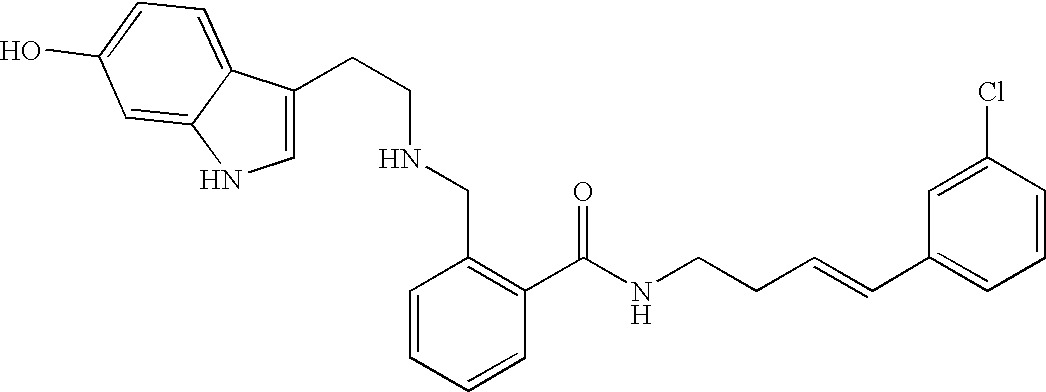 |
Procedure D0.15 g | 6.5 mg | 474 |
| 115 |
 |
Procedure C0.10 g | 1.8 mg | 456 |
| 116 |
 |
Procedure C0.25 g | 14 mg | 476 |
| 214 |
 |
Procedure C0.10 g | 1.2 mg | 456 |
| 306 |
 |
Procedure C0.10 g | 2.0 mg | 444 |
| 117 |
 |
Procedure C0.10 g | 2.4 mg | 442 |
| 118 |
 |
Procedure C0.20 g | 3.9 mg | 440 |
| 119 |
 |
Procedure C0.12 g | 3.0 mg | 454 |
| 215 |
 |
Procedure C0.10 g | 2.9 mg | 426 |
| 410 |
 |
Procedure C0.10 g | 1.4 mg | 412 |
| 411 |
 |
Procedure C0.15 g | 8.0 mg | 440 |
| 412 |
 |
Procedure C0.10 g | 3.8 mg | 440 |
| 307 |
 |
Procedure C0.10 g | 1.0 mg | 440 |
| 308 |
 |
Procedure C0.13 g | 5.1 mg | 440 |
| 413 |
 |
Procedure C0.10 g | 1.1 mg | 461 |
| 309 |
 |
Procedure C0.10 g | 1.7 mg | 444 |
| 120 |
 |
Procedure D,E0.45 g | 6.0 mg | 456 |
| 121 |
 |
Procedure C0.25 g | 7.1 mg | 470 |
| 122 |
 |
Procedure C0.25 g | 6.1 mg | 476 |
| 123 |
 |
Procedure D,E0.70 g | 4.0 mg | 476 |
| 414 |
 |
Procedure D0.15 g | 10 mg | 490 |
| 124 |
 |
Procedure D,E0.40 g | 5.0 mg | 476 |
| 125 |
 |
Procedure D,E0.45 g | 3.0 mg | 510/512 |
| 126 |
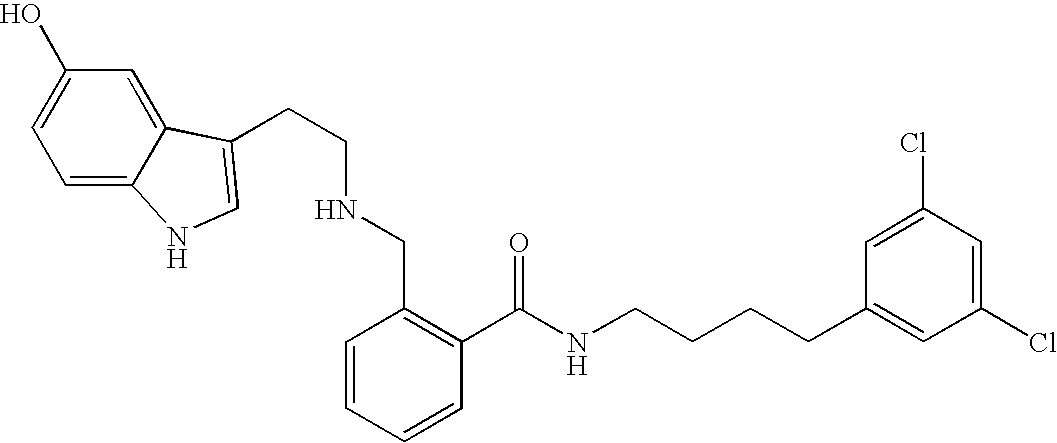 |
Procedure C0.25 g | 7.9 mg | 510/512 |
| 127 |
 |
Procedure D,E0.30 g | 6.0 mg | 510 |
| 128 |
 |
Procedure D,E0.35 g | 13 mg | 526 |
| 129 |
 |
Procedure C0.35 g | 9.0 mg | 454 |
| 130 |
 |
Procedure C0.25 g | 6.1 mg | 468 |
| 131 |
 |
Procedure C0.25 g | 5.0 mg | 474 |
| 132 |
 |
Procedure D0.25 g | 5.0 mg | 474 |
| 133 |
 |
Procedure C0.25 g | 8.7 mg | 508 |
| 310 |
 |
Procedure C0.25 g | 3.6 mg | 441 |
| 216 |
 |
Procedure C0.25 g | 2.5 mg | 441 |
| 217 |
 |
Procedure C0.25 g | 9.8 mg | 444 |
| 134 |
 |
Procedure C0.13 g | 7.0 mg | 454 |
| 135 |
 |
Procedure C0.19 g | 7.0 mg | 452 |
| 136 |
 |
Procedure D0.20 g | 3.8 mg | 452 |
| 415 |
 |
Procedure C0.35 g | 7 mg | 454 |
| 218 |
 |
Procedure C0.30 g | 8.0 mg | 468 |
| 137 |
 |
Procedure C0.15 g | 9.5 mg | 466 |
| 416 |
 |
Procedure C0.15 g | 4.0 mg | 520 |
| 219 |
 |
Procedure D0.20 g | 10 mg | 480 |
| 220 |
 |
Procedure C0.15 g | 4.1 mg | 466 |
| 221 |
 |
Procedure C0.15 g | 2.0 mg | 466 |
| 138 |
 |
Procedure C,E0.40 g | 19 mg | 454 |
| 417 |
 |
Procedure C0.25 g | 10 mg | 440 |
| 139 |
 |
Procedure C0.20 g | 15 mg | 468 |
| 222 |
 |
Procedure C0.25 g | 13 mg | 482 |
| 223 |
 |
Procedure C0.25 g | 17 mg | 488 |
| 140 |
 |
Procedure C0.20 g | 8.3 mg | 488 |
| 224 |
 |
Procedure C0.25 g | 17 mg | 522 |
| 225 |
 |
Procedure C0.10 g | 2.4 mg | 538 |
| 141 |
 |
Procedure C0.25 g | 35 mg | 466 |
| 226 |
 |
Procedure C0.25 g | 15 mg | 466 |
| 227 |
 |
Procedure C0.20 g | 5 mg | 466 |
| 228 |
 |
Procedure C0.25 g | 8.0 mg | 480 |
| 229 |
 |
Procedure C0.25 g | 9.4 mg | 486 |
| 142 |
 |
Procedure C0.15 g | 9.1 mg | 486 |
| 311 |
 |
Procedure C0.25 g | 9.5 mg | 520 |
| 230 |
 |
Procedure C0.25 g | 14 mg | 536 |
| 418 |
 |
Procedure C0.25 g | 5.1 mg | 453 |
| 419 |
 |
Procedure C0.03 g | 0.7 mg | 373 |
| 420 |
 |
Procedure YYY0.10 g | 2.2 mg | 403 |
| 421 |
 |
Procedure C0.03 g | 2.2 mg | 403 |
| 422 |
 |
Procedure YYY, thenProcedure0.20 g | 6.0 mg | 389 |
| 423 |
 |
Procedure C0.20 g | 10 mg | 388 |
| 424 |
 |
Procedure C0.05 g | 3.2 mg | 441 |
| 425 |
 |
Procedure C0.05 g | 5.0 mg | 403 |
| 426 |
 |
Procedure C0.10 g | 4.0 mg | 431 |
| 143 |
 |
Procedure C0.20 g | 7.0 mg | 401 |
| 231 |
 |
Procedure C0.03 g | 0.9 mg | 403 |
| 232 |
 |
Procedure C0.30 g | 10 mg | 403 |
| 427 |
 |
Procedure C0.30 g | 14 mg | 403 |
| 428 |
 |
Procedure C0.03 g | 0.6 mg | 417 |
| 429 |
 |
Procedure C0.20 g | 7.0 mg | 405 |
| 430 |
 |
Procedure C0.10 g | 5.5 mg | 455 |
| 233 |
 |
Procedure C0.10 g | 0.8 mg | 417 |
| 234 |
 |
Procedure C0.10 g | 9.0 mg | 438 |
| 431 |
 |
Procedure C0.20 g | 10 mg | 433 |
| 235 |
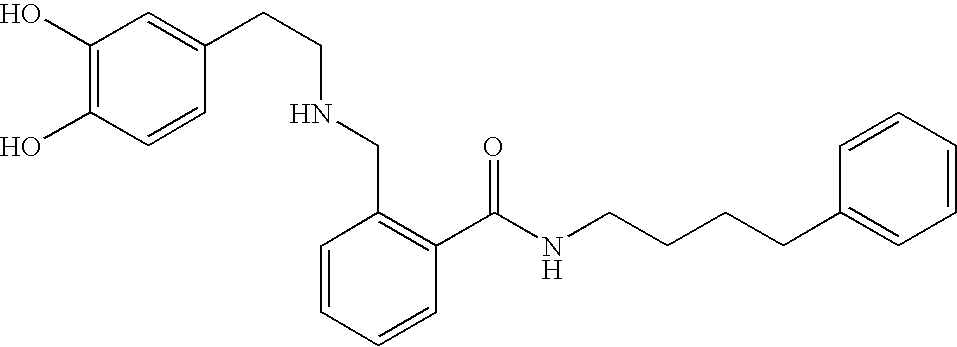 |
Procedure C0.20 g | 0.7 mg | 419 |
| 432 |
 |
Procedure C0.15 g | 12 mg | 431 |
| 433 |
 |
Procedure C0.05 g | 6.0 mg | 463 |
| 236 |
 |
Procedure C0.20 g | 9.0 mg | 431 |
| 312 |
 |
Procedure C0.20 g | 22 mg | 431 |
| 434 |
 |
Procedure C0.20 g | 28 mg | 417 |
| 435 |
 |
Procedure C0.13 g | 10 mg | 417 |
| 436 |
 |
Procedure YYY0.50 g | 6.0 mg | 417 |
| 437 |
 |
Procedure YYY0.10 g | 4.4 mg | 419 |
| 313 |
 |
Procedure C0.10 g | 1.0 mg | 419 |
| 438 |
 |
Procedure C0.10 g | 3.3 mg | 461 |
| 439 |
 |
Procedure C0.20 g | 18 mg | 402 |
| 237 |
 |
Procedure C0.15 g | 1.1 mg | 430 |
| 144 |
 |
Procedure D0.30 g | 1.7 mg | 428 |
| 440 |
 |
Procedure C0.13 g | 1.8 mg | 444 |
| 441 |
 |
Procedure C0.15 g | 2.7 mg | 480 |
| 442 |
 |
Procedure C0.15 g | 6.1 mg | 464 |
| 443 |
 |
Procedure C0.05 g | 5.0 mg | 445 |
| 314 |
 |
Procedure C,E0.30 g | 2 mg | 417 |
| 315 |
 |
Procedure C0.05 g | 4 mg | 431 |
| 444 |
 |
Procedure C0.05 g | 4.7 mg | 402 |
| 445 |
 |
Procedure C0.05 g | 4.9 mg | 430 |
| 238 |
 |
Procedure YYY0.29 g | 15 mg | 417 |
| 446 |
 |
Procedure C,E0.25 g | 10 mg | 419 |
| 145 |
 |
Procedure C0.20 g | 21 mg | 417 |
| 239 |
 |
Procedure C0.20 g | 20 mg | 433 |
| 146 |
 |
Procedure C0.20 g | 9 mg | 437 |
| 147 |
 |
Procedure C0.20 g | 21 mg | 437 |
| 240 |
 |
Procedure C,E0.40 g | 23 mg | 451 |
| 241 |
 |
Procedure C0.20 g | 7.0 mg | 471 |
| 242 |
 |
Procedure C0.20 g | 11 mg | 471 |
| 243 |
 |
Procedure C0.15 g | 9 mg | 487 |
| 244 |
 |
Procedure C0.10 g | 14 mg | 399 |
| 245 |
 |
Procedure C0.10 g | 13 mg | 401 |
| 246 |
 |
Procedure C0.30 g | 38 mg | 435 |
| 148 |
 |
Procedure C0.20 g | 10 mg | 415 |
| 149 |
 |
Procedure C0.25 g | 14 mg | 435 |
| 447 |
 |
Procedure C0.05 g | 8.0 mg | 405 |
| 247 |
 |
Procedure C0.07 g | 7.0 mg | 422 |
| 150 |
 |
Procedure C0.20 g | 9.0 mg | 429 |
| 151 |
 |
Procedure C0.13 g | 4.3 mg | 427 |
| 248 |
 |
Procedure C0.20 g | 13 mg | 463 |
| 448 |
 |
Procedure C0.20 g | 22 mg | 429 |
| 449 |
 |
Procedure C0.10 g | 19 mg | 429 |
| 450 |
 |
Procedure C0.13 g | 8.5 mg | 441 |
| 249 |
 |
Procedure C0.13 g | 3.7 mg | 441 |
| 250 |
 |
Procedure C0.13 g | 14 mg | 427 |
| 152 |
 |
Procedure C0.20 g | 13 mg | 427 |
| 451 |
 |
Procedure C0.20 g | 10 mg | 441 |
| 251 |
 |
Procedure C0.10 g | 45 mg | 441 |
| 153 |
 |
Procedure C0.15 g | 16 mg | 399 |
| 154 |
 |
Procedure C0.15 g | 11 mg | 427 |
| 452 |
 |
Procedure C0.21 g | 5.2 mg | 427 |
| 252 |
 |
Procedure C0.24 g | 6.9 mg | 427 |
| 253 |
 |
Procedure C0.24 g | 4.5 mg | 427 |
| 155 |
 |
Procedure D0.25 g | 6.0 mg | 426 |
| TABLE 2 | ||||
| Cleavage Procedures | Yield | m/z | ||
| Entry | Structure | (Resin Cleaved in g) | (mg) | (M + H)+ |
| 453 |
 |
Procedure C0.40 g | 11 mg | 416 |
| 454 |
 |
Procedure C0.25 g | 4.0 mg | 483/485 |
| 254 |
 |
Procedure C0.25 mg | 6.0 mg | 433 |
| and | ||||
 |
||||
| 316 |
 |
Procedure C0.25 g | 6.0 mg | 429 |
| and | ||||
 |
||||
| 156 |
 |
Procedure C0.6 g | 11 mg | 476 |
| and | ||||
 |
||||
| 455 |
 |
Procedure C0.3 g | 2.0 mg | 487 |
| and | ||||
 |
||||
| 456 |
 |
Procedure C0.25 g | 2.0 mg | 404 |
| 457 |
 |
Procedure C0.20 g | 4.6 mg | 417 |
| and | ||||
 |
||||
| 317 |
 |
Procedure C0.30 g | 26 mg | 437 |
| and | ||||
 |
||||
| 458 |
 |
Procedure C0.12 g | 1.8 mg | 448 |
| and | ||||
 |
||||
| 255 |
 |
Procedure C0.20 g | 13 mg | 421 |
| and | ||||
 |
||||
Claims (14)


Priority Applications (2)
| Application Number | Priority Date | Filing Date | Title |
|---|---|---|---|
| US10/364,039 US7084154B2 (en) | 2003-02-11 | 2003-02-11 | 2-(aminomethyl) arylamide analgesics |
| PCT/US2004/004017 WO2004071445A2 (en) | 2003-02-11 | 2004-02-11 | 2-(aminomethyl)arylamide analgesics |
Applications Claiming Priority (1)
| Application Number | Priority Date | Filing Date | Title |
|---|---|---|---|
| US10/364,039 US7084154B2 (en) | 2003-02-11 | 2003-02-11 | 2-(aminomethyl) arylamide analgesics |
Publications (2)
| Publication Number | Publication Date |
|---|---|
| US20040167119A1 US20040167119A1 (en) | 2004-08-26 |
| US7084154B2 true US7084154B2 (en) | 2006-08-01 |
Family
ID=32867968
Family Applications (1)
| Application Number | Title | Priority Date | Filing Date |
|---|---|---|---|
| US10/364,039 Expired - Lifetime US7084154B2 (en) | 2003-02-11 | 2003-02-11 | 2-(aminomethyl) arylamide analgesics |
Country Status (2)
| Country | Link |
|---|---|
| US (1) | US7084154B2 (en) |
| WO (1) | WO2004071445A2 (en) |
Families Citing this family (23)
| Publication number | Priority date | Publication date | Assignee | Title |
|---|---|---|---|---|
| EP2527328A1 (en) | 2008-04-01 | 2012-11-28 | Abbott GmbH & Co. KG | Tetrahydroisoquinolines, pharmaceutical compositions containing them, and their use in therapy |
| EP2393878B1 (en) | 2009-02-06 | 2012-12-12 | Styrolution GmbH | Thermoplastic molding compounds based on styrene copolymers and polyamides having improved weathering resistance |
| TW201038569A (en) * | 2009-02-16 | 2010-11-01 | Abbott Gmbh & Co Kg | Heterocyclic compounds, pharmaceutical compositions containing them, and their use in therapy |
| AR075442A1 (en) | 2009-02-16 | 2011-03-30 | Abbott Gmbh & Co Kg | AMINOTETRALINE DERIVATIVES, PHARMACEUTICAL COMPOSITIONS THAT CONTAIN THEM AND THEIR USES IN THERAPY |
| GB0909768D0 (en) * | 2009-06-08 | 2009-07-22 | Nanyang Polytechnic | Novel compounds and uses thereof |
| CA2777782C (en) * | 2009-10-15 | 2016-06-28 | Children's Medical Center Corporation | Sepiapterin reductase inhibitors for the treatment of pain |
| TW201139370A (en) * | 2009-12-23 | 2011-11-16 | Lundbeck & Co As H | Processes for the manufacture of a pharmaceutically active agent |
| JP6245983B2 (en) | 2010-08-11 | 2017-12-13 | ドレクセル ユニバーシティ | Novel D3 dopamine receptor agonists for treating dyskinesia in Parkinson's disease |
| US9051280B2 (en) | 2010-08-13 | 2015-06-09 | AbbVie Deutschland GmbH & Co. KG | Tetraline and indane derivatives, pharmaceutical compositions containing them, and their use in therapy |
| US8877794B2 (en) | 2010-08-13 | 2014-11-04 | Abbott Laboratories | Phenalkylamine derivatives, pharmaceutical compositions containing them, and their use in therapy |
| US8846743B2 (en) | 2010-08-13 | 2014-09-30 | Abbott Laboratories | Aminoindane derivatives, pharmaceutical compositions containing them, and their use in therapy |
| US9045459B2 (en) | 2010-08-13 | 2015-06-02 | AbbVie Deutschland GmbH & Co. KG | Phenalkylamine derivatives, pharmaceutical compositions containing them, and their use in therapy |
| US8883839B2 (en) | 2010-08-13 | 2014-11-11 | Abbott Laboratories | Tetraline and indane derivatives, pharmaceutical compositions containing them, and their use in therapy |
| US9309200B2 (en) | 2011-05-12 | 2016-04-12 | AbbVie Deutschland GmbH & Co. KG | Benzazepine derivatives, pharmaceutical compositions containing them, and their use in therapy |
| US8853196B2 (en) | 2011-08-05 | 2014-10-07 | AbbVie Deutschland GmbH & Co. KG | Aminochromane, aminothiochromane and amino-1,2,3,4-tetrahydroquinoline derivatives, pharmaceutical compositions containing them, and their use in therapy |
| CN104011028A (en) | 2011-11-18 | 2014-08-27 | 艾伯维德国有限责任两合公司 | N-substituted aminobenzocycloheptene, aminotetraline, aminoindane and phenalkylamine derivatives, pharmaceutical compositions containing them, and their use in therapy |
| US9365512B2 (en) | 2012-02-13 | 2016-06-14 | AbbVie Deutschland GmbH & Co. KG | Isoindoline derivatives, pharmaceutical compositions containing them, and their use in therapy |
| US9650334B2 (en) | 2013-03-15 | 2017-05-16 | Abbvie Inc. | Pyrrolidine derivatives, pharmaceutical compositions containing them, and their use in therapy |
| US9656955B2 (en) | 2013-03-15 | 2017-05-23 | Abbvie Inc. | Pyrrolidine derivatives, pharmaceutical compositions containing them, and their use in therapy |
| WO2015055770A1 (en) | 2013-10-17 | 2015-04-23 | AbbVie Deutschland GmbH & Co. KG | Aminochromane, aminothiochromane and amino-1,2,3,4-tetrahydroquinoline derivatives, pharmaceutical compositions containing them, and their use in therapy |
| SG11201602935PA (en) | 2013-10-17 | 2016-05-30 | Abbvie Deutschland | Aminotetraline and aminoindane derivatives, pharmaceutical compositions containing them, and their use in therapy |
| EP3455203B1 (en) * | 2016-05-12 | 2021-09-22 | Research Triangle Institute | Vinylogous phenethylamines as neurotransmitter releasers |
| WO2021118318A2 (en) * | 2019-12-13 | 2021-06-17 | 주식회사 메타센테라퓨틱스 | Novel indole derivative and use thereof |
Citations (2)
| Publication number | Priority date | Publication date | Assignee | Title |
|---|---|---|---|---|
| CA2328720A1 (en) | 1998-04-20 | 1999-10-28 | Basf Aktiengesellschaft | Novel heterocyclically substituted amides with cysteine protease-inhibiting effect |
| WO2001054694A1 (en) | 2000-01-28 | 2001-08-02 | Bristol-Myers Squibb Company | Tetrahydropyrimidone inhibitors of fatty acid binding protein and method |
-
2003
- 2003-02-11 US US10/364,039 patent/US7084154B2/en not_active Expired - Lifetime
-
2004
- 2004-02-11 WO PCT/US2004/004017 patent/WO2004071445A2/en not_active Ceased
Patent Citations (2)
| Publication number | Priority date | Publication date | Assignee | Title |
|---|---|---|---|---|
| CA2328720A1 (en) | 1998-04-20 | 1999-10-28 | Basf Aktiengesellschaft | Novel heterocyclically substituted amides with cysteine protease-inhibiting effect |
| WO2001054694A1 (en) | 2000-01-28 | 2001-08-02 | Bristol-Myers Squibb Company | Tetrahydropyrimidone inhibitors of fatty acid binding protein and method |
Non-Patent Citations (3)
| Title |
|---|
| Caulfield Wilson L. et al., "The First Potent and Selective Inhibitors of the Glycine Transporter Type 2", Journal of Medicinal Chemistry, American Chemical Society, Washington D.C., vol. 44, No. 17, Aug. 16, 2001, pp. 2679-2682. |
| Ho, Koc-Kan et al., "2-(Aminomethyl)-benzamide-based glycine transporter type-2 inhibitors", Bioorganic and Medicinal Chemistry Letters, vol. 14, 2004, pp. 545-548. |
| Isaac, Methvin et al., "5,5-Diaryl-2-amino-4-pentenoates as Novel, Potent, and Selective Glycine Transporter Type-2 Reuptake Inhibitors" Bioorganic and Medicinal Chemistry Letters, vol. 11, 2001, pp. 1371-1373. |
Also Published As
| Publication number | Publication date |
|---|---|
| US20040167119A1 (en) | 2004-08-26 |
| WO2004071445A2 (en) | 2004-08-26 |
| WO2004071445A3 (en) | 2004-09-16 |
Similar Documents
| Publication | Publication Date | Title |
|---|---|---|
| US7084154B2 (en) | 2-(aminomethyl) arylamide analgesics | |
| US7285563B2 (en) | Heteroaromatic urea derivatives as VR-1 receptor modulators for treating pain | |
| TWI504589B (en) | Substituted aromatic carboxamide and urea derivatives as vanilloid receptor ligands | |
| US7112586B2 (en) | Substituted diamine derivatives useful as motilin antagonists | |
| US8524700B2 (en) | Tetrahydroisoquinoline sulfonamide derivatives, the preparation thereof, and the use of the same in therapeutics | |
| US20080242698A1 (en) | Organic Compounds | |
| WO2004065351A1 (en) | Amide derivatives and their use as inhibitors of 11-beta-hydroxysteroid dehydrogenase type 1 | |
| WO1995004051A1 (en) | Piperazine compounds used in therapy | |
| WO2008021849A2 (en) | Novel compounds as antagonists or inverse agonists at opioid receptors | |
| TW201211029A (en) | Substituted cyclic carboxamide and urea derivatives as ligands of the vanilloid receptor | |
| WO2005049023A1 (en) | Glyt1 transporter inhibitors | |
| US7078537B2 (en) | Phenylalkyl diamine and amide analogs | |
| US8859814B2 (en) | Alpha-substituted N-sulfonyl gylcine amides antagonists of CCR10, compositions containing the same and methods for using them | |
| US7365209B2 (en) | Nitrogen heterocycle biaryls for osteoporosis and other diseases | |
| US20050288314A1 (en) | 2,4-diaminoquinazolines for spinal muscular atrophy | |
| US7939528B2 (en) | Heterocycle compounds | |
| CN101010301A (en) | 5-HT7 receptor antagonists | |
| CN101389608A (en) | 5-HT7 receptor antagonists | |
| US7553965B2 (en) | 5-HT7 receptor antagonists | |
| JP2001516745A (en) | Substituted isoquinolines as anticonvulsants | |
| US20080051423A1 (en) | Nitrogen heterocycle biaryls for osteoporosis and other diseases |
Legal Events
| Date | Code | Title | Description |
|---|---|---|---|
| AS | Assignment |
Owner name: PHARMACOPEIA DRUG DISCOVERY, INC., NEW JERSEY Free format text: ASSIGNMENT OF ASSIGNORS INTEREST;ASSIGNORS:HO, JOC-KAN;BALDWIN, JOHN J.;BOHNSTEDT, ADOLPH C.;AND OTHERS;REEL/FRAME:014426/0967;SIGNING DATES FROM 20030617 TO 20030814 |
|
| STCF | Information on status: patent grant |
Free format text: PATENTED CASE |
|
| CC | Certificate of correction | ||
| CC | Certificate of correction | ||
| AS | Assignment |
Owner name: PHARMACOPEIA, INC., NEW JERSEY Free format text: CHANGE OF NAME;ASSIGNOR:PHARMACOPEIA DRUG DISCOVERY, INC.;REEL/FRAME:019704/0913 Effective date: 20070503 |
|
| FEPP | Fee payment procedure |
Free format text: PAYER NUMBER DE-ASSIGNED (ORIGINAL EVENT CODE: RMPN); ENTITY STATUS OF PATENT OWNER: LARGE ENTITY Free format text: PAYOR NUMBER ASSIGNED (ORIGINAL EVENT CODE: ASPN); ENTITY STATUS OF PATENT OWNER: LARGE ENTITY |
|
| AS | Assignment |
Owner name: PHARMACOPEIA, LLC, CALIFORNIA Free format text: MERGER;ASSIGNORS:PHARMACOPEIA, INC.;LATOUR ACQUISITION, LLC;REEL/FRAME:022917/0419 Effective date: 20081223 |
|
| FPAY | Fee payment |
Year of fee payment: 4 |
|
| FPAY | Fee payment |
Year of fee payment: 8 |
|
| FEPP | Fee payment procedure |
Free format text: ENTITY STATUS SET TO UNDISCOUNTED (ORIGINAL EVENT CODE: BIG.) |
|
| MAFP | Maintenance fee payment |
Free format text: PAYMENT OF MAINTENANCE FEE, 12TH YEAR, LARGE ENTITY (ORIGINAL EVENT CODE: M1553) Year of fee payment: 12 |