US7064457B2 - Recognition device intended to order the unlocking of a vehicle door and/or to authorize the starting of a vehicle - Google Patents
Recognition device intended to order the unlocking of a vehicle door and/or to authorize the starting of a vehicle Download PDFInfo
- Publication number
- US7064457B2 US7064457B2 US10/471,357 US47135703A US7064457B2 US 7064457 B2 US7064457 B2 US 7064457B2 US 47135703 A US47135703 A US 47135703A US 7064457 B2 US7064457 B2 US 7064457B2
- Authority
- US
- United States
- Prior art keywords
- frequency
- signal
- vehicle
- identification device
- receiver
- Prior art date
- Legal status (The legal status is an assumption and is not a legal conclusion. Google has not performed a legal analysis and makes no representation as to the accuracy of the status listed.)
- Expired - Fee Related, expires
Links
- 230000005540 biological transmission Effects 0.000 claims description 3
- 238000010586 diagram Methods 0.000 description 4
- 230000001419 dependent effect Effects 0.000 description 3
- 230000010363 phase shift Effects 0.000 description 2
- 241001484259 Lacuna Species 0.000 description 1
- 230000002238 attenuated effect Effects 0.000 description 1
- 230000035945 sensitivity Effects 0.000 description 1
Images



Classifications
-
- B—PERFORMING OPERATIONS; TRANSPORTING
- B60—VEHICLES IN GENERAL
- B60R—VEHICLES, VEHICLE FITTINGS, OR VEHICLE PARTS, NOT OTHERWISE PROVIDED FOR
- B60R25/00—Fittings or systems for preventing or indicating unauthorised use or theft of vehicles
- B60R25/20—Means to switch the anti-theft system on or off
- B60R25/24—Means to switch the anti-theft system on or off using electronic identifiers containing a code not memorised by the user
- B60R25/245—Means to switch the anti-theft system on or off using electronic identifiers containing a code not memorised by the user where the antenna reception area plays a role
-
- H—ELECTRICITY
- H04—ELECTRIC COMMUNICATION TECHNIQUE
- H04B—TRANSMISSION
- H04B7/00—Radio transmission systems, i.e. using radiation field
- H04B7/02—Diversity systems; Multi-antenna system, i.e. transmission or reception using multiple antennas
- H04B7/12—Frequency diversity
Definitions
- the present invention relates to a recognition device intended for controlling the unlocking of openable panels of a vehicle and/or for authorizing the starting of a vehicle.
- Radiofrequency identification devices comprise a portable transmitter that transmits a coded carrier wave to a receiver.
- a receiver that receives this coded wave and compares the latter with a coded preset and which, when the two items of information coincide, produces a signal for locking and unlocking openable panels of the vehicle.
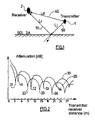
- FIG. 1 illustrates the problem related to the existence of these shadow zones.
- the transmitter 1 transmits an identification signal to the vehicle. Part of the signal transmitted travels the distance Ld indicated by the arrow 40 and reaches the receiver 2 directly. Another part of the signal transmitted indicated by the arrows 50 and 51 reaches the receiver after reflection off obstacles for example the ground 2 A which surround the vehicle. The signal thus reflected is phase shifted with respect to the signal received directly by the receiver 2 . On account of this phase shift, there are localized areas in which the direct incident wave superposed on the reflected wave is not recognized by the receiver 2 . As a consequence, the recognition device does not operate in these localized zones often referred to as “shadow zones”.
- FIG. 1 represents a simplified diagram of the operation of an identification device.
- this diagram is considered the path of a wave 40 which reaches the receiver directly and the path of a wave 50 , 51 which is reflected off the ground 2 A.
- a part of the wave 40 received directly by the receiver 2 has the form:
- a d ⁇ A 2 ⁇ e J2 ⁇ ⁇ ⁇ ⁇ ⁇ L d ⁇ 0 ⁇ A e ⁇
- Ld represents the distance traveled by the transmitted wave between the transmitter 1 and the receiver 2
- ⁇ o is the wavelength of the transmitted wave
- a 2 is dependent on the wavelength and on the distance traveled by the wave.
- This wave 50 , 51 has the form:
- a r ⁇ A 3 ⁇ e J ⁇ [ 2 ⁇ ⁇ ⁇ ( L j + L r ) ⁇ 0 - ⁇ ] ⁇ A e ⁇
- L j represents the distance traveled by the transmitted wave between the transmitter 1 and the ground 2 A
- L r the distance traveled by the transmitted wave between the ground 2 A and the receiver 2
- ⁇ o is the wavelength of the transmitted wave
- a 3 is a function of the wavelength and of the distances traveled by the wave.
- the total wave which arrives at the receiver therefore has the form:
- a t ⁇ [ A 2 ⁇ e J2 ⁇ ⁇ ⁇ ⁇ ⁇ L d ⁇ 0 + A 3 ⁇ e J ⁇ [ 2 ⁇ ⁇ ⁇ ( L j + L r ) ⁇ 0 - ⁇ ] ] ⁇ A e ⁇ .
- This wave varies as a function of the distance between the user and his vehicle and as a function of the frequency of the carrier wave transmitted.
- An aim of the present invention is to provide a reliable identification device despite the phase shift engendered by the reflection of the waves against obstacles.
- the subject of the invention is an identification device intended for controlling the unlocking of openable panels of a vehicle and/or for authorizing the starting of a vehicle comprising a first transmitter which, on command, is able to send a first user identification signal on a carrier of a first given frequency ( ⁇ 1 ) to a receiver, characterized in that it comprises a second transmitter able to transmit at least one second user identification signal on a carrier of a second frequency ( ⁇ 2 ) different from the first frequency in such a way that this second signal can serve as identifying signal in the shadow zones of nonrecognition of the first signal.
- FIG. 1 already described in the preamble represents a simplified diagram of the operation of an identification device known in the art
- FIG. 2 represents for two different frequencies of the carrier a chart of the attenuation of the waves received by the receiver as a function of the distance between the transmitter and the receiver,
- FIG. 3 represents a diagram of “shadow zones” around a vehicle as a function of the wavelength of the carrier signal for two different frequencies of the carrier,
- FIG. 4 represents a first embodiment of a transmitter according to the invention
- FIG. 5 represents a second embodiment of a transmitter according to the invention.
- FIG. 2 is a chart of the attenuation of the waves received by the receiver 2 as a function of the distance between the transmitter 1 and the receiver 2 .
- the curves 10 and 20 represented in this chart are theoretical curves which consider only the superposition of a direct incident wave 40 and of a wave that has been reflected 51 by the ground 2 A (see FIG. 1 ).
- the receiver 2 receives a superposed multitude of waves reflected by various obstacles such as the person who is carrying the receiver, the bodywork of the vehicle, the walls of a building situated nearby, etc.
- the waves reflected by such obstacles have a weaker influence and are therefore neglected in what follows.
- the curve 10 represents the attenuation received by the receiver when the wave transmitted has a given frequency ( ⁇ 1 ).
- the curve 10 of the attenuation of the wave which has a frequency ( ⁇ 1 ) exhibits minima 11 , 12 , 13 at distances of around 4.5, 10.5 and 16 meters.
- a receiver 2 having for example a sensitivity of ⁇ 62 decibel milliwatts (dBm) cannot detect the sending of an identification signal when the user is 9.5 meters or 16 meters away, that is to say at a distance corresponding to the minimum 11 or 12 .
- the identification device will therefore exhibit shadow zones of nonrecognition of the user for these distances.
- the curve 20 of FIG. 2 also represents the attenuation of a wave transmitted at a frequency ( ⁇ 2 ) different from the first frequency ( ⁇ 1 ). In the present example, this is twice the frequency ( ⁇ 1 ). It may be noted that the attenuation curve 20 exhibits minima 21 , 22 , 23 at distances of 3.5, 8.5 and 14 meters and the Applicant has found that the distances for which the wave attenuation phenomenon is observed are different according to the frequency used. The position of the shadow zones of nonrecognition of a user is therefore dependent on the frequency used.
- the Applicant has had the idea of transmitting the identification signal at two different carrier frequencies.
- the shadow zones being linked to the frequency, they therefore appear at different places, doing so as a function of the frequency considered.
- the other frequency is preferably chosen in such a way as to exhibit a field maximum at this same distance.
- the radio range around the vehicle is not altered. As far as the user is concerned, everything occurs as if there were no shadow zones.
- the first frequency ( ⁇ 1 ) is substantially equal to 400 MHz.
- the second frequency is equal to 800 MHz.
- the second frequency ( ⁇ 2 ) is equal to a harmonic of the first frequency ( ⁇ 1 ) and in particular an even harmonic.
- FIG. 3 diagrammatically shows the shadow zones around the vehicle.
- the hatched zones 41 represent the shadow zones of nonrecognition of the signal sent at the frequency ( ⁇ 1 ).
- the surrounded zones 42 represent the shadow zones of nonrecognition of the signal sent at the frequency ( ⁇ 2 ).
- the geographical position of these waves is dependent on the frequency used.
- the first frequency ( ⁇ 1 ) is different from the frequency ( ⁇ 2 )
- these zones do not overlap.
- the receiver recognizes at least one of the two identification signals transmitted.
- the identification device according to the present invention is more reliable.
- the identification device comprises two independent transmitters 30 , 31 cooperating with associated receivers arranged in the vehicle.
- the first transmitter 30 and its associated receiver operate at the frequency ( ⁇ 1 ).
- the second transmitter 31 and its associated receiver operate at the frequency of ( ⁇ 2 ).
- these transmitters 30 , 31 may transmit an identification signal one after the other offset or simultaneously. It is also possible to provide for the second signal to be sent only if the user presses the control button of the transmitter a second time.
- the first and the second transmitter 30 , 31 are formed by a single transmission unit comprising means for toggling from the first to the second frequency and vice versa.
- FIG. 5 represents an exemplary embodiment of a transmitter 1 according to the second embodiment.
- This transmitter consists of a synthesizer 39 linked to an amplifier 33 and an antenna 32 .
- the synthesizer comprises a phase locked loop 36 (PLL) linked to a frequency divider 38 .
- the phase locked loop as well as the frequency divider are both controlled by a microcontroller 37 .
- the use of a synthesizer makes it possible to toggle relatively quickly from a first frequency ( ⁇ 1 ) to a second frequency ( ⁇ 2 ).
- the identification device according to the present invention can also be used in so-called “hands free” devices without operating a remote control box.
Landscapes
- Engineering & Computer Science (AREA)
- Mechanical Engineering (AREA)
- Computer Networks & Wireless Communication (AREA)
- Signal Processing (AREA)
- Lock And Its Accessories (AREA)
Abstract
A recognition device is described that is used to control the unlocking of vehicle openings and/or to authorize the start-up of the vehicle. The device includes a first emitter which, on command, can send a first user identification signal over a carrier wave having a given first frequency (ν1) to a receiver. The device also includes a second emitter which can emit at least one second user identification signal over a carrier wave having a second frequency (ν2) which is different from the first frequency such that the second signal can act as an identifier signal in the shadow zones where the first signal is not recognized.
Description
The present invention relates to a recognition device intended for controlling the unlocking of openable panels of a vehicle and/or for authorizing the starting of a vehicle.
Radiofrequency identification devices are known which comprise a portable transmitter that transmits a coded carrier wave to a receiver. There is provided, arranged in the motor vehicle, a receiver that receives this coded wave and compares the latter with a coded preset and which, when the two items of information coincide, produces a signal for locking and unlocking openable panels of the vehicle.
However, these recognition devices do not operate in certain zones around the vehicle, which are commonly referred to as “shadow zones” in respect of the identification devices known in the art.
More specifically, FIG. 1 represents a simplified diagram of the operation of an identification device. In this diagram is considered the path of a wave 40 which reaches the receiver directly and the path of a wave 50, 51 which is reflected off the ground 2A.
The wave transmitted by the transmitter 1 has the form: {right arrow over (A)}e=A1×ej2πν o t where νo represents the frequency of the wave transmitted and where A1 is a constant.
A part of the wave 40 received directly by the receiver 2 has the form:
where Ld represents the distance traveled by the transmitted wave between the
Another part 50 of the wave is firstly reflected by the ground 2A then reaches the receiver 2. This wave 50, 51 has the form:
where Lj represents the distance traveled by the transmitted wave between the
The total wave which arrives at the receiver therefore has the form:
This wave varies as a function of the distance between the user and his vehicle and as a function of the frequency of the carrier wave transmitted.
An aim of the present invention is to provide a reliable identification device despite the phase shift engendered by the reflection of the waves against obstacles.
Accordingly, the subject of the invention is an identification device intended for controlling the unlocking of openable panels of a vehicle and/or for authorizing the starting of a vehicle comprising a first transmitter which, on command, is able to send a first user identification signal on a carrier of a first given frequency (ν1) to a receiver, characterized in that it comprises a second transmitter able to transmit at least one second user identification signal on a carrier of a second frequency (ν2) different from the first frequency in such a way that this second signal can serve as identifying signal in the shadow zones of nonrecognition of the first signal.
The device according to the invention can furthermore comprise one or more of the following characteristics:
-
- the first and the second signals are transmitted simultaneously,
- the second signal is transmitted offset after the first signal,
- the first and second transmitters are formed by a transmission unit comprising means for toggling from the first to the second frequency and vice versa,
- these frequency toggling means comprise a synthesizer,
- the synthesizer comprises a frequency divider controlled by a microcontroller and a phase locked loop,
- the first frequency (ν1) is a harmonic of the second carrier frequency (ν2),
- the first frequency (ν1) is substantially equal to 400 Megahertz.
The invention will be better understood in the course of the detailed explanatory description which follows with reference to the figures in which:
As explained in the introduction, the Applicant has noticed that there exist zones for which the amplitude of the total wave received by the receiver is greatly attenuated [lacuna] the “shadow zones”. Represented in FIG. 2 is a chart of the attenuation of the waves received by the receiver 2 as a function of the distance between the transmitter 1 and the receiver 2. To illustrate the invention better, the curves 10 and 20 represented in this chart are theoretical curves which consider only the superposition of a direct incident wave 40 and of a wave that has been reflected 51 by the ground 2A (see FIG. 1 ). In reality, the receiver 2 receives a superposed multitude of waves reflected by various obstacles such as the person who is carrying the receiver, the bodywork of the vehicle, the walls of a building situated nearby, etc. However, the waves reflected by such obstacles have a weaker influence and are therefore neglected in what follows.
The curve 10 represents the attenuation received by the receiver when the wave transmitted has a given frequency (ν1).
In this figure it may be seen that there exist distances for which the attenuation of the wave is greater. For example, the curve 10 of the attenuation of the wave which has a frequency (ν1) exhibits minima 11, 12, 13 at distances of around 4.5, 10.5 and 16 meters. A receiver 2 having for example a sensitivity of −62 decibel milliwatts (dBm) cannot detect the sending of an identification signal when the user is 9.5 meters or 16 meters away, that is to say at a distance corresponding to the minimum 11 or 12. The identification device will therefore exhibit shadow zones of nonrecognition of the user for these distances.
The curve 20 of FIG. 2 also represents the attenuation of a wave transmitted at a frequency (ν2) different from the first frequency (ν1). In the present example, this is twice the frequency (ν1). It may be noted that the attenuation curve 20 exhibits minima 21, 22, 23 at distances of 3.5, 8.5 and 14 meters and the Applicant has found that the distances for which the wave attenuation phenomenon is observed are different according to the frequency used. The position of the shadow zones of nonrecognition of a user is therefore dependent on the frequency used.
This is why the Applicant has had the idea of creating an identification device that comprises a second transmitter that transmits an identification signal on a carrier of a second frequency (ν2) different from the first frequency in such a way that this second signal can serve as identifying signal in the zones of nonrecognition of the first signal.
Thus, to overcome the shadow zones for a given frequency, the Applicant has had the idea of transmitting the identification signal at two different carrier frequencies. The shadow zones being linked to the frequency, they therefore appear at different places, doing so as a function of the frequency considered. Under these conditions, if for a given frequency a shadow zone appears at a certain distance from the vehicle, the other frequency is preferably chosen in such a way as to exhibit a field maximum at this same distance. The radio range around the vehicle is not altered. As far as the user is concerned, everything occurs as if there were no shadow zones.
Advantageously the first frequency (ν1) is substantially equal to 400 MHz.
Advantageously also the second frequency is equal to 800 MHz.
Preferably, the second frequency (ν2) is equal to a harmonic of the first frequency (ν1) and in particular an even harmonic.
According to a first embodiment represented in FIG. 4 , the identification device comprises two independent transmitters 30, 31 cooperating with associated receivers arranged in the vehicle. The first transmitter 30 and its associated receiver operate at the frequency (ν1). The second transmitter 31 and its associated receiver operate at the frequency of (ν2).
Advantageously, these transmitters 30, 31 may transmit an identification signal one after the other offset or simultaneously. It is also possible to provide for the second signal to be sent only if the user presses the control button of the transmitter a second time.
According to a second embodiment represented in FIG. 5 , the first and the second transmitter 30, 31 are formed by a single transmission unit comprising means for toggling from the first to the second frequency and vice versa.
Of course, the identification device according to the present invention can also be used in so-called “hands free” devices without operating a remote control box.
Claims (7)
1. An identification device for controlling locking and unlocking of at least one openable panel of a vehicle and authorizing a starting of a vehicle, comprising:
at least one signal transmitter for sending a first user identification signal on a first given carrier frequency to a receiver and at least one second user identification signal on a second carrier frequency different from the first carrier frequency,
wherein the at least one second signal is able to serve as an identifying signal in shadow zones of the first signal, and
wherein the second frequency is a harmonic of the first frequency.
2. The identification device according to claim 1 , wherein the first and the at least one second signals are transmitted simultaneously.
3. The identification device according to claim 1 , wherein the at least one second signal is transmitted at a time offset from the first signal.
4. The identification device according to claim 1 , wherein the signal transmitter comprises a single transmission unit having a means for toggling between the first and the second carrier frequency.
5. The identification device according to claim 4 , wherein the means for toggling comprises a synthesizer.
6. The identification device according to claim 5 , wherein the synthesizer comprises a frequency divider controlled by a microcontroller and a phase locked loop.
7. The identification device according to claim 1 , wherein the first frequency is substantially equal to 400 Megahertz.
Applications Claiming Priority (3)
| Application Number | Priority Date | Filing Date | Title |
|---|---|---|---|
| FR01/03484 | 2001-03-12 | ||
| FR0103484A FR2821961B1 (en) | 2001-03-12 | 2001-03-12 | RECOGNITION DEVICE FOR CONTROLLING THE UNLOCKING OF OPENINGS OF A VEHICLE AND / OR AUTHORIZING THE STARTING OF A VEHICLE |
| PCT/EP2002/002654 WO2002072987A1 (en) | 2001-03-12 | 2002-03-11 | Recognition device to control the unlocking/starting up of a vehicle |
Publications (2)
| Publication Number | Publication Date |
|---|---|
| US20040075341A1 US20040075341A1 (en) | 2004-04-22 |
| US7064457B2 true US7064457B2 (en) | 2006-06-20 |
Family
ID=8861126
Family Applications (1)
| Application Number | Title | Priority Date | Filing Date |
|---|---|---|---|
| US10/471,357 Expired - Fee Related US7064457B2 (en) | 2001-03-12 | 2002-03-11 | Recognition device intended to order the unlocking of a vehicle door and/or to authorize the starting of a vehicle |
Country Status (5)
| Country | Link |
|---|---|
| US (1) | US7064457B2 (en) |
| EP (1) | EP1387919A1 (en) |
| JP (1) | JP2004524461A (en) |
| FR (1) | FR2821961B1 (en) |
| WO (1) | WO2002072987A1 (en) |
Cited By (1)
| Publication number | Priority date | Publication date | Assignee | Title |
|---|---|---|---|---|
| DE102009043056A1 (en) * | 2009-09-28 | 2011-03-31 | Marquardt Gmbh | Electronic closing system for use as e.g. door closing system for access authorization of passenger car, has delta-sigma fractional N-phase locked loop synthesizer with quartz crystal for adjusting preset transmission frequency of channel |
Families Citing this family (5)
| Publication number | Priority date | Publication date | Assignee | Title |
|---|---|---|---|---|
| FR2938991B1 (en) * | 2008-11-21 | 2012-04-13 | Valeo Securite Habitacle | COMMUNICATION SYSTEM FOR MOTOR VEHICLE. |
| US10008109B2 (en) | 2011-12-09 | 2018-06-26 | Gentex Corporation | System and method for training a programmable transceiver |
| GB2600438A (en) * | 2020-10-29 | 2022-05-04 | Continental Automotive Gmbh | An access device, system and method using cognitive radio |
| US12184311B2 (en) * | 2021-03-25 | 2024-12-31 | Skyworks Solutions, Inc. | Antenna systems with both single-ended and differential signal feeds |
| FR3132479B1 (en) | 2022-02-04 | 2023-12-22 | Continental Automotive Gmbh | METHOD FOR ACTIVATING A VEHICLE FUNCTION AND ASSOCIATED ACTIVATION DEVICE |
Citations (7)
| Publication number | Priority date | Publication date | Assignee | Title |
|---|---|---|---|---|
| GB2119141A (en) | 1982-04-21 | 1983-11-09 | Mastiff Security Syst Ltd | Transmitter token |
| FR2746235A1 (en) | 1996-03-14 | 1997-09-19 | Siemens Ag | ANTI-THEFT SYSTEM FOR MOTOR VEHICLE |
| US5684337A (en) * | 1996-03-08 | 1997-11-04 | Trw Inc. | Keyless vehicle entry receiver having a diagnostic mode of operation wherein a code comparison is not performed |
| DE19732157A1 (en) | 1996-07-26 | 1998-01-29 | Prince Corp | Multi-frequency transmitter |
| US5804888A (en) * | 1994-08-26 | 1998-09-08 | Siemens Aktiengesellschaft | Anti-theft system for a motor vehicle |
| US5905431A (en) * | 1993-05-28 | 1999-05-18 | Mueller; Rand W. | Vehicle security system |
| US20040046451A1 (en) * | 2002-08-29 | 2004-03-11 | Kabushiki Kaisha Tokai Rika Denki Seisakusho | Lock control apparatus for use in vehicle |
Family Cites Families (1)
| Publication number | Priority date | Publication date | Assignee | Title |
|---|---|---|---|---|
| JPH09144404A (en) * | 1995-11-21 | 1997-06-03 | Tokai Rika Co Ltd | Transmitting and receiving system for car and receiver and transmitting and receiving system |
-
2001
- 2001-03-12 FR FR0103484A patent/FR2821961B1/en not_active Expired - Fee Related
-
2002
- 2002-03-11 EP EP02727395A patent/EP1387919A1/en not_active Withdrawn
- 2002-03-11 US US10/471,357 patent/US7064457B2/en not_active Expired - Fee Related
- 2002-03-11 JP JP2002572222A patent/JP2004524461A/en active Pending
- 2002-03-11 WO PCT/EP2002/002654 patent/WO2002072987A1/en not_active Ceased
Patent Citations (7)
| Publication number | Priority date | Publication date | Assignee | Title |
|---|---|---|---|---|
| GB2119141A (en) | 1982-04-21 | 1983-11-09 | Mastiff Security Syst Ltd | Transmitter token |
| US5905431A (en) * | 1993-05-28 | 1999-05-18 | Mueller; Rand W. | Vehicle security system |
| US5804888A (en) * | 1994-08-26 | 1998-09-08 | Siemens Aktiengesellschaft | Anti-theft system for a motor vehicle |
| US5684337A (en) * | 1996-03-08 | 1997-11-04 | Trw Inc. | Keyless vehicle entry receiver having a diagnostic mode of operation wherein a code comparison is not performed |
| FR2746235A1 (en) | 1996-03-14 | 1997-09-19 | Siemens Ag | ANTI-THEFT SYSTEM FOR MOTOR VEHICLE |
| DE19732157A1 (en) | 1996-07-26 | 1998-01-29 | Prince Corp | Multi-frequency transmitter |
| US20040046451A1 (en) * | 2002-08-29 | 2004-03-11 | Kabushiki Kaisha Tokai Rika Denki Seisakusho | Lock control apparatus for use in vehicle |
Non-Patent Citations (1)
| Title |
|---|
| Patent Abstracts of Japan; publication No. 9-144,404, published on Jun. 3, 1997 (1 page). |
Cited By (1)
| Publication number | Priority date | Publication date | Assignee | Title |
|---|---|---|---|---|
| DE102009043056A1 (en) * | 2009-09-28 | 2011-03-31 | Marquardt Gmbh | Electronic closing system for use as e.g. door closing system for access authorization of passenger car, has delta-sigma fractional N-phase locked loop synthesizer with quartz crystal for adjusting preset transmission frequency of channel |
Also Published As
| Publication number | Publication date |
|---|---|
| US20040075341A1 (en) | 2004-04-22 |
| FR2821961A1 (en) | 2002-09-13 |
| JP2004524461A (en) | 2004-08-12 |
| WO2002072987A1 (en) | 2002-09-19 |
| EP1387919A1 (en) | 2004-02-11 |
| FR2821961B1 (en) | 2007-06-08 |
Similar Documents
| Publication | Publication Date | Title |
|---|---|---|
| US6693581B2 (en) | Device for transmitting data in a motor vehicle | |
| US7986960B2 (en) | Self-aligning vehicular transmitter system | |
| US7098769B2 (en) | Identification system for verifying an authorization to access an object or to use an object, particularly a motor vehicle | |
| US6049301A (en) | Surveillance apparatus and method for the detection of radio receivers | |
| US5585953A (en) | IR/RF radio transceiver and method | |
| US20040203478A1 (en) | Rfid receiver apparatus and method | |
| US6265988B1 (en) | Apparatus and method for remote convenience message transmission and control utilizing frequency diversity | |
| US6384710B1 (en) | Apparatus and method for remote convenience message reception and control utilizing frequency diversity | |
| KR20020091112A (en) | Transponder and transponder system | |
| US6483425B1 (en) | System for enhancing the security of a bi-directional data transmission system controlling access to an enclosed space, notably a vehicle | |
| US4212013A (en) | Duplex-transmitter receiver arrangement | |
| US7064457B2 (en) | Recognition device intended to order the unlocking of a vehicle door and/or to authorize the starting of a vehicle | |
| GB1605207A (en) | Systems to assist in the location of remote radio transmitters | |
| JPH05301561A (en) | Wireless type engine starting device | |
| EP1559199B1 (en) | RF circuit with frequency agile seqential amplifiers | |
| US11926285B2 (en) | Remote communication system | |
| US20010014117A1 (en) | Procedure for increasing the manipulation security for a bi-directional contactless data transmission | |
| JPH09144404A (en) | Transmitting and receiving system for car and receiver and transmitting and receiving system | |
| US6904101B1 (en) | Tuneless narrow-band super-regenerative receiver | |
| US6445336B2 (en) | Radar device and on-vehicle radar device | |
| US20030085620A1 (en) | Antitheft system, method for operating an antitheft system and components of an antitheft system | |
| KR20000072891A (en) | Transmitter and receiver of remote controlling signal | |
| JPH052790B2 (en) | ||
| JP2884986B2 (en) | Mobile object identification system | |
| KR200324586Y1 (en) | Wireless Door Locking Device Comprising Long Wave Noise Evading Circuit |
Legal Events
| Date | Code | Title | Description |
|---|---|---|---|
| AS | Assignment |
Owner name: VALEO ELECTRONIQUE, FRANCE Free format text: ASSIGNMENT OF ASSIGNORS INTEREST;ASSIGNOR:BELINGUIER, THIERRY;REEL/FRAME:014811/0256 Effective date: 20030811 |
|
| REMI | Maintenance fee reminder mailed | ||
| LAPS | Lapse for failure to pay maintenance fees | ||
| STCH | Information on status: patent discontinuation |
Free format text: PATENT EXPIRED DUE TO NONPAYMENT OF MAINTENANCE FEES UNDER 37 CFR 1.362 |
|
| FP | Lapsed due to failure to pay maintenance fee |
Effective date: 20180620 |