US7042938B2 - Soft bit computation for a reduced state equalizer - Google Patents
Soft bit computation for a reduced state equalizer Download PDFInfo
- Publication number
- US7042938B2 US7042938B2 US09/928,927 US92892701A US7042938B2 US 7042938 B2 US7042938 B2 US 7042938B2 US 92892701 A US92892701 A US 92892701A US 7042938 B2 US7042938 B2 US 7042938B2
- Authority
- US
- United States
- Prior art keywords
- soft
- decision
- bits
- state
- delay
- Prior art date
- Legal status (The legal status is an assumption and is not a legal conclusion. Google has not performed a legal analysis and makes no representation as to the accuracy of the status listed.)
- Expired - Fee Related, expires
Links
Images



Classifications
-
- H—ELECTRICITY
- H04—ELECTRIC COMMUNICATION TECHNIQUE
- H04L—TRANSMISSION OF DIGITAL INFORMATION, e.g. TELEGRAPHIC COMMUNICATION
- H04L25/00—Baseband systems
- H04L25/02—Details ; arrangements for supplying electrical power along data transmission lines
- H04L25/03—Shaping networks in transmitter or receiver, e.g. adaptive shaping networks
- H04L25/03006—Arrangements for removing intersymbol interference
- H04L25/03178—Arrangements involving sequence estimation techniques
- H04L25/03312—Arrangements specific to the provision of output signals
- H04L25/03318—Provision of soft decisions
-
- H—ELECTRICITY
- H04—ELECTRIC COMMUNICATION TECHNIQUE
- H04L—TRANSMISSION OF DIGITAL INFORMATION, e.g. TELEGRAPHIC COMMUNICATION
- H04L25/00—Baseband systems
- H04L25/02—Details ; arrangements for supplying electrical power along data transmission lines
- H04L25/03—Shaping networks in transmitter or receiver, e.g. adaptive shaping networks
- H04L25/03006—Arrangements for removing intersymbol interference
- H04L2025/0335—Arrangements for removing intersymbol interference characterised by the type of transmission
- H04L2025/03375—Passband transmission
- H04L2025/03401—PSK
-
- H—ELECTRICITY
- H04—ELECTRIC COMMUNICATION TECHNIQUE
- H04L—TRANSMISSION OF DIGITAL INFORMATION, e.g. TELEGRAPHIC COMMUNICATION
- H04L25/00—Baseband systems
- H04L25/02—Details ; arrangements for supplying electrical power along data transmission lines
- H04L25/03—Shaping networks in transmitter or receiver, e.g. adaptive shaping networks
- H04L25/03006—Arrangements for removing intersymbol interference
- H04L2025/0335—Arrangements for removing intersymbol interference characterised by the type of transmission
- H04L2025/03375—Passband transmission
- H04L2025/0342—QAM
-
- H—ELECTRICITY
- H04—ELECTRIC COMMUNICATION TECHNIQUE
- H04L—TRANSMISSION OF DIGITAL INFORMATION, e.g. TELEGRAPHIC COMMUNICATION
- H04L25/00—Baseband systems
- H04L25/02—Details ; arrangements for supplying electrical power along data transmission lines
- H04L25/03—Shaping networks in transmitter or receiver, e.g. adaptive shaping networks
- H04L25/03006—Arrangements for removing intersymbol interference
- H04L25/03178—Arrangements involving sequence estimation techniques
- H04L25/03203—Trellis search techniques
- H04L25/03235—Trellis search techniques with state-reduction using feedback filtering
Definitions
- This invention relates generally to digital communication, and more particularly to low complexity equalization.
- TDMA Time Domain Multiple Access
- ISI intersymbol interference
- GSM global system for mobile communications
- EDGE enhanced data rates for GSM evolution
- MLSE maximum likelihood sequence estimation
- DFE linear equalization and decision-feedback equalization
- a communication channel behaves in many respects like a filter, and therefore ISI itself may be modelled as a filter.
- the length of the filter is the extent of ISI, and this length may be referred to as the impulse response length L.
- the complexity of the Viterbi Algorithm increases exponentially with channel length, and therefore implementation of the full Viterbi Algorithm becomes unacceptably complex in EDGE.
- MLSE using the full Viterbi algorithm is inadequate, and a sub-optimal equalizer capable of performance comparable to that of MLSE is necessary, with acceptable low complexity.
- RSSE Reduced State Sequence Estimation
- ML reduced-state maximum likelihood
- DFSE Delayed Decision Feedback Sequence Estimation
- Soft bits contain important reliability information that greatly aids the decoder located within the receiver downstream from the equalizer.
- Soft-output information can be produced by an algorithm called symbol-by-symbol Maximum A Posteriori (MAP) decoding, which can calculate the probability of each symbol given the whole sequence that has been received.
- MAP symbol-by-symbol Maximum A Posteriori
- a max-log-MAP algorithm is familiar to persons skilled in the art as a simplified version of a MAP algorithm, and max-log-MAP equalizers operate in a logarithmic domain as compared to a probability domain.
- DFPSE decision feedback partial sequence estimation
- DFPSE equalizers are equalizers which employ a non-zero delay reduced state trellis calculation and which achieve reduction of implementation complexity by (1) employing decision feedback, (2) relying on improved accuracy of initial symbol detection which reduces the scope of searching, and (3) using ML or Max-log-MAP detection criteria.
- DFPSE is also known as block decision feedback equalization. See “Block Decision Feedback Equalization” by Williamson et al., IEEE Trans Comm., vol. 40, pp. 255–264, February 1992.
- non-zero delay refers to the those situations in which, after a signal is received, there must be a waiting period before soft bits are computed, and this may be due to the need to examine more than one received symbol.
- “l” is impulse response length, and also bear in mind that the J k are subject to a constraint J 1 ⁇ J 2 ⁇ J 3 ⁇ . . . J l ⁇ 1 .
- EDGE systems involve capture of 2 or 3 taps in the MAP or MLSE part of the equalizer, and this means 8 or 64 states respectively for existing DFSE equalizers, or alternatively 4 or 16 states respectively for existing RSSE/RS-MAP equalizers with 4-way set partitioning.
- Digital signal processing (DSP) implementation of the simplest 4-state equalizer currently requires some 32 million instructions per second (MIPS) per time slot for EDGE at 8 PSK (phase shift keying). In order to provide higher data rate, it is desirable to have lower complexity algorithms than are currently available, or else DSP will be too costly.
- 2-way set partitioning with RSSE or RS-MAP is a candidate for achieving lower complexity, it entails problematic soft bit computation.
- soft symbol equalization is a candidate for replacing soft bit equalization, but soft symbol equalization is approximately 1.5 dB worse than soft bit equalization for 8 PSK EDGE, and this situation gets even worse for higher order modulations using current technology.
- the present invention provides a novel method of computing soft bits (which hereinafter refers to log likelihood ratios or bit probabilities) for any reduced state equalizer.
- This new method for making soft decisions uses low-complexity, while providing soft bit information for substantially all received bits.
- This invention allows an equalizer to be implemented with a minimum number of states, while retaining high performance. This reduction of implementation complexity is accomplished by methods which, for example, combine MLSE or MAP soft decisions with either decision-feedback equalization (DFE) decision-making or with other zero-delay soft decision-making.
- DFE decision-feedback equalization
- the method involves computing a first set of soft bits for transmitted bits in a received signal, using a reduced-state trellis with finite non-zero delay, calculating hard decisions in response to the received signal, and also ensuring that substantially all soft bits are computed by employing zero-delay soft decision-making or decision-feedback equalization to compute a second set of soft bits. Furthermore, the hard decisions are used to compute the second set.
- This invention assures that the number of states in the equalizer is reduced to obtain an acceptable complexity, while also ensuring that soft bit computation is not omitted for a substantial number of bits. Therefore, this method increases the reliability of low complexity equalization, especially for high order modulations, by more fully and successfully producing soft bit information.
- soft bits can be computed from a received signal using a reduced-state trellis with MAP soft decisions, and hard decisions are also computed in response to the received signal.
- Zero-delay soft decision-making or decision-feedback equalization is also employed, using the hard decisions to compute the soft values, and this ensures that soft bits are computed for substantially all bits.
- Decision-feedback equalization using these hard decisions to compute the soft values, is unconventional and provides a marked improvement in soft bit computation.
- the trellis calculation may produce maximum a posteriori (MAP) soft decisions, and/or may produce soft decisions with reduced state sequence estimation (RSSE), reduced state MAP, and/or reduced state MLSE.
- MAP maximum a posteriori
- RSSE reduced state sequence estimation
- MLSE reduced state MAP
- ML maximum likelihood
- DFPSE decision feedback partial sequence equalization
- the present soft bit equalization invention not only offers a 1.5 dB gain (or better) as compared to soft symbol equalization, but also allows the number of states in the equalizer to be reduced to the minimum possible value.
- different types of equalizers are not necessarily altogether different and distinct from each other, and there is often considerable commonality within subsets of equalizers.
- the present method is applicable not only to various types of equalizers, but also to arbitrary modulation sizes, and to any multiple access schemes such as TDMA/CDMA requiring a reduced state equalizer.
- Preferable implementation modes for the present invention include digital signal processor (DSP) and/or the American standard code for information interchange (ASCII).
- DSP digital signal processor
- ASCII American standard code for information interchange
- wireless communication will employ higher and higher data density, and the present invention will probably be important for implementing trellis-based soft bit equalizers in any wireless transmission environment that is significantly dispersive, for example in a high density and high delay system like 16–64 QAM (quadrature amplitude modulation).
- FIG. 1 is a flow chart illustrating basic steps of the present method.
- FIG. 2 shows the structure and interactive cooperation within the present invention, in the context of a wireless communication receiver.
- FIG. 3 illustrates an embodiment of the present invention employing DFE and either RSSE or Max-Log-MAP.
- FIG. 4 depicts an aspect of an embodiment in which soft bits are computed symbol-by-symbol using with zero delay.
- FIG. 5 illustrates an embodiment of the present invention employing zero delay and either RSSE or Max-Log-MAP.
- FIG. 6 shows an embodiment of the present invention employing DFE and DFPSE.
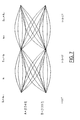
- FIG. 7 shows a trellis for a two-state equalizer.
- FIG. 8 shows a trellis for a four-state equalizer.
- the method involves computing 100 a first set of soft bits for bits transmitted in a received signal, using a reduced-state trellis with forward recursion and with finite non-zero delay.
- the computation 100 may advantageously utilize a Viterbi Algorithm, such as a soft output Viterbi algorithm (SOVA).
- SOVA soft output Viterbi algorithm
- the method also involves calculating 110 hard decisions in response to the received signal, and also ensuring 120 that substantially all soft bits are computed by employing zero-delay soft decision-making or decision-feedback equalization to compute a second set of soft bits. The hard decisions are used to compute the second set.
- FIG. 1 depicts a particular sequence for the steps, different sequences can be used in other best mode embodiments.
- the sequence shown in FIG. 1 is desirable if we want to ensure that the first set of soft bits and the second set of soft bits are soft bits for two different sets of bits. In other words, once the first set is computed 100 , then only soft bits for the remaining bits need to be computed 120 for the second set.
- the hard decisions are calculated 110 using the first set of soft bits. Using the hard decisions to compute soft bits is helpful to reduce error propagation.
- the present invention can be embodied in a wireless communications receiver 295 containing a reduced-state equalizer 200 .
- the equalizer 200 is capable of providing soft bits to a decoder 290 in order to enhance reliability of channel decoding subsequent to equalization.
- the reduced-state equalizer includes a reduced-state trellis module 220 , responsive to a received bit signal on a line 260 , for providing a soft bit signal on a line 280 and a hard decision signal 270 on a line 270 .
- the equalizer also includes a gap-filler module 210 , responsive to the received bit signal and also responsive to the hard decision signal 270 , for providing a second soft bit signal 292 .
- the second soft bit signal 292 includes soft bits that are absent from the first soft bit signal, so that the first and the second soft bit signals include soft bits for substantially all bits in the received bit signal 260 .
- the gap-filler module 210 produces soft bits which will fill any gaps in the soft bit computation performed by the reduced-state trellis module 220 .
- the reduced-state trellis module 220 is configured to operate with forward recursion and finite non-zero delay, and the gap-filler module 210 is configured as a decision feedback equalizer or as a zero-delay soft decision-maker (i.e. configured for DFE or zero-delay soft decision-making).
- the decoder is responsive to the first soft bit signal 280 and the second soft bit signal 292 , and is configured to provide a reliably decoded signal 297 .
- inventive portions of the receiver and equalizer are shown in FIG. 2 while other structures and signals are omitted from FIG. 2 for the sake of clarity.
- the finite non-zero delay employed by the reduced-state trellis module 220 is K minus one (K ⁇ 1), where K is a truncated impulse response length and is less than or equal to a non-truncated impulse response length L (i.e. K ⁇ L).
- the second set soft bits can be obtained with delay K minus two (K ⁇ 2) if the trellis module 220 is configured for max-log-MAP.
- the gap-filler module 210 can have arbitrary delay. Only forward recursion is used in the best embodiment of the present invention, and thus forward recursion is sufficient without the typical backward recursion, although backward recursion is possible in other embodiments of the present invention.
- FIG. 3 is a flow chart illustrating a particular embodiment of the present invention, employing a DFE step 310 in order to fill gaps, and an RSSE/Max-Log-MAP step 320 to perform a reduced-state trellis calculation.
- FIG. 1 showed a non-zero delay computation followed by a DFE computation
- FIG. 3 illustrates the DFE computation 310 occurring before the RSSE/Max-Log-MAP step 320 (which is a non-zero delay reduced state trellis calculation).
- FIG. 3 illustrates the DFE computation 310 occurring before the RSSE/Max-Log-MAP step 320 (which is a non-zero delay reduced state trellis calculation).
- FIG. 3 shows a feedback step 360 , according to which hard symbol decisions are fed back from the RSSE/Max-Log-MAP step 320 to the DFE step 310 .
- the flow chart of FIG. 3 shows a feedback step 360 , according to which hard symbol decisions are fed back from the RSSE/Max-Log-MAP step 320 to the DFE step 310 .
- FIG. 3 also shows an MSSE-DFE prefiltering step 300 which precedes the other steps just discussed (MMSE stands for minimum mean-squared error), and a channel decoding step 340 which follows the other steps just discussed.
- MMSE minimum mean-squared error
- a channel decoding step 340 which follows the other steps just discussed.
- a soft bit output step 330 in order to perform the previously described replacement of soft bits calculated in the DFE step 310 soft bits calculated in the RSSE/Max-Log-MAP step 320 (a soft bit output module could be included upstream from the decoder or within the decoder).
- the hard decisions may be computed using the max-log maximum a posteriori technique.
- the decision feedback equalization step 310 will be advantageously performed according to a rule described mathematically as follows:
- a decision produced by the DFE step 310 can be used to limit the number of states involved in the RSSE/Max-Log-MAP step 320 , but that is not necessary in a best mode embodiment.
- FIG. 4 depicts an aspect of the invention in which soft bits are computed symbol-by-symbol using zero delay.
- a received signal is subjected to an MMSE-DFE prefilter step 400 , then is processed in a RSSE symbol-by-symbol zero-delay soft decision step 410 , and finally is decoded in a channel decoder step 420 .
- the RSSE Symbol-by-symbol zero-delay soft decision step 410 advantageously employs a trellis calculation, and implemented with a maximum complexity that is twice as complex as implementation of decision-feedback equalization would be.
- FIG. 5 illustrates an embodiment of the present invention employing zero delay and either RSSE or Max-Log-MAP.
- This FIG. 5 is similar to the embodiment shown in FIG. 3 , the primary difference being that the DFE step 310 of FIG. 3 is replaced by the symbol-by-symbol zero-delay soft decision step 410 of FIG. 4 .
- the flow chart of FIG. 5 begins with a prefiltering step 500 , followed by a symbol-by-symbol zero-delay soft decision step 510 and an RSSE/Max-Log-MAP soft decision step 520 (steps 510 and 520 can occur in either order), and then a soft bit output step 530 followed by a decoding step 540 .
- step 320 of FIG. 3 or step 520 of FIG. 5 further efficiency is obtained if first and second subsets of signals are established by Euclidean partitioning so as to reduce trellis size to two states corresponding to the first and second subsets respectively. Then the more likely of the two states is determined, and Euclidean distances are computed for all paths corresponding to the more likely state; only the paths corresponding to the more likely state would then be used to perform trellis computation of soft bits in step 510 of FIG. 5 .
- a decision produced by the symbol-by-symbol zero-delay soft decision step 510 can be used to limit the number of states involved in the RSSE/Max-Log-MAP step 520 , and that is necessary in a best mode embodiment of the present invention.
- FIG. 6 shows another best mode embodiment of the present invention, employing DFE and decision feedback partial sequence equalization (DFPSE).
- FIG. 6 is, again, similar to the embodiment shown in FIG. 3 , the primary difference being that the RSSE/Max-Log-MAP step 320 of FIG. 3 is replaced by a DFPSE step 620 which (again) involves a non-zero delay reduced state trellis calculation.
- the flow chart of FIG. 6 begins with a prefiltering step 600 , followed by a DFE step 610 and a DFPSE step 620 . Steps 610 and 620 can occur in either order, and in either case a feedback step 660 feeds hard symbol decisions from DFPSE to DFE. Decisions produced by DFE can be used to reduce the number of states in the DFPSE trellis.
- the final steps in this embodiment are soft bit output 630 followed by decoding 640 .
- a non-zero delay reduced state trellis step computes soft bits and hard symbol decisions, either before or after a DFE/zero-delay step also computes soft bits. Furthermore, this DFE/zero-delay step always utilizes the hard symbol decisions to compute soft bits. The present invention thus ensures that, in one way or another, soft bits are efficiently calculated for substantially all bits transmitted in a received signal.
- the trellis size is reduced to two states corresponding to two sub sets A and B. Note from FIG. 7 that there are parallel transitions merging at each node. Since the Euclidean distance between the points in a given subset is maximized, early merging paths can be reliably distinguished. A minimum phase condition is required when making such early decisions. Now we would like to incorporate forward Max-Log-MAP detection through this reduced state trellis.
- the prefiltered-received signal sampled at symbol rate can be written as:
- a k is the 8PSK modulation alphabet
- h k is the channel impulse response of length L
- n(k) is the thermal noise.
- the first K taps are used in the main part of the trellis, and decision feedback is used for the remaining taps. Then the number of states in the trellis is given by 2 K ⁇ 1 . In FIG. 7 , the number of states is restricted to 2. Referring to FIG.
- the first phase in this 2-state, 2-way set partitioning Max-Log-MAP soft bit detection example begins by adding the path metric ⁇ (s k , s k+1 ) to the old path metric ⁇ (s k ) for all the paths merging at a given state S k+1 , and choosing the minimum distance winner path. Then store â k for this winner path and update the path history. This is denoted by the following equation: ⁇ ( s k+1 ) ⁇ min (s k ) ⁇ ( s k )+ ⁇ ( s k ,s k+1 ) ⁇ (4) where s k denotes all the states corresponding to previous symbol â k ⁇ 1 .
- the state dependent path history contains all previous L–K decisions on ⁇ k .
- the path metric for each branch connecting (s k ,s k+1 ) is defined as
- â k is obtained from the previous state s k
- ⁇ k is the path history stored in s k .
- the second phase in this example is max-log-MAP symbol detection with 1-symbol delay.
- forward MAP criterion forward MAP is used in this example but the invention is also applicable when backward recursion is included
- state probabilities are given by:
- the third phase in this example is soft bit generation.
- 2-state, 2-way set partitioning Max-Log-MAP soft bit detection can be described in the following phases.
- a first “soft decision feedback” solution to this 2-way set partitioning max-log-MAP soft bit detection failure problem can be described as follows. Generate hard decisions b k from RSSE/RS-Max-Log-MAP. Then run DFE with RSSE/RS-Max-Log-MAP hard decisions in the feedback part. For bits that remain in an initialization state, generate soft bit information for those remaining bits. For the MSB in the given example, use Max-Log-MAP.
- This first solution can best be understood by again referring to FIG. 7 .
- At state s k+1 use RSSE/Max-Log-MAP to create soft bit information on symbol a k for possible bits, and to create soft information for the remaining bits run DFE on the received signal r k with Max-log-MAP hard decisions b k as feedback. This leads us back to equation (1) above, and this “soft decision feedback solution” generally corresponds to the flow chart in FIG. 3 .
- a second solution to this 2-way set partitioning max-log-MAP soft bit detection failure problem may be called the “symbol-by-symbol soft bit” solution, and it generally corresponds to the flow chart in FIG. 4 .
- symbol-by-symbol soft bit information is generated in the trellis without any delay.
- search for soft bit information for all the 16 paths arriving at s k+1 Use the rule given by equation (2) above.
- the complexity of this method is exactly twice that of DFE.
- a third solution to this 2-way set partitioning max-log-MAP soft bit detection failure problem may be called the “improved soft bit” solution, and it generally corresponds to the flow chart in FIG. 5 .
- at state s k store the Euclidean distance for all the 16 paths.
- the next symbol interval i.e. at state s k+1 )
- SOVA RSSE/MLSE soft output Viterbi algorithm
- max-log-MAP with L symbol delay A fourth solution to this 2-way set partitioning max-log-MAP soft bit detection failure problem may be called the “max-log-MAP with L symbol delay” solution. So far, we have implemented max-log-MAP with K symbol delay (i.e. one symbol delay for the 2-state case shown in FIG. 7 ). We can get some extra gain by delaying max-log-MAP decisions by an amount greater than the K symbol delay.
- a fifth solution to this 2-way set partitioning max-log-MAP soft bit detection failure problem may be called the “solutions one to four plus traceback” solution. It is generally believed that the hard decisions given by the traceback operation contain fewer errors than solutions 1–4. Hence, we have proposed, in the present invention, to generate hard decisions from traceback, and check if these decisions match the hard decisions from solutions 1–4. If not, replace the soft bit information from solutions 1–4 with the traceback hard decisions.
- each state s k can have four possibilities AA, AB, BA, BB where A takes one of the four symbols from the subset ⁇ 0,2,4,6 ⁇ , and B takes values from the subset ⁇ 1,3,5,7 ⁇ .
- the first step utilizes an equation which is a slight revision of equation (4): ⁇ ( s k+1 ) ⁇ min (s′ k ) ⁇ ( s′ k )+ ⁇ ( s′ k ,s k+1 ) ⁇ (17) Equation (17) denotes that for all the paths merging at a given state s k+1 , add the path metric ⁇ (s′ k ,s k+1 ) to the old path metric ⁇ (s′ k ), and choose the minimum distance winner path.
- the path metric is defined by an equation which is a slight revision of equation (5):
- â k is obtained from the previous state s′ k
- ⁇ k is the path history stored in s′ k .
- equations (21)–(24) can be generalized to any set partitioning type, and to an arbitrary number of taps, in a straightforward way.
Landscapes
- Engineering & Computer Science (AREA)
- Power Engineering (AREA)
- Computer Networks & Wireless Communication (AREA)
- Signal Processing (AREA)
- Error Detection And Correction (AREA)
Abstract
Description
in which beta (β) represents a log symbol probability function, ak represents a symbol of a modulation alphabet, rk is a received signal, bk are the hard decisions, and hk is channel impulse response length. A decision produced by the
β0delay(s k+1=αk)≈min(s
in which beta represents a zero-delay log symbol probability function, sk denotes a previous symbol decision, sk+1 denotes a current symbol decision, ak represents a symbol of a modulation alphabet, min is a minimizing function, mu (μ) and lambda (λ) represent two paths connecting two states.
Where ak is the 8PSK modulation alphabet, hk is the channel impulse response of length L, and n(k) is the thermal noise. To reduce complexity, the first K taps are used in the main part of the trellis, and decision feedback is used for the remaining taps. Then the number of states in the trellis is given by 2K−1. In
μ(s k+1)≈min(s
where sk denotes all the states corresponding to previous symbol âk−1. In
In equation (5), âk is obtained from the previous state sk, and ãk is the path history stored in sk.
in which sk+2 denotes all the paths leaving state sk+1. In the example of
The summation is performed for sk+2=A and sk+2=B. The hard decision rule to detect symbol âk is given by this rule: if P(sk+1=A)>P(sk+1=B), then âk belongs to state A. This means that the current symbol stored in state A will be the detected symbol. In practice it is easier to deal with log symbol probabilities for complexity reduction purposes. Define beta as follows:
β(s k+1 =A)=−1n oP(s k+1 =A)┐. (9)
The presence of exponentials in equation (6) is computationally expensive, and we resort to the Max-Log approximation for numerical simplification. The negative logarithm of a sum of exponentials can be approximated as:
Then equation (9) can be simplified as:
β(s k+1 =A)≈min(s
Pb 0(0)≈0 and Pb 0(1)=P(0)+P(1)≈1.0 and Pb 1(0)≈0 (12)
and
Pb 1(1)=P(0)+P(1)≈1.0 and Pb 2(0)=P(1) and Pb 2(1)=P(0) (13)
where Pbi(0) denotes the probability of the i'th bit position being zero. It is clear that we can generate appropriate bit probabilities for the most significant bit (MSB), and the remaining two bit positions can have hard decisions only. Since it is computationally efficient to deal with log bit probabilities, we use the following definition for bit log-likelihood-ratios (LLR):
q i=−1n(Pb i(1)/Pb i(0)) (14)
Then the LLR for each bit position can be written as:
q0≈±∞ and q1≈±∞ and q 2≈β(1)−β(0) (15)
s k=(â k−2 ,â k−1) and s k+1=(â k−1 ,â k) (16)
μ(s k+1)≈min(s′
Equation (17) denotes that for all the paths merging at a given state sk+1, add the path metric λ(s′k,sk+1) to the old path metric μ(s′k), and choose the minimum distance winner path. We introduce the notation s′k to denote all the paths originating from nodes s′k and merging at node sk+1. The path metric is defined by an equation which is a slight revision of equation (5):
where âk is obtained from the previous state s′k, and ãk is the path history stored in s′k. From
μ(s k+1 =AA)≈min(s′
where s′k takes two possibilities (AA and BA). After determining the winner path, update the state-dependent path history vector ãk.
according to forward MAP criteria. For K=3, as is evident from
In equation (21), s′k+3 denotes all the paths leaving nodes sk+2 and terminating at s′k+3. For example, if sk+2=AA, then s′k+3 takes two possibilities: AA and BA. There are a total of eight branches leaving sk+2=AA and terminating at s′k+3=AA or s′k+3=BA. Accordingly:
Then we find that:
P(s k+2 =A)=P(s k+2 =AA)+P(s k+2 =BA) (24)
Similarly:
P(s k+2 =B)=P(s k+2 =AB)+P(s k+2 =BB) (25)
The final decision on symbol âk would be one of the two states A or B, whichever is more probable. Since we are interested in the soft bit information, we need to compute bit level soft information. This is done exactly same way as described above in the two-state example. Moreover, equations (21)–(24) can be generalized to any set partitioning type, and to an arbitrary number of taps, in a straightforward way.
Claims (29)
β0delay(s k+1=αk)≈min(s
Priority Applications (1)
| Application Number | Priority Date | Filing Date | Title |
|---|---|---|---|
| US09/928,927 US7042938B2 (en) | 2001-08-13 | 2001-08-13 | Soft bit computation for a reduced state equalizer |
Applications Claiming Priority (1)
| Application Number | Priority Date | Filing Date | Title |
|---|---|---|---|
| US09/928,927 US7042938B2 (en) | 2001-08-13 | 2001-08-13 | Soft bit computation for a reduced state equalizer |
Publications (2)
| Publication Number | Publication Date |
|---|---|
| US20030053535A1 US20030053535A1 (en) | 2003-03-20 |
| US7042938B2 true US7042938B2 (en) | 2006-05-09 |
Family
ID=25457020
Family Applications (1)
| Application Number | Title | Priority Date | Filing Date |
|---|---|---|---|
| US09/928,927 Expired - Fee Related US7042938B2 (en) | 2001-08-13 | 2001-08-13 | Soft bit computation for a reduced state equalizer |
Country Status (1)
| Country | Link |
|---|---|
| US (1) | US7042938B2 (en) |
Cited By (9)
| Publication number | Priority date | Publication date | Assignee | Title |
|---|---|---|---|---|
| US20030115061A1 (en) * | 2001-09-11 | 2003-06-19 | Broadcom Corporation | MPSK equalizer |
| US20030185293A1 (en) * | 2000-05-03 | 2003-10-02 | Leo Rademacher | Method and state reduction in an equaliser |
| US20060193403A1 (en) * | 2002-12-17 | 2006-08-31 | Koninklijke Philips Electronics N.V. | Signal processing method and apparatus using bit confidence values |
| US20070071139A1 (en) * | 2005-09-23 | 2007-03-29 | Guner Arslan | Channel decoding using hard and soft decisions |
| US20070188354A1 (en) * | 2002-10-15 | 2007-08-16 | Massachusetts Institute Of Technology | Analog continuous time statistical processing |
| US20080178062A1 (en) * | 2007-01-20 | 2008-07-24 | Harris Corporation | Reduced state trellis decoder using programmable trellis parameters |
| US20080178063A1 (en) * | 2007-01-20 | 2008-07-24 | Harris Corporation | Generic, reduced state, maximum likelihood decoder |
| US20100246656A1 (en) * | 2005-08-12 | 2010-09-30 | Broadcom Corporation | Methods and systems for soft-bit demapping |
| US20120151304A1 (en) * | 2010-12-08 | 2012-06-14 | Research In Motion Limited | Decoding Tail-Biting Convolutional Codes |
Families Citing this family (18)
| Publication number | Priority date | Publication date | Assignee | Title |
|---|---|---|---|---|
| US7042938B2 (en) * | 2001-08-13 | 2006-05-09 | Nokia Corporation | Soft bit computation for a reduced state equalizer |
| US7003055B2 (en) * | 2001-10-26 | 2006-02-21 | Nokia Corporation | Systolic equalizer and method of using same |
| US7558343B2 (en) * | 2001-11-21 | 2009-07-07 | Siemens Aktiengesellschaft | Tap-selectable viterbi equalizer |
| US7502418B2 (en) * | 2001-12-18 | 2009-03-10 | Agere Systems Inc. | Method and apparatus for joint equalization and decoding of multilevel codes |
| US7315576B1 (en) * | 2002-02-05 | 2008-01-01 | Qualcomm Incorporated | System for soft symbol decoding with MIMO log-map detection |
| US7212566B2 (en) * | 2002-06-26 | 2007-05-01 | Nokia Corporation | Apparatus, and associated method, for performing joint equalization in a multiple-input, multiple-output communication system |
| EP1429506A3 (en) * | 2002-12-09 | 2007-01-24 | Broadcom Corporation | Pipeline architecture for equalisers |
| US7830975B2 (en) * | 2004-04-12 | 2010-11-09 | Nokia Corporation | I/Q MIMO detection for single antenna interference cancellation |
| US7643549B2 (en) * | 2004-09-28 | 2010-01-05 | Broadcom Corporation | Wireless device having a hardware accelerator to support equalization processing |
| US20070041437A1 (en) * | 2005-08-18 | 2007-02-22 | Chun-Ming Kuo | Bit error probability estimating system and related method thereof |
| US8223896B2 (en) * | 2009-07-28 | 2012-07-17 | Telefonaktiebolaget L M Ericsson (Publ) | Soft bit value generation in a sequence estimator |
| US8331495B2 (en) * | 2009-08-17 | 2012-12-11 | Telefonaktiebolaget L M Ericsson (Publ) | Method and apparatus for an improved wireless communication receiver |
| US8204160B2 (en) * | 2009-09-28 | 2012-06-19 | Telefonaktiebolaget L M Ericsson (Publ) | Method and apparatus for generating soft bit values |
| US20140181625A1 (en) * | 2012-12-20 | 2014-06-26 | Lsi Corporation | Read channel data signal detection with reduced-state trellis |
| CN105162545B (en) * | 2015-10-16 | 2018-06-29 | 中国科学院上海高等研究院 | Realize the QAM soft-decision system and methods of low complex degree high power efficiency |
| EP3273604B1 (en) * | 2016-07-18 | 2019-10-16 | Intel IP Corporation | Trellis decoding with trellis state reduction based on a-priori knowledge of control channel bits |
| CN117792836A (en) * | 2022-09-21 | 2024-03-29 | 深圳市中兴微电子技术有限公司 | Maximum likelihood sequence detection circuit, detection method, device and electronic equipment |
| CN119814050B (en) * | 2025-03-14 | 2025-06-24 | 南京仁芯科技有限公司 | A state-reduced maximum likelihood sequence detection device and method |
Citations (4)
| Publication number | Priority date | Publication date | Assignee | Title |
|---|---|---|---|---|
| US5502735A (en) | 1991-07-16 | 1996-03-26 | Nokia Mobile Phones (U.K.) Limited | Maximum likelihood sequence detector |
| US6134277A (en) | 1997-09-04 | 2000-10-17 | Ericsson Inc | System and method for self-adaptive maximum likelihood sequence detection |
| US20030053535A1 (en) * | 2001-08-13 | 2003-03-20 | Nokia Mobile Phones Ltd. | Soft bit computation for a reduced state equalizer |
| US6625236B1 (en) * | 2000-02-08 | 2003-09-23 | Ericsson Inc. | Methods and systems for decoding symbols by combining matched-filtered samples with hard symbol decisions |
-
2001
- 2001-08-13 US US09/928,927 patent/US7042938B2/en not_active Expired - Fee Related
Patent Citations (4)
| Publication number | Priority date | Publication date | Assignee | Title |
|---|---|---|---|---|
| US5502735A (en) | 1991-07-16 | 1996-03-26 | Nokia Mobile Phones (U.K.) Limited | Maximum likelihood sequence detector |
| US6134277A (en) | 1997-09-04 | 2000-10-17 | Ericsson Inc | System and method for self-adaptive maximum likelihood sequence detection |
| US6625236B1 (en) * | 2000-02-08 | 2003-09-23 | Ericsson Inc. | Methods and systems for decoding symbols by combining matched-filtered samples with hard symbol decisions |
| US20030053535A1 (en) * | 2001-08-13 | 2003-03-20 | Nokia Mobile Phones Ltd. | Soft bit computation for a reduced state equalizer |
Non-Patent Citations (4)
| Title |
|---|
| "Optimum and Sub-Optimum Detection of Coded Data Disturbed by Time-Varying Intersymbol Interference," by Wolfgang Koch and Alfred Baier, IEEE, CH2827-4/90/0000-1679, 1990, pp. 807.5.1-807.5.6. |
| "Reduced-State Sequence Estimation With Set Partitioning and Decision Feedback," by M. Vedat Eyubo{hacek over (glu and Shahid U. H. Qureshi, IEEE Transactions on Communications, vol. 36, No. 1, Jan. 1988, pp. 13-20. |
| "Reduced-State Soft-Output Trellis-Equalization Incorporating Soft Feedback," by S. H. Müller, W. H. Gerstacker and J. B. Huber, Proceedings of the IEEE Global Telecommunications Conference GLOBECOM '96, Nov. 1996, London, pp. 95-100. |
| "Transactions Papers-Block Decision Feedback Equalization," by D. Williamson, R. A. Kennedy and G. W. Pulford, IEEE Transactions on Communications, vol. 40, No. 2, Feb. 1992, pp. 255-264. |
Cited By (16)
| Publication number | Priority date | Publication date | Assignee | Title |
|---|---|---|---|---|
| US20030185293A1 (en) * | 2000-05-03 | 2003-10-02 | Leo Rademacher | Method and state reduction in an equaliser |
| US7139311B2 (en) * | 2000-05-03 | 2006-11-21 | Siemens Aktiengesellschaft | Method and state reduction in an equalizer |
| US20030115061A1 (en) * | 2001-09-11 | 2003-06-19 | Broadcom Corporation | MPSK equalizer |
| US7860687B2 (en) * | 2002-10-15 | 2010-12-28 | Massachusetts Institute Of Technology | Analog continuous time statistical processing |
| US20070188354A1 (en) * | 2002-10-15 | 2007-08-16 | Massachusetts Institute Of Technology | Analog continuous time statistical processing |
| US20060193403A1 (en) * | 2002-12-17 | 2006-08-31 | Koninklijke Philips Electronics N.V. | Signal processing method and apparatus using bit confidence values |
| US7920654B2 (en) * | 2002-12-17 | 2011-04-05 | St-Ericsson Sa | Signal processing method and apparatus using bit confidence values |
| US7885324B2 (en) * | 2005-08-12 | 2011-02-08 | Broadcom Corporation | Methods and systems for soft-bit demapping |
| US20100246656A1 (en) * | 2005-08-12 | 2010-09-30 | Broadcom Corporation | Methods and systems for soft-bit demapping |
| US20070071139A1 (en) * | 2005-09-23 | 2007-03-29 | Guner Arslan | Channel decoding using hard and soft decisions |
| US7831892B2 (en) | 2007-01-20 | 2010-11-09 | Harris Corporation | Generic, reduced state, maximum likelihood decoder |
| US7831893B2 (en) | 2007-01-20 | 2010-11-09 | Harris Corporation | Reduced state trellis decoder using programmable trellis parameters |
| US20080178063A1 (en) * | 2007-01-20 | 2008-07-24 | Harris Corporation | Generic, reduced state, maximum likelihood decoder |
| US20080178062A1 (en) * | 2007-01-20 | 2008-07-24 | Harris Corporation | Reduced state trellis decoder using programmable trellis parameters |
| US20120151304A1 (en) * | 2010-12-08 | 2012-06-14 | Research In Motion Limited | Decoding Tail-Biting Convolutional Codes |
| US8438463B2 (en) * | 2010-12-08 | 2013-05-07 | Research In Motion Limited | Decoding tail-biting convolutional codes |
Also Published As
| Publication number | Publication date |
|---|---|
| US20030053535A1 (en) | 2003-03-20 |
Similar Documents
| Publication | Publication Date | Title |
|---|---|---|
| US20030053535A1 (en) | Soft bit computation for a reduced state equalizer | |
| US8699557B2 (en) | Pipelined decision-feedback unit in a reduced-state Viterbi detector with local feedback | |
| US6356586B1 (en) | Methods and apparatus for parallel decision-feedback decoding in a communication system | |
| US7000175B2 (en) | Method and apparatus for pipelined joint equalization and decoding for gigabit communications | |
| US6178209B1 (en) | Method of estimating trellis encoded symbols utilizing simplified trellis decoding | |
| US6944242B2 (en) | Apparatus for and method of converting soft symbol information to soft bit information | |
| US20030108113A1 (en) | Implementing reduced-state viterbi detectors | |
| US7499498B2 (en) | Hybrid memory architecture for reduced state sequence estimation (RSSE) techniques | |
| US8385450B2 (en) | Metrics calculations utilizing pre-stored values | |
| CN102461107A (en) | Reduced-complexity equalization with sphere decoding | |
| CN102265571A (en) | Feedforward receiver and method for reducing inter-symbol interference by using coupling between bits or symbols | |
| US6961392B2 (en) | Joint equalization and decoding using a search-based decoding algorithm | |
| Raphaeli | Decoding algorithms for noncoherent trellis coded modulation | |
| US6823027B2 (en) | Method for enhancing soft-value information | |
| US8340204B2 (en) | Soft decision enhancement | |
| Erfanian et al. | Low-complexity parallel-structure symbol-by-symbol detection for ISI channels | |
| JP3683501B2 (en) | End of coded or uncoded modulation by path-oriented decoder | |
| US6118816A (en) | Digital transmission system with a trellis-based, reduced-state estimation method | |
| US10177876B2 (en) | Sequence detector | |
| US6693568B2 (en) | Apparatus, and an associated method, for detecting digital data using MLSE detection with a dynamically-sized trellis | |
| Haratsch et al. | High-speed reduced-state sequence estimation | |
| Kam et al. | Viterbi detection with simultaneous suboptimal maximum likelihood carrier phase estimation | |
| Baccarelli et al. | New results about analysis and design of TCM for ISI channels and combined equalization/decoding | |
| Venkataramani et al. | A posteriori equivalence: A new perspective for design of optimal channel shortening equalizers | |
| Singer et al. | Linear iterative turbo-equalization (LITE) for dual channels |
Legal Events
| Date | Code | Title | Description |
|---|---|---|---|
| AS | Assignment |
Owner name: NOKIA MOBILE PHONES LTD., FINLAND Free format text: ASSIGNMENT OF ASSIGNORS INTEREST;ASSIGNORS:MALKOV, ANDREI;BERG, HEIKKI;KAASILA, PEKKA;AND OTHERS;REEL/FRAME:012227/0505;SIGNING DATES FROM 20010907 TO 20010913 |
|
| AS | Assignment |
Owner name: SONY COMPUTER ENTERTAINMENT INC., JAPAN Free format text: ASSIGNMENT OF ASSIGNORS INTEREST;ASSIGNORS:YAMAMOTO, HIROSHI;OHDAIRA, TOSHIMITSU;REEL/FRAME:012316/0891 Effective date: 20011025 |
|
| FPAY | Fee payment |
Year of fee payment: 4 |
|
| REMI | Maintenance fee reminder mailed | ||
| LAPS | Lapse for failure to pay maintenance fees | ||
| STCH | Information on status: patent discontinuation |
Free format text: PATENT EXPIRED DUE TO NONPAYMENT OF MAINTENANCE FEES UNDER 37 CFR 1.362 |
|
| STCH | Information on status: patent discontinuation |
Free format text: PATENT EXPIRED DUE TO NONPAYMENT OF MAINTENANCE FEES UNDER 37 CFR 1.362 |
|
| FP | Lapsed due to failure to pay maintenance fee |
Effective date: 20140509 |