US7041833B2 - 3-step synthesis of pyrazolotriazole couplers and coupler intermediates - Google Patents
3-step synthesis of pyrazolotriazole couplers and coupler intermediates Download PDFInfo
- Publication number
- US7041833B2 US7041833B2 US10/830,644 US83064404A US7041833B2 US 7041833 B2 US7041833 B2 US 7041833B2 US 83064404 A US83064404 A US 83064404A US 7041833 B2 US7041833 B2 US 7041833B2
- Authority
- US
- United States
- Prior art keywords
- group
- acyl
- diaminopyrazole
- compound
- formula
- Prior art date
- Legal status (The legal status is an assumption and is not a legal conclusion. Google has not performed a legal analysis and makes no representation as to the accuracy of the status listed.)
- Expired - Fee Related, expires
Links
- MCSKRVKAXABJLX-UHFFFAOYSA-N pyrazolo[3,4-d]triazole Chemical compound N1=NN=C2N=NC=C21 MCSKRVKAXABJLX-UHFFFAOYSA-N 0.000 title description 8
- 238000003786 synthesis reaction Methods 0.000 title description 8
- 230000015572 biosynthetic process Effects 0.000 title description 7
- 239000000543 intermediate Substances 0.000 title description 5
- 125000001424 substituent group Chemical group 0.000 claims abstract description 25
- 238000000034 method Methods 0.000 claims abstract description 23
- 230000008569 process Effects 0.000 claims abstract description 18
- 125000002252 acyl group Chemical group 0.000 claims abstract description 14
- 239000012024 dehydrating agents Substances 0.000 claims abstract description 8
- 125000003441 thioacyl group Chemical group 0.000 claims abstract description 8
- 239000000010 aprotic solvent Substances 0.000 claims abstract description 7
- CIIJXXHLNFBJDB-UHFFFAOYSA-N pyrazole-1,5-diamine Chemical group NC1=CC=NN1N CIIJXXHLNFBJDB-UHFFFAOYSA-N 0.000 claims abstract description 4
- -1 1H-Pyrazolo[1,5-b][1,2,4]triazole compound Chemical class 0.000 claims description 89
- YXFVVABEGXRONW-UHFFFAOYSA-N Toluene Chemical compound CC1=CC=CC=C1 YXFVVABEGXRONW-UHFFFAOYSA-N 0.000 claims description 45
- 150000001875 compounds Chemical class 0.000 claims description 33
- WEVYAHXRMPXWCK-UHFFFAOYSA-N Acetonitrile Chemical compound CC#N WEVYAHXRMPXWCK-UHFFFAOYSA-N 0.000 claims description 21
- XHXFXVLFKHQFAL-UHFFFAOYSA-N phosphoryl trichloride Chemical compound ClP(Cl)(Cl)=O XHXFXVLFKHQFAL-UHFFFAOYSA-N 0.000 claims description 18
- 239000002904 solvent Substances 0.000 claims description 17
- 238000006243 chemical reaction Methods 0.000 claims description 15
- KGBBJPZIDRELDP-UHFFFAOYSA-N 1h-pyrazole-3,5-diamine Chemical compound NC=1C=C(N)NN=1 KGBBJPZIDRELDP-UHFFFAOYSA-N 0.000 claims description 14
- JUJWROOIHBZHMG-UHFFFAOYSA-N Pyridine Chemical compound C1=CC=NC=C1 JUJWROOIHBZHMG-UHFFFAOYSA-N 0.000 claims description 10
- NGNBDVOYPDDBFK-UHFFFAOYSA-N 2-[2,4-di(pentan-2-yl)phenoxy]acetyl chloride Chemical compound CCCC(C)C1=CC=C(OCC(Cl)=O)C(C(C)CCC)=C1 NGNBDVOYPDDBFK-UHFFFAOYSA-N 0.000 claims description 8
- 229910052736 halogen Inorganic materials 0.000 claims description 8
- 150000002367 halogens Chemical class 0.000 claims description 7
- UHOVQNZJYSORNB-UHFFFAOYSA-N Benzene Chemical compound C1=CC=CC=C1 UHOVQNZJYSORNB-UHFFFAOYSA-N 0.000 claims description 6
- YMWUJEATGCHHMB-UHFFFAOYSA-N Dichloromethane Chemical compound ClCCl YMWUJEATGCHHMB-UHFFFAOYSA-N 0.000 claims description 6
- 229910052760 oxygen Inorganic materials 0.000 claims description 6
- 125000003118 aryl group Chemical group 0.000 claims description 5
- 125000005842 heteroatom Chemical group 0.000 claims description 5
- UHZYTMXLRWXGPK-UHFFFAOYSA-N phosphorus pentachloride Chemical compound ClP(Cl)(Cl)(Cl)Cl UHZYTMXLRWXGPK-UHFFFAOYSA-N 0.000 claims description 5
- UMJSCPRVCHMLSP-UHFFFAOYSA-N pyridine Natural products COC1=CC=CN=C1 UMJSCPRVCHMLSP-UHFFFAOYSA-N 0.000 claims description 5
- 229910052717 sulfur Inorganic materials 0.000 claims description 5
- AFVFQIVMOAPDHO-UHFFFAOYSA-N Methanesulfonic acid Chemical class CS(O)(=O)=O AFVFQIVMOAPDHO-UHFFFAOYSA-N 0.000 claims description 4
- IMNFDUFMRHMDMM-UHFFFAOYSA-N N-Heptane Chemical compound CCCCCCC IMNFDUFMRHMDMM-UHFFFAOYSA-N 0.000 claims description 4
- DQPBABKTKYNPMH-UHFFFAOYSA-N amino hydrogen sulfate Chemical compound NOS(O)(=O)=O DQPBABKTKYNPMH-UHFFFAOYSA-N 0.000 claims description 4
- FYSNRJHAOHDILO-UHFFFAOYSA-N thionyl chloride Chemical compound ClS(Cl)=O FYSNRJHAOHDILO-UHFFFAOYSA-N 0.000 claims description 4
- 125000001931 aliphatic group Chemical group 0.000 claims description 2
- YWEUIGNSBFLMFL-UHFFFAOYSA-N diphosphonate Chemical compound O=P(=O)OP(=O)=O YWEUIGNSBFLMFL-UHFFFAOYSA-N 0.000 claims description 2
- 239000003960 organic solvent Substances 0.000 claims description 2
- 229910052698 phosphorus Inorganic materials 0.000 claims description 2
- DLYUQMMRRRQYAE-UHFFFAOYSA-N phosphorus pentoxide Inorganic materials O1P(O2)(=O)OP3(=O)OP1(=O)OP2(=O)O3 DLYUQMMRRRQYAE-UHFFFAOYSA-N 0.000 claims description 2
- 150000007530 organic bases Chemical class 0.000 claims 2
- AXINVSXSGNSVLV-UHFFFAOYSA-N 1h-pyrazol-4-amine Chemical compound NC=1C=NNC=1 AXINVSXSGNSVLV-UHFFFAOYSA-N 0.000 claims 1
- 238000001914 filtration Methods 0.000 claims 1
- 125000005843 halogen group Chemical group 0.000 claims 1
- 150000004980 phosphorus peroxides Chemical class 0.000 claims 1
- BXUURYQQDJGIGA-UHFFFAOYSA-N N1C=NN2N=CC=C21 Chemical class N1C=NN2N=CC=C21 BXUURYQQDJGIGA-UHFFFAOYSA-N 0.000 abstract description 4
- XEKOWRVHYACXOJ-UHFFFAOYSA-N Ethyl acetate Chemical compound CCOC(C)=O XEKOWRVHYACXOJ-UHFFFAOYSA-N 0.000 description 53
- 235000019439 ethyl acetate Nutrition 0.000 description 18
- 125000001309 chloro group Chemical group Cl* 0.000 description 17
- 125000000999 tert-butyl group Chemical group [H]C([H])([H])C(*)(C([H])([H])[H])C([H])([H])[H] 0.000 description 16
- HEMHJVSKTPXQMS-UHFFFAOYSA-M Sodium hydroxide Chemical compound [OH-].[Na+] HEMHJVSKTPXQMS-UHFFFAOYSA-M 0.000 description 15
- 238000002360 preparation method Methods 0.000 description 13
- KWYUFKZDYYNOTN-UHFFFAOYSA-M Potassium hydroxide Chemical compound [OH-].[K+] KWYUFKZDYYNOTN-UHFFFAOYSA-M 0.000 description 12
- 239000000203 mixture Substances 0.000 description 11
- 239000000243 solution Substances 0.000 description 11
- VEXZGXHMUGYJMC-UHFFFAOYSA-N Hydrochloric acid Chemical compound Cl VEXZGXHMUGYJMC-UHFFFAOYSA-N 0.000 description 10
- ZMXDDKWLCZADIW-UHFFFAOYSA-N N,N-Dimethylformamide Chemical compound CN(C)C=O ZMXDDKWLCZADIW-UHFFFAOYSA-N 0.000 description 9
- 229910052739 hydrogen Inorganic materials 0.000 description 9
- 125000000217 alkyl group Chemical group 0.000 description 8
- 239000012044 organic layer Substances 0.000 description 8
- 0 *C1=NN2N=C([Y])NC2=C1B.*C1=NNC(N)=C1B.*C1=NNC(N/C([Y])=N/O)=C1B.*C1=NNC(N/C([Y])=N/[W])=C1B.*C1=NNC(NC(=N)[Y])=C1B.CC(=N)[Y].N#C[Y] Chemical compound *C1=NN2N=C([Y])NC2=C1B.*C1=NNC(N)=C1B.*C1=NNC(N/C([Y])=N/O)=C1B.*C1=NNC(N/C([Y])=N/[W])=C1B.*C1=NNC(NC(=N)[Y])=C1B.CC(=N)[Y].N#C[Y] 0.000 description 7
- 239000002585 base Substances 0.000 description 7
- 239000001257 hydrogen Substances 0.000 description 7
- OKKJLVBELUTLKV-UHFFFAOYSA-N Methanol Chemical compound OC OKKJLVBELUTLKV-UHFFFAOYSA-N 0.000 description 6
- UIIMBOGNXHQVGW-UHFFFAOYSA-M Sodium bicarbonate Chemical compound [Na+].OC([O-])=O UIIMBOGNXHQVGW-UHFFFAOYSA-M 0.000 description 6
- 125000004432 carbon atom Chemical group C* 0.000 description 6
- 125000000623 heterocyclic group Chemical group 0.000 description 6
- 238000010992 reflux Methods 0.000 description 6
- UFHFLCQGNIYNRP-UHFFFAOYSA-N Hydrogen Chemical compound [H][H] UFHFLCQGNIYNRP-UHFFFAOYSA-N 0.000 description 5
- PMZURENOXWZQFD-UHFFFAOYSA-L Sodium Sulfate Chemical compound [Na+].[Na+].[O-]S([O-])(=O)=O PMZURENOXWZQFD-UHFFFAOYSA-L 0.000 description 5
- 125000001997 phenyl group Chemical group [H]C1=C([H])C([H])=C(*)C([H])=C1[H] 0.000 description 5
- 229910052938 sodium sulfate Inorganic materials 0.000 description 5
- 235000011152 sodium sulphate Nutrition 0.000 description 5
- IJGRMHOSHXDMSA-UHFFFAOYSA-N Atomic nitrogen Chemical compound N#N IJGRMHOSHXDMSA-UHFFFAOYSA-N 0.000 description 4
- 150000008065 acid anhydrides Chemical class 0.000 description 4
- 125000003545 alkoxy group Chemical group 0.000 description 4
- 239000003795 chemical substances by application Substances 0.000 description 4
- 239000010410 layer Substances 0.000 description 4
- 229910052757 nitrogen Inorganic materials 0.000 description 4
- 125000000636 p-nitrophenyl group Chemical group [H]C1=C([H])C(=C([H])C([H])=C1*)[N+]([O-])=O 0.000 description 4
- BWHMMNNQKKPAPP-UHFFFAOYSA-L potassium carbonate Chemical compound [K+].[K+].[O-]C([O-])=O BWHMMNNQKKPAPP-UHFFFAOYSA-L 0.000 description 4
- XLYOFNOQVPJJNP-UHFFFAOYSA-N water Substances O XLYOFNOQVPJJNP-UHFFFAOYSA-N 0.000 description 4
- JVVRJMXHNUAPHW-UHFFFAOYSA-N 1h-pyrazol-5-amine Chemical compound NC=1C=CNN=1 JVVRJMXHNUAPHW-UHFFFAOYSA-N 0.000 description 3
- OKTJSMMVPCPJKN-UHFFFAOYSA-N Carbon Chemical compound [C] OKTJSMMVPCPJKN-UHFFFAOYSA-N 0.000 description 3
- LFQSCWFLJHTTHZ-UHFFFAOYSA-N Ethanol Chemical compound CCO LFQSCWFLJHTTHZ-UHFFFAOYSA-N 0.000 description 3
- VYPSYNLAJGMNEJ-UHFFFAOYSA-N Silicium dioxide Chemical compound O=[Si]=O VYPSYNLAJGMNEJ-UHFFFAOYSA-N 0.000 description 3
- 239000002253 acid Substances 0.000 description 3
- 150000001408 amides Chemical class 0.000 description 3
- 239000007864 aqueous solution Substances 0.000 description 3
- 125000004104 aryloxy group Chemical group 0.000 description 3
- 125000004429 atom Chemical group 0.000 description 3
- 229910052799 carbon Inorganic materials 0.000 description 3
- 150000001732 carboxylic acid derivatives Chemical class 0.000 description 3
- 238000004587 chromatography analysis Methods 0.000 description 3
- 125000004093 cyano group Chemical group *C#N 0.000 description 3
- 125000004435 hydrogen atom Chemical group [H]* 0.000 description 3
- 125000004433 nitrogen atom Chemical group N* 0.000 description 3
- 239000000741 silica gel Substances 0.000 description 3
- 229910002027 silica gel Inorganic materials 0.000 description 3
- 229910000030 sodium bicarbonate Inorganic materials 0.000 description 3
- 235000017557 sodium bicarbonate Nutrition 0.000 description 3
- 230000007928 solubilization Effects 0.000 description 3
- 238000005063 solubilization Methods 0.000 description 3
- 125000005420 sulfonamido group Chemical group S(=O)(=O)(N*)* 0.000 description 3
- LMBFAGIMSUYTBN-MPZNNTNKSA-N teixobactin Chemical compound C([C@H](C(=O)N[C@@H]([C@@H](C)CC)C(=O)N[C@@H](CO)C(=O)N[C@H](CCC(N)=O)C(=O)N[C@H]([C@@H](C)CC)C(=O)N[C@@H]([C@@H](C)CC)C(=O)N[C@@H](CO)C(=O)N[C@H]1C(N[C@@H](C)C(=O)N[C@@H](C[C@@H]2NC(=N)NC2)C(=O)N[C@H](C(=O)O[C@H]1C)[C@@H](C)CC)=O)NC)C1=CC=CC=C1 LMBFAGIMSUYTBN-MPZNNTNKSA-N 0.000 description 3
- 238000010626 work up procedure Methods 0.000 description 3
- KFZMGEQAYNKOFK-UHFFFAOYSA-N Isopropanol Chemical compound CC(C)O KFZMGEQAYNKOFK-UHFFFAOYSA-N 0.000 description 2
- FXHOOIRPVKKKFG-UHFFFAOYSA-N N,N-Dimethylacetamide Chemical compound CN(C)C(C)=O FXHOOIRPVKKKFG-UHFFFAOYSA-N 0.000 description 2
- CDBYLPFSWZWCQE-UHFFFAOYSA-L Sodium Carbonate Chemical compound [Na+].[Na+].[O-]C([O-])=O CDBYLPFSWZWCQE-UHFFFAOYSA-L 0.000 description 2
- NINIDFKCEFEMDL-UHFFFAOYSA-N Sulfur Chemical compound [S] NINIDFKCEFEMDL-UHFFFAOYSA-N 0.000 description 2
- VALFHOBLSFLBCO-UHFFFAOYSA-N [NH4+].CS(=O)(=O)[O-].NC1=CC(=NN1)N Chemical compound [NH4+].CS(=O)(=O)[O-].NC1=CC(=NN1)N VALFHOBLSFLBCO-UHFFFAOYSA-N 0.000 description 2
- 230000002378 acidificating effect Effects 0.000 description 2
- 125000004423 acyloxy group Chemical group 0.000 description 2
- 125000004414 alkyl thio group Chemical group 0.000 description 2
- 125000004397 aminosulfonyl group Chemical group NS(=O)(=O)* 0.000 description 2
- 125000005110 aryl thio group Chemical group 0.000 description 2
- QVGXLLKOCUKJST-UHFFFAOYSA-N atomic oxygen Chemical compound [O] QVGXLLKOCUKJST-UHFFFAOYSA-N 0.000 description 2
- 239000012267 brine Substances 0.000 description 2
- 125000001246 bromo group Chemical group Br* 0.000 description 2
- IAQRGUVFOMOMEM-UHFFFAOYSA-N but-2-ene Chemical compound CC=CC IAQRGUVFOMOMEM-UHFFFAOYSA-N 0.000 description 2
- 239000006227 byproduct Substances 0.000 description 2
- 125000003917 carbamoyl group Chemical group [H]N([H])C(*)=O 0.000 description 2
- 125000003178 carboxy group Chemical group [H]OC(*)=O 0.000 description 2
- 239000003153 chemical reaction reagent Substances 0.000 description 2
- 239000000460 chlorine Substances 0.000 description 2
- 229910052801 chlorine Inorganic materials 0.000 description 2
- 238000004440 column chromatography Methods 0.000 description 2
- 238000002425 crystallisation Methods 0.000 description 2
- 230000008025 crystallization Effects 0.000 description 2
- 230000008034 disappearance Effects 0.000 description 2
- 125000001495 ethyl group Chemical group [H]C([H])([H])C([H])([H])* 0.000 description 2
- 238000002955 isolation Methods 0.000 description 2
- 238000004895 liquid chromatography mass spectrometry Methods 0.000 description 2
- 239000000463 material Substances 0.000 description 2
- 125000002496 methyl group Chemical group [H]C([H])([H])* 0.000 description 2
- ZHCAAFJSYLFLPX-UHFFFAOYSA-N nitrocyclohexatriene Chemical group [O-][N+](=O)C1=CC=C=C[CH]1 ZHCAAFJSYLFLPX-UHFFFAOYSA-N 0.000 description 2
- 239000001301 oxygen Substances 0.000 description 2
- 125000004430 oxygen atom Chemical group O* 0.000 description 2
- 229910000027 potassium carbonate Inorganic materials 0.000 description 2
- 239000000047 product Substances 0.000 description 2
- 238000000746 purification Methods 0.000 description 2
- 239000011541 reaction mixture Substances 0.000 description 2
- 238000007363 ring formation reaction Methods 0.000 description 2
- 239000002002 slurry Substances 0.000 description 2
- HPALAKNZSZLMCH-UHFFFAOYSA-M sodium;chloride;hydrate Chemical compound O.[Na+].[Cl-] HPALAKNZSZLMCH-UHFFFAOYSA-M 0.000 description 2
- 239000007787 solid Substances 0.000 description 2
- 125000003107 substituted aryl group Chemical group 0.000 description 2
- 125000000475 sulfinyl group Chemical group [*:2]S([*:1])=O 0.000 description 2
- 239000011593 sulfur Substances 0.000 description 2
- 125000004434 sulfur atom Chemical group 0.000 description 2
- 125000004149 thio group Chemical group *S* 0.000 description 2
- 125000006755 (C2-C20) alkyl group Chemical group 0.000 description 1
- 125000002941 2-furyl group Chemical group O1C([*])=C([H])C([H])=C1[H] 0.000 description 1
- 125000000175 2-thienyl group Chemical group S1C([*])=C([H])C([H])=C1[H] 0.000 description 1
- NXTNASSYJUXJDV-UHFFFAOYSA-N 3-nitrobenzoyl chloride Chemical compound [O-][N+](=O)C1=CC=CC(C(Cl)=O)=C1 NXTNASSYJUXJDV-UHFFFAOYSA-N 0.000 description 1
- SKDHHIUENRGTHK-UHFFFAOYSA-N 4-nitrobenzoyl chloride Chemical compound [O-][N+](=O)C1=CC=C(C(Cl)=O)C=C1 SKDHHIUENRGTHK-UHFFFAOYSA-N 0.000 description 1
- 125000003341 7 membered heterocyclic group Chemical group 0.000 description 1
- WKBOTKDWSSQWDR-UHFFFAOYSA-N Bromine atom Chemical compound [Br] WKBOTKDWSSQWDR-UHFFFAOYSA-N 0.000 description 1
- AJDKZWLPPHJPOJ-UHFFFAOYSA-N C=1C=CC=C(Cl)C=1NN(CC)CC(C=1C=CC=CC=1)NC1=CC=CC=C1 Chemical compound C=1C=CC=C(Cl)C=1NN(CC)CC(C=1C=CC=CC=1)NC1=CC=CC=C1 AJDKZWLPPHJPOJ-UHFFFAOYSA-N 0.000 description 1
- QQPYZNYEZHXJNY-UHFFFAOYSA-N CC(C)(C)C1=NN(N)C(NC(=O)C(C)(C)C(C)(C)[N+](=O)[O-])=C1Cl.CC(C)(C)C1=NN(N)C(NC(=O)C(C)(C)CCl)=C1Cl.CC(C)(C)C1=NN(NC(=O)C(C)(C)C(C)(C)[N+](=O)[O-])C(N)=C1Cl.CC(C)(C)C1=NN(NC(=O)C(C)(C)CCl)C(N)=C1Cl.CC(C)C(=O)NC1=C(Cl)C(C(C)(C)C)=NN1N.CC(CCl)C(=O)NC1=C(Cl)C(C(C)(C)C)=NN1N.CC(CCl)C(=O)NN1N=C(C(C)(C)C)C(Cl)=C1N Chemical compound CC(C)(C)C1=NN(N)C(NC(=O)C(C)(C)C(C)(C)[N+](=O)[O-])=C1Cl.CC(C)(C)C1=NN(N)C(NC(=O)C(C)(C)CCl)=C1Cl.CC(C)(C)C1=NN(NC(=O)C(C)(C)C(C)(C)[N+](=O)[O-])C(N)=C1Cl.CC(C)(C)C1=NN(NC(=O)C(C)(C)CCl)C(N)=C1Cl.CC(C)C(=O)NC1=C(Cl)C(C(C)(C)C)=NN1N.CC(CCl)C(=O)NC1=C(Cl)C(C(C)(C)C)=NN1N.CC(CCl)C(=O)NN1N=C(C(C)(C)C)C(Cl)=C1N QQPYZNYEZHXJNY-UHFFFAOYSA-N 0.000 description 1
- MMQSMPCMXDUCOM-UHFFFAOYSA-N CC(C)(C)C1=NN(N)C(NC(=O)C(CCl)CC2=CC=CC=C2)=C1Cl.CC(C)(C)C1=NN(NC(=O)C(CCl)CC2=CC=CC=C2)C(N)=C1Cl.CC1=NN(N)C(NC(=O)C2=CC=C([N+](=O)[O-])C=C2)=C1Cl.CC1=NN(N)C(NC(=O)C2C=CC=C([N+](=O)[O-])C2)=C1Cl.CC1=NN(NC(=O)C2=CC=C([N+](=O)[O-])C=C2)C(N)=C1Cl.CC1=NN(NC(=O)C2C=CC=C([N+](=O)[O-])C2)C(N)=C1Cl Chemical compound CC(C)(C)C1=NN(N)C(NC(=O)C(CCl)CC2=CC=CC=C2)=C1Cl.CC(C)(C)C1=NN(NC(=O)C(CCl)CC2=CC=CC=C2)C(N)=C1Cl.CC1=NN(N)C(NC(=O)C2=CC=C([N+](=O)[O-])C=C2)=C1Cl.CC1=NN(N)C(NC(=O)C2C=CC=C([N+](=O)[O-])C2)=C1Cl.CC1=NN(NC(=O)C2=CC=C([N+](=O)[O-])C=C2)C(N)=C1Cl.CC1=NN(NC(=O)C2C=CC=C([N+](=O)[O-])C2)C(N)=C1Cl MMQSMPCMXDUCOM-UHFFFAOYSA-N 0.000 description 1
- QNZGATDKYFAKMA-UHFFFAOYSA-N CC(C)(C)C1=NN(N)C(NC(=O)C2=CC([N+](=O)[O-])=CC=C2)=C1Cl.CC(C)(C)C1=NN(N)C(NC(=O)C2=CC=C([N+](=O)[O-])C=C2)=C1Cl.CC(C)(C)C1=NN(NC(=O)C2=CC([N+](=O)[O-])=CC=C2)C(N)=C1Cl.CC(C)(C)C1=NN(NC(=O)C2=CC=C([N+](=O)[O-])C=C2)C(N)=C1Cl.CC(C)C(=O)NN1N=C(C(C)(C)C)C(Cl)=C1N.CCCCCCCCCCCCCC(=O)NC1=C(Cl)C(C(C)(C)C)=NN1N.CCCCCCCCCCCCCC(=O)NN1N=C(C(C)(C)C)C(Cl)=C1N Chemical compound CC(C)(C)C1=NN(N)C(NC(=O)C2=CC([N+](=O)[O-])=CC=C2)=C1Cl.CC(C)(C)C1=NN(N)C(NC(=O)C2=CC=C([N+](=O)[O-])C=C2)=C1Cl.CC(C)(C)C1=NN(NC(=O)C2=CC([N+](=O)[O-])=CC=C2)C(N)=C1Cl.CC(C)(C)C1=NN(NC(=O)C2=CC=C([N+](=O)[O-])C=C2)C(N)=C1Cl.CC(C)C(=O)NN1N=C(C(C)(C)C)C(Cl)=C1N.CCCCCCCCCCCCCC(=O)NC1=C(Cl)C(C(C)(C)C)=NN1N.CCCCCCCCCCCCCC(=O)NN1N=C(C(C)(C)C)C(Cl)=C1N QNZGATDKYFAKMA-UHFFFAOYSA-N 0.000 description 1
- UNVXJCSUUFDNIA-UHFFFAOYSA-N CC(C)(C)C1=NN2N=C(C3=CC([N+](=O)[O-])=CC=C3)NC2=C1Cl.CC(C)(C)C1=NN2N=C(C3=CC=C([N+](=O)[O-])C=C3)NC2=C1Cl.CC(CCl)C1=NN2N=C(C(C)(C)C)C(Cl)=C2N1.CC(Cl)C(C)C1=NN2N=C(C(C)(C)C)C(Cl)=C2N1.CC1=NN2N=C(C3=CC([N+](=O)[O-])=CC=C3)NC2=C1Cl.CCCCCCCCCCCCCC1=NN2N=C(C(C)(C)C)C(Cl)=C2N1 Chemical compound CC(C)(C)C1=NN2N=C(C3=CC([N+](=O)[O-])=CC=C3)NC2=C1Cl.CC(C)(C)C1=NN2N=C(C3=CC=C([N+](=O)[O-])C=C3)NC2=C1Cl.CC(CCl)C1=NN2N=C(C(C)(C)C)C(Cl)=C2N1.CC(Cl)C(C)C1=NN2N=C(C(C)(C)C)C(Cl)=C2N1.CC1=NN2N=C(C3=CC([N+](=O)[O-])=CC=C3)NC2=C1Cl.CCCCCCCCCCCCCC1=NN2N=C(C(C)(C)C)C(Cl)=C2N1 UNVXJCSUUFDNIA-UHFFFAOYSA-N 0.000 description 1
- BNQLYSGDNLRVAO-UHFFFAOYSA-N CC(C)C1=NN2N=C(C(C)(C)C)C(Cl)=C2N1.CC1=NN2N=C(C3=CC=C([N+](=O)[O-])C=C3)NC2=C1Cl Chemical compound CC(C)C1=NN2N=C(C(C)(C)C)C(Cl)=C2N1.CC1=NN2N=C(C3=CC=C([N+](=O)[O-])C=C3)NC2=C1Cl BNQLYSGDNLRVAO-UHFFFAOYSA-N 0.000 description 1
- ZAMOUSCENKQFHK-UHFFFAOYSA-N Chlorine atom Chemical compound [Cl] ZAMOUSCENKQFHK-UHFFFAOYSA-N 0.000 description 1
- QOSSAOTZNIDXMA-UHFFFAOYSA-N Dicylcohexylcarbodiimide Chemical compound C1CCCCC1N=C=NC1CCCCC1 QOSSAOTZNIDXMA-UHFFFAOYSA-N 0.000 description 1
- KKUKTXOBAWVSHC-UHFFFAOYSA-N Dimethylphosphate Chemical compound COP(O)(=O)OC KKUKTXOBAWVSHC-UHFFFAOYSA-N 0.000 description 1
- VGGSQFUCUMXWEO-UHFFFAOYSA-N Ethene Chemical compound C=C VGGSQFUCUMXWEO-UHFFFAOYSA-N 0.000 description 1
- 239000005977 Ethylene Substances 0.000 description 1
- PXGOKWXKJXAPGV-UHFFFAOYSA-N Fluorine Chemical compound FF PXGOKWXKJXAPGV-UHFFFAOYSA-N 0.000 description 1
- 229910019142 PO4 Inorganic materials 0.000 description 1
- XUIMIQQOPSSXEZ-UHFFFAOYSA-N Silicon Chemical compound [Si] XUIMIQQOPSSXEZ-UHFFFAOYSA-N 0.000 description 1
- 125000002777 acetyl group Chemical group [H]C([H])([H])C(*)=O 0.000 description 1
- 125000005073 adamantyl group Chemical group C12(CC3CC(CC(C1)C3)C2)* 0.000 description 1
- 125000003342 alkenyl group Chemical group 0.000 description 1
- 125000004453 alkoxycarbonyl group Chemical group 0.000 description 1
- 125000005257 alkyl acyl group Chemical group 0.000 description 1
- 125000003282 alkyl amino group Chemical group 0.000 description 1
- 125000005115 alkyl carbamoyl group Chemical group 0.000 description 1
- 125000004448 alkyl carbonyl group Chemical group 0.000 description 1
- 238000007112 amidation reaction Methods 0.000 description 1
- 125000003368 amide group Chemical group 0.000 description 1
- 150000001412 amines Chemical class 0.000 description 1
- 150000003863 ammonium salts Chemical class 0.000 description 1
- 238000004458 analytical method Methods 0.000 description 1
- 150000004982 aromatic amines Chemical class 0.000 description 1
- 125000001769 aryl amino group Chemical group 0.000 description 1
- 125000005116 aryl carbamoyl group Chemical group 0.000 description 1
- 125000005129 aryl carbonyl group Chemical group 0.000 description 1
- 125000005161 aryl oxy carbonyl group Chemical group 0.000 description 1
- 125000005421 aryl sulfonamido group Chemical group 0.000 description 1
- 238000003556 assay Methods 0.000 description 1
- QHYIGPGWXQQZSA-UHFFFAOYSA-N azane;methanesulfonic acid Chemical compound [NH4+].CS([O-])(=O)=O QHYIGPGWXQQZSA-UHFFFAOYSA-N 0.000 description 1
- 125000001584 benzyloxycarbonyl group Chemical group C(=O)(OCC1=CC=CC=C1)* 0.000 description 1
- 230000000903 blocking effect Effects 0.000 description 1
- GDTBXPJZTBHREO-UHFFFAOYSA-N bromine Substances BrBr GDTBXPJZTBHREO-UHFFFAOYSA-N 0.000 description 1
- 229910052794 bromium Inorganic materials 0.000 description 1
- 125000004744 butyloxycarbonyl group Chemical group 0.000 description 1
- 125000006297 carbonyl amino group Chemical group [H]N([*:2])C([*:1])=O 0.000 description 1
- PFKFTWBEEFSNDU-UHFFFAOYSA-N carbonyldiimidazole Chemical compound C1=CN=CN1C(=O)N1C=CN=C1 PFKFTWBEEFSNDU-UHFFFAOYSA-N 0.000 description 1
- 239000012320 chlorinating reagent Substances 0.000 description 1
- 150000001805 chlorine compounds Chemical class 0.000 description 1
- 239000007822 coupling agent Substances 0.000 description 1
- 125000000113 cyclohexyl group Chemical group [H]C1([H])C([H])([H])C([H])([H])C([H])(*)C([H])([H])C1([H])[H] 0.000 description 1
- RCJVRSBWZCNNQT-UHFFFAOYSA-N dichloridooxygen Chemical compound ClOCl RCJVRSBWZCNNQT-UHFFFAOYSA-N 0.000 description 1
- 125000004177 diethyl group Chemical group [H]C([H])([H])C([H])([H])* 0.000 description 1
- XNMQEEKYCVKGBD-UHFFFAOYSA-N dimethylacetylene Natural products CC#CC XNMQEEKYCVKGBD-UHFFFAOYSA-N 0.000 description 1
- JRBPAEWTRLWTQC-UHFFFAOYSA-N dodecylamine Chemical compound CCCCCCCCCCCCN JRBPAEWTRLWTQC-UHFFFAOYSA-N 0.000 description 1
- 230000000694 effects Effects 0.000 description 1
- 239000003480 eluent Substances 0.000 description 1
- 150000002148 esters Chemical class 0.000 description 1
- 125000003754 ethoxycarbonyl group Chemical group C(=O)(OCC)* 0.000 description 1
- DEQYTNZJHKPYEZ-UHFFFAOYSA-N ethyl acetate;heptane Chemical compound CCOC(C)=O.CCCCCCC DEQYTNZJHKPYEZ-UHFFFAOYSA-N 0.000 description 1
- 230000007717 exclusion Effects 0.000 description 1
- 229910052731 fluorine Inorganic materials 0.000 description 1
- 239000011737 fluorine Substances 0.000 description 1
- 125000001153 fluoro group Chemical group F* 0.000 description 1
- 239000012458 free base Substances 0.000 description 1
- 238000004817 gas chromatography Methods 0.000 description 1
- 125000005844 heterocyclyloxy group Chemical group 0.000 description 1
- 125000004468 heterocyclylthio group Chemical group 0.000 description 1
- BHEPBYXIRTUNPN-UHFFFAOYSA-N hydridophosphorus(.) (triplet) Chemical compound [PH] BHEPBYXIRTUNPN-UHFFFAOYSA-N 0.000 description 1
- 150000003840 hydrochlorides Chemical class 0.000 description 1
- 125000001165 hydrophobic group Chemical group 0.000 description 1
- 125000002887 hydroxy group Chemical group [H]O* 0.000 description 1
- 125000001841 imino group Chemical group [H]N=* 0.000 description 1
- 230000006872 improvement Effects 0.000 description 1
- 150000007529 inorganic bases Chemical class 0.000 description 1
- 229940098779 methanesulfonic acid Drugs 0.000 description 1
- 125000000956 methoxy group Chemical group [H]C([H])([H])O* 0.000 description 1
- 125000006216 methylsulfinyl group Chemical group [H]C([H])([H])S(*)=O 0.000 description 1
- 125000004170 methylsulfonyl group Chemical group [H]C([H])([H])S(*)(=O)=O 0.000 description 1
- 125000001421 myristyl group Chemical group [H]C([*])([H])C([H])([H])C([H])([H])C([H])([H])C([H])([H])C([H])([H])C([H])([H])C([H])([H])C([H])([H])C([H])([H])C([H])([H])C([H])([H])C([H])([H])C([H])([H])[H] 0.000 description 1
- FTQWRYSLUYAIRQ-UHFFFAOYSA-N n-[(octadecanoylamino)methyl]octadecanamide Chemical compound CCCCCCCCCCCCCCCCCC(=O)NCNC(=O)CCCCCCCCCCCCCCCCC FTQWRYSLUYAIRQ-UHFFFAOYSA-N 0.000 description 1
- 125000001624 naphthyl group Chemical group 0.000 description 1
- 150000002826 nitrites Chemical class 0.000 description 1
- 125000000449 nitro group Chemical group [O-][N+](*)=O 0.000 description 1
- 150000002894 organic compounds Chemical class 0.000 description 1
- XSXHWVKGUXMUQE-UHFFFAOYSA-N osmium dioxide Inorganic materials O=[Os]=O XSXHWVKGUXMUQE-UHFFFAOYSA-N 0.000 description 1
- 125000001820 oxy group Chemical group [*:1]O[*:2] 0.000 description 1
- 230000037361 pathway Effects 0.000 description 1
- 239000008188 pellet Substances 0.000 description 1
- 125000006678 phenoxycarbonyl group Chemical group 0.000 description 1
- UYWQUFXKFGHYNT-UHFFFAOYSA-N phenylmethyl ester of formic acid Natural products O=COCC1=CC=CC=C1 UYWQUFXKFGHYNT-UHFFFAOYSA-N 0.000 description 1
- 125000003170 phenylsulfonyl group Chemical group C1(=CC=CC=C1)S(=O)(=O)* 0.000 description 1
- NBIIXXVUZAFLBC-UHFFFAOYSA-K phosphate Chemical compound [O-]P([O-])([O-])=O NBIIXXVUZAFLBC-UHFFFAOYSA-K 0.000 description 1
- 239000010452 phosphate Substances 0.000 description 1
- OJMIONKXNSYLSR-UHFFFAOYSA-N phosphorous acid Chemical compound OP(O)O OJMIONKXNSYLSR-UHFFFAOYSA-N 0.000 description 1
- 125000004437 phosphorous atom Chemical group 0.000 description 1
- FAIAAWCVCHQXDN-UHFFFAOYSA-N phosphorus trichloride Chemical compound ClP(Cl)Cl FAIAAWCVCHQXDN-UHFFFAOYSA-N 0.000 description 1
- 229910052700 potassium Inorganic materials 0.000 description 1
- 239000002244 precipitate Substances 0.000 description 1
- 238000001556 precipitation Methods 0.000 description 1
- 125000001453 quaternary ammonium group Chemical group 0.000 description 1
- 230000035484 reaction time Effects 0.000 description 1
- 238000001953 recrystallisation Methods 0.000 description 1
- 150000003839 salts Chemical class 0.000 description 1
- 229910052710 silicon Inorganic materials 0.000 description 1
- 239000010703 silicon Substances 0.000 description 1
- 125000004469 siloxy group Chemical group [SiH3]O* 0.000 description 1
- 229910000029 sodium carbonate Inorganic materials 0.000 description 1
- 230000003381 solubilizing effect Effects 0.000 description 1
- 238000000935 solvent evaporation Methods 0.000 description 1
- 239000007858 starting material Substances 0.000 description 1
- 125000000547 substituted alkyl group Chemical group 0.000 description 1
- 125000000472 sulfonyl group Chemical group *S(*)(=O)=O 0.000 description 1
- 125000001973 tert-pentyl group Chemical group [H]C([H])([H])C([H])([H])C(*)(C([H])([H])[H])C([H])([H])[H] 0.000 description 1
- 125000001302 tertiary amino group Chemical group 0.000 description 1
- 125000005031 thiocyano group Chemical group S(C#N)* 0.000 description 1
- 125000002088 tosyl group Chemical group [H]C1=C([H])C(=C([H])C([H])=C1C([H])([H])[H])S(*)(=O)=O 0.000 description 1
- 231100000331 toxic Toxicity 0.000 description 1
- 230000002588 toxic effect Effects 0.000 description 1
- 231100000419 toxicity Toxicity 0.000 description 1
- 230000001988 toxicity Effects 0.000 description 1
- ZMANZCXQSJIPKH-UHFFFAOYSA-O triethylammonium ion Chemical compound CC[NH+](CC)CC ZMANZCXQSJIPKH-UHFFFAOYSA-O 0.000 description 1
- 125000002023 trifluoromethyl group Chemical group FC(F)(F)* 0.000 description 1
- 239000003039 volatile agent Substances 0.000 description 1
Classifications
-
- C—CHEMISTRY; METALLURGY
- C07—ORGANIC CHEMISTRY
- C07D—HETEROCYCLIC COMPOUNDS
- C07D231/00—Heterocyclic compounds containing 1,2-diazole or hydrogenated 1,2-diazole rings
- C07D231/02—Heterocyclic compounds containing 1,2-diazole or hydrogenated 1,2-diazole rings not condensed with other rings
- C07D231/10—Heterocyclic compounds containing 1,2-diazole or hydrogenated 1,2-diazole rings not condensed with other rings having two or three double bonds between ring members or between ring members and non-ring members
- C07D231/14—Heterocyclic compounds containing 1,2-diazole or hydrogenated 1,2-diazole rings not condensed with other rings having two or three double bonds between ring members or between ring members and non-ring members with hetero atoms or with carbon atoms having three bonds to hetero atoms with at the most one bond to halogen, e.g. ester or nitrile radicals, directly attached to ring carbon atoms
- C07D231/38—Nitrogen atoms
- C07D231/40—Acylated on said nitrogen atom
-
- C—CHEMISTRY; METALLURGY
- C07—ORGANIC CHEMISTRY
- C07D—HETEROCYCLIC COMPOUNDS
- C07D231/00—Heterocyclic compounds containing 1,2-diazole or hydrogenated 1,2-diazole rings
- C07D231/02—Heterocyclic compounds containing 1,2-diazole or hydrogenated 1,2-diazole rings not condensed with other rings
- C07D231/10—Heterocyclic compounds containing 1,2-diazole or hydrogenated 1,2-diazole rings not condensed with other rings having two or three double bonds between ring members or between ring members and non-ring members
- C07D231/14—Heterocyclic compounds containing 1,2-diazole or hydrogenated 1,2-diazole rings not condensed with other rings having two or three double bonds between ring members or between ring members and non-ring members with hetero atoms or with carbon atoms having three bonds to hetero atoms with at the most one bond to halogen, e.g. ester or nitrile radicals, directly attached to ring carbon atoms
- C07D231/38—Nitrogen atoms
-
- C—CHEMISTRY; METALLURGY
- C07—ORGANIC CHEMISTRY
- C07D—HETEROCYCLIC COMPOUNDS
- C07D487/00—Heterocyclic compounds containing nitrogen atoms as the only ring hetero atoms in the condensed system, not provided for by groups C07D451/00 - C07D477/00
- C07D487/02—Heterocyclic compounds containing nitrogen atoms as the only ring hetero atoms in the condensed system, not provided for by groups C07D451/00 - C07D477/00 in which the condensed system contains two hetero rings
- C07D487/04—Ortho-condensed systems
Definitions
- This invention relates to a method of preparing pyrazolotriazole compounds, which are useful as photographic dye forming couplers or as synthetic intermediates for the preparation of pyrazolotriazole photographic dye forming coupler compounds.
- it relates to a three-step method of preparing 1H-Pyrazolo[1,5-b][1,2,4]triazole compounds used in color photography form the corresponding aminopyrazole compound.
- pyrazolotriazole compounds are useful photographic dye forming couplers.
- 1H-Pyrazolo[1,5-b][1,2,4]triazole compounds are magenta dye forming couplers. Examples are EP 119,860; U.S. Pat. No. 4,621,046; JP 62-172363; DE 19921733, and U.S. Pat. No. 5,998,122.
- the invention provides a process that comprises the step of reacting a 1,5-diaminopyrazole bearing a substituent, bonded to one and only one of the amine nitrogens by an acyl or thioacyl group, with a dehydrating agent in the presence of an aprotic solvent whereby a 1H-Pyrazolo[1,5-b][1,2,4]triazole compound is formed. It also provides a useful intermediate.
- the invention provides a finished product in fewer steps than in the known methods.
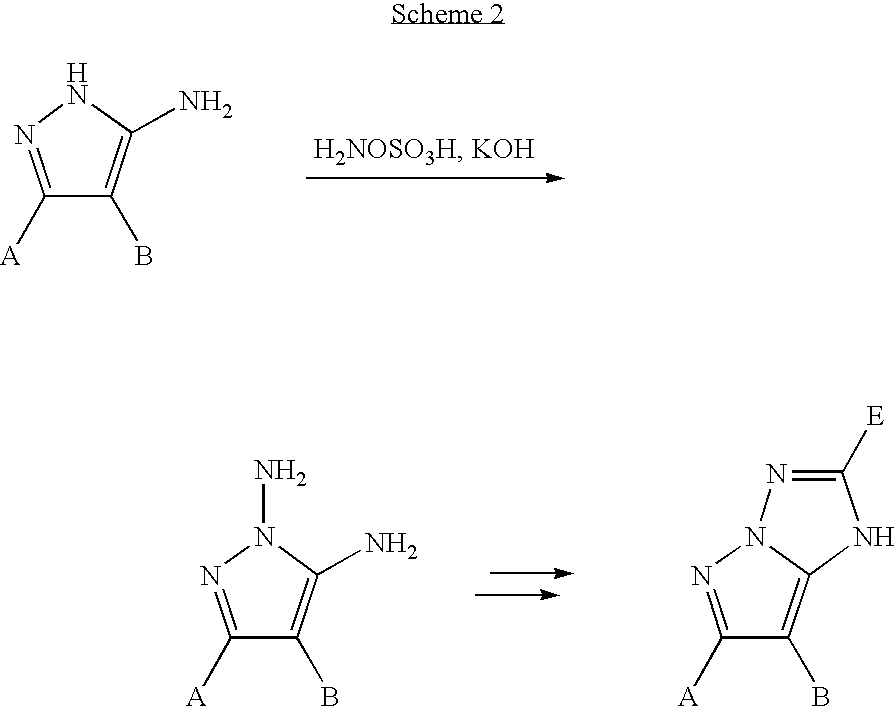
- This invention provides an alternate synthesis of a 1H-Pyrazolo[1,5-b][1,2,4]triazole compound, as shown in Scheme 2 (with the group or atom E being a carbon or carbon-based substituent), comprising only two steps when starting from the 1,5-diaminopyrazole compound or three steps starting from the aminopyrazole compound.
- the diaminopyrazole compound and its synthesis are known in the art.
- the 1,5-diamino compound in excess is slowly added to the acylating agent, such as an acid chloride or any other activated form of carboxylic acid to form monoamides of formula I, often obtained as an isomeric mixture.
- the bis-amide compound where both exocyclic nitrogen atoms are reacted with the acid chloride, cannot be avoided but can be separated from the monoamides during the purification.
- the monoamides are cyclized by reaction with a dehydrating agent in the presence of a solvent to form the desired pyrazolotriazole compounds.
- the dehydrating agent may be any such agent such as those described in Comprehensive Organic Chemistry—The Synthesis and Reactions of Organic Compounds , Barton, D.; Ollis, D.; Vol VI, pp. 888–889, Pergamon Press, ISBN 0-08-022931-6.
- Useful agents include phosphorus pentoxide, phosphorus pentachloride, thionyl chloride and phosphorus oxychloride. Conveniently phosphorus pentachloride or phosphorus oxychloride are employed. In the case of the oxychloride, it is desirable in most instances to add a base to promote the reaction in a desired time. Any base that does not interfere with the reaction may be employed. Aromatic amines such as pyridine are suitable for this purpose.
- the solvent may be any aprotic solvent such as those described in Solvents and Solvent Effects in Organic Chemistry , Reichardt, R.; pp 66 and 76, VCH (NY), ISBN 0-89573-661-6.
- Useful solvents include aromatic or aliphatic solvents such as benzene or heptane, methylene chloride, acetonitrile. Typically, toluene is used.
- R is a substituent group or H.
- R may be selected from one of the following groups, for example, an alkyl; alkoxy; alkylthio; aryl; aryloxy; arylthio; heterocyclyl; acyl (alkyl- or aryl-carbonyl); carboxyclic acid or ester (alkoxy- or aryloxy-carbonyl); primary, secondary, tertiary amino (alkyl- or aryl-amino); primary or secondary amido (alkyl- or aryl-amido); sulfonamido (arlkyl- or aryl-sulfonamido); sulfinyl (alkyl- or aryl-sufinyl); sulfamoyl (alkyl- or aryl-sulfamoyl); carbamoyl (alkyl- or aryl-carbamoyl); and cyano groups.
- R include alkyl and alkoxy groups having from 1 to 18, preferably 1 to 4, carbon atoms; phenyl or phenyloxy, and cyano groups.
- R is an alkyl; a t-alkyl group having from 4 to 10 carbon atoms e.g. t-butyl, adamantyl, t-pentyl; or a phenyl group.
- X is hydrogen, or an acyl, or a heterogroup (a halogen or a group connected by a P, S, O or N atom such as a coupling-off group known to those skilled in the photographic art).
- halogen particularly chlorine, bromine, or fluorine, alkoxy, aryloxy, heterocyclyl, heterocyclyloxy, heterocyclylimido, heterocyclylthio, sulfonyloxy, acyloxy, carbonamido, imido, acyl, thiocyano, alkylthio, arylthio, sulfonamido, phosphonyloxy, and arylazo groups.
- X groups are —Cl, —Br, —F, —SCN, —OCH 3 , —OC 6 H 5 , —OSO 2 CH 3 , —S(CH 2 ) 2 CO 2 H, and —P( ⁇ O)(OC 2 H 5 ) 2 .
- X is hydrogen or halogen, and more preferably H or Cl.
- J and K are defined in relation to each other: If J is a substituent, K must be hydrogen. If K is a substituent, J must be hydrogen.
- the substituent mentioned for J or K is defined as acyl —(C ⁇ O)—R′ (R′ being C 2 –C 20 alkyl; aryl; or heterocyclyl group); or thioacyl (C ⁇ S)—R′ (R′ defined as above).
- R′ groups are alkyl (at the exclusion of Methyl); substituted alkyl; branched alkyl; and substituted phenyl groups. Typical embodiments of R′ are substituted aryl groups, such as meta-nitro- or para-nitro-phenyl groups.
- reaction conditions are not particularly critical. Temperatures in the range of 10–150° C., desirably 18° C. to reflux, typically higher than 50° C. Reaction times in the range of 1 to 2 hours are usually sufficient, but shorter or longer times may be used depending on other conditions.
- Another embodiment of the invention provides an improvement in the preparation and isolation of diaminopyrazole compounds of Formula I (J and K being both hydrogen atoms)
- Diaminopyrazole compounds can be synthesized from the aminopyrazole with the commercially available reagent hydroxylamine-O-sulfonic acid, in any organic solvent, under basic conditions, at a temperature, at a temperature between ⁇ 10° C. and 70° C.
- Preferred bases are inorganic bases such as sodium hydroxide, potassium hydroxide, potassium carbonate.
- Diaminopyrazole compounds can be isolated as free bases or as their ammonium salts.
- the diaminopyrazole compounds are isolated as their hydrochloride salts or as their methanesulfonate salts.
- a further embodiment of the invention provides an improved preparation for compounds of Formula I (R, X, J and K as defined above):
- Compounds of Formula I can be obtained by reacting the known diaminopyrazole (with R and X as defined above) with the carboxylic acid R′CO 2 H (R′ as defined above) in the presence of a coupling agent (such as 1,3-dicyclohexylcarbodiimide or carbonyldiimidazole) or of a chlorinating agent (such as phosphorus trichloride); or with a reactive form thereof, such as an acid chloride or an acid anhydride; in the presence of a solvent; at a temperature comprised between ⁇ 20° C. and reflux.
- a base can be used but is not necessary.
- reaction conditions are the use of an excess of the acid chloride or the acid anhydride; in a solvent such as toluene, ethyl acetate or acetonitrile, at a temperature comprised between 20° C. to reflux; or the use of an excess of the aminopyrazole in a solvent such as toluene, ethyl acetate or acetonitrile, at a temperature comprised between ⁇ 10° C. and 40° C.
- Preferable reaction conditions are a slow addition of the acid chloride R′COCl (R′ defined as above) to a two-equivalent excess of the diaminopyrazole (R and X defined as above), in a solvent such as ethyl acetate or acetonitrile; at room temperature; followed by an acidic work-up of the reaction mixture.
- substituted or “substituent” means any group or atom other than hydrogen.
- a group, compound or formula containing a substitutable hydrogen is referred to, it is also intended to encompass not only the unsubstituted form, but also form further substituted with any substituent group or groups as herein mentioned, so long as the substituent does not destroy properties necessary for utility.
- a substituent group may be halogen or may be bonded to the remainder of the molecule by an atom of carbon, silicon, oxygen, nitrogen, phosphorous, or sulfur.
- the substituent may be, for example, halogen, such as chloro, bromo or fluoro; nitro; hydroxyl; cyano; carboxyl; or groups which may be further substituted, such as alkyl, including straight or branched chain or cyclic alkyl, such as methyl, trifluoromethyl, ethyl, t-butyl, 3-(2,4-di-t-pentylphenoxy) propyl, cyclohexyl, and tetradecyl; alkenyl, such as ethylene, 2-butene; alkoxy, such as methoxy, ethoxy, propoxy, butoxy, 2-methoxyethoxy, sec-butoxy, hexyloxy, 2-ethylhexyloxy, tetradecyloxy, 2-(2,4-di-t-pentylphenoxy)ethoxy, and 2-dodecyloxyethoxy; aryl such as phenyl, 4-
- the substituents may themselves be further substituted one or more times with the described substituent groups.
- the particular substituents used may be selected by those skilled in the art to attain the desired desirable properties for a specific application and can include, for example, hydrophobic groups, solubilizing groups, blocking groups, and releasing or releasable groups.
- the substituents may be joined together to form a ring such as a fused ring unless otherwise provided.
- the above groups and substituents thereof may include those having up to 48 carbon atoms, typically 1 to 36 carbon atoms and usually less than 24 carbon atoms, but greater numbers are possible depending on the particular substituents selected.
- the monoamide compounds can be prepared by reacting an excess of the acid chloride or the acid anhydride in a solvent such as toluene, ethyl acetate or acetonitrile, at a temperature comprised between 20° C. to reflux.
- the main product will be the bis-amide (where J and K are both substituted with an acyl group). It can be selectively hydrolyzed to a monoamide by treatment with a 10% solution of potassium hydroxide in methanol, under reflux conditions for up to 24 h.
- the monoamide compounds can be purified by a column chromatography.
- the easiest preparation consists of reacting an excess of the diaminopyrazole compound with the acid chloride compound at a temperature close to room temperature, the excess of diaminopyrazole compound being removed after reaction by an acidic aqueous work-up.
- the compounds of formula I (R, X, J and K as defined above) can be obtained after the work-up, as a single isomer or as an isomeric mixture, by simple solvent evaporation, or they can be isolated and purified by crystallization or by chromatography.
- the main side-product is the bis-amide compound of Formula I, with R and X defined as above, J and K both bearing a substituent COR′, R′ as defined above. It is usually separated by chromatography from the desired compounds of Formula I (R, X defined as above, J or K bearing an acyl substituent as defined above).
- the selectivity in forming one isomeric amide is very high, and both the bis-amide compound as well as the minor amide isomer compound can be separated from the major compound by crystallization.
- the compounds of Formula I as defined above were further purified by recrystallization to lead to a recovered 84% yield.
- the mono-amide isomeric ratio was of 6:1 in the reaction mixture.
Landscapes
- Chemical & Material Sciences (AREA)
- Organic Chemistry (AREA)
- Nitrogen Condensed Heterocyclic Rings (AREA)
Abstract
A process and intermediate useful for forming a 1H-Pyrazolo[1,5-b][1,2,4]triazole compounds comprise the step of reacting a 1,5-diaminopyrazole bearing a substituent, bonded to one and only one of the amine nitrogens by an acyl or thioacyl group, with a dehydrating agent in the presence of an aprotic solvent.
Description
This invention relates to a method of preparing pyrazolotriazole compounds, which are useful as photographic dye forming couplers or as synthetic intermediates for the preparation of pyrazolotriazole photographic dye forming coupler compounds. In particular, it relates to a three-step method of preparing 1H-Pyrazolo[1,5-b][1,2,4]triazole compounds used in color photography form the corresponding aminopyrazole compound.
It is known that pyrazolotriazole compounds are useful photographic dye forming couplers. Particularly, it is known in the art that 1H-Pyrazolo[1,5-b][1,2,4]triazole compounds are magenta dye forming couplers. Examples are EP 119,860; U.S. Pat. No. 4,621,046; JP 62-172363; DE 19921733, and U.S. Pat. No. 5,998,122.
They are most commonly prepared through a multi-step procedure, as shown in Scheme 1. Examples are shown in JP 07-082252, U.S. Pat. No. 6,020,498, and U.S. Pat. No. 5,262,542.

These syntheses are long, comprising at least 4 steps. They require the use of nitrites or activated forms of amides as starting materials, some of which are toxic and/or not readily available.
There have been efforts to shorten the number of synthesis steps and increase yield and purity of these important intermediates for color photography. Recent examples are U.S. Pat. No. 6,555,711 and U.S. Pat. No. 6,657,066.
Prior art relating to diaminopyrazole compounds can be found in U.S. Pat. No. 5,723,623 and JP 08-069096 and [Sliskovic, D. R.; Siegel, M.; Lin, Y. I. Synthesis, 1986, 1, 71], and more recently in [Blake, A. J.; Clarke, D.; Mares, R. W.; McNab, H. Org. Biomol. Chem. 2003, 1, 4268]. The prior art reaction is pictured below, wherein E is a heteroatom (O, N or S) or heterogroup (a group connected by a O, N or S atom) and the reaction employed to close the ring requires the use of external heat and a base.
The 1,5-diaminopyrazole compound and its synthesis are known in the art (see prior art described above, and a review of the use of the reagent hydroxylamine-O-sulfonic acid can be found at Wallace, R. G. Organic Preparations and Procedures Int. 14(4), 265–307, 1982).
It remains a problem to be solved to provide a synthesis for 1H-Pyrazolo[1,5-b][1,2,4]triazole compounds that can be carried out in fewer steps.
The invention provides a process that comprises the step of reacting a 1,5-diaminopyrazole bearing a substituent, bonded to one and only one of the amine nitrogens by an acyl or thioacyl group, with a dehydrating agent in the presence of an aprotic solvent whereby a 1H-Pyrazolo[1,5-b][1,2,4]triazole compound is formed. It also provides a useful intermediate.
The invention provides a finished product in fewer steps than in the known methods.
The invention is summarized above. This invention provides an alternate synthesis of a 1H-Pyrazolo[1,5-b][1,2,4]triazole compound, as shown in Scheme 2 (with the group or atom E being a carbon or carbon-based substituent), comprising only two steps when starting from the 1,5-diaminopyrazole compound or three steps starting from the aminopyrazole compound.
The entire reaction sequence is represented by the following Scheme 3:

The diaminopyrazole compound and its synthesis are known in the art. The 1,5-diamino compound in excess is slowly added to the acylating agent, such as an acid chloride or any other activated form of carboxylic acid to form monoamides of formula I, often obtained as an isomeric mixture. In some cases, the bis-amide compound, where both exocyclic nitrogen atoms are reacted with the acid chloride, cannot be avoided but can be separated from the monoamides during the purification. After purification, the monoamides are cyclized by reaction with a dehydrating agent in the presence of a solvent to form the desired pyrazolotriazole compounds.
The shorter synthetic pathway, as well as the greater availability and the lower toxicity of acylating agents such as acid chlorides, acid anhydrides, or their carboxylic acid parents are great advantages over the usual preparation routes to the desired pyrazolotriazole compounds.
The cyclization reaction is represented by the following Scheme 4:

Compounds of Formula I (R, X, J, K, and R′ are as defined below) are reacted with the dehydrating compound in the presence of a solvent.
The dehydrating agent may be any such agent such as those described in Comprehensive Organic Chemistry—The Synthesis and Reactions of Organic Compounds, Barton, D.; Ollis, D.; Vol VI, pp. 888–889, Pergamon Press, ISBN 0-08-022931-6. Useful agents include phosphorus pentoxide, phosphorus pentachloride, thionyl chloride and phosphorus oxychloride. Conveniently phosphorus pentachloride or phosphorus oxychloride are employed. In the case of the oxychloride, it is desirable in most instances to add a base to promote the reaction in a desired time. Any base that does not interfere with the reaction may be employed. Aromatic amines such as pyridine are suitable for this purpose.
The solvent may be any aprotic solvent such as those described in Solvents and Solvent Effects in Organic Chemistry, Reichardt, R.; pp 66 and 76, VCH (NY), ISBN 0-89573-661-6. Useful solvents include aromatic or aliphatic solvents such as benzene or heptane, methylene chloride, acetonitrile. Typically, toluene is used.
Substituents R, X, J, K, and R′ in compounds are defined as follows:
R is a substituent group or H. R may be selected from one of the following groups, for example, an alkyl; alkoxy; alkylthio; aryl; aryloxy; arylthio; heterocyclyl; acyl (alkyl- or aryl-carbonyl); carboxyclic acid or ester (alkoxy- or aryloxy-carbonyl); primary, secondary, tertiary amino (alkyl- or aryl-amino); primary or secondary amido (alkyl- or aryl-amido); sulfonamido (arlkyl- or aryl-sulfonamido); sulfinyl (alkyl- or aryl-sufinyl); sulfamoyl (alkyl- or aryl-sulfamoyl); carbamoyl (alkyl- or aryl-carbamoyl); and cyano groups. Convenient embodiments of R include alkyl and alkoxy groups having from 1 to 18, preferably 1 to 4, carbon atoms; phenyl or phenyloxy, and cyano groups. Typically, R is an alkyl; a t-alkyl group having from 4 to 10 carbon atoms e.g. t-butyl, adamantyl, t-pentyl; or a phenyl group.
X is hydrogen, or an acyl, or a heterogroup (a halogen or a group connected by a P, S, O or N atom such as a coupling-off group known to those skilled in the photographic art). Examples include halogen, particularly chlorine, bromine, or fluorine, alkoxy, aryloxy, heterocyclyl, heterocyclyloxy, heterocyclylimido, heterocyclylthio, sulfonyloxy, acyloxy, carbonamido, imido, acyl, thiocyano, alkylthio, arylthio, sulfonamido, phosphonyloxy, and arylazo groups. Examples of X groups are —Cl, —Br, —F, —SCN, —OCH3, —OC6H5, —OSO2CH3, —S(CH2)2CO2H, and —P(═O)(OC2H5)2. Preferably, X is hydrogen or halogen, and more preferably H or Cl.
J and K are defined in relation to each other: If J is a substituent, K must be hydrogen. If K is a substituent, J must be hydrogen. The substituent mentioned for J or K is defined as acyl —(C═O)—R′ (R′ being C2–C20 alkyl; aryl; or heterocyclyl group); or thioacyl (C═S)—R′ (R′ defined as above). Examples of useful R′ groups are alkyl (at the exclusion of Methyl); substituted alkyl; branched alkyl; and substituted phenyl groups. Typical embodiments of R′ are substituted aryl groups, such as meta-nitro- or para-nitro-phenyl groups.
The reaction conditions are not particularly critical. Temperatures in the range of 10–150° C., desirably 18° C. to reflux, typically higher than 50° C. Reaction times in the range of 1 to 2 hours are usually sufficient, but shorter or longer times may be used depending on other conditions.
Diaminopyrazole Preparation
Another embodiment of the invention provides an improvement in the preparation and isolation of diaminopyrazole compounds of Formula I (J and K being both hydrogen atoms)
Diaminopyrazole compounds can be synthesized from the aminopyrazole with the commercially available reagent hydroxylamine-O-sulfonic acid, in any organic solvent, under basic conditions, at a temperature, at a temperature between −10° C. and 70° C.
Diaminopyrazole compounds (R=alkyl; t-alkyl, as defined above; phenyl and X=hydrogen; halogen) are obtained in particularly suitable solvents such as dimethylformamide, dimethylacetamide, methanol, ethanol, isopropanol, acetonitrile, toluene, or any mixture of these solvents, at a temperature between −10° C. and 20° C. Preferred bases are inorganic bases such as sodium hydroxide, potassium hydroxide, potassium carbonate. Diaminopyrazole compounds can be isolated as free bases or as their ammonium salts.
Preferred embodiments are when X=chloro; the reaction is done at a temperature between 0 and 10° C., in dimethylformamide or dimethylacetamide, pure or in mixture with a solvent such as toluene, in the presence of a strong base such as sodium hydroxide or potassium hydroxide. The diaminopyrazole compounds are isolated as their hydrochloride salts or as their methanesulfonate salts.
Monoamide Preparation
A further embodiment of the invention provides an improved preparation for compounds of Formula I (R, X, J and K as defined above): Compounds of Formula I can be obtained by reacting the known diaminopyrazole (with R and X as defined above) with the carboxylic acid R′CO2H (R′ as defined above) in the presence of a coupling agent (such as 1,3-dicyclohexylcarbodiimide or carbonyldiimidazole) or of a chlorinating agent (such as phosphorus trichloride); or with a reactive form thereof, such as an acid chloride or an acid anhydride; in the presence of a solvent; at a temperature comprised between −20° C. and reflux. A base can be used but is not necessary.
Examples of reaction conditions are the use of an excess of the acid chloride or the acid anhydride; in a solvent such as toluene, ethyl acetate or acetonitrile, at a temperature comprised between 20° C. to reflux; or the use of an excess of the aminopyrazole in a solvent such as toluene, ethyl acetate or acetonitrile, at a temperature comprised between −10° C. and 40° C.
Preferable reaction conditions are a slow addition of the acid chloride R′COCl (R′ defined as above) to a two-equivalent excess of the diaminopyrazole (R and X defined as above), in a solvent such as ethyl acetate or acetonitrile; at room temperature; followed by an acidic work-up of the reaction mixture.
Some representative compounds of diaminopyrazoles of Formula I are:


Some examples of representative pyrazolotriazole compounds of Formula II are as follows:


Unless otherwise specifically stated, use of the term “substituted” or “substituent” means any group or atom other than hydrogen. Unless otherwise provided, when a group, compound or formula containing a substitutable hydrogen is referred to, it is also intended to encompass not only the unsubstituted form, but also form further substituted with any substituent group or groups as herein mentioned, so long as the substituent does not destroy properties necessary for utility. Suitably, a substituent group may be halogen or may be bonded to the remainder of the molecule by an atom of carbon, silicon, oxygen, nitrogen, phosphorous, or sulfur. The substituent may be, for example, halogen, such as chloro, bromo or fluoro; nitro; hydroxyl; cyano; carboxyl; or groups which may be further substituted, such as alkyl, including straight or branched chain or cyclic alkyl, such as methyl, trifluoromethyl, ethyl, t-butyl, 3-(2,4-di-t-pentylphenoxy) propyl, cyclohexyl, and tetradecyl; alkenyl, such as ethylene, 2-butene; alkoxy, such as methoxy, ethoxy, propoxy, butoxy, 2-methoxyethoxy, sec-butoxy, hexyloxy, 2-ethylhexyloxy, tetradecyloxy, 2-(2,4-di-t-pentylphenoxy)ethoxy, and 2-dodecyloxyethoxy; aryl such as phenyl, 4-t-butylphenyl, 2,4,6-trimethylphenyl, naphthyl; aryloxy, such as phenoxy, 2-methylphenoxy, alpha- or beta-naphthyloxy, and 4-tolyloxy; carbonamido, such as acetamido, benzamido, butyramido, tetradecanamido, alpha-(2,4-di-t-pentyl-phenoxy)acetamido, alpha-(2,4-di-t-pentylphenoxy)butyramido, alpha-(3-pentadecylphenoxy)-hexanamido, alpha-(4-hydroxy-3-t-butylphenoxy)-tetradecanamido, 2-oxo-pyrrolidin-1-yl, 2-oxo-5-tetradecylpyrrolin-1-yl, N-methyltetradecanamido, N-succinimido, N-phthalimido, 2,5-dioxo-1-oxazolidinyl, 3-dodecyl-2,5-dioxo-1-imidazolyl, and N-acetyl-N-dodecylamino, ethoxycarbonylamino, phenoxycarbonylamino, benzyloxycarbonylamino, hexadecyloxycarbonylamino, 2,4-di-t-butylphenoxycarbonylamino, phenylcarbonylamino, 2,5-(di-t-pentylphenyl)carbonylamino, p-dodecyl-phenylcarbonylamino, p-tolylcarbonylamino, N-methylureido, N,N-dimethylureido, N-methyl-N-dodecylureido, N-hexadecylureido, N,N-dioctadecylureido, N,N-dioctyl-N′-ethylureido, N-phenylureido, N,N-diphenylureido, N-phenyl-N-p-tolylureido, N-(m-hexadecylphenyl)ureido, N,N-(2,5-di-t-pentylphenyl)-N′-ethylureido, and t-butylcarbonamido; sulfonamido, such as methylsulfonamido, benzenesulfonamido, p-tolylsulfonamido, p-dodecylbenzenesulfonamido, N-methyltetradecylsulfonamido, N,N-dipropyl-sulfamoylamino, and hexadecylsulfonamido; sulfamoyl, such as N-methylsulfamoyl, N-ethylsulfamoyl, N,N-dipropylsulfamoyl, N-hexadecylsulfamoyl, N,N-dimethylsulfamoyl; N-[3-(dodecyloxy)propyl]sulfamoyl, N-[4-(2,4-di-t-pentylphenoxy)butyl]sulfamoyl, N-methyl-N-tetradecylsulfamoyl, and N-dodecylsulfamoyl; carbamoyl, such as N-methylcarbamoyl, N,N-dibutylcarbamoyl, N-octadecylcarbamoyl, N-[4-(2,4-di-t-pentylphenoxy)butyl]carbamoyl, N-methyl-N-tetradecylcarbamoyl, and N,N-dioctylcarbamoyl; acyl, such as acetyl, (2,4-di-t-amylphenoxy)acetyl, phenoxycarbonyl, p-dodecyloxyphenoxycarbonyl methoxycarbonyl, butoxycarbonyl, tetradecyloxycarbonyl, ethoxycarbonyl, benzyloxycarbonyl, 3-pentadecyloxycarbonyl, and dodecyloxycarbonyl; sulfonyl, such as methoxysulfonyl, octyloxysulfonyl, tetradecyloxysulfonyl, 2-ethylhexyloxysulfonyl, phenoxysulfonyl, 2,4-di-t-pentylphenoxysulfonyl, methylsulfonyl, octylsulfonyl, 2-ethylhexylsulfonyl, dodecylsulfonyl, hexadecylsulfonyl, phenylsulfonyl, 4-nonylphenylsulfonyl, and p-tolylsulfonyl; sulfonyloxy, such as dodecylsulfonyloxy, and hexadecylsulfonyloxy; sulfinyl, such as methylsulfinyl, octylsulfinyl, 2-ethylhexylsulfinyl, dodecylsulfinyl, hexadecylsulfinyl, phenylsulfinyl, 4-nonylphenylsulfinyl, and p-tolylsulfinyl; thio, such as ethylthio, octylthio, benzylthio, tetradecylthio, 2-(2,4-di-t-pentylphenoxy)ethylthio, phenylthio, 2-butoxy-5-t-octylphenylthio, and p-tolylthio; acyloxy, such as acetyloxy, benzoyloxy, octadecanoyloxy, p-dodecylamidobenzoyloxy, N-phenylcarbamoyloxy, N-ethylcarbamoyloxy, and cyclohexylcarbonyloxy; amine, such as phenylanilino, 2-chloroanilino, diethylamine, dodecylamine; imino, such as 1 (N-phenylimido)ethyl, N-succinimido or 3-benzylhydantoinyl; phosphate, such as dimethylphosphate and ethylbutylphosphate; phosphite, such as diethyl and dihexylphosphite; a heterocyclic group, a heterocyclic oxy group or a heterocyclic thio group, each of which may be substituted and which contain a 3 to 7 membered heterocyclic ring composed of carbon atoms and at least one hetero atom selected from the group consisting of oxygen, nitrogen and sulfur, such as 2-furyl, 2-thienyl, 2-benzimidazolyloxy or 2-benzothiazolyl; quaternary ammonium, such as triethylammonium; and silyloxy, such as trimethylsilyloxy.
If desired, the substituents may themselves be further substituted one or more times with the described substituent groups. The particular substituents used may be selected by those skilled in the art to attain the desired desirable properties for a specific application and can include, for example, hydrophobic groups, solubilizing groups, blocking groups, and releasing or releasable groups. When a molecule may have two or more substituents, the substituents may be joined together to form a ring such as a fused ring unless otherwise provided. Generally, the above groups and substituents thereof may include those having up to 48 carbon atoms, typically 1 to 36 carbon atoms and usually less than 24 carbon atoms, but greater numbers are possible depending on the particular substituents selected.
Preparation of Compounds of Formula I—Selective Mono-Amidation:
A detailed description of the preparation of compounds of Formula I can be found in following examples 2 and 3. When R=t-butyl, X=chloro, R′ in groups J or K is substituted aryl, the monoamide compounds can be prepared by reacting an excess of the acid chloride or the acid anhydride in a solvent such as toluene, ethyl acetate or acetonitrile, at a temperature comprised between 20° C. to reflux. The main product will be the bis-amide (where J and K are both substituted with an acyl group). It can be selectively hydrolyzed to a monoamide by treatment with a 10% solution of potassium hydroxide in methanol, under reflux conditions for up to 24 h. The monoamide compounds can be purified by a column chromatography.
For most amide compounds, the easiest preparation consists of reacting an excess of the diaminopyrazole compound with the acid chloride compound at a temperature close to room temperature, the excess of diaminopyrazole compound being removed after reaction by an acidic aqueous work-up.
The compounds of formula I (R, X, J and K as defined above) can be obtained after the work-up, as a single isomer or as an isomeric mixture, by simple solvent evaporation, or they can be isolated and purified by crystallization or by chromatography. The main side-product is the bis-amide compound of Formula I, with R and X defined as above, J and K both bearing a substituent COR′, R′ as defined above. It is usually separated by chromatography from the desired compounds of Formula I (R, X defined as above, J or K bearing an acyl substituent as defined above).
In some cases (especially when R=t-butyl, X=chloro, J or K is —(C═O)-3-nitrophenyl), the selectivity in forming one isomeric amide is very high, and both the bis-amide compound as well as the minor amide isomer compound can be separated from the major compound by crystallization.
Reaction of Compounds of Formula I—Preparation of Compounds of Formula II
A detailed description of the reaction can be found in the following examples 4 and 5. Compounds of Formula I, with J or K being a trisubstituted alkyl acyl group, do not react well under the described conditions. The main side-product of the ring-closure reaction with phosphorus pentachloride or phosphorus oxychloride is usually a bis-amide compound, which is mostly observed when compounds of Formula I (with R, X, J, K as defined above, R′ being an unsubstituted alkyl group) are reacted. The compound of Formula II is usually purified by chromatography.
In the following are described the preparation of intermediates of the invention, like the diaminopyrazole (Example 1), some representative compounds of Formula I (Examples 2, 3, 4) and some representative pyrazolotriazole compounds obtained using the invention (Examples 5 and 6).
A 1 L jacketed flask was loaded at 20° C. with 50.00 g (0.288 mol) of aminopyrazole (R=t-butyl, X=chloro), 400 mL of toluene, 250 mL of dimethylformamide, 148.00 g (2.25 mol) of 85 w % of potassium hydroxide pellets, mechanically stirred and cooled to 10° C. After 30 minutes, 69.11 g (0.55 mol) of hydroxylamine O-sulfonic acid was added by portions over 1 h. At the end of the addition, the mixture was stirred for 30 min. at 10° C., then warmed up to 20° C., diluted with ethyl acetate, washed with an aqueous solution of 5% HCl, then a solution of salt and water (while keeping the aqueous layer basic). The organic layer was separated, and concentrated under vacuum. 300 mL of fresh toluene were added, the solution was clarified, and 27.96 g (0.29 mol) of methanesulfonic acid was slowly added at 20° C. The precipitation was completed overnight in the fridge. The yellow solid was collected, washed with toluene, air-dried for 2 h, dried in vacuum-oven at 40° C. for 3 days (25 in. Hg, under N2 sweep) to a recovered 73.68 g of a light yellow powdery solid (90.0% of theoretical yield). The assay by gas chromatography (on the free base) was 95 area %. An analysis of the volatiles showed that up to 3.6 w % of water could be present. No solvent or excess acid could be detected.
A solution of 10.00 g (0.0352 mol) of diaminopyrazole methanesulfonate ammonium salt, as obtained in Example 1, was stirred at 20° C. in 50 mL of ethyl acetate with an aqueous solution of sodium hydrogen carbonate until complete solubilization occured. The layers were separated, and the organic layer was dried over sodium sulfate, filtered and concentrated under vacuum. A solution of the residue in 20 mL of ethyl acetate was prepared and stirred at 20° C., to which 3.63 g (0.0196 mol) of 3-nitrobenzoyl chloride in solution in 60 mL of ethyl acetate was added slowly at 20° C. The resulting mixture was stirred overnight. The precipitate was collected, rinsed with ethyl acetate, stirred in a mixture of 80 mL ethyl acetate with 100 mL water until complete solubilization occurred to which 30 mL of 10% aqueous HCl was slowly added. The layers were separated and the organic layer was washed with 10% HCl, 5% sodium hydrogen carbonate and brine, dried over sodium sulfate, concentrated under vacuum, and dried under vacuum to give 3.75 g (56.7% of theoretical) of compound of Formula I (R, X, J and K as defined).
A solution of 6.88 g (0.02425 mol) of diaminopyrazole methanesulfonate ammonium salt, as obtained in Example 1, was stirred at 20° C. in 40 mL of ethyl acetate with an aqueous solution of sodium hydrogen carbonate until complete solubilization occurred. The layers were separated, and the organic layer was dried over sodium sulfate, filtered and concentrated under vacuum. A solution of the residue in 15 mL of ethyl acetate was prepared and stirred at 20° C., to which a solution of 4-nitrobenzoyl chloride (2.50 g, 0.0135 mol) in 60 mL EtOAc was added over 3 h. The resulting mixture was stirred overnight at 20° C., diluted with ethyl acetate, washed four times with dilute HCl in water, dried over potassium carbonate, filtered and concentrated under vacuum. The residue was purified by column chromatography on silica gel (eluent: ethyl acetate—heptane 40–60).
The compounds of Formula I as defined above were further purified by recrystallization to lead to a recovered 84% yield. The mono-amide isomeric ratio was of 6:1 in the reaction mixture.
A solution of 0.5 g (0.00148 mol) of compound of Formula I (with R=t-butyl, X=chloro, J or K═COR′, with R′=m-nitrophenyl) in 10 mL toluene was heated to reflux with 0.31 g (0.00148 mol) of phosphorus pentachloride for 1 h then cooled down to room temperature, diluted with ethyl acetate, washed with sodium carbonate, brine. The organic layer was separated, dried over sodium sulfate, filtered, and concentrated to dryness. This residue was chromatographed on silica gel to a recovered 0.15 g (32% of theoretical yield) of pure material.
To a solution of 0.53 g (0.00157 mol) of compound of Formula I (with R=t-butyl, X=chloro, J or K═COR′, with R′=m-nitrophenyl) and 0.48 g (0.0031 mol) of phosphorus oxychloride in 10 mL toluene was slowly added 1.6 g of pyridine (0.0157 mol). This mixture was refluxed for 2 h then cooled down to room temperature, diluted with ethyl acetate, washed with aqueous sodium hydroxide, then 10% aqueous hydrochloric acid. The organic layer was separated, dried over sodium sulfate, filtered, concentrated to dryness. This residue was chromatographed on silica gel to a recovered 0.20 g (40% of theoretical yield) of pure material.
To a slurry of 0.25 g (0.00074 mol) of compound of Formula I (with R=t-butyl, X=chloro, J=COR′, with R′=p-nitrophenyl, K═H) and 0.11 g (0.00074 mol) of phosphorus oxychloride in 10 mL toluene was slowly added 0.6 mL of pyridine (0.0157 mol). This mixture was refluxed for 1.5 h then cooled down to room temperature, diluted with ethyl acetate, washed with aqueous sodium hydroxide, then 10% aqueous hydrochloric acid. The organic layer was analyzed by LC and LC-MS and showed the complete disappearance of the compound of Formula I and the presence of the desired compound of Formula II, which was not isolated.
To a slurry of 0.25 g (0.00074 mol) of compound of Formula I (with R=t-butyl, X=chloro, J=H, K═COR′, with R′=p-nitrophenyl) and 0.11 g (0.00074 mol) of phosphorus oxychloride in 10 mL toluene was slowly added 0.6 mL of pyridine (0.0157 mol). This mixture was refluxed for 1.5 h then cooled down to room temperature, diluted with ethyl acetate, washed with aqueous sodium hydroxide, then 10% aqueous hydrochloric acid. The organic layer was analyzed by LC and LC-MS and showed the complete disappearance of the compound of Formula I and the presence of the desired compound of Formula II, which was not isolated.
Claims (16)
1. A process comprising the step of reacting a 1,5-diaminopyrazole bearing a substituent, bonded to one and only one of the amine nitrogens by an acyl or thioacyl group, with a dehydrating agent in the presence of an aprotic solvent whereby a 1H-Pyrazolo[1,5-b][1,2,4]triazole compound is formed, the reaction being represented by the equation:

wherein one of J and K is H and the other is an acyl or thioacyl group, R is H or a substituent group, and X is H, acyl, halogen or a group connected by a heteroatom of P, S, O, or N.
2. The process of claim 1 wherein the acyl or thioacyl group is an acyl group.
3. The process of claim 1 wherein the acyl or thioacyl group is a thioacyl group.
4. The process of claim 1 wherein the dehydrating agent comprises one selected from the group consisting of phosphorus peroxide, phosphorus pentachloride, thionyl chloride and phosphorus oxychloride.
5. The process of claim 1 wherein the dehydrating agent comprises one selected from the group consisting of phosphorus pentoxide and phosphorus oxychloride.
6. The process of claim 1 wherein the aprotic solvent comprises an aromatic or aliphatic solvent.
7. The process of claim 1 wherein the aprotic solvent comprises one selected from the group consisting of toluene, benzene, heptane, methylene chloride, and acetonitrile.
8. The process of claim 1 wherein the aprotic solvent comprises toluene.
9. The process of claim 1 additionally comprising a base.
10. The process of claim 9 wherein the base comprises an organic base.
11. The process of claim 10 wherein the organic base comprises pyridine.
12. The process of claim 11 wherein the dehydrating agent comprises phosphorus oxychloride.
13. The process of claim 1 wherein the 1,5-diaminopyrazole bearing a substituent is obtained by reacting a diaminopyrazole with a an acid chloride in a mole ratio of at least 1.5 to 1.
14. The process of claim 13 wherein the diaminopyrazole is formed by the step of reacting a monoaminopyrazole with hydroxylamine-o-sulfonic acid in an organic solvent.
15. The process of claim 14 wherein the diamino compound is separated by forming the methanesulfonic acid salt of the compound and filtering to recover the diamino compound.
16. The process of claim 1 wherein X is a halogen.
Priority Applications (1)
| Application Number | Priority Date | Filing Date | Title |
|---|---|---|---|
| US10/830,644 US7041833B2 (en) | 2004-04-23 | 2004-04-23 | 3-step synthesis of pyrazolotriazole couplers and coupler intermediates |
Applications Claiming Priority (1)
| Application Number | Priority Date | Filing Date | Title |
|---|---|---|---|
| US10/830,644 US7041833B2 (en) | 2004-04-23 | 2004-04-23 | 3-step synthesis of pyrazolotriazole couplers and coupler intermediates |
Publications (2)
| Publication Number | Publication Date |
|---|---|
| US20050240026A1 US20050240026A1 (en) | 2005-10-27 |
| US7041833B2 true US7041833B2 (en) | 2006-05-09 |
Family
ID=35137396
Family Applications (1)
| Application Number | Title | Priority Date | Filing Date |
|---|---|---|---|
| US10/830,644 Expired - Fee Related US7041833B2 (en) | 2004-04-23 | 2004-04-23 | 3-step synthesis of pyrazolotriazole couplers and coupler intermediates |
Country Status (1)
| Country | Link |
|---|---|
| US (1) | US7041833B2 (en) |
Citations (3)
| Publication number | Priority date | Publication date | Assignee | Title |
|---|---|---|---|---|
| US5262542A (en) | 1992-02-26 | 1993-11-16 | Eastman Kodak Company | Process for preparation of 1H-pyrazolo [1,5-b][1,2,4]triazole compounds by cyclization of N-(4-substituted-pyrazolyl)amidoxime |
| JPH0869096A (en) | 1994-08-29 | 1996-03-12 | Fuji Photo Film Co Ltd | Silver halide color photographic sensitive material |
| US5723623A (en) | 1995-10-31 | 1998-03-03 | Eastman Kodak Company | Method of transforming pyrazole compounds |
-
2004
- 2004-04-23 US US10/830,644 patent/US7041833B2/en not_active Expired - Fee Related
Patent Citations (3)
| Publication number | Priority date | Publication date | Assignee | Title |
|---|---|---|---|---|
| US5262542A (en) | 1992-02-26 | 1993-11-16 | Eastman Kodak Company | Process for preparation of 1H-pyrazolo [1,5-b][1,2,4]triazole compounds by cyclization of N-(4-substituted-pyrazolyl)amidoxime |
| JPH0869096A (en) | 1994-08-29 | 1996-03-12 | Fuji Photo Film Co Ltd | Silver halide color photographic sensitive material |
| US5723623A (en) | 1995-10-31 | 1998-03-03 | Eastman Kodak Company | Method of transforming pyrazole compounds |
Non-Patent Citations (1)
| Title |
|---|
| Blake, et al. Synthesis and Chemistry of 3-tert-butyl-1,5-diaminopyrazole, Org. Biomol. Chem., vol. 1, pp. 4268-4274 (2003). * |
Also Published As
| Publication number | Publication date |
|---|---|
| US20050240026A1 (en) | 2005-10-27 |
Similar Documents
| Publication | Publication Date | Title |
|---|---|---|
| US7429683B2 (en) | Process of maing naphthacene from propargyl alcohol | |
| US7026481B2 (en) | Synthesis for quinacridone compounds | |
| US7041833B2 (en) | 3-step synthesis of pyrazolotriazole couplers and coupler intermediates | |
| US5405969A (en) | Manufacture of thioether compounds | |
| US6201125B1 (en) | Compounds and synthesis process | |
| US6593477B1 (en) | Synthesis of 3-acylaminopyrazoles | |
| US6555711B1 (en) | α-amino-N-allylamidino nitrobenzene compound and synthesis | |
| US20050131234A1 (en) | Synthesis of bis(azinyl)amine-bf2 complex | |
| US6489511B1 (en) | Azomethine compound manufacture | |
| US5959120A (en) | Acetate ester compounds | |
| US7312337B2 (en) | Oxadiazoles and their manufacture | |
| US6657066B1 (en) | Synthesis of certain triazole compounds | |
| US5864042A (en) | Process for preparation of a 4-amino-5-mercapto-3-substituted- 1,2,4!triazole compound | |
| US7091361B2 (en) | Compounds and synthesis process | |
| US5998629A (en) | Synthesis of pyrazolotriazole photographic dye forming color couplers and intermediates | |
| US5688964A (en) | Process for preparing a acylhyrazino pyrazole derivative | |
| US6995287B2 (en) | Synthesis of vinylsulfones | |
| US6008369A (en) | One-pot synthesis of pyrazolotriazole photographic dye forming color couplers and coupler intermediates | |
| US5945540A (en) | Synthesis of certain pyrazolo- 1,5-a! benzimidazole compounds | |
| US7323610B2 (en) | Process of making naphthacene from propargyl alcohol | |
| US7439339B2 (en) | Azo coupling reactions of hydrophobic compounds | |
| JPH11240885A (en) | Synthesis of triazolothiadiazine compound | |
| US20060025618A1 (en) | Synthesis process | |
| JPH09169761A (en) | Transforming method for pyrazole compound |
Legal Events
| Date | Code | Title | Description |
|---|---|---|---|
| AS | Assignment |
Owner name: EASTMAN KODAK COMPANY, NEW YORK Free format text: ASSIGNMENT OF ASSIGNORS INTEREST;ASSIGNOR:MINEUR, CATHERINE;REEL/FRAME:015264/0060 Effective date: 20040422 |
|
| FEPP | Fee payment procedure |
Free format text: PAYOR NUMBER ASSIGNED (ORIGINAL EVENT CODE: ASPN); ENTITY STATUS OF PATENT OWNER: LARGE ENTITY |
|
| CC | Certificate of correction | ||
| REMI | Maintenance fee reminder mailed | ||
| LAPS | Lapse for failure to pay maintenance fees | ||
| STCH | Information on status: patent discontinuation |
Free format text: PATENT EXPIRED DUE TO NONPAYMENT OF MAINTENANCE FEES UNDER 37 CFR 1.362 |
|
| FP | Lapsed due to failure to pay maintenance fee |
Effective date: 20100509 |