US7041774B2 - Functionalized zeolite compositions and methods for their preparation and use - Google Patents
Functionalized zeolite compositions and methods for their preparation and use Download PDFInfo
- Publication number
- US7041774B2 US7041774B2 US10/675,141 US67514103A US7041774B2 US 7041774 B2 US7041774 B2 US 7041774B2 US 67514103 A US67514103 A US 67514103A US 7041774 B2 US7041774 B2 US 7041774B2
- Authority
- US
- United States
- Prior art keywords
- group
- functionalized
- alkyl
- compound
- groups
- Prior art date
- Legal status (The legal status is an assumption and is not a legal conclusion. Google has not performed a legal analysis and makes no representation as to the accuracy of the status listed.)
- Expired - Fee Related, expires
Links
- ICXIMFCZZOXLOW-UHFFFAOYSA-N C.C.C.C.C.C.C.C.CB[Si](C)(OC)OC.CC[Si](C)(OC)OC.CO[Si](OC)(OC)OC Chemical compound C.C.C.C.C.C.C.C.CB[Si](C)(OC)OC.CC[Si](C)(OC)OC.CO[Si](OC)(OC)OC ICXIMFCZZOXLOW-UHFFFAOYSA-N 0.000 description 6
- NYXGIHBLVIQGMB-UHFFFAOYSA-N C.C.C.C.C.C.C.CB[Si](C)(OC)OC.CC[Si](C)(OC)OC.CO[Si](OC)(OC)OC Chemical compound C.C.C.C.C.C.C.CB[Si](C)(OC)OC.CC[Si](C)(OC)OC.CO[Si](OC)(OC)OC NYXGIHBLVIQGMB-UHFFFAOYSA-N 0.000 description 6
- USJMZJUISFVDIX-UHFFFAOYSA-N C.COC(C)(OC)O[Si](C)(OC)OC.COC(O)O[Si](C)(OC)OC Chemical compound C.COC(C)(OC)O[Si](C)(OC)OC.COC(O)O[Si](C)(OC)OC USJMZJUISFVDIX-UHFFFAOYSA-N 0.000 description 4
- CYZQTXFJDZDJAK-UHFFFAOYSA-N CB[Si](C)(OC)OC.CC[Si](C)(OC)OC.CO[Si](OC)(OC)OC Chemical compound CB[Si](C)(OC)OC.CC[Si](C)(OC)OC.CO[Si](OC)(OC)OC CYZQTXFJDZDJAK-UHFFFAOYSA-N 0.000 description 3
- QYEIQSJPPSLFTC-UHFFFAOYSA-N C.CC(C)C(C)C(C)C Chemical compound C.CC(C)C(C)C(C)C QYEIQSJPPSLFTC-UHFFFAOYSA-N 0.000 description 1
- BYZIRUGDEYRIFU-UHFFFAOYSA-N CCCC(COC)NC(C1)C1OC Chemical compound CCCC(COC)NC(C1)C1OC BYZIRUGDEYRIFU-UHFFFAOYSA-N 0.000 description 1
- KSQPRSIFRFDLQE-UHFFFAOYSA-N COC(O)(OC)O[Si](C)(OC)OC.COC(O)O[Si](C)(OC)OC Chemical compound COC(O)(OC)O[Si](C)(OC)OC.COC(O)O[Si](C)(OC)OC KSQPRSIFRFDLQE-UHFFFAOYSA-N 0.000 description 1
Classifications
-
- B—PERFORMING OPERATIONS; TRANSPORTING
- B01—PHYSICAL OR CHEMICAL PROCESSES OR APPARATUS IN GENERAL
- B01J—CHEMICAL OR PHYSICAL PROCESSES, e.g. CATALYSIS OR COLLOID CHEMISTRY; THEIR RELEVANT APPARATUS
- B01J29/00—Catalysts comprising molecular sieves
-
- C—CHEMISTRY; METALLURGY
- C01—INORGANIC CHEMISTRY
- C01B—NON-METALLIC ELEMENTS; COMPOUNDS THEREOF; METALLOIDS OR COMPOUNDS THEREOF NOT COVERED BY SUBCLASS C01C
- C01B39/00—Compounds having molecular sieve and base-exchange properties, e.g. crystalline zeolites; Their preparation; After-treatment, e.g. ion-exchange or dealumination
- C01B39/02—Crystalline aluminosilicate zeolites; Isomorphous compounds thereof; Direct preparation thereof; Preparation thereof starting from a reaction mixture containing a crystalline zeolite of another type, or from preformed reactants; After-treatment thereof
- C01B39/026—After-treatment
-
- B—PERFORMING OPERATIONS; TRANSPORTING
- B01—PHYSICAL OR CHEMICAL PROCESSES OR APPARATUS IN GENERAL
- B01J—CHEMICAL OR PHYSICAL PROCESSES, e.g. CATALYSIS OR COLLOID CHEMISTRY; THEIR RELEVANT APPARATUS
- B01J27/00—Catalysts comprising the elements or compounds of halogens, sulfur, selenium, tellurium, phosphorus or nitrogen; Catalysts comprising carbon compounds
- B01J27/14—Phosphorus; Compounds thereof
-
- B—PERFORMING OPERATIONS; TRANSPORTING
- B01—PHYSICAL OR CHEMICAL PROCESSES OR APPARATUS IN GENERAL
- B01J—CHEMICAL OR PHYSICAL PROCESSES, e.g. CATALYSIS OR COLLOID CHEMISTRY; THEIR RELEVANT APPARATUS
- B01J27/00—Catalysts comprising the elements or compounds of halogens, sulfur, selenium, tellurium, phosphorus or nitrogen; Catalysts comprising carbon compounds
- B01J27/14—Phosphorus; Compounds thereof
- B01J27/186—Phosphorus; Compounds thereof with arsenic, antimony, bismuth, vanadium, niobium, tantalum, polonium, chromium, molybdenum, tungsten, manganese, technetium or rhenium
- B01J27/188—Phosphorus; Compounds thereof with arsenic, antimony, bismuth, vanadium, niobium, tantalum, polonium, chromium, molybdenum, tungsten, manganese, technetium or rhenium with chromium, molybdenum, tungsten or polonium
-
- B—PERFORMING OPERATIONS; TRANSPORTING
- B01—PHYSICAL OR CHEMICAL PROCESSES OR APPARATUS IN GENERAL
- B01J—CHEMICAL OR PHYSICAL PROCESSES, e.g. CATALYSIS OR COLLOID CHEMISTRY; THEIR RELEVANT APPARATUS
- B01J29/00—Catalysts comprising molecular sieves
- B01J29/03—Catalysts comprising molecular sieves not having base-exchange properties
- B01J29/0308—Mesoporous materials not having base exchange properties, e.g. Si-MCM-41
-
- B—PERFORMING OPERATIONS; TRANSPORTING
- B01—PHYSICAL OR CHEMICAL PROCESSES OR APPARATUS IN GENERAL
- B01J—CHEMICAL OR PHYSICAL PROCESSES, e.g. CATALYSIS OR COLLOID CHEMISTRY; THEIR RELEVANT APPARATUS
- B01J29/00—Catalysts comprising molecular sieves
- B01J29/04—Catalysts comprising molecular sieves having base-exchange properties, e.g. crystalline zeolites
- B01J29/06—Crystalline aluminosilicate zeolites; Isomorphous compounds thereof
-
- B—PERFORMING OPERATIONS; TRANSPORTING
- B01—PHYSICAL OR CHEMICAL PROCESSES OR APPARATUS IN GENERAL
- B01J—CHEMICAL OR PHYSICAL PROCESSES, e.g. CATALYSIS OR COLLOID CHEMISTRY; THEIR RELEVANT APPARATUS
- B01J29/00—Catalysts comprising molecular sieves
- B01J29/04—Catalysts comprising molecular sieves having base-exchange properties, e.g. crystalline zeolites
- B01J29/06—Crystalline aluminosilicate zeolites; Isomorphous compounds thereof
- B01J29/70—Crystalline aluminosilicate zeolites; Isomorphous compounds thereof of types characterised by their specific structure not provided for in groups B01J29/08 - B01J29/65
-
- C—CHEMISTRY; METALLURGY
- C01—INORGANIC CHEMISTRY
- C01B—NON-METALLIC ELEMENTS; COMPOUNDS THEREOF; METALLOIDS OR COMPOUNDS THEREOF NOT COVERED BY SUBCLASS C01C
- C01B37/00—Compounds having molecular sieve properties but not having base-exchange properties
- C01B37/02—Crystalline silica-polymorphs, e.g. silicalites dealuminated aluminosilicate zeolites
-
- C—CHEMISTRY; METALLURGY
- C01—INORGANIC CHEMISTRY
- C01B—NON-METALLIC ELEMENTS; COMPOUNDS THEREOF; METALLOIDS OR COMPOUNDS THEREOF NOT COVERED BY SUBCLASS C01C
- C01B39/00—Compounds having molecular sieve and base-exchange properties, e.g. crystalline zeolites; Their preparation; After-treatment, e.g. ion-exchange or dealumination
-
- C—CHEMISTRY; METALLURGY
- C08—ORGANIC MACROMOLECULAR COMPOUNDS; THEIR PREPARATION OR CHEMICAL WORKING-UP; COMPOSITIONS BASED THEREON
- C08G—MACROMOLECULAR COMPOUNDS OBTAINED OTHERWISE THAN BY REACTIONS ONLY INVOLVING UNSATURATED CARBON-TO-CARBON BONDS
- C08G63/00—Macromolecular compounds obtained by reactions forming a carboxylic ester link in the main chain of the macromolecule
-
- B—PERFORMING OPERATIONS; TRANSPORTING
- B01—PHYSICAL OR CHEMICAL PROCESSES OR APPARATUS IN GENERAL
- B01J—CHEMICAL OR PHYSICAL PROCESSES, e.g. CATALYSIS OR COLLOID CHEMISTRY; THEIR RELEVANT APPARATUS
- B01J2229/00—Aspects of molecular sieve catalysts not covered by B01J29/00
- B01J2229/10—After treatment, characterised by the effect to be obtained
- B01J2229/18—After treatment, characterised by the effect to be obtained to introduce other elements into or onto the molecular sieve itself
- B01J2229/186—After treatment, characterised by the effect to be obtained to introduce other elements into or onto the molecular sieve itself not in framework positions
-
- B—PERFORMING OPERATIONS; TRANSPORTING
- B01—PHYSICAL OR CHEMICAL PROCESSES OR APPARATUS IN GENERAL
- B01J—CHEMICAL OR PHYSICAL PROCESSES, e.g. CATALYSIS OR COLLOID CHEMISTRY; THEIR RELEVANT APPARATUS
- B01J2229/00—Aspects of molecular sieve catalysts not covered by B01J29/00
- B01J2229/30—After treatment, characterised by the means used
- B01J2229/32—Reaction with silicon compounds, e.g. TEOS, siliconfluoride
Definitions
- This disclosure generally relates to functionalized zeolite compositions and their use as catalysts for the production of bisphenols.
- the disclosure further relates to methods for preparing these functionalized zeolite compositions.
- Bisphenols are valuable raw materials for producing polycarbonates. Polycarbonates are widely used in a variety of applications by virtue of their excellent physical properties, such as impact resistance, mechanical characteristics, transparency, and the like. Bisphenols are generally obtained by the reaction of a carbonyl compound, e.g., acetone, with a phenol in the presence of an acidic catalyst, such as mineral acids or acidic ion exchange resins. Due to environmental concerns from use of corrosive mineral acids, solid acid catalysts such as ion exchange resins have been increasingly used for preparing bisphenols. Furthermore, solid acid catalysts lead to a more efficient and simple separation of product stream and catalyst.
- solid acid catalysts such as for example, synthetic alumino silicates, e.g., H-ZSM-5, H-Mordenite, and H-Y zeolite, as well as heteropolyacids have also been used for preparing bisphenols.
- synthetic alumino silicates e.g., H-ZSM-5, H-Mordenite, and H-Y zeolite
- heteropolyacids have also been used for preparing bisphenols.
- all of these types of catalysts exhibit relatively low selectivities and/or reactivity.
- acidic ion exchange resins are the series of sulfonated polystyrene resins cross-linked with divinylbenzene, (PS-DVB).
- PS-DVB divinylbenzene
- a co-catalyst is used in conjunction with the acidic ion exchange resin catalyst, to improve the selectivity for bisphenol, and in particular, the para, para-bisphenol isomer.
- Co-catalysts can be present as unattached molecules in the bulk reaction matrix, e.g., “bulk co-catalysts”, or can be attached to the acidic ion exchange resin catalyst through ionic or covalent linkages.
- Mercaptans are a useful class of co-catalysts.
- thiols e.g., organosulfur compounds which are derivatives of hydrogen sulfide
- co-catalysts can be used as co-catalysts.
- Numerous efforts have been made to improve the selectivity for bisphenols by varying the ratio of the mercaptan co-catalyst to the acidic catalyst.
- One approach that has recently been attempted is to use a acidic ion exchange resin catalyst having an attached co-catalyst, which are prepared, for example, by reacting a portion of the acidic groups of the acidic ion exchange resins with aminomercaptans, thereby resulting in catalysts containing both mercaptan and sulfonic acid groups.
- ion exchange resin catalysts When ion exchange resin catalysts are used for making bisphenols by reaction of phenols with carbonyl compounds, the lifetime of the catalyst is affected by factors, such as its mechanical strength and its tendency to foul. Furthermore, use of these catalysts requires pre-conditioning of the catalyst with phenol, especially in continuous processes. Pre-conditioning is generally done by passing the phenol through a packed bed of the ion exchange resin catalyst.
- zeolite composition comprising structural units of the formulae:
- B and C are spacer groups comprising C 2 to C 20 hydrocarbyl groups, and R 1 and R 2 independently comprise an alkali metal, a hydrogen, or a C 1 to C 20 alkyl group.
- a method of making the functionalized zeolite composition comprises reacting: at least one reactant selected from the group consisting of a fumed silica and an alkyl metalate comprising a tetraalkylorthosilicate, a mercapto-functionalized alkoxysilane, a silyl sulfonic acid compound, and a template compound; and producing the zeolite composition comprising the structural units of the formulae
- R 1 and R 2 are spacer groups comprising C 2 to C 20 hydrocarbyl groups; and R 1 and R 2 independently comprise an alkali metal, a hydrogen, or a C 1 to C 20 alkyl group.
- a method of making a functionalized zeolite composition comprises reacting a template compound, at least one first reactant selected from the group consisting of filmed silica and an alkyl metalate comprising a tetraalkylorthosilicate, and a first mercapto-functionalized alkoxysilane to form a first intermediate product; oxidizing said first intermediate product with an oxidizing agent to form a second intermediate product; and reacting second intermediate product with a second mercapto-functionalized alkoxysilane to produce a functionalized zeolite composition comprising structural units of the formulae
- B and C are spacer groups comprising C 2 –C 20 hydrocarbyl groups; and R 1 and R 2 independently of each other comprise alkali metal, hydrogen, or alkyl groups.
- a method of making a heteropolyacid-functionalized zeolite composition comprises reacting in a solvent a template compound, at least one first reactant selected from the group consisting of fumed silica and an alkyl metalate comprising a tetraalkylorthosilicate, and a first mercapto-functionalized alkoxysilane to form a first intermediate product; oxidizing said first intermediate product with an oxidizing agent to form a second intermediate product; and reacting the second intermediate product with a second mercapto-functionalized alkoxysilane to form a third intermediate product; and reacting said third intermediate product with a heteropolyacid compound to produce the heteropolyacid-functionalized zeolite composition comprising structural units of the formulae
- B and C are spacer groups comprising C 2 –C 20 hydrocarbyl groups; and R 1 and R 2 independently of each other comprise alkyl metal, hydrogen, or alkyl groups.
- a method of producing an aromatic bisphenol comprises reacting a carbonyl compound with an aromatic hydroxy compound in the presence of a functionalized zeolite composition as catalyst; wherein said functionalized zeolite composition comprises structural units of the formulae:
- R 1 and R 2 are spacer groups comprising C 2 to C 20 hydrocarbyl groups; and R 1 and R 2 independently comprise an alkali metal, a hydrogen, or an alkyl group.
- the functionalized zeolite catalyst compositions suitable for catalyzing the condensation reaction of phenols with carbonyl compounds.
- the functionalized zeolite catalyst compositions comprise structural units of formulae (I), (II), and (III) as shown:
- B and C are spacer groups comprising C 2 to C 20 hydrocarbyl groups; and R 1 and R 2 independently of each other comprise an alkali metal, hydrogen, or a C 1 to C 20 alkyl group.
- hydrocarbyl as used herein is intended to designate aromatic groups and aliphatic groups, such as alkyl groups.
- alkyl as used herein is intended to designate straight chain alkyls, branched alkyls, aralkyls, cycloalkyls, and bicycloalkyl groups. Suitable illustrative non-limiting examples of aromatic groups include, for example, substituted and unsubstituted phenyl groups.
- the straight chain and branched alkyl groups include as illustrative non-limiting examples, methyl (as in the case of R 1 and R 2 above), ethyl, n-propyl, isopropyl, n-butyl, sec-butyl, tertiary-butyl, pentyl, neopentyl, hexyl, heptyl, octyl, nonyl, decyl, undecyl and dodecyl.
- cycloalkyl groups represented are those containing about 3 to about 12 ring carbon atoms.
- cycloalkyl groups include cyclobutyl, cyclopentyl, cyclohexyl, methylcyclohexyl, and cycloheptyl.
- aralkyl groups are those containing about 7 to 14 carbon atoms; these include, but are not intended to be limited to, benzyl, phenylbutyl, phenylpropyl, and phenylethyl.
- aromatic groups are intended to designate monocyclic or polycyclic moieties containing about 6 to about 12 ring carbon atoms.
- aryl groups may also contain one or more halogen atoms or alkyl groups substituted on the ring carbons.
- the substituent if present, is not in a ring position that would prevent the aromatic group from reacting with an olefinic group, such as in a monoterpene.
- aromatic groups include phenyl, halophenyl, biphenyl, and naphthyl.
- the structural units of formula (I) are preferably derived from fumed silica or an alkyl metalate comprising a silica precursor, such as a tetraalkyl orthosilicate, or mixtures thereof.
- a silica precursor such as a tetraalkyl orthosilicate, or mixtures thereof.
- the tetraalkyl orthosilicate is of the formula (IV): (R 3 O) 4 Si (IV); wherein R 3 comprises an alkyl group, preferably an alkyl group having from 1 to about 6 carbon atoms.
- tetraalkyl orthosilicates examples include, but are not intended to be limited to, tetramethyl orthosilicate, tetraethyl orthosilicate, tetra(n-propyl) orthosilicate, tetraisopropyl orthosilicate, tetratetrabutyl orthosilicate, tetrakis(dimethylsilyl)orthosilicate, and tetraphenyl orthosilicate.
- the tetraalkyl orthosilicate can also have other functional groups, such as hydroxy groups, as exemplified by tetrakis(2-hydroxyethyl)orthosilicate, tetrakis(2-hydroxypropyl)orthosilicate, and the like. Any mixture of two or more tetraalkyl orthosilicates can also be used for obtaining the structural units of formula (I). Besides the symmetrically substituted tetraalkyl orthosilicates described above, unsymmetrical tetraalkyl orthosilicates, which have one or more dissimilar alkyl groups around the silicon atom can also be used as silica precursors.
- the structural units of formula (II) are preferably derived from mercapto-functionalized alkoxysilanes of the formula (V): R 1 S—B—Si(OR 5 ) n (R 6 ) 3-n (V); wherein “n” is an integer having values from 1 to about 3; R 1 comprises alkali metal, hydrogen, or alkyl groups; “B” is a spacer group comprising C 2 –C 20 hydrocarbyl groups, preferably a C 2 –C 8 alkyl group; R 5 comprises hydrogen or alkyl groups; and R 6 comprises alkyl groups or alkoxy groups.
- Non-limiting examples of the spacer group “B” include —(C 6 H 4 )CH 2 —, 1,2-ethylene, 1,3-propylene, 1,4-butylene, 1,5-pentylene, 1,6-hexylene, and 1,4-phenylene.
- Non-limiting examples of the mercapto-functionalized alkoxysilanes include (3-mercaptopropyl)trimethoxysilane, (3-mercaptopropyl)triethoxysilane, (3-tert-butylmercaptopropyl)trimethoxysilane, (3-tert-butylmercaptopropyl)triethoxysilane, or mixtures of the foregoing alkoxysilanes. (3-mercaptopropyl)trimethoxysilane is particularly advantageous since it is commercially readily available.
- Structural units of formula (III) are preferably derived from organosilyl sulfonic acid compounds of formula (VI): (SO 3 R 2 )—C—Si(OR 7 ) n (R 8 ) 3-n (VI); wherein “C” is a spacer group selected from the group consisting of C 2 –C 20 hydrocarbyl groups; R 2 comprises hydrogen, alkali metal, or alkyl groups, R 7 comprises hydrogen or alkyl groups; and R 8 comprises OH, C 1 –C 8 alkyl groups, or alkoxy groups; and The spacer group “C” is preferably a C 2 –C 8 alkyl group.
- Non-limiting examples of the spacer group “C” include —(C 6 H 4 )CH 2 —, 1,2-ethylene, 1,3-propylene, 1,4-butylene, 1,5-pentylene, 1,6-hexylene, and 1,4-phenylene.
- the organosilyl sulfonic acid compound is one or more compounds selected from the group consisting of (3-trihydroxysilyl)propanesulfonic acid, (3-trimethoxysilyl)propanesulfonic acid, (3-triethoxysilyl)propanesulfonic acid, (4-trimethoxysilyl)phenylmethanesulfonic acid, and the corresponding ester derivatives of the foregoing sulfonic acids.
- (3-trimethoxysilyl)propanesulfonic acid can be prepared by oxidizing (3-mercaptopropanesulfonic acid with a suitable oxidizing agent, such as potassium permanganate in an appropriate solvent, such as acetone.
- a suitable oxidizing agent such as potassium permanganate
- (4-trimethoxysilyl)phenylmethanesulfonic acid can be prepared by treating (4-trimethoxysilyl)benzyl chloride with sodium sulfite in a solvent, such as ethanol, and stirring the reaction mixture overnight at a temperature of about 75° C.
- the resulting sodium (4-trimethoxysilyl)phenylmethanesulfonate is treated with a strong acid, such as an acidic ion exchange resin to provide the desired (4-trimethoxysilyl)phenylmethanesulfonic acid.
- a strong acid such as an acidic ion exchange resin
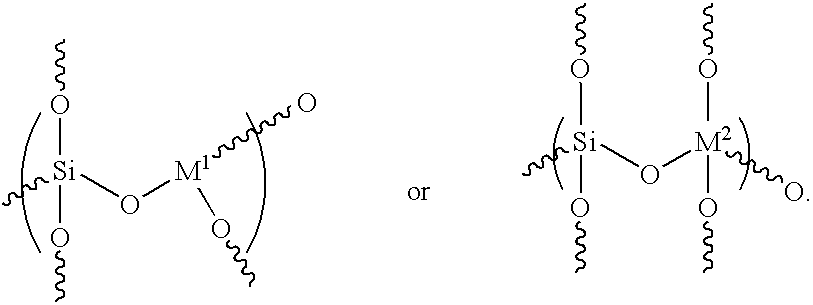
- the zeolite composition may further include a structural unit of formulae (VII) and/or (VIII):
- M 1 comprises a Group III element
- M 2 comprises titanium or zirconium
- Such structural units i.e., formulae (VII) and (VIII), are derived by including with the fumed silica or tetraalkyl orthosilicates reactant, alkyl metalates selected from the group represented by the formulae (IX) and (X): (R 4 O) 3 M 1 (IX) and (R 4 O) 3 M 2 (X); wherein R 4 is independently at each occurrence an alkyl group or any aryl group having from 1 to about 20 carbon atoms; “M 1 ” comprises the Group III element, and “M 2 ” comprises titanium or zirconium. In a preferred embodiment, “M 1 ” comprises a Group IIIA such as, for example, aluminum, boron or gallium.
- M 2 preferably comprises a Group IVB element, such as, for example, titanium or zirconium.
- a Group IVB element such as, for example, titanium or zirconium.
- Suitable alkyl metalates of formulae (IX) and (X) include, but are not intended to be limited to, tetraethyl orthotitanate, tetramethyl orthotitanate, tetraisopropyl orthotitanate, trimethyl aluminate, triethyl aluminate, tri(n-propyl)aluminate, tri(isopropyl)aluminate, tri(n-butyl)aluminate, tri(sec-butyl)aluminate, tri(tert-butyl_aluminate, tetramethyl zirconate, tetraethyl zirconate, and tetrapropyl zirconate.
- Suitable alkyl metalates also include those compounds in which one or more of the alkoxy groups bonded to the metal may be the same, or they can all be different from one another.
- Alkoxy metal compounds of silicon and titanium are preferred compounds since these are readily prepared by methods well known in the art, or available commercially, such as for example, the TYZOR series of titanium alkoxy compounds available from DuPont.
- the zeolite compositions comprising the structural units of formulae (I)–(III), and those further comprising the structural units of formula (VII) or (VIII) can be prepared by a variety of methods. Synthesis of the zeolite materials can be accomplished via surface-modification techniques, whereby the surface-reactive groups (e.g., surface hydroxy groups) are chemically reacted with other chemical compounds.
- the zeolite materials disclosed herein possess several advantages that make them attractive candidates as a catalyst for organic reactions. First, zeolite materials, such as for example, the mesoporous zeolites potentially are able to overcome the diffusional constraints generally observed with other solid acid catalyst materials.
- zeolites with very high surface area defined as those having a surface area of greater than or equal to about 500 meters square per gram of the zeolite
- wide distribution of tailor-made pore sizes from about 3 angstroms to about 100 angstroms
- zeolites serve as excellent host materials for guest species, such as for example, in applications requiring heterogenization of homogeneous metal complex species on the walls of the zeolite channels.
- zeolite syntheses can be monitored more easily than for example, ion exchange resins, by using techniques, such as surface area, pore size, and pore size distribution measurements. Further, the silica/alumina ratio and the hydrophobicity of the zeolite can be controlled. The acidity of the zeolite is also manipulated which will control the interaction with reactants and products.
- An in-situ method for forming the functionalized zeolites comprises reacting, in-situ, at least one first reactant selected from the group consisting of fumed silica and an alkyl metalate comprising a silica precursor, such as a tetraalkyl orthosilicate, a mercapto-functionalized alkoxysilane, an organosilyl sulfonic acid compound, and a template.
- a first reactant selected from the group consisting of fumed silica and an alkyl metalate comprising a silica precursor, such as a tetraalkyl orthosilicate, a mercapto-functionalized alkoxysilane, an organosilyl sulfonic acid compound, and a template.
- Suitable templates are quaternary ammonium salts of formula (XI): (R 9 R 10 R 11 R 12 )N + X ⁇ (XI); wherein R 9 , R 10 , R 11 , and R 12 are alkyl groups independently comprising from about 1 to about 20 carbon atoms; and “X” is independently selected from the group consisting of OH, Cl, Br, F, and I.
- the template comprises cetyltrimethylammonium bromide, dodecyltrimethylammonium bromide, or tetramethylammonium hydroxide, or mixtures comprising at least one of the foregoing template compounds.
- polyalkylene block copolymers include, for example, the poly(ethylene oxide—propylene oxide—ethylene oxide) block copolymers available from BASF, and exemplified by PLURONICTM L121, L64, L127, F88, L123, L103, P65, P85, and 25R4; and TETRONICTM 908 and 90R4.
- templates that can be used include the BRIJTM series materials, such as BRIJTM 52, 30, 78, 35, and 76; and the TWEENTM series of materials, such as TWEENTM 20, 40, and 60, available from Aldrich Chemical Company.
- BRIJTM series materials such as BRIJTM 52, 30, 78, 35, and 76
- TWEENTM series of materials such as TWEENTM 20, 40, and 60, available from Aldrich Chemical Company.
- Suitable solvents for preparing the zeolite compositions are preferably polar solvents, such as alcohols or water.
- Preferred polar solvents comprise water or C 1 to C 8 alcohols. Mixtures of one or more alcohols can be used. Likewise, mixtures of alcohols and water can also be used.
- Preferred alcohols include fully or partly water-miscible aliphatic alcohols, such as methanol, ethanol, n-propanol, isopropanol, tert-butanol, n-butanol, n-pentanol, and the like.
- the reactions are carried out at a temperature from about ambient temperature to about 125° C. in one embodiment, and from about 60° C. to about 80° C. in another embodiment.
- the reactions to prepare the zeolites can be accomplished by normal thermal means (such as for example, heating mantle, oil bath, and the like), or by using microwave energy. A wide variety of functionalized zeolites can thus be prepared.
- the relative proportion of the structural units (I), (II), and (III), and optionally (IV) or (V), if present, can be achieved by varying the relative mole ratio of the tetraalkyl orthosilicate to the alkyl metalate of formulae (IX) and (X) from about 1:1 to about 100:1.
- the relative weight ratio of the mercapto-functionalized alkoxysilane (V) to the organosilyl sulfonic acid compound (VI) can be varied from about 0.25:1 to about 4:1.
- An alternative method of preparing the functionalized zeolite compositions comprises a step-wise process. Unlike the in-situ method described above, this method does not utilize an organosilyl sulfonic acid compound as one of the reactants.
- the method comprises as the first step, reacting a template compound as described above, a first reactant, and a first mercapto-functionalized alkoxysilane to form a first intermediate product.
- the first reactant is at least one compound selected from the group consisting of fumed silica and a silica precursor, such as a tetraalkyl orthosilicate. Suitable fumed silicas can generally have any surface area.
- the fumed silica has a surface area from about 200 meters square per gram to about 400 meters square per gram.
- the first reactant can further comprise an alkyl metalate of formula (IX) or (X).
- the relative mole ratio of the tetraalkyl orthosilicate to the alkyl metalate can vary from about 1:1 to about 100:1.
- the first intermediate product is treated with an oxidizing agent to convert the mercapto groups into sulfonic acid groups and form a second intermediate product.
- the oxidizing agent is taken in an amount so as to oxidize substantially all of the mercapto groups to form sulfonic acid groups.
- a lesser amount of the oxidizing agent can also be taken in which case the second intermediate product will have both mercapto and sulfonic acid groups.
- Any oxidizing agent known in the art for converting a mercapto group into a sulfonic acid group can be used.
- Non-limiting examples of such oxidizing agents include hydrogen peroxide, aliphatic peracids, such as peracetic acid, and aromatic peracids, such as meta-chloroperbenzoic acid.
- the preferred oxidant is hydrogen peroxide since it is a low cost, readily available material.
- the oxidation step is generally carried out in a polar solvent, preferably those comprising water, or fully or partly water-miscible alcohols, such as for example, methanol, ethanol, isopropanol, and the like.
- the second intermediate product is then reacted with a second mercapto-functionalized alkoxysilane in a suitable solvent to produce a product that has both sulfonic acid and mercapto groups.
- suitable solvents include those comprising aromatic and aliphatic hydrocarbons such as, for example, toluene, xylene, heptane, octane, and the like.
- the first mercapto-functionalized alkoxysilane and the second mercapto-functionalized alkoxysilane are independently selected from the group consisting of 3-mercaptopropyltrimethoxysilane, 3-mercaptopropyltriethoxysilane, and mixtures of the foregoing alkoxysilanes. Any combination of the first and the second mercapto-functionalized alkoxysilanes can be used.
- the weight ratio of the first mercapto-functionalized alkoxysilane to the second mercapto-functionalized alkoxysilane is preferably from about 95:5 to about 5:95.
- varying the relative amounts of the silica content relative to the mercapto content and the sulfonic acid content can control the physical and chemical properties of the functionalized zeolite compositions.
- the weight ratio of the tetraalkyl orthosilicate to the first mercapto-functionalized alkoxysilane can be varied from about 98:2 to about 60:40
- the weight ratio of the tetraalkyl orthosilicate to the second mercapto-functionalized alkoxysilane can be varied from about 98:2 to about 60:40.
- a heteropolyacid reactant is employed in another method of preparing functionalized zeolite compositions.
- the second intermediate product described above is reacted with a second mercapto-functionalized alkoxysilane to form a third intermediate product, which is reacted with the heteropolyacid compound to produce the functionalized zeolite composition.
- a solution of the heteropolyacid in a suitable solvent is treated with the third intermediate product, followed by evaporation of the solvent and calcinations to furnish the heteropolyacid-functionalized zeolite.
- Suitable solvents used for reaction with the heteropolyacid compound include water and C 1 to C 8 alcohols, such as, for example, methanol, ethanol, isopropanol, and n-butanol.
- the weight ratio of the second intermediate product to the second mercapto-functionalized alkoxysilane can be from about 0.25:1 to about 4:1.
- the heteropolyacid content in the final zeolite composition can be controlled, in an embodiment, by varying the relative weight of the heteropolyacid compound and the third intermediate product; from about 2:98 to about 40:60.
- the heteropolyacid compound is preferably of formula (XII) as shown: (M 3 ) 3 (M 4 )(M 5 ) 12 O 40 (XII) wherein M 3 comprises hydrogen or an alkali metal such as lithium, sodium, potassium, rubidium, and cesium; M 4 comprises phosphorus or silicon, and M 5 comprises tungsten or molybdenum.
- the heteropolyacid compound comprises at least one heteropolyacid metal salt selected from the group consisting of lithium, sodium, potassium, rubidium, and cesium salts, or mixtures of the foregoing salts.
- the heteropolyacid compound comprises at least one heteropolyacid selected from the group consisting of silicotungstic acid, silicomolybdic acid, phosphotungstic acid, and phosphomolybdic acid.
- the heteropolyacid compound is of the formula (XIII): (M 6 )(M 7 )(M 8 ) 12 O 40 (XIII), wherein M 6 comprises a Group III element; M 7 comprises phosphorus or silicon, and M 8 comprises tungsten or molybdenum.
- the functionalized zeolite compositions described above are valuable as catalysts for producing bisphenols (hereinafter also sometimes referred to as aromatic dihydroxy compounds).
- the functionalized zeolites have both the acidic sulfonic acid group to accelerate the condensation reaction forming bisphenol, as well as the mercaptan group to provide enhanced selectivity for the p,p-bisphenol isomer.
- the zeolites disclosed herein preferably have a surface area from about 100 to about 1200 meters square per gram of the zeolite, and more preferably, from about 600 to about 900 meters square per gram of zeolite.
- microporous zeolites preferably have a pore size of about 3 angstroms to about 14 angstroms.
- Mesoporous zeolites preferably have a pore size of greater than or equal to about 14 angstroms to about 100 angstroms, or more preferably from about 20 to about 40 angstroms.
- the use of the appropriate template enables the control of the pore size during the zeolite synthesis.
- zeolites For example, use of surfactants such as cetyltrimethylammonium bromide or dodecyltrimethylammonium bromide generally results in formation of mesoporous zeolites.
- the procedure can be used to prepare any of the MCM series of zeolites, such as for example, MCM-22 and MCM-41; and the SBA series of zeolites, such as for example, SBA-11, SBA-12, and SBA-15.
- the microporous zeolite is one or more selected from the group consisting of mordenite, ZSM-5, L-zeolite, faujasite, ferrierite, chabazite type of zeolites, and mixtures of the foregoing zeolites and the mesoporous zeolite is one or more selected from the group consisting of MCM-41, SBA-15, and mixtures of the foregoing zeolites.
- Bisphenols are generally produced by reaction of a phenol with a carbonyl compound.
- the functionalized zeolite catalysts can be used to effectively catalyze the reaction of phenol with acetone to produce bisphenol A.
- preference is given to acetone any type of carbonyl compound, such can be used for the condensation reaction with the phenol, e.g., aldehydes and ketones.
- Suitable carbonyl compounds include acetone, methyl ethyl ketone, diethyl ketone, benzyl, acetyl acetone, methyl isopropyl ketone, methyl isobutyl ketone, acetophenone, ethyl phenyl ketone, cyclohexanone, cyclopentanone, benzophenone, fluorenone, indanone, anthraquinone, 4-hydroxyacetophenone, 4,4′-dihydroxybenzophenone, acenaphthenequinone, quinone, benzoylacetone diacetyl, fluorenone, bicyclo[2.2.1]heptan-2-one, and 3,3,5-trimethylcyclohexanone.
- Aldehydes such as for example, formaldehyde, acetaldehyde, propionaldehyde, butyraldehyde or higher homologues of the formula RCHO, wherein R is alkyl of 1 to 20 carbon atoms can also be used.
- Dialdehydes and ketoaldehdyes such as for example, glyoxal, phenylglyoxal or pyruvic aldehyde, can also be used.
- condensation of two moles of phenol with one mole of formaldehyde produces bis-(4-hydroxyphenyl)methane, also known as Bisphenol F.
- the aromatic hydroxy compound that can be used for producing the bisphenols can be a substituted or an unsubstituted aromatic compound containing at least one OH group.
- Suitable aromatic hydroxy compounds include, but are not intended to be limited to, phenol, 2-cresol, 3-cresol, 4-cresol, 2-chlorophenol, 3-chlorophenol, 4-chlorophenol, 2-tert-butylphenol, 2,4-dimethylphenol, 2-ethyl-6-methylphenol, 2-bromophenol, 2-fluorophenol, 2-phenoxyphenol, 3-methoxyphenol, 2,3,6-trimethylphenol, 2,3,5,6-tetramethylphenol, 2,6-xylenol, 2,6-dichlorophenol, 3,5-diethylphenol, 2-benzylphenol, 2,6-di-tertbutylphenol, 2-phenylphenol, 1-naphthol, and 2-naphthol.
- Phenol is a particularly desirable aromatic hydroxy compound for producing bisphenol A by reaction with acetone. Also desirable is ortho-cresol for producing 1,1-bis(4-hydroxy-2-methylphenyl)cyclohexane by reaction with cyclohexanone.
- the functionalized zeolite catalysts can be used for reaction of the carbonyl compound with the aromatic dihydroxy compound in either a batch or a continuous mode.
- the carbonyl compound and the aromatic hydroxy compound are preferably stirred in the presence of the functionalized zeolite catalyst.
- the progress of the reaction can be followed by numerous analytical techniques, such as gas chromatography or high-pressure liquid chromatography.
- the carbonyl compound and the aromatic hydroxy compound are continuously introduced into at least one reactor comprising a fixed bed or fluidized bed packing comprising the functionalized zeolite catalyst at an appropriate temperature.
- the continuous process for making bisphenols can be carried out in a single reactor packed with the functionalized zeolite catalyst, wherein the phenol is passed continuously into then reactor and the carbonyl compound is selectively introduced in one or more stages of the reactor.
- the staged addition of carbonyl compound has the potential to offer improved selectivity for bisphenols.
- the staged addition of carbonyl compound can improve the selectivity for the p,p-bisphenol isomer.
- the functionalized zeolite catalysts can be used in a variety of forms, as a powder, as pellets of any shape, as a coating on the outside of an inert aggregate or bead made of materials, such as alumina, silica, and the like; as a coating on the inside of a pipe reactor, or as a monolithic structure.
- the feed comprising the phenol and the carbonyl compound is preferably introduced to the functionalized zeolite catalyst at a temperature from about 10° C. to about 200° C. Within this range the introductory temperature is preferably greater than or equal to about 30° C.,more preferably greater than or equal to about 40° C., and even more preferably greater than or equal to about 45° C. Passing the feed through the functionalized zeolite catalyst results in an effluent comprising bisphenol, residual starting materials, water produced as a byproduct of the reaction, and other byproducts.
- the bisphenol (in the effluent) is predominantly produced as para-para (p/p) bisphenol although some ortho-para (o/p) isomer is produced.
- the average ratio of p/p to o/p is greater than or equal to about 20.
- the bisphenol is then isolated from the residual starting materials, water and byproducts.
- water, residual carbonyl compounds, and optionally, some residual phenol are removed by vacuum distillation.
- the removed carbonyl compound and residual phenol can be separated from the water and recycled to the reaction feed.
- the p/p bisphenol may be isolated from the bisphenol containing product stream by methods known in the art, such as adduct crystallization, solvent crystallization, melt crystallization, distillation, or a combination of the foregoing isolation methods.
- the phenol compound removed from the product stream may be recycled for use in the catalyzed reaction or adduct crystallization, when present.
- the high degree of selectivity of the reaction for p/p bisphenol results in the amount of impurities being greatly reduced, thus facilitating the isolation of the p/p bisphenol, improving the overall efficiency of the reaction and isolation.
- a technique frequently used to achieve higher bisphenol selectivity is to use a feed stream comprising not only fresh aromatic hydroxy compound and carbonyl compound, but also a recycle stream comprising impurities generally produced in a previous alkylation reaction (or pass, for a continuous process). This approach generally gives higher overall bisphenol selectivity, particularly for the p,p-bisphenol isomer. In this case, the net selectivity can be improved by recycling impurities to the reactor to suppress isomerization reactions and/or further production of impurities.
- the ortho,para-bisphenol can undergo isomerization to the para,para-bisphenol isomer, thereby enhancing the overall para,para-bisphenol content in the reactor effluent.
- the zeolite catalysts therefore are capable of producing high bisphenol selectivity in general, and para,para-selectivity in particular, under conditions where the reactor feed comprises substantial levels of impurity recycle to the reactor, as compared to the bisphenol selectivity expected with a virgin feed, that is, the feed does not comprise a substantial impurity recycle.
- the single or multiple reactor system comprising the fixed bed packing of the catalyst may further comprise packing structures designed to alleviate the hydraulic stress that generally results from prolonged operation.
- packing structures may assume a variety of structures specially designed to withstand hydraulic stress, and may comprise materials inert to the reactive materials used for producing bisphenols.
- the packing structures may comprise materials, such as steel, aluminum, ceramic, and the like.
- the functionalized zeolite compositions disclosed herein in this disclosure are expected to have crushing strengths much higher than those reported for the traditionally used acidic ion exchange resin catalysts.
- the presence of the packing structures is expected to further improve the lifetime of the catalyst packing.
- Aromatic dihydroxy compounds that can be prepared using the functionalized zeolite catalysts comprise those of the general formula (XIV): HO—A 2 —OH (XIV), wherein A 2 is an aromatic group.
- a 2 preferably has a structure as shown in formula (XV):
- G 1 independently represents an aromatic group, such as phenylene, biphenylene, naphthylene, and the like aromatic groups
- E may be an alkylene or alkylidene group such as methylene, ethylene, ethylidene, propylene, propylidene, isopropylidene, butylene, butylidene, isobutylidene, amylene, amylidene, isoamylidene, and the like.
- E may consist of two or more alkylene or alkylidene groups connected by a moiety different from alkylene or alkylidene, such as an aromatic linkage, a tertiary amino linkage, an ether linkage, a carbonyl linkage, a silicon-containing linkage, a sulfur-containing linkage such as sulfide, sulfoxide, sulfone, a phosphorus-containing linkage such as phosphinyl, phosphonyl, and like linkages.
- E may comprise a cycloaliphatic group.
- R 13 represents hydrogen or a monovalent hydrocarbon group such as alkyl, aryl, aralkyl, alkaryl, cycloalkyl, and the like.
- Y 1 independently comprises a halogen (e.g., fluorine, bromine, chlorine, iodine, and the like); a nitro group; an alkenyl group, allyl group, a monovalent hydrocarbon group such as alkyl, aryl, aralkyl, alkaryl, cycloalkyl, an oxy group such as OR, and the like.
- Y 1 is inert to and unaffected by the reactants and reaction conditions used to prepare the polymer.
- m represents any integer from and including zero through the number of positions on G 1 available for substitution
- p represents an integer from and including zero through the number of positions on E available for substitution
- t represents an integer equal to at least one
- s is either zero or one
- u represents any integer including zero.
- E examples include cyclopentylidene, cyclohexylidene, 3,3,5-trimethylcyclohexylidene, methylcyclohexylidene, 2-[2.2.1]-bicycloheptylidene, neopentylidene, cyclopentadecylidene, cyclododecylidene, adamantylidene, etc.); a sulfur-containing linkage such as sulfide, sulfoxide or sulfone, a phosphorus-containing linkage such as phosphinyl, phosphonyl, an ether linkage, a carbonyl group, a tertiary nitrogen group, and a silicon-containing linkage such as a silane or siloxy linkage.
- a sulfur-containing linkage such as sulfide, sulfoxide or sulfone
- a phosphorus-containing linkage such as phosphinyl,
- both G 1 groups are unsubstituted phenylene groups; and E is an alkylidene group such as isopropylidene.
- both G 1 groups are p-phenylene, although both may be ortho- or meta-phenylene or one ortho- or meta-phenylene and the other para-phenylene.
- aromatic dihydroxy compounds of formula (XV) prepared using the functionalized zeolite catalysts include the dihydroxy-substituted aromatic hydrocarbons disclosed by name or formula (generic or specific) in U.S. Pat. No. 4,217,438.
- aromatic dihydroxy compounds include 4,4′-(3,3,5-trimethylcyclohexylidene)diphenol; 4,4′-bis(3,5-dimethyl)diphenol; 4,4-bis(4-hydroxyphenyl)heptane; 2,4′-dihydroxydiphenylmethane; bis(2-hydroxyphenyl)methane; bis(4-hydroxyphenyl)methane; bis(4-hydroxy-5-nitrophenyl)methane; bis(4-hydroxy-2,6-dimethyl-3-methoxyphenyl)methane; 1,1-bis(4-hydroxyphenyl)ethane; 1,1-bis(4-hydroxy-2-chlorophenyl)ethane; 2,2-bis(4-hydroxyphenyl)propane (commonly known as bisphenol A); 2,2-bis(3-phenyl-4-hydroxyphenyl)propane; 2,2-bis(4-hydroxy-3-methylphenyl)propane; 2,2-bis(4-hydroxy-3
- Bisphenols prepared in accordance with the methods described herein are especially suitable for preparing polycarbonates.
- the functionalized zeolite catalysts described in this disclosure are useful for producing a variety of aromatic bisphenols in high yield and selectivity. Moreover, the use of functionalized zeolite catalysts offer improved mechanical strength and less fouling over prolonged periods of use, which results in longer catalyst lifetimes, thereby reducing operating costs.
- Polycarbonates are generally prepared by the polymerization reaction of an aromatic dihydroxy compound with a carbonate precursor, such as carbonyl halides or diaryl carbonates. Methods of polymerization include those disclosed in the art, such as interfacial polymerization, melt polymerization, solid—state polymerization, and solution polymerization. The bisphenols thus obtained are valuable for producing the polycarbonates compositions, which in turn are useful for making various articles useful for high heat, optical, and engineering applications.
- CTAB Cetyltrimethylammonium bromide
- TMAH Tetramethylammonium hydroxide
- DTAB Dodecyltrimethylammonium bromide
- TEOS Tetraethylorthosilicate
- TSPS (3-trihydroxysilyl)propanesulfonic acid
- MPTMS (3-mercaptopropyl)trimethoxysilane.
- Table 1 shows the starting materials and amounts used for preparing the various catalysts in accordance with the detailed procedures described below.
- This example describes the preparation of Cat-11 shown in Table 1.
- H-Al-MCM-41, non-functionalized mesoporous zeolite (designated as cat-17 and prepared according to the procedure described below under Comparative Example 7) and MPTMS were refluxed in dry toluene (as solvent) for about four hours under a nitrogen atmosphere.
- the resulting material was recovered by centrifugation, and dried in an oven at about 100° C. for about 10 hours.
- the resulting material was oxidized by treatment with excess H 2 O 2 (30 weight percent aqueous solution) for about 24 hours at ambient temperature.
- the resulting material was filtered, washed with distilled water several times, then with ethanol, and dried in an oven at about 100° C. for about 10 hours to give Cat-11.
- This Comparative Example describes the preparation of sulfonic acid-functionalized H—Si-MCM-41 catalyst, as referred to in Table 1 as Cat-12.
- CTAB was added to TMAH aqueous solution with stirring at room temperature until a homogeneous solution formed.
- a mixture of TEOS and MPTMS in methanol was slowly added. After being stirred for about 6 hours, the reaction mixture was heated under reflux for about 48 hours. The reaction mixture was then filtered, washed with distilled water several times, then acetone, and dried as described before.
- a template compound was extracted from the dried material by refluxing with a mixture of methanol and concentrated hydrochloric acid (100 grams methanol and 5 grams hydrochloric acid per gram of the dried catalyst) for about 24 hours. The final product was filtered and dried in oven at about 100° C.
- the mercaptan groups in the product were oxidized to the sulfonic acid form by stirring the product with a three-fold excess of aqueous hydrogen peroxide for about 24 hours at room temperature.
- the resulting product (Cat-12) was filtered, washed with water, ethanol, and dried in an oven at about 100° C.
- Cat-13 H-beta zeolite and MPTMS were refluxed in dry toluene for about 4 hours under an inert atmosphere.
- Cat-14 was prepared by refluxing H-Mordenite and MPTMS. The resulting solid materials were recovered by centrifugation, and dried in an oven at about 100° C. for about 10 hours. The dried materials were then separately oxidized by treatment with an excess of H 2 O 2 (30 weight percent aqueous solution) for about 24 hours at room temperature. The resulting solid materials were filtered, washed with distilled water several times, then with ethanol, and dried in an oven at about 100° C. for about 10 hours to furnish the desired catalysts, i.e., Cat-13 and Cat-14.
- This Example describes the procedure for preparing a heteropolyacid-functionalized zeolite that is referred to in Table 1 as Cat-15.
- This Example describes the preparation of Si-MCM-41 (Cat-16), which can be used as a substrate for preparing the functionalized zeolite catalysts.
- CTAB was added to an aqueous TMAH solution with stirring at room temperature until a homogeneous solution formed. Fumed silica was then added to the solution with stirring over a period of about one hour, stirred for an additional three hours at room temperature, and then heated under reflux for about 48 hours.
- the reaction mixture was filtered, washed with distilled water several times, then with acetone, and dried in oven maintained at about 100° C. for about 10 hours.
- the dried material was calcined in an oven maintained at about 540° C. for about 10 hours to give the desired product, i.e., Cat-16.
- This Example describes the preparation of H-Al-MCM-41 mesoporous zeolite, referred to as Cat-17 in Table 1.
- CTAB was added to TMAH in water with stirring at room temperature until a homogeneous solution formed. Fumed silica was added to the solution with stirring over a period of about one hour.
- sodium aluminate 0.6 grams
- the resulting mixture was filtered, washed with distilled water several times, then with acetone, and dried in oven maintained at about 100° C. for about 10 hours. The dried material was calcined in an oven maintained at about 540° C. for about 10 hours.
- the sodium form of the calcined dried material was then converted to the hydrogen form by refluxing with an ammonium nitrate solution (20 milliliters of a 1 Molar solution was taken per gram of the sodium form of the catalyst).
- the resulting material was filtered, washed as described before, filtered, and calcined at 540° C. for about 10 hours to furnish Cat-17.
- Lewatit K1131 ion exchange resin an acidic sulfonated styrene-divinylbenzene copolymer obtained commercially from Bayer Chemicals, and referred to in Table 1 as Lewatit K1131.
- This Example describes the preparation of the functionalized zeolite catalyst Cat-1.
- CTAB was added to an aqueous solution of TMAH with stirring at room temperature until a homogeneous solution formed.
- TMAH aqueous solution of TMAH
- MPTMS a mixture of TEOS, MPTMS, and TSPS in methanol.
- the reaction mixture was heated under reflux for about 48 hours.
- the reaction mixture was filtered, washed with distilled water several times, then acetone, and dried in an oven at about 100° C. for about 10 hours.
- Template extraction was done by refluxing with methanol and concentrated hydrochloric acid (100 grams of methanol and 5 grams of hydrochloric acid per gram of the catalyst).
- the resulting product i.e., Cat-1, was filtered and dried.
- both Cat-2 and Cat-3 were prepared by adding CTAB to a TMAH aqueous solution with stirring at room temperature until a homogeneous solution formed.
- TMAH TMAH aqueous solution
- MPTMS-1 3-mercaptopropyltrimethoxsiloxane, referred to as the first mercapto-functionalized alkoxysilane
- the reaction mixture was then heated under reflux for about 48 hours.
- the solid material obtained was filtered, washed with distilled water several times, then acetone, and dried in oven at about 100° C. for about 10 hours. Template extraction was done as previously described in Example 1, followed by drying the resulting materials to give the first intermediate product.
- the mercaptan groups of the first intermediate product were oxidized by treatment with a three-fold excess of aqueous hydrogen peroxide and stirring for about 24 hours at room temperature.
- the resulting solid product after being washed with water and ethanol, and subsequently dried at 100° C. to produce the second intermediate product.
- the second intermediate product was treated with MPTMS (3-mercaptopropyltrimethoxsiloxane, referred to as the second mercapto-functionalized alkoxysilane) in dry toluene and heated to reflux for about 4 hours.
- the solid material was filtered, washed with water, ethanol, and finally dried at about 100° C. for about 10 hours to furnish the desired catalysts, i.e., Cat-2, and Cat-3.
- This Example describes the preparation of the catalysts, Cat-4 and Cat-10.
- the procedure used was identical to those described above for preparing catalysts Cat-2 and Cat-3, except that DTAB was used instead of CTAB.
- the preparation of the first intermediate product, the second intermediate product, and its subsequent reaction with the second mercapto-functionalized alkoxysilane MPTMS was identical to the method previously described for preparing the catalysts Cat 2 and Cat-3.
- the third intermediate product after being dried was reacted with the heteropolyacid compound as follows.
- the dried third intermediate product was refluxed with a solution of silicotungstic acid in 60 milliliters of methanol for about 3 hours.
- the resulting solution was evaporated, and the solid material remaining was dried at about 100° C. for about 10 hours, followed by calcination at about 200° C. for about 2 hours to furnish the desired catalyst.
- a 20-milliliter vial equipped with a gas-tight septum was charged with phenol (12 grams), the catalyst (0.6 gram, about 5 weight percent), and placed in an oil bath maintained at a temperature of about 75° C. Then acetone was injected into the vial via a gas-tight syringe so that it forms 4.5 weight percent of the reaction mixture. The time at which acetone was added corresponded to zero time, i.e., start of the reaction. The progress of the reaction was monitored by gas chromatography (GC) by taking aliquots of the reaction mixture at different time intervals. The reaction was allowed to proceed for about 24 hours. Sample preparation for GC analysis was carried out as follows.
- Weight percent of acetone was determined by treatment of the sample with hydroxylamine hydrochloride, followed by titration of the liberated HCl.
- the weight percents of para-para-BPA, ortho-para-BPA, phenol, and bisphenol impurities in a reaction mixture sample were determined by standard high-pressure liquid chromatography (HPLC), with an experimental error in measurement of ⁇ 0.66% with a 99% confidence.
- the weight percent p, p-BPA selectivity was expressed as the ratio of the measured weight of p, p-BPA divided by the total weight of all components detected by the measurement technique (GC or HPLC).
- the quantitative determination of water in samples was carried out using Karl Fischer titration method. The results obtained from the various screening runs to evaluate the zeolite compositions as catalysts are shown in Tables 1.
- zeolites functionalized with mercaptan (SH) groups and sulfonic acid (SO 3 H) groups function as catalysts for the reaction of phenol and acetone to form BPA.
- selectivities obtained with the functionalized zeolite catalysts are superior to those obtained with zeolites that are not functionalized with SH and SO 3 H groups.
- the functionalized zeolite catalysts are superior to zeolites having only SH or SO 3 H groups.
- Other advantages of the functionalized zeolites include, among others, no separate promoter is required, minimal or no swelling occurs during use, high mechanical strength, hydrothermal stability, and no pretreatment with phenol is required.
Landscapes
- Chemical & Material Sciences (AREA)
- Organic Chemistry (AREA)
- Chemical Kinetics & Catalysis (AREA)
- Engineering & Computer Science (AREA)
- Materials Engineering (AREA)
- General Life Sciences & Earth Sciences (AREA)
- Life Sciences & Earth Sciences (AREA)
- Geology (AREA)
- Inorganic Chemistry (AREA)
- Crystallography & Structural Chemistry (AREA)
- Dispersion Chemistry (AREA)
- Health & Medical Sciences (AREA)
- Medicinal Chemistry (AREA)
- Polymers & Plastics (AREA)
- Catalysts (AREA)
- Organic Low-Molecular-Weight Compounds And Preparation Thereof (AREA)
Abstract

wherein “B” and “C” are spacer groups comprising C2 to C20 hydrocarbyl groups; and R1 and R2 independently of each other comprise alkali metal, hydrogen, or C1 to C20 alkyl groups. The zeolite compositions further comprise structural units derived from a heteropolyacid compound of the formula: (M3)3(M4)(M5)12O40; where M3 comprises hydrogen or an alkali metal; M4 comprises phosphorus or silicon, and M5 comprises tungsten or molybdenum. Methods for preparing these zeolite compositions are also disclosed. The zeolite compositions are useful as catalysts for producing bisphenols.
Description

wherein “B” and “C” are spacer groups comprising C2 to C20 hydrocarbyl groups, and R1 and R2 independently comprise an alkali metal, a hydrogen, or a C1 to C20 alkyl group.

wherein “B” and “C” are spacer groups comprising C2 to C20 hydrocarbyl groups; and R1 and R2 independently comprise an alkali metal, a hydrogen, or a C1 to C20 alkyl group.

wherein “B” and “C” are spacer groups comprising C2–C20 hydrocarbyl groups; and R1 and R2 independently of each other comprise alkali metal, hydrogen, or alkyl groups.

wherein “B” and “C” are spacer groups comprising C2–C20 hydrocarbyl groups; and R1 and R2 independently of each other comprise alkyl metal, hydrogen, or alkyl groups.

wherein “B” and “C” are spacer groups comprising C2 to C20 hydrocarbyl groups; and R1 and R2 independently comprise an alkali metal, a hydrogen, or an alkyl group.

wherein “B” and “C” are spacer groups comprising C2 to C20 hydrocarbyl groups; and R1 and R2 independently of each other comprise an alkali metal, hydrogen, or a C1 to C20 alkyl group.
(R3O)4Si (IV);
wherein R3 comprises an alkyl group, preferably an alkyl group having from 1 to about 6 carbon atoms. Examples of tetraalkyl orthosilicates that can be used include, but are not intended to be limited to, tetramethyl orthosilicate, tetraethyl orthosilicate, tetra(n-propyl) orthosilicate, tetraisopropyl orthosilicate, tetratetrabutyl orthosilicate, tetrakis(dimethylsilyl)orthosilicate, and tetraphenyl orthosilicate. In another embodiment, the tetraalkyl orthosilicate can also have other functional groups, such as hydroxy groups, as exemplified by tetrakis(2-hydroxyethyl)orthosilicate, tetrakis(2-hydroxypropyl)orthosilicate, and the like. Any mixture of two or more tetraalkyl orthosilicates can also be used for obtaining the structural units of formula (I). Besides the symmetrically substituted tetraalkyl orthosilicates described above, unsymmetrical tetraalkyl orthosilicates, which have one or more dissimilar alkyl groups around the silicon atom can also be used as silica precursors.
R1S—B—Si(OR5)n(R6)3-n (V);
wherein “n” is an integer having values from 1 to about 3; R1 comprises alkali metal, hydrogen, or alkyl groups; “B” is a spacer group comprising C2–C20 hydrocarbyl groups, preferably a C2–C8 alkyl group; R5 comprises hydrogen or alkyl groups; and R6 comprises alkyl groups or alkoxy groups. Non-limiting examples of the spacer group “B” include —(C6H4)CH2—, 1,2-ethylene, 1,3-propylene, 1,4-butylene, 1,5-pentylene, 1,6-hexylene, and 1,4-phenylene. Non-limiting examples of the mercapto-functionalized alkoxysilanes include (3-mercaptopropyl)trimethoxysilane, (3-mercaptopropyl)triethoxysilane, (3-tert-butylmercaptopropyl)trimethoxysilane, (3-tert-butylmercaptopropyl)triethoxysilane, or mixtures of the foregoing alkoxysilanes. (3-mercaptopropyl)trimethoxysilane is particularly advantageous since it is commercially readily available.
(SO3R2)—C—Si(OR7)n(R8)3-n (VI);
wherein “C” is a spacer group selected from the group consisting of C2–C20 hydrocarbyl groups; R2 comprises hydrogen, alkali metal, or alkyl groups, R7 comprises hydrogen or alkyl groups; and R8 comprises OH, C1–C8 alkyl groups, or alkoxy groups; and The spacer group “C” is preferably a C2–C8 alkyl group. Non-limiting examples of the spacer group “C” include —(C6H4)CH2—, 1,2-ethylene, 1,3-propylene, 1,4-butylene, 1,5-pentylene, 1,6-hexylene, and 1,4-phenylene. In one embodiment, the organosilyl sulfonic acid compound is one or more compounds selected from the group consisting of (3-trihydroxysilyl)propanesulfonic acid, (3-trimethoxysilyl)propanesulfonic acid, (3-triethoxysilyl)propanesulfonic acid, (4-trimethoxysilyl)phenylmethanesulfonic acid, and the corresponding ester derivatives of the foregoing sulfonic acids. Preparation of the organosilyl sulfonic acids is well known in the art. For example, (3-trimethoxysilyl)propanesulfonic acid can be prepared by oxidizing (3-mercaptopropanesulfonic acid with a suitable oxidizing agent, such as potassium permanganate in an appropriate solvent, such as acetone. (4-trimethoxysilyl)phenylmethanesulfonic acid can be prepared by treating (4-trimethoxysilyl)benzyl chloride with sodium sulfite in a solvent, such as ethanol, and stirring the reaction mixture overnight at a temperature of about 75° C. The resulting sodium (4-trimethoxysilyl)phenylmethanesulfonate is treated with a strong acid, such as an acidic ion exchange resin to provide the desired (4-trimethoxysilyl)phenylmethanesulfonic acid.

wherein M1 comprises a Group III element, and M2 comprises titanium or zirconium.
(R4O)3M1 (IX)
and
(R4O)3M2 (X);
wherein R4 is independently at each occurrence an alkyl group or any aryl group having from 1 to about 20 carbon atoms; “M1” comprises the Group III element, and “M2” comprises titanium or zirconium. In a preferred embodiment, “M1” comprises a Group IIIA such as, for example, aluminum, boron or gallium. “M2” preferably comprises a Group IVB element, such as, for example, titanium or zirconium. When it is desirable to use an alkyl metalate of formula (IX) or (X), the mole ratio of Si to M1 in the tetraalkyl orthosilicate and formula (IX), respectively, or the mole ratio of Si to M2 in the tetraalkyl orthosilicate and formula (X), respectively, is preferably greater than or equal to about 10.
(R9R10R11R12)N+ X− (XI);
wherein R9, R10, R11, and R12 are alkyl groups independently comprising from about 1 to about 20 carbon atoms; and “X” is independently selected from the group consisting of OH, Cl, Br, F, and I. Preferably, the template comprises cetyltrimethylammonium bromide, dodecyltrimethylammonium bromide, or tetramethylammonium hydroxide, or mixtures comprising at least one of the foregoing template compounds. Other templates that can be used for preparing the functionalized zeolites include non-ionic surfactants, non-limiting examples of which include the polyalkylene block copolymers. Suitable examples of polyalkylene block copolymers include, for example, the poly(ethylene oxide—propylene oxide—ethylene oxide) block copolymers available from BASF, and exemplified by PLURONIC™ L121, L64, L127, F88, L123, L103, P65, P85, and 25R4; and TETRONIC™ 908 and 90R4. Other examples of templates that can be used include the BRIJ™ series materials, such as BRIJ™ 52, 30, 78, 35, and 76; and the TWEEN™ series of materials, such as TWEEN™ 20, 40, and 60, available from Aldrich Chemical Company.
(M3)3(M4)(M5)12O40 (XII)
wherein M3 comprises hydrogen or an alkali metal such as lithium, sodium, potassium, rubidium, and cesium; M4 comprises phosphorus or silicon, and M5 comprises tungsten or molybdenum. The heteropolyacid compound comprises at least one heteropolyacid metal salt selected from the group consisting of lithium, sodium, potassium, rubidium, and cesium salts, or mixtures of the foregoing salts. In a preferred embodiment, the heteropolyacid compound comprises at least one heteropolyacid selected from the group consisting of silicotungstic acid, silicomolybdic acid, phosphotungstic acid, and phosphomolybdic acid.
(M6)(M7)(M8)12O40 (XIII),
wherein M6 comprises a Group III element; M7 comprises phosphorus or silicon, and M8 comprises tungsten or molybdenum.
HO—A2—OH (XIV),
wherein A2 is an aromatic group.

wherein G1 independently represents an aromatic group, such as phenylene, biphenylene, naphthylene, and the like aromatic groups; and E may be an alkylene or alkylidene group such as methylene, ethylene, ethylidene, propylene, propylidene, isopropylidene, butylene, butylidene, isobutylidene, amylene, amylidene, isoamylidene, and the like. Alternatively, E may consist of two or more alkylene or alkylidene groups connected by a moiety different from alkylene or alkylidene, such as an aromatic linkage, a tertiary amino linkage, an ether linkage, a carbonyl linkage, a silicon-containing linkage, a sulfur-containing linkage such as sulfide, sulfoxide, sulfone, a phosphorus-containing linkage such as phosphinyl, phosphonyl, and like linkages. In addition, E may comprise a cycloaliphatic group. R13 represents hydrogen or a monovalent hydrocarbon group such as alkyl, aryl, aralkyl, alkaryl, cycloalkyl, and the like. Y1 independently comprises a halogen (e.g., fluorine, bromine, chlorine, iodine, and the like); a nitro group; an alkenyl group, allyl group, a monovalent hydrocarbon group such as alkyl, aryl, aralkyl, alkaryl, cycloalkyl, an oxy group such as OR, and the like. In a preferred embodiment, Y1 is inert to and unaffected by the reactants and reaction conditions used to prepare the polymer. The letter “m” represents any integer from and including zero through the number of positions on G1 available for substitution; “p” represents an integer from and including zero through the number of positions on E available for substitution; “t” represents an integer equal to at least one; “s” is either zero or one; and “u” represents any integer including zero.
| TABLE 1 | ||||||||||||
| TMAH | Surface | |||||||||||
| (grams of | area | p,p-BPA | ||||||||||
| Ex- | Zeolite | 25 weight | TSPS | (square | selectivity | |||||||
| ample. | substrate | percent | CTAB | DTAB | TEOS | MPTMS-1 | MPTMS-2 | (Weight | H3SiW12O40 | meters/ | (Weight | |
| No. | Catalyst | (grams) | solution) | (grams) | (grams) | (Grams) | (Grams) | (Grams) | percent) | (Grams)) | gram) | percent) |
| 1 | Cat 1 | NA | 10.9 | 9.1 | NA | 16.6 | 4.1 | NA | 12 | NA | NA | 91 |
| 2 | Cat-2 | NA | 6 | 7.6 | NA | 17.2 | 1.1 | 1.1 | NA | NA | 699 | 93 |
| 3 | Cat-3 | NA | 8 | 10 | NA | 22.2 | 1.2 | 2.4 | NA | NA | 449 | 96 |
| 4 | Cat-4 | NA | 6.8 | NA | 7.2 | 18.4 | 0.8 | 0.8 | NA | NA | NA | 95.6 |
| 5 | Cat-5 | NA | 36.4 | 11.3 | NA | 24.6 | 1.2 | 1.2 | NA | 0.5 | 501 | 95 |
| 6 | Cat-6 | NA | 36.4 | 11.3 | NA | 24.6 | 1.2 | 0.6 | NA | 1.1 | 481 | 94.2 |
| 7 | Cat-7 | NA | 34.8 | 10.9 | NA | 24.3 | 0.6 | 1.2 | NA | 1.2 | 204 | 93.7 |
| 8 | Cat-8 | NA | 6.3 | 7.8 | NA | 16 | 1.8 | 3.6 | NA | NA | 580 | 95.4 |
| 9 | Cat-9 | NA | 44.4 | 20.3 | NA | 16.2 | 3.6 | 1.2 | NA | NA | 841 | 95.6 |
| 10 | Cat-10 | NA | 12 | NA | 12.5 | 30.2 | 3.6 | 2.7 | NA | NA | 491 | 95.9 |
| 1* | Cat-11 | H—Al-MCM-41 (6) | NA | NA | NA | NA | 9.8 | NA | NA | NA | NA | 79.5 |
| 2* | Cat-12 | NA | 21.9 | 8.2 | NA | 33.3 | 16.5 | NA | NA | NA | NA | 82 |
| 3* | Cat-13 | H-Beta (6) | NA | NA | NA | NA | 3.6 | NA | NA | NA | NA | 85.5 |
| 4* | Cat-14 | H-Mordenite (6) | NA | NA | NA | NA | 3.6 | NA | NA | NA | NA | 68.3 |
| 5* | Cat-15 | Si-MCM-41 (5.6) | NA | NA | NA | NA | NA | NA | NA | 1.4 | 734 | 81.9 |
| 6* | Cat-16 | Fumed silica (6) | 10.9 | 9.1 | NA | NA | NA | NA | NA | NA | NA | 91.4 |
| 7* | Cat-17 | Fumed silica (12) | 19 | 13.1 | NA | NA | NA | NA | NA | NA | 829 | 90.5 |
| 8* | Lewatit | NA | NA | NA | NA | NA | NA | NA | NA | NA | NA | 92.1 |
| K1131 | ||||||||||||
| *Denotes Comparative Example. | ||||||||||||
Claims (46)


R2O3S—C—Si(OR7)n(R8)3-n,


Priority Applications (5)
| Application Number | Priority Date | Filing Date | Title |
|---|---|---|---|
| US10/675,141 US7041774B2 (en) | 2003-09-30 | 2003-09-30 | Functionalized zeolite compositions and methods for their preparation and use |
| KR1020067006780A KR101102746B1 (en) | 2003-09-30 | 2004-07-29 | Functionalized Zeolite Compositions, Methods of Making and Uses thereof |
| PCT/US2004/024560 WO2005035119A2 (en) | 2003-09-30 | 2004-07-29 | Functionalized zeolite compositions and methods for their preparation and use |
| CN2004800354513A CN1886196B (en) | 2003-09-30 | 2004-07-29 | Functionalized zeolite compositions and their preparation and use |
| TW093128451A TWI357888B (en) | 2003-09-30 | 2004-09-20 | Functionalized zeolite compositions and methods fo |
Applications Claiming Priority (1)
| Application Number | Priority Date | Filing Date | Title |
|---|---|---|---|
| US10/675,141 US7041774B2 (en) | 2003-09-30 | 2003-09-30 | Functionalized zeolite compositions and methods for their preparation and use |
Publications (2)
| Publication Number | Publication Date |
|---|---|
| US20050070423A1 US20050070423A1 (en) | 2005-03-31 |
| US7041774B2 true US7041774B2 (en) | 2006-05-09 |
Family
ID=34377064
Family Applications (1)
| Application Number | Title | Priority Date | Filing Date |
|---|---|---|---|
| US10/675,141 Expired - Fee Related US7041774B2 (en) | 2003-09-30 | 2003-09-30 | Functionalized zeolite compositions and methods for their preparation and use |
Country Status (5)
| Country | Link |
|---|---|
| US (1) | US7041774B2 (en) |
| KR (1) | KR101102746B1 (en) |
| CN (1) | CN1886196B (en) |
| TW (1) | TWI357888B (en) |
| WO (1) | WO2005035119A2 (en) |
Cited By (6)
| Publication number | Priority date | Publication date | Assignee | Title |
|---|---|---|---|---|
| CN100446857C (en) * | 2006-11-02 | 2008-12-31 | 武汉理工大学 | Preparation method of heteropolyacid/ordered mesoporous silica catalyst |
| US20100016619A1 (en) * | 2008-07-18 | 2010-01-21 | Chil-Hung Cheng | Functionalization of the internal surfaces of zeolites with alcohol compounds |
| US20100081828A1 (en) * | 2008-09-29 | 2010-04-01 | Bhotla Venkata Rama Narayanan | Catalytic method for producing phenolphthalein compounds |
| US20100081829A1 (en) * | 2008-09-29 | 2010-04-01 | Bhotla Venkata Rama Narayanan | Method for producing phenolphthalein using a heteropolyacid catalyst |
| US20100081831A1 (en) * | 2008-09-29 | 2010-04-01 | Bhotla Venkata Rama Narayanan | Method for producing phenolphthalein compound using ionic liquid catalyst composition |
| WO2015107467A1 (en) | 2014-01-14 | 2015-07-23 | Sabic Global Technologies B.V. | Methods of manufacture of 2-hydrocarbyl-3,3-bis(hydroxyaryl)phthalimidines |
Families Citing this family (24)
| Publication number | Priority date | Publication date | Assignee | Title |
|---|---|---|---|---|
| US6960551B2 (en) * | 2002-08-23 | 2005-11-01 | Exxonmobil Research And Engineering Company | Functionalized periodic mesoporous materials, their synthesis and use |
| CN101270188B (en) * | 2008-05-16 | 2010-11-17 | 太原理工大学 | A method for functionalizing periodic mesoporous silicone |
| CN102019203B (en) * | 2010-11-23 | 2012-12-12 | 南开大学 | Method for fast synthesizing mesoporous solid acid catalyst immobilized with sulfonic acid |
| CN102151552B (en) * | 2011-01-27 | 2012-08-29 | 兰州大学 | Silanized molecular sieve rhodamine B adsorbent and preparation method thereof |
| DE102013107240A1 (en) * | 2013-07-09 | 2015-01-15 | Institut Für Verbundwerkstoffe Gmbh | Mixture for the production of nanoparticles of silicon dioxide, use of such a mixture, methods for the production of nanoparticles of silicon dioxide, use of nanoparticles made of silicon dioxide and nanoparticles made of silicon dioxide produced by the method |
| CN104086373B (en) * | 2014-06-30 | 2016-02-03 | 湘潭大学 | A kind of sheet Al-SBA-15 mesopore molecular sieve catalyzes and synthesizes the method for Bisphenol F |
| CN106669841B (en) * | 2015-11-06 | 2019-07-23 | 长春工业大学 | A kind of organosilicon composite material based on phosphotungstic acid and sulfonic acid functionalization with mesoporous structure and preparation method thereof |
| CN107915575B (en) * | 2016-10-08 | 2021-05-28 | 中国石油化工股份有限公司 | Method for preparing ethylene glycol by hydrolyzing ethylene carbonate |
| CN107915572B (en) * | 2016-10-08 | 2021-02-09 | 中国石油化工股份有限公司 | Method for synthesizing dimethyl carbonate by ester exchange |
| WO2019026053A2 (en) * | 2017-08-04 | 2019-02-07 | Fernando Thome Kreutz | Rubber compositions and methods |
| CN108190913B (en) * | 2018-03-02 | 2020-07-17 | 浙江大学 | Method for synthesizing silicon-rich ZSM-5 zeolite molecular sieve by adopting seed crystal guiding method |
| CN110627085B (en) * | 2018-06-25 | 2021-05-11 | 中国石油化工股份有限公司 | Preparation method and application of sulfydryl functionalized MCM (mesoporous crystalline silica) molecular sieve |
| CN109731607B (en) * | 2019-02-18 | 2021-09-24 | 大连工业大学 | A kind of preparation method of propylsulfonic acid group-modified SBA-15 and its application in synthesizing structural phospholipid |
| US11130119B2 (en) * | 2019-07-03 | 2021-09-28 | Saudi Arabian Oil Company | Methods for producing multifunctional catalysts for upgrading pyrolysis oil |
| US10953396B2 (en) | 2019-07-03 | 2021-03-23 | Saudi Arabian Oil Company | Methods for producing mesoporous zeolite multifunctional catalysts for upgrading pyrolysis oil |
| TWI755626B (en) * | 2019-09-03 | 2022-02-21 | 中國石油化學工業開發股份有限公司 | A method for producing cyclohexanone dimer |
| CN110902691B (en) * | 2019-11-25 | 2021-07-20 | 北京化工大学 | A kind of method for hydrophobic modification of Y-type molecular sieve |
| US11384297B1 (en) | 2021-02-04 | 2022-07-12 | Saudi Arabian Oil Company | Systems and methods for upgrading pyrolysis oil to light aromatics over mixed metal oxide catalysts |
| CN113351243B (en) * | 2021-06-21 | 2022-12-30 | 山西大学 | Catalyst for producing m-cresol from o-cresol in isomeric mode and preparation method of catalyst |
| US11746299B1 (en) | 2022-07-11 | 2023-09-05 | Saudi Arabian Oil Company | Methods and systems for upgrading mixed pyrolysis oil to light aromatics over mixed metal oxide catalysts |
| CN115724438B (en) * | 2022-10-20 | 2024-03-22 | 陕西科技大学 | A highly hydrophobic organically modified natural zeolite and its preparation method |
| US12460140B2 (en) | 2023-07-20 | 2025-11-04 | Saudi Arabian Oil Company | Two stage fixed-bed catalytic process for upgrading pyrolysis oil to BTX |
| CN117443445B (en) * | 2023-09-28 | 2025-09-05 | 中国天辰工程有限公司 | Preparation method of catalyst for preparing m-cresol from toluene and preparation method of m-cresol |
| US12540285B2 (en) | 2024-01-09 | 2026-02-03 | Saudi Arabian Oil Company | Two stage fixed-bed catalytic process for upgrading pyrolysis oil to BTX |
Citations (8)
| Publication number | Priority date | Publication date | Assignee | Title |
|---|---|---|---|---|
| US3888826A (en) * | 1972-07-10 | 1975-06-10 | Mitsubishi Gas Chemical Co | Process for preparing aromatic polycarbonates |
| US4217438A (en) | 1978-12-15 | 1980-08-12 | General Electric Company | Polycarbonate transesterification process |
| EP0319327A1 (en) | 1987-12-04 | 1989-06-07 | MITSUI TOATSU CHEMICALS, Inc. | Process for preparing bisphenol A |
| US5463140A (en) | 1994-08-31 | 1995-10-31 | The Dow Chemical Company | Process for making polyphenols from ketones or aldehydes and phenols |
| EP0693470A1 (en) | 1994-07-21 | 1996-01-24 | MITSUI TOATSU CHEMICALS, Inc. | Process for preparing bisphenol A and polysiloxane catalyst therefor |
| EP0765897A2 (en) | 1995-09-29 | 1997-04-02 | Degussa Ag | Organosiloxanes containing sulfonate and mercapto groups, process for their preparation and use |
| US6229037B1 (en) * | 2000-04-04 | 2001-05-08 | Mitsui Chemicals, Inc. | Polyorganosiloxane catalyst |
| US6331500B1 (en) * | 1997-08-25 | 2001-12-18 | California Institute Of Technology | Functionalized molecular sieves |
Family Cites Families (1)
| Publication number | Priority date | Publication date | Assignee | Title |
|---|---|---|---|---|
| DE4227372A1 (en) * | 1991-10-12 | 1993-04-22 | Bayer Ag | Polycarbonate prodn. by continuous interfacial polycondensation from phosgene di:phenol(s) etc. - uses special reactor system with at least 2 minutes between 1st addn. of more alkali and addn. of chain cleavage agent e.g. phenol@ |
-
2003
- 2003-09-30 US US10/675,141 patent/US7041774B2/en not_active Expired - Fee Related
-
2004
- 2004-07-29 KR KR1020067006780A patent/KR101102746B1/en not_active Expired - Fee Related
- 2004-07-29 CN CN2004800354513A patent/CN1886196B/en not_active Expired - Fee Related
- 2004-07-29 WO PCT/US2004/024560 patent/WO2005035119A2/en not_active Ceased
- 2004-09-20 TW TW093128451A patent/TWI357888B/en not_active IP Right Cessation
Patent Citations (9)
| Publication number | Priority date | Publication date | Assignee | Title |
|---|---|---|---|---|
| US3888826A (en) * | 1972-07-10 | 1975-06-10 | Mitsubishi Gas Chemical Co | Process for preparing aromatic polycarbonates |
| US4217438A (en) | 1978-12-15 | 1980-08-12 | General Electric Company | Polycarbonate transesterification process |
| EP0319327A1 (en) | 1987-12-04 | 1989-06-07 | MITSUI TOATSU CHEMICALS, Inc. | Process for preparing bisphenol A |
| EP0693470A1 (en) | 1994-07-21 | 1996-01-24 | MITSUI TOATSU CHEMICALS, Inc. | Process for preparing bisphenol A and polysiloxane catalyst therefor |
| US5463140A (en) | 1994-08-31 | 1995-10-31 | The Dow Chemical Company | Process for making polyphenols from ketones or aldehydes and phenols |
| EP0765897A2 (en) | 1995-09-29 | 1997-04-02 | Degussa Ag | Organosiloxanes containing sulfonate and mercapto groups, process for their preparation and use |
| JPH09110989A (en) | 1995-09-29 | 1997-04-28 | Degussa Ag | Formed organopolysiloxane containing sulfonate and mercapto groups, production thereof, and condensation catalyst and bisphenol a synthesis catalyst which comprise the oranosiloxane or contain it |
| US6331500B1 (en) * | 1997-08-25 | 2001-12-18 | California Institute Of Technology | Functionalized molecular sieves |
| US6229037B1 (en) * | 2000-04-04 | 2001-05-08 | Mitsui Chemicals, Inc. | Polyorganosiloxane catalyst |
Non-Patent Citations (8)
| Title |
|---|
| A.P. Singh, Preparation of Bisphenol-A Over Zeolite Catalysts, Catalysis Letters 16 (1992) 431-435. |
| D. Das et al., "Sulfonic acid functionalized mesoporous MCM-41 silica as a convenient catalyst for Bisphenol-A synthesis", Chem. Commun., 2001, 2178-2179. |
| G.D. Yadav et al., "Synthesis of bisphenol-A: comparison of efficacy of ion exchange resin catalysts vis-a-vis heteropolyacid supported on clay and kinetic modelling", Applied Catalysis A: General 154 (1997) 29-53. |
| Internationl Search Report for International Application No. PCT/US2004/024560 filed on Jul. 29, 2004. |
| K. Nowinska et al., "Synthesis of Bisphenol-A over heteropoly compounds encapsulated into mesoporous molecular sieves", Applied Catalysis A: General 203 (2000) 91-100. |
| K. Wilson et al., Structure and Reactivity of Sol-Gel Sulphonic Acid Silicas, Applied Catalysis A: General 228 (2002) 127-133. |
| W.M. Van Rhijn et al., Sulfonic Acid Functionalised Ordered Mesoporous Materials as Catalysts for Condensation ANS Esterification Reactions; Chem. Commun., 1998, pp. 317-318. |
| Yang et al., "Sulfuric Acid-Functionalized Mesoporous Benzene-Silica with a Molecular-Scale Periodicity in the Walls", J. Am. Chem. Soc. 2002, 124, 9694-9695. |
Cited By (11)
| Publication number | Priority date | Publication date | Assignee | Title |
|---|---|---|---|---|
| CN100446857C (en) * | 2006-11-02 | 2008-12-31 | 武汉理工大学 | Preparation method of heteropolyacid/ordered mesoporous silica catalyst |
| US20100016619A1 (en) * | 2008-07-18 | 2010-01-21 | Chil-Hung Cheng | Functionalization of the internal surfaces of zeolites with alcohol compounds |
| US8846558B2 (en) | 2008-07-18 | 2014-09-30 | Exxonmobil Research And Engineering Company | Functionalization of the internal surfaces of zeolites with alcohol compounds |
| US20100081828A1 (en) * | 2008-09-29 | 2010-04-01 | Bhotla Venkata Rama Narayanan | Catalytic method for producing phenolphthalein compounds |
| US20100081829A1 (en) * | 2008-09-29 | 2010-04-01 | Bhotla Venkata Rama Narayanan | Method for producing phenolphthalein using a heteropolyacid catalyst |
| US20100081831A1 (en) * | 2008-09-29 | 2010-04-01 | Bhotla Venkata Rama Narayanan | Method for producing phenolphthalein compound using ionic liquid catalyst composition |
| US7838689B2 (en) | 2008-09-29 | 2010-11-23 | Sabic Innovative Plastics Ip B.V. | Method for producing phenolphthalein compound using ionic liquid catalyst composition |
| US7868190B2 (en) | 2008-09-29 | 2011-01-11 | Sabic Innovative Plastics Ip B.V. | Method for producing phenolphthalein using a heteropolyacid catalyst |
| US7915430B2 (en) | 2008-09-29 | 2011-03-29 | Sabic Innovative Plastics Ip B.V. | Catalytic method for producing phenolphthalein compounds |
| WO2015107467A1 (en) | 2014-01-14 | 2015-07-23 | Sabic Global Technologies B.V. | Methods of manufacture of 2-hydrocarbyl-3,3-bis(hydroxyaryl)phthalimidines |
| US9822070B2 (en) | 2014-01-14 | 2017-11-21 | Sabic Global Technologies B.V. | Methods of manufacture of 2-hydrocarbyl-3,3-bis(hydroxyaryl)phthalimidines |
Also Published As
| Publication number | Publication date |
|---|---|
| CN1886196B (en) | 2010-09-15 |
| KR20060131737A (en) | 2006-12-20 |
| WO2005035119A3 (en) | 2005-06-16 |
| CN1886196A (en) | 2006-12-27 |
| TW200523213A (en) | 2005-07-16 |
| WO2005035119A2 (en) | 2005-04-21 |
| KR101102746B1 (en) | 2012-01-05 |
| US20050070423A1 (en) | 2005-03-31 |
| TWI357888B (en) | 2012-02-11 |
Similar Documents
| Publication | Publication Date | Title |
|---|---|---|
| US20050070423A1 (en) | Functionalized zeolite compositions and methods for their preparation and use | |
| US7473752B2 (en) | Functionalized silicone resins, methods for their preparation, and use as catalysts | |
| EP0676237B1 (en) | Modified ion exchange resins and use thereof | |
| US20040116751A1 (en) | Process for the synthesis of bisphenol | |
| CN1116195A (en) | Method for making bisphenol | |
| JPH06172241A (en) | Production of bisphenol | |
| KR0142677B1 (en) | A process for isomerizing the by-products of the bis-phenol synthesis | |
| CN103501903A (en) | Catalyst system comprising an ion exchange resin and a dimethyl thiazolidine promoter | |
| US20100081828A1 (en) | Catalytic method for producing phenolphthalein compounds | |
| RU2060984C1 (en) | Method of synthesis of bisphenol-a | |
| JP4790601B2 (en) | Integrated process for producing bisphenol A from cumene hydroperoxide | |
| US5789628A (en) | Production of 2,2'-bis (4-hydroxyphenyl) propanes in the presence of organopolysiloxanes containing sulphonate and mercapto groups | |
| US5245089A (en) | Alkylation reactions catalyzed by gallium-modified titanium dioxide | |
| JP2004516275A (en) | Amine-modified catalyst for bisphenol production | |
| JPS6314690B2 (en) | ||
| RU2620086C2 (en) | Method of by-products conversion in process of synthesis of bisphenol a | |
| CN100369877C (en) | Comprehensive process for preparing bisphenol A from cumene hydroperoxide | |
| US7321069B2 (en) | Process for preparing bisphenols | |
| TW202237264A (en) | Catalyst system and process for producing bisphenol-a | |
| CN1397540A (en) | Process for prepn. of bisphenol | |
| KR20220016896A (en) | Process for isomerization of products obtained from the preparation of bisphenols from the condensation reaction of ketones with phenols | |
| JPS6314689B2 (en) | ||
| JPH10218817A (en) | Selective production of 2,2'-bis(4-hydroxyphenyl)propane | |
| JPS648607B2 (en) | ||
| CN1918096B (en) | Methods for preparing cycloalkylidene bisphenols |
Legal Events
| Date | Code | Title | Description |
|---|---|---|---|
| AS | Assignment |
Owner name: GENERAL ELECTRIC COMPANY, NEW YORK Free format text: ASSIGNMENT OF ASSIGNORS INTEREST;ASSIGNORS:KISHAN, GURRAM;VETRIVEL, RAJAPPAN;KUKALYEKAR, NILESHKUMAR PRAKASH;AND OTHERS;REEL/FRAME:014569/0515;SIGNING DATES FROM 20030923 TO 20030929 |
|
| FEPP | Fee payment procedure |
Free format text: PAYOR NUMBER ASSIGNED (ORIGINAL EVENT CODE: ASPN); ENTITY STATUS OF PATENT OWNER: LARGE ENTITY |
|
| AS | Assignment |
Owner name: SABIC INNOVATIVE PLASTICS IP B.V., NETHERLANDS Free format text: ASSIGNMENT OF ASSIGNORS INTEREST;ASSIGNOR:GENERAL ELECTRIC COMPANY;REEL/FRAME:021311/0259 Effective date: 20070831 |
|
| AS | Assignment |
Owner name: CITIBANK, N.A., AS COLLATERAL AGENT, NEW YORK Free format text: SECURITY AGREEMENT;ASSIGNOR:SABIC INNOVATIVE PLASTICS IP B.V.;REEL/FRAME:021423/0001 Effective date: 20080307 Owner name: CITIBANK, N.A., AS COLLATERAL AGENT,NEW YORK Free format text: SECURITY AGREEMENT;ASSIGNOR:SABIC INNOVATIVE PLASTICS IP B.V.;REEL/FRAME:021423/0001 Effective date: 20080307 |
|
| FPAY | Fee payment |
Year of fee payment: 4 |
|
| FPAY | Fee payment |
Year of fee payment: 8 |
|
| AS | Assignment |
Owner name: SABIC INNOVATIVE PLASTICS IP B.V., NETHERLANDS Free format text: RELEASE BY SECURED PARTY;ASSIGNOR:CITIBANK, N.A.;REEL/FRAME:032459/0798 Effective date: 20140312 |
|
| AS | Assignment |
Owner name: SABIC GLOBAL TECHNOLOGIES B.V., NETHERLANDS Free format text: CHANGE OF NAME;ASSIGNOR:SABIC INNOVATIVE PLASTICS IP B.V.;REEL/FRAME:038883/0811 Effective date: 20140402 |
|
| FEPP | Fee payment procedure |
Free format text: MAINTENANCE FEE REMINDER MAILED (ORIGINAL EVENT CODE: REM.) |
|
| LAPS | Lapse for failure to pay maintenance fees |
Free format text: PATENT EXPIRED FOR FAILURE TO PAY MAINTENANCE FEES (ORIGINAL EVENT CODE: EXP.) |
|
| STCH | Information on status: patent discontinuation |
Free format text: PATENT EXPIRED DUE TO NONPAYMENT OF MAINTENANCE FEES UNDER 37 CFR 1.362 |
|
| FP | Lapsed due to failure to pay maintenance fee |
Effective date: 20180509 |